January 1st, 1820.—I left Princeton at ten o'clock, with
Mr. Phillips and Mr. Wheeler; and here parted with my
good and kind friend Ingle.
I met and spoke, ten miles off, with two hog-jobbing
judges, Judge Prince and Judge Daniel,104 driving home
twenty fat hogs, which they had just bought.
I reached, and rested at Petersburgh,105 consisting of
fifteen houses. I passed good farms. Our landlord of
this infant town, though having an [333] ostler, was compelled
to groom, saddle, unsaddle, and to do all himself.
Having fifty dollars owing to him, from a gentleman of
Evansville, he arrested him, when he went into the bounds;
then he sued one of the bondsmen, who also entered the
bounds. The squire is next to be sued, who, it is expected,
will do likewise.
Sunday, 2nd.—I rode thirty-one miles this day, and
rested at Edmonstone, in a little cold log-hole, out of
which I turned an officer's black cat, which jumped from
the roof into our faces, while in bed; but she soon found
her way in again, through a hole in the roof. The cat
liked our fire. We got no coffee nor tea, but cold milk
and pork, and corn cake.
3rd.—Travelled all day, through the mud-holes formed
by springs running from countless hills, covered with fine
timber, to breakfast, at three o'clock, p. m. I supped
and slept at Judge Chambers's, a comfortable house, and
saw again the judge's mother, of eighty, whose activity
and superior horsemanship, I have before mentioned. I
smoked a segar with Mrs. Judge, while she smoked her
pipe, (the first pipe I have seen here.) She, as well as the
old lady, is a quaker. The judge was gone to the metropolitan
town of Coridon, being a senator, on duty.106
The land which I passed over all this day, seemed poor,
but full of wild turkeys and bears.
4th.—I reached Miller's to supper, but found no [334]
coffee; cold milk only, as a substitute. The ride hither
is interesting, through a fine rolling country. The wolves
howled around us all night.
5th.—Passed the Silver Hills,107 from the summit of
which is a fine, extensive prospect of Kentucky, the Ohio,
and of Louisville, where we breakfasted. I called with
Mr. Flower's letter to Archer, who was out. I received
the present of a cow-hide whip, from a lady, and promised
to treat the beast kindly, for her sake. Judge Waggoner
recently shook hands at a whiskey-shop, with a man coming
before him that day, to be tried for murder. He drank
his health, and wished him well through.
I rode seven miles with an intelligent old Kentucky
planter, having four children, who cultivate his farm,
without negroes. He says, "Kentucky is morally and
physically ruined. We have been brought up to live
without labour: all are demoralized. No man's word or
judgment is to be taken for the guidance and government
of another. Deception is a trade, and all are rogues.
The west has the scum of all the earth. Long ago it was
said, when a man left other States, he is gone to hell, or
Kentucky. The people are none the better for a free,
good government. The oldest first settlers are all gone
or ruined. Your colt, sir, of one hundred dollars, is worth
only fifteen dollars. At Louisville, as good a horse can
be bought at ten dollars, or fifteen dollars. You are therefore
cheated."
The Missouri territory boasts the best land in [335] the
country, but is not watered by springs. Wells are, however,
dug, abounding in good water, says our hearty landlord,
just returned from viewing that country.
The bottom land is the finest in the world. Corn, from
sixty to eighty bushels, and wheat, from forty to sixty
bushels an acre. The best prairies are full of fine grass,
flowers, and weeds, not coarse, benty, sticky grass, which
denotes the worst of prairie land. Grass, of a short fine
quality, fit for pasture or hay, every where abounds. The
country is full of wild honey, some houses having made
seven and eight barrels this season, taken out of the trees,
which are cut down without killing the bees. These industrious
insects do not sting, but are easily hived and
made tame. Our landlord likes the Missouri, but not so
well as Old Kentucky.
Two grim, gaunt-looking men burst into our room, at
two, this morning; and by six, the landlord disturbed us
by cow-hiding his negro, threatening to squeeze the life
out of him.
6th.—I rode all day through a country of fine plantations,
and reached Frankfort to supper, with the legislative
body, where I again met my gay fellow-traveller, Mr.
Cowen. It was interesting to look down our table, and
contemplate the many bright, intelligent faces around me:
men who might honour any nation. As strangers, we
were [336] invited by the landlord, (the best I have seen)
to the first rush for a chance at the table's head.
7th.—I travelled this day through a fine country of
rich pasture and tillage, to Lexington City, to Keen's excellent
tavern. I drank wine with Mr. Lidiard, who is
removing eastward, having spent 1,100l. in living, and
travelling to and fro. Fine beef at three cents per lb.
Fat fowls, one dollar per dozen. Who would not live in
old Kentucky's first city?
8th.—Being a wet day, I rested all day and this night.
Prairie flies bleed horses nearly to death. Smoke and
fire is a refuge to these distressed animals. The Indian
summer smoke reaches to the Isle of Madeira.
Visited the Athenæum. Viewed some fine horses, at
two hundred dollars each.
Sunday, 9th.—I quitted Lexington, and one of the best
taverns in America, for Paris, Kentucky, and a good,
genteel farm-house, the General Washington, twenty-three
miles from the city, belonging to Mr. Hit, who, though
owning between four hundred and five hundred acres of
the finest land in Kentucky, does not think it beneath him
to entertain travellers and their horses, on the best fare
and beds in the country. He has been offered sixty
dollars, and could now have forty dollars an acre, for his
land, which averages thirty bushels of wheat, and sixty
bushels of corn per acre, and, in [337] natural or artificial
grass, is the first in the world. Sheep, (fine stores) one
dollar per head; beef, fine, three cents per lb., and fowls,
one dollar per dozen.
10th.—Rode all day in the rain and mud, and through
the worst roads in the universe, frequently crossing creeks,
belly deep of our horses. Passed the creek at Blue-lick,
belly deep, with sulphurous water running from a sulphur
spring, once a salt spring. The water stinks like the
putrid stagnant water of an English horse-pond, full of
animal dung. This is resorted to for health.
Five or six dirkings and stabbings took place, this fall,
in Kentucky.
11th.—Breakfasted at Washington, (Kentucky) where
we parted with Mr. Phillips, and met the Squire, and
another gentleman, debating about law. Rested at Maysville,
a good house, having chambers, and good beds, with
curtains. The steam-boats pass this handsome river town,
at the rate of fifteen to twenty miles an hour. To the
passenger, the effect is beautiful, every minute presenting
new objects of attraction.
12th.—Crossed the Ohio in a flat, submitting to Kentuckyan
imposition of seventy-five cents a horse, instead
of twenty-five, because we were supposed to be Yankees.
"We will not," said the boat-man, "take you over, for
less than a dollar each. We heard of you, yesterday. The
gentleman in the cap (meaning me) looks as though he
[338] could afford to pay, and besides, he is so slick with
his tongue. The Yankees are the smartest of fellows,
except the Kentuckyans." Sauciness and impudence are
characteristic of these boat-men, who wished I would
commence a bridge over the river.
Reached Union town, Ohio,108 and rested for the night.
13th.—Breakfasted at Colonel Wood's. A fine breakfast
on beef, pork-steaks, eggs, and coffee, and plenty for
our horses, all for fifty cents each. Slept at Colonel Peril's,
an old Virginian revolutionary soldier, living on 400 acres
of fine land, in a good house, on an eminence, which he
has held two years only. He now wishes to sell all at ten
dollars an acre, less than it cost him, because he has a
family who will all want as much land each, in the Missouri,
at two dollars. He never had a negro. He knows
us to be English from our dialect. We passed, this day,
through two or three young villages.
14th.—Breakfasted at Bainbridge,109 where is good
bottom land, at twenty to thirty dollars an acre, with improvements.
The old Virginian complains of want of
labourers. A farmer must do all himself. Received of
our landlady a lump of Ohio wild sugar, of which some
families make from six to ten barrels a-year, sweet and
good enough.
Reached Chilicothé, on the Sciota river, to [339] sup
and rest at the tavern of Mr. Madera, a sensible young
man. Here I met Mr. Randolph, a gentleman of Philadelphia,
from Missouri and Illinois, who thinks both
sickly, and not to be preferred to the east, or others parts
of the west. I saw three or four good houses, in the best
street, abandoned, and the windows and doors rotting out
for want of occupants.
15th.—I rode all day through a fine interesting country,
abounding with every good thing, and full of springs and
streams. Near Lancaster,110 I passed a large high ridge
of rocks, which nature has clothed in everlasting green,
being beautified with the spruce, waving like feathers,
on their bleak, barren tops. I reached Lancaster to rest;
a handsome county seat, near which land is selling occasionally
from sixteen dollars to twenty dollars. A fine
farm of 170 acres, 100 being cleared, with all improvements,
was sold lately by the sheriff, at sixteen dollars one
cent an acre, much less than it cost. Labour is to be had
at fifty cents and board, but as the produce is so low, it
is thought farming, by hired hands, does not pay. Wheat,
fifty cents; corn, 33½ cents; potatoes, 33 cents a bushel;
beef, four dollars per cwt.; pork, three dollars; mutton
none; sheep being kept only for the wool, and bought in
common at 2s. 8d. per head.
Met Judge and General ——, who states that four millions
of acres of land will this year [340] be offered to sale,
bordering on the lakes. Why then should people go to
the Missouri? It is not healthy near the lakes, on account
of stagnant waters, made by sand bars, at the mouth of
lake rivers. The regular periodical rising and falling of
the lakes is not yet accounted for. There is no sensible
diminution, or increase of the lake-waters. A grand canal
is to be completed in five years, when boats will travel.111
Sunday, 16th.—I left Lancaster at peep of day, travelling
through intense cold and icy roads to Somerset,
eighteen miles, in five hours, to breakfast.112 Warmed at
an old quarter-section man, a Dutch American, from
Pennsylvania. He came here eleven years since, cleared
seventy acres, has eight children, likes his land, but says,
produce is too low to make it worth raising. People
comfortably settled in the east, on good farms, should
stay, unless their children can come and work on the land.
He and his young family do all the work. Has a fine
stove below, warming the first, and all other floors, by
a pipe passing through them.
I slept at a good tavern, the keeper of which is a farmer.
All are farmers, and all the best farmers are tavern-keepers.
Farms, therefore, on the road, sell from 50 to 100 per cent
more than land lying back, though it is no better in quality,
and for mere farming, worth no more. But on the road,
a farm and frequented tavern is found to be [341] a very
beneficial mode of using land; the produce selling for double
and treble what it will bring at market, and also fetching
ready money. Labour is not to be commanded, says our
landlord.
17th.—Started at peep of day in a snow-storm, which
had covered the ground six inches deep. Breakfasted at
beautiful Zanesville, a town most delightfully situated
amongst the hills. Twelve miles from this town, one
Chandler, in boring for salt, hit upon silver; a mine, seven
feet thick, 150 feet below the surface. It is very pure
ore, and the proprietor has given up two acres of the
land to persons who have applied to the legislature to
be incorporated. He is to receive one-fifth of the net
profits.
18th.—I rode all day through a fine hilly country, full
of springs and fountains. The land is more adapted for
good pasture than for cultivation. Our landlord, Mr.
Gill, states that wheat at fifty cents is too low; but, even
at that price, there is no market, nor at any other. In
some former years, Orleans was a market, but now it
gets supplied from countries more conveniently situated
than Ohio, from which it costs one dollar, or one dollar
and a quarter per barrel, to send it. Boats carrying from
100 to 500 barrels, sell for only 16 dollars.
From a conversation, with an intelligent High Sheriff
of this county, I learn that no common debtor has ever
lain in prison longer than five [342] days. None need be
longer in giving security for the surrender of all property.
19th.—Reached Wheeling late at night, passing through
a romantic, broken, mountainous country, with many fine
springs and creeks. Thus I left Ohio, which, thirty years
ago, was a frontier state, full of Indians, without a white
man's house, between Wheeling, Kaskasky, and St. Louis.
20th.—Reached Washington, Pennsylvania, to sleep,
and found our tavern full of thirsty classics, from the seminary
in this town.
21st.—Reached Pittsburgh, through a beautiful country
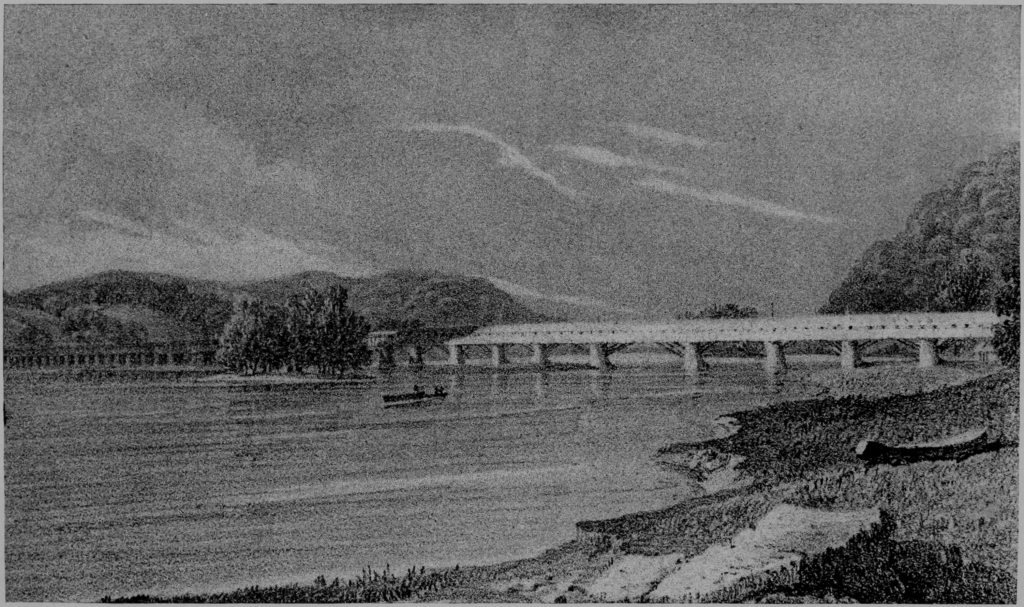
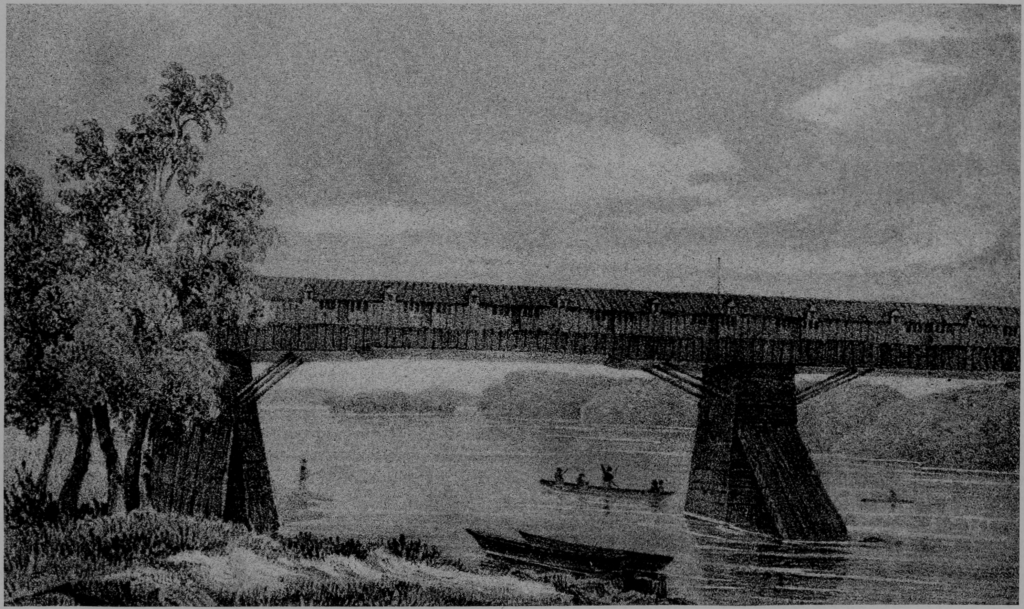
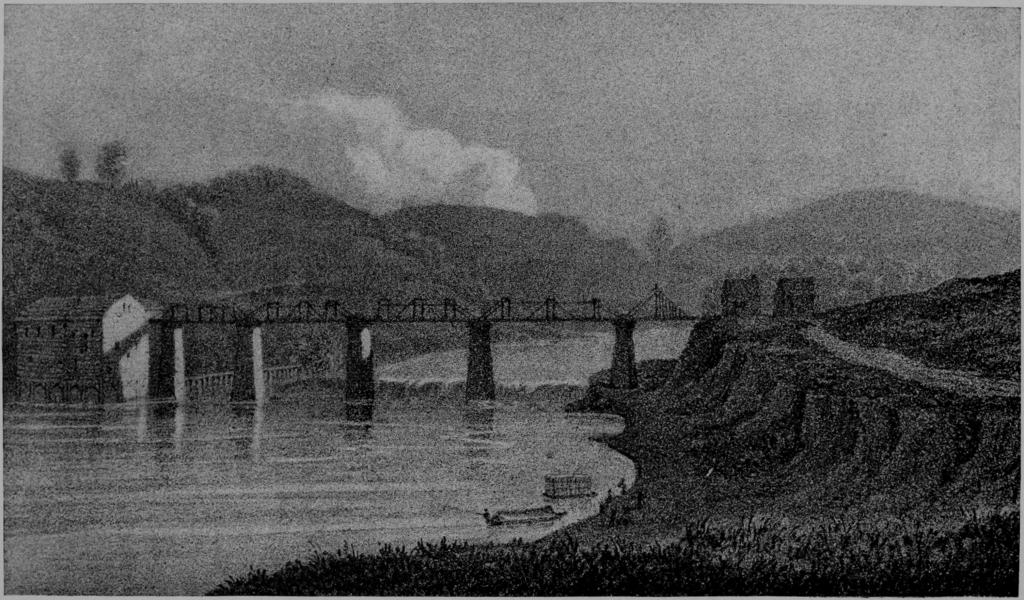
of hills, fit only for pasture. I viewed the fine covered
bridges over the two rivers Monongahela and Allegany,
which cost 10,000 dollars each. The hills around the city
shut it in, and make the descent into it frightfully precipitous.
It is most eligibly situated amidst rocks, or rather
hills, of coal, stone, and iron, the coals lying up to the
surface, ready for use. One of these hills, or coal banks,
has been long on fire, and resembles a volcano. Bountiful
nature has done every thing for this rising Birmingham of
America.
We slept at Wheeling, at the good hotel of Major Spriggs,
one of General Washington's revolutionary officers, now
near 80, a chronicle of years departed.113
22nd.—Bought a fine buffalo robe for five dollars. [343]
The buffaloes, when Kentucky was first settled, were shot,
by the settlers, merely for their tongues; the carcase and
skin being thought worth nothing, were left where the
animal fell.
Left Pittsburgh for Greensburgh, travelling through a
fine, cultivated, thickly settled country, full of neat, flourishing,
and good farms, the occupants of which are said
to be rich. Land, on the road, is worth from fifteen to
thirty dollars; from it, five to fifteen dollars per acre. The
hills and mountains seem full of coal-mines and stone-quarries,
or rather banks of coal and stone ever open
gratuitously to all. The people about here are economical
and intelligent; qualities characteristic of Pennsylvania.
Sunday, 23d.—We agreed to rest here until the morrow;
finding one of our best horses sick; and went to Pittsburgh
church.
24th.—My fellow traveller finding his horse getting
worse, gave him away for our tavern bill of two days, thus
paying 175 dollars for two days board. While this fine
animal remained ours, no doctor could be found, but as
soon as he became our landlord's, one was discovered, who
engaged to cure him in a week. Mr. Wheeler took my
horse, and left me to come on in the stage, to meet again
at Chambersburgh.
The country round about here is fine, but there is no
market, except at Baltimore, at five dollars a barrel for
flour. The carriage costs two and half [344] dollars. I
saw two young ladies, Dutch farmers' daughters, smoking
segars in our tavern, very freely, and made one of
their party. Paid twelve dollars for fare to Chambersburgh.114
Invited to a sleying party of ten gentlemen, one of
whom was the venerable speaker (Brady) of the senate
of this state. They were nearly all drunk with apple-toddy,
a large bowl of which was handed to every drinker.
One gentleman returned with a cracked skull.
25th.—Left this town, at three o'clock in the morning, in
the stage, and met again at Bedford, and parted, perhaps,
for ever, with my agreeable fellow-traveller, Mr. Wheeler,
who passed on to New York. Passed the Laurel-hill, a
huge mountain, covered with everlasting green, and a refuge
for bears, one of which was recently killed with a
pig of 150lbs. weight in his mouth.
26th.—Again mounted my horse, passing the lonely
Allegany mountains, all day, in a blinding snow-storm,
rendering the air as dense as a November fog in London.
Previous to its coming on, I found my naked nose in danger.
The noses of others were wrapped up in flannel
bags, or cots, and masks for the eyes, which are liable to
freeze into balls of ice.
Passed several flourishing villages. The people here
seem more economical and simple, than in other states.
Rested at M'Connell's town, 100 miles from Washington
city.
[345] 27th.—Crossed the last of the huge Allegany
mountains, called the North Mount, nine miles over, and
very high. My horse was belly deep in snow.
Breakfasted at Mercersburgh, at the foot of the above
mountain, and at the commencement of that fine and richest
valley in the eastern states, in which Hagar's town
stands, and which extends through Pennsylvania, Maryland,
and Virginia, from 100 to 200 miles long, and from
30 to 40 broad. Land here, three years ago, sold at 100
to 120 dollars, although now at a forced sale, 160 acres
sold for only 1,600 dollars, with improvements, in Pennsylvania.
And if, says my informant, the state makes
no law to prevent it, much must come into the market,
without money to buy, except at a ruinous depreciation.
Passed Hagar's town, to Boonsburgh, to rest all night,
after 37 miles travel.
The old Pennsylvanian farmer, in answer to "How do
you do without negroes?" said, "Better than with them.
I occupy of my father 80 acres in this valley, and hire all
my hands, and sell five loads of flour, while some of the
Marylanders and Virginians cannot raise enough to maintain
their negroes, who do but little work."
28th.—Breakfasted on the road; passed Middletown,
with two fine spires, a good town; and also Frederick town,
a noble inland town, and next to Lancaster, in Pennsylvania,
and the first [346] in the United States. It has
three beautiful spires. It is much like a second rate
English town, but not so cleanly; something is dirty, or
in ruins. It stands at the foot of the Blue Ridge, in the
finest, largest vale in the world, running from the eastern
sea to the Gulf of Mexico.
Rested at Windmiller's, a stage-house, thirty miles from
Washington, distinguished only by infamous, ungenerous,
extortion from travellers. Here I paid 75 cents for tea;
25 cents for a pint of beer, 9s. sterling for a bushel of oats
and corn, and 50 cents for hay for the night. The horse
cost 6s. 9d. in one night.
29th.—Rode from seven till eleven o'clock, sixteen miles
to breakfast, at Montgomery-court-house, all drenched in
rain. I reached Washington city, at six this evening.
Here, for the first time, I met friend Joseph Lancaster,
full of visionary schemes, which are unlikely to produce
him bread.
Sunday, 30th.—Went to Congress-hall, and heard grave
senators wrangling about slavery. Governor Barbour
spoke with eloquence.
Friend Lancaster's daily and familiar calls on the great,
and on his Excellency, the President, about schooling the
Indians, and his praises of the members, are likely to wear
out all his former fame, already much in ruins. I was this
day introduced by him to —— Parr, Esq., an English
gentleman of fortune, from Boston, Lincolnshire, [347]
who has just returned from a pedestrian pilgrimage to
Birkbeck and the western country.
February 1st.—I again went to Congress, where I heard
Mr. Randolph's good speech on the Missouri question.
This sensible orator continually refers to English authors
and orators, insomuch that all seemed English. These
American statesmen cannot open their mouths without
acknowledging their British origin and obligations.—I
shall here insert some observations on the constitution
and laws of this country, and on several of the most distinguished
members of Congress, for which I am indebted
to the pen of G. Waterstone, Esq., Congressional Librarian
at Washington.115
Observations on the Constitution and Laws of the United
States, with Sketches of some of the most prominent public
Characters.
Like the Minerva of the ancients, the American people
have sprung, at once, into full and vigorous maturity, without
the imbecility of infancy, or the tedious process of gradual
progression. They possess none of the thoughtless
liberality and inconsiderate confidence of youth; but are,
already, distinguished by the cold and cautious policy of
declining life, rendered suspicious by a long acquaintance
with the deceptions and the vices of the world.
Practitioners of jurisprudence have become [348] almost
innumerable, and the great end of all laws, the security
and protection of the citizen, is in some degree defeated.
It is to the multiplicity and ambiguity of the laws of his
age, that Tacitus has ascribed most of the miseries which
were then experienced; and this evil will always be felt
where they are ambiguous and too numerous. In vain
do the Americans urge that their laws have been founded
on those of England, the wisdom and excellence of which
have been so highly and extravagantly eulogized. The
difference, as Mably correctly observes, between the situation
of this country and that is prodigious;116 the government
of one having been formed in an age of refinement
and civilization, and that of the other, amidst the darkness
and barbarism of feudal ignorance. In most of the states
the civil and criminal code is defective; and the latter, like
that of Draco, is often written in blood. Why should not
each state form a code of laws for itself, and cast off this
slavish dependence on Great Britain, whom they pretend
so much to dislike?
With a view of explaining more perfectly the nature of
this constitution, I will briefly exhibit the points in which
the British and American governments differ [349].
| In England. | In America. |
| I. The king possesses imperial dignity. | There is no king; the president acts as the chief magistrate of the nation only. |
| II. This imperial dignity is hereditary and perpetual. |
The presidency lasts only four years. |
| III. The king has the sole power of making war and peace,
and of forming treaties with foreign powers. |
The president can do neither, without the consent of Congress. |
| IV. The king alone can levy troops, build fortresses, and equip fleets. |
The president has no such power: this is vested in Congress. |
| V. He is the source of all judicial power, and the head of all
the tribunals of the nation. |
The executive has only the appointment of judges, with the consent of the senate, and is not connected with the judiciary. |
| VI. He is the fountain of all honour, office, and privilege; can
create peers, and distribute titles and dignities. |
The president has no such power. There are no titles, and he can only appoint to office, by and with the consent of the senate. |
| VII. He is at the head of the
national church, and has supreme control over it. |
There is no established church. |
| VIII. He is the superintendent of commerce; regulates the
weights and measures, and can alone coin money and give currency to foreign coin. |
The president has no such power. |
| IX. He is the universal proprietor of the kingdom. |
The president has nothing to do with the property of the United States [350]. |
| X. The king's person is sacred and inviolate; he is accountable
to no human power, and can do no wrong. |
The president is nothing more than an individual, is amenable
like all civil officers, and considered as capable of doing wrong
as any other citizen. |
| XI. The British legislature contains a house of lords, 300
nobles, whose seats, honours, and privileges are hereditary. |
There are no nobles, and both houses of Congress are elected. |
It may, perhaps, be unnecessary to adduce more points
of difference to illustrate the nature of the American
government. These are amply sufficient to demonstrate
the entire democratic tendency of the constitution of the
United States, and the error under which those persons
labour, who believe that but few differences, and those
immaterial and unimportant, exist between these two
governments. They have, indeed, in common the Habeas
Corpus and the Trial by Jury, the great bulwarks of
civil liberty, but in almost every other particular they
disagree.
The second branch of this government is the legislature.
This consists of a Senate and House of Representatives;
the members of the latter are chosen every two years by
the people; and those of the former, every six years by the
legislatures of the different states. It is in this branch
that the American government differs from the republics
of ancient and modern times; it is this which [351] makes
it not a pure, but a representative democracy; and it is
this which gives it such a decided superiority over all the
governments in the world. Experience has demonstrated
the impracticability of assembling a numerous collection
of people to frame laws, and their incompetency, when
assembled, for judicious deliberation and prompt and unbiassed
decision. The passions of illiterate and unthinking
men are easily roused into action and inflamed to
madness. Artful and designing demagogues are too apt to
take advantage of those imbecilities of our nature, and to
convert them to the basest purposes.
The qualifications of representatives are very simple. It
is only required that they should be citizens of the United
States, and have attained the age of twenty-five. The
moment their period of service expires, they are again,
unless re-elected, reduced to the rank and condition of
citizens. If they should have acted in opposition to the
wishes and interests of their constituents, while performing
the functions of legislation, the people possess the remedy
and can exercise it without endangering the peace and
harmony of society; the offending member is dropped, and
his place supplied by another, more worthy of confidence.
This consciousness of responsibility, on the part of the
representatives, operates as a perpetual guarantee to the
people, and protects and secures them in the enjoyment
of their political and civil liberties.
[352] It must be admitted that the Americans have
attained the Ultima Thulé in representative legislation, and
that they enjoy this inestimable blessing to a much greater
extent than the people of Great Britain. Of the three distinct
and independent branches of that government, one
only owes its existence to the free suffrages of the people,
and this, from the inequality of representation, the long
intervals between the periods of election, and the liability
of members, from this circumstance, to be corrupted, is not
so important and useful a branch as might otherwise be
expected. Imperfect, however, as it is, the people, without
it, would indeed be slaves, and the government nothing
more than a pure monarchy.
The American walks abroad in the majesty of freedom;
if he be innocent, he shrinks not from the gaze of upstart
and insignificant wealth, nor sinks beneath the oppression
of his fellow-man. Conscious of his rights and of the
security he enjoys, by the liberal institutions of his country,
independence beams in his eye, and humanity glows in
his heart. Has he done wrong? He knows the limits
of his punishment, and the character of his judges. Is
he innocent? He feels that no power on earth can crush
him. What a condition is this, compared with that of the
subjects of almost all the European nations!
As long as it is preserved, the security of the citizen
and the union of the states, will be guaranteed, [353] and
the country thus governed, will become the home of the
free, the retreat of misery, and the asylum of persecuted
humanity. As a written compact, it is a phenomenon in
politics, an unprecedented and perfect example of representative
democracy, to which the attention of mankind is
now enthusiastically directed. Most happily and exquisitely
organized, the American constitution is, in truth,
at once "a monument of genius, and an edifice of strength
and majesty." The union of its parts forms its solidity,
and the harmony of its proportions constitutes its beauty.
May it always be preserved inviolate by the gallant and
highminded people of America, and may they never forget
that its destruction will be the inevitable death-blow of
liberty, and the probable passport to universal despotism!
The speaker of the House of Representatives is Mr. Clay,
a delegate from Kentucky, and who, not long ago, acted
a conspicuous part, as one of the American commissioners
at Ghent.117 He is a tall, thin, and not very muscular
man; his gait is stately, but swinging; and his countenance,
while it indicates genius, denotes dissipation. As an
orator, Mr. Clay stands high in the estimation of his
countrymen, but he does not possess much gracefulness or
elegance of manner; his eloquence is impetuous and vehement;
it rolls like a torrent, but like a torrent which is
sometimes irregular, and occasionally obstructed. Though
there is a [354] want of rapidity and fluency in his elocution,
yet he has a great deal of fire and vigour in his expression.
When he speaks he is full of animation and
earnestness; his face brightens, his eye beams with additional
lustre, and his whole figure indicates that he is
entirely occupied with the subject on which his eloquence
is employed. In action, on which Demosthenes laid such
peculiar emphasis, and which was so highly esteemed
among the ancients, Mr. Clay is neither very graceful nor
very imposing. He does not, in the language of Shakespear,
"so suit the word to the action, and the action to
the word, as not to o'erstep the modesty of nature." In
his gesticulation and attitudes, there is sometimes an uniformity
and awkwardness that lessen his merit as an orator,
and in some measure destroy the impression and effect his
eloquence would otherwise produce. Mr. Clay does not
seem to have studied rhetoric as a science, or to have paid
much attention to those artificial divisions and rhetorical
graces and ornaments on which the orators of antiquity
so strongly insist. Indeed, oratory as an art is but little
studied in this country. Public speakers here trust almost
entirely to the efficacy of their own native powers for
success in the different fields of eloquence, and search not
for the extrinsic embellishments and facilities of art. It
is but rarely they unite the Attic and Rhodian manner,
and still more rarely do they devote their attention to the
acquisition [355] of those accomplishments which were,
in the refined ages of Greece and Rome, considered so
essential to the completion of an orator. Mr. Clay, however,
is an eloquent speaker; and notwithstanding the defects
I have mentioned, very seldom fails to please and
convince. His mind is so organized that he overcomes
the difficulties of abstruse and complicated subjects,
apparently without the toil of investigation or the labour
of profound research. It is rich, and active, and rapid,
grasping at one glance, connections the most distant, and
consequences the most remote, and breaking down the
trammels of error and the cobwebs of sophistry. When he
rises to speak he always commands attention, and almost
always satisfies the mind on which his eloquence is intended
to operate. The warmth and fervor of his feelings,
and the natural impetuosity of his character, which seem
to be common to the Kentuckians, often indeed lead him
to the adoption of opinions, which are not, at all times,
consistent with the dictates of sound policy. Though
ambitious and persevering, his intentions are good and
his heart is pure; he is propelled by a love of country, but
yet is solicitous of distinction; he wishes to attain the pinnacle
of greatness without infringing the liberties, or marring
the prosperity of that land of which it seems to be his
glory to be a native.
[356] The prominent traits of Mr. Clay's mind are quickness,
penetration, and acuteness; a fertile invention, discriminating
judgment, and good memory. His attention
does not seem to have been much devoted to literary or
scientific pursuits, unconnected with his profession; but
fertile in resources, and abounding in expedients, he is seldom
at a loss, and if he is not at all times able to amplify
and embellish, he but rarely fails to do justice to the subject
which has called forth his eloquence. On the most
complicated questions, his observations made immediately
and on the spur of the occasion, are generally such
as would be suggested by long and deep reflection. In
short, Mr. Clay has been gifted by nature with great intellectual
superiority, which will always give him a decided
influence in whatever sphere it may be his destiny to revolve.
Mr. Clay's manners are plain and easy. He has nothing
in him of that reserve which checks confidence, and which
some politicians assume; his views of mankind are enlarged
and liberal; and his conduct as a politician and a
statesman has been marked with the same enlarged and
liberal policy. As Speaker of the House of Representatives,
he presides generally with great dignity, and decides
on questions of order, sometimes, indeed, with too much
precipitation, but almost always correctly. It is but
seldom his decisions are disputed, [357] and when they
are, they are not often reversed.118
"A Statesman," says Mirabeau, "presents to the mind
the idea of a vast genius improved by experience, capable
of embracing the mass of social interests, and of perceiving
how to maintain true harmony among the individuals of
which society is composed, and an extent of information
which may give substance and union to the different
operations of government."
Mr. Pinkney119 is between fifty and sixty years of age;
his form is sufficiently elevated and compact to be graceful,
and his countenance, though marked by the lines of dissipation,
and rather too heavy, is not unprepossessing or
repulsive. His eye is rapid in its motion, and beams with
the animation of genius; but his lips are too thick, and his
cheeks too fleshy and loose for beauty; there is too a degree
of foppery, and sometimes of splendor, manifested
in the decoration of his person, which is not perfectly reconcileable
to our [358] ideas of mental superiority, and
an appearance of voluptuousness about him which cannot
surely be a source of pride or of gratification to one whose
mind is so capacious and elegant. It is not improbable,
however, that this character is assumed merely for the
purpose of exciting a higher admiration of his powers, by
inducing a belief that, without the labour of study or the
toil of investigation, he can attain the object of his wishes
and become eminent, without deigning to resort to that
painful drudgery by which meaner minds and inferior intellects
are enabled to arrive at excellence and distinction.
At the first glance, you would imagine Mr. Pinkney was
one of those butterflies of fashion, a dandy, known by their
extravagant eccentricities of dress, and peculiarities of
manners; and no one could believe, from his external
appearance, that he was, in the least degree, intellectually
superior to his fellow men. But Mr. Pinkney is indeed
a wonderful man, and one of those beings whom the lover
of human nature feels a delight in contemplating. His
mind is of the very first order; quick, expanded, fervid,
and powerful. The hearer is at a loss which most to
admire, the vigour of his judgment, the fertility of his invention,
the strength of his memory, or the power of his
imagination. Each of these faculties he possesses in an
equal degree of perfection, and each is displayed in its
full maturity, when the [359] magnitude of the subject on
which he descants renders its operation necessary. This
singular union of the rare and precious gifts of nature, has
received all the strength which education could afford,
and all the polish and splendour which art could bestow.
Under the cloak of dissipation and voluptuousness his
application has been indefatigable, and his studies unintermitted:
the oil of the midnight lamp has been exhausted,
and the labyrinths of knowledge have been
explored.
Mr. Pinkney is never unprepared, and never off his
guard. He encounters his subject with a mind rich in all
the gifts of nature, and fraught with all the resources of art
and study. He enters the list with his antagonist, armed,
like the ancient cavalier, cap-a-pee; and is alike prepared
to wield the lance, or to handle the sword, as occasion
may require. In cases which embrace all the complications
and intricacies of law, where reason seems to be lost
in the chaos of technical perplexity, and obscurity and
darkness assume the dignified character of science, he
displays an extent of research, a range of investigation,
a lucidness of reasoning, and a fervor and brilliancy of
thought, that excite our wonder, and elicit our admiration.
On the driest, most abstract, and uninteresting questions
of law, when no mind can anticipate such an occurrence,
he occasionally blazes forth in all the enchanting
exuberance of a chastened, but rich [360] and vivid imagination,
and paints in a manner as classical as it is
splendid, and as polished as it is brilliant. In the higher
grades of eloquence, where the passions and feelings of
our nature are roused to action, or lulled to tranquillity,
Mr. Pinkney is still the great magician, whose power is
resistless, and whose touch is fascination. His eloquence
becomes sublime and impassioned, majestic and overwhelming.
In calmer moments, when these passions are
hushed, and more tempered feelings have assumed the
place of agitation and disorder, he weaves around you the
fairy circles of fancy, and calls up the golden palaces and
magnificent scenes of enchantment. You listen with
rapture as he rolls along: his defects vanish, and you are
not conscious of any thing but what he pleases to infuse.
From his tongue, like that of Nestor, "language more
sweet than honey flows;" and the attention is constantly
rivetted by the successive operation of the different faculties
of the mind. There are no awkward pauses, no hesitation
for want of words or of arguments: he moves forward
with a pace sometimes majestic, sometimes graceful,
but always captivating and elegant. His order is lucid, his
reasoning logical, his diction select, magnificent, and
appropriate, and his style, flowing, oratorical, and beautiful.
The most laboured and finished composition could
not be better than that which he seems to utter [361] spontaneously
and without effort. His judgment, invention,
memory, and imagination, all conspire to furnish him at
once with whatever he may require to enforce, embellish,
or illustrate his subject. On the dullest topic he is never
dry: and no one leaves him without feeling an admiration
of his powers, that borders on enthusiasm. His satire is
keen, but delicate, and his wit is scintillating and brilliant.
His treasure is exhaustless, possessing the most extensive
and varied information. He never feels at a loss; and he
ornaments and illustrates every subject he touches.
Nihil quod tetigit, non ornavit. He is never the same; he
uses no common place artifice to excite a momentary thrill
of admiration. He is not obliged to patch up and embellish
a few ordinary thoughts, or set off a few meagre
and uninteresting facts. His resources seem to be as unlimited
as those of nature; and fresh powers, and new
beauties are exhibited, whenever his eloquence is employed.
A singular copiousness and felicity of thought
and expression, united to a magnificence of amplification,
and a purity and chastity of ornament, give to his eloquence
a sort of enchantment which it is difficult to describe.
Mr. Pinkney's mind is in a high degree poetical; it
sometimes wantons in the luxuriance of its own creations;
but these creations never violate the purity of classical
taste and elegance. He [362] loves to paint when there
is no occasion to reason; and addresses the imagination
and passions, when the judgment has been satisfied and
enlightened. I speak of Mr. Pinkney at present as a
forensic orator. His career was too short to afford an
opportunity of judging of his parliamentary eloquence;
and, perhaps, like Curran, he might have failed in a field
in which it was anticipated he would excel, or, at least,
retain his usual pre-eminence. Mr. Pinkney, I think,
bears a stronger resemblance to Burke than to Pitt; but,
in some particulars, he unites the excellences of both. He
has the fancy and erudition of the former, and the point,
rapidity, and elocution of the latter. Compared with his
countrymen, he wants the vigour and striking majesty of
Clay, the originality and ingenuity of Calhoun; but, as a
rhetorician, he surpasses both. In his action, Mr. Pinkney
has, unfortunately, acquired a manner, borrowed, no
doubt, from some illustrious model, which is eminently
uncouth and inelegant. It consists in raising one leg on
a bench or chair before him, and in thrusting his right
arm in a horizontal line from his side to its full length in
front. This action is uniform, and never varies or changes
in the most tranquil flow of sentiment, or the grandest
burst of impassioned eloquence. His voice, though not
naturally good, has been disciplined to modulation by art;
and, if it is not always musical, it is [363] never very harsh
or offensive. Such is Mr. Pinkney as an orator; as a diplomatist
but little can be said that will add to his reputation.
In his official notes there is too much flippancy, and too
great diffuseness, for beauty or elegance of composition.
It is but seldom that the orator possesses the requisites of
the writer; and the fame which is acquired by the tongue
sometimes evaporates through the pen. As a writer he
is inferior to the present Attorney-General,120 who unites
the powers of both in a high degree, and thus in his own
person illustrates the position which he has laid down, as
to the universality of genius.
Mr. R. King is a senator from the State of New York,
and was formerly the resident minister at the court of St.
James's.121 He is now about sixty years of age, above the
middle size, and somewhat inclined to corpulency. His
countenance, when serious and thoughtful, possesses a
great deal of austerity and rigour; but at other moments
it is marked with placidity and benevolence. Among his
friends he is facetious and easy; but when with strangers,
reserved and distant; apparently indisposed to conversation,
and inclined to taciturnity; but when called out, his
colloquial powers are of no ordinary character, and his
conversation becomes peculiarly instructive, fascinating,
and humourous. Mr. King has read and reflected much;
and though long in public life, his attention [364] has
not been exclusively devoted to the political sciences; for
his information on other subjects is equally matured and
extensive. His resources are numerous and multiplied,
and can easily be called into operation. In his parliamentary
addresses he always displays a deep and intimate
knowledge of the subject under discussion, and never fails
to edify and instruct if he ceases to delight. He has read
history to become a statesman, and not for the mere
gratification it affords. He applies the experience of
ages, which the historical muse exhibits, to the general
purposes of government, and thus reduces to practice the
mass of knowledge with which his mind is fraught and
embellished. As a legislator he is, perhaps, inferior to
no man in this country. The faculty of close and accurate
observation by which he is distinguished has enabled him
to remark and treasure up every fact of political importance,
that has occurred since the organization of the American
government; and the citizen, as well as the stranger, is
often surprised at the minuteness of his historical details,
and the facility with which they are applied. With the
various subjects immediately connected with politics, he
has made himself well acquainted; and such is the strength
of his memory, and the extent of his information, that the
accuracy of his statements is never disputed. Mr. King,
however, is somewhat of an [365] enthusiast, and his feelings
sometimes propel him to do that which his judgment
cannot sanction. When parties existed in this country,
he belonged to, and was considered to be the leader of
what was denominated the federal phalanx; and he has
often, perhaps, been induced, from the influence of party
feeling, and the violence of party animosity, to countenance
measures that must have wounded his moral sensibilities;
and that now, when reason is suffered to dictate,
cannot but be deeply regretted. From a rapid survey of
his political and parliamentary career, it would appear
that the fury of party has betrayed him into the expression
of sentiments, and the support of measures, that were, in
their character, revolting to his feelings; but whatever he
may have been charged with, his intentions, at least, were
pure, and his exertions, as he conceived, calculated for the
public good. He was indeed cried down by a class of
emigrants from the mother country, who have far too great
a sway in the political transactions of the United States;
and though, unquestionably, an ornament to the nation
which has given him birth, his countrymen, averse to him
from party considerations, joined in the cry, and he became
a victim, perhaps, to the duty he owed, and the love
he bore to his country. Prejudice, however, does not
always continue, and the American people, with that good
sense which forms so prominent a feature of their character,
are beginning justly to appreciate those [366] virtues
and talents, they once so much decried. Mr. King has a
sound and discriminating mind, a memory uncommonly
tenacious, and a judgment, vigorous, prompt, and decisive.
He either wants imagination, or is unwilling to employ
a faculty that he conceives only calculated to flatter
and delight. His object is more to convince and persuade,
by the force of reason, than to amuse the mind by the
fantastic embroidery and gaudy festoonings of fancy. His
style of eloquence is plain, but bold and manly; replete
with argument, and full of intelligence; neither impetuous
nor vehement, but flowing and persuasive. His mind,
like that of Fox, is historical; it embraces consequences
the most distant with rapidity and ease. Facts form the
basis of his reasoning. Without these his analysis is defective,
and his combinations and deductions are often
incorrect. His logic is not artificial, but natural: he
abandons its formal divisions, non-essentials, moods, and
figures, to weaker minds, and adheres to the substantials
of natural reason. Of Mr. King's moral character I can
say nothing from my own personal knowledge, as my acquaintance
with him has not been long and intimate
enough to enable me to judge correctly. I have not, however,
heard any thing alleged against it calculated to lessen
his reputation as an honourable statesman, or a virtuous
member of society. He is wealthy, and has, no doubt,
something of pride and hauteur in his manner, [367]
offensive to the spirit of republicanism, and inconsistent
with the nature of equality; but, as a father, husband, and
friend, I have not yet heard him charged with any dereliction
of duty, or any violation of those principles which
tend to harmonize society, and to unite man to man by
the bonds of affection and virtue. I must now beg permission
to despatch the portrait of Mr. King, in order to
submit to your inspection an imperfect likeness of another
member of the same body. This is not the country to look
for the blazonry and trappings of ancestry; merit alone
claims and receives distinction; and none but the fool or
the simpleton, ever pretends to boast of his ancestry and
noble blood, or to offer it as a claim to respect or preferment.
The people alone form the tribunal to which every
aspirant for fame or honour must submit; and they are too
enlightened and too independent to favour insignificance,
though surrounded by the splendour of wealth, or to countenance
stupidity, though descended from those who were
once illustrious and great.
James Barbour is a senator from Virginia, his native
state.122 He was in his youth a deputy sheriff of the county
in which he was born, and received an education which
was merely intended to fit him for an ordinary station in
life. He felt, however, superior to his condition, and
stimulated by that love of fame which often characterizes
genius, he devoted himself to study, and became [368] a
practitioner of the law. He rose rapidly in his profession,
and soon acquired both wealth and reputation. Like
most of the barristers of this country, he conceived that
to be a lawyer was necessarily to be a politician, and he
rushed forward into public life to extend his fame and
enlarge his sphere of action. From a member of the
house of delegates he was elevated to the gubernatorial
chair of Virginia, and received the highest honour his
native state could confer. Gratified thus far in the wishes
he had formed, he became desirous to enter on a more enlarged
theatre, where his talents would have a greater field
of action, and his eloquence a wider range and better
effect, and he accepted the situation of senator of the
United States.
Mr. Barbour commenced his career with a speech
against the establishment of the national bank, which was
then in agitation. He had come fraught with prejudices
against this mammoth institution, and in the fervor of the
moment gave vent to those prejudices in a manner certainly
very eloquent, but not very judicious. When he
had soberly weighed the good and evil with which it might
be attended, the peculiar condition of his country, and the
necessity of adopting some scheme by which the difficulties
of government should be obviated, and its financial embarrassment
relieved, he very candidly confessed the error
into which his feelings had betrayed him, and [369] in a
speech, conceived and uttered in the very spirit of true
eloquence, supported the measure.
Mr. Barbour is, in person, muscular and vigorous, and
rather inclined to corpulency. His eyebrows are thick
and bushy, which gives to his countenance a little too
much the appearance of ferocity, but this is counterbalanced
by a peculiar expression in his visage, that conveys
a sentiment of mildness and humanity. He seems
to be above forty years of age, and is about five feet ten
inches high. Of his mind, the prominent characters are
brilliancy and fervor. He has more imagination than
judgment, and more splendor than solidity. His memory
is not very retentive, because it has never been much employed,
except to treasure up poetical images, and to preserve
the spangles and tinsel of oratory. As an orator,
Mr. Barbour has some great defects. His style is too
artificial and verbose, and he seems always more
solicitous to shine and dazzle than convince or persuade.
He labours after splendid images, and strives to fill the
ear more with sound than sense. His sentences are sometimes
involved and complicated, replete with sesquipedalia
verba, and too much charged with "guns, trumpets, blunderbuss,
and thunder." He has unfortunately laid down
to himself a model, which, with reverence be it spoken,
is not the best that could have been adopted. Curran
has gone a great way to corrupt the taste of the present
age. His powers [370] were certainly very extraordinary,
but his taste was bad, and by yielding too much to the impulse
of a highly poetical imagination, he filled the mind
of his hearer with fine paintings indeed, and left it at last
glowing, but vacant, delighted, but unconvinced. Too
many of the youths of this country seem to be smitten with
the model which he has thus given, and which is certainly
calculated to fire an ardent mind, and lead it astray from
the principles of correct taste and genuine oratory. Mr.
Barbour, however, is frequently not only very fluent but
very persuasive, and he often employs his full flowing
oratorical style to great advantage in setting off his argument,
and in decorating and enforcing his reasoning.
From the want of opportunities, his reading, like that of
most of the politicians of this country, has been confined,
and his range of thought, from the absence of that knowledge
which books afford, is necessarily limited. He has,
indeed, derived advantages from an association with men
of literary and scientific attainments, but he has still much
to acquire to render him eminent as a statesman. The
contributions, which, from this circumstance, he is compelled
to levy on his own unaided native resources, have,
however, tended to sharpen his intellectual powers, and
to give them vivacity and quickness. Mr. Barbour seldom
thinks deeply, but he is always rapid; and though
his observations are sometimes trite and ordinary, there
is almost always something [371] new and gratifying in
the manner in which they are uttered. His mind does
not appear organized for long continued investigation,
and nature has formed him more for a poet than a mathematician.
He is rather too anxious to be thought a great
orator, and this over-ruling propensity is manifested even
in common conversation; when, instead of ease, simplicity,
and conciseness, he discovers the formal elocution of the
public speaker, on the most unimportant and incidental
subjects. In private circles, Mr. Barbour is always very
pleasant, and exhibits a politeness, which, flowing from
the heart rather than the head, delights all who have the
pleasure of his acquaintance, and renders him an acceptable
guest, and an agreeable companion.
There is a native openness and benevolence in his character,
which excite the love of all who know him, and
which powerfully attract the stranger as well as the friend.
He seems superior to the grovelling intrigues of party,
and always expresses his feelings, in the bold and lofty
language of conscious independence and freedom. There
is a marked difference between this gentleman and his
brother, Mr. Philip P. Barbour,123 a member of the House
of Representatives, in the respective faculties of their
mind; the latter is more logical, and also more laborious
and indefatigable. He seems to have a peculiar tact for
those constitutional and legal questions which [372] are
involved and obscure, and possesses that clearness and
vigor of mind necessary to unfold what is complicated,
and illuminate what is dark. He casts on such subjects
so powerful a light, that we wonder we should ever have
doubted, and behold at once the truth, stripped of all its
obscurity. The former seldom attempts an analysis of
such questions. He reasons, but his reasoning is not so
much that of a mathematician, as of an advocate who
labours to surprise by his novelty, and to fascinate by the
ingenuity of his deductions, and the ease and beauty of
his elocution. He has more genius than his brother, but
less judgment; more refinement and elegance, but less
vigor and energy. It appears to me that there is a vast
deal of what may be denominated law mind in this country,
which will ultimately reach a point of excellence that
must astonish the world. The fondness for the profession
of the law, at present, is wonderful; almost every man,
whatever be his means of support, or grade in society, if
he have children, endeavours to make one of them, at
least, a disciple of Coke, or a "fomentor of village vexation,"
and you cannot enter a court-house, without being
astonished at the number of young men, who are either
studying or practising the law. This, however, is not a
matter of surprise, when we consider the facility with
which this profession leads to preferment and distinction,
and the ease with which it seems to be acquired. Amidst
such [373] a mass of law mind, therefore, as exists here,
excellence must hereafter be attained, if it has not now
reached its climax; and the Cokes, the Mansfields, and
Ellenboroughs of England are, or will soon be, equalled
in this country. The future destinies of this republic
cannot be fully anticipated; the march of mind is progressive
and resistless, and intellectual pre-eminence must
be attained where so many inducements are offered to
effect, and so few impediments exist to prevent it. Mind
is often regulated by the circumstance in which it is
placed, and fashioned by the objects by which it is surrounded.
This country is, therefore, peculiarly favorable
for the expansion and development of the intellectual
powers. Physical, as well as moral causes, operate to
this end. The eye of an American is perpetually presented
with an outline of wonderful magnificence and grandeur;
every work of nature is here on a vast and expansive scale;
the mountains, and lakes, and rivers, and forests, appear
in a wild sublimity of grandeur, which renders the mountains,
lakes, and rivers of Europe, mere pigmies in comparison.
The political and religious freedom, too, which
is here experienced, removes all shackles, and gives an
elasticity, a loftiness, and an impetus to the mind that
cannot but propel it to greatness. Thus operated upon
by moral and physical causes, what must be the ultimate
destiny of the people of this country, and the range and
expansion of intellect which they [374] will possess?
Devoted as they are for the most part to studies and professions,
which have a tendency to enlarge and liberalize
the mind, and influenced by the causes I have mentioned,
it would be worse than stupidity to suppose they could
long remain an inferior people, or possibly avoid reaching
that point of elevation of which mankind are capable.
The law mind of this country has now attained a high
degree of splendor, and is in rapid progress to still greater
excellence. There are many men, in this country, though
so much calumniated by British writers, who would shed
a lustre on the bench of that nation, and not suffer by a
comparison with some of the brightest luminaries of English
jurisprudence.
Before I quit this body of American worthies, I must
introduce to your acquaintance, as succinctly as possible,
another member of the senate, who, though not so conspicuous
as the two former, in the walks of public life, is
not inferior to any in this country, in all that constitutes
and dignifies the patriot and the statesman. Mr. Roberts
is from Pennsylvania.124 He is a plain farmer, and was,
once, I understand, a mechanic. Though he cannot boast
of a liberal education, yet nature has given him a mind,
which, with early improvement, would have made him
prominent in any sphere in life. It is vigorous and
powerful in no ordinary degree, and the sophistry of art,
and the dexterity of learning, are often foiled and defeated
[375] by the unaided and spontaneous efforts of his native
good sense. But he has that which is of more sterling
advantage, both to himself and his country,—immoveable
political and moral integrity. It is gratifying, in this
age of corruption and voluptuousness, to contemplate
men like Aristides, Fabricius, and Cato. They exhibit
to us the true dignity of man, and hold out examples that
we must feel delighted to imitate. They show us to what
pitch of excellence man is capable of attaining, and
rescue the exalted condition of human nature from that
odium and disgrace which profligacy and corruption have
heaped upon it. No spectacle can be more sublime or
more elevating than he, who, in the hour of public danger
and trial, and amidst the allurements and fascinations of
vice, stands like a rock in the ocean, placid and immoveable,
and endures the dangers that surround, and braves
the storms and tempests that beat upon him, with undeviating
firmness, for the safety of his country and the
glory of his God! The mind rests upon such a character
as the eye upon a spot of fertility, amidst deserts of sand,
and we rise from the blood-stained page of history, and
the corruptions of the living world, with a heart filled with
love, admiration, and reverence, by the contemplation of
the few who have shed an imperishable lustre on the exalted
character of man. This description is not exaggerated;
it is drawn from nature and truth, and [376] fancy
has nothing to do with the picture. But I must now hasten
to finish my portraits of American characters.
Mr. Bagot,125 the English minister to this government,
appears to be about thirty-five years of age. He is tall,
elegant, and rather graceful in his person, with a countenance
open and ingenuous, an English complexion, and
eyes mild though dark. He has ingratiated himself with
the Americans, by the real or affected simplicity of his
manners, and by assimilating himself to their usages and
customs. He has thrown aside the reserve and hauteur
of the English character, as not at all suited to the meridian
of this country, and attends to all with equal courtesy and
politeness. I can say nothing of the powers of his mind,
but they do not appear to be more than ordinary. It has
always seemed to me very strange policy on the part of
the British cabinet, to appoint ministers to this country
of inferior capacity and inconsiderable reputation, while
the Americans send to our court only their most prominent
and leading men, who have distinguished themselves by
their ability and their eloquence.
The French minister, M. Hyde de Neuville,126 is a "fat,
portly gentleman," with a broad chest, big head, and short
neck, which he seems almost incapable of turning ad libitum.
He is full of [377] Bourbon importance and French
vivacity; has petits soupers every Saturday evening during
the winter, and spends his summer at the springs, or his
country residence, in extolling the virtues of his beloved
Louis le desiré. I do not think that M. Neuville, though
an amiable, and, I understand, a benevolent man, has
that kind of talent which would qualify him for the station
he holds, or that, in the event of any difficulty arising between
this country and France, he could counteract the
intrigues of diplomatic ingenuity, or benefit his nation,
by inducing the American cabinet, though I believe he is
highly esteemed, to adopt any measure not manifestly
advantageous to the United States. He has been many
years a resident of this country, and was driven from
France by the persecutions of Buonaparte. He is said to
have evinced for his exiled countrymen much feeling and
interest, and to have given them, while strangers and unknown
in a foreign land, all the aid he could afford. His
acts of benevolence certainly redound to the credit of his
heart, and I should be sorry to say any thing that would
disparage the qualities of his head. He is too much
occupied with his own, or other people's concerns, to
attend to the little or the complicated intrigues of courts,
and though he resides here as a representative, yet he now
represents a cypher.
[378] 4th.—To tea with J. C. Wright, Esq., to meet a
young man, Mr. Dawson, who is giving up a school here
to go as "Teacher to the Cherokee nation of Indians."
Much enthusiasm takes him there; little will be needed
to bring him back again. Since my return, Washington
has been visited by some very distant and interesting
tribes of Indians, with the following account of whom I
have been favoured by a friend residing there.
Some account of the Indians who visited all the Chief Cities
in the Eastern States, and made a long stay in Washington
in the winter of 1821.
These Indians were the chiefs and half-chiefs of tribes
from the most western part of this continent with which
we are at all acquainted, and came under the guidance
of Major O'Fallan127 from the Counsel Bluffs.128
All of them were men of large stature, very muscular,
having fine open countenances, with the real noble Roman
nose, dignified in their manners, and peaceful and quiet
in their habits. There was no instance of drunkenness
among them during their stay here. The circumstances
which led to their visit were singular. A missionary, who
had been amongst them a few years back, on renewing his
visit recently, found an old chief, with whom he was acquainted,
degraded from his rank, and another appointed
in his place. This led to inquiries after the cause, which
proved to be that this chief having, during a considerable
[379] absence from his tribe, visited some of the cities of
the whites, carried back such a report of their houses,
ships, numbers, wealth, and power, that they disbelieved
his account, and degraded him as a man unworthy of
being longer their chief. They inquired of their missionaries,
who confirmed the statement, and they met in
council with other tribes, and resolved that a deputation
should, in company with the representative of the great
father, "see if things were so," and if they were, the chief
should be reinstated. They have returned, saying the
"half was not told them." Red Jacket129 (of whom you
have heard) used to say, that "the great spirit was too
great a being to overlook red men; that he listened to the
talk of red men as well as to the talk of white men;" but
these natives of the forest thought the great spirit favoured
white men more than red. An anecdote is related of one
of the chiefs (a Pawnee) which is a well authenticated
fact, and recorded by Dr. Morse in his account of visits
to the western regions.130 The tribe of the Pawnees had
taken a woman prisoner from a neighbouring tribe with
whom they were at war, and, as was their custom, they
made every preparation to offer her a sacrifice to the great
spirit. Every thing was prepared, the wood, the green
withes, and the fire, and the victim, when this chief suddenly
flew and seized her, carried her under his arm to a
neighbouring thicket, where [380] he had prepared horses
for her and himself, and riding away at speed, he, after
three days' travelling through the woods, returned her in
safety to her tribe and friends. This event was considered
by the Pawnee tribe as an interference of the great
spirit in her favour, and on the return of the chief no questions
were asked him on that subject, nor has a woman been
offered a sacrifice by that tribe since. As a compliment
justly due to his gallant exploit, a number of ladies in this
city had a medal made, and presented to him in due form,
in the presence of all the Indians; on one side of which
was represented the preparation for the sacrifice, and on
the reverse the chief running off with a woman under his
arm, and two horses stationed at a short distance, surmounted
by this inscription, "To the bravest of the
Braves," (the Pawnees are also called the Braves). These
Indians excited so much interest from their dignified personal
appearance, and from their peaceful manner, that
they received a great number of rich presents, sufficient
to fill six large boxes in New York, Philadelphia, Baltimore,
and Washington; these were forwarded before they
left us. Their portraits, which are gone with them, were
taken in oil by Mr. King in their native costume, buffalo
skins, with the hair inside, turned back at the neck and
breast, which looked very handsome, like fur collars.
Eight, however, the chiefs and [381] the squaw, Mr. King
copied and keeps himself.131 He received 400 dollars
from Uncle Sam for it. There was a notice in the papers
that the Indians would dance and display their feats in
front of the President's house on a certain day, which they
did to at least 6,000 persons. They shewed their manner
of sitting in council, their dances, their war whoop, with
the noises, gesticulations, &c. of the centinels on the sight
of an approaching enemy. They were in a state of perfect
nudity, except a piece of red flannel round the waist
and passing between the legs. They afterwards performed
at the house of his Excellency M. Hyde de Neuville.
They were painted horribly, and exhibited the operation
of scalping and tomahawking in fine style.
The Otta half-chief132 and his squaw have taken tea
with and frequently visited us. She was a very good
natured, mild woman, and he shewed great readiness in
acquiring our language, being inquisitive, retaining any
thing that he was once informed, and imitating admirably
the tones of every word. He spent the evening with us
before they finally left the city. I took himself and squaw
into Dr. Barber's room, and opened gently the skeleton
case. He looked slyly in, and the wife wanted to look, but
he put himself in an attitude to represent a dead person,
and said, "no good, no good." She still wanted to see,
but he would [382] not let her. Three others came afterwards
wanting to see it, who, when I opened it, raised
themselves up in a dignified manner and said, "very good,"
one of them taking hold of the hand said, "how you do."133
The Otta half-chief and squaw afterwards saw it together
and were very well pleased. Our children were all full
of play with them, and the squaw nursed the younger ones.
Margaret wanted to go with them. The calumet134 of
peace (the tomahawk pipe and their own sumach tobacco)
frequently went round, and they expressed a wish to see
us again.
I have recorded much of the vocabulary of these Indians,
and would transcribe it, but have not room. They count
by tens as we do, for instance, noah, two; taurny, three;
crabraugh, ten; crabraugh noah, twenty; crabraugh taurny,
thirty, &c. They hold polygamy as honourable; one
wife, no good; three, good; four, very good. In their talks
with the residents they shew no wish to adopt our habits.
5th.—To dine with Dr. Dawes at his poor, worn out
farm, of which he is already tired. The Doctor seems
one of the best Englishmen I have met in America.
Sunday, 6th.—Dr. Rice135 preaching this day in Congress-hall
before the senate, and representatives, [383]
called the assembly, polite, just, respected, respectable,
and deemed it unnecessary to mention sin and human
depravity.
American husbands abound in outward politeness
and respect to their wives; and gentlemen, in general,
are excessively attentive to the fair sex, rising and leaving
their seats, even at church, to accommodate the late
coming ladies. I gave much offence, on a recent occasion,
by my want of gallantry in this particular. The
meanest white woman is here addressed by the title of
Madam.
It may also be mentioned, as a proof of superior civilization
and refinement in manners, that a stranger cannot,
in this country, enter and join a party or social circle,
without being publicly presented by name, and exchanging
names and hearty shakes of the hand with all present.
Should he, however, happen to enter and take his seat
without submitting to this indispensable ceremony, he
must remain dumb and unnoticed, as an intruder, or as
a person whose character renders him unfit for introduction,
and for the acquaintance of any. But, on the other
hand, when properly presented, he is instantly at home;
and ever after, at any distance of time and place, acknowledged
as entitled to the goodwill and friendship of all who
thus met him. Friendships are thus formed and propagated,
and the boundaries of society in the new world extended.
It would hence be impracticable for me to be
half an hour, as has happened to me in England, [384]
unknowingly present with a person of distinction; and
many unpleasant mistakes and misunderstandings are
thus obviated.
8th.—I heard Mr. Speaker Clay deliver a splendid
speech of four hours long on the Missouri slave-question.
His voice fills the house; his action is good and generally
graceful.
I met this evening Mr. Smith, a young gentleman from
Lincolnshire, the fellow-traveller of Mr. Parr, who walked
through the west, and admired all! He is not determined
on continuing here; he has a good farm in England. He
and Mr. Parr have been introduced by a member of Congress
to the President, who sat half an hour familiarly
talking with them, in a plain, domestic, business-like
manner.
Sunday, 13th.—From the Speaker's chair in Congress-hall,
I heard the young, learned, and reverend professor
Everett, of Cambridge University, (aged 29) preach most
eloquently to the President and legislature of this great
empire.136 His voice, bewitchingly melodious, yet manly,
filled the house, and made every word tell, and every ear
hear. "Time is short," was the subject. His discourse
was full of high praise of this land, it being, he said, (in
my own language) "the only resting place for liberty, who,
when driven hence, must ascend in her pure, white robes
to heaven. No more new continents will be discovered
for her reception, and therefore let this nation wisely [385]
keep her asylum here." He then spoke very warmly
against kings, lords, and priests, and what he called the
toleration of man and his rights. "In England they
tolerate liberty; and what is liberty there? A shadow!
But here, a substance! There her existence is only
nominal. She is mocked by her very name." Independent
of its moral instruction, this sermon was a fine specimen
of oratory, and greatly interested the members of
both houses, who very cordially shook the preacher by
the hand. Though not forgetting slavery in his discourse,
the professor seemed too partial to it.
This gentleman had just returned from his tour through
Europe, where he visited Sir Walter Scott, and other distinguished
literati, and preached in London.
I met Mr. Lowndes, the Howard of America, at Mr.
Elliott's. He says, that "Harmony presents much moral
philosophy in practice. Flesh and blood had hard work
at first, but now they have but few desires to gratify.
Nature seems under the hatches, and they have little to
wish, want, or fear. But theirs is a stagnant life."
14th.—Read Mr. John Wright's pamphlet on Slavery,
in which he uses my name in reference to my negro letter,
and shows very clearly the evil effects of slavery on the
character of this country, and proves the unalterable
nature of the black man's right to liberty, and its
benefits.
[386] Mr. Rufus King, a member for New York, a
gentlemanly English-like speaker, confines himself to
business, and to the grand fundamental principles of every
political question, and the consequences likely to result
from extending slavery over the continent. "In time,"
says he, "you will enable the blacks to enslave the whites.
Why, therefore, should we of the free, be compelled to
suffer with you of the slave states?"
18th.—I supped with Dr. Alison,137 Chaplain to Congress,
a gentleman possessing every variety of knowledge.
He is the friend and correspondent of the Ex-presidents
Jefferson and Adams, and of the present President, and
is known all over the country by his virtues. This gentleman
was visited by the black Baron de Vasey, and his
friend, from St. Domingo, who supped with him. On
their quitting the room, the doctor's black servant set up a
laugh, which might be heard by the baron, and all, far
and near. "What's the matter, Sam?" said the doctor.
"Why, two niggers sat and took tea with my massa, at
the same table!!" In Virginia, the doctor complained of
his fears of being murdered by the negroes, one hundred
of whom were owned by his hostess. She cried and said,
"she hoped the Lord would protect her." "Oh, no! you
must not look to the Lord for it; it is not there." She
said she would free them, if she could find any body to
support them. Freed slaves must quit the states, or be
sold by it for slaves again! [387] Colonel Taylor has a
black uncle, a slave, for his body guard, and most owners
are related to their black cattle. A gentleman of Washington,
too kind-hearted to whip his house-negroes himself,
leaves it to his wife, a fashionable, beautiful female, holding,
and going to levees, yet able to cow-hide her negroes,
whose screams, under the lash, scare Mrs. Little and family.
A cow-hide is no uncommon appendage of ladies here!
Squire Simpson, an old emigrant from England, whom
I have before mentioned as living near this city, once acted
as a magistrate. Two parties came before him for justice,
but neither of them seemed disposed to submit to his worship's
decision. At last, the most choleric of the two thus
addressed Mr. Simpson: "Well! I don't see, I guess, that
we can settle it fairly. So here's at you. I'll fight you,
Squire!" Both then went out, magistrate and man, and
decided the affair by battle. Simpson was victor.
24th.—Revisited Dr. Dawes, who is full of improving
his farm by a summer fallow, and turning it into grass
without a crop. He has paid only half the cash for his
farm of 500 acres, because the title cannot be completed.
Any one, says ex-squire Simpson, would take it off his
hands. The doctor deems, as does Sir H. Davy, that
plaster of Paris is the natural food of plants; and it is
found, more or less, in almost all soils, particularly in
England, [388] where manuring with plaster is found to
have but little effect, but in this country vice versâ.
Visited Mr. Plant, who holds 400 acres, all cleared and
enclosed long ago, and exhausted too, at 100 dollars a year
rent, offered for sale at fifteen dollars an acre, poor but
useful, light, sandy loam, shining bright with silvery mica.
He manages this estate without a capital, by the labour of
himself, one slave and a boy; he hires none. He has sold
Bradford's Rest, a large estate, costing seven dollars, for
20 dollars per acre; well sold!
26th.—I rode this day to the bench of his worship,
Squire Arden, with Doctor Dawes, who was served with
a warrant for a small debt for goods. I carried the Doctor's
diploma, to prove him a physician, authorized to
write prescriptions. The plaintiff is a neighbour of the
Doctor's, who had prescribed for his family, and therefore
pleaded a set off. The plaintiff then swore he would
prove that the Doctor never was sent for nor came! The
Doctor considers almost all here as unprincipled and conspiring
against his cash. Quitting the diploma for the
plough, he gave up a practice of 400 or 500 pounds a year,
at Wisbeach, in England, where he was highly esteemed.
His humanity here to poor exiles, distinguishes him as a
patriot and a philanthropist, and entitles him to the applause
and goodwill of all mankind. In September last,
poor John Steed, the English Quaker, [389] was fed,
housed, physicked, and restored to health, by this benevolent
man. Steed was returning to England; but how
to return without money? There was money for him!
My warm-hearted friend, the watchman, a dear friend of
the Rev. I. Leathes, brother-in-law of the late Bishop of
Bristol, put into Steed's empty hands a purse, amply
sufficient for his land and sea expenses. This was noble!
It is well to praise man for his humanity to a suffering
brother, but better to ascribe all the glory to his Maker,
who gives all, and blesses him with a generous heart, and
who has promised that "He who deviseth liberal things,
by liberal things shall he stand."
March 11th.—I revisited the astronomical, mathematical,
and philosophical Mr. W. Elliott, dining on vegetables
only. He states that it is impossible for a sensible, honest
Englishman to prefer this country to his own; and in
knowing that he has quitted England for ever, he experiences
a feeling indescribably painful. To return no more
is a word next to death. Although he would not, at present,
desire to live in England, yet he would not advise any
to quit who can live in it. The soil here is unfit for man,
and for an Englishman particularly. Both mind and
body barbarize and degenerate. He feels, at first, sanguine,
but soon after he begins to judge and compare, and
finds that though the government allured him here, yet
that all is not gold that glitters. He becomes [390] weak
and emaciated, and drifts into the habits of the country,
where he is no longer the man he thought himself at first.
The labouring poor here are far behind, and more miserable
than the poor, bold peasantry of England. No
man needs labour here long, if he would work and not
drink excessively; but he drinks and is undone.
Sunday, 12th.—Met J. G. Wright, Esq. who has consumed,
in segars, for his own use, since he began smoking,
twenty years since, 700 barrels of flour, at the present price.
One hundred and fifty dollars annually is the cost of his
smoking.
14th.—The Hon. T. Law brought, it is said, half a
million sterling with him to this country, but has lost two-thirds
of it. He married the niece of General Washington,
the most beautiful lady in Virginia; and, at her uncle's
request, Mr. Law settled on her, in case they parted,
15,000 dollars a year. The event, which seemed thus to
be anticipated, soon after occurred; for Mr. Law visiting
England soon after his marriage and leaving his wife in
America, she, during his absence, eloped with a young
dashing officer in the army. Mr. Law returned only to
part with one of the most accomplished ladies in the land.
She still lives in high style, and her house is the resort of
the most fashionable parties.138
By Mr. Sutton, an English gentleman from Cheshire,
I was this day introduced to an hour's conversation with
Mr. John Law, a lawyer of this [391] city, son of Mr.
Thomas Law, above mentioned. This gentleman occupies
a mean office, but seems very sprightly and acute,
and though a plain republican, has much of the blood of
the Laws in him. He states that he is in expectation of
receiving 80,000l. from Sir Wm. T——, for purchasing
land in the wilds of the west, which is to increase in value
greatly in twenty years. For the same purpose, he also
wishes to get 150,000l. from English capitalists, who never
mean to emigrate, but who only wish to invest money in
western lands. There are several millions of acres, some
of which, military lands in Illinois, are selling at 37 and
50 cents an acre. Mr. Law proposes to be the agent, and
live on the spot, to settle poor emigrants from England
on it, by finding them implements and money for commencing,
which is to be repaid in produce. They are to
live seven years rent free. He would make it his business
to interest emigrant societies in favor of this speculation,
by which the posterity of such capitalists are to benefit
greatly. Mr. Law is to receive only one quarter of the
cash for his own trouble, that is, only about 37,000l. or
40,000l. out of the 150,000l.
Birkbeck (he says) must be rich in ten years; which ten
years of life he admits a man must sacrifice before he can
arrive at comforts. Ohio, he states, has proved what time
can do for a wilderness; and I say, that time has proved
that those [392] enriching improvements made by hands,
and not by time, can be bought any where for less than
they cost in that State, or almost in any other, Kentucky
perhaps excepted.
A reflection or two on litigation!—The Judges here
have not legal knowledge enough for their station; and of
course not weight of character or dignity sufficient to fill
it well. Counsellor Jones and Key, of "star-spangled
banner" fame, influence, and carry their honours almost
as they please.139 The bar is greater than the bench!
Litigation frequently arises here from the imaginary
independence which one man has, or fancies he has of
others, to show which, on the least slip, a suit is the certain
result. It is bad for the people that law is cheap, as it
keeps them constantly in strife with their neighbours,
and annihilates that sociability of feeling which so strongly
characterizes the English. From the constant litigation
amongst the people of this country arise that antisocial
apathy, and want of those kindly feelings of the heart,
which shew themselves on all occasions, in the conduct
and character of the people of the old country. There
were more suits for debt in Washington county court, in
a late term, (seventeen hundred), than, perhaps, in all
England! Further comments are left to the reader.
Judge Parsons, while only an advocate, completely upset
the evidence against a prisoner who employed him,
and that in the following manner. [393] The witnesses
against the prisoner were all sailors. The advocate disguised
himself as a sailor, and offered to bet them twenty
dollars that the accused would not be hanged. They
readily accepted the bet, and when they came, over anxious
to give evidence and convict the prisoner at the bar,
the learned counsel confounded them with their bet, the
court spurned their evidence, and the prisoner, though
guilty, escaped by this learned stratagem. At another
time, in an important case of law, where several parties
were interested, he was requested to plead, he said, "No!
I cannot see my way clear." They then offered him 1,000
dollars for his neutrality, which he took. The other side
then came. "No," said he, as before. "Well then,"
said they, "if you will not plead for us, we will give you
1,000 dollars not to be against us;" which sum he took,
and left other advocates to talk.
Edward C——, late in the service of Joseph Vipan,
Esq. of Sutton, is here elevated from the smock frock and
stable, to the dress and society of a merchant in this city.
So great is the change and so mighty the tyranny of custom,
that what were his duties last year, would now be a
disgrace to him. Another would-be gentleman, in the
same store, was requested to assist his employer, a polished
Englishman, in rolling a barrel of dried fish out of the
cellar into a cart only. "Oh! no, that is nigger's work,"
said he; and then left a good situation within two hours
after [394] he came to it. Such are the blessed effects of
slavery!
15th.—Met Mr. Cooper, an English gentleman, at
Washington, who has grown comfortable rich, and has
recently bought about 300 acres of land, near this city, so
exhausted, that no produce can be had from it for years
to come. The system pursued here, if carried into the
old country, would soon lay it waste, more effectually than
either fire or sword. It is more difficult to raise a hundred
dollars here than a hundred pounds in England. Individuals,
who are rich in land, are generally without cash,
and have their personalty seized, and sold for small debts,
of a few dollars only.
16th.—All kinds of fruit and vegetables (potatoes excepted)
are now remarkably scarce, and enormously dear,
insomuch that they are not seen, during the winter and
spring, except on the tables of the rich. In summer they
cost as much or more than butcher's meat; yet thousands
of acres, all round the city, close to water and manure,
are to be had by any body free of rent! In summer the
potatoes were one dollar fifty cents per bushel; now, eastern
potatoes sell for 50 to 75 cents, and nothing but potatoes
come on the tables of the bulk of the people. What
is the cause? "Why," says one, "the gardeners get rich
and ride in their single horse chaise, because the business
is so profitable. They have no competition. [395] Whatever
they send to market is sold only at their own price.
It is their will to have 150 per cent, above the value of an
article. Rather than undersell, they would carry home
their vegetables for the cattle and pigs!" So that the
will of the gardener governs the price, although the means
of opposition are open to all! The poor farmer comes to
market with his flour, but his will is to take just what is
offered him. He is not in the gardener's secret of insisting
and willing to have ten dollars a barrel for flour, when
worth only four dollars and a half. But what is the real
cause of the high price of vegetables in this soil and climate
of Washington? Why, no body gardens; not even the
rich; because they can buy cheaper than they can raise
them; and it is found that none but the poor, humble man,
who has no capital, will attempt it, because others can
employ capital more profitably than in gardening. It is
therefore an undoubted fact, that the soil and climate do
not admit of vegetables being raised, at a much lower
price than that at which they are actually sold. In summer,
continual watering and shading are absolutely necessary,
and the soil is poor into the bargain; insomuch that
the seed rises so weak, that the sun would burn up the
plants instantly, without great attention to shade and
watering, and if this were not so, myriads of grasshoppers
would eat all in spite of any measures for their preservation.
[396] Winter Prices of Garden-stuff
Winter greens, lightly put in, one quarter dollar per
peck.
Spinach, the same.
Cabbages, of about four oz. weight, yellow and bad,
having been buried from the frost, four cents each.
Potatoes, seventy-five cents a bushel.
Carrots, bad and scabby, 9d. sterling, to one quarter
dollar per peck.
23rd.—Commodore Stephen Decatur140 fell this day in
a duel, having killed five men in the same way himself.
He swore shamefully at the doctors while dying, because
they could not extract the fatal ball from his bowels. He
is called by the National Intelligencer, "One of the bright
stars of Columbia, set for ever!" And the country is
summoned to mourn for him. The president and the
heads of departments, with military and naval officers
and citizens, walked in procession at his funeral. The
laws of heaven and earth, on this subject, are here quite
insulted, by common consent. A lady of this district,
hearing that her husband was gone to fight a duel, fifty
miles off, sent an express, charging that he should be
brought home a corpse rather than disgraced. It is a
rule here always to take skilful aim, and if one party
chooses to reserve his fire, he may go up and shoot the
other, if he does not beg for his life. [397] A gentleman
once would not beg it, but the other said, "If your life is
not worth asking for, it is not worth taking!" And so
fired in the air.
A sinecure, or something in the nature of one, is held
by Joseph Paulding, Esq. of Washington.141 The holder
of this situation is enjoined to write in defence of the
American character and government, and at the same
time to vilify the British. Mr. Colvin, late editor of the
National Register, in a critique on Lancaster's lectures,
says, "that we (meaning America) are more virtuous
than the people of other nations, I cannot believe. It is
sufficient that we are equal, not worse." That there is
no great superiority of moral worth on the part of America,
the following anecdote will prove. A gentleman seduced
the sister of his own wife, and then, to hide her disgrace,
disguised his wife in the uniform of a lieutenant of the
United States' navy, and married the young woman to
her. The lieutenant of course went to sea immediately,
and, poor man! was never heard of more. The nuptials
were celebrated by candle-light, and all the gay company,
except the priest, were parties to this ingenious trick!
24th.—Flour now is only four dollars and a half a barrel,
five bushels to a barrel. After hauling, grinding, and
the cost of the empty barrel, are deducted, it is seen that
the farmer only receives two dollars fifty cents, for five
bushels of fine wheat. Under such circumstances, where
is profit?
[398] Sunday, 26th.—I left this city and old friends, to
return, perhaps, no more. At Baltimore, on my way to
Philadelphia, I met Joseph Lancaster, teaching a few small
children.
28th.—Again at Philadelphia, where British and
French goods are selling at 200 per cent. under cost. So
great is the distress for money, that the regular merchants
are sending their stock to auction. I visited Mr. Potter,
an English merchant, who has been established here ever
since the peace of 1786. He is now rich, but loves England
still. He was intimately known to the Duke of Kent.
He says that corruption is rising into an English sense,
even here; and adding the state and general taxes together,
they make a sum little short of English taxation.
29th.—Six hundred prisoners are this day in a state of
mutiny, endeavouring to escape by violence from the
Philadelphia state prison. One is shot, and three or
four are wounded. The mail robbers now in custody
killed the driver of the mail, but they have restored all
the money, and pray that they may not be hanged.
31st.—I parted with my old friend C., who promised
to meet me again at Baltimore, in June. I reached Newcastle,
Delaware State, and visited its old Golgotha, on
a bluff, near the river Delaware, which washes the feet
of the dead, exposes a great part of the coffin, and bleaches
the skulls and bones of men. Numbers of horses tread
on the [399] graves and break in the coffins, for here is
nothing to protect these bones from insult.
I saw the effect of the late freezing rain on the trees,
which, over an extent of country six times as large as
England, has despoiled trees as completely as if chain
shot had passed through them all. The trees and shrubs
are laden with ice, a weight ten times that of their own
boughs. Many farmers lost nearly all their timber and
orchards: a ship also was upset by the great weight of
the ice adhering to her rigging.
April 7th.—I met with a black gentleman who has
bought a beautiful farm, with a good house and improvements,
six miles only from Philadelphia, at twenty dollars
an acre, at a sheriff's sale. A law has just passed to prevent
any more selling under two thirds of a fair valuation.
A quaker whom I met, states that Joseph Lancaster
injured himself by going to Baltimore. He did not succeed
at Philadelphia, the only place where he could have
succeeded, because he expected more attention from the
inhabitants of that city, than they ever pay to any body.
Visited Peale's museum,142 a fine collection of native
and foreign curiosities, amongst the former of which are
the skeleton of a mammoth, 15 feet high, and horns, nine
feet long, under the belly of which, as under an arch, a
horse might run full gallop. I crept down the throat of
an alligator. [400] Several bodies of Indian chiefs are
here to be seen dried, standing in their usual dresses and
attitudes, as well as some Otaheiteans.143 There is also
the skin from the thighs and legs of an Indian, tanned by
Indians into fine leather, for thus they use their prisoners
taken in battle. I saw the manuscript of a poem of Major
André, penned about two months before his execution.144
Here is also a fine collection of national portraits.
8th.—I this day set sail from Philadelphia for Charleston,
in the General Wade Hampton, and anchored at Newcastle
in the evening.
Sunday, 9th.—I rode with the captain, in his chariot,
to the beautiful seat and extensive powder mills of E. S.
Dupont, Esq.145 on the Brandywine creek, a fine stream
full of natural falls and working many mills. We went
for 500 barrels of gunpowder. Mr. Dupont, who pressingly
invited us to dine, seems a liberal, intelligent Frenchman,
of large capital, which sometimes vanishes by explosion,
together with the doors and windows of his elegant
mansion.
During this twenty miles ride, I observed that thorn quicks
are here generally used as an outward fence, but
they are badly managed. I saw, on poor wet lands,
large heaps of lime, formed by oyster shells and stone,
gathered and burnt for manure; in this way cheaply turning
stone into bread.
We received this evening three or four physicians [401]
and other passengers, to the number of ten or twelve, on
board the Wade Hampton.
10th.—At three, this morning, we got under weigh,
sailing into the bay of Delaware, and by noon arrived
opposite to the light-house.
A family (says the Captain) from England, of the name
of Clementson, recently bought an estate from a scoundrel
old countryman, of the name of Watson, living at
Philadelphia, at a price 200 or 300 per cent. above its
value. They paid in part about 6,000 dollars, but being
unable to pay the remainder, and having no written
contract, he induced them to quit and go to the wilds of
Ohio, where, he said, he had much land at a low price,
which they should have for the money in his hand. He
also kindly gave them a letter of credit to his agent there;
but on arriving, they found that he was unknown, and had
no land, nor agent; and they were in consequence forced
to sell their horses, waggon, and every necessary, to enable
them, in unspeakable distress, to return to prosecute
this scoundrel; but they had no evidence against him, and
therefore found it advisable to lose their money without
going to law. Having about 2,000 dollars left, they purchased
and stocked a farm bigger and better than the one
for which they were to have paid 8,000, or 10,000 dollars.
Old countrymen, it is said, make the most complete rascals.
11th.—Now at sea, exposed to head-winds and sea-sickness.
An Irish gentleman from Missouri, [402] states
that last week, on board the steam-boat, he met a black
archbishop and several of his inferior clergy. This most
reverend father in God was endeavouring to prove that
Adam, Noah, and all the prophets, and patriarchs, down
to Jesus Christ, were blacks, and that a small portion of
mankind, and that the worst, are whites, of whom Cain
is the progenitor.
The Missouri Irishman has invested 50,000 dollars in
land, the advantages of which he deems to be yet dubious
and prospective. He says that society is bad, and that
the people are unprincipled.
12th.—Two old German gentlemen, heroes of the revolution,
now on board, state, that they knew the accomplished
and unfortunate Major André. When taken by
three militiamen, in the capacity of a British spy, endeavouring
to seduce West Point, he was dressed as a
citizen, instead of appearing in the regimentals of his country,
which greatly aggravated his crime. He offered his
gold watch and purse, and large pecuniary compensation
to be released, but the three men were firm. Both sides
regretted, and were unwilling to witness, his death; and
the American government would have saved him, if the
British would have given up the traitor Arnold. He was
fairly tried, and no precipitation evinced towards him.
He thanked the court martial for their gentlemanly treatment,
submitted to his fate as a matter of course, and [403]
with great firmness prepared himself for it. Three months
elapsed between his apprehension and execution. But
when he was led out to execution, and saw the gallows
instead of the rifle, his firmness, in some measure, forsook
him. He was elegantly dressed in his martial suit, and on
giving his cravat to his waiting man, only said, "I die for
the honour of my king and country;" at which General
Green, the American commander, who presided in the
midst of the surrounding army on this sad occasion, shook
his head, and observed, "No! you die for your cowardice,
and like a coward!"
General Washington signed the order for his death with
great reluctance; but the army were dissatisfied and demanded
the sacrifice. The example was necessary and
salutary, and in its general consequence calculated to
deter men of honour and respectability from such military
meanness. Major André hoped to the last to escape.
The tories, of whom he was one, had previously murdered
some of the citizens and officers, in consequence of which,
General Washington determined on retaliation by executing
one of the British tory officers then prisoners, and
ordered them to draw lots to decide who of their number
must die. The lot fell on Sir Charles Asgill, who, but for
the French influence of Count Vergennes, and a most
pathetic letter from the baronet's mother, would have
been executed.146
[404] The quakers, about New Jersey, were very loyal,
and locked up the wells, and withheld all aid from the
rebels!
Sunday, 16th.—Fine breeze; sailing by Cape Hatteras,
to pass which occupied two days. A strong current of
air is here found, rushing to the land, accompanied generally
with tempestuous gales. A gap in the Allegany
mountains, towards which this current rushes, is said to
be the cause.
18th.—At three o'clock this afternoon I landed at
Charleston, and found all nature in its most beautiful
attire. Peas and all kinds of summer vegetables are in
great abundance, and the peach-trees full of fruit. I
found that my much respected friend, N. Russell, Esq.
had died only a fortnight since; he kindly inquired after
me in his extremity.
19th.—I met my old shipmate, Mr. Moses Wood. I
bought twilled nankeen trowsers for two dollars and a
half. London clothes of good and best kinds sell at lower
prices than in London.
Rattlesnakes.—A gentleman informed me that he once
shot a rattlesnake as thick as his thigh, and 26 years
old. Its age is known by its tail. It was near biting him.
A neighbour of his left his house in search of his swine,
and being long away, his wife went after him and found
him dead, killed by a snake, to the bite of which the poor
deceased had applied a quid of tobacco, then found sticking
on the wound. Another neighbour, [405] who was
also bitten, managed to walk home before he fell, but died
very soon after his arrival. I was told, also, of a planter,
out with his dogs and rifle after a deer, which he shot;
but on bringing it to lay on the horse, a rattlesnake struck
the man, who was found dead, with the buck and horse,
which being tied to a tree was starved to death. Thus
they were all found dead in one heap together.
20th.—By conversation with Judge King, to whom I
presented J. Wright's pamphlet on slavery, I learn that
my negro case was much noticed, and its exposure much
and indignantly regretted. Mr. King says that it was
indiscreet in me to report facts, except from the evidence
of my own senses! If no testimony is to be received, but
that of our own eyes, half the evidence in the world is
worthless. The Carolinians love slavery, and hate all who
hate it. Both Mr. King and Mr. Duncan state, that in
consequence of that affair, and of my being a foreigner,
a stranger in a strange land, if Gregory should prosecute
me for an advertisement, which I found it necessary, in
pursuing the claims on the Rugeley property, to publish
against him, I should meet with but little mercy from the
jury!
21st.—Called on Patrick Duncan, Esq., and took a
final leave of him and his beautiful gardens, in which are
oranges, figs, sugar-canes, pomegranates, and the prairie
grass of South America, soft as silk in hand.
[406] Received, from my warm-hearted Irish friend,
Mr. Wood, 50 dollars, an unsolicited loan, although he
knows me not. Here is faith, greater than almost any
I have yet found in America.
The slave-owners, in this state, must maintain all their
helpless and infirm slaves, or kill them privately. They
cannot become chargeable to the parish, or state. O
humanity, where art thou!!! As a punishment for the
lassitude of age, or the idleness of youth, a nigger is
stripped naked, well flogged, then dressed all over with
treacle (or molasses) and hung up by his heels on a tree,
in a swamp full of flies and mosquitoes, which lick up the
sweets, and sting and bleed him dreadfully into the bargain.
He is then a living lump of inflammation. What
ingenious torture this! how refined! how honourable
to the taste and ingenuity of a nation, the freest of the
free, and who boast of superabundant polish and civilization!
When with my cousin, Major Rugely, in May last, I
was presented with a beautiful black female baby, that
could just creep, and which was given and intended to be
sent as a keepsake to my lady in England; but I, not being
qualified for a nurse at sea, nor indeed by land, declined
this well-intended gift. The Major then possessed a poor
negro, who wishing to die, was constantly detected in the
act of eating dirt or lumps of earth, a habit which procured
for him a cow-hiding daily! I might have had him, and
branded him with my own [407] brand, F. As cattle it
is necessary so to distinguish one herd from another, and
if they stray, or are stolen, to advertise their persons, correctly
describing the mark, or brand, which is deeply
burnt in, and never obliterated, unless it is cut out!
Sunday, 23rd.—I bade, this morning, a willing and final
farewell to Charleston city, and to all its bugs, mosquitoes,
negroes, and alligators, and a race of people, many of
whom seem not much better than they. I left behind me
some copies of J. Wright's pamphlet on slavery, for his
Excellency, Governor Geddiss, the Attorney-General
Haines, the editor of the Courier, Mr. Thomas Mitchel,
and Mr. Judge King, the latter of whom promised to keep
his a profound secret. The press seems here to be more
enslaved than under the most despotic government. At
night I found myself at sea, 60 miles from Charleston, in
the President for New York. Fare, 25 dollars.
25th.—I saw two young alligators emigrating to the
north. Mr. Morse (the son of the geographer, Dr.
Morse)147 states, that at New Haven University, Connecticut,
an education of four years costs only 1,000 dollars,
board included. The same gentleman states, that in Connecticut,
republicanism and equality exist in greater
purity than in any other part of the union. The farmers
and people generally live economically and comfortably,
surrounded with a cheap abundance of all the [408] necessaries
of life, but they keep no domestic servants, male or
female. They are their own servants. As to negroes,
scarcely one is to be seen in a day's travel. The people
generally are so well educated in this state, that almost
any man is qualified for a schoolmaster in any of the sister
states. Dr. Paley's moral philosophy is a text book in
their college.
26th.—A young gentleman on board, from the state of
Albania, says that Mobile, out of 600, lost 530 inhabitants,
by the yellow fever last summer. In winter the population
is from 2 to 3,000.
A dashing English gentleman travelling through this
state with a white servant behind him, rode up to a one-room
log-tavern, and begged the landlord to let him have
a room to himself, which was agreed to. In a few minutes
up came two native travellers, equals, who entered without
ceremony, when the Englishman began to curse the landlord
for permitting the intrusion. He replied, that he
meant that the gentleman should have the room to himself
until other travellers came up.
29th.—At ten this morning we made Sandyhook light-house.
The scenery here, all the way up to the city of
New York, is delightful. Perhaps the views presented
by this city and neighbourhood are unequalled, both as
it respects the beauties of nature and the works of art. I
landed at six o'clock, and was introduced by Messrs.
Morse [409] and Co. to the boarding-house of Mrs.
Mudge, where I met Mr. Dwight, a brother of the late
eminent Dr. Dwight, now editor of the New York Advertiser.148
In person this gentleman is said to be much like
the Doctor.
Sunday, 30th.—I accompanied Mr. Morse to the splendid
Presbyterian church of the eloquent Dr. Romaine,149
whose prayers are the most appropriate in manner and
matter, and whose sermons are, with the exception of Dr.
Storton's, superior to any I have heard in America. On
this day, the appearance of this large city is most orderly
and christian-like. This laudable change is attributed to
Sunday-schools. All places of worship are thronged.
How unlike Washington city! Mr. Morse states that not
only in New York, but in all the east, a religious feeling
generally pervades the people.
May 1st.—Passed over to Brooklyn, a beautiful gay-looking
village of great extent in Long Island, in quest
of my old friend, and western fellow-traveller, Mr.
Wheeler, whom I found three miles from the city, living
on a hired farm of about 30 acres of arable land, and
six in wood, or rather cedar, on which is a beautiful house,
to which I was warmly welcomed. It consists of six
small rooms and piazzas on each side, standing in an
orchard fronting the public road, which, for four miles,
is like one continued suburban village all the way from
New York. The farm cost, two [410] years ago, without
a house or well, 3,500 dollars, and the house and well
have since cost 1,500 dollars. Mr. Wheeler has hired
this situation for one year only, at the rent of 300 dollars,
ten dollars an acre, all poor and long-exhausted land, insomuch
that nothing can be raised without manure, which
is bought at one dollar per load, and hauled three miles.
Land, thus situated, is expected to be devoted to raising
garden-stuff, or to be occupied only as a suburban retreat.
The mere farmer can scarcely live out of it, even if it is
his own, unless he cultivates vegetables, and carries his
milk to New York market, in small quantities, daily.
Those who have lived here eighteen or twenty years, on
their own estates, have only just lived, saved nothing, and
been always their own servants. Mr. Wheeler has three
servants, one black man, and a white man and woman.
The white man has 100 dollars a-year; the black man ten
dollars a month; and the woman five dollars and board,
working from sun-rise to dark.
2nd.—After dinner, Mr. Wheeler ordered out of the
plough into the carriage, his pair of handsome greys,
when, with the ladies, we drove to the beautiful neighbouring
villages of New-town, Flushing, and Jamaica, at
the latter of which is the residence of Rufus King, Esq. a
house by no means equal to those of the village squires of
England, yet very inviting. Perhaps no where, [411] except
in the vicinity of London and Bath, can a more attractive
ride of twenty miles be found; the whole distance
of road, from the city, seeming one continued village of new
and handsome farm-houses, with either a pleasure-garden,
or green pasture, or orchard, or all of them, in front
of almost every house, any of which may be bought,
boards being up, For sale, this farm. But the land, in
every direction, is poor, except where superior and expensive
management exists. Every thing is sold from
the land, which might make manure and enrich it. The
leaves of the forest trees now begin to appear. The spring
is late, yet the orchards are in full bloom. The frost
was severe last night.
Though he has three servants, Mr. Wheeler cleans his
own boots. They would not absolutely refuse, but would
do it reluctantly, and feel disgraced by the act; yet two of
them are good servants. A black servant lately broke
into the cellar and dairy of Mr. Wheeler, and stole all the
bread and meat he could find; he is now in gaol. About
two years ago, in great rage with his sister, he caught hold
of her head, and endeavoured, with an axe, to chop it off;
but not being able to get it into a fit place, he chopped off
two of her fingers, and nailed them on the door-post!
4th.—I made, on horseback, the tour of York island,
about ten miles in length and two in breadth. On one
side is the noble Hudson, or great North River, and on
the other, the East River [412] and Hell-gate, and the
beautiful villages of Manhattan, Haarlem, and Greenwich.
All the road from the city, to the extremity of,
and beyond the isle, is adorned, on both sides, with the
country-seats and pleasure-grounds of rich citizens, who,
like those of London, every morning and evening drive
to and fro in great numbers. Perhaps no city in the world
is so happily situated as that of New York, standing on
this island, with the sea to the south, and these majestic
rivers, from one to two miles wide, on the north and east,
the banks of which are very high, and for twelve miles
crowned with mansions. The houses on the roads, thus
leading through the isle to the city, have each from five
to ten acres of green pasture, park, or pleasure-gardens,
which renders them more rural, though less splendid than
those on the roads leading to London. I saw from fifty
to 100 convicts, heavily ironed, forming a new road for
the state; receiving no pay nor shirts, but only food.
I visited the supreme court, and inquired for Messrs.
Emmett and Sampson, but saw not these celebrated
refugees.150
Mr. Wheeler agreed to purchase a quantity of seed corn
from a neighbour, which was to be picked, but much of
it came in rotten. Mr. W. returned the rotten part, and
begged other corn to be sent in its place. "No, send it
all back! that is not the way we deal here;" in great rage,
[413] said the farmer, "you may do so in your country,
but not here."
5th.—Bade farewell to Long Island, and my much
esteemed friends, the Wheelers, who pressingly invited
me to stay longer. I renewed my invitation to them to
come and make Whitehall their home, when, if ever, they
came to England.
I quitted New York, for Philadelphia, at ten this morning.
Left a history of Somersham for Mr. F. Morse of
Newhaven.
Visited one of the packet-ships, the James Monroe, the
most complete I ever saw; every birth is a state room.
For forty guineas, it transports passengers to Liverpool
in high style. All are fed luxuriously.
6th.—At six this morning, I left Borden town, on the
Delaware, where are the ruins of Joseph Bonaparte's
house, about to be rebuilt. Sixty men are employed
already. The estate, consisting of 300 acres, all poor
land, is now laying out into pleasure-grounds, and park,
enclosed with a fine fence; it cost five dollars an acre.
Joseph came hither, it is said, with ten millions of dollars
from the Spanish treasury.
I reached the City of Philadelphia at ten this morning,
just twenty-eight days after I left it, since which time I
have travelled about 2,000 miles, and rested eleven days.
Sunday, 7th.—I was present when Dr Storton, [414]
administered the rites of baptism to a large, respectable
auditory. He is rather pompous in his expressions, and
theatrical in his action and manner, but certainly an accomplished
man. He has said that there is no preaching
talent in America but what is imported; but this is not
strictly true.
11th. I wrote the following epistle to Mr. Day, of St.
Ives in England, by the ship Electra, bound for London.
May 11, 1820.
Dear Sir,
At this distance of time and place, the recollection of
you is replete with all that is good and pleasant to me;
while the esteem and regard always professed and felt
for you demand, at least, one epistle, as a thing not to be
withheld. I should have had great pleasure in your correspondence,
but it is now too late, as my duties here are
nearly at an end, and by the time this reaches you, I hope,
under the guidance of gracious Providence, that the compass,
in unison with my heart, will be pointing me towards
my own home and country.
The inducements to emigrate, and the facilities of living
here, are neither so great nor so many as I wished and
expected to find them. The majority of those who come
are without capital and above useful labour. Of this
kind seem our friends —— and ——, and others known
to you, whose [415] prospects are, I assure you, very shadowy.
I speak impartially. Even capital, I believe, can
any where be better employed than here. And as to
labourers, there are more than can be paid. By the late
report of this city, it appeared that 11,000 within these
walls were in a state of unemployed pauperism; while in
one prison only, are 600 thieves and incendiaries, the natural
fruits of increasing poverty.
Land, generally, is not property in this country, because
there is infinitely more than enough; the surplus,
therefore, is worth nothing. What is already in cultivation
by hired hands lessens, rather than augments capital.
Even potatoes, you know, cannot be produced from one
without the agency of the other. The markets are all
glutted, and without foreign demand, a surplus produce
is not desirable, because unsaleable and perishable.
All travel is restless labour, and "vanity and vexation
of spirit." Its idea was once so supremely fascinating to
my ambition, that I thought I never could have enough
of it, and therefore wished myself doomed to perpetual
travel. I have my wish, or something like it, and it disappoints
me. During the last two years I have indeed
found "no continuing city;" it is well if I seek and find
one to come. I fly from city to city, from town to town,
state to state, climate to climate, with the velocity of an
eagle. I have frigid and tropical latitudes, polar cold and
equinoxial heat, wintry desolation, [416] and the summery
foliage of oranges and myrtles, all in the short space of
one week, or less. For although this beautiful city of
William Penn lies in an Egyptian latitude, winter has not
long been over; whereas, it never enters the city of Charleston,
which I have just quitted, where
"Blossoms and fruits and flowers together rise,
And all the year in rich confusion lies."
The male youth generally of this, and other cities, are
remarkably polished, sprightly and prepossessing in their
exterior; being of tall and slender figures, and looking free
and easy, without any thing like levity, for each puts on
all the airs, manners, actions, and opinions of men, with
his first pair of breeches, and expects to be treated as a
man. But ringlets decorate the faces of both sexes, and
in other respects all are dandies, male and female! The
young ladies generally are not so handsome as the males;
though beauty is not rare amongst them. A woman's
duties and province are, I think, yet undiscovered. She
is here, that is, in all sections south of the Delaware, a
little divinity, to whom all must bend, give place, and pay
idle homage; her tyranny is great, her influence unbounded.
Her lover, or husband, is outwardly her slave;
but as a wife, mother, mistress, she must yield to my unequalled
countrywomen. Youth here, is of very short
duration; all soon look old; and "all the days of the years
of this vain life," soon come to an end. Religion and
duty seem but little understood, [417] and less regarded,
except it be to ascertain how little of either may suffice.
Paley's Moral Philosophy has been, perhaps, the text
book of the educated, who are very numerous; yet but
few live and die practical philosophers. Death is little
dreaded, and often, as in duelling, voluntarily embraced.
Two selfish gods, Pleasure and Gain, enslave the Americans.
The scum of all the earth is drifted here.
As this is sent off about a month after my other, and will
be my last letter from this country, I wish you to inform
my good father, if living, and Mr. Ingle, of my present
refuge and intended return, and assure them of my best
regards. My beloved child, who, by-the-bye, would become
in part your ward if I returned no more, is very precious
in my sight; if you knew her, I should beg you to
pronounce a father's blessing on her; but it comes to her
on every western breeze. When I can, I will teach her
to esteem you, and perpetuate, what is of little value, the
disinterested and most sincere friendship of,
Dear Sir,
Your very obedient servant,
W. Faux.
11th.—Mistrust and suspicion are general in Philadelphia.
The cause is a general disregard or violation
of duty. Two respectable quakers would not suffer
Mr. —— to owe them eight [418] dollars for a day or two,
though guaranteed by a second person, who, for any thing
they knew, might be respectable; so they took out two
pieces of muslin to reduce the bill down to the funds
in hand. "Notwithstanding this guarantee," said the
quaker, "I will, and must have the thing squared." The
representative of my friend then paid the complete balance.
I was present at this transaction, and feeling both
pained and amused, began to speculate upon it, and to
consider what could have generated this general suspicion
and distrust. It is the common effect of some cause.
What cause? A general violation or neglect of some
prominent duties, not directly guarded by the laws, but
the observance of which is indispensable to the good of
mankind every where. Culpability of this kind, in not
doing to others as we would be done by, does more injury
to the world than all the thieves and incendiaries put
together; because the consequence in one case is particular,
in the other illimitable. If I act justly towards my
neighbour, I confer both temporal and moral good on him
and on myself. But it stops not here: he learns thereby
its value, and acts in like manner towards others. On
the other hand, if I violate my duty to him, he retaliates
not only on me, but on others indiscriminately. He
thinks he has been honest and unsuspicious long enough,
and bids adieu to rectitude perhaps for ever.
Last month at Dover, Delaware, Squire Loper [419]
received sentence of the court for passing forged notes,
knowing them to be so. He had been in the commission
of the peace for 20 years, and received the forged notes
from a gang convicted before him of forgery. The
notes had remained in his hands ever since. A month
ago, he desired a gentleman, a neighbour of his going to
Philadelphia, to buy him some iron, and meeting the
gentleman privately, gave him fifty dollars, saying, "Take
notice it is a fifty dollar note," and gave it him carefully
wrapped in paper. When the bearer offered it for the iron,
it was discovered to be one of the forged notes, well known
to have been offered by the gang before. The gentleman
had some difficulty in keeping out of the Penitentiary.
On proving himself not to be a party concerned, and
promising to bring the Squire forward, he was released.
The Squire admitted the note to be forged, and said, he
gave it to his friend only in joke. On being arrested, he
was treated with great liberality, but he acted haughtily
and foolishly. On his trial he would not employ counsel
nor set up any defence; but in a cool, sneering manner
said, that the note was given in joke, and the court might
do as they would. He was sentenced to six months' solitary
confinement, thirty-nine lashes, and never after to
pass out of his own house in Dover without the letter F,
a foot long in scarlet, on his back, on pain of another six
months' confinement and thirty-nine stripes. But so great
was the [420] public pity for him, in court and out, both
with judge and jury, that the prison door was left open for
him in hope that he would escape and quit the neighbourhood
for ever. He did escape into the town only, and
came back to prison voluntarily, where no such chance
is again to be afforded him.
At night, I went to the black church, where the black
minister shewed much uncultivated talent. After sermon
they began singing merrily, and continued, without stopping,
one hour, till they became exhausted and breathless.
"Oh! come to Zion, come!" "Hallelujah, &c." And then,
"O won't you have my lovely bleeding Jasus," a thousand
times repeated in full thundering chorus to the tune
of "Fol de rol." While all the time they were clapping
hands, shouting, and jumping, and exclaiming, "Ah
Lord! Good Lord! Give me Jasus! Amen." At half-past
ten this meeting broke up. For an hour it seemed
like Bedlam let loose. At the close, one female said,
striking the breasts of two male friends, "We had a happy
time of it."
16th.—Last week, in the state of Delaware, the High
Sheriff had to perform the duty of Jack Ketch, and hang
his own nephew, for the murder of his own mother, the
Sheriff's sister. The youth killed her by striking her
with a club on the temple. In the same neighbourhood
and the same week another youth was sent to gaol for
poisoning his uncle, a rich old gentleman, who being
childless, had [421] taken this nephew into the house and
made him heir to all; but the youth being impatient, went
to a druggist for arsenic, which he said was to kill the
rats, that every night kept his uncle from sleeping. He
mixed a portion of it in a glass of apple-toddy and gave it
to his uncle, but in so large a portion that it began to operate
immediately, on which the old man said, "You have
given me something to do me harm." The youth denied
it, but the old man grew rapidly sick, and feeling conscious
that he was poisoned and should die before the distant
doctor could arrive, got out the will in favor of the ungrateful
youth, and having burnt it, died soon after.
A short time ago, the friends of a murderer, under
sentence of death in Pennsylvania, conspired together to
procure a pardon from the governor, by threats and intimidation.
Their plan was to get the governor into a
room to themselves, and offer him his own life for the pardon
of Lieut. Smith, the convict, who had cohabited with
Mrs. Carson, and taken possession of her house and property,
during the absence of her husband, Captain Carson.
When the latter returned and demanded his wife and
property, he was shot dead in his own house by Smith.
The governor had intelligence of the plot, and seized the
conspirators before they could carry their design into
effect.
Sunday, 21st.—Quitted Philadelphia on board the
steam-boat. A gentleman, Lieut. Skinner, of [422] the
United States' navy, from the Franklin, just arrived from
Gibraltar, states, that the sailors, on settling accounts, will
go on shore and spend the balance, several hundred dollars,
in two or three days, lavishing from 100 to 200 dollars
a-day, until all is gone, when they re-enter. So indifferent
are they to the use and value of money, that they give
it away, and suffer any person to plunder them with
impunity. The cause, says he, of this indifference and
insane extravagance, is to be found in the strictness and
severity of the discipline on board, where money is of no
use to them.
Duelling.—So frequent were these meetings between
the officers of the United States' navy and the British
garrison, that the governor felt compelled to interfere, in
order to save life, as one or two duels occurred daily,
originating in the most foolish disputes.
The parties met always on neutral ground. For any
expression uttered by one officer of the 64th regiment, a
general challenge was sent by the officers of the United
States' navy to the regiment; wishing to include all, from
the colonel down to the lowest in rank.
Two young Americans, of New York, at Gibraltar, met
in consequence of a trifling dispute. The offending party
fired three times without hitting, while his opponent fired
every time into the air, begging the other to apologize,
saying, "If I take aim I shall kill you, but I can stand all
your [423] fires." This concession was, however, obstinately
refused; on which the seconds stepped forward,
and said to the party who had acted so generously, "Sir,
you must fire in your own defence!" Both again charged,
and Sands, the aggressor, fell dead. The survivor was
arrested, but acquitted with honour; being told by his
commander, that if he had not acted thus, he would not
have received him again into the service. The young
reprobate who fell, was a classical scholar, of fine person
and great mental accomplishments, but ripe for perdition.
22nd.—I reached Washington city, now emptied of the
wise men, and which, after quitting Philadelphia, seems
mean, indeed, both morally and physically. All the bogs
and swamps, in and round the city, are now full of melody,
from the big, bellowing bull frog, down to the little
singing mosquito, while rotting carcases and other nuisances
perfume the warm southern breezes.
A lady, in a letter to Mr. Thomas Coote, from New
Orleans, states that eighteen American pirates under
sentence of death, in the jail of that city, have many
friends, much intent upon effecting a rescue, by forcing
the prison, which is strongly guarded by the military.
Every night almost, for this purpose, mobs collect around
it and set fire to distant parts of the city, in order to divert
the attention of the guards from the prison. Great alarm
exists on the subject, and it is feared, [424] that on the
day of execution, much blood will be spilt.
One hundred sail of slave-ships, full of slaves, appeared
in sight, one day, during this spring, off the coast of Africa.
Several of them were fast sailing vessels, built, owned, and
manned by the free citizens of free America. Some were
chased and taken by the British and American navy.
This trade is now considered to be more extensive than
ever.
30th.—Visited Mr. Dunn, who states that the small red
squirrel, of this state, is seen to seize and castrate, in a
moment, the large grey squirrel, which greatly fears and
always flies at the sight of the former.
Are those English people who are now in America
happier than they were in England? I will take upon
me to pronounce, that in the aggregate, they are not.
Happiness and misery are not mere localities, for as God
is the father of all, the earth is his and the fulness thereof;
his frowns or smiles are not bounded by geographical lines
and latitudes; the whole human family are under his wise
economy. God's management is always right. He can
blast prosperity and bless disappointment, so as to keep
it from disappointing; thus bringing good out of evil, light
out of darkness, blessings out of curses, and curses out of
blessings. Blessings unblessed are curses in disguise, and
adversity blessed is a blessing. We need his blessing [425]
upon every thing, even on his blessings. I am sometimes
disposed to think that the blessings of American liberty
are unblessed.
Mr. Elliott deems universal suffrage, as it exists in
America, an universal evil, because the worst and meanest
of mankind, who are the most numerous every where, are
enabled to exert an overwhelming influence over the good
and the honourable. Every man here is a segment of the
government. Mean and evil men seek to represent their
like. A good man cannot descend to the mean mode of
popularity; he cannot bribe with whiskey; he cannot
promise what is evil to perform; and therefore but few
good men are in the government. Antipathy to Englishmen,
and whatever they suggest, is general and nearly
national.
For the following very interesting, original, and last
letter of a distinguished, yet unfortunate artist, I am
indebted to an old philosophical friend, whose well-judged
opinions of and extensive acquaintance with men and
things, make his sentiments precious and almost oracular.
Let him here receive my thanks for the many pleasant
hours which I spent in his company, and for the rich materials
of thinking gathered from him.
Washington, September 5th, 1820.
Dear Sir,
I embrace the opportunity of writing to you by the
favour of Mrs. Orris. I enclose a letter received [426]
from the celebrated Francis Guy, landscape painter, who
lately died at New York. He was at the head of his profession
in this country, and perhaps in the world. He
was born near Keswick, in Cumberland, England. I
knew him well, and esteemed him highly, as well for his
virtues as his talents. In this letter, (which I believe was
the last he wrote, it being dated only a few days before his
death) you will know the opinion of many artists, who
have left their country to seek for food and fame in this,
and see how they are rewarded for the exercise of their
talents in this great republic of North America. He
(Guy) told me that he had not received 50 cents per day for
his labours! You are welcome to any use of this letter.
Buildings seem to rise very fast, notwithstanding the
badness of the times, as they are termed.
Please to favour me with a letter as soon as convenient.
I am in daily expectation of the nuts, &c. The ground
has been ploughed some weeks for their reception. I am
in good health, but my mother, my wife, my brother, his
wife, and oldest child are all very sick.
Please accept my best wishes for your welfare. The
club also wish to be remembered to you.
Your Old Friend.
To Mr. Faux.
[427] Brooklyn, Long Island,
June 29th, 1820.
My Dear Friend,
I received yours, with its inclosures, in due time, and it
would be a difficult thing for me to describe the pleasure
I feel at seeing such a proof of your continued friendship.
There is, indeed, a something in a real upright and downright
honest John Bull, that cannot be found in the sly,
say-nothing, smiling, deep speculating, money-hunting
Jonathans of this all-men-are-born-equally-free-and-independent,
negro-driving, cow-skin republic.
It is surely wrong to be content with nothing, because
not blessed with all. We see bad effects, we hate them,
and we grumble, but ten to one it is because we are unacquainted
with the cause from whence they spring; but
there is one self-evident, hell-born cause of endless ills in
this land, which, for want of a better name, we will call
avarice. From Maine to Georgia, on all occasions, the
general question is, How much shall I get by it? What
will it fetch me? Pray what benefit will that be to me?
&c. &c. From this, man-stealing, mail robberies, piracy,
murders, thefts, swindling, forgeries, lying, cheating,
slavery, whips, gags, chains, and all the black catalogue
of monstrous ills proceed. Indeed, that angel who is
described by Milton as being more fond of admiring
Heaven's golden pavement, than any thing glorious aloft,
is the ruling god of this nation; and in imitation [428] of
him, they are for ever chasing dollars, walking half bent
under the accursed dominion of selfish views. But death,
the mighty hunter, will catch them all, and then, in company
with their god Belial, they will enjoy the name, title,
and privilege of fools. There is a national church liturgy
in England, and if ever there should be one adopted here,
the following I think ought to form a part of it.
Money, money, is all our cry,
Money, the total sum!
Give us money or else we die;
O let thy money come!
But I am rambling from the Capitol. Your son has drawn
it very well, but I wish he had drawn it on a larger scale,
that the order of columns and windows might have been
more distinct. However, it is the wrong side of the building;
it is the east front and north end that I must paint,
looking down towards George-town, and the place I
sketched the view from was just above your house; therefore
I must paint the east front and north end. This,
like a fool, I forgot to inform you of; but if both fronts are
to be alike, then what you have sent will do; if not, then
I will thank both you and him to send me another drawing,
at least so far as the centre of the east front differs
from that of the west.
Since I wrote the above, Mr. King, the painter, has been
in this place, and informs us that both [429] fronts of the
capitol will be the same; therefore, if that be so, what you
have sent will answer; and when I come to your place in
the fall, I will reward your son for his drawing, or if he
choose to make a charge, I will send the money by the post,
whatever it may be.
Give my dutiful respects to Dr. Thornton, and tell him
that I wish he could see the picture of Washington city
when it is finished—I think it will be a grand sight. I
am now painting a large view of Chichester, in England,
for Governor Clinton; in which his likeness, with those of
Judge Miller and Doctor Mitchel, are to be painted on
the fore-ground. I wish the doctor could see this paradise
scenery also. You talk of coming to York; I wonder
if ever I shall have the pleasure of seeing you here. In
your last, you ask if I have any communications to send.
Perhaps I may have some to send concerning myself, for
be assured that if we do not now condescend to go out of
our old beaten track, we must fall through thick and thin.
When that should be, it would be no sin to do one of the
worst things in the world, that is, turn one's own trumpeter.
God prosper you in all your good ways, keep you from
all bad ones, and may you live contented, and die happy!
Francis Guy.
Thus you see I have written a letter, and on one [430]
account or another delayed sending it until there is need
to write another, to make an apology for the neglect.
Indeed, my good wife has been very unwell, and my concern
for her made me forget every thing else. This I know
you will say is a good and weighty excuse.
F. G.
June 10th.—News of firing the City of New Orleans,
in order to effect a rescue of the pirates, reached this city
this day. We hear, also, of the Choctaw Indians fighting,
150 opposed to 150, to avenge the death of an old woman,
killed for a witch. They fought until both sides, with the
exception of ten or twelve, were all killed.151
A man was taken and nearly killed, last week, disguised
as the devil, in the act of extorting 150 dollars from a
farmer. He was dressed, and spit fire and brimstone,
like a proper devil. He is now in prison. A Yankee
traveller, lodging for the night, struck this felonious devil
to the ground with a club, at the second visit to receive
dollars, instead of paper, as at first offered by the farmer
for the ransom of his body and soul.
12th.—I met again Mr. Perry from Carlisle, Pennsylvania.
He states that the land and farms there are the
best in America; the average of wheat being about eighteen
bushels an acre. The best land is to be bought
occasionally at fifty dollars an acre, with improvements
which have cost all the money; so that the land is given.
[431] Here, he says, an English farmer may, as a farmer,
find much animal comfort, but no good society; the mass
of the farmers and people being vile, dishonest, and without
any good principles whatever. All try to rob and wrong
you, and each other, and will do it if you associate, or deal
in any way with them; and they will do it without any
shame, being shameless. An honest man, though rich,
must be soon ruined, if he puts confidence in them. "All
are tarred with the same brush." The farmers all work.
One, worth ten or twelve thousand dollars, brought in to
Mr. Perry a waggon load of hay, which he warranted was
a ton, though it was only sixteen cwt. Out of a farm of
good land, consisting of 500 acres, a farmer does not find
above 300 dollars a-year for the purchase of such necessaries
as the family need from the store. No money is,
therefore, to be made by farming, and the poor live in
want all winter, at which time their labour is to be had for
victuals only, and now for 25 cents a-day. From sober
calculation, he finds that four per cent. is the most that
can be obtained from capital employed in agriculture,
though six per cent, is the legal interest. He would, a
thousand times, rather give five or six guineas an acre
rent, for land at Feversham in Kent, than have it here
rent-free; for, after paying this heavy rent and taxes and
labour, he should have a good living profit in England,
where the climate is good, but here, one year [432] wears
you out more that seven in England. Grasshoppers too,
here, are a plague, destroying every thing, in the pestilential
months of August and September. There is no
money; all is done by barter.
He would recommend me and others to stick by England
while we can live in it, for he is sure, that if people in
England would attend to their duties, and condescend to
the meannesses and drudgeries every where practised here,
they must live, and live better at home than ever they can
here. And besides, though things are bad, there is a hope
of better times. Here, there is no hope; things will be
worse; for, with such an unprincipled, vile race of people,
how is it possible that liberty and happiness can be secure?
They know nothing of the nature of liberty, nor want to
know. Law, justice, equity, liberty, are things unknown
amongst them. In England, there is a good sound core,
and seed that must always vegetate; here, all is rottenness.
Mr. Perry believes, that grazing cattle in Pennsylvania,
would pay much better than cultivating.
18th.—I re-visited Dr. Dawes's farm, which being in a
state of complete exhaustion, is unable to produce again
even the seed of any thing sown; the rye not affording what
is commonly scattered for gleaners in England, while the
peas, tares, and lentils rise not a foot high. This land can
only be restored to fruitfulness by rest, clover, plaster,
[433] and manure, and plenty of cattle and sheep to depasture
and manure it.
19th.—This being a beautiful morning, the Doctor
ordered out his curricle, and we drove to the seat and
plantation of the Right Honourable T. Law, accompanied
by Mr. Joel Simpson. I having been introduced to Mr.
Law, was appointed spokesman, and stood rapping at the
hall of entrance ten minutes before I was heard. At last
came a naked, dirty-legged, bare-footed little girl, to say
that Mr. Law was not at home, nor likely to be before
night. Soon after, came her father, the overseer, who
"regretted that Mr. Law was absent at an agricultural
dinner, as he was happy to see all callers." He, at my
request, shewed us the garden, the farm, and the stock.
The farm, about 250 acres, is beautifully situated on high
hills, two miles from the Potowmac, but so stony and unfruitful,
that its cultivation is a serious expense, rather
than a benefit, it being unable to maintain itself. The
garden and orchard, a few acres, seem equally poor;
small quantities of its produce are, however, sent from it
occasionally to market. At the bottom of it is a spa, or
mineral spring, in which the proprietor bathes. The
horses are all poor and fleshless, but the cattle and cows,
about twelve in number, fat. A cow and a bull of the
Yorkshire breed, from England, dislike (says the man)
this climate. [434] The cow gives but little milk, and
pines for the sweet, green pastures of her dear native land.
The English labourers, sent over to this farm, are all
gone, being drunken and worthless, and withal, so uncivil
and conceited, that Mr. Law, who likes men to talk
freely with him, could scarcely get a civil answer from any
of them. We were at last conducted into the house, and
introduced to a pint of whiskey. We saw no house-servants,
but heard one, a female slave recently bought,
the only slave Mr. Law owns. He lives in great simplicity.
The house is better than the best American farm-houses;
still, it is not a mansion, but rather something between
both. In the centre and front, is a large oblong room, the
largest in the house, and resembling a hall of entrance, at
each end of which is a smaller room for the winter, and on
the other side, being a double house, are three small summer
rooms, and chambers over the whole. The road
through the farm up to the house is serpentine, and planted
with dying shrubs. It is rough, stony, and difficult of
ascent, and the entrance-gate (where might stand a porter's
lodge) is meaner than a hog-pen-gate. In this retreat
dined the President and 200 gentlemen last week. The
society admitted here is select, and the principal attraction
to it is Mr. Law, who is kind, agreeable, and benevolent
to all. In his personal appearance, he is small, lean, [435]
withered, and rustic. His nose, however, is noble, like
Lord Ellenborough's, but his mind is perhaps nobler than
that of any of the family, although he lives in greater simplicity
than a country squire of England.
21st.—An old Scotsman, a perfect stranger, this morning
conscientiously brought back cloth to Mr. ——'s store,
to be re-measured, the same containing, he found, several
yards more than he had paid for, or expected to find. A
mistake had occurred in measuring. An American lady
of respectability, also of this city, was standing by, and,
in the greatest astonishment, exclaimed: "What! bring
it back because there is too much measure? Well, who
ever heard the like? I would not have done so, I'll warrant
ye." "O, my dear madam," said he, "I could not,
would not, have it without paying for it; it is not mine."
The proprietor of the store observed, very significantly,
looking her ladyship in the face, "Madam, I know of only
one rule, and that is, to do unto others as you would that
they should do unto you." She blushed, and said no
more. This shameless, unprincipled, selfishness is very
universal. It is customary, with this people, never to
point out defects in goods, or errors in accounts, when
such defects and errors exist in their favour. The qualities,
honesty and dishonesty, as exemplified in these two
characters, seemed as if they were natural.
[436] 23rd.—The mayor of this city, Samuel N. Smallwood,
Esq. now mayor for the second time, came here,
twenty years ago, a pennyless mechanic, but being industrious,
grew with the growth, and strengthened with the
strength, of this infant metropolis. His mother was a
yellow woman, and his origin is still distinguishable in
his curled hair, which he keeps close shorn. This, further
south, would have been a sin never to be forgiven. He is
a man of talent, and lives much respected.
This day I passed a pleasant farm on the eastern branch
of the Potowmac, half of it bottom land, and running a
mile and a half along the shore, with a good house and
offices, orchards, and large gardens. The hills are poor,
and covered with woods, amongst which cattle and pigs
graze, and breed, and fatten. It contains 667 acres, to
be bought at sixty dollars an acre, works twenty, and
might work thirty negroes, worth 9,000 dollars. It requires
an additional capital of 6,000 or 7,000 dollars, for
cultivating. Although much of this pleasant plantation
is in wood, yet it is said to produce annually,
| Dollars |
| [437] Of Tobacco, | 3,000 |
| Corn and grain, | 3,000 |
| Garden-stuff, | 3,000 |
| Cattle and pigs, bred and fed, | 2,000 |
| Rent of fishery, | 500 |
| Butter, | 1,000 |
| ——— |
| 12,500 |
| ——— |
| If the fishery were fished by the owner, it would make additional | 1,000 |
| ——— |
| 13,500 |
| ——— |
Thus is a capital of 55,000 dollars employed, netting
twelve per cent., but the authority relied upon, in thus
stating the case, is not the best.
The Patriot pilot-boat, last war, sailed from New York
to Charleston city, for the Governor of South Carolina's
Lady, Mrs. Allstone, Mr. Burr's daughter,152 then at
Charleston, who, with Mr. Green, her brother-in-law,
and servant, plate and specie, sailed from Charleston.
They were heard of no more, until last month, when one
of the pirates, under sentence of death at New Orleans,
confessed that he and others, of the crew of the Patriot,
rose upon the captain and the passengers, confined them
below, scuttled the vessel, and abandoned her, taking to
the boat, in which, with all the money and plate they could
find, they [438] landed on the coast of North Carolina,
while the vessel, and all it contained, sunk to rise no more.
30th.—I re-visited the seat of Mr. Law, in company with
Mr. Elliott, and the Rev. J. Wright. Mr. Law was dining
out, three miles from home. I saw him not, but kept
possession of the house three hours.
Mr. Law told a friend of mine that he brought 100,000
guineas in gold, but could not now raise, by any means, at
a short notice, 1,000l. City lots and land allured him almost
to ruin. Land seems a substance, but is yet only a
shadow in many neighbourhoods.
A common hot day at Washington.—The wind southerly,
like the breath of an oven; the thermometer vacillating
between 90 and 100; the sky blue and cloudless; the sun
shedding a blazing light; the face of the land, and every
thing upon it, save trees, withered, dusty, baked, and continually
heated, insomuch that water would almost hiss
on it; the atmosphere swarming with noxious insects, flies,
bugs, mosquitoes, and grasshoppers, and withal so drying,
that all animal and vegetable life is exposed to a continual
process of exhaustion. The breezes, if any, are
perfumed by nuisances of all sorts, emptied into the streets,
rotting carcases, and the exhalations of dismal swamps,
made vocal and alive with toads, lizards, and bellowing
bull-frogs. Few people are stirring, except negroes; all
faces, save those [439] of blacks, pale, languid, and lengthened
with lassitude, expressive of any thing but ease and
happiness. Now and then an emigrant or two fall dead
at the cold spring, or fountain; others are lying on the
floor, flat on their backs; all, whether idle or employed,
are comfortless, being in an everlasting steam-bath, and
feeling offensive to themselves and others. At table,
pleased with nothing, because both vegetable and animal
food is generally withered, toughened, and tainted; the
beverage, tea or coffee, contains dead flies; the beds and
bed-rooms, at night, present a smothering unaltering
warmth, the walls being thoroughly heated, and being
withinside like the outside of an oven in continual use.
Hard is the lot of him who bears the heat and burthen of
this day, and pitiable the fate of the poor emigrant sighing
in vain for comforts, cool breezes, wholesome diet, and
the old friends of his native land. At midnight, the
lightning-bugs and bull-frogs become luminous and melodious.
The flies seem an Egyptian plague, and get mortised
into the oily butter, which holds them like birdlime.
Having requested some communication on the subject
of farming, and other matters, in Pennsylvania, from a
friend, possessing great experience, I was favoured with
the following heads, which contain much information in
a condensed form.
[440] 1st. Pennsylvania.—The land is of the first quality,
and the best farming in the United States is found here.
The climate is of a medium temperature, but the extremes
meet as in the other states.
2nd. Crops.—The average produce is sixteen bushels,
per acre, of wheat; other grain in proportion; but the crops
are very subject to the Hessian fly and mildew.
3rd. Fruit.—As in the other states, it is inferior to that
of Europe, and no dependence is to be placed on crops.
4th. Garden.—One acre of land in England, produces
more vegetables than five acres in the United States, taking
the year throughout. N.B. This matter has been most
grossly misrepresented.
5th. Grazing Land.—During five months in the year,
there is no pasture for cattle.
6th. Price of Land.—Varies from 50 to 100 dollars
with improvements, that is, with a good house and
barn.
7th. Timber.—Sufficient exists at present; but should
the population increase rapidly, it will become a scarce
article.
8th. Game.—Scarce; which is generally the case through
the States. No country in the world is worse supplied
with game, and in a few years the game will be entirely
annihilated, owing to the extreme inclemency of the winters,
and there being no cover for them in the woods.
[441] 9th. Fish.—Taking the States through, the supply
of this article is trifling.
10th. Farmers.—The generality of this class are Germans
of the lowest grade; industrious, but nothing further,
and forming no society for an English yeoman. The rest
of the population is composed of descendants of the old
settlers and of low people of Irish origin.
11th. Residence.—An emigrant requires at the least
twelve months. N.B. The United States teem with
jobbing lawyers, land speculators, and swindlers.
12th. Grazing and stall-feeding cattle for market.—This
line might be followed to advantage with a capital of
4,000 dollars, and with what is of more consequence, the
knowledge of dealing or trafficking, for without such
knowledge the noble would soon be reduced to nine-pence.
A twelve months' residence is, therefore, indispensably
necessary, for without being fully initiated in the diabolical
arts of lying out, swearing out, swindling out, and thieving
out, ruin is inevitable.
13th. Society.—There is none for an Englishman of the
old school, who would scorn to tell a lie, or see his fellow
man in want.
14th. Happiness.—Must be found in your own family;
the fruits of your farm will supply every want, and whilst
the government of the United States continues as at present,
you will be secured in that happiness.
[442] 15th.—One matter I had almost forgot, which I
must not omit to mention, as you most likely will be asked
questions on the subject by many of that most useful and
invaluable class, English husbandmen.
1st. Wages.—The highest wages given at this time for
harvest are, 2s. 3d. per day, English money, and found in
provision and bad whiskey.
2nd. Working hours.—From sunrise to sunset, full sixteen
hours.
3d. How long does the harvest last?—About three weeks.
4th. Is it warm in harvest time?—Excessively so. The
thermometer ranges from 86 to 120. It is impossible to
have a just idea of it without actual experience. And,
what is of more consequence, an English husbandman
would be more debilitated in three years in the United
States, than in sixteen years in England.
5th. How long in the year can labour be procured?—About
six months.
6th. Are wages paid regularly?—Very rarely. Mostly
defrauded.
7th. Then who are the persons that can do?—A man
with a family of hard-working children, possessing 300l.
sterling, and who should reside twelve months in the
States before he purchases land. And it is greatly to be
feared that both the emigrant and his family must lay in
all the low cunning, and [l]earn to defraud and cheat, as
practised [443] here, and entirely forget old English principles
and society, or else ruin and misery will be his portion.
8th. Mechanics.—Any part of the world before the
United States, for, whatever they may earn, they will be
sure to be defrauded out of half.
9th. Wages.—Not so much as in England, taking the
year through.
July 6th.—Visited the house of the President, a good,
substantial, pleasant abode, but neither so elegant, superb,
nor costly as the seats of our nobility. I saw nothing about
it remarkable; no pictures, save Washington's; no curiosities,
no painted ceilings. The walls are covered with
French paper, and the rooms are furnished with French
furniture. Its front looks over the Potowmac and Alexandria,
down to Mount Vernon, through a vast extent of
Southern Virginian scenery. A favourite English butler
shewed us all, and regaled us with good biscuit, brandy,
and sherry.
7th.—This morning the Hon. Thomas Law, accompanied
by Mr. Elliott, made me a call in return for mine.
He very politely regretted his absence when I called, and
invited me to come and spend a day or two with him at
his farm, for the purpose of concluding the conversation
now commenced in the following words.
Mr. Law.—"You, Mr. F., saw my farm and garden.
They are poor, but I will improve the gravelly hills by
carting earth on to them from the [444] valleys. The
English labourers sent to me by Mr. Curwen, I have dismissed.
They could do nothing but plough; they were
stupid, conceited, uncivil, and latterly drunken; whiskey,
and the company they met, seduced them. When I began
farming I knew not wheat from rye, or rye from barley;
but I well know what are the benefits of farming." "You,
Sir, pursue it only for your pleasure?" "No, Sir, I want
profit." "In the present distressed state of agriculture
little profit is to be had." "Truly so; but a paper circulation
is wanted. Mr. Crawford fully agreed with me
on this point, but disingenuously seceded from it in his
report, on which account I have addressed several pointed
letters to him, which I will send you as well as my address
to the agricultural society of Prince George's county."
"On my return home shall I advise and recommend
my countrymen to emigrate here?" "Why, Sir, I cannot
answer that question. I have never recommended
emigration, nor caused any to quit their country; every
thing is strange and unsuitable to English farmers and
labourers; he can cultivate with success only by slaves."
"Have you, Mr. Law, no regrets at having spent so much
of your time in this country?" "No, Sir, none whatever."
"What, Sir, none at the loss of that society which you
must have had in common with your family in England?"
Here Mr. Law hesitated a little as if at a loss for an
answer. "Why, [445] Sir, I once with Lord Cornwallis
governed India. I returned and saw my acquaintance
sliding into commerce, brewers, manufacturers, and merchants,
to be cheated; such a course had no attractions for
me, and I was opposed to the French war and other government
measures. I therefore determined on visiting and
ultimately on living in this country, where I have spent
my time much to my satisfaction, never being at a loss for
amusement. I write and read, and talk and visit, on the
most familiar and friendly terms with my neighbours, with
whom I frequently stay all night; and whenever I please,
I can without ceremony go and talk frequently and freely
with the President, Mr. Crawford, Calhoun, and all the
heads of the government, and therefore I have the best
society the land affords." "But, Sir, there are the honours
and emoluments of England which must have been yours."
"My wants were then, and have always been, very few.
I believe I have always been happier than any of my
brothers. As I never knew how to say 'My lord' to any
man, I did not seek or want honours or emoluments. I
saw my family and friends dependant on the funds which
are likely some day to beggar them and many others; a
situation from which I fled." "What, Mr. Law, is likely
to remedy the diseases of England?" "Sir! England is
over-peopled. It is not wholly the fault of the government.
A famine will be the remedy." "Could not the
surplus population [446] be transported to the colonies?"
"No, Sir. A famine is the only remedy." "But, Sir, is
not a famine calculated to plunge the country into a
dreadful political convulsion and revolution?" "It is,
Sir, but the government is not blameable."
"Morally considered, or with respect to morals, do
you not think the population of this country inferior to
that of England?" "The people in the mass are here
more intelligent. You now see them at the worst
time. You see them generally acting unworthily and
meanly, but their poverty and not their will consents.
As to slaves, they steal." "And they have a right to
steal," said a third person. I answered, "They, to be
sure, have been robbed on a broad scale." "Why,
Sir, the friends of slavery insist on it that slavery is essential
to the existence of liberty. To what conclusions will
they not come?"
"Is there, Mr. Law, no aristocratical feeling in this
country?" "Yes, Sir, amongst the black population."
"You mean, Sir, amongst the masters of blacks?"
"Yes, Sir. You, Sir, have visited Mr. Birkbeck?" "I
have." "Is he not a very pleasant, intelligent man?"
"He is highly so." "What is he doing?" "Fast spending
dollars." "Had he raised any produce?" "None."
"Why?" "He had been, he said, occupied in settling
his neighbours, who together with himself have been
supplied with provisions from Harmony at 100 per cent,
above their value; but cheaper, they have [447] said, than
they could have then and there raised them." "I, Sir,
do not approve of going into the wilderness away from
market and society, while land is to be had with both.
What is Harmony?" "It is a most flourishing settlement,
and indeed the only flourishing one I saw in the
wilderness. What think you, Mr. Law, of the climate?"
"Why, Sir, as Lloyd says,
"With things at once so hot and cold,
I can no friendship hold."
Mr. Law talks in an oratorical manner, and with an
energy of action which makes him appear much in earnest.
He is full to overflowing, and quite inexhaustible. "His
worth," says Mr. Elliott, "is not one-tenth of it known,
but is thrown away upon this country."
"It is said, Sir, that the population of this country is
systematically unprincipled, and almost without virtue."
"That, Sir, is not true. In the cities, since the commercial
distress, the people seem dishonest. The commercial
demand from England, and the withdrawing a paper
capital by this government, have driven the people to
desperation. They are unjustly done by. They were
once esteemed good customers. A circulating medium
only is wanted to heal the breach. In the country the
people are anxious to meet their engagements." "Do
you, Sir, think that no remedy but famine remains for
England?" "No, Sir! no other." "Then the sooner
it comes the better." "But, Sir, (said he) [448] such
confusion, and horror, and calamity, will characterize the
catastrophe as the world has not seen." "Do you think
it will exceed the French revolution? Will the people of
England be more bloody and heartless in such a struggle
than the French?" "The desperation of their situation
will make them so. Consider, Sir, the rage, anguish, and
collision of so many starving millions, screwed up into a
space not larger than our state of Virginia. Here, Sir,
we have plenty, and whether sleeping or waking are safe
in our houses, and liberty and prosperity are secure.
You, I find, are deputed to collect information. Dine
with me on Monday, and I will get my sons out to meet
you."
Mr. Law finding that I wished a protection or special
passport from the British minister, Mr. Antrobus, went
and applied for it, but did not succeed, it should seem,
because I was acquainted with —— on the black books of
the government. "Mr. C.," said Mr. Law, "is a very
intelligent man, but I find he carried things with a high,
offensive hand in England. He, I believe, Sir, wrote the
Watchman and alarmed the church and the Bishop of
Ely."
Mr. Law seems not to like the radicals. "When," says
he, "I came to this country from India, it seemed at first
like going down to the grave. I seemed buried. Tell my
family that I drink daily rye-coffee and whiskey."
[449] Recipe for making rye-coffee, equal to the West
Indian, after Mr. Law's fashion. Swell the rye in warm
water before you roast it.
8th.—I received the following letter from Mr. Law.
Saturday, 8th July, 1820.
Sir,
I wish you, if you see Mr. Elliott of the Patent-office,
to desire him to come and dine on Monday. If you can
visit me early, I will shew you the neighbourhood, and in
conversation you may obtain whatever opinions I have
formed from experience respecting this country. It is
most desirable that correct information should be given
to those who are necessitated to seek an asylum here.
An European ought not to travel far into the interior,
as he must sacrifice every comfort during life. Want of
society, want of hands, want of a market, want of medical
aid; in short, almost every want is experienced for many
years; discontent soon destroys the harmony of associates,
and former attachments to those left behind have double
power to excite regrets.
The Americans are a migrating race, and quit their
farms to seek rich back lands; but more of this when I
have the pleasure to see you.
Yours most obediently,
T. Law.
Sunday, 9th.—By appointment, I breakfasted with
Major Young, 45 years from Ireland, and [450] from the
first an enthusiast in the cause of America, throughout the
revolution up to this time, having been the companion in
arms of General Washington, and appointed to the honour
of delivering Lord Cornwallis his discharge from his
parole of honour. His lordship graciously received it
from the Major at his house in London, much pleased
that he was not compelled to return to America to discharge
his parole, having been exchanged for Mr. Laurens
in the Tower. "Major," said his lordship, "I feel obliged
to you and others, and will hold myself under obligation
to serve you at any time." The Major gave him an opportunity,
and was served. Mr. Laurens, while in the tower,
was consulted by a friend of Lord Hillsborough, the minister,
on this question: "What, Mr. Laurens, would you,
as a friend to America, advise England to do at the present
juncture." "Why, Sir, the experience of ages proves
that an ounce of honey is worth a ton of vinegar." His
lordship on hearing this, in great rage rejoined, "America
has had too much honey; she shall have more vinegar."
Mr. John Law, during the attack on Washington,
served in the United States' army as a sergeant; but after
the British got possession, he laid aside his uniform, and
telling the British officers that he was the nephew of Lord
Ellenborough, invited them to his house, where they spent
a joyful evening together.
[451] 10th.—By Mr. Elliott, I was introduced to Major
Roberts, at the public department of engineers.153 I was
accompanied by Mr. John and Mr. Edmund Law, two
natives of Asia, to the seat of their father to dinner, where
we met Mr. Carter, Mr. Elliott, Colonel Heb, and his
friend, a Cantab. Our dinner consisted of lamb, ham
and chicken, and blackberry pie, with claret, brandy, and
whiskey, the latter 15 years old. Here was all ease and
no ceremony. Every guest seemed as free as if at home,
and eat, drank, and talked as he pleased. As this dinner
was on my account, Mr. Law placed me on his right hand
as his guest. The two Asiatic sons of Mr. Law seem
generous, kind-hearted, and most intelligent young gentlemen,
free from all aristocratic pride.
Mr. John Law, during our ride to dinner, observed that
his father's objection to slavery was rooted in mere prejudice,
because, though he might buy slaves, he could emancipate
them when he pleased. I told Mr. Law, their
father, what they said of this prejudice. "Aye," said
he, "call it what they please, I am acting from a good and
proper motive. Wherever there are blacks, the white
population is seen to decrease. The blacks will free
themselves in the south; their resistance and insurrection
will be horrid and irresistible; the free states will never
stir an inch to oppose the blacks or to assist the planters,
who have no feelings in common with the farmers and
[452] people of free states. The former oppose domestic
manufactures, because they think England can give them
more for produce than their countrymen, and therefore
they are willing that their countrymen should be drained
of money for the support of British manufactures."
Free blacks, in all the above states, are an especial
nuisance, because they are deemed the cause of insurrection
amongst slaves, and act as brokers to them, or receivers
of whatever the slaves steal.
Birkbeck and Flower became the theme of the evening.
Mr. Law, and all present, regretted that they did not
settle in this, or some populous neighbourhood, where
they might have lived as the most distinguished citizens,
and at a much less cost than now. They might have
visited and been visited by the President, and all the
heads of departments; had a town and country house,
plenty of land, increasing in value, and good markets;
plenty of comforts of all kinds; farms, houses, orchards,
gardens, and every convenience formed to their hands,
at less than the cost of improvements, so that the land is a
gift into the bargain. What madness to go into the wilderness!
Their land is not advanced in value by their mere
residence on it. They might have invested money, on
land, in the best western neighbourhoods, and, without
sacrificing themselves, their posterity would have reaped
the benefit, which must be slow, but which is sure to come
with population and population only. [453] They thought
that land must increase in value in the west, forgetting that
there was an infinite supply at the same price; and, besides,
how could they be sure that settlers would follow
and give an advance. It was madness so to spend this
short life. They ought to have known that working
Yankee families, who do all the labour themselves, are
the only proper pioneers. Gentlemen-farmers should not
remove into the west, until they can live and do better
there than here. At any rate it is time enough to go when
they can be the third or fourth buyers of farms; when they
can have the improvements at less than the cost, and the
land nearly into the bargain. Society and visiting, so indispensable
to such intelligent Englishmen, they might here
have cheaply. "I entertained (continued Mr. Law) the
President and heads of departments, and 100 friends besides,
to dinner, at this house, on such a dinner, as we have
had to-day, and a little light wine, and the cost of all was
only 40 dollars. My good neighbours, it is true, sent me
hams and rounds of beef, ready cooked, because they
thought I should find it difficult to cook for so many. If I
were in England, I must have my Lord ——, and others of
the same rank; all must be splendid, costly, and pompous;
but all this is not the hospitality which I like and find
here. Here we go and come, as, and when we please;
no previous notice is necessary; [454] we give and take
freely of such things as we have, and no one is inconvenienced.
In England a house is alarmed by the arrival of
an unexpected visitor. As neighbours and visitors we
are all equal, and share good things in common."
We walked through the large garden, where Mr. Law
boasted that he should have 2,000 celery plants for market
at 12½ cents each. All farmers send their garden produce
three times a week to market. "What I send (says Mr.
Law) pays the expense of the gardener, and puts 100 dollars
into my pocket, exclusive of my butter, which furnishes
me with butcher's meat, &c. My farm, at present,
does not, but it will, more than support my establishment."
He has two women, one white, one black, two or three
negro children, and five or six labourers hired at from
eight dollars to twelve dollars per month, most of whom
are to leave in winter.
At eight o'clock the company departed, except myself.
Mr. Law pressed me to stay and spend a day or two longer,
so that we might visit Colonel Heb next day, and see the
neighbourhood.
We were seated together alone, on the lawn, in the cool
of the evening, until ten o'clock, when Mr. Law, with a
light in his hand, kindly conducted me to my bed-room.
During these two hours we talked freely; first, on the
state of England, which, he says, must fall in a few years.
"With [455] such a debt, and so many drones, and having
all the world rivalling and excluding British manufactures,
and with such a superabundant population, it is
impossible that she can long exist in her present condition.
A famine must certainly sweep away superfluous
millions. It will be brought about, first, by a scarce year,
and secondly, by the want of specie to pay for foreign
grain; for specie only will do, when manufactures shall
not be wanted in exchange for grain. Then the British
people, instead of lying down and dying willingly like the
Hindoos, a scene which I witnessed, will rise with an irresistible
fury, sweeping all authorities before them." "After
such a storm, will they dispense with monarchy, &c.?"
"No, Sir, I think not. King, lords, and commons, seem
acceptable to the people. The church and the debt only
will be annihilated. My friends and others in the funds
see that this catastrophe is coming. They are therefore
unhappy. I see they are eaten up by anxiety; I am happier
than any of them. Many of the rich, and several of
my friends and family, live on the European continent,
to spend their money in ease and peace. They are all
unhappy in their prospects. It is true that I have been
unsuccessful in my speculations here, but my wants are
few. I was advised by General Washington to invest my
money in and about this city, which every one then deemed
a good speculation, and it would have been so but for the
stupidity and blundering [456] ignorance of this government,
which by diminishing the currency, has reduced our
estates 50 or 60 per cent. and rendered all unsaleable.
There is no money for use. It is impossible that a people
can flourish without a circulating medium; a floating capital,
which creates a fixed capital. This government, however,
will see the need of it and resort to it; for, if the capital
once in circulation had remained so, the public lands
would have doubled their present value, and the industrious
have flourished instead of sinking into ruin. The poor
and industrious are the only proper objects of the care and
protection of government." "You knew Paley. What
think you of his philosophy, &c.?" "I knew him well;
he was a good man, but his philosophy is false. Utility
is made its basis; but impulse and feeling furnish the best
moral guide. Every feeling in man points him to goodness."
"But, Sir," said I, "is not his philosophy in accordance
with Christianity?" "Perhaps it is." I rejoined
that I could not help revering it, and that after reading
it I thought myself both wiser and better. "That may
be." "You knew and esteemed Sir Wm. Jones in India.
Was he not a Christian?" "Why sir, Lord Teignmouth
has endeavoured to make him appear so; but he was a
free thinker, and unusually vain. Instead of studying
his duties and introducing good laws, he was ambitious
of learning all languages, and of being a finished antiquarian
and poet. He fell a victim to his intense [457]
application. He would never travel, except by night;
the sun must not see him. He once travelled through
my district by night, and I accompanied him. At sunset
he would inquire: 'Is my enemy down?' If answered,
'Yes,' he would then start."
"Did you see M. Volney,154 during his tour in this country?"
"I did; he came, introduced to me by General
Washington, and spent some days with me; he spoke our
language well, and was a very wise man."
11th.—Mr. Law and myself rose about sunrise. I
walked, while he was engaged in writing some materials
or arguments for my journal. He writes with great velocity.
After breakfast we rode to the pleasant farm of Colonel
Heb to dine, where, with his lady and family, we met a
young Cantab, and his lady, who sweetly sung and played
for Mr. Law on the piano, with which he seemed enraptured.
We then viewed the Colonel's estate, consisting of 600
acres, of hill and dale, 90 of which are meadow irrigated,
and which produces 2,000 dollars in hay annually, while
the tobacco155 crop is [458] commonly worth from 100
to 150 dollars an acre. Here is a marl bank, by which the
Colonel has improved the estate, which, including its first
cost, employs 20,000 dollars, and nets, from 12 to 15 per
cent. It is cultivated by from 12 to 20 negroes, who seem
happy and well treated, singing and working merrily.
The Colonel thinks slaves are better off than free-men.
All slave-holders think so, especially those idle men who
keep them merely for hiring out, that they may live entirely
by the labour and breeding of blacks. Free blacks,
in a slave state, are most of them unhappy.
Mr. Law thinks that Colonel Heb saves little or nothing
from this estate, after deducting the expenses of hospitality,
education, and other out-goings. Part of our
dessert, at dinner, was strawberries, which, during the
summer, bear fruit continually, each month yielding a
fresh supply. We quitted this hospitable abode at seven,
p. m., and, on reaching home, resumed our conversation
till bedtime.
Mr. Law said, that when last in England, he visited his
brother, the now Bishop of Chester, then living on a small
benefice, at Kelshall, near Royston, where all the neighbourhood
seemed dissenters. "My brother did all he
could to please them, but they would not come to church.
My brother did not like it, and feared that his congregation
would be reduced to the clerk and his own family.
Indeed it seldom was more. [459] What a nest," said Mr.
Law, "is the church for hypocrites. All churches are
evils, especially when they condemn a difference of opinion,
and compel the dissenters therefrom to support the
church. Religion is matter of opinion; all have a right
to think freely thereon. I wonder how my brother got
preferment, when I know he was refractory, and could
not submit to the pride and domination of Lord Ellenborough."
"The convulsion in England," says Mr. Law, "will
not last long, but it will be horrid; it will sweep away the
drones. I saw my friends spending their days ingloriously,
and descending to the grave, sick of themselves,
and without doing any good to the world.
"My good brother, the Irish Bishop, the most learned
of our family, came from Ireland, purposely to see me.
He is now dead. There is no independence about
bishops. They only seek preferment."
Mr. Law repeated to me some satirical lines which he
wrote against the * * * * * * "These lines
his lordship feared should be shown. He made peace
with me and gave up to me. His lordship said, 'I must
give up to Tom, or he will expose me to my brother
lawyers, and I shall become their butt.'" These lines
represented the * * * * * * as the perfection
of pride, and seeking to be Chancellor, being already
one in insolence.
[460] "You have not, I suppose, at any time, directly
or indirectly, formed a part of this government?" "No,
Sir, I would see them at the d—l first." "Is Mr. President
Monroe a man of business?" "Yes, Sir. The Presidents
are all slaves to their duties, scarcely able to breathe
abroad or take air." On passing by the Capitol, I said,
"Does this sumptuous Capitol accord with the plainness
of republicanism?" "No, Sir, but laying stones one upon
another rarely injures any nation; and besides, republics
are vain, and public buildings gratify their vanity, and
attach them to the country. Inasmuch (said Mr. Law)
as this government has left unprotected the manufacturers
of the country, and withdrawn the circulating medium
from the people generally, it has done all which an enemy
to this or any country could do, or wish to see done." I
asked Mr. Law if it was worth while to visit Mount
Vernon. He said, "Mount Vernon is inviting, but Judge
W. knows nothing."
12th.—In our ride to the city this morning, with a negro
behind us, two gentlemen, Mr. Law's neighbours, overtook
us, but being anxious to get on before us, apologized
for leaving us. "Oh! gentlemen!" said Mr. L., "we do
not want you to wait for us. Go, I pray you, to the devil
if you will!"
At parting with Mr. Law this morning, he promised to
send me letters of introduction to his [461] Right Rev.
Brother, the Bishop of Chester, and his distinguished
cousin, J. C. Curwen, Esq. M. P. which letters, together
with the following curious observations, purposely written
by him for the use of this journal, were soon after transmitted
to me.
Observations by Mr. Law.—"I have lately perused an
address to the public from the delegation of the United
Agricultural Society of Virginia. If, after repeated
perusals, I had been convinced that the exclusion of
such foreign manufactures as we can make ourselves, by
legislative measures, such as high duties or prohibitions,
would be injurious to agriculturists, I should immediately
acknowledge my acquiescence in their reasoning. To
oppose the opinions and arguments of such able men, and
of such united members, exposes any one to the imputation
of vanity, and to inevitable ridicule, should his reasoning
prove inconclusive. I have always been an advocate
for permitting men to pursue their interests unobstructed
by governmental interference, according to the
suggestions of their reason, and to seek future salvation
according to the dictates of their conscience; and I have
always been convinced that men will employ their capitals
and industry in that business which produces most profit.
This is, indeed, an incontrovertible axiom in political
economy; and the only question to determine, is whether
the exclusion of foreign manufactures be [462] not a
salutary exception to the rule. The delegation above mentioned,
accuses the petitioning manufacturers of soliciting
a monopoly. A monopoly, according to my definition
of the term, means an exclusive privilege in favour
of an individual, or a certain class of men, in preference
to all others, who are injured thereby. Now to me it
appears that the duties or prohibitions solicited, are solely
for the encouragement of domestic manufactures, and for
the discouragement of foreign ones; nay, in my opinion,
it seems a request in the name of all Americans, to be
shielded from foreign monopoly. This observation will
at first surprise you, but after my explanation it will, I
trust, have more verisimilitude in it than you can now
imagine. Suppose a sovereign to say that in a certain
county, or department, he would make a donation of
capital for building machinery, &c. to those who would
establish a certain manufacture. Should any other of
his subjects attempt rivalship, with his, or their own funds,
could not those, who had their capitals gratis, undersell
the competitor or competitors? Say that the buildings
and machinery cost 100,000 dollars, and that 50,000 dollars,
current capital, were required to pay workmen, and
buy materials. The former aided by the sovereign, if
they made ten per cent. on their current capital, would
receive 5,000 dollars per annum, but the latter, if he
obtained only a [463] profit of 5,000 dollars on his 150,000
dollars laid out, would only receive three and a third
per cent. Now the foreign manufacturer has a capital
from his father, which is useless to him, if not employed.
Say his buildings, machinery, and 50,000 dollars current
capital, produce him 15,000 dollars. If he finds foreigners,
who heretofore purchased from him, attempting to set
up for themselves, will it not be good policy in him to
reduce his profits two thirds, to ruin his incipient rivals?
Mr. Brougham, in the House of Commons, used the following
language, when speaking of the loss to merchants
by an excessive exportation of manufactures:—it was
worth while to incur a loss, in order, by the glut, to stifle
in the cradle those rising manufactures in the United States,
which the war had forced into existence, contrary to the
natural course of things.
"Would it not have been humane and judicious in
Congress, to have prevented this ruinous glut, which contributed,
with the order to resume specie payments, to
crush our manufactures, merchants, and storekeepers, and
to injure our farmers, &c.? How have foreigners obtained
above 30,000,000 of our stocks, but by manufactures?
The importation of manufactures is now much diminished,
and manufactures are rising, and the price of labour falling.
Will, however, any prudent man commence manufacturing
till shielded [464] from a glut? Our manufactures,
till then, cannot prosper, and we must remain dependent
on foreigners. If all men relied upon handicraft,
as formerly, then the general rule, before alluded to, would
apply, and we might be supplied by home-spun. Were all
patriots, the nation would prefer home-spun, if even a
little dearer than foreign articles of a similar kind; but,
as many will prefer their own to the general interest, the
general government must, in respect to foreign commerce,
interfere. The farmer in England obtains from 8s. to
10s. a bushel for his wheat; our farmers obtain 4s. 6d.;
the manufactures in England amount to about 100,000,000l.
sterling; ours, to less than that amount in dollars.
"The distress occasioned by the sudden reduction
of our circulating medium from 100,000,000 dollars, to
45,000,000 dollars, has reduced all property far below its
intrinsic value; the banks are prosecuting to recover sums
loaned, mortgages are foreclosed, and landholders in
debt are compelled to sell. When an European purchases
land in the western countries, he has to clear and fence,
and to build house and barn and stable, at a great expense.
In the old states, as they are termed, the land is
sold at so much per acre, and the house, barn, &c. are
thrown into the bargain. Land, from four to eight miles
from this city, may be averaged at twenty dollars an acre,
ready to [465] be occupied. Navigation is near; the
market is near; the newspapers, as essential almost to an
Englishman as his breakfast, may be received three times
a-week by market-carts. Society is good; the expense of
a long journey, and a thousand inconveniences experienced
by new settlers, are avoided. Horses and oxen, I
believe, can be bought cheaper in this neighbourhood.
If a man wants to remove his family and to sell, he can
find purchasers more readily than in the western wilds.
Sickness almost always occurs on the first exposure of
new land to the sun. State taxes and county levies fall
heavily on settlers in a new country, requiring public
buildings, roads, bridges, &c.; labour is dear, and not
always attainable. A New England man succeeds in a
new country, because he is a jack-of-all-trades; he can
make his own log-house, mend his cart, &c. There is an
old adage, that "fools build, and wise men purchase."
Suppose 150 acres, purchased in this neighbourhood, at
twenty dollars an acre, making 3,000 dollars, the fencing,
and building, and clearing, would cost at least that sum.
When three or four Englishmen wish to purchase together,
they ought to keep it a secret, and to employ some American,
not in high life, who can be confided in, to sound persons
wanting to sell; for if a stranger offers to buy, it is
immediately reported over all the neighbourhood, and
prices are raised, and it exaggerates the value. Americans
are remarkably shrewd. [466] Englishmen, in general,
are credulous and sanguine. All bargains ought to be
legally formal, under signature and seal.
"Question. Is great Britain capable of sustaining its
national debt for any length of time?
"There are operating against the possibility of this,
1st.—The rivalship of manufactures of other nations,
knowledge and skill not being an exclusive advantage.
2nd.—The encrease of poor-rates, by a superabundant
population, and reduction of wages.
3rd.—The augmentation of payments abroad to British
residents, who avoid taxation by removing to foreign
countries.
4th.—The transfer of sums by the timid and enterprizing,
who, foreseeing embarrassments at home, make
purchases abroad of stock and lands. The British funds
yield less than five per cent.; the French and American
yield six.
"These four causes, combining against British prosperity,
almost preclude the hope of supporting the immense
load of taxes. The army cannot, with safety, be much
diminished, for as discontent increases with the addition
of burthens, the power of the government must be increased.
It is surprising that the "tight little island"
prospers as it does; there cannot be a stronger proof of a
good internal management.
"The industrious classes cannot support, in [467] any
community, more than a certain proportion of drones.
The important question is whether the army, navy, state
creditors, hierarchy, servants, residents abroad, tax-gatherers,
&c. can be supported by the industrious. The
rapid increase of poor rates, evinces that a nation has
arrived at its acme.
"The arrival of monied men in this country, to purchase
lands and to avoid an apprehended convulsion, is ominous
of the approaching crisis. It is painful to forebode misfortune,
and an unwelcome task to predict evil. Could I
anticipate improvements similar to those of Arkwright,
&c. to be long exclusively enjoyed, and were there lands
still to be cultivated, to support augmenting population,
I could indulge the hope of liquidating the debt. At present
I behold an inverted pyramid, propped by machinery,
which is giving way. Your own journey, your own inquiries,
must make a forcible impression, that present
profits are precarious, and that happiness is alloyed with
apprehensions for the future."
13th.—During a conversation this day with Dr. Thornton,
of the post-office,156 he observed that this city, like
that of ancient Rome, was first peopled with thieves and
assassins, and that, during his residence in it, he had found
more villains than he had seen in any other part of the
world. When he was a magistrate, such instances of unblushing
villainy and want of principle amongst the people
[468] had come to his view, as he could not suppose existed
any where. "There are, however," said the doctor,
"many good men now in it." There is a disposition generally
amongst the citizens to live above their income.
Persons who live as independent gentlemen, often run
into debt with their butchers, &c., to the amount of several
hundred dollars, and delay a year and a half before
they attempt to pay, suffering themselves to be dunned
continually, always promising payment, but never being
punctual in performance, and ultimately paying by instalments
of five, ten, or fifteen dollars; a mode of payment
from which the meanest man in England would shrink.
15th.—I received a farewell visit from Mr. Thompson,
late of Boston, who states that he finds the inducements to
emigrate much fewer and smaller than he expected.
Society, as it at present exists, shews great want of organization,
great want of religion, honour, and virtue, and
the country generally seems destitute of English comforts
and advantages. Yet he is now about to make a commercial
attempt, by way of experiment, which, if not successful,
he will return into his former sphere, well content to
remain in it, without again wandering five miles from it.
He believes that none of the tables in America afford the
comforts of an English table. He thinks that the government
in its neglect of seminaries entails imperfection on
the people. A bitter sectarian [469] spirit prevails, and
is more vicious than in England, and there is a miserable,
petty feeling of aristocracy. It seems to him that republicanism
is suited only for an infant people.
This evening I took my farewell of the claret club, the
focus of liberal principles and of friendly feelings.
Sunday, 16th.—Accompanied by Mr. Elliot and the
Rev. J. Wright, I drove to Mount Eagle, the hired seat of
Ferdinand Fairfax, Esq., on our way to Mount Vernon.
This gentleman, an English lord, gave us an introductory
letter, penned on the top of a post, to the supreme Judge,
Washington, who received us coldly and reluctantly before
he read the letter, and said, "I do not like to see
people on this day, but you may walk round." He then
turned away while Mr. Elliot muttered, "We consider
it no act of impiety to visit the tomb of General Washington,
and thus to come on pilgrimage to the shrine of your
illustrious ancestor." On reading the letter his severity
relaxed, and he sent two of his servants to conduct us to
the tomb, through the house and gardens, and to point
out whatever was curious. The road, through the estate,
leading to the mansion, is rough and worn into gullies.
Every thing bespeaks the neglect and apathy of the present
owner. The land is poor; the estate is separated on all
sides by a rail fence, that is, rails split and mortised into
posts; and the gardens are surrounded [470] with evergreen
cedar fences, all of which are the work of the late
General, for whom every thing here seems to mourn.
The house contains nothing curious save the huge old
iron key of the French Bastile, kept in a glass case, and
the recollection of its being once the abode of General
Washington. Instead of carpets, you see Indian matting
on the floors. The furniture is mean and common, and
was brought here by Judge Washington.
The exterior of the house is of wood, sanded over, in
imitation of stone. It suffers for want of paint, while
bricks seem falling from the chimneys without being
replaced. Here are no pictures of any value. The only
likeness of the late General is cut from a Chinese pitcher!
The grass upon the lawn and garden, in front and rear of
the house, is rotting and seeding down; it is never mown.
The tomb containing the General, and his lady, and
brother, and others of this renowned family, might be mistaken
for a dog-kennel, or a mound, much resembling a
potatoe grave in England. It is situated at the extremity
of the garden, and on the brow of a hill. No monument
marks it. Evergreen cedars of Lebanon grow thick upon
it, a branch of which is often stolen as a sacred relique.
I bore away one for the king of England. In like manner
did the Russian minister carry one to his Imperial master,
Alexander. No pilgrim is forbidden [471] thus to pilfer.
The tomb is formed by excavating the earth, and then
arching it over with bricks; three feet of earth is then cast
on to the arch, which completely hides every thing but the
entrance at one end, through a door, formed of half inch
fir board, now rotting away. Such a door would disgrace
an English pig-stye. Were pigs to range here, they would
soon enter the tomb, which was built by the brother of
the late General, the latter of whom is to sleep here until
a national grave is made by lottery. Graves and cathedrals
are raised, in this country, by means of lotteries!
While seated on this monumental hill, I exclaimed with
Gray. "The paths of glory lead but to the grave." Mr.
Elliot replied. "Why, Sir, I look on my grave, already
made, with pleasure, and in the same manner as a weary
traveller does to a down bed at the end of a long journey.
I anticipate, with joy, the rest which there awaits me."
"Such a feeling," said I, "is desirable, but how few the
number of those who so feel!"
We were next taken to the green-houses, which in
winter, are filled with all species of choice exotics, from all
quarters of the earth, gifts to the late General. They
now stand out in front of the green-house, with myrtles,
oranges, and lemons, ripe, and in great abundance.
There are aloes too of enormous size; plantains, mace,
and coffee trees. [472] I gathered ripe coffee, which is
contained in a kind of rich fruit or berry, of delicious
flavor. The pine-apple also bears in the green-house,
but it seemed in a withering state.
The approach to the house is marked by negro huts,
and negroes of all ages, male and female. In the General's
time, all was well managed, particularly the farm and
gardens. He, the Cincinnatus of his time, was up early,
and always vigilant. Now all is ruin, and ruin personified
mourns for him.
The Judge is cold and reserved in his manners, and more
than commonly plain in his dress. He seems to be between
fifty and sixty years of age, of small stature, and lean
habit of body. His features possess but little expression,
and he is, indeed, as unlike the late General, as any man
in the United States.
After having seen all we wished, we re-entered the house
to thank the Judge, but he appeared no more, simply sending
a message that we were "welcome, and he hoped
pleased." He is, we were informed, an amiable, good
man, but of limited knowledge. We appeared, in his
esteem, as sabbath-breakers. On this account he excused
his inhospitality to us; and, besides, the saying of the late
General, "I would not trust any man an inch beyond
my nose, who would set an open example of sabbath-breaking,"
might rise in his recollection much to our
prejudice. I felt the [473] Judge's answer to us as a reproof,
because I hold it essential to the good of society
that Christian sabbaths should be respected.
The scenery in the neighbourhood of the house and
estate is very interesting. The umbrageous mount, on
which the house stands, is a mile high from the shores of
the great Potowmac, which is here two or three miles
broad.
The British, and all the foreign diplomatic personages,
visited this spot by water, and with the marine band
saluted it with solemn dirges. Our guide told us that
none but great gentlemen were permitted to see the house
and gardens on Sunday. I asked if the Judge preached
or kept a parson? He himself reads prayers, morning
and evening, and therefore keeps no parson.
From an attentive perusal of the American history,
and a close examination of the character of Washington,
says Mr. ——, it appears to me that the principal faculty
of his mind was judgment, which always led him to avoid
the dangers of precipitancy, and the errors which sometimes
result from a more vivid and brilliant imagination.
The dictates of that judgment constituted the line of his
conduct, which was of course marked with the most consummate
prudence. This virtue seems never to have deserted
him, either as a statesman or a warrior, in a public
or private capacity. His prudence and caution were particularly
observable in his military career, and, like Pericles,
he never [474] willingly came to an engagement,
when the danger was considerable, and the success very
uncertain; nor did he envy the glory of those Generals,
who are admired and applauded, because their rash enterprizes
have been attended with success. He had many
difficulties to encounter, but these difficulties were readily
surmounted. Patriotism animated him, and prudence
conducted him to triumph. With a limited education
and little patronage, he paved his way to greatness, and
by his virtues, cast a blaze of glory around his character,
which time can only increase, and which posterity must
contemplate with enthusiasm and rapture. There is no
parallel for such a man in the annals of the world; so
singular a combination of virtues with so few vices.
Such disinterested patriotism and such unimpeachable
integrity, with so many temptations to swerve and so
many inducements to betray, were never before united.
Immoveable in the hour of danger, no difficulties could
shake, no terrors appal him. He was always the same,
in the glare of prosperity, and in the gloom of adversity.
Like Fabricius, he could not be moved from the paths of
virtue and honor, and like Epaminondas, he made every
thing bend to the interests of his country. His country
was his idol, and patriotism the predominant feeling of
his mind. Personal aggrandizement and individual resentment
and interest, were alike sacrificed to this overwhelming
passion, which no difficulty could [475] weaken
and no neglect destroy. Washington was reserved, without
being haughty; religious, without being bigotted;
great in all stations, and sublime in all his actions, whether
he moved in the sphere of domestic obscurity, or employed
his energies in wielding the destinies of his country.
Antiquity would have made him a god. Posterity will
make him more. Every nation can boast of its heroes,
its statesmen, and its bards, but there are few that have
produced their Washingtons. He stands alone in the
history of the world, and will be venerated while virtue
and patriotism have an influence on human action.
"You will, (says the same eulogist,) no doubt, be astonished
to understand, that the remains of this great and
excellent man still repose in a humble sepulchre on the
estate at which he resided, and from which, like Cincinnatus,
he was several times called by his country. The
Americans are certainly not ungrateful, but they seem to
have an aversion to perpetuate a man's name by "monumental
brass," or to express their gratitude by splendid
tombs, or ponderous and magnificent mausolea. Your
long acquaintance with Westminster Abbey, where the
high and the low, the great and the obscure, the good man
and the villain, are alike honoured by their country or
their friends, may, perhaps, draw from you a burst of
indignation, at the imaginary apathy and indifference of
this great republic, to the memory [476] and past services
of its illustrious dead, but I question whether it be not
correct policy. To begin would be to have no end, and
the erection of a monument to Washington might terminate,
as in Russia, with a monument to a dog. Since the
invention of writing, and the present extent of knowledge,
the "storied urn and animated bust," have become almost
useless. History will record with fidelity the illustrious
actions of him who has deserved well of his country, and
his name will be as perpetual as if Pelion had been piled
on Ossa, to preserve his memory. It was doubtless owing
to the want of this art, that the humble tumuli of the
Celts, and the massy pyramids of the Egyptians, were
formed; they had no other mode of expressing their gratitude,
or of perpetuating the memory of their dead. After
all, perhaps, the best monument is "to read their history
in a nation's eyes.
"It is but justice, however, to state, that though the
American government have refused to erect a monument
to the memory of their illustrious hero, his countrymen
have not been quite so fastidious; and the citizens of Baltimore,
with that enthusiasm and public spirit which have
done them so much credit, are now engaged in building
a monument that will, at once, evince their gratitude,
their patriotism, and their taste. It may be safely asserted,
that the Americans pay less attention to the depositories
of their dead, than almost any other nation. [477]
They seem to be no sooner laid in the earth, than they are
forgotten; and the tear of sorrow, and the hand of affection,
neither bedews nor decorates the sward, under which the
friend, the parent, or the relative reposes. Among the
ancients, you will recollect, this was a part of their religion,
and we owe to the tenderness and affection of a
Corinthian nurse for her deceased charge, the rich and
splendid capital which beautifies the Corinthian shaft.
It is in vain to look into the burial grounds of this country,
for the pensive cypress, or the melancholy willow, the
virgin weeping over the urn of her departed lover, or the
mother hanging over the grave of her darling child. No
flower blooms, bedewed with the tear of affection. All is
waste and dreary, and dead as the sunken grave over
which you pass; and a few stones, on which are engraved
the name and age of the deceased, are all that remain to
manifest the affection of the living, to those who have
passed away and are no more.
"Bushrod Washington, the present proprietor of Mount
Vernon, is the nephew of the General. He seems to be
about 60 years of age, is below the middle size, and apparently
nervous and feeble; his complexion is pale and
cadaverous, but his countenance has the lineaments of
benevolence and good nature. He has long been one of
the judges of the supreme court of the United States, and
has, during that period, discovered no deficiency [478]
in his acquaintance with the law. His decisions are, I
believe, generally correct, though not very remarkable.
I know not whether he ever was distinguished for his eloquence
at the bar; but little seems to be known of his
powers as an advocate or a lawyer, and that little does
not tend to place him much beyond the grade of mediocrity.
Satisfied with the reputation which the fame of his
uncle, the situation he holds, and the wealth he possesses,
cast around him, he feels no motive to exertion, and no
desire to render himself illustrious by his own efforts.
He appears to be one of those men to whom the pleasures
of the domestic circle are more seducing than the fitful,
though captivating splendour which surrounds the temples
of the statesman or the warrior, and he prefers what the
world would term the inglorious repose of domestic felicity,
to the feverish agitation and sickly turmoil of public
life.
"Mount Vernon has become, like Jerusalem and Mecca,
the resort of travellers of all nations, who come within its
vicinity. Veneration and respect for the memory of the
great and illustrious chief, whose body it contains, lead all
who have heard his name, to make a pilgrimage to the
shrine of patriotism and public worth, and to stroll over
the ground which has been consecrated by the repose,
and hallowed by the ashes, of heroism and virtue. A
twig, a flower, or even a stone, becomes interesting,
when taken from the spot [479] where Washington lived
and died, and no man quits it without bearing with him
some memento to exhibit to his family and friends."
17th.—I was revisited yesterday and to-day by Mr.
Law, who, in speaking of my new acquaintance Mr.
Fairfax, says, "he is an amiable, good, and learned man,
but like Charles II. 'he never said a foolish thing, nor ever
did a wise one.' He is ever unprepared to protect himself
from cheats. This gentleman is the great great grandson
of the famous Sir Thomas Fairfax, Cromwell's favourite
general; he was once the richest man in America, but exchanged
100,000 acres of Virginia land for the same quantity
in the west country, which he was told abounded in
iron, silver, and other mines; he thus parted with a substance
for a shadow."157 "He still," says Mr. Elliott,
"possesses 100,000 acres, and one of the warmest and
truest hearts in the world. He was brought up at Mount
Vernon, a favourite of General Washington's, who predicted
great things of him." But, says Mr. Law, he has
long been living in prison bounds. His lady lamented
to us on Sunday her want of a carriage, and the hot walks
she had to make to town. This gentleman's brother,
Thomas Fairfax, Esq., commonly known as Lord Fairfax,
who, in his own right is a British peer, possesses large
unproductive estates, and lives frequently in disgrace,
but both, though lords in England, would feel themselves
[480] highly insulted were they so to be addressed here.
Both are staunch republicans.
I yesterday added to my acquaintance a lord-chancellor,
a lord, and two princes of the Ossage nation of Indians,
who with two other chiefs, last week, went in state
(naked) to the Secretary of war, and stamped, and said,
in great anger, they came not here to be cheated out of
their lands. They are fine dignified fellows, speaking
only their own wild language.
Mr. Law, during conversation this day, observed that
if this government would, and he believed they would,
adopt his financial system, the people here would soon
flourish again, and every wild spot become a garden. "Mr.
Crawford, the Chancellor of the Exchequer, although he
has recommended a contrary measure, is exactly of my
opinion. We are both as much alike on this subject as
pea to pea."
I said, "Mr. Law, would not a visit to England be
agreeable? Would it not tend to lengthen your life?"
"O, Sir, it would, but I could not now live in England;
I must be active, and doing that which I deem for the good
of mankind. My opinions would run counter to the
powers which be." "But, Sir," rejoined I, "is it not our
duty to be prudent and to seek the peace of the land we
live in? Because in its peace we shall have peace."
"Certainly! such is the duty of every good man. [481]
Why should he sacrifice himself and family? Mr. A——,
your envoy here, seems suspicious of you on account of
your acquaintance with Mr. ——. I am sorry Mr. —— should
have given such toasts at the dinner on the 4th of
July, in favour of the radicals. What have the radicals
to do with America? These toasts will be sent home by
A——. Envoys have nothing to do but to watch the conduct
of British subjects and give reports. I am sorry
that Mr. ——, who is a good, kind-hearted, polite man,
should thus expose himself, and you, and other friends,
to suspicion and misrepresentation."
19th.—I received the following letter from Mr. Law,
addressed to me at Mr. ——'s.
Washington, 18th July, 1820.
Dear Sir,
I enclose you a list of garden seeds; if you will make a
statement of the probable amount, I will pay now, or
answer your draft after the purchase. A pound or two
of Swedish turnips and of Norfolk turnips may be added.
I shall be happy to pay every attention to any of my
countrymen coming here, and to give them any information
in my power. I regret that I formed your acquaintance
so late. My hay turns out better than I expected,
and I hope to have four or five acres of turnips, as I am
sowing between my rows of corn. Any farming information
I shall be very thankful [482] for. I remain, with
wishes for a safe and speedy voyage,
Your most obedient servant,
T. Law.
Pray write to me by what vessel you send the seeds.
The following letter from Edward Meacher, gardener
to Mr. Law, is a specimen of the easy freedom and familiarity
of Yankee labourers. It is addressed
To Thomas Law, Esq.
July, 1820.
Sir,
Considering my ill behaviour towards you the other
day, I consider myself culpable; therefore to prevent such
like trouble in future to you, I shall declare upon oath
against spirituous liquors, such as brandy, rum, gin, and
whiskey, except three drams in the course of each day, as
long as I live with you. Three drams a day will not injure
my health or temper. Upon these conditions I
expect not to displease you in future, which will be a
cause, I hope, for you to encourage me in your employment.
Sir,
From your faithful servant,
Edward Meacher.
[483] 20th.—This day I bade farewell to Washington
city and America, and to all the bright and vivid spirits I
found in it.
21st.—In company with Mr. E. Dumbleton, and my
wicked, beautiful, silver grey squirrel, a native of Maryland,
whose brushy tail is his nightcap, and who eats razors,
buttons, bibles, &c., and is therefore sentenced to transportation
for life, I embarked on board the good ship
Minerva of Boston, to Amsterdam bound, and from
Alexandria sailed gently down the great river Potowmac.
After a passage of about 30 days, we arrived at the Isle
of Wight. Here I had the honour to present my most
gracious Sovereign with a precious relic—a cedar-cane
cut from the grave of General Washington; together with
six gallons of "elegant, mighty fine claret," purposely sent
on a Yankee voyage of 10,000 miles, to ripen for the use
of British royalty.
Having reached home, partially recovered what seemed
irrecoverably gone, my long lost health, and told my story,
there seems little or nothing to add, except a few retrospective
observations, summarily bearing on the preceding
descriptions, opinions, and decisions, which throughout
are frankly and fearlessly rendered, chiefly aiming to
enlighten the ignorant, and to abash the wicked. "But,"
says the reader, "to emigrate or not to emigrate? That
is the question!" It is easier to propound than to answer
this inquiry. To seek a refuge from danger, and to fly
from the coming storm, is on the one hand in accordance
with one of the first laws of nature; and on the other hand,
it may be said, that to abandon our hearths, homes, and
altars, because our country mourns and is in trouble, is
cowardly. That numbers have gone, are now going, and
will continue to go, is certain; for when there is a surplus
population, and the hive swarms, what shall set bounds
to the free-born? To those, then, who are inevitably
destined to roam, friendless, homeless, really lone strangers
in a strange land, and to see their old, much-loved homes,
and the tombs of their fathers no more, I would say:
Study the preceding well-meant pages. I know your
wants and feelings. Study, then, I [485] would say, by
every attainable qualification, principle, and sentiment, to
fortify your minds, and make yourselves all which you
ought to be. Plague not yourselves nor the land of your
adoption, by importing and giving perpetuity to homebred
prejudices. A nest you will find; but every where,
like that of the nightingale, a thorn within it. Learn,
therefore, yourselves to forget, and as far as in you lies,
teach your posterity also to forget, and to remember only
what they ought to remember. A British origin will be
ever honourable in their heraldry. This is well worth
remembrance, and may they never stain, never dishonour
it; but into whatsoever lands they wander, may they seek
the good and peace of that land, for in its good and peace
they shall have peace themselves!
To those whose disgusts and moral and physical disabilities
point them homewards, as prodigals to the house
of their fathers, the broad Atlantic, in the words of the
Hon. J. Q. Adams, offers a highway for their return; having
undergone a process by which they shall, perhaps, learn
the vast sum and value of English homes and comforts.
The old family quarrel has evidently made the natives
of both countries somewhat incommiscible; else how is it
that the French, Dutch, Germans, Irish, and strangers of
any other land, are more acceptable to America than the
children of the common parent, Great Britain. For to
the latter the most distinguished Americans have heretofore
[486] proudly traced their pedigree, unless some rank
and cancerous blemish was in the root and core of it.
Hence all grades blush not to own and call her mother,
though she is denounced by many, and it must be owned
with some justice, as an unnatural parent. But those
events have long since become matter of historical record,
and it is not good policy to visit the sins of the fathers upon
the children, from generation to generation. Let both
countries wisely learn to think correctly of their several
governments, and kindly of each other. Peace and goodwill,
in all their fruitful ramifications, will ever bring more
silver dollars to the one, and more golden guineas to the
other, than fire-ships, torpedos, battles, blazing cities,
and heroes covered with glory!
"Well! I guess, after all," exclaimed a Yankee friend,
"it is a good land with small faults; necessary evils;
seeming evils; good in disguise." "Yes, it is a good land,"
rejoined another, in love with it at first sight, "mine eyes
have seen it for myself, and not another. I am fascinated
with it. My return from it would be impossible, but for
the adamantine chain which binds me to my country.
My heart tempts me, but my duty forbids me to break it."
Hasty conclusions like hasty matches, are rarely happy,
and so it was with our enthusiast; for in less than two
years of patient trial and perpetual travel, he very gladly
returned to his native country, joyfully repeating,
[487] ——"Whoe'er thou art,
Cling to thy home. If there the meanest shed
Yield thee a hearth and shelter for thy head,
And some poor plot with vegetables stor'd,
Be all that heav'n allots thee for thy board,
Unsavoury bread, and herbs that scatter'd grow
Wild on the river bank, or mountain brow,
Yet ev'n this cheerless mansion shall provide
More heart's repose than all the world beside."
Finally; were, however, America, of which I now perhaps
take my leave for ever, every thing that the purest
patriotism could make it, yet the climate is an evil, a perpetual
evil, a mighty drawback, an almost insurmountable
obstacle to the health, wealth, and well-being of all, except
the native red and black man, the genuine aboriginal,
and the unstained African, for whom alone this land of
promise, this vast section of the earth, this new and better
world, seems by nature to have been intended. Otherwise,
it is argued, would noisome pestilence annually
desolate its cities and districts, and every where unsparingly
and prematurely people the grave? In spite, however,
of climes, tropical or changeful, torrid or frigid, and
of constitutional predisposition to sickness, health, physical
and moral, is much more at the command of mankind than
she is generally supposed to be. Temperance, abstinence,
and exertion, approximating to labour, in free air, are the
essential handmaids to health, and enable a man to laugh
at doctors, and to withstand the effects of climate. Hence,
then, [488] in whatsoever climes, stations, or circumstances,
my reader may be found, let him learn to think health
worth a sacrifice. To persons, whose fortune it may be
to encounter the risks of this dangerous and debilitating
climate, I would especially say: Let ablutions and affusions
of pure, cold spring water, become habitual with
you, and as a beverage, let water be substituted for wine,
whiskey, and alcohol in all its forms. Let milk supply
the place of tea, coffee, and other stimulants; and let
tobacco, snuff, and all the family of narcotics, be abandoned.
Surely health is ever, what a late venerable friend
of his species was often wont to call her, the Sugar of Life.
He who thinks and acts otherwise rarely finds health, and
never deserves her.
FINIS
Welby's Visit to North America, May 5, 1819—
May 10, 1820
Reprint of the original edition: London, 1821
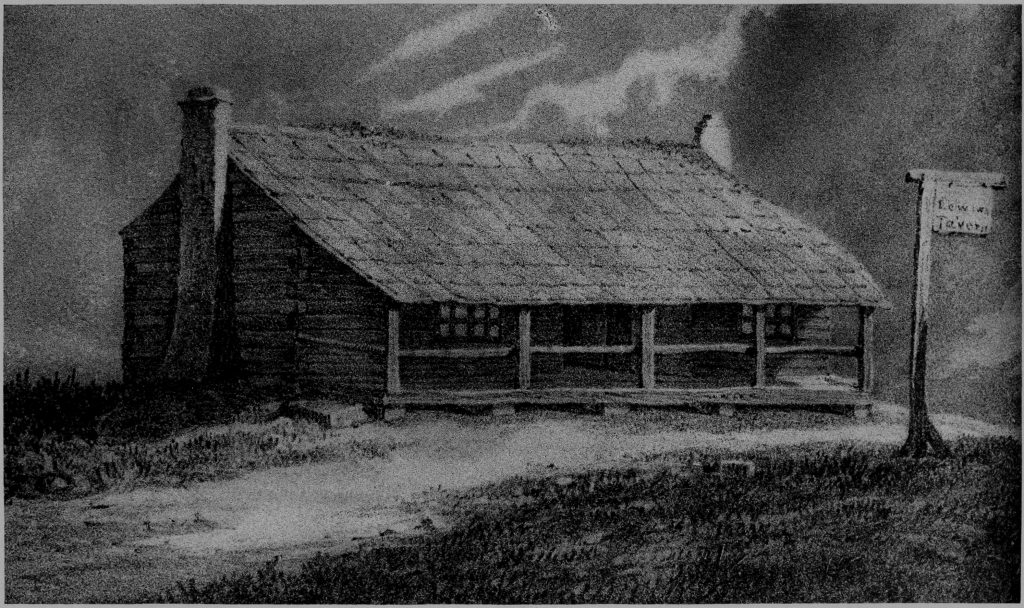 Log Tavern, Indiana
BY ADLARD WELBY, ESQ
South Rauceby, Lincolnshire.
"Nothing extenuate—nor aught set down in malice."
LONDON:
PRINTED FOR J. DRURY, 36, LOMBARD STREET;
BALDWIN, CRADOCK, AND JOY; AND G. AND W. B. WHITAKER;
DRURY, STAMFORD, AND DRURY AND SON, LINCOLN.
1821.
TO THE
RESPECTABLE PART OF HIS COUNTRYMEN
RESIDING IN THE
UNITED STATES OF AMERICA
AS BEING THE BEST JUDGES OF THEIR TRUTH
THE FOLLOWING OBSERVATIONS
ARE DEDICATED BY
THE AUTHOR