Evans’s Pedestrious Tour of Four Thousand Miles —1818 — DISTRICT OF NEW-HAMPSHIRE, TO WIT: — DISTRICT OF NEW-HAMPSHIRE, TO WIT: — PREFACE — TOUR
91
Reprint of the original edition: Concord, New-Hampshire, 1819
94
95

96
BE IT REMEMBERED, That on the 10th day of
December, 1818, and in the forty-third year of the Independence
of the United States of America, ESTWICK
EVANS, of the said District, has deposited in this Office
the title of a Book, the right whereof he claims as Author,
in the words following, TO WIT:
“A Pedestrious Tour of Four Thousand miles, through
the western States and Territories, during the winter and
spring of 1818; interspersed with brief reflections upon a
great variety of topics: religious, moral, political, sentimental,
&c. &c. By ESTWICK EVANS.
“The blast of the north is on the plain; the traveller
shrinks in the midst of his journey.”
In conformity to an act of the Congress of the United
States, entitled, “An Act for the encouragement of learning,
by securing the copies of Maps, Charts, and Books,
to the Authors and Proprietors of such copies,” during the
times therein mentioned: and also to an act entitled “An
Act supplementary to An Act,” entitled an act for the encouragement
of learning, by securing the copies of Maps,
Charts, and Books, to the authors and proprietors of such
copies during the times therein mentioned; and extending
the benefits thereof to the Arts of Designing, Engraving,
and Etching Historical and other Prints.
PEYTON R. FREEMAN,
Clerk, of the District of New-Hampshire.
98
BE IT REMEMBERED, That on the 18th day of
January, 1819, and in the forty-third year of the Independence
of the United States of America, ESTWICK
EVANS, of the said District, hath deposited in this Office
the title of a Book, the right whereof he claims as Author,
in the words following, TO WIT:
“A Pedestrious Tour of Four Thousand miles, through
the western States and Territories, during the winter
and spring of 1818; interspersed with brief reflections
upon a great variety of topics: religious, moral, political,
sentimental, &c. &c. By ESTWICK EVANS.
“The blast of the north is on the plain; the traveller
shrinks in the midst of his journey.”
In conformity to the act of the Congress of the United
States, entitled, “An Act for the encouragement of learning,
by securing the copies of Maps, Charts, and Books,
to the Authors and Proprietors of such copies,” during the
times therein mentioned.
PEYTON R. FREEMAN,
Clerk, of the District of New-Hampshire.
A true copy of Record,
Attest, Peyton R. Freeman, Clerk.
The author is sensible that there are some typographical
and other errors in the following work; but as they will be
found few and inconsiderable, it is not deemed worth while
to notice them.
99
An author, however inconsiderable he may be, always
feels that he has something to say to the public concerning
his work; he must, therefore, have a preface. I think,
however, that such a course is seldom necessary; the
world, after all which the writer can express, will judge
impartially of his motives, and of the execution of his
plan.—My introduction will be very brief.
In justice to myself I ought to observe, that until after
finishing my tour, I did not entertain the least idea of
publishing an account of it; and that I have been induced
to take this step by the request of many of my fellow-citizens.
It will be readily perceived, that a work of this kind does
not admit of the display of much reasoning or erudition;
and I shall speak as little of myself as will be consistent
with the nature of the publication. This little volume
cannot possibly merit much praise; and I trust that it
will escape unqualified censure.
Portsmouth, N. H. 1818.
101
The supposed singularity of the tour, an account of
which I am about to write, suggests a few preliminary
observations.
Customs and manners often produce more influence
than principle. Whilst the former are strictly adhered to,
the latter is often violated. Here we see the comparative
influence of self-reproach and the reproach of the world:
a deviation from custom, in relation to modes of living
and acting, may excite animadversion. We shrink from
the unfriendly gaze of the multitude; and tremble even at
the undeserved censure of the superficial and ill-natured:—at
the same time we disregard the condemnation of
our own hearts, and endeavour to cancel the obligations
of morality by the good, yet false, opinion of the world.
But it is readily acknowledged, that unless excentricity
ought always to be avoided; it invariably proceeds from
error in taste, from uncontrouled feeling, or from mental
imbecility. The dispositions and powers of men, however,
are various; and the beaten track is not always the field
for improvement.
Civil society is not without its disadvantages. Whilst
it adds to the information, and polishes the manners of
man, it lessens the vigour of his mind and the generosity
of his heart. He no longer experiences the sublime inspirations
of Nature. A creature of habit and the slave of
form, she will not [6] deign to visit him. From the factitious
grandeur of cities, she wings her eagle flight, to
communicate to the uncontaminated children of her
forests her instruction and blessing.
102In the savage state there is, no doubt, much individual
depravity; as great a degree of it, however, may be found
in the most civilized communities. But in the latter are
never witnessed that nobleness of spirit, that eloquence of
thought, that force of expression, and that wonderful
aspect which the former affords.
It is true, that the aggregate advantages of civil society
are much greater than those of a state of nature; and how
happy should we be if we could ingraft the instruction, and
impress the polish of civilization upon the lofty virtues of
untutored life. But, with us, courage gives place to cowardice;
and the native disinterestedness of man, the source
of his greatest virtues and highest happiness, yields to the
calculations of meanness and fraud. Even in public life
we please ourselves with the tinsel of narrow views, whilst
we disregard those great principles of national policy
which alone can render us truly great.
I have often been questioned as to the objects of my
tour; and I am willing to gratify a reasonable and friendly
curiosity. My views were various. Besides the ordinary
advantages of travel, and of becoming acquainted with a
country comparatively but little known, I wished to acquire
the simplicity, native feelings, and virtues of savage
life; to divest myself of the factitious habits, prejudices
and imperfections of civilization; to become a citizen of
the world; and to find, amidst the solitude and grandeur
of the western wilds, more correct views of human nature
and of the true interests of man. The season of snows
was preferred, that I might experience the pleasure of
suffering, and the novelty of danger. [7] On the second of
February, 1818, I left the residence of my friends, in Hopkinton,
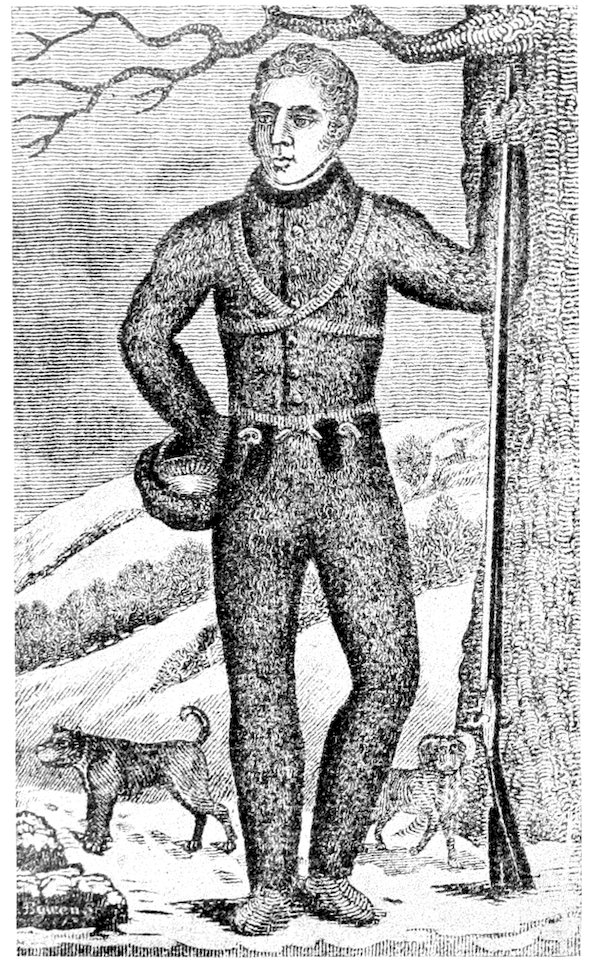
New-Hampshire, prepared, according to the frontispiece,
to meet the inclemency of the season, the hostilities
either of man or beast, and also to provide myself, in
the way of game, with provisions.
103It may gratify some to know the particulars of my
habiliment: Mine was a close dress consisting of buffalo
skins. On my shoulders were epaulettes made of the long
hair of the animal; and they were for the purpose of
shielding the shoulder from rain. Around my neck and
under one arm was strapped a double leather case, with
brass chargers, for shot and ball; and under the other
arm a case for powder strapped in the same way, and also
having a brass charger. Around the waist was a belt, with
a brace of pistols, a dirk, two side cases for pistol balls,
and a case for moulds and screw. Also around the waist
was buckled an Indian apron, which fell behind: it was
about eighteen inches square, covered with fine bear skin,
trimmed with fur, and having over the lower part of it a
net for game. This apron contained a pocket compass,
maps, journal, shaving materials, a small hatchet, patent
fire works, &c. My cap and gloves were made of fur,
my moccasons were of deerskin, and on my shoulder I
carried a six feet rifle. The partners of my toils and
dangers were two faithful dogs.
In this situation I arrived at Detroit on the 20th of
March. My dogs, however, were destroyed by wolves,
on the night of the tenth of that month, in the vicinity of
the Miami Swamp.
I had, in my juvenile days, voluntarily accustomed myself
to fatigues, hardships, and privations of every kind;
but not having recently exercised much, the snow being
deep, and my dress and baggage heavy, my fatigue, in the
early stages of my tour, [8] was excessive: My first day’s
travel was only eight miles. In a short time, however,
my daily progress was from fifteen to twenty miles, through
trackless snows and over tremendous mountains. The
universal curiosity which my appearance excited was oppressive;
but I had fortified my mind by reflection, and
endeavoured to present to all an aspect at once grave and
104mild. In the course of my tour, I met, as might have
been expected, a great variety of character; from the savage
of the wood to the savage of civil life; and I sometimes
found it necessary to appeal to my arms, for the
defence of the privileges of the traveller and the rights of
the man.
My title-page promises reflections upon various subjects.
I hope they will neither be too frequent nor too
lengthy. The study of man, both as it respects the abstract
principles of his nature and the almost infinite
variety of modes in which these principles, through the
influences of education and customs, develope themselves,
should be one great object of the traveller. In order
to become well acquainted with these principles, he must
frequently and maturely examine his own heart. Here
alone can he ascertain the secret springs of action; here
alone can he define and classify the passions; and lastly,
here alone can he find the means of their controul, or of
giving to them a proper direction. Much information,
in relation to this subject, may be collected from books,
and much by travel; but he who is ignorant of his own
heart must be ignorant of human nature.
In my way to the interior I passed through Amherst;[40]
and reached this place towards evening, during a heavy
fall of snow. I had been anticipating the pleasure of
visiting the family of Judge C. who reside there; but the
ladies of the family, supposing me to be an indian, barred
the doors against me. I [9] soon, however, obtained a
herald, and then the castle gates were elegantly thrown
open. On account of this little adventure, which arose
105principally from the lateness of the afternoon and from my
being covered with snow, some captious scribblers took
the liberty, in the papers of the day, to be impudent.
Could I condescend to be offended with them, I should
here tender my forgiveness.
For the above anecdote I am indebted, principally, to
the interesting Miss L******, whose vivid imagination,
aided by the story of the giants, magically converted her
habitation into an embattled tower, and gave to a harmless
knight a consequence which he did not deserve.
Amherst is a considerable inland town. The plain
upon which the village is situated is very spacious; and
some of its buildings are large and elegant.
From this place I proceeded to Milford,[41] the residence
of my friend P. whose love of principle, independence of
character, and talents, entitle him to much consideration.
With him I passed some pleasant hours. The appearance
of this town is pleasant. The contrast between its
extensive intervales, and the rise of ground upon which its
bridge, manufactories, and village are situated, renders its
aspect quite interesting.
The distance between Amherst and Milford is only a few
miles; but in travelling from the former to the latter I
found the snow deep and stiffened by rain, and the road
trackless.
The next day I began to ascend the mountains
of New-Hampshire:—my native hills!—Oh, may they
be the everlasting abode of Liberty! The weather here
was variable, the snow in some drifts ten feet deep,
my fatigue extreme, and my health impaired. The towns
106of Milton and Temple,[42] [10] situated in this part of the
country, are pleasant; and the scenery about them highly
picturesque. Several branches of the Sowhegan in the
former, and the streams which pass into this river from the
westerly part of the latter, add much to the variety and
beauty of the prospect.
The next evening I found myself in Marlborough. The
weather had become severe, and my ability to travel
without fatigue was increasing. The mountainous aspect
of the country, the front of my cap, &c. whitened by frost,
and the creaking of the snow beneath my step, reminded
me of Wallace and Tell; those champions of freedom,
whose physical nature was as rugged as the rocks which
they inhabited, and whose hearts, at the same time, could
glow with generosity, or soften with compassion. The
Grand Monadnock here attracted particular attention. It
is more than two thousand feet in height, and is remarkable
for its cave and its fossils. Peterborough and Dublin, the
towns between Temple and Marlborough, are interestingly
situated. The former is very mountainous, and its
numerous brooks render it a fine grazing township. A
principal branch of the Contoocook passes near the centre
of the town, and here unites with Goose river flowing from
Dublin. The latter place is exceedingly well watered, and
its two villages, together with some scattered houses, make
a pleasant appearance.
The coldness of the weather continued to increase. I
passed on through Keene[43] and Chesterfield. The appearance
107of the former excited much interest. It is
almost an inland city; and promises to make a very conspicuous
figure. It is also, evidently, a place of much
business; and from the appearance of some of its buildings,
together with what little knowledge I possess of its
society, I should suppose [11] it a place of considerable
polish and refinement. Chesterfield too is a very pretty
town. The undulatory aspect of its hills, the quiet of its
vales, and the neatness of its village made a very pleasant
impression upon my mind.
Soon after leaving Keene I passed over high and steep
hills. Some of them were, apparently, several miles in
length. In one of the vallies of these mountains an amusing
incident occurred. It is a trifle, and may be thought
not worth mentioning; I feel a pleasure, however, in doing
justice to good nature: I met three six feet fellows in a
single sleigh. They were, probably, going to Keene in
their best. There had fallen, the night before, a light
snow of a few inches; and their horse, not fancying my
appearance, took it into his head, notwithstanding I gave
him the whole road, to sheer against the wall, and to turn
all these well-looking grenadiers into the snow. I was preparing
to make an apology; but it was unnecessary: the
good nature of these liberal men furnished for them and
myself a hearty laugh.
During the following day I passed Connecticut river;
and entering Brattleborough, Vermont, proceeded to the
further part of the adjoining town.[44] The appearance of
the country just before my crossing the Connecticut, was
truly interesting. My course was around a mountain
about half way between its summit and the river below.
108It was the sabbath day; and the mildness of the christian
religion seemed to breathe around. The rays of the sun,
with a kind of vivid obscurity, darted through the wood;
and the solemn, yet cheerful, gospel bell of a neighbouring
villa spake of the pure and peaceful communion of saints.
Even the game seemed to know it was the sabbath, and
did not shun my path. Perhaps it was wrong in me thus
to travel. I had [12] never done so before. My situation,
however, was peculiar, and I endeavored to confine my
thoughts to the appropriate views of this holy season.
I am now upon the borders of my own peculiar country.
A single step carries me from New-Hampshire; and when
I shall again behold her pleasant hills is uncertain—Perhaps
never!
The term banishment is, in this part of the world, seldom
employed; and its introduction here may appear unmeaning.
But those who have been exiled by their country,
by misfortune, or by themselves, will hear the word
with a glow of interest, and find, in their own hearts, its
true and ready definition. Is there no exile beyond the
limits of our land?—no spirit which sighs for the scenes
of childhood?—where the light of Heaven was first
beheld, and the impression of thought first created?—where
friendship first warmed, and love etherialized, and
patriotism fired? Oh! if prayer is heard on High, it must
be the exile’s prayer.
The tears of patriotism need no apology. The name of
New-Hampshire is identified with that of freedom. Her
mountains were never intended for slavery; and tyrants,
I know, could not exist in the presence of her people.
Were she just to herself, she would always excite fear in
her enemies and admiration in her friends. Her institutions
are dictated by the spirit of self-government, and
her will is the supreme law of the land. Her citizens are
109hardy, intelligent and virtuous; her climate is salubrious
and her soil fertile; her hills are covered with cattle, and
her vallies wave with grain. Industry, economy, and
mechanical genius are conspicuous characteristics of her
people; and a thousand streams, intersecting the whole
country, tender to the manufacturing interest their powerful
agencies. In point of hospitality too she [13] is second
to none; and the virtue, benevolence, and beauty of her
daughters are, at once, the inspiration and the reward of
valour.
Within a few years I have visited nearly all the states
and territories of United America. I have noticed their
respective moral and physical character, and have viewed
them in relation to the ordinary causes of the rise and fall
of nations. Should the freedom of this country ever
perish, one of her last intrenchments will be in the mountains
of New-Hampshire. Her citizens, however, must,
by adhering to her constitution, and by proper systems of
education, preserve in their minds a knowledge of the
first principles of civil liberty, a due sense of the importance
of morality, and a lively interest in the transactions
of the Revolution. The whole history of that great event
should, with us, constitute an indispensable part of education.
But in speaking much of its battles, we must think
more of its principles. The latter were so perfectly correct;
and the manner of acting upon them was so candid,
so humane, so firm, so steady, and so persevering, that no
political event, since the creation of man, merits half so
much admiration as the achievement of our independence.
Before leaving New-Hampshire I may say a word respecting
Connecticut river. It is one of the most pleasant
and useful rivers in the world. It generally preserves a
distance of from eighty to one hundred miles from the
ocean, and meanders through a very fertile country to the
110distance of more than three hundred miles. It waters
New-Hampshire, Vermont, Massachusetts, and Connecticut,
and at length passes into Long-Island Sound.
I am now in Vermont.[45] This is a noble state, and may
well be termed the peculiar sister of New-Hampshire.
The same mountainous and fertile [14] country; the same
moral and physical energies characterize them both.
Should their liberties ever be assailed, they will sympathetically
unite their efforts, and triumph or fall together. In
both of these states I met with Revolutionary men, and
they were still the champions of liberty. The tranquil
charms of rural avocations had preserved the purity and
peace of their bosoms; whilst the grandeur of their mountains,
and the rudeness of their storms had continually
reminded them of the blasts of tyranny, and of the unconquerable
spirit of freedom.
In both of these states I experienced unlimited hospitality
and kindness. Money could not have purchased so
rich a boon. Amidst their lofty hills, covered with deep
snows and assailed by piercing winds, I found the humble
cottager; and in the benevolence of his aspect, and the
hospitality of his board, I seemed to hear the chorus in
Gustavus Vasa:—[46]
“Stranger, cease through storms to roam;
Welcome to the cotter’s home;
Though no courtly pomp be here,
Yet, my welcome is sincere.”
111In some parts of these states one may travel many
miles without meeting a habitation; and during deep snows
and severe weather there is no little danger of perishing.
In passing the Green Mountains, I experienced a very
narrow escape. The weather was remarkably severe, and
scarcely any one thought travelling practicable. The
wind being high the snow was whirled in every direction,
and the road was trackless. About 4 o’clock in the afternoon
I passed a house, and, imprudently, omitted to
inquire as to the distance to the next dwelling. Fortunately,
[15] however, I met, after travelling three miles,
an express from a neighbouring village; and he informed
me that the next habitation was at the distance of two
miles. To this circumstance I owe, probably, the preservation
of my life.
About dark I arose a steep hill, and found myself in an
open and uncovered situation. The weather was intensely
cold, and the wind very high. I realized that
owing to the depth of the snow, the consequent difficulty
of obtaining fuel, and the probable chill which I should
experience after ceasing to travel, that the wood, from
which I had just emerged, could not afford me sufficient
shelter. I should, however, have resorted to its partial
protection in preference to exposing myself to an unsheltered
opening, had I not fully presumed, from the information
above noticed, that a habitation was near. There
was not a moment for indecision. I marked a central
course, redoubled my efforts, and in a half hour reached
a comfortable hut. Here, upon taking off my cap, I found
my ears frozen to an almost incredible degree.
It is high time for me to acknowledge some obligations,
which have a particular claim to my gratitude, not only
as it respects these stages of my tour, but throughout the
whole of that part of it which was enlivened by civilization.
112Benevolence and kindness are peculiar characteristics
of the female heart. The mildness of her nature comports
with the delicacy of her appearance; and well may
Charity always be represented in feminine apparel. During
my tour, the hospitality of the husband was always
more than seconded by that of the wife and daughter.
Such are my respect for, and admiration of the female
character; so high an opinion do I entertain both of her
understanding and heart; and so narrow [16] are the views
of many, even in this enlightened age, in relation to these
particulars, that I may be permitted, in this little work, to
become her advocate. A thousand arguments in her
behalf challenge my attention; but I must not transgress
the proper limits of incidental remark.
The influence of woman, in civilized life, has not yet
reached its acme. The effects of her ancient condition
are not entirely removed. Hereditary ignorance and oppression
still partially obstruct her intellectual progress.
She has, in times past, not only had to contend with an
almost entire seclusion from the world, where alone theoretical
and practical knowledge are blended for the improvement
of the human mind, but the other sex, unconscious
of moral force and influenced only by a sense of
physical strength, have, in various parts of the globe,
treated her as an inferior. Oh, wretched pride!—oh, disgraceful
ignorance!—oh, vulgar barbarity!—the Dove of
Paphos is oppressed by the Egyptian Vulture.
Even in Greece and Rome the state of woman, to speak
generally, was degrading. She was suffered to share but
little in the general intercourse of life; and Metellus Numidicus,
in an oration to the people of Rome, speaks of
her with contempt. Yet some exultingly inquire,—where
are your female philosophers and poets of antiquity?
Greece and Rome were the principal theatres of ancient
113literature. Had the men of those times and countries
been treated as the females were, we should have looked
in vain for those galaxys of genius and erudition, which
are the constant theme of the modern world. Had this
been the case the Peripatetic Philosopher would not have
written, the Mantuan Bard would not have sung. Yet,
even here, Corinna was the instructress of Pindar, and in
competition [17] with him obtained the prize. Mamaea
too was so distinguished for wisdom, that the worthy and
renowned Ulpian thought it an honor to be appointed one
of her counsellors. Other cases might be introduced; but
this topic is leading me too far from my main subject.
One example more, however, shall be mentioned. The
mighty genius of Zenobia rose above the indolence incident
to the climate and manners of Asia. Her administration
was guided by the most judicious maxims. She
was too a linguist and historian, and expatiated upon the
beauties of Homer and Plato, with the learned and eloquent
Longinus.
Perhaps I may venture a little further. The peculiar
sphere of the understanding is mathematics; and because
there have not been great mathematicians among the female
sex, she, to be sure, is to be deprived of her proper
station in the department of intelligence.
Would men have been mathematicians if their education
had been like that of woman? Surely not. Why then
should woman, whose sphere is foreign to this pursuit, be
represented as incapable of successfully engaging in it?
Besides, many men of the first genius, and of the most vigorous
intellect, have entertained an aversion to mathematics
amounting to an incapacity to attend to them with
success. The learned Gibbon declares that he entirely
lost those seasons in which he was obliged to prosecute this
branch of study; and Gray, in his time the first scholar in
114Europe, asserts that if mathematics would insure him
wealth and fame, he would relinquish its advantages for
the charms of general literature.
There is a diversity of taste among mankind; and the
same privilege of enjoying it without censure should be
granted to both sexes. The great mathematician Archimedes
had but little inclination [18] for any other branch
of learning than geometry; and Gray could not endure
metaphysics.
There is also a diversity of talents among both sexes.
The logical, learned, and eloquent Cicero failed in his attempts
in poetry. How unreasonable would it be to
consider him inferior to our great female poets on this account!
and, of course, how unfair to deny strength of intellect
to woman, because she is not conspicuous for her
knowledge of mathematics!
A sense of propriety, relative to this digression, constrains
me to conclude. In what respect, I ask, is woman
inferior to the other sex? Heroism is a test of intellectual
vigour; and woman has evinced superlative bravery, by
a sudden transition from the gentle avocations of domestic
life to the battle’s rage. An enlightened fortitude
also argues strength of intellect. Here let men admire
what they can never imitate: how much physical suffering,
and how much anguish of spirit are peculiar to the female
character! yet, resignation and hope are the cherub companions
of her tribulation.
Modern times are throwing wonderful light upon this
subject; and are developing those astonishing combinations
of female sentiment and genius, which in past ages
scintillated through the gloom of barbarism. A splendid
list of names illustrative of this position might be here introduced;
but the whole list would be too long, and a selection
would be difficult. Sentiment is emphatically the
115highest sphere of genius; and it is the sphere where the
heart becomes the great magician of intellectual life. Men
are indebted to woman for what they possess of this principle;
and until she made them acquainted with it they
were barbarians.
Wherever I stopped, in my course through the settled
parts of the country, I was much pleased [19] with the interest
which my appearance excited in little children. There
was a conflict exhibited in their countenances between the
fears implanted by domestic education, and the native
fondness of man for the hunter state. By my assuming,
however, the aspect and the smile of civilization, they
would come to my arms of fur, and listen attentively to the
simple stories of the chase. Afterwards, they would reward
my kindness to them by more solid attentions to my
dogs.
In travelling from Connecticut River to Bennington, I
passed through a part of Marlborough, Wilmington, Reedsbury,
Stanford, and Woodford. Whilst in the latter place
the weather was severe beyond a parallel. When, however,
in Brattleborough, which lies immediately upon the
river, the weather was much more moderate.
Whilst upon the Green Mountains my thoughts were
particularly directed to the days of the Revolution, when,
in the language of a British Chief, the sons of New-Hampshire
and Vermont hung like a cloud upon his left. Here
too I remembered that thunderbolt of war, the veteran
Stark, in whose heart dwelt the very genius of his country,
and who discomfited her enemies by the strength of his
native hills.
On these mountains my attention was attracted by the
appearance of a thick fall of snow during a clear sunshine.
This appearance is not common here; and proceeds, I presume,
from the little influence which the sun produces
116upon the state of the atmosphere in this situation. On
the west side of these mountains the snow was not so deep
as on the east side; and I apprehend that this is usually
the case.
Within about two miles beyond this lofty ridge, Bennington
is situated.[47] This town presents an ancient [20]
aspect, and appears unflourishing; it is situated, however,
upon a fertile tract of country, and contains several handsome
buildings. The number of its houses is perhaps two
hundred. Mount Anthony, in the south part of the town,
makes a pleasant appearance; and the town itself is rendered
interesting by the two famous battles, fought a little
west of it, on the 16th of August, 1777. In these battles
the celebrated General Stark acquired imperishable fame.
Owing to the severity of the weather I did not visit the
noted cave of Mount Anthony.
From Bennington I proceeded through Hoosuck, Pittstown,
Troy, and Albany. From the former to the latter
place, the distance is about thirty-five miles.
In passing through Pittstown the weather was still
severe; and night having overtaken me before I could
reach a public house, I was under the necessity of lodging
in a log hut. The family were very poor; but the wealth
of Kings could not purchase their virtues. As is the case
with many other honest people, they had experienced a
series of misfortunes which ultimately reduced them to
penury. Two years before the period of my seeing them,
their mills, the principal part of their property, had been
carried away by a freshet; and a year after this event, their
dwelling was consumed, with all its contents. Yet these
good people were cheerful, and their poverty sat gracefully
117upon them. They were unable to furnish me with a bed,
a comfort with which I had learned to dispense, but very
readily shared with me their last loaf. For their services
they charged nothing; and it was with difficulty that I
persuaded them to take compensation.
The blessings of poverty are neither few nor small. It
attaches an extraordinary interest to the most common
acquisitions; and, when there is little [21] or no apprehension
of want, it furnishes a constant source of pleasing
anticipation. Under such circumstances, parents and children
experience their happiest moments. Mutual love, and
mutual gratulation, here heighten and sanctify every expression
of the care and bounty of Providence.—There is
something in virtuous poverty, which speaks of treasures
laid up in Heaven.
In entering Troy I left Lansingburgh on my right. The
former place is exceedingly compact and flourishing, and
extends between one and two miles on the east bank of the
Hudson. On the other side of the river, at the distance
of six miles, Albany is situated.
This city, in relation to the state, ranks next to that of
New-York; but its appearance is far from being elegant.
The streets are generally narrow and crooked; and its
numerous buildings in the Gothic style give to it an ancient
and unpolished aspect. It is, evidently, however, a place
of great trade; and must, in the nature of things, rapidly
increase in wealth and population. The back country is
extensive and fertile; and the public spirit of the state of
New-York is affording every facility to the inland transportation
of its produce.
The variety of people in Albany is great. The Dutch
here still make a considerable figure; but the Americans
are more numerous. This place has received many names.
Its scite was originally called Aurania; and the town itself
118was afterwards named Beverwych, Fort Orange, Williamstadt,
and, upon its capitulation to the English in 1664,
it received its present appellation. This city, next to
Jamestown, in Virginia, is the oldest in the United States.
This place contains many large public buildings, among
which is the city-hall, hospital, armoury, [22] &c. There
are here also some elegant dwelling houses; but I should
not suppose the city, from its appearance, the residence of
much taste or erudition. It contains, however, what some
may consider an equivalent:—many families of wealth and
fashion. The population of the place is about twelve
thousand.
After leaving Albany I shaped my course for Niagara
Falls by the way of Cherry Valley. From the city there
are two roads; the left hand one leading to the last mentioned
place, and the right hand one to Schenectady. The
great Western Turnpike extends from Schenectady, lying
on the south bank of the Mohawk, and sixteen miles from
Albany, to Buffalo, a distance of about three hundred
miles. The two roads above mentioned intersect about
one hundred and twenty miles from Albany.[48] Upon both
of them are many flourishing villages; and the produce
which is conveyed from the interior to Albany, Troy, and
other places in the state, is immense.
The state of New-York is very conspicuous for her public
spirit. She is affording every facility, within the grasp
of her mighty genius and resources, to her inland commerce.
In arts, and arms, and internal improvement, she
119is already a Rome in miniature; and her grand Canal will
vie with those of China and the Russian Empire.
In travelling over a part of the great western turnpike;
and in collecting information as to the settlements and business
both here and on the Mohawk, I was led to make
some statistical calculations, the general result of which,
together with some additional reflections, I transcribe from
my journal.
The state of New-York is, of itself, a mighty republic.
Her moral and physical energies; her agriculture, [23]
manufactures, and commerce; and her individual enterprise
and public spirit, render her omnipotent. She could
contend alone and unassisted with Great-Britain. What
then is the aggregate force of all our states and territories?
The contemplation of their potential, and even probable
physical power, within a short succession of years, presents
such a manifold ratio as to overwhelm the boldest
calculator.
But the moral energies of the country will, no doubt,
become proportionably less. The friends of political virtue,
however, must not be discouraged. The moral hero
can do much towards stemming the torrent of political
corruption. Besides, the vast surface over which the elements
of this corruption will spread themselves, will render
it, for a long course of time, comparatively harmless;
and beyond this period, the influence of some Heavenly
star may give to ambition and the love of power a purer
spirit and a nobler aim.
In relation to this topic, the prevailing spirit of emigration,
from the maritime to the inland frontier, will have a
very beneficial influence. In a public point of view, great
and permanent advantages will arise from the settlement
of our western states and territories. But individuals
from the east are not always benefitted by a removal. The
120principal advantages arising from such a step, are the
profits on the purchase of new lands, and better crops obtained
with less labour. The disadvantages are numerous.
Those who can, by their industry, live well at home,
will act wisely in remaining where they are. By a removal
they lose a climate to which they are accustomed,
good society, an opportunity to educate their children,
and scenes to which their hearts will often fondly turn—The
sons of New-Hampshire never forget her mountains!
[24] I shall speak more fully upon the subject of emigration
in another place.
I may here introduce some facts relative to the grand
canal in the State of New-York.[49] The object of this
great undertaking is to facilitate the inland commerce of
the State, by uniting the waters of Lake Erie with those of
the Hudson. The former are much higher than the latter;
but still the labour and expence necessary to complete the
undertaking, will prove to be immense. To the State of
New-York, however, such a work scarcely requires an
effort. Her almost inexhaustible resources, directed by
the genius and energy of her Clinton, could accomplish a
hundred times as much. The Canal passes in the direction
of Genessee river, and Seneca and Cayuga lakes; and
will turn much of the trade of the west from Montreal to
the city of New-York.
Soon after leaving Albany I met with Colonel P. formerly
an officer under General Wayne, during his famous
expedition against the indians.[50] From this gentleman I
obtained many interesting facts; and spent a pleasant
evening in conversing with him upon the subject of
121expatriation. This subject involves an abstract question
of principle; and should be settled by the United
States without the least reference to the opinion of
civilians, or the practice of other nations. It is humiliating
to see with what reverence we turn in relation
to this subject, to the opinion of Blackstone, and to
the contradictory positions of the British Government.
The United States is the place, above all others, for correct
opinions, upon questions involved in the great science
of morals, as far as it respects the natural rights of individuals,
the necessary modification of those rights in civil
society, and the rights of nations as collective moral agents.
Europe ever has been, [25] and still is a school of wrong;
and those who are instructed by her participate in the
sophistry of her reasoning, the tyranny of her views, and the
inconsistency of her practice. The question of expatriation,
is a question involving individual right, for the defence
of which the aggregate strength of the whole community
is guaranteed. This question, in the United
States, arises from the claims of other nations to those of
their subjects, who have left the territory to which they
belonged without violating any municipal law upon the
subject. The United States should protect all within her
jurisdiction, whether upon her territory or under her flag,
unless some municipal regulation of the adverse party in
the question, shall have rendered the individual concerned
incapable of acquiring the right to protection from the defending
power. These principles should be adhered to
for three reasons: the United States have a right to do so;
they are bound by the civil compact, which renders protection
and obedience inseparable, to do so; and it is their
duty as a collective moral being to guard any individual,
not under the jurisdiction of another sovereignty, from
arbitrary power.
122Such a course is dictated by the eternal and omnipotent
principles of justice; and therefore no law of nations,
which is a rule created or supposed by man, can resist
them. Even that law which civilians call the voluntary
law of nations, cannot, in relation to this subject, exonerate
a government from those obligations which result
from the social compact; because the question is grounded
in the very germ of civil society; and the welfare of the
whole community of nations, so far from requiring in this
case an adherence to this law, renders it, upon its own
principles, entirely inoperative.
[26] The internal law of nations does not militate with
the above principles, because it requires only what is fair
and conscientious. The customary law of nations must
yield to those older and better rules which are dictated by
justice. And as to the conventional law of nations, it rests
upon the terms of contracts in subordination to previously
existing and indispensable duties.
On the 12th of February I passed through Guelderland,
Princeton, Schoharie, and Carlisle; and on the following
day through Sharon, Cherry Valley, and Warren.[51] Schoharie
is one of the wealthiest inland farming towns in the
state of N. York.
The weather still continued remarkably severe; but my
dress was so comfortable, that I had no occasion for a
fire.
123During my whole tour through the settled parts of the
country, I found a constant source of amusement in the
curiosity and variety of observation, which my appearance
excited. I must, however, confess that I often wished
myself less conspicuous.
It is in the moment of surprise that the human character
most fully developes itself; and in travelling, during the
constant operation of this cause, one may acquire much
knowledge of the almost infinite variety of disposition
which exists among mankind. I met, in my course, with
every shade of character, from the man of reading to the
totally ignorant; and from the real gentleman to the rude
and vulgar.
It may amuse a portion of my readers to know some of
the various impressions which were made by my appearance,
and the receptions which I experienced.
People seldom knew from whence I came, or what was
my place of destination; and surprise and speculation
were universal. Speculation was as various [27] as the
dispositions and capacities of individuals.—Some honoured
me with the idea that I was Bonaparte in disguise;
and some secretly suggested that I was a Wizard:—
“Who prowl’d the country far and near,
Bewitch’d the children of the peasants,
Dry’d up the cows, and lam’d the deer,
And suck’d the eggs, and kill’d the pheasants.”
Some too, imagined me an Icelander; and some a British
Spy. A few treated me with rudeness, many in a very
gentlemanly manner, and some, not knowing what to make
of my appearance, conferred upon me the title of General,
and invited me to drink with them.
With respect to the first class, I made a point of taking
no notice of them, when I could with propriety avoid it;
but when I could not, I always made an example of them
124upon the spot. Such men seldom possess even animal
courage; and there are very few, even of their associates,
who are not pleased to see them punished.
I may here observe, that I was impressed by the general
ignorance, with respect to the manners and customs of
other nations, which appeared to exist in the civilized
places through which I passed; and especially in and
about Albany.
It is well known, that in Russia and many other countries
in the north of Europe, people generally dress, more
or less, in furs; and there are some instances of such a
practice, even in the Canadas.—These facts, connected
with the severity of the weather which prevailed during
the early stages of my tour, might, one would think, have
rendered a suit of fur a less general object of surprise.
Severe as our winters are, I think a garment or two of
Buffalo or some other warm skin, to be worn occasionally,
[28] would, to say nothing of comfort, save many a man
from rheumatism, and even from being frozen to death.
It is only a year or two, since the stage driver from Albany
to Bennington, froze and fell from his seat. The passengers
were not apprized of the event, until the horses had
proceeded several miles. The power of frost upon human
life is astonishing. In an unsuspecting moment the blood
chills in the veins and ceases to move. The memorable
winter of 1709 saw two thousand men, under the celebrated
Charles the XIIth, fall dead with cold in one day.
Many other similar instances might be mentioned. As
to Charles, however, he had, by habit, rendered himself
almost superhuman. His person was as invulnerable to
the frosts of Denieper, as was his mind to the misfortunes
which finally made him a prisoner at Bender.[52]
125On the evening of the 14th of February I had passed
Otsego, Richfield, &c. and arrived at Plainfield. The
towns between Albany and the last mentioned place are
generally inconsiderable, and offer no interesting materials.
They are, however, flourishing villages. During
the whole of the 14th instant it snowed, and the travelling
was very heavy. The general aspect of this part of the
country is rather level than otherwise; there are here, however,
many high and long hills. I had not yet ceased to
be vulnerable to fatigue; but hardships had, in a measure,
become familiar to me. I do not pretend that I did not
sometimes stand in need of resolution; but men have only
to move on, and difficulties become less. It is in looking
ahead at the aggregate obstacles which present themselves
in an undertaking, and in embodying them, as it were,
in the space of a moment, that one’s mind is appalled.
By meeting these obstacles in detail, we easily overcome
[29] them; and then look back astonished at our apprehensions.
The Dutch mode of building, both with respect to their
houses and barns, is visible in every part of the state of
New-York; but American manners and customs are here
absorbing all others.
The interior of this state, like that of New-Hampshire
and Vermont, presents many small and ill contrived log
huts; and those who have been unaccustomed to seeing
such, would be surprised to find how comfortably people
may live in them. These huts are sometimes without a
floor, and have wooden chimnies. Men who are acquainted
only with polished life, would tremble at the idea
of spending their days in one of these buildings; yet, they
are generally the abode of virtue, health and happiness.
On the 15th and 16th of February I passed through
Eaton, Nelson, Casnove, Pompey and Manlius. The
126weather was very severe, the snow deep, and continually
blowing. At Pompey I was so beset by ignorant impertinence
and loquacious curiosity, that I found it necessary
to harrangue the multitude. Having laid down for them
some salutary rules upon the subject of manners, and taking
their silence for an apology, I proceeded to Manlius.
Even in this part of the country, bears, wolves, and deer
are numerous. During the preceding fall the depredations
of the two former were very great; and the bounty
offered for wolves, by some of the counties in the state,
was ninety dollars.
During the 17th the weather was still severe and
the wind high. I passed Onondago[53] and Marcellus.
Throughout these townships there are high and low hills.
Owing to them, and to the depth of snow, my fatigue was
great. My health also had suffered by many days and
nights of severe tooth-ache. In [30] passing through these
and many other places, I experienced attentions from
people of consideration; and was frequently introduced
to their families.
Onondago was formerly the chief town of the Six Nations;
and lies on the south of the lake of that name. This
lake is sometimes called salt lake; and the springs near its
shores produce immense quantities of salt. The Onondago
Indians reside near this lake; but their numbers are
diminishing.
During the 18th, 19th and 20th of February I travelled
through Brutus, Aurelius, Auburn, Cayuga, Junius, and
Waterloo.[54] The weather in this part of the country had
127been for several days, and still was colder than had been
before known there. The snow likewise was remarkably
deep. Cayuga Lake is about forty miles in length,
and from two to four miles broad. The famous bridge
across it is more than one mile in length. On the banks
of this lake the Cayuga Indians reside.
The Six Nations of Indians above mentioned are the
Mohawks, Oneidas, Onondagoes, Senecas, Cayugas and
Tuscaroras. The Stockbridge and Brotherton Indians
now live with the united tribes.[55] Notwithstanding these,
and many other tribes are still in possession of vast tracts
of land, and receive annually considerable sums from the
United States, and also from individual states, they are
occasionally emigrating to the wildernesses of Canada.
Still wild and untameable, the surrounding aspect of civilization
alarms them; and they silence the suggestions of
jealousy by removing to pathless and illimitable forests.
Many of the villages on the Western Turnpike have
made their appearance within a very few years; and the
vast resources of the interior of the state of New-York are
daily developing.
[31] During this part of my tour a little incident occurred,
128which resulted so pleasantly, and so fully evinced the
policy as well as propriety of a certain course of conduct,
that I am induced to mention it. In one of the last named
towns, I was, whilst at a public house, furiously assailed
by words and threats, by a man, who evidently had been
of considerable consideration in society, but who had become
a sot, and was at this time much intoxicated. As
he was not in a situation to defend himself, there could
have been no display of true courage in punishing him;
and besides, he was already an object of pity. To his
imbecile fury, therefore, I presented only a steady eye.
He drew back. In a few minutes, however, he made
another assault; and again yielded to a firm and silent
aspect. A few hours after I met him in another place.
His inebriety had, in a great measure, left him; he was
very sorry for his conduct, and expressed towards me
much good will.
I have observed, that I was seldom known; and as I appeared
to be a person travelling in disguise, some pains
were taken to ascertain who I was. The suggestions respecting
me were very numerous; and a great many bets
were made, and many expedients resorted to in relation
to my origin, destination, and business. Some imagined
me to be upon a secret expedition for the government.
My manners seldom comporting with my mode of living,
the multitude were at a loss to know to what class in society
I belonged. They heard me converse like other people;
but seldom saw me eat or drink, and were surprised
to view me sleeping with my dogs upon the bare floor.
In my course through the upper part of the state of
New-York, I spent many a pleasant evening, surrounded
by a great variety of character, and seated [32] by a huge
western fire. During these seasons some political question
would often arise, and it was interesting to witness
129the debates. Upon one occasion a serious legal question,
long agitated in the neighbourhood, was introduced; and
being a limb of the law, I involuntarily made an observation
upon it. Bets soon began to run high, and the Pedestrian
was appointed umpire.
It is unpleasant for one to speak of himself.—Many
anecdotes, which would be interesting to my friends, must
be omitted.
In the course of a few days after leaving Waterloo, I
passed through many towns, the principal of which are
Romulus, Ovid, Hector, Ulysses, and Geneva; also Canandaigua,
the two Bloomfields and Lima; and in addition to
these Avon, Caledonia and Batavia.[56] Some of these
towns, especially the two Bloomfields and Lima, constitute
a remarkably handsome and rich tract of country.
Canandaigua is situated at the north of the lake of this
name; and many of the buildings of this place are large
and elegant. The lake is about eighteen or twenty miles
long, and two or three miles broad.
But it would have been in order first to speak of Seneca
lake, which lies east of lake Canandaigua. Seneca lake is
about thirty-five miles long, and about two miles wide.
The numerous lakes in the interior of the state of New-York,
are admirably calculated to promote her inland
commerce. Whilst they furnish by their numbers, and
their positions the means of connecting her resources, and
promoting the trade and intercourse of her people, they
are not so large as to occupy an unnecessary portion of
her territory. Every thing, in relation to New-York,
is conspiring to render her a wonderfully powerful State.
[33] Whilst in Canandaigua the court was sitting; and
130owing to some novel proceedings there, one or two thousand
people were assembled. After pressing through the
crowd, and obtaining some information respecting my
course, I proceeded on my way.
Not long after I formed a particular acquaintance with
Doctor S. He introduced me to his family, and entertained
me in a very hospitable and friendly manner. The
Doctor, being no less fond of an innocent joke than he was
conspicuous for his good sense and benevolence, proposed
in the course of the evening, his introducing me to a
shrewd old neighbour of his, as a relation who lived on
some far distant mountain, and who had been long absent.
I readily assented to the proposition, and we both
agreed upon the parts which we were to act. Owing,
however, to an unnatural performance on my part, or to
some other cause, the neighbour detected the deception.
But the assay resulted in considerable amusement; and
after drinking to the health of each other, the Doctor
and myself left the old gentleman to exult in his
penetration.
At 3 o’clock the next morning, I was awakened by the
rich and lofty notes of the bugle-horn, and entertained by
several superb martial songs. At daylight we sat down
to a good breakfast; and immediately after I resumed my
march.
Amidst all these pleasant circumstances, my dogs had
accidentally been neglected; and seeing their master fare
so well, they at length took the liberty to help themselves.
The larder of Mrs. S. being open, they espied there a large
pan of baked pork and beans; and without ceremony,—or
knife and fork divided the former between them; leaving
the beans for those who were less carnivorous. After
this broad hint on their part, the lady of the house fed
them to their heart’s content.
131[34] During my tour, thus far, I formed many valuable
acquaintances.
Here I may remark that from Albany to the remote interior
of New-York, there is, generally speaking, but little
hospitality; and the love of money there displays itself in
the high prices which are charged for provisions. Immense
profits are realized by the retailer at the expense of
the traveller. I have always noticed in my travels, that
the newer a settlement is, the more prevalent is hospitality.
This great virtue is much more conspicuous among the
poor, than among those who possess more than a competency.
Here avarice begins its reign; and every virtue is
blasted by its poisonous influence.
In this part of the country, and in many other places I
often found it convenient to stop at the log huts of poor
emigrants. From the inmates of these huts I always experienced
a kind and generous welcome; and in almost
every case I ascertained that they were from New-Hampshire
or Vermont.—They would generally refuse to take
any compensation for their services; and were so afraid of
violating the sacred principles of hospitality, that I could
only leave my money upon their table, or cast it as a play
thing to their children. Oh! how many tutelary angels
shield the cot of the poor and virtuous man, whilst the
splendid habitations of the rich and dissipated, receive
only the averted eye of offended Heaven.
I have omitted to mention, that whilst in Albany I
was informed that robberies had been frequently committed
on the Western Turnpike. This information appeared
peculiarly important, on account of the frequent
suggestions of people that I probably had with me a large
sum of money. Besides, war, which always produces a
greater or less number of abandoned and desperate characters,
having [35] recently ceased, and there being many
132dark and solitary tracts of wood on the turnpike, I thought
there was much cause for apprehension. I had, however,
previously concealed my money in different parts of my
cloaths, and was careful to keep my arms in a state of preparation.
Fortunately I met with no attack. The appearance
of my arms, and the apparent fierceness of my dogs,
were, probably, preventatives.
I was frequently told too, that owing to my mode of
dress, there would be much danger of my being shot by
the hunters in passing through the bushes. Many accidents,
sanctioning the idea, had from time to time occurred.
A hunter, not long before, had killed a deer, and throwing
it upon his shoulder was proceeding home. Another hunter,
having an obscure view of the deer through the bushes,
fired and killed the man. I did not, however, experience
any injury from this quarter.
Such was the depth of snow and such the severity of the
weather during the first month of my tour, that no game
was to be found in the woods excepting a few squirrels;
and those only during a momentary sunshine. Numerous
as had been the beasts of prey throughout the preceding
fall, they seemed now to be waiting in their dens for
the storms to be overpassed. All nature appeared to be
congealed; and the tyrant winter presented an unrelenting
aspect.
In the remote parts of the State of New-York provisions
were scarce. There are so many emigrants travelling and
settling in that quarter during winter, that want is frequently
the consequence.—The emigrants, who settle during
that season of the year, must be fed, for many months,
from the common stock of provisions, before they can, by
their labour, add to it. Some of them have money, but
[36] money will not save them from want. Here we see the
importance of the agricultural interest, and, generally, of
133the productive power of labour. Agriculture and domestic
manufactures will render a people perfectly independent.
Money is of no real consequence excepting
when employed as a circulating medium; fancy however
has cherished for it an irrational partiality. Thank
Heaven! we have no considerable mines of silver and gold
to corrupt our country; but plenty of iron to plough her
fields and to defend her liberties.
Agriculture is the most natural, necessary, and honourable
employment of man. Ignorant pride and vain folly
may represent it as derogatory; but in so doing they show
how very far they are from true greatness. Agriculture
furnishes for vigorous constitutions the most salutary exercise;
and here the brightest geniuses may find ample employment.—An
unlimited field for experiment in many
branches of natural philosophy is here presented, and
there is no sphere in life so well calculated as this to promote
individual virtue and public advantage.
Here man is engaged in the peculiar work assigned him
by his Creator, and many interesting reflections naturally
result from it. The field which he cultivates is his parent
earth. According to the righteous appointment of Heaven,
he must here obtain his bread by the sweat of his brow, until
he returns to the dust. The employment naturally directs
his thoughts to his origin and destinies; and impresses
his mind with a sense of his mortality, dependence, and
accountability to God. Here too he reflects, with peculiar
advantage, upon the gracious plan of Redemption. The
return of spring joyfully reminds him of the Resurrection;
and in the perishing grain which he has sown, he recognizes
St. Paul’s similitude of this great event.
[37] The further a man’s employment is from rural scenes
and avocations, the further he is from the original dignity
and simplicity of his nature. Here may be acquired the
134greatest comparative degree of physical and mental vigour,
the noblest virtues, the truest piety, the most sincere and
ardent patriotism, the loftiest independence of character,
and all the pleasures which flow from the sprightliness of
the imagination and the susceptibility of the heart.
The great and good of every age have spoken in behalf
of agriculture; and the Egyptians ascribed the discovery
of it to their gods. The worthies of Greece and Rome
were well acquainted with the plough; and Cincinnatus
left his team, vanquished the Æqui and Volsci, who were
besieging the Roman army, and then returned to his beloved
employment. Our Washington too, charmed his
pure and noble spirit with the rural occupations of his endeared
Vernon; and the Emperor of China attends, every
spring, to the ceremony of opening the ground, by holding
the plough himself.
In my course to Niagara Falls I passed Genesee river.
This river rises in Pennsylvania, and enters Lake Ontario
about eighty miles east of Niagara river. It contains several
falls, from fifty to one hundred feet in height, and offers
many fine seats for mills. This river, and those which
are connected with it are generally sluggish in their motion.
The tract of country lying upon the Genessee is rich,
and well watered. The celebrated Genessee Flats are situated
on the borders of the river, and is about twenty
miles by four.
The Holland Purchase is a part of the Genessee Country.[57]
Although I have not yet surveyed the whole field of
domestic emigration, I may, with propriety, introduce in
this place some ideas which I [38] have heretofore entertained
upon the subject; these ideas having been fully
sanctioned by the experience of my whole tour. The
135subject should be examined both in a national and individual
point of view.
Supposing, for a moment, that my reflections upon this
topic may produce some effect upon the feelings and opinions
of those who are disposed to emigrate, there is little
or no danger of lessening the interests of the nation, in relation
to it, by checking too much the existing locomotive
disposition of the people.
Dear as home is to man, he is, in his best estate, a wanderer.
An alien from the purity and peace of Heaven, he
will sigh for other scenes until his highest hopes eventuate
in a habitation there.
Upon this general disposition of mankind to change
their views of happiness and their place of residence, the
people of the United States have engrafted an unusual degree
of enterprise. This enterprise has at once enriched
and ennobled their country. Naturally fond of agriculture,
and fully sensible of its consequence, both in a public
and private point of view, our citizens have combined,
in relation to this subject, the powerful influences of inclination,
interest, and patriotism. But the impulse to
emigration under these circumstances may have been too
great. When a spring naturally overflows, the superabundance
of its water may well be spared to fertilize the
adjacent country; but when some extraordinary influence
produces an ebullition in the spring, it may, in consequence
of this cause, exhaust its own resources and ultimately become
dry.
Extraordinary causes, in relation to those subjects which
concern the growth of a nation, should always be watched
and sometimes checked. Under ordinary circumstances
the natural operation of cause and effect will keep every
thing within its proper [39] sphere,—will direct every
thing to its proper level.
136With respect to emigrations from our seaboard to the
inland states and territories, there is danger of the strength
of the nation being, for a time, lessened. The physical
force of a country should always be kept compact. By
dividing its powers its energies will be weakened.
Such, with us, has been the impetus of the spirit of emigration,
that the influence of example and habit, in relation
to it, will continue to operate for some time to come.
Indeed such is the fascinating nature of the subject, that
it will always be more or less popular; and as to the habit
of moving from place to place, it is, in some, so completely
fixed, that after they have passed through every part of
the land of promise, they will, for the sake of one more
change, return to the seaboard again. In a national
point of view I am far from wishing to discourage domestic
emigration; and I am far too from thinking that
it does not frequently result in individual advantage.
It is essential to the preservation of our free and economical
institutions, that the seaboard should from time
to time transplant a part of its population to the interior.
The existence of liberty in a state ultimately depends, in
no small degree, upon rural avocations, and upon a particular
climate and scenery. In some of our western
states and territories liberty will exist for a great length of
time. Transplanted from the seaboard, their citizens will
acquire a new moral force, and that force will be cherished
by the local peculiarities of their situation. These
states will produce a happy balance between the agricultural
and commercial interests, and prove at once the
check and the political salvation of the maratime states.
[40] In proportion to the population of our maratime
cities will be their luxury, dissipation, and indifference to
simple and rational modes of government. No doubt the
interests of commerce ought to be cherished; not, however,
137so much because they are essential to our independence
and happiness, as because they encourage industry
at home by furnishing a foreign market for surplus
produce. The other advantages of foreign trade, both
literary and commercial, are not inconsiderable; and they
ought to be appreciated:—but not without a due reference
to the contaminating influences of foreign manners
and customs. With respect to manners and customs,
other nations, in their intercourse with us, are, no doubt,
gainers; but we, I am satisfied, experience from them
much injury. It may be added, that a certain extent of
population in our sea ports is essential to that degree of
commercial enterprise, which will set afloat our surplus
capital; and therefore we ought to view the spirit of emigration
in relation to this particular.
I may improve this opportunity to make a few additional
reflections upon foreign commerce. The advocates
of this interest, under the pretence of attaching to it
a consequence only equal to that of agriculture, have
laboured to prove that the former is even paramount to
the latter,—that the country is almost exclusively a commercial
nation. One of these advocates, in a speech delivered
in Congress in January 1814, advances such a
principle. Much as I admire the sublime complexion of
his intellect, and the enlightened majesty of his heart, I
must say that his position is altogether exceptionable.—He
observes, in the above mentioned speech, that the
principal motive for adopting the constitution of the general
government was the protection and extension of commerce.
So far from this being the [41] case, the great and
principal conditions and objects of our national compact,
were individual security and the advancement of the true
interests of the country. It must have been well known,
that a state of things might exist which would render an
138abandonment of foreign commerce absolutely necessary
to the preservation of our liberties,—to the protection of
individual right, and even the very existence of the
nation.
But I go much further. Our commercial interests are
of far less consequence than those of agriculture. The
former are not essential to our independence and comfort.
They do not even exist until agriculture has so far advanced
as to furnish more than sufficient provisions for
the support of the whole community; not only for those
who labour in agriculture, but also for labourers in manufactures
and other mechanical employments; for those
who are engaged in domestic commerce; for those who
are engaged in promoting intellectual improvement;
and lastly, for those who, owing to infancy, old age, disease
and other causes are unable to work. When this
state of things commences, and not before, foreign commerce
begins its career. Here the people inquire what
they shall do with their surplus produce, and being unable
to find a market for it at home, endeavour to find for it
a foreign market. Hence arise foreign commercial relations.
As to the luxuries which foreign commerce produces,
our constitution certainly never made provision for
their introduction.
It remains for me to notice the subject of domestic emigration,
in relation to the individual advantage which may
arise from it.
The views of mankind with respect to the sources of
true happiness are, generally speaking, very erroneous.
This effect arises principally from inconsideration. [42]
We see enough in the Divine Word in the book of nature,
and in the suggestions of conscience to convince us, that
our relation to a future state of existence is of wonderful
import. The first questions which we should ask ourselves
139are:—what was the design of our creation? and
what duties does this design inculcate? As far as is consistent
with these great views, man may innocently consult
his inclinations. Indeed they were given for the twofold
purpose of rational gratification, and to furnish him
with an opportunity, when their indulgence would be
irrational, to display his virtue by self controul. The
more strictly we conform to that purity of heart and
holiness of life which the gospel inculcates, the more exalted
will be our nature, the higher our standard of happiness,
and the more perfect our preparation for the society
of Heaven.
The present life is, no doubt, a season of probation.
Here we are to form a character for a future and permanent
state of existence. Consistently with the endeavour
duly to improve our intellectual, moral, and religious
nature, it is important for man to exert himself to obtain
a comfortable support. Generally speaking, however, this
should be the limit of his views. It is most consistent
with the uncertain tenure of human life, and most congenial
to the growth of virtue and the production of happiness.
A wish to acquire a great estate can be sanctioned
only by an equal desire to employ it in effecting charitable
purposes, and in aiding institutions which have in view
individual and public advantage. The desire of great
wealth for other purposes is criminal. It is dictated by
a spirit of luxury, by pride, by extravagance, by a spirit
of vain competition, or, what is worse than all, by avarice.
As for leaving great estates to children, no wise or kind
parent will ever do it. Industry will, generally speaking,
produce a [43] competency; and economy will, in time,
convert that competency into wealth.
But I must speak more directly to the point.—From
motives of patriotism one may emigrate from the east to
140the west, especially to a frontier state or territory; and
he will, perhaps, find in this removal great individual
profit. The circumstances of men are various. Emigrations
are sometimes advantageous and sometimes otherwise;—advantageous
in point of health and in point of
property. Many, however, lose both instead of gaining
either by a removal. There are many erroneous views
entertained upon this subject: and it is, principally, because
men are governed, in relation to it, more by feelings
than by ideas. The subject interests the imagination; and
pleasing anticipations upon a new topic, always afford
more satisfaction, than the actual possession of that which
is as valuable as the object itself, the future possession of
which is anticipated. Many persons by emigration have
become rich; but does it follow that they might not have
become so at home? Many too by moving from place to
place have become poor. Had they been stationary they
might at least have secured to themselves a competency.
There are almost innumerable advantages and disadvantages
in relation to this subject, and the balance must
be stricken according to the circumstances of each individual.
Those whose object is to acquire a good living
by their industry, and who can obtain this at home, will
act unwisely in changing their situation. They cannot
more fully gratify their views by a removal: and by such
a step they abandon what is necessary and certain for
what is at once unnecessary and precarious. They might,
perhaps, obtain abroad, with less labour, what they now
obtain at home; but they are not aware how essential industry
is to their happiness. [44] It gives a zest to food,
and sleep, and social intercourse; and also furnishes substantial
rest;—a luxury of which the idle are ignorant.
Some have been so imprudent as to abandon the home of
their infancy, where the comforts of life could have been
141obtained by a good degree of industry. What were the
consequences? perhaps wealth;—but it was unnecessary;—perhaps
poverty, disease and premature death.
Some too, even in advanced life, and after spending their
time in clearing a tract of land, so as to render it fertile
and easy of cultivation, have sacrificed a comfortable and
pleasant old age for new perils and labours in the western
wilds.
The great complaint of the people of the east is, that
their agricultural labours are great and their crops small.
This declaration is, in some degree, correct; but its truth
arises, principally, from our cultivating too much land.
And yet we are ready to make great sacrifices for the purpose
of obtaining vast tracts in the west. It is admitted
that the land of the west is, generally speaking, more
fertile than ours; but it does not follow that it will always
be so, or that ours may not be rendered sufficiently fertile.
New land is always most productive. It has been enriching
itself for ages. But its fertility will, upon being cultivated,
become less. We see the truth of these remarks in
the cultivation of our own new lands. But I will not conceal
the fact, that the western lands are naturally more
fertile than those of the east. Some of the former are
almost inexhaustibly rich; but others of them will, in
time, become poor; and then will not be so easily rendered
fertile as those of the east. The eastern land too is
stronger, more durable, retains moisture longer, and of
course more easily preserves its fertility. This is particularly
the case in its comparison with the land of Kentucky.
That State is exposed [45] to great drouth. Its pan being
limestone, and its soil consisting of loam, but little rain is
imbibed, and that little is soon lost through the pores of
the limestone, and by evaporation. To the great quantities
of limestone in Kentucky, its caves and petrefactions
142are to be attributed. Moisture is absolutely necessary to
vegetation. The richest land without it is entirely unproductive.
Upon this principle it is decidedly injurious to
deprive land of its small stones. They not only cause it
to retain moisture; but, by keeping it light, enable it to
receive much rain. They also render the earth warm, and
admit into it the necessary quantity of air. By depriving
land of its stones the earth falls into a solid mass, and the
consequence is, that it imbibes but a small portion of rain.
The stones of our fields should be rolled in as soon as the
grain is sowed. On the surface they will be useless, and
very troublesome.
I have suggested, that we cultivate too much land to
render agriculture profitable. I speak in relation to the
means which we employ for fertilizing our land. Much
may be done without the aid of manure; but the use of
this article is the most ready and efficient mode of rendering
the cultivation of the earth profitable. Instead, however,
of increasing this article by compost, we misapply
that which is incident to our farms. By spreading a small
quantity of manure upon a large piece of poor land, it is
almost entirely lost; in as much as it remains in an inactive
state. There is not a sufficient quantity to give an
impetus to the cold and barren earth with which it is
mixed. This is one great cause of poor crops; and the
great surface over which the labour of the husbandman is
spread is the principal ground of the excessive labour of
which he complains. Should the farmer plough [46] only
as much land as he could highly manure, his labour would
be comparatively small, his crops great, and his land constantly
improving. By this mode of proceeding the crops
would not exhaust the land; and the quantity of manure
upon it, beyond what is necessary to the production of
the crops, would, by its fermentation, fertilize and render
143of the nature of compost the whole cultivated surface.
Such land may, with a trifling expense, be kept very rich.
Whilst this process is operating upon a part of the poor
lands of a farm, the residue of them may lie fallow, or be
fertilized by ploughing in such green crops as may be
produced upon a lean soil.
The extraordinary means of enriching land are numerous.
A little reflection upon the most common principles
of philosophy will point them out. The elements, acting
upon each other, are constantly producing effects, and
the latter operate as causes in the production of effects
more remote. Different soils, and different manures, and
different crops must all be connected according to their
respective and relative natures.
The materials for making compost upon a farm are
almost innumerable; and leisure hours, which would
otherwise be lost, may be employed in collecting them.
Another extraordinary mean of fertilizing the earth is frequent
ploughing. This work, especially when performed
at particular times, is highly useful. It separates the unproductive
masses, and opens the soil more fully to the
impregnations of that vegetable nourishment which is
contained in rain, dew, and even the air itself. Ploughing
land when the dew is on the ground is very beneficial. I
may add, that the ploughing in of stubble as soon as the
crops are off, is of much consequence.
[47] Wet land should be drained, and, when practicable,
land comparatively high should be overflown. The soil
of the former should, in some cases, be spread upon the
latter; and that of the latter applied in the same way upon
the former. Overflowing may sometimes be employed
conveniently and to much advantage.
I have said that moisture is absolutely necessary to
vegetation. This country is rather subject to drouth than
144otherwise; and hence, principally, arises the occasional
failure of our crops. One cause of the great fertility of
England is the frequent rains there. With us there is
more rain than in Great-Britain; but in the latter place
it falls, not in torrents as is sometimes the case with us,
but in gentle and more frequent showers. Wet seasons
are never unfruitful.
Another mode of rendering land productive is by a
change of crops. Different plants require a different kind
of nourishment, and a piece of land may contain a greater
quantity of one kind of vegetable food than of another.
All crops, in a greater or less degree, consume, in time,
their peculiar food; and of course require a change of
situation. To make this change, among the variety of
crops on a farm, with judgment, requires both theoretical
and practical knowledge in husbandry.
A change of seed also is of consequence. Seed carried
from the north to the south, and likewise from the east to
the west will do better than that which comes from a
milder climate. Sowing seed upon the ground which
produced it is highly disadvantageous. By a change of
seed the action of the soil upon it is more animated. Improvement
of seed too in agriculture is of consequence.
That which is first ripe and most perfect should be
selected; [48] and the mode of preserving it requires
attention.
With respect to the raising of cattle too we act as unwisely
as we do in relation to the cultivation of our land.
According to the limited productions of our farms, our
cattle are too numerous. We lose one half of the food
appropriated for them, by applying it to too great a
number. In many cases our cattle are not worth so
much in the spring of the year as they were in the preceding
fall. Our swine, in particular, are kept poor until
145the crops come in, and then it costs to fatten them three
times as much as they are worth: the consequence is that
the farmer, before another fall, complains of his want of
corn.
Great improvements may be made in relation to the
breed and feeding of cattle. A change of stock is as important
here as in agriculture. It may also be observed,
that present profit is too frequently consulted at the expense
of ultimate loss. The farmer sells all his best cattle
to the butcher, or kills them for his own use, before their
real value is suffered to develope itself, and to eventuate
in the improvement of his stock.
The agricultural societies established in New-England,
and in other states of the Union, within a few years, have
produced much individual and public benefit. That of
Massachusetts is rendering her, with respect to this subject,
the rival of Great-Britain. New-Hampshire is doing
something in this way; and her legislature should immediately
encourage her agricultural interests.
As to the means of increasing our crops, much more
might be offered; but the nature of this work will not warrant
it. Although many of our farmers do well, all might
do better; and it cannot be denied that many of us are
very negligent agriculturalists. How many of our lands
are [49] ploughed only once, and that very imperfectly!—How
many of our pastures are injured by the promiscuous
range of swine, geese, and every other creature on a farm!
How many of our orchards are left for years uncultivated
and unpruned! How many of our mowing fields are,
both in the spring and fall, shamefully poached and
grubbed by horses and sheep, as well as horned cattle!
How much neglect is there in the collection of fodder,
and how much waste in the application of it! With us
there are many errors to be corrected, and many improvements
146to be made. This topic is important, interesting,
and exhaustless; but I must dismiss it, after making a very
few additional remarks. As to our orchards, and the grazing
of our mowing fields in the spring, I trust that we shall
speedily abandon practices which are so disgraceful and
so injurious. The most vigorous roots of grass shoot
first. Those our cattle crop. The future growth is
feeble; and grass, which springs after the season for it, is
always puny. With respect to our orchards, we seem to
think that they require no cultivation; that we have only
to set down the trees, and all will be well: but the nature
of things should convince us of the irrationality of our
views upon this point. Trees require manuring and cultivating
as much as any other plant.
I return to the comparison between the east and the
west. However high may be the reputation of [50] the
western lands, they are decidedly inferior to ours, as a grazing
country. Another advantage which we possess over
the west is, the superiority of our market. There is a
much greater disproportion between the prices, than between
the crops of the two sections of the country. Our
crops are something less; but the prices which we obtain
for our produce are much higher than those of the west.
As to the prices too, of many articles, such as clothing and
groceries, the advantage is with us; the people of the
west being obliged to pay for the expense of transportation,
and also the profits of the western retailer.
In point of health, the air of the west is not so salubrious
as that of the east. The country being still covered with
forests, its streams are noxious; and being too, a level
country, its evaporations are great. These circumstances
produce diseases of a peculiar and fatal nature.
Our mountains are entirely free from them.
With respect to religious privileges, morals, means of
147education, and social intercourse, the west is at present,
and will be for some time to come, far inferior to the
east.
As to relations and friends, which emigrants frequently
leave behind them, every one will judge for himself; but
surely to a disinterested and susceptible heart, this sacrifice
is not inconsiderable. When persons of this cast of
character reflect upon the fleeting nature of time, its vicissitudes,
and the need which they frequently feel of the
society and solace of their friends, they will wish to spend
with them the days of their pilgrimage, to participate
with them in the little joys of life, and to commune together
upon the hopes of a better world.
In concluding my reflections upon the subject of emigration,
I may observe that in no case is it necessary [51] for
the people of the east to emigrate to the western country.
There is in the former an ample field for labour; and the
reward of this labour is sufficient for every rational purpose
of life. Whilst men complain of labour, they add to
it by speculating upon foreign means of enjoyment, when
at the same time they possess every source of happiness,
excepting gratitude and contentment. Many persons, by
extravagance, become embarrassed, and then censure the
times, and complain of their lot instead of applying to
industry and economy for relief. Economy will perform
wonders. Nothing is more true than the adage that a
penny saved is a penny earned. The state of things, for
several years past, has been teaching us a salutary lesson
upon this subject; and all can now live within their income
without wounding their pride. In economising,
however, we must avoid parsimony, which soon leads to
avarice—the source of all crime, and all littleness.
I have already written much; but, according to my
journal, it is still February, I have progressed only within
148sixty miles of the Heights of Queenstown, and the storms
of winter still rage.
In my course through the western parts of the state of
New-York, I generally travelled within forty miles of Lake
Ontario. In this part of the country many of the people
entertain strange notions respecting supernatural agencies.
Solitude, whilst it strengthens the mind, and fortifies
the heart of the well informed, renders the ignorant
timid and superstitious. The whisper of their forests, and
the echo of their hills, alarm their unenlightened imaginations.
Those inhabitants of the west, of whom I am now
speaking, believe in witchcraft, and often suppose it the
source of disease both in man and beast. Whilst on the
borders of Ontario, I stopped for a few moments at a log
hut where there was a man in a convulsion [52] fit. During
the operation of the malady, my attention was attracted
by the conversation of two young women upon the subject.
One of them observed that if a garment of the man
should be taken off and thrown into the fire, the fit would
leave him, and never again return. The other assented
to the idea; but the prescription was not attended to.
Perhaps they were afraid of being bewitched themselves.
It is a very common idea too, in the remote parts of New-York,
that if a man should shoot an owl with his rifle,
it would be rendered so crooked as never to throw ball
true again.
I may here say a word of the backwoodsmen. They
are hardy, active, industrious, and in the employment of
the axe, wonderfully strong and dexterous. But, with
respect to manners, some of them are no less rude than
the wilds which they inhabit.
The upper part of the state of New-York is, comparatively,
a wilderness. There are here many Indian reserves.
They are solitary places; they are dark spots on
149the face of civilization. The tawny inhabitants of these
gloomy forests generally establish themselves in the most
remote situations, and render the access to them indirect
and difficult. Whenever I entered their villages, they
seemed, by their manner towards each other, to say:
“This civil wretch has found out our retreat.” There is
a shyness and wildness in their aspect, no less significant
than such a declaration. No cause of wonder is it, that
these persecuted beings look with a jealous eye upon the
descendants of those Europeans, who drove their ancestors
from the pleasant regions of the east. They see no end to
the avarice, the claims, or the progress of white men;
and view themselves between the horrors of civilization,
and the illimitable expanse of the Pacific ocean.
[53] Barbarous as are the Indians of North America,
they possess much greatness, and many virtues. Considering
their prejudices against us, which prejudices are incident
to their education, and by no means groundless, they
evince much forbearance, and even friendship towards us.
Near one of the Indian reserves, I met five of these children
of nature. As I had not seen one for fifteen years
before, I was much interested in their appearance. In
approaching them I presented a grave but friendly aspect.
Their gravity at first exceeded mine, but they soon became
rather sociable. After some little conversation we parted,
not, however, until they had taken much notice of my
“varm drase.” In the course of a few hours, I passed
what is called an Indian opening. It was an exposed situation
of many miles in extent; the weather was severe,
the snow deep, and the wind continually whirled it about
the unsheltered traveller.
Not knowing the extent of this opening, and fearing
that night might find me without fuel, or materials for a
tent, I exerted myself to reach in season, the adjoining
150wood. By this means I became fatigued, and very much
in want of refreshment. I had no provisions with me,
and indeed no means of carrying any. I soon perceived,
in the edge of the forest, a small log hut; but poverty
resided there, and I could obtain only an ear of corn; this,
however, I found palatable and nutritious. Dyonysius[58]
did not like the fare of the public tables, under the institutions
of Lycurgus, because, as the cook said, it was not
seasoned with fatigue and hunger. Towards evening, as
I was travelling through a dark wood, I discovered what I
presumed to be an Indian trail, and, for the sake of adventure,
concluded to follow it. It snowed fast, darkness
was approaching, and [54] the wilderness presented a
dreary aspect. Had not my heart been afraid of me, it
would have communicated a secret alarm to my imagination,
and then I should have seen around me a thousand
ambuscades. But I had so often cried down to its contemptible
obtrusiveness, that it feigned, at least, a tranquil
mood.
The snow was deep, and the track exceedingly serpentine;
so that I seemed, occasionally, to be travelling back
to the point at which I commenced the adventure. It,
however, finally led me over a gradual descent into a
dark plain. The first evidence which I had of there
being human habitations here, was a few sticks of recently
cut wood piled above the snow. Soon after, I heard the
distant bay of dogs. At length I came in open view of a
large collection of wigwams. It was now, however, so
dark, and it snowed so fast, that I could only see obscurely
the objects which presented themselves. But
upon going nearer, my attention was arrested by the
appearance of many Indians, going in their blankets,
from several of the huts to a long and low building, which
151I afterwards ascertained was their council house. Thinking
that I should here have a good opportunity to see
many of the Indians together, I knocked at the door,
lifted the latch, and entered. I made a slight bow, and
took off my cap. They presented me, in return, a serious
and unmoved aspect, but offered me a seat. Soon after,
I thought that I perceived in them some degree of timidity.
They had, within a few days, been performing some religious
ceremonies, and were, probably, unusually superstitious.
They had been wearing masks, for the purpose of
driving the evil spirit from their village; and, perhaps,
they began to think that they had not affected their object.
I endeavoured, however, to render my society agreeable
[55] to them. When I entered the council house, there
were about fifty or sixty persons there. The building
was about eighty feet long, and about twelve or fourteen
wide. Across the beams overhead were several poles,
hanging from which were some traces of mouldy corn;
and on each side of the building were benches for seats.
There was no floor to the house, and at each end of it there
was, upon the ground, a large council fire. At a little distance
from these, there were two parties engaged in a war-dance.
This is a custom which these Indians will not
relinquish. Some of them were naked, and many of them
covered with ornaments. They wore strings of trinkets
around their ankles, the object of which appeared to be to
produce music in dancing. They also had much jewelry
in their ears and noses. In their war dances, they imitate
every part of an engagement: the onset, retreat of the
enemy, pursuit, &c. Here the young warrior acquires
a martial spirit, and the love of fame; and here too the
aged veteran reminds his tribe of what he has done, and
of what his spirit tells him he could do again. During
the dances, I was much interested in the appearance of a
152youth, a son of a chief, whose zeal for his nation caused
him, in the feigned pursuit of the enemy, to leap over
the prescribed circle of the dance, into the fire. An
old and decrepit chief too, here evinced no less devotion
to his country. His appearance excited admiration
and pity. He was emaciated by disease, scarred in battle,
and bent with the weight of years. He evinced in his
efforts the greatest energy of spirit, whilst such was his decrepitude
that he could not lift his eyes from the ground.
His trinkets rattled upon his aged limbs, and his wheezing
lungs sounded in his hollow trunk. Poor child of nature!—Heaven
careth for thee!
[56] The dances commenced with the beat of an old
kettle drum, and was ended by a rap with a club upon one
of the benches. At the conclusion of each dance one of
the chiefs addressed the company, and passed a piece of
tobacco as a token, which they understood much better
than myself.
In the course of an hour or two after I left this scene of
war, I entered one of the huts. Many came here to see
me, and seemed desirous to know from whence I came,
whither I was going, &c. A few of them could imperfectly
speak English. An old chief attracted, by his ugliness,
my particular attention. He was about sixty years
of age; his skin was coarse and shrivelled, his face was
covered with scars, one of his eyes was protuberant, bloodshot
and sightless, and his hair was matted by thick red
paint, having the appearance of blood. Some of the men
were likely, the old women squalid, and the young ones
uninteresting. The children, however, were pretty.
It is said that the Indians of North America treat their
wives with coldness and neglect; but I am of a different
opinion. Certain it is that their affection towards their
offspring is lively and tender.
153After taking some refreshment I laid down upon deer
skins, by a good fire, and slept well. I trusted to my dogs
for security. In the morning I feasted upon venison, and
conversed with several of the Indians upon a variety of
subjects, particularly upon the good will which ought to
prevail among mankind, without any reference to a difference
of complexion. The Indians were very desirous of
obtaining my dogs, and would have given me a very high
price for them. I did not know but that they might wish
me out of the way, for the purpose of procuring them.
[57] The appearance of the village is interesting. It is
situated upon a plain, and contains about one hundred
huts. Through the centre of the village runs a narrow
serpentine creek, which affords, in summer, an abundance
of fish. On one side of the plain is a thicket of
bushes, and on the other a pleasant rise of land. The
name of the Creek is Tonewanto, and that of the tribe
Tondanwandeys.[59]
Although in some little degree civilized, with respect to
arts, this tribe are still deplorably superstitious. Once a
year they sacrifice two white dogs to their deity, after
painting them, decorating them with ribbons, and dancing
around them. The sacrifice consists in burning the
dogs, and scattering their ashes to the winds. The ceremonies
generally continue fourteen days, and end in a
feast.
The Tondanwandeys worship the sun, and also bury
their dead in the morning, that the deceased persons may
have time before night to reach their relations in another
world. In the grave they place the clothes, pipe, dish,
154spoon, &c. of the deceased, thinking that they will be
wanted in a future state. Over the graves of their friends
these Indians make a hideous howl. This tribe detest
lying and stealing; and those who are innocent of these
crimes are supposed to go to their relations in a better
world, where there is a milder sky and plenty of game.—Those,
on the contrary, who are guilty of these offences,
wander from place to place, and seek their friends in vain.
These are their ideas of future rewards and punishments.
The Tondanwandeys are much troubled with the supposed
existence of witchcraft; and not long since they
burned one of their women upon the suspicion of her possessing
such power.
We need not go to the Islands of the Pacific Ocean for
singular manners and customs. We find [58] them here,
and it is evident that the manners and customs of all uncivilized
countries are, in many particulars, very similar.
Some of them are dictated by nature, some arise from
accident, and some are the effect of tradition.
Notwithstanding the ignorance of the Tondanwandeys,
in one particular they leave civilized men far behind
them: they will not suffer any spirituous liquors to be
brought into their village. This is an instance of policy
and self-denial of which even Sparta might have been
proud.
The language of these Indians appears very much like
that of the savage tribes of the North-West Coast of America.
Most of their sounds are either guttural or nasal;
but principally the former. Their voice in conversation
is unpleasant; and particularly so in singing. The tones
of the women, however, are soft and agreeable.
The language of this tribe contains but a few simple
words; they therefore express new ideas by combinations
of terms, connected with such gestures, and other accompaniments
155of speech, as comport with the real or fancied
nature of the subject.
It is not uncommon for these Indians to travel fifty
leagues from home for the purpose of hunting. They employ
the principal part of the summer in the chase. In
autumn they again engage in the business. This is their
most important season, on account of the greater relative
value of furs. During the winter they return home, laden
with peltry, smoaked flesh of various kinds, and the fat
of bears. Last season they were very successful.
In hunting, Indians are exceedingly industrious and indefatigable;
but in every other employment they are very
indolent. It is probably owing to the latter circumstance,
that they suffer their women to be the hewers of wood, and
the performers of other servile work among them. From
this practice has, [59] probably, arisen the idea, that
Indians treat their wives with severity.
The belief of the Tondanwandeys, relative to a future
state, is very simple and interesting. The death of friends
is one of the greatest trials of life; and is calculated to produce
the happiest influence upon the human heart. It
alienates our affections from this world, and directs them
to the happy abode of departed spirits. The desire of
meeting our friends in a better state of existence renders
Heaven doubly dear to us; and combines at once the tenderness
of affection, the hope of glory, and the fear of God.
The poor Indian fears nothing so much as the permanent
loss of his friends; and finding them in a better world constitutes,
with him, the bliss of Heaven.
I continued at the Indian village until about noon of the
next day. Before leaving it, I purchased a pair of deerskin
moccasons. It having snowed the preceding night,
my path through the wood was obliterated. After travelling
a mile or two I became completely bewildered; and
156although I had a pocket compass with me, I thought it
best to return to the village, and obtain some directions
from the Indians; but as it was still snowing fast, my track
in this direction could not, at length, be distinguished from
the impression made by masses of snow, falling from the
trees. I am unable to do justice to the solitude of my situation.
It was profound and instructive. The force of
thought and luxury of sentiment, which the wilderness inspires,
is indiscribable. Here man feels, at once, humble
and exalted. Silence, with a voice of thunder, maintains
the cause of virtue, and the human soul experiences the
tranquil ardour of immortal hopes.
Much exertion at length brought me to the place where,
the evening before, I noticed the Indian [60] path. Having
been plunging through the snow for some time, without
taking any notice of my dogs, I found, when I stopped to
rest, that one of them was missing. After waiting some
time for his arrival, I went back about two miles, and
found, him lying in the snow. As soon as I had come
within a few rods of him, he arose and ran further from
me, but at the same time appeared desirous of convincing
me of his devotion, by smiles, and the wagging of his tail.
By his manner he seemed to say: I wish to be faithful, but
I am weary, and see no end to our travel. Lameness,
however, was the cause of his discouragement. It appeared,
that one of his feet was frozen.
In the course of a day or two from this time, I arrived
in the neighbourhood of the Tuscarora Indians. They are
situated on a ridge of hills, leading to which there are several
very romantic passes. I visited them early in the
morning. At this time the weather was very cold, and
there was no path through the deep snow excepting some
imperfect tracks made by themselves. In clambering up
these hills, walking on the narrow footing of their sides,
157and supporting myself by the little bushes which had
grown from the veins of the rocks, my mind dwelt upon
Switzerland, and I almost imagined myself a Chamois
hunter.
When I had come within view of the village, several
Indians were about their wigwams, but upon seeing
me, they all entered them, and shut the doors. The
Tuscaroras, as well as the Tondanwandeys, had been
sacrificing their dogs, and wearing their masks, and
their imaginations, no doubt, were rather lively. But
whatever may have been their impressions concerning
me, they appeared, at first, very inhospitable. I
went to the door of one of the huts, into which I
saw several Indians enter, and knocked; [61] but all
was silence. Not wishing to be obtrusive, I then went
to another; and here, too, all was silence. I knew not
what to make of these appearances, and thought that
the Indians might be preparing to shoot me through the
door; but feeling that I had, in a state of nature, at least
an imperfect right to seek under one of their roofs a resting
place or a drink of water, I opened the door and walked
in. There were here several Indians, and they all appeared
timid. By my manner, however, I soon convinced
them of my pacific disposition; and they, at length, became
a little sociable.
There is a missionary among the Tuscaroras; but I understand
that he meets with much opposition from them.
They, like other unchristianized men, point to the bad conduct
of many of those, who have always possessed the light
of revelation.—This argument is plausible; and, to them,
it appears conclusive. In fact, however, it is very unsound.
There are individuals among this tribe, who
threaten the most bloody destruction upon those of their
nation, who shall embrace the christian religion.
158I may add, that we expect too much from savages, in
relation to this subject. Before we attempt to make
christians of them, we ought to make them rational men:
we ought first to persuade them to adopt the manners and
customs of civilization: we ought first to teach them the
elements of literature. By these means their minds would
become so enlarged and strengthened, as to enable them
to understand the most plain and simple truths of the gospel;
and in understanding they would appreciate them.
In endeavouring to instruct savages in religion without
taking these previous steps, little or no success can rationally
be expected. The narrowness of their views prevents
them from understanding the force of its precepts; and
therefore they will prefer [62] their own superstitions to
what they consider ours. Savages, with respect to this
subject, should be treated like little children; their letters
should first be taught them, and then their catechism:—
“God sees from whole to part;
But human soul, must rise from individual to the whole.”
The Tuscarora Indians emigrated from North Carolina
very early in the seventeenth century, and were adopted
by the Oneidas.[60] It is said that they were, originally, of
the same nation.
Soon after my little excursion to the Tuscaroras, I arrived
at Lewistown; the place which made so great a figure
in the newspaper annals of the late war.[61] It is a very
159small village. Opposite to this place, across the river Niagara,
are the heights of Queenstown. The portage, rendered
necessary by the falls of Niagara, commences at
this part of the Straits; this being the head of ship navigation
from Lake Ontario.
From Lewistown I proceeded down, along the east bank
of the river, to Fort Niagara.[62] Colonel Pinkney, who
commanded there, is a man of a noble aspect and elegant
manners.[63] From him and his lady I experienced a hospitable
and kind reception. Whilst at the Fort I was surprised
to find that the River Niagara and Lake Ontario
never freeze. This is a fact of which I was ignorant.
On the opposite side of the Niagara, is the field where
Gen. Brock fell; and on this side is the monument of
Colonel Christie:—
“I have seen a tomb by a roaring stream,
The dark dwelling of a chief.”
Colonel Christie was a truly brave and devoted soldier;
and General Brock, though a foe, was distinguished for
conduct, courage and humanity.[64] [63] Fort Niagara is situated
160on the east bank of the river of this name, at its junction
with Lake Ontario. This is a very important post.
The Fort was built by the French in 1751; and in 1759 it
was taken by the British General Johnson, after defeating
the French army near that place. The vicinity of the
Fort was, originally, the peculiar country of the Iroquois,
or Six Nations. As to the causes of Lake Ontario, never
freezing, it is evident that they must be local and peculiar.
Lake Erie, which is not so far north, freezes hard. This
circumstance shows, that congelation does not depend so
much upon latitude, as upon other circumstances. Abstractedly
it is otherwise; but relative to peculiar local
causes the position is correct. In Hudson’s Bay, the
weather in winter is intensely cold; yet this place is only in
the latitude of London. It is generally supposed to be
intolerably cold at the North Pole; but the fact may be
otherwise. The idea arises from an abstract survey of
the nature of latitude, and from connecting it with the
known temperature of a particular situation. It is
known to be very cold in that part of Greenland
which lies on the coast of Baffin’s Bay; and the
inference drawn is, that the weather is much more so
at the North Pole. But, it may as well be said that
because it is cold on the river Piscataqua, it is much
more so on the river Thames; and yet here the fact contradicts
the argument. In some places under the Equator,
the weather is as mild in summer as it is in New-England;
why therefore, may it not be as warm in winter at the
North Pole, as in the latter place? In point of analogy
the question is unanswerable. But there is a more direct
argument: in some situations under the equator, there is
161perpetual snow. I am aware, however, that this depends
upon altitude. It is said that there is everlasting ice at the
North Pole; [64] but the assertion cannot be correct. The
surface of the North Pole consists either of land or ocean;
if land it cannot become ice, and if ocean it must continue
in a liquid state; for no ocean has ever been known to
freeze: the depth of its water, and its perpetual undulation
prevent such effect. Besides, in north latitudes as far as
eighty or eighty-two, sea fogs are known to prevail, and
these too prevent the congelation of the ocean.
The influence of the sun upon the various parts of the
earth, during its annual motion, is not yet fully understood;
and the effect of local causes adverse from or cooperative
with such influence is yet to be learned.[65]
As to the mountains of ice, which have been seen in
north latitudes, and which have been mentioned as evidence
of the perpetual frost of the North Pole, they, probably,
floated from some neighboring bays, such as Baffin’s,
Hudson’s, &c. and were formed by the accumulation
of several masses of ice, which were created on the
surface of these bays, and also by the additions of snow and
rain. This last idea seems to be sanctioned by the fact,
that from these mountains, as they are called, rivulets of
fresh water, produced by their gradual dissolution, have
been known to distil from their summit.
“Local and peculiar causes,” with respect to climate,
do, in all probability, operate every where. It is, in many
cases, as cold in lower as in higher latitudes. In the latitude
of the Island of St. Joseph,[66] it is as cold in winter, as
it is at Quebec. One of the great causes of a diversity of
162climate, beyond that which is produced by latitude, may
be found [65] in the difference between land and sea air;
and yet this cause may, in some cases, be so controuled by
an adverse cause, as to be rendered inoperative. Upon the
first idea, however, it may be warmer at the North Pole
than on the Arctic Circle; indeed, in the former place, the
weather may be quite moderate, even in winter. Another
circumstance in support of this supposition may be adduced:
it is well known that the earth itself is productive
of heat. In the United States, its temperature is, perhaps,
from thirty to fifty degrees. At the North Pole, the surface
of the globe must be, during a part of the year, heated
to a much greater degree; even allowing, as will be proper,
for the difference between the capacities of land and water,
to imbibe heat. At the Poles, the heat of their surface,
during those months in which the sun, as to them, does
not set, must be intense; and for this heat to evaporate,
would require a considerable time, even during the total
absence of the sun. In Russia, vegetation is so rapid, that
the work of sowing and reaping is frequently accomplished
in six weeks; and in the latitude of eighty, the heat in summer
is so great as to melt the pitch in the seams of vessels,
to such a degree as to endanger their safety.
In advancing the foregoing theories, respecting local
and peculiar climate, for the purpose of throwing some
light upon the unfrozen state of Lake Ontario during the
winter season, I have, perhaps, taken too extensive a range;
but the subject is, in its nature, inexhaustible. My concluding
reflections upon this topic, will have a more particular
application to it.
Some of the causes of Lake Ontario never freezing are,
probably, the depth of its water, and its exposure to winds.
Frost is, in its nature, heavy; and therefore shallow water
gets chilled sooner, and [66] sooner freezes. As soon as the
163surface of water becomes impregnated with frost, its weight
presses it to the bottom, and a new supply rises to take its
place. Thus, a revolution is continued, until the whole
mass becomes chilled to a certain degree, and then the surface
congeals. The necessary quantity of cold in the mass,
to produce this effect upon the surface, is about thirty degrees.
The depth of Lake Ontario is very great. Attempts
to ascertain its depth have, in many places, been
in vain: various parts of the centre have been sounded with
a line of three hundred and fifty fathoms, without success.
It must require a great degree, and a long continuance of
cold, so to chill so deep a body of water, as to produce the
congelation of its surface.
As to the influence of wind, it produces, as has been
observed, an undulation of water, so as to prevent that
regular operation of frost, which is necessary to congelation.
The land on the north-east of Lake Ontario, is
low; and the Lake is frequently agitated by storms.
As another supposed cause of the unfrozen state of this
lake in the winter season, it may be presumed that there
are beds of salt at the bottom of this body of water, which
neutralize, in some measure, the elements of frost, as they
descend beneath the surface. There are numerous salt
springs on both sides of the Lake, and in its immediate
vicinity.
Further: there is reason to believe, that there are warm
springs in the bed of this lake. In the vicinity of it, on the
Canada side, hunters frequently meet with spots of ground,
about two or three acres in extent, the surface of which
is, in the winter, entirely free from snow; and yet these
spots are surrounded with snow to the depth of six or
eight feet. Upon these places the snow, when it falls, instantly
[67] melts, both that which falls upon the ground,
and upon the trees.
164I may add, that there are in several parts of N. America,
particularly in the Missouri Territory, springs, the heat of
which is about one hundred and fifty degrees. Such
springs may exist in the bed of Lake Ontario, and if so,
they would go far to prevent the influence of frost.
Whilst at Fort Niagara, several little anecdotes occurred
which, perhaps, are not worth mentioning; they may, however,
afford a momentary interest, and thereby reward me
for exposing myself to the imputation of egotism and
vanity.
When I arrived at the Fort, I was much weather-beaten;
and, according to the sea-phrase, it was high time for me
to put into some harbor and repair damages. Just before
reaching this post, I understood that Colonel Pinkney
commanded there; and notwithstanding the roughness of
my appearance, I wished to become acquainted with him.
I have always thought it both proper and politic for a
gentleman, in a strange place, if he makes himself known
at all, to introduce himself to men of the first consideration;
and after this step, to leave them to take the lead in
every thing respecting their cultivation of his acquaintance.
Under such circumstances, if the persons to whom he introduces
himself are gentlemen, he will be treated well,
and they will consider his confidence in them a compliment;
but if they should not treat him with due respect
and attention, he may well pride himself in his superiority,
and pity their false views of true greatness.
Upon entering the Fort, I met an Irish soldier, who
seemed to possess all the characteristic hospitality and
friendship of his countrymen. He, by my request, very
readily conducted me to the Colonel’s [68] quarters; and,
no doubt taking me for a man of his own cloth, said:
“in farth ye shall want for nothing hare; I can geve ye a
good bade,” &c. I repeatedly thanked the honest fellow,
165and excused myself by saying that I should stop only an
hour.
At the Colonel’s quarters, I requested his waiter to inform
him, that a stranger wished for the privilege of introducing
himself. The waiter, being a spruce lad of
seventeen, no doubt thought much better of himself than
of me: it being not easy for one in common life, and of but
little experience, to perceive a gentleman under so rough
a garb as was mine. The servant probably represented
me to the colonel as being either an Indian, or some old
hunter from the Canada shore. The first idea might well
exist: as, having travelled many days in the eye of a high
wind, my complexion had become very dark. But,
however this may have been, the servant returned with
an answer, which rather moved my yankee spirit: the
colonel wished to know whether I could not inform him,
through the waiter, of what I wanted. I replied, emphatically,
no; and added, tell colonel Pinkney again, that
a stranger wishes for the privilege of introducing himself.
Before the servant’s return, the Irishman had obtained
a brother Pad to come and see the man in fur. After
staring at me for a minute, the new-comer said—“sare,
ar ye last?” I looked at him with a steady aspect, and
replied, emphatically, lost?—lost? The fellow dropped
his eyes and drew back, his comrade, at the same time,
declaring, in true Irish lingo, “by St. Patrick, ye’d batre
mind what ye’re about!—that mon has got more sanse in
his latle fanger than we’ve in both of oure hades.” This
unexpected compliment was no less gratifying to my vanity
than contributive to my amusement.
In a moment after, the colonel’s waiter returned; [69] and,
in rather a surly manner, said, “you may go in now.” I
approached the parlour door, which was nearly shut; and
here placing myself upon its threshold, and gently pushing
166the door fully open, I made my bow—; at the same
time taking off my cap, and bringing my rifle to an order.
Whilst in this situation, I said, Sir, I have the misfortune
to be an entire stranger to you; but I have taken the liberty
to introduce myself. The colonel received and entertained
me in a very liberal and polite manner; and even
invited me to sojourn with him for some days. Having,
however, conversed with him, upon a variety of topics, for
about a half hour, I arose, told him my name, place of residence,
destination, &c. and bade him farewell.
Opposite to Fort Niagara, on the Canada side of the
river, is the town of Newark. It is a considerable settlement,
and contains some handsome buildings. Just above
this place on the same side of the Niagara, is situated Fort
George.[67] From Lewistown to Lake Ontario the river
Niagara may well be termed beautiful: it is about one third
of a mile wide, is deep enough to float the largest ships, and
its current moves silently about three miles an hour. The
banks of the river present a pleasant appearance; and the
Heights of Queenstown afford an interesting view of the
adjacent country. The distance from Lewistown to fort
Niagara is about seven miles. Above the latter are the
famous five-mile meadows.[68] They are very small; but
167little objects become great when connected with great
events; and, upon the same principle, little men create
for themselves temples of fame, which the weight of a fly
might crush.
Upon leaving the fort I proceeded back to Lewistown;
and, after dark, pursued my way towards Niagara Falls.
Sometimes, when not near any habitation, [70] I travelled
from daylight to twelve o’clock at night. My object in
taking this course, was, so to shorten the nights, as to
render my situation during them more secure, and less
uncomfortable. So heavy, frequently, was the travelling,
that with great exertion I could not, during this period,
progress more than twenty miles. During my walk from
the fort, along the bank of the river, I reflected upon the
battle of Queenstown, the subsequent devastations of the
enemy upon this part of our inland frontier, and the impolicy
of our so generally employing militia. The next
day I made a minute of my ideas upon the subject, and
now introduce them with some additions. I am aware,
however, that in taking this step, I shall oppose a national
prejudice; but I do it because, however much a man may
wish for the good opinion of his fellow-citizens, he ought
to regard the interests of his country more. In everything
excepting in the too general employment of militia, our
government has, in a greater or less degree, profited by
experience. But in this particular, we seem to have been
unduly influenced by our too general idea of a standing
army:—an idea which at once calls forth ten thousand
vague apprehensions, and condemns, without the ceremony
of a hearing, every suggestion of reason. We are
not children; and it is high time to put aside bug-bears.
Our prejudices against standing armies are natural, and,
in some respects, salutary; but in fleeing from the water,
let us not run into the fire. Fact is sometimes less unpleasant
168than apprehension. Are we ignorant, that we have already,
always have had, and always shall have a standing
army? By a standing army, I mean a force raised for a
permanent purpose, and having no exclusive relation to a
state of war. Such a force, under the existing disposition
of man, is essential to the security of every [71] government,
however peaceful may be its policy. The only question
upon this subject, is,—how large our regular army
ought to be? Here we are to guard against many evils,
which might proceed from either extreme:—from a very
large, or a very small standing army.
By a very large standing army, the counsels of the nation
might be too much influenced by the private interest
and feelings of military men; unpatriotic ambition might
employ this force to the worst of purposes; its maintenance
would be inconsistent with rational economy; and an unnecessary
part of our population would, comparatively,
be kept in idleness.
But, both security and true economy require, that we
should have an established, permanent, and well organized
force, sufficiently numerous, and ready at a moment’s
warning to meet, with success, the invaders of our
land; or to reduce, with promptitude, our Indian enemies.
These are the first objects of such an establishment; the
others are,—to furnish a national standard of military tactics;
to make, in a short time, real soldiers of our militia,
when a sudden necessity for a great army shall call them
into actual service; and lastly, by mingling both kinds of
force, to afford the militia support and confidence in the
hour of battle.
As to our militia, they should be instructed for the sole
purpose of enabling them more effectually to defend their
own fire-sides, and of furnishing a nursery for the ranks
of our regular army, whenever enlistments into them
169shall be necessary. Courageous as our militia are, they
are not, generally speaking, an efficient force; and by employing
them as a substitute for regular troops, we unnecessarily
increase expence, sacrifice valuable lives,
and expose at once, the safety and the reputation of the
country.
[72] I have a very high opinion of the courage of my
countrymen; but courage without discipline always, excepting
in cases of bad conduct on the part of the enemy,
results in general confusion, and individual sacrifice. By
employing militia in actual service, we throw away the best
and most productive part of our population. If the nation
could see the dreadful aggregate of our militia, who
have fallen victims to the dangers and diseases of the
camp, merely because they were militia, there would be a
general mourning; and the nation would forever abandon,
in relation to this subject, its present policy. It is a system
dictated by false ideas of economy, by a too general
eulogy of our militia, and by groundless fears with respect
to a regular force.
Our militia have, at times, performed wonders; but they
have likewise often been the cause of defeat and disgrace.
We ought not unnecessarily to employ militia in actual
service. To do so is to be careless of our population; and
our population is our wealth. Great-Britain cannot support
her subjects; she may well, therefore, sacrifice them
in unnecessary wars. Her territory is comparatively small;
whilst ours is almost unlimited. None of our citizens
should be sent into the field of battle without the confidence
and conduct, which discipline gives. Our militia,
as I have said before, are the most valuable and productive
part of our population; and they are sent into the field
under the most unfavourable circumstances. Many of
them have never slept a night from under their maternal
170roof. They have heard their fathers speak of other times,
and their youthful hearts pant for the service of their country;
but when the novelties of the camp, the music and the
parade of military life cease to inspire them, they lose, for
a time, much of their enterprise [73] and spirit. This very
circumstance disposes them to disease; and this very circumstance
tends to render disease fatal. They are entirely
unaccustomed to the habits and employments of a
camp; and their health is greatly exposed, by means of the
number of troops collected, by being encamped in insalubrious
situations, and by modes of living, to which they are
entirely unaccustomed. In a time of peace, new recruits
may be located in small numbers, in healthy situations,
and the habits of the raw soldier be gradually changed.
But a militia force is not efficient. Discipline is, generally
speaking, absolutely necessary to success. It produces
in battle a sense of general, and in some measure
of individual security. The soldier in an engagement
knows, that he must take his chance, and he is willing to
take it; but it is because he has a confidence in the general
security of the army, that he stands his ground: for let him
know that there will be a rout of his party, and he will at
once become sensible of the extraordinary risque which he
must run, and will endeavour to save himself by flight.
In proportion to the discipline of an army will be the
general and individual confidence of the troops. Besides,
there is a great difference between individual and
general courage. Individual courage is less common than
is supposed. A party of men may fight pretty well in
company, when, as individuals, they would, under similar
circumstances, act a cowardly part; it is a sense of mutual
support, which checks their fears, and furnishes them with
confidence.
Where there is discipline,—where every individual feels
171that he is supported by all the rest,—this gives him confidence;
and confidence is force.
Among militia the cowardice of a few will disorganize
the whole; and when broken and hard pushed, [74] it is
impossible for them to rally. But regular troops, when
broken, can, in ordinary cases, readily form again; and,
although their ranks may be thinned by the fire of the
enemy, they are immediately filled, order is maintained,
the army, though reduced, is still an army; and, although
overpowered, they fight, not like a rabble, but like true
soldiers. Their manouvres too, upon which the result of
an engagement much depends, are performed promptly,
and in order. Indeed, a soldier, in a well disciplined army,
is a mere machine; he is a part of a perfect whole, has no
will of his own, and moves only by the direction of his
commanders. Had our force, at the attack upon the city
of Washington, been of such a class, what a glorious defence
would have been made![69] They would have planted
themselves before it, and in the name of every thing dear,
and sacred, and terrible, would have resisted its unprincipled
invaders.
Our militia, as has been observed, sometimes perform
wonders; but these are exceptions to a general rule; and
exceptions are a poor ground for the establishment of a
general principle. In a pell-mell contest, militia will fight
with effect, because the mode of fighting is, on both sides,
of the same kind. Here our militia would prevail over
that of any other nation. And were our troops always
172well disciplined, they would always, excepting in cases of
accident, overcome the regular troops opposed to them.
These effects would arise from the people of this country
possessing more animal vigour, and more moral force than
any other people.
Our militia may soon be made good soldiers, because
they are intelligent, and have already received some military
instruction. I speak of them in comparison with the
militia of other countries. Much discipline, and the scenes
and avocations of the [75] camp should be familiar to soldiers,
before they are brought into the field. By teaching
them their first lessons, at the point of the bayonet, immense
sacrifices are made, both of reputation and of blood.
The expence too of maintaining a militia force, is much
greater than that of supporting a regular army. The former
must be more numerous than the latter; and, of course,
their wages and provisions must amount to more.
Our military establishment should, to say the least, be
sufficiently large to enable us to move, whenever necessary,
a well organized, well disciplined, and efficient force
against our savage neighbours. Such a kind of force is
the only proper one to meet the fatigues and dangers of Indian
warfare. It is time for the nation to be heart-sick of
inefficient military efforts, defeat and massacre. The Indians
may be conquered; but the genius of a Jackson,
thousands of Tennesseeans, much time, and a vast expence
should not, in this country, be requisite to overthrow
a few hundred Seminoles.[70] A well organized, and
173well appointed force of one thousand men could effect
such an object in thirty days after leaving the proper place
of rendezvous.—I say one thousand men, because a large
force is more decidedly efficient than a small one. Militia,
under ordinary circumstances, are put into the utmost
confusion by the whoop, and yell, and onset, of Indians;
and then a total butchery of them ensues. But let a regular
force be employed, and order and firmness will resist
the most furious, and unexpected attack; and the next
moment they will march on to victory. Our celebrated
fourth regiment at the battle of Tippecanoe proves this
position.[71] But for them, this engagement would have resulted
like those of Braddock and St. Clair.
The honour and the safety of the nation, demand [76] an
ample and well organized military establishment. With
the love of liberty, and every other circumstance in our
favour, we have often, by only an equal force, been defeated;
and this effect arose from our want of discipline.
The nation must have such a force as can be depended
upon:—such a force as will fear a departure from discipline
more than the bayonet of the enemy. Such a force
can be obtained only by offering to our best population,
both officers and soldiers, such compensation and advantages
as will, not only induce them to engage in the service
of their country, but such as will be in themselves so fully
adequate, as to render the service respectable. A considerable
part of the expence of such an establishment, might
be defrayed by employing the troops in making roads, and
in other internal improvements. This business would
keep them from idleness, inure them to labour, and render
174them acquainted with those implements, which are employed
in pioneering, and in fortification.
The present administration are, no doubt, disposed to
promote the respectability and safety of the nation; and
the opposition have always been in favour of a considerable
military and naval establishment. The experience
gained by our last contest with Great-Britain cost us much;
and it ought not to be forgotten. Both political parties in
this country agree, that in peace we ought to be prepared
for war. That I do, however, consider war between nations,
seldom necessary, and a practice which places
human nature upon the most humiliating ground, will
fully appear when I reach, in the course of my tour,
those fields of carnage which forcibly speak to the
lone traveller.
The rapids of the river Niagara commence at a little distance
above the celebrated falls, and terminate near the
narrows opposite to Lewiston. Between [77] these two
places the distance is about seven miles.
That I might have a full view of the scenery in the vicinity
of the falls, I travelled, during the evening of my leaving
Fort Niagara, only two miles beyond Lewistown.
Early the next morning I moved on, glowing with anticipation.
The lofty and rude banks of this part of the
river, the deafening clamour of the falls, and the huge
clouds of vapour which arose from them, inspired me with
a new and indescribable emotion. The day too was dark,
windy, and wild. Yet the sun shone bright;—but the
darkness did not comprehend it.
Owing, perhaps, to the excitement occasioned by these
circumstances, I expected too much. I confess that I
was disappointed, both with respect to the height of the
falls, and the quantity of water propelled over them in a
given time. There is, however, in their eternal roar,
175a nameless solitude. For ages this roar has been ceaseless;
and it seems to speak of perpetual duration.
The rapids just above the falls, excited much interest.
Dark, furious, and perplexed, they rush on as though eager
for destruction. Here the imagination suddenly becomes
aroused, and with a sombre, yet vivid glance, surveys the
opposite, and renowned plains of Chippewa and Bridgewater;[72]—then
returning to the rapids, it hears, in the
voice of their fury, the half-drowned vow of the warrior,
and sees, in their mist, his falling steed, and brandished
falchion. The trees near the falls were all prostrated by
the weight of congealed vapour; and seemed to worship,
most devoutly, the Great Author of this grand spectacle.
A lovely, yet fearful rainbow, arched the river below; and
numerous gulls, were obscurely seen sailing through the
thick exhalations which filled the whole space to [78] the
Canada side.—Charon and his boat only were wanted to
complete the scene.
How impressive is the grand in nature! It withdraws
the human mind from the trifling concerns of time, and
points it to its primeval dignity, and lofty destinies.
There are three divisions of the falls; and they are
occasioned by two islands situated in the river. The
whole describes a crescent. One of the islands is about
four hundred yards wide, and the other about ten yards.
Perhaps the whole width of the islands and falls,
including the curvatures of the latter, is three quarters of
a mile. The height of the principal falls is about one
hundred and fifty feet; and the descent of the rapids,
176above the largest of them, is about sixty feet. One can
hardly avoid personifying this rush of water; meeting, as
it does, huge rocks and trees lying in every direction, and
seeking, with a wild and furious velocity, a passage to
the falls. Breaking and foaming, the rapids take a thousand
courses, and with a restive spirit, seek the abyss
below. The obstructions of the rapids appear to dispute
their passage; and the whole scene is fury, uproar
and destruction. The vapour, arising from the rapids,
adds to the sublimity of the scene, by the obscurity with
which it clothes their tremendous concussions.
The icicles, pending from the sides of the banks contiguous
to the falls, are, in the winter season, so tinged
with the sulphurious particles which are mingled with
their strata, as to present, when stricken by the rays of
the sun, a scintillating and bluish glare.
A more particular account of the falls is deemed unimportant.
I have endeavoured to give such a description
as comported with my ideas and feelings, whilst in view
of them. These falls are, no doubt, a great natural curiosity;
and they will excite in all [79] much admiration
and awe. But many of the descriptions which travellers
have given of them, are erroneous in point of fact, and
ridiculous in point of imagery. An English writer says,
that their “noise and vapour would scarcely be equalled
by the simultaneous report and smoke of a thousand
cannon.” It is true, that the roar of the falls can at times
be heard for thirty miles, or perhaps further; and that
their exhalations have been seen at the distance of ninety
miles; but these circumstances exist only under peculiar
states of the atmosphere, and the causes of them produce,
upon the spot, a much less comparative effect. The
falls, however, are indeed tremendous; and they constitute
the only visible discharge of four vast inland seas.
177Tradition says, that the falls of Niagara have, for a
great length of time, been receding;—that they were
originally situated at the foot of the rapids near Lewistown,
a distance of seven miles from their present position.[73]
This idea is no doubt correct. Masses of rock
must, from time to time, have been shaken from the top
and sides of the falls, by the continual abrasion of the
rapids. It is to be presumed, that the falls will continue
to move up towards Lake Erie; lessening the waters of
the upper lakes, and increasing those of the lower, in
proportion as the descent of the bed of the river above
the present situation of the falls may be greater, and the
obstructions in it less. In the course of many centuries,
the falls will, probably, reach Lake Erie itself; in which
case the upper lakes may be partially drained, and Lake
Ontario be overflown. It has been asserted, that this lake
fills once in seven years. As to the time, this must be a
whim; but there is reason to believe that the lake occasionally
fills, because its sources are numerous and great,
its discharge is not very ample, and high north-east winds,
which frequently prevail here, retard the [80] progress of
the water towards the river St. Lawrence.
I may here more particularly notice Lake Ontario. Its
length is about one hundred and seventy miles, and its
breadth about sixty miles. It contains a great many
islands, nearly all of which are situated at the easterly
end of the lake. The principal islands are Amherst,
Wolf, Gage, and Howe. The land on the north-east
coast of this lake is low, and in some places marshy;
near Lake Champlain, however, the country is somewhat
mountainous.
178One of the islands in the river Niagara, of which I have
spoken as contributing to a division of the falls, is called
Goat Island. It belongs to Judge Porter, and contains
about eighty acres.[74] Its soil is excellent, and its timber
valuable. From the main land to this island a bridge has
recently been built; and I understand, that a hotel is
soon to be erected on the island, for the accommodation
of those who may visit the falls.
The whole length of the river Niagara is about thirty-eight
miles. Its width is various. From Lewistown to
the falls it is very narrow, its banks high, and its bed consists
of solid limestone. Above the falls the river, in
some places, is three miles wide, and contains several
large islands. Here its banks are low. At the ferry,
about two miles from Lake Erie, the river is only about
one mile wide; and near the falls it again contracts, and
thereby so compresses the water as greatly to increase its
velocity. The average depth of the river is from twenty-five
to thirty feet. The rapidity of its current, from the
ferry to within a short distance of the falls, is about
six miles an hour; but just above the former its motion
is much quicker. The navigation of the river, above the
falls, is very dangerous.
The principal of the islands just mentioned are
[81] Navy, Grand, and Buck-horn. The growth of timber
179upon them is principally hard wood, and their soil is of
a superior quality. Grand island is fifteen miles in length.
From the falls of Niagara I proceeded to Buffalo.
The distance from the former place to Black Rock, is
about twenty-two miles.[75] The way to it is through a
gloomy wood, between the trees of which one may occasionally
see the river. Here the aspect was dreary. The
snow was still very deep; the weather cold, windy and
wild; the river presented a green appearance, was partially
covered with masses of ice, and violently agitated by
the spirit of an approaching storm. In this situation I met
three Indians. We were thinking of a shelter.—We passed
each other, only with a mute and sympathetic glance.
In the vicinity of the Lakes Ontario and Erie deeper
snows fell, during the last winter, than had ever been
known there; and the severity of the cold was without a
parallel. Many people on the Lakes, and in the woods
were frozen to death. A hunter, who went into the wood
for an afternoon, was so frozen as to render necessary the
amputation of his feet; and it was not uncommon, in the
upper part of the state of New-York, to see men, in consequence
of the frost, moving upon crutches.
It may be well for me here to mention some additional
facts, in relation to the country through which I have
passed since leaving Vermont. The face of it, from the
Green Mountains to Niagara River, is rather level than
mountainous; there are, however, many high and steep
hills. On both sides of the Mohawk north and south,
and from sixty to one hundred miles west from Albany,
there are a number of considerable hills. In the vicinity
of these, particularly near Scoharie, the soil is of an
inferior [82] quality. West of this to Lake Ontario is an
180extensive level, interspersed with gradual and gentle swells.
Some of the slopes are extensive, and result in spacious
flats, many of which are very rich. This is particularly
the case on the Genessee. The north-easterly part of the
State is hilly, and even mountainous; but some portions
of this section of the country, especially near Black River,
is very fertile. West of the Genessee, and more decidedly
so in the vicinity of Buffalo, the soil is not remarkably
good; but on both sides of the river, along Lake Ontario,
the land is much better. In various other parts of the
state the soil is almost inexhaustibly rich; but, as is the
case in all extensive tracts of country, there are here some
poor lands. Generally speaking, the state is of immense
force in point of agriculture; and the means of conveying
it to market are ample. North and South, the Hudson,
possessing a deep stream and gentle current, extends
from New-York, the great maratime depo of the state,
to the mountains between Lake Champlain and the St.
Lawrence. From about the centre of this river, north
and south, the Mohawk reaches to within a very short
distance of Lake Ontario; and between Lake Champlain
and Lake Erie, east and west, there are a great many
small lakes and rivers, which tender their waters to the
public spirit of the state. It is the object of New-York
to draw to herself the trade of Vermont and the Canadas.
The western part of this state, was, during the revolution,
inhabited by the Six Nations of Indians, among
whom were the Mohawks, a fierce and powerful tribe.
Most of these nations aided the British during this great
contest; and the state, in many places, suffered much
from their ravages.[76]
181The land in this state is generally well timbered. The
principal growth is the several kinds of oak, [83] sugar and
curled maple, walnut, beech, black and white ash, birch,
hickory, bass, sassafras, and several other kinds. One
cannot but regret the loss of so much excellent timber, as
is destroyed in our new settlements by clearing.
All the western waters are well stored with fish and
fowl. Those of the former in Lake Ontario are principally
white fish, and black bass; and in some of its tributary
streams, there are salmon; but they are of an inferior
quality. In the west too, large quantities of sugar are
made from the sap of the maple; and in the woods are
found bee hives containing an almost incredible quantity
of honey. A kind Providence has also provided for our
brethren of the west, innumerable salt springs, which
produce fine white salt. This article can, in some cases,
be bought at the works, at twenty cents a bushel.
The day after leaving Niagara Falls, I arrived at Black
Rock, proceeded on to Buffalo, and following a creek of
this name, crossed a bay of Lake Erie on the ice. I should
have crossed the Niagara at Black Rock, for the purpose
of viewing Fort Erie, but the wind was so high that no
boat could have reached the opposite shore. This was a
great disappointment to me. My heart had prepared a
laurel for the warrior’s tomb.—The graves of Gibson
and Wood tell us how to die for our country.[77] The private
182soldier too, humble in station, yet lofty in spirit,
deserves the tribute of a tear.—I must say more in his
behalf: comparatively speaking, his sufferings have been
unnoticed, his gallantry unrewarded, his grave neglected.
Who achieves our victories?—the private soldier. What
fills the breach in the ramparts of his country?—his
dead body. In eulogizing and rewarding the leaders of
our armies, let us not forget the more frequent sufferings,
and the equal merits of the private soldier.
[84] The battles of Chippewa, Niagara and Erie, are
full of fame.
On my way to Buffalo, I passed Fort Schlosser,[78] and
also a small battery at Black Rock. Here the traveller is
sensibly impressed by the contrast, between the present
solitary aspect of the adjacent country, and the scenes
which it presented, during those military operations here,
which furnish so bright a page in the records of American
prowess:—then, the splendour and roar of battle!—Now,
the death-sleep of the warrior, and the crimson shroud!
The distance from Black Rock to Buffalo is only two
miles. The latter place was destroyed by the enemy
during the last war;[79] but since then it has been rebuilt,
and now contains many elegant houses. Buffalo is a considerable
place for business. Its situation is central, with
respect to the trade of the City of New-York, and that of
the upper Lakes.
183When I arrived at Buffalo, I had travelled twenty-four
miles, without meeting any habitation, excepting a very
few scattering log huts. Some of these were destitute of
provisions; and at others of them a piece of bread, and a
drink of water cost me two York shillings. Not far from
this place, my dogs, knowing no law but that of nature,
and having forgotten my lecture to them upon theft,
helped themselves to the first repast presented, leaving
their master to foot their bills. According to the phraseology
of our Grand Juries, they very modestly “took,
stole, and carried away” a piece of beef of the weight of
three pounds, with an intention to convert the same to
their own use. Hue and cry was immediately made, not
by the Hundred, nor by the Posse Commitatus, but by
the power of the kitchen. Notwithstanding carelessness,
on the part of Mrs. Vixen, was the cause of this disastrous
event; yet numerous apologies were tendered to her, and
[85] her lord, for the purpose of appeasing their vindictive
spirit: the thieves, at the same time, were dividing the
spoil behind some neighbouring snow-bank. The value
of this sacrifice to canine hunger, was of no consequence
to the traveller; but in this rare instance, money could not
purchase pardon; and my dogs were obliged to remain at
some out-post until I renewed my march.
On Buffalo creek, which I have already mentioned
and which is connected with Lake Erie, there is an Indian
village inhabited by the Senecas. This tribe have a numerous
settlement on the Genessee river, and several
others in the north-westerly part of Pennsylvania; but
their numbers are rapidly decreasing, and they are probably
the most worthless tribe in North America.[80]
184In leaving Buffalo, I crossed, as before stated, a Bay
of Lake Erie on the ice. The distance across this Bay is
about eight miles. For four and twenty hours previous
to my reaching the Lake, appearances indicated a violent
storm. It commenced as I passed through Buffalo, and
continued until after I had crossed the Lake. Such a
snow storm I had never witnessed;—indeed such a snow
storm can scarcely be imagined. There was, for hours, a
constant whirl of snow, without the least cessation. At
noon it was night; the way could not be seen:—there
was danger of perishing.
My arrival on the other side of the Bay excited much
curiosity.
Lake Erie was, at this time, fast bound in ice. The
whole country, excepting the evergreens, presented the
aspect of perpetual congelation. The freezing of Lake
Erie probably arises, in part, from its being shallow. Its
greatest depth does not exceed fifty fathoms.
This Lake derives its name from the Eries, a tribe [86]
of Indians once dwelling upon its borders.[81] The scenery
of its banks is rather picturesque. The traveller sees
many points of land extending into the Lake; much level
country; and a few considerable hills. This Lake is
185about three hundred miles in length, and seven hundred in
circumference. Following the course of it, on the American
side, the distance is full four hundred miles. The
growth of timber here is, generally, similar to that east of
Buffalo; but the soil is of greater fertility, and of easier
cultivation. It contains too, considerable limestone; and
much animal and vegetable substance. On the American
side of the Lake there is an abundance of game.
The islands of the Lake are numerous. Some of them
are Grose Isle, Isle Bois Blanc, St. George’s, Ship, Sandusky,
Turtle, Put-in-Bay, and the Three Sisters.
In some of these islands there are subterraneous passages,
which abound with petrifactions. In that called
Put-in-Bay there is a considerable cave, which I shall by
and by describe.
On the 26th of February I had commenced the long and
solitary way, bounded on my right by Lake Erie, presenting
an ocean of ice, and on my left by a vast wilderness.
In looking back I remembered toils and privations, which
had put my resolution to the test; and in contemplating
the prospect before me, the swamps of the Sandusky and
Miami forcibly presented themselves. Along the American
side of the Lake, especially the lower part of it, there
are many townships; some of them, however, are very
inconsiderable, some are known only on paper, and between
the former are large districts of country in a wilderness
state. Some of the settlements are visited in the
summer season by small vessels on the Lake.
[87] In travelling from Buffalo to Detroit, I marched
upon the Lake about fifty miles. Sometimes I travelled
near its margin, and sometimes at the distance of thirty or
forty miles from it. These numerous courses were taken,
to enable me to see various parts of the country, and also
for the purpose of obtaining game.
186The New-York line, west of Buffalo, is about forty
miles from this place. The principal creeks within this
line, and which are connected with Lake Erie are Eighteen
Mile, Catheraugus and Silver Creek. Near to the mouth
of the Catheraugus is another settlement of Seneca
Indians.
The State of Pennsylvania is bounded by this Lake for
the distance of about fifty miles. The land here is very
good. Presque Isle, situated about twenty miles from the
New-York line, is a considerable village, and will become
a place of importance.[82]
Until about the first of March the weather was uninterruptedly
severe; and although the country is generally
infested with bears and wolves, and furnishes almost
every kind of game, I had not, previous to this period,
seen anything, relative to this particular, worthy of remark.
All nature, fast bound in the icy arms of winter, was mute.
I looked towards the Lake, but it spake not. I asked a
reason of the trees, but even their branches did not whisper
to me.—The traveller was the only living thing. Upon
the bosom of the Lake he could see, that in the very frolic
of its waves, a sudden and bitter chill had fixed in disappointment
the smile of its delight.—Thus man, in the
unsuspecting season of happiness, feels the deadly pressure
of unrelenting sorrow.
Leaving the Pennsylvania line, I entered the celebrated
Connecticut Reserve, called New Connecticut.
[88] The original charter of Old Connecticut embraced a
large section of that part of the North-West Territory,
which lies south of Lake Erie. In 1786 this state ceded
to the general government all her territory west of Pennsylvania,
excepting the tract now constituting New Connecticut.
187This tract is bounded North by Lake Erie,
South and West by Ohio, and East by Pennsylvania. It
is 120 miles long and 72 broad; making about 4,000,000
of acres. The country here is level, with occasional
swells; and the soil is a rich loam and clay mixed with
sand. It contains no small stones; but ledges and quarries
are numerous. It abounds in various kinds of hard
wood; but pine is seldom seen here. With emigrants, this
tract of land is in high repute.
The principal rivers in New Connecticut is the Grand,
and Cayahoga.[83] The latter enters Lake Erie about forty
miles east of the river Huron. On its banks is situated a
village, inhabited by the Cayuga Indians. The river is
navigable for boats; and its mouth is wide and deep
enough to receive considerable vessels from the Lake.
The mouth of Grand River is about seventy yards wide;
but there are obstructions to its navigation, particularly at
its mouth.
Early in March I experienced a long storm of rain. My
garments, after a while, became wet; which circumstance
rendered my situation uncomfortable. I travelled, during
the whole of the storm, in the belief that continual motion
was necessary to preserve my health. No one can take
cold in the worst of weather, during an active arterial circulation.
It is in a sudden check of this impetus, that
severe colds are experienced, and diseases contracted.
Having passed several small rivers, besides the Grand
and Cayahoga, I arrived, on the 4th of March, at Rocky
River. The weather was still rather [89] moderate, and
thinking it would be dangerous to cross this stream
upon the ice, I passed along its southerly side and went
upon the Lake. This course was fortunate, inasmuch as
188it placed me in a very interesting situation. It was late
in the afternoon when I reached the Lake; and it was my
intention to travel upon it until the evening, and then
pass into the woods. Soon after leaving the river, however,
I found the banks of the Lake very high and steep.
I pushed on. This tremendous ridge of perpendicular
rock proved to be several miles in length. I was not
aware, that it was the celebrated scene of storms, shipwrecks,
and savage offerings. Night approached. The
prospects around me were sublime. I was upon a glare
of ice. Upon one side was a congealed ocean, apparently
unlimited, and on the other a gloomy bank fifty feet in
height, entirely perpendicular, and pending from which
were huge icicles.—I speak within bounds: they were
twenty feet in length, and as large as a hogshead. The
severity of the weather had been unparalleled. It had
rained,—it had frozen. The night was dark. To ascend
the banks was impossible:—they seemed to be the everlasting
battlements of nature! The weather was still
moderating; the ice of the Lake cracking in every direction,
and producing a noise like distant thunder. The
solitude of my situation was profound. I was in the
midst of a world, and it appeared to have been made but
for one man. I walked with caution, hoping yet to
meet a ravine in the banks. At length I heard, at a little
distance, a sullen stream pouring its scanty waters
into the hollow Lake. I paused,—was bewildered,—was
lost. The stars presented a gloomy aspect, and shed
an ineffectual light. My situation was truly enviable!—There
is a charm in desolation; and in the season of danger,
the human [90] soul triumphs in the conviction of its own
indestructibility.
After being apprised of the existence of the stream, I,
with much caution, moved upon my hands and knees
189towards the shore, presuming that there was a valley
through which the stream entered the Lake, and by which
I might reach the summit of the bank. I soon affected
this object, and entered the wood. I did not, however,
sleep much: my imagination had become active, and I
passed most of the night in weaving the web of fancy.
The adventure of the preceding evening was calculated
to call forth much enthusiasm. This, I know, is a term
which alarms the ear of dullness; but the indulgence of
this native quality of the heart is not inconsistent with the
due influence of the understanding. What is it but an
admiration of those principles of mind, and those views
of nature, which may be traced to that Being in whom is
the perfection of every great and good attribute? Upon
a vicious, or mean object it never looks but with the eye of
compassion and sorrow. I may be permitted to enlarge
a little upon this subject.
Enthusiasm is the reverse of mental and moral insensibility.
In the home of the heart it trims the lamp of intellect,
and pants after true greatness. In mind it perceives
perennial existence, and in matter only the temporary and
humble dwelling place of its discipline. Immortality is
the holy land of its aspirations, and disinterestedness the
altar of its sacrifices. In self controul it displays its
power, and the obedience of the passions is the trophy of
its victories. All Nature is the temple of its worship, and
in the inspiration of its hopes it finds the source of its
humility. During the convulsions of the physical world,
it sits in the composure of faith, and in the awe of admiration.
In religion it dwells with [91] humble rapture upon
the Star of Bethlehem, and gratefully acknowledges the
spirit of grace. In philanthropy it sees in every man a
brother, and loves to do him good. In patriotism it
views, in the tombs of ancestors, the sanctity of home; and
190in the protection of innocence, it courts a bloody sacrifice.
In love too, its happiness is productive of piety, and the
tenderness of its sentiments is equalled only by the purity
of its motives.
The day after leaving the Lake the weather was cold
and windy. After travelling some miles in a south-westerly
direction, I entered a beautiful and solitary
wood. It had more the appearance of an improved forest
than of a wilderness. In this wood I sat down to make
some remarks in my journal. I generally stopped two
or three times a day for this purpose;—sometimes sitting
on a stump, sometimes under a tree, and sometimes by
the side of huge masses of ice near the shores of the Lake.
A record of passing scenes and events should immediately
be made by the traveller. By delay, their impressions
upon his mind become less legible, and then art must supply,
in some measure, the place of nature.
The rain storm, and the moderate weather of which I
have spoken, covered many places in this part of the country
with water to the depth of several feet. Here low
grounds and prairies made their appearance, and wading
over them, through snow, and water, and ice, was both
laborious and painful.
The weather having again become cold, the surface of
the snow congealed to a hard crust, so that my moccasons
and socks became completely worn through, and my feet
much swollen. I deemed it advisable, as the remains of
my moccasons and socks were no security to my feet, and
at the same [92] time retarded my progress, to throw them
aside and travel barefooted. From this mode of travelling
I found no serious inconvenience. At length, however,
my feet swelled to an alarming size; but believing
that rest alone would remove the evil, and not being willing
to afford myself much, I concluded to abandon them to
191that possible remedy, which is incident to the crisis of disease
and the influence of habit. I now travelled with even
more industry than before; and in the course of a few
days the swelling was entirely reduced: this experiment,
however, was not very pleasant; especially, after a few
hours rest.
I am confident that people, who are exposed to want
both of food and clothing, and also to pain, suffer much
less than is imagined; and particularly so if their minds
are engaged in any interesting undertaking. Man may,
by habit, render almost any situation tolerable; and I
agree with Seneca, that if our sufferings are not very
great we can bear them with firmness; and if they are
very great we shall soon be relieved from them by death.
During at least one half of the time employed in performing
my tour from New-Hampshire to Detroit, I was
afflicted by the tooth-ache; but notwithstanding this circumstance,
and also the toils and privations which I experienced,
I do not remember a moment, during this period,
in which I did not possess a balance of pleasure. The
solitude which surrounded me, the novelty of my situation,
and the interesting prospects which frequently presented
themselves, often rendered me very happy.
In the course of a day or two after adopting my new
mode of travelling, I was so fortunate as to meet with several
Indians, and of them I purchased a pair of deerskin
shoes. Indian women often accompany the men in their
hunting expeditions; and [93] one may frequently see them
in the woods employed in dressing Deer and Elk skins,
and in making shoes of them. They use the sinews of
animals and the fibres of the inner bark of trees instead of
thread.
The weather was still rather severe, and the water beneath
the surface of the snow and ice exceedingly cold;
192my health, however, continued good; and the only difficulty
with which I had to contend was a want of provisions.
Sometimes I could not seasonably find game; sometimes
could not meet with even an Indian cabin; and sometimes
even here scarcity and want existed.
In this part of the country, although generally level, I
met with several very steep hills.
Soon after passing Black River,[84] an inconsiderable
stream, the weather again became more moderate; and
the sun shone pleasantly. I reached a hunting ground;
and here game was very plenty. Black and grey squirrels,
partridges, quails, and deer were numerous. Five
or six of the latter were situated not far from me in a little
thicket. My garments of fur caused them to look upon
me with rather an inquisitive than fearful aspect. I had
never seen wild deer before, and they appeared too innocent
for death. I was only half disposed to shoot them;
and whilst I was musing upon this interesting group, they
saw my dogs, and bounded delightfully over the hills and
rivulets. My dogs voluntarily pursued them, and brought
one of these guileless animals to the earth.
It is truly unpleasant to survey that lengthy, and complicated
chain of destruction, which supports animal life.
From the animalcula of physical nature to Behemoth
himself, there is, mutually or exclusively, perpetual carnage.
Man, although a compound being;—altho’ possessing
a moral as well as a physical nature, is the great
devourer. He revels, in [94] pride and in luxury, upon
the animal world; and after feasting high, employs himself
in the butchery of his own species. Such is the aberrative
power incident to his free agency.
The destruction of animal life is necessary to the security,
193and perhaps to the health of man; but the life and
comfort of animals should never be trifled with. It is the
only life which they can live; their little light, once put
out, is extinguished forever.
Upon leaving the hunting ground I passed Vermillion
River.[85] It is inconsiderable, but abounds with fish. The
weather had so moderated, that there was much danger
in passing it on the ice. The soil near this river is of a
very fertile quality. It is diversified with levels and gentle
swells; and is covered with a valuable growth of hard
wood. The sugar maple greatly abounds here, and vast
quantities of sugar and molasses are produced from its
sap. Here too are frequently found bee hives containing
from 100 to 200 pounds of honey. Many kinds of nuts
also grow here in great abundance; and the swine in the
woods are very numerous. The boars sometimes become
wild and fierce, and are hunted with horses and dogs.
I have observed, that the land, in the vicinity of Buffalo,
is not so good as that which is east of it. The soil appears
to become better and better after crossing the Pennsylvania
line; and especially after reaching Vermillion River.
Previous to my arrival here, however, I could, owing to
the snow, judge only from the situation of the land, the
growth of timber upon it, and from information occasionally
obtained.
On the 8th of March I passed Huron River.[86] The
weather was moderate, the snow and ice melted very fast,
and I crossed a rapid freshet on logs. The traveller, after
having long marched through deep snows, and after having
experienced all the severities [95] of winter, sees, in
194the thawing winds of spring, the hand of a watchful and
kind Providence. “He casteth forth his ice like morsels;
who can stand before his cold! He sendeth out his word,
and melteth them; he causeth his wind to blow and the
waters to flow.”
Soon after leaving this river I crossed vast prairies, all
of which are rich, but some of them are too wet for cultivation.
The best of these prairies are from two to three
feet deep, consisting of a rich black mould, and having a
pan of limestone. A team of four yoke of oxen is necessary
to plough them. The most proper series of crops is,
first wheat, secondly corn, and then, lying fallow, the
land will produce a spontaneous growth of fine grass,
which answers every necessary purpose of fodder in this
part of the country. Innumerable cattle may be fed on
these prairies in summer, and, generally, they may subsist
here during a considerable part of the winter. An unlimited
quantity of coarse hay may be cut here; growing,
as it does, spontaneously, and in great abundance. By
cutting it, the growth becomes less coarse, and more succulent
and palatable.
Cattle in this part of the country are, in the summer
season, very fat; but a great many of them die of disease,
and often very suddenly. Last winter they suffered
greatly from the severity of the season, and the want of
fodder; and during the early part of last spring many of
them were in a perishing condition.
Crops of wheat here are very good; and the best of the
land produces from 40 to 60 bushels of corn an acre
without manure. Indeed manure is never used here. In
time, however, the natural fertility of the soil will become
less; and farmers would do well, even here, to yard their
cattle.
At present, provisions in this part of the country [96]
195command a high price. The numerous emigrations
thither produce a scarcity. Along the south shore of
Lake Erie the markets will, for some time to come, be
very good. Depos of provisions are established here by
the farmers of New-York, Pennsylvania, and Ohio; and
vessels on the Lake transport them, during the spring and
fall, to Detroit and other places. Although the cultivator,
in the immediate vicinity of Detroit, meets with every
encouragement, agriculture there is very little attended to;
the consequence is, that produce to a large amount finds,
from abroad, a ready market in that place.
I now consider myself in that part of the state of Ohio
which lies west of the Connecticut Reserve.
Of considerable portions of the country, which are situated
between the Huron and Sandusky rivers, I entertain
a favourable opinion; other parts of it, however, are too
swampy for cultivation. There are many fine tracts from
the Pennsylvania line to the last mentioned place.
The Deer in the vicinity of the prairies, of which I have
been speaking, are very large. Some of them weigh
from 150 to 200 pounds. Wild turkeys too, are here
numerous, and they sometimes weigh from 20 to 30
pounds. But facts like these unduly affect the imagination.
These kinds of game cannot always be found; the
toils of the chase are frequently unrewarded; and many
who have settled in the west with lively feelings upon this
topic, have abandoned this precarious source of profit.
For several days I have been employed in crossing vast
prairies. The weather continued moderate, the snow,
water, and mud were deep, and wading laborious. I
frequently met with considerable freshets, and the banks
of the creeks were overflown. Here I saw vast flocks of
wild geese flying towards [97] Sandusky Bay. Their
hoarse notes, proceeding from the misty air, rendered
196even more solitary a trackless and almost illimitable plain
of high and coarse grass. I was repeatedly lost in these
prairies; and found it necessary to calculate my way by
compass and maps.
Within about twenty miles of the famous Black
Swamp,[87] I entered, late in the afternoon, a dark wood in
a low and wet situation. The weather being moderate, I
continued to travel until very late in the evening. About
12 o’clock at night my dogs contended with a herd of
wolves and were both slain. The winter, until within a
few days, having been very severe, the wolves, probably,
were very hungry and ferocious. It is said, that in this
part of the country they are very numerous and bold.
From the manner in which the contest commenced, I am
inclined to believe, that the wolves, having issued from
their dens, had come to feast themselves. Previous to the
rencounter, all was perfect silence. My dogs were near
me, and without the least noise, which I could perceive,
the war commenced. It was sudden and furious.
I had, for hours, been experiencing a most excruciating
tooth-ache; and my sense of hearing was considerably
affected by it. But when the contest began, I, for a moment,
forgot my infirmities, seized my gun, encouraged
my dogs, and marched forth in the most lively expectation
of achieving some great victory. It being, however, very
dark, the bushes being thick, and the voice of the battle
197beginning to die upon my ear, a sense of my sufferings
returned, and I sought repose in my tent. But I found no
repose there: the whole night was employed in endeavouring
to assuage with gun powder and salt, the only applications
in my power, an almost insufferable tooth-ache.
[98] My dogs never returned from the strife. I had lost
the faithful, and disinterested partners of my toil. I could
not leave so interesting a place. For two nights and one
day I remained upon the spot;—but for what, I did not
know. In the listlessness of sorrow I fired my rifle into
the air. At length I realized, that my dogs had fallen
nobly; and the sentiments of grief found a solace in the
dictates of pride.
As the fate of my dogs is interesting I may be permitted
to spend a moment in their praise.
They were not, like the hounds of Sparta, dewlaped
and flewed; but they possessed the acuteness of these,
with the courage of the mastiff. They were very large,
and accustomed to the strife of the woods. Tyger was
grave and intrepid. Small game excited in him no interest;
but when the breath of the foe greeted him in the
breeze, he surveyed, at a glance, and with a lofty aspect
the surrounding wood. Slow, steady, and firm in pursuit,
he remained silent until the object of his search was found;
and then, a cry more terrible than his
“Was never hallowed to,
Nor check’d with horn in Crete or Thessaly.”
He had lost an eye in the battles of the mountains, and
was, in every sense of the word, a veteran.
Pomp was active, generous, affectionate, and in courage
and perseverance unrivalled. In the night, it was his
custom to pillow his head upon his master’s breast; and
he ever seemed concerned to guard him from the dangers
of an unsheltered repose.
198Perhaps too I may here notice some traits in the character
of the wolf. The countenance of this animal evinces
both cunning and ferocity. The length of his body is
generally about four feet, the legs from fifteen to eighteen
inches, the circumference of [99] the body from two and
an half to three feet, and the tail sixteen inches in length.
The colour of the wolf is a mixture of light and brown
with streaks of grey. His hair is long, rough, and very
coarse; his tail is bushy, something like that of a fox, his
body is generally gaunt, his limbs are muscular, and his
strength very great: with perfect ease he can carry a sheep
in his mouth.
The cunning and agility of this animal are equal to his
strength; and his appetite for animal food is exceedingly
voracious;—so much so, that he often dies in pining for
it. When his hunger is very imperious, even man becomes
the object of his ferocity. His sense of smelling is
so acute, that at the distance of three leagues, a carcass
will attract his attention. The wolf is a very solitary animal;
and never associates with his species but for the
purpose of attacking a human being, or some animal of
which he is individually afraid; and when the object of
the combination is effected, each retires sullenly to his
den.
It appears by the early stages of English history, that
wolves in England have been so formidable as to attract
the particular attention of the King; and even as late as
Edward the first, a superintendant was appointed for the
extirpation of this dangerous and destructive animal.
I may add that not long after the loss of my dogs I
reached, just before night, a solitary log hut; and in about
an hour after a wolf howled at the door.
Leaving the field of battle, I moved on towards Sandusky
rapids. My health had suffered by fatigue and
199want of sleep. The weather was still moderate; and the
water, rushing through the vallies, seemed to sing the
requiem of my lost companions. My lone steps too,
through the streams, forcibly reminded me of their
absence.
[100] In the course of the day I passed over the low and
swampy grounds, and the prospect became a little diversified.
A few small yet steep hills presented themselves.
Here the soil is fertile and the growth of timber elegant;
upon one spacious rise of ground near these, however, there
are a few scattering oaks, and the soil is thin and sterile.
The following night I heard the howling of some beasts
of prey, and apprehended an attack. I newly primed my
gun and pistols; but my ragged domicil was not invaded.
A day or two after, I reached Sandusky Rapids.[88] The
land in the vicinity of this river is very fertile. The hill,
a little west of the river, is high, and its summit constitutes
a vast plain of rich land. A town, I understand, is here
to be laid out. The soil below the hill, on both sides of
the river, is also very rich; but the situation is too low to
be pleasant, and must, I think, be unhealthy. On the
west of the river are a few scattering houses. The river
at the rapids is about thirty rods wide; and when I crossed
it, it was full of floating ice. The velocity of the current
was great. Sandusky Bay is situated about eighteen
miles below the rapids; and Upper Sandusky lies about
forty miles above them.[89] Upon this river are situated
several tribes of Wyandot and Seneca Indians; and the
200United States derived from them by the treaty of Greenville,
two small tracts of land lying upon the banks of the
above mentioned river and bay.[90]
At a little distance from the western bank of the lower
rapids of this river is Fort Sandusky, which was, during
the late war, so nobly and effectually defended by the
youthful Croghan.[91] I examined this post with much attention
and interest. Its means of annoyance must have
been in itself, inconsiderable; but the genius of a Croghan,
supported by one [101] hundred and sixty patriotic and
unyielding spirits, defended it against the repeated
and embittered efforts of five hundred British regulars,
and seven hundred Indians, aided by several gunboats
and some pieces of artillery. The beseiged had
only one six pounder. This they masked until the
enemy leaped into the ditch, and then it swept them
with dreadful carnage. This defence is beyond praise.
After remaining at Sandusky a few hours I entered the
201celebrated Black Swamp. It was in its very worst state.
In my journal I observe, that I will not attempt to describe
it. There was an unusual quantity of snow and
ice upon the ground; and the weather being moderate
the water rapidly increased. The distance across the
swamp is forty miles. The wading was continually deep,
the bushes thick, and the surface of the earth frozen and
full of holes. What was worse than all, the ice, not yet
separated and nearly strong enough to bear one, was continually
breaking and letting the traveller into water
from two to four feet in depth. The creeks there too are
numerous, and the ice in them was broken up. The
freshets were great, the banks of the creeks overflown, and
the whole country inundated. In proceeding through the
swamp I was constantly employed in making great exertions
for nearly four days. The weight of my dress and
baggage was a very great incumbrance to me; but my
buffalo pantaloons were a defence against the thick yet
brittle ice through which I was continually breaking.
At the edge of the swamp I saw an Indian passing across
a neck of land on the Sandusky; and I hailed him, for
the purpose of obtaining some information as to the best
way through this trackless wild; but he either could not
speak English, or pretended that this was the case. It is
said that they [102] frequently do so. Soon after, I met
with three Indians, together with one white man. The
white man was a little intoxicated, and had, they said,
engaged to do some work for them but had run away.
Whilst I was obtaining from them information as to my
course, the white man, falling a little behind, again deserted.
My rifle was immediately seized by the Indians
for the purpose of shooting him; but by great exertions
I held it, until the man was out of sight, and then they
desisted and pursued him. I marched on.
202Towards evening I found a small elevation of land, and
there encamped for the night. My little fire appeared
like a star on the bosom of ocean. Earth was my couch,
and my covering the brilliant canopy of Heaven. After
preparing my supper, I slept in peace; but was awakened,
at daylight, by a high wind accompanied by rain. Ere
I arose, the lofty trees shaken by the tempest seemed ready
to fall upon me. During the evening, such was the stillness
of the situation, and such the splendour of the firmament,
that nothing but fatigue could have checked the
current of reflection. How great are the advantages of
solitude!—How sublime is the silence of nature’s ever
active energies! There is something in the very name
of wilderness, which charms the ear, and soothes the
spirit of man. There is religion in it.—The children of
Israel were in the wilderness, and it was a type of this
world! They sought too the Land of Promise, and this
was a type of Heaven.
The next morning I renewed my exertions. The
weather was lowering and cold. I found it necessary to
wade through water of the depth of four or five feet, and
my clothes were covered with icicles. About noon I arrived
at a creek, a little to the east of Charon river,[92] and
found much difficulty and danger [103] in crossing it. The
channel of the creek was very deep, and its banks overflown,
on both sides, for a quarter of a mile. After wading
some way, I reached the channel, and by the aid of a
fallen tree and some floating logs crossed it; the current,
however, was so rapid, that upon the fallen tree lying under
the surface, I could scarcely keep upon my feet: a
single mis-step would have been fatal.
Immediately after crossing the channel, I found the
water about four feet deep; and its depth soon increased
203so as to reach my shoulders. Here I stopped to survey
my situation. Although the trees in this place were large
and scattering, I could not perceive the land. The prospect
reminded me of the Lake of the Woods. After wading
up and down for some time, in the hope of finding the
water less deep, I concluded to re-cross the channel and
endeavour to obtain a fordable place in some other direction;
but in attempting to return, a large and decayed log,
upon which I had floated and upon which the impression
of my feet had been left, could not be found. I was here
completely bewildered. Alone, nearly up to my neck in
water, apparently in the midst of a shoreless ocean, being
too without my dogs, which used to swim around me
when crossing such places, my situation was rather unpleasant;
the novelty of it, however, together with my
apparent inability to extricate myself produced a resourceless
smile. After a while, I repassed the channel of the
creek; and finally, by much labour and with great hazard,
reached the western shore.
During a part of this day it rained; and so solitary was
the aspect of every thing around me, that a very eloquent
idea of the pious orator of Uz naturally presented itself:—
“To cause it to rain on the earth, where no man is;—
On the wilderness, where there is no man.”
[104] The next day the weather was severe. The ice
among the bushes had become harder; but still it would
not bear me, and the water was exceedingly cold. Icicles
formed upon my clothes almost immediately. I was
continually wading in a greater or less depth of water during
the whole day; and sometimes travelled for miles in
three or four feet of it without cessation. Travelling
through such a depth of water where the ice breaks at almost
every step is exceedingly laborious. During this day
too, I passed several deep and rapid creeks in the usual
204way. At dusk I fell in with about twenty Indians of the
Wyandot Tribe. They were encamped on a small rise of
land which, however, was rather wet. They had recently
come from the vicinity of Fort Meigs, and were travelling
to some hunting ground. Their condition was deplorable.
They had, the day before, buried one of their company,
another of them was very sick, and they had no provisions.
I had but a trifle myself, and the wants of the sick Indian
rendered me supperless.
These Indians surveyed me with rather a grave and
distant aspect; but with one of them, who could speak
English, I became well acquainted. In the course of the
evening some strips of bark were prepared to keep me
from the ground; but my clothes being wet, and having
no covering it was impossible for me to sleep. Indeed so
cold was the night, that the next morning the swamp was
frozen very hard. My Indian friend called himself Will
Siscomb; and with him I conversed respecting the Great
Spirit. During the night I perceived, that the poor Indians
suffered much from cold, and from the smoke of their fire.
They, however, beguiled the time by their rude songs.
Very early the next morning I left this tawny group,
and in the course of the day arrived at Fort Meigs.
[105] Here the Black, or Miami Swamp terminates;
but for fifty miles east of this tract, and for the same distance
west of Fort Meigs, the country is generally level,
covered with trees, bushes, and long grass, and in the
spring of the year very wet.
I had long been wishing to see Fort Meigs; and there I
rested, for an hour, my weary feet.[93] The Fort is very
large, and its situation is somewhat commanding. The
205Miami of the Lake runs about a half mile west of the
Fort; and the river is here about one third of a mile wide.
I have understood, of late, that the courage and conduct
of General Harrison, who commanded at Fort Meigs
in the course of the last war, was questionable. I shall
take the liberty to express a few ideas upon this topic, because
it is natural for one to advocate the cause of a brave
man, whose courage has been denied, and that too, perhaps,
by the most contemptible combination of cowardice
and envy.
The spirit of detraction is at once malignant and cowardly.
It possesses the capacity to injure, and at the same
time the means of shielding itself from detection. A single
breath may tarnish the brightest character; the world,
therefore, for its own sake, as well as for the sake of justice
and humanity, should listen with a jealous ear to the
tongue of slander.
I never had the honour of seeing General Harrison;
but what, I ask, are the grounds of the charge against
him? General Harrison was a fellow soldier and disciple
of the wary and energetic General Wayne. His knowledge
of military tactics is very extensive, and his courage,
for ought I can see, is of a high order. Up to the time of
the bloody battle of Tippecanoe, the government, no
doubt, thought him brave; and here he was truly so. At
Fort Meigs too, he undauntedly maintained [106] his
position, in the midst of a wilderness, surrounded by
hordes of savages, headed by Tecumseh, and supported
by regular troops commanded by the blood-thirsty Proctor.
Afterwards he met and defeated the enemy at the
River Thames.
Probably his courage was questioned, because he did
not, whilst unprepared, press on to Detroit, and expose his
forces to that destruction which befel those of Winchester.[94]
206Many an ignorant militia man, and inexperienced
young officer, would have recommended such a course.
But Harrison, well acquainted with the requisites of an
army, well versed in the stratagems of savage warfare, and
knowing well the exposed situation of the frontier, thought
best to remain where he was until his own situation, or
that of the enemy should warrant an attempt to proceed.
Had he marched further west, and by so doing been defeated,
every settlement and log hut on the southern shore
of Lake Erie would have been ravaged, and their inhabitants,
probably, consigned to savage fury.
At the foot of the hill, upon which is Fort Meigs, there
are a few log houses. The situation under the hill is very
low, and the soil rich. The river here is called the Miami
of the Lake, to distinguish it from the Great Miami, and
Little Miami rivers, which discharge their waters into the
Ohio.
When I arrived at the Miami of the Lake, its banks had
been so overflown as to pile up about the houses huge
masses of ice. The water had risen so as to flow through
the windows, and many swine and other domestic animals
were swept from the yards.
I found the velocity of the rapids very great; and there
was much danger in crossing them. The opposite bank
is pleasantly diversified, and its soil is very fertile. Here
Colonel Dudley, commanding [107] a detachment from
Fort Meigs, during the last war, gallantly compelled the
enemy to retreat; but owing to the imprudent zeal of his
brave men, both them and himself were ambushed and
slain.[95] Upon this river are situated the Vermillion and
other tribes of Indians.
207The Miami of the Lake extends above Fort Meigs to
Fort Wayne,[96] a distance of about one hundred miles, and
then branches to the right and left; one of which branches
proceeds in the direction of the sources of the Illinois river,
and within about fifteen miles of St. Joseph’s river, which
enters Lake Michigan; and the other in that of those of
the Great Miami river. Between a minor branch of the
Miami of the Lake and the Great Miami there is a portage
of five miles. The name of one of the first mentioned
branches is St. Mary, and constitutes the river of
this name. On this river is situated Fort Adams; and
about half way between Fort Wayne and Miami Bay is
Fort Defiance.[97] The navigation of the main stream, for
vessels, extends only a short distance above Fort Meigs;
and from this place to Miami Bay the distance is eighteen
miles. Near this Bay is Fort Miami, which was built by
the British in 1794.[98] About fifteen miles beyond the
208Miami of the Lake, is the line between the State of Ohio
and Michigan territory.
For twenty miles west of this river there are some
rises of land, the soil of which is light, and the growth
of timber upon them is principally white oak. In travelling
this distance I crossed several creeks, with much
difficulty and hazard. Up and down the bank of one of
them I marched for hours before I could find a single
tree or log to float upon. Just before reaching this creek
a bear crossed my path; but having no dogs I could not
overtake him.
Soon after leaving the last mentioned creek, [108] arrived
at another, which furnished more means of crossing,
but in the employment of which there was the greatest
peril. A tree lay part of the way across the channel of the
creek with its top towards me; but being very large its
trunk had sunk far below the surface of the current, so
that I could walk only on its crooked branches. Having
my gun too, I could employ but one hand in supporting
myself, and sometimes could reach no limb for the employment
even of that. After crossing a part of the channel,
I found the large end of the tree several feet below the
surface of the water; and it was disposed to sink further.
At the distance of several feet from the end of it was a
high stump; and from this to the shore there was a space
of water a few feet in depth. I could take no other course
than to note the direction and extent of the body of the
tree, walk quickly to its end, spring to the stump, and
from that to the shore. I effected my object; but was
never more sensible of the protecting hand of Providence.
The water of the creek was exceedingly cold, and the chill
of evening was approaching.
It was now the 17th of March, the ground was frozen,
and the travelling very rough and painful. In the forenoon
209I passed the Bay Settlement.[99] This place contains
several scattering houses, which are occupied principally
by French people; and the aspect of the whole country is
that of an illimitable marsh. Some parts of this tract of
prairie are too wet for cultivation. A few miles east of
the Bay there are several rises of land, the soil of which
is light and well adapted to the cultivation of wheat.
Towards evening I reached the River Raisin. At the
distance of a few miles east of it, I entered the Military
Road, of which the public papers have spoken, and which
leads to the old roads in the vicinity of Detroit.[100] This
road is cut through a perfect wilderness [109] of a large
growth of timber. It is very wide, and entirely free from
stumps. The plan of it, and the manner in which the
work has been executed, speak favourably of the judgment
and fidelity of the military department.
The travelling on this road is, in the spring of the year,
very heavy; and a person on foot is much annoyed by the
sharp points of bushes which are concealed by the mud.
At the commencement of the road the country becomes
rather elevated, is highly fertile, is covered with a superb
growth of timber, and is intersected with streams well calculated
for mills.
On the River Raisin stands Frenchtown, an ancient and
considerable settlement.[101] The inhabitants on the river
210are principally French; but the American population is
rapidly increasing. The soil here is of an excellent quality,
and in high repute. The river, at the settlement, is
about sixty rods wide, and it is navigable to Lake Erie, a
distance of about twelve miles. The river has been explored
for about seventy miles above Frenchtown; and beyond
this distance the country is but little known. The
land above the settlement is said to be even better than in
its immediate vicinity. The name of the river comports
well with the nature of the soil; it may be rendered, in
English, river of grapes.
I approached this river with a light step and a heavy
heart. Hundreds of my gallant countrymen had there
fallen victims to British barbarity. Who has heard without
horror, of the massacre at the River Raisin![102] When
I arrived at this bloody field, the snow had left the hillocks,
and the grass began to vegetate upon the soldier’s grave.
The sun was setting in sadness, and seemed not yet to
have left off his weeds. The wind from the north, crossing
[110] the icy vales, rebuked the unconscious spring; and
the floating ice, striking against the banks of the river,
spake of the warrior souls, pressing for waftage across the
gulph of death.
In speaking of our too general employment of militia,
I suggested, that in another place I should offer some reflections
upon the subject of war.
Nothing but the influence of example, and the ability of
211the human mind readily to accustom itself to crime and
carnage, prevents us from being shocked by sanguinary
contests between civilized communities. How astonishing
is it, that nations, acquainted with the feelings and
principles of humanity, instructed by the precepts and example
of the Prince of Peace, and living in the hopes of
Heaven, should send armies into the field to butcher each
other! The practice is indeed a disgrace to human nature;
and the mournful consequences of it must make the
Angels weep. How often has the hostile foot suddenly
assailed the ear of apprehension! How often has war
driven man from his home, and blasted forever his plans
of domestic happiness! How often is the wife called upon
to mourn her husband slain!—The father his son, the
pride and the glory of his old age!—The son his father,
the instructor and the guide of his youth!—The brother,
his brother of love!—And the maiden, the blooming
youth,—the secret joy of her soul!
A state of war is demoralizing in many points of view.
It opens a wide door to selfish ambition,—to intrigue,
avarice, and to all their concomitant crimes. A habit of
engaging in war is very soon acquired; and then the feelings,
and pecuniary interests of a considerable portion of
the community, renders, to them, such a state desirable.
Under such a state of things, the defence of national liberty
is often the insincere apology for invasion; and the
splendour [111] of military parade, captivating the heart,
darkens the understanding, and silences the voice of conscience.
The true nature of freedom is here overlooked;
passion supplies the place of reason; and false glory is
substituted for national respectability. Upon these
grounds, the eclat of military achievements undermines
the virtue of the state, and military tyranny usurps the
place of rational government.
The evil effects of war are incalculable. They continue
212to operate for ages, and materially affect the ultimate
destinies of nations. War, however, is sometimes
necessary: but self defence,—in the largest sense of the
phrase; self defence, both at home and on Nature’s Commons;—self
defence directly and indirectly, is the only
ground upon which it should be waged. Here Heaven
will always smile, and freemen always conquer.
On the 18th and 19th of March I passed the battle
grounds of Brownstown and Magagua.[103] Near the former
place Major Vanhorn, commanding a detachment of
one hundred and fifty men, was suddenly attacked, on all
sides, by British regulars and Indians. The Americans
made a spirited resistance, and after suffering severely
effected a retreat. Soon after this affair another detachment,
under Lieutenant Colonel Miller, consisting of three
hundred of the veteran 4th regiment, and also about two
hundred militia, were sent to accomplish the object of Vanhorn’s
march, which was to support Capt. Brush, who
was encamped at the River Raisin, and who was destined
for Detroit with provisions for our army then in possession
of Sandwich. The enemy anticipating another attempt
to accomplish the object, immediately obtained reinforcements,
and lay in ambush near the former battle ground.
The Indians were commanded by Tecumseh; and the
combined forces amounted to about seven hundred and
fifty men.
[112] Colonel Miller, although he proceeded with caution,
experienced a sudden attack. Perhaps there never
was one more furious; or the resistance to which evinced
in a greater degree the characteristic union and firmness
of disciplined troops.
213On the right of the Americans there was a dark wood,
and on their left was a small prairie across which was an
eminence covered with trees and bushes. In the wood,
on the right, the Indians lay in ambush, with a breastwork
between them and the Americans. On the small
height, on the left, there was stationed a detachment of
Indians; and the British regulars occupied other favourable
positions. The onset was tremendous. The veteran
Miller immediately extended his lines, to avoid being outflanked,
ordered a detachment to dislodge the enemy on
his left, opened a brisk fire upon the main body of the
assailants, and then drove them at the point of the bayonet.
At the same time, the enemy was driven from the height
in a most prompt and gallant manner. The British regulars
retreated; but the Indians still obstinately contended
from behind the scattering trees. The regulars, in the
mean time, were rallied; and the battle became more
general, and more equally maintained. At this eventful
moment, the mighty, yet cheering voice of the intrepid
Miller, like the roar of a torrent echoing from a thousand
hills, inspired with a new impulse his faithful,—generous
troops.—In one moment the victory was ours. Early in
the engagement, the veteran Colonel was, accidentally,
thrown from his horse; and some suppose, that they can
still see upon the ground the impression of his gigantic
form.
In examining this interesting battle ground, I found,
by the numerous scars on the trees under which the Americans
fought, that the enemy made a great many random
shot. It is to be presumed, [113] that soldiers generally
fire too high, especially when the object is at a considerable
distance; not considering that a ball, in its passage, describes
a circular line. Every soldier should be acquainted
with the most simple principles of enginery; and he should
214practice upon those principles, for the purpose of ascertaining
their relative influence upon the character of his
piece. General Wayne seemed to be aware that soldiers
are apt to fire too high. He was often heard to say to his
troops, in battle:—“Shin them my brave boys!—shin
them!”
In passing the battle grounds all was silence. Not a
leaf was in motion. The misty air seemed conscious that
here was the place of graves; and no sound was heard
but the footsteps of the stranger who had come to rejoice
and to mourn.
Before leaving these interesting, yet melancholy scenes,
I may add, that where one is acquainted with the particulars
of an engagement, he can view, with much gratification,
the positions which the parties occupied, and draw,
from their influences upon the result, important lessons
equal to those of actual experience.
From the River Raisin to Brownstown the land is highly
valuable, and presents some fine scites for farms. The
soil is rugged and rich, the timber upon it lofty and elegant,
and the streams remarkably well calculated for manufacturing
purposes. In viewing these fine tracts I could
not but pity those poor fellows whom I have often seen
settled upon a barren and rocky soil, scarcely fit for the
pasturage of sheep. Unacquainted with the quality of
land, and yet devoted to the employment of agriculture,
they still cleave to their possessions, which instead of enriching
them, will break down their constitutions with
labour, and keep them poor all their days. Such persons,
however, need not leave the land of [114] their birth and
the society of their friends. Let them still employ their
industry at home; not upon a less thankless soil.
From Brownstown to Detroit the land is diversified with
small meadows and fertile eminences. Here there is a
215beautiful view of the river Detroit. The rises of land consist
of a rich black mould, upon a limestone bottom. At
the foot of them there are fine springs, and on their summits
a good growth of hard wood.
The day after leaving Magagua I arrived at Detroit, to
which place I had long looked for that rest and those comforts,
which would enable me to make new exertions. In
marching to this place I was constantly employed, with
the exception of one day, for seven weeks. The distance
from New-Hampshire to Detroit, by the rout which I took,
is about one thousand miles. Ere I reached the city my
clothes became much torn, and in going through the
bushes my eyes were greatly injured. Within one hundred
miles east of Detroit, I crossed upwards of thirty
rivers and creeks.
The prospect in approaching this place is picturesque
and interesting. At the distance of several miles, the
traveller, in moving along the western bank of the river,
sees several large buildings, and several windmills in the
town of Sandwich. This place is very considerable, and
is situated on the Canada side of the river, opposite Detroit.
The general appearance of this part of the country
is truly European.
The city of Detroit is very beautifully situated.[104] Its
principal street and buildings are upon a bend of the river,
of a mile or two in length, and they occupy the whole extent
of it. The bend forms a semi-circle, and the banks
of it are gently sloping. The houses and stores are near
the summit of the bank, [115] and the slopes form pleasant
grounds for gardening. The streets intersect each other
at right angles, and the situation is calculated for a large
and elegant city. The Fort and Cantonment lie about
216forty rods west of the main street. From this street a
spacious gate opens to them, and at a little distance from
it, the road forks and leads to them respectively. The
contrast between the numerous white buildings in both of
these places, and the green grass contiguous to and around
them is very pleasant. A stranger, in visiting the Fort
and Cantonment, is agreeably impressed with the neatness
of their appearance, and with the order and discipline
which are maintained there among the troops. The
apartments of the officers too present a studious and scientific
aspect; and seem to warrant the idea, that in the
officers of our army are united the character of the well
informed gentleman, and intrepid soldier. This military
post is a very important and responsible station; and the
government has made for it a very judicious selection of
officers. Several of these officers are of the veteran 4th
regiment; and others of them have seen the darkened sky
red-hot with battle.
On the evening of my arrival at Detroit, I addressed the
following note to Governor Cass: “A gentleman from
New-Hampshire wishes for the privilege of introducing
himself to Governor Cass. He is upon a pedestrious tour,
and therefore trusts, that the roughness of his garb will not
preclude him from the honour of an interview. March
20th, 1818.” The Governor replied with his compliments
and with the request that I would call upon him the next
morning at 9 o’clock. At the time appointed I waited
upon him, and was received with that unaffected friendliness
and manner, which so well comports with the institutions
of the country.
[116] Governor Cass,[105] who is the Supreme Executive
magistrate of the Michigan Territory, resides just below
217the Cantonment; and General Macomb[106] occupies an
elegant brick house, erected by General Hull, situated at
the upper end of the street. The former is remarkably
well calculated for the Governor of a frontier Territory:
in him are united the civilian and the warrior. Governor
Cass lives in an unostentatious style; his aspect evinces
benevolence; his disposition is social, and his manners are
plain.
The style in which General Macomb lives is at once elegant
and becoming. His military reputation is well
known; and in private life he is conspicuous for affability,
politeness and attention to strangers.
Soon after entering Detroit, I met with a trifling incident,
which interested me by exciting my curiosity. Among a
crowd of gazers here, I saw a face which I remembered to
have known a great while before; but where, I could not
tell. How astonishingly impressive is the expression of
the human countenance! The next day the man passed
the Hotel where I sojourned, and I took the liberty to invite
him in. Twenty years had elapsed since I had last
seen him; and then we were mere children, pronouncing
in the same class our A, B, C.
A considerable part of the population of Detroit are
French; but the number of Americans there, is daily increasing,
and will soon become very numerous. The Government
warehouse here is very large, and the Government
wharf is long and commodious. There are several
other wharves at Detroit, and the vessels lying at them
218make a pleasant appearance. From the lower part of the
town the view, up the river, is remarkably fine. Here one
may see, for the distance of four miles, a beautiful expanse
of water, several islands almost lost to vision, and
near [117] them, on a point of land, several large windmills.
The river itself yields to none in point of utility
and beauty. Opposite to Detroit it is about one mile wide,
and its current moves about three miles an hour. The
whole length of the river is thirty miles; and from Detroit
to Lake St. Clair the distance is nine miles.
In Detroit there is much good society; and hospitality
is a conspicuous trait in the character of the people. The
Lyceum established here is patronized by the principal
men in the place; and those who take a part in its discussions
display extensive information, much correct reasoning,
and no little eloquence. There is also an Academy
in this place; and it is superintended by the learned Mr.
Monteith. In time, this city will become conspicuous for
its literature, and for the propriety of its customs and
manners. In relation to politics, it will take, in some respects,
a new course; and in this particular be an example
worthy of imitation. In point too of municipal regulation
and statutary rule, the Michigan Territory will be eminently
correct. There is no state or territory in the union,
which merits so much attention on the part of the General
Government as the Michigan Territory. In the vicinity of
Detroit there is, for the distance of thirty miles, only the
width of the river of this name between the United States
and Upper Canada; and above Lake St. Clair, there is
between the two countries only the width of the river St.
Clair for the distance of forty miles. It will be of great
consequence, in a national point of view, to have the systems
of education, laws, customs, and manners, of the
Territory such as to outweigh the counter influence of
219those of the British in its neighbourhood. As to the population
of this territory, the General Government will do
well to afford every facility and encouragement to [118] its
increase. By increasing the strength of our frontier settlements,
we shall lessen the influence of the British Government
over the savages of the west, and be able to meet
their incursions more promptly, and with greater effect.
At Detroit there is a theatre; and it is under the exclusive
management of the military officers stationed there.
These gentlemen, actuated by liberal and polished views,
have erected a stage for the gratuitous instruction and
amusement of the public. The scenery of the stage is executed
with an appropriate taste, the dramatic pieces are
selected with judgment and delicacy, and the performances
are quite equal to any in the country. Indeed the
officers of our army, at Detroit, possess much genius and
erudition; and the correctness of their conduct, in point
of morals and manners, entitle them to much praise.
The state of agriculture in the Michigan Territory is far
from flourishing. In the immediate vicinity of Detroit it
is deplorable. The French have no ambition to excel in
this honourable and profitable calling. There is here,
however, every thing to encourage an active husbandman.
The soil is fertile and the climate perfectly congenial to the
growth of New-England productions. A yankee farmer,
carrying with him to this place his knowledge of agriculture,
and his industry, might soon acquire a very handsome
estate. The market for country produce in Detroit
is always high; and large sums of money are annually paid
there for provisions, which are transported across the lake
from the upper parts of the states of New-York, Pennsylvania,
and Ohio.
The inhabitants of Detroit, wishing to keep their money
in circulation among themselves, and also wishing to see
220their own agriculture improving, [119] would afford great
encouragement to farmers who should settle in their vicinity.
Here too all mechanical trades would be promptly
patronized. Various articles of American manufacture
are sent to this place from the city of New-York, and meet
here a market affording great profits. Joiners, brick makers,
shoe makers, and almost all other mechanics would
here find ample patronage. Day labourers too, would obtain
here ready employment and good wages. I may add,
that lumber and wood are remarkably high in this city;
and that wood sellers and lumber dealers might here realize
from these occupations very handsome profits.
I deem it my duty to express a high opinion of the Michigan
Territory, because facts warrant such a course, and it
is important that those of my fellow-citizens, who may be
disposed to emigrate to the west, should possess every information
upon the subject. No one need suppose my
declarations to be those of a land speculator. I have not
the most remote relation to such business, and never
expect to have.
In travelling more than four thousand miles, in the
western parts of the United States, I met no tract of country
which, upon the whole, impressed my mind so favourably
as the Michigan Territory. Erroneous ideas have
heretofore been entertained respecting this territory. Indeed
it has, until lately, been viewed as scarcely within the
jurisdiction of the United States. Even some late geographers
seem to have collected no other information respecting
it, than what had been written by their ancient
predecessors. Some of this information, especially as it
respects Detroit, does not apply to the present times.
The soil of this territory is generally fertile, and a considerable
proportion of it is very rich. Its [120] climate
is delightful; and its situation novel and interesting. As
221to the former, it possesses a good medium between our
extreme northern and southern latitudes; and with respect
to the latter it is almost encircled by the Lakes Erie,
St. Clair, Huron, and Michigan. New-England fruits
may here be produced in great perfection; and the territory
is capable of being rendered a great cider country.
In point of health too, this territory yields to no part of
North America. There is no place in the world more
healthy than the city of Detroit. Consumptions are never
known there.
The situation of this city, although level, is very commanding.
On the Ohio the view of the traveller is confined;
but here one appears lifted above the adjacent
country, and may survey it as from an eminence.
The Michigan Territory is generally level, but in many
places gently diversified. The growth of timber here is
principally black walnut, sugar maple, elm, sycamore, and
pine. There is not, however, an abundance of the latter.
The streams within this territory are very numerous, and
well calculated for manufacturies of every kind; and the
fisheries here are exceedingly valuable. Besides vast
quantities of many other kinds of fish, caught in the waters
within and contiguous to this territory, during the spring
and summer season, thousands of barrels of white fish
are taken here in the fall, and prepared for the home and
foreign markets.[107] This species of fish is of the size, and
appearance of the largest shad; but are far more valuable.
Wild fowl of all kinds greatly abound here.
The trade of the Michigan Territory is already very considerable,
and it is rapidly increasing. Besides the business
transacted between different parts of the territory itself,
and with the Indian [121] tribes in the neighbourhood,
222it transacts considerable business with the upper parts of
the state of New-York, Pennsylvania, and Ohio; and also
with the inhabitants of Upper Canada. Its shipping is
employed on Lake Erie, Huron, and Michigan, either
in the fisheries, in freighting, or in trading along the coast.
In the summer season there is in Detroit a considerable
concourse of strangers, from the states by the way of
Buffalo, who furnish considerable sums as passage money
to the ship owners on Lake Erie; and in the spring of the
year the neighbouring Indians resort thither to dispose of
their furs, and to purchase guns, ammunition, blankets,
and other articles.
Detroit is a central situation for the fur trade in the
North-West;[108] and there is a considerable commercial
connexion between this place and Chicago and Green
Bay.
The establishment of a weighty fur company at Detroit,
would result in much individual and public advantage.
The English, by their extensive fur trade in the north and
west, acquire an influence among the Indians, which similar
establishments on our part would completely counteract.
This influence renders the Indians hostile towards
us, and in the event of a war between this country and
Great-Britain, would blend the prejudices of the Englishman
with the ferocity of the savage.
The English derive immense profits from the North
American fur trade. The North-West company employ
in this business, exclusive of savages, upwards of fifteen
hundred men. The articles for the Indian market are
cheap, and of course the requisite capital for this business
is small.
It was my intention, after spending a few days at Detroit,
223to pursue my tour through the wilderness, between
the Lakes Huron and Michigan, as far as [122] Michilimacinac;
from thence across the North-West Territory to
the Falls of St. Anthony, and then to trace the Mississippi
to New-Orleans. Whilst at Detroit, however, I concluded
to change, in some measure, my course.
There was evidence of a hostile disposition on the part
of the Indians situated on my proposed route; the season
of the year rendered travelling in this direction almost impracticable;
and my views and business would not permit
the delay which this last mentioned circumstance
would occasion.
Upon leaving Detroit I crossed Lake Erie in a small
vessel, and arriving at Presque Isle, pursued my course to
New-Orleans, taking in my way all the states and territories
of the west.
It may not be amiss, before I notice my trip across the
Lake, to communicate some facts and reflections respecting
the country above Detroit, many of which facts I was
enabled to obtain by my residence there. Ere I speak
upon this subject, however, I will, for a moment, prolong
my stay at this city.
The sufferings of this place during the late war, are
scarcely describable. The apprehension of death is far
more terrible than actual dissolution. After the capitulation
of General Hull, Detroit was thronged by Indians, and
they were continually making the most aggravating requisitions.
These they enforced by savage threats. There
was not a moment of domestic peace for any one. The
inhabitants did not dare to fasten their doors: for if they
did the Indians would cut them to pieces with their tomahawks,
and revenge the opposition upon the inmates of
the house. When families were about to sit down to their
tables, the Indians would come in, drive every one out of
224the room, and feast themselves. Their constant demand,
at every dwelling, was for [123] whiskey; and to grant or
refuse it was attended with great danger. If it were
granted, intoxication and consequent bloodshed would be
the effects; and upon a refusal, the Indians would present
their long knives and threaten immediate death.
A lady, who resided at Detroit whilst it was in possession
of the British, and who is remarkable for her good
sense and intrepidity, related to me the above and many
other facts relative to this trying state of things. She said,
that upon one occasion several Indians came to her house,
and upon their approach it was thought advisable for her
husband to conceal himself in the garret. The Indians
demanded whiskey of her; and upon being told that there
was none in the house, they presented several knives to
her breast, and in their rude English called her a liar. Although
in momentary expectation of death, she still denied
her having whiskey. Her husband, hearing the bustle below
came down, and with the assistance of two or three
others, who accidentally came that way, drave the Indians
from the house. Immediate revenge was anticipated. It
was the practice of the Indians, particularly at this time,
to resent the smallest opposition. Supported by their
civilized patrons, they felt their consequence; and their
pride was as easily touched as that of a savageized Englishman.
The house of the lady was soon surrounded, and
day after day the Indians came to search for her husband;
but not being able to find him, the object was, apparently,
abandoned.
Immediately after the massacre at the River Raisin, the
inhabitants of Detroit were called upon to witness a
heart-rending scene. The Indians from this field of carnage
were continually arriving at the city, and passing
through its streets, with poles laden with reeking scalps.
225I am here disposed to make a few remarks relative [124]
to the late war. I know that in so doing I shall incur censure;
but I write for those who are too noble to conceal
their defeats, and too modest to proclaim their victories.
The genius, and energy, and resources of the United States
should have accomplished every thing.
I confess that I did not rejoice at the beams of peace.
Premature peace does not promote the cause of humanity.
We declared war for the defence of essential rights, which
had, in the wantonness of power, been repeatedly invaded.
In this war we sought indemnity for the past, and security
for the future;—that security which punishment extorts
from injustice:—that security which the fine and the lash
guarantees to honest and peaceable communities. Did
we effect our object? —Oh no! Whatever may have been
our victories, our defeats were disgraceful. The administrators
of the government were deficient in information,
in system, and in energy. They sought an effect without
an adequate cause; and the people sacrificed the glory of
the country to the pride of political competition. As to
the opposition, they pursued false morals until they lost
sight of true patriotism.
There was virtue enough in the community; but affliction
was necessary to raise it from the ruins of thoughtless
and passionate rivalry. We were upon the eve of humiliation,—the
eve of new, and omnipotent moral impulse,
when peace unexpectedly presented herself. Not the peace
which the victor magnanimously gives to the humbled foe,
but that peace which misguided apprehension yields to
the dark calculations of policy. The British Lion ceased
to roar, and instead of contending until we had pared his
princely paws, we were ready to forgive and to embrace
him. Our own Eagle despised us; and with a fearless,
anxious eye, and ruffled plume, [125] retired to the elevated
226and gloomy promontory of her glory and her disappointment.
It is the general opinion at Detroit, that Hull was
prompted to surrender the place, not by bribery, but by
cowardice. Could he have seen the dreadful and humiliating
consequences which actually arose from this base
and unpardonable step, the suggestions of conscience
would have controuled his apprehensions, and his brave
men would not have been deprived of their fame. Indescribable
must be the feelings of patriotism and courage,
when official cowardice yields them to a foe, whom their
hearts have already conquered. The brave man regards
his friends and his country a thousand times more than
himself; and he would court a hundred deaths rather than
wound their feelings, or forfeit their love. In the hour of
danger, when the national flag is assailed, his soul tells
him that his countrymen will hear of this, and he dedicates
himself to battle, to glory, and to death! But I am sensible
that there is a higher principle: the man who fears no
evil so much as self-reproach, will always do his duty.
Immediately upon the capitulation of Hull, a Yankee
soldier of the 4th regiment thought it high time for him
to take care of himself; and he immediately devised a plan
by which he hoped to outwit General Brock. The soldier
secretly left the fort, went to a barber and had his hair
and whiskers closely shaved; and then obtained from a
tailor such garments as were most fashionable for traders.
After remaining about the city for a few days, this citizen-soldier
applied to the British General for the necessary
passes, stating that he had come to Detroit for the purposes
of trade, &c. The General kindly referred him to
the proper officer, his passes were promptly prepared, and
he returned to his friends.
227[126] I will now commence my proposed excursion
above Detroit.
The strait called the river Detroit becomes enlarged just
above Hog Island,[109] and forms Lake St. Clair. This lake
is about twenty-five miles in length. Its depth is inconsiderable.
The principal islands in it are Harsen’s, Hay,
Peach, and Thompson’s. Formerly there were several
Indian tribes situated on the western side of this Lake;
and the Ontaonais[110] occupied the other side: but the
Iroquois, a fierce, bloody, and restless tribe, have long
since dispossessed them.
The River St. Clair, between the lake of this name and
Lake Huron, receives the waters of the three vast Lakes
beyond it. This river is about forty miles long. The bed
of the river is strait, contains many islands, and its banks
are covered with lofty trees. At the head of this river is
Fort St. Clair.[111]
The river Thames enters Lake St. Clair on the Canada
side. On this river is situated the Moravian village,
where General Harrison routed the British and Indians
under Proctor and Tecumseh.[112] On this river too is
228General Simcoe’s paper town called London.[113] Along the
banks of the Lake and river St. Clair, the country,
generally, is fertile, and pleasingly diversified. The sugar
maple tree abounds here, and here too are elegant forests
of pine timber well calculated for the common purposes
of building, and also for spars. I may add, that on the
banks of the Thames are villages of the Delawares and
Chippewas.[114] The principal townships of the Six Nations
are situated near the greatest source of this river.
Before I leave Lake St. Clair, I must say a word respecting
the old veteran of this name.[115] It is indeed too
late to do him justice:—he no longer wants [127] the
meat which perisheth. But we may spread laurels upon
his tomb; and soothe the spirit, which, perhaps, even now
hovers over its country, and seeks the fame which his
merit achieved. The mass of mankind judge of plans,
and of their execution, not by their abstract wisdom, or
energy, but by their results. Many a man, however,
gains a victory by a blunder, and experiences defeat
through the instrumentality of his wisdom. Accident
often settles the question; and we may presume, that
sometimes it is emphatically the will of Heaven, that the
strongest and wisest party should be overcome.
General St. Clair devoted his whole life to the art of
229war. He was a scientific man, a man of talents, and
always brave. His heart was formed for friendship, and
his manners were interesting. In many battles he prevailed.
In 1791 he was defeated.—So was Braddock, so
was Harmer. Indian warfare is full of stratagem and
terror. Troops will not always stand this test, and one
man cannot effect every thing. General St. Clair had to
contend with even more formidable enemies:—with misfortune,—with
reproach,—with the ingratitude of his
country. He retired from an ignorant and uncharitable
world to his favourite Ridge.—Here he died. Who
would not shun the thronged and splendid path of the
successful warrior, to bend over the lonely grave of the
venerable St. Clair!
Lake Huron is, excepting Lake Superior, the largest
collection of fresh water known to civilized man. Including
the coasts of its bays its circumference is upwards of
one thousand miles. Its islands are very numerous.
The names of some of them are La Crose, Traverse, Whitewood,
Michilimackinac, Prince William, St. Joseph, and
Thunder Bay. The island of St. Joseph is upwards of one
hundred miles in circumference, and belongs to the English,
who have a company stationed there.[116]
[128] On the American side of Lake Huron, and between
it and Lake Michigan the country is a perfect wilderness.
The principal Indian tribes situated in this tract
are the Ootewas and Chippewas. The bay of Saguina on
this side of the lake, is eighteen miles in width, and in
length about forty-five miles. Two considerable rivers
230and several small ones pass into this bay. The Bay of
Thunder lies near the Straits of Michilimackinac, is nine
miles in width and very shallow. Here terrible storms
of thunder and lightning are frequently experienced.
On the Canada side of Lake Huron, from Lake St.
Clair to the river Severn, which passes near Lake Simcoe
and enters the first mentioned Lake, the country is but
little known, and is covered with thick forests. These
forests reach far beyond the Severn, and indeed are separated
from the unexplored wilds, which probably extend
to the Pacific Ocean, only by the lakes, rivers, and portages
which lie in the track of the British Fur Companies.
The rapids upon these rivers are very numerous. The
lakes too, in this part of the country, are numerous, but
small. The principal houses of the British Fur Companies
are established at the Lakes Abitibee, Waratouba,
and Tamiscamine.[117] The North-West Fur Company send
every year from one hundred to one hundred and fifty
canoes, laden with merchandize, to their posts on Lake
Superior. These canoes are made of very light materials,
generally of birch, are flat on the bottom, round on the
sides, and sharp at each end. They carry about four tons
each, and are conducted by about ten persons. These
boats generally move from Montreal about the beginning
of May. Before the canoes arrive at their place of destination,
they are repeatedly unladen and carried, together
with their cargoes, across many portages. The course is
toilsome and perilous; but the prospect of [129] gain, and
the habit of enduring fatigue render the employment tolerable.
The principal food of the navigators is Indian
meal and the fat of bears. In the trade with the Indians,
the beaver skin is the medium of barter. Two beaver
231skins are equal to one otter skin; and ten of the former are
generally allowed for a common gun. Here is a profit of
at least 500 per cent, exclusive of all costs.
Michilimackinac is a small island situated in the upper
part of Lake Huron near the commencement of the strait
which connects this Lake with Lake Michigan.[118] The aspect
of the island is elevated and irregular. The fort of
Michilimackinac is situated on this island, near to which
are several stores and dwelling houses. This is a very important
post. The strait and also the lakes which it connects
abound with fine fish; the principal kinds of which
are herring, white fish, and trout. The Michilimackinac
trout are bred in Lake Michigan, and are celebrated for
their size and excellence; they sometimes weigh sixty or
seventy pounds.
The strait of Michilimackinac is about fifteen miles in
length. The course of its current, into Huron or Michigan,
depends upon the winds; and is, therefore, very irregular.
At times it is exceedingly rapid.
Lake Michigan is about two hundred and fifty miles in
length. Its breadth is about sixty miles. Including the
curvatures of its bays, its circumference is about nine hundred
miles. There are a great many rivers which rise in
the peninsula between this Lake and Lake Huron, and
which pass into the latter. That part of this peninsula
which lies along the south-east of Lake Michigan is but
little known. The names of the principal rivers here are
Marguerite, Grand, Black, and St. Joseph. The latter is
by far the largest, and may be ascended about one hundred
[130] and fifty miles. On this river is situated Fort
Joseph.[119]
232Green Bay, on the western border of Lake Michigan is
about one hundred miles in length; and its breadth, at its
entrance, is about twenty-five miles. It contains several
islands; and there are in its vicinity tracts of low and wet
ground. At the bottom of the bay is a little fall,[120] beyond
which is a small lake called Winnebago. This lake receives
Fox river from the west. At the foot of this bay too,
is a fort,[121] and on the west of lake Winnebago is situated
a village inhabited by Indians of this name. On the Malhominis
river, which flows into Green Bay, is also situated
an Indian village containing various tribes. The principal
of them are the Lake, Pouteoratamis, and Malhominis.[122]
A few families of the Nadonaicks, whose nation
was nearly exterminated by the Iroquois, reside here. The
Puans once occupied the borders of this bay, and Puans
bay was originally its name. The Puans were fierce, and
exceedingly hostile to neighbouring tribes. At length
these tribes combined against them, and their numbers
were greatly diminished.
Lake Michigan and Green Bay form a long point of
233land called Cape Townsand. Between this Lake and
Lake Winnebago are situated the Ootewas. There are
several rivers on the west of the last mentioned lake. One
of these is Chicago river, near to which is Fort Dearborn.[123]
At Chicago the United States have troops stationed.
Would to Heaven, that I could forever forget lake Michigan!
Her envious waves have, recently, buried a youth
of noble promise. With melancholy pride I remember,
that whilst at Detroit, I numbered among my friends the
lamented Lieutenant Eveleth. He possessed a genius
peculiarly calculated for the engineer department, to which
he belonged; [131] and by his mild, yet manly deportment,
inspired, even in strangers, both esteem and affection.
His countenance was martial; but with this aspect was
blended a sweetness of expression which is rarely witnessed.—
“Weep no more,” brother soldiers, “weep no more,
For Lycidas, your sorrow, is not dead,
Sunk though he be beneath the watery floor;
So sinks the day star in the ocean bed,
And yet anon repairs his drooping head,
And tricks his beams, and with new spangled ore
Flames in the forehead of the morning sky:
So Lycidas sunk low, but mounted high,
Through the dear might of Him who walk’d the wave.”
The tract of country lying between Lake Michigan and
Lake Superior is rather sterile. The falls of St. Mary,
situated in the strait between Lakes Huron and Superior,
are mere cascades. In this strait there are several islands.
234Below the falls is situated Fort St. Mary.[124] In this strait
are caught fine fish of many kinds. The Indian tribes,
who have heretofore occupied, and some of whom still
occupy this part of the country are the Nougua, Outchebous,
Maramegs, Achiligonans, Amicours, Missasangues,
Hurons, Nepicrenians, Salteurs, Ontaouais, Amehouest
and Otters.[125] Many of these tribes are merged in others
of them who have been more powerful, or less unfortunate.
The Iroquois, blood-thirsty and incursive, scattered all
these tribes, and nearly exterminated some of them. There
is, near the falls of St. Mary, a company of traders, several
houses, a manufactory, mills, &c. But the vicinity of this
place is a perfect wilderness.
Lake Superior is probably the largest collection of fresh
water in the world. It is but little known. Its circumference
however, has been ascertained to be about fifteen
hundred miles. Storms frequently [132] assail it; and a
swell, like that of the ocean, dashes upon the high and ragged
rocks of its coasts. It contains many considerable
islands and bays, and the soil around it is far from being
fertile. Some of the islands are from fifty to one hundred
miles in length. There are about forty rivers, which pour
their tribute into this vast lake, some of which are of considerable
magnitude. In the vicinity of the grand portage,[126]
between this lake and the Lake of the Woods, there are
established several trading companies. Lake Superior is
well stored with fish, the principal kinds of which are
white fish, trout, and sturgeon. The latter are of a very
superior quality.
235This lake is remarkable for the pure and pellucid appearance
of its water. The fish in it can be seen swimming
at a great depth; and the vessels upon it seem to
move in air. These effects are, probably, caused, in part,
by the peculiar materials of the bed of the lake, and partly
by extraordinary evaporation. This last idea sanctions
the belief, that in this part of the country the quantity of
rain is very great. Some places in the neighbourhood
of this Lake are swampy, and some are elevated and
fertile.
To the north and west of Lake Superior are several
other lakes, the principal of which are the Lake of the
Woods, Rainy Lake, Bear Lake, and Red Lake.[127]
Opposite to about the centre of Lake Superior, and
on the river Mississippi, are the falls of St. Anthony.
This river, above the falls, runs, principally, through Bear
and Red Lake; one branch of it, however, runs below
them pretty much in the direction of the Missouri River.
Both below and above the falls of St. Anthony an almost
innumerable number of rivers pour their waters into the
Mississippi, some of which are several thousand miles in
length. The Missouri is the principal source of [133] the
Mississippi, and the latter name ought to be substituted for
that of the former. Between the cascades of St. Mary,
and the falls last mentioned, lies the North-West Territory.[128]
236The Indians, in the north and west, are generally fierce
and untameable. They are so attached to the hunter
state, that here they are somewhat industrious; but in
every other occupation they evince great characteristic
indolence. Some of the tribes are politic in all their proceedings;
and husband their property and strength.
Others, however, are regardless of the future, and look
only to the present moment. All are degenerating, in a
greater or less degree, and some, through the operation
of ordinary causes, are becoming extinct.
Before I leave these immense waters to return to Detroit,
I may notice, for a moment, the vast inland navigation
which they afford. From the City of New-York to New-Orleans,
by the way of the Lakes, the distance is about
four thousand miles; and yet, without the aid of canals,
the land carriage through this whole route is only about
thirty miles. Such is the wonderful superiority of our
country relative to inland navigation. Owing to this easy
communication between the interior and the sea board,
and to the other advantages of a residence in the west, it
is to be presumed, that in the course of two centuries the
western world will be as populous as the Continent of
Europe. Such are the prospects presented to the politician
in this country, and such the interest which they are
calculated to excite in the breast of the American patriot,
that one, in relation to this subject, would wish to live a
thousand years. Admiration and concern occupy his
mind. He wishes to watch the progress of events; and to
apply, from time to time, the salutary principles of rational
government. Aware of the oscillating nature of popular
[134] sentiment, he fears that in some unfortunate moment
the waves of popular feeling will be agitated, and
that they will continue to dash even after the cause of their
vexation shall have been forgotten.—He realizes, that in
237proportion to the extent of national territory, viewed in
connection with the increase of population, the accumulation
of wealth, the progress of arts, the habits of refinement,
the corruptions of luxury, and lastly, with the dregs
of that spirit of independence, which, in its purest essence,
blends charity with suspicion, and forbearance with energy;
but, in its deterioration, substitutes for these, a contracted
jealousy, and a blind resentment:—he realizes,
that in proportion to the extent of national territory,
viewed in relation to these circumstances, will be the horrors
of political concussion, and the miseries of consequent
anarchy or despotism. Such are the effects, which are to
be apprehended from the rapid and ultimate increase of
the United States, that the American patriot, in view of
her prosperity and of his own dissolution, may well exclaim,
Oh, save my country!
It is with nations as with individuals; adversity is equally
requisite for both. This is the only school where true wisdom
can be acquired, and where the native luxuriance of
the heart can meet with due restraints.—May Heaven
guide our destinies by his chastening mercy!
I now suppose myself at Detroit, and about to leave it
for the purpose of crossing Lake Erie. I speak not in
vanity, but to do justice to the hospitality of this city: I
arrived here an entire stranger, and left the place surrounded
by friends. How grateful to the traveller, worn
down by fatigue, is the hand of friendship and the smile
of approbation! Upon leaving the Government wharf, I
felt more than I should be willing to express:—The
world do [135] not understand the language of the heart.
I consider myself under particular obligations to A. G.
W. Esquire. He voluntarily sought my acquaintance, and
in the most interesting manner convinced me of his regard.
This gentleman is conspicuous for his independence and
238literary attainments; but his greatest characteristic is native
modesty.
Whilst at Detroit, I was much interested and amused
by the conduct of an Indian; both by the principles upon
which he acted, and the manner with which he displayed
them. One morning, whilst conversing with my friend
Doctor W. in came an Indian, and putting a finger to his
mouth said, with a patient aspect and in a plaintive tone,
“very sick.” The poor fellow had been suffering much
from the tooth-ache, and he wished to have it extracted.
He sat down, and placing his hands together, and interlocking
his fingers he evinced, during the operation, much
stoicism mingled with an interesting resignation. After
the tooth was removed, he asked for whiskey; and immediately
upon drinking it gravely marched off, leaving his
tooth as the only compensation for the whiskey and surgical
aid.
In going down the river Detroit, I was so happy as to
have the society of General Macomb, Major M. Capt. W.
and Lieut. B.
The river, a mile below the city, is much wider than it is
opposite to that place; and a little further down there is a
narrow and marshy island about four miles in length.
Here we landed and refreshed ourselves from the General’s
provision baskets. Upon this island we found an almost
innumerable number of ducks; they were heard in the
grass in every direction. Vast flocks of wild fowl are almost
continually swimming in the river Detroit.
Soon after leaving this island we arrived at Grose Isle.[129]
The latter divides the river into two channels. [136] Its
239soil appears to be good, and its timber valuable. Upon
this island, situated about three miles above Malden, there
is a small fort in which the United States have stationed a
few troops. The situation is very pleasant; and as a military
post, is of consequence. A little below this place is a
beautiful summer residence belonging to General Macomb,
and which, I believe, is called St. Helena. The outlet to
Lake Erie, between Malden and the adjoining land, is
very narrow. Malden itself is a wretched looking place.
It appears, indeed, like a scalp shop. One store, a warehouse,
and a few small buildings constitute the whole of
this celebrated position. I saw no inhabitants there excepting
two or three crippled Indians.
After remaining one night at Grose Isle, I proceeded to
Malden, and from thence entered the lake. During the
night the wind was high, and we run back a considerable
way to avoid several islands called the Sisters. Towards
morning, the wind being fair, we continued our course.
At daylight we experienced a gale of wind, and run for
Put-in-Bay. Our Captain was a very experienced seaman,
and perfectly understood the navigation of the lake;
but having got among a cluster of little islands, situated
near the bay, he was, for a moment, bewildered. Our
situation was highly interesting. The darkness of the gale
seemed to contend with the dawn; and fancy could almost
see it hold the reins of the car of day. The waves dashed,
our sloop ploughed the foam, many little islands reared,
through night, their ragged tops, our Captain exclaimed,
“where are we?” and all was hurly. We were now passing
over the battle waves of the gallant Perry. Our little
gunless keel moved where whole fleets had stormed. In
fancy’s ear, the cannon’s roar had not ceased to reverberate;
the undulating wave seemed [137] anxious to bury the
240dead; the wind, through our scanty shrouds, whispered in
the ear of death; and the green wave, reddened by battle,
greedily sported around our sides.[130]
Many of the islands near the Bay are not larger than a
dwelling house. Their sides consist of ragged rocks, and
on their summits are a few weather-beaten trees.
The storm continuing, we remained at anchor in Put-in-Bay
four days. During this time I frequently went
ashore, and surveyed the island of this name. Wild fowl
are numerous here, and in the woods there are swine. The
island is uninhabited. Its soil and the growth of its timber
are very good. The former abounds with limestone.
This island is rendered interesting by its forming the bay
in which our fleet was moored both before and after its
great victory; and also by its containing the graves of some
of those who fell in the engagement. My visit to these
graves excited melancholy reflections. The parade and
confusion of battle had passed; and nothing was heard but
the chill blast, wending its devious way through the rank
weeds. So bloody was this battle, that the victor himself
might well have mourned.
It was natural for me here to reflect upon our naval
history. During the Revolution our prowess upon the
ocean promised every thing; and in the late war even the
prophecies of philosophy, and the inspirations of liberty,
were distanced. But I must speak of Renown! Where
241is our Wasp?[131] True glory was her object; and she returns
not for earthly honours. Langdon and Toscin sleep
in France:[132]—they were buds of fame. Lawrence fell,
like Hector, by the shaft of fate.[133] My memory is full of
valour’s sons; but they need not the eulogy of my pen.
In one of my excursions into the woods of Put-in-Bay
[138] island, I was accompanied by my friend Capt. W. of
the United States Army, a gentleman of a scientific and
polished mind. Having provided ourselves with some
old clothes, we visited a cave situated about a mile from
the bay. This cave is smaller than some others in the
west; but is, nevertheless, worth a description.
After exploring the woods for some time, we found what
we supposed might be, and what actually was the cave.
Its front is situated at the end of a considerable rise of land
of an oval form. The mouth of the cave was very small;
and being covered with sticks and leaves, presented a very
uninviting aspect. After removing the obstructions, we
took lights, and descending about ten feet perpendicularly,
came to a rock, the position of which was that of an inclined
242plane. This rock is, in its descent, met by the front
of the cave, so as to leave an aperture, near the floor of it,
of only about three feet in length, and eighteen inches in
height. This aperture also was covered with leaves.
After removing them, we lay flat, and crowded ourselves,
one to time, into an unknown and dismal region. As we
advanced the cave, gradually, became higher; and at
length we could move in an erect posture. Here we found
ourselves in a spacious apartment, constituting about an
acre, and surrounded by curious petrifactions. Those on
the walls were small; but on the floor of the cave they were
large; some of them weighing about thirty pounds. The
latter are, generally of a pyramidical form. At the distance
of about two hundred feet from the mouth of the
cave, we came to a precipice, at the foot of which was a
body of deep water. Whilst my companion sat upon the
brink of the precipice, I descended it, and holding a light
in one hand, swam with the other for the purpose of ascertaining
the course and boundaries of this subterranean
lake.
[139] In this gloomy, yet interesting cavern, we saw no
living thing, excepting two bats, which were in a torpid
state. Whilst exploring the most distant recesses of the
cave, one of our candles was accidentally extinguished.
The extinguishment of our other light would, perhaps,
have been fatal to us. The darkness of this dreary region
is palpable. No ray of nature’s light ever visited it. Its
silence too is full of thought. The slippery step of the
traveller, and the stilly drippings of the slimy concave,
yielded a contrast which made silence speak. Our own
appearance interested us. We forgot ourselves, and unconsciously
dwelt upon two ragged Fiends, prying, with
taper dim, along the confines of this doleful place. We
saw these beings under the low sides of the cave knocking
243off some large petrifactions. We said, who are they?—and
almost shuddered to find they were ourselves.
As soon as the storm ceased we set sail from the Bay,
and the next evening arrived at Erie. In this harbour
were several United States’ vessels of considerable magnitude.
The banks of the harbour, on the town side, are
high, steep, and romantic; and from them there is an extensive
view of the Lake. The harbour itself is spacious,
and the water deep.
At this place the celebrated General Wayne died,[134] upon
his return from his campaign against the Indians. Such
was the success of this great soldier, and such the terror
which he inspired among the savages against whom he
fought, that to this day they call him the “sinews.” His
mode of proceeding into the country of the enemy ought
ever to be imitated. Indians may always be defeated by
good troops, unless when the latter are ambushed, and
surprised. General Wayne proceeded with the greatest
caution during the forepart of the day, and [140] in the
afternoon employed his men in fortifying for the night; the
consequence was, that he avoided every ambuscade, ultimately
met the enemy, and gave them a chastising which
made a lasting impression upon their minds.
After reaping many laurels in this campaign, General
Wayne was returning home to enjoy the grateful salutations
of his fellow-citizens; but death arrested him at
Erie.—
“The path of glory leads but to the grave.”
After leaving Detroit, I received a letter from the Secretary
of the Lyceum there, informing me of my having, on
the evening of my departure, been admitted an honourary
member of that institution. I mention this fact for the
244purpose of introducing an anecdote respecting it, which
was communicated to me after my return home, and which
afforded me much amusement.
In passing through the country, in the early stages of
my tour, some weak minded persons, who thought that
my excursion was so frought with danger as to render it
presumptuous, were offended by the undertaking; and
adding a little ill-nature to this idea, their invectives were
even more keen than the wintry winds. One of these persons,
whose common sense is like Shakspeare’s grain of
wheat in a bushel of chaff; and whose learning is equalled
only by that of the good Mrs. Maleprop, exclaimed one
day, upon seeing some newspaper, which contained an
account of the Pedestrian having been admitted into the
Lyceum at Detroit, “well, they have got him into the mad-house
at last!” Mad-house? said a friend. “Yes”, replied
this Xenophen of the age,—“the mad-house!—the Lyceum!—all
the same thing!”
[141] From Erie I proceeded to Waterford, a distance of
fourteen miles. At this place the snow upon the ground
was eighteen inches deep. The spring in the west was
very backward. I shall speak upon this topic in another
place.
Waterford is a small village, and is situated on the Creek
Le Beuf. At this place is a block house, which was erected
during the old French war.[135] The Creek Le Beuf is about
five miles in length, and about six rods wide. Between
this creek and French Creek, there is a little lake, covering
about ten acres. French Creek is eighty miles long, and
about twenty rods in width. This creek is one of the
sources of the Alleghany river, and enters it near Fort
Franklin. The Alleghany river rises on the west of the
245mountains of this name; and after running about two hundred
miles meets the Monongahela.
The Creek Le Beuf is very crooked, and French Creek
considerably so. The principal boats upon these and upon
the Alleghany river are called keels. They are constructed
like a whale boat, sharp at both ends; their length is
about seventy feet, breadth ten feet, and they are rowed
by two oars at each end. These boats will carry about
twenty tons, and are worth two hundred dollars. At the
stern of the boat is a stearing oar, which moves on a pivot,
and extends about twelve feet from the stern. These
boats move down the river with great velocity. Through
the sinuosities of the narrow creek Le Beuf, the oar in the
stern, by being pressed against the banks, gives to the boat
a great impetus.
In going up the rivers these boats are poled. The poles
are about eight feet in length, and the bottom of them enters
a socket of iron, which causes the point of the pole to
sink immediately. This [142] business is very laborious,
and the progress of the boats slow.
The land near the creek Le Beuf and French Creek,
particularly the former, is low and cold. Wild fowl are
here very numerous. The lands on each side of the Alleghany
river, for one hundred and fifty miles above Pittsburgh,
are generally mountainous. The growth of timber
here is principally white oak and chesnut, and in some
places pitch pine. There are on this river some good
lands, and some of a very inferior quality. But some of
the best of the Pennsylvania tracts lie in the north-west of
the state.
The banks of the Alleghany river are, in many places,
exceedingly high, steep, and rocky. Whilst moving along
the current they appear stupendous. The bed of this river
and of French Creek is stony, and the water of them very
246clear. On these rivers are many rapids, over some of
which boats move at the rate of twelve miles an hour. In
passing down the Alleghany the scenery is delightful. The
boats move with much velocity; the country scarcely seems
inhabited; the mountains, almost lost to vision, rise in rude
majesty on both sides of the river; the pellucid aspect of
the water; the darting fish; the anxious loon; the profound
solitude, rendered more impressive by the regular dash of
the oar: all these, and many other circumstances, carry
the mind back to the days, when the original occupants
of the neighbouring wilds lived under the simple government
of nature, and did not dream of the storm, which civilization
was preparing for them.
On French Creek are situated Meadville, Franklin, and
several other inconsiderable places. Here too are the remains
of several old forts. At Fort Franklin the French
formerly kept a garrison.[136] As [143] far down this river
as Meadville the water is still. The principal falls on this
creek and Alleghany river, are Montgomery, Patterson,
Amberson, Nichalson, and Catfish. The creeks and rivers,
which enter these waters, are numerous; but it is not
deemed worth while to name them: the principal, however,
of those which enters the Alleghany are Toby’s,
Sandy, Lick, Pine, and Buffalo creeks; and Crooked and
Kiskernanetas rivers.[137] In some places on the Alleghany
hills, there are fine farms. On the river is situated the little
village of Armstrong; and behind the hills stands
Lawrencetown.[138] I found marching over these mountains
247very laborious; but the prospects from them richly repaid
me for my pains. Here I dwelt upon the situation of this
vicinity about the middle of the seventeenth century; of
the wars between our ancestors and the French and Indians;
and of the youthful patriotism and prowess of our
inimitable Washington. At the age of twenty-one, he was
employed by his native State in an enterprise, which required
great courage, prudence, and physical vigour.
Whilst this part of the country was occupied by the French,
and inhabited by many hostile tribes of Indians, he travelled
from Will’s Creek, in Virginia, to Fort Du Quesne,
situated at the forks of the Alleghany and Monongahela
rivers; and from thence up the former to the French Fort
on the Le Beuf.[139] During a part of this journey he proceeded
on foot, with a gun in his hand and a pack on his
back. This enterprise developed faculties which afterwards
saved his country.
To eulogize this great and good man is in vain. He is so
far above our praise, that we can honour him only in serving
that country which he so much loved. His wisdom
and virtue constitute the greatest of human examples.
Our children should early [144] be taught to know, to
love, and to imitate him.
The Alleghany river, near Pittsburgh, presents an expansive
aspect. At this place it meets the Monongahela
from the south, and both pour their waters into the Ohio.
In this union there is a silent grandeur.
About two miles above this junction, on the Alleghany,
is a small Fort; and here some troops are stationed. The
situation of the Fort is very retired and interesting.
Pittsburgh lies in the state of Pennsylvania, and is situated
248on the point of land formed by the Alleghany and
Monongahela. Fort Pitt occupies the scite of the old Fort
Du Quesne; but even the former is now in ruins.[140] Opposite
to Pittsburgh, on the Alleghany, is a considerable village,
and preparation is making for building a bridge across
this part of the river. There are also a considerable number
of buildings on the opposite side of the Monongahela.
Immediately back of these buildings there is a ridge of
very high and steep hills, which contain inexhaustible coal
mines. Some coal mines exist also in the Alleghany hills,
and in the banks of the Ohio. Those on the west of the
Monongahela, constitute a horizontal strata six inches
thick and apparently unlimited in its direction through
the mountain. This coal is superior to that of England:
it is heavier, and contains a greater quantity of the bituminous
quality. The general price of this article at Pittsburgh
is about six cents a bushel.
The town of Pittsburgh, viewed from the confluence of
the two rivers, presents a contracted and an unfavourable
aspect; but from other situations it appears much better.
Its scite is level and rather low; and the rivers, during their
rise, flow for a considerable distance into the streets. The
town [145] is very large. Many of its buildings are of
brick, and are generally of a large size. The streets cross
each other at right angles, but are quite narrow. Owing
to the exclusive use of coal here, both by the manufacturer,
and by private families, the whole town presents a smoky
appearance. Even the complexion of the people is affected
by this cause. The business of Pittsburgh is great;
but is generally believed to be declining. This place is
engaged in trade, more or less, with the whole western
world; and may be considered the metropolis of this vast
249tract of country. It procures its foreign goods, principally,
from Philadelphia and Baltimore; which goods are brought
in waggons across the Alleghany mountains. The distance
from these places to Pittsburgh is about three hundred
miles; and the price of conveying the goods thither
by the usual route, is from five to six dollars per one hundred
weight. This place also transacts some little business
with the City of New-York, by the way of the Hudson
and Mohawk, Lakes Ontario and Erie, and the river
Alleghany. Provisions in Pittsburgh are, generally, cheap.
Foreign goods, however, are necessarily high.
This place is celebrated for its manufactories, and will
become the Birmingham of America. Here, one may see
the surprising progress, which the people of this country
are making in mechanics of almost every kind, both as it
respects invention and workmanship. Indeed it is evident,
that in the United States the elements of the body politic
are all in the most healthful action, and that we are rapidly
approaching to a glorious manhood. We have only, in
our progress, to guard against two evils:—an undue attachment
to money, and too little regard for sound morals
and solid learning. The extraordinary attention, which
has of late been paid to the [146] moral and religious education
of children, promises to furnish for the future service
of our country, men of true wisdom;—“men who
will fear God and hate covetousness.”
Speaking merely as a politician, I may say, that a due
regard to this part of education is the great desideratum
in civil government. But in relation to a future state the
subject is of infinitely greater consequence. Our sabbath
schools, in which children are taught to commit to memory
the Sacred Oracles, have been attended with such wonderful
success, that they appear to be forming a new epoch
in the progress of the Christian Religion. This is a field
250in which thousands can do much good. Heaven has thus
opened a new vineyard, in which almost any one may remove
the noxious weed, and nourish the tender plant.
Ship and boat building is actively carried on at Pittsburgh;
but of late no vessels of a large tonnage have been
made, on account of the dangers incident to getting them
down the Ohio. Very few of the vessels and boats built
here ever return up the river so far as this place; and of
course there is here a constant demand for new vessels.
Strangers from every part of the sea board, generally take
this place in their way to the West. Emigrants from
every quarter are continually arriving here, and stand in
need of boats of various kinds to transport their goods and
their families. A great many foreign emigrants, particularly
those of them who are mechanics, are often arriving
from New-York, Philadelphia, and Baltimore, to
Pittsburgh; and from the latter place some of them pass
on to the manufacturing establishments further west.
The sects of christians in Pittsburgh are very numerous.
The Christian Religion is so momentous, and, in some respects,
so mysterious a subject, that it [147] is perfectly
natural for people, in looking beyond those of its principles,
which are easily understood, and which are sufficient
to make plain before us the path of duty, to be divided
in opinion respecting it. This would be the effect,
in a greater or less degree, upon all abstract questions, or
upon questions involving principles beyond the reach of
our intellectual vision. The human mind too, is prone to
dispute upon unessential points; and here, principally,
arises pride of opinion, and the spirit of persecution.—There
is nothing in the questions themselves to ennoble
the mind, or to give force and dignity to its investigations.
It is upon trifles, that even great minds become passionate.
Nearly all the sects of christians subscribe to the doctrines
251of faith, repentance, holiness, and charity; of course
the great variety of sects do not call in question the consistency
of God’s holy word.
Trifles give rise to sects; pride supports, and novelty
obtains proselytes for them. Upon these trifles are, from
time to time, engrafted views and objects of more weight,
and hence the sect becomes respectable.—A congregational
society becomes divided on account of some petty
dispute upon a minor question involved in church discipline,
or in relation to taxation for the support of the ministry.
The consequence is, that in a few weeks an
episcopalian, and a baptist, and perhaps other societies
become established in the same town. Where the oppositionists
will not resort to a new form, some variations will
be suggested, and texts of scripture will be found to sanction
them.—The protestants gave rise to the sect of puritans;
and the presbyterians have created the sect of seceders.
No man who is acquainted with the human mind and
heart, and who is well versed in ecclesiastical history, will
ever suffer himself to be partial to one [148] sect above
another of sincere and pious Christians. A man cannot
say, that, under certain circumstances, he might not himself
become a bitter sectary. What has been may be
again; and what may be may be now.—Our righteous
ancestors fled from the persecuting hand of christianized
Europe; and, in America, they, in their turn, persecuted
unto death the sect of Quakers. Where was their humility!—where
was their charity! I would sooner trust a
mad man than a religious zealot; and I should think that
man weak minded, who would not be perfectly and
equally willing to engage in public worship with any sect
of pious and sincere Christians on earth.
Many people pretend to know too much respecting the
252mysterious parts of religion. The great apostle of the
Gentiles, who, as a man, possessed a powerful and highly
improved mind, and, as a christian, abounded in grace
said, that “here we see through a glass darkly;” yet mere
babes in the knowledge of the christian system, pretend
even to demonstrate concerning it, what, in the nature of
things, is not demonstrable. In young ministers this is
the foppery of learning; and in old ones clerical pride.
Many persons too, are dissatisfied with the light which
exists upon this subject; and hence arise fruitless speculations,
and ultimate unbelief. God has sufficiently enlightened
our path to futurity; and he has condescendingly
done it, to quicken us in the christian course, and to
cheer us in the hour of death. Instead, however, of gratefully
considering this expression of kindness as a gift, we
look, with discontent, for the development of the whole
counsel of Heaven concerning us:—this is pride!—this
is presumption!
But I may add, that if this light affects only the reasoning
powers of man, it will never, in my humble [149] opinion,
eventuate in that faith which is necessary to the production
of a pure heart and holy life. The moral as well
as the intellectual man must be enlightened. True faith
resides altogether in the heart.—This is the theatre of
hope and fear, joy and sorrow, love and hatred;—the
theatre of guilt, and of repentance; the theatre of rebellion,
of obedience, and of prayer.
As I dislike to see a layman in theology, or a theologian
in politics, I shall say no more upon this subject.
The people of Pittsburgh are not, generally speaking,
remarkable for their sociability. They are very attentive
to their business, and seem to care but little about those
around them. A next-door neighbour is, with them, frequently
unknown; and months and years pass, without
253their exchanging with each other the ordinary compliments
of friendship and good will. As is the case with
many of the cities of Europe, a simple partition renders
unknown, for a great length of time, those who live under
the same roof.
The inhabitants of Pittsburgh are very suspicious of the
Yankees; and judging from the character of a few, uncharitably
condemn the whole. This is more or less the
case throughout the west. The Yankees are every where
considered, an intelligent, hardy, bold, active, and enterprising
people; but they are supposed to be excessively
fond of money, and frequently to obtain it by fraudulent
means.
As to the love of money it is, throughout the whole country,
poisoning the fountain of individual and national
respectability; but as to the means of obtaining it, the
Yankees are, probably, as honest as other people.
The characteristics of the people of any particular town,
generally depend upon the disposition and [150] habits of
its first settlers. Sometimes these first settlers are hospitable
and fond of society; and sometimes they are exclusively
devoted to business, and consider every stranger,
who makes his appearance among them, as actuated by
the same views.
With respect to the characteristics of the people of
Pittsburgh, I judge only from information which I obtained
there, and which appeared to be sanctioned by the
general aspect of things in relation to them.
During my short visit at this place, I became particularly
acquainted with the family of E. B. Esq.; and mention
this circumstance for the purpose of affording myself
the satisfaction of expressing some sentiments respecting
them. So interesting were they, that I have, ever
since I left them, regretted the loss of their society. Mr.
254B. is a German; has travelled a great deal, both in Europe
and America; is acquainted with many languages; possesses
very extensive information; and is a man of a sound
and discriminating mind. Possessing too, much sensibility,
and much delicacy of taste, his ideas are polished, and
interestingly expressed. In Mrs. B. are combined good
sense, simplicity, and benevolence. E**** is sensible,
and innocently romantic; and in the little daughters are
blended much vivacity and loveliness.
On the back part of Pittsburgh there is a rise of ground,
called Grant’s Hill. Here one may have a perfect view of
the town; and its appearance from this position is very
much in its favour. This hill was occupied by the English
General Grant during the old French war; and here
he surrendered to the enemy.[141] About nine miles up the
Monongahela is the place called Braddock’s Fields.[142] It
is celebrated by the defeat there of the general of this
name. These fields are also noted by their [151] being
the rendezvous of the Whiskey Boys during the western
insurrection in 1794. The defeat of Braddock took place
in 1755. Many vestiges of this bloody engagement are
still visible. It is well known that here our Washington
acted as a volunteer aid to General Braddock; and by his
intrepidity, and military skill, saved the English troops
from total destruction. In the engagement Washington
had two horses shot under him, and received four balls
through his clothes.
The Monongahela river is a noble stream. It rises at
the foot of the Laurel mountains, is about four hundred
yards wide at its mouth, is navigable at a great distance,
255and its current is deep and gentle. Across this river, at
Pittsburgh, an elegant bridge has recently been erected.
After remaining at Pittsburgh two days, I descended
the Ohio for a few miles, and then landed on its western
bank. The state of Ohio is situated altogether on the
west of the river, and is bounded east by Pennsylvania,
north by Lake Erie and Michigan Territory, and west by
Indiana. The length of the river is about eleven hundred
miles, and its average breadth about one half of a mile; in
some places, however, its width is about twice this distance.
The river is, generally, very deep, sufficiently so for the
navigation of large ships. Its aspect is placid and clear;
and when the water is high, is expansive and beautiful. It
contains a great many islands, and is stored with a variety
of fish and fowl. The river sometimes rises forty or fifty
feet, and greatly endangers the settlements upon its banks.
Sometimes too, the river is low and appears inconsiderable.
Its sinuosities are numerous, and in the spring of the year,
the abrasive effect of the floating ice and trees upon its
banks is very great.
[152] The general aspect of the state of Ohio is rather
level than otherwise. There are here no elevations which
can be called mountains; but the country is gently diversified.
The upper part of it is most hilly. West of Chilicothe
it is nearly level. In various parts of the state, there
are extensive prairies covered with high grass. Those
near the river are small; but those in the interior are from
thirty to fifty miles in extent. The soil of the state is,
generally, very fertile; but as is the case every where else,
some of its lands are sterile, and some unfit for cultivation.
Its forests are spacious and elegant. The sycamore
trees here are numerous, and some of them surprisingly
large. In this and the other western states there is
still considerable game; but the hand of civilization having
256here wantonly destroyed much, a scarcity has, for some
time, been experienced.
Most of the western states in a great measure resemble,
as to their aspect, the state of Ohio. This whole range of
country is better calculated for the production of grain
than for the growth of cattle. The pastures here, however,
are rich; and the woods so abound with nuts, that immense
herds of swine are raised in them without the least expence.
The climate, judging from the general appearance of the
inhabitants, I should suppose much less healthy than that
of New-England; and in particular situations the fever and
ague, and bilious fevers are very prevalent.
In travelling from Pittsburgh to New-Orleans, I sometimes
moved upon the rivers, and sometimes marched in
the woods. In the latter the traveller is, during the
summer season, greatly annoyed by musquetoes. Having
no covering, I was often employed during the whole night
in defending myself against them. Here I may observe,
that from the [153] time of my leaving Pittsburgh to my
arrival at New-Orleans, I slept in the open air about thirty
nights. The night dews did not affect my health.
The boats which float upon the river Ohio are various:—from
the ship of several hundred tons burthen, to the
mere skiff. Very few if any very large vessels, however,
are now built at Pittsburgh, or indeed at any other place on
the Ohio. They were formerly built on this river, particularly
at Pittsburgh and Marietta; but the difficulties incident
to getting them to the ocean, have rendered such
undertakings unfrequent.
An almost innumerable number of steam boats, barks,
keels, and arks, are yearly set afloat upon this river, and
upon its tributary streams. The barks are generally
about one hundred tons burthen, have two masts, and
are rigged as schooners, and hermaphrodite brigs. The
257keels have, frequently, covered decks, and sometimes
carry one mast. These and also the barks are sometimes
rowed and sometimes moved up the river by poling, and
by drawing them along shore with ropes. The flat boat
or ark is of a clumsy construction; but very burthensome.
Its foundation consists of sills like those of a house, and to
these is trunneled a floor of plank. The sides are of boards
loosely put together, and the top is covered in the same
way. The bottom of the boat, and so much of the sides
as come in contact with the water, are caulked. Some of
this kind of boat will carry four or five hundred barrels of
flour, besides considerable quantities of bacon, cheese, and
other produce. On the deck of the ark are two large oars,
moving on pivots, and at the stern there is a large stearing
oar. The progress of the ark is principally in floating
with the current; and the oars are seldom used excepting
for the purpose of rowing ashore.
[154] The business carried on by boats, on the Ohio and
Mississippi, is immense. The freight of goods up and
down these rivers is high; and the freighting business here
is exceedingly profitable. No property pays so great an
interest as that of steam boats on these rivers. A trip of a
few weeks yields one hundred per cent upon the capital
employed.
The arks, and, generally speaking, the keels, when they
reach New-Orleans, seldom return up the river again.
The former are sold for lumber.
The current of the Ohio is about four miles an hour.
That of the Mississippi is rather quicker.
On the river Ohio, nearly opposite to Louisville, there
are rapids, the descent of which is about twenty-three feet
in the distance of two miles. Owing to this circumstance
many boats do not return from below this place. This
difficulty, however, is about to be removed by a canal,
258which will give to the river, at this place, another direction.[143]
This is the only considerable obstruction in the
whole course of the Ohio.
In the rapids there are three passages, and they are all
taken at different times, according to the state of the river.
Pilots are, by law, appointed to navigate boats down the
rapids. The quantity of water in the river often varies:
it sometimes both rises and falls in the course of a few
hours.
Before I proceed further down this river, I must notice
those parts of Pennsylvania and Virginia, which lie on the
Ohio. The western boundary of Pennsylvania lies about
forty miles west of French Creek and Alleghany river; and
west of Pittsburgh, on both sides of the Ohio, about the
same distance. North-west, it is bounded by a part of
Lake Erie, and south by a part of Virginia.
A part of the state of Virginia lies on the Ohio, [155]
having a part of Pennsylvania on the east,[144] and Kentucky
on the west. The principal waters, which enter the
Ohio from Pennsylvania, are the Big Beaver on the north,
and Racoon Creek on the south.
In travelling in the vicinity of the western rivers, I could
not always obtain good accommodations upon them. As
such accommodations, however, were of but little consequence
to me, I always, when I wished to descend the
rivers, jumped into the first boat I could find.—Sometimes
I moved along in a keel, sometimes in an ark, and
sometimes rowed myself in a little skiff. By taking this
course, I not only could land when I pleased, but became
particularly acquainted with the navigation of the rivers,
and with the various means of transportation upon them.
259My society, it is true, was not always the best; but, perhaps,
not the less instructive for this circumstance. To
become practically acquainted with the world, one must
see human nature in all its aspects. Sometimes I met real
gentlemen, and sometimes fell in with the perfect boor. I
was not known to any one; but the boatmen, frequently
becoming sick, applied to me for medical aid; and hence I
acquired the title of Doctor.
My prescriptions were always simple; and, strange to
tell, I did not lose a single patient. My knowledge of the
Materia Medica was, no doubt, limited. Without, however,
consulting Celsus or Boerhave, I always told the
sick, that in a few days, they would be perfectly well. I
really suppose that men often die, because they think they
shall. Much depends, in sickness, upon the state of the
mind. Our intellectual and physical nature always sympathise
with each other. Resistance lessens the force of
an attack; and there is something [156] in the declaration,
I will not be conquered! which fortifies both the mind and
the body.
My next learned theory was, that nature loves herself;
and, in sickness, requires, in many cases, only a little aid
to enable her so to exert her powers as to produce the desired
effect. The most simple prescriptions, if efficient,
are always the best. Powerful remedies tend to disorganize
the most subtle functions of the animal economy; and
by curing one disease to produce a complication of many
others.
But I would not call in question the importance of the
profession of medicine. As to its station in the catalogue
of sciences, it ranks among the very first. This profession
presents to the human mind the most extensive field for
investigation. The great science of physiology is its
basis; and chymistry, the wonderful magician, by whom
260the constituent parts of matter are ascertained, the effects
of their various combinations discovered, and the production
of new qualities realized. The physician should
be, emphatically, a child of nature, and well acquainted
with the principles of her government, both with respect
to mind and matter.
Upon the western rivers a great many boatmen die, and
their graves upon the banks are numerous; hence those
who are taken sick are, generally, much alarmed.
The boatmen of the west are conspicuous for their
habits of intemperance, and swearing. Whilst on the
western rivers my ears were shocked by their oaths and
curses. I endeavoured to lessen this practice. To effect
my object I, occasionally, associated with them; and by a
kind, free, and yet grave manner, prepared the way for
some friendly counsel upon the subject. They saw that
I did not feel above their labours, or their modes of living.—I
fully participated in their hard fare; slept across
flour [157] barrels, without bed or covering, drank water
from the river, and sometimes laboured at their oars.
Thus I gained their confidence and their good will.
At one time, during the silence of evening, I addressed
about twenty boatmen upon the subject of swearing. I
represented the practice as not only wicked, but idle, low,
and unmanly. They heard me with attention, some of
them made many acknowledgments, and whilst I continued
with them, they swore little or none. Upon many
other occasions I spake to boatmen upon the subject; and
from their manner, I have no doubt that the practice of
swearing among them might be rendered less common.
But, perhaps, there is no habit, the controul of which depends
less upon the will than that of swearing. The
tongue is a little member, and often moves ere the judgment
can controul the impulses of the heart. A pretty lad,
261in one of the western boats, attracted my attention, both
by his beauty and his profaneness. After speaking to
him upon the subject, I offered him a dollar upon the condition
of his not swearing for the remainder of the day.
He was much pleased with the proposition; but after controuling
himself with much watchfulness, for about an
hour, he became discouraged, and partially returned to
his long established practice. Let those, who are so happy
as to be free from this vice, guard against the subtle influences
of its example.
As to intemperance, I think it is by no means peculiar,
even in degree, to this part of the country. But I am
happy in being able to add, that during a tour which I
took through the middle and southern states in 1815; and
also during that, an account of which I am now writing, I
witnessed much less intemperance than information previously
obtained had led me to anticipate. Still, there is,
in the [158] United States, much inebriation, and a great
want of economy in the use of spirituous liquors. By the
distillery of grain among us, the community are, sometimes,
deprived of the necessary quantity of bread; and a
substitute is furnished which tends, at once, to beggar, and
to depopulate the country.
Before I dismiss these topics, I may add, that I have
often heard of the low conversation, which is said to prevail
among the boatmen of the west; and also of their
quarrelsome and fighting habits. All these practices are
much less than they are represented to be.
Here I may be permitted to observe, that with respect
to low conversation, many who call themselves gentlemen,
and pass for such in the world, are highly culpable. Indecency
is a vice committed without temptation. It corrupts
the moral sense, and deprives the human heart of
all those etherial visitations, which remind man of his
262original innocence, and eloquently persuade him that
there are pleasures far above those of sense. Indeed, how
evident is it, that when we cultivate pure and upright
affections, the blessed spirits of truth and peace visit our
hearts, enlarge our views of moral nature, and tell us of
nameless hopes. The infirmities of man would add an
interest to human nature, if they were not voluntarily displayed.
When covered with the mantle of an amiable
and sensible delicacy, they blend the ideas of weakness and
suffering here, with perfection and immortality hereafter.
That part of the state of Virginia which lies on the Ohio,
extends from about forty miles below Pittsburg to Great
Sandy River, the line between this state and Kentucky.
The western parts of Virginia are mountainous, and a good
grazing country. The soil below the mountains, though
not [159] rich, is well calculated for the growth of tobacco
and Indian corn. Many of the ridges of land in this
state are very fertile; particularly the Blue Ridge.
The town of Wheeling, in Virginia, is situated on the
Ohio, twelve miles above Grave Creek; and on this creek
is a celebrated Indian grave.[145]
The principal rivers and creeks, which enter the Ohio
from this state, are Charteer’s, Big Grave, Baker’s, Fish,
and Fishing creek; and Little Kenhawa, Great Kenhawa,
and the Great Sandy River.[146]
The Great Kenhawa is nearly three hundred yards wide
at its junction with the Ohio; but its rapids are numerous,
and its navigation very difficult. It derives its sources,
through a vast tract of country, from the Laurel and Alleghany
mountains on the north-east, from the Cumberland
263mountains on the west, and from the mountains in North
Carolina near the sources of the Roanoke. On the Great
Kenhawa are inexhaustible lead mines.
The principal source of the Great Sandy River is in the
Cumberland mountains. Its length is not great; and it is
navigable for loaded batteaux only about fifty miles. At
its mouth it is about sixty yards wide, and it enters the
Ohio opposite to Galliopolis. This place was settled by a
company of French emigrants; but in 1796 disease and
other misfortunes caused them to abandon the establishment.[147]
The town of Steubenville, in the state of Ohio, extends
for a considerable distance along the bank of the river.[148]
There are here some manufactories, and several handsome
dwelling houses. Its situation is considerably elevated,
and here and there are some large trees which were spared
from the forest.
The first principal river which enters the Ohio, and
which finds its source in that state is the Muskingum.
This river is situated about one hundred [160] and seventy
miles below Pittsburg, and is, at its confluence with the
Ohio, nearly one hundred and fifty yards wide. It is
navigable for large batteaux to a place called the Three
Legs,[149] one hundred miles from its mouth, and for small
264ones to its source, which is within seven miles of the Cayahoga.
The Muskingum presents a gentle appearance,
and near its banks there are valuable salt springs, and considerable
quantities of coal and free stone.
The town of Marietta is situated on the east of the
junction of the Ohio and Muskingum.[150] Its position is
pleasant; but it has a deserted aspect, and is rapidly declining.
It is not true, that the Muskingum is not subject
to inundations. All the banks of the western river are,
more or less, exposed to freshets; and this circumstance
considerably lessens the value of the lands and buildings
upon them. At the mouth of the Muskingum stands Fort
Harmar.
The Hockhocking is rather smaller than the Muskingum,
and is situated about twenty-five miles below the
latter.[151] On the banks of this river are quarries of free
stone, iron and lead mines, pit coal, and salt springs.
There are some fine lands on both of these rivers.
The town of Athens lies on the Hockhocking, about
forty miles from the Ohio. It is pleasantly situated, and
is the seat of the Ohio University.
The River Scioto is even larger than the Muskingum.
It is navigable nearly two hundred miles, and is connected
with the river Sandusky, which enters Lake Erie, by a portage
of four miles. On the Scioto, about one hundred miles
from the Ohio, is the town of Chilicothe.[152] This place is
the seat of government. Not far from the Scioto, are salt
265springs, which belong to the state; also coal, free stone,
and several kinds of valuable clay.
[161] The town of Cincinnati[153] is situated on the east of
the Great Miami, near its junction with the Ohio. This
town is pleasantly situated, and presents the appearance
of much business. It is a very flourishing place. There
are several manufactories here, one of which is situated
at the foot of the bank, and is eight or ten stories high.
In Cincinnati is situated Fort Washington. This is the
first of that chain of forts which extends west. On the
eastern branch of the Great Miami is Fort St. Clair; and
on the western branches Forts Jefferson and Greenville.
On the river Calumet, which enters the Wabash, stands
fort Recovery; and just above this fort is the place of St.
Clair’s defeat.[154]
The Great Miami is the boundary of the state of Ohio
on the river of this name. The Great Miami is about three
hundred yards wide at its mouth, and interlocks with the
Scioto, above Chilicothe. One of its branches runs within
four miles of the Miami of the Lake, and within seven
miles of the Sandusky. The bed of the Great Miami is
stony, and its current rapid. Just above its mouth is fort
Hamilton.
266There are many small creeks and towns near the Ohio,
which in my course I saw and visited; but which furnish
no interesting materials for remark. Besides, I am not
writing a Gazetteer; and with geography, my fellow-citizens
are well acquainted.
I may here speak, as I promised, upon the probable
course of the seasons in the west. I am much inclined to
believe, that the cold seasons, which the people of New-England
have for many years experienced, and which have
so much injured the interests of agriculture among us, are
passing off to the west; and that the people of the west
will, for several years, experience seasons less favourable
than usual. My opinion is founded upon the facts, that for
the two last years we have experienced more favourable
[162] seasons, and the people of the west less favourable
ones, in the same comparative proportions. This is a good
criterion by which to form an opinion upon the subject.
The change of seasons in both sections of the country prove
and corroborate each other.
The spring and summer of 1817 were, with us, less unfavourable
than usual. The hopes of our farmers, and
of those who depend for a sufficiency of provisions upon
an abundant market, were considerably revived; and this
year we have experienced something like a good old-fashioned
season. The golden ears of corn, more beautiful
than the productions of the richest mines, have again
brightened our fields, and cheered our hearts. Had ungenial
seasons continued much longer, this part of the
country would have become impoverished and depopulated:—people
were going down into Egypt for bread.
Last year the seed time and harvest of the west were unfavourable;
and the spring of 1818 was in the highest degree
unpromising. In the western parts of Virginia, where
the climate is, usually, warmer than on the east of the
267mountains; and in the states of Ohio, Kentucky, &c.
planting time this year was very backward. When, according
to the usual course of the seasons, it was time for
corn to appear above the surface of the ground, ploughing
had not commenced. Some of the farmers asserted, that
the season was even later than the spring before by five or
six weeks.
During the month of May, the weather in the west was
cold and windy. On the 3d of this month the birds were
assembling for a more southern climate. They were so
chilled that I caught many of them without difficulty; and
others of them perished in the night. The season for the
commencement of [163] vegetation here is probably four
weeks earlier than in New-Hampshire.
Until my arrival at New-Orleans the weather, generally,
was cold and dry; and even here the wind was frequently
cool. About the middle of May I experienced frost in
Kentucky; and near the Mississippi the cotton, much later
than this, was in a wretched state. In Tennessee, heretofore
remarkable for the excellence of its cotton, this article,
for two years past, has been rapidly degenerating. The
severity of the last winter even in New-Orleans, was unparalleled.
The streets there were covered with ice sufficiently
hard to bear loaded waggons.
Should Heaven favour the New-England states with
good seasons, no country in the world would be preferable
to it. Our unfavourable seasons have taught us our dependence
upon that Being, “who prepareth rain for the
earth, and maketh grass to grow upon the mountains.”
I am of opinion, that for some years to come, our
seasons will be remarkably fruitful. The earth here has,
for a considerable time, been acquiring strength, which has
not been called forth; and having been accustomed to cool
seasons, warm ones, operating upon this new acquisition
268of vegetative power, will cause an extraordinary impetus
in the soil.
I have spoken of our bright Indian harvest. The corn
of the west is much inferior to ours. Growing upon a rank
soil, its production is rapid, and the kernel is large and unsubstantial.
Indian meal is seldom used in the west, excepting
for cattle; and very few persons there are acquainted
with the Yankee mode of making Indian cakes.
Being fond of this coarse bread, I frequently, during my
tour, instructed the gentle dames of the west in this New-England
custom. But in many cases, after waiting [164]
an hour for my repast, I was deprived of most of it by the
fondness of the children of the house for this new dish;
and in one instance the kind mother could get rid of them
only by knocking them under the table as fast as they
would come up.
The variety of birds which I saw in the western woods
excited much interest. Many species entirely new to me
made their appearance. Some of them were very beautiful.
Many of these birds being common in the South of
Europe, proves that the climate of the west is mild; and the
spontaneous growth of hops and grapes here speak favourably
of its soil.
Fruit trees, particularly peach and apple, flourish well
in Ohio; but a more northern climate is more peculiarly
calculated for the latter.
The western country is exceedingly well adapted to the
growth of hemp; both as it respects its climate, and its extensive
levels of deep and rich mould. This advantage,
and the abundance of excellent ship timber, and iron,
which its forests and hills produce, would enable it to
furnish for the market the finest ships. The black walnut
here is said to be as durable as the live oak; and the frames
of vessels built upon the western waters, are frequently
269made of this wood. There is here too, an abundance of
excellent yellow pine, suitable for masts and spars. These,
with many other kinds of lumber, are rafted and floated
down the rivers to New-Orleans, and there sell at a high
price. Upon these rafts large quantities of produce are
often transported to the same place.
The produce carried down to this vast market consists,
principally, of flour, corn, pork, beef, bacon, venison, flax,
whiskey, lumber, and live stock, particularly horses. The
foreign goods received into the western states, lying on
the Mississippi and [165] Ohio, and their principal sources,
come, as has been observed, from Philadelphia and Baltimore,
by the way of Pittsburg. This place is the great
depot for the supply of all places below it. Foreign goods
to a large amount are also brought from New-Orleans;
and some from Virginia, by the way of Richmond.
In speaking of large vessels on the Ohio, I may add,
that ships of large tonnage have been built on this river,
laden for the West-Indies, and there sold, both vessel and
cargo. A person in Europe, unacquainted with the geography
of our western waters, would be astonished to
see, in the Atlantic ocean, a large vessel, freighted with
country produce, which was built and laden at Pittsburgh,
between two and three thousand miles from the
Gulf of Mexico.
How wonderfully impressive is the prospect, which this
country presents to the politician, during his cogitations
upon our remote destinies! Every thing is conspiring to
render the United States far more populous than Europe.
In the course of a few hundred years all that is great, and
splendid will characterize us.—The arts of Greece, the
arms of Rome, the pride of England will be ours. May
God avert the rest!
Whilst on the Ohio, I was pleased with the appearance
270of the floating grist-mill used on this river. This kind of
mill is supported by two boats, and the wheel moves between
them. The boats move both up and down the river,
and when employment can be obtained, they are placed in
the strongest current near the shore, and the mill is set in
motion. Here there is no tax for ground rent, mill-dam,
or race.
In speaking of mills, I may advert to one which I saw
in Indiana, and which excited some interest. As I was
one day passing through a wood, near a [166] small log
building, I heard a singular noise in the latter, and had the
curiosity to look in. There was here a grist-mill moved
by a horse, and attended by a little boy about nine years of
age. The horse draws upon a stable fixed in a post; but
making no progress, he pushes back with his feet the platform
upon which he stands, and which is of a circular
form. Through the centre of this platform there is a post
fixed in the ground. The walking of the horse sets the
machinery in motion. The cogs, the wallower, the trunnel-head,
and the stones operated pretty much in the usual
way. The Lilliputian miller displayed all the airs and
importance so common to the managers of such noisy establishments.
In the state of Ohio, and in other places in the west, are
some natural curiosities, with respect to which I must not
be silent; but as I can probably throw no light upon the
mystery in which they are involved, my remarks upon
them will be brief.
As to the bones of animals which have been found at the
Licks, particularly at that called the Big Bone,[155] I think
there can be no doubt, that they are those of animals which,
from a variety of causes, have perished there. Animals in
271the west were once very numerous, and, no doubt, vast
herds of buffalo, elk, deer, and even the mammoth resorted
thither. Probably many of them fell into these
licks, either by accident, by contention, or by their eagerness
to get to the salt, and were thus destroyed. Some too
probably killed themselves by the quantity of salt water
which they drank; and where such vast numbers were constantly
assembling, many must have died in consequence
of disease and old age.
Much less plausible suppositions can be suggested relative
to the vast mounds and walls of earth in the west;
the former of which, it is said, contain human bones.
[167] It may be presumed that these walls were erected
for the purpose of defence. It is well known that savage
tribes wage with each other the most destructive wars.
Some of the tribes of North America have distinguished
themselves by their blood-thirsty and exterminating disposition.
The Iroquois were once the terror of all the
neighbouring tribes. By their hostile and ferocious spirit
many of these tribes became nearly extinct. Of the Nadonaicks
only four cabins or families remained. The Puans
too, were not less formidable and fierce than the Iroquois.
They violated every humane principle. The very name
of stranger embittered them. They supposed themselves
invincible, and persecuted and destroyed every tribe
whom they could discover. There were other tribes similarly
disposed.
Now it may be supposed, that the tribes in the neighbourhood
of those whose object it was to exterminate all
other tribes, would assemble for mutual defence. Coalitions
of this kind are not unfrequent among savages.
Further: nothing would be more natural than for savages,
thus situated, to erect fortifications of trees and earth, for
the purpose of securing themselves against the common
272enemy. Such a principle of self defence would be natural,
and, of course, universal.
As to the mounds of earth, supposed to contain human
bones, it may be observed, that several tribes of Indians
may have combined and fortified themselves against their
enemies; and in this situation they may have been conquered
and destroyed. It is well known, that in Indian
battles there is no quarter given. The dead bodies of several
thousand persons thrown together and covered with
earth, would make a vast heap. But even supposing that
the enemy had not prevailed, famine, contagious [168] diseases,
or even ordinary causes of death, would, among a
great assemblage of people, produce, in a short time, a
sufficient number of bodies to make on the surface of the
earth a vast mound. Covering the dead with mounds of
earth instead of digging graves for them, might not only
be found convenient, under certain circumstances, but is
a custom peculiar to the aborigines of America.
The finding of one or two pieces of ancient coin in the
west has occasioned much speculation. A copper coin,
bearing Persian characters, has, it is said, been found on
the banks of the Little Miami river.
It is well known, that mankind are naturally itinerant;
and that they carry with them their goods, especially those
which are portable, and which they highly value. A piece
of coin possesses both of these qualities; and it would not
be more strange to find an Asiatic medal in North
America, than to find here an Indian of Asiatic origin.
Our first parents were created in Asia; and the rest of
mankind descended from them. By emigrations various
distant portions of the world have been settled. Emigration
was an act of necessity. One quarter of the
world could not have contained all mankind; and the
population of Asia became, in time, too great. Asia is at
273this time supposed to contain five hundred millions of
people; and in China, such is the excess of population, that
children are destroyed by their parents, with as little ceremony
as though they were the offspring of the most worthless
domestic animals.
It is to be presumed that the Continent of North America
was peopled from the north-east of Asia. In no other
way could the Western Continent have, so early, become
known. The north is not, even now, known beyond the
latitude of eighty-two; and [169] with respect to it thus far
there is much doubt. The eastern and western continents
may be connected near this latitude; and in this direction
the aborigines of North America may have travelled from
the former to the latter. Certain it is that the water between
the north-east of Asia, and the north-west of America
is comparatively shallow. In Bering’s Straits, situated
in the latitude of sixty-six, there are many islands; the
width of the straits is only about fifty miles, and, in winter,
the passage across is frozen.
Even here the eastern and western continents, were perhaps,
once connected. Such an idea is not inconsistent
either with the nature of things, or with analogy. The
earth has experienced, from time to time, great revolutions;
and Strabo, an ancient and celebrated geographer, speaks
of the time when the Mediterranean Sea did not exist.
Why may not the two great continents have been or still
be united as well as those of Europe and Africa? There
is in the north-east of Asia much more evidence of its
former connection with the north-west of America, than
there is of a similar connection between Europe and Africa,
inasmuch as the water between the former is unquestionably
shallow; and between the latter it is very deep.
Besides, what adds great weight to the general supposition
that the original settlers of the western continent emigrated
274from the north-east of Asia is, that in many particulars
they resemble the inhabitants of the latter. Many
of the islands of Bering’s straits, and also both of its coasts,
are peopled; and their occupants are much in the habit of
emigrating.
The original inhabitants of South America were probably,
the descendants of the aborigines of North America;
and emigrated from the latter to the [170] former across the
Isthmus of Darien. Nothing is more natural than for
people to emigrate from a northern to a southern latitude;
and this course was, no doubt, taken, in a greater or less
degree, by all the original inhabitants of North America.
All the North American Indians, with whom we are acquainted,
excepting the Esquimeaux, now reside south of
their supposed track from the eastern to the western continent.
In South America, as in other warm countries, the modes
of living become more refined than in climates further
north; and in the history of the former we see the
same diversity of character as existed in North America.
Many of the tribes of the north might have been compared
with the Peruvians of the south, a mild and inoffensive
people; and the Iroquois and Puans of the former, with
the Chilians and Caribs of the latter.
As to Persian coin being found in North America,
it is not more surprising than the finding of Roman coin
in Great-Britain. The same effect may arise from different
causes. It was probably, not more easy for Julius
Cæsar to invade Britain, than for the Asiatics to emigrate
to North America.
In dismissing this subject I may observe, that all the
accounts from the west are not to be immediately credited.
Many, to please their fancies, and more, to fill their purses,
speak hyperbolically respecting it. A great man who
275prided himself upon his penetration, once being questioned
as to the causes of some supposed appearance in nature,
assumed a wise phiz, and deeply reasoned upon the subject.
Stop, my friend, said the quizzer, had you not
better first inquire as to the matter of fact?
After passing Great Sandy River, which is a boundary
line between Virginia and Kentucky, I entered this state.
The general aspect of the country [171] here is nearly level.
Near the Ohio, however, for fifteen or twenty miles, the
country is broken, hilly, and even mountainous. In
clambering some of these mountains I experienced considerable
fatigue. They are so steep, that one can ascend
them only by taking hold of the bushes on their sides.
There are in Kentucky scarcely any swamps or very low
lands. The soil of the levels is rather thin; but on the
swells and ridges the soil is exceedingly fertile. A bed of
limestone exists, five or six feet below the surface, throughout
the principal part of the state. In consequence of this
circumstance its springs, in a dry season, soon become
exhausted. This state is inferior to all others, with
respect to mill privileges, inasmuch as very few of its
streams stand the usual drought of autumn.
This state furnishes, in the greatest abundance, all the
articles which the State of Ohio produces. It raises, besides
the ordinary objects of agriculture, vast quantities
of hemp, and considerable tobacco. Several millions of
pounds of maple sugar are made here annually; and the
woods of this state feed immense droves of swine. The
rivers abound with fish, and the cane brakes support herds
of deer.
In travelling through some of those thickets, I was
impressed with a high idea of the luxuriance of the
soil. Indeed, the general aspect of the country here
evinces great fertility of soil, and mildness of climate. In
276this state grow the coffee, papaw, hackberry, and cucumber
tree; also the honey locust, mulberry, and buck eye.
Many accounts respecting the fruitfulness of Kentucky
are, no doubt, exaggerated; but it is, in fact, an abundant
and delightful country. For my own part, however, I prefer,
to its rich levels, the echoing hills of New-Hampshire.
[172] As this part of the country abounds with interesting
vegetation, I may here make a reflection or two upon
botany. How infinite is the vegetable kingdom! and
how far beyond expression is the variety and beauty of her
hues! these tints are heavenly; and the pencil of nature
has displayed them to render man heavenly-minded.
How wonderful too, are the affections and sympathies of
plants! Here the poet finds an exhaustless source of
imagery, and here every vicissitude of life may select its
appropriate emblem.
The whole of the north-westerly parts of Kentucky is
bound by the river Ohio. A small part of it lies on the
Mississippi; and this river, so far, is its western boundary.
Tennessee lies south of it. The principal rivers in Kentucky
which enter the Ohio are Sandy, Kentucky, Cumberland,
and Tennessee. The sources of these rivers are
very numerous, and in proceeding to the Ohio fertilize a
vast tract of rich country. The Tennessee passes through
a small part of Kentucky. The Cumberland runs into
Tennessee, and then extends through a considerable part
of Kentucky in an east and west direction. Its principal
sources are in the Cumberland mountains. This river
furnishes every material for ship building; and during the
rainy season can float vessels of the largest size. Nashville,[156]
in Tennessee, lies up this river; and much business
is transacted between this place, Pittsburg, and New-Orleans.
277The river is navigable without any obstruction, for
five hundred miles, and is, at its mouth, about three hundred
yards wide.
On the banks of Kentucky river are many precipices,
some of which are three or four hundred feet high. In
these precipices may be seen much limestone, and some
fine white marble. This river is about two hundred miles
in length, and in width [173] two hundred and fifty yards.
In this state are many celebrated salt springs. Its iron
ore is of a very inferior quality; and its caves and other
natural curiosities are highly interesting. Lexington, the
capital of Kentucky, is an elegant and polished place.[157]
Many of the inhabitants of this state emigrated from
every part of the United States, and from most of the
countries of Europe. A great many of them came from
Virginia; and, unfortunately for our common country,
they brought with them their slaves. What a source of
regret is it, that Kentucky did not prohibit, within her
jurisdiction, the bondage of these friendless beings! A
sense of propriety, and a regard for the reputation, and
true interests of the United States, should have taught the
guardians of her public weal to wash their hands from
this foul stain. The first settlers of this state found themselves
in a land where all was nature, and all was liberty.
The rivers poured their unrestrained tribute, the winds
blew where they listed, the earth teamed, the birds flew,
the fish leaped, the deer bounded over the hills, and the
savage knew no master. Enviable situation! But the
scene is marred. There, human beings toil and sweat
under the lash of a task-master. It is said that slaves are
treated well! They are,—and ill! A slave is a slave, in
spite of all the logic of avarice, indolence, and purse-proud
humanity. Power creates tyranny; and in the hands of a
278tyrant no man is safe. The sufferings of the slave, even in
the United States, are sufficient to sink any country into
perdition. A record of them would make us run mad
with shame. Ask the mother how she fared, both before
and after her deliverance. Ask these children of toil what
it is to die for want of repose?—What it is to perish under
the lash?
[174] Some of the United States have, in their constitutions,
set their faces against this unbecoming,—this odious
practice. Had the western states followed the example,
the evil would have been, principally, confined to the
southern states; and these states, finding that upon their
shoulders alone rested the terrible responsibility involved
in the subject, would have applied a remedy. The evil is
now spreading. In Kentucky,—a garden planted in the
wilderness,—a land, where liberty dwelt for six thousand
years, there are herds of slaves. May the states, which
shall hereafter impress their stars upon the banner of our
union and our glory, guard against this wretched state of
things; and may the slave-holding states, ere long, make a
noble, generous patriotic, and humane effort, to remove
from human nature this yoke of bondage, and from their
country this humiliating stigma!
The great, but inconsistent Burk, in speaking of the
southern states says, that the planters there, seeing the
great difference between themselves and their slaves, acquire,
thereby, the spirit of liberty. For my own part,
however, I should think this circumstance would create the
fire of aristocracy, which prides itself in power, and in subjugation.
There are many towns in Kentucky, which lie on the
Ohio, the principal of which is Louisville. This place is
situated just above the rapids of the Ohio and near Bear
Grass Creek. Its scite is commanding and pleasant, its
279aspect spacious, and it contains many large and elegant
buildings. At this place resides the intrepid Colonel
Croghan.[158] Opposite to Louisville the river Ohio is more
than a mile in width. Much ship building is carried on
here; and at this place boats and vessels, going down the
river, stop for a pilot. Ships of four hundred tons have
[175] passed down the rapids. The river is, generally,
in its highest state between February and April.
Opposite to this place, on the other side of the Ohio, is
the town of Jeffersonville; and two miles below, on the
Kentucky side, is a small place called Shippingport.[159] At
this place boats, bound down the river, generally land for
the purpose of leaving the pilot, and of obtaining information
as to the markets below. Near the rapids is situated
Fort Steuben.[160]
The road from Louisville to Shippingport lies on the
bank of the river, and on the river side of it are groves of
large sycamore trees. Below the latter place, for fifty
miles, the river is truly beautiful. In the vicinity of Louisville
are some noble plantations. Some of the planters
280here sow five hundred acres with wheat, set twenty ploughs
a-going in one field, keep sixty horses, several hundred
negroes, and carry on distilling, coopering, and other
trades.
A few miles below Cincinnati, on the Kentucky side of
the river, is situated the plantation of the late General
Pike.[161] It was interesting to see the residence of this
great man. He was a true patriot; and possessed all the
hardihood and intrepidity of Charles the twelfth. After
serving his country for many years, and acquiring her confidence
and love, he nobly died under her triumphant
banners. Among a free and virtuous people, the fate of
one brave man kindles the latent spark of patriotism in
ten thousand hearts, and in his example, they find inspiring
lessons of courage and devotion.
Limestone is situated on Limestone Creek in Kentucky.[162]
This is a pretty considerable place, but the river
has so far encroached upon the bank upon which it is situated,
that it, probably, will fall in the course of a few years.
Indeed I believe, that this will ultimately be the fate of
many places on the immediate banks of the Ohio. Even
Marietta, and [176] Cincinnati, are, probably candidates
for speedy ruin. I should not be surprised to hear that
the very next freshet had produced such an effect. With
respect to all these places, the abrasion of the banks is
281constant, and hundreds of buildings are situated near
their verge. The owners of these buildings have already
incurred much expense, in endeavouring to secure the
banks where their individual property stands; but there is
no union in these efforts, and the means employed are
totally inefficient. Most of the towns on the Ohio are every
year partially inundated, in consequence of the astonishing
rise of the river. The banks are frequently overflown
to the depth of twenty feet.
Opposite to Cincinnati is Licking River. This river is
navigable about one hundred and twenty miles. On its
west bank, near its junction with the Ohio, is the town of
Coventry; and on the other side is Newport. They are
both considerable places, and present an elegant appearance.
In travelling through the woods, a few miles from this
river, I met with several species of birds which I had never
before seen. Nature’s fondness for variety is conspicuously
displayed in all her works; and I am surprised that
naturalists have not noticed this circumstance, so as to
furnish, at least a plausible argument, in the disquisitions
of philosophy concerning the human race.
At the junction of the Ohio and Cumberland rivers is
the little town of Smithland.[163] A more miserable looking
place exists no where. It contains a few wretched buildings,
some of which are occupied for the accommodation
of boatmen. Here the slaves are more numerous than the
whites, and many of the former appear far better in point
of morals and intelligence.
Before I leave Kentucky, I may touch upon a [177] topic,
which distinguishes her, and many of the Southern and
282Western States, from those of New-England. The practice
which prevails in the former of individuals publicly
tendering their services to the people, pending elections for
representatives, may, in the abstract, be productive of some
evils; but relative to the systems of intrigue, which exist,
in a greater or less degree, in every state in the Union, it is
a practice which policy dictates, and patriotism sanctions.
A large concourse of people, listening to the animated oratory
of rival candidates, may experience some excitement;
but is not this a less evil than those which arise from the
dark and silent operations of abandoned men, who have
combined for their own exclusive advancement, and for the
purpose of keeping out of sight those, whose virtues and
talents, by coming into contact with theirs, would render
their darkness visible?
The safety of our government, rests upon the existence
of good principles; and the preservation of these principles
depends in no small degree upon their being patronized,
and rewarded. Under such a government as ours, every
political proceeding should be fair and open. No intrigue
should be countenanced. The people should be able to
see every cause and effect of the political machinery. Virtue,
talents, and patriotism, should be encouraged; and
vice, ignorance, and selfishness, discountenanced. The
latter should never be suffered to obtain the patronage of
the people through private intrigue, and the agency of
petty coalitions. But this will always be the case, where
political management may be cloaked under the bustle
of party spirit and mock-patriotism.
No wise man will, unless prompted by a sense of duty,
arising from the perils of the times, ever wish [178] for the
toils, and the responsibilities of office; or ever expose himself
to the caprice of the multitude. But there may be
seasons when, owing to the corrupt practices incident to
283party spirit, the jargon of ignorance, and the pretended
patriotism of villainy, shall have usurped the management
of public concerns, and have cypherised the community, it
would be the indispensable obligation of the true patriot
to tender his services to his country, to discountenance existing
systems of political traffic, and thereby to restore to
the people their consequence, their security, and their reputation.
After being sometime in Kentucky, I crossed the Ohio
and entered Indiana.
This state lies on the river Ohio, from the Great Miami
to the Wabash. On the east is the state of Ohio, on the
west Illinois; and on the north-west Michigan. The form
of Indiana is that of an oblong. The sinuosities of the
Ohio, however, render its boundary here very uneven. The
length of the state is about 270 miles, and its breadth 130.
The soil, climate, face of the country, and productions
of this state resemble those of Ohio. Salt springs, coal
pits, lime, free stone, and valuable clays of various kinds
abound in Indiana; and on the Wabash, it is said there is
a silver mine.
The salt springs of the west generally produce a bushel
of salt from about one hundred gallons of the water.
This water is frequently obtained by boring, from sixty
to two hundred feet, through solid rock. There is, in the
west, springs of salt petre; and in Indiana there are very
valuable salt springs, which belong to the United States,
and which are profitably managed by the government.[164]
The Prairie in Indiana, called Pilkawa, is a high level
284ground, seven miles long and three broad. Its [179] soil is
very rich, and upon it there was never known to be a tree.
Vincennes, the capital of Indiana, lies on the Wabash.[165]
Here the commerce of the state principally centres. Goods
from Canada pass into this state down the Illinois river.
From New-Orleans they proceed up the Mississippi, Ohio,
and Wabash; and from the eastern and southern states by
the way of the Ohio and last mentioned river.
In this state, on the river Ohio, is the celebrated Swiss
settlement.[166] The situation does not present a very favorable
appearance, and I apprehend that much success is
not experienced in the making of wine there. It appears
to me that a more favorable tract for this business might
be found in Kentucky. The soil of this state is lighter
and warmer than that of Indiana.
Near the Swiss settlement I met with many trees and
bushes quite new to me. The thorn bush here produces
thorns, which would answer the purpose of nails. They
are three inches long, and so sharp and hard that they
can be pressed, with the hand, through an inch board.
The buck eye, of which I have spoken, is, probably, the
horse chesnut of Europe. The magnolia bears blossoms
very beautiful and fragrant. The coffee tree resembles
the black oak, and bears a pod enclosing a seed, of which
a drink is made, not unlike coffee. The papaw resembles
the locust, or custard apple tree, and bears a pod, containing
several very rich kernels, of the size and colour of a
tamarind.[167]
285The principal river in Indiana is the Wabash. The
banks of this river are high and fertile, and its aspect very
beautiful. It is navigable, at certain seasons of the year,
upwards of six hundred miles. White, Theakiki and
Calumet rivers are its greatest tributaries.[168]
[180] Just above Vincennes is Fort Knox, and a little
above the latter are situated the Watenaus.[169] The Pootewatomies
are settled not far from the southerly end of
Lake Michigan. It may here be observed, that the Indians
of North America, especially those who reside within
the boundaries of the United States, are continually changing
their place of residence; that they divide their tribes
into many small societies, and each of these occupy one
village. These societies, although of the same tribe, frequently
acquire a new name. Hence arise, in part, the
almost innumerable number of names, which suggest the
idea of new tribes. Different names too, are sometimes
given to the same tribe or society. But the tribes of the
north and west are still very numerous. It has been supposed
that our government is too desirous of obtaining
Indian lands upon fair purchase. As to this particular
I can only say, that many tracts which are sold, are not
worth a cent to their occupants, in as much as they have
ceased to be good hunting grounds, and the owners are
about to abandon them.
The river Tippecanoe is a branch of the Wabash. It is
286well known that in 1811 a bloody battle was fought on the
former, between the Americans and Indians.[170] The history
of this engagement is very interesting. It is worth
one’s while to recur to it. Our troops, headed by the intrepid
Harrison, penetrated through a dreary wilderness
for the purpose of destroying the Town of the Prophet,
who, together with Tecumseh, a brother of his, had been
endeavouring to excite, in several tribes of Indians, hostile
feelings towards the United States. The troops of Harrison
were, during their march, surrounded and menaced
by many hostile tribes. After arriving at their place of
destination, they encamped for the night. Just before daylight
the [181] next morning, a furious and determined onset
was made by the Indians, and a bloody contest ensued.
Before our troops could form, there were engagements,
man to man, in the tents. The tawny Indian and the
hale soldier grappled for mastery. The march of the
Americans had been very laborious and fatiguing; and
both by day and by night the strictest watch, and the utmost
readiness for action had been maintained. But flesh
and blood must have repose. The soldier slept upon his
arms. He saw the approach of the savage, but awaking,
found it was a dream. He slept, and dreamed again;—he
awoke no more:—some of our troops were found dead,
and even scalped in their tents. This was a night full of
horror. It was dark and rainy, and the air was rended
by savage yells.
The vigilant Harrison was up, and giving orders, just
287as the attack commenced. Our officers and men quickly
stepped to their posts. In their way they met the savage foe,
and contended with him in darkness. The General ordered
all his fires to be immediately extinguished; his troops were
soon formed, and the contest was, for some time, maintained
with unabated fury. The result is well known.
Those of our countrymen, who fell in this engagement,
deserve our grateful remembrance; and those who survived
it should be rewarded.
After the battle the wounded suffered exceedingly. Carried
in waggons over so rough a way, their ligatures were
loosened, and death daily lightened the load. In this contest
the renowned 4th regiment breasted, with an immoveable
aspect, the fury of the savages; and thereby saved
from destruction the rest of the troops. Many of the
militia, thus supported, behaved well; but some of them
fled, like whipp’d curs, under the baggage waggons.
[182] Colonel Davies,[171] who fell upon this sanguinary
field, possessed a high military genius. His enthusiasm
was lofty; and had he survived this bloody conflict, the last
war would, probably, have felt his giant energies. Other
great souls fell on this trying night; but my humble records
cannot do them justice.
Near the head waters of the Wabash some of the Kickapoos
are settled; and here too the Shawanese have some
of their hunting grounds.[172] This last idea suggests the
288subject of Zoology. There is no topic in nature more interesting
than this. The great variety of species which
this genius presents, and the dispositions peculiar to each,
render this subject an inexhaustible source of instruction
and entertainment. From the animal world, man may
derive important lessons in relation to industry, economy
and perseverance. Indeed, here are displayed all the
passions and affections incident to human nature;—all
that is exalted, and all that is mean:—the generous courage
of the lion, the selfish cunning of the fox, the ferocity
of the bull dog, and the fawning of the spaniel. Here is a
fund of simile illustrative of dispositions, manners, and
morals, which are exceedingly forcible.
The relations of this subject are too numerous for incidental
remark. Unless the whole of it is embraced, one
hardly knows where to begin, or where to leave off. That
part of natural philosophy, which relates to the animal and
vegetable worlds, have an intimate connexion with moral
nature. The whole creation presents to the human mind
the most engaging subjects of contemplation;—subjects
which speak to his heart, and eloquently persuade him to
love and adore his Heavenly Father. The Scriptures derive
from this source moral and religious illustrations,
which are truly impressive: In the 80th [183] Psalm the
Deity speaks of his chosen people under the similitude of
a vine brought out of Egypt; and on account of transgression,
“the boar out of the wood doth waste it, and the wild
beast of the field doth devour it.” David, in representing
the happiness, security, and comfort of a christian
spirit, exclaims, “the sparrow hath found an house, and
the swallow a nest for herself;—even thine altars, O
Lord of hosts!” And in speaking of the universal care
of Providence, he says, “He giveth to the beast his food,
and to the young ravens which cry.” Jeremiah too, in
289censuring the Jews for their insensibility and impenitence,
declares, “yea, the stork in the heaven knoweth her appointed
times; and the turtle, and the crane, and the swallow,
observe the time of their coming: but my people know
not the judgment of the Lord.” Lastly, how supremely
interesting, in view of the innocence of the lamb, is the exclamation,
“Behold the Lamb of God which taketh away
the sins of the world!” The Author of the Scriptures is,
indeed, the great God of nature; and in his Word, he has
employed that wonderful pencil, with which he has garnished
the heavens.
The opossum of Indiana is said to possess peculiar qualities.
This animal has ever excited the attention of naturalists,
by its extraordinary means of cherishing and securing
its young. Under the belly of the opossum is a bag,
composed of a thick skin completely lined with soft fur,
and this skin fully covers the animal’s teats. Into this bag
the young of the opossum lie; and, in a time of danger,
the parent closes this bag, the young hang upon her teats,
and in this situation she endeavours to escape from her
pursuers.
It is well known that the opossum, at its birth, is remarkably
small; but the account which I received [184]
from an intelligent farmer of Indiana, in relation to this
particular, is almost incredible. This account, however,
seems to be supported, analogically, by the testimony of
naturalists. The young of the marmose, a species of
opossum, is, when first born, not larger than a bean. This
animal has two longitudinal folds of skin, near the thighs,
in which her young are comfortably kept until they acquire
strength enough to take care of themselves.
The Indiana planter says, that the young of the real
opossum has been found, in the bag described, not larger
than a grain of barley. We may here inquire, in what
290way the opossum is propagated? The above account of
the young of the opossum is not absolutely incredible.
Nature’s modes of production are astonishingly various.
Aristotle says, that she abhors a vacuum; and certain it is,
that she dislikes similarity. Some of her animated existences
she produces through the instrumentality of one
sex, some of two, some of three, and some without any
sex. The snail is an hermaphrodite; and some shell-animals
in the East-Indies require, in order to their production,
the union of three individuals. The polypus is very
prolific, and yet is destitute of sexual distinction. Upon
its body appear protuberances, similar to buds upon trees,
and these are the real animal in miniature. Whilst in this
state, they are nourished, apparently, as buds are nourished
by sap, and when they are capable of taking care of
themselves, they fall off like ripe fruit.
Two other peculiarities of the opossum are its dread
of water, and indifference to fire. It is said that this
animal, upon being slightly stricken, pretends to be dead;
and continues to appear so even when its paws are
burning off; but when put into water it immediately
becomes alarmed, and struggles to save itself. Naturalists
say, that this animal subsists, principally, upon
birds.
[185] Leaving the state of Indiana, I passed into the
Illinois Territory. This territory is generally level, but I
think it more diversified than Indiana. The Illinois Territory
is of immense extent. It is bounded on the east, by
Lake Michigan and Indiana; on the south, by the Ohio
river; on the south-west and west, by the Mississippi; on
the north by Lake Superior; on the north-west by the Lake
of the Woods; and west-south-west, by the most northern
source of the Mississippi. It constitutes the whole of the
North-West Territory, excepting Ohio, Michigan, and Indiana,
291and contains about 200,000 square miles, exclusive
of the waters of Lake Superior and Michigan.
The meadows on the river Illinois are very extensive.
The aspect of the river is expansive and gentle; and at its
confluence with the Mississippi, it is about four hundred
yards wide. The other principal rivers in this territory,
are the Ouisconsin, and Fox rivers. The former runs very
near Fox river, which enters Lake Winnebago. This
Lake is the nearest average point of communication between
the waters of the St. Lawrence, and the Gulf of
Mexico. On the Illinois river, there is pit coal, salt springs,
and in other parts of the territory, lead and copper mines.
Between the rivers Kaskaskias, and Illinois, there is an
extensive tract of rich land, which terminates in a high
ridge. In this fertile vale are a number of small French
villages.[173]
There is a communication, between the Illinois river
and Lake Michigan, by the way of Chicago river, and two
small portages.[174] The Illinois strikes the Mississippi
about twenty miles above the Missouri, and its principal
branch runs in the direction of Detroit.[175]
The principal towns in the Illinois Territory are Kaskaskia,
Cohokia, and Goshen.[176] Shawne town [186] lies
on the Ohio, and is an inconsiderable place.[177] Here are
292several taverns, a bake-house, and a few huts. Some of
the settlements in Illinois are ancient, and very considerable.
Formerly there were about twenty tribes of Indians inhabiting
the Illinois Territory; and a large proportion of
the lands here still belong to them. The Winnebagoes still
reside on Fox river; the Saukies on the upper part of the
Ouisconsin; and the Ottiganmies near its mouth.[178]
Fort Massac is situated in Illinois, near the mouth of
the Ohio.[179] Its site is elevated; but the adjacent country
is frequently overflown.
The Illinois Territory possesses a fine climate, a variety
of rich soils, and many peculiarities, which are calculated
to render her, at some future period, a very distinguished
state.
About ten miles beyond Cumberland river, on the Ohio,
is the river Tennessee. This river finds its most remote
sources in Virginia, passes through the state of Tennessee
from east to west, and in its course enters the State of
Mississippi. This is the largest source of the Ohio. It
pursues its course about one thousand miles before it enters
the Ohio, and at its junction with it, its width is about
six hundred yards. It is navigable, for the largest vessels,
to the Muscle Shoals, a distance of two hundred and fifty
miles. These shoals are about twenty miles in length;
but the navigation here may be easily improved.[180]
293At no far distant period, a considerable part of the produce
of the Ohio, and its tributaries, will, probably, find
a market in West-Florida, instead of New-Orleans. This
will be more particularly the case, should Pensacola become
the property of the United States; and of this event
there can be no doubt. It will soon become ours by purchase,
or by [187] conquest. For an honest purpose Spain,
or her secret ally, will not wish to own it; she will, therefore,
forfeit it by transgression, or when it shall become
useless to her in this respect, she will sell it. There can be
no doubt, that, ere long, East-Florida, and that part of
West-Florida which belongs to Spain, will become ours.[181]
Pensacola, Mobile, and other places on the coast of
West-Florida will soon become places of immense trade.
The great cause of the business and wealth of New-Orleans,
is the union, which there takes place, between a vast
inland and foreign commerce. Such a union at Pensacola,
or Mobile would be much more advantageous. The
planters on the Ohio and its waters, could carry their
produce to these markets at much less expense; and the
shipper could here freight vessels for its exportation at a
lower rate.
Boats on the Ohio, instead of passing into the Mississippi,
may ascend the Tennessee as far as the Muscle
Shoals, or within fifty miles of them, and then entering
the Tombecbee by a canal, which may easily be made, pass
down to Mobile. The current of the Tennessee to the
Muscle Shoals is gentle, and boats may be pushed up the
294stream without much expense. Coosee river, a branch of
the Alabama, also approaches very near to the Tennessee;
and from the Alabama to the river Perdido, near Pensacola,
the distance is very small.
If these ideas are correct, the trade of New-Orleans,
both foreign and domestic, will not increase so rapidly as
might otherwise be expected. It is well known, that the
expense attending the navigation of vessels up the Mississippi
to New-Orleans, and in passing from thence to the
mouth of the river, is frequently great. Vessels are sometimes
from thirty to sixty days in ascending this river to
the city; and in descending it the detention, both on the
[188] river and at the pilot-ground, near its entrance
into the Gulf of Mexico, is often considerable. Besides, the
danger attending this navigation is far from being small.
Should the produce of that part of the Western Country,
which lies on the Ohio, pass into the Tombecbee and
Alabama rivers, Mobile will rapidly increase; and should
the United States acquire a right to Pensacola, it will probably
become, in time, one of the greatest commercial
places in the world. No maritime city will, in this event,
possess a back country so extensive, rich, and populous;
and none more completely combine the energies of inland,
and foreign commerce. The harbour of Pensacola is one
of the best in the world.
Before I leave the Ohio, it may be well for me to introduce
a general idea of the courses of this river. Its minor
sinuosities are too numerous to mention. From Pittsburg,
this river proceeds in a north-west course about
thirty miles;—west-south-west, five hundred miles;—south-west,
one hundred and seventy miles;—west, two
hundred and eighty miles;—south-west, one hundred
and eighty miles;—and the residue of the distance, west-south-west.
295The Ohio is a wonderful river. Its utility, and beauty
are highly conspicuous. Its banks, where not cultivated,
are covered with a thick growth of trees, and bushes, which,
bending over the water, yield a prospect at once serene and
rich. Some of the banks, especially on the upper parts of
the river, are covered with lofty forests of sycamores.
The fish in this river are of various kinds; among which
is the catfish, weighing from five to one hundred pounds.
The fish in the western waters are generally very fat.
Whilst on the Ohio, and near the mouth of the Cumberland,
I witnessed a deer hunt, if it may so [189] be called,
which excited no little sensibility. Several keels were passing
silently down the current. It was noon day, and the
river was full, expansive, and calm. The men on board
of the boats espied, a mile ahead, several deer swimming
across the river. One of the deer had proceeded nearly
half way across, when the skiffs belonging to two of the
keels were manned, and went in pursuit of him. Each
skiff contained two oars-men, and one in the bows with
a boat hook. The rival skiffs ploughed through the silver
stream. The deer retreated towards the wood; but one of
the boats outsped him. He was now between two enemies.
The scene was interesting: I almost prayed for his rescue.
For twenty minutes the fate of this guileless animal was
doubtful. The calm which prevailed seemed to listen to
the dashing oar, the successless blow, and the almost
breathless efforts of the poor deer. At length all was
silent; the boats were on their return;—no deer was seen
in the river. The tired, yet sprightly oar, told the tale of
death; and nature, for a moment, seemed to darken on the
scene.
The deer was a buck, two years old, remarkably large,
and elegantly proportioned. When I beheld this bleeding
victim, and heard the boatmen’s song of triumph, my
296heart involuntarily exclaimed, if men must butcher, for
Heaven’s sake, let them not do it in mirth!
Viewing the Mississippi from the banks of the Ohio, its
appearance is narrow, and confined; but it is, generally,
much wider, and in many places expansive and elegant.
All the sources of the Mississippi, above the Ohio, are
not yet known. The Missouri, however, is, no doubt,
its largest tributary, and perhaps its main branch.
The principal source of the Mississippi above the Missouri
appears to proceed from Bear lake.
[190] The river Missouri is several thousand miles in
length, and runs in a direction north of west. This part
of the country has been explored by order of the American
Government; but so vast is it, that many years must elapse,
and much population be introduced into it, before information,
to be fully depended upon, can be obtained respecting
it. We have, by the efforts of Lewis and Clark,[182]
and other hardy spirits, obtained some general ideas respecting
the vast tract of country, between the mouth of
the Missouri and the Pacific Ocean, which will assist us
in making more particular discoveries; but at present, caution
should be exercised in relation to every record which
is made upon this subject. The American people are considerably
interested in it, and, of course, will be disposed
to believe every assertion in favour of the country. Our
government, it appears, are preparing for several expeditions
into the interior of the Louisiana purchase. It certainly
is well to be engaged, during the present season of
297tranquillity, in ascertaining our boundaries; in order that
our resources may be known, and that, having the whole
state of the nation before us, we may know what policy
to pursue towards its respective parts, how to guard against
evils which may be apprehended, and to promote interests
which may present themselves to our view.
The principal town in the Missouri Territory is St.
Louis. This town is very pleasantly situated, about fifteen
miles below the river Missouri, and contains two or
three hundred houses. St. Genevieve is situated about
seventy miles below St. Louis.[183] Near this place are inexhaustible
lead mines. St. Louis is rapidly increasing, and
is the centre of the fur trade, west of the Mississippi. It
is probable that the country west of the river Missouri is
elevated and broken, and contains a great variety of ores.
It is probably too, a very rich fur country.
[191] How far the Louisiana purchase will ultimately
prove beneficial to our country, time alone can determine.
It was certainly of consequence to us to possess the right
of deposit at New-Orleans; and this, it is presumed, might
have been acquired without a purchase of the soil. We
were rich enough in territory, and in every other physical
means of rendering ourselves a great and a happy people.
I am aware, however, that wealth is beneficial, if it does
not corrupt. In the hands of the virtuous, it is a means
of doing good.
I am also sensible that there was a powerful motive for
the purchase of the soil, in relation to a change of government
in the city of New-Orleans. To this place the people
of the west would, as a matter of course, resort for a
market. In relation to this particular, lies the principal
motive, and the principal objection with respect to the
298purchase; and whether it shall prove beneficial or otherwise,
depends upon ourselves. If the manners of this city
shall not be improved by our own population, who may
emigrate thither, where will be the moral advantage of the
purchase? Indeed will not our citizens, by its being their
own territory, more readily imbibe, and more freely communicate
the corrupt practices of this place? But, if by
the praiseworthy conduct of our citizens residing in New-Orleans,
immorality shall be checked, and good principles
introduced, then, indeed, it will prove a purchase, not only
for our country, but for mankind. Should this be the case,
those demoralizing effects, which could not but have been
apprehended from the intercourse between our citizens and
the mixed multitudes of Louisiana, will not only be removed,
but in the place of these exotic weeds will flourish
our own indiginous plants. There were, no doubt, other
motives for the purchase, but whether they ought [192] to
have operated under such a political system as ours is
questionable.
The United States resemble, in many particulars of their
history, the Jewish nation; and it is not improper to say
that we are a peculiar people. We seem to be treading
in every direction, upon the heels of the savages: they are
receding, and we are following them.—Happy shall we be
if we eye the hand which leads us, and the stretched out
arm which supports us!—happy will it be for us, if instead
of corrupting those whose places we occupy, we do them
good, and teach them to be virtuous!
When we behold the United States every day extending
their boundaries, and increasing their resources—when
we see the moral and physical energies of a single constituent
part of the Union, in possession of more real force than
many of the states of Europe, we are astonished at our
own power, and our own responsibility. Millions are yet
299to be influenced by our example. It is impossible that so
much power, and so much enterprise should remain inactive.
Our western boundary will, ultimately, be the Pacific
Ocean; our northern, the North Pole; our southern, the
Isthmus of Darien; and on the ocean we shall have no
competitor. May our justice ever direct our power, and
may we be the patron and protector of oppressed nations.
Before I proceed from the Ohio towards New-Orleans,
it may be observed that what is generally understood by
the Western States and Territories, is all that part of the
territory of the United States, which lies west of the Alleghany
mountains, and east of the Mississippi river.
I have expressed a few general ideas upon this vast and
excellent tract of country. Much more might be offered;
but it would be both useless, and improper to retail the records
of geographers. [193] However few may be my statements
upon this subject, they shall be dictated, exclusively,
by my own observations.
I may add, that the timber of the west is much more
various than that of the east, and equally useful. The
sugar maple tree is here so numerous, that they would probably
supply the whole United States with sugar. The
Spanish oak is peculiar to the west. Here too, are the
lynn tree, gum tree, sugar tree, iron-wood, aspen, crabapple,
bark-spice, leather-wood, &c. &c. The sugar tree
produces a sweet pod, like that of a pea, and furnishes very
nutritious food for swine.
The weather in the west is milder than on the Atlantic
coast; but it is also more changeable. Rheumatism, pleurisies,
consumptions, bilious complaints, &c. cannot but
prevail here. The exhalations from the earth, and rivers
is great, and the general aspect of the people, situated near
these rivers, is pale, emaciated, and feeble; but in these
respects the country, in time, will be less disagreeable.
300The earth here, in summer, is covered with a luxuriance
of vegetation, which, together with the absence of varied
scenery, sicken the eye, and heart of the traveller. In
some places one can, after a shower, almost hear the earth
teem. The very atmosphere seems fattening to the cattle;
and garden weeds grow in great profusion upon the uncultivated
grounds. The cane, which grows here, bears a
wide leaf, like those of herds grass; and for cattle it is palatable,
and nourishing. The stalk of the cane is used for
angling poles, and for making chairs, looms, &c.
I now suppose myself on the banks of the Mississippi.
The average width of this river is about a mile, and its
length, from the mouth of the Ohio, is [194] about twelve
hundred miles. It contains a great many islands, some of
which are several miles in length, and its course is very
serpentine. Owing to the soil in its vicinity being alluvian,
it frequently changes its course. Sometimes its tributaries
inundate the whole country on both sides of it. The
banks of the river are generally a little higher than the adjacent
country; the water, therefore, which rises over them
never returns, but passes off into the swamps. These
swamps are very extensive, and being incapable of cultivation,
will ever render the climate of this part of the country
insalubrious. During freshets the water of the Mississippi
breaks through points of land of the width of many
leagues. By these inundations vast trees are uprooted,
carried into the main channel of the river, and there lodge.
In consequence of these circumstances the navigation of
the river is very dangerous. Hundreds of boats, laden
with valuable cargoes, are annually wrecked, and destroyed
here. Here too, sudden squalls, attended with severe
thunder and lightning, are frequent. Even on the Ohio,
there is, at times, such an undulation of the water, as to
render being in a small boat very dangerous. Upon the
301appearance of squalls on the Mississippi, the boats put
ashore as soon as possible; and it is interesting to see them
moving in with so much labour, bustle, and difficulty.
There is frequently much danger in landing, and the boats
in doing so sometimes make a great crash.
The principal obstructions to the navigation of the Mississippi,
are sawyers, planters, and snags. The first are
trees, the tops of which are fixed in the bed of the river
near a strong current; which causes them to rise and sink,
so as to resemble the action of a saw in a mill. These
make a formidable appearance, and are very dangerous.
Sometimes [195] the sawyers continue under water for
fifteen or twenty minutes, and then instantaneously rise
above the surface, to the distance of eight or ten feet.
They frequently make their appearance very near the
bows of the boats, in which case much judgment, and activity
are necessary to escape the impending destruction.
Some of the sawyers do not appear above the surface at
all; and by being concealed, are the more dangerous.
Planters, are trees likewise lodged in the bed of the river,
but they are immoveable. These trees, at first, lie horizontally;
but by the force of the current, the end up the
river is raised, and sometimes presents a sharp point considerably
above the surface of the water. Snags, are trees
which lie upon the shoals of the river; and the branches of
them extend into the channel. There are several difficult
passes on the Mississippi, in which these obstructions
abound. The principal of these passes, are the Devil’s
Race-ground, and Picket-Island passage.
During the last summer two steam boats, and many
boats of other kinds were sunken by planters. Floating
barrels of flour are often seen in the Mississippi; and hundreds
of barrels of wheat, and hogsheads of tobacco, lie on
its shores in a state of ruin.
302The thunder and lightning which prevail on this river
are truly grand; and the sunken islands here are interesting.
This effect was produced by the earthquakes, which
were experienced in the west in 1811. The traveller too,
on the bank of Mississippi, frequently sees huge masses
of earth fall from them into the bed of the river. These
masses sometimes constitute an acre, and are covered with
a heavy growth of trees. The noise, occasioned by the
falling of the banks, is as loud as distant thunder, [196]
but far more impressive. It speaks of nature’s final grave.
There are other dangers incident to the navigation of the
Mississippi. The falling banks frequently crush the boats
laying along side of them. Boats too, are sometimes
dashed to pieces upon huge masses of wood, which, having
lodged near the shore, continue to accumulate so as
to produce near them a very rapid current. The fogs,
which sometimes exist on this river, are so thick that one
cannot see an object at the distance of fifty feet. The
whirlpools in the Mississippi appear formidable; but they
are not sufficiently large to endanger boats of a considerable
size.
The general aspect of the country on both sides of the
Mississippi, from its junction with the Ohio to the Gulf
of Mexico, is perfectly level and exceedingly rich. A very
few situations near the river are higher than the adjacent
country, and the soil of these eminences is sandy and
sterile. The timber in this part of the country, is in some
places very large, but generally it is small, and apparently
young. The soil here is subject to such frequent
revolutions, that sufficient time is not allowed for
trees to obtain their full growth. The banks of the river
are not, generally, high enough to warrant settlements
upon them; consequently almost the whole country, from
the Ohio to Natches, is a pathless wilderness. This is
303particularly the case with respect to the western bank of
the river. Much of the Louisiana purchase is not worth
a cent.
Below Natches, there are a great many superb plantations,
and the country is under a high state of cultivation.
Here, however, the water of the river is confined to its bed
by a levee, or embankment.
[197] The cane thickets near the banks of the Mississippi
are very luxuriant; and the extensive groves of willows
upon them form an impervious shade, and present a
gloomy aspect.
About fifty miles below the mouth of the Ohio, on the
west bank of the Mississippi, stands New Madrid.[184] Owing
to destructive freshets and other causes, it is unflourishing.
After leaving this side of the river, I entered Tennessee
on the east. This state is bounded on the Mississippi,
from the Iron Banks to one of the Chickasaw Bluffs,[185] a
distance of about one hundred miles. The length of the
state is four hundred miles. That part of Tennessee,
which lies on the Mississippi, is a perfect wilderness, and
inhabited, principally, by Indians. In and near this part
of the state reside the Cherokees and Chickasaws. The
Chickasaws have always been well disposed towards the
United States, and their physiognomy and general appearance
are much in their favour. The language of this
tribe, and of the Choctaws is very similar. The Cherokees
were once very numerous; but being much disposed
to war, and frequently contending unsuccessfully with the
northern Indians, their numbers have become small, and
their spirits broken. The Chickasaws are likewise the
304remnant of a great tribe. They originally resided further
west; and were slaughtered by the Spaniards, towards
whom they still entertain much hatred.[186]
The principal rivers which run directly from the state
of Tennessee into the Mississippi, are the Obian, Forked,
and Wolf rivers. Just below the latter is Fort Pike.[187]
Some parts of Tennessee are so mountainous as to be even
incapable of cultivation; but its soil generally is fertile, and
on the banks of the rivers very rich. Some of its mountains
are stupendous. The state is exceedingly well
watered; [198] and its principal rivers are the Mississippi,
Tennessee, Cumberland, Holston, and Clinch. The face
of the country is uneven, and presents a pleasing variety
of aspect. Although its eminences are fertile, and its
levels rich, it contains some barrens, similar to those of the
Carolinas and Georgia. The productions of this state are
unlike to those of Ohio; and it also produces large quantities
of cotton, tobacco, and some indigo. It is too,
well calculated for rice. Its commerce is similar to that
of Kentucky; but it derives many of its foreign goods
from Virginia, by the way of Richmond, as well as from
Philadelphia, and Baltimore, by that of Pittsburg.
Indigo is raised upon a rich, deep, and mellow soil well
pulverized. The seed is sown in beds, during the month
of April. The stalk is cut three times a year, and steeped
for eight and forty hours. The impregnated liquor is then
drawn off, and lime water added, to produce a separation
of the particles of indigo from the aqueous fluid. This
fluid is then again drawn off, and the indigo spread to dry.
Afterwards it is pressed into boxes, and whilst soft, cut
305into square pieces. Finally, these pieces are placed in the
sun, until they become hard, and then are packed for the
market.
The state of Tennessee is, in many respects, peculiar.
It will become a great, and a polished republic. Its mountains,
rivers, minerals, fossils, botany, zoology, and natural
curiosities, all promise developments of much interest to
the philosopher, politician, and man of science.
In marching through the woods, near the banks of the
Mississippi, nature presents, to the traveller from the east,
a novel aspect. In moving hundreds of miles, he does not
see a single rise of land. His eye is pained by the absence
of variety; and he feels [199] that he would undergo much
labour to obtain the prospect of a hill-country. Here too,
in the spring and summer, he sees nothing around him but
the most umbrageous growth of trees, bushes, and cane.
The earth here teems with a sickening luxuriance; and the
perpetual hum of myriads of musquetoes, and other insects,
renders the rays of the sun doubly oppressive. The
musquetoes near the Mississippi are very large, and not
at all ceremonious. When in the woods, my nights were
rendered completely sleepless by them.
In bathing in this river, I found the water remarkably
soft. It is well known that the human body is much less
buoyant in fresh than in salt water; but the water of the
Mississippi is conspicuous in this respect: many persons,
who were good swimmers, have fallen into this river, and
in a moment were seen no more. After travelling in the
heated wood, and being much bitten by musquetoes, I
found bathing in the Mississippi very refreshing. The
water of this river is always thick, so that a tumbler full of
it will deposit a sediment of one sixteenth part of the
whole. It is, however, not very unpalateable, and is, I
think, not unwholesome.
306The fish in this river are numerous, and large; but they
are too fat to be delicate. Geese, ducks, and swan, are
also numerous here. The latter are very beautiful. Wild
ducks, with their broods, are frequently seen moving in
the coves of the river, and numerous paroquets occupy
the trees on its banks.
The swan is well known; but pleasure is derived from
dwelling upon the beauties of this bird. There is nothing
very interesting in its colour; but its milk-white feathers,
connected with its large size, renders this species of bird
an object of attention even in this respect. The grace of
its motions, however, [200] is indescribably charming.
The mild majesty of its appearance, when moving upon
the calm and glassy bosom of the water, and the wonderful
elegance of the positions and motions of its neck, excite
admiration. Poets feign, that the swan, in the hour
of death, beguiles the pains of dissolution with the most
plaintive notes. It is no doubt true, that her voice, at such
a season, charms the ear of those who love to feel innocent
and resigned. The ways of nature are wonderful; and she
enables man, by her operations, to catch some faint impression,—to
receive some prophetic foretaste of the sublimity
of her principles, and the eloquence of her sentiments.
The paroquet is smaller, and more beautiful than the
common parrot. They go in flocks, and their notes are
rapid, harsh, and incessant. It is remarkable, that this
bird is subject to a disease resembling apoplexy.
There is much music near the Mississippi. Amidst the
silence of the wood, rendered even more impressive by the
umbrageous aspect of the trees, by the teeming earth, the
darting serpent, the creeping turtle, and the hum of innumerable
insects;—amidst this silence, the bag-pipe, or
violin, or fife, strikes the ear with an almost celestial sound.
307Sometimes the busy silence of nature is interrupted by the
fall of a bank of the river; and sometimes the whoop of
the Indian, hunting in the wood, tells the traveller to tread
lightly in his path.
On board of a boat, on the Mississippi, into which I
stepped for a few hours, there was a lad from the Highlands
of Scotland. He had with him his bag-pipe,
trimmed with plaid, and he tuned his instrument to several
interesting airs, connected with the history of his country.
During his exhibitions, there was in his countenance something
singularly wrapt, which, to those acquainted with
the fortunes, manners, [201] and national characteristics
of the Scotch, could not fail to produce much effect.
Whilst in Tennessee I met with a whole tribe of Indians,
who were about going to war with some tribe situated
north-west of them. As they were about to cross the
Mississippi, some persons on board of a descending boat
whooped at and insulted them. The Indians fired upon
the boat, but no injury was done. How natural is it to
man to persecute the unfortunate and weak! How natural
is the abuse of power! The Indians are a wronged, and
an insulted people. Their cruelties, no doubt, surpass description.—Their
conduct is by no means justifiable; but
how can we rationally expect from them that human mode
of warfare, which is the consequence of civilization?
Their revenge, is the natural effect of their weakness.
They improve every opportunity to lessen that power,
which, they fear, is destined to destroy them. And what
should they do with prisoners? They have no extraordinary
means of feeding them, and no castles for their
confinement. Besides, think of the examples which have
been set them by England, by France, by Spain, and by
America. Many a harmless, humane, and magnanimous
Indian, has been murdered, in cold blood, by the sons of
308civilization; and many a charge of robbery and murder,
committed by white men, has been made against the
peaceable, and inoffensive children of the forest. But I
wish to be understood, that I believe the disposition of the
General Government of the United States towards the
Indians, to have ever been fair and friendly.
The boatmen on the western waters are great marksmen,
and pride themselves in sharp shooting. One morning,
whilst on the Mississippi, a solitary little duck, probably
not a fortnight from the shell, passed the bows of the
boat, on board of which I [202] then was, and the captain
immediately raised his rifle to blow this little being to
pieces. How wanton in cruelty is man! The young
duck, conscious of its danger, plied, with all its might, its
little feet and wings. I pitied its pert and apprehensive
spirit, and seizing the captain’s gun said, he is yours,—I
will give you a dollar for him as he is. The captain accepted
my offer, and the little duck hiding himself under
the reeds of the shore, we passed on.
After being sometime in Tennessee, I crossed the river,
and entered the Missouri Territory. There is no great
difference between the soil and aspect of the country here,
and those of the Tennessee side of the Mississippi. In
the latter, however, there are some rises of land, called
banks and bluffs, which present a sandy and an unproductive
appearance. The bluffs are known by the words first,
second, third, and fourth bluff. The aspect of the second
one is interesting, and is evidently one of the ends of
those mountainous ridges in Tennessee, which, passing
into South-Carolina and Georgia, terminate in the vast
savannas of the Alabama and Appalachicola.
The musquetoes are more troublesome on the Missouri
than on the Tennessee side of the river. The smoke of
my fire would hardly keep them at a respectful distance;
309and the only way to avoid, by night, being completely
blinded by them, was, to cover my face with small bushes.
No covering of cloth could resist their stings.
The river near the lower part of the Missouri Territory
is very crooked, and the islands numerous. These islands
are formed by the current, during freshets, cutting through
the soil and making new channels for itself. The islands
are covered with trees and bushes, but are low, and frequently
overflown. Near some of these islands I saw
many pelicans. [203] This bird interested me because it
is both a scriptural and poetical bird. David said, “I
am like a pelican of the wilderness,” and the poets of fabulous
times supposed that she nourished her young with
her own blood.
The seasons of the greatest rise of the Mississippi are
early in the spring, and in July. During the latter period
the crops are on the ground, and of course much damage
is sustained. But here I may again observe, that the
country on the Mississippi, for a thousand miles below
the Ohio, is, with a very few exceptions, a perfect wilderness;
and that much of it will never admit of cultivation.
The rise of the river, frequently appears to be occasioned
by some secret causes, operating beneath the surface.
Indeed it is to be presumed, that many of the sources of
the river proceed from under the surface of the adjacent
land.
On the banks of the Mississippi, I frequently passed the
graves of the boatmen. The rudely sculptured monuments
of their lowly dwelling, prove that there is still
charity for the dead; and that a fellow-feeling seldom
leaves, under any circumstance, the human breast.[188]
310Having progressed some way in the Missouri Territory,
I again crossed the river, and entered the Indian Village
at one of the Chickasaw Bluffs. The settlement here is
considerable; and the Chickasaws, being friendly to the
United States, evince in their appearance, the beneficial
consequences of a peaceful policy. White men of little
or no reputation frequently intermarry with this tribe; and
the Indians are much pleased with the connexion. On
this Bluff is situated Fort Pickering.[189]
The evenings in this part of the country are delightful;
especially in the woods, far from the haunts of men. The
aspect of the heavens is here [204] peculiarly serene; and
the human mind is disposed to dwell upon the power,
wisdom, and goodness of God; the station of man in the
scale of being; his probationary state, with all its relations
and events; and his hopes of happiness beyond the grave.
The traveller, in proceeding from a cold to a warm climate,
is forcibly impressed by a sense of the revolutions of
the seasons; especially if he commences his tour in the
midst of winter. Those who are acquainted with astronomy,
who know what are the effects of the annual motion
of the earth; and particularly the beneficial consequences
of its declination, will, if they have any sense of moral
power and goodness, unite with Milton in his sublime
fiction:—
“Some say He bid his angels turn askance
The poles of earth, twice ten degrees and more,
From the sun’s axle; they, with labour,
Push’d oblique the central globe.”
The remembrance of those aspects in nature, which are
peculiar to the various seasons of the year, are delightfully
311painful. There is a religious influence in them;—they
are connected with the recollection of a thousand events
which mark the stages of man’s pilgrimage through life.—The
winds of spring; the autumnal evening; the equinoctial
gale; the frozen ground; the January thaw; all eloquently
speak of childhood, the vicissitudes of time, and
of a better world.
In addition to the difficulties, attending the navigation
of the Mississippi, already mentioned, there are here many
bends, points, and sand bars, which cause the current to
set in a great variety of directions, and render necessary,
not only constant watchfulness, but much practical
knowledge.
[205] Whilst in the Missouri Territory, and not far from
the bank of the river, a bald eagle, perched upon a tall and
blasted oak, attracted my attention. It was in the forenoon,
and he viewed the sun with an unblinking eye.
Whilst I was admiring the strength of his form, and the
majesty of his aspect, a wild turkey flew from a neighbouring
tree, and alighted on the ground. The eagle immediately
pounced upon his prey; but ere he could effect his
object the turkey was shot. I might too, have killed the
eagle, but admiration and awe prevented me. I felt that
he was the emblem, and the inspiration of my country;
and, at that moment, I would not, for ten thousand worlds
like ours, have cut a feather of his wing.
There is something wonderfully impressive in the nature
of this bird; and it is not surprising that the Romans were
devoted to it. When quite a lad, I mortally wounded an
eagle, supposing it to be a hawk. It was a half hour before
it died, and during this time my heart was filled with
mingled emotions of regret and awe. I felt as though I
were witnessing the last moments of some mountain hero,
who had fallen upon the hills of his fame. This noble
312bird fixed his eyes upon me, and without a single blink
supported the pangs of death with all the grandeur of fortitude.
I could not endure his aspect,—I shrunk into my
own insignificance, and have ever since been sensible of
my inferiority.
After remaining a day or two on this side of the river, I
crossed it and entered the State of Mississippi. This state
is bounded by this river west; north by Tennessee; east
by Georgia; and south by West-Florida. The principal
rivers in this state are the Yazoo, Pearl, Big Black, Tombecbee,
and Alabama. The grand chain of mountains,
called the Alleghany, terminates in this state. On the
[206] Tombecbee is situated Fort Stoddard.[190] The city of
Natches is the only considerable settlement in this state.
The aspect of the country is level, and generally very
fertile; but some parts of it are sandy and unproductive.
Its principal products are tobacco, cotton, indigo, and
rice. Live oak of the best quality abounds here. In
this state are tribes of the Creeks, Cherokees, Choctaws,
and Chickasaws. These tribes are acquainted with agriculture,
and with some manufactures. The Natches
Indians, formerly a powerful, and, in many respects, a
civilized people, were exterminated by the French in
1730.[191] The Creek Indians consist of about twenty
tribes, who united for the purpose of exterminating the
313Choctaws. The names of these tribes are derived from
those of several rivers in the states of Georgia and Mississippi,
and the whole are called Creeks, from the great
number of streams which pass through these parts of the
country. They are sagacious, bold, and jealous of their
rights. General Jackson has made great havoc among
them.
On the twenty-sixth of May I passed through a little
settlement called Point Sheco. Vegetation here was, at
this time, very backward. The inhabitants are principally
French. The small-pox prevailed among them,
and they appeared sallow and emaciated. The land
here is very rich; but indolence characterizes the place.
The people, however, possess many herds of fine cattle,
and much poultry. The musquetoes here are literally
intolerable. My journal says, “they are three times as
large as Yankee musquetoes; my face, neck, hands, and
feet are covered with their inflictions, and for several
nights I have not slept a moment.” The people in
this part of the country always sleep under close curtains,
called musqueto bars.
The Mississippi, a little below this place, is very [207]
wide and expansive. I have spoken of its islands. There
are about one hundred and thirty between the mouth of
the Ohio and New-Orleans. These islands are sometimes
formed by the lodgment of floating trees upon a
bank in the bed of the river, and by after accumulations
of the various substances which freshets bring from the
country above. The river here deposits a sufficient quantity
of floating soil to produce vegetation, and the island
is soon covered with a thick growth of bushes and trees.
The current of the Mississippi moves from three to five
miles an hour, according to the rise and fall of its water.
I have also spoken of the boats on this river. They are
314as various, and their number as great, as on the Ohio.
The usual passage of barks, and barges, from New-Orleans
to the mouth of the Cumberland, on the Ohio, is
ninety days; sometimes, however, they are six months in
getting up thus far, and sometimes lose all their hands on
the way, by sickness. These boats generally carry from
sixty to seventy men each, whose compensation is from
fifty to eighty dollars a trip. Many old sailors prefer this
inland navigation to that of the ocean. Here they spend
their second childhood; and venture only on those little
seas which met the earliest efforts of their boisterous
career. The vessels of which I have been speaking, are
from eighty to one hundred tons burthen. The freight
from New-Orleans to the Cumberland is about five dollars
a hundred weight. Down the river the price is fifty
per cent less.
The cotton-wood tree abounds near the Mississippi,
and is said to be the New-England poplar; I think, however,
that this is not the case.[192] Here too are bulrushes;,
such, probably, as concealed the child Moses on the Nile.
There is a very interesting connexion between the scenes
and productions of [208] nature, and the simple stories of
inspiration. In view of it the enlightened agriculturalist is
charmed. The situation of our first parents, the patriarchal
days, and the history of the Judean Shepherds,
furnish him, whilst he is tilling his ground and tending
his flocks, with sources of reflection, which at once delight
his mind, improve his heart, and prepare him for that
state of innocence and love, which awaits the good beyond
the scenes of time.
The animal and vegetable worlds furnish an inexhaustible
source of illustration and imagery; and in the scriptures,
315they are employed with all the simplicity of truth,
and the sublimity of inspiration.
The sight of the bulrushes, connected with several
other circumstances, forcibly reminded me of the River
Nile, and the story of that forsaken babe, who, by the
might of Heaven, conducted Israel from Egypt to the
Promised Land, in type of that Great Leader, who is now
calling man from the thraldom of iniquity to the liberty of
the heavenly Canaan. On the Mississippi there are arks,
and alligators, which resemble the crocodile; and the general
appearance of this river is similar to that of the Nile.
Not far from the Iron Banks, before mentioned, are
the Chalk Banks; and a little below the latter is the
Bayau de She.
The St. Francis is the principal river in the Missouri
Territory, excepting the river of this name; and it enters
the Mississippi just below Tennessee. It is navigable
about three hundred miles, and at its mouth is two hundred
yards wide. White River runs in the same direction,
and enters the Mississippi about eighty miles below.
Its width is about one hundred and fifty yards.
Whilst in the state of Mississippi, I crossed a high,
broken, and fertile ground, constituting about two hundred
acres.
[209] After passing over hundreds of miles of country
perfectly level, such an appearance was highly gratifying.
On this rise of ground were a few scattering trees, the
kinds of some of which I had never before seen. Here
grew the China tree, of a beautiful appearance, and bearing
fruit of an inviting aspect, but of an unpleasant taste.[193]
I stopped a moment to receive instruction—moral
beauty only can be depended upon.
316This situation reminded me of St. Pierre’s interesting,
and affecting story of Paul and Virginia. On one of the
broken ridges of this rise of ground stood a raven. He
looked as though he had seen a hundred winters, and his
appearance inclined me to believe Hesiod’s extravagant
account of the longevity of this bird. There are many
interesting ideas in relation to this species of bird: In this
country they build on high trees; and in Europe in old
towers. The Romans hold them in high estimation;
and God employed them to carry food to the Prophet
Elijah.
After leaving this interesting situation, I passed a place
called Point Pleasant, where there are a few small dwelling houses.[194]
The country here is perfectly level, and
the river wide and beautiful. Here I met with many live
oaks, so valuable for ship timber; but I think that on no
part of the Mississippi do they so abound as in the State
of Georgia. This species of tree grows tall and straight,
and has but a very few branches; these, however, are generally
large, and well calculated for knees in building.
Between this situation and the city of Natches is a
place in the river called the Grand Gulph. Here nature
presents an aspect, which blends the sublime and beautiful.
She has here, with a majestic air, given to the river an
expansive bend; and renders its waters wide, deep, and
gentle. On one side of it she presents [210] an interminable
lawn, and on the other a broken hill, thickly covered
with a variety of trees. How great are the privileges of
man! How small his merit, and yet, how noble his nature!
The expansive calmness of this scene, viewed from the
hill, suggests to the human heart great and deep things,
too sublime for human utterance.—Things which point
317to the future development of mind, to the high destinies
of virtue, and to the nameless peace of heaven. When on
this hill it was evening; and the moon, mild in majesty,
moved in an unclouded course. She seemed to say, in
the language of Young, “How great,—if good, is man!”
Under such circumstances the human mind sensibly feels,
that every thing, by the sacred and benevolent constitution
of nature, belongs to the virtuous man. He here
dwells upon St. Paul’s declaration, “All is yours!” and
fears not “life, or death, or principalities, or powers.”
The good man has, indeed, every thing to excite his hopes;
and if his mind is enlightened by science, and polished by
taste, he has every thing to excite his admiration.—Is he
acquainted with architecture?—“The heavens declare the
glory of the Creator, and the firmament showeth his handy
work.” Is he fond of music?—let him listen to that of
the spheres. Does eloquence charm him?—he hears the
voice of God in his own heart, persuading him to be
good.
The River Arkansas enters the Mississippi from the
west, about one hundred miles below the St. Francis.
This river is certainly navigable about five hundred miles,
and is, probably, from fifteen hundred to two thousand
miles in length. The country on this river will hereafter
be known for its productions and trade.[195]
A little below this river is the Cypress Bend. Here
grow considerable forests of this interesting [211] tree.
They are here covered with moss, and suggest the ideas
of old age and death. The growth of the moss, however,
is not confined to this species of tree; and it probably is
created by some peculiar quality in the atmosphere of the
river. This moss sometimes grows to the length of fifteen
318feet, but generally is much shorter. It proceeds from
the bark of the tree, and as to its formation and manner
of growth, resembles rock-weed on the seashore. Its
colour is that of the dove. Being fibrous, it is laid in
water, then dried, threshed, and used as a substitute for
horse hair in the stuffing of mattresses, &c. It is, when
well prepared, nearly as valuable as hair, and is exported
in considerable quantities. The sources of this article on
the Mississippi are inexhaustible, whole forests are here
covered with it.
In this part of the country too, grows the celebrated
plant called misletoe. It is found on the trunk and
branches of trees, and may be propagated by rubbing its
berries against the bark. This is frequently done by the
thrush, in wiping its bill after feeding upon them. Ancient
superstition venerated this plant; and it was hung upon
the neck to prevent the effect of witchcraft. In modern
times it is considered good for epilepsy and other diseases.
In several places near the Mississippi there are situations
where hurricanes have prevailed; and it is interesting
to see the contrast between their desolated path, and
the smiling aspect of the contiguous country. In some
places here hundreds of lofty trees have been dashed by
the hand of violence; and the spectator inspired by the
view, finds a source of regret in not having actually witnessed
the grandeur of ruin’s march.
Great minds only imitate the grand in nature. She
never proclaims her works, but leaves them to [212] speak
for themselves. Sampson possessed a portion of her
spirit. Upon his journey to Timnath, he slew a lion; but
passing on, told neither father nor mother of it.
After having experienced, for several weeks, much
labour and many privations, I arrived at the city of
Natches, which is situated on the eastern bank of the
319Mississippi. In approaching the city, from the banks of
the river, nothing is seen but a village of ragged buildings
under the hill, a little back of which the city itself is
located. This hill is very high, and steep, and its soil is
sandy. Along the banks of the river, under the hill, the
boats, both in going up and down, frequently stop, either
for a market, or information. The number of buildings
here is about one hundred, and they are principally occupied
for shops and boarding-houses for the boatmen. It
is perhaps one of the most wretched places in the world.
The ascent to the city is very steep; and on each side of
the road are considerable precipices. The city itself is
singular in its aspect; being irregular, and having large
unoccupied grounds in different parts of it. After rising
the hill, one sees, in front, a wide street leading into the
country; on the left a spacious grove of trees, back of
which is a precipice of two hundred feet; and on the right
of the grove are the principal streets and buildings. Many
of the houses and stores are large; but there are not many
buildings here which can be termed elegant. The courthouse
is inconsiderable, and the theatre is a very ordinary
building. In the evening the city is remarkably silent.—Scarcely
a person is to be seen in its streets after dark.
This place is conspicuous for its hospitality.
Whilst in this place I was on board a boat, with the
captain of which I had become acquainted at the [213]
mouth of the Cumberland. To this gentleman, a foppish
French barber introduced himself; and played with his
crew a pretty deep game. The barber was profoundly
polite, and extremely disinterested. He begged the captain
to sit down and have his hair cut, saying, that it was
“all for de pleasure,” and that he “no value de money,”
&c. So much apparent good will, although troublesome,
seemed to deserve condescension; and the captain yielded
320to the importunity. After the work was accomplished,
payment was tendered, and refused; the barber still
insisting, with a thousand flourishes, that it was “all
for de pleasure.” The barber then turned his attention
to the boatmen, who all admired his liberality, saying,
“come sare, me cut your hair bery vel.” The boatmen,
one after another, sat down; the Frenchman all the
time clipping away as for his life, grinning like a
monkey, and declaring, with many airs, “me barber de
Buonaparte!” After the barber had effected his object,
and had rolled up his napkin, he, with much gravity, and
an altered tone, addressed the boatmen, saying, “yentlemen,
you be please to pay me.” The poor fellows were
ashamed to acknowledge their mistake, and inquired
how much it was a piece. The Frenchman replied, with
a concerned animation, “Oh sare! only one quarter
dollar.” They produced their money, and the barber,
well pleased with his success, strutted off.
In the city of Natches slaves are very numerous. There
is no branch of trade, in this part of the country, more
brisk and profitable than that of buying and selling
negroes. They are a subject of continual speculation,
and are daily brought, together with other live stock,
from Kentucky and other places to the Natches and New-Orleans
market. How deplorable is the condition of our
country!—[214] So many bullocks, so many swine, and
so many human beings in our market! The latter are
rated in our prices current.—Enviable distinction!
Notwithstanding the difficulties so frequently suggested,
relative to the abolition of slavery within the United
States, the evil can easily be removed. Let the people
instruct their representatives in Congress to purchase the
freedom of every slave in the Union; and to hold the slaves
for the discharge of the debt thus incurred: each individual
321of them to receive an unconditional manumission as soon
as they shall, by their labour, offset the amount paid for
them.
The law under which the purchase should be made,
ought to declare the slaves to be free, and as possessing all
the rights and privileges of the white people of the United
States; with the declaration, however, that these slaves
are individually indebted to the government, according to
the price paid for each. The government would then be
the guardian of the blacks, for a particular purpose. The
latter would be free; they would have no master, and they
might, under proper regulations, sue for any invasion of
their rights. The government should, in the supposed
act, provide for the appointment of agents in all the slave-holding
states; which agents should contract for the purchase
of the slaves, and for the letting of their services
for a length of time sufficient to cancel the debt thus incurred.
I have no doubt that slave holders would, generally,
sell their slaves to the United States, for this purpose,
upon liberal terms. Indeed, I know it to be a fact, that
some of the planters would deduct, in relation to this
subject, from 25 to 50 per cent. from the real value of the
slave. Many of the planters too, would also hire the
slaves of the government [215] according to the proposed
plan. Some of the planters prefer hiring to purchasing
negroes. This preference is grounded upon many considerations.
As soon as the slaves, upon the supposed plan, should
discharge their obligations to the United States, they
would be as independent as any of her citizens, and would
let their services upon their own contracts, and according
to their own calculations.
Some may object to having so many free blacks in the
322United States; but I think that no danger need be apprehended
from them. I am not particularly partial to blacks;
but I have a good opinion of their intelligence and disposition.
Much of their bad conduct arises from their being
slaves. Were they free, they would be more industrious,
more honest, and would have no extraordinary grounds for
irritation and crime. Besides, being free, they would be
much less numerous in one place. They would spread
themselves over the country. Some would go to the west
and east, and become farmers and day labourers; some
would plough the ocean, and some would emigrate to
Europe, and perhaps to Africa. Surely, within a territory
so vast as ours, we need not fear a population so limited,
even if it were a population hostile to the country
and to human nature. But the fact is otherwise. They
would form a highly valuable population. Under proper
systems of instruction, they would become as virtuous as
any class of white people in the United States. The free
blacks in the West-Indies, are industrious and peaceable.
It is the case too, with those in this country; and, as to the
abstract question, it may be added, that the freed vassals
of Russia, Denmark, and Sweden are equally inoffensive.
This subject suggests many ideas in opposition to popular
objections: but my limits will not permit a particular
investigation of them.
[216] Under the system proposed, the United States
need not incur any expense, or make any pecuniary advances.
In most cases, those who should sell their slaves
would hire them of the government, and of course no
money need be advanced. The expense of transacting
the business, and also the interest upon any advance of
cash, might be added to the amount of the purchase.
The price of the slaves in the United States would not,
probably, average more than 300 dollars each.
323I know it to be the case, that the slave holders, generally,
deprecate the practice of buying and selling slaves, and
they would, no doubt, aid the government in its efforts to
enfranchise them.
Should the government act upon the supposed plan,
she would greatly increase her reputation and security;
relieve an unfortunate and oppressed portion of the
human race, and remove forever this dark stain upon her
glory. Should she make this uncostly effort, Freedom
would call us her own peculiar people, and in some future,
trying day, might remember and defend us.
Why do we boast of liberty, when, every day, we violate
its most sacred principles? As it is in our power to give
freedom to the slaves within our jurisdiction, we do, by
delaying to take this step, sanction and support their
oppression. Should a slave endeavour to obtain his freedom,
which, no doubt, he has a right to do, the law of the
land,—the whole power of the Union, would enforce his
obedience, and again rivet his chains. Oh, cruel nation!
Oh, detestable system! The slave holder cannot, consistently
with the law of the land, take the life of his
slave; but he may scourge him, overwhelm his heart with
grief, and by a lingering torture bring him to a premature
grave. This is frequently the case. Indeed, slaves are
often killed [217] at once, and that with impunity. How
is the act to be known, when it is committed on a plantation?
The oppressor is hateful to the eye of Heaven: and
Heaven’s justice may be preparing for us pestilence,
famine, and subjugation. The wisdom of the world, the
policy of states, the pride of birth, the love of wealth, the
calculations of avarice, the luxuries of indolence, and the
thoughtlessness of inhumanity, may all prate about the inexpediency
of giving freedom to the slave; but there is an
324Almighty arm, and the cause of the oppressed will not
always be unavenged.
Whilst in Natches I met with a company of Indians,
of the Choctaw tribe. Most of them were intoxicated, and
all highly painted. A few days before my visit to this
place, an Indian had, in a moment of passion, murdered
one of the company. The law of the tribe declared the
act worthy of death; and the criminal was immediately
called upon to meet his fate. With a fearless and composed
aspect, he marched off, faced his executioners, and
opened his arms to receive their fire.—In a moment he
was a dead man. It is a singular fact, that Indians
when condemned to die for the violation of the laws of
their tribe, never attempt to escape.—The rules of education
are more operative than those of legislatures.
Before I left Natches, I witnessed an interesting race
between two Indians. Their speed was very great.
Having, in the course of my tour, seen hundreds of
Indians, both of the northern and southern tribes, I was
able to form an opinion as to their relative aspect. The
northern Indians are more athletic than the southern.
They are also more grave, and as to manner resemble the
Germans. The southern [218] Indians are slender, volatile,
cunning, vindictive, and in their manners resemble
the Italians.
In Natches there are a great many Turkey Buzzards;
and their colour and tameness remind one of Pliny’s crows.
The Buzzard is nearly as large as a small turkey. By
day these birds fly about the city, occasionally lighting
upon the houses, and in the yards, like pigeons. Towards
night they all retire to the highest part of the precipice
fronting the river, and there remain until the morning.
Seeing them thus assembled, suggests the idea of Milton’s
conclave in Pandemonium.
325These birds are very useful in warm climates, as they
devour animals which die and remain upon the surface
of the ground. In the southern states they are numerous,
and are protected by law.
During the last summer, business in Natches was dull.
But the constant arrival of boats from up and down the
river, gave an active appearance to the place. The profits
attending the business of steam boats upon the western
rivers are almost beyond belief; but the competition arising
from this circumstance is daily lessening them. The
steam boats move with so much velocity, even up the river,
that the expenses of a trip are not great, whilst the freight
of goods, and the price of passage are very high.
I think there can be no doubt, that foreign goods will
for the future, be transported from New-Orleans to the
settlements above, in steam boats, instead of proceeding
down the rivers from the east and south. Although the
western rivers present a dangerous navigation to steam
boats, yet they may be very profitably employed, even
after paying a reasonable premium for insurance, and
reducing the price of freight thirty per cent.
[219] After remaining at Natches two or three days, I
progressed towards New-Orleans. About sixty miles below
the former are Loftus’ Heights, and just below these,
stands Fort Adams.[196] Not far from the fort, the country
becomes in some measure settled; and for about one
hundred miles above New-Orleans, both banks of the
river are under a high state of cultivation. The country
continues thus cultivated for twenty miles below the city.
The plantations within these limits are superb beyond
description. Some of them resemble villages. The
dwelling houses of the planters are not inferior to any in
326the United States, either with respect to size, architecture,
or the manner in which they are furnished. The gardens,
and yards contiguous to them, are formed and decorated
with much taste. The cotton, sugar, and ware houses
are very large, and the buildings for the slaves are well
finished. The latter buildings are, in some cases, forty
or fifty in number, and each of them will accommodate
ten or twelve persons. The plantations are very extensive,
and on some of them there are hundreds of
negroes. The planters here derive immense profits from
the cultivation of their estates. The yearly income
from them is from 20,000 to 30,000 dollars. Their produce
is sent down to the New-Orleans market, at which
place prompt payment in specie is immediately realized.
At Natches and New-Orleans, gold and silver are as
plenty in the market as any other article. Some of the
noted plantations above mentioned are those of Balay,
Arnold, Baronge, and Forteus.
The plantations on the Mississippi produce vast quantities
of sugar and cotton. The latter article grows in
pods, upon a stalk; and the appearance of the latter is not
much unlike that of the bean. These pods, when ripe,
open; and the cotton is then [220] gathered from the stalk,
and separated from the seeds by a machine which will
clean 1000 pounds in a day. An acre of land will yield
about 800 pounds.
Cotton is sewed in drills about eight feet apart. The
seed is thrown in thick; and after they spring, the stalks
are thinned so as to make them eighteen inches apart.
They are then weeded, and the earth taken from the
upper roots, so as to leave them bare. A few weeks after
this process, the earth is hoed up to the stalk, and the
roots covered. Then there is a third hoeing like the second.
If the ground is well prepared, and the growth
327favourable, the rows of cotton, when fully grown, will
nearly meet each other.
The sugar cane is a jointed stalk, not unlike that of
corn; and it grows from three to seven feet in length, and
from one half inch to an inch in diameter. It is pithy, like
the corn stalk, and affords a copious supply of juice. No
sweet is less cloying, and no vegetable substance so nutritious
as the sugar cane.
Sugar is cultivated by cuttings, set two inches from
each other, in drills eight feet apart. Each cutting
possesses one joint; and one setting answers for two years.
In getting in the harvest the first year, the stalks are cut
within about eight inches of the ground. In the production
of sugar, the stalks are passed end ways through
smooth brass nuts, and the juice thus extracted is boiled
down to a thick syrup. It is then put into other vessels,
and as it becomes cool, it forms into small grains, and
thus becomes sugar. Molasses is produced from the
drainings of the sugar; and after this process there is
another by distillation; and here rum is obtained. The
sugar and molasses of New-Orleans are celebrated for
their excellence.
[221] Most of the planters on the lower parts of the
Mississippi are French; and there are in New-Orleans,
and on other parts of the river many French people, who
have, since the restoration of the Bourbon dynasty, emigrated
thither from France. Many of them are very
interesting characters.
Before reaching Natches, I had travelled considerably
in the state of Louisiana, on the west side of the river;
but there is nothing here to distinguish it from the lower
part of the Missouri Territory.
The old line of demarcation, between the United States
and Florida, is about sixty miles below Natches. At
328Point Coupe on the right side of the river, there are many
elegant dwelling houses, and they are superbly furnished.[197]
At the front and back of the houses, there are
piazzas, and the doors and windows extend to the floor.
In summer the former are removed, and their place supplied
with duck, which excludes the sun, and, by its
motion, creates air. In the front yards are many ornamental
trees, and the yards back of the houses are filled
with a great variety of domestic fowls. Here one almost
supposes himself in the West-Indies.
When I arrived at this village, the weather and prospects
were delightful. A tree in blossom there presented colours,
the powers of which seen at a distance, are indescribable.
These colours wore an astonishing combination of
crimson and pink; and viewed through the medium of the
sun’s reflection, appeared celestial. How great and
various are the powers of the human eye, when aided by
fancy! The blossoms of Point Coupe spake of the bright
colours of heaven, and the livery of angels.
Opposite this settlement is Bayou Sara; and here there
are a few buildings.
Not far from these situations there is another settlement;
but it is not so large as Point Coupe. [222] When
I passed through it the weather was mild, and the sun
about setting. Large herds of cattle were feeding luxuriantly
upon the banks of the river; the negroes had finished
their work, and some of them were wrestling on the green,
some fishing near the shore, some swimming in the stream,
and some running their horses. The scene was interesting.
Above Point Coupe, and near a little village, called
Tunica, is Red River. This river enters the Mississippi
from the west, and is navigable to a great distance. About
one hundred and fifty miles from its mouth, is Nachitoches.
329Black river enters the Red river about fifty miles
from the junction of the latter with the Mississippi.
Red river is becoming of considerable note, and will, in
time, furnish much produce for the New-Orleans market.
A little below this river, is the Bayou Chafalia.
On the east of the Mississippi, and not far below the
old line of demarcation, is Baton Rouge. About the same
distance above this line is Clarkeville. Baton Rouge is
a very considerable place. The plantations near this situation
are superb indeed. The buildings upon them evince
great wealth, and refinement in modes of living. Ships of
500 tons sometimes ascend the river to the vicinity of
Baton Rouge, and receive from the plantations, cargoes
of sugar and cotton.[198] The enclosed fields of the planters
are very spacious, and highly cultivated. The negroes
upon these plantations are numerous; and vast herds of
cattle feed upon the banks of the river. The cattle are
large and beautiful. The horses are fleet, and well calculated
for labour; but they are small, and far from being
handsome.
The river below Baton Rouge is very spacious. Here,
towards evening, the piazzas and porticos of the dwelling houses
are filled with ladies. Their [223] appearance,
together with the expansive and serene aspect of the river,
the mild azure of the heavens, the silver moon, rising in
the majesty of meekness, and the almost celestial music,
which proceeds from the gently gliding boats, remind
one of primeval innocence, and point the heart to that
Being, in whose smile is everlasting life.
In this part of the country there are many Bayous,
which I have not mentioned. The principal of them are
Manchac, Plaquemine, and De la Fourche. There are
here also many churches, some of which are Contrelle,
330Bona Cara, and Red Church. In the morning and evening,
cavalcades of gentlemen and ladies, may frequently
be seen going thither, to attend marriage and other ceremonies.
About seventy miles below Baton Rouge, the country is
wonderfully fine. No description of mine can do justice
to the appearance of its principal establishments. There
are here the most superb dwelling houses. They are second
to none in size, architecture, or decorations. The
gardens attached to them are spacious, and elegantly
ornamented with orange and fig trees. At a little distance
from them are vast buildings, occupied for sugar mills and
cotton presses, and for the storage of the immense productions
of the plantations. Near these, are from fifty to
one hundred neat buildings, for the negroes, beyond them
are spacious and elegant oblong fields, constituting one
hundred acres, and under the highest state of cultivation.
In many places, along the banks of the river are large
orange groves, and here almost all kinds of fruits are
raised for the New-Orleans market. My journal says,
this is, indeed, a fascinating country! Here are all the
splendours of wealth, and the blandishments [224] of
beauty: but to the rocky land of my birth, my heart will
ever be supremely attached.
Upon the banks of the Mississippi, there is a luxuriant
growth of white clover, which feeds thousands of cattle.
These cattle drink from the river. Some of the planters
yearly mark thousands of calves, and send them into the
prairies to feed. Here their maintenance costs nothing.
The cattle of this part of the country are not often fat.
This circumstance is, probably, owing to many causes;
some of which are, their being much troubled by flies, not
being salted, and the food which they eat being of rapid
growth, and of course unsubstantial. The latter does not
331possess the consistency of the New-England grass. The
flies and musquetoes on the Mississippi are so numerous
and voracious, that nothing is more common here than to
see horses tied in the fields to feed, and a small fire by
them for the purpose of keeping at a distance these troublesome
assailants.
The cattle in this part of the country are not worth, in
the market, more than one fourth of the price of New-England
cattle. The cows seldom calve more than once
in two years, and they give very little milk. The milk of
a Yankee cow will make more butter than that of ten of
them.
In progressing towards the tropics, appearances peculiar
to the various degrees of climate were continually presenting
themselves. Many kinds of trees, flowers, and
grasses, and many species of birds and quadrupeds, entirely
new to me, made their appearance. The rains,
winds, thunder and lightning too, of the country, towards
the equator, are peculiar. The latter are here more sudden,
loud, and vivid than those of the north. The rains
near the Mississippi resemble, in a measure, those of the
West-Indies. Here it frequently rains violently at a little
[225] distance, whilst where one stands there is a clear
sunshine. These showers sound quite loud, and present
an interesting appearance.
I have repeatedly spoken of the slaves in the south and
west. Some of them are treated kindly; but some suffer
all the evils incident to this wretched condition. All the
pride, all the ill-nature, all the petulance of man are frequently
wreaked upon these friendless beings. I speak
from experience. For a venial fault, I have witnessed
cruel inflictions. Whilst passing a plantation on the
lower part of the Mississippi, my ears were assailed by
sounds novel and distressing. The shriek of anguish, and
332the sound of the hateful lash quickly brought me to the
theatre of suffering. There I witnessed a madning sight.
A poor negro, fastened to the ground, in vain implored
for mercy; whilst an iron-hearted overseer, enraged by his
own cruelty, was inflicting unlimited vengeance. I believe
my presence unbound the victim.—Shame frequently
achieves what conscience cannot accomplish. I could
mention cruelties inflicted upon slaves, which would excite
the tears of humanity, the blush of virtue, and the
indignation of freedom. On the Mississippi there are
large oak frames for whipping slaves,—without law, and
without any rule, excepting that of self-will and uncontrolled
power.
Man, when uncontrolled, is a tyrant; and no human
being should, for a moment, be without the protection of
natural, or municipal law.
There are prejudices against the race of blacks, and I
pronounce them vulgar! Some even pretend that negroes
are not human beings; but history and daily observation
prove the contrary. Oh! how detestable are the prejudices
of avarice and inhumanity. Our vanity teaches us
to think better of our own colour than of theirs. They
entertain the [226] same opinion of white, which we do of
black. On the coast of Africa the Evil Spirit, which we
call Devil, is there imagined under the hideous semblance
of a white man.
Many too, speak against the disposition of Negroes.
They no doubt possess strong passions; but their passions
may all be enlisted on the side of virtue. The quickness
and strength of their feelings, connected with their intelligence,
prove their greatness. It is evident that negroes
are capable of being rendered great philosophers, divines,
physicians, legislators and warriors. They are likewise
capable of being, in their principles and conduct, real gentlemen;
333and as to fidelity and affection, they are second to
no people on the face of the earth. Some will sneer at
these ideas; but I rejoice in defending this despised and
oppressed race of men; and, would to heaven that my
power was equal to my regard for them! In the course
of the last war there was as much courage and patriotism
evinced by a negro, as by any individual in the nation.
During a naval engagement he was dreadfully mangled
by a cannon ball; and just as his soul was departing, he
exclaimed, “no haul a colour down!”
The slaves are accused of committing crimes; but are
not white men sometimes criminal? and, I would ask, are
they not as frequently so? Besides, what can be expected
of slaves? Why do we not give them their liberty,
and admit them to the privileges of citizenship? We are
men of like passions; yet does God grind down and oppress
us?—No, but has enabled us to preserve our liberty, and
sends his Holy Spirit to regenerate and redeem us. Oh!
what a requital of his goodness do we display in the thraldom
of our brethren. Among slaves, nature, in her own
defence sometimes lifts the arm of death. Can she bear
every thing? Oppressed, and scourged, and [227] without
refuge, self protection is her only law; and God, under
such circumstances, justifies homicide. The brethren of
Moses were enslaved; and seeing an Egyptian smite a
Hebrew, he slew him. Has a slave a right to his liberty?
Certainly. Then no one has a right to deprive him of it;
and in attempting to do so, the assailant must abide by
the consequences. Will the laws of this country condemn
the slave to die in this case? If so my country
sanctions murder as well as robbery. What should we
think of a christian system which should warrant slavery,
or even be silent respecting it? Stand forth ye ministers
of our holy religion, ye vicegerents of a righteous God,
334and speak the truth in behalf of the slave. Why should
our pulpits be silent upon this great subject? Why do
not our Christian preachers constantly pray as David did,
“break thou the arm of the oppressor.” Why do they
not inquire with the voice of authority, and in the Almighty’s
name, “what mean ye, that ye beat my people
to pieces, saith the Lord God of Hosts.”
I am disposed to offer a few ideas upon the origin of the
race of blacks. Their colour is generally supposed to
arise from climate; but the idea is not well supported.
Some too, imagine that their colour is a peculiar mark
which the Creator put upon them for some special purpose;
but these suggestions are chimerical. The speculations
upon this topic have ever been very numerous: for
my own part, however, I think there is no difficulty involved
in the subject. Where an effect cannot be satisfactorily
accounted for but upon one principle; and this
principle is conclusive in point of analogy, we need not
look any further.
Now, certain it is that Nature, in all her works, evinces
a great fondness for variety, both in relation to colour and
form. Man, as to his physical nature, [228] is an animal;
and black and white in men, are as easily accounted for
as black and white among beasts and birds, or any other
part of animated nature. There is no species of animal,
among which a greater variety of form and of simple
colours exist, than among men. Here we see every shade
of complexion, from jet black to the clearest white; here
too, we find every variety of feature. Why should there
not be the same variety among men as among mere animals?
We see this variety in every particular, and yet as
to black we doubt the universality of the principle. Why
do we not inquire as to the cause of the colour of the
black horse? Why do we not ask, whether his remote
335ancestors were not born in the Torrid Zone? Besides,
the variety of which I speak exists in the vegetable world;
and in order to remove the principle upon which the
argument is predicated, the most conspicuous attribute of
nature must be disproved.
Some learned writers have supposed the negro race to
be the descendants of Cain, and that their colour is the
mark which the Deity set upon their great progenitor, on
account of the murder of his brother Abel. Others
imagine that the negroes have proceeded from the loins
of Ham; and that he was rendered black by the hard
cursing of his father Noah. As to Noah’s curse producing
this effect, if such a notion deserves any thing but
ridicule, it may be observed, that the descendants of Ham
occupied Africa; and that here the inhabitants are not all
black. In that part of Asia too, where it is supposed the
descendants of Seth, a favourite son, reside, the people are
full as black as any of the negroes of Africa.
The heat of the climate cannot be the cause of blackness
in negroes; for a great part of the continent of America
lies within the Torrid Zone, and [229] yet there were
no black people here until Europeans transported them
thither from Africa.
Climate, education, modes of living, customs and manners,
do, no doubt, affect the form, aspect, and features
of individuals; but all these causes are not sufficient to
produce a total change in complexion or any other particular.
About the middle of June I arrived at New-Orleans.
The general aspect of the city, viewed at a little distance
from it, is much in its favour. It appears large, ancient,
and populous. I entered the city at noon day. Its
streets were crowded with people of every description.
Perhaps no place in the world, excepting Vienna, contains
336a greater variety of the human race than New-Orleans.
Besides foreigners of all nations, there are here a
various population peculiarly its own. These are of every
shade of complexion. Here may be seen in the same
crowd Creoles, Quadroons, mulattoes, Samboes, Mustizos,
Indians, and Negroes; and there are other commixtures
which are not yet classified. As to negroes, I may
add that whilst in this place I saw one who was perfectly
white. This peculiarity, however, is rarely witnessed in
this country.
Dissipation in New-Orleans is unlimited. Here men
may be vicious without incurring the ill opinion of those
around them:—for all go one way. Here broad indeed
is the road to ruin; and an insulated spectator, sees the
multitude passing down the stream of pleasure to the
gulf of remorse. Surrounded by the fascinations of wealth,
the blandishments of beauty, and the bewitching influences
of music, they do not realize that they are losing
the dignity of their nature, and preparing for themselves
the most bitter self-reproach:—they do not realize that an
eternity cannot undo an ignoble deed.
“Fair laughs the morn, and soft the zephyr blows;
While proudly riding o’er the azure realm,
In gallant trim the gilded vessel goes,—
Youth on the prow, and Pleasure at the helm!
Regardless of the sweeping whirlwind’s sway,
Which, hush’d in grim repose, expects his ev’ning prey.”
The gambling houses in this city are almost innumerable,
and at any hour, either by night or day, the bustle
of these demoralizing establishments may be heard. Here
too, the Sabbath is devoted to recreation. On this day
the negroes assemble, and amuse themselves and spectators
by dancing. Religion, in behalf of the slave, has
thus benevolently wrested one day in seven from hardhearted
avarice.
337I am happy in being able to say, that New-Orleans is
much less corrupt, in many particulars, than it used to be.
The American population there is rapidly increasing; and
New-England customs, manners and habits, are there
gaining ground. This population will, no doubt, be contaminated;
but it is sincerely hoped that there will be a
balance in favour of morality. The police of this place
is still in the hands of the French.
The city of New-Orleans is situated on the east bank
of the Mississippi, about eighty-five miles from the Gulf
of Mexico. The city stands immediately upon the bank,
and upon a curve or bend in the river. The land here, like
the whole country below Natches, and indeed generally
below the mouth of the Ohio, is low and level. The water
is kept from flowing into the city by a Levee or embankment,
which was raised by the Spanish government. The
Levee extends from Fort Plaquemine, about forty miles
below the city, to one hundred and twenty miles above it.
This embankment is about four feet high and fifteen feet
wide. A great deal [231] has been said respecting this
road; but it is not deserving of much notice. The undertaking
was not great, and its execution displays no
ingenuity or neatness. All the market-people bring their
produce upon the Levee; and here the inhabitants of
the place take their evening walk.
The city extends, on the river, about a mile and a
quarter; and its breadth is about a half mile. The streets
cross each other at right angles, and the side walks of
some of them are paved with flat stones or bricks. Most
of the streets are narrow. On the river side of the city
the buildings are large, and many of them are built of
brick and covered with slate or plaster; but those on the
back of the place are very small, and consist of wood.
The former are compact, and the latter scattered. From
338the Levee to the buildings fronting the river the distance
is about seven rods. At the upper part of the city, near
the river, is the Custom-House; and at the lower part of it
is the Fort and Cantonment. Not far from these is a spacious
establishment, which is occupied by an association of
Nuns. The Cathedral stands near the centre of the town.
The streets near the Levee are generally crowded with
thousands of women, who are employed in vending fruits
and goods. There is in this city much female beauty:—fine
features, symmetry of form, and elegance of manners;
but the virtuous man often perceives in these the
fatal testimony of moral aberration. Here the fascinations
of accomplished dissipation move in the guise of
delicacy, and captivate the youthful heart; but the moralist
views their momentary and belittling influence, with
the indifference,—not of pride, but of reason, religion, and
sentiment. Youths of my country, to conquer ourselves
is victory indeed!—to foil temptation in the doubtful
field, is imperishable renown!
[232] New-Orleans is situated on the island of Orleans.
This island is formed by the Mississippi, the Lakes Pontchartrain
and Maurepas, and the river Ibberville. The
latter river is an outlet of the Mississippi fifteen or eighteen
miles below Baton Rouge. Lake Pontchartrain is
about thirty miles long, and nearly the same distance in
breadth. Its depth is ten or fifteen feet. Lake Maurepas
is about ten miles long, and seven or eight broad.
It may here be observed that the Louisiana purchase
was made in 1803. This territory is of immense extent;
but its boundaries are doubtful. It would be well for
the government to satisfy themselves upon the subject,
and to run their lines, and establish their forts without
delay. Seasons of public tranquillity are the seasons for
such business.
339The city of New-Orleans is a place of immense business.
In the course of fifty years it will probably be, in a mercantile
point of view, second to none in the world. At
this place inland and maritime commerce combine their
energies. An immense tract of the most productive country
in the world, is continually sending its produce,
through a thousand channels, to this great mart. Already
five or six hundred vessels, some of which are very
large, may occasionally be seen lying at the Levee; and
upon this embankment are vast piles of produce of every
description. Foreign vessels frequently arrive here with
from 500,000 to 1,000,000 dollars in specie, for the purpose
of purchasing cargoes of sugar, cotton, and tobacco.
Perhaps in no place is specie more plenty, or more free
in its circulation than at New-Orleans. The banks here
sometimes refuse to receive it as a deposit. From the
future imports into this city, and the shipping employed
here, the General Government will derive an immense
revenue. The country above is more and [233] more
supplied with foreign goods from New-Orleans, by steam
boats and other vessels, instead of receiving them, as formerly,
from Baltimore and Philadelphia, by the way of
Pittsburg; and from Richmond by the rivers Cumberland
and Tennessee.
Vast quantities of provisions of every kind, proceed
from the Ohio, the Mississippi, and their tributaries, for
the consumption of the people of New-Orleans, for ship
stores, and for foreign markets. The immense value and
rapid rise of real estate in this place, proves the flourishing
condition of its trade. A small lot of land there is almost
a fortune; and a large building lets for 3000 dollars
per year,—an interest upon 50,000. Within twelve
months, real estate there has risen from fifty to seventy-five
per cent.
340New-Orleans is, no doubt, an unhealthy place; but I
believe it is much less so than is generally supposed.
Much might be done to improve it in this respect. When
the municipal concerns of this city shall be directed by
Americans, which will probably be very soon, the place
will become less unhealthy and less dissipated than it is.
In this case, people who now go thither merely for the
purposes of trade, will permanently reside there, and will,
of course, be more interested in the destinies of the place.
The police of the city is, at present, quite inefficient.
Murders here are frequent, and sometimes not enquired
into; and the streets are suffered to be very dirty. It may
be observed too, that but little respect is paid to the dead
at New-Orleans. The burying-ground lies in the heart
of the city, is in an exposed situation, and the surface of it
is covered with human bones. People here generally go
armed, particularly the Spaniards, French, and Portuguese.
Owing to the unhealthiness of this place, its principal
characters spend the summer months at [234] the
Eastward, and in some cases at the Bay of St. Louis,
situated about fifty miles from the city.[199] This is said
to be a healthy situation. The American population at
New-Orleans are hospitable.
The orange groves, and the Levee, at and near this
place, and which travellers have glowingly described, by
no means equal their representations. Of the latter I
have already spoken, and as to the former they are small
and unflourishing.
The market, at New-Orleans, is very long and spacious.
Near this place are a great many poultry-boats, which are
employed in bringing poultry from the plantations in the
341vicinity. The beef in the market is very inferior. Owing
to the climate, or bad management, the cattle, although
large and elegant, are poor. All the wealth of New-Orleans
could not purchase there a piece of any kind of flesh
equal to what is every day seen in the New-England markets.
Vegetables are plenty at New-Orleans, but provisions
of every kind are here very high. Turkies are from
four to six dollars apiece, fowls one dollar each, beef about
twenty cents, and butter seventy-five cents per pound.
The best boarding here is eighty dollars per month. Some
of the hotels are superb establishments. Money is here
easily obtained and expended; its circulation is free.
Wages are here very high, and labourers in great demand.
Indolence characterizes a portion of the people. There
are two theatres and a circus at New-Orleans. The principal
season for amusement is the winter. In the summer,
a very considerable proportion of the population leave the
city, and during this period but little business, comparatively,
is done.
I have mentioned the Nunnery at New-Orleans.[200] In
entering some of the apartments of this interesting seclusion,
I was much less disposed to censure than to venerate
the motives of its inmates. Man [235] is a religious being:
and he often realizes that this world is not his home.
This is particularly the case in seasons of affliction. Here
the human mind, sensible of its unworthiness, and of its
dependence upon God, seeks the favour of that Being, who
only can forgive and render happy. When the affections
of man are weaned from the world, he sighs for the
purity and peace of heaven. Human society no longer
interests him. He wishes well to mankind; but prefers
to their society, the seclusions of meditation. Sometimes
342this is the immediate effect of the spirit of regeneration;
and sometimes it proceeds from the loss of
some earthly friend, upon whom the heart continually
dwelt; and in whom it might be said to move and have its
being:—some friend, the remembrance of whose lovely
life,—whose almost superhuman aspect, manner, and converse,
alienates the affections from earth, and points them,
with a pure and tranquil spirit, to an anticipated reunion
in a better world.
Under such circumstances have females, of the most
enlightened minds, and purest hearts, received the veil.
There is, probably, in New-Orleans and its vicinity, a
population of about 40,000. About a third part of these
may be presumed to be slaves. The French here are
more numerous than any other distinct class. Among
them are many persons, who have lately emigrated from
France. Some of these persons are gentlemen of great
talents and noble principles. It seems unnatural that
they should have left their native country in the hour of
her adversity; but, no doubt, their object is to preserve
their lives, in this land of liberty, for the service of France
when she shall again be true to herself. Colonel L. who
was at the fatal battle of Waterloo, is a real Frenchman.
He considers Buonaparte a [236] great and good man; but
says, that in several instances he acted imprudently. The
Colonel almost hates his country for abandoning that
great General, who had so long defended France, and who
had acquired for her unparalleled fame. France was, indeed,
great; and Frenchmen have had much cause for
pride. All Europe combined for her subjugation. The
coalition of a world was necessary to subdue a single nation,
acting under the auspices of the mighty genius of
her Emperor. This man, even in his humiliation, is the
terror of all Europe; and this terror arises from their sense
343of his superiority. All Europe are now engaged in legislating
upon this wonderful character; whole fleets are employed
in guarding him; and vast armies are stationed on
the confines of France, to prevent the rise of that spirit
which he had created in her bosom. Shame to England!
shame to her Continental allies! Why do not these Powers
who boast of their strength and their magnanimity, leave
this King of men to choose his own residence? He overthrew
Monarchs, but he did not trample upon them,—he
generously restored them their crowns and their liberty.
If England,—if the powers of the continent wish
to destroy Buonaparte, why do they not issue, at once, an
order for his execution? Why do they disgrace themselves,
by the infliction of contemptible privations? Well
may this great man say, when deprived of that liberty
which is essential to health, “if these proceedings should
be fatal to me, I bequeath my death to the reigning house
of England.”
I am not sensible of any undue partiality for France.
I wish, in this world of error, to be a candid spectator of
passing events, and, in my humble sphere, to approve of
what is great, and to censure what is mean. Many persons
cannot bear the name of France, on account of the
horrors of her Revolution; [237] but they should reflect,
that these excesses were the natural consequence of oppression.
The Monarchy of France was corrupt and
tyrannical. Her religion was foul, and deceptive. When
the light of liberty shone upon the recesses of her pollutions,
the people were shocked; and in a paroxism of astonishment,
and indignation, declared that the Christian
Religion itself was a mere name. Did not England go as
far as this? Previous to the Restoration, her Parliament
declared the Decalogue to be without authority.
Opposite the City of New-Orleans the river is more
344than a mile wide. The channel is very deep, and the current
rapid. Boats, destined for the city, are sometimes
swept down the stream for several miles, before they can
make a landing. The inhabitants of the place procure
all their water from the Mississippi; but it is generally
filtered before using. The boatmen, however, drink it as
it is; and some suppose it, in this state, conducive to health.
It must not, however, be taken from the eddies.
The numerous stories, which have so often been circulated,
and believed, respecting the cruel modes of fighting,
prevalent among the boatmen of the west, are, generally
speaking, untrue. During the whole of my tour, I did
not witness one engagement, or see a single person, who
bore those marks of violence which proceed from the inhuman
mode of fighting, said to exist in the west, particularly
in Kentucky and Tennessee. The society of this
part of the world is becoming less savage, and more refined.
The judicial proceedings at New-Orleans are recorded
both in the French and English languages; and the juries
there consist of men of both nations. In all cases, excepting
those of a criminal nature, the Code Napoleon
prevails; but in criminal cases, [238] the Common Law is
the rule of action. Here genius is not trammelled by the
rules of special pleading. The allegations of the parties,
if intelligible, have to encounter no quibbles.
The science of special pleading is, no doubt, a science
purely logical; and so far the courts of New-Orleans recognize
it; but in the New-England states many rules, in
relation to this subject, which have no foundation in reason,
and which are the vestiges of ancient sophistry, are
adhered to, by some of our lawyers, with all the pedantry
of ignorance, and the pertinacity of dullness. Many a
genius has left the bar of our judicial tribunals, because
345he would not consent to argue upon rules which had no
foundation in common sense, and to quibble upon points,
upon which effrontery and nonsense may prevail over
modesty and reason.
The lawyers in New-Orleans acquire immense fortunes
by their profession; and it may be added, that physicians
and surgeons are equally successful. It requires almost
a fortune there to fee a lawyer, or to obtain medical advice;
and real estate is so valuable, that actions upon land
titles often involve several hundred thousand dollars.
In this city, a building is about being erected for a Presbyterian
society. Over this congregation, the Rev. Mr.
Larned is to be ordained. The eloquence of this gentleman
is highly spoken of.
There is, perhaps, no place in the civilized world, where
the influence of the gospel is more needed than at New-Orleans.
There the light of Revelation exists; but the
people walk in moral darkness. The thunder of divine
displeasure alone can arouse them from their deep
slumber. It may, indeed, be supposed, that they are
“dead in trespasses and sins.”
Here I may observe, that the success of the gospel [239]
depends, as far as it respects human means, upon modes
of preaching; and these modes should always have a reference
to the education and habits of the people. Where
there is little or no sense of the obligations of morality, it
is truly unwise to expatiate upon abstruse doctrinal points.
It is very doubtful whether discussions upon the mysterious
parts of scripture are ever useful; and it is certain that
such discussions are often productive of contention, discouragement,
and unbelief. Although a layman, I would
respectfully recommend to some of our clergy, to doubt
their own wisdom; to suspect their ability to understand
those secret things which belong unto God; and to take
346with them the following words of the son of Sirach:—“Seek
not out the things which are too hard for thee,
neither search the things which are above thy strength;
but what is commanded, think thou upon with reverence.”
The love of money in New-Orleans is conspicuous; and
the vast sums, which may there be accumulated, render
keen the spirit of avarice. This spirit is too prevalent
throughout the United States, and much fraud is the consequence
of it. It is truly disgusting to hear people continually
inquiring respecting this and that man’s property;
as though property was the only subject worthy of remark,
and the only test of merit.
The love of wealth in this country is making rapid inroads
upon the love of principle; and nothing can retard
its progress but the exclusive patronage of virtue and
talents.
These two last terms constitute true taste; and this
should be the only distinction in society. The distinction
of wealth is odious; and that of birth is nonsensical.
Neither is learning the exclusive test of merit. High
talents may exist without much learning, [240] and can
easily overthrow the tinsel of the schools. Integrity,
noble principles, polished sentiments, and a becoming deportment,
constitute the real gentleman; and such a man,
whether he originated in a palace, or in a straw-built shed,
is an ornament to society, and an honour to any company.
There are, no doubt, public and private advantages in
wealth. As a motive, it enlists the passions in behalf of
science, industry, and commercial enterprise; but no man
is justified in desiring a great estate, excepting for the purpose
of aiding private charity, and institutions which
have in view the welfare of mankind. Gold and silver are
of consequence to a state, both as a circulating medium,
347and as a means of dividing property, and distributing it to
those, whose gains are small, and whose pecuniary independence
is important both to them and to the community;
but those who regard this shining dross more
than justice and prudence warrant, ought to be despised.
Compared with the vast estates frequently accumulated
for selfish purposes, mankind want but little. Artificial
views incur unnecessary expenses, and fraud is frequently
made to cater for their discharge.
It may be supposed that I ought, ere this stage in my
tour, to have mentioned some particular, relative to the
prevailing manners and customs of the people situated in
those parts of the country through which I passed. But
my course did not lead me through many settled places,
and I met with no peculiarities, in relation to this subject,
worthy of remark. Indeed, the Yankees are so scattered
over the whole country, and their influence in society is
generally so considerable, that their habits and modes of
living are, in a greater or less degree, imitated every where.
These observations apply particularly to that part of the
country west of the Ohio. At [241] New-Orleans, the
population being principally French, the manners and
customs of the place are, generally speaking, peculiar to
them.
Upon my arrival at New-Orleans, and in looking back
upon my course, I could not but be forcibly impressed
with the wonderful wealth and physical force of the
United States. In comparing the present situation of the
country with what it was when first discovered by Europeans,
the mind is astonished; and in dwelling upon its
probable increase, in the course of one hundred years,
numbers fail, and calculation becomes alarmed. Here
too, the hand of Providence is visible in the discovery and
settlement of the country; in the protection of the infant
348colonies of our forefathers, and in the great events of our
history to the present time. With reference to these ideas,
the thoughts of the Psalmist interestingly apply:—“Unto
thee will I give the land of Canaan, the lot of your inheritance.”
And again: “When there were but a few men
in number, yea, very few, and strangers in it; He suffered
no man to do them wrong!—He reproved kings for their
sakes.”
Any comparison, which I may make between the country
situated on the Mississippi, and the New-England
States, will, perhaps, be partial. That I prefer the latter,
in every point of view, will be readily accounted for. It
may appear strange, however, that my principal objection
to the former, is the productive capacity of its soil.
Both in a moral and political point of view, this is a serious
evil. Industry is indispensable to the health of the
mental and physical nature of man; and also to the preservation
of his virtue. On the Mississippi, plenty may
be obtained by a very small degree of labour. An additional
exertion produces wealth; and indolence, luxury,
and dissipation are, in this [242] part of the United States,
its general consequences. This is too, in a measure, the
case with all the western country. There are many other
objections; but they are too numerous to mention. The
country on the Mississippi is not a grazing country.
The hills of New-England feed, on the contrary, the finest
cattle, furnish the most delightful prospects, and produce
the hardiest plants of freedom. New-England too, is a
peculiarly happy country with respect to religion, morals,
education, and health. Here industry gives a zest to the
ordinary enjoyments of life, strengthens the mind for the
acquisition of knowledge, prepares the heart for the defence
of principle, and nerves the physical man for the
maintenance of national right.
349I might now consider my pedestrious tour as finished;
but it may not be amiss to continue my narrative to the
time of my arrival in New-Hampshire. As this, however,
will be rather an unproductive field, I must introduce, in
my course, some brief reflections upon foreign topics.
About the first of July I sailed from New-Orleans for
Boston. The course of a vessel from and to these places
is circuitous, and nearly as long as that of a voyage across
the Atlantic. The distance is about 2,500 miles.
Having hauled off from the Levee into the current, we
beat down the river with a light breeze; at length took in
our top-gallant-sails, moved briskly about thirty miles,
and moored along the bank for the night. I had previously
been below the city, about seven leagues, for the
purpose of visiting General Wilkinson. In the General’s
library I met with many rare and interesting works. During
this excursion I viewed the celebrated battle ground,
five miles below New-Orleans.[201] The Americans were
fortified, having a marsh in front, the river on [243] the
right, an impervious wood on the left, and the resources
of the city in the rear:—an admirable position! The
enemy displayed the most desperate courage in attacking
the Americans thus situated. British glory never shone
brighter than upon this occasion; and British troops never
experienced a greater overthrow.
Below New-Orleans snakes, lizards, and alligators are
numerous; and the bees and grasshoppers are very large.
Here one almost supposes himself in the West-Indies.
Cotton does not flourish well so low down as General
Wilkinson’s plantation; but sugar cane is here remarkably
productive. The craw-fish, which naturalists say is
350a fresh water lobster, here passes under the banks of the
Mississippi to a considerable distance, and comes up
through the earth into the fields. This circumstance
proves that the land in this part of the country is afloat,
and also that this species of animated nature is amphibious.
It is exceedingly interesting to notice the economy
of nature in her transitions from the vegetable to the animal
world; and in some measure, from the mere animal to
human existence. With respect to the former we may
inquire whether the oyster and sponge are animals or
vegetables? The oyster is rooted to the earth like a
plant, and yet it feeds upon animals. The dexterity
which it displays in closing its shells upon those worms,
which are so unfortunate as to creep into them, is worthy
of remark. There are two amphibious plants as well as
amphibious animals. The flag is considered an aquatic;
but it flourishes best between land and water. An
amphibious fish, such as the craw-fish appears to be, is
a new link in the chain of existences.
About eighteen miles below New-Orleans is the English
Turn.[202] This is a bend in the river, which [244] is thus
called, because the English ships, in their first attempt
upon the city, were obliged to return. Twenty-five miles
below the Turn is Fort Plaquemine.[203] This fort is on
the left side of the river, and makes a very elegant appearance.
Not far from this place, the country immediately
becomes very low; trees soon disappear; and the river
351flows over both its banks, watering immense marshes,
covered with flags and high grass.
Two days after leaving New-Orleans for the eastward,
we passed the above mentioned fort, and towards evening,
anchored near the shore. Here the prospect from
the top gallant-masts of the vessel was gloomy. In the
course of the evening, a black and ragged little schooner
floated by us; and she proved to be the vessel, from the
fore-yard of which the Indian Chief Hemattlemico, and
the Indian Prophet Francis were hung, by order of General
Jackson.[204]—
“Oh! what doth that vessel of darkness bear!
The silent calm of the grave is there:—
Save now,——and again, a death knell rung;
And the flap of her sails, with night fog hung.”
The late conduct of General Jackson has excited much
interest, both in Europe and America. Some advocate
his proceedings, and like himself, seem determined to
brave the tempest which is ready to overwhelm him.
That is a dear and glorious cause, which involves moral
strength and physical weakness; and I should rejoice in
enlisting under the banners of a virtuous man, when
unjustly assailed by popular prejudice, and popular indignation.
But General Jackson has violated the principles
of humanity, and tarnished the glory of the nation.
Whatever may be the services of our public men they
must be taught that they are the servants of the [245]
people, and at all times officially accountable to them.
No one is disposed to deny that General Jackson has done
352much for the United States; but this is only one side of the
subject: Julius Cesar was a celebrated general, and
achieved great victories for Rome; but Julius Cesar
became a tyrant.
I do not pretend to know what were the motives of
General Jackson in putting to death the above mentioned
Indians, who, it appears, had been decoyed into the custody
of his officers, and were prisoners of war; but we have
reason to believe that they were bad motives. Conscious
of his high military reputation, the native ferocity of his
disposition, cloaking itself under the garb of energy, burst
upon these poor, ignorant savages, who, being prisoners
of war, were perfectly harmless. And why was this? because
they refused to answer a question which he put for
the purpose of entrapping them.—The very essence of
tyranny!
Neither General Jackson, nor the government had any
more right to take the lives of these Indians, than the
British, even setting aside the idea of rebellion, would have
had to execute General Washington, had he, during the
Revolutionary war, been taken prisoner. The Indians,
engaged in the Seminole war, were at issue with the
United States. The parties were equally independent,—their
rights were equal. The law of nature is the original
source of all national right, and Indian tribes are in a state
of nature.
General Jackson’s conduct upon this occasion is a disgrace
to the country. The act was as unmanly as it
was inhuman. It may be said by ignorance, affectation,
and prejudice, that Indians sometimes destroy our men
when taken prisoners. What! shall we abandon the precepts
of religion, the principles of humanity, and the polish
of civilization, to [246] learn manners and customs in the
ferocious schools of savage life? The displeasure of the
353American people alone can remove from themselves the
disgrace, with which such conduct on the part of a public
servant naturally clothes them.
As to the course which General Jackson took, relative
to the execution of Arbuthnot and Ambrister, it was entirely
inconsistent with that dispassionate investigation
which ought ever to characterize the American Government.[205]
Admitting, for the sake of argument, that this
course is sanctioned by the law of nations, is this law
our only guide? And is this law perfect?—It is the
work of man,—the work of those civilians, whose dust
has long since been scattered by the winds! It is, too,
the common law of independent communities. But what
are they? Precisely what their courts are made of:—tyranny,
intrigue, and dissipation. Oh! there is a higher
rule of action than the law of nations. Our conduct
should be regulated by those great and pure principles,
which will stand the test of reason and conscience, both
on earth and in heaven.
Why is General Jackson so fond of blood? Why so
disposed to crush every forsaken individual, whom the
fortune of war places in his hands? Is this moral energy?—or
is it a barbarous animal impulse? With the modesty
of a true soldier, General Jackson should have transferred
to the Government his prisoners and his trophies.
Time might have thrown some light upon the subject of
354the persons executed; and they might, at some future
period, have had a fairer trial. There is reason to believe,
that both General Jackson and the Court Martial were
prejudiced against the prisoners. As these persons were
supposed to have been the instigators of the war—a war
which was, at first, so lamely [247] maintained on our part—a
war which resulted in the death of some of our people,
it was natural for General Jackson, and the persons
composing the Court Martial, to entertain hostile feelings
towards the accused. And shall prejudice and hostility
be the triors in a case of life and death? This transaction
too, is a disgrace to the country; and although, as Mr.
Secretary Adams says, General Jackson will not, in relation
to it, incur the censure of the Government, those of
the people who wish to see their country exemplary in
every thing, will endeavour, by condemning the act, to
shield that country from reproach.
Mr. Adams’ letter to our Minister at the Court of Spain,
relative to this subject, does the nation injustice; and it is
surprising that it should be so much eulogized.[206] I am
disposed to entertain a high opinion of the talents and patriotism
of Mr. Adams; but his communication is undignified.
It evinces spirit, but it is the ephemeral spirit of
political paragraphists. Why does this great man condescend
to flourish about “M’Gregor’s mock-patriots, and
Nicholls’ negroes?” To say nothing respecting the ostentatious
threats, which the communication contains, its
pinks and posies but illy become the silvered brow of a
diplomatic veteran. To threaten is the peculiar privilege
355of little minds. To warn with gravity, and to act with
decision, become the United States in her negociations
with Spain.
Admitting, as I have said, that the proceeding, relative
to Arbuthnot and Ambrister, is warranted by the law of
nations, yet as this law, as far as it respects the present
question, is unjust and unreasonable; and as it also is
grounded upon principles which, relative to expatriation,
we have ever contested, both duty and policy dictate our
decided opposition to it. It is a rule which originated in
the [248] despotic courts of Europe; and one which Freedom
detests. May not an individual expatriate himself?
And if so, may he not become a citizen or subject in a
foreign country? He may become a member of a savage
as well as of a civilized community. And by acquiring
the right of citizenship under a foreign government, an
individual may attain to the distinction of a leader. By
being a citizen he becomes interested in the destinies of
the state, and is bound to defend its rights.
If Arbuthnot and Ambrister expatriated themselves,
and united their fortunes with those of the Indians, they
were, upon every view of the subject, mere prisoners of
war; and as such should have been treated. By taking
it for granted that they had not expatriated themselves,
we act upon the ground that there can be no such principle
as expatriation, and thereby do injustice to the
cause of liberty, and expose our own citizens to terrible
inflictions from those tyrannical governments, who advocate
this side of the question.
As to General Jackson entering the territory of Spain,
and taking possession of Spanish posts, it was illegal, because
unnecessary; and highly improper, because not
authorized by the government. The Indians were dispersed;
and an immediate renewal of the war on their
356part was not apprehended. So far this proceeding was
without a legitimate object. And if the Spanish government
were to blame in relation to this war, the United
States, and not General Jackson, who was a mere servant
of the people, acting under limited orders, were to decide
as to the course to be pursued.
The day after leaving Fort Plaquemine we arrived at
the Balize.[207] There are here the remains of an old Spanish
fort, and three or four miserable dwelling houses.
The latter are occupied by pilots. The [249] place presents
a most wretched aspect, being scarcely above the
water, and covered with flags and reptiles. About three
miles below this situation are the principal passes into the
Gulf of Mexico. The water of the Mississippi, when
the river is high, rushes with such force through these
passes, that fresh water may be obtained several miles
from the land. Old passes are frequently filled, and new
ones made, by the rapid descent of the water of the river
during the seasons of its rise. The coast, viewed from
the Balize, presents, as far as the eye can reach, a broken
and desolate aspect, reminding one of the destruction of
the Antedeluvian world.
After waiting one or two days for a wind, we received
a pilot, sailed through the north-east pass, and with a
light breeze nearly ahead, moved slowly in a south-south-east
course. We left quite a fleet of vessels at the pilot-ground,
and there were, at this time, several large ships
beating into the Balize. The north-east pass is not more
than eight rods wide; and on both sides of it are low banks
of mud. There are several other passes, which are taken
357by the pilots according to the wind and the draught of
the vessel.
For many days we experienced light winds on our larboard
bow; our progress, of course, was inconsiderable.
For many days too, previous to our making the islands of
Tortugas, and even after reaching the island of Cuba,
our progress was completely retarded by calms and light
head winds. Being in the calm latitudes at this season
of the year is very unpleasant. An almost vertical sun
pours his rays upon the deck, and produces an insufferable
heat.
During this state of things, I may look back, for a moment,
to New-Orleans. No place in the world furnishes
a greater field for speculation upon physiognomy, and for
reflection upon national characteristics, [250] than this
city. The former is a science too much neglected. A
knowledge of human nature is of consequence to all;
and particularly so to the philosopher, and man of business.
The human countenance is the index of the human
heart. But little dependance, however, can be placed
upon those rules, which relate altogether to the lines of the
human face. In relation to this subject men of penetration,
who have acquired a habit of forming an opinion
upon every stranger who presents himself, experiences,
upon these occasions, a kind of inspiration, which seldom
errs. This effect is not surprising, because the
human countenance always expresses, both morally and
physically, the ruling passions of the heart; and practice,
in all sciences and arts, produces wonderful proficiency.
With respect to national characteristics, I fear that I
cannot be impartial without giving offence. But the
truth is as much against myself as any other person. I
speak only of national characteristics; of course the opinion
358is general, and there may be individual exceptions.
Besides, as to individuals, transplanting sometimes
improves the original stock. This, I apprehend, is particularly
the case with the English in America. My partiality,
perhaps, begins to display itself. How natural is
it for one to think well of his own country! Yet truth
should be more dear to a man than his native land. The
Americans are a mixed people; but the institutions of the
country direct their affections to one common centre.
They are, therefore, one people; and their principles
and feelings comport with our noble systems of polity.
All nations have their faults; but I think the Americans
possess the greatest virtues and the fewest imperfections.
I need not occupy much ground upon this subject. The
most prominent nations are the best tests of national characteristics.
[251] Small communities are almost innumerable;
and they, generally, partake, more or less, of
the dispositions of long established, and mighty sovereignties.
I confine my views to the English, Irish, French,
and American nations. The Irish are intelligent, hospitable,
and courageous; but they are credulous, resentful,
and violent in all their affections:—great virtues, and
great vices characterize them. The English are sensible,
generous, and brave; but they are supercilious, overbearing,
and vain glorious. The French are perspicacious,
enthusiastic, and intrepid; but they are fickle, vain, and, in
prosperity, impertinent. The Americans seem to be a
people distinct from every other.—They possess all the
good qualities of the English, and they are real gentlemen
in the bargain.
I now return again to the Gulf of Mexico. Here we
frequently experienced heavy squalls, accompanied by
severe thunder and lightning. In one instance several of
our men were stricken by the latter. The squalls generally
359commenced at day break. Such a scene as they produce
is truly sublime. Here man feels, that however
small may be his merit, his nature is noble. In the midst
of an apparently shoreless ocean, his little bark, tossed
by the winds and waves, he is sensible of the grandeur
of his temerity, and prides himself in the efficacy of his
skill. It is not surprising that sailors are generous. A
little mind could not exist upon the deep. Its mighty
influences will either enlarge or petrify the heart:—raise
the noble soul, or drive the narrow spirit into the cockboats,
and creeks of the interior. The rough manners
too, of the children of the sea are perfectly natural:—they
have long conversed with winds and waves.
Whilst in the Gulf of Mexico, we caught a great many
dolphins; and sharks frequently came around [252] our
vessel. Several times, about a dozen of these voracious
creatures presented themselves. Our mate caught one of
them, and it measured ten feet in length. The pilotfish,
which attends the shark, is only a few inches long;
and like the jackall, accompanying the lion, seems to
cater for prey, and to partake of the spoil. The suckerfish,
frequently found on the shark, is worthy of notice.
It is very small, and its colour is black. Its gills are on
the top of the head, instead of being in the usual place;
and the sucker itself is under the head, and has the appearance
of the bars of a gridiron. Its capacity to adhere to
any thing, by suction, is great. Nature seems so fond of
variety, and her modes of existence appear to be so infinite,
that there is much reason to deny the existence of a vacuum.
The flying-fish is remarkable, for its uniting the
aspect of the fish with the principal capacity of the bird.
The dolphin is the implacable enemy of this fish; nature
has, therefore, given it the power to fly. Whilst at sea,
I witnessed an interesting chase between these two species
360of fish. When the dolphin, the speed of which is very
great, overtakes the flying-fish, the latter rises out of the
water, and descends at a considerable distance; but the
dolphin, swimming on the surface, often sees its prey
alight, and speedily overtakes it. The dolphin furnishes
an excellent model for ship building.
Sixteen days after leaving the Balize we discovered land
from the top-gallant-mast-head; and it proved to be the
principal island of Tortugas. After running up within
three leagues of it, we bore away, and made the island of
Cuba. This is the largest of the West-India islands. Its
length is about seven hundred miles; and the face of the
country is mountainous. In coasting along this island
we came within a league of the Moro Castle, which, together
[253] with several Forts, protect the city of Havana.
On all the works are mounted about one thousand
cannon. The Havana is a great commercial place. It
is the usual station of the principal maritime force of
Spanish America, and the place of rendezvous for the
vessels from the Colonies, on their homeward voyage. It
is too, a place of immense wealth, and its population
amounts, probably, to 80,000.
Whilst coasting along the Island of Cuba, and particularly
during the evening of our arrival off the Havana,
we experienced high winds. In one instance the aspect
of every thing around us was black, windy, and wild; and
we found it necessary to lower our topsails, and take two
reefs in our mainsail. At this time there were several
ships in sight; and each laboured, in darkness, her boisterous
course.
The next day a land bird, of the heron species, having
been driven from the coast by the late gale, sought an
asylum on board of our vessel. For hours, she wandered,
like the Antedeluvian dove, and found no rest for her feet.
361It was interestingly painful to see the exhausted bird winging
her tedious way along the surface of the deep; and it
spake of the hopeless spirit,—a wanderer over the fields
of its own desolation.
After passing Port Matansas, we doubled Cape Florida,
entered the Gulf of this name, and came in sight of the
Keys, and of the principal island of Bahama. Here the
Gulf stream quickened our progress about three knots
per hour. The waters of this stream, influenced by the
trade winds and other causes, flow through the Caribbean
islands, and enter the Mexican Gulf between Cuba and
the Promontory of Yucatan. Compressed by the surrounding
coasts, it pursues its course between East-Florida
and the Bahama Islands, and runs along the coast of
North America to the Banks of Newfoundland. From
thence, it passes through the Azores [254] to the south, and
gradually mingles its waters with those of the ocean.
Some suppose, that this impetus is preserved until the
water strikes that part of the Equator from whence it
commenced its course. It is probable that the trade
winds operate, at first, with great violence; because,
owing to the centrifugal force of the water, occasioned by
the diurnal motion of the earth around its axis, the sea is
elevated at the Equator, much more than at the poles.
The nearest distance of the Gulf Stream from the
United States is about seventy-five miles; and its breadth
is about forty miles. Such is the rapidity of this stream,
that it retains a considerable degree of its tropical heat,
even after reaching its most easterly point of destination.
The colour of the water of the Gulf is dark, and its depth
very great. This latter circumstance is, probably, occasioned
by the force of the current at the bottom, and
by its curvilineal form on the surface. It may be presumed,
that in the vicinity of the Gulf the progress of vessels,
362bound to the north is retarded. Some portion of the
Gulf water will, by being propelled faster than that which
precedes it, fly from the centre, and rebound so as to produce
a counter current.
When opposite Cape Canaveral, in latitude 49, we experienced
a high wind on our larboard quarter. Here we
lowered our topsail, and took two reefs in our fore and
mainsail. At this time there was a large English ship
under our starboard bow. The next day the weather
again became variable, and we experienced another
squall.
As nothing worthy of remark occurred for a day or two
from this period, I again suppose myself in New-Orleans,
for the purpose of noticing some of the languages spoken
there.
The French is the principal language spoken in this
city; and it is of consequence for an American to become
acquainted with it, not only because it [255] introduces
him to many valuable French authors, whose genius is
peculiar and interesting, but because it is the language
most generally spoken throughout Europe.
The Spanish language is also much spoken in New-Orleans.
This language resembles the Latin; but is
inferior to it. The Emperor Charles the fifth, however,
entertained a different opinion. He observed, that he
would speak to his horse in German; converse in French;
make love in Italian; and pray in Spanish. His partiality
was very natural. He thought the latter most precise
and comprehensive. The Portuguese language also is
often heard in New-Orleans; and it is very much like the
Spanish.
The Greek language, although so long dead, is, no
doubt, the best of the known languages of the world.
The Latin is nearly as good; and the English is probably
363not inferior to any of the others. But all languages,
abstractedly considered, are poor:—poor as to the precision
of thought, the expression of sentiment, and the
harmony of diction.
The usual manner of acquiring a knowledge of foreign
languages, is both unnatural and tedious. Foreign languages
should be acquired precisely as we learn our
native tongue. In becoming acquainted with our own
language, we acquire a knowledge of language in the
abstract; and this knowledge applies to all foreign languages.
There must, for example, be in every language
a name attached to a thing, and also a mode of
conveying an idea of the qualities of that thing. The particular
meaning of a word, the manner of its pronunciation,
the combinations of the several necessary parts of
speech, and other peculiarities of language, depend upon
compact;—upon the common consent of each distinct
people. Hence the great diversity of languages.
[256] To become what is generally understood by the
phrase a linguist, it is necessary to possess only a common
understanding, accompanied by a good memory and by
application; but to become a real philological scholar
requires genius.
I now return to the vessel, and find her in the latitude
of Cape Fear. Here we experienced a very heavy squall,
took in several of our sails, lowered our main peak, and
scud. The scene was highly interesting. At this time a
little black schooner from Bassatere hurried by us, like
the messenger of death, and our captain hailed her,
through night. The sea laboured in wrath, and the
moon, partially covered by a cloud, looked at the storm
askance.
The next day the weather was calm, and for several
succeeding evenings delightful. During these, there were
364many vessels in sight, and we spoke the brig Commerce.
From Cape Hatteras to the latitude of 40, we experienced
very favourable winds; and during most of the time
progressed at the rate of ten knots per hour. I now considered
my course nearly finished; and it was natural for
me to reflect upon the voyage of human life. The ocean
is, in many respects, a true emblem of man’s probationary
state.—Its rolling waves resemble successive generations;
its storms and calms remind him of human vicissitudes;
the rocks of its coasts speak of the stability of
virtue; and its havens direct the thoughts to the security
and peace of a better world.
After a passage of thirty days, I arrived at Boston, immediately
proceeded to New-Hampshire, and there found
my friends in the enjoyment of that protection, which
results from the wisdom of our laws, when aided by the
approbation of a virtuous community.
Important
Historical Publications
OF
The Arthur H. Clark Company
Full descriptive circulars will be mailed on application
“The most important project ever undertaken in the line of Philippine
history in any language, above all the English.”—New-York Evening Post.
The Philippine Islands
1493–1898
Being the history of the Philippines from their discovery to the present time
Explorations by early Navigators, descriptions
of the Islands and their Peoples, their History, and
records of the Catholic Missions, as related in contemporaneous
books and manuscripts, showing the political,
economic, commercial, and religious conditions of those
Islands from their earliest relations with European Nations
to the end of the nineteenth century.
Translated, and edited and annotated by E. H. Blair and
J. A. Robertson, with introduction and additional notes by
E. G. Bourne.
With Analytical Index and Illustrations. Limited edition,
55 volumes, large 8vo, cloth, uncut, gilt top. Price $4.00
net per volume.
“The almost total lack of acceptable material on Philippine history
in English gives this undertaking an immediate value.”
—James A. Le Roy in American Historical Review.
“With our freshened interest in the Far East, American readers ought
not to neglect the new possessions in that region which now fly the Stars
and Stripes.”—Chicago Evening Post.
“Now at least there should be no difficulty for the American student
to gain a clear view of the difficulties which both the Spaniards and their
successors have had to contend with in these islands, when they have this
work before them, and have not, as formerly, to obtain information from
obscure Spanish sources, in a language hitherto comparatively little studied
in the United States, ... welcome to all students of the Far East.”
—English Historical Review.
“The bare title hardly conveys an idea of the interesting lore embraced in this admirably carried
out study of the roads and their part in the development of the country.”—Boston Globe.
The Historic Highways of America
by Archer Butler Hulbert
A series of monographs on the History of America as portrayed in the evolution of its highways of War, Commerce, and Social Expansion.
Comprising the following volumes:
- I—
- Paths of the Mound-Building Indians and Great Game Animals.
- II—
- Indian Thoroughfares.
- III—
- Washington’s Road: The First Chapter of the Old French War.
- IV—
- Braddock’s Road.
- V—
- The Old Glade (Forbes’s) Road.
- VI—
- Boone’s Wilderness Road.
- VII—
- Portage Paths: The Keys of the Continent.
- VIII—
- Military Roads of the Mississippi Basin.
- IX—
- Waterways of Westward Expansion.
- X—
- The Cumberland Road.
- XI, XII—
- Pioneer Roads of America, two volumes.
- XIII, XIV—
- The Great American Canals, two volumes.
- XV—
- The Future of Road-Making in America.
- XVI—
- Index.
Sixteen volumes, crown 8vo, cloth, uncut, gilt tops. A LIMITED EDITION
only printed direct from type, and the type distributed. Each volume handsomely
printed in large type on Dickinson’s hand-made paper, and illustrated
with maps, plates, and facsimiles.
Published a volume each two months, beginning September, 1902.
Price, volumes 1 and 2, $2.00 net each; volumes 3 to 16, $2.50 net
each.
Fifty sets printed on large paper, each numbered and signed by the
author. Bound in cloth, with paper label, uncut, gilt tops. Price, $5.00
net per volume.
“The history of American trails and carries in colonial times; of paths, roads, and highways
in our national beginnings; and of our great lake, river, and railroad traffic in later times is and
has been of the first importance in our social and political history. Mr. Hulbert has shown
himself abundantly able to investigate the subject and put in good form the results of his labors.”
—Professor William M. Sloane, Princeton University.
“Mr. Hulbert has evidently mastered his subject, and has treated it very ably and enthusiastically.
History is too frequently a mere collection of dry bones, but here we have a book
which, when once begun, will be read eagerly to the end, so vividly does the author bring
scenes and personages before us.”—Current Literature.
“As in the prior volumes, the general effect is that of a most entertaining series. The charm
of the style is evident.”—American Historical Review.
“His style is effective ... an invaluable contribution to the makings of American History.”—New-York Evening Post.
“Should fill an important and unoccupied place in American historical literature.”
- Typos fixed; non-standard spelling and dialect retained.
- Used numbers for footnotes, placing them all at the end of the last chapter.