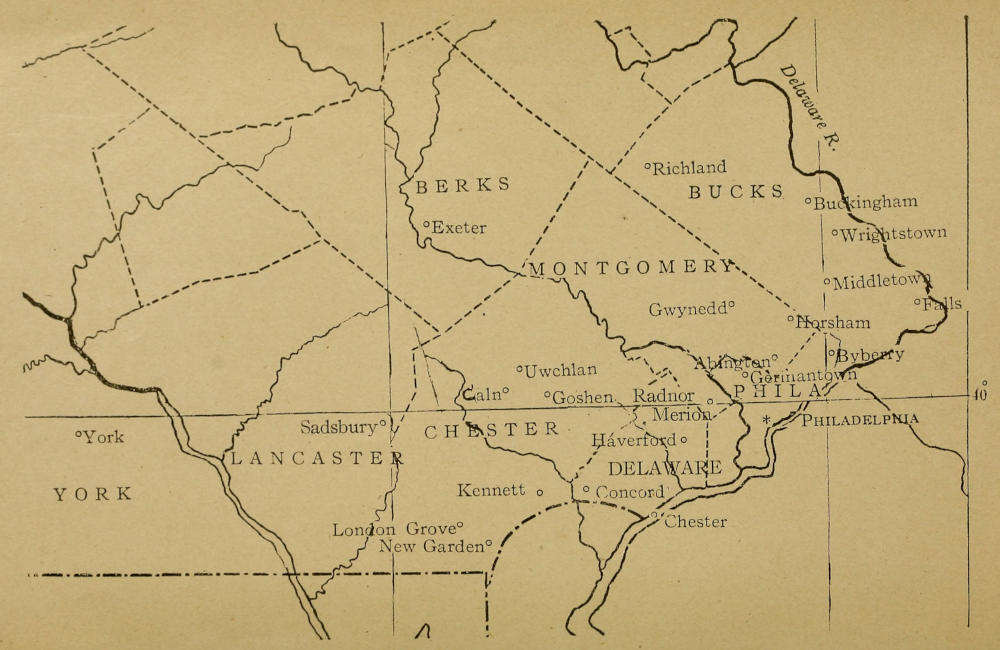
MAP OF SOUTHEASTERN PENNSYLVANIA SHOWING
LOCATION OF PRINCIPAL MEETINGS
EARLY QUAKER EDUCATION
IN PENNSYLVANIA
By THOMAS WOODY, Ph.D. ASSISTANT PROFESSOR OF EDUCATION
UNIVERSITY OF PENNSYLVANIA
TEACHERS COLLEGE, COLUMBIA UNIVERSITY
CONTRIBUTIONS TO EDUCATION. No. 105
Published by Teachers College, Columbia University
NEW YORK CITY
1920
Copyright, 1920, by Thomas Woody
PREFACE
The purpose of this monograph is to present to the students
of education, especially to those interested in the historical
phase of it, some materials relating to education among the
Quakers in Pennsylvania previous to 1800. Since the greater
part of the source material on the subject is almost inaccessible,
it has been thought desirable to incorporate in this work
many reports on schools, such as may be convenient references
for others who are interested in the early educational
history of Pennsylvania.
The manuscript records which furnish the most direct
light on this study are found in various depositories in
southeastern Pennsylvania. Those that have been preserved
and made accessible to the writer have been examined
by him in person. With the exception of a few cases, the
minutes of the preparative meetings have not been well kept;
hence, that source of information is very limited.
If this work possesses merit, it is by reason of the coöperation
of many men and women. I am obligated to the
members of the Society of Friends who, as custodians of
records, have been instrumental in forwarding the investigation.
It is also a great pleasure to acknowledge the friendly
encouragement and assistance given by Albert Cook Myers,
of The Historical Society of Pennsylvania. I wish also to
thank Professor Paul Monroe for the initial encouragement and
continued interest during the progress of the investigation.
EARLY QUAKER EDUCATION IN PENNSYLVANIA — CHAPTER I ORIGIN OF THE QUAKERS — SUMMARY
An essential in leaders
Reforms, discoveries and inventions are, at the outset, conceived
by individual minds; seldom, if ever, are they the
simultaneous product of several. The original connection is
seen and made by an individual, and afterwards may be
accepted by his fellows, who may appropriate the new idea to
themselves and make its applications manifold. The novel
idea or relationship, once seen, thoroughly comprehended
and expressed becomes either the common property of many,
extending far afield from its original source, or is rejected
because it fails to prove attractive to human interests or
necessary for the satisfaction of human needs. By this
means changes are wrought in a group or society of individuals,
and the belief or the contribution of one individual
becomes the faith or the possession of a nation. The meaning
of the above statement is at once made clear by mere mention
of a few names, such as Luther, Bacon, Pestalozzi, Confucius,
Whitefield, Gœthe and Fox. It is with the ideas and the
formally stated doctrines of the last mentioned that we are in
this connection chiefly concerned.
Brief study of Quaker beliefs necessary
In a study of education among the Quakers it is desirable,
if not absolutely imperative, to go back to the origin of the
society and note, at least in part, the tenets of the society and
the reasons for its foundation. For this purpose the best
materials are to be found in the life and works of George
Fox, the founder of the Society of Quakers. It would, perhaps,
be unnecessary at present to make any considerable
study of beliefs or tenets, if it were not for the fact that, in
times past, some of the expressions of their belief have been
misconstrued. For instance, reference may be made here
to the so-called doctrine of inner light which was promulgated
by George Fox at the very beginning of his work in 1647.[1]
It will be of advantage to first sketch briefly the early life of
this exponent of Quakerism.
Fox’s youth and early education
George Fox was born July, 1624 (old style), at Drayton-in-the-clay,[2]
in Leicestershire, England. His father, Christopher
Fox, otherwise known as “Righteous Christer,” was a
weaver by trade and “an honest man.” His mother, he says,
was of the stock of martyrs.[3]
His earliest life was spent in the home of his parents, under
whose tutelage he received a careful religious training. He
says of himself that he was unusually grave for a youth of his
age and that his thought constantly turned to subjects of
religious nature. This characteristic religious disposition,
noticed by his mother, was the cause of a more indulgent
attitude toward him than was granted the other children in
the family, especially in regard to their religious instruction.
Of his school education we have but a meagre account;
according to Sewell, his only education was received in the
home and consisted of the bare necessaries such as reading
and writing.[4] The essence of his religious education seems
to be adequately summarized in his own words as follows:
The Lord taught me to be faithful in all things, and to act faithfully
two ways, viz., inwardly to God, and outwardly to man; and to keep
to yea and nay in all things.[5]
As he advanced in years some of his people, being aware
of his religious tendencies, would gladly have had him enter
the priesthood, but others dissenting, he was placed with a
man who was a shoemaker, grazier and dealer in wool.[6] In
this employment he seems to have given much satisfaction to
his employer, and, as for himself, he too enjoyed the work of
shepherd, affording, as it did, ample opportunity for close
communion with nature and limiting his connections with
the corrupt society of mankind, from which he sought to free
himself.[7]
Beginning of his travels
About the age of nineteen, his dissatisfaction with the
world and the people about him caused him to leave his relations
and acquaintances and to seek out a more lonely
existence in some place where he was quite unknown. This
decision being made, he journeyed “at the command of
God,” first to Lutterworth, Northampton, Newport-Pagnell,
and came finally, in 1644, to Barnet. During these days he
was often in great despair and questioned whether he had done
rightly in leaving his parents and friends. In these periods
of misgiving he consulted often with priests concerning his
condition and sought thereby a remedy, which, however, he
did not find. Driven by sheer desperation he continued to
travel, and, after leaving Barnet, came to London where he
remained for a short time only, having come now to a decision
that he should return again to the home of his parents.[8]
His return home
The return to his native village, however, was no cure for
his mental ill, though his conscience was thereby somewhat
stilled. He continued his visits to various priests, especially
one Nathaniel Stevens, with whom he was wont to argue
religious questions, and who, after Fox had enunciated certain
beliefs, which will be mentioned later, became one of his
most cruel persecutors.[9] Each succeeding experience with
the priests was but a repetition of a former and it became
clear to him that they saw nothing but the externals of his
condition and had not the power to penetrate to the innermost
complexities of his situation. According to his view
their recommendations met only the demands of the ecclesiastics;
his need was genuine and he was enabled to see the
narrow limitations which hamper the activity of one man
who attempts to parcel out salvation to another.
Three of Fox’s conclusions; fundamental
George Fox was now in his twenty-second year. It is
pertinent that mention be made at this place of three fundamental
beliefs or principles, whose truth, up to this time, had
made itself manifest in his mind. The second of these is the
one which, being so often misquoted, has become the basis
for the belief on the part of many, that the Society was
opposed to education.
1. And the Lord opened to me that, if all were believers, then they
were all born of God, and passed from death unto life, and that none
were true believers but such; and though others said they were believers,
yet they were not.
2. The Lord opened unto me, that being bred at Oxford or Cambridge
was not enough to fit and qualify men to be ministers of Christ;
and I wondered at it, because it was the common belief of the people.
3. At another time it was opened to me, that God, who made the
world, did not dwell in temples made with hands.... But the
Lord showed me clearly that he did not dwell in these temples which
men had commanded and set up, but in people’s hearts; for both
Stephen and the apostle Paul bore testimony that he did not dwell in
temples made with hands, not even in that which he had once commanded
to be built, since he put an end to it; but that his people were
his temple, and he dwelt in them.[10]
These doctrines which he began to promulgate in 1647
were recognized as fundamental, and their influence is
plainly to be seen in the organization and discipline of the
society which finally resulted.[11]
But not untried
It may well be mentioned here that though these tenets
were incorporated in the foundation principles of the Quakers,
they were by no means new, in the sense that they had never
been accepted, in part, at least, by any other group of people.
J. Brown, writing concerning the Quakers, states that
Caspar Schwenkfeld, a Silesian of high birth, had promulgated
the same doctrines of inner light, direct revelation and
the inadequacy of the sacraments at least two centuries
before the time of Fox in England.[12] The dispersion of
Schwenkfeld’s adherents in 1547 led to the spread of their
doctrines outside of Silesia, being embraced by a part of the
Mennonite Church of Amsterdam, whence their entrance was
made into England, and found acceptance in the minds of the
Quakers.[13] This view is held also by other students of
Quaker history,[14] and the similarity of doctrine is clearly seen
in the statement of the Mennonite creed, as given by B. L.
Wicks, a student of Mennonite history.[15] Further, it is
known that some of the earliest preachers among Quakers
went to Amsterdam and vicinity and found there a kindly
reception by a part of the people, making converts among
both the Baptists[16] and the Mennonites.[17] An instance of
their kindly attitude toward Quakers and also of the recognition
given their belief on the part of the Quakers, is shown in
the account by Thomas Chalkley, concerning his journey of
some nine hundred miles in Holland, Friesland and Germany.[18]
Kindly reception given to Quaker ministers
As I have had great peace and satisfaction in my travels in Holland
and Germany, so, for inciting others under the like exercise, I may truly
say that there is encouragement for faithful ministers to labor in the
work of the gospel. I know not that I ever met with more tenderness
and openness in people than in those parts of the world. There is a
great people whom they call Mennonites, who are very near to truth,
and the fields are white unto the harvest among divers of them,
spiritually speaking.[19]
At Kriegsheim in the Palatinate Quaker exhorters like
Ames and Rolfe, who had been sent out by the direction of
George Fox, 1657, succeeded in winning converts among the
Mennonites, though they were received unfavorably by the
magistrates who fined those who offered to give them any
entertainment.[20] It is from this same district that both
Quakers and Mennonites made their voluntary departure
and came to settle in Pennsylvania. Their prompt attention
to school affairs on their first arrival is very similar to that
of the Quakers, though in their case it was often the work of
the laity, and not through the church organization.[21]
Journey of Fox, Penn, Furly, Barclay and Keith
A still more extensive missionary journey was undertaken
at a later date, 1677, by several Quakers, among them Fox,
Penn, Furly, Barclay and Keith. They visited Brill, Leyden
and Haarlem where they held meetings, preaching to both
Quakers and Mennonites.[22] The tour continued up into the
Rhine region where Penn and his party came into touch with
members of the Pietist group. It is doubtless true that this
journey and the impression which was made by Penn must
have played an important part a few years later when he
opened his colony to settlers on the well known liberal
principles.
In the presentation of the foregoing material it has been
pointed out: (1) how the doctrines of the Quakers were
rapidly spread broadcast by the itinerant preachers; and (2)
that there was a great similarity between Quaker and Mennonite
in doctrine and belief.
Increased number of ministers
The number of adherents estimated
The work of spreading the new gospel, as instanced by the
work of Ames and Rolfe in 1657, was carried rapidly forward;
as early as 1654, seven years after George Fox had begun to
preach, he had enlisted the services of some sixty preachers
who travelled continually up and down the country.[23]
Such a number of leaders bespeaks a considerable following,
though we have no record of a census of the followers made
during Fox’s lifetime. Brown is apparently willing to accept
Barclay’s statement that by 1675 they numbered ten thousand
in London and by the end of the century, sixty thousand.[24]
It does not seem that this is too large an estimate. It can
be estimated from the work of Besse on Sufferings that
between 1650 and 1689 there were approximately fifteen
thousand individual cases of “sufferings.”[25] Since his work
is compiled from “authentic records” it may be considered to
be fairly accurate, though the errors, if any, would likely be
to make the number too small rather than too large. As a
matter of fact his collection includes some cases between 1689
and 1700, but the vast majority of them are from the period
above stated. Certainly we must suppose that if such a large
number actually came under the hand of English tolerance,
then the total number of adherents very probably equalled
or exceeded the estimate previously mentioned. Whatever
objection may be made to the accuracy of these figures they
may certainly be taken as fairly indicative of the growth of
the sect; for that purpose they are intended.
Fox’s doctrine the basis in their educational practice
Just as the church discipline and organization are traceable
to the hand of Fox, so also is the attitude on educational
affairs. It has been said that the doctrine of the inner light
made all education unnecessary, and this perverted idea has
doubtless possessed even some members of Quakers to the
extent that they came to regard learning as an instrument of
Satan, a thing to be carefully avoided. However true this
statement may have been of some members of the group, it
certainly is not representative of the belief and practice of
the Quakers as a whole. Some of the more ignorant may
have interpreted the inner light to mean just that thing; but
it is certainly true that such an idea was never expressed by
George Fox, nor did it become the accepted belief of the
organization, as is shown by their practices. The actual
practice, educational, among Quakers is to be followed in this
monograph. A later chapter will be devoted to a consideration
of the views on education held by various individuals
who have left some tangible monuments to their beliefs. In
the present chapter, however, it is intended to indicate
merely the position assumed by Fox in regard to the question
at the outset of his labors.
As has been previously mentioned (page 2) George Fox
had the advantage of only a limited education. Opposition
to the higher education, if he exhibited such, might find an
explanation in this fact, assuming that not having shared its
delights and advantages, he chose to deprecate it altogether.
From a study of his utterances and his actions throughout
his career it seems, however, that the facts point rather to a
true appreciation rather than deprecation of education.
The evidence appears to support, in a very satisfactory manner,
the following points:
Fox’s educational creed
1. That he placed a great emphasis on moral and religious
training.
2. Education should be of practical value; apprenticeship
education recommended.
3. That the establishment of schools was believed to
be necessary.
4. The objection to classical training was its inadequacy
to prepare for a minister of the gospel.
5. That the scope of education was not limited to Quakers
alone, nor even to the Whites, but should include also Negroes,
Indians and the poorer classes of society as well as the rich.
The remainder of this chapter will be devoted to a brief consideration
of the foregoing statements.
First, in regard to moral and religious instruction, it
seems hardly necessary to do more than state simply
that he did urge moral education at all times. His whole
life being permeated with the desire to propagate his newly
founded society, it certainly is to be expected that he would
recommend and insist on instruction of that nature. If proof
be desired, however, it may be found in statements made
from time to time, which are quoted below. The system
of moral education based on the utterances of Fox was
chiefly a prohibitory one, and it might well be questioned
whether the result would not be passive rather than active
virtues.
Prohibitions, moral, social and educational
... in warning such as kept public houses for entertainment,
that they should not let people have more drink than would do them
good; and in testifying against their wakes and feasts, May games,
sports, plays and shows, which trained up people to vanity and looseness
and led them from the fear of God: ... in fairs also, and in markets
I was made to declare against their deceitful merchandise, cheating and
cozening; warning all to deal justly, to speak the truth, to let their yea
be yea and their nay be nay: ... I was moved also to cry against
all sorts of music, and against the mountebanks playing tricks on their
stages, for they burdened the pure life and stained the people’s mind to
vanity. I was much exercised, too, with schoolmasters and schoolmistresses,
warning them to teach their children sobriety in the fear of
the Lord, that they might not be nursed and trained up in lightness,
vanity and wantonness. Likewise I was made to warn masters and
mistresses, fathers and mothers in private families, to take care that their
children and servants might be trained up in the fear of the Lord; and
that they themselves should be therein examples and patterns of
sobriety and virtue to them.[26]
I was to bring them off from all the world’s fellowship and prayings
and singings, which stood in forms without power: ...[27]
Kept prominent place in the church
These prohibitions and many others that were enunciated
from time to time in his speaking and writing, were to be in
time a part of the discipline of the organization, and were as
religiously imposed on all members as the ardor of the meeting
and the difficulty of the task would permit. The cases
coming up before the monthly meetings for discipline are
largely composed of infringements of the regulations, which
grew out of Fox’s recommendations. These are, without
question, of very ascetic nature. One instance which illustrates
the incorporation of these ideals in the discipline of
the organization may be cited in this connection.
All Friends, train up your children in the fear of God; and as they are
capable, they may be instructed and kept employed in some lawful
calling; that they may be diligent, serving the Lord in the things that
are good; that none may live idle and be destroyers of the creation, and
thereby become burdensome to others, and to the just witness in
themselves.[28]
Apprenticeship education recommended
Second, the emphasis placed on the values to be derived
from a practical education, to be gotten, to a large degree,
through a careful system of apprenticing the children of
members to people, members if possible, who would also be
careful in regard to their moral instruction, is unmistakable.
The practice as recommended, indicated below, became the
general rule in Quaker communities, as is adequately evidenced
in the meeting records. In this connection, however,
it should be kept in mind that apprenticeship education
could be legally enforced.
Being in London, it came upon me to write to Friends throughout the
nation, about putting out poor children to trades. Wherefore I sent the
following epistle to the quarterly meetings of friends in all counties:
My Dear Friends,
Let every quarterly meeting make inquiry through all the monthly
and other meetings, to know all Friends that are widows, or others that
have children fit to put out to apprenticeship; so that once a quarter
you may set forth an apprentice from your quarterly meeting; and so
you may set forth four in a year in each county, or more, if there be
occasion. This apprentice, when out of his time, may help his father
or mother, and support the family that is decayed; and in so doing all
may come to live comfortably. This being done in your quarterly
meetings you will have knowledge through the county in the monthly
and particular meetings, of masters fit for them, and of such trades as
their parents or the children are most inclinable to. Thus, being placed
out with Friends, they may be trained up in truth; and by this means in
the wisdom of God, you may preserve Friends’ children in the truth, and
enable them to be strength and help to their families, and nurses, and
preservers of their relations in their ancient days.... For in the
country you know, you may set forth an apprentice for a little to several
trades, as bricklayers, masons, carpenters, wheelwrights, ploughwrights,
tailors, tanners, curriers, blacksmiths, shoemakers, nailers, butchers,
weavers of linen and woolen stuffs and serges, etc., and you may do well
to have a stock in your quarterly meetings for that purpose. All that is
given by any Friends at their decease (except it be given to some particular
use, person or meeting) may be brought to the public stock for that
purpose. This will be the way for the preserving of many that are poor
among you, and it will be the way of making up poor families. In
several counties it is practised already. Some quarterlies set forth two
apprentices; and sometimes the children of others that are laid on the
parish. You may bind them for fewer or more years, according to their
capacities....[29]
G. F.
London, 1st of 11th month, 1669.
The following lines, taken from the meeting records, are
sufficient proof of the working out of this recommendation
concerning apprenticeship education.
And executed in various meetings
It is agreed and concluded upon by this meeting, that the meeting
take care of all Friends’ children that are left as orphans and unsettled,
to inspect and see that all such be taken care of and settled in the best
and suitablest manner, according to their capacity, that thereby they
may discharge their duty and all such be eased by taking such due care.[30]
Third, the establishment of schools was believed to be
necessary; for a proof of this attitude may be cited his action
in regard to the establishment of schools at Waltham and
Shacklewell.
Establishment of school advised
Then returning towards London by Waltham, I advised the setting
up of a school there for teaching boys; and also a girls’ school at Shacklewell,
for instructing them in whatsoever things were civil and useful.[31]
This statement would certainly indicate a liberal attitude
towards education. Fox himself makes no further comment
on what the nature of the school was to be. His interest in
these schools, it is asserted, never flagged, and many visits
were made in behalf of their prosperity.[32]
But classical education not the first essential for ministers
Fourth, the popular idea that has at times prevailed, that
Quakers objected to giving an education such as was enjoyed
by other sects, was probably founded on a misunderstanding
of certain statements made by Fox with regard to education.
Let us examine some of these statements, and seek to learn
his intended meaning.
I saw that to be a true believer was another thing than they looked
on it to be; and I saw that being bred at Oxford or Cambridge did not
qualify or fit a man to be a minister of Christ; what then should I
follow such for? So neither these, nor any of the dissenting peoples
could I join with, but was a stranger to all, relying wholly upon the
Lord Jesus Christ.[33]
I was to bring people off from Jewish ceremonies and from heathenish
fables, and from men’s inventions and worldly doctrines, by which they
blew the people about this way and the other way, from sect to sect;
and from all their beggarly rudiments, with their schools and colleges for
making ministers of Christ, who are indeed ministers of their own making
but not of Christ; ...[34]
They could not know the spiritual meaning of Moses; the prophets
and John’s words, nor see their paths and travels, much less see through
them, and to the end of them into the kingdom, unless they had the
spirit of Jesus; nor could they know the words of Christ and of his
apostles without his Spirit.[35]
Then we came to Durham, where was a man come from London to set
up a college there, to make ministers of Christ, as they said. I went,
with some others, to reason with him and to let him see that to teach men
Hebrew, Greek and Latin, and the seven arts, which were all but the
teachings of the natural man, was not the way to make them ministers
of Christ.[36]
These statements represent a small selection from many
similar ones, and may be fairly taken as indicative of his
position concerning this one point. They are the most
drastic prohibitory statements made on the subject in all of
his works. But even here we fail to find either (1) a condemnation
of general or ordinary education or (2) a wholesale
condemnation of classical education; indeed we read no
objection to a minister’s possessing a knowledge of classical
authors, such as was the case of both Penn and Barclay, provided
he possess also the “light.” His statements may be
summarized as follows:
Summary of educational statements
1. Classical training is inadequate as a preparation for
ministers of the gospel.
2. Divine guidance is the one requisite for their preparation.
3. There is no objection to the classical learning if it be
added to the qualification under (2).
Education not limited to Friends
Fifth, their conception of the scope of education did not
limit it to their own people alone, but extended it rather to
all peoples, Negroes and Indians, the rich and the poor. This
is made perfectly plain in his address sent to the Governor
of the Barbados in 1671.
Consider, Friends, it is no transgression for a master of a family to
instruct his family himself, or for some others to do it in his behalf; but
rather it is a very great duty incumbent upon them.... We
declare that we esteem it a duty incumbent on us to pray with and for
those in and belonging to our families; ... and to teach, instruct
and admonish them; ... now Negroes, Tawnies and Indians make
up a very great part of the families in this island; for whom an account
will be required by him who comes to judge both quick and dead, at the
great day of judgment, when every one shall be rewarded according to
the deeds done in the body, whether they be good or whether they
be evil.[37]
The effect of the above statements must tend to convince
even the skeptical that any statement or belief, to the effect
that the founder of Quakerism was opposed to education, is
chiefly a myth based on either ignorance or gross misunderstanding.
The origin of the Quakers and the organization and discipline
of the Society are due almost entirely to the influence
which first came from the founder, George Fox. He extended
his belief in his native country and even into foreign countries
by (1) preaching, (2) letters, (3) extensive travels on his own
part, and (4) through the agency of many capable men whom
he attracted to his service. For this service the leading of the
inner light was deemed the only preparation which was absolutely
necessary. The society experienced a rapid growth in
numbers and, due to the policy of its founder, laid great stress
on the moral and practical education of their youth. A great
similarity existed between the beliefs of Quakers and those
of the Mennonites, both of which came to form a large part of
the population of the colony of Pennsylvania. The Mennonite
beliefs are thought, by some special students of their
history, to have been the determining influence in forming
those of Friends; but this is not clearly proven. It is
pointed out, by certain references to utterances of George
Fox, which to a great extent formed the basis for Quaker
practices, that the common belief in their objection to education
is erroneous. The system of moral education was
exacting and full of sweeping prohibitions, and, in those
respects, according to modern ideals, quite inadequate.
CHAPTER II MEETING ORGANIZATION: ITS CONNECTION WITH EDUCATION — SUMMARY
An organization developed
The organization of meetings in the Society of Friends was
based almost entirely on the recommendation of its founder,
and still obtains without many variations from the type
which was thus early begun. The organization thus planned
was not developed completely at one time, but depended
rather on the growth of the society in this or that section of
the country. Meetings, as at first established, were not so
specialized in their functions as they came to be later; there
were those for worship and sufferings, the latter becoming
in due time a specialized part of the yearly meeting, and for
taking action in regard to poor members. The time was
further occupied in disciplining those members who were not
faithful to the doctrines of the church.
The place of organization in the establishment of schools
It is of particular importance for us to understand the
ordinary arrangement of the meetings and their relation to
each other, since it was by virtue of this organization of the
church that its schools were set up. Perhaps no other factor
played so important a part in the success which was met with
in setting up schools, as that through the organization of the
meetings all localities were kept in closer touch with each
other than would otherwise have been possible at that time.
As it was, the local meetings were literally forced to listen
to the school-proposition, even though they were in the backwoods
of America, or inhabited the Barbados. The chief
means of communication established were church letters,
travelling ministers, representatives from the constituent
meetings, and reports of general meetings which were distributed
to all those belonging thereunto.[38]
Purposes of the organization
Originally the purpose of the church organization seems
to have been twofold. It was realized that among those who
became members some would be less constant in their
behavior than others; hence some sort of oversight was necessary
to keep each and every one in line. In the second place,
there were many adherents in limited circumstances and the
Quakers’ belief made it imperative that these people be taken
care of in the best manner possible.[39] Realizing the existence
of these conditions among members, it was clear to Fox that
a definitely organized meeting was necessary whereby (1) the
necessary assistance could be extended to those in need, (2)
discipline could be enforced for the maintenance of the
religious life of the organization, and (3) new meetings could
be officially established when and where they became necessary.
Early meetings established
The earliest mention that is made of a meeting established
for these purposes is in the case of Balby, in Yorkshire, in
1658.[40] This statement is not exactly accurate, it seems, for
we have also mention made of a general meeting, or what
came to be known as a yearly meeting, as early as 1654 when
one was held at Swannington in Leicestershire.[41] The meeting
at Balby seems to have been of considerable importance
and is frequently mentioned as one of the stopping places of
George Fox. He recounts a meeting held at that place in
1660 “in a great orchard of John Killam’s where it was supposed
some thousands of people and Friends were gathered
together.”[42] The business of the yearly meeting seems to have
been to devote some time to the affairs of the church; at any
rate, this idea is expressed by Fox in writing of a similar
meeting held at Skipton in 1660.[43] The characteristic of
these meetings, that is always mentioned, is that they were
attended by representatives from various towns and counties.
The yearly meeting is still a representative body.
Meetings develop from larger to the smaller
The smaller meetings for worship were, of course, the first
established. Aside from the question of worship, however,
the development of the organization was from the larger unit
to the smaller. We have noted above the beginning of the
general or yearly meeting. As the sect grew in numbers, and
the labor of caring for these, sometimes in a physical sense
and again in the religious, increased, it became necessary to
have a finer organization, the smaller units of which would
reach the smallest communities. By 1665 there were
established (1) the yearly and (2) the quarterly meetings, and
in 1666 Fox recommended the establishment of a smaller
unit, the monthly meeting, saying:
Then I was moved of the Lord to recommend the setting up of five
monthly meetings of men and women in the City of London (besides the
women’s meetings and the quarterly meetings) to take care of God’s
glory, and to admonish and exhort such as walked disorderly or carelessly,
and not according to the truth. For whereas Friends had had
only quarterly meetings, now truth was spread, and Friends were grown
more numerous, I was moved to recommend the setting up of monthly
meetings throughout the nation. And the Lord opened to me what I
must do, and how the men’s and the women’s monthly and quarterly
meetings should be ordered and established in this and other nations;
and that I should write to those where I did not come, to do the same.[44]
Number of monthly meetings set up
Immediately after this, there is mentioned the establishment
of monthly meetings in Essex, Suffolk and Norfolk,
Huntingdonshire, Nottinghamshire, Leicestershire and Warwickshire
and many others.[45] Three years later (1669) he
reports fourteen monthly meetings in the county of York.[46]
The rapid increase in the number of meetings and the extent
of territory covered by them is a fair indication of the phenomenal
growth of the society.
Following his resolve and subsequent exertions toward
setting up of monthly meetings, during which he made very
extensive campaigns, there came the great step which was
taken to organize all under the general leadership of a yearly
meeting, that of London. This was accomplished in 1672.[47]
This general meeting of ministers drew up a resolution or
minute to this effect:
London Yearly Meeting established
It is concluded agreed and assented to by Friends present that for the
better ordering, managing and regulating of the public affairs of Friends
relating to the Truth and the service thereof, there be a general
meeting of Friends held at London once a year, in the week called
Whitsun-week, to consist of six Friends for the City of London, three
for the city of Bristol, two for the city of Colchester and one or two from
each of the counties of England and Wales respectively.[48]
The meeting convened in the year following, in accordance
with the above resolution. Many of the duties performed by
the General Meeting of Ministers were transferred to the
representatives of the various meetings. The ministers,
though in fact subject to the approval or disapproval of
monthly meetings, did not relinquish their oversight of each
other.
The preparative meeting the smallest unit
The smallest unit in the organization was the particular or
preparative meeting. This meeting is not mentioned in all
localities, though it is clear from Fox’s statements that he
recognized this as a part of the organization, for in a letter of
1669 he writes concerning the representatives of the quarterly
meetings that,
none that are raw or weak and are not able to give a testimony of the
affairs of the church and Truth, may go on behalf of the particular
meetings to the quarterly meetings, but may be nursed up in your
monthly meetings.[49]
Details of organization worked out by Fox
This statement is given here merely for the purpose of pointing
out how completely the ideas of Fox were embodied in
even the smallest unit of church organization. There is adequate
proof of their existence in all sections occupied by the
Quakers in Pennsylvania, and of their great importance in
carrying out the details both of relief work for the poor, and
in the establishment of schools.[50]
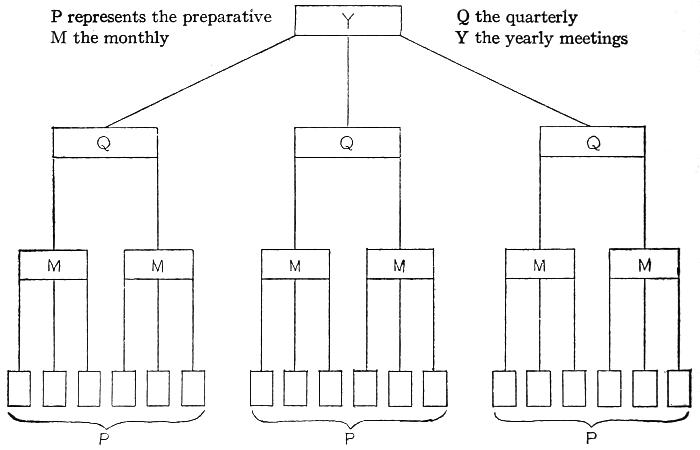
There have been noted different phases of the development
of the meeting organization. When finally it was complete in
all its parts, there existed a hierarchy of meetings, the lower
and smaller units of which were subject to and under the
direction of the higher. This resultant organization may be
made somewhat clearer by means of a diagrammatical
representation.
Functions of yearly meeting
The above diagram represents the relation of the various
kinds of meetings in the organization of the Society of
Friends. The yearly meeting (Fig. 1, Y) is the general head
of the entire organization. Its functions are of a general
directive nature and its influence of very wide extent. For
example, it will be shown a little later that the Yearly
Meeting of London issued, very early, certain communications
concerning education which were sent to each meeting
belonging to the London Yearly Meeting. In the same manner
it exercised its influence along other lines than education.
There is no special virtue in the number of meetings represented
above; for example, the three Q’s do not mean that
each and every yearly meeting had three quarterly meetings
under its care. The number is not specified. In the case of
the Philadelphia Yearly Meeting there are at present nine
quarterly meetings and two half-yearly meetings.[51] The
same variation is also true in the number of monthly meetings
in a quarter, Caln Quarterly having only one monthly meeting,
while Western Quarterly has six.[52] The same is true as
to the number of preparative meetings.
Functions of the quarterly meeting
The quarterly meeting is representative of the monthly
meetings which comprise it. Its functions are chiefly directive
and advisory, though it may often occur that a bad case
of discipline may be turned over to it by the monthly meeting.
In the case of school regulations, its chief concern was to pass
on the recommendations of the yearly meeting to the monthly
meetings and to repeat them frequently, that the lower
meetings might be stirred up to action.[53] It was also through
the quarterly meetings that the reports on the conditions of
schools in the monthly meetings were collected and sent to
the yearly meeting. It was also quite customary for the
monthly units to pass any of their decisions on a matter up to
the quarterly unit for its formal approval or disapproval.
Especially is this marked in educational affairs, and particularly
in the Philadelphia Quarter.[54] This is most marked in
the earliest years after establishment, and is due, no doubt,
to a lack at that time of a very close differentiation in the
functions of the meetings.
Monthly meeting the business unit
The monthly meetings are primarily the business units of
the organization. Before them come all cases of care for the
poor, apprenticing of children, enforcement of discipline,
establishment of schools, requests for permission to marry, to
remove to a new location and still many others. They may
settle some of these finally, or they may act in connection
with their superior meeting as mentioned above.
Function of the preparative meeting
The preparative meeting is the smallest organization unit
and has its finger on the pulse of the local community at all
times.[55] Officially it acts as the agent of the monthly
meeting in carrying out the details of any piece of work that
must be done, and which the monthly meeting is willing to
delegate thus far.[56] Thus in the case of Horsham, for
instance, the business of the schools in the scope of the preparative
meeting is turned over to it and their organization
and maintenance are under the care of its school committee.[57]
The preparative meeting is at all times cognizant of breaches
of discipline among its members and responsible to report
such to the monthly meeting for settlement. One might go to
great length to enumerate and explain all the detailed duties
of each of these branches of the organization, but it is
believed sufficient has been said of them, to make their action
in educational matters intelligible.
We have noted, somewhat briefly to be sure, the organization
and interrelation of the meetings in the Society of
Friends. It is now necessary to point out what connection
existed between this organization and the program put forward
for the establishment of schools. This will be done by
the presentation of certain extracts from meeting records
which seem in all cases to have been responsible for kindling
an interest in education in near and distant meetings, and
keeping that interest alive by virtue of many advices until
some material results were forthcoming. The selections presented
are not continuous; they are chosen because they are
representative and illustrative of the point in question.
Attention of yearly meeting to education in 1690
The Yearly Meeting of London was established (see page
17) in 1672. Consistent with the purpose of its establishment,
as then stated, it began at once to busy itself with
certain important problems of the church. Among the first
that received a considerable amount of attention was the
education of the youths of members in the society, which was,
of course, soon extended to include others. For instance, in
1690, there is given out this educational advice.
And, dear Friends, it is our Christian and earnest advice and counsel
to all Friends concerned (so far as they are able or may be capable) to
provide schoolmasters and mistresses who are faithful Friends, to teach
and instruct their children, and not to send them to such schools where
they are taught the corrupt ways, manners and fashions of the world
and of the Heathen in their authors and manners of the heathenish gods
and goddesses....[58]
And again in the year following we find the following
advice:
1691
We are glad to hear that care is taken in some places, according to
former advices, for the providing of schoolmasters and mistresses who
are faithful Friends to instruct Friends’ children in such method as
Truth allows. And we desire that Friends may go on in the care to
provide such education and schools, for the advantage of their children
and posterity.[59]
More specific instructions follow in 1695.
1695
And it is desired ... to take special care for the good education
and order of Friends’ children in God’s holy fear, ... and also to
see that schools and schoolmasters who are faithful Friends, and well
qualified, be placed and encouraged in all counties, cities and great
towns, or places where they may be needed; and that such schoolmasters,
as much as may be, sometimes correspond with one another for
their help and improvement in such good and easy methods as are
agreeable to the Truth and the children’s advantage and benefit; and
that care be taken that poor Friends’ children may freely partake of
such education, in order to apprenticeship.[60]
At a much later date, 1745, very similar instructions are
found among those issued.
and 1745
And, dear Friends, though frequently and repeated advices have been
given from this meeting, respective of the education of our youth in
sobriety, godliness and Christian virtues; yet, this being a matter of
very great moment for the welfare of the present and future generations,
we think it our incumbent duty again to recommend an especial care
therein.... We also recommend to schoolmasters and mistresses,
to educate the children committed to their charge, in the frequent reading
of those sacred writings and such other good books as tend to their
instruction in true Christianity; whereby their minds are in danger of
being corrupted and led aside from the way of truth and holiness.[61]
A casual reading of the above statements, or any of numerous
others like them, will suffice to point out to what great
extent they are similar to the statements of Fox and other
Quakers who were interested in education.[62] For convenience,
the content of these extracts from the yearly meeting
minutes may be summarized in something like the
following:
1. To educate morally, according to Friends’ standards.
2. To train the individual in some practical employment.
A summary of important points in the extracts
They are accompanied by:
1. Select schools.
2. Teachers of approved morality.
3. Selected subject matter.
4. Apprenticeship training.
5. Schools to be in all communities, the stronger assisting
the weaker.[63]
Exemplified in schools set up
The influence of these fundamental ideas about education
is clearly reflected in the type of schools that were first set
up in England. Those recommended by Fox at Waltham
and Shacklewell in 1667, for both boys and girls, represent the
first attempt.[64] At a later date, 1702, Clerkenwell was
established under the oversight of London and Middlesex
Quarterly Meetings, and in the latter part of the century the
Ackworth School, founded by John Fothergill in 1779.[65] In
all the schools established, of which those mentioned are
representative, there is always found this primary emphasis
on moral and useful training.[66]
Influence exerted by means of ministers, epistles and tracts
The great influence of English Quaker education on that
in America was made secure by virtue of the very intimate
relation between the meetings in both countries; this relation
being constantly maintained through the traveling ministers,
and tracts and epistles sent out by the yearly meetings. The
same alertness, characteristic of London Yearly Meeting in
these affairs, was likewise assumed by the Burlington and
Philadelphia Meetings, from whence came numerous advices.
As concrete evidence of this close relation existing, and the
consequent communications, a few extracts thereof are
inserted.
There was brought to this meeting (Middletown Monthly) the last
London printed epistle, which was read, containing sundry weighty
advices and exhortations with some comfortable account of the prosperity
of the Truth in divers places, as also the extracts of our last
yearly meeting (Philadelphia) wherein is recommended amongst other
things, a half collection for the next year, and some proposals concerning
the settling of schools in the country....[67]
That these letters of advice were not mere formalities but
were really seriously considered and acted upon favorably or
unfavorably, as in the first case below, is shown adequately
in the following:
This meeting taking into consideration the proposals of last yearly
meeting concerning the settling of schools in the country, are of the
opinion that the method proposed will not answer for the Friends who
live remote from each other in the country....[68]
Had definite results
In the case of Darby Monthly Meeting, later in the century,
there is an instance in which the recommendations of
the yearly meeting (1778) are followed most minutely in the
reorganization.
In consideration of improving our school, agreeable to the recommendations
of the last Yearly Meeting in 1778, and subsequent advices
down to this time having been spread in this meeting and so and several
remarks made thereon, pointing out the advantages which may arise
therefrom to the present rising and succeeding ages, and the loss sustained
for the want thereof, tending to animate a desire to pursue the
interesting prospect. It is therefore now agreed that in future five
Friends be appointed and called the overseers of the Darby School, three
of whom shall be deemed a sufficient number to transact any business
within their appointment, viz.: to have the oversight of and visit the
school, examine the progress the scholars make in their learning, remark
thereon as appears to them necessary; inspect the teachers’ conduct,
and from time to time as occasion may be, with the approbation of the
meeting, agree with and employ a teacher or teachers, and on sufficient
cause appearing, discharge any such teacher or teachers, as also any
unruly scholars who cannot be brought to submission to the rules and
orders of the school; hear and determine upon all differences relative to
the school which may arise between any teacher and employer, take into
consideration and endeavor out after some eligible plan for raising a
fund for the benefit of the school and as way shall open for it, pursue
the same accordingly, and every matter and thing tending to promote a
settlement for a school agreeable to the recommendations before cited;
and as some of our deceased brothers have made donations to this
meeting for the benevolent purpose of schooling children of the poor,
therefore, the aforesaid overseers are hereby empowered and directed to
receive and collect from the trustees thereof for the time being, the
interest arising from the said donations, dispose thereof agreeable to the
intentions of the Donors, and when necessary, advise and assist the
trustees in taking better securities for the principal, and as future donations
may be made for the benefit of the school, the overseers are directed
to extend care therein, as the same shall become necessary, and keep
fair minutes of all moneys received and expended and other matters of
importance which come before them, to be produced in this meeting
when called for, and preceding the quarterly meeting in the 8th month
annually make to this meeting a clear statement of the amount received,
expended and remaining in hand and outstanding and of the capital
under their care; what donations made within the year past and for
what purposes; and of such other matters as they may judge needful to
enable this meeting to transmit the true estate of the school to the
Quarterly Meeting, and as a fundamental of their proceedings they
transcribe a copy of their minutes, together with such other writings as
are necessary for their government in what is now constituted their
cares.[69]
A committee was accordingly appointed and directed to
choose their officers, that their business might be begun at
once and properly performed.
Works of Penn, Barclay, Sewell, Turford, and others distributed
In addition to the advices sent out in the form of letters
from the yearly sessions, the meeting also furthered regularly
the distribution of books, tracts and pamphlets,
usually the expression of prominent Friends, such as, for
example, Penn’s Advice to His Children, Barclay’s Apology,
Sewell’s History of Quakers, Barclay’s Catechism, Turford’s
Grounds of a Holy Life, and many others of similar nature.
Works of this kind were frequently sent over in lots, sometimes
for free distribution, or to be sold to members; as witness
the following:
Joseph Kirkbride and Walter Faucit, having been lately in London
upon the service of Truth, did subscribe for 100 of Barclay’s Apologies
on behalf of this yearly meeting, which the said meeting approves of;
and agreed that Samuel Carpenter pay for them out of the yearly
meeting stock and distribute them to each meeting according to their
proportion of books that they usually receive, that so they may be given
away by the several meetings for the service of truth.[70]
Sam Nixon informs the meeting that he brought from last quarterly
meeting ten small books, entitled Reflections and Maxims, wrote by
William Penn and printed for the use of schools, which he desired us to
take the care of and to apply to the use intended as occasion may
require.[71]
Produced at this meeting, 6 Barclay’s Apologies, 12 Richard Davis’
Journals, 7 Daniel Stanton’s Journals, 4 Hugh Turford’s Grounds of a
Holy Life, 8 Barclay’s Catechisms; 37 books under care of Thos. Pickering,
Thos. Watson, and Robert Kirkbride—to lend to the poor or others,
as they think useful.[72]
The foregoing presentation of conditions within the church
organization, their method of interaction, has been made so
that the reader may understand that whatever activities may
be later noted among the Quakers in Pennsylvania in connection
with the establishment of schools, were intimately connected
with and were in fact the result of the English influence.
The form of organization of the meeting in the Society of
Friends was due to the needs then existing, and was planned,
even to the smallest unit, by the founder of the society. The
chief purposes of the organization, when first begun, were (1)
moral and religious discipline of members, (2) assistance to the
poor among their number, and (3) to protect themselves
against the oppression of outsiders (function of the meeting on
sufferings). The functions of the higher meeting (yearly)
were chiefly advisory in character, while those of the lower
meetings (preparative) were to work out the details. Educationally,
the yearly meeting exercised an influence very early
by its frequent recommendations and the literature sent to
the smaller individual meetings. This rôle was likewise
assumed by the Burlington and Philadelphia Yearly Meeting.[73]
This close relationship between the meetings of
different order and the educational influence is in part shown
by extracts taken from the meeting records.
CHAPTER III EDUCATIONAL IDEALS OF QUAKER LEADERS — SUMMARY
Criticism inevitable; beneficial
Any institution one may name has its adverse critics. The
basis of their criticism is often ill-defined; it is sometimes
fact, sometimes imagination; it may spring from a knowledge
of truth, or possibly from ignorance.
Some criticism based on misunderstanding
Certain doctrines
Quakerism has had many critics and the effect of wise
criticism may be seen in some of the changes from the old to
the modern Quakerism. Much of that which was unjust and
without foundation of fact, failed to have any effect whatever.
But though the effect on the institution may have been nil,
it occurs in some cases that the criticism still lives in the
popular mind and is accorded a good degree of authenticity.
By those better informed it may not be so considered. It is
with one of these criticisms, concerning the attitude of
Quakers toward education, that we are chiefly concerned in
this chapter. Due chiefly to a misinterpretation of the doctrine
of inner light and its application, which was mentioned
in the first chapter, there arose an erroneous conception of
the Quakers’ attitude towards education. This conception
is not always constant; it varies now to this side, now to that,
but does not cease to persist. In order that this criticism
may be put as clearly as possible before the reader, use is
made here of a quotation from the works of S. H. Cox, at one
time a member of Friends, who expresses with clearness the
opinion of a very considerable group of critics.
The criticism offered by S. H. Cox
But there is one feature of the system of Friends which deserves a
recognition here—its inimical regard to classical and scientific learning.
I do not say that all Friends are thus hostile, or that they are all alike
hostile to liberal learning but I charge this hostility on the system.
That such is its character, appears from the denunciation, the indiscriminate
proscription of Barclay, and that not in a few places in his
book. It appears in the general hostility of Friends to all colleges and
seminaries where the elevated branches are thoroughly taught. Not
one young Friend out of five hundred, even in this free country, ever
obtains a liberal education in fact or in name; certainly never becomes
graduated in the arts at any chartered institution, and where an instance
occurs, it is always attended with special difficulties. They have no
college of liberal science in the world! Some, I know, of the suspected
worldly sort in Philadelphia have proposed and would have forwarded
so excellent an object, but they were always awed into despondency by
the unlettered, all-knowing light within. And in this, their obsequiousness
was quite consistent, for if schools, academies, and universities are
all in their nature wrong, and as such forbidden of God, it is certainly
right to desist totally and at once from the prosecution of their cause!
Incidental evils they will always include, but the system is not chargeable
with these, unless in its nature it approves and fosters them.
There will always be, perhaps, hypocrites at the communion table but
christianity does not make them, and the purest ministry of the gospel
will often become a savor of death unto death, but sinners themselves
and not such a ministry are to blame for the consequence. And so the
best organized system of intellectual education that the world has seen
has often presented the appalling spectacle of profligate and wicked
students perverting its privileges. But what of that? Shall we burn
our colleges? Why not our primary school houses too? What beneficient
institution, what bounty of the blessed God is not perverted and
abused in this naughty world....[74]
I cannot leave this matter without remarking the power of education
especially with Friends. Their mode of education is the making and the
keeping and the secret of their sect. They subdue the infant conscience
with the direct rays of the inward light. They identify all divinity and
right in the associations of their children with the light within and its
friendly fruits. Here the spell commences that grows with their growth
and strengthens with their strength. Investigation is much akin to
skepticism and is devoutly precluded—but what worse skepticism it is
to suppose that investigation could raze the foundation of our faith.
They must take everything for granted or see it in the light. They
must wear a ridiculous cut and color of clothes, such as are orthodox or
common to the clanship and use the plain language and act like Friends,
and then if they feel awkward or foolish, if their garb appears ridiculous
to themselves, if their manner expose them to jeering and affront, if they
are insolently struck (as I have often) in the street by worthless boys and
cursed as a “Quaker,” if their effeminate holy whine is profanely mocked,
as it often is by saucy passengers, and if a thousand other inconveniences
accrue, especially if they are sometimes asked for one good reason for
such singularity in gratuitous opposition to mankind, they must just
bear it all for righteousness sake, not be afraid of the cross, but remember
early Friends how much more they endured in the same cause.
Now much of this which they call a guarded education, is just the worst
kind of sorcery. It is a fascination and religious tyrannizing over the
blighted attributes of mind. It is a system exactly calculated to prostrate
every noble, courageous and manly sentiment, and to transmute a
fine ingenuous boy into a sorry, sly, and often simulating creature in the
form of a man.[75]
Contrast Cox’s statements above with those of early Quakers in regard to education
It is not necessary to discuss directly the views set forth
in the above quotation, as they are stated clearly enough in
the author’s own language. However, in the following
pages, there will be presented the views on education of as
many prominent Friends as space will permit, that in so doing
they may be considered in connection with the remarks of
their critics and a just comparison made. In presenting the
views of Quaker educators reference may be made to salient
points in the criticism, which seem out of keeping with the
ideas set forth and without foundation as matters of fact.
Only a few of the leaders’ statements to be considered
There are quite a number of men, in the brief period
studied, who stand out clearly and express themselves
definitely in favor of education, though they do not consider
it the first requisite for a minister of the gospel.[76] From this
number it will be feasible to select only a few for the chief
consideration, relegating the remainder to a place of comparative
unimportance and incidental notice. The work of
George Fox, though he was poorly educated, had a remarkable
effect on the educational work of the society. But it is
not necessary to review that in the present chapter as it has
been presented in the first.[77]
By far the most familiar of all characters in Quaker history
is that of William Penn. And to his influence must be
attributed largely the hearty interest in education shown, not
only in Philadelphia, but also in the surrounding communities.
He was well educated, but it is not desired to make a case for
or against him on the basis of his education; let us judge by
his written or spoken expression and actual procedure in
practice. No attempt is made to prove or disprove his contentions
as to what was right or wrong, necessary or unnecessary
in education. The questions asked in his case and the
others that follow is: What did they approve or disapprove
of in education?
Penn recommends practical virtues
Not only in works that might be called strictly educational
did Penn give educational advice, valuable alike to youth and
to parents, the directors of youth. His advice to his children
on the value of diligence and its necessity for success, and the
propriety of frugality, even in the homes of the rich, embodies
many of the most essential principles in education at any
time. It is especially applicable to the education of the
man of business, emphasizing the importance of the practical
duties in life. Some pointed statements are especially
worthy of repetition.
Diligence
Frugality
Diligence ... is a discreet and understanding application of
onesself to business; ... it loses not, it conquers difficulties....
Be busy to a purpose; for a busy man and a man of business
are two different things. Lay your matters and diligence succeeds
them, else pains are lost.... Consider well your end, suit your
means to it, and diligently employ them, and you will arrive where you
would be....[78] Frugality is a virtue too, and not of little use in
life, the better way to be rich, for it hath less toil and temptation....
I would have you liberal, but not prodigal; and diligent but not drudging;
I would have you frugal but not sordid.[79]
This bit of philosophy is educational in its bearing in very
much the same way as that of Benjamin Franklin.
In the letters to his wife and children, referring to the care
for their education, he is more specifically concerned with
actual school education.
School education recommended; the useful emphasized
For their learning, be liberal. Spare no cost, for by such parsimony
all is lost that is saved; but let it be useful knowledge such as is consistent
with truth and godliness, not cherishing a vain conversation or
idle mind; but ingenuity mixed with industry is good for the body and
the mind too. I recommend the useful parts of mathematics, as building
houses, or ships, measuring, surveying, dialing, navigation; but
agriculture especially is my eye. Let my children be husbandmen and
housewives; it is industrious, healthy, honest and of good example, ...[80]
Private tutors desired
His preference, as might be expected from an Englishman
of that time, was for a tutorial system of education. His
reasons therefore seem to have been based chiefly on moral
grounds.
Rather have an ingenious person in the house to teach them, than
send them to schools; too many evil impressions being received there.[81]
The above quotation alone would seem to be adequate
proof that Penn did not oppose education, but urged it for
others and in his own family. But still more convincing and
irrefutable evidence is found in the preamble to this school
charter, whence an extract is taken.
Public education essential for the welfare of a people
Whereas, the prosperity and welfare of any people depend in great
measure upon the good education of youth, and their early instruction
in the principles of true religion and virtue, and qualifying them to serve
their country and themselves, by breeding them in writing and reading
and learning of languages, and useful arts and sciences, suitable to their
sex, age and degree; which cannot be effected in any manner or so well
as by erecting public schools for the purposes aforesaid, therefore....[82]
His ideals expressed in action
Yearly meeting recommend French, High and Low Dutch, Danish, etc.
If, as must be admitted, the previous statement points out
the lack of any opposition to the ordinary rudimentary education
that is necessary for the everyday walks of life, the
last one certainly does the same in reference to his attitude
towards a higher classical education. Moreover, this is not
a mere skeleton of words never clothed with the flesh of
action. The principles set forth in the charter were actually
incorporated in the work of the schools established in Philadelphia,
and we find them maintaining a classical school for
languages and higher mathematics.[83] The practical elements
received the just emphasis which belonged to them; it was
necessary that the boys and girls be made able to earn a
living and be at least ordinarily intelligent citizens. The
example of Philadelphia was followed by other communities;
practical needs were given the first consideration and a higher
classical education offered when it became possible. Not
only were these studies, which we would term higher education,
mentioned by Penn and other writers among Quakers,
but they were taken up and recommended by the yearly
meeting. For example, in 1737, the minutes recommend
that as opportunity can be found, children should be privileged
to learn “French, High and Low Dutch, Danish, etc.”[84]
This particular recommendation was made by the meeting
because of a felt need.[85] If then in case of a need for a particular
subject, they were willing to recommend that it be
taught, can it be truly said that they opposed all education?
Barclay’s position defined
It may be well to examine Barclay, since it is with him and
his writings that Cox takes issue. In his Apology for Christian
Divinity Vindicated is to be found a very clear statement
of his position on the subject, and he voices it as the principle
of the whole society as well. He seems to be answering
some critic, who has taken him to task for his educational
views:
In his Apology
He goes on after his usual manner saying, I inveigh against all human
learning that has been made use of any ways in Theology; but where he
finds this asserted I know not, whether the words he would declare it
from, to wit: that man hath rendered the plain and naked truth
obscure and mysterious by his wisdom, will bear such a consequence is
left to the reader’s judgment. But he thinks he has found out our
secret design of being against learning and schools of learning, which is
neither our affirmation nor our principle, but his own false supposition.
We would, saith he, have all those banished, that we might more easily
prevail with our errors. But methinks the man should be more wary
in venting his own false imaginations, unless he would bring some ground
for them; for his assertion is so far untrue, that if he had been rightly
informed, he might have known that we have set up schools of learning
for teaching of the languages and other needful arts and sciences,[86] and
that we never denied its usefulness; only we denied it be a qualification
absolutely necessary for a minister, in which case alone we have opposed
its necessity.[87]
Benezet’s early life and education
Another character of very great importance in this connection
is Anthony Benezet. Born, 1713, at St. Quentin in
France, of “an ancient and respectable family” he spent his
early years in France and then in Holland, whither his father
had fled for refuge.[88] A few months were spent in Rotterdam
and the family then moved to London where the father
entered into the mercantile business and retrieved to some
extent his fallen fortunes. This enabled him to give Anthony
sufficient education to qualify him for that business, for
which, however, he seemed to evince but little taste. Being
of a very religious nature, he became a member of Friends at
about fourteen years of age, and in that society found the
field of his whole life’s activity, which was chiefly educational.[89]
Considerable space will be devoted to his work in
respect to the education of Negroes, so that will be entirely
omitted in this place.[90] He was a voluminous writer, producing
chiefly tracts and letters, and a great majority of these
have a definite educational bearing. Because of the great
number of them it is impossible really to do them justice,
but an attempt will be made to state a few brief theses for
which he unchangingly stands.
Education a function of government, but often neglected as such; hence individual effort necessary
First, education is a religious and social duty.[91] It is
exceedingly interesting to notice that he looks upon education
as in the first place a governmental function, if the governments
of this world were influenced by true wisdom, they would
make the proper education of youth their first and special care;[92]
but since governments have neglected to do this, it occurs to
him that it is a service for which Quakers are remarkably well
fitted. It is a service for which the wage is very small and
which secures no return of special social favors for the laborer.
But they, being a quiet people, not wishing to gain great
wealth or to shine in social positions, can find their sphere of
activity in the education of the youthful members of society.
Children represent “capital”; they must be educated
Second, a special care in the education of the poor is urged.[93]
This should become the duty and secure the interest of the
well-to-do public spirited man, for if the upper class does not
safeguard it, they cannot be educated. The poor child
represents so much unimproved property, the owner being
unable to improve it, which, if taken over by philanthropists,
may become of some consequence to himself and perform
great services for society at large. Such a movement would,
besides being a great aid to the poor and uneducated, be also
a worthy occupation for those who at present have nothing
but time and money to spend. It would help them to realize
that there is something real in the world, something greater
than wealth and broader than religious denominations. The
heart of Benezet knew no bounds; in his philanthropy he
included all classes.
Third, a definite stand is made for higher standards for
teachers.
I do not know how it is amongst you, but here any person of tolerable
morals, who can read and write, is esteemed sufficiently qualified for a
schoolmaster; when indeed, the best and wisest men are but sufficient
for so weighty a charge.[94]
He endeavors to show that the work of a teacher is pleasant
and should interest a better class of masters than it has in the
past. The experiences of Benezet in the school work were of
most pleasant nature. Not only by his own statement, but
judged also by the accounts given in his memoirs by Robert
Vaux, it seems that he was unusually kind and sympathetic
as a master, which won him the greatest respect of his pupils.[95]
The tasks of schoolteaching are only unpleasant when being
performed merely for the sake of the wage obtained. Those
who attempt to teach large numbers for the sake of a large
income find it disagreeable; they form the class of teachers
against whom he would discriminate.[96] Add to these three
principles, his great contribution toward the freedom and
education of the Negroes, his long life of service, and we have
all for which he lived. It is stated that he had no private
life; at any rate it sinks into oblivion in comparison with
his interest and active work in public philanthropies.[97]
John Woolman, his position in regard to education
The responsibility of tutors and parents
The educational influence of John Woolman in regard to
Negro and Indian education will be mentioned in another
chapter,[98] but concerning education generally he was equally
outspoken, and being a member of some consequence he was
able to make his influence felt. Like Benezet, he regarded
education as a social duty, both to each individual and to the
community of individuals. This duty could not be performed
by immoral tutors and schoolmasters, for the pupil
could be made to rise no higher than the master; so the
result would be an immoral society.[99] The responsibility,
in the last analysis, for the right conduct of schools falls upon
the parents. If they are indifferent, nothing can be accomplished
for the schools, for the whole community is no better
or more insistent in its demands than the individuals constituting
it. For this reason he urges individual philanthropy
to come to the aid of the schools, which are badly neglected;
those who possess wealth can do no better, for, as he says:
Meditating on the situation of schools in our provinces, my mind hath,
at times, been affected with sorrow, and under these exercises it hath
appeared to me, what if those that have large estates were faithful
stewards, and laid no rent or interest nor other demand, higher than is
consistent with universal love; and those in lower circumstances would
under a moderate employ, shun unnecessary expense, even to the
smallest article; and all unite humbly in seeking the Lord, he would
graciously instruct and strengthen us, to relieve the youth from various
snares, in which many of them are entangled.[100]
Tuke, Whitehead, Crouch as advocates of education
If to this list of advocates of education, it is necessary to
add others, mention should be made of Henry Tuke, George
Whitehead, and William Crouch. In defending certain
differences between the Quaker doctrine and that of other
denominations, the former discusses this one, in not considering
human learning essential to a minister of the gospel.[101] The
reasons adduced are chiefly biblical; the knowledge of human
literature is not recommended by the New Testament as
being necessary for a minister, and this is considered conclusive
proof. Moreover, it is pointed out that Paul, though
a well educated man, disclaimed the value of his education
for that service, and wished always to appear to the people
as an unlettered man of God.[102] But Tuke goes on to explain
that though it is not essential for a minister, learning is not
unesteemed nor its usefulness slighted.[103] Members are
desired to direct their attention to education, for a right use
of it may promote religion and benefit civil society.[104] That
the use of Latin and Greek is not decried may be seen in the
work of Penn and Whitehead, who were both scholars, and
whose works are full of classical references and illustrations.
In one instance their chief argument against swearing is
produced from certain references to the works of Socrates
and Xenocrates, pointing out that the Greeks were aware of
a higher righteousness excelling that of the legal Jews.[105]
The same point of view with reference to a knowledge of the
classics is taken by William Crouch, as is understood at once
by this statement:
They acknowledge the understanding of languages, especially of
Hebrew, Greek and Latin, formerly was and still is very useful, yet they
take them not therefore to be necessary to make a minister nor so
profitable as that one unacquainted with them must be styled an idiot,
illiterate and of no authority.[106]
The Latin School of Philadelphia exemplifies contention of those quoted above
Education an asset; but apt to be perverted
Moreover, from various sources one is assured that a classical
education was not abhorred by the Quakers of Philadelphia.
The work offered in the classical school was for any
one who had the ability to do it and its attainment was
encouraged by Friends. The higher education was for girls
as well as for boys, as we may judge from reading the journal
kept by Sally Wister (or Wistar), a Quaker girl of the days
of the Revolution.[107] She attended the school kept by
Anthony Benezet,[108] which was one of the highest class, moral
and literary, and patronized by the best classes of the citizens.
Extracts from her Journal indicate that her education had
not been limited to the mere rudiments, but that she enjoyed
also an elementary knowledge, at least, of Latin and French.[109]
This sort of education was clearly not uncommon among
Friends and it was not the object of opposition on their part.
It must, however, be kept in mind that the Quakers never
confused education necessarily with true Christianity.[110]
Religion in this life and the salvation of one’s soul in the next
was a problem which concerned the poor as well as the rich,
the untutored as well as the learned. How could the demands
be greater for one than the other; the same tests had to be
met and passed by all, the educated one received no favors
though more might be expected of him.[111] Education was
looked upon as an asset which might be turned to great use
for Christianity, but the lack of it was never a bar to Christianity.[112]
On the other hand, education might easily
become, according to the Quakers’ views, a definite hindrance
to Christianity.[113]
Scheme of education suggested by Thomas Budd
It would be quite improper in connection with this subject
to fail to mention the scheme, Utopian in that day, which was
conceived in the mind of Thomas Budd, for the development
of a system of education for Pennsylvania and New Jersey.
At the very outset it seems more comprehensive than anything
suggested by any other leader, and in fact it embodied
so much that it was quite beyond the limit of expectation for
either of the colonies. Thomas Budd, though not at first a
member of Friends, became convinced of the justice of their
principles and joined the society before the year 1678.[114]
He was a man of affairs and became greatly interested in the
colonization of Pennsylvania and New Jersey, whither he
soon came as a colonist himself. At that time it was equally
true, as at the present, that if a scheme or undertaking was to
be put through, it must be made as attractive as possible to
the prospector. The attempt to do this called forth a considerable
exercise of individual initiative, and one result was
the educational plan outlined by Thomas Budd and published
in Philadelphia in 1685. The details of the scheme as outlined
are deemed of sufficient interest and importance to
warrant their reproduction here.
Children to be in public school seven years or more
1. Now it might be well if a law were made by the Governors and
General Assemblies of Pennsylvania and New Jersey, that all persons
inhabiting the said provinces, do put their children seven years to the
Public School, or longer, if the parent please.
To receive instruction in the arts and sciences and to learn a trade
2. That schools be provided in all towns and cities, and persons of
known honesty, skill and understanding be yearly chosen by the Governor
and General Assembly, to teach and instruct boys and girls in all the
most useful arts and sciences that they in their youthful capacities may
be capable to understand, as the learning to read and write true English
and Latin, and other useful speeches and languages, and fair writing,
arithmetic and bookkeeping; the boys to be taught and instructed in
some mystery or trade, as the making of mathematical instruments,
joinery, turnery, the making of clocks and watches, weaving, shoemaking
or any other useful trade or mystery that the school is capable of teaching;
and the girls to be taught and instructed in spinning of flax and
wool, and knitting of gloves and stockings, sewing, and making of all
sorts of useful needlework, and the making of straw work, as hats,
baskets, etc., or other useful art or mystery that the school is capable
of teaching.
Eight hours per day allotted to studies and chosen trade
3. That the scholars be kept in the morning two hours at reading,
writing, bookkeeping, etc., and other two hours at work in that art,
mystery or trade that he or she most delighteth in, and then let them
have two hours to dine, and for recreation and in the afternoon two
hours at reading, writing, etc., and the other two hours at work at their
several employments.
Regular school work five and one-half days per week; moral instruction on Saturday
4. The seventh day of the week the scholars may come to school only
in the forenoon, and at a certain hour in the afternoon let a meeting be
kept by the schoolmasters and their scholars, where good instruction and
admonition is given by the masters to the scholars and thanks returned
to the Lord for his mercies and blessings that are daily received from
him, then let a strict examination be made by the masters, of the conversation
of the scholars in the week past, and let reproof, admonition
and correction be given to the offenders, according to the quantity and
quality of their faults.
Similar arrangement for girls educated separately
5. Let the like meetings be kept by the school mistresses, and the
girls apart from the boys. By strictly observing this good order our
children will be hindered from running into that excess of riot and
wickedness that youth is incident to, and they will be a comfort to their
tender parents.
Land endowment for schools
6. Let one thousand acres of land be given and laid out in a good
place, to every public school that shall be set up, and the rent or income
of it to go towards the defraying of the charge of the school.
Indians and the poor to be educated free of cost
7. And to the end that the children of the poor people, and the
children of Indians may have the like good learning with the children
of the rich people, let them be maintained free of charge to their parents,
out of the profits of the school, arising by the work of the scholars, by
which the poor and the Indians as well as the rich, will have their
children taught, and the remainder of the profits, if any be to be disposed
of in the building of the schoolhouses and improvements on the
thousand acres of land, which belongs to the school.[115]
The industrial and commercial values to be derived are pointed out
The author does not claim to be entirely original in his
scheme, having been influenced, he says, by a similar thing
described by Andrew Yarenton in a book, England’s Improvements
by Sea and Land.[116] His chief interest seems to be in
the benefit to be derived for the commercial life of the
colonies, and for that reason there is accordingly a great
stress on the industrial education. By this introduction of
the industrial schools, spinning for example, in the larger
cities and the preparation of children at an early age for
participation in that great occupation, the production of
linen cloth could be made equal not only to the domestic
demands but also a considerable margin for the foreign
trade.[117] It is pointed out that the colonial consumer pays
twice as much for his purchase as its cost of production in
France or Germany, and that he pays this extra cost into the
coffers of the English merchants. This profit should accrue
to the home merchants.
Scheme to be encouraged by the government
Essential points urged in the scheme
The lack of governmental support; supplied through meetings of Quakers
The educational and also the industrial scheme is to receive
the backing of the colonial government. It is recommended
that laws be passed for the encouragement of linen manufacturers
and that farmers “that keep a plow” should sow an
acre of flax and two of hemp, with which to supply the manufacturers.[118]
Educational support by the government was not
secured, as is amply evidenced by the unsurpassed development
of private and parochial schools of all denominations.
The churches were the sponsors for education. It is worthy
of note, however, that the elements emphasized by Budd, (1)
education in the arts and sciences for all those capable of it,
(2) industrial education for a trade for every one, (3) moral
and religious training, and (4) equal educational opportunities
for poor and rich or otherwise unfavored classes, are the
same as those urged officially by the Quakers.[119]
Far from receiving governmental support, it was necessary
that the schools be supported by individual or small group
enterprise. The society recognized this, and it is stated in
the organization of the church that the duty of the monthly
meeting is to provide for the subsistence of the poor and for
their education.[120] Furthermore it is recommended that all
special bequests of Friends be kept as a distinct fund for the
purpose originally intended by the donor, and that if expended
for any other purpose, it must be again made up by the
quarterly meeting.[121] One of the most frequent uses designated,
judging from the records, seems to have been the
educational.[122]
Have Quaker schools kept pace with the public?
The reader may have perused the foregoing pages with
more or less interest; a curiosity may have been aroused
concerning the present-day attitude of Friends, educationally.
Have they experienced any considerable change? The institutional
evidences of their continued interest are familiar
enough to the educationist. But what is the attitude within
the schools: Is instruction stiff and more formal there than
in the public schools, and what can be said of the progress
among the teachers? To answer all of these questions and
similar ones is not the purpose of this present work. And in
the following excerpt, taken from an expression drawn up by
a body of teachers, it is not hoped to find conclusive proof of
this or that, but perhaps it may be taken as a fairly reliable
indication of the present professional attitude.
The pupil as an individual to be emphasized
Well-equipped teachers needed; and their academic freedom essential
The teachers’ subjects are not Mathematics, nor Latin, nor Scripture,
nor Quakerism—they are boys and girls. The information imparted is,
in a sense, a minor matter: the growth of the mind that assimilates
it is all-important—growth in keenness, efficiency and power....
To the Society at large we would put forward this view that the
principles urged above are deserving of careful consideration in making
any forward move. The quality of the teaching given in our schools is
in a measure in the hands of Friends; they have raised admirable
buildings in many places—these are a small matter compared with the
character of the staff. The freedom of the teacher, which is an indispensable
condition of excellence is a gift they can grant or withhold.
And that we who are responsible for the term of school life may have
the best chance and the best reward, we would press upon Friends the
need of laying foundations and awakening interest in the days of childhood,
and of turning to best account the powers of those who go forth
from our schools.[123]
Summary of Cox’s position
This chapter treats of the attitude of Friends towards education.
At the beginning there is presented a criticism of
S. H. Cox, which is a concrete example of the type of criticism
referred to in these pages. Following this there are presented
the educational views of several Friends,—Penn, Barclay,
Benezet, Woolman, Whitehead, Crouch, Tuke, and Thomas
Budd, in order that the reader may judge of the truth or error
presented in the criticism. The chief points made in Cox’s
criticism are: (1) hostility of the Quaker system to classical
education, (2) general hostility of the Friends to colleges and
seminaries of learning, and (3) that the “light within” was
sufficient without any education.
Summary of points maintained by certain Quaker leaders
From the material next presented it is shown that: (1) Penn
recommended both practical and higher education, (2) useful
arts and sciences are recommended to be taught in public
schools, (3) the classics were introduced as a part of the
curriculum in the Penn Charter School, and also in other
schools established by the society, (4) Barclay explains that
the society holds a classical education not absolutely necessary
for a minister, though it is useful, (5) the learning of
languages is recommended by the London Yearly Meeting,
(6) education is advocated by Benezet as a religious and
social duty; the education of the poor and unfortunate
classes and races is urged; a higher education for schoolmasters
is recommended, (7) Woolman urges the education
of Negroes and Indians as a social duty; the responsibility
is placed on the individual, (8) Crouch states that Hebrew,
Greek, and Latin are recognized as useful and are not opposed
when taught for that purpose, (9) Budd, one of the early
Quakers in Pennsylvania, introduced a very comprehensive
and Utopian scheme for (a) industrial education and (b)
higher education, proposing to organize it under the control
of the General Assembly, and (10) indications are that
progress, within the teaching body in Friends’ institutions, is
quite comparable with that of other institutions, though there
is no attempt to produce conclusive evidence either to that
effect or the contrary.
CHAPTER IV EDUCATION IN PHILADELPHIA [124] — MASTERS AND MISTRESSES FROM 1700 TO 1800 — SUPPORT OF THE SCHOOLS — BUILDINGS AND GROUNDS — OTHER SCHOOLS IN PHILADELPHIA COUNTY — GERMANTOWN — SCHOOLS AT EXETER MONTHLY MEETING — SUMMARY
On ye 27th day of October, 1682, arrived before ye Towne of New
Castle from England, William Penn, Esqe., whoo produced twoo deeds
of feofment for this Towne and twelve myles about itt, and also for ye
twoo lower counties, ye Whoorekills and St. Jones’s—wherefore ye said
William Penn received possession of ye Towne ye 28th of October, 1682.[125]
The date of Penn’s coming disputed
It is probable that Penn reached Philadelphia in the latter
days of October or the early part of November,[126] though no
student of Philadelphia history has yet been able to settle the
question of the day absolutely. Tradition says he came up
the river in an open boat and landed at the landing on Dock
Street near the new tavern, the Blue Anchor, which had just
been erected by George Guest, a Quaker.[127] The formal ceremony
of transferring the territory which had been arranged
between Penn and the Duke of York before leaving England,[128]
was accomplished with the Duke’s commissioners, Moll and
Herman,[129] and the official debut of Pennsylvania in colonial
society was no longer a hope but a reality.
Education provided for in first Frame of Government
The foundation of the colony’s educational institutions
had, however, not been delayed till the formalities of “making”
a colony were over. Education received early consideration
in the Frame of Government which was drawn up from
England by Penn and agreed to on April 25, 1682, before
he prepared to depart for Pennsylvania.[130] In that document
it is clearly set forth that education was the function of the
civil authority, though the intentions of the author were not
realized fully for more than a hundred and fifty years.[131] The
same idea is present in each of the three Frames of Government
which were drawn up; the first, April 25, 1682;[132] the
second, April 2, 1683;[133] and the third, November 7, 1696,[134]
under Governor Markham. The instrument drawn on
April 2, 1683, contained in part the following stipulations,
which bear the impression of the Quaker ideal of education.
The provisions
Tenth. That the Governor and the Provincial Council shall erect
and order all public schools and encourage and reward the authors of
useful sciences and laudable inventions in the said provinces and territories
thereof.
Eleventh. That one-third of the Provincial Council residing with
the Governor from time to time shall, with the Governor, have the care
and management of public affairs relating to peace, justice, treasury and
improvement of the province and territories, and to the good education
of the youth, and sobriety of the manner of the inhabitants therein
aforesaid.[135]
Quaker Council provides a school
The plan for education as above set forth was not destined
to be the one followed consistently for more than a century
and a half of development, though throughout the first
decades the relations between the schools of Friends and the
governing Council were very close.[136] It is significant that the
first school was actually ordered by the Council, in keeping
with Penn’s provisions. About one year after Penn’s arrival
in Philadelphia the educational problem came to the attention
of the Council and received decided recognition, as the
following witnesses:
The Governor and Provincial Council having taken into their serious
consideration the great necessity there is of a schoolmaster for the
instruction and sober education of the youth in the town of Philadelphia,
sent for Enock Flower, an inhabitant of said town, who for twenty years
past has been exercised in that care and employment in England, to
whom having communicated their minds, he embraced it upon the
following terms: to learn to read English 4s by the quarter, to learn to
read and write 6s by the quarter, to learn to read, write and cast accounts
8s by the quarter; for boarding a scholar, that is to say, diet, washing,
lodging, and schooling, ten pounds for one whole year.[137]
Additional provisions or books
Charter of 1701 does not refer to education as did the former ones
Thus the first impetus to education in Pennsylvania came
through properly constituted governmental authority. The
Council records show that the interest in educational affairs
was maintained for some time. In the month following a
law was proposed for making several sorts of books for the
use of persons in the province, and also recommended that
care be taken about “Learning and Instruction of youth, to
witt: a school in the arts and sciences.”[138] This interest in,
and the close relation of the Council to, education were not
long continued however; for this there is no satisfactory
explanation, though it is very clear that the attitude on the
part of the government did change.[139] This change is evidenced
in the policy as outlined by the Charter of 1701, in
which there is no reference made to education or the responsibility
of the Governor or Council therefor.[140] To the writer
it seems that the withdrawal of the Council from any very
active participation in the affairs of education may have been
due to two reasons: first, the willingness evinced by private
interests to establish schools and thus take over to themselves
the duties of educators (evidenced by the establishment
of Keith’s school by Friends in 1689 without the assistance
or advice of the Council);[141] and second, the urgent details
of establishing a new government, which occupied their first
attention.
If further proof of the withdrawal of the colonial government
from the active establishment of schools, and of the fact
that they did accept and recognize the assistance of private
agencies is desired, it is to be found in various acts of legislation
of the first half century. Specific instances of such
permissive legislation were the acts of May 28, 1715,[142] and
also of February 6, 1730-1.[143] This legislation is chiefly
concerned with granting privileges to purchase and hold land
and erect buildings for the use of institutions stated therein,
among which schools are mentioned. In this connection the
statute of 1715, which evidences the facts stated above, is
quoted.
Be it enacted by Charles Gookin, Esq., by the royal approbation
Lieutenant-Governor, under William Penn, Esq., Proprietary and
Governor-in-Chief of the Province of Pennsylvania, by and with the
advice and consent of the freemen of the said provinces in General
Assembly met, and by the authority of the same, that it shall and may
be lawful to and for all religious societies or assemblies and congregations
of Protestants, within this province, to purchase any lands or tenements
for burying grounds, and for erecting houses of religious worship, schools
and hospitals; and by trustees, or otherwise, as they shall think fit, to
receive and take grants or conveyances for the same, for any estate
whatsoever, to and for the use or uses aforesaid, to be holden of the lord
of the fee by the accustomed rents and services. And be it further
enacted by the authority aforesaid, that all sales, gifts or grants made
to any of the said societies, or to any person or persons in trust for them,
or any of them, for or concerning any lands, tenements or hereditaments
within this province, for and in any estate whatsoever, to and for the
use and uses aforesaid, shall be and are by this Act ratified and confirmed
according to the tenor and true meaning thereof, and of the parties
concerned therein. And where any gifts, legacies or bequests have been
or shall be made by any person or persons to the poor of any of the said
respective religious societies, or to or for the use or service of any meeting
or congregation of the said respective societies, the same gifts and
bequests shall be employed only to those charitable uses, or to the use of
those respective societies or meetings, or to the poor people to whom the
same are or shall be given or intended to be given or granted, according
to what may be collected to be the true intent and meaning of the
respective donors or grantors.
The first meeting of record
The probable length of Flower’s tenure as teacher
On “11th month, 9th, 1682,” the Friends met and enacted
business relating chiefly to the sick, a meeting house, purchase
of books and such other details of importance, but made no
reference to schools or the education of youth.[144] This
remained true for all meetings till 1689,[145] the chief part of
business in the meantime having to do with either (1) strictly
religious affairs or (2) raising money for the poor and the
orphans. The absence of any remarks or any plans for
schools from 1682 to 1689 is more easily understood when it is
recalled that the school under Enock Flower was set up in
1683.[146] There is no evidence to prove definitely that Flower
continued as schoolmaster during the whole of this time, but
(1) the absence of any record of change, (2) no record of
schools kept by the Friends Meeting, (3) the fact that he was
a teacher of long experience (twenty years) and probably as
satisfactory as any to be found, and (4) the absence of keen
competition on the part of neighboring places to draw him
away, would lead one to believe it probable that he remained
there for the greater part of the period at least.
In 1689 Friends determined to establish a school, designed
to meet the demands of rich and of poor,[147] which does not
seem at all strange since they were known to have been supporting
their poor and the orphans by subscriptions since
their first establishment.[148] The transaction of the business
relating thereto was performed in the monthly meeting and
referred to the quarterly meeting (higher) for its approval.
The following extract from the records of the meeting gives
the result of their decision:
Friends school set up under Geo. Keith
Friends being to encourage a school in this town, and in order hereunto
they have agreed with George Keith to assure him a certain salary
of 50 pounds per year to be paid quarterly, with house rent, convenient
for his family and school, with the profit of his school for one year, and
for two years more to make his school worth to him 120 pounds per year,
if he shall think fit to stay in this place, the said George also promiseth
to teach the poor (which are not of ability to pay) for nothing. The
abovesaid Keith having heard the proposals of Friends, readily assented
and agreed thereto, his salary beginning from the time school begins.
It is agreed that it be also mentioned to the next Quarterly Meeting for
their concurrence with the same, as also agreed that Anthony Morris
give notice to the several monthly meetings in this county.[149]
A larger school needed
Makin hired as usher
The number of children who attended this school is not
known, but it is clear that it grew rapidly. In January,
succeeding the first establishment, the new master complained
of the “inconvenience and straitness” of his school and
Anthony Morris and Samuel Carpenter were appointed to
consult with Robert Turner for a more convenient situation.[150]
The first interpretation of “straitness” would undoubtedly
be that it was crowded, and that might well have been true
without there having been an increase in the size of the school;
more conclusive proof of the rapid increase in numbers is to
be found in the fact that Thomas Makin was hired as usher
to assist Keith,[151] probably about February, 1690.[152] A more
convenient room for the school was arranged for with John
Fuller at thirteen pounds per year, three pounds more than
was paid for the first.[153]
Thomas Makin recommended by Keith to be master
Makin chosen
In the 3rd month, 1691, Keith made known his intention of
leaving the school,[154] whether because of dissatisfaction with the
school itself or the beginning of the feeling against the Quakers
which resulted in his rupture with them,[155] it is not known,
and recommended to the meeting the appointment of his
usher, Thomas Makin, to take his place.[156] It was Keith’s desire
to leave on 4th month, 10th and he may have discontinued
teaching at that time, but it appears that his account against
the meeting was not settled until the eleventh or the twelfth
month, 1691.[157] According to his suggestion concerning
Makin, the meeting appointed a committee to consult with
him,[158] the outcome of which was a satisfactory agreement.
It would appear from numerous references to the subject, that
the matter of getting the subscriptions and keeping them
paid was a chief source of trouble, which required their constant
energies and attention.[159] In 1693 Thomas Makin
brought in a bill against the meeting for £12/15/7, which was
still owing for his services as usher in 1690.[160]
Penn said to have written letter to Lloyd about the school
The last four years of the century saw greater strides made
in the better establishment of education as a system. In
1696 it was agreed that there should be established four
meetings a year, the chief function of which was the religious
education of the youth in the principles of Friends.[161] Steps
were shortly taken for the establishment of the so-called
“free school.” Penn had written to Thomas Lloyd, President
of the Council, in 1689, advising that a grammar school be
set up (that of George Keith)[162] and it was this same school
which in 1697 the meeting desired to make a “free school.”
On 10th month, 31st, 1697:
A paper for the encouragement of a free school was this day read,
whereupon Samuel Carpenter and James Fox are desired to treat with
Daniel Pastorius and Thomas Makin concerning the same, and—they
desire the Friends of the town to meet together this day week, about the
1st hour at this meeting house to consider further of it, and that Daniel
Pastorius and Thomas Makin be present.[163]
Pastorius and Makin in the school
In the month following (11th month) Samuel Carpenter
reported to the assembly that the committee had met with
Daniel Pastorius and Thomas Makin and agreed to pay each
of them forty pounds per year for keeping school.[164] The
means of support was the familiar subscription blank,
Samuel Carpenter and James Fox being the first appointed to
take them. School was to begin the first of the following
month, in the room over the meeting house, which had been
prepared for that purpose.[165] In the 12th month a petition
was sent to the Governor and Council, requesting the ordaining
and establishment of the “Public School.” The text of
the petition is as follows:
Petition to Council to incorporate the school
The humble petition of Samuel Carpenter ... in behalf of
themselves and the rest of the people called Quakers, who are members
of the Monthly Meeting, ... showeth that it has been and is
much desired by many that a school be set up and upheld in this town
of Philadelphia, where poor children may be freely maintained, taught
and educated in good literature, until they are fit to be put out as apprentices,
or capable to be masters or ushers in the same schools. And
forasmuch as in the laws and constitution of this government it is
provided and enacted that the Governor and Council shall erect ...
public schools ... reward the authors of useful sciences and
laudable inventions ... therefore, may it please the Governor
and Council to ordain and establish that in the said town of Philadelphia
a public school may be founded, where all children and servants, male
and female, whose parents, guardians and masters be willing to subject
them to the rules and orders of the said schools, shall from time to time
with the approbation of the overseers thereof for the time being, be
received and admitted, taught and instructed; the rich at reasonable
rates, and the poor to be maintained and schooled for nothing. And to
that end a meet and convenient house or houses, buildings and rooms
may be erected for the keeping of the said school, and for the entertainment
and abode of such and so many masters, ushers, mistresses and
poor children, as by orders of said meeting shall be limited and appointed
from time to time. And also that the members of the aforesaid Meetings
... make choice and admit such and so many persons as
they think fit, to be masters, overseers, ushers, mistresses and poor
children of the said school, and the same persons ... to remove or
displace as often ... as they shall see fit. And that the overseers
and the school aforesaid, may ... be ... in name and
deed, a body politic and corporate, to have continuance forever by the
name of the Overseers of the Public School founded in Philadelphia at
the request of the people of God called Quakers. And that they, the
said overseers, may have perfect succession, and by that name they and
their successors may hold and enjoy, all lands, tenements and chattels,
and receive and take all gifts and legacies as shall be given, granted or
devised for the use and maintenance of the said school and poor scholars,
without any further or other license or authority from this Government
in that behalf; saving unto the chief Proprietary his quitrents of the
said lands. And that the said overseers by the same name shall and
may, with consent of said meeting, have power and capacity to devise
and grant by writing, under their hand and seal and of said lands and
tenements and to take and purchase any other lands ... for
... advantage of said school. And to prescribe such rules and
ordinance for the good order and government of the same school ...
successively, and for their and every of their stipends and allowances,
as to members of the said Meeting for the time being ... shall
seem meet; with power also to sue and to be sued, and to do and perform
and execute all and every other lawful act and thing, good and
profitable for the said school, in as full and ample manner, as any other
body politic or corporate more perfectly founded or incorporated, may
do.[166]
The petition granted and charter issued by Penn in 1701
This request was immediately granted by the Council,[167]
and the school thus incorporated in 1697.[168] In 1701 Penn
confirmed its incorporation by the following charter:
William Penn True and absolute Proprietary and Governor in Chief
of the Province of Pennsylvania and territories thereunto belonging.
To all to whom these presents shall come sendeth greeting. Whereas
Charles the Second, late King of England by his letters patents bearing
date the fourth day of March in the three and thirtieth year of his reign
did grant unto me my heirs and assigns the said Province And Absolute
Proprietary thereof with full power to me by the assent of the freemen
there to make laws for the good and happy government of the same with
divers other powers preheminsures jurisdictions, privileges and immunities
therein specified. And Whereas I with a great colony of the People
of God called Quakers for the free enjoyment of liberty of our consciences
in matters of religion as of other privileges and advantages in the
said patent granted as well to me the said Proprietary and Governor as
also to the said people did transport ourselves unto the said Province and
at our own risk costs pains and charges settled and planted the same the
soil also of the said Province being first by me purchased of the Indian
Natives. And forasmuch as by the laws of the said Province since
enacted the Governor and Council have power to erect and order all
public schools of literature and science. And Whereas Samuel Carpenter—Edward
Shippen—Anthony Morris—James Fox—David Lloyd—William
Southby and John Jones in behalf of themselves and the rest of
the said people called Quakers Members of their Monthly Meeting at
Philadelphia in the said Province by their petition to the Governor and
Council of the said Province and territories at Philadelphia the tenth
day of the twelfth month Anno Domini one thousand six hundred ninety
seven (eight) set forth that it was the desire of many that a school should
be set up and upheld in the said town of Philadelphia where poor children
might be freely maintained taught and educated in good literature until
they should be fit to be put apprentices or capable to be masters or
Ushers in the said school requesting the Governor and Council in the said
petition to ordain that at the said town of Philadelphia a Public School
might be founded where all children male and female whose parents
guardians or masters might be willing to subject them to the rules and
orders of the school should from time to time with the approbation of
the overseers thereof for the time being be received or admitted taught
and instructed the rich at reasonable rates and the poor to be maintained
and schooled for nothing. And that to that end a meet and
convenient house or houses buildings or rooms might be erected for the
keeping of the said school and for the entertainment and abode of such
and so many Masters Ushers Mistresses and poor children as by the
order and direction of the said Monthly Meeting should be free from
time to time limited and appointed and also that the members of the
aforesaid meeting for the time being might at their respective monthly
meeting from time to time make choice of and admit such and so many
persons as they should think fit to be Overseers Masters Ushers Mistresses
and poor children of the said school and the same person or any
of them to remove and displace as often as the said meeting shall see
occasion, and that the overseers and school aforesaid might forever
thereafter stand and be established and founded in name and in deed
a body politic and corporate to have continuance forever by the name
of the Overseers of the Public School grounded in Philadelphia at the
request cost and charges of the people of God called Quakers. And that
the said Overseers might have perpetual succession, and by that name
they and their successors forever, have hold and enjoy all the lands
tenements and chattels and receive and take all gifts and legacies that
should be given granted or devised for the use and maintenance of said
schools and poor scholars without further or other license or authority
from the government on that behalf. Saving unto the Chief Proprietary
his quit rents out of the said lands and that the said Overseers by the
same name might with consent of the said Meeting have power and
capacity to demise and grant by writing under their hand and common
seal any of the said lands and tenements and to take and purchase any
other lands and tenements and hereditaments for the best advantage of
the said schools and to prescribe such rules and ordinances for the good
order and government of the said school and of the masters ushers mistresses
and poor children successively and for their and every of their
stipends and allowances as to them members of the said monthly meeting
for the time or the major part of them should seem meet, with power
also to sue and be used and to do perform and execute all and every other
lawful act and thing good and profitable for the said school in as full and
ample manner as any other body politic and corporate more perfectly
founded and incorporated might do and by the said petition which I
have seen may more fully appear whereupon my then lieutenant
Governor and Council did grant and order that the said schools should
be founded and erected with the incorporation privileges and powers as
desired. Now forasmuch as those of the said petitioners that are living
have made fresh application to me in Council for confirming the said
lieutenant Governor and Councils order and grant upon the said petition
which being well weighed and considered by me I greatly favor the good
inclinations and just and laudable desires and conscientious regards of
the said petitioners and people for the education instruction and literature
of their children and posterity and more especially their care and
concerns for the poor on that behalf....
Therefore Know Ye that pursuant to the powers to me granted as
aforesaid and to the laws of the said Province already enacted I have
(by and with the consent of my Provincial Council) granted and confirmed
all and every request matter and thing ... contained in
the said petition and do by these presents for me my heirs and assigns
grant ordain and establish that the said Public School shall be erected
and founded, and I do grant, ordain and found the same to be kept
forever hereafter in the said town of Philadelphia or in some convenient
place adjacent as the overseers of the said school for the time being shall
see meet and I do likewise grant and ordain that in the said school all
children and servants as in the school petition requested shall from time
to time (with approbation of the said Overseers) be received admitted
taught and instructed as in the same petition is mentioned and desired
and to the end that all meet and convenient houses, rooms, chambers and
buildings may be erected for keeping of the said schools and entertainment
of the masters ushers mistresses and poor children to be therein
admitted as hereinafter mentioned. I do by these presents for me my
heirs and successors grant and ordain that from the day of the date of
these presents forever hereafter the members of the Monthly Meeting
of the said People called Quakers in the town of Philadelphia for the time
being shall have full and absolute power and authority and the same
power is hereby given unto them in their respective monthly meetings
from time to time to make choice of and admit such and so many persons
as they shall think fit to be Overseers Masters Ushers Mistresses and
poor children of the said school and the same persons or any of them to
remove and displace as often as the said Meeting shall see occasion and
likewise that the said Overseers shall have like powers and authority
(with the direction and consent of the said Meeting) from time to time
to frame and erect or cause or procure to be framed and erected such and
so many houses and buildings as they shall see meet for the use and
service of the said schools. And moreover I do by these presents for me
my heirs and successors grant and ordain that the overseers and schools
aforesaid shall forever hereafter stand and be established and founded
and are hereby founded erected and established in name and in deed a
body politic and corporate to continue forever by the name of The
Overseers of the Public School founded in Philadelphia at the request
cost and charges of the People of God called Quakers. And also that
they the said overseers shall have perpetual succession and by the said
name they and their successors shall forever have hold and enjoy (to the
use of the said school) all the messuages lands tenements hereditaments
goods and chattels and receive and take all gifts and legacies
already given granted and devised or that shall be hereafter given
granted or devised to the use and maintenance of the said school and
masters ushers mistresses and poor scholars thereof without further or
other leave license authority or power whatsoever from me my heirs or
successors or from this government or any therein on that behalf saving
unto me my heirs and successors the respective quit rents and other
duties and payments out of the said messuages lands tenements and
hereditaments and every of them reserved and payable in and by their
several original grants and patents and furthermore I do by these
presents for me my heirs and successors give and grant unto the said
Overseers by the name aforesaid full power license and authority to give
grant bargain sell alien enfeoff or demise with the consent of the said
meeting by writing under their hands and common seal (or the hands
and said seal of so many of them as shall make a quorum) to such person
or persons his or her heirs or their heirs executors administrators and
assigns as shall be willing to purchase or rent the same all or any of the
aforesaid messuages lands tenements and hereditaments goods and
chattels and likewise to purchase receive and enjoy all or any other
messuages houses lands tenements and hereditaments for the best
advantage of the said school. And also to frame make and prescribe
such rules orders and ordinances for the good order and government
of the said school and of the masters ushers mistresses and poor children
thereof successively and for their and every of their stipends salaries
and allowances as to the members of the said Monthly Meeting for the
time being or the major part of them (in their respective meetings) shall
seem meet with power also to the said overseers by the name aforesaid
to sue and be sued and to do perform and execute and suffer to be done
all and every other lawful act and thing good and profitable for the said
school in as full and ample manner as any other body politic or corporate
more perfectly founded and incorporated may and can do. And I do
for me my heirs and assigns ordain and grant that the said school and
the masters ushers members officers and scholars and all other persons
placed or to be placed in the said school shall forever hereafter be
accepted and freed from all visitation punishment and connection to be
had used or exercised by any person or persons whatsoever other than
the said Overseers for the time being and their successors. In Witness
whereof I have hereunto set my hand cause the Great Seal to be affixed
dated at Philadelphia the five and twentieth day of the eighth month in
the thirteenth year of the reign of William the third over England etc.
King etc. and the one and twentieth of my government Anno Domino
one thousand seven hundred and one 1701. Recorded the 5th 10th
1701.[169]
Wm. Penn.
For Aaron K. Dunkel, Sec’y of Internal Affairs, W. B. Huston.
Rechartered in 1708, and 1711, extended privileges
Made a self-perpetuating corporation
The charter of 1701 was confirmed and enlarged by another
of 1708,[170] according to which the corporation was to consist
of fifteen persons (Quakers) by the name of “The Overseers
of the Public School, founded in Philadelphia, at the request
of, cost and charges of the people called Quakers.” The
charter of 1711[171] contained extended privileges[172] and also
provided that the election of new members of the board of
overseers should be the right of the overseers themselves,
thus constituting them a self-perpetuating corporation.[173]
From this the reader might expect that the school at once
became independent of the Friends’ meeting, but this did not
occur, since the original members or overseers were Friends
and continued to appoint Friends as their successors. Reports
on the various details of the business of the school continued
to come into the monthly meeting, but it is not to be considered
that we find there a complete story of its existence.[174]
In 1699 it was found that the affairs of the school took too
much time in meeting and therefore it was decided that
Friends in the care of schools and press should meet on sixth
day before monthly meeting, transact their business and keep
a record thereof in books provided for the purpose.[175]
Mistresses employed in schools
The affairs of the school continued much the same as
though no charter had been requested or granted. The
records lead one to think that the growth was very rapid.
Pastorius and Makin had become the masters in 1697 and by
1699 the indications are that “mistresses” were also employed,
money being turned over to Anthony Morris to “pay the
schoolmasters’ and the mistresses’ salaries.”[176] This is the
first mention made of women as teachers. Pastorius having
severed his connections with the school in 1701 steps were
taken to fill the vacancy, it being decided that the newcomer
should show his ability by competing with the one remaining
master, Thomas Makin.[177]
Cadwalader to fill vacancy made by Pastorius’ leaving
Griffith Owen ... recommended John Cadwalader as a person
very fit for an assistant in the school, and it being proposed a good
method for the better improvement of the scholars that they be equally
divided between them for trial to see which of them best discharged their
duty, there having been great complaint of former neglect. The meeting
approves thereof and desires the said Griffith to acquaint John
Cadwalader thereof, and that he may have twenty pounds for a half year
for a trial, as the former master had, and Anthony Morris is desired to
show Thomas Makin this minute for his information in the matter.[178]
Makin plans to leave school
Cadwalader becomes headmaster
Salaries increased
Nothing like a complete or connected story can be given
with reference to the masters and mistresses of this period,
due to a lack of adequate available records. In August, 1701,
Thomas Makin announced his intention of leaving the school
and requested that his accounts be settled.[179] John Cadwalader,
who had been his assistant since 1700, was interviewed
as to his ability to undertake the headship of the
school; intimating if he thought himself fit, he would be
further considered.[180] There is no direct record of how Mr.
Cadwalader rated himself as teacher, but he was continued
in the capacity of master. He found the limited salary[181]
almost too small for the support of his family and upon his
request it was soon raised to fifty pounds per year.[182] At the
same time the salary of a mistress, Olive Songhurst, whom
we meet for the first time and with scant introduction, was
increased five or ten pounds. The prospect of a higher salary
does not appear to have attracted him much for we learn of
his intended separation from the school in May, 1702. It
is not clear that he did actually sever his connection therewith
at that time, for in June, 1703, it was desired that John
Cadwalader, schoolmaster, be paid ten pounds that was left
by Robert Jones for the use of the Public School.[183] This sum
may have been for other services such as copying, which he
frequently performed,[184] but it is more probable that he was
convinced of the advantages of remaining at a salary of fifty
pounds per year, with the additional sums paid for the copying
work.[185]
John Every, usher
Makin returns
Jacob Naylor suggested for teacher
John Every’s connection with the school as usher is first
announced in April, 1702, when he made demands for an
increase of salary to thirty pounds, which was agreed to.[186]
He remained there nearly two years and then departed, making
a place for Thomas Makin, who returned at his request,
agreeing to accept the salary previously paid to Every.
These two masters, Makin and Cadwalader, appear to have
been employed continuously until 1706, when they decided
the school could not furnish a competent living for both of
them and Cadwalader accordingly left.[187] There were further
suggestions considered at that time and Friends appointed to
endeavor to secure a qualified master from England. So far
as the meeting’s minutes record, it seems that Thomas Makin
was the only master employed from 1706 to 1708, when it
was suggested that Jacob Naylor be employed as a teacher.[188]
Extra school room duties
The duties of the schoolmasters were by no means limited
to the routine of the schoolroom. They were required to be
careful of their several scholars and often had to do police
duty among them during the meetings on first day.[189] The
master’s only hope for any respite from the imposition of such
duties was to stand firmly for his rights, else he might have
been given charge of all the children in the meeting. John
Walby, a master, when asked to perform a similar service,
made answer that “he would take care of his own scholars,
but did not care to undertake any further.”[190] His objection
was sustained and another Friend endeavored to perform
the task.
William Robbins
Richard Warden
Thomas Makin
Richard Brockden
In 1711 William Robbins[191] came to wield the rod in
Friends School, having requested permission to keep school
in a part of the Friends’ schoolhouse, which was “granted for
the present.”[192] It cannot be determined how long he remained
in that capacity, but the following year it was proposed
that Richard Warden be allowed to teach school in one
end of the schoolhouse, and it is quite probable that he filled
the place of Robbins.[193] On the other hand, if Robbins did
leave at that time he had returned again to the school in
1715.[194] Thomas Makin had in the meantime severed his
connection with the school, but not permanently. Seven
years after the employment of Richard Warden (1719) a
vacancy occurred and a committee was appointed to visit
the overseers requesting them to take action regarding the
vacancy.[195] From this it may be judged that the overseers
were at times remiss in their attention to their trust. The
overseers were set in action, and Thomas Makin was secured
to fill the place, provided he would agree to teach six children
of the poor and give up the house when Friends ordered him
to do so.[196] He doubtless filled a minor position at this time,
though he was offered a better one, later in 1722, provided
Richard Brockden were willing to leave it, which does not
appear to have met with the said Brockden’s approval.[197]
Of Richard Brockden little is known, save that he had been
schoolmaster at Byberry about 1710 or 1711.[198] In 1724
William Robbins[199] mentioned above as a teacher some years
earlier, applied for a place as master. It was agreed that he
be allowed to teach on the condition that he would agree to
teach at least four children for the use of the house, if ordered
to do so.[200]
J. Walby
Death of T. Makin
It is quite probable that for most of the ten years preceding
1730 the school was under the charge of three or four masters
just mentioned, Robbins, Brockden, Makin and Warden.
They shifted quite often, that is certain. In 1730 mention
is made of a John Walby as master; but no further account
of him is given.[201] Thomas Makin’s career as teacher very
likely came to an end in that period, as he was getting aged,
though he may have taught up to the time of his death. An
account of his death is given in the Weekly Mercury of 1733.[202]
Anthony Benezet employed 1742
Robert Willian master in 1748
From 1730 there is only an occasional mention made of the
masters employed at the public school, until we come to the
period about 1770 when the names were occasionally given
in committee reports on the condition of the schools. However,
with the fourth decade came a period of real greatness,
for in 1742[203] began the services of Anthony Benezet, of whom
considerable mention is made elsewhere, who continued in
the public school till 1782.[204] He had throughout his life been
interested in the Negroes and for several years previous had
cherished a desire to work in their schools. His request, in
that regard, was accordingly granted in 1782, after John
Houghton relinquished that position.[205] He continued to
teach the Negro school, until the time of his death two years
later.[206] In 1748 Robert Willian came from England for the
purpose of keeping Friends school, and was accordingly
accepted into their meeting, having produced the customary
certificate from his home meeting at Scarborough in
Yorkshire.[207] The next mention of a new master in the ranks is
concerned with Josai, who married in 1763.[208] Encouragement
was at all times given to women as teachers, mention
having already been made to their employment as early as
1699.[209] In 1764:
Ann Brientnall establishes small school
The meeting being informed that Ann Brientnall is desirous of keeping
a small school for the instruction of Friends children only in reading and
sewing and not being at present able to hire a place suitable for the
purpose, requests the use of a vacant lower room in one of the alms-houses,
and Friends approving her proposal, it is agreed that she may
make use of one of these rooms for that purpose until she can accommodate
herself elsewhere, or it may be wanted (for other purposes).[210]
The recommendations of the Yearly Meeting of Philadelphia
in 1778,[211] produced a very beneficial effect upon the
school affairs in all of its monthly meetings. Thereafter,
reports were sent in, bad, good and indifferent, which were
much superior to anything that had been done previously,
though they were still too infrequent and abbreviated in
regard to information contained. A digest of the report of
1779 follows, which shows the number of teachers in the
several schools at that time:[212]
Schools reported in 1779
1. The Grammar School was presided over by John
Thompson who also taught writing and arithmetic.
2. John Todd taught reading, English, writing, arithmetic
and some branches of mathematics.
3. Another master was Joseph Yerkes, who taught the
same branches as Todd.
4. George Smith taught reading, writing and arithmetic
to the children of Friends and others.
5. Anthony Benezet at this time was employed in teaching
the Girls’ School in which were received also the children
of other denominations besides Friends.
6. Sarah Lancaster taught the younger children of both
sexes the rudiments of learning, and other branches suitable
to girls.
7. Rebecca Jones and Hannah Cathrall taught together
in the same school, which was for girls, a large number of
them poor.
8. A school for younger boys and girls of various societies
was taught in Pine Street by Essex Flower.
9. Spelling and reading were taught the younger children
by Ann Rakestraw.
It appears from the meeting’s records that these masters
and mistresses were all Friends, and that the schools which
they taught were under the direction of the overseers of the
public school.[213] Five years later another report was prepared
and presented on the state of schools. At the later
date several new names are found among the teachers.[214]
Schools and teachers reported in 1784
1. The Latin and Greek Grammar School is under the
direction of Robert Proud, the historian.[215]
2. John Todd still continues in his old place.
3. Isaac Weaver teaches boys reading, writing, and
arithmetic.
4. Sarah Lancaster continues in her old position as
teacher of young children.
5. William Brown, engaged in teaching a girls’ school.
The five schools above mentioned were under the direction
of the school corporation of overseers, and poor children were
taught there free of expense. The committee also reported
on five other schools, whose masters and mistresses were
either Friends or made the professions of that religious
society.[216]
Other schools reported
1. Mary Harry, teaching in Charters Alley.
2. Joseph Clarke, teaching in the girls school.
3. Mrs. Clarke (wife of Joseph).
4. Ann Marsh, teaching about fifty girls.
5. Mary McDonnell, teaching fifteen children.
Richard Hartshorne superintendent of the new school established at Westtown
This report of 1784 is the best during the century which
gives a clew to the members in the teachers’ ranks. The
growth from a school employing one teacher to a system
employing ten does not seem great when measured by our
present standards of increase, but for that century it is
significant of rapid growth. Many of the teachers were
people of no great importance, whose names were probably
never known outside of Quaker circles; others were distinctly
well known. In 1799 we find one other Quaker
schoolmaster mentioned, Richard Hartshorne. The idea of a
boarding school for Friends’ children had received quite an
impetus about 1791, due largely to the interest and influence
of Owen Biddle,[217] and by 1799 the school was ready to begin
operations.[218] Richard Hartshorne was chosen to serve as its
first superintendent and with the permission of the Monthly
Meeting of Philadelphia moved to Westtown in 1799.[219]
Three chief means of support
From the very beginning of the schools in Philadelphia
their primary means of support lay in voluntary subscriptions.
We have already seen that this was the accepted means of
raising money to maintain the poor and orphans,[220] and also to
build their meeting houses; it was quite the natural way,
really about the only way then familiar to them for maintaining
their school system. As the meeting grew and the schools
also increased many members were led to believe that it
was advisable to endow them with legacies. This being in
accordance with the recommendations of the Yearly Meetings
of London and Philadelphia,[221] it became quite a common
procedure in Philadelphia, as also in the other monthly
meetings. Their third means of support was the rate which
was paid by all children whose parents were able to bear the
expense of their education.
Subscriptions urged, but not compulsory
Subscription method not entirely satisfactory
As has been stated, subscriptions were made voluntarily,
though they might be rigorously solicited, enough at least to
make some feel uncomfortable who did not contribute when
they were able. There are instances which might be considered
as mandatory though such cases are very rare.
One such occurred in 1701 when, Tobias Dinnock desiring a
certificate, the meeting reported there was nothing to hinder
it save that he had not paid anything toward the school.[222]
This does not mean that he had to subscribe but it was doubtless
unpleasant pressure to have brought to bear on one.
Subscriptions were usually made and paid at the subscriber’s
convenience, or on a date which he designated when making
the subscription. Though this was ideally satisfactory it
often failed to work out just at the right time, so it was necessary
to appoint a committee to go out after the subscriber
and get that which he had promised to pay. The first
record of a committee appointed on a service of this kind was
in 1691. The work of such committees was continued
throughout the century, and the following extract will
indicate very well their function, without further explanation
or reference.
Whereas several of the subscriptions towards the school are unpaid,
the Meeting being engaged for the same, they have requested Alexander
Beardsley, Anthony Morris, Francis Rawles, John Delavall and Samuel
Richardson to use their endeavors to get what is unpaid of the said subscriptions,
and they are desired to pay what money they receive unto
Robert Turner and give account thereof to the next Monthly Meeting.[223]
Rates charged
The rates paid by parents in the earlier years of their colony
are seen in the establishment of Flower’s school in 1683.[224]
The next references made to the amounts paid for instruction,
under the rate system, are in the report of the school committee
of the Overseers in 1784.[225] Flower received four
shillings per quarter for teaching reading, six shillings for
reading and writing, and eight for reading, writing and casting
accounts; if by the year, then everything was furnished for
ten pounds. In 1784 Isaac Weaver received thirty shillings
per quarter for teaching the same subjects which Flower had
taught for eight.[226] William Brown also received the same
amount for the same subjects which he taught the whole
day.[227] Joseph Clarke was teaching for thirty shillings.
For instruction in the three R’s it appears that the general
tendency for the cost in 1784 was about twenty-two shillings
higher than it was in 1683.[228] Small children were taught
generally at about fifteen shillings per quarter, or half the
customary price for older pupils whatever that might be.
The general custom was that in cases where the school corporation
sent poor children to a teacher they were admitted for a
lesser rate than the others; if fifteen shillings were paid by
others, then ten shillings might be paid for the poor children,
schooled at the trustees’ expense. These prices for teaching
among the Quaker masters are quite comparable with those
demanded by other private masters in the city at about the
same dates.[229]
Special bequests and legacies recommended and their probable effect
As was cited previously in this work,[230] the practice of
making special donations, bequests and legacies was urged
by the yearly meeting as a proper means of support for the
schools or other institutions. These recommendations of the
yearly meeting which were written in the form of letters, were
transmitted to the quarterly meetings and through them
reached all members of the monthly and preparative meetings
in the compass of the general assembly. It cannot be
doubted that they were a very important means to instill a
desire to give to a worthy cause, and the very similar procedure
in all monthly meetings seems to indicate that they
constituted the most effectual means for getting anything
definite done towards establishing any permanent foundation.
Will of John Lineham
Legacies of Wade and Richards
Nothing in the way of a complete survey of various legacies
and donations given to the schools in Philadelphia will be
attempted here, even granting that it might be interesting
enough, but a few of them will be treated briefly. The first
example of this individual philanthropy came before the
monthly meeting in 1699, when the will of John Lineham was
read, by which he proposed to leave “twenty pounds for the
use of the public school.”[231] This sum was not to be expended
at once for present needs but was to be kept as a “stock
forever for that use.” Two members, John Kinsey and
Ralph Jackson, were ordered to pay in the said amount that
it might be turned over to Edward Shippen the treasurer.
Other legacies were left by Robert Wade[232] and Mary
Richards.[233] In regard to the former there was trouble
about getting it settled, which lasted for many years.[234] The
above names are only a few of the many who are mentioned
by the minutes up to 1700 as having left donations for the
school. There were indeed many others. In that year
(1702) it was considered advisable that an account be kept
of all legacies which had been granted to the use of the public
school, as also those granted for the poor. Isaac Norris was
appointed to prepare this account. Its purpose was probably
to straighten out the tangle into which some of them had
fallen (especially that of Robert Wade) and that one man
might be held responsible for the expenditure of funds. No
funds were to be paid out for the use of schools by Norris,
except on the order of the overseers. Funds for the poor
might be expended at the order of the monthly meeting.[235]
Trouble over the R. Wade legacy
The appointment of some one to see that an account of
legacies be kept, resulted in some investigation of those
already granted. It appears that that of Robert Wade, who
probably died before 1686,[236] had not been paid at all according
to the stipulation of the donor, which stated that £5
should be paid yearly for the use of the school. The first
record of a payment of the £5 was in 1699.[237] David Lloyd
and John Jones were accordingly appointed to attend to
it.[238] Their success does not seem to have been very marked
as in 1704 the minute again urges them to treat with John
Wade (brother) concerning the legacy.[239] This was done,
but their efforts met with a refusal to pay the money,[240] so a
committee of three Friends was appointed with others to
advise whether it should be sued for or not. Such activity
continued without any significant variant features until 1707,
when it was proposed by those “concerned,” presumably his
brother, to buy off the legacy. Having been unpaid for
several years past, it was considered best that something be
gotten out of it, so a committee of three of the overseers was
appointed to treat with the buyers and make as satisfactory
terms as they could.[241] The minutes point to the fact that
it was not settled to any one’s satisfaction. In 1712 it was
still before the meeting and again in 1727 the overseers are
directed to use “their care to get the legacy left by Robert
Wade secured.”[242] Among other legacies, obtained more
easily, was one devised by Jonas Langford, which was brought
to the attention of the meeting in 1711. The amount of it
was £50 in Antigua money.
Negro school likewise received gifts
The Public School, established by charter, was not the only
recipient of such permanent endowments. The Negro
School was a popular and proper object of philanthropy and
was benefited by bequests very early after its establishment
in 1770.[243] The first donation came in 1771 when £2, Pennsylvania
currency, were given to Israel Pemberton and
Anthony Benezet or their executors to be appropriated for
the promotion of the school for Negroes, and to be paid to
such trustees as might be appointed to the care of the said
school.[244] In the year following another legacy of £10 was
left for the instruction of the Negroes, and paid to Richard
Blackham, treasurer of that institution.[245] Anthony Benezet
at his death left a considerable sum as a legacy, which, added
to the amount of salary which was still owing him for services
in the said school, had amounted by 1800 to £103 and 4s.[246]
The amount of other donations to that institution up to date
amounted to £117/5/11.[247]
Funds also raised by bonds, rarely
In addition to the ways already mentioned there was also
occasional recourse to a bond issue for raising funds, but the
last was not common, being used only in emergency cases.
The first example of it, which has come to the writer’s attention,
was in 1701, when it had been decided to build a school
house and the work being begun, a lack of funds occurred
which prevented continuing. To meet this emergency it was
agreed that the committee having charge of the financial
matters should “take up 100 pounds upon interest for one
year, giving bond jointly for the same and this meeting does
engage to indemnify them for the payment.”[248]
Place of first school
School in loft of the meeting house
Various items on buildings and grounds occupy a considerable
amount of attention on the part of the monthly
meeting though the minutes are usually of general nature.
The place of Keith’s school (1689) was doubtless no more than
an ordinary house procured for the use of his family and the
school at the same time.[249] This proved satisfactory only for
a short time, and to remedy Keith’s complaint (1690)[250] of
its “straightness” another more convenient room was arranged
for by the committee with John Fuller for the rent of £13
a year. The former had cost but ten.[251] It is likely
that the school continued to be held in the same house,
others similarly, for about seven years; there is, at any rate,
no mention of change of place or location for that period of
time. At the end of that time the meeting made preparation
to receive the school into the “inner chamber over the meeting
house,” the expense of fitting it up being paid out of the
meeting’s stock.[252] It was in this school in the loft of the
meeting house that Daniel Pastorius and Thomas Makin first
taught the school together.[253] The meeting house served thus
as schoolhouse until early in the year 1698, when property
was purchased for the purpose, the meeting minute of the
transaction being as follows:
Property purchased for the Public School
Whereas Friends have purchased an house and lot of Lionell Brittain
for the service of the public schools, according to that has already been
agreed to by this meeting, and the said purchase is approved, and David
Lloyd is desired to draw the writings for confirmation of the same unto
Edward Shippen until he be secured the money, and then he to reconvey
it again for the use aforesaid.[254]
First record of house built for school
In 1701 we find the first record for building a house for
the sole use of the school, presumably on the lot previously
purchased by the meeting.[255] Robert Burrough and
Nathaniel Edgcomb were appointed to get the subscription
for the building and pay to Anthony Morris, who was to agree
with suitable workmen for the building.[256] The dimensions,
“20 feet wide by 60 feet long,” were, at first consideration,
thought to be satisfactory, but it was finally decided to build
it 24 feet by 60 feet.[257] The work was at first to be supported
by subscriptions, but before its completion it became necessary
to issue bonds for the amount of £100.[258]
Property acquired by gift
The acquisition of property, this time by gift, continued.
In 1701, Daniel Lloyd reported that a deed for the lot in High
Street, given by Samuel Carpenter to Friends for the use of
the free school, was signed to the said Samuel, and the meeting
directed him to get another drawn to the overseers of the
school.[259] It might easily appear that the new schoolhouse,
just proposed, was to be built on this lot and not that previously
purchased of Lionell Brittain. After due consideration
it seems, however, that the greater weight is in favor of
its having been built on the Lionell tract. The minutes show
that as late as 2d month, 24th, 1708, the deed for the lot from
Samuel Carpenter to the meeting had not been drawn up.[260]
But as was previously mentioned, Anthony Morris had been
told to engage workmen (3d, 30th, 1701)[261] and the statement
that £100 had to be raised by bond to carry on the work
(2nd month, 28th, 1701)[262] would indicate that the work had
actually been begun and was perhaps well towards completion
by the end of that year. It seems quite impossible that any
such building program would have been carried on so long
before the transfer of property was properly drawn up and
signed. The years 1704 and 1705 are busy with the details
of getting several pieces of property, purchased and received
as gifts, confirmed by the commissioners of property.[263]
Late in 1705 it is stated:
Property confirmed
All is done, viz.: a patent for a front lot, a High Street lot and
twenty acres of liberty land and also a patent for a bank lot....
But this meeting house, ground and schoolhouse ground, being only in
the name of Edward Shippen, in case of mortality, Friends think there is
a necessity for a speedy reconveying thereof to more hands and for the
particular use intended ... desired that the said Edward
Shippen may convey them to Samuel Carpenter, R. Hill and Anthony
Morris, being the persons in whose name the Patents are granted unto,
adding the names of all the overseers of the Free School in the part
belonging to the said school.[264]
Heating facilities
An iron stove placed in the school
Some light is thrown upon the interior arrangement of the
school. In 1712 Thomas Griffith was ordered to pay
Christer Thomason 12 for “making” a stove in the schoolhouse,[265]
presumably an old fashioned brick stove, such as a
few years later was condemned by William Robbins as being
“injurious to many of the scholars.”[266] Mr. Robbins proposed
that a “chimney might be erected,” and Samuel
Preston was appointed to have it done, if not inconvenient
or expensive. He reported that it would be a greater charge
than represented and would hardly answer the end proposed
nearly so satisfactorily as an iron stove, which he had thought
necessary and had accordingly had set up, to be removed
however if the meeting did not approve of his action.[267] The
charge for the iron stove was £7.[268] Such items as the foregoing
were brought up in the monthly meeting which
appointed some one to attend to this or that detail; as the
schools grew these were left more in the hands of the school
committee or overseers, who reported occasionally thereon.
Overseers assume greater responsibility
This tendency on the part of the meeting to turn over the
details of management to the overseers came to a head about
1725,[269] when it was agreed by the meeting that all titles to the
schoolhouses and other property be conveyed the overseers
of the public schools and a minute be drawn up
relating to such decision.[270] In the month following, the
minutes of the committee’s report were made referring to the
transfer:
Titles to property to be transferred to the overseers
Anthony Morris, Ebenezer Sorge, Samuel Powell and Jones being
appointed by the Monthly Meeting of Philadelphia the 2-30-1725,
to meet with the overseers of the public school, do acquaint them that
the said meeting being concerned for the promotion of the public school
have unanimously agreed that the title of the school house and ground
with the lots, tenements ... now in the tenure of Evan Owen
and Thomas Cannon with all the other titles of real estate and annuities
appertaining to the public school, be vested in the overseers thereof and
desire for the future distinct accounts may be kept of all legacies and
donations made to the said schools in order that the same may be duly
applied pursuant to the intentions of the donors respectively.
Then follows a minute of the overseers stating their appreciation
of the meeting’s coöperation in the work of the school.
An account of funds to be made
The Monthly Meeting of Philadelphia expressing the same kind
inclination to encourage that at first led them to erect the public school
and to procure the same to be established by the proprietor’s charter, as
it is now under the care of the present overseers, having thought it necessary
that an exact account should be taken of all the benefactions
intended by the several donors for the use of the said school, the moneys
or effects whereof might have come under the direction of the said
meeting. In order thereunto appointed some friends to adjust the said
accounts with the overseers, which being carefully done, it appears the
meeting has received of such benefactions as aforesaid for the use of the
school the sum of £226 ... and that they expended in the building
the school house which was begun, carried on and finished under
their care and direction the sum of £264 and 3d, whereby the meeting
is in disburse for the public schoolhouse, above what they received in
the sum of £37/15/3, which last sum or balance they were pleased
freely to ... grant and release to the said school, together with
the lot belonging to it and all those (equipages) and tenements now in
the occupation of Evan Owen and Thomas Cannon with their appurtenances
and all the rents, profits and issues thereof, and have accordingly
ordered the persons who are by legal deeds or instruments vested with
the right to the said tenements in trust for the meeting to (grant) and
absolutely convey the said schoolhouse and ... with the lots
and grounds on which they stand and appurtenances to the overseers of
the school, to be held by them and their successors for the use of the
public school founded by charter in the town and county of Philadelphia
in Pennsylvania, forever.[271]
Papers to be executed conveying the properties
This transfer was at once acknowledged by the overseers
in a minute of the same date, and Thomas Griffiths and John
Goodson were desired to execute the proper papers conveying
the properties to the said overseers of the public schools,
which was accordingly done before the next meeting (4th
month, 1725).[272]
New building proposed
By this time (1733) the old building erected in 1701 was
badly in need of repairs, but on a closer examination it was
decided more economical to pull down the old and build a new
one, more convenient, on the north side of the school lot.[273]
and begun
New meeting house built large to contain school rooms
The work was begun immediately, though a lack of funds
hindered its completion for some time.[274] The demand for
an increase of building space seems to have been regular and
urgent, indicating a healthy growth of the system. In 1740,
when the consideration for a new meeting house came up, it
was decided to build it large, “with chambers over it commodious
for school rooms.”[275] In 1744 the overseers, finding the
old school building inconvenient in divers respects, requested
the monthly meeting to name a committee to confer with
them on a plan, location and dimensions of a new building.
Michael Lightfoot and twelve others were named.[276] The
committee decided to locate the building on the south side of
the lot devised by William Forest, the dimensions to be about
60 feet by 35 feet in the clear and two stories high, also a cellar
under it, rising three feet above the surface of the ground.
This quite pretentious building was not to be finished entirely
at this time. The plan was to enclose all of it and finish the
interior as the size of the school demanded.[277]
New school building requested on the Fox lot
Tenement buildings erected on lots as an investment for the school
For twelve years apparently no further building projects
were launched. Then the overseers appealed to the meeting
for permission to erect a school on the middle of the lot left
to them by George Fox. This was agreed to by that assembly
and a committee named to remove the present incumbent
of the lot who had not paid the rent for some years past.[278]
Their next building was begun, not for the purpose of a place
of instruction, but as investment: It was proposed to the
monthly assembly in 1760 that several houses be erected on
the schoolhouse lot fronting Chestnut Street, expenses defrayed
out of the treasury of the overseers, for the purpose
of increasing the yearly income of the property.[279] The suggestion
was well received and the liberty granted to erect one
or more such houses.[280] In 1767 the accommodations for the
Girls’ School, being unsatisfactory, the overseers of the school
requested permission to have the chamber of the meeting
house fitted up as a place for them, which was taken under
consideration by a committee of the meeting appointed for
that purpose.[281]
Building for negro school requested about 1771
The Negro School, established 1770, was first housed in a
building rented for that use,[282] in which it continued for
nearly a year. The plans for a permanent school made a
building for that purpose desirable, and in 1771 the committee
on education of the Negroes requested that a house be
built on the lot where the alms-houses were situated, which
was granted.[283] This house was occupied by the school until
charge of it was assumed by Anthony Benezet (1782), who
held the school in his own house.[284]
Restatement of points considered
In the foregoing pages we have mentioned some of the facts
of the establishment and development of the school in
Philadelphia, with reference to (1) founding, (2) support, (3)
masters, (4) properties, buildings and grounds. It is deemed
advisable to omit from this chapter any presentation of curriculum,
excepting as that has been mentioned at a few places,
reserving such presentation to a chapter comprising all the
schools established in Pennsylvania. As a fitting close to the
previous discussion of the century’s development, we present,
almost entire, one of the reports returned by the committee of
the meeting, which in a fair way will tell the reader more
about the growth up to, and the status of the system in 1784,
than will any discussion. Portions of the report are discussed
in other chapters.
The report to the monthly meeting (1784) indicates status of schools on that date
The schools under their direction and care within the limits of this
meeting, are:
(1) One under the tuition of Robert Proud, by whom about 30 boys
are instructed in the Latin and Greek languages and some branches of
the mathematics; his salary is fixed at £250 per annum, having an usher
who is allowed £80 per annum, at the expense of the estate under the
care of the overseers. The present £6 per annum for each scholar for
which he accounts to the said overseers and has for one year past
received one Guinea entrance to his own use and charges 5/ for fuel.
We had some conversation with him on the case necessary to guard
against the use of such books, whose contents have a tendency to prepossess
the youthful minds with sentiments unfavorable to the Christian
faith and the true spirit of the gospel; which appears had his attention,
having observed a care therein agreeable to what the occasion requires.
In this school are read Barclay’s Apology in Latin and the Testament in
Latin and Greek. The overseers have enjoined the attendance of the
scholars who are chiefly members of our own religious society, at our
meeting on the fifth day of the week, but it had not been sufficiently
observed.
(2) One under the care of John Todd, in which are taught reading,
writing, the English Grammar, Arithmetic and some other branches of
the mathematics. It consists of 88 boys on this list, for 83 of whom he
has 20/ per quarter, 2/6 for pen and ink, 5/ for fuel; on the entrance
of each 15/ except where the parents or guardians are not of ability to
afford it, the other 5 being put to him by the school corporation, he
teaches for 10/ per quarter. He remarked there are each day about 70
together. The master appears careful to observe good order in his
school and frequently attends our meeting on the 5th day with his
scholars. He also kept a night school in the winter season consisting
of 82 scholars.
(3) One by Isaac Weaver consisting of about 28 boys, being limited
to 10/ per quarter, 2/6 for pen and ink and 5/ a year for fuel, he takes
no entrance fee and teaches reading, writing, and arithmetic, and is careful
to keep good order in the school, also frequently brings his scholars
to the meeting fifth day.
(4) William Brown teaches girls reading, writing and arithmetic,
language, 8 whole days at 30/ per quarter 14 in mornings 15/ per quarter
13 in afternoon 15/ per quarter and for some time has been in the practice
of taking 7/6 entrance fee, except for those placed with him by the
school corporation—he represents some difficulty in enforcing the rules
and regulations provided for the schools on account of the greater
number of his scholars children of persons not professing with us.
(5) Sarah Lancaster has a school for young children of both sexes
consisting of about 64 scholars of whom:
35 attend whole days at 15/ per Q.
18 attend, sent by school corporation, 10/ per Q.
11 attend half days, also sent by them, 7/6 per Q.
Also pay for fuel. She teaches both sexes to spell and read and the girls
to sew and appears to have an orderly school.
In all the foregoing schools, which are under the direction of the school
corporation, 41 poor children are taught at their expense. We also
visited the following schools, the masters and mistresses of which are
either members or make profession with our religious society, but are
not immediately under the care of the board. (I give here only a digest
of their report).
(1) Mary Harry.
School in Charters Alley; 15-16 children at 15/ per Q.
Income is about 40 pounds per year.
Not a Friend but attends our meetings.
(2) Joseph Clarke.
School in Fifth St.; about 30 girls.
Curriculum—reading, writing and arithmetic.
For 25 he receives 30/ per Q. and others gratis.
(3) Mrs. Clarke (wife) and Joseph Clarke.
Same house; 15-16 boys reading; and the girls, sewing at 15/
per Q. each; they try to attend our fifth day meetings.
(4) Anna Marsh.
50 (approximately) girls and boys.
Taught reading, and the girls, needlework; 20/ per Q.
Each has a right of membership with Friends.
(5) Mary McDonnell.
15 young children at 15/ per Q.
In the most of the schools there are nearly one-half if not more of the
children of the people of the societies and we wish Friends children may
not be too frequently excluded for want of room, evident inconvenience
being very observable in the present mixed state of schools, it is much
to be desired that a more select mode of education could be effectually
promoted; in the meantime it would be well that master be not too lax
in the observance of the rules.[285]
Boarding school encouraged by Owen Biddle
Approved by quarterly and yearly meetings
Rules drawn up therefor
The other item of very great interest, though not in reality
immediately connected with the schools in Philadelphia,
concerns the establishment of a boarding school, which was
to be founded and planned after one of the oldest and largest
schools of the society, the great Ackworth School in England.[286]
The project was greatly encouraged by Owen
Biddle, who (6th month, 10th, 1790) published a pamphlet
of 52 pages in which the plea for such a school was elaborated.[287]
A committee was appointed to confer with him, and
reported they wished to present their wishes also to the other
monthly meetings of the city,[288] and they concurring, to
present the wishes of the monthly meetings to the quarterly
and so on to the yearly meeting.[289] The report, when presented
to the other two monthly meetings, met with favor,[290]
and it was accordingly agreed (1792) to bring the matter
before the quarterly meeting.[291] The approval of the quarterly
and yearly meetings[292] in the time immediately ensuing
resulted in the plans being set on foot for a subscription of
£5000 and which was made open to all members of the
yearly meeting in whatsoever quarter; the amount of these,
in 1797, was £247/10.[293] The school established at Westtown
on the tract of land purchased by the yearly meeting,
was opened in 1800,[294] with Richard Hartshorne as the first
superintendent.[295] Rules and regulations for its conduct had
been drawn up by a committee appointed by the yearly meeting
in 1794.[296]
First school probably as early as 1710 or 1711
The date of the first school in Byberry has not been
definitely determined, though it can surely be placed at a very
early period in its history, as early as 1710 or 1711. Richard
Brockden, who later taught school in Philadelphia,[297] was a
teacher in the school at Byberry, for a minute of Abington
monthly meeting states in the 4th month of the later year
that “At this meeting Richard Brockden, late schoolmaster
at Byberry, had a certificate granted him in order to go to
England.”[298]
Greater activity near middle of century
This would indicate that the said Richard had been teaching
at Byberry, and it is quite probable that he had, but it is
not conclusive evidence that he did so. About the middle
of the eighteenth century the Byberry Meeting became very
active in schooling the children of poor Friends. This movement,
it seems from all records found, was due in large
measure to an apportionment received from a legacy left by
William Carter to the charge of Abington Meeting, for the
schooling of the children of Friends in poverty.[299] In 1755,
it was:
... agreed that Horsham, Germantown, Byberry meetings
shall have 40 shillings each for the ensuing year, and Oxford twenty
shillings, Abington three pounds for the same time, (of the annuity left
by William Carter) in order that the same may be employed in paying
for the schooling of such children as the said meetings may think proper
objects thereof if they find any, and the Friends of the said meeting are
desired to see that the same be well applied and that the children who
partake of the benefit thereof do go regularly to school.[300]
Donations under care of trustees, used for schooling poor
The money thus devised to the meeting was in the care of
the committee appointed by the same, whose duty it was to
receive requests and to investigate all cases where help was
requested or found to be necessary. The accounts of the said
committee were audited at a period when necessary by
Friends appointed especially for that purpose.[301] This form
of philanthropy became very popular here, as in other meetings,
almost every meeting bearing forward a new record of it.
In 1758 James Thorntown and Giles Knight reported that
they had received of James Paul (treasurer of Abington
Monthly Meeting) the sum of £6, part of the donation left
for the poor children’s schooling, and had applied £2/5 of
the same to that use, leaving a remainder of £3/15 in the
hands of Knight.[302] In 1770 the records run in this manner:
It appears that Phillip Wells stands in need of some of the moneys
that were given to the use of schooling poor Friends children; Thomas
Townsend is therefore ordered to pay forty shillings of the money in his
hands.[303]
Though very few references are made throughout the early
period of the schools, it is quite certain from the nature of
these reports on education of the poor that the schools were
continued regularly. When the yearly meeting began to
demand reports on the condition of the schools, there was
no stir about the matter whatever, the first report being that
those who have our school under care “report that it is in
good order.”[304] The requests coming into the preparative
meeting for information on schools, were referred to the
standing school committee.[305]
Case of schools under standing committee
The standing committee performed all duties in connection
with the school, with the exception of certain cases of difficulty,
where it was necessary to call on the meeting for
assistance, at which time that body coöperated with them
through specially appointed committees.[306] The Byberry
Preparative Meeting was, of course, not independent in this
matter of school organization; their place was very much in
accord with that suggested by a committee report to the
various preparative meetings in 1790:
General plan for encouragement of better schools
We of the committee appointed to attend the preparative meetings
with the extracts in order to spread the concern of our last yearly
meeting, have attended to the appointment and taken into due consideration
that part of them relating to schools, and being desirous to adopt
it in so far as our present circumstances will admit, and in order to
encourage any charitably disposed persons who may incline in their last
will and testament or otherwise to give or bequeath something towards
so laudable a purpose as to raise a certain fixed union for the support of
schools, it is our desire that it may be safely counted to the care of the
preparative meetings, he or she appointing, if they see fit, their own
trustees and that Friends earnestly endeavor to provide for the schoolmasters
a house lot, ground, etc., either purchasing or renting, whenever
it may be necessary, and that our minds being deeply impressed with a
sense that a guarded religious education of the rising youth is a matter
of great importance it is our sense of judgment that Friends within the
compass of this meeting should be pressingly urged to consider the
necessity of employing conscientious and pious persons as schoolmasters,
being members of a religious society and that the preparative meeting
continue to appoint committees from time to time as occasion may
require to have the care and oversight of such schools and that they
visit the respective schools at least once in six weeks to see that good
order be observed, and for the encouragement of the children in their
learning, and render an account thereof to the preparative meeting once
in six months. Signed the 28th of the 4th month, 1790.
By Samuel Gummere, Silas Walmsley, Thos. Walmsley, John Townsend and Naylor Webster.[307]
In the month following the reception of these suggestions
from the monthly meeting’s committee, the Byberry school
trustees made the following report on the conditions of the
schools, and the nature of their own activities.
Byberry report on schools
We, the trustees appointed by the meeting to have the care of the
schools under the direction of the meeting, do inform, agreeable to our
trust, we have several times met within the year past at the school in
order to encourage the children in their learning, also to see that good
order be kept by the master and children and we believe this a good
measure complied with, and we further inform, that we have endeavored
to comply with the intentions of the donor, by distributing the
donations of William Carter, by schooling such children as we apprehended
proper objects and have engaged as many as to take most of the
money now in hand. (Clerk asked to give the committee a copy of the
monthly meetings extracts that they comply with the regulations concerning
schools.)[308]
Summary of a later report
The gist of their report six months thereafter is as follows:[309]
1. The trustees have met several times at the school in
the last six months.
2. Afternoons are usually spent hearing the scholars read
and in examining their learning.
3. The masters keep strictly the rules, which the trustees
have laid down.
4. We believe the school is kept in good order.
School house to be enlarged
In 1792 it was considered necessary to enlarge the schoolhouse
to make adequate facilities for the increasing number
of children. The committee appointed on the subject
decided there should be an addition of ten feet for the length;
their suggestion was approved and a subscription begun to
carry forward the work as speedily as could be done.[310]
Thomas Walmsley was appointed to have oversight of the
work.[311] The status of the school at the end of the century is
stated in the report to Horsham Monthly Meeting, as follows:
School’s status at end of century
We have one school under the care of the meeting, to which our members
send their children, except some Friends who live remote. It is
supported by subscription; the tutor is a Friend and we believe endeavors
to discharge the important trust committed to him. The
children of such as are in straightened circumstances are schooled by
donations left for that purpose—A committee appointed by the meeting
frequently visits the said school and reports the state thereof.[312]
Pastorius in Philadelphia
It has already been mentioned that Francis Daniel Pastorius
taught in the Friends School at Philadelphia during the
period from 1697 to 1700.[313] While in the school at Philadelphia
it appears that he left his residence at Germantown
vacant and took up his abode in the city. The following
letter, written by his children, to their grandfather in Windsheim,
indicates their longing for their “own home” at
Germantown and the tedium of their school days in the
Philadelphia school.
Wir Wünschen gar offt bey dir zu seyn / ach dass du hier wärest und
in unserm Hause zu Germanton Wohntest / welches einen schönen
Obsgarten hat / und der Zeit leer stehet / indeme wir zu Philadelphia
wohnen / und täglich 8 Stunden lang in die Schul gehen müssen /
ausgenommen den letzen Tag in der Wochen / da wir Nachmittag
daheim bleiben dörffen.[314]
Early school at Germantown
The school at Germantown was opened on January 11,
1702, though Dr. Seidensticker thinks that this must have
been preceded for some time by an evening school.[315]
Contributors
The first overseers chosen were Aret Klincken, Peter
Schumacher, and Paul Wulff.[316] Those who contributed
voluntarily to the school were: Anton Loof, Peter Schumacher,
Paul Wulff, Jacob Delaplaine, Jonas Potts, Isaak
Schumacher, Walter Simons, Levin Herberdink, Johann
Bleikers, Dirck Jansen ... Johannas Umstett, Heifert
Papen, Jan Lensen, Peter Bon, Hermann Bon, Dirck Keyser,
Claus Tamson, Gerhard Ruttinghusen (and two others whose
names can not be deciphered).[317]
Patrons of the school
The patrons of the school for the first year were: Aret
Klincken, Reinert Tysen, Tünes Künders, Wilhelm Strepers,
Paul Kästner, Reinier Hermans, Abraham op de Graeff,
Christian Warmer, Arnold van Vossen, Johann Cunrad
Codweiss, Cornelis Sivert, Aret Küster, Jan Doeden and
Lanert Arets.[318]
Tuition
Evening school
The school admitted both boys and girls for instruction.
The amounts paid by voluntary contributors varied from
2/ to 15/ per year, while the tuition charged was from 4d. to
6d. per week.[319] The evening school was intended for those
who were forced to work during the day time, or for others
who, because of their age, could not enter the regular day
school.[320] Among the patrons from 1706-1708 there are to
be found a great number of English names,[321] which may no
doubt indicate that the school under the German master was
recognized by English inhabitants to be of very high standard.
His experience in Philadelphia would speak for that.
The school probably taught in English
Some question has been raised as to whether Pastorius
taught the school in the English or the German tongue.
Though in his manuscript it is found that he did use somewhat
broken English,[322] we know that he taught the English
school at Philadelphia, where most of the children were
English.[323] The majority of his pupils at Germantown were,
of course, German,[324] and doubtless German was spoken
between them, and the teacher at times. The fact, however,
that the titles of Pastorius’ school books were written in
English, is pointed out by Seidensticker as an indication that
the language of the province was given preference in the
school.[325] It is also to be noted that the General Court had
in 1696 ordered that the minutes of the Ratsbuch be transcribed
into English, lending further evidence to the idea that
the importance of the official language was recognized.[326]
The length of continuation of the Friends’ school at Germantown
is not known, though it seems likely that Pastorius may
have continued in its service till the time of his death, or at
least until 1718.[327]
Youths meetings established 1758
Exeter Monthly Meeting, established 1737, being set off
from Gwynedd Monthly,[328] did not have any schools under
their jurisdiction at a very early date. The first indication
that the subject of education was being seriously considered
was about 1758 when youths’ meetings were established, two
each year, one at Exeter and the other at Maiden Creek.[329]
These youths’ meetings, sanctioned by the quarterly meeting,[330]
and another at Robeson several years later,[331] were the
first steps taken for education of youth, and controlled by the
meeting. It is true, there was a school (day school) even at
this time situated near Samuel Lea’s, as we learn from a chance
reference,[332] but though it was attended by Friends children
in part, it was neither controlled by them, nor under the
monthly meeting. This condition lasted until the recommendations
of the yearly meeting of 1777 and 1778 caused the
monthly meeting to look into the educational situation.
Committee appointed on schools
A new committee to visit the preparatives
In accord with the recommendations concerning “the
proper education of youth” published in these years, and sent
out, the meeting at Exeter appointed Samuel Hughes, Abel
Thomas, Benjamin Pearson, Mordecai Lee, James Thomas
and John Scarlet to take the question under their consideration.[333]
For two years and a half the substance of the reports
of the above named committee and its successors, was to the
effect that not much had been accomplished.[334] In 1781 the
committee reported they had visited the preparative meetings
(two of them), and recommended to them the careful consideration
of the youths’ education, under good moral tutors.[335]
A year later, the committee was released, having, according to
reports, accomplished nothing.[336] Those delegates who
attended the quarterly meeting in 1783, brought back new
advices, and were directed to furnish each preparative
meeting with a copy and request a report on school conditions
among them; at the following monthly assembly more of
the preparatives were ready to report.[337] Despairing of any
report, unless of their own making, the monthly meeting appointed
a committee of nine men to visit all the preparatives
and report what they thought of their schools.[338]
They produced the following statement.
Report of the committee
No school of Exeter Preparative
A school at Maiden Creek
School at Reading
School at Robeson
Most of the committee appointed two months ago to take into consideration
and report the state of schools have given attention to the
service; and divers of us have attended each of the preparative meetings
belonging to this meeting and after a time of conference thereon, ’tis
agreed to report, there is no school within the village of Exeter Preparative
Meeting under the care of Friends; But we are of the mind that it
is necessary that one be established there; and although work has been
begun, yet we have but little expectation of its accomplishment in a
short time;
That there is a ... school at Maiden Creek kept by Thomas
Pearson, a Friend, who is at present engaged for a year, has 15 scholars
entered for that time and 8 quarterly ditto scholars at the rate of 40/
per annum for each, which is under the direction of three overseers
chosen by the employers. The school house built on a piece of ground
belonging to a Friend which contains about five acres. There is likewise
a school at Reading kept by Benjamin Parks and wife in their own
house; they are members of the society and have about 50 scholars;
such as spell at 7/6 and others at 10/ per quarter but is not under the
direction of the meeting, nor are there any overseers chosen to superintend
the same, yet we are of the mind a school established there under
proper regulations and care of the monthly meeting, might be useful
and deserves encouragement.
The schools within the verge of Robeson Monthly Meeting are kept
by a person who inclines to go to our meetings, has about 20 scholars,
amounting to about £34 per annum. Endeavors are also used to get a
school established there upon a better plan and near the direction of the
yearly meeting, but how far they may be successful is at present unknown.
We do therefore recommend the whole to the notion of alleviation
of the Monthly Meeting as a matter wherein friends are deeply
interested.
Which we submit to the Meeting.
Amos Lee, Thomas Lightfoot, Samuel Hughes, Fannie Ambree, Owen
Hughes, (which was approved by the Monthly Meeting, and decided
that the substance be made a report to the Quarterly Meeting—The
Committee to be continued to the service of Schools and report in the
future).[339]
Maiden Creek secures land for school
Attempt to establish school at Reading
Maiden Creek was at this time (1784) making earnest
efforts to meet the standards set by the general meeting. In
the eleventh month they requested a number of persons to be
named to whom they might give a deed of trust for the ground
agreed upon for the use of their school.[340] Three were suggested
and the deed and declaration of trust accordingly
drawn up. Efforts in the meantime had been made towards
establishing a school at Reading and a committee to conduct
a subscription for that purpose named.[341] Help was solicited
from the yearly meeting, but James Pemberton answered for
that body that there was no money to be spared at the time,
so Reading was advised to build such a house as their circumstances
would permit.[342] Near the close of 1787 those having
direct charge thereof made the following report of their
progress:
Committee report on Reading school
We the committee appointed to have the school education of youth
under care, have given close attention to a school proposed to be opened
in a short time at Reading by Caleb Johnson, in a house now in building
by Friends there, and nearly finished, which we are of the mind should
be under particular care and direction of the monthly meeting; and
that it may be well that a committee be thereby appointed to superintend
and monthly to visit said school; we have also drawn up
and agreed on certain rules to be observed and attended to by the
employers, master and scholars concerned therein for the regulation and
well ordering thereof: which we have ready for the examination and
inspection of the monthly meeting if thought necessary. All which we
submit thereto. Signed on behalf of the committee, Francis Parvin....
Which minute being read was allowed of and it was directed that
a copy thereof be kept in open view in said school and that the original
be lodged among the meeting papers; Benjamin Pearson, Samuel
Jackson, John Mears, Francis Parvin, Johannes Lee, Jr., and James
Iddings are appointed to have the said school under care and visit it
once a month or oftener as necessity may require and report of their care.
The former committee is continued.[343]
School discontinued
After the school had been in progress two years, Samuel
Jackson reported that it “appeared to be in an increasing
way”[344] but its prosperity was not to be long continued. In
1705 it was reported “discontinued,”[345] and no reason assigned
for it excepting “the situation of the Friends there” which,
taking into consideration the shortage of funds when it was
begun, we may infer, had reference to the financial situation.
The action of the monthly meeting in regard to it was left
entirely to their own judgment.[346]
Scope of chapter
In this chapter we have considered the schools of Philadelphia
(city and county), and also those at Exeter Monthly
Meeting, which belonged to the Philadelphia Quarter.
Education to be function of government
First school
School established by monthly meeting
Overseers made independent
Education in the Quaker colony was initially provided for
in the instrument of government, drawn up before the
Proprietary left England; in accord with said provisions the
first school (Flower’s) was set up by the Council in 1683.
Thereafter, however, the initiative was usually taken by the
Quaker meeting, which in 1689 set up a school and in 1697
applied for a charter under the laws of the province. This
petition was granted and Penn gave the first charter in 1701.
Later charters, in 1708 and 1711, granted extended privileges;
by the last one the body of overseers were made self-perpetuating,
and thus as independent of the meeting as they
wished to be. The letter said to have been written to Thomas
Lloyd, which credits Penn with suggesting the school of 1689,
has not yet been discovered.
Earliest masters and mistresses
Growth of system
The earliest masters were Keith, Makin, Pastorius, and
Cadwalader. Mistresses were mentioned in connection with
the schools from about 1699, Olive Songhurst being the first
one named. Salaries were not high and seem in some cases
to have hardly sufficed for the family of the master; increases
were made upon complaint. Extra duties for the teacher
included keeping charge of the boys and girls in meeting.
From 1689 to 1779 the system increased from employing
one to one which required nine. In 1784 ten were
reported.
Means of support
Philadelphia Friends’ schools were first supported by (1)
rates and (2) subscriptions, while (3) legacies and special gifts
soon came to form a considerable item in their support.
Bequests were also a factor in the support of the Negro School.
Funds were occasionally raised by bond issues, and derived
from tenements built on school property.
Place of first schools
Property by purchase and gift
Overseers more independent
Schools were first held in rented property and in the
meeting house, but in 1698 steps were taken to purchase
property of Lionell Brittain for the use of schools. Property
was received as a gift from Samuel Carpenter in 1701. The
first record of a schoolhouse was the one to be begun in 1701.
In accord with their charter rights the power and independence
of the overseers increased. In 1725 the monthly
meeting conveyed to them all money and the titles for all
school property. The Negro School was provided with a
building in 1771. The end of the century is marked by the
establishment by the yearly meeting of a Boarding School at
Westtown in Chester County.
Byberry
The exact date of Byberry’s first school is not determined;
but must have been early, since Richard Brockden is reported
to have been schoolmaster there in 1711. School activity,
however, seems to have increased greatly near the middle of
the century. The school was under the care of a standing
committee, which was to visit schools every six weeks and
make two reports thereon each year. Poor children were
schooled by the trustees of the school funds.
Germantown
Germantown school began in 1702, though perhaps an
evening school existed before that date. Pastorius continued
in this school as master, at least until 1718. The official
language used in the school was probably English. The
names of the first patrons were all German; a large number
of English names among them in 1708 is an indication of how
the school and its master were regarded.
Exeter Monthly
Maidencreek Reading Robeson
In 1758 youths’ meetings were established by Exeter, but
no school committee was appointed until 1778. This committee
accomplished nothing and made no report of value.
By a report of 1784, Maidencreek, Reading, and Robeson were
credited with one school each, which measured up in some
ways to the desired standards. Exeter had none. The
Reading School was discontinued in 1795.
The total number of schools reported at Philadelphia,
Germantown, Byberry, and Exeter monthly meeting, was
fifteen.
CHAPTER V SCHOOLS OF BUCKS COUNTY — SUMMARY
Schools of five monthly meetings to be discussed
The establishment of schools in Bucks County will be
discussed (1) under the head of the monthly meetings therein
situated and (2) in the order of their establishment in point
of time. The several monthly meetings and their dates of
establishment, respectively, are as follows: Falls, 1683;
Middletown, 1683 (known as Neshaminy until 1706);
Buckingham, set off from Falls, 1720; Wrightstown, set off
from Buckingham, 1734; and Richland, set off from Gwynedd
(in Montgomery County) in 1742.[347] Of these meetings, all
were a part of Bucks Quarterly Meeting save Richland, which
belonged to that of Abington.[348]
Apprenticeship looked after by meetings; placed among Friends
The first way in which the early Quakers usually looked
after education was to arrange for a useful apprenticeship
suitable to the individual, which was calculated to enable
him or her to earn a living. The moral training was always
considered when an apprentice was to be placed. The
placing of youths as apprentices was in the charge of Friends
appointed by the monthly meeting. The early records of
Falls Monthly Meeting show them active in regard to this
type of education. In 1704 this report was made before the
meeting.
A complaint having been made to this meeting that the children of
Abraham Clement are not placed out to the satisfaction of Friends, it is
the mind of this meeting that the Friends formerly appointed do take
care to speak with Samuel Carpenter and Benjamin Collins about them,
and make report to next meeting.[349]
A similar one of 1714 points out the continued interest and
attention in that respect.
It being proposed to this meeting that there is a necessity of some
Friends being appointed to take care about placing out John Linton’s
children as apprentices, therefore this meeting doth appoint Joseph
Kirkbride, Thomas Watson, Jr., and Joseph Fell to care about placing
them out.[350]
Moral education in youths’ meetings;
Another phase of education, more particularly the moral,
was cared for in the youths’ meetings, which were established
at intervals, usually not more than four or five times during
the year. It was the practice for the youths’ meetings to be
established by the quarterly meetings, in conjunction with
representatives of the monthly meetings. In 1713, Bucks
Quarterly took up the re-establishment of those within their
limits, and ordered them accordingly, as the following extract
states.
established by Bucks Quarterly
It being thought necessary by this meeting that the youths’ meeting
be once a year at Buckingham, once a year at Bristol and but once a year
at Falls and once at Middletown, therefore agreed that they be on the
days ... etc.[351]
Question as to early school at Falls
To locate the date of the first school at Falls is difficult;
it seems impossible to do so from the information to be
gleaned from the records. We may be certain, however,
that there was a school in the neighborhood at a very early
date, though we can hardly determine the year. In 1730 the
following request was made of the meeting:
Some Friends of Falls Meeting requested to have the use of the old
schoolhouse, and it wanting repairing, they would repair it at their own
charge, which is left to be considered at next meeting.[352]
Contradiction in the minutes of Falls
The presence in their vicinity, of an old schoolhouse which,
moreover, needed repairs before it could be used, would
indicate that a school had been there for a number of years.
Taking fifteen years as a very moderate span for the life of
the building, before it should need any considerable repairs
we could state with a good degree of assurance that the school
building had probably been built not later than 1715, and
that the school dated back to that time at the very latest.[353]
But at the next meeting this encounters a very dangerous
obstruction. That meeting, referring to the request of the
seventh month, second, speaks of “the request about having
the old meetinghouse,” instead of, old schoolhouse.[354] It further
mentions that it was desired for the purpose of a school.[355]
From this it appears that the truth of our above conclusion
depends upon the accuracy of the records for seventh month,
second, 1730 and for eighth month, seventh, 1730. If the
record of the first date is correct our conclusion is unfounded
and the date for the first established school can probably be
placed about 1730, or shortly thereafter.[356]
House for masters’ accommodation proposed in 1759
Property conveyed to trustees for use of schools
The records for the next thirty years reveal but little of the
activities of the schools in Falls Monthly Meeting, though we
are led to believe them in continuance, but perhaps not
regularly. In 1759 the meeting had agreed to allow a house
to be built on their grounds for the accommodation of a school
master, but the house was not built there, since Mahlon
Kirkbride had already purchased some adjoining ground on
which there was a house built for that purpose.[357] The said
Kirkbride offered to convey the same property to some
Friends, in trust for the meeting, and Robert Lucas, Story
Kirkbride, Mahlon Kirkbride, Jr., Jonathan Palmer, Jr., and
Edward Bayly, Jr., were appointed to receive the conveyance.
This is the first record of any permanent benefaction received.
In 1783 the urgent Advices of the Yearly Meeting being brought
to their attention,[358] a committee was appointed which
reported the results of their investigation up to that time in
the following manner.
Report of school committee
Ground purchased for use of school
Standing committee on education recommended; and visitation
We, the committee appointed, in the first month 1779 respecting the
institution of schools for the instruction of our children in useful learning,
having conferred together ... agree to report that we have
divers times met and had this important matter under our ...
consideration, and are desirous that this important subject and necessary
care should meet with every proper encouragement and improvement;
and we may inform the meeting that there have been several
improvements made on the lot of ground lately purchased from Samuel
Rhoads for the advantage of the school and benefit of the master, and
that the committee have endeavored to encourage and pay for the
schooling of such poor children as are in the limits of the school kept at
or near this place whose parents are in low circumstances and are willing
to accept thereof. We have likewise extended our consideration and
views to the schools belonging to the other preparative meetings, and
although the circumstances of things at present do not afford so promising
and encouraging a prospect as we could desire, yet we are desirous
that every proper encouragement may be afforded to promote the good
and necessary work, therefore, we are free to propose to the meeting’s
consideration that of having a standing committee appointed for this
purpose by the monthly meeting, and that each preparative meeting
should likewise appoint a committee for the like purpose that should
have this important matter under their consideration in order to promote
this so necessary care in their respective meetings; and that the
said meeting’s committee should at proper and suitable times visit the
several preparative meetings’ schools and unite with the said preparative
meetings’ committees in affording and giving such help and assistance
as to them from time to time may appear necessary in order to promote
this so good and necessary a work and care. Signed at the desire and
on behalf of the committee, by James Moon.[359]
Monthly meetings’ committee to join those of the preparatives
Three schools reported
In accord with the above report the monthly meeting
urged each preparative meeting to appoint a committee on
schools; the monthly meeting named James Moon, John
Merrick, Jonathan Kirkbride, William Satterthwaite, William
Bidgood, Jr., John Stapler and Joseph Gillingham to
join with those of the preparatives for that service.[360] Five
months thereafter they reported,
The three several schools kept within compass of our respective
preparative meetings are conducted in some measure under the care of a
committee of Friends appointed for that purpose and that the several
teachers are members of our society.[361]
The three preparative meetings were Falls, Makefield, and
Bristol, the last named being transferred to Middletown in
1788.[362] Makefield Meeting was considerably assisted by
help from private sources; they reported to the monthly
meeting in 1787:
Individual aid
We hereby inform the monthly meeting that lately there has been a
house built on the ground belonging to Makefield Preparative Meeting
for the accommodation of a school master, chiefly at the expense of
Bernard Taylor, which he is desirous should be under use for that purpose,
to be subject to a moderate yearly rent to be paid to Friends of that
meeting for the use of the said meeting: the said house to be their
property and under the care and the direction of said meeting with the
advice and assistance of the Falls Monthly Meeting as occasion may
require.[363]
New building proposed at Falls; not built till later
In 1790 a committee of the quarterly meeting was appointed
to confer with those of the monthly meetings on schools,
hoping that the union of all might be more productive of
results than all working separately.[364] In 1794 plans were
set on foot for a new schoolhouse at Falls Preparative, said
house to be two stories in height and about twenty-two feet
by thirty.[365] It was to be placed “near the line” of the
meeting’s land at the west end of the meeting house. The
monthly meeting was to pay £75, the employers who
are members, £75, and the school committee £50 from
the money arising from donations left for the purposes of
schools. The house was not built until 1799, due to some
unknown delay; its dimensions were twenty-four by twenty-six
feet, one story high, with a cellar of the same dimensions.[366]
Attention called to the boarding school
In 1797 the attention of the monthly meeting was called
to the proposals of the yearly meeting for the founding of a
boarding school.[367] Copies of the printed rules proposed for
its government had been received, and a committee was
appointed to distribute them and to take subscriptions from
any who were interested to contribute.[368]
Support of schools in Falls Monthly
The problem of school support occupied a considerable
part of Falls Meeting’s time. The means of support were
here, as in others already mentioned, (1) subscriptions, (2)
donations and (3) rates. In 1760 it was considered necessary
to appoint a committee of fourteen members to take an
inventory of all legacies and donations, lands and benefactions
which had been left to the meeting.[369] Some had been given
for definitely stated uses; and others allowed the application
to be determined by the members of the meeting. It was the
will of the assembly that the committee appointed should
especially determine what funds might be applied to the use
of the schools. They reported at the next meeting that the
legacy left by Elinor Bryner might be applied to the use of
schools, along with those given definitely for that purpose.[370]
The method by which the funds were to be applied to that
use were indicated in the suggestions of the committee at a
later meeting, as follows:
A committee to have oversight of education of the poor
We ... are of the opinion that the most that can be done at
present, will be to appoint Friends to have the care of the schools and to
examine what poor children may be amongst us, they being the proper
objects of the charity designated by the givers of the money, and that the
said Friends have power to agree with a master to teach such children;
and also to draw orders for the payment thereof out of the interest arising
from the money appropriated to the use of schools. Nominated
seven Friends for that service and submitted the names and the report
to the monthly meeting. The Friends above named are appointed to
that service with the powers therein mentioned and are desired to lay an
account before the monthly meeting at least once in each year and oftener
if the meeting shall see fit to call for it.[371]
Such a plan as here indicated was consistently followed
throughout the century in regard to school support. The
interest on legacies had to be paid annually.[372]
Rhoads proposes to sell land for a school; considered
In 1781 the meeting was advised that Samuel Rhoads of
Philadelphia had offered to sell four acres of ground adjoining
the schoolhouse lot, to be used for the promotion of the
school, and the benefit of the schoolmasters.[373] The consideration
asked was £60, and Rhoads and his two brothers-in-law,
Joseph Pemberton and Samuel Pleasants, offered to
donate £20, making it cost the meeting but £40. The
committee on school support was directed to consider this
proposal. Bristol Preparative also received very valuable
assistance for the use of poor children’s schooling, in the
bequest of £50 Pennsylvania currency which was left them
by John Baldwin of Philadelphia.[374] The great concern of
the meeting for the best expenditure of these donations for
educating not only the poor Whites but also the Negroes, is
seen in their minute of 1787.[375] Careful account was kept and
the accounts frequently audited, sometimes at the request of
individuals.[376] In 1790 the committee reported their concerns
as follows:
Report of committee on education of the poor
We the committee appointed by the monthly meeting to have the care
of schooling poor children; also to have the distribution of the interests
accruing on the several donations given for that use, have given attention
to the service to which we were appointed: and the schooling a
considerable number of children has accordingly been paid for, but as it
is allowed that a change of the teacher at times may be useful or advantageous
to a school, we are united in the sentiment that if such a change
was to take place in the school kept at this place, it would be a means
whereby the school might be considerably enlarged and the design and
end of the several donations left for the use of the said school more fully
answered. (Report submitted and accepted and the committee continued
to the further service.)[377]
Establishment of funds of basic importance
The establishment of these permanent funds was frequently
expressed by the numerous committees as the most
important consideration for the execution of the school idea.
They attempted again and again to provide a uniform means
of establishing such funds, but due to the unequal circumstances
of the several meetings it was impossible to do so.[378]
The uniform plan was kept as an ideal to be striven for and
recommended to the quarterly meeting for its advisement in
the matter;[379] in the meantime individual contributions were
urged on all who felt inclined to endow a worthy cause.[380]
The amounts given were frequent though small, many of them
being about £5.[381]
In addition to the local expenses of the meetings, (1) for
worship, (2) for the use of schools, (3) for the maintenance of
the poor, etc., there were also quotas to be raised for the yearly
meeting stock, which added materially to the burden of each
of the preparative meetings. The quota for the meetings
belonging to Falls in 1797 was £500.[382]
If we may look over the Quaker treasurer’s shoulder as he
runs his accounts at the end of the century, we find him
situated financially as follows:
Financial status of Falls at end of century
We the committee appointed to examine and settle the Treasurer’s
accounts, having attended thereto, find a balance in his hands of
£136/8/11 school money; also, £3/10/7 poor money; and £9/00/00 of
interest received on John Large’s legacy, making the whole £148/19/6,
in the treasurer’s hands, and the monies upon interest stand as in the
following statement, viz.
The Middletown Meeting began its educational work more
promptly than did Falls.[384] Ten years after the first establishment
of the meeting a request was brought forward as
follows:
School requested in Middletown meeting house
Some Friends have signified the likeliness of having a schoolmaster
hereabouts to instruct children and also requested that they might have
the privilege to teach in the meeting house, to which this meeting does
give their free consent, provided it be no hindrance to Friends Meetings.[385]
Again requested
It is quite probable that the school established as requested,
was a temporary and irregular affair, depending on the will
of the individual patrons. Certainly, it had not any official
connection with the meeting, and probably did not have for
many years. In 1699, a request similar to that of 1693 was
made by Thomas Stackhouse and others, desiring the use of
the meeting house for a schoolmaster,[386] which implies they
had not advanced much beyond their state of 1693. This
request was likewise granted, provided no hindrance be
caused to the meetings.
Middletown not in harmony with yearly meeting’s proposals
Because of very inadequate records in this regard, much is
left to be surmised concerning the continuation of the schools
thus early begun. The meeting was in continual touch with
the desires and proposals of the yearly meeting,[387] and it does
not seem justifiable to suppose that education languished,
because scant records of it remain. The general tone of their
minutes is one of self-satisfaction, and implies that they
themselves were well pleased with their state. The elaborate
recommendations of the yearly meeting in 1750[388] did not
meet with their approval as they thought it quite impossible
for those members living remote in the country districts.[389]
That they disagreed with the plan indicates neither a lack of
interest in the subject, nor a lack of schools in their locality.
Rather, it may indicate the opposite.
Donation 1755 for a free school
Under control of monthly meeting
In 1755 there was made the first donation to a permanent
foundation for a free school. At a meeting in that year an
extract of Adam Harker’s will was produced, where it
appeared he had,
given a sum of money to them with others in trust to be employed
toward raising a fund for settling and maintaining a Free School under
the care and direction of this meeting ... shall and will therewith
purchase an annuity or yearly ground rent, or in such other manner as
they may think most proper employ the said sum (£40) towards raising
a fund for settling and maintaining a Free School in Middletown aforesaid,
under the direction and control of the monthly Meeting of Friends
there.[390]
Whether there was a new school erected as a result of the
bequest or whether it was turned to the use of one already
existing does not appear; the latter suggestion is much the
more probable. The advices of 1777 and 1778 and the years
following aroused the members to the responsibilities which
they must accept. In 1779 they made report as follows:
Although it appears that the education of the youth has been too
much neglected, we believe there is an increasing care that Friends may
be more careful in that weighty concern.[391]
And in 1780:
We believe a good degree of care is taken by some in regard to the
education of those under their care, and that an increase in that is
necessary.[392]
All details under the care of a committee on schools
All questions in regard to schools or educational affairs
whatsoever were dismissed summarily, and given to the
charge of the committee on schools.[393] A committee reported
in 1782 that nothing had been done more than to visit the
school they already had.[394] The failure to bring forth results
may have been with the committee; at any rate the meeting
decided to try a new one.
New committee appointed
This meeting taking into consideration the several matters recommended
in the extracts ... respecting the education of the
youth and their school tuition, are of the opinion that a reappointment
on those important subjects is necessary; wherefore, Woolston J.
Paxson, W. Blakeley, J. Watson and R. Hartshorne are appointed as
committee to those services, and they are desired to closely attend
thereto in order that the present and former advices may be carried as
fully into execution as possible.[395]
Activities of the committee not effective
In 1785 this committee reported that visits had been made
to families in the interests of education but that little was
effected.[396] The committee was released and the consideration
of education left to the next meeting,[397] at which a new
committee of three was appointed. This one, so far as their
record goes, was neither more active nor more successful than
the others. In 1788 they report “nothing much has been done
in respect to schools since last year,” which report was sent
to the yearly meeting.[398] The record is not complete to the
end of the century, but for the period considered does not
offer any evidence of more than passing educational interest
and activity. Nothing unusual is to be noted in the finance
and support of the school at Middletown. Mention was
made of Harker’s will, which, it seems, was the first legacy
left to its benefit.[399]
Care of poor orphan; apprenticing
The attention of the meeting was early given to the care
of the orphans and the poor, and especially to their satisfactory
placement among people as apprentices. The following
from the records for 1699 will serve for illustration.
It is agreed and concluded upon by this meeting that the meeting take
care of all Friends children that are left as orphans and unsettled, to
inspect and see that all such be taken care of and settled in the best and
suitablest manner according to their capacity, that thereby they may
discharge their duty and all such be eased by taking such due care....
Buckingham
Apprentices; care in their certification
The attention of Buckingham Meeting was also turned
toward the education of apprentices, and careful scrutiny
given those who removed to apprentice themselves elsewhere,
as also those who removed to Buckingham Meeting.
In 1764 Mahlon Michener, son of John, removed his certificate
to Philadelphia, “having been placed as apprentice” in
the vicinity of that meeting.[400] John Parry, minor, an apprentice
to Thomas Fell, blacksmith, produced a certificate in
Abington Monthly,[401] which was accepted and also that of
Isaac Gommere from the same place.[402] The poor were provided
for by the legacy left for that purpose by John Holcomb
in 1749.[403] Whether this might, a part of it, have been spent
for schooling is not known.
Harker legacy for a free school
Committee appointed on schools
In 1755 there was a minute entered in the records to the
effect that a legacy had been left to Buckingham by their
deceased friend Adam Harker, for the purpose of establishing
a free school in that place.[404] The amount of the bequest was
the same (£40) as that left to the Middletown Meeting by
Harker.[405] This was the first bequest for definite school purposes;
the indications are that many followed. In 1778, a
minute gives their financial status as £244/4/11½ and they
entertained a proposition and concluded to raise £500 more.[406]
At the same time, the recommendations from the yearly
meeting being read,[407] a committee of the following persons
was appointed for investigation and assistance on the subject
of schools, viz.: Paul Preston, Joseph Watson, Joseph
Preston, John Gillingham, Benjamin Paxson, Benjamin
Kinsey, Thomas Watson, Joseph Eastburn, John Kinsey,
John Balderston, Jonathan Shaw, Benjamin Cutler, Thomas
Good, Jr., John Brown, and Robert Kirkbride.[408] The action
of this committee is not brought out in the minutes of the
meeting.
Visiting schools required
The quarterly meeting made a new appeal in 1780 for a
more decided action by the various tributary meetings which
was followed by the appointment of a new committee.[409]
They were requested to “visit the school” for the “help and
assistance” of the master and to report their action to a
future meeting. In the twelfth month of the same year they
made these recommendations:
Committee’s recommendations
The committee appointed for the proper establishment and regulation
of schools made report in writing that it is their sense and judgment that
the monthly meeting should recommend to the particular meetings
severally, to promote subscriptions toward the setting up and building
upon their meeting’s lands as may be convenient for schoolhouses and
such conveniences as may accommodate settled persons who live near
the same, as also to encourage their contributions toward making up
funds or salaries for the constant support of schools therein which is
recommended to the preparative meetings.[410]
Appointment of trustees necessary
A new committee was appointed in 1784.[411] They convened
with the committees of the preparatives and discussed
the recommendations and means suggested by the yearly
meeting. Their conclusion was to the effect that one thing
in the recommendations was absolutely necessary, namely,
that all funds, legacies, properties, etc., provided for the
schools, should be vested in trustees for that purpose.[412]
Without taking this step they saw no way to attain even the
least success. It was further suggested that the trustees or
committee thus appointed should investigate the present
houses for schools, their condition and location, in each of the
particular meetings, that a wiser plan might be followed in
locating the new ones. The meeting considering the report
decided to adopt its suggestions and accordingly appointed
thirteen men,
to inspect into the state of such schools as are now kept and where it
may be necessary, to promote others,
and make a report as soon as possible.[413] Its report, produced
in the first month, 1785, was quite long. Only the essential
points of it are given in the following digest.[414]
Summary of committee’s report of 1785
1. Most of the committee appointed met and decided to
confirm the former committee’s report.
2. We find that there are many schoolhouses within the
bounds that include the members of the meeting.
a. These are not well situated for the service of schools.
b. Some are well situated, however, as (1) one on land
granted by Samuel Eastburn and vested in the
school trustees, (2) one on land granted by Thomas
Goode, vested in members of the meeting, but not
in trust for the meeting.
3. They suggest that these two houses be used as previously
and that new houses be erected not more than three
miles apart.
4. They maintain an uncertain state has prevailed among
the schools.
5. The following places are recommended for new schools
to be built:
a. At the schoolhouse near Samuel Eastburn’s.
b. On the work road between William Jitchin’s and
Thomas Rose’s.
c. On the road from Newtown to Coryell’s Ferry.
d. At the intersection of the lower work road and the
street road.
e. Near the south side of Watson Weldin’s land.
f. On Durham Road near Thomas Gilbert’s.
g. On Plumstead’s Meeting House land.
h. And at the schoolhouse near Thomas Goode’s.[415]
New school property of Solebury and Buckingham
It was thought such divisions would as nearly answer the
needs as rivers and mountains would permit, and would
provide for all of Buckingham territory and a little of Wrightstown.
Any variation from this proposed building plan was
desired to be brought before the committee for their judgment
and acquiescence. In accordance with this suggestion
the Friends of Solebury (1785) requested the assistance and
advice of the committee in locating their school which they
desired in a different place from that previously suggested by
the committee. They conferred with the committee and
finding their choice of site as good as could be obtained, it was
agreed to build the new house on the southeast corner of
Hugh Ely’s land, of Solebury.[416] In 1786 Solebury Friends
requested a committee of the monthly meeting to be named
to whom they might give a title for the land.[417] In 1793
Buckingham was permitted to build a school on the meeting
house land, the meeting to be in charge of the said school.[418]
Problem of funds attacked
Having settled thus satisfactorily a systematic method of
getting the schools located, they addressed themselves to the
task of raising school funds.[419] A committee of eleven members
was appointed, which, four months later, reported a plan
of subscription paper to be used in getting funds for purchasing
lands and buildings.[420] The plan as reported and approved
by the monthly meeting was the following:
Subscription form presented
We the subscribers do hereby engage to pay or cause to be paid unto
A. B. the several sums annexed to our names to be applied to the use of
purchasing a lot of land of C. D. and building a schoolhouse thereon, the
property and government to belong entirely to the society of the people
called Quakers and under the direction of the Monthly Meeting of
Buckingham, the title of which is to be wholly vested in the trustees
appointed by the said monthly meeting. The rules and orders of the
school when erected is to be prescribed by the aforesaid monthly meetings
or a committee thereof consistent with our religious principles, and
that no tutor shall be permitted to teach in said school until ...
approved by the monthly meeting or a committee of the aforesaid.
In 1790 the state of schools in the monthly meeting was
given as follows:
State of schools in 1790
It appears that preparatory to the plan pointed out by the yearly
meeting last year, there are two schoolhouses under the direction of this
meeting. Schools in general among us, both as to tutors and to school
government, are in a better state than they formerly were; and some
property has been vested in the meeting towards a fund for the use
of schools.[421]
The form of subscription above mentioned was used for
raising funds till 1793 when a committee on schools incorporated
it with a few other suggestions in their plans.[422]
These may be summarized as follows:
Summary of later form used for subscription
1. Each contributor to subscribe a principal sum.
2. All sums to be lumped together and invested in trustees,
accountable to the monthly meeting.
3. All interests to be paid annually and applied each year
to the schools in the compass of the monthly meeting.
4. All tutors to be members of Friends.
5. Funds to be first applied to the schooling of poor
Friends’ children, their necessities to be judged by the
monthly meeting.
6. The remainder to be applied equally to the payment
for other children, proportionate to the time they attend
school.[423]
7. Interest to continue till the principal is paid.
8. All principals paid in are to be invested or “put to use”
by the trustees.
Amount of subscriptions
The total number of subscriptions listed up to date was
117; the total amount subscribed was £759; the individual
subscriptions varied from £1 to £25.[424] The meeting also
succeeded in getting such former donations, as Harker’s
legacy, appropriated to this permanent fund.[425]
Special committee on schoolmasters
In 1796 Jeremiah Praul, Joseph Yerkes, and Benjamin
Kite were appointed to have the care of receiving all applications
from prospective masters, and in case of vacancies to
seek and have ready a list of available and well-qualified
members.[426]
Wrightstown
Progress slow; reasons
One can hardly attempt to place a date for the beginning
of the schools in Wrightstown Meeting. But by a report
made late in the eighteenth century (1792) we gather a very
good idea of the state of schools in that locality. The cause
of the rather halting progress is perhaps found in the latter
part of this committee’s report, which states that the best
plan conceived is for each particular meeting to raise its own
subscription for its own school,[427] which in part was right,
but more direction on the part of the monthly meeting would
doubtless have produced better results. The report of 1792
is here submitted.
Want of money to pay qualified teachers
We the committee appointed to take into consideration the state of
schools within the limits of this meeting, after having several times met
and attended to our appointment, find the main cause why our schools
are so unsettled and so frequently occupied by unqualified teachers is
the want of sufficient salaries to make tuition an object of employment
worthy the attention of those who are or may be best qualified to discharge
that trust; having duly investigated that subject it plainly
appears very few amongst us who are interested in schools are of ability
to advance money towards raising a fund on any other consideration
than that of immediately receiving the benefit thereof; we are, therefore,
of opinion nothing affords a fairer prospect of promoting the work
than for separate neighborhoods to enter subscriptions for raising funds
for the support and establishment of their own particular schools, which
was read and referred to the consideration of next meeting.[428]
In 1793 the extracts from the yearly meeting being read
and especially those concerned with the establishment of
schools, it was decided to appoint a committee “to endeavor
to promote that service as recommended,” and make a report
that might be sent to the yearly assembly.[429]
Committee on school legacies, etc., reports £248/13/10
In 1790 a committee was appointed to look after the state
of various legacies which had been left from time to time for
the “support of a free school.”[430] This committee made
report shortly thereafter that the amount of the principals
and interest at the time was £248/13/10.[431] A question
arose as to the proper application of the interest on a legacy
left by Jonathan Abbitt and others, and was referred to the
school committee. They decided it might be expended for
the schooling of Friends’ children in straightened circumstances,
provided they be taught in a school kept in Wrightstown.[432]
A number of other legacies were granted from time to time
for the encouragement of a free school, among them being
one by Adam Harker (£40),[433] who had also benefitted
Middletown and Buckingham, and that of David Buckman,
the text of which is given below.
Buckman’s will
I give and bequeath to Isaac Wiggins of the township of Northampton,
David Buckman and James Briggs of the township of Newtown,
and Joseph Hampton and Isaac Chapman of the township of
Wrightstown, all in the County of Bucks, and the survivors of them, the
sum of £50 in gold or silver currency in trust ... place the same
at interest on real security or therewith purchase an annuity or groundrent
or such other method as they may think proper for securing the
same and apply the interest thereof as the same shall thereafter be
received, towards the establishing and maintaining a free school in
Wrightstown aforesaid near the meeting house for the instruction of
Friends children belonging to the monthly meeting of Friends in
Wrightstown, in useful learning, and the said school to be under the care
and direction of the monthly meeting aforesaid.[434]
Digest of report on legacies at Wrightstown
In 1791 a committee presented a report on the status of
legacies, which is given herewith in shortened form.
1. The will of David Twining.
I give to the monthly meeting of Friends at Wrightstown the sum of
five pounds to be applied towards a Free School in Wrightstown, near
the meeting house, that is under the direction and care of Friends.
2. A committee of six suggested to take the said legacy
and apply its interest to the said school.
3. Report of a committee on Adam Harker’s will.
All trustees have died without having made any purchase of any
groundrent or annuity for the purpose aforementioned.
4. The trustees appointed by David Buckman, deceased,
in his last will and testament to have the care of a legacy of
£50 given by the said David to this meeting for establishing
a Free School in Wrightstown, report that they have received
said legacy and put it out to interest on a mortgage bearing
date the seventeenth day of the third month last.[435]
Funds in chaotic state
In 1799 a legacy of £30 was left to Wrightstown Meeting
“to be laid out in the education of poor children in the school
house on the meeting house land.”[436] From later records
running into the first two decades of the next century, it
appears that the state of the donations was never gotten into
very good shape. When they came into the hands of the
trustees in 1822 they were “indistinguishable one from
another,” so far as the purposes for which each was intended.
At the time when some of the bequests were made there was a
large stone schoolhouse standing on the meeting’s grounds to
which they alluded in their wills.[437] This building was torn
down about 1815 and two schools set up, one two miles above
the meeting house, and the other about three-quarters of a
mile below it. The total amount of the legacies had increased
by 1822 to about $6,800.[438]
Richland
date of school
Endowment for use of poor
Richland Monthly Meeting (1742), the latest of all in
Bucks County to be established, with which we are now
dealing, belonged to the Abington Quarter (whose limits
were chiefly in Montgomery County). The school, its date
of beginning not known (probably in 1742),[439] was early
endowed with legacies left voluntarily and primarily for the
education of the poor; the first one of considerable worth was
that of Morris Morris. An extract from the minutes shows
that,
At this meeting were exhibited two bonds for two sums of money
amounting in the whole to £100, it being a free and generous donation
given by our ancient Friend, Morris Morris, for the use and encouragement
of a school to be kept at or near this meeting house, which bonds
are legally executed to the Friends heretofore appointed as trustees for
this meeting, who are to take care from time to time to lay out the
interest arising from the said donation for procuring necessary learning
for such poor Friends’ children who may be the most proper objects
of such charitable help and the said trustees to render yearly account to
this meeting of their service in the said distribution.[440]
This beginning was increased in 1796 by £20 granted from
the estate of Edward Roberts.[441] The following record from a
school account book of legacies, known as the “Jonathan
Walton Fund” is cited, which indicates the manner of the
school expenditures[442]:
Items of expenditure for schooling in Richland
1792—for schooling
to Jesse Foulke
15/10/00
to Jonathan Carr
1/10/00
to ditto
7/00
to Abraham Walton
16/6/00
to Jesse Foulke
1/10/7
to John Nash
5/00
to Jesse Hicks
1/2/6
1793—
to Jonathan Carr
7/6
to Nathan Walton
5/4
to Sam Norris
2/12/11
to Abraham Walton
18/7
to Jesse Hicks
15/00
to Samuel Norris
3/6/3½
Paid to Daniel B. Ayres for teaching children
2/1/8
3/2/2
Paid for teaching and books
2/1/4
The meetings
Falls
Permanent property acquired
Three schools reported
The establishment of schools of Falls, Middletown,
Wrightstown, Buckingham, and Richland meetings is discussed
in this chapter. Their first activity was to establish
youths’ meetings and look after the placing of apprentices.
The date of the first school at Falls is not determined, though
the educational activity appears to have been on a par with
other meetings. In 1759 property was conveyed to trustees
for the use of the school, and at various dates thereafter. A
school committee reported three schools, one in each preparative,
in 1784. The usual means of support were employed.
The school money amounted in 1799 to £777/9/4½.
Middletown
First school in meeting house
Free school endowed
Middletown’s first school was held in the meeting house, in
accord with a permit granted by Friends. The real progress
of schools among them is not determined, though we know
that they are supplied with schools. It is likely, judging
from the nature of the committee’s reports, that they did not
meet the standards set by the yearly meeting. The free
school, endowed with £40 in 1755 by Harker, was to be under
care of the monthly meeting.
Buckingham
Plan for buildings and support
Buckingham meeting assumed a regular care in the apprenticing
of children, and, like Middletown, was endowed by
Adam Harker. A school committee was appointed in 1778,
and the visiting of schools required. An unusual plan for
building schoolhouses was devised in 1785; and also a scheme
for school support in 1785 which was improved in 1793. A
special committee of two men had charge of employing
masters. Two schools are reported as under the care of the
meetings’ committee, in 1790.
Wrightstown
One school under monthly meeting
The cause for the apparently slow progress of Wrightstown
concerning schools lay chiefly in a lack of permanent funds.
Back of this, there seems to have been a failure on the part of
the monthly meeting to unite and direct the activities of its
preparatives, for the individual contributions were considerable.
Though “schools” are mentioned in the minutes, it seems
most likely that only the one at Wrightstown was in reality a
school of the monthly meeting.
Richland
Little is discovered concerning the Richland school save
that it was endowed in 1762 by Morris. The account books
of the Walton fund show that the children were schooled at
the expense of the meeting.
Total number of schools
There were probably eight schools regularly established in
the five monthly meetings.
CHAPTER VI SCHOOLS IN MONTGOMERY COUNTY — SUMMARY
The meetings
Following the procedure in the preceding chapter, the
establishment of schools in Montgomery County will be
treated (1) under the head of the monthly meetings in whose
limits they were located and (2) in the order of the time of
settlement. The monthly meetings in Montgomery County
and their dates of establishment are as follows: (1) Abington,
1683; (2) Gwynedd, set off from Radnor, located in
present Delaware County, 1714, and (3) Horsham, set off
from Abington in 1782.[443] In connection with the schools
established in Montgomery County will also be considered
briefly the same activity of Warrington Monthly Meeting
(York County), which belongs at present to Baltimore Yearly
Meeting. Warrington was established as a monthly meeting
in 1747,[444] being set off from that of Sadsbury. Brief mention
is made of Westland Meeting.
Abington
Youths’ meetings
The first records left by Abington Meeting, which relate
particularly to any phase of education, are those in reference
to the establishment of youths’ meetings. It is implied by
these minutes that nothing was done in this regard till about
1695, when,
It was agreed upon ... that four friends belonging to this monthly
meeting be asked to take care of the Youth belonging to each meeting
as concerning their orderly walking ... according to the good
advice of Friends, in an epistle from the Yearly Meeting at Burlington
1694, wherefore ... men appointed.[445]
Established
This apparently resulted in an agreement that the youths’
meetings should be established at the home of Richard
Worrall.[446] It is to be inferred that considerable attention was
given to this earliest phase of education. In 1699 the Friends
of Abington urged:
Those Friends that are appointed to inspect into the behavior of the
youth and their respective meetings; that they may be stirred to discharge
their places, and to give account to the monthly meeting.[447]
Youths’ meetings shifted often
The youths’ meetings were not of permanent foundation,
and their date for meeting was shifted frequently, which gave
them characteristic irregularity.[448] The purposes to be
secured by the youths’ meetings were chiefly moral.[449]
Land deeded for meeting and school
The gift of property for the foundation of Abington Friends’
School dates back to 1697.[450] The donor, John Barnes, had
purchased 250 acres adjoining the tract possessed by Sarah
Fuller, receiving patent for the same on June 1st, 1684.[451]
Shortly after this he added to his possessions also the tract
formerly possessed by Sarah Fuller.[452] From this total (600
acres) he deeded one hundred and thirty acres on Feb. 5th,
1696, to the use of a meeting house and schoolhouse for the
Friends of Abington Meeting.[453] The tract lies about ten
miles north of the city of Philadelphia. The Abington
School, thus possessing such a large heritage and firm foundation
in a material way, at least is a close rival of the Penn
Charter School of Philadelphia, the petition for which was
presented to the Council 1697-8,[454] and whose first charter was
granted in 1701.[455]
Meeting house built
Jacob Taylor concerned in a school
Taylor, land surveyor
The exact date when a school was first held in property on
this land cannot be determined. The meeting house on the
newly acquired lands was built between the years 1697 and
1700, with assistance from the meeting at Philadelphia. It
is probable that a school may have been taught at the meeting
house for a time as that custom was followed in many other
meetings,[456] but this is a mere probability. The best evidence
of a school at an early date is that relating to Jacob Taylor
who, about 1701, was “concerned in a school at Abington,”
but was to be asked to take the management of a land office.[457]
Mr. Bean, writing in the local history of Montgomery County,
says that Jacob Taylor was land surveyor from 1706 to 1733.[458]
That he was engaged in teaching during the entire period
from 1701 to 1706 we do not know, but it is quite probable
that he was the first schoolmaster who taught in a regularly
established school.
In 1722, referring to the bequest of land by John Barnes,
the minute of the monthly meeting states:
Land in care of trustees
Whereas John Barnes deceased, having given a legacy or yearly
income towards maintaining of a school at Abington ... and in the
said deed of trust to Friends, he left this meeting in power to choose a
trustee when any Friends that were intrusted did remove or decease.
Now seeing Thomas Canby being one intrusted is removed into the
County of Bucks, this meeting does appoint Richard Martin to act in
his room.[459]
Carter’s donation
In 1726 Thomas Fletcher was chosen to act as one of the
trustees of the said donation and the school affairs, in the
place of his deceased father, Robert Fletcher.[460] Everard
Bolton’s place (deceased) was filled by Nicholas Austen as
trustee in 1727.[461] In 1742 Abington Friends took a deed of
conveyance of Thomas Canby for the land and premises
belonging to their school and meeting house.[462] Besides the
bequest of Barnes already mentioned, there were several
others which deserve mention. In 1749 a committee
appointed to investigate the donation left to the meeting by
William Carter in his last will and testament, reported they
had attended to it, and produced to the meeting an extract
from the will before mentioned.[463] Quoting from the Abington
records the purpose of the will was given to be as follows:
... two certain yearly groundrents one of six, the other of four
pounds, are invested in trustees, in order that the same may be conveyed,
and ... as this meeting shall think fit to appoint to the
intent and purpose that the same shall be annually laid on and expended
in the pay for the schooling and teaching of such whose parents or overseers
... in the verge of this meeting are not able to pay for them,
or the relief of the poor of this meeting, when and as such poor children
are not to be found....[464]
Expenditure of funds in charge of committees
Funds requested for schooling children
The details of the expenditure of money left for such purposes
were taken care of usually by the overseers of the poor
and also by the school committee, whose duty it was to
inquire in each of the preparative meetings concerning children
who might be in need of help and whether they would be
willing to accept assistance. Their investigations were
reported to the monthly meeting to be considered before any
expenditures were made.[465] If they were satisfactory to the
meeting, disbursements were then ordered to the preparatives
according to their needs as stated.[466] The preparative meeting
was also free to make a voluntary request for a part of any
fund for aid to poor children, if they desired to do so. In
1760,
Horsham Friends requested the sum of four pounds of Carter’s legacy
towards the schooling of a poor child; this meeting orders that our
treasurer do pay them that sum.[467] And again, the present treasurer,
Joshua Morris, is ordered to pay to Thomas Lloyd a sum of eight pounds
to defray the charges of dieting Joseph Kirk, a poor Friend’s child,
belonging to Horsham Meeting, who is put to school at the charge of
Horsham Meeting.[468]
How distributed
It was not always necessary to bring the cases to the
monthly meeting to be decided whether aid should be given
or withheld. It occurred often that the funds were apportioned
to the various preparatives, monthly or quarterly
meetings and their representatives allowed to apply it
according to their judgment.[469] In 1766 those appointed to
view the accounts of the treasurer of Abington Meeting made
the following report as to the state of the funds which had
accrued:
Report on funds
We the subscribers having perused the accounts of Joshua Morris,
the meeting’s treasurer, do report that the said treasurer credits the
meeting with several sums received on the meeting’s accounts from the
year 1761 ... including £28 for the rent of William Carter’s
legacy to this meeting, the whole being the sum of £157/12/11, and
that he paid by order of this meeting in that time (including £40 paid
for schools for poor children) the sum of £137/11/8; balance in his
hands the 24th of the 11th month, 1766 is £20/1/3.
We likewise report that we find five years’ rent of four pounds a year
and a year’s rent of six pounds on the said Carter’s legacy outstanding
and not yet collected or received by him.[470]
A minute of 1735 entered in the meeting’s records affords
us an interesting glimpse into the nature of the books used
for the Friends’ schools. These books are very frequently
mentioned in many of the meeting’s records, and many of
them were always on sale by booksellers such as Franklin in
Philadelphia.[471] There seems to be no doubt that they constituted
one of the staples of the mental pabulum. The
extract in which they are mentioned illustrates also the
initiative taken by the meeting in the direction of affairs
relating to schools.
Books used in schools
And further to let the quarterly meeting understand that this meeting
conceives that reprinting a quantity of George Fox’s Primers and
Stephen Crisp’s ditto and of George Fox’s The Youngers might be
advantageous to those children of Friends in school or elsewhere. We,
therefore, refer the same to said meeting’s consideration.[472]
The Abington Meeting began at an early date to work for
a better organization among its schools, coöperating heartily
with the suggestions of the yearly meeting from time to time.
The yearly meeting in 1746 and 1750 made several suggestions
for the improvement of schools,[473] which were in 1751 followed
by Abington with a statement that
This meeting has gone through in the several branches thereof in the
service of visiting of families and to general satisfaction, and as to the
settling of schools we have had it under consideration and some are
desirous to promote the same but find many discouragements at the
present, yet are in hopes it may be further considered, and....[474]
This report means nothing in terms of accomplishment, but
indicates willingness and an active interest in educational
problems. In reading of their “discouragements” one must
keep in mind the standards set by the yearly meeting, and
that their report was their idea of how they measured up
to them.
Gwynedd
Schoolhouse mentioned 1721
The first mention of any school (or any reference to indicate
there may have been a school in the limits of Gwynedd) is
that of 1721, in a petition for a road, entered by Roland Hughes
and Robert Humphrey.[475] The mention herein made is of a
schoolhouse located near the property of Robert Humphrey
and Roland Hughes and not far distant from the road to
Philadelphia. Neither has trace been found of any school
actually established nor of schoolmaster to have charge over
it, yet the presence of a building erected for that purpose
lends credence to the view that there was a school there,
though perhaps irregularly conducted. Procedure in other
districts was usually that schools were present before the
schoolhouses were built.[476]
Marmaduke Pardo teacher
The first mention of a schoolmaster is relative to Marmaduke
Pardo, who came with the following certificate from
Pembrokeshire in Wales.
We whose names are hereunto subscribed, being the curate and others
of the inhabitants of the Parish of St. Davids, do hereby certify whom it
may concern, that the bearer hereof, Marmaduke Pardo, of the city of
St. Davids and County of Pembroke, has to the utmost of our knowledge
and all appearances lived a very sober and pious life, demeaning himself
according to the strictest rules of his profession, viz., what we call
Quakerism, and that he has for these several years past took upon himself
the keeping of a private school in this city, in which station he
acquitted himself with the common applause and to the general satisfaction
of all of us who have committed our children to his care and
tuition, etc.[477]
This certificate was signed by Richard Roberts and several
others. With such recommendations, the citizens of Gwynedd
were very fortunate if perchance they did secure him as a
master. Other writers have, it seems, taken for granted that
he actually taught in the school, but there is no exact evidence
on the point, only a very great probability.[478]
The following extract indicates there was an established
school at Morristown in 1766.
School at Morristown Quaker?
Plymouth overseers acquaint this meeting that Mordecai Moore on
his own and family’s account and several neighboring friends request the
privilege of holding a meeting at the schoolhouse near his dwelling house
in Morristown every first day until the general spring meeting. The
which is granted.[479]
Committee on schools appointed
As with the schools and school affairs of other meetings,
their history becomes more tangible about the last quarter of
the century. The recommendations of the yearly meeting
being received in 1777 and their attention thus directed consciously
to the question of education, a committee was
appointed consisting of the following men: David Bacon,
John Elliott, Jr., Charles West, David Estaugh, William
Brown, Thomas Hollowell, John Gracey, Abraham Liddon,
Samuel Lloyd, Abraham Cadwalader, John Heman, David
Evans, Samuel Lee, Joseph Penrose, Joseph Lukens and John
Evans.[480] The committee reported in 1779 that the establishment
of schools had been under consideration, but that no
fund had yet been raised or land purchased for the establishment
thereof, as the yearly meeting had directed.[481] Accordingly
the same committee was continued. In 1780 a minute
of the meeting states that:
The matter relating to the establishment of schools is continued and
it is desired that the several preparative meetings will attend to that
matter as recommended by the committee some time past, and that the
committee ... the same under their care and make a report when
anything is done toward accomplishing that service.[482]
And again in 1785:
“Little progress” reported
A care remains on the Friends’ minds for the right education of the
youth, though little progress hath yet been made in establishing schools
under proper regulations, although attention hath been paid thereto.
Those matters respecting the Africans are under the care of a committee,
though little progress hath been made in inspecting their particular
cases.[483]
Committee to aid in raising funds
The activity of the committee does not appear to have been
very great. After a consideration of their obligations on the
subject again in 1791 it was decided to appoint a new committee
which was to work definitely toward a plan for raising
a fund for school purposes, and to make a report on the state
of schools in the monthly meeting. Their report which
appeared in 1793 showed a considerable number of schools but
none established on permanent foundations, and many not
in the membership of Friends. The state of all the schools as
reported is given in the following extract.[484]
School in Montgomery Township
Plymouth school
The committee appointed on schools reports that within the limits
of Gwynedd Meeting a school in the township of Montgomery is kept
in a house, property of Friends, there is a lot on two acres of land and two
rooms for a master to live in, adjoining the schoolhouse, and there is
remaining of a donation to the inhabitants of said township in common
towards the support of a school, about fifty pounds per annum, to be
kept in the said schoolhouse, the master a member of our Society; within
the compass of Plymouth meeting, there is a schoolhouse built by a subscription
on a small lot of land given as a donation with the interest
accruing on five hundred pounds, which is free for all the inhabitants
within a mile and a half of the donor’s land, the master not in membership
with Friends.
Temporary schools
One school, held in a house adjoining the meeting house at Plymouth
which hath for several years been continued under the care and direction
of that preparative meeting. There are several temporary schools
within the limits of our Monthly Meetings, chiefly made up of persons
not of our society, and kept by masters of different professions, no
funds provided for any of them, into which Friends in such neighborhood
send their children, there is a subscription gone into within the compass
of one of the preparative meetings towards building a schoolhouse on a
lot of land given for that purpose—the raising of funds for the support of
schools has been under care, but not much progress has yet been made
therein. Signed in behalf of the committee by
Evan Jones, John Wilson, Isaac Weeks.
Education of poor and orphans
The care and education of the poor was an occasion for
great concern among the Friends of Gwynedd. This means
not only that their education was looked after but that in case
father and mother married a second time, the meeting saw to
it that the children’s (if any by the first marriage) rights
should be regarded. The affairs of the children had to be
settled before permission for marriage was fully and freely
given.[485] They were not always satisfied with their dealing
with such children, however. About 1756 they declared that
the children are well taken care of physically but that there is
too great a neglect in regard to their learning and apprenticeship
among Friends.[486]
Their education neglected
Later they are able to report, no doubt with considerable
satisfaction, that after due inspection, no Friends’ children
are found placed from among Friends.[487] All cases of necessity
in the concern of education were resolutely dealt with,
even though, as shown in the following extract, the recipients
of the assistance were rather unwilling.
Some unwilling to receive aid
The Gwynedd Friends acquaint this meeting that Robert Roberts,
Jr., is in very low circumstances and not able to maintain his wife and
children reputably and that they have not been able to prevail with him
and his wife to bind their children out to lessen their expense, therefore,
this meeting appoints John Davies and John Evans to advise them to
comply with Friends’ direction, otherwise, this meeting must take
further notice of them.[488]
For a slight insight into the condition of schools in the
latter years of the eighteenth century, we can do no better
than present a letter written by Joseph Foulke, which
furnishes a personal touch not found elsewhere.
Schools as related by Joseph Foulke
My earliest recollection of the schools which I attended was at
Gwynedd meeting. There was no house for the purpose, but what was
called the “little meeting house” was used. An old tottering man by
the name of Samuel Evans was the teacher. The reading books were
the Bible and the Testament; we had Dilworth’s spelling book, and
Dilworth’s Assistant or arithmetic. Grammar was a thing hardly
thought of; there was, however, a small part of the spelling book, called
“a new guide to the English tongue,” and a few of the older pupils
learned portions of this by rote, and would occasionally recite to the
master, but the substance appeared to be equally obscure both to master
and scholar.
My next schooling was in 1795, in the house, late the property of
William Buzby, on the Bethlehem road, above the spring house. It was
a kind of family school taught by Hannah Lukens. Here, Dr. Walton,
of Stroudsburg, laid the foundation of his education. I went to Joshua
Foulke, my father’s elder brother, an old man. He taught in a log
schoolhouse near the eighteen-mile stone on the Bethlehem road. My
father, with the help of his neighbors, built this house (about 1798) on
a lot set apart for the purpose on the southern extremity of his premises.
This log schoolhouse stood about thirty years, and beside Joshua Foulke,
we had for teachers William Coggins, Hannah Foulke, Benjamin
Albertson, Hugh Foulke (my brother), John Chamberlain, Christian
Dull, Daniel Price, and Samuel Jones. I have probably not named all
or given them in the order in which they came.[489]
Merion
Merion seems to have left no written records of educational
activity. There is a possibility that Marmaduke Pardo[490]
may have been connected with a school there, soon after his
coming from Wales, but this is little better than a conjecture.[491]
In the loft of the present building (which, however, does not
date back so early as this study) there is a school room in
which are rude tables and benches. One of them bears the
date, 1711, rudely cut with a jackknife. If, in the early
eighteenth century, the meeting house still sufficed for
school, it is quite probable that the same was true much
earlier; at any rate, no search thus far has revealed anything
concerning an early schoolhouse. The Radnor Monthly
Meeting Minutes in 1791 state:
School, at least not according to plan of yearly meeting
At Merion and Valley we have not discovered any progress in laying a
foundation for schools in the way proposed by the yearly meeting.[492]
which would favor still further the idea that any school held
there at that time was perhaps in the meeting house.
Horsham
The earliest mention made of Horsham Meeting is that in
the Abington Minutes of 1777, stating:
It is agreed that there be two overseers chosen for Horsham Meeting,
viz., John Michener and Thomas Iredell.[493]
This was doubtless very near the time of its first establishment
as a preparative meeting. The earliest preparative
minutes accessible are those beginning 1757.[494] We may feel
certain, however, that there was a school before this time, for
in the Gazette for 1753 there appeared an advertisement which
stated:
Any person well qualified for keeping a school and comes well recommended
by applying to John Lukens, surveyor, Abraham Lukens, or
Benjamin Cadwalader, living in Horsham township, near the meeting
house, may meet with proper encouragement.[495]
Assistance by donations
This may have been the same stone house in which Isaac
Comly of Byberry taught in 1799, we cannot say. In the
records of the preparative meeting on the first page there is an
account of donations concerning schools, but the page is
so badly mutilated that no straight account can be made of
it.[496] It will be recalled from the account given of Abington
schools that Horsham members were also benefitted by
Carter’s legacy and others.[497]
A committee appointed to investigate the conditions of
schools in Horsham Meeting reported (1779):
Report on Horsham schools, 1779
Four schools mentioned
We, the committee appointed, report as follows: That upon inquiry
we found that the schoolhouse on the meeting house land is wholly
the property of Friends, and the subscribers generally Friends; we also
find that there has been a schoolhouse lately built on a piece of land held
in trust for that purpose between John Parry’s and John Walton’s
wholly by the Friends, and generally Friends subscribers; there is also
one other schoolhouse near the Billet on a piece of land held in trust for
that purpose by Friends and others, and one other schoolhouse near
John Jarret’s upon sufferance; the two last mentioned schools being
made up by subscribers of different societies; which, after being considered,
the same Friends are continued with John Parry, Samuel
Shoemaker (mason), John Conrad, and John Jarrett added to them as a
committee, to have the oversight of such schools as may be properly
under the notice of this meeting.[498]
Rules drawn for the conduct of schools
And again in 1783 that,
The committee on schools report they have several times visited the
schools of Friends belonging to this meeting since their appointment, and
that there appears an improvement in them, they having drawn up an
essay of rules for the government of said schools, which were read and
approved by this meeting....[499]
From 1782 onwards Horsham was a regularly constituted
monthly meeting.[500] Almost the first thing performed by this
newly constituted body was to order a report on schools which
was brought into the monthly meeting in 1784,[501] the text of
which is reproduced below.
Report made to Horsham monthly on schools
Four schools named; others, where the houses belong to Friends
No funds established
We, the committee on schools, having met and examined into the
situation of such within the compass of this meeting find them as follows,
viz.: that within the verge of Byberry meeting there is a school kept in
a part of the meeting house under the inspection of part of the same
committee, by Christopher Smith, a member of our society, whose number
of scholars are about thirty at 10/ a scholar, per quarter, raised by
subscription; also another school taught a small distance from said
meeting house by Isaac Carver in his own house who formerly was a
member among us, to which some Friends send their children, and
within the compass of Horsham Particular Meeting there is a school
taught on the meeting land near the meeting house by Byran Fitzpatrick,
who is not a member, the number of scholars about twenty-five
at 10/ a scholar per quarter; there is also one other schoolhouse built
by Friends on a piece of land given for a term of years for that purpose
in which there is no school kept at present. There are several other
schools within the compass of said meeting, the houses of which are the
property of Friends and others to which some Friends send their children.
There are no funds belonging to any of the aforesaid schools, but there is
a donation left to Horsham Particular Meeting, which if it were not for
some circumstances attending it, might be of an advantage in establishing
schools within the limits of that meeting which we think demands the
attention of this meeting.
Signed on behalf of the committee by
Daniel Thomas.
Each particular meeting to name its own committee
Three schools in the preparatives
After this there was no report for nearly two years, when
the meeting, taking cognizance of the fact, urged all the
preparatives to appoint individual committees of their own
to attend to school affairs. In 1787 the committee of the
monthly meeting made report that within the compass of the
monthly meeting there were three schools under the care of
the preparative meetings, in all of which the masters were
members of the society of Friends.[502]
Value of the organization cited
The value of the organization of meetings for getting
something accomplished can hardly be overestimated. The
directing power of the quarterly meeting must have often
been the cause which produced a conscious activity in the
lower meetings. The quarterly meetings were at all times
feeling the educational pulse of their constituents and making
suggestions, requiring reports, etc., which did not fail to keep
up the local interest. The quarterly meeting at Abington
in 1792 made the following suggestions:
At a quarterly meeting held at Abington, November 8, 1792, the
subject of schools coming under consideration, it is thought expedient
that the meetings be earnestly requested to take that matter into solid
consideration and send up in their reports next quarter how far the
advice of the yearly meeting has been complied with in that respect.
The clerk is requested to furnish each member with a copy of this
minute extracted from the minutes of the quarterly meeting.
Nathan Cleaver, Clerk.
The clerk is directed to furnish the preparatives with a copy of the
above minute, and they are desired to inform this meeting of their situation
in the above respects.[503]
The poor educated; 1792
The report of the monthly meeting in 1792 indicates that
that meeting’s concern for the education of the poor was
comparable to others mentioned; they state that all of the
children “partake of learning freely” and their and other
Friends’ children “are placed among Friends” as apprentices.
Warrington
Youths’ meetings
The earliest Quaker settlements in Warrington were in
1735,[504] and their first meetings for worship were held with the
Friends at Newberry. Warrington Preparative Meeting was
organized in 1745;[505] while the monthly meeting records date
to 1747.[506] For nearly thirty years there is no notice in the
records concerned with education, saving those which refer to
the settling of youths’ meetings. Those were very frequent.[507]
The report on the youths’ meetings in 1779 was as follows:
Some of the Friends appointed to attend the Youths’ Meeting report
that four of them attended it and gave it as their sense that it was a good
meeting, and that if it should be as well attended in the future, it might
be of use.[508]
Committees of men and women named on schools
Three years later, 1782, it was considered necessary to
leave off holding the youths’ meetings, for what reasons it is
not known, but on a protest from some members it was concluded
that it might be continued for at least another meeting.[509]
In 1778 the yearly meeting extract was received, in
which the establishment of schools was recommended; committees
of both men and women were at once named for the
service and desired to report.[510] In the year following, the
report was made on the part of Warrington Preparative
Meeting:
Warrington Meeting informs us that they have made choice of
William Underwood, Peter Cleaver, Benjamin Walker, and Joseph
Elgar for trustees and overseers of a school, with which this meeting
concurs.[511]
The trustees thus appointed, it seems, were not so successful
as might have been desired, if we may judge by their
report made in 1780.
No progress reported 1780
William Underwood, on behalf of the committee appointed to have
under their care and labor to promote the education of the youth, as well
as a reformation with that respect to other deficiencies in our society,
informed this meeting that they have several times met and conferred
together on the occasion, but have not proceeded any further in that
service, neither have any prospect at this time of proceeding therein,
etc.[512]
The tone of the next report of 1782 is more encouraging.
The Friends appointed to the care of schools report they have made
some progress therein, some of them having attended each of our
preparative meetings and endeavored to encourage Friends in setting
up of schools agreeable to the intention of the Yearly Meeting and find
there is a willingness in the minds of Friends to endeavor to have schools
set up amongst us agreeable thereto, as nearly as the circumstances of
the several Meetings will admit of. They are continued and desired to
assist where there may be occasions and report to this Meeting in the
third month next.[513]
School to be at York
In 1784 it was reported that the committee had attended
at York and that there appeared to be a good prospect for a
school to be established there according to the desires
expressed in the yearly meeting’s advices.[514] It was also
stated that some provision was made at each particular
meeting for the same, and it was expected a particular report
would be rendered thereof.[515] This report, however, did not
come into the monthly meeting as it appears.
The conditions at York seem to have been the most promising
as presented in a committee’s report of 1784 which is here
submitted:
Schoolhouse at York; subscriptions started
The committee appointed to promote the establishment of schools
report that they have paid some attention to the service; most of them
attended a meeting at York, and find that Friends there have a house
nearly finished and have entered into some subscriptions to encourage
such a school, of which it is agreed that the Quarterly Meeting be
informed, as well as of houses being built for that purpose at Newbury
and Warrington, and that the committee be released from the service.[516]
Same statement by quarterly meeting
The statements of the monthly meeting in the above report
are corroborated by a later report of the Warrington and
Fairfax Quarterly, which was made a few months later,
though it appears the schoolhouse at Warrington was not yet
completed.[517]
The progress that had been made by Westland Monthly
Meeting[518] is indicated by the following report of that date:
The minutes of the school committee for several seasons past being
read, and they have proposed a reappointment, William Wilson, Matthew
Heald, Jonas Cattell, William Dixon, Joshua Dixon, and Eleazar
Brown are appointed to have the general care of schools and admission
of Tutors. And it appears requisite that a few Friends be appointed by
each Preparative Meeting to have the immediate oversight of the school
or schools within the limits of such meetings; said committee to unite
and confer together as they see occasion, and the clerk is desired to
notify each preparative meeting by a copy of this Minute.[519]
Later reports still indefinite
A still later report of 1797 is no more definite than the
former; this is very generally characteristic of the reports,
and even at a late date when other meetings were making
very definite ones, indicates that a very unsatisfactory state
existed in the schools of Westland. Many other reports
examined, which were sent in before the committee, of the
century, made no improvement in regard to definiteness.
The meetings
The schools in the limits of Abington, Gwynedd, Horsham,
Warrington, and Westland meetings are discussed in this
chapter.
Abington
Probably the first schoolmaster at Abington, who was connected
with a regularly established school, was Jacob Taylor.
Land for the meeting and school uses was deeded by John
Barnes in 1696, and a meeting house built by 1700. Assistance
was also afforded by a legacy granted by William Carter
for educating poor children. Such funds were in charge of,
and expended by, trustees appointed for that purpose.
Fox’s and Crisp’s Primers are mentioned for use in the schools.
Gwynedd
Morristown schoolhouse mentioned
Three regular schools
Mention is made of a schoolhouse near Gwynedd in 1721,
but no records of the school are discovered. Marmaduke
Pardo, an experienced teacher, came to Gwynedd from Wales,
and being well recommended as such, it is likely that he was
employed in school teaching; but nothing explicit to that
effect is found. Late in the century Joseph Foulke states he
attended school in Gwynedd. A schoolhouse at Morristown
is mentioned in 1766. Committees on schools and funds
followed the procedure noticed in other meetings. School
land, schoolhouse funds, and a house for a master were provided
in Montgomery township in 1793. Another school in
the compass of Plymouth is mentioned, and another one,
“adjoining the meeting house at Plymouth.” Other temporary
schools, used under varying circumstances, are said to
be maintained. Merion and the Valley do not appear to
have met the yearly meeting’s requirements in any way.
Horsham
No explicit mention is made of a school at Horsham in the
early minutes, but the advertisement for a teacher in 1753
indicates they were supplied with a school. A report of
Horsham Preparative in 1729 mentions four schools, kept
“nearly agreeable to direction.” In 1783 a list of rules was
adopted for their government. Each preparative meeting
was directed in 1787 to have its own committee on schools.
Warrington Westland
Probably twelve regularly established schools
Judging from the minutes of their transactions, the schools
of Warrington and Westland meetings seem to have been
organized and carried on in a very desultory fashion. Those
at York and Warrington were the best situated. There were
probably as many as twelve regularly established schools in
the above meetings by the end of the century.
CHAPTER VII SCHOOLS OF CHESTER COUNTY — SUMMARY
The meetings considered
The several monthly meetings, which are discussed in this
chapter, were, for the period of this study (before 1800)
members of Chester (or Concord Quarterly) Meeting, until
the establishment of Western Quarterly Meeting in 1758,[520]
when a number of them were included in that quarter. In
1800 a new Quarterly Meeting (Caln) was established from
those formerly constituting Western Quarterly.[521] The
monthly meetings with which we are to deal, the dates of their
establishment, and the order of their presentation here, are as
follows: (1) Kennett, known as Newark till 1760, 1686, or
before; (2) New Garden, set off from Kennett in 1718; (3)
Goshen, set off from Chester, 1722; (4) Bradford, 1737; (5)
Uwchlan, set off from Goshen, 1763; (6) London Grove, set
off from New Garden, 1792.[522] Those just named were situated
within the limits of present Chester County.[523] The last
meeting to be considered in this chapter, (7) Sadsbury,
established in 1737, was situated in Lancaster County.[524]
Kennett
Early care for children
In the records of Kennett (Newark) Meeting, the writer
has been unable to find any early explicit reference to education.
Among the early references to children, are the minutes
of 1715 in regard to those of the widow Howard at the time
of her remarriage.[525] The meeting appointed a committee to
look after the affairs of her children to see that the will of
the deceased father was entirely complied with. Again in
1727 the meeting appointed a committee to see that the
provision for the orphan children be fulfilled before allowing
the widow to remarry.[526] These two cases serve to point out
that an early care and interest in the affairs of children was
manifested on the part of the meeting.
Local history credits Quakers with furnishing the foundation of schools
Local historians have very little to offer in the way of clews
to the education of the Quakers in the last part of the
seventeenth and early eighteenth century, though they all
agree that the Quakers furnished the foundations of education,
and it was begun very early, even from the first establishment
in the various counties.[527] Some of the early schools
have already been discussed, in cases where it was possible to
state the earliest beginnings.[528]
Yearly recommendations received
School committee appointed
In 1777 those who had attended the Western Quarterly
Meeting reported they had received the recommendations of
the yearly meeting requiring the monthly meetings to have
particular charge of the education of the children, with
especial reference to the employment of schoolmasters who
were Friends.[529] The same concern being mentioned a month
later, with emphasis on the school education, a committee of
six Friends was appointed to join with a committee of the
quarterly meeting to confer on the matter.[530] In 1779, their
action appears to be just a little more definite, but from the
records it is difficult to say whether it meant very much or
not; the minutes at that time stated:
John Way, John Marshall, James Bennett, Caleb Pierce, David
Greame, Samuel Nichols, and Thomas Carlton, Jr., are appointed to
unit together and endeavor to promote such schools as (are) recommended.[531]
Union school of Kennett, Bradford, and New Garden
From that date (1779) to 1781, there appears no comment
on the subject, save the usual periodic announcements that
the Advices of the Yearly Meeting “have been regularly
received.” In 1781, however,
Caleb Pierce on behalf of the committee on schools, reports there is a
school made up by some of the members of this, Bradford, and New
Garden monthly meetings; John Parker and Caleb Pierce are appointed
to join with the Friends of those meetings in the oversight thereof, and
report to this meeting when necessary.[532]
The school discontinued
New committee has more specific duties
In the seventh month thereafter, in the same year, John
Parker reported that the school which he and Caleb Pierce
had been appointed to oversee was discontinued.[533] They
were released from their service in the care of schools. The
former committee on that subject, appointed in 1779, seems,
however, from the minute of the tenth month, 1781, to have
been continued as a standing committee on the subject.[534]
The following extract implies that the committee of 1779
was replaced by another which, by the way, had more
specifically named duties. The implication of the minute is
that there were at least two schools, perhaps more.
The concern for the promotion of schools, under the directions of
Friends revived, Samuel Harlan, John Way, Aaron Hollingsworth,—John
Swain, Amos Harvey, Samuel Pennock, and James Jackson are
appointed to have the care and oversight of schools, also promote the
establishment of schools where there is yet want of assistance, and
report to this meeting when necessary.[535]
In the same year it was also recommended to the preparative
meetings that each appoint a committee of their own to
represent them and act with the committee of the monthly
meeting in the concern of schools.[536] The intervening years,
from 1783 to 1785, offer nothing beyond the usual general
reports concerning the appointment of committees and the
like. In 1785, the committee on schools produced this report:
Several schools reported; some according to demand of yearly meeting
We have lately had a conference on the subject, and do find that there
are several schools in the compass of our monthly meeting, kept by
Friends and under the care of this committee, and may inform that they
are kept to a good degree of satisfaction, yet there are some that employ
teachers, not members of our society, without the advice of the committee
or the monthly meeting. We, likewise, agree to lay before the
monthly meeting the reappointment of a committee for this service in
future as the members of this committee have been long on the appointment
and desire to be released, which we submit to the meeting. Signed—John
Way (and five others).[537]
The answer to the fifth query of the same year likewise
informs us that care has been taken in the education of the
poor children, and Friends’ children “are generally placed
among Friends.”[538]
New school committee appointed
The request for the appointment of a new committee on
schools, made by the old committee, does not seem to have
received consideration till 1788. In the meantime we must
assume that the old committee continued to serve, since
occasional reports were sent in. The men appointed on the
new committee were: Jacob Greave, Samuel Nichols, Amos
Harvey, Samuel Harlan, Moses Pennock, Robert Lambourn,
Jr., Christopher Hollingsworth, John Way, and William
Phillips, Jr.[539] In 1790 the monthly meeting ordered a
special committee to recommend a deeper educational concern
to the particular meetings.[540]
The desired results, in the shape of a more perfected
organization and permanent foundation to be provided for
schools, did not come until about 1792 and thereafter. In
that year, the committee reported its past activity in respect
to schools established, and made certain valuable suggestions
to guide future action, as the following extract witnesses:
Ground purchased
Rules adopted for the school
The committee, appointed at last meeting, report: We, the committee
appointed by the monthly meeting at the request of Kennett
Preparative Meeting, respecting the establishment of schools within the
verge thereof, agree to report, we have attended thereto, and find they
have purchased a piece of ground, with the approbation of the committee
of this meeting, of Abraham Taylor, about two miles and a half
westernly from Kennett Meeting House, adjoining the public road,
leading to Nottingham, and obtained his conveyance to Jacob Pierce,
Samuel Pennock, Townsend Lambourn, Thomas Pierce, William Parker,
and David Pierce, trustees for the same, meted and bounded as mentioned
in the said conveyance and recorded ... and as it appears
to us necessary in order for a fixed object whereon to lay a foundation for
establishing a fund agreeable to the Yearly Meeting, that the monthly
meeting should appoint some Friends as trustees to have the care of the
said school, and that it should have a name to be distinguished by; we
therefore propose it to be called by the name “Number One,” within the
verge of Kennett Preparative Meeting. We have likewise agreed on
some general rules to be observed by the scholars of the said school.
Signed by Caleb Pierce, Wm. Lambourn, Caleb Kirk, and Jonathan
Greave. 12-24-1790.
The above report, being read, is agreed to be further considered
at our next meeting.[541] Unfortunately for the satisfaction
of our curiosity about the internal organization of the
schools, the rules which they state were drawn up were not
incorporated in the minutes of the monthly meeting. They
were probably similar, however, to those adopted by the
Horsham School Committee at a slightly earlier date.[542]
In consideration of the recommendations made in the above
report, the meeting assembled in the seventh month, appointed
nine of their members as trustees, to receive all
donations for the purpose of schools.[543] About a year thereafter,
a report signed by Joshua Pusey and John Jones was
submitted by the monthly meeting to the quarterly meeting,
which was in substantial accord with all that had already
been done.[544] It may be well to summarize briefly their
recommendations.
Summary of committee’s report
1. We have considered the relative situation of the members
in our compass.
2. The affairs of education have not yet received the
attention they deserve.
3. We find several school houses have been erected, but
4. The demands made by the yearly meeting are not met,
therefore,
5. Friends must subscribe funds, either in monthly or
preparative meetings.
6. The funds must be available for application for meetings.
Friends are so scattered and few that they cannot
support a school alone and have been forced to patronize
“mixed schools.”
7. Those laboring under difficulties should be taught
gratis, or at least, at low rates.
In 1795 the committee on schools produced a plan for
subscriptions to a permanent school fund,[545] which was
referred to the next meeting. A report was then made, but
it was thought that since all of the committee had not
collaborated it should be, and accordingly was, postponed for
the time being.[546] In the fifth month a report was made, but
still some changes were thought to be necessary.[547]
Question of a plan for school funds prior to 1795
Not until the twelfth month (1785) was the report finally
produced, which is given below. There has been some reference
made by local historians of Chester County, stating that
Kennett Monthly Meeting had as early as 1787 provided a
plan for subscription for the provision of permanent funds.[548]
The rule “number 5,” which is quoted by them, is exactly the
same rule as the fifth one which is mentioned below. The
writer has found no such reference to a plan for funds at the
earlier date (1787). It seems quite probable that the statement
made in Mr. Cope’s work is an oversight, perhaps an
error in setting up an eight in place of a nine. The entire list
of nine rules is given.
Scheme for funds reported in 1795
1. A plan for raising fund for the benefit of schools within the bounds
of Kennett Monthly Meeting, whereby Friends may have an opportunity
of manifesting their benevolent intentions by subscribing thereto.
1st. That each subscriber to this plan pay at the time of subscription,
or give his or her note to the treasurer or clerk of the trustees, or
their successors appointed by Kennett Monthly Meeting, to have the
care of this fund, for a sum of money payable at any time, not exceeding
three years after date, with the interest of five per cent. per annum paid
annually for the same.
2d. The treasurer shall have a book for that purpose, and keep fair
entries of all money due and received; likewise of all money expended
and his receipts shall be a sufficient discharge for any money paid to
him for the use of schools.
3rd. Whenever the treasurer may receive any new subscription or
any money for the benefit of schools, he shall report the same at the next
meeting of the trustees of the said schools.
4th. When the trustees receive any money for the use of schools,
they shall as soon as they can conveniently put the same to interest upon
good security; or they may purchase land or ground rent therewith as
shall appear best for the time being.
5th. The trustees shall, as soon as they see occasion, apply the
interest arising from this fund to securing the schooling of the children
of such poor people, whether Friends or others, as live within the verge
of the aforesaid monthly meeting, provided such children comply with
their rules.
6th. We recommend it to each other as often as we find an increase
of property and openness of heart to add something to our subscription
whereby it is hoped the monthly meeting may in time be enabled more
fully to comply with the advice of the Yearly Meeting in 1778, respecting
schools.
7th. As a variety of circumstances may in future occur which the
human eye can not foresee, nor understanding conceive, therefore the
trustees shall from time to time manage this fund as shall appear to them
best, to promote the welfare of the said schools and the poor thereunto
belonging; also if the interest may be to spare, they may assist therewith
in keeping the schoolhouse in repair and in paying the salaries of schoolmasters
or mistresses within the verge of said meeting, provided the
principal be not thereby lessened.
8th. If at any time the trustees may not all judge alike how they
ought to proceed in such cases, they are to apply to the aforesaid
monthly meeting for assistance.
9th. The trustees shall from time to time be accountable to the
monthly meeting of Kennett for their management of this fund, as
directed in the minute of their appointment. Signed by order of Kennett
Monthly Meeting, held the 15th of the 12th month, 1796.[549]
State of schools in 1798
The condition of the schools in Kennett Monthly Meeting
was made known in 1798 in the report presented by Robert
Lambourn for the committee. A digest of that report is as
follows:
1. They have had the subject “under care.”
2. There are two schools “within their compass.”
3. The town’s schools are taught by Friends’ members.[550]
4. They are under the charge of the meeting’s committee.
New Garden
Care for the indigent
The New Garden Meeting in 1773 made record of having
placed £4/11/9 in the hands of Jacob Wright, to be applied
at the further directions of the meeting to the placing out of
poor Friends’ children or the relief of indigent Friends.[551]
Between that time and 1778, we learn no more of this educational
philanthropic interest. In that year the usual
reminder sent out by the yearly meeting came to them, calling
attention to educational needs.[552] A committee was appointed
which stated in a report, 1779, “some care is taken therein,
and more appearing necessary, they are continued.”[553] An
extract of a few months later is as follows:
Two schools; another proposed
The committee respecting schools, having the matter under care, two
schools being under their notice, and another proposed to be established,
they are continued and desired to report when necessary, and the clerk
to enter the substance of the case in their report.[554]
Following the report of 1779, which showed there were
two schools in charge of the meeting, there is furnished no
further information until 1785. In the third month, 1785, a
large committee of thirteen members was appointed to take
charge of the “weighty affairs” recommended.[555] This committee
produced a report in the eighth month of the same
year, which is gratifying in that it is more substantial than
many others brought in. It is given herewith.
Report of 1785
The committee in the care of schools report that they have had
several conferences together since last meeting, and are of the mind that
concern for the right education of our youth rather increases among
Friends, and that a new school house has been lately built near Jeremiah
Barnard’s on a small piece of land conveyed by him for that purpose,
which account is satisfying to this meeting. The committee is continued
for further service and desired to report as they may see occasion.[556]
In 1786, George Gawthrop and Thomas Richards were
added to the committee.[557] From the first to the fourth
month of that year, the committee reported they had visited
one school,[558] but their report indicates nothing performed,
more than the visit. Four months later it is reported they
had attended to the subject of schools somewhat, but that it
still required much greater attention; and they were advised
to meet with the monthly meeting’s clerk that he might prepare
his report on schools for the quarterly meeting.[559]
Though that report and the one of the quarterly meeting
really tell us nothing, we are better rewarded in one produced
just a year later, which points plainly to some of the difficulties
the early school trustees had to face.
Report of 1787
The committee in the care of schools reported as follows: the substance
whereof the clerk is directed to insert in our report of the quarterly
meeting.
Mistresses employed in summer; some schools not according to advice
The care of schools has been under our care and attention and on
conferring together, we agree to report—under the present circumstances
of things amongst us, it is found most convenient to employ mistresses,
as the teachers in our schools most generally in the summer season,
several of which are now under the care of Friends to pretty good satisfaction,
and we hope the concern is in a reviving way amongst us, though
there are discouragements by some Friends encouraging or promoting
schools taught by persons not agreeable to the advice of the society.[560]
In 1794 William Jackson deeded to Joseph Preston and
others a piece of ground for a schoolhouse,[561] which was to be
in trust for the Friends’ meeting. This is the first transfer
of ground for school purposes found among the New Garden
Friends. Among the stipulations of the deed are the following:
Requirements for the school at New Garden
1. The master is to be a member of Friends.
2. The master must teach according to the rules laid down
(presumably by the school trustees) as before mentioned in
the case of the Horsham School Rules.[562]
3. The purpose stated is for the “promotion of piety and
good order” and to “propagate useful learning.”
Goshen
On 12-2-1701, some Friends at Goshen applied to their
quarterly meeting for the privilege of establishing a meeting
for worship,[563] but this request was not approved until the
meeting of the quarter in 1703.[564] In 1707 they proposed
building a house for worship which was granted by the
quarterly meeting in the twelfth month.[565] Their monthly
meeting, as stated before, was not established until 1722.[566]
The preparative meetings in its compass were Goshen, Newtown,
and Uwchlan.[567]
A school in East Bradford for Goshen, Bradford and Birmingham
Though starting at a much later date as a monthly meeting
the records of Goshen are in some ways far superior to many
other meetings. In the first place, they devoted considerable
attention to the yearly meetings’ proposals of 1746 and 1750,[568]
which by many meetings received very scant attention. The
concrete results of this attention, however, do not stand forth,
as reports on the subjects are not plentiful till the “1778 era.”
In that year of all years, they received the urgent accounts
from the yearly meeting.[569] They appear to have gone to
work at once, or perhaps had already begun, as a committee
in the care of schools reported in the sixth month, 1779, that
“a piece of ground is agreed for and a schoolhouse is now
building in East Bradford.”[570] This school was to be made
up from the Friends of Goshen, Bradford, and Birmingham,[571]
and to be established in accord with the stipulations of the
yearly meeting aforesaid.[572] Goshen Monthly Meeting was
requested to name some Friend to receive the land in trust,
and Thomas Hoopes, Jr., was accordingly appointed for the
purpose.[573]
Increased committee reported 1782
In 1782, the present school committee, deciding that something
should be done concerning the regulation of schools,
desired an addition to their number, those added being
Abraham Pratt, William Lewis, John Mailin, and Josiah
Hibberd.[574] Two months later this committee brought forth
the following proposals, which are self-explanatory.
Land to be purchased for school and master’s accommodations
The building and cost
We have met sundry times since the last meeting on the subject and
are unanimous in judgment that it will be convenient for Friends to have
a school house built near Jesse Garrett’s smith shop on the east side of
the road leading from the valley where about five acres may be purchased
of William Garrett and William Garrett, Jr., in order to erect
a school house on, and also a house for a school master, which we request
the monthly meeting to take under consideration; and if they approve
thereof, that it may be encouraged by a subscription amongst Friends
only, and to be established on the plan proposed by the Yearly Meeting
and subject to the direction of the monthly meeting from time to time,
to remove or alter as they may see cause, or time may show to be necessary.
We propose the house to be twenty-seven feet square from out to
out, and compute the expense of building to be £150 exclusive of the land
which will be £25, which we submit to the monthly meeting. Signed in
behalf of the committee—Thomas Hoopes, Jr.[575]
Their report was left for further consideration.
Attempt to bestir the preparatives
In 1784 a drive was organized on the preparative meetings.
The monthly meeting received a visit from the committee of
the quarterly meeting, which suggested the appointment of a
large committee and the distribution of the printed advices
of the yearly meeting of 1778, to be read before each of the
preparative meetings.[576] In conformity with this suggestion,
the former school committee was released and a new one of
ten members appointed as a standing committee, directed to
follow out the previously made suggestions.[577] In their report
issued shortly thereafter, there is an account of the beginning
of a school in Willistown, which is as the following:
School at Willistown; master’s house, etc., proposed
The committee in the care of schools report that a school is kept in
the new house built in Willistown by a Friend, and endeavors are used
to have it conducted as near as may be to the directions of the Yearly
Meeting, and the building of a house for the master is proposed and a
considerable sum of money is subscribed towards the same, provided a
sufficiency can in like manner be raised.[578]
Another report for 1785 gives the state of schools for that
date.
One school the property of the monthly meeting
There are several schools in the verge of our monthly meeting, kept by
members of our society, one of which belongs to the monthly meeting,
with several acres of land, whereon Friends are now building a house for
a master, which when completed there will be a small fund towards
schooling poor children.[579]
The chief concern to which the committee now addressed
itself was the problem as to how they might establish a permanent
fund for the schooling of poor children in their limits.
For this problem they seem to have found a satisfactory
solution for the time being, in 1786, which they reported to
the monthly meeting for its approval. It appears to have
been satisfactory to the meeting in the following form, the
essential features being the same as those incorporated in the
plans of meetings already mentioned.
Goshen plan for establishing funds similar to others
We, the subscribers, do hereby promise to pay unto ... treasurer
for Friends’ schools, within the compass of Goshen Monthly
Meeting, or to other Friends as may be from time to time appointed by
said committee to that service, the sum of money severally written
against our names, which sums are so subscribed to be and remain a
permanent fund under the care of and direction of the monthly meeting’s
committee of the people called Quakers, held at Goshen for the time
being, appointed for this and other such purposes relative to schools, to
be by them laid out in such manner as they shall from time to time
judge most conducive to securing an income to the said schools, which
income or annuity so arising therefrom to be applied to the education of
such children as live within the compass of Goshen Monthly Meeting,
whose parents, whether Friends or others, are not of ability to pay for the
same and other such purposes as a majority of said committee shall from
time to time direct, consistent with the object of the institution. Witness
our hands—etc.[580]
For the next six years there are but two reports worthy of
attention, which may be briefly summarized in this manner:
The state of schools in 1787
1787
1. One school, under the monthly meeting,
a. has a large school house, and
b. a dwelling house and garden for a master, who
c. is a member of Friends
d. The school is in charge of a standing committee
b. cared for by a standing committee of the monthly
meeting,
c. much in accord with yearly meeting’s demands.
d. There has been no increase in the permanent fund
since last year.[582]
The report of the standing monthly meeting’s committee
in 1795 notes these further advances. The reference to the
purchase of ground in Willistown would lead to the belief that
the school of Willistown mentioned in the report of 1792 was
not located on the meeting’s property; but the tenor of the
report of 1784 leaves the impression that the “new house”
might have been the meeting’s property.[583] The report of
1795 is as follows:
1795
The meeting’s committee in the care of schools report that they have
for some time had in contemplation the establishment of another school
within the verge of the monthly meeting to be conducted agreeable to
the advice of the Yearly Meeting, and have so far proceeded as to have
purchased 4⅓ acres of land of Samuel Thomas in Willistown, which is
deeded to some Friends in trust for the use and benefit of Goshen
Monthly Meeting, to improve, alter, sell, or otherwise as the meeting
may think proper, or time show to be necessary; therefore, if the
monthly meeting unites with our proceedings, we desire they may take
the same under their patronage.[584]
One school closed temporarily
In 1796 the school at Goshen was apparently closed for
several months, though the reference made to this fact may
have been to one at Willistown;[585] exactly which one can not
be deciphered from the minutes. In 1797 the committee
reported a house had been built on the ground lately purchased
(presumably that mentioned in the report of 1795)[586]
and a school was being kept therein, according to the advices
in all respects, save the membership of the master being outside
of Friends.[587] “The other school” was taught by a
member, and was very much as might be desired in all
respects.[588] One of the schools (not clear which one) became
vacant again for a short time in 1798.[589]
Union school of 1779
What became of the school established about 1779 by
Bradford, Goshen, and Birmingham[590] is not made clear by
Goshen records. It is probable that when the two schools
at Willistown and Goshen came under their direction, they
ceased to have any further connection with the earlier one in
East Bradford. Further mention will be made of the East
Bradford school in the material presented for that monthly
meeting, in the pages just following. It may be only briefly
mentioned in this connection that in 1797 the Goshen meeting
appointed a committee to secure subscriptions for the yearly
meeting’s boarding school which had been proposed in
1794,[591] and was opened for students in 1799.[592]
Bradford meeting established
Some meetings for worship by the Friends in the district,
later to be known as Bradford Meeting, were held as early as
1719,[593] and regular meetings for worship were established in
1725.[594] Not until 1737, however, had they become of sufficient
importance to warrant the establishment of a monthly
meeting.[595]
In 1762 Bradford’s minutes refer to settling the affairs and
providing for the support and the education of the children.[596]
It was proposed that application be made to the next court
that those under indenture to ⸺ might be bound out so
as to have a Christian education, and to enable them “to
acquire a livelihood with reputation.”[597] It is implied that the
Mr. ⸺ had not provided for them properly in those
respects. In 1765 fourteen epistles were received and directed
to be read in each of the preparative meetings (Bradford and
Caln).[598] Though no school is mentioned at these early dates,
there seems to be no doubt that schools were in operation,
perhaps a sort of family school. This brief extract would
indicate that the above assumption is not without foundation:
Two of the Friends appointed report they had an opportunity with
Benjamin Faris respecting schooling of Isaac Few, and that he informed
them that he would undertake to school him for the term of one year,
for the sum of £25, which proposal the meeting complies with and agrees
to pay the half.[599]
The cost of this schooling was paid by the two preparative
meetings which produced their quotas four months later.[600]
Thenceforward, till 1778, nothing of note is recorded, save
occasional notices of the education of the youth.
The year 1778 produced the following minute:
The extracts of last Yearly Meeting were produced here and read,
containing much seasonable advice and instruction which is recommended
to the solid consideration and observation of individuals; in
particular, that of encouragement of proper schools for the instruction
of youth in useful learning.[601]
Like an electric current suddenly shunted into the circuit,
these extracts of 1777 and 1778 seemed to increase the voltage
in the wires of the organization, producing a general hum of
activity. A committee, immediately appointed, reported in
1779 they had considered the situation,[602] and in 1780 produced
the report which is given below. As will be noted,
their report mentions the “Union School” of Goshen, East
Bradford and Birmingham, which has already received some
consideration in the case of Goshen.[603]
Three schools established; a committee to assist in establishing others
We, the committee appointed in the care of schools, report that most
of us attended to the appointment and have several times met and conferred
together and have given our assistance toward the settling of a
school between Goshen, Bradford, and Birmingham Preparative Meeting
in a new schoolhouse built by Friends; one at East Bradford in the
old schoolhouse near the meeting house; one at East Caln kept at the
meeting house at present, agreed to be under the direction of Friends
nearly agreeable to the Advices of the Yearly Meeting; and we think it
expedient to appoint Friends to take the necessary care of said schools;
but there appear to be many Friends that are not yet accommodated
with suitable schools, and we think a committee of a few Friends to be
continued to assist therein will be necessary, all of which we submit to the
meeting. (Signed by the committee)....
Which being read and considered, the meeting appoints William England,
William Cooper, Humphrey Marshall, and Thomas Baldwin to have the
care of the school near Bradford Meeting House, and Thomas Fisher,
Griffith Mendenhall, Isaac Coates and Isaac Pim to have the care of the
school now kept in the meeting house at East Caln, who are desired to
take the necessary care therein and the former committee is still continued.[604]
A subsequent report of 1781 points out that an additional
school has been established, presumably through the coöperation
of the meetings of Bradford, Kennett, and New Garden.[605]
The records of Kennett and New Garden do not seem to
recognize this coöperative school, however. To the writer,
it seems that the probable state of affairs was that the one
school was so located that it was patronized by the three
communities though its direction lay in the hands of Bradford
Meeting. The contiguous situation of the townships makes
this a plausible and a probable solution. The school was soon
to be discontinued for a time.[606] The report of 1781 is herewith
submitted.
A school between Bradford, Kennett and New Garden
The Friends in the care of schools report that they attended the school
set between this meeting, New Garden, and Kennett Monthly Meetings,
and purpose taking further care therein; and those to have the care of
the school at Bradford report that a school is held there in pretty regular
order, considering the situation of the master in regard to his sight, and
they that had the care of the school at East Caln informed that they
had divers opportunities with the master and scholars, and are of the
mind that further care in that respect is necessary; which being considered,
this meeting continues the said Friends and desires that they
may attend to the service for which they are appointed.[607]
Four schools reported by committee
The conditions presented in the report of the second month
remained the same, save that the school between Kennett,
New Garden, and Bradford was reported “discontinued” in
the sixth month, 1781.[608] Later in that year, the old committee
was released and a new list of men, Thomas Baldwin, Joel
Harlan, Thomas Sugar, Nathan Cooper, Benjamin Hanley,
John Hoopes, Thomas Fisher, Griffith Mendenhall, Samuel
Fisher, and George Harrison constituted a “standing committee.”[609]
In 1782 four schools were reported;[610] in 1783,
several schools not entirely agreeable to the desires expressed
in the Yearly Meeting’s Advices;[611] in 1784, three are reported
in the verge of Bradford Particular Meeting, mostly under
the direction of Friends, but “none at either of the Calns”
(East or West).[612] Subsequent reports show that the cessation
of the schools at Caln was only temporary. The
presentation of this very brief span of their history may be
closed with an abbreviated statement of a committee report
made in 1792.[613]
Report of 1792
1. We visited four schools in our verge, one more left, making five.
2. The fifth is likely to be discontinued soon.
3. Number
one near Bradford Meeting House (in care of Friends).
one in East Bradford (part Friends and part not).
one in East Caln (the masters not members of Friends, but willing to be under their direction).
4. The committee was released on request.
Uwchlan
Education of Negroes mentioned in 1765
In the same year that Uwchlan became a monthly meeting,
the Friends entered a protest, saying that the making of wills
was too much neglected, but that such as were made were not
misapplied.[614] It is quite probable that the first statement is
an indication of a philanthropic spirit in the meeting, between
which and educational activity there has been noted a high
correlation. Moreover, their explicit statement in 1765
concerning the education of the negroes would indicate the
education of their own children was already taken care of.[615]
The usual transformation in the kind of reports, noted in
other meetings about 1778 and following, is likewise apparent
in the meeting at present under discussion.
Though a school committee was appointed much earlier
(1779) there was a very definite report made before 1782.
Two reports made then in successive months are worthy of
our attention.
Three schools mentioned in 1779
The committee respecting schools report that they have attended to
the service, having visited one school, the master whereof is a member
of this meeting, to a good degree of satisfaction, some of the employers
and scholars being present. They are continued to proceed in that
service as way may open and report to next meeting[616]....
And a month later
The Friends appointed report that they have visited two other schools,
the masters whereof and many of the employers are members of this
meeting, and ... being enabled to communicate some advice,
which appeared to be well received, they are continued.[617]
New committee appointed
The state of funds
In 1783 a new committee was commissioned to procure a
particular statement of the schools wherein Friends were concerned
either as masters or as employers, viz.: Thomas
Richards, Jesse Jones, Joshua Baldwin, Reuben John, William
Millhouse, Griffith John, Simon Meredith, William Cooper,
Elihu Evans, Aaron Duncan, and Joseph Starr.[618] This committee
is not to be confused with the trustees of the school
funds, who were entirely distinct, and whose sole function was
to receive and apply the funds for the education of the indigent
children. The trustees’ report stated in 1784 that the
amount of the legacies and donations up to that date
amounted to £120/10/00.[619]
School set up at Nantmeal
Near this time, very probably in 1784, a new school was
established by Friends at Nantmeal, for which Uwchlan
Meeting appointed a special committee which was to make a
report; the report made in 1785 stated that they had visited
the school and found it well conducted.[620] In 1787, the school
committee produced a report on all schools, which was to be
sent to the quarterly meeting. It embodied some statement
of the results achieved, difficulties to be faced, and further
gave an insight into the coöperation of Friends in the “mixed
schools” of their communities. As sent to the quarterly
meeting, the report was as follows:
Report of 1787
Nantmeal school discontinued
We of the committee appointed to essay a report to the quarterly
meeting of the situation of our members in regard to schools and the
progress of our monthly meeting in that important concern, having had
several conferences and opportunities of enquiring into that subject,
report as follows: that some have been appointed and continued from
time to time by our monthly meeting for several years past, who have
used many endeavors to promote the establishment of schools agreeable
to the advices of the Yearly Meeting; but our number generally living
so remote from each other, has prevented much progress being made
therein, save one house being built by Friends at Nantmeal nearly on
the plan proposed, in which a school has been kept some time, but now
dropped for want of a salary for the master, there not being a sufficient
number of Friends settled contiguous thereto nor to each other, in any
other part of our meeting to support a school; and the boarding out of
our children appears an expense too heavy for many of us, so that we are
generally in the practice of schooling our children in a mixed manner,
though mostly under the tutorage of Friends, or persons friendly disposed,
to whom some care has been extended and their schools frequently
visited by our committee some time back. Signed by order of the school
committee by William Millhouse, clerk.[621]
London Grove
Committee of men and women appointed for schools
In 1794, the London Grove Monthly Meeting, just created,
began its educational work by appointing a committee to
take subscriptions for a fund to support a “regular school.”[622]
In 1795, the preparative meeting proposing that a standing
committee be appointed to inspect the necessities of the poor
and the school education of their children, the following were
named to unite with a committee of women on that concern,
viz.: Samuel Swayne, Josiah Hoopes, John Man, and
Jonathan Buslow.[623] Four months later the committee
appointed to raise the funds by subscription (see above)
reported that a sum of “more than fifty pounds” was already
subscribed.[624] No statement of the number of schools
established in the limits of the London Grove Meeting is
given between the time of its establishment and the end of the
century; nor are any other details vouchsafed. It will
suffice for a voucher of their intentions and the work actually
begun in that period, to insert the following statement of
their plan for founding their schools.
Plan produced for settling schools
Pursuant to the advice and recommendations of the Yearly Meeting
of Friends for many years, and excited by consideration in our own
minds for an improvement of the school education of the youth, especially
those in low circumstances, we, the subscribers hereto, have agreed
to promote the raising of a fund or stock, the increase whereof to be for
the benefit of the several schools which are or may be under the care of
London Grove Monthly Meeting, and to be distributed amongst them
at the direction of a committee of the said meeting, appointed from time
to time in the care of schools. The sum annexed to each of our names
we hereby engage each for himself or heirs, executors and administrators
respectively, to pay or to cause to be paid to such Friend or Friends as
the abovesaid monthly meeting shall appoint as treasurer for the same,
and that at any time, when demanded, after the whole subscription
amounts to the sum of fifty pounds. The treasurer, so appointed, we
enjoin to be subject to the inspection and control of the said monthly
meeting and to render a fair and true account thereto of his proceedings
therein once a year, and if the said meeting shall at any time see cause
to release the treasurer, then he shall give up his accounts and pay the
money or transfer such other property as may be under his care, appertaining
to the said fund unto such other Friends as the monthly meeting
may appoint to succeed him in the said trust. Our subscriptions, until
they amount to fifty pounds or upwards, we direct to be kept in stock
and be deposited in some safe way so as to produce increase either by a
loan upon land at the discretion and direction of the said monthly
meeting or committee thereof. The interest, rent, or increase whereof
we direct to be applied for the benefit of the aforesaid schools in such a
manner and at such times as the school committee of the said monthly
meeting for the time being, or a majority of them shall direct. And
although our present endeavor may appear feeble and small, yet we trust
and hope it may gradually increase so as to become more useful in time.[625]
Sadsbury
Youths’ meetings established 1739
There remains to be presented in this chapter the activities
of Sadsbury Meeting, which, though outside the limits of
Chester County, was made up very largely of members
residing in Chester County.[626] The most distinctly educational
work of any sort was the youths’ meeting, which was
very frequently mentioned as early as 1739, only two years
after they became a monthly meeting.[627] Numerous statements
of these meetings occur throughout the first thirty
years and more. Attention was also directed to a care for
the children of the poor.
One of the Friends appointed in the case of John Marsh’s child report
they attended the service and met with some encouragement concerning
the education of the child, the person with whom it resides being its
grandmother; the meeting concludes to leave it under the care and
notice of Henry Marsh, the child’s uncle.[628]
Committee appointed on schools
In 1779 the first committee to carry out the instruction of
1777 and 1778 was appointed, consisting of the following
members: James Miller, Andrew Moore, and Samuel
Simons.[629] They were to afford assistance to each of the
preparative meetings (Sadsbury and Leacock). This they
reported in the second month they had done; James Moore,
Isaac Taylor, John Moore, James Smith, Abraham Gibbons,
and James Webb were then appointed to do the work.[630] In
1782 a visit was made to Sadsbury Meeting by the committee
appointed by the quarterly meeting.[631] They reported
further at that time:
School at Sadsbury mentioned
The Monthly Meeting committee has it under care and there is a
school set up at Sadsbury, and it is closely recommended to Friends for a
further progress and to the committee of this meeting in particular, to
which George Cooper, Andrew Moore, and Joseph Dickinson are
added.[632]
Discontinued, but not long
The conditions remain substantially the same for the five
subsequent years, with frequently interspersed reports, made
to the monthly meetings and to be sent to the quarterly
meeting. In that year, as the following report shows, the
school at Sadsbury was discontinued, and the old committee
removed to make place for a new one.
Several Friends of the committee respecting schools report they have
conferred together since the last meeting, and it doth not appear that
there is any school at this time within the verge of this meeting under the
care and direction of Friends, and the said committee expressing their
desire to be released, the meeting consents thereto, yet in order to keep
alive the concern and promote a matter so interesting, concludes to
appoint a fresh committee, and James Miller, John Moore, son of James,
Isaac Taylor, and Joseph Williams, Joseph Brinton, Moses Brinton,
William Downing, and Gaius Dickinson are appointed for the service.[633]
Barclay’s Catechism for use in schools
It is not ascertainable from the minutes just how long this
school remained closed, but a minute of 1789, directing that
Barclay’s Catechism be distributed for the use of the schools,
indicates that it was not discontinued for a long time.[634]
Isaac Taylor, R. Moore, William Gibbons, and William
Webb were appointed to distribute the said books.[635]
Lampeter requests to build schoolhouse, 1792
In 1792, Lampeter Preparative Meeting (called Leacock
in 1732, but changed to Lampeter in 1749)[636] laid before the
monthly meeting a request to be permitted to build a school
house on or near their meeting house land for the purpose of a
boarding school to be under the care of the monthly meeting.[637]
Their request was not acted upon until the next meeting
when it was referred to a committee of eleven men, who were
to consider the proposals and report their judgment to the
monthly meeting when convenient.[638] It appears from the
following extract of the monthly meeting that they were
somewhat critical.
Committee’s suggestions for Lampeter school not accepted
The committee appointed to consider the proposals of Lampeter
Preparative Meeting for building a school house made a report in
writing, which not meeting the approbation of this meeting, is returned
and Joseph Brinton, Abraham Gibbons, William Brinton, James Smith,
John Ferris, James Cooper, and Levi Powell are added to the former
committee and William Webb is requested to consider the matter and
report to the next meeting.[639]
At the session of the monthly meeting held two months later,
the newly appointed committee was successful in getting a
satisfactory hearing for their decision in regard to the Lampeter
Boarding School.
The proposal of Lampeter Preparative Meeting comes again under
consideration and the following report being produced and divers times
read, is concurred with.
To Sadsbury Monthly Meeting—
The accepted report
We, the committee appointed to consider Lampeter’s proposals for
building a school house and having again met and had a solid conference
together unite in judgment that the proposals are nearly agreeable to the
advices of the Yearly Meeting and under the present circumstances are
of the mind the monthly meeting may be safe in leaving that meeting at
liberty to erect a building proportioned in size to their Friends and the
probabilities of what may be obtained by subscription (which is submitted
to the meeting by James Miller and signed by fourteen others).
6-25-1792.[640]
In 1793, the school committee recommended in the following
report that more definite steps be taken to meet the
demand of the yearly meeting in regard to (1) the accommodations
for a master and (2) the establishment of a permanent
school fund.
Funds to be raised
The committee in the care of schools made the following report in
writing which, after being solidly considered, is adopted and the clerk
is directed to furnish each preparative meeting with a copy of this
minute together with the report of the committee (which follows).
Most of the committee appointed in the care of establishing well regulated
schools for the instruction of our youth report they met twice on
the subject and solidly considering the same, believe it would be right
for the monthly meeting to recommend to Sadsbury Preparative Meeting
the making of such suitable provisions for the accommodation of a
school master as is recommended by the Yearly Meeting Minute of
1778—That Sadsbury and Lampeter Preparative Meetings be stirred up
to use their endeavors to raise such funds for their respective meetings
by subscription as is recommended—as well as in a minute of our last
quarterly meeting, by William Webb (and five others).[641]
By a later minute we are informed that an instrument of
writing (subscription plan) has been drawn up for the purpose
of raising funds,[642] which, however, did not prove wholly
satisfactory,[643] and was postponed for further consideration.
As presented finally and accepted on twelfth month, 10th,
1793, the plan for raising permanent funds was as follows:
Plans for raising funds adopted
Whereas the Yearly Meeting is impressed with a sense of the advantages
that would arise from a religious education of our youth, has frequently
recommended the establishment of schools under the care of a
standing committee of monthly or particular meetings and especially in
1778, recommended the promoting a subscription towards a fund, the
increase whereof might be employed in paying the master’s salary, if
necessary, and promoting the education of poor Friends’ children. This
provision may be made to take in poor children of Friends or others
taught gratis or at such moderate rates as their parents or guardians can
afford to pay at the discretion of the trustees, etc.
And we, the subscribers, writing with the above recommendations and
willing to part with a portion of the substance, we as stewards are blessed
with, in order to carry the same into effect (provided always, nevertheless,
that no part of the fund shall ever be applied towards paying the
master’s salary so as to reduce the schooling of children who are in
affluent circumstances, lower than 40 shillings per annum, and may be
raised at the discretion of the trustees), do hereby promise for ourselves,
our heirs, and executors, or administrators to pay, or cause to be paid,
the several sums to our names annexed, to the trustees for ...
school. Otherwise, five per cent. interest from the dates respectively to
our names prefixed until paid or till such other persons as may be
appointed by the monthly meeting to receive the same. In witness
whereof, ...[644]
The situation of schools near the close of the century is
shown in a report of 1797 to be as stated below. Though this
report states no fund is established, a later report of 1798
states that some progress has been made in that respect.[645]
The report for 1797 is as follows:
Three schools; no funds
The committee in the care of schools report that there is no fund
established for this purpose, yet there are three schools within the compass
of our monthly meeting taught by masters who are Friends and
are under the especial care of a committee of this meeting.[646]
At the very close of the century Sadsbury Friends were
interested in raising a fund to help in the establishment of the
Yearly Meeting’s boarding school at Westtown, Pennsylvania.[647]
The meetings
This chapter considers the establishment of schools in
Kennett, New Garden, Goshen, Bradford, Uwchlan, London
Grove and Sadsbury monthly meetings.
Kennett
A union school reported
Rules drawn for school, property purchased
No early definite reference is made to education, though
the careful interest in children’s welfare is at all times evident.
Not until the “1777 era” do the reports give any considerable
information concerning schools. Committees were thereafter
always in attendance upon the problems of the schools.
In 1781 a “union school” was reported between Kennett,
Bradford and New Garden, which was afterwards discontinued.
In 1785 they report “several schools,” in partial
accord with demands of the yearly meeting. Land for
Kennett school “number one” was purchased in 1792, and
rules drawn up for its control. Their scheme for raising
permanent funds was not completed until 1795. Two
schools, taught by members of the society, were under the
care of the meeting’s committee in 1798.
Two schools under Kennett meeting
Two schools, another proposed
Two schools were reported at New Garden in 1779 and
another was at that time proposed. Some land was conveyed
to the meeting in 1785 for the use of a school, and a
house built upon it. Another piece of land was deeded by
William Jackson in 1794 for a similar purpose. Certain
stipulations were made concerning the school to be established
there. It was found more consistent in summer to employ
mistresses rather than masters.
Goshen
Two schools
Though established at a late date, Goshen was very active
educationally. Land was purchased and a house was being
built for a union school between Goshen, Bradford and
Birmingham, in 1779. Committees were appointed, which
gave reports better than those usually returned. A plan for
funds was adopted in 1786. No further mention is found in
regard to the union schools after the establishment of the
schools at Goshen and Willistown.
Bradford
Three schools 1780
Five schools 1792
Bradford’s first educational activity was in connection
with the apprenticing of children. A single case in which a
boy was put to school by the meeting occurred in 1767; the
expense therefore was defrayed by the preparative meetings.
Educational activity increased in 1778; three schools were
reported in 1780 and a committee appointed to assist in
establishing others. They appear to have been successful;
five schools were reported in 1792, though one was about to
be discontinued. Not all of the masters were Friends.
Uwchlan
Nantmeal School, 1789
London Grove
The statement that Negroes were being educated in 1765,
induces one to believe that Friends’ children were provided
for. Three schools were mentioned in 1779, in which the
masters and many of the employers were Friends. In 1789
a school was established at Nantmeal under a special committee
of Uwchlan Meeting; it was reported discontinued in
1787. The meeting at London Grove, established (1792),
reported no schools in its compass before the end of the
century; although an elaborate plan was drawn up for the
establishment of school funds.
Sadsbury
Lampeter boarding school
Three schools
Youths’ meetings were established by Sadsbury as early as
1739 and instances in which poor children were educated are
cited for 1769. The first committee seems to have been
appointed for schools in 1779. A school was reported for
Sadsbury in 1782, but was later discontinued for a brief time,
which cannot be definitely determined. In 1792 it was
agreed that Lampeter Preparative might have permission to
establish a boarding school. A plan for funds was drawn up,
but no success reported in raising them until 1798. Three
schools are reported established, and under the care of
Quaker masters in 1797.
Total, 18 or 19 schools
The entire number of schools set up by the above named
meetings was eighteen or nineteen.
CHAPTER VIII SCHOOLS OF DELAWARE COUNTY — SUMMARY
The meetings
The activity of the several monthly meetings in Delaware
County in the establishment of schools will be considered
under the heads of the respective meetings in the following
order, Chester, Darby, Radnor, and Concord. These are
four of the earliest monthly meetings established in Pennsylvania,
the dates of their establishment being: Chester,
1681; and Darby, Radnor, and Concord in 1684.[648] The aim
of this chapter, as of the others dealing with the several counties,
is to present, first the source material which has been
found to have any bearing on the establishment of schools and
the attitude of the monthly meetings toward them.
Naming of Chester
Penn having come to New Castle on October 27,
1682, and performed the ceremonies of taking possession of
the province,[649] appears to have gone thence to Upland, from
whence he sent a letter to Ephriam Harman (dated October
29, 1682) regarding summoning a court to be held at New
Castle (November 2, 1682).[650] But Upland was not destined
to remain the name of the city, as Penn’s biographers tell us.
It is stated that Penn, having arrived and being filled with
emotion at having had a successful journey, turned to a friend
and said, “What wilt thou that I should call this place?”
He replied, “Chester.”[651]
Education before coming of Quakers
In passing it should be mentioned that an interest in education
does not date entirely from the coming of the Quakers
and the establishment of Penn’s colony. The records of the
court of Upland inform us (1679) that, without a doubt, some
children received the advantages of an education. It may
have been very restricted, we cannot determine that. The
records of that date state, however, that: “The Plt demands
of this Deft 200 Gilders for teaching this Defts children to
read one yeare.”[652] There is no doubt that Friends were not
concerned with education in this case.[653]
The first meetings of Chester Monthly Meeting were held
in the Court House[654] at Chester, and meetings for worship
usually among the members at their homes, previously
designated.[655] In March, 1686, Urin Keen conveyed in trust
to John Simcock, Thomas Brassey, John Brinton, Caleb
Pusey, Randall Vernon, Thomas Vernon, Joshua Hastings,
Mordecai Maddock, Thomas Martin, Richard Few, Walter
Faucet and Edward Carter, a piece of ground in Chester
Property granted the meeting and house built
beginning at said Urin’s lot or Garding, and so running, 60 feet along
and fronting the street towards the prison house, thence down the lower
edge in Chester Creek—thence along the Creek 60 feet—thence to the
place of beginning ... to the use and behoof of the said Chester—the
people of God called Quakers and their successors forever.[656]
In the year following, it was urged by the monthly meeting
that Friends agree with workmen to build a meeting house at
Chester 24 feet square by 16 feet in height.[657] The first meeting
house, built on the ground above mentioned, was completed
about 1793.[658]
First land devised for schools in 1769
Hoskins wills ground for schools
Poor to be schooled
The earliest record of schools established by Friends dates
back to about 1770. Though this is the first record of a
device of property for the purpose, and the minutes of the
meeting are also negligent of educational affairs, it does not
seem probable to the writer that the locality was without
schools. There were probably neighborhood schools, not
subject to any organization on the part of the meeting. On
December 31, 1769, Joseph Hoskins, a Friend, willed a lot
of ground for the use of schools,[659] and though his death did
not occur till some years later, the meeting appears to have
known of the intended bequest and to have built a school
house in 1770.[660] It was further ordered by the will that the
sum of thirty pounds be paid to John Eyre and James
Barton for the schooling and education of such poor children
of the inhabitants of the borough of said Chester as the
preparative meeting shall for the time being think fit to order
and direct.[661] Mr. Jordan in his history of the county,
describes the schoolhouse:
The schoolhouse was built of bricks, laid in Flemish bond, the ends
of the headers being burnt black, a style much in vogue at that time.
In the south gable large numerals, 1770, were inserted in the wall, the
figures being formed by the black ends of the headers.[662]
School at Middletown probably in 1740
Land donated by Taylor and wife
The school mentioned in the committee’s report on schools
situated at Middletown,[663] was established by Friends in 1783,
but an earlier school existed (1740), according to Mr. Jordan,[664]
the buildings for the same having been donated by Thomas
Yarnall and Thomas Minshall, whose names are very
prominently mentioned in Quaker records. The meeting
minutes make no mention of such a school being established,
however, and it must be understood to have been entirely on
individual initiative. In 1791, Enock Taylor and wife,
Quakers, conveyed a quarter acre of land to the use of Chester
Monthly Meeting of Friends for the use of a school.[665] Judging,
however, from the later reports of the monthly meeting
we would be led to believe that no school was established at
that time.[666] On December 20, 1791, David Hall conveyed
adjoining property for the same use.[667]
Committees appointed on education
Subscriptions to be started for funds
About 1778 the monthly meeting became more active in
regard to its interest in schools, appointing committees to
investigate conditions and report the state to its sessions.[668]
In 1779 and 1781, there appeared two reports on the condition
of the Negroes and their education which are presented in
another chapter.[669] In 1782 there likewise appeared a report
of the committee on schools in general.[670] This committee,
appointed in accord with the suggestions of the yearly meeting,
agreed substantially that the best way to the establishment
of schools systematically, was to arrange for a subscription
which might be applied to that use at the discretion of
the monthly meeting. This was to be used for paying the
master’s salary, and to educate poor Friends’ children, where
it might appear to be of advantage to do so.[671] These suggestions
were directed to be copied and put into the hands of the
members in each of the preparative meetings.[672] Three
months thereafter, the meeting appointed a treasurer for
funds and a committee for the oversight of schools, who were
to act in general accord with the suggestions made in the first
report.[673] The minute of the meeting of that date runs as
follows:
A form of subscription was proposed which might be entered into by
those who desired, and was approved by the meeting and all urged to
forward the signing of it.[674]
Qualified teachers scarce
The work thus started was not entirely satisfactory to the
committee, however. They report that “the work goes very
slowly” and name, as one cause, the great difficulty of getting
suitable teachers.[675] Provision seems to have been made for
the schooling of poor children, “such as can conveniently be
sent.”[676] This reference may mean that all such were schooled
who were within reach of a school, or that they sent all for
whom they had a sufficient fund. In 1783 they acknowledged
the receipt of the most recent advices of the yearly meeting
which again recommended the serious subject of schools to
their attention. Again in 1792 we find this minute:
The subject of schools being now resumed and the several paragraphs
contained in the extracts of 1778, 1779 and 1789 being read relative
thereto, Friends, of the several preparative meetings are desired to pay
close attention to the several repeated advises of the yearly meeting on
this important subject.[677]
In 1796 the concern of a boarding school, which we have
found was also interesting all of the other monthly meetings,
in the Philadelphia Yearly Meeting, came also to the attention
of Chester. They indicated their willingness to coöperate
in the scheme by the appointment of a committee, which
appears from a minute made in the meeting in 1793.
Subscriptions promoted for boarding school
William Worrall, Daniel Sharpless, Josiah Rhoads, Edward Fell,
Mahlon Parsons, Roger Dirks, Thomas Sharpless and Jacob Minshall
are appointed to prepare a subscription paper and promote Friends’
subscriptions towards the establishment and support of the boarding
school agreeable to the recommendations of our last Yearly Meeting,
and report of their care to next or a future meeting.[678]
The general state of schools under the meeting’s jurisdiction
is made known by the following report sent in by the
school committee to the monthly meeting held on 1-27-1800.
Three schools under Chester Meeting
The committee appointed to the care of schools report there are three
kept within the verge of this meeting under Friends care, viz.:
1. One at Springfield taught by a Friend.
2. One at Middletown, taught by a person not in membership.
3. One at Blue Hill under similar circumstances, all of which we trust
are conducted in a good degree orderly, but that there has been little or
no addition to our fund since last year, except what it has increased by
use. The school committee also informs that the Friends who were by
the last will of our Friend George Miller and James Turner, left trustees
to the lots at Blue Hill have conveyed the same by instruments of writing
duly executed as follows, to wit: the dwelling house and lot to Jacob
Minshall, Edward Fell, Ambrose Smedley, Isaac Sharpless, John Hill,
Jr., and Joseph Pennell, Jr., and the schoolhouse and lot to George
Miller, Edward Fell, Ambrose Smedley, James Smedley, Isaac Sharpless,
John Hill, Jr., and Joseph Jonnell, Jr., which said conveyances have
since been recorded and are lodged with the other writings relating
thereto, in the hands of the treasurer of the school fund which is satisfactory
to the meeting.[679]
The Blue Hill School, mentioned in the above report of the
committee, no doubt dated back to a few years following
1791, in which James Turner bequeathed his “Blue Hill
Estate” to George Miller for the use of schools established at
the direction of Chester Monthly Meeting.[680]
“Blue Hill” estate bequeathed by James Turner
I give, devise and bequeath to George Miller, the son of my cousin
George Miller, my house and lot of Ground situated in the Province
aforesaid (commonly called Blue Hill) with the appurtenances to hold
by him and his heirs and assigns forever.
Upon special trust and confidence, nevertheless and to and for the use,
intent and purpose hereinafter expressed, mentioned and declared, and
moreover for the use of the society of Protestants, commonly called
Quakers, of and belonging to the Monthly Meeting of Chester for the
erecting one or more houses for the teaching and instructing youth
therein, and all necessary conveniences thereto belonging under and
subject to the rules and regulations and orders of the said meeting for the
time being forever.
Item, I give and bequeath to my Friend Jacob Minshall, all the rest
and residue of my estate in trust for the use of a school which may at
times be kept at or near my lot of ground above mentioned, subject to
the direction of the Chester Monthly Meeting.[681]
Legacy from Thomas Evans
The meeting’s schools also received a considerable assistance
through a legacy of £50 left by Thomas Evans for the
establishment and support of a school within the verge of
Chester Monthly.[682] He makes it clear in his bequest that he
has been influenced to do this by the recommendations of the
yearly meeting, the influence of which has been instanced in
many cases before this one.
Not only to the advancement of education and enlightenment
by means of schools alone did Friends of the Chester
Meeting lend their encouragement. In a minute of 1689 we
find an interesting reference to assistance proposed for the
encouragement of printing in Philadelphia.
Printing encouraged by the meeting
The business proposed to the Friends of Philadelphia concerning
allowing William Bradford, the printer, £40 by the year to encourage
him to continue in the art and practise of Printing. This meeting
approving the said proposal, orders for Darby Monthly Meeting John
Blunston and Joshua Fearne and for Chester Monthly Meeting Caleb
Pusey, Randall Vernon and for Chichester Monthly Jacob Chandler and
John Mendenhall to take subscription according to proposal.[683]
An early attention to education reported by the quarterly meeting
We have noticed that there appeared to be very little in the
records of the monthly meeting until about 1770 and that they
contained little of educational interest before that time. The
records of the Quarterly Meeting of Chester (later known as
Concord) are, however, full of suggestions which indicate that
educational interests had their attention much before that
date, though they were not under a perfected organization.
As early as 1732 advances were made for the care and instruction
of poor children which would fit them to earn a living.
We may mention the financial assistance promised by Joseph
Mead in that year.
Our ancient Friend Joseph Mead having by letter communicated to
this meeting his mind, signifying his willingness to do something that
might be conducive towards a public good, and in order thereto offers to
give £50 toward a stock to be kept in this meeting for the putting of poor
Friends’ children to trades or for relieving of poor or indigent Friends
which this meeting very kindly accepts of at the hand of said Friend.[684]...
and this meeting being informed that our Friend Joseph Mead
continues steadfast in his mind respecting his donation towards pious
uses, and desires he may know to whom he may deliver the said gift. After
some consideration thereon this meeting do nominate ... Jacob
Howell and John Davis to be receivers and are by this meeting empowered
to receive the above and all such bequests ..., in behalf of
and for the use of this meeting, and to put out upon interest as soon as
they conveniently can all such money into good and responsible hands
and to render to this meeting when required thereto or to whom the said
meeting shall appoint a true and just account of what may be delivered
hereafter by any person or persons into their hands for the uses aforesaid.[685]
In 1739 the interest arising from this gift was withdrawn at
his request and paid to the Springfield Friends to help them
build their meeting house.[686]
In response to the yearly meeting’s urgent request of 1746
and 1750,[687] we have their action recorded in this minute of the
year 1754.
Report required on state of legacies
According to a minute of the advice of the Last Yearly Meeting concerning
the settling of schools in the country, it is agreed for the encouragement
thereof that the several and respective clerks of the monthly
meetings belonging to this quarterly meeting do inquire and bring in a
true report of all legacies, donations or estates which have been heretofore
given to their respective meetings and of the uses to which the
moneys arising therefrom are applied, and bring the account thereof to
our next meeting.[688]
Darby
Land deeded for meeting
The meetings at Darby were at first usually held at the
home of John Blunston, who in 1687 deeded one acre of
ground in Darby aforesaid for the use of building a meeting
house,[689] on which the meeting house was begun in the following
year,[690] and finished in 1689.[691] Happily, in the case of
Darby Meeting we can point out a definite statement concerning
a school established by the meeting, and which,
quite probably, was the first school at that place. In 1692
the minutes note that,
B. Clift’s school
Agreed at this meeting that Benjamin Clift teach school, beginning
the twelfth day of the 7th month, and to continue one whole year
except two weeks.[692]
His salary for the first year is not known, but the minutes a
year later give some clue as to the amount paid.
Agreed at this meeting that Benjamin Clift teach school a year, beginning
this 20th day of this 9th month; and to have £12/00/00.[693]
Slight activity before 1778
As has occurred in all other monthly meetings thus far considered,
there was always little done in the way of organization
and supervision of school affairs till after 1770.[694] There were
however various committees appointed from time to time,
especially in the case of legacies and donations which were
quite common even at early dates.[695] The movement towards
better organization, however, began more earnestly in 1778,
with the receipt of a number of letters from the yearly
meeting, in regard to which the following minute was made:
Coöperation of monthly and quarterly committees
This meeting received a number of the general epistles from the last
Yearly Meeting held in London and also the same number of copies of
an epistle from the same meeting to our last Yearly Meeting, one of each
were read at the close of the meeting for worship, to satisfaction, and the
clerk is directed to read one of each the forepart of a first day meeting.
The remainder were distributed amongst Friends.[696]
Building for a school proposed
In the twelfth month Darby Friends received a committee
appointed by the quarterly meeting (Concord) to investigate
conditions and promote schools among the monthly meetings.[697]
John Howe, Aaron Oakford, Isaac Lloyd, Benjamin
Lobb, and Josiah Bunting were appointed by Darby to join
with the quarterly meeting’s committee in its work.[698] The
next year the question of building a schoolhouse occupied
their attention.[699] It was proposed to deal with persons holding
some land adjoining that of the meeting, that it might be
purchased as school property and a suitable building erected
thereon. Finding, however, that those holding the adjacent
property were not at the time disposed to sell, it was decided
to begin a subscription for erecting a schoolhouse on the
meeting’s land, which has been mentioned as having been
left to the meeting’s use by John Blunston.[700] The work on
this building was evidently begun between 1779 and 1781, as
we may infer from the minute of the latter year.
This meeting resuming the consideration of building a house to
accommodate a school were informed by one of the committee that it
appeared to be necessary the subscriptions should be enlarged before the
work could be completed; therefore Abraham Bonsall, John Humphreys,
and Phillip Price are appointed with the former committee in
order to forward the work and to report what progress they have made
therein to next meeting; Benjamin Lobb requesting to be released from
the above service, Morris Truman is appointed in his room.[701]
The tenor of a minute of the meeting next following was to
the effect that enough money had been secured for the completion
of the work.[702]
State of school satisfactory 1784
A digest of report of 1790
In 1784 another visit was received from the committee of
the quarterly meeting, whose purpose was “the establishing
and keeping up suitable schools,” as recommended in the
several years past.[703] The reports of the committee of the
school at this date indicate that the status was nearly what
was expected by the yearly meeting, respecting (1) foundation,
(2) masters, (3) supervision by committees, (4) accommodations
for the master, etc.[704] In 1787, Nathaniel Newlin
one of the meeting’s representatives to the quarterly meeting
brought back a request from that body for “a circumstantial
account” of the state of schools, to be transmitted to the
quarterly meeting the next eighth month.[705] The said
Nathaniel was placed on the school committee in the eleventh
month following,[706] and later, John Bull and Benjamin
Bartram were appointed in the places of Aaron Oakford and
Phillip Price who requested to be released.[707] In the first
month of the year following there was produced a report by
the committee, which in fact became the governing document
for the schools established and to be established in Darby.
There is presented here a digest of the report; a complete
statement of it may be found in Chapter II.
1. Recalling the advices of the yearly meeting, they
recognize:
a. the advantages arising from established schools, and
b. the losses sustained from a want thereof.
2. Therefore it is agreed that in the future five Friends
should be appointed and called the Overseers of Darby School,
three of them to be sufficient number to transact business.
3. Their duties:
a. Visit the school.
b. Examine the progress of the scholars.
c. Inspect the teacher’s conduct.
d. Employ teachers, with the approbation of the
meeting.
e. Discharge them in similar manner, if cause therefor
arise.
f. Discharge unruly pupils, who will not submit to the
rules of the school.
g. Settle all differences arising between the master and
any employers.
h. Devise some plan for raising permanent funds for
the school; also to receive interest from the trustees
of donations given for education of the poor,
and apply the same as intended.
i. Aid the trustees in getting better securities for the
same.
j. Minutes of their proceedings are to be kept and
reports made to the monthly meeting once a year,
and at other times if called for.[708]
New overseers added temporarily
Schoolhouse to be built on Lobb lot by subscription
Not begun until 1797 or 1798
In 1792 the new overseers reported they had continued to
visit the school and inspect the learning of the children, which
they did with satisfaction, implying that all conditions were
as desired.[709] In the eleventh month four new members were
appointed to the school overseers;[710] as it is not stated that
any had been released, we are uncertain as to whether the
number required had been increased or not; quite likely they
were appointed only for temporary assistance. In 1793 it
was reported from the school overseers that Benjamin Lobb
had agreed to grant a lot of ground on the upper part of his
plantation, to build a schoolhouse upon; the overseers proposed
that the expenses be defrayed by subscription.[711] A
subscription was started for the same, and Friends desired to
forward it, that the school might be begun.[712] The cost of
this school was estimated at £110.[713] It is not known just
when this school under Friends’ care was begun in Upper
Darby but at various stages these things are known about it.
(1) On the 28th of the third month, 1793, it was reported that
Lobb had offered the ground, (2) the cost of the building was
estimated, fifth month, second, 1793, at £110, (3) eighth
month, twelfth, 1793, the Chester Quarterly Meeting received
the report that Darby was going to establish a school for
Friends, (4) in 1796 the committee of overseers reported, “our
school has been kept in good degree accordingly as desired by
the yearly meeting,”[714] (5) the committee of overseers still
mention but one school under their care and (6) eighth month,
second, 1798, the school overseers report that the schools are
kept as recommended by the yearly meeting. It would
appear then that the school did not actually begin until
some time between 1797 and 1798,[715] since all prior reports had
recognized but one school.
Mr. Jordan states that in 1779 a deed set aside 24 perches
of ground in upper Darby on the Darby-Haverford Road for
the use of schools.[716] This seems to have no connection with
the schools established by the meeting; it was the first
official deed for ground for schools, but many bequests of
great value had been made previously.[717] The text of the
minutes recording these bequests follows on a later page.
The state of education in 1797 and
The state of schools as reported by the committee in 1797
was as follows:
Our school has been kept since last accounts ... as recommended
by the Yearly Meeting; visited by the overseers and the scholars
learning inspected to a good degree of satisfaction. There has been
expended for schooling children of Friends and others the sum of
£12/10 and on settlement there appears a balance in the treasurer’s
hands of £6/15/5; the stock remains the same as at last year. Signed
... Morris Truman, Isaac Oakford, and John Hunt.[718]
1798
As mentioned above, the second school in Upper Darby
seems to have been put into operation by 1798. The committee’s
report, summarized, is as the following.[719]
1. Schools kept as recommended by the yearly meeting
since last year.
2. Scholars’ learning has been inspected.
3. Schools have been visited.
4. Children of the poor and of others have been schooled.
5. Stock remains at £14/00/00 as last year.
Signed Truman Morris, John Hunt and Isaac Oakford.
Support of schools by legacies
As has been previously suggested the financial assistance to
Darby schools came in a very considerable measure from
legacies, left from time to time, but it was also necessary to
use subscription and rate plans for school support. The text
of one of these bequests, as recorded in the Darby records, is
given below.
Likewise I give and bequeath to my friend John Griffith, Thomas
Pearson, and Samuel Bunting, all of Darby aforesaid, the sum of £50,
nevertheless my aforesaid gift and bequest to them is only in trust, that
they the said John Griffith, Thomas Pearson and Samuel Bunting shall
reconvey and receive from the hands of my executors aforesaid the sum
of £50 and when so received, put out the said monies to interest on good
securities with the approbation of the monthly meeting of the people
called Quakers in Darby aforesaid, and at the risk of those benefitted
thereby and so from time to time forever, with the approbation of the
said meeting for the time being. To the intent and purpose that by
and out of the interests and profits thereof, they the said John Griffiths
... pay for the learning to read and write of such and so many
poor Friends children in unity and church fellowship with the said people
and belonging to the said meeting, as the said meeting shall order and
appoint from time to time forever, and when any of my said trustees
shall die, it is my will and mind that the said meeting shall appoint
another to succeed and so from time to time forever.[720]
Radnor
A school mentioned in 1731
Smith’s History of Delaware County states that as early as
1788 there was a school established at Radnor.[721] The first
reference to a school found in the Radnor Monthly Meeting’s
records was in 1731.[722] At that date Richard Harrison and
some Friends
signified to this meeting in writing that the meeting appointed last 7th
month to be kept at the said Richard’s schoolhouse was duly and
religiously kept and further requested to be permitted to keep an afternoon
meeting ... which is allowed of and to be at four o’clock.
The poor educated
The school had doubtless been in existence for at least a short
time before that. Their answers to the fifth query in 1757
state that they are careful of the education of the poor and
find themselves clear of placing children from among
Friends.[723] They also, at that date, report themselves free of
holding slaves;[724] likewise in 1759, in regard to both.[725] In
1768, in regard to a case of apprenticing children, this minute
is recorded by the meeting:
Children apprenticed
The meeting taking the request to reimburse them the expense accruing
on account of Jane Atkinson, deceased, into consideration, came to a
result of paying them as soon as we can, and as there is one of her
children not put out yet, it is desired Samuel Humphreys and William
Lawrence would take some care in putting them out....[726]
Making wills recommended
In 1759 we find that Friends are reminded by the monthly
meeting of the “necessary duty” of making their wills in time
of health, and that endeavors are used to apply public gifts
to the uses intended.[727] The only “uses intended” must have
been for some of these purposes: The support of the poor,
their education, for negro support and education, or for purely
religious purposes, all of which, the last one excepted, were, in
a way, if we may judge from other meetings’ practices, educational.
The suggestion of leaving bequests for public purposes,
taken in connection with the answers to the fifth and
seventh queries, and the known fact that there was a school
in 1731, lead us to believe that the Radnor Meeting was
pretty well awake to educational problems. However true
that may be, it is just as certain that any exact data on her
schools are very rare for the early period before 1778. In that
year the usual declaration of the yearly meeting at Philadelphia
was received concerning the question of schools.[728]
Report of quarterly meeting
A committee of the quarterly meeting in 1778 produced a
report embodying certain conclusions arrived at, both as to
causes of existing evils and the proposed solutions. Only a
digest of this report can be given here.[729]
1. We believe it a subject of much importance.
2. Corruptions have been introduced by mingling in outside
schools.
3. It is necessary to have schools under masters and mistresses
who take care of religious education.
4. We believe it our duty to spread the work through the
yearly meeting.
Committee appointed on education
The effect of the yearly and quarterly meetings’ suggestions
was the appointment of Samuel Briggs, William Lawrence,
Jacob Jones, John Robeson, Samuel Richards, and Daniel
Maule to attend to the affairs of education, “as may be
opened in the wisdom of truth.”[730] This last may, to our
modern way of thinking, suggest rather a blind guidance, but
not so to the old time Friends. The report to the quarterly
meeting in 1779 does not suggest that any progress has been
made, as was desired, save in respect to the masters employed
in the schools.
... to attend the ensuing quarterly meeting at Philadelphia,
and report, that the ... answers are to be transmitted as nearly
our state. That some care has been taken to advise such negroes who
have been restored to freedom. That the proposals respecting schools
have been under consideration and some essays made by employing
masters who are Friends. That small progress has been made as yet in
laboring for the pious education of the youth.[731]
Preparatives visited
The demands of the yearly meeting
The next step, as reported in 1781, was the appointment of
Friends to attend each of the preparative meetings and to do
all possible “to spread the concern” of schools and excite an
attention thereunto. No visits were as yet made to individual
families, and the general feeling of the meeting appeared
to be that not much progress had been made.[732] When reading
these reports of the monthly meetings it is well to keep
in mind the chief things which the yearly meeting had
desired, (1) the establishment of permanent school funds, (2)
employment of Friends as teachers, (3) houses and permanent
lands, gardens and so forth to be provided for the accommodation
of the masters, etc. With this in mind it is easy to see that
the report of the meetings might be rather faltering even
though they were in some manner supplied with the benefits
of education. In 1781 the quarterly meeting advised those
still unsuccessful in their attempts to meet the set standards
“should be animated and encouraged to give weighty attention
to this important matter.”[733] The only success achieved
by Radnor, according to their own report, was in the employment
of Friends for school masters.[734] In 1786,
The important subjects ... relative to schools engages in
some degree the minds of Friends here but have little further to mention
at present saving that the teachers employed in several schools appear to
be those in religious profession with Friends.[735]
Purchase of ground proposed
In 1790 it was reported that one of the preparative meetings
was considering the purchase of a lot of ground for the purpose
of schools,[736] probably that of Haverford. In July 1791 the
committee on school affairs gave a pretty full report, at any
rate the best we can get, on the condition of Radnor’s schools
situated in each of the preparative meetings. The statement
issued by the committee was the following:
Report of 1791
Two schools under Friends’ meeting
Haverford and Radnor
The committee on schools also produced their report thereon in writing
as follows—We ... take the interesting subject of schools into
consideration, and to visit those wherein either our preparatives are concerned,
have given unction thereto, and find that although there are
divers schools kept in the compass of the monthly meeting, two only
appear subject to the rule and direction of Friends, the one being at
Haverford, kept in a house erected in a small lot of ground belonging to
that meeting: This school we visited in company with a committee of
that preparative, which to us seems under its present circumstances
tolerably well conducted; but it does not appear there are funds established,
the salary of the master being made up by the neighborhood subscription
... some poor children principally are taught, the
expense whereof is defrayed out of a small annual income arising from a
sum left by a friend for such uses.—The other school is at Radnor, the
house being Friends’ property also; on a visit made to this school in company
of a committee of that preparative meeting, we found it large at the
time and under rules which appeared pretty well adapted for the government
thereof, but the salary there, as in the aforementioned school,
depends on the transient subscription, and therefore uncertain. At
Merion and the Valley we have not discovered any progress made in
laying a foundation for schools in the way proposed by the Yearly
Meeting. After considering this weighty subject with attention we are
of the mind the several preparatives (notwithstanding difficulties may
occur) should be encouraged to a continuance of care and exertion
herein as strength may be afforded; in order to carry into effect this
desirable object among us.—Signed on behalf of the said committee by
James Jones.[737]
Concord
Birmingham School at least as early as 1779
School at Chichester
The definition of the time when Concord established its first
schools under the meeting’s care, is only possible within rather
extended limits. We can only say that at such a time certain
schools were in existence; earlier than that we have no
authentic source of information. Jordan, in his History of
Delaware County, places the date of Birmingham’s first school
as 1806,[738] it being built on a lot conveyed for that purpose by
John Burgess. From the report of the Concord Monthly
Meeting in 1779, which will be presented later, it appears that
Birmingham had a school at that date which was established
“in some measure agreeable to the demands of the yearly
meeting.”[739] It is spoken of as a regularly established school,
which the writer has found in most meetings to mean that a
house, master, funds, and sometimes a permanent lot were
provided. This is merely suggestive. It certainly does not
prove that there was a lot and building provided, but the
indications are in favor of that, rather than against it. The
same author, in reference to Upper Chichester, states,
In 1793 the Society of Friends established a school in Upper Chichester
which was maintained by the Society until the public school
system was introduced.[740]
The source for the statement is not given, but it appears it
must be subject to the like inaccuracy suggested above in
reference to Birmingham.
The report of the school committee which seems to contravert
the time of the establishment of schools, given by Jordan,
is herewith included.
Report of 1779
We of the committee appointed to the care of schools and education
of the youth, report we have in some degree attended to the importance
of the service, have lately visited two schools, which are now established
in some measure agreeable to the concern of the Yearly Meeting as
recommended in the extracts for that purpose....
Two schools
One of which in the verge of Chichester, the other Birmingham particular
meeting; which visits, on observing the economy and regularity of
said schools, have afforded us much satisfaction. With increasing desires
for the establishment of another in the verge of Concord which unitedly
appears to be much wanting as divers Friends now labor under very
considerable inconvenience for want thereof. Signed by nine of the
committee.[741]
Committee visits preparatives
In 1780 the minutes of the meeting state that another full
report on schools was brought in, but such a report is not
found in the minutes. In 1781, the question being revived by
the receipt of the yearly meeting’s extracts, a committee of
Joshua Sharpe, Richard Strode, Hugh Judge, Samuel Trimble,
George Martin, and Caleb Pierce were appointed to take the
extracts and visit each of the preparative meetings, at which
they were to be read.[742] They further directed the time for
Birmingham to hold their meeting, so that the visit of the
committee might be arranged.[743] It is known that these visits
were performed, and others following that date.[744]
Report of 1786 and 1787
Three schools
It was noted in the committee’s report presented in 1779,
that Concord did not yet have a school under its care,[745]
though one was desired. The report of 1786 indicates that
all of the preparatives were at that time supplied. A
digest of the said report is produced here, also that of 1787.
The committee informed this meeting that they have appointed John
Pierce Treasurer for Chichester, Joseph Trimble for Concord, and William
Townsend for Birmingham. We also agree to report, agreeable to
the request of the quarterly meeting....[746]
Digest of their report.
1. We have a school and house at each preparative meeting—agreeable
to the plan of the yearly meeting.
2. They are under the care of a steady committee of our
monthly meeting.
3. Schools are conducted to the good satisfaction of
Friends.
4. One of them at present is vacant.
5. We have also agreed upon a plan to establish a fund
for the education of poor children; also for the support of the
said schools.
6. There is a treasurer for each particular meeting.
7. Not much progress made in securing funds, up to date.
2. Are conducted to a good degree of satisfaction.
3. Chichester is at present vacant.
4. Request a future urging and some advice of the yearly
meeting.
The encouragement given to the school of Concord through
individual philanthropy is to be noted in the will of Nathan
Yarnall, an extract from which appeared in the Concord
minutes.
Schools encouraged by individual philanthropy
I give and bequeath the sum of £50 to be appropriated for the use of
Friends School at Concord, if established agreeable to the plan recommended
by the Yearly Meeting last year, to be paid into the hands of
the committee appointed for the establishment of the said school....
It appears that Samuel Trimble, Morris Jones, William Trimble, and
Caleb Pierce are a committee appointed by the Concord Preparative
meeting to take the immediate care and oversight of that school. They
... and to make report to next meeting.[748]
Such aid as this doubtless hastened the coming of the first
school which was reported by the committee in 1786.[749]
The meetings
The establishment of schools in Chester, Radnor, Darby
and Concord meetings is discussed in this chapter.
Chester
Land devised for schools
Three schools
There is evidence that education was provided for some
children in Chester before the Quakers came to the colony.
The first meetings at Chester were held in the Court House,
but land for a meeting house was devised in 1688. The first
property devised for school purposes was that of Hoskins in
1769. A schoolhouse was built on the land in 1770. A
school is said to have been at Middletown in 1740, in a building
donated by Thomas Yarnall and Thomas Minshall. Land
was also given for schools in 1791 by Enock Taylor and his
wife. About 1778 the usual committees were appointed and
subscription plans formulated. At the end of the century
three schools were reported under Friends’ care.
Darby
Committees coöperate
Two schools
The first school at Darby was taught by Benjamin Clift in
1692, 1693 and perhaps longer, though no further record is
found. Not much progress is noticed until about 1778,
when the quarterly and monthly meetings’ committees united
on the subject of schools. A schoolhouse was erected between
1779 and 1781. According to reports of 1784 and 1790
the Darby School was satisfactorily situated. A new school
in Upper Darby on Benjamin Lobb’s lot was proposed in
1793, but not built before 1798. Two schools, kept as
recommended, are reported in 1798.
Radnor
Two schools under charge of meeting
Smith says that as early as 1788 there was a school at Radnor.
The meeting records mention one as early as 1731. The
meeting was active in educating and apprenticing the poor.
The reports, however, do not indicate that they were very
successful in meeting the standards set by the yearly meeting
for the schools. In 1791 one of the preparatives, probably
Haverford, considered the purchase of grounds for a school.
A full report of the same year shows two schools (Radnor and
Haverford) which are subject to the control of the monthly
meeting. Merion and the Valley had no schools established
according to the plan proposed.
Concord
Two schools 1779
The very early state of Concord’s schools has not been
determined, though one was at Birmingham in 1779. Mr.
Jordan is inclined to place the date of Birmingham’s first
school about 1806. The date stated by him for Chichester
(1793) also seems to be too late. The minutes recognize the
Birmingham school in 1779 and also one at Chichester at the
same date. In 1787 one school is reported for each preparative
meeting, Concord, Chichester, and Birmingham.
CHAPTER IX SCHOOL SUPPORT, ORGANIZATION, AND CURRICULUM — SUPPORT — VALUE OF LEGACIES FOR SCHOOL SUPPORT — ORGANIZATION — THE SCHOOL — THE CURRICULUM — METHOD — OTHER LITERATURE USED IN THE MEETINGS — SUMMARY
Problem of support
A fixed salary necessary to secure better teachers and retain them
At various times in the course of this study, it has been
mentioned that the activities of the lower branches of the
meeting organization were directed by means of advices sent
out from the yearly meetings. These advices, particularly at
the earlier dates, were of a very general nature, and, as one
would judge from the name, were only recommendations as
to what should be done, with occasional expressions of approbation
or reproof as the action of the constituent meetings
merited. As years went on, however, the advices became of
more consequence, sometimes mapping out plans of action
in considerable detail.[750] One of the questions which came to
demand a great deal of attention was that of supporting
teachers in the schools. Great trouble had always been
experienced in getting masters, properly qualified mentally
and morally, who would continue long in the same place of
service. The suggestions of the yearly meeting in 1750
sought to remedy that serious condition. The opinion then
expressed was that,
the most likely means to induce such persons to undertake the business
will be to have some certain income fixed, in consideration of which, they
should be obliged to teach so many children on behalf of each monthly
meeting, as said monthly meeting might judge adequate to the salary
and that no person should receive the benefit of the salary, without the
appointment of the said meeting.[751]
It was directed that the meeting’s clerk send copies of the
above recommendation to all quarterly meetings, which were
in turn to supply each of their monthly meetings and direct
them to send in a report to the next yearly meeting.[752]
A weakness of the meeting organization
The above is cited as one of many similar recommendations;
and, without the presentation of any more of them, it
may be well to point out one of the great weaknesses of the
system—that weakness being the lack of a strong central control
in the organization which could formulate plans and
compel them to be carried into execution. A financial plan
based on that idea would no doubt have resulted quite
differently than did the one pursued, which left it wholly to
the determination of the locality whether they would settle
regular funds for the schools. Since this study is historical
we shall limit ourselves to that point of view exclusively.
Let us notice then the reception of the recommendations in
the case of a few meetings, tracing it to the lowest meeting
whence, in the last analysis, the funds usually came.
How recommendations reached the lower meetings
Function of committees appointed
What became of the recommendation when it had been
sent out from the yearly meeting? In some cases committees
were appointed in the quarterly meetings to which it came.
An instance of this is the case of Concord Quarterly Meeting
which in 1754 appointed a committee to inspect and examine
the accounts and all moneys which were given to charitable
and educational purposes.[753] At another time Concord
appointed a committee to visit the monthly and preparative
meetings to ascertain the state of schools among them; this
committee reported soon after that they had visited the
meetings but that not much had been done in regard to
schools.[754] The appointment of these committees was quite a
common practice and, no doubt, they had considerable
influence. They often worked with the committees of the
monthly meetings,[755] and in some instances produced very full
reports of their activity, which they, of course, forwarded to
the yearly meeting.[756] The duties in general performed by the
quarterly meetings, as doers of the yearly meeting’s will, were
as follows:
Duties of the quarterly meeting summarized
1. To transmit the advices through the representatives
to the various monthly meetings.
2. To appoint committees (a) for investigation and (b) for
coöperation with those in the monthly meetings.
3. To collect reports and make final report for their
locality to the yearly meeting.
4. At some stages of development the quarterly performed
some duties later performed by the monthly meeting.[757]
Procedure in the monthly meeting
What became of the recommendation when sent on from
quarterly meeting? After arriving at and being perused by
the monthly, they were always sent by the representatives
back to the various particulars, or preparatives, there to be
considered also.[758] The preparative meeting was not primarily
a “record-meeting” and little can be found of their
organization, if they had any, for raising funds, save from the
reports of the monthly meetings. This does not mean, however,
that the preparatives did not share in raising the funds;
it means only that the organization for so doing was in the
monthly meeting.[759] The plans adopted by that body were
drawn up in the most part by a committee which was representative
of each particular meeting. Let us examine briefly
the general nature of the plans proposed by some of the
meetings for establishing permanent funds. Only those of
two or three will be mentioned, as there was great similarity
in all of them. The text of the plan for some of the meetings
may be found in the chapter in which those meetings are
considered.[760]
In 1796 the minutes of Kennett recorded a plan their committee
had devised for the establishment of a permanent
fund. As has already been suggested, one of the greatest
weaknesses of the whole system was that everything was done
upon individual choice.[761] That is probably the first thing to
strike the reader’s attention as he looks over the plans
devised. We will state as concisely as possible the chief
points.
Kennett plans for raising funds summarized
(a) Subscriptions were voluntary, and if a note were given
it bore interest at 5%;
(b) There was a regularly constituted board of trustees
for the funds;
(c) Record was to be kept of receipts and expenditures and
reported to the monthly meeting;
(d) All money paid in was to be vested in real property as
soon as possible;
(e) Disagreement among the trustees must be settled
before the monthly meeting;
(f) Funds were to be used for paying salaries or keeping
buildings in repair provided the amount of the principal fund
be not lessened.[762] From reports of the success in establishing
schools in Kennett meeting,[763] one must believe that their
trustees managed the funds wisely and that subscriptions
were generously made, but their exact financial state is not
given.
Similar plans by Darby, London Grove, Buckingham, Sadsbury, and others
Similar plans were devised by many other meetings, such
as London Grove,[764] Darby,[765]
Sadsbury,[766] and Buckingham.[767]
In all the outstanding characteristics are the same as those
mentioned in the Kennett plan. One very interesting
characteristic which frequently recurs, is that in the fifth rule
of Kennett which allows that the funds may be used also for
the poor, who are not members of Friends.[768]
Other forms of support besides the subscription just mentioned
were, (1) legacies, given on terms determined at the will
of the donors, (2) fees, and, occasionally, (3) issue of bonds for
rather small sums, which were needed in case of emergency,
such as completing a school house which had been begun.
An instance of the third method occurred in 1701 when Philadelphia
Monthly Meeting agreed that £100 be raised in that
manner for completing the work on the school house.[769]
Many similar instances were found in records of other meetings.
The rate system was so commonly used as a means of
support in the early schools that it needs no special attention
here. Some of the rates paid for teaching will be noted in a
later presentation of masters’ salaries. Legacies have been
very frequently mentioned in previous chapters and it is here
necessary only to call attention to the chief characteristics of
the bequests and refer the reader to previous chapters if he
wishes to examine the text of them.[770] The common characteristics
are:
Main characteristics of the bequests made
(1) Entirely voluntary, though the making of them was
frequently urged by the meeting[771] and was in fact the concern
of the queries which were regularly sent out. By this means
the yearly meeting was informed of the interest taken in
making donations.
(2) Almost universally consisted of (a) sums of money or
(b) land.
(3) The donor chose trustees in the meeting to be subject
to its direction.
(4) The purpose was generally definitely stated; also
how the money should be invested.
The value of legacies in a few meetings
An entire chapter might be devoted to this interesting and
very important means of support of the Quaker schools, but
much less space must suffice. The value of it may be indicated
by a few figures given in statements of a few meetings
and school records. The table gives the yearly value of the
legacies or other permanent endowments at the year stated.
The list is not complete, due to inadequate records, but may
be taken as indicative of the extent of this form of
support.[772]
The machinery of organization which had any connection
with the direction of the school system has already been frequently
referred to. It is the same organization which was
discussed in Chapter II.[780] It has further been pointed out
that one of the functions of the head of this organization, the
yearly or general assembly, was to issue advices for the direction
of the lower units. These advices began very early, so
far as they are concerned with education. In 1692 London
Yearly Meeting warned all others to be careful of a “Christian
care in the education of their children,”[781] and followed it
successively each year with more suggestions.[782] These
advices all found their way to the Yearly Meeting of
Philadelphia and Burlington, and the similarity between the
advices of the two meetings is striking but not surprising.
London advices summarized
It may be convenient for the reader if some of the chief
recommendations of the London Advices are stated briefly,
that the likeness of the two may be noted later when we
examine those of Philadelphia. They are:
5. Free education is to be provided for the poor[787] (first it
was only mentioned for the children of Friends, later others).
6. The coöperation of teachers is urged for the betterment
of methods of teaching.[788]
7. The weaker communities are to be aided by the
stronger.[789]
8. Both parents and teachers must realize the force of
example.[790]
9. Close censorship of all reading material for the youth.[791]
Means of exercising influence: epistles, ministers, and representatives
Philadelphia advices also general for first half century
From this very brief statement of London Advices and with
little attention paid to their manner of getting into and
influencing those of Philadelphia, save to state that the chief
means were: (1) epistles sent, (2) travelling ministers, and (3)
through representatives sent from the lower meetings, let us turn
to consider those of the last named meeting. As early as
1694 we find that that body approved certain “proposals
about the education of youth,” the initiative for which seems
to have come from Philadelphia Quarterly Meeting.[792] So
far as the minute of the meeting goes, one would hardly dignify
this statement so much as to say that it suggested a plan
of education. If such a plan were submitted, it was carefully
kept out of the minutes of that date. The very nature of the
advice continues as with those of London until near the
middle of the century, but as one reads the records they are
seen to grow gradually in definiteness until beginning (to
name a definite date) about 1746 and on through the period
of 1777 and 1778, there are elaborated certain ideas for the
establishment of schools in town and country. It is not
until those later years that anything like strong central control
is felt, and certainly there were earlier no visible results
of such centralizing influence. Even then it took the form of
urgent suggestions which, though producing very considerable
results, cannot be regarded candidly as the best that might
have been done. It is with these suggestions of the latter
part of the century that we are chiefly concerned. The most
important are here stated in brief manner.
Summary of Philadelphia advices
1. Education is to be useful in nature.
2. The minima to be attained are moral and Christian
training and an ability to read and write.
3. The meetings are to assist each other in settling schools.
4. Members of Friends are to be employed as teachers in
the schools; good moral influence of the teachers is of first
importance.
5. A fixed income, house, and garden are necessary for
securing a better and more permanent teaching body.
6. All teachers, employed, are to be approved by the
monthly meeting.
7. Quarterly meetings are to appoint visiting committees.
8. Permanent funds recommended to be put in care of
trustees.
9. Schools to be under the care of monthly meetings’
committees and reports are to be made thereon.
10. The poor children to be educated free of charge, and
also the Negroes, where they are not able to pay. Children
not Friends were not omitted,[793] as we find in the plans actually
followed by the monthly meetings.
The functions of the quarterly meeting
The chief functions of the quarterly meeting were: (1) to
transmit these advices; (2) to gather and return reports of the
accomplishments within its limits; and (3) to keep in touch
with the work by means of committees. Sufficient material has
in the writer’s opinion been presented in the way of reports in
previous chapters relating to schools established in the various
counties, to make it unnecessary here.[794] To characterize
it as an intermediary agent and its functions as supervisory
and directive seems to be adequate.
Monthly meeting the business unit
The monthly meeting was above all others the organizing
business unit and the welfare of schools appears to have
depended much on its activity. It is to the monthly meeting
that we are indebted for almost all of the reports on schools,
and it has been noticed that not until raised to the dignity of
being a monthly meeting, did many meetings assume any
important part in directing education. A few preparatives,
which might be considered as a little exceptional, were Byberry,
Falls, and Horsham. They appear to have handled
their schools a little more independently than did others.
Duties which were as a general rule performed by each of the
monthly meetings were these:[795]
Duties summarized
1. To investigate the state of schools in their preparatives.
2. To appoint committees to visit, assist and report on
schools established, and recommend the establishment of
others where necessary.
3. To approve masters, retire them, and fill vacancies.
4. Through trustees or committees on funds, (a) to
finance the education of poor children, (b) to pay salaries, (c)
to build school houses, and (d) to establish permanent endowments.
5. To take final reports to be sent to the yearly meeting.
Three points indicated concerning the organization
These functions have all been brought to the reader’s
attention by reports and minutes quoted in chapters on the
schools in various counties. This brief presentation of the
organization and direction on the part of the meetings should
be sufficient to point out: (1) that the general nature of the
organization is a hierarchy of units; (2) that the direction of
school activities comes from the higher to the lower, and is of
a general and suggestive rather than specific and mandatory
nature; (3) that the monthly meeting formed the real working
unit, and that on its diligence probably depended the
welfare of the preparatives’ schools. We shall now attend
for a moment to a few of the details of the school in so far as
we may judge them from the records at our disposal.
Permanent properties recommended for schools
Property acquired by Philadelphia schools and meeting
and Abington
It has already been mentioned that one of the yearly
meeting’s earnest recommendations was that a lot of ground
be provided where schools might be necessary, sufficient for a
garden, orchard, grass for a cow, etc., and that a suitable
house and stables and other necessary things be arranged for
the securing of more permanent and better qualified teachers.[796]
There were certainly several of the meetings where land for the
purposes of schools was possessed before these recommendations
were made. Notable instances, which may be mentioned,
were Philadelphia and Abington, and many others,
who early secured permanent lands for the meeting which
were also used for the erection of schools. Some of the early
acquisitions of school property in Philadelphia were: (1)
that purchased in 1698 of Lionell Brittain;[797] (2) another
deeded by John Goodson and Thomas Lightfoot to the overseers;[798]
and (3) that devised by William Forrest, upon which
the overseers erected a school in 1744.[799] There was also the
piece of ground left to the monthly meeting of that place by
George Fox, upon which the meeting gave permission for the
building of a school, free from ground rent.[800] The property
gained by Abington in 1696 was for the support of a school.[801]
A meeting house was erected on the land between 1696 and
1700. These cases of endowment directly for schools were
very limited as to locality at the early part of the eighteenth
century. Their number increased in later years, and the
increase may have been due partly to the influence of the
yearly meeting’s urgent advices.
Warrington and Fairfax Quarterly
New Garden
Goshen, Darby, Buckingham
A few instances of the tendency toward the policy of purchasing
permanent lands may be mentioned. In 1779,
Warrington and Fairfax Quarterly reported two of their
monthly meetings had purchased grounds and erected houses
for the said purpose.[802] Another meeting had purchased sixteen
acres, built a house, but had difficulty in securing a suitable
master.[803] All other accommodations recommended for
masters had been provided. Near the close of the century
(1794) William Jackson of New Garden deeded a lot of ground
to Friends of that meeting for the use of a school.[804] New
Garden also reported a school house built about 1795 on land
given for the purpose by Jeremiah Barnard.[805] In 1792
Kennett reported that their preparative meeting had purchased
of Abraham Taylor a piece of ground for a school and
were preparing to build a house on it. It was situated about
2½ miles from Kennett.[806] Other instances of like procedure
were: Goshen, 1795[807] and 1782;[808]
Darby, 1793;[809] and
Buckingham in 1794.[810] Similar cases might be cited for
almost every monthly meeting in the southeastern part of
Pennsylvania, and it doubtless extended elsewhere. It is to
be noted that this general purchasing of school property did
not come until late in the eighteenth century, when the great
advancement in Quaker education had its beginning. It may
be fairly stated that by the end of the century most of the
schools were established on school property held by the
meeting for that purpose. As pointed out above, this had
been a slow development, beginning with a few in the seventeenth
century that started with land endowments.
Early schools held in meeting houses
Family school
The earliest schoolhouses would doubtless present an
interesting picture if we could see them inside and out.
Unfortunately there is little information extant, which
throws light upon the earliest. In fact, at the very earliest
establishment of schools, there were no special houses built
for them. For many of them this condition prevailed till
fairly near the close of the century. Joseph Foulke, writing
in 1859, concerning his first school days, stated that he first
attended school at Gwynedd, which was held in the meeting
house, there being none other for that purpose.[811] His next
schooling, in 1795, was at a family school taught by Hannah
Lukens, who lived in a little house on the Bethlehem Road.
He then attended school in a log schoolhouse, built about
1798 by his father.[812] Other instances may be cited in connection
with the use of the meeting house for schoolhouse.
In 1693-4 Middletown Friends allowed a school to be held in
the meeting house, provided it should cause no disturbance,[813]
and again in 1699 a similar request was granted.[814] As late
as 1740 Philadelphia Meeting proposed to erect a meeting
house with chambers over it sufficiently large for the accommodation
of a school,[815] though, as mentioned before, they
already had some of their schools in regularly constructed
schoolhouses.[816]
An old schoolroom at Merion, Pa.
The writer has had the opportunity to visit one of these
little schoolrooms established in the meeting house. Not
much is known of the school at Merion, though the oldest of
Friends meetings, but it is quite certain that whenever their
school began and however pretentious it may have been, it
must have been held in the upper part of the meeting house.
The schoolroom in the present building is quite hidden away
under the eaves. The walls are bare and the rafters low
overhead. Ample light is furnished. Rude wooden benches
and tables, the latter with sloping tops, constitute the furniture
of the room as it now stands. One of the table tops
bears the date 1711, doubtless the telltale of some vandal
outcropping, which might tempt one to place a school at that
early date. It is however too meagre and uncertain evidence
to justify such a conclusion.[817]
Size and cost of school houses; Goshen, Falls
Philadelphia
Manner of heating
From a few sources of information we gather some clews
as to the size of the schoolhouse generally. The house proposed
by the Goshen Meeting in 1782 was to be 27 feet square
from out to out and to cost about £150.[818] The new one
proposed at Falls some twelve years later was to be somewhat
more pretentious being twenty-two feet by thirty and having
two stories. Its cost was estimated at £200.[819] We infer
from the minutes that a building was badly needed at Falls,
the old roof being “very leaky and the ceiling about to fall.”
In spite of this fact it does not appear that the house was
erected until about 1799; the final dimensions decided upon
were twenty-six feet by twenty-four, one story, and a cellar
of the same dimensions.[820] It is not certain how much space
was actually devoted to the use of the school room, since the
building doubtless accommodated the master and his family
at the same time. The schoolhouse begun in Philadelphia
about 1701,[821] was to be twenty-four by sixty feet. Another
one in 1744, built on the Forrest property, was to be about
sixty by thirty-five feet, two stories high, with a basement
underneath raised three feet above the surface of the
ground.[822] The cost of the last building when completed in
1746 was £794.[823] Anthony Benezet, who apparently was
teaching in an old building, made complaint in 1744 that it
was “too hot in summer and too dark in winter” and therefore
urged that a window be put in the south side.[824] The writer
has found a single instance to indicate how the school building
was heated. Judging from such meager data we would say
that the first schools probably up to 1715 or 1720 were heated
by the old-fashioned brick stoves. They were at any rate
employed in some, but were beginning to lose their popularity
in that period. One was removed in 1715 and an iron stove
substituted for it.[825]
Number of children attending schools
Two classes: the “pay” and the “free” scholar
The size of the schools, measured by the number of pupils,
must be judged mostly from material found relating to
Philadelphia. It was doubtless true that in the country
regions there were fewer children within reach of the school
and it was not necessary to state limits beyond which they
might not go. The yearly meeting certainly recommended
that the number of children be specified, which the master was
to teach, but this was often taken to mean that they should
promise to teach a certain number of children for the use of
the school. The schools were always composed of these two
classes, the independent or pay scholar and the poor or free
scholar. Some of the Philadelphia reports state the number
attending, of each of these classes. In that system the teachers
were required to keep a roll, especially of the poor children,
and turn it over for the inspection of the overseers.[826] In
country districts the school committee usually kept account
of the poor scholars, seeing that they were supplied with all
things necessary.[827] It may prove interesting to examine the
Philadelphia system a little more fully.
Both boys and girls assisted
Everything furnished to the “free” scholar
First, let it be noted that cases of both boys and girls were
investigated by the overseers, and if capable and in need of
assistance, they were put under the tutorage of masters or
mistresses free of any charge.[828] Not only were the children
of Friends admitted, but an effort was made to find out the
needy, of other denominations, and put them to school also.[829]
All articles necessary were furnished free to the poor scholars
by the Board, the master was required to keep an account of
each item and present the bill therefor in his reports to that
body.[830] The number of poor in Anthony Benezet’s school in
1743-4, about a year after he entered it, was 14.[831] There
was very little fluctuation as to the number for many years;
in 1749 there were 17.[832] Below are given the reports of some
of the schools in 1757.[833] It seldom or never occurred that a
report for all schools was made at one time.
Master
Year
Items
Pay Scholars
Free Scholars
Amount
Charles Thompson (Latin)
1757
Books and firing for poor scholars
31
7
£150/00/00
Alexander Seaton (English)
1757
Teaching poor scholars
30
41
58/15/ 4
Premiums
3/00/00
Books and firewood
15/ 4/ 9½
Clothing for poor
6/17/ 8½
Joseph Stiles
1757
Teaching poor scholars
14
28/18/ 1
Books and firewood
3/14/ 7
Rebeckah Burchall
1757
Teaching poor children
23
36/ 9/10
Firewood
3/ 4/ 6
Ann Thornton
1757
Teaching poor children
3/ 2/ 9
Number of poor and pay scholars stated
Indication of the system’s growth in the number of schools
Immediately following the above report, another stated
there were 38 in the Latin School, 37 free scholars under
Alexander Seaton, 17 (free) under Joseph Stiles, 30 under Ann
Thornton, and 30 (free) under Rebeckah Burchall.[834] The
slight discrepancy in the figures is not explained. A later
report of 1784 shows the following schools and the enrollment
of each. (1) Proud, (Latin), number not given; Todd,
(English), 88 on the list; Isaac Weaver, 28; William Brown,
29 girls; Sarah Lancaster, 64; Mary Harry, 15 or 16; Joseph
Clarke, about 30; Mrs. Clarke, 15 or 16 boys and girls; Ann
Marsh, about 50 boys and girls; Mary McDonnell, 15 young
children.[835] From this it seems that the only two schools
which have increased considerably in number are the Latin
and English, both of which employed ushers or assistants.[836]
The chief indication of the system’s growth is the increase
from five or six schools to at least ten. The approximate
number of children recorded as having attended the schools
under the overseers from 1712 to 1770 was 720.[837]
Children sent from home to attend school
Children were frequently sent away from home to attend
school, due to a lack of adequate facilities near at hand. The
following letter, from an anxious mother, is a very interesting
commentary on the attitude taken by the less educated
toward the propriety of spending time for education. Though
impolite to read private letters, it may be pardoned in this
case.
The 20 of December, 1702.
Dear Brother:
The few liens comes to salute thee and fore prisila which I hope are in
helth as blessed be the God of all our mersies I am at this writing. I
long to hear from you both and how prisila likes being at scool and how
the like her and whether she thinks that shee will lern anything worth
her while to be kept at cool here. I have sent her some thred to knit me
too pares of golves and herself on if there be anough for to mak so much
if not one for me and one for her. bid her be a good gerl and larn well
and then I shall love her. if Abraham Antone have brought ...
purchas me twenty pound and send it me if thou can by some opportunity
in so doing thou wilt much oblige thy most affectionate sister
A fairly good mental picture of the school, and the atmosphere
pervading it, is obtained from a perusal of the list of
rules which were adopted both for the guidance of the masters
and the observance of the pupils. We cannot gain much
from a discussion since they are self-explanatory, hence there
is submitted a concise digest of those issued for the masters
and mistresses in the several schools.
Rules for the government of schools summarized
1. All pupils must be at school promptly.
2. No one shall be absent without a permit from parents.
3. Strict obedience to the monitor is demanded, but if
there is a real grievance, complaint may be made to the
master.
4. Be orderly in coming to and leaving school.
5. Use the plain language to all persons; be civil to all.
6. To avoid, in hours of leisure, all “ranting games” and
quarrelling with one another.
7. Shall not play or keep company with rude boys of the
town, but play with own school fellows.
8. They shall come to school on 5th day prepared to go to
the regular meeting.[839]
The rules above, which, if all followed, one must admit
would have made an almost model school so far as behavior
was concerned, were shortly thereafter expanded a little to
meet the needs of the Latin and English schools. Those
rules, however, were more concerned with the curriculum and
part of method, and were doubtless a guide for the instructors
more than to be followed by the pupils. They will receive
attention in the next few pages in the discussion of the
curriculum. We shall however be interested at this juncture
to read the rules adopted by Robert Proud, schoolmaster and
historian, for the government of the Latin School, in which
he was the head master for many years. They are very
similar to those already noted, though drawn up by Proud
for his school alone.
Rules adopted by Robert Proud while master of the Latin School
Orders and Directions
In the School
Reverentia Jehovae Caput Scientiae
The fear of the Lord is the beginning of wisdom.
1. Duty in attending.
Fail not to be present in school precisely at or before the time appointed
for learning, being clean and decent; except sufficient reason
require thy absense; in which case, on thy first returning ...
before the master, immediately inform him thereof to his satisfaction.
2. On entering, remaining in and departing from school, having
taken thy appointed seat, with as little noise and disturbance as may
be, move not therefrom, to that of another during the time of learning
without absolute necessity and then, very seldom; nor go out of the
school without the master’s leave or knowledge. And observe the same
silently and orderly behavior, in thy departing from the school, as in thy
entering it.
3. How to behave and study in the School.
Be always silent, in School or during the time of thy studies, so as to
be heard, neither in voice, nor otherwise, as little as possible; except in
writing or speaking to the Master or Teacher; and discourse not with
thy Schoolfellows during the hours of study, without the Master’s permission;
unless in asking, or giving information relating to thine or their
learning; and even then observe to whisper, or speak as low as possible
to be heard by him, who is next thee.
4. Behavior to the Master, and during the presence of visitants, etc.
Make all thy speeches to the master with due respect; and observe
cheerfully to perform all his directions and commands, with readiness
according to thy ability. And, if a stranger or visitant speak to thee in
the school, stand up, turn thy face towards him respectfully and give a
modest and ready answer, if any answer be required or necessary;
resuming thy seat again, with a silent application to thy study; which
order and silence are more particularly and especially to be strictly
observed and kept during the presence of any stranger, or visitant, in
the School.
5. Behavior to one another.
Behave thyself always in a submissive and kind manner to thy School
fellows, never provoking, quarreling, nor complaining, especially about
frivolous matters; but use the word please, etc., or expressions of similar
signification when asking anything of them; and observe a proper gratitude
for every kindness received, be it ever so small; using thy utmost
to cultivate a special Friendship with them; not returning injuries, but
learning to forgive; and shew them, by thy exemplary Deportment, how
they ought to behave.
6. Not to take Another’s Property, etc.
Neither take nor use anything which is the property of another or in
his custody, without first having his permission and as much as possible,
avoid borrowing, at any time, but provide thyself with all books, instruments
and things necessary for thy learning and studies according to the
Master’s direction; always keeping them clean and in good order.
7. The Language.
Let the common language, used in School, be Latin, as much as conveniently
may be, according to the speaker’s knowledge and ability
therein, but in all places let every one speak with as much propriety and
grammatical accuracy as he is capable in whatever language he makes
use of.
8. School transactions not to be divulged.
Be not forward to divulge any transaction, passed in school, more
especially, to the disreputation of any in it; nor mock, nor jeer any of
thy school fellows, for being reproved or corrected, lest it may sometime
happen to be thy own case; but rather be assisting, than troublesome,
to the masters or teachers by rendering thyself as agreeable, both to him
and them, as possible, in all laudable and good order and discipline, as
well as in the advancement and increase of learning and all real improvement
in the respective branches thereof: that, instead of introducing
any cause of punishing, severe reproof, or servile fear, the place of thy
learning may be a place of pleasure and delight.[840]
Rule 9 deals with the proper attitude and behavior.
Rule 10 deals with the behavior in the religious meetings.
Pupils remiss in attendance
The attention of board called to the fact
In spite of the most excellent rules, which, we have seen,
were drawn,[841] it appears the attendance problem was one
which caused some masters no little worry. Proud’s manuscripts
again inform us that on one occasion, after continuous
aggravation due to absences, he felt called upon to send a note
to the overseers concerning that serious affair. He first
mentions the ends desired to be gained by such a school, and
points out that they are being fallen short of, because of the
laxity in attendance. Moreover, the worst offenders are the
sons of the overseers. He says in particular:
But the occasion of this present observation to the Board is more
particularly that of the present day, viz.—the 4th instant, when out of
six of these, who attend the said school (the Latin School) and ought
more particularly to have been present at that time, for the example of
others and their own benefit, only one of the smallest was at the school
and two at the meeting. The rest, being grown and advanced in years,
and learning, etc., and consequently more regarded for examples, were at
that particular and important time, all absent with about the same
proportion of the rest of the school.[842]
There were, it seems, the usual causes at work which produced
such havoc in the attendance record, and such distress
in the minds of masters. A letter written by James Logan to
his friend John Dickinson, in 1704, strengthens our belief that
such was the case. He wrote in part:
Dear Friend:
I shall acquaint thee that thy two rugged boys are very lusty, love
the river much better this hot weather than their masters’ countenances,
and the fields and boats far before schools or books....
We have not much information from which to judge the
discipline of the school. From the rules already considered
one would expect that strict discipline was observed, but of
the master’s methods of enforcing it we know but little.
There were doubtless two extremes. On the one hand, we
might take Anthony Benezet as the very personification of
mildness, and who ruled by love.[844] On the other hand, there
was John Todd who would thrash a boy very severely, and
who took great delight in getting his victim to admit the pain
that he knew he felt.[845]
Premium given to most satisfactory pupils
To secure better discipline, attendance, and also to induce
striving for scholarship, it was customary to give rewards.
We noted in the items sent in to the overseers in masters’
reports that certain amounts were for “premiums.”[846] This
policy of rewards was early agreed upon by the overseers who
sought in various ways to establish little funds for that purpose.
In 1755 it was proposed that each one pay two shillings
for missing a board meeting and one shilling for being
late; the accruing amount to be paid out in premiums to
encourage industry among the boys.[847] The fines were
collected and then turned over to the masters who applied
them as they saw fit.[848] The extent of the practice of giving
rewards is not exactly known, but it seems to have been
general throughout all the schools of the Board in Philadelphia,
if we may judge from the regularity with which the bills
for “premiums” were presented. It was also true that the
school committees in other monthly meetings arranged to
give rewards on visiting day to the scholars having the best
records.[849]
Length of school day
Evening schools customary
The early school days seem to have been long and tedious.
Attention has already been called to the letter of Pastorius’
children to their grandfather, in which they complained of the
long eight hour school day.[850] The school continued, according
to their account, six days in the week excepting Saturday
afternoon.[851] Besides this it was customary in all places to
attend meeting on fifth day (Thursday),[852] save in places
where it may have been too far distant, an exception was
made possible.[853] Evening schools were quite common, as
has been stated before in the case of Germantown,[854] and
increased in number toward the latter part of the century.
In 1750 John Wilson, usher to Robert Willian, expressed his
intention of opening an evening school which appears to have
been acceptable to the Board.[855] The prevalence of the
evening school among people not Friends is at once apparent
when one glances at the advertisements in the colonial
newspapers. A few of those private evening schools were:
one kept by William Dawson and John Gladson, teaching
writing, arithmetic, and navigation;[856] others by John
Shuppy,[857] Mr. Lyonet,[858] and Messrs. Barthelemy and
Besayde.[859]
Length of school day in 1795: seven hours
The length of the school day is better indicated, and perhaps
the source of information is more reliable, near the end
of the century. The rules issued by the Board in 1795 state
that the hours are to be from 8 to 12 in the morning, and from
2 to 5 in the afternoon, these hours to be observed from third
month, first to eleventh month, first; in the remaining
months the hours were 9 to 12 and 2 to 5.[860] Vacations were
very scarce and very brief.[861] In the main, according to the
rules issued at least, they were to be: (1) at the periods of
the quarterly and yearly meetings; and (2) a vacation of
three weeks, commencing on seventh day preceding the last
sixth day of the week of the seventh month.[862] The other
rules issued at this date besides these mentioned relating to
holidays and length of the school day were the same as were
previously stated.[863] The hours named above appear to us
rather long for the small children; arrangement seems to have
been made for them, though no statement of it is made in the
school regulations. There were, however, the schools of (1)
William Brown and (2) Sarah Lancaster, who taught children
for half days,[864] and also the Girls’ School, in which Anthony
Benezet taught (1754), was mentioned as though it were to
be conducted only in the morning.[865] It is not to be understood
that the half day arrangement was always followed in
the case of younger children, for Sarah Lancaster taught
thirty-five children whole days “at 15/ per quarter.”[866] It
seems that the amount of time for them to attend was
probably determined by the desires of their parents.
Student papers, and magazines, etc.
An interesting and instructive light is cast upon the inner
life of the school in Philadelphia, by some of the manuscript
collections of the very old Philadelphia families. For
instance, we learn that in the public school there were
published certain magazines, gazettes, chronicles, and so
forth, a few of them named as follows: The Examiner, The
Universal Magazine, 1774, Students’ Gazette (about 1774 to
1777), The P. S. Gazette, Latonia, 1777 to 1778, the Public
School Gazetteer, containing the freshest advices, foreign and
domestic (a palpable imitation of the newspapers in the city
of that date), and The Students’ Magazine.[867] The contents
of all of them were no doubt very interesting to the boys and
girls at the time of their publication, and are so even now, and
at times give light on topics of importance. It may perhaps
interest the reader to see some of the entries. We find the
following which gives a clew to the book used for instruction
in grammar.
A few items of interest and value
Was lost on Wednesday in The Public School Rudiman’s Grammar
newly bound—Whoever has found the same and will bring it to me
... shall receive 1 sheet of paper reward.
Another of interest bewails the departure of Thomas Lloyd
from school to go into Lancaster County.
Thomas Lloyd
This worthy Gentleman, was admitted about a 12 month ago
into the society of freeholders, since which time he has been a very distinguished
member of our community and a firm supporter of our institutions.
He has been twice elected Clerk of the Supreme Court and twice
raised to the dignity of President of the Honorable House of Assembly,
which offices together with Treasurer he filled with most unblemished
reputation and unshaked fidelity. His character in the literary world
is sufficiently established by many genuine productions of judgment and
humor. His affable disposition, his engaging address and behavior
endear him to all that had the happiness of his acquaintance and render
his departure a cause of great regret.[869]
Another brief notice indicates that the Quaker preferment
for plain dress was also made to prevail in the schoolroom.
Gay clothing disagreeable
From a certain expression which lately drop’d from one of the overseers,
we would have the greatest reason to believe that Mr. Webster’s
gay appearance is rather disagreeable.[870]
Supervision
Somewhat irregular
Monthly visits decided upon
Some supervision of the work on the part of overseers
and school committees seems to have been at all times
expected, though attention hardly needs be called to it
after the presentation of so many reports made by committees,
in the chapters relating to the establishment of schools
in the several counties. From the irregularity in the reports
we judge, however, that the visitation must have likewise
been irregular in many places. In 1755 the Board in Philadelphia
decided that for the encouragement of masters and
scholars there should be visits made each month, preceding
the usual monthly meetings. Also if “play days” were
thought necessary they were to be arranged for between the
masters and the committee of visitors.[871] The minutes indicate
that these monthly visits were regularly performed. The
Negro School, established in 1770, was also in charge of a
committee to visit, superintend, and advise regarding its
affairs.[872]
The curricula are in general in harmony with the recommendations of the yearly meetings; and the Frame of Government
If we go back to our references on the advices of the yearly
meetings of London and Philadelphia we shall find there the
basic reasons for the subjects which are to be mentioned as
taught regularly in the schools. We recall that there was an
emphasis placed on the moral, the useful and practical, and
the subjects first to be mentioned were: writing, reading,
and arithmetic, which constituted the necessities.[873] Furthermore,
the Frame of Government of 1696, the product of
Quaker minds and hands, recommended to erect and order all
public houses and encourage and reward the authors of useful
sciences and laudable inventions.[874] It is seen also from
later advices of the yearly meeting that the useful was not
limited necessarily to the four R’s, religion, arithmetic, writing,
and reading. In 1737, they recommended that as
opportunity could be found, children should be permitted to
learn “French, High and Low Dutch, Danish, etc.”[875] The
use of Latin, Greek, and Hebrew is also justified by Crouch,[876]
and it is well known and evident in all their writings that
Penn, Barclay, Fothergill, Lloyd, Proud, Pastorius, and
innumerable others were classically educated men.
Studies pursued in Flower’s school
In Benezet’s
Walby’s
Seaton’s
Girls’ School
Godfrey’s
The curriculum of the first school (Enoch Flower’s) consisted
of reading, writing, and casting accounts,[877] and it seems
entirely probable that these were the chief constituents, along
with moral instruction, for many years, in all save the Latin
School. At any rate there occur no disproving factors in
that early period. In 1742, when Anthony Benezet came
from the Germantown school to Philadelphia, he was employed
to teach arithmetic, writing, accounts, and French.[878]
John Walby, employed about ten years before him (Benezet)
was to teach reading, writing, and arithmetic.[879] Alexander
Seaton was employed in 1751 to teach a school “in the upper
part of the City,” the subjects being writing, arithmetic, and
parts of the mathematics.[880] In 1754, when Benezet first
began in the Girls’ School (mornings), he was required to
instruct in reading, writing, arithmetic, and English grammar.[881]
Then, besides what we may term the English School,
in which Seaton and Benezet taught for some time, there were
others which we might term “petty schools,” for example, one
kept by Debby Godfrey,[882] who taught some poor children to
learn to sew and read, and another, taught by Ann Redman
(1761), previously occupied by Rebeckah Burchall, where
were taught reading, writing, and plain sewing.[883]
Letter writing
Since writing letters was an art much used and cultivated
in the Colonial Period, and writing was greatly emphasized in
the schools, it may be of interest to insert a letter written by a
school boy in 1735. The letter is written in a fairly regular
boyish hand, and is probably the production of a youngster
about 12 years of age.
Nov. 21, 1735.
Dear Uncle,
I think in duty, I ought to wait on you with my first letter, which I
hope will plead excuse for all faults. I remember what you told me, and
write or go to school every day—I am much obliged to you for your kind
present of tickets, and hope I shall have good success.—Pray give my
duty to Uncle and Aunt Penn and all my Cousins. My love to Mr.
Philaps, Mr. Jervice and Farmer Dill. With all my Friends.—So
conclude.
At later dates than those above mentioned the records of
the overseers, reports made in the monthly meetings of
Philadelphia, Horsham School Minutes, Darby, and others,
indicate that the curriculum consisted of reading, English,
writing, arithmetic, branches of the mathematics, sewing,
spelling, needlework, and other things suitable for girls.[885]
The only one which is mentioned at this latter date, and not
at the former, is spelling. This of course does not mean,
necessarily, that spelling had just been introduced. In 1756
the visiting committee reported that spelling books and
Bibles were needed in the schools for the poor children,[886] and
since Benezet’s spelling book came to a second edition in
1779,[887] and Fox’s Instructions for Right Spelling was published
in Philadelphia in 1702,[888] we may be certain that
spelling as a regular study began at a very early date. If we
compare this curriculum with those mentioned by private
tutors at the same time, we find them essentially the same.
There was, however, frequent mention of such subjects as
navigation, calk guaging, mensuration, bookkeeping,[889] surveying,[890]
dialling,[891] astronomy, and fortification,[892] which
are not mentioned definitely in the curriculum of the Friends’
schools. It is quite probable that those above, dealing with
higher mathematics, were included in the higher mathematics
taught in the Classical School. But one cannot imagine that
“fortification” was granted a place. Those studies of the
mathematics may be mentioned again in studying the curriculum
of the Latin School.
Studies pursued in the Negro School
The curriculum in the Negro School (1770) consisted
approximately of the same subjects, though they may have
been modified to some extent in presentation, and restricted
more or less to the rudiments. The subjects of instruction
mentioned when the school first began were reading, writing,
and arithmetic, and were to be taught under “prudent” and
“competent” direction.[893]
What books were used for the instruction in this curriculum
of the English and Lower schools? We cannot state absolutely
in the case of all studies, but we can judge with comparative
certainty what books were most available for their
use.
Books prominent for religious instruction in the schools
Bible
Apology of Barclay, and Penn’s Reflections, Maxims, and Advice to His Children
In the case of those used for religious instruction, the meeting
records usually mentioned the name, which enables one to
state with absolute certainty that certain books were used.
Bibles for the use of schools were requested by the visiting
committees of the overseers in Philadelphia, for the use of
poor scholars.[894] Other books of religious and denominational
character such as Penn’s Reflections, Maxims, and
Advice to His Children, are mentioned definitely by Darby,[895]
Horsham School Committee,[896] Sadsbury,[897] and Byberry
Preparative meetings[898] as being received for use in connection
with the schools. Byberry Preparative,[899] Radnor[900]
and Sadsbury[901]
monthly meetings mention further the receipt of Barclay’s
Apologies for school use. Besides these, which were undoubtedly
used for school instruction, there was a long list of
journals, essays, letters, epistles, histories of Friends, etc.,
which always were in the possession of each meeting and may
have been used indirectly at least. They will be mentioned
more at length in pages following.
Books probably used in spelling
The spelling book prepared by Fox and published in
Philadelphia in 1702,[902] must have claimed a place in the
Friends’ schools, though the books are nowhere mentioned by
name. The title of this book includes reading, writing,
spelling, and other things useful and necessary, and may
easily have served for other purposes than use in spelling
instruction. Other spellers, which became available from
time to time, were Benezet’s Pennsylvania Spelling Book and
The Alphabet printed by Henry Miller, 1770.[903] Among
those which were used later in the century, Prowell, in speaking
of the schools in York County, notes Comly’s, Cobb’s,
and Webster’s.[904] From this array, which is no doubt incomplete,
we may judge the schools were well supplied.
Primers likely to be used
Of the primers available, and likely to be used, there were
a host. The first which should be mentioned was that
published by Fox in 1659; it is not known whether this
primer was used in Philadelphia. It seems that it was not
printed there.[905] In 1677-8, the monthly meeting authorized
the purchase of “primmers,”[906] however, and the choice must
have been either Fox’s or Pastorius’. No student of early
printing in Philadelphia has yet been able to determine when
the latter’s was published. Hildeburn is in doubt,[907] while
Smith thinks the “primmers” ordered by the meeting 1697-8
must have been those of Pastorius.[908] The minute, however,
does not state which. In 1696 Pastorius indicated his willingness
to take charge of a printing press for Friends,[909] but,
since it had to be brought from England, it is not likely, though
possible, that he himself could have printed the book, before
the time of the “primmer” purchase was mentioned. Since
Pastorius lists a Fox’s Primmer among the books in his
possession,[910] that book must have been known in the monthly
meeting too, and may have been the one used.[911] The data are
inadequate and uncertain for reaching a decision in the matter.
Other primers available for use during the century
Other primers published and available in Philadelphia and
which may well have gotten into Friends’ schools were
Franklin’s, 1764; The New England Primmer Improved, 1770;
The Newest American Primer, 1779; The New England Primmer
Improved, 1779; and A Primmer, 1779.[912] The minutes
of the meetings give little guidance as to which were or were
not used. We know only they had this list (and perhaps
more) from which to select. Still other books which were
probably used in the English work were Dilworth’s A New
Guide to the English Tongue and The Child’s New Plaything or
Best Amusement, intended to make the Learning to Read a
Diversion instead of a Task, both of which were published in
1757.[913]
In the writing schools
Quality of some samples noted
For use in the writing school, we find one definite reference
made to Bickam’s Universal Penman, which was purchased
for use in Alexander Seaton’s School in 1762.[914] The
various primers and spellers already mentioned dealt largely
with writing also, giving models which were to be set before
the pupil in the books or to be written out for him by the
master. Some of the mottoes called to mind were: “Command
you may your mind from Play” and “A man of words
and not of deeds, is like a garden full of weeds.”[915] The first
exercises in writing were the making of elements such as
straight lines, curves, and then single letters, and words. The
various samples which the writer has noticed in the boy’s
letter quoted,[916] and the student manuscript papers,[917] were of
very good quality, the median grade of them being about
“eleven” on the Thorndike Handwriting Scale.[918]
Arithmetics used in some of the schools
Ms. collection indicates the nature of the arithmetic work
Various arithmetics may be mentioned. There were
Gough’s A Treatise of Arithmetic, Theory, etc., 1770, and
Practical Arithmetic, 1767, neither of which appears to have
been published in Philadelphia, but may have been better
recommended than others, since gotten up by a Friend.
Dilworth’s Schoolmaster’s Assistant published in Philadelphia,
1773,[919] was no doubt a close competitor with Pike’s, Park’s,
and Daboll’s arithmetics, which Prowell mentions as being
common in the latter part of the century.[920] He also describes
a book gotten up by Elihu Underwood, schoolmaster at
Warrington, in which he copied very orderly all the exercises
of the arithmetic.[921] The Norris Collection likewise contains a
few pupils’ copy books filled with neatly arranged exercises in
addition, multiplication, division, both decimal and vulgar
fractions, and another one which would correspond to our
present-day commercial arithmetic, but which Isaac Norris
probably called his merchants’ accounts.[922] The books vary
in dates from 1729 to 1779.
Classical school curriculum
The curriculum of the classical school is best indicated by
statements made on employing teachers for that place, which,
though they indicate the subjects, do not state what materials
were used for study. Whether the materials used in the
study of the Greek and Latin tongues included the so-called
“profane authors” is a matter for speculation. Robert
Willian in 1748 was brought from England to teach Latin
and Greek and other parts of learning.[923] The “other parts”
may have included some English grammar, writing, and
mathematics, as these are frequently mentioned elsewhere as
being a part of the Latin school course.[924] Several masters
employed from time to time for instruction in these subjects
were (after Willian): Alexander Buller,[925] writing, mathematics,
and the Latin tongue; John Wilson, as usher[926] to the
master in the same school, and later as master;[927] King;[928]
William Johnson;[929] Charles Thompson;[930] and Robert
Proud.[931] Others might be named, all of whom seem to have
been employed for teaching substantially the same curriculum.
Arithmetic and reading are at times mentioned as
being taught in the Latin school, usually by the ushers.[932]
Curriculum in the English school
The curriculum of what was known as the English School
overlapped in some respects that of the Latin. Among the
subjects usually taught there may be mentioned: arithmetic,
writing, accounts, French,[933] reading,[934] and probably
some mathematics.[935] The Girls School’s curriculum, taught
by Benezet in 1754, consisted of reading, writing, arithmetic,
and English grammar.[936]
Methods used in language instruction
Latin to be used in school as much as possible; Scriptures, Penn, and Barclay required
Some light is cast on the method of instruction in the
English and Latin schools by instructions given by the Board
for the use of the master. Latin scholars were to be accustomed
to analyze and parse their several lessons; and the
English scholars to learn it grammatically. Moreover the
double translation method for Latin and Greek was required
for instruction in those subjects; and practice in handwriting
and spelling.[937] The reader is also referred to page
183 to the rules of Robert Proud, in which he states that
Latin, as far as the pupils are able, must be used in the school.
The reading of the Scriptures was required three times a
week,[938] and in later rules (1795), they name also the works of
Penn and Barclay as being required. They are placed in the
same category with the Scriptures.[939]
Grammar used; others that were available
French grammars
School books possessed by Daniel Pastorius
Of the grammars used we made reference previously to
that of Rudiman,[940] which was published in Philadelphia in
1776.[941] This was the first American edition. Another,
Davy’s Adminiculum Puerile,[942] or a help for school boys,
containing fundamental exercises for beginners, syntax,
cautions for mistakes, English for Latin verses, and so forth,
which was made easily available by a Philadelphia reprint in
1758, may have been in use. We might expect to find that
some of the worthy masters, Pastorius, Willian, Thompson,
Wilson, Proud, and others made some contribution in the
way of Latin text-books; we are, in that respect, disappointed.
Another grammar, but of the English tongue, was
that prepared by James and John Gough, which, after being
duly inspected by the Board, was adopted for use in the
English School in 1761.[943] Since English grammar was also
taught in the Latin School, it may have been used in that
department also. Concerning the French book or grammar
which Anthony Benezet may have used when he was engaged
to teach that subject in 1742,[944] we cannot state definitely.
However, there was a French School Book published in
Philadelphia in 1730,[945] and it may safely be assumed to have
been available for his use. The character of the book we do
not know. Perrin’s Grammar of the French Tongue was printed
in Philadelphia, 1779,[946] and was no doubt the best book available
for use of the schools at and subsequent to that time.
It may be well to mention here some school books which were
in the possession of Daniel Pastorius; their presence may
indicate that they, or a part of them, were used in the school.
They were: Education, The Young Clerk’s Tutor, Elements
of Geometry, A Short Introduction to Grammar, The English
School Master, G. Fox’s Primmer, and Teacher’s Instruction
for Children.[947]
Mathematics
Some idea of the extent to which mathematics was taught
may be gained from certain old exercise books. Some of
those, which doubtless belong to the lower schools, dealt with
arithmetical exercises, with whole numbers, vulgar and decimal
fractions, and commercial arithmetic.[948] Others, clearly
more advanced, and doubtless belonging to the Latin school,
though some were taught in the English, are chiefly filled
with theorems and proven solutions in geometry, trigonometry,
conic sections, and spherical trigonometry.[949] This
compares quite favorably with the courses suggested in the
newspapers, as we have already mentioned.
Methods
Catechetical method in religion
Drill in spelling and writing
Parsing, double translation in classics
Concerning this topic little is to be added to what has
already been suggested in connection with the discussion of
the subject matter. Some points of method, of which we are
reasonably certain, will be stated. In religious instruction,
where the Bible, Penn’s, Barclay’s, Fox’s, and other works
were used as the material, a catechetical method was used by
parents in the home, by the masters and mistresses in the
schools, and in the youths’ meetings, which were always
among the first established. This method still prevails to
some extent for the young children. Drill in spelling and
handwriting has already been mentioned as urged by the
overseers in their directions to the masters and mistresses in
the Latin and English schools.[950] The chief elements of
Latin and Greek instruction were: analysis, parsing, double
translation, and the necessary memory drills. The pupils in
Proud’s school were also required to speak Latin so far as able
to do so. We have also mentioned that in teaching writing
the practise was to begin with simple lines, curves, etc., and
proceed to the more complex performances.[951] In the
majority of subjects “copybooks” were required to be kept.
All of these the writer has been privileged to observe, being
kept in a very neat and regular fashion.[952]
Books circulated regularly among meetings
Usually purchased by the meetings; not always
Besides the books already mentioned that are known to
have been concerned directly with schools, there were
innumerable others which were printed by Friends and circulated
at their suggestion among all the meetings. They
are largely religious and doctrinal treatises; many of them,
though not found thus stated, may have been used in instruction.
They were at least of educational importance to the
communities that read them. They are mentioned in the
minutes of every meeting. Though usually paid for by the
meeting, the Board of Overseers in Philadelphia went on
record to the effect that fines for absence from, or tardiness in
coming to their meetings should be applied to the purchase of
books for the school library.[953] Sometimes they were given
by bequest, as in the case of the Philadelphia school, which
received through the monthly meeting a large collection (for
that day) from Thomas Chalkly.[954] The list, as given below,
is made up from records of Sadsbury, Westland, Warrington
and Fairfax, Uwchlan, Concord, Radnor, New Garden,
London Yearly, Philadelphia Yearly, Gwynedd, Falls,
Exeter, Wrightstown, Darby, Byberry, Horsham, Abington,
and Buckingham meetings, and though perhaps it does not
contain all, it does have those most commonly used. This
list is as follows:
A list of books most commonly found in the meeting
Banks, Journal, Life and Travels.
Barclay, Anarchy of the Ranters.
Bathurst, Truth Vindicated.
Benezet, Account of the Friends (in the German language).
On the Keeping of Slaves.
Churchman, Journal.
Claridge, Posthumous works.
Crisp, Epistles of Stephen Crisp.
Davis, Journal.
Edmundson, Journal.
Elwood, Works.
Fothergill, Journal.
Fox, Journal.
Fuller, Catechism.
Hall, A Mite into the Treasury.
Holme, A Serious Call in Christian Love to all People.
Keith, Way to the City of God.
London Yearly Meeting’s Epistles.
Penn, No Cross No Crown.
Rise and Progress of the Quakers.
Travels in Germany.
Philadelphia Yearly Meeting’s Epistles.
Richardson, Life of John Richardson.
Sewell, History of Friends.
Scott, Journal.
Spaulding, Reason for leaving the National Mode of Worship.
Stanton, Journal.
Treatises on Tythes.
Treatises on Reasons for Silent Waiting.
Turford, Grounds of an Holy Life.
Woolman, Journal.
Support
Weakness in the organization
Forms of support
Subscription plans generally adopted
The first problem presented was how to establish some
satisfactory means of school support, which should be permanent,
and thus conducive to better schools in every way.
Recommendations from the yearly meetings dwelt upon
this point in the yearly advices, but being of a general and
advisory character, could not compel the lower units to act at
once. This lack of power in a control authority was the
greatest weakness, and because of it, educational development
was not so rapid as it might otherwise have been. The
chief forms of school support were: (1) subscription, (2)
rates, (3) bonds, and (4) legacies. In accordance with suggestions
made by the yearly meeting, plans were adopted by
most meetings (in the latter half of the century) for the
establishment of permanent funds. These plans were based
upon the subscription idea. The chief characteristics of the
plans adopted were:
4. All money received was to be invested, real property preferred.
5. The monthly meeting to decide any disputes arising among
trustees.
6. Funds were to pay salaries, and provide and repair buildings.
Organization
The organization was headed by the yearly meeting, whose
advices were distributed among the lower units. The
quarterly meeting was nothing more than a supervisory and
directing group. The real work of organizing schools was
performed by the monthly and preparative meetings. The
other quarterly and monthly meetings worked through
specially appointed committees.
The school lands
Houses
Several schools, in Philadelphia and Abington, for example,
very early acquired permanent lands for their foundation.
Others did not gain such foundations until the latter part of
the eighteenth century. Even where land was possessed, the
schools were quite often held for a time in the meeting houses.
Sometimes the meeting house was used until late in the 19th
century, as in the case of the Merion School. Other schools
were held in the home of the teacher. The buildings were not
large, and were often used for the masters’ families, or parts
of them let out to tenants. In one case in Philadelphia the
schoolhouse was heated for a time with a brick stove.
Two classes of pupils
Growth of schools
There were always two classes recognized, the pay pupil
and the free pupil. Every necessity was furnished the latter
by the board or committee in charge of schools. Teachers (in
Philadelphia, at least) had to keep a list of scholars and their
expenditures and report to the board. The size of schools
remained about the same, but the increase in number of
schools indicated the growth of the system in Philadelphia.
Length of school week and day
Vacations
Supervision
Very explicit rules were laid down for the government of
the pupils’ behavior, both in school and out. By some
masters they were enforced mildly; by others harshly. In
spite of excellent rules and premiums offered, the masters
were perplexed with the discipline and attendance problems.
School was kept for five and one-half days per week and from
seven to eight hours each day; however, some were kept only
half days. Vacations were brief and seldom. The various
student papers indicate the presence of a student organization.
To promote the interest of the pupils and assist the
master, visitations were performed at periods by the committee
on schools.
Curriculum of Latin School
Grammars used
Method
The curriculum of the Latin School consisted of Latin,
Greek, English grammar, writing and mathematics. There
was some overlapping of the curricula of the English and
Latin schools. Rudiman’s Grammar was used, and Davy’s
Adminiculum Puerile, Gough’s English Mannor, and Perrin’s
Grammar of the French Tongue were available for use.
Whether classical authors were or were not included in the
materials used in Greek and Latin classes is not shown by the
records. It has been stated that parsing, analysis, double
translation, and speaking Latin as much as possible in school,
were the chief elements in the method of instruction. Mathematics
included anything as advanced as spherical trigonometry
and conic sections.
Curriculum of lower schools
In the Negro School
The curriculum of the lower schools consisted of reading,
writing, casting accounts and arithmetic. No mention is
made that French was taught before Benezet’s coming in
1742. Though no early explicit reference to spelling is made,
we infer it must have been taught at an early date. Many
schools were kept for poor children in which were taught
reading, writing and sewing. The curriculum of the Negro
School consisted of reading, writing and arithmetic.
Literature used in the meetings
A large amount of literature of religious character was
circulated through the meetings, and probably constituted
a good part of the materials used in the schools.
CHAPTER X MASTERS AND MISTRESSES — SUMMARY
Discussion of individual masters to be brief
There is on this subject a considerable amount of available
material, though much of it is difficult of access. Of a long
list of Quaker masters, and mistresses too, for they employed
women from the very earliest date, it will be impossible in the
brief space of this chapter to say more than a word. Some
will only be mentioned because of scarcity of material concerning
them; others must be only mentioned, even though
they are of such importance that the story of their lives have
required and would require volumes to write.[955]
Qualifications demanded of teachers; morality, membership and competency
Before a discussion of the masters and mistresses employed
in the Quaker schools, it should be ascertained, if possible,
what were the ideals or standards which were consciously set
up to guide in their selection. What sort of tutors did they
desire? This has already been touched upon, in other chapters,
so we may simply state the chief criteria without further
discussion. These, as stated from time to time by the yearly
meetings and reiterated by quarterly, monthly, and preparatives,
were: (1) morality, (2) be a member of Friends,
and (3) competent to teach the subjects for which employed.[956]
The selection of teachers possessing such qualifications was
usually entrusted to the care of committees as has already
been sufficiently pointed out.
Serious attempt made to meet the standards set
In a majority of cases there was a real concern on the part
of the monthly meetings’ committees to secure teachers
possessing the above named qualities,[957] their success in so
doing increasing towards the latter part of the 18th century.
The fact that they have been successful in securing Friends
for teachers is usually mentioned in their reports.[958] In
bequests of property for use of schools, it was quite customary
to state that the masters or mistresses should be Friends, and
to be otherwise conducted as directed by the yearly meeting.[959]
There were of necessity some failures in the attempt to
secure such qualified masters, the failures being sometimes
recorded in the minutes.[960] The failures seem generally to
have been caused by the scarcity of the masters rather than
carelessness on the part of the meeting or its committees.[961]
Teachers in lower schools usually from the home locality
The source whence teachers were secured was usually, in
the case of the lower schools, home talent, no record having
been found where a teacher was sent for or came from a great
distance especially to take charge of schools. But innumerable
instances, of which a few are cited later in this work, are
at hand, where home talent was employed.[962] Enoch Flower,
the first master employed, was “an inhabitant of the said
town.”[963]
Many Latin School masters came from a distance
Willian
Robert Proud
Peter Warren
In the case of the classical school, the practice was quite
different. The difference was doubtless the result of necessity,
rather than of choice. The first master, Keith, of the
school which was first established by the meeting, and his
successors, Makin, Cadwalader, and Pastorius, were, of
course, as much native to the place as were any of the early
settlers in the city. Of later masters, however, quite a number
were brought from England especially for the business of
“keeping school” or sought in other of the colonies. Certain
specific cases may be mentioned. In 1784 Robert Willian
came from England “to undertake keeping Friends’ school,”
producing a certificate from Scarborough Meeting in Yorkshire.[964]
In 1746 the committee had been appointed to write
to England concerning a teacher for the Public School.[965]
Previous to this time a similar attempt had been made to
secure someone to take the place of William Robbins.[966]
Similarly, Robert Proud was recommended by John Fothergill
in 1758 to Israel Pemberton (of Philadelphia) as a very
suitable master for the school.[967] Their “teacher’s agency” in
England was constituted by two members, John Fothergill
and John Hunt; at any rate, for some forty or fifty years they
always informed them as soon as they had need of masters,
and except in a few cases, masters were sent over. At one
time (1760) not being able to hear of a possible applicant in
England, an attempt was made to induce Peter Warren, an
inhabitant of Virginia, to come to the position, at a salary of
£150, plus £20 to transport his family.[968] In the ensuing
correspondence it was stated by the said Warren that he
chose to go to Pittsburg; to inhabitants of Philadelphia his
choice must have seemed ridiculous.
To supply teachers, the apprenticeship system used
However, the overseers of the school were not daunted.
Quite in keeping with the system of apprenticing the youth
in various occupations to members of Friends, and also in
keeping with the general custom of the day, they sought out
the brightest and most capable poor lad in their limits, and if
they found him interested at all in the “futures” of teaching,
they made the offer of an apprenticeship in the school.
Instances may be cited which will clarify their procedure.
Samuel Eldridge apprenticed
and others
The extent of the system not great
In 1756 it was proposed that Samuel Eldridge be apprenticed
to the board to prepare him to become a teacher of Latin and
Greek;[969] he was to study Latin, Greek, Arithmetic, Accounts,
and Mathematics.[970] He was to be furnished, besides the
instruction, clothing and board, and was paid £30 annually.
In return for this he studied and performed such duties in the
capacity of usher as his progress in the various subjects would
permit. At the end of the period of his indenture (1760) the
board manifested their approval of his services by a gift of
£10.[971] At another time shortly subsequent thereto there was
mentioned the desirability of encouraging James Dickinson,
Richard Dickinson, and Joseph Rice to continue their
schooling in order to become school masters; members of the
board were named to speak with them and to ascertain their
desires and intentions.[972] One of them, James Dickinson, was
in 1762 indented to serve three years in the same manner as
Eldridge.[973] King also, in 1754, was taken in as usher
at a very small salary, later to become a master in the
school.[974] The exact extent of the apprenticing of school masters
is not determined, but it does not seem to have been
widely practised in and around Philadelphia. This appearance
might, however, be corrected if greater sources of
information were available.
The tenure of masters
Cases cited of B. Clift, J. Taylor
G. Keith, Makin and others
One would judge from the complaints of the yearly meetings,
and their recommendations, that better and more
permanent accommodations be afforded, so that teachers
might be more easily kept,[975] that the tenure of the early
Quaker schoolmaster was short. The yearly meeting recognized
the advantage accruing from longer tenure, and did seek
to remove some of the causes which worked against it. Just
how much they were able to increase the tenure it is impossible
to say. We may, however, cite certain cases in which the
duration of a master’s service is known. Benjamin Clift
was apparently employed to teach in Darby for two years at
least.[976] Jacob Taylor, who was concerned with a school
at Abington about 1701,[977] and became a land surveyor about
1706[978], may have continued to teach there between those two
dates. He seems to have been resident there in that period,[979]
and the scarcity of teachers was everywhere evident, as has
already been pointed out. This is certainly not a proof of
his incumbency; it indicates a probability. Keith was
employed from 1689[980] to 1691;[981]
Thomas Makin from the
latter date, intermittently, until his death, 1733;[982] Pastorius
from the latter part of 1697 or the first part of 1698[983] to
1700;[984] Robert Willian probably from 1748[985]
to 1753;[986]
Seaton from 1751[987] to 1763,[988] and Robert Proud, not continuously
however, from 1759[989] to 1770[990] and again master
in 1784.[991] These were taken at random. The longest
period of service, doubtless, must be credited to Anthony
Benezet who first taught in Philadelphia in 1742[992] and continued
there with very brief intermissions until his death in
1784.[993]
These are only a few cases and the majority of them in the
city where it was possible to employ the best, pay them better,
and hence, keep them longer. Hence, too much weight must
not be given to the facts above stated as proving a long term
of service was common. If a study of a number of cases in
country districts were possible, the results would probably be
very different.
Tenure of mistresses
Songhurst
Burchall
Thornton
Her success questionable
It is difficult to get information about the length of service
of the mistresses. When first mentioned in Philadelphia
records[994] they are spoken of as so many nonentities, their
names not given. The term of service of Olive Songhurst, the
first mistress whose name is mentioned,[995] we cannot determine.
The women teachers seem quite frequently to have
begun work under the overseers without much notice and to
have left off with little more. There are, however, a few
cases where we know that the term of service was of
considerable length. Rebeckah Burchall seems to have
taught continuously at one school from 1755[996]
to 1761.[997]
Whether she discontinued service on leaving that school is
not known. Ann Thornton was probably not continued in
service more than two years. She began in 1755 when she
filled Anthony Benezet’s[998] place and left in 1757.[999] In the
meantime, it had been necessary for the board to draw up a
set of special rules for the government of her school,[1000] from
the nature of which it is probable that she did not take
another school under their direction.
No system of license found
Recommendation and certificate of removal; their use
From none of the sources of information does it appear that
there was any license system whatsoever. The recommendation
of well-known Friends was the best pass a teacher could
have, as was instanced by those sent over by John Fothergill.
In addition to the personal recommendation, the certificate
of removal from his home meeting was an assurance to
Friends in other parts that an individual was “clear” of all
entangling alliances and might be received into full membership.
In no case where a teacher came to teach, from a distance,
did he fail to take and produce a certificate on his
arrival. These, of course, did not certify the things which
modern licenses do, but they, in conjunction with the personal
recommendation as to ability, seem to have answered
the purpose.
The term of employment usually a year
No written contract found
The term for which a teacher was hired was in most cases a
year for trial, which was renewed again at the year’s end, if
satisfactory to both parties. Mention has been made of
Benjamin Clift of Darby,[1001] Keith, Makin, Cadwalader,
Willian, Proud, and many others. Some were taken for a
trial of six months,[1002] and there were cases in which the board
reserved the right to discharge the individual on three
months’ notice.[1003] The board desired, and in some cases
requested, that the employee should give six months’ notice
before his resignation should take place. Such notice was
customary in 1755.[1004] Two instances have come under the
writer’s attention, in which a contract was made for three
years. King (son of Joseph King) was employed in 1754 for
the three years subsequent thereto at £40, £50 and £60 for
the years respectively.[1005] Mr. King resigned regardless of
the contract, after six months’ notice, because the school did
not agree with his health or inclination.[1006] The other case was
that of Keith who was to be employed for one year at £50 and
for two years more at £120 each, if he should desire to stay.[1007]
In neither of the two cases does there appear to have been any
instrument in writing.
Teachers’ salaries; tabulated
The salaries and rates received by many of the teachers
have been mentioned in several pages previous to this. For
convenience for reference there is presented without discussion
a table showing the pay received by various masters at
the times their respective services were rendered.[1008] One case,
neither so prosaic to us, nor so profitable to the master, defies
tabulation, so it is given verbatim.
Pay of Friends’ masters similar to that of other private masters
The charge for poor children less
Country masters ill paid
18th Day of X br 1735.
Reced of Richard Buffington, Junior 18 s per Hatt, 4s 6d by stockings,
17s 6d In money—In all forty Shillings; Being in full for a yeare
Scholeing, I say Reced per
As stated elsewhere in this work, the amounts received by
masters and mistresses in the Friends’ school measure about
the same as those stated for other private masters in the city
at the same time. In the table above, the seeming increase
from £50 per year in 1689 to £250 per year paid Robert Proud
in 1784, and the slender salaries of the women as compared
with those of the men, are worthy of attention.[1011] Though all
of the teachers in the Negro School had had long experience,
their salaries did not equal that of Classical School teachers;
but they did keep pace with those in the English School. The
price paid for young children was usually low, about one-half
that paid for older ones in the same subjects. Children sent
by the board were received at a less charge, or perhaps free of
charge if that body had already made arrangement to that
effect. The contrast between the salary received by the
country masters Clift (Darby) and Underwood (Warrington)
is very interesting. Such salaries were doubtless effective in
causing unrest and a floating teacher population, against
which the yearly meeting frequently remonstrated, and
earnestly sought to correct.
Mistresses to be first considered
In the pages following, brief attention will be given to
several of the Quaker teachers who have come to the attention
of the writer during the course of this study. Many of them
have been mentioned in other parts of it, reference to whom
is to be found in the index. Though the women were given
more scanty attention in the records and seem to have filled a
less prominent place in the schools, we may gallantly, yet
illogically, give them first attention here. In another light,
it may not seem illogical. Women were leaders in the
Quaker meetings and were privileged to speak, a favor not
granted elsewhere. In the early yearly meeting recommendations
they urged good mistresses be chosen as well as good
masters.[1012] Women were also recognized by London Grove
Monthly Meeting in 1795, when a committee of women
Friends were appointed to meet with a like committee of men
to consider the question of schools.[1013]
Olive Songhurst
As before stated, mistresses in Philadelphia were
mentioned by the monthly meeting as early as 1699,[1014]
but we are not informed who they were. The first, Olive
Songhurst, whose name is given, was employed for some
time about 1702,[1015] and if we may judge her service by
a raise of salary granted in that year, it seems to have
been acceptable to the meeting. After Olive Songhurst
a long period of time passes in which the writer has found no
mistress named in the minutes, though mistresses are
frequently mentioned. It is not, therefore, to be assumed
that this list is complete either in the case of masters or mistresses;
those who are mentioned may prove of some interest
or service to other students.
Ann Thornton in Girls’ School, 1755
Ann Thornton was mentioned as being employed by the
board in 1755, when it was proposed that she might take
Anthony Benezet’s place in a Girls’ School, which he had
entered the year before. It is not very probable that she
was an inexperienced teacher at the time, since the board was
usually careful to place strong and proven teachers in its best
schools. She was to receive no more than thirty scholars and
had to promise to look after them in meeting, which seemingly
unpleasant task she hesitated to take.[1016] It is the
writer’s opinion, based on the fact that the board was forced
to make a list of rules especially for her school,[1017] and the tenor
of her dismissal when Benezet was again available, and that
she does not appear to have been employed again by the board,
that her work in the school and agreement with the board
were not satisfactory.
Burchall employed at same time; duties
Rebeckah Burchall, employed near the same time as
Ann Thornton, was engaged in teaching poor children.[1018]
It was also stipulated that she guard the girls in meetings,
especially her pupils.[1019] So in 1755, had we entered
the quiet Friends’ meeting we would have no doubt seen the
two prim Quaker ladies just mentioned sitting in silent and
upright watchfulness amid their youthful charges. Gentlemen
were not immune from such duties.
Several other mistresses named, many in charge of poor children
Widow Mellor is mentioned in 1755 as keeping a small
school,[1020] which probably was quite similar to the one kept by
Debby Godfrey, a poor woman to whom the board decided to
send some poor children to learn to read and write.[1021] The
minute reads as though it was a condescension, and very
likely it was a form of charity on their part. Jane Loftu,
likewise, (1761) taught thirty-two poor children, her charge
made to the board for the service being £32.[1022] Ann Redman
seems to have been a teacher of more than ordinary merit.
She is first noted as a teacher at the Fairhill School, at which
place she was visited by members of the Public School Board,
who seem to have been so well impressed with her as a teacher
that she was immediately asked to come into the school just
vacated by Rebekah Burchall. Her employment was teaching
reading, writing, and plain sewing.[1023] Mary Wily, a
teacher employed by the board in 1762, received very little
attention. A question is raised concerning her, however, by
an objection made by the board to her account presented for
certain schooling.[1024] It was settled amicably it seems. Ann
Pattison, first mentioned as being employed in 1763,[1025] is doubtless
the same as the Patterson later employed in 1766.[1026] She
was employed in teaching poor children. Mary Gosnold,
Rebecca Seaton, and Mary Moss are mentioned in 1764 as
teachers of poor children.[1027] Rebecca Seaton does not appear
in the ranks of teachers (at least on Friends’ records) till after
the death of Alexander Seaton, her husband. It seems quite
evident that the mistresses were assigned, more especially, to
the keeping of school for the poor, though it was by no means
limited to them. Sarah Mott was also a teacher for poor
children.[1028]
Subjects of instruction; reading, writing, sewing, spelling, and other “suitable subjects for girls”
Other denominations in Friends schools
Hannah Cathall, we feel certain, must have been a teacher
of considerable merit. She began her service at least as early
as 1765[1029] and in 1779 was still in that employment, being at
that date engaged in a school with Rebecca Jones, for instructing
girls in reading, writing, “and other branches suitable
to them.”[1030] They also received poor girls sent by the
overseers. Other mistresses employed by the board in 1779
were Sarah Lancaster, teaching the rudiments to young
children of both sexes (sewing especially for girls), Essex
Flower in a school similar to Lancaster’s, and Ann Rakestraw
who had charge of a reading and spelling school.[1031] Sarah
Lancaster still continued in the schools’ service in 1784, having
in attendance sixty-four scholars, part of whom attended
only half days. The other mistresses mentioned at that time
were Mary Harry, teaching a school for children, Mrs.
Clarke, teaching boys and girls, reading and sewing for the
girls; Ann Marsh in a school similar to that of Mrs. Clarke’s,
and Mary McDonnell, who taught fifteen young children,
what studies we do not know.[1032] The committee’s report for
that date shows that nearly one-half or perhaps more of the
children attending the schools of the Friends’ masters and
mistresses were children of the members of other denominations.
In almost every case the teachers were Friends, or, as
they termed it, “people of friendly persuasions.”
Mistresses in the Negro School
Mistresses devoted their abilities also to the instruction of
the Negro children. Sarah Dougherty was for a time (about
1790) employed in the Negro School, but for some reason,
unexplained, Elizabeth Meccum was employed in her stead.[1033]
Elizabeth Meccum remained in that capacity till the time of
her death, which occurred between 1795 and 1798.[1034] Joseph
Foulke, in a letter concerning his schooling at Gwynedd
Meeting, mentions Hannah Lukens who kept a “family
school” and also Hannah Foulke,[1035] both of whom were members
of Gwynedd, but further information of them the writer
does not have.
Teachers rated by the frequency with which they are mentioned by well recognized writers
If one were to measure American Quaker schoolmasters as
some American men of science have been measured, by the
amount of space they have gained in literature, they would
not stand out very strikingly. Of fifty-five male teachers in
and around Philadelphia, but twenty-one of them are mentioned
in five standard works on local history and genealogy.
None of the fifty-five teachers receive mention in all five of
the works; three of them are chronicled in four; seven are
mentioned in three of the five; ten are spoken of in two,
twenty-one are given a place in one; and thirty-four receive
no notice. If rated according to such a scheme, Pastorius,
Benezet, and Charles Thompson would head the list, while
quite a number group themselves at the other end of it. The
scheme, though it has not been carried out fully, for example
no attempt has been made to measure the length of the
notice, does seem to favor those who stood high at the time
of their service.[1036]
Individual notice to be very brief
In the brief notices following, concerning the male teachers,
it is not intended to write biographies. Some of them have
already been written, and to them the reader is directed, if he
or she wishes a full account of the man’s life. Others will
not, cannot, ever be written for obvious reasons. In the
space allotted to them here, there is set down only what has
been found of interest concerning them as teachers.
Anthony Benezet
Given charge of Girls School
In 1742 Anthony Benezet came from Germantown where
he had been engaged in a school,[1037] to be employed by the
Board of Overseers of Philadelphia. He was employed at a
salary of £50 to teach arithmetic, writing, accounts, and
French.[1038] He appears to have given very satisfactory service
and to have remained in the same position until 1754 when
he was placed in charge of the Girls School, under the Board’s
direction.[1039] Some students have been under the impression
that the Girls School was entirely independent and a private
venture;[1040] but this could not have been true, for the Board
named the subjects he should teach and specified that he
receive at the school “no more than thirty scholars.”[1041] The
school was, however, the result of Benezet’s proposal.
Attitude as a teacher
Aids children of French neutrals
Not only was he kindly to the pupils as a teacher,[1042] but he was
a father to the poor lads whenever he could help them in any
way. In 1754 Samuel Boulds was bound to him, so that he
might look after his schooling, and he further requested the
Board to care for the same, if he should die or leave the
school before the lad was grown up.[1043] His health not being
good, he requested leave from his school during the summer
of 1754.[1044] Apparently his health did not improve sufficiently
and he did not return to the school till 1757, taking the place
of Ann Thornton.[1045] Another instance of his philanthropy
came to light in his request (1762) that certain of the children
of the poor French neutrals be allowed to go to the Public
School which was granted only upon his certification of those
he felt sure would attend regularly.[1046] Shortly thereafter on
account of ill health, he was again forced to leave the Girls
School, which he did until 1767, when he returned to resume
his work again.[1047] It was no difficulty for him to start a
school. The suggestion was made to the Board in one month,
and in the following he was teaching the school, and made his
regular report at their meeting.
Enters the Negro School in 1782
From the information the writer has assembled, it appears
that he continued with the White school, after his return in
1767, until 1782, when at his request he was accepted by the
committee to take charge of the Negro School.[1048] He had
throughout his life written eloquently in defense of freedom’s
cause,[1049] and the origin of the Negro School, in 1770, was perhaps
due to him more than to any other man in the Friends’
meeting.
Jonathan Binns
Jonathan Binns was to have taken charge of the Public
School in 1734, if his health improved, but no report being
made by him it is inferred he did not perform such service.[1050]
Alexander Buller was employed in 1738 to teach writing,
mathematics, and the Latin tongue. Three years later he
ran an advertisement in the Pennsylvania Gazette, as follows:
Alexander Buller; one of few who advertised for pupils
Writing, Arithmetic, Merchants’ Accounts, Navigation, Algebra, and
other parts of the mathematics are taught by Alexander Buller, at the
Public School in Strawberry Alley. He proposes to keep a night school
for the winter and begins on the 23d instant when constant attendance
shall be given. November 5, 1741.[1051]
William Brown, Daniel Britt, Pickering and Mears
William Brown was teaching girls reading, writing, arithmetic
and language in 1784.[1052] Daniel Britt interested himself
in the instruction of Negroes in whose school he was
employed from about 1790[1053] to 1796 or 1797.[1054] He was
succeeded by Elisha Pickering who probably taught till 1799,
being followed by Benjamin Mears.[1055]
John Cadwalader
Thomas Makin
George Keith; dissatisfaction with him
John Cadwalader came to Philadelphia in 1699[1056] and the
year following was recommended by Griffith Owen as a man
“fit for an assistant in the school.”[1057] He was accordingly
employed, it being decided that he and Thomas Makin, who
had entered the school as usher to Keith, should compete with
each other to show the best results. From the records one
cannot determine just when he left the school, though he
stated, in 1702,[1058] that he intended to do so. It seems likely,
from a minute of 1703, that he must have taught longer than
he intended when making the above statements.[1059] Thomas
Makin, with whom he was associated, was employed at
various times until his death in 1733.[1060] He is credited with
being “a good Latinist,”[1061] and was the author of a Latin
poem in which he celebrated Pennsylvania. George Keith,
Scotchman, kindly recommended him for the mastership in
1691, when he (Keith) decided to leave.[1062] Keith had come
to the school as first master when the school was set up in
1689. He is stated, by writers of history, to have been of
disputatious disposition, and this probably accounted for the
dissatisfaction which arose in the school. Soon after leaving
the school he published in connection with Talbot a critical
article, “Means of Quaker Stability,”[1063] in which is evident the
rancor toward the society, which he had previously concealed.
Clift Clarke
Dickinson
Concerning Benjamin Clift, schoolmaster at Darby, no
additional information has been found, beyond that given in
the minutes of the monthly meeting. Joseph Clarke was a
teacher of a girls’ school in 1784,[1064] which was attended by
about thirty girls. William Dickinson was first employed
(1764) to take the place of Moses Patterson,[1065] as usher to
John Todd in the Latin School.[1066] The Board seems to have
taken exception to him, though nothing has been intimated
elsewhere as to his character, for they reserved the right to
discharge him on three months’ notice, if they desired.
Such reservations were not general.
Patterson
Moses Patterson, had begun his teaching career in 1760
when he undertook to teach a school at Fairhill Meeting.[1067]
He then was made usher to Alexander Seaton in which position
he remained till 1764.[1068] He desired then to quit as
usher, and apparently did; he is next heard of in 1765 as
teacher of “poor children.”[1069]
Masters in Latin School after 1748; Willian
Wilson and King
Robert Willian was employed in 1748, having been brought
from England, to teach Latin, Greek and other learning.[1070]
His first term of employment was for one year, as was the
Board’s general custom in hiring teachers, but it seems that
his contract was renewed until 1753, at which time his place
was taken by John Wilson.[1071] Wilson had entered the school’s
employ as usher in 1750, but was, in addition to that, granted
permission to teach an evening school.[1072] It is not known
how long he remained as master, but in 1754 there was a
proposition to allow J. King to go into the Latin School,[1073]
and it is likely he took Wilson’s place. King, however, as
stated elsewhere, did not remain there more than a year,
because of ill health and inclination.[1074] Wilson is later
mentioned in connection with the Latin school (1769); how
much of the time, between 1754 and 1769 he had spent in the
Latin School it is impossible to say.
Latin School tries to obtain services of Jackson
Thompson engaged, however
His training and later interests.
When King (1755) announced his intention to resign at the
end of six months, the Board attempted to procure Paul
Jackson, who at the time was instructor at the Academy.[1075]
Jackson was well qualified for the place and, besides his work
at the Academy, had prepared lectures in “experimental
philosophy” which he proposed to give for the “entertainment
of the curious.”[1076] He did not find himself free at this time
to remove from the employ of the trustees of that institution,
but Charles Thompson, who had been employed there as
usher was engaged for the Friends’ School.[1077] It seems that
the logical man for the place would have been William
Johnson, who first taught a school at Fairhill[1078] (1753) and
attended Latin School, free of charge, to prepare him to be an
usher (1754).[1079] The headship was not offered him, however,[1080]
but a year later his salary for the assistantship was raised £20
to keep him from going to Burlington.[1081] We find that
Charles Thompson (from the Academy) remained in the
Friends’ School until 1760, when he decided to leave the
business of school keeping for another.[1082] His first training
in Latin, Greek, and mathematics was gained in Alison’s
Seminary. After leaving the Friends’ School he was interested
in political life and became secretary of the Revolutionary
Congress in 1775.[1083]
Robert Proud recommended for master
Time of his service
When Thompson indicated his desire to leave the Latin
School, the Board took steps to secure a master from England.
A letter was sent to J. Fothergill and John Hunt who recommended
Robert Proud as a very likely candidate.[1084] This
recommendation was favorably considered and Proud accordingly
came to Philadelphia. He immediately chose W. W.
Fentham as his usher, whom, he stated, the Board might
remove if they did not find him satisfactory.[1085] It appears
that Proud remained master from this time until 1770, when
he announced his resignation.[1086] He was again in the employ
of the Latin School in 1784, having an usher to assist him in
instructing the thirty boys who are stated to have been in
attendance on that date.[1087] How long this period of service
continued the writer has not determined. The reader has
already been introduced to Proud’s school by means of the
rules he constructed for it, which were presented on a previous
page. His reverence for learning and his attempt to inculcate
that respect for it in the minds of his pupils is perhaps best
indicated by these lines:
When Proud left the Latin school in 1770, Friends again
had recourse to the English supply house, receiving from
thence John Thompson, eldest son of Jonah Thompson, who
had previously taught in Philadelphia.[1089] John Thompson
entered the school on twelfth month, fifth, 1770 and remained
in that position at least until 1779. At that date he had
twenty-four boys in charge, to whom he taught Latin and
Greek, with occasionally some writing and arithmetic.[1090]
An interesting student’s commentary on the “Hon. John
Thompson” is furnished by the following extract from the
publications of the Public School Gazetteer, 1777.
On Thursday last in the afternoon the Hon. John Thompson, Esq.,
dismissed the school long before the usual time. This (we hope) is a
prelude to the restoration of our rights.[1091]
Masters of the English School: Seaton
One of the most worthy masters to be noted in the English
School, near the middle of the century, was Alexander Seaton.
In 1751 he desired to start a school in the upper part of the
city, which was to be under the care of the Board. In this
school, which was accordingly set up, were taught writing,
arithmetic, and mathematics.[1092] He was thus employed
until 1754 when, as above stated, Benezet desiring to set up a
girls’ school, he was requested to take Benezet’s place in the
English School.[1093] At various dates he was assisted by Moses
Patterson, Phineas Jenkins,[1094] and George Smith.[1095] In 1763,
when he died, his place was filled by John Todd.[1096]
John Todd, a teacher for many years
Severity of his discipline
Todd remained many years in Friends’ School. In 1779
he is reported by the overseers as having 60 boys of various
religious denominations, to whom was taught reading, English
writing, arithmetic and some branches of mathematics.[1097]
A like condition prevailed in his school five years later, with
the exception that the number of boys had increased to 88.
The committee report states that the “master is careful to
preserve good order in his school.”[1098] This agrees, but is a
much less picturesque statement of the case than is portrayed
by Watson.[1099] He is pictured as immoderately strict
and as taking diabolic satisfaction in every opportunity to
use the strap. Watson closes his description with the statement
that “it was not that his love of learning was at fault,
so much as the old British system of introducing learning and
discipline into the brains of boys and soldiers by dint of
punishment.”[1100]
Waring, J. Paul, and Yerkes mentioned
A number of other almost unknown masters who taught in
and around Philadelphia may be briefly mentioned. William
Waring is stated by Watson to have taught astronomy and
mathematics in the Friends’ School at the same time with
Jeremiah Paul.[1101] Associated with the school, at the same
time with Paul, Todd, and Waring, was Jimmy McCue, who
performed the services of usher.[1102] Yerkes, mentioned as
having been in a single school, is mentioned by the monthly
meeting reports as though it were under the direction of
Friends. When so reported (1779) he was teaching not more
than 50 scholars (all Friends). The subjects of instruction
were reading, writing, English, arithmetic, and some branches
of mathematics.[1103] No further information of Isaac Weaver
has been obtained than is given on page 260.
Snowdon
Thorne
Subjects taught by Thorne
Sitch, Pemberton, Richards, Every and others
Leonard Snowdon was reported to have arrived from
London about 1737 to take charge of a school, but no further
particulars are found concerning him.[1104] In 1757 William
Thorne was reported as teaching poor children.[1105] He is one
of the very few masters who taught in the Friends’ Schools,
who advertised in the newspapers for pupils; such advertisement
was possibly after he discontinued his services for the
Board.[1106] The advertisement does, however, serve to give
us more information as to his qualifications, than we could
otherwise obtain. He was engaged at the time (1766) in conducting
a writing, arithmetic, mathematics and merchants’
accounts school in Vidal’s Alley.[1107] At another time he
advertised to teach writing, arithmetic, geometry, trigonometry,
navigation, mensuration, surveying, guaging, and
accounts.[1108] John Sitch (1758) is mentioned as receiving
some of the scholars from William Johnson’s school.[1109]
Joseph Pemberton was encouraged by the Board to start a
school in 1758. Its location, as everything else concerning
it, is very indefinite, being “in the upper part of town.”[1110]
Other masters mentioned by various authors, and to
whom reference has been made before, but whose history is
almost unknown, are Rowland Richards, John Every, Marmaduke
Pardo, John Walby, William Coggins, Benjamin
Albertson, Hugh Foulke, John Chamberlain, Christian Dull,
Daniel Price, Samuel Jones, and Samuel Evans.[1111]
Early schoolmasters at Byberry
Character of Moor unsatisfactory to Friends
No extreme cases of lawlessness among Quaker masters
Of Richard Brockden, who taught at Byberry about
1710 or 1711,[1112] and later (about 1722)[1113] for a short
time in Philadelphia, very little is known. The minute just
referred to, however, leaves the impression that Friends were
very willing for him to leave the school, but, on his request,
allowed him to remain. Walter Moor, a schoolmaster at
Byberry (about 1753) leaves no record as a master, but we are
certain his character was not satisfactory to Friends. In 1753
they complained of his drinking to excess and removing from
place to place without giving notice of it.[1114] An instance of
this sort, though not entirely out of keeping with custom
in those days, was severely criticised at all times in the
meetings. This is the only explicit case of drunkenness, on
the part of teachers who were employed by Friends, which has
come to the writer’s attention. The frequent mention of
reproof of members for that offense, in the early years of the
century, however, would lead one to believe that such great
success in eliminating it from those in the teaching profession
was scarcely possible. However that may be, no case has
been found (in newspaper reports, where the names were
mentioned) in which any Quaker master engaged in disreputable
brawling was lodged in jail, which was noted on the
part of several other private masters of Philadelphia.[1115]
This latter source of information is perhaps more reliable
than the meeting records.
Taylor
Underwood
Teachers previously mentioned
Among Quaker schoolmasters, who have been mentioned
frequently, is Christopher Taylor. He was educated in
Latin, Greek, and Hebrew, and, in 1695,[1116] published a compendium
of the three languages. He was a teacher at
Waltham Abbey School,[1117] and, coming to Philadelphia in
1682, established a school on Tinicum Island, of which very
little authentic information is to be had. William Underwood
was a teacher at Warrington about 1740.[1118] Elihu
Underwood has already been mentioned on several occasions
as the most extraordinary master of Warington, having executed
an attractive copy of arithmetic exercises from an old
English arithmetic.[1119] Others, only to be mentioned, were:
D. B. Ayres, Richland Meeting, 1793;[1120] Christopher Smith,
Byberry, 1784;[1121] Bryan Fitzpatrick, Horsham, 1784;[1122]
Joseph Kirk, 1793,[1123] and Isaac Carver, at or near Horsham,
1784;[1124] Thomas Pearson at Maiden Creek (Exeter Monthly
Meeting), 1784;[1125] Benjamin Parks and wife, at Reading,
1784;[1126] and Caleb Johnson at Reading, 1787.[1127] An
unknown master of Bucks County is mentioned by General
John Lacey in his memoirs, as he comments on his early
educational opportunities. He, himself, was a member of a
family of Friends.
I was early sent to school, such as it was. The master himself could
neither read or write correctly, as he knew nothing of Grammar, it was
not to be expected he could teach it to others. Grammar was never
taught in any school I went to—no book of this kind, or the remote
rudiments of it was—that I remember—talked of at any of the country
schools I was acquainted with. None but Quaker families resided in the
neighborhood where I was brought up, among whom the Bible and
Testament and Dilworth’s spelling-book were the only books suffered to
be used in the Quaker schools from which circumstances no one will
hesitate to acknowledge the extreme limited education and acquirements
of literal knowledge by youth so circumscribed.[1128]
Such were the country schools, if judged by his writing as a
fair sample.
Standards
The primary requirements for masters and mistresses, as
determined by the yearly meeting, were (1) high morality,
(2) membership with Friends, and (3) competency to teach
the subjects for which employed. These standards were
consciously striven for, as indicated by their reports on the
subject.
Whence came teachers?
As a rule, the teachers selected for the lower schools were
native to the place, though there were exceptions. A large
number of the Latin masters, however, were secured through
Friends in England. To supply the lack of teachers, in
Philadelphia at any rate, recourse was occasionally had to
the apprenticeship system, as instanced by the cases of
Eldridge, and James Dickinson.
Tenure
No license system
Contracts
The yearly assembly recommended better accommodations
for teachers, that they might be more easily retained in the
same position. The cases mentioned indicate a very good
length of tenure; Clift, two years; Taylor, perhaps five;
Keith, about two; Makin, intermittently for about forty;
and many others, similarly. These figures are undoubtedly
not representative, the majority being taken from the city.
Personal recommendation and certificates of removal served
some of the purposes of the teacher license system. The contract
was verbal only, so far as evidence appears and the term
of it usually for one year.
Salaries
Attention is called to the seeming great increase in salaries
during the century, and great variation in the amounts paid
at any one time, especially between those of country and city
masters. The salaries of women appear to have been very
meager as compared with those of the men. No appreciable
difference is found between the salaries or rates of Quaker
masters and those of private masters in the city at the same
time. Rates charged for poor children, schooled by the
Board, were less than those fixed for others.
Women teachers considered
A few mistresses in the schools are mentioned. For the
most part, the length of their service is not known. A large
proportion of them were engaged in teaching poor children,
though not limited to that. A large proportion, over half of
the poor children taught by them, were members of various
denominations. Their service was not limited to the schools
for Whites, some being employed in the Negro School, near
the end of the century.
Masters
Rank
Brief attention is given individual masters. As rated by
the frequency of their mention in five standard authorities,
Pastorius, Benezet, and Thompson lead the list; it is not
believed that this measure is adequate, however. Concerning
the qualifications of the masters, we find that all degrees
of ability and training were represented. Pastorius may be
taken as a type of the classically trained master of the Latin
School. The other extreme might be represented by several
of the ill-paid country masters. John Lacey describes such
a master and his school in his memoirs.
Character
One definite case of drunkenness on the part of a master
has come to light. Though not probable that the record is so
clear, it does appear that excessive outlawries were not committed.
The chief sources studied on this point were the
newspapers of the period and minutes of various Quaker
meetings.
CHAPTER XI EDUCATION OF NEGROES AND INDIANS — EARLIEST TRACES OF THE NEGRO IN PENNSYLVANIA — QUAKER LEADERS AND THE NEGRO PROBLEM — THE CHURCH ORGANIZATION AND THE NEGRO QUESTION — ATTITUDE TOWARD THE INDIANS — SUMMARY
Negroes early in Pennsylvania
To the reader of the history of Pennsylvania, the statement
that the colony was established in 1681 by William Penn
seems sufficient reason for thinking that was the first settlement.
But there were other people already established there
and among them were to be found Negroes, as is very readily
ascertained from the records. The people who occupied the
territory along the Delaware, later to be called Pennsylvania,
before its charter as a colony was granted, were chiefly
Swedes, English, and Dutch, who had crossed over the river
from the neighboring colonies.[1129]
1639
1664
Gradual abolition by law of 1780
Negroes were not numerous. There remains rather scant
evidence of their presence in any considerable number, but
authentic record of certain instances. It is found, for example,
that as early as 1639 a convict was sentenced to South
River, as the Delaware was then called, to serve out his time
with the Negroes.[1130] This is the earliest record found; though
frequent mention is made of them after this date. In 1664,
the West India Company agreed to furnish about fifty
Negroes to work in the lowlands on the Delaware River.[1131]
This is the earliest explicit record that is found of trafficking
in Negroes in Pennsylvania. The slave trade, thus begun
by the Dutch Company, was continued, now rising, now
falling, till the final abolition of slavery in 1780.[1132] The law of
1780, which provided for a gradual abolition, was subjected
to such frequent evasion that in 1788 it became necessary to
pass another for its clarification and enforcement.[1133] By the
middle of the seventeenth century, the importation of slaves
had become a part of the regular work of the merchants of
Philadelphia, with the exception of a few conscientious
Quakers who refused to profit thereby. Records of the end
of the century indicate that the number of Negroes had by
that time become very considerable, though no exact figures
are obtainable.[1134]
Opposing factors
But it is not to be assumed that because the slave trade
began thus early and continued to grow, it did so without
meeting any opposition. In fact it is probably due to a few
years of opposition by various factors, which are here only
mentioned briefly, that the slave trade did not become as
prodigious in Pennsylvania as in other states, and that she
was the first to pass an abolition law against it.[1135] Chief
among the factors which opposed the increase of Negro
serfdom were these: (1) the conscientious scruples of
Friends in reference to the traffic;[1136] (2) the objection on the
part of the German inhabitants (partially as Quakers, but
not entirely);[1137] and, (3) the dissatisfaction caused among
White laborers by the enforced competition of the Negroes.[1138]
Restrictive legislation 1700, 1705, 1712
Slack demand for slaves indicated
As a result of this opposition to the importation of slaves,
there was enacted various legislation restricting it, although
there was at the same time an urgent demand on the part of
some for slave labor. One of the first attempts on the part of
the Colonial Assembly to restrict slave traffic was the act of
1700, imposing the maximum duty of 20 shillings per head
imported, which amount was in 1705 increased to 40 shillings.[1139]
Not entirely satisfied with this stroke, the Assembly
attempted (1712) practically to prohibit importation by
placing a levy of £20 per head, but this act was at once
repealed by the crown.[1140] However great may have been the
failure in legislation, it seems that the feeling against importation
was quite marked and, for that reason, the number
imported fell considerably. If the statement of a merchant,
Jonathan Dickinson, may be taken as indicative, we may
judge that it was the slack demand that brought about a
decrease in importation. He says, writing to Jamaica, April,
1715,
I must entreat you to send me no more Negroes for sale, for our people
don’t care to buy. They are generally against any coming into the
country.[1141]
The trade formed by certain classes: (1) traders, (2) manufacturers
However strongly the general public was opposed to the
slave importation, it was nevertheless possible for the interests
of the few to dominate. First, there was the desire on
the part of the trading company for the rich profits derived,
and the crown was loath to fail to safeguard the company in
its demands; this service it performed by regularly repealing
the obnoxious legislation, which was enacted and favored by
the majority of the citizens represented in the Assembly.[1142]
Second, certain influential classes of citizens, for example, the
iron masters, wished for the continuance of importation
because of the advantage accruing to them through the
competition between Whites and slave labor. This is
instanced in 1727 by a petition on their part for the removal
of the duty because of the scarcity of available Whites.[1143]
Trade accelerated
Decline in the trade about Revolution
This conflict between the ideals of different classes, complicated
by the economic problem of labor, continued to be
fought out chiefly in words, and legislation, until by the
middle of the eighteenth century it is estimated, by some
historians of Pennsylvania, that importation had nearly
ceased.[1144] The period following 1750, however, saw importation
again positively accelerated, due to the greater security
in the possession of Negro slaves compared with that of the
White servants. Passing over the crest of this wave of
increase, we find a rapid decline in importation and sale of
Negroes during the years immediately preceding the American
Revolution; but even after the Revolution, fought for
the principles of freedom, independence and equality, there
occur not infrequent instances of the traffic in human flesh
and blood.[1145] These cases form the exception rather than the
rule, however, and in 1780 there was secured the law for
gradual prohibition, to which reference has already been
made.[1146]
Slaves: how circumstanced in Pennsylvania
The condition of the slaves in Pennsylvania was in many
respects better than in other states; especially is this true
if they are compared with those in the South, who were
employed mostly in plantation work. Their clothing, if we
may judge by the descriptions which usually accompanied the
advertisement of runaways, was usually good and very
striking in its variety, as witnesses the following description.[1147]
Three hundred dollars reward. Runaway from the subscriber on the
evening of August 14, 1779. 20th of June, lost, a negro man named Dan
about 24 or 25 years of age; 5 feet, 5 or 6 inches; something pitted with
the smallpox; his dress when he went off is uncertain, as he took sundry
clothes with him, amongst which are two coats, a light faggothy, and a
brown jerkin with yellow buttons, three jackets, light blue, brown, and
striped linen, a pair of new buckskin breeches, several pairs of old
striped and two pairs of tow trousers, three pairs of stockings, three good
shirts, and a round hat. Said negro is this country born, and talks the
English and German languages; is fond of playing the fiddle, and is
naturally left-handed, and what is very remarkable, he bows with the
left hand when performing on the violin.[1148]
Fewer social restrictions
Care for their religious welfare
Socially they were less restricted and did not suffer the
sharp separation from the Whites that was characteristic of
the South. They were not on an equality, that was not
to be expected, but they enjoyed considerable freedom
among themselves,[1149] and the various religious societies were,
at least to a considerable degree, interested in their spiritual
welfare. We find, at any rate, no considerable opposition to
their advancement as was present in Virginia, even at a much
later date.[1150] The Moravians, as before stated, were usually
opposed to holding slaves, and where they were held, they
were on a basis of religious equality.[1151] The Lutherans were
likewise tolerant, but it is to the credit of the Episcopalians
that most is due. Negroes were baptized in their church and
then instructed in religion by a minister provided for that
purpose.[1152] Not only were the established congregations
favorable to the aid of the Negro, but many itinerant ministers
were desirous of educating him.
Work of Whitefield
There is one outstanding instance of the latter which
may serve as an illustration. It is that of Reverend
Whitefield, who took up five thousand acres of land on
the forks of the Delaware in Pennsylvania, where he
hoped to erect a Negro school. The movement was
given wide publicity and subscriptions were asked for
its support.[1153] In the papers which advertise the beginning
of the project, there is found no statement as to the
successful outcome of it; the whole scheme seems to have
melted away as easily as it had arisen. The scheme of
Whitefield, was equalled, and perhaps even excelled, by a
much earlier proposal, 1722, which was made anonymously
through the columns of the Mercury.[1154] The service was to be
rendered to the servants of any religious denomination, and
without any expense to them whatsoever. It was chiefly
desired that the Negroes might be taught to read the Scriptures.[1155]
Missionary work for Negroes not limited to Quakers
If justice were to be done to the various attempts on the
part of itinerant ministers and the regularly established
churches to aid in bringing enlightenment to the Negroes in
Pennsylvania, it would require volumes. Such mention as has
been made is for the purpose of pointing out the universality
of the missionary spirit, so that it may not be understood that
the entire work was carried on under the direction of
Friends, to whose activities much more space must necessarily
be given in this work. In the pages following it will be
attempted to outline as definitely as possible, from the available
records, what was actually accomplished by the organization
of Friends towards Negro education.
Slavery’s opponents
However auspicious may have been the opportunity for
attempts to plant slavery on the soil of Pennsylvania, it was
neither destined to meet unqualified success nor to pass without
rigorous opposition. The German population from the
very outset, as we have already stated, was hostile to the idea
of slavery.[1156] Likewise, the Quakers were dominated by men
who believed that slavery had no justification, and throughout
their lives were actuated by this belief. Brief mention
may be made of three of these leaders, sufficient at least to
indicate their viewpoint and the remedy which they advocated.
George Fox
Pleads for education of Negro and Indian
George Fox, their revered founder, was quite naturally
referred to in matters of importance and far reaching consequence.
Through the influence of his ministry, the doctrine
of the freedom of all men and of inherent rights, which they
possessed by virtue of being men, came to be accepted in the
church organization, and was published in the discipline and
various letters of that body.[1157] These acts of the church
organization will be dealt with presently. Fox defends his
position mainly on the religious basis; it is quite likely that a
religious training and education is uppermost in his mind
throughout his plea for the Negro. He does not limit himself
to their case, but insists, also, on the education of the Indian
natives. The education (religious) which he specifically
mentions, is for the purpose of their salvation, but the attention
of Quakers was not limited to that alone. Religious
education did, however, receive their first consideration.
The essence of Fox’s influential utterances on this subject is
contained in the following extract.
And, also, you must instruct and teach your Indians and Negroes, and
all others, how that Christ, by the grace of God, tasted death for every
man and gave himself a ransom for all men to be testified in due time;
and is the propitiation not only for the sins of Christians, but for the sins
of the whole world; and that He doth enlighten every man that cometh
into the world, with His true light, which is the life in Christ by Whom
the world was made.[1158]
John Woolman
His sermons, tracts, etc.
From among the Quaker exponents of the freedom of all
men, we can scarcely select one of greater influence than John
Woolman. He was born in 1720,[1159] and thus grew up to manhood
in a period when the opposition to slavery on the part of
Friends was on the increase, and lived through its zenith,
after which slavery among Pennsylvania Friends scarcely
existed.[1160] He was well educated. The greater part of his
life was spent travelling as a minister from place to place,
now working among the Indians[1161] and again visiting meetings
in the interest of the freedom of the Negro.[1162] His journeys
throughout the colonies served to keep the individual meetings
awake to the problem before them, and the firm conviction
of the man won no less number of supporters than the
eloquence of his appeal. The influence of Woolman did not,
however, limit itself to the channels of his sermons; in 1754
appeared one of his best expressions on the traffic, entitled
Some Considerations on the Keeping of Negroes. Nothing was
permitted to stand in the light of his conviction as to the
right; he refused to continue his practice of writing wills in
all cases where the disposition of slaves was involved.[1163]
But it is impossible to give in this limited space an adequate
resumé of the work of this great spokesman of freedom. A
brief representative statement from his works, added to what
has already been said, is perhaps the most satisfactory treatment
that can be given.
Woolman on slave holding
Many slaves on this continent are oppressed, and their cries have
reached the ears of the most High. Such are the purity and certainty
of His judgments, that He can not be partial in our favor. In infinite
love and goodness He hath opened our understandings from one time to
another concerning our duty to this people; and it is not a time for
delay. Should we now be sensible of what He requires of us, and
through respect to the interest of some persons, or through a regard to
some friendships which do not stand on an immutable foundation,
neglect to do our duty in firmness and constancy, still waiting for some
extraordinary means to bring about their deliverance, it may be by
terrible things in righteousness, God may answer us in this matter.[1164]
Man is born to labor, and experience abundantly sheweth that it is
for our good; but where the powerful lay the burden on the inferior,
without affording a Christian education, and suitable opportunity for
improving the mind, and a treatment that we in their case should
approve, that themselves may live at ease and fare sumptuously, and
lay up riches for their posterity, this seems to contradict the design of
Providence and, I doubt not, is sometimes the effect of a perverted mind;
for while the life of one is made grievous by the rigor of another, it
entails misery to both.[1165]
Anthony Benezet; his influence through books, pamphlets, etc.
While speaking of the life and work of the two above mentioned
Quaker reformers, one other person seems to call
imperatively for attention. His work was equally widespread
and the public was kept open to his influence through
several of his books and pamphlets published on the subject
of slaves and slaveholding.[1166] A French Hugenot by birth,
Anthony Benezet came early to America, where he was a
staunch member of Friends, and in whose society he performed
a continuous service for the freedom and education of
the Negroes, until the time of his death in 1784.[1167] His
immediate connection with the Negro School, established by
Friends in 1770[1168] will be considered more fully elsewhere.
The arguments advanced by him against slavery are based on
the grounds of practicality and justice. The system is
injurious to the slave and the master, and inconsistent with
the ideals of a free community. We, ourselves, must agree
with him in his position as set forth in the following selection.
Extract from Benezet
The bondage we have imposed on the Africans is absolutely repugnant
to Justice. It is highly inconsistent with civil policy: First, as it tends
to suppress all improvements in arts and sciences, without which it is
morally impossible that any nation should be happy or powerful.
Secondly, as it may deprave the minds of the free men, steeling their
hearts against the laudable feelings of virtue and humanity. And lastly,
as it endangers the community by the destructive effects of civil
commotions; need I to add to these what every heart, which
is not callous to all tender feelings, will readily suggest—that it is
shocking to humanity, violative of generous sentiment, abhorrent utterly
from the Christian religion; for as Montesquieu very justly observes,
“We must suppose them not to be men, or a suspicion would follow that
we ourselves are not Christians.” There can not be a more dangerous
maxim than that necessity is a plea for injustice. For who shall fix the
degree of this necessity? What villian so atrocious who may not urge
this excuse; or, as Milton has happily expressed it,—“and with necessity,
the tyrants plea, excuse his devilish deed”?[1169]
George Keith and other antagonists of slavery
Besides the three representatives mentioned, there were a
host of others, many of them still earlier but perhaps none
who exercised so great an influence. Among those worthy of
mention were George Keith, a dissenter among Quakers, but
one of the earliest teachers in Philadelphia, and a very ardent
antagonist of slavery. Others, whose zeal outran their discretion,
such as Ralph Sandiford, Benjamin Lay,[1170] and
William Southeby, might be profitably discussed here, but
lack of space eliminates their consideration. Still other
itinerant ministers, Banks, Pennington, and Chalkley, though
not so precipitous in their actions as the three above named,
were none the less worthy spokesmen of the cause.
Study of the meeting records referring to Negro education
Under this head it is intended to present, (1) the activity
of the society as an organization, and (2) the establishment of
Negro education in the various meetings where any record of
it remains. In doing so, let the reader keep in mind the
principles set forth previously by the three representatives
who have been mentioned as leaders in the cause of Negro
education and liberation.
The meeting organization against slave traffic
Germantown memorial against it
As is quite naturally expected, after this brief introduction
to the belief of the Quaker leaders, we find that the society
placed itself as a unit opposed to the perpetuation of bondage
among the Blacks. Friends were astonished to find, when
they arrived, that slavery existed in Penn’s colony, and as
early as 1688 those settled at Germantown entered a memorable
protest against it.[1171] Five years later George Keith, a
Quaker who a few years later came into disfavor with the
society, entered a vigorous denunciation of the practice of
holding slaves.[1172] The general tenor of these protests is
against perpetual bondage, their idea being that since it
already existed, there should be a time limit set at the expiration
of which all those held should become free.
It would have been possible for individual protests and
those of smaller meetings to have gone on indefinitely and
still have accomplished but little in the way of influencing
others. Similar expressions from a central organization,
speaking with some semblance of authority, could have
accomplished much more, and did so, though not till some
years later. The advices issued by the yearly meeting were
usually in the nature of reproof, scarcely or never mandatory.
One of the earliest was drawn up at the yearly meeting in
1727 and sent to the meetings subject thereto.
Yearly Meeting regarding slave trade
It is the sense of this meeting that the importation of negroes from
their native country and relations by Friends, is not a commendable or
allowable practice, and is therefore censured by this meeting.[1173]
It is difficult to understand how any communication of this
nature could have force in a situation that seemed to
demand something in the way of command. But when it is
recalled with what persistence such advices were given, and
again repeated in the appropriate meetings, and that they
were received by the monthly and preparative meetings very
much as dutiful children would listen to the advice of father
or mother, then the influence exerted by them does not seem
so strange.
Reports made to yearly meeting concerning slaves
Moreover, there is ample evidence in the reports of various
meetings at all times that the advices of the yearly meeting
were being followed with considerable success. Philadelphia
reported (1756) that they knew of no Friends who had been
concerned in importing Negroes or other slaves.[1174] By 1772
the yearly meeting reported by way of letter that, due to the
discouragement of the practice of slaveholding on the part of
Friends in the colonies, it had greatly diminished in some
parts, and in others disappeared almost altogether, as was
true in the case of Pennsylvania.[1175] For the sake of more
complete illustration of the type of expression issued, the
following is quoted more at length.
Warning of 1758 against being concerned with slaves
We fervently warn all in profession with us that they be careful to
avoid being in any way concerned in reaping the unrighteous profits
arising from the iniquitous practice of dealing in Negroes and other
slaves; whereby in the original purchase one man selleth another, as he
doth the beast that perisheth, without any better pretension to a property
in him than that of superior force; in direct violation of the gospel
rule, which teaches all to do as they would be done by and to do good to
all; being the reverse of that covetous disposition, which furnishes
encouragement to those poor ignorant people to perpetuate their savage
wars, in order to supply the demands of this unnatural traffic, whereby
great numbers of mankind, free by nature, are subjected to inextricable
bondage; and which hath often been observed to fill their possessors
with haughtiness, tyranny, luxury, and barbarity, corrupting the minds
and debasing the morals of their children, to the unspeakable prejudice
of religion and virtue, and the exclusion of that holy spirit of universal
love, meekness, and charity, which is the unchangeable nature, and the
glory of true Christianity. 1758.[1176]
Freedom had to come before their education
Local meetings persistent in their investigation of slave conditions
The reader will have noticed that the chief emphasis is
placed upon the wrongfulness of bartering slaves; this may
be explained by saying that that was the first problem they
had to face. Not until they were able to secure the Negroes’
freedom could an education be of much value to him, for all
that he made of his life belonged to his master. But as soon
as he became free, there arose other needs, other desires.
New prospects opened before him, and there was a possibility
that he might accomplish something for himself and his
posterity. This was realized by the church organization and
it followed the move for freedom by emphatic requests that
the meetings take care of the spiritual and intellectual education
of the negroes. The following will illustrate very clearly
the insistence with which the local church investigated the
activity of its members, and the penalty levied on the disobedient
one. In 1759, it was reported that ... had
purchased several Negroes; this being a breach of discipline,
two members were appointed to speak with him on the subject,
according to their custom. The final report on his case
was made in 1762. They may be praised for longsuffering
and condemned for inefficiency.
... appeared at this meeting and after much weighty advice
given him in that affair, it is left for him weightily to consider whether he
can not find freedom to bring up such of his negroes as are young in
useful learning, endeavoring to instruct them in the principles of Christianity,
and at a proper age, if they desire it, to set them free, and if
otherwise, that he can not have the unity of Friends.[1177]
Instances similar to this one are almost without number;
reference is made to a few of them only.[1178] The work of each
of the particular meetings is more completely brought out in
the following pages.
No early school recorded
Meetings for Negroes
Of all meetings in the Philadelphia Yearly Meeting, there
were none which accomplished more for the education of the
Negro than did Philadelphia Monthly. As has already been
noted elsewhere in this work, there was quite early a considerable
interest manifested by the meeting in regard to the
question of servitude, and also the masters’ care in giving
them Christian instruction.[1179] There is no record to show
that at these early dates there was any permanent school;
all care was, without question, left to those who had Negroes
in their employ, education being tutorial entirely. The
master’s care was well guarded by the meeting’s committee
on Negroes, however, and in this way a central responsible
party was provided. In addition, there was also established
a meeting which was held once each three months in the
interest of Negroes.[1180]
Committee appointed on Negroes
In 1770 there came to the front a definite movement for the
establishment of a systematic means of educating Negro
children. The proposal for its consideration, made first month,
26th, was referred to the meeting in second month for action.[1181]
On that occasion, there being expressed a definite sentiment
in favor of action, a committee was appointed consisting of
twenty-two members with permission for any other Friends
to attend its deliberations who cared to do so.[1182] The date for
the committee meeting was set by the monthly meeting.
At the subsequent monthly meeting, the committee made its
first report, which being acceptable to all was approved, and
further steps were taken to secure immediate action. A
digest of the report and proposals of the committee is here
presented.[1183]
Digest of committee’s report
1. The instruction of Negro and mulatto children in reading,
writing, arithmetic, and other useful learning—sewing
and knitting, according to their capacity, is to be provided.
2. The instruction is to be under the care of Friends.
3. The monthly meeting to nominate a committee of
Friends, whose duties are:
a. To employ a suitable master or mistress for not
more than thirty children at once.
b. To have the charge of admitting pupils to the
school.
c. A subscription of £100 a year for three years to be
promoted.
d. To employ another master or mistress if necessary
and funds adequate.
e. To visit the school at least once a month, and to
observe the improvement and conduct of the
pupils.
f. Rules to be prepared for teachers and pupils; provision
for attendance at religious services at least
on Sunday.
g. The committee to appoint a treasurer from its
number who is to make payments upon an order
signed by at least four of them.
h. Four members are sufficient number to transact
business; in difficulties, they are advised to
consult the monthly meeting.
i. To keep a record of proceedings, receipts, and
expenditures, and make a report to the meeting
once a year or more.
4. The children of free Negroes and mulattoes are to be
given preferment.
5. Tuition to be free of any expense to the parents.
6. If enrollment of such children is not large enough, the
committee may admit others according to their judgment.
Subscriptions for school solicited
Moses Patterson in the Negro school
Acting upon the recommendations incorporated in the
report, a subscription paper was at once prepared, and the
campaign for funds began.[1184] A committee of the following
named Friends was appointed to assume the direction of the
school agreeable to the articles of the report, viz.; Israel
Pemberton, Samuel Emlen, James Pemberton, Richard
Blackham, John Drinker, Hugh Forbes, and Edward Jones.[1185]
Their term of service was stated as “until a new nomination
be made by this meeting” and any vacancy occurring in the
meantime was to be filled in the same way.[1186] Only three
months later (sixth month) the committee of seven reported
they had agreed with Moses Patterson as teacher, hired a
house, and that a number of children were already admitted
for instruction.[1187] In first month of the following year the committee
requested permission to erect a school for the use of
the Blacks, on the same lot occupied by the almshouse.
The request was at once granted.[1188]
Full yearly reports not made
Though it was originally stated that the committee should
report once a year to the monthly meeting, there was by no
means a full report recorded in the minutes each year. They
are adequate enough, however, to furnish some idea of the
progress made with the school.
Reports taken as a measure of the school’s success
The details of a few reports will be presented. It appears
from the records that the committee’s reports were always
made the basis of judgment as to whether the meeting would
continue the school or abandon it.[1189] Fortunately, the reports
were usually favorable, excepting in matters of financial
consideration; in this respect there was quite often a
shortage.[1190] In the report of the first twelve years there is little
that deserves repetition. The school continued regularly,
according to statements made at intervals, and all things
seemed to convince Friends that it was worthy of their support.
Let us note the condition of the school at the end of
twelve years, 1782.
John Houghton and Anthony Benezet
For the five years preceding the instruction had been under
the care of John Houghton, who, unfortunately, had to retire
because of failing health.[1191] His place was taken two months
later by Anthony Benezet, a teacher of great merit, and one
who perhaps had the welfare of the Negro more at heart than
any other man in the colony.[1192] At his suggestion, the school
was removed from the house erected for that purpose and
established in his own home. Great tribute was paid to the
character of the work done by Houghton, with special reference
to his painstaking visiting of families, seeking thus to
increase the interest of parents, and ultimately the school
attendance. It is stated that during the five years he was
employed, two hundred and fifty children and grown persons
had entered the school.[1193] The chief value derived, according
to the committee’s view, was the increased appreciation
aroused among the Whites for the Blacks. They were forced
to realize that the Negro had talents which might be
developed as their own, giving him an insight into greater
possibilities which were not beyond his reach.
Financially the school was no success
Payments in depreciated money
Legacies and subscriptions used for support
The report on the financial status was not so hopeful. The
fees for the master, for the years 1779, 1780, and 1781 were
eighty, ninety, and one hundred pounds respectively; in
addition, there was the expense of odd jobs of work, wood for
winter use, and also the item of books.[1194] To increase
the difficulties arising from mere items of expense, there was
introduced another factor, the payment to the treasurer of
paper money which had greatly depreciated in value since it
was subscribed.[1195] The result of the experiment, up to date,
financially, was a deficit of £74/7/10. A part of this amount
was covered by outstanding subscriptions, a considerable
number of which could not be collected.[1196] The meeting was
appealed to, to make up the deficit as usual by subscription.
This method, though commonly resorted to, was in most
places supplemented by special legacies left to trustees for
any purpose the donor might designate.[1197] Legacies for
schools were particularly urged by the quarterly and yearly
meetings.
Irregular attendance
In 1784 there seems to have been but one school for the
Blacks, the one taught by Benezet. The report stated that
there was a decided need for another one in the near future;
in 1786 it appears by answers to the queries that the school
has been added and that both are supported by the voluntary
contributions of Friends.[1198] The attendance problem was
evidently not yet solved satisfactorily; it would perplex a
teacher to-day. About one hundred were under the instruction
of Benezet in 1784, but only fifteen to thirty-five generally
attended.[1199] The progress of this number in reading,
writing, and arithmetic was deemed satisfactory, though it was
admitted it might be improved with more regular attendance.
Salary paid Benezet
The salary paid Benezet at this time was £100 plus the £20
which was allowed as the rent for his dwelling, which he continued
to use as a school house.
Two Negro schools under Daniel Britt, Sarah Dougherty, and Elizabeth Meccum
School receives gift from England
From 1786 two schools continued. In 1790 the incumbent
of the master’s position was Daniel Britt; the mistress of the
other was Sarah Dougherty. The latter served only to sixth
month, 1790, at which time she was replaced by Elizabeth
Meccum who later became the wife of Daniel Britt.[1200] Though
there was a very large enrollment at this time, the actual
attendance was between eighteen and thirty in each of the
schools.[1201] The instruction continued as above stated and
was recognized on the whole as satisfactory, its only failure
being due to irregular attendance, occasioned by illiberal
masters, who detained the Negroes in their service. The
master’s salary for the year, £100, was double that paid to the
mistress. Finances were generally in a bad state, though
they had been considerably augmented by a generous gift of
£175 from England, and a special donation by William
Craig.[1202] In spite of this, the committee was still indebted to
the estate of Anthony Benezet to the extent of about £100.[1203]
These difficulties do not seem to have been insuperable, however;
the regular annual income (about 1784) was fairly well
established, being derived from the rental of property and
grounds.[1204]
Regular attendance about eighty
Elisha Pickering, master
Under the direction of Daniel Britt and his wife the school
continued to progress; most gratifying was the increase of
the regular attendance to about eighty, which was as large as
could be conveniently accommodated in the two schools.[1205]
The services of Britt and his wife ceased in the period from
1795 to 1798, the latter having died and the former being aged
and infirm. The master’s place was taken by Elisha Pickering,
at a salary now grown to £150 per year. That of the
mistress still remained at the mark of former years, £50.
The amount of annual rents had increased to £190/9/11 and
besides this there was an interest from £146/7 which was a
part of the bequest of Anthony Benezet.[1206] The annual
expenditures were estimated at £230, which considerably
exceeded the income. It was customary to require tuition
for the children whose masters were “bound by indenture to
give them school learning,” and from this source was eked out
the sum necessary to defray expenses.[1207] There is found no
statement in the committee’s reports to indicate the amount
of tuition usually demanded. The following bill may be of
interest, however, since it shows various items of expenditures
of the school committee.[1208]
Committee of education, to Othneil Alsop, Dr.
1797
9-23.
Cash advance to Bustill
$ 10.00
9-30.
Paid J. Schæffer for 4 benches for North Liberties School
3.50
24 printed alphabets
.27
6 spelling books
1.50
10-2.
Paid A. Williams quarter’s salary
25.00
10-28.
Advanced Cyrus Bustill
10.00
11-6.
Two cords of wood, hauling, etc.
12.35
Total
$62.62
Summer and winter sessions
From available records it is impossible to give more than
an elementary knowledge of how the school was run. Nothing
is found concerning the inner organization. We can know its
purposes, its means at command for attaining them, and
approximately the number of children it was able to reach.
The length of school term is not quite clear; it seems evident
that there were summer and winter sessions, how long we do
not know, and that there was scarcely any interruption of
their continuity. Occurrences which caused an interruption
of the session usually were commented on in the committee’s
reports.[1209] A summary of the report showing the status of the
schools in 1800 is given below.[1210] At that time they were
under the direction of committees of the northern, central,
and southern districts.
Status of Negro schools in 1800
1. Benjamin Mears, master at $500 a year; Elizabeth
Meccum, mistress at £50 per year.
2. Schools have been kept open throughout the year
1798-99 with the exception of twelve weeks on account of
sickness.
3. The attendance, from seventy to eighty day scholars,
winter and autumn.
4. Some applicants for admission have been refused
because of a lack of room; room enough for all in summer.
5. Finance:
a. Total bequest of Anthony Benezet, plus that which was
owing to him at the time of his death, makes an income of
£193/4
b. Annual amount of donations from other sources
£117/5/11
Total
£220/9/11
In hands of treasurer
£ 8/12/6
For two reasons it has been thought advisable to present
as fully as possible the situation in regard to the Negro’s
education in Philadelphia. First, they were present in
Philadelphia in so considerable numbers that it necessitated
a complete organization on the part of the society if any aid
was to be offered; second, the method of dealing with them
was closely followed in other localities, in case there were
sufficient numbers to warrant it. The activity of other
monthly meetings in this question of oversight and education
of the Negro will be touched upon briefly.
Not enough Negroes for a separate school
As was above suggested, and will be shown more explicitly
hereinafter, there were many of the country districts where
the Negro problem scarcely existed.[1211] In many others
the number of the race was so small that a separate school was
entirely out of the question; but more was needed than the
mere presence of a White school, to make certain that they
received even the rudiments of an education. A constant
readjustment of the general ideal of attitude toward them
was necessary for each individual community. The details
of information concerning the work of each meeting was
interesting enough, but perhaps it will be more instructive to
point out and illustrate the general characteristics which
applied to most, or at least a large number of them.
Negro education usually delegated to a committee
As a general rule, if Negro inhabitants were numerous, a
committee was delegated to the service of their care and
education.[1212] In some places this was made a standing committee
having specified duties; in others, the committees were
appointed only to investigate conditions and make a report,
so that further action might be taken by the meeting. It
may be well to note the type of this service which the committees
were required to perform. The duties, performed by the
two kinds of committees, were but slightly differentiated; the
chief difference lay in the length of the term of service.
Seven duties for the committees to perform
The first task for them was to actually visit the Negro
families within the compass of the particular meeting;[1213] the
second, to determine as exactly as possible the economic status
of the home;[1214] the third, to ascertain the number of children
capable of receiving schooling;[1215]fourth, to inform themselves
as to the attitude of the parents towards their children’s education;[1216]fifth, to deal with members of Friends who possessed
slaves or paid servants, endeavoring to point out to them the
obligation for their education, and also for their freedom;[1217]sixth, to inform themselves as to the occupation pursued by the
Negroes, if any;[1218] and finally, to make a report of conditions,
in such shape that it might be transmitted to the quarterly
meeting, and outline the plan of procedure, according to the
demands of the situation.[1219] From such a range of information,
considering the characteristic thoroughness of the
people, it must be inferred that they were able to understand
the needs, which is always a first requisite for their satisfaction.
Moreover, the knowledge that the quarterly meetings
demanded written statements of what they had done always
worked to facilitate prompt action as soon as the situation
was defined. Rather late in the century, 1779, the yearly
meeting became insistent as to the treatment of those who
held slaves, though the punishment for failure to educate
them was not so drastic. Extracts sent to the meetings in
that year required that all members holding slaves should be
disowned.[1220] Instances where this punishment was used are
not wanting.[1221]
Support similar to that of other schools
The financial burden of Negro education usually fell on the
local meeting. Those owning slaves were required to pay for
their education, but when they became free, as most of them
did by the time of the Revolution, it was impossible for them
to pay for themselves. This burden, which the society
assumed, was usually met: (1) by subscription,[1222] (2) by special
legacies, and (3) by income from investments in property.
In the smaller localities, the first was the predominate means;
in the larger, such as Philadelphia, a larger proportion was
derived from the second and third,[1223] though the first was
common to all.
Negro education at Exeter
The situation at Exeter Monthly Meeting seems to have
been well disposed of, if one may judge by the brevity of their
annals. Writing, 1764, in answer to an inquiry on the part
of Philadelphia Quarterly Meeting, to which they belonged,
they report:
But one negro amongst us, who has sufficient food and raiment, but
his religious education is still neglected, which is now under notice.[1224]
In 1758 they had reported two Negroes only, and with
substantially the same comments.[1225] The report may either
mean they had no problem at the outset, or that they were
remarkably successful in their attempt to solve it.
Radnor
No early mention of their schooling at Radnor
Radnor Monthly Meeting reported in 1756 that they were
clear with respect to buying, importing, disposing of, or
holding slaves,[1226] and continued substantially the same report
until 1768.[1227] They were all, according to reports, well
fed and clothed and many attended meetings,[1228] but no statement
is made at that early date concerning any attempt to
educate them. From sundry reports after 1768 it seems
necessary to assume that the earlier reports were not entirely
accurate in stating that the meeting was “clear” of slaves.
Without this assumption, it is difficult to understand the great
increase in the cases of discipline for that offense. This
increase was doubtless due to a closer scrutiny of the Negro
question than had been formerly customary.
Report of committee on slaves
Beginning with 1768, there were several cases reported of
dealing in slaves, either buying, selling, or holding. First,
there was “one slave sold,”[1229] and two years later the records
state “none imported but some purchased and some sold
since last account.”[1230] It was further admitted (1770) that
“nothing has yet been done by us in visiting those who hold
slaves,”[1231] but a few years later (1776) there is ample evidence
cited that they attended to each individual case; there are
several instances where expulsion from the society was
threatened,[1232] and actually carried into execution.[1233] In 1778
the committee on slaves reported: (1) they had visited all
members holding slaves, (2) obtained manumissions from
David Harvard for two slaves, (3) Anthony Tunnis also
released a slave, and (4) mentioned two other cases for consideration—(a)
that of John Harvard, holding one slave though
he admits it to be wrong, and (b) that of Samuel Harvard who
refuses to set free a Negro man aged forty, though he condemns
the slaveholding practice.[1234] In 1780 the meeting
reported none imported, sold, or purchased, and almost none
held,[1235]
and by 1790 even the latter had disappeared.[1236]
Some schooled without charge
There was at this time constant oversight of the freed
Negroes and some of the children were given the opportunity
of schooling without charge to the parents.[1237]
Slavery in Bucks County
Negro slavery flourished early in Bucks County,[1238] and
still continued to persist until after the abolition in 1780,[1239]
which resulted in a gradual diminution of slavery throughout
the state. A little later we shall notice the distribution of
slaves as indicated by the registration which was required by
the law in 1782.[1240]
Slaves mentioned at Middletown 1703
The presence of Negroes in the compass of Middletown is
first made known through the record of 1703 which stated
that Robert Heaton and Thomas Stackpole were appointed to
fence off a portion of the ground to bury Negroes in.[1241] The
first reference to their liberation (other than by death) is the
case of Jeremiah Langhorne, who in 1742 freed all of his
Negroes, the entire number being about thirty or forty.[1242]
Just how frequently such liberations occurred and how
generally they were participated in by Friends is not accurately
ascertainable from the records, but by the year 1782
just following the stringent abolition act we have the following
report:
No slaves held; the children schooled
We have none to charge with buying or holding slaves, and care is
taken to give the young ones learning and some care has been taken to
encourage them in a religious and virtuous life.[1243]
In 1783 a similar report issued from the monthly meeting,
stating that a noteworthy care was evident among them for
the Negroes, both old and young, but that a more considerable
care was necessary to be taken in regard to their education.[1244]
Buckingham
Negro to be educated and given religious instruction
No evidence of separate Negro school
In 1759 Buckingham Meeting appointed John Ely and
Isaac Pickering to speak with one of their members who had
purchased slaves.[1245] This was done because it was a conflict
with the discipline. The burden of their advice is that he
should bring up the young Negroes in useful learning and
Christianity, and later set them free if they desired it. There
is nothing further to indicate the nature of the education, and
since there is no evidence of a school for them, it was probably
in their homes or in connection with the White schools. No
other references are found which point to any progress until
1778 when the meeting appointed Thomas Watson and Oliver
Paxson to advise and assist the free Negroes in their religious
duties and also in regard to their school education.[1246] This
appointment was made in accordance with the more stringent
regulations which were given out by the quarterly and yearly
meetings in 1777.[1247] These regulations requested only that
committee be appointed to look into the status of the Negroes
and seek to better their conditions, but the one next following,
1779, required those holding slaves to be disowned.[1248]
Slave holding debated in meeting
The records of Bucks Quarterly Meeting are in very substantial
agreement with those of the individual meetings,
Falls, Wrightstown, Middletown and Buckingham, which
constituted it.[1249] The question of the rightfulness of buying
or owning slaves seems to have come first to a conscious
consideration about 1730, when it was debated in the meeting.[1250]
They were unable to come to a decision in the matter
and accordingly referred it back to the yearly meeting.[1251]
Though unsuccessful in debating the question satisfactorily,
their practical success seems to have been very commendable,
for in 1766 there is reported only one Negro purchased lately
throughout the quarter.[1252] This does not mean that no
Negroes were held, for as will be shown later there were many
in that region; it does mean, however, that their control of
any increase in slaves was very satisfactory to the yearly
meeting’s demands. By 1772 the record has still been
greatly improved, as they report:
clear of importing or buying negroes as far as appears, but their
religious education is not so strictly attended to as the import of the
query seems to require.[1253]
Though all indications are to the effect that slave purchasing
was near the minimum, the meetings were clearly not
satisfied. Committees were at all times kept by both the
quarterly and monthly meetings,[1254] to visit with those who
held slaves to persuade them to give them their freedom.
The committee for this service in the quarterly meeting
reported in 1777:
Report of committee on slaves
We of the committee appointed by the quarterly meeting in order to
treat with our members who hold their fellowmen in bondage, in connection
with the several meetings committees, now report that there has
been considerable time spent in laboring with them in order to convince
them of the evil of the practice, which labors of love have been by some
kindly received, and they have complied so far as to give those they had
in bondage their liberty by instruments of writing ... but there
are others who still persist in holding them as slaves, notwithstanding
the repeated care and labor of Friends extended towards them.[1255]
Meetings set up for Negroes
The next report made in the eleventh month of the year is
substantially the same, several slaves having been “manumitted
or set free,” and, also, the defiant attitude being still
present among some members.[1256] The similarity of these
reports continues till the very last years of the century, with
however a few additions. At some time prior to 1795, not
more than three years, there were established meetings for
Negroes which were held at stated times, always under the
direction of Friends.[1257] In 1799 the quarterly meeting was
able to report “no slaves among us” and that “some care” is
extended to those set free.[1258]
No mention made of separate school
Social approval given those who freed slaves
Very early, the meetings were urged to give their attention
to the religious and school education of the negroes that were
in their possession,[1259] but a majority of the reports from
meetings are to the effect that this did not receive satisfactory
attention.[1260] No evidence remains in any records to show
that there was a separate school ever established for Negroes,
and it is quite possible that there never was during the 18th
century. The demands transmitted through Bucks Quarterly
were not so strictly enforced in regard to education as
in regard to liberation, and it is more than probable that it
was in most cases determined by the individual conscience
than by the group. In regard to forcing liberation by public
opinion, there are many examples where individuals were
singled out and threatened with ejection from the society if
they refused their slaves freedom,[1261] but there are few references
to such action taken for failure to educate them; there
are, however, occasional ones mentioned. Most references to
their education were in the nature of advice, which doubtless
was followed in many cases,[1262] and disregarded in many more.
Registration of 1782 showed large proportion of slaves in Quaker townships
In spite of the continuous exertions of the Friends’ meetings
to keep down the number of slaves purchased, and to increase
the number of liberations among those already possessed by
their members, it appears from an investigation of the matter
made by Davis, that almost one-third of the total number of
slaves in 1782 (Bucks County) were to be found in the townships
Falls, Middletown, Lower and Upper Makefield, Bristol
and Wrightstown, where the Quakers were most numerous.[1263]
The entire number of slaves registered in 1782 was five
hundred and twenty, and this may be regarded as fairly
accurate since failure to register them meant the loss of the
slave.[1264] The number registered in the townships where
Baptists and Presbyterians were settled, Warwick, Warrington,
New Britain, Newtown and Bedminster, was very small,
while the German districts registered but thirty-two.[1265]
Early records of slave holding meagre
The meetings constituting Western Quarterly Meeting
(Chester County), Kennett, London Grove, and New Garden
have very meagre references to slaves or slave holding up to
about 1770. One of the monthly meetings, London Grove,
was not established until 1792,[1266] and between that date and
1800 made no reports of any consequence.
Visit performed to all slave holders
In 1770 Kennett Meeting’s committee performed a general
visit to all possessed of slaves and found there was not the
desired willingness to manumit them which they had expected.[1267]
From the report made seven years later, we must
judge the situation had not changed very considerably since
we find one member signified to them that he did not incline
to release his Negroes from bondage, nor did he know that
ever he should.[1268]
It does not, however, seem that the occasional stubborn
brother had a discouraging effect on the rest of the meeting.
In 1779 the records stated,
It is desired that Friends attend to the circumstances and the situation
of such negroes as have been set free, that we may fully discharge our
duty to them, by endeavoring to instruct them, both for their spiritual
and temporal good....[1269]
A committee of three men was immediately appointed to
perform the service. This work with committees continued
constantly, with the result that nine years later (1788) the
meeting reported “none held as slaves amongst us” and that
attention was given to education.[1270] The registration of 1780
showed only three held as slaves in the whole township.[1271]
New Garden
In New Garden attention was early called to the Negroes,[1272]
and a committee appointed then reported in 1781 that most
of them were living among Friends and were generally well
provided for.[1273] That committee was released,[1274] and a new
one reported in 1785 the following state of affairs:
Most Negroes reported able to read and write
We have paid some attention to the case of free negroes, and find
there are but few amongst us, most of whom we have visited where they
reside.... They are generally well provided for with the necessaries
of life and some care taken of their religious education, in which
we believe there may be an improvement. We also inspected their
school education and find most of them can read and some write.[1275]
In 1789 one case of holding a slave came before the meeting,
but at its direction a writ of manumission was immediately
secured for the same.[1276] The registration in 1780 for New
Garden township returned one slave only, held by a Scotchman.[1277]
Uwchlan
No Negro school
Aid solicited to school poor Negroes
Uwchlan Monthly Meeting (Caln Quarterly), as early as
1765, received a report from a delegation sent from the quarterly
meeting stating it as their opinion that Friends ought to
inspect into the care which Friends who had Negroes, extended
toward them with regard to their education.[1278] A committee
was accordingly appointed by the monthly meeting to serve
in that capacity. How considerable was their activity in
the interval elapsing between their appointment and their
first formal report of conditions which was returned to the
meeting in 1779, one cannot judge accurately. We may
judge from the report above mentioned that there was no
Negro school, for that race alone; it was perhaps not demanded
by the numbers who would have been eligible.[1279] It
appears the committee had visited all (Wilmington excepted)
who had been freed, and found all generally in a very satisfactory
state. Some are reported not able to give their children
schooling, and for them aid is solicited;[1280] for others advice is
requested to guide them in their outward affairs. The direction
of the Negroes’ education, as nearly as can be made out,
was of the most practical nature, laying emphasis on the
industrial side, at that time an apprentice type of education.[1281]
The interest in the apprentice did not stop as soon as he was
placed, but continued, for it was customary to place him
with Friends, if possible, and the member of Friends was
responsible to his meeting for the fulfilment of his contract
with the apprenticed. The following extract from the Middletown
records will serve to show the general regulation by
which the apprenticing was carried on among members of
the society.
... and his sonnes giving security to the orphans court, and to
pay interest for the money that belongs to the said ... ever
since the time it became due, and also the said Thomas do abide at
Robert Heaton’s house for his table and to be kept to school for a year,
or so long as the Meeting may think fit.[1282]
Sadsbury report on situation of Negroes
Sadsbury, 1782, reported they had visited the free Negroes,
who were situated nearly as before.[1283] No statement was
given of the entire number within this locality, but five were
listed as having no trade.[1284] It appears, however, in spite of
that fact, they were not dependent on the community for
support. One woman owned a house and lot, “her own purchase”;
a man with family rented a small tenement; and the
other three worked as common laborers.[1285]
Bradford reported few slaves
The Bradford minutes (also of Cain Quarterly) devote
almost no space to the status of the Negro in their vicinity.
This may have been because there were few slaves there. At
the registration of slaves, compelled by law in 1780,[1286] the
townships of East and West Bradford returned none whatever.[1287]
Concord Quarterly
Poor Negroes to be put to trades
Negroes sent to school and books sent among then
In the discussion of Concord Quarterly there will be
material presented from Chester, Concord and Goshen. In
1779 Chester Monthly Meeting reported they had made a
visit to all freed Negroes, of whom it was said, some were
quite poor and unable to school their children.[1288] The
visiting committee recommended that the poor should be
put out to trades and given schooling, and suggested
that a subscription should be raised for that purpose. The
meeting was heartily in favor of this and at once appointed
a committee to look after the subscriptions and their
application.[1289] Two years later (1781) after a similar
visitation by committee, it was reported that they had
been advised of their temporal and religious duties, many
sent to school and books distributed among them.[1290] At
these dates no special schools for Negroes were mentioned,
and the date of their establishment is not found, but in 1785
the report of the committee on Negroes, requesting a new
subscription for supporting Negro schools, indicated that
there were special schools established for them.[1291]
Concord
8 children reported of school age but not in school
The situation at Concord Meeting was very similar to that
of Chester, as appears by their report of 1779. Following the
customary visitation, it was stated that the visit was satisfactory
in many places, but in some families were found small
children, eight of whom were of school age, but whose parents
were unable to school them.[1292] The meeting was asked to
give its attention to the matter, but nothing was found in the
minutes to indicate what they did further to remedy the
matter.
Goshen
The Goshen Meeting seems from its answers to the queries
in 1756 to be in a very satisfactory state with regard to slaveholding,
“none having been purchased of late years,” though
they consider they are not careful enough in educating them
in Christian principles.[1293] They were, however, careful to
deal individually with those few who were engaged in any
manner in holding slaves in bondage.[1294] In 1758 the record
stated:
Those few negroes amongst us we believe are provided with a sufficiency
of food and clothing, but doubt some are too careless in affording
them religious instruction.[1295]
Four years later conditions were somewhat improved, and
their report stated:
Endeavors to teach negroes to read, reported
No purchase since our last account that we know of. Those amongst
us who keep negro slaves, we believe afford them a sufficiency of food
and clothing and endeavors are used with some to learn them to read.[1296]
Negroes sent to school
If we read a little further the records for the same year, we
are informed that some were sent to school, supposedly to a
“White school” due to the small number of Negroes among
Friends.[1297] From the above references, then, taken in connection
with one of the second month, 1764, we are led to
infer that the education of the Negroes under Friends’ care was
carried on in a school and not in the home, under individual
instructors, whoever might be able to do it. The reference
of 1764 stated “some are sent to school to learn to read.”[1298]
Manumission continually urged
Simultaneously with this care in their education, the meeting
was working on each individual case, among the members,
to convince them of the propriety of the manumission practice.
In 1776 Randle Mailin manumitted his Negro man
Peter Cuff, and produced his record of the same to the meeting
to have it recorded on their books.[1299] The next year
(1777) Nathan Hoop manumitted a Negro woman, 18 years
old, and her two mulatto boys as soon as they should become
21 years of age.[1300] The following brief extract is illustrative
of the many cases where pressure was brought to bear in a
kindly way, to the end that this or that person might set
Negroes free.
Discipline of members guilty of slave dealing
Complaint is brought against Thomas Pennington for buying and
selling a negro woman. Joseph Thomas and Randle Mailin are appointed
to deal with him as our discipline directs.[1301]
Schooling of Negroes under care
Low return in Quaker townships in 1780 registrations
In 1778 the Goshen Meeting appointed a committee,
Randle Mailin and Caleb Maris, to join with a committee
appointed by the Quarterly Meeting (Concord) to advise
together concerning the education of the Negroes.[1302] This
is a very good indication that organized action was taken,
educationally, and that it was not left to individual choice.
In 1780 the monthly meeting reported to the yearly meeting
that its committee (the one formerly appointed) had been
“advising Negroes” on their religious education and had their
“schooling under care.”[1303] The registry of slaves in 1780
showed thirteen as the full quota for Goshen township.[1304]
As a general rule very few were returned from the Quaker
townships while the vast majority came from those of the
Welsh (Charlestown, Tredyffrin and East Nantmeal) and
the Scotch-Irish (Newtown, Londonderry, Oxford and East
Nottingham.)[1305]
Abington Quarter
From the meeting records in the Abington Quarter there
will be presented some of the material relating to Horsham,
Byberry (not established a monthly meeting till 1810),[1306] and
Gwynedd, which may be taken as representative of that
quarterly meeting.
Horsham Monthly
Negroes schooled at expense of school committee
Though there is scant evidence in the Horsham Monthly
Meeting minutes to indicate what they did in reference to the
Negroes’ education, we are not left entirely in the dark. The
Horsham School Committee, which made a report of its own
after 1783, made occasional reference thereto, and it must be
understood from these reports that the Negroes were schooled
at the expense of the school committee. The only proof of
this statement, given in the records, is found in statements like
the following:
An account of Thomas Hallowell for schooling Griffith Camel’s and
negro Caesar’s children was produced and considered, and the treasurer
ordered to pay him grant given. That of Caesar’s lies for inspection.[1307]
This makes clear that cases of Negro schooling were taken
before the same committee as cases of poor Whites and were
investigated and disposed of in the same manner.
Byberry
Slaves in 1721
1727
Byberry Preparative Meeting makes no reference during
the early years to the status of the Negro in its limits.
Martindale, in a History of Byberry and Moreland, states that
slavery came into Byberry about 1721,[1308] the slaves being
employed by the more opulent class to do the roughest work.
The inventory of a Friends’ property (1727) showed that he
possessed “one negro girl, £20, and one negro boy, £30.”[1309]
Of their intervening history little is recorded, though the
Negroes were set free by many members of Friends, and in
1779 the meeting authorized Silas Walmsley and William
Walmsley to provide a suitable burying ground for the use of
Negroes who had been freed.[1310] What was done for their
education is not known.
Records not always to be relied upon
It is noticeable that in the earliest answers to the query
concerning Negroes (about 1756) the majority of the monthly
meetings usually answered in an offhand manner that they
were “clear” or there were “none to be charged with that
breech,” or something to that effect. The writer believes
these reports first sent in were perhaps made from only a
general knowledge of the situation, and not the result of an
exact knowledge of their members’ practices. This statement
is not capable of an exact proof, but the remarkable similarity
in all the meeting records for the first few reports, certainly
indicate that such was the case. Quite frequently, yes, in
most cases, the “clear” reports are followed after a few months
or years by statements that some are imported, a few held
as slaves, or one Negro sold and similar reports. This was
true in the case of Gwynedd. In 1756 the meeting reported
“we have not to charge any,”[1311] and three months following,
“Friends think themselves clear in this respect”;[1312] the
nature of the wording in the last would imply it was based
more on implicit faith than explicit judgment. Eleven years
thereafter we have more definite reports, such as:
... clear of importing negroes; the few possessed by Friends
are well used, their slavery excepted,[1313] and none bought or sold that we
know of; those that have them use them well as to the necessities of
life and some are brought to meetings at times.[1314]
From that time forward the reports made to the monthly
meeting were very definite. In 1775 a report was brought in
which purported to cover the entire compass of the meeting.
It stated the number held, their status, and what was done
for their benefit. It is interesting to note that a few enjoyed
some educational opportunities, limited to be sure, the details
of which are presented here, as they appeared in the minutes
of the meeting.
Report on Negroes in 1775
We of the committee appointed by the Monthly Meeting to visit such
of our members as are possessed of slaves, and detaining them in bondage,
contrary ... visited all such of our members that are
under that circumstance as we know of, which are eight in number, who
are possessed of sixteen negroes and one mulatto, viz.: 1st possesses
one negro girl about 17 years of age and appeared in a disposition rather
to justify the practice of detaining her in bondage during life than otherwise.
2d, possesses five negroes one of which is a man about 35 years of
age, who he said he intended to set free at the next quarter sessions.
The other four—three boys and a girl, are young, whom he said he
intended to set free as they came of age, the boys at 21 and the girl at 18,
giving them learning to fit them for business. 3rd, two negroes, a man
and a woman, the man about 30 years of age, who was in the possession
of a Friend, lately deceased, now in his executors, who said he intended
they should soon enjoy their liberty. 4th, possessor of three negroes,
one a woman 20 years old, who he said he expected should have her
liberty in a short time—the other two, a man and a woman about 20
years of age, both as we thought, incapable of freedom. 5th, possessor
of 2 negroes, a woman about 32 years old, who he said should have her
liberty, when she earned him thirty pounds. The girl about ten years
old who he said is to be set free by his last will when she arrives at the
age of 30 years. 6th. Possessor of two negroes, both women, one about
34, the other about 19 years old; the said Friend not in a capacity of
giving any account of what might be done for them. 7th. Possessor of
a mulatto girl about 11 years old, bound to him till she is 31, who he said
he intended to set at liberty at the age of 21, with endeavors to learn her
to read. 8th. Possessor of a negro girl about 17 years old, who her
mistress said she intended to do the best she could by.[1315]
Members disciplined for failure to manumit slaves
In 1779 it is reported that the affairs of Negroes are still in
the hands of the committee for that purpose, but that not
much more has been accomplished than was last reported.[1316]
It would seem though that the committee was decidedly
active in dealing with individual cases of discipline both at
that time and in the years following. Especially did they
urge first the freedom of the slave, and when this was refused,
as it occasionally was, they did not hesitate to eject the
recalcitrant member.[1317] So effective was their service that
by 1790 there were none held as slaves by Friends and in
regard to their education they reported: “Some care and
labor is extended towards the instruction and education of
such Negroes as are under Friends’ care.”[1318]
It would be interesting to compare the Friends’ own
account of their activity with that of an outsider who merely
looked on, but the writer has been unable to find any opinion
on the subject by any contemporary, either through this
investigation or from those made by others. Many, it is
true, comment on their social and economic status but little
mention is ever made of their education.[1319]
Warrington and Fairfax Quarterly
The Warrington and Fairfax Quarterly Meeting (Baltimore
Yearly Meeting) reported in 1776 that their Negroes were
well taken care of, but their education was “much neglected.”[1320]
Three years later they reported:
Some care taken in their education
By the accounts now received it appears that the religious education of
such negroes and their children as have been restored to freedom has
been attended to and a visit performed to most of them to good satisfaction,
and there appears to be a hopeful prospect that those who have
been under their immediate care will comply with Friends’ advice with
respect to the school education. Some care has been taken therein.[1321]
Friendly relation of Quakers and Indians
The uncommon relation existing from the time of the first
settlement of Penn’s colony throughout the entire colonial
history, is well known to every schoolboy; such relations,
between any possibly antagonistic groups, have been without
parallel in the history of this country. Applegarth, speaking
of this happy relationship, states that the results of his study
revealed but two instances in which Friends had been
massacred by Indians, and these cases were entirely the
results of misunderstanding.[1322]
It is aside from the point to relate at length the means
employed by Penn and the Quakers to cultivate the friendship
of these people. Nothing was more forceful than his immediate
association with, and travels among them, and the
messages in which he explained that he and his people were
one with them and that they were all the “Friends of Onas.”
No rum to any but chieftain by law, 1701
Indian affairs were considered in a rational manner and
occupied much of the time of the Governor and Council.
Instances of a solicitous interest in the Indians[1323] are seen in the
laws of 1701, forbidding the sale of rum to any but the chiefs,
who should distribute it as they thought best,[1324] and a still
more restrictive law in 1722, which prohibited the sale of
liquor to Indians. Of still more importance was the establishment
of the principle that an abuse committed by an Indian
towards the Whites must be adjusted by the Indian chief, not
revenged by the Whites, which was given out in the instructions
to colonists; and the converse stated later (1728) by the
Governor, that if a White injured an Indian he should make
complaint to the Whites, who would then punish the offense
under their own laws.[1325]
Work of missionaries
Specific educational work
Friends’ ministers were also active in the missionary work
among the Indians, which was first urged and practiced by
George Fox. Not only the numerous excursions of Penn, but
also those of Thomas Story, Thomas Turner, Chalkley and
others, evidence the ready spirit with which the commands of
Fox were received.[1326] Besides the general missionary work
and relief for the Indians, that from time to time is mentioned
in the several meetings, there is no evidence that anything
considerable towards a school education was attempted till
the latter part of the century. In a letter of the yearly
meeting in 1796, it is stated that Friends are,
engaged in an undertaking to furnish them with some of the comforts of
civilized life. A fund is raising to supply the expense of instructing them
in Agriculture, in mechanic arts, and in some useful branches of
learning.[1327]
An excellent illustration of this movement towards the
education of the Indian, and the naive friendly manner with
which they made known their needs is found in the following
communications, which are self-explanatory.
The Indians request aid
To the children of the friends of Onas, who first settled in Pennsylvania:
Brothers, The request of Cornplanter, a chief of the Seneca Nation.
The Seneca Nation sees that the Great Spirit intends that they shall
not continue to live by hunting, and they look around on every side,
and inquire who it is that shall teach them what is best for them to do.
Your fathers have dealt fairly and honestly with our fathers, and they
have charged us to remember it; and we think it right to tell you that
we wish our children to be taught the same principles by which your
fathers were guided in their councils.
Brothers, we have too little wisdom among us, we cannot teach our
children what we perceive their situation requires them to know, and
we therefore ask you to instruct some of them; we wish them to be
instructed to read and write, and such other things as you teach your
own children; and especially teach them to love peace.
Brothers, we desire of you to take under your care two Seneca boys,
and teach them as your own; and in order that they may be satisfied
to remain with you, and be easy in their minds, that you will take with
them the son of our interpreter, and teach him according to his desire.
Brothers, you know it is not in our power to pay you for the education
of these three boys; and therefore you must, if you do this thing, look up
to God for your reward.
Brothers, You will consider of this request, and let us know what you
determine to do. If your hearts are inclined toward us, and you will
afford our nation this great advantage, I will send my son as one of the
boys to receive your instruction, at the time which you shall appoint.[1328]
Cornplanter his mark X
Signed 2-10-1791
In presence of Joseph Nichols.
His request granted
To Cornplanter, The Seneca Chief:
The written message of Cornplanter, dated at Philadelphia, on the
10th of February last, was not received by us until some weeks after.
His request that we would take under our care two Seneca boys, one of
them his own son, accompanied with the son of Joseph Nicholson, we
have considered, and do agree to receive them when they can conveniently
be sent to us; intending they shall be treated with care and
kindness and instructed in reading, writing and husbandry as the other
children of our Friends are taught; the Governor of Pennsylvania, when
informed of this proposal, having expressed his approbation thereof, as
did General Knox.[1329]
Signed on behalf, and by appointment of a meeting of the representatives,
of the said people, on the second day of the sixth month, called
June, 1791. By several Friends.
Committee appointed by yearly meeting in 1795
Oneidas and Tuscaroras willing to accept assistance
School established
Occupations taught
In 1795 a committee was appointed by the Yearly Meeting
of Pennsylvania and New Jersey for the promotion and
improvement of the Indian natives.[1330] Their first act was
to attempt to learn the Indian’s attitude towards such an
activity on the part of Friends.[1331] Accordingly a circular
letter was sent out to the various neighboring tribes, and also
accompanied by a letter from the secretary of state, signifying
the government’s coöperation and sanction.[1332] From the
responses it appeared that only the Oneidas and part of the
Tuscaroras were willing to accept any assistance, so the following
summer of 1796, three Friends, approved by the
committee, were sent and settled among the Oneidas. In the
winter of 1796 they established a school, continued for several
years, and taught by an Indian who had been educated in
New England.[1333] The Indians were found, at first, to be
quite averse to any continuous labor, and it was necessary for
the Friends to establish themselves, and to improve a piece
of land, in the hope that the Indians would see the results and
become interested in the process. This seems to have worked
quite satisfactorily, for in 1799 they report that the Indians
have improved some lands and “sowed them with wheat.”[1334]
The various occupations mentioned as being taught the boys
were: smith work, tilling soil, sewing, the preparation of
lumber in sawmills, and the details included therein. The
girls were frequently instructed in spinning, knitting, sewing,
school learning, etc.[1335]
Indians distrustful
At this time (1799) the Oneidas became distrustful of the
motives of those in charge of the settlement, thinking that
such an investment in implements and the permanent
nature of the farms laid out, indicated an intention to seek
after a time to take their territory from them. The settlers
became aware of this feeling and to prove their good faith,
decided to leave the settlement with all implements and
improvements in sole charge of the natives. The preparations
to leave were accomplished in a friendly conference,
held in September, 1799.[1336] The success of this work, for the
Oneidas, had been watched by the Seneca tribes, and resulted
in an interest in the same thing, culminating in the letters
requesting the Friends’ assistance, which have already been
presented.[1337]
Slavery in Pennsylvania
Though slavery had fixed itself, very early, as an institution
in Pennsylvania, it was not destined to continue its growth
unmolested. Some of the chief factors working against it
were: (1) The scruples of Friends, and other sects, (2) the
Germans and (3) the opposition of White labor. Restrictive
legislation was passed in 1700, 1705 and 1712, placing an ever
increasing duty upon those imported. Gradual abolition was
provided for by statutes of 1780 and 1788. Socially and
economically the condition of the Negro in Pennsylvania was
more desirable than in states of her latitude and further
south.
Quaker Antagonists of Slavery
To three Quakers, opposed to Negro slavery, some brief
attention is given. Their expressions also indicate a solicitous
interest in the education of the Indian. Their influence
was extended by missionary journeys, speaking in public, and
numerous pamphlets published on that subject. This work
was by no means limited to the Quakers. Slavery was
denounced as impracticable, unjust and inconsistent with the
ideals of a free nation.
The Quaker organization against slavery
(1) Not only individual leaders, but also the organized
meetings arrayed themselves to fight against slavery. The
first memorial to that effect was on the part of Germantown
Meeting in 1688. This was sent to the Quarterly Meeting of
Philadelphia, but at that date they took no action in regard
to it. In 1727 the Philadelphia Yearly Meeting’s advisers
censured the practice of trading in slaves. A more extensive
warning and reproof was administered in 1758. Throughout
the early half of the century efforts were made to secure favor
for the slaves’ freedom; it was necessary that in some measure
that should come first.
Schools for Negroes
(2) After the active campaign for freedom, the interest in
education increased, and, in the last half of the century,
there are frequent statements of that nature in records of
meetings. Separate schools were established for them where
possible. One in Philadelphia was set up by the meeting,
though in large measure due to the active personal influence
of Benezet, who, after 1782, taught in the school till his
death. Moses Patterson was the first teacher; after 1786
two schools are always mentioned in reports. In the five
years preceding 1782 it is estimated that two hundred and
fifty Negroes attended the school.
In country and small towns
Some attention is given to the Negroes and their education,
or lack of it, in each of the meetings. The care of this subject
in those meetings was in the charge of a committee, the
general character of whose duties was indicated on page 247.
The support of the Negro schools and the education of the
poor children was similar to that of other schools.[1338] Reports
on the progress in freeing, supporting, and educating the
Negro, were required by their superior meetings.
Education of Indians
The relations between Friends and Indians were most
cordial from the beginning. Though their education was
preached early by missionaries and practised in a smaller
way, little organized effort was made until 1795. In that
year the yearly assembly took the necessary steps to establish
schools among neighboring tribes, the first mentioned being
for the Oneidas. The desire of the Indian for aid in these
matters is indicated by the quoted letter of Cornplanter, the
Seneca chief.
CHAPTER XII CONCLUSION
Society established
Influence extended by three means
Fox’s aims in education
Organization devised by Fox
Weakness in the organization
The society, established by George Fox, near the middle of
the seventeenth century, increased rapidly in numbers, due
very largely to the efforts of its founder and the services of
the men whom he associated with him in his work. This
influence was extended by means of (1) journeys made to
foreign parts; (2) letters; and (3) preaching out of doors to
all who would listen. Fox, from the first, was interested in
education, particularly moral and practical, and recommended
the establishment of several schools. He was primarily
interested in (1) moral training; (2) religious instruction; and
(3) in education of a practical sort which would fit every
individual to earn a livelihood. These ends which he strove
for were likewise accepted as worthy to be achieved, and
consciously striven for by the society in its organized meetings.
This organization of meetings itself was devised by Fox and
regularly constituted in various parts before the time of his
death. It consisted of yearly, quarterly, monthly, and
particular meetings, whose relations were well defined. The
functions of the first were general and directive; those of the
last were particular and effective. The chief weakness,
already pointed out in previous chapters, was the lack of
compulsory power in the yearly meeting. Its recommendations
gained results, but might be neglected in communities
desiring to do so.
Leaders who were interested in education
Quaker antipathy to education appears unfounded
Education of Negroes and Indians urged and effected
An organization, of itself, performs nothing. Its accomplishments
depend on men who have purposes, and the
determination and ability to execute them. A considerable
number of such men were members of Friends, and expressed
themselves definitely on education. Such leaders as Penn,
Fothergill, Fox, Banks, Chalkley, Crisp, Crouch, Pastorius,
Benezet and others as important, were responsible for its
educational guidance and in the end, accomplishments.
From a study of their expressions it appears that the criticisms,
concerning the Quakers’ antipathy to education, are without
foundation, and arose, for the most part, from their statement
that a classical education was not essential for a minister.
The life and the education of most of them attest the fact
that they sought a higher education for themselves and promoted
it for others. Not only for their own society, but for
the rich and poor of others, were efforts made to establish
schools. The education of Indians and Negroes was similarly
urged both on the part of individuals and the organization.
The tangible results of their efforts in this regard were
seen in the various local meetings.
Schools established
School affairs in care of committees
Number of schools in Pennsylvania
In the establishment of schools, the direction lay in the
hands of the yearly meeting. Philadelphia Yearly Meeting’s
advices on that subject, for the first half century, were very
general in nature and seemingly of little import to the various
lower meetings. A development is noticed, however, toward
a definite plan for schools to be established. The advices of
1746 and continuing thereafter, 1750, 1751, 1753, 1755, 1778,
and following, are definite in their ideas as to what should be
done, and the persistency with which they were urged in the
meetings, where all school affairs came to be attended to by
committees, seems to have effected tangible results. Committee
reports on educational conditions increased greatly in
definiteness after 1777, which allows a better estimate to be
made of what was done. From such reports it is estimated
that by the end of the century there were sixty or seventy
schools established “according to direction” given by the
yearly meeting. Many others are reported in various meetings,
which did not measure up in any great degree to the
standards set.
The Master
These standards[1339] (stated elsewhere in this work) demanded
a high moral quality in masters and mistresses, as well as
training in the subjects to be taught. From a study of the
manuscript records and newspapers it appears that the moral
standards, met by Quaker masters, were as high, and, in
Philadelphia, perhaps higher than those of the other private
school masters. The cases of open lawlessness are at least
more numerous in the latter case. The degree of preparation
for teaching ranged from the highest, the best college trained
men of the day, to the lowest, those who possessed a most
elementary education.
Curriculum similar to that in private schools
The opportunities offered for study, both in the lower and
in the Classical School, were at all times equal at least to those
of the other schools of the day.
No free public schools
The Quakers established no system of public schools,
though they were called such quite frequently. As public
school sentiment grew, and the Quaker schools correspondingly
declined in many places, they often were taken over as public
schools. In that sense they were, truly enough, the foundation
of public schools. Education was free to the poor; in a
few cases the funds might be applied to lower the rates paid
by the regular pay scholars, but such were exceptional.
Number of schools about 1750
In 1750 there were about fifty particular meetings in the
territory covered by this study; those were under the direction
of seventeen monthly meetings.[1340] With the exception of
nine of them we know from their reports that they had
schools then, or established them in the period following 1750,
in which the increased activity and interest of the yearly
meeting brought the subject more fully to their notice. From
the nature of the reports, it is often impossible to determine
the date of establishing such a school, and because of the
irregularity of reports it is not known how long a school may
have been in operation before reported. For these reasons
any estimate such as made above is very unsatisfactory.
It is not to be understood that at the time above mentioned
the schools were in all cases “according to the plan” of the
yearly meeting. Many reports have been quoted wherein
schools were mentioned which did not measure up to the
standards.[1341] Some lacked buildings, grounds, Friends as masters,
masters’ accommodations, and so forth.
Quaker population one-third of total
Proportionate number of Quakers decreases
Assuming the nine meetings, for which no schools were
reported in the minutes, did not have them, there were
about forty schools under control of the Quakers, who at that
date constituted one-third of the entire population.[1342] The
population estimated by Oldmixon was about 100,000 in
1741.[1343] Though the colony increased rapidly by immigration,[1344]
the Quaker increase was not proportionate to their numbers
stated above.[1345] In 1795 it is stated that the Episcopalians
and Quakers together constituted but one-third of the whole
population, which then numbered about 434,373.[1346] The
number of regularly established Quaker schools at that date
was between sixty and seventy.
Number of regularly established schools inadequate for their population
If in 1741 we estimate the number of school age children of
Quaker parentage between six and seven thousand, which is
probably a less number than there actually were, it is apparent
that the schools regularly established were in no way
adequate to the school population. The remainder were
doubtless cared for in the frequently mentioned mixed
schools and neighborhood schools, which are known to have
been common. These were sometimes under partial control
of the Quaker meetings. What proportion the number of
Quaker schools bears to those established by other agencies is
not known. No studies made up to the present time have
attempted to estimate the number of schools established by
all or particular agencies. Any comparison is impossible
until such a study is made.
[73] The two localities at the first establishment constituted but one
yearly meeting, which met at each place in alternate years.
[74] Cox, S. H., Quakerism, 56-57; for similar criticism, see Bugg, Francis,
The Quakers Detected, etc.; also Bowden, History, II, 35, recognizes the
criticisms made.
[123]Religious Instructions in Our Schools. No. 9 of a vol. of pamphlets.
[124] In this chapter a chronological organization is followed.
[125] Quoted from Watson, Annals, I, 15. (From New Castle Records.)
(Proud’s statement of the 24th is said by some to be a typographical
error.) The writer has, however, examined Proud’s MS. notes on the
Rise and Progress of the City of Philadelphia in which he writes: “The
Honorable Proprietary and Governor of Pennsylvania, William Penn,
first arrived at New Castle, on Delaware, in October 24th, 1682.” He
also states “after the 11th month (January) with the assistance of his
surveyor general, Thomas Holmes, he first began to lay out the plan
of the City of Philadelphia.” (MS. No. 10, p. 1.) (These two statements
point the difference of opinion among scholars, which is still
unsettled.)
[162] Janney, Life of Penn, 347; Clarkson’s Penn, II, 53; although
biographers and historians mention this letter written to Lloyd, no
student has yet been able to produce it or tell where it is. It is hoped
that their search will be rewarded.
[171] William Penn’s Charters for the Public School, pp. 21-31. (See
also Robert Proud’s MS. papers, No. 175, p. 57.)
[172] In 1757 more extended privileges were desired and the following
petition was sent to the Representative Assembly:
To the Rep. Assembly.
That some doubts having arisen whether from the terms of our
charter we are authorized to apply any part of the estate under our
care to these purposes, out of the limits of the city and county of
Philadelphia.
We therefore are inclined to apply for your assistance in furthering a
design of such public utility and request you to permit us to bring in a
Bill for the confirmation of our present charter and enlarging the powers
thereby given us, by extending them as far as to authorize our applying
a part of the estate under our care towards erecting and maintaining
schools on the same foundation in other parts of this province.
[174] There are, no doubt, records at 304 Arch Street, which would be of
great importance for a detailed history of the schools; permission to
search for such records was refused at the time of this compilation.
The minutes of the overseers of the P. C. S. offer a considerable amount
of material history in some respects.
[199] Robbins was put in charge of the school at this time, on the initiative
of the monthly meeting, as the overseers recognize in their minutes of
4-3-1725, 42; they acquiesced therein. (P. C. S. M., I, 11.)
[201]Ibid., 3-29-1730. Walby was engaged by the overseers in 1730
to teach (3-29-1730) the three r’s and to “well instruct” four children
for the use of the schoolhouse. (P. C. S. M., I, 14).
[202]Am. Wek. Mer., Nov. 29-1733; Rec. Births and Burials, Phila.,
Mtg., A, 321.
[203] Benezet was employed in 1742 to teach arithmetic, writing, accounts,
and French and to teach 15 poor children. (P. C. S. M., I, 33.)
[204] Simpson, Lives of —, 52; Min. Phila. Mo. Mtg., 5-31-1782, 28.
[207] Min. Phila. Mo. Mtg., 6-26-1748, 64. It appears that John
Fothergill and John Hunt in London had signed a contract with Willian
teaching in the school, on behalf of John Kinsey and Israel Pemberton
in Philadelphia. He was to be employed one year at 150 pounds (Pa.
currency) and the expense of his journey to the city. He was to teach
Latin and Greek and “other parts of learning.” (P. C. S. M., I, 64).
[215] Our attention is first called to Robert Proud in 1759, when Israel
Pemberton made known to the Board that he had received a letter from
J. Fothergill of London recommending him (Proud) as “a person well
qualified to instruct our youth in divers branches of learning.” A number
were named to speak with him, saying they were unanimously agreed
to employ him. Proud was thus employed till 1770 when he resigned.
(P. C. S. M., I, 334, and I, 175).
[269] The overseers of the school had kept a regular record of their meeting
in regard to schools, since 1712; they were, however, closely associated
with the monthly meeting in the school affairs. (P. C. S. M., I, first
record in 1712.)
[353] The fact that Falls Meeting recommended Buckingham Friends to
build a schoolhouse in 1706 (Bucks Quarterly Records, 3-30-1706)
would seem to favor the view that they themselves were supplied.
[423]Ibid., 5-5-1794, 315. (It was in 1794 suggested that any surplus
be used for the bound apprentices of members, though they were not
themselves members of the meeting.)
[720] Min. Darby Mo. Mtg., 1739, 258. (Other bequests were made by
Blunston and ... the value of which in 1791, amounted to £97 15/6;
the committee reporting thereon, add: “we are united in opinion it
will be best to lay out the money in a building on the meeting lot and in
order thereto have had an estimate made for a house 16 ft. by 26 ft.
from out to out, two stories high with a cellar under the whole, which
amounts to £160 or thereabouts.” A Committee was appointed to see
whether this would be according to the wish of the donor, Darby Minutes
12-29-1791, 145. In 1792 the committee reported it would be
best to build the house for the master’s accommodation with the money
of the legacies, and use the rents arising therefrom for the schooling of
poor children, Darby Minutes, 2-2-1792, 147.)
[772] Attention is called to the fact that during the years mentioned in the
following table currency greatly depreciated. This depreciation was
most marked in 1779, when, in January, the ratio was 8 to 1; and in
November of the same year 38½ to 1. See Dewey, D. R., Financial
History of U. S., 39; also page 212.
[782] The yearly meetings also established schools; such was the case in
London Yearly, and Philadelphia followed in 1799 with the establishment
of Westtown Boarding School in Chester County. Justice cannot
be done to that institution in this work. The reader is referred to
Dewes, A History of Westtown Boarding School.
[783] Min. London Yr. Mtg., 3-17 to 24-1703, 114; 5-26 to 31-1760, 339.
[793] Advices from Burlington and Philadelphia Yr. Mtg., 1746, 1750,
1753, 1755, 1777, and so forth, page 250ff. Also the yearly meeting
minutes records for those years, deposited at 304 Arch Street, Phila.
(The first reference is the more accessible.)
[794] The reader is referred to the account of establishing schools in Bucks,
Montgomery, Delaware Counties, etc.
[795] These references are, respectively, to the five points stated below:
a. Min. Westland Mo. Mtg., 11-11-1786, 12; 3-10-1787, 19.
b. Min. Horsham Mo. Mtg., 4-28-1784.
c. Min. Phila. Mo. Mtg., 11-29-1719, 57.
d. Min. Kennett Mo. Mtg., 12-15-1796, 146.
e. Min. Chester Mo. Mtg., 1-27-1800, 508; Min. Concord Mo.
Mtg., 8-9-1786, 370.
[796] See the Advices, 250; or the Book of Discipline which has, under the
head of schools, a statement of the various recommendations of the
yearly meetings. See also Yearly Meeting Minute Books at 4th and
Arch Streets, Phila., for years 1746, 1753, 1755, 1777, and 1778.
[797] Min. Phila. Mo. Mtg., 2-29-1698, 229; P. C. S. M., I, 13.
[798] Deed No. 33, mentioned in P. C. S. M., I, 13.
[816] In 1701 they had begun a school house which was to be 60 by 24 feet.
Min. Phila. Mo. Mtg., 4-27-1701, 298.
[817] The schoolroom described is in Merion Meeting House, which may
be reached from Philadelphia via P.R.R. to Narberth, Pa.; from
thence a ten-minute walk.
[822]Ibid., 11-25-1744, 379; P. C. S. M., I, 40. Parts of the school buildings
were at times used as tenant property thus affording a supporting
income, P. C. S. M., I, 22.
[839] P. C. S. M., I, 102f. (Rules adopted in 1748.)
[840]Robert Proud Mss. Collection, No. 20, pp. 3-7. The rules, he states,
were drawn up for his use in the school in 1780.
[841] The rules presented, taken from records of the Overseers of the Schools
in Philadelphia, are quite like those later drawn up by Horsham School
Committee. There is nothing additional in the later ones and they were
doubtless patterned after them. (Horsham Sch. Com. Min., 1-27-1783).
[873] London Yr. Mtg. Min., 4-2 to 10-1718, 160. Phila. Advices XXX,
page 250 (for years from 1746-1778). Also a copy of the Discipline
containing the digested recommendations on schools, p. 386ff. (In
first National Bank, Newtown, Pa.).
[884] A letter written to John Penn, Penn Ms. Collections, I, 233.
[885] Min. Phila. Mo. Mtg., 7-30-1779, 151; 1-30-1784, 123ff. Also,
Min. Horsham Sch. Com., 1-27-1783; Min. Horsham Prep. Mtg.,
1-24-1783, and Min. Darby Mo. Mtg., 2-28-1793, 165, give some of
the books which were used in the schools.
[905] In 1689 Phila. Mo. Mtg. authorized W. Bradford to print certain of
G. Fox’s papers. These are not named and it hardly seems probable
that Fox’s Primmer was in the list. Bradford’s request for permission
(Genealogical Publications, II, 139), H. S. P.
[906] Min. Phila. Mo. Mtg., 12-25-1697-8, p. 227 (G. S. P. P.)
[908] Smith, Supplement to Catalogue of Friends Books, 262.
[909] Min. Phila. Mo. Mtg., 11-29-1696-7, 211. (G. S. P. P., Vol. 4).
[910] Pastorius’s Common Place Book (Mss.) H. S. P.
[911] The Primer of Stephen Crisp is also mentioned frequently with that of
Fox, as being used in the schools. (Min. Abington Mo. Mtg., 8-27-1735,
207).
[912] Hildeburn, II, 21, 114, 341, 340, and 343, respectively.
[924]Ibid., 26; also Min. Phila. Mo. Mtg., 7-30-1779, 151.
[925] In 1741 Buller advertised the teaching of writing, arithmetic, merchants’
accounts, navigation, algebra, and other parts of the mathematics
to be taught at the “Public School.” (Pa. Gaz. No. 673, 1741).
[935] Alexander Seaton, who came to the English School about 1754 (P. C.
S. M. I, 117) had been teaching a school of the same nature in the upper
part of the city, in which he taught mathematics. That school was
also under the direction of the Board. (P. C. S. M., I, 90).
[955] For instance, F. D. Pastorius, Anthony Benezet, Robert Proud,
Christopher Taylor, and many others.
[956] Min. London Yr. Mtg., 4-9 to 11-1690, 52; 4-1 to 4-1691, 60;
3-13 to 17-1695, 89; also collected Advices of Philadelphia and
Burlington Yr. Mtg., 250ff.
[1008] In the references at the right hand margin of the table “Ph” refers to
Minutes of Philadelphia Monthly Meeting for the date given; Darby
refers to Minutes of Darby Monthly Meeting.
[1010] From an old account book in possession of Albert Cook Myers,
Moylan, Pa.
[1011] Dewey, D. R., Financial History of the U. S., 39.
The reader is reminded of the fact that because of greatly depreciated
currency the amounts paid, as shown in the above table, did not represent
so much absolute increase. That some exact idea of the extent of
depreciation of the continental currency may be gained, there is given
the following table for the year 1779, when the depreciation became
most marked.
Jan. 14, 1779
8 to 1
Feb. 3
10 to 1
Apr. 2
17 to 1
May 5
24 to 1
June 4
20 to 1
Sept. 17
24 to 1
Oct. 14
30 to 1
Nov. 17
38½ to 1
The fact of such depreciation was not officially recognized by Congress
until March 18, 1780, it being then provided that paper be accepted for
silver at a ratio of 40 to 1.
[1035] Quoted in Jenkins’ Hist. Collections of Gwynedd, 396-7.
[1036] The works from which the notices were taken: Watson, Annals of
Philadelphia; Simpson, Lives of Eminent Philadelphians; Jordan,
Colonial Families of Philadelphia; Oberholtzer, Philadelphia City and
Its People; W. Thompson, History of Philadelphia.
[1037] Vaux, Memoirs, p. 7; also Keyser, Old Germantown, I, 79.
(Advertising for pupils in newspapers was not the usual rule among
Quaker masters in early Pennsylvania, though some cases occurred.
345 advertisements from 1730 to 1790 have been noted in various
newspapers of the period. Of a list of seventy Quakers who are known
to have taught school, only 15 were found in the list of advertisers. The
papers examined were the Weekly Mercury, Pennsylvania Gazette,
Freeman’s Journal, Evening Post, Pennsylvania Journal and Weekly
Advertiser, Pa. Packet, and the Pa. Chronicle; also the Courrier Francais
(which is not mentioned in the bibliography).)
[1120] Name found in the account book for the Jonathan Walton Fund
used for that meeting, p. 1. (Deposited at Friends Meeting House in
Quakertown, Pa.)
[1129] Proud, Hist. of Pa., I, 233 and 109f. See Ms. description of the
province of Pennsylvania written by William Penn relating to the first
settlement written 1682. A copy in Logan Ms. Collections, Vol. 1.
[1171]Pa. Mag. of Hist., XIII, 265; Old Germantown, Lippincott’s Mag.,
Feb., 1884, 118ff., containing an account of the protest; Phila. Quarterly
Meeting would not take action, it being considered too weighty a
question (Min. Phila. Q. Mtg., 4-4-1688, 136.)
[1181]Ibid., 1-26-1770, 371; (Proud in his Ms. History of Philadelphia
gives Benezet the whole credit of establishing the Negro school. There
were two branches, one for boys and one for girls, taught by different
tutors. He says the successful outcome of this school of Benezet’s was
the incentive which caused the Abolition Society to establish others.)
See Proud’s Ms. History, p. 64. H. S. P.
[1208] Ms. Minutes of the Committee on Negro Education, I, 19; other
expenditures mentioned are for copy books, ciphering books, child’s
spelling books, lessons for youth, writing paper, red blotting paper,
slates, quills, ink, tutors’ assistants, Cheap Repository, 4 volumes, and
one set Murray’s Introduction, I, 138.
[1209] Min. Phila. Mo. Mtg., 11-28-1800, 300; Ibid., 2-23-1798, 149.
[1323] Mention should also be made of the Friendly Ass’n for Preserving
Peace with the Indians. For reference see Vol. 3, Penn’s MS., relating to
Indian Affairs, pp. 17-18, an address to Governor Dewey, 1757; also
p. 89, an address to Proprietaries Thomas Penn and Richard Penn on
same subject.
Middletown Monthly Meeting Minutes, 1683-1800, 2 vols. H. S. P.
Collections.
Minutes of the Committee on Negro Education, 1797-1803, 1 vol. H. S. P.
New Garden Monthly Meeting Minutes, 1718-1790, 4 vols. (2d vol.
missing). Orthodox Meeting House, West Grove, Pa.
Norris Family. Letters, Papers, and Schoolbooks. H. S. P.
Pastorius, F. D. Letters and Papers, 4 vols. H. S. P.
Pemberton. Ms. Collections, 70 vols. H. S. P.
Penn. Letters and Papers, Private and Official and Indian Affairs, 21
vols. H. S. P.
Penn Charter School: Overseer’s Minute Books, 1712-1813, 3 vols., also
additional loose papers, rules, advices, etc. Provident Life and
Trust Building, Phila., Pa.
Warrington Monthly Meeting Minutes (Extracts from), 1747-1856, 1 vol.
H. S. P.
Warrington and Fairfax Quarterly Meeting Minutes, 1776-1787, 1 vol.
H. S. P.
Western Quarterly Meeting Minutes, 1758-1818, 2 vols. Orthodox
Meeting House, West Grove, Pa.
Westland Monthly Meeting Minutes, 1785-1865, 1 vol. H. S. P.
Wrightstown Monthly Meeting Minutes, 1734-1800, 2 vols. (first vol.
not found). First National Bank, Newtown, Pa.
A Brief Account of the Concern of the Yearly Meeting of Philadelphia
in relation to the guarded religious education of their youth....
Phila., 1835.
Abolition, The Constitution of the Pennsylvania Society for the—of
Slavery.... Phila., 1787.
Acts of Parliament relative to those Protestant Dissenters called Quakers
from 1688. London, 1757.
Africans, The case of our fellow creatures, the oppressed Africans,
respectfully recommended to the serious consideration of the Legislature
of Great Britain by the people called Quakers (by A. Benezet),
London, 1784.
Ball, Gawen. Premonitory Extracts, selected from various authors
of the Religious Society of Friends. N. P., 1819.
Banks, John A. A Journal of his Life, Labors and Travels. London,
1712.
Barclay, Robert. A Catechism and Confession of his Faith, N. P.,
1673.
Apology for the true Christian Divinity. London, 1678.
Bellers, J. Proposals for raising a college of industry of all useful
trades and husbandry.... London, 1818.
Benezet, Anthony. Short Account of the People called Quakers.
Phila., 1780.
The Pennsylvania Spelling Book or Youth’s Friendly Instructor.
Dublin, 1800.
Some observations on the situation, disposition and character of
the Indian natives. Phila., 1784.
Notes on the Slave Trade, 1780, H. S. P.
Observations on the enslaving, importing, and purchasing of
negroes.... Germantown, 1760.
Brief Considerations on Slavery, and the Expediency of its Abolition.
Burlington, N. J., 1773.
Besse, Joseph. Edition of a collection of the works of William Penn.
London, 1726.
Collections of the Sufferings of Quakers. London, 1753.
Biddle, Owen. A pamphlet of 52 pages on a plan for a boarding
school. Phila., 1790.
Budd, Thomas. Good Order established in Pennsylvania and New
Jersey in America. Phila., 1685.
Bugg, Francis. The Quakers detected, their errors confuted. London,
1685.
Chalkley, Thomas. A Collection of the works of ... in two
parts. Phila., 1749.
Charters. William Penn’s Charters of the Public Schools founded by
Charter in the town and county of Philadelphia.... 1701,
1708, 1711. Phila., No date.
Chesterfield, Lord. Advice to his Son. Phila., 1781.
Churchman, John. An Account of the Gospel Labors and Christian
Experiences of. London, 1829.
Claridge, R. Life and Posthumous Works of, collected by J. Besse.
London, 1726.
Colonial Records of Pennsylvania, published by the State, 16
vols. Harrisburg and Phila., 1852-1853.
Collections of the Protestant Historical Association.
Comly, John and Isaac. Friends’ Miscellaney, 12 vols. Phila.,
1831-1839.
Cox, S. H. Quakerism not Christianity.... Boston, 1833.
Crawford, Charles. Observations on Negro Slavery. Phila., 1784.
Crouch, William. Posthuma Christiana or a collection of his works.
London, 1712.
Darusmont, F. W. Views of Society and Manners in the United
States, 1818-1820. London, 1821.
Early Christian Instruction in form of a dialogue between mother
and a child. London, 1807.
Epistles from the Yearly Meeting in London, 1681-1817. London,
1818.
Extracts from the Minutes and Advices of the Yearly Meeting
in London. London, 1802.
Fisher, Samuel. Testimony of Truth Exalted by the collected labors
of.... N. P., 1679.
Fothergill, Samuel. Discourses, Epistles and Letters. London, 1803.
Fox, George. Journal. 2 vols. London, 1852.
To all Magistrates, Teachers, Schoolmasters and People ...
who teach your children the way of the heathen....
London, 1660.
A Primmer for the Doctors and Scholars of Europe.... London,
1659.
A Warning to all Teachers of Children who are called Schoolmasters
and Mistresses to Parents. London, 1657.
Fox, George and Hookes, Ellis. Instruction for Right Spelling,
Reading and Writing.... London, 1697.
Friend, The. A religious and Literary Journal published weekly at
Philadelphia since 1827.
Friends’ Library, The. 10 vols. Phila., 1837.
Friends’ Year Book, 1917. Published by the Representative Committee
of the Philadelphia Yearly Meeting. 15th & Race Streets.
Friends’ Christian Doctrine and Practice and Discipline.
London, 1861.
Fry, John. Alphabetical Extracts of all Annual Printed Epistles sent
to the Quarterly Meeting in London. London, 1762.
Furly, Benjamin, Fox, George, and Stubbs, John. Battledore for
Teachers and Professors to learn Singular and Plural. London, 1660.
Genealogical Society of Pennsylvania, Publications. Vols. 1-5,
1895-1910; other numbers to date. Phila.
Germantown, Extracts from Records of the Court held in 1691-1701.
Phila., 1853.
Gough, John and James. A Practical Grammar of the English Tongue.
Dublin, 1792.
Gough, John. Treatise of Arithmetic in Theory and Practice. Phila.,
1788.
Grammar, Practical Syntax in English and French ... and
intended chiefly for the use of the Society called Quakers.
London, 1795.
Griffith, John. Journal of Life and Travels.... London,
1779; Some Brief Remarks upon Sundry Important Subjects.
London, 1768.
Hazard, Samuel. Editor, Register of Pennsylvania, 16 vols. Phila.,
1828-1835.
Hicks, Elias. Journal of the Life and Religious Labors of Elias Hicks.
New York, 1832.
Holme, Benjamin. Collection of Epistles and works of....
London, 1754.
Indians, A Brief Account of the Committee appointed in 1795 ...
for promoting ... civilization of Indian Natives. Reprint,
London, 1806.
Intelligencer, Friends. Published weekly at Philadelphia since
1844.
Kaln, Peter. Travels into North America, 3 vols., first vol., Warrington,
1770; second and third vols. London, 1771.
Keith, George. Journal of his Travels.... London, 1706.
Standards of Quakers Examined; An Answer to the Apology of
Robert Barclay. London, 1702.
Lancaster, Joseph. Improvements in Education ... School
at Borough Road. London, 1805.
Laws of the Commonwealth of Pennsylvania of 1700-1802, 6 vols.
Republished under the authority of the Legislature of Philadelphia.
Phila., 1803.
Laws of Duke of York. Charters of William Penn and Laws of
Pennsylvania, 1682-1700. London, 1805.
Lessons for Youth, Selected for the use of schools. Phila., 1799.
London Yearly Meeting Epistle.... Advice to Parents....
Care for the Education of their Children.... London,
1723.
Minutes of the Provincial Council of Pennsylvania. 10 vols.,
published by the State, Philadelphia.
Miscellanies, Moral and Instructive in Verse and Prose for the Use
of Schools. Phila., 1787.
More, Hannah. Strictures on the Modern System of Female Education
(in pamphlets published 1823, 2 vols.). London, 1823.
Murray, Lindley. An Abridgment of Murray’s English Grammar....
London, 1798.
Oldmixon, John. British Empire in America, 2 vols. London, 1708.
Parrish, Edward. An Essay on Education in the Society of Friends.
Phila., 1866.
Pastorius, F. D. Geographical Description of Pennsylvania, 1770.
Translated by L. H. Weiss, Memoirs of H. S. P. Phila., 1850.
Penn, William. Extract from the Advice to his Children. London,
1819.
A Brief Account of the Rise and Progress of the People called
Quakers. London, 1748.
Pennington, Isaac. Works, 4 vols. London, 1784.
Penn’s Letter to his Wife and Children. London, 1822.
Pennsylvania Archives. First Series, 12 vols. Edited by Samuel
Hazard. Phila., 1852-1856.
Pennsylvania Archives. Second Series, 19 vols. Edited by J. B.
Linn and W. A. Egle. Harrisburg, 1878-1896.
Pennsylvania Archives. Third Series, 30 vols. Edited by W. H.
Egle. Harrisburg, 1894-1899.
Pennsylvania German Society Proceedings. Published by the
Society, 20 vols. Lancaster, 1891-1911.
Pennsylvania Historical Society Memoirs, 14 vols. Phila., 1826-1895.
Pennsylvania Magazine of History, 39 vols. Published by the
H. S. P., Phila., 1877-1915.
Penny, Norman. The Journal of George Fox. University Press.
Cambridge, 1911.
Phipps, Joseph. Original and Present State of Man.... Trenton,
1793.
Pioneer, Der Deutsche. Erinnerungen aus dem Pioneer-Leben
der Deutschen in Amerika. 18 vols. Cincinnati, 1869-1887.
Prittle, Prattle, or a familiar discourse on the I, thou, he or she, we,
ye, or you etc. ... by a Lover of the Truth. London, 1752.
Protestant Episcopal Historical Society Publications, Vols. 1
and 2. 1915.
Proud, Robert. History of Pennsylvania, 2 vols. Phila., 1877.
Purver, Anthony. Counsel to Friends’ Children on Education, by
J. Freame, with ... poems. London, 1799.
Religious Instruction in our Schools. A letter issued by an executive
of the Friends’ Guild of Teachers, No. 9, in a volume of
pamphlets. York, No date.
Rutty, John and Wight, Thomas. History of Quakers in Ireland.
London, 1811.
Scott, Job. Journal of the Life, Travels and Gospel Labors....
New York, 1797.
Some Advice in the Yearly Meeting’s Epistle, 1709, concerning the
education of children.... London, 1710.
Stanton, Daniel. Journal of his Life, Travels and Gospel Labors.
Phila., 1772.
Statutes at Large of Pennsylvania. Compiled by J. T. Mitchell
and Henry Flanders. Harrisburg, 1896-1909.
Tracts on Moral and Religious Subjects. London, 1823.
Tuke, Henry. Works. York, 1813.
Tuke, Samuel. Principles of Religion as professed by the Society of
Quakers. London, 1852.
Vaux, Robert. Memoirs of Anthony Benezet. Phila., 1817.
Votes and Proceedings of the House of Representatives of the
Province of Pennsylvania, 1682-1776. Phila., 1752-1776.
Wescott, Thompson. History of Philadelphia, 1609-1829 (made up
of cuttings from the Sunday Dispatch). Phila., 1867-1884.
Wigham, John. Christian Instruction in a discourse between a mother
and her daughter. Phila., No date.
Winterbotham, W. An historical and geographical, commercial and
philosophical view of the American United States, 4 vols. London,
1795.
Woolman, John. Serious Considerations on Subjects of Importance,
London, 1773; Works. Phila., 1806; The Journal of ...
Introduction by J. S. Whittier. London, 1903.
Pennsylvania Gazette. Published by B. Franklin, beginning 1729;
incomplete files.
The American Weekly Mercury. Published by William Bradford, beginning
1719; incomplete files.
The Freeman’s Journal or North American Intelligencer. Incomplete files
from 1781-1787.
The Pennsylvania Evening Post. Incomplete files from 1775-1781.
The Pennsylvania Journal and Weekly Advertiser. Incomplete files
between 1742 and 1788.
The Pennsylvania Packet or General Advertiser. Incomplete files from
1771-1800.
The Pennsylvania Chronicle. Incomplete files from 1767-1774.
Note: The newspapers above mentioned were examined in so far as the rather incomplete
files at the New York Public Library and the library of the
Pennsylvania Historical Society permitted. Though the files of neither
were complete, the seven taken together cover the period studied very well.
School advertisements and occasional anonymous articles on education
are the chief items they offer, which are of value.
A Brief Sketch of Schools for Blacks and their descendants established
by the Religious Society of Friends in 1770. Phila., 1867.
Applegarth, A. C. Quakers in Pennsylvania. Johns Hopkins
University Studies. Baltimore, 1892.
Ashmead, H. G. History of Delaware County, Pennsylvania. Phila.,
1884.
Ashmead, H. G., and Johnson, W. S. Historical Sketch of Chester on
Delaware. Chester, 1883.
Ayton. History of Great Ayton School, published for the Jubilee
Committee. Middlebrough, 1891.
Bean, Theodore W. History of Montgomery County. Phila., 1884.
Balderston, G. W. Historical Sketch of Falls, Bucks County, Pennsylvania.
Phila., 1882.
Bowden, James. History of Friends in America, 2 vols. London, 1884.
Bowen, Daniel. A History of Philadelphia to 1837. Phila., 1839.
Brailsford, M. R. Quaker Women, 1650-1690. London, 1915.
Buck, Wm. J. History of Bucks County. Doylestown, 1855; History
of Montgomery County within the Schuylkill Valley. Norristown,
1859.
Bunting, Morgan. A List of Records of the Meetings constituting the
Philadelphia Yearly Meeting. Phila., 1906.
Clarkson, Thomas. Memoirs of the Private and Public Life of
William Penn. London, 1813.
Clarkson, Thomas. Portraiture of Quakerism, 3 vols. N. Y., 1806.
Comly, Isaac. Sketches of the History of Byberry, in the Memoirs of
the Pennsylvania Historical Society, vol. 2. Phila., 1827.
Cope, G. and Futhey, John. History of Chester County. Phila., 1881.
Davis, W. W. H. History of Bucks County, Pennsylvania. Doylestown,
1876.
Dewey, D. R. Financial History of the United States. New York,
1912.
Dewees, W. W. A Centennial History of Westtown Boarding School
from 1799 to 1899. Phila., 1899.
Ellis, Franklin and Evans, S. History of Lancaster County, Pennsylvania.
Phila., 1883.
Fisher, George S. The Making of Pennsylvania. Phila., 1898.
Fiske, John. The Dutch and Quaker Colonies in America, 2 vols.
Boston, 1899.
Germantown, History consisting of papers read before the Site and
Relic Society of Germantown. Germantown, 1915.
Germantown, Old and New, Lippincott’s Magazine, Feb., 1884.
Glenn, Thomas Allen. Merion in the Welsh Tract. Norristown, 1896.
Gough, John and Sewell, William. A History of the People called
Quakers ... from Works of Sewell, 2 vols. London, 1799.
Gough, John. History of the Quakers, 4 vols. Dublin, 1789.
Green, John R. A Short History of the English People. 4 vols.
New York, 1898.
Gummere, A. M. The Quaker in the Forum. Phila., 1910.
Haverford. A History of Haverford College. Phila., 1892.
Hazard, Samuel. Annals of Pennsylvania, 1609-1682. Phila., 1850.
Heatwole, C. J. History of Education in Virginia. New York, 1916.
Hildeburn, Chas. R. A Century of Printing, The Issues of the Press
of Pennsylvania, 1685-1784, 2 vols. Phila., 1885.
Historical Sketches—A Collection of Papers prepared for the Historical
Society of Montgomery County. Norristown, 1900.
History of the Associations of Friends for the Free Instruction
of the Adult Colored Persons in Philadelphia. Published by
direction of the Association. Phila., 1890.
Hobson, F. G. Addresses on Local History, Early Schools and School
Teachers. 1898.
Holder, Chas. F. The Quakers in Great Britain and America.
New York, 1913.
Indians—Some Account of the Conduct ... of Friends
towards the Indian Tribes, to 1843. London, 1844.
Janney, Samuel M. The Life of William Penn, with selections from
his correspondence and autobiography. Phila., 1852.
History of the Society of Friends from its rise to 1828, 4 vols.
Phila., 1859-61.
Life of George Fox. Phila., 1856.
Jenkins, Howard M. Historical Collections of Gwynedd. Phila.,
1884; Memorial of the City of Philadelphia from its first settlement
to the year 1895, 2 vols., edited by Young. New York, 1895.
Jones, R. M., assisted by Isaac Sharpless, and Gummere, A. M.
Quakers in American Colonies. London, 1911.
Jordan, John W. Colonial Families of Philadelphia, 2 vols. New
York and London, 1911.
Jordan, John W. A History of Delaware County, Pennsylvania.
3 vols. New York, 1914.
Keyser, Naaman H. Old Historic Germantown (an address before
the Pennsylvania German Society, 14th Annual Meeting). Lancaster,
1906.
Old Germantown. Germantown, 1907.
Knight, Francis A. History of Sidcot School. London, 1908.
Learned, Marion D. The Life of Francis Daniel Pastorius. Phila.,
1908.
Levick, J. J. Early Friends and their Services in America. Phila., 1883.
MaGill, Edward H., Educational Institutions in the Society of
Friends. Chicago, 1893.
Martindale, J. C. A History of the Townships of Byberry and Moreland.
Phila., 1867.
Merion. Bicentennial Anniversary of the Friends Meetinghouse at
Merion, Pa. Phila., 1895.
Michener, Ezra. A Retrospect of Early Quakerism. Phila., 1860.
Mombert, J. I. Authentic History of Lancaster County. Lancaster,
1869.
Montgomery, M. L. History of Berks County. Phila., 1886.
Moon, Alpheus Wilberforce. Early Quaker Education in New
Jersey (Master’s Ms. dissertation in Columbia University), 1905.
Myers, Albert Cook. Immigration of the Irish Quakers into Pennsylvania,
1682-1751. Swarthmore, 1902.
Sally Wister’s Journal. Phila., 1902.
Hannah Logan’s Courtship. Phila., 1904.
Quaker Arrivals at Philadelphia. Phila., 1902.
Nodal, John H. Bibliography ... of Ackworth School. Manchester,
1899.
Oberholtzer, Ellis P. The Literary History of Philadelphia.
Phila., 1906; Philadelphia, A History of the City and its People,
4 vols. Phila., 1911.
Pennypacker, Hon. S. W. The Settlement of Germantown. Phila.,
1899.
Prowell, George R. History of York County, Pa., 2 vols. Chicago,
1907.
Seidensticker, Oswald. Die erste deutsche Einwanderung in
Amerika und die Gründung von Germantown im Jahre 1683.
Phila., 1883.
Sewell, William. History of Friends, 2 vols. London, 1811.
Sharpless, Isaac. Two Centuries of Pennsylvania History. Phila.,
1900.
Shepherd, W. R. History of Proprietary Government in Pennsylvania.
New York, 1896.
Shore, W. T. John Woolman, His Life and Our Times. London, 1913.
Simpson, Henry. Lives of Eminent Philadelphians now Deceased.
Phila., 1859.
Smith, C. H. Mennonites of America. Scottsdale, Pa., 1909.
Smith, H. W. Life of W. Smith. Phila., 1877.
Smith, George. History of Delaware County. Phila., 1862.
Summary of the History, Doctrines, and Discipline of Friends.
London, 1790.
Taylor, Christopher. Account of Waltham Abbey School. Phila.,
1797.
Thomas, A. C. and Thomas, R. H. A History of the Friends in America.
Phila., 1905.
Thomas, Gabriel. Historical and Geographical Account of the
Province and Country of Pennsylvania and of West Jersey.
London, 1698.
Thompson, Henry. A History of Ackworth School. London, 1879.
Totah, K. A. The Friends Secondary Schools in the United States
(Master’s Ms. dissertation at Teachers College), 1912.
Traill, Henry D., editor. Social England, 6 vols. London and New
York, 1909.
Turner, E. R. Negro in Pennsylvania, American Historical Association
Publications. Washington, 1911.
Vaux, Robert. Memoirs of Benjamin Lay and Ralph Sandiford.
Phila., 1815.
Watson, J. Account of the First Settlement of the Townships of
Buckingham and Solebury. H. S. P. Memoirs, Vol. I, pp.
285-319.
Watson, J. F. Annals of Philadelphia and Pennsylvania, 3 vols.
Phila., 1887.
Wick, B. L. The Amish Mennonites. Iowa City, 1894.
Wickersham, James Pyle. A History of Education in Pennsylvania,
Private, Public, Elementary and Higher. Lancaster, 1886.
Woodson, C. G. Education of the Negro before 1861. New York
and London, 1915.
Wright, Richard R. The Negro in Pennsylvania. Phila., 1912.
Wright, Paul W. Educational Work in New York Yearly Meeting of
Friends prior to 1860. (Master’s Ms. dissertation at Teachers
College, Columbia University) N. P., 1913.
ABBREVIATIONS
Am. Wk. Mer.—American Weekly Mercury.
Col. Rec.—Colonial Records of Pennsylvania.
G. S. P. P.—Genealogical Society Publications of Pennsylvania.
H. S. P.—Historical Society of Pennsylvania.
Min. Mo. Mtg.—Minutes of the monthly meeting.
Min. Prep. Mtg.—Minutes of the preparative meeting.
Pa. Gaz.—Pennsylvania Gazette.
Pa. Ger. Soc.—Pennsylvania German Society.
Pa. Mag. of Hist.—Pennsylvania Magazine of History.