CAXTON—WYNKYN DE WORDE—JULIAN NOTARY.
The history of the Introduction of Printing into
England is comparatively clear and straightforward;
for we have neither the difficulties of conflicting
accounts, as in the case of Germany and the Low
Countries, nor troublesome manuscript references
which cannot be adequately explained, as in the case
of France. Previous to 1477, when Caxton introduced
the art in a perfect state, nothing had been
produced in England but a few single sheet prints,
such as the Images of Pity, of which there are copies
in the British Museum and the Bodleian, and the cut
of the Lion, the device of Bishop Gray (1454-1479),
in Ely Cathedral.
There was no block-printing (for the verses on the
seven virtues in the British Museum, and formerly
in the Weigel Collection, are comparatively late),
and with the one exception of the false date of 1468
in the first Oxford book, which we shall treat of
later, there is nothing to confuse us in forming an
absolutely clear idea of the introduction of the art
into England, and its subsequent growth.
William Caxton, our first printer, was born, as he
himself tells us, ‘in the Weald of Kent,’ but unfortunately
he has given us no clue to the date; probably
it was about 1420; and in 1438 he was
apprenticed to Robert Large, a mercer of the city
of London, who was Lord Mayor in 1439-40. His
business necessitated his residence abroad, and he
doubtless left England shortly after his apprenticeship,
for in 1469 he tells us that he had been ‘thirty
years for the most part in the countries of Brabant,
Flanders, Holland, and Zetland.’ In 1453 he visited
England, and was admitted to the Livery of the
Mercers’ Company. About 1468 he was acting as
governor to the ‘English Nation residing abroad,’ or
‘Merchant Adventurers’ at Bruges. After some six
or seven years in this position, he entered the service
of Margaret, Duchess of Burgundy, sister of Edward
IV. The greater leisure which this appointment
afforded him was employed in literary pursuits. In
March 1469 he commenced a translation of the
Recueil des Histoires de Troyes, by Raoul le Fèvre,
but it was not finished till 19th September 1471,
when Caxton was staying at Cologne.
This visit to Cologne marks an interesting period
in Caxton’s career, for it is most probable that it was
there he learnt to print. Wynkyn de Worde tells
us that the first book printed by Caxton was the
Bartholomæus de proprietatibus rerum, and that it was
printed at Cologne. It has been the general custom
of writers to condemn this story as impossible,
perhaps without sufficiently examining the facts.
W. de Worde says in his preface to the English
edition—
‘And also of your charyte call to remembraunce
The soule of William Caxton the first prynter of this boke
In laten tongue at Coleyn, hymself to avaunce
That every well disposed man may thereon loke.’
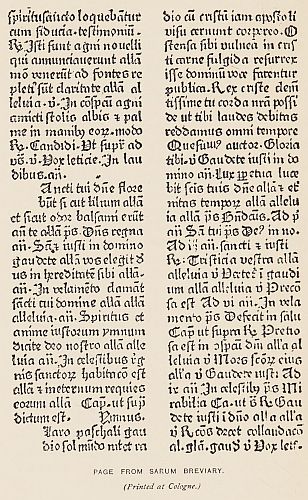
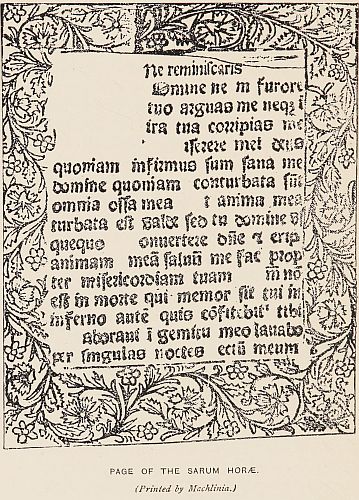
PAGE FROM SARUM BREVIARY.
(Printed at Cologne.)
Now, there is a Latin edition, evidently printed
at Cologne about the time that Caxton was there,
in a type almost identical with that of N. Gotz or
the printer of the Augustinus de fide; and it was
in conjunction with a very similar type, in 1476,
that the ‘gros bâtarde’ type, which is so intimately
connected with Caxton, first appeared. Though
Caxton worked in partnership with Colard Mansion
about 1475-77, he had probably learnt something
of the art before; and, taking into consideration
his journey to Cologne, the statement of Wynkyn
de Worde, and the typographical connexion between
the Bartholomæus and Caxton’s books, we may
safely say that the story cannot be put aside as
without foundation. It is not, of course, suggested
that Caxton printed the book by himself, but only
that he assisted in its production. He was learning
the art of printing in the office where this book
was being prepared, and his practical knowledge was
acquired by assisting to print it.
Another Cologne book which may have been
printed for Caxton, or produced through his means,
is the first edition of the Breviary according to the
use of Sarum. Unfortunately we only know of its
existence through a few leaves in the libraries at
Oxford, Cambridge, Lincoln, and Paris, and have
therefore no means of knowing by whom it was
printed, or whether it had any colophon at all. It
is a quarto, printed in two columns, and with thirty-one
lines to the column. Such a book would hardly
have been printed without the help of an English
stationer,—and who more likely than Caxton?
In 1477 an eventful change took place in Caxton’s
career. ‘On June 21, 1476, was fought the bloody
battle of Morat between the Duke of Burgundy and
the Swiss, which resulted in the ruin of the Burgundian
power. In the following January, the Duke, while
engaged in a murderous battle at Nanci, was overpowered
and fell, covered with wounds, stubbornly
fighting to the last. Caxton’s mistress was now no
longer the ruling power at the court of Bruges. The
young daughter of the late Duke succeeded as the
reigning sovereign, and the Dowager Duchess of
Burgundy resigned her position at court, retiring into
comparative privacy on a handsome jointure. Caxton’s
services as secretary would now be no longer required
by the Duchess in her altered position.’[31]
Early, therefore, in 1477, Caxton returned to
England, and set up his press in the Almonry at
Westminster. On 18th November of the same year
he finished printing the Dictes or Sayengis of the
Philosophers, the first book printed in England.
Copies of this book vary, some being without the
imprint. This was followed by an edition of the
Sarum Ordinale, known now only from fragments,
and the curious little ‘cedula’ relating to it, advertising
the ‘pyes of two or three commemorations.’
The productiveness of Caxton’s press in its earliest
years was most remarkable, for we know of at least
thirty books printed within the first three years. A
good many of these, however, were very small, the
little tracts of Chaucer and Lydgate containing but a
few leaves each. These were the ‘small storyes and
pamfletes’ with which, according to Robert Copland,
Caxton began his career as printer. On the other
hand, we have the History of Jason (150 leaves), The
Canterbury Tales (374 leaves), Chaucer’s Boethius (94
leaves), the Rhetorica Nova of Laur: Gulielmus de
Saona (124 leaves), the Cordyal (78 leaves), the
second edition of the Dictes or Sayengis (76 leaves),
and the Chronicles of England (182 leaves).
The starting of Lettou’s press in London, in 1480,
may probably account for some of the changes introduced
by Caxton in that year. His first indulgence,
printed this year in the large type, was at once thrown
into the shade by the editions of the same indulgence
issued by Lettou in his small neat letter, which was
much better adapted for such work. Lettou also in
this year used signatures, Caxton doing the same.
The competition caused Caxton to make his fount of
small type, and to introduce many other improvements.
It was about this time that he introduced
woodcuts into his books; and the first book in which
we find then is the Mirrour of the World. The cuts
in this volume may be divided into two sets, those
given for the first time by Caxton, and those copied
from his predecessors. The first are ordinary woodcuts,
the second what we should call diagrams. The
woodcuts are of the poorest design and coarsest execution.
Several are of a master with four or five
pupils, others of single figures engaged in scientific
pursuits. The diagrams are more or less carefully
copied from the MSS.: they are numbered in the
table of contents as being eight in part I., nine in
part II., and ten [X. being misprinted for IX.] in
part III. Of the eight belonging to part I., Nos.
2 and 3 are put to their wrong chapters, and consequently
No. 4 is omitted altogether. The diagrams
to part II. are wrongly drawn, and in some cases
misplaced. The nine diagrams to part III. are the
most correct. Some writers have contended that the
cuts in Caxton’s books are from metal and not from
wood-blocks; but some of them which are found in
use at a considerably later date show marks of worm
holes; a conclusive proof of the material being wood.
To the year 1480 we can ascribe seven books, almost
all in the new type, No. 4. These are the French and
English phrase-book, Lidgate’s Curia Sapientiæ, the
Chronicles of England, and the Description of Britain;
and three liturgical books, the De Visitatione B.M.V.,
the Psalterium, and a Horæ ad usum Sarum, the two
latter printed in type 3. Of the Horæ, but a few
leaves are known, which formed part of the wonderful
find of fragments in the binding of a copy of
the Boethius at St. Albans Grammar School. This
volume was found by Mr. Blades in 1858, and from the
covers were taken no less than fifty-six half sheets of
printed paper, proving the existence of three works
from Caxton’s press quite unknown before, the Horæ
above mentioned, the Ordinale, and an indulgence of
Pope Sixtus IV.
About 1481 appeared the first English edition of
Reynard the Fox; and in that year two other books,
both dated, Tully of Old Age, and the Siege of
Jerusalem.
These were followed by the Polycronicon, the
Chronicles of England (edit. 2), Burgh’s Cato, and
the second edition of the Game of the Chesse, which
is illustrated with woodcuts, the first edition having
none. There are altogether sixteen different woodcuts
used in the volume, and eight occur twice.
Between 1483 and the end of 1485, Caxton was at
his very busiest, issuing in that time about twenty-two
books; and amongst them are some of the most
important. There are the Pilgrimage of the Soul, the
Festial and Quattuor Sermones, the Sex Epistolæ, of
which the unique copy is now in the British Museum;
the Lyfe of Our Lady, the second edition of the
Canterbury Tales (the first with woodcuts), Chaucer’s
Troilus and Cresida and Hous of Fame, the Confessio
Amantis, the Knight of the Tower, and Æsop’s Fables.
This book, which appeared 26th March 1484, has
a full page frontispiece and no less than 185
woodcuts, the work of two, if not three, different
cutters. They are of the very poorest execution,
and not original in design, being more or less
carefully copied from a foreign edition. The
whole of the earlier part of 1485 must have been
expended upon the production of the Golden Legend,
the largest book which issued from Caxton’s press.
It contains 449 leaves, and is printed on a much
larger sheet than was generally used by Caxton
for folios, the full sheet measuring as much as
24 inches by 16 inches. It has, as illustrations, a
large cut for the frontispiece, representing heaven,
and two series of eighteen large and fifty-two
small cuts, the large series including one of the
device of the Earl of Arundel, to whom the book is
dedicated. Most copies of the Golden Legend now
in existence are made up partly of this and partly of
the second edition. As far as can be judged, the distinguishing
mark is the type of the headlines, which
in the first edition are in type 3, and in the second
edition in type 5. No copy is known made up
entirely of one edition.
For the latter part of 1485 we have three dated
books, the Morte d’Arthur (31st July), the only
perfect copy of which is now, unfortunately, in
America; the Life of Charles the Great (1st
December), the only existing copy of which is in the
British Museum; and The Knight Paris and the Fair
Vienne (19th December), of which again the only
known copy is in the British Museum.
In 1487, Caxton tried a new venture, and had
printed for him at Paris, by George Maynyal, an
edition of the Sarum Missal. Only one copy is
known, slightly imperfect, which is in private hands.
In this book, for the first time, Caxton used his
well-known device, probably for the purpose of
emphasising what might easily have been overlooked,—that
the book was printed at his expense. So
much has been written on Caxton’s device, and such
extraordinary theories made about its hidden meanings,
that it may be as well to point out that it
consists simply of his mark standing between his
initials, with a certain amount of unmeaning ornament.
It was probably cut in England, being
coarsely executed, while those used in France at
the same time are well cut and artistic. About
1487-88 we find two more books ornamented with
woodcuts, the Royal Book and the Speculum Vite
Christi. The Speculum contains a number of well-executed
cuts, the Royal Book only seven, six of
which had appeared in the Speculum.
About 1488 a second edition of the Golden Legend
was issued, almost exactly the same as the first, but
with the life of St. Erasmus added, so that this edition
does not end, like the first, with a blank leaf. At the
time of Caxton’s death, he seems to have had a large
stock of this book still on his hands, for he left
fifteen copies to the Church of St. Margaret, and a
large number of copies to his daughter Elizabeth, the
wife of Gerard Croppe, a tailor in Westminster. It
is hard to understand how, with this large stock still
for sale, Wynkyn de Worde could afford to print a
new edition in 1493 and another in 1498; for even at
the latter date copies of Caxton’s edition were, as we
happen to know, still to be obtained.
To about this time may be ascribed the curious
Image of Pity in the University Library, Cambridge.
It is not printed on a separate piece of paper, but is a
sort of proof struck off on the blank last page of a
book with which the indulgence has nothing to do.
The book is a copy of the Colloquium peccatoris et
Crucifixi J. C., printed at Antwerp by Mathias van
der Goes about 1487, which must have been accidentally
lying near when the printer wanted something
to take an impression upon.[32]
In 1489, Caxton printed two editions of an indulgence
of great typographical interest. This indulgence
was first noticed by Dr. Cotton, who mentions
it in his Typographical Gazetteer under Oxford, supposing
it to have been printed at that place. Bradshaw,
on seeing a photograph of it, at once conjectured
from the form and appearance of the type that it was
printed by Caxton, though Blades refused to accept
it as a product of his press without further proof, and
it was never admitted into any of his books on
Caxton. The same type was afterwards found by
Bradshaw used for sidenotes in the 1494 edition of
the Speculum Vite Christi, printed by W. de Worde,
and the type being in his possession at that date,
could have belonged in 1489 to no one but Caxton.
In a list of Caxton’s types this type would be
known as type 7.
In addition to these two indulgences, a number of
books may be assigned to this year. The Fayttes of
Arms is dated; but besides this there are the Statutes
of Henry VII., the Governayle of Health, the Four
Sons of Aymon, Blanchardyn and Eglantyne, Directorium
Sacerdotum, second edition, the third edition
of the Dictes or Sayengis, the Doctrinal of Sapience,
and an Image of Pity printed on one leaf. The
second edition of Reynard the Fox, known only from
the copy preserved in the Pepysian Library, may also
be assigned to this year. With the exception of the
Eneydos, the remainder of Caxton’s books are of a
religious or liturgical character. Amongst them we
must class an edition probably of the Horæ ad usum
Sarum not mentioned by Blades; for though no copy
or even fragment is now known, it is certain that such
a book was printed. A set-off from a page of it was
discovered by Bradshaw on a waste sheet of the
Fifteen Oes. All that could be certainly distinguished
was that it was printed in type 5, that there were
twenty-two lines to a page, and that each page was
surrounded by a border.
The Fifteen Oes itself is a most interesting book.
It was printed originally, no doubt, as an extra part
for an edition of the Horæ ad usum Sarum now
entirely lost. It contains a beautifully executed
woodcut of the crucifixion,—one of a series of five
which occur complete in a Horæ printed by Wynkyn
de Worde in 1494, and it is also the only existing
book from this press which has borders to the
pages. Caxton printed altogether about one hundred
books, using in them altogether eight types. Blades
gives ninety-nine books printed by Caxton, two of
which were certainly printed by his associate in
Bruges after Caxton had left for England. On the
other hand, he does not mention the newly-discovered
Grammar, the two editions of the Indulgence
of 1489, a second edition of the Lyf of our Lady,
known from a fragment in the Bodleian, and one or
two other indulgences. One or two books which
Blades includes were printed undoubtedly by De
Worde, such as the Book of Courtesye (which, indeed,
contains his small device), The Chastysing of God’s
Children, and the Treatise of Love. The genuine
Caxtons catalogued by Blades number ninety-four.
As regards types, Blades gives six of Caxton’s,
and a seventh which he conjectures only to have
been used by Wynkyn de Worde, though in this he
was mistaken, for it occurs in books printed while
Caxton was alive. Again, the type of the 1489
Indulgence which he does not mention, was conclusively
proved by Bradshaw to be one of Caxton’s
types. This type should be considered as type 7,
and the former type, which does not appear until
1490-91, as type 8. The woodcut initials which occur
in the Chastysing of God’s Children were not used till
after Caxton’s death.
But while we venerate Caxton as our first printer,
we must not overlook the claims which he has upon
us as a translator and editor. Wonderful as his
diligence in press-work may appear, it is still more
wonderful to consider how much literary work he
found time to do in the intervals of his business. He
was the editor of all the books which he printed, and
he himself translated no less than twenty-two, including
that great undertaking the Golden Legend. Even
on his deathbed he was still at work, as we learn
from the colophon of the Vitas Patrum, printed by
Wynkyn de Worde in 1495: ‘Thus endyth the
moost vertuouse hystorye of the deuoute and right
renowned lyves of holy faders lyvynge in deserte,
worthy of remembraunce to all wel dysposed persones,
which hath ben translated oute of Frenche into
Englysshe by William Caxton of Westmynstre late
deed and fynysshed at the laste daye of hys lyff.’
On Caxton’s death, in 1491, his materials passed
into the hands of Wynkyn de Worde, his assistant,
who continued to print in the same house at Westminster.
Up to 1493 he continued to use Caxton’s
type, with the addition of some woodcut initials
obtained from Godfried van Os, from whom he also
obtained a complete set of type, which was not used
till 1496, and then only for printing one book.
W. de Worde, though he must have lived for
some time previously in England, only took out
letters of denization in 1496. The grant is dated
20th April to ‘Winando de Worde, de ducatu
Lothoringie oriundo, impressori librorum.’
The earliest books which he printed have no name,
and are all in Caxton’s type, Nos. 6 and 4*, but with
some additional types which distinguish his works
from Caxton’s.
From the time of Caxton’s death, in 1491, to the
time when his own name first appears in an imprint,
Wynkyn de Worde printed five books. They are the
Chastysing of God’s Children, the Treatise of Love,
and the Book of Courtesye, all printed in type 6; and
the Golden Legend and the Life of St. Catherine,
printed in a modification of type 4*, a type which is
used in no other books. The Chastysing is interesting
as having a title-page, the first in any book from this
office; while in the Book of Courtesye we find the device
of W. de Worde used for the first time.
In 1493 we find for the first time a book containing
De Worde’s name. This is the Liber Festivalis,
probably printed towards the end of the year, for the
Quattuor Sermones, generally issued with it, is dated
1494. The next book to appear was Walter Hylton’s
Scala Perfectionis; and in the same year was issued
a reprint of Bonaventura’s Speculum Vite Christi, a
book of very great interest, for the sidenotes are
printed with the type which Caxton used for his
Indulgence of 1489, and which was used for no other
book than this. To this year 1494 we may ascribe a
beautiful edition of the Sarum Horæ, adorned with
woodcuts and borders, nearly all of which were inherited
from Caxton. The type which De Worde
used for these books seems to have come into Caxton’s
hands from France, during the last year of his life,
and resembles closely certain founts which belonged
to the Paris printers P. Levet and Higman, if indeed
it is not the same. After 1494, De Worde discarded
it, using it only occasionally for headings or titles.
Blades wrongly says that the use of this type separates
the early W. de Worde books from the Caxton’s;
but Caxton certainly possessed and used it. The
distinctive mark of the early Wynkyn de Worde
books is the use of the initials obtained from G. van
Os. Bradshaw, speaking of these, says, ‘Indeed, the
woodcut initials are what specially serve at once to
distinguish W. de Worde’s earliest from Caxton’s
latest books.’
In 1495 we have three dated books, the Vitas
Patrum, which Caxton was engaged in translating up
to the day of his death; Higden’s Polycronicon, the
first English book containing musical notes, and
the Directorium Sacerdotum. Besides these, a fair
number of undated books may be ascribed to this
year or the year after. The most important is the
Bartholomæus, De Proprietatibus Rerum. Apart
from its ordinary interest, it is considered to be the
first book printed on paper made in England.
‘And John Tate the younger, joye mote he broke,
Whiche late hath in Englond doo made this paper thynne
That now in our englisshe this boke is prynted Inne.’
In 1496 appeared the curious reprint of the Book of
St. Albans. It seems never to have been noticed
that this book is entirely printed with the type
which was obtained from Godfried van Os about the
time of his removal to Copenhagen. Besides the
Book of St. Albans, it has an extra chapter on fishing
with an angle, the first treatise on the subject in
English. An edition of the Dives and Pauper, with a
handsome title-page, was issued this year, as well as
a number of smaller books of considerable interest, as
the Constitutions of Lyndewode, the Meditacions of
St. Bernard, and the Festial and Quattuor Sermones.
Among the dated books of 1497 are the Chronicles of
England, an edition copied from the one printed at
St. Albans; and it is from the colophon to this edition
that we learn that the printer at St. Albans was
‘sometyme scole mayster’ there.
In 1498 three large and important books were
printed; of these the first was an edition of the Golden
Legend, of which only one perfect copy is known, in
the Spencer Collection; the next, a second edition
of the Morte d’Arthur, the first illustrated with woodcuts.
The only known copy of this book, wanting
ten leaves, is also in the Spencer Library. The third
book was an edition of the Canterbury Tales. In
1499 a large number of books were printed, the most
curious being an edition of Mandeville’s Travels,
illustrated profusely with woodcuts of the wonders
seen by the traveller, who got as far as the walls of
Paradise, but did not look in. Of this book two
copies, both imperfect, are known. A Book of Good
Manners and a Psalterium, both known from single
copies, were also printed in this year. An Ortus
Vocabulorum, printed in 1500, is the last book which
was issued by De Worde at Westminster. Altogether,
from 1491 to the time he left Caxton’s old
house at Westminster, W. de Worde printed about a
hundred books, certainly not less; and he also had a
few books printed for him, and at his expense, by
other printers.
In a very large number of De Worde’s early books
he inserted the cut of the crucifixion, which is first
found in Caxton’s XV Oes. In 1499 the block split
at the time when they were printing an edition of
the Mirror of Consolation, sometime after the 10th
July, so that all the books which contain the cut in
its injured state must be later than 10th July 1499.
The year 1500 gives us an excellent date-mark for
W. de Worde’s books, for in that year he moved from
Westminster ‘in Caxton’s house,’ to London, in Fleet
Street, at the sign of the Sun. Upon moving he
seems to have destroyed or disposed of a good deal of
printing material. Some of his woodcuts passed to
Julian Notary, who was also at that time a printer in
Westminster. One of his marks and some of his
type disappear entirely at this time. The type which
he had used in the majority of the books printed in
the last few years of the fifteenth century we find in
use up to 1508 or 1509, when it disappears from
London to reappear at York; but his capitals and
marks had changed. From 1504 onward he used in
the majority of his books the well-known square
device in three divisions, having in the upper part the
sun and moon and a number of stars, In the centre
the W. and C. and Caxton’s mark; below this the
‘Sagittarius’ shooting an arrow at a dog. It has not
hitherto been noticed that of this device there are
three varieties, identical to a superficial view, yet
quite distinct and definitely marking certain periods.
The first variety in use from 1505 to 1518 has in the
upper part eleven stars to the left of the sun and
nine to the right, while the white circular inlets at
the ends of the W. are almost closed. The second
variety used from 1519 to the middle of 1528 has the
same number of stars, but the circular inlets at the
ends of the letters are more open. The last variety
has ten stars to the left of the sun and ten to the right.
It was used from 1528 to the time of De Worde’s
death. In the colophons of some of his early books
De Worde mentions that he had another shop in St.
Paul’s Churchyard, with the sign of Our Lady of
Pity.
Wynkyn de Worde was essentially a popular
printer, and he issued innumerable small tracts;
short romances in prose and verse, books of riddles,
books on carving and manners at table, almanacs,
sermons, grammars, and such like. Many of these
books were translations from the French, and were
made by Robert Copland, who was one of De
Werde’s apprentices. The later books of De Worde
are often puzzling. He seems to have employed
John Scot to print for him, and many books which
have only De Worde’s name are in Scot’s type. One
book is particularly curious. It is an edition of The
Mirror of Golde for the Sinful Soul, 29th March 1522.
Some copies have a colophon, ‘Imprinted at London
withoute Newgate, in Saint Pulker’s Parysche, by John
Scot.’ Other copies have the first sheet and the last
leaf reset, while the colophon runs, ‘Imprinted at
London in Fletestrete, at the sygne of the Sone, by
Wynkyn de Worde.’
De Worde died at the end of 1534. His will is
dated 5th June 1534, and it was proved 19th January
1535. His executors were John Bedill, who succeeded
him in business, and James Gaver, probably a bookbinder,
and one of the numerous family of that name
who exercised their craft in the Low Countries. In
the forty years that he printed, Wynkyn de Worde
produced over six hundred books, that is, more than
fifteen a year, a much higher average than any other
early English printer attained.
About the year 1496 three printers started in partnership
at the sign of St. Thomas the Apostle in
London. They were Julian Notary, Jean Barbier,
and a third whose name is not known, but whose
initials were I. H., and who may perhaps have been
Jean Huvin. The first book which they printed was
the Questiones Alberti de modis significandi, a quarto
of sixty leaves, printed in a clear, handsome black
letter. At the end of the book is a printer’s mark,
with the initials of the printers, but there is no colophon
to tell us either their names or the date of
printing. In 1497 they issued an edition of the
Horæ ad usum Sarum, printed, as we learn from
the colophon, for Wynkyn de Worde. The same
printer’s mark is in this book, but again we have no
information about the names of the printers. In
1498 the firm had changed,—I. H. had left, and the
two remaining printers, Notary and Barbier, had
moved to Westminster, perhaps in order to be nearer
the printer for whom they worked. In this year
they printed an edition of the Sarum Missal for
Wynkyn de Worde, and after this Jean Barbier
returns to France, leaving Notary at Westminster by
himself. There he continued to print up to some
time before 1503, and in that year we find him living
‘without Temple Bar, in St. Clement’s Parish, at
the sign of the Three Kings.’ Before moving, he
had printed, besides the books mentioned above, a
Festial and Quattuor Sermones in 1499, a Horæ ad
usum Sarum in 1500, and the Chaucer’s Complaint
of Mars and Venus, without date. About this time
he obtained some woodcuts from Wynkyn de Worde,
and we find them used in the first book he printed
at his new address, the Golden Legend of 1503[4],
and in it also are to be found some very curious
metal cuts in the ‘manière criblée.’ An undated
Sarum Horæ, in which the calendar begins with
1503, should most probably be put before the Golden
Legend. From 1504 to 1510 Notary printed about
thirteen books, and in that latter year (as we learn
from the imprint of the Expositio Hymnorum) he
had, besides his shop without Temple Bar, another
in St. Paul’s Churchyard, of which the sign was also
the Three Kings.
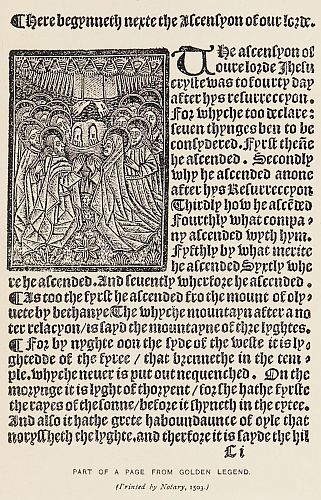
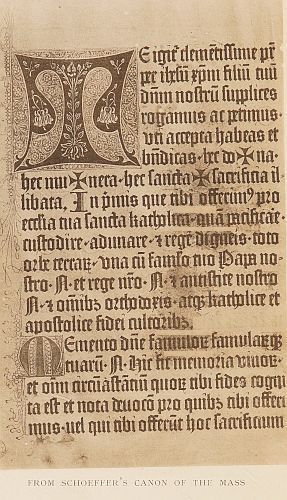
PART OF A PAGE FROM GOLDEN LEGEND.
(Printed by Notary, 1503.)
Between 1510 and 1515, Notary issued no dated
book, but in the latter year appeared the Chronicles
of England, and in the year following two Grammars
of Whittington. The old printing-office ‘Extra
Temple Bar’ seems to have been given up, for at
this time Notary was printing in Paul’s Churchyard,
at the sign of St. Mark. After 1518 there is another
interval of three years without a dated book; but
between 1518 and 1520 several were issued from the
sign of the Three Kings in Paul’s Churchyard, and
after that Notary printed no more. His movements
from place to place are difficult to understand. In
1497 he is in London at the sign of St. Thomas
Apostle, in 1498 at Westminster in King Street.
About 1502-3, he moves to a house outside Temple
Bar, the one probably that Pynson had just vacated.
In 1510, while still printing at the same place, he
had a shop in St. Paul’s Churchyard at the sign of
the Three Kings. In 1515 he is at the sign of St.
Mark in Paul’s Churchyard, in 1518 again at the
Three Kings. It seems probable that some of his
productions must have entirely disappeared, otherwise
it is hard to account for the number of blank
years.
The latest writer on Julian Notary conjectures that
the sign of St. Mark and the sign of the Three Kings
were attached to the same house; that Julian Notary,
on moving to Paul’s Churchyard, went to a house
with the sign of St. Mark, and after printing under
that sign for two years, altered it, for commercial
reasons, to his old emblem of the Three Kings.
This is ingenious, but impossible, for the writer has
ignored the fact that Notary had a shop in St. Paul’s
Churchyard at the Three Kings five years before we
hear of the one with the sign of St. Mark.