The second appearance of London in history springs out of the revolt of the Iceni
under Boudicca, or, as her name is Latinised, Boadicea. She was the widow of
Prasutagus, King of the Iceni, who bequeathed his kingdom, hoping thereby to
make the possession safe, to the Roman Cæsar jointly with his wife and daughters.
The precaution proved useless. His kingdom was pillaged by the captains, and his
wife and daughters were dishonoured. With the swiftness of a summer storm, the
Britons from Norfolk, from the fens, from the north, rose with one consent and
poured down upon the Roman colony. The town of Camulodunum was unfortified;
there were no troops except the veterans. Suetonius Paulinus was far away in
North Wales when the great revolt broke out. The veterans fought for their lives:
those were happy who fell in battle: the prisoners were tortured to death; the
women and children were slaughtered like the rest; the 9th Legion, marching to
relieve the colony, was cut to pieces, only the cavalry escaping.
Paulinus hastened to London—observe that on its first appearance in history
London is a large town. But he judged it best not to make this place his seat of
war, and marched out, in spite of the prayers of the inhabitants. He allowed,
however, those who wished to follow with the army. As soon as the Roman army
was out of the town, the Britons—there was clearly more than one army of rebels—entered
it and slaughtered every man, woman, and child. At the same time they
entered Verulam and murdered all the population. Over 70,000 people are said to
have been massacred in the three towns of London, Camulodunum, and Verulam. We
need not stop to examine into the figures. It is enough that the three towns were
destroyed with, we are told, all their inhabitants. The battle at which Suetonius
Paulinus defeated the rebels was decisive. The captive Queen killed herself; the
tribes dispersed. Then followed a time of punishment; and, as regards London,
some must have escaped, for those who still lived went back to the City, rebuilt
their houses, and resumed their ordinary occupations.
The Roman conquest, however, was by no means complete. That remained to
be accomplished by Agricola. There was continual trouble north of Hadrian’s Wall,
but the rest of the island remained in peace for more than a hundred years after the
defeat of Boadicea. As for London, the City increased every year in wealth and
population. The southern part of the island became rapidly Romanised; tranquillity
and order were followed by trade and wealth; the country was quickly covered with
populous and prosperous towns; the Roman roads were completed; the Roman
authority was everywhere accepted.
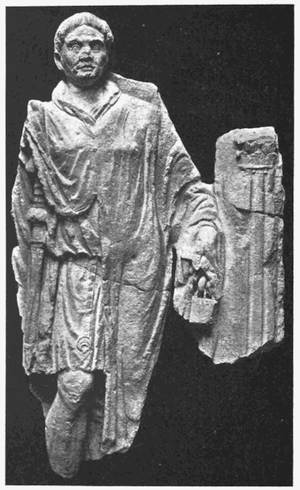
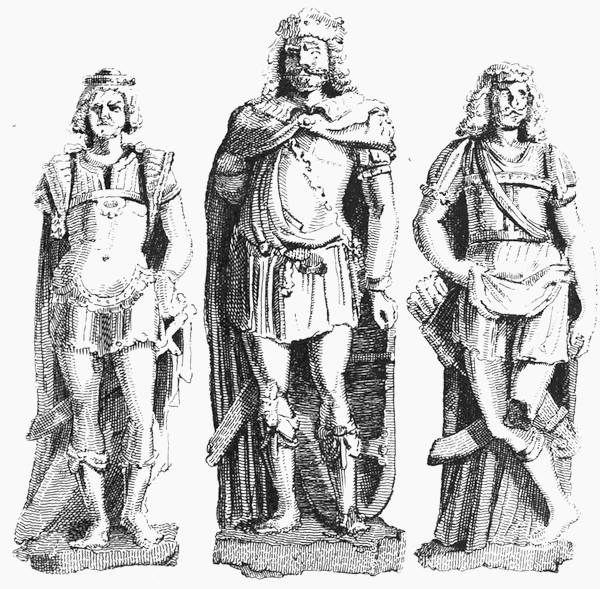
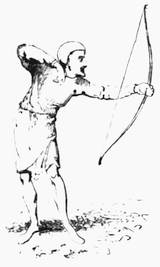
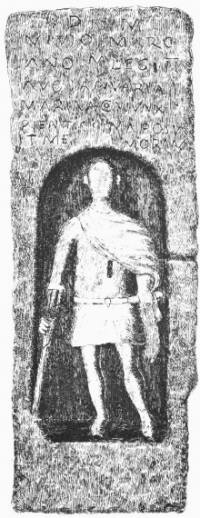
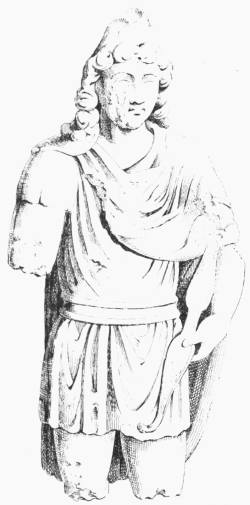
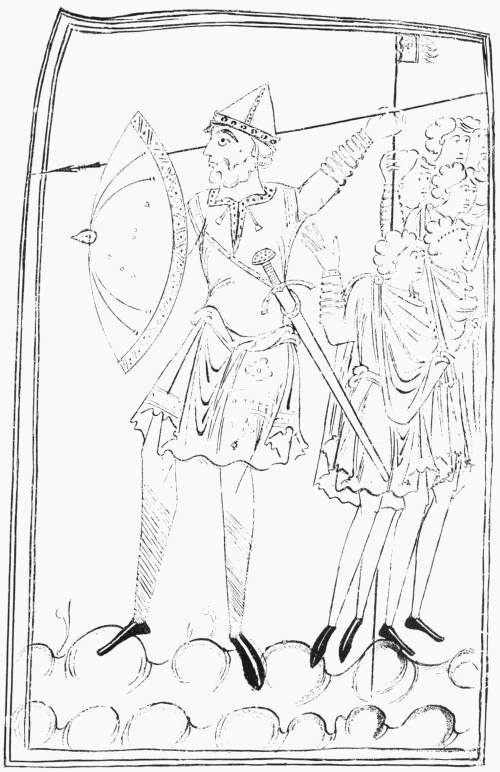
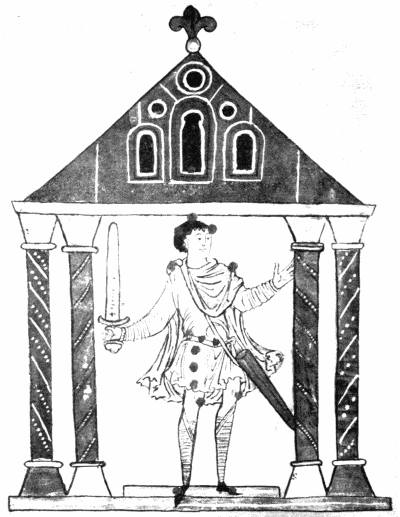
STATUE OF A ROMAN WARRIOR FOUND IN A BASTION OF THE LONDON WALL
The distribution of the Roman legions after the defeat of the British Queen is
significant. Five only remained: the 2nd, stationed at Isca Silurum—Caerleon;
the 6th and 9th, at York; the 14th, at Colchester for a time until it was sent
over to Germany; and the 20th, at Deva—Chester. There was no legion in the east—the
country of Queen Boadicea; therefore there was no longer anything to fear
from that quarter. There was none in London; there was none in the south country.
In addition to the legions there were troops of auxiliaries stationed along the two
walls of Antoninus and Hadrian, and probably along the Welsh frontier.
We may pass very briefly in review the leading incidents of the Roman occupation,
all of which are more or less directly connected with London.
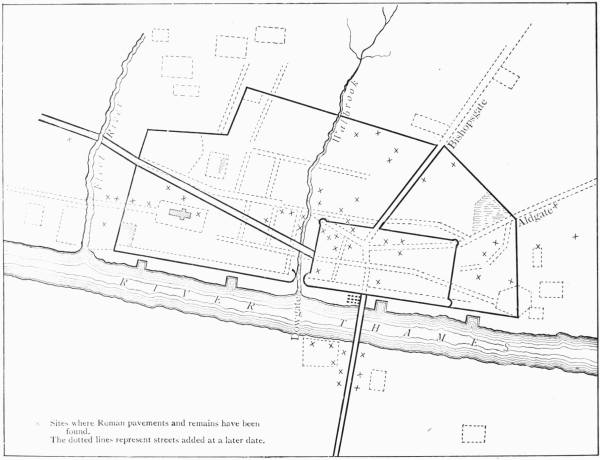
There can be little doubt that after the massacre by the troops of Boadicea the
Romans built their great fortress on the east side of the Walbrook. Some of the
foundations of the wall, of a most massive kind, have been found in five places. The
fortress, which extended from the Walbrook to Mincing Lane, and from the river to
Cornhill, occupied an area of 2250 by 1500 feet, which is very nearly the space
then considered necessary in laying out a camp for the accommodation of a complete
legion. It seems as if the Romans had a certain scale of construction, and laid out
their camps according to the scale adopted.
Within this fortress were placed all the official courts and residences: here was
the garrison; here were the courts of law; this was the city proper. I shall
return to the aspect of the fort in another chapter.
We may safely conclude that the massacre of London by the troops of Boadicea
would not have occurred had there been a bridge by which the people could escape.
It is also safe to conclude that the construction of a bridge was resolved upon and
carried out at the same time as that of the fortress. In another place will be found
my theory as to the kind of bridge first constructed by the Roman engineers. In
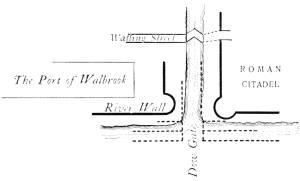
this place we need only call attention to the fact of the construction and to the gate
which connected the fort with the bridge.
After the campaigns of Agricola, history speaks but little of Britain for more
than half a century; though we hear of the spread of learning and eloquence in the
north and west:—
Nunc totus Graias nostrasque habet orbis Athenas;
Gallia causidicos facunda Britannos;
De conducendo loquitur jam rhetore Thule.
And Martial says, with pride, that even the Britons read his verses:—
Dicitur et nostros cantare Britannia versus.
These, however, may be taken as poetic exaggerations.
The Romans, it is quite certain, were consolidating their power by building
towns, making roads, spreading their circle of influence, and disarming the people.
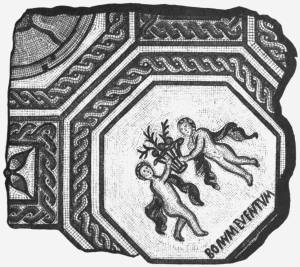
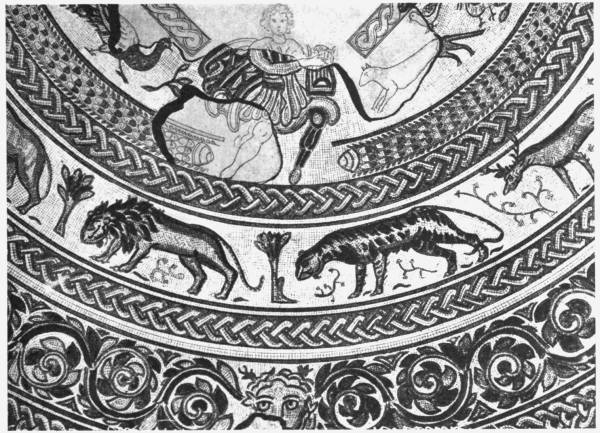
It has been remarked that the tessellated pavements found in such numbers frequently
represent the legend of Orpheus taming the creatures—Orpheus was Rome; the
creatures were her subjects.
The first half-century of occupation was by no means an unchequered period of
success: the savage tribes of the north, the Caledonii, were constantly making raids and
incursions into the country, rendered so much the easier by the new and excellent
high roads.
In the year 120, Hadrian visited Britain, and marched in person to the north.
As a contemporary poet said—
Ego nolo Cæsar esse,
Ambulare per Britannos,
Sythicas pati pruinas.
He built the great wall from the Solway to the Tyne: a wall 70 miles long,
with an earthen vallum and a deep ditch on its southern side, and fortified by twenty-three
stations, by castles, and wall towers.
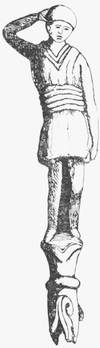
ROMAN KNIFE-HANDLE
—FIGURE OF
CHARIOTEER,
BRONZE
In the collection of
C. Roach Smith, Esq., F.S.A.
Twenty years later, the Proprætor, Lollius Urbicus, drove the Caledonians
northwards into the mountains, and connected the line of forts
erected by Agricola from the Forth to the Clyde by a massive
rampart of earth called the wall of Antoninus.
Again, after twenty years, the Caledonians gave fresh trouble,
and were put down by Ulpius Marcellus under Commodus. On
his recall there was a formidable mutiny of the troops. Pertinax,
afterwards, for three short months, Emperor, was sent to quell the
mutiny. He failed, and was recalled. Albinus, sent in his place,
was one of the three generals who revolted against the merchant
Didius Julianus, when that misguided person bought the throne.
At this time the Roman province of Britain had become
extremely rich and populous. Multitudes of auxiliary troops had
been transplanted into the island, and had settled down and
married native women. The conscription dealt with equal rigour
both with their children and the native Britons. Albinus, at the
head of a great army, said to have consisted of 150,000 men,
crossed over to Gaul and fought Severus, who had already defeated
the third competitor, Niger, at Lyons, when he too met with
defeat and death.
Severus, the conqueror, came over to Britain in 208-209. His
campaign in the north was terminated by his death in 212.
For fifty years the island appears to have enjoyed peace and prosperity. Then
came new troubles. I quote Wright15 on this obscure period:—
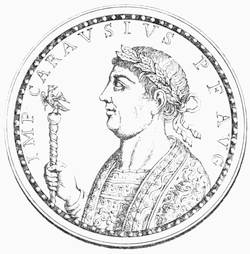
CARAUSIUS
From Dr. Stukeley’sMedallic History of Carausius.
“Amid the disorder and anarchy of the reign of Gallienus (260 to 268), a
number of usurpers arose in different parts of the Empire, who were popularly
called the thirty tyrants, of whom Lollianus, Victorinus, Postumus, the two Tetrici,
and Marius are believed on good grounds to have assumed the sovereignty
in Britain. Perhaps some of these rose up as rivals at the same time; and from
the monuments bearing the name of Tetricus, found at Bittern, near Southampton,
we are perhaps justified in supposing that the head-quarters of that commander lay
at the station of Clausentum and along the neighbouring coasts. We have no
information of the state of Britain at this time, but it must have been profoundly
agitated by these conflicting claimants to empire. Yet, though so ready to rise in
support of their own leaders, the troops in Britain seem to have turned a deaf ear to
all solicitations from without. When an officer in the Roman army, named Bonosus,
born in Spain, but descended of a family in Britain, proclaimed himself Emperor, in the
reign of Aurelian, and appealed for support to the western provinces, he found no
sympathy among the British troops. Another usurper, whose name has not been
recorded, had taken advantage of his appointment to the government of the island by
the Emperor Probus to assume the purple. The frequency of such usurpations within
the island seem to show a desire among
the inhabitants to erect themselves into
an independent sovereignty. We are told
that a favourite courtier of Probus, named
Victorinus Maurusius, had recommended
this usurper to the proprætorship, and that,
when reproached on this account by the
Emperor, Victorinus demanded permission
to visit Britain. When he arrived there, he
hastened to the Proprætor, and sought his
protection as a victim who had narrowly
escaped from the tyranny of the Emperor.
The new sovereign of Britain received him
with the greatest kindness, and in return
was murdered in the night by his guest.
Victorinus returned to Rome to give the
Emperor this convincing proof of his ‘loyalty.’ Probus was succeeded in the Empire
by Carus, and he was followed by Diocletian, who began his reign in the year 284,
and who soon associated with himself in the Empire the joint Emperor Maximian.
Their reign, as far as regards Britain, was rendered remarkable chiefly by the
successful usurpation of Carausius.”
By far the most remarkable of the British usurpers whose history is connected
with that of London was Carausius.
This successful adventurer belonged to a time when there sprang up every day
gallant soldiers, men who had risen from the ranks, conspicuous by their valour,
fortunate in their victories, beloved and trusted by their soldiers. The temptation
to such an one to assume the purple was irresistible. Examples of such
usurpation were to be found in every part of the unwieldy Empire. To be sure
they ended, for the most part, in defeat and death. But, then, these men had been
facing death ever since they could bear arms. On any day death might surprise them
on the field. Surely it was more glorious to die as Imperator than as the mere
captain of a cohort. Such usurpers, again, held the crown as they won it, by the
sword. They were like the King of the Grove, who reigned until a stronger than he
arose to kill him. Carausius was a King of the Grove.
His history, so far as it has been told at all, is written by his enemies. But he
was an important man. During his time of power he caused an immense number of
coins to be struck, of which there remain some three hundred types. These were
arranged about the year 1750 by that eminent antiquary Dr. Stukeley, who not only
figured, described, and annotated them, but also endeavoured to restore from the
coins the whole history of the successful usurper. Dr. Stukeley—a thing which is rare
in his craft—possessed the imagination of a novelist as well as the antiquary’s passion
for the chase of a fact.
Carausius was a Briton, born in Wales, at the city now called St. David’s.
He was of royal descent. He was of noble presence and great abilities. Maximian
found it necessary to continue him in his commands, and bestowed upon him the
distinction of a command in the Empress’s Regiment, the Ala Serena—Diocletian’s
wife was named Eleutheria Alexandra Serena,—and committed to him the conduct
of the expedition against the revolted Gauls. Carausius executed his trust faithfully
and effectually. In reward for this service Maximian appointed him to the important
dignity of Comes littoris Saxonici, with command of the fleet, whose duty it was to
beat back the pirates always cruising about the narrow seas in search of booty. The
head-quarters of the fleet were at Gesoriacum (Boulogne), a central position for operations
in the Channel or the North Sea.
In the following year Carausius again fought loyally on the side of Maximian.
But, says Stukeley, “in person, character, and behaviour he so outshone the
Emperor that he exercised an inveterate envy against him.” Shortly afterwards
Carausius, being informed that the Emperor’s purpose was to murder him, called his
officers together, harangued them, gained them over, secured the fortifications of
Boulogne, and awaited events. Maximian prepared to attack him, but was prevented
by a mutiny of the troops. Carausius, who had now the 4th Legion and many other
troops, was saluted Emperor, and in September A.D. 288 he crossed the Channel, bringing
with him the whole of the fleet. It was the most serious rebellion possible, because
it could not be put down so long as Carausius maintained by his fleet the command
of the sea. It may be doubted whether the joy of London which Dr. Stukeley sees
recorded on the coins in consequence of this arrival was real or only official. One
thing is certain, there had been a revolt in Britain on account of the tyranny of the
Roman Præfect. This was put down, but not by Carausius. He did not enter the
country as its conqueror, in which case his welcome would not have been joyous: he
was the enemy of the Emperor, as represented by the tyrannical Præfect; and he was
a fellow-countryman. National pride was probably appealed to, and with success, and
on these grounds a demonstration of joy was called for. The first coin struck by
the usurper shows Britannia, with the staff emblematic of merchandise, grasping the
hand of the Emperor in welcome, with the legend “Expectate veni”—“Come thou
long desired.” Another coin shows Britannia with a cornucopia and a mercurial staff
with the legend “Adventus Aug.” The words “Expectate veni” were used, Dr.
Stukeley thinks, to flatter the British claim of Phrygian descent. They were taken
from Æneas’s speech in Virgil:—
Quae tantae tenuere morae, quibus Hector ab oris
Expectate venis.
Perhaps the figure which we have called Britannia may have been meant for
Augusta. It is hard to understand why the whole country should be represented
by the symbol of trade. On another coin the Emperor’s public entry into London
is celebrated. He is on horseback; a spear is in his left hand, and his right
hand is raised to acknowledge the acclamations of the people.
Maximian lost no time in raising another fleet, with which, in September
289, a great naval battle was fought, somewhere in the Channel, with the result
of Maximian’s complete defeat, and as a consequence the arrangement of terms
by which Maximian and Diocletian agreed to acknowledge Carausius as associated
with them in the Imperial dignity; it was further agreed that Carausius should
defend Britain against the Scots and Picts, and that he should continue to act
as Comes littoris Saxonici and should retain Boulogne—the head-quarters of the
fleet. The full title of the associated Emperor thus became—
Imp. M. Aur. Val. Carausius Aug.
The name of Aurelius he took from Maximian and that of Valerius from
Diocletian as adopted by them.
Coins celebrated the sea victory and the peace. Carausius is represented
on horseback as at an ovation; not in a chariot, which would have signified
triumph. The legend is “IO X”; that is to say, “Shout ten times.” This was
the common cry at acclamations. Thus Martial says of Domitian—
Rursus IO magnos clamat tibi Roma triumphos.
In March 290, Carausius associates with himself his son Sylvius, then a youth
of sixteen. A coin is struck to commemorate the event. The legend is
“Providentia Aug.”—as shown in appointing a successor.
In the same year Carausius, whose head-quarters had been Clausentum
(Bitterne), near Southampton, and London alternately, now marched north and
took up his quarters at York, where he began by repairing and restoring the
work now called the Cars Dyke.
On his return to London he celebrated his success with sports and gladiatorial
contests. Coins were struck to commemorate the event. They bear the legend
“Victoria Aug.”
In the year A.D. 291, Carausius appointed a British Senate, built many temples
and public buildings, and, as usual, struck many coins. On some of these may
be found the letters S.C. He completed the Cars Dyke and founded the city
of Granta. He also named himself Consul for Britain.
In the year 293 the two Emperors, Diocletian and Maximian, met at Milan
and created two Cæsars—Constantius Chlorus, father of Constantine the Great,
and Galerius Armentarius. And now the pretence of peace with Carausius was
thrown away. Chlorus began operations against him by attacking the Franks and
Batavians, allies of Carausius. He also urged the Saxons and sea-board Germans
to invade Britain. Carausius easily drove off the pirates, and addressed himself
to the more formidable enemy. Chlorus laid siege to Boulogne, which was defended
by Sylvius, son of Carausius. The British Emperor himself chased his assailant’s
fleet triumphantly along the coasts of Gaul and Spain; he swept the seas; he
even entered the Mediterranean, took a town, and struck Greek and Punic coins
in celebration. He also struck coins with his wife as Victory sacrificing at an
altar, “Victoria Augg.”—the two “g’s” meaning Carausius and his son Sylvius.
In May 295, while the Emperor was collecting troops and ships to meet
Constantius Chlorus, he was treacherously murdered by his officer Allectus.
Probably his son Sylvius was killed with him.
This is Dr. Stukeley’s account of a most remarkable man. A great deal
is perhaps imaginary; on the other hand, the coins, read by one who knows
how to interpret coins, undoubtedly tell something of the story as it is related.
The history of Carausius as gathered by other writers from such histories
as remain differs entirely from Dr. Stukeley’s reading. It is as follows:—
He was of obscure origin, belonged to the Batavian tribe of Menapii; and
he began by entering, or being made to enter, the service of the British fleet.
The people, afterwards called collectively Saxons, were already actively engaged
in piratical descents upon the eastern and the southern coast of Britain. They
came over in their galleys; they landed; they pillaged, destroyed, and murdered
everywhere within their reach; then they returned, laden with their spoil, to their
homes on the banks of the Elbe.
To meet these pirates, to destroy their ships, to make them disgorge their
plunder, it was found necessary, in addition to constructing a line of fortresses
along the shore—of which Richborough, Bradwell, Pevensey, and Porchester still
remain,—to maintain a large and well-formed fleet always in readiness. This
was done, and the British fleet, whose head-quarters were at Gesoriacum (Boulogne),
was constantly engaged in chasing, attacking, and destroying the pirate vessels.
It was a service of great danger, but also one which gave a brave man many
opportunities of distinction. These opportunities were seized by Carausius, who
obtained so great a reputation as a sailor that he was promoted grade after
grade until he became Admiral, or Commander of the Fleet.
His courage, which had been shown in a thousand dare-devil, reckless acts,
was known to all who manned the galleys; every captain and every cabin-boy
could rehearse the exploits of Carausius. Moreover, he had in his hands the
power and authority of promotion; he was affable and kindly in his manner; he
was, in his way, considerate of the men, whom he rewarded generously for bravery;
he was eloquent, too, and understood how to move the hearts of men; his portrait
can be seen both full face and profile on his coins, and we can judge that he was
a handsome man: in short, he possessed all the gifts wanted to win the confidence,
the affection, and the loyalty of soldiers and sailors. With an army—for the
service of the fleet was nothing less—at his command, with the example of
other usurpers before him, and with the rich and fertile province of Britannia in
his power, it is not astonishing that this strong, able man should dream of the
Purple.
But first it was necessary to become rich. Without a Treasury the army
would melt away. How could Carausius grow rich? By seizing London and
pillaging the City? But then he would make the whole island his enemy. There
was a better way, a more secret way. He redoubled his vigilance over the
coasts, but he did not attack the pirates till they were returning laden with their
plunder. He then fell upon them and recaptured the whole. But he did not
restore the spoils to their owners: he kept them, and in this way became very
quickly wealthy. Presently the peculiar methods of the Admiral began to be
talked about; people began to murmur; complaints were sent to Rome. Then
Carausius learned that he was condemned to death. He was therefore forced
to instant action. He proclaimed himself Emperor with Maximian and Diocletian,
and he made an alliance with the Franks.
So long as he could rely on his troops, so long as he was victorious, he
was safe; and for a long time there could be no opposition. Britain and the
legions then in the island acknowledged him. He crossed over and made his
head-quarters at Clausentum (Bitterne), near Southampton. He was certainly
some time at London, where he had a mint; and he ruled the country undisturbed
for some years.
We know nothing whatever about his rule, but there is probably very little
to learn. He kept back the Picts and Scots; he kept back the pirates—that
is clear from his coins, which speak of victory. We must remember that the
reign of a usurper differed very little from that of a recognised Emperor. He
preserved the same administration conducted by the same officers; it was only
a change of name. Just as the government of France under the Republic is
practically the same as that under the Empire, so the province of Britain under
Maximian knew no change except a change of proprietor when it passed to
Carausius.
But the end came. Carausius had to fight when he was challenged, or die.
The two Emperors appointed two Cæsars. To one, Constantius, was given
the Empire of the West. He began his reign by attempting to reduce the
usurper. With a large army he advanced north and invested Gesoriacum, where
Carausius was lying; next, because the port was then, as it is now, small and
narrow and impossible of entrance, except at high tide, he blocked it with stones
and piles, so that the fleet could not enter to support him.
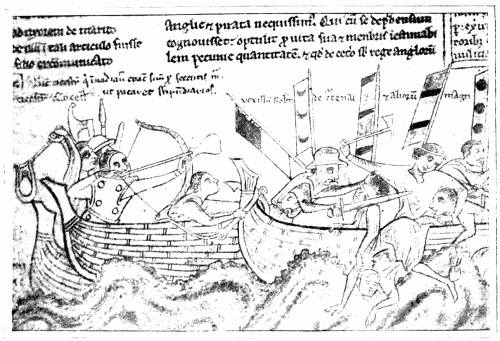
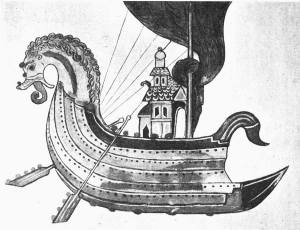
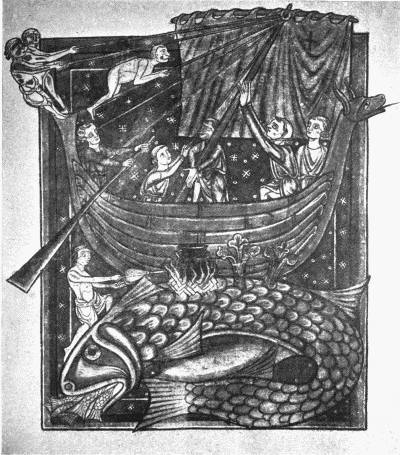
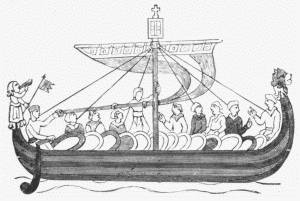
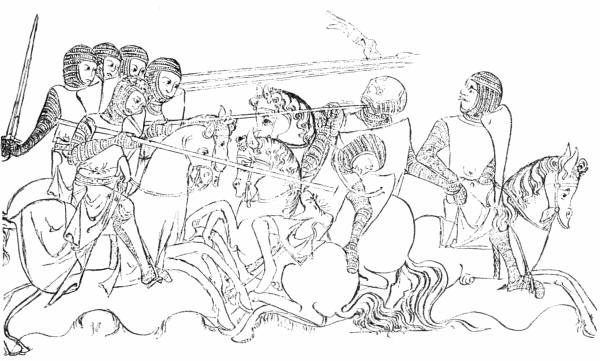
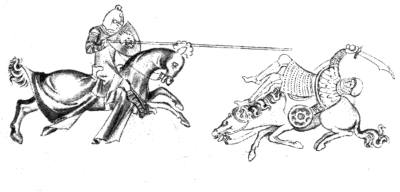
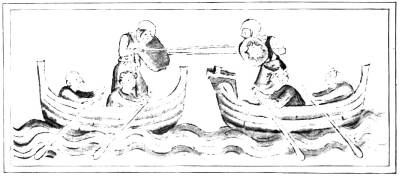
A SEA FIGHT
From a MS. in Corpus Christi College, Cambridge.
It is impossible to know why Carausius did not fight. Perhaps he proposed
to gather his troops in Britain and to meet Constantius on British soil. Perhaps
he reckoned on Constantius being unable to collect ships in sufficient number to
cross the Channel. Whatever his reasons, he embarked and sailed away. The King
of the Grove had run away. Therefore his reign was over.
In such cases there is always among the officers one who perceives the
opportunity and seizes it. The name of the officer swift to discern and swift to
act in this case was Allectus. He murdered the man who had run away, and
became himself the King of the Grove.
Very little is known about Allectus or about his rule. Historians speak of him
contemptuously as one who did not possess the abilities of Carausius; perhaps,
but I cannot find any authority for the opinion. The facts point rather in the
opposite direction. At least he commanded the allegiance and the loyalty of the
soldiers, as Carausius had done; he seems to have kept order in Britain; as
nothing is said to the contrary, he must have kept back the Caledonians and Saxons
for four years; he maintained the Frankish alliance; and when his time came, his
men went out with him to fight, and with him, fighting, fell. In this brief story
there is no touch of weakness. One would like to know more about Allectus.
Like Carausius, he was a great coiner. Forty of his coins are described by Roach
Smith. They represent a manly face of strength and resolution crowned with
a coronet of spikes. On the other side is a female figure with the legend “Pax
Aug.” Other coins bear the legends “Pietas Aug.,” “Providentia Aug.,”
“Temporum felicitas,” and “Virtus Aug.”
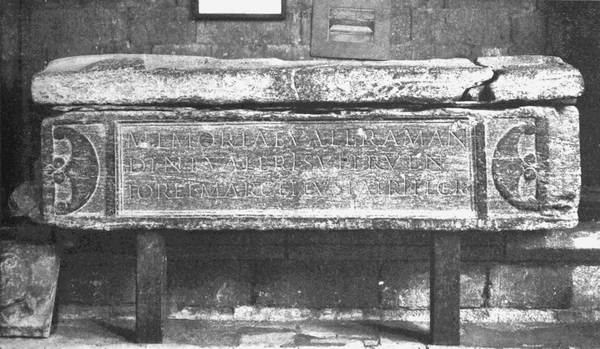
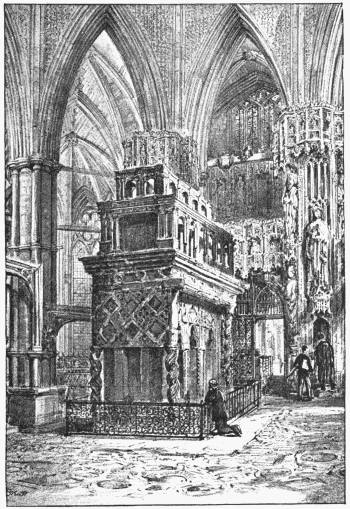
TOMB OF VALERIUS AMANDINUS (A ROMAN GENERAL)
In Westminster Abbey.
He was left undisturbed for nearly four years. Constantius employed this
time in collecting ships and men. It is rather surprising that Allectus did not
endeavour to attack and destroy those ships in port. When at last the army was
in readiness Constantius crossed the Channel, his principal force, under Asclepiodotus,
landing on the coast of Sussex. It was said that he crossed with a side wind,
which was thought daring, and by the help of a thick fog eluded the fleet of
Allectus, which was off the Isle of Wight on the look-out for him.
Allectus was in London: he expected the landing would be on the Kentish
coast, and awaited the enemy, not with the view of sheltering himself behind the
river, but in order, it would seem, to choose his own place and time for battle.
Asclepiodotus, however, pushed on, and Allectus, crossing the bridge with his
legions, his Frankish allies, and his auxiliaries, went out to meet the enemy.
Where did they fight? It has been suggested that Wimbledon was the most
likely place. Perhaps. It is quite certain that the battle was very near London,
from what followed. I would suggest Clapham Common; but as the whole of
that part of London was a barren moorland, flat, overgrown with brushwood, the
battle may have taken place anywhere south of Kensington, where the ground
begins to rise out of the marsh. We have no details of the battle, which was
as important to Britain as that of Senlac later on, for the invader was successful.
The battle went against Allectus, who was slain in the field. His routed soldiers
fled to London, and there began to sack the City and to murder the people.
Constantius himself at this moment arrived with his fleet, landed his troops, and
carried on a street fight with the Franks until every man was massacred. Two
facts come out clearly: that the battle was fought very near to London; and
that when Allectus fell there was left neither order nor authority.
This is the third appearance of London in history. In the first, A.D. 61, Tacitus
speaks of it, as we have seen, as a City of considerable trade; in the second, the
rebellion of Boadicea, it furnishes the third part of the alleged tale of 70,000 victims;
at this, the third, the defeated troops are ravaging and plundering the helpless City.
In all three appearances London is rich and thickly populated.
We may also remark that we have now arrived at the close of the third
century, and that, so far, there has been very little rest or repose for the people,
but rather continued fighting from the invasion of Aulus Plautius to the defeat of
Allectus.
It is true that the conscription of the British youth carried them out of the
country to serve in other parts of the Roman Empire; it is also true that the
fighting in Britain was carried on by the legions and the auxiliaries, and that the
Lex Julia Majestatis disarmed the people subject to Roman rule. Looking,
however, to the continual fighting on the frontier and the fighting in the Channel,
and the incursions of the Scots and Picts, one cannot believe that none of the
British were permitted to fight in defence of their own land, or to man the fleet
which repelled the pirate. Those who speak of the enervating effects of the
long peace under the Roman rule—the Pax Romana—would do well to examine
for themselves into the area covered by this long peace and its duration.
It was not in London, but at York, that Constantius fixed his residence, in
order to restrain the Picts and Scots. The importance attached to Britain may
be inferred from the fact that the Emperor remained at York until his death in
A.D. 306, when his son, Constantine the Great, succeeded him, and continued in
the island, probably at York, for six years. Coins of Constantine and also of his
mother, Helena, have been found in London.
In the year 310, Constantine quitted the island. A period of nearly forty years,
concerning which history is silent, followed. This time may have been one of peace
and prosperity.
The government of the country had been completely changed by the scheme
of defence introduced by Diocletian and modified by Constantine. Under that
scheme the Roman world was to be governed by two Emperors—one on the Danube,
and the other in the united region of Spain, Gaul, and Britain. The island was
divided into five provinces of Britannia Prima and Britannia Secunda; Lower
Britain became Flavia Cæsariensis and Maxima Cæsariensis; between the walls
of Hadrian and Antoninus was the Province of Valentia. Each province had its
own Vicarius or Governor, who administered his province in all civil matters.
The Civil Governor of Britain was subject to the Præfectus of Gaul, who
resided at Treviri (Treves) or Arelate (Arles). He was called Vicarius, and had
the title Vir Spectabilis (your Excellency). His head-quarters were at York. The
“Civil Service,” whose officers lived also in the fort, consisted of a Chief Officer
(Princeps), a Chief Secretary (Cornicularis), Auditors (Numerarii), a Commissioner
of Prisons (Commentariensis), Judges, Clerks, Serjeants, and other officers. For
the revenues there were a Collector (Rationalis summarum Britanniarum), an
Overseer of Treasure (Præpositus Thesaurorum). In the hunting establishment
there were Procuratores Cynegiorum. The military affairs of the state were
directly under the control of the Præfect of Gaul. The Vicarius had no authority
in things military. We have seen also how one general after another fixed his
head-quarters, not in London, but at York, or elsewhere. London played a much
less important part than York in the military disposition of the island. There were
three principal officers: the Count of the Saxon Shore (Comes littoris Saxonici),
the Count of Britain, and the Duke of Britain. The first of these had the command
of the fleet—Carausius, we have seen, was Comes littoris Saxonici—with the charge
of the nine great fortresses established along the coast from Porchester to Brancaster.
The Duke of Britain had his head-quarters at York, with the command of the 6th
Legion and charge of the wall. It is not certain where were the head-quarters of the
Count of Britain. Each of these officers, like the Vicarius, had his own establishment.
The permanent forces in Great Britain were estimated at four, afterwards
two, legions with auxiliaries, the whole amounting to 19,200 infantry and
1700 cavalry. Surely a force capable of repelling the incursions of Irish, Scots,
and Saxons all together!
It is not possible to estimate the effect upon the country of these military
settlements; we do not know either the extent of the territory they occupied or
the number of the settlers at any colony. Britannia is a large island, and many
such settlements may have been made without any effect upon the country. One
thing, however, is certain, that foreign settlers when they marry women belonging
to their new country very speedily adopt the manners and the language of
that country, and their children belong wholly to their mother’s race. Thus
Germans and Scandinavians settling in America and marrying American women
adapt themselves to American manners and learn the English tongue, while their
children, taught in the public schools, are in no respect to be accounted different
from the children of pure American parentage. Even the most marked and most
bigoted difference of religion does not prevent this fusion. The Polish Jew
becomes in the second generation an Englishman in England, or an American
in America. And in Ireland, when the soldiers of Cromwell settled in County
Kerry and married women of the country, their children became Irish in manners
and in thought. The descendants of those soldiers have nothing left from their
great-grandfathers—not religion, not manners, not Puritan ideas—nothing but
their courage.
So that one can neither affirm nor deny that these settlers in any way influenced
or changed the general character of the people. Religion would be no hindrance,
because all the ancient religions admitted the gods of all people. It is sufficient
to note the fact, and to remember that the people so called Britons were after
four hundred years of Roman rule as mixed a race as could well be found. In
London the mixture was still greater, because the trade of Roman London at
its best was carried on with the whole habitable world.
The language spoken among the better sort—the language of the Court, the
Forum, and the Port—was undoubtedly Latin. All the inscriptions are in Latin;
none are in Celtic. The language of the common people of London was like that of
the modern pidgin-English, a patois composed of Latin without its trappings of
inflexions and declensions—such a patois as that from which sprang Mediæval
French and Provençal, mixed with words from every language under the sun: words
brought to the Port by sailors who still preserved the Phœnician tongue; by Greeks
from Massilia; by Italians from Ostia and Brundusium; by Norsemen from Gotland
and the Baltic; by Flemings, Saxons, and Germans.
The legionaries contributed their share to the patois as spoken by the country
folk. But there were few soldiers in the fort of Augusta; the London dialect, except
among the slaves working at the Port or waiting in their barracoons to be exported
for the gladiatorial contests, was pidgin-Latin.
The Emperor Constans came over in 347. He was murdered, three years after
leaving this country, by Magnentius, a native of Britain. The rise and fall of this
pretender involved the ruin of many of his own countrymen and the soldiers of the
Roman occupation. One Paulus, surnamed Catena, was sent to London in order to
punish the adherents of Magnentius. Then follows a very singular story. The
cruelties of Paulus excited the deepest indignation, insomuch that the Civil Governor
of the province, the “Vicarius,” Martinus by name, endeavoured to interpose on
behalf of the victims. Failing to move the judge to mercy, he tried to save his
friends by murdering him. When this attempt also failed, he committed suicide.
Paulus returned to Rome, carrying with him a multitude of prisoners, who were
tortured, imprisoned, executed, or exiled.
The Picts and Scots took advantage of the disorder to invade the country after the
departure of Paulus. It is evident that the regular troops had been withdrawn or were
in confusion, because troops were brought over from Gaul to drive back the invaders.
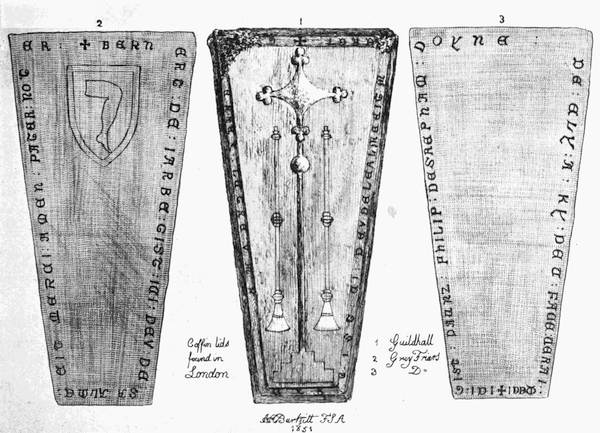
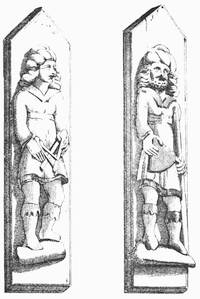
COFFIN LIDS FOUND IN LONDON
A H Burkitt FSA 1851
Some ten years later the Picts and Scots renewed their attacks. They defeated
and slew the Count of the Saxon Shore, and they defeated the Duke of Britain.
The Emperor Valentinian therefore sent Theodosius with a very large force into
the island. He found the enemy ravaging the country round London—it was
probably at this period, and in consequence of the repeated invasions from the north,
that the wall of London was built. In another place will be found an account of the
wall. It is sufficient to state here, that it was most certainly built in a great hurry
and apparently at a time of panic, because stones in the City—from public buildings,
the temples, the churches, and cemeteries—were seized wherever possible and
built up in the wall.
However, Theodosius drove back the invaders with great slaughter. He found
that there were many of the native population with the enemy. He adopted a
policy of conciliation: he relieved the people of their heavy taxation, and rebuilt
their cities and fortresses.
Here follows an incident which illustrates at once the dangers of the time and
the wisdom of Theodosius. I quote it from Wright (The Celt, the Roman, and
the Saxon, 1852 edition, p. 378):—
“There was in Britain at this time a man named Valentinus, a native of Valeria,
in Pannonia, notorious for his intrigues and ambition, who had been sent as an exile
to Britain in expiation of some heavy crime. This practice of banishing political
offenders to Britain appears to have been, at the time of which we are now speaking,
very prevalent; for we learn from the same annalist, that a citizen of Rome, named
Frontinus, was at the time of the revolt just described sent into exile in Britain for a
similar cause. Men like these no sooner arrived in the island than they took an
active part in its divisions, and brought the talent for political intrigue which had
been fostered in Italy to act upon the agitation already existing in the distant
province. Such was the case with Valentinus, who, as the brother-in-law of one of
the deepest agitators of Rome, the vicar Maximinus (described by Ammianus as ille
exitialis vicarius), had no doubt been well trained for the part he was now acting.
As far as we can gather from the brief notices of the historian, this individual seems,
when Theodosius arrived in Britain, to have been actively engaged in some
ambitious designs, which the arrival of that great and upright commander rendered
hopeless. Theodosius had not been long in Londinium when he received private
information that Valentinus was engaged with the other exiles in a formidable
conspiracy, and that even many of the military had been secretly corrupted by his
promises. With the vigour which characterised all his actions, Theodosius caused
the arch-conspirator and his principal accomplices to be seized suddenly, at the
moment when their designs were on the point of being carried into execution, and
they were delivered over to Duke Dulcitius, to receive the punishment due to their
crimes; but, aware of the extensive ramifications of the plot in which they had been
engaged, and believing that it had been sufficiently crushed, Theodosius wisely put a
stop to all further inquiries, fearing lest by prosecuting them he might excite an
alarm which would only bring a renewal of the scenes of turbulence and outrage
which his presence had already in a great measure appeased. The prudence as well
as the valour of Theodosius were thus united in restoring Britain to peace and
tranquillity; and we are assured that when, in 369, he quitted the island, he was
accompanied to the port where he embarked by crowds of grateful provincials.”
In the year 383 Britain furnished another usurper or claimant of the people,
in the person of Magnus Maximus. He was a native of Spain, who had served in
Britain with great distinction, and was a favourite with the soldiers. Now the
troops then stationed in Britain are stated by the historian to have been the most
arrogant and turbulent of all the Imperial troops.
The career of Maximus, and his ultimate defeat and death at Aquileia, belong
to the history of the Roman Empire.
One of the officers of Theodosius, named Chrysanthus, who afterwards became
a bishop at Constantinople, pacified Britain—one hopes by methods less brutal
than those of Paulus Catena.
The people, however, had little to congratulate themselves upon. Their
country with its five provinces was regarded as a department of the Court of Treves.
When there was any trouble in the Empire of the West, the legions of Great Britain
were withdrawn without the least regard for the defence of the country against the
Picts and Scots; and the division into provinces was a source of weakness. Moreover,
the general decay of the Empire was accompanied by the usual signs of
anarchy, lawlessness, and oppression. The troops were unruly and mutinous; time
after time, as we have seen, they set up one usurper and murdered another; they
were robbed by their officers; their pay was irregular. The complexity of the new
system added to the opportunities of the taxing authorities and the tax-collector.
The visit of the Imperial tax-gatherers was worse than the sack of a town by the
enemy. Torture was freely used to force the people to confess their wealth; son
informed against father, and father against son; they were taxed according to
confessions extorted under torture.
The end of the Roman occupation, however, was rapidly approaching.
Theodosius died in 395, and left his Western dominions to Honorius. There were
still two legions in Britain: the 6th, at Eboracum (York); and the 2nd, at
Rutupiæ (Richborough). There were also numerous bodies of auxiliaries. Early
in the fifth century these soldiers revolted and set up an Emperor of their own,
one Marcus. They murdered him in 407, and set up another named Gratian, whom
they also murdered after a few months, when they chose an obscure soldier on
account of his name, Constantine.
He at once collected his army and crossed over to Gaul. His subsequent
career, like that of Maximus, belongs to the history of Rome.
It would appear that the withdrawal of the legions by Constantine was the
actual end of the Roman occupation. The cities of Britain took up arms to repel
invasion from the north and the descent of the pirates in the west, and in 410
received letters from Honorius telling them to defend themselves.
The story told by Gildas is to the effect that Maximus took away all the men
capable of bearing arms; that the cities of Britain suffered for many years under
the oppression of the Picts and Scots; that they implored the Romans for help;
and that Roman legions came over, defeated the Picts and Scots, and taught the
Britons how to build a wall. This is all pure legend.
The commonly received history of the coming of the Angles, Jutes, and
Saxons is chiefly legendary. It is impossible to arrive at the truth, save by conjecture
from a very few facts ascertained. Thus it is supposed that the Saxons
began, just as the Danes did four hundred years afterwards, by practical incursions
leading to permanent settlements; that the words littus Saxonicum signified, not
the shore exposed to Saxon pirates, but the shore already settled by Saxons; that
in some parts the transition from Roman to Saxon was gradual; that the two races
mixed together—at Canterbury, Colchester, Rochester, and other places we find
Roman and Saxon interments in the same cemetery; that the Saxons had gained
a footing in the island long before the grand invasions of which the Saxon Chronicle
preserves the tradition.
This long history of warfare, of civil commotion, of mutiny and usurpation,
of conscription and taxation, is not a pleasant picture of Britain under the famous
Pax Romana. How did the City of London fare? It was the residence of the
Proprætor before the new scheme of Diocletian. This is proved by the discovery
of certain inscribed tiles. These tiles record the legions or the officers stationed
in various places. At Chester they bear the name of the 20th Legion; at York,
those of the 6th and the 9th. At Lymne and Dover the usual inscription is Cl.Br.,
supposed to mean Classiarii Britannici. Some of the tiles above referred to are
inscribed PRB. Lon., or PPBR. Lon., or P.PR.BR. Roach Smith reads these letters
Prima Cohors Britanniæ Londinii, and assumes that the first British Cohort was
once stationed in London. Wright, however, reads Proprætor Britanniæ Londinii,
thus showing that London was the seat of government. As there is no hint elsewhere
that the first British Cohort served in Britain, but plenty of evidence as to its
being elsewhere, as in Egypt and Germany, Wright’s interpretation is probably the
correct one.
Except for the attempted sack of the City after the defeat of Allectus and
for the sanguinary revenge by Paulus Catena, London seems to have been but
little disturbed by the invasions and the mutinies and the usurpations. Her trade
went on. In bad times, as when Magnentius or Maximus drew off the soldiers, and
the invaders fell upon the country on the north, the east, and the west, destroying
the towns and laying waste the country, London suffered. In the intervals of peace
her wharves were crowded with merchandise and her port with ships.
The introduction of Christianity into London, as into Britain generally, began,
there can be little doubt, in the second century. The new religion, however, made
very slow progress. The first missionaries, believed to have been St. Paul or St.
Joseph of Arimathæa, with Lazarus and his two sisters, were probably converts
from Gaul who came to Britain in pursuit of their ordinary business. In the year
208 Tertullian mentions the existence of Christians in Britain. Early in the fourth
century there were British Bishops at the Council of Arles.
In 324 Christianity was recognised as the religion of the State.
In the year 325 the British Church assented to the conclusions of the Council
of Nicæa. In 386 there was an Established Christian Church in Britain, in habitual
intercourse with Rome. As to the reality of the Christianity of the people and
how far it was mixed up with remains of Mithraism and the ancient faiths of Rome
and Gallia, we have no means of judging.
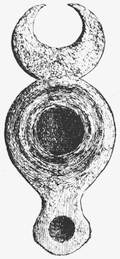
BRONZE ROMAN LAMP FOUND
IN CANNON STREET
What was the government of London itself at this time? We can find an
answer in the constitution of other Roman towns. London never became a
municipium—a town considered by the Imperial authorities as of the first importance.
There were only two towns of this rank in Britain, viz. Eboracum (York) and
Verulam (St. Alban’s). It was, with eight other towns, a colonia. Wright16 is of
opinion that there was very little difference in later times
between the colonia and the municipium. These towns enjoyed
the civitas or rights of Roman citizens; they consisted of the
town and certain lands round it; and they had their own
government exempt from the control of the Imperial officers.
In that case the forum would not necessarily be placed in the
fort or citadel, which was the residence of the Vicarius when
he was in London with his Court and establishment. At the
same time this citadel occupied an extensive area, and the City
being without walls till the year 360 or thereabouts, all the
public buildings were within that area. The governing body of
the City was called the curia, and its members were curiales,
decuriones, or senators; the rank was hereditary, but, like
every hereditary house, it received accessions from below.
The two magistrates, the duumviri, were chosen yearly by the
curia from their own body. A town council, or administrative
body, was also elected for a period of fifteen years by the
curiales from their own body; the members were called principales. The curia
appointed, also, all the less important officers; in fact it controlled the whole
municipality. The people were only represented by one officer, the defensor
civitatis, whose duty it was to protect his class against tyrannical or unjust
usurpations of power by the curiales. No one could be called upon to
serve as a soldier except in defence of his own town. The defence of the
Empire was supposed to be taken over by the Emperor himself. Let every
man, he said, rest in peace and carry on his trade in security. But when
the Emperor’s hands grew weak, what had become of the martial spirit? The
existence of this theory explains also how the later history of the Roman Empire
is filled with risings and mutinies and usurpations, not of cities and tribes, but of
soldiers. At the same time, since we read of the British youth going off to fight
in Germany and elsewhere, the country lads had not lost their spirit.17 The people
of London itself, however, may have become, like those of Rome, unused to military
exercises. Probably there was no fear of any rising in London, and there was not
a large garrison in the citadel. The citizens followed their own trade, unarmed,
like the rest of the world; even their young men were not necessarily trained to
sports and military exercises. Their occupations were very much the same as
those of later times: there were merchants, foreign and native, ship-builders and
ship-owners, sailors, stevedores and porters, warehousemen, clerks, shopmen,
lawyers, priests, doctors, scribes, professors and teachers, and craftsmen of all kinds.
These last had their collegia or guilds, each with a curialis for a patron. The
institution is singularly like the later trade guilds, each with a patron saint. One
would like to think that a craft company, such as the blacksmiths’, has a lineal
descent from the Collegium Fabrorum of Augusta. But as will be proved later
on, that is impossible. London was a city of trade, devoted wholly to trade. The
more wealthy sort emulated the luxury and effeminacy of the Roman senators—but
only so long as the Empire remained strong. When one had to fight or be
robbed, to fight or to be carried off in slavery, to fight or to die, there was an end,
I believe, of the effeminacy of the London citizens.
Let us consider this question of the alleged British effeminacy. We have to
collect the facts, as far as we can get at them, which is a very little way, and the
opinion of historians belonging to the time.
Gildas, called Sapiens, the Sage—in his Book of Exclamations,—speaks thus
contemptuously of his own people:—
1. The Romans, he says, on going away, told the people that “inuring themselves
to warlike weapons, and bravely fighting, they should valiantly protect their
country, their property, wives and children, and what is dearer than these, their
liberty and lives; that they should not suffer their hands to be tied behind their
backs by a nation which, unless they were enervated by idleness and sloth, was not
more powerful than themselves, but that they should arm those hands with buckler,
sword, and spear, ready for the field of battle.
2. He says: “The Britons are impotent in repelling foreign foes, but bold and
invincible in raising civil war, and bearing the burdens of their offences; they are
impotent, I say, in following the standard of peace and truth, but bold in wickedness
and falsehood.”
3. He says: “To this day”—many years after the coming of the Saxons—“the
cities of our country are not inhabited as before, but being forsaken and overthrown,
lie desolate, our foreign wars having ceased, but our civil troubles still remaining.”
Bede, who writes much later, thus speaks, perhaps having read the evidence
of Gildas: “With plenty, luxury increased, and this was immediately attended
with all sorts of crimes: in particular, cruelty, hatred of truth, and love of falsehood:
insomuch that if any one among them happened to be milder than the rest, and
inclined to truth, all the rest abhorred and persecuted him, as if he had been the
enemy of his country. Nor were the laity only guilty of these things, but even
our Lord’s own flock and His pastors also addicted themselves to drunkenness,
animosity, litigiousness, contention, envy, and other such-like crimes, and casting
off the light yoke of Christ. In the meantime, on a sudden, a severe plague fell
upon that corrupt generation, which soon destroyed such numbers of them that
the living were scarcely sufficient to bury the dead; yet those who survived could
not be drawn from the spiritual death which their sins had incurred either by the
death of their friends or the fear of their own.” This declaration of wickedness
is written, one observes, ecclesiastically—that is, in general terms.
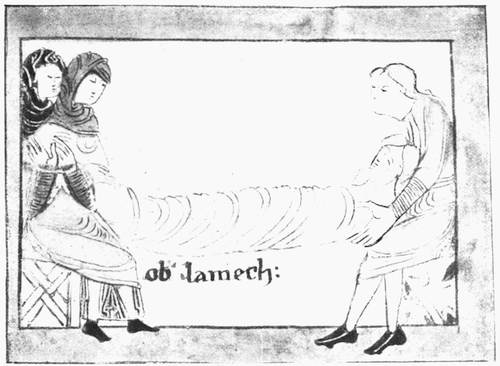
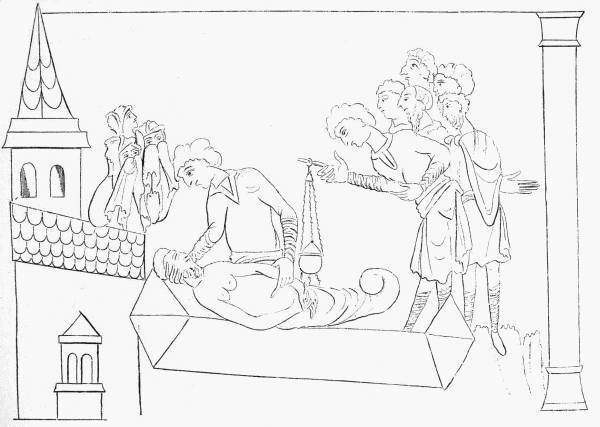
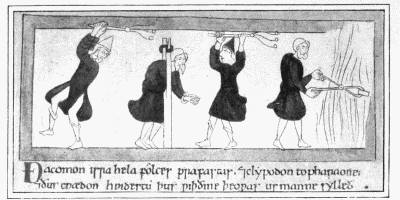
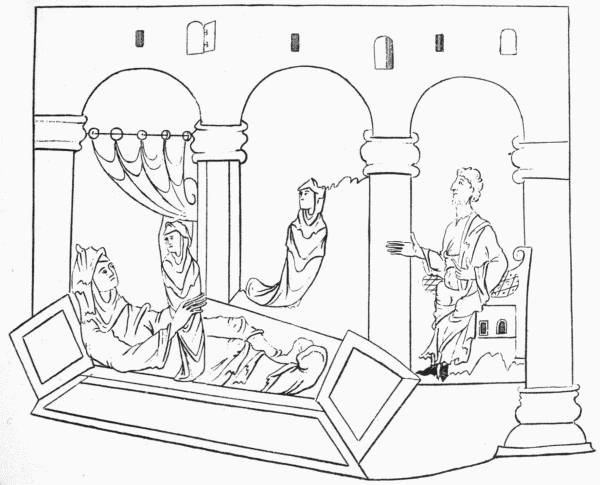
METHOD OF SWATHING THE DEAD
Claud MS., II. iv.
The opinion of an ecclesiastic who, like Gildas, connects morals and bravery,
and finds in a king’s alleged incontinence the cause of internal disasters, may be
taken for what it is worth. One undeniable fact remains, that for two hundred
years this effeminate people fought without cessation or intermission for their lives
and their liberties. Two hundred years, if you think of it, is a long time for an
effeminate folk to fight. Deprived of their Roman garrison, they armed themselves;
deprived of a government which had kept order for four hundred years, they
elected their own governors; unfortunately their cities were separate, each with
its own mayor (comes civitatis). They fought against the wild Highlander from
the north; against the wild mountain man from the west; against the wild Irish
from over the western sea; against the wild Saxon and Dane from the east. They
were attacked on all sides; they were driven back slowly: they did nothing but
fight during the whole of that most wretched period while the Roman Empire
fell to pieces. When all was over, some of the survivors were found in the Welsh
mountains; some in the Cumbrian Hills; some in the Fens; some beyond the
great moor of Devon; some in the thick forests of Nottingham, of Middlesex, of
Surrey, and of Sussex. Most sad and sorrowful spectacle of all that sad and
sorrowful time is one picture—it stands out clear and distinct. I see a summer day
upon the southern shore and in the west of England; I think that the place is
Falmouth. There are assembling on the sea-shore a multitude of men, women,
and children. Some of them are slaves; they are tied together. It is a host of
many thousands. Close to the shore are anchored or tied up a vast number of ships
rudely and hastily constructed, the frame and seats of wood, the sides made out of
skins of creatures sewn together and daubed with grease to keep out the water.
The ships are laden with provisions; some of them are so small as to be little
better than coracles. And while the people wait, lo! there rises the sound of far-off
voices which chant the Lamentation of the Psalmist. These are monks who
are flying from the monastery, taking with them only their relics and their treasures.
See! they march along bearing the Cross and their sacred vessels, singing as they
go. So they get on board; and then the people after them climb into their vessels.
They set their sails; they float down the estuary and out into the haze beyond
and are lost. In this way did England give to France her province of Bretagne.