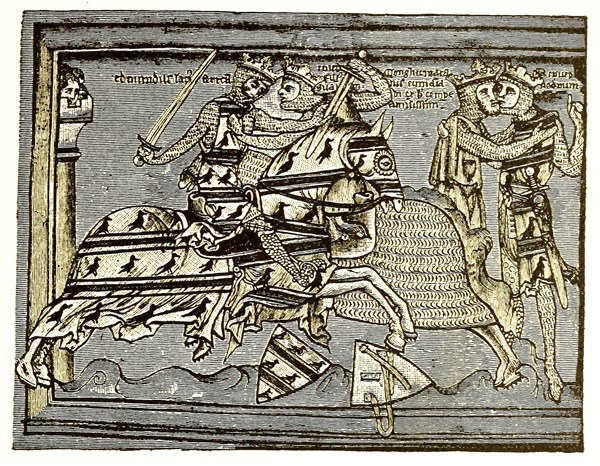
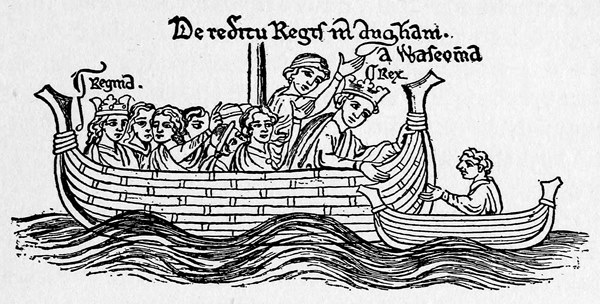
Geoffrey's window is a very fascinating
place to be—possibly the most interesting
window the world has ever seen. It is not just
one lifetime which has found that window interesting,
but more lifetimes than we can count
comfortably. Sir Thomas Malory, who wrote his
Morte d'Arthur in 1469, fairly lived in that window;
so did Shakespeare when he wrote "King
Lear" in 1605, and even the modern poet, Alfred,
Lord Tennyson, who wrote "The Charge of the
Light Brigade," composed a series of poems called
"Idylls of the King," which return for their sources
through Malory to Geoffrey at his window.
There is one story, however, which Geoffrey did
not see as he looked out of his golden window—the
story of the famous kitchen boy, or "Gareth
and Linet." This tale is found in Sir Thomas
Malory's Morte d'Arthur, which was not completed
until 1469, many years after the writing
of Geoffrey's Chronicle in 1147. Clear and sunshiny
is the English of this wonderful book of
Malory's, and nowhere in the world can more
beautiful, exciting, and marvelous stories be found
than between the covers of the Morte d'Arthur.
The Morte d'Arthur was written about twenty
years after the invention of printing by Coster
and Gutenberg. Sixteen years after the completion
of the book by Malory, Caxton printed it
in black letter in English. There is only one perfect
copy of this book by Caxton, the first of the
English printers, and that is in Brooklyn, New
York. In the preface which Caxton wrote for
the Morte d'Arthur, he says that in this book
will be found "many joyous and pleasant histories,
and noble and renowned acts of humanity, gentleness
and chivalries.... Do after the good and
leave the evil, and it shall bring you good fame
and renown." Certainly that is what the kitchen
boy did, and it brought him to good fame.
It was one day when King Arthur was holding
a Round Table court at Kynke Kenadonne by the
sea. And they were at their meat, three hundred
and fifty knights, when there came into the hall
two men well clad and fine-looking. And, as the
old story says, there leaned upon their shoulders
"the goodliest young man and the fairest that
ever they all saw, and he was large and long and
broad in the shoulders, and well visaged, and the
fairest and the largest-handed that ever man saw,
but he fared as if he might not go or bear himself—"
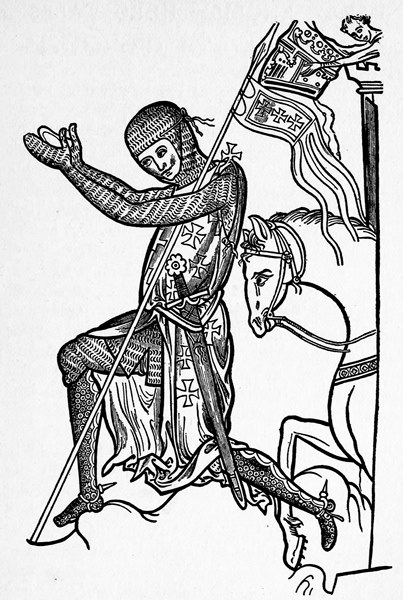
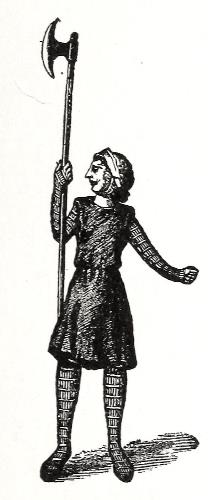
KNIGHT IN ARMOR
MS. Roy. 2 A. xxii
Late Thirteenth Century
The two men supported the young man up to
the high dais upon which Arthur was feasting.
When the young man that was being helped forward
was seen there was silence. Then the young
man stretched up straight and besought Arthur
that he would give him three gifts.
"The first gift I will ask now," he said, "but
the other two gifts I will ask this day twelve
months wheresoever you hold your high feast."
"Ask," replied Arthur, "and you shall have
your asking."
"Sir, this is my petition for this feast: that you
will give me meat and drink enough for this twelvemonth,
and at that day I will ask mine other two
gifts."
"My fair son," said Arthur, "ask better. This
is but simple asking."
But the young man would ask no more. And
when the King, who had taken a great liking to
him, asked him for his name, the young man said
that he could not tell him.
The King took him to Sir Kay, the steward,
and charged him to give the young man the best
of all the meats and drinks and to treat him as
a lord's son.
But Sir Kay was angry, and said: "An he had
come of gentlemen, he would have asked of you
horse and armor, but such as he is, so he asketh.
And since he hath no name, I shall give him a
name that shall be Beaumains, that is Fair-hands,
and into the kitchen shall I bring him, and there
he shall have fat brose every day, that he shall
be as fat by the twelvemonth's end as a pork
hog."
And Sir Kay scorned him and mocked at him.
On hearing this both Sir Launcelot, the greatest
of the Knights of the Round Table, and Sir
Gawaine were wroth and bade Sir Kay leave his
mocking.
"I dare lay my head," said Sir Launcelot, "he
shall prove a man of great worship."
"It may not be by no reason," replied Sir Kay,
"for as he is so hath he asked."
Beaumains, or Fair-hands, was put into the
kitchen, and lay there nightly as the boys of the
kitchen did. The old book says: "He endured
all that twelvemonth, and never displeased man
nor child, but always he was meek and mild. But
ever when he saw any jousting of knights, that
would he see an he might."
Sir Launcelot gave him gold to spend, and
clothes, and whenever the boy went where there
were games or feats of strength he excelled in
them all.
But always Sir Kay would taunt him with these
words spoken to others, "How like you my boy
of the kitchen?"
And so Fair-hands, the kitchen boy, continued
in service for a year. At the close of the year
came a lady to the court and told about her sister
who was besieged in a castle by a tyrant who was
called the Red Knight of the Red Laundes. But
she would not tell her name, and therefore the
King would not permit any of his knights to
go with her to rescue her sister from the Red
Knight, who was one of the worst knights in the
world.
But at the King's refusal, Beaumains, or Fair-hands,
as he was called, spoke, "Sir King, God
thank you, I have been this twelvemonth in your
kitchen, and have had my full sustenance, and
now I will ask my two gifts that be behind."
"Ask, upon my peril," said the King.
"Sir, this shall be my two gifts: first, that you
will permit me to go with this maiden that I may
rescue her sister. And second, that Sir Launcelot
shall ride after me and make me knight when I
require it of him."
And both these requests the King granted.
But the maiden was angry because, she said, he
had given her naught but his kitchen page.
Then came one to Fair-hands and told him that
his horse and armor were come for him. And
there was a dwarf with everything that Beaumains
needed, and all of it the richest and best it
was possible for man to have. But though he was
horsed and trapped in cloth of gold, he had neither
shield nor spear.
Then said Sir Kay openly before all, "I will ride
after my boy of the kitchen."
Just as Beaumains overtook the maiden, so did
Sir Kay overtake his former kitchen page.
"Sir, know you not me?" he demanded.
"Yea," said Beaumains, "I know you for an
ungentle knight of the court. Therefore beware
of me."
Thereupon Sir Kay put his spear in the rest and
ran straight upon him, and Beaumains came fast
upon him with his sword in his hand. And Beaumains
knocked the spear out of the knight's hand
and Sir Kay fell down as he had been dead.
Beaumains took Sir Kay's shield and spear and
rode away upon his own horse. The dwarf took
Sir Kay's horse.
Just then along came Sir Launcelot, and Beaumains
challenged him to a joust. And so they
fought for the better part of an hour, rushing together
like infuriated boars. And Sir Launcelot
marveled at the young man's strength, for he
fought more like a giant than like a knight. At
last he said, "Fight not so sore; your quarrel and
mine is not so great but we may leave off."
"Truly that is truth," said Beaumains, "but
it doth me good to feel your strength, and yet,
my lord, I showed not the most I could do."
Then Sir Launcelot confessed to Beaumains
that he had much ado to save himself, and that
Beaumains need fear no earthly knight. And
then Beaumains confessed to Sir Launcelot that
he was the brother of Sir Gawaine and the youngest
son of King Lot; that his mother, Dame Morgawse,
was sister to King Arthur, and that his
name was Gareth.
After that Launcelot knighted Gareth, and
Gareth rode on after the maiden whose sister was
kept a prisoner by the Red Knight.
When he overtook her she turned upon him
and said: "Get away from me, for thou smellest
all of the kitchen. Thy clothes are dirty with
grease and tallow. What art thou but a ladle-washer?"
"Damosel," replied Beaumains, "say to me
what you will, I will not go from you whatsoever
you say, for I have undertaken to King Arthur for
to achieve your adventure, and so shall I finish
it to the end or I shall die therefor."
Then came a man thereby calling for help, for
six thieves were after him. Even when Beaumains
had slain all the six thieves and set the man
free from his fears, then the maiden used him
despicably, calling him kitchen boy and other
shameful names.
On the next day Beaumains slew two knights
who would not allow him and the maiden to cross
a great river.
But all the maiden did was to taunt him.
"Alas," she said, "that ever a kitchen page should
have that fortune to destroy even two doughty
knights; but it was not rightly force, for the first
knight stumbled and he was drowned in the water,
and by mishap thou earnest up behind the last
knight and thus happily slew him."
"Say what you will," said Beaumains, "but with
whomsoever I have ado withall, I trust to God
to serve him or he depart."
"Fie, fie, foul kitchen knave," answered the
maiden, "thou shalt see knights that shall abate
thy boast."
And so she continued to scold him and would
not rest therefrom. And they came to a black
land, and there was a black hawthorn, and
thereon hung a black banner, and on the other
side there hung a black shield, and by it stood a
black spear great and long, and a great black
horse covered with silk, and a black stone fast by.
And before the Knight of the Black Lands the
maiden used Beaumains despicably, calling him
kitchen knave and other such names. And the
Black Knight and Beaumains came together for
battle as if it had been thunder. After hard
struggle Beaumains killed the Black Knight and
rode on after the damosel.
"Away, kitchen boy, out of the wind," she
cried, "for the smell of thy clothes grieves me."
And so ever despitefully she used him. Yet he
overcame the Green Knight, who was the brother
of the Black Knight, and spared his life at the
maiden's request.
And it was after the vanquishing of the Green
Knight that they saw a tower as white as any
snow, and all around the castle it was double-diked.
Over the tower gate there hung fifty
shields of divers colors, and under that tower was
a fair meadow. And the lord of the tower looked
out of his window and beheld Beaumains, the
maiden, and the dwarf coming.
"With that knight will I joust," called the lord
of the tower, "for I see that he is a knight
errant."
And before the knight the maiden used him
despitefully.
And ever he replied, patiently, "Damosel, you
are uncourteous so to rebuke me, for meseemeth I
have done you good service." Then did the heart
of the maiden soften a little.
"I marvel what manner of man you be," she said,
"for it may never be otherwise but that you come
of a noble blood, for so shamefully did woman
never rule a knight as I have done you, and ever
courteously you have suffered me, and that comes
never but of gentle blood."
"Damosel," answered Beaumains, "a knight
may little do that may not suffer a damosel.
And whether I be gentleman born or not, I let
you wit, fair damosel, I have done you gentleman's
service."
She begged him to forgive her, and this Beaumains
did with all his heart.
Then they met Sir Persant of Inde, who was
dwelling only seven miles from the siege, and the
maiden besought Beaumains to flee while there
was yet time. But he refused.
And when Sir Persant and Beaumains met
they met with all that ever their horses might run,
and broke their spears either into three pieces,
and their horses rushed so together that both
their horses fell dead to the earth. And they got
off their horses and fought for more than two
hours. And Beaumains spared his life only at
the maiden's request.
Then Beaumains told Sir Persant that his name
was Sir Gareth. And the maiden said that hers
was Linet, and that she was sister to Dame
Lionesse, who was besieged.
Then the dwarf took word to the lady who
was besieged, and the others came on after.
"How escaped he," said the lady, Dame Lionesse,
"from the brethren of Sir Persant?"
"Madam," said the dwarf, "as a noble knight
should."
"Ah," said Dame Lionesse, "commend me unto
your gentle knight, and pray him to eat and drink
and make him strong. Also pray him that he be
of good heart and courage, for he shall meet with
a knight who is neither of bounty, courtesy, nor
gentleness; for he attendeth unto nothing but
murder, and that is the cause I cannot praise him
nor love him."
All that night Beaumains lay in an hermitage,
and upon the morn he and the damosel Linet broke
their fast and heard mass. Then took they their
horses, and, riding through a fair forest, they
came out upon a plain where there were many
pavilions and tents and a castle and much smoke
and a great noise. When they came near the
siege Beaumains espied upon great trees goodly
knights hanging by the neck, their shields about
their necks with their swords, and gilt spurs upon
their heels. There hung high forty knights.
"What meanest this?" said Sir Beaumains.
"Fair sir, "answered the damosel, "these knights
came hither to this siege to rescue my sister,
Dame Lionesse, and when the Red Knight of the
Red Lands had overcome them he put them to
this shameful death."
Then rode they to the dikes, and saw them
double-diked with full warlike walls; and there
were lodged many great lords nigh the walls;
and there was great noise of minstrelsy; and the
sea beat upon the side of the walls, where there
were many ships and mariners' noise. And also
there was fast by a sycamore-tree, and there hung
a horn, the greatest that ever they saw, of an
elephant's bone. Therewith Beaumains spurred
his horse straight to the sycamore-tree, and blew
so eagerly the horn that all the siege and the castle
rang thereof. And then there leaped out knights
out of their tents and pavilions, and they within
the castle looked over the walls and out of windows.
Then the Red Knight of the Red Lands armed
him hastily, and two barons set on his spurs upon
his heels, and all was blood red, his armor, spear,
and shield.
"Sir," said the damosel Linet, "look you be glad
and light, for yonder is your deadly enemy, and
at yonder window is my sister, Dame Lionesse."
Then Beaumains and the Red Knight put their
spears in their rests, and came together with all
their might, and either smote the other in the
middle of their shields, that the surcingles and
cruppers broke and fell to the earth both, and the
two knights lay stunned upon the ground. But
soon they got to their feet and drew their swords
and ran together like two fierce lions. And then
they fought until it was past noon, tracing, racing,
and foining as two boars. Thus they endured
until evensong time, and their armor was
so hewn to pieces that men might see their naked
sides. Then the Red Knight gave Beaumains
a buffet upon the helm, so that he fell groveling
to the earth.
Then cried the maiden Linet on high: "Oh, Sir
Beaumains, where is thy courage? Alas! my sister
beholdeth thee and she sobbeth and weepeth."
When Beaumains heard this he lifted himself
up with great effort and got upon his feet, and
lightly he leaped to his sword and gripped it in
his hand. And he smote so thick that he smote
the sword out of the Red Knight's hand. Sir
Beaumains fell upon him and unlaced his helm
to have slain him. But at the request of the
lords he saved his life and made him yield him
to the lady.
And so it was that Beaumains, or Sir Gareth,
as his real name was, came into the presence of
his lady and won her love through his meekness
and gentleness and courtesy and courage, as every
true knight should win the love of his lady.
So ends happily one of the charming stories of
adventure and knighthood in one of the greatest
Cycles of Romance the world has ever known.
Indeed, in that Great Palace we have entered,
and some of whose golden doors we have been
opening, there is no door more loved by human
beings than the one over which is written Romance,
for boys and girls and their elders have
always loved a romantic story, and always will.
There are four great romantic stories in the
Palace of English Literature. The first is King
Arthur and the Round Table, which Geoffrey of
Monmouth discovered for us by his golden window.
The second great romance is the story of
Charlemagne. This was in the twelfth century,
and the most valiant story which grew out of the
Charlemagne Cycle was that of Roland. Every
one should know the story of Roland and his
famous sword, Durendal. The third is the Life
of Alexander, which came to England from the
east. And the fourth is the Siege of Troy, composed
in the thirteenth century and written in
Latin.
It takes many, many stories to satisfy our love
of Romance. As we pass through the golden door
over which is written Romance, one whole wall is
filled with the names of lesser romances forgotten
long, long ago. But the stories which Sir Thomas
Malory gave us in his Morte d'Arthur, written in
1469, will never be forgotten as long as the English
language is spoken.