Only some three hundred and fifty years
have elapsed since wheeled conveyances for
passengers came into use in England;
but, once introduced, they rapidly found
favour with all classes of society, more
especially in cities. The progress of road-making
and that of light horse-breeding
are so intimately connected with the development
of carriages and coaches that
it is difficult to dissociate the three. In
the early days of wheeled traffic the roads
of our country were utterly unworthy of
the name, being, more particularly in wet
weather, such quagmires that they were
often impassable.
Over such roads the heavy carriages of
our ancestors could only be drawn by teams
of heavy and powerful horses, strength being
far more necessary than speed; and for many
generations the carriage or coach horse was
none other than the Great or Shire Horse.
Improved roads made rapid travel possible,
and the increase of stage coaches created a
demand for the lighter and more active
harness horses, for production of which
England became celebrated.
If comparatively little has been said concerning
horses, it is because the writer has
already dealt with that phase of the subject
in previous works.[1]
FIRST USE OF WHEELED VEHICLES.
Wheeled vehicles for the conveyance
of passengers were first introduced into
England in the year 1555. The ancient
British war chariot was neither more nor
less than a fighting engine, which was
probably never used for peaceful travelling
from place to place. Carts for the conveyance
of agricultural produce were in
use long before any wheeled vehicle was
adapted for passengers. The ancient laws
and institutes of Wales, codified by Howel
Dda, who reigned from A.D. 942 to 948,
describe the “qualities” of a three-year-old
mare as “to draw a car uphill and downhill,
and carry a burden, and to breed colts.”
The earliest mention of carts in England
that some considerable research has revealed
is in the Cartulary of Ramsay Abbey (Rolls
Series), which tells us that on certain manors
in the time of Henry I. (1100-1135) there
were, among other matters, “three carts,
each for four oxen or three horses.”
BADNESS OF EARLY ROADS.
That carriages did not come into use at
an earlier period than the sixteenth century
is no doubt due to the nature of the cattle
tracks and water-courses which did duty
for roads in England. These were of such
a nature that wheeled traffic was practically
impossible for passengers, and was
exceedingly difficult for carts and waggons
carrying goods.
In old documents we find frequent
mention of the impossibility of conveying
heavy wares by road during the winter.
For example, when Henry VIII. began to
suppress the monasteries, in 1537, Richard
Bellasis, entrusted with the task of dismantling
Jervaulx Abbey, in Yorkshire,
refers to the quantity of lead used for
roofing purposes, which “cannot be conveyed
away till next summer, for the ways
in that countrie are so foule and deepe that
no carriage (cart) can pass in winter.”
In the Eastern counties, and no doubt
elsewhere in England, our ancestors used
the water-courses and shallow stream beds
as their roads. This is clear to anyone who
is at pains to notice the lie and course of
old bye-ways; and it is equally clear that
a stream when low offered a much easier
route to carts, laden or empty, than could
be found elsewhere. The beds of the water
courses as a general rule are fairly smooth,
hard and gravelled, and invited the carter
to follow them rather than to seek a way
across the wastes. In process of use the
banks and sides were cut down by the
wheels or by the spade; and eventually the
water was diverted into another channel
and its old bed was converted into a road.
SAXON VEHICLES AND HORSE LITTERS.
Strutt states that the chariot of the Anglo-Saxons
was used by distinguished persons
for travel. If the illustrations from which
he describes them give a fair idea of their
proportions and general construction, they
must have been singularly uncomfortable
conveyances. The drawing is taken from
an illuminated manuscript of the Book
of Genesis in the Cotton Library (Claud.
B. iv.), which Strutt refers to the ninth
century, but which a later authority considers
a production of the earlier part of
the eleventh. The original drawing shows
a figure in the hammock waggon, which
figure represents Joseph on his way to
meet Jacob on the latter’s arrival in Egypt;
this figure has been erased in order to
give a clear view of the conveyance, which
no doubt correctly represents a travelling
carriage of the artist’s own time, viz., A.D.
1100-1200.

HAMMOCK WAGGON.
Supposed to have been in use in England about
A.D. 1100-1200.
Horse litters, carried between two horses,
one in front and one behind, were used in
early times by ladies of rank, by sick
persons, and also on occasion to carry the
dead. Similar vehicles of a lighter description,
carried by men, were also in use.
William of Malmesbury states that the
body of William Rufus was brought from
the spot where he was killed in the New
Forest in a horse-litter (A.D. 1100). When
King John fell ill at Swineshead Abbey,
in 1216, he was carried in a horse-litter
to Newark, where he died. For a man
who was in good health to travel in such
a conveyance was considered unbecoming
and effeminate. In recording the death, in
1254, of Earl Ferrers, from injuries received
in an accident to his conveyance, Matthew
Paris deems it necessary to explain that the
Earl suffered from gout, which compelled
him to use a litter when moving from place
to place. The accident was caused by the
carelessness of the driver of the horses,
who upset the conveyance while crossing a
bridge.
The illustration is copied from a drawing
which occurs in a manuscript in the British
Museum (Harl. 5256).
Froissart speaks of the English returning
“in their charettes” from Scotland after
Edward III.’s invasion of that country,
about 1360; but there is little doubt that
the vehicles referred to were merely the
baggage carts which accompanied the army
used by the footsore and fatigued soldiers.
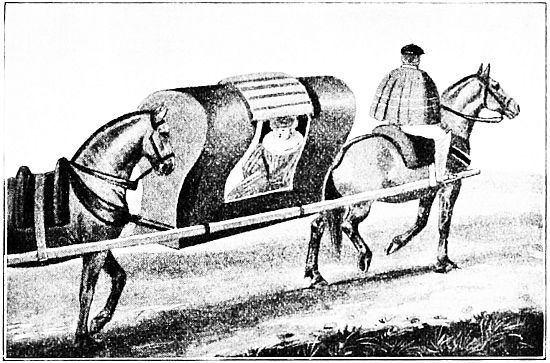
HORSE LITTER USED A.D. 1400-1500.
The same chronicler refers to use of the
“chare” or horse-litter in connection with
Wat Tyler’s insurrection in the year 1380:—
“The same day that these unhappy people of
Kent were coming to London, there returned from
Canterbury the King’s mother, Princess of Wales,
coming from her pilgrimage. She was in great
jeopardy to have been lost, for these people came to
her chare and dealt rudely with her.”
As the chronicler states that the “good
lady” came in one day from Canterbury to
London, “for she never durst tarry by the
way,” it is evident that the chare was a
“horse-litter,” the distance exceeding sixty
miles.
The introduction of side-saddles by Anne
of Bohemia, Richard II.’s Queen, is said
by Stow to have thrown such conveyances
into disuse: “So was the riding in
those whirlicotes and chariots forsaken
except at coronations and such like spectacles:”
but when the whirlicote or horse-litter
was employed for ceremonial occasions
it was a thing of great magnificence.
CONTINENTAL CARRIAGES IN THE 13TH AND 14TH
CENTURIES.
Carriages were in use on the continent
long before they were employed in England.
In 1294, Philip the Fair of France issued
an edict whose aim was the suppression of
luxury; under this ordinance the wives of
citizens were forbidden to use carriages, and
the prohibition appears to have been
rigorously enforced. They were used in
Flanders during the first half of the fourteenth
century; an ancient Flemish chronicle
in the British Museum (Royal MSS. 16,
F. III.) contains a picture of the flight of
Ermengarde, wife of Salvard, Lord of
Rouissillon.
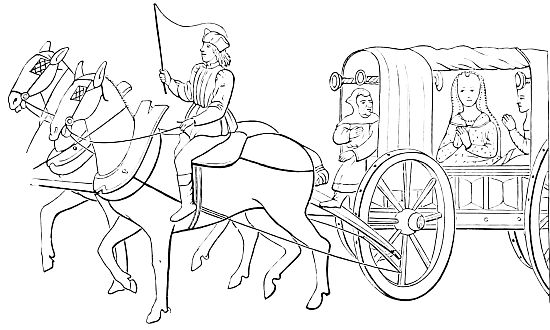
THE FLIGHT OF PRINCESS ERMENGARDE.
Carriage used about 1300-1350 in Flanders.
The lady is seated on the floor boards
of a springless four-wheeled cart or waggon,
covered in with a tile that could be raised
or drawn aside; the body of the vehicle
is of carved wood and the outer edges
of the wheels are painted grey to represent
iron tires. The conveyance is drawn
by two horses driven by a postillion who
bestrides that on the near-side. The traces
are apparently of rope, and the outer trace
of the postillion’s horse is represented as
passing under the saddle girth, a length
of leather (?) being let in for the purpose;
the traces are attached to swingle-bars
carried on the end of a cross piece secured to
the base of the pole where it meets the body.
Carriages of some kind appear also to
have been used by men of rank when travelling
on the continent. The Expeditions to
Prussia and the Holy Land of Henry, Earl
of Derby, in 1390 and 1392-3 (Camden
Society’s Publications, 1894), indicate that
the Earl, afterwards King Henry IV. of
England, travelled on wheels at least part of
the way through Austria.
The accounts kept by his Treasurer during
the journey contain several entries relative
to carriages; thus on November 14, 1392,
payment is made for the expenses of two
equerries named Hethcote and Mansel, who
were left for one night at St. Michael, between
Leoban and Kniltelfeld, with thirteen carriage
horses. On the following day the route lay
over such rugged and mountainous country
that the carriage wheels were broken despite
the liberal use of grease; and at last the
narrowness of the way obliged the Earl to
exchange his own carriage for two smaller
ones better suited to the paths of the district.
The Treasurer also records the sale of an
old carriage at Friola for three florins. The
exchange of the Earl’s “own carriage” is
the significant entry: it seems very unlikely
that a noble of his rank would have travelled
so lightly that a single cart would contain
his own luggage and that of his personal
retinue; and it is also unlikely that he used
one baggage cart of his own. The record
points directly to the conclusion that the
carriages were passenger vehicles used by
the Earl himself.
CONVEYANCES IN HENRY VI.’s TIME.
It was probably possession of roads unworthy
of the name that deterred the
English from following the example of their
continental neighbours, for forty years later
the horse-litter was still the only conveyance
used by ladies. On July 13, 1432, King
Henry VI. writes to the Archbishop of
Canterbury, the Bishops of Winchester and
Durham, and the High Treasurer, in connection
with the journeyings of Joan of
Navarre, widow of Henry IV.:—
“And because we suppose that she will soon
remove from the place where she is now, that ye
order for her also horses for two chares and let her
remove thence into whatever place within our
kingdom that she pleases.”
“CHARIOTS” FIRST USED ON GREAT OCCASIONS.
There is still some little doubt concerning
the date when the carriage or coach was
first seen in England; but it seems certain
that wheeled vehicles of some kind were
used on great ceremonial occasions before
the coach suitable for ordinary travel came
into vogue.
When Catherine of Aragon was crowned
with Henry VIII., on June 24, 1509, she
was, says Holinshed, conveyed in a litter
followed by “chariots covered, with ladies
therein.” Similarly when Anne Boleyn
passed in state through London she was
borne in a litter followed by ladies in a
chariot. From these records it is clear that
the horse-litter was considered the more
dignified conveyance.
The litter used by princesses and ladies of
high degree on state occasions was very
richly furnished. The poles on which it
was supported were covered with crimson
velvet, the pillows and cushions with white
satin, and the awning overhead was of
cloth of gold. The trappings of the horses
and dress of the grooms who led them were
equally splendid. Ancient records contain
minute particulars of the materials purchased
for litters on special occasions, and
these show with what luxury the horse-litter
of a royal lady was equipped.
In this connection we must note that
Markland, in his Remarks on the Early
Use of Carriages in England, discriminates
between the “chare” and the horse-litter: the
chare gave accommodation to two persons
or more and was used for ordinary purposes
of travel, and he believes that it ran on
wheels; whereas the horse-litter accommodated
only one person, and that usually a
lady of high rank, on ceremonial occasions.
The chariot was clearly rising in esteem
at this period, for when Queen Mary went in
state to be crowned in the year 1553, she
herself occupied a chariot. It is described
as “a chariot with cloth of tissue, drawn
with six horses”; and it was followed by
another “with cloth of silver and six
horses,” in which were seated Elizabeth
and Anne of Cleves.
FIRST USE OF CARRIAGES; CALLED COACHES.
We are now come to the period when the
coach proper was introduced into England.
Stow, in his Summary of the English
Chronicles, says that carriages were not used
in England till 1555, when Walter Rippon
built one for the Earl of Rutland, “this
being the first ever made.” Taylor, the
“Water Poet,” in his life of Thomas Parr,
states that Parr was 81 years old “before
there was any coach in England.” Parr was
born in 1483, so the year in which he
reached 81 would be 1564; in that year
William Boonen, a Dutchman, brought from
the Netherlands a coach which was presented
to Queen Elizabeth; and Taylor, on
Parr’s authority, mentions this as the “first
one ever seen here.”
The obvious inference is that Parr had
not heard of or (what is more probable
considering his advanced age) had forgotten
the coach built eleven years earlier for a much
less conspicuous person than the sovereign.
There is also mention in the Burghley
Papers (III., No. 53) quoted by Markland,
of Sir T. Hoby offering the use of his coach
to Lady Cecil in 1556. It is quite likely
that the coach brought by Boonen from
the Netherlands served as a model for
builders in search for improvements, as we
read in Stow’s Summary: “In 1564, Walter
Rippon made the first hollow, turning coach,
with pillars and arches, for her Majesty
Queen Elizabeth.” What a “hollow, turning”
coach may have been it is difficult to
conjecture. Drawings of a hundred years
later than this period show no mechanism
resembling a “turning head” or fifth wheel.
Captain Malet[2] says that the Queen suffered
so much in this vehicle, when she went in it
to open Parliament, that she never used it
again. The difference between the coach for
ordinary travel and the chariot for ceremony
is suggested by the next passage in the
Summary: “In 1584 he (Rippon) made a
chariot throne with four pillars behind to
bear a crown imperial on the top, and
before, two lower pillars whereon stood a
lion and a dragon, the supporters of the
arms of England.”
Queen Elizabeth, according to Holinshed,
used a “chariot” when she went to be
crowned at Westminster in 1558.
COACHES IN FRANCE.
By way of showing how the old authorities
differ, mention may be made of the coach
which Henry Fitzalan, Earl of Arundel,
brought from France and presented to the
Queen, it is said, in 1580. This vehicle is
cited as the first coach ever seen in public
but inasmuch as we have ample evidence to
prove the last statement incorrect, apart
from the fact that the Earl died in 1579,
nothing more need be said about it.
France does not seem to have been very
far ahead of Britain in the adoption of
coaches. In 1550 there were only three in
Paris; one belonged to the Queen of
Francis I., another to Diana of Poitiers,
and the third to René de Laval, who was
so corpulent that he could not ride. Mr.
George Thrupp, in his History of the Art of
Coach Building (1876), observes that “there
must have been many other vehicles in
France, but it seems only three covered and
suspended coaches.”
COACHES FIRST USED BY QUEEN ELIZABETH.
Queen Elizabeth travelled in a coach,
either the one built by Walter Rippon or
that brought by Boonen (who, by the way,
was appointed her coachman), on some of
her royal progresses through the kingdom.
When she visited Warwick in 1572, at the
request of the High Bailiff she “caused
every part and side of the coach to be
opened that all her subjects present might
behold her, which most gladly they desired.”
The vehicle which could thus be opened
on “every part and side” is depicted incidentally
in a work executed by Hoefnagel
in 1582, which Markland believed to be
probably the first engraved representation
of an English coach. As will be seen from
the reproduction here given, the body
carried a roof or canopy on pillars, and
the intervening spaces could be closed by
means of curtains.
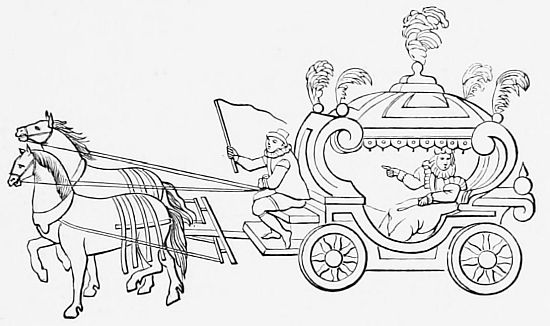
QUEEN ELIZABETH’S TRAVELLING COACH.
About the year 1582.
Queen Elizabeth seems to have preferred
riding on a pillion when she could;
she rode thus on one occasion from London
to Exeter, and again we read of her going
in state to St. Paul’s on a pillion behind her
Master of the Horse. Sir Thomas Browne,
writing to his son on October 15, 1680,
says: “When Queen Elizabeth came to
Norwich, 1578, she came on horseback
from Ipswich by the high road to Norwich,
but she had a coach or two in her train.”
Country gentlemen continued to travel on
horseback, though ladies sometimes made
their journeys by coach. The Household
Book of the Kytson family of Hengrave in
Suffolk contains the following entry under
date December 1, 1574: “For the hire of
certain horses to draw my mistress’ coach
from Whitsworth to London 26 shillings and
8 pence.”
Other entries show that “my mistress”
occupied the coach: whence it would appear
that not all our country roads in Queen
Elizabeth’s time were impassable during the
winter, as we might reasonably infer from
many contemporary records. The horse-litter,
as we may well suppose, was an easier
conveyance than the early springless coach:
for example, in Hunter’s Hallamshire we
find mention of Sir Francis Willoughby’s
request in 1589 to the Countess of Shrewsbury
to lend her horse-litter and furniture for
his wife, who was ill and unable to travel
either on horseback or in a coach.
It may be observed here that the latest
reference we have found to the use of the
horse-litter occurs in the Last Speech of
Thomas Pride (Harleian Miscellany): in
1680 an accident happened to General
Shippon, who “came in a horse-litter
wounded to London; when he paused by
the brewhouse in St. John Street a mastiff
attacked the horse, and he was tossed like
a dog in a blanket.”
Owing no doubt to their patronage by
royalty, coaches grew rapidly popular.
William Lilly, in a play called “Alexander
and Campaspes,” which was first printed in
1584, makes one of his characters complain
of those who had been accustomed to “go
to a battlefield on hard-trotting horses now
riding in easy coaches up and down to
court ladies.” Stow, referring to the coach
brought to England by Boonen, says:—
“After a while divers great ladies, with as great
jealousy of the Queen’s displeasure, made them
coaches and rid in them up and down the countries,
to the great admiration of all the beholders, but then
by little and little they grew usual among the
nobilitie and others of sort, and within twenty years
became a great trade of coach making.”
This confirms the statement of Lilly
above quoted: it is quite clear therefore
that, about 1580, coaches had come into
general use among the wealthy classes.
Their popularity became a source of anxiety
to those who saw in the use of a coach the
coming degeneracy of men and neglect of
horsemanship.
DUKE OF BRUNSWICK, 1588, FORBIDS USE OF
COACHES.
In 1588, Julius Duke of Brunswick issued
a proclamation forbidding the vassals and
servants of his electorate to journey in
coaches, but on horseback, “when we order
them to assemble, either altogether or in
part, in times of turbulence, or to receive
their fiefs, or when on other occasions
they visit our court.” The Duke expressed
himself strongly in this proclamation, being
evidently resolved that the vassals, servants
and kinsmen who “without distinction young
and old have dared to give themselves up to
indolence and to riding in coaches,” should
resume more active habits.
The same tendency on the one side and
the same feeling on the other in this country
led to the introduction of a Bill in Parliament
in November, 1601, “to restrain
the excessive use of coaches,” but it was
rejected. Whereupon:—
“Motion was made by the Lord Keeper, that forasmuch
as the said Bill did in some sort concern the
maintenance of horses within this realm, consideration
might be had of the statutes heretofore made
and ordained touching the breed and maintenance
of horses. And that Mr. Attorney-general should
peruse and consider of the said statutes, and of some
fit Bill to be drawn and prefered to the house touching
the same, and concerning the use of coaches:
which motion was approved of the House.”
It does not appear, however, that any
steps were taken by the Parliament of the
time to check the liberty of those who could
afford it to indulge in coaches.
They were probably little used except in
London and large towns where the streets
afforded better going than country roads:
though, as we have seen, Queen Elizabeth
took coaches with her when making a progress.
The coach seems to have been
unknown in Scotland till near the end
of the century, for we read that when, in
1598, the English Ambassador to Scotland
brought one with him “it was counted a
great marvel.”
THE STAGE WAGGON.
About 1564 the early parent of the stage
coach made its appearance. Stow says:
“And about that time began long waggons
to come in use, such as now come to London
from Canterbury, Norwich, Ipswich, Gloucester,
&c., with passengers and commodities.”
These were called “stages”: they were
roomy vehicles with very broad wheels
which prevented them sinking too deeply
into the mud: they travelled very slowly, but
writers of the period make frequent allusions
to the convenience they provided. Until
the “long waggon” came into use the saddle
and pack horse were the only means of
travelling and carrying goods: this conveyance
was largely used by people of small
means until late in the eighteenth century,
when stage coaches began to offer seats at
fares within the reach of the comparatively
poor.
Some confusion is likely to arise when
searching old records from the fact that
words now in current use have lost their
original meaning. Thus in an Act passed
in the year 1555 for “The amending of
High Ways,” the preamble states that certain
highways are “now both very noisome
and tedious to travel in and dangerous to all
passengers and ‘cariages.’” We might
read this to mean vehicles for the conveyance
of passengers; but the text (which
empowers local authorities to make parishioners
give four days’ work annually on the
roads where needed) shows us that the
“cariage” or “caryage” is identical with
the “wayne” or “cart” used in husbandry.
“Carriage” is used in the same sense in a
similar Act of Elizabeth dated 1571, which
requires the local authority to repair certain
streets near Aldgate which “become so
miry and foul in the winter time” that it is
hard for foot-passengers and “caryages” to
pass along them.
THE INTRODUCTION OF SPRINGS.
It is impossible to discover when builders
of passenger vehicles first endeavoured to
counteract the jolting inseparable from the
passage of a primitive conveyance over
rough roads by means of springs. Homer
tells us that Juno’s car was slung upon cords
to lessen the jolting: and the ancient Roman
carriages were so built that the body rested
on the centre of a pole which connected the
front and rear axles, thus reducing the jolt
by whatever degree of spring or elasticity
the pole possessed.
To come down to later times, Mr. Bridges
Adams in English Pleasure Carriages (1837)
refers to a coach presented by the King of
Hungary to King Charles VII. of France
(1422-1461), the body of which “trembled.”
Mr. George Thrupp considers that this
probably indicates a coach-body hung on
leather straps or braces, and was a specimen
of the vehicle then in use in Hungary. At
Coburg several ancient carriages are preserved:
one of those built in 1584 for the
marriage ceremony of Duke John Casimir,
the Elector of Saxony, is hung on leather
braces from carved standard posts which,
says Mr. Thrupp, “are evidently developed
from the standards of the common waggon.
The body of this coach is six feet four inches
long and three feet wide: the wheels have
wooden rims, but over the joints of the
felloes are small plates of iron about ten
inches long.”
In regard to these iron plates it will
be remembered that the wheels of the
coach represented in the “Flemish Chronicle”
of the first half of the fourteenth century
referred to on pp. 8-9, is furnished with complete
iron tires. Neither this vehicle, nor
that of Queen Elizabeth, a sketch of which
is given on p. 17 are furnished with braces
of any kind. It would not be judicious to
accept these drawings as exactly representing
the construction of the carriages, but if
the artist has given a generally accurate
picture it is difficult to see how or where
leather braces could have been applied to
take the dead weight of the coach body
off the under-carriage.
STEEL SPRINGS INTRODUCED.
Mr. Thrupp states that steel springs
were first applied to wheel carriages about
1670,[3] when a vehicle resembling a Sedan
chair on wheels, drawn and pushed by
two men, was introduced into Paris. This
conveyance was improved by one Dupin,
who applied two “elbow springs” by long
shackles to the front axle-tree which
worked up and down in a groove under
the seat. The application of steel springs
to coaches drawn by horses was not generally
practised until long afterwards: in
1770 Mons. Roubo, a Frenchman, wrote
a treatise on carriage building, from which
we learn that springs were by no means
universally employed.
When used, says Mr. Thrupp,
“They were applied to the four corners of a perch
carriage and placed upright, and at first only clipped
in the middle to the posts of the earlier carriages,
while the leather braces went from the tops of the
springs to the bottoms of the bodies without any long
iron loops such as we now use; and as the braces
were very long we find that complaints were made
of the excessive swinging and tilting and jerking of
the body. The Queen’s coach is thus suspended.
Four elbow springs, as we should call them, were
fastened to the bottom of the body, but again the
ends did not project beyond the bottom, and the
braces were still far too long; and Mons. Roubo
doubts whether springs were much use.”
The doubt concerning the value of springs
was shared in this country; for Mr. Richard
Lovell Edgeworth, in his Essay on the Construction
of Roads and Carriages (1817),
tells us that in 1768 he discovered that
springs were as advantageous to horses as
to passengers, and constructed a carriage
for which the Society of English Arts and
Manufactures presented him with a gold
medal. In this carriage the axletrees were
divided and the motion of each wheel was
relieved by a spring.
Travel in a springless coach over uneven
streets and the roughest of roads could not
have been a sufficiently luxurious mode of
progress to lay the traveller open to charge
of effeminacy. Taylor, the Water Poet, was
no doubt biased in favour of the watermen,
but he probably exaggerated little when he
wrote, in 1605, of men and women “so tost,
tumbled, jumbled and rumbled” in the coach
of the time.
THE FIRST HACKNEY COACHES.
It was in the year 1605 that hackney
coaches came into use; for several years
these vehicles did not stand or “crawl”
about the streets to be hired, but remained
in the owners’ yards until sent for. In
1634 the first “stand” was established in
London, as appears from a letter written
by Lord Stafford to Mr. Garrard in that
year:—
“I cannot omit to mention any new thing that
comes up amongst us though ever so trivial. Here
is one Captain Bailey, he hath been a sea captain,
but now lives on land about this city where he tries
experiments. He hath created, according to his
ability, some four hackney coaches, put his men into
livery and appointed them to stand at the Maypole
in the Strand, giving them instructions at what rate
to carry men into several parts of the town where
all day they may be had. Other hackney men veering
this way, they flocked to the same place and
performed their journeys at the same rate so that
sometimes there is twenty of them together which
dispose up and down, that they and others are to
be had everywhere, as watermen are to be had at
the waterside.”
Lord Stafford adds that everybody is
much pleased with the innovation. It may
here be said, on the authority of Fynes
Morryson, who wrote in 1617, that coaches
were not to be hired anywhere but in
London at that time. All travel (save in
the slow long waggons) was performed on
horseback, the “hackney men”[4] providing
horses at from 2½d. to 3d. per mile for those
who did not keep their own.
The number of coaches increased rapidly
during the earlier part of the seventeenth
century.
EXCESSIVE NUMBER OF COACHES IN LONDON.
The preamble of a patent granted Sir
Saunders Duncombe in 1634 to let Sedan
chairs refers to the fact that the streets
of London and Westminster “are of late
time so much encumbered and pestered
with the unnecessary multitude of coaches
therein used”; and in 1635 Charles I.
issued a proclamation on the subject. This
document states that the “general and
promiscuous use” of hackney coaches in
great numbers causes “disturbance” to the
King and Queen personally, to the nobility
and others of place and degree; “pesters”
the streets, breaks up the pavements and
cause increase in the prices of forage. For
which reasons the use of hackney coaches
in London and Westminster and the suburbs
is forbidden altogether, unless the passenger
is making a journey of at least three miles.
Within the city limits only private coaches
were allowed to ply, and the owner of a
coach was required to keep four good horses
or geldings for the king’s service.
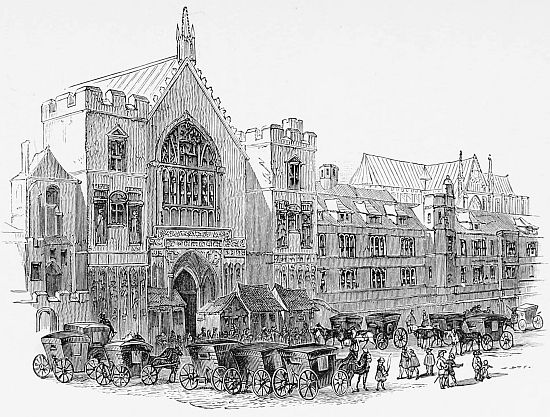
HACKNEY COACHES IN LONDON, 1637.
This proclamation evidently produced the
desired effect, for in 1637 there were only
sixty hackney carriages in London: the
majority of these were probably owned by
James Duke of Hamilton, Charles’ Master
of the Horse, to whom was granted in July
of that year power to license fifty hackney
coachmen in London, Westminster and the
suburbs, and “in other convenient places”;
and this notwithstanding the fact that in
1636 the vehicles “in London, the suburbs
and within four-mile compass without are
reckoned to the number of six thousand and
odd.”[5]
Charles I. can hardly have shared the
dislike exhibited by some of his subjects to
wheel passenger traffic, for in 1641 we find
him granting licenses for the importation
of horses and enjoining licensees to import
coach horses, mares, and geldings not under
14 hands high and between the ages of
three and seven years.
HACKNEY CARRIAGES AND THE THAMES
WATERMEN.
The number of cabs, then called hackney
coaches, soon produced an effect upon the
earnings of the Thames watermen, who,
until these vehicles were introduced, enjoyed
the monopoly of passenger traffic. Thomas
Dekker[6] refers to the resentment felt by
the watermen in 1607, two years after the
hackney couch made its appearance:—
“The sculler told him he was now out of cash, it
was a hard time; he doubts there is some secret
bridge made over to hell, and that they steal thither
in coaches, for every justice’s wife and the wife of
every citizen must be jolted now.”
There seems to have been good reason
for the preference given the hackney coach
over the waterman’s wherry. The preamble
of an Act passed in 1603 “Concerning
Wherrymen and Watermen” shows that
the risks attending a trip on the Thames
were not inconsiderable, and that love of
novelty was not the only motive which caused
the citizens of London to take the hackney
coach instead of the wherry. This Act forbade
the employment of apprentices under
18 years of age, premising that:—
“It hath often happened that divers and sundry
people passing by water upon the River of Thames
between Windsor and Gravesend have been put to
great hazard and danger of the loss of their lives
and goods, and many times have perished and been
drowned in the said River through the unskilfulness
and want of knowledge or experience in the wherrymen
and watermen.”
In 1636, when, as we have seen, there were
over 6,000 coaches, private and hackney,
in London, Sedan chairs also were to be
hired in the streets; and the jealousy with
which the hackney coachman regarded the
chairman was only equalled by the jealousy
with which the waterman regarded them
both. We quote from “Coach and Sedan,”
the curious little publication before referred
to:—
“Coaches and Sedans (quoth the waterman) they
deserve both to be thrown into the Thames, and but
for stopping the Channel I would they were, for I am
sure where I was wont to have eight or ten fares in a
morning, I now scarce get two in a whole day. Our
wives and children at home are ready to pine, and
some of us are fain for means to take other professions
upon us.”
HACKNEY CARRIAGES A NUISANCE IN LONDON.
By the year 1660, the number of hackney
coaches in London had again grown so
large that they were described in a Royal
Proclamation as “a common nuisance,”
while their “rude and disorderly handling”
constituted a public danger. For these
reasons the vehicles were forbidden to stand
in the streets for hire, and the drivers were
directed to stay in the yards until they
might be wanted. We can well understand
that the narrowness of the streets
made large numbers of coaches standing,
or “crawling,” to use the modern term,
obstacles to traffic; and it is interesting to
notice that the earliest patent granted in
connection with passenger vehicles (No.
31 in 1625) was to Edward Knapp for a
device (among others) to make the wheels
of coaches and other carriages approach to
or recede from each other “where the narrowness
of the way may require.”
LICENSED HACKNEY CARRIAGES.
In 1662, there were about 2,490 hackney
coaches in London, if we may accept the
figures given by John Cressel in a pamphlet,
which we shall consider on a future
page. It was in this year that Charles II.
passed a law appointing Commissioners with
power to make certain improvements in the
London streets. One of the duties entrusted
to them was that of reducing the number
of hackney coaches by granting licenses;
and only 400 licenses were to be granted.
These Commissioners grossly abused the
authority placed in their hands, wringing
bribes from the unfortunate persons who
applied for licenses, and carrying out their
task with so little propriety that in 1663
they were indicted and compelled to restore
moneys they had wrongfully obtained. In
regard to this it is to be observed that
one of the 400 hackney coach licenses
sanctioned by the Act was a very valuable
possession. We learn from a petition
submitted by the hackney coachmen to
Parliament that holders of these licenses,
which cost £5 each, sold them for £100.
The petition referred to is undated, but
appears to have been sent in when William
III.’s Act to license 700 hackney coaches
(passed in 1694) was before Parliament.
The bitterness of the watermen against
Sedan chairs seems to have died out by
Pepys’ time, but it was still hot against the
hackney coaches, as a passage in the Diary
sufficiently proves. Proceeding by boat to
Whitehall on February 2, 1659, Samuel
Pepys talked with his waterman and learned
how certain cunning fellows who wished to
be appointed State Watermen had cozened
others of their craft to support an address to
the authorities in their favour. According
to Pepys’ informant, nine or ten thousand
hands were set to this address (the men were
obviously unable to read or write) “when it
was only told them that it was a petition
against hackney coaches.”
COACHES WITH “BOOTS.”
From Coach and Sedan (see page 30), we
obtain a quaint but fairly graphic description
of the coach of this period:—
“The coach was a thick, burly, square-set fellow
in a doublet of black leather, brasse button’d down
the breast, back, sleeves and wings, with monstrous
wide boots, fringed at the top with a net fringe, and
a round breech (after the old fashion) gilded, and on
his back an atchievement of sundry coats [of arms],
in their proper colours.”
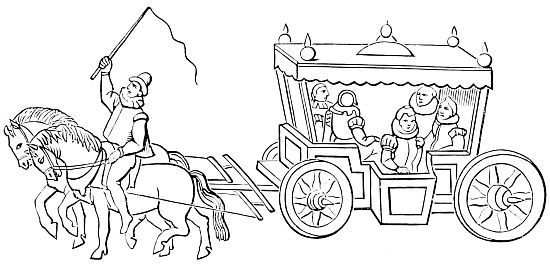
COACH OF QUEEN ELIZABETH’S LADIES.
Showing near-side “Boot.”
The “boots” were projections at the sides
of the body between the front and back
wheels, as shown in the drawing of the coach
occupied by Queen Elizabeth’s ladies; and
there is much evidence to support the
opinion that these boots were not covered.
Taylor in The World Runnes on Wheeles
describes the boot with picturesque vigour:—
“The coach is a close hypocrite, for it hath a cover
for any knavery and curtains to veil or shadow any
wickedness; besides, like a perpetual cheater, it wears
two boots and no spurs, sometimes having two pairs
of legs in one boot, and often-times (against nature)
most preposterously it makes fair ladies wear the
boot; and if you note, they are carried back to back
like people surprised by pirates, to be tied in that
miserable manner and thrown overboard into the
sea.”
These two fanciful descriptions explain
very clearly what the “boot” was and how
occupied. The “monstrous width” referred
to in Coach and Sedan confirms the statement
by Taylor that sometimes “two pairs
of legs” occupied it, the proprietors of the
legs sitting back to back. “No trace of
glass windows or perfect doors seems to have
existed up to 1650” (Thrupp), so we can
well understand that the passengers who
were obliged to occupy the boot of a stage
coach (for these as well as hackney coaches
were so built) on a prolonged journey would
have an exceedingly uncomfortable seat in
cold or wet weather.
It was no doubt an open boot which was
occupied by the writer of the curious letter
quoted by Markland. Mr. Edward Parker
is addressing his father, who resided at
Browsholme, near Preston, in Lancashire;
the letter is dated November 3, 1663:—
“I got to London on Saturday last; my journey
was noe ways pleasant, being forced to ride in the
boote all the waye. Ye company yt came up with
mee were persons of greate quality as knights and
ladyes. My journey’s expense was 30s. This
traval hath soe indisposed mee yt I am resolved never
to ride up againe in ye coatch. I am extreamely hott
and feverish; what this may tend to I know not, I
have not as yet advised with any doctor.”
Sir W. Petty’s assertion that the splendour
of coaches increased greatly during the
Stuart period recalls a passage in Kennett’s
History of England. George Villiers, the
great favourite of James I. who created him
Duke of Buckingham, had six horses to
draw his coach (“which was wondered at
then as a novelty and imputed to him as a
mast’ring pride”). The “stout old Earl of
Northumberland,” not to be outdone by the
upstart favourite, “thought if Buckingham
had six, he might very well have eight in his
coach, with which he rode through the city
of London to the Bath, to the vulgar talk
and admiration.” The first coaches were
drawn by two horses only; love of display
led to the use of more for town use, but the
deplorable condition of the country roads
justified the use of as many as quagmires
might compel.
How much a coach weighed in these early
days we do not know: Mr. R. L. Edgeworth,
writing in 1817, says, “now travelling
carriages frequently weigh above a ton;”
and as carriages had undergone vast improvements
by that date, we are justified in
concluding that those of a hundred or a
hundred and fifty years earlier weighed a
great deal more.
CARRIAGES IN HYDE PARK.
During the Commonwealth (1649-1659),
it was the fashion to drive in “the Ring”
in Hyde Park. The Ring is described by
a French writer,[7] as two or three hundred
paces in diameter with a sorry kind of balustrade
consisting of poles placed on stakes
three feet from the ground; round this the
people used to drive, in Cromwell’s time, at
great speed, as appears from a letter dated
May 2, 1654, from a gentleman in London
to a country friend, quoted by Mr. Jacob
Larwood in his Story of the London Parks,
(1872):—
“When my Lord Protector’s coach came into the
Park with Colonel Ingleby and my Lord’s three
daughters, the coaches and horses flocked about
them like some miracle. But they galloped (after
the mode court-pace now, and which they all use
wherever they go) round and round the Park, and all
that great multitude hunted them and caught them
still at the turn like a hare, and then made a lane
with all reverent haste for them and so after them
again,[8] and I never saw the like in my life.”
There is an interesting letter from the
Dutch Ambassadors to the States General,
dated October 16, 1654, which is worth
quoting here. The Ambassadors give particulars
of the accident to explain why no
business has been done lately:—
“His Highness [Oliver Cromwell], only accompanied
with Secretary Thurloe and some few of his
gentlemen and servants, went to take the air in Hyde
Park, where he caused some dishes of meat to be
brought, where he had his dinner; and afterwards
had a mind to drive the coach himself. Having put
only the Secretary into it, being those six grey horses
which the Count of Oldenburgh[9] had presented
unto His Highness who drove pretty handsomely for
some time. But at last, provoking these horses too
much with the whip, they grew unruly and ran so
fast that the postilion could not hold them in, whereby
His Highness was flung out of the coach box upon
the pole.... The Secretary’s ankle was hurt
leaping out and he keeps his chamber.”
From this it is evident that when six
horses were used a postillion rode one of
the leaders and controlled them; while the
driver managed the wheelers and middle
pair. When four horses were driven it was
the custom to have two outriders, one to
ride at the leaders’ heads and one at the
wheelers’; in town this would be merely
display, but on a journey the outrider’s
horses might replace those of the team in
case of accident, or more frequently, be
added to the team to help drag the coach
over a stretch of bad road.
COACH AND CART RACING.
John Evelyn in his Diary refers to a
coach race which took place in the Park on
May 20, 1658, but gives no particulars. Mr.
Jacob Larwood observes that at this period
and for a century later coach-racing was a
national sport; some considerable research
through the literature of these times, however,
has thrown no light upon this sport,
and while we need not doubt that coaches
when they chanced to meet on suitable
ground did make trials of speed, it is open
to question whether the practice was ever
developed into a sport. It may be that Mr.
Larwood had in mind the curious cart-team
races described by Marshall in his Rural
Economy of Norfolk, published in 1795.
This writer tells us that before Queen
Anne’s reign the farmers of Norfolk used
an active breed of horses which could not
only trot but gallop. He describes as an eyewitness
the races which survived to his day;
the teams consisted of five horses, which
were harnessed to an empty waggon:—
“A team following another broke into a gallop,
and unmindful of the ruts, hollow cavities and rugged
ways, contended strenuously for the lead, while the
foremost team strove as eagerly to keep it. Both
were going at full gallop, as fast indeed as horses
in harness could go for a considerable distance,
the drivers standing upright in their respective
waggons.”
REGULATIONS FOR HACKNEY CARRIAGES.
The Act of 1662 has already been referred
to in connection with the number of hackney
coaches in London; we may glance at it
again, as it gives a few interesting particulars.
No license was to be granted to any person
following another trade or occupation, and
nobody might take out more than two
licenses. Preference was to be given to
“ancient coachmen” (by which expression
we shall doubtless be right in understanding,
not aged men but men who had followed the
calling in previous years), and to such men
as had suffered for their service to Charles
I. or Charles II.
Horses used in hackney coaches were to
be not less than fourteen hands high. The
fares were duly prescribed by time and
distance; for a day of twelve hours the
coachman was to be paid not over 10s.;
or 1s. 6d. for the first and 1s. for every
subsequent hour. “No gentleman or other
person” was to pay over 1s. for hire of a
hackney coach “from any of the Inns of
Court or thereabouts to any part of St.
James’ or the city of Westminster (except
beyond Tuttle Street)”; and going eastwards
the shilling fare would carry the hirer
from the Inns of Court to the Royal
Exchange; eighteenpence was the fare to
the Tower, to Bishopsgate Street or Aldgate.
This Act forbade any hackney coach
to ply for hire on Sunday; thus the hackney
carriage was placed in the same category as
the Thames wherries and barges. The
restrictions concerning the persons to whom
licenses might be granted obviously afforded
the Commissioners opportunity for the malpractices
we have already mentioned.
PEPYS ON CARRIAGES.
For further information concerning this
period we naturally turn to Mr. Pepys, who
patronised the hackney coach so frequently
that when he was considering the propriety
of setting up his own private carriage, he
justified his decision to do so by the fact
that “expense in hackney coaches is now so
great.” Economy was not the only motive;
on the contrary, this entry in his Diary
appears to have been merely the salve to a
conscience that reproached his vanity. In
1667 he confides more than once to the
Diary that he is “almost ashamed to be
seen in a hackney,” so much had his importance
increased: and on July 10, 1668,
he went “with my people in a glass hackney
coach to the park, but was ashamed to be
seen.” The private carriage he set up in
December of that year will be referred to
presently.
The public conveyance available for hire
in Pepys’ time was evidently a cumbrous but
roomy conveyance; as when a great barrel
of oysters “as big as sixteen others” was
given him on March 16, 1664, he took it in
the coach with him to Mr. Turner’s: a
circumstance that suggests the vehicle was
built with boots.
No doubt many of these hackney carriages
had formerly been the private property of
gentlemen, which when old and shabby were
sold cheaply to ply for hire in the streets.
Coaches with boots were being replaced
by the improved “glass coach” a few years
later, and of course the relative merits of
the old and new styles of vehicle were
weighed by all who were in the habit of
using hackney coaches. It was one of the
old kind to which Pepys refers in the
following passage:—
August 23, 1667. “Then abroad to Whitehall
in a hackney coach with Sir W. Pen, and in our
way in the narrow street near Paul’s going the back
way by Tower Street, and the coach being forced to
put back, he was turning himself into a cellar [parts
of London were still in ruins after the Great Fire],
which made people cry out to us, and so we were
forced to leap out—he out of one and I out of the
other boote. Query, whether a glass coach would
have permitted us to have made the escape?”
Other objections to glass coaches appear
in the following entry:—
September 23, 1667. “Another pretty thing was
my Lady Ashley speaking of the bad qualities of
glass coaches, among others the flying open of the
doors upon any great shake; but another was that
my Lady Peterborough being in her glass coach
with the glass up, and seeing a lady pass by in a
coach whom she would salute, the glass was so clear
that she thought it had been open, and so ran her
head through the glass and cut all her forehead.”
The usage of the time appears to have
been for the driver of a hackney carriage to
fill up his vehicle as he drove along the
streets somewhat after the manner of a
modern ‘bus conductor, if we correctly understand
the following entry in the Diary:—
February 6, 1663. “So home: and being called
by a coachman who had a fare in him he carried
me beyond the Old Exchange, and there set down
his fare, who would not pay him what was his due
because he carried a stranger [Pepys] with him, and
so after wrangling he was fain to be content with
sixpence, and being vexed the coachman would not
carry me home a great while, but set me down there
for the other sixpence, but with fair words he was
willing to it.”
Whence it also appears that some members
of the public objected to this practice.
The cabman of that time was evidently an
insolent character, for Pepys refers contemptuously
to a “precept” which was
drawn up in March, 1663, by the Lord
Mayor, Sir John Robinson, against coachmen
who “affronted the gentry.”
GLASS WINDOWS IN CARRIAGES.
Glass was used in carriages at this time,
as the entries quoted from Pepys’ Diary
on pages 43 and 44 tell us. Mr. Thrupp
states that “no trace of glass windows or
perfect doors seem to have existed up to
1650.” Glass was in common use for house
windows before that date, and Mr. Thrupp
refers to the statement that the wife of the
Emperor Ferdinand III. rode in a glass
carriage so small that it contained only two
persons as early as 1631. The manufacture
of glass was established in England in
1557[10] (Stow), but plate glass, and none
other could have withstood the rough usage
which coaches suffered from the wretched
roads, was not made in England until 1670;
previous to that date it was imported from
France. A patent (No. 244) was granted
in 1685 to John Bellingham “for making
square window glasses for chaises and
coaches.”
Pepys writes in his Diary, December 30,
1668: “A little vexed to be forced to pay
40s. for a glass of my coach, which was
broke the other day, nobody knows how,
within the door while it was down: but I
do doubt that I did break it myself with my
knees.” Forty shillings for a single pane
seems to indicate that it was plate glass.
This passage also shows us that the lower
part of the coach door must have received
the glass between the outer woodwork
and a covering of upholstery of some
kind. Had there been wooden casing inside
Pepys would not have broken it with
his knees, and had it been uncovered the
accident could not have escaped discovery
at the moment.
IMPROVEMENTS IN CARRIAGES.
With reference to the introduction of
springs: the patent granted to Edward
Knapp in 1625 protected an invention for
“hanging the bodies of carriages on springs
of steel”: the method is not described.
Unfortunately, the Letters Patent of those
days scrupulously refrain from giving any
information that would show us how the
inventor proposed to achieve his object.
Knapp’s springs could not have been efficacious,
for forty years later ingenious men
were working at this problem. On May 1,
1665, Pepys went to dine with Colonel
Blunt at Micklesmarsh, near Greenwich,
and after dinner was present at the
“... trial of some experiments about making of
coaches easy. And several we tried: but one did
prove mighty easy (not here for me to describe, but
the whole body of the coach lies upon one long
spring), and we all, one after another, rid in it; and
it is very fine and likely to take.”
These experiments were made before a
committee appointed by the Royal Society,
from whose records it appears that on a
previous date Colonel Blunt had “produced
another model of a chariot with four springs,
esteemed by him very easy both to the
rider and horse, and at the same time cheap.”
This arrangement of springs evidently did
not give such satisfactory results as the one
mentioned above by Pepys. On May 3,
1665, we learn from Birch’s History of the
Royal Society:—
“Mr. Hook produced the model of a chariot with
two wheels and short double springs, to be drawn
with one horse; the chair [seat] of it being so fixed
upon two springs that the person sitting just over or
rather a little behind the axle-tree was, when the
experiment was made at Colonel Blount’s house,
carried with as much ease as one could be in the
French chariot without at all burthening the horse.”
Mr. Hook showed:—
“Two drafts of this model having this circumstantial
difference, one of these was contrived so that the
boy sitting on a seat made for him behind the chair
and guiding the reins over the top of it, drives the
horse. The other by placing the chair clear behind
the wheels, the place of entry being also behind and
the saddle on the horse’s back being to be borne up
by the shafts, that the boy riding on it and driving
the horse should be little or no burden to the horse.”
It seems to have been this latter variety
of Colonel Blount’s invention, or a modification
of it, which Pepys saw on January 22,
1666, and describes as “a pretty odd thing.”
On September 5, 1665, Pepys writes:—
“After dinner comes Colonel Blunt in his new
chariot made with springs. And he hath rode, he
says now, this journey many miles in it with one
horse and outdrives any coach and outgoes any
horses, and so easy, he says. So for curiosity I went
into it to try it and up the hill to the heath and over
the cart ruts, and found it pretty well, but not so easy
as he pretends.”
Colonel Blunt, or Blount, seems to have
devoted much time and ingenuity to the
improvement of the coach, for on January
22, 1666, the committee again assembled
at his house
“—to consider again of the business of chariots
and try their new invention which I saw my Lord
Brouncker ride in; where the coachman sits astride
upon a pole over the horse but do not touch the
horse, which is a pretty odd thing: but it seems it is
most easy for the horse, and as they say for the man
also.”
On February 16, 1667, a chariot invented
by Dr. Croune was produced for inspection
by the members of the Royal Society and
“generally approved.” No particulars of
the vehicle are given: we are only told that
“some fence was proposed to be made for
the coachman against the kicking of the
horse.”
PEPYS’ PRIVATE CARRIAGE.
On October, 20, 1668, Pepys went to look
for the carriage he had so long promised
himself “and saw many; and did light on
one [in Cow Lane] for which I bid £50,
which do please me mightily, and I believe
I shall have it.” Four days later the coach-maker
calls upon him and they agree on
£53 as the price. But on the 30th of the
same month Mr. Povy comes “to even
accounts with me:” and after some gossip
about the court,
“—— he and I do talk of my coach and I got him to
go and see it, where he finds most infinite fault with
it, both as to being out of fashion and heavy, with so
good reason that I am mightily glad of his having
corrected me in it: and so I do resolve to have one
of his build, and with his advice, both in coach and
horses, he being the fittest man in the world for it.”
Mr. Povy had been Treasurer and
Receiver-General of Rents and Revenues
to James, Duke of York: Evelyn describes
him as “a nice contriver of all elegancies.”
The opinion of such a personage on a point
of fashion would have been final with a man
of Pepys’ temperament, and we hear no
more about the coach with which Mr. Povy
“found” most infinite fault.
On 2 November, 1668, Pepys goes “by
Mr. Povy’s direction to a coach-maker near
him for a coach just like his, but it was sold
this very morning.” Mr. Povy lived in
Lincoln’s Inn Fields, and Lord Braybrooke
remarks, “Pepys no doubt went to Long
Acre, then, as now, celebrated for its
coach-makers.” On November 5,
“With Mr. Povy spent all the afternoon going up
and down among the coach-makers in Cow Lane and
did see several, and at last did pitch upon a little
chariot whose body was framed but not covered at
the widow’s that made Mr. Lowther’s fine coach;
and we are mightily pleased with it, it being light,
and will be very genteel and sober: to be covered
with leather and yet will hold four.”
The carriage gave great satisfaction when
it came home, but the horses were not good
enough for it: and on December 12 Pepys
records that “this day was brought home
my pair of black coach-horses, the first I ever
was master of. They cost me £50 and are
a fine pair.”
CARRIAGE PAINTING IN PEPYS’ DAY.
Pepys’ position as an official at the Navy
Office was not considered by his detractors
to give him the social status that entitled
him to keep his own coach, and soon after
he became the owner of it a scurrilous pamphlet
appeared which, incidentally, gives us
a description of the arms or device with
which it was decorated. After denouncing
Pepys for his presumption in owning a
carriage at all the writer proceeds:—
“First you had upon the fore part of your chariot
tempestuous waves and wrecks of ships; on your left
hand forts and great guns and ships a-fighting; on
your right hand was a fair harbour and galleys riding
with their flags and pennants spread, kindly saluting
each other. Behind it were high curled waves and
ships a-sinking, and here and there an appearance of
some bits of land.”
If this is a true description, it would seem
as though Pepys’ idea of the “very genteel
and sober” cannot be measured by modern
standards of sober gentility: however that
may be, the Diarist takes no notice of the
pamphlet and continues to enjoy possession
“with mighty pride” in a vehicle which he
remarks (March 18, 1669), after a drive in
Hyde Park, he “thought as pretty as any
there, and observed so to be by others.”
In the following April, however, we find
him resolving to have “the standards of my
coach gilt with this new sort of varnish, which
will come to but forty shillings; and contrary
to my expectation, the doing of the biggest
coach all over comes not to above £6, which
is not very much.” One morning, a few
days later: “I to my coach, which is
silvered over, but no varnish yet laid on, so
I put it in a way of doing.” Again, in the
afternoon:—
“I to my coach-maker’s and there vexed to see
nothing yet done to my coach at three in the afternoon,
but I set it in doing and stood by it till eight
at night and saw the painter varnish it, which is
pretty to see how every doing it over do make it
more and more yellow, and it dries as fast in the sun
as it can be laid on almost, and most coaches are
nowadays done so, and it is very pretty when laid on
well and not too pale as some are, even to show the
silver. Here I did make the workmen drink, and saw
my coach cleaned and oiled.”
There is a passage in the Diary (April 30,
1669), which suggests that it was not unusual
for people of station and leisure to
superintend the painting of their carriages;
as Pepys found at the coach-maker’s “a great
many ladies sitting in the body of a coach
that must be ended [finished] by to-morrow;
they were my Lady Marquess of Winchester,
Lady Bellassis and other great ladies, eating
of bread and butter and drinking ale.”
On the day after that he spent at the coach-maker’s,
Pepys, on his return from office,
takes his wife for a drive: “We went alone
through the town with our new liveries of
serge, and the horses’ manes and tails tied
with red ribbons and the standards there gilt
with varnish, and all clean, and green reins,
that people did mightily look upon us; and
the truth is, I did not see any coach more
pretty, though more gay, than ours, all the
day.”
Samuel Pepys’ child-like pride in his
carriage was no doubt a source of amusement
to his contemporaries, but it has had
the result of giving us more minute details
concerning the carriages of Charles II.’s
time than we can obtain from the pages of
any other writer.
THE FIRST STAGE COACHES.
We must now turn to the stage coach
which had come into vogue about the year
1640.[11] Chamberlayne,[12] writing in 1649,
says:—
“There is of late such an admirable commodiousness,
both for men and women, to travel from London
to the principal towns of the country that the like
hath not been known in the world, and that is by
stage coaches, wherein any one may be transported
to any place sheltered from foul weather and foul
ways, free from endamaging one’s health and one’s
body by hard jogging or over violent motion on
horseback, and this not only at the low price of
about a shilling for every five miles, but with such
velocity and speed in one hour as the foreign post can
make but in one day.”
There were two classes of coach in the
seventeenth century. Mons. Misson[13] says,
“There are coaches that go to all the great
towns by moderate journeys; and others
which they call flying coaches that will travel
twenty leagues a day and more. But these
do not go to all places.” He also refers
to the waggons which “lumber along but
heavily,” and which he says are used only
by a few poor old women. Four or four
miles and a half in the hour was the speed of
the ordinary coach.
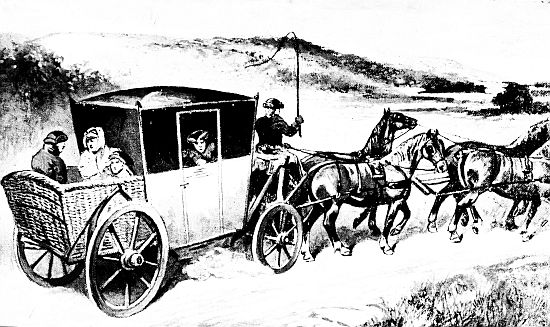
The coaches that travelled between
London and distant towns were similar in
construction to the hackney coach, which
plied for hire in the streets, but were
built on a larger scale. They carried eight
passengers inside, and behind, over the axle,
was a great basket for baggage and outside
passengers, who made themselves as comfortable
as they might in the straw supplied.
The “insides” were protected from rain and
cold by leather curtains; neither passengers
nor baggage were carried on the roof; and
the coachman sat on a bar fixed between the
two standard posts from which the body was
hung in front, his feet being supported by
a footboard on the perch.
Mr. Thrupp states that in 1662 there
were only six stage coaches in existence;
which assertion does not agree with that
of Chamberlayne, quoted on a previous
page; the seventeenth century writer tells us
that in his time—1649—stage coaches ran
“from London to the principle towns in the
country.” It seems, however, certain that
the year 1662 saw a great increase in the
number of “short stages”—that is to say,
coaches running between London and towns
twenty, thirty, forty miles distant.
OBJECTIONS RAISED TO STAGE COACHES.
This is proved by the somewhat violent
pamphlet written by John Cressel, to which
reference was made on page 33. This
publication, which was entitled The Grand
Concern of England Explained, appeared
in 1673. It informs us that the stage
coaches, to which John Cressel strongly
objects:—
“Are kept by innkeepers ... or else ...
by such persons as before the late Act for reducing
the number of hackney coaches in London [see page
33] to 400, were owners of coaches and drove hackney.
But when the number of 400 was full and they
not licensed, then to avoid the penalties of the Act
they removed out of the city dispersing themselves
into every little town within twenty miles of London
where they set up for stagers and drive every day to
London and in the night-time drive about the city.”
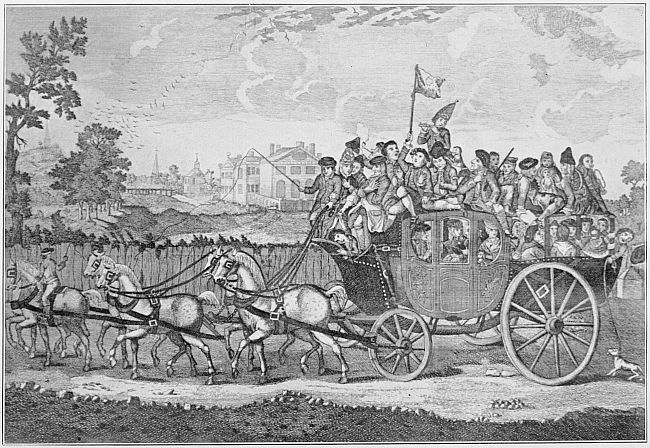
“THE MACHINE.” A.D. 1640-1750.
These intruders,[14] whose number John
Cressel says is “at least 2,000,” paid no
£5, and took bread from the mouths of the
four hundred licensed hackney coachmen.
John Cressel’s purpose in writing his
pamphlet was to call the attention of Parliament
to the necessity which, in his opinion,
existed for the suppressing all or most of the
stage coaches and caravans which were then
plying on the roads; and incidentally he
gives some interesting particulars concerning
the stage coach service of his time. Taking
the York, Chester and Exeter coaches as
examples, he says that each of these with
forty horses apiece carry eighteen passengers
per week from London.[15] In the summer
the fare to either of these places was forty
shillings and in winter forty-five shillings;
the coachman was changed four times on the
way, and the usual practice was for each
passenger to give each coachman one
shilling.
The journey—200 miles—occupied four
days. These early “flying coaches” travelled
faster than their successors of a later
date. The seventeenth century London-Exeter
coach did the journey, one hundred
and seventy-five miles, in ten days, whereas
in 1755, according to “Nimrod,” proprietors
promised “a safe and expeditious journey in
a fortnight.”
The “short stages,” i.e., those which ran
between London and places only twenty
or thirty miles distant, were the hackney
coaches which had not been fortunate
enough to obtain licenses under Charles II.’s
Act. These were drawn by four horses and
carried six passengers, making the journey
to or from London in one day. There
were, John Cressel states, stage coaches
running to almost every town situated within
twenty or twenty-five miles of the capital;
and it is worth observing that at this date
letters were sent by coach. Coaches ran on
both sides of the Thames from Windsor and
Maidenhead, and “carry all the letters, little
bundles and passengers which were carried
by watermen.”
This writer’s arguments against coaches
are worthless as such, but they throw side
lights on the discomforts of travel at the
time. He considered it detrimental to
health to rise in the small hours of the
morning to take coach and to retire late to
bed. With more reason he enquired,
“Is it for a man’s health to be laid fast in foul
ways and forced to wade up to the knees in mire;
and afterwards sit in the cold till fresh teams of
horses can be procured to drag the coach out of the
foul ways? Is it for his health to travel in rotten
coaches and have their tackle, or perch, or axle-tree
broken, and then to wait half the day before making
good their stage?”
John Cressel was prone to exaggeration,
but there is plenty of reliable contemporary
evidence to show that his picture of the
coach roads was not overdrawn. Yet when
this advocate for the suppression of coaches
seeks to rouse public sentiment, he reproaches
those men who use them for
effeminacy and indulgence in luxury! One
of his quaintest arguments in favour of the
saddle horse is that the rider’s clothes “are
wont to be spoyled in two or three journies”;
which is, he urges, an excellent thing
for trade as represented by the tailors.
John Cressel, it will be gathered from this,
viewed the innovation from a lofty stand-point.
He describes the introduction of
stage coaches as one of the greatest
mischiefs that have happened of late years
to the King. They wrought harm, he said:
(1) By destroying the breed of good horses, the
strength of the nation, and making men careless of
attaining to good horsemanship, a thing so useful
and commendable in a gentleman.
(2) By hindering the breed of watermen who are
the nursery for seamen, and they the bulwarks of
the kingdom.
(3) By lessening His Majesty’s revenues; for there
is not the fourth part of saddle horses either bred or
kept now in England that there was before these
coaches set up, and would be again if suppressed.
Travelling on horseback was cheaper than
by coach. The “chapman” or trader could
hire a horse from the hackneyman at from
6s. to 12s. per week. John Cressel estimates
that a man could come from “York,
Exeter or Chester to London, and stay
twelve days for business (which is the most
that country chapmen usually do stay), for
£1 16s., horse hire and horse meat 1s. 2d.
per day.” From Northampton it cost 16s.
to come to London on horseback, from
Bristol 25s., Bath 20s., Salisbury 20s. or
25s., and from Reading 7s.
If men would not ride, John Cressel urged
them to travel in the long waggons which
moved “easily without jolting men’s bodies
or hurrying them along as the running
coaches do.” The long waggon was drawn
by four or five horses and carried from
twenty to twenty-five passengers. He proposed
that there should be one stage per
week from London to each shire town in
England; that these should use the same
team of horses for the whole journey, that
their speed should not exceed thirty miles a
day in summer and 25 in winter, and that
they should halt at different inns on each
journey to support the innkeeping business.
If these proposals were carried out, the
writer thought stage coaches would “do
little or no harm.”
John Cressel’s pamphlet was answered by
another from the pen of a barrister, who
showed up the futility of his arguments and
deductions, but did not find great fault with
his facts and figures.
SEVENTEENTH CENTURY HIGH ROADS.
It is commonly believed that the introduction
of stage coaches produced the first
legislative endeavour to improve the country
roads; this is not the case: nor had the
sufferings of travellers by “long waggon”
any influence upon legislators if comparison
of dates be a reliable test; for it was not
until 1622 that any attempt was made to
save the roads. In that year James I.
issued a Proclamation in which it was stated
that inasmuch as the highways were
ploughed up by “unreasonable carriages,”
and the bridges shaken, the use of four-wheeled
carts for carrying goods and agricultural
produce was forbidden, carts with
two wheels only being allowed.
In 1629 Charles I. issued a Proclamation
confirming that of his father, and furthermore
forbidding common carriers and others
to convey more than twenty hundredweight
in the two-wheeled vehicles which were lawful,
and also forbidding the use of more than
five horses at once; the avowed object being
to prevent destruction of the road.
We may fairly reason from the terms of
this Proclamation that it was recognised that
on occasion five horses might be required
to draw one ton along the roads; and
from this we can form our own idea of the
condition to which traffic and rains might
reduce the highways.
In 1661 the restrictions on cart traffic
were modified by Charles II.’s Proclamation,
which permitted carts and waggons with
four wheels, and drawn by ten or more
horses, to carry sixty or seventy hundredweight,
and forbade more than five horses
to be harnessed to any four-wheeled cart
unless the team went in pairs. The orders
issued thus by Proclamation were made law
by two Acts of Charles II. in 1670; the
second of which forbade the use of more
than eight horses or oxen unless harnessed
two abreast.
In 1663 the first turnpike gate was
erected; this novelty was put on the Great
North Road to collect tolls for repair of the
highway in Hertfordshire, Cambridgeshire
and Huntingdon, where in places it had
become “ruinous and almost impassable.”
The turnpike was so unpopular that for
nearly a century no gate was erected
between Glasgow and Grantham.
Nothing more clearly proves the badness
of the roads in the seventeenth and
eighteenth centuries, than the number of
patents granted to inventors for devices
calculated to prevent carriages from over-turning.
The first invention towards this
end was patented in 1684, and between that
date and 1792 nine more patents were
granted for devices to prevent upsetting, or
to cause the body of the vehicle to remain
erect though the wheels turned over.
Few thought it worth trying to discover a
method of improving the roads which caused
accidents. In 1619, one John Shotbolt took
out a patent for “strong engines for making
and repairing of roads”; another was issued
in 1699 to Nathaniel Bard, who also protected
“an engine for levelling and preserving
roads and highways”; and in the same
year Edward Heming was granted a patent
for a method of repairing highways “so as
to throw all the rising ridges into the ruts.”
History omits to tell us what measure of
success rewarded these inventions: if the
Patent Specification files form any guide to
an opinion, inventors gave up in despair
trying to devise means of keeping the roads
in order, for not until 1763 does another
ingenious person appear with a remedy
thought worthy of letters patent.
Repairs to the highways were effected by
forced labour when their condition made
improvement absolutely necessary. Thus,
in 1695, surveyors were appointed by Act
of Parliament to require persons to work on
the road between London and Harwich,
which in places had become almost impassable.
Labourers were to be paid at local
rates of hire, were not to be called upon to
travel more than four miles from home, nor
to work more than two days in the week:
nor were they liable to be summoned for
road-mending during seed, hay and harvest-time.
This Act also revised the system
of tolls on vehicles: any stage, hackney, or
other coach and any calash or chariot was
to pay 6d. toll; a cart 8d. and a waggon 1s.
The Company of Coach and Coach
Harness Makers was founded in 1677 by
Charles II. The foundation of the company
shows that the trade of coach-building was
by this time large and important, while the
interest taken by the King must have given
an impetus to the business. We have
evidence that coaches of English build were
appreciated on the Continent in an old
“List of the Names of all the Commodities
of English Product and Manufacture that
was Exported to France from England
during what may be called the Interval of
Peace from Christmas, 1698, to Christmas,
1702.” The list includes both coaches and
harness for coaches.
In this connection it is to be observed
that by the terms of its charter the Coachmakers’
Company was empowered to seek
out and destroy bad work wherever they
might find such. Under these conditions
it is not surprising that English workmanship
became famous.
Hyde Park, as Pepys and other writers
show us, was the best place in London
to see the coaches of the gentry. In an
undated petition, submitted by “a great
number of licensed hackney coachmen,”
there is reference to the “four hundred
licensed coachmen in Hyde Park,” from
which it might be inferred that these
formed a body of license-holders distinct
from the four hundred licensed by Charles
II. in 1663.
HACKNEY CABS AS A SOURCE OF REVENUE.
In 1694, when the Parliament was hard
pressed for money to carry on the French
war, the London cabs or hackney coaches
were more heavily taxed under a new
system of licenses; the number licensed
to ply for hire was raised from 400 to
700, and for each license, which held good
for twenty-one years, the sum of £50 was
to be paid down, while £4 per annum
was to be paid as “rent.” All stage
coaches in England and Wales were to
pay a tax of £8 a year. This Act confirmed
the old tariff of fares for hackney
coaches in London (see p. 42), and the
prohibition against plying on Sundays, which
had been in force since 1662, was partially
withdrawn. The new Act allowed 175 cabs
to ply for hire on Sundays; the Commissioners
were enjoined to arrange matters
so that the 700 licensed cabmen should
be employed in turn on Sunday.
This Act caused great discontent among
the original 400 licensed coachmen, as it
made them equally liable with the additional
300 licensees to the £50 impost;
their grievances found vent in a petition,
wherein they prayed that they, the Original
Four Hundred, might be “incorporated”
(presumably as a guild or company), and
that all stage coaches running between
London and places thirty miles therefrom
might be suppressed.
The Act of 1693 compelled the hackney
coachman to carry a fare ten miles out of
London if required, and doubtless the uncertainty
of finding a “fare” to bring back
was partly owing to the short stages, which
ran on every road.
The five Commissioners who were appointed
to carry out the provisions of this
law discharged their duties with no greater
integrity than their predecessors. Yet
another Petition from the 700 hackney
coachmen refers incidentally to the circumstance
that in 1694 three of the five were
dismissed for accepting bribes from tradesmen
who wanted licenses; the petition also
prays for better regulations to control the
“many hundred coaches and horses let for
hire without license, likewise shaises, hackney
chairs and short stages.”
The “shaise” or chaise was evidently a
vehicle of a different type from the hackney
coach. The post-chaise for hire was introduced
into England about this time from
France by John, a son of Mr. Jethro Tull,
the famous agriculturist who in 1733 published
a work, entitled “Horse Hoeing
Husbandry,” which attracted great attention
and laid the foundation of the use of
implements in farming and improvements
in methods of cultivation. In 1740 John
Tull was granted a patent for a sedan chair
fixed on a wheel carriage for horse draught.
MANNERS OF THE CABMAN.
The licensed coachmen had good grounds
for complaint, as we learn from an edict
issued in 1692 by the Lord Mayor and
Aldermen that the law was systematically
evaded; in that year only 160 hackney
coachmen applied for licenses and the
number plying in the streets was about one
thousand. The men were a turbulent set;
several, we read, were indicted for “standing
of their coaches [in the streets] as a
common nuisance, for assaulting constables
and tradesmen who attempt to remove them
from before their shops.” There were no
side walks for foot-passengers in those days,
and thus the standing coach might be so
placed as to block the entrance to a shop.
Mons. Misson has the following passage
concerning the hackney coachman; it is
interesting as an illustration of contemporary
manners:—
“If a coachman has a dispute about his fare with
a gentleman that has hired him, and the gentleman
offers to fight him to decide the quarrel, the coachman
consents with all his heart. The gentleman
pulls off his sword, lays it in some shop with his
cane, gloves and cravat, and boxes in the manner I
have described. If the coachman is soundly drubbed,
which happens almost always, that goes for payment,
but if he is the beator the beatee must pay the money
about which they quarrelled. I once saw the late
Duke of Grafton at fisticuffs in the open street, the
widest part of the Strand, with such a fellow whom
he lamm’d most horribly.”
The same author says that the London
squares are enclosed with railings to keep
the coaches from crossing them.
CAB DRIVING A LUCRATIVE OCCUPATION.
It has been remarked on a previous page
that the hackney coachman drove a thriving
business; how profitable it was we may learn
from two petitions which were evoked by
Queen Anne’s Act of 1710, which increased
the number of licenses to 800 on payment of
5s. a week, such licenses to hold good for
thirty-two years. Seven hundred coaches
were more than profitable employment could
be found for, if we might believe the inevitable
petition put in against this Act; but
nevertheless the new 800 licensees joined in
petitioning that their licenses “may again
be made assets” as under the Act of 1694.
“In consideration of which, notwithstanding
the rent of 5s. per week, we most humbly
offer to raise £16,000 as a fine of £20 on
each license for the use of His Majesty King
George.”
That there was money to be made in
the business is shown even more clearly
by a petition submitted by James, Lord
Mordington and others about this time.
The petitioners offer to “farm the 800
hackney coaches which are now thought
necessary” at £6 per license for 21 years;
they were also prepared to pay £2,000 a year
during that period, on which the King might
raise a sum of £20,000; to pay £500 a year
to the orphans of the City of London; and
also to raise and equip a regiment of foot
at a cost of £3,000!
The Act of 1710, it should be observed,
altogether removed the prohibition against
plying on Sunday. It licensed 200 hackney
chairs and fixed the chair tariff at two-thirds
of that in force for the coach (1s. for one
and a half miles, and 1s. 6d. for two miles).
An injunction to the Commissioners to fix
at the Royal Exchange a table of distances
must have been appreciated by the users of
hackney coaches in London. It also repeated
the injunction to use horses of
fourteen hands at least; which repetition
seems to have been very necessary, as
Misson remarks that the regulation at the
time of his visit was “but ill obeyed.”
It was about this time that a curious
system of wig stealing was adopted by the
London thieves. We read in the Weekly
Journal of March 30, 1713, that:—
“The thieves have got such a villainous way now
of robbing gentlemen, that they cut holes through
the backs of hackney carriages, and take away their
wigs or the fine headdresses of gentlewomen.”
The writer counsels persons travelling
alone in a hackney coach to sit on the front
seat to baffle the thieves.
In vol. 3 of the Carriage Builders’ and
Harness Makers’ Art Journal (1863) was
published an advertisement from an old
newspaper; this was thought by the contributor
who discovered it to be the first
advertisement of the practical application
of springs to coaches; it refers to a patent
granted for fourteen years to Mr. John
Green in 1691:—
“All the nobility and gentry may have the carriages
of their coaches made new or the old ones
altered, after this new invention, at reasonable rates;
and hackney and stage coachmen may have licenses
from the Patentees, Mr. John Green and Mr. William
Dockwra, his partner, at the rate of 12d. per week, to
drive the roads and streets, some of which having
this week began, and may be known from the common
coaches by the words Patent Coach being over both
doors in carved letters. These coaches are so hung
as to render them easier for the passenger and less
labour to the horses, the gentleman’s coaches turning
in narrow streets and lanes in as little or less room
than any French carriage with crane neck, and not
one third part of the charge. The manner of the
coachman’s sitting is more convenient, and the motion
like that of a sedan, being free from the tossing and
jolting to which other coaches are liable over rough
and broken roads, pavements or kennels. These
great Conveniences (besides others) are invitation
sufficient for all persons that love their own ease and
would save their horses draught, to use these sort of
carriages and no other, since these carriages need no
alteration.”
This advertisement is the more noteworthy
as it clearly refers to some kind of turning
head; however valuable the improvements
thus offered, the springs at least do not
appear to have been appreciated, for their
use did not become general till the latter
half of the eighteenth century.
COACHES AND ROADS IN QUEEN ANNE’S TIME.
From the advertisements in old newspapers
we obtain some particulars of the
speed made by stage coaches in the early
part of the eighteenth century. In 1703,
when the roads were good, the coach from
London to Portsmouth did the journey, about
ninety miles, in fourteen hours. In 1706,
the York coach left London on Monday,
Wednesday and Friday, performing the
200 mile journey in four days; each
passenger was allowed 14 lbs. of luggage
and overweight was charged for at 3d. per
lb. In winter the cross-roads were execrable,
as appears from the Annals of Queen Anne
(London, 1704). In December, 1703, the
King of Spain slept at Petworth in Sussex,
on his way from Portsmouth to Windsor,
and Prince George of Denmark went to
meet him there: concerning the journey
one of the Prince’s attendants writes:—
“We set out at six o’clock in the morning to go
to Petworth, and did not get out of the coaches (save
only when we were overturned or stuck fast in the
mire) til we arrived at our journey’s end. “’Twas
hard service for the prince to sit fourteen hours in
the coach that day without eating anything and
passing through the worst ways that I ever saw in
my life; we were thrown but once indeed in going,
but both our coach, which was the leading, and his
highnesse’s body-coach would have suffered very
often if the nimble boors of Sussex had not frequently
poised it or supported it with their shoulders from
Godalmin almost to Petworth; and the nearer we
approached to the Duke’s house the more unaccessible
it seemed to be. The last nine miles of the way
cost us six hours time to conquer them, and indeed
we had never done it if our good master had not
several times lent us a pair of horses out of his own
coach, whereby we were enabled to trace out the
way for him.”
COACHING IN GEORGE I.’S AND GEORGE II.’S
REIGNS.
Markland,[16] referring to the above passage,
states on the authority of a correspondent
that in 1748 persons travelling from Petworth
to Guildford were obliged to make for the
nearest point of the great road from Portsmouth
to London; plainly indicating that
the main arteries of traffic were much
superior to the cross-roads.
Dean Swift, writing to Pope on August 22,
1726, refers to the “closeness and confinement
of the uneasy coach.” At this period
there was still considerable prejudice against
the use of carriages by men who were physically
able to ride, as appears from a letter
written by Swift to his friend Mr. Gay, on
September 10, 1731:—
“If your ramble was on horseback I am glad of it
on account of your health; but I know your arts of
patching up a journey between stage coaches and
your friends’ coaches; for you are as arrant a cockney
as any hosier in Cheapside ... you love twelve-penny
coaches too well, considering that the interest
of a whole thousand pounds brings you but half-a-crown
a day ... a coach and six horses is all
the exercise you can bear.”
The reference to Mr. Gay’s income indicates
that the saddle was a much cheaper
means of travelling than the coach. Six
horses seem to have been the number used
in private coaches during the first half of
the eighteenth century, if we may judge by
the frequency with which Swift refers to
“to coach and six.”
An agreement made in 1718 between a
Mr. Vanden Bampde and Charles Hodges,
a job-master, is worth noticing. Under this
contract Hodges undertook to maintain for
Mr. Bampde “a coach, chariot, and harness
neat and clean, and in all manner of repair
at his own charge, not including the wheels.”
If the coachman should break the glass
when the carriage was empty, Hodges was
to make good the damage. He was to
supply at a charge of 5s. 6d. a day, a pair
of “good, strong, serviceable, handsome
well-matched horses of value between £50
and £60”; also a “good, sober, honest,
creditable coachman,” who, with the horses,
should attend as Mr. Bampde or his lady
might require in London or Westminster.
If Mr. Bampde went into the country
Hodges was to find him one or more pairs
of horses at half-a-crown per pair per day
extra.
DEAN SWIFT ON COACHES AND DRIVERS.
The hackney coachmen appear to have
been quite as independent and offensive a
class in Swift’s time as they were in Pepys’.
Writing from Dublin on July 8, 1733, he
compares the advantages of residence in
that city with residence in London, and
gives prominence to the following items:—
“I am one of the governors of all the hackney
coaches, carts and carriages round this town; who
dare not insult me like your rascally waggoners or
coachmen, but give me the way.”
It may be observed here that there was
still plenty of work for the wherrymen on
the Thames in the middle of the eighteenth
century. Swift writes on April 16, 1760,
praying Mr. Warburton to leave London
and pay him a visit at Twickenham, and
by way of inducement he adds: “If the
press be to take up any part of your time,
the sheets may be brought you hourly
thither by my waterman.”
The Dean’s Humorous Advice to Servants
contains some sarcastic observations
addressed to the coachman, which shed light
upon what we must suppose was the usual
character of that servant. He is advised
that “you are strictly bound to nothing but
to step into the box and carry your lord
and lady;” and he is enjoined to take every
opportunity of drinking. The following passage
shows how wheels of carriages suffered
from the battering on the roads:—
“Take care that your wheels be good; and get
a new set bought as often as you can whether you
are allowed the old as your perquisite or not; in one
case it will turn to your honest profit and on the
other it will be a just punishment on your master’s
covetousness, and probably the coach-maker will
consider you too.”
ROADS IN THE 18TH CENTURY.
Every author of the time has something
to say about the roads. Daniel Bourn[17]
says:—
“So late as thirty or forty years ago [i.e., 1723-33]
the roads of England were in a most deplorable condition.
Those that were narrow were narrow indeed,
often to that degree that the stocks of the wheels bore
hard against the bank on each side, and in many places
they were worn below the level of the neighbouring
surface, many feet, nay, yards perpendicular; and
a wide-spreading, brushy hedge intermixed with old
half-decayed trees and stubbs hanging over the
traveller’s head intercepting the benign influence of
the heavens from his path, and the beauties of the
circumjacent country from his view, made it look
more like the retreat of wild beasts and reptiles than
the footsteps of man. In other parts where the road
was wide, it might be, and often was too much so,
and exhibited a scene of a different aspect. Here the
wheel-carriage had worn a diversity of tracks which
wore either deep, or rough and stony, or high or
low as Mother Nature had placed the materials upon
the face of the ground; the space between these were
frequently furzy hillocks of thorny brakes, through
or among which the equestrian traveller picked out
his entangled and uncouth steps.
“To these horrible, stony, deep, miry, uncomfortable,
dreary roads the narrow-wheel waggon seems
to be best adapted, and these were frequently drawn
by seven, eight, or even ten horses, that with great
difficulty and hazard dragged after them twenty-five
or thirty hundredweight, seldom more.”
Bourn’s reference to the “narrow-wheel
waggon” touches a matter which formed
the subject of hot debate for generations.
It was urged that the narrow wheels of
waggons were largely the means of cutting
up the roads, and no doubt these did contribute
to the general condition of rut and
ridge that characterised them. This view
was adopted by Parliament, and to encourage
the use of wide wheels a system of
turnpike tolls was adopted which treated
the wide tire far more leniently than the
narrow; anything under 9 inches in width
being considered narrow.
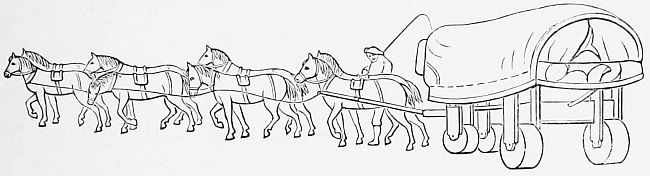
Mr. Daniel Bourn’s Roller Wheel Waggon, A.D. 1763.
Bourn was a warm advocate for wide
wheels, and the book from which the above
passage is taken describes an improved
waggon invented by himself; the drawing is
from the inventor’s work. The wheels of
this vehicle resemble small garden rollers;
they are 2 feet high and 16 inches wide.
Each is attached independently to the body
of the waggon and the fore wheels being
placed side by side in the centre, while the
hind wheels are set wide apart, the waggon
is practically designed to fulfil the functions
of a road-roller.[18] It does not appear that
Bourn’s invention obtained any general
acceptance, which is perhaps not very
surprising.
SPEED OF THE 18TH CENTURY STAGE COACH.
In 1742, the Oxford coach, leaving
London at seven in the morning, reached
High Wycombe (about forty miles) at
five in the evening, remained there the
night, and concluded the journey on the
following day. The Birmingham coach
made its journey at about the same pace,
forty miles per day, resting half a day at
Oxford. Night travel does not seem to
have been at all usual. Apart from the
badness of the roads, the audacity of
highwaymen was a sufficient reason for
refraining from journeys by night.
Some improvements were made in private
carriages at this period, but there was little
change for the better in the stage coaches,
which differed slightly from the “machine”
of a century earlier; the driver’s seat was
safer and less uncomfortable, and that was
the only noteworthy alteration. An advertisement
of 1750 announces “accommodation
behind the coach for baggage and
passengers; fares 21s., and servants 10s. 6d.,
riding either in the basket behind or on
the box beside the driver.”
Endeavour to expedite the service between
the great towns of the kingdom is
shown in an advertisement of the “Flying
Coach,” which was put on the London and
Manchester road in 1754. This informs
possible patrons that “incredible as it may
appear, this coach will actually arrive in
London in four days and a half after leaving
Manchester.” The distance between the
two cities is about 187 miles, making the
rate of speed a little over 44 miles per
day.
The stage coach of 1755 is thus described
by Mr. Thrupp.
“They were covered with dull black leather,
studded by way of ornament with broad-headed nails,
with oval windows in the quarters, the frames painted
red. On the panels were displayed in large characters
the names of the places where the coach started and
whither it went. The roof rose in a high curve with
an iron rail around it. The coachman and guard sat
in front upon a high narrow boot, often garnished
with a spreading hammer-cloth with a deep fringe.
Behind was an immense basket supported by iron
bars in which passengers were carried at lower fares.
The whole coach was usually drawn by three horses,
on the first of which a postillion rode, in a cocked
hat and a long green-and-gold coat. The machine
groaned and creaked as it went along with every tug
the horses gave it, and the speed was frequently but
four miles an hour.”
Three horses may have done the work
in summer, but there is no reason to suppose
that the roads of 1755 were any better
than they had been sixteen years earlier,
when Thomas Pennant thus described a
journey in March from Chester to London.
The stage, he says:—
“was then no despicable vehicle for country
gentlemen. The first day, with much labour, we got
from Chester to Whitchurch, twenty miles; the
second day to the Welsh Harp; the third to
Coventry; the fourth to Northampton; the fifth to
Dunstable; and as a wondrous effort on the last,
to London, before the commencement of night. The
strain and labour of six good horses, sometimes eight,
drew us through the sloughs of Mireden and many
other places.”
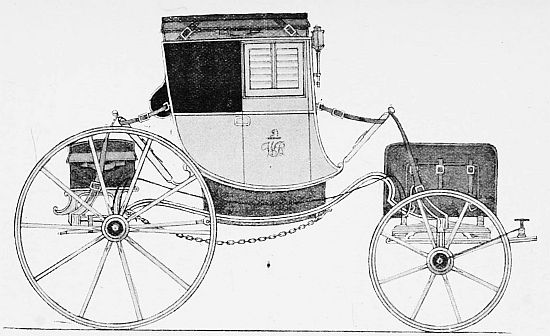
TRAVELLING POSTING CARRIAGE, 1750.
THE APPLICATION OF SPRINGS.
In the year 1768 Dr. R. Lovell Edgeworth,
who had devoted much attention to
the subject, and had made numerous experiments,[19]
succeeded in demonstrating that
springs were as advantageous to the horses
of, as to the passengers in a coach; and
he constructed a carriage for which the
Society of English Arts and Manufactures
awarded him three gold medals. In this
conveyance the axletrees were divided and
the motion of each wheel was relieved by
a spring. Just one dozen patents for springs
were granted during the eighteenth century,
and it is impossible to say which invention
had most influence on methods of building
coaches. In 1772 a patent was granted to
James Butler for a new coach-wheel the
spokes of which were constructed of springs;
but this curious contrivance is mentioned
nowhere—so far as the writer’s investigations
have shown—but in the Patent Office files,
whence we may conclude it was a failure.
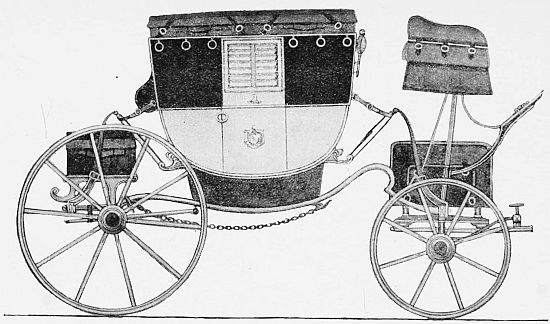
TRAVELLING POSTING CARRIAGE, 1750.
The adoption of springs was certainly
gradual. It is probably right to assume
that wealthy men led the way by having
coaches built on springs or altering their
vehicles. It is impossible to draw a hard
and fast line between the period of the
coach without and the coach with springs.
The illustrations show that travelling carriages
on springs and braces were built in
1750. These drawings prove that, clumsy
though the public conveyances were, private
carriages were both tolerably light and comfortable.
The “whip springs” to which the
braces are attached were in general use ten
years later.
A curious error arose from the application
of springs to public conveyances, according
to Dr. Lovell Edgeworth. Their introduction,
it must be premised, led to the accommodation
of passengers and loading of
baggage on top of the stage coach, and
coachmen, finding the vehicle drew more
easily, attributed the fact, not to the
springs, but to the increased height and
reduced length of the load.[20]
In the belief that a high and short load
possessed some mysterious property which
made it easier to draw than a low long one,
builders vied with each other in building
lofty vehicles. “Hence in all probability,”
says the authority we are quoting, “arose
the preposterous elevation of public carriages.”
OUTSIDE PASSENGERS.
Dr. Lovell Edgeworth gives us to understand
that the practice of carrying passengers
on the roof of the coach followed the application
of springs to stage coaches; and in
view of the belief noticed above this seems
exceedingly probable. The practice had
clearly been in vogue for some years when
the Annual Register published the following
paragraph:—
“September 7 (1770).—It were greatly to be wished
the stage coaches were put under some regulations as
to the numbers of persons and quantity of baggage.
Thirty-four persons were in and about the Hertford
coach this day when it broke down by one of the
braces giving way.”
In 1775, we learn from the same publication,
stage coaches generally carried eight
persons inside and often ten outside passengers.
On another page appears the
statement that “there are now of these
vehicles [stage coaches], flies, machines and
diligences upwards of 400, and of other
wheeled carriages 17,000.”
In 1785 was passed George III.’s Act,
which forbade the conveyance of more than
six persons on the roof of any coach and
more than two on the box. This Act was
superseded in 1790 by another which permitted
only one person to travel on the
box and only four on the roof of any coach
drawn by three or more horses. A coach
drawn by less than three horses might carry
one passenger on the box and three on the
roof, but such vehicles might not ply more
than twenty-five miles from the London Post
Office.
The first “long coaches” (i.e. long-stage
vehicles) and those called diligences were
superseded by what were called the “old
heavies,” carrying six inside passengers and
twelve out.[21]
ROADS IN GEORGE III’s TIME.
The turnpike road had been improved by
the year 1773, when Mr. Daniel Bourn wrote
a pamphlet[22] answering some objections
which had been urged against his waggon
on rollers (see p. 79). Mr. Jacob had
asserted that the roughness of the roads
was an insuperable obstacle to the enormously
wide wheels invented by Mr. Bourn;
and the latter, while admitting the wretched
condition of local roads, refutes this argument
as applied to the great roads:—
“A person might follow a waggon from London to
York and meet with very few great stones ...
let us now view this more agreeable turnpike road,
yet even here you will find that there is less degrees
of loose dirt and mangled materials.”
In this connection it will be remembered
that the road roller had been brought into
use in the previous year (see footnote p. 80).
The improvement was by no means universal,
however. Arthur Young[23] writes:—
“I know not in the whole range of language terms
sufficiently expressive to describe this infernal road.
To look over a map, and perceive that it is a
principal one, not only to some towns, but even
whole counties, one would naturally conclude it to
be at least decent; but let me most seriously caution
all travellers who may accidentally purpose to travel
this terrible country, to avoid it as they would the
devil, for a thousand to one but they break their
necks or their limbs by overthrows or breakings
down. They will here meet with ruts, which I
actually measured, four feet deep, and floating with
mud, only from a wet summer; what, therefore, must
it be after the winter? The only mending it receives,
in places, is the tumbling in loose stones, which serve
no other purpose but jolting the carriage in a most
intolerable manner. These are not merely opinions,
but facts, for I actually passed three carts broken
down in these eighteen miles of execrable memory.”
IMPROVEMENTS IN STAGE COACHES.
The last twenty-five years of the eighteenth
century saw great increase of the coaching
industry and many important improvements.
The “long stages” were still slow; the
Edinburgh Courant, of 1779, contains an
advertisement of the London Coach which
“will run every Tuesday, occupying ten
days, resting all Sunday at Barrowbridge;
for the better accommodation of passengers
will be altered to a new genteel two-end
coach machine hung upon steel springs,
exceeding light and easy.” At this period
the newspapers often contained advertisements
inviting a companion to share with
the advertiser the risks and expenses of
posting to London.
It was no doubt the love of Englishmen
for privacy which led a Mr. Crispus
Claggett to patent in 1780 his “Imperial
Mercury.” This vehicle had the outward
appearance of one carriage, but it was
divided into four equal compartments with
space in each for four persons. Each compartment
was entered by its own door and
was partitioned off from the others by doors
and glasses, This curious conveyance must
have somewhat resembled an early railway
coach.
THE MAIL COACH.
Mr. John Palmer’s[24] “diligences” were put
upon the road in 1783, and with these the
proprietor laid the first crude foundation of
the mail service. The ordinary post was
carried by boys on horseback and was both
slow and uncertain owing to the poor quality
of the horses, the badness of the roads and
not least to the untrustworthiness of the
boys. Every letter for which expedition was
necessary was now sent by diligences where
they were established, and they ran from
nearly all the towns in the kingdom to
London and between many of the principal
towns. Postage by these was very expensive:
a letter by the ordinary post from
Bath to London cost fourpence, whereas it
cost two shillings for “booking, carriage and
porterage” if sent by diligence. The greater
speed and safety were the inducements to
use the diligence for important letters, as
on the stage coaches both guard and coachman
were well armed; the former sat on the
box with the driver, and, says a writer of the
time, “always sat with his carbine cocked
on his knees.”
The conveyance of letters by diligence or
“coach diligence” from Bath, where Mr.
Palmer resided, to London was an experiment
on the success of which that gentleman
depended largely in his battle with the
officials of Parliament and Parliamentary
Committees when he sought to bring about
change in the method of carrying letters.
For a considerable time those in authority
refused to admit the possibility of a coach
travelling from Bath to London, 108 miles,
in eighteen hours; but after a hard struggle
Mr. Palmer triumphed, and the first mail
coach ran from Bristol to London on August
2, 1784. Six miles an hour had been promised,
but the journey, 117 miles, was
performed in seventeen hours, or at a rate
of nearly seven miles an hour, about double
the speed of the mounted post-boy.
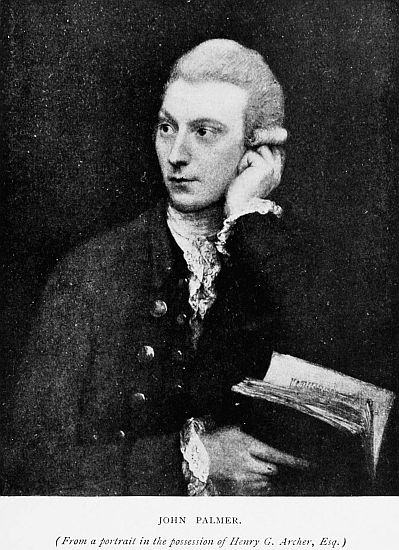
JOHN PALMER.
(From a portrait in the possession of Henry G. Archer, Esq.)
These early mail coaches (the “old
heavies”) were cumbrous vehicles, and by
no means remarkable for strength of construction:
indeed, until Mr. Palmer took
the matter firmly in hand and compelled the
contractors to replace their worn-out coaches
by new ones (which were built by Besant),
three or four breakdowns or upsets were
daily reported to the Post-master General.
They were drawn by four horses; carried
six inside passengers and, until the law of
1785 already noticed, twelve “outsides.”
Their speed on the principal roads was
gradually accelerated about this time, and
after the mail coaches began to work the
pace of “fly stage coaches,” or flying coaches,
was increased to eight miles an hour.
On some roads the old slow coaches
remained; as late as the year 1798 the
Telegraph left Gosport at one o’clock in
the morning and reached Charing Cross at
eight in the evening, thus occupying nineteen
hours over a journey of 80 miles; a
speed of little over four miles an hour.
In 1792 sixteen mail coaches left London
daily; and seven years later these had
increased to about eighty.
REGULATIONS FOR MAIL AND STAGE COACHES.
During George III’s reign, three Acts of
Parliament had been passed defining the
number of outside passengers that any stage
coach might carry, and making other regulations
in the public interest; these three
Acts were repealed by a fourth placed on the
statute book in 1810, which enacted that any
“coach, berlin, landau, chariot, diligence,
calash, chaise-marine or other four-wheeled
vehicle,” employed as a public carriage and
drawn by four horses might carry ten outside
passengers including the guard but not the
coachman; that only one person might share
the box with the coachman; and of the
remaining nine, three should sit in front
and six behind. No passenger might sit
on the baggage. Stages drawn by two or
three horses might carry not more than five
outside passengers; “long coaches” or
“double-bodied coaches” might carry eight.
The social distinction between “inside”
and the “outside” is betrayed by a clause of
this law which forbade any outside passenger
to travel inside unless with the consent of
one inside passenger; and the “inside” who
gave consent was to have the “outside”
placed next him.
This Act also prescribed important limitations
to the height of coaches: neither
passenger nor luggage might be carried on the
roof of any coach the top of which was over
8 feet 9 inches from the ground and whose
width was under 4 feet 6 inches measured
from the centre of one wheel track to the
centre of the other. On a four-horse coach
8 feet 9 inches high the baggage might be
piled to a height of two feet; on one drawn
by two or three horses, to a height of
eighteen inches. As it was considered
expedient to encourage low-hung coaches
with the view of attaining greater immunity
from accidents, it was legal to pile baggage
up to a height of 10 feet 9 inches from the
ground. Any passenger might require any
turnpike keeper to count the “outsides” or
to measure the height of the luggage on
the roof. At a later date the fast mail
coaches were prohibited by the Post-master
General from carrying any baggage at all
on the roof.
MAIL COACH PARADE ON THE KING’S BIRTHDAY.
Mr. Thrupp gives the following description
of the mail coaches as they appeared at
the “King’s Birthday Parade,” an interesting
display which appears to have been held
for the first time in the year 1799, and which
remained an annual function until 1835.
The coaches assembled in Lincoln’s Inn
Fields, and drove through the streets past
St. James’ Palace and back to the General
Post Office, then in Lombard Street:—
“Each coach was new or turned out to look like
new and was painted red with the Royal Arms on
the door panel, and on the smaller panel above the
name of the town to which the coach went; on the
boot the number of the mail, and on each upper
quarter one of the stars of the four Orders of the
Knighthood of the United Kingdom, the Garter, the
Bath, the Thistle and St. Patrick. The coaches
were built just big enough to contain four inside and
three or four outside, and coachman and guard. The
body was hung upon a perch carriage and eight
telegraph springs, the underworks being both solid
and simple in construction.”
A writer in Baily’s Magazine (June,
1900), gives a description of this parade;
only the coachmen and guards, in new uniforms,
were allowed on the coaches, for which
gentlemen used to lend their best teams;
the procession generally consisted of about
twenty-five coaches and was prolonged by
the presence of a horseman between every
two coaches.
THE MAIL COACHMAN AND GUARD.
The mail coaches in their daily routine
assembled in Lombard Street between 8
and 8.20 p.m. every evening to receive the
mails, and drew up in double file. Each
was known by the name of the town to
which it ran, and on the call of “Manchester,”
“Liverpool,” or “Chester,” the coach bound
thither broke rank and came up to the post-office
door to receive the mails; the bags
were tossed into the boot and the slamming
of the lid of the boot was the signal to start.
Most of the mails for the Western counties
started at 7 p.m. from the Gloucester Coffee
House in Piccadilly, the mail bags being
brought thither from the General Post Office
in gigs drawn by fast-trotting horses, The
stages for the West started from Hatchett’s;
for the North, from the Peacock, Islington.
The mail guard was a considerable personage;
when the modern style of build was
adopted, the hind seat over the mail boot
was strictly reserved to him, nobody being
allowed to share it, as a precaution against
robbery of the mails. To obtain an appointment
as guard on a mail coach the applicant
had to produce a recommendation from a
Member of Parliament showing that he bore
a high character, and a medical certificate
to effect that he was of good constitution
(exceedingly necessary in view of the nature
of his work); if accepted as a probationer
he had to spend a term in a coach factory
and there learn how to repair a broken pole
and patch up any other fracture that might
occur on the road. His pay was only 10s.
per week, but his perquisites were considerable;
he might make as much as £3
or £4 a week, by taking charge of plate
chests and valuables entrusted to his care;
and it was the custom to allow the guard
and coachman to divide all fares of 3s. or
less between them.
The guard went the whole way with his
coach; the coachman’s “stage” was generally
forty or fifty miles out and home
again. The latter’s wages were supplemented
by tips from the passengers, who
were admonished that the time had come
to open their purses by the coachman’s
polite “Gentlemen, I leave you here.”
The money thus collected by the driver
of a first-class coach amounted, it is said, to
£200 or £300 a year. The coachman was
subject to numerous regulations which aimed
at the security of passengers and mails. He
might not allow anyone else to drive, without
the consent of the coach proprietor or
against the wishes of the other passengers;
he might not leave his box unless a man
was at the leaders’ heads; and there were
many such minor instructions to be observed.
Until about 1815 the coachman’s box
was not part of the body of the vehicle,
and while the passengers rode comfortably
on springs the unfortunate driver had a seat
as comfortless as want of springs could
make it. When this was done away with,
it was quite in accord with British traditions
that strong objections should be made,
the chief being founded on the idea that if
the coachman were made so comfortable he
would go to sleep on his box. The Manchester
Telegraph, celebrated as one of
the smartest coaches of the day, was the first
which was thus altered.
The guard was responsible for the punctuality
of the coach, and each evening when
leaving the General Post Office he was
handed a watch officially set and officially
locked in a case in such wise that it could
not be tampered with. The guard also
carried what was called a “snow book”
from the fact that entries therein were most
usually caused by heavy snowstorms. In
this he recorded any such incidents as the
hire of extra horses when these might be
needed, of saddle horses to carry the mail
bags forward if the coach came to grief, or
of any other outlay.
“THE ROAD” IN WINTER.
Mention of the guard’s “snow book”
suggests that a winter’s journey in the coaching
days was an undertaking not to be
lightly faced. One morning in March, 1812,
the Bath coach arrived at Chippenham with
two outside passengers frozen to death in
their seats, and a third in a dying state. A
snow shovel strapped behind his seat was a
regular item of the guard’s winter equipment,
but only too often a shovel was useless. In
the winter of 1814, the Edinburgh mail had
to be left in the snow and the mail bags
forwarded to Alnwick on horseback; in the
same week eight horses were needed to
draw the York coach to Newcastle. When
a coach was snow-bound it was the guard’s
duty to get the mails forward; this he did
when possible by taking two of the horses
and riding one while the other carried the
bags. Some of the best of Pollard’s coaching
pictures represent such incidents as
occurred in the severe winters of 1812, 1814,
and 1836.
The winter of 1814 was long remembered
for the great and prolonged fog which disorganised
traffic; the fog was followed by
a singularly severe snow storm which continued
for forty-eight hours; while it lasted
no fewer than thirty-three mails in one day
failed to arrive at the General Post Office.
The Christmas season of 1836 is historical
in meteorological annals for the unprecedented
severity of the snowfall. The storm lasted
for the best part of the week, and for ten
days travelling was suspended. Christmas
night was the worst, and scarcely a single
coach ventured to quit London on the 26th
and 27th, St. Albans was literally full of
mails and stages that could not get forward;
on December 27, no fewer than fourteen
mail coaches were abandoned snow-bound
on various roads; and the Exeter mail, on
December 26, was dug out five times on
the way to Yeovil. In flat and open
country all traces of the roads were lost, and
the coachman had to trust the safety of the
vehicle to his horses’ instinct. In some
places the snow drifts gathered to an enormous
depth and made the roads utterly
impassable.
It was an article of the coaching creed to
“get forward” if humanly possible; and the
feats of endurance and courage accomplished
by guards and coachmen in these old times
prove them to have been a remarkably fine
class of public servant, deserving all that
has been written of them.
PASSENGER FARES.
Passenger fares by mail coach were higher
than by the ordinary stage; on the former
the rates were from 4d. to 5d. per mile for
“outsides,” and 8d. to 10d. per mile for
“insides”; on the stage coach the outside
passenger paid from 2½d. to 3d. per mile,
and the inside from 4d. to 5d. Posting cost
about eighteenpence per mile, and was therefore
reserved to rich men.
DIFFERENCE BETWEEN STAGE AND MAIL COACH.
In the early days of the century, though
the actual rate of travel was about eight
miles an hour by the ordinary stage coach,
much time was occupied over the journey.
There appears to have been no such thing
as a “time bill.” The coachman would go
out of his way to set down or pick up a
passenger: he would wait to oblige a friend if
desired, and “Nimrod” in his famous article
on “The Road” cites, as an example of the
leisurely fashion prevalent, the civility of
“Billy” Williams, who drove the Shrewsbury-Chester
coach in his school days, and
took twelve hours to cover the forty miles,
Two hours were allowed for dinner at
Wrexham, but this obliging coachman would
come into the parlour and say, “The coach
is ready, gentlemen, but don’t let me disturb
you if you wish for another bottle.”
Very different was the case with the Royal
Mail: every second was economised: at
some places horses were changed within the
space of a minute, and so jealously punctual
were the coachmen that the village people
set their clocks by the mail as it sped along
the street. The Royal Mail paid no tolls,
and if a turnpike keeper had not his gate
open ready for its passage he was fined 40s.
The passing of the London coach was the
event of the day in quiet villages during
the coaching age, as the guard performed
the functions now discharged by the newspaper
and telegraph wire. “The grandest
chapter in our experience,” says a regular
traveller during the stirring times of 1805-1815,
“was on those occasions when we
went down from London with news of a
victory.”
THE “GOLDEN AGE” OF COACHING.
The adoption of Macadam’s system of
road-making gave birth to the brief “golden
age” of coaching. John Macadam, an Ayrshire
man, born in 1756, had devoted many
years to the subject of road improvement,
and between the years 1798 and 1814
travelled over some 30,000 miles of highway
in Great Britain, His method of spreading
small broken fragments of hard stone, none
ever six ounces in weight, stamped or
rolled into a compact crust, was finally
approved in 1818, and “macadamised”
roads were rapidly made all over the kingdom.
The inventor was awarded a grant
of £10,000, and in 1827 he was appointed
Surveyor-General of Roads. He died in
1836, when fast coaching was at the zenith
of its prosperity.
The portrait of which a reproduction is
here given is believed to be the only one
in existence. It was painted by Raymond,
about the year 1835, and was given by Mr.
Macadam’s widow to Mr. Allen of Hoddesdon,
Essex, who for several years had made
road-mending tools and appliances to the
great road-maker’s patterns. The portrait
was bequeathed to Mr. Allen’s granddaughter,
by whom it was sold in 1902, to
the present owner, Major McAdam.
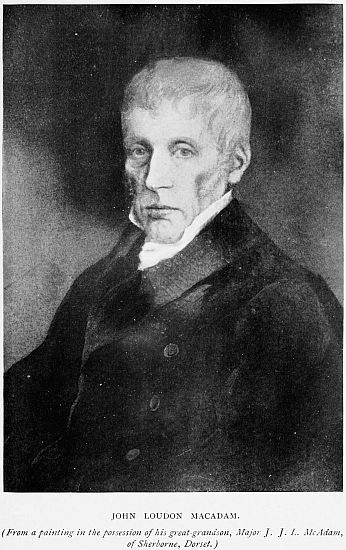
JOHN LOUDON MACADAM.
(From a painting in the possession of his great-grandson, Major J. J. L. McAdam,
of Sherborne, Dorset.)
To fully appreciate the enormous value
of Macadam’s work it must be considered
in conjunction with that of Telford the engineer,
and with knowledge of the earlier
methods of road-making. The original high-roads
in England were the tracks made by
travelling chapmen or pedlars, who carried
their goods on pack horses. These naturally
selected routes over the hills when they
sought to avoid the bogs and quagmires of
low-lying ground; and these routes, becoming
in time the regular coach roads, left
much to be desired in point of gradient and
contour. Telford cut through the hills to
obtain an easier ascent, and when Macadam
had “made” the new road thus outlined
it was as widely different from the original
track it replaced as it is possible to conceive.
“Nimrod,” writing in 1826, said, “Roads
may be called the veins and arteries of a
country through which channels every improvement
circulates. I really consider Mr.
Macadam as being, next to Dr. Jenner, the
greatest contributor to the welfare of mankind
that this country has ever produced.”
With good, firm and level roads the speed
of the mail and stage coaches increased, and
the endeavour to combine speed with safety
brought about numerous minor but important
improvements in coach-building, proprietors
sparing neither pains nor money to
insure the best materials and workmanship.
The greatest improvements, says Mr.
Thrupp, were those begun in 1820 by Mr.
Samuel Hobson. He reduced the height
of the wheels to 3 feet 3 inches in front, and
4 feet 5 inches behind, lengthened the coach
body to better proportions and hung it lower,
so that a double step would give access to
the door instead of a three-step ladder. He
wrought great improvements in the curves
of the carriage, and did much to strengthen
the details of the underworks.
FAST COACHES.
Coach driving became a favourite occupation
among men of good birth who had run
through their patrimony and could turn their
hands to nothing more congenial. “Horsing”
coaches was a business to which all
sorts and conditions of men devoted themselves,
and which did much to promote the
spirit of rivalry that made for good service.
Innkeepers and others contracted to supply
horses for one, two, three, or more stages of
a journey, and thus acquired a personal
interest in the coach. The best coaches
now ran at ten or ten and a half miles an
hour, and faster over favourable stretches of
road. The Quicksilver mail from London
to Devonport, “Nimrod” tells us, was half a
mile in the hour faster than most of the
coaches in England, and did the fastest
stage of the journey, four miles near Hartford Bridge,
in twelve minutes. This coach
on one occasion accomplished its journey
of 216 miles in twenty-one hours, fourteen
minutes, including stoppages.
The mail coaches, it should be said, carried
three outside passengers at most, and no
luggage at all on the roof. Of course these
rates of speed, so much higher than had
been known theretofore, called forth protests.
“Old Traveller,” writing to the Sporting
Magazine in 1822, objects to the encouragement
given such hazardous work by
“Nimrod.” In his younger days, he says,
when about to start on a journey, his wife’s
parting hope was that he would not be
robbed; now she had changed it to the hope
that he would not get his neck broken. It
was no uncommon thing, at the beginning
of the century and earlier, for a Birmingham
merchant to make his will before he set out
on a journey; and with all respect to the
“Old Traveller,” the risks he encountered
on the road in the days before Macadam
were as great from ruts and holes as from
highwaymen.
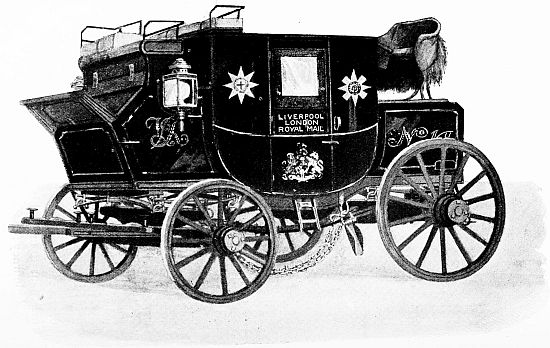
ROYAL MAIL COACH.
Travelling on May-day was avoided by
those who objected to fast work, for it was
customary for rival stages to race each other
the whole journey on that day, and old
sporting papers contain occasional record of
the fact that a coach had accomplished its
entire journey at a rate of fifteen miles an
hour. A law passed in 1820, to put an end
to “wanton and furious driving or racing,”
by which coachmen were made liable to
criminal punishment if anyone were maimed
or injured, did not stop this practice. For
on May 1, 1830, the Independent Tallyho
ran from London to Birmingham, 109 miles,
in 7 hours, 39 minutes. The writer in
Baily’s Magazine of June, 1900, before
referred to, gives a graphic account of a
May-day race between two of the smartest
West country coaches, the Hibernia and
l’Hirondelle, from which it appears that
these contests were not always free from
foolhardiness, though it must be admitted
that they produced wonderful displays of
coachmanship. Captain Malet gives the
following as the fastest coaches in England
in 1836:—
London and Brighton, 51½ miles, time five
hours, fifteen minutes; London and Shrewsbury,
154 miles, time fifteen hours; London
and Exeter, 171 miles, time seventeen hours;
London and Manchester, 187 miles, time
nineteen hours; London and Liverpool, 203
miles, time twenty hours, fifty minutes;
London and Holyhead, 261 miles, time
twenty-six hours, fifty-five minutes.
Some of the smartest coaches in England
ran from London to Brighton, which, owing
to George III’s patronage, had since 1784
risen from a mere fishing village to the most
fashionable of seaside resorts. In 1819, says
Bradfield, upwards of 70 coaches visited and
left Brighton every day; in 1835, says
Bradfield, there were 700 mail coaches and
rather under 3,300 stages running in England;
he estimates the number of horses
used at over 150,000, while 30,000 men
were employed as coachmen, guards, horse-keepers,
ostlers, &c. Mr. W. Chaplin, the
member for Salisbury, was the largest proprietor;
he had five “yards” in London and
owned 1,300 horses. Messrs. Horne and
Sherman ranked next to Mr. Chaplin; each
had about 700 horses.
HEAVY TAXATION OF COACHES.
The heavy taxes laid upon the stage
coaches were a fruitful source of complaint
among proprietors. In 1835 a coach conveying
eighteen passengers paid 3½d. per mile
run to the revenue. To show the decline of
coaching, it may be said that in 1835 the
total revenue from the stage coaches
amounted to £498,497 and in 1854 it had
fallen to £73,903. The taxes were estimated
to be one-fifth of the receipts, and this being
the case it is not remarkable that, in the
earlier days of the railroad, the people in
country districts remote from railways should
have suffered more inconvenience than they
had ever known. It no longer paid to run
a coach in such districts; and persons in the
humbler walks of life found themselves set
down at the station, ten, fifteen or twenty
miles from home, with no means of getting
there other than their own legs. Such
districts saw a revival of old postal methods
in the shape of boys mounted on ponies.
The unequal competition between coach
and train was continued for many years,
ruinous taxation of the former notwithstanding.
While the coaches were paying 20 per
cent. of their earnings to the revenue, the
railways paid 5 per cent., and carried passengers
more rapidly and more cheaply.
The coaches held their place with great
tenacity, aided no doubt by the innate
British tendency to cling to old institutions.
The Quarterly Review of 1837 mentions
as a curious and striking instance of enterprise
and the advantages of free competition
that a day coach then performed the journey
between London and Manchester in time
which exceeded by only one hour that occupied
by the combined agency of coaches
and the Liverpool and Birmingham railway.
The Act for transmitting the mails by railway
was passed in 1838, eight years after
the opening of the Liverpool and Manchester
railway, and then it may be said coach
proprietors recognised that their industry
was doomed; but they maintained fares at
the old scales until the coach was nearly
extinguished.
EARLY CABS.
We must now retrace our steps and
endeavour to trace the progress made in
vehicles other than stage and mail coaches.
In 1740 the first patent was granted for a
two-wheeled carriage; it is briefly described
as a “double shaft and pole carriage with
two wheels drawn by two horses harnessed
abreast.” Another “coach with two wheels”
was patented in 1786. Mr. Thrupp states
that 27,300 two-wheeled vehicles paid duty
in the year 1814, a fact which shows how
rapidly they grew in favour. It is therefore
somewhat curious that the first two-wheeled
hackney cab in London should not have
appeared in London until 1823, when Mr.
David Davis built twelve of these vehicles.
“The body was a little like a hansom cab but
smaller; it had a head, of which the hinder half was
stiff and solid, and the fore part made to fold. This
arrangement was probably an imitation of the gentleman’s
cabriolet, the hood of which was rarely put
down altogether, as the groom had to hold on by it.
Outside the head on one side was a seat for the
driver of the cab, and the whole was hung upon stiff
shafts. These cabs were, I think, painted yellow,
and stood for hire in a yard in Portland Street close
to Oxford Circus.”
Cabs of this kind stood for hire in the
streets, a few years later, if we may accept
the authority of Charles Dickens. Readers
of the Pickwick Papers which was published
(in monthly parts) in 1837 and 1838,
will remember how Mr. Pickwick, when he
set out upon his travels took a cab from
“the coach stand at St. Martins-le-Grand”;
and took notes of the driver’s account of his
horse as he drove to Charing Cross. On
another page we find Mr. and Mrs. Raddle
and Mrs. Cluppins “squeezed into a hackney
cabriolet, the driver sitting in his own particular
little dickey at the side.” This
vehicle was perhaps the light two-wheeled
cab with a fixed panel top, built to carry
only two persons inside, which was introduced
about 1830. The driver sat on a
little seat over the off-side wheel.
This vehicle was succeeded by Mr.
Boulnois’ patent cab, of which an illustration
is given. It opened at the back, and
the driver’s seat was on the roof; the
passengers sat facing one another. This
cab was light and convenient, but appears
to have fallen into disuse because the fore
part was within too easy reach of the horse’s
heels to make it quite acceptable to nervous
passengers, Harvey’s “Quarto Bus” to
carry four was the next popular conveyance,
but it was superseded about 1836 by
the “brougham cab” for two. This cab
was rather smaller than the vehicle to
which Lord Brougham’s name was given
in 1839. From this conveyance was developed
the “clarence cab,” which remains
with us still as the familiar “four-wheeler.”
It should be mentioned that the first four-wheeled
cabs appeared in London about
1835; these however, carried only two
passengers inside. The modern hansom
belongs to a later period. In 1802 there
were 1,100 hackney carriages in London,
and in 1855 the number was 2,706.
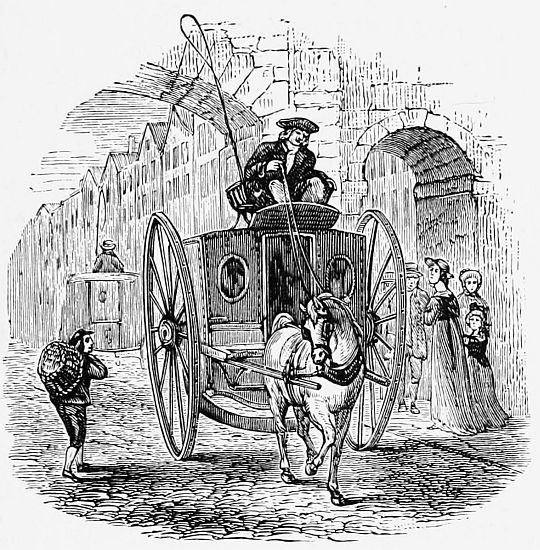
LONDON HACKNEY CAB (BOULNOIS’ PATENT)
ABOUT 1835.
In 1824 was published The Hackney
Coach Directory; this book, which must
have been hailed as a real boon to the users
of cabs in London, was compiled by James
Quaife, “Surveyor to the Board of Hackney
Coaches.” It set forth the “Distances
checked from actual admeasurement from
eighty-four coach stands in and about the
Metropolis,” and the title page tells us
“The number of fares set forth is nearly
eighteen thousand.”
PRIVATE AND STATE COACHES, 1750-1830.
A volume might easily be filled with
the particulars of private carriages which
came into use between the middle of the
eighteenth century and the end of the coaching
era. Great ingenuity and a great deal
of art of a florid kind was expended on the
private coaches of the upper classes. A
patent granted in 1786 gives us an idea of
the materials used for the purpose; the
patent was for a method of “ornamenting
the outsides of coaches and other carriages
with foil stones, Bristol stones, paste and all
sorts of pinched glass, sapped glass and
every other stone, glass and composition
used in or applied to the jewellery trade.”
Mr. Larwood writes of the carriages in
Hyde Park:—
“The beautiful and somewhat vain Duchess of
Devonshire had a carriage which cost 500 guineas
without upholstery. That of the Countess of Sutherland
was grey, with her cypher in one of Godsell’s
newly-invented crystals. A Mr. Edwards had a
vis-à-vis which cost 300 guineas, and was thought
‘admirable’; while another nameless gentleman gladdened
the eyes of all beholders with a splendid gig
lined with looking glass; while the artistic curricle,
with shells on the wheels, of Romeo Coates, was
one of the features of Hyde Park.”
Six horses were not uncommonly driven.
Sir John Lade drove a phaeton and six
greys. The Prince of Wales, in 1781, drove
a pair caparisoned with blue harness stitched
in red, the horses’ manes being plaited with
scarlet ribbons while they wore plumes of
feathers on their heads.
The decorative art as applied to vehicles
naturally found greatest scope in State
coaches. The State carriage of Queen Victoria
was built in 1761 for George III. from
designs by Sir William Chambers, a famous
architect, who was born in 1726. The
length of this coach is 24 feet, the height
12 feet, the width 8 feet, and the weight is
between 3 and 4 tons; the various panels
and doors are adorned with allegorical
groups by Cipriani. This superb carriage,
having only been used on rare occasions,
is still in a good state of preservation. It
cost £7,562 to build and adorn. The State
coach of the Lord Mayor of London has
been of necessity more frequently used, and
alterations and repairs have left comparatively
little of the original vehicle built in
1757. In style it is generally similar to
the Royal State coach,
While money and artistic talent were
lavished freely on the adornment of the
carriages built for pleasure or display in
London, it must not be supposed that sound
workmanship was neglected. The highly
decorated vehicles driven in the Park were
well built, but the best and strongest work
was necessarily put into carriages which were
required for more practical purposes, and
we must therefore discriminate between the
pleasure carriage and that used for travelling.
The mail and stage coaches were used by
nearly all classes of society, but these worked
only the main roads throughout the kingdom;
therefore country gentlemen who
resided off the coach routes had to find
their own way to the nearest stage or posting
house; moreover, wealthy men who
could afford the luxury of taking their own
time over a journey, were still much addicted
to the use of private travelling carriages
drawn by their own horses or, more often,
horsed from stage to stage along the route
by the post masters.
For many years after Mr. McAdam’s
methods had been applied to the main highways,
the narrower and less used by-roads
left much to be desired; and however good
the roads it is obvious that lavishly adorned
carriages would have been out of place for
travel in all weathers. A single day’s
journey through mud or dust would play
havoc with ornamentation contrived of “foil
stones, Bristol stones, sapped glass” and
similar materials; what was required in the
travelling carriage, such as that so well
portrayed by the late Charles Cooper
Henderson, was the combination of strength
and lightness. Hence the best of the coach-builder’s
art, the finest workmanship in the
practical, as opposed to the decorative
sense, was applied to the travelling carriage,
which was constructed to secure the greatest
comfort to the occupants, together with the
greatest strength to withstand rapid travel
over roads of all kinds with the least weight.
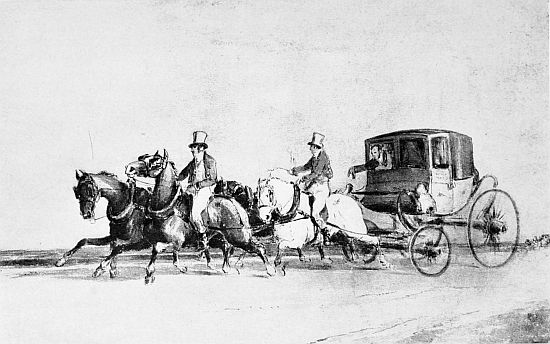
After the Picture by Chas. Cooper Henderson.
TRAVELLING POST, 1825-1835.
The picture by Cooper Henderson, from
which the illustration is reproduced, refers
to the period about 1825-35, and it will be
observed that while the body of the carriage
is hung lower than the posting carriage of
seventy years earlier, the general plan is not
greatly dissimilar.
VARIETIES OF CARRIAGE.
About 1790 the art of coach-building had
arrived at a very high degree of perfection,[25]
and carriages in great variety of shape were
built. A feature common to all, or nearly all,
was the height of the wheels. The highest
were 5 feet 8 inches in diameter; these had
14 spokes, and the number of spokes were
reduced in ratio with the size of the wheel,
till the smallest, 3 feet 2 inches in diameter,
had only 8 spokes. A good example of the
coach of 1790 may be seen in the South
Kensington Museum; it belonged to the
Lord Chancellor of Ireland, and, save for
the greater size of the body, the flatness of
its sides and greater length above than
below, is not widely dissimilar from coaches
of the present day.
The Landau, invented at Landau in Germany,
in 1757, was, about 1790, made to
open in the middle of the roof or “hood,”
and became very popular as combining the
advantages of a closed coach with an open
carriage; the chief objection to Landaus
was the greasiness and smell of the blacking
leather of which the hoods were constructed.
The name of the phaeton first
occurs in a patent granted in 1788.
Phaetons of various shapes came into
fashion later: all were built to be driven
by the owner, and probably gained much
in popular esteem from the fact that George
IV., when Prince of Wales, used to drive
a “Perch High Phaeton” in the Park and to
race meetings. Some of these vehicles were
extravagantly high, and it was the correct
thing to drive four horses in them at the
fastest trot. The “Perch High Phaeton”
was shaped like a curricle and had a hood.
“The centre of the body was hung exactly
over the front axle-tree, the front wheels
were 4 feet high, and the hind wheels 5 feet
8 inches” (Thrupp).
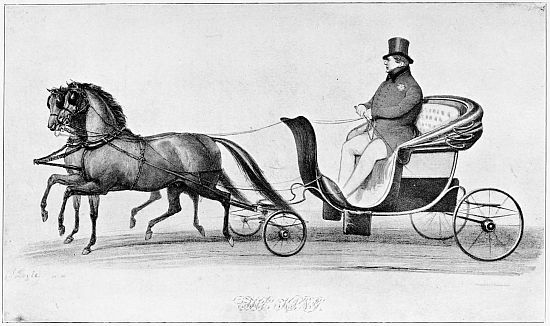
By J. Doyle.
KING GEORGE IV. IN HIS PONY PHAETON.
The pony phaeton owed its popularity
to King George IV., who, in 1824, desired
to possess a low carriage into which he could
step without exertion; old pictures show us
that the pony phaeton of the present day
is very like the original vehicle. Such a
phaeton was built for our late Queen, then
Princess Victoria, in 1828. It should be said
that C springs were first used by English
coach builders about the year 1804.
Among other curious carriages was the
“Whisky,” a two-wheeled gig with a movable
hood, the body connected with the long
horizontal springs by scroll irons, The
“suicide gig” was an absurdly high vehicle
which was popular in Ireland; in this the
groom was perched on something resembling
a stool 3 feet above his master who drove.
Dr. R. Lovell Edgeworth, writing in 1817,
says that a sudden revolution in the height of
private carriages had taken place a few years
previously. Such as might be seen in Bond
Street were so low that gentlemen on foot
could hold conversation with ladies in their
carriages without the least difficulty; but it
was soon discovered that other people
over-heard their conversation, and carriages
“immediately sprang up to their former
exaltation.” It is difficult to believe that
such a reason accounted for a revolution in
the method of carriage building.
Driving as a pastime came into vogue
about the beginning of the century, when it
became fashionable for ladies to display their
skill on the coach box, The “Benson
Driving Club” was founded in 1807, and survived
until 1853 or 1854; the Four Horse
Club came into existence in 1808, but only
continued for eighteen years. The Four-in-Hand
Driving Club was founded in 1856,
and the Coaching Club in 1870.
Works by SIR WALTER GILBEY, Bart.,
Published by Vinton & Co., 9 New Bridge Street, London, E.C.
| Modern Carriages |
Published April, 1904 |
The passenger vehicles now in use, with notes on their origin. Illustrations.
Octavo, cloth gilt, price 2s. net; post free, 2s. 3d.
| Poultry-Keeping on Farms and Small Holdings |
Published 1904 |
Being a practical treatise on the production of Poultry and Eggs for the Market.
By Sir Walter Gilbey, Bart. Illustrated. Price 2s.; post free, 2s. 3d.
| Early Carriages and Roads |
Published 1903 |
In this publication attention has been given to the early history of wheeled conveyances
in England and their development up to recent times. With Seventeen
Illustrations. Octavo, cloth gilt, price 2s. net; post free 2s. 4d.
| Thoroughbred and Other Ponies |
Published 1903 |
With Remarks on the Height of Racehorses since 1700. Being a Revised and
Enlarged Edition of PONIES PAST AND PRESENT. With Ten Illustrations.
Octavo, cloth gilt, price 5s. net; post free, 5s. 4d.
| Hunter Sires |
Published 1903 |
Suggestions for Breeding Hunters, Troopers and General-Purpose Horses. By
I. Sir Walter Gilbey Bart. II. Charles W. Tindall. III. Right Hon.
Frederick W. Wrench. IV. W. T. Trench. Octavo, paper covers, 6d.; post
free, 7d.
| Horses for the Army—a suggestion |
Published 1902 |
Octavo, paper covers, 6d.
Horse-breeding in England and India, and Army
Horses Abroad |
Published 1901 |
Seventeen Chapters, Horse-breeding, in England; Eight Chapters, Horse-breeding
Abroad; Thirteen pages, Horse-breeding in India. Nine Illustrations. Octavo
cloth, price 2s. net; post free, 2s. 3d.
| Riding & Driving Horses, their Breeding & Rearing |
Published 1901 |
An Address delivered in London on March 2, 1885, and Discussion thereon by the
late Duke of Westminster, Earl Carrington, Sir Nigel Kingscote, the late Mr. Edmund
Tattersall and others. Reprint 1901. Octavo, Price 2s. net; post free, 2s. 3d.
| Small Horses in Warfare |
Published 1900 |
Arguments in favour of their use for light cavalry and mounted infantry. Illustrated.
Octavo, cloth gilt, price 2s. net; post free 2s. 3d.
| Horses Past and Present |
Published 1900 |
A sketch of the History of the Horse in England from the earliest times. Nine
Illustrations. Octavo, cloth gilt, price 2s. net; post free, 2s. 3d.
| Animal Painters of England |
Published 1900 |
The lives of fifty animal painters, from the year 1650 to 1850. Illustrated.
Two vols. quarto, cloth gilt, Two Guineas net.
| The Great Horse or War Horse |
Published 1899 |
From the Roman Invasion till its development into the Shire Horse. New and
Revised Edition, 1899. Seventeen Illustrations. Octavo, cloth gilt, price 2s. net;
post free, 2s. 3d.
| Harness Horses |
Published 1898 |
The scarcity of Carriage Horses and how to breed them. 3rd Edition. Twenty one
Chapters. Seven full-page Illustrations. Octavo, cloth gilt, price 2s, net; post
free, 2s. 3d.
| Young Race Horses—suggestions |
Published 1898 |
For rearing, feeding and treatment. Twenty-two Chapters. With Frontispiece and
Diagrams. Octavo, cloth gilt, price 2s. net; post free, 2s. 3d.
| Life of George Stubbs, R.A. |
Published 1898 |
Ten Chapters. Twenty-six Illustrations and Headpieces. Quarto, whole Morocco,
gilt, £3 3s. net.