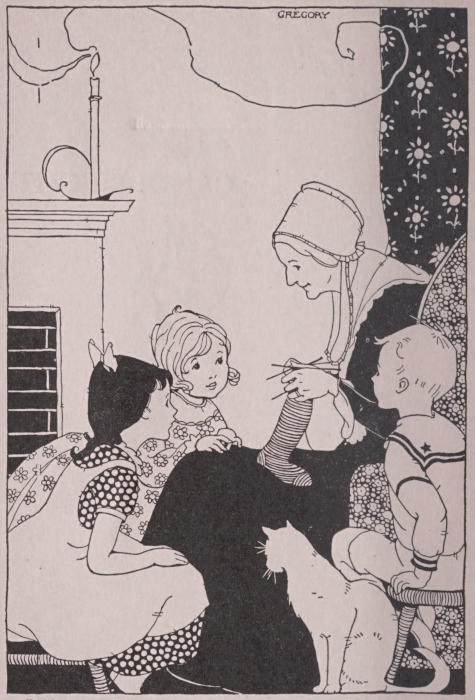
Grandma had come to spend the winter,
and Bobby and Alice and Pink were watching
her fix up her room. It was the guest room,
and the children had always thought it a
beautiful room, with its soft blue rug, wicker
chairs, and pretty cretonne draperies. But
Grandma had had all the furniture taken out,
and the rug, carefully rolled up and wrapped
in thick paper to keep the moths out, had
been carried to the attic.
Then Grandma—but Mother called Bobby
and Alice and Pink to come and get their
wraps and go out to play a while.
Grandma, seeing them edge reluctantly
toward the head of the stairs, said cheerfully,
as she bustled about unpacking the great box
that held her “things,” “Never mind, dears.
Run out and play now, and tonight we’ll
have a regular housewarming. Come to my
room at seven o’clock and we will have a
little party.”
Just as the clock in the hall downstairs
struck the first stroke of seven, Alice rapped
loudly on Grandma’s door.
Grandma opened the door immediately and
the children stepped in—then stared in astonishment.
They had never seen a room like
this before. In place of the blue rug was a
gayly colored rag carpet. The bed, to which
had been added a feather tick, was twice as
high as any they had ever seen. It was covered
with a handmade coverlet of blue and
white. Patchwork cushions were on the
chairs, and crocheted covers on bureau and
chiffonier. The windows were filled with
blooming geraniums, and in one window hung
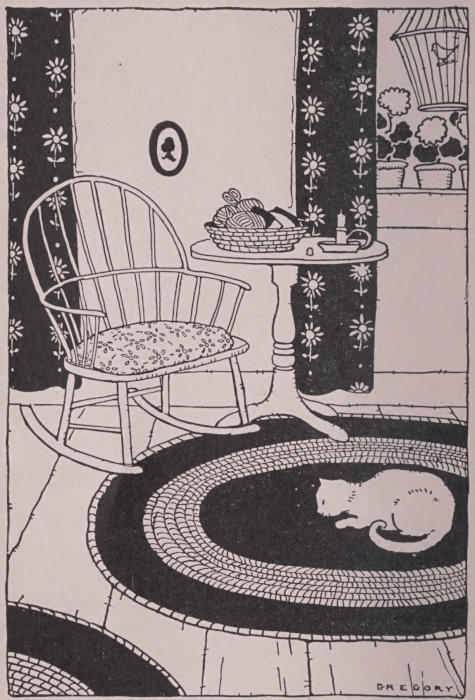
a canary in a gilt cage. On a round braided
rug before the fire lay a gray cat, asleep. By
a low rocker stood a little table that held a
work basket running over with bright-colored
patches, bits of lace, balls of scarlet yarn,
knitting needles, pieces of velvet, silk, and
wool. On the chiffonier stood a basket filled
with big, red apples, polished till they shone,
and beside the apples was a plate covered with
a napkin.
“Well, well,” said Grandma, “here you are,
every one of you! Just on time, too. Come
right in and see my house and meet my family.
This is Betsy.” She touched the cat gently
and Betsy lifted her head and started to purr.
“I raised her from a kitten and brought her
here in a basket all the way on the train. One
conductor wouldn’t let me keep her in the
coach with me, so I went out and rode in the
baggage car with Betsy.”
“Did you bring the bird, too?” asked Pink,
smoothing Betsy’s fur.
“No, I just got the bird a little while ago.
He hasn’t even a name yet. I thought maybe
I’d call him Dicky. That’s a nice name for
a bird, don’t you think so? My baby sent
me the bird and the flowers, too. Aren’t
they lovely?”
“Have you a baby, Grandma?” asked
Alice, looking around the room wonderingly.
“Yes, I have a baby, but he isn’t little
any more. Still he is my baby all the same,
the youngest of my ten children. Wasn’t it
thoughtful of him to send me the bird and the
flowers?”
Alice and Bobby and Pink looked at one
another. They knew their daddy had sent
the flowers, for they had heard Grandma
thank him for them. The idea of their big,
broad-shouldered daddy being anyone’s baby
seemed funny to them, and they giggled.
“Say, Grandma, he’s some baby, all right,”
Bobby remarked.
“You can’t rock him to sleep the way I do
my baby,” observed Pink.
“Not now, but I used to,” said Grandma.
Then she brought three stools from the corner—low,
round stools covered with carpet.
“You children sit on these stools and I’ll sit
in this chair and we’ll spend the evening getting
acquainted. You must tell me all about
yourselves.”
The children told Grandma about their
school and their playmates, their dog and
their playhouse, about how they went camping
in summer time and what they did on
Christmas and Easter, and about the flying
machine that flew over the town on the
Fourth of July, and about the Sunday school
picnic. When they finally stopped, breathless,
Grandma looked so impressed that
Bobby said pityingly, “You didn’t have so
many things to do when you were little, did
you, Grandma?”
“Well, now, I don’t know about that,”
Grandma answered slowly. “We didn’t have
the same things to do, but we had good times,
too.”
“Tell us about them,” Alice begged.
“When I was a little girl,” Grandma began,
“I lived in the country on a large farm. All
around our house were fields and woods.
You might think I would have been lonely,
but I never was. You see, I had always lived
there. Then I had six older brothers and
sisters, and one brother, Charlie, was just
two years older than I was. And there were
so many things to do! The horses to ride to
water and the cows to bring from the pasture
field. On cool mornings Charlie and I would
stand on the spots where the cows had lain
all night, to get our feet warm before starting
back home. I had a pet lamb that followed
me wherever I went, and we had a dog—old
Duke. He helped us get the cows and kept
the chickens out of the yard and barked when
a stranger came in sight. And when the
dinner bell by the kitchen door rang, how he
did howl!
“And the cats! You never saw such cats,
they were so fat and round and sleek. No
wonder, for they had milk twice a day out of
a hollow rock that stood by the barnyard gate.
“And birds were everywhere. Near the
well, high in the air, fastened to a long pole,
was a bird house. Truman and Joe had made
it, and it was just like a little house, with tiny
windows and doors and a wee bit of a porch
where the birds would sit to sun themselves.
“Then there were the chickens to look after,
often a hundred baby chicks to feed and
put in their coops at night. And in the spring
what fun we had hunting turkey hens’ nests!
In February we tapped the sugar trees and
boiled down the sap into maple sugar and
sirup. We had Easter egg hunts and school
Christmas treats, and in the fall we gathered
in the nuts for winter—chestnuts, hickory
nuts, walnuts.”
Grandma paused a moment and glanced at
the clock on the mantel.
“Dear me,” she exclaimed in surprise, “see
what time it is! We must have our refreshments
right away. Bobby, will you pass the
apples? And, Alice, under the napkin are
some ginger cookies that I brought with me.
You may pass them, please, and Pink and I
will be the company.
“These apples,” went on Grandma, helping
herself to one, “are out of my orchard. I sent
two barrels of them to your daddy, and every
night before we go to bed we will each eat one.
‘An apple a day,’ you know, ‘keeps the doctor
away.’”
When they had finished and were saying
good night, Bobby said, “Lots of things did
happen when you were a little girl, Grandma.
I wish you’d tell us more.”
“Not tonight,” said Grandma, “It’s bedtime
now, but come back some other night.
If you still want me to tell you more about
when I was a little girl, tap on my door three
times, like this, but if you only come to call,
tap once, like this.”
Next time we’ll see how often they tapped
on Grandma’s door. Can you guess?
A WHISTLING GIRL
The next evening as Grandma sat before
the fire knitting on a red mitten, she was
startled by three sharp knocks on her door.
“Why, good evening,” she said, when she
had opened the door to admit Bobby and
Alice and Pink. “Here you are wanting a
story, and I haven’t thought of a thing to
tell you. Now you tell me what happened at
school today, and by that time I shall have
thought of something to tell you.”
So Alice told Grandma about chapel that
morning. She told her about the recitations
and songs by the children and of a lady who
had whistled “The Star-Spangled Banner”
and “America.”
“Well, well, wasn’t that nice!” Grandma
said. “I should have liked to hear that.
I always admired to hear any one whistle. I
believe I’ll tell you tonight about the time I
whistled in meeting.”
The children drew their stools a little closer,
and Grandma began:
“When I was a little girl, I wanted more
than anything else to be able to whistle. I
kept this ambition to myself because it wasn’t
considered ladylike for girls to whistle. My
mother often said,
“A whistling girl and a crowing hen
Always come to some bad end.”
“So I never told anyone, not even my
brother Charlie, that I wanted to whistle.
But when I hunted turkey hens’ nests, or went
after the cows, or picked berries, I had my
lips pursed all the time trying to whistle as
my brothers did. But, though I tried and
tried, I never succeeded in making a sound.
“One Sunday in meeting I got awfully
tired. To a little girl the sermons were very
long and tiresome in those days. For a while
I sat still and quiet, watching Preacher Hill’s
beard jerk up and down as he talked and looking
at the queer shadows his long coat tails
made on the wall. But it was warm and close
in the church, and after a while I grew drowsy.
“‘Oh, dear!’ I thought to myself, ‘I
mustn’t go to sleep. I must keep awake
somehow.’ Then I thought about whistling.
I would practice whistling to myself—under
my breath.
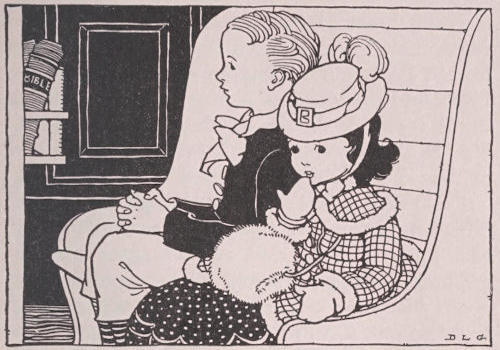
“The seats were high-backed and we sat
far to the front. I could not see any one
except the preacher and John Strang, who
kept company with sister Belle. John sat
in a chair at the end of the choir facing the
congregation, and several times I noticed him
looking curiously at me as if he wondered
what I was doing. I would draw in my
breath very slowly and then let it out again.
Of course I never dreamed of making a sound,
and no one could have been more surprised
than I was when there came from my lips a
loud clear whistle as sweet as a bird note.
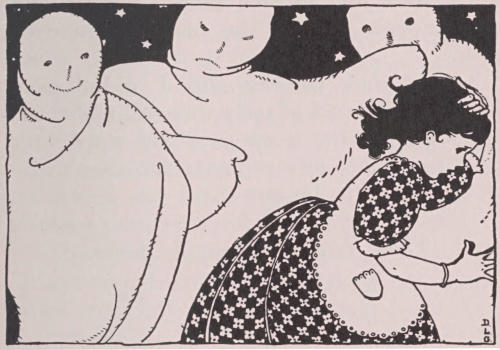
“The preacher stopped talking. Mother
looked embarrassed. Father’s face turned
red with mortification. Sister Belle put her
handkerchief up to her face, and Charlie sat
up as straight and stiff as if he had swallowed
a ramrod.
“As for me, I wished I could sink through
the floor and disappear. I thought everybody
was looking right at me. I was sorry
and I was frightened, too. What would
Father and Mother say to me?
“When preaching was over, all of us except
Mother went right out to the sled and
wrapped up in comforts and robes for the cold
ride home. Mother stayed behind to visit
and invite people home to dinner just as she
always did. I was glad when we started. It
was a dreary ride. Father drove, and he sat
so stern and silent that no one dared to speak.
“I drew in my breath very slowly and then let it out again”
“I hurried right upstairs to change my
dress as I always did. Then, because I was so
miserable, I threw myself across my bed and
cried. I had disgraced Father and Mother.
Nothing that they could do would be bad
enough for me. I was aroused by sister Belle’s
voice. She was complaining to sister Aggie,
who had stayed at home to get dinner.
“‘I don’t see why Charlie can’t behave
himself once in a while. Now our whole day
is spoiled, and I had asked John and Isabel
for dinner, too. You know how sad it always
makes Father if he has to punish one of the
boys, and the worst of it is that Charlie denies
doing it. I could shake Charlie good myself.
You can’t believe, Aggie, how everyone looked
at us. I was that ashamed!’
“Charlie being accused in place of me!
This was something that I had never dreamed
of. I jumped up and rushed past the two
girls downstairs, through the empty sitting
room into the kitchen, where Mother stood
looking out a window, still in her gray silk
dress. I caught her hand.
“‘Charlie didn’t do it, Mother,’ I said.
‘I did it.’
“‘Oh, Sarah, you cannot whistle, dear,’
said Mother reproachfully. She drew me to
her and smoothed my hair and tried to comfort
me, but I broke away from her and ran
into the kitchen chamber where Father sat
talking to Charlie. Father looked stern and
Charlie sulky and cross, and no wonder, poor
boy, for he was guilty of enough things without
being accused of something he did not do.
“‘Father!’ I cried wildly. ‘Charlie did
not whistle in meeting. I did it.’
“Mother and the girls had followed me, and
they all, even Charlie, stared at me in amazement.
It was plain they did not believe
me. They thought I was trying to shield
Charlie.
“‘I did whistle,’ I said, crying. ‘I can
whistle. I tell you I can whistle.’
“‘Then whistle,’ said Father sternly.
“And how I did try to whistle! I puffed
my cheeks and twisted and turned my mouth
and blew and blew, but I couldn’t make a
sound, not a single sound.
“Father looked so hurt and sorry that I
longed to throw myself into his arms and make
him believe me. You see, it looked to Father
as if Charlie and I were both telling stories.
Father said we were only making things worse
and ordered us all out of the room.
“In the sitting room we found Truman and
Joe, who had been tending the horses, and
John and Isabel Strang, who had come
around past their house to let their family
out of the sled before coming on to our house
for dinner.
“The minute I saw John I drew Mother’s
head down and whispered to her, ‘Ask John.
He knows, he saw me do it;’ and Mother in a
hesitating way said, ‘John, do you know who
whistled in meeting this morning?’
“John turned as red as our old turkey
gobbler and looked at me.
“‘Why, I feel pretty sure,’ he said, ‘but
I’d hate to say.’
“‘Oh, never mind that!’ I burst out.
‘I’ve told, and they won’t believe I can
whistle. They think it was Charlie.’
“Then, of course, John told all he knew.
He had been watching me all the time, as I
had thought, and was looking right at me when
I whistled. Father was called in, and you
may be sure he was glad to find that both his
children had been telling the truth.
“‘It’s all right, Sarah,’ he said, ‘if you
didn’t mean to.’ But Mother made me
promise not to try to whistle any more.
“Well, I declare! I finished just on time.
Mother’s calling you to bed. Here, don’t
forget your ‘apple a day.’ Now run along
like good children, and some other time I’ll
tell you another story.”
CHASED BY WOLVES
“Seems to me you kiddies go to bed earlier
than you used to,” their father remarked
one evening when Bobby and Alice and
Pink interrupted his reading to kiss him
good night.
“We don’t go to bed,” Pink explained.
“We go to Grandma’s room. She tells us a
story every night.”
“Why, of course, I remember now. Isn’t
that fine, though? A story every night! Did
she ever tell you a wolf story? Grandma
knows a pippin of a wolf story. She used
to tell it to me when I was a little boy. Ask
her to tell you about the time she was chased
by wolves.”
And a few minutes later Grandma began
the story.
“It was in the spring. Father was making
garden, and he broke the hoe handle. All
the boys were away from home helping a
neighbor, so Father wanted Aggie or Belle
to take the hoe to have a handle put in at the
blacksmith shop at Nebo Cross Roads a mile
away. But the girls were getting ready to
go to a quilting, and I begged to be allowed
to take the hoe to the blacksmith shop.
“Mother was afraid at first, but Father
said there was nothing to hurt me, and Mother
finally gave in. So right after dinner, carrying
the hoe and a poke of cookies to eat if I
got hungry, I started out.
“I was to leave the hoe at the shop and go
on down the road to Strangs’ to wait till the
hoe was mended. I can remember yet how
important I felt going off alone like that. I
picked wild flowers and munched cookies and
sang all the songs I knew.
“Mr. Carson, the blacksmith, said it would
be a couple of hours before the hoe would be
ready, and I went down to Strangs’ to wait.
But when I got there I found the house all
locked up and no one at home. I sat down on
the steps to wait for some one to come, but the
heat and the quiet made me sleepy so I got
up and moved around the yard. I was lonely
there by myself. I walked around looking at
the flowers and the garden and the chickens and
played a while with a kitten I found sleeping
in the sun. I thought that afternoon would
never end. Surely I had been there two hours.
I started for the blacksmith shop. Maybe it
would be closed. I ran all the way. Mr. Carson
looked surprised when I asked for the hoe.
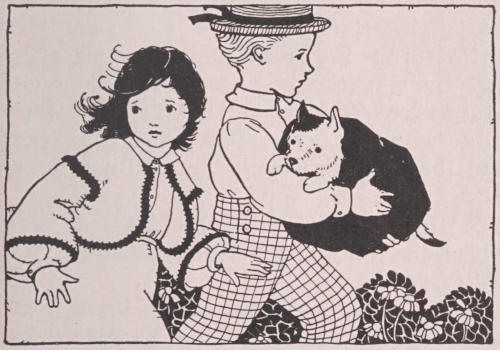
I played a while with a kitten
“‘Why, it’s only been a half-hour since
you went away,’ he said.
“I went back to Strangs’, and this time I
was determined to wait a long time. After a
while Isabel Strang came home. She had
been at the quilting, but all the rest of the
family had gone away to stay several days.
Isabel was going to our house to spend the
night if she got through the evening’s work in
time. She had come past our house, and
Mother had told her to keep me all night
with her for company if she could not get
back before dark and to send me home early
in the morning.
“Isabel hurried, and while she milked the
cows and fed the pigs and chickens and got
supper I went after the hoe.
“It was growing late when we were ready to
start home, but Isabel said we could make it
before dark.
“We followed the road half a mile and then
took a short cut through the woods up Sugar
Creek. We had come out of the woods and
were halfway across a big pasture field when
from behind us we heard a sound that made
us stop in terror. We listened. It came
again. It was the cry of a wolf! I had often
heard a wolf howl, but I had always been safe
at home, and even then it had scared me.
“Again and again came the long drawn-out
howl from the woods we had just left.
“Isabel took my hand and we ran as fast
as we could toward the little creek that ran
through the field. It had been years and
years since a pack of wolves had been seen in
our neighborhood, but before we reached the
foot-log another howl and another and another
had been added to the first.
“Looking back over my shoulder as I ran,
I saw a skulking form come out of the woods
and start across the field. Isabel saw it, too.
“‘We’ll have to stop, Sarah,’ she said.
‘We’ll have to climb a tree.’
“There was a slender young hickory a little
this side of the run. Isabel lifted me as high
as she could and I caught a branch and pulled
myself up into the tree. I turned to help
Isabel when, to my horror, I saw that she
could never make it. A whole pack of wolves
loping across the field were almost upon her.
“Catching up the hoe, Isabel ran for the
foot-log. She had barely reached the middle
of it when the wolves halted at the creek bank.
A few of them had stopped at my tree and
were howling up at me. If all had stopped, it
would have given Isabel a chance to get into
one of the trees on the other side of the creek.
“But she couldn’t do it now. She walked
back and forth on the log, brandishing the hoe
in the cruel eyes of the wolves. The wolves
that had stopped under my tree soon joined
their friends on the bank, and Isabel called
out to me, ‘Do not make any noise, Sarah,
and they will forget you are there.’ I remembered
hearing my father tell about some
wolves that had gnawed a young tree in two,
and I clung there in fear and trembling.
“Isabel held her own all right until one of
the bolder wolves swam across the creek and
was soon followed by others. Then Isabel
had to fight them at both ends of the foot-log.
It was dark now, and Isabel, striking at the
wolves from first one side and then the other,
tried to cheer me up all the time.
“‘Help will soon come, don’t be afraid,’ she
said over and over again. She even tried to
make me laugh by saying, ‘Now watch me
hit this saucy old fellow on the nose. There,
that surprised you, didn’t it, Mr. Wolf?’ as
she hit him a sharp blow and he fell back.
“What if the wolves should leap on Isabel?
Or she might get dizzy and fall in the water.
When would help come to us in this lonely,
out-of-the-way place? My folks would think
I had stayed the night with Isabel, and there
was no one at home at Isabel’s.
“Dared I get down and go for help? I
peered through the darkness and shook all
over when I thought that more wolves might
be hidden there. Hardly knowing what I
did, I let myself down to the lower limb and
then dropped with a soft thud to the ground.
“Without waiting a second I started back
the way we had come. How I ran and ran!
I was nearly through the woods when I heard
something running behind me. I went faster
and it went faster, too. Suddenly I tripped
and fell and I heard a friendly little whinny
at my side. It was our pet colt that had been
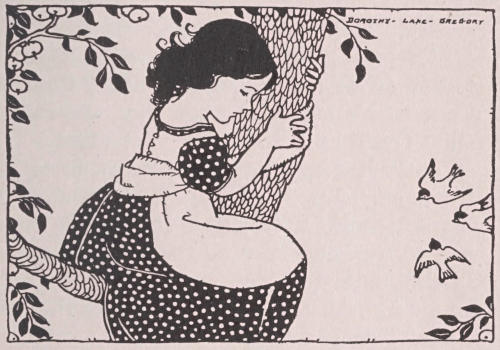
running behind me. I put my arm around
his neck for a second until I got my breath.
Then I climbed the fence and was on the road.
“I wasn’t quite so afraid here as I had been
in the woods, but I never stopped running
till I got home. I was so worn out that I
fell panting on the kitchen floor, but I made
them understand Isabel’s danger. Father
and the boys caught up their guns and went
hurrying across the hill to her aid.
“They drove the wolves away and brought
Isabel home in safety, and that was the last
pack of wolves ever seen around there.
“Well, well, see what time it is! Now run
along to bed and go right to sleep without talking
the least little bit, or I’m afraid Mother
won’t let you come to see me tomorrow evening.
That would be a pity, for I’ve got the
best story for tomorrow evening about—well,
you just wait and see.”
THE YELLOW GOWN
The next evening when the children came
to Grandma’s room Bobby brought his new
sweater—black with broad yellow stripes—to
show her.
“Yellow,” said Grandma admiringly. “I
always did like yellow, it’s such a cheerful
color. The first really pretty dress I ever had
was yellow.
“It was just about this shade, maybe a
mite deeper—more of an orange color. It
was worsted—a very fine piece of all-wool
cashmere. Until then I had never had anything
but dark wool dresses—browns or blues
made from the older girls’ dresses—and I did
love bright colors.
“Sister Belle was to be married in the spring
and all winter Mother and Belle and Aggie
had sewed on her new clothes. Nearly everything
was ready but the wedding gown, and
it was to be a present from Father’s younger
sister, Aunt Louisa, who lived in Clayville.
“Belle was delighted, because she said
Aunt Louisa would be sure to pick something
new and stylish.
“My big brother, Stanley, went to Clayville
one cold, snowy day in February, and
Aunt Louisa sent the dress goods out by him.
I remember we were at supper when he came.
I had the toothache and was holding a bag of
hot salt to my face and trying to eat at the
same time.
“Mother ran to take Stanley’s bundles and
help him off with his great-coat, and Aggie
set a place at the table for him. But before
he sat down he tossed a package to Belle.
‘From Aunt Louisa,’ he said.
“Belle gave a cry of delight and tore the
package open. Then suddenly the happy
look faded from her face. She pushed the
package aside and, laying her head right down
on the table among the dishes, she burst into
tears.
“Aunt Louisa had sent Belle a yellow wedding
dress!
“When Mother held it up for us to see, I
thought it was the most beautiful color I had
ever seen and wondered why Belle cried. I
soon learned.
“Belle had light brown hair and freckles,
and yellow was not becoming to her. To
prove it, she held the goods up to her face.
“‘It does make your hair look dead and
sort of colorless,’ Aggie agreed.
“‘And your freckles stand out as if they
were starting to meet a fellow,’ Charlie put in.
“At this Belle began to cry again, and
Father said that she did not have to wear a
yellow dress to be married in if she didn’t
want to. She should have a white dress.
But this didn’t seem to comfort Belle a
bit, for she declared that she wouldn’t hurt
Aunt Louisa’s feelings by not wearing the
yellow.
“My tooth got worse, and for the next few
days I could think of nothing else. Mother
poulticed my jaw and put medicine in my
tooth, but nothing helped it. I cried and
cried and couldn’t sleep at night, and Mother
couldn’t sleep. At last she told Father that
he would have to take me to Clayville to have
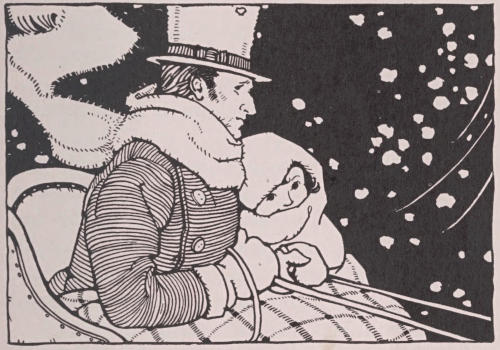
the tooth pulled. There was fine sledding,
and early the next morning Father and I set
out. The last thing Mother said to Father,
as she put a hot brick to my feet and wrapped
me, head and all, in a thick comfort, was,
‘As soon as the tooth is out, John, take
her over to Louisa’s till you get ready to
start home.’
“The roads were smooth as glass, Father
was a fast driver, and it didn’t seem long till
we got to town. My tooth was soon out—it
hardly hurt at all—and then Father took
me to Aunt Louisa’s. We all liked Aunt
Louisa. She was very fond of children and
had none of her own.
The roads were smooth as glass, Father was a fast driver
“After dinner we sat by the sitting-room
fire and Aunt Louisa cut paper dolls out of
stiff writing paper for me and made pink
tissue paper dresses for them. The dresses
were pasted on. I could not take them off
and put them on as Alice and Pink do theirs.
“As she worked, Aunt Louisa asked me
about everything at home and about Belle’s
clothes and the wedding.
“‘Has she got her wedding dress made
yet?’ she asked.
“‘No, ma’am’, I replied, ‘she says she
can’t bear to cut into it. She hates the
very sight of it.’
“‘Well, I declare!’ exclaimed Aunt Louisa
in surprise.
“‘It doesn’t become her,’ I explained
carefully. ‘She says it makes her look a
sickly green.’ And then I went on to tell
Aunt Louisa everything they had all said,
and ended up with, ‘Belle says she won’t
hold John to his promise to marry her until
he has seen her in that yellow dress.’
“‘What does she wear it for if she doesn’t
like it?’ asked Aunt Louisa tartly.
“‘Father said she didn’t have to wear it
if she didn’t want to, that if she wanted to
be married in white, he’d get her a white
dress. But Belle said she wouldn’t hurt
your feelings by not wearing it for anything
in the world.’
“Suddenly Aunt Louisa began to laugh.
She threw her head back and laughed and
laughed and laughed. I didn’t know what
to make of her.
“‘I think it’s a beautiful color,’ I said
consolingly.
“‘And you could wear it, too, with your
dark hair and eyes and fair skin. What was
I thinking about to send a color like that to
poor Belle? I’ll tell you!’ she cried, jumping
up and letting my paper dolls fall to
the floor. ‘I’ll buy another dress for Belle,
and you shall have the yellow one, Sarah.’
“She left me in the kitchen with Mettie,
the hired girl, while she went over town.
Mettie was baking cookies, and she let me
dust the sugar on and put the raisins in the
middle and I had a real nice time.
“The second dress was white cashmere
with bands of pearl trimming and wide
silk lace for the neck and wrists.
“When Aunt Louisa kissed me good-by,
she whispered in my ear, ‘Tell Belle the
trimming is because she was so thoughtful
about hurting my feelings and I want her
to look her best on her wedding day. And,
Sarah, tell your mother to make up the
yellow for you with a high shirred waist and
low round neck. That is the newest style for
children. And be sure to tell her I said not
to dare put it in the dye pot.’
“As soon as we got home I gave the new
dress to Belle. Mother was astonished, and
Belle looked ready to cry again, till Father
told them Aunt Louisa wasn’t offended at
all. Then Mother was pleased, and Belle
was simply wild about the new dress.
“‘Take the yellow and welcome to it,
Sarah,’ she said to me when I had told her
Aunt Louisa wanted me to have it.
“‘I’ll have to color it,’ Mother said,
‘She couldn’t wear that ridiculous shade.’
“‘No, no, Mother, please don’t!’ I cried.
‘Aunt Louisa said not to dye it. She said
it would become me the way it is.’
“‘Tush, tush!’ said Mother severely, ‘You
are too little to talk of things becoming
you.’ But she didn’t dye it, and a few
weeks later at sister Belle’s wedding I wore
the yellow dress made just the way Aunt
Louisa said to make it.
“And now, ‘To bed, to bed, says sleepy
head,’ and we’ll have another story some
other night.”
A WAR STORY
“Well, well,” said Grandma one evening
when Bobby and Alice and Pink came to
her room for their usual bedtime story, “I
don’t know what to tell you about tonight.”
“Tell us a war story,” suggested Bobby
eagerly.
“Maybe I might tell you a war story,”
agreed Grandma, “a war story of a time
long ago.” And she picked up her knitting
and began slowly:
“When the Civil War broke out I was a
very little girl. Of course there had been
lots of talk of war, but the first thing I
remember about it was when we heard that
Fort Sumter had been fired on. It was a
bright, sunshiny morning in the spring. I
was helping Father rake the dead leaves off
the garden when I saw a man coming up the
road on horseback. I told Father, and he
dropped his rake and went over to the fence.
In those days it wasn’t as it is now. News
traveled slowly—no telephones, no trains,
no buggies. And this young man, who had
been to Clayville to get his marriage license,
brought us the news that Fort Sumter had
been fired on.
“Father went straight into the house to
tell Mother, and after a while he and my
big brother, Joe, saddled their horses and
rode away. I thought they were going right
off to war and started to cry, and then I
laughed instead when our big Dominique
rooster flew up on the hen-house roof, flapped
his wings, and crowed and crowed. A great
many men and boys rode by our house that
day on their way to Clayville, and when
Father and Joe came back next day Joe
had volunteered and been accepted and he
stayed at home only long enough to pack
his clothes and say good-by to us.
“There wasn’t much sleep in our house
that night, and I lay in my trundle-bed,
beside Father’s and Mother’s bed, and listened
to them talking, talking, until I thought
it must surely be morning. I went to sleep
and wakened again and they were still talking.
Finally I could hear Father’s regular
breathing and knew that he had gone to
sleep at last. In a little bit Mother slipped
out of bed and went into the hall. I thought
she was going for a drink and followed her,
but she went into Stanley’s room, which
had been Joe’s room, too, until that night.
“Mother bent over Stanley and spoke his
name softly and he wakened and started up
in bed.
“‘What is it, Mother?’ he whispered,
frightened.
“‘Stanley,’ Mother said slowly, ‘I want
you to promise me that you won’t go to war
without my consent.’
“Stanley laughed out loud in relief.
“‘Gee, Mother, you gave me a scare!’ he
said. ‘I thought some one was sick or something.
The war’ll be over long before I’m old
enough to go.’ He was going on sixteen then.
“‘It won’t do any harm to promise then,’
Mother persisted, and Stanley promised.
“I crept back to bed and pulled the covers
up over my head.
“But Stanley was mistaken about the war
being over soon. The war didn’t stop. It
went on and on. Two years and more passed,
and Stanley was eighteen. Boys of that age
were being accepted for service, but Stanley
never said a word about volunteering.
“Shortly after his eighteenth birthday
there came a change in him. He was not
like himself at all. He had always been a
lively boy, full of fun and mischief, but now
he was very quiet. He never mentioned the
war any more, and often dashed out of the
room when every one was talking excitedly
about the latest news from the battlefield.
He avoided the soldiers home on furlough,
didn’t seem to care to read Joe’s letters, and
as more and more of his friends enlisted he
became gloomy and downhearted.
“We could all see as time went on that
Father was disappointed in Stanley. He
was always saying how much better it was
for a young man to enlist than to wait for
the draft. The very word ‘draft’ had for
Father a disgraceful sound.
“I think Mother must have thought it
was Stanley’s promise to her that was worrying
him, for one day she came out to the barn
where Stanley was shelling corn and I was
picking out the biggest grains to play ‘Fox
and Geese’ with. Mother told Stanley she
released him from his promise, but he didn’t
seem glad at all. He only said, ‘Don’t you
worry, Mother, I’m not going to war.’
“‘I was troubled about Joe that night,’
Mother said. ‘I thought I couldn’t bear
for you to go, too. But you are older now
and you must do what you think best.’
One day two recruiting officers came out to Nebo Cross Roads
“As Mother went out of the barn there
were tears in her eyes and I knew in that
moment that she would rather have Stanley
go to war than have him afraid to go.
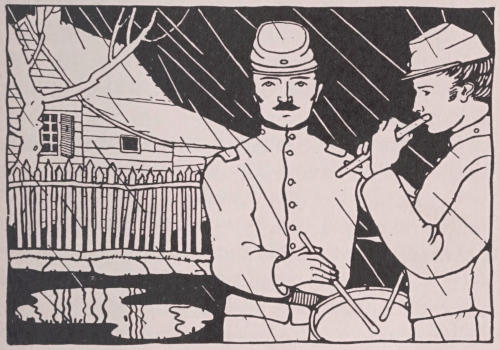
“They were forming a new company in
Clayville, and one day two recruiting officers
came out to Nebo Cross Roads. Father let
Truman take Charlie and me over to see
them. It was raining, and I can see those
two men yet standing there in the rain. One
had a flute and the other had a drum. They
played reveille and taps and guard mount
and ‘The Star-Spangled Banner’ and a new
song we had never heard before, ‘Tenting
on the Old Camp Ground.’ And how that
music stirred the folks! They had to use
two wagons to haul the recruits into Clayville
that night.
“That evening when I was hunting eggs
in the barn I found Stanley lying face down
in the hay. He was crying! I could hardly
believe my eyes. I went a little nearer and
I saw for sure that his shoulders were shaking
with sobs. But even while I watched him
he got to his feet and began rubbing his
right arm. I often saw Stanley working
with his arm. He would rub it and swing
it backward and forward and strike out with
his fist as if he were going to hit some one
a blow. He didn’t mind me watching him,
and I never told anyone about it. He had
broken that arm the winter before, and I
had often seen him working with it after he
had stopped wearing it in a sling.
“I wondered to myself why, if Father and
Mother thought Stanley was afraid to fight,
they did not ask him and find out. He
knew why he didn’t enlist—he could tell
them. At last I decided if they wouldn’t
do it themselves I’d do it for them. So the
next time I was alone with Stanley, I said,
‘Stanley, are you afraid to go to war?’
“‘Afraid!’ he cried angrily, ‘Who said I
was afraid?’ Then his tone changed. ‘They
don’t want me. They won’t have me. It’s
this arm,’ and he held his right arm out and
looked at it in a disgusted sort of way.
‘They claim it’s stiff, but I could shoot if
they would only give me a chance. I’ve
tried three times to get in, but there’s no use
worrying Mother about it since I can’t go.
But my arm is getting better. It’s not
nearly as stiff as it was. I’ll get in yet.’
Then he looked at me scornfully and said,
‘Afraid! Afraid nothing!’
“I ran as fast as ever I could to find
Father and Mother and tell them. Mother
hugged me and laughed and cried at the same
time and said she always knew it, and Father
made me tell over to him three times, word
for word, every single thing Stanley had said.
“‘He must never know,’ Mother said.
‘He must never suspect for a minute that
we thought he didn’t want to go, the poor
dear boy, keeping his trouble to himself for
fear of worrying us.’ And she told me to
get Charlie and catch a couple of chickens
to fry for supper. Then I knew she was
happy again, for whenever Mother was
happy or specially pleased with one of us
she always had something extra good to eat.
“Pass the apples, Alice, please, and tomorrow
night if you’re real good and don’t get
kept in at school I’ll tell you—well, you
just be real good and you’ll see what I’ll
tell you about.”
EASTER
It was the night before Easter. Grandma
had told Bobby and Alice and Pink of the
first Easter, and had explained about the
egg being the symbol of life because it contains
everything necessary for the awakening
of new life.
“When I was a little girl,” she said, “we
had lots of chickens and of course we had
lots of eggs. We got so many eggs that we
could not use them all—not even if Mother
made custards and omelets and angel cake
every day.
“Father or the boys would take the eggs
we did not need to the store and trade them
for sugar or coffee or pepper or rice. But
for quite a while before Easter they did not
take any eggs to the store.
“It was a custom for the children to hide
all the eggs that were laid for a couple of
weeks before Easter. Father and Mother
had done it when they were little, and all
the boys and girls who went to our school
did it, too. We would bring them in Easter
morning and count them. Each of us might
keep the eggs we found to sell, and Father
always gave a fifty-cent piece to the one
who had the most eggs. Even the big boys
and Aggie and Belle hid eggs, for money
was scarce and sometimes the egg money
amounted to a good deal. We were allowed
to keep all the eggs we found, no matter to
whom they belonged and how we hunted.
“We searched in the hen house, the barn,
the haymow, in old barrels and boxes, in
fence corners, and even in the wood-box
behind the kitchen stove. One spring a
brown leghorn hen slipped into the kitchen
every other day and laid in the wood-box.
You never could tell where a hen might
lay, so we looked every place we could
think of.
“It was an early spring. The trees were
bursting into leaf, the grass was green, the
beautiful yellow Easter flowers in the front
yard were in bloom. Best of all, the hens
had never been known to lay so many eggs
before.
“It seemed that every one of us wanted
something that the egg money would buy.
Truman was going away to school, and
he wanted books. Belle was going to be
married, and she wanted all the money she
could get for pretty clothes. Stanley wanted
a new saddle for his courting colt. When the
boys turned eighteen, Father gave each one
of them a colt to tame and break and have
for his own, and they were called the courting
colts. I wanted the egg money for a
lovely wax doll like one I had seen in a store
in Clayville, and if Charlie got it he meant
to spend it for a gun. Aggie wanted to buy
a pair of long lace mitts to wear to Belle’s
wedding. So we all hunted and hunted,
each one thinking of what he would buy
with the money.
“Once for three days I didn’t have an
egg. Then I found a great basketful that
was so heavy I could hardly carry it to a new
hiding place, and the next day it was gone.
So it went on till Easter.
“Charlie and I were up bright and early
on Easter morning—not as early as on
Christmas, of course. As we all brought in
our eggs Father counted them. The kitchen
floor was covered with baskets and buckets
and boxes of eggs. You never saw so many
eggs. Charlie had the most, and he was as
happy as happy could be.
“While Mother and the girls finished
getting breakfast, Charlie and I hunted for
the colored eggs. Under beds, behind doors,
in the cupboards, all over the house we
hunted.
“‘Here they are!’ shouted Charlie from
the spare chamber. And there they were
behind the bureau—red eggs, blue eggs,
green eggs, big sugar eggs, and eggs with
pretty pictures pasted on them and tied
with gay ribbons. And there were white
eggs that looked just like common hen’s
eggs, but when you broke a tiny bit of the
shell and put your tongue to it, my, oh my!
but that maple sugar was delicious!
“After breakfast there was a rush to get
the work done and get ready for meeting.
Dear knows how many people would come
home to dinner with us. Mother always
asked everyone home to dinner.
“We were nearly ready. Mother had
picked the lovely, yellow Easter flowers and
was wrapping the stems in wet paper to keep
them from wilting till we got to the church—she
meant to put them in a vase on the
pulpit stand—when Father came in and
said that the widow Spear’s new house had
burned down in the night. There was something
the matter with the chimney, no one
knew just what.
“Mr. Abraham Harvey had told Father.
The Spear family had taken refuge in a little
old house that they had lived in before they
built the new house. But of course they had
nothing to keep house with, and Mr. Harvey
was going around in a big wagon collecting
things. There were some pieces of old furniture
in the wagon, and several bundles of
bedclothes and a box of dishes.
“Father gave flour and meat and potatoes
and a ham. Mother emptied the shelves of
our Easter pies and took the chicken in the
pot right off the stove, besides giving bread
and a crock of apple butter.
“Then she wrapped up a pair of blankets
she had woven herself and sent Charlie and
Truman to carry out some chairs and a
bedstead that were up in the meathouse
loft. Belle and Aggie were sorting out some
old clothes to send, and I wanted to do
something, too.
“As I was going through the kitchen on
an errand for Mother, I noticed the eggs.
Such a lot of them—nearly fifty dozen, and
they brought ten cents a dozen. Just then
Charlie passed the door carrying a chair,
and I called to him.
“‘Charlie,’ I said, ‘would you give your
egg money if I gave mine?’
“‘No,’ he said at once, ‘I won’t give my
egg money. Not on your life, I won’t!
Father and Mother’ll give enough,’ and he
went out.
“I didn’t say any more about the egg
money. I didn’t think it would be fair to
Charlie, since he was the one who had the
most eggs. I went upstairs to Mother’s
room and took my gold breastpin out of
the fat pincushion on her bureau.
“‘Here is my breastpin, Mother,’ I said.
‘Send it to Millie. Everything she’ll get
will be so plain and ugly.’
“Aggie and Belle laughed.
“‘A breastpin,’ said Aggie, ‘when very
likely she has no dress!’
“‘It’s all right, Sarah,’ said Mother, and
she went to her bureau drawer and took out
a fine linen handkerchief and laid it on the
bed beside the breastpin. When she came
to get them, Aggie had given a carved back
comb and Belle a pretty lace collar.
“Mr. Harvey was starting his horses and
Father had come inside the gate when
Charlie ran around the house.
“‘Give them my egg money, Father!’ he
called and ran out of sight again. Then all
the rest of us said we would give our egg
money, too, and it made a lot—over five
dollars.
“‘I’m proud of you,’ Mother said when
she had hunted Charlie up and was tying
his necktie. ‘I’m proud of every one of
my children.’
“We were a little late to meeting, and
when we got home Belle had dinner ready—ham
meat and cream gravy and mashed
potatoes and hot biscuits. Mother brought
out a plate of fruit cake that she kept in
a big stone jar for special occasions—the
longer she kept it the better it got—and a
dish of pickled peaches for dessert.”
“Mm! mm! Wish I’d been there,” sighed
Bobby.
“And next time,” Grandma went on, “I
think—yes, I’m pretty sure—that I’ll tell
you how the maple sugar got in the Easter
eggs.”
AT A SUGAR CAMP
“Grandma,” said Alice the next evening,
“you said you’d tell us how the sugar got
in the Easter egg.”
“And so I will,” answered Grandma.
“I’ll tell you about that this very evening.
Where’s my knitting? I can talk so much
better when I knit. There now, are you all
ready?”
Bobby and Alice and Pink drew their stools
closer and Grandma began:
“On my father’s farm, about half a mile
from our house, was a grove of maple trees.
We always called them sugar trees. In the
spring, you know, the sweet juice or sap
comes up from the roots into the trees, and
it is from this sap that maple sirup and
sugar are made. In the spring Father and
the boys would tap our sugar trees. They
would take elder branches and make spouts
by removing the pithy centers. Then they
would bore holes in the trees and put the
spouts in the holes and place buckets underneath
to catch the sap. These buckets would
have to be emptied several times a day
into the big brass kettle, where it was boiled
down into sirup and sugar.
“Truman tended to the sap buckets and
kept a supply of firewood on hand, and
Stanley watched the boiling of the sap. He
knew just when it was thick enough and
sweet enough to take off for sirup and how
much longer to cook it for sugar. One of
the girls was always there to help, and
Father or Mother would oversee it all.
“There was a one-roomed log cabin with
a great fireplace in the maple grove. It
had been built years and years before by
some early settler and was never occupied
except during sugar-making time. The girls
would go up the week before and clean it
out, and Mother would send dishes and bedclothes
for the two rough beds built against
the wall. The ones making and tending the
sirup would camp up there.
“Mother would send butter and bread
and pies, and the girls would boil meat or
beans in a black iron pot that hung over
the fire. In the evenings they would have
lots of fun sitting in front of the fire, telling
stories and popping corn. Sister Aggie could
make the best popcorn balls that were put
together with maple sirup. They would
often have visitors, too, neighboring boys
and girls who would come in to stay until
bedtime. And there would be songs and
games.
“And they would make the sugar eggs for
Easter. Before sugar time came we would
blow the contents out of eggs by making
little holes in each end. Then we would dry
the shells and put them away. When they
were taking off the maple sugar, Mother or
Belle or Aggie would fill the egg shells and
set them aside for the sugar to cool and
harden. They would fill goose-egg shells
with the maple sugar, too, and when the
sugar hardened they would pick the shell
off, and by and by the girls would paste
pretty pictures of birds or flowers on them
and tie them with gay-colored ribbons for
Easter.
“Neither Charlie nor I had ever been
allowed to stay all night at the sugar camp,
and when Mother said we could stay one
night with Stanley and Truman and Belle
we were wild with joy.
“Truman had shot and cleaned three
squirrels that morning, and Belle cooked
them in the big black pot with a piece of
fat pork until the water boiled off and they
sizzled and browned in the bottom of the
pot. We had little flat corn cakes baked
on the hearth and maple sirup, and, my,
but that supper tasted good to me!
“I dried the dishes for Belle, and we had
just settled down for the evening when one
of the Strang boys came in. He didn’t
know we children were there, and he had
come up to see if Stanley and Truman and
Belle would go home with him to a little
frolic. His sister Esther had been married
a few days before and had come home that
afternoon, and they were going to have a
serenade for them. Belle and the boys wanted
Charlie and me to go down to the house so
they could go, but we wouldn’t do it. We
declared we were not afraid to stay by
ourselves and told them to go on. Finally
they did.
“Charlie and I didn’t mind being left
alone at all. We thought it was great fun.
For a while we played we were pioneers.
Then Charlie got tired of that and wanted
to play Indian, so we played Indian for a
long time. But we had been out all day in
the cold, and after a while we got sleepy
and decided to go to bed. I went to the
window to see if Belle and the boys were
coming. There was a moon, and I could
see the trees with their spouts and the
buckets under them. I looked closely. At
one of the buckets was a black shadow. I
looked and looked at it and just then it
moved a little.
“‘Charlie,’ I cried excitedly, ‘Brierly’s
old black dog is out there drinking up our
sap!’
“Charlie gave one hurried glance out the
window, then he picked up a stick of firewood
and opened the door.
“‘I bet I give that dog a good scare,’ he
said, and rushed out the door and made
straight for the black shadow. He raised
the stick and brought it down ker-plunk on
the back of what we thought was Brierly’s
dog. But it wasn’t Brierly’s dog at all, nor
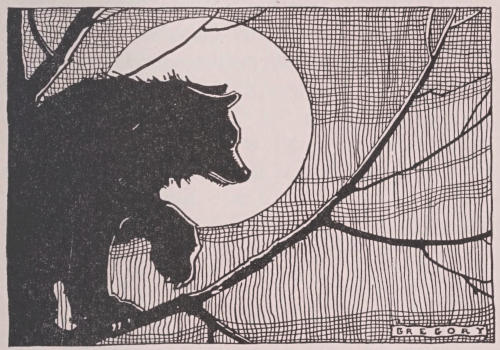
anybody’s dog. It was a bear! I don’t
know which was the most surprised, Charlie
or the bear. Charlie darted back to the
cabin, and when he reached the door he
threw his stick with all his might and hit
the bear on the nose. The nose is the bear’s
tenderest point, you know. Charlie must
have hurt him, for he gave a growl, backed
away from the sap bucket, and scampered
up the nearest tree. Maybe he meant to
wait a while and come back for more sap,
I don’t know. Anyway, up the tree he
stayed while Charlie and I watched him
through the window.
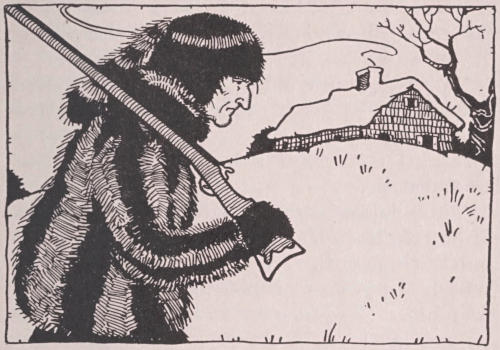
Up the tree the bear stayed while Charlie and I watched him
“‘If we could only keep him up the tree
till the boys come home from Strangs’ one
of them could get a gun and kill him,’
said Charlie, ‘and we’d get the money for
his pelt.’
“‘Father says wolves won’t come near a
fire,’ I remarked, and that gave Charlie an
idea. He would build a fire and keep the
bear treed until the boys came.
“At first I wouldn’t agree to help him.
I was too afraid. But Charlie coaxed and
threatened and was getting ready to do it
himself. So I helped him carry out the first
burning log from the fireplace in the cabin.
After that my part was to watch the bear
and warn Charlie if he moved while Charlie
built up the fire. Once as the fire grew
warmer and the smoke got thicker and
thicker the bear snorted and moved to a
limb higher up.
“Charlie kept a roaring fire going, and it
wasn’t long until Belle and the boys came
rushing up all out of breath from running.
They were nearly scared to death because
they had seen the smoke and thought the
cabin was on fire.
“At first they wouldn’t believe we had a
bear treed. Truman said, ‘Whoever heard
of a bear climbing a tree like that?’ But
Stanley said nobody knew what a bear
might do, and Charlie said that there was the
bear all right, they could see for themselves.
“Truman went home and got his gun and
shot the bear. It turned out to be a young
bear. Father sold the pelt and divided the
money between Charlie and me.
“Now, let me see, what shall I tell you
about tomorrow night? Oh, I know! I’ve
thought of something, but I won’t tell. No,
indeed, not a word till tomorrow night.”
THE NEW CHURCH ORGAN
Grandma had been to church Sunday
morning and heard for the first time the
wonderful new pipe organ, and in the
evening she was talking about it—how
beautiful the music was, how solemn, how
sacred.
“And when I think,” she said, “of the
opposition there was to the first little organ
we had in our church and of the trouble
we had getting it—well, well, times certainly
have changed.
“It was like this. Some of our people
were bitterly opposed to organ music in
church and right up till the last minute did
everything they could to keep us from getting
an organ. This made it very hard to
raise money for the organ, but after a long
time we got enough—all but about forty
dollars. It was decided to have a box
social to raise this.
“At a box social each girl or woman
took a box containing enough supper for
two people. Then the boxes were auctioned
off, and the men and boys bought them
and ate supper with the girl whose box
they got.
“Aggie and Belle trimmed their boxes
with colored tissue paper and flowers and
ribbon, but Mother just wrapped hers in
plain white tissue paper and fastened a bunch
of pinks out of the garden on top so Father
would know it when it was put up to be
sold. Father was going to buy Mother’s
box, and I was going to eat with them.
Charlie had money to buy a box for himself,
and he said he meant to buy Aunt Livvy
Orbison’s box because she always had so
much to eat.
“Every one in the family was going, and
there was a great rush and bustle to get
ready. Mother cut Charlie’s hair and oiled
it and curled mine. She scrubbed us till
we shone, and at last, dressed in our best
clothes, we started.
“Father and Mother and Belle and Aggie
and I went in the surrey. All the boys
walked over the hill, except Joe, who had
gone to Clayville on business for Father
that morning and was to stop at the church
on his way home.
“It was a lovely warm evening, and there
was a large crowd at the church when
we got there, though it was early. The
girls took their boxes in and then came right
out again. Every one was having a splendid
time, talking and laughing and visiting
around.
“I was with Father. After a while I got
tired hearing the men talk about the crops
and the price of wool and the election, and
I went to hunt Mother. I looked all around
and I couldn’t find her. I thought maybe
she had gone into the church, so I went in
there to look for her, but there was no one
in the church at all. The boxes had been
piled on the pulpit and covered with a sheet
so that no one could see them. Just as I
was going out the door I noticed that the
sheet was lying on the floor and the boxes
were nowhere to be seen. I went on out
and presently I found sister Belle. She was
talking to John and Isabel Strang and Will
Orbison.
“I tugged at Belle’s dress and pulled her
to one side.
“‘What did they do with the boxes?’ I
asked her.
“‘Why, they put them in the church, and
after a while they will sell them,’ she said.
‘You run and find Mother now, like a good
girl.’
“‘But the boxes aren’t on the pulpit,’ I
whispered. ‘I was in the church hunting
Mother, and the boxes are all gone and the
sheet is lying on the floor.’
“Belle told the others, and they all went
hurrying into the church, I following after.
The boxes were gone, sure enough. The
pulpit windows, which faced a strip of woods,
were open. The boys said the boxes could
have been taken out that way as the crowd
was in front of the church. There was no
place in the church to hide them. There
was a loft, but it was entered through a hole
in the ceiling and there was no ladder.
Belle placed two chairs with their seats
touching and covered them with the sheet
so that no one could tell the boxes were not
there.
“‘It looks as if some of the people who
don’t want the organ have spoiled this box
supper,’ said John Strang, ‘and they will
keep us from having our organ for a while,
too.’
“‘But that isn’t the worst of it,’ put in
Isabel. ‘It’ll cause no end of trouble and
hard feelings.’
“‘It may have been some of the boys who
did it for a joke,’ said Belle. ‘Let us raise
the money anyway and get ahead of them.’
“‘But how,’ Isabel asked anxiously, ‘with
no boxes?’
“Then they thought out their plan. It
was that John and Will were to go out and
explain quietly to the boys in favor of the
organ what had happened and get them to
give the money they meant to spend on
their boxes to John. Brother Joe had bought
a new pair of shoes in town. They would
put his shoe box up for sale just as if all
the rest of the boxes were still under the
sheet. Will was to bid against John and
run the box up to the amount they had
collected.
“Isabel stayed in the church to see that
no one disturbed the sheet, and John and
Will and Belle went outside to carry out
their plan. I found Mother, and pretty soon
we went into the church. The lamps had
been lit, and I thought how nice it looked.
The girls had come up the day before and
swept the floor and dusted the benches and
shined the tin reflectors on the lamps, and
put great bunches of flowers and ferns over
the doors and windows and covered the two
big round stoves with boughs of evergreen.
There was a short program first, and then
Stanley, who was to auction off the boxes,
stepped to the front of the pulpit and
held up a plain white box tied with stout
string.
“‘How much am I offered for this box?’
he said.
“The bidding started at twenty-five cents.
At first there were lots of bids, but finally
every one dropped out but John and Will.
There wasn’t a sound in the church as the
bidding went higher and higher—thirty dollars
for that plain, white box, thirty-five
dollars, forty dollars, forty-one dollars. Will
stopped bidding and the box went to John
for forty-one dollars.
“Some one called out, ‘Open the box!’
and that started things. ‘Open the box!’
they shouted. ‘Open it!’ ‘Let’s see what’s
in it!’ ‘Open, open, open!’
“When they quieted down a little, Stanley
explained about the boxes disappearing and
everything. Then he untied the string, took
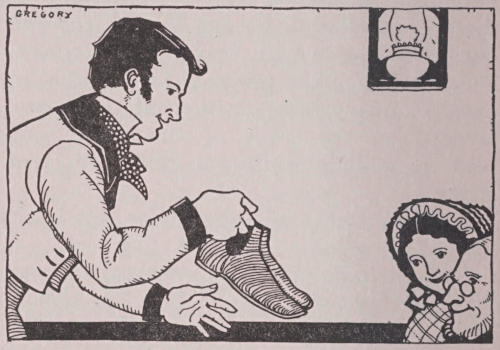
the lid off the box, and held up a pair of
men’s shoes number ten. Then that crowd
went wild. They clapped and shouted and
yelled. Stanley said he thought the boxes
had been taken for a joke and suggested that
they be returned.
Stanley held up a pair of men’s shoes
“‘We have enough money for the organ,’
he said. ‘Now let us have our suppers and
some fun.’
“One of the boys on the side opposing the
organ got up and said that the boxes had
been taken for a joke and would immediately
be returned. And you couldn’t guess where
those boxes were hidden! Right in the big
round stoves there in the church! Of course
everybody laughed again and laughed and
laughed. Such a good-humored crowd you
never saw.
“They handed out the boxes first to the
people who had paid in their money, and
sold the others. There weren’t enough boxes
to go around, but each had plenty in it for
three or four people. Every one divided,
and there was not a person in the church
who did not get something to eat. People
who had been in favor of the organ ate out
of the same boxes with those who had been
against it and forgot that they had ever
disagreed. And when the organ came and
sister Aggie played it that first Sunday, why,
it sounded sweeter to me than that beautiful
big organ in your church did this morning.
“And now, ‘’night, ’night,’ everybody,
and next time I think—yes. I’m pretty
sure—next time we’ll have something
about my school.”
SCHOOL DAYS
“All my brothers and sisters had liked to
go to school,” Grandma began the next
evening, “and in the sitting room, after
supper, Father would hear their lessons while
Mother knitted or sewed or darned. Father
had read books and papers aloud to us as
long as I could remember, and he always
told us how important education was. So
as soon as I got to be six years old I was
anxious to start to school.
“I was small for my age, and as we lived
two miles from the schoolhouse and the
snow in winter was often two or three feet
deep, Mother did not want me to go until
I was seven or eight years old. She said
she and Father could teach me at home for
a couple of years yet, but I coaxed and
coaxed to go. At last Mother said I could
go as long as the weather was good.
“So on the very first day—it was along
toward the last of October—I started down
the road with a brand new primer under
my arm and a lunch basket of my very own
and shiny new shoes. Mother stood at the
front gate to watch me out of sight and
wave when I came to the turn in the road.
“Our schoolhouse wasn’t like yours. It
was just a little frame building painted red.
There were no globes or books or maps or
pictures to make learning interesting. Just
rough, scarred benches, a water bucket and
a dipper on a shelf in one corner, and a big
round stove in the center of the room, and
of course the teacher’s desk and chair on
the platform up in front.
“The teacher was usually a man, but that
winter it was a woman—Miss Amma Morton.
Miss Amma was a tall, bony woman with
snapping, black eyes that saw everything,
and thin gray hair combed straight back
from her face. She wore a brown alpaca
dress with a very full gathered skirt and
black and white calico aprons and a little
black shoulder shawl fastened with a gold
brooch.
“She lived with a married sister who
had a very large family. In those days
all the stockings and socks were knitted
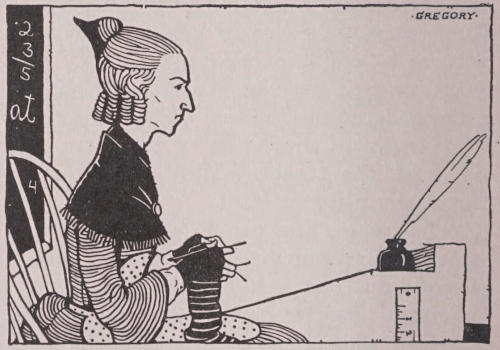
at home, and Miss Amma did the knitting
for her sister’s family. She did it in school.
She would sit at the stove or at her desk and
knit and knit on long gray stockings or
on red mittens. She would knit all day
while she heard our lessons. The only time
she couldn’t knit was when she set our
copies. We had no copy books, and the
teacher had to write the copies out for us.
Miss Amma would knit all day while she heard our lessons
“I liked to go to school. It was fun to
peep into my lunch basket at recess to see
what Mother had put in and maybe slip
out a piece of pie or cake to eat. I liked to
make playhouses on the big flat rocks with
Annie Brierly and the other little girls, and
hunt soft, green moss to furnish them with,
and smooth pebbles down at the run. I
loved to learn my A B C’s and listen to the
older children recite, and at noon and recess
to play ‘Prisoners’ Base’ and ‘Copenhagen.’
But school wasn’t always so pleasant.
“One day not long after I started there
was a heavy wind and rain storm. We
couldn’t recite our lessons, the rain made
so much noise on the roof. Through the
windows we could see the trees swaying
this way and that in the wind.
“At afternoon recess Annie and I ran out
to see if our playhouses had been spoiled by
the rain. When we came back the girls
were standing around in little excited groups.
They told us that the roof had blown off
Bowser’s house—they lived about half a
mile down the road—and that most of the
boys had gone to see it.
“‘Did Charlie go?’ I asked eagerly.
“‘I reckon he did,’ one of the girls answered.
‘He was with the other boys and they went
that way. I wouldn’t be in their boots for
anything. They won’t be back before books,
and Teacher’ll whip them if they’re late.’
“I drew Annie away. ‘I’m going after
Charlie,’ I told her. ‘I’m going to take the
short cut across the hill and catch up to him
and bring him back.’
“Annie said she would go with me, and
we started. The ground was wet and it
was hard walking. We slipped at every
step. After I thought about it a little, I
was not at all sure that Charlie would thank
me for coming. Maybe he’d sooner take a
whipping than miss seeing a house without
a roof. Boys are so different from girls
that way.
“We got clear to Bowser’s without seeing
a sign of a single boy, and the roof wasn’t
off at all—just a little corner of it. Mr.
Bowser was nailing it up as fast as ever he
could. He said none of the boys had been
there, so we started back.
“That was the longest walk I ever took.
I thought we’d never get to the schoolhouse.
My feet were wet and my legs
ached and I was so tired I could hardly
move. When we got to the top of the hill
and looked down at the schoolhouse, there
was no one in sight. Recess was over!
We reached the door at last and stood
trembling outside, afraid to open it and go
in and afraid not to. Annie had been
to school the winter before and was not
so scared as I was. She took my hand
reassuringly.
“‘Don’t let on you’re frightened,’ she
whispered. ‘Maybe Miss Amma hasn’t
missed us and we can slip into our seats
without being seen.’
“Annie opened the door just as easy,
and we slid in without a sound. But alas!
alas! Miss Amma was hearing the advanced
arithmetic class and she stood facing the
door, so the second we stepped in she saw us.
“She stopped explaining a problem long
enough to order Annie and me to stand in
opposite corners up on the platform where
everybody could see us.
“No one had had to stand in the corner
since I had started to school, so instead of
facing the corner as I should have done I
stood with my face toward the school. I
looked to see if Charlie was in his place.
When he saw me looking at him, he began
making motions. I thought he meant for
me to stand tight in the corner, so I pushed
as close as I could to the wall. All over the
room pupils were smiling at me and pointing
and shaking their heads. I wondered what
they meant. I looked across at Annie. She
was laughing and she made a motion, too.
Then I thought of what she had said—not
to let on I was frightened. Maybe I looked
scared. I looked at Annie again. She stuck
her head into the corner, looked at me,
frowned, put her head in the corner again.
What did she mean? It was too funny the
way they were all acting. Then I laughed,
too, right out loud, before I knew it. I
laughed and laughed. I couldn’t stop.
“Teacher gave me a long, severe look.
“‘Turn around and face the corner, Sarah,’
she said, ‘and you may remain after school.’
“Then I knew what Charlie and Annie
and the others had been trying to tell me.
I stood there in the corner until the scholars
had all gone home and Miss Amma had
swept the floor and cleaned the blackboard
and emptied the water bucket.
“Finally she called me, and I went over
to her desk. When she asked me why I
had run off at recess and then disturbed the
whole school by laughing, I told her all
about it, and she said she would forgive me
that time and helped me on with my cape
and hood.
“Charlie was waiting for me down the
road a piece. He hadn’t even thought of
going to see Bowser’s house, but had been
down in the meadow watching the big boys
dig out a woodchuck.
“And, now, an apple all around and good
night.”
A BIRTHDAY PARTY
“Mm! Isn’t it beautiful?” exclaimed
Grandma as she stood with Bobby and Alice
and Pink admiring the table decorated for
Pink’s birthday party. Everything was pink
and white. The lovely white-frosted cake
had pink candles in pink rose-holders—seven,
one for each year and one to grow on. There
were pink candies and pink flowers and pink
caps for the little girls and boys to wear.
“‘And the ice cream is to be pink,’ Alice
explained, ‘pink ice cream shaped like animals—dogs
and bunnies and kittens.’
“My, but isn’t that fine!” said Grandma.
“Now my first party wasn’t a bit like this.
Maybe tonight if you are not too tired I’ll
tell you about my party.”
And that night after they had told Grandma
about Pink’s party she told them about hers.
“We didn’t have many parties when I
was little,” Grandma began, “and we never
had regular little girls’ parties. Everyone,
big and little, came, and they were generally
surprise parties and the guests would bring
the refreshments with them. One evening
going home from school, the girls were wishing
that some one would get up a surprise
party, when suddenly Annie Brierly said,
‘Why don’t we get up a party for Sarah,
girls? Friday is her birthday. Do you think
your Mother would care, Sarah?’
“‘We’d both help her,’ Callie Orbison put
in before I could answer. ‘You don’t need
to do much getting ready for a surprise
party. We could have it Friday night, and
Saturday we’d both come over and help
clean up the house.’
“‘Not a soul but Callie and me would
know you knew anything about it,’ urged
Annie, ‘and we could have just loads of fun.’
“I promised to think about it, and the more
I thought about it the better I liked the idea
of having a party of my very own. It didn’t
take much persuasion the next day to make
me consent. Annie and Callie were delighted
and immediately fell to making plans, but they
agreed that nothing should be said to Mother
until Thursday evening, the date set for the
party being Friday night.
“The days that followed were full of mingled
pleasure and pain for me. I was happy
at the idea of having a real party, but it didn’t
seem fair to deceive Mother. Once I thought
of telling her all about it just as I told her
about everything else. But I was afraid she
would say I was too young to have a party,
and I had never been to a party in my life.
Sister Aggie was visiting Aunt Louisa in Clayville,
and Mother had no one to help her except
for what I could do mornings and evenings.
But I would be at home all day Saturday, and
Annie and Callie had said that they would
help.
“Thursday morning Annie told me that she
had baked a cake and put my initials on top
in little red candies, and Callie said her
mother was going to bake an election cake
with spices and raisins in it. All day Thursday
I kept thinking about the party. It
wasn’t off my mind a minute. I couldn’t
study for thinking about it, and I missed a
word in spelling—the first word I’d missed
that term—and had to go to the foot of the
class.
“But by the time we had started home I
had made up my mind to one thing, that if I
could not have a party with everything open
and above board I did not want one at all.
And so I told the girls that I had changed my
mind and did not want them to have a surprise
party for me. They coaxed and argued
and teased, but I was firm. I was sorry
that Annie had baked a cake and I hated to
disappoint them, but I did not want a party.
The girls were cross with me, and I felt miserable
when Annie turned in her gate without
saying good-by.
“Aggie had come home from Clayville that
afternoon, and she was so busy telling Mother
the news and describing the latest fashions,
and showing the things she had bought, that
no one noticed me much. Not a word was
said all evening about my birthday being so
near. Even Charlie didn’t tease me about
what he would do, such as ducking me in the
rain barrel, as he always did, and I thought
everyone had forgotten all about my birthday.
“But Friday morning just before I started
to school Aggie gave me a plain little handkerchief
that she had hemstitched before she went
away, and then I knew for sure that she had
not brought me anything from Clayville.
And when Mother gave me a pair of common
home-knit stockings, I thought I should cry
right out before everybody instead of waiting
until I got started to school.
“Annie and Callie were in a good humor
again and as pleasant as could be, but I felt
so unhappy that day that I didn’t notice
that the girls at school seemed unusually
happy and excited. When I finally did notice
it, I was afraid that Annie and Callie had gone
ahead with plans for the party. I accused
them of this, but they denied it.
“‘No, no, we didn’t do another thing about
the party,’ they declared. But they looked at
each other and laughed when they said it,
and I didn’t believe them.
“‘You did,’ I said, ‘you know you did.’
“‘Cross my heart and hope to die if we
did,’ Callie insisted.
“‘Here’s some of the cake that I baked for
your party that we didn’t have,’ said Annie.
‘Now will you believe us? I brought you
girls each a piece, but it was a sin to cut that
cake—it was such a beautiful cake.’ And
she handed us each a slice of delicious, yellow
sponge cake decorated with red candies.
“Mother had given me an errand to do at
the store on my way home, so it was later than
usual when, hungry and tired, I opened the
kitchen door. Mother met me and took my
bundles and books.
Out from the hall rushed Annie and Callie and seven other little girls
“‘Take your wraps off here, Sarah,’ she
said. ‘Aggie has company in the sitting
room.’ I didn’t hear anyone talking, but I
took off my coat. Then Aggie called me and
I went into the sitting room, but I stopped in
amazement just inside the door.
“In the center of the room was a table set
with Mother’s best linen and china and silver,
and while I gazed at it, out from the hall
rushed Annie and Callie and seven other little
girls all near my own age dressed up in their
Sunday frocks and each one thrusting some
sort of package toward me.
“I couldn’t say a word—I just burst into
tears. I went upstairs with Mother to wash
my face and put on my best dress. She
told me Aggie had written invitations on cards
she had bought in Clayville, and Charlie had
carried them to the girls that morning. Then
I told Mother all about the party we had
planned to have, and she said not to think
any more about it but that she was glad I
had told her.
“We played games—‘Pussy wants a corner’
and ‘Button, button, who’s got the
button’ and ‘Hide the thimble’—and asked
riddles and had a good time.
“Then we had supper. There were cold
roast chicken, tiny hot biscuits and peach preserves,
three kinds of cake, and hot chocolate
that Aggie had learned to make in Clayville
and none of us had ever tasted before.
“Mother and Aggie had given me those
presents in the morning just to fool me. Aggie
had brought me a lovely story book, and
Mother had a string of pretty pink beads for
me. Charlie gave me a little basket he had
whittled out of a peach seed, and from Father
I got a silver dollar.
“And now good night, pleasant dreams.”
THE LOCUSTS
“Grandma,” said Bobby one evening, “did
you ever see a locust—a seventeen-year
locust? And why are they called seventeen-year
locusts?”
“Oh, yes, I’ve seen locusts and heard them,
too,” answered Grandma, taking up her knitting.
“They are called seventeen-year locusts
because they come every seventeen years.
They lay their eggs in a tree. These eggs
hatch tiny worms, called larvae, which fall to
the ground and stay there for seventeen
years changing slowly until they have turned
into locusts. They live only about thirty days,
but they often do a great deal of damage in
this time. One year when I was a little girl
all our fruit was eaten by the locusts and
many of the trees were killed. They ate the
garden stuff, the potato tops, and even the
flowers, so it must have been somewhat as
it was in Pharaoh’s time.
“You remember Pharaoh was the king of
Egypt who refused to let the children of
Israel go. For this God sent the plagues on
Pharaoh and the people of Egypt. One of these
plagues was the locusts. God caused a strong
east wind to blow all day and all night, and
this wind brought the locusts. They were
every place—all over the ground, in Pharaoh’s
house, and in the houses of his people. They
ate all the vegetables and fruits, even the
leaves on the trees, so there was nothing green
left in all the land. The noise they made must
have been awful. When Pharaoh repented,
the Lord sent a strong west wind which blew
the locusts away, and they were drowned in
the Red Sea. Ever since that time people
have thought the locusts say ‘Pharaoh.’
“I believe I’ll tell you tonight about the
first time I ever heard a locust. Mother wondered
one day at dinner whether there were
any blackberries ripe yet. She said she
wished she had enough for a few pies. So that
afternoon I took a pail and started for the
blackberry field. I didn’t tell anyone where
I was going, for I wanted to surprise Mother.
I was afraid that if she knew she mightn’t
let me go alone, for she was timid about
snakes. Sure enough, I saw a snake nearly
the first thing, but it was a harmless little
garter snake and scuttled away into the bushes
as soon as it heard me.
“There were lots and lots of red berries,
but only a few ripe ones here and there. I
wandered on and on, thinking every minute
I should come to a patch of ripe berries where
I could fill my pail in a few minutes. It
wasn’t much fun blackberrying all by myself.
I scratched my hands and face and tore my
dress on the briars and wished many times
that I was back home, but I kept on picking
until my pail was full.
“I did not realize how far I had gone nor
how long I had been out until I noticed that
the sun was going down. Then I started to
hurry home as fast as I could. But I was
tired and my bucket grew heavier with every
step, so I often sat down to rest. I rested a
long time under a chestnut tree, and then
after I had walked miles, it seemed to me, I
found myself back under this same tree. I
knew it was the same tree because Charlie
had cut my initials on it the summer before.
I had been going around in a circle! I
started out again. I looked to the right and
to the left and straight ahead, but I couldn’t
find the path.
“I was lost—lost in that great blackberry
patch over a mile from home. Night was
coming on, and no one knew where I had gone.
I wondered where I should sleep if no one
found me before it got dark, and what I should
eat. Of course I could climb a tree, but
I might go to sleep and fall out of it. I
shouldn’t starve, for I could eat blackberries,
but the very thought of eating any more
blackberries made me feel sick.
“I hurried this way and that, trying to
find my way out and growing more frightened
every minute.
“Then suddenly I heard some one calling
to me.
“‘Sa—rah! Sa—rah!’ I heard as plain
as plain could be, and I answered them. I
screamed at the top of my voice, ‘Here I am!
Here I am!’ But the voices—there seemed
to be a great many of them—only kept on
saying over and over again, ‘Sa—rah!
Sa—rah!’
“I ran, stumbling and falling through the
bushes, still holding to my precious pail of
berries, but I didn’t seem to get any nearer
to the folks who were calling me. All the
neighbors must be out helping hunt for me,
I thought to myself. That was queer, too,
for it wasn’t really dark and Mother was
used to having me play for hours at a time
down by the run or on the hill under the
oak trees.
“Presently I came to an open space. There
was a group of trees at the far edge, and there
under those trees, to my great surprise, stood
Mother’s little Jersey cow. I ran toward her,
and when she saw me she gave a weak ‘moo.’
But when she tried to move I saw that she
was caught fast by the horns in a wild grapevine
that grew around the tree. I tried to
free her, but I couldn’t. The wild grapevine
is very tough and strong, and Jersey was
securely fastened by it. I petted her and
talked to her and forgot to be afraid any more.
Then I happened to think that if she had been
there very long she must be thirsty. She was
not giving any milk and had been turned out
to graze in the pasture field that joined the
berry patch and had probably come through
a bad place in the fence. I remembered having
passed a spring a little way back, and I
emptied my berries carefully in a pile on the
ground and ran back and filled my bucket
with water. But I couldn’t reach Jersey’s
mouth, and though she tried frantically to
get at the water she couldn’t get her head
down to it. I dragged two pieces of old log
over and built up a platform. Then I
climbed up on it with my bucket of water,
and my, how glad Jersey was to get that
cool drink!
“Then I sat down on a log to wait for some
one to come. To keep from getting lonely I
began to say over my memory verses for the
next Sunday. I was committing the Twenty-third
Psalm and I had just reached the line
beginning, ‘He restoreth my soul,’ when I
heard them calling again.
“‘Sa—rah! Sa—rah!’ they said just as
before. I jumped up and cried out as loud
as I could, ‘Here I am! Here I am!’ I was
determined to make them hear me this time,
and I said it over and over until I was hoarse,
and the more I answered the louder the voices
seemed to call.
“Then to my joy came a voice I knew.
‘Where are you and what are you doing here?’
it said, and crashing through the bushes came
my big brother Stanley. I rushed crying
into his arms, and the funny part was that
Stanley did not know I was lost. He was on
his way home from work on the upper place
and had come down to see if the berries were
ripe so he could tell Mother. He had heard
me calling and had come to find me.
How glad Jersey was to get that cool drink!
“With his pocket knife he cut the vines
that held Jersey, and we drove her slowly
back to the pasture field after he had helped
me pick up the berries.
“When Stanley and I got home Mother
was just starting Charlie out to look for me.
She was pleased to get the berries and glad
I had found Jersey. Father said Jersey might
have starved before he would have missed
her, but Mother made a rule that I was never
again to go farther away than the oak trees
or the run without asking her.
“‘Who was calling me?’ I asked. ‘Some
one was calling me. They still are. Listen!’
and there it was again.
“‘Sa—rah! Sa—rah!’
“They all looked puzzled. Then Mother
laughed.
“‘Oh,’ she said, ‘I know what she means.
Why, that isn’t anyone calling you, dear.
That’s the locusts and they say, ‘Pha—raoh!
Pha—raoh!’ But it does sound like
‘Sa—rah,’ doesn’t it? And I am very
glad you thought they said ‘Sa—rah’ and
answered them or Stanley wouldn’t have
found you and you might have been up in
the berry patch all night.’
“There, that was a long story, wasn’t
it? Hurry to bed now, for you know,
“Early to bed and early to rise,
Makes a man healthy, wealthy, and wise.”
ONE FOURTH OF JULY
Grandma had promised the children a
Fourth of July story, and Bobby and Alice
and Pink drew up their stools and waited
eagerly for her to begin.
“Father was going to take us to Clayville
to the Fourth of July celebration,” Grandma
began. “We were all going except Mother
and Nanny Dodds, who was helping us over
hay harvest. I had been to Clayville once
before.
“‘But that time it was on just a common
everyday day,’ as I told Nanny. ‘This
will be different.’
“We were to start early—early in the
morning—for Clayville was twelve miles
away and we did not want to miss a single
thing.
“First there would be a parade with two
brass bands, then ‘speaking’ on the courthouse
steps, and after that an ox roast. In
the afternoon there were to be horse races
and games. Father promised that we should
have supper at the hotel and stay for the
fireworks in the evening. I had never seen
even a firecracker, and I looked forward to
seeing the skyrockets most of all.
“I was to wear a new light calico dress
with a little blue flower in it and a blue sash
and my ruffled white sunbonnet that was
kept for Sundays. I talked so much about
going that Mother and my sisters and every
one else except Nanny grew dreadfully tired
listening to me and begged me to talk of
something else.
“Nanny was twenty and bashful and as
homely as could be, but I loved her very
much. When she made cookies she put a
raisin in the center of some of them, and
others she sprinkled with sugar. And she
made gingerbread men with currant eyes and
baked saucer pies and let me scrape the cake
bowl. She sewed for my doll and bound up
my hurt fingers tenderly and told the nicest
stories. There was no end to the things
Nanny did for me, but I liked the stories
best of all.
“The day before the Fourth, when I sat
on the edge of the kitchen table watching
Nanny beat eggs for the sponge cake and
talking about what I should see the next
day, Nanny said in a wistful voice, ‘I’ve
never been to Clayville. I always thought
I’d like to go, but I never had a chance.’
“I’ve never been to Clayville,” said Nanny, wistfully
“This set me thinking. Soon I slid off the
table and went in search of Mother. I found
her at the spring-house churning.
“‘Mother,’ I said, ‘let’s take Nanny with
us tomorrow.’
“‘I’m afraid there isn’t room,’ Mother
answered regretfully. ‘There are already five
of you, and the surrey is old and not strong.’
“‘Nanny doesn’t weigh much,’ I argued.
“‘I know, dear, but Father is afraid to
load the surrey any heavier for fear you’d
break down and not get to town at all. I
have told Nanny she may go home to see
her mother tomorrow.’
“All the rest of the morning I sat under
the apple tree in the side yard, thinking.
Once when Charlie came through the yard
with a jug to fill with water for the men in
the hayfield I called him over. Maybe he
might offer to let Nanny go in his place.
To be sure, I hadn’t much hope of this, but
still it was worth trying.
“‘Charlie,’ I said, ‘I think Nanny would
like to go to the Fourth of July celebration.’
“‘Sure, who wouldn’t?’ he replied easily.
‘I want to go myself,’ and he went on to the
well.
“I tried sister Belle next. I found her
picking chickens in the orchard and offered to
help. Then presently I suggested to her that
she could go to Clayville with the Strangs’,
since their surrey would not be crowded as
ours would, and then Nanny could go with
us. She only laughed scornfully and made
me finish picking the chicken I had started.
“I went sadly back to the apple tree.
“‘Nanny wants to go,’ I thought to
myself, ‘and I want to go, too, but if I stay
at home Nanny could go in my place. It
would be a sacrifice,’ I sighed deeply.
‘Preacher Hill says a sacrifice is giving up
something you want yourself. I want to
go more than I ever wanted anything, but
I have lots of things Nanny doesn’t have.
I have curly hair and Nanny’s hair is straight.
I can read and Nanny can’t. I’ve seen the
train and had my dinner at a hotel. I’ve
traveled and Nanny’s never been farther
from home than Mt. Zion Church.’
“That night after I had said my prayers
I put my arms around my Mother’s neck
and whispered, ‘Mother, I want Nanny to
go in my place tomorrow.’
“‘Why, dear!’ Mother started to protest.
But after looking earnestly into my face she
said, ‘Do you really want to stay at home
and let Nanny go in your place? You must
be very, very sure, you know.’
“‘I’m sure, Mother,’ I declared solemnly.
‘Yes, I’m sure I want her to go.’
“‘Well, sleep on it, and if you feel the
same in the morning you shall stay with
Mother and Nanny may go.’
“I wakened at daylight to find Mother
standing beside my bed.
“‘Are you awake, Sarah?’ she asked.
‘They are all up but you.’
“I sat up in bed dazed. I could hear the
girls rushing around in their room. From
the kitchen came the rattle of dishes and
out in the barn the boys were whistling.
Suddenly I remembered. It was the Fourth
of July!
“‘I haven’t changed my mind, Mother,’
I said yawning sleepily.
“Mother bent down and kissed me before
going to tell Nanny. At first Nanny would
not hear of it and left off getting breakfast to
come and tell me so. I pretended to be too
sleepy to talk, so Nanny, urged by Mother,
finally went away to get ready, and Mother
went down to finish getting the breakfast.
“But I wasn’t a bit sleepy a little later
when I jumped out of bed to watch them
start.
“Father and Aggie sat on the front seat
of the surrey, and Belle, Nanny, and Charlie
on the back seat, while Joe, Stanley, and
Truman rode horseback. They all looked
very fine and grand to me dressed in their
best clothes, and I choked back a sob as
they drove down the road and out of sight.
“All morning I helped Mother. I did
lots of things the girls wouldn’t let me do
when they were doing the work. I dried
the dishes and fed the chickens and dusted
the sitting room and scrubbed the walks.
“Then Mother and I had our lunch out
under the apple tree in the side yard—some
of everything the girls had put in their lunch
basket—fried chicken and sponge cake and
green-apple pie. My, but it tasted good!
In the afternoon Mother made my doll a
new dress, and we went together to hunt the
little turkeys and get the cows.
“It was awfully late when the folks got
back, but I sat up in bed to see them. Every
one of them had brought me something.
Spread out on the bed were a flag and a bag
of peanuts, a pewter tea set from Father, a
sticky popcorn ball, and a sack of peppermint
lozenges, but the nicest of all was when
Nanny gave me a hug and whispered, ‘I
had the grandest time of my life, Sarah, and
I reckon it’ll take me a month to tell you
about all the things I saw.’
“Now, let me think! What in the world
will I tell you about tomorrow night? Oh,
I know, but I won’t tell.”
THE BEE TREE
There had been honey for supper, and
afterward, before the cozy fire in her room,
Grandma was telling Bobby and Alice and
Pink about how the bees live in little wooden
houses called hives and make the honey
from a fluid taken from the heart of the
flowers.
“But I knew of some bees once that did
not live in a hive but in a hollow tree.”
Grandma reached for her work basket and
drew out her knitting. “While I put the
thumb in Bobby’s mitten I’ll tell you about
those bees.”
“When I was a little girl,” she began,
“not many people kept bees and we could
not buy honey at the store, so honey was
considered a great treat. The first beehive
I ever saw belonged to Mr. Brierly. The
Brierly’s lived on the next farm to us, but
between them and us, in a little house on
Mr. Brierly’s place, lived a family named
Henlen. They were very lazy and hunted
and fished and worked just enough to get
what money they must have. Mr. Brierly
had given them a swarm of bees and helped
them make a hive for it, and the Brierlys
and the Henlens were the only people in our
neighborhood who kept bees.
Early in the summer one of Mr. Brierly’s hives swarmed
“Then early in the summer one of Mr.
Brierly’s hives swarmed. That is, a swarm
of bees left the old hive and wanted to set
up in a hive of its own. Usually when a
young swarm left the old hive Mr. Brierly
gave them a new hive and they settled down
contentedly and went to making honey. But
this swarm flew away and lighted in a hollow
tree on the edge of our woods.
“Mr. Brierly did not find them for several
days. Then he told Father he would just
leave them where they were, if Father did
not care, and when he took the honey he
would divide with us. Father told him he
was welcome to leave the bees as long as
he wanted to and to keep the honey. But
Mr. Brierly said Father must take half of
the honey or he would not leave the bees.
So Father agreed and Mr. Brierly left the
bees.
“Every morning when Charlie and I took
the cows to pasture we would skip across
the field to take a long look at the bee tree.
We would watch the bees as they flew in
and out the hole in the side of the tree and
wondered how much honey they had made
and talked about how good it would taste
on hot biscuits.
“So all summer the bees worked away,
and one day in the fall Mr. Brierly sent
Father word that he would be over that week
to take the honey. A few mornings later
when I came in sight of the bee tree I stopped
in amazement. The bee tree was gone!
Instead of standing straight and tall like a
soldier on guard, it lay flat on the ground.
Chips of wood were scattered all around.
The bee tree had been cut down.
“I started for home as fast as I could
go to tell Father. He wasn’t at the barn,
and I went to the house. Back of the house,
under a sugar tree, the girls were washing
and Charlie was carrying water for them.
As I came up Aggie was scolding because
one of the washtubs was missing. When I
told them about the bee tree they were as
excited as I was. Charlie ran to the wheat
field where Father was ploughing to tell
him, and we girls went in to find Mother.
“Belle declared that whoever stole the
honey must have taken the tub to carry it
away in. And since the honey was on our
land and we knew it was ready to take
away and the tub was ours, it would look to
Mr. Brierly as if we had had something to
do with it. Aggie laughed at her and said,
‘The very idea of anyone thinking we would
steal!’ But Mother looked serious.
“Father came right to the house, got on
a horse, and rode over to Mr. Brierly’s.
Mr. Brierly came back with him, and they
examined the fallen bee tree carefully. It
had been chopped down. Mr. Brierly said
he thought we would have heard the blows
down at the house. Father replied coldly
that we had heard nothing and knew nothing
about it until I had taken the cows to pasture,
and wouldn’t have known then if I had not
run across to look at the bees. He told him
about our tub being gone, too. Aggie said
it wasn’t at all necessary to tell that, but
Belle said Father was too honest to keep
anything back.
“Father imagined that Mr. Brierly
thought we knew something about the disappearance
of the honey. Of course Father
resented this, so the Brierlys and we ceased
to be friendly. Mrs. Brierly and Mother
had always helped each other to quilt and
make apple butter and had exchanged recipes
and loaned patterns back and forth, but all
this stopped now.
“School started, and Tom and Annie
Brierly did not wait for Charlie and me
as they had always done. If they had not
gone to school before we came along, they
waited until we had passed by before they
started.
“Charlie and I worried a great deal about
the coldness between the two families and
the unhappiness it was causing. We were
always making plans to discover who took
the honey and so clear things up.
“One day when Charlie was eating his
dinner at school he noticed that Flora May
Henlen had something on her bread that
looked like honey. He told me to watch
her, and the next day at noon I took my
dinner and sat down near Flora May to eat
it. Sure enough, it was honey she had
on her bread. But then I remembered that
they had bees and she had a right to have
honey. Still I watched Flora May for several
days, and she always had honey on her bread.
“‘Did your bees make lots of honey this
year, Flora May?’ I asked her one day.
“‘Oh, yes,’ she answered, ‘every few days
the boys bring in a pan of honey.’
“That evening Charlie made an excuse
to stop a while with one of the Henlen boys,
and in the orchard back of the house he saw
their bee hive lying on the ground among
some rubbish and rotting leaves.
“We told our discovery at home, and my
brother Truman said the Henlens had had
no bees at all for months. They had been
starved or frozen out the winter before.
“The next morning Father stopped Asa
and Longford Henlen as they were passing
our house on the way home from mill and
told them he knew they had taken the honey.
At first they denied all knowledge of the
honey, but when they found that in some
way Father had found out about it they were
scared and admitted that they had chopped
down the tree and, finding more honey than
they had expected, had taken our tub to
carry it away in.
“Mr. Brierly and Father decided that if
the boys would work out the pay for the
honey and promise not to steal any more
they would not tell anyone.
“Mr. Brierly apologized to Father, and
Mrs. Brierly and Mother kissed the next
time they met, and Tom and Annie began
waiting for Charlie and me again, so that
everything was all right once more.
“Get the apples, Bobby, please, and tomorrow
night, if you say your prayers and go
right to sleep tonight, I’ll tell you about—well,
it’s an awfully good story I have for
tomorrow night.”
BRAIN AGAINST BRAWN
Bobby was feeling his muscle and telling
his sisters how strong he wanted to be, and
Grandma, hearing him, said, “Of course
it’s nice to be strong, Bobby, but strength
won’t get anyone very far unless it is
combined with brains. I knew a delicate
looking boy once who got ahead of half
a dozen big strong fellows, not because he
was strong, but because he had brains and
used them.
“It was long, long ago—the winter my
brother Truman taught our home school.
Mother didn’t want Truman to take the
school, for, though he was eighteen years
old, he was a slender, little fellow and his
blue eyes and light hair made him look
even younger than he really was. But Father
said for him to go ahead and see what he
could do.
“There were several bad boys in school.
The year before they had run the teacher
out before the term was half over, and we
had no more school that winter. When
they heard that Truman was going to teach,
they made all sorts of boasts about what
they meant to do.
“Truman got along all right the first few
weeks until the older boys, who had been
working at a sawmill, started in. Nearly
all of these boys were bigger than Truman,
and Bud McGill, the leader, was a year
older. He had broken up several schools
and bragged that he would run Truman
out in short order.
“From the day he started he did everything
he could to make trouble. Because
he had started to school late in the term
he did not get the seat he wanted. One
morning he came early and took this seat
and refused to give it up when Truman asked
him to. Truman couldn’t force him to give
it up, because Bud was so much larger and
stronger. All day long Bud sat there in the
corner seat talking and laughing and throwing
paper wads at girls—disturbing all the
rest of us so we could not study. At dismissing
time Truman told him to take his
books with him and not come back to school
until he could behave himself, but Bud
walked out as bold as you please without
a single book.
“I don’t know just how it would have
come out if Bud’s father had not heard
about the trouble. But he did, and he
told Bud he would have to give up the seat
unless he got the teacher’s permission to
keep it.
“Bud said he’d get Truman’s permission
all right.
“The next morning I went to school early
with Truman because Charlie was sick and
couldn’t go. As soon as we came in sight
of the schoolhouse and saw a thick column
of smoke rising from the chimney we knew
something had happened, for Truman always
built the fire himself.
“When we got within hearing distance,
Bud McGill opened the door a tiny bit and
called out to Truman, ‘Have I your say-so
to keep the seat in the corner?’
“‘No, you haven’t,’ Truman said shortly,
and Bud slammed the door in his face and
bolted it. Bud’s plan was to keep Truman
out of the schoolhouse until he agreed to
Bud’s taking the seat he wanted. Then
Truman could come in and take up books
as usual, but if he did this he would be
admitting that Bud was the real authority in
the school and the other pupils would cease
to respect him.
“As the children came to school Bud
opened the door and let them in. They
offered to let me in, too, but I wouldn’t
go. Truman wanted me to go back home,
but I wouldn’t do that either. Several of
the boys stopped to talk to Truman and
offered to help him. Bud’s crowd saw the
boys talking to Truman and thought they
were going to combine and try to enter the
schoolhouse by force. Bud dared them to
come ahead. He went so far as to say that
if the teacher got in he would do whatever
he said. But Truman urged the boys who
were eager to help him to go on in and not
make any trouble. He said it was his problem
and he would have to settle it alone as
best he could. So they went in, and Truman
and I were left alone.
“Truman brought some kindling from
the coal house and built a fire, and we stood
around it to keep warm.
“‘I’ve got to get ahead of them some
way,’ Truman said, as much to himself as
to me. ‘I’ll have to beat them or I’m done
for. And if I give up the school, that
means no spring term at the academy. I’ve
either got to outwit Bud and his crowd
or give up the school.’ Just then a strong
wind blew the smoke in our eyes and
started them to smarting. This gave Truman
an idea.
“‘I might smoke them out,’ he said
thoughtfully. ‘If I could only get to the
roof, I could stuff this old coat down the
chimney. You wait here, Sarah, while I
look around for a ladder.’
“He strolled to the back of the building
where there were no windows, got down on
his hands and knees, and crawled under
the house to look for a ladder that had
been there. But the ladder was gone. He
examined the walls of the schoolhouse, but
they were smoothly weather-boarded and
gave no foothold.
“He got an armful of kindling to build
up the fire, and presently, though it wasn’t
noon, we opened our lunch basket and ate
our dinner. A cold wind had risen and the
fire was getting low. Whatever Truman did
must be done quickly, for the short winter
afternoon would soon be over.
“I shivered and edged nearer to the fire.
“‘I wish I had Belle’s new cape,’ I said.
‘It would keep me good and warm. Did
you see Belle’s new dolman and hat that
she got while she was at Clayville yesterday,
Truman?’ I asked idly, just for something
to say.
“He didn’t answer me at once. Then,
‘Has anyone else seen them?’ he asked
quietly. ‘I mean anyone else except our
own folks.’
“‘No, not a soul,’ I said. ‘No one knows
she even went to town.’
“Truman stared at me blankly. ‘I wonder
if I could do it,’ he murmured.
“‘Why I’m sure you could,’ I said, not
in the least knowing what he was talking
about, but eager to encourage him in any
way I could.
“‘I’ll try it!’ he cried. ‘You go in, Sarah,
and tell them I’ll be back in an hour.’ With
that he started down the road, and I went
in and gave them his message. Some of the
boys hooted and laughed and said they
might as well go home, but finally decided to
wait.
“Less than an hour from the time Truman
left some of the scholars impatiently watching
the road for his return were surprised to see
a lady approaching on horseback from the
opposite direction. She got off her horse
in front of the schoolhouse and looked helplessly
around. Bud McGill dashed out and
tied her horse to the fence. The girls said
she must be a stranger, for none of them
had ever seen her before.
“The teacher is out just now. Won’t you have a chair?” said Bud
“A plaid dolman of the newest style,
trimmed with fringe, fell nearly to her knees,
and she wore a wide black beaver hat with
a thick veil and glasses. She walked with
mincing steps to the door, daintily holding
up her long black riding skirt. Just inside
she turned to Bud.
“‘Are you the teacher?’ she asked softly.
“‘No, ma’am,’ Bud said politely, ‘the
teacher is out just now. Won’t you have
a chair?’
“The lady sat down at the teacher’s desk
and began to fumble with her veil. One of
the girls came forward and deftly removed
the pins that held it in place. The veil
slipped off, and there sat Truman dressed
in sister Belle’s new clothes! There were
shouts and shouts of laughter in which
even Bud was forced to join. He came
forward and offered Truman his hand.
“‘You beat,’ he said. He never made
any more trouble and we had a good school
the rest of the winter.
“See who gets to sleep first and we’ll have
another story real, real soon.”
A WISH THAT CAME TRUE
“Grandma,” said Alice one evening when
she and Bobby and Pink had come into
Grandma’s room, “do you believe that if
you look over your right shoulder at the
new moon and make a wish that it will come
true?”
“Naw,” jeered Bobby, “course not.”
“Well, I don’t know,” Grandma answered
thoughtfully. “A wish made that way could
come true. I made a wish once over a white
horse and a red-haired girl that came true.”
“Tell us about it Grandma. Please tell
us,” coaxed Alice.
Grandma found her knitting and began.
“The red-haired girl,” she said, “was
Betty Bard, our preacher’s granddaughter.
She had lived at the parsonage with her
grandparents for nearly a year, and next
to Annie Brierly she was my best friend.
The white horse belonged to old Mrs. Orbison,
who with several other women had come to
help sister Belle quilt her ‘Rose of Sharon.’
“Betty and I were playing under the apple
tree in the side yard. That is, we were trying
to play. We couldn’t find any game we
liked. We kept thinking that this might be
our last afternoon together. You see, conference
was to meet the next week, and
Betty didn’t seem to think her grandfather
would be sent back to preach on Redding
circuit. I didn’t think so either. Redding
circuit was very hard to please, and though
Father never found fault with any of our
preachers and always paid his tithes, still I
knew that Brother Bard was not popular.
Betty said it was because he did good by
stealth and no one ever found it out.
“‘If I move away,’ said Betty as we
sat under the apple tree talking that afternoon,
‘you may have my playhouse rock
at school, Sarah, and all my dahlia roots,
and the black kitten. The kitten’s name is
Bad Boy because he jumps on the table
when no one is looking. And you must be
sure to dig the dahlias up before frost.’
“Just then Mrs. Orbison’s voice floated
out through the open sitting-room window.
“‘It all depends on the sermon he preaches
tomorrow,’ she said. ‘If they don’t like it,
a letter goes to the Presiding Elder saying
we will not tolerate Brother Bard another
year and that in case he is sent back against
our wishes we will not pay him anything.’
“I looked quickly at Betty to see if she
had heard, and I knew by the flush on her
cheeks that she had. I put my arm through
hers and we walked slowly toward the front
gate. It was then I made my wish. I looked
at Mrs. Orbison’s white horse turned out to
graze in the orchard across the road and at
Betty’s red head, and I said to myself, ‘I
wish for Betty not to move away.’ Out
loud I said to Betty, ‘Can’t you tell your
grandpa to preach a sermon they’ll like,
Betty, so you won’t have to go away?’
“‘But how would he know what they’d
like?’ she asked in a puzzled tone.
“‘Oh, just something pleasant,’ I answered
cheerfully, ‘something nice and pleasant.’
“‘I’ll tell him what Mrs. Orbison said,’
she promised before she went home, ‘and he
can do what he thinks best.’
“We stopped at the parsonage the next
morning to take Betty into the surrey with
us because her grandma seldom went to
meeting, not being very strong. I could hardly
wait till Betty and I got around a corner of
the church to ourselves.
“‘What did your grandpa say?’ I asked
eagerly.
“‘He said he’d do his duty as he saw it,
and grandma said he stayed up all night.
She crept downstairs three times to beg him
to come to bed.’
“This did not sound very encouraging, but
when I heard the text I breathed a sigh of
relief. It was, ‘Now if Timotheus come, see
that he may be with you without fear, for he
worketh the work of the Lord as I also do.’
I didn’t know what it meant, but it sounded
like a safe text, and I became so interested in
watching a robin hopping on the window sill
that I did not notice what Preacher Bard was
saying until I felt Betty straighten up and
clutch my hand.
“I looked around to see what had happened,
and I knew in a minute that he had not
preached a sermon to please them. Amazement,
indignation, surprise, showed plainly
in the upturned faces. I won’t try to tell you
what was in that sermon, only this—that, in
the hope of making things easier for his successor,
Reverend Bard had undertaken in a
kindly way to open the eyes of the Mt. Zion
people to some of their faults. They had
found fault with all the preachers. Now he
pointed out a few of their own shortcomings,
and they didn’t like it—no, indeed, not a bit.
“When it was over, the congregation
poured out of the church, filled the little yard,
and overflowed into the graveyard beyond.
No one offered to leave. They stood around
in groups—whispering, shaking their heads
gravely, pressing their lips in grim lines.
“As soon as the preacher left for his afternoon
appointment the storm broke. No one
paid any attention to Betty as she stood at
the horseblock with me waiting for Father to
come round with the surrey. Everybody
talked at once.
“‘He doesn’t preach the straight gospel—he
tells too many tales.’
“‘He doesn’t visit enough.’
“‘He favors pouring, when we’ve always
stood for immersion.’
“These remarks and many others Betty
and I heard as we waited there for Father.
Betty must have stood it just as long as she
possibly could. Then suddenly she jerked
away from me and climbed to the horseblock.
I can see her now—her red hair flying in the
breeze, her eyes shining, her cheeks flushed.
“‘My grandfather’s the best man in the
world,’ she cried, and stamped her foot angrily.
‘He’s the best man in the world, I tell you.
I don’t care what you say, he’s the best man
in the world,’ and she crumpled down in a
little sobbing heap.
The congregation stood around in groups—whispering
and shaking their heads gravely
“Father came up then and, putting an arm
around Betty, he said, ‘Let us pray,’ and
everybody bowed his head and Father prayed.
He prayed a long time, and at the last there
were lots of ‘Amens’ and ‘Praise the Lords’
just as in big meeting.
“The second Father finished, an old man
stepped out in front and said in a halting way
that he would like every one to know that
when his cow died in the winter Preacher
Bard had bought him another. That started
things. A young man said the preacher had
sat up with him every other night for six weeks
when he had typhoid fever. A boy said the
preacher had bought him school books, and
the Widow Spears said he had given her
twenty dollars when her house burned. An
old lady told how he read one afternoon a
week to her husband who was blind, and so on
and on and on. Everybody wanted to tell
something good about Preacher Bard.
“Before the meeting broke up a big donation
party was planned for Monday night,
and Mother got Mrs. Bard to let Betty come
home with us so she wouldn’t give it away.
Monday was a busy day. While the women
baked and cooked for the party, the men
raised money to put a new roof on the parsonage,
to buy a suit of clothes for Brother Bard, a
black silk dress for Mrs. Bard, so stiff it would
stand alone, and a blue delaine for Betty.
“How we surprised the Bards that night
when we all went in, and what a good time we
had! But the best part was when Deacon
Orbison, who had been opposed to the preacher
from the first, got up on a chair and made a
speech. He said it seemed to him Redding
circuit could not afford to lose a man like
Reverend Bard, that his salary and benevolences
had been made up in full, and that a
letter would be sent the Presiding Elder asking
that he be returned for another year. He was
returned, and Betty and I sat together at
school that winter, so you see I got my wish.
“Well, well, if it isn’t bedtime for three
little children I know. Pass the apples,
Bobby, please, and next time I’ll tell you—well,
I just don’t know what I shall tell you
next time, but I’ll have something for you.”
JOE’S INFARE
“I think tonight I’ll tell you about my
brother Joe’s infare,” said Grandma one evening
when Bobby and Alice and Pink had
come to her room for their usual good-night
story. “But first,” she went on, before the
children had time to ask any questions, “I’d
better tell you what an infare was. It was a
sort of wedding reception which took place at
the bridegroom’s home, usually the day after
the wedding. It was the faring or going of the
bride into her husband’s home and was celebrated
with great rejoicing and a big feast.
“Joe had married Sally Garvin, who lived
four miles from us by the road but only two
miles through the fields. They had been
married the day before, and we were to have
the infare.
“Mother and the girls and Nanny Dodds
had baked and cooked for a solid week.
And before that they had cleaned the house
from top to bottom, and we had mowed and
raked and swept the big front yard and the
orchard across the road and the pasture lot by
the house. Now the great day had arrived.
“Stanley had gone in our surrey to drive
the bridal couple home, and Truman and the
girls had ridden horseback to meet them.
Charlie had brought Hunter, Stanley’s colt,
down to the barn lot so he could go with them.
But Mother was afraid to have him ride the
colt, not knowing that he practiced riding
him every day in the pasture field.
“From my lookout on the rail of the front
portico I saw the first of the guests come over
the top of two-mile hill. There was a number
of young men and girls on horseback, followed
by our surrey with Stanley driving. On the
back seat I knew the bride and groom sat.
“I waited for nothing more. I jumped
down and rushed off to the kitchen to tell
Mother. Mother gave Nanny some instructions
about the dinner, slipped off the big
gingham apron that covered her gray silk
dress, patted her hair before the mirror in the
hall, and, taking Father’s arm, went down the
path between the rows of bachelor’s buttons,
foxglove, Canterbury bells, and ribbon grass
to welcome her first daughter-in-law.
“When Sally and Joe had left Sally’s home,
a number of friends and relatives had started
with them. These had been added to all
along the way by other friends, so that there
was quite a crowd of folks when they reached
our house, besides lots of people who had
already come.
“As soon as Mother and Father had greeted
Sally, Belle and Aggie hurried her upstairs to
the spare chamber to put on her wedding
dress. Sally was little, with pink cheeks, and
brown curls which she wore caught at the top
of her head and hanging down her back very
much as the little girls wear their hair now,
only the young ladies of that day wore a
high-backed comb instead of a ribbon. She
wore a new gray alpaca trimmed in narrow
silk fluting, very pretty, but nothing like
what the wedding dress would be. The
wedding dress had been made in Clayville,
and Belle and Aggie and everybody else were
eager to see it.
“Joe brought up the telescope which held
Sally’s things and went back downstairs. The
girls were going to help Sally dress, and I
kept as much out of sight as possible so I
could see and yet not be seen.
“‘Open it up, Aggie, please,’ said Sally,
pointing to the telescope, ‘and lay my dress
on the bed. I do hope it’s not wrinkled.’
“Aggie lifted the telescope from the floor
to a chair.
“‘My goodness, but it’s heavy!’ she cried.
‘What in the world is in it, Sally?’
“Sally turned from the mirror.
“‘Heavy?’ she said surprised. ‘Why,
there’s hardly anything in it. I packed
it myself. I wanted to be sure my dress
wouldn’t be wrinkled, so I just put in the
dress and a few other things to do until
tomorrow.’
“Aggie rapidly unbuckled the straps and
lifted up the lid. Sally gave a smothered cry
and caught Belle’s arm.
“‘Somebody has made a mistake,’ she
gasped. ‘It is the wrong telescope!’ and she
threw herself across the bed and burst into
tears.
“The telescope was packed tight full with
towels, pillow slips, tablecloths, and sheets
and was to have been brought over the next
day with the rest of Sally’s things. In the
excitement of leaving, some one had carried it
down and placed it in the surrey instead of
the one containing the wedding dress.
“‘You look awfully sweet in this little gray
dress, Sally,’ Aggie tried to console her. But
it was no use, for Sally knew quite well that
waiting downstairs were girls in dresses
that looked much more bridelike than the
gray alpaca. To be outshone at one’s own
infare—well, it was no wonder she cried!
“Belle suggested that Stanley or Truman
go back for the wedding dress, but Sally
objected to this. She said people would
laugh at her and never forget that she had
gone to her infare and left her wedding dress
at home.
“Suddenly a thought came to me. Hunter
was still in the barn lot. Charlie could ride
him, and he went like a streak. It was only
two miles through the fields to Sally’s home.
I never stopped to think that Mother would
be frightened if she knew Charlie was on
Hunter, or that Father would probably forbid
it, or that Charlie might ruin his new Sunday
suit. I slipped out of the room and went in
search of Charlie. I found him out front
pitching horseshoes, and in no time at all he
was off to Sally’s home without a soul knowing
about it. Then I went upstairs to tell the
girls what I had done.
“They were not very hopeful. It didn’t
seem possible that Sally could stay upstairs
till Charlie got back with the dress, but she
said she would wait a little while anyway.
She got up and bathed her face, and Belle and
Aggie went down to entertain the guests.
Belle started several games, such as ‘Strip-the-Willow’
and ‘Copenhagen,’ and Aggie
played the piano.
“I was everywhere—in the kitchen begging
Nanny to hold the dinner back as long as she
could (I had let her into the secret), on the
hill behind the house watching for Charlie,
and in the spare chamber trying to cheer
Sally up, for at the end of an hour there was
no sign of Charlie.
“What could have happened? He had said
he could make it in less than an hour. He had
been gone an hour and twenty minutes!
People were wondering why Sally did not
appear. They had lost interest in the games
and were dropping out and sauntering toward
the house. Aggie had played everything she
knew over and over. Belle had run up to tell
Sally she would have to put on the gray dress
and come right down, but Sally had coaxed
for five minutes more. Belle went back and
started the folks singing ‘The Star-Spangled
Banner.’ The five minutes were up and
Sally was putting on the gray alpaca dress
when Charlie came.
“The people who had begun to wonder what
was keeping the bride forgot about it when
Sally came down and stood with Joe to receive
their good wishes and congratulations. Her
dress was heavy cream-colored silk with tiny
pink rosebuds scattered all over it, and the
full skirt was ruffled clear to the waist. The
round neck and elbow sleeves were finished
with filmy white ruching, and she wore white
satin slippers. With her pink cheeks and
shiny brown curls I thought she was the very
prettiest bride any one ever saw.
“When they had gone into the dining room,
where Annie Brierly and some other little
girls were waving peach switches over the
tables to keep the flies and bees away and
Sally was saying who should sit at the bride’s
table, Charlie told me what had kept him.
He had found the Garvins’ house locked up
and had had to climb in a window to get the
telescope. The dog had seen him as he had
gotten in and wouldn’t let him come out until
Charlie had fed him and made friends with him.
“Then some one called us and said that
Sally wanted Charlie and me to sit at the
bride’s table. No one could have been more
surprised than we were, for we hadn’t
expected to eat till the third table at the very
soonest, and here we were invited to sit at
the bride’s table and have our pick of the
choicest food!
“There! I hear Mother calling. Good
night, good night, good night.”
PUMPKIN SEED
“Well, well,” said Grandma one evening
when Bobby and Alice and Pink asked for
a story. “I wonder if I can think of anything
tonight.” She found her knitting and
went on in a puzzled tone. “I thought of
something today to tell you about. Let me
see, what was it? Oh, I remember now.
It was the pumpkin pie at dinner that set
me thinking about the pumpkin seed that
Father gave brother Charlie and me to plant.”
“It was in the spring. The fish were
biting fine, and one afternoon Charlie and
I were all ready to go down to the deep hole
under the willows to fish. Charlie had cut
new poles and hunted up hooks and lines,
and I had packed a lunch, for you do get
awfully hungry sitting on the creek bank
all afternoon. We were out behind the barn
digging bait when Father came around the
corner and saw us.
“‘I’ve just been looking for you children,’
he said. ‘I want you to take these pumpkin
seeds down to the cornfield in the bottom and
plant them.’ Then, seeing our fishing tackle,
he added, ‘It won’t take long, and when
you finish you may go fishing.’
“Of course Charlie and I were disappointed.
We hadn’t been fishing that year
yet. It had been a late spring, with lots of
rain, and on the bright days there had been
so many things that we could do around the
house and garden that we couldn’t be spared
to go fishing. And now, with everything all
ready, to give it up even for an hour or two
was a trial.
“We started for the cornfield, Charlie
carrying the poles and the can of bait and I
the lunch and the paper sack of pumpkin
seed. The pumpkins we were to plant were
to be used to feed the stock—cow pumpkins
they were called, and they were big and
coarse-grained and not good for pies.
“Well, Charlie and I started down at the
lower end of the field and we planted a few
seeds. But there was such a lot of the seed
and the field was so big and the lure of the
creek with the shade under the willows and
the fish biting was so great that we could
think of nothing else. We stopped to examine
our bait to see if the worms were still living.
When we went back to work Charlie wondered
what was the use of planting so many old
pumpkins, anyhow, when Father had already
planted as many as usual in the upper
cornfield.
“‘We might plant a whole lot of seed
at once,’ he said, ‘but still it would take us
a long time.’
“‘I know what to do!’ I cried, ‘Let’s
hide the sack of seed in this old stump and
come back tomorrow and plant them.’ After
a few half-hearted protests from Charlie,
this was what we did. We buried the sack
of seed in an old, rotten stump, covered it
deep with the soft, rich loam, and away we
went to the creek to fish.
“Charlie baited both our hooks with the
fishworms, and we would spit on our bait
each time for luck. The charm must have
worked, for when it was time to go home
we had caught a nice lot of sunfish, tobacco
boxes, silversides, and suckers. Truman
cleaned them for us, and Mother dipped
them in corn meal and fried them a golden
brown. We had them for supper, and
every one said how good they were and no
one thought to ask us anything about the
pumpkin seeds.
“I thought about them that night after
I had gone to bed and wished that we had
stayed and planted them as Father had told
us to. But then Charlie and I would go
down first thing in the morning, dig the
sack out of the stump, plant the seeds, and
everything would be all right.
“But it began to rain in the night, and it
rained all the next day. The day after, it
was too wet, and the day after that Charlie
was busy. Then it rained again, and after
a while I forgot all about the pumpkin seeds.
It was several weeks before I thought of them
again. You couldn’t guess what made me
think of them then, so I will tell you.
“When we went to meeting on Sundays,
Charlie and I always tried to remember the
text of the sermon to say when we got home,
for Mother was almost sure to ask us what
it was. One Sunday I was saying it over
and over to myself so that I could remember
it, when suddenly the meaning of it came to
me and I was surprised to find that it had
something to do with me. The text was
‘Be sure your sin will find you out,’ and in
a flash I knew it meant that if you did anything
wrong you couldn’t keep people from
knowing about it. Then I thought of the
buried pumpkin seed which Charlie and I
had meant to go back and plant.
“Father had never said a word about the
pumpkins not coming up, though he must
surely have noticed it long before this. Perhaps
he thought the seed had been bad, but
still it was queer he had never mentioned it.
“That night I couldn’t sleep for thinking
how wrong it had been for Charlie and me
to deceive Father about the pumpkin seed.
Even the fact that we had meant to go back
and plant them didn’t make me feel any
less guilty. When I did fall asleep, I dreamed
that the room was full of pumpkins with ugly
grinning faces like jack-o’-lanterns. They
laughed and mocked at me and pressed closer
and closer until I wakened with a frightened
cry, and when Mother asked me what had
scared me I couldn’t tell her.
“In the morning I talked it over with
Charlie. We agreed to go to Father immediately
and tell him that we had not planted
the pumpkin seeds.
I dreamed the room was full of pumpkins with ugly grinning faces
“But Father had gone to Clayville on
business for a couple of days. When he
came back, before we had a chance to see
him alone he told us at dinner before all the
others that the pumpkin crop in the bottom
cornfield was to be Charlie’s and mine. He
said that we could keep as many as we
wanted to for jack-o’-lanterns on Hallowe’en
and he would pay us ten cents apiece
for all the rest. Think of that! Ten cents
apiece for all the pumpkins we raised, and
we knew that there wouldn’t be any pumpkins!
I looked across the table at Charlie,
and his face was very red. I couldn’t say
a word, but when Father left the table we
both followed him and told him all about
the pumpkin seeds, and how the text had
started us thinking, and everything. Father
listened without a word till we had finished.
Then much to our surprise he said, ‘I’ve
known for a good while what you did with
the pumpkin seed. When I saw the number
of fish you caught that afternoon, I
wondered how you had planted the pumpkin
seed so quickly. I had told Mother they
were to belong to you two to do with as you
pleased, but I did not intend to tell you
until later. Then when I found out that
you had not planted the seeds I waited
for you to come to me. I believe you have
learned a lesson from this experience which
you will not forget. Come along with me.
I want to show you something.’
“Wonderingly, without a word, we followed
Father to the cornfield and straight
to where the old rotten stump in the lower
end of the field had been. But when we
got there we could not see the stump, for
coming out of it and all over it and completely
covering it, were myriads of pumpkin
vines—not big strong vines like the ones
that grew in the fields, but thin, sickly
vines crowding each other for space.
“The soil in the stump had been so rich
and light that, though the sack of seeds had
been deeply covered, when soaked with rain
the seeds had sprouted and forced their way
through the sack and up to the light and
air. The vines told Father where the pumpkin
seeds were as plainly as if they could
have spoken.
“And now, good night, my dears, and
don’t forget to say your prayers, and I’ll
try to think up a good story for next time.”
A SCHOOL FOR SISTER BELLE
“It was during the third year of the war
that sister Belle got her certificate to teach.
Our school had been closed for a year, first
because there were no teachers, all the
young men having enlisted, and secondly
because there was no money to pay a teacher.
The few schools in the county had been
given out before Belle got her certificate.
She was awfully disappointed, for she wanted
to go to the academy in the spring and she
didn’t think Father could spare the money
to send her, times being so hard.
“But since she couldn’t get a school she
would make the best of it. She would help
Aggie and Truman and Charlie and me at
home, and she promised to teach the Brierly
children, too. Then the Orbisons wanted to
come, and to save Mother the fuss and dirt
so many children would make in the house,
Belle said she would hold school in the schoolhouse
and let any one attend who wanted to.
“‘It will give me experience, anyway,’
she said, ‘and dear knows the children need
some one to teach them!’
“‘Why don’t you let them pay you?’
Aggie suggested. ‘A dollar apiece a month
for each pupil wouldn’t be a bit too much.’
“But Belle said some of them couldn’t
pay and they were the ones who needed
schooling the most. And the ones who
could pay probably wouldn’t, because the
county should pay for a teacher.
“So one Saturday in October, armed with
brooms and buckets, window cloths and
scrubbing brushes and a can of soft soap,
we set out to clean the schoolhouse. We
scrubbed the floor and the desks and polished
the stove and cleaned the windows, and on
the next Monday, the date set for the opening
of all the schools in the district, sister
Belle took her place at the teacher’s old desk.
“It wasn’t a very different opening from
the one she had planned and looked forward
to so eagerly. The only difference was that
there would be no payment for Belle at the
end of the term.
“The last pupil to start in was Joe Slater.
He was a tall, strong boy of seventeen, but
was not considered very bright. He was a
fine hand to work, though, and from ploughing
time in the spring until the corn husking
was over in the fall, he was always busy.
During the winter months he did odd jobs
and went to school, but he had never got
beyond the first-reader class. Because he
had nothing to do he had always been more
or less troublesome in school, and the very
first day he came he threw paper wads and
whispered and teased the younger children.
“Belle found that he knew the first reader
‘by heart.’ More to encourage Joe than
for any other reason, she promoted him to
the second reader. It was hard to tell
whether pupil or teacher was the most
astonished to find that Joe was actually
learning to read. Belle helped him before
and after school, and Joe became a model
pupil and refused to do any work that would
make him miss a day of school. He always
came early in the morning and had the fire
going and wood enough in for all day by the
time Belle got there.
“So Belle was surprised to find Joe’s seat
empty one snowy morning in December.
His sister Nancy said he had gone to the
railroad in a sled to get some freight for Mr.
Grove. They lived on Mr. Grove’s place,
and Joe could not well refuse to do this for
him. Nancy did say, though, that Joe had
wanted to wait until Saturday, but Mr.
Grove was afraid the sledding snow would
go off before that time. So Joe had started
long before daylight, hoping to get back to
school in time for the afternoon session.
On the steps a big man was stamping his feet and shaking
the snow from a fur-collared great-coat
“About half-past eleven there was a loud
knock on the door. It was snowing and
blowing, and we all turned around to look
when Belle went to open the door. On the
steps a big man in a fur cap was stamping
his feet and shaking the snow from a fur-collared
great-coat. Belle said afterward
that she knew him instantly—it was
the new county superintendent—but she
couldn’t imagine why he had come. She
had seen him at institute in Clayville, but
none of us children had ever seen him before.
“Belle soon found from his talk that he
thought he was in the Cherry Flat school.
When she told him where he was and the
peculiar circumstances of our school, he was
very much surprised.
“‘Why, I can’t understand it at all,’ he
said. ‘I was talking to the station agent
this morning, asking how to get to Cherry
Flat school, and a boy who was warming
himself at the stove spoke up and offered to
take me there. He was on a sled and of
course I jumped at the chance. He let
me out at the forks of the road, and here I
am, three miles from the Cherry Flat school,
you say.’
“‘I bet it was Joe,’ Betty Bard whispered
to me.
“Now that the superintendent was there
and couldn’t get away until the storm let
up, he made a speech. Then he listened to
our recitations and asked Belle a great many
questions, such as how many pupils she had,
where they lived, and whether she received
any pay at all for teaching. She told him
about her certificate and her failure to get
a school, and he wrote it all down in a little
notebook.
“The storm grew worse and worse. The
wind whistled around the schoolhouse and
rattled the windows, and the falling snow
looked like a thick white blanket.
“Belle asked us to share our dinners with
the superintendent, and we did. He sat on
one of the desks and told us stories while he
ate everything we gave him—bread and
apple butter, hard-boiled eggs, ham sandwiches,
pickles, doughnuts, mince and apple
pies, and cup cakes. When he left we were
all good friends and we filled his pockets
with apples. He said he would eat them as
he walked along to Cherry Flat school, but he
didn’t have to walk. Truman took him in
our sled, and we all stood in the door and
waved until he was out of sight.
“No one could get Joe to say a word
about the superintendent’s visit, but everybody
thought he had brought him there on
purpose, hoping in this way to help Belle.
He was a great deal smarter than people
gave him credit for, and Belle had helped
him and he wanted to do something for her.
“But if sister Belle nourished any secret
hopes that the unexpected visit would help
her in any way, she gave them up as the
weeks went by and she heard nothing from
the superintendent.
“School went on just as usual, though.
Christmas came, and Belle didn’t have
money for the usual treat. But we had
lots of sorghum molasses, and Mother let
her have a taffy pulling in our kitchen and
we had lots of fun.
“Everybody got along well in their books
and we were going to have last day exercises,
as we always did, with recitations and songs
and games. Belle staid late at the schoolhouse
the evening before and reached home
just as Truman came in from the postoffice.
He handed her a long, thin envelope and
she tore it open and read the letter it contained.
Before she got through she was
dancing all around the kitchen, laughing and
crying at the same time, and Mother took
the letter from her hand and read it aloud.
“I can’t remember how that letter read,
but it was from the board of education.
They said they had decided to put our school
back on the pay roll and that they understood
that Belle had taught it in a very satisfactory
manner since the opening of the term. She
was to send her record of attendance and
they would forward the five salary vouchers
of thirty dollars each, which were due her.
There was some more about its being unusual,
but that they felt she deserved it. It was no
wonder Belle was so happy, was it?”
ANDY’S MONUMENT
Bobby and Alice and Pink had been telling
Grandma about the soldiers’ monument that
was to be placed in the courthouse yard.
“It is to be made of granite,” said Bobby,
“and the names of all the soldiers from this
county who died or were killed in the war
will be cut on one side of it.”
“Well, well,” said Grandma thoughtfully,
“that makes me think of a monument I
knew about long ago, but this monument
wasn’t made of granite.”
“Marble, may be,”suggested Alice.
“No, not marble, either. You never heard
of a monument like this. But, there, I
might as well tell you about it,” and Grandma
polished her spectacles, found her knitting,
and began:
“This monument was for a soldier, too.
Andy Carson was his name. He was a very
young soldier, only fifteen years old, but
large for his age, and he ran away from
home and enlisted. Three times he ran
away and twice his father brought him back,
but the third time he let him go.
“But poor Andy never wore a uniform or
saw a battle. He died in camp two weeks
after he had enlisted and he was buried in
our cemetery, with only Father to read a
chapter out of the Bible and say a prayer,
because the preacher was clear at the other
end of the circuit.
“Right away Mrs. Carson began to plan
for a monument for Andy. At first it was
to be just an ordinary monument, but the
more she thought about it the grander she
wanted it to be. Nothing could be too good
for Andy. He should have the biggest monument
in the cemetery—a life-size figure.
But she couldn’t decide whether to have
the figure draped in a robe with a dove
perched on the shoulder or to have it wearing
a uniform and cap. Mrs. Carson finally
settled on the uniform, though she couldn’t
give up the idea of the dove, so there was
to be a dove in one outstretched hand.
“But the Carsons had no money and they
didn’t like to work. If anyone mentioned
work to Mr. Carson, he would begin always
to talk about the misery in his back. When
brother Charlie had a job he didn’t want
to do, he would bend over with his hand
on his back, screw up his face as if he were
in great pain, and say, ‘Oh, that misery in
my back!’
“Mother said Mrs. Carson had not been
lazy as a girl, but that she had grown discouraged
from having so many to do for and
nothing to do with. Sometimes she came to
visit Mother, because Mother was always
nice to everybody. She was very tall and
thin, with a short waist, and she wore the
longest skirts I ever saw and a black slat
sunbonnet.
“There was a big family of children—a
girl, Maggie, older than Andy, and Willie, a
boy a year younger, and four or five smaller
children. The older ones came to school
part of the time, but none of them ever came
to church—partly because they had no proper
clothes, I suppose.
“They lived on a farm left them by Mrs.
Carson’s father. The land was all run down
and worn out. It was covered with briars
and broom sage and a stubby growth of trees.
Fences were down, and the buildings were
unpainted and old.
“So, though the Carsons talked a great
deal about Andy’s monument, no one ever
thought they would get one. But Mother
said it was the first thing Mrs. Carson had
really wanted for years and years and people
generally got the things they wanted most
if they were willing to work hard for
them. And it turned out that all the Carsons
were willing to work hard for Andy’s monument.
It was astonishing the way they
worked.
“Mrs. Carson and the children started
with the house and yard. They cleaned the
rubbish off the yard and raked and swept it
and planted flowers. They made the stove
wood into a neat pile and swept up the
chips and patched the fence and whitewashed
it. By this time Mr. Carson had
the fever, too. He started to clear off
the land, all the family helping him. All
summer long they worked, early and late,
cutting out the briars and underbrush,
burning broom sage, building fences, and
by fall you wouldn’t have known it for
the same place. They worked for a number
of other people, too, and made a little
money, besides taking seed corn and a pair
of little pigs and other things they needed in
payment.
“Well, it took a lot of money for a monument
like Andy’s was to be, but the Carsons
worked and saved for it. It seemed as if
they had set a new standard for themselves
and were trying hard to live up to Andy’s
monument.
“They painted the house and repaired
and whitewashed the outbuildings and put
a paling fence around the front yard. They
got lace curtains and a store carpet for
their best room, and when Father got us a
piano, Mrs. Carson bought our organ for
a trifle. They got new clothes and dishes
and tablecloths, and every Sunday they
all came to meeting and asked folks home
with them to dinner just as anybody
else did.
“Dave Orbison was courting Maggie, and
Willie was ready to go to the academy. He
wanted an education and came to our house
every week to get Truman to help him with
his studies or to borrow books. If it hadn’t
been for the monument, people would have
forgotten that the Carsons had ever been
considered lazy or shiftless.
“But Mrs. Carson was always talking
about the monument. She had never had
Andy’s funeral sermon preached, and she
planned to have it preached the Sunday
after the monument was set up.
“And at the end of three years they had
enough money, but for some reason they
didn’t get the monument. Everybody wondered
about it. Weeks went by, and still
no news of the monument. Willie often
came to our house, but he never mentioned
it. Then one day Mrs. Carson came. She
had a horse now, and she looked longer
and thinner than ever in her black calico
riding skirt.
“Mother was fitting a dress on me—a red
wool delaine for Sundays—but Mrs. Carson
dropped into a chair without even glancing
at it.
“‘Mrs. Purviance,’ she began immediately,
‘I want your honest opinion about something.
For over three years now we’ve been saving
for Andy’s monument, and until a few weeks
ago I never had a thought but that that
was the right thing to do with the money.
But one night I got to thinking that here
was Willie wanting an education, and Maggie
getting ready to be married and no money
to help her set up housekeeping, and Lissy
longing for music lessons, and I couldn’t
sleep for thinking. And, Mrs. Purviance, I
haven’t had a minute’s peace since. That’s
why I haven’t ordered the monument. I
can’t make up my mind to it. It’ll be a
long time before we can help Willie much
if we spend the monument money. It looks
as if he ought to have his chance. And of
course the money won’t help Andy any,
but I had set my heart on a fine monument
for him. I don’t know what to do,” and she
started to cry.
“Mrs. Carson,” said Mother, “you have given Andy a better
monument than you can ever set up in the cemetery”
“‘Mrs. Carson,’ Mother said gently, and
there were tears in her eyes, too, ‘if you
want to know what I really think, I’ll tell
you. I think that as far as honoring Andy
is concerned you and your family have
already given him a much better monument
than any you can ever set up in the
cemetery.’
“Mother ran a pin straight into me and
I jumped, and Mother said she was done
with me for a while. I went out, and that
was the last I heard of the monument until
the Sunday Andy’s funeral sermon was to be
preached.
“There had been so much talk about the
monument and the long put-off funeral sermon
that there was an unusually large crowd at
the church that day.
“And some of them were disappointed,
for when the service was over and we filed
out, the Carsons first, past the flower-decked
graves to the corner where Andy was buried,
there was Andy’s grave adorned with only a
plain little head stone. But grouped around
it stood his family, and the way that family
had improved in the three years since Andy’s
death—well, as my mother said, that was
a pretty fine monument for Andy, don’t
you think so?
“And now don’t forget your ‘apple a day,’
and good night to everybody.”
MEMORY VERSES
Grandma had been reading aloud from
Pink’s Sunday-school paper and when she
finished she said:
“We didn’t have anything like this when
I was a little girl. We didn’t even have
any Sunday school. The nearest thing to
Sunday school was when we recited our
memory verses on meeting day. Every week
we learned so many verses from the Bible,
and on meeting day the preacher heard us
recite them.
“I remember one year—it was Reverend
Bard’s second year—that in order to get
the children to take more interest in learning
the verses, the preacher offered a Testament
to the one who could say the most
verses by a certain time. We were all eager
to get the Testament, and we did study
harder than usual.
“The contest was to take place on Sunday
afternoon. There was to be preaching in
the morning, dinner on the grounds, and in
the afternoon a prayer meeting and the
memory-verse contest. There would be a
large crowd, and anyone who wanted to
could try for the Testament. Even the
smallest children would say what verses
they knew.
“Charlie was always hunting for the shortest
verses, and he hadn’t learned very many
of any kind till toward the last. Then he
learned five or six a day and carried a Bible
around in his pocket wherever he went and
studied every spare minute.
“I had been getting my verses regularly
every week and I had a good memory. So
I wasn’t much afraid of anyone beating me
except Charlie or Annie Brierly or maybe
Betty Bard, the preacher’s granddaughter.
Betty knew a lot of verses, but at the last
minute she was likely to get to thinking of
something else and forget them.
“On Saturday Betty and Annie came to
see me, and Betty said that Lissy Carson
was going to try for the Testament, too.
The Carsons hadn’t been coming to meeting
very long, but Betty, when she had been
there to call with her grandfather a few days
before, said Lissy knew fifty-one verses.
“‘And I think she ought to have the
Testament,’ announced Betty. ‘Grandfather
said it would encourage the whole family.
If you two girls and Charlie and I let
her say more verses than we do, she would
get it.’
“‘But if we knew more verses and just
let her get the Testament on purpose,’ put
in Annie, ‘it wouldn’t be right, would it?’
“‘But see how hard she’s trying,’ argued
Betty. ‘The Carsons have nothing but the
big family Bible, and Lissy has to stand by
the table and learn her verses out of it. If
she works so hard and doesn’t get anything,
she might think there’s no use in trying.’
“Annie looked stubborn.
“‘My Father said he would give me a dollar
if I get the Testament,’ she said, ‘and I
mean to try for it. You can do as you like,
Betty, but I will say all the verses I know.’
“‘I should hate to have Lissy get ahead
of me,’ I explained, ‘when I’ve always gone to
meeting and she hasn’t and I am in the
fifth reader and she is only in the third. It
would look as if she was so much smarter
than I am and Mother hates to have us
thought a bit backward.’
“At these arguments Betty herself looked
uncertain.
“‘Well, maybe you’re right,’ she remarked.
‘I know it would disappoint Grandfather if
I only said a few verses, for he says I should
be an example to the other children.’ Then
she saw Charlie picking up some early
apples in the orchard. ‘Let’s see what
Charlie says,’ she cried, and was off across
the road with Annie and me following.
“When we had explained the matter to
Charlie, he looked at us scornfully. ‘I never
saw such sillies,’ he said. ‘If you girls pull
out, though, it will make it that much easier
for the rest of us. I’m for the Testament.’
Then he pretended he was reading from
a book he held in his hand, ‘Presented to
Charles Purviance by his pastor for excellence—.’
Betty started after him, and then
Annie and I chased him, too, and we got
to playing ‘tag’ and forgot all about Lissy
and the Testament.
“Sunday was a beautiful day, bright and
sunshiny. From miles around people came
to attend the all-day service. There were
many strangers. With the Orbisons came
Mr. Orbison’s sister and her granddaughter,
a little girl about my age named Mary Lou,
who was visiting away from California.
Mary Lou wore a silk dress and lace mitts
and a hat with long velvet streamers and she
carried a pink parasol.
Mary Lou wore a silk dress and lace mitts and carried a pink parasol
“Tables had been set up in the grove across
from the church, and at noon, after the morning
sermon, dinner was served. There was
fried chicken and boiled ham and pickles and
pie and cake and everything good you could
think of, and the people had all they could eat.
“After dinner Mrs. Orbison brought Mary
Lou over to where Annie and Betty and I
were sitting and left her to get acquainted, so
she said. But Mary Lou didn’t want to
get acquainted with us. She just wanted
to talk about herself. She told us that she
had three silk dresses and eleven dolls and a
string of red beads and a pony not much
larger than a dog and ever so many other
things.
“‘Don’t you have a silk dress for Sunday?’
she asked, looking at my blue sprigged lawn,
which until then I had thought very nice.
“‘No,’ I replied. And I added crossly,
‘My mother says it’s not what you’ve got
that counts but what you are,’ though I’m
free to confess I didn’t get much consolation
from this thought, then.
“Pretty soon we went into the church, and
after a prayer and some songs the smaller
children began to go up one by one to say
their verses. Brother Bard kept count and
as they finished each verse he would call out
the number of it.
“After a while he came to Lissy Carson,
and every one was surprised when she kept
on until at last she had recited sixty-one verses,
two more than anyone else had given so far.
“I looked at Betty, but she sat with downcast
eyes and flushed cheeks. Annie looked
scared, and I couldn’t see Charlie. Then
Betty was called on and she said fifty-eight
verses and quit.
“‘Are you sure that is all, Betty?’ her
grandfather said in a puzzled tone.
“‘Yes, sir,’ Betty replied and took her seat.
“I came next and I had made up my mind
by then that I wouldn’t keep Lissy from
getting the Testament, so I recited fifty-nine
verses. I can still see the amazement in
Mother’s face when I sat down.
“Annie Brierly gave fifty-nine and Charlie
sixty, though of course, like Betty and me,
they each knew many more verses than that.
Lissy would get the Testament, and I was
glad of it when I saw her sitting there so
proud and happy. Why didn’t Reverend
Bard give it to her at once and be done with
it? Whatever was he waiting for? Then I
saw. Mary Lou, the strange little girl, was
tripping up front in all her finery as self-possessed
as you please.
“And what do you think? She said sixty-three
verses and got the Testament!
“Well, you can imagine how Annie and
Betty and Charlie and I felt, though Charlie
wouldn’t talk about it even to me. He
never admitted but what he’d said all the
verses he knew, though I knew better.
Hadn’t I heard him at home reciting chapter
after chapter when he thought no one was
listening?
“We girls went around behind the church to
talk it over, and Annie cried a little, and
Betty stamped her foot and said she wasn’t
an example any more and she wished Mary
Lou would tear her parasol and lose her
mitts and get caught in a rain and spoil her
hat. And we all got to laughing and forgot
our disappointment.
“And now it’s bedtime for three little
children I know.”
THE COURTING OF POLLY ANN
One evening when Bobby and Alice and
Pink came to Grandma’s room they found
her sitting before the fire rocking gently to
and fro and looking thoughtfully at something
she held in her hand. When they had
drawn up their stools and sat down, she
handed the object to them and they passed
it from one to the other, examining it eagerly.
It was a button—a pearl button of a peculiar
shape, fancifully carved. The holes
were filled with silk thread, attaching to
the button a bit of faded flannel as if it had
been forcibly torn from a garment.
“I found that button today,” Grandma
began, “when I was looking for something
else, in a little box in the bottom of my
trunk. I had forgotten I had it. It came
off my brother Stanley’s fancy waistcoat, and
the way of it was this:
“Stanley had been away at school all year,
and when he came home he had some stylish
new clothes—among other things a pair of
lavender trousers and a waistcoat to match
and a ruffled shirt and some gay silk cravats.
“Every Sunday he dressed up as fine as
could be, and all the girls were nice to him.
But he didn’t pay any attention to any of
them except Polly Ann Nesbit, who was the
prettiest girl in all the country round about.
Some people called Polly Ann’s hair red, but
it wasn’t. It was a deep rich auburn, and
she had brown eyes and a fair creamy skin.
Besides being pretty she was sweet-tempered,
though lively and gay.
“Polly Ann had so many beaux that when
she was sixteen every one thought she would
be married before the year was out, and her
father—Polly Ann was his only child—said
that he wouldn’t give Polly Ann to any man.
He needn’t have worried, for Polly Ann was
so hard to please that she was still unwed at
twenty when Stanley came home from school.
By that time her father was telling every
one how much land he meant to give Polly
Ann when she married.
“Stanley hadn’t been home very long until
he, like all the other boys, was crazy about
Polly Ann, and she favored him more than
any of the others. Stanley went to see her
every week and escorted her home from
parties and singings and took her to ride on
Sunday afternoons in his new top buggy.
Father suspected he would be wanting to get
married, and told him he could have the wheat
field on what we called the upper place, to
put in a winter crop for himself.
“Then one night at a party at Orbison’s
Stanley wore his new lavender waistcoat.
Polly Ann wagered the other girls that she
could have a button off the waistcoat for
her button string, and they wagered her
she couldn’t.
“That night when Stanley asked Polly Ann
if he might see her home she said he could if
he would give her a button off his waistcoat.
It must have been hard for Stanley, for he
knew he could never wear the waistcoat again
if he did as she asked and that he couldn’t
go with Polly Ann any more if he refused.
He had no knife and he wouldn’t borrow one,
so he just wrenched a button off and gave it
to Polly Ann.
“When the girls went upstairs to put on
their wraps, Polly Ann showed the button
to them and they had lots of fun about it.
The next morning Aggie told Stanley what
Polly Ann had done and how every one was
laughing at him.
“Stanley was at breakfast. There was no
one in the kitchen but Stanley and Aggie and
me, and they didn’t pay any attention to me.
I remember how red Stanley’s face got when
Aggie told him, and his chin, which had a
dimple, seemed suddenly to get square like
Father’s. I thought to myself that Polly
Ann Nesbit had better look out, for, as
Father often told us, ‘he who laughs last,
laughs best.’ Stanley did get even with
Polly Ann, though not in the way we thought
he would.
“Before he went to work that morning he
wrote her a letter and paid Charlie a quarter
for taking it to her. Charlie told me that
Polly Ann was in the front yard by herself
when he gave her the letter and when she
read it she just laughed and laughed, but that
she put it in her pocket for safekeeping.
“Stanley was as nice as ever to her when
they met, but he didn’t go to see her any
more or take her buggy riding on Sunday
afternoons. He took Mother or me instead,
and I thought it very nice. Stanley went
right ahead ploughing up his wheat field just
as if nothing had happened, and when he got
through with that he began to fix up a little
cottage where brother Joe had lived for two
years after he was married.
Polly Ann was in the front yard when Charlie gave her the letter
“He built a new kitchen, at the side instead
of at the back where most people built their
kitchens, so his wife could see the road when
she was working, he said. And he added a
front porch with railings and a seat at each
end and painted the house white and set out
rose bushes and honeysuckle vines and began
to buy the furniture.
“Of course it caused a great deal of talk,
and every one wondered whom Stanley was
going to marry. The girls would laugh about
Stanley’s house and say they wouldn’t marry
a man who wouldn’t let them furnish their
own house. And often they would tease
Polly Ann, but she would only toss her head
and say nothing.
“And all the time Stanley worked away,
singing and whistling as happy as could be.
When any one questioned him, he would say
he meant to keep bachelor’s hall, or that he
hadn’t decided what he would do, or that he
planned to marry the sweetest girl he knew.
Belle and Aggie were wild to know what girl
he meant. They tried in every way to find
out, but they couldn’t.
“Stanley often talked in his sleep, and they
would listen to hear whether he mentioned a
girl’s name, but they could never understand
what he said. Some one told the girls to tie
a string around Stanley’s great toe and when
he talked to pull the string gently and he
would repeat clearly what he had just said.
“One night Belle and Aggie did this, but
instead of a string they used a piece of red
yarn. When they were pulling it, it snapped
in two, and Stanley woke up and found the
yarn on his toe and jumped out of bed and
chased the girls squealing and giggling into
their room, and Father came out to see what
was the matter.
“But finally the house was done, even to
the last shining pan, and Mother had given
Stanley so many quilts and blankets and
things that Charlie grumbled and said there
would be nothing left for the rest of us.
“One afternoon I was up at the cottage with
Stanley planting some of Mother’s wonderful
yellow chrysanthemums by the garden fence.
Stanley was building a lattice at the end of
the porch for a climbing rose which he had
only just set out, when the front gate clicked
and there, coming up the path, was Polly
Ann Nesbit. Her cheeks were rosy and she
was laughing.
“‘I’ve brought it myself, Stanley,’ she
cried gaily. ‘You said in your letter to send
you the button when I was ready to marry
you, but I’ve brought it instead. Do you—do
you still want it?’ and she held out this
little button, the very one Stanley had pulled
off his lavender waistcoat to please her.
“I looked at Stanley, so straight and tall
and handsome though he was in his everyday
clothes, to see what he would do.
“‘Do I want it?’ he cried starting toward
her. ‘Why, Polly Ann, I’ve just been longing
for that button. I never wanted anything so
much in my life. I was only afraid you
wouldn’t give it to me.’ He put his arms
around her and they went in to look at the
house. When they had gone in, I saw this
little button lying on the path almost at my
feet, and I picked it up and skipped home
to tell Mother and the girls that Stanley was
going to marry Polly Ann after all.
“And now, ‘’night, ’night,’ and pleasant
dreams.”
EARNING A VIOLIN
“And you don’t like to practice!” Grandma
exclaimed in surprise when Bobby told her
why he did not like to take violin lessons.
“But you’ll have to practice, you know, or
you will never learn to play. I knew a boy
once, who dearly liked to practice. I think
I’ll tell you about him. It was my brother
Charlie. Charlie had wanted a violin ever
since he was just a little bit of a fellow and
had first heard old Mr. Potter play on his
violin.
“Mr. Potter was a traveling tailor who went
around the country making and mending
men’s clothing. He carried his goods from
place to place in pack saddles, and he always
brought his violin along.
“In the evenings he would play, and we all
loved to hear him. He played beautifully.
All Charlie and I had ever heard before were
things like ‘Pop goes the Weasel,’ or ‘Turkey
in the Straw.’ There was such a difference
between these tunes and what Mr. Potter
played that the first time Charlie heard him
play—‘Annie Laurie,’ I think it was—he
walked up to him and said very solemnly,
‘I like a violin better than a fiddle,’ and
everybody laughed.
“Years before, Mr. Potter had had a thriving
trade, but when I knew him he did not
get much to do because store suits for men
had become common. Mother always found
some work for him, though, and in his spare
time he gave violin lessons.
“He was in our neighborhood several weeks
each spring, and one winter Charlie determined
to have a violin and be ready to take
lessons when he came next time.
“So right away he began to save money for
a violin. But there wasn’t much Charlie
could do to earn money, and it looked as
though he would never get enough for a violin,
let alone enough for an instruction book and
lessons. But he did get the violin, and this
is how it came about.
“It was one of the coldest winters anyone
remembered in years. A deep snow lay on
the ground for weeks and weeks, and the
roads were frozen hard and as smooth as
glass.
“There was a sawmill about eight miles
down the road from our house, and every
day we could see men passing on their way
to the mill with logs. Big iron hooks called
‘dogs’ would be driven into the logs and
fastened to a heavy chain which would be
hitched to a single-tree, and the log would
be dragged over the smooth road by one
horse. It was an easy way to get logs to
the mill, and every one was hurrying to
haul as many as possible before the thaw
came.
“I like a violin better than a fiddle,” said Charlie to Mr. Potter
“Father had cut one big walnut log when
he had been called to serve on jury duty
and had gone to Clayville to attend court.
Before he went, Charlie asked him what he
would do with that one log and Father told
Charlie he could have it. Charlie could
hardly believe his ears and he asked Father
whether he really meant that he could have
the money for the log if he could get it to
the mill. Father said that was what he
meant, but afterward he told Mother he
never dreamed Charlie would try to do it.
“But from the first Charlie intended to
move that walnut log to the mill. He thought
of nothing else. He made plan after plan.
He found out from the storekeeper that the
man who owned the sawmill came to the
store Saturday afternoons to buy supplies
for the next week. So when Charlie and I
went to the store for Mother on the next
Saturday we sat by the stove to warm
ourselves and wait for the sawmill man.
When he came, Charlie asked him whether
he would buy the walnut log.
“‘Well, that depends,’ said the man,
looking Charlie over good-naturedly. ‘I’m
not anxious to lay in any more logs than
we’ve bargained for. We’re going to move
Wednesday.’ Then when he saw the disappointment
on Charlie’s face he asked,
‘Pretty good log, is it?’
“‘Oh, yes, sir,’ said Charlie eagerly. ‘My
father said when he cut it that it was first
grade—woods-grown, ten or twelve feet long.’
“‘Well, if that’s the case, I reckon I could
use it,’ said the man. ‘Be sure to have it
in by Tuesday, though.’
“We went home by way of Mr. Brierly’s,
and Charlie got permission to borrow his
logging chain and ‘dogs,’ as they were called.
We stopped to look at the log, and Charlie
declared he could get it to the mill without
any trouble. He could have, too, if it
hadn’t been for the thaw.
“Sunday was the longest day Charlie ever
put in. Sometimes he would get discouraged
and think he couldn’t do it at all.
Then the next minute he would be talking
about the kind of violin he would get with
the money the log would bring. Father had
come home for over Sunday and he would
help him get started, the older boys being
away from home.
“Sunday, after dinner, the weather turned
slightly warmer, and by four o’clock a gentle
rain was falling. When Charlie got up long
before daylight Monday morning, Mother
told him that it had rained hard all night.
He fed the horse and ate his breakfast, and
Father helped him drive the hooks or dogs
into the log. Then Charlie was off.
“He got the log as far as Sugar Creek
without any trouble, and there what a sight
met his eyes! Sugar Creek was out of bank,
and the shallow stream, easily forded the
year round, was like an angry, rushing little
river filled with cakes of ice. To ford it
was clearly impossible till the ice went out,
and even then the current would be rapid
and dangerous. There was nothing to do
but wait, and Charlie unhitched the horse
and came back home. It was still raining
and thawing and it didn’t get any better
all that day. The next morning, though,
the creek was clear of ice, which was some
advantage.
“I went with Charlie and sat on the log,
feeling very helpless while he walked up
and down the creek bank trying to think of
some way to get the log across. The current
was so strong that, though the horse could
swim it, he could not swim and drag the
heavy log along.
“Charlie examined the foot-log carefully
and found that it had not been moved by
the high water, being chained at each bank
to a big tree. Then he made his plan. He
fastened some strong rope he had brought
along to the chain which went around the
walnut log. Holding the other end of the
rope, he got on the horse and made him
swim to the opposite bank. Then he fastened
the rope at that side to the single-tree and
urged the horse up the bank.
“The horse tugged and pulled and finally
the log moved slowly down into the water.
Now came the test of Charlie’s plan. If
the foot-log proved strong enough to withstand
the jar it would get when the walnut
log hit it, everything would be all right;
but if the foot-log gave way, Charlie would
have to cut the rope quickly to keep the
horse from being drawn back into the water,
and the walnut log would float down stream
and be lost.
“I almost held my breath when the walnut
log, sucked rapidly down the stream by the
swift current, struck the foot-log. I shut
my eyes tight and did not open them until
I heard Charlie shouting for joy. The foot-log
hadn’t budged! Because of the high
water Charlie thought it would be easy for
the horse to pull the log out on the ground,
but the log stuck on something under the
water. Charlie couldn’t raise the log up,
and he had to let it slide back into the water.
It slid back several times before it finally
came out on the road.
“It was nearly noon and Charlie was wet
to the waist, so he went back home to change
his clothes and get a fresh horse. After
dinner he started out again. He got to the
mill all right and sold the log, and when he
reached home late that night he had money
enough for a violin.
“When Father heard about it, he was so
proud of him that he doubled the money.
So Charlie had more than enough for his
lessons and his instruction book, too.”
“And did he really like to practice?”
asked Bobby unbelievingly.
“Yes, indeed, and he came to be a fine
violinist and owned a violin that cost a great
deal of money, but he always kept that first
one, too.
“There! Mother’s calling you to bed.”
AT THE FAIR
“We’re going to the fair tomorrow,
Grandma. It’s childrens’ day,” announced
Bobby one evening when he and Alice and
Pink came to Grandma’s room for their
usual evening call and story.
“Are you going, Grandma?” inquired Pink.
“Why, I may go. I don’t know yet. Do
you like to go to the fair?”
“Yeh, boy!” interrupted Bobby eagerly.
“And this year they’re going to give a pony
away. I wish I’d get that pony.”
“That would be nice,” agreed Grandma.
“I think I’ll tell you tonight about the time
we took our horse, Prince, to the fair at
Clayville. I had been to the fair several
times before, and I always loved to go. To
get up early in the morning, and dress and
eat breakfast and start before daylight with
a big basket of dinner tucked away in the
back of the surrey; to take the long pleasant
drive through the cool of the morning and
at last go through the gates into the fair
grounds and see all the people and hear the
noise of the sideshow barkers and the bands
and the balloon whistles and the lowing
of cattle, uneasy because of their strange
quarters, was every bit of it a joy to me—usually.
“But this particular year it wasn’t a
pleasure to look forward to the fair at all,
even though there was to be a balloon ascension.
For when we went to the fair Father
was going to take Prince along and sell him
to a horse dealer. Father had raised Prince,
and we all loved him, especially Charlie and
I. He was nine years old, but he still looked
like a colt. His coat was brown and glossy,
and he was as playful and active as he had
ever been. When he had been a colt, the
older children had petted him and fed him
sugar. Charlie and I had taken it up when
they left off, so that he had always been
used to children and loved them.
“But Prince had a bad habit, and that
was the reason he was to be sold. He balked
whenever a grown person rode or drove him.
The only thing he was any good for at all
was carrying Charlie and me to the store
for Mother. He would take us both at once
or one at a time wherever we wanted to go
and never balk once while we were on his
back. Father said that if Charlie and I had
been older he would have kept Prince, but
by the time we would need a horse Prince
would be too old to be of much use. If he
could even have been trusted to take Mother
to church and back when the roads were too
rough to drive, Father would not have sold
him. But he was sure to stop some place
or other, no matter how cold the day, and
refuse to budge until he got ready. So
Father said he could not afford to keep him
any longer, and as none of our neighbors
would want him he would sell him to the
horse dealer for what he could get. This
wouldn’t be much, for of course Father
would tell the man that Prince balked.
“So we went to the fair as usual, except
that Prince went along and was hitched
with the other horses to the fence until
Father should get ready to see the horse
dealer some time after dinner.
“I went with Mother to Floral Hall,
which was just a little, whitewashed building,
and looked at quilts and fancy work and
cakes and pies and pianos and stoves and
pumpkins and potatoes until I got tired and
wandered on ahead of Mother—who was
busily talking to some people she knew—to
the door, and there was Charlie waiting
for us.
“He had been out to see the cattle and
poultry. He said our white-faced steer and
Mother’s bronze turkeys had taken blue
ribbons and he wanted me to come and
see them.
“As we passed our horses, Prince whinnied,
and I suggested that we say good-by to
Prince again. So we went over to where he
was hitched to the fence. We petted him
and fed him an apple that Charlie had in
his pocket, and then Charlie said we would
take a last ride. So he got on first and I
climbed up behind him and put my arms
around his waist and we were off. For a
while Prince trotted about on the grass, and
then we came to an opening that led into
the race track. Before we realized what he
was doing, Prince had turned through this
opening into the circular track.
“Two men were standing at the entrance
talking. One of them was an old man.
The other, a big man with a wide-rimmed
felt hat and high-topped boots, waved a
riding whip at us and called out something
that we did not hear as we passed, but
Prince kept right on. Charlie could have
turned him around, but he wouldn’t, though
I begged him to. The trainers were exercising
their horses on the track, but Prince paid
no attention to anything, looking neither to
right nor to left. We must have been a
queer sight—two children riding bareback
on a big farm horse around the race track.
By the time we got to the grandstand quite
a crowd had gathered and they cheered us
loudly as we passed. Charlie, not to be
outdone, waved his hat in return.
Prince turned through the opening that led to the race track
“When we got back to the gate we had
come through, Charlie pulled Prince’s mane
and he turned out into the grass again.
“The men were still talking, and the one
who had called to us patted Prince’s head
and asked us if we had enjoyed our ride.
Then, because it looked so silly, we told
him how we happened to be on Prince at
a place like that and how Father was going
to sell him because he balked and wouldn’t
work and how sorry we were and afraid
some one would buy Prince from the horse
dealer because he was so handsome and then
beat him when he found he balked.
“The old gentleman seemed greatly interested
and asked us Father’s name and a
great many questions about Prince. We
told him how he would do anything for us
and was as safe as safe could be. Then we
hitched Prince to the fence and said good-by
to him and went to dinner. My dress was
all wrinkled and my hair was mussed and
my face burned from being in the sun, and
Mother was not at all pleased that Charlie
and I had made ourselves so conspicuous.
“But we had lots of fun that afternoon
watching the races and eating peanuts and
drinking pink lemonade. There was the
balloon ascension, and Father took us into
some of the shows and bought us ice cream,
molded into cakes and wrapped in paper,
which was called ‘hokie-pokie.’
“We had balloons and peanuts and canes
to take home with us, and when we got in
the surrey to go home Prince was gone and
no one mentioned him. But when we were
well out of town Father said, ‘Well, children,
you may rest easy about Prince. He has a
good home where he will be well treated, and
it is largely due to Charlie and Sarah.’ And
then he told us all about it.
“The man at the gate with the wide felt
hat and high-topped boots was the horse
dealer, and the old man with him was hunting
a horse that would be safe for his little
granddaughter, who had been sick and was
not strong, to ride and drive. When he saw
Charlie and me on Prince and heard what
we said, he knew that Prince was the very
horse he wanted.
“So he had bought him from Father and
paid a hundred dollars, when Father had
only expected to get fifty dollars at the most.
He didn’t care a bit because Prince balked,
for no one would use him but the little girl
and he would be quite as much a pet as
when we owned him.
“‘And that extra fifty dollars shall go to
Charlie and Sarah,’ said Father, ‘for their
very own.’
“The next time Father went to Clayville,
sure enough, he put twenty-five dollars in
the bank for Charlie and twenty-five dollars
for me, and he gave us each a brand new
bank book with our names on the backs.
We never saw Prince again, but the man who
bought him took care of him and was good
to him until Prince died a few years later.
“Now what shall I tell you tomorrow
night? Oh, I know—a Hallowe’en story!”
HALLOWE’EN
“Grandma, tomorrow night is Hallowe’en,”
said Pink one evening when she and Alice
and Bobby had drawn their stools close
to Grandma’s knee for their usual good-night
story.
“Mother makes candy on Hallowe’en,”
Alice added, “and we have nuts and apples
and false faces and witches on broomsticks
and black cats and everything.”
“And last year we had a party,” said
Pink.
“And this year,” put in Bobby eagerly,
“we’re going to have a great, big pumpkin
to make a jack-o’-lantern of. I know how
to do it. Daddy told me, and he’s going
to help. You hollow out the insides of the
pumpkin and cut round holes for the eyes
and make a nose and a mouth with teeth
and put a candle inside, and I’ll say he’ll
look scary.”
“Won’t he though!” exclaimed Grandma.
“To meet a jack-o’-lantern like that on a
dark night would make a body shiver. I
just know it would. Brother Charlie and
I used to save the biggest pumpkins for
Hallowe’en. In the summer we would pick
out certain pumpkin vines in the cornfield
and take special care of them so that the
pumpkins would grow extra large for jack-o’-lanterns.
We would keep the dirt loosened
around the roots, and when the weather was
dry we would carry water from the creek to
water them. We would watch to keep the
worms and bugs off the vines, and then when
the pumpkins began to get big we’d measure
around them every few days to see which
was growing the fastest. Father said we
did everything but sleep with the pumpkins.”
“Oh!” exclaimed Pink in surprise, “did you
have Hallowe’en, too, Grandma?”
“Yes, indeed,” answered Grandma, “but
we generally called it Hallow Eve in those
days.”
And she went on to tell them how the
evening of October thirty-first has for years
and years in many different countries been
celebrated as the eve of All-hallows or All
Saints’ Day and is called Halloweven or, as
we most often say, Hallowe’en, and how on
this particular evening fairies, witches, and
imps are supposed to be especially active.
“The young people in our neighborhood
used to have parties,” said Grandma, “and
they would make taffy and play games and
perform tricks intended to reveal to them
their future husbands and wives.
“Sometimes these parties would be broken
up by a crowd of rough boys who had not
been invited, for if there was a lot of fun
on Hallowe’en there was also a lot of mischief
done. Nothing that could be moved was
safe if left outside. Gates were carried away,
wheels removed from wagons, farm machinery
hidden, well buckets stolen, and roads
barricaded with great logs. Some people
took this time to vent their spite on anyone
they did not like.
“But these rough, mischievous boys had
never bothered us, for between the settlement
where they lived and our farm was a
strip of woods in which an old woman known
as Mother Girty had been buried years and
years before—in pioneer times, in fact. It
was said she had been a witch, and even
when I was a little girl ignorant or superstitious
folks did not like to pass these
woods by night. On Hallowe’en they were
more afraid than ever, since on this night
witches are supposed to roam at will over
the country.
“One year Mother said we could have a
Hallowe’en party at our house. Charlie and
I gave our biggest pumpkins, and Truman
made jack-o’-lanterns out of them. Belle
and Aggie decorated the sitting room with
autumn leaves and bunches of yellow chrysanthemums
and draped orange-colored cloth,
which they had dyed by boiling old sheets
in sassafras bark and water, around the
walls. For lights they had the jack-o’-lanterns
and just common lanterns with the
orange cloth wrapped about the globes, and
they put out baskets of apples and nuts.
In the cellar were rows of pumpkin pies and
pans of gingerbread for refreshment, when
the guests should get tired of playing games
and pulling taffy.
“When every one had come, Aggie made
the taffy. But she didn’t cook the first
batch long enough and it wouldn’t harden.
They tried to pull it, but the way it stuck
to their hands was awful, and such squealing
and laughing you never heard. It kept
Charlie and me busy bringing water for
them to wash off the taffy.
“The girls put another kettle of molasses
on right away, and while the taffy was being
made Charlie and I slipped around the house
to put a tick-tack on Mother’s window.
When we had got the tick-tack to working
and Mother and Father had both come to
the window to see what it was, though I
reckon they both knew very well, we started
back to the kitchen.
“But we didn’t go in, for there, spread out
on the porch to cool, were pans and pans of
taffy. Charlie said we had better take a pan
for ourselves for fear there mightn’t be
enough to go around and we’d have to do
without. So he grabbed a pan quickly and
we ran around to the front of the house with
it. We meant to go on the front portico,
but just as we turned the corner we heard a
noise as if some one were opening the door.
So we crouched down close to the house for
a little bit and then ran out to the lilac bush
by the front gate.
“We sat down on the ground and began to
work the cooler part of the taffy around the
edge of the pan toward the center, but we
had no butter to put on our hands to keep
the taffy from sticking and I offered to go
to the kitchen to get some. We would then
start pulling our taffy and quietly slip into
the house where everyone else would be
pulling taffy and no one would notice that
we had not been there all the time.
“I stood up. It was a pitch dark night,
but as I started toward the house I thought
I could see something moving in the side
yard under the apple tree. I told Charlie.
He saw it, too, as plainly as could be. It
was white and it moved about in the most
terrible way. Oh, to be safe back in the
house! I clutched Charlie’s arm and trembled
all over, I was so afraid. It seemed to
be coming toward us, and suddenly I couldn’t
stand it any longer and I screamed—the
most awful, blood-curdling yells—and, pulling
Charlie with all my might, I ran for the
house.
“The kitchen was filled with frightened
young people, for no one knew what had
happened. Just as we tumbled into one
door three or four white clad figures burst
into the other door, and it was hard to tell
which was the worst scared.
“‘Ghosts!’ sputtered Charlie, gasping
for breath. ‘Ghosts under the apple tree!’
Then everybody saw the joke and laughed.
The ghosts turned out to be some of the big
boys who had wrapped themselves in sheets
to frighten the folks. The opening of the
front door that Charlie and I had heard
had been Truman bringing out the sheets,
but my yells had scared them and they looked
right sheepish and didn’t say anything
when Isabel Strang asked them whether
they thought Mother Girty was after them.
I screamed the most awful blood-curdling yells
“In the excitement and confusion, sister
Belle, who was going down the cellar stairs
backward with a mirror in her hand, in
which she was supposed to see the face of the
man she would marry, fell halfway down the
stairs, and John Strang picked her up and
sure enough he was the man she married
later.
“After that Charlie and I didn’t say
much, for the pan of taffy was still under the
lilac bush by the front gate and we didn’t
want to go into any explanations about why
we happened to be out there too.
“Here, here, don’t forget your ‘apple a
day.’ There now, good night, dears.”
MEASLES
Bobby and Alice and Pink had the measles.
First Bobby had taken it with a headache
and a sick stomach. Then Alice had got
sick with what seemed to be a cold, and at
last Pink took it. She just wakened up one
morning all covered with tiny red spots, and
of course she knew right away that she had
the measles, too.
They had all been awfully sick, but now
they were better, though they still had to
stay in a darkened room, which they didn’t
like a bit.
“It’s the worst part of the measles,”
complained Bobby bitterly. “Just like night
all the time.”
“Well, then,” said Grandma, who was
making them a call, “let us pretend that it
is night and I will tell you a story about
when I had the measles a long, long time
ago.
“In those days measles was considered a
necessary evil for children. That is, people
thought that all children must have it one
time or another, and the younger you were
when you had it the less it would hurt you.
All our family had had the measles except
Charlie and me. We had never had the
measles, and Mother was quite worried about
it. She said she wouldn’t expose us on
purpose, but she did wish we’d get it before
we got much older and have it over with.
There had been no measles epidemic in our
neighborhood for several years, and this is
how one came about.
“One Saturday, late in June, Father took
Charlie and me to Clayville with him. We
were to visit with Aunt Louisa while he
attended to his business. He let us out at
Aunt Louisa’s street and said when he got
ready to go home he would come after us.
“Charlie and I started up the street, but
neither of us had ever been there alone and
all the houses looked alike to us. We
couldn’t decide which was Aunt Louisa’s.
“Finally we selected one that we were
sure was hers and went around to the side
door and knocked. Instead of Aunt Louisa
or Mettie, a little girl opened the door and
told us to come in. This was queer, because
Aunt Louisa had no children. But I supposed
she had company and stepped into a
sitting room that was so dark I could hardly
see a thing at first. We sat very still for a
while, and I wished that Aunt Louisa would
come. In the dim light I made out a bed
in one corner, but I didn’t know there was
anyone in it until a boy, who had evidently
been asleep, raised up his head and looked
at us in surprise. And we looked at him,
too, for he certainly was funny looking with
his face all covered with little red spots.
“‘By, golly!’ he said. ‘What you doin’
in here?’
“I replied with dignity that we were
waiting for Aunt Louisa.
“‘She doesn’t live here,’ he said crossly,
and lay down again. ‘She lives in the next
house. Must have been my little sister let
you in. This is our house and I got the
measles.’
“Charlie and I got out as quickly as we
could and hurried to Aunt Louisa’s, but we
decided that we would not tell her or anyone
else we had had such a glorious, accidental
chance for the measles.
“‘We mightn’t take the measles after all,’
Charlie pointed out, ‘and then Mother would
be disappointed.’
“‘I hope we don’t take them on the way
home,’ I said anxiously. I didn’t know
then that it takes the measles germ nine
days to mature and that we were in little
danger of taking it before that time.
“The next day, being tired from my trip
to town, I imagined I was sick and I was
sure I was taking the measles. Charlie
examined my face carefully, though, and
said he couldn’t see any red spots. In a
day or two Charlie thought he was taking
the disease, but there were no red spots on
his face, either.
“‘And if they’re in you Mother says
they’ve got to come out,’ I told him wisely.
‘So as long as it doesn’t show on the outside
we haven’t got it.’
“A week passed, and after several more
false alarms we came to the conclusion
that we were not going to take the measles
after all.
“Sunday the Presiding Elder was to be at
our church and there were to be two sermons,
one in the morning and one in the afternoon,
with a basket dinner in between. Mother
and the girls were very busy cooking and
baking, or maybe some of them would have
seen that Charlie and I were not well on
Saturday. I ached all over, my head most
of all, and Charlie said he felt sick from his
head to his toes. We slipped out to the barn
and crawled up in the hay loft and lay down
on the hay. Nanny Dodds almost found
us there when she came out to hunt some
eggs for an extra cake—Mother had already
baked three cakes, but she said she had
better bake four to make sure there’d be
plenty.
“Charlie and I had been eating green
apples. Mother always allowed us to eat
green apples if we put salt on them. But
we had been in the orchard and the salt
was at the house, so we hadn’t bothered to
wait, but had eaten the apples without salt.
We thought it was the green apples that
were making us sick. As we didn’t want
to be dosed with castor oil and maybe have
to stay home from preaching next day, we
didn’t tell a soul we felt sick.
“Anyway, we were both better by Sunday
morning, for who wouldn’t have been better
with a new white dress to wear and a leghorn
hat with a wreath of daisies around the
crown?
“But in church even my new clothes
couldn’t help me. The sermon seemed very,
very long, the air was hot and close, and I
felt terribly sick. I wanted more than anything
else in the world to take off my hat
and lay my head in Mother’s gray silk lap,
but of course I was much too big to do that.
I looked across to the men’s side where
Charlie sat beside Father, and there he was
all slumped down in his seat, holding his
head in his hands.
“Neither of us ate much dinner, but there
were so many people eating with us that
Mother didn’t notice. And right after dinner
we went down to the surrey and climbed
in, Charlie on the front seat, I on the back.
“We covered ourselves, heads and all,
with the lap robes, and there we lay and slept
the live-long afternoon, until Father came
to hitch the horses up to go home.
“‘These youngsters must be all tired out,’
Father said when Mother and Aggie and Belle
came out to get in the surrey. I raised my
head up, but I was so dizzy I lay right down
again, but not before Mother had seen me.
“‘Let me see in your throat, Sarah,’ she
demanded, and then to Father she said
solemnly, ‘I knew it! The second I saw her I
knew it. Sarah has the measles.’ Father
thought surely she must be mistaken, but she
examined Charlie, and would you believe it?
He had the measles, too.
I looked across to Charlie and he was holding his head in his hands
“On the way home, with my head in
Mother’s lap and Charlie leaning on Belle,
we told them all about going to the wrong
house when we went to see Aunt Louisa,
and the boy who had the measles, and everything.
“‘Just exactly nine days ago today,’
Mother fairly groaned.
“‘Aren’t you glad, Mother, that we surprised
you with the measles?’ I asked, puzzled,
for she didn’t seem a bit glad that we
had them, though she had always talked as if
she would be.
“At this Father and Belle and Aggie and
even Mother laughed.
“‘If I don’t miss my guess,’ said Father,
‘you’ve surprised a good many other people
with the measles, too, and I bet a lot of them
won’t be very glad.’
“Of course a lot of folks did take the measles
from Charlie and me, but the weather
was warm and they all got along nicely, so
there was no great harm done.
“Some of the folks wondered where in the
world Charlie and I could have caught the
measles. But old Mrs. Orbison, who came
to see us right away, settled that by announcing,
‘I always say that things like that are in
the air. No one knows where they get them
or how.’”
SOMETHING TO BE THANKFUL FOR
It was the evening before Thanksgiving.
Grandma had told Bobby and Alice and Pink
about the first Thanksgiving, celebrated so
long ago by the Pilgrims of Plymouth Colony
to show their gratitude because their lives
had been spared in spite of many hardships
and because their crops had been plentiful
enough to support them through the coming
winter.
And she had told them how that now, on
recommendation of the President, the last
Thursday of November is set apart by proclamation
of the governors of the different states
as an annual Thanksgiving Day.
“Thanksgiving at our house was a wonderful
time,” Grandma said thoughtfully. “Next
to Christmas, it was the best day of all the
year, I think. And it always began weeks
before the real Thanksgiving Day—when
Mother made the mincemeat and the plum
pudding and the fruit cakes.
“All day Mother and the girls would work,
crumbing bread for the puddings, washing currants,
slicing citron, beating eggs, measuring
sugar and spices, chopping suet and meat in
the big wooden chopping bowl, and seeding
raisins. I helped seed the raisins. I liked to
seed raisins until I got all I wanted to eat.
Then after that I didn’t like the sticky things
a bit.
“When everything was all mixed and
ready, the pudding would be packed in muslin
bags and the cake put in pans lined with
writing paper and they would be steamed
for hours and hours. When they were done
and cool they would be put away, beside the
big stone jar of mincemeat, to ripen for
Thanksgiving.
“Father said that Thanksgiving came at
just the right time of the year. All the fall
work was done by then, the corn husked,
lots of wood cut, and the butchering was
over. The meathouse was filled with hams
and sausage and side meat, and there was
always a jar of pickled pigs’ feet. The apples
had been picked and the potatoes dug and
both buried out in the garden alongside the
cabbage and beets. The nuts had been
gathered in, and the popcorn was ready to
pop. The finest pumpkin had been set
aside for the pies, and the biggest, proudest,
young turkey gobbler was fattened for the
Thanksgiving dinner.
“And then, on Thanksgiving morning,
what delicious smells came out of our kitchen!
You know what they were! You’ve all
smelled the very same kind of smells coming
out of your kitchen, I know you have. Mm!
mm! and the dinner! And every one of
the family at home to enjoy it and lots
of company, too.
“But we didn’t think of just things to eat,
either. Father said folks were likely to do
that. We seldom had services at our church
on Thanksgiving because the minister was
usually off in another part of the circuit holding
a meeting. But at the breakfast table,
after Father had asked the blessing, to
preserve and foster, as he said, the real
spirit of the day, each one of us would tell
something we had to be thankful for.
“And one Thanksgiving morning Charlie
said he couldn’t think of anything to be
thankful for except, of course, Father and
Mother and good health and Sport, but
nothing special, he said. I knew what was
the matter with Charlie. He had asked
Truman to lend him his gun to take along
when he went to look at his traps. Truman
had refused because he had just cleaned it,
and Father had said Charlie could carry a
gun when he was twelve years old and not
before.
“Afterward when I went with him to his
traps he told me he was tired being thankful
for ordinary things like those everybody else
had. He wanted something different, such
as a silver watch, or a Wild West pony, or
a magic lantern.
“He said he could be the thankfulest boy
on Sugar Creek if he had any of those things,
and he thought Thanksgiving ought to come
after Christmas anyhow—then a fellow would
have more to be thankful for.
“We were down at the hole under the
willows where we fished in summer and the
boys set traps for muskrats in winter. It was
getting colder, and I told Charlie I thought
I’d go on to the house instead of going with
him to the cabin in the sugar grove where he
and Truman were keeping their skins that
winter. The cabin was convenient to the
traps, and Truman had put a good lock on
the door and he and Charlie each had a key.
I wanted to go to the house to play with
brother Joe’s baby and see whether anyone
else had come and to find out how the dinner
was coming on. So Charlie told me to go ahead
and he would come as soon as he skinned a
couple of muskrats he had caught in his
traps.
“There were so many of us and so much
confusion that I did not notice until dinner
was nearly over that Charlie was not there.
When I called Mother’s attention to it, she
said he was probably around somewhere and
would eat presently. It took a long time to
serve dinner that day, and afterward a sled
load of neighboring young folks came in and
there were games and music and a general
good time. No one missed Charlie but me,
and I didn’t miss him all the time, either.
“But about four o’clock in the afternoon
Mother came out to the kitchen where some
of the girls were popping corn and asked
anxiously if anyone had seen Charlie. Belle
said he hadn’t come in for any dinner.
“‘I can’t imagine where he is,’ Mother
said. ‘He never did a thing like this before.
He may have met the Orbison boys and gone
home with them, but I can’t understand it at
all. It isn’t like Charlie.’
“Just then Truman came up from the
cellar with a big basket of apples we had
polished the previous day.
“‘What about Charlie?’ he asked. ‘Where
is he? What’s the trouble?’
“Mother explained that Charlie had gone
to his traps early that morning and hadn’t
been at the house since, nor been seen by any
one since he had started for the cabin with
two muskrats to skin.
“Truman just stared at Mother.
“‘You say Charlie went to the cabin this
morning?’ he repeated slowly as if he couldn’t
believe it. ‘Well, then, by jingoes, Mother,
that’s where he is right now!’ And he went
on to tell how when he was coming from feeding
the stock on the upper place he had
noticed that the door of the cabin was shut,
but the lock was not snapped. He supposed
Charlie had forgotten to tend to it as he
had one other night, and so he had snapped
it shut and come along home. Charlie had
evidently been busy and had not heard the
lock click.
“‘Oh, the poor boy!’ cried Mother. ‘Go
see about him at once, Truman.’ And she
began putting things in the oven to heat.
“And, sure enough, that was where they
found Charlie—he had been locked up in the
cabin all day. When he found he was locked
in, he had tried to pry the windows open,
but they were securely nailed down. He
had shouted himself hoarse and had even
attempted to climb up the chimney and get
out that way.
“A little later, when he was thoroughly
warmed and had had a good wash and sat at
the kitchen table eating his dinner, with
Mother piling up good things on his plate and
Charlie eating as if he were afraid some one
would snatch it away before he got enough,
Father came out of the sitting room and
stood looking down at him.
“‘Well, son,’ he said, ‘have you thought of
anything special to be thankful for yet?’
“‘Yes, sir,’ Charlie answered, grinning.
‘I’m thankful for something to eat and a fire.’
“Well, well, if it isn’t bedtime already!”
TAKING A DARE
The next evening when Bobby and Alice
and Pink came to Grandma’s room, she was
astonished to behold an ugly black-and-blue
lump on Bobby’s forehead, right over his eye.
“Why, what’s this?” Grandma asked, laying
down her knitting and examining the
bruise. “Wait till I get the arnica, and then
you can tell me all about it.”
And while she bathed Bobby’s swollen forehead
with the arnica, Bobby told her how
another boy had dared him to hang by his
toes from the scaffolding of a half-finished
house and how his feet had slipped and he
had had a fall.
“He said I was afraid to try,” said Bobby,
“but I showed him!”
“And you got hurt into the bargain,”
remarked Grandma, taking up her knitting
again. “Don’t you know, my dear, that it
is sometimes braver to take a dare than not?
There is a time to say ‘no,’ and the boy or
girl who doesn’t know when to say ‘no’ is
often foolhardy rather than brave. I didn’t
always know that, though, and I’ll tell you
how I learned it. When I was little I played
so much with brother Charlie that in many
ways I was like a boy. One of Charlie’s codes
was that he would never take a dare, and so
of course it became my code, too.
“One Friday night Betty Bard came home
from school with me to stay until Saturday
afternoon. It was in the fall, and the nuts
were ripe. On the meathouse floor, spread
out to dry, were chestnuts, walnuts, hazelnuts,
hickory nuts, and butternuts. Betty’s grandfather
was our preacher. There were no nuts
of any kind on the ground belonging to the
parsonage, so we had been giving Betty some
of our nuts. She had already gotten hickory
nuts and chestnuts, and this evening we had
gathered a bag of walnuts and we were out in
the wood lot shelling them.
“We each had a flat stone to lay the nut on
and another stone to hit it with. We wore
old leather gloves to protect our hands, for
the walnut juice makes an ugly brown stain.
We would lay a nut on the flat stone, hit it
hard with the other stone, and the green
outer covering or shell would come off easily,
leaving the walnut, which would then have
to be dried.
“Not far from us Charlie sat cracking walnuts,
left over from the year before, for the
chickens. He would crack a nut and throw
it to the chickens and they would pick the
meat out with their beaks. Mother said walnut
meats were good for the chickens and
made the hens lay, and we often had to crack
walnuts for the chickens. But this evening
Charlie did not want to do it. He wanted to
go on the hill to look at some traps he had set
for rabbits, and he offered to give me his new
slate pencil if I would crack the walnuts.
Any other time I should have jumped at the
chance of getting a new slate pencil so
easily. But this evening, I wanted to help
Betty shell her nuts so we would have time
the next day to play and go down to the
persimmon tree.
“‘Very well,’ declared Charlie. He said
that if I wouldn’t help him, he wouldn’t
go with us to the persimmon tree. And
without him to shake the tree, how would we
get the persimmons? We had an especially
fine persimmon tree that my great-grandfather
had planted, and Betty and I wanted
to get the fruit that was in the top branches.
Charlie had promised to climb the tree for
us, but now he said he wouldn’t do it unless
I would finish cracking the walnuts.
“‘All right, you needn’t,’ I replied. ‘We
don’t want you. I’ll climb the tree myself.
But really I did not think for a moment I
would do any such thing, for, of all the trees
around, grandfather’s persimmon, as we called
it, was the hardest to climb.
“Charlie laughed mockingly.
“‘I dare you!’ he cried. ‘I double dare
you!’
“I jumped up, and so did Betty, and we
threw our gloves to the ground and started
for the persimmon tree.
“‘Are you sure you can do it?’ whispered
Betty.
“I had my doubts myself by this time, for,
though I could go all over the gnarled old
apple tree in the side yard and climb the
cherry trees and the peach trees and any
reasonably high tree, to climb to the top of
grandfather’s persimmon was a different
undertaking.
“Charlie saw us talking and thought I was
weakening.
“‘If you can’t do it, Sarah,’ he said, ‘of
course I’ll let you off.’
“‘I can do it all right,’ I answered grimly,
but I wished with all my heart I hadn’t said
I would do it in the first place.
“The lower limbs of the persimmon were
so high from the ground that for a while it
looked as if I shouldn’t even get into the tree
at all. Charlie offered to boost me, but I
scorned his help. When finally, with the aid
of a fence rail and by ‘cooning,’ I reached the
lowest branch, my hands were scratched and
swollen and hurting dreadfully. But after
that it wasn’t as hard. As I went up, slowly
and carefully, Betty and Charlie, under the
tree, watched me.
“‘Be careful, Sarah,’ Betty cautioned
every little bit. ‘Do be careful.’
“‘Higher, higher!’ Charlie kept calling.
“At last I reached the top and looked down,
and then the most dreadful thing happened:
I got awfully sick—sick and dizzy. I closed
my eyes tight and held to the trunk of the
tree and felt as if I should fall any minute.
If I should fall to the ground and be killed,
then every one would say it was Charlie’s
fault. And it wouldn’t be at all, for I should
have known better than to try to climb the
old tree. I thought about the new blue
delaine dress which I had never worn—they
could bury me in that. And then I tried to
say my prayers, but I was so dizzy, oh, so
dizzy, that I couldn’t remember a single
word of them.
I tried to say my prayers but I was so dizzy that I
couldn’t remember a single word of them
“I told Charlie and Betty I was dizzy and
that I was afraid I’d fall.
“At first they thought I was fooling, but
they soon saw I was in earnest.
“‘Hold on tight!’ Betty screamed. ‘Keep
your eyes shut. Don’t be afraid, Sarah,
we’ll save you.’
“Charlie ran around as if he were crazy,
crying and shouting, ‘It’s my fault, it’s all
my fault! Hold on tight, Sarah. I’ll bring
Stanley. He’ll get you down. Hold on!’
“‘No, no!’ cried Betty when Charlie
started off at a run. ‘Come back, Charlie.
We mustn’t leave her that way, she might
fall. You’ll have to tie her in the tree.’
“Betty had on a new pinafore made out of
strong gingham. She took it off and with
Charlie’s knife they slit it into strips from
neck to hem and knotted them together and
Charlie climbed the tree and tied the gingham
around my waist and to the trunk of the tree
so that I couldn’t fall out.
“Then Charlie ran to the house for help,
and it didn’t take Father and Stanley long
to get there. Stanley carried me down to the
lower branches and handed me to Father, and
in a little while I felt all right again.
“I thought Father would think I was brave,
but he didn’t at all. He was cross because
Charlie had urged me to do such a foolish
thing and because I hadn’t had courage to
say I was afraid. He said we would have to
take our own money to buy gingham for
another apron for Betty. We did, and Aggie
made it, and it was prettier than the one she
had torn up, for Aggie worked a cross-stitch
pattern in red around the hem.
“For a long time I could not bear to go
near grandfather’s persimmon tree, and I
have never forgotten the lesson I learned
that day.”
DOGS
Bobby wanted a dog. He never remembered
having wanted anything so much in all
his life before. If he had his choice, he would
prefer a mahogany-colored bull terrier, he
told Grandma, but would gladly take any
kind of a dog—even a common yellow dog.
“It’s a shame you can’t have a dog,” said
Grandma sympathetically. Every boy should
have a dog, I say. We always had dogs—collies
and hounds and ordinary dogs, and
once we had a wonderful fox terrier. He
belonged to brother Charlie, who loved dogs
as much as any one I ever knew, though I
had some claim on him, too. The way we
got Sport, that was his name, well—you might
like to hear about that.
“Mother was going to the city to visit
Uncle John, and Charlie and I were going
along. Neither of us had ever been on the
steam cars before, and we were all excited
about it. We talked of nothing else for days.
I hardly noticed my new buttoned shoes or
my velvet bonnet. Mother was excited, too,
at the last. She wore a brown dress with a
great many buttons up the front and a bonnet
with a plume. I thought she looked beautiful,
and I think Father did, too, for when he
had put us in the train at Clayville it seemed
as if he couldn’t leave us. He took us into
the train and found us seats, and told Mother
over and over where she was to change cars
and what to do if Uncle John shouldn’t be
there to meet us, and gave her so many
directions that Mother got nervous.
“‘Yes, yes, dear, I know. Do go now or
the train will start before you get out.’
“Father laughed and got off. Then he
came rushing back all out of breath just as
the train was starting because, after all he
had forgotten to give Mother the tickets.
“With a ringing of bells and a puffing of
the engine we were off, and Charlie and I settled
down to a day of solid enjoyment. We
had a nice lunch that the girls had packed—chicken
and pickles and election cake, with
apples and cookies to eat between times.
Everything seemed wonderful! The fine red
plush seats, the conductor in his blue uniform
and brass buttons, the rushing at such
a swift pace through the country—it was
like fairyland to me.
“But I got car-sick, and then pretty soon
Charlie got a cinder in his eye. Poor Mother
had her hands full. She made a pillow for
me with the wraps and I lay down, but I
didn’t get any better. A lady across the
aisle handed Mother a piece of stiff writing
paper and told her to pin it inside my dress.
Mother did, but it only scratched my chest
and didn’t help me. Mother got a flaxseed
out of her bag and put it in Charlie’s eye.
It worked the cinder out, but his eye was red
and swollen, and we were all glad when we
came to the city. Uncle John was waiting
for us, and we got on a horse car and rode to
within a short distance of his home.
“The next morning we felt fine and started
out to explore with our cousins, Lily and Tom.
The street was lined on each side with horse-chestnut
trees, and children were picking up
the glossy, brown nuts in baskets. But
Charlie and I didn’t think much of picking
up nuts we couldn’t eat. Charlie didn’t
like the city at all. The houses were too tall
and dark to suit him and the back yards too
little and the grass not meant to be trodden
on. A fellow couldn’t whistle or make
a bit of noise without annoying some one,
and there were no dogs, except an occasional
fat pug or a curly poodle.
“Lily and Tom took us to the park at the
end of the street for a walk. Charlie said
it wasn’t as big as our cow pasture, and Tom
said he knew it was and that anyhow we had
no seats in our cow pasture. Just then a
horse car went along, and after that Charlie
wouldn’t do anything but sit on a bench and
watch the horse cars come and go. He had
found one thing he liked in the city, though
he said that if he owned the cars he would
have nice, sleek, well-fed horses like Father’s
instead of such skinny ones.
“Sometimes Lily and I would play in the
park with our dolls. One afternoon, a couple
of days before we were to start for home, I
was sitting on the bench beside Charlie when
what should come running around the corner
but a dirty, little, white dog with black spots!
Not that we could see the black spots then.
He was too dirty for that, all covered with
mud and blood. His tongue was hanging
out, and he ran as if he were exhausted, in a
zigzag line, blindly. He was limping, too.
“I think Charlie would have run right out
and picked the poor dog up, but he saw us
almost as soon as we saw him. And when
Charlie gave a low whistle, he ran over and
crawled under the bench we were sitting on.
He was hardly out of sight when around the
same corner came a crowd of boys and men,
waving sticks and clubs, and led by a policeman,
brandishing a revolver, all of them
yelling, ‘Mad dog! Mad dog! Mad dog!’
“There was some shrubbery behind the
bench, but still if they came over they would
be sure to see the dog. I was so frightened
that I hardly breathed while they poked with
their sticks around the low bushes that grew
in clumps here and there. The fact that we
sat so quietly saved the dog’s life, for they
thought we had not even seen the dog. They
went hurrying on and were soon all out of
sight—or we thought they were. But it
happened that a boy had fallen behind and
turned back home just in time to see Charlie
get poor Sport out from under the bench.
“He gave the alarm, and Charlie and I,
with the dog wrapped in Charlie’s coat, had
hardly reached the kitchen and explained
things to Tom, who was making a kite in the
back yard, when we could hear shouting down
the street.
Charlie and I with the dog reached the kitchen
“We looked around for a hiding place.
There was none. Then Tom thought of the
attic. He and Charlie and the dog would
hide in the attic. Up the back stairs they
rushed and on up to the attic. I slipped into
the sitting room where Lily was practicing
and picked up a book just as there came a
loud knocking at the front door.
“Aunt Mary went to the door, and she was
very indignant and cross when a policeman
asked her to give up a mad dog. Whoever
heard of such a thing? A mad dog, indeed!
She had no dog at all, nor ever had had a
dog, she said. He was welcome to come in if
he wanted to and look for himself. But
Aunt Mary was so sincere that the officer
apologized for troubling her and went away,
taking the crowd with him.
“When the boys came down from the attic
and brought the dog, Mother and Aunt
Mary were frightened and didn’t know what
to do with him. But Tom found a big box
and they put him in that until Uncle John
came home.
“‘Is he really mad, John?’ asked Aunt
Mary anxiously as Uncle John examined the
little dog.
“‘No more mad than I am,’ Uncle John
answered, and he declared that he was a valuable
little dog, too, but that if he were turned
over to the police he would be shot. He
didn’t know what to do with him, as they
had no room for a dog.
“Charlie begged so hard to take the dog
home with us, and he was so pretty and cute
after he had had a bath and a rest, licking
our hands and wagging his stubby tail, that
Mother finally consented. Charlie named
him Sport because he said that name suited
him.
“And going home Charlie and I rode most
of the time in the baggage car with Sport,
and we were so busy taking care of him that
we were not sick a bit and didn’t get any
cinders in our eyes.”
THE LAST INDIAN
“Last summer,” began Alice one evening
when the children came to Grandma’s room,
“when we were in the country we went to
the valley where the last Indians in this
county were seen—the last wild Indians, I
mean.”
“Were there any wild Indians around when
you were a little girl, Grandma?” asked Bobby
eagerly.
“Well, no,” said Grandma thoughtfully.
“But my Father remembered very well when
bands of Indians went through the country
on hunting expeditions. They were thought
to be of the Delaware tribe, but were called
Cornplanter Indians, probably because they
cultivated large fields of corn as well as hunted
and fished for their living. It was customary,
during the winter, for bands of these Indians
to hunt deer and other game in the forests.
They would follow the chase for weeks at a
time. Father said that as each deer was
killed it was carefully dressed and hung high
in some near-by tree, beyond the reach of
wolves and dogs. At the close of the hunting
season the carcasses were gathered together
and taken to the Indian camp.
“But though the Indians were gone when I
was a little girl, there were many things left
to remind us of them. Old trees, blazed to
mark Indian trails, still stood, and arrowheads
and darts were often ploughed up in the fields.
My brothers had quite a collection of them,
and they also had a tomahawk that looked
very much like a hatchet.
“And there was one Indian left, too. I
almost forgot about him—old John Cornplanter.
He was supposed to have belonged
to the Cornplanter Indians, but no one knew
much about him. He lived alone on an
unsurveyed piece of land and was seldom
seen except when he brought his skins to
sell or came to the store for occasional supplies.
He lived as his forbears had lived,
by hunting and fishing, and, like them, he
had a cornfield.
“He made few friends because he was
gruff and short of speech and surly in manner.
He had a quick temper which flared
up at the least thing, and some of the men
and boys teased him on purpose to make
him angry. Father said it wasn’t right.
“One day when Father and my brother
Stanley were coming through our woods
they heard a noise like that of some one
groaning. Hunting around, they presently
found the Indian, John Cornplanter, helpless
and unconscious, with what turned out
to be a broken leg. They carried him into
the cabin in the sugar grove and Stanley
went for the doctor. The doctor set his
leg. For a time they thought he would
die, for he had been exposed to the weather
for hours before Father found him. But he
got better, though slowly, and for weeks he
lay on one of the bunks in the cabin, and
Father took care of him and Mother sent
him things he liked to eat.
“At first I was afraid to go near the cabin,
but after a while I got brave enough to venture
in with Father. Then it wasn’t long
till Charlie and I were visiting Cornplanter
every day, carrying him food and cool
drinks.
“When he got better, he wove pretty
baskets and carved things out of wood and
made Charlie a bow and arrow. After he
got well and went home, he often came back
to see us, bringing presents of fish or game,
or maybe a basket of wild strawberries or
early greens. Charlie and I liked to walk
back with him through the woods as far as
the edge of our farm, and sometimes he would
build a fire and we would have a meal of
some kind of game, cornbread baked on a
stone heated in the fire, and wild honey.
“He taught Charlie new ways to set traps
and cure skins, and he showed me where the
first trailing arbutus was to be found, hiding,
fragrant and pink, under the brown leaves.
He knew where the mistletoe grew and
where the cardinal built her nest, and he
could mimic any kind of a bird or animal.
“But no one knew John as we did. As
he grew older his manner became gruffer
and his temper shorter. People were afraid
of him, and there was some talk of making
him leave the country.
“In the winter he would go for miles and
miles hunting and trapping, for even then
game was not so plentiful as it had been.
One winter Cornplanter brought a deer he
had shot and dressed to Orbison’s woods
and hung it in a tree, just as his people before
him had done, until he should be ready to
take it the rest of the way home.
“That night there was a light fall of
snow. The next morning some boys on
their way to school spied the deer hanging
in the tree and, thinking to tease John, they
moved the deer to the very top of the tree
and fastened it there. Then they went on
to school, not thinking but that the Indian
would immediately discover the deer.
“But Cornplanter was old and his sight
was poor. When he came along a little
later, he saw only that the deer was not
where he had left it, and, thinking that it
had been stolen, he set out to follow the
tracks the boys had made in the snow.
“Mr. Carson, on his way to the store, saw
John stalking along, head down, in the direction
of the schoolhouse, but thought nothing
of it. When he got to the store he would
not have mentioned the fact had he not
found the men there gravely shaking their
heads over the joke the boys had played on
John Cornplanter. It wasn’t safe to joke
with John, they said. Bud McGill, who
had helped move the deer, had gone around
to the store and told about it. So when
Mr. Carson said he had seen John going in
the direction of the schoolhouse, they were
all greatly disturbed. Several men started
immediately for the schoolhouse. No telling
what John might do!
Mr. Carson saw John going in the direction of the schoolhouse
“In the meantime John had arrived at
the schoolhouse and opening the door without
knocking, stepped inside, closed the
door, and leaned against it. He was a
forbidding figure, dressed in furs from head
to foot, a gun at his side, a dark frown on
his face. He looked at the teacher.
“‘Where deer?’ he demanded. ‘Where
deer?’
“He thought his deer had been stolen.
He had followed the tracks to the schoolhouse
and now he wanted the deer.
“We all knew what the boys had done.
We looked at each other, waiting for some
one to speak.
“John Cornplanter waited, too, his back
to the door.
“I thought about Charlie, at home sick.
If he had been there, he might have straightened
things out. I was the only other person
who knew John Cornplanter well and did not
fear him. I went over to him and explained
as well as I could about the deer just being
moved and not stolen, and that the boys
were only in fun and meant no harm. When
I finished, it was so quiet you could have
heard a pin drop. Cornplanter did not like
to be teased. Would he think it a joke on
himself that he had not seen the deer, or
would he be furious?
“Suddenly he smiled, and the teacher with
a sigh of relief announced morning intermission.
“A few minutes later when a group of
anxious men came in sight of the schoolhouse
they stopped to listen in amazement
to a series of unusual sounds—a bull frog
croaking hoarsely, an owl calling to its mate,
a cardinal singing sweetly, the long-drawn-out
wail of the whip-poor-will, the joyful
note of the lark, the sharp barking of a
squirrel.
“And what they saw surprised them even
more, for there was the Indian, surrounded
by children, as he mimicked for their amusement
one after another of the animals and
birds he knew so well.
“It’s bedtime now, so run along and we’ll
have another story soon.”
A PRESENT FOR MOTHER
“Goody, goody!” sang Pink, dancing into
Grandma’s room one evening, “It’s only
four weeks till Christmas.”
“And I’m saving all my allowance for
Christmas presents,” Bobby announced.
“I’m going to get Mother an umbrella—hers
is slit and it has a long handle—or a sparkly
comb for her hair or some silk stockings.”
“Why!” exclaimed Grandma in surprise.
“How did a little boy ever think of such
nice, appropriate things?”
“Oh, Mother always makes a list,” Alice
explained carefully. “She puts down all
the things she’d like to have, and we pick
from that. You see, the first year we bought
our own presents to give, Bobby got her an
iron-handle at the five-and-ten-cent store
and she always uses an electric iron, and I
gave her a book that she already had, so
after that she made us a list. But Bobby
won’t have money enough for any of the
things he named,” she said, with scorn for
her brother’s idea of prices. “I know very
well he won’t.”
“Well, you might all three go together,”
Grandma suggested, “just as brother Charlie
and I did once for a present we got for our
mother. Her birthday came in November,
and we wanted to give her something nice—a
real store present—so we put our money
together. Of course there was nothing at
our store, but twice a year, in the spring and
again in the fall, Mr. Simon, the peddler,
came straight from the city, and it was from
him that we planned to buy Mother’s present.
“Mr. Simon was no common peddler, no,
indeed. He was little and round and fat
and bald-headed—not handsome at all, but
one of those people whose looks you never
think about after you know them. He
always staid over night with us, and because
Father would take no money for keeping him
he left tucked away some place a little present
that Mother said more than paid his bill.
“We all liked to see Mr. Simon come.
He brought Father the latest news from
the city and told Mother and the girls about
the newest fashions and customs. I remember
when he told Mother how some people
were putting wire screens over their windows
to keep the flies out, and how she laughed
and said, ‘The very idea of shutting out the
fresh air like that!’
“He would tell stories to us children and
recite poetry, and when he opened up his
packs in the evening, how we all crowded
around!
“He didn’t show everything at all the
houses, but he did at ours—fine Irish linens,
velvets and satins, beads and brooches and
wonderful shawls.
“It was a shawl that Charlie and I meant
to buy for Mother—a soft, creamy, silk
shoulder shawl. Aunt Louisa had just such
a shawl, and when Mr. Simon was showing
his things that spring we decided on that
shawl the minute we saw it. We coaxed
Mother to try it on, and she threw it around
her shoulders to please us. It was so soft
and lovely and the creamy tint was so becoming
to Mother that we would have bought
it immediately, but, alas! when we slipped
out to count our money we didn’t have
enough—not nearly enough.
“‘But we don’t need it till fall,’ said
Charlie. ‘Let’s get Mr. Simon to keep it
for us till he comes next time, and then we’ll
have enough money.’
Mother threw the shawl around her shoulders to please us
“When we went back to the sitting room
the shawl had been put away in its flat
little box. At the first opportunity we asked
Mr. Simon if he would save it for us, and he
said he would.
“‘It won’t be too much trouble, carrying
it around so long?’ I asked as an after-thought.
“‘Not a bit of trouble,’ he answered cheerfully.
‘’Tis no heavier than one of your
own black curls.’
“But the next day we forgot all about the
shawl, for Mother had lost her best brooch.
It was a cameo with a carved gold border
set around with pearls. It had been Father’s
wedding present to Mother, and she always
wore it even with her everyday print dresses.
That brooch looked as well on a common
gown as it did on a fine silk. Mother said
it was like some people, they were so fine
and wonderful that they were at home in
any company.
“Mother missed the brooch that night
when she went to take it off. She had gone
back downstairs and searched carefully all
over the sitting-room floor, but she hadn’t
found it. She didn’t mention losing it until
after Mr. Simon had gone. Then we hunted
all over the house and the yard and the
garden, and Charlie kept on hunting when
everyone else had given up. He climbed the
trees and looked in all the bird nests around,
because he had heard that sometimes, when
birds are building, they carry valuable things
to their nests. And he searched in every
other unlikely place you could think of, but
he didn’t find the brooch.
“We were very busy that summer, for
besides our regular work we had to earn
enough money to pay for Mother’s shawl.
I weeded in the garden for five cents a day,
and Charlie picked potato bugs, and we sold
blackberries and did all sorts of things.
When it was time for Mr. Simon to come
again we had our reward, for safely hidden
away under a loose board in the attic floor,
was enough money to pay for Mother’s
present.
“But by this time we had changed our
minds about what we wanted to give her—instead
of the shawl we thought we would
give her a brooch. We met Mr. Simon at
the gate and asked him anxiously if he had
saved the shawl, for we were afraid that
maybe he wouldn’t like our not taking it
in the spring.
“‘Indeed, I did,’ he answered. ‘I haven’t
so much as opened that box since I was
here before.’
“Then Charlie and I told him that if he
could sell the shawl to someone else we
would like to buy instead a brooch for
Mother. He said he could sell the shawl,
but why buy our mother a brooch when she
already had one so much finer than anything
he had to offer? We told him about
Mother’s brooch being lost, and he was
awfully sorry. We selected a new brooch,
and Mother was pleased with it and fastened
it into her collar right away.
“The next morning I came into the sitting
room, after seeing Mr. Simon off, to find
Father and Mother talking seriously together.
“‘I can’t understand it,’ Father was saying.
And I saw that Mother held in one hand the
cream-colored shawl that Charlie and I had
meant to buy for her.
“‘Oh, is that what Mr. Simon left this
time?’ cried Belle, coming in just behind
me. ‘Who gets it, Mother, Aggie or me?
I think I ought to have it because I am going
to be married, but Aggie will say it’s her
turn because I got the lace collar last time.’
“But Mother did not answer, and we saw
with surprise that in her other hand she held
her brooch—not her new brooch, but the
one that had been lost.
“‘It was in the box with the shawl,’ she
said quietly, and looked at Father. How
had the brooch come into Mr. Simon’s
possession, they were wondering, and why
had he returned it in this mysterious
way? Had he found it the night Mother
lost it and had he now repented of having
kept it?
“‘You had the shawl around your shoulders
the night you lost the brooch, Mother,’
Belle said. ‘Maybe the brooch got fastened
in it then.’
“‘That would be perfectly possible,’ said
Father gravely, ‘but how many times do
you think Simon has showed that shawl in
the last six months?’
“Then I found my voice.
“‘Oh, not once, Father!’ I cried. ‘He
never even opened the box since he was
here last time. He said so himself.’ And
I told them how he had been saving the
shawl all that time for Charlie and me.
Mother laughed happily and said we were
dear children, and Father picked up the
county paper with an air of relief.
“Next time I think, yes, I know that
next time we shall have a Christmas story.”
A CHRISTMAS BARRING OUT
’Twas the night before Christmas, and all through the house
Not a creature was stirring, not even a mouse.
Bobby and Alice and Pink had hung their
stockings by the living-room mantle and,
though it was very, very early, they decided
to go to bed. They always wanted to go
to bed early on Christmas Eve. Morning
seemed to come so much more quickly when
they went to bed early. They wouldn’t
even wait for a story. They would just say
good night to Grandma and go right to bed.
“Why!” exclaimed Grandma in surprise,
when they had explained their intentions to
her, “you mustn’t go to bed so soon. You’d
be awake in the morning before daylight!
Come in and visit with me a while and I’ll
see if I can’t think up a story to tell you, the
same as on other nights.”
So they went in and sat down on their
stools in front of the fire. Grandma put on
her spectacles, but, instead of her knitting,
she took up her Bible. The children were
very still while she read the story of the first
Christmas—how in a stable in Bethlehem
the baby Christ was born, and how an
angel appeared to the shepherds, who were
watching their flocks, and told them about
the Savior’s birth, and then a host of angels
came and praised God, saying, “Glory be
to God on high, and on earth peace, good
will toward men,” just as we sing today on
Christmas.
“I think,” said Grandma, “that I will
tell you tonight about a Christmas treat at
our school. When I was a little girl we had
a custom, handed down from pioneer times,
called ‘barring out.’ A few days before
Christmas the teacher would arrive to find
the schoolhouse door securely fastened. Before
he was admitted he would have to sign a
paper promising to ‘treat’ his pupils.
“In those days we didn’t have much
‘store’ candy, and we looked forward for
weeks to the Christmas treat we got at
school. You wouldn’t think much of it
today—six sticks of red and white striped
candy apiece, wintergreen and sassafras and
clove and maybe one of horehound. My,
but it tasted good to us! We didn’t eat it
all up at once, either. No, indeed!
“But one year we didn’t know whether
to look for a treat or not. The teacher, a
Mr. Hazen, was from Clayville, and he had
been heard to say that he did not believe in
‘barring out’ or in being forced to treat his
pupils. Nevertheless we all came early to
school one morning and locked him out.
“While we all cried ‘Treat! Treat!’ at the
tops of our voices, William Orbison opened
the window a tiny bit and thrust out the
paper they had prepared for the teacher to
sign, but he refused to touch it.
“This was not alarming, as most all of the
teachers stayed out for an hour or two just
for fun. We played games and had a good
time. But by time for morning intermission
the older pupils had begun to get anxious.
Could it be possible that the teacher really
did not mean to treat? At noon he was still
out, walking up and down the playground,
clapping his hands together, stamping his
feet, and rubbing his ears to keep warm. We
were anxious in earnest now. The wood box
was empty and the fire was getting low.
There was no water in the water bucket, and
some of the younger children were coaxing
for drinks.
“No teacher in our recollection had ever
refused to treat. There was an old rule that
if the teacher persisted in refusing to treat he
was to be ducked in the nearest stream of
water. We had heard of instances when this
had been done, but no one wanted to try it.
The older pupils stood around in frightened
little groups, and some of the smaller children
were crying openly, when the teacher knocked
loudly on the door and asked that the paper
be handed out to him.
“But the paper had disappeared! We
searched all over the room, but it was nowhere
to be found. Again the teacher knocked and
asked rather impatiently for the paper.
“Then William Orbison sat down at his
desk and hurriedly prepared another paper
and handed it out the window to the teacher.
He looked at it in a puzzled way for a little
bit, smiled a queer smile, and without a word
signed the paper and handed it back to
William. Then he was admitted and took
up books, but all afternoon he kept smiling
to himself as if he knew a joke on some one.
We felt uneasy, though we didn’t know why.
“After school that evening my brother
Truman asked William Orbison to let him see
the paper the teacher had signed. When he
read it, he gave a long whistle of astonishment.
And what do you think William had done?
In the fuss and excitement of writing out the
second paper he had omitted the word ‘treat.’
The teacher had promised nothing! That
explained his smiles. We were a disappointed
lot of children, I can tell you.
The teacher looked at the paper in a puzzled way
“We shouldn’t have any Christmas treat,
for after the way the teacher had talked
about treating, no one thought he would
treat if he could help it, and here was a way
out for him. The next day we were perfectly
sure he did not intend to treat, for when
William Orbison left out a word in his reading
lesson the teacher said, ‘Watch yourself,
William. Leaving out words is getting to be
quite a habit with you.’
“Other years we could hardly wait till the
day before Christmas. We wore our best
clothes, and right after dinner we would speak
pieces, have spelling and ciphering matches,
sing songs, have our treat, and play games
the rest of the afternoon. Lots of the older
brothers and sisters would come to visit, and
they would play with us and the teacher would
play, too, and we would have lots of fun.
“But this year I should rather have stayed
at home and watched the Christmas preparations
at our house, for there wouldn’t be much
fun at school without any treat.
“It was a cold, windy morning, and Father
took us to school in the sled. We had lessons
in the morning as usual, and in the afternoon
recitations and songs and a little play that the
teacher had helped us get up. Truman gave
‘Hamlet’s Soliloquy,’ and did it very well,
too. And Charlie had a piece, but he forgot
all but the first verse. We were so interested
that we didn’t think about the treat, and you
can imagine how surprised we were when the
teacher, instead of dismissing us, said that
we would now have an unexpected but very
welcome visitor. The door opened, and in
came old Santa Claus with a white beard
and a red coat and on his back the biggest
bag! You should have seen our eyes pop!
Of course it wasn’t the really, truly Santa
Claus who comes in the night and fills the
stockings. Oh, no, this was just a pretend
Santa.
“He put his bag down on the teacher’s
platform, and after he had made a little
speech he opened it up.
“And what do you suppose was in that bag?
Candy! Cream candy and chocolate drops
and clear candy, red and yellow, shaped like
animals and horns and baskets, such candy
as we had never seen before. A sack for each
pupil.
“As we went up, one by one, the smallest
first, to get our treat, Santa asked each one
of us to recite something for him. The
smaller children knew verses out of their
readers, and some of us recited the pieces we
had said earlier in the afternoon. But how
we all laughed when Longford Henlen, who
was the tallest boy in school, couldn’t think
of anything to say but,
“I had a little dog, his name was Jack,
Put him in the barn, he jumped through a crack.
“And now to bed, to bed, and go right to
sleep. I’ve heard that if Santa Claus comes
and finds children awake he goes away and
comes back later. That is, he means to come
back later, but he has been known to get so
busy he forgot to come back at all. So say
your prayers and go to sleep.”
A VOCABULARY — KEY TO PRONUNCIATION
(This vocabulary contains only words of unusual difficulty in
spelling, pronunciation, and meaning.)
Transcriber’s Note: To make the most of this pronunciation guide, you’ll
need a font that supports the characters used to indicate the different
sounds. U+1DF5 COMBINING UP TACK ABOVE (᷵) is probably the least commonly
supported character: if you can’t see this, find and install a font that
can display it, and you should be covered for everything else as well.
ā as in āle
a᷵ as in senʹa᷵te
ă as in ăm
ă as in fiʹnăl
ȧ as in ȧsk
ä as in ärm
â as in câre
ē as in ēve
e᷵ as in e᷵vent
ĕ as in ĕnd
ẽ as in hẽr
ī as in īce
ĭ as in ĭll
ō as in ōld
o᷵ as in o᷵bey
ô as in ôrb
ŏ as in ŏdd
ŏ as in cŏn-nectʹ
o͞o as in fo͞od
o͝o as in fo͝ot
ū as in ūse
ŭ as in ŭp
u᷵ as in u᷵nite
û as in ûrn
alpaca (ăl păkʹȧ). A kind of cloth made from the hair
of the alpaca, an animal of the sheep family.
arbutus (ärʹbū tŭs). A plant having small, sweet-smelling
pink and white blossoms; known also as the Mayflower,
and ground laurel.
ascension (ă sĕnʹshŭn). Rising in the air, as a balloon.
auction (ôkʹshŭn). A public sale, where each article
is sold to the one offering the most money for it.
barricaded (bărʹĭ kādʹĕd). Filled with materials making
it difficult for one to pass.
beaux (bōz). Men paying special attention to certain
young women.
Bethlehem (bĕthʹle᷵ hĕm). The village where Christ
was born.
brooch (brōch). An ornamental clasp; a breastpin.
calico (kălʹĭ kō). A kind of cotton cloth.
cameo (kămʹe᷵ ō). A gem containing a carving, usually
in the shape of a head.
Canterbury (kănʹtẽr bĕr ĭ) bell. A plant having lovely
bell-shaped blossoms.
carcasses (kärʹkȧs ĕz). Dear bodies.
cardinal (kārʹdĭ năl). A small red bird.
cashmere (kăshʹmēr). A cloth made of fine woolen
material.
chiffonier (shĭfʹo᷵ nērʹ). A high chest of drawers, with
mirror.