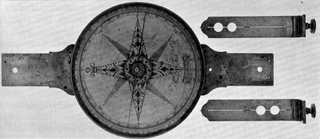
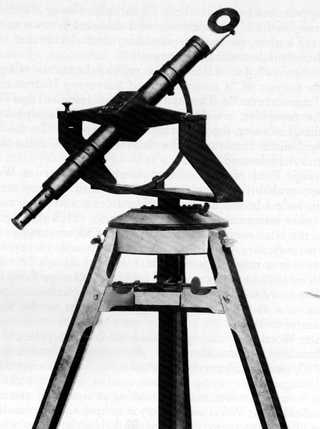
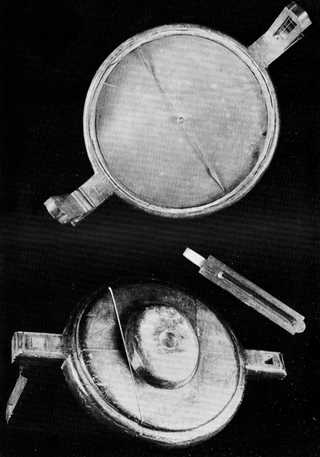
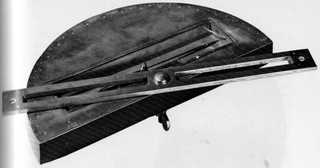
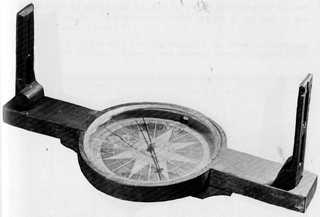
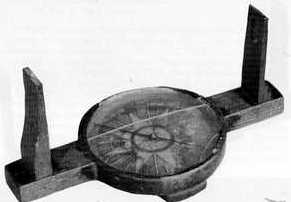
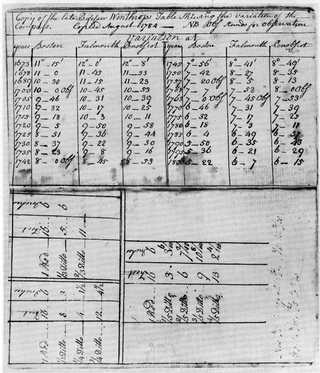
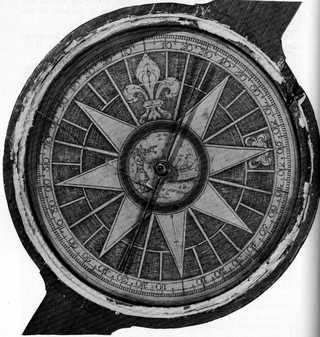
An interesting fact concerning the instruments produced by
18th-century craftsmen is the relatively high incidence of instruments
constructed of wood instead of brass or other metals. A
significant reference to this use of wood is found in Alexander
Hamilton's "Report on the Subject of Manufactures," published
in 1821,[71] which refers to such items of wood as "Ships, cabinet-wares
and turnery, wool and cotton cards, and other machinery
for manufactures and husbandry, mathematical instruments," ...
and "coopers' wares of every kind."
Most common of these mathematical instruments is the surveying
compass, possibly the instrument most needed and produced
in America. Recorded in public and private collections are
31 known examples of such compasses made of wood, a rather
large number. Furthermore, a substantial number of these were
being produced simultaneously by skilled craftsmen who at the
same time were making similar instruments in brass.
Finally, from a study of the surviving examples of wooden
surveying compasses comes the interesting and perhaps significant
fact that all the known makers were from New England. The
towns and cities in which they worked were Boston and Plymouth
in Massachusetts, Windsor and New Milford in Connecticut, and
Walpole and Portsmouth in New Hampshire. A careful study of
the advertisements and works of the instrument makers in the other
large cities of the Colonies, such as New York, Baltimore, and
Philadelphia, reveals no examples of wooden scientific instruments.
Excluded, of course, are those instruments normally made of wood,
such as the octant and the mariners quadrant.
Two possible exceptions are instrument makers of New York
City. The first is James Ham, a maker of mathematical instruments
"at the house wherein the Widow Ratsey lately lived
near the Old Dutch Church on Smith Street" who advertised in
the May 27, 1754, issue of The New York Mercury that he made
and sold
mathematical instruments in wood, brass, or ivory, theodolites, circumferentors,
sectors, parallel rules, protractors, plain scales, and dividers, the
late instrument called an Octant, Davis' quadrants, gauging rods, sliding and
gunter's scales, amplitude wood box and hanging and pocket compasses, surveying
chains, japanned telescopes, dice and dice boxes, mariners compasses
and kalenders, etc.[72]
Ham subsequently moved his business to Philadelphia where he
first advertised in 1764, stating that he worked at the sign of
"Hadley's Quadrant" at Front and Water Streets in Philadelphia
and sold all forms of instruments in silver, brass, and ivory as well
as "large brass pocket dials, fitted to the latitude of Philadelphia."
In 1780 his son James Ham, Jr., advertised from the same address
as a maker of mathematical instruments, specializing in "Hadley
and Davis Quadrants."[73]
The second exception is William Hinton, who advertised in The
New York Gazette and the Weekly Mercury of May 4, 1772, as
follows:
WILLIAM HINTON, Mathematical Instrument Maker, at Hadley's
Quadrant, facing the East Side of the New Coffee House, Makes and sells
all sorts of Mathematical Instruments, in Silver, Brass, Ivory or Wood,
viz. Hadley's Quadrants, Davis's do. Crostaf's Nocturnals, Gunters Scales,
Plotting do. Cases of Instruments, Surveyors Chains, Dividers with and
without Points, Protractors, paralelled Rulers, Rods for Guaging, Amplitude,
hanging and common Wood Compasses, Pocket do. three Foot Telescopes,
Pocket do. Backgammon Tables, Dice and Dice Boxes, Billiard Balls and
Tacks, Violin Bows and Bridges; with a Variety of other Articles too tedious
to mention: And as he is a young Beginner, he flatters himself, he shall meet
with Encouragement; and all those who please to favour him with their
Custom, may depend upon having their Work done in the neatest and best
Manner, and at reasonable Rates.
It is mentioned that both Ham and Hinton worked in wood in
addition to other materials, but it appears very likely that the
use of wood referred specifically to those instruments normally
made of wood, such as quadrants and octants, and not to other
instruments.
Any attempt to relate the making of wooden scientific instruments
with the production of wooden clocks in New England has
no conclusive result, yet there appears to be some relationship
between the two. Wooden clocks were made as early as the 17th
century in Germany and Holland, and they were known in England
in the early 18th century. In the Colonies the wooden clock was
first produced in Connecticut, and the earliest type was associated
with Hartford County. This form was quite common in East
Hartford in 1761, and its first production may have had some
association with Ebenezer Parmele (1690-1777), since an association
between Parmele and all of the earliest makers of wooden clocks
can be traced.[74] Little is known about Parmele. His father was
a cabinetmaker in Guilford, Connecticut, and Ebenezer practiced
the same craft, in addition to being a boat builder. He was a
man of means, held various town offices, and served as town
treasurer. For a while he operated a cargo sloop on Long Island
Sound. In 1726 he built the first tower clock in Connecticut for
the Guilford meeting house. He was a versatile worker in wood,
and it is believed that he served an apprenticeship in New York
City with a Dutch clockmaker from 1705 to 1710, where he may
have learned to make wooden clocks.
This early type of wooden clock is associated with Benjamin
Cheney (1725-1815), a clockmaker of East Hartford. The early
or "Cheney" type of wooden clock was produced in Connecticut
as late as 1812. A later form of the wooden movement began to
appear about 1790, and was probably introduced by Gideon
Roberts (1749-1813) of Bristol. Roberts had lived in the Wyoming
Valley of Pennsylvania before 1790, and it is conjectured that he
became familiar with the wooden clocks produced by the German
settlers of that region.[75]
It is not surprising that the wooden clock had its colonial origins
in Connecticut, so completely was it adaptable to the pioneer
conditions in that colony. The materials were the abundant
native woods-cherry, apple, oak, and laurel. The parts were
made with simple carpenter tools and a wooden foot lathe, using
the methods of the cabinetmaker. Although it has been suggested
that some relationship may have existed between the
makers of wooden instruments in England, and the makers of
wooden clocks and scientific instruments in the New England
Colonies,[76] a careful study has failed to reveal any connection,
and there appears to be little if any parallel between the two
groups. Basically, the use of wood for making some mathematical
instruments in New England resulted from the native
familiarity with this material, which was also employed to a considerable
degree for the construction of domestic and agricultural
implements, and from the fact that many of the early clockmakers
had been trained as or by cabinet makers, carpenters, and even
dish turners. Random examples of a few of the more prominent
clockmakers are Joseph Hopkins, a wood turner; Chauncey
Jerome, who had been apprenticed to a wood turner; and Silas
Hoadley, who had worked with a cabinet maker.
Perhaps a basis for the prevalence of wood in these trades is to
be found in the lines from a familiar poem:
The Yankee boy, before he's sent to school,
Knows well the mystery of that magic tool,
The Pocket knife.[77]
But, from the technical point of view, it should be noted that those
craftsmen who produced clocks and instruments and did not have
their own brass foundries probably found that a good piece of
straight-grained hardwood was as stable for holding its dimensions
with the grain as a piece of brass. Shrinkage was at right
angles to the grain; hence, for fixed linear stability wood was as
good as brass. For rigidity per unit weight, wood was better
than brass; and for availability and ease of working, wood was
superior to brass.
It has often been ventured that wooden clocks were first produced
in Connecticut, because of the scarcity of brass for this
purpose during the years between the beginning of the Revolution
to the end of the War of 1812. The claim is made that brass was
not being produced in the Colonies and that it was imported exclusively
from England during this period. Certainly, the wholesale
price index of metal and metal products shows a steady increase
during this period, and a considerable jump during the
period of the War of 1812, making brass an extremely expensive
material. This may explain why the makers of clocks and instruments
who made and sold brass clocks and instruments were
producing the same products at the same time in wood which,
as we have seen, was both plentiful and a satisfactory substitute.
It can be surmised, therefore, that surveying instruments, as
well as instruments for other purposes, were produced in both brass
and wood simultaneously by many of the New England makers
in order to provide suitable instruments in a flexible price range
to meet the demands of the trade. Whereas today modern manufacturing
methods make it possible to produce instruments in a
wide variety, both in quality and price, to suit the needs and capabilities
of every prospective purchaser, the production facilities of
the 18th century were much more limited. The constant factor of
skilled hand labor was costly. Metal was expensive. As evidenced
in the records of Daniel Burnap, for instance, it was possible
to produce surveying compasses in brass in two grades, presumably
one more elaborate than the other. Yet Burnap's prices
ranged between six pounds and four pounds for the metal instruments,
making them still well out of reach of many of the would-be
surveyors. Accordingly, Burnap—and presumably numerous
other instrument makers of the period—produced from wood an
economy model that sold for not more than two pounds, thus
placing the item within the reach of the nonprofessional surveyor.
This theory is supported amply by the discovery that several
of the instrument makers who worked in brass also made instruments
of wood during the same periods. In addition to the evidence
in the records of Daniel Burnap, there are the surviving
surveying instruments in brass and wood made by Samuel Thaxter,
Thomas Greenough, and John Dupee, leaving little if any
doubt that the reason for producing surveying compasses and similar
items of wood during the 18th century was to satisfy the need
for reasonably accurate yet inexpensive instruments.
The fact that the surviving examples of the wooden instruments
were produced only in New England seems to indicate merely
that the New England instrument makers were more familiar with
the use of wood as a material, and had greater facility in working
with it.
Undoubtedly other instruments produced by the 18th-century
American makers have survived in addition to those already found.
Quite likely examples of these wooden instruments still remain hidden
in unexplored attics and other repositories. Yet, if the few
thus far discovered is any criterion, the number ultimately recoverable
will probably be but a fraction of the great number produced
by the 18th-century makers during the half century or more
in which they worked. Even allowing for those probably destroyed
in the natural course of events, one cannot help but wonder what
has happened to the remainder.
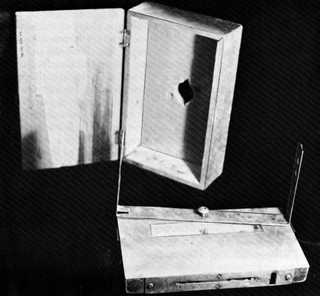
Figure 32.—Wooden graphometer used by Rev. Eleazar Wheelock (1711-1779)
about 1769 for surveying the area of Dartmouth College in Hanover, New
Hampshire. The hardwood block is covered with a brass plate with brass
sighting bars mounted on a swivel and a spirit level under a brass strip on edge
of instrument. The instrument is 8-5/8 in. long, 4-5/8 in. wide, and 7/16 in. thick.
In collection of Dartmouth College Museum.
A list of the surviving wooden instruments is given in the Appendix
(p. 153). Many of these wooden instruments bear signatures
or other marks that permit identification of their makers, but a
number of specimens have been found that are not signed. In
most instances they show evidence of professional workmanship,
and they may have been the work of known craftsmen. One or
two examples are obviously homemade by unskilled amateur
practitioners.
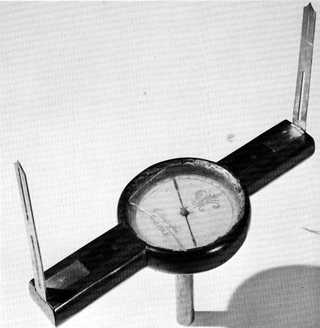
Figure 33.—Wooden surveying instrument, maker not known. Compass dial is
of metal, painted green, with degrees marked to 90° with metal punches
and the letter "N" to designate the north point. The instrument is 12 in.
long; diameter is 8 in. In collection of Dartmouth College Museum.
Several unsigned wooden instruments of professional quality are
in the collection of the Dartmouth College Museum. Of particular
interest is a semicircumferentor (fig. 32) that belonged to the
Reverend Eleazar Wheelock (1711-1779) who founded Moor's
Indian Charity School at Lebanon, Connecticut, which subsequently
developed into Dartmouth College. It is claimed that it was
with this instrument that the area of the college was surveyed when
it moved to Hanover, N.H. The instrument is actually a graphometer
consisting of a block of hard wood faced with a brass plate
with a trough compass; it is tentatively dated about 1769. The
identity of the maker is unknown, but it may have been the product
of Hagger, who made a similar instrument, illustrated here, or it
may have been produced by any one of the other makers noted.
The type of instrument is an old one. It is described in John
Love's Geodaesia, Or the Art of Surveying and Measuring Land,
published in London in 1688. Abel Flint[78] also commented on this
semicircle as being sometime used, as well as the plane table and
perambulator—
... but of these instruments very little [use] is made in New England; and they
are not often to be met with. For general practice none will be found more
useful than a common chain and a compass upon Rittenhouse's construction.
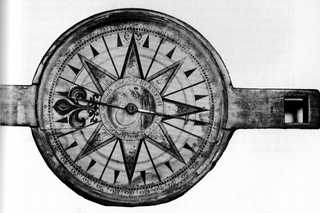
Another of the unusual wooden surveying instruments in the
collection of the Dartmouth College Museum is a wooden surveying
compass (fig. 33) in which the sighting bars appear relatively close
to the dial. A metal plate, painted green, is stamped with the
degrees marked to 90°. A single N for the north point is stamped
into it, presumably with steel punches. The instrument is relatively
primitive, and is sufficiently different from the other examples
noted to merit mention. There is no maker's name, nor any
clue to the date or place or period of origin.
An unsigned semicircumferentor made of wood is owned by
Mr. Roleigh Lee Stubbs of Charleston, West Virginia. The
instrument measures 3-3/4 in. by 7-1/2 in. by 1 in., and there are sighting
bars 3 in. high on a swinging brass bar pinned at the center of the
base. It has a trough compass, and the gradations around the edge
of the semicircle are marked with tiny brass pins. The date
"1784" is stamped into the wood with the same type of figures as
appear in the degree markings, probably with small steel punches.
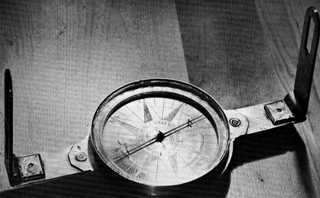
A surveying compass of the conventional type, also made of
wood, is in The Farmer's Museum at Cooperstown, New York.
The wood is ash or oak, 12-3/4 in. long and 6-1/2 in. in diameter, with
the sighting bars 5 in. high. The compass card consists of cut-out
printed letters pasted upon a printed compass rose, and the fleur-de-lis
at North is inked-in by hand. This may be a homemade
replacement of the original card. The instrument is believed to
date between 1760-1775.
Figure 34.—18th-century semicircumferentor. Inscribed brass plate is mounted
on a mahogany block; brass sighting bars are mounted on a swivelling bar.
The trough compass is on a silvered dial. In collection of the writer.
Of equal interest is a large semicircumferentor made by an
unknown American instrument maker in the second half of the
18th century. The instrument (fig. 34) consists of a plate of
hammered brass attached to a quarter circle block of mahogany,
with a glass covered trough compass within a silvered opening, and
the gradations stamped into the brass. The brass sighting bars
are attached to a swivelling bar that can be fixed in place with a
set screw underneath the block. The instrument, which is in the
collection of the writer, is not signed with a maker's name. Its
workmanship is excellent, and professional.
On the basis of a comparison of these instruments with those
produced by known professional makers, it becomes apparent that
all of them were made professionally. The possibility that some
of these wooden surveying compasses may have been produced by
the farmer or local surveyor for his own use is extremely unlikely.
Homemade instruments such as those described below were unquestionably
the exception instead of the rule.
Figure 35.—Homemade wooden surveying compass carved from block of maple
entirely with a jackknife; painted in red. In collection of Preston R. Bassett,
Ridgefield, Connecticut.
An exception to this generalization, and an extremely fine
example of the whittler's art, is a surveying compass (fig. 35) in
the collection of Mr. Preston R. Bassett of Ridgefield, Connecticut.
This is a comparatively small instrument made of maple; the body
was painted red. It is carved entirely by means of a jackknife,
and the sighting bars are also whittled to shape and mortised
permanently into the frame. A lid covering the dial is carved from
soft pine. The compass dial is handdrawn in black ink, and the
North point is painted in the form of a decorative fleur-de-lis in
red and green. A homemade ring of pewter surrounds the compass
rose at needle level. This is graduated in degrees, with every 10°
marked, stamped with steel punches. The ring is set into the base
by means of wooden pegs. The steel needle is nicely cut, and it is
probably the only part purchased by the maker.
This is unquestionably a homemade instrument produced by
a skillful whittler early in the 18th century.
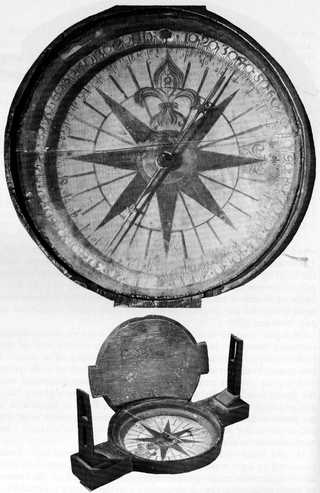
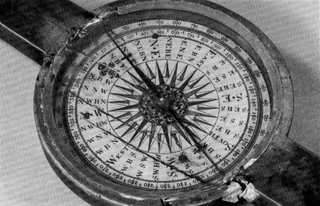
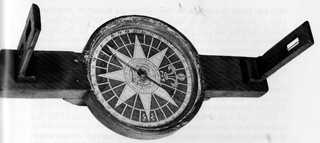
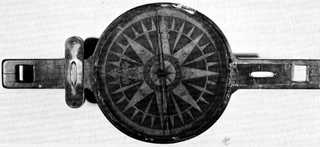
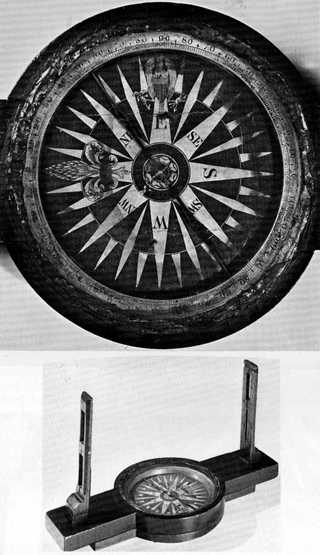
A fact that becomes apparent in a comparison of the surviving
examples of wooden surveying compasses made in New England
is the similarity of the compass cards used by makers in the seaport
cities (see fig. 36). The compass card in each of these instances
is the type designed for a mariner's compass, bearing a star of 32
rays to mark the 32 points of the heavens. The North point is
designated with an elaborate fleur-de-lis, and the East is emphasized
with scrollwork. These are features which were not designed primarily
for land surveying. Presumably, these makers had a quantity
of engraved or printed compass cards that they used in both marine
and land surveying compasses. This is true in the case of the
compasses made by James and Joseph Halsy, Greenough, Clough,
Warren, Thaxter, Dupee, Breed, and Bowles. On the other hand,
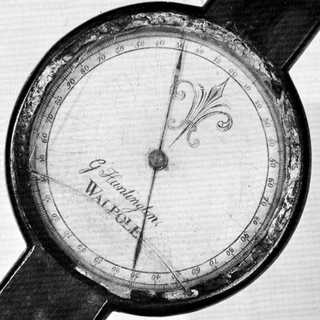
the dial of Huntington's compass was painted directly on the
wood, and the semicircumferentors do not utilize the marine
compass card. Obviously these makers resorted to this practice
for reasons of economy—to reduce costs of engraving and printing,
and using the same card for both types of instruments that they
produced.
An interesting sidelight in the study of the makers of scientific
instruments is the advertising they used, particularly the design
of their signboards. The most popular symbol appears to have
been the quadrant, as the phrase "At the Sign of the Quadrant"
is found repeatedly in advertising in several of the seaport cities
of the 18th century.
Figure 36.—Unsigned wooden surveying compass, with an interesting example
of a mariner's compass card.
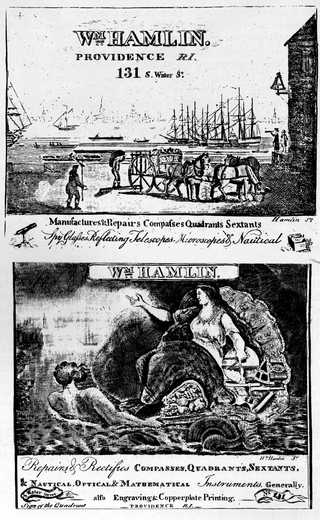
In Providence, William Hamlin used the designation in the
first part of the 19th century, while Philadelphian John Gould
featured the sign at the end of the 18th century. During an even
earlier period, William Hinton designated his address to be "At
Hadley's Quadrant" in New York City. Both Gould and Hinton
were English, which may have had some bearing on their selection
of the quadrant as a symbol of their merchandise.
Other signboards were as colorful, such as Jonathan Dakin's
"Sign of the Hand and Beam," James Youle's "Sign of the Cross-Knives
and Gun," and Charles Kugler's house in Philadelphia
with its "Sign of the Seven Stars" (that is, Great Bear), which
housed the shops of several instrument makers.
The two most interesting and significant of the instrument
makers' trade signs were those advertising the shop of Samuel
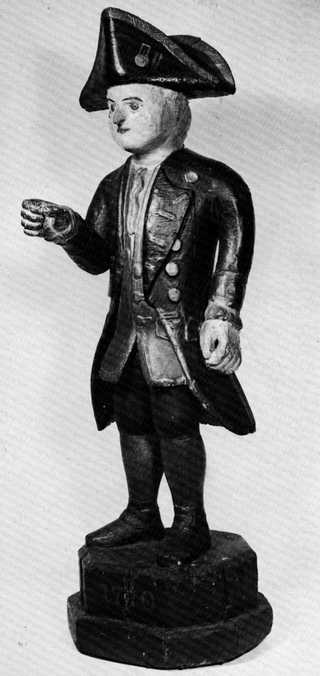
Thaxter. The first of these was the carved wooden figure of
"The Little Admiral," which was a favorite landmark at No. 1
Long Wharf in Boston for almost a century and a half. It was
the handiwork of John Skillin, the 18th-century woodcarver of
Boston, upon whose death on January 24, 1800, the Chronicle
commented that "he was for many years the most eminent of his
profession." John Skillin and his brother Simeon worked in
Boston from about 1777 and produced most of the figureheads
that issued from that port during that period, as well as a number
of other notable ornamental wooden figures.
Figure 37.—"The Little Admiral," trade sign used for almost a century and a
half in Boston, first by William Williams and later by Samuel Thaxter. Reputed
to have been carved by John Skillin of Boston. In collection of the
Bostonian Society.
According to Mrs. H. Ropes Cabot of the Bostonian Society,
the figure of "The Little Admiral" (fig. 37) had been carved for
William Williams, who brought it with him to Boston from
Marblehead in 1770 when he established his shop. The figure
was installed in front of the Crown Coffee House, and Williams's
shop was thereafter designated by this symbol. The trade sign
survived through the years of the Revolutionary War. When
the original building of the Coffee House was burned, the carving
was saved and installed on the new building erected in its place.
In an account of Boston landmarks, Porter[79] related the figure
to the Admiral Vernon Tavern at the eastern corner of Merchants
Row. He was proved to have been in error, however, since the
trade sign of that public-house was a portrait bust of Admiral
Vernon and the place was known as the Vernon Head Tavern for
half a century, even after the end of the Revolution.
When Samuel Thaxter purchased the business from Williams's
estate he acquired the figure as well, and he moved it to each new
location for his shop. The figure of "The Little Admiral" continued
to designate the firm even after Thaxter's death, until the
firm finally went out of existence at the beginning of the 20th
century. When the old store was torn down in 1901, the figure was
preserved, presumably by the last owner's family. In 1916 it was
acquired for the Bostonian Society by several of its members, and
the figure has been preserved in the Society's Council Chamber
since that time.
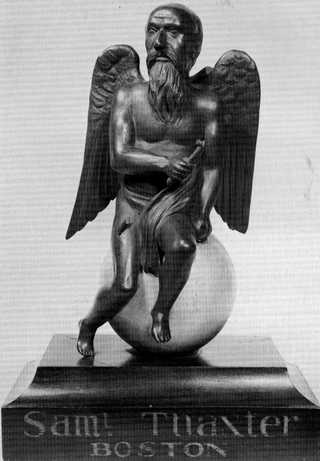
The other interesting trade sign utilized by Samuel Thaxter is
a carved figure of Father Time that is credited to John Skillin
(see fig. 38). The figure is believed to have been commissioned
by Thaxter during the last decade of the 18th century and installed
by him in the interior of his shop. It is an important example
of the American woodcarver's art, and is equivalent to the best
work of the Skillin brothers.
Figure 38.—"Father Time" trade sign used by Samuel Thaxter in his shop in
18th and 19th centuries. Made of wood, it was carved by John Skillin of
Boston. In collection of the Bostonian Society.
Surprisingly, the names of the craftsmen who produced wooden
instruments are not noted among the instrument makers. With
only one or two exceptions, their names are hitherto unknown in
the history of American science, and for that reason it has been
considered advisable to present all available information that could
be accumulated about them.
The earliest known maker of wooden scientific instruments of
Boston was Joseph Halsy. He appears to have been one of the
sons of the James Halsie I, who was mentioned in a land deed of
1674 as a mathematician.[80] The land records indicate that James I
was the father of several children, including Rebecca, a spinster;
John Halsey, a mariner who died before 1716; Sarah, who later
became Mrs. Dorsan; another daughter, name unknown, who
became the wife of a Joseph Gilbert and the mother of two daughters
and a son who inherited her share of her father's estate;
Nathaniel Halsie; and probably Joseph Halsy. James Halsie I
appears to have owned property consisting of land, a wooden house,
and wharves on the North End, on North Street between Sun
Court and Fleet Street.[81]
The date of birth of Joseph Halsy of Boston has not been found,
but mention is made of the fact that on January 29, 1697, he was
married to Elizabeth Eldridge, the daughter of a mariner named
Joseph Eldridge, and that five children resulted from the marriage,
three sons and two daughters.[82] One son, Joseph, died in infancy
and a daughter, Elizabeth, died at an early age.
On February 26, 1704/5 Halsy purchased from Rebecca Halsey,
the spinster daughter of James, her share in the house and land
of her late father on North Street between Sun Court and Fleet
Street.
On April 19, 1714, Halsy and his wife deeded a house and land
on North End, at the corner of Hanover and Salutation Streets,
to a shipwright named Joseph Hood. Two years later, on March 2,
1716, he purchased from Jane, his sister-in-law, who was the widow
of the mariner John Halsy, her share of the house and land of
James Halsie, being the same property on North Street. On
March 27 of the same year he purchased the share in the same
property belonging to Sarah Dorsan, his widowed sister. In
August 1719 he was forced to mortgage some of the property to
a merchant named John Frizell, but the mortgage was cancelled
in 1741.
Halsy was married for a second time on January 10, 1731, to
Mrs. Anna Lloyd, a widow.[83]
Figure 39.—Wooden surveying compass "Made and sold by Joseph Halsy, Boston,
New England." The instrument, made of maple, is 11 in. long and has a diameter
of 5-3/4 in. In the collection of New Hampshire Historical Society, Concord.
During the 1730's, Halsy continued to buy out the heirs of
James Halsie. On March 6, 1730, he acquired the share of Mary
Gilbert, a granddaughter, and on the same date he purchased from
the James Halsey heirs their inheritance "part to land, wharf,
house, shop and buildings on North Street." Other heirs remained,
for in June 9, 1732, he bought out the share of Marty Partridge,
another granddaughter, and on June 27 the share of Joseph Gilbert,
Jr., a grandson. In October 1740 he was forced to mortgage as
security to James Bowdoin a house and land on the southwest
side of North Street, but this was cancelled when on August 26,
1751, Joseph Halsey and his wife, Anna, deeded to James Noble
the land, wooden house, and wharves near Fish Street on North
Street between Sun Court and Fleet Street, which apparently was
formerly the property of James Halsey that Joseph had acquired
with so much trouble over a period of 40 years.[84]
The following advertisement relating to instruments sold by
Halsy appeared in the issues of The Boston Gazette for the months
of September and October 1738:
Made and sold by Joseph Halsey jun. Hadley's New Invented Quadrant or
Octant the best and exacted Instrument for taking the Latitude or Other
Altitudes at Sea, as ever yet Invented.[85]
The last dated record relating to Joseph Halsy which has been
found is a letter dated February 3, 1762, that he wrote to Robert
Treat Paine concerning legal matters.
Only one complete instrument produced by Joseph Halsy appears
to have survived—an especially fine wooden surveyors compass
(fig. 39) in the collection of the New Hampshire Historical Society.
It is made of maple. The compass card, probably the most interesting
of any found in the wooden instruments, is hand-colored in
black, blue, red, and gold. A fleur-de-lis marks the North point,
and triangular pointers indicate the other compass directions.
Inside the pointers are crudely painted female figures representing
the seven arts: NW, Grammar; W, Logick; SW, Geometry; S,
Arithmetick; SE, Astronomy; E, Rhetorick; and NE, Musick.
Within a medallion at the center of the compass card is depicted
a sailing vessel at sea; surrounding the medallion is a riband
inscribed "Made and Sold by Joseph Halsy Boston—New
England."[86]
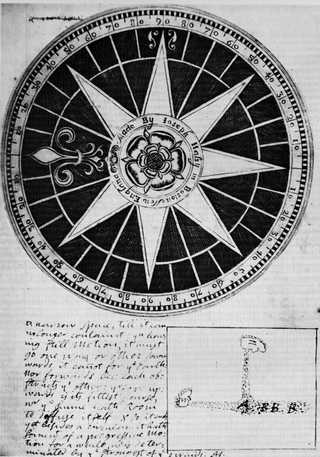
Another, but much less elaborate, compass card used by Joseph
Halsy, is an engraved example (fig. 40) found glued in Thomas
Paine's own manuscript copy of Charles Morton's Compendium
Physicae, which is preserved in the collection of the Massachusetts
Historical Society.
John Halsy (fl. 1700-1750), also a mathematical instrument
maker, had a shop on Green Street, in Boston, according to the
Record Commissioner's "Report of the City of Boston." He was
married on December 10, 1700, by the Reverend Cotton Mather.
He probably was a brother of Joseph Halsy who worked in the
same period.
John Halsy subsequently abandoned his instrument-making
business to become a pirate. He went out to Madagascar, where
it is reported that he died in his own bed. He was buried with
the rites of the Church of England in his own watermelon patch.
Figure 40.—Compass card of Joseph Halsy found glued into Thomas Paine's
personal copy of Charles Morton's Compendium Physicae. In collection of
Massachusetts Historical Society.
James Halsy II (1695-1767), a mathematical instrument maker,
was born in Boston on April 10, 1695, the son of Nathaniel and
Hannah (Gross) Halsie. The parents had been married by the
Reverend Cotton Mather in June 1693.[87] In 1716 young James
Halsy was a member of the Artillery Company, and by 1720 he
had the rating of 4th sergeant. He held town offices and was one
of the founders of the New Brick Church of Boston. On May 30,
1717, he married Anna Gutridge (Goodrich). Ten years later, on
September 22, 1727, he bought a house and land on North Bennett
and Tileston Streets from Hugh Hall, a merchant; at the same time
he deeded to Hall some land and a house adjacent to the latter
on the southwest side of Green Street. On January 5, 1837, he
deeded to his aunt(?), a single woman named Huldah Gross, a
house and land on Ann Street that he had inherited from Thomas
Gross, his grandfather. Several more real estate negotiations were
recorded in the course of the next few years. In October 1740 he
purchased a house and land on the north side of North Bennet
Street from John Endicott; in January 1741 land on the east side
of North Bennett Street; and in November 1748 half of the house
and land of Edward Pell, adjacent to Huldah Gross, on Cross
Street; finally, in October 1753, he purchased land on Tileston and
North Bennett Streets from John Grant.[88]
Halsy died on January 2, 1767, at the age of 72. In his will
dated May 1, 1766, and probated January 2, 1767, by which his
wife Anna was the executrix of his estate, he left her the income
of his real and personal estate. He apparently was survived by
three daughters and a son, also named James Halsy. He divided
his real estate in Boston amongst his daughters, and to his son he
left land in New Hampshire.[89]
The only known surviving instrument bearing James Halsy's
name is a wooden surveying compass (fig. 41) in the collection
of the Peabody Museum in Salem. The engraved compass card
is quite similar to the one used by Thomas Greenough. In the
central medallion is an elaborate royal crown, and in the circle
around the medallion is inscribed "Made and Sold by James
Halsy near Ye Draw Bridge in Boston."[90]
Figure 41.—Wooden surveying compass made by James Halsy (1695-1767) of
Boston. The instrument is 11 in. long. In collection of East India Marine
Hall, Peabody Museum, Salem, Massachusetts.
Contemporary with James Halsy II was Thomas Greenough
(1710-1785), who was born in Boston in 1710, the son of John and
Elizabeth (Gross) Greenough. His father was a shipwright in
the North End of Boston, and one of Thomas's brothers, Newman
Greenough, became a sailmaker. Thomas also had a sister named
Jerusha, who later figured in his real estate negotiations.
The earliest known record relating to Greenough is of his marriage
in 1734 to Martha Clarke, daughter of William and Sarah
Clarke of Boston. Nine children resulted from this marriage over
the course of the next 16 years; four of these were sons. On
January 27 of the year of his marriage he purchased a house on the
northwest side of North Street, between Mill Creek and Union
Street, from John White and Nathaniel Roberts. On August 1,
1736, Greenough purchased the house and land of his father-in-law,
William Clarke, on the south side of Portland Street. On
October 28 he mortgaged to his mother his house on Ann Street
(which appears to have been the house he had purchased on
North Street), and at the same time he deeded to his brother
Newman all his right and title in his father's estate at the North
End. Greenough was only 24 at the time of his marriage, and he
apparently became involved in real estate, by choice or by necessity,
to a considerable degree.
Greenough, in 1744, was a member of a militia company in
Boston,[91] and three years later, in 1747, he was listed as third
sergeant. He was a firm patriot, held a town office, and was a
founder and deacon of the New Brick Church in Boston.
Greenough had a substantial interest in the holdings of his late
father-in-law. For example, on August 11, 1744, he and his wife
deeded to a merchant named James Pitts the seawall, or new wharf,
"before the Town of Boston in the front and rear lying to the northward
of King Street Pier, North Wharf and flats of James Bowdoin,"
all of which was part of the estate of his deceased father-in-law
that apparently had been inherited by his wife. In the
following year, on November 1, 1745, he purchased a house and
land on Portland Street from his widowed mother-in-law and then
on March 31, 1746, he and his wife deeded the same house and land
to a merchant named Stephen Hall. Numerous other negotiations
of the same nature are on record.
At some time between 1748 and 1750 Greenough's first wife,
Martha, died, and in 1750 he married Sarah Stoddard. Three
more children, all sons, resulted from this second marriage. His
real estate negotiations continued full pace during the second
marriage as during the first.[92]
Greenough's second wife preceded him in death, and Greenough
died in 1785 at the age of 75. His will, probated on August 23,
1785, had been made on May 21, 1782;[93] it contained some interesting
bequests:
Executors: my two sons, David S. and William Greenough. Legatees:
to the children of my son Thomas, deceased, Rachel, Ann, and Sally Greenough,
£13.6.8 each. To their sister Betty £5. To the children of my son
John deceased, 200 acres of land. I also give his eldest son John my silver can,
fellow to the one I gave his father. To his sons Wm. and David, and to his
daughters, Sarah, Abigail, and Mehitible £5 each and the house they live
in. My daughter, Sarah Edwards, £10 and a silver chafing dish. My
daughter Martha Stone all my lands in the County of York, Cape Porpoise,
and Wells, and my silver salver, and her son Thomas £5 and a silver porringer.
My daughter Elizabeth Brooks £10 and a silver tea pot. My
daughter Mary Savage £40 and to her son Thomas one silver porringer.
To the children of my daughter Jerusha, deceased, Martha Clark Lepear and
Sally Lepear each of them, £50, and a pair of salt shovels, and a pepper box,
silver. All the rest of my estate to my two sons, David Stoddard Greenough,
and Wm. Greenough. The late Shute Shrimpton Yeoman, Esq., left an
estate to my late spouse Sarah, and to her children, in the Island of Antigua.
In case my son David should have a legal possession of same, and Wm. no
part, in that case I give my son David £100 and sundry pieces as per schedule
amount to £63.11.3. All the rest of my estate to my son, William Greenough.
Of particular interest with relation to Greenough's business in
instruments is the following advertisement that appeared on
May 11, 1742, in The Boston Gazette:
To be sold by Capt. Cyprian Southack at his House near the Orange Tree
and at Mr. Tho. Greenough's Mathematical Instrument Maker near the
Draw Bridge, said Southack's Char[t]s of the Coast from Sandy Point of
New York to Canso.
Invaluable for this study are Thomas Greenough's manuscript
accounts that have survived in the collections of the Massachusetts
Historical Society. The following itemized entries are selected
from Greenough's business accounts over a period of two decades
to provide data on the prices current in the second half of the 18th
century for new instruments and for repairing others:
| In Account with Thomas James Gruchy: |
| | 1754, April 27: | 1 Compass for the Schooner Sea Flour | £0.8.0. |
| 1758, Nov. 28: | 1 Spyglass | £1.13.8. |
| 1759, Jan. 25: | Mending 3 Compasses for the Schooner Susanna | £0.6.0. |
| In Account with Nathaniel Bethune: |
| 1760, August: | A gauging rod | £0.6.0. |
| | Mending a telescope | £0.3.0. |
| In Account with Captain McAndrew Mirick of Nantucket: |
| 1772, March 21: | For 2 compasses, 1 leaded | £0.16.8. |
| In Account with Captain Roberson Crockett: |
| 1773, April: | For mending 2 Compasses | £0.6.2. |
| | For mending 1 Hanging Compass | £0.3.2. |
| In Account with Captain Reworth of the Brig Fortune: |
| 1774, March 30: | For mending 2 compasses & Glasses | £0.7.0. |
| In Account with Captain Thomas Godfrey: |
| 1774, April 7: | For 1 Telescope | £0.8.0. |
Other documents in the same collection indicate that Greenough's
business interests were substantial and not limited merely to the
construction of instruments. On July 31, 1769, Greenough's name
appeared on the Boston Citizens' Non-Importation Agreement.
Subsequently, on December 14, 1774, there is Greenough's signed
receipt, with the amount left blank, stating that he had "REC'D.
of Capt. Thomas Godfrey the Sum of —— in full for my Negro
man Cuffes Shair in the Whaling Voige ——."
Figure 42.—Brass surveying compass made by Thomas Greenough (1710-1785)
of Boston. Compass face is mounted on main blade with two copper rivets.
Screws for vanes and tripod mounting are hand cut, with wing nut ends. Sighting
bars are 1/16 in. wide and 5-1/4 in. high; over-all length is 11-7/8 in. and diameter
is 5-1/4 in. Owned by Greenough family of Boston. Photo courtesy of Dr.
Thomas Greenough.
Greenough apparently was succeeded in business by his son
William Greenough. Mr. Lawrence B. Romaine of Middleboro,
Massachusetts, in 1939 described a wooden surveying compass
with its own hand-whittled tripod made of oak which bore a
compass card inscribed "Made by William Greenough, Boston,
N.E."[94] The compass was protected by a pine cover that fitted
closely between the sights. The present location of this instrument
is not known, but it appears to be the only known example by
William Greenough made of wood.[95]
Figure 43.—Wooden surveying compass, made and sold by Thomas Greenough.
The instrument is made of gumwood and has a paper compass card; it is 13-1/4
in. long and has a diameter of 5-3/4 in. In collection of Franklin Institute,
Philadelphia.
In the Greenough family at the present time is a brass surveying
compass (fig. 42) of fine quality and of the period before or during
the American Revolution. The dial is finely engraved with a
Tudor rose at its center, and around it is the inscription "Thomas
Greenough Boston Fecit." The compass face is mounted
to the main blade with two copper rivets. The holding screws
for the vane and tripod mounting are rather crudely hand cut
with wing-nut ends.[96]
Figure 44.—Wooden surveying compass made and sold by Thomas Greenough.
Made of hickory, it is 11 in. long and has a diameter of 5-1/2 in. Compass card
is of paper. Allegedly, this compass was used by Joseph Frye for surveying
his land grant in what is now Fryeburg, Maine, in 1762. Loaned to the U.S.
National Museum by Laurits C. Eichner of Clifton, New Jersey. USNM
315001.
Five other surveying compasses made by Thomas Greenough
are known, and all are made of wood: the one in the Franklin
Institute is made of gum (fig. 43), one in Old Sturbridge is made of
maple, one in the Bucks County Historical collection at the Mercer
Museum is made of cherry, one owned by this writer is made of
basswood, and one on loan to the U.S. National Museum from
Mr. Laurits C. Eichner is made of hickory (fig. 44).
The compass at the Mercer Museum forms part of the surveyor's
gear used to lay out the town of Weymouth, Massachusetts. The
example in hickory on loan to the U.S. National Museum, as is
usually the case with the compass cards of the Thomas Greenough
instruments, has the central ring printed in gilt, and the inscription
has turned black, making the inscription almost illegible. This
specimen was owned by Joseph Frye, who was given a land grant in
what is now Fryeburg, Maine, in 1762. He allegedly used this
compass for surveying that land. In 1783 he assembled a manuscript
book of tables (see fig. 45) for use in surveying for his son
Joseph Frye, Jr. This manuscript also is part of the loan to the
U.S. National Museum.[97]
Figure 45.—Pages from a booklet of "Tables Useful in Surveying Land, Made
and presented by Joseph Frye to his son, Joseph Frye, Jr., November 18, A.D.
1783." Loaned to the U.S. National Museum by Laurits C. Eichner of
Clifton, N.J. USNM 315062.
Figure 46.—Compass card from a wooden surveying compass "Made by Thomas
Greenough, Boston, New England." In collection of the writer.
The compass card in each of these five instruments is identical,
designed for use in the mariner's compass (see fig. 46). A gentleman
in the dress of about 1740 stands on the shore using a Davis
quadrant. Offshore in the harbor is a schooner of the 1750 period.
Minor features of the scene are touched up in red, presumably
printed, since they are consistent in all of the cards.
Although not one of the earliest instrument makers in Boston,
but certainly one of the more significant, was William Williams
(1737/8-1792). He was the son of Capt. John Williams, a shopkeeper
who died on March 22, 1748, at the age of 41, and who was
buried in King's Chapel Burial Ground.[98]
William Williams was born in 1737 or 1738. He was ten years
of age when his father died, and he had two brothers and two
sisters. His father left a substantial estate of £6,575, of which
£4,544/9/4 was for the inventory of the shop merchandise. One of
the appraisers for his estate, Jotham Maverick, married the
widowed Mrs. Williams less than a year later, on January 20,
1748/9.[99]
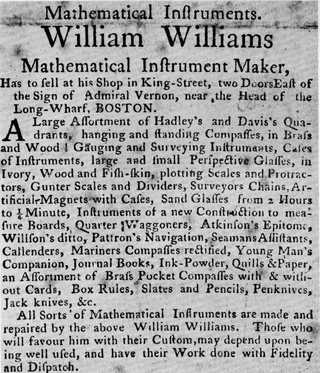
In 1770 William Williams established himself as a mathematical
instrument maker and clockmaker at No. 1 Long Wharf, at the
Crown Coffee House, as it was then known. The shop was located
on the corner of State and Chatham Streets, on premises owned
by Robert Shillcock.
Figure 47.—Quadrant, showing signature of Thomas Greenough. Photo courtesy
Connecticut Historical Society, Hartford.
Williams may have worked as an instrument maker in Marblehead
before returning to his native Boston. According to Felt,[100]
an instrument maker named William Williams at Marblehead
advertised in the Salem newspapers in the early 1770's. However,
in 1768 Williams was producing instruments from an address in
King Street, Boston. (See figure 48.) An advertisement inserted
by Williams appeared in the March 12, 1770, issue of The Boston
Gazette. It was this same issue that reported the Boston Massacre.
One of the victims was Williams' step-brother Samuel Maverick,
the son of his stepfather Jotham Maverick by a first marriage.
In 1773 Williams married Joyce Shillcock, the daughter of
his landlord. During the Revolutionary War, Williams saw
active service as a private in Captain Mills' company, of Col.
Jeduthan Baldwin's regiment of artificers, during the years 1777-1779.
In 1780 he served in Captain Pattin's company of General
Knox's artillery, which was stationed at West Point.[101]
With the conclusion of the war Williams returned to the craft of
instrument-making in his shop, at No. 1 Long Wharf. In 1782
his wife, Joyce, inherited the property from her mother, the
widow Hannah Shillcock, following the latter's death in that
year. In the following May it is recorded that Williams purchased
the warehouse and land on the north side of State Street from
Benjamin Brown, a trader. By a separate deed, he and his wife
released to Brown the warehouse and land which had been the
property of his father-in-law in exchange for a clear title to one-half
share of the store and land under it "which is next to the
street called King Street." On February 7, 1784, he bought a
share of the lower division at Long Wharf, No. 7, from Arnold
Welles. On May 17 of the same year he succeeded in buying out
Brown's half share of the lower division of Long Wharf at Nos.
1 and 7, and at the same time he deeded to Brown one-half
share of No. 7 Long Wharf, together with all its dockage and
wharfage. Finally, on January 20, 1785, Williams and his wife
deeded to Brown all rights to land of No. 7 Long Wharf, reserving
for himself his rights in the flats, wharfage, and dockage.
On March 23, 1787, Williams deeded to Joseph Helyer, a
blockmaker, the store and land under same, and half the wharfage
properly belonging to Lot No. 1. On October 20 of the same
year he sold to Brown a part or share of No. 7 Long Wharf, and
on March 24, 1788, he purchased land with a wooden store at
State Street and Long Wharf from Benjamin Brown. On June
26 he bought the land and store of Joseph Helyer on the north
side of Long Wharf.
Figure 48.—Advertisement of William Williams in The Boston Gazette, March 12,
1770. Photo courtesy Harvard University Library.
Williams engaged in only two more transactions before his
death. On March 28, 1790, he mortgaged to Joseph Greene, a
merchant, the land with wooden store at the head of Long Wharf
on the northeast side of State Street; this mortgage was cancelled
on May 29, 1793. On October 1, 1791, he deeded to Benjamin
Brown a one-half share or 1/48th of all the dockage and wharfage
of Long Wharf that appertained to one-half of Lot No. 1, which
he had previously purchased from Welles as noted, as well as
1/48th of the proprietor's purchase of Gordon's lands and buildings
adjoining the Wharf.
Williams died on January 15, 1792, at age 44. The administrator
of his estate was a merchant named Abraham Quincy. By order
of the Supreme Court, in order to settle his estate, Williams'
store building at No. 1 Long Wharf was ordered sold at public
auction. Although on the site of the Crown Coffee House, it
was a new building erected in 1780 after the Coffee House had
burned. The purchaser appears to have been John Osborn, a
merchant, because on May 10, 1793, Quincy, Williams' administrator,
deeded to Osborn the land with wooden store at Long
Wharf on State Street.[102]
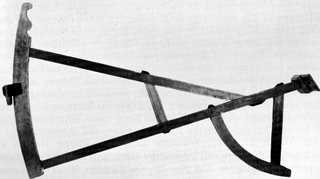
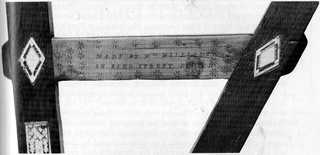
The only instrument made by Williams which appears to have
survived is a Davis backstaff (fig. 49) marked "By Wm. Williams,
King Street, Boston, for Malachi Allen, 1768"; this instrument is
now in the collection of the Peabody Museum in Salem, Massachusetts.
It is to be noted from this inscription that this instrument
was an early example of Williams' work, produced at the age of
20, prior to the opening of his shop at the Crown Coffee House.
In 1770, when Williams opened his shop, the carved sign of
"The Little Admiral" (fig. 37) was installed in front of the Crown
Coffee House, and Williams' establishment was thereafter designated
by this symbol.[103]
In his shop at No. 1 Long Wharf, Williams exercised his crafts
of instrument-and clockmaking, and he made and sold a large
assortment of instruments, as well as time glasses which measured
from one quarter minute to two hours.
Figure 49.—Detail of wooden Davis quadrant inscribed "Made by William
Williams in King Street Boston" for "Malachi Allen 1768." In collection of
East India Marine Hall, Peabody Museum, Salem, Massachusetts.
The name of Williams appears also in the Day Books of Paul
Revere. Under date of April 16, 1792, there is the following entry:
Mr. William Williams Dr
To Engravg plate for hatt bills 0-18-0
To 2 hund prints 0-6-0.
From June 24, 1792, to January 28, 1797, Revere entered 12
charges against Williams for 8,500 hat bills for the total amount
of £14/15/0.[104]
Closely associated with the name of William Williams is that
of another instrument maker of Boston, Samuel Thaxter (1769-1842).
Thaxter was born in Hingham, Massachusetts, on December
13, 1769, the son of Samuel and Bathsheba (Lincoln)
Thaxter. His father, who had been born in Hingham in 1744,
was married on December 27, 1768, and he became the father of six
children, of whom Samuel was the eldest. Samuel Thaxter, Sr.,
was apparently a man of means, for he is listed as a "Gentleman"
and a loyal subject of King George. He resided on North Street in
Hingham, near Ship Street. He died on the island of Campobello
at the age of 44 years on May 27, 1788.[105]
Samuel Thaxter, as well as several generations of his family
before him, was born in the old Thomas Thaxter mansion that was
built by the settler of that name in 1652. During the Revolution
Samuel's father, Maj. Samuel Thaxter, concealed Tories from the
Committee of Safety in a blind passage with a secret door in the old
house. From there he smuggled them to Boston. At the massacre
of Fort William, Major Thaxter was one of those captured by the
Indians. While tied to a tree, he saw two French officers, and
demanded whether this was the treatment they gave to commissioned
officers. They allowed him to go free and he dragged himself
to Fort Edward. Meanwhile, his comrades had reported him
missing in action, and Dr. Gay preached his funeral sermon in
Hingham shortly before Thaxter's return. The old Thaxter
mansion was torn down in 1864.[106]
Young Samuel Thaxter moved from Hingham to Boston, where
he is first heard of in 1792. On June 14, 1792, Thaxter married
Polly Helyer, the niece of William Williams.
Within a month after the sale of Williams' property at public
auction, Thaxter acquired the instrument-making business. Apparently
the new owner of the premises required the business
to move, and Thaxter established himself at No. 9 Butler's Row.
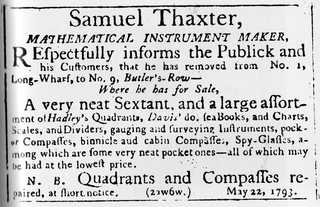
A month after the Williams auction Thaxter announced his new
location in an advertisement (fig. 50) in The Columbia Centinel of
May 22, 1793.
Thaxter's new location was a wooden store structure, on the
north side of Butler's Row that was owned by Andrew Hall and
Eunice Fitch in 1798. It was in the rear of the north side of State
Street, running from Merchants Row to the water.
By 1796 Thaxter had moved from this location to No. 49 State
Street, on the north side opposite to Broad Street, a brick store
owned by Joseph Lovering & Sons, tallow chandlers. He continued
to do business at this address until 1815, when he moved to
27 State Street, on the opposite side of the street. The new location
was in a brick dwelling, opposite Merchants Row, that was
owned by Joseph Clough, a housewright.
Figure 50.—Advertisement of Samuel Thaxter in The Columbia Centinel, May 22,
1793. Photo courtesy Harvard University Library.
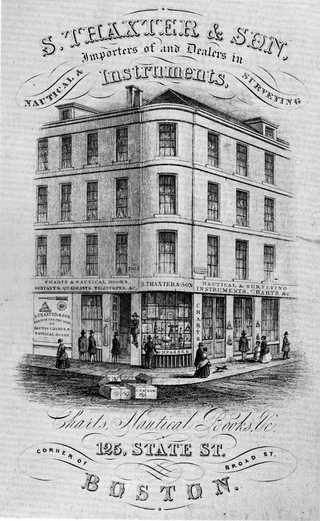
In about 1825 Thaxter moved his business once more, to 125
State Street, the east corner of Broad Street. This building was
occupied by Charles Stimpson, Jr., a stationer who was one of the
publishers of the Boston Annual Advertiser, which was annexed to
the Boston Directory of 1826. The building was owned by
Jonathan Phillips, the first mayor of Boston. In the cellar of the
building was a victualler named Augustus Adams.[107]
The dominating feature of Thaxter's shop from the time it was
opened was the carved figure of "The Little Admiral," the trade
sign first used by Williams.
The firm of Samuel Thaxter eventually became Samuel Thaxter
& Son, and it continued with that name until past the middle of the
19th century. Samuel Thaxter died in April 1842 at the age of
72 years. The entry for the firm in the 1843 City Directory listed
S. T. Cushing as the new owner. From the initials, it seems likely that his full name was Samuel Thaxter Cushing, and that he was
the grandson of the original Samuel Thaxter. S. T. Cushing continued
to be listed as the owner of the firm until 1899, when he was
succeeded by A. T. Cushing, presumably a son of the former.
The old store was finally demolished in 1901.[108] Comparison of a
photograph of the building just before its demolition with a copy of
Thaxter's trade card (fig. 51) of the mid-19th century shows that
the building underwent little change in the period. The "Little
Admiral" is barely visible in both views.
Figure 51.—19th-century trade card in collection of the Bostonian Society.
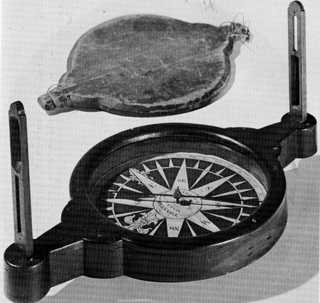
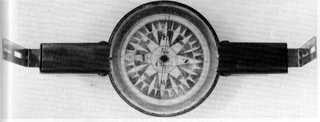
Figure 52.—Mahogany surveying compass made by Samuel Thaxter of Boston.
Length, 13 in.; diameter, 7-1/2 in. Wooden frame slides off to permit removal
of glass and adjustment of needle. Sighting bars are of boxwood. In collection
of the writer.
In 1796, shortly after his marriage, Thaxter made his home on
Fish Street (now North Street), but in 1800 he was living at 54
Middle Street (Hanover Street). By 1807 he had moved to a new
home on Fleet Street. His last home address, at the time of his
death, was 41 Pinckney Street.[109]
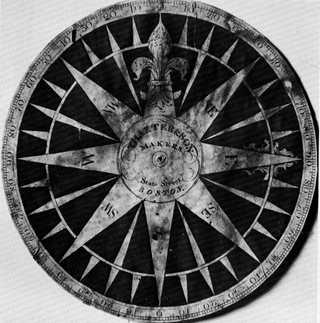
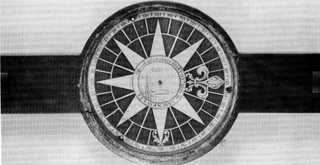
Figure 53.—Compass card from earlier form of wooden surveying compass made
by Samuel Thaxter of Boston. From an instrument in the collection of the
writer.
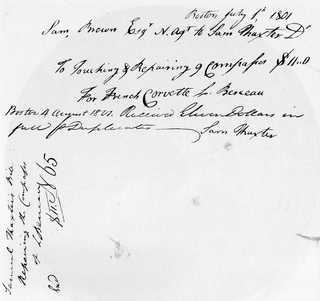
In the collection of the Massachusetts Historical Society there
is a receipted bill (fig. 55) from Samuel Thaxter dated July 1, 1801,
to Sam Brown, for touching up and repairing nine compasses for
the French corvelle Berceau.
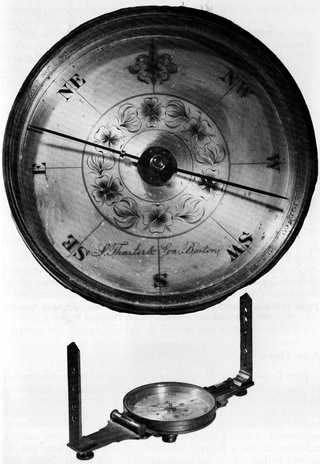
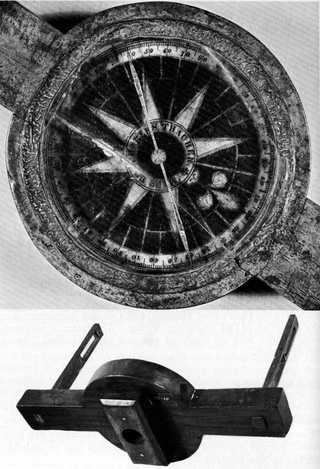
Figure 54.—Brass surveying compass made and sold by S. Thaxter & Son,
Boston, in late 18th or early 19th century. Over-all length, 14 in.; diameter of
dial, 6 in.; length of needle, 5-1/8 in.; height of sighting bars, 6-1/2 in. In collection
of the writer.
Figure 55.—Receipted bill from Samuel Thaxter to Sam Brown, Boston, August 4,
1801. In collection of Massachusetts Historical Society.
John Dupee of Boston apparently was another instrument maker
of the pre-Revolutionary period actively engaged in producing
wooden surveying compasses. Three wooden instruments with
his compass card exist in private and public collections. The
instruments are quite similar: the wood in each case is walnut or
applewood, with an engraved paper mariner's compass card; a
schooner at sea is figured within the central medallion, and inscribed
within the riband enclosing it are the words "Made and
Sold by John Dupee Ye North Side of Swing Bridge Boston New
Eng." One of the instruments is owned by the South Natick
[Massachusetts] Historical Society; a second example is in the
collection of the Bostonian Society; and a third is owned by a
private collector.
There is no record of a maker of scientific instruments or clocks
by the name of Dupee, although the name John Dupee occurs in
the city records of Boston during the early decades of the 18th
century. An advertisement in the February 9, 1761, issue of
The Boston Gazette states that
Isaac Dupee, Carver, Advertises his Customers and others, that since the
late Fire (on Dock Square) he has opened a shop the North side of the Swing-Bridge,
opposite to Thomas Tyler's, Esq.; where Business will be carried on
as usual with Fidelity and Dispatch.
The natural assumption would be that the three instruments
were produced in Isaac Dupee's shop after 1761, perhaps by the
carver's son. The use of an engraved compass card indicates that
the instruments were not unique, and that a number of others were
produced or contemplated. On the other hand, it is likely that
the maker produced other types of instruments utilizing such a
card, such as mariner's compasses.
Another instrument maker, presumably of Boston, is Jere Clough.
The only instrument bearing his name known at present is a surveying
compass (fig. 56), made of wood, in the Streeter Collection
of Weights and Measures at Yale University. Clough's name does
not appear on any of the lists of instrument makers or clockmakers,
yet it is a name that is fairly prevalent in Boston. In 1741, for
instance, one Joseph Clough of Boston was a maker of bellows.
He produced bellows of all types—for furnaces, refiners, blacksmiths,
braziers, and goldsmiths.[110]
Figure 56.—Wooden instrument made by Jere Clough. In Streeter Collection of
Weights and Measures, Yale University.
Figure 57.—Wooden surveying compass made by Andrew Newell (1749-1798) of
Boston. It is made of mahogany, is 11-1/2 in. long, and has a diameter of 5 in.
The engraved compass card is signed by Nathaniel Hurd, goldsmith, silversmith,
and engraver of Boston. In collection of Yale University Art Gallery.
An instrument of considerable significance is another wooden
surveyor's compass, in the collection of the Yale University Art
Gallery. This compass (fig. 57) is made of rich brown San Domingo
mahogany with sighting bars of boxwood. A mariner's card,
set into the opening with a metal vernier scale, is in the usual form
of the mariner's compass card of the 18th century; it is executed
as a line engraving. A ship and the Boston harbor lighthouse are
featured in the central medallion. On a riband encircling the
medallion is the inscription "Made by ANDW. NEWELL East End
of the MARKET BOSTON," Engraved in script at the southern
tip of the star is the signature "N. Hurd Sct."
Relatively little is known about Andrew Newell (1749-1798)
except that he was a maker of mathematical instruments. An
entry in the first Boston directory, in 1789, listed "Andrew Newell,
instrument maker, 61 State Street." The directory of 1796 mentioned
Newell as having a shop on the "East side of the Market,"
the address that appears on the surveying compass.
Two years later the Boston directory listed Andrew Newell and
Son, and in 1800 the listing included only the name of Joseph
Newell, who may have been the son. Another mathematical
instrument maker named Charles Newell may have been another
son of Andrew Newell; his name does not appear in the city
Directory until in the 19th century. An instrument with the
signature "Newell & Son, Makers, East End of Faneuil Hall,
Boston" is in the collection of the Bostonian Society.
An important feature of the Newell instrument is the fact
that the engraver of the compass card was Nathaniel Hurd (1729-1777),
the peer of goldsmiths and engravers of the colonial period.
This compass card is a previously unrecorded example of Hurd's
work, and constitutes a work of art, making the compass a historic
scientific instrument.[111] The compass was presented to the Yale
University Art Gallery by a Yale alumnus, Mr. Henry G. Schiff
of New York City. No other examples have thus far been found.
Aaron Breed (1791-1861) is a relatively unknown maker of
mathematical instruments who worked in Boston into the 19th
century. He specialized in nautical, mathematical and optical
instruments, with an address at 173 Broad Street, and another
at No. 2 Rowe's Wharf, "At the Sign of the Quadrant." Breed
made surveying instruments in brass and in wood. A brass instrument
is in the Henry Ford Museum, and a wooden instrument is in
the collection of Old Sturbridge Village. The latter is fashioned
from walnut with an engraved compass card inscribed "Aaron
Breed Boston."
The name of Charles Thacher appears on the compass card of a
wooden surveying compass (fig. 58) in the collection of the Mariners'
Museum, Norfolk, Virginia. No record of this maker has been
found, but the engraved compass card indicates that he probably
worked in New England.
Figure 58.—Wooden surveying compass made by Charles Thacher. It is made
of cherry or maple; sighting bars are of oak. Over-all length, 13-5/8 in. Photos
courtesy Mariners Museum, Newport News, Virginia.
Benjamin King Hagger (c. 1769-1834) was the scion of two well-known
families of instrument makers in New England, so it is not
surprising that he worked in the same craft.
It is believed that Hagger was born in Newport, Rhode Island,
about 1769, the son of William Guyse Hagger and of a sister of
Benjamin King. Although his father made instruments—at first
in partnership with Benjamin King, and then working alone—in
Newport at least as late as 1776, the family appears to have moved
after the Revolution. William Guyse Hagger's name did not
appear in the 1790 census of Newport, and it is presumed that he
moved with his family to Boston.
Benjamin King Hagger was listed in the first city directory of
Boston in 1789 as "a mathematical instrument maker" with an
address on Ann Street; he was only 20 years of age at this time.
On November 10, 1793, Benjamin King Hagger, "mathematical
instrument maker," purchased land with buildings on Prince Street
near Snow Hill Street from one Peter Greene. Two years later,
on December 1, 1795, Hagger, now listed simply as a "merchant,"
purchased a brick house, a wooden house, and a shed with land
from William Ballard, a tailor of Framingham and an heir of
Samuel Ballard. The property was located on the east side of
North Street, south of Mill Creek. At the time of purchase,
Hagger mortgaged the property to Ballard, and also mortgaged to
him the house and land previously purchased from Greene.
Hagger was listed as a ship chandler in the following year when
on March 24, 1796, he deeded part of his land on Prince Street
to William and George Hillman, minors.
On June 22, 1796, three months later, Hagger, now listed as
"mathematical instrument maker, and ship-chandler" deeded to a
mariner named Thomas Wallis a house and land that formed part
of his original purchase near Copp's Hill from Peter Greene. Then
on July 21, 1796, he purchased from William Ballard all his right
to the brick house and land on North Street (Ann Street), at the
same time mortgaging the property to William Ballard, Jr., of
Framingham. This mortgage was cancelled on April 11, 1798.[112]
These negotiations took place before marriage. A report of the
Record Commissioners of Boston, states that "William King
Hagger of Boston and Mehitable Ballard of Framingham were
married October 6, 1796." The entry appears to be in error because
the marriage intentions had read "Benjamin King Hagger." It is
presumed that Mehitable was the daughter of William Ballard,
the tailor of Framingham, from whom Hagger had bought his
house on Ann Street, south of Mill Creek.[113]
Benjamin King Hagger is listed in the city directory of Boston
for 1798 as a "mathematical instrument maker" on Ann Street.
This, however, is the last listing for his name in Boston, as his
name does not appear in the 1803 or subsequent directories.
Shortly after 1798 Hagger appears to have left Boston together
with his wife, and it is probable that he established himself as an
instrument maker in another Massachusetts community, at present
unknown. In about 1816 Hagger moved with his family to Baltimore
and continued his instrument-making business.
The records of the 1850 Federal census of Baltimore indicate
that two of Hagger's sons, John W. and William G. Hagger, had
been born in 1800 and 1806 respectively, in Massachusetts, presumably
in the community to which Hagger had moved from
Boston before moving once more to Baltimore.
According to Matchett's Baltimore directory for 1824, Hagger
was a "mathematical and optical instrument maker" with a shop
at 57 South Street. His advertisement in the directory stated
that he
Respectfully acquaints his fellow citizens that he executes all orders in the
line of his business with punctuality and confidently professes to give satisfaction
to his employers, from the experience of a regular apprenticeship and
37 years practice.
This indicates that Hagger completed his apprenticeship in 1787,
when he was 18, and since then had been established in his own business
or had worked for another as a journeyman instrument maker.
His first advertisement in the Boston directory appeared in 1789,
wherein his shop was listed as being on Ann Street.
Hagger died in Baltimore on November 8, 1834, at the age of
65, after a residence of 18 years in that city.[114]
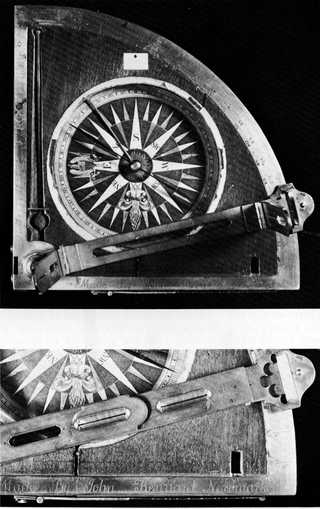
Thus far only one instrument by Hagger has been found—a
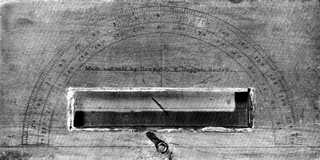
wooden surveying instrument or semicircumferentor (fig. 59). It
is in the possession of the writer.
Figure 59.—Wooden graphometer made by Benjamin King Hagger (c. 1769-1834) of Boston and Baltimore. Made of yellow
birch, with the name and gradations and lines incised into the wood by means of tiny punches, and filled. Trough compass;
sighting bars mounted on a swivelling brass bar; collapsible tripod made of maple. In collection of the writer.
Production of wooden surveying compasses was not limited to
Boston. Another instrument maker who produced them was Benjamin
Warren (c. 1740-?) of Plymouth, Massachusetts. The name
of Benjamin Warren was a fairly common one in Plymouth, being a
name handed down in the family from father to son for at least
five generations before 1800. The first Benjamin Warren at Plymouth
was married in 1697, and his son Benjamin (2) was born in
1698. Benjamin (2) was married in due course, and his son Benjamin
(3) was born in 1740. The third Benjamin was the father
of Benjamin (4), who was born in 1766. In 1789 Benjamin (4)
married Sarah Young, the daughter of Daniel Young, and their
son Benjamin (5) was born in 1792. The Benjamin Warren who
operated the shop in Plymouth probably was Benjamin Warren (3),
who was then about 45 years of age.[115]
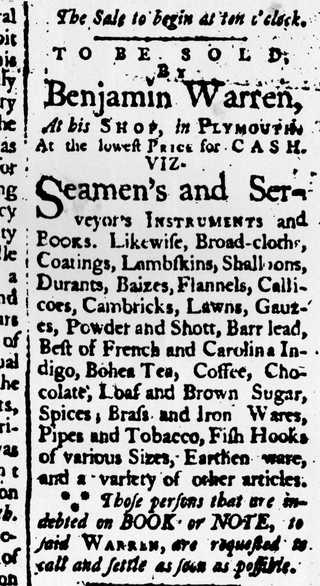
A search of The Plymouth Journal & Massachusetts Advertiser has
revealed several advertisements and notices (fig. 60) about Benjamin
Warren from which some information can be derived about
the man and his business during this period. The first known
notice dated March 19, 1785, probably is the most important one.
Later in the same year, on August 16, 1785, Warren published the
following notice:
WHEREAS on Friday Morning of the 5th inst. eloped from the House of the
subscriber, Inholder in Plymouth, JOHN MOREY, of NORTON, of tall
stature, & round shoulder'd. Had on when he absconded, a shabby claret
coloured coat, adorned with patches, and a pair of dirty smoak'd coloured
breeches; without knee-buckles; and an old flopped hatt, defaced with grease.
As he appeared to be an enterprising genius, without abilities, politeness or
honesty, and went off in an abrupt and clandestine manner; a reward of Sixpence
will be paid, to any person or persons, who will persuade or induce the
said Morey to make his appearance once more to the subscriber.
Figure 60.—An advertisement of Benjamin Warren in The Plymouth Journal &
Massachusetts Advertiser. Photos courtesy The American Antiquarian Society,
Worcester, Massachusetts.
It is obvious that Warren was not considerably concerned about
the return of John Morey, for the reward offered was scarcely
conducive to obtain the public's cooperation. Warren's first
ventures with public sales must have been successful, for early in
the next year, in the issue of January 3, 1786, he announced that
Benjamin Warren,
PROPOSES to open a convenient AUCTION-ROOM, over the Shop he now
trades in, next week. Any Gentlemen that will furnish him with goods of any
kind for Public or Private sale, on Commission, shall be served with fidelity,
and the smallest favours in that way gratefully acknowledged.
The next notice of the auction-room appeared on February 21,
1786, when the newspaper advertised that
To-morrow
will be SOLD, by
Public Vendue,
At
WARREN'S
Auction Room,
A VARIETY of articles, viz. Nails, Bar Lead, Glass
Pewter, Buttons, Buckles, Chairs, Stands, &c., &c., &c.
*** The SALE to begin at 10 o'Clock, A.M.
No other notices of public sales appeared in the Journal for the
next several months. The last notice of this period was another
announcement of a sale, which was published in the issue of May
30, 1786:
Publick Vendue,
At WARREN's Auction Room, in PLYMOUTH:
at Ten o'clock this morning. WILL
be Sold, a quantity of bar lead, boxes of glass,
6 × 8. English Shovels and Tongs, bridle-Bits,
and a variety of other articles of Hard-Ware.
Also, a few Anvils at private sale.
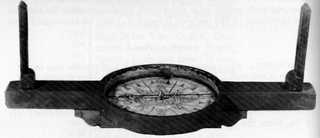
Only one instrument signed by Warren is known to survive;
it is a wooden surveying compass (fig. 61) in the Streeter Collection
of Weights and Measures at Yale University. The instrument,
which appears to have been made from walnut, has a compass
card with the following inscription around the central medallion:
"Made and sold by BENJAMIN WARREN Plymouth New Engd."
Figure 61.—Wooden surveying compass made by Benjamin Warren (c. 1740-c. 1800)
of Plymouth, Massachusetts, and detail of the compass card. The
compass, made of cherry wood, is 12 in. long and has a diameter of 6 in. In
Streeter Collection of Weights and Measures, Yale University.
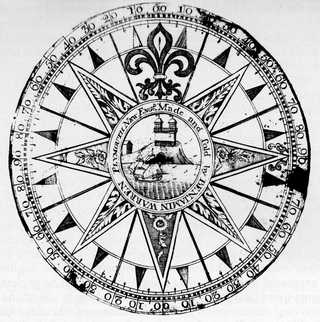
Figure 62.—Detail of card, Warren surveying compass shown in figure 61.
The medallion (fig. 62) encloses a harbor scene with a brigantine
of the 1740 period off a promontory on which is prominently
situated a lighthouse with a smaller building partly visible at the
left. The lighthouse is unusual in construction in that it features
twin towers rising from a large rectangular wooden building.
As far as can be determined from available records, the only
lighthouse in America of this period having such construction was
the noted Gurnet Light, which was built at the tip of Duxbury
Beach in Plymouth Bay in 1768. D. Alan Stevenson[116] relates that
the Governor's Council of Massachusetts, when it decided in 1768
to erect the Gurnet Lighthouse at Plymouth, adopted a novel plan
to distinguish it from other American lighthouses. "This consisted
of double lights set horizontally in the same structure. A timber
house built at a cost of £660, 30' long and 20' high, had a lanthorn
at each end to contain two four-wick lamps.
"In 1802 fire destroyed the house but the merchants of the
town promptly subscribed to replace it by temporary lights, as the
Government had no immediate funds at its disposal. An Act of
Congress of 1802 allotted $2500 for building another set of twin
lights and reimbursing the merchants for their expenditure.
"Though the idea of twin lights at Plymouth seemed an excellent
distinction from a single navigation light shown at Barnstable
harbor in the vicinity, they proved not entirely advantageous and
a sea captain blamed them for causing his shipwreck. He had
seen the light from only one tower and identified it with confidence
as the Barnstable light; apparently, from a particular direction
one tower hid the other. But local prejudice in favor of retaining
the twin lights as a distinction prevailed until 1924 when, at last,
opposition ceased to the recommendation which the Lighthouse
Board expressed frequently that a single light would be preferable."
It seems quite likely that the compass card bears one of the very
few surviving contemporary representations of the first Gurnet
Light in Plymouth Bay. A search of the archives of the historical
societies in Plymouth, Boston, and Worcester and the files of the
U.S. National Archives has failed to reveal any illustration of
this famous lighthouse.
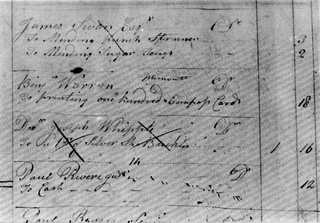
Quite by coincidence, the name of Benjamin Warren was discovered
among the entries of the day books of Paul Revere, the
famous patriot, silversmith, and engraver. The entry[117] (fig. 63)
appears as follows:
1786 March 13. Benjm Warren Dr. Plimouth
To printing one hundred Compass Cards 0-18-0.
Whether the compass card on the Warren instrument was
produced by Revere is difficult to determine. Authorities on
Revere's engravings agree that it could have been engraved by
Revere but are unable to state it positively. It has been suggested
that the entry in Revere's day book indicates that he merely
printed the compass cards for Warren and that he did not engrave
a plate. The charge for the work bears out this supposition; and
furthermore, Revere's bills seemed to make a definite distinction
between the engraving of plates and actual prints. Whether or
not Revere was responsible for making the original engraving remains
to be determined, but it is very probable that he printed
the compass card of the instrument in the Streeter Collection of
Weights and Measures at Yale.
Figure 63.—Page from the "day books" of Paul Revere with entry for the printing
of compass cards for Benjamin Warren of Plymouth. In collection of
Massachusetts Historical Society, Boston.
One of the best known and most respected names among Connecticut
clockmakers is that of Daniel Burnap (1759-1838) of
East Windsor. Burnap was born in Coventry in 1759 and served
an apprenticeship with Thomas Harland, clockmaker of Norwich.
In about 1780 Burnap opened his own establishment, where he
combined the crafts of clockmaking, cabinetmaking, and engraving
of brass, in all of which he was greatly skilled. One of his apprentices
was Eli Terry, who later achieved fame in the craft in his
own right.[118]
Burnap's business included clients in Windsor, Hartford, and
Coventry, as well as some of the leading merchants and cabinetmakers
of the nearby cities and towns. Although clockmaking
was the primary business in which Burnap engaged, he also had a
large trade for his surveying instruments, silver spoons, gold beads,
harness and saddlery hardware, and shoe buckles.
Burnap prospered, and in about 1800 he moved back to his
native town, Coventry. There he purchased a large farm and
erected a shop and a sawmill, and in due course became the leading
citizen of the community. He died in 1838, leaving a valuable
technological record in the completeness of his journals and
account books. A study of the entries of his day books and
ledgers (see fig. 64) reveals that Burnap did a substantial amount
of business in surveying compasses, chains, and protractors.
Among his shop equipment after his death there was found an
unfinished protractor, but no examples of his instruments are
known except for a compass dial, inscribed with his name, that
was discovered recently in the collection of a midwestern historical
society.[119]
It is significant to note that Burnap made instruments of varying
quality. For instance, he charged three different prices for his
surveyor's compasses. The highest-priced compasses cost £6;
they were made of brass, and were of the more elaborate conventional
type used by surveyors. A few examples that appeared in
his records cost £4; these also were made of brass, but probably
were of a simpler form. Several entries list surveying compasses
priced at £2 and £2/8. One of these was made for Capt. Solomon
Dewie (1750-1813) in September 1790 for £2/8. At the same time,
Burnap charged him £0/1/6 for touching the needle of another
compass.[120] The entries in Burnap's account books do not state
that these inexpensive compasses were constructed of wood, but
it seems to be sufficiently conclusive that they were.
Gurdon Huntington (1763-1804) was not primarily a maker
of scientific instruments, but he was established as a goldsmith
and clockmaker. He was born in Windham, Connecticut, on
April 30, 1763, the son of Hezekiah and Submit (Murdock) Huntington.[121]
Figure 64.—Entry in the manuscript ledgers of Daniel Burnap (1759-1838) of
East Windsor and Coventry, Connecticut, for sale of surveying compass in
1790. Reproduced from the Burnap shop records in the collection of Connecticut
Historical Society, Hartford.
The Huntington family was one of the most important in Connecticut
colonial history. Gurdon's father, Hezekiah, was in
service during the Revolutionary War, going to Boston as a
major with the first troops raised in Connecticut. When in Boston
he witnessed the miserable condition of the arms then in the
hands of the soldiers. Major Huntington went immediately to
Philadelphia, where Congress was in session, and proposed to
the Congress that he would return to his home in Windham and
that there he would open a manufactory for repairing muskets
and other arms. He claimed to have been the first man to have
made a gun in the Colonies.
Gurdon was too young to have served in the Revolution, but
he undoubtedly worked in his father's gun manufactory as a
boy. In due course he learned the trades of goldsmith and clockmaker
and established his own shop in Windham, which, according
to an advertisement (fig. 65) in The Connecticut Gazette of June
11, 1784, was "a few rods north of Major Ebenezer Backus' store."
On Christmas Day, 1785, Gurdon was married in New London
to Temperance Williams of Groton. In 1789 their first child,
Marvin, was born, and in October of the same year the Huntingtons
moved from Windham to Walpole, New Hampshire. No reason
can be found for the move, other than the possibility that Gurdon
might have anticipated greater opportunity in the new community.
There he applied himself to his trade as goldsmith and clockmaker,
but apparently he was not very successful. His family
grew, and by the time of his death there were eight children.
Possibly in an effort to supplement his income, Huntington served
as postmaster of the community. In about 1797, seven or eight
years after he had moved to Walpole, his father and mother
joined him there, and it is believed that Major Hezekiah may have
worked as a gunsmith during that period. Eventually the senior
Huntington returned to Windham, Connecticut, where he died
in 1807.[122]
Meanwhile Gurdon Huntington struggled on until his death
on July 26, 1804. He died insolvent, which created a considerable
problem in view of the large family he left behind him. Huntington's
estate was administered by Asa Sibley, a clockmaker in
Walpole. Sibley had moved to Walpole from his home in Woodstock,
Connecticut, in the 1790's and he remained there until
1808, when he again returned to Woodstock. Gurdon Huntington's
widow removed to Bloomfield, Ohio, with her children, and
she died there on May 25, 1823. Most of her children settled
in Bloomfield, but several of them moved to New Hartford, New
York.
Figure 65.—Advertisement of Gurdon Huntington (1763-1804) in The Connecticut
Gazette, June 11, 1784. In collection of Connecticut Historical Society,
Hartford.
Figure 66.—Views of wooden surveying compass made by Gurdon Huntington,
clockmaker in Walpole, New Hampshire, between 1789-1804. Made of cherry
with folding brass sighting bars, the instrument is 14 in. long and 5-1/2 in. wide.
In collection of the writer.
Several examples of Huntington's clocks are known to exist in
private collections in the United States. However, only one
example of his scientific instruments appears to have survived.
This is a surveying compass (fig. 66) made of wood, with brass
sighting bars and a painted dial under glass with a steel needle.
The dial is inscribed "G. HUNTINGTON/WALPOLE." The instrument,
which is in the collection of the writer, is made of cherry wood,
with a riveted ball-and-socket joint of brass for insertion on a tripod.
Jedidiah Baldwin (fl. 1790's) was another early New England
clock and instrument maker, but little is known of his early life.
He was a brother of Jabes Baldwin (c. 1777-1829), who worked as
a clockmaker in Salem and Boston after serving an apprenticeship
with Thomas Harland in Norwich, Connecticut.
Jedidiah Baldwin also served an apprenticeship with Harland.
In 1791 he was working in Northampton, Massachusetts, as a
member of the firm of Stiles and Baldwin, and from 1792 to 1794
he was a member of the firm of Stiles and Storrs, in partnership
with Nathan Storrs.[123] In about 1794 Baldwin moved to Hanover,
New Hampshire, where he became the local postmaster, and where
Dartmouth College records his death.
Only one existing instrument is known to have been made by
Baldwin; it is a wooden surveying compass with a brass dial
having two scales, one for degrees and one for eight divisions
per 90°. The dial is inscribed "JED BALDWIN/HANOVER." According
to its present owner, Mr. Worth Shampeny of Rochester,
Vermont, the compass was used for surveying in Vermont during
the early 1800's.
Another Jedidiah Baldwin worked as a clockmaker in Morrisville,
New York, from 1818-1820 and then in Fairfield, New York;
he appears also in the city directory of Rochester, New York, as a
clockmaker during the years 1834-1844. He may have been a son
or grandson of the first Jedidiah, or a nephew.
Thomas Salter Bowles (c. 1765-?) is another elusive New England
instrument maker about whom little information is available.
He is believed to have been the son of Deacon Samuel and Hannah
(Salter) Bowles, born in Portsmouth, New Hampshire, probably
between 1765 and 1770. His father was born in 1739; his mother,
who was the daughter of Captain Titus Salter, was born in 1748
and died in 1831.[124] Deacon Bowles was clerk of the Brick Market
in Portsmouth from 1801 to the time of his death, November 3,
1802. There is a minimum of information available from church
and city records in the community, but it is believed that he was
a member of one of the offshoots of the established Puritan Church,
and hence he would not appear in its records. He kept the lower
school in the Brick School House on State Street for a number of
years.
It is believed that the Bowles family first came to Portsmouth
during the few years immediately before the beginning of the
Revolutionary War. It is known that a Thomas Bowles and a
Samuel Bowles both signed the Association Test on August 14,
1776, promising to oppose the hostile proceedings of the British
fleets and armies. Furthermore, one of the principal taxpayers in
Portsmouth in 1770 was a firm named Griffith and Bowles, which
paid £17 in taxes in 1770. The name of the Bowles who formed
part of this firm is not known, but it was either Samuel or the first
Thomas Bowles. The other partner was Nathaniel S. Griffith, a
watchmaker. It is possible that a tradition of instrument making
existed in the Bowles family even then.[125]
On file in the office of the City Clerk in Portsmouth are two
certificates of marriage made out by Thomas Salter Bowles. The
first is for his marriage to Hannah Ham, a ceremony performed on
September 21, 1809, by Joseph Walton, one of the pastors of a
church dissenting from the Puritan regime. Hannah was the
daughter of William Ham, a brother of Supply Ham (1788-1862),
a noted local clockmaker. Bowles may have served an apprenticeship
in that shop before he married Hannah. Two other members
of the Ham family—George Ham and Henry H. Ham—worked as
watchmakers in Portsmouth in the same period.
A search of the cemeteries has indicated that Hannah Ham
Bowles died in 1811, age 20. She is buried with her infant son in
North Cemetery.[126]
Thomas Bowles's second marriage certificate in Portsmouth is
for his marriage on September 29, 1813—two years after Hannah's
death—to Abiah Emerly Bradley of Haverhill, Massachusetts.
Little is known about the work of Bowles as an instrument maker
except through a few of his instruments. He is listed in the first
Portsmouth directory, of 1821, as a "mathematical instrument
maker" with a place of business on Daniel Street; his home was
given as Austin Street in Portsmouth. He did not appear in the
city's directories of 1827 and 1834. It is assumed that he may have
left Portsmouth in the interim, possibly to settle in his wife's home
town of Haverhill.
Three instruments signed by Bowles have survived, and all show
signs of considerable wear. They are surveying compasses made
of walnut, having maple sighting bars and a silvered brass vernier
set under the glass. Two examples, one in the Streeter Collection
of Weights and Measures at Yale University and one owned
by this writer are almost identical in size, form, and details. The
only variation is that the Yale example (fig. 67) has a bubble level
under a brass strip set into one end, an item lacking in the other
example (fig. 68).
The compass card, made from a line engraving, is identical in
each of the three examples. A floriated fleur-de-lis on the North
point has a compass and square at its base, and the name T. S.
BOWLES is on a riband over it. Adorning the East point is an
American eagle bearing a shield with stars and stripes and clutching
arrows in one claw and a laurel twig in the other. In a ring within
the central medallion is inscribed (see fig. 68), "* T. S. BOWLES *
PORTSMOUTH, N.H. *"
Figure 67.—Wooden surveying compass made by Thomas Salter Bowles of
Portsmouth, New Hampshire. With spirit level. Made of birch, the compass
is 13 in. long and has a diameter of 6 in. In the Streeter Collection of
Weights and Measures, Yale University.
The most interesting of the three instruments was acquired by
the Dartmouth Museum as part of a collection of the late Frank C.
Churchill, an inspector in the Indian Service. The instrument (fig.
69) is a quarter circle with a compass in its center and sighting bars
mounted on a swinging arm that reads the angle of the brass
scale on the arc by means of a vernier. It is mounted on a wooden
tripod with the customary ball-and-socket joint, which permits it
to be placed on a vertical plane. A built-in plumb bob at the side
helps to establish the vertical.[127]
Interesting features of this instrument are two inscriptions engraved
on the brass strip on the top of the dial. One states that
it was "INVENTED BY P. MERRILL ESQ." and the other relates that
it was "MADE BY JOHN KENNARD NEWMARKET." No information
about P. Merrill has been found, and it is presumed that it was he
who conceived the idea of combining the various elements into a
single instrument and that it was made under his direction by
Kennard.
Figure 68.—Wooden surveying compass made by Thomas Salter Bowles (1765/70-post
1821) of Portsmouth, New Hampshire. Made of walnut, it is 12 in.
long and has a diameter of 5-3/8 in. With walnut sighting bars. In collection
of writer.
Figure 69.—Wooden surveying instrument inscribed "Invented by P. Merrill,
Esq." and "Made by John Kennard, Newmarket." Made of walnut, 7-3/4 in. long;
in its original pine case, with cover. The compass card and dial (see opposite)
were made by Thomas Salter Bowles of Portsmouth. In Frank C. Churchill
Collection, Dartmouth College Museum, Hanover, New Hampshire.
Some data on Kennard is available in a history of Newfields
(formerly Newmarket) by Reverend Fitts. John Kennard was
born in Kittery, Maine, in 1782. He learned the trade of clockmaker
in Portsmouth, New Hampshire, presumably working with
the members of the Ham family or others. On July 3, 1806, he
married Sarah Ewer. He lived for various periods in Nashua and
Concord before moving to Newfields in 1812. He lived in the
Palmer house (which was burned in September 1899), and he kept
a store in the little community and also served as its postmaster
from 1822 to 1824. The post office was the only public office in
the town until the cotton mills were built on the Lamprey River
in 1823. Kennard later built and occupied the Kennard house on
Piscassic Street, which was subsequently owned by Jeremiah Towle
and has since been burned. In December 1830 he established an
iron foundry together with Temple Paul and the Drake family,
but in 1834 he sold his interest to Amos Paul and others. He was
the father of six children and he died in 1861. During his lifetime
he had specialized in making tall case and banjo clocks.[128]