Dinner Gaze bore the air of a man who was
perfectly satisfied with his personal appearance
and sure of making a good impression upon all who
beheld him.
He leaned back in his seat in the negro coach of
the New Orleans accommodation, using the seat
in front of him as a footstool. His legs were
crossed with a display of glorious silk hosiery, his
thumbs were anchored in the armholes of his gold
and purple vest, his bright green cravat contained
a bright yellow diamond, and his cigarette-stained
fingers beat a happy tattoo upon the bosom of his
shirt.
The face of Dinner Gaze was black, and as
expressionless as the ugly mug of a dough man.
There was a long mark upon his cheek where a
bullet had missed the center of his face about two
inches. There was a long knife-scar on the back
and side of his neck. A bit of the upper part of
his left ear was missing, sliced off smoothly with
a sharp knife or razor. The end of one of his
front teeth was broken off. His eyes were as
steady and unwinking and shiny as two glass
beads, his voice was low and soft and confidential
in tone, and his heavy lips carried an habitual
sneer.
Hitch Diamond, who sat beside him, was similarly
satisfied.
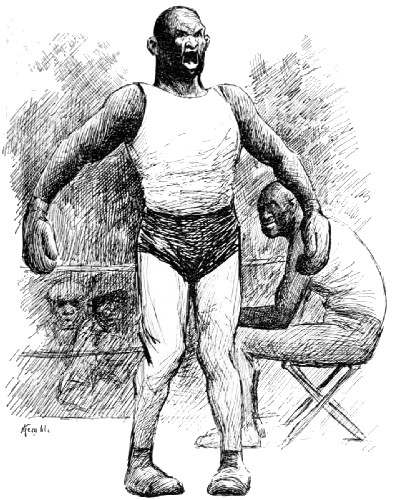
Hitch’s appearance cried aloud his profession of
pugilist. His face was a scarred ruin, battered
and bruised in many a fistic battle until it resembled
the face of the Sphinx since it has been pecked
at and damaged by the souvenir hunters and sandstorms
of the centuries. His ponderous hands
looked like the gnarled and twisted roots of a scrub-oak
tree, while his legs were like the Corinthian
columns supporting the portico of a temple.
Hitch had made a trip to New Orleans for pugilistic
purposes. At the end of the second round,
Hitch had looked down at his opponent, then
waved his gloved fist at the whooping crowd and
remarked: “I know whut I done to dat coon!
He’s gwine sleep a long time!” After which
Hitch had collected a hatful of money and remained
in New Orleans long enough to get it all
nicely spent except a puny wad in one pocket of his
shiny new pantaloons.
Every rag of clothes on Hitch’s giant body was
entirely new. He was swathed in a Prince Albert
coat, choked and tortured by a high collar and a
stiff-bosomed shirt; a glorious silk hat, all white
silk lining on the inside, and smooth, shiny,
imitation beaver on the outside, rode on his head;
while on his feet were a pair of patent-leather
shoes which had caused him a world of trouble in
the city.
He had walked for miles, in and out of the
stores, seeking a pair of shiny shoes which would
fit his immense feet. Shoe clerks had taken one
look at those pedal extremities and had thrown
up their hands in despair. But Hitch had persisted
in his search, and now it was plainly apparent
to all that Solomon in all his glory was not
shod like such as he.
Dinner Gaze was listening with great interest
to Hitch’s talk.
“I ain’t went to N’Awleens befo’ fer mighty
nigh five year,” said Hitch as he extracted a long
Perique stogie from the side-pocket of his gorgeous
yellow waistcoat.
Dinner Gaze reached out, took the stogie from
Hitch’s giant hand, and tossed it out of the window.
He handed the pugilist a big, fat cigar with
a broad gold band, and grinned in a friendly way.
Then he said in his low, gentle voice:
“Ef you wants me to set by you, don’t smoke no
roll of rags an’ garbage. Take a real seegar!”
“Thank ’e, suh,” Hitch murmured gratefully,
removing the gold band and fitting it carefully
upon his little finger where he admired it as a
maiden admires her engagement ring. “I’s powerful
sorry dar ain’t no lady folks in dis car to see
me smoke dis. I ain’t never feel like I had
enough money to ack liberal an’ buy real smokes.”
“Ain’t you spek dat you got a wad to tote home
from de city wid you?” Gaze inquired carelessly,
as he tore a page from a newspaper and began idly
to roll it tightly.
“Shore!” Hitch chuckled. “I totes it in my
behime hip-pocket next to my heart, whar unpious
niggers totes dey gun. But most of dat is jes’ show
money—’tain’t much, an’ I got it wropped up in a
roll to make it look like a plenty. Fawty dollars
is all whut is lef’ of my trip to de city—excusin’ de
mem’ry of a dam’ good time, an’ dese clothes!”
“Whar you gwine now?” Dinner asked as he
fumbled with his paper.
“I’s gittin’ off at Sawtown,” Hitch replied. “I
been livin’ aroun’ in dis part of de worl’ all my
life, an’ I ain’t never seed dat big saw-mill town yit.
’Tain’t been but ’bout fo’ year ago dat Sawtown
started off—when dey sot dat big mill dar in de
woods.”
“I’s proud I met up wid you, Revun,” Dinner
Gaze said. “I lives in Sawtown, an’ I’ll show you
all de good p’ints in de place.”
Hitch opened his mouth to deny that he was a
preacher, but the negro’s natural love of the game
of make-believe prevented him. His slow mind
evolved the humor of the situation, and he bestowed
a pious smile upon the man beside him.
“Thank ’e, suh. I ain’t gwine let nothin’ git
past me. I’s gwine to all de shows, an’ drink all de
ice-water I kin git, an’ chaw peanuts, an’ git right
in de middle of de cullud high life.”
“Dat picayune way of seein’ Sawtown won’t git
you nothin’,” Dinner Gaze grunted disgustedly.
“Bust her wide open, Revun!”
“How is dat did?” Hitch wanted to know.
“I’ll show you!” Gaze told him.
“Whut job does you wuck at in Sawtown?”
Hitch asked.
“I’m gittin’ ready to sot up a little nigger gamblin’-house
in Sawtown now,” Dinner replied
cautiously, after a moment’s hesitation. “Befo’
dat, I managed a string of nigger prize-fighters in
N’Awleens.”
Hitch raised his battered head like an old,
scarred war-horse when he hears the bugle-call for
charge. Then he remembered that Gaze thought
he was talking to a clergyman.
“Dat shore sounds familious to me,” Hitch
laughed. “I used to be a prize-fighter my own
se’f!”
“Hear dat, now!” Dinner Gaze exclaimed. “I
knowed you an’ me wus kinnery when I fust cotch
you wid my eye. How come you left de great
perfesh?”
“A nigger put a chunk of lead in his glove an’
battered me clean acrost a wharf-boat,” Hitch
narrated, drawing upon his imagination, and
recalling an incident in the career of his friend,
the Reverend Vinegar Atts. “Atter dat I felt a
call to preach.”
“Mebbe you could come back,” Gaze suggested.
“Naw, suh,” Hitch grinned, quoting a remark
he had heard Vinegar make. “Preachin’ is a
plum’ sight safer. I kin git up befo’ a lot of
Christyums an’ knock noses an’ pull hair an’ skin
shins all I’m got a mind to, an’ all dey kin do is to
turn aroun’ de yuther cheek. Ef dey hits back,
dey ain’t pious!”
The odor of wet, sawed, sun-scorched lumber
entered the car window. The suction of the
moving train threw sawdust upon the seat where
the feet of the two men rested. They were drawing
near to the station at Sawtown.
“Revun,” Dinner asked, as he rose, “is you ever
read up on dat Bible text whut says ‘I wus a
stranger an’ I got took in’?”
“Suttinly,” Hitch prevaricated.
“My last advices to you is to keep a eye on de
people in dis here Sawtown. Dey takes a stranger
in good an’ plenty!”
Dinner dusted off his patent-leather shoes,
adjusted his immaculate cuffs, felt of his green tie
and his yellow diamond, lifted his Panama hat out
of the rack, and brushed the cigar ashes off his
gold and purple vest.
“Drap in de Hot-dog Club an’ gimme a look-on,
Revun!” Gaze invited as he stepped into the aisle.
“I handles a pretty peart gamblin’ game ef I do
say it myse’f!”
The train stopped.
Dinner Gaze waited in the aisle, courteously
permitting Hitch Diamond to precede him.
As Hitch passed out, Dinner Gaze cautiously
elevated the tail of the pugilist’s Prince Albert
coat, carefully thrust two scissors-like fingers into
Hitch’s hip-pocket and drew out a small roll of
money. In its place he thrust a wad of newspaper
of about the same size. When the train had gone
on, Hitch looked for his friend and could not
find him.
“Dar now!” he exclaimed. “Dat wus a fine
nigger man an’ I done loss him complete, an’ I
even fergot to ax him whut wus his name!”
“De fust thing I needs is a sack of peanuts an’ a
awange to cut de dust outen my throat,” Hitch
said to himself, as he walked slowly down the
village street.
He entered a small grocery, made his purchases,
and thrust his fingers into his hip-pocket to bring
forth his money.
Instead he extracted a wad of newspapers.
Hitch stupidly unfolded the paper, gazed at it
with hypnotic fascination, searched all his pockets
for his lost money, then searched them again,
hunting for loose change.
The disgusted clerk tossed the bag of peanuts
back into the roaster, laid the orange back on the
shelf, walked over to a chair and sat down, his
mind spluttering like wet fireworks with his unspoken
comments on the colored race in general
and Hitch in particular.
Hitch stumbled stupidly out of the store, broke
and broken-hearted.
He looked around him uncertainly, then dragged
his ponderous feet back toward the depot, hoping
to find his lost money. After half an hour’s
search he gave it up and started aimlessly toward
the river.
Half-way down the block he met a tall negro
whose face was slightly disfigured by a broken
nose. The man wore a checkerboard suit of
clothes, a cowboy hat, and a sport shirt. Hitch’s
eyes fell first upon the emblem of a negro lodge
which the man wore on the lapel of his coat.
Hitch eagerly laid hold upon his lodge brother,
“I’s in powerful bad trouble, brudder,” he moaned.
“I ain’t know nobody in dis town an’ I done loss all
my money on my way to dis place. Whut kin be
did?”
“De next best thing is to go down to de big mill
an’ set on de buzz-saw,” the brother advised.
“Whut good will dat do me?” Hitch inquired.
“It’ll fix you so trouble won’t trouble you no
more,” Checkerboard grinned, patting Hitch on
his powerful back. “Atter you takes yo’ seat
you won’t need no money—de Nights of Darkness
lodge will bury yo’ remainders free fer nothin’
an’ sot you up a real nice tombstone.”
“I got plenty white folks in my own home
town,” Hitch continued, paying no attention to
his companion’s foolishness. “I mought could git
some he’p mebbe ef I had somewhar to wait at
ontil dey sont me de money.”
The checkerboard negro looked Hitch over;
then his eyes narrowed and he smiled.
“As a lodge brudder in good standin’, I could
lead you to my own house an’ keep you a little
while,” Checkerboard remarked. “Whar is yo’
lodge pin?”
Hitch glanced down at the lapel of his coat.
“My gosh!” he mourned. “I done loss my
money an’ my lodge breastpin too. Dat breastpin
wus jes’ perzackly like de one you is got on an’
wus gib me by Skeeter Butts.”
“Suttinly,” Checkerboard laughed. “Dey is
all made alike an’ look jes’ de same. Mebbe de
feller whut touched yo’ wad frisked yo’ pin, too.”
“Dat’s whut happened,” Hitch sighed. “But
it don’t he’p me none to know dat news.”
“You’se too blame young to be trabbelin’ alone,”
Checkerboard snickered. “You needs a fust-rate
gardeen. Foller atter me!”
He conducted Hitch to the rear of the big sawmill,
led him through a maze of immense lumber
piles, and brought him around the big mill-pond
to a cluster of houses built by the owners of the
mill for the occupancy of their negro employees.
There was one two-story house which looked like
a barracks, and was intended for use by men who
had no families. Into this Checkerboard led his
companion.
“Set down, Revun,” he smiled. “Dis here is
my boardin’-house. I keeps it fer de ’commodation
of de nigger workers in de mill whut ain’t
got no wifes an’ no home. Dey eats in dat
eatin’-house down dar by de mill-pond an’ sleeps
here.”
“It’s powerful hot in dis place,” Hitch complained
as he seated himself.
“We keeps de winders down in de daytime
because eve’ybody whut stays here is busy in de
mill,” Checkerboard explained, as he pulled off his
coat and hung it across his arm. “Pull off dat
coat of yourn, an’ I’ll take yo’ stove-pipe hat an’
coat an’ hang ’em up wid mine.”
Hitch gratefully removed his hat and coat and
sat down. He took a stogie from his vest-pocket
and felt for a match.
“Don’t you wanter take off dat vest, too?”
Checkerboard inquired. “You might git seegar
ash all over it.”
“Dat’s right,” Hitch said, as he handed his
friend the vest.
“Make yo’se’f at home, Revun,” Checkerboard
said graciously. “Smoke all you please to—spit
on de flo’—ack like you wus at yo’ own house! I
got to hump aroun’ a leetle on bizzness befo’ de
mill blows de whistle fer closin’ time. But I tells
you in eggsvance, dat as fur’s I’m concerned, you
kin stay in dis house fer a mont’.”
“You is a true lodge brudder,” Hitch rumbled
in real gratitude. “I won’t never fergit you!”
Checkerboard left the room, walked through
the hallway, passed out of the rear door, clambered
down into a gulley, and carried Hitch’s
clothes through a labyrinth of lumber piles to a
place far, far away!
Hitch waited for nearly an hour for Checkerboard
to return. Feeling the lack of companionship,
he walked down to the mill-pond and accosted
the slouchy negro woman in the kitchen of the
eating-house.
To his surprise he learned that she had never
seen nor heard of the man in the checkerboard
suit.
“It ’pears to me like dese here folks ain’t plum’
honest,” Hitch mourned as he walked disconsolately
around the mill-pond trying to find his
way back to the village.
He spent a long time looking for the man who
had his clothes, mumbling complainingly to himself
the while. At last he wandered to the wharf
on the Mississippi River and sat down with his
back resting against a post.
His feet were unaccustomed to the wear of
patent-leather shoes, and they felt swollen and
tired. He took off his shoes, set them side by side
in front of him, waved his feet in the cool river
breeze, and gazed upon his footwear lovingly.
“I kin git me anodder hat an’ coat,” he muttered.
“But dem shoes would be a powerful
loss. Dar ain’t no more shoes in N’Awleens dat’ll
fit my foots!”
Half a block away two little white boys were
cutting monkey-shines on the sidewalk. In the
dusty gutter one boy picked up a long, black
stocking.
The two considered this find for a moment, then
they gathered small sticks and thrust them into
the stocking. One youth produced a ball of kite
twine and tied an end of the twine around the open
end of the stocking. After that, they dropped
the stocking upon the pavement and pulled it along
by the string, observing the effect.
“It wiggles all right,” they chuckled.
They looked around for a victim and spotted
Hitch Diamond.
One of the boys held the stocking and concealed
himself behind a pile of lumber on the wharf. The
other boy, playing out the ball of twine, walked
along the wharf, his bare feet making no sound.
He passed close behind Hitch Diamond and stopped
and concealed himself on the other side of some
shipping about one hundred feet beyond the point
where Hitch Diamond sat.
Then the boy with the ball began to wind the
twine in. The long black stocking crawled up
closer and closer to the inert form of Hitch Diamond.
Finally, when the stocking had wriggled grotesquely
to within ten feet of Hitch Diamond,
there was a loud whoop—a white boy ran from
behind some lumber and shrieked:
“Look at that sna-a-a-ke, nigger! Jump!”
Hitch jumped.
He sprinted down the wharf a hundred yards,
pattering along in his sock feet, leaving his precious
shoes behind him.
The little white boy shrieked with laughter,
picked up the wriggling stocking, and jumped
next for Hitch’s shoes.
For a moment he paused, filled with awe when
he beheld their monstrous and incredible size;
then, doubtless reflecting upon their resemblance
to a big mudscow, he put each shoe where a mudscow
properly belongs—in the river!
“Hey, you nigger!” a wharf watchman called
sharply, as Hitch, looking behind him, ran full tilt
into the watchman’s portly form.
“’Scuse me, boss!” Hitch grunted.
The watchman hung three strong fingers in the
collar of Hitch’s white shirt. Hitch didn’t like
that. He pulled away. The watchman pulled
too. The inevitable happened.
Hitch’s shirt tore half in two and hung limply in
the watchman’s hands as Hitch raced down the
wharf clad in socks, pants, and a red undershirt!
The watchman disgustedly tossed his spoils on
top of a lumber pile and gave himself up to the
placid contemplation of the flight of some gulls on
the river.
“Lawd,” Hitch sighed, when he had dodged
around the distant end of the wharf and had time
to look down at his deficient apparel. “Dis
here town shore is hard on clothes!”
Keeping the river levee between himself and
the town so that no one could see him in his
half-dressed condition, Hitch departed from the
vicinity of Sawtown with expedition. When he
reached the edge of the woods about a mile from
the mill, he sat down to think a way out of his
difficulties.
“My head is jes’ like a mule’s head,” he announced
to himself. “I cain’t hold but only one
notion at a time. I been thinkin’ so heavy all
de time about my lost money dat I done loss all
my good clothes, too. I oughter knowed better.
Now I’s gwine git active an’ sot myse’f up in
bizzness agin.”
He sat for a long time in deep, silent meditation,
trying to extract an idea from his slow
brain. Then he concluded:
“I drunk too much dram in N’Awleens. My
head ain’t right. Ef I could git me a good dram
now, mebbe I could think up a notion whut to
do.”
In his impoverished condition he saw no way
of buying a drink. He cast about to see what he
possessed which he might exchange for one, and
pulled out of his hip-pocket his silk socks, the joy
and pride of his life in their glorious coloring—purple,
striped with yellow!
“Dey costed me two dollars,” Hitch sighed as
he gazed upon them fondly. “I could swap ’em
off in Sawtown, but I ain’t gwine back dar no more.
Ef I does, some nigger will steal my pants an’ my
socks, too. Plenty of country niggers is got dram.”
He walked barefooted through the woods and
came out at a level plantation some distance back
from the river. In the middle of a cow-pasture,
a tall, brown, bright-eyed negro watched Hitch
approach with impassive curiosity.
“Howdy, my brudder!” Hitch boomed. “How
am yo’ soul an’ spirit dis day?”
“De spirit is pretty low, elder,” the farmer
replied. “De ole woman am got de dram all
locked up tight.”
“How come you choose de lily-pad route an’
live on water?” Hitch asked in a disappointed
tone.
“I got married,” the young negro responded
with a grin.
Suddenly a big Jersey bull broke through the
underbrush and came toward the two men, snorting,
bellowing, pawing the ground, tossing the dirt
upon his shoulders, and shaking his powerful
head.
“Dat’s mine, stranger,” the young man remarked
proudly, removing the top from a bucket
on his arm and tossing a handful of salt at the
animal’s feet. “He don’t like dat red undershirt
of your’n. Ain’t him a dandy?”
“Shore is,” Hitch said meditatively. After a
moment, he added: “Ef dat ole bull wus to hook
one of us, I ’speck yo’ bride would affode us a
little dram to stimulate us up.”
“I resigns in yo’ favor, elder,” the owner
grinned. “Ef dis here beast wus to butt me, he’d
jolt all my kinnery plum’ back to Afriky.”
There was a period of silent and fruitless
meditation. Then, sorrowfully, Hitch Diamond
reached to his hip-pocket and brought forth his
purple socks with the yellow stripes—all, except
his trousers, that remained of his former glory.
“Whut’s yo’ name?” Hitch asked.
“Dey calls me Dude Blackum because I got a
gold tooth,” the other informed him.
“Whut is yo’ wife called?” Hitch asked next.
“Dainty.”
“I wants to make a little trade, Dude,” Hitch
remarked, after he had told his own name. “Dese
here socks costed me two dollars. My head ain’t
thinkin’ right to-day. You is a heavy thinker.
Ef you kin think up a sketch of how I kin git a
dram right now, I’ll bestow dese here socks on
you.”
“De trade is did!” Dude grinned, showing his
gold tooth. “Lemme think!”
“Bawl out, nigger!” Hitch grumbled after a
little wait. “Don’t keep me waitin’ here in expense
no longer.”
“I wus studyin’ ’bout dis,” Dude said. “I’s
got a little touch of lumbago in my legs. An’
mebbe, ef dat bull would jes’ butt me real easy
like, an’ I’d kinder drap off in dat bayou an’ git
wet, an’ den walk back home in drippy clothes wid
dis mis’ry gnawin’ at my legs——”
Hitch’s face was so expressive of contempt
that Dude stopped speaking.
“Is dat whut you call heavy thinkin’?” Hitch
inquired in sarcastic tones. “Dat high-brow
plan might steal you a nubbin of corn from a blind
pig’s slop-trough. But Dainty ain’t no blind pig—dese
here brides gits awful wise on deir husbunts
atter dey marries ’em.”
“Wait till I finish, Hitch,” Dude begged.
“Now, my view is dis: you go up to de house an’
cornverse Dainty till I comes in all wet an’
mournin’ ’bout how hurt I is. Atter I come in,
you say to Dainty dat she better gimme a dram
because I’s so crippled up. Of co’se, she will hab
to be manners an’ gib you some, too.”
“Dar, now!” Hitch boomed. “You shore is a
smart boy, Dude. Dat plan is accawdin’ to de
Bible, wise as suppents an’ harmless as ducks.
But”——
Here Hitch broke off and looked down at his
clothes.
“It ’pears to me it ain’t proper to call on a lady
when I is barefooted an’ ain’t got nothin’ on but a
pair of pants an’ a red undershirt,” he mourned.
“Dat won’t make no diffunce,” Dude assured
him. “All de niggers wucks in de big mill dresses
jes’ like you is now. Dainty will figger dat you is
a sawmill hand. Talk right up to her, Revun”——
“I ain’t no preacher!” Hitch interrupted,
growling like an angry bear. “I’s a prize-fighter.”
“Dat won’t do,” Dude chuckled, as he looked
at the giant’s mighty arms and shoulders. “Dainty
is powerful sot on preachers. I ’speck you better
be one as long as you is hangin’ aroun’ her.”
“All right,” Hitch said reluctantly, as he
started away. “I ain’t none too good or too
proud to piddle wid dat job—ef I got to.”
“Hol’ on, Hitch!” Dude exclaimed. “You
ain’t gimme dem silk socks yit!”
Hitch’s experience in Sawtown had made him
cautious. After a man has parted with a certain
amount of his wearing apparel, he becomes reluctant
to separate himself from the rest in a civilized
community unless he contemplates becoming a he-mermaid
and living in the river.
Hitch held out one sock.
“I’ll gib you one sock now, Dude,” he said
cunningly. “Dat’ll keep yo’ mind int’rusted.
Atter I git de dram, I’ll leave de yuther sock on de
flo’ or de mantlepiece, kinder keerless like.”
Dude accepted the partial payment and stuck
the gaudy sock into his derby hat and placed the
hat on his head.
On his way to the cabin, which lay across the
pasture, Hitch Diamond also did some heavy
thinking.
“I wonder how much dram dat nigger woman is
got,” he muttered to himself. “I bet dar ain’t
enough for two. Ef she ain’t nothin’ but one of
dese here soft, giggly, gal-wifes, mebbe I kin bamboozle
her outen a dram befo’ Dude comes in.”
Dainty met Hitch at the door.
“My name am Hitch Diamond, Dainty,” he
rumbled. “I met Dude out in de cow pasture an’
he tole me he done cormitted mattermony. I felt
powerful bad because he didn’t send fer his ole
preacher frien’ to come ’n’ marrify him. He sont
me up here to take a look at you.”
“Come in, elder,” Dainty giggled. “How is
you feelin’ to-day?”
“Lawd, honey, I feels a whole passel better
since I sot my eyes on you. You’s prettier’n a
little pig. But I been feelin’ powerful sick.”
“Whut ails you?” the girl asked with instant
sympathy.
“I’s got a wo-begone spasm in my stomick an’ a
empty feelin’ in my head.”
“Dat’s too bad,” Dainty said. “Would a little
drap——”
“Yes’m,” Hitch responded promptly. “Dat’s
jes’ de med’cine I needs. De dorctor obscribes
brandy fer all my ailments.”
Dainty extracted a key from the pocket of her
dress and opened the door of a little storeroom which
contained a little trunk. Drawing forth another
key, she opened the trunk and brought out a jug.
“I’s glad Dude didn’t come to de house wid
you,” Dainty remarked. “I don’t let him hab no
more booze. He come home ’bout two weeks
ago an’ couldn’t git past dat oak tree out dar in dat
yard. He seed two trees whar dar wusn’t but jes’
only one, an’ he mighty nigh butted his fool head
off tryin’ to walk between dem trees.”
She set the jug and the drinking glass beside
Hitch Diamond and took her seat in a rickety hide-bottomed
chair.
Hitch looked at the glass, picked it up and
fumbled it, and set it down apologetically.
“Sister Dainty,” he murmured, “ef you ain’t
got no objections, I’ll drink outen dis jug de way
I wus raised.”
Catching the handle with his left hand, he gave
the jug a quick turn, rested it upon the crook of his
uplifted elbow, and applied his lips to the spout.
Dainty watched him with fascinated eyes.
When at last he set the jug upon the table and
seated himself beside it, she said with a chuckle:
“Elder, when I wus a little gal I wus always
countin’—I used to count de cobs in de feed-trough,
an’ de beans in a hull, an’ de number of
swallers a cow tuck when she drunk water.”
“Jes’ so,” Hitch responded, wiping his mouth on
the sleeve of his red undershirt.
“Seben swallers is a big drink fer a cow, elder,”
Dainty continued.
“Dat’s right,” Hitch agreed.
“Elder,” Dainty chuckled, “when you wus
drinkin’ outen my jug, you swallered fo’teen
times!”
“Yes’m,” Hitch replied solemnly. “I tole you
I wus feelin’ powerful sick!”
Suddenly he remembered that he was playing
the part of a preacher. He decided he ought to
say something religious. So he began:
“Sister Dainty, dis am de Bible law about de
imbibin’ of awjus liquors: de amount of booze a
man oughter drink depen’s on how much he kin
hold inside hisse’f an’ at de same time resist de
effecks; but, neverdeless an’ howsumever, eve’y
man oughter take a little dram fer his stomick’s
ache in case of powerful sickness.”
“Yes, suh,” Dainty agreed.
“Now you notify de case of yo’ husbunt tryin’
to make a goat of hisse’f an’ butt down all de timber
in de yard. I feels like I oughter tell you dat
dat nigger is plum’ full of guile. Right dis minute,
he’s figgerin’ to fall in de bayou an’ come to de
house all wet, an’ say de bull done butted him, an’
ax fer a leetle drap.”
“Am—dat—so?” Dainty inquired with popping
eyes.
“Yes’m,” Hitch assured her. “Of co’se, a man
in my perfesh don’t harmonize wis no sech plans
like dat. Hit’s a sin ag’in’ de conscience.”
Dainty stood up and laid her hand upon the
handle of the jug.
“I’s gwine put dis jug back in de storeroom.
Dude don’t git none. He is a fraudful nigger!”
She set the jug on the top of the trunk, locked the
storeroom, and went to the kitchen.
Hitch heard her chopping kindling wood and
rattling the stove-lids. He heard the roar of the
fire as the flame from the rich pine-knots soared up
the chimney.
Ten minutes later Dainty entered and sat down
with Hitch again, her eyes gleaming with wifely
resolution.
“Dar he comes now!” Hitch snickered, pointing
through the window. “Look at him—wet as a
b’iled owl an’ walkin’ lame in bofe behime legs like
a stringhalt mule. Lawd, Lawd!”
The gate opened and Dude Blackum stumbled
in, walking to the door with every manifestation of
suffering his imagination could devise.
Hitch, standing behind Dainty so she could
not see, encouraged Dude’s painful progress by
waving the other silk purple-and-yellow sock at
him.
“My Lawd, Dainty,” Dude wailed, “whut
you reckin dat ole bull went an’ done to me?”
“Butted you in de bayou!” Dainty answered
promptly.
“Yes’m, dat’s it! I’s cripple in bofe behime
legs fer life!” Dude told her as he clasped his back
with both hands and groaned. “I couldn’t swim
a lick because I couldn’t kick. Ef I hadn’t paddled
out wid my hands I’d ’a’ been drownded.”
He looked appealingly toward Hitch Diamond,
waiting for the bogus elder to suggest the booze.
But Hitch merely wiped his hand across his mouth
and grinned.
“Dainty, honey,” Dude said pleadingly, “I’s
powerful hurted, an’ I feel like I’s gwine hab a
rigger. Ain’t you got a leetle——”
“I shore has,” Dainty replied eagerly, without
waiting for the question. “Git in de yuther room
an’ take off dem wet clothes, an’ by dat time I’ll
hab you a good dram ready.”
With a beatific grin at Hitch Diamond, to
which Hitch responded, Dude retired to change his
clothes. A moment later he came out and said to
Hitch:
“Gimme dat yuther silk sock!”
“A trade am a trade,” Hitch grinned as he
handed it over. “Ain’t one sock wet?”
“Naw!” Dude whispered. “I laid it on de
groun’ till I jumped in de bayou, an’ I fotch it
home under my hat.”
When Dude reappeared he was clothed in his best
suit and wore the gaudiest socks he had ever owned.
“Set down by dis table, Dude,” Dainty said.
She went to the kitchen, and returned carrying
a bowl, the rank odor of its contents permeating
the room.
“My gawsh, Dainty!” Dude howled as she set
the bowl of steaming liquid before him. “Whut
is dis mess—a b’iled rat?”
“Naw,” Dainty said in her sweetest tones.
“It’s a bowl of hot sass’fras tea!”
Dude howled his disgust.
“It’s mighty good fer a nigger whut’s had a
accidunt, Dude,” Dainty told him with suspicious
gentleness.
Dude glanced at Hitch Diamond. That gentleman’s
face was set in a monstrous, mouth-stretching
grin, and his eyes danced with unholy glee.
“Huh!” Dude grunted. He sheepishly bent
his head over the bowl of sassafras tea and sipped
its last drop without saying a word.
“Dat fake preacher prize-fighter is done scratched
me out,” he reasoned. “I’ll git even, or die!”
Finishing his tea, Dude rose to his feet. “I’s
gwine out to feed de pigs fer de night, Dainty,”
he said. “I’ll be back in a minute.”
Dude sat down in the door of the corncrib and
meditated deeply upon a proper method of retaliation.
“Dat Hitch Diamond thinks he’s purty blame
peart in his head,” he announced to himself. “He
thinks dat he’s got so much sense dat his eyes
looks red.”
He ran his hands deep into his pockets and meditated
some more. Then he shook his head hopelessly.
“I ain’t got nothin’ in my head but squash-seed.
When I tries to ponder, it gibs me blind-staggers in
my brains. I hope, some day, dat nigger will hab
to swaller a whole sassafras-tree!”
He stood up and started slowly back toward the
house. He looked tired and worn. He had most
certainly never heard of Ralph Waldo Emerson,
but he would have agreed with that philosopher in
the statement that “thinking is the hardest work
in the world.”
“I reckin I’ll hab to take dese new socks fer my
pay an’ call it even,” he sighed. “Dar ain’t no
revengeunce comin’ to me. Dainty an’ Hitch is
too much team to pull ag’in.”
He walked into the room where the two sat,
nursing a grouch and by no means disposed to be
courteous to his guest. He took a corn-cob pipe
from his pocket, scratched in the bottom of another
pocket for some crumbs of smoking tobacco, and
lighted up.
“Dude is got anodder pipe, elder. Would you
wish to smoke?” Dainty inquired.
“Yes’m,” Hitch responded. “It’ll kinder sottle
my stomick fer my supper vittles.”
Dude arose grumpily, walked to the mantle
shelf, and picked up a pipe. Out of one pocket
he brought a few crumbs of smoking tobacco, then
scraped the bottom of another pocket for a few
more crumbs. He emptied some papers and matches
and pieces of string out of a mug on the mantle,
and poured out a few more crumbs. Then, behind
a picture, his eyes caught the gleam of metal, and
he brought out something which looked like a flask.
He poured a few crumbs out of this into his hand,
finished filling the pipe as he turned his back,
and reached for a match. Passing them to Hitch,
Dude took his chair on the far side of the room near
the open door.
Hitch struck the match and sucked the flame
into the bowl of his pipe.
Pow!
The pipe burst into fragments, the room filled
with smoke, Dainty screamed, and Hitch Diamond
performed a number of interesting circus stunts
and tumbled over in a squalling, bellowing heap
upon the floor.
“Git de booze, Dainty!” Dude screamed.
“Fotch out de jug! De elder is done cormitted
death!”
Dainty sprang to the storeroom door, opened it,
and handed Dude the jug.
“Oo-oo-ee!” Hitch whooped. “I’s dyin’ dead!”
“Go in de kitchen an’ fotch a drinkin’ cup!”
Dude howled to his wife.
Dainty bounced into the kitchen, slamming
the door behind her. Dude quickly latched the
door so that Dainty could not enter the room
again without going entirely around the house.
“Oo-oo-ee!” Hitch Diamond howled. “He’p!”
“Shut up, you ole fool!” Dude commanded as
he walked over and bestowed upon the giant prize-fighter
a most earnest and soul-satisfying kick.
“Me an’ dis jug ain’t gwine ’socheate wid you no
more. You ain’t fitten comp’ny!”
“Don’t leave me, Dude!” Hitch begged. “I’s
all collapsed down!”
Dude picked up his derby hat, stopped at the
door, and looked back:
“Sass’fras tea is mighty good fer a nigger whut’s
had a accidunt, Hitch. Dainty makes it fine!
Atter she fixes you a bowl I advises you to fill anodder
pipe wid gunpowder outen dat flask behime dat
picture an’ take anodder smoke. Good-bye!”
Dainty came running around the house and
entered the door. She was mad.
“Whut made you lock me out, elder?” she
demanded.
“Dude done it,” Hitch mourned, sitting upon
the floor and feeling much better after learning what
had caused his pipe to explode. “Dude is went!”
“Oh, Lawdy!” Dainty exclaimed. “Go an’
fotch him back, elder! He’ll be so drunk in no
time dat he won’t know whut end of hisse’f is
straight up! Go!”
Hitch went. His intentions were good. He
really desired to find Dude, because Dude had the
jug. He purposed to hunt for him. But a man
who has had fourteen swallows out of a jug of free
whisky twenty minutes before cannot be expected
to maintain a given purpose very long.
By the time Hitch had crossed the pasture, he
needed all the woods along the river for walking
room. The entire width of the levee was not too
much to accommodate his devious journey back
toward Sawtown.
On the edge of the town, near the commissary
store of the big sawmill, he found a most interesting
ditch. It was about ten feet wide and fifteen
feet deep, and was hard and dry at the bottom.
He leaned over to examine that ditch with great
care. He seemed to want to remember it, to
impress it on his mind. It may fairly be presumed
that he did impress it on his mind. He fell into it
on his head.
At midnight he was sleeping in it undisturbed.
A little after midnight something happened. A
man walking down the deep gulley stepped on
Hitch Diamond and woke him up.
Hitch did not know how long he lay in the
ditch after he had been awakened. He tried to
remember where he was and how he got there, but
he was half asleep and wholly confused, and the
task was too great for him.
What woke him up completely was a long, shrill
whistle, followed by four pistol-shots in rapid
succession.
Hitch sprang to his feet and started running
down the gulley, but he stumbled in the dark and
fell headlong.
Three more pistol-shots cracked in the still night
air, a man screamed, and Hitch sprang up and
started again. He stumbled and fell a second
time.
Over in the far end of the big lumber yard a
second whistle shrilled, the call of a night watchman,
followed by the crack! crack! crack! of an
automatic pistol. Then the big mill whistle
roared its warning through the town and reverberated
down the river and echoed from the woods,
and deafened and terrified Hitch Diamond by its
sinister call to the people of Sawtown to rouse
themselves.
From the great number of little houses where the
employees of the mill lived men issued forth,
brandishing firearms and calling to each other as
they ran. The electric lights in the mill flashed
up, and in a brief time an immense crowd had
congregated.
Hitch could hear their excited questions and
answers.
“What’s the matter?”
“Commissary store has been robbed and night
watchman killed!”
“Who did it?”
“A nigger!”
“No! Two niggers!”
There was a moment of silence while the crowd
considered this. Then a roar:
“Find them niggers and mob ’em! Come on!”
“Spread out, men! Cover the yard! Look
everywhere!”
Hitch Diamond turned his back on that crowd
and started in the opposite direction at full speed,
running in the dark, with no notion where he was
going. He got an idea when he plunged into the
mill-pond up to his neck.
“Dis here is sloppy wuck!” he grunted as he
climbed out of there.
He began to skirt the edge of the pond, and
found to his alarm that he was following the curve
which led him back to the lighted mill. He heard
the sound of running feet; a flash-light shot its rays
across the mill-pond, and Hitch departed from
the water’s edge with all possible speed.
He found one of the long alleys between the
lumber piles in the yard and sprinted down the
sawdust trail at a lively gait.
Glancing back over his shoulder, he found the
entrance of the alley filled with men who were
coming toward him with incredible swiftness.
The employees of the mill were familiar with all
the main thoroughfares and by-paths of the yard,
while Hitch had to feel his way to some extent, and
his progress was necessarily slow.
A revolver spat fire and lead at him, a fusillade
followed, a big lumber-stack rose like a mountain
before the frightened negro, and he fell against it
with both hands outspread.
He found something that he had never noticed
in a lumber yard before—that strips of wood were
thrust between the layers of lumber to give a
circulation of air and prevent the lumber from
rotting.
These little gaps made it possible for him to
climb, and he scrambled up the pile like a big
baboon and lay on the top, panting like the exhaust
of an engine.
His pursuers passed the pile on the path below,
and Hitch began to breathe easier.
In a moment a light flashed from a big lumber-pile
fifty feet away and several feet higher than
the pile he was on. A watchman was whipping
about him with a dark lantern, searching the top
of the lumber.
Hitch Diamond dropped over the side and hit
the sawdust trail again. He ran down a little by-path,
skinning his elbows upon the projecting
planks and stubbing his bare toes against all kinds
of obstacles, until he fell over something and
tumbled onto something with a clatter like the roll
of a snare-drum.
A man loomed up before him not twenty feet
away and said “Ho!” in a frightened voice.
Hitch got up and went away from that place
with astonishing speed.
Then the watchman on the lumber-pile threw
the rays of his dark lantern down into the runway
just as Hitch passed, and the terrified negro ran
full into the glare.
Three pistol-shots splintered the wood around
him as he ran on; the watchman’s sharp voice
called to the man-hunters, and in a second, hundreds
of men had turned and were converging
toward the spot where Hitch Diamond was running
around a lumber-pile like a trapped rabbit.
“Guard the runways, men!” the watchman’s
voice ordered sharply. “I’ll flash the light into
the alleys for you!”
The watchman began to leap from pile to pile,
throwing the rays of his dark lantern down into
each corridor, and coming constantly closer to
where Hitch Diamond was hiding.
“My Gawd!” Hitch chattered as he looked up
at the fantastic, mountainous pile beside which
he was crouched.
Salvation came with the thought that the pile
he stood beside was higher than the one on which
the watchman stood. He began to climb, hand
over hand, praying that the light would not reach
him before he could attain the summit.
By the mercy of Heaven he rolled onto the top
of the lumber just as the watchman, on a pile
twenty feet below him, flashed the glare into the
corridor where Hitch had stood a moment before.
Hitch was blowing like a bellows, streams of
perspiration poured down his body, and his giant
frame shook like the body of a man with an ague.
Days of dissipation in New Orleans, a drunken
spree just a few hours before, nothing to eat since
breakfast, half an hour of violent exercise running
and climbing lumber, and a fright which clutched
at his heart, weakening and almost suffocating him—all
of these things were handicaps for Hitch Diamond
in the effort he was making to escape.
He knew that capture meant certain death.
Capture was not even necessary—a flash of light, a
well-directed pistol-shot, and his career was ended.
Suddenly his soul was filled with terror.
Twenty men had mounted the lumber-piles and
were moving across the tops, lashing the lumber
with their lights, driving everything before them
as a woman shoos a lot of chickens. Below him,
on the ground, men were standing at the end of
each main thoroughfare, and were lashing them
with light, while one man was walking down
each by-path!
The searching party had organized, and was
moving with perfect precision to cover the entire
yard.
“Good-by, fair worl’!” Hitch Diamond mourned
as he crawled to the edge of the lumber and looked
down. “’Tain’t no hope fer pore old Hitchie
onless I kin hop offen dis lumber atter dat man
is done passed down in de alley.”
But the men on the ground had foreseen that
possibility, and were measuring their progress
down the by-paths by the progress of the men
on the lumber-piles.
Seeing this, Hitch Diamond’s heart turned to
lead, his blood to water, and his giant frame
seemed to crumble like chalk. Already he felt
himself mortally stricken and dying.
He caught himself trying to speak, to utter
words of encouragement to himself, but his teeth
clicked together like castanets, and his whispered
words fell upon terror-deafened ears.
He sprang to his feet and stood glaring at the
approaching lights like some great beast trapped
in a jungle. Unconsciously he shut his fingers
tight, his hands forming two immense iron fists.
That unconscious action made a man of him
again! Those iron fists were the fists of a prize-fighter—Hitch
Diamond, the Tickfall Tiger! Courage
flowed through his veins like some magic
liquor.
“Hitch never th’ows up de sponge!” he growled.
“I fights to de eend!”
Hitch sat down upon the lumber-pile and
slipped quietly over the edge, preparing to descend.
He hung the seat of his trousers upon a splinter
and lunged forward in a sudden panic, tearing
the garment almost off his body.
As he climbed quietly down the side of the pile,
he hung the leg of his trousers upon a projecting
stick and ripped the leg almost up to the waistband.
Dropping down upon the sawdust path, he
took a step or two and found that his torn pantaloons
hindered his progress, and might afford his
pursuers a hand-hold for his capture.
Sorrowfully he took the garment off and stood
in his giant strength, panoplied in his red underclothes!
“There he goes!” a voice called in the dark.
Clenching his iron fists, Hitch started at full
speed. Ten men blocked the entrance before
him. He went through them like an express-train,
rolling some of them heels over head.
A man ran out of a by-path, and his head collided
with Hitch’s fist like a punching-bag. As the
negro ran another, another, and another came
out of the little pathways, and each one went down
like a bag of salt. Thus Hitch arrived at the
main passageway.
Then he found every by-path pouring forth its
quota of men, every thoroughfare contributed
its number, and every man upon the lumber-piles
ran toward one spot to illumine the passage with
their dark lanterns.
“Lawdymussy!” Hitch sighed. “Ef I don’t
mix wid ’em, dey’ll shoot me!”
To the end of their lives, those powerful, husky
sawmill men told with awe-stricken voices of the
fight of that giant black in the lumber yard. Hitch
mixed with them. No man dared to use his pistol
for fear of killing a friend. It was a hand-to-hand
battle, one negro against forty mill-hands.
With a wild, insane bellow Hitch hurled himself
upon that mob of cursing, shrieking, clambering,
clutching men, and they set upon him like ravening
wolves.
The confusion was terrible, the noise was deafening,
the shout and the tumult of the battle echoing
back from the mountains of lumber. Hitch alone
seemed to have a clear idea of his battle—he knew
that every man was against him. The others
hindered each other, but Hitch knew that he was
free to knock any nose and pound any head and
butt any stomach.
The proximity of the lumber on each side of the
thoroughfare was an aid to Hitch. When he
hurled his mighty body into a crowd of his opponents,
and they reeled back from the impact and
struck the backs of their heads against the wood,
it took them a few minutes to recover from the
shock, while Hitch gave his attention to others.
His giant fists pounded heads as though they
were egg-shells; his ponderous bare feet landed
with mighty kicks in the stomachs and the backs
of men; his long, iron arms whirled like the wings
of a windmill, mowing them down, every man who
was touched falling unconscious or helpless.
Four men clung to him like cockleburs to a
sheep’s wool, trying to drag him down by their
weight. Hitch scooped them up in his mighty
arms and fell with their combined weight against a
pile of lumber, crushing them and breaking their
holds.
An excited watchman on a lumber-pile above
him sought to contribute a share to the battle
by dropping upon Hitch’s head a girder or joist
such as is used in constructing the framework of
houses. The piece of timber fell ten feet from
Hitch’s struggling body, and he set his hand upon
it with a bellow of joy.
In that moment Hitch became another Goliath,
the staff of whose spear was like a weaver’s beam,
and whose spear’s head weighed six hundred
shekels of iron.
When Hitch began to lay about him with that
joist the battle was won. The foolish watchman
who had contributed such a mighty weapon to the
enemy was so astonished that he fell, clattering, off
the lumber-pile and broke his arm.
The men charged him once more, but Hitch
waved his big piece of timber from side to side,
mowing them down. A pistol-shot from the top of
the lumber warned Hitch that it was time to leave.
A loud, disappointed wail sounded from the top
of the lumber, where the men were operating the
dark lanterns, and instantly began the crack,
crack, crack of the pistols, shooting at Hitch as
he ran down the corridor.
Men still arriving, coming in from other by-paths
and avenues between the lumber, scrambled
out of Hitch’s way, fearful of being shot from
above.
Hitch found a clear path and took it. In a little
while he was out of range of the bullets and out of
the glare of the lights. He scrambled over a low
fence, and found himself in a side street outside of
the lumber yard.
“Hey, men!” a triumphant voice shrieked.
“Here he is! We’ve got him! Come on! We’ve
caught him!”
Shriek after shriek arose from the middle of
the lumber yard, accompanied by the triumphant
voices repeating:
“We’ve got him!”
“Dey ain’t got me!” Hitch grinned as he
looked over his shoulder at the flashing lights
which were converging at another point on top of
the lumber. “I’s gwine drap down an’ rest a
minute; den I’s gwine take dis red suit of underclothes
to Tickfall, an’ git some pants an’ a coat
to put on over it.”
He dropped down in a thicket of plum-trees,
completely exhausted. While he rested he listened.
“Kill him!”
“Befo’ Gawd, white folks, I ain’t done nothin’,
nothin’!”
“Knock him over the head with that jug and
make him shut up!”
A loud scream and silence!
“I wonder whut road goes back to Tickfall?”
Hitch whispered with fear-stiffened lips. “One
dead nigger is more’n a plenty!”
Skirting the edge of the town to be out of the
electric lights, Hitch Diamond sought the way
to the river. With him every place was either up
or down that great stream, and he remembered
that Tickfall was up the river.
When he found the levee and stood looking out
upon the dark water so great was his confusion
that he was unable to tell which way the stream
was flowing.
He heard behind him the shouts of the approaching
mob, punctuated now and then by the terrible
screams of a man being led out of the woods to
suffer death. He shuddered and wondered that
any man could make as much noise with his throat
as did this terrified negro in the hands of the mob.
A moment later there was no question in Hitch’s
mind which way the Mississippi River was flowing,
for Hitch was swimming noiselessly across the
current toward the opposite shore. But the
Father of Waters is no quiet mill-pond. The
pressure of its mighty current is the push of every
drop of water falling between the Rockies and the
Alleghanies and the inflow of the rivers between.
That current carried Hitch down the stream, in
spite of his most powerful efforts to resist it.
Several men ran out on the levee and threw their
lantern rays across the water.
Hitch promptly turned on his back and floated,
riding the current as motionless as a log. When
the light left the water, Hitch struggled on, fighting
the dark, muddy stream.
Suddenly the water swept him against one of
the immense cypress braces of the revetment levee.
He seized it, almost dead with weariness. He
realized that he was not twenty feet from the shore
he had left, and but a short distance from the mob.
But this revetment offered a hiding place, and he
grasped it eagerly.
The voices of the mob came to him distinctly
across the water.
“Befo’ Gawd, white folks, you-alls ain’t got me
right!” the hopeless captive wailed. “I ain’t
done nothin’ a-tall! All you white mens knows
Dude Blackum—dat’s me! I lives in de cabin jest
up ferninst de mill-pond, an’ wucks on a farm fer
my livin’!”
“Shut up!”
The crowd which had fought and been defeated
by Hitch Diamond was in no mood to listen to the
explanations of another negro. A long, wailing
cry was Dude Blackum’s answer, and the mob
moved on.
Suddenly there was a whoop, a clatter of pistol
shots, a howling mob swarming over the levee, a
splash of water, and a number of voices:
“Catch him! Head him off there! Kill him!”
A number of flash-lights whipped the water, and
one big lantern shot a broad, blinding, dangerous
streak. That flare of light caught the round, black
head, swimming, struggling in the current, and
held it.
“Now, men!” a voice called. “There’s your
mark—shoot straight!”
There was a fusillade—Hitch Diamond noted
with elation that the black, woolly head bobbed
on.
“Fer Gawd’s sake!” Hitch murmured. “Why
don’t dat coon dive an’ float?”
Suddenly an authoritative voice cried:
“Stop shooting, men! Get in your skiffs and
row out there and catch that negro! It’ll take him
half an hour to swim the river!”
“My Lawd!” Hitch Diamond moaned. “Little
Hitchie is shore up ag’in it now!”
“Hurry, men!” the same authoritative voice
called.
There was the sound of running feet along the
levee, then a moment of breathless silence while
the flash-lights lashed the water.
Then far out into the stream there was a loud
scream, a loud splash, and silence!
“Dar now!” Hitch mourned. “De water
cramps got him! He’s dead!”
The lights of the lanterns searched everywhere.
No black object floated, nothing at all was seen.
The same clear, authoritative voice spoke again,
and a tone of sadness softened it:
“I guess that’s all, men! We may as well go
home now!”
“I’s gwine home, too!” Hitch Diamond whimpered
piteously.
He climbed down the levee, after battling his
way across the river, found a public highway on
the other side, and stepped into the middle of
the road. Looking about him cautiously, he
inflated his lungs with air. After that he dropped
his hands to his sides and began a steady and persistent
trot, his feet striking the sand with the
monotonous regularity of a ticking clock, each
stride carrying him away from the scene of his
adventure.
Hour after hour, as persistent as a desert camel,
Hitch moved ahead, his breath like a husky bellows,
his body pain-shot from his many wounds.
By early dawn he was miles away, tortured by
hunger and compelled to face the fact that he
could not go to a house and beg for food, nor could
he forage in the daylight for lack of clothes.
“Lawd,” Hitch mourned. “Ef I ever git back
to Tickfall, I’s gwine git on de water-wagon, an’
cut out de booze. I’ll cut out prize-fightin’,
cussin’, an’ trabelin’ aroun’. I’ll git me a good,
easy job ’thout much work to do, an’ rest my bones
till I die!”
As the first faint streaks which marked the
rising of the sun shot across the sky, Hitch left
the road and walked toward the river.
He entered some deep woods and crawled into
a thicket of small trees which were heavily draped
with muscadine vines. Dragging these vines
down and packing them around him so that they
made a complete covering, he lay flat on the
ground and slept like a dead man until darkness
came again.
When Hitch awoke he could see the dim outlines
of the river levee, and he started toward it,
every muscle stiff and aching and crying for more
rest.
“I’s gwine git over on my own side of dis river
befo’ I fergits whut side I b’longs on,” he soliloquized.
“Bad luck is hittin’ me too fast fer
me to take any chances!”
Weak from hunger and weariness, with his
strength bound by his stiff and aching muscles,
the current carried Hitch almost a mile down the
stream before he could battle his way across.
When he landed he lay for an hour upon the
shore, hardly able to move. At last he started,
going away from the river until he found the public
road, then turned to the right and started forward
on a steady trot.
Daylight found him twenty-seven miles nearer
Tickfall, and the third day had begun for him
without food. Hunger gnawed at his stomach
with the teeth of death.
As he approached the woods where he expected
to hide for the day, he noticed a thin column of
smoke rising above the branches of the trees.
“Ef I kin find dat fire in de woods, an’ some
nigger is watchin’ it, I won’t hab no trouble,”
Hitch muttered. “Dey’ll onderstan’ dat I’s done
had troubles an’ dey’ll git me some pants an’ somepin
to eat.”
He crept into the timber and began to walk
slowly and cautiously toward the place where he
thought he had located the smoke.
It was much farther than he had estimated, and
he crawled and crept for a long time before he
reached it.
Some one had cooked food there, for an old
tin can was still redolent of boiled coffee; there
were the feathers of a chicken, and the scales of a
fish, and the crumbs of bread.
Moaning to himself like a wounded animal,
Hitch dropped upon all fours and picked up every
crumb of bread, and sucked the remaining sustenance
from every chicken and fish bone which had
been cast aside, and drained every drop of coffee
from the empty can.
Then he heard a noise behind him and turned
to gaze into the scarred, black, masklike face of
Dinner Gaze.
Hitch was not at all surprised to see some negro
from Sawtown hiding in the woods. In fact, he
knew if the negro who built the fire was a traveler
he had very likely come from that mill town.
The proverb that the wicked flee when no man
pursueth does not apply to the negro in the South.
However innocent he may be of crime, he desires
to depart from a place where there has been trouble
between the negroes and the whites. If he is a
transient like Hitch Diamond, or his occupation
is rather questionable, like the gambling-house of
Dinner Gaze, he is sure to leave at the earliest
opportunity and go where he has friends or where
the white people who know him will defend him
from harm.
“Hello, Dinner!” Hitch exclaimed.
Dinner’s black, beadlike eyes glowed unwinkingly.
“I thought they kilt you in de river, Revun,”
he muttered in his soft, easy voice.
“Naw, suh, dey wusn’t atter me,” Hitch said
with difficulty, feeling a great weakness and
nausea come over him. “Dey kotch Dude
Blackum an’ Dude escaped away. He sunk while
he was swimmin’ in de river.”
“Did de mob tear all yo’ clothes off?” Dinner
Gaze asked.
“Naw, suh; I had bad luck an’ loss all my clothes
befo’ dat happened. Dat’s how come I got to
trabbel at night.”
“Is you hongry?” Gaze asked.
“Ain’t had nothin’ fer two days, an’ dis is de
beginnin’ of de nex’ day,” Hitch told him.
Dinner Gaze picked up a small handsatchel
which he had set down at his feet and prepared to
leave.
“I’s sorry you didn’t git here in time fer breakfast,
Revun,” he said. “Ef you’ll stay right here
I’ll go git you some ole clothes an’ a little vittles.
I kin beg ’em from some white folks’s house.”
“I’s mighty nigh dead wid bein’ so hongry,
Dinner,” Hitch pleaded. “Ef you’ll he’p me
outen dis scrape I’ll shore love you ferever.”
“Don’t be oneasy,” Dinner grinned. “I’ll
he’p you as much as I kin.”
Dinner may have intended to aid Hitch, but that
portion of Tickfall Parish was scantily inhabited.
He walked several miles before he came to a
human habitation, and there he was refused both
food and clothes.
Furthermore, Hitch had said enough to cause
any man to suspect that he was implicated in the
Sawtown murder, and negroes are afraid to render
aid and comfort to criminals, even of their own
race.
Hitch waited for several hours, and finally fell
asleep, dreaming of all the things he had ever seen
or heard of that were good to eat. He awoke
at nightfall, famished. Dinner Gaze had not returned.
“Dat nigger lied to me!” Hitch exclaimed
desperately. “Ef I had him here I’d kill him
wid my bare hands. Ef I ever git de chance to
even up, I’ll do it ef I die!”
Cursing his misfortunes, he arose and stumbled
weakly forward.
Two days later Hitch Diamond stumbled up the
steps of the little cabin at the Gaitskill hog-camp,
seven miles from Tickfall. He fell unconscious
at the feet of old Isaiah Gaitskill, the negro overseer.
“My Lawd!” Isaiah exclaimed, clawing at his
white wool. “Wharever Hitch has been at, he
comed away so fast dat he runned out of all his
clothes!”
It was Sunday morning in Tickfall. A crowd
of men were standing in front of the Shoofly
Church, idly waiting and chewing tobacco. A
row of men sat like buzzards upon the top of
the rickety fence, also chewing tobacco. Half a
dozen saddle-horses stood hitched to the trees
and two-score dilapidated buggies stood in a row
with their horses hitched to the fence.
Now and then some young negro girl wandered
aimlessly toward one of these buggies, then hastened
her footsteps as if she had just remembered
leaving something under the seat.
Some young negro man quickly ceased his low-toned
conversation and watched her out of the
corner of his eye. Presently the girl climbed into
the buggy and sat down. Promptly the young
man left his companions and went and sat beside
her. That was the end of their interest in the
services to be conducted in the church that
morning.
The young man had found the saint of his
deepest devotion.
The Rev. Vinegar Atts came stalking across the
churchyard like a turkey walking through mud
and dressed in all his Sunday finery. None of the
men seemed to be aware of his presence. Vinegar
reflected on the strangeness of this, and began
to ponder uneasily on his chance of retaining his
job as the preacher at the Shoofly Church.
He bowed and spoke to all the men, and hardly
one of them gave him a nod of recognition in return.
Vinegar determined to find out the cause of this
indifference, and he chose for his informant a man
named Pap Curtain—a tall, slim negro with a
yellow monkey face and an habitual sneer upon his
lips.
“Whut ails you niggers to-day?” Vinegar
demanded in a trembling voice. “How come dis
here awful silence aroun’ dis church?”
“Hoodoo gal!” Pap Curtain answered laconically,
pointing across the churchyard.
“Huh!” Vinegar grunted with popping eyes.
On the other side of the yard old Ginny Babe
Chew, a woman of immense size, was walking
beside a slim young negress dressed in white and
very handsome.
“Huh,” Vinegar grunted again, unable to
comprehend.
“How much will you gib me fer a piece of real
news, Revun?” Pap inquired.
“Ef you got any tales to tell, bawl out!” Vinegar
snapped, for the men’s actions were getting
on his nerves.
“You remember hearin’ ’bout dat Dude Blackum
whut got into trouble wid de white folks at
Sawtown las’ Monday night?” Pap asked. “Well,
suh, dat little gal wid Ginny Babe Chew is Dainty
Blackum, Dude’s cote-house wife!”
“My Lawd!” Vinegar growled as he sat down
upon the ground under a tree like a man suddenly
overcome by weakness. He pulled out his corn-cob
pipe and gave himself up to troubled meditation
as he filled and lighted it. After a few
moments he said:
“Pap, de niggers never will git over deir skeer
’bout dat little entertainment wid Dude Blackum.
I don’t b’lieve he done whut de white folks said he
done.”
“Hush!” Pap cautioned. Then he asked:
“Whut diffunce do dat make now? He’s done
dead!”
There was a long silence while the two men
watched the handsome, graceful girl walking beside
the elephantine form of Ginny Babe Chew.
Finally Pap Curtain said aloud as if to himself:
“She’s tall an’ wavy like a stalk of sugar-cane,
an’ sweet plum down to de groun’.”
“She ain’t mournin’ so powerful deep fer dat
Dude Blackum,” Vinegar remarked. “She’s dolled
up in a white dress!”
“Dat Dude Blackum shore did lose somepin
beside his life when he parted wid dat female
woman,” Pap said. “Ef I could hab a gal like
dat keepin’ house fer me, I’d shore cut out all
meanness ferever.”
Vinegar Atts shuddered and rose to his feet.
“I ain’t waste no time talkin’ ’bout dead niggers,”
he said uneasily. “I done seed de ghost of
dat Dude Blackum ’bout fo’teen times.”
“You ain’t by yo’se’f in dat, Revun,” Pap
sighed. “Eve’y time I thinks of dat nigger I gits
de jiggety-jams.”
“I knowed Dude Blackum a little bit—I seed
him on de train once,” Vinegar said. “But
’pears like his ha’nt ain’t gwine let me alone
a-tall!”
Dainty and Ginny Babe walked up the steps
and entered the Shoofly Church, followed by the
curious eyes of all the men in the yard.
“Dar now!” Vinegar mourned. “’Tain’t no
use to try to hab preachin’ dis mawnin’—dat hoodoo
gal is done got dis meetin’-house in a mess. I
feels like somebody is done criss-crossed my head
wid a rabbit-foot.”
He knocked the tobacco from his pipe and
thrust it into his pocket, his eyes set upon the door
through which the girl had passed.
“When did Dainty Blackum come to Tickfall?”
Vinegar asked.
“Yistiddy. Ginny Babe Chew met her at de
deppo. Some yuther niggers come up from Sawtown,
too. You know how niggers is—dar’s a
scatteration when somepin like dat happens.”
“Yes, suh. De guilty niggers scatterates as
fur as dey kin git an’ as quick as dey kin go,”
Vinegar agreed. “De not guilty niggers hikes out
of de place to de near-by towns an’ waits till de
clouds rolls by.”
“I’s jes’ whisperin’ to you ’bout dat Dainty
Blackum, Vinegar,” Pap said suddenly. “I ain’t
gwine ’round braggin’ no brags ’bout knowin’ dis
Blackum gal. White folks gits awful rambunctious
when a nigger kills a white man like Dude
done.”
“I ain’t sayin’ nothin’,” Vinegar murmured.
“I done j’ined de lodge of silunce.”
The two men separated, Vinegar enterin’ the
large, cool, dilapidated church. The band of men
standing in the yard followed, as a drove of mules
follow a gray mare upon the dusty highroad. The
buzzard-like men climbed from their perches on
the fence, dusted the seats of their trousers by
quick, sliding motions of each hand, and entered
the building. In the intense silence their heavily
shod feet made ugly noises upon the uncarpeted
floor.
Vinegar sensed tragedy everywhere. He looked
around him uneasily, spotting certain unfamiliar
faces in the congregation.
Ginny Babe Chew sat on the front seat with
Dainty Blackum, the two occupying the middle
row of pews. On Vinegar’s right, on the front
seat, sat a man who had a knife-scar in his neck, a
bullet-scar on his cheek, and the top of his left ear
was missing. On Vinegar’s left was a tall, ladder-headed
negro, dressed like a preacher, sitting on a
front bench.
There was no organ or other musical instrument
in the church. Vinegar Atts, who had a voice like
a pipe-organ, always raised his own tunes and
depended upon Skeeter Butts, Figger Bush, and
Hitch Diamond to carry the music in the congregation.
Vinegar looked in vain for his three friends
to-day. Hitch Diamond had been gone for three
Sundays; Skeeter Butts was organizing a baseball
nine, and Figger Bush had gone away with a
fishing-party of white people.
Suddenly the voice of Dinner Gaze, sitting on
Vinegar’s right, rose loud and clear in the silence:
“On de yuther side of Jordon,
In de sweet fields of Eden,
Whar de Tree of Life is bloomin’,
Dar is rest fer you!”
No one in the congregation knew the song, and
the solo-voice floated out like the song of a bird.
The people sat with bowed heads and listened.
When the song ended Vinegar walked out of the
pulpit and extended his hand cordially to Dinner
Gaze.
“Glad to meet yo’ ’quaintance, my brudder!”
he rumbled. “Will you h’ist de toons fer us?”
Dinner Gaze rose from his seat and, stooping
as if he were trying to catch a rat, walked to the
front of the congregation. Pausing a moment,
his body began to weave to and fro as if in conformity
to the words of Scripture: “All my bones
shall praise thee.” Then to the surprise of the
congregation, after all this orthodox preparation
for starting a tune, Dinner Gaze suddenly walked
back to his former place and sat down! In the
meantime Vinegar Atts was getting acquainted
with the other stranger on the opposite side of
the house.
“Yes, suh, my name is Tucky Sugg,” the
stranger told him. “I ain’t no reg’lar preacher,
but I exhausts a little befo’ de people sometimes.”
“I hopes you’ll take up yo’ stayin’-place wid us,”
Vinegar said cordially. “Us needs good mens.”
He turned to motion to Dinner Gaze to start the
song, and found that Dinner had gone back to his
seat.
“Whut ails you, brudder?” he asked.
“I’s skeart I don’t know enough toons to lead de
singin’,” Gaze said with a grin. “I retires.”
Vinegar’s eyes fell upon Ginny Babe Chew.
“H’ist a toon, sister!” he commanded. In a
hoarse bellow Ginny Babe began:
“Blow—ye—de—trumpet—blow——”
One line was enough.
The words were not inspiring, the tune and tone
and manner of the fat leader was a call to penitence,
anguish, and tears.
Vinegar sprang to his feet.
“Dat’s won’t do, sister!” he interrupted. “Less
sing dis toon!”
He began a song in a bellow which shook
the rafters of the house and rattled the windows
and threatened to crumble the foundations
of the building. The song was a jay-bird affair,
waltz-music to the stanza and jig-time to
the chorus. The song might as well have been
totally unfamiliar to the congregation. It was
really one of their favorites—but, in spite
of that, they let Vinegar sing it through as a
solo.
Verily, the hoodoo was working.
Vinegar was appalled at the unresponsiveness of
his congregation, and when the crowd had listened
without objection or commendation to a solo
prayer and to a reading from the old, worn Bible
upon the desk, the preacher was almost in
hysterics. He had never seen anything like
that before.
Vinegar turned to Ginny Babe Chew a second
time and said desperately:
“Now, sister Ginny, less hab anodder song—a
lively toon whut eve’ybody knows!”
Ginny Babe Chew rose to her feet, her hand
started the gestures of an old-fashioned singing-master,
her body “weaved,” her voice arose in a
high, drawling falsetto, utterly unlike her natural
tone:
“Blow—ye—de—trumpet—blow—”
If the human eye had power to slay, Ginny Babe
would now be dead. Vinegar Atts glared at her
with such a murderous look that the congregation
forgot to sing and watched him. Ginny Babe
turned and gazed at the preacher with the air of a
hurt child, and quietly took her seat.
There was continued silence in the congregation.
Vinegar raised another tune:
“I muss tell de good Lawd all of my trials,
I cannot bear dese here burdens alone!”
There was continued silence on the part of every
one except the preacher. The congregation knew
the song and loved it, but they acted like they had
never heard either the song or the tune. They
were certainly lacking in that Christian coöperation
which the song recommended, and Vinegar
had to tell his troubles and trials without their
assistance.
Then in utter desperation, Vinegar turned again
to Dinner Gaze and said pleadingly.
“Fer Gawd’s sake, brudder, come out here an’
sing us a sweet toon—it don’t make difference even
ef we don’t know it.”
Long after Dinner Gaze had ended his brief sojourn
in Tickfall, the congregation of the Shoofly
Church remembered him as he stood before them
with his scarred face and sang the song of the shining
shore:
“My days are gliding swiftly by,
An’ I, a pilgrim stranger,
Would not detain ’em as dey fly
Dem hours of toil an’ danger;
Fer, Oh! We stand on Jordon’s strand
Our frien’s are passin’ over;
An’ jest befo’, de shinin’ sho’
We may almost discover.”
After this Vinegar arose, announced his text,
and began his sermon.
Thereupon Aunt Biddy Chivill, an old negress,
deaf as an adder, arose from one of the pews and
seated herself in a chair inside the altar railing.
Unrolling a trumpet hose she had inherited at the
death of a wealthy white woman in Tickfall, she
screwed the parts together with great pride and
ostentation, and settled herself to listen.
Vinegar spoke about four sentences to which
Biddy Chivill listened attentively. Then with
an air of final decision, Biddy removed the trumpet
from her ear, unscrewed each part with great care
and stowed the instrument away in a bag which
she carried in her lap, taking great pains to lock the
bag. Folding her hands across her lap she fell
into peaceful slumber while Vinegar Atts bellowed
on.
Sister Ginny Babe Chew, having attempted
two abortive toots upon her trumpet, also fell
asleep.
But while Aunt Biddy Chivill slept, her little
four-year-old granddaughter became immediately
active and very much awake. She crept out into
the aisle and began to walk around aimlessly, her
bare feet making no noise upon the uncarpeted
floor.
For a while she amused herself by staring into
the faces of the men and peeping under the sun-bonnets
of the women. The hands which were
stretched out to arrest her were carefully avoided,
and she rewarded each person making the attempt
with a childish scowl.
Then she sat down upon the floor and crawled
under the benches. She lay on the floor and rolled
under the benches, bobbing up at unexpected
places with an angelic smile.
After this she found a large box in the rear of the
church.
In spite of the town stock laws, the hogs ran wild
in that portion of Tickfall known as Dirty-Six,
where the Shoofly Church was located. Many
of these animals had their sleeping place under the
church, and the building was infested with fleas.
It was a custom when a church meeting was to be
held, to sprinkle the floor with lime and sweep it
out, thus ridding the house temporarily of the
insects. For that purpose a large box of lime was
kept in the rear of the church.
It was this box that the little black baby girl
discovered. She stood on tiptoe, stretched herself
up, and looked in. It was white, very white, inside.
She reached over the edge and touched the whiteness.
She brought the hand out and looked at it.
It also was white.
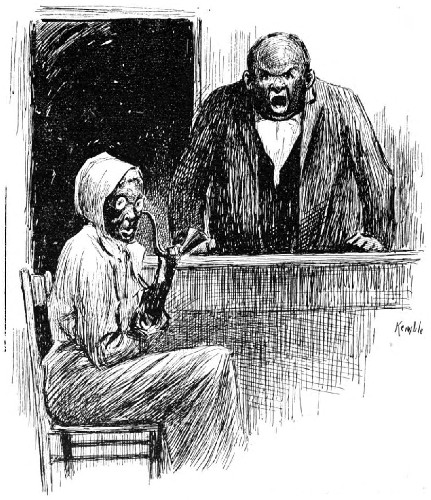
Drawn by E. W. Kemble.
The “Revun” Vinegar Atts began his sermon.
Then the child reached into the box with both
hands, filled them with lime, and rubbed them on
her face. By the mercy of heaven, she did not get
any of the stuff into her mouth and eyes. Then
she sat down and rubbed her feet with lime. The
effect was gratifying and she smiled.
By this time the sermon was ended. Vinegar
had not done much, but he had done the best he
could.
“Brudder Tucky Sugg will pray for us!”
Vinegar bawled.
The congregation reverently bowed.
Then a little black girl with lime-whitened face
and hands and legs, trotted silently up the aisle
and stood beside brother Tucky Sugg, listening
earnestly to his bawling voice.
She stretched out a tiny, lime-whitened hand
and touched Tucky Sugg timidly on the top of his
step-ladder head.
“Who you tryin’ to talk to, Revun?” she asked
in a bird-like voice.
Tucky Sugg opened his eyes and saw something
he had never seen before.
With a loud bellow like a frightened cow, he rolled
backward on the floor, and got up with an intense
desire to run.
“My Gawd!”
The voice was like an explosion of dynamite,
and expressed the consternation of the congregation
as they rose to their feet prepared for flight.
Ginny Babe Chew awoke from her slumber.
She stared at the little child a moment, then
reached out a fat, motherly hand.
“Come here, honey!” she bawled. “Yo’
mammy oughter had washed yo’ face an’ hands
befo’ she sont you to de meetin’-house.”
She wiped the lime off the child with the end of
her apron, and took the child in her lap.
Then, while the congregation was still standing,
Dinner Gaze from his place at one side of the
house began to sing, while all stood and listened:
“At de feast of Bill Shasser an’ a thousan’ of his lords,
While dey drunk from golden vessels as de Book of Truth records,
In de night as dey reveled in de royal palace hall,
Dey wus seized wid cornsternation—’twas de Hand upon de wall!
So our deeds is recorded—dar’s a Hand dat’s writin’ now.
Sinner, gib yo’ sins de go-by an’ to de Marster bow!
Fer de day am approachin’—it must come to one an’ all
When de sinner’s corndamnation will git written on de wall!”
On the instant that the song ended, a long, wailing
cry, that was at once full of anguish and heart-break,
ran through the building!
Old Isaiah Gaitskill, superintendent of the Gaitskill
hog-camp, ran down the aisle, clawing at the
white wool which fitted his head like a rubber cap.
His face was ashy with the dust of the high-way,
and tears had streaked it where they had ran
downward through the dust.
“My Gawd, cullud folks!” he wailed. “De
white folks is done kotched Hitch Diamond—dey
are fotchin’ him to jail right now! Here dey come
down de big road. Oh, my Gawd!”
The old negro turned and fell with his hands
clasping the altar, sobbing like a child.
The entire congregation ran out of the building
into the churchyard and looked up the street. To
the end of their lives they never forgot what they
saw.
Hitch Diamond, bareheaded, barefooted, dressed
in a red undershirt and a pair of blue overalls, was
walking down the middle of the street, his hands
manacled behind him, his head hanging in shame.
Dust covered him from head to feet, and perspiration
streamed down his face. He had tried to
wipe the perspiration away by rubbing his head
upon his broad shoulders, and this had smeared
his face with mud until he was a horrible creature
to behold.
Hitch looked old, he looked sick. All of the
pride and jauntiness which had characterized him
when he left Tickfall for the prize-fight had
dropped away, and he was merely the shell of the
man who had gone away from home to certain
pugilistic victory.
On either side of Hitch Diamond rode a strange
white man—New Orleans detectives employed by
the mill owners of Sawtown to track the fugitive
down. Behind the three rode the sheriff of Tickfall
Parish, Mr. John Flournoy.
Dainty Blackum ran back into the church and
brought from the pulpit a glass pitcher with a
broken spout. She met Hitch and the officers
right in front of the church, and the officers called
a halt as she held the pitcher up to Hitch Diamond’s
thirsty lips. Then, dipping a handkerchief into
the water, she wiped the mud and sweat from the
tortured man’s face.
Wail after wail arose from the crowd of negroes
in front of the Shoofly Church, and Hitch turned
and looked at them as if he did not realize where
he was.
Vinegar Atts ran out and placed his trembling
hand upon Sheriff Flournoy’s dusty stirrup.
“Whut dey got Hitch fer, Marse John?” he
sobbed.
“Murder!” Flournoy growled through jaws
which were shut together like a bear-trap. “He
killed the night watchman at the Sawtown mill!”
The party started again, and Vinegar stood in
his tracks as if turned to stone.
It seemed to take a few minutes for the Shoofly
congregation to comprehend what Flournoy had
said, or else the shock was so great that even their
emotions could find no expression, voluble as they
are as a race. Then a moan of sorrow swept like
a deep-toned note from some mighty musical
instrument; it was rich, melodious, heart-breaking—an
expression of the deepest and most acute
grief of their humble lives.
For Hitch was the hero of the colored population
of Tickfall. They had shared his glory as victor
in many a hard-fought fistic battle. They had
won many dollars on his prowess as a boxer. They
had helped to train him and perfect his wonderful
physical organization for every contest he had
ever participated in, and they loved him!
And Hitch deserved their affection. According
to his lights he was a good man, a clean liver, one
who took the best care he knew how of his superb
body. There was nothing vicious or ugly about
his disposition. He was merely a great, strong,
bone-headed pugilist, who had made the most of
himself by developing and using the best talent
he possessed, namely, his giant strength.
Still moaning like the sea as the tide flows out,
the Shoofly congregation flowed out into the road
and fell in behind, forming a long procession of sorrowing
friends.
Suddenly, above the low moan, in a tone which
ripped and roared and snarled like the angry
water breaking through a levee, came the mighty
voice of Ginny Babe Chew:
“Murder! Murder! Murder! Whut do Gawd
Awmighty think about dat?”
She pranced down the street, thrusting the
people aside with her ponderous body as a steamboat
cuts through the mushy ice upon a river.
Her voice howled like a wolf’s call, with a taunting,
bark-like, malicious, nerve-searing gratification:
“Murder!”
She managed to reach the head of the procession
and walked just behind Sheriff Flournoy’s horse.
She whirled round and round like a Dervish,
stooped and threw dust in the air, tore her clothes,
and waving her fists at the sky shrieked like a
maniac:
“Murder! Murder! Murder!”
John Flournoy stopped his horse, and turned
and looked at her with a queer expression upon his
face. Once he opened his mouth to speak, then
shut his jaws tight, turned his eyes forward and
rode on.
“Murder!” Ginny Babe Chew screamed.
Vinegar Atts could endure the horror no longer.
He ran forward, and caught Ginny Babe by her
fat shoulder and whirled her around. Vinegar
had had years of experience as a pugilist and was
Hitch’s boxing partner to this day. He knew
exactly where to place his blow.
His open palm with all his strength behind it
flattened upon Ginny Babe’s squalling lips. She
uttered a low grunt, and fell in the street.
John Flournoy looked back and nodded his
approval.
The crowd coming behind split in two halves,
and walked around Ginny’s prostrate body, noting
without pity that a stream of blood was flowing
from her thick lips. The crowd behind had been
augmented by hundreds before they reached the
Hen-Scratch saloon.
Skeeter Butts had just come to town in his
automobile, and was standing in front of his place
of business. His face turned the color of ashes,
and his lips stiffened with horror as he realized
what was coming down the street to meet him.
“Oh, Hitch!” he wailed. “Shorely dey ain’t
got you right, is dey, Hitch? Tell me dat dey
done missed it!”
But Hitch was too tortured to reply. He cast
one lingering look upon his friend, and turned
away with blood-shot, agonized eyes. Skeeter
Butts reeled back from the middle of the street and
covered his eyes with his trembling hands.
For a while after that the procession moved forward
in silence. Then a succession of piercing
screams shattered the atmosphere. A handsome
girl, whose hands and face were the color of old
gold, came running down the street, and threw her
arms around Hitch Diamond’s neck.
“Oh, Hitchie! Hitchie! Hitchie!” she screamed.
It was Goldie Curtain, Hitch’s wife.
For a moment Hitch’s giant body wavered, his
knees bent under him, and he staggered as if about
to fall. He stopped and leaned heavily upon the
sobbing girl whose arms clasped his neck.
“Move on!” a sharp-voiced officer spoke.
Goldie Curtain fell in the dust of the street like
one dead. Sheriff Flournoy, whose face was turned
to look behind him, did not see her lying there.
His nervous horse leaped over her prostrate body.
Vinegar Atts, sobbing aloud, picked the girl up
in his powerful arms, carried her into her own
house and placed her upon a bed. Then he came
out and joined again with the crowd which followed
Hitch until the doors of the jail closed behind him.
When Hitch had passed out of sight behind
those doors, Ginny Babe Chew came staggering
down the street, wiping the blood from her lips
and the front of her dress. She stood in the middle
of the street in front of the jail, shrieking like a
maniac. She stooped and gathered handfuls of
sand and tossed them into the air above her head,
while her calliope-like voice shrieked again and
again:
“Good-by, Hitch! Good-by, Hitch! Good-by,
Hitch!”
A whole week passed during which Skeeter
Butts sat in the Hen-Scratch saloon, nervously
smoking cigarettes and listening to the whispered
tales which came to him from his negro friends.
Skeeter had made no attempt to see Hitch Diamond,
and had not talked about him to any of the
white people. He knew it was not wise to show
too much interest in the case of a negro criminal.
He did not care to get himself under suspicion.
All of Hitch’s friends felt the same way, and since
their first dramatic display of emotion as Hitch
was led captive before the Shoofly Church, they
had assumed an attitude of indifference toward
Hitch and his pitiable plight.
It was the Sunday following Hitch’s return to
Tickfall when Skeeter determined to interview
Sheriff John Flournoy. Skeeter timed his call with
the sheriff’s custom of sitting on a little side porch
of his home and smoking an after-dinner cigar.
Skeeter fumbled for a few minutes with his hat,
considering how to begin what he had to say.
Then he asked:
“Marse John, whut is de white folks gwine do
wid Hitch Diamond?”
“Hang him!” Flournoy said bluntly, merely for
the purpose of seeing what Skeeter would say next.
The colored man said nothing for five minutes.
He sank down weakly upon the bottom step of the
porch, his shoulders pathetically hunched, and his
head resting upon his hands. At last he mumbled:
“Marse John, I don’t b’lieve Hitch kilt anybody.
He never done it.”
“Have you any proof of his innocence, Skeeter?”
Flournoy asked.
“Naw, suh.”
“It’s hard for me to believe, Skeeter,” Flournoy
continued quietly. “Hitch Diamond was born
on my plantation, and ever since I have known him
he has been a big, good-natured, bone-headed,
peaceable, law-abiding negro. Robbery and murder
are not in his line.”
“Dat’s right, Marse John—Hitch never done
it.”
There was a little silence, after which Flournoy
said:
“I think they’ve got Hitch, Skeeter. Some of
the white people in this town have always been
very fond of Hitch. They ought to come to his
aid at once—he’s their nigger. But all the white
folks have kept away.”
“Dat’s a bad sign, Marse John,” Skeeter agreed
mournfully.
“Yes. It means that Hitch is up against it.”
“Whut proofs is dey got, Marse John?” Skeeter
asked.
Replying, Flournoy spoke slowly and painfully,
as if the narration was repugnant to him:
“Hitch Diamond got off the train at Sawtown
about three o’clock on Monday afternoon. A
grocer saw him dressed in a stove-pipe hat, a
Prince Albert coat, and a yellow waistcoat. A
little later he was seen by two small white boys
without his hat, coat, or vest, sitting on the wharf-boat.
A watchman on the wharf-boat says that
Hitch attempted to run when he came near, and in
the effort to arrest Hitch his shirt was torn off his
back. Dainty Blackum says that Hitch came to
her home, barefooted, bareheaded, with no outer
shirt, but wearing a red undershirt.
“Hitch Diamond and Dude Blackum had a
drink together, and then both men left Blackum’s
cabin about dark and went toward the sawmill.
Five hours later the commissary store was robbed
and the watchman was killed.
“The mill employees organized a search-party
and had a hand to hand battle with Hitch Diamond
inside the lumber yard, and Hitch escaped.
The flash-lights were playing on Hitch, and everybody
saw him and recognized him.
“After Hitch escaped, Dude Blackum was
caught inside the lumber yard, and in attempting
to escape by swimming the Mississippi River,
Dude was drowned.”
“My Lawd!” Skeeter shuddered.
“Now, here is the worst part of it,” Flournoy
continued. “A stove-pipe hat, a Prince Albert
coat, and a yellow waistcoat were found under
the steps of the commissary store, and these garments
fit Hitch Diamond perfectly, and Hitch
admits that they are his. A pair of black trousers,
torn at the seat and with one leg split up the front
from the bottom almost to the waistband, was
found near the scene of the fight in the lumber
yard, and this pair of trousers fits Hitch and he
admits that the garment is his.”
“Oh, Lawdy!” Skeeter shuddered.
“Hitch can give no reason for his visit to Sawtown
except that he had never been there and
wanted to see the place. He explains the loss of
his hat and coat and vest by saying that he surrendered
them to a negro whom he had never
seen before and whose name he did not know to
be hung up in the Sawtown barracks where the
homeless workmen sleep. He confesses that he
abandoned his trousers in the lumber yard for the
purpose of fighting his way through the mob of
searchers and escaping.
“Hitch declares that he did not know a human
being in Sawtown. Dainty Blackum says that
Hitch told her that he had known Dude Blackum
for many years. Hitch says he went to Dude
Blackum’s cabin to get a drink of liquor. Dainty
says he pretended to be a negro preacher, and
claimed to be much hurt because Dude had not
secured him to marry them.
“Hitch admits that he traveled from Sawtown
to the Gaitskill hog-camp wearing no garments
except his underclothes, and going by night. Old
Isaiah Gaitskill says that Hitch came to his cabin
in that undressed condition, sick with hunger and
exhaustion, and would not permit him to send for a
doctor, to inform his wife, or let any of his friends
know where he was!”
“My lawdymussy!” Skeeter chattered. The
little barkeeper felt as though cold snakes were
crawling up and down his spine, and he sat for ten
minutes without saying a word. At last Flournoy
asked:
“What do you make of it, Skeeter?”
“Marse John,” Skeeter protested in a wailing
tone, “Hitch Diamond is done cornfessed too
much!”
Flournoy understood exactly what he meant.
“Certainly,” he said. “Hitch has talked too
freely to be guilty—his statements have been
too frank. A guilty negro never does that; if
he commits a crime, he denies everything to
the very last, and offers no explanation for anything.”
“Dat’s right,” Skeeter sighed. “Dat’s how he
do.”
“But you’d have a happy time convincing a
jury of Hitch’s innocence on the ground that he
had talked too much!”
After a long silence, Skeeter asked:
“Whut does you think about dis case, Marse
John?”
“I think Hitch was drunk,” Flournoy answered.
“I doubt if Hitch himself knows whether he
committed that crime or not. He talks a lot of
stuff about meeting a man on the train, about
losing some money, about giving his clothes away,
about being stepped on by some man while he was
lying asleep in a gulley—all of it a perfect mess.
I hate to admit it, but I really believe that Hitch
committed the crime while in an intoxicated
condition. Dainty Blackum says that he took
fourteen swallows of bust-head, pine-top, nigger
whisky in her cabin, and that he and Dude took
the jug with them when they left.”
“My gosh!” Skeeter sighed. “When did de
white folks ’terrogate Dainty Blackum?”
“They questioned her in Sawtown the day after
Dude was killed by the mob,” Flournoy replied.
“Dainty is here now—in Ginny Babe Chew’s
house. I’m keeping watch on her, because she’s a
material witness.”
“When am Hitch’s trial gwine be, Marse John?”
Skeeter asked.
“It begins a month from next Tuesday,” the
sheriff said.
“Pore old Hitchy!” Skeeter mourned.
Two big tears rolled down his cheeks and
dropped upon his brown hands. His lips began to
tremble, and he hid his face with his hat and sat
with his shoulders shaking with grief. Finally he
said in a mournful voice:
“Hitch is always been de bes’ nigger frien’ I’m
had, Marse John—him an’ Vinegar Atts. I wus
always a little runt nigger an’ I didn’t had no
kinnery, an’ Hitch an’ Vinegar, dey always deefended
me when de yuther nigger-boys pecked on
me——”
Skeeter began to sob and sat mourning for his
friend as though he were already dead.
Flournoy endured the racket as long as he cared
to, then tossed his cigar-stub into a rose-bush,
walked down the steps, and climbed into his
automobile.
Without a word to Skeeter, he shot down the
runway into the street and turned toward the
courthouse. In a moment he was swallowed up
in a cloud of dust.
Skeeter sat for two hours turning over the
appalling array of facts which the sheriff had set
before him for the condemnation of his friend.
Nothing seemed to be lacking except Hitch’s
confession that he had robbed the store and killed
the watchman.
“Dis here is awful!” he sighed. “I’s gwine
over an’ git some religium advices from de Revun
Vinegar Atts.”
He found Vinegar occupying his customary seat
under a chinaberry tree in front of the Shoofly
Church. Vinegar moved his chair only when the
shadow of the tree shifted and the sun shone upon
his head. He called this diversion “settin’ de sun
aroun’ de tree.”
“Revun,” Skeeter began, “I been cornversin’
Marse John Flournoy about our chu’ch an’ lodge
brudder, Hitch Diamond.”
“No hope!” Vinegar grumbled. “Hitch is
done flirted wid a hearse one time too many. He’s
as good as dead.”
“Cain’t we do nothin’ fer him?” Skeeter
asked.
“We kin save up money in de chu’ch an’ de
lodge fer a real nice funeral,” Vinegar said. “Atter
de white folks is done deir wuck, Hitch’ll furnish
de corp’.”
“Is you interrogated any of de white folks?”
Skeeter inquired.
“Yes, suh. Marse Tom Gaitskill tole me all I
knows. Hitch wucked fer de kunnel, an’ kunnel
say he’s got to git him anodder nigger—de cote-house
is gwine spile Hitch!”
“Ain’t de kunnel tryin’ to he’p Hitch none?”
Skeeter asked.
“Naw. What kin be did fer a nigger whut is
kotch his tail in a cuttin’-box like Hitch done?”
“I feels sorry fer Hitch, Revun,” Skeeter mumbled
piteously. “Gawd, I’d do anything fer him
dat I could!”
“Not me!” Vinegar bellowed. “When de white
folks backs off, dat’s de sign fer Revun Atts to git
away befo’ de bust-up comes. Naw, suh, Hitch
ain’t got no hope!”
Vinegar’s voice was a bellow which could be
heard a block away. He stood up, took off his
stove-pipe preaching hat, and mopped the sweat
from the top of his bald head with a big, red
handkerchief.
“Naw, suh!” he howled. “You oughter had
been to chu’ch dis mawnin’ an’ heered me orate
’bout Hitch Diamond. I shore preached his
funeral good! I tole dem niggers how Hitch
went to N’Awleens an’ fit in a sinful prize-fight an’
got on a big, bust-head drunk an’ vamoosed up to
Sawtown an’ robbed an’ kilt, an’ is fotch back here
now to dis town to show whut happens to de
members of de Shoo-fly Chu’ch when dey rambles
away from de highways of holiness—whoosh!”
Vinegar broke off with a snort and a flourish,
seizing the chair in which he had sat and thrust
it up so close to Skeeter’s chair that he pinched
Skeeter’s fingers.
Then he sat down with his thick lips not two
inches from Skeeter’s ear.
“Listen, Skeeter,” he whispered. “Marse Tom
Gaitskill an’ Sheriff John Flournoy don’t think
dat Hitch is guilty—dey’s bellerin’ it aroun’
town that Hitch is shore a deader so dey kin hunt
fer de real guilty man on de sly!”
“Bless Gawd!” Skeeter grinned.
“I been buttlin’ fer Marse Tom ever since
Hitch went to N’Awleens, an’ I been snoopin’
aroun’ an’ listenin’ to deir talk. Marse Tom an’
Marse John sot up mighty nigh all night las’
Friday talkin’ an’ smokin’ an’ cussin’ in Marse
Tom’s dinin’-room. I sot up out on de porch an’
listened to ’em. Dey done agree dat de bes’ thing
fer Hitch is fer eve’ybody not to hab no hope. I
agrees wid de white folks.”
“Bless Gawd!” Skeeter Butts cackled.
“Git yo’ nose on de trail an’ sot yo’ mouth to
howlin’ like a houn’-dog, Skeeter,” Vinegar
grinned. Then, in a bellow which echoed back
from the woods in the rear of the church, he howled:
“No hope!”
“Dem is de best religium advices you ever
orated, Revun,” Skeeter cackled as he rose to his
feet. “I’s gwine turn detecative right dis minute
an’ snoop aroun’ seein’ how much I kin find out!”
He walked straight to the courthouse and
entered the sheriff’s office.
“Could I be allowed to see Hitch, Marse John?”
he asked.
“Certainly. Any of his colored friends may see
him if they come at a reasonable time. I’ll admit
you to the jail.”
When Skeeter was admitted and locked behind
the bars of the jail, and saw Hitch Diamond
pacing up and down the corridor in the second
story, the only occupant of the prison, he found
to his annoyance that he could not begin a word
of conversation with his lifelong friend. When
talking to others, he could speak about Hitch
and his misfortune with great volubility, but face
to face with Hitch, what was there to say?
The two sat down, Skeeter laid a package of
cigarettes upon the seat of a chair beside them,
and after that for twenty minutes there was perfect
silence. Not a word had been spoken except
their first brief and embarrassed greetings. Each
sat, smoking furiously, and lighting a fresh cigarette
upon the stub of the old one.
At last Skeeter managed to speak, and made
the one request which opened the floodgates of
Hitch Diamond’s talk:
“Tell me all about it, Hitchy. Don’t leave out
no little thing.”
Hitch dropped his cigarette at his feet and began.
For two hours his low voice rumbled on, the
narrative beginning from the moment he left Tickfall
to go to New Orleans to the prize-fight and
progressing with minute particularity to the
moment when he sat in the jail beside Skeeter
Butts.
Skeeter listened with a heart as heavy as lead.
It seemed to him that Hitch had confessed everything
except the actual commission of the crime of
murder and robbery. The array of proof which
Flournoy had was sustained and established in
every particular by Hitch’s story. Vinegar had
fired his hopes for a moment by betraying the
secret that the white folks were unconvinced of
Hitch’s guilt and were hunting for the perpetrator
of the deed. But Skeeter knew when Hitch had
finished his story that Hitch would pay the penalty
for his crime.
Not a word did Skeeter utter until the narrative
was ended. Then he arose and held out his
hand.
“Good-by, Hitch,” he said, with a catch in his
voice. He walked down the steps, and the jailer
opened the door and let him out.
Passing across the courthouse yard he met
Sheriff Flournoy.
“Marse John,” he said, “you tole me dat Hitch
wus borned on yo’ plantation. Does you know
who his maw is?”
“Certainly.”
“Is his maw livin’ yit?”
“Yes.”
“I ain’t never heerd Hitch say nothin’ ’bout his
maw,” Skeeter remarked.
“Hitch don’t know who his mother is,” Flournoy
smiled. “I doubt if she knows that Hitch is
her son.”
“How come?” Skeeter asked.
“Hitch’s mother committed a little crime the
year before I was elected sheriff. Hitch was then
one year old. His mother abandoned him—ran
off and stayed away for thirty years. Hitch was
taken care of by the other negroes on the plantation,
and all who once knew who Hitch’s mother
is are now either dead or have gone away from
here.”
“Fer Gawd’s sake, Marse John!” Skeeter
wailed. “Why don’t you tell Hitch who his maw
am? Who is she?”
Flournoy considered this question while he took
the time to light a fresh cigar. Then he asked:
“If I tell you who Hitch’s mother is, will you
promise never to reveal it?”
“I promises!” Skeeter exclaimed.
“His mother is Ginny Babe Chew!” the sheriff
told him.
Skeeter reeled back from the shock, and an
exclamation shot from his throat like a bullet.
He turned round and round like a man who was
dazed, uttering a series of highly profane expletives
like the crackling of thorns under a pot.
“You asked me why I didn’t tell Hitch who his
mother was,” the sheriff continued, as he started
away. “I think you know the answer!”
Ginny Babe Chew!
Like a panorama the events of the Sunday before
passed before his dazed and horrified vision—Ginny
Babe Chew, shrieking, cursing, whooping,
thrusting the people aside and pressing up
behind the sheriff’s horse, howling after her son the
charge of “Murder! Murder! Murder!” Again
he saw her struck down by the massive fist of Vinegar
Atts, the blood streaming from her lips, the
mob splitting into halves as they walked past her,
while she groaned and cursed, groveling in the dust.
Again he saw her staggering down the street, the
blood reddening the front of her dress and making
a red froth upon her lips, as she stood in front of
the jail tossing dust into the air, gyrating, shrieking,
cursing, and wailing, “Good-by, Hitch!
Good-by, Hitch!”
What a mother for any man to have!
Skeeter staggered across the courthouse yard,
wiping the clammy sweat from his temples.
“Marse John made me promise not to tell
nobody who Hitch’s maw is. Ef I wus to tell dat
fack, de white folks would hang Hitch Diamond
befo’ night. Dat’s de awfullest fack agin him
yit!”
In front of the post-office he met Vinegar Atts.
“Revun Atts,” Skeeter said earnestly, “ef you
know any good religium advices to gib to a nigger
whut is about to die, fer de Lawd sake go preach
’em to Hitch Diamond. De white folks is got
him—got him good!”
The sunshine lay hot upon the sand in the
negro settlement called Dirty-Six when Dainty
Blackum arose from her bed, dressed, and walked
out into the yard. In the rear of Ginny Babe
Chew’s house was a large number of fig and pecan-trees,
and under the shade of one of these trees,
patiently waiting and smoking a cigarette, was
Skeeter Butts.
For a moment Dainty was surprised; then she
reflected that she had expected some man to be
there that morning, as some man had been there
every morning, and she would have been disappointed
if she had not found one.
But Skeeter Butts had never been there before.
She had heard that he was very susceptible to the
charms of women, but up to this time she had
received the devoted attention of only two men—Dinner
Gaze and Tucky Sugg.
She came over and sat down beside Skeeter.
“Yistiddy wus a busy day fer me, Skeeter,”
she began. “Two men tole me dey loved me an’
axed me to marry ’em. Dat’s a pretty good
starter.”
Skeeter had entertained no idea of making love
to Dainty when he called to see her, having had an
entirely different purpose. But as he did not know
exactly how to approach the subject which he
wished to discuss, he decided to follow her line of
conversation, hoping to direct it at a later time.
“Yes’m, dat’s so,” Skeeter remarked without
enthusiasm. “De fack is, I wus so busy dat I
looked over de chance to ax you to marry me
yistiddy, so I comed early dis mawnin’ to git in a
word ’bout dat——”
“I tole de two yuther men dey wus losin’ time,
an’ I tells you dat same word in eggsvance.”
“Of co’se, I don’t expeck you to fall right in wid
dat suggestion,” Skeeter hastened to say. “But
I wants you to know whut way I is leanin’.”
“You done took a notion to lean mighty sudden,”
Dainty snapped. “You better lean de
yuther way. You ain’t able to suppote no wife.”
“Whut’s de use of gittin’ able to suppote somepin
you ain’t got?” Skeeter asked absently. “Us
owns a hoss befo’ us buys any hoss-feed.”
The girl made no reply.
After a while Skeeter added another remark in
an absent-minded way:
“Sometimes niggers buys a hoss an’ depen’s on
stealin’ de hoss-feed. Dey always gits in trouble
wid de white folks, too, when dey does dat.”
Instantly the girl’s manner changed completely.
She bit her lips and her hands began to tremble.
She looked as if dizziness and weakness were about
to overcome her.
“When a nigger gits in trouble wid de white
folks, it’s all off wid him,” Skeeter blundered on,
his mind upon Hitch Diamond, and all unconscious
of the impression he was making upon the girl
beside him. “Sometimes luck is wid him an’ he
kin run off, but most often he——”
Suddenly Skeeter broke off and looked at Dainty
with popping eyes. For the moment he had forgotten
the tragedy in the girl’s life, and now he
was struck speechless, and merely sat there and
stared and gasped. At last he murmured:
“I done slopped de wrong pig!”
“Dat’s right, Skeeter,” the girl said in a bitter
tone. “De best thing you kin do is to ramble
outen dis yard an’ don’t come back no more.”
“I didn’t mean nothin’, Dainty,” Skeeter said
humbly. “I’s done had a heap of trouble, an’ it
’pears like I ain’t got my real good sense.”
“Dat’s a fack,” Dainty said.
“I won’t never do it no mo’,” Skeeter pleaded.
“Dat’s a fack,” Dainty announced. She arose
and walked into the house.
Skeeter remained seated upon the bench, trying
to think up some way to square himself with the
girl, but his mind would not work with its usual
facility.
Then in the yard on the other side of the house
there was a loud, angry squall, followed by the
wild, frightened squawking of a hen, and Ginny
Babe Chew waddled around to where Skeeter
was sitting.
At the corner of the house there was a barrel
of rain-water setting under a gutter-spout, and
into this water Ginny Babe ducked the hen viciously
a number of times.
She tossed the hen on the ground, where it lay
gasping for air and half drowned.
Skeeter sat and cackled like another hen.
“Shut up, you little devil!” Ginny Babe
squalled. “I’ll ketch you an’ do you de same
way!”
“Whut ails de hen, Ginny?” Skeeter laughed.
“She wants to sot, an’ I ain’t got no eggs to put
under her,” Ginny whooped. “I locked her up
in de wood-house an’ she foun’ a ole china door-knob
an’ sot on dat. I put her in de corn-crib an’
she sot down on a lot of corn-cobs an’ tried to hatch
’em out. I’s ducked her in dat barrel of water
’bout fo’teen times, an’ it ain’t done no good
whatsumever. I never did see such a fool!”
“Why don’t you try on somepin else?” Skeeter
giggled.
“Whut’s dat?” Ginny whooped.
“Pour a leetle coal-ile on her tail an’ sot it on
fire,” Skeeter snickered. “I figger she won’t sot
no more atter dat.”
“By gosh, I’ll do it!” Ginny Babe howled.
She walked over and pushed the hen with her
foot.
“You don’t git no coal-ile on yo’ tail yit!” she
bellowed. “But as soon as dem feathers gits dry,
I got a good mind to try it!”
Skeeter looked at Ginny Babe Chew, and a cold
chill ran down his spine. She was the one woman
in Tickfall of whom every negro was afraid. She
was a wicked, vicious, horrible old woman, whose
little, green pig eyes glowed poisonously through
the rolls of facial flesh. She possessed an ugly and
venomous laugh, and generally ended her profane
and vicious remarks with an irritating chuckle.
Ginny knew the history of all the people in Tickfall
parish, both white and black, and most of her
conversation on ordinary occasions was a discussion
of their characters. She especially loved to
drive nails in the coffins of moribund reputations.
Now she sat down heavily and began a conversation
upon her favorite theme.
“I done wucked in de house of eve’y white man
in dis parish whut is able to hire he’p,” she bawled.
“I knows all de fambly secrets, an’ I done got my
little, bullet eye on all de fambly skelingtons. I’s
made acquaintance wid all de niggers in dis parish,
too, an’ I tells you dis—some niggers is bad, an’
yuther niggers is wusser; but dar ain’t no good
niggers, livin’ or dead! I knows ’em! So I spends
my happy old age findin’ out all de bad I kin about
’em!”
“Yes’m,” Skeeter gasped, looking at her with
frightened eyes.
“All you niggers in Tickfall—whoof!” the old
woman exploded.
“I hopes we is as good as most niggers,” Skeeter
said timidly.
“Whoof!” the old woman exploded again.
“Does you want me to tell you whut I knows
about you, Skeeter Butts?”
“Fer Gawd’s sake, no’m!” Skeeter quavered.
“My memory is powerful good.”
The woman’s fat body shook with silent laughter
and her little pig eyes glowed like emeralds. She
laid a heavy, fat hand on Skeeter’s knee.
“I’s got a hoodoo face, Skeeter!” she bawled.
“When a nigger looks at my fat mug, all de meanness
in him comes right out on his face so I kin
read it like de white folks reads a book. Yes, suh,
I got a hoodoo face!”
While Skeeter Butts sat beside her and trembled,
wondering what to say, and very much wishing
himself somewhere else, Dinner Gaze and Tucky
Sugg came around to the side of the house where
they were sitting.
“You want me to cornfess yo’ sins fer you,
Dinner Gaze?” Ginny Babe howled, turning her
green eyes upon him.
“You don’t know nothin’.” Dinner asserted,
gazing at her with his beady eyes without a trace
of fear, his black, dough-like face as expressionless
as when Hitch Diamond had first seen it.
“Whoof!” the old woman exploded the third
time. Shifting her mountainous fat to her feet
and standing up, she glared at Dinner Gaze in a
perfect fury; then, to Skeeter’s surprise, her voice
changed completely from its bellowing tone to an
intonation as soft as Dinner’s own. She muttered
aloud, looking at Dinner with intent gaze as if she
were seeing him for the first time:
“Naw, suh, I don’t know nothin’ agin you!”
“I gambles fer a livin’,” Dinner grinned. “Dat
ain’t no highbrow job. I follers de races an’ hangs
aroun’ prize-fighters, an’ drinks a little booze an’
plays a little craps an’ coon-can, but I ain’t got
nothin’ to hide from nobody.”
“Dar now!” Ginny whooped in a triumphant
voice. “Didn’t I jes’ tole you dat I had a hoodoo
face? Nobody kin look at me an’ hide deir sins!”
“I ain’t allowin’ nobody to low-rate me,
neither,” Tucky Sugg proclaimed. “You wanter
cornfess my sins, Sister Ginny?”
Ginny broke out into a loud, whooping laugh.
“You ain’t got no sins, Tucky,” she guffawed.
“You ain’t nothin’ but a idjut—an’ no limb didn’t
fall on you, neither. You was nachel-bawned dat
way. Idjuts ain’t responsible!”
Chuckling to herself, she picked up her fast-reviving
hen, carried it back to a large hen-house
on the other side of her home, and threw it inside
the door. Closing the door she waddled back, and
waved a fat hand at the three men. “Don’t
fergit dat Ginny’s got a hoodoo face, niggers!”
she bawled.
“Huh!” Dinner Gaze grunted. “Listen to dat
ole fat fool!”
“Come on, niggers,” Tucky Sugg said in a disgusted
tone. “Less git away from dis place.”
As the three men walked down the street,
Skeeter said: “Dinner, is you ever had any expe’unce
’tendin’ bar?”
“Yes, suh.”
“Would you wish to he’p Pap Curtain take keer
of my saloom fer de nex’ ten days?” he asked
next.
“It’ll suit me fine,” Dinner told him.
They discussed the business for a little while,
then Skeeter left them at the next corner.
“I leaves it wid you an’ Pap, Dinner,” Skeeter
said. “I needs a leetle rest an’ I’s gwine to trabbel
some.”
For the next four days Pap Curtain and Dinner
Gaze tended bar in the Hen-Scratch saloon for
Skeeter Butts.
Vinegar Atts and Tucky Sugg started a protracted
meeting in the old Shoofly Church which
was attended by throngs who listened with bated
breath to Vinegar’s bawling exhortations to righteousness
based upon the horrible example of Hitch
Diamond, who found himself in a predicament
where there was “no hope.”
Meanwhile Skeeter went to New Orleans, and
to Sawtown. He tracked Hitch Diamond from
the moment he left Tickfall to go to the prize-fight
until he returned to Tickfall, bareheaded,
barefooted, with his hands manacled behind him,
and under the escort of the officers of the law.
In both places he dodged Sheriff John Flournoy,
who was also conducting an investigation. Both
were on the same mission, and Skeeter saw Flournoy
a dozen times at different places.
Skeeter and Flournoy returned to Tickfall,
crushed and hopeless, appalled at the array of
evidence which Hitch Diamond had to confront
at his coming trial. It was not a pretense, but a
fact, that Hitch Diamond had no hope.
It was almost dark when Skeeter climbed
wearily off the train at Tickfall and started up the
street toward Dirty-Six. He overtook Sheriff
John Flournoy walking slowly up the street.
“Whut is Hitch’s chances now, Marse John?”
he asked.
“He has none,” Flournoy replied. “There is
no longer a shadow of doubt in my mind that Hitch
Diamond committed the crime with which he is
charged.”
“Yes, suh, dat’s de way it looks,” Skeeter agreed
sadly. He dropped behind, stopped, and let the
sheriff go on alone. He stood leaning against a
fence for a while, wondering what to do next.
Finally he said to himself:
“I’s gwine to Ginny Babe Chew’s cabin an’
narrate her all I is found out. Mebbe dat ole
hoodoo face kin see mo’ hope dan I kin.”
He passed the Hen-Scratch saloon and peeped
into the window, where he saw Pap and Dinner
Gaze playing cards at a small table. He passed
the Shoofly Church, where he heard the voice of
Vinegar Atts bellowing like a lost cow. On the
edge of the settlement he entered the yard of
Ginny Babe Chew’s home, and found Dainty
sitting alone upon the porch.
Ginny Babe was in the hen-house rendering
profane ministrations to the same old hen which
was still of a mind to brood, whether there was
anything to hatch or not.
That hen had entertained Ginny Babe for a
week. She had exhausted every known method to
break up the fowl’s desire to “set,” dousing it in
water, ducking it in ashes, tying a long red trailer
of wool to its feet, and other things of that general
nature. Now she stood growling profanity, wondering
what else she could do to the obstinate old
biddy.
Suddenly she thought of the suggestion made by
Skeeter Butts: “Pour coal-ile on her tail an’ sot
her on fire!”
She picked up an old rag lying in the yard,
wrapped it around the squawking hen’s tail, carried
the fowl to the back porch, where she found
an oil-can, and saturated the rag well with the
petroleum.
Then she struck a match and set the rag afire.
The startled hen fluttered out of her arms, ran
straight into the hen-house, shed the oil-soaked,
blazing rag with most of her tail feathers, and ran
out of the hen-house into the high weeds.
But the burning rag left in the hen-house got
busy with the loose straw and the other dry
trash, and in a moment the whole house was in a
blaze!
Ginny was famous for the noise she could make
with her throat. Her very name was a perversion
of the word for that noisy hen the guinea, and
from her earliest childhood this word had been
indicative of her chief faculty. But on this occasion
she broke all previous records for racket.
“Fire! Fire! Fire!” she began.
What she said after that and the noises she
made cannot enter into this narrative because
they cannot be reproduced in print.
The dry grass, the straw, the inflammable
trash, the dusty accumulations of years, due to
Ginny’s idea that the way to clean up her yard
was to sweep everything inside the hen-house—all
was afire and blazing merrily.
Skeeter and Dainty heard her wails and ran
around the house. Then Skeeter grabbed a tree
with both hands, spread his alligator mouth to its
utmost limit, and laughed himself into hysterics.
The portion of Tickfall occupied by the whites
had water-works, and adequate fire protection.
The negro settlement known as Dirty-Six had no
water, but was protected from fire by a chemical
engine. There was a fire-engine house, a pole
beside it with a bell on top, and a rope suspended
from the bell within reach of the hand.
When the engine-house was first erected four
years before, the negroes had waited rather impatiently
for some one’s house to catch on fire.
They wanted to see their new engine in operation.
Nothing caught fire, not even a chicken-coop.
For four years the bell at the engine-house had not
been rung.
Then, on some occasion which called for a celebration
on the part of the negroes, they had asked
and had been given permission to take the chemical
wagon out, attach the hose, and sprinkle the
street, merely to show that the hose would actually
squirt water and the engine pump it.
After the celebration the apparatus was dragged
back and placed in the engine-house, and the
inhabitants of Dirty-Six resumed their watchful
waiting.
Now the cry of “Fire!” echoed through the
settlement.
It was caught up on every corner. Negroes
seized their shotguns and pistols and ran down
the street, firing them into the air—the fire-signal
in all Southern villages.
Vinegar Atts, standing in the pulpit of the
Shoofly Church, paused in the midst of a fiery
exhortation, listened to the cry of “Fire!” ringing
through the settlement.
“Fire!” Vinegar bellowed, and started in a
lope for the street, leading all the congregation in
the race. They, with the other inhabitants of
Dirty-Six, gladly assembled, not at the scene of the
fire, but at the engine-house!
“Ring de bell!” a hundred voices bawled.
The bell-rope was gone. Some little piccaninny
had needed a rope to tie his dog and had helped
himself.
Two or three boys tried to climb the post and
ring the bell, but they could not reach it.
“Open de door an’ fotch out de engyne!” the
crowd whooped.
Forty men ran their hands into their pockets
and brought them out empty. They did not have
the key to the door. They had never had the key.
The action was mechanical and unconscious.
Who had the key? No one knew. It had been
two years since any one had entered the building.
The door was locked and the key was lost.
“Bust de door down!” was the next call from
the crowd.
Strong shoulders were pressed against the
fragile door, and the crash of its timbers was
answered by the shouts of the people and the onrush
of the crowd. They laid hold upon the rope
and pulled the machine to the scene of the fire.
Down the alley by the side of the house they
ran, broke down the fence and pulled the machine
into the yard. With many shouts they unwound
the hose, attached it to the engine, turned the
faucets and began to pump.
From the hose came a long whistling sound of
air:
“Whee-ee-ee-e!”
Not a drop of chemical water. The celebration
two years before had exhausted the chemical, and
the engine had never been recharged. The hen-house
burned without interruption.
Ginny Babe Chew turned toward that crowd of
heroic negro firemen, and the pumps of her profanity
worked without a hitch as she poured out a
stream of sulphurous and vitriolic language upon
their luckless heads. Skeeter Butts still hung
to the tree with both hands, laughing with whoops
like a yelling Comanche.
The firemen laid hold upon their chemical machine
and dragged it out of the yard.
Suddenly Skeeter’s laughter ended with a gurgle
of choked surprise. With his mouth still open
wide, he gazed upward at a little dormer window
which looked out of the attic of Ginny Babe Chew’s
home. Slowly his hair rose up on his head, and
cold chills ran down his spine.
The light reflected from the burning hen-house
clearly revealed a male human face at the dormer
window!
The man was looking down into the yard, watching
the crowd, watching the fire, and at times
grinning at something he saw. Skeeter watched
that face for two or three minutes; its clear outlines
were stamped indelibly upon his mind. He
had never seen the negro before!
Then he sprang to the side of Vinegar Atts and
squalled:
“Come on up-stairs wid me, Vinegar—quick!”
The two ran into the house. Skeeter took his
automatic pistol from his pocket, and leading the
way, ran up the little, narrow stairs which led to
the attic. They pushed open the door of the
room and entered.
The room was empty!
Skeeter ran to the window and looked out, just
as he had seen the strange negro do. Instantly the
fat face of Ginny Babe Chew was raised to the
window, her green pig eyes glowed malevolently,
and her fat fists were clenched and raised in malediction.
“Come out of dat attic, you little yellow-faced
debbil!” she whooped. “I’ll bust yo’ neck!”
On the first Tuesday in September the open
spaces in front and on the sides of the Tickfall courthouse
filled up early with a crowd of negroes. It
was the occasion of the opening of the criminal
term of the district court, and all witnesses and
talesmen were called to court for the trial of Hitch
Diamond, charged with murder, against the peace
and dignity of the commonwealth of Louisiana
and the statutes made and provided.
The witnesses and talesmen already sat in the
court-room, along with as many other people,
mostly colored, as could squeeze in there. Even
now, at nine o’clock in the morning, the heat of
that ill-ventilated room was stifling, the odor was
overpowering. Men sat on the bench seats, on the
back of the benches, on the ledges of the windows;
they stood in the aisles, in the corridors, on the
stairways, and were ranged in rows along the soiled
and dusty walls.
Inside the low railing which divided the room,
and nearest to the chairs which the jurors were to
occupy, Hitch Diamond sat at a long table with
Goldie Curtain by his side. In that crowd of
people, either white or black, Goldie was the one
splotch of vivid coloring—her face and hands and
neck a beautiful orange in color, and her half-caste
beauty most striking and attractive. Hitch sat
beside the table as stolid and indifferent as a
wooden man, but Goldie trembled, her nervous
fingers plaited in and out of each other like squirming
snakes; she was scared and shrinking, pitiable
and lonely.
Just outside the low railing sat Ginny Babe
Chew and Dinner Gaze, directly behind the broad
back of Hitch Diamond. Ginny slowly slapped
at her fat face with a turkey-wing fan. Her big
mouth was clamped shut like a steel trap, and her
little green, greedy, pig eyes glared through the
rolls of facial fat with baleful, condemning gaze
upon everything and everybody around her.
A little farther away from Hitch, but on the
same front seat with Ginny Chew and Dinner
Gaze, sat the Reverend Vinegar Atts and Tucky
Sugg.
There was a window behind the jury-box, so
that the light falling over the heads of the jurors
would fall full upon the faces of the witnesses as
they sat in the chair, and would illumine every line
in the faces of the lawyers as they presented their
sides to the jury.
On the opposite side of the room there was
another window, and within this window, sitting
precariously on the ledge, was Pap Curtain. He
had asked and obtained permission from Sheriff
Flournoy to sit within the bar on the ground that
it was his son-in-law who was being tried for his
life.
Across from Hitch Diamond the district attorney
sat at another long table to represent the
cause of the State. Tall, urbane, white-haired,
with the reputation of being a pitiless prosecutor of
criminals, Dan Davazec was confident and jaunty.
He fussed about busily, arranging and rearranging
the table in front of him, shoving aside the water-pitcher,
the ink-bottle, a pile of law-books with
freckled-leather covers, as a battleship strips her
decks for action.
“It’s a cinch, Sam,” he chuckled to the editor
of the Tickfall Whoop. “Dead open-and-shut!”
Davazec had tried in vain to find a wife, or
mother, or sisters of the night-watchman for whose
murder Hitch Diamond was to be tried. He
wanted somebody to lend force and eloquence to
his plea by sitting before the jury dressed in black
and wearing a long, thick mourning veil. But
the murdered man apparently had no kinsmen, so
Davazec lacked these eloquent figures of desolation
and sorrow.
But the two owners of the Sawtown mill sat at
the table beside Davazec, and the room in the rear
of the judge’s bench was crowded with witnesses.
Davazec felt the importance of his place and the
certain triumph of his cause, and he swelled and
expanded in his clothes at the thought of how
helpful this day’s proceedings would be to him
when he announced himself for reëlection.
From his office in the rear the judge entered the
court-room, followed by a clerk bearing a few law-books
and some sheets of paper and a large palm-leaf
fan. Judge Haddan was a pale, sickly looking
man with a weak voice, trembling hands, and
stooped shoulders. But his head was massive and
Websterian, and his eyes glowed like the eyes of
some jungle beast. No man within the borders
of the State commanded more respect as a lawyer
and a jurist.
Hitch Diamond raised his massive head and
eyed the judge with the stolid gaze of a stupid
horse. Goldie gasped, and laced and interlaced
her nervous fingers in her lap.
The opening ceremonies of the court were soon
over. No one paid any attention to the few formalities,
for they were all hastening to get at the
thing of big interest.
The clerk called the case of the Commonwealth
versus Hitch Diamond.
“We are ready, your honor,” Dan Davazec said
in his clear voice.
“Where is your counsel, Hitch Diamond?”
Judge Haddan asked.
“I ain’t got none, boss,” Hitch answered.
“Do you wish me to assign you counsel?”
Haddan inquired.
Hitch stood up and scratched his woolly head.
“Boss,” he said, in a sad tone, “one time when
yo’ leetle gal got sick an’ you lived out on yo’
plantation in de country, I done you a leetle favor.
Does you remember, boss?”
Haddan looked straight at Hitch Diamond while
his nervous fingers drummed upon the arms of his
chair. He seemed not to have heard what Hitch
had said.
“Do you wish me to assign you counsel?” he
asked again.
“Boss,” Hitch continued, “when yo’ little gal
got sick, de water had done riz up an’ de Dorfoche
Bayou wus seben miles wide—an’ you axed me to
go atter de dorctor. I waded an’ swum dat bayou—I
got acrost dat seben mile of water—I fotch de
dorctor—an’ yo’ little gal got well. Boss, you tole
me den, dat ef I ever needed any he’p, you would
he’p me at any cost—an’ boss, befo’ Gawd, now is
yo time!”
Hitch Diamond sat down at the table.
Involuntarily Judge Haddan looked at the
State’s attorney; their eyes met, and Davazec
murmured, “Don’t that nigger beat hell!”
“Do you wish me to assign counsel for you,
Hitch?” Judge Haddan asked for the third
time.
“Naw, suh, boss!” Hitch said. “I think you
an’ me had better law dis case togedder!”
“Do you plead guilty or not guilty?” Haddan
asked.
Hitch grinned.
“Ain’t dat jes’ whut we is come to try, boss?”
he asked.
“The defendant pleads not guilty!” Judge
Haddan announced with an amused grimace at
the State’s attorney.
Then the clerk called the name of a talesman.
In an hour the jury was complete. Hitch
Diamond left that work entirely in the hands of
Dan Davazec and Judge Haddan. Whenever the
judge excused a talesman from service, Hitch
smiled, and felt that the judge was certainly
winning the case for him!
Then for two hours the crowded court-room of
people sat in breathless silence, while District
Attorney Davazec drove nail after nail into the
gallows which should hang Hitch Diamond. It
was a savage and pitiless prosecution, not because
of the efforts of Davazec, but because of the force
of the testimony, developing a chain of evidence
without a weak or missing link. The jurors, grim,
silent, attentive, fixed their eyes upon each witness,
and when the witness-chair was empty, they
looked down at the floor.
Not one of them glanced at Hitch Diamond.
Jurymen don’t like to watch a man whom they are
making up their minds to condemn to death.
Hitch listened to the evidence without a word
or question to a single witness. If Judge Haddan
asked a question, Hitch grinned. He seemed
never to comprehend the effect of the statements
that were being made.
Dan Davazec arose and announced with dramatic
emphasis:
“Your honor, the State closes!”
The crowd in the court-room drew a long breath;
a humming murmur like a breeze in the tree-tops
swept over the heads of the people.
Hitch Diamond arose.
“Boss,” he announced to the judge, “Mister
Danny Davazec is shore done hisse’f proud, an’ all
dem white men is tole de truth—as fur as dey
knows it. I closes up de State’s case, too!”
A snicker sounded from the rear benches, where
an assortment of white toughs and loafers had congregated
for gratuitous entertainment.
The jury stared at the floor.
“Have you any witnesses, Hitch?” Judge Haddan
inquired, nervously mopping at his temples
with a handkerchief.
“Yes, suh. I wants to ’terrogate Skeeter Butts,
please, suh.”
There was a slight movement in the crowd in
the rear of the court-room, and Skeeter came forward
and pushed open the little gate in the low
railing, which, like a river levee, held back an overflow
of black people.
He had moved slowly through the crowd, proud
of being called as a witness, ostentatiously speaking
to every colored person he knew, and bowing
with fine courtesy to every white face.
Respectably dressed, and extremely respectful
in his manner, Skeeter came to the witness stand
with the air of a man who knew exactly how to act
in the company of white folks.
The jurors straightened up in their seats, looking
at Skeeter with interest, wondering what light he
could bring to brighten the black cloud which hung
over the defendant. Skeeter noted the movement
and bowed.
“Mawnin’, gen’lemens!” he murmured.
At the admonition of the judge, Skeeter held
up his right hand, a clerk rattled off a string of
words which Skeeter could not understand, and
Skeeter dropped his hand.
“Thank ’e, suh!” he said.
Then, for the first time during the trial, Hitch
Diamond came to life.
He rose to his feet, picked up the heavy table
against which he had been leaning, and set it
entirely out of his way by placing it so close to the
witness stand that Skeeter Butts could have reached
out his foot from the chair and stepped on it.
A heavy iron cuspidor stood in the middle of the
space which Hitch was clearing for himself, so he
set it out of his way. After that he moved two
heavy chairs.
Suddenly Sheriff John Flournoy woke up!
It looked to him like Hitch Diamond had
cleared a space for himself clear across the court-room
in front of the judge to the open window
where Pap Curtain, Hitch’s father-in-law, was sitting.
He noticed that Pap Curtain had slipped
off the window ledge and was standing with his
back to the window, one hand stretched out on
either side.
Hitch was getting ready to run!
As quietly as possible, Sheriff Flournoy slipped
across the platform behind the judge’s seat and
stationed himself near the window where Pap
Curtain stood.
Pap smiled and nodded knowingly.
“Dat’s right, Marse John,” he grinned, as he
waved his hand toward Hitch Diamond. “Git
a good ready! Dat Tickfall Tiger is gwine scratch
somebody’s back!”
Having completed his preparations, Hitch Diamond
turned to his star witness.
“Whut am yo’ name, Skeeter Butts?” he
bellowed.
Skeeter got mad and began to swell up.
“You done called me by my name!” he snapped.
“Tell de white folks whut is yo’ name, Skeeter!”
Hitch growled. “Mebbe dey is seed yo’ favor
but disremember de name of yo’ face!”
“Skeeter Butts!” the witness replied grumpily.
“Does you know who kilt dat night-watchman
down at Sawtown?” Hitch asked.
“Suttinly.”
“Was you dar when it happened?” Hitch
inquired.
“Naw, suh.”
“Was it me whut done it?” Hitch bellowed.
“Naw, suh,” Skeeter answered positively.
“Who done it?” Hitch Diamond howled.
Skeeter hitched himself forward until he sat
upon the extreme edge of the witness chair. He
hung his brown derby hat upon the first finger
of his left hand and turned it round and round
with the finger and thumb of his right hand. He
stared at the table which Hitch had lifted and
placed before him.
The members of the jury suddenly sat up and
took notice.
They had known negroes all their lives; they had
had negro playmates when they were boys; and
now they “read sign” on Skeeter. They knew
Skeeter was going to explode something. Their
backbones stiffened in their chairs as if the marrow
had suddenly turned to rigid steel.
“Who—done—it?” Hitch Diamond bellowed.
Skeeter pushed himself back in his chair. His
little brown derby hat fell from his finger, rattled
and bounced in a ridiculous fashion across the
table before him, fell to the floor and rocked to and
fro on the curved crown.
Skeeter stretched out his hand with two middle
fingers and the thumb flexed, and the first finger
and the little finger extended in such a way that he
pointed at the same time with one gesture to two
men sitting in different parts of the court-room.
Then he answered:
“Dinner Gaze and Tucky Sugg!”
Judge Haddan slumped forward in his chair, his
delicate, fragile hands gripping the edge of the desk
before him. The district attorney, a man who
generally possessed perfect poise and self-possession,
was jerked to his feet by this announcement
and stood in absolute silence waving his hands to
and fro like an embarrassed schoolboy who had
suddenly forgotten how to “speak his piece.”
The jury sank back in their chairs with a low sigh
of gratification. They had tuned their ears for the
sound of an explosion, and the effect had produced
a pleasant shock.
Silence in the court-room, a silence appalling.
Hitch Diamond, who had been standing like a
statue carved from ebony, slowly turned and faced
the crowd of black men sitting behind him.
Then a voice cracked the silence like a starter’s
pistol shot over the backs of two men straining for
a race; it was the voice of Ginny Babe Chew:
“Dar—now!”
In the twenty seconds which had elapsed since
Skeeter made his astounding statement, Dinner
Gaze and Tucky Sugg had both considered the
chances and the avenues of escape, as well as the
possibility of remaining in their places and protesting
innocence of the charge. Ginny Babe Chew’s
triumphant exclamation decided the issue.
The low railing around the bar was directly
before them. They sprang forward to clear it, and
lo! Vinegar Atts was swinging to Tucky Sugg’s
coat-tail, and Ginny Babe Chew was hanging to
the coat-tail of Dinner Gaze!
In an instant each man had slipped his arms
out of his coat and was free. They leaped the railing,
standing in the open space which Hitch
Diamond had so ostentatiously cleared.
Under their coats, the two men carried pistol
holsters, and now they stood with their backs
against the wall beside the judge’s bench, at bay,
each with a pistol in his hand.
There was confusion for about ten seconds
while the court-room cleared of its occupants. It
took just that long for all to get out who wanted
to go. That was sufficient time for some eager
ones to pass the post-office two blocks away!
Suddenly Dinner Gaze’s dangerous, desperate
voice rang out clearly, with an intonation which
pierced like a sword:
“Don’t come dis way, white folks! Ef you do,
you better come a-shootin’ an’ pick out yo’ grave
befo’ you starts!”
By terrible and evil ways, the reckless feet of
Dinner Gaze and Tucky Sugg had come to that
cleared space in the Tickfall court-room. In the
next few minutes, they were going to make Tickfall
history.
No man knew this better than the sheriff, the
district attorney, the judge of the district court,
and the jurors, as each man stood in his place
and planned his part in the coming battle. The
negro is the deadliest fighter on earth—when he
makes up his mind to fight.
Sheriff Flournoy raised his gun—and the fight
was on. With a motion as easy and as mechanical
as the gesture of a man flecking a speck of dust
from his cuff, Dinner Gaze turned his hand and
shot back. The two guns spoke simultaneously.
With an oath, Sheriff Flournoy dropped his
useless gun at his feet—the bullet from Dinner
Gaze’s pistol had struck it and put it permanently
out of business.
Hitch Diamond snarled like an angry beast.
By a thrust of his foot, he turned over the table
before which Skeeter Butts sat, making a barrier
for himself. At the same instant of time, he hurled
a heavy chair straight at Dinner Gaze, who stood
grinning, leering at Sheriff Flournoy, who was now
weaponless.
Hitch dropped down behind the table as a bullet
splashed through the wood two inches above him,
and also splashed every juryman out of the box
like a big flat rock falling in a puddle of mud!
Skeeter Butts jerked a pistol from his coat
pocket and tossed it to Hitch Diamond. Lifting
with his powerful left arm, Hitch held up that
heavy table as a shield between him and his
enemies, and crashed forward toward Gaze and
Sugg, shooting as he went. Falling, he shot again;
sprawling upon the floor, he raised himself above
the table and shot still again.
Once more Hitch Diamond charged forward,
drawing closer to the fighting pair, staggering with
his heavy table as a shield, economical with his
gun-fire, waiting for a chance to kill, blazing, terrible,
alone, moving toward the flash and smoke
and rattle of the two guns barking from the hands
of the two men who stood with their backs against
the wall with leering grins upon their faces.
The unarmed men in the court-room dodged
behind the furniture and crawled under the seats,
shuddering at the fury of battle, as the bullets tore
the plastering from the ceiling and the walls, splintered
the furniture, ricocheted around the room,
smashing windows and the glass globes of the
electric lights.
In less time than it takes to tell it, Hitch’s last
bullet was fired and he snapped his empty gun into
the faces of his enemies. At nearly the same
moment Dinner Gaze and Tucky Sugg threw aside
their own empty and useless weapons.
With a loud bellow, Hitch Diamond tossed
the table from him, breaking off the two legs on
one side. He sprang around, and in and out,
striking blows which had made him famous in the
pugilistic ring all over the State. He struck and
parried and struck again, pounding, pounding at
the faces of the two shrieking men who fought
at him with weapons mightier than their fists, for
they were fighting with the legs of the table which
Hitch had broken off when he tossed his improvised
shield aside!
There was a rush of help coming to the aid
of Hitch Diamond—Sheriff Flournoy, the district
attorney, the two mill owners, a court-clerk,
twelve jurors, Skeeter Butts, and Vinegar Atts.
Then began a noise of shouting and tumult,
oaths, curses; shrieking, horrible, blood-stained
faces, snarling lips and gnashing teeth, and Hitch
Diamond fought on, leading the hosts who stood
for law and justice. Pain tore at his bruised and
bleeding face, blood streamed from his hands and
arms, his mighty, heaving chest left stains of red
upon his white shirt bosom.
Men fell, and Hitch stepped on them. Hitch
fell, and men stepped on him. All men slipped
and slid in blood, crushed each other, dragged
each other down, struck each other—and all
heaved and cursed and shouted and hammered
and tore at the shuddering tangle of human flesh
and bone.
Standing on a chair close to the struggling men
was a woman—a woman of wicked, half-caste
beauty, her long Indian hair streaming down her
back, her golden-colored hands weaving to and fro
with clenched fists, her golden face blazing with
hate and fury—fit mate for Hitch Diamond, whose
wife she was.
Her voice rang like a trumpet:
“Kill ’em, Hitchie! Kill ’em! Kill ’em! Kill
’em!”
Such a brutal, demoniacal struggle could not
endure long. Vinegar Atts was senseless. Skeeter
Butts lay flat on his back against the wall with
the blood streaming from an ugly cut upon his
head. Three of the jurors nursed broken arms,
and several more had retired from the fray disabled
by their injuries.
Sheriff Flournoy lay on the floor with the blood
flowing from a wound on his neck. He crawled
over and picked up the pistol which Skeeter Butts
had given to Hitch Diamond and which Hitch had
discarded. He extracted the cartridges from his
own useless pistol and slipped them into Skeeter’s
gun, for he had given that weapon to Skeeter and
they were of the same calibre.
Just at that moment Tucky Sugg fought his
way through the tangle of human arms and legs
and sprang into the open window. Then he went
screaming downward to his death as a bullet from
the sheriff’s pistol went with him, pocketed in the
murderer’s heart!
Then, as if the crack of the sheriff’s pistol was
her cue to enter, another woman came up-stage and
stood in the blazing light of battle. She weighed
four hundred and ten pounds, and resembled
a balloon divided in the middle by an apron string.
She was conducted by Dainty Blackum and a
strange young negro man, and her name was Ginny
Babe Chew.
Inside the railing, she picked up a heavy iron
cuspidor, and walked over to the table where,
earlier in the morning, the district attorney had
sat.
“He’p me up on dis here table, honey!” she
grunted, hugging the heavy cuspidor in her arms.
The district attorney lay unconscious under the
table on which Ginny stood.
Ginny announced her position by a loud bellow.
She raised the large iron cuspidor above her head
with her fat arms, and every pound of her monstrous
weight was quivering with unspeakable hate.
“Git outen my way, Hitchie!” she whooped.
“Gimme room accawdin’ to my fat, sonny! Let
yo’ mammy put somepin acrost!”
For more than a minute Sheriff Flournoy had
been fingering his pistol, waiting for a chance
to shoot without killing Hitch Diamond. Ginny
Babe Chew’s remarkable stunt gave him pause and
caused him to lower his gun with astonishment.
Hitch reeled and stumbled backward. His eyes
were glazing, his right arm hung broken and useless
at his side, he was one bloody mass of wounds.
Dinner Gaze, his clothes torn from him until he
was bare to the waist, his whole body screaming
with pain from countless injuries, slowly followed
Hitch in his retreat, chopping at him with weakening
arms, still fighting with the broken table-leg.
“Look up, Dinner Gaze!” Ginny Babe Chew
bawled. “Dis is yo’ la-ast time to see de hoodoo
face!”
Unconsciously responding to the command, Dinner
Gaze raised his pain-shot eyes upward, and
looked into the fat face, through whose rolls of
flesh two green pig eyes gleamed upon him with a
serpent’s venom and deadly malignity.
The heavy iron cuspidor came down with a
crash. It crushed the criminal’s head like an egg-shell.
It bounced, fell on its rounded edge, and
rolled slowly across the floor.
Dinner Gaze fell face downward, kicked the floor
three times with the toes of his shoes, and died.
“Dar—now!” Ginny Babe Chew whooped.
Then she held out a fat hand to the slim young
girl standing beside the table and said:
“Gimme yo’ hand an’ he’p me down offen dis
table, honey! Dis here duck is too dang fat to be
roostin’ so high!”
The panic and outflow of negroes from the trial
chamber in the Tickfall courthouse started a riot-call
in the town.
A clerk in the Gaitskill store across the street
ran over and tolled the courthouse bell ten times.
In response, every white man in Tickfall dropped
his task, armed himself, and came with all possible
haste to the court square.
When Tucky Sugg fell screaming from the open
window, Colonel Tom Gaitskill started at the head
of a band of armed men up the steps leading to
the court-room. The band arrived too late to do
more than constitute themselves into an ambulance
corps, and render first aid to the injured.
Four physicians came panting up the steps,
bumping their instrument cases against the wall
as they ran, and their arrival converted the room
into a hospital where the doctor became a wise
and efficient judge.
Colonel Gaitskill appointed ten men as assistants
and runners for the doctors, assigned to the rest
of his band the task of standing on the square in
heroic attitudes and guarding the courthouse, and
then he cleared the room of all the curious and useless
persons and closed the door.
An hour later all the wounded sat up and took
notice, and some of them smiled.
Skeeter Butts arose from his place, sobbing with
pain. He staggered across the blood-splashed
floor toward a pitcher of water which sat on the
floor by the judge’s bench. Weakness overcame
him, and he sank down in the witness-chair, almost
fainting.
Judge Henry Haddan, whose Websterian head
was considerably larger now on account of certain
bruised and swollen places, and a big wad of cotton
applied to them, thrust a glass of water into
Skeeter’s trembling hands.
“Skeeter,” he asked, “how did you know that
Dinner Gaze and Tucky Sugg committed that
crime in Sawtown?”
“I didn’t know, Marse Henry,” Skeeter answered
in a weak voice. “I sot down in dis chair
an’ I said jes’ whut Ginny Babe Chew tole me to
say!”
Everybody in the court-room heard Skeeter’s
answer. There was a general gasp of astonishment.
Judge Haddan walked wearily up to his bench
and sat down. It appeared later that he was
seriously hurt, and he spent many weeks in bed.
But now he was sustained by the excitement of the
moment.
The district attorney dragged himself across the
floor and sat down at his table near to where Dinner
Gaze lay face downward, his hand still grasping
the table-leg.
Ginny Babe Chew walked to the middle of the
room, rested a fat hand on each fat hip, and looked
up into the face of Judge Haddan.
“Yes, suh, boss,” she said. “Ginny Babe
Chew is to blame fer dis here noble fracas!” Then
she smiled.
“How did you know, Ginny?” Judge Haddan
asked, twisting his pain-shot face into an answering
smile, and feeling of an extremely sore place on
top of his head.
“Dude Blackum tole me!” she answered.
“Dude Blackum is dead—drowned in attempting
to escape!” Judge Haddan snapped.
“Naw, suh. He warn’t drowned. He’s a settin’
right dar by Dainty Blackum now!”
As she pointed a young, respectful, nicely
dressed negro stood up, bowed to the judge, and
smiled, flashing a gold front tooth.
“Naw, suh, jedge,” he murmured in a deprecatory
tone. “I ain’t dead!”
Then they listened while Dude told his story.
After leaving his cabin with the jug, he had
taken several drinks and had crawled under the
porch of the commissary store to sleep because he
was afraid to go back home to listen to what Dainty
was sure to say about his conduct. He had been
awakened by having something thrown over his
face—and this afterward proved to be the coat and
vest which Tucky Sugg had taken from Hitch Diamond.
Dude heard two men talking, heard them
call each other by name, heard them enter the
store for robbery; then Dude had seized his jug
and had run to the night-watchman and made a
report.
The night-watchman, running to the store, had
been killed.
Dude, dodging among the lumber piles, had
been captured; the only man who could clear him
of suspicion had just been killed; his captors would
not listen to explanations, so Dude took a desperate
chance by jumping into the river, and had
escaped.
What the mob thought was Dude’s woolly
head bobbing upon the surface of the water was
really Dude’s derby hat. Expecting them to
shoot at his hat, Dude waited until the right time,
and artfully contributed a splash and a scream,
and the mob thought he had got cramps and
sunk.
Chucklingly, Dude told his auditors that he was
beating his hat down the river about thirty yards,
swimming like Jonah inside the whale.
He returned to his cabin that night, explained
everything to Dainty, mounted a mustang, and
rode to Ginny Babe Chew’s cabin, where she
concealed him until the time of the trial. Skeeter
had seen his face at the dormer window when the
chicken-house burned down.
“I knowed dat Dinner Gaze an’ Tucky Sugg
done it, Marse Henry,” Skeeter cackled. “I
knowed it all de time—I had a hunch!”
“I knowed it, too,” Ginny Babe Chew rumbled.
“I’s got a hoodoo face.”
“I knowed it,” Hitch Diamond growled.
“Goldie told me.”
“I think we had better go home,” Judge Henry
Haddan said, with a funny twisted smile. “My
head hurts!”
“I beg your pardon, your honor,” the district
attorney said, rising painfully to his feet and
leaning weakly against the table. “Excuse me—but
haven’t you forgotten something?”
Judge Haddan’s aching head was not working
clearly, and he did not catch Davazec’s meaning at
all. He thought he understood, and so he announced:
“Hitch Diamond, you are a brave negro. Your
heroic fight in this court-room will be long remembered.”
Haddan broke off, tried to smile, and
continued: “Your masterly presentation of your
defense disproves, in this instance, the aphorism
that a lawyer who pleads his own case has a fool for
a client.”
“Dat’s right, boss!” Ginny Babe Chew whooped.
“Little Hitchie shore is brave an’ smart, ef I do
say it myse’f, whut hadn’t oughter. Nobody in
dis country don’t know it but me and Hitch—but
I is Hitch’s mammy! He is kin to me by bornation
on de Flournoy plantation fawty years
ago——”
“Aw, hush!” Judge Haddan exclaimed. “I am
feeling very badly, and I am going home——”
“I beg your pardon, your honor!” the district
attorney repeated in a courteous but insistent tone.
“Have you not forgotten something?”
Judge Haddan rested both hands upon his aching
head and thought. Then he forgot his aching
head and laughed. He straightened up and
spoke:
“The indictments against defendant are dismissed,
and defendant discharged—the jury is
excused, and court adjourned! Hitch Diamond,
you are free!”
“Dar now, boss,” Hitch bellowed, grinning into
his honor’s face. “I wus plum’ shore you an’ me
could win dis case ef we jes’ sot our minds to do
it. Bless Gawd!”
THE END