Saint-Simon, writing in the year 1768, declares there were at
that time in Haarlem nearly two thousand named varieties
of the hyacinth, and we may suppose they had already been
about forty years in cultivation on a soil which seemed
particularly adapted for the purpose,—a fine upper stratum
of grey sand, superposed by the action of the sea on a thin
subsoil of peat, so that Nature prepared, it seems, many
thousand years in advance to produce the delicately-tinted
and exquisitely-scented flower, which rises as if by magic
out of the cold earth in a few weeks’ space.
One well-named variety, “Sceptre of David,” reminds
one of the long moral preparation of one people chosen out
of the nations of the earth (a stiff soil to work), before the
long-desired of the hills should come, when there should
come a rod out of the root of Jesse, and a flower should
rise up out of his root.
If there are “correspondences” in the material and
spiritual worlds, the flower that cometh up in a day has
its root in the ages.
The hyacinth is one of the most perfect results of man’s
Art—Art, for Saint-Simon is persuaded that the hyacinth
has become what it is principally through cultivation, and
without human patience and perseverance—if nature had
been left entirely alone—a much less pleasing and exquisite
flower would have appeared.
Every year new varieties are developed, and hope springs
eternal in the breast of the cultivator. Haarlem, the
Paradise of Flowers, may be especially described as the
home of the hyacinth.
Upon his arrival at Haarlem, the stranger is so dazzled
with the spectacle of the wonderful and brilliantly coloured
carpet spread before his eyes, that he does not at first
realise there is yet further joy to be found in the singular
beauty of certain species and varieties taken individually.
There he sees acres of hyacinths, double and single, in
uninterrupted ranges of pure colour; the only intervals
between the rows being the little grey sand paths, to
enable the cultivator to reach the flowers.
It is difficult for the imagination to picture a piece of
earth so brilliantly enamelled with flowers, and yet such
variety and beauty in detail. The rarest and finest specimens
are put apart from the rest in chosen spots, and these
again are arranged in symmetrical order, with such taste
and so unsullied and trim, that one can hardly believe
Nature has been allowed any hand at all in the arrangement.
The florist’s art seems to have triumphed almost too completely.
Well, one may say the florists of Haarlem have
played the predominant part, and their long experience,
aided by the succours of reason, have shown them how to
assist Nature by seconding her efforts, and thus to raise
her to a stage beyond herself. In any case, the flowers
they cultivate seldom reach such a high state of development
elsewhere. However active and industrious they may
be, no amateur, with all his talents, has ever reached to
such surprising perfection—in strength and form of stem
and blossoms; or to such brilliancy of colouring, though
many possessing both talent and experience have spared
neither trouble nor expense in their endeavours to produce
the same result. They are inclined to attribute their want
of success to the nature of their climate and the soil, and
like to regard Haarlem as a place especially privileged in
these respects.
If amateurs had any idea of the spirit of emulation
rife among the Haarlem growers, and the way their whole
attention is absorbed,—how unceasingly they labour and
continually verify their experiments, always reflecting and
improving upon them and making fresh combinations,—they
would then know the work is not impossible, and they need
only be endowed with the indomitable qualities of the
Dutchman, and they might produce the same results.
There is no doubt that there exists, even in Haarlem,
a sensible difference between growers of the first class and
the more second-rate cultivators; for, although all are
imbued more or less with the same spirit, and enjoy the
same advantages of soil, climate, etc., yet some, through
learning and experience, rise superior to the rest in this line.
If in other countries amateur growers kept more in touch
with one another, and co-operated as do the Haarlem
cultivators, there would be less occasion for despair. For
a good deal of their success comes from their united efforts
and experiments, so that among them all they have many
ways of knowing how to preserve bulbs, to propagate them,
and guard them from destructive accidents.
Nobody knows exactly where hyacinths come from
originally—the name of the hyacinth called “Orientalis,”
whose origin can be traced back till it is lost in the obscurity
of ages—seems to imply that this flower originated in the
East, and there has been much discussion about the fact
that Moses in the book of Exodus speaks of the colour
of the hyacinth—but whether he refers to it only as a
colour, or as a flower, or as a precious stone, it is impossible
to say—for it has been differently translated in various
languages. Saint-Simon tells us that Dioscorides, in the
time of Vespasian, describes a flower he calls “Hyacinthos”
in these words: “L’Hyacinthe a les feuilles des plantes
bulbeuses et la tige dodrantale (c’est-à-dire de trois
paulmes, pans ou empans de haut, on n’est pas d’accord
sur cette mesure non plus), faible, et plus mince que le
petit doigt, de couleur verte, dont le haut s’incline sous le
poids d’une tête chargée de fleurs purpurescentes.” People
have argued indefinitely on the precise shade of “purple,”
and to this day they have not decided if it should be more
red than blue or more blue than red. The general opinion
seems to be that the original hyacinth was the colour of the
natural wild hyacinth (which is a Scilla?) which grows in
the woods, where the red variety is not nearly as commonly
found as the blue.
On the other hand, the first species may have been red,
for in old fables it seems the hyacinth was thought to be
red. Ovid relates how a flower sprang from the blood of
the young Hyacinthus,[2] whom Apollo slew by accident with
a quoit. Others, like Pliny and Pausanias, say the blood of
Ajax, slain near Salamis, was changed into this flower.
Whatever its original colour, and whatever country it
came from, it is certain that many species have been produced
by the florists of Haarlem, and have entirely originated
in their gardens. Yet it is to be remembered that all came
from the old original stock, however different they have now
become. Their natural simplicity has been lost to a certain
extent.
Florists divide hyacinths into four classes:
1. The Single Hyacinth—the corolla divided into six segments.
2. Semi-Double—only slightly double, with a few petals
irregularly disposed behind the single.
3. Double—the outer petals lined with an equal number of
other petals in regular order.
4. Full Hyacinth—which has a heart as full of petals as it
can hold.
These four classes furnish a great number of varieties.
We cannot define further without going into their distinguishing
features and numerous subdivisions.
The Full Hyacinth possesses the greater number and
best varieties. It is important a hyacinth should belong to
the best (one of full) varieties—but this is not sufficient to
constitute a good flower. The petals should grow in very
regular order—especially those within the heart of the
flower, and the petals should as well be curved back very
evenly at their tip. They should also be of a beautiful
clear and decided colour, and this is a great charm in a
hyacinth. As well as being as perfect and decided as
possible, the colour of the inner should harmonise agreeably
with the colour of the outer petals.
In this respect there is nothing to be found to surpass the
Gloria Florum Suprema[3]—the blossoms being perfectly disposed
the full length of the stem, which rises tall and very
straight, but is, unfortunately a little too thin to support
the weight of the flowers. The petals are very pure white,
and their tips fold back with the greatest regularity, forming
a perfectly symmetrical bud (or button). Colours such as
blue and black, red and white are satisfactory combinations.
White hyacinths, as a rule, are the most delicately shaded,
but each variety has a beauty entirely its own.
Of every colour there are kinds which obtain high prices,
but the beauty or merit of a flower is not exactly determined
by the monetary value—for people pay for novelty; the
rarity it is which enhances the value. However, they must,
besides, have other essential qualities. Gloria Mundi and
François Ist, and other blues, which used to be the only ones
which could at all compete with Gloria Florum Suprema,
have at last found their rival among the white varieties.
“Og Roi de Basan,” “Le Comte de Provence,” etc., lose
nothing by comparison. Some of the reds, Rex Rubrorum
and Mine d’Or have as many points in their favour. There
are now hyacinths of almost every shade. But only at
Haarlem are thousands of varieties and shades to be seen
together, and there one can feast one’s eyes to one’s heart’s
content. When a new kind is raised from seed it causes a
great sensation.
Saint-Simon, after expatiating at length on the endurance
of the hyacinth through centuries of growth, ever reproducing
itself with renewed vigour,—showing no sign of exhausting
the stock, says: “Cependant cet oignon si merveilleux,
éternel, pour ainsi dire, dans l’imagination et présent aux
yeux pendant tant de siècles, ne dure effectivement que
quatre à cinq ans.”
The hyacinth is propagated by its offshoots or young
bulbs. It also reproduces itself from seed. From the seed
new varieties are produced. Hyacinth bulbs will bloom in
any direction they are placed, even upside down—the flower
will grow downwards in a vase of water.
If you take the bulb at the moment of planting, that
is, when it is beginning to show the tender green point of its
shoot, the first thing to do is to examine if it is healthy. It
should be round and full, and not shrivelled; though each
variety differs slightly in form, yet all should be properly
rounded in appearance, because this shows the bulb is in
good condition, nor should it be too light in weight for its
size. If it is, it shows it is drying up inside and is deficient
in sap. But to be small in size does not matter, for some of
the beautiful red varieties have very small bulbs, and very
often single hyacinths have larger bulbs than the double.
There is a kind of double hyacinth, white with a red heart,
which is known by its outer tunic, which is always wrinkled
and defective. In spite of its appearance, by its weight and
form one may judge if it is in good condition. The roots
often grow like a crown round the base of the bulb, and the
space in the centre is called the “eye” of the roots. This
space is covered with a membrane; and in choosing bulbs,
this is the part you must first examine carefully to see if
there are any signs of decay. There should be no marks of
damp or of mildew in the eye at the base of the bulb.
When the time draws near for planting, the bulb should
show little swollen white points at the base where the roots
are to come.
The tunics or suberous leaves (what is called skin on an
ordinary onion) are always covered over with a thin, dry,
reddish skin, which falls off after a time, but is at first
useful in protecting the other tunics when the bulb is in the
earth, for it is planted in the dampest season of the year.
No tunic entirely embraces the circumference of the bulb,
but only about two-thirds of it. The tunics are really an
extension (in the bulb) of the long green leaves, only the
part of these leaves which show green above ground fall off
in the end of the year, and the base of them, which remain
within the bulb as tunics, spread and increase till, when they
are pushed by each year’s growth from the centre to the
outside of the bulb (by the growth of new stem and leaves
within), they get weaker and thinner, until at last they turn
into the dry, red, outside skin, which finally decays and
falls off.
The tunics are of the same substance as the rest of the
bulb (which is composed of fleshy scales), and the difference
is so gradual that it is impossible to see where the fleshy
substance of the bulb begins to change into the suberous
quality of the leaves, and yet there is a very marked difference
between the bulb and its leafy scales; they are, however,
an undetachable whole, and you cannot pull off the inner
tunic leaves of the hyacinth from the base, as you can pull off
the leaves of an artichoke.
As soon as the bulb is taken from the ground it begins to
grow and increases rapidly during the three months it lies on
the shelf, and all this time it lives on the sap-nourishment
accumulated by it when in the earth. The sap concentrated
in the bulb can preserve it for a great length of time, but it
is not quite sufficient to enable the bulb to finish all the
work it has to do, and if it flowers it will not have strength
enough to bring its seeds to maturity. (Saint-Simon here
observes that this is not attributable to the bulb having no
roots, but to its inward indisposition.)
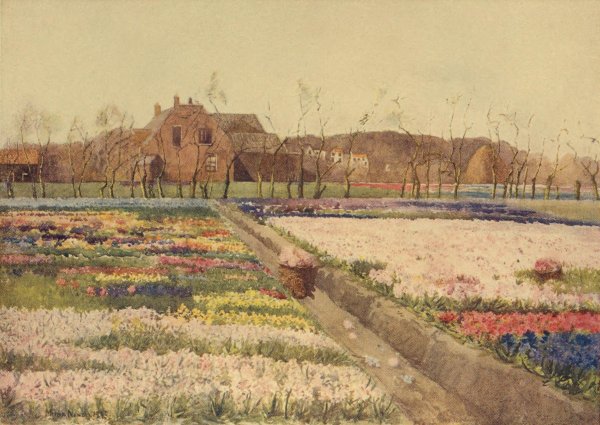
“WHEN SPRING UNLOCKS THE FLOWERS TO PAINT
THE LAUGHING SOIL”
Some people imagine that a bulb which has been kept
from flowering can reserve itself for the following year.
Many such experiments have been made, and bulbs have
been kept back on the shelves and have not been allowed
to flower; they have invariably perished, and, growers say,
scarcely a year passes that they have not tried the experiment,—they
have lost every bulb which was not put into
the ground. As a rule the sap in a bulb will be sufficient
nourishment during its ordinary growth till January or
February, but after that it will begin to grow mouldy and
go bad. The moment it is put in earth or over water, in the
proper season, the bulb, which is just beginning to be exhausted,
pumps up sap so vigorously that it begins at once
to throw out roots from almost the first day, and growers
dare not move them again, even a few hours after they have
been put in, to send them away, however carefully packed,
even a short distance, for fear the fresh moisture they have
sucked up so quickly should cause them to rot, and they
even consider it a dangerous process to change them from
one place to another, in the same bed, if they have been but
half an hour in the ground. The roots, which are in such a
hurry to show themselves when first the bulbs are planted,
perish as quickly as they grow. They stop growing before
the flower is in full bloom, and are always quite dried up
before the seed begins to ripen. While the root is perishing
the flower continues, the stem grows, and all the flowers
expand completely. When the flower is quite over and the
seed is left to ripen, the sap goes into the leaves, which
lengthen considerably, then these die in their turn, till they
separate from the bulb of themselves.
It has already been shown what sort of appearance the outer
tunics present, and it has been explained how the tunics in
general are formed. We are now going to push our examination
further. After divesting the bulb of seven or eight
tunics (or fans), one comes (A) upon a little thin flattened
thread of crimson colour, like a line. It is, as it were,
embedded in one of the tunics; it starts from the base of
the bulb and rises to the extreme top.
Continuing to take away again the same number of
tunics, one comes upon a second thread (B) like the first, A,
only that it is less red and thicker; then, for the third time,
taking off another seven or eight tunics, one meets with a
third line or fillet (C), very like the two first, with this
difference, it is quite white and much thicker. Under the
last fillet are the new leaves (or fans), beginning to bud,
about seven or eight in number, and in the centre of them is
the stem, which is going to flower in a few months.
Now all the tunics are supposed to be taken off, and only
the three fillets or threads which we spoke of are left
(A, B, C). Fillet A is all that is left (within the bulb) of
the stem which flowered eighteen months ago.
Fillet C is the remains of the stem of the last flower borne
by the bulb, six months before.
Fillet D is the stem which is about to flower in six
months’ time (the flower buds are already sufficiently formed
to be seen), and E contains the stem and tunic leaves, which
are to come into bud in another eighteen months.
If, when the bulb is in full flower, you divest it of all its
tunics, till you come to the flower stem,—you will find at the
base of it a very tiny bud; if you take away the stem, which
easily breaks off, you will find the bud remains firmly
attached to the base of the bulb. If you open the bud with
a penknife, you will see it is composed of six or seven little
leaves (or fans), and inside a tiny stem, furnished with buds,
which has begun to grow already, and from the moment
the bulb is laid on the shelves it increases till the time
comes for putting it again in the earth. We have been
speaking all this time of the double hyacinth. The
single hyacinth is somewhat differently constructed, for
it usually throws out several shoots from the sides as well as
from the centre. The single bulb does not appear to last so
long, for its fillets are fewer, but the number of flowering
stems it produces, and the irregularity of their growth, makes
it difficult to follow it in its various stages of development as
exactly as one can the double. By dint of observing, year
after year, bulbs, both those in a good state of preservation
and some partially decomposed, it has been discovered that
the bulb always loses the same number of outer tunics as it
gains interiorly new ones. When once a bulb has acquired
the regulation number of tunics, it will always keep to the
same number year by year, and nevertheless every year it is
putting forth seven or eight from its centre. The outer
tunics, which we call “red skin,” regularly shrivel and decay
in the earth, and thus they disappear.
The central (fans) or young tunics, when they turn into
leaves, do the work of an air-pump; they are the lungs by
which the plant lives; they dilate in heat and contract in
cold. When dilated they take in the air, with all with
which it is impregnated, and they give it out again with the
regularity that an animal breathes through its lungs.
Plants do not like the shade of trees; they need open air
and sunshine, and they like places where they catch the dew
and rain and mist; the moisture thus obtained through their
leaves is better for them than water poured upon them from
a watering-pot.
Planted in hot-houses or under glass they do without
much water, because the hot air produces vapour by the
sun’s rays from above or from the fire beneath, and it is
necessary to introduce a little air in order to let it evaporate
(but the plants must not be chilled by cold seizing them in
the process). Hyacinths which are protected by planks
sometimes do better than those under glass.
The planks are lifted and the plants find themselves
exposed to the open air, this is only done when the air is
not likely to injure them. To be kept constantly under
glass or in a room sometimes affects their colour and shape.
It also spoils their colour to be exposed to heavy rain or
a very hot sun, which exhausts them. The leaves (as the
leaves of a tree) turn on their pedicels one side to the
earth, for one surface of the leaf sucks in moisture and the
other gives it out. What they receive through the upper
surface by day they give out through their under surface at
night by a process of evaporation.
When the bulbs are planted the leaves (or fans) are
already pushing forth a green shoot. The gardener does
not feel particularly uneasy if the frost touches the tip of
the shoot, but they are very much afraid of (the frost) its
reaching the flower-buds within the shoot, for if their tops
are nipped by the frost, the hyacinths will be disfigured. If
any one or two of the leaf sheaths get yellow or diseased
they can be cut away without injuring the bud, and neither
will the bulb itself suffer, as in any case the leaves drop off
in the end of the year.
It is evident now that Nature works in the bulb from the
interior to the exterior, and this principle must be well borne
in mind by the cultivator.
Having thoroughly examined roots, leaves, and tunics,
we now come to the organs of reproduction, and as the young
bulbs form them themselves very oddly and irregularly at
the base of the old bulb, it is very difficult even for a
connoisseur to judge whether any little bulbs are coming,
and still less can he foretell how many he may hope for.
Sometimes they are numerous, and on single hyacinths
twenty-four have been known to develop on one bulb, but
on single hyacinths they develop very irregularly, while on
the double they are more regular in their growth; growing
from the centre; though, as the central stem with all its
leaves grows, the new little bulbs are pushed more and
more to the sides—sometimes they push through to the
outside of the bulb, sometimes between the tunics, wherever
they can get air.
Each baby bulb contains the same number of (fans) leaves
as the parent shoot, and develops in the same way—only that
the first flower of the new bulb is very thin and small. The
tunics partake of the same bulbous substance which forms
the base of the bulb until it grows to the height (or point)
when it begins to take the suberous quality which distinguishes
the leaves from the bulb substance, and so the tunics,
as far upwards as they partake of the bulb substance, possess
the same capacity of producing young bulbs, which grow
from them in the same manner as from the base.
Some gardeners, in order to multiply their bulbs more
rapidly, perform the following operation: with the point
of a penknife they cut into the base of the bulb (the point
turned upwards and inwards), turning the knife round inside
the bulb, the base is cut out (with crown and centre) in the
shape of a cone—the upper portion forming a concave,
exactly fitting the convex of the base (which is the interior
which has been separated by the knife).
The separated base forms no stem the first year, and the
inner tunic leaves (fans) are little and poor, and seem hardly
to have strength to grow, but they form themselves into
tunics quite well, and are grown enough by the following
year to cover the stem, which, however, is not quite developed
as it should be till the third year—then it is as good as any
other of its species. The inferior or lower part scarcely ever
produces young bulbs after it is cut from the rest.
The two parts of the bulb should be carefully put into
very dry sand, covering them about two inches—they must be
left some little while exposed to the sun, which would burn
them if not well covered with sand: they must then be put
in a window or in some place where they are well preserved
from damp; they are thus left for four or five weeks—the
superior part turned top upwards—the under part anyhow,
it is a matter of indifference how it is placed. In four
or five weeks’ time the upper portion has developed such
a number of young bulbs that they are injuring one another.
The baby bulbs are by this time perfectly formed, and
one can count their leaves or tunic leaves (fans), six or more,
and each possesses its stem.
The upper part (of the bulb operated upon), consisting of
tunics without base or crown, which is thus able to produce
so many young bulbs, can also manage to nourish them
during their early growth (though without roots).
This operation will sometimes save a bulb when it is
beginning to decay at the base, and it will thus produce
bulbs when the decayed part has been cut away. The bulb
called “l’Eveque” has a way of bringing forth young bulbs
like buds at the base of the flower-stalk—one or two young
bulbs will be found adhering to it an inch or so above
ground. These little bulbs are as well formed as if they had
come from the base and had been nurtured in the earth.
Perfect bulbs can be raised from them by cutting the stem
an inch above and an inch below the part to which the
young bulbs are attached; they are then put by in earth,
and treated in the same way as those which had the conic
operation performed on them; and just as those were grown
and nurtured, simply fed by the tunics—so these obtain their
sap for the first year entirely at the expense of the stem,
and without starting any roots on their own account. Never
more than two bulbs grow thus upon a stem, while very
often nearly thirty appear on the upper part of the bulb,
which has been separated from the lower part (cone shape).
The bulbs grown on the stem take a longer time in coming
to perfection than those that start from the base, as a rule
in their first year they seem to reach to the same stage as a
three-year-old bulb which has been raised from seed—and
follow the same gradual course of development, not producing
a perfect stem in the beginning.
It is a well-known method with gardeners to cut their
bulbs in order to give air and outlet to the young bulbs
that are coming. They are simply sliced across (not very
deeply) underneath, at their base; sometimes they are slit
crosswise, good care being taken the knife does not cut into
the growing flower stem in the centre (the centre of the
cross-cuts meeting a little to one side to avoid the central
stem). By this means this year’s shoot is preserved, and
when the bulb bursts asunder (along the lines cut for it,
through the strength of the young bulb-shoots pushing
their way through) a principal bulb forms itself in the
centre, which by the second year is as perfect as any.
There is no part of a bulb which can be pointed out
as exclusively serving for the production of young bulbs.
They come sometimes from the centre, sometimes from the
stem—bursting open the bulb and becoming so like it in
form that gardeners have some difficulty in distinguishing
the parent bulb from the new. It seems inconceivable that
Nature should put such strength into such a delicate production
as the young bulb; when once it finds space to
develop itself there is no part of the old bulb it will not
force to let it through. The angular form of the young
bulb comes from the kind of resistance it meets and
moulded by the space in which it is free to expand. If it
grows on the outside of the bulb, it is concave on the side
which joins the round side of the bulb, while on its outer
side it is round.
After the first year the young bulb becomes its normal
shape, like those which are raised from seed. It is difficult
to ascertain if a bulb is going to produce young ones or
not,—it is easy to be mistaken, though the conic operation
will show clearly in a few weeks if young bulbs are going
to develop. It seems scarcely possible that those which
develop more naturally can force their way through the
tunics without aid, and do their work in the space of one
year.
It has been found that when young bulbs have not
strength sufficient in their first year to burst the tunics, their
development is much assisted by the bulb being cut. The
different experiments which have been made prove convincingly
that a bulb can bear many amputations safely,
and if at any time a sickly bulb has to be cut, one may be
pretty certain to get young bulbs from it by taking care
to keep the wound made by the cut quite dry.
There are some bulbs, such as François Ist, which may
exist years without producing a single young bulb, while
others produce at so great a rate that one only wishes they
would stop. This shows that young bulbs are plentiful, and
may grow in all parts of a bulb,—only that in some they
find more resistance than in others,—and the difficulty they
find in working their way through the harder sorts causes
the slight difference in the forms of the bulbs in the different
species. Though all look very much alike to the casual
observer, there are nevertheless differences between them.
There are some famous growers, such as George Voorhelm,
who seldom makes a mistake though he owns 1200 sorts.
Each sort has its own regular and distinctive method of
reproduction, and peculiarities which mark one species never
become accidental in another; each kind keeps to its own
manners and customs.
Nature being ever obedient to laws, certain knowledge of
her ways is the more easy to acquire—the law of species will
be the same in a thousand years as it is to-day. Culture
has certainly improved species, and finished what Nature
could not by herself complete. Some accidents have become
thus a second nature, remaining permanent if another
accident does not again occur to disturb the existing order.
Although there is a way of propagating hyacinths by seed,
like other plants, yet it should be known to all that it is
seldom that a double hyacinth produces seed, and such a
thing has not been known as a seed (from either double or
single hyacinth) ever producing a species at all resembling
the hyacinth from which the seed is taken. “La Perruque
quarrée,” a red hyacinth, has produced “La Comète”—a very
fine sort, and a splendid red, but it has no resemblance to
“La Perruque quarrée,” and yet they are about the nearest
in likeness that have been produced. There is no visible
difference between the seeds of double and single hyacinths.
Gardeners are more hopeful of raising double flowers from
the seeds of single hyacinths than of raising double from
the seeds of double. They have not yet found any principle
to go upon in the choice of seeds, however many experiments
have been made. Some have thought a well-formed
hyacinth in its seventh year, being then in its prime, is more
likely to produce double flowers from its seed than it would
be if ten or fifteen years older. It is supposed that the seed
of a full hyacinth, which has its petals redoubled to the
centre of the flower, possesses an advantage over others, or
double may be raised from its seed, but it very rarely produces
seed at all; when it does, success is still very uncertain.
Some like to try semi-double; some follow one method,
some another, few obtain the same result twice over. Some
amateurs, once upon a time, longing to obtain a new sort
of flower, sowed the seeds of a single yellow hyacinth, very
pale in colour, and of quite a small and common sort; they
were lucky enough to obtain splendid flowers of a very good
white, the centre a perfect yellow, stems and blossoms all
superb,—“Saturne,” “Heroine,” “Flavo Superbe.” “Og Roi
de Basan” also derives its origin from the stock raised from
this seed.
Countless experiments have been made, and all tend to
show that flowers produced from seed never resemble the
flower from which the seed was taken. As a rule they
differ in every point, shape, colour, and height. Nature
insists so much on variety that even seeds taken from the
same seed-vessel do not produce flowers alike. Some may be
red, others blue or white, large or small, as the case may be,
sometimes they are fortunate enough to get several double
varieties from the seed of the single hyacinth. It must be
confessed, added to other difficulties there is this: it is four
years before the seed produces its flower—that is, in an
ordinary way, for sometimes it is more advanced by one or
two years. As during the course of four years the bulbs are
taken up three times out of the ground, it may sometimes
happen that the experiment has failed through negligence,
but there has never been any doubt at all about the fact
of a seed never producing the same kind of hyacinth as the
parent stock.
One should not cut the hyacinth stalk, or separate it from
the bulb, if seeds are to be taken from it, until the ovaries
are yellow and beginning to open and show their seeds,
which should be already black. Then they can be cut and
put in a place where they are protected from sun and rain,
and when the ovaries are quite dry the seed can be taken
from them and very carefully kept (not wrapped up or
covered) until the time for sowing them, about the middle
of October. Growers who have no interest in preserving
the seed believe it is a bad thing to exhaust their bulbs by
leaving the seed to ripen on the plant. The earth that the
seeds are thrown upon should be well prepared (I shall
describe its composition presently).
The seed is visible enough to be spread about without
the necessity of mixing it with sand, as is sometimes done
with vegetable garden seeds. They must not be sown too
thick, and about an inch deep. When it is beginning to
turn cold they must be protected from the frost by a covering
of manure, leaves, or tan. The seed, which begins soon to
germinate, is very sensitive to heat and cold. The parts of
the seed are not unlike a fruit. It is first covered by a strong
black skin, and under this a fleshy substance. This contains
an almond, within which is enclosed the germ; this develops
in the same manner as in the seeds of all plants that are called
by botanists “one lobed” or “monocotyledon.” During
growth this almond part of the seed detaches itself from its
wraps.
When the grain is put into the ground in the month of
October it swells, and the germ, piercing through the pericarp
or fleshy part of the seed, begins to develop itself. The
little leafy shoot which pushes upward is the part that
botanists call the plumule, and the part which pushes from
the central axis (or plantule) is called the radicle or little
root. During the first year the little root is always tuberous
or knotted. It does not yet draw sap from the earth. It is
generally agreed among botanists that the plumule and
radicle (the plant and little root) at this stage draw their
nourishment from the cotyledon or seed-lobe, to which they
are still joined. This lobe goes on nourishing the plant till
the bulb has already taken form, and takes in nourishment
from the earth (through its base).
The thin round leaf-shoot which comes up remains bent
a whole year before it has gained sufficient strength to rise
straight. The first year the root is only a thin thread;
sometimes it grows very long and is full of knots, then it is
organically diseased, and the bulb will be very weak and
worthless. They often die when the root is thus deformed.
To make a well-formed bulb the root should have only one
knot at the place where it comes from the seed; upon this
the bulb forms itself. At first it is composed of a single tunic,
and this tunic is joined and completely closed on all sides.
At the end of one year (after sowing the seed), if the
bulb were taken up, one would find this tunic lined with two
other tunics exactly like it.
The bulbs being still very small, they exhaust the soil
very little, so that the first year growers do not take the
trouble to take them up. But an amateur, who raised a
great many from seed, used to say he thought taking them
up every year certainly assisted their growth.
After it has been eighteen months in the ground the bulb
has gained a certain consistency; it is now composed of four
tunics, each of which encloses it entirely, the outside tunic
appearing brown and dry (as if the drying process had begun,
for this outer one has to shrivel away in the earth next
year). The leaf-shoot still looks thin and round like a rush,
but it holds itself straight, and has gathered strength since
last year. The second year (about the time it has to be
taken up) it has lost its outside tunic, but has still three left,
completely surrounding it, but within the inmost envelope
the base of the leaf-shoot or fan (which now shows a double
shoot) is already spreading and forming in the centre of the
bulb a tunic, like the tunics of the proper (grown) bulb;
that is to say, it wraps it only two-thirds of the way round
its circumference. The roots have now strengthened. The
following year they are yet stronger. The bulb casts off all
its binders, the early tunics which enveloped it completely
(like a bandage). After this it enters into its mature state,
the leaves, instead of clinging together like a round rush,
separate, slowly detaching themselves and taking the shape
they are to preserve to the end, though every year they
increase considerably.
From the time the bulb loses its first closed tunics it is
able to produce its flower, which it never can do while it
remains with closed tunics. The first flower has a long
feeble stem, which bears one, two, or three small blossoms,
but these are enough to show the sort of flower it is going to
be. If it is single it will remain a single always, neither
will its colour vary again, and it can be classed among the
red, blue, or white of its kind, but it will grow more perfect
and improve in height, size, and colour. If the flower turns
out to be double, the growers are delighted, and then they
will spare no pains in developing its beauty, for they know
not what degree of perfection it may yet attain.
When the bulb is three years old (having a treble shoot,
and having lost its last completely enveloping tunic) it
possesses only the ordinary tunics, which are formed by the
expansion at the base of the leaves (these envelop only two-thirds
of the bulb).
The bulb, when four years old (having developed more
perfect leaves and begun to produce flowers), is composed of
about twenty tunics.
If the flower, during the fifth year, continues to develop
and shows to advantage in colour, form, etc., the growers’
hopes rise higher still, but they cannot tell even yet if the
flower will fulfil its great promise.
A bulb which has grown too rapidly will sometimes throw
out young bulbs (or offshoots) at four or five years old, but
never before it has once, during the course of its life, put
forth a flower. This fact is important to remember in regard to
observations to be made later on, on the subject of vegetation.
In the ordinary course of nature the bulb does not arrive
at its final state of perfection until its seventh year. The
grower delights to note its yearly growth in grace and
beauty, till at length it becomes précieuse, then he is fully
repaid his care, and the kind is for ever fixed, and will never
vary again, and it will produce young bulbs which will, in
their turn, produce again, and all will perfectly resemble
their first parent bulb (though it has happened very seldom
indeed that flowers have changed in colour, but this will be
explained).
Growers call the flowers they obtain by raising from seed
“Conquests.” They share and exchange among themselves
these seeds of promise, and sell to each other the third
quarter or half of the bulb productions, which, however,
should not be parted with unless there are a certain number
of young bulbs to be divided. The prices they pay for these invaluable
seedlings would astonish an amateur. They enhance
the value of the bulb, for which the fixed price is sometimes
above 1000 florins. Some are worth as much again.
Growers usually keep notes of the origin and date of bulbs.
Some hundred years ago double hyacinths were thought
little of; they were almost unknown. Swertius, in 1620,
gives a list of about forty kinds of hyacinths; none of them
were double. The gardens of George Voorhelm belonged
also to his grandfather, who had already tried raising
hyacinths from seed, and whenever he made a Conquest,
Pierre Voorhelm would reject any which seemed out of the
ordinary, or out of proportion to the rest of his flowers, for
in those days they took a pride in the formal and regular
arrangements of their flower-beds. He took care, especially,
to destroy double hyacinths when they appeared, without
waiting to see what they might become if they were
allowed to develop. He was only anxious to keep flowers
which promised seed. It is certain that double flowers have
not a seed-bearing quality; they are not formed for maturing
the seed enclosed in the ovary, so that any flower without
this particular good quality did not fail to be rejected. No
one took the least pleasure in the idea of a double hyacinth;
it was rather regarded as a monster (or freak of nature), just
as at the present day nobody cares for a double tulip.
Pierre Voorhelm fell ill, and being quite unable to visit
or attend to his plants until the hyacinth season was nearly
over, he happened then to see a double hyacinth (the kind
is now lost) which had been forgotten, and had not been
thrown away as usual; it was very small, and he only liked
it because it seemed to match very well with the single ones—so
he cultivated it with the rest and obtained bulbs from
it. He found it was much admired by amateurs, who were
ready to pay a good price for it. So he took to cultivating
the double as well as the single, and soon began to be as
anxious to find them among “Conquests” as before he was
to get rid of them.
Of the double species the first known was named “Marie,”
this and the two kinds that followed are now lost. “Le Roi
de la grande Bretagne” existed only seventy years—this was
rare and much sought after, and the price rose to many
thousand florins. This bulb, imported to hot climates, grew
infinitely better than in Haarlem; for it soon died in cold
or damp spots. From this time great attention began to be
paid to the cultivation of hyacinths raised from seed.
The number of “Conquests” has now become immense,
and many more grow bulbs than in former days, and every
grower makes his own catalogue, in which his “Conquests”
are known under names which are kept in all the lists which
are re-written every year. In this list there may be flowers
of different colour bearing the same name—such as “Gloria
Mundi,” which is classed with the blues; the same name
re-occurs classed with reds and whites. Frequently double-flowering
bulbs of different colour have the same name—so
that it is as well, when ordering a particular bulb, to
specify and enter into details when writing the order.
Then mistakes will be prevented, which are as distasteful
to the grower as to the dissatisfied purchaser. Growers do
not all agree in classing their bulbs, some for example
classing among reds a hyacinth which another would call
white with red heart, and which a third might call pink and
white, or flesh colour. Besides which the exact shade or
nuance differs perhaps in every garden—and it is not so easy
to class hyacinths in a way to satisfy everyone, any more than
it is easy to produce a completely satisfactory Method of
Botany. Seasons are variable, and colours of flowers are much
affected by changes of weather. 1767 was a very disastrous
season by reason of the cold north wind which prevailed
in the early part of the year. Red hyacinths were infinitely
poorer than the preceding year, which was a particularly
favourable one to bulb growers.
One must make allowances for seasons and accidents, and
one ought not to expect the bulbs sent off annually by the
growers to be always equally good, for in some years they
are more successful than in others—also the same bulb
which flowers splendidly, as a rule, may take it into its head
to yield a very poor flower, though it may be planted in the
same soil—between two others which are doing their best;
one can see no cause why they should be so uncertain,
except perhaps they pump in sap more vigorously at one
time than another. It can be accounted for sometimes by
the fact that the bulb itself is feeling disposed to throw
out young bulbs, and the sap is being drawn away from the
flower-stalk—or it may have suffered from a cold draught,
when it was lying on the shelf in the winter—or it may be
it is feeling the damp.
The various species of hyacinths, though apparently
different and distinct, are essentially alike. Bulbs of one
sort differ very little from those of another—the leaves are
always alike, their stalks grow in the same way—their
blossoms, though infinitely varied, are arranged in the same
regular order—each connected with the stem by a little
thread, called the pedicel.[4] The double scarcely differs from
the single, except in the blossom. We have already followed
the gradual course of the growth of the bulb, and described
its general composition. We will now go back to the single
hyacinth, for in explaining its work of reproduction it is
easier and more convenient to dissect than the double
flower.
The calyx or corolla forms at the base (through its shape)
a chamber or room in which the “ovary” is found, but
detached from it. At the point where the calyx is narrowed
in at the entrance of the ovary chamber are the stamens.
The parts of the corolla (or divided sections which curl
back in the hyacinth) are called petals.
The stamens are attached to the interior of the calyx, and
from the base of the stamen to the pedicel (or little
connecting stalk) runs a fine fibre (which takes the place of
the filament which is detached in other flowers), and this is
seen from the outside as a line of colour a little darker than
the rest of the flower.
The ovary (in the chamber at the bottom of the calyx)
is surmounted by the pistil, the narrow body of the pistil
is called the stylus, and the head is the stigma.
The stamens of the hyacinth have no filaments, they are
sessile within the calyx, and the anthers are also attached at
their base (though there is the fine thread of darker colour
to be seen running through the calyx extending from the
stamen to the pedicel).
The stamen is covered, when ripe, with a yellow dust
called pollen, this looks like little black grains when under a
microscope—they are little bags full of a kind of clear juice,
these, when the stamens bend over and shed (as pollen),
are caught by the stigma at the head of the pistil. This
stigma, when seen under a microscope, is seen to be composed
of very fine valvular cells, which can hold the seminal juice—the
juice passes through the narrow channel of the stylus (or
body of the pistil) into the centre of the ovary, which has an
aperture so arranged as to let it in till it is full, when it
closes again so completely that the seminal juice is held
within till the time comes when the ovary is forced open by
the ripening seed.
Before the flowers expand, and while they are still
enveloped like a wheat ear in leafy bandages, the ovary is
already furnished with eggs; but the seminal juice has not
yet been deposited, the pistil not being formed enough to
open its cells, but even while the flower is still in bud,
the anthers let fall their pollen, and the pistil opens its cells,
and no one seems to know exactly when it happens that
the pollen explodes its little capsules of liquor or vapour or
breath, which form the seminal juice.
Saint-Simon has a theory that the bees flying to and fro
constantly over the flowers disturb the pollen, often carrying
with them some of the pollen (containing seminal juice) from
one flower to another, where it is deposited and received
through the pistil into the ovary, and he suggests that this
is the cause why “Conquests” (i.e. hyacinths raised from
seed) never bear any resemblance to the flower their seed
is derived from. But this does not seem entirely to
account for their infinite variety. The invariability of
this rule (that no hyacinth has been known to produce its
like by seed) seems to prove that variation is not subject
entirely to accidents of this kind, for surely sometimes by
accident there would come up the same flower as that from
which the seed was taken. Some growers may have taken
seed from hyacinths grown in hot-houses, where the flower
has been protected from bees and butterflies, and thus undisturbed
the flower should have had seed which reproduced
its own kind—and why should this occur as an invariable
rule among hyacinths, when other flowers more frequently
reproduce their own kind than not, with them the variation
(when their seed has been crossed by insects) is an
accident.[5]
Curious experiments have been made with hyacinths.
Two different bulbs are to be chosen, blue and white, for
instance. Cut them perpendicularly down nearly through
the middle, but being careful to avoid cutting into their
central shoots (i.e. the future flower-stalk), then join together
the two larger halves containing the flower-shoot, thus
making one bulb of them, so that the two flowers should
appear as arising from one bulb. Then, with a little moss
wound round the closed joins, the made-up bulb may be
put into the earth like any other. This usually results in
producing two stems stuck together back to back, with one
skin around them both apparently; and on one side comes
out white flowers, on the other red or blue. Sometimes the
colours get mixed, the colour of one flower shaded with that
of the other, very rarely do the stems grow separate.
None of these experiments seem to explain how it is that
a single hyacinth can produce a double (by seed raising),
though perhaps in ten thousand seeds only two or three will
come up double flowered; nor how it is that the double can
be redoubled (through seed), and that once redoubled, the
bulb is constant in giving off young bulbs with double flowers,
which never again degenerate into single; nor will a single,
in its offshoots, ever become a double hyacinth.
In the cultivation of hyacinths it is impossible to keep to
any fixed rule. Not only must every country and climate
make its own, but every hyacinth has its own ways and
customs, its own special qualities and characteristics. The
most distinguished of their species exact a great deal of
attention, care, and management.
“François Ist” finds great difficulty in producing offshoots,
and great care has to be taken of the young bulb, but when
once arrived at full growth it is not as subject to disease
of various kinds as are other bulbs, and it does not die
easily. It is the only bulb that still continued to command
a high price twenty-five years after its first appearance; 100
florins were paid for a single bulb.
“Rien ne me Surpasse” is one of the most perfect blue,
but it has such wretched, weak, faded, even crumpled leaves,
one would think the poor thing was ill, but notwithstanding
it produces a handsome, healthy-looking flower.
“Passe non plus ultra” also looks very deplorable as to
its leaves, they seem hardly able to hold up, and remain
lying flat upon the ground, though quite green and well.
On the other hand, “Og Roi de Basan” shoots up its leaves
so straight and tall, and so large, that they seem quite out
of proportion to others, and the flower is an extraordinary
height, overtopping all the rest. The “Theatre-Italien” is
a good red, but it grows very short, and comes out before
its leaves, so that its head may be nipped by the frost.
“Marquise de Bonnac” is a very delicate colour, but it
gives way in the stem before the flower is fully out. The
stems seems to fade and dry up, and the flower falls on its
face, and this is a very tiresome habit. But it does not seem
to damage the bulb, which flowers regularly every year,
notwithstanding these little accidents. A famous florist told
me it was because it had a bad circulation, and the sap
hung on the sides of the bulb, instead of running up the
stalk. “Alcibiades” and “Beau-regard” are also subject to
such accidents; but they can be prevented by planting the
bulbs in November, that is, a month later than other sorts.
These kinds give off a number of young bulbs. The bulbs
which multiply very little and slowly have generally better
constitutions, and do not perish so easily. White, with red,
purple, or violet hearts are very subject to decay. “Gloria
Florum Suprema” perishes easily, and its offshoots perish
with it, and this is peculiar to this hyacinth, for most of
those that perish easily also multiply quickly. The kind
that multiply fast are generally furnished with more roots
than the others.
Growers are mostly agreed that bulbs succeed infinitely
better if taken up from the ground every year (though it
does seem contrary to nature). It often happens that a
bulb, if left in the ground, does admirably the first and
second years, and sometimes a third year it does well, but
after this period it usually catches some disease which turns
into an epidemic, killing all the bulbs in its neighbourhood;
it is too late then to find a remedy, and if lifted it will
only rot on the shelves, as it would have done in the
earth. One knows insects are more numerous one year than
another, and thus they too may cause epidemics.
Lifting the bulb is also a method of preserving the young
bulb, which otherwise would perish and decay from damp if
left all the year round—or, as they are sometimes a foot or
more below ground, the effort they make to force their
shoots through that depth of earth is too much for them.
It has been observed that when the sap does not circulate
freely in the bulb it is drawn up into the stem, and this is
sometimes occasioned by overheating the room or green-house,—then
it grows tall and weakly, the flowers are thin
and deformed. The more the channels through which the
sap runs into the stem are dilated by too much heat, the
tighter they close again when the sap has finished its action,
and the bulb becomes thinner than it should be, and it
is exhausted for the next year’s growth and appears very
languishing. One can see very well how this comes to pass
when it is remembered that the next year’s flower is actually
contained in the base of this year’s stem, therefore what
weakens one weakens the other. If the bulb is very deep in
the earth and the ground is hard, it cannot spread and
enlarge itself with comfort, so the health of the bulb requires
it to be lifted every year. Besides the necessity of
separating and preserving the young bulbs which have
to be replanted, there is yet another advantage to be gained
in lifting, for then there is an opportunity of taking away
decayed bulbs before the disease is able to spread further
through contact with others.
Having given some ideas on the cultivation of hyacinths
in general, perhaps it is as well to give in some detail an
account of the particular (or individual) care and attention
bestowed upon their bulbs by the Haarlem growers, and
perhaps some hyacinth lovers may feel drawn to imitate
their spirit. Haply if they meet with the same difficulties
they may benefit by their experience and observations, and
thus obstacles may be surmounted that stand in the way of
the development of the ideal flower. These obstacles are
often the result of soil, climate, and inexperience.
As a general rule, hyacinths require a light soil, which
easily lets the water run through, but at the same time
such a soil is soon washed out, and it thus in a short time
loses its good qualities and richness. The sulphurous and oily
qualities in the soil, that the hyacinth delights abundantly
to suck out of the earth, would be washed away or evaporate
speedily in such soil, even if the bulb itself did not actually
exhaust the spot where it has grown, this is the chief reason
why growers change their bulbs year by year. Damp is death
to bulbs. In a damp soil bulbs can never be preserved for
any length of time. The two general rules,—Choice of light
soil, Avoidance of damp, are the very foundations of bulb
culture. The “couches” or “beds” made by florists for their
finest hyacinths are remade every year, they are also protected
by caisses and layers of manure from the cold in winter, and
they are shaded from the hot sun in spring by canvas
awnings. The old soil (taken from the hyacinth beds) is
carried to the garden borders, where other flowers are grown,
such as tulips, lilies, Fritillaries, etc. The following year
hyacinths are replaced in these borders, and succeed therein
marvellously,—thus year by year the same earth bears
alternately hyacinths and other flowers. If the reader’s
patience is not exhausted entirely I must ask him to bear
out a little longer, for I cannot without entering into very
minute details give any intelligible idea of the qualities
necessary to provide the sap with the kind of nourishment
it seeks in the soil after the bulb is put into the ground.
In Haarlem they take two years to prepare the compost,
or composed soil, which suits hyacinths so well. The first
year a store of leaves are gathered together and laid in
considerable heaps, so large that while they are rotting and
becoming fit for use the sun cannot penetrate, for if they
were spread about the sun would cause the salts and oils
contained in the decayed leaves to evaporate, for this reason
the heaps are not to be in places where they are exposed to
the sun, nor in a damp place where water can sink in or
stagnate. Growers do not gather in all kinds of leaves,
they have observed that oak, chestnut, beech, and the leaves
of the plane tree (which is now becoming common in
Holland), and others of like nature, do not dissolve easily
into earth; while the leaves of elm, wych-elm and birch, etc.,
are chosen because their loose and fibrous tissue dissolve
more readily into soil.
In the same manner they lay up a heap of cow-manure,
which is left to ferment en masse. Every country has its
customs, and the Dutch customs make a real difference in
the quality of the materials employed. All over Holland
cows are kept in stalls from November to May only, and
during this time they do not eat grass. All the summer
they remain in the open, night and day, in the fields, so that
manure is not kept or taken up in the summer months. In
the winter, when the cows are fed on nothing but dry food,
the manure is of quite another quality from the summer
manure, when cows have grass. This may be useful to note
for those who live in countries where manure is kept all
the year round. Cows are tethered in stalls in so narrow a
compass that one can hardly conceive how they can exist
like this. They stand on a kind of platform between
two trenches, before and behind them; in the front trench
their food is put, which they can only get at by pushing
their heads between boards, which also prevent them from
reaching too far and pulling out the food, where it would
be trampled under their feet. The second trench, which is
deeper, is behind them to receive the manure, which is taken
away and heaped up in a dry place, where it can easily
drain and where the rain can also run off, for no water or
wet is allowed to settle in or near the heap. As no straw
whatever enters into the composition of this manure, it is
not at all like the kind collected in other countries. I do
not know if this is the reason, or why it is that in England,
especially round London, hyacinth growers avoid using cow-manure
as much as possible, the soil there being so stiff and
rich that it suits them better to make it a little poorer,
with an admixture of sand, than to heat it even with cow-manure,
which is the lightest kind of manure there is. First
a heap of leaf-manure, a second heap of cow-manure, and a
third heap of sand is now made of sand brought from the
dunes, or it can be dug out of the very ground beneath to
the depth of some feet. Though all the soil about Haarlem
and its neighbourhood is mainly sand, especially near the
dunes, where most of the bulb fields are, yet they prefer to
fetch sand from a distance rather than take any from the
surface of their own ground. This sand should be as carefully
examined as is the manure, so that, now that I think of
it, I must enter into further details, which will be thought
unnecessary by some people, but others will be glad to follow
the spirit of our inquiry.
The nature of the soil in Holland proves that the country
has undergone great geological changes, apart from the
continual encroachments of the sea.
It seems that at a very distant period, perhaps before or
after the Deluge, the country must have been covered
over with forests, as were Germany and Gaul in later
times.
Either in the great Deluge of Sacred Writ, or during one
of the partial deluges that men of science speak of (but of
which no one seems to have any positive knowledge), these
trees must have been thrown down and laid on the ground
in the direction of east to west, in such a manner that where
they fell they form strata (or layers), which time has reduced
to a thickness of six or eight inches at the most.
It may be that this layer of trees was at first exposed to
the air, or (as is more likely) was for some time covered by
the sea, which, depositing sand, pressed and consolidated it
into the mass which we now see, and which is found in all
parts of Holland and Zealand, and is known under the name
of Darry or Derry.
It is very easy to perceive that it is old wood decayed
into the earth and reduced to the loose consistency of a sort
of brown charred coal. In some parts bits of the wood have
been preserved whole and unchanged.
In the Bailey of Amstelveen, near Amsterdam, bits of
wood are often disinterred which has still “heart” enough to
be used as ordinary wood. Between Alphen and Leyden are
to be found in several places whole tree trunks, ten or twelve
feet long. The derry matter is very substantial, and it is
very inflammable; it also holds water, so that it does not run
through from the surface of the peat to the water in the soil
below it. In Zealand, where it is easily taken up, it is
forbidden under penalty of death[6] to carry away the peat,
because the water underneath, which it retains, would do
considerable damage in the island.
As we now know that piles and blocks of wood can last
2000 years in the earth without rotting, so we may conclude
that these trees (which now compose the derry or turf) must
have been much longer undergoing the various operations
of nature which resulted in producing this change. No
tree roots can penetrate this derry, and wherever sand does
not cover it over a certain depth, no vegetation can grow.
Water falling on the peat is held there, having no means of
escape, and the sand on the top is, therefore, always moist
and fresh in proportion as it is near the derry. If one digs
a little hole in this ground, the water which “fattens” the
sand collects in a moment and fills up the hole which has
been made, and this becomes a running spring. These sort
of springs exist all over Holland, and they generally go by
the name of sand-wells. They are kept supplied only by
rain, or by the water which filters down through the sand
from the dunes, and this often to a great distance.
If bulb roots were to reach down to within a foot of this
layer of peat they would be spoilt, and the bulbs would
perish. The depth of the sand-layer over the peat is
unequal and different in parts. By measuring it they test
the value of the ground, and not less is the value measured
by the length of time the sea has withdrawn from the surface.
There is no doubt this sand is from the sea-bottom, whether
it was the sea’s action that brought it, or whether it has been
blown and driven by the wind. The dunes have so often
shifted that a knowledge of the variations due to the shifting
of the sand in the dunes is enough to account for sand-layers,
for it can be driven very far indeed by wind from
the sea.
A little while ago the village of Sheveling, near the
Hague, was surrounded by the dunes, which were at that
time some distance from the church, now it is much nearer,—the
church cannot have moved. On the same coast the
mouth of the Rhine has been choked with sand, and the sea
now covers the castle of Bret, facing Catwick-sur-Mer. The
castle can still be seen at certain seasons at low tide. The
sea has remade other dunes, half a league farther inland.
All along the coast near Haarlem, beyond the canal which
connects Haarlem with Leyden, the main road cuts through
these dunes in several places. In the island of Walcheren,
in Zealand, at very low tide can be seen vestiges of the
ancient town of Domburg, where they fish up statues of
Nehellenia, a heathen goddess, and also early Roman
inscriptions.
In the present day dunes 100 feet high separate the new
Domburg from the one invaded by the sea, and the Zealanders,
through their marvellous and inventive industry,
have succeeded not only in fortifying themselves against
encroachments from the sea, but have made very extraordinary
dykes, like the one at West Cappel, which
you cannot see when you are standing upon it, as it is
nothing but a very long sloping bank or glacis of timber-work,
but the slope is so gradual that the only resistance
the water meets with is the long journey it has to go to
reach to the summit of the dyke, which, at its level, is much
higher than the sea.[7] But besides this they covered miles of
the sea-shore with platted straw matting, which they plat on
the shore itself,—this is to prevent the sea from carrying the
sand away from its own shores. These mats have to be
renewed almost yearly.
The sands of Haarlem are all more or less of this nature,
and contain saline and sulphurous particles of matter; the
under stratum of peat or derry prevent these from being
absorbed into the ground. The sand also contains particles
which collect in some places and form a very thin stratum of
hard black matter, like that with which some minerals are
coated, and this is not less injurious to vegetation than is
the derry.
The great success the Dutch growers have had in cultivating
bulbs which cannot be successfully propagated
elsewhere is very much due to the presence of this sand,
deposited by the sea on a matter which, fortunately, water
cannot penetrate.
To return to the three heaps,—sand, cow-manure, and leaf-mould,—the
sand is placed in large heaps to “ripen,” rather
perhaps to lose some of the moisture. The growers from
the three compose one general mass, which they arrange in
the following order: First, they make a layer of sand;
second, of manure; and third, of leaf-mould eight or ten
inches deep; they then begin again making more layers in
the same order, until their mass is six to seven feet high.
The last layer is manure, but as this is apt to harden in the
sun, they throw a little sand on the top. When this compound
has fermented, six months, sometimes rather longer, it is
mixed up and another heap is made, which is, however, again
unmade and thoroughly remixed. When this soil has
remained a few weeks to settle, it is carried to the beds,
where it is laid to the depth of something like three feet.
George Voorhelm, in his book upon hyacinth culture, says
that this manure should be composed of three-sixths of cow-manure,
two-sixths of sand, and one-sixth of leaf-mould or
of tan, and he for his part preferred fresh manure to that
which had been kept a year (to ferment?). He especially
warns amateurs against using horse, mule, pig, or sheep
manures; also he cautions them against using mud or cold
earth drawn from wells, or basins where the standing water
and mud have to be occasionally cleaned out; also against
any powdered stuff or manures picked up with dust from the
street. He quotes persons who compose their soil of tan
(which has already been in use and nearly lost its heat) with
cow-manure and leaf-mould, using no sand at all.
When the soil is brought to the flower-beds they put the
said quantity beneath the bulbs, making the earth quite
flat and even, without pressure, and placing the bulbs upon
the earth, not embedding them. Then they are looked over
to see that the bulbs are arranged in the proper order or
according to diagrams marked out for them. When their
places have been fixed, more soil is brought to put over
them, great care being taken to let the earth fall lightly on
the bulbs, not to disturb their position. The last addition
of earth is generally not more than three to four inches
deep. In cases where the bulb has to be brought forward
in its growth, or else kept back—and is therefore put at a
greater or lesser depth in the earth—the gardener, in the
latter case, places more soil under the bulb to raise it higher,
and this is a much better method of putting in bulbs than
making a hole with a dibble, or, as some do, thrusting the
bulb itself into the earth with no tool and raking some
earth over it, for this plan, besides hardening the earth all
round the bulb (the hole forming a sort of gutter which
holds water!) also runs a risk of bursting the bulb, which
may be already showing roots, or young bulbs hidden within
might be knocked off without its being perceived. The
same method is used in planting bulbs in garden borders.
The surface of the earth is taken off and laid on one side,
the bulbs are placed in rows, and are very carefully re-covered
with the soil which was laid upon the side.
The frames used over show flower-beds should be raised
not more than a foot above the earth, and not less than half
a foot. If too high, the air dries the roots; if too low, the
damp (from the vapour) may reach them. The back of the
frame should be buried rather deep, so that when it is
necessary to cover the flowers with planks, the frame will be
able to support them, or planks must be put at the back and
sides, fitting into each other, upon which those which form
the roof over the flowers can rest. The frames should be
slanting from the back downwards to the front, to let the
rain run off and prevent it from dripping into the bed. If
the cold is very intense, the planks may be covered with
manure to prevent the frost from penetrating beneath. If
the season is a fair one, the flowers may be given a little air;
but in cold seasons it is a risky thing to do, because the
early bedding plants are exceedingly tender, and the heat
of the manure, or whatever is provided to shelter them from
cold air, causes a damp vapour to rise inside the frames, and
as this cannot evaporate it falls back upon the flowers,
covering them with a little dew, which, if the cold air were
admitted, would freeze directly. It only takes an instant
for young buds to freeze, then the flowers come out, looking
dried up, with burnt tips. When the cold weather is past
the manure is taken off, and air is admitted to the beds for
a few hours in the daytime, care being taken to cover up
again at nightfall. The manure which serves to protect the
bulbs from frost also brings forward young shoots, so that
they begin to show earlier in hot-beds than in garden
borders. The slowest and latest sorts begin the earliest to
sprout. They are therefore purposely not planted so deep
in the ground, that they may get more quickly warmed by
sun and air, so it is quite natural that their buds should
pierce through earlier—but the difficulty the sap has in
penetrating and circulating through the very compact
structure of these bulbs makes it very difficult to get them
to flower in good time with other sorts. Growers have to
use their skill not only in guarding flowers which are
beginning to show from frost, but also from strong winds,
damp, and everything that can do them injury. One year
rats carried away and stored by hundreds in their holes the
bulbs in the gardens of Van Zomped at Overween,—although
they had a stream to cross to get at them. Growers must
be au fait with every possible eventuality, and must foresee
and prevent every possible mischief. They must know
exactly the time by night or day when it is proper to cover
or uncover their flower-beds. Their chosen blooms are
covered with tents of canvas, beneath which they can conveniently
walk.
Besides these tents, over the most delicately-complexioned
flowers little parasols are arranged. These are mounted on
little rods, which stick in the ground, and quite protect the
flowers, which last several days longer with growers who give
them this protection, and keep their colour better. When
the flowers first begin to expand, our florists (who work on
the principle of never watering) protect them from rain as
carefully as they do auriculas. When they begin to make
a show of blossoms they powder the sand-beds with a light
mould, in order to make the colours look more brilliant
against the dark brown background. They tie the stalks to
little wire rods, painted green, leaving the ties loose, so that
none of the blossoms are caught and broken when the flower
pushes up in its growth. The pedicel is very delicate before
the blossom is formed, so that the slightest thing can easily
break it. When the single hyacinths are in bloom the
florists open their gardens to the public. A wonderful sight
presents itself on first entering the gardens, vistas of alleys
with flowers of every variety, and kind, and colour, cut by
borders and beds which contain each one kind of flower
only. Hyacinths are in the greatest number. Early tulips,
narcissi, anemones, and others are laid out in successive
order. The effect is surprising. Never, when they are once
selected and placed in position, does a grower ever touch his
bulbs again, he dare not disturb them once they are planted,
but if a bulb dies or refuses to grow they may possibly
embed a flower in a pot in its place; it is even permitted to
put a flower like it in a glass vase close to the leaves of the
lost blossom, but they never attempt to take out a weak
or unsuccessful bulb in order to substitute another. The
flowers should be arranged according to gradation, that is,
the tall specimens behind; the short in front; the colours as
varied and as brilliant as possible.
The beds have a much more brilliant effect if two flowers
of the same colour are put together, in pairs; some plant
each kind thus, double, throughout the bed. The chief
thing in arranging flower-beds is to manage that all the
flowers should be out in full flower at the same time. It is a
very difficult art, but the Haarlem bulb growers are able to
accomplish it. Every bulb has its own particular habit of
growth, one will flower early and another late, there may be
the difference of a whole month between them.
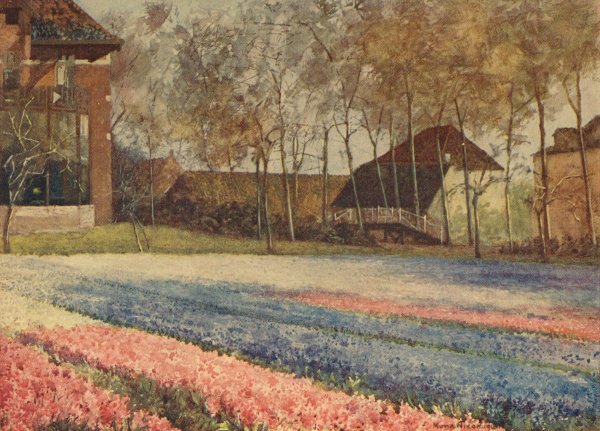
People come miles to see these gardens, which are in
bloom all April and part of May. Single hyacinths begin
flowering towards the end of March, and last in flower for
about twenty days, if the season be favourable. Single
hyacinth beds are usually placed alternately with double,
and the effect is more brilliant. Single hyacinths grow
more thickly, there are sometimes fifty blossoms on one
stalk, and very often several stalks on each plant. The red-single
are a more brilliant red than are the red-double, and
single blues have much the most delicate shade of colour.
About the 20th of April the hyacinths begin to be at
their best, the 25th and 26th are ordinarily the days when
they are in perfection and in their full glory. By the 4th
or 5th of May they are going over, and the later sorts
are beginning.
In Haarlem they are too carefully attended to to
suffer much from the weather, their cultivators being very
industrious, and watch over them, arranging for the protection
even of the most ordinary kinds, for none are
neglected.
When a new piece of land is taken for cultivation, they
begin by trenching it six feet deep, and if they come across a
bed or layer of derry, they do not fail to take it away. In
gardens which have been a long time under cultivation peat
or derry is not found, for it is injurious to vegetation. Pure
sand is usually found to some depth, but they try to dig
down below the sand to the earth and dig up about a foot of
it to mix with the soil. The sand corrects the effect of the
cow-manure which is put in, a layer of seven or eight inches
deep (without straw), over the entire surface of the ground,
which is then worked in with a spade. They mix up the
manure as much as possible, so that when well worked in it
is to be found to a depth of one foot below the surface.
It is not a good thing to plant hyacinths the first year
in the newly manured soil; they usually leave an interval
of one year before they put in hyacinths again, and
in the intermediate years they cultivate tulips, jonquils,
narcissi, lilies, crocuses, fritillaries, crown imperials, martagon
or mountain lilies, irises, and other tuberous plants or bulbs
which they keep in quantities; they take care to work the
ground well every year, this brings the earth which was
below, at the roots of the last year’s plants, to the surface.
The earth dug, trenched, and enriched (for it must be
borne in mind it is nearly entirely sand) remains for five or six
years without need of manure. After this space of time it
has to be worked all over again, dug as deeply as before
and manured, if possible adding more pure sand, which is
found by digging a very deep way down. In winter the
beds are covered with tan or manure in proportion to the
strength of the cold. Growers like the frost to penetrate
as far as within an inch of the bulbs. If it goes farther, it
freezes the cluster of buds; and if it reaches the roots, the
bulb is lost beyond redemption. But such a misfortune
seldom occurs, for growers know how to protect them by
increasing the thickness of manure or tan covering. Some
heap up the fallen snow over the beds, believing it is good
for bulbs, as it is for nearly all other plants, especially for
corn and oats; while others take away the snow rather than
add to it. Each has good reasons, and much depends on the
time of year, for if it is late snow and the hyacinths are
beginning to put out leaves, a quantity of snow may be
hurtful and cause a fermentation of the sap, which may cause
the bulb to decay.
After the cold weather is over the hyacinth buds begin
to pierce through the manure, and then it can be taken off,
and there is nothing more to be done after that but just to
pull up any weeds that make their appearance. Growers
either leave the flowers to fade or else cut them off, they
believe it makes no difference which they do. Some, when the
stalks are left uncut, strip off the blossoms with their ripening
seed-vessels, thinking it preserves the sap within the bulb;
others cut the leaves half-way down, for they grow very long
and lengthy when the flower is dead. Both these methods
are clean contrary to the principles of the art of cultivation.
Still, stripping the blossoms does little harm in comparison
with the harm done by cutting the leaves, which have
a most important function to perform, for they now take on
themselves the work of the dried-up roots and feed the bulb,
and they breathe in through their leaves the particles of air
most suited for the plant’s nourishment. The leaves are
then entirely maintaining the plant and keeping the sap in
circulation. When the fans or long leaves begin to fade
and dry, the bulb is then pulled up out of the earth—with
the hand, as much as possible, for fear the spade or fork
should injure the young offshoots. The leaves are then cut
off altogether, and the bulb is replaced in the earth on its
side, being covered up again with an inch or two of very
light soil, such as we described—the bulbs are left about a
month or two in this state. When the time comes for them
to be finally taken up, a fine dry day is chosen. The bulbs
are then left out in the open air for a few hours. (If the sun
is too hot, it will make them “boil,” as the gardeners say, and
the sun can kill them as surely as the frost.) They are then
placed on sieves, where they are lightly shaken to separate from
them the earth which sticks to them, the roots are carefully
removed—carefully, for the sake of the young bulbs (or
offshoots)—and put away on the bulb-house shelves.
All growers proceed very much in the same way, but
those who do not follow merely mechanically the trade
methods, know that every bulb likes a separate treatment, and
they do not take up all the bulbs in one bed on the same
day—they leave the lazy ones, which are slow to ripen,
longer in the ground, and they don’t cut the leaves of the
quickly growing ones quite so soon. When taking up their
bulbs, they judge the quantity of sand to be left to cover
them (in the drying process), according to the need of each
one. Experience having taught that a slow bulb which
takes long to develop gains warmth (and the fermentation
of the sap is hastened) by letting it “cook,” as they say, in
the sun. On the contrary, if it is a quickly ripening variety,
they keep it much less time in the oven (that is, under sand
in the sun). These have a little more sand over them, and
are stored a little sooner in the bulb house. One grower
said he had for fourteen years planted a François Ist and
taken it out every year exactly in the same state as he had
put it in, it had not changed in form or size, nor had it
given a single offshoot. Another said he kept a Duc de
Bourgogne thirty years in the same way. G. Voorhelm
said he had known a bulb look the same for fifty years,
but he did not mention whether it had ever given offshoots
or not.
In the end of June, or about that time, bulbs are put away
into bulb houses. The houses should be perfectly dry, inside
and out, for damp is very injurious—the houses should be
thoroughly well ventilated, the wind allowed to blow
through. It is better if the bulb house be made to open on
three sides. When the bulbs have been sometime stored
on the shelves, they are cleaned; they then go through a
medical examination, and if there are any weak or sickly,
they are separated from the others. The evil, if it exists,
can be detected by cutting the bulb at the place where the
fans or leaves come off. If the circle of tunics looks quite
healthy, with no stains or spots upon them, there is no fear
of disease—there is none if there is no outward mark of decay
anywhere to be seen;[8] but if there is the smallest spot or
mark, the knife must cut down to the root of the evil.
Amputation does not kill the bulb, and it is the surest
remedy. As some of these diseases are contagious, they can
be communicated to others even in the ground, where they
are not so closely packed as they are upon the shelves,
therefore it is necessary to take care to examine them
thoroughly in order to prevent contagion. The nature of
these diseases and their cause is not yet known. The best
remedy is amputation of the diseased parts, and many growers
remove everything that has the least appearance of decay.
The great art (and experience alone can teach this) is to
know how to dry the cut wound without exhausting the
sap in the bulb, and to know just the time to put it back in
earth,—the earlier it is done and the more carefully the
operation is performed the more likely the bulb will be
saved. The most common disease is an outlet of sap
between the tunics. Another is produced by small green-flies,
which are probably deposited as eggs. Green-fly and
centipedes are the most commonly to be seen. Bulbs left
for a long time in the same place are sure to contract
diseases—this is one of the chief reasons why growers are
for ever changing them (even the common sorts), and are
always renewing the soil or putting the flowers in different
places alternately with others. When the growers are ready
to replant their bulbs, they clean them again, taking away
the outer red skin or tunics, which are now dried up, and
keeping those adhering to the bulb, for it would be harmful
to a degree to take them away. They put aside the young
bulbs which are strong enough to be separated from the
parent bulb. The method of planting again has been
described. I must add that show-beds should be chosen in
sunny spots. Hyacinths cannot bear to be in the shade, and
they must not be put under trees; but as they also suffer
from wind, it is a good thing to have trees not far off
to break the wind.
In conclusion, it would be a good thing if amateurs
were not quite so prodigal with their bulbs. They
grow them in pots or in glass during the winter,
and it is usually their custom, when the flowers are dead,
to throw the bulbs away, supposing them to be good for
nothing when they have blossomed once. Instead of that,
they should be left in the glass jar or flower-pot till the
leaves are likewise dead, then they can be put for half a
day in moderately hot sun to dry, and afterwards placed in
earth on their sides, as is done with other bulbs, covering
them lightly with sandy earth, and taking them up in the
same way; when in the autumn they are planted there will
be no difference between them and the other bulbs. If they
are round and full of sap when they are taken up, they can
be used again in glass or pots in the house a second year, if not,
it is better to leave them in the open ground. But as it is
sometimes frosty weather when the bulbs are taken from the
jars, it is better to put them away at once in the green-house,
covered with a little sand, and wait till fine weather comes
to put them outside for a month or five weeks in the earth,
preparatory to taking them to the bulb-house shelves—to
plant before the rest.
Hyacinths can be also grown in pots filled with moss,
well pressed down and kept sufficiently moist. If grown in
water, rain-water is best.
Bulbs increase so rapidly that a grower who takes a little
trouble to cultivate, let us say about 300, will find himself
in a few years possessor of several thousand, which he does
not care to keep. He will also have the satisfaction of
making Conquests with seeds he has himself sown, and by
exchanging these seedlings he can procure for himself rare and
costly kinds, which he cannot buy; he is thus able to amuse
himself with a collection which affords him much pleasure,
and he is also able to bestow some upon his friends. He
may never have been in the neighbourhood of Haarlem, he
may never have learnt so many details as are here put forth,
in the hope that they may prove useful to many a lover
of flowers.
George Voorhelm, in the preface to his treatise on
hyacinth culture, encourages men of other nations to
cultivate the hyacinth, and to sow seeds, and, in his opinion,
it would be better that the Dutch should meet with rivals
of other nationalities, for if all produced good flowers, they
would be able to supply each other reciprocally. He thinks
it a pity no other nation should have attempted to second
the Dutch in a work which reveals so wonderfully the many
mysteries of nature as that of the culture of the hyacinth.
Maximilien Henri, Marquis de Saint-Simon, wrote Des
Jacinthes, de leur anatomic, reproduction, et culture; also
Histoire de la guerre des Alpes, ou Campagne de 1744;
Histoire de la guerre des Bataves et des Romains.
Saint-Simon, born 1720; died 1799 at Utrecht. This
Marquis de Saint-Simon was uncle to Claude Henri, Comte
de Saint-Simon, founder of the sect called Saint-Simoniennes.
I think the Marquis was nephew of the Duc de Saint-Simon,
author of the Mémoires of Louis XIV.