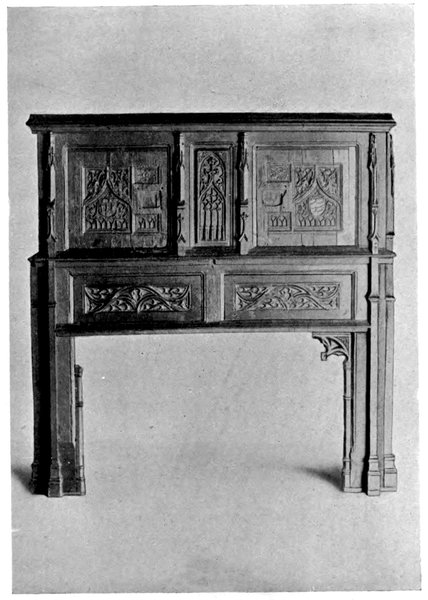
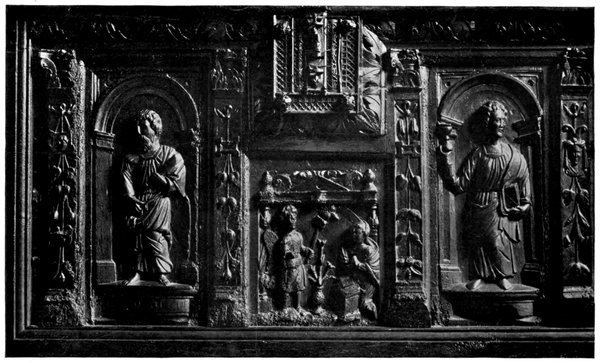
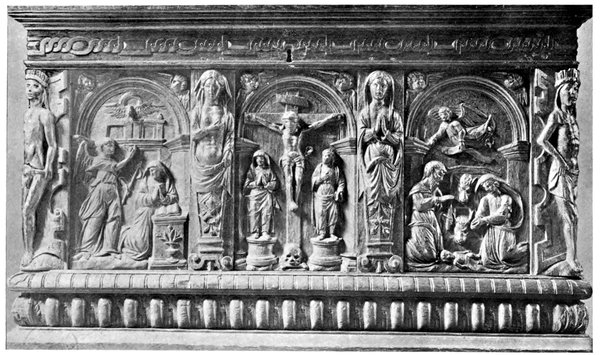
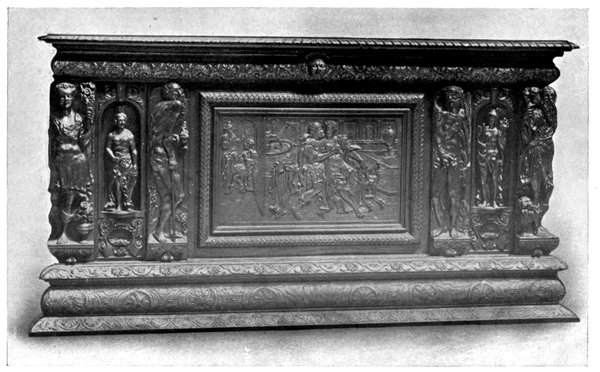
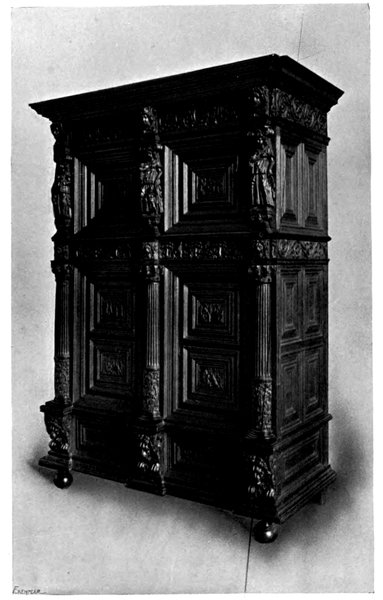
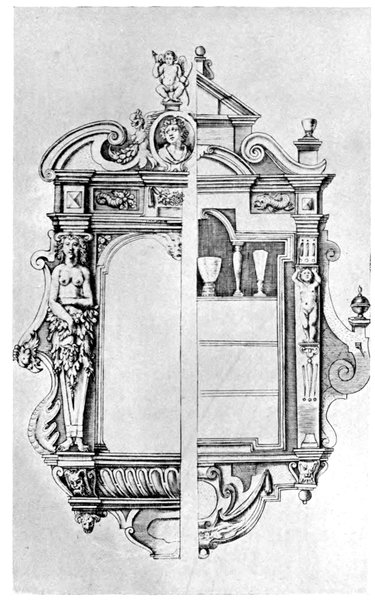
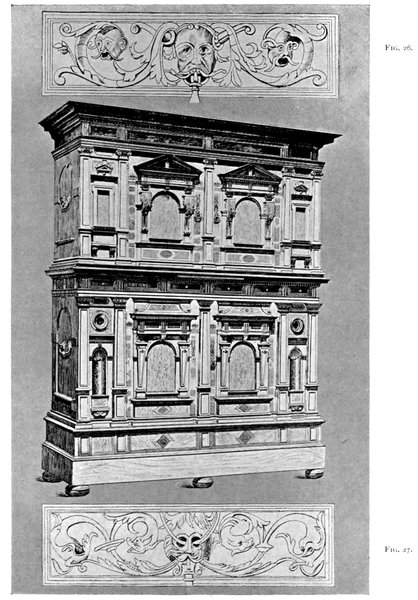
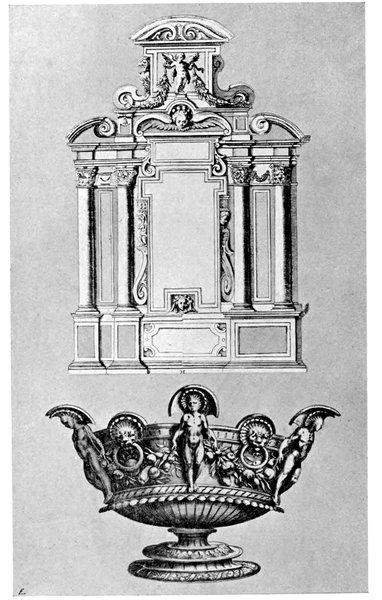
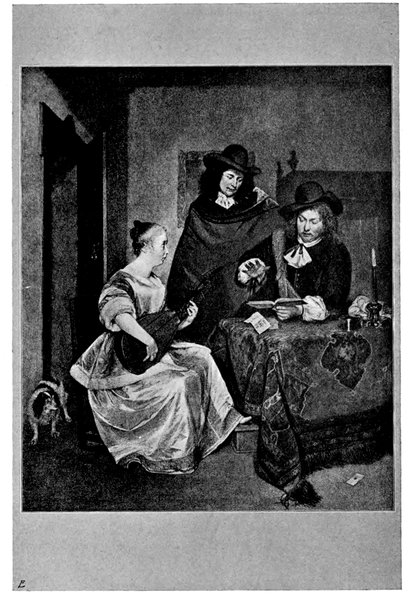
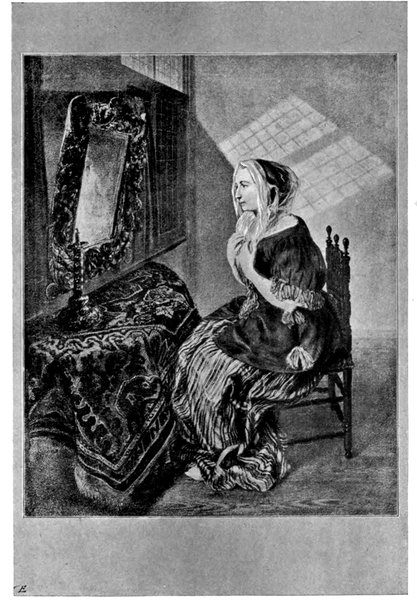
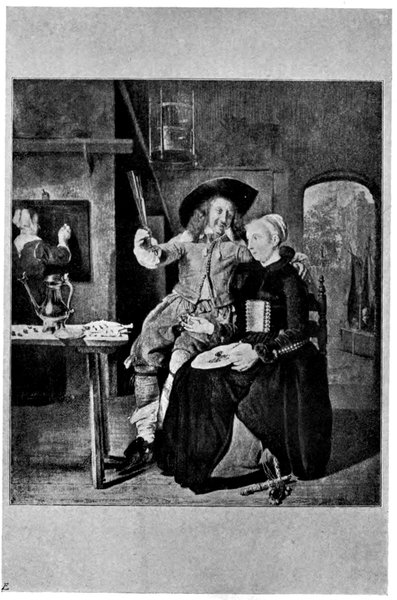
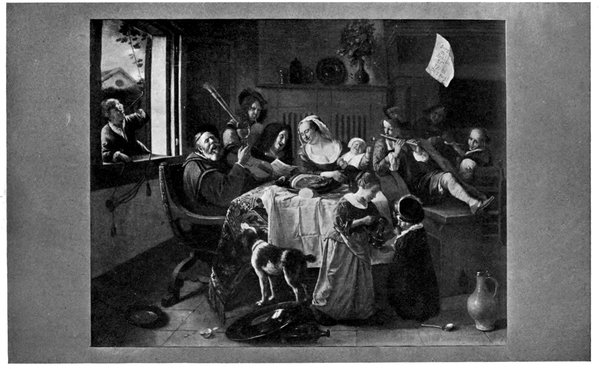
The cover image was created by the transcriber and is placed in the public domain.
DUTCH AND FLEMISH FURNITURE
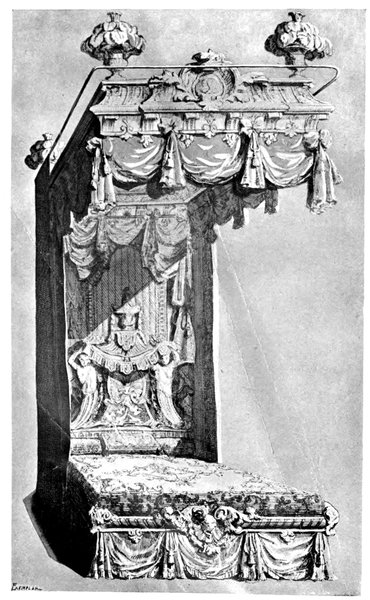
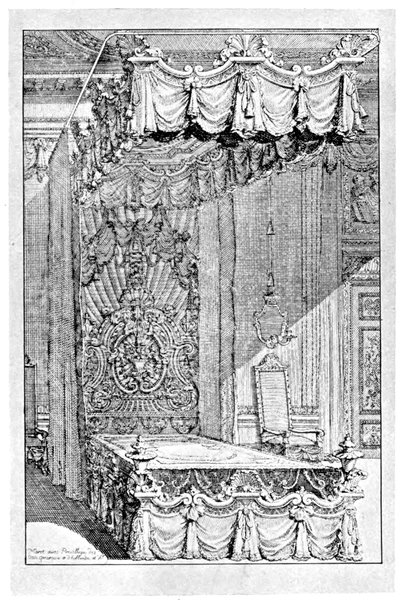
Frontispiece.Bed by Daniel Marot.
By
ESTHER SINGLETON
Author of “French and English Furniture,” etc
With numerous illustrations
NEW YORK:
THE McCLURE COMPANY
44–60 EAST TWENTY-THIRD STREET
1907
Butler and Tanner, The Selwood Printing Works, France, and London
PREFACE
v
No special inducement need be held out to an educated
Englishman at the present day to take an interest
in a particular field of the arts and crafts of the Low
Countries. Long before the nobles of Flanders, France
and England were associated in attempts to free the
holy places from the pollution of infidel possession, the
dwellers on the opposite coasts of England, Normandy
and the Netherlands had been bound together by many
dynastic and trade bonds. As we follow the course
of history, we find that the interests of the English
and the Flemings were inextricably connected; and
there was a constant stream of the manufactures of the
Low Countries pouring into English ports. The English
supplied much of the raw material upon which the
Flemings depended for subsistence. In mediaeval days
the inhabitants of the Low Countries could always be
forced by English statecraft to help the Plantagenet
kings in their continental intrigues by the mere cutting
off of the supply of wool. Later, the community of tastes
and interests in Reformation days drew the races closer
together; and all through Elizabethan days, and then
onwards till the close of the Marlborough campaigns,
the inhabitants of England and the Netherlands were
on terms of intimate acquaintance, socially and industrially.
viIn the following pages, therefore, constant evidence
will appear of the influence of the arts and crafts of the
Low Countries on English manufactures and importations.
Trade rivalry frequently gave rise to coolness
between England and Holland, and to an inglorious
war in the days of the Merry Monarch. The latter period
I have treated at considerable length on account of the
importance of the Oriental trade on the interior decorations
of Dutch homes.
On taking a general survey of the Decorative Arts
of the Low Countries, we notice several well-defined
periods and influences.
Materials are too meagre for us to learn much about
domestic interiors during the Dark Ages, but we know
that, in common with England and Northern France,
Scandinavian Art largely prevailed.
The feudal lords of the territories that now formed
the Netherlands were enthusiastic in assuming the cross;
and for two centuries the arts and crafts of Byzantium
and the luxury of the East dominated Western Europe.
About 1300 the influence of Byzantium had waned,
and the Gothic style was bursting into full bloom. For
the next two centuries it held full sway, and was then
pushed aside by the Renaissance, which made itself felt
at the end of the fifteenth century.
At the end of the sixteenth century we find the
Renaissance fully developed; and for the next fifty
years Flanders is the willing slave of Rubens and his
school. The Decadence quickly follows.
The provinces that now constitute Holland and Belgium
went hand in hand in the Decorative Arts until
viiabout 1600. If there was any difference, Holland was
more influenced by German and Flanders by French
Art. After the establishment of the Dutch trade with
the Far East at the beginning of the seventeenth century,
Dutch and Flemish Art diverge.
In the following chapters I have tried to trace these
influences and developments.
In illustrating the book I have gone to the original
works of the great masters of design—De Vries, Van de
Passe, Marot and others. As for Dutch interiors, nothing
can convey a clearer idea of the home than the famous
pictures by the Great and Little Masters—Jan Steen,
Teniers, Rembrandt, Cocques, Metsu, Maes, Terburg,
Dou, Weenix, Van Hoogstraten, Troost, etc., etc., many
of whose famous canvases are reproduced here.
I also include photographic reproductions of authentic
examples of Dutch and Flemish furniture preserved
in the Cluny, Rijks, Stedelijk and other museums.
In my attempt to reconstruct Dutch and Flemish
interiors of past days, I have consulted not only histories,
memoirs and books of travel, but wills and inventories
as well.
I wish to thank Mr. Arthur Shadwell Martin for
valuable research and aid for both text and illustrations.
Ecclesiastical Art—Wood-carving and Carvers—Primitive Character of the Furniture of Castles and Mansions—Huchiers—Menuisiers—A Typical Bedroom—Dinanderie—Wood-work and panelling—Chest, banc, bahut, sideboard, dressoir, credence, table and chair—Embroideries—Definition of Chambre—Textiles and Tapestries—Ecclesiastical Hangings—Tapestry-weavers—Tapestry of Philip the Bold—Flemish Looms—Cordovan and Flemish Leathers—Goldsmith’s Work—Glass and Glass-workers—Guilds of St. Luke.
The luxurious Dukes of Burgundy—Possessions of the House of Burgundy—The Burgundian Court—Household of Philip the Good—the Feast of the Pheasant—the Duke of Burgundy at the Coronation of Louis XI—Arras Tapestries—Sumptuous Dressoirs and their Adornments—Celebrations in honour of the Knights of the Golden Fleece—Luxury of Charles the Bold—Charles the Bold at Trèves—Furnishings of the Abbey of Saint-Maximin—Charles the Bold’s Second Marriage—Furnishings of the Banqueting Hall at Bruges—Descriptions by Olivier de la Marche—Aliénor of Poitiers’ Descriptions of the Furniture of the Duchess of Burgundy’s Apartments—Rich Dressoirs—the Drageoir and its Etiquette—the Etiquette of the Escarbeau—Philip the Bold’s Artisans—Flemish Carving—the Forme or Banc—Burgundian Workmanship—Ecclesiastical Work—Noted Carvers—Furniture of the Period—the “Golden Age of Tapestry”—Embroideries—Tapestry-weavers of the Low Countries—Introduction of Italian Cartoons—Goldsmiths’ Work—Furniture of the Fourteenth and Fifteenth Centuries.
Dawn of the Renaissance—The Transitional Period—Coffers and Bahuts—Court of Margaret of Austria—Perrèal’s Style—Margaret’s Tomb by Perrèal—Taste of the Regent—Margaret’s Tapestries, Carpets, Table-covers and Cushions—Her Curios—Flemish Tapestries—Cartoons by Bernard van Orley—William de Pannemaker—English Tapestries—Last Days of the Gothic Style—Guyot de Beaugrant, Lancelot Blondeel and Peter Pourbus—Stalls in the Groote Kerk, Dordrecht—Carvings in Haarlem—Invasion of the Renaissance—Walnut, the Favourite Wood for Furniture and Carving—Versatility of the Artists—the Fleming as Emigrant—the Renaissance in Burgundy—Hugues Sambin—Sebastian Serlio—Peter Coeck of Alost—Pupils of Peter Coeck—Lambert Lombard—Francis Floris, the “Flemish Raphael”—the Craze for Numismatics—Hubert Goltzius—Cabinets of the Sixteenth Century—Italian Furniture—Characteristic Features of Renaissance Furniture—Ornaments, the Arabesque, Pilaster, Cartouche, Cuirs, Banderole and Caryatid—Publications of Decorative Design—Alaert Claes, Lucas van Leyden, Cornelis Bos and Martin van Heemskerck.
Second Period of the Renaissance—Court of Mary of Hungary—Charles V a Fleming—Influence of Burgundian Court in Spain—Gilded Leather—Wealth of the Nobles in the Netherlands—Margaret of Valois at Namur—Antwerp in the Sixteenth Century—Christopher Plantin—Cornelis and James Floris—Jerome Cock—Hans and Paul de Vries—Jacques van Noye—Famous Designers—Characteristics of the Second Period of the Renaissance—Bedsteads, Tables and Chairs, Armoires, Cabinets and Chests—Porcelain, Glass and Glass Cupboards—Windows and Glass-painters—Guicciardini on the Artists of the Low Countries—Paul de Vries—Crispin de Passe the Elder—the Collaerts—Wood-carving—Music and Musical Instruments.
Renewed Italian Influence—Rubens: his Studio, his House, his Pupils, his Influence, his Successors—Seventeenth Century Wood-carvers—Development and Tendencies of Furniture—Crispin van den Passe—Rembrandt’s Goods and Chattels—Old Belgian Houses—The Pitsembourg—Kitchens—Leather-hangings—Tapestry—Marquetry—Chairs—Masters of Ornamental Design—The “Auricular Style.”
Famous Dutch Architects—The Royal Palace on the Dam, Het Loo, The Mauritshuis and Huis Ten Bosch—Interior Carvings—Specimens of Rooms and Ceilings in the Rijks Museum—Love of the Dutch for their Houses—Miniature Dutch Houses and Models of Old Amsterdam Houses in the Rijks Museum—Architecture of the Seventeenth Century—A Typical Dutch Home—The Luifel, Voorhuis and Comptoir—Interior Decorations and Furniture—Dutch Mania for Cleaning—Descriptions by Travellers of Dutch Houses and Cleaning—Cleaning Utensils—House and Furniture of Andreas Hulstman Janz, in Dordrecht—Inventory of Gertrude van Mierevelt, wife of the painter, in Delft—“Show-Rooms” and their Furnishings—Cooking Utensils—Bedroom in the House of Mrs. Lidia van der Dussen in Dordrecht—The Cradle and “Fire-Basket”—The Baby’s Silver—The “Bride’s Basket”—The “Bride’s Crown” and “Throne”—Decorations for a Wedding—Description by Sir John Lower of the Farewell Entertainment to Charles II at the Hague.
Rise of Dutch Taste in Decorative Art—Influence of Foreign Trade in the Dutch Home—Accounts of Porcelain by Mediaeval Travellers: Edrisi, Ibn Batuta and Shah Rukh—Quotation from Pigapheta—A Great European Collection—Monopoly of Trade by the Portuguese—Quotation from Pyrard de Laval—Portuguese Carracks—Voyages to Goa and Japan—Porcelain and Cabinets—Mendoza’s Description of Earthenware—Dutch and English Merchants—Presents to Queen Elizabeth—Dutch Expeditions and Establishment of the Dutch East India Company—Embassy to the Emperor of China in 1655—Descriptions of the Manufacture of Porcelain—Manufacture and Potters of Delft—Quotation from d’Entrecolles on Porcelain and Oriental Trade—Prices—Tea—Tea-drinking—A Dutch Poet on the Tea-table—Chrestina de Ridder’s Porcelain—Prices of Porcelain in 1653.
Love of porcelain—The Amsterdam Mart—Prices of China in 1615—Oriental wares before 1520—Luxury of the Dutch Colonists—Rich Burghers in New Amsterdam—Inventories of Margarita van Varick and Jacob de Lange—Dutch Merchants in the East—Foreign Views of Dutch Luxury—Dutch Interiors after the Great and Little Masters—House-furnishing by a young married couple—The Linen Chest—Clothes Chests and Cupboards—The Great Kas—The Cabinet—The Toilet—Table-covers—Foot-warmers—Looking-glasses—Bedsteads—Tables and Chairs—Woods—Kitchen Utensils—Silverware—Household Pets.
xiiCHAPTER IX
Dutch Furniture under French and Oriental Influence
The Dutch Craftsmen in the Employ of Louis XIV—Huguenot Emigration—Marot—The Sopha—Upholstery—The Bed—Chairs—Sconces—Tables—Rooms—English and Dutch Alliances—Hampton Court—Queen Mary—Looking-glasses—Chandeliers—Chimney-pieces—The style refugié—John Hervey’s Purchases—Oriental Furniture manufactured after European Patterns—Complaints of Home Manufacturers—Trade with the Indies—“Prince Butler’s Tale”—Enormous Importations—Imported Textiles—Foreign Textiles for Upholstery.
CHAPTER X
Furniture of the Eighteenth and Nineteenth Centuries
Lacquer—Oriental Methods—European Importations and Limitations—Prices—An Ambassador’s Report—Singerie, Chinoiserie and Rocaille—The Dutch Decadence—Interiors of Cornelis Troost—Mirrors—Wealth and Luxury of Dutch Merchants—Court Contrasts—Tapestry—Brussels as a Centre of Art and Luxury—Eighteenth Century Furniture—The Empire Style in the Low Countries—Dutch Homes of the Nineteenth Century—The Maarken House and Furniture—Typical Farmhouse and Furniture—Country Seats and Town Houses—Hindeloopen Houses and Furniture—A Friesland House—Canal Boat Furniture—Dutch Love of Symmetry—Collectors and Collections.
Ecclesiastical Art—Wood-carving and Carvers—Primitive character
of the Furniture of Castles and Mansions—Huchiers—Menuisiers—A
Typical Bedroom—Dinanderie—Wood-work and panelling—Chest,
banc, bahut, sideboard, dressoir, credence, table and chair—Embroideries—Definition
of Chambre—Textiles and Tapestries—Ecclesiastical
hangings—Tapestry-weavers—Tapestry of Philip
the Bold—Flemish Looms—Cordovan and Flemish Leathers—Goldsmith’s
Work—Glass and Glass-workers—Guilds of St. Luke.
In the turbulent days of the Middle Ages, the goods
of the Church were the only ones respected, and,
sometimes, not even those. The castles afforded protection
to those in their immediate vicinity, but rival
feudal ambitions rendered the calling of a luxurious
craftsman more or less precarious. The abbey walls
always sheltered a community of carpenters, joiners,
leather-dressers, iron-workers, goldsmiths, sculptors,
painters and calligraphists.
Towards the end of the Crusades, the new organization
of the Communes, after the period of anarchy,
becomes firmly established. Industry, commerce and
art begin to make rapid strides in the towns, and craftsmen
form themselves into corporations that receive
special privileges from their titular overlords. So long
as the artists of the ecclesiastical school remained under
the protection of the monastic houses, they naturally
2followed a hieratic road. The ornamentation they were
called upon to produce for the Church, they reproduced
when luxurious furniture was required in domestic life.
The great Corporations, however, as they grew in wealth
and power, demanded something superior to, or at least,
different from, the work of their forerunners. In the
monastic houses, it was long before this influence made
itself felt; but among the secular clergy it received a
hearty welcome.
The distinguishing character of Mediaeval work is
the freedom of execution allowed to the workman. The
architect decided on heights, dimensions, dispositions
of parts and profiles of stalls, or armoires; but the
details were left to be worked out by the artistic ability
of the skilled workman. Individual expression was
allowed full play, while the original conception of the
designer was respected.
Gradually, as the Communes became more powerful
and were able to afford stable protection to their members,
the spirit of association and solidarity tended to break
away from exclusively ecclesiastical art.
The art of wood-carving was developed principally
in the production of choir-stalls and altar-pieces. The
building of a beautiful temple to the glory of God was
usually begun by some pious founder from motives of
gratitude or repentance. It was dedicated to some
patron saint, and the work was carried out under the
supervision of some abbey or other religious house.
Often the church or cathedral was originally the abbey
church itself. In early Mediaeval days, the arts and
sciences were confined to the cloister, and the embellishment
3of the Holy House was a labour of love. Many
an obscure monk put all that was beautiful and fanciful in
his nature into the production of carvings in stone and
wood that have never been surpassed.
The precise date at which choir-stalls were introduced
into churches is not known; but it is certain that
they were in general use as soon as the Pointed Style
was finally established, that is to say, not later than the
thirteenth century. When the sanctuary was railed
off from the rest of the church, the priests, in their light
garb, naturally wanted to be protected from cold, damp
and draught by woodwork, which, like the high back of
a settle, enclosed the choir.
The stall is composed of several parts: the socle,
the tablet, or seat, half of which can be raised, as
it turns on hinges, the half thus raised, called the miséricorde,
serves as a support for a person resting, half
standing, half sitting; the paraclose, or sides that separate
it from the adjoining stalls [the forward extremities
of these are called museaux (snouts)]; the arm rest;
the high back; the daïs, or baldaquin; and, lastly, the
woodwork at each end of a set of stalls, called jouées
(cheeks).
With the exceptions of the socle and seat, every part
of the stall in all the great Gothic churches has received
very richly carved ornamentation, which is often remarkable
for its profusion of detail.
The miséricorde is ordinarily decorated with foliage
and fruits; but it often presents fantastic objects, such
as dragons, sirens, dogs, bears, and hybrid monsters of
every kind. Frequently also we find personages in
4ridiculous and gross attitudes, and all sorts of human
and animal caricatures. The paraclose is decorated
with Gothic tracery in the earliest examples; and later
with foliage, tendrils and branches of elegant curve.
These are usually open-work, the pierced oak producing
a charmingly light and graceful effect. Sometimes
here also we find human and animal forms. The high
backs are enriched with bas-reliefs, the subjects of which
are by no means taken exclusively from the Old or New
Testament. On the contrary, here the carvers have
given free rein to their fancy by reproducing scenes of
private life, and graceful compositions of flowers and
fruits with little animals intermingled. Sometimes the
subjects are framed in clusters of colonnettes, or in pilasters
decorated with niches containing statues. Sometimes
also statues of considerable size adorn this woodwork.
The jouées receive the most beautiful decorations, and
frequently these side entrances to the stalls are ornamented
by statues. The daïs, which at first was merely
a shelter of boards on an inclined plane over the whole
range of stalls, began to assume great importance in the
fifteenth century. It curved into vaultings; and very
soon each seat received a separate daïs decorated with
ogives, pinnacles, little steeples, pendentives, culs-de-lampe
and crockets; and the skilful carver did not
hesitate to introduce delightful statuettes into the company
of all these decorations.
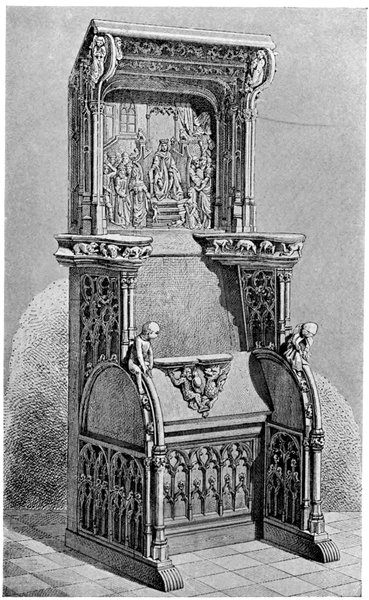
Plate I.—Choir-Stall.
A fine example of a Mediaeval carved oak stall is
shown in Plate I. By the richness of the carving it
must originally have held an important position in some
choir. Richly ornamented with Gothic shafting and
5tracery, it is a splendid example of architectural furniture.
The miséricorde represents a knight fighting with
a dragon. The scene depicted with the chisel on the
back is the favourite Judgment of Solomon. Around
the elbows are various animals and men on all fours.
The side scrolls under the daïs are decorated with angels
playing trumpets.
The names of the carvers who embellished the Mediaeval
choirs have, as a rule, been lost; and fire and iconoclasm
have destroyed most of their work. Some few
relics, however, of the splendour of wood-carving as it
existed before the Renaissance are still to be found.
For elaborate oak carving of the fifteenth century, it
would be hard to find a more interesting example than the
carved oak stalls in the great church of Bolsward (Broederkerk)
in Holland. This was built in 1280 A.D.; but
the richly carved late Gothic choir stalls date from about
1450.
One of the earliest churches of the Low Countries
is that of Nivelles. The convent was founded about
650 A.D. by Ita, wife of Pepin of Landen. The Romanesque
church, built in the eleventh century, somewhat
spoilt by bad restoration, still stands. On the
high altar is the shrine of St. Gertrude, which was carved
in 1272 by the orfèvres Nicolas Colars, of Douai and
Jackenon of Nivelles. This work of art is famous for
the delicacy and beauty of its details.
The Protestant Church of Breda (Hervormde Kerk),
built in 1290, also contains notable carving, especially
on the side entrances of the stalls (jouées). The choir
was consecrated in 1410, and here the carvers gave free
6rein to satire on the clergy, representing the monks in
various comical attitudes.
Examples of ecclesiastical furniture of Mediaeval
days are naturally scarce, as might be expected on the
“Battlefield of Europe.” It is indeed astonishing that
so much has survived after the ordeal by fire and sword
to which the Netherlands have been so often subjected.
Occasionally we come across a muniment chest. An
interesting one, the front of which is perforated with
quatrefoils, is to be seen in Notre Dame, Huy. This
dates from 1225. Two others in the same treasury are
by the hand of Godefroid de Claire, called “the noble
high goldsmith”; these, however, have lost their
original character, having been restored in 1560 by Jaspar,
a Namur goldsmith.
The ordinary movable furniture of a castle or Mediaeval
mansion was of a very primitive character. It must
be remembered that in those days merchants travelled
from town to town in veritable caravans. Nobles whose
business or pleasure induced them constantly to be
changing their residence, also travelled with an escort
and baggage-train that resembled a small army. The
necessary furniture and goods for the comfort of the
household were carried in carts and on the backs of
mules. The wooden furniture was, therefore, primitive.
The tables consisted of boards and trestles; the beds
were of similarly elemental construction; and what
seats were taken along were also of the folding variety.
The beds and benches were supplied with cushions
carried in chests, and the walls were hung with printed
linen or tapestry, while the floors were covered with
7rugs, or, in the majority of cases, with odoriferous plants,
rushes, or straw. Luxury chiefly declared itself in rich
products of the goldsmith’s art, which were displayed
on buffets of shelves rising like steps. These customs
prevailed for several centuries.
Pieces of furniture of earlier date than 1400 are
exceedingly rare; and those existing had a religious
destination, and are preserved in, or taken from, churches
and convents.
In the fourteenth century, as Gothic Art blossomed
after the disturbing influence of the Crusades, carving
entered more extensively into the decoration of furniture,
as it was more highly developed in ecclesiastical art.
The cabinet-makers of the period were skilful carvers:
in France and Flanders these huchiers-menuisiers were
called upon to supply royal and princely castles with
artistic furniture, the accounts of which have come
down to us. We find not only carved oak, but also
tables inlaid with ebony and ivory. The chief feature,
however, of interior decoration during the fourteenth
century was the hangings. The Genoese and Venetians
still had a monopoly of the trade with the Levant; and
Europe was supplied by the Italians with Oriental rugs,
tablecloths and hangings. The Flemish looms also produced
rich stuffs for upholstery and chamber hangings,
which were often sumptuously embroidered.
Through the fourteenth century, wood-carving kept
pace with the lovely stone sculpture of the cathedrals.
We learn there was no light furniture in palace or castle,
but that even in the lady’s chamber there were only
benches, trestles, forms, faldstools and armchairs. The
8wood-carver carved these with a mass of bas-reliefs and
bosses; the carpenters surrounded them with panelling;
and the artists painted them red and decorated them
with white rosettes.
In studying the arts and crafts of the Middle Ages,
we must always bear in mind the fact that art was not
specialized. The workmen were thoroughly trained,
and their artistic talents had free play. We find many
men who were at once architects, sculptors, painters,
goldsmiths and image-makers. This condition existed
till the middle of the seventeenth century.
In the Middle Ages, the carpenter made the household
furniture which formed an integral part of the
dwelling; and he was quite capable of giving to it the
Gothic ornamentation in vogue.
It was not till the fourteenth century that the increase
of luxury and the progress of the arts demanded a division
of labour; and that the huchiers and joiners formed
separate bodies from the carpenters. The huchiers,
who then became exclusively what we should now call
joiners and cabinet-makers, devoted their attention
especially to all that required ornate treatment in carving,
such as doors, windows, shutters and panelling, as well
as chests, benches, bedsteads, chairs, dressers and wardrobes.
These were largely fixtures and formed part
of the permanent woodwork of a hall, or bedroom. The
mouldings and other ornaments were carved directly
out of the oak, and not applied.
Before the great artists of the Netherlands arise,
we must go to the miniatures of early manuscripts in
order to form a correct idea of a Mediaeval interior. We
9usually find a very simple arrangement of furniture,
which consists of a bed, a bench, an armchair and some
kind of dressoir, or sideboard. The floor is tiled, or
tessellated; and sometimes the bed stands on a rug or
carpet, which also covers part of the adjoining floor space.
The windows with small leaded panes are supplied with
shutters of two or three wings: these are sometimes
covered with leather fastened with large brass-headed
nails. The chimney-piece is always wide and high;
the funnel shape of this occurs in the earliest examples.
The shelf above the opening is usually adorned with
glass, plate or earthenware. The armchair stands
beside, or near, the bed; the dressoir is close by; and
the settle is beside, or sometimes in front of, the fire.
The bed is often nothing but a long chest on short legs
with a mattress and pillows on top; and this is moved out
in front of the fire in case of need. The curtains and
canopy are suspended by cords from the rafters, as is
also the chandelier.
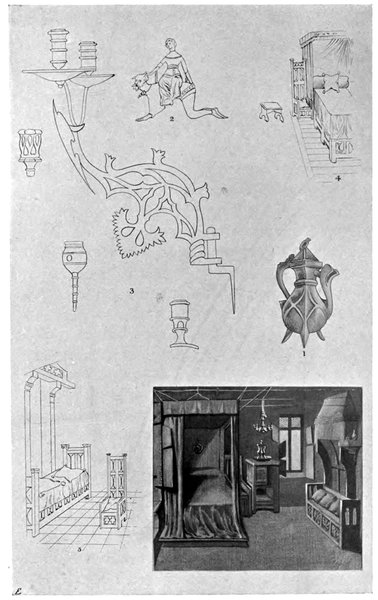
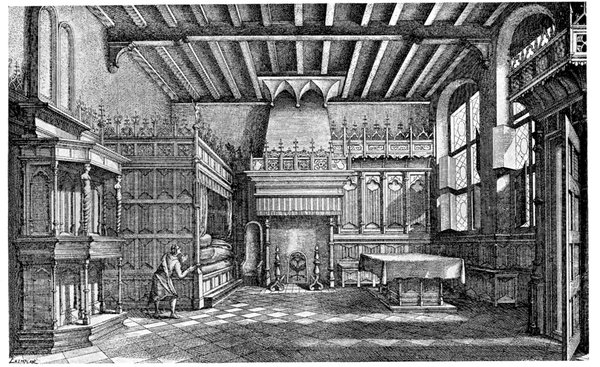
This same arrangement of furniture occurs in a
picture of the Salutation angélique in the Louvre, by an
unknown Flemish painter: it has been attributed both
to Lucas van Leyden and Memling. This room, reproduced
in Plate II, is one of the middle class at the end
of the fifteenth century. The walls are bare, the ceiling
shows open rafters of natural wood, and the floor is tiled.
The panes of the windows are leaded, and the inner
shutters, which are trebly hinged so as at need to fold
into the thickness of the wall, are, moreover, divided
in two parts, so that only the top may be opened if needed.
The other window has a window seat. The high chimneypiece
10is furnished with the lateral shelves in use throughout
Mediaeval times from the twelfth century onward.
The chimney diminishes in size as it rises, like an inverted
funnel. In summer time, when the fire was not needed,
the fireplace was masked by a wooden screen to prevent
draughts. In front of this, with its back to the screen,
was placed the high-backed settle, which in winter
faced, or was placed laterally to the cheerful blaze of the
hearth. The bench shown in this picture is made of
plain boards, with a little plain Gothic carving below
the seat. For comfort, it is supplied with three red
cushions. The bed, which is raised on a low platform,
is also furnished with red curtains, bolster and counterpane.
The tester is suspended by cords from the ceiling.
Beside the head of the bed is a chair, and next to that
a credence, which is used as a wash-hand stand. On it
are placed a ewer and shallow basin. These, and the
brass chandelier hanging above, are of the manufacture of
Dinant, a metal ware known all over Europe under the
name of Dinanderie. The chandelier has six branches,
each a grotesque form of some animal, and the top of
it is surmounted by the figure of a seated quadruped.
It is raised and lowered by a pulley and chain.
The ewer, or aiguière, standing on the credence, is
an excellent specimen of Dinanderie of the fifteenth
century; it has a double spout, as shown in Fig. 1.
Other examples of Dinanderie of this period are represented
in Fig. 2, a grotesque aiguière; and Fig. 3, a
bracket candlestick of very graceful form.
Dinanderie became celebrated as early as the thirteenth
century. Although made at first in Dinant, its manufacture
11spread throughout the valley of the Meuse, and
Dinantairs were established in various cities and towns
in the Netherlands, Germany, England and France.
In 1380, one Jehan de Dinant, living at Rheims, furnished
some articles to the King. Among the copper and brass
ware delivered at this period to the royal household
and to the establishments of other great personages by
this workman, we find all kinds of kitchen articles,
cooking utensils, stoves of all sizes, wash-basins, kettles
for heating water for the bath, barbers’ basins, large
boilers of all kinds, warming-pans for the beds, candlesticks,
chandeliers, and aiguières (ewers).
The permanent woodwork of the apartments in Mediaeval
days was furniture, without being “movables,”
just like the carved oak in the choir of a cathedral.
The panelling contained cupboards and wardrobes;
bedsteads were contrived in the timbered lining of the
walls; and the woodwork readily lent itself to the
adaptation of window seats, settles and benches. It
may easily be understood how the woodwork of a room
might conceal a whole series of shelves to which sliding
panels, or panels opening outwards as doors, gave access.
These various compartments served as cabinets for curios,
bookcases, glass and plate cupboards, wardrobes and
larders. When one of these compartments was made
as a separate piece of furniture to stand by itself out
against the flat wall of a room, it was called a cabinet,
or armoire. As late as the middle of the seventeenth
century, however, the armoire was generally part of the
fixed woodwork. Relai was another name for it. Thus
in 1635, Monet defines armoire, armaire, aumoire as a
12“reservoir pratique en la muraille à servir et garder tout
chose”; and Cotgrave (1673) has: “Relai” as “armaire,
a hole or box contrived in or against a wall.”
The plain box, or chest, was the origin of all the
developments of Mediaeval furniture. It had many
uses: it contained the treasures and valuables of the
lord; it was used as a packing-case or trunk for travelling;
with supports at the four corners and back, and
arms added above, it served as a chair or settle, with a
seat that could be lifted on hinges; raised also on legs
and supplied with a daïs, it became a dressoir, credence,
or sideboard; chest-upon-chest superimposed, developed
into the elaborate armoire; and, finally, supplied with
a head and foot rail and made comfortable with mattress
or pillows, it served as a bed.
In the old manuscripts of the Middle Ages, we find
many illustrations of the developments of the chest
and its various uses. Fig. 4 shows a long chest with
short solid legs on which bedding is laid, and over which
a canopy with curtains has been raised. By its side
is a chair, the seat of which is manifestly the lid of a
small chest. The chest-bed and chair stand on a carpet:
the floor is tiled. The shape of the pillow is characteristic
of the fourteenth and fifteenth centuries. The
carving of the panels in bed and chair show the “linen
fold,” which was so popular in the Netherlands and
which was laid in even more intricate folds by the English
carvers. Gothic tracery in furniture, in combination
with the “linen-fold” is shown in the chair of Fig. 5,
which exhibits also another chest, or bahut. The original
illustration shows flames leaping up the chimney, against
13which the bed is closely placed. The cushions, with
heavy tassels at each corner, are similar in shape to those
in Fig. 4.
There were several varieties of the chest, known
by various names, such as huche, bahut and arche. The
huche usually had a flat top: it was the oldest and
simplest form—a plain oblong box. As time wore
on the huche gave its name to the cabinet-makers (the
huchiers) of the Middle Ages. They made windows,
doors, panels, shutters, bancs, bahuts, armoires, credences,
and whatever else was required; and the guild of
huchiers was one of the largest corporations of the
period.
The huchiers were particularly distinguished for
their execution of choir-stalls and splendid carving.
The huche, at first a very simple piece of furniture, was
later decorated with beautiful paintings and rich carvings;
moreover, it was enriched and strengthened with
chiselled and pierced iron hinges and locks.
The chests until the thirteenth century were works
of simple carpentry. The faces consist of plain surfaces
which are ornamented with paintings on linen
or leather; and further adorned with hinges and clamps
of pierced and wrought metal.
The bancs, benches or settles, were made in the
Middle Ages by the huchiers. They were made of
planks and often had backs and arms. In the fifteenth
century, they were enriched with sculpture and surmounted
by a canopy or daïs. They were also called
formes or bancs d’œuvre. The Cluny Museum possesses
many fine examples of this period, both civil and religious.
14In the halls and bedrooms of the Mediaeval châteaux
the banc is often seen placed laterally before the wide
chimney-piece, and its high back was very useful in
keeping off the draughts. It may be thought that
their rigid form and absence of upholstery rendered
them uncomfortable, but the numerous soft cushions
with which they were supplied quite atoned for the
absence of upholstery. (See Plate II.)
The chief use of the Mediaeval sideboard was the
display of ornate plate, crystal and similar articles.
The kitchen dresser with its shelves holding plates and
dishes set upright against the wall is a lineal descendant
of the old dressoir. The shelves of the dressoir were
regulated by etiquette: every noble person could have
a dressoir with three shelves; others, only two; royalty
had four and five.
According to some authorities, the difference between
the dressoir and the buffet is simply this: the
dressoir was intended to display the articles taken from
the buffet, and had no drawers and no cupboard; the
buffet, on the other hand, contained both drawers
and cupboards. The buffet of our dining-rooms and
our cellarets that close with lock and key, are therefore
survivals of the credence of the Middle Ages.
Sometimes the credence and dressoir were combined
in one piece, or rather the dressoir served as a credence.
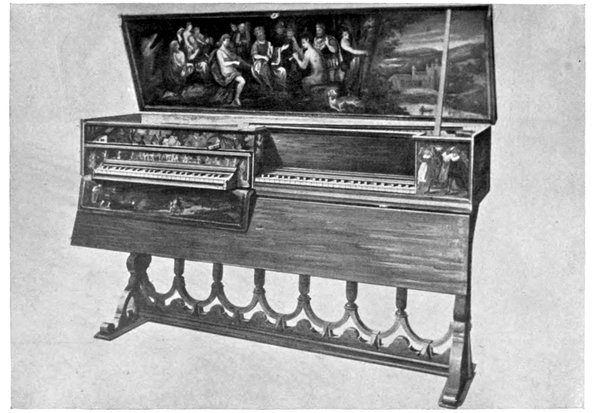
A small one shown in the illuminated MS. of the Histoire
de Gérard, Comte de Nevers, has but one shelf, upon
which the silver platters are arranged, leaning against
the back, which is covered with some kind of fabric.
The cupboard serving as a credence is covered with a
cloth on which are placed three silver ewers—aiguières.
This was, therefore, more of a buffet than a dressoir,
for the real dressoir, as we have seen, was composed of
shelves (gradins) and had a back (dorsal), or sometimes
a daïs of stuff or sculptured wood.
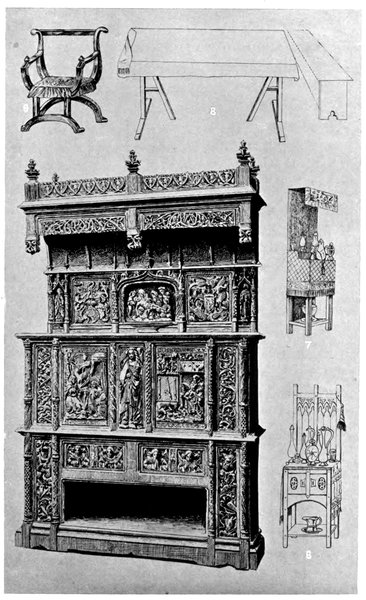
Plate III.—Flemish Dressoir (Fifteenth Century).
Figs. 6–7: Dressoirs (Fifteenth Century); Fig. 8: Table on Trestles; Fig. 9: Metal Chair.
15Varieties of the dressoir of the fourteenth and fifteenth
centuries appear in Plate III, and Figs. 6 and 7; and
a credence of the fifteenth century of Gothic decoration
from the Cluny Museum, Paris, on Plate IV.
The Mediaeval table was a simple affair, with either
fixed or movable supports. In nine cases out of ten,
either in hall or cottage, it consisted simply of a board
and trestles. In court and castle, kings and nobles
sat only on one side, the other being left free for service,
and for a clear view of the mummers, jongleurs and
minstrels who entertained the company during the
feast. These boards and trestles could be readily folded
up and packed away in carts for travelling. A good
example of the fifteenth century table of this construction
occurs in a picture of Mary Magdalen at the feet of
Jesus, by Derick Bouts (1410–1475). This is represented
in Fig. 8.
We have seen that the chest with its various developments—chair,
bench, bed and dressoir—furnished the
Mediaeval chamber. The ordinary hall contained merely
a plain buffet and a table, consisting of boards and
trestles, with simple forms for seats. Chairs there
were none, except for the lord and honoured guests at
the head of the board. It must not be supposed, however,
that there was no attempt at comfort or decoration
in the homes of the Middle Ages. It would be difficult
16to attach too much importance to the use of cushions
and hangings.
We have already seen one form of chair in Figs.
4 and 5, which show a box with a lid for the seat, on
which is a cushion. This chair has arms and a high
panelled back. The common stool, faldstool, or escarbeau
also appears in Fig. 4. The rigid square high-backed
chair, however, was not the only form known in the
Middle Ages. The type represented in Fig. 9 was in
great favour. This chair is reproduced from a miniature
by Jehan de Bruges (fl. 1370). This form of chair,
with curved lines in the back, arms and supports, was a
great favourite, not only in the Netherlands, but throughout
Europe for several centuries. Sometimes it was
made of wood, and carved on the extremities of the back,
arms and legs; and sometimes it was made of wrought
metal, brass, silver and even gold. In the latter case
it was probably plated. Sometimes the inventories
mention chairs of great value and very precious workmanship.
Some of them were even ornamented with
enamel. These were the work of the orfèvre. Brass
and copper chairs of this type were made in large numbers
by the skilful smiths of Dinant. Naturally they were
comfortably and sumptuously upholstered. An inventory
of 1328 contains an item of a chair of copper garnished
with velvet.
Flanders was always famous for its woven stuffs:
wool was the staple on which its prosperity depended.
The Duke of Burgundy recognized this when he chose
the Golden Fleece as the emblem of his great Order of
Knighthood. Apart from the looms, the art of the
17needle was also held in high esteem; and ladies of
high and low estate devoted much of their time to
embroidery.
Everything was embroidered: vestments and cloths
for the church; shoes, gloves, hats and clothes of men
and women; and cushions and draperies for the house.
Notwithstanding the lavish use of tapestry, the taste
for embroidered materials was ever on the increase.
The entire furnishings for a bedroom were often the
product of the needle; for instance, the “embroidered
chamber” of Jane of Burgundy, Queen of Philip V,
at her coronation at Rheims in 1330, was ornamented
with 1321 parrots, with the arms of the King, and 1321
butterflies, with the arms of Burgundy.
In Mediaeval days, the word “chambre” had a
broader signification than it has to-day. By chambre
was meant the whole of the rugs, curtains, hangings
and upholstery that adorned a bedroom. There was a
distinction drawn between “court pointerie” and “tapisserie.”
“Court pointerie” included everything pertaining
to the bed, such as the daïs, mattress, head-board,
etc. The “tapisserie” was changed every season like
the altar cloths and vestments of church and clergy.
Cords were run across the rafters, and the curtains and
canopies were hung on these with hooks. Thus the
rooms at the various seasons received such names as
the “Easter,” “Christmas,” or “All Saints’ Chamber.”
Then again the rooms were named after the subjects
(mythological, historical, romantic or religious), of the
tapestry that adorned them, such as the Chamber of the
Cross, of the Lions, of the Conquest of England, of Queen
18Penthesile, of the Nine Paladins, of the Unicorn and
Maiden, etc., etc.
Plate II shows how the canopy and curtains of the
bed were usually supported. Sometimes, however, the
hangings were attached to the rods by means of tenterhooks.
The inventories and chronicles of the Middle Ages
frequently mention textiles; but it is difficult to know
from the numerous terms the old scribes employ whether
they are describing woollen and silk tapestry, brocades,
damasks, velvets, or embroidered material. The fabrics
are of many varieties, and their names vary with the
details of production and places of manufacture, as well
as the material of which they are composed, and the
subjects they depict.
A great deal of Byzantine tapestry, with other
hangings and carpets, was brought into Western Europe,
by those returning from the First Crusade (1096–1099);
and after 1146, when Count Robert of Sicily brought
home from his expedition into Greece some captive
silk-workers, and established a manufactory for brocades
and damasks at Palermo, beautiful materials
were carried northward from Italy.
During the early centuries the use of tapestry was
very extensively devoted to the decoration of churches,
and therefore represented scenes from the Scriptures,
and lives of the Saints and the Virgin.
Cathedrals and monasteries were very rich in hangings
of tapestry, brocades, and embroideries of various kinds,
as well as stuffs on which ornaments were laid and
sewn. About 985, the Abbot Robert of the monastery
19of Saint Florent of Saumur, ordered a number of curtains,
carpets, cushions, dossers and wall-hangings, all of wool;
and, moreover, had two large pieces of tapestry made
in which silk was introduced, and on which lions and
elephants were represented upon a red background.
In 1133, another Abbot of the same monastery had
two dossers made to hang in the choir during festivals.
On one of these the twenty-four elders of the Apocalypse
with citharas and viols were depicted. The hangings
he got for the nave, represented centaurs, lions and
other animals.
On all festal occasions, the cathedrals were beautifully
decorated with superb tapestries. Some of them served
as hangings and door-curtains, others draped the altars,
while the seats and backs of the benches were covered
with pieces called bancalia, spaleriae, and dossalia.
Tapestries also covered the baldachins, or canopies;
and foot-carpets, called substratoria, tapetes, tapeta, or
tapecii were lavishly spread upon the ground.
During the thirteenth century tapestries came into
general use for hangings in private mansions. It is not
unlikely that Baldwin, Count of Flanders, who came
into power in 1204, stimulated the work of the Netherland
looms; for, from the very opening years of the
thirteenth century, the Flemish weavers adopted brighter
colours in their tapestries; and Damme, the poet of
Bruges, received all kinds of goods from the East, including
“seeds for producing the scarlet dye.”
This was the period when the Roman was in full
flower, and the tapestries naturally turned from Biblical
to heroic stories. The artists and weavers now
20begin to devote their energies to the production of secular
subjects. The stories of Paris and Helen, Æneas, and
others from Grecian mythology, become as popular as
those inspired by the Bible.
High-warp workers were established in Paris, Arras,
Brussels and Tournay in the first half of the fourteenth
century; but it is not until the reign of Charles V (1364–1380)
that they are explicitly described in the inventories.
The King was a collector of French and Flemish
tapestries: he had more than 130 armorial tapestries and
33 “tapis à images” that decorated the walls.
The Dukes of Anjou, Orleans, Berry and Burgundy,
had very valuable sets. Charles VI also had fine pieces.
He bought from Nicholas Bataille, a Flemish worker,
who calls himself a citizen of Paris in 1363, about 250
hangings. Bataille produced many superb pieces for
the wealthy houses of the day, and many sets for Philip
the Bold, Duke of Burgundy. A fellow-worker, Jacques
Dourdain, who died in 1407, made tapestries for the
Duke of Burgundy, to whom he sent in 1389 The Conquest
of the King of Friesland by Aubri the Burgundian, The
Story of Marionet, Ladies setting out for the Chase, The
Wishes of Love, The Nine Amazons, The History of
Bertrand Duguesclin, and A History of the Romance
of the Rose. The latter must have been very choice,
as it was woven “in gold of Cyprus and Arras thread.”
He also furnished this rich patron with other hangings,
the greater number of which were cloth of gold.
The marriage of Philip the Bold, Duke of Burgundy,
to the daughter and heir of the Count of Flanders, in
1369, greatly helped the Flemish tapestry-workers,
21who soon equalled those of Paris. For instance, the
Duke gave an order to Michel Bernard of Arras for a fine
piece, called The Battle of Rosbeck, of colossal dimensions.
It measured 285 square yards, and cost 2,600 francs
d’or. Other sets purchased from the Arras looms were:
The Coronation of Our Lady, The Seven Ages, Story of
Doon de la Roche, History of King Pharaoh and the People
of Moses, Life of St. Margaret, The Virtues and Vices,
History of Froimont de Bordeaux, Story of St. George,
Story of Shepherds and Shepherdesses, Life of St. Anne,
Story of Percival the Gaul, Hunt of Guy of Romany,
History of Amis and Amile, History of Octavius of Rome,
History of King Clovis, History of King Alexander, and
of Robert the Fusileer, History of William of Orange,
and a Pastoral.
The Flemish looms thus early acquired a great reputation,
rivalling those of the midland and northern
provinces of France. Paris, Arras, Brussels and Tournay
were the chief centres for the most beautiful high-warp
tapestry. Arras was celebrated as early as 1311, when
Marchaut, Countess of Artois, paid a large sum for “a
woollen cloth worked with various figures bought at
Arras”; and in 1313 she ordered from the same town
“five cloths worked in high warp.” The name became
generic: the Italians called all woven tapestries Arazzi;
the Spaniards, Panos de raz; and the English, “Arras,”
a name that was used for many centuries. Polonius
hides “behind the arras,” in Hamlet, and Spenser, in
The Faerie Queen, says:
Thence to the hall, which was on every side
With rich array and costly arras dight.
Book I., Canto iv.
22Agnes Sorel owned a superb specimen at her Château
de Beauté in 1350. It is described as “a large piece of
Arras, on which are pictured the deeds and battles of
Judas Maccabaeus and Antiochus, and stretches from
one of the gables of the gallery of Beauté to the other,
and is the same height as the said gallery.”
During the troublous times in France under Charles
VI, the Paris looms ceased to work, and Flanders supplied
all the tapestry that came to France. In 1395,
the Duke of Orleans orders his treasurer to deliver to
Jaquet Dordin, “merchant and bourgeois of Paris,”
1,800 francs for “three pieces of high-warp tapestry
of fine Arras thread.”
Leather was also extensively used during the Middle
Ages for interior decoration: it was hung upon the
walls and beds; it was spread upon the floors; and it
covered the seats and backs of chairs, coffers, cabinets,
shelves, folding stools, frames, frames for mirrors, and
all kinds of boxes both large and small. In 1420, we
hear of a piece of Cordovan called cuirace vermeil “to
put on the floor around a bed,” and also a “chamber
hanging” of “silvered cuir de mouton, ornamented with
red figures.” Charles V of France had “fifteen cuirs
d’Arragon to put on the floor in summer,” and the Duke
of Burgundy’s inventory of 1427 mentions “leathers to
spread in the chamber in summer time.”
The Duke of Berry had twenty-nine great cuirs
among his possessions, which were used to cover the
walls, beds and chairs.
Leather made a very sumptuous, durable and decorative
wall-hanging. The patterns of flowers, foliage,
23arms, devices and other figures were richly gilded, and
stood out in high relief from the brilliant backgrounds
of red, blue, green, orange, violet, brown or silver. Although
the use of gilded leather (cuirs dorés) did not
become general until the fourteenth and fifteenth centuries,
the art of gilding, silvering, painting and goffering
leather had long been known. It is more than probable
that the First Crusaders brought home specimens; but
it is certain that Cordova was making beautiful gilded
leathers in the eleventh century. The most beautiful,
as well as the most beautifully worked, leathers came
from Spain, where they were often called Guadameciles,
from Ghadames in Africa where they were prepared for
many years, and from which town the Moors carried
the art into Cordova. Ebn’ Abd el Noûr el Hamîri el
Toûnsi (of Tunis), in his geographical work written in
the twelfth century, thinks it worth while to mention
that the djild el Ghadâmosi comes from Ghadames. The
monk, Theophilus, in his Diversarum artium Schedula
shows how well Arabian leather was known, and describes
the methods of preparing it for decoration; but from
what he says it appears that leather was used at that
period only for the coverings of chairs, stalls, benches,
stools, etc., and not for wall-hangings.
From Cordova the manufacture spread into Portugal,
Italy, France and Brabant. The great centres for gilded
leathers in the Middle Ages were Cordova, Lille, Brussels,
Liège, Antwerp, Mechlin and Venice; and each town
impressed a special style upon its productions, which
connoisseurs are able to recognize.
The Cordovan leathers are stamped with patterns
24of very high relief, gilded and painted, the designs consisting
of branches or large flowers in the style of the
textiles of Damascus and India. The South Kensington
Museum has a very fine collection of Spanish leathers
ornamented with foliage, flowers, vases, birds and pomegranates.
The colours of the background are green,
blue, white, gold, red, etc.
The Flemish leathers are very similar to those of
Cordova, but the relief is less pronounced and the designs
are more delicate. The hangings of Flanders are almost
exclusively made of calfskin, and they were highly
prized throughout Europe.
Generally speaking, the earliest specimens of gilded
leathers resemble on a large scale the miniatures in the
manuscripts: there is little or no perspective, and the
subjects are like those of the contemporary tapestry
drawn from sacred or mythological stories. The details
of the faces, ornaments, costumes, arms, etc., are stamped
by hand-work and finished with a brush; and the
background, instead of representing sky, is ornamented
by guilloches (twisted bands) in gold and colour, applied
by means of a goffering iron.
The Low Countries were almost as celebrated for
their orfèvrerie as for their tapestries. Celebrated schools
of goldsmith’s work existed in the Netherlands during
the tenth and eleventh centuries in Waulsort under the
direction of d’Erembert, in Stavelot and in Maestricht;
and the diocese of Liège had an important atelier for
enamel-work in the twelfth century. A very skilful
goldsmith named Godefroid de Clerc worked in the
town of Huy in the first half of the thirteenth century,
25and another was Friar Hugo, who made in the Abbaye
d’Oignies the famous pieces now in the treasury of the
Sisters of Notre Dame in Namur.
The principal towns of Flanders, Ghent, Bruges,
Tournay, Liège and Brussels, possessed in the thirteenth
century skilful goldsmiths who followed the principles
of the School of the Rhine. In 1266, the Brussels goldsmiths
formed an important Corporation to which John
III, Count of Hainault, granted privileges. It was in
the fourteenth century particularly that the Flemish
goldsmiths acquired a great reputation.
A great deal of the goldsmith’s work during these
centuries was ornamented with niello, the style of
decoration following the Rhenish School.
The goldsmiths were sculptors, chisellers and engravers,
as well as designers; and, moreover, modelled
beautifully in wax. When their works were cast in
silver, they ornamented these themselves with beaten
bas-reliefs, or traced delicate patterns upon the surface
of the metal with the burin. Wishing to make the
figures stand out more prominently, they used cross-hatchings
on the background and cut out the shadowy
parts, which they then filled with black enamel. This
made the uncovered portions of the silver shine with
more brilliancy. To this effective work was given
the name niello (nigellum), on account of its colour.
This black enamel was used to ornament the chalices
and other church vessels, the hilts of swords, handles
of knives, and particularly the handsome little coffers,
or cabinets, which, with the bahut, comprised the
furniture that the bride always carried to her new
26home. These little boxes were usually of ebony, ornamented
more or less with incrustations of ivory, shell,
mother-of-pearl, pietra-dura, or niello, according to the
wealth of the respective families. When decorated with
niello, the designs consisted of simple ornaments or
arabesques, single figures or groups.
Western Europe made no glass in Mediaeval days:
what was used in church and castle all came from the
East. In the early inventories, whenever an object of
coloured glass is found, it is always accompanied by a
mention of its Oriental origin. It is doubtful whether
even plain glass was manufactured in England, France,
Germany or the Netherlands before the close of the
Crusades. The efforts made as late as the fourteenth
century by several French and German princes to attract
glass-blowers to their dominions shows how scarce they
were.
In 1338, we find a feudal noble giving a portion of
his forest to a certain Guionet, who was acquainted
with the methods of glass-making, to set up a glass factory,
on condition of supplying his house every year
with one hundred dozen bell glasses, twelve dozen little
vase-shaped glasses, twenty dozen hanaps, or cups with
feet, twelve amphorae, and other objects. As in all the
other industrial arts, Flanders was well to the fore in
the manufacture of plain glass. Before 1400, glass
factories existed there; but the products were only
white glass, not gilded nor enamelled. The Flemish
wares, however, were highly prized, and were freely
exported to other countries. In 1379, we find in the
inventory of Charles V of France: “Ung gobelet
27et une aiguière de voirre blant de Flandres garni
d’argent.”
To have glass mounted in silver shows how precious
it was considered in those days. Moreover, the royal
accounts of the end of the fourteenth century prove
that Charles VI accorded high protection and recompense
to the Flemish glass-blowers who established their
industry in France. Before the end of the fifteenth
century, we find entries that would seem to show that
the Low Countries were no longer exclusively dependent
on the Orient for coloured and enamelled glass. In
the inventory of Charles the Bold, Duke of Burgundy
(1477), we read: “Une coupe de voirre jaune garny
d’or; ... une couppe de voirre vert garny d’or; ...
un pot de voirre de couleur vert, garny d’or; ... un
aiguière de voirre vert torssé garny d’or; ... deux petis
pots de voirre bleu espez, garnis d’argent doré; ... ung
voirre taillé d’un esgle, d’un griffon et d’une double couronne
garny d’argent.” These, however, may have come from
Venice, which city had in the latter half of the fifteenth
century learned from the Greeks the secret of making
coloured, gilded and enamelled glass.
Painting on glass was never held in higher honour
than during the fifteenth century: castles and mansions
were adorned with coloured windows like the churches;
and, therefore, a considerable number of windows of
this period have survived. The Cathedrals of Tournay,
Dietz and Antwerp offer splendid examples. In M.
Levy’s Histoire de la peinture sur verre, are the names of
several Flemish glass-painters that have escaped oblivion.
The principal schools that fostered all forms of
28Decorative Art were the Guilds of St. Luke. They
sprang up in every prosperous city, and were very close
corporations of trades unionism. The idea probably
originated in Italy. A Society of St. Luke was established
in Venice before 1290, and another in Florence
in 1349. One Gerard de Groote organized a brotherhood
of this kind in Cologne in the fourteenth century;
and Societies of St. Luke were founded in Flanders in
the fifteenth century. These Guilds exerted the greatest
influence upon taste and skill, for in these Societies
of Guilds of St. Luke, side by side with the Masters of
Painting and Sculpture, were placed what we may call
the Masters of the Decorative Arts. There were workers
in stone and marble including mosaics in colour for the
decoration of churches and chapels; workers in enamel
and ceramics for vases, panelling and pavements;
workers in wood, sculptors and carvers for the altar
fronts, canopies, choir stalls, etc. (these menuisiers also
worked in marquetry and intarsie, and produced furniture
for the sacristy, coffers, bahuts, etc., and pontifical
seats); glass-workers who produced windows, panels
and embroideries with glass beads for decoration; metalworkers,
including goldsmiths, bronze-workers, who made
sacred vessels, luminaries, fonts ornamented with repoussé-work,
chiselling, engraving, incrustation with
precious stones and niello-niellure; leather-workers (including
makers of harness for wars and tourneys); gilders,
setters of jewels; bookbinders; illuminators and
painters of manuscripts; weavers and embroiderers
of tapestries, silken stuffs, etc.
Society benefited by development of these arts very
29greatly, and the sumptuous adornment of the churches
soon extended to private dwellings. Carved panels, or
panels inlaid with precious woods, soon decorated the
walls of wealthy houses that were further enriched by
magnificent tissues of silk and gold, tapestries or panels
of stamped leather as a background for pictures beautifully
framed in carved and gilt wood. In marquetry
furniture, the most remarkable objects were the coffers
for jewels, and the cabinets (stipi), in ebony, shell and
ivory, embellished with gilt, bronze, and the dower
chests, “arches de mariage.”
CHAPTER II THE BURGUNDIAN PERIOD
31
The luxurious Dukes of Burgundy—Possessions of the House of Burgundy—The
Burgundian Court—Household of Philip the Good—the
Feast of the Pheasant—the Duke of Burgundy at the Coronation
of Louis XI—Arras Tapestries—Sumptuous Dressoirs and
their Adornments—Celebrations in honour of the Knights of the
Golden Fleece—Luxury of Charles the Bold—Charles the Bold
at Trèves—Furnishings of the Abbey of Saint-Maximin—Charles
the Bold’s Second Marriage—Furnishings of the Banqueting Hall
at Bruges—Descriptions by Olivier de la Marche—Aliénor of
Poitier’s Descriptions of the Furniture of the Duchess of Burgundy’s
Apartments—Rich Dressoirs—the Drageoir and its
Etiquette—the Etiquette of the Escarbeau—Philip the Bold’s
Artisans—Flemish Carving—the Forme or Banc—Burgundian
Workmanship—Ecclesiastical Work—Noted Carvers—Furniture
of the Period—the “Golden Age of Tapestry”-Embroideries—Tapestry-weavers
of the Low Countries—Introduction of Italian
Cartoons—Goldsmiths’ Work—Furniture of the Fourteenth and
Fifteenth Centuries.
The most luxurious prince of his age was Philip
the Bold, Duke of Burgundy (1342–1404), son
of John the Good, King of France. By its alliances,
conquests and inheritances, the House of Burgundy
attained such wealth and power as to overshadow the
French throne itself. Under his grandson, Philip the
Good, the Burgundian Court displayed greater splendour
than any other in Europe. The reigning dukes were
powerful protectors of the arts. Their immense resources,
32drawn from the Flemish hives of industry,
enabled them to indulge their taste for architecture,
painting, sculpture, illuminated books, tapestry, goldsmiths’
work and sumptuous furniture. They were
also insatiable collectors of everything that was curious
and rare. Any able artist, sculptor, architect, goldsmith,
or image-maker, driven from home by the perpetual
civil wars in England, France and Italy, was
sure of refuge and employment at the Court of Burgundy.
Thus, for a century and a half, the Low Countries were
the most important art centre of Europe. Dijon and
Brussels, the capitals of the Burgundian dominions,
were Meccas of Mediaeval Art; and Tournay, Bruges,
Ypres, Ghent, Dinant, and many other industrial centres
swarmed with craftsmen who produced all that was
luxurious and beautiful for domestic comfort and decoration.
The house of Burgundy constantly increased its
possessions. Some idea of its power is gained by a list
of Philip the Good’s titles. He was Duke of Burgundy,
of Brabant, of Lothier, of Luxembourg; Count of
Flanders, of Artois and of Burgundy; Palatine of Hainault,
of Holland, of Zeeland, of Namur and of Charolais;
Marquis of the Holy Empire; and Lord of Friesland, of
Salins and of Mechlin.
The brilliance and luxury of the Burgundian Court
are attested by many chroniclers. The pages of Philip
de Comines, Olivier de la Marche, and others are full
of descriptions of feasts and pageantry from which we
can form an idea of the luxurious appointments of the
palatial dwellings of the day. Foreigners also, who
33were well acquainted with other European courts, bore
witness to Burgundian splendour. One of these, Leo
von Rozmital, who visited the courts of Europe in
1465–7, saw the Duke of Burgundy’s treasures. His
suite was overpowered by the magnificence. The scribe,
Tetzel, tried to enumerate and describe these marvels,
but gave up the task in despair, noting “there was
nothing like it in the whole world and that it far
exceeded the Venetian collection.”
The son and successor of John the Fearless, Philip
the Good (1396–1467), was even more luxurious than
his grandfather, Philip the Bold. His Court was unequalled
in Europe, and when in attendance upon the
King of France, his retinue completely eclipsed royalty.
His palaces in Brussels, Dijon and Paris were sumptuously
furnished; and his collections of tapestries, silver,
gold, jewels, embroideries, illuminated manuscripts and
printed books excited the admiration of the travellers
and chroniclers of the age. His household, composed
of four great divisions—the Panetrie, Échansonnerie,
Cuisine and Écurie, with subordinate departments, was
subject to the strictest rules of etiquette and was adopted
as a model by the Spanish sovereigns of the sixteenth
century. The ceremonies of the levee, procession, council,
audience, service of spices, banquet, etc., were selected
as precedents for Vienna and Paris, as well as Madrid.
One of Philip’s most celebrated banquets—the Feast
of the Pheasant, which took place at Lille in 1454—will
serve to give a glimpse of the Court entertainments in
his day. The large hall was hung with tapestry representing
the labours of Hercules, and was encircled by
34five tiers of galleries for the spectators. The dressoir
of enormous size was adorned with gold and silver
vessels, and on either side of it stood a column. One
of these had attached to it a carved female figure from
whose breast flowed a fountain of hippocras; and to
the other was fastened by an iron chain a live lion from
Africa, a great curiosity in those days. The three great
tables were covered with the most ingenious productions
of the cooks, confectioners and machinists. “On a
raised platform at the head of the first table sat the Duke.
He was arrayed with his accustomed splendour—his
dress of black velvet serving as a dark ground that
heightened the brilliancy of the precious stones, valued
at a million of gold crowns, with which it was profusely
decked. Among the guests were a numerous body of
knights who had passed the morning in the tilting-field,
and fair Flemish dames whose flaunting beauty
had inspired these martial sports. Each course was
composed of forty-four dishes, which were placed on
chariots painted in gold and azure, and were moved
along the tables by concealed machinery.” As soon as
the company was seated, the bells began to peal from
the steeple of a huge pastry church with stained windows
that concealed an organ and choir of singers, and three
little choristers issued from the edifice and sang “a very
sweet chanson.” Twenty-eight musicians hidden in
a mammoth pie performed on various instruments, and
the fine viands and wines were circulated. After the
exhibition of entremets, the pheasant was brought in,
the Crusade proclaimed against the Sultan, and the
vows registered.
35Another instance of the magnificent display of this
Duke occurred when he accompanied Louis XI to Rheims
for the ceremony of his coronation in 1461. This is
described as follows by the Duke of Burgundy’s chronicler,
Georges Chastelain (1403–75):
“Their journey resembled a triumphal procession,
in which the Duke of Burgundy appeared as if he were
the conqueror and Louis the illustrious captive. The
trappings of the horses, that reached to the ground, were
of velvet and silk, covered with precious stones and
ornaments of gold, embroidered with the Burgundian
arms and decorated with silver bells, the jingling of
which was very agreeable and solacing. A great number
of wagons draped with cloth of gold and hung with
banners carried the Duke’s tapestries, furniture, silver
and other table service and the utensils for the kitchen.
These were followed by herds of fat oxen and flocks of
sheep intended for food during the progress of the Duke
and his suite. Philip and his son, with the principal
nobles, appeared in their greatest magnificence, and
were preceded and followed by pages, archers and men-at-arms,
all in gorgeous costumes and blazing with
jewels.”
Their entrance into Rheims was regarded as the
most superb spectacle France had ever witnessed. Louis
was crowned by the Duke of Burgundy, “the dean of
the peers of France”; and at the banquet that followed
the coronation, the Duke of Burgundy was still the
most conspicuous figure. The same chronicler continues:
“Though the King sat at the head of the table,
36arrayed in regal attire, with the crown upon his head,
he was still the guest of his fair uncle, whose cooks had
provided the dinner, whose plate was displayed upon
the sideboards and whose servants waited upon the
company. In the midst of the repast, the doors were
opened and porters entered bearing a costly present for
the new sovereign. Such of the guests as were strangers,
except from hearsay, to the splendours of the Burgundian
Court, gazed in astonishment at the images, goblets,
miniature ships, and other articles of the finest gold
and rarest workmanship—amounting in value to more
than two hundred thousand crowns—which Philip presented
to the King as an emphatic token of his loyalty
and good-will.”
Chastelain’s note of the great number of wagons
that were required to carry the Duke’s tapestries in his
journeyings is of interest. The products of the Flemish
looms were highly prized by the Burgundian dukes,
and great encouragement was given by them to the
best work of this nature.
It was from Arras that they chiefly filled their superb
store-chambers in the fourteenth and fifteenth centuries.
The Arras looms had become famous, far and wide;
for, when Philip the Bold’s son was taken prisoner at
the Battle of Nicopolis (1396), the Sultan Bajazet said
to the Duke of Burgundy’s envoy that he “would be
pleased to see some high-warp tapestries worked in
Arras and Picardy,” and that “they should represent
good old stories.” Philip thereupon sent two pack-horses
laden with “high-warp cloths, collected and
made at Arras, the finest that could be found on this
37side of the mountains.” The set he chose was The
History of Alexander. In 1374, there is an entry in the
accounts of the Duke of Burgundy “to Colin Bataille,
tapissier et bourgeois de Paris,” for six pieces of tapestry
“of Arras workmanship,” with the arms of M. the
Duke of Burgundy “to cover the pack-horses of Monseigneur
when he travelled.” The favourite subjects
produced at Arras were romances of chivalry, such as
Charlemagne and his Peers, Doon de la Roche, Baudouin
de Sebourg, Percival the Gaul, Renaud de Montauban,
Aubri de Bourguignon, etc.; stories from Greek mythology,
such as Theseus, Jason, Paris and Helen, The
Destruction of Troy, etc.; and contemporary events
such as The Battle of Rosbeck, The Battle of Liège, History
of Bertrand Duguesclin, The Jousts of St. Denis and The
Battle of the Thirty. Hunting scenes and pictures of
cavaliers and ladies in everyday life were popular, and
stories from the Old and New Testaments, Lives of the
Saints and Acts of the Martyrs. Allegory also makes
its appearance as a subject for cartoons, such as the
Virtues and Vices, the Seven Cardinal Sins, the Tree of
Life, Fountain of Youth, etc.
When Philip the Good married Isabella of Portugal,
Le Fèvre de Saint Rémy notes that on each side of the
hall there was a dressoir twenty feet long on a platform
two feet high and well enclosed by barriers three feet high,
on the side of which was a little gate for entrance and
exit; and both dressoirs had five stages, each two and
a half feet high. The three upper tiers were covered
and loaded with vessels of fine gold; and the two lower
ones with many great vessels of silver gilt.
38Again, Chastelain, describing a banquet given by
Philip the Good, says: “The Duke had made in the
great hall a dressoir constructed in the form of a round
castle, ten steps (degrés) in height filled with gold plate
in pots and flagons of various kinds, amounting to 6,000
marks (argent doré) not counting those on the top which
were of fine gold set with rich gems of marvellous
price.”
The above gives some idea of the importance of the
dressoir, which undoubtedly was the most showy piece
of furniture in hall or chamber. It often assumed
enormous proportions on great state occasions.
A very ornate one of this period is reproduced in
Plate III. It is beautifully carved with Gothic tracery,
leaf-work, Biblical scenes and personages, and coats-of-arms.
It is interesting to compare this with the
simple form of Plate IV, which has no intermediate
shelf for the display of plate; but is also interesting on
account of its carving. This, with its drawers and
cupboards, was a most serviceable piece of furniture
and must have produced a fine effect in a room when
the cupboard head was decked with plate.
The great celebrations in honour of the Knights of
the Golden Fleece also offered occasion for the display
of the greatest splendour at the Burgundian Court.
A veritable army of painters, sculptors, illuminators,
carvers and machinists was employed to design and
prepare the entremets exhibited during the banquets.
Among the huchiers who worked for the banquet given
to the Knights of the Golden Fleece in 1453 were Guillaume
Maussel and his son, Jacob Haquinet Penon,
Jehan Daret and his two companions, and Jehan de
Westerhem.
Plate IV.—Credence (Fifteenth Century).
CLUNY MUSEUM, PARIS.
39When Charles the Bold (1433–1477) succeeded his
father, Philip the Good, in 1467, he maintained his
Court with the same state, ceremony and luxury. His
daily life was surrounded by pomp and punctilious
etiquette. He dined in state every day and was always
attended by a retinue of knights, equerries and pages.
When he went to war, he always carried rich silver and
tapestries, as well as costly viands and wines. The Swiss
gained rich spoils after the Battle of Nancy and carried
away among other articles of value tapestries which
can be seen to-day in Nancy, Berne and other cities.
The meeting of Charles the Bold with the Emperor
at Trèves, in 1473, occasioned a great display of magnificence.
The far-famed luxury of the Burgundian Court
was well exhibited during the eight weeks that the two
Courts spent in the Rhenish city. Charles gave the
most superb entertainments. The Abbey of Saint
Maximin, which the Duke chose for his temporary residence,
was fitted up for the occasion with furniture,
tapestries, richly embroidered stuffs, gold and silver
from his palaces. The great hall was hung with tapestries,
and the chair of state for the Emperor, the canopy
and the seats for the other great personages on the daïs
were covered with rich embroidered hangings. The
arms of Burgundy, the insignia of the Golden Fleece and
other heraldic decorations were conspicuously displayed.
Many of the most valuable ecclesiastical treasures
collected by Philip the Good, such as silver images,
candlesticks, and crucifixes, and reliquaries of gold
40studded with gems were brought to adorn the altars and
shrines of the church; and, in the refectory, an immense
dressoir, twenty feet broad, reached from floor to ceiling,
its ten receding shelves gleaming with gold and silver
plate.
Charles the Bold’s second marriage in 1468 to Margaret
of York furnished another occasion for the display of
his wealth and magnificence. John Paston, who went
to Bruges to attend the wedding, was simply dazzled
and overwhelmed by what he saw. Writing to his
mother, he says: “As for the Dwkys coort, as of lords,
ladys and gentylwomen, knyts, sqwyers and gentylmen,
I herd never of non lyek it, save King Artourys cort.
And by my trowthe, I have no wyt nor remembrans
to wryte to you, half the worchep that is her.”
Passing by the descriptions of jousts and other
entertainments, we may note that workmen—painters,
decorators and machinists—had been engaged for many
months to adorn Bruges fittingly for the nuptial festivities.
The streets were hung with tapestries and
cloth of gold, triumphal arches were erected at intervals,
and at different points along the road the bride was
diverted with “Histories,” the joint productions of
dramatist, decorator, painter and machinist. The front
of the palace was covered with paintings of heraldic
devices and magnificent decorations, and behind the
palace, in the tennis court, a new banqueting hall was
erected for the occasion. This building was a hundred
and forty feet long, seventy feet wide and more than
sixty feet high. The walls were hung with some of the
Duke’s most famous tapestries, one set of which represented
41Jason’s quest of the Golden Fleece; the ceiling
was painted, and at every possible place banners and
heraldic devices were hung. An enormous dressoir in
the centre of the hall displayed on its tiers of shelves
an overwhelming exhibition of gold and silver treasures
glittering with gems. The tables were arranged lengthwise
on either side of the hall, except one reserved for
the Duke’s family and the guests of highest rank. This
table was placed on a raised platform at the upper end
of the hall, and over it was spread a canopy with curtains
hanging to the floor, so as to present the appearance
of an open pavilion. The chroniclers of the day
note that “the hall was lighted by chandeliers in the
form of castles surrounded by forests and mountains,
with revolving paths on which serpents, dragons and
other monstrous animals seemed to roam in search of
prey, spouting forth jets of flame that were reflected
in huge mirrors, so arranged as to catch and multiply
the rays. The dishes containing the principal meats
represented vessels, seven feet long, completely rigged,
the masts and cordage gilt, the sails and streamers of
silk, each floating in a silver lake between shores of
verdure and enamelled rocks, and attended by a fleet
of boats laden with lemons, olives and condiments.
There were thirty of these vessels and as many huge
pasties in a castellated shape with banners waving from
their battlements and towers; besides tents and pavilions
for the fruit, jelly dishes of crystal supported by figures
of the same material dispensing streams of lavender
and rosewater, and an immense profusion of gold and
silver plate.”
42The festivities continued for more than a week.
Every day a tournament, banquet and dance took place.
At one of the banquets, the decorations were so wonderful
that the guests marched around the tables to examine
the artistic creations. These consisted of gardens made
of a mosaic-work of rare and highly polished stones,
inlaid with silver, and surrounded with hedges made of
gold. In the centre of each enclosure was placed a tree
of gold with branches, foliage and fruit exquisitely
enamelled in imitation of orange, pear, apple and other
trees. Fountains of variously perfumed waters rendered
the air deliciously fragrant.
Olivier de la Marche’s description of the banqueting
hall is as follows:
“In this hall were three tables, one of which was
placed across the ends of the others. This table, higher
than the others, stood upon a platform. The other
two tables were placed on the two sides of the hall,
occupying the whole length; they were very long and
very handsome, and in the centre of the said hall a high
and rich buffet in the form of a lozenge was placed.
The top of the said buffet was enclosed with a balustrade,
and the whole was covered with tapestries and hung
with the arms of Monsieur le Duc; and above rose the
steps and degrees on which were displayed many vessels,
the largest on the lowest, and the richest and smallest
on the top shelves; that is to say, on the lowest shelves
stood the silver-gilt vessels, and above them the vessels
of gold garnished with precious stones, of which he had
a great number. On the top of the buffet stood a rich
jewelled cup, and on each of the four corners large
43and entire unicorns’ horns, and these were very large
and very handsome. These vessels of parade were not
to be used, for there were other vessels, pots and cups
of silver in the hall and chambers intended for service.”
Turning now from the buffet d’apparat, he describes
the “buffet d’usage.” Regarding the service, “The
new Duchess was served by the cup-bearer, the carver
and the pantler, all English, all knights and men of
noble birth, and the usher of the hall cried: ‘Knights
to the meat!’ And then they all went to the buffet
to fetch the meat, and all the relations of Monsieur and
all the knights marched around the buffet in the order
of the great house two by two after the trumpeters
before the meat.”
We sometimes get a glimpse of a luxurious chamber
of the Burgundian Court from Aliénor of Poitiers, who
wrote Les Honneurs de la Court. Her testimony is
trustworthy, for her mother was maid of honour to the
Duchess Isabella, third wife of Philip the Good; and,
therefore, she undoubtedly witnessed what she describes.
She tells us that the chamber of Isabella of Bourbon,
wife of Charles the Bold, Count of Charolais, was very
large and contained two beds, separated by a space
four or five feet wide. A large ciel, or canopy, of green
damask covered both beds; and from it hung curtains
of satin which moved on rings, and could completely
screen the beds when desired. The lambrequin of the
canopy and the curtains were fringed with green silk.
On each bed was an ermine counterpane, lined with
very fine violet cloth. The chronicler expressly notes
that the black tails were left on the fur. “La grande
44chambre” from which the “Chambre de Madame” was
entered, called the “chambre de parement,” contained
one large bed in crimson satin. The ciel was very richly
embroidered with a great gold sun, and “this tapestry
was called la chambre d’Utrecht, for it is believed that
Utrecht gave it to the Duke Philip,” writes Aliénor,
who adds: “The curtains of crimson samite are looped
up like those of a bed in which nobody sleeps.” The
hangings of the wall were of red silk. At one end of
the bolster was a great square cushion of gold and
crimson, and by the side of the bed a “large shaggy
carpet.”
In each of these rooms there was a handsome dressoir;
and our scribe continues: “In the chamber of
the Countess de Charolais there was a large dressoir of
four beautiful shelves, the whole length of the dressoir,
each covered with a cloth; the said dressoir and the
shelves filled with vessels of crystal garnished with gold
and precious stones, and some of fine gold; for all the
richest vessels of Duke Philip were there—pots, cups
and beakers of fine gold, and other vessels that are never
exhibited except on state occasions. Among other
vessels there were on the said dressoir three drageoirs
of gold and precious stones, one of which is estimated
at 14,000 écus, and another at 30,000 écus. On the
back of the dressoir was hung a dorset (dorsal) of cloth
of gold and crimson, bordered with black velvet, and
on the black velvet was delicately embroidered the
device of Duke Philip, which was a gun....
“Item, on the dressoir which was in the chamber
of the said lady, there were always two silver candlesticks
45which they called at Court mestiers,[1] in which two
lights were always burning, for it was fifteen days before
the windows of her room were allowed to be opened.
Near the dressoir in a corner was a little low table containing
the cups and saucers in which something to drink
was served to those ladies who came to see Madame,
after they had been offered a dragée[2]; but the drageoir
stood upon the dressoir.”
In the “chambre de parade” there stood a very
large dressoir, ornamented with superb pieces of gold
and silver.
It was the custom for both lords and ladies to receive
their acquaintances informally in the “chambre de
parade,” while the inner room was reserved for their
intimate friends. On the occasion of a birth, these two
rooms were as superbly furnished as the house could
afford. The richest cloths and tapestries were brought
out, and the dressoir was adorned with articles of gold
and silver that were only placed on view on important
occasions.
When Mary of Burgundy was born, the same authority
informs us that Isabella of Bourbon’s room was
very richly furnished; and in honour of Mary of Burgundy,
the daughter and heir of Charles the Bold, there
were five shelves upon the dressoir, a privilege reserved
for queens only.
The drageoir was a very important article. It contained
the various “épices de chambre,” generally called
dragée, and meaning all kinds of sugar plums and confitures,
conserves, sugared rose leaves (sucré rosat), etc.
46A writer in the sixteenth century mentions “Curious
dragées of all colours, some in the shape of beasts,
others fashioned like men, women and birds.” Sometimes
the bonbons were taken with the fingers, as may
be seen in one of the fine set of tapestries in the Cluny
Museum, representing The Lady and the Unicorn. An
attendant kneeling presents the drageoir to the lady,
who is standing with a pet bird on her left arm, and she
is about to dip the fingers of her right hand into the
drageoir to get something to delight the bird.
The drageoir was generally handed to the guests after
dinner, and made its appearance at all ceremonial feasts.
Froissart, describing the reception to the English knights
sent by the King of England in 1390 to negotiate peace
in France, says they were entertained at the Louvre,
and “when they had dined they retired to the King’s
chamber, and there they were served with wine and
sweetmeats in large drageoirs of silver and gold.” It was
always handed with solemnity, and subject to strict
etiquette. The Constable of France had the honour of
presenting the drageoir to the King. At the Duke of
Burgundy’s Court, according to Olivier de la Marche,
the steward handed the drageoir to the first chamberlain,
who handed it to the most important personage present,
who then presented it to the prince or duke. When the
latter had helped himself, the honoured guest returned
it to the chamberlain, who gave it to the steward.
Aliénor also informs us: “When one of the princes
had served Monsieur and Madame (the Duke and Duchess
of Burgundy) with sweetmeats, one of the most important
personages, for example, the first chamberlain, or
47Madame’s chevalier d’honneur, took the drageoir and
served the Duke’s nephews and nieces; and after they
had been served it was handed to everybody.”
The drageoir was one of the most valued and popular
presents during the Middle Ages. In the inventory of
Margaret of Austria occurs a beautiful and large silver-gilt
drageoir, fluted, presented to Madame by the gentlemen
of the town of Brussels for her New Year, 1520.
Aliénor de Poitiers also says there should always be
in the lady’s room a chair with a back near the bolster
of the bed; and that this chair should be covered with
silk or velvet, for “velvet is the most honourable covering,
no matter what colour”; and “near the chair
should be placed a little bench, or stool, covered with
a banquier and some silk cushions for visitors to sit
on when they call to see the invalid.”
The little stool or bench, called escarbeau, was very
low and without back or arms. Sometimes it was
triangular in form. Sometimes it served for a low
table. Rich people often threw over these bancs a
piece of tapestry or silk, known as banquiers.
The memory of the vast majority of the artists
of this period has perished, but a few names have survived.
When Philip the Bold built a second St. Denis for
his race at Dijon (1390), his art and craftsmen were
all drawn from the Low Countries. Nicholas Sluter
was in charge; and under his direction the Chartreuse
became a veritable Flemish museum of carving. He
sent for his nephew, Nicholas van de Werve, and paid
him from six to seven shillings per week. Other Flemish
48workmen in his employ were: Jehan Malouel, Hennequin
van Prindale, Roger Westerhen, Peter Linkerk,
John Hulst, John de Marville, John de Beaumetz and
Williken Smout. The coloured windows were made
at Mechlin, by Henry Glusomack. The oak retables
with their numerous figurines, were the work of a Flemish
carver named Baerze of Termonde.
In fact, the only Frenchman who had any part in
the work was Berthelot Héliot, “varlet de Monseigneur,”
an ivory-carver.
The two retables carved by Jacques de Baerze in
1391 for the Chartreuse are now in the Dijon Museum.
One was made for the Duke’s chapel at Termonde
(Dendermonde), and the other for the Abbey of Billoche,
near Ghent. These were painted and gilded
by Jehan Malouel and Melchior Broederlam, who had
been engaged by the Counts of Flanders; and worked
in Hesdin and Ypres before becoming court-painters
to Philip the Bold.
The same Museum contains three cylindrical boxes
of beautiful workmanship of the same period. Two
of these are ornamented with arabesques and birds
painted and gilded; the third is decorated with polychromatic
bas-reliefs, and a round boss representing
scenes from the New Testament. These boxes are
supposed to have belonged to the toilet-tables of the
Duchesses of Burgundy. Two retables, ornamented
with bas-reliefs in the Cluny Museum are called “oratoires
des Duchesses de Bourgogne.” These were bought
from Berthelot Héliot, “valet de chambre” of Philip the
Bold; and it is thought that they came from Italy.
49Another fine piece of Flemish wood-carving is preserved
in the old Salles des Gardes of the Palace in Dijon,
where it forms a decoration of the chimney-piece. This
is a panel of carved wood, the last remnant of the choir-stalls
in the ducal chapel. The centre of the panel was
the back of John the Fearless’s seat. The upper part
terminating in a pointed arch and bordered with festoons
ornamented with foliage surrounds the Duke’s
shield, which is supported by two angels. The arms of
eight dependent provinces are carved in the lower
part of the panel, enlaced in a trellis of mouldings decorated
with chicory leaves, and further enriched by four
angels playing various instruments.
The Dijon Museum contains another splendid piece
of wood-carving of the same date in the seat or forme
for the accommodation of the priest, deacon, and subdeacon
of the Chartreuse. This was carved in 1395
by John of Liège, a carpenter, for the sum of two hundred
and fifty francs, to which another hundred were
afterwards added in recognition of the excellence of
the work.
The forme is a species of banc divided by arms into
stalls like choir-stalls. The forme always had a back
which grew larger about the end of the twelfth century,
and at a later date, it was surmounted by a daïs. The
forme was always considered to be a seat of honour.
John de Marville set to work on the Duke’s tomb
in 1383, and in 1388 was succeeded by Claus Sluter,
who also executed much important work. In the chapel
of the Chartreuse at Dijon, he represented Philip the
Bold and the Duchess Margaret kneeling at the feet
50of St. Anthony and St. Anne. In 1404, he retired to
the monastery of St. Etienne de Dijon, and was succeeded
in his post of “imagier and valet de chambre”
to the Duke of Burgundy by his nephew Claes, or
Nicholas, van de Werve.
In 1393, Philip the Bold sent his painter, Jehan
de Beaumetz, and his sculptor, Claus Sluter, to see the
works that his brother, the Duke of Berry, had had
André Beauneveu make at the Château Mehun-sur-Yèvre.
Burgundy was especially famous among French
provinces for its woodwork. Many masterpieces were
created by the Dukes of Burgundy. There were, however,
other patrons of this art, the great Abbeys of
Clairvaux, Citeaux, Cluny and Vézélay. Numerous
schools of workmen gathered around these monasteries,
faithfully preserving the traditions of the master-sculptors
of the past and bequeathing them to their
successors of the Renaissance. A great deal of their
most ornate and skilful work was naturally upon the
choir-stalls. Those in the Abbey of Charlieu with
figures of saints painted on wooden panels (later in the
Church of Charolais), and the old Abbaye de Montréal
(Yonne) are especially notable.
The Brabant artists perhaps manifested their fertility
most in wood-carving. Flanders, during the
fifteenth century, produced an enormous number of
retables, choir-stalls, pulpits, chairs, tables, communion
benches, and similar work. The energies of the skilful
wood-carvers found vent in civil as well as ecclesiastical
work. The public buildings of the prosperous
51cities contained many beautiful products of the
chisel.
The ducal expense accounts that have come down
to us contain many entries of payments made to various
Flemish joiners and cabinet-makers (huchiers-menuisiers).
When the great Halles of Brussels had to be rebuilt in
1409, the following experts were employed to do the
work: Louis Van den Broec, Pierre de Staete, Henry
and Godefroy den Molensleyer, Adam Steenberch,
Henry van Duysbourg, Pierre van Berenberge, Henry
van Boegarden and John van den Gance. We find
these names employed on other contemporary work.
A few years later, Charles de Bruyn executed the wood-carving
for the Louvain cathedral. In 1409, John
Bulteel of Courtray was commissioned to carve the
choir-stalls for the chapel of the oratory of Ghent. Peter
van Oost received the order for the ceiling of the town
hall of Bruges; and in 1449, W. Ards was carving
that of the town hall of Mechlin. In 1470, the great
altar-piece of Saint Waltrude in Herentals was executed
by B. van Raephorst. In 1459, the beautiful
stalls of the Abbey of Tournay, which were unfortunately
destroyed by fire in the following century, were carved
by Jan Vlaenders.
A noted carver of this age was Jehan Malouel Hennequin
van Prindale, who, as we have seen, was in the
employ of the Duke of Burgundy. The hands only of
a Magdalen that he made (1399–1400) are in the Dijon
Museum. This statue was remarkable as having a
copper nimbus, or diadem.
The fame of the Flemish wood-carvers spread far
52beyond the confines of their own provinces, and their
services were eagerly sought in England, France, Spain,
Italy and even Germany.
Although German wood-carvers were plentiful, John
Floreins was employed on the choir-stalls of the Cologne
Cathedral. In 1465, Flemish huchiers were called upon
to carve the stalls of Rouen. Italy attracted many
artists whose work still attests their ability. Among the
innumerable workers in intaglio and marquetry of that
period, we find the names of almost as many Northerners
as native Italians. The Church of St. Georgio
Maggiore, Venice, contains forty-eight stalls, adorned
by Van der Brulh of Antwerp with carved bas-reliefs
illustrating the life of St. Benedict. The armoires of
the sacristy of Ferrara bear the signatures of Henry
and William, two Flemish carvers; and many other
examples might be cited.
In Spain, the entire Spanish school, until Berruguete
brought the New Art from Michelangelo’s studio in 1520,
was led by Philippe Vigarny, a Burgundian, who was
considered the best wood-carver in Spain. His style
was frankly Gothic.
The influence of the Flemish and French was
so great in Spain at this time, that Juan de Arphe
severely reprimands his fellow-workers, who never
cease copying the “papelas y estampas flamencas y
francesas.”
There was not a prosperous city in the Netherlands
whose public and private buildings were not embellished
with the products of the great artists in wood-carving.
The great masters of Bruges were Guyot de Beaugrant,
53L. Glosencamp, Roger de Smet and André Rasch,
sculptors and carpenters who executed the chimneypiece
in the Palais du Franc in Bruges after the designs
of Lancelot Blondeel.
One of the most characteristic specimens of Flemish
carpentry-work of the fifteenth century is the oak pew
richly carved in the Gothic style (1474), belonging to
the Van der Gruuthuuse family in Notre Dame of
Bruges that is connected by a passage with the Gruuthuuse
Mansion, built in (1465–70).
It is important to keep constantly in mind the fact
that at this period architects, sculptors, painters and
goldsmiths did not confine themselves to one particular
field of labour. Sculptors worked both in wood and
stone in both civil and religious buildings, and the best
talent was employed equally on retables, choir-stalls,
pulpits, bishops’ thrones, armoires, dressoirs, chests and
seats. The Duke’s accounts show many entries of payments
for elaborate furniture. Two examples will
suffice: “June 20, 1399: From the Duke of Burgundy
to Sandom, huchier, living in Arras, for a dressoir, with
lock and keys, which was placed in the chamber of our
very dear and much-loved son Anthoyne, xxxii sols
pariis”; and again, “To Pierre Turquet, huchier, living
in the said town of Arras, for a bench, a table, a pair of
trestles, and for a dressoir with lock and key for our
chamber in our abode in the said place, for goods supplied
by him four livres pariis.”
The fifteenth century has been called the “Golden
Age of Tapestry.” Not only were the halls and chambers
of rich lords hung with “noble auncyent stories,” woven
54in silk and wool of the most gorgeous hues and enlivened
with shining threads of gold, but the store-rooms were
filled with sets that were brought forth to decorate the
outsides as well as the interiors of houses on the occasion
of some great festival, marriage, tournament, or return
of a conqueror from the wars. Wealthy princes often
took valuable sets to war to decorate their tents. Charles
the Bold, for example, had with him some of his richest
treasures, which became the trophies of his Swiss conquerors
and are now in Berne.
Owing to her wars, the industries of France had
declined, and among them her tapestry. Flanders now,
particularly under the patronage of the rich and powerful
Dukes of Burgundy, enjoyed the greatest prosperity.
Flanders became the centre of the manufacture of tapestry;
and Arras, Brussels and Bruges produced works
that have never been surpassed.
Every subject lent itself to reproduction. The inventory
of a princely but small collector in 1406–7
mentions: A Stag in a Wood, Story of Pyramus and
Thisbe, History of the God of Love, History of King Pepin,
Hawking, A Lord and Lady playing at Chess, A Trapped
Hare, Monkeys, Castles, Parrots, and Verdures. The
latter shows how early the beautiful landscapes were
valued. Throughout this century the tapestries show
charming backgrounds of daisies, violets, strawberries,
jessamine, primroses, bellflowers and lovely leaves often
scattered in artistic disorder.
The influence of Memling and the Van Eycks and
their school was insistent, although comparatively few
of their pictures were translated into tapestry. One
55of the pupils of the Van Eycks, Roger van der Weyden,
designed many cartoons, among which were the Legend
of Trajan and Story of Heckenbald for the Town Hall of
Brussels.
The great impetus to the Flemish looms was given
by the Dukes of Burgundy. Philip the Bold (1384–1404)
encouraged the weavers of Arras by giving orders
and large payments in advance. Finally, he owned
such a superb collection that he had a special officer,
a garde de la tapisserie, to take charge of it.
Philip the Good (1419–1467) inherited this taste
for beautiful tapestry and gave numerous orders to the
tapestry-makers of Flanders. The inventory of his
treasury made in Dijon in 1420, shows that he possessed
at the beginning of his reign five chambres of tapestry,
each comprising several pieces, and more than seventy
high warp “storied” tapestries to ornament the halls
and the chapel. Among them was a set of eleven
pieces containing portraits of “the late Duke Jehan
and Madame his wife on foot and on horseback,” hawking,
with birds on their wrists and birds flying all around
them. The same prince also had: “A red room of
high-warp tapestry woven with gold, on which were
represented ladies, pheasants, persons of distinction
and rank, nobles, simple folk, and others, with a canopy
ornamented with falcons.”
Then there was a rich “chamber,” “with high-warp
tapestry of Arras thread, called the chambre of the little
children, furnished with the canopy, head-board, and
coverlet of a bed, worked with gold and silk, the head-board
and coverlet being strewn with trees, grasses,
56and little children, and the canopy representing trails
of flowering rose-trees on a red background.”
Another set of “high-warp tapestry, worked in
Arras thread and gold” was called “The Chamber of the
Coronation of Our Lady.” It was furnished with “a
canopy, a head-board, a bed coverlet, and six curtains
two of which were worked with gold, and the remaining
four without gold. On each of these were two figures,
the late Duke Anthony of Brabant and his wife and
their children, screened with a small dosser; the whole
was of Brabant work.”
In addition to these superb sets, there were sixty
“saloon tapestries” in which the hangings woven
with gold depicted scenes from famous romances, stories
from Grecian mythology, pastoral scenes, and contemporary
events.
There were thirty-six dossers, banquiers and thirty-six
hassocks, and nineteen long-pile carpets. Then there
were thirteen “chapel hangings,” with religious subjects,
an altar-cloth “entirely of gold and silk,” besides
high-warp tapestries “of gold and Arras thread.”
Philip the Good was also a collector of embroidery.
In his inventory (1420) are mentioned many “chambres”
of velvet and silk, embroidered with gold and silks.
More than thirty famous embroiderers were employed
regularly at the Court of Burgundy.
There was no more valuable possession in the Middle
Ages than tapestry. When Mary of Burgundy was
married to the Duke of Cleves in 1415, one prized item
in her dowry was a “superb bed of tapestry representing
a deer hunt.”
57Tapestry was considered one of the most complimentary
gifts that could be offered to a royal personage,
or diplomatist; and when it is remembered that every
nobleman of wealth was a collector, a present of this
nature had to be of rare quality and exceptional beauty.
The Dukes of Burgundy were fond of making gifts
from the looms they patronized.
For example, Philip the Bold sent several pieces
to Richard II in 1394 and 1395, and superb sets to
the Dukes of Lancaster and York. John the Fearless
gave the Earl of Pembroke, ambassador of Henry IV,
three handsome pieces, and to the Earl of Warwick,
ambassador of Henry V, in 1416, “a rich hanging covered
with various figures and numerous birds.” In 1414, a
“chambre de tapisserie” was sent as a present to Robert,
Duke of Albany, who then governed Scotland.
The weavers of Liège boasted as high an antiquity
as those of Louvain. The Chronicle of St. Trond says
that the weavers in 1133 at St. Trond and Tongres,
and they were more independent and high-spirited, or,
to quote more exactly, “more forward and proud than
other artisans.”
Brussels, which in after years eclipsed both Paris
and Arras in the manufacture of tapestries, possessed
one corporation only of tapestry-workers (tapitewevers)
in 1340. In 1448, these were reorganized under the
name of Legwerckers Ambacht (tapestry-weavers trade),
but there was no great interest in the Brussels looms
until 1466, when Philip the Good, Duke of Burgundy,
bought in that city The History of Hannibal in six pieces
and a set of eight landscapes.
58The looms of Ypres, Middelburg, Alost, Lille, Valenciennes,
Douay and Oudenarde flourished during the
fifteenth century. To this list we must add the fine
looms of Bruges, established by Philip the Good, which
for a time eclipsed all others in Flanders. After Bruges
supplied this Duke of Burgundy with The History of
the Sacrament and “two chambers of tapestry” in
1440, many commissions were received from foreign
countries. The Medicis and other Italian families ordered
rich sets, but they supplied their own cartoons by Andrea
Mantegna, Leonardo da Vinci and other great painters.
Bruges, doubtless, owed no little of its fame as a
centre for fine tapestry to the Flemish artists, Memling
and the Van Eycks and their school who lived there.
It is believed that the famous tapestry that found a
home in the Château des Aygalades, representing the
marriage of Charles VIII and Anne of Brittany, under
the allegorical figures of Esther and Ahasuerus, was
made in Bruges. The cartoons have been attributed
to the school of Van Eyck.
In 1449–53, Philip ordered from Tournay The
History of Gideon and The Story of the Golden Fleece in
eight pieces.
In 1430, one Jean Hosemant, a tapestry-weaver of
Tournay, was in Avignon and the Pope’s chamberlain,
the Archbishop of Narbonne, ordered him to make “a
tapestried chamber on the hangings of which were to be
represented foliage, trees, meadows, rivers and clouds,
as well as birds and quadrupeds.” Italy also attracted
the French and Flemish weavers to learn their secrets,
and they flocked in numbers to Rome and other cities.
59Their work was in such demand that the Flemish workers
found encouragement everywhere; and in the fifteenth
century they emigrated to England, Spain, Italy and
even Hungary.
Rinaldo Boteram of Brussels was in charge of the
workshop in the court of the Gonzagas in Mantua,
where Andrea Mantegna was employed to design the
cartoons. Jehan de Bruges and Valentin d’Arras directed
the workshops in Venice as early as 1421; Giacomo
d’Angelo the Fleming had charge of the Marquis d’Este’s
tapestries at Ferrara with a large number of Flemish
weavers under him. Flemish workmen and master
workmen were engaged in Siena, Florence, Correggio,
Urbino and also by the Sforzas in Milan.
A woman was also weaving Arras at Todi in 1468,
one Giovanna Francesa, “maestra di panni de arazzi.”
At home, the Flemings grew ever more and more
realistic, weaving into their woollen pictures types of
character, costumes and scenes with which they were
familiar; and while their technical skill was appreciated
in Italy, their pictures certainly were not liked. All
the orders sent from princely patrons to the looms of
the Low Countries were accompanied by cartoons, which
became the property of the workshop, and were repeated
again and again as their popularity asserted itself. The
Italians introduced perspective, clearness of grouping
and a dramatic feeling entirely opposed to the Flemish
school. The Italian cartoons, particularly those of
Raphael and Romano, had a great influence upon the
Flemish tapestries.
Like all the other industrial arts, that of the goldsmith
60flourished under the patronage of the Dukes of
Burgundy. They spent an enormous amount of money
in acquiring fine pieces of gold and silver and richly set
jewels for their own treasury and use, and to give as
presents. It was not long before the chief cities in
Burgundy, Artois and Flanders saw the workshops
of gold and silversmiths multiply greatly and gain a
widespread reputation. These goldsmiths not only produced
vases and chalices for the churches and chapels
and beautiful articles for the Duke’s dressoirs, but they
particularly excelled in the setting of jewels and in
making beautiful pieces of delicately worked gold
and silver, with which the costumes were laden to such
an extent that Martial d’Auvergne, the author of Arrets
d’amour, says “on s’harnachoit d’orfévrerie.”
Some of the Duke’s silver is especially described
in his inventory, and among his possessions at the end
of the fourteenth century, we find two silver chandeliers
for the chapel. The central bulbs were fluted
and they were hung with crystal. On the foot, the
arms of France were engraved. There were also three
other chandeliers (these were evidently what we should
now rather call candlesticks), and were carved profusely
with big leaves; and also three candlesticks of silver for
the “fruiterie,” bearing on the base the arms of the
Duke of Burgundy. The foot of another silver-gilt
candlestick was decorated with three dragons; another
candlestick of white silver (argent blanc) was decorated
with the arms of the Dowager Countess of Hainault.
In all probability these were among the candlesticks
that Charles the Bold took to the Abbey of St. Maximin.
61Among the artisans that were patronized by the
Dukes of Burgundy, we find the names of Jehan Villain,
a goldsmith of Dijon from 1411 to 1431, and valet de
chambre to John the Fearless and Philip the Bold; Jehan
Pentin, goldsmith of Bruges under Philip the Good;
Corneille de Bonte, a celebrated goldsmith of Ghent;
and Henry le Backer of Brussels and Gérard Loyet, both
goldsmiths of Charles the Bold. The former executed
a famous altar group for the Count of Charolais (Charles
the Bold) in 1456, consisting of a great cross at the foot
of which knelt the Count and Countess of Charolais with
St. George and St. Elizabeth. Gérard Loyet, who was
goldsmith and valet de chambre to Charles the Bold, made
in 1466 a statue of gold that the Duke presented to the
Cathedral of St. Lambert of Liège. He also made in
the year of Charles the Bold’s death two silver busts
and two statues of that Duke. The busts, of natural size,
were made for St. Adrien de Grammont and St. Sebastian
of Brussels and the statues for Notre Dame d’Ardembourg
and Notre Dame de Grâce of Brussels. The latter,
although of silver, were coloured and were large in size.
They represented Charles kneeling with folded hands
dressed in armour with sword at his side and wearing the
collar of the Golden Fleece.
There is very little furniture of the fourteenth and
fifteenth century in existence. One of the few good
buildings dating from the fourteenth century is the
Guildhouse of the Tanners (Toreken) on the Rue des
Peignes, Ghent. The Rijks Museum in Amsterdam has
a copy of the solid oak ceiling of the Senate House at
Sluis, dating from 1396, an imitation of the ceiling and
62chimney of the Senate House at Zwolle, built by the
architect Berent in 1447; and a cast of an ornamental
fireplace of the fifteenth century from the Markiezenhof
at Bergen-op-Zoom. The Rijks also owns several
Gothic cabinets, and a large Gothic cupboard of the fourteenth
century from a convent in Utrecht. The Museum
in the Steen, Antwerp, contains some good fifteenth
century furniture.
A few names of wood-carvers of this period have
survived. For example, the Town Hall of Louvain,
the ancient capital of Brabant, is a very rich and lovely
example of late Gothic work. It even surpasses the
famous Town Halls of Brussels, Oudenarde, Ghent and
Bruges. This was built by Matthew de Layens between
1447 and 1463. It is very rich in statues of local celebrities,
and the supporting corbels are ornamented with
almost detached reliefs representing biblical subjects.
The models in wood for the stone-cutters were executed
after the designs of De Layens, by John Vander
Eycken, Goswin Van der Voeren, Mathew Keldermans
and John Roelants in 1448.
In decorative art, the Gothic style is feebly represented
by great names that have survived. Most of the
glorious work that was done by the Mediaeval carvers has
perished, and the names of its producers have perished
with it. Two names, of the period immediately before
the Renaissance, of men who applied themselves to the
composition and engraving of ornaments have survived.
Le Maître à la Navette was born at Zwott; and was at
work about 1475. Alart du Hameel was a native of Bois-le-Duc;
and lived at the close of the fifteenth century.
CHAPTER III THE RENAISSANCE: PART I
63
Dawn of the Renaissance—The Transitional Period—Coffers and
Bahuts—Court of Margaret of Austria—Perréal’s Style—Margaret’s
Tomb by Perréal—Taste of the Regent—Margaret’s
Tapestries, Carpets, Table-covers and Cushions—Her Curios—Flemish
Tapestries—Cartoons by Bernard Van Orley—William
de Pannemaker—English Tapestries—Last Days of the Gothic
Style—Guyot de Beaugrant, Lancelot Blondeel and Peter Pourbus—Stalls
in the Groote Kerk, Dordrecht—Carvings in Haarlem—Invasion
of the Renaissance—Walnut, the Favourite Wood for
Furniture and Carving—Versatility of the Artists—the Fleming
as Emigrant—the Renaissance in Burgundy—Hugues Sambin—Sebastian
Serlio—Peter Coeck of Alost—Pupils of Peter Coeck—Lambert
Lombard—Francis Floris, the “Flemish Raphael”—the
Craze for Numismatics—Hubert Goltzius—Cabinets of the
Sixteenth Century—Italian Furniture—Characteristic Features of
Renaissance Furniture—Ornaments: the Arabesque, Pilaster, Cartouche,
Cuirs, Banderole and Caryatid—Publications of Decorative
Design—Alaert Claes, Lucas van Leyden, Cornelis Bos and Martin
van Heemskerck.
As in all other departments of human taste, thought
and activity, there is no sudden change in Decorative
Art, no swift rupture with old traditions. There is
a period of transition, during which one style supplants
another almost imperceptibly. Even when one great
genius arises, he meets with opposition from the members
of the old school; and it takes years for his ideas finally
to triumph. Moreover, periods overlap: in one district
the old style will persist half a century after the new is
firmly established in another. Again, even in the same
64town, we sometimes find the two streams flowing side
by side for some time. This is true of the Renaissance,
as of all other styles. We even find that a palace within
a space of ten years’ time might be begun in the Gothic
and completed in the Renaissance style.
When Charles the Bold received his deathblow on
the field of Nancy, a new era was dawning. The arts
that had been fostered by the splendid Dukes of Burgundy
already felt the impetus of a new movement.
It was a period of momentous changes. Printing had
already been invented, and designs for title-pages alone
were to have a tremendous effect on Decorative Art.
America was shortly to be discovered, and before long
exotic woods were to end the exclusive sway of walnut
and oak. Above all, Italy was to be practically rediscovered
by Western Europe. Although many courts
benefited by the fall of Constantinople, in 1453, the
luxurious Italian states received by far the greater
number of skilled artisans who brought with them
the traditions of Classic Art. The maritime republics
were, moreover, no strangers to the art products of the
gorgeous East; and Venice especially then held almost
a monopoly of the Levant trade, and distributed Oriental
wares to France, Germany, England and the Netherlands.
The days of Feudalism had come to an end: Mediaevalism
was dead. Wars of petty piracy and private
spite ended almost simultaneously in Western Europe;
wars of national competition in trade and bitter wars
of religion were to succeed. In England, the Wars of
the Roses were extinguished in 1485: the last private
65battle between the retainers of feudal lords was fought
in 1483. In France, Louis XI, after the death of Charles
the Bold, had reduced his other great vassals to order.
In Spain, Ferdinand and Isabella had expelled the
Moors and married their mad daughter, Joanna, to the
heir of the Burgundian dominions, the issue of this
marriage being Charles V, who was born at Ghent in
1500. In 1494, Charles VIII had crossed the Alps;
and in Italy the French were as dazzled by the luxury
and magnificence they saw as the Crusaders had been
at Byzantium four centuries before. On their return,
the Renaissance in France and the Netherlands may
be said to have begun to bloom.
Before the opening of the sixteenth century, however,
there was a remarkable activity in all the arts;
and a coming change can be felt. The spirit of the
Gothic and of the Classic style—Christian and Pagan—were
already at war. In the Low Countries, this transitional
period is noticeable during the last days of the
House of Burgundy. Simultaneously, architecture and
ornament insensibly underwent modifications, in which
we recognize the earliest Renaissance, as it appeared
also in France under the reign of Louis XII. Building
and furniture have already become Classic in form
and general aspect: the antique column becomes a
leading feature of decoration, although the pilaster,
which offers a convenient flat surface for the carving of
arabesques, is often preferred. These arabesques are
particularly characteristic of this transitional period.
They consist of rather slender and simple branches,
allowing considerable spaces of the background to
66appear; and very frequently they are divided into two
symmetrical parts about a strongly accented middle
axis. There is little relief and little projection in the
composition. The details of ornamentation are taken
especially from the floral world; and, if human figures
or animals are used, they are attenuated and expressionless,
and play an unimportant rôle. Figures of this
description appear in Plate V that represents a coffer
in carved wood in the Flemish style, from the Cluny
Museum, Paris. The panel in the centre represents
the Annunciation, rudely carved. Pilasters decorated
with leaves separate it from two niches that contain
figures boldly but crudely carved. Above the Annunciation
is a lock of fine workmanship, the flap of which
bears the figure of the crowned Virgin, in high relief.
Another typical coffer, or huche, of Flemish workmanship
of the sixteenth century appears on Plate VI.
Here we have three panels separated by caryatides.
The subjects of the panels are Christ on the Cross, the
Annunciation, and the Adoration of the Infant Jesus.
The panels are also decorated with the heads of cherubs.
Another huche, or bahut, of the sixteenth century,
of more delicate workmanship, is shown in Plate VII.
The subject of the central panel is taken from the story
of David. Allegorical figures decorate the pilasters,
and Mercury and Cybele fill the niches. This is also
from Cluny and is of French work of the sixteenth
century.
Plate V.—Coffer in Flemish Style.
CLUNY MUSEUM, PARIS.
The Renaissance was too strong a movement not to
carry everything before it; but it must not be imagined
that it met with no opposition. There were people in
67high places who clung obstinately to the old order of
things and resented innovations. Gothic art was still
supreme under the short rule of Mary of Burgundy;
but her daughter Margaret of Austria, Regent of the
Netherlands, had to face the new ideas, and found it
hard to reconcile herself with them, notwithstanding
her encouragement of the arts as a whole. She kept
a brilliant court, and she and her husband, Philibert
of Savoy, warmly encouraged genius and talent. She
gathered around her more than one hundred and fifty
painters, sculptors, architects and decorators in all
branches of art.
On the death of her husband she was inconsolable;
and planned a splendid church in which his and her
remains should finally rest side by side. In 1505, she
intrusted the planning of the work to Jean Perréal.
In an early letter, he writes to her that he is delighted
to undertake the work, and will take advantage of all
he has observed regarding convents in Italy, where the
most beautiful in all the world are to be found. In
another letter, in 1509, we read: “Jy me suis mis
après tant pour mon devoir envers nostre Majesté que
pour l’amour que je vous doy, et ay revyré mes pour-traictures,
au moins des choses antiques que j’ay eues ès
parties d’Italie, pour faire de toutes belles fleurs ung
trossé bouquet, dont j’ai monstré le jet au dict Le
Maire.”
The Flemish character of Peréal’s early style had
undoubtedly made him acceptable to the Regent. During
her residence in France, from 1483 to 1493, she had
then been subjected to no other than Flemish influence
68in art. The Italian taste had not yet reached Paris.
But Perréal crossed the Alps with Charles VIII in 1495;
Louis XII went into Italy in 1502, and again in 1509.
We are thus on the threshold of the Renaissance. Perréal,
as the above quotation shows, instead of remaining
true to the memories of his Flemish education, wanted
to seek adventures in the domain of Italian art. He
had the temerity to offer to Margaret for her tombs a
bunch of his troussés bouquets. She was scandalized,
and broke off all relations with the erring artist. She
looked around her for an artist who conformed to the
principles of Flemish art, one who would not be likely
to betray national traditions for foreign modes. Her
choice fell upon a master mason named Louis van Beughem
to build the great church of Brou. A member
of one of the corporations of St. Luke, faithful to Gothic
art, van Beughem produced a work that shows that
style in its latest development and decadence. He
showed so much zeal and ability that Margaret forced
him to take charge of not only the masonry, but of
the woodwork and windows too. With him were
associated John of Brussels for the decorative work,
and Conrad Meyt for the carving. Conrad of Mechlin
was Margaret’s favourite “image-maker.” She paid
him the generous salary of five sous a day. She paid
her head cook twenty-six. Conrad carved the choir-stalls
and other woodwork that demanded decorative
treatment. He also executed all the great sculptural
work on the tombs, including the life-size figures of
Philibert of Savoy, Margaret’s dead spouse, and herself,
represented both alive and dead, Margaret of
Bourbon, ten children, a couching lion and many armorial
devices.
Plate VI.—Flemish Coffer or Huche.
CLUNY MUSEUM, PARIS.
69This instance is interesting as showing that the
greatest abilities in that age were applied to the smallest
matters of art as well as the greatest. Among the
objects for which Conrad was paid in 1518–19, we find
two Hercules in wood, and two portraits of the princess
in wood (for these he received eight Philippus in all),
a wooden turret for the Regent’s cabinet and a carved
stag’s head for her library chimney-piece.
Margaret’s tastes are easily learned from the inventory
she drew up with her own hand of her possessions
in Mechlin shortly before her death. She seems to
have cared almost exclusively for paintings, rich embroideries
and curios. She made a complete list of
her pictures, many of which were undoubtedly painted
to please her by the artists of her Court. Among her
embroideries were a great number of handsome ecclesiastical
vestments and a few coifs, belts and gorgets
for herself embroidered with gold thread “à la mode
d’Espagne.” The greater number of her tapestries, bed-hangings,
cases for cushions, table-covers and serviettes,
etc., to adorn the shelves of dressoirs were from Spain.
Her tapestries are worth noting. She had two pieces
woven of gold, silver and silk, representing the history
of Alexander the Great, which came from Spain; four
pieces, representing the story of Esther, also of gold,
silver and silk, also from Spain; three pieces of gold
and silk depicting the life of the Cid; two of the Seven
Sacraments, another of Alexander; and four of Saint
Helena. In addition to these Spanish tapestries, she
70had six pieces called the “Cité des Dames,” presented
to her by the city of Tournay when she went there to
meet the King of England.
The gift of the Cité des Dames may perhaps have
made some atonement for her vexation at having to
attend that splendid meeting of the King and Emperor.
She was very unwilling to go, and wrote to her father
Maximilian, on September 22, 1513, as follows:
“If you think it necessary for me to go and I can
be of service to you, I am ready to do all that it pleases
you to order, but otherwise, it is not the part of a widow
woman to trotter and visit armies for pleasure.”
She also owned seventeen rich Spanish velvet carpets.
Among her chamber-hangings, bed-hangings, and canopies
were several articles made of rich cloth of gold,
bordered with crimson and embroidered with the arms
and device of the “late King of Aragon.”
She had a camp (or folding) bed with hangings of
cloth of gold richly embroidered with gold thread and
silk, and a canopy for a camp bed covered with cloth
of gold and trimmed with a fringe of black silk and gold
threads; and she also owned four large pieces of cloth
of gold, each differently bordered, to decorate her throne,
and also one of green velvet. She had two curtains
of green and grey tafetas, and four of crimson tafetas,
a number of pieces of cloth of gold, four hangings for a
chamber of green velvet and white damask, and two
palls, one of white silk embroidered with gold, and the
other gold, green, red and white; and the furnishing
of a camp bed with canopy, counterpane and three
curtains of green tafetas lined with black. Margaret
did not despise leather hangings, for she had several
pieces of “tapestry of red morocco” each 4½ ells long
and just as wide, trimmed with bands of green brightened
with gold, and three other pieces of “red morocco”
with gilded bands. These probably came from
Spain.
Plate VII.—Huche, or Bahut (Sixteenth Century).
CLUNY MUSEUM, PARIS.
71A “pavilion” of grey and yellow silk threads “as
a protection against the flies,” shows how early the
mosquito net was known.
We should also note “packs for mules in the Spanish
style,” covered with cloth of gold and silver.
Among her table-covers was one of cloth of gold
and white with trimmings of crimson velvet embroidered
and fringed with gold, and one of cloth of gold with
a crimson satin border.
The collection of “serviettes” were exquisitely embroidered
with gay coloured silks and gold threads.
Some of them were trimmed with silk borders and
some with narrow fringe. One, for instance, was embroidered
with violet, and adorned with a violet fringe;
another was embroidered in silver, blue, flesh-colour,
crimson and green and had a little fringe of red, blue
and gold. The two dozen beautiful cushions were of
cloth of gold with gold tassels; of gold and blue lozenges;
and embroidered in variously coloured silks.’
The choice articles in her cabinet included three fine
pieces of amber; a branch of coral in a wooden box;
four other branches of coral; a piece of coral shaped like
a horn; a little silver box with two coral images; a
little parfumador of silver for scent-balls; a little Spanish
fan, beautifully made; a little gilded St. George in a
72black leather case; a little agate salt-cellar with a gilded
foot; three spoons—one of mother-of-pearl with a
silver handle, the others of cornelian with handles of
chalcedony; a picture of St. Mark on canvas; two
East India boxes; a pair of East Indian slippers; a
piece of violet silk; a little retable, containing an image
of Notre Dame and St. Joseph; another, with a hawthorn
in blossom; a little paradise with all the apostles
represented; a lacquer box garnished with silver; a
little silver cage; two tablets of wood framing pictures;
two clocks, the larger one striking the hours and half
hours; a Saint Margaret made in the likeness of Mlle.
de Mon-Lambert; a little crying child painted by a
good artist; the Emperor’s face in black and white;
the little Duke of Milan on canvas; an Annunciation
on canvas; a Saint Anthony made by Master Jacques;
a little ivory picture given to Madame by M. de Chièvres;
the face of the Duke Philip; a silver gilt picture of the
Annunciation with two leaves of porcelain, portraits
of the late King Philip and Queen Joanna, his wife; a
Notre Dame in amber; a beautiful steel mirror; a
Notre Dame of alabaster; a round piece of alabaster
in which a lion is cut; and several sets of chess, of
silver, silver-gilt, ivory, carved wood, ivory and wood;
a set in jasper wrapped in a flag; and a set of chalcedony
and jasper in an old painted box. She also had two
dice-boxes, one gilt and one ivory. She also owned a
good deal of curious needlework; two steel mirrors,
one framed in silver gilt; and a netted purse of green
and silver, marked with a unicorn.
Margaret was by no means peculiar in her liking for
73sumptuous tapestries. The walls of every palace, castle
and mansion of the day were adorned with rich hangings,
and these products of the Flemish looms were sought
by prince and prelate throughout Europe.
Although Flanders continued to produce the most
important sets of tapestry during the sixteenth century,
and cartoons were supplied by the Flemish artists,
Bernard van Orley, Michel Coxie and Peter of Campana,
and the French artists, Primaticcio, Matteo del Nassaro,
Caron and Lerambert, by far the greater number of
designs came from Italy. Paul Veronese, Titian,
Pordenone, Salviati, A. del Sarto, Bronzino, Giovanni
da Udine, Giulio Romano and Raphael are among
the most prolific designers; and in the tapestries after
their cartoons, the grouping and distribution of the
figures as well as the colouring (that requires much more
shading) differ greatly from the works of the past. The
borders are also more varied; instead of being decorated
only with fruits and flowers tied with ribbons, other
motives are introduced—birds, nude children, fishes,
crustaceans, vegetables, emblems, quivers, masks, grotesques,
etc., etc.
Most of these fine sets were made in Brussels to order;
but many tapestries were made there and sold in Antwerp.
If Brussels was the workshop of Europe, Antwerp
was the mart. In this city, where all kinds of merchandise
abounded, Guicciardini informs us that more
than a thousand foreign merchants had established
themselves and exhibited for sale to the eyes of purchasers
the fine tapestries made in Brussels. There
was a special place, “Le Pand, halle aux tapisseries,
74where many beautiful and marvellous inventions and
works were exhibited and sold.”
Regarding the Brussels tapestries, the same old
traveller tells us:
“Especially admirable and yielding great profit, is
the trade of the tapestry-makers, who weave, design and
warp pieces in high warp in silk, gold and silver, at great
expense, and with an industry that wins everybody’s
admiration and wonder.”
During the sixteenth century, the looms of Flanders
enjoyed great vogue and received orders from all the
princes of Europe. When the merchants of Florence
wished to enrich the Church of St. John with tapestry,
they sent to Flanders; when Francis I, who possessed
some magnificent pieces of Flemish tapestry, wanted to
make a present to the Pope, he had twelve scenes from
the Life of Christ made at Arras, from cartoons by
Raphael; and from 1518–39 there are many entries
in the accounts of the Treasury of France for sums paid
for Flemish tapestries for the King. As there was no
manufactory for high-warp tapestry in France, Francis
I decided to establish one in Fontainebleau in 1539, and
gathered there fifteen skilled Flemish workmen whom he
placed under the direction of Philibert Babou, Sieur de
la Bourdaizière, and Sebastian Serlio, the Italian architect.
Throughout the Renaissance, tapestry was regarded
on a level with painting. The Pope, the Doges of Venice
and the wealthy families—the D’Estes, the Medicis
and Sforzas—made superb collections and decorated
their halls with splendid hangings. The greater number
75of these were made in Flanders, although a few lords—the
D’Estes and Sforzas, for example—had looms of
their own, worked by Flemings.
Subjects from mythology, the Scriptures and martyrology
are still popular, but scenes from the old romances
of chivalry are banished. Valiant princes and prosperous
cities make use of the weaver’s art to commemorate
their victories and triumphs, and many gorgeous sets
depicting current events are hung in mansions, villas, and
town halls. Antwerp, for example, orders The Course
of the Scheldt for her Town Hall. Flanders also makes
such pieces as The Hunts of Maximilian, Battle of
Pavia, Victories of the Duke of Alva, Destruction of the
Armada, The Deliverance of Leyden in 1574, The Defeat
of the Spaniards by the Zealanders, Genealogy of the
Princes of Nassau, etc.
Brussels produced the famous set of ten, The Acts of
the Apostles, ordered by Leo X in 1515. The cartoons,
for which Raphael received 100 ducats each (£200),
were sent to Peter van Aelst, the most noted tapestry-worker
in Flanders. The Pope paid him 15,000 gold
ducats (£30,000) for the set. Peter van Aelst was varlet
de chambre and weaver to Philippe le Beau, in 1504,
and later to his son, Charles V. Bernard van Orley,
a pupil of Raphael, was associated with him in the
production of The Acts of the Apostles, which were hung
in the Sistine Chapel, December 26, 1519. In 1549,
Vasari wrote of them: “One is astonished at the sight
of this series; its execution is marvellous. One can
hardly imagine how it was possible, with simple threads,
to produce such delicacy in the hair and beards, and to
76express the suppleness of flesh. It is a work more Godlike
than human; the waters, the animals and the
habitations are so perfectly represented that they appear
painted with a brush and not woven.”
Another beautiful set, The Loves of Vertumnus and
Pomona, now in Madrid, was also made by Flemish
weavers from Italian cartoons; and were bought by
Charles V in Antwerp, before 1546.
Bernard van Orley designed The Grand Hunts of
Guise, or of Maximilian, formerly attributed to Dürer.
In these realistic pictures of costume, landscape and
national types, there is a return to the Flemish disregard
for perspective and grouping.
Mention should be made of the famous Lucas Months,
long believed to be the work of Lucas van Leyden, but
certainly by a Flemish artist. These were frequently
copied at the Gobelins. In the month “January” a
superb sideboard is represented.
A very celebrated tapestry-worker, William de Pannemaker,
was commissioned by Charles V to weave The
Conquest of Tunis, the cartoons for which were made by
Jan Vermay, or Vermeyen, of Beverwyck, near Haarlem.
Although eighty-four workers were employed, it took
five years to complete it.
Pannemaker also made The Victories of the Duke
of Alva.
What the principal centres of tapestry were, we learn
from an edict of Charles V, in 1544, that says: “It is
forbidden to manufacture tapestries outside of Brussels,
Louvain, Antwerp, Bruges, Oudenarde, Alost, Enghien,
Binche, Ath, Lille, Tournay and other free towns,
77where the craft is organized and regulated by ordinances.”
Holland also produced tapestry in this century.
Looms were set up in Middelburg in 1562; and later in
Delft, where Franz Spierinck worked.
A little tapestry was produced in Italy, but even
there the greater number of weavers were Flemings.
Two Flemish tapestry-workers, Nicholas and John
Karcher, were employed by the Duke d’Este, at his
court in Ferrara; and Cosmo I employed Nicholas
Karcher and John Rost of Brussels at his establishment,
the “Arazzeria Medicea,” in Florence.
The store-rooms of royalty and nobles in England
were filled with superb sets that were brought out for
decoration on occasions. Most of these were imported
from the Continent; but towards the end of Henry
VIII’s reign, William Sheldon orders one Robert Hicks
to make maps of Oxford, Worcester, Gloucester and
Warwick counties at his manor in Warwickshire, and
calls Hicks “the only auteur and beginner of tapestry
and arras within this realm.”
Returning now to the consideration of furniture as
an architectural accessory, we find that Margaret of
Austria’s tastes were shared by many of her contemporaries.
The Gothic style lingered here and there far
into the sixteenth century, and even those whose sympathies
were frankly in favour of the Renaissance did
not entirely cast away Gothic traditions. (See Plate X.)
For example, let the student examine the beautiful
choir of St. Gertrude in Louvain. The stalls are adorned
with statuettes and twenty-eight reliefs of scenes from
78the lives of Our Lord, of St. Augustine, and of the
patron saint, Gertrude. The ornamentation recalls the
last days of the Gothic style. The work ranks among
the finest examples of wood-carving in Belgium. It was
executed by Mathias de Waydere, of Brussels in 1550.
Mechlin was the capital of the Netherlands while
Margaret was Regent. Her palace, now the Palais de
Justice, shows both the old and new styles. The older
parts date from 1507, and were built in the late Gothic
style by Rombout Keldermans. Before the palace was
finished, in 1517, a French architect, Guyot de Beaugrant,
was associated with Rombout in the work. This
part of the palace is the oldest Renaissance building in
Belgium.
It is somewhat puzzling to reconcile Margaret’s preference
for Gothic art with the fact that her own palace
shows a halting between two opinions. It may be that
she merely drew the line between civil and ecclesiastical
edifices, and would welcome in a palace, or town hall,
decorations that she would exclude from a church.
Oudenarde, the birthplace of Margaret’s grandniece,
who was also to be Regent of the Netherlands, contains
work that marks this transitional period. The
doorway of the Council Chamber in the Town Hall is
a splendid piece of Renaissance wood-carving, executed
by Paul van Schelden in 1531; and a fine chimney-piece
carved in the Flamboyant style only two years earlier.
Another late Gothic chimney-piece, by his brother Peter,
is in the Salle des Pas Perdus.
Guyot de Beaugrant was the architect who executed
the most famous and important monument of this period.
79This is the chimney-piece of the Palais de Justice at
Bruges. Of all the productions of this kind that the
sixteenth century has bequeathed to us, and they are
numerous, none is more remarkable, either for its dimensions
or the beauty of the work. Its general effect is
imposing, and its masses are distributed with that
feeling for effect that reveals the man of genius.
The lower part is of black marble with four reliefs
in white marble on the frieze, representing the story of
Susanna and the Elders. The painter, Lancelot Blondeel
of Bruges, supplied the designs for the upper part,
which is of carved oak. The statues represent Charles
V as Count of Flanders, Mary of Burgundy and her spouse,
Maximilian, Ferdinand of Aragon and Isabella of Castile,
all ancestors of Charles. Busts of his parents,
Philip and Joanna, adorn the throne; and on two
small medallions are Margaret herself and Launoy the
commander at Pavia.
As for the details, pilaster, figurines, bas-reliefs,
shields, medallions, trophies of arms, etc., everything is
of incomparable finish, and the art of wood-carving has
never been so boldly pushed to its uttermost expression.
This occupies nearly the entire side of the Court Room
and was made in memory of the Battle of Pavia and
the Peace of Cambrai, by which the independence of
Flanders was recognized. This masterpiece was begun
in 1529; it was completed in 1530, the year of Margaret’s
death.
Lancelot Blondeel, of Poperinghe, was essentially a
painter of the transition period. He was a man of most
extraordinary gifts, being at the same time a painter,
80sculptor, mason and engineer. Besides painting, he
designed several masterpieces of sculpture in addition
to this celebrated Cheminée du Franc. He was also a
wood-engraver, and made drawings for the glass painters
and tapestry-workers. In 1546, moreover, he submitted
plans to the magistracy of Bruges for a canal to
connect that city with the sea. He gave his daughter
in marriage to Peter Pourbus, the last of the great painters
of the school of Bruges. Pourbus was as versatile as
his father-in-law, and was intrusted by the city with
the organization of public festivals and rejoicings. He
dabbled a little in architecture, engineering and cartography.
Works of the early Renaissance are rarer in Holland
than in Flanders; but Holland possesses one of the
most remarkable carvings of the sixteenth century,
the stalls of the Groote Kerk in Dordrecht done by Jan
Terween Aertsz, of Antwerp, in 1538–42. Four years
only were required to carve this great allegory. These
stalls, of magnificent proportions, are divided into two
sections: one, at the side of the altar, consists of thirty
stalls in two tiers. This is the most richly treated,
being intended for the clergy. The sides on the passageways
are most elaborately carved. The second section is
much simpler and has no separate seats. It is intended
for the choristers. No work in the Low Countries
surpasses this. The spectator is first attracted by the
superb construction and handsome outlines, but it is
only when the details are examined that the work is
fully appreciated. The dazzled eye notes such a profusion
of ornamental figures and motives that it would
81be hard to find their equal. The only carvings in the
Netherlands that can be compared with them are the
choir-stalls in the cathedral at Ypres, made in 1598,
but these have not quite the same distinction in execution.
The first carvings one notes are the friezes in
relief above the seats and under the graceful little columns
that adorn the back. The subjects of these bas-reliefs
are the Triumph of Christ; the Triumph of the Eucharist;
Scenes from the Old and New Testament; the Triumphal
Procession of Mutius Scaevola; and the Triumphal
Entry of Charles V in Dordrecht, on July 21, 1540. The
cycle of the Triumph of Christ opens with two archangels
with trumpets, announcing the King of Kings;
then follow Adam and Eve, Noah with the Ark, Moses
with the Tables of the Law, Abraham about to sacrifice
Isaac, David with his harp, Jonah, Samson with the
lion, Elias and John the Baptist—all prototypes of
Christ. Then come the twelve apostles with palm
branches, and Christ in a triumphal car, decorated
with dragons’ heads and richly ornamented with the
symbols of the Cross and dove, and drawn by symbols
personifying the four Evangelists. Chained to Christ’s
car is Death, accompanied by the monster Sin,
swallowed by the colossal open jaws of Hell, in
which the Devil is seen riding. Lastly, come Mary
and the four saints, Catherine, Barbara, Lawrence and
Christopher.
The Triumph of the Eucharist opens with choristers
and other children singing, followed by Franciscan
monks, nuns, canons, deacons, deans, the Fathers of
the Church—Augustine, Jerome, Ambrose and Gregory,
82then the Church in a triumphal chariot with the Holy
Sacrament, then the Pope, cardinals and bishops. The
procession of Mutius Scaevola is, of course, Roman in
character, and consists, likewise, of eight panels. The
Triumph of Charles V resembles in some respects the
Triumph of Maximilian by Dürer (Dürer visited the
Low Countries in 1520). Two cavaliers with trumpets
open the march and are followed by three others; then
comes a grandee of Spain with the orb of the Empire,
his horse led by pages. Other grandees follow, then
the imperial train, guided by allegorical virgins, and
the Emperor, seated under a baldaquin in a richly-decorated
chariot, with the palm of peace in his left,
and the sceptre in his right hand. The sword and orb
of state lie at his feet.
Some of the terminal figures on the ends of the
stalls are very fine, particularly Matthew, Luke, David,
Solomon and Daniel in the lions’ den. The heads and
busts that are developed out of the foliage are of exceptional
interest. The miséricordes (seats) are decorated
with humorous and Biblical scenes. The luxuriant
foliage that forms no little part of the ornamentation
is in the style of the first Italian Renaissance and in
many places is mingled with musical instruments, heads,
fruits, figurines, children and coats-of-arms.
Terween is supposed to have been born in Dordrecht,
in 1511. He died in 1598. For other Gothic
carved work during the early Renaissance the student
may go to the Groote Kerk of Haarlem. This is also
especially interesting on account of its transitional
features; for while the magnificent choir-stalls and
83rood-screen still retain the Gothic character (the screen
was erected in 1540 by Diderik Sybrandszoon, of Mechlin,
and bears several municipal coats-of-arms), the side
railings of the inner choir are in the style of the early
Renaissance. A remarkable example of Mediaeval
carved oak, called the “H. Geest Stoel,” is also preserved
in this church.
The church of St. Nicolas, at Dixmuiden, also contains
a splendid rood-loft carved in the richest Flamboyant
style, dating from about 1520.
The Gothic period, therefore, practically ended at the
close of the fifteenth century. The Renaissance restored
Greek and Latin taste. In furniture, it followed the
forms and ornaments of architecture, as the Gothic
had done; so that now, instead of pointed arches with
trefoils, quatrefoils, or flamboyant tracery, we have
pediments and various Orders with their columns, capitals,
arcades and superpositions of colonnades.
After the transitional period, during which the
Decorative Arts freed themselves from the domination
of ecclesiastical influence and acquired individuality of
form, we find a rapid development during the sixteenth
century. The Renaissance quickly passed through its
stages of growth in the styles of Louis XII and François
I, and burst into full bloom in the Henri II style.
Before the invasion of the new school, Gothic tracery
quickly disappears; and with all the wealth of decoration,
cartouches, mascarons of gods, heroes, nymphs, etc.,
in order to produce the proper effect and the correct
massing of details, it becomes necessary to submit furniture
to the rules of Classic architecture; and furniture,
84therefore, breaks with all traditions of the past and
becomes a special art. New tools, new methods, and
a new technique are invented. Walnut becomes the
fashionable wood, and to follow the taste of the day
the Flemings forsake their much-loved oak. Nearly
all the great pieces of the Burgundian school of this
period are carved in this wood.
After slight hesitation, Flanders welcomed the Renaissance
with open arms. Like the Venetian, the Fleming
was artistic and commercial at the same time, and
thoroughly understood how to turn his talents into profit.
He scented a new fashion as soon as it made its appearance,
assimilated it and added a touch or two of his
own. The Renaissance found in Flanders, moreover,
as we have seen, a ground already prepared by the
princes of the House of Burgundy. Skilful engravers
provided the studios with models and designs, wood-carvers
multiplied to embellish the palace and church,
town-halls and guild-houses, castle of the lord and home
of the burgher and merchant.
The great artists of the period were extraordinarily
versatile: they were architects, sculptors, painters,
glass-painters, goldsmiths, designers for furniture and
triumphal arches, machinists, historians, engravers,
numismatologists, and sometimes geographers and poets
all at once; and a talent for art always seemed to run
through all the members of one family through several
generations, including both men and women.
Plate VIII.—Cabinet (Sixteenth Century).
They had great intellects that were equal to every
conception, and their skilful hands were capable of the
most minute as well as the most important work. If
85the Renaissance produced so many original works, the
cause must be sought in the complete education of the
masters of this remarkable period. The artists of the
Low Countries knew how to assimilate in the most
complete fashion the artistic principles of other schools;
but although drawing inspiration from foreign sources
they knew how to imprint on their creations a particular
cachet, which distinguishes Flemish work. They used
to great advantage the colour of the material, the exigences
of the climate and produced picturesque combinations.
The Fleming was the traveller par excellence of the
Renaissance—sculptor, cabinet-maker, painter, architect,
potter, weaver, goldsmith—we find him everywhere.
He even reaches Hungary, Russia and Turkey. Spain
he finds a congenial soil, and also England.
Although Burgundy resisted the Italian invasion for
a time, the Renaissance was destined to reach, perhaps,
its most brilliant development, after Italy, in this very
province. It is generally conceded that the Burgundian
style owes its character to Hughes Sambin, an architect
and master carpenter, born about the beginning of the
sixteenth century. In 1535, he finished the porch of
St. Michel’s in Dijon, and in 1572, published in Lyons,
after a period of study in Michael Angelo’s studio, a
book filled with wood engravings, and entitled Oeuvres
de la diversité des termes dont on se sert en architecture,
réduit en ordre par Maistre Hughes Sambin, architecteur
en la ville de Dijon.
Sambin’s most important work is the Palais de
Justice in Dijon, where there is a very beautiful wooden
86door carved by him, or under his direction, and the
Salle des Procurateurs, built under Henri II, the ceiling
of which is carved wood. Sambin’s book shows that he
was an adept in the Renaissance style, and devoted
to the study of antique monuments. Regarding him,
Champeaux says:
“In truth, it is the taste for caryatides and grotesque
figures surrounded by garlands, and supporting broken
pediments that predominate in all his compositions.
The result is a certain character of heaviness and bizarrerie
that is more conspicuous in the buildings contributed
by him than in his furniture, for the material of the
latter, less cold than stone, allows more scope to the
original fantasy of the artist. The furniture inspired by
Sambin’s designs does not exhibit the ponderous grace
of the armoires and buffets made in Paris; the lines are
not traced with the same tasteful harmony; but it must
be recognized that no school equals the vigour and the
dramatic expression of the Burgundian artists of this
period. The figures of the caryatides and chimerical
animals that support the various parts of their furniture
and conceal the uprights, are animated with a brutal
energy that only skilful chisels can create. Moreover, the
walnut wood of which they are carved has been clothed
with a warm tone that sometimes equals that of Florentine
bronzes.”
Plate IX.—Armoire, Burgundian School.
A fine example of the Burgundian school appears on
Plate IX. This is an armoire showing fine and bold
carving with Renaissance motives. The panels of the
lower drawers are carved with grotesque figures, flanked
by pilasters bearing caryatides. The drawers above
87them are furnished with keyholes. The upper section
has a large central panel with a terminal figure in the
centre, the head of which forms a fine ornament between
the broken pediment. On either side are terminal
figures. This beautiful armoire resembles in form the
“court cupboard” that was so extensively used in
England at this period.
Many of the great artists of the day went to Italy
to study on the spot, but it would seem that the works
of Sebastian Serlio were in high repute, and were closely
studied in the Low Countries. Guicciardini, who wrote
in 1588, tells us that “Peter Coucq of Alost was great
in cartoons or designs for tapestry; and has the peculiar
praise of first bringing from Italy the canon of architecture,
and translated into Flemish the work of Sebastian
Serlio of Bologna, to the great advantage of the
Netherlands.”
Peter Coeck was born in Alost in 1502, and died in
Brussels in 1550. He was a devoted follower of Serlio.
He translated his works into French and Flemish, and
engraved all the plates for this publication himself. These
were issued in Antwerp: parts I-III in 1516, part IV
in 1539, and part V was published by his widow in 1553.
Coeck was painter to Charles V, and to his sister,
Mary of Austria, Queen of Hungary (born in Brussels
in 1503), to whom Charles V gave the government of the
Low Countries. In her the arts and sciences found as
enthusiastic a patron as they had in her aunt Margaret
of Austria. Just as the latter had had her favourite
painters in van Orley and Jean Mostaert, so she chose
Peter Coeck for hers.
88Coeck achieved great fame in the remarkable triumphal
arches which he designed for the joyous entrance
of Philip II into Antwerp. In 1527, he was made master
of the Guild of St. Luke. Thierry de Moelenere intrusted
him with the decoration of his rich house in
Antwerp, in which he displayed his knowledge as architect,
painter and sculptor. Some of the caryatides
from this house are now preserved in the Steen Museum.
A superb mantelpiece with three tiers of subjects carved
by his hand is in the Town Hall of Antwerp.
Coeck also executed a window for the Church of
Notre Dame in Antwerp.
Among his pupils were the painters, Pierre Clays,
Gilles de la Hee, Nicholas van Nieucasteel, surnamed
Nicholas Lucidel, and Pierre Breugel the Elder (who
married his daughter).
Lambert Lombard (1506–66), went to Italy in 1537.
He returned to Liège in 1539. He was a painter, and
more particularly an architect. He set up a school of
painting and engraving, the first of its kind there. Three
of his pupils brought great honour to his school: these
were Francis Floris, called the “Flemish Raphael,”
William Key and Hubert Goltzius. He worked very
little himself beyond designs for engravers, and more
often for paintings on glass. He was rich enough to
indulge his taste for objects of antiquity. It was at
this date that the study of numismatics came into existence
in Belgium, and learned men took delight in setting
up a cabinet of medals and coins: among the wealthy
it became even a mania that was carried to extremes.
Lombard’s collection, the beauty of which was praised
89by all his contemporaries, was composed of medals,
coins, carvings, and other objects of high antiquity.
Hubert (or Hugo) Goltius (or Goltz), was a painter,
engraver, numismatologist and historian. He was born
at Venlo in 1526 and died in 1583. He studied under
Lambert Lombard and was also influenced by Erasmus’
friend, van Watervliet, who guided him in his
classic studies, Greek and Roman antiquities, etc.
Goltius visited all the great towns in Belgium, Holland,
Germany, France and Italy, in order to examine
the cabinets of collectors for material for his book on
coins. His itinerary reveals an astonishing number of
collectors of coins and medals.
Goltius made the decorations in Antwerp for the
fêtes of the Golden Fleece. He was also appointed
historian to Philip II.
A marriage coffer of leather, designed by him, represented
the King of Spain and Margaret of Austria standing
beside the Fountain of Love.
The craze for medals, coins and curios during the
sixteenth century was widespread. We have seen that
the Regent had a coffer full of corals and various trifles.
To meet the demand for housing curios, the cabinet
was developed. This was usually a double chest, the
upper one smaller than the other. Both closed with
doors and contained drawers and shelves.
Like almost all the pieces of furniture called “cabinets”
of the sixteenth and seventeenth century, the
one reproduced on Plate VIII is in two parts, the upper
being smaller than, and standing back on the top of,
the lower. It is carved in walnut wood, enriched with
90sculptures, and here and there plaques of marble are
set in order to relieve the monotony resulting from the
sole use of wood. Stone of various colours was largely
used at this period, as an inlay for furniture in the
Netherlands and France, and more especially in Germany.
The principal fault with which the Flemish artists
of the period are reproached is that of “painting the
lily.” They frequently are lacking in restraint, and
overcharge their surfaces with riot of ill-combined
mouldings and carvings; but in this specimen we
have fine restraint. Its structure and general disposition
are strong and well-contrived; the mouldings have
a good profile; the sculpture is in the right place, and,
at the same time, is subordinated to the lines whose
mission is to contain and quiet it. This piece belongs
to the best school of the Renaissance, and will hold its
own in almost any surroundings.
In the lower part of this cabinet, the two panels that
form the doors are carved with the figures of Diana
and Juno with their attributes. The drawers above are
decorated also: the central one has a lion’s head, to
which a ring is suspended, and the two others have a
simple knob. In the panels of the upper doors, Paris
is presenting the golden apple to Venus, whose beauty
has outshone that of her rivals. A garland of fruits
with a mascaron in the centre is above this, and the
whole is topped by a broken pediment framing an armed
Pallas.
If we cast a glance at Italian furniture, we shall see
that the French and Flemish artists at first frankly copied
91what they had seen when they accompanied the three
expeditions to Naples.
In the sixteenth, as in the preceding century, the
Italians were particularly fond of the Roman triumphal
arch and sarcophagus, as forms for furniture. The
Classic Orders were in great vogue, and the arabesque
and candelabra-shaped pilasters, introduced so long ago
into decoration, were renewed and made popular by
Raphael. To the ancient style of marquetry, composed
of little geometrically-cut cubes of natural wood, there
succeeded a marquetry of coloured woods arranged to
form actual pictures with perspective. Some of the
furniture was carved, and then painted, or gilded; but
other furniture shows large surfaces that are decorated
with beautiful oil paintings.
The Italian furniture was particularly da pompa,
made for the adornment of long galleries, enriched with
paintings, gildings, tapestries, velvets, damasks, brocades,
cushions, curtains, mirrors, and sumptuous cassoni.
Beds, chairs, tables, cabinets, mirror and picture frames,
standing candelabra, bellows, coffers, chests, seats and
buffets (credenza), are of the most luxurious nature;
and the latter display magnificent gold and silver work
(Cellini is busy at this period), and marvellous examples
of faïence; for, be it remembered, it is also the period
of Luca della Robbia and his school.
The Italians cared little or nothing for the large
chimney-pieces, so dear to the northern races in their
colder climate; and the great seats by the fireside have
also no attractions. The Italian has no oak, nor half-timbered
houses with pointed gables without and heavy
92beams within: his woods are walnut, pine and chestnut
for ordinary furniture, and ebony, cedar and cypress for
his luxurious articles. His materials, like his taste, are
more decorative than practical.
Such was the taste that invaded the Low Countries
during the Renaissance; much of it brought home by
the Flemish artists who visited Italy; and some of it
coming into the country by way of France, where Serlio
was the guiding spirit, Cellini had settled, and the school
of Fontainebleau was in full blast.
The characteristic feature of Renaissance furniture
consists in the monumental façade that is like a Roman
temple, and various orders of Classic architecture are
superimposed: it is Doric at the base; Doric in the
centre; and Corinthian at the top. The whole is surmounted
by a pediment, the triangle of which is broken
in the centre to receive a bust, vase or statuette. (See
Plate VIII.)
The projections stand out boldly and form sharp
cornices. In the panels, in the supports and between the
columns, niches are cut out and framed in an architectural
motive of some kind. In them are figures of heroes
or classic deities. Sometimes also there are round
medallions in the form of dormer windows from which
curious heads with outstretched necks peer forth.
Plate X.—Bedroom, by De Vries “Cubiculum.”
Ornate pieces of furniture exhibit a whole world
of real or imaginary beings, mingled with garlands of
fruits, or flowers, and ribbons. Often the figures are
fantastically developed out of the leaves and floral
branches. The favourite decorative motives are antique
columns, pediments, broken pediments, terms, garlands,
93pagan deities, classical heroes, caryatides, grotesque
figures, initial letters smothered in branches of foliage,
cartouches, pilasters and arabesques. Gothic perforations
are also used, although they are more geometrical
than during the preceding period. (See Plate X.) The
favourite linen-fold pattern dies very hard. Strips of
leather called “cuirs,” variously folded and plaited, enjoy
a great vogue. (See panel on Plates XXI and XX). The
encoinçon (see Figs. 17 and 18) is also popular; and
the “compartiment” appears in hundreds of designs.
The compartment ceiling is a favourite room decoration,
and is often ornamented with roses, brackets, floral
designs and monograms. A compartment ceiling of
intricate design appears in Plate XXIV.
The arabesque, which so often forms a central motive,
is usually in the form of a flower stem, a knot of ribbon
or a candelabra, symmetrically arranged with branches
to right and left, and charged with trophies, vases,
fantastic beings, animals, etc., at the caprice of the artist.
These delicate ornaments flourish in the panels, mingling
with the horn of plenty, bold sirens, and medallions of
antique heroes in high relief.
The arabesque was beautifully treated by many
artists, but the most successful were Marc Gerard, a
celebrated painter, sculptor and architect of Bruges, and
Lucas van Leyden whose style of treating arabesques
follows Albrecht Dürer. Examples of Lucas van Leyden
appear in Figs. 10, 11 and 12.
The pilaster is a decorative necessity of the upright,
marking the division of the façades, or accenting the
uprights of the chests, chairs, dressoirs, etc.
94The cartouche (Italian cartoccio) scrolled paper, is
generally composed of a frame made of mouldings, or
scrolls, enclosing a plain, convex, or concave space, of
regular or irregular form intended for an inscription,
coat of arms, cypher, etc. Vredemann de Vries and
Theodore de Bry decorate their cartouches with swags
of fruits, which were copied by Gerrit Hessels, a Dutch
engraver whose compositions mark the transition between
those artists and Crispin de Passe, Francouart
and the school of Rubens. One of the peculiar features
of the cartouche of the sixteenth century is the use
of motives composed of strips of leather twisted, and
variously decorated. Vredemann de Vries calls these
“Compartments” in his well-known Multarum variarumque
protractionum (compartimenta vulgus pictorum
vocat) libellus utilissimus, jam recens delineatus per
Johannem Vreedemanum, Frisium Gerardus Judaeus
exculpebat (Antwerp MDLV).
This peculiar style of leather ornamentation known
as cuirs, and consisting of strips interlaced in so many
forms, is a much loved decoration of the Flemish school.
A notable collection of cuirs was published by Jerome
Cock, the printer-engraver, in Antwerp, his native
town.
Among the favourite decorations is the banderole,
the floating ribbon or streamer which had been much
used during the Middle Ages. It was used in great variety
by many artists during the Renaissance.
The peculiar form of caryatid called gaîne or terme,
a species of support, is also extremely popular. It is
used by Peter Coeck of Alost, in most of his compositions;
and by his pupil Vredemann de Vries, who composed a
special collection of Caryatides ou termes.
Plate XI.—Flemish Bedstead (1580).
Figs. 10–12: Designs by Lucas van Leyden; Figs. 13–16: Designs by A. Claces; Figs. 17–18: Écoinçon, by De Vries.
95In studying the furniture of the early Renaissance, the
works of the masters of design are most important aids.
Before 1500, as we have seen, publications of purely
decorative design, and even of architecture as a whole,
are exceedingly scarce. From the opening of the
sixteenth century, however, such publications rapidly
multiply. Interior decorators who used the chisel in
panel and pillar, and the contemporary joiners and
cabinet-makers decorated their surfaces with details
and motives taken from the Italians, and from the
designs of native goldsmiths, engravers, painters and
architects. As we have seen, it was no uncommon
thing for one individual to be an adept in all these
branches.
Therefore, the decorations of the designers of the early
Renaissance have a special interest for us when we want
to see what motives supplanted Gothic tracery, Biblical
scenes and angels on carved chests, credences, armoires,
beds and seats.
The first decorative designers who adopted the style
of the Renaissance were Alaert Claas, Lucas van Leyden
and Cornelis Bos. Claas (painter and engraver) worked
in Utrecht from 1520 to 1555. Lucas van Leyden
(painter and engraver), whose family name was Damesz,
was born in Leyden in 1494 and died in 1533. Cornelis
Bos (glass painter, architect and engraver), was born in
Bois-le-Duc about 1510. He worked in Rome and was
famous from 1530 to 1560. Another artist and engraver
who belonged to the same school of decorative art was
96Martin van Heemskerck (1494–1574). He worked and
died in Haarlem.
A mascaron with typical floral scroll-work dated
1523, the work of Lucas van Leyden, appears in Fig.
10. Another decorative composition with grotesque sirens
and floral scrolls in Fig. 11, also by the same master, is
dated 1528. A third and very graceful design of the same
date by Lucas van Leyden is shown in Fig. 12. Decorations
for panels, or other flat surfaces in wood, stone or
goldsmith’s work are represented in Figs. 13 and 14 and
Figs. 15 and 16; these are by Alaert Claas (or Claasen).
CHAPTER IV THE RENAISSANCE: PART II
97
Second Period of the Renaissance—Court of Mary of Hungary—Charles
V a Fleming—Influence of Burgundian Court in Spain—Gilded
Leather—Wealth of the Nobles in the Netherlands—Margaret
of Valois at Namur—Antwerp in the Sixteenth Century—Christopher
Plantin—Cornelius and James Floris—Jerome Cock—Hans
and Paul de Vries—Jacques van Noye—Famous Designers—Characteristics
of the Second Period of the Renaissance—Bedsteads,
Tables and Chairs, Armoires, Cabinets and Chests—Porcelain,
Glass and Glass Cupboards—Windows and Glass-painters—Guicciardini
on the Artists of the Low Countries—Paul de Vries—Crispin
de Passe the Elder—the Collaerts—Wood-carving—Music
and Musical Instruments.
The first half of the sixteenth century in western
Europe was completely filled with the ambitions,
intrigues and wars of three powerful sovereigns—Charles
V, Francis I and Henry VIII. Each of these was a
chivalrous and luxurious monarch, devoted to the arts,
science and literature. At their courts, the Renaissance
received every encouragement; and at their death,
half-way through the century, the Renaissance is generally
regarded as entering on its second period. Henry
and Francis both died in 1547, and Charles in 1558.
On the death of Margaret of Austria in 1530, Charles
had intrusted the government of his Burgundian inheritance
to his sister, Mary of Hungary. She was as
98liberal a patron of the arts as her aunt Margaret had
been. She kept a splendid court, and was entirely in
sympathy with the new school. The artists who were
struggling against foreign influence could not look to
Mary for support. The stream of Flemish pilgrims to
Rome was constantly broadening; and the Romanists
under her Regency gained disciples daily in Brussels,
Mechlin, Liège and Antwerp.
At this period, the Low Countries bowed to no
foreign authority in the art domain except the Italian.
It must be borne in mind that Charles was a prince of
the House of Burgundy, who had been brought up by
his aunt, the daughter of the heiress of Burgundy, and
the Emperor of Austria. He was a Fleming by birth and
training. He was born at Ghent in 1500, and spent the
first sixteen years of his life in the Netherlands. His
pride in his natal town is well known. It is recorded
in his famous pun—that he could put the whole of
Paris in his Gant (glove). Spanish influence, therefore,
did not affect the studios and workshops of the Flemish
hives of industry till late in the century; for when
Charles went to Spain, his train was full of Flemings,
who influenced Spanish art; but we find no return
influx of Spaniards to modify Flemish art. The splendid
traditions of the Court of Burgundy still dominated in
the Low Countries; and its unbending formality survives
in Spain to-day. When Philip II joined his father
Charles V in Brussels in 1548, his natural inclination
led him readily to adopt the multitudinous equipage and
minute and pompous etiquette of his Burgundian ancestors;
all this he retained and transmitted to his
99descendants. Till the end of the century, the Flemish
Renaissance was a domestic development of purely
Italian inspiration. The principal things that the
Netherlands obtained from the Iberian peninsula were
ornamental leather and Oriental wares, through Lisbon.
The Renaissance gave a great impetus to gilded
leathers, the manufacture of which was still flourishing
at Cordova and increasing in the Netherlands. It
would seem that workmen emigrated from Spain to
other countries. Tomaso Gazoni in his Piazza universale
(1560) writes regarding gilded leather: “Some people
think that the origin of this noble work is due to Spain,
because from that country come the best masters of
modern times who have obtained the greatest renown
in this kind of work.” A native of Cordova, Ambrosio
Morales, writing in 1575, says: “This manufacture brings
much wealth to the town, and also gives a fine appearance
to its principal streets. In truth, when these
stamped, painted and gilded leathers are spread out on
large tables to dry in the sun they make a beautiful
sight, for the streets are adorned with the greatest splendour
and variety.”
The inventories of the period show us how important
was the use of leather. Margaret of Austria has at
Mechlin in 1527 several pieces of “tapisserie de marroquin,”
as we have noted.
The gilded leather was often called or bazané and
regarded as a mark of opulence. For instance, Pierre
Binard, a tapestry-worker and author of a collection of
Noëls, dedicated to Marguerite, wife of Henri IV, says
in one of his verses:
100Au moins est-elle bien coëffée
De fins rézeaux?
Et sa couche est-elle estoffée
De beaux rideaux?
Son ciel n’est-il pas de brodeure
Tout campané?
N’a-t-il pas aussi pour bordeure
L’or bazané?
The nobles vied with royalty in luxury, and the
beautiful tapestries, furniture, gold and silver work,
enamels, etc., found ready sale. Such magnificent
homes as the Counts of Egmont excited the anger of
the populace; and those of many successful artists
and rich merchants were hardly inferior.
The clergy did not suffer either. Granvelle, for
example, made Bishop of Arras, and chief adviser to
Philip II in all the affairs of the Netherlands, had a
magnificent establishment. His furniture, tapestry and
other personalty amounted to no less than £50,000.
Contemporary travellers are constantly speaking
of the startling splendours they encountered in the
Low Countries. When Marguerite of Valois, Queen of
Navarre, who was certainly used to splendour, went to
Spa in 1577, with the excuse to drink the waters, but
really to intrigue in Hainault so as to advance the
interests of her brother, the Duke d’Alençon, in the
Netherlands, she was received at Namur by Don Juan
of Austria. When this gallant escort, who rode by her
litter, escorted the Queen to her lodgings, she was
“astonished at the magnificence of the apartments.”[3]
A superb hall gorgeously furnished led into a series of
chambers. The bedroom and bed prepared for the
101Queen were hung with superb tapestries, which, appropriately
enough, represented the Battle of Lepanto.
Antwerp now becomes the centre of commerce, and
the town expressed so much wealth and was so crowded
with ships that when the Ambassador from Venice,
Marino Cavalli, landed on the Scheldt, in 1551, he exclaimed
in amazement: “Venice is surpassed!” In
1567, Guicciardini wrote: “One word alone can define
the number of trades exercised in Antwerp; it is the
word all!”
In 1560, Antwerp numbered three hundred and
sixty painters and sculptors: artists and decorators
flocked thither, and many new industries were likewise
attracted; for instance, Piccol Passo of Urbino established
a factory for Italian majolica; Amould van Ort
of Nimeguen, the celebrated stained-glass maker, transplanted
his workshops; Jahn de Lame of Cremona,
Murano glass; and Christopher Plantin of Tours (1514–89),
his printing-presses, from which so many books of
decorative design were issued. He settled in Antwerp
in 1549; but from 1576 to the present day, the business
has been conducted in the house known as the Musée
Plantin-Moretus, in the Marché du Vendredi. Plantin’s
son-in-law Moretus or Moerentorf, succeeded him. In
1876, this house, with its antique furniture, pictures,
tapestries and other collections, was bought by the
city of Antwerp for a Museum. The greater part of the
furniture, staircases, mantelpieces, etc., date from the
seventeenth century; but despite this fact and many
restorations, this house affords an interesting picture
of the dwelling and office of a rich Fleming of the sixteenth
102century. The printing offices are untouched,
and two of the rooms are hung with gilt Spanish leather
of the sixteenth century.
In the last chapter we brought the masters of
Decorative Art down to the middle of the sixteenth
century. After these came Cornelius and James Floris,
whose family name was de Vriendt. The head of the
family, Cornelius de Vriendt, a stone-cutter, used the
name of his grandfather, Floris de Vriendt, a member
of the Guild des Quatres-Couronnes in 1476. Cornelius
had four sons: John, a potter, who settled in Spain;
Frans Floris (1518?-70), a painter; James (1524–81),
a celebrated glass-painter; and Cornelius (1514–74), a
sculptor and architect, who was responsible for the
Antwerp Town Hall, the house of the Hanseatic League,
the tabernacle of Léan and the rood-loft of the Cathedral
of Tournay.
James was also a skilful engraver, and was particularly
noted for his panels, or compartments, which
in his day were such favourite designs. His drawings
were edited by Jerome Cock, and obtained a great
success.
Jerome Cock produced a great deal of decorative
design in the second half of this century. His figures are
graceful and well disposed, and his draperies and garlands
of fruits and flowers are charmingly effective.
Two of his designs for goldsmiths’ work are reproduced
on Plate XIX and Plate XX.
Cornelius and James Floris developed a new style,
still known in Flanders as the Floris style. The school
included many able designers whose names still survive,
103including that of Vredemann de Vries. The ornamentation
is principally composed of “cuirs” cut into various
shapes and rolled, accompanied by a mixture of figures,
animals, birds, flowers and fruits, all tied together by
ornamental motives, ribbons, draperies, etc., a form of
decoration which the Flemish masters carried to its
highest point of perfection.
It was the custom of the day for these masters of
ornament to supply designs for furniture when “the
newest thing out” was required. Their designs that
have survived consist chiefly of grotesques, cartouches,
“cuirs,” panels, compartments, friezes, trophies, “pendeloques”
and other goldsmiths’ motives. Contemporary
with Floris were Hans Liefrinck (1510–80); Cornelis
Matsys (1500–56); Jerome Cock (1510–70); John
Landenspelder (b. 1511); Adrian Collaert (b. 1520); Hans
Collaert (1540–1622). These all worked at Antwerp.
The most famous designers of the Renaissance, however,
were the De Vrieses, father and son, Hans and
Paul. Hans Vredemann de Vries, painter, architect,
sculptor, designer, and poet, was born at Leeuwarden
in Friesland (whence his name) in 1527. For five years
he studied in Amsterdam in the studio of Reijnier
Gerritsz, the painter, and he studied architecture under
Coeck of Alost. His pictures are valued highly and
are crowded with architectural details. He also studied
painting on glass. Owing to his special aptitudes and
varied knowledge, as well as the skill with which he
treated the different styles of architecture and ornamentation,
he may be said to sum up in himself the great
period of the Flemish Renaissance.
104Vredemann published a great many collections of
designs that are highly valued for the interesting studies
they present of the Flemish Art of the Renaissance.
His sons, Paul and Solomon, followed his style.
De Vries was famous for his leather ornamentation
(cuirs) and his encoinçons, which apply to oval frames
and ornament the corners of twelve of his twenty-one
oval plates among the fifty composing the collection,
Variae Architecturae formae a Joanne Vredemanni Vriesio,
magno artis hujus studiosorum commodo inventae. (See
Figs. 17 and 18.)
In his own country, he was called the king of architects.
He may be called the Dutch Du Cerceau. He
was contemporary with Du Cerceau; and was apparently
greatly influenced by the work of the latter,
or it may be that they both got their inspiration
from the same Italian source. A comparison of the
work of the two masters will show individuality in De
Vries. His designs are not so light and graceful as the
Frenchman’s. Besides all kinds of architecture, gardens,
wells, fountains, vases, armour and decorative work
for goldsmiths, he designed Differents Pourtraicts de
Menuiserie à sçavoir, Portaux, Bancs, Tables, Escabelles,
Buffets, Frises, Corniches, Licts de camp, Ornements à
prendre à l’essuoir les mains, Fontaines à laver les mains.
This collection of designs appeared about 1580, and
forms a most valuable record for those who desire to
study the style of the early Renaissance in the Netherlands.
It is noticeable that the change is not so much
in the general form of the furniture as in the ornamentation.
As an example, let us take the bedroom (Plate X).
105This was published in 1580; but it evidently belongs to
the transitional period, since the furniture reveals almost
as many Gothic as Renaissance features.
It will be noticed that De Vries expressly styles his
design a modern bedroom; so that it deserves study as
the latest novelty about the middle of the sixteenth
century. The first thing that strikes one is that though
the ornamental details of Gothic tracery have almost
disappeared, yet the linen-fold in the panelling is everywhere.
Even the dressoir on the left with its Classic
columns and spiralled caryatides has Gothic panels;
and the presses between the fireplace and the window
have Gothic panels with a Renaissance daïs. The long
heavy chests that serve as benches also belong to
Mediaeval days. The massive table looks transitional
also. It is also to be noticed that the furniture cannot
yet be designated as “moveables”; it is still an integral
part of the carpentry work that lines the walls of the
room. The chair beside the bed is the sole note that
tones down its severity. At the time the plate was
published (1580), the Renaissance was in full flower,
and its interest for us lies chiefly in the disposition of
the furniture and the evidence it supplies of Gothic
tenacity. The floor is tessellated diagonally with squares
of wood or stone. The chimney-piece with its funnel-shaped
top is essentially the same as represented in
miniatures of the fourteenth and fifteenth centuries.
The credence or dressoir is opposite to the door, the bed,
well protected by woodwork and curtains against
draughts, is close to the fireplace, and the table in front
of the window. A general effect of coldness is noticeable,
106due to the almost total lack of upholstery; but
this is doubtless owing to the artist’s intent to emphasize
the woodwork.
Though De Vries was the most important designer
of furniture in the Netherlands during the sixteenth
century, he was by no means the only one to influence
the taste of the day. There were many architects,
goldsmiths and engravers whose designs contributed
to the development of the Renaissance style. One of
these was Jacques van Noye. He was employed by
Cardinal Granvelle, Bishop of Arras, to embellish the
palace in Besançon, built by his father, Sebastian van
Noye, also a notable architect.
In 1550, Van Noye became architect of Philip II;
and called to Spain by the King, died in Madrid. One
of his important works was the palace that the Cardinal
erected at Brussels on the Coperbeke.
Other designers in decorative art who lived during
the second half of the sixteenth century were Mark
Geraerts (1530–90); Hendrick van Schoel; Martin de
Vos (1531–1603); G. Tielt (1580–1630); Cornelius
Grapheus (1549-?); Baltazar Silvius (circ. 1554);
Guilhelmus de la Queweelerie (circ. 1560); Peter Miricenis
(1520–66); Hans Bol (1535–93); Abraham de
Bruyn (1538-?); Crispin de Passe, the Elder (1536-?);
Peter van der Borcht (1540–1608); Peter Baltens (1540–79);
Paul van Wtanvael (circ. 1570); Nicholas de
Bruyn (1560–1635); Clement Perrete (circ. 1569);
Assuerus van Londerseel (b. 1548); Jerome Wierix
(b. 1551); John Wierix (b. 1550); John Sadeler (1550–1610);
Raphael Sadeler (1555–1628); Ægidius Sadeler
(1570–1629); Dominic Custode (b. 1560); Ger. Groningus;
Cornelis Galle (1570–1641); Philip Galle
(1537–1612); Theodore Galle (b. 1560); Cornelis
Dankherts (b. 1561); John Sambuci (circ. 1574);
Francis Sweert (circ. 1690); Jodocus Hondius (1563–1611);
James Hannervogt, and some anonymous engravers.
Fig. 19: Bed, by J. Straden; Figs 20–22: Tables, by De Vries; Fig. 23: Chair and Footstool, by De Vries; Figs. 24–25: Flemish Chairs.
107Of the above, the most prolific were the Galles. They
were particularly rich in frames, but their ornamentation
already shows signs of the Decadence; and the
work of Philip alone shows traces of the pure Renaissance.
Most of these masters of ornamental design were natives
of, or were attracted to, Antwerp; though some of them
travelled far afield. Custode worked at Augsburg;
Ægidius Sadeler died at Prague; Geraerts died in
England; Cornelius Bos worked in Rome; and Crispin
de Passe, the Elder, worked in Utrecht, Amsterdam,
Cologne, Paris and London.
In the second period of the Renaissance, the general
effect is more severe and geometrical; the projections are
more restrained, and the general form of furniture more
rectangular. The vertical lines are more conspicuous
than the horizontal lines; and columns with elongated
shafts and delicate flutings or grooves replace human
figures that in the first period of the Renaissance act
as uprights and supports. The bed on Plate XIV is a
good example of the second period.
There is also during the second period a great, and
often elegant, use of ceramics. Some pieces of furniture,
particularly cabinets, are decorated with incrustations of
stones, amber, enamelled work and even Venetian glass.
108Gothic decoration still lingers for a time in the ordinary
bedsteads (see Plate X) but those of the new fashion
show all the popular ornaments of the Renaissance.
Caryatides sometimes appear as columns; and sometimes
and ever more frequently as time wears on, slender
pillars cut in the form of balusters, lances or distaffs,
often grooved, and more or less decorated with carving.
Later in the century, the columns are frequently enveloped
in the same material as the hangings, which
become so important that the sculptor and joiner give
place to the upholsterer and embroiderer. The beds are
so high, or built so high with mattresses, that it is impossible
to get into them without the aid of bed-steps.
A glance at Plate II will inform us that the bed of
the fifteenth century depends more for its effect upon
the curtains and other draperies than on the framework.
In the time of the Renaissance, we find the bedstead of
supreme importance. It is carved in the richest fashion,
and is often enriched with gilding and painting; it is
also adorned with marquetry. The mattresses, bolsters
and pillows are of down or feathers, the sheets and
blankets of finest linen and wool, for which Flanders is
famous; and the hangings are of silk, velvet, tapestry,
serge, or gilded leather. The Renaissance bed is never
allowed to stand in an alcove: it is far too handsome
a piece of furniture for that. Its canopy, often richly
carved, is rectangular and exactly the size of the bed,
which is large; and it is no longer suspended by cords
from the ceiling, but rests on carved or grooved columns.
It is usually finished with a projecting cornice, variously
ornamented, and to this cornice the curtains are attached.
In Fig. 19 and Plate XII, we see exactly how these curtains
were hung. These beds, from engravings by
J. Stradan (1578), also show us how the curtains were
looped up in the daytime, how the square pillows were
placed formally at the foot of the bed, and the shape of
the round bolster. These beds could be completely
enclosed by curtains.
Plate XII.—Bedstead, Chairs and Table, by J. Stradan.
109The bed in Fig. 19 is interesting as an example of a
Renaissance bed without supporting corner posts. The
canopy and curtains are evidently suspended from the
ceiling by cords in the old style, for there is no woodwork
visible above the carved head-board. This is very
unusual and is doubly interesting as the bed in Plate
XII, by the same artist, is massive in form, and the dome
is supported by strong Classic columns. In the latter
design the curtains are looped around the columns and a
pillow is placed on the bolster at the back. The canopy
is dome-shaped and the top of each column is decorated
with a “pomme,” destined to develop and survive as a
decoration for the bedstead. The head-board is quite
ornate, and the bedstead, like that in Fig. 19, stands upon
a low platform.
A similar dome-topped bed appears in the inner room
in the background of Plate XXIV.
One of De Vries’ designs for a bed is reproduced on
Plate XIII. It has a heavy panelled head-board surmounted
by a pediment with pommes; and the four
supporting posts consist of turned caryatides. The
bedstead proper that holds the mattress and other
bedding is supported independently by vase-shaped
legs. The frieze of the canopy is decorated with scroll-work.
110In this style of bed, the curtains did not hide
the elaborately carved woodwork; they hung from the
cornice and feet inside the outer posts. The hangings
could thus be very sumptuous without detracting from
the effect of the carved woodwork. Plate XIV, which
represents a beautiful bed of this period, massive and
richly carved, shows the same arrangement of curtains.
It should be borne in mind that wherever the framework
is richly carved, curtains were never intended to
hide it. This magnificent specimen, from the Rijks
Museum, Amsterdam, is of beautiful proportions. The
ornamentation is chaste and in perfect harmony, consisting
of carved panels, cornice and Corinthian columns.
The woodwork is walnut and the hangings are pale blue
damask.
The Plantin Museum in Antwerp contains an armoire
and a bed after the designs of De Vries.
Another De Vries bed in the now dispersed Minard
of Ghent collection had a canopy and balusters and the
central part was arranged in the form of an armoire
with two shutters decorated with low reliefs of religious
subjects. Upon the upper gallery was a cartouche held
by two angels, and on this cartouche the inscription,
“Vriese inv. 1565.”
Plate XIII.—Bedstead, by De Vries.
An interesting example of Renaissance work is the
bedstead on Plate XI. The distaff or lance-shaped
columns shoot boldly upward from a floral calix that
stands on the head of a mermaid at the foot, and the
head of a merman at the head of the bed. A frame
for a dome-shaped canopy is connected with the four
posts by a tester. The bedstead is panelled and stands
111on four large square blocks. In the centre of the headboard
is a cartouche for a coat-of-arms; in the centre of
the footboard the head of a cherub is carved. The
peculiar characteristic of the decoration of this piece
of furniture is that the scrolls are all carved in the shape
of the human ear. This is an early example of the
genre auriculaire, which was destined to become popular
in Flanders and Germany. On this piece of furniture
the ear is omnipresent—on the head and foot board, on
the sweeps of the canopy and on the square feet—wriggling,
squirming and unrestful.
Folding-beds are frequently mentioned in the inventories.
Margaret of Austria (1523), had two wooden
camp or folding-beds.
The Flemings were particularly skilful in the production
of tables and chairs. We have now come a long
distance from the simple board and trestles of the past,
for we find dining-tables, writing-tables, bureau-tables,
card-tables, chair-tables, bench-tables (tables à banc),
round tables, square tables, oval tables, tables that stand
on one foot, tables that stand on three feet, and tables of
walnut, oak, maple, cedar, cypress, marble and even silver.
We also find tables of mosaic work and of marquetry and
tables beautifully carved and embellished with gold.
The drawing-table was much in vogue. It was composed
of extra leaves superimposed on lower ones that
could be drawn forward so that the top leaves could fall
into the space they made and form with the lower
leaves, thus lengthened, one continuous surface. The
mechanism by which these leaves were lengthened
and dropped was very intricate and ingenious. Jacques
112Wecker, a physician of Colmar, in his treatise De
Secretis (Bâle, 1582), says: “One must not despise
the make of these tables that I have often seen in
Ghent in Flanders.”
The tables designed by De Vries and reproduced in
Figs. 20, 21 and 22, are a great advance on the one that
appears in his Cubiculum. (Plate X.) The form is
much the same as those in Figs. 20 and 21, but the linenfold
has given way to panels and pilasters of pure Renaissance
character and the corner supports of sphinxes
and animals and vases have no memory of the Gothic
age. Fig. 22 shows us a table of an entirely different
character. It is much lighter and has drawers. With
its foot-rails it is well adapted for a dining-table.
A much more ornate specimen of this period called
a “fan-shaped table,” (“table à l’éventail”) is owned
by the Dijon Museum. It is of Burgundian workmanship.
The support, which still shows traces of gilding,
is formed of an eagle with outspread wings standing
between two winged chimaera with lions’ paws, these
paws connected with a straining-rail, or stretcher. The
open-work shelf is ornamented with leaves and a mascaron,
and the two upper and lower straining rails are
ornamented with a very clearly defined and handsome
decoration. The top of the table is surrounded by a
thread of marquetry.
Folding-tables were also in use; in Margaret of
Austria’s inventory, mention is made of “a little table
in the Spanish fashion which opens and closes.”
Plate XIV.—Bedstead.
RIJKS MUSEUM, AMSTERDAM.
Chairs are still heavy and carved more or less richly.
Two typical specimens appear in Plate XII. As shown
113in these examples, the seats and backs were often covered
with stamped leather, velvet, silk, or some woollen
material and ornamented with tassels. The covers are
tacked to the frame by means of large-headed nails that
also form part of the decoration. A chair and footstool
by Vredemann de Vries, of very characteristic model,
are shown in Fig. 23. The chair is three-cornered,
with a triangular seat, and the legs are connected with
straining-rails. It much resembles the voyeuse of which
Cardinal Mazarin had several; and which was again
popular in the days of Louis XVI, in France and elsewhere.
It was essentially a chair for a man, who faced
the back and rested his arms on the top rail.
A Flemish chair of the second half of the sixteenth
century is reproduced in Figs. 24 and 25. This is pure
Renaissance in its simplest and certainly its least elegant
form. The legs consist of Doric columns connected by
stretchers close to the ground. The back slants, and
is of somewhat confused carved decoration consisting of
a mascaron and Classic architectural and floral motives.
When not built in the panels of the room, the armoire
bears a very close likeness to the large double cabinet
with doors, which is, as we have seen, merely a chest-upon-chest,
and which we shall find developing into the
great Dutch kas of the seventeenth century. Plate XV
shows the great double cabinet, or armoire, of the Renaissance
with carved panels, pillars and caryatides. This
stands on ball feet. It is of the same period as the bed
represented in Plate XIV.
A magnificent specimen of the late sixteenth century,
now in the Musée des Arts Décoratifs, Paris, is reproduced
114in Plate XVIII. This is in two stories and is
frankly architectural. The doors of the armoire, or
cabinet, are decorated to look like windows, and the
niches and pilasters lend their aid in making the front of
this piece of furniture look like the façade of a handsome
Renaissance residence.
Cabinets or armoires designed by De Vries are reproduced
in Plate XIX and Plate XX. As usual, we have
a large choice in central and side supports, pediments
and panels. There is a good variety of mascarons for
the cabinet-maker to select from. It will be noticed
that the “cuirs,” so popular with the designers of the
period, enter largely into the decoration of the doors and
drawers.
Spanish influence was now making itself felt. Hispano-Flemish
carving appears on many a panel and
drawer front towards the end of this century. Characteristic
carving of this style is shown in Fig. 26 and
Fig. 27.
Perhaps of all kinds of furniture, Flanders excelled
in making cabinets. Antwerp was especially renowned
for them. The cabinet is, of course, an object of special
luxury, for the display of little articles of value possessed
only by the rich. Whether carved or inlaid, its shelves
were lined with crimson velvet, cloth of gold, green taffeta,
or beautifully tooled leather; and very frequently silvered
ribbon twined into a kind of geometrical lattice-work
into the initials or monogram of the owner of the cabinet
was hung behind the glass and supplied with hooks from
which jewels, watches, pocket-mirrors and other pretty
trinkets were suspended. A cabinet collection in the
sixteenth century included watches, jewels, rings, bracelets,
necklaces, pearls from the Orient, gold and silver
work, buttons, perfumed gloves, costly musk and amber,
scent-bottles, pomanders on handsome chains, small
scissors, pocket knives, pocket mirrors, coral beads,
rosaries of rock-crystal, little books, eau de Damas, eau
de rose, eau d’oeillet, and other delicate essences, medals,
little pictures, rare stones, fans, etc.
Plate XV.—Armoire.
RIJKS MUSEUM, AMSTERDAM.
115French noblemen had such a fancy for collecting
Flemish cabinets that Henri IV sent French workmen
to the Netherlands to learn the art of making these
choice pieces of furniture, and particularly the trick of
carving in ebony. On their return, he established them
in the Louvre. The first was Laurent Stabre; another
was Pierre Boulle (uncle of the great André Charles
Boulle), supposed to be of Flemish origin. Jean Macé,
who called himself “menuisier-ébéniste de Blois,” was
also given a studio in the Louvre, “on account of his
long practice of this art in the Low Countries, and the
skill he has shown in his cabinet-work in ebony and other
woods of various colours that he has presented to the
Regent Queen.”
Another cabinet-maker who lived in the Louvre
was Pierre Golle, a native of the Netherlands, whose name
was originally Goler, and who left Holland at Mazarin’s
request to settle in Paris. He made various artistic
pieces for the Dauphin, the great Cardinal and other
patrons of art.
Burgundy was also remarkable for its cabinets, and
made a specialty of wall-cabinets that hung at the sides
of a room on invisible supports. A famous specimen
116of Burgundian work was bought several years ago at
the Soltykoff sale by the Baron Sellières, for no less than
16,500 francs! It was a large double cabinet, the two
parts of nearly equal dimensions, both ornately carved
with satyrs, fruits, garlands, palms, Tritons and Nereids.
The chest is as important as ever. It is found in
every room in the house. In it are kept household linen,
clothing and many treasures and gifts. When the top
is flat, in which case the article is still called huche, it
often serves as a seat. Although the chest is finely
carved in the sixteenth century, it never attains the
sumptuousness nor the delicacy of either dressoir or
cabinet; it always remains a robust piece of furniture.
It is decorated with architectural motives, fantastic
arabesques, panels ornamented with bas-reliefs representing
Biblical or mythological scenes, allegorical subjects,
pilasters in the form of terms, and not unfrequently
mascarons. Sometimes chests are covered with stamped
leather and sometimes decorated with marquetry.
Flemish chests were in great demand in France. In
an inventory, we learn that Marguerite des Bordes,
Bordeaux, had, in 1589, a “bahut de Flandres,” barred
with iron bands, two locks and keys; George Beaunon,
a merchant of Bordeaux, had, in 1607, “more than one
coffre de Flandres,” garnished with bands of white iron
and three little “cassettes de boys de Flandres” were
owned by Nicholas Lemerotel of St. Malo in 1638.
Plate XVI.—Glass Cupboard, or Vitrine, by De Vries.
Porcelain as yet was very rare, though kings and
rich nobles had a few pieces of this ware on their shelves.
Philip II had quite a respectable collection of ceramics,
and wealthy Flemings were always fond of foreign and
117domestic wares of this nature. Palissy was at work and
his productions were highly prized. The Netherlands
had a brisk trade by sea with Portugal, and through
Lisbon considerable quantities of porcelain were finding
their way into the cupboards of the wealthy. Venetian
glass also was highly prized, so that we are not astonished
to find De Vries devoting a good deal of attention
to designing vitrines, or small cupboards with glass fronts,
for the preservation and safe display of glass, china and
earthenware. In many instances, these were elaborately
carved with all the Renaissance ornamentation.
Four handsome glass cupboards or vitrines, designed by
De Vries, are shown in Plate XVI and Plate XVII. In
the centre of the broken pediments, we see Bacchus and
Cupid. The supporting sides consist of Classic columns,
pilasters or caryatides; and all the decoration is in
harmony with the rest of the furniture of this period.
On looking over the pictures by the great artists of
the Netherlands, we cannot help noticing their delight
in painting glass. The play of light and shade, and
direct and reflected rays in flasks, bottles, vases, goblets
and wine glasses of varied form strongly appealed to
the great masters of genre and still life.
The Flemings of the sixteenth century undoubtedly
manufactured much glass for home consumption and
export. England took all they and Germany and France
could supply. Queen Elizabeth tried to attract glass-blowers
to settle in her realm. The first recorded name
to accept the invitation is that of Cornelius de Launoy.
In 1567, the Queen sent to the Low Countries for Jean
Quarré, a native of Antwerp, and other workers in glass,
118to establish a factory for making the same kind of glass
as existed in France.
The windows not only of churches but of civic and
palatial buildings were beautified with the work of great
artists. Even in more modest dwellings, the windows
of the hall, studio, or living-room were decorated with
the coat-of-arms of the owner.
Designs for painted windows formed by no means an
unimportant part of the activities of a great artist; in
fact, they held the same rank as cartoons for tapestry.
In 1567, Guicciardini notes as follows:
“But it is also proper to mention some eminent
artists in encaustic or painting on glass, inasmuch as
this department has also its pretensions to importance;
and Vasari has observed that the Flemings have brought
it to perfection. For, not to dwell on the beauty and
vivacity of the colours, they invented the mode of burning
them into the glass, so as to be safe from the corrosion
of water, wind and even time; which was not the case
when they were only tempered with gum and some
other mixture. And the Flemings also invented the
manner of making leaden casements.
“The first eminent painters on glass were Arnold van
Hordt of Nymwegen, and a citizen of Antwerp, a great
imitator of the Italian school and the first inventor of
the art of burning colours into crystalline glass. Theodore
Jacobs Felaet, an artist of eminent invention;
Theodore Stass of Campen; John Ack of Antwerp, who
executed the windows in St. Gudule’s Church and the
Chapel of the Sacrament at Brussels; Cornelis of Bois-le-Duc.
Plate XVII.—Glass Cupboard, or Vitrine, by De Vries.
119“There still flourish Cornelis Dale, who, with singular
art, burns any colours, not only into glass, but into
crystal, so that they appear like painting in oil; and his
designs are elegant; Jodoc Vereg, a skilful artist, employed
by the Emperor; James Florence, all of Antwerp.
John Stass, son of the above Theodore and the heir
of his father’s talents; John Zele of Utrecht. Nor in
architecture and sculpture have excellent artists been
wanting in the Netherlands. Such were Sebastian Oje
of Utrecht, the celebrated architect to Charles V, and
afterwards to Philip his son. He, to his great praise,
planned the fortifications of Hesdin, Charlmont, and
Philipville, strong towns on the frontiers. William
Keur of Gouda, a good architect, a superior sculptor.
Among others were John Dale, a sculptor and poet;
Lucas van Leyden, a celebrated engraver (1495–1533);
William of Antwerp, a famous architect. There still
flourish James Bruck of St. Omers, a man of noble birth
and an excellent sculptor and architect, who, while the
Queen of Hungary governed the Netherlands, planned
Bossu and Marimont and some grand buildings. John
Bologne of Douay, his disciple, now employed by the
Duke of Florence. John Minsheeren of Ghent, an excellent
architect and sculptor, whose son Lucas, is an
eminent painter, the inventor of many things and excels
in poetry; Matthew Mandemaker of Antwerp, a famous
sculptor, in the service of the King of the Romans;
Cornelis Florence, brother of Francis, an excellent sculptor
and architect, diligent and attentive, who has the
praise of first bringing from Italy the art of accurately rendering
the insides of caves called by the Italians grotescas.
120Henry Paschen of Antwerp, an excellent architect, who
designed the Palace and office of the Hansa towns in
Antwerp, and was afterwards called to London to plan
the Exchange; Lambert Suaf of Liège, a good architect
and engraver; James Iongeling of Antwerp, an excellent
sculptor and statuary, who lately made those wonderful
brass statues of the seven planets and Bacchus which
the magistrates of Antwerp presented to the Prince of
Parma; William Paludan, brother of the above Henry,
a great and accurate sculptor, whose son Raphael is also
of high repute; John Sart of Nymegen, an excellent
sculptor, as are Simon of Delft and Jodoc Janson of
Amsterdam; George Robins of Yperen, Theodore Volcart
Cornhert and Philip Galle, both of Haarlem, exquisite
engravers.”
Guicciardini continues: “The others it would be
prolix to enumerate,” and informs us that most of these
artists visit Italy. “Some return loaded with wealth
and honour to their native country,” while “others go
to Great Britain and Germany, but chiefly to Denmark,
Sweden, Norway, Poland and even Muscovy, not to
mention those who, allured by honours and rewards,
visit France, Spain and Portugal.”
The younger De Vries (Paul), was born at Antwerp
in 1554. He designed Plusieurs menuiseries comme
Portaulx, Garderobes, Buffets, Chalicts, Tables, Arches,
Selles, Bancs, Escabelles, Rouleaux à pendre, touailles,
Casses à vertes et beaucoup d’autres ouvrages. The style
of furniture shown in the works of the De Vrieses lasted
till Rubens arose.
Plate XVIII.—Flemish Armoire.
Figs. 26–27: Hispano-Flemish Drawers.
Crispin de Passe, or Van der Passe the elder, was
121born in Arnemuiden about 1560, and was a pupil of Dirk
Coornhert (born in Amsterdam in 1522, died in Gouda
in 1590). He left a great number of compositions and
many remarkable portraits painted in Germany, France,
and England, as well as in Holland. A writer, too, of
considerable merit, he published many works which he
illustrated with his own engravings. In 1585, he became
a member of the Guild of St. Luke of Antwerp. Being
such a fine engraver, it is not astonishing to find that he
excelled in niello-work. His composition in this medium,
representing “The Five Senses,” resembles in its delicacy
the lace, embroidery and incrustations of ivory of the
same period. His patterns, sometimes in relief and
sometimes in depression, sometimes in white and sometimes
in black, are very beautiful. Crispin de Passe had
three sons: Crispin (born in Utrecht in 1585); William
(1590); and Simon (1591), all of whom were excellent
engravers. His daughter, Madeleine (born 1583), was
also a good engraver.
Among the famous engravers also were the Collaerts.
Adrian Collaert, born in Antwerp in 1560, was admitted
to the Guild of St. Luke in 1580, and died in 1618. He
studied in Italy and on his return composed and engraved
many designs of great merit. His son, Hans, born in
Antwerp, was also a designer and engraver of note. He
worked until 1622. His son, William, was a famous
engraver.
Adrian Collaert’s designs for goldsmith’s work, silver
plate and all artistic products of that nature had a
great vogue, and worthily represent the decorations
of the Flemish Renaissance. Two of his characteristic
122designs are reproduced in Plate XXI and Plate
XXII.
Wood-carving continued to be one of the glories of
Flemish Art. Sixteenth century pulpits, bishops’ thrones
and choir-stalls still exist in many of the old churches.
The names of some of the masters of the chisel who
executed these beautiful works have been preserved, and
may properly be recalled here.
St. Martin’s Church at Ypres contains beautiful stalls
carved by Victor Taillebert. He received four thousand
florins in payment for his work.
Colyn van Cameryck made a magnificent marble
mantelpiece for the Kampen Town Hall. The work
was done between 1543 and 1545.
Jean van der Scheldein, carpenter and sculptor, made
a monumental door in the Hôtel de Ville, Oudenarde, in
the Renaissance style in 1531. This is ornamented with
columns, a pediment, figures and rectangular panels
adorned with arabesques in the best taste and with
masterly execution.
Peter van Dulcken carved the beautiful stalls for the
échevins, and the balustraded screen of the Nimeguen Town
Hall, in the second half of the sixteenth century. These
are the finest that have escaped destruction except
those of the Kampen Town Hall, which are even more
elaborate.
Plate XIX.—Cabinet, or Armoire, by De Vries; Design for Goldsmith’s Work, by Jerome Cock.
The Netherlands early enjoyed a reputation for music,
and from about 1450 to 1550 the most celebrated “maîtres
de chapelle” came from the Low Countries. They were
engaged in the churches and in the courts of kings and
establishments of the nobility in France, Germany, Italy,
123Hungary, Denmark and Spain. Guicciardini says they
had brought music “to a state of perfection,” and praises
the melodious songs of the men and the skill of the women
who played all kinds of instruments. He also pays
tribute to their knowledge of harmony and proficiency
in composition and says that Flemish musicians are at
the “Court of every Christian prince,” and he then gives
a list of famous musicians of the Low Countries. These
are “Giovanni del Tintore di Nivelli, Iusquino di Pres,
Obrecht Ockegem, Ricciafort, Adriano Willaert, Giovanni
Monton, Verdelot, Gomberto Lupus Lupi, Cortois
Crequillon, Clementi non Papa and Cornelio Canis.”
To these, “who are now dead,” he adds the following
list of living celebrities: Cipriano de Rove, Gian le Coick,
Filippo de Monti, Orlando di Lassus, Mancicourt, Iusquino
Baston, Christiano Hollando, Giaches di Waet, Bonmarche,
Severino Cornetto, Piero du Hot, Gherardo di
Tornout, Huberto Waelrant, Giachetto di Berckem vicino
d’Anversa, Andrea Peuermage and Cornelio
Verdonk and “many other masters of music who are
celebrated throughout the world.”
This universal love of music is attested by the Dutch
and Flemish masters. In tavern scenes, as well as scenes
of domestic and social life, musical instruments are
frequently introduced. To catalogue the works of Jan
Steen, Terborch, Teniers, Metsu, Van Mieris and other
painters of the seventeenth century directly inspired by
music, such as musical parties, harpsichord lessons, duets,
lute-players, ladies at the spinet, etc., would be quite
a task.
No home of wealth was complete without musical
124instruments, and owing to the exquisite paintings with
which the case and top, both inside and out, were ornamented,
the clavecin, harpsichord, or spinet was frequently
the handsomest and costliest piece of furniture
in the house. The case and legs were subject to changes
in fashion. Sometimes the stand is simple with heavy
ball feet connected by stretchers, as shown in Plate
XXIII, a Lady Playing the Spinet, by J. M. Molenaer,
in the Rijks Museum, Amsterdam. Sometimes the
instrument stands on baluster legs and arches; and
sometimes case and stand are of lacquer in the prevailing
taste for the Chinese style. The top was always delicately
painted, as shown in the picture just referred to;
and it is interesting to note that in nearly every case
where a lady is playing an instrument, she rests her foot
upon a foot-warmer.
Without being able to see the internal mechanism, it
is difficult to define the precursors of the pianoforte from
their outward appearance in the pictures.
These instruments were so beautifully decorated
that the clavecin-makers of Antwerp ranked as artists
and became members of the St. Luke’s Guild of that
city. They were first enrolled as “painters and sculptors,”
and not as clavecin-makers.
According to a pamphlet entitled Recherches sur les
Facteurs de Clavecins et les Luthiers d’Anvers, by the
Chevalier Léon de Burbure (Brussels, 1863), at the end
of the fifteenth and beginning of the sixteenth centuries,
the clavichord was in greater vogue than the clavecin,
and about 1500 the clavecin had been made into the
clavichord shape in Venice and called the spinet. The
new form soon travelled to the Netherlands and superseded
the clavichord.
Plate XX.—Cabinet, or Armoire, by De Vries; Design for Goldsmith’s Work, by Jerome Cock.
125A clavecin-maker named Josse Carest or Joos Kerrest
was admitted to the St. Luke’s Guild as “a sculptor and
painter of clavichords” as noted in De Liggeren en andere
Historische Archieven der Antwerpsche Sint Lucasgilde,
by Rombouts en van Lerius (Antwerp and The Hague,
1872), and another Carest had been admitted in 1519
as an apprentice painter of clavecins. In 1557, Josse
Carest headed a petition of clavecin-makers to be admitted
to the St. Luke’s Guild as clavecin-makers and
not as painters and sculptors. They were accepted.
Their pupils and all who were subsequently admitted had
to exhibit “master-works,” namely: “clavecins” that
were oblong or with bent sides (square or grand, we should
call them now) or to quote directly “viercante oft gehoecte
clavisimbale.” These had to be five feet long at least
and made in the workshops of master-experts (two of
whom were yearly elected) and to have the trade mark or
device of the maker “syn eygen marck teecken, oft wapene.”
This mark, known as rose, rosetta or rosace, usually made
of gilded lead, was placed in the sound-holes.
The most famous clavecin-makers of Antwerp, and,
indeed, of The Netherlands, were the Ruckers, who
worked between 1579 and 1667, or later. The name
is variously written. The most celebrated was Hans
Ruckers, who was admitted a member of the St. Luke’s
Guild in 1579 as “Hans Ruyckers, clavisinbal makerre.”
His beautiful instruments were bought in France and
England, as well as in the Low Countries; and it is
thought that Queen Elizabeth owned one. In England
126they were called virginals. Many of the Ruckers’ instruments
are still in existence, owned by collectors and
museums. The Museum of the Brussels Conservatory
owns an oblong one, dated 1610. This has two keyboards,
one above the other, and consists of 4½ octaves,
and white naturals. The Museum of the Paris Conservatory
has one of 5 octaves, black naturals, and bent
side, dated 1590; The Musée du Steen, Antwerp, owns
an oblong one dated 1611; and Messrs. Chappell and Co.,
of London, have an undated oblong of 4 octaves. This
stands on an arcade with six balusters and is decorated
with fine paintings. A similar instrument on Plate
XXIIIa, by this maker, is in the Steinert collection at
Yale University, U.S.A. It is a double spinet of four
octaves. The painting on the lid represents the favourite
Apollo and Marsyas contest. Above, and below the
movable spinet are painted landscapes with children
dancing. The little spinet on the left, which sets into
the spinet proper, is tuned one octave higher than the
one on the right. In performing upon both instruments
at once, the smaller instrument is removed and set upon
a table. On the jack rails of both spinets may be read:
“Johannes Ruqvers me fecit.”
Martinus Vander Biest entered the St. Luke’s Guild
of Antwerp in 1558 as one of the ten clavecin-makers.
An oblong clavecin, made by him in Antwerp is in the
Museum at Nuremberg, and is signed and dated Martinus
Vander Biest, 1580.
Plate XXI.—Design for Goldsmith’s Work, by Adrian Collaert.
Hans Ruckers the younger, known as Jean, because
he used the initials J. R. in his rose, was also a master
in the St. Luke’s Guild of Antwerp. He made beautiful
127instruments from 1617 to 1642. These were of both
shapes, bent side and oblong, were furnished with one
or two keyboards and were sometimes decorated with
paintings in Vernis Martin. A beautiful example with
two keyboards, 4¾ octaves, black naturals, owned by
the Baroness James de Rothschild. The case and
top are black and gold lacquer in the Chinese style,
and the painting inside the top is said to be by
Lancret. It is dated 1630 and inscribed “Joannes
Ruckers me fecit, Antverpiae.” Another by the same
maker, also in a black and gold case, is owned by the
South Kensington Museum. This is bent side, has one
keyboard and is dated 1639. The Museum of the Paris
Conservatory also owns a bent side clavecin, made by
Jean Ruckers, of two keyboards and 5 octaves. This is
painted outside by Teniers and Brouwer and inside by
Breughel and Paul Bril. To him has also been attributed
a spinet in the Cluny Museum with bent side, one keyboard,
4½ octaves and blackwood case incrusted with ivory.
In 1638, the private secretary of Charles I, Sir F.
Windebank, had a long correspondence with a painter
named Balthazar Gerbier, then in Brussels, regarding
the purchase of a virginal in Antwerp for the King of
England. Gerbier described one made by Hans Ruckers
for the Infanta. It had a double keyboard and four stops
and was beautifully painted. The picture inside the cover
was Cupid and Psyche by Rubens. This instrument was
bought for £30, but was unsatisfactory on account of
insufficient compass. Gerbier was asked to exchange it,
but he wrote back that the maker had not another on sale.
Andries Ruckers, another son of the elder Hans, was
128born in 1579. In 1619, the Guild of St. Luke ordered
a clavecin from him. The Museum of the Brussels
Conservatory owns one dated 1613, with one keyboard
and four octaves. The Musée Archéologique of Bruges
owns a bent side one, dated 1624, of 5 octaves and 3
stops, and the Musée du Steen, Antwerp has a bent side
one, undated, with 3 stops and two keyboards, the lower
one 4 octaves and the upper 3¾ octaves. In the South
Kensington Museum there is another by Andries Ruckers,
said to have been Handel’s. This is dated 1651, and
inscribed Sic transit Gloria Mundi and Acta Virum
Probant. On the belly of the instrument, of the bent
side shape, a concert of monkeys is represented.
One monkey is conducting.
Andries Ruckers the younger, born in 1617, married
a daughter of Dirck de Vries, also a clavecin-maker. The
Château de Perceau, near Cosné, owned a bent side clavecin
by Andries the younger, dated 1655. Its case was
painted in blue camaïeu in the rococo style. This passed
to a private collector.
Christofel Ruckers was the last important member of
this family of clavecin-makers.
A beautifully decorated clavecin occurs in the picture
of The Young Scholar and His Sister, by Cocx (Coques) in
the Cassel Gallery. The room is decorated with hangings
of blue leather, ornamented with gold, above which hang
pictures in ebony frames. The young man is seated at
a table beneath the window and his sister is at the clavecin
opposite. The latter is exquisitely painted, the top
showing the story of Apollo and Marsyas.
Plate XXII.—Design for Goldsmith’s Work, by Adrian Collaert.
In the latter part of the sixteenth and throughout the
129seventeenth centuries, the bass viol was much played in
England, France and the Low Countries and was called the
viol da gamba. This instrument frequently appears in
the works of the Dutch masters, in which not unfrequently
ladies are represented playing it, as, for example, in
Jan Verkolje’s (1650–93) Musical Party in the Rijks
Museum, Amsterdam, where the lady is seated upon
a low-backed leather chair with her foot upon a foot-warmer.
The instrument is turned from the spectator.
The lute, which so frequently appears in early pictures,
was superseded about 1600 by the theorbo, or
double-necked lute with two sets of strings and two sets
of tuning pegs. The theorbo is represented in Terborch’s
Lute-Player in The Cassel Gallery; a lute also appears in
Van Mieris’s The Painter and his Wife in the Hague
Gallery, a charming domestic picture, in which the
painter is teasing a puppy and its mother. The lute
lies carelessly on the table.
Brassware contributed very greatly to the brightness
and cheerfulness of an apartment during the Renaissance
period as well as during the centuries before and after.
The chandelier with its graceful curves appears in many a
picture; and the best art of the day was devoted to the
hearth-furnishings. Dogs and andirons assumed large
proportions and considerable decorative importance.
An interesting Flemish dog of the sixteenth century is
represented in Fig. 28. It is similar to those metal
andirons on the hearth in Plate XXIV. Besides human
and animal figures, this kind of dinanderie assumed many
other forms. Other kinds of dinanderie, consisting of
candlesticks of human figures in contemporary costumes
are shown in Fig. 29 and Fig. 30.
CHAPTER V SEVENTEENTH CENTURY (FLEMISH)
131
Renewed Italian Influence—Rubens: his Studio, his House, his
Pupils, his Influence, his Successors—Seventeenth Century Woodcarvers—Developments
and Tendencies of Furniture—Crispin
Van Den Passe—Rembrandt’s Goods and Chattels—Old Belgian
Houses—The Pitsembourg—Kitchens—Leather-hangings—Tapestry—Marquetry—Chairs—Masters
of Ornamental Design—The
“Auricular Style.”
Just as the seventeenth century was about to dawn,
the Decadence that had affected Italy for nearly
half a century began to make itself felt in the Low
Countries. Those responsible for it were, Michael Angelo
and Borromeo, who abandoned the graceful forms
of the Renaissance for disproportionate and exuberant
decoration. The Flemish architects, artists, and decorative
designers willingly subjected themselves to the
Italian influence again as they had done a century before.
Rubens undoubtedly had the greatest influence on
the art taste of Europe during the first three-quarters
of the seventeenth century. Going to Italy in 1600, he
spent, with short breaks, seven years there. He found
that the Italians had already broken away from the sober
lines of the antique, and with an unrestrained curve were
already giving promise of the exaggerations indulged in
later by Borromini, who, in line and form, broke with all
the old traditions. Rubens was affected by the new
132vogue; and, on his return, the great Fleming introduced
into his own country the style of architecture and ornamentation
still known as the style Rubens. Rubens was
too well inspired with the genius of the sublime Michael
Angelo not to know where to use restraint, but in the
hands of his followers and imitators this style soon degenerated.
From breadth and amplitude, it fell into weakness
of form and contour, and great heaviness in the
ornamentation.
Albert and Isabella kept a splendid Archducal court
at Brussels, and there every form of art was sure of
encouragement and support. The palace was an imposing
mass, picturesquely situated in the highest part of
the city. A French visitor in 1612 dwells on the magnificence
of the various apartments filled with splendid
works of art, and thronged with courtiers and attendants,
the richness of the equipages and stables, and the beauty
of the park and gardens. When Rubens visited Brussels
at the Imperial request, he immediately found favour.
When Rubens took up his abode in Antwerp, he
bought a house, and altered and enlarged it from time
to time to suit his tastes or needs. He embellished it
in every possible way with his collections of pictures,
busts and archaeological objects. In 1617, he had the
banisters of the chief staircase carved by Jan van Mildert.
He had very decided ideas on architecture, and supplied
the workmen with his own plans. He was originally
attracted to the house because it was built somewhat on
the model of the Italian houses he had so greatly admired.
In 1622, he published a book on the Palaces of Genoa,
and from the preface we learn that he was greatly delighted
to see the old style known as “barbarous” or
“Gothic” go out of style and disappear from Flanders,
“giving place, to the great honour of the country, to
symmetrical buildings designed by men of better taste,
and conforming to the rules of the Greek or Roman
antique.”
Plate XXIII.—Lady at Spinet, by J. M. Molenaer.
RIJKS MUSEUM, AMSTERDAM.
133Between the courtyard and his beautiful Italian
garden, he built a small imitation Pantheon, lighted, like
its model, by a window in the centre of the dome. This
he filled with busts, antique studies, valuable pictures
brought from Italy, and other rare and curious objects.
These he arranged to his own taste; and the arrangement
of his cabinets, etc., served as a model for rich and
noble collectors.
A picture representing Rubens’s Drawing-room is in
the National Gallery, Stockholm. It has been attributed
to Van Dyck, but it is now supposed to have been painted
by Cornelis de Vos about 1622, for the elder of the two
women in the foreground seems to be a portrait of De
Vos’s wife, while the other is Isabella Brandt, Rubens’s
first wife.
The room is simple but quite elegant in style, with
windows looking out upon a garden. The walls are
entirely hung with greenish leather on which the designs—chimaeras
and children grouped around vases and
pillars—are in gold. The chimney-piece is of black
marble supported by red marble pillars, and the firedogs
are brass. On the right is a sideboard of light
polished oak, and opposite a table with a rich Oriental
carpet for a cover. Upon the leather chairs are cushions
embroidered with flowers. Two pictures hang on the
134walls, and a third is above the chimney-piece. In the
foreground, there are two ladies engaged in friendly
conversation, while three children are playing with a
puppy. The mother of the latter, a white spaniel
marked with red, anxiously watches this second group.
In the sale inventory of Rubens’s house in 1707 there
is mention of the gilded leather that decorated one of
the sitting-rooms.
Plate XXIIIa.—Spinet, by Ruckers.
STEINERT COLLECTION, YALE UNIVERSITY, U.S.A.
This interior in general style and arrangement resembles
a painting by Barthol. van Bassen, in the Rijks
Museum, Amsterdam, reproduced on Plate XXIV. This
represents a large hall or dining-room of the beginning
of the seventeenth century. The floor is tessellated or
tiled; and facing the spectator is a monumental chimney-piece
supported by columns. Two superb andirons are
placed in the fireplace, but the absence of logs and the
fireback show that the time is spring or summer. The
mantelpiece is surmounted by a niche containing a figure,
and above the broken pediment is a cartouche flanked by
reclining figures in the Renaissance style. On either side
of the chimney-piece stands a chair of the new style with
square back and square seat. The square seat and
back of velvet or stamped leather—it is not clear what
the covering is—is put on by means of large brass-headed
nails. The heavy legs are connected by stretchers.
These chairs are similar to the one on Plate XXVIII;
but in the latter the stretchers are double. On either side
of the chimney-piece is a door. One of these is open and
shows an inner room containing an upholstered bed.
The doors are very decorative with heavy entablatures
supported on columns and decorated with swags of
135drapery on the panels. On the right is a colossal buffet
or sideboard, the pillars being caryatides, and behind
these is a half-hexagon cupboard. Busts and vases
adorn the top. Below is a fine salver, evidently in the
style of Collaert (see Plates XXI and XXII). A very
ornate doorway leads into an adjoining apartment; it is
ornamented with caryatides and decorated with elaborate
carving. Opposite to this is an open portal that seems
to be the entrance from the garden, or courtyard. This
door is supported by Corinthian columns. Three large
and narrow windows give abundant light. Their panes
are small. The room is hung with gilt leather and above
the moulding are three landscapes in simple frames. A
picture—The Sacrifice of Abraham—stands over the
sideboard and a landscape over the door on the right.
A long, low bench is placed under the window, on which a
gallant is lounging. The chair occupied by the lady with
her back to us is a survival of the one shown in Fig. 9,
and also generally resembles those in Plates XXVI and
XLII and XLVI; a favourite type of chair with the
artists of the seventeenth century. The group in the
foreground are sitting on stools. The wine-cooler is also
worth noting. There are a number of pets in the room—dogs,
cats, a monkey and a long-tailed parrot over the
door. The compartment ceiling—an extraordinary combination
of octagons, hexagons and crosses—should be
noticed.
Although Rubens did not know it, Antwerp received
a fatal blow to her prosperity at the very moment he
settled there. In the truce with Holland concluded in
1609, the Archduke Albert neglected to stipulate for the
136free navigation of the Scheldt; this enabled Amsterdam
to develop her own commerce at the expense of her rival.
The effects soon appeared. Seven years later, the English
ambassador, Rubens’s friend, describes Antwerp as “magna
civitas, magna solitudo, for in the whole time we spent
there I could never set my eyes on the whole length of
a street upon forty persons at once: I never saw coach
nor saw man on horseback. In many places, grass
grows in the streets, yet the buildings are all kept in
reparation ... splendida paupertas, fair and miserable.”
As if in compensation for the loss of her commercial
supremacy, Antwerp saw the dawn of an art of which
Rubens was the originator and most brilliant representative.
The pupils of Rubens did not confine themselves to
painting and ornamental design. They were often practical
carvers also. Only a month before his death, Rubens
wrote a testimonial for Louis Faydherbe, stating that this
pupil had lived with him for three years and had made
great progress in painting and carving, excelling especially
in ivory carving. He therefore exhorts nobles and
magistracies to encourage him to settle among them and
embellish their dwellings with his works. Thus we see
how the style Rubens extended.
Plate XXIV.—Interior, by Barthol van Bassen (Seventeenth Century).
The universality of the style Rubens in Western Europe
for half a century is undeniable. This great genius was
known and honoured in Italy: he was a favourite of the
King of Spain and his brother, the Viceroy of the Netherlands;
when he was not painting nor designing something,
he took a rest by going to some foreign court on an embassy.
On one of these, Charles I of England knighted
137him; Philip IV made him Secretary of the Privy Council.
Pupils flocked to him as if his studio in Antwerp was the
Mecca of art. He had scarcely established himself
there when he wrote (1611): “On every side I am overwhelmed
with solicitations: without the least exaggeration
I may assure you that I have already had to refuse
more than a hundred pupils.”
Every kind of decoration and design was subject
to his brush. The Flemish tapestry weavers pestered
him for cartoons: the famous printer, Moretus, must
have him design title-pages, borders and vignettes for the
“Imprimerie Plantin”: chapel ceilings, cars for cavalcades
and triumphal arches all came alike to him;
Marie de’ Medici was not satisfied until he had immortalized
her in grandiose canvases on the walls of her new
palace.
One of the Flemish artists who played a particularly
important part in the introduction of the new Italian
style into the Low Countries was Jacques Franquart
(born in Brussels in 1577 and died there in 1651), an
architect, who studied in Italy. He became the chief
architect of the Archduke Albert, and engineer of the
King of Spain in the Netherlands. Philip III made
him a knight. Among his important works were the
Church of the Jesuits in Brussels (the cornerstone of
which was laid by Albert and Isabella in 1606) and the
Church of the Grand Béguinage in Mechlin (1629–47).
The next name of importance is that of Artus Quillyn,
or Quellin, born at St. Trond in 1625. He studied sculpture
with Artus Quillyn the elder in Antwerp, studied
in Rome and returned to Antwerp, where he died in 1700.
138The churches of Antwerp are full of his bold and masterly
works. His masterpiece, the statue of God the Father,
was executed in 1680 for the Cathedral of St. Sauveur
in Bruges, where it still stands.
With Quillyn ranks Peter Verbrugghen of Antwerp.
It is generally believed that he carved the fine pulpit
at St. Walburge in Bruges, a work unexcelled among
the sculpture of the seventeenth century. A kneeling
figure representing Religion supports the pulpit with
one hand and holds a cross in the other. Her attitude
is noble, gracious and animated, and her expression
admirable and exalted. Each corner of the base is
ornamented with the figure of an angel in a niche and
decorated with four medallions representing the four
evangelists whose features are of imposing majesty. The
sounding board in the form of a light and graceful shell,
although supported by two cherubim with outstretched
wings, seems suspended in the air. The stairway is
flanked by four figures representing Adoration, Eloquence,
Meditation and Study; and the balustrade, which is
beautifully pierced in designs of branches and figures, is
ornamented with figures representing the four elements:
Earth, a rabbit chase; Air, hunting the falcon; Water,
fishing with a line; and Fire, sacrifice of a material love.
It would be impossible to carve oak more elaborately
and boldly. This work was restored in 1845 by two
Bruges artists, Van Wedeveldt and P. Buyck.
The Flemish wood-carver had still plenty of work to do
in the churches; but in domestic furniture the lathe was
making his services more and more unnecessary on bars
and uprights; and the increasing craze for marquetry
139and the invasion of lacquer and japanned wares left
him comparatively little to do.
Much beautiful carved work of the seventeenth century
survives. Vilvorde Church has thirty-six upper and
thirty-two lower oak stalls carved originally in 1663
for the priory of Groenendael; this is a magnificent
specimen of the carver’s art. There is also lovely woodcarving
of the middle of the century in St. Michael’s,
Louvain. The Church of St. Walburge, Furnes, is also
rich in carved oak. On the pulpit is a figure of St.
John writing the Apocalypse; the upper part is supported
by two palms, and a rock with an eagle. The
choir stalls are particularly fine. The Ostend parish
church has a fine pulpit carved in 1674.
The Church of St. Anne in Bruges is rich in carved
work of this period. The choir stalls of oak were splendidly
carved in the Renaissance style by Jean Schockaert
and Fr. Schaepelinck in 1664. The oak organ case was
carved in 1685 by Jacques Vanden Eynde, who was also
the organist at Ypres. Fine bas-reliefs in the nave were
executed by Martin Moenaert in 1673 and the ornate
confessionals by Jan de Sangher in 1699. There is also
a handsome communion bench made by an unknown
carver in 1670, which is decorated with the busts of the
four Evangelists and four Doctors of the Church with bas-relief
panels of the Virgin, Joseph, St. Anne, St. Joachim,
the Pascal Lamb and the Eucharist ornamented with
bunches of grapes and garlands of wheat.
Carving was by no means confined to the churches:
those who could afford it still beautified the furniture of
castle and hall with the work of the chisel. Chests or
140bahuts, cabinets, armoires, tables, chairs and the old
“sideboards,” known in England in Jacobean days as
“court cupboards,” and in Flanders as credences or
“buffet à deux corps,” were as highly ornamented with
carving in the late Renaissance style as they were with
Gothic ornament during the fifteenth century. During
the Louis XIII period, the more important pieces of
furniture usually assumed the forms and lines of Classic
architecture. A typical bahut of this period (see Plate
LVII), owes its interest chiefly to its architectural
decorations. The fluted columns, though somewhat
squat, which adorn the divisions of the front, produce a
pleasing effect; the mouldings are strongly accented and
their ornamentations are bold and in fine style. One
can easily understand that this chest would not be out of
place in any late Renaissance apartment, but would
contribute to the decorative effect of the whole. The
two side niches representing the two virtues contain
statuettes—Prudence and Strength. The central panel
tells the story of Judith and Holofernes with a directness
and simplicity worthy of a Botticelli.
The two-storied buffet (buffet à deux corps) frequently
received similar treatment, totally at variance with the
handsome one reproduced in Plate XLIII. A splendid
example decorated with the arms of Ypres, Ghent, Bruges
and Franc, is preserved in the Ypres Museum. This
was the work of Jan van de Velde, who carved it in 1644,
and received 162 florins for his trouble.
The bench (banc), often forms part of the woodwork
of the wall of a hall in Flanders in the seventeenth century.
It was frequently placed between the windows and made
141luxurious with cushions. Movable benches were often
used. In these the backs turned on an axis and were
most convenient, as the occupant could arrange the seat
in any position he pleased. The benches in De Vries’s
“Cubiculum” (Plate X), should be compared with the
bench against the wall in Plate XXXVIII in studying
the development of the banc. The high banc, or settle,
in this picture is interesting on account of its simplicity.
The general tendency of furniture was a gradual
breaking away from immovables, a development from
monumental solidity into grace and lightness. The
heavy tables of De Vries are cut away, and return in
general form to the original board and trestles. A glance
at Fig. 8 will show that the workman had only to connect
the struts of the trestles in the centre of the table in order
to produce a rough model of the richly carved tables in
vogue from the period of Henri II to that of Louis XIV.
The box form of support, therefore, in this style of table
gives way to what we may regard as two trestles connected
in the middle by an upright board. These, as well as
the edge of the table top, are embellished by beautiful
carving. The trestles now consist of eagles, lions, chimaeras,
mermaids, satyrs and other human and animal
figures; and the central connexion is pierced, balustraded,
columned and treated in a thousand different ways. In
the seventeenth century, lightness was carried a step
further, and the favourite table is simply supported by
four turned legs with heavy bulb feet, the legs have connecting
rails close to the floor and usually have one or
more heavy globular swellings. In England during the
Tudor and Jacobean periods, this heavy form was known
142as the drawing-table. It occurs in numberless interiors
by Dutch and Flemish masters. The desire for greater
lightness, however, made itself increasingly felt; and early
in the seventeenth century we find legs turned in plain
spirals, or with beading. Chair frames naturally corresponded
with table legs.
Though the masters of Decorative Art were constantly
increasing in numbers, it was three-quarters of a century
after the appearance of the furniture designs by De
Vries before another important work of the same nature
was published. This was by another Dutchman. In
1642, Crispin van den Passe published at Amsterdam his
“Boutique Menuiserie dans laquelle sont comprins les
plus notables fondaments non moins arichesse avecq des
nouvelles inventions.”
Of his life little is known, except that he was the son
of the great engraver of the same name and was born
in Utrecht in 1585. His Boutique Menuiserie contains
a series of plates of furniture. It is extremely rare today,
but was doubtless in every cabinet-maker’s shop of
the period.
The furniture, it will be noticed, is “new.” The
book was published two years after the death of Rubens,
while the style Rubens was still in its glory. From a
study of these plates, together with the engravings of
Abraham Bosse, we can obtain a clear vision of an
interior, either Flemish or French, during the reign of
Louis XIII, for Crispin’s furniture designs were as well
known to French as to Flemish workmen. Three of
his chairs, two of them folding, are reproduced in Figs.
31, 32, and 33; Fig. 34 also shows a small table by him.
143We have already caught a glimpse of Rubens’s home
in Antwerp; and now we cannot do better than look
at the interior of the other great master in Amsterdam.
When that city passed through a great financial crisis
in 1653, Rembrandt suffered in company with his fellow-citizens.
He had been living like a lord in a splendid
dwelling sumptuously furnished and decorated, and
surrounded by a multitude of objects of art which he
loved to collect—armour, robes, busts, ceramics, engravings,
and famous pictures by Italian and native
artists, as well as his own productions. To satisfy his
creditors, these all came to the hammer in 1656. The
inventory gives us a good idea of his home. In the
vestibule, there were four Spanish chairs covered with
Russia leather, four Spanish chairs with black seats,
and one low form of pinewood.
The Antechamber contained an ebony-framed mirror
and an ebony stand, a marble basin, a walnut table
with a Tournay cover, and seven Spanish chairs covered
with green velvet. The “Room behind the Antechamber”
was furnished with a gilded frame, a small
oak table, four common chairs, a copper cauldron, and
a portmanteau. In the “Hall,” there were six chairs
with blue seats, a large mirror, an oak table, with an
embroidered tablecloth, a bed with blue hangings,
two pillows and two covers, a matted chair, a set of fire-irons,
and a “sacerdan” wood press, and a “sacerdan”
small kas with doors. The “Art Cabinet” contained
three East India cups, one East India powder box, one
East India “jatte” with a little Chinaman, one East
India workbox, two porcelain “casoars,” two porcelain
144figurines, one Japanese casque, plaster casts, copper
and pewter, globes, and seventy natural history specimens.
On the floor at the back were a great quantity
of shells, marine plants and other curiosities, statues,
arms, armour, etc. Here also were many portfolios
filled with choice engravings, etchings and drawings,
besides one old chest, four chairs with black leather
seats, and one pine table. In the “Small Studio,” there
are musical instruments and armour (119 pieces), and
a great number of casts of hands, arms and heads from
nature, and many various kinds of woven materials.
The “Large Studio” has in it twenty pieces—halberds,
swords, and Indian fans, costumes of an Indian man
and woman, cuirasses and trumpets. The “Studio
Entry” is decorated with the skins of a lion and lioness,
and other furs.
A bedstead stands in the “Little Room.”
The “Small Kitchen” is furnished with a little table,
a larder, some old chairs, two cushioned chairs, some
pots and pans, and a tin waterpot. Nine white plates
and two earthen plates decorate the “Corridor.” Rembrandt
owned a good deal of linen; and most of the
rooms contained pictures.
No one looking at Rembrandt’s own pictures can
fail to appreciate his fondness for dressing himself and his
models in feathers, armour and fantastic costumes, which,
as we have seen, he kept as properties in his Studio.
Rembrandt resided in the Jewish quarter in Amsterdam
from 1640 to 1656. His house, Jodenbrêe Straat,
No. 4, next door but one to the bridge, is marked by a
simple memorial tablet.
Plate XXV.—Panelled Bedstead.
RIJKS MUSEUM, AMSTERDAM.
145We can form a very clear idea of the general appearance
of a street of the Renaissance period from many old
houses that still stand in Belgium and Holland. The
interiors in some cases we can also reconstruct by the
aid of inventories. Mechlin is particularly rich in
buildings of the sixteenth century. The Mont de Piété,
once the home of Canon Busleyden, is a Gothic building
of 1507, restored in 1864; on the Quay au Sel, there are
several old timber-houses, the Salm Inn, with a Renaissance
façade of 1530–34, and a house in the Franco-Flemish
style, very rich in detail. There is also an
interesting timber-house in the Quay aux Avoines.
Bruges and Ypres contain several houses of the
seventeenth century; Ghent has two private houses on
the Quai de la Grue (one of which is named the Vliegenden
Hert); and Antwerp, several Guildhouses. Holland
is richer in houses and buildings of this century. In
Amsterdam, the royal palace—the Dam—was built in
1648 as a Town Hall by Jacob van Kampen; the house
of Admiral de Ruyter may be seen on the Prins-Hendrik-Kade,
and the house of Baron Six in the Heerengracht,
and on the Heerengracht and Keizersgracht are many
houses of the seventeenth century.
There are also a number of seventeenth century houses
of great interest to the student of architecture in Alkmaar.
The Stadhuis, in Enkhuisen, dates from 1688;
Sneek has a water-tower of 1615, which was restored in
1878; Zwolle has a guard-house of 1614; and the police-office
of Deventer is a Renaissance structure of 1632.
Several brick buildings of the seventeenth century still
stand in the Zaadmarkt and Groenmarkt of Zutphen;
146there are several houses in Bommel of this period, including
the famous house of Maarten van Rossum, now
a district court; and the weigh-house and meat market
of Gouda date from 1668 and 1691.
The doors and interior woodwork of these houses
in many cases are precious records of the skill of the
Dutch and Flemish wood-carvers of the period.
One of the most famous houses in Mechlin in the
second half of the seventeenth century was a commandery
called the Pitsembourg; and it was selected
in 1668 as the most suitable residence for the High
Constable of Castile and Leon.
An inventory of the furnishings of this establishment
was taken in 1656, which enables us to go through the
house.
The first room that we enter is called de Trappenye,
and was used as an office. Here we find a picture representing
the Birth of Christ and two pieces of sculpture—The
Offering and The Three Kings, standing on two
pedestals that bear the arms of Cratz (Cratz was commander
of the House of Mechlin from 1564 to 1604).
In this room are two large cases—one with twenty and
the other with ten drawers, one lettered, and the other
numbered—to preserve papers, documents and charts.
It is warmed by a half-stove, halve stove, according to the
inventory. For diversion, there is a backgammon board
with white pieces of boxwood, and black of lignum-vitæ.
Plate XXVI.—The Sick Woman, by Jan Steen.
RIJKS MUSEUM, AMSTERDAM.
Figs. 31 and 33: Folding Chairs, by Crispin van de Passe; Fig. 32: Chair, by Crispin van de Passe; Fig. 34; Table, by Crispin van de Passe.
Passing from this into the camer beneffens de trappenye,
we find a bedroom, de camer boven de trappenye, the most
conspicuous object of which is a bed. So sumptuous is
this, in fact, that no other furniture is needed to give
147this room distinction. To begin with, the framework is
ornately carved, and it is hung with rich silken curtains
and sumptuously upholstered. Undoubtedly this bed
was of the same type as the beautiful Renaissance specimen
reproduced in Plate XXV, from the Rijks Museum,
Amsterdam. A reference to Plate X will show this
is later in style than the “new” one designed by De
Vries. The “linen-fold” panel has entirely disappeared,
and the carved accessories are all pure late Renaissance.
At the time this inventory was taken, however, these
magnificent wardrobe-shaped beds with elaborate carving
were already out of date and supplanted in favour by
the lighter form with simple posts at the corners, the
whole being entirely closed with curtains. This bed
appears in Plate XXVI and Plate XXVII with both
square and dome-shaped tops, and in many other pictures
by the Dutch masters of the seventeenth century.
The bed in which upholstery had superseded carving
had been growing in favour, not only in the homes of
the middle classes, but also in those of the rich. It even
occurs in the inner room of the wealthy house represented
in Plate XXIV.
This bed, known as the lit en housse, is the typical
bed of the seventeenth century, and is the one that
appears in Abraham Bosse’s engravings, whenever a
bed is introduced—in the homes of the rich, in hospitals,
and in the rooms of tradesmen and school teachers.
In this style of bed, the framework is of comparatively
little importance. The ciel, or canopy, is supported on
four posts which are carved or painted in harmony
with the curtains, or covered with the same materials.
148Beneath the valance, a rod runs under the canopy for the
support of the curtains, which are drawn up or down by
means of cords and pulleys. When closed, the lit en
housse looks like a square box. The elegance of the bed
depended upon its upholstery. The richest beds were
draped with tapestry, silk, damask brocade and velvet,
beautifully trimmed with gold and silver braid or lace,
narrow silk fringe, or fringe of gold or silver threads, or
decorative cords and tassels. Serge, cloth, East Indian
goods, linen and cotton materials were also employed.
The curtains were more or less richly lined and the four
corners of the canopy above the posts were decorated
with a carved or turned wooden knob called a pomme
(which was sometimes gilded or painted), a bunch of
feathers, or a “bouquet” made of ravelled silk ornaments
or inverted tassels.
Returning now to our examination of the Pitsembourg,
we note that the next room is that of the master
brewer, in which there is a very shabby bed, an old
picture representing the Elevation during Holy Mass, a
wall map of Germany and a standard with the arms of
Lant-Commander, Werner Spies von Bullesheim, who
was at the head of the house of Mechlin from 1639 to
1641.
Plate XXVII.—Woman, with a Parrot, by Jan Steen.
RIJKS MUSEUM, AMSTERDAM.
Passing by the unimportant rooms of the servants,
we enter the old room of the commander, where we note
an alcove hung with two little green curtains with an
embroidered border, and in the alcove a bed with bolster,
pillow and two counterpanes, one white, and the other
green, a table covered with a cloth, some little stools
(escarbeaux), two chairs covered with green cloth,
149andirons, shovel and tongs of copper, and a number of
pictures, among which are two little representations of
castles, the Battle of Calloo, a portrait of Lant-Commander
Bongaert in full-dress uniform, one of Lant-Commander
van Ruyssenbergh, one of Commander
Cratz, and one of Commander Werner Spies von Bullesheim
kneeling with a chaplain at the feet of the Virgin.
Two little rooms and a bathroom belonging to the
chaplain follow, and then we enter a room called In den
inganck van’t voorhuys. In the centre stands an old
table covered with a “carpet of gilt leather.” There are
some water-colours on the wall, including two vases
filled with flowers, and two of decorative motives with
the inscriptions “Virtus parit honorem” and “Qui confidit
in divitiis corruet.” There is also a large painting of
the arms of the Archduke Maximilian, Grand Master of
the Order (son of the Emperor Maximilian II).
From the Inganck van’t voorhuys, we step into a
more luxurious hall called het cleyn salet naast het voorhuys,
hung with ten large pieces of leather with gold patterns
on a silver background. The furniture consists of a
table with oak leaves, covered with a Turkish carpet,
chairs with stuffed backs of red ribbed silk, a screen
made of four painted canvases, and eleven pictures,
one the Battle of Prague and the others landscapes,
ornamental copper andirons, and a hearth-box.
The next salon, de sale naar de Trappenye, is hung
with portraits, and some large pictures, one of which
represents Samson proving his strength.
In the dining-room, in de nieuwe gemaeckte stove,
there are also many pictures, including portraits, a
150“winter scene” and a “Flemish Kermesse.” The
principal piece of furniture is a superb sideboard of
carved oak, on which the following pieces of silver are
displayed: one aiguière and basin with the arms of
Spies; four candelabra with chiselled sconces, an extinguisher
with tray, and an amphora, all with the arms of
Lutzenrode; two large jugs, a deep dish, a mustard-pot
and six salt-cellars, also with the arms of Lutzenrode;
a chafing-dish with the Ruyssenbergh arms, twenty-two
spoons, twenty-six forks, twenty-two knives, and ten
porcelain wine-jugs with silver tops.
Next to this hall is the bishop’s room, which is
luxuriously furnished. The walls are hung with eight
large “tapestries of leather” with gold patterns on a
silver background. The bed is upholstered with curtains
of mauve silk trimmed with a silk braid of yellow and
violet. It is furnished with two mattresses, a bolster,
two pillows, and two counterpanes—one white, the other
green—and over the whole is thrown a large counterpane
of embroidered silk trimmed with a fringe of silk and
gold thread. The window-curtains, the six chairs,
and armchair, are covered with the same silk as the
counterpane. There is a large mirror in an ebony frame
and portraits of Maximilian, Syberg, and Bongaert.
The bishop’s room is next to the salon, groot salet beneden
d’aarde, which is hung with thirteen pieces of “leather
tapestry,” showing gold patterns on a red background.
On the mantelpiece there is a crucifix carved of boxwood,
the foot of which is incrusted with mother-of-pearl,
and there is a magnificent mirror of gold and
black wood, the fronton of which is ornamented with a
151silk cord with large tassels, the whole supported by
three gilded griffins. This room also contains sixteen
pictures, nine of which are still-life, and are signed
Jacques van Esch of Antwerp (1606–1666).
The commander’s bedroom is very modest, as becomes
one who has assumed the vows of poverty: a
little walnut bed with very ordinary curtains, with a
mattress, two bolsters, three pillows (one covered with
white leather, which he takes on his travels), and a
counterpane of quilted silk. He allowed himself the
luxury of a fire, because there are andirons and a hearth-box.
A portrait of the Virgin and The Temptation of St.
Anthony are his only pictures, and the one ornament is a
sculptured Descent from the Cross. A little desk and a
close chair covered in black leather and inlaid with
copper, complete the furniture of this room, which makes
an interesting contrast with the bishop’s.
The enormous number of cooking utensils in the
kitchen show that the most lavish hospitality was
offered in this house. Every kind of copper pot and
pan, from the largest saucepan and boiler (de schonck
of hespenketel) to the tiniest pans for cakes and pastry
(een clein coper panneke waarin men dry eieren kan doppen,
and koek and taart pannen), are present in great numbers;
and, moreover, there are portable ovens to bake tarts,
ladles, skimmers, sieves, spice-boxes, spits, skewers, ten
grills, large and small, some of them for roasting oysters—in
short every article that a cook would need to prepare a
feast for a gourmet.
The buffets, armoires and shelves of the kitchen are
filled with valuable metal ware, including eight aiguières152and eight dishes, weighing sixty-five pounds. These
are marked with the arms of Spies and Syberg. Then
there are seventeen candlesticks, some of which have
round and others square bases; there are ninety-three
large and small dishes with the arms of Lutzenrode,
Spies and Syberg, and a hundred and twenty-eight plates
with the arms of the various commanders. The shelves
also contain a great number of wine jars and measures
and pots for holding grape-juice and a great number of
earthenware dishes, crocks, etc.
There is a special pantry, and near this a pastry-room;
and a brewery, a harness-room, tool houses, a
house for the gardener, and in the park, which is a kind
of botanical garden, there is a pavilion on a knoll, where
any one desiring to fish could find rods and lines.
The kitchen is the most important room in the
majority of the middle-class houses; in fact, in many
a Flemish and Dutch interior it appears as the general
living-room. Plate XXVII and Plate XXXVI afford
Dutch examples.
A fine example of a Flemish kitchen of the seventeenth
century is by Teniers the younger, called The Good
Kitchen in the Hague Gallery. This was painted in 1644.
Another fine kitchen of the period occurs in a Family
Group by Cocx (Coques), in the Cassel Gallery. In the
foreground a man is seated at a table looking at his son’s
drawings. Not far away his wife is teaching her daughter
to make lace, and through a large door the kitchen is
visible, where fish, oysters, pastries and birds show preparations
for a feast.
The Stedelijk Museum in Amsterdam has a series of
153rooms fitted up in the old style with original furniture.
The kitchen represented in Plate XXXII is equipped
with all the pots and pans dear to the heart of the Dutch
housewife. The hearth, ovens and shelves are furnished
with all the implements and utensils necessary for good
housekeeping: cauldrons, spits, churns, plate-warmers,
kettles, bellows, waffle-irons, etc., are all there. A
Frisian clock hangs on the tiled wall, and the cupboards
contain everything necessary for cooking and cleaning.
The library of the Pitsembourg was well stored with
religious works. The chapel, a beautiful edifice built in
1228 and dedicated to St. Elizabeth of Hungary, contained
some fine carvings, two crucifixes, one of silver
and one of copper, organs, carved statues, silver chandeliers;’and
exceptionally rich vestments, altar-cloths and
Flemish lace.
It will be noticed that all the principal rooms in this
establishment were hung with leather, or “leather
tapestry” in accordance with the taste of the age.
The leather hangings of the seventeenth century are
even more brilliant than those of the past; and on the
bright background of scarlet, blue, sea-green, gold or
silver, a wealth of ornamentation appears—animals,
birds, flowers, fruits, mascarons and other favourite
devices of the time. Leather hangings are always
present in wealthy homes of Holland. An excellent
example is shown in the picture of The Young Scholar
and his Sister by Coques (Cocx), now in the Cassel Gallery.
The room, which is richly furnished, is hung with blue
and gold leather. This picture was painted in the
seventeenth century.
154The Low Countries by this time had become renowned
for their fine leather and exported a vast amount of it.
Notwithstanding the rivalry of the French and Italian
workshops, there was a special shop in the Rue St. Denis
in Paris where Flemish and Dutch leathers could be
obtained. Some of the French inventories of this century
mention especially “tapestries of leather” from the
Netherlands; for example, Fouquet has at his Château
of Vaux, in 1661, “a rich hanging of tapestry of cuir
doré from Flanders, consisting of eight pieces”; and in
1698, a rich Parisian owns “a hanging of tapestry of
cuir doré de Hollande,” with a red background.
The Rijks Museum in Amsterdam contains a great
number of gilt leather hangings of the seventeenth
century; at the Hôtel de Ville of Furnes, there are some
hangings of Spanish leather and the Antiquarian Museum
of Utrecht also contains some embossed gilt leather
hangings.
In the seventeenth century, the great centres for
the production of tapestry shifted to Paris and London.
This is the period when the famous looms of the Gobelins
and Mortlake were established. The directors and
workers in these famous establishments were Flemings.
It was largely owing to the influence of Le Brun that
Paris triumphed over Brussels with her Gobelins manufactory
established in 1662. This was really the outgrowth
of the high-warp looms established by Henry
IV in 1597, under an excellent tapestry-worker named
Laurent. These workshops were first situated in
the house of the Jesuits in the Faubourg St. Antoine,
and were transferred to the Louvre in 1603. The King
sent to Flanders for tapestry-workers over whom he
placed the Sieur de Fourcy. In 1607 he sent for more
workers, among whom were Marc Comans (or Coomans)
and François de la Planche, who were given charge of
the workshops at Tournelles. These were removed
to the Faubourg St. Marceau. The tapestries had to
be made façon de Flandres.
Plate XXVIII.—Flemish Chair.
CLUNY MUSEUM, PARIS.
155The King’s enterprises were not universally approved.
“They cost large sums to his Majesty,” says a contemporary,
and loss and ruin to his subjects. Witness
the Brussels tapestries at St. Marcel, the Flemish linens
at Mantes and the cloths of silk and gold of Milan.
After the King’s death, Comans and De la Planche
continued to work in Paris, and in 1630 were engaged
at the manufactory that afterwards became the Gobelins.
Flemish workmen were also employed at Maincy
near Vaux in 1658. When, owing to the wars, the
Gobelins was closed in 1694, some of the workmen
entered the army, twenty-three returned to Flanders
and others went to Beauvais. This great factory was no
less indebted than was the Gobelins to the Flemings.
It was established in 1664 by a “marchand tapissier,”
named Louis Hynart, a native of Beauvais, who owned
a large number of workshops in Flanders as well as in
Paris. As Beauvais was at that time an important centre
for woollen stuffs, Hynart proposed to the municipality
that he should establish workshops of high-warp tapestry
“in the manner of those of Flanders.” Hynart obtained
a subsidy and brought a number of Flemish workmen to
Beauvais. He was negligent, however, and in 1684 the
directorship of the Beauvais manufactory was given to
156Philippe Béhagle (originally Behagel) of a famed family
of tapestry-weavers of Oudenarde. Under Béhagle the
“Royal Manufactory of Tapestry,” flourished until his
death in 1704. Another workman who contributed greatly
to the success of Beauvais was Georges Blommaert,
who was also called to Beauvais in 1684 from Lille,
where he had established a workshop in 1677.
When Georges Blommaert left Lille to go to Beauvais,
he was succeeded by François and André Pannemaker,
descendants of the famous Pannemaker family of
tapestry-makers. In 1688, they had a rival in Jean de
Melter, of Brussels, who was particularly fond of reproducing
compositions after Rubens. The Pannemakers
devoted their skill chiefly to “Verdures.”
The looms at Nancy, established in the seventeenth
century, and closed in 1625, were also worked by
men from the Low Countries, among them one Melchior
van der Hameidan. The Brussels looms were still
busy in this century, but the corporation of tapestry-workers
was recruited from a few families, such as the
De Vos, De Castros, Raës, Van der Borchts, Van der
Heckes, and Leyniers. They repeated the cartoons
of the last century; but in the middle of the seventeenth
Teniers produced many rustic scenes that, known
as Tenières, became very popular. Flemish tapestry-weavers
are found in Rome; in Denmark (twenty-six
were there about 1604); in Russia (Martin Steuerbout
of Antwerp had a manufactory in Moscow in 1607);
and in England.
Plate XXIX.—Flemish Chair.
CLUNY MUSEUM, PARIS.
The Mortlake manufactory, established by James I
near London in 1619, was practically a Flemish manufactory.
157In a short while its only rival was the Gobelins.
The King sent specially to Flanders for skilled workmen
and no less than fifty arrived in one month, among
whom were Josse Ampe of Bruges, Simon Heyns, Jacques
Hendricx, Josse Inghels, and Pierre Foquentin of
Oudenarde. Rubens and Van Dyck were commissioned
to supply cartoons; but many of the old favourite
historical and religious sets of the past century were
reproduced. Paris and Hampton Court Palace contain
a number of these.
Mortlake had closed when William III ordered his
victories to be commemorated in woven pictures. The
cartoons for The Battle of Bresgate, The Descent on Tor
bay and The Battle of the Boyne, were drawn by Jean
Lottin, the painter, and made by Clerck, Vander Borcht,
Cobus and De Vos of Brussels.
Flemish tapestry-weavers settled in Sandwich, Canterbury,
Maidstone, Norwich and Colchester in 1567–8,
after the persecutions of the Duke of Alva; but
notwithstanding the good work produced in England,
Admiral Howard ordered the famous set of six pieces
to commemorate the destruction of the Spanish Armada
from the painter H. Cornelis de Vroom of Haarlem
and Franz Spierinx of Delft. These fine pieces hung in
the House of Lords, London, until destroyed by the
fire of 1824.
Religious, mythological and allegorical subjects continue
in favour during the seventeenth century; and
subjects inspired by contemporary history are also
popular. The cartoons by Rubens, however, take
precedence of everything; and his History of Achilles,
158History of Constantine, Scenes from the Old Testament,
Triumph of the Church, etc., are reproduced in
every workshop in Europe. His most famous work,
The History of Marie de’ Medici, was finally completed
at the Gobelins manufactory during the reign of Louis
Philippe.
In furniture, during the seventeenth century, it may
be said that carved figures gradually gave way to turned
supports, and uprights; and the surfaces depended for
decoration on panelling of geometrical designs and
applied ornaments of real or imitation ebony. Another
favourite way of decorating the broad surfaces was to
inlay them in various designs with wood of different
colours. The latter taste rapidly advanced during this
century with the constantly increasing importation
of the beautifully coloured woods of the East and West
Indies. As the Flemish artists, moreover, went so often
to Italy for inspiration, Flemish marquetry, doubtless,
took its first stimulus from Italian taste. To quote a
learned critic[4]:
“The Italians of the Decadence had a passion for
ebony and coloured woods, and theatrical and complicated
decorations. Furniture completely changed its
physiognomy; the decorative panels with all their
ornaments, are renounced for plain surfaces on which
marquetry can be displayed to advantage. Forsaken
by fashion, walnut drops out of use; profiles are multiplied;
the fine cuirs that were cut in solid bosses sprawl
about in an enervated, weakened fashion; the straight,
firm and springing Classic column now becomes twisted
and distorted; and the stale and banal decoration has
neither sinews nor youth. The sculptor yields his
place to the marquetry-worker and the carpenter
(menuisier) becomes a cabinet-maker (ébéniste).”[5]
5. A literal translation is more to the point: the carpenter becomes a worker
in exotic woods, ebony, etc.
Plate XXX.—Chairs.
CLUNY MUSEUM, PARIS.
159Until the sixteenth century, marquetry seems to have
chiefly consisted of ivory and ebony; but at this period
exotic woods began to be employed. Beautiful marquetry
was a mark of luxury; for example, in the famous
pamphlet L’Isle des Hermaphrodites, directed against Henri
III and his Court, the author says: “As for the furniture
of wood, we should like to have it all of gold, silver, and
marquetry, and the pieces, especially the canopies of the
beds, if possible, of cedar, rose, and other odoriferous
woods unless you would rather have them of ebony
and ivory.”
In this century Italy carried to perfection, the inlay
of rare and polished marbles, lapis-lazuli, agates, pebbles,
etc., called pietra-dura, and this style was imitated in
other countries.
During the Decadence, the old marquetry of wood
gave place to incrustations of mother-of-pearl, shell,
precious stones and coloured marbles, and the furniture
was made even more sumptuous by the additions of
chiselled mounts, key-plates, handles, feet, etc., of silver
or gilt bronze. Painted glass was also a popular kind of
inlay. A good example of this work is in the hospice
of Liège—a walnut cabinet with plaques of painted glass
in many colours in imitation of what the Italians call
mille fiori.
160A new kind of marquetry, however, made its appearance
in the seventeenth century and gained in
popularity. This consisted of large designs of flowers—particularly
the tulip—birds and foliage represented
in very gaily-coloured woods of many varieties and
dyes, and bits of ivory or mother-of-pearl are added to
the eyes of birds, or petals of flowers, to give a touch
of brilliancy. Cabinets, bedsteads, writing-desks, china-cupboards,
tall clocks, the frames of chairs—in short
every piece of furniture was subject to this style of
decoration. This kind of marquetry was popular in
England during the reign of William and Mary, when
everything Dutch was the rage. It is well known
that the Dutch were even fonder of marquetry than
the Flemings. A Dutch cabinet, which depends for
its decoration entirely on the contrasted colours and
shapes of its inlaid woods, standing on a low frame with
spiral legs and knob feet connected by a plain stretcher
(see Plate XXXI), is in the Rijks Museum, Amsterdam.
This is a good specimen of geometrical inlay.
Motives of marquetry of a formal floral nature are
reproduced in Fig. 37.
Plate XXXI.—Marquetry Cabinet.
RIJKS MUSEUM, AMSTERDAM.
During the Spanish dominion in the sixteenth century,
the chair in which great personages sit for their
portraits has a high straight back with the side posts
usually ending in carved lions’ heads, straight or scrolled
arms and carved or plain straight legs connected by
stretchers. The feet are sometimes carved with the
heads or feet of animals. The back and seat are upholstered
with velvet or stamped leather fixed to the
frame with large brass-headed nails. This “Spanish
161chair” was common in Spain, Italy, France and England,
as well as in the Netherlands. We find it in the
pictures of the great portrait painters of the Renaissance—Raphael,
Titian and Velasquez—as well as the
great Dutch and Flemish masters. Fig. 36 shows a
fine solid and simple example of this style of chair of
Flemish workmanship. It is well-proportioned; both
front and back legs and the arms are turned, and the
stretchers are grooved and shaped. When in use, of
course, the seat would be comfortably cushioned. The
back, seat and arms are covered with leather.
The most common chair of the seventeenth century,
however, is one without arms. It is rather low and is
a simplified form of the above “Spanish chair.” A fine
early example of this model is represented in Plate
XXVIII, now in the Cluny Museum, Paris. It will be
noticed that the heads on the back posts are still carved,
and that the legs are shaped and turned, while the rails
are grooved. The Cluny Museum has a considerable
number of Flemish chairs of this style and period. One
of them, stamped with the monogram of Christ and the
date 1672, probably belonged to an ecclesiastic. The
ordinary form of this chair appears on either side of the
chimney-piece in Plate XXIV.
The low-backed chair without arms is very common
in interior scenes by Dutch and Flemish masters. Sometimes
we see guests seated on them at the table; and
sometimes it will serve as a seat for a lady as she takes
a music-lesson. (See Plate XXXIX.) It is found in
various dimensions and proportions. Sometimes it has
one set of rungs and sometimes two; sometimes the
162legs are plain, and sometimes elegantly turned. Sometimes
the back posts have lions’ heads and frequently
not. (See Plates XXXV and XXXIX, and Fig 35.)
The design by Crispin de Passe, Fig. 32, shows the
style for an armchair of the middle of the century.
Here the centre of the top back bar is raised with ornamental
carving and the lions’ heads are suppressed. A
variety of the same style of chair fashionable during
the period of Louis XIII is represented by the handsome
piece of Flemish workmanship in Plate XXIX,
also in the Cluny Museum. The arms and bars and
front legs are turned in elegant spirals effectively relieved.
The back posts do not rise above the top rail,
and have no lions’ heads, but finely carved heads terminate
the arms. The back and seat are covered with
gilt leather stamped with a beautiful floral design and
fastened to the frame with the usual large-headed nails.
Sometimes instead of lions’ heads, we find carved heads
of other animals and of women. Besides leather and
velvet, this style of chair was frequently covered with
embroidered material and tapestry.
A Dutch chair of this general form, though with sloping
and scrolled arms, is in the Rijks Museum. (See Plate
XXXIII.) The legs are turned in spirals; and the back
and seat are upholstered with a rich material figured
with large flower forms—tulips, roses, irises, etc.
Plate XXXII.—Kitchen.
STEDELIJK MUSEUM, AMSTERDAM.
Still another model of this style of armchair with
spiral rungs and supports, scrolled arms, carved top and
leather back and seat, appears on Plate XXXIV. This
is also a Dutch chair in the Rijks Museum. It is interesting
to compare it with another armchair on the same
163plate. This, of carved oak, turned back posts, front
legs of carved heavy scrolls, diagonal connecting rails
also formed of heavy scrolls, and scrolled front bar, is
an interesting example of an armchair of the Dutch
work of the Louis XIV period. The back has a central
panel with a scrolled frame, elegantly carved. It is
filled with woven cane instead of leather, or other upholstery.
The seat is cane also. A chair without arms,
which looks as if it might have belonged to the same
set, though it is now preserved in the Cluny Museum,
Paris, is shown in Plate XLV. Another armchair of
the same period and general style (see Plate XXXIII)
has a carved panel filled with cane, cane seat, scrolled
arms, turned rails and legs, and carved front bar.
Chairs of this fashion were extremely popular in the
Low Countries and in England during the second half
of the seventeenth century. In all probability, they
originated in the Netherlands, and became familiar and
favourites with the exiled Cavaliers between 1640 and
1660; and at the Restoration the style was imported
into England. However this may be, this well-known
carved oak chair, with cane back and seat, is still popularly
known as the “Charles II Chair.” A light Dutch
model of this type, with elegantly carved front bar,
turned rails and posts and scrolled front legs, is shown
in Plate XXXIV. It has no arms and the back panel
is divided into two narrow panels of cane, producing
a very light and elegant effect. The scrolls of the feet
are much lighter and more graceful than those of the
armchair at its side.
An armchair of the same style and period, also
164from the Rijks Museum, is in the centre on Plate
XXXV.
The central panel of the back is gracefully treated
with open carved and turned work. The panel proper
is framed with heavy scrolls, and the central bar is
pierced and carved with graceful bellflowers running
downwards and upwards. This chute of the bell-flower
now becomes a very favourite ornamentation in decorative
art, and Bérain, Marot and other artists of the period
make free use of it. The curved stretchers with the
vase ornament in the centre is very characteristic of
Dutch, English, and French furniture of the second
half of the seventeenth century. It occurs in ordinary
tables, dressing-tables, stands for cabinets, and, in fact,
every piece of furniture that stands on four legs. The
arms and legs consist of the usual scroll, and the feet
of carved bulbs.
A chair with the characteristic scrolled stretcher
just alluded to occurs on Plate XXXIII. It is richly
carved, and has turned and carved straight legs, with
bulbed feet. The back is a richly carved frame, filled
with cane. The top is crowned with delicate ribbon and
foliage carving, and the shape of the back is a favourite
one for the mirrors of the period. The proportions of
the seat, which is stuffed and covered with velvet fastened
with small brass nails is quite modern. This chair,
however, belongs to the end of the seventeenth century.
The affinities between the chairs we have been describing
and the designs by Marot, which were so popular
in Holland, may be studied in the next chapter.
Plate XXXIII.—Chairs.
RIJKS MUSEUM, AMSTERDAM.
The masters of this school of ornamentation were
165numerous. Hitherto Flanders has overshadowed the
Northern Provinces of the Netherlands in art products;
but beginning with De Vries, Holland assumes equal
importance. Peter Soutman (Haarlem 1580–1650), was
a pupil of Rubens; William Buytenweg worked at
Rotterdam; Adrian Muntink was famous in Groningen
(circ. 1610); other goldsmiths and engravers, named
Laurens, Janss Micker, Geraert van Ryssen, Meinert
Gelis, Jacobus van der Tverff, Gerritz Hessel (Amsterdam),
Abraham Hecker (Amsterdam), Hendrik de
Keyser (Amsterdam), Jacobus Collan (Rotterdam), and
Arnold Houbraken (Dordrecht), all flourished during
the first half of the seventeenth century. Their motives
of garlands, fruits, flowers, human and animal figures,
birds, insects, etc., were used in the decoration of sumptuous,
carved furniture, and for marquetry and mosaics,
as well as for the gold and silver ware of which the nobles
and rich merchants were so fond.
Other masters of ornament of the Netherlands of
this period, whose works have survived, are Martin van
Buten (circ. 1607), Franz Aspruck (circ. 1601), Jacques
de Gheyn (circ. 1610), J. B. Barbé (b. 1585), Blondus
(1590–1656), Raphael Custode, Michel van Lochon,
Henderick Lodeweycke (circ. 1626), André Pauli (circ.
1628).
Following the above, when the style Rubens was
giving way to the Decadence, we find Michel Natalis
(1609–80), Arthus Quellin (b. 1609), Jacob van Campen
(circ. 1660), Peter van den Avont (b. 1619), James
Collan (circ. 1650), Arnold Houbraken (d. 1660), L. Hendericks
(circ. 1660), Romanus de Hooghe (1638–1718),
166Gaspard Bouttats, (1640–1703), J. J. Falkema (circ.
1680), Isaac Moucheron (1660–1744), Antony de Winter
(circ. 1690), Peter Paul Bouche (circ. 1693), J. Thuys
(circ. 1690), J. and F. Harrewyn (circ. 1694), Heinrich
van Bein (1689–98), and G. Vischer, Erasmus Kamyn,
P. Schentz and M. Heylbrouck, who all worked at the
close of the century.
The most extraordinary style of ornamentation
employed by the masters of Decorative Art during the
seventeenth century is that known as the genre auriculaire.
In this, every part of the human ear is used as
a decorative motive. The outer rim and lobe had been
used long before it was carried to excess. A very early
example is shown in the bed dated 1580 on Plate XI
where auricular curves are plainly recognizable in the
carving.
In the “Buire” (Plate XLVI) by Mosyn, however,
this style is seen in its most exaggerated form. This
design is by M. Mosyn, an engraver, born at Amsterdam
about 1630. His chandeliers are equally extravagant.
Peter Nolpe, born at the Hague (1601–70), was another
designer of this school, as was also John Lutma of
Amsterdam (1609–89). The latter represents the very
decadence of art, with his hideous cartouches, compartments,
frames and aiguières, composed of distorted
and tortured ears. Another master of Amsterdam
who published many plates in the same extraordinary
taste was Gerbrandt van der Eeckhout. He
also worked in the middle of this century. This style
attained its greatest vogue in Germany. There Friederich
Unteutsch, a master carpenter of Frankfort, published
167(1650) 110 plates of all kinds of furniture, on which the
ear is prominent as an ornament. Daniel Rabel (d.
1637), also used the genre auriculaire in France, but
there its life was short and feeble.
CHAPTER VI SEVENTEENTH CENTURY (DUTCH)
169
Famous Dutch Architects—The Royal Palace on the Dam, Het Loo,
the Mauritshuis and Huis ten Bosch—Interior Carvings—Specimens
of Rooms and Ceilings in the Rijks Museum—Love of the
Dutch for their Houses—Miniature Dutch Houses and Models of
Old Amsterdam Houses in the Rijks Museum—Architecture of
the Seventeenth Century—A Typical Dutch Home—The Luifel,
Voorhuis and Comptoir—Interior Decorations and Furniture—Dutch
Mania for Cleaning—Descriptions by Travellers of Dutch
Houses and Cleaning—Cleaning Utensils—House and Furniture
of Andreas Hulstman Janz, in Dordrecht—Inventory of Gertrude
van Mierevelt, wife of the painter, in Delft—“Show-rooms” and
their Furnishings—Cooking Utensils—Bedroom in the House of
Mrs. Lidia van der Dussen in Dordrecht—The Cradle and “Fire-Basket”—The
Baby’s Silver—The “Bride’s Basket”—The
“Bride’s Crown” and “Throne”—Decorations for a Wedding—Description
by Sir John Lower of the Farewell Entertainment to
Charles II at The Hague.
The most important architects of this period were
Hendrik de Keyser (1565–1621), Jacob van
Kampen (1598–1657), and Philip Vinckboons (1608–75).
The Royal Palace on the Dam, Amsterdam, was built
by Jacob van Kampen for a Town Hall; it was begun
in 1648 and finished in 1655. It is interesting to note
that the structure rests on a foundation of 13,659 piles.
The gables are ornamented with allegorical reliefs by
Artus Quellin the Elder (see page 137), representing the
170glories of Amsterdam. Artus Quellin and his assistants
also adorned the interior with carvings and sculptures in
marble. There are also in the various rooms elaborately
carved chimney-pieces, some of them with painted overmantels
by Jan Lievens, Ferd. Bol, and N. de Helt-Stocade
(1656). The ceilings were painted by J. G.
Bronchorst, Cornelis Holsteyn and others. This was not
used as a palace until the time of Louis Napoleon in
1808.
Het Loo, near Apeldoorn, the favourite residence of
William I, William III and the reigning Queen Wilhelmina,
received additions during this period; and the
Royal Palace at The Hague was also built in the time of
William III.
The Mauritshuis, on the Vyver (now the home of the
famous Hague picture gallery), was erected in 1633–44,
for Count John Maurice of Nassau, the Dutch West
India Company’s Governor of Brazil, who died in 1679.
The architects were Jacob van Kampen and Pieter Post.
This house was rebuilt in 1704–18, after a fire.
These two architects were also responsible for the
Huis ten Bosch (House in the Wood), the royal villa near
The Hague, built about 1645 for the Princess Amalia of
Solms, widow of Prince Frederick Henry of Orange
(1625–47). The wings were added by William IV in
1748, and many of the decorations are of the eighteenth
century. The famous apartments are: the Chinese
Room, the Japanese Room, and the Orange Saloon, in
which the Peace Conference met in 1899.
Plate XXXIV.—Chairs.
RIJKS MUSEUM, AMSTERDAM.
The Trêves Saloon in the Binnenhof in The Hague
was built by William III in 1697 as a reception-room. It
171is embellished with a handsome ceiling and portraits of
seven stadtholders. The two chimney-pieces in the hall
of the first chamber represent War by Jan Lievens and
Peace by Adr. Hanneman.
An example of Philip Vinckboons’s work is the Trippenhuis
in Amsterdam, built in 1662 in the classic style.
This is now occupied by the Royal Academy of Science.
Exceptionally noteworthy specimens of interior carving
of this period are: Renaissance chimney-piece and
a Gothic chimney-piece in the Louis XIV style in the
Antiquarian Museum, Utrecht; a chimney-piece dating
from the end of the seventeenth century, with a group of
the stamp-masters of the cloth-hall, by Karel de Moor,
in the Municipal Museum, Leyden; carved panelling in
the council chamber, Woerden (1610); carvings in the
church at Venlo; panelling in the palace of the Princess
Marie on the Korte Voorhout, The Hague; a pulpit of
1685 in Broek in the Waterland; and a monument in
the church of St. Ursula, Delft, to William of Orange,
begun in 1616 by Hendrik de Keyser, and finished by his
son Peter.
The Rijks Museum possesses many examples of
panelling, chimney-pieces, and separate pieces of furniture;
and several entire rooms have been correctly
arranged. Among these is a room with wall-panellings
and chimney-piece from Dordrecht (1626). The ceiling,
supposed to be by Th. van der Schuer (about 1678), represents
Morning and Evening, and is from the bedroom
of Queen Mary of England, wife of William III, in the
Binnenhof, The Hague. The gilt leather hangings and
other furniture in this room are of the same date.
172Another room contains a beautifully painted cylindrical
ceiling of wood from the apartment of Mary Stuart,
wife of William II, Prince of Orange, also in the Binnenhof.
The panelling, chimney-piece, gilt leather hangings
and furniture are also of the seventeenth century.
A notable room is that taken from the house of
Constantia Huygens in The Hague, built by Jacob van
Kampen. Blue silk is curiously used to embellish the
panelling. The ceiling, painted by Gérard de Lairesse
(1640–1711) represents Apollo and Aurora. This room
is in the Louis XIV style. A later fashion is, however,
shown in the splendid “Chinese Boudoir” of the latter
part of the seventeenth century from the Stadtholder’s
palace at Leeuwarden.
Another room deserving attention is from a small
hunting-lodge called the Hoogerhuis, near Amersfoort,
built about 1630 by Jacob van Kampen and inhabited
by him. The room is lighted by eight small windows,
over which paintings were hung. There is an interesting
bedstead here, ornamented with painted garlands, and
with three compartments, beneath the centred one of
which is the Spanish motto, “’El todo es nada” (Everything
is nought).
The Dutch of the seventeenth century passed practically
all their lives at home. With the exception of
merchants, students and men of affairs, people rarely
visited their friends and relatives in neighbouring towns.
As Pieter van Godewijck wrote:—
Het reysen is een taeck nyet yder opgelegt,
En ’t is nyet al te veel en sonder blaêm gezegt,
Het huys is als een graf, waerin wy altyt wonen,
In ’t aerdsche tranendal.
(Travelling is a task not given to everybody,
And it’s not said so much and without blame
That the home is like a grave, wherein we always dwell,
In the earthly vale of tears.)
Plate XXXV.—Chairs.
RIJKS MUSEUM, AMSTERDAM.
173The house was therefore “their world, their toy,
their god”; they loved to embellish and decorate it, they
loved to take care of it and keep it clean, they loved to
see it painted on panel and canvas; and some of them
even went so far as to have their house reproduced in
miniature, with all its furniture and belongings copied in
wood and metal.
It would be a mistake to suppose that the so-called
dolls’ houses, which may be studied in the museums of
Amsterdam, Utrecht, and other towns, were merely the
somewhat elaborate toys with which the English-speaking
juvenile race sometimes amuse themselves. As the
old inventories show, dolls’ houses and all their appurtenances
were very vivid mirrors of contemporary life,
including furniture and costume. This is particularly
true of Holland, although other countries of Western
Europe preserved evidences of the taste for similar
“toys” of earlier date. Henry IV of France, for instance,
when a child, played with toys, among which are
noticeable a suit of clothes in wrought silver.
These dolls’ houses were elaborate and costly; for
every detail of the real model was represented, including
the small articles of porcelain, Delft, earthenware, pewter,
brass and silver. Dolls’ salons, too, were often
painted by noted masters, and cost thousands of florins.
For example, a beautiful doll’s house of the date 1680, in
the Antiquarian Museum of Utrecht, has its walls covered
with paintings by Moucheron. The houses consisted of
174from four to eight rooms with furniture of wood, silver,
gold, or filigree silver or gold. Such rooms as the kitchen,
lying-in room and death chamber were often
included. The latter was draped in black with a canvas
or silver coffin containing a tiny wax corpse. Often,
too, the house was completed with a pretty miniature
garden embellished with a quantity of coral-work, trees,
hedges, seats, paths and statuettes. We may note that
Margaretha Godewijck had a doll’s house with a garden
and arbour, upon which she wrote the following poem:—
Op myn coraal werk
Hier siet ghy van coraal in ’t cabinet besloten,
Een baeckermat, een wiegh, een korf, een stoof, een mandt,
Een kleerben opgepronckt, een bedsté, ledikant
Gevloghten van coraal en na de kunst gegoten,
Gemaeckt van suyver glas, en van verscheyden kleuren,
Aen d’ Aemstelstroom gevormt van blaeuw, van groen en peers,
Want sulck corale werck verdient oock wel een vers,
En Pallas sou het self voor wat bysonder keuren.
(On my coral work.
Placed in my cabinet here, you see made of coral
A baby’s basket, a cradle, a child’s foot-warmer and a warming-basket,
An ornamental clothes cupboard, a bed and bedstead of twisted and cast coral
And of pure glass, of different colours,
Shaped at Amstel’s stream of blue and green and purple.
For such coral-work deserves indeed a verse,
And even Pallas would judge it more than ordinary.)
Op myne thuyn van syde
Hoe seer dat Crassus pronckt en stoft op al sijn fruyten,
How much Cassius may pride himself and boast of all his fruit
Grown outside Rome and on the Tiber’s border;
How much Lucullus may praise his flowers, plants and twigs,
His lawns, his tree-garden, his seeds and a fine orchard—
All these can be scattered by the wind, a shower, or a gust;
So that the flower fades and the ripe fruit perishes,
But my silken garden will remain for ever.
My fruit satisfies the greedy eye, but not the mouth;
No spider, worm, nor caterpillar can hurt my trees;
My flowers are as green in winter as in summer,
My cherries always red, my apples and my pears
Always ripe and sound; they feed the eyes for ever.)
The dolls’ houses of the rich were always made of
costly woods, and were frequently inlaid with ivory and
tortoiseshell. At the exhibition of Amsterdam in 1858,
among a number of these curiosities, was a notable one
veneered with tortoiseshell and with painted glass doors—a
present from the King of Denmark to Maarten Harpertz
Tromp. Another was a typical Dutch house of walnut-root
wood, furnished with silver furniture and wax dolls;
there were also two of Italian make with tortoiseshell,
ebony and brass ornaments, the doors of which were
painted with Italian sea-towns; and one of ebony, the
door-panels of which were painted by Peter Breughel.
In the Rijks Museum are several models in miniature
of old Amsterdam houses. The finest one is of tortoiseshell
ornamented with white metal inlay. According to
tradition, Christoffel Brandt, Peter the Great’s agent in
Amsterdam, had this house made by order of the Czar,
and it is said to have cost 20,000 guilders (£2,500), and
to have required five years to produce. Dating from the
latter part of the seventeenth or first part of the eighteenth
century, it contains all the furniture that was to
be found at that date in an aristocratic dwelling on the
Heerengracht or Keizersgracht. Every object in it was
176made by the proper artisan, so that it is correct in every
detail.
Another dates from the first half of the eighteenth
century. Architecturally it is very interesting; but the
interior furnishings are much simpler than the above.
A third house, belonging to the family Ploos van
Amstel, dates from the first half of the eighteenth century,
and is supposed to be inhabited by a doctor. It
is three storeys high, and has a wide door on the façade
with the initials P.V.A. (Ploos Van Amstel) artistically
interlaced. Of its twelve rooms, the most remarkable
are the parlour and the physician’s study, containing a
library, a collection of preparations and a collection of
shells and artistic objects in ivory, every item of which
is reproduced in miniature.
According to Mr. E. W. Berg, who gives a minute
description of this house in De Oude Tyd (1872), it is said
that by this doctor is meant Christoffel Ludeman, the
well-known “wonder-doctor.”
It was a fad with the wealthy to possess these curious
silver toys, which passed from generation to generation.
Sometimes the collection consisted of hundreds of pieces.
Mrs. van Varick, of New Amsterdam (1696), had no less
than eighty-three silver toys to divide among her children.
These silver and gold toys were so artistically made
that they attracted the attention of many travellers, who
paid large sums for them. Many beautiful and quaint
specimens are therefore to be seen in the European
Museums and private collections on both sides of the
Atlantic.
Sets of dolls’ porcelain were also collected in this
177century and preserved in show-cases or china-cabinets,
with a collection of dolls’ clothes. These cabinets of
dolls’ articles were even found in farmhouses, and sometimes
jewellery and small articles of value were kept in
them.
Many of the poorer houses in the seventeenth century
were built of wood or stone, with wooden gables
that projected far over the narrow street, so far indeed
that the occupants of the one could shake hands across
the street with those in the opposite house. Many of
these houses were gradually replaced by newer houses of
a more regular aspect. As the century wears on they
increase in height and solidity. As a rule, the house is
of three storeys, with a tiled roof. In the lower floor
there is a row of small windows with small panes set in
lead and protected by ornamental iron-work. These
windows admit light into the small office and entrance-hall,
and run along the whole width of the house above
the “luifel” (verandah), under which in the daytime
wares are offered for sale, and where on fine evenings the
burgher sits with his wife and family. Sometimes the
thrifty housewife may be seen sitting under the verandah
knitting, spinning, sewing, or darning, with her feet
on a foot-rest, and the children playing around her.
The baby’s cradle is sometimes brought out as well.
On Saturdays the children are bathed and washed under
the “luifel,” without the public taking the least notice.
Gentlemen’s houses, however, have no verandahs, but
both sides of the door or gate are flanked by windows
with shutters, and this door is on a level with the entrance.
The arrangement of the windows on the second
178floor is like that of the first. Chrysostomus Napolitanus
says in 1516, “The dwelling-houses have nearly all the
same shape and architecture. The back walls do not
rise very high, but end in a point and step-like.” These
gable steps were sometimes ornamented with stone vases
or images, and the coping was also decorated. In the
seventeenth century the houses were built narrower but
higher, as also the windows, while the wire screens and
the verandahs gradually disappeared. The copings and
ornamentations of the cornice were, however, not less
richly sculptured; and, under the top windows, stone
figures, Caryatides, lions and coats-of-arms were often
introduced. In the third storey there were one or two
windows, above which the arms of the proprietor were
carved. Instead of the armorial device, sometimes a
figure, a pair of compasses, or a bell was introduced,
from which the house took its name; or again the family
name would be carved in gigantic letters. In the course
of time the name of the occupant was used less than the
name of the house in which he lived. We find mention
of the house Blijenburgh, Moesienbroeck, Cruysenborch,
Nuysenborch, Blijensteyn, Kleyn Jerusalem, ’t Huys
Beaumont, Groot en Kleyn Rosendaeal, etc. Behind the
houses were gardens with summer-houses, surrounded
with fences of trellis-work. In the common houses a
stone-paved hallway leads through the house to an open
back yard, where there is a grass plot to bleach the
clothes on, and where a room is built with a fireplace
and kitchen. From the vestibule a stairway leads to the
second floor, which communicates with a smaller stairway
and often with a ladder to the floor above.
179Let us enter a rich home and see how the rooms are
arranged. We pass through a great oaken door painted
green and furnished with a heavy iron knocker, to enter
a high and commodious vestibule, the walls of which are
hung with pictures, deers’ heads or other hunting trophies.
On one side is a broad oak staircase with a lion,
griffin, or dragon beautifully carved at the base, and
holding in his paws the same coat-of-arms that is carved
in front of the gable. Facing the entrance hangs a magnificent
oil painting. In less wealthy homes the vestibule
is encased with blue and white tiles, and the floor
is also laid in the same, and a carved oak or stone bench
faces the door. As this “voorhuis,” or vestibule, is used
by the less fashionable as a living apartment, there also
stands here a table, and on the wall a mirror in an ebony
frame, and many polished brass vessels and Delft dishes
and plates give a homelike character to the spot. A
house of this type has a verandah outside, on and under
which the small merchant conducts his business, although
his office or “comptoir” is at the back. If this
happens to be a school, the master or mistress teaches his
or her class under the “luifel”; or, if an inn, this is the
meeting or smoking-room.
The “comptoir” is also found in the homes of the
rich, and the lady of the house often sits there with her
children, not because it is the most attractive place, but
in order to keep the better rooms neat and clean. In
rich houses many of the rooms are known by individual
names,—some according to the use to which they were
put, others on account of the hangings, the name of the
occupant, or an important piece of furniture. Hence we
180have the salon, dining-room, show-room, the sleeping-room,
the little cabinet (office), the gold leather room,
the damask room, the matted room, the room of Adam
and Eve, Mr. Arends’s room, Miss Emerentia’s room,
Mr. Cornelius van Beveren’s sleeping-room, etc., etc.
In wealthy homes the walls of some rooms were encased
in tiles, decorated with painted figures, flowers,
arms, or pictorial scenes or mottoes; and upon these
hung many fine paintings in richly carved ebony frames.
In some houses every available space on the wall in
every room was occupied by a picture; so that from top
to bottom the rooms were filled with masterpieces of art.
Some rooms on the ground floor were hung with splendid
tapestries, representing hunting-scenes, Biblical stories,
coats-of-arms, mythological and historical legends and
stories, etc., etc. Other rooms were hung with embroidered
materials, with red velvet, with gold or silver
flowered borders, or with gold or stamped leather of
various colours and patterns. Sometimes, also, the walls
were panelled and wainscotted, particularly where beds
or cupboards stood. In poor houses the walls were
simply whitewashed or covered with square tiles of gay
colours. The ordinary burghers strewed their floors with
fine sand, and often arranged it so deftly by means of the
broom in a design of flowers or geometrical figures that
one would think a figured carpet was laid upon the floor.
In rich homes the floor, as a rule, was covered with fine
Spanish matting; and when guests came, a rug or carpet
was spread over this, but on their departure it was
carefully rolled up and put away. Some of the floors—often
those of the garret—were laid in coloured tiles.
181One of the principal ornaments in rich houses was the
painted glass. In some rooms every window was
adorned with painted glass, but in less wealthy homes
one window had to suffice. This was generally a round
one painted in gaudy hues and neatly framed. Such
glass was a favourite present. Sometimes the engraver
had inscribed upon it Dutch or Latin proverbs; but
more frequently it was embellished with the coat-of-arms
of the master of the house, portraits, landscapes,
Biblical and popular stories, such as Reynard the Fox,
The Adventures of the four Heems Children, or The Drolleries
of Tyll Eulenspiegel. The ceilings rested on heavy
oak beams with many cross beams; and even in rich
houses ceilings and beams were artistically painted. In
the centre of the ceiling was hung a brass, or gilded
wooden chandelier for wax or tallow candles; and
additional light was derived from sconces fastened to the
walls and on either side of the chimney-piece. Occasionally
the candelabra were of crystal. In some rooms
models of ships correctly rigged hung from the beams;
and sometimes stuffed animals, heads, fish, weapons, and
wedding ornaments and favours kept them company.
The chimney-piece always received a good deal of
attention. It was very wide and high. Wood and peat
were both burned on the large silver, brass, iron or steel
andirons. The space in the overmantel was often
painted by the best master available, or was occupied by
a painting in a carved frame. On either side of the picture
were sconces containing wax candles that illuminated
the painting at night. The broad chimney shelf
was occupied with Japanese and Chinese porcelains and
182lacquers; and in the summer time the pot that was
suspended from a crane in the chimney was taken away
and replaced by large porcelain vases and beakers. A
handsome chimney cloth was usually hung just below
the shelf.
Being exceedingly economical, the Dutch could not
easily squander money for pleasures or recreations, but
for the “home” they would spend lavishly. A handsome
piece of furniture or silver, beautiful porcelain,
rare tulips, rich curtains and rugs, valuable paintings,
fine glass, and curios from the Far East would induce
the opulent Dutchman to part with large sums;
and his wife spent the greater part of her life in ornamenting
and beautifying the home, taking care of the
treasures it contained, and, above all, in keeping the
house and its contents clean and in order. A rich merchant,
Asselijn, said:—
Ziet wat een fraei kasteel! wat heit het me gecost!
Myn gelt is nyet verbrast aan keur van vremde cost.
Voor paerden en gery en zeldzaeme sieraeden
En gaf ik nyet een myt; geen bloem-fluweelgewaden
Versieren ’t stinckend lyf, de logge madenzak.
Myn huys is myn sieraet, myn huys myn beste pack.
Daer voor is myn tresoor, daer voor myn koffer open,
En wat myn huys behoeft, dat haest ick my te koopen.
(See what a beautiful castle! What a sum it costs!
My money is not spent in choice of foreign viands.
For horses and equipages and rare ornaments
I did not spend a mite; no flowery velvet dresses
Adorn the wasting body, the clumsy stomach:
My home is my ornament, my house my best costume,
Therefore my treasury and my coffer are open,
And what my house needs I hasten to buy.)
And Godewijck puts these words into the mouth of a
daughter of an alderman:—
183Myn stoffer is myn swaerd, myn bussem is myn wapen.
Ick kenne geene rust, ick weete van geen slaepen.
Ick denck aen geen salet, ick denck niet aen myn keel.
Geen arbeyt my te swaer, geen zorge my te veel
Om alles gladdekens en sonder smet te maken.
Ik wil niet dat de maegd myn pronkstuck aan zal raken;
Ick selve wrijf en boen, ick flodder en ick schrob,
Ick aes op ’t kleinste stof, ik beef niet voor den tob
Gelyck de pronckmadam.
(My brush is my sword, my besom is my weapon.
I know no rest, I know no sleep.
I don’t think of my room, I don’t think of my throat.
No labour is too heavy, no care I think too much
To make everything smooth and without blemish.
I will not let the maid touch my pretty things;
I, myself, will rub and polish, I will splash and scrub;
I hunt the speck of dust, I do not fear the tub
Like a fine lady.)
These are samples of many speeches in the old comedies,
where the women constantly talk about housecleaning
and scrubbing.
English travellers of this period unanimously praised
the way the Dutch houses were kept. One wrote:
“They are not large, but neat, beautiful outside and well
furnished inside; and the furniture is so clean and in
good order that it appears to be more an exhibition than
for daily use.” The farms also attracted the attention
of the stranger. Another traveller said: “The Dutch
farmer keeps his land as neatly as a courtier trims his
beard; and his house is as choice as a lady who comes
out of her dressing-room. A well-dressed lady cannot
look neater than the fine gable and the thatched roof of
a Dutch farmhouse.”
In his Brief Character of the Low Countries, Owen
Feltham describes an Amsterdam house of the middle of
the seventeenth century. “When you are entered the
house,” he writes, “the first thing you encounter is a
184Looking-Glasse. No question but a true Embleme of
politick hospitality; for though to reflect yourself in
your own figure, ‘tis yet no longer than while you are
there before it. When you are gone once, it flatters the
next commer, without the least remembrance that you
were ere there.
“The next are the vessels of the house marshalled
about the room like watchmen. All is neat as you were
in a Citizen’s Wife’s Cabinet; for unless it be themselves,
they let none of God’s creatures lose anything of their
native beauty.
“Their houses, especially in their Cities, are the best
eye-beauties of their Country. For cost and sight, they
far exceed our English, but they want their magnificence.
Their lining is yet more rich than their outside; not in
hangings, but pictures, which even the poorest are there
furnisht with. Not a cobler but has his toyes for ornament.
Were the knacks of all their homes set together,
there would not be such another Bartholomew-Faire in
Europe....
“Their beds are no other than land-cabines, high
enough to need a ladder or stairs. Up once, you are
walled in with Wainscot, and that is a good discretion to
avoid the trouble of making your will every night; for
once falling out else would break your neck promptly.
But if you die in it this comfort you shall leave your
friends, that you dy’d in clean linen.
“Whatsoever their estates be, their houses must be
fair. Therefore from Amsterdam they have banisht
seacoale, lest it soyl their buildings, of which the statlier
sort are sometimes sententious, and in the front carry
185some conceit of the Owner. As to give you a taste in
these:—
‘Christus Adjutor Meus;
Hoc abdicato Perenne Quero;
Hic Medio tuitus Itur.’
“Every door seems studded with Diamonds. The
nails and hinges hold a constant brightnesse, as if rust
there was not a quality incident to Iron. Their houses
they keep cleaner than their bodies; their bodies than
their souls. Goe to one, you shall find the Andirons shut
up in network. At a second, the Warming-pan muffled
in Italian Cutworke. At a third the Sconce clad in
Cambrick.”
English travellers are not the only ones to bear witness
to the extremes to which cleanliness was carried by
the housewives of the Low Countries. A French writer,
De Parival, says:—
“The wives and daughters scour and rub benches,
chests, cupboards, dressers, tables, plate racks, even the
stairs until they shine like mirrors. Some are so clean
that they would not enter any of the rooms without
taking off their shoes and putting on their slippers.
The women put all their energy and pleasure in keeping
the house and the furniture clean. The floors are washed
nearly every day and scoured with sand, and are so neat
that a stranger is afraid to expectorate on them. If the
city women keep their houses clean, the farmers’ wives
are not less particular. They carry this cleanliness even
into the stables. They scour everything, even the iron
chains and mounts until they shine like silver.”
186The same traveller also says: “The furniture of the
principal burghers, besides gold and silver ware, consists
of tapestries, costly paintings (for which no money is
saved, but rather eked out in economical living), beautifully
carved woodwork, such as tables, treasure-chests,
etc., and pewter, brass, earthenware, porcelains, etc.”
Another foreigner says: “Their interior decorations
are far more costly than our own [English], not only
in hangings and ornaments, but in pictures, which are
found even in the poorer houses. No farmer or even
common labourer is found who has not some kind of
interior ornaments and so varied that if all were put
together it would often fill a booth at the fair.”
Chrysostomus Napolitanus, who visited Holland in
1516, says: “Goede Hemel! welk eene netheid van het
gereedschap! welk eene kostelijkheid van bedden en welk
eene blankheid van servetten, tafels en tafellakens! welk
een sieraad aan de stoelen! welke zindelijkheid eindelijk
aan muren, vloer en al het overige! Den bodem der spijs-,
noen- en slaapvertrekken bestrooien zij met een weinig zand,
opdat, zoo er bij geval iets morsigs op mocht vallen, zoo
iemand somwijlen er vuile voeten op mocht zetten, de vloer
zelve er niet door besmet zou worden, maar men het terstond,
eer het er zich aan vasthecht, met bezems uit zou kunnen
keeren.”
(“Good Heavens! What a neatness of the utensils!
how costly the beds and bedding, and how white the
sheets, serviettes and tablecloths! What an ornamentation
on the chairs, and, lastly, what cleanliness
of the floors, walls and everything! The floors of the
eating, sleeping and sitting rooms are strewn with a
187little sand, so that if anything should drop and one
should accidentally step upon it, the floor would not be
soiled, and before the matter could stick to it, the dirt
might be removed with a broom.”)
Fifty years later, Guicciardini, after praising the
general state of the civilization and courtesy of the
people, and remarking on the beauty of the public and
private buildings, says: “But after all this if one enters
their homes and notices the abundance of all kinds of
furniture, and the order and neatness of everything, it
gives one great pleasure, and one looks upon it as a
wonder. And indeed it is, for there is nothing like it
anywhere else in the world.”
The inventories of the day give evidence of a great
variety and number of cleaning utensils. Brooms and
brushes of all kinds, tubs, pails, buckets, scrubbers tied
with red leather, dust brushes called hogs, floor brushes,
hearth hair brushes with brass and wooden handles
occur in every house. One inventory of 1685 shows
how well supplied a rich home was with articles for
cleaning and scrubbing. These are as follows: five
whiting brushes, one brush to clean the floors, five
rubbers, three small painting brushes, four dust brushes,
two floor brushes, two hair brushes, two hearth brooms,
one chamber broom, one rake brush, one brush, one
hay broom without a stick, and two Bermudian brooms
with sticks. Cooking and cleaning implements and
utensils were kept in the kitchen and in the cellar underneath.
Pictures by Dutch masters show that in clement
weather a good deal of housework was done in the tiled
court or yard adjoining the kitchen.
188As an example of the ordinary burgher’s home, let
us take the house on one of the corners of the Mat Wharf
on the Voorstraat in Dordrecht, dating from the beginning
of the seventeenth century, and dwelt in by Andreas
Hulstman Janz, merchant in wood, his wife Elizabeth
Balen Matthews, and his children Jan, Christine and
Alette.
The house has a sharp pointed gable and is three
storeys high. The windows are provided with balconies,
and a larger verandah runs along above the blue stone
stoop. On each side of the rounded door embellished
with iron-work are small windows supplied with trellises,
as are likewise the four windows above the verandah
that light the little office or “comptoir.” As we tap
the iron knocker, a man or maid servant opens the
door, and we notice that the little windows dimly divined
through the creeper-shaded trellis are set in lead and
supply but little light. The front hall runs on the left-hand
side directly through the house, opening into a
little yard that communicates with some smaller apartments
and the kitchen.
On the right hand side is a small apartment, called
the “little comptoir,” the favourite room of the mother
and her daughters when the housework is done, for
they can see through the trellis and “watch the street.”
In the hallway, a narrow staircase leads to the second
floor, “the best part,” where the “show” and “guestrooms”
are situated, while on the third floor are the
bedrooms, and in the garret, the drying-room, mangle-room,
brass and tin rooms. Here also the peat and
firewood are kept. Passing up the stairway, we enter
189the living-room, which looks upon the front hall, and
from which, when the door is open, a view of the street
is obtained. This arrangement is familiar in many
Dutch pictures, notably in that of The Sick Lady (Plate
XXXVII).
The living-room is rather sombre. The white walls
are partly covered with pictures, and the floor is strewn
with fine sand in a pattern resembling a carpet. Three
large pieces of furniture are conspicuous, two oak cupboards
standing on heavy ball feet, their broad flat
tops ornamented with handsome beakers and vases of
porcelain; the third piece is a large sacredaan kas hung
with green curtains. In this the library is contained,
consisting of a few books of travel, atlases, poetry by
Cats, Vondel, Godewijck, Antonides, a number of
religious works, commentaries on the catechism, hymn-books,
the medical works of Battus and Beverwijck, and
a few translated novels (for in this day there was but
little Dutch fiction). In the centre of the room there
stands a large and heavy oak table, with low chairs of
the same, and covered with leather seats arranged symmetrically
around it. In one corner of the room we note
a reading-desk on which rests an enormous Bible bound
in leather, with great brass mounts. The chimneypiece
is enormous; if it is winter, a tremendous peat
and wood fire is perpetually burning; if summer, the
fireplace is ornamented with large, handsome faïence,
or porcelain vases. This is the room in which the
family gathers for breakfast, dinner and supper, and
passes the winter evenings pleasantly enough.
From this room we enter the kitchen. We hardly
190know what to notice first—the marble tiles shining like
glass, the brass and pewter gleaming like gold and silver
from the racks and dressers, the well-filled china closet,
the rose-red painted table, with the yellow painted
rush-bottomed chairs, or the general effect of charm,
cheerfulness, colour and neatness. We are told that
the lady of the house calls this her “holy” (as she calls
the show-room the “tabernacle”), and allows no cooking
to be done here. There is a small back kitchen built
for this purpose called “snuiver” (cooking shed), where
all the food is prepared.
Before leaving this room we must describe the
dresser, in which all the articles for breakfast service are
kept and, in poor houses, left-over food. The used
napkins are folded and placed here, and there are drawers
for table linen and other small utensils. It contains a
candle-drawer, and upon one of its shelves stands the
heavy brass candlestick. The peculiar extinguisher is
called familiarly “the cat’s head,” on account of its
resemblance to the head of a cat. This is narrower at
the bottom than the top, and has a handle on each side.
This stands next to the peat-box, often the lower part
of a pot cupboard opened and shut with a slide
Underneath the chimney is placed the fire-pot, for
stoves are not known. These innovations, imported
from Germany, were heartily despised and called contemptuously
“stink-pots” and “muff-boxes.”
Omitting the cellar and store-rooms, we pass upstairs
to the bedroom of the master and mistress on the
second floor. Pictures, chiefly family portraits, adorn
the walls. The floor is of wood, highly polished, and so
191slippery that great care is required in walking across it.
The furniture consists of chairs with tall backs and
low seats, a carved table with a tapestry or rug cover,
a large oak cabinet and a cupboard on four legs, the
treasure-chest and the wash-buffet, with wash-mops
and toilet appliances. A heavy green damask curtain
hangs before the bed, which is so high above the floor
that it must be entered with the aid of a small stepladder
that stands in one corner of the room next to
the brass warming-pan. Sometimes a cradle, called
“coach,” for the baby stands at the foot and sometimes
under the bed.
These beds have often been ridiculed. The bedstead,
however, soon supplanted the panelled bed,
although it has never banished it altogether.
The inventory of Gertrude van Mierevelt (1639), wife
of the painter Van Mierevelt of Delft who died in 1638,
gives an excellent idea of a comfortable Dutch home
of the early seventeenth century. First should be
mentioned six beds with handsome draperies, tapestries,
rich furniture covers, and other woollen articles (wollegoet),
that prove how much the artist and his wife liked
rich textiles. The tinnewerk, consisting of plates,
dishes, salt-cellars, etc., shows that the table-service was
of pewter, although twenty-eight articles in porcelain
and faïence, consisting of plates, bowls and dishes,
valued at about twenty-six florins, are also enumerated.
The house also contained a great many copper articles
and utensils, from tongs and shovels to those fine repoussée
dishes so highly prized to-day by collectors;
and there was a considerable amount of ironware,
192including two lanterns. There were some statues in
plaster, including a “Suzanne,” ninety-four paintings,
chiefly religious, and family portraits, although one
representing “Pomona and Flora” is mentioned. The
artist also had some violins, a little book of engravings,
some wooden panels, and a library of thirty-seven
volumes. Many of these were illustrated, and dealt
with religious and historical subjects; and as they were
all in Dutch it would seem that the artist could read
no other language. Especially noticeable is the fine collection
of linen, the pride of the mistress. She had no
less than twenty-five pairs of sheets, a hundred and
eighteen serviettes and fifteen tablecloths, one of which
fetched as much as fifteen florins at the sale in 1639, and
another of damask (damast taefellaecken), twenty florins.
The most important room of the home of a burgher
of moderate means was the hall, or general living-room.
This, as so many pictures show, had a great fireplace, at
which meals were often cooked. The furniture consisted
of tables, chairs, cabinets, and, very frequently,
a bed. The chimney-piece is massive, high and often
elaborately carved, and above it a landscape, fruit piece,
Kermesse, flower-piece or battle-scene by a favourite
painter, is hung to form part of the decoration. This
chimney-piece is, moreover, filled with porcelain dishes,
cups, plates, teapots and curios. Below it hangs an
ornamental chimney cloth embroidered with gaily-coloured
flowers, red or green silk, white muslin, or
figured calico. The hearth is framed in blue and white
tiles, furnished with an iron fireback and supplied with
brass and irons, racks for the fire-irons, pot-hooks, spits,
193a crane on which a large brass kettle hangs, and small
hooks from which the bellows, hearth brooms, shovel,
tongs, etc., hang conveniently for use. A brass or
copper warming-pan is not far away. The walls are
adorned with pictures, a large looking-glass in an ebony
frame, a wall-board with hooks for small cans and jugs
and a plate rack or two in which some handsome plates
and dishes are formally arranged. A great linen press,
or kas, filled with tablecloths and napkins, the head of
which is decorated with large Japanese beakers and
smaller cups and vases, stands on one side of the room,
and a glass case filled with teapots, cups and saucers,
dishes, etc., and an East India cabinet on the other.
A gaudily-painted Hindeloopen clock ticks on the wall.
A large table stands in the centre of the room, covered
with a heavy Turkish rug or “carpet,” and several little
tables are conveniently disposed. The Russia leather,
Turkey work and matted chairs are symmetrically
arranged around the walls beneath the many pictures
of landscape, interiors or still-life. The windows are
curtained, the hangings of red or green striped silk or
flowered calico matching those of the bedstead, which
can be completely closed like a large box. On the four
corners of the cornice of this bed are bunches of feathers
or a painted wooden ornament. The casement windows
have tiny diamond-shaped or round panes set in lead,
and on the outside creepers and roses are carefully
trained, forming a beautiful framework. Upon the sills
stand flower-pots in which a bright tulip or other favourite
flower is blooming.
The first apartment entered from the front door of
194a merchant’s house was the “voorhuis,” or front room,
where visitors were formally received. This was more
or less handsomely furnished in accordance with the
means of the owner. It was usually a sort of hall, sometimes
of considerable dimensions.
A “voorhuis,” as it appears in an inventory of 1686,
contains a very handsome marble table with a carved
wooden frame, a table covered with a handsome cloth,
and a very fine tall clock. The seats consisted of seven
Russia leather chairs and one matted chair furnished
with a cushion. The room was lighted with three glass
windows with leaden frames, handsomely curtained,
and eleven pictures decorated the walls. The value of
this furniture was £125 in present money.
In many houses the second floor was only used for
“show rooms,” and the family slept in either the lower
or the top floor. Bernagie writes: “If you go through
the town, you will find many houses where the husband
is afraid so much as even to smell at his second floor
rooms. They always remain downstairs. Have they
ever so many courtly rooms, they will eat, for their
wives’ sake, in the small back kitchen.”
This was the case in most of the burghers’ houses.
These show-rooms were used only on some special
occasion; otherwise they were never entered except
for cleaning. This took place weekly and oftener, with
special cleaning in the spring and autumn. Rooms in
constant use were daily stripped and cleaned, and the
housewife barely allowed herself time to eat. Some
enthusiastic housekeepers—although wealthy—would not
allow the servants to clean their best rooms, but wielded
195“the scrubbing-brush, rubbing-towel and floor-cloth.”
There are examples of houses where from thirty to forty
pails of water were used every day, and where the servants
did nothing but rub and scrub and scour from
morning till night. Many of the houses were exceedingly
damp in consequence, and the inmates constantly ill.
Notwithstanding the ridicule the Dutch housewife suffered
in books and on the stage, her mania for cleaning was
so great that she cared not at all if the house was
termed “hell” and the cleaners “she-devils.”
In some families home was made still more uncomfortable
on account of the little amount of cooking done.
Certain dishes were prepared once a week and then
“warmed up,” so that the stove would not be soiled.
In North Holland a month would sometimes elapse
between the making of fires for cooking in the fireplace.
All the cooking was done by means of a little boiling
water in the fire-pot.
The show-room, or “holy of holies,” as the Dutch
woman was pleased to call it, was furnished according
to the means or class of the owner. Among the higher
classes a party was often given in it. In such homes the
floor was covered with expensive Turkish rugs, and the
walls hung with tapestries, silk damask or gold leather.
These were further adorned with Venetian mirrors and
paintings worth their weight in gold. The chairs were
of rare exotic or foreign woods supplied with embroidered
cushions, or seats of Utrecht velvet, and the other furniture
consisted of beautifully painted or inlaid or
mosaic tables, beautifully carved cupboards, and rare
cabinets inlaid with silver, ivory or tortoiseshell, and
196filled with the finest egg-shell porcelain. Porcelains and
curios adorned the high carved chimney.
In older aristocratic homes the “show-room” was
less lavishly furnished, but none the less the pride of the
mistress. The floor was covered with mats, the walls with
painted linen, or handsome paintings; but in rare porcelain
it was the equal of any alderman’s or mayor’s wife.
As time wore on, the walnut cabinet supplanted the
carved or oak cupboard, the vitrine took the place of
the china-cabinet and the console and glass appeared
between the windows, and finally we arrive at the period
when the small bookcase with glass or mirror doors
appears and chairs covered with figured rep.
The kitchen usually contained a bedstead with feather
bed, pillows and curtains, a looking-glass in a black
frame, a cupboard, chairs, a table, andirons, innumerable
brooms and brushes, flint and steel for striking a light,
shovels, tongs, gridirons, dripping-pans, whetting-boards
for knives, tubs, butter firkins (earthenware, pewter, brass
and tin), knives, forks, spoons, stills, churns, hanging
boards, can-boards, pots, pails, skimmers, funnels, salt-boxes,
candle-boxes, frying-pans, beakers, candlesticks,
dripping-pans, skewers, stewing-pans with covers, copper
kettles, chafing-dishes, hour-glasses, lamps, hammers,
tankards, tin pans to roast apples, pot-hangers, dishes
to boil fish on, mortars and pestles, waffle-irons, bellows,
kettles, a birdcage, saucepans, platters, cans, pepper
mills, tin ware to bake sugar cakes, marzipan pans, racks
to hang clothes on, wicker baskets, hampers, tubs, glass
knockers to beat clothes, smoothing irons, tin watering
pots to wet clothes, rainwater casks, etc., etc.
197In order to gain an idea of a lady’s bedroom of the
period, let us visit that of the wealthy Mrs. Lidia van der
Dussen, the daughter of Jacob van Beveren, alderman
of Dordrecht and bailiff and dike-count of the Country
of Strijen. The house is one of those with a high
peaked gable; it has oblong round-headed windows
with small panes set in lead, and a façade decorated
with carvings and arms, while the name of the house is
inscribed in marble at the top. Green and red damask
curtains at the windows give the exterior an air of cheerfulness
and comfort. We enter. To the right of the
large vestibule, the floor of which is laid in marble tiles
of blue and white, a wide marble staircase leads to a
wide marble hallway. The floor of this is covered with
the finest Spanish matting, and on each side of the hall
are doors opening into various rooms. These heavy
doors are of oak, and are elaborately carved or painted
with cherubs, shepherds and shepherdesses, etc. Opening
one of these doors at the rear—the quietest part of the
house—we find ourselves in a large room, the stone
floor of which is covered with rich rugs, while tiles
ornamented with bright pictorial designs, or mottoes,
cover the walls. The dark and heavy serge curtains
that hang at the windows prevent us from distinguishing
the furniture of the room very clearly; but we gradually
make out the articles one by one. We note the splendid
array of vases and beakers that adorn the wide mantelpiece,
and also the top of the china cabinet of sacredaan
wood, and the massive and richly carved, or deeply
panelled, linen wardrobe, or kas. A handsome walnut
bedstead stands in one corner of the room. The four
198twisted pillars support a canopy, from which fall heavy
serge curtains, that conceal a wealth of fine linen and
Flemish lace. The four corners of the canopy are surmounted
by the favourite ornament of the period, the
“pomme” consisting of a bunch of plumes,—in this
instance of green, red and black. The walls, although
encased in tiles, are hung with pictures in ebony frames,
in addition to which there is a large Venetian mirror set
in a rich crystal frame. A drop-leaf table stands in the
centre of the room, surrounded by several chairs with
high backs and low seats. The woodwork of these
chairs, shining like glass from the devoted polishing it
receives, is, like the china-cabinet already mentioned,
of sacredaan. We also note in this room a beautifully
made wicker cot, or basket, for the baby.
In early days this article of furniture was of large
dimensions, and the nurse sat beside it with a large
screen at the side to keep away draughts. Some of these
cots were shaped like cradles without the rockers, and
were supplied with a shelf or wing on the side as a protection
from the heat of the peat fire. At a later period
of this century, the cradle rested on two rounded rockers,
and had a rounded hood or canopy. It was made of
plum-tree wood, or of wicker lined with yellow satin
and trimmed with costly lace. Royalty was rocked in
cradles of gold or silver; that of Charles V, however,
shown in the Brussels Museum, is of wood, carved in the
Gothic style and painted. A primitive form of Dutch
cradle was suspended from iron rings on two posts of
wood, and a later kind, recommended by ‘s Gravesande,
had a spring on one side and a weight on the other, so
199that when once put in motion it would continue rocking
for a long time.
Near the cradle stood the “fire” or “napkin basket,”
also made of wicker and covered with serge, or with
richer material if the home was one of wealth. In the
inventory of Vrouwe Reepmaker (1670), for example,
“white and satin basket covers” occur. The “fire”
or “napkin basket” contained everything pertaining to
the baby’s outfit; and mention is made in the inventories
of “a neat,” “a simple,” or “a costly fire basket,”
according to the circumstances of the owner. The “fire
basket” with its outfit was given as a present to the
young mother by the husband’s mother or one of the
aunts. In a celebrated farce of the period, Old Brechtje
says: “Van mijn peetje een wonderlicke schoone corf
ecregen, die voor al myn kyeren eef edient. Ze eef hem
van lapwerck en fraeykens van croonsaey en passementen
emaeckt.” (“I got from my aunt a wonderfully beautiful
basket, which has served for all my children. She made
it of patchwork, and covered it nicely with serge and
embroidery.”)
On a table, an open buffet, or dressoir, or a glass
cabinet, all the baby’s silver was arrayed, such as the
herb-box, the pap-pot, the cinnamon bowl with cover
and spoon, and the large clothes tray—all inherited
gifts from godfathers and godmothers of many generations.
Each piece is variously inscribed, sometimes
dating as far back as the sixteenth century, or earlier.
This large silver tray holds the costly clothing that will
be used at the christening, such as the cambric and lace
robes and the red velvet robe lined with red silk, the
200satin tufted blanket and other articles of baby dress.
Nor must the large pincushion be forgotten, on which
the baby’s name will be printed with pins.
The bride’s basket was just as important as the
baby’s basket. This was also made of wicker, and,
according to the means of the parents, lined with rich
or simple material. It was adorned with flowers, and
contained, not the bride’s dresses, but the wedding-shawl
and ornaments belonging to it, the jewels and gloves
that the bride was to wear at the wedding, and also the
gifts of the bridegroom.
The “bride’s crown” and “bride’s throne” received
a great deal of attention from the loving hands that
were busy with the preparations for the festivities.
The house was turned into a perfect bower on the occasion
of a wedding. Garlands of palms, flowers and evergreens
were interwoven, and hung upon the walls with
the green boughs that were variously twined and twisted.
Gold and silver favours, love-knots, marriage-bells and
other devices and letters forming mottoes and riddles,
were displayed among the greenery and flowers, and the
name or initials of the bride and groom were to be seen
on every side. Magnificent Japanese vases filled with
flowers, particularly the brilliant tulip, were placed in
every available space. Handsome mirrors were removed
from other rooms and hung among the garlands and
flowers to add more light and beauty to the rooms.
Not unfrequently the outside of the house received its
share of decoration, when the street doors were covered
with greenery and garlands were hung from all the
windows.
201The Dutch made lavish use of flowers and greenery
on festive occasions.
When Charles II was called home from Holland in
1660 to ascend the empty throne, he received a magnificent
farewell entertainment by the States-General.
The festivities lasted over several days, and are described
in considerable detail by Sir John Lower, who was present.
In his book we get an occasional glimpse of the furniture
of the day, particularly its disposition on gala occasions.
The great sideboards, or cupboards, are mentioned with
admiration. The great feasts were given in the Mauritshuis,
The Hague, which was the scene of lavish hospitality.
Describing one of these entertainments, Lower tells us:
“From the centre of the lover or open roof descended
a Royal Crown, very gallantly made, in the midst of
four lusters or crystal candlesticks, which with many
other candlesticks, arms of silver and a great number of
torches, enlightened all corners much better than the
Sun could have done at midday. They gave particularly
a marvellous lustre to the two bottoms of the chimney
which is on the left side, where two partitions of painted
wood shut up as many cupboards of crystal glasses,
and a great store of vessels and of silver plate and vermillion
gilt. The Hall was furnished with ordinary
Tapestry, which is of crimson damask, and had no other
adornments but that here and there there were some
fair pictures, and that the ends of the chimnies and the
void places above the cross-bar windows were adorned
with garlands, leaves and figures of trees loaden
with oranges and mingled with all sorts of flowers,
which formed not only a very regular compartment,
202but wonderfully refreshed also the chamber and
charmed no less the smell by their perfume than they
pleased the sight through the diversity of their rich
enamel.”
CHAPTER VII THE IMPORTANCE OF PORCELAIN
203
Rise of Dutch Taste in Decorative Art—Influence of Foreign Trade in
the Dutch Home—Accounts of Porcelain by Mediaeval Travellers:
Edrisi, Ibn Batuta and Shah Rukh; Quotation from Pigapheta—A
great European Collection—Monopoly of Trade by the Portuguese—Quotation
from Pyrard de Laval—Portuguese Carracks—Voyages
to Goa and Japan—Porcelain and Cabinets—Mendoza’s
Description of Earthenware—Dutch and English Merchants—Presents
to Queen Elizabeth—Dutch Expeditions and Establishment
of the Dutch East India Company—Embassy to the Emperor
of China in 1655—Descriptions of the Manufacture of Porcelain—Manufacture
and Potters of Delft—Quotation from d’Entrecolles
on Porcelain and Oriental Trade—Prices—Tea; Tea-drinking—A
Dutch Poet on the Tea-table—Chrestina de Ridder’s Porcelain—Prices
of Porcelain in 1653.
Until the middle of the seventeenth century, Flanders
may be said to have overshadowed Holland in
the field of Decorative Art, although, as we have seen,
the two most important designers of domestic furniture—De
Vries and Crispin van de Passe—were Dutch.
The reason of Flemish preponderance was that the
sovereigns and regents resided at Mechlin, Ghent, Brussels
and Antwerp, and to those courts the ablest men in
the arts and crafts naturally flocked. With the decay
of Antwerp, we enter the period of the Flemish Decadence,
and Amsterdam rises to wealth and power at her
rival’s expense. After the death of Rubens, Dutch art
204is supreme in the Low Countries; and Dutch taste
undoubtedly influenced France and England.
The Dutch home of the seventeenth century was
profoundly affected by foreign trade. The day of heavy
carved furniture was over lightness and brightness are
now the prevailing notes. Broad surfaces are veneered
and inlaid with exotic woods; and the lathe is freely
used in the ornamentation of the supports of seats,
cupboards, cabinets, etc. Above all, we notice a predominance
of native and Oriental ceramic ware.
The Dutch were as fond of earthenware as of tulips;
and no study of a Dutch interior could be adequate if
it neglected to take into account the part played by
Delft and porcelain.
The three novelties that impressed the Dutch home
of the seventeenth century were tea, porcelain and lacquer.
The importance of tea, with its table and equipage
as a domestic altar, can hardly be overestimated; but
its consideration may be deferred for the moment.
Porcelain affected the arrangement of furniture and
the decoration of rooms. The cabinet assumed new
forms and proportions, as porcelain decorated its exterior.
Although Chinese porcelains had appeared in the
cabinets of amateurs of the sixteenth century, the comparative
rarity of this ware confined its enjoyment to
the very wealthy. The magnificent ebony cabinets,
armoires, or kasten, with drawers and interior shelves
in which women delighted to set in beautiful order
miniatures and jewels, enamels and ivories, shells and
rock-crystals, medals and coral, now had also to find
room for carved ivory and ebony, gods and monsters,
205jade, porcelain, sandal-wood and lacquer boxes, and all
the rarities that were to be found in the stores of the
Eastern traders.
Porcelain was early held in high esteem, and a vase
was regarded as a fit present from one potentate to
another. It was very rare in Western Europe until
the Portuguese opened the Eastern gates. Mediaeval
travellers had frequently referred to its preciousness.
Edrisi (1154) says of Susah: “Here are made an unequalled
kind of porcelain, the Ghazar of China.” There
was always a certain mystery attached to its composition
and qualities till the beginning of the eighteenth
century. Ibn Batuta, who travelled in Bengal and
China about 1350, gives a more or less fabulous account
of its manufacture. He says: “Porcelain in China
is of about the same value as earthenware with us, or
even less. It is exported to India and elsewhere, passing
from country to country till it reaches us in Morocco.
It is certainly the finest of all pottery ware.” In 1420
the Embassy sent by Shah Rukh to the Chinese Court
mentions a buffet on which were arranged flagons, cups
and goblets of silver and porcelain. The scribe also
bears witness to the fact that “in the arts of stone-polishing,
cabinet-making, pottery and brick-making,
there is nobody with us who can compare with the
Chinese.”
Early in the sixteenth century, before 1520, A. Pigapheta
made a voyage to the East. He describes a
visit to the house of the Queen of Mindanao: “I sat
down by the side of her; she was weaving a palm mat
to sleep upon. Throughout her house was seen porcelain
206vases suspended to the walls and four metal timbals.”
He tells us that in Borneo, at Bruni: “For one cathil
(a weight equal to two of our pounds) of quicksilver
they gave us six porcelain dishes; for a cathil of metal
they gave one small porcelain vase, and a large vase
for three knives.... The merchandise which is most
esteemed here is bronze, quicksilver, cinnabar, glass,
woollen stuffs, linens; but above all they esteem iron
and spectacles.
“Since I saw such use made of porcelain I got some
information respecting it, and I learned that it is made
with a kind of very white earth, which is left underground
for fully fifty years to refine it, so that they
are in the habit of saying that a father buries it for his
son. It is said that if poison is put into a vessel of fine
porcelain it breaks immediately.”
It is generally supposed that the table service, even
among the rich, was very limited during the sixteenth
century. A careful search of the inventories, however,
shows that a complete service of faïence was to be found
on the tables of the opulent in the first half of the sixteenth
century. In 1532, we find that the widow of a
minister of Francis I had two complete services of beautiful
faïence: one entirely white, and the other “historied”
with all kinds of coloured portraits. These
two services were composed each of four dozen large
and three dozen small plates, four aiguières, three round
and one oval basin, three salts (sallières), eight pots,
twelve tazzi, and three dozen spoons, some of ivory and
some of wood and mother-of-pearl, “which we used in
summer and autumn in serving collations of confitures,
207junkets, custards, syllabubs, fruits and cider to the great
ladies who came to visit my daughters and myself;
and in addition I have also many other vessels of the best
pottery of Italy, Germany, Flanders, England and Spain.”
Besides the above, this lady possessed forty-two
vases, pots, tazzi and plaques of porcelain “of the earliest
days when Europeans went to China, which are of a
beautiful white, and decorated with all kinds of little
paintings.” The owner, who had evidently read Pigapheta,
adds that the makers did not profit in their own
lifetime by the manufacture of this “ravissante” porcelain,
because it had to be buried in the earth for a century
in order to come to perfection. Another reason
why it should be prized is that it is “so healthy that
if it is soiled with poison by evil doers who want to
injure anybody, it will immediately fall to pieces rather
than suffer the vile draughts with which people would
ravage our entrails.”
At this date, the Oriental wares had not yet supplanted
those that came through Turkey, Asia Minor and
Egypt by way of Venice and other Italian ports. Among
the lady’s possessions we find twenty-eight vases, pots,
cups and little earthenware bowls of Turkish work,
decorated on the necks and handles with little tufts
resembling horses’ tails.
She also had four hundred beautiful glasses of all
colours, and other Venetian crystal vessels, “adorned
with the gayest fancies that the glass-blowers were
capable of inventing, with which we delighted the eyes
of royalty and the great ministers of state at the great
entertainments we gave.”
208After Portuguese navigators had found the route
to the East around the Cape of Good Hope, they were
able to outstrip Venice as a sea-carrier for Eastern merchandise.
The Levant trade, with its costly loading and
unloading from caravan to ship, could not hope to compete
with an all-sea route, and therefore the Portuguese
soon acquired a practical monopoly of the traffic between
Western Europe and Eastern Asia.[6] Lisbon became the
great mart whence lacquer, porcelain and other wares
were distributed throughout Europe. Dutch ships
swarmed in the Tagus, and transferred Oriental merchandise
to Amsterdam and other European ports.
6. We know that much porcelain was brought into Europe through Venice
from the Levant long after the Portuguese were dominant in the Eastern seas.
As late as 1623, in Minshen’s Spanish dialogues, China metiall is defined as “the
fine dishes of earth painted, such as are brought from Venice.”
The Vicomte de Santarem assures us that from 1497
to 1521 from Lisbon alone the Portuguese despatched
thirty-three fleets, composed of 220 ships; and a fleet
was despatched every year till the next century. The
fleet of 1604 even consisted of five ships. Two carvels
also sailed the same year.
We learn what these great ships were like from
Pyrard de Laval (1601), who wrote:
“Three or four Portuguese ships at most go out
every year; these are the carracks, called by them naos
de voyage, which are sent out with the intention that
they shall return if they can....
“The carracks are all built at Lisbon ... they are
ordinarily of 1,500 to 2,000 tons burden. Sometimes
more, so that they are the largest vessels in the world
209so far as I have been able to learn; they cannot float
in less than ten fathoms of water.
“These great carracks have four decks, on each of
which a man, however tall, can walk without touching
his head against the deck above: indeed, he comes not
within two feet of it.
“The ships leaving Goa are laden not only with
silver, but with divers goods of Europe, such as wines,
woollen fabrics, and among others red scarlet; all
sorts of glass and crystal wares, clocks which are highly
prized by the Chinese, much cotton cloth, precious stones
cut and set in rings, chains, carkanets, tokens, ear-pendants
and bracelets; for the Chinese like vastly to
get gems and jewels of all sorts for their wives. The
ships leave Goa towards October, and touch at Cochin
for precious stones and spices, such as pepper and cinnamon,
leaving there the merchandise of Europe or of the
northern parts of India. Thence they sail for Malaca;
for they cannot make this voyage without touching at
Malaca in order to get the Governor’s passport, and
also to purchase the merchandise of the islands of Sunda
in exchange for cotton cloths and other goods of India
and Europe.
“Vessels making the voyage from Goa to Japan and
back may reckon on taking three whole years; nor
can they reckon on less by reason of the winds called
by them Monssons and by us Muesons, which prevail for
six months and more. From Malaca they go to Macao,
and thence to Japan. At all these places they must
await the Muesons; in the meantime while waiting they
carry on their trade. At Macao they leave the greater
210part of their goods, and all their silver, relading with
other goods of China, such as silks and Spanish white ...
it is dear, and much in request in Japan, where all
the women whiten the whole body with it, even down
to the legs. This white comes from the island of
Borneo, whence it is carried to China. Then they carry
to Japan all those China goods and some others from
Europe and India, which they sell exceeding well; they
bring back only silver, which they get cheap, and return
to Macao to resell all their silver, exchanging it
for other merchandise. They make a long sojourn in
all those places, and then return to Malaca, where they
must call; there they make another exchange of goods
for those of Malaca and the islands of Sunda. Thence
they return to Goa, or whatever other place the master
of the ship belongs to.”
In Goa, “They have no glasses, except what are
brought from these parts or from Persia, and that is
but little, and, moreover, not much esteemed, as they
get the porcelaines of China at small cost.
“The Maldives take their food so nicely that they
spill nothing, not even a drop of water, though they
wash the mouth before and after dinner in basins served
on purpose. The vessel used is of earthenware, like
that of Fayance, fashioned in the native style, and imported
from Cambaye; or else it is of China porcelain,
which is very common and used by almost all. But
they use not any plate of earthenware, or of porcelain,
saving one kind of round box, polished and lacquered,
with a cover of the same; it is manufactured in the
island....
211“His (the King’s) plate is neither gold nor silver,
for that is forbidden by their law, but of porcelain or of
other China fabric.
“It is impossible to tell all the great riches and all
the rare and beautiful things which the ships bring back;
among others they bring much gold in ingots. Some
gold also they have in leaf and some in dust; also great
store of gilded woodwork, such as all sorts of vessels
and furniture lacquered, varnished and gilded with a
thousand pretty designs; then all kinds of silk stuffs,
good store of unwrought silk, great quantities of musk
and civet, plenty of the metal called calin,[7] which is
much esteemed over all the Indies, and even in Persia
and elsewhere.... Of this metal they make all their
utensils and ornaments as we do have of silver and tin;
they even use it for rings and bracelets for girls and
children. They import also from thence much porcelain
ware, which is used throughout India as well by
the Portuguese as by the Indians. Besides all this, many
boxes, plates and baskets made of little reeds covered
with lacquer and varnished in all colours, gilded and
patterned. Among other things I should mention a great
number of cabinets of all patterns in the fashion of
those of Germany. This is an article the most perfect
and of the finest workmanship to be seen anywhere;
for they are all of choice woods and inlaid with ivory,
mother-of-pearl and precious stones; in place of iron
they are mounted with gold. The Portuguese call them
Escritorios de la Chine.”
J. G. Mendoza was another traveller who gave Europe
212the results of his observations of Portuguese activities
in the Far East, and helped to stimulate a popular taste
for porcelain. His book was translated into English
in 1588, by R. Parke. Among other interesting information
he tells us:
“There be also shops full of earthen vessels of divers
making, redde, greene, yellow, and gilt; it is so good
cheepe that for foure rials of plate they give fiftie pieces:
very strong earth, the which they doo breake all to pieces
and grinde it and put it into sesternes with water, made
of lime and stone; and after that they have well tumbled
and tossed it in the water, of the creame that is upon
it they make the finest sort of them, and the lower they
go, spending that substance that is the courser: they
make them of what colour they please, the which will
never be lost: then they put them into their killes and
burne them. This has beene seene and is of a truth, as
appeareth in a booke set forth in the Italian tongue by
Duardo Banbosa,[8] that they do make them of periwinkle
shelles of the sea: the which they do grinde and
put them under the ground to refine them, whereas they
lie 100 years. But if that were true, they should not
make so great a number of them as is made in that kingdome,
and is brought into Portugall, and carried into
the Peru, and Nova Espania, and into other parts of the
world.... And the Chinos do agree for this to be
true. The finest sort of this is never carried out of the
countrie, for that it is spent in the service of the king,
and his governours, and is so fine and deere, that it
seemeth to be of fine and perfite cristal: that which is
213made in the province of Saxie is the best and finest....
“The fine earthen dishes that are in this countrie
cannot be declared without many wordes. But that
which is brought from thence into Spaine is verie course;
although, unto them that hath not seene the finer sort,
it seemeth excellent good; but they have such with
them, that a cubbard thereof amongest us would be
esteemed as though it were of golde. The finest cannot
be brought forth of the kingdome upon paine of death;
neyther can any have the use thereof, but onely the
loytias, which be there gentlemen.”
The glowing accounts of the riches of Ind and Far
Cathay brought home by the early voyagers naturally
fired the imagination and cupidity of Dutch, English
and French merchants and adventurers, who said to
one another: “We too will go to the hills of the Chankley
Bore”; and every potentate in Europe connived
at their subjects’ efforts to trespass on the King of Portugal’s
Tom Tiddler’s Ground.
Independent efforts had been made by the English
to get a share of the riches of the East long before the
Dutch and English East India companies were formed.
In 1560, the Portuguese ambassador exhibited articles
for restraining the traffic of English merchants in the
Indies. In 1566, “Dr. Lewes takes bonds of George
Fenner not to spoil any of the Queen’s subjects, nor to
traffic into India, or any other places privileged by the
King of Spain.” About the same date, the merchants
petitioned “for reopening the trade with Portugal suspended
in consequence of the irregular trade of some
Englishmen to the Indies.”
214Instances of poaching and piracy in Portuguese
preserves might be multiplied, but three will suffice.
In 1598, Cecil receives a report from a Lisbon agent
that, “On August 1st, three carracks arrived from India
and one was burnt there full laden. They bring news
that two English ships in India have taken two Portugal
ships, rich with treasure, that were on their voyage
from Goa to Chine.” And again, on October 16, 1601,
Sir John Gilbert writes to Cecil: “My ship ... has
brought home silks, having taken a Brazil vessel with
porcelain and other wares.”
Elizabeth’s luxurious ministers had choice collections
of porcelain richly mounted in precious metal, from
which they sometimes offered her presents. For instance,
among her New Year’s gifts in 1588, we find: “One
porrynger of white porselyn, garnished with golde, the
cover of golde, with a lyon on the toppe thereof; all
given by the Lord Threasorour, 38 oz. Item, one cup
of green pursselyne, the foot, shanke and cover silver
guilte chased like droppes. Given by Mr. Robert Cecill,
15 oz. Item, one cup of pursseline, th’ one side paynted
red, the foote and cover sylver guilte. Given by Mr.
Lychfelde, 14 oz.”
It is natural that from the fact that the Portuguese
had the monopoly of the East Indian trade, the finest
examples of Oriental workmanship should be found
in Portugal and Spain, Lisbon being the entrepôt of
European distribution. The Spanish dominions in the
Low Countries were well supplied with these wares by
the Dutch mariners.
During the sixteenth century, the Dutch were already
215famed as sea-carriers (rouliers des mers). With Lisbon
as a base of supplies, they soon destroyed the monopoly
of the trade in Oriental wares which Venice had so long
enjoyed. When Philip II annexed Portugal in 1580,
however, he naturally sought to take revenge on his
rebellious subjects of the Low Countries by closing
against them the ports of the Iberian peninsula.
Finding that their profits from the trade with the
East Indies were thus practically extinguished, their
only course was to go to those distant lands themselves.
How to get there was the question; and this was a
secret which the Portuguese navigators had carefully
guarded. The Dutch knew that they were reached
by some southern route which could only be traversed by
force of arms, but thought that the lands where one
might “swim in golden lard” might be reached by a
north-east passage. Dutch ships vainly attempted
this in 1594 and 1596, being barred by the ice. In the
meantime, Corneliz Houtman had managed to buy
some Portuguese charts, and thus to learn the real route
around the Cape. He induced ten merchants of Amsterdam
to form a “Foreign Company” (van verre) and send
out a sort of exploring expedition. This first attempt
was made on no lavish scale. The ships could not hope
to fight the mighty Portuguese armed carracks. The
four ships of this first voyage were the Maurice, 400
tons; the Amsterdam, 200 tons; the Dove, 30 tons;
and the Holland, 400 tons.
They left Texel early in April, 1595, and arrived
home in August, 1597. Their glowing reports encouraged
the despatch of a second flotilla of eight ships in
2161598, four of which went to the Moluccas and the rest
no farther than Bantam, returning with rich cargoes
of spices and other merchandise. Several other companies
were started in consequence, but in 1602 they
were all consolidated with a capital of 6,440,000 florins,
and the Dutch East India Company was established.
The Dutch navigators and travellers who sailed the
Vanderdecken course to the Spice Islands, naturally,
on their return, gave their fellow-countrymen a full
account of the wealth and curiosities of art they had
witnessed in India, Polynesia, China and Japan. Two
or three of these, not being foreign to our subject, may
be quoted here. The Netherland East India Company
sent an embassy to the Emperor of China in 1655, and
the reporter was evidently most interested in supplying
his fellow-countrymen with the secrets of the manufacture
of porcelain, which the Dutch were trying to
imitate with their delft ware. He says:
“Upon the 25th of April we came to a village famous
for shipping called Ucienjen, where lay great store of vessels
of several sorts and sizes, which were come thither from
all parts of China, to lade with China earthenware,
whereof great store is sold in this village.... Quite
through the middle of this rich village rims a broad
street, full of shops on both sides, where all manner
of commodities are sold; but the chiefest trade is in
Purceline, or China dishes, which is to be had there in
great abundance....
“The earth whereof this porcelain is made, is digged
in great quantity out of the mountains situated near
the chief city Hoei-cheu, in the province of Nanking,
217from whence it is brought in four-square clods to the
above-mentioned village, which have the Emperor’s
arms stamped upon them to prevent all manner of
deceit. The earth is not fat, like clay, or chalk, but
like to our fine sand, which they mingle with water,
and so make it into four-square clods. They likewise
beat and powder the broken China dishes, and make
new ones of them; (but such as are made of broken
ware never take so fine colour and gloss as those which
are made of fresh mould.) The earthen clods which
are thus brought from the mountains are afterwards
framed into what fashions they please, after the same
manner as our potters in Europe form their earthenware.
Upon the great pots which are made of this
earth, they have an art to themselves to paint all manner
of creatures, flowers and trees, which they do very
curiously only with Indico. This art of painting upon
the pots is kept so private and secret that they will not
teach it to any but to their children and near relations,
wherein the Chineses are so dexterous that you cannot
show them anything, but they will imitate it upon their
pots and dishes, which being framed and made of this
earth, are first dryed in the Sun before they are baked
in the oven; and when they are thoroughly dryed, they
are put into an oven and stopt very close, where they
bake for fifteen days together with a good fire under:
the time being out, they are continued in the oven
fifteen days more without any fire; however the oven
all that while is kept close stopt, and not opened till
it be quite cold; for if they should take their earthenware
red-hot out of the oven, it would endanger the breaking
218and losing their gloss. After the expiration of thirty
days, the furnace is opened in the presence of an officer
appointed by the Emperor to take an account of this
earthenware, and to receive the Emperor’s duty which
is of such sort the fifth piece, according to the laws of
the kingdom; the rest they afterwards sell to the
inhabitants of this village, Ucienjen, where (as they say)
is the staple of this Purceline trade, which is sent from
this village, not only through all China, but also through
the whole world.”
From Samedo’s History of China, we learn:
“They have altogether relinquished to Europe to
be served in plate, there being scarce found among
them a vessel of silver of a considerable bigness, no
not in the Emperor’s palace, being content to eat in
porcelain, which is the only vessel in the world for
neat and delightful cleanliness.... Kiamsi is famous
for the Porcellane dishes (indeed the only work in the
world of this kind) which are made only in one of its
towns: so that all that is used in the kingdom, and
dispersed through the whole world, are brought from
this place: although the earth whereof they are made
cometh from another place: but there only is the water,
wherewith precisely they are to be wrought to come to
their perfection, for if they be wrought with other water
the work will not have so much glosse and lustre. In
this worke there are not those mysteries that are reported
of it here, neither in the matter, the form nor the manner
of working; they are made absolutely of earth, but of a
neat and excellent quality. They are made in the same
time, and the same manner, as our earthen vessels; only
219they make them with more diligence and accuratenesse.
The blew, wherewith they paint the porcellane, is anill,
whereof they have abundance, some do paint them with
vermilion, and (for the king) with yellow.”
The same traveller also notes: “The workmanship
of Europe which they most admired were our
clocks, but now they make of them such as are set upon
tables, very good ones.”
A Jesuit father, writing from China in 1688, sheds
further light on the wares that were made there and
prized in Europe. He says in part:
“As for porcelain, it is such an ordinary moveable,
that it is the ornament of every house; the tables,
the sideboards, nay, the kitchen is cumber’d with it,
for they eat and drink out of it, it is their ordinary
vessel. There is likewise made huge flower-pots of it.
The very architects cover roofs and make use of it sometimes
to incrustate marble buildings.
“Amongst those that are most in request, there are
of three different colours; some are yellow, yet though
the earth be very fine, they appear more coarse than
the others; and the reason is, because that colour
does not admit of so fine polishing; it is used in the
Emperor’s palace. Yellow is his own proper colour,
which is not allowed to any person to bear; so that
one may safely say, that as for the business of porcelain,
the Emperor is the worst served.
“The second sort is of a grey colour, with abundance
of small irregular lines in it, that cross one another,
as if the vessel was all over striped, or wrought with
inlaid or mosaic work. I cannot imagine how they form
220these figures, for I have much ado to believe that they
are able to draw them with a pencil. However it is,
these sort of vases partake of a particular beauty; and
sure I am, the curious amongst us would much value
them.
“Last of all, the third sort of porcelain is white,
with divers figures of flowers, trees and birds, which
they paint in blue, such as come hither into Europe.
This is the commonest of all, and everybody uses it.”
The minute descriptions of the manufacture and
varieties of porcelain furnished by Dutch and other
travellers must not be charged up to an artistic appreciation
exclusively. The Dutch were very much in earnest
in their efforts to manufacture a home product which
might compete with the foreign. As we have seen,
Dutch pottery had already attained a high reputation,
and was much sought after in foreign markets; and
now, with the influx of porcelain, the Guilds strained
every nerve to meet the demand.
The manufacture of delft began at the end of the
sixteenth century with Hermann Pietersz, a native of
Haarlem. In the first days of its existence, the style
of decoration was rather complicated, for the subjects
representing kermesses, combats, etc., were designed
en camaïeu. In order to sell a piece of pottery, the
potter had to belong to the Guild of St. Luke. The
Delft Guild of St. Luke was established in 1611 and
included all the skilled workmen in the arts and crafts:
(1) painters; (2) stainers of glass, engravers and glass-makers;
(3) potters; (4) embroiderers and weavers
of tapestry; (5) sculptors and carvers; (6) sheath or
221scabbard-makers; (7) art-printers and booksellers; and
(8) engravers and dealers in paintings.
In the second half of the seventeenth century, particularly
under the influence of Abraham de Kooge (1632)
and Albrecht de Keizer (1642), the Delft potters began
to imitate the Oriental products in both modelling and
decoration. De Kooge was famous for his landscapes
and portraits with names and dates—all in blue; but
de Keizer, who was the precursor of the celebrated
Cornelis de Keizer and the two Pynackers, also produced
coloured ware in imitation of the Chinese and
Japanese. Other followers were: Pieter Oesterham,
who devoted himself chiefly to landscapes and national
portraits; Frederick van Frytom, who was particularly
fond of blue camaïeu: Gerrit Pietersz, who delighted in
elephants and Chinese subjects; and Augustijn Reygensbergh,
who made fine imitations of Chinese and Japanese
ware in red, blue and gold. Lowys Fictoor (1689) and
Lambertus Eenhoorn (1691) were famous for their black
delft, with wonderful glaze and ornamented in the
Chinese style with pagodas and trees in yellow and
green; Lucas van Dale, for his olive-brown decorated
with yellow; Leonard van Amsterdam, for figures,
small landscapes and shipping scenes painted in colours
on the backs of brushes as well as small dishes; and
Verhagen sought the prints of Goltzius. Among other
celebrated potters of this period are the names of two
other Eenhoorns, five Kams, four Van der Hoevens,
and two Dextras. The many factories of Delft were
known under fanciful names, such as The Rose, The
Star, The Peacock, The Claw, The Three Bells, etc., etc.
222Delft ware declined about the end of the seventeenth
century.
The European potters did not gain a clear and sane
understanding of the composition and manufacture of
porcelain till the last years of the reign of Louis XIV,
when d’Entrecolles, a Jesuit father, sent home a full report
of the mystery. A few extracts from his letter will be
extremely illuminating on certain points relating to
European trade and Chinese guile:
“As for the colours of the porcelain, they are of all
kinds. In Europe, scarcely any are to be seen but
those that have a strong blue on a white ground. I
believe, however, that our merchants have brought
others in. There are some with grounds like our miroirs
ardents; some again are entirely red, and amongst
these some are dotted with little points like our mignatures.
When these are perfect, which is very hard to
attain, they are infinitely esteemed and extremely dear.
“Finally there are porcelains in which the landscapes
painted on them are made up of almost every colour
and relieved by gold. They are very beautiful, if we
judge by their cost: otherwise the ordinary porcelain
of this kind is not comparable to that painted with
azure alone.... Black porcelain has also its own price
and beauty.... The gold that is applied to it, gives
it a novel charm....
“Here also is made another species that I had never
yet seen: it is all pierced and cut-work: in the centre
is a cup to contain liquor. The cup is in the same piece
and forms a part of the cut-work. I have seen other
porcelains in which Chinese and Tartar ladies were
223painted to the life. The draperies, the complexion
and features of the faces were all well rendered. From
a distance you would take this work for enamel.
“The Chinese complain of a lost secret: they once
had the art of painting on the insides of porcelains fishes
and animals that only became visible when the vessels
were filled with some liquid. They try from time to
time to recover the art of this magic painting, but in
vain.... However that may be, we may say that
at the present day the beautiful blue has been revived
on porcelain after having disappeared from it....
“The Chinese chiefly succeed in grotesques and
the representations of animals. They make ducks
and turtles that float upon the water. I have seen a
cat painted to the life. In its head had been put a
little lamp the flame of which shone through the eyes,
and I was assured that rats were terrified at it. They
also make here many statues of Kouan in, a Chinese
goddess, with an infant in her arms.
“European merchants often order from the Chinese
workers porcelain plaques to form the top of a table,
or back of a chair, or frame of a picture. These works
are impossible: the greatest length and width of a
plate is about one foot. If they are made larger than
that, no matter how thick, they bend.... The history
of King te ching speaks of divers works ordered by
Emperors that workmen tried vainly to execute....
The Mandarins of this province presented a petition
to the Emperor begging him to have the attempts cease....
However, the Mandarins who know how ingenious
Europeans are in invention, have sometimes asked me
224to have new and curious designs sent from Europe in
order to have something singular made for presentation
to the Emperor. On the other hand, the Christians
strongly urged me not to procure such models, for the
Mandarins are not so readily satisfied as our merchants
are when the workmen tell them that a work is impracticable;
and frequently the bastinado is liberally
bestowed before the Mandarin abandons a design from
which he has promised himself great advantages.
“We should not be astonished that porcelain is so
dear in Europe: we shall be still less so when we learn
that besides the great profits taken by the European
merchants and by their Chinese agents, it is rarely
that a baking is entirely successful; sometimes indeed
it is a total failure. Thus for one workman who grows
rich, there are a hundred ruined; but this does not
deter them from tempting Fortune.... Moreover, the
porcelain that is sent to Europe is almost always made
on new and often strange models in which success is
difficult. However slight the blemishes may be it is
rejected by the Europeans, who will not take any but
perfect pieces; so that it remains in the hands of the
workmen, who are not able to sell it to the Chinese
because it is not to their taste. The consequence is
that the pieces that are taken bear the additional charge
of those that are rejected.
“According to the history of King te ching, the profits
were formerly much greater than they are now. It
is hard to believe this, for there must then have been
a great sale of porcelain in Europe. I have said that
the difficulty in executing certain models sent from
225Europe is one of the causes of the excessive price of
porcelain, for it must not be imagined that the workmen
can work on all the models that reach them from foreign
countries. There are some impracticable ones in China,
just as there are some made that astonish foreigners
who would not think them possible.”
The price of china-ware fluctuated considerably during
the seventeenth century. Sometimes a critic complained,
as above, that values had greatly appreciated
because of the demand, and then again others wailed
that the enormous importations had driven prices down
till the game was not worth the candle. In Mendelslo’s
Voyages (1639), we read:
“The Chinese bring to the island of Java porcelain
which they sell there very cheaply: for when boats
arrive from China they buy six porcelain dishes for a
thousand caxas (a string of two hundred caxas are
called sata and are worth about nine deniers of French
money, and five satas tied together make a sapocon).”
Again, from Recueil des Voyages (Constant) we learn:
“The (Chinese) ships also bring (to Java) fine and
coarse porcelain. When the Dutch first arrived, they
bought five or six dishes of both kinds for 1,000 caxas,
but afterwards they got no more than two or three,
rarely more.
“For return freight, they take, besides pepper,
all the lacca brought from the city of Tolonbaon, where
there is great abundance. They also load with the
anil[9] that comes from Anier in pots; sandal wood,
musk and tortoiseshell, with which in China they make
226beautifully wrought coffres; elephant tusks, with which
they make beautiful seats that are esteemed as much
as if they were of silver, and that are used by Mandarins
and Viceroys.”
The importations were indeed enormous, as the
bills of lading of the Dutch vessels prove. For example,
among the cargoes of eleven Dutch ships that arrived
in Holland from the East Indies in July, 1664, were
44,943 pieces of very rare Japanese porcelain and 101
Japan cabinets. The eleven ships that left Batavia
on December 24 of the same year, brought home 16,580
pieces of porcelain of divers kinds.
The Dutch brought to Europe such vast quantities
of porcelain in the first quarter of the seventeenth century
as practically to monopolize the trade and undersell
the English. Thus, Methwold, writing from Masulipatam
to the East India Company in 1619, says: “The great
profit first obtained on porcelain has filled all men’s
hands with plenty (by the Dutch), which makes theirs
(the East India Company’s) not sought after.”
Turning now, for a moment, to tea, we find that
it made its way into public favour somewhat slowly—far
more so than porcelain. It was known to the Dutch
before 1600, but was not in general use till half a century
later.
J. H. van Linschoten, describing the manners and
customs of the Island Japan (1598), says:
“After their meat, they use a certain drinke, which
is a pot with hote water, which they drinke as hote
as ever they may indure, whether it be Winter or Summer
... and the gentlemen make it themselves; and
227when they will entertaine any of their friends, they give
him some of that warme water to drinke: for the pots
wherein they seeth it, and wherein the herb is kept,
with the earthen cups which they drinke it in, they
esteeme as much of them as we doe of diamonds, rubies,
and other precious stones, and they are not esteemed
for their newnes, but for their oldnes, and for that they
were made by a good workman: and to know and keepe
such by themselves, they take great and special care,
as also of such as are the valuers of them, and are skilful
in them.... So if their pots and cups be of an old and
excellent workman’s making, they are worth four or
five thousand ducats or more the peece. The King of
Bungo did give for such a pot, having three feet, fourteen
thousand ducats, and a Japan, being a Christian in the
town of Sacay, gave for such a pot fourteen hundred
ducats, and yet it had three pieces upon it.”
As late as 1639, Mendelslo thought it worth while
describing again. He says in his Voyages:
“The Japanese bray the tea as fine as powder, and
taking a little on the point of a knife put it in a porcelain
or earthenware cup filled with boiling water.... They
have no more luxurious articles of furniture than belong
to this service: teapots have been seen that cost twenty-eight
thousand crowns.”
The use of tea became common among the well-to-do
and fashionable classes from 1660 to 1680. Every
house had a special tea-room fitted up, and even the
burghers had their tea-offices, or drank tea in the front
room or voorhuis; for the social tea always took place
in the front part of the house. The tea-room was furnished
228like a reception-room, the important pieces of
furniture being the tea-buffet and the tea-table. “A
corner tea-buffet of costly wood” is mentioned in the
inventory of Develstein, while other inventories mention
“properly inlaid Chinese lacquered tea-tables mounted
with silver and mother-of-pearl,” also fir-wood and
oak tables and tables with drop leaves. On the tea-table
the porcelain was displayed. This was bordered
with gold or silver, or was a blue Chinese or a coloured
Japanese set with the “waffle-mark,” or the six marks
of the “Long Eliza,” “the cuckoo out of the house” and
“the cuckoo into the house,” and all kinds of red and
gold, ribbed or plain porcelain. A complete tea-set
included large and small teapots, large and small cups
with and without covers, sugar basins, pastry dishes
with a small golden fork, and saffron pots. These
little pots and dishes were of different shapes; and
we should note that there were a double set of teapots—one
in which the tea was drawn and the other into which
it was poured, to be poured out into the cups in turn.
Sometimes these pots were curiously shaped with open
or basket sides, the spout formed like the head of a bird
or animal, while others carried inscriptions or coats-of-arms,
and the top of the lid bore some grotesque fowl,
bird or ornament. Square teapots profusely decorated
with gold paint were very costly. The teacups were
also gaily decorated. An exhibition in Delft in 1863
showed thirty famous designs of cups and saucers.
If we were to enter a fashionable tea-room of the
seventeenth century, we should find ourselves in the
front of the house in a room furnished according to the
229rank and means of the proprietor. Rich or poor, it is
always exquisitely clean. As carpets and rugs are
not common, the floor is covered with bright mats,
and the walls are either whitewashed, or encased in blue
and white tiles. Upon them hang pictures, more or
less valuable. The round table and the chairs are of
sacredaan wood, and the latter are furnished with cushions
of Utrecht velvet. The chimney-piece is ornamented
with Chinese knickknacks that will interest the visitor
for several hours, and on either side of it are two oak
cupboards inlaid with ebony. Facing the chimney
stands the china-cabinet with its fragile treasures, the
vrouw’s idol, the object of her tenderest care.
The guests usually arrived between two and three
in the afternoon, and were received and extended many
formalities peculiar to the occasion. Unless it rained,
no cloak or wrap was worn, so the guests were received
in the tea-room at once and immediately seated themselves,
resting their feet—winter or summer—on a foot-warmer.
The hostess takes a sample of tea from her
many tea-caddies, each filled with a different kind of
tea, and puts them into a different pot, each pot having
a little silver strainer in the spout. When the tea is
drawn, she fills the smallest cup with a sample from each
pot and hands these tiny cups to her friends, so that
they may discover what kind they prefer. One prefers
this, and one prefers another; but, as a rule, the choice
is left to the hostess. Now the tea-making begins in
earnest. According to the number of guests, the hostess
takes a single or double teapot, and from a larger caddy
the tea that has been chosen. While this is being drawn,
230she takes some saffron, and infuses this in a small red
pot, and serves the tea and saffron in a covered cup, so
that none of the sweetness nor aroma shall be wasted.
In spring the saffron is discarded in favour of young
peach leaves. The tea is sweetened to taste, but milk
is never served until 1680, when it is used in imitation
of the French; for the idea of milk in tea originated
with the Marchioness de la Sablière. The conversation
at these gatherings turned on tea and general gossip.
The tea-table was of great importance in social
life. Even poets sang its praises in Holland, as they
did in England. A picturesque stanza from a Dutch
poet is worth quoting:
“In ’t midden van de zaal daar stond een gueridon,
Op ’t zelve een keteltje, zo blank gelijk een zon.
’t Trekpotje was bekleed met zuiver zilverlaken,
Opdat geen vogt het goud van ’t lofwerk zou mismaaken
Waar meed het was beleid; de schoteltjes in ’t rond
Van onder net beplakt met zagte stukjes bont,
Uit vrees dat ’t porcelein het lakwerk mogte schaaren,
Van ’t lief japansche-blad, ’t geen ruste op drie pylaaren
Van sakredaan, kaneel en pik-zwart ebbenhout.
Het schenken van de thee werd juffrouw Rois vertrouwt,
Die evenwigtig thee met water wist te mengen.”
(In the middle of the hall there stood a table
Upon which was a small kettle, bright as the sun.
The teapot was covered with pure silver cloth
So that no liquid would deface the gold from the ornamentation
With which it was covered; the small saucers around it
Pasted underneath with soft furry cloth, so that
The porcelains might not scratch the lacquer
From the pretty Japanese tray, which rested on a tripod
Of sacredaan, cinnamon and jet-black ebony.
The pouring of the tea was trusted to Miss Rois,
Who knew how to mix tea and water properly.)
Thus we see that the tea-table was firmly established
as a social institution in Holland by the middle of the
seventeenth century, and porcelain was an important
231factor in interior decoration long before Dutch William
drove the Stuarts out of England. A Dutch inventory
of the time of the Glorious Revolution (1689) is worth
citation for the sake of illustrating the prevailing taste
and the price of porcelain of the day:
Statement and inventory of the contents and the goods of Dirck van
Kessel and Chrestina de Ridder, left without owner by the aforesaid
Chrestina de Ridder by her death on the 15th of January
of this year 1689
In the Porcelain Room.
FLORINS.
Two porcelain “beguine” pots
150
One porcelain chamber-pot with cover
6
One porcelain box, without cover
6
Three porcelain preserve pots
120
Four large porcelain bowls
30
One high pyramidal shaped water jug
12
Two porcelain fruit dishes
15
A jug with a silver lid
10
A porcelain box with lid
12
One porcelain cover
10
One porcelain pot with handles
4
Two porcelain crackle bowls
10
Four porcelain boxes
10
A little stewing pot
10
Two porcelain teapots
6
One porcelain sexagonal pot
20
Two porcelain printed oil pots
10
One porcelain stewing pan coloured, without cover
18
One porcelain apple pot
30
Two porcelain crackle jars (one broken)
15
Two long porcelain boxes
5
Two porcelain “beguine” pots
30
Four porcelain boxes with covers
15
Four butter dishes
6
Twenty-four porcelain teacups with covers
48
An East India box with a bamboo
10
Thirteen (with inside decoration)
13
Two porcelain bottles with French flowers
60
Five porcelain butter dishes on the back yellow and green
10
Thirteen coloured tea-saucers (one broken)
8
Two porcelain cups with knobs on the covers
6
Three large East India teapots
24
Four little East India teapots
6
Four old porcelain stewing pots
40
Five old long shaped bottles, one of which is in pieces
30
232Four porcelain boxes that can be shut (with covers)
20
Eleven little porcelain pieces
5
Two little candlesticks with extinguishers
16
Two round shaped oblong bottles, one of which is in pieces
15
Three porcelain small plaques
8
Six porcelain dinner plates
12
Eight porcelain printed red dishes
12
Two pots with Chinese acrobats
18
Two pots with French scrolls
24
Two old porcelain bottles with a cover
15
Four porcelain pots with overlapping covers
48
Five porcelain swans
5
Eighteen porcelain cups, red, with one blue
12
Forty porcelain yellow cups
12
Four porcelain slop basins
12
Fifty porcelain coffee saucers
30
Three porcelain sexagonal pin-trays
8
Five porcelain pieces, red and blue
3
Two old inscription bowls
16
Two porcelain bowls with birds on branches
20
One porcelain rosemary bowl
8
Three porcelain coloured starch basins
6
One porcelain “beguine” pot with a delft cover
16
One porcelain sexagonal pot
10
One porcelain chain pot
10
One porcelain pot with a bottle
8
One porcelain bottle with Chinese
30
One porcelain “beguine” pot, with handles
30
One porcelain four-square “beguine” pot
6
Three Persian basins
8
Seven porcelain butter dishes
21
One porcelain, broken, open-work tray
2
Three porcelain mustard pots, with a perforated cover
8
Eight candlesticks
Two porcelain butter dishes
21
One porcelain slop basin, one starch basin, and one crackle jar
5
Six porcelain printed cups
8
Three porcelain printed saucers
4
Twenty-one porcelain printed coffee cups
10
Ten coloured East India tea-saucers, cups with ducks painted on them
20
Two Japanese beakers
50
One East India beaker with Chinese letters
30
One East India beaker with pieces
12
One pot with a jardinière
20
One Chinese pot
30
China Closet near the Windows.
Five East India half-size wash basins
70
233Five East India basins
40
Five East India basins
50
Five East India basins
46
Three old porcelain dishes
30
Three double butter dishes
20
Three East India round dishes, in three parts, with flower pots
30
One East India round dish, in three parts, with flower pot and stork
12
One engraved tumbler
20
Seven porcelain crackle bowls
24
Two old porcelain pots
15
One porcelain beaker with a crack.
10
Twenty-four brown bottles
15
Four porcelain boxes with covers
12
One porcelain basin and mustard pot without cover
3
Two porcelain salt cellars, with two mustard pots
12
Twelve teacups and saucers
48
Four porcelain perforated cups
15
Six porcelain perforated cups
18
Six porcelain perforated cups
Two East India slop basins with storks
10
Eight little old porcelain saucers
16
Six porcelain saucers with dragons
12
Six old porcelain saucers with frogs
18
Nine old porcelain saucers with handles
36
Two slop bowls
6
Six old porcelain cups
6
Two porcelain crackle bottles
30
Three porcelain breakers
30
Three old porcelain dishes in three parts
10
Five old porcelain mustard holders
18
Seven old porcelain mustard holders
10
Five great deep saucers
20
Two porcelain blue bowls
12
Two porcelain blue small bottles
3
One porcelain new dish
4
Two porcelain butter dishes
8
Six porcelain butter dishes
15
Three porcelain butter dishes
6
Six porcelain deep saucers
12
One hundred teacups and saucers.
200
One East India mat with three Chinese figures
4
Upstairs in the Front Room.
Three pestles with flowers
40
Two printed cups
2
Upstairs in the Rear Room.
Two “beguine” pots with landscapes
70
One East India “beguine” pot with Chinese
16
Two printed small bottes
40
234Two small bottles with Chinese
25
Six teacups and saucers
15
One bottle with a small bird on a tree
10
Three butter dishes
20
Six little old small bottles
8
Six little old boxes with covers
8
Two teacups
6
Six dragon cups
6
Three flat saucers
4
Four coloured ribbed dishes or saucers
6
Six teacups and tea-saucers
15
Six dishes with a box cover
8
Two small baskets and two shelves
6
The porcelain on the shelves
12
In the Vestibule.
The porcelain in the shop, comprising thirteen pieces
24
In the Porcelain Room.
Firstly, an olive wood carved cabinet
250
One gilt and engraved jewel casket
50
One olive wood table with stands
25
“Now follows a collection of large mirrors, which
we consider of less importance. Of more interest is the
following:
FLORINS.
148
sheets and one half of gold leather, being white and gold, valued at 23 stuivers the sheet
170·15
The pine-apple with colours (decoration), 44 sheets, valued at
52·16
61
sheets, the unicorn green and gold
70
80
sheets of gold leather
40
42
ditto
42
1
lot of remnants, leather
30
1
lot of patterns and friezes
100
8
screens
130
2
curtains and balance and the gold leather that hangs in the kitchen in the rear
9
“Hereafter follows again some porcelain and other
articles, as—
FLORINS.
8
painted figures
40
2
broken roll wagons (round shaped bottles)
24
1
porcelain stewing pan
12
2
half-size wash basins
24
2
ditto
16
2
porcelain bowls
4
2356
porcelain cups with a broken wash jug and a broken roll wagon
4
1
delft stewing pot
4
6
gold leather chairs
20
1
clavecin
4
1
bundle of old gold leather
20
1
large cup engraved with a battle scene and a large cup with a vine
30”
The value of porcelain may be gathered from the
pieces mentioned in the inventory of Joh. Gemeelenbrouck,
“meester silversmith,” in 1653:
GUILDER.
STUIVER.
In the shop
48
Four whole lamps
Sixteen half lamps
56
Sixteen round dishes in three parts
40
Four double butter dishes
6
Forty-five cornered butter dishes
33
15
One round shaped oblong bottle
6
Five “beguine” pots
30
Nine “beguine” pots (small)
22
10
Three drinking cups
4
10
Four drinking cups (small)
2
8
Three beakers
3
15
Three bottles
4
Three large bottles
18
Five mustard pots
3
15
Four wine cans
16
Four chamber-pots
10
Twenty-four parrot basins
24
Forty-four cups and saucers
15
4
Two cups and saucers
2
Four oil pots
2
8
Ten snuff boxes
10
10
Seventy-five mustard pots
29
Twenty-five deep saucers
16
Three boxes with lids
3
Four deep saucers
2
8
Five red pots
0
15
CHAPTER VIII THE DUTCH HOME
237
Love of Porcelain—The Amsterdam Mart—Prices of China in 1615—Oriental
Wares before 1520—Luxury of the Dutch Colonists—Rich
Burghers in New Amsterdam—Inventories of Margarita
van Varick and Jacob de Lange—Dutch Merchants in the East—Foreign
Views of Dutch Luxury—Dutch Interiors after the Great
and Little Masters—House-furnishing by a young married couple—The
Linen Chest—Clothes Chests and Cupboards—The Great
Kas—The Cabinet—The Toilet—Table-Covers—Foot-warmers—Looking-glasses—Bedsteads—Tables
and Chairs—Woods—Kitchen
Utensils—Silverware—Household Pets.
In the preceding chapter, we have seen the constantly
increasing importance of porcelain in the Dutch
home. In England there was quite as great a demand
for this ware among the wealthy classes; but the London
East India Company could not supply the demand,
and the reason is not far to seek. The Dutch were
more energetic, or, at least, more successful in ousting
and supplanting the Portuguese, and the Stores of the
Indies in Amsterdam became recognized as the headquarters
of distribution of Oriental ceramics. In all
probability, the English company was not able to import
wares of such superior quality as were the Dutch. The
Dutch made themselves masters in the Eastern Seas,
and British trade had a hard uphill fight there for a
century and a half. The Dutch carried things with a
very high hand, and the laws of neither God nor man
238were respected on the course of Vanderdecken from
Cape Verde to Japan. The massacre of a few inoffensive
English traders at Amboyna aroused quite a coolness
in England towards Holland, and caused a good deal
of embarrassment to the Government early in the reign
of Charles I, which was too busy with home affairs to
insist on reparation. However, the Dutch were only
carrying on the traditions of “the spacious times of
great Elizabeth,” when the methods of the great navigators
were frankly piratical. England became well acquainted
with Eastern wares when Hawkins, Drake, or
Cumberland sailed into Plymouth with the rich freight
of Portuguese carracks which they had waylaid around
the Azores.
The Dutch love of porcelain was very real: it appears
in many a diary, letter and anecdote. In every home,
the humble rectory and the house of the rich burgher-master
alike, the same desire to own porcelain is found.
When one Pastor Arnold Moonen was asked how much
he would charge for his translation of Cicero’s Epistolæ
ad familiares, he answered: “Mijnheer! Ik mij in
geenen staet bevindende om iet voor mijnen arbeit te kunnen
eischen, als diergelijken handel ongewoon, zal enelijk van
UEd. verzoeke te voldoen, de raet van die vrouwe volgen,
die de Heer mij tot een hulpe gegeven heeft. Deze eischt
van mij een nooteboomen kabinet met een stelsel in porselein,
als zijn toebehooren, om daarop te setten, zoo als de
vrinden kunnen goetvinden.” (“Sir! not being in a
position to charge anything for my labour, as this is
not an habitual thing, I should take heed of my wife,
whom the Lord hath given me for a helpmate. She
239wishes to possess a nutwood cabinet with a set of porcelain
to go with it, and to place ornaments on the top,
if the consistory will grant this!”) Such a set of porcelain
as the good lady required to decorate the top and
fill the shelves within, cost at that time as much as 300
double ducats (equal to about £136); but the ladies of
that period had desires for fine furniture, dress and
fashion that their husbands were often unable to gratify.
The best china-ware was obtainable in Amsterdam
only, and English travellers used to buy porcelain there,
as they now go to Brussels or Mechlin for lace or Cashmere
for shawls. As late as the reign of Charles II,
Holland maintained her pre-eminence in this trade. In
Henry Sidney’s Diary, November 18, 1679 (on the eve
of his departure for Holland) we read: “My sister
Sunderland spoke to me for a China cup.” Later he
notes: “I went to see the magazine, the East India
Stores.”
We have already seen the prices of various kinds of
porcelain in Holland in 1653 and 1689. It may be
interesting to compare these with English prices earlier
in the century. From the bill of lading of the Java
(1615) we gather that the prime cost of porcelain was:
“Saucer dishes, nearly 2d. a piece; flat sallet dishes,
about 3½d.; sallet cups, 3½d.; posset dishes, 4d.;
small (quarter) basins, 1s. 9d.; larger (half) basins,
2s. 6d.; largest (whole) basins, 5s.”
This was evidently china-ware of the cheapest kind,
and the prices show that porcelain was now on the market
in such quantities as to drive out the old pewter plates
and dishes from the homes of the middle classes as well
240as the aristocracy. During the first quarter of the
seventeenth century, however, the Oriental wares to be
found in opulent houses were by no means confined to
china-ware. The art furniture brought from the East
was varied and choice.
The inventory of a Dutch or English noble of wealth
of that period shows the same taste for Eastern fabrics,
lacquer and porcelain, and evidences the elegance that
made Madame de Rambouillet famous in France. As
an example, let us take the Earl of Northampton, who
was famous and infamous in late Elizabethan and early
Jacobean days. He died in 1619. Among his possessions
we find the following goods of Oriental manufacture:
“A cupbord containynge seven parcels of purslane
cups trimmed with silver and guilte valued at £12;
a field bedstead of China worke, black and silver, branched
with silver, with the Arms of the Earle of Northampton
upon the headpiece, the toppe and valance of purple
velvett striped downe with silver laces and knots of
silver, the frindge blewe silk and silver with 8 cuppes
and plumes spangled suteable, the five curtains of purple
taffata with buttons and lace of silver, the counterpoint
of purple damaske suteable laced; one China cushen
imbrodred with birdes, beastes and flowers, the ground
of white Grogeron lined with yellow taffeta, 10s.; thirteen
yeardes and a quarter of purple gold velvett, China
with flower-de-luces and diamond work, £8 13s. 4d.;
a China striped quilt of beastes and antiques, the ground
whice calico frindged about with a straw coloured frindge,
£5; another China quilte stayned and spotted in colours
241£4; another China quilt stitched in checquer work
with yellow silke, the ground white, £4; and a China
carpett of several colours, the ground white and weaved
in with antiques of several colours lined with watchett
taffata, £4.
“A China guilte cabonett upon a frame, £1 10s.; a
large square China worke table and frame of black
vernishe and gold, £6; one faire crimson velvet chaire
richlie imbosted with copper and spread eagles and blewe
and white flowers China worke, the frame painted with
gold and my Lord’s crest upon the same; one small
table of China worke in golde and colours with flies and
wormes upon a pillar suitable, £1; a little gilded couch
carved and cutt, 15s.; an ebony cabinett inlaid with
mother-of-pearle, 13s.; a very large bedstead with
wreathed pillars ballastars for head, side and feete,
all coloured blacke and gold, £7; a foldinge Indian
screne, £3 4s.”
The bonds between England and Holland were very
close in Puritan days, and the household belongings of
the two countries, both in hall and cottage, were practically
identical. In Holland, the Puritans found a refuge
and congenial surroundings before sailing for the New
World. The homes of the prosperous burghers of New
Amsterdam, now New York, faithfully mirrored the
comfort and taste of those of Amsterdam and The Hague;
and here we may pause a moment to examine a couple
of inventories of early dwellers in what is still the most
important city in the Western Hemisphere.
Mrs. Margarita van Varick died in 1696, and her
bequests to her children are eloquent testimony of the
242estimation in which she held her various household goods.
In her will she leaves: “In a great chest bound up in
a napkin for Johanna van Varick, a silver spice-box,
a silver egg-dish, a silver thimble, a silver wrought East
India box, 18 pieces of silver children’s toys, 11 pieces
Arabian and Christian silver money, one gold ring with
seven diamonds, two gold drops for the ear, one gold
Arabian ducat, one Dutch Testament with gold clasps,
one gold chain with a locket with seven diamonds, one
pearl necklace, one small silver knife and fork, one small
bundle beaten leaf gold, two gold pins headed with pearls,
one gold bodkin, and one looking-glass with gilt frame.
“In another napkin for Marinus van Varick, three
silver wrought East India cups, one ditto dish, three
pieces of silver money, one medal, 20 pieces of silver
children’s toys, one silver knife, one gold ring with a
table diamond, two gold rings, one gold ducat, one gold
medal, and one small gold box as big as a pea.
“In another napkin for Rudolphus van Varick,
three silver wrought East India boxes, one small ditto
dish, one silver tumbler marked R. V., 17 pieces silver
playthings or toys, 8 pieces of silver money, one silver
knife, one fork silver studded handle, one gold ring
with three small diamonds, one gold ring, one ducat,
two gold buttons, one gilded medal, and a gold piece
the shape of a diamond.
“In another napkin for Cornelia van Varick, a
silver wrought East India trunk, a ditto box, a saltcellar,
28 silver playthings or toys, 20 silver pieces of
money, a small mother-of-pearl box, a gold comb, a
Bible with gold clasps, a small bundle of leaf gold, a
243pair of diamond pendants, two gold chains, two gold
rings with a diamond in each, two small gold rings, one
pair crystal pendants edged with gold, one Arabian ducat,
and two gold pins.
“Also for Johanna, the biggest and finest Turkey-work
carpet, a set of white flowered muslin curtains, a
chintz flowered carpet, an East India cabinet with ebony
foot wrought, the picture of Mrs. van Varick, the picture
of Johanna, three china pots, one feather bed, one bolster,
two cushions, one quilt, one white calico blanket.
“Also for Marinus, a Turkey-work carpet, a gold
bell and chain, a blue satin flowered carpet, a calico
ditto, a silver-headed cane, a Moorish tobacco-pipe, a
calico nightgown, a hair brush, a red box, two East
India cabinets with brass handles, a feather bed, bolster,
quilt, two cushions and green blanket, a picture of
J. Abramson, and a ‘large picture of images, sheep and
ships that hung above the chimney.’
“Also for Rudolphus, a small ebony trunk with
silver handles, a picture with a gilt frame, a cane with
a silver head, a flowered carpet stitched with gold, a
calico carpet, and a large picture of himself.
“Also for Cornelia, the second finest Turkey-work
carpet, two pictures with glasses before them, a calico
nightgown, a hair brush, a chintz flowered carpet, a small
black cabinet with silver hinges, the picture of Cornelia
Hester deceased, the picture of a flower pot, a china cup
bound with silver, a large looking-glass with ebony frame,
two white china cups with covers, a feather bed covered
with checkered linen, a bolster, three wadding cushions,
two feather ditto, one quilt and a homespun blanket.
244“Also for Johanna and Cornelia, two glaasen cases
with 39 pieces of small china-ware, 11 Indian babyes,
and 6 small and 6 larger china dishes.
“Also for Marinus and Rudolphus, 23 pieces of china-ware.
“Also to be divided equally among them, 37 Dutch
books 4º; and 46 ditto 8vo; and 4 ditto folio; a chest
with children’s babyes playthings and toys; and 13
ebony chairs.”
Mrs. van Varick’s home in New Amsterdam did
not suffer in comparison with the rich Dutch houses in
Holland. Her clothes, jewels and bequests to her children
prove that her life was one of ease, luxury and fashion.
Her house was not only furnished with every comfort
known to the period, but was filled with curios, treasures
from the Far East, rich furniture, and a fine collection
of china and paintings. Her furniture included fine and
richly upholstered bedsteads, tables, chairs, cabinets,
glass cupboards for china, great Kasten, a handsome
“painted wooden rack to set china-ware in,” six looking-glasses,
and ten Indian looking-glasses, “two East
India cane baskets with covers, one fine East India
dressing-basket, one round ditto, two wooden gilt East
India trays, lackered, and one round thing ditto.” Five
brass hanging candlesticks and handle candlesticks, a
double brass ditto, snuffers and extinguisher, a pair of
brass standing candlesticks, and a standing candlestick
with two brass candlesticks to it, prove that the house
did not suffer for want of illumination. It was also
bright with rich curtains and cushions. Among these
were six satin cushions with gold flowers, a suit of serge
245bed-curtains and valance with silk fringe, six scarlet
serge bed-curtains with valance and silk fringe, a green
serge chimney cloth with fringe, two chimney cloths of
flowered crimson gauge and six window curtains of the
same, a painted chimney cloth, a calico curtain, a fine
chintz carpet, many handsome Turkey-work carpets and
white flowered muslin curtains. She had fourteen East
India pictures, some with gilt and some with black
frames, and twelve prints also in black and gilt frames,
two maps with black frames, and about twenty well
chosen paintings. Some of the subjects of these clearly
show that they were in the style of Jan Steen, Dou,
etc. In addition to landscapes, battles and fruit-pieces,
the inventory notes “two pictures of ships with black
ebony frames,” “one picture of the Apostle,” “one
large flower pot,” “one with a rummer,” “one birdcage
and purse, etc.,” “a large horse battle,” and “a large
picture of roots.”
The china exhibited in the cabinets and on the mantelpieces
and cupboards made a fine display; for in addition
to the Oriental curios and other pieces willed to her
daughters the house contained: three large china dishes,
ten china dishes, four ditto (cracked), three teapots, two
china basins, one ditto (cracked), one smaller ditto, two
ditto (cracked), three fine china cups, one china jug, four
china saucers, six ditto smaller tea dishes, one ditto
(cracked), six painted tea ditto, four tea ditto, eight
teacups, four ditto painted brown, six smaller ditto,
three ditto painted red and blue, two white East India
flower pots, one ditto (cracked), three ditto smaller,
two ditto (round), one lion, one china image, and a
246china ink-box and two sand-boxes. Among her articles
for the table she also owned three wooden painted dishes
and a wooden tray with feet; also “a thing to put
spoons in.” A parcel of toys and a collar for a dog
are among the miscellaneous articles.
Turning now to another Dutch house in New Amsterdam—that
of the barber-surgeon, Mr. Jacob de Lange,
whose inventory was taken in 1685—we find the rooms
consisting of a foreroom, side chamber, chamber, kitchen,
shop and cellar. Mr. de Lange has a remarkable collection
of porcelain and pictures, a great deal of fine furniture,
rich clothing, jewels and East India cabinets,
beautiful hangings, etc., etc.
Mr. de Lange’s furniture consists of twelve chairs
upholstered with red plush, six with green plush, eleven
matted chairs, seven chairs with wooden backs and a
church chair. He has two “cann boards,” two small
“cloak boards,” a hat press, a clothes press, a square
table, a round table, a small round table, and an oak
drawing-table, a small square cabinet with brass hoops,
one waxed East India small trunk, one square black
small sealing waxed trunk, one silver thread wrought
small trunk, and an ivory small trunk tipped with silver.
He also owned an East India rush case containing nineteen
wine and beer glasses, and an East India waxed
cabinet with brass bands and hinges, containing gloves,
ribbons, laces, fourteen fans and seven purses in the
first partition; laces, buckles and ribbons in the second;
cloth in the third; caps in the fourth; fans, bands,
scarfs, garters and girdles in the fifth; silk, fringe and
calico in the sixth; silk and materials for purses in
the seventh, and spectacles in the eighth.
247The side chamber was furnished with eleven pictures,
consisting of five East India pictures with red frames, four
landscapes, one evening and a “small zea.” A looking-glass
with a gilt frame also hung upon the wall. There
was an enormous amount of porcelain here. The chimney
was adorned with seven half-basins, two belly flagons,
three white men, one sugar pot, two small pots, six
small porringers and a small goblet. On and in the
kas were two great basins, one goblet, two pots, two
flasks, four drinking glasses, five drillings, six double
butter dishes, thirty-three butter dishes, two white teapots,
seven small red teapots, a hundred and twenty-seven
teapots, one can with a silver joint, one ditto
with a joint, two flaskets, one barber’s basin, five small
basins, sixty-seven saucers, four salt-cellars, three small
mustard pots, five oil pots, one small pot, three small
men, two small men, one basin, two small cups, one
small oil can, one ditto spice pot, five saucers, four small
men, one small dog, two small swans, one small duck,
two tobacco boxes, one sand-box, four small cans, one
small spoon, six small flasks, two small oil cans, one
small chalice, and two fruit dishes. This room contained
an East India cupboard, ninety books, and a
pair of blue curtains and valance.
The “foreroom” contained a black nutwood chest with
two black feet under it, worth £2 10s., and some pieces
of linen, £24 12s.; a looking-glass with a black frame,
£1 5s.; two curtains before the glass windows; the
family coat of arms in a black frame, £5 4s.; and the
following paintings: “A great picture being a banquet
with a black list,” “one ditto something smaller,” “one
248ditto a bunch of grapes with a pomegranate,” “one
with apricocks,” “a small countrey,” “a Break of Day,”
“a small Winter,” “a Cobler” and “a portrait of my
lord Speelman.”
The pictures in the chamber include “a great picture
banquet, worth £3 5s.; one ditto, £2 10s.; one small
ditto, £1 15s.; one Abraham and Hagar, £1 5s.; four
small countreys, £4; two small ditto, £1 12s.; one
flower pot, one small ditto, one country people frolick,
one sea-strand, one portraiture, and a plucked cock torn,
two small countreys, one flower pot small, without a
list, one small print broken, and thirteen East India prints
pasted upon paper.”
This room was well furnished. There were sixteen
linen curtains before the glass windows, a large and
valuable kas covered or veneered with French nutwood,
standing on two ball feet, worth £13; a great looking-glass
with a black frame, a white valance before the
chimney, “six cloths which they put on the shelves of
the kas, one ditto with lace, two small calico valances
before the glass windows, one red chimney cloth (probably
placed over the white valance), two red striped
silk curtains and two valances of the same, two green
silk curtains and two embroidered valances, three grey
striped silk chair cushions, four pieces of tapestry to be
thrown over chests, one bedstead with white calico hangings
and luxuriously supplied with cushions, and eight
East India spreads, besides other spreads of flowered
calico, red calico, and white calico in squares. There
were five small East India boxes and a great deal of
linen, also one white box marked E. W.”
Plate XXXVI.—The Oyster Feast, by Jan Steen. The Hague.
249Wherever the Dutch went, they lived not only in
comfort, but in all the elegance and even splendour
that their means would allow. In the New or the Old
World, the merchant princes surrounded themselves with
sumptuous furniture of mahogany, ebony, marquetry,
ivory, lacquer, teak and sandal-wood, as well as porcelain,
embroideries, rugs, screens and all kinds of stamped
metal and bric-à-brac.
In 1685, the Count de Forbin says that the General
of the East India Company at Batavia has a court quite
royal in numbers and brilliance. “On my arrival (at
the palace), the usual guard,” he writes, “which is very
numerous, stood at arms, and, between two ranks of
men, I was introduced into a gallery adorned with the
most beautiful Japanese porcelains.”
Evelyn and other travellers are enthusiastic in their
admiration of the riches and luxury they witnessed in
Holland, although, as we have seen, England was not
unfamiliar with Oriental art products. The Stuarts
were art connoisseurs of the first rank, and James II, to
whom Macaulay denies mental and aesthetic appreciation,
was an intelligent collector. The most brilliant
figure in the Court of Louis XIV, the Marquis de Dangeau,
notes in his Diary (January 8, 1689), on the arrival
of the fugitive Stuart: “The King of England found
the apartments (of the Dauphin) admirable, and talked
like a connoisseur of all the pictures, porcelains, crystals
and other things that he saw there.”
One of the travellers who describes the Eastern goods
seen in the shops and houses of Amsterdam and other
Dutch cities, Charles Patin, writes in 1690:
250“I had a sight of all their curiosities and those of
all sorts, and among other divers paintings that we
know, and others which are unknown to us; as also
Indian and Chinese pieces of an inestimable value. In
these last a curious eye may discover all the secret particulars
of the history, the manner of living, customs
and religion of those countries, and there are represented
certain martyrs, who sacrifice their blood to the transport
of their zeal, if it may be allowed to make so bad
an application of that sacred name, which belongs only
to the heroes of the true religion.”
Wills and inventories are invaluable aids to the
student of Dutch furniture; but even more illuminating
are the interiors painted by the Great and Little Masters—Jan
Steen, Metsu, Cocques, Teniers, Rembrandt, Terburg,
Don Weenix, Hoogstraten, Koedyck and a host
of others. These are valuable as showing not only
individual pieces of furniture, but also the general
arrangement of rooms.
Plate XXVI, representing The Sick Woman, by Jan
Steen, in the Rijks Museum, shows a very simple room
with bare floor and bare walls. At the back of the room
is an upholstered bed with long straight curtains, and
tester ornamented with fringe and surmounted with
“pommes.” On the wall hang a lute and a Frisian
clock. The back of the chair is carved with lions’ heads
above the arms. The table is covered with a handsome
“carpet.”
Plate XXXVII.—The Sick Lady, by Hoogstraten.
RIJKS MUSEUM, AMSTERDAM.
A similar bed stands in the right hand corner of the
room, represented in Plate XXXVII, also the picture
of a Sick Lady, by S. van Hoogstraten. The arrangement
251of this room is extremely interesting, as a short
flight of seven steps leads into a narrow passage and
room above. A round window hung with a curtain
lights the passage-way above, which contains a number
of fine paintings and a low-backed chair with spirally
turned legs, the back and seat covered with velvet put
on with large-headed nails. A door leads into the
room beyond, but all that we can see of this is a marble
mantelpiece with a handsome painting above it, and
heavy andirons. A large square armchair with spirally
turned legs stands on the left of the bed. The invalid
is seated on a common stiff chair of no decorative interest.
The obvious upper room was always a favourite
feature of the houses in the Low Countries. An interior
balcony is shown in Plate XXXVIII. This interior,
painted by J. Koedyck about 1650, now in Brussels,
is very interesting. The ceiling is unusually high, and
consists of heavy beams; the windows are flush with
the outside wall with deep interior recesses, and beneath
them is a long wooden bench rudely carved. The old
woman seated in a plain, two-backed, rush-bottomed
chair seems to be dusting the legs of a spinet. Another
two-backed chair stands in front of the bed, which from
the positions of its pillows looks as if it might consist
of an upper and lower berth, as was and still is often
the case in the simpler homes in the Netherlands. Straight
curtains hang from the cornice, a warming-pan is seen
on the right, while above the cornice of the bed a child
looks out of the shutters in the upper gallery. The
chimney-piece is without the usual funnel-shaped top,
252and is also lacking in flat architectural ornamentation
or a large painting. A candlestick and a few plates
are the sole ornaments. It is carved with caryatids,
however, and furnished with a chimney-cloth. Near
the only caryatid visible stands what seems to be a
metal “blower”; but there is probably no fire in the
hearth, for the cat has found what she considers the
most comfortable spot in the room on the foot-warmer.
The most interesting piece of furniture in the room is
the high-backed settle in the space between the fireplace
and the window. This is panelled, and a little decoration
occurs below the arms. Of course, the seat lifts
up, and the box is used as a receptacle for articles.
Plate XXVII, one of Jan Steen’s famous interiors,
from the Rijks Museum, has several interesting features:
the architectural door and the high chimney-piece with
stove being the most curious. The bed is dome-shaped
and upholstered. A good type of chair stands in the
foreground, and a table, on which is a cloth with deep
fringe. A beautifully painted birdcage hangs from the
ceiling.
Plate XXXVIII.—Interior, by J. Koedyck, Brussels.
Plate XXXVI, known as the Oyster Feast, by Jan
Steen, in The Hague, shows an interesting room, which
serves as hall, dining-room and kitchen. A large curtain
is looped over the balustrade, which runs midway across
the hall. This gallery leads from one of the upper
sleeping apartments to another. One large window,
with four panes, supplies the light. To the left of it is
a bed, and next to it a mantelpiece with marble columns.
Near this a parrot is sitting in a ring. Next comes the
fireplace, where the oysters are being cooked. Waffle-irons
253lean up against the handsome chair in the foreground.
Beneath the window a jovial man sits in a low-backed
chair, near the group playing tric-trac on the
long table, over which hangs a landscape in a handsome
frame. Another table with a rich carpet is placed on
the extreme right, at which two persons are enjoying
their oysters. A clock hangs on the wall, and also a
lute and birdcages. A large birdcage, similar to the
one in Plate XXVII, hangs before the window. A
dog, a kitten and playful children add a merry touch
to the scene.
Plate XXXIX represents The Music Lesson, by
Terburg, in the National Gallery, London. Here we
have an ordinary sitting or living-room of a well-to-do
household. The bed in the background resembles those
in Plate XXVI and Plate XXXVII. On the wall
hangs a picture in a rich frame. The fair musician sits
on a low-backed chair with her foot on a foot-warmer.
The table is covered with a very handsome carpet.
Upon it stands a handsome candlestick.
Plate XLI, The Breakfast, by G. Metsu (1630–67)
(Dresden Gallery), shows us the interior of an inn, with
comparatively little furniture. The chair on which the
woman is sitting is a good example of the period. The
table, on which a “buire” stands, is of the most primitive
kind. The birdcage hanging from the ceiling is similar
to the one represented in Plate XXVII.
Plate XLII, by Jan Steen, representing a jovial
company, is chiefly interesting for our purpose on account
of the chair in which the host sits, the tablecloth and
the larder at the back of the room, on which stand a
254mortar and pestle, a vase with flowers, a pot and two
plates. In the right-hand corner stands a bed, and from
this hangs the legend on a piece of paper: “As the
old ones sing, so will the young ones pipe.”
Plate XL, by J. B. Weenix (1621–60), shows a simple
interior from the Brussels Museum—a lady at her toilet.
The chair on which she sits is very interesting, with its
low back, carved top rail and spirally turned stretchers.
The “table carpet” is a superb Oriental rug, and the
mirror with its massive frame is a magnificent example
of carving and gilding. The candlestick is also massive.
The windows, flush with the walls, are set with small
panes, and are furnished with a curtain.
A very interesting interior of the seventeenth century
occurs in a picture by G. Metsu in The Hague Gallery.
In a room with a very fine chimney-piece supported by
marble pillars, and above which is a fine picture and a
beautiful chandelier, a lady is standing improvising
upon a lute. Another lady seated at a table is taking
down the music, while a man looks over her shoulder.
The lady is seated upon a low-back leather chair studded
with heavy nails. Her foot rests upon a foot-warmer.
The table has heavy ball-feet connected with stretchers,
and the heavy cloth or carpet is pushed back carelessly.
A tray or “standish,” holding the ink bottles, etc., is
carelessly placed upon the folds of the cover. The lady
holds a quill pen in her hand.
Plate XXXIX.—The Music Lesson, by Terborch.
NATIONAL GALLERY, LONDON.
No subject was more congenial to the Dutch painters
than scenes of home life and familiar interiors. Not
only were Jan Steen, Teniers, Dou, Metsu and others
of like rank attracted to the home, but an army of
255mediocre masters devoted their talents to this subject.
If the works of the “Little Masters” found their way
into royal and princely collections, the works of more
obscure painters decorated the homes of the citizens,
country people and colonists. The stranger who visited
the Dutch cities was amazed at the many interiors and
landscapes that were exhibited in the booths, at the
fairs, and under the verandahs in front of the houses of
the masters. These were often bought for a small sum
by travellers, who sold them in their own country at
considerable profit.
When a bride went to her new home, she often found
that it had been furnished from top to bottom; but
this was not always the case. As a rule, wealthy burghers
did not do this. The young wife, accompanied by one
or two of her near relatives and followed by a couple
of servants and a truckman, went about from shop to
shop to select what she needed. This was called “ten
huisraet vaeren” (going furnishing), and De Vrij devotes
a chapter to this pleasant occupation under the title
of “De vrou vaert ten huysraet” (the wife goes out to
furnish). In his time the old simplicity had vanished
in favour of a general luxury hardly equalled to-day.
De Vrij, therefore, allows his wealthy lady to purchase
“down beds, fine plush and wadded coverlids, costly
hangings, large Venetian mirrors, Indian crackle porcelain,
lounging chairs, Turkish carpets, Amsterdam gold
leather, costly paintings, a silver service, a sacredaan
cupboard, an ebony table, a curio cabinet, a napkin
kas, a large quantity of napkins, tablecloths and other
fine household linen, and a thousand other articles.”
256One has only to glance at the contemporary inventories
to realize the wealth and luxury of the period. It is
only in a few instances, such as the old Castle of Develstein,
when occupied by Cornelius van Beveren, that
the old simplicity rules; for the old grey town on the
Merwede (Dordrecht), although the richest and oldest,
was not the most luxurious in Holland. It conserved
its own customs, while Amsterdam, Rotterdam, Delft
and other cities vied with The Hague.
One or two large chests always stood in the bedroom.
In these linen and clothing were kept. As a
rule, the chest was of sacredaan, with brass or silver
mounts, and neatly lined inside with cloth.
Linen was also kept in the great kasten. These
were ornately carved or panelled, made of different
woods, and often inlaid with mother-of-pearl. Some
of them cost as much as 1,000 fl. Rare porcelain was
always placed on the top of the kas.
The great linen chest or coffer, and the great cupboard
in which household linen and articles of clothing were
kept, were among the most important articles of furniture
in a Dutch household. The chest was tall and
wide, and made, as a rule, of lignum vitæ, or sacredaan,
or other East India wood, frequently covered outside
with leather and lined inside with linen or some other
textile. It was often mounted with brass or silver,
sometimes richly wrought.
The cupboard, or kas, was very broad and very tall,
and was made of oak, ebony, or walnut, and stood on
four heavy balls, which were often repeated on the four
corners of the top, and are described by Van Nispen as
“guardians of the porcelain ornaments,” which adorned
the top.
Plate XL.—Interior, by J. B. Weenix, Brussels.
257As many as ten or twelve each of chests and kasten
have been noticed in old inventories in one dwelling,
and they are described according to the wood of which
they are made, or the name of the room in which they
stood. Accordingly, we read of coffers and cupboards
of oak, sacredaan, cherry, and plum-tree wood, blue and
red grained East India wood, iron coffers, Prussia leather
and lacquered coffers, the office coffer, the office cupboard,
the kitchen cupboard, the cupboard of the green
painted room, of the gold leather room, of the tapestry
room, etc., etc. Let us examine some of the cupboards
in the home of Sara de Roovere, second wife of Adriaan
van Blyenborgh, Keeper of the Count’s Mint, and known
as a Latin poet. This home is in Dordrecht.
In the “gold leather room” stand several cupboards,
some of which are of rare wood and richly carved. These
cupboards contain a rich store of snow-white linen,
damask tablecloths, napkins, bed-clothing, towels, shirts,
bibs, neckerchiefs, frills, handkerchiefs, etc., “saved
from grandmother’s time with economy, or inherited
from great-aunt and kept as precious treasures,” all
for her own use, or as wedding gifts to her children,
Jacob, Adriaan, Charlotte, or Adriana. Like many
another Dutch lady, every penny won at play, every
present, and everything that could be saved from the
household money, this thrifty housewife devoted to increase
the treasure. A great part of the day she spent
with her daughters in the front room (voorhuis), or with
the maids in the kitchen, at the spinning-wheel, the
258sewing-cushions, the work-table, or the ironing-board.
She considered it an honour to have a rich Linnenkast,
and she was proud of being called a “house jewel
careful of the third part” and deserving of the name,
as she possessed “mountains of her own make and
foreign produced stuff.” Her inventory shows that she
possessed no less than twenty-four dozen chemises, forty
dozen tablecloths and napkins, and coffers full of uncut
linen.
Some burghers’ wives had their linen made up by
the seamstress.
In another cupboard, called the “scalloped,” owing
to the many St. James’ shells carved upon it, Joffer
van Blyenborgh kept one of the most costly articles of
her attire—the breast or forepiece. These breast-pieces,
or stomachers, were worn on the corsage, to which they
were fastened by means of pretty silk cords. They
were made of silk, satin, or velvet, and often profusely
decorated with pearls or jewels, and sometimes cost
as much as £10,000.
Vrouwe van Blyenborgh had coffers filled with
petticoats of scarlet cloth and also of wool cloth, coarse
grey, black and white linen under petticoats, jackets,
hoop skirts, mantles and rain cloaks. Her cupboards
and coffers also included: rich robes of sarcenet and
serge of fire colour, rose colour and ground colour, covered
with ribbons, bows, galloons; bodices embroidered and
trimmed with lace and fringe; petticoats garnished
with fringe of fire colour; grey cloth dresses lined with
blue serge; and Japanese night robes of dead leaf
colour, embellished with aurora hued flowers and
lined with wadding. Neatly folded among these rich
articles were white satin robes lined with amaranth
taffeta, black velvet robes with cloth of silver, and
petticoats embroidered with golden flowers and lined
with taffeta d’Avignon. She also had some cloth of gold
valued at £16 a yard.
Plate XLI.—Breakfast, by G. Metsu, Dresden.
259Dress and furniture became so extravagant during
this period that the stage ridiculed the lavish expenditure,
and the other censor of public morals—the pulpit—denounced
the needless splendour as degrading before
God and men. The Dordrecht preacher, Joh. Becius,
exclaimed: “Are the pride and splendour of to-day
more extreme than with the people of Israel? Certainly
not; but rather worse; for women go about, not only
with bare necks, but half-bared bosoms partly covered
with a thin net or cambric cloth—and in the robes and
dresses they are more splendid than the proud peacock,
more changeable than the chameleon or the weather-cock
on the church steeple. They almost dance along the
streets dressed up as dolls for a kermesse; and these
creatures, so gaily attired, vie with each other to enter
the Lord’s House where is preached Christ born in a
manger and wrapped in swaddling clothes.”
Among the other vanities carefully preserved in the
drawers and on the shelves were the fans, masks, lace
and jewels; châtelaines, ribbons, hats, bonnets and
caps; silk, cloth and serge stockings richly embroidered;
fancy shoes and slippers with high heels, and leather
and silk gloves sweetly perfumed. Vrouwe van Blyenborgh
had a number of thin, beautiful, scented, leather
gloves; a large stock of “shoework” of silk, satin, gold
260and silver leather, and yellow, green and scarlet stockings.
We must not forget to mention the round silver mirrors
suspended from gold hooks at the belt, and the delicately
painted miniatures worn as lockets or breast-pins.
The great kas was as conspicuous in the houses of
the Dutch colonists as it was at home. Every inventory
of the prosperous burgher of New Amsterdam mentions
it, and it is highly appraised. To take a few instances:
“One great case covered with French nutwood
and two black knots (balls) under it, £13” (1685);
“a cupboard or case of French nutwood, £20” (1686);
a white oak cupboard, £2 5s. (1688); a large cupboard,
£6 (1690); cupboard for clothes, a press and porcelain,
£5; and a “Holland cubbart furnished with earthenware
and porcelain,” £15 (1692); a great black walnut cupboard,
£10 (1702); a Dutch painted cupboard, £1 (1702);
a black walnut cupboard, £9 (1703); and a case of nutwood,
£10 (1712). The kas was often a valued bequest:
Mrs. van Varick had one “great Dutch kas that could
not be removed from Flatbush”; and, therefore, was sold
for £25.
Plate XLII.—Interior, by Jan Steen. The Hague.
In the rooms of the Castle of Develstein were standing
mirrors and mirrors in ebony, metal and crystal
frames, on the walls; and in the “salon” was a mirror
of Venetian glass. In this room was seen the “kingwood
hall buffet,” where, on festive or ceremonial occasions,
the family silver and crystal were exhibited, such
as silver plates, dishes, spoons, knives, beakers, decanters
and mugs, silver-mounted horns and night cups—all
engraved with the family arms, or with conventional
rhymes or mottoes. In the “salon” or “show salon”
261was placed the “root-wood (root of the walnut tree)
table,” formed like steps (a survival of the dressoir),
on which the rarest and finest porcelains were shown.
Here also was the richly carved walnut kas containing
a rare display of fine china, while on the wall walnut
racks, beautifully carved and ornamented with gold,
the handsomest plaques were arranged. There was also
a pewter table in this room, on which stood many pewter
dishes, cups, tankards, etc., engraved with the family
arms; but most of the pewter was kept in the pewter
cupboards (tinkasten), in the pewter room, or in rows
upon the dresser in the kitchen, ready for immediate
use. Silver table-ware was not in general use, for pewter
took its place as an everyday article. Among the glassware
shown in this room were cordial, wine and beer
glasses, chalices and loving-cups of white and green
glass, engraved with arms, ornaments, proverbs, and
shell-like Venetian glasses, supposed to be proof against
poison.
Two interesting examples of kasten are given on
Plates XLIII and XLIV.
Plate XLIII represents a large Dutch kas, or buffet
à deux corps, from the Rijks Museum, Amsterdam. This
magnificent specimen is of solid ebony inlaid with ivory.
Its grooved columns, panels and niches break up the
plain surface with much variety. It stands on eight
bulb feet. It is similar in shape to the English
“court cupboard” of the same century.
Plate XLIV represents a large armoire, or kas, from
the Cluny Museum, Paris. This was made in Holland.
The front is ornamented with three pilasters with carved
262capitals, between which are the two doors or wings
decorated with carved panels. The cornice is ornamented
with three lions’ heads. Beneath the columns
are drawers with simple knobs. This piece of furniture
stands on flattened bulb feet.
In the latter part of the seventeenth century, the
cabinet was found in every home of moderate wealth. In
an inventory of 1679, “a root-wood cabinet, with Japanese
small dishes and ‘colossol’ (very large) pots under its
high feet” is mentioned. These cabinets stood on high
legs, sometimes with only one drawer underneath. They
were frequently made of rough pinewood painted red;
but often they were very handsome (see Plate XXXI).
In the bedroom of Lady Reepmaker in the Castle of
Develstein there was a “cabinet-maker’s small cupboard
to put dresses in, one one-drawer cabinet on a high base,
one hair-dressing table, one ditto chair, one ditto mirror
with ebony frame, one gold leather comb-holder, and
the ‘nachtbouquet’” (night bouquet), a piece of furniture
used by the upper classes after 1672, in which everything
relating to the toilet of the period was found,
such as: a silver framed mirror, powder boxes, silver
trays, pin-books, patch-boxes, hair and clothes brushes,
and other small toilet articles, as well as silver candlesticks,
snuffers and snuffer-trays.
When a wealthy lady sat in front of her “dressing-cloth,”
as her dressing-table was familiarly called, she
had before her an array of bottles and boxes containing
perfumes, powders, paints and beauty patches, as well
as a treasure-house of pearls, diamonds, rings and bracelets
set with glittering stones, ear-rings, necklaces, chains
of pearls, gold and silver pins, spangles, half-moons, so
that she looked like “a sun surrounded by suns,” or
a “diamond surrounded by rubies.”
Plate XLIII.—Kas of Ebony and Ivory.
RIJKS MUSEUM, AMSTERDAM.
263Her innumerable toilet-boxes of tortoiseshell and
mother-of-pearl, her silver and gold scent-boxes, her
boxes of filigree, her ivory, ebony and porcelain boxes
and trays for her patches and cosmetics, her rich jewel
cases of gold, silver, tortoiseshell or ivory, lined with
velvet, her brushes and her shoe-horns, and her beautiful
work-boxes supplied with thimbles, bodkins, knitting-needles,
hooks, scissors, and everything that could be
used for sewing and fancy needlework are displayed on
her toilet-table and in her cabinets.
The table-cover or “carpet” was a most important
decorative feature of the Dutch room. It was generally
a handsome Oriental rug. This was thrown over
the dining-table, the ordinary table in the hall or kitchen
(see Plate XXVII and Plate XXXVI), in the bedroom
(see Plate XXVI and Plate XXXVII), and used also for
the toilet-table (see Plate XL). Often it was ornamented
with handsome fringe (see Plate XXVI and Plate XXVII).
When an impromptu meal was served, it was the custom
to cover the handsome cloth with a white cloth, of which
the Dutch housewife always had a large supply (see
Plate XXXVI and Plate XLII). Four exceptionally
handsome table “carpets” appear in Plate XL, Plate
XXXIX, Plate XXVI and Plate XXXVII.
In nearly every Dutch interior one notes the presence
of the foot-warmer or foot-stove—a little wooden box
with a perforated top and sometimes perforated sides
of wood or brass. In this, glowing embers were placed.
264One of these is seen in Plate XXVI and another in Plate
XXXVII, while in Plate XXXVIII a cat is seen comfortably
keeping itself warm. On Plate XXXIX the
lady playing the double-necked lute has her foot on
one of these universally used articles.
These foot-warmers that served as footstools, and were
carried to church, are described in Roemer Visscher’s
Sinnenpoppen (Animated Dolls). He calls them “mignon
des dames,” and says: “Een stoef met vier daer in, is
een bemint juweel by onse Hollandsche vrouwen, bysonder
als de sneeuwvlocken vlieghen ende hagel ende rijp het lof
van de boomen jaeght.”
(“A stove with fire in it is a beloved jewel of our
Dutch wives, especially when the snowflakes are flying
and the hail rattles.”)
The author of the Dutch Mercurius calls it “a small
wooden piece of carpentry with four holes in the top.”
The “Looking-Glasse” that attracted Owen Feltham’s
attention was a luxury. The spiegel-maker (mirror-maker)
was only to be found in the large cities. He
was not allowed to make the frames, nor to gild them;
for this was the work of the Carpenters’ and Gilders’
Guild. The signs, however, read—“spyeghelwinckel,”
“de nyeuwe spyeghelwinckel,” “spyeghel-magazijn,”
“allerley spyeghels groot en clijn,” and “de Venetiaense
spyeghelwinckel.” (The “mirror shop,” “the new mirror shop,”
“mirror magazine,” “all kinds of mirrors,
large and small,” and “Venetian mirrors.”)
Plate XLIV.—Dutch Kas.
CLUNY MUSEUM, PARIS.
The glass mirror was a novelty, for, until the seventeenth
century, polished metal was used; but at this
period a method of silvering glass with a mixture of
265quicksilver and pewter was invented in the celebrated
factory of Murano. The Venetians monopolized the
trade until the end of the century, when Abraham
Thevart made mirrors (84 × 50 inches) in Paris. Both
Venetian and French mirrors adorned the reception
rooms of the rich stadhouders and mayors of Holland,
and hung above the toilet-tables of ladies (see Plate
XL). The archives of the Castle of Develstein mention:
a “very large mirror from France,” “Venetian
mirrors,” “a small coarse mirror in a black frame,”
“a fine Venetian mirror in the Salon, with flowered
crystal border”; “an Amsterdam mirror of medium
size,” and “one French mirror, large and beautiful.”
Mirrors were not only valued for their thick glass
and fine silvering, but on account of their choice frames.
Inventories speak of scroll frames, open-work frames,
frames with lions or griffins supporting a coat-of-arms,
etc. Ladies also carried German and English mirrors
suspended from their waists, for the purpose of arranging
their coiffure, ruff, or patches.
The mirror, like other expensive luxuries, was often
prohibited by the clergy of the Protestant Church; and
many a rich burgher was reprimanded for spending so
much money on mirrors, porcelain and furniture, and
giving so little to the Church.
The most beautiful mirrors were probably found in
The Hague, where the reception rooms and bedrooms
were usually decorated in the “style Louis XIV.” Some
of these were of Venetian glass with beautiful crystal
borders and crystal lustres at the side. Frequently
these were placed above the richly carved mantelpiece.
266The bedsteads, often richly carved, were of oak,
walnut or sacredaan, and were always hung with curtains.
A deep valance often decorated the base. The
centre of the canopy was ornamented with the family
coat-of-arms, and each corner with a bouquet of many
coloured plumes. Sometimes the bedstead was on a
platform, and the rich hangings were supported by caryatides
and the festoons of the canopy by carved cupids.
The bedsteads were high, and a ladder or steps was
required to climb into them. Little steps or foot benches
stood in front of the bedstead and were sometimes used
for seats or tables, somewhat like the old escarbeau of
Mediaeval days.
One species of bedstead was known as the “coach,”
or “rolling coach.” This was intended for children,
and the name “coach” was extended to include the
children’s sleeping-place. Mention is made in a treasurer’s
account of Dordrecht (1586) of “three bedsteads
with a coach underneath,” which shows that the coach
is the trundle or truckle bed.
Tables and chairs were found in every room. About
1640, the “drop-leaf” or “hang-ear” tables came into use.
They were usually made of solid walnut- or sacredaan
wood.
The chairs had high curved, or leather, backs and low
seats of leather, on top of which were placed loose cushions
or pillows, which were often piled up so high on the seat
that a child standing on tiptoe could not see over the
pillow on the seat of the chair. Chairs were also covered
with rich damask, serge and other woollen goods. In
the old inventories mention is made of “Prussia leather
table chairs,” ebony carved chairs, red cloth covered
sacredaan wood chairs with pillows of different shapes,
and of high-backed carved walnut table chairs.
Plate XLV.—Flemish Chair.
CLUNY MUSEUM, PARIS.
267Typical chairs are shown in Plates XXXIII and
XXXIV from the Rijks Museum. In the first there is a
caned armchair on the left, an upholstered armchair
on the right, with turned legs and rails; and in the middle
a chair in the Marot style, with a mirror-shaped back,
cane panel, straight legs and crossed straining-rails.
The example on the extreme left of Plate XXXIV is an
armchair of carved oak, with scrolled arms and cane
seat and back. It is similar to the one without arms
from Cluny in Plate XLV. A cane chair without arms
appears in the centre, and on the right an armchair
with turned legs, carved top rail, and leather back and
seat. The Flemish chair on Plate XLV is constantly
seen in the rooms of the seventeenth century.
The chair on the left of Plate XXX in the Cluny
Museum, called “Spanish of the Seventeenth Century,”
is a curious transitional piece. The high back and seat
are covered with Spanish leather put on with large-headed
nails. The pattern of the leather represents peacocks,
flowers and human figures. The ornamentation
of the top rail consists of a leaf and scrolls ending in
sharp spikes at the corners, very much in the early
Regency style. On the rail below the seat is carved a
heart-shaped ornament. The front legs are cabriole,
connected with stretchers and ending in hoof feet. The
back legs, also connected by stretchers, are straight.
Other furniture included spinets and harpsichords,
Friesland clocks, table watches and pocket watches,
268which, when not in use, were placed in little cases, as
were the mirrors the ladies wore at their waists. Sand- or
hour-glasses were to be found especially in the
kitchens, and the table-bell, which had now supplanted
the whistle as a call for the servants.
The woods used for furniture were oak, walnut, cedar,
olive, nutwood, ebony (black, green and yellow); kingwood,
from Brazil, a hard wood with black veins on a
chocolate ground; beef-wood, from New Holland, of a
pale red used for borders; palissandre, or violet wood,
from Guiana, for inlays on fine furniture; and, above
all, sacredaan, or Java mahogany, a very hard wood,
sweet smelling and of a bright yellow or pale orange
colour. This was a favourite wood for chests, as the
odour served to protect furs and woollen stuffs from
the attacks of moths, etc.
The Dutch kitchen towards the end of the century
was fully equipped with all kinds of brushes, brooms,
pots, pans and every utensil that was necessary to effect
the cleanliness and produce the good cheer so necessary
to every prosperous burgher. In 1680, a kitchen
of a man of moderate means in New Amsterdam contained
the following:
£
s.
d.
Fourteen pewter dishes, little and great
3
5
0
Three ditto basons, one salt seller, one pye plate
0
9
0
Four chamber potts, one warming pan of brasse
0
15
0
Two pewter flagons, a little one and a greate one
0
5
7½
Two smoothing-irons, three pewter quart potts
0
7
6
Three pewter pint potts, 1½ pint pot and two muck potts
0
6
9
Four old pewter saucers and ½ doz. plates
0
6
0
Six dozen wooden trenchers, three tin cover lids
0
8
0
Two frying pans, five spitts, two dripin pans, iron and tin
1
2
6
One puding pan of tin, one greate brasse kettle, three iron potts, one brasse skillett
1
16
0
Two copper saucepans, one little iron kettle
0
6
0
Two pair iron pott hookes, a jack with a wt of 56 lbs.
1
14
0
Two pair andirons, one brasse ladle, one iron beefe forke
1
0
6
Two pair of tongs, one fire shovell, a long bar of iron
0
4
6
One iron chaine in the chimney and three pot hangers
0
15
6
One bellows, a board to whet knives upon
0
1
0
Two copper pots, two brass candlesticks, six tin candlesticks
0
10
0
Plate XLVI.—“Buire,” by Mosyn, Auricular Style.
269Silverware was an important item in the possessions
of the merchant class as well as the nobility. In
1682, we find the following items in the inventory of a
prosperous butcher:
£
s.
d.
Twenty-two silver spoons, one silver forke, three silver gobletts, one ditto tankard, one ditto mustard pot, one ditto cup with two eares, five silver small cuppes, one ditto, one goblet, two ditto salt sellars, one ditto cup, two ditto saucers, one ditto cup, one ditto spice box, a Cornelia tree cup with silver, two ditto dishes, weight in all ten pounds
48
0
0
A silver girdle with hanging keys, one ditto with three chaines with hookes, one gold bodkin, two silver bodkins, “silver for my booke with a chaine,” silver to a belt for a sworde
1
4
0
One silver hat band
0
13
6
One silver tumbler
1
0
0
One silver bell
0
18
0
One silver watch
1
0
0
Two pair silver buckles
0
8
0
Fourteen gold rings
10
7
6
One pair silver buttons, and one silver knife
0
12
0
No view of a Dutch interior of the seventeenth century
would be complete if it neglected to take into consideration
the family pets. These are very much in evidence
in the pictures, by Dutch masters. These consist of
monkeys, parrots, peacocks, pheasants, cats and dogs.
The monkey is quite a privileged character. Sometimes
he is perched on the top of a spinet and sometimes
on a kas or a chimney-piece.
The masters of vessels that sailed the Eastern Seas,
both English and Dutch, were commissioned by nobles
and potentates to bring home rare animals. In 1609,
270for instance, the East India Company issued letters for
reserving “all strange fowls and beasts to be found
there,” for the Council. In 1623, we find a note that
to the governor of the Company a “Caccatoa” was sent
from Batavia. The cockatoo is a familiar resident in
Dutch homes. He and other kinds of parrots, domiciled
in wicker and wire cages, are very much in evidence in
the genre pictures of the age. The golden and silver
pheasants were also privileged members of the household,
and were allowed the freedom of the hall. Sometimes
we see them perched on cornices, and sometimes strutting
on the tiled floor. The monkey, which played so
important a part in the “singerie” decoration of the
late Louis Quatorze, Régence and Louis Quinze periods,
was imported in considerable numbers. A gossipy
journal—Le Courrier du temps, conducted by Fouquet de
Croissy who undertook to tell the secret happenings in
the court of every prince in Europe—records the following
item of news from Amsterdam, under date of September
1, 1649:
“This week several ships have arrived here from the
Indies. Among the other riches with which the good
agent was charged, he has brought a dozen of the rarest
and most beautiful monkeys that have ever been seen in
these parts. Cardinal Mazarin has sent for them to put
them in his wardrobe and anti-chambers to divert those
who pay court to him and to judge the affection they
have for his service by the civility and good treatment
of the animals, the favourites of his Eminence, receive
from them.”
CHAPTER IX DUTCH FURNITURE UNDER FRENCH AND ORIENTAL INFLUENCE.
271
The Dutch Craftsmen in the Employ of Louis XIV—Huguenot
Emigration—Marot—The Sopha—Upholstery—The Bed—Chairs—Sconces—Tables—Rooms—English
and Dutch Alliances—Hampton
Court—Queen Mary—Looking-glasses—Chandeliers—Chimney-pieces—The
style refugié—John Hervey’s Purchases—Oriental
Furniture manufactured after European Patterns—Complaints of
Home Manufacturers—Trade with the Indies—“Prince Butler’s
Tale”—Enormous Importations—Imported Textiles—Foreign Textiles
for Upholstery.
The last designer of furniture of any importance
that has hitherto demanded attention is Crispin
van de Passe. The next one is also a Dutchman. It
is noticeable that the arts and crafts of France and
England were always deeply affected by the activities of
the Low Countries. France, even during the reign of
Louis XIV, owed much to Dutch culture and energy.
Boulle, who was of Dutch extraction (see page 115),
gave his name to a special kind of furniture which he
developed and elaborated.
Another name famous in Decorative Art was that of
Cander Jean Oppenordt, born in Guelderland in 1639.
He emigrated to Paris to seek his fortune, and became
“ébéniste du Roi,” was naturalized in 1679, and allowed
a lodging in the Louvre in 1684. To him was given the
272charge of furnishing the Palace of Versailles, and in
1688 he made some beautiful marquetry furniture for the
Duke of Burgundy. His son, Gilles Marie Oppenord
(1672–1742), was architect to the Duke of Orleans.
France owed much to Italy, Belgium and Holland
during the first half of the seventeenth century, but what
she borrowed she repaid with interest. In 1685, the
Revocation of the Edict of Nantes induced fifty thousand
families of the best French blood, intellect, art, culture
and craftsmanship to seek voluntary exile. The Huguenots
took refuge from the Dragonnades in England,
Holland and Germany; and those countries benefited
by the short-sighted policy of a bigoted king. So many
goldsmiths, carvers, architects, designers and artists were
among the emigrants that their subsequent work in the
art world came to be known as the style refugié.
Undoubtedly the most commanding figure in this
band was Daniel Marot. He was a member of a family
of eminent French artists. He was a pupil of Lepautre,
who for many years worked at the Gobelins manufactory
and dominated the first period of the Louis XIV
style. This style was particularly majestic, pompous
and heavy, the general forms consisting of a mixture of
the straight line and curve, and broad surfaces adapted
for decoration. The heavy straining-rail and pilaster as
a support are also characteristic. The ornaments consist
of Roman and heroic trophies of antiquity, helmets,
cuirasses, casques, plumes, swords, shields, laurel-wreaths
and clubs, winged Victories, the elliptical cartouche,
river gods leaning on urns, large cornucopias, heavy
garlands, or swags, of fruit and leaves, the broad acanthus
leaf, the mascaron, the swelling scroll, and the combination
of scroll and shell. Lepautre was also fond of
introducing the alcove into a room.
Fig. 39.—Screen in the style refugié.
273A typical screen of this period is shown in Fig. 39.
The massiveness and boldness of curve of the lines of the
frame are characteristic of the artists of the Louis XIV
period who formed the style refugié; and the grace and
fancy of the design in the tapestry filling are worthy
of more than passing consideration. The Chinoiserie influence
is already apparent in the small hanging canopy.
At this date the sopha was greatly in vogue. This
was really nothing more than the old settle with carved
framework, and richly upholstered. It rarely accommodated
more than two persons, and, as a rule, only one
is shown sitting upon it. The legs and straining-rail
followed the general lines and decoration of those of the
stands for cabinets, toilet-tables, etc. The arms were
sometimes solid or stuffed, and sometimes open-work
covered with velvet or other textiles. Sometimes the
sopha is furnished with a bolster at both ends. Typical
forms are shown in Figs. 40, 41 and 42.
Although Marot was well acquainted with porcelain
and Eastern wares in France, he found the prevailing
taste much more extravagant when he took refuge in
Holland. There he became the supreme exponent of
the style refugié. William of Orange appointed him his
chief architect and minister of works, and Marot accompanied
him to England at the Glorious Revolution
a couple of years later. In Holland, he designed
much interior work for palaces and noblemen’s seats,
including staircases, panelling, chimney-pieces, cornices,
274china-shelves and brackets, and all kinds of domestic
furniture. He was also extremely prolific in designs for
sumptuous upholstery in velvet, worsted and other
textiles for chairs, screens, hangings, curtains, bed-heads,
etc. Marot died in 1718; and his published works of
Decorative Art include many hundred designs representative
of that period immediately preceding the Regency,
known in England as “William and Mary” and “Queen
Anne.”
Upholstery was an exceedingly important part of
interior decoration at that period, and there were right
and wrong ways to hang curtains and decorate the framework
of beds with valances, fringes, lambrequins, etc.
Figs. 44 and 45 show two of Marot’s arrangements of
lambrequins.
The massive bed with its four posts of carved oak,
which had so long been in fashion, had now been
supplanted by one in which upholstery was the chief
decorative feature. This bed consisted of a light frame
supporting a canopy, the four corners of which were surmounted
by a bunch of plumes, or ornaments, or knobs,
in imitation of ostrich feathers, called “pommes.” The
furnishings of the bed, including head-board, canopy,
counterpane, curtains and valances, were of the same
material—velvet, brocade, silk, satin, chintz, or white
dimity worked in coloured crewels or worsted. Three
beds of this period are to be seen at Hampton Court
Palace—William’s, Mary’s and Queen Anne’s. Both
William’s and Mary’s are now in the Private Diningroom.
The former, which is about fifteen feet high, is
covered entirely with crimson damask, and Mary’s, which
is much smaller, with crimson velvet. The small bed
used by George II when he lived in this Palace, and
which stands between William’s and Mary’s, may also
belong to this period. Queen Anne’s bed is more elaborate.
This stands in her State Bed-chamber; and it is
not unlikely that Queen Anne’s bed originally belonged
to Mary; for she owned a number of very handsome
beds draped with materials of the latest fashion. The
elaborate designs upon the rich Genoa velvet that adorns
this piece of furniture are quite in the Marot style.
Plate XLVII.—Carved Oak Bahut.
CLUNY MUSEUM, PARIS.
Fig. 38: Ornament in the Auricular Style.
275The bed of this period was particularly suited to
Marot’s taste, and he made many designs, in which the
festoon is conspicuous.
The bed shown in the frontispiece of this book is a
typical example of Marot. The heavy cornice is adorned
with a cartouche in the centre and four “pommes” of
ostrich feathers in vases at the corners. The headboard
is also characteristic of Marot, and consists of an
urn with swags of leaves and husks, with mermaids as
caryatides or supporters at the sides. At the base of
the bed is a mascaron. The silk draperies are arranged
in formal swags tied with bows of silk and cords and
tassels, and the valance around the bottom of the bed is
similar to the cornice decoration. Running around the
cornice is a brass rail for the outside curtains, which can
be drawn around the bed enclosing it entirely, with the
exception of the “pommes.” The counterpane, bolster
and pillow are covered with material that carries Marot
designs. The pillow is adorned with tassels.
Another of Marot’s designs for a bed is reproduced
in Plate XLVIII. This is interesting on more than
276one account. The carving of the canopy shows the
advent of the rocaille work that ran mad during the
periods of the Regency and Louis XV. The scrolls in
the woodwork at the foot of the bed are of the same
form as the stretchers in tables, chairs, stands and stools
of the period. The decoration of the room is worth
notice also. The walls are covered with tapestry, and
the same lambrequin that adorns the bed is repeated all
along the walls under the cornice. The same decoration
is repeated around the seat of the armchair on either
side of the bed. The low foot-posts of the bed are
surmounted by “pommes,” which usually hold the positions
above, here occupied by carved shells. Finally,
the sconce mirror over the chair is graceful in form.
Queen Anne’s bed at Hampton Court Palace gives
one a good idea of the Marot decoration. It has a square
canopy and tester, below which hang curtains that when
drawn enclose the entire bed. The head-board is upholstered.
The furnishings of this bed are entirely of
stamped or cut velvet, a white ground with formal patterns
of crimson and orange. The chairs, tabourets and
long forms are also covered with this material.
A beautiful chandelier of silver decorated with glass
balls hangs from the ceiling, which was painted by Sir
James Thornhill. The design depicts Aurora rising
from the ocean in her chariot, drawn by four white
horses and attended by cupids, while Night and Sleep
sink away.
Figs. 40, 41 and 42.—“Sophas.” Fig. 43.—Lower part of Chair, by Marot. Figs. 44 and 45.—Lambrequins, by Marot.
Marot’s armchairs owe their effect almost entirely
to upholstery: the framework is certainly solid, heavy
and ungainly. He prefers carved feet of animals’ claws
277to the popular Dutch bulb. A typical form of the seat
and legs appears in Fig. 43. The top of the back is
usually a straight line, though, if the chair is designed for
a prince or noble, the centre sometimes rises in a carved
crown or coronet. The woodwork is generally gilded.
Marot’s sconces usually had only one candle socket
(see Plate XLIX). When the mirror was of silver, or
any burnished metal, its surface was generally convex.
When it was of glass it was flat, but very often the edges
were bevelled. The three examples on Plate XLIX
show the characteristic ornamental details of mascarons,
floral scrolls, and heavy chutes of the bell-flower or
wheat-ear. The same ornamentation, intermingled with
“pommes,” geometrical lines and broken scrolls, distinguishes
the two large mirrors above. Other handsome
oval and rectangular mirrors appear on Plate L. The
lower one on the right, with cornucopias disgorging chutes
of fruit, bears the crossed double L of Louis XIV, with
a royal crown, and therefore must belong to Marot’s
early period before he went to Holland. The mascarons
and human figures on the other mirrors on this plate
also belong to the early Louis Quatorze period.
On Plate LI are two more mirrors, large and small,
one above an inlaid console table and three candle or
candelabra stands. These are interesting as showing the
extent to which Marot made use of caryatides and swags
in decorative work. It will be noticed that his Junos,
Floras and Venuses are functional as well as graceful
and decorative. With their heads and arms they have
real work to do and weights to support.
Tables of Marot’s design are represented on Plate
278LII, which also gives a series of eight mascarons. Plate
LIII shows three of Marot’s tall clocks, with details of
decoration and designs for key handles. The little frieze
of designs for keyholes at the top of the Plate show that
the forms of china-ware were even invading goldsmiths’
work.
It will be noticed that the grandfather’s clock in
Marot’s mind was somewhat more ornate than the modern
idea of that timepiece. Chippendale owed a heavy
debt to Marot’s forms of clocks and candlestands.
Marot’s designs for rooms show the limit to which
porcelain could be used as a decorative feature. There
are brackets, brackets everywhere. Vases of different
shapes and sizes stand on the ledges, oval, circular or
straight, above the doors and stud the cornices; but it
is the chimney-pieces that serve, as the tiered dressoir
did in Mediaeval days for plate, in the display of porcelain.
The corner chimney-pieces of Hampton Court with their
diminishing shelves give some faint idea of the many
plates of Marot’s designs. Some of these show brackets
and shelves that support hundreds of cups, saucers, pots,
bowls, bottles and vases. In one extreme case more
than three hundred pieces may be counted on the chimneypiece
and hearth alone. These are not merely suggestions,
for we have evidence that, in Holland, rooms
decorated in this style really existed. Thus one poet
sings:
Of The Porcelain Room
.... Geheel zijn huis, ja zelfs het klein gemak,
Blonk als een diamant—duizend fijne kopjes
Vercierden ’t kabinet, hoe veel japanse popjes,
Uit amber, zeekoraal en roosverw paerlemoer,
Vervulden ’t groot salet.
(His whole house, even his small parlour,
Shone like a diamond—a thousand small cups
Decorated this parlour; how many Japanese figures (dolls)
Of amber, sea-coral and pink mother-of-pearl
Filled the big room!)
Plate XLVIII.—Bed and Bedroom, by Marot.
279On Plate L two brackets will be noticed, for the support
respectively of one and three China jars.
A typical English mansion of this period is Holme
Lacy in Herefordshire. Though dating from Tudor
days, it was partly rebuilt and decorated in the reign of
William III. The principal apartments are well proportioned,
and are embellished with richly stuccoed
ceilings, with compartments of flowers and other designs.
The “saloon” is particularly remarkable for its ceiling
of pendent flowers and fruits, and carvings by Grinling
Gibbons over the chimney-piece. Superb carvings by
this great master, representing birds, shell-fish, fruit
and flowers, are to be seen in all of the rooms on the
ground floor, which communicate with one another by
folding doors. The gardens, too, are noticeable, for they
were also laid out in the style of King William’s day,
and contain yew hedges of extraordinary height and
thickness.
At this period English and Dutch taste were identical.
This is only what we might expect when we consider
the bonds that united the reigning houses and nobility
of the two countries. Mary, the eldest daughter of
Charles I, married the Prince of Orange; and their son,
William, married Mary, the daughter of James II. During
this period, also, some of the English nobility went
to the Low Countries for wives. In 1650, the Earl of
Derby married Dorothea Helena, a daughter of John
280Baron de Rupa, in Holland. She was a Maid of Honour
of another ill-fated Stuart, Elizabeth, the beautiful
Queen of Bohemia. Baron Colepepper married Margaret
van Hesse, and the Earl of Arlington married
another Dutch woman, Isabella, daughter of Henry of
Nassau, Lord of Auverquerque, in the early days of the
Restoration. The Earl of Bellomont married Isabella’s
sister. The Earl of Ailesbury, in 1700, married Charlotte
d’Argenteau, Countess d’Esseneux and Baroness
de Melobroeck in Flanders: and the list might be extended.
Incidentally we may note that, in 1646, the
Earl of Berkeley married Elizabeth Massingberd, the
daughter of the treasurer of the East India Company.
It has already been noted that Charles II was hospitably
entertained in Holland at his sister’s court during
part of his exile. We have also seen that James II
was a connoisseur in Oriental art products. When the
daughter of the latter, Mary, married her cousin William
and settled down in Holland, her mind was fully receptive
to Dutch tastes and ways of living. When she
became Queen of England, on the exile of her father,
it was a Dutch palace into which she transformed Hampton
Court, that splendid enforced gift of Wolsey’s to
Henry VIII. The English student, therefore, need not
cross the Channel to study Dutch interior decoration
and furniture of the close of the seventeenth century.
The majority of the rooms and grounds are still practically
in the same condition as they were when inhabited
by William and Mary, under whose direct orders the
work was designed and supervised by Marot and Sir
Christopher Wren. A considerable amount of the
Marot furniture still survives there. Defoe tells us in
his Tour (1724):
Plate XLIX.—Mirrors and Sconces, by Marot.
281“Her Majesty (Mary) had here a fine apartment
(Hampton Court), with a set of lodgings for her private
retreat only, but most exquisitely furnished, particularly
a fine chintz bed, then a great curiosity; another of her
own work while in Holland, very magnificent, and
several others; and here also was Her Majesty’s fine
collection of delft ware, which indeed was very large and
fine; and here was also a vast stock of fine china-ware,
the like whereof was not then to be seen in England;
the long gallery, as above, was filled with this china,
and every other place where it could be placed with
advantage.”
Although an Englishwoman, Mary had all the virtues
and tastes of a Dutch vrouw. She kept her husband
informed of all that happened from day to day, bewailed
his absence and neglect, and busied herself and
her Maids of Honour with needlework, and, perhaps,
with tenderly dusting her cherished porcelain. When
in London, she used to spend many an hour and all her
pocket money shopping at the India houses and in the
New Exchange. She set the fashion for china-mania,
and may well have inspired Lady Mary Wortley Montagu’s
lines:
“What shall I do to spend the hateful day ...
Strait then I’ll dress and take my wonted range
Thro’ India shops, to Motteux’s, or the Change,
Where the tall jar erects its stately pride,
With antique shapes in China’s azure dyed;
There careless lies a rich brocade unrolled,
Here shines a cabinet with burnished gold.
But then, alas! I must be forced to pay,
And bring no penn’orths, not a fan away!”
282Hampton Court was remodelled under Mary’s direction.
It almost entirely lost its Tudor character, and
became characteristically Dutch in appearance. Sir
Christopher Wren’s talents were called into requisition
to design the shelves, cornices and tiered corner chimney-pieces
that are still to be seen there. Verrio was employed
to adorn the staircases and ceilings with his gaudy
frescoes. Grinling Gibbons, a Dutchman, whom Evelyn
had discovered, was responsible for the carvings that
even to-day are the admiration and despair of the woodworker.
The fish-ponds and gardens were laid out in
the formal Dutch taste, with fountains, clipped trees,
hedges, avenues, geometrical beds, an orangery and an
aviary of tropical birds. The furniture was due to
Marot and Wren.
The comparatively small amount of furniture now to
be seen in the show-rooms of Hampton Court belongs
mainly to this period. It consists principally of chairs,
stools (tabourets), beds, card-tables, mirrors and chandeliers.
Many of these specimens are extremely interesting,
showing the Marot taste. Of the latter, there are stools,
chairs and tables with the heavy scroll foot and stretchers,
the latter joining in the centre and supporting there a
carved ornament; other tables have four scroll supports
and stand on bulb feet. Some of the stools and
tabourets have gilded woodwork. Among the later
style we may note a chair in William III’s Presence
Chamber, with tall back, jar-shaped splat, cabriole leg,
hoof feet and straining-rails, the front one higher than
the other; and also two card-tables in the King’s Drawing-room,
with slender legs ending in the hoof foot,
and the tops supplied with wells for the counters and
slight depressions for the candles.
Plate L.—Mirrors, by Marot.
283About thirty handsome looking-glasses of the period
are there. Many of them are pier-glasses hung, of course,
between the windows. One of the most noticeable of
these is a fine pier-glass in William III’s State Bedroom,
dating from his time. This has a border of cut blue
glass, the edges are bevelled, and the centre contains the
monogram W. R., surmounted by the crown in blue and
white glass. A similar mirror hangs over the fireplace.
Another looking-glass with a blue glass frame hangs
between the windows in Queen Mary’s Closet.
Another beautiful chandelier hangs in William III’s
Presence Chamber: this is of silver, with eight lower
and four upper arms. It is decorated with the harp,
thistle, etc. A still more ornate one hangs in the
Queen’s Audience Chamber. This is a magnificent
combination of silver and crystal, with silver sea-horses
and lions supporting the silver branches, crystal balls
and drops, and a crystal crown on top.
The mantelpieces are extremely interesting, as many
of them are of the old inverted funnel shape, and are
supplied with tiers of shelves—sometimes as many as
six—for the reception of ornaments. Upon these now
stands a good deal of blue and white china, many pieces
of which belonged to Queen Mary. Pieces that are
known to have belonged to her are two blue and white
jars and two goddesses in Queen Mary’s Closet, and
two goddesses and two vases, about eighteen inches high,
on the mantelpiece of William III’s Presence Chamber.
284Charles II, who, while a royal refugee, spent much
time in Holland, had acquired the new taste. It was
there, doubtless, that he saw visions of wealth in the
Indies that later led him to grant the English East India
Company a charter, and to embark on a disastrous and
inglorious war, which resulted in London hearing foreign
guns for the first time since England was a nation. His
keen appreciation of Oriental works of art, however, was
somewhat dulled when his bride, Catherine of Braganza,
brought him a shipload of cabinets and ceramics in lieu
of the dowry her mother had promised, although Evelyn,
in his description of Hampton Court (1662), says: “The
Queen brought over with her from Portugal such Indian
cabinets as had never before been seen here.”
It is frequently asserted with apparent authority
that Mary carried the Dutch taste for porcelain and the
manufactures of the Far East into England; but, as we
have seen, this idea is not well founded. Herself a
china-maniac, she merely set the royal stamp of approval
on contemporary taste, and made Hampton Court a
model of the style refugié. That style dominated English
and Dutch homes before she heartlessly danced in
the Palace of Whitehall from which her father had
fled.
Hampton Court, remodelled under her directions, was
not completed till 1693. Many documents show that
the style refugié was popular in English aristocratic
homes before that date.
Plate LI.—Mirrors, Console Table and Candlesticks, by Marot.
Under William and Mary, London swarmed with
Dutch merchants and refugee Huguenot arts and craftsmen,
and was almost as much of an Eastern bazaar as
285Amsterdam was. Mary set the pace, and wealth and
aristocracy gladly followed. As an example of the
vogue, we cannot do better than take the diary of the
wealthy John Hervey, afterwards Earl of Bristol, and
quote a few entries of expenditure.
He was always buying porcelain and other Oriental
wares “for dear wife.” On July 6, 1689, he notes:
“Paid to Katherine Scott for 12 leaves of cut Japan
skreens, 2 pieces of India damask and 6 Dutch chairs,
£65.” In the following July, he also bought from John
van Colima, a Dutchman, who had probably followed
William III to London, “a parcel of old China for
£3 2s. 6d.” Though the Earl dealt more extensively
with “Medina ye Jew,” “Leeds ye mercer,” “Seamer
ye goldsmith” and many “India houses” in the New
Exchange, we find him still patronizing the Dutchman
after the death of his first wife, as is shown by the following
entries: “1696, Jan. 11: Paid Calama, ye Dutchman
in Green Street, for a parcell of china for my dear
wife, £31 8s. 4d. May 4: Calamar, ye Dutchman, for
another parcel of China, £10 4s.” Two years later he
also pays “John Van Collema, for an Indian trunk, £35.”
Another Dutchman who enjoyed this nobleman’s patronage
was “Mr. Gerreit Johnson, ye Cabinett-maker,” who,
on May 25, 1696, was paid £70 “for ye black sett of
glass, table and stands, and for ye glasses, etc., over ye
chimneys and elsewhere in my dear wife’s apartment.”
Gerreit Johnson, whom the Earl patronized, was a
fashionable cabinet-maker who made the china-cabinets
for Queen Mary that were placed in a room at Hampton
Court called “the Delft Ware Closett.” It is interesting
286to note that the mirrors and cabinets in the Countess
of Bristol’s boudoir had black japanned framework.
His diary and expense account shows that his purchases
of furniture and bric-à-brac faithfully reflected
the prevailing taste for Oriental wares and the style
refugié. He did not exclusively patronize Dutchmen.
In 1688, he paid “to Frenoye, the silkman, for the
fringe of the bed, edgings for the window curtains, etc.,
£155”; “to the joyner who made the chairs, stools
and squabs for my wife, £19”; and “for gold and crimson
fringe for the India bed quilt, £17.”
In 1689, he bought “for dear wife” a white teapot
and basin, £4 16s. 9d.; two china basins, £1 1s. 6d.; an
India trunk, £7; India quilt for a bed, £38; a “brockadal
hanging in my wife’s anti-chamber, £11 10s.”; and
“to a French varnisher for ten chairs, a couch and two
tabourettes, £12.”
In 1690, his purchases included “silver andirons, for
my dear wife her closett chimney, £13 5s.“; “a glass
screen, £1 1s. 6d.”; “two pair of basins for dear wife,
£1 12s.“; “a large China punch-bowl, with a large jarr
and two white cupps, £3 5s.“; “sett of cupps and
saucers, £2”; six other saucers, 10s.; “two china beakers,
£2 11s.“; two great jarrs of china and two smaller ones,
“with one very little one,” £7 3s.; a parcel of old china,
£21; another parcel of old china, £6 10s.; “another
sett of old china for dear wife, £22”; “a pair of
old china roul wagons” (large blue and white vases),
£7 10s. 6d.; a pair of china cupps and a little jarr,
£1 6s.; for a china teapot basin, £1 1s. 6d.; an old
china bottle and two china dishes, £1 15s.; “at a
curiosity shop, 10s.“; “a rich piece of India atlas,
£13 10s.”; “a parcel of Indian things, £5 7s. 6d.”;
and “a pair of china jarrs, £1 4s.”
Plate LII.—Tables and Mascarons, by Maret.
287In 1691, he bought a “Jappan travelling strong water
cellar, £5 7s. 6d.”; a “Persian carpet (all of silk) to lay
under a bed, and an old china roulwaggon, 22 guineys”;
“a piece of blue Indian stuff, £2 15s.”; and “a candle-skreen,
£1 6s.” (The “roulwaggon” is a kind of vase.)
In 1692, he enters “two china rice potts for dear wife,
£5”; “a china jarr, £2 10s.”; and “a parcel of china,
£2 14s.”
It is evident from the above that at the close of the
seventeenth century, Huguenot, Chinese, Japanese, Indian,
English and Dutch artists and artisans had combined to
produce a style, the leading spirit of which in England
and Holland was Marot.
A noticeable fact in connexion with the European
craze for Asiatic art products is that, though the English
and Dutch highly admired the native wares, the European
merchants sent out their own patterns and designs
for furniture and ceramics. It is even maintained that
the famous “Willow Plate” was the design of a Dutchman.
The evidence of the practice of exploiting foreign
labour in the field of home taste is overwhelming; and,
as the century advanced, the guilds, city companies
and other trades unions in England, France and Holland
grew more and more restive under the burden of “Chinese
cheap labour.” Mazarin was one of the early enthusiasts
in France to encourage Eastern importations.
In the Mémoirs of La Grande Mademoiselle (1658),
we read: “The Cardinal (Mazarin) behaved in a very
288delightful and galant manner. He took the two Queens
(Anne of Austria and Henrietta Maria) and the Princess
of England and myself into a gallery that was filled with
all that could be imagined in the way of precious stones,
jewels, furniture, stuffs and everything beautiful from
China; crystal chandeliers, mirrors, tables and cabinets
of all kinds, silver vessels, perfumes, gloves, ribbons and
fans.”
Towards the close of the century the craze for Oriental
wares had assumed such proportions that in France
Louis XIV enacted sumptuary laws to protect native
industries; and in Holland and England the artisans
grumbled bitterly over the hard times occasioned by the
vogue. The Eastern workmen accepted patterns and
supplied orders that natives of Western Europe could not
venture to undertake. The guilds and city companies
admitted the superiority of Oriental work, and cried
aloud for protection. Thus, in 1700, the Joiners’ Company
addressed a petition against the importation of
manufactured cabinet work from the East Indies. In
this they state that they have “of late years arrived at
so great a perfection as exceeds all Europe.”
“But several merchants and others,” they continue,
“have procured to be made in London of late years and
sent over to the East Indies patterns and models of all
forms of cabinet goods, and have yearly returned from
thence such quantities of cabinet wares, manufactured
there after the English fashion, that the said trade in
England is in great danger of being utterly ruined, etc., etc.”
The following goods, manufactured in India, have
been imported within these four years, viz.:
Plate LIII.—Clocks and Details, by Marot.
289
244
cabinets.
655
tops for stands.
6,580
tea-tables.
818
lacquered boards.
428
chests.
597
sconces.
70
trunks.
589
looking-glasses.
52
screens.
4,120
dressing, comb and powder-boxes.
The Japanners also brought their grievances before
the authorities in 1710. The taste for japanned goods
had forced them to endeavour to make worthy imitations
for home consumption, and they thought they were
entitled to patronage and tariff protection. The evils
are fully indicated in the preamble to their petition:
“Many of the artificers (cabinet-makers, turners,
goldbeaters and coppersmiths) have brought (the curious
and ingenious art and mystery of japanning, so much
improved in England of late years) to so great perfection
as to exceed all manner of Indian lacquer, and to equal
the right japan itself, by enduring the fire in the boiling
of liquors.
“Also it will, if encouraged, vastly improve both the
wood and iron trades for cisterns, monteiths, punch-bowls,
tea-tables and several sorts of ironware, which
would be useless if not improved by our English lacquer.
“But the merchants, sending over English patterns
and models to India, and bringing such quantities of
Indian lacquered wares (especially within the last two
years), great numbers of families are by that means
reduced to miserable poverty.”
The trade with the Indies thus encountered bitter
opposition, and many tracts were published calling attention
290to the alleged grievances of native workmen from
its prosecution. In 1700, Reasons, a tract, tells us: “The
charter of the East India Company was confirmed by
King Charles II in the thirteenth year of his reign, and
the law for permitting bullion to be exported was
made soon after. In 1672 or 1673, several artificers
were sent over by the Company with great quantity
of English patterns to teach the Indians how to manufacture
goods to make them vendible in England and the
rest of the European markets. After which began the
trade in manufactured goods from the Indies.”
In 1699, also, a bitter wail went up in a broadside
entitled Prince Butler’s Tale:
When first the India trade began,
And ships beyond the tropics ran
In quest of various drugs and spices,
And sundry other strange devices.
Saltpetre, drugs, spice and such trading
Composed the bulk of all their lading:
Bengals and silks of India’s making
Our merchants then refused to take in,
Knowing it would their country ruin
And might prove to their own undoing.
Nor did they carry gold or bullion
To fetch home what supplants our woollen;
Nor were this nation fond to wear
Such Indian toys which cost so dear.
Then were we clad in woollen stuffs,
With cambric bands and lawn ruffs,
Or else in silk which was imported
For woollen goods which we exported;
Which silk our English weavers bought
And into various figures wrought.
That scarce a child was to be seen
Without Say frock, that was of green.
Our hangings, beds, our coats and gowns
Made of our wool in clothing towns,
This nation then was rich and wealthy
And in a state which we call’d healthy.
But since the men of Gath arose,
And for their chief Goliath chose,
291And since that mighty giant’s reign
Whose chiefest aim was private gain,
This trade was drove on by such measures
As soon exhausted much our treasures;
For then our chiefest artists went
With patterns, and with money sent,
To make and purchase Indian ware,
For which this nation pays full dear.
Then by great gifts of finest touches
To lords and ladies, dukes and duchess,
So far prevailed as set the fashion
Which, plague-like, soon spread o’er the nation.
Our ladies all were set a gadding,
After these toys they ran a madding;
And nothing then would please their fancies,
Nor Dolls, nor Joans, nor wanton Nancies
Unless it was of Indians’ making;
And if ‘twas so, ‘twas wondrous taking.
This antick humour so prevailed,
Tho’ many ‘gainst it greatly railed,
‘Mongst all degrees of female kind
That nothing else could please their mind.
Tell ‘em the following of such fashion
Wou’d beggar and undo the nation
And ruin all our labouring poor
That must or starve, or beg at door,
They’d not at all regard your story,
But in their painted garments glory;
And such as were not Indian proof
They scorn’d, despised, as paltry stuff;
And like gay peacocks proudly strut it,
When in our streets along they foot it.
* * * * *
And happy thrice would England be,
If, while they’re living, we could see
Our noble ladies but beginning
To wear our wool of finest spinning,
Or in such silks our workmen make,
For which our merchants cloth to take;
Which soon would bring them in such fashion
As they’d be worn throughout this nation,
By all degrees, and sex, and ages,
From highest peers to lowest pages;
Nor would the meanest trull, or besses,
Delight to wear these Indian dresses,
Which certainly would profit bring
To them, their tenants, and their king.
292To show how enormous was the trade with the East
Indies at the end of the century, we need only examine
the records of sales of the cargoes of three ships at the
East India House in 1700. In this we omit all mention
of sugar, tea, coffee, bezoar stones, ambergris, drugs of
all sorts, sweetmeats, gems, musk, aloes, carpets, rugs,
and all kinds of woven silk and cotton goods. The other
goods, “besides great quantities unsold of toyes and
small goods,” fetched over £200,000, which at the present
day might represent three-quarters of a million sterling:
£
China-ware pieces
150,000
Fans
38,557
Lacquer’d sticks for fans
13,470
Lacquer’d trunks, escretors, bowls, cups, dishes, etc.
10,500
Lacquer’d tables inlaid
189
Lacquer’d panels in frames, painted and carved for rooms
47
Lacquer’d boards
178
Lacquer’d brushes
3,099
Lacquer’d tables not inlaid
277
Lacquer’d fans for fire
174
Lacquer’d boards for screens
54
Screens set in frames
71
Paper josses
1,799
Shells painted double gilt
281
Paper painted for fans
377
Images of copper, stone, wood and earth
600
Pictures
669
Brass and iron leaves for lanthorns
Brass hinges in chests
Embroideries for curtains, valloons and counterpanes
Among the textiles that were imported from the
East Indies, Persia and China at the end of the seventeenth
century, and used for curtains, upholstery, cushions,
etc., were many varieties of wrought silks, “dyed
Bengals,” and printed or stained “callicoes,” known
under the following names:
293Allibanies.
Allejaes.
Ammores.
Addecannees.
Agentbannies.
Atlasses.
Addaties.
Brawles.
Bengalis or Nilas.
China silks.
Chawters.
Cherconnees.
Chucklaes.
Checquered silks.
Carpetts.
Callawaypoose.
Canvas bolts.
Cuttannees.
Cuttannees, Striped.
Cuttannees, Flowered.
Cuttannees, Wrought.
Culgees.
Chints, Serunge.
Chints, Caddy.
Chints, Surrat.
Chints, Brampore.
Chints, Culme.
Chints, Pattanna,
Chints, Gulconda.
Chints, Wrought.
Damasks.
Derribasts.
Damask nankeens.
Elatches.
Elatches, Lingua.
Ginghams coloured.
Gelongs.
Gelongs, printed and painted.
Gelongs, striped.
Gorgoreas.
Gauzes.
Goachon Cherulas.
Guiney stripes.
Girdles.
Herba Taffeties.
Herba Lungees.
Hockings.
Jammawars.
Longes Flowered.
Mahobutt Bannes.
Mocha silks.
Muttrasses.
Nankeen Taffeties.
Nillaes.
Niccannees.
Paunches.
Pelongs.
Putkaes.
Peniascoes.
Phota Lungees.
Pallungpores.
Peniascoes or Penasses.
Pholcarees.
Quilts.
Romalls silk.
Romalls cotton.
Romalls serunge.
Rastaes.
Shalbasts.
Soofeys.
Sattins plain.
Satin nankeens.
Soops.
Seersuckers.
Sacerguntees.
Sooseys.
Shaulbasts.
Silk Lungees.
Taffeties.
Taffety nankeens.
Velvets.
The above list is copied from a tract protesting
against foreign importations that was printed about 1700.
CHAPTER X FURNITURE OF THE EIGHTEENTH AND NINETEENTH CENTURIES
295
Lacquer—Oriental Methods—European Importations and Limitations—Prices—An
Ambassador’s Report—Singerie, Chinoiserie and
Rocaille—The Dutch Decadence—Interiors of Cornelis Troost—Mirrors—Wealth
and Luxury of Dutch Merchants—Court Contrast—Tapestry—Brussels
as a Centre of Art and Luxury—Eighteenth
Century Furniture—The Empire Style in the Low Countries—Dutch
Homes of the Nineteenth Century—The Maarken House
and Furniture—Typical Farmhouse and Furniture—Country Seats
and Town Houses—Hindeloopen Houses and Furniture—A Friesland
House—Canal Boat Furniture—Dutch Love of Symmetry—Collectors
and Collections.
So far little attention has been paid in these pages
to lacquer, though important articles of household
furniture that owed their beauty and value to this species
of ornamentation have appeared in inventories and
diaries under the designation of “vernish,” “japan”
or “japanned.” Sometimes this work was referred
to as “black” merely, as in the case of John Hervey’s
“dear wife’s” boudoir.
The Oriental method of lacquering requires a vast
amount of patience and skill. After the wood has been
smoothly planed, it is covered with a thin sheet of paper
or silk gauze. Over this is spread a thick coating of
buffalo’s gall and powdered red sandstone. When dry,
this is rubbed with wax and polished, or washed over
296with gum and chalk. The varnish is laid on with a
flat brush. The article is now thoroughly dried, and
again moistened and polished with a piece of soft slate,
or the stalks of a special grass. The workman then
repeats the process, giving it a second coating of lacquer,
and again dries and polishes it. Sometimes as many
as eighteen or twenty coatings are applied, but never
less than three.
The lacquer used by the Chinese and Japanese is
derived from the juice of the “varnish tree.” This
juice, a natural secretion, is acrid, and soon hardens
into a black resin. To obtain it, pieces of bamboo are
inserted into the bark and allowed to remain all night,
for the juice flows more freely at night than during the
day. This is boiled with equal parts of oil obtained
from the fruit of the mimusops elengi. The chief trees
that yield this gum are the black varnish tree (melanorrhoea
usitata) and the Japan varnish tree (rhus vernicifera).
There are grades in lacquer. Lacquer on a gold
ground is the most highly prized; and the first examples
of this kind that reached Europe were gifts to Dutch
officials from Japanese princes. This sort of lacquer is
seldom found on furniture, with the exception of delicate
little boxes and occasionally plaques that were inserted
into furniture.
Lacquered wares were brought into Holland, England
and France in large quantities all through the seventeenth
century, as the bills of lading (see page 292) show.
We have seen that the European merchants sent out
designs for forms and decorations of Oriental porcelain;
297and they did the same for carved ebony, teak and ivory,
and especially lacquer. Many of the screens, clocks,
bedsteads, cabinets, panels, tables, etc., of the period
show unmistakable signs of Oriental attempts to supply
European demands. In textiles also, especially in screen-fillings,
and other textiles used in upholstery for couches,
chairs and hangings, we frequently find views of Dutch
towns and social life, indoors and outdoors.
The framework of large pieces of furniture was sometimes
both carved on the edges, and the flat surfaces
were lacquered. Sometimes the frames of screens were
of carved rosewood (home-made), and the apertures were
filled with genuine Eastern textiles. Tables of inlaid
ivory and mother-of-pearl were also in general vogue.
Lacquered furniture was highly prized and very
costly during the days of William of Orange, our “Dutch
William.” “A grand Japan cabinet” (probably a wardrobe)
in the bedroom of a Countess in 1675 was valued
at £200 in present money. In 1698 an “Indian trunk”
is listed at £35 in money of that date. In valuations
that might be perhaps multiplied fivefold to-day in
actual cash, apart from appreciation in art or sentimental
value, we find also: a pair of India cut Japan
screens, £60; a black bureau, £6; a Japan scrutoire,
£60; a Japan cabinet, £35; and India-cut Japan
frame and glasses, £10 10s.
We have seen from the complaint of the japanners
in England that strong attempts had been made to
imitate the home demands; and considerable success
had rewarded the efforts of the artists and cabinetmakers.
The trouble was that they could not obtain
298the proper lacquer or “vernish” in England, France or
Holland for many years. The Dutch, holding such a
dominant position in the East Indies, practically throughout
the seventeenth century, naturally had the best
chance to discover the secret of the constitution and
manufacture of the far-famed varnish. They tried to
reproduce the Oriental product of lacquer just as persistently
as they did the porcelain with delft. Good as
their imitations were, however, they could not produce a
lacquer that could compete with the Japanese any more
than the English could. They used native varnishes,
therefore, and produced beautiful work which, alas!
was not destined to last. The surface soon cracked,
scaled off and left the framework decrepit and friendless,—relegated
to the attic, kitchen or wood pile.
As Dutch enterprise led the way in imitations of
Oriental wares, of porcelain in delft, so also imitations
of lacquer first found fame in the Netherlands. A
Dutchman named Huygens was famous for his japanned
work early in the eighteenth century. He was called
to France, and was probably largely instrumental in the
invention or perfection of the celebrated Vernis Martin.
This was a species of lacquer that beautifies many sumptuous
examples of Louis Quinze furniture, and is highly
prized by collectors.
The character of lacquered and other Oriental wares
obtainable early in the eighteenth century may be
gathered from the report of an ambassador to Pekin
in 1721. Among other things he says:
Plate LIV.—Interior, by Cornelis Troost.
RIJKS MUSEUM, AMSTERDAM.
“The most valuable furniture of lackered ware, viz.,
cabinets, chairs, tables, baskets, and other things of that
299sort, as also the richest porcelain ware, come from Japan.
For when the Emperor sends any person to Japan in a
public character, most of the princes and great men
of the court seldom fail to engage him to bring them
some of those things at his return....
“After the lackered ware of Japan, that of the province
of Fokien, is looked upon as the best; but none of it
comes to Pekin because the great lords of China oppress
the merchants to a great degree and take their goods
from them upon many frivolous pretences, without leaving
them the least hopes of ever obtaining any payment.
“They have at Pekin a people dexterous enough at
lackering, but their works fall short of those of Japan
and Fokien, which may be attributed to the difference
of climate; and it is for this reason that the lackered
work made at Pekin is always much cheaper than the
other. Nevertheless, the lackered work made at
Pekin infinitely exceeds any work of that kind made
in Europe.... The European merchants carry away
from Canton raw silk; damasks wrought according to
draughts furnished to them; wrought silks; lackered
ware; tea, green and bohea; badians, a seed having a
taste like aniseed; canes and china-ware, made according
to models given them.
“For the rest they carry to China from Europe, and
bring back from China, a very great variety of toys and
different sorts of curiosities, upon which they make a
very considerable profit; but these are so numerous
that it is not possible to furnish a complete specification
of them.”
During the eighteenth century Dutch and Belgian
300furniture, in common with English and German, humbly
submitted to the dictates of the great French designers.
The Singerie, Chinoiserie and Rocaille work of Watteau,
Boucher, Meissonnier, Oppenord, Cressent, Huet, Gillot
and others were welcomed and adapted to local tastes
in the Low Countries. Many of the most beautiful
cabinets and china-closets of the Régence and Louis
Quinze period that are preserved in Continental museums
owe their origin to the skilled workmen of Belgium,
especially of the School of Lille. Many fine specimens
of the decorative work of this period may be seen in
the Lille Museum. A typical example from Liège appears
in Fig. 46. This shows the use as an ornamental feature
of the broken curve, the auricle, a more sober descendant
of the style auriculaire. The use of this ornament
encountered rabid opposition in Regency days in France,
England and the Low Countries, but it forced its way
into favour shoulder to shoulder with the Chinoiserie,
Singerie and Rocaille ornamentation. This double-bodied
cabinet is made for the preservation and display of
delft and porcelain. Ledges at the top are also provided
for urns and jars as decorative accessories.
It may be interesting to see what a typical china-cabinet
contained at the beginning of the eighteenth
century. In 1700, we note one of carved walnut with
four doors. In the lower compartment there were twenty
vases of red India ware, a porcelain vinaigrette, a cup
of enamelled glass, a little horn cup and a multitude
of miscellaneous curios. Another cabinet having two
lower doors, a middle drawer and one glass door above,
contained fine delft vases, two cups and saucers, a big
faïence jug and two little ones, six big rare sea-shells
and other Oriental curios.
Fig. 46.—Cabinet from Liège. Fig. 47.—Dutch Mirror Frame.
301Dutch art was now in its decadence; it had lost
its pre-eminence. The French artists set the fashion.
The painter who is commonly held responsible for the
decadence is Gérard de Lairesse (Liège, 1641–1711).
He shows all the technique of the old school, and arranges
his compositions in accordance with the laws
of Italian taste, but he is decidedly artificial. His contemporaries
and successors are feeble imitators of the
Great and Little masters, and those who have the greatest
reputations are miniaturists and still-life painters.
For Dutch interiors we now have to go to the pastels
of Cornelis Troost (Amsterdam, 1697–1750), whose compositions
gained for him the name of the “Dutch Hogarth.”
Two reproductions of interiors by this artist
are shown in Plates LIV and LV. The chairs, tables,
sideboards, candlestands, chandeliers, buffets and chimney-pieces
in these pictures in nowise differ from those
used in England during the early Georgian era.
Dutch taste ran to heaviness and over-loading in
ornamentation. During the Louis Quinze period, Schubler
was more in favour in wealthy Dutch houses, as
he was in Germany, than were the French designers of
a lighter touch.
A handsome example of Dutch carving of the early
eighteenth century is shown in the mirror frame in
Fig. 47. This is of carved and gilded wood, representing
scrolls, leaves, flowers, a mascaron and a female figure
issuing from one of the scrolls. “This kind of mirror,
made to be hung upon the woodwork or tapestries of
302the rooms, is often of a rather heavy and inelegant execution,”
writes a critic, who referring to this special example
continues, “but in this specimen where the outlines
are so accentuated the effect is quite happy. The hooks
intended for the metal sconces in the lower part of the
frame should be noticed.”
Holland was profiting so much by her mercantile
ventures and, perhaps, unscrupulous trade dealings as
to arouse bitter envy, jealousy and animosity. The
famous despatch of Canning:
“In matters of business the fault of the Dutch
Lies in giving too little and asking too much,”
would have been investigated a century earlier by both
English and French merchants if they could have forced
their Governments’ hands. Thus in The Trade and
Navigation of Great Britain Considered the following
occurs:
“Trade with Holland: the balance paid us is thrice
as much as we receive from either Portugal or Spain.
But when we consider the great number of smuggling
ships that are employed between this country and Holland,
and the supply we have from them of pepper and
all other sorts of India spice, with callicoes, muslins,
India silks and romals, and other manufactures of India,
coffee, tea, China-ware, and very great quantities of Hollands
and fine lace, etc., it is apt to furnish the thinking
part of mankind with other notions.”
Plate LV.—Interior, by Cornelis Troost.
RIJKS MUSEUM, AMSTERDAM.
The Dutch merchants were able to indulge all their
artistic and luxurious tastes in furnishing their houses.
Some of them were wildly lavish and ostentatious in
interior decoration and furniture years before the frenzied
303finance of the Mississippi Scheme and South Sea
Bubble, when valets became millionaires while they
slept and senselessly squandered their gains in a month.
As early as 1709, in Shaw’s Travels Through Holland,
we read: “Glorious monuments of the excessive wealth
acquired in trade are to be seen at Mr. Tripp’s and
Pinto, the rich Jew’s houses; in this last is a room pav’d
with ducatoons, or crown-pieces, and these laid edgewise.
But, indeed, the whole new Heer Graff is fronted
with houses like the palaces of princes, where glittering
guildings, exquisite paintings, rich china, screens, gold,
pearls, diamonds enchant you, and rival the apartments
of monarchs in haughty magnificence.”
It is no exaggeration to say that the establishments
of opulent merchants of the Low Countries at this period
could match and sometimes even outshine those of
princely courts. Life was very dull in Belgium at the
court of the Austrian princess who ruled the Netherlands
when George II came to the throne. Marie Elizabeth
was forty-five when her brother gave her the rule
of the Low Countries in 1725. She was very pious,
and eschewed all gaiety. The only description of a
festival given during her reign is that of the Fête de
l’oiseau given in Brussels, October 10, 1729, on the occasion
of the birth of Monseigneur le Dauphin (born September
4, 1729), and was written by the minister from France,
Chaillon de Joinville, who arranged it, to the Marquis
de Chauvelin. After the ball they went to supper at
half-past ten, and we learn that “In the ‘grande gallerie’
there was a long table of ninety covers with two large
buffets at the two ends, and in the balcony of the ‘gallerie’
304there were four trumpeters and a drummer, who
played all through supper; and there were eighteen
instrumental players for the ball.”
The Flemish tapestries of the eighteenth century are
of slight importance, for the great workshops of the
Low Countries have now fallen into evil days. At the
beginning of this century, Brussels has only eight manufacturers,
fifty-three looms and about a hundred and
fifty workmen, and by 1768 only one manufacturer is
left—Jacques van der Borcht. The last loom perishes
at his death in 1794. The Oudenarde looms are stilled
for ever in 1772, and those of Ghent about the same
time.
Flemish workmen are, however, still employed at
Beauvais, of which Oudry becomes director in 1726;
and their services are valued throughout Europe. Adrian
Neusse of Oudenarde, a former workman at Beauvais,
establishes a workshop at Gisors in 1703, and Jean Baert
and his son one at Cambrai in 1724. Until 1738, when
Boucher takes charge of them, Lille’s workshops are
directed by Wernier of Brussels. When the first high-warp
loom was established at Madrid in 1720, the first
director was Jacques van der Goten, a tapestry-weaver
of Antwerp, who aided in founding that of Seville in
the same year; and the tapestry manufactory, founded
by Peter the Great in St. Petersburg, employed workmen
from Brussels in 1777–8.
During the eighteenth century, tapestry is put to a
new use, which makes it especially important in connexion
with the study of furniture. In the Middle
Ages, we found it was a custom for the rich to throw
305over their carved chairs and benches, sumptuous pieces
of tapestry and other handsome textiles; in this age
we now find the weavers making covers for the backs
and seats of chairs, sofas and screens, the patterns or
pictures for which are specially designed. Throughout
Europe, the drawing-rooms are furnished with these
beautiful sets of tapestry furniture, always consisting of
two sofas, armchairs and chairs. This new fashion
practically made the fortune of the Beauvais manufactory.
The most delicate pictures, artistically framed,
were woven: landscapes, scenes from Æsop’s Fables,
pastorals, emblems, mythological stories, baskets of
fruit, baskets of flowers, garlands of flowers, bird cages,
shepherds and shepherdesses, monkeys, swings, children
playing, animals, birds, etc., etc.
The majestic style of Le Brun gives place to the
airy charm of Watteau, Boucher and Van Loo. The
Hunts of Louis XV, The Adventures of Don Quixote,
The Gardens of Armida, Aurora and Cephalus, Venus
on the Waters, Venus at the Forge of Vulcan, Cupid and
Psyche, Children Playing, The Swing, Genii of the Arts,
Endymion, Rustic Festivals, Fortune Tellers, Fishing,
Rural Amusements, scenes from Molière’s comedies,
Indian hangings, Chinese hangings and scenes in which
monkeys appear in grotesque attitudes and costumes,
supplant heroic triumphs and religious pictures as subjects
for wall decorations.
Some of the last historical pieces that were made
in Brussels were The Campaigns of the Duke of Marlborough,
The History of the Duchy of Brabant and Victories
of Prince Eugene.
306The Flemings of the early eighteenth century still
maintained their ancient eminence in Decorative Art.
Their weavers were still sought after, and their craftsmen
produced many pieces of carved furniture of the Régence
and Louis Quinze periods that are still preserved and
admired. The schools of Liège, Brussels and Lille (the
latter just across the border in France, being practically
still in Belgium, as originally it was) were famous for
the high excellence of workmanship produced. Jacques
Verberckt, who was born in Antwerp and died in Paris
in 1771, was accepted at the Academy of Painting and
Sculpture, and executed or planned the greatest number
of decorative sculpture made during the reign of Louis
XV at Versailles. He was also employed by the Marquise
de Pompadour to decorate her château of Bellevue.
Verberckt worked with a delicate touch in marble, wood,
or metal.
Brussels was an important centre of industry and
art throughout the century. Its citizens included many
men of wealth who took interest in art, science and
literature.
In his Journey in the Year 1793 through Flanders,
Brabant and Germany, the Rev. C. Este says: “The
town is tolerably well built as to the walls of the houses;
but their windows and doors are after the manner of
the French. The lower windows are also deformed
with iron bars, offensive even beyond the eye, as implying
something wrong in the place, either from real
danger, or from false fear.
“The buildings at Bruxelles compare in one point
advantageously with Paris. For the houses having fewer
307floors, but three or four, generally have but one
family under one roof.... The places for a traveller
to see, if he has time, are the Archduke’s Château de
Schoemburg (in the village of Lack), and the villa of
M. Walkiers the banker. They are not half an hour’s
drive from Bruxelles and close to one another; besides
the way is through the Allée Verte, those beautiful vistas
of elms and limes, where the canal goes to join the
Scheldt....
“The Archduke’s château is a modern building,
Ionic without, Corinthian within, with two fronts of
260 feet, the depth 150, with a central portico at the
entrance and a bow in the centre behind. The effect of
the building at a distance is gay and imposing enough;
when close to it the effect is maimed by bad figures at
the top of the building, and the pediment of the portico
being filled by a clock, which seems fit only where the
character of the building is appropriate, as at Inigo’s
church at Covent Garden, to simplicity and use. The
gate of approach, loaded with bad ornaments, cupids
and what not, is at once lofty and trifling, elaborate
and dull.
“In the internal distribution the best rooms are
forty feet square—a dining-room 52 by 40—a chapel
27 by 22—and the state room a circle 54 feet in diameter;
the dome is the ceiling of the room, and midway between
the bottom and the top there is a small gallery on twelve
Corinthian pillars. The floors in the other rooms are
inlaid mixture, angular shapes of oak, mahogany and
petrified cedar. In the circular room the floor is shewy,
formed of various marbles. There are five windows,
308which should have five looking-glasses opposite—there
are but two, with three glass doors, but not looking-glass.
The looking-glasses are the manufacture of Venice.
And these, eight feet by six, are among the largest ever
blown there. For that is the Venetian process; not by
the mould as in France and England.
“There are few objects of art. The only pictures
are four large ones by De Lance of Antwerp. They
are mythological subjects; of course, the worst in the
world. Le Roi of Namur supplied the five feet full
length of the Virgin in the chapel. It is not bad statuary,
for it has, which is very rare, thought and emotion.
“The architect was Montoyer. He built also the
Vauxhall in the park at Bruxelles. The house was
begun in 1782—it was finished in 1788. A small temple
and the pagoda, the only buildings in the garden, are
also by him.’ The pagoda has eleven floors. And
there, as in Kew, it may be considered as a well-placed
trifle....
“The grounds the Archbishop keeps in his hands are
between two and three hundred acres. There is an
artificial water, fifty toises across and a quarter of a
league long—the lawn sloping down to it from the house,
with the uplands on the other side, and the fine woody
hill form the prettiest scene.
“The adjoining villa of M. Walkiers, the banker, is
another more pretty building by Montoyer, amidst the
same little fertile scenery. The architecture is Ionic.
With a loggio throughout the middle floor of one front,
like an Italian villa, the ground plan of the house is
about 150 feet by 50. There is a small grass plot before
and behind with side walks, through very small trees,
in half a dozen strait alleys: not one of the trees are
worth five shillings. There is no gravel for the feet,
no water for the eye, and the inclosure is a flimsy two-feet
hedge which a child may either pass through or
step over.”
Plate LVI.—Room in the Stedelijk Museum.
309The new style of ornamentation of the Régence and
Louis Quinze periods, with its broken curves, auricles,
rococo and rocaille work, was carried to greater extremes
in Germany and Holland than in France. The school
of Borromini, Oppenord and Meissonier carried everything
before it, in spite of great opposition on the part
of those who clung stubbornly to the traditions of Renaissance
art. Carved panelling adorned the walls of rooms,
and ceilings, picture and mirror frames, chairs, beds,
tables, etc., all submitted to the new designs for chisel-work.
A room with furniture of the early eighteenth
century is illustrated in Plate LVI. This is in the
Stedelijk Museum in Amsterdam, and the woodwork
and painted ceiling come from an old Dutch château.
The chairs, with their carved frames and stretchers,
were in vogue in the last years of Louis XIV and under
the Regency. The cabinet with its graded top for the
accommodation of porcelain vases is characteristic of
the period. The frames of the mirror and picture and
the mantelpiece are also fine examples of Decorative
Art of the days immediately after British soldiers used
such bad language in the Low Countries. In passing
it may be noticed that Marlborough’s campaigns in the
Netherlands had considerable influence on English taste
of the day and forming the “Queen Anne” style, by
310familiarizing British officers with the Decorative Arts of
the United Provinces. The Peace of Utrecht (1713)
left the Netherlands free to pursue the arts of peace,
which they did, so far as internal decoration is concerned,
in the wake of the foe they had so bitterly combated.
We may note here that the richly carved table
on which the Peace of Utrecht is said to have been
signed is preserved in the Antiquarian Museum of
Utrecht.
The course of Dutch and Flemish furniture during
the rest of the eighteenth century tamely follows the
channels of French design.
At the beginning of the nineteenth century, the
Empire style was in vogue in Holland, as it was throughout
Europe. When the Town Hall on the Dam in
Amsterdam was presented by the city to the King of
Holland, Louis Napoleon, in 1808, the Royal apartments
were fitted up in the Empire style, and these hangings and
furniture may be seen to-day. A great deal of Empire
furniture is scattered through the museums of Belgium
and Holland, as well as in the castles and mansions
of the nobles and merchants who followed the fashions.
A trace of the Empire style is found in the following
description of the palace of Laeken, the residence of the
royal family, near Brussels, by Robert Hill (Sketches in
Flanders and Holland, 1816):
“The apartments had very little of royal magnificence
about them: there were no pictures. A few
pieces of indifferent tapestry, pier glasses economically
put up in three pieces each, and tables, chairs, etc.,
which might only be called handsome, made up all that
311I recollect of their furniture. This palace has undergone
strange vicissitudes. It was built for an Austrian
archduchess; in one of the rooms a sky blue canopied
bed was shown, which had belonged to the late Empress
Josephine, had next been occupied by Maria Louisa,
and, shortly before my visit, had been slept in by the
Queen of the Netherlands.”
Mr. Hill was not greatly impressed with the Dutch
house of the middle class. He says:
“I saw few things about their furniture and household
arrangements worth noticing. The lower parts
of their houses were commonly lined with glazed Dutch
tiles, and stoves made of the same kind of clay were
as commonly used to warm their apartments....
“There are two singularities about the houses of the
Dutch which must not be forgotten. The first is that
every country seat from the merchant’s domain to the
little peddling tradesman’s smoking-box, though surrounded
perhaps by nothing but marshes, damps and
duckweed, is almost sure to bear on its front or over
its entrance the words Land Lust (Country Delight),
or Land Zight (Country Prospect), Belle Vue, or some
other title expressive of the beauties of the situation,
or the comforts and ornaments which are to be found
within. The other is that the windows of these Land
Lusts and Zights, as well as those of houses in the midst
of towns, are generally furnished with little looking-glasses,
which, projecting from their sides, command
every passing object. These are by no means to be
considered as ornamental, but they are so placed (sometimes
two or three on each side) that they indulge the
312curiosity of their owners without putting them to the
expense of showing themselves in return.”
He also notes the peculiar custom of breakfasting
and dining in bedrooms. “At the country box of one
of the most respectable tradesmen in Holland,” he writes,
“I dined with his family in the principal room, which
had beds concealed behind parts of its wainscoting.”
This was in Rotterdam. He says: “At the end of
this garden stood a pretty little summer residence,
among whose lower apartments was a kitchen with
furniture that displayed all the brightness and neatness
for which the culinary arrangements of the Dutch have
been celebrated, and above which was a large bay windowed
room in which we dined. A natural inquiry
respecting bed-chambers was here answered by opening
parts of the wainscot, behind which were concealed
canopies of the master, mistress and their children.”
The homes of Holland changed little during the
century, and the cottages, farmhouses and homes of
the peasants may be said to have changed not at
all. Take, for instance, the fishing village of Maarken,
in the Zuyder Zee, of which Esquiros writes:
Plate LVII.—In Bruitlaen, by Artz.
“Most frequently the same room serves at once as
bedroom, kitchen and storehouse for the fishing utensils.
Some houses, however, have a second and separate
room, called here the saloon, in which furniture and
clothes are kept, but that is almost aristocratic luxury.
The rooms which are flush with the ground have no
ceiling, and communicate with the garret, over which
the tile or thatch roof rises at right angles. The houses
are equally deficient in chimneys as a rule, but before
313the principal window there is a large flat stone surrounded
by a row of bricks. A piece of iron is fastened at the
back of this stone, against which the fire is kindled.
An opening in the roof allows exit to the smoke, which,
before emerging, spreads through the loft, where the
nets are dried. Only thirty houses are remarkable for
possessing chimneys. Several times a year the interior
is cleaned and whitewashed. A table surrounded by
very low chairs, an old escritoire loaded with pretty china,
an eight-day clock, milk tubs whose copper rings shine
like gold, produce in the houses of the island an alliance
of facts rarely found among other races, namely, of
cleanliness with poverty. This taste for china, old
glass, curtains and flowered counterpanes is a delicate
feature in the Batavian character. Art sits down by the
side of Misery at the fireside, which it enlivens with a
consolatory beam.”
Plate LVII, entitled In Bruitlaen, by Artz, in the
Rijks Museum, shows the modern artist’s conception of
a peasant room and furniture. First we notice a large
kas or armoire, with heavy ball feet and pieces of china
arranged on the top. More china adorns the chimney-shelf,
and the chimney-piece with its valance is characteristic.
The heavy carved beams, the windows with
small leaded panes decorated with coats-of-arms, the
tiled floor spread with a carpet, give an air of comfort
to the room. The chairs are of the four-backed variety,
the table is square, the stool has turned legs and stretchers,
and there is a Bible on a stand and a Friesland clock
on the wall.
The old farmhouse of which the modern traveller
314sees so many examples, with its red-tiled or thatched
roof visible beneath its sentinel poplars, usually consists
of a large living-room, a kitchen, a cheese-room, a dairy,
two small bedrooms in the garret, a big cow-stable at
the back, and an outside kitchen called the “baking-house.”
A native writer says:
“The ‘baking-house’ is often used as a living-room
in summer, which is more cheerful than the solemn
apartment into which the visitor is invariably ushered.
A wide chimney lined with tiles stretches nearly across
one side of this room; but the open fire on the hearth has
long ago disappeared and given place to an ugly stove.
Quaint brass fire-irons hang behind it, and on either
side is an armchair, differing from its humbler brethren
only in the possession of wooden arms. If there is a
baby in the family, it is likely to be reposing in a cradle
with green baize curtains as near as possible to the fireplace,
in defiance of all laws of health. Two or three
large cupboards, sometimes handsomely carved, always
kept well polished, stand against the whitewashed walls.
One of them generally has glass doors in the upper part;
and on its shelves the family china—often of great value—is
exposed to view. Unfortunately, these heirlooms
in old families have been largely bought up by enterprising
Jews. Sometimes, however, sentiment has proved
stronger than the love of money, and the farmer has
not parted with his family possessions. In a corner of
the room a chintz curtain, or sometimes a double door,
shows where the big press-bed is—an institution of pre-hygienic
times which, to the peasant mind, has no inconveniences
315whatever. In the middle of the room a table
stands on a carpet; and, as people take off their shoes
at the door and go about in their thick woollen stockings,
neither it nor the painted floor ever shows signs of mud.
Another table stands near one of the windows, of which
there are two or three. The linen blinds so closely
meet the spotless muslin curtains, which are drawn
stiffly across the lower panes on two horizontal sticks,
that a stray sunbeam can hardly make its way into the
room, even if it has been able to struggle through the
thick branches of the clipt lime-trees that adorn the front
of the house. On one of the tables a tray stands, with
a hospitable array of cups and saucers, teapot, etc., and
is protected from the dust by a crochet or muslin cover.
The huge family Bible, with its huge brass clasps, has
an honourable place, often on a stand by itself. Rough
woodcuts or cheap prints, and a group of family photographs,
which do not flatter the originals, are hung on
the walls. The framed and glazed sampler, worked in
wools by the farmer’s wife in her young days, usually
makes a dessus de porte. The alphabet is the principal
part of this extraordinary work of art; but it bears
various other figures, which, on patient investigation,
appears to have some resemblance to certain birds and
flowers.”
The country home of wealth is usually built of small,
hard, reddish-brown bricks resembling those used in the
Elizabethan houses in England. The front entrance is
often embellished with a handsome pediment and a stone
loggia and steps. Flower beds, canals and woods surround
the house, which has a dignified and attractive
316air. It is no less so within, for many Dutch houses,
both in the country and city, are beautifully finished.
The woodwork, whether of oak or mahogany, is often
exquisitely carved and highly polished, and consists of
broad staircases with ornate banisters, doors, panelled
walls, mantelpieces and mirror frames. Many of the
doors and windows are decorated with carvings of garlands
of fruits, flowers and other devices, according to the
period in which the house was built. In some of the
old houses the walls are still hung with the old gilt leather
of the sixteenth and seventeenth centuries.
Suburban houses as well as country seats bear fanciful
names; and on the outskirts of The Hague, Rotterdam,
Amsterdam and other large cities you may read
Lust en Rust (Pleasure and Repose), Buiten Zorg (Without
Care), Myn Rust (My Repose), Mon Bijou (My Jewel),
Rosen Lust (Rose Pleasure), Honigbij (Honey Bee), Mijn
Lust en Leven (My Pleasure and Life), Vriendschap en
Gezelschap (Friendship and Sociability), and other such
names. These retreats are often covered with creepers,
and are situated in the centre of a lawn made gay with
flower beds, arbours and sometimes strange ornaments
of painted clay—gnomes trundling wheelbarrows, curious
vases, windmills, etc., etc.
The town houses and such country houses as are
built on reclaimed land are constructed on piles. They
begin to build in Holland by digging to the depth of
two or three feet. This excavation soon fills with water.
Piles are then driven into the ground, and the ends are
cut off evenly; and on this level surface beams of oak
are laid. The back and front of the house are not added
317until long after the roof is laid on, so that the air may pass
through and dry the walls thoroughly. The houses
are lightly constructed of brick, iron or wood, with outer
casings of stone or marble, intended for show and not
for solidity. At the back of the house there is usually
a little garden, to which it is necessary to bring every
year earth and gravel to replace the soil that the water
has carried away.
Frequently the Dutch town house consists of two
apartments; for land is dear, and so are house rents in
the cities. The lower apartment is called benedenhuis,
which comprises a cellar and the ground floor; while
the second apartment, called bovenwoning, is composed
of the first and second floors and a garret. Each
apartment has its separate entrance.
The houses are deeper than they are wide, and the
ordinary arrangement consists of a drawing-room in the
front, a dining-room in the back, and a dark room in
the middle. The latter is the family sitting-room, particularly
in winter evenings, for its complete isolation
from the outside protects the inhabitants from the cold
air. Of late years this middle room has become less
popular, and every room in recently built dwellings contains
one or two windows. The houses are comfortable,
and are heated throughout.
The outsides of the houses, with their cheerful white
cornices on windows and doors, ornamental roofs and
large windows with Flemish shades and adorned with
blooming plants and boxes of flowers, give an impression
of comfort and prosperity.
These homes are comfortably or luxuriously furnished,
318according to the purses and tastes of the dwellers,
with the ordinary modern furniture; but every prosperous
family possesses a few inherited pieces of furniture.
Nearly every home contains one kas, if not more, and
a small collection of porcelain, earthenware and silver.
Oriental goods from the Dutch colonies are not rare.
One peculiarity of the Dutch home is the arrangement
for storing and washing household linen. From the
moment of a little girl’s birth her female relatives begin
to collect the household linen she will have as a portion
of her dowry; and the large cupboards and presses of
every well-to-do home are stored with linen and damask.
As the family washing is done but four times a year,
great hampers are used as receptacles for the soiled
linen. These are lowered by ropes from the cranes at
the top of the house, placed in the canal boats, and
carried to the meadows, where they are washed in the
canals and laid on the grass. There they are sprinkled
by means of curiously shaped wooden spoons with long
handles that are dipped in the canal. The clothes, again
packed in the hampers, are carried to the house, where
they are mangled. The mangle and the napkin-press
are found in every house, and the press is not unfrequently
a decorative piece of furniture.
One of the most interesting provinces in Holland
is Friesland—as yet unspoiled by tourists and rich in
old buildings, quaint villas and picturesquely costumed
inhabitants. Workum and Hindeloopen (celebrated for
its gaily-painted houses) both contain some good buildings
of the seventeenth century; while at Leeuwarden,
the residence of the governors of Friesland (of the Nassau-Dietz
319family, and ancestors of the reigning house of
Holland), the Frisian Museum, with its fine collection
of antiquities and porcelain, repays more than a brief
visit. Here are two rooms from Hindeloopen, correctly
furnished; and many houses with similar rooms still
exist in that town. The walls of the smaller room are
encased with blue and white Dutch tiles, ornamented
with Scriptural or other subjects. The floor is laid with
red and brown tiles. A cabinet containing articles of
porcelain and curious little silver ornaments hangs upon
the wall; and, hidden behind the painted woodwork, is
a bed, like a bunk in a steamer, to which access is gained
by means of a small and gaily painted ladder. The
tables, chairs and other furniture are of simple form,
and are painted with bright flowers on a cream or white
background. The other room is similarly furnished, and
has a number of wax figures of men, women and children
dressed in the Hindeloopen costume.
The Rijks Museum also contains a Hindeloopen room
with characteristic furniture.
We may, perhaps, be permitted to quote an extract
from On Dutch Waterways, by G. Christopher Davies,
as a vivid picture of the modern Frisian home.
“We crossed a tiny little bridge, over a tiny moat,
passed through a tiny and spotlessly clean yard to the
back door. The front door of a Dutch house in the
country is for ornament only, and not for use, and is
rarely opened save to be cleaned and painted afresh.
This house was the most minutely clean and unique any
of us had ever seen, and was a perfect and rich museum
of the wealthier side of Frisian life. In the passage
320by the house door was a well, and the polish on its mahogany
cover was only exceeded by the glisten on the
copper bucket, with brass bands, and the shining brass
chain which took the place of the ordinary rope. The
floor of the hall as well as the doors leading from it
looked as if they had only been painted yesterday.
“The kitchen, the living-room on the ground floor,
the hall, a passage and a staircase were lined with Dutch
tiles, those in the passage and dark staircase and corridors
being white, or with a pattern or figure of an animal
painted on them. At the foot of the stairs were hung
several wooden bowls, painted with cupids and flowers
in many colours. Climbing up the narrow staircase, we
were ushered into the sacred front room, which would
rarely be used for any purpose but show. It was the
museum of the house, where a collection of antique
treasures were preserved in a place which was worthy
of them.
“The room was so jealously guarded from daylight
by drawn inner and outer blinds that we could see nothing
distinctly until one shutter was opened, and as we crept
about cautiously over the highly polished oaken floor
we had an uneasy feeling that we ought to have taken
our shoes off, and, in fact, did debate in whispers whether
we should do so or not.
“Three sides of the room were completely lined
with tiles. Up to the height of six feet or so the tiles
were adorned with various Biblical subjects, the Dutch
conception of which was, in many instances, extremely
comical. Above this dado the tiles were plain white,
except that a blue bordering went round the oaken
321beams which supported the roof. On the fourth side
was a range of magnificent oak cabinets, with lattice
or fretwork doors, through the interstices of which the
contents were visible. These consisted of rare old china
and antique silver articles of every kind, spoons, teapots,
pins, brooches, and even a silver birdcage.
“Many of the things were so curious that we could
assign neither use nor ornament to them, and much of
the interest of the collection was lost to us for want of
some one to explain the uses of what we saw. Probably
the following paragraph, which I have just seen in a
weekly newspaper, may give the true explanation of
the small size of some of the objects: The rich Dutch
burghers of old believed very much in teaching children
by means of their playthings, and used to give them
elaborate dolls’ houses furnished with utensils in solid
silver that worked perfectly, and were exact models of
those in daily use in the family. There were silver
lamps and coffee pots, dishes, spice boxes and everything
in miniature. Thus the little Dutch girls were housewives
from their babyhood.
“Along the top of this rare old piece of furniture
was suspended a row of porcelain plates. About the
room were curiously carved and designed chairs and
tables, some of the latter finely inlaid; and on the wall
I particularly noticed mirrors with tortoiseshell frames.
The waning light left us too little time to examine the
contents of the room in detail, but we all thought it
the choicest thing of the kind we had ever seen in public
or private.”
In a study of Dutch furniture the canal boat should not
322be overlooked. More than two centuries ago an English
traveller asked if there were not more people living on
the water in Holland than on the land. In that country
canals lead from town to town and village to village,
and boats perform transport service. Vegetables, fruits,
flowers and dairy produce, flour and all kinds of merchandise
are transported in boats; furniture is moved
from house to house by means of the canal boats, and
passengers are also carried.
Many families know no other home than the trekschuyt:
cradled on the drowsy waters the inmates grow
to manhood and womanhood, and die in these floating
homes.
The traveller in Holland never fails to be interested
in the canal boats that are constantly arriving and departing
in the grachten of the large cities; but he rarely sees
their interiors. The following description by Alphonse
Esquiros shows how these canal homes are furnished, and
gives us an idea of the life spent there:
“Along nearly the whole length, which is about
thirty feet, runs a box or wooden house, frequently
painted green; the roof, on which the sailors walk to
perform sundry operations, being covered with a layer
of pounded cockle shells. This house is divided into
two compartments or cabins; the larger one, situated
near the prow, is common to passengers and luggage.
Here, during the winter, the worthy people, shut up as
in a box, swim along in a cloak of tobacco smoke, which
relieves the tedium of the voyage. In summer the
wooden shutters are removed, and the hatch is raised
from the orifice by which the travellers descend. The
323second compartment is the cabinet, called in Dutch the
roef, which is entered through folding doors. The second
cabin is small, but fitted up with some degree of taste.
The windows, four or six in number, are glazed and have
red or white curtains, according to the season. In the
centre is a table with a copper vessel containing fire,
and another smaller one to receive cigar ash, both cleaned
and polished in a manner only found in Holland. Add
to this, to complete the furniture, a mat, a looking-glass,
and, in winter for the ladies, a foot-warmer, called the
stoef, containing a small earthenware vessel with two
or three lumps of lighted peat in it. Along two sides of
this cabin run cushioned benches, on which the travellers
sit down opposite to each other. Sometimes there are
on a shelf a few volumes belonging to the boat and forming
a floating library at the service of the studious passengers.
The whole national character is revealed in
this simple and minute attention to comfort. At the
bows, the space not occupied by the cabinet is filled with
merchandise, bales, and barrels; while the poop is left
to travellers who wish to take the fresh air, and the
helmsman, who steers and smokes the while with the
regularity of a steamer....
“On the trekschuyten floats old Holland, with its language,
manners and conscientious and powerful originality.
There are some trekschuyten in which you pass the
night; at about six in the evening, in the event of the
master being polite (and we never met any who were
not so), he invites you to take tea. You then see a
little cabinet produced, containing cups, sugar-basin,
and teapot of black earthenware, which is not inelegant.
324The kettle is placed on a species of stove covered with
Chinese designs, and containing a vessel filled with burning
peat. At night the roef is divided into two parts—a
saloon and a small sleeping-room, of which the curtains
are raised. A common bed, occupying the entire width
of the cabin, and on which men and women sleep honestly
side by side, invites you to take your share of the universal
calm and rest of nature. This bed is composed
of a mattress and counterpane, and you lie down on it
full dressed. During this period the boat continues its
noiseless voyage through the waters, which divide in a
silver furrow on either side the prow.”
The Dutchman has always been famous for his clinging
to cleanliness, order and symmetry. Cleanliness in
the house and order in the garden, with its clipped trees
and hedges of formal designs and stiff flower beds, still
persist. The Dutch house of the present day is described
by the Rev. J. Ballingal In the North Holland
Polders as follows: “Their houses are as often furnished
in very modern style, though the furniture is sure to be
solid and good. They have the utmost contempt for
anything sham and flimsy. In their jewellery, of which
a great deal is worn, they would never think of buying
false diamonds or imitation coral. Their houses are
models of neatness and cleanliness, but there is no trace
of aesthetic feeling. Symmetry is admired above everything.
Trees planted round the house at equal distances,
trimmed to an exact height, and whitewashed to a certain
height of the trunk, windows and doors to correspond,
gates freshly painted, and gravel walks without a foot-print—that
is the country ideal. There is a story of a
325Boer who fancied a piano would be a handsome addition
to his best room, and having bought one and got it
placed, he returned a few weeks after to the piano warehouse.
‘Did the instrument give satisfaction?’ the dealer
anxiously inquired. Oh, yes! yes! I’ve no complaint
to make, for nobody has even touched it. What annoys
us is we don’t like the look of it in the room. It is not
symmetrisch, so I’ve come to buy another, exactly the
same, to stand in the opposite corner.’ Such a story is
credible enough when one sees the exactly similar way
in which, through a large district, houses are built, and
trees planted round them, as if every detail were compulsory.
The love of cleanliness, too, has its extravagances,
as, for instance, in the neighbourhood we speak
of we once enjoyed the comic spectacle of a man sitting
astride on the ridge of his house, with a pail slung round
his neck, scrubbing away at the tiles.”
Holland has not escaped the present taste for the
collection of antiquities; but in that country where
there is so deep a love of home, and where the peasants
guard their possessions with the same tenacity and affection
as the rich do their heirlooms, the collector is only
rewarded after long years of patient search. However,
many of the wealthy merchants and travellers, who are
spending the well-earned afternoon and evening of their
lives in their country seats near Arnhem, Amsterdam,
Rotterdam, Utrecht, Leyden, Dordrecht, Middelburg,
Maestricht and other large cities and small towns, are
able to show rare and interesting relics of the past. A
house of a rich traveller will reflect naturally enough the
wanderings as well as the taste of its owner. The spoils
326of Java, Dutch Guiana, the West Indies and other colonies,
not to mention those of Egypt, Spain and Italy, adorn
his rooms and render his cabinets highly interesting.
As a rule his study and the boudoirs of his wife and
daughters, his drawing-room with its adjoining conservatory,
his library and his bedrooms are furnished in
the latest French taste. The dining-room is frequently
painted in pale green, and here are displayed in the cupboards
vitrines, cabinets, and on the hanging shelves his
family treasures, consisting of curious and beautifully
engraved glass, silver, and choice sets and individual
pieces of porcelain. If, however, as is often the case,
the owner is the collector, then he takes especial delight
in the “antique-room,” which he has fitted up in the
style of a cabinet of the seventeenth century. The
general impression of this apartment is brown, derived
not only from the panelled ceiling, high wainscot and
carved chimney-piece, but from the wall hangings of
leather with its raised patterns of faded gold and the
high-backed carved furniture.
Brightness is contributed by the array of brass, porcelain,
delft, rugs, cushions and tiled fireplace, with its
fine brass andirons, bellows and other equipments. On
the ledge of the wainscot handsome jars and vases and
other specimens of porcelain and delft are symmetrically
arranged, and on the wall hang plaques and brass sconces.
The room receives additional light from old brass chandeliers.
A cabinet full of curios, a large kas, a Bible on
a stand, a spinning-wheel, foot-warmers, pipes and old
kitchen utensils are sure to be found here; and to these
articles we may add a carved napkin-press, a mangle,
327an old carved board and rolling-pin for doing up fine
linen, and an ancient carved, gilded and painted sled.
Collecting is not confined to the individual; for the
study of old furniture and other antiquities that contribute
so great an aid to the historian in constructing
the social life of the past and so great an aid to the artist,
architect and decorator, is widespread in Holland. The
great museums of the large cities contain many superb
and valuable specimens, and display them with great
taste. In some cases whole rooms have been removed
from some old palace or stadhouder’s house with their
original ceilings, chimney-pieces, hangings and furniture;
and, again, entire rooms have been fitted up in the
characteristic style of some province whose individual
manners and customs are fast disappearing. Many of
the small towns have a collection of local antiquities,
which are, as a rule, attractively displayed; for the
members of the numerous Dutch antiquarian societies
take great pride in the history of their country. Sometimes,
as in the case of the “Museum van Kunstnyverheid”
in Haarlem, the collection embraces the artistic
industries of ancient and modern times. This museum
contains a particularly fine collection of kitchen utensils
and other articles and furniture familiar to us in the
pictures of Jan Steen, Maes and other Dutch masters.
The museums of Belgium are equally rich in old
furniture, tapestries and other treasures.
Butler and Tanner, The Selwood Printing Works, Frome, and London
TRANSCRIBER’S NOTES
Did not change the word ‘jouées’ as it was used consistently. The word
‘joues’ might be more appropriate.
"In Bruitlaen" might be an English-pseudo-phonetic transcription of "In Bruikleen"
(On Loan). Did not change.
Jehan/Jan/Jean Maluel/Malouel and Hennequin/Hannequin van/of/de Prindale/Prindael are
likely two separate individuals. They are considered sometimes as the same person and
sometimes as different persons. Did not change.
Did not attempt to correct any English translation errors from the Dutch.
Did not change ‘daïs’ as it is an old spelling of ‘dais’.