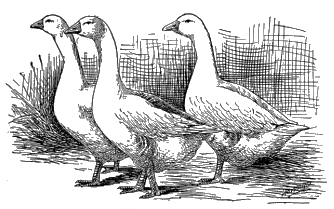
Duck raising has been developed within the last ten years into a
flourishing industry. Prior to that time the duck was not considered a
profitable fowl to raise; its flesh was never prized very highly by the
masses. Ducks were raised without constraint in waterways, feeding
mostly on fish and water insects. This food gave the flesh a strong
fishy flavor; hence it was not particularly sought after, save by the few
who were partial to that class of diet. The duck centers of Long
Island and New England were then producing a limited number each
season, and it was with difficulty that these were sold with any profit.
In fact, one of the most prominent duck raisers may be quoted as saying
that he was obliged to visit the city markets personally and tease
the dealers to purchase his birds, in order to secure anything like satisfactory
prices.
Artificial incubation and brooding, combined with judicious feeding,
have been instrumental in the development of the industry. Machinery
has enabled the duck raiser to accomplish his ambition of having
his stock in the markets when prices are the best, and also of raising
large numbers of birds in a limited space of time. The season for raising
ducks is about six months—from February to July. The methods
employed by the most successful raisers will be given in this bulletin,
and the most approved buildings, appliances, feeding, and care will be
treated in detail.
Duck raising is to be recommended to farmers as a profitable source
of revenue; and by careful attention to the work, as knowledge
increases, the scope of the industry may be extended. There are numbers
of farms in this country to-day that are devoted exclusively to
raising ducks, averaging from 5,000 to 20,000 ducks as an annual output.
An idea of the proportions of the business may be had from the
fact that as high as three tons of feed are used daily by a single raiser
during the busy season. The profits are the very best, and good incomes
may be made when once the business is thoroughly mastered. But the
reader should not jump imprudently to the conclusion that these results
can be easily obtained. Duck raising is an arduous task; one that
requires an apprenticeship and absolute knowledge of the business
before success is reached. Those who have been successful in raising
ducks have learned the business much as one does any other vocation.
The beginner should start modestly, and increase his plant as his knowledge
of the work increases. The average farmer has all the facilities
for raising a goodly number of ducks, and may with a little outlay add
considerably to his income.
It is not at all necessary that ducks should have access to water to
be raised successfully; they grow and thrive as readily without. There
are successful plants where thousands of ducks are raised that have no
water, save that which is given them as drink. It has been a matter
of much dispute which is the better way. Some duck raisers use
water and allow their breeders the freedom of it; some allow their
growing stock intended for market free access to water until they are
eight weeks old, when they are penned and fattened for market. On
the other hand, there are raisers who have no water on their farms,
excepting wells, who are just as successful and raise as many birds as
those who have the water. The
only noticeable difference between "upland" and "water"
ducks is that the latter are of
prettier and cleaner plumage
than the former.
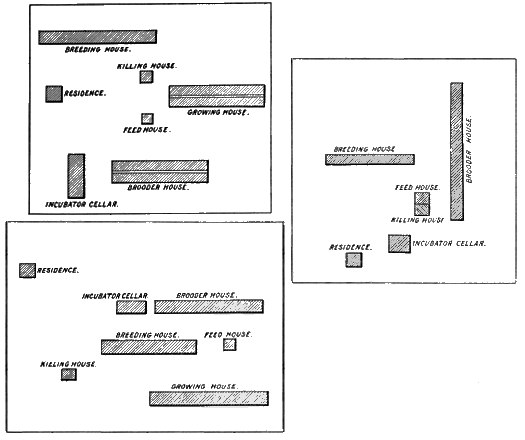
Fig. 9.—Plans for a duck plant.
A duck plant should be located
on a line of railroad in
direct communication with
the city markets, and not too
far from the
station. Almost
any location
will do
for the plant,
and worn-out
land, that can
be had cheap,
will do as well
as the richer
and more fertile land costing several
times as much. Sandy sod is
to be preferred. The buildings
should be arranged to secure good
drainage and be convenient to each
other, that labor may be reduced
to a minimum. The labor attached
to raising poultry is an item that
is overlooked by many, and the
cost of it often reduces very notably
the earnings of the plant.
Every department of the plant
should be so located as to economize
the time of the attendants. The incubator cellar should be convenient
to the brooder house, the brooder house to the growing house and pens,
and these to the killing house. The feed house should be located conveniently
to the brooder and growing houses and the breeding pens.
The task of feeding the growing stock four times a day and the breeding
stock twice a day is no small one. Watering is also to be thought
about.
The exact arrangement of a plant suited to all locations can not be
given, as each locality differs from others in some respect, and what
may be suitable for one will hardly do for the other. The plans of no
two of the largest plants are alike. They differ in location of the
buildings to suit the lay of the land; but they all have the same general
idea of the convenience of each building to the others. Illustration
of this will be seen in fig. 9. When laying out a plant, make provisions
for future enlargement; allow plenty of room on all sides to
extend the buildings without rendering inconvenient the work that
will be necessary to attend to the additional stock.
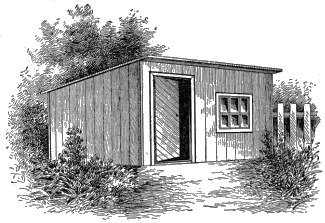
Fig. 10.—House for breeding ducks.
Houses for ducks are single affairs. They are built plain and comfortable,
and have no furnishings whatever. A duck is differently constituted
from a hen, and must be cared for under different conditions.
The hen needs warmer houses and drier surroundings than does the
duck. A duck does
not mind the cold,
if she can keep her
feet warm; cold feet
will affect a duck as
a frozen comb does
a hen, retarding
laying and inducing
ailments. The
feathers of a duck
are almost impenetrable
and will withstand
almost any
degree of cold.
Again, a duck can
not stand the amount of confinement in a house that a hen can; she
is more restless in disposition and is given to exercise in a greater
degree than is a hen. Indigestion is not so prevalent with ducks as
with chickens; the duck's ceaseless motion aids the digestive organs
and keeps her generally in good health.
In fig. 10 is shown a simple house that may be built at small expense.
It is plain and has a shed roof. Such a house should be built of rough
boards, 12 inches by 1 inch, and joints covered by 3-inch by 1-inch strips.
The roof should be made water-tight and covered with tarred paper,
shingles, or tin. The outside should be well drained around the bottom,
that it may not be damp. Some advocate board floors, raised from 6
to 8 inches from the ground and covered from 4 to 6 inches with
dry earth, straw, or leaves. The writer favors the using of board
floors in all houses for chickens, but thinks it not essential for ducks.
If the house is well drained on the outside and the earth floor is covered
with hay, straw, or leaves, it will be perfectly satisfactory. There
must not be dampness in the house, as the birds will not do so well;
while they are given to water on the outside they must have comfortable
quarters in which to "warm up," or "dry out."
The building shown in fig. 10 may be constructed of any dimensions
desired, according to the size of flock to be kept. A house 12 by 14
feet will accommodate nicely a flock
of a dozen. There are no interior
arrangements whatever, simply the
floor surface of the building. It
is better not to use nests. Some
raisers use a plain nest, as shown in
fig. 11. These nests are made of
1-inch boards, 12 inches high and 16
inches long, set 14 inches apart, and
held together in front with a 3-inch
strip. The nests are nailed to the back of the house. But more than
half the eggs are laid on the floor of the house or in the yard, and, if
permitted, a duck will build herself a nest to her liking. Again, a duck
is liable to injure herself by falling over the strips in front of nests or
other obstructions that may be in the house. In fig. 12 is shown the
nest of a wild duck.
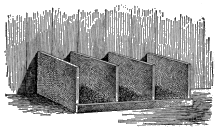
Fig. 11.—Nests for ducks.
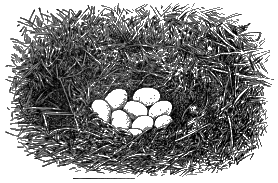
Fig. 12.—Nest of wild duck.
When two or more breeding pens are to be kept, the plan of the
house shown in fig. 10 may
be extended to any length
desired, as shown in fig. 13.
In figs. 14 and 15 are shown
two more designs of duck
houses, which are practical
and cheap, and may be
built singly or in rows for a
number of pens. Either of
these houses, and also that
shown in fig. 10, make excellent
breeding houses for
the farmer to keep ducks in.
An inclosure should be given the breeding ducks, as they do better
confined than when at liberty. Give plenty of room and inclose the
run with 2-inch wire mesh 2 feet wide. If water is accessible, it should
be inclosed by the mesh-wire fencing of the same width as for the run.
In fig. 16 is shown a duck house with water runs, and also the arrangement
of wire runs in the water. This is an admirable plan for farmers
who have running water on their farms.
The general construction of a brooder house is similar to that of the
breeding house, and differs only in interior arrangements. The latter
has no interior arrangements whatever, while the former has the system
of heating and covers necessary for giving warmth to the young
stock. In fig. 17 is shown a design of single-brooder house and ground
plan that is generally used by duck raisers. This house should be
built upon a good foundation and be entirely proof against rats. A
good plan is to sink half-inch wire mesh about 2 feet in the ground and
around the entire inside of the building; this will make it perfectly
secure against rats and mice.
The accepted plan of a brooder house makes it 15 feet wide and as
long as desired. The building is 4 feet high in front and 5 feet in rear.
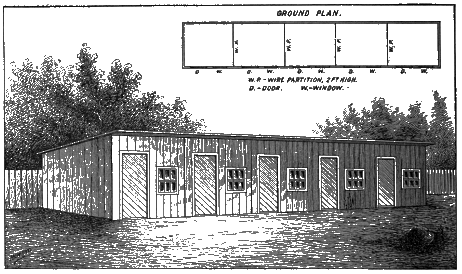
Fig. 13.—Plan and ground plan of five-pen breeding house for ducks.
It is divided into pens 12 feet long and 6 feet wide, and has a 3 foot
passageway extending the entire length of the building. The ground
plan (fig. 17) shows the general arrangement of the interior and location
of the brooders.
The brooder box is next to the passageway, or walk, and runs the
entire length of the building. This box is 30 inches wide and 8 inches
high; the sides are 7 inches high and nailed securely; the top of the
cover is nailed across with cleats to make it substantial, and the cover
has an inch strip nailed underneath in front and back to keep it in
position. These strips rest against the 7-inch sides and make the
brooder snug and tight when closed. The heating pipes are directly
beneath the cover and are 2-inch pipes, flow and return. Some prefer
1-inch pipes, using two flows and two returns. When three pipes are
used they should be about 8 inches apart from center to center. These
pipes rest on the partition boards of the pens. The front of the brooder,
leading into the pens, is cut out in the center about 4 inches deep and
4 feet long (fig. 18, A), while the ends and the other side are solid,
being 7 inches high. The construction of the brooder is clearly shown
in fig. 18, B, with cover removed, while fig. 18, C, shows cover. The
heater is located at
the end of building.
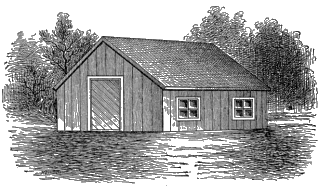
Fig. 14.—House for breeding ducks.
Another plan of
brooder house is
that shown in fig. 19. This house is
known as a double
brooder house, with
walk in the center
and pens on either
side, and with
heater at the end.
Many prefer this
plan to the single brooder house, as the care and attention required for
the youngsters is much less and the cost of heating is reduced, one heater
being sufficient for both lines of pipes. Then, again, this latter plan
shortens the length of the building by one-half and makes the work
more concentrated. The arrangement of the interior is the same as
that of the single brooder house.
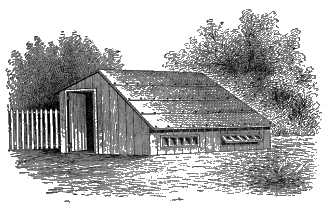
Fig. 15.—House for breeding and growing ducks.
The plans of brooder houses, as given above, are for ducklings from
the time they are taken from the machines until they are ready for the
cold brooder, or
growing house. The
young ducklings,
when taken from
the nest or incubator,
are very delicate
and susceptible
to the changes of
the atmosphere;
they must be kept
very warm and free
from chilling. The
first three weeks of
a duckling's life is
the most critical period, and after that time the liabilities of loss are
reduced to a very low rate—hardly five to the hundred. The front of
brooders for young ducklings should be hung with strips of woolen cloth
to keep in the warmth of the brooder. The greatest care should be
given them at this period; the duck raisers really consider it the most
important part of their work, and after a bird has passed the "critical
age" they may be counted on for the market.
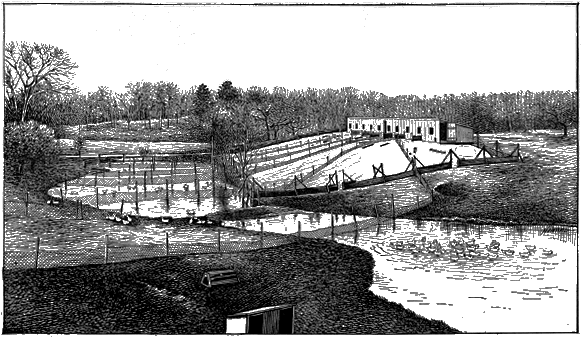
Fig. 16.—House for breeding ducks, showing water runs.
Usually the care of the ducklings at this age is given to the women.
They are more careful of the wants of the youngsters and attend to the
detail work religiously. A case is known of a single attendant living,
as it were, in the brooder house with the ducklings. She began her
work with the morning feed at 6 a. m., and until sundown, when the
night's meal was given, she was with her charges. The cleanliness of
the brooder and pen was carefully attended to and everything was done
to promote the health and comfort of the youngsters. At night they
were all in their brooders and as snug as it was possible for them to be.
A single neglect in the starting of a duckling will result in loss to the
raisers. System is the key to the situation, and there should be no
deviation from it whatever.
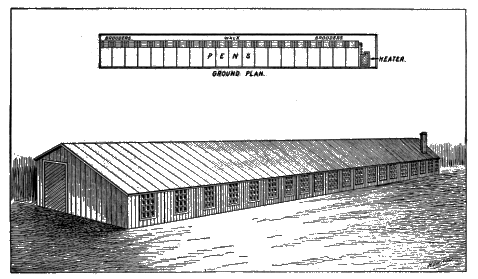
Fig. 17.—Single brooder houses and ground plan.
The duckling goes from the warm brooder house to the cold brooder
house. The latter house is planned in a way similar to the former, with
the exception of the 30-inch brooders. When the birds are taken
from the warm brooder house they are three weeks old and of sufficient
age to withstand a cooler temperature. They do not need the extra heat
of the warm house, and in it would not grow nearly so well. The size
of pens in the growing house is larger, and the ducklings are not crowded
so many in a pen. If the birds are to be raised in colonies of one hundred
each, the accommodations should be ample for them. It has never
been proved to be good policy to crowd the growing stock; it retards
their growth and encourages disease.
The cold brooder house should have a system of heating if birds are
to be raised for an early market. The same system of pipes used in
the warm brooders should be run around the sides of the building,
about 2 or 3 feet from the floor. This will give sufficient heat for the
house and keep the birds comfortable. These pipes may be connected
with the same heater used for running the warm brooder pipes. In
the Northern States, in extremely cold weather, raisers also use the
heating pipes in the warm brooder house in addition to the cold brooder
pipes.
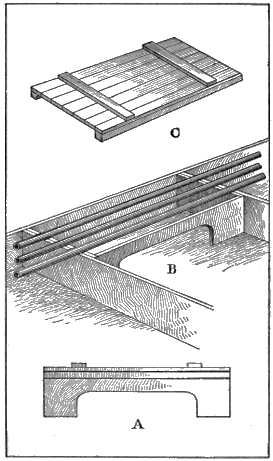
Fig. 18.—Plans of brooder.
An excellent plan is shown in fig. 20 for the arrangement of the
heater for connecting the pipes in the warm and cold double brooder
house. It will be seen that the heater is placed in the center of the
building; the warm brooder
house is shown on the right
and the cold brooder house
with runs attached is shown
on the left, and pipes, indicated
by dotted lines, run in
both directions. This is the
most economical house to
build and lessens the work
in attending the stock. The
room in the center of the
building will be found very
useful and is generally used
as the feed room. The heater
is in the cellar beneath this
room. This plan is used by
one of the largest and most
successful raisers of ducks
on Long Island, and it has
his highest indorsement.
The building may be of
any size, the plan being as
successfully carried out on
a large scale as on a small
one. If a small building is
used at first, it may be enlarged
on either end to suit
the growing business, and
extended upward of 100 feet
in either direction, thus making the building more than 200 feet in
length. The heater must be considered, when put in, with this object
in view. A heater capable of heating the 200-foot house can easily be
regulated to heat one of 50 feet, but a heater that will heat properly only
a 50-foot or 100-foot house would be insufficient to heat the larger one.
Another difference between the cold brooder house and the warm
brooder house is that the former has outside runs attached. These runs
are used for feeding and watering when the weather permits, instead of
the feeding troughs inside the house. The ducks should be allowed the
freedom of the outside runs as soon as the weather is suitable. Ducks
like a life in the outer world, and they will grow more rapidly there than
when they are confined to the house.
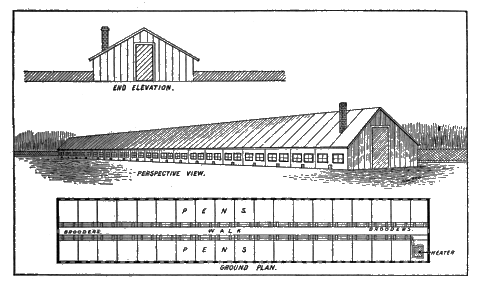
Fig. 19.—Plans of a double brooder house.
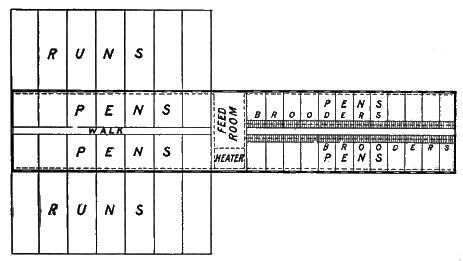
Fig. 20.—Plan of a double brooder house, showing arrangement of beating pipes.
Ducklings are kept in the cold brooder house until they are six or
seven weeks old, when they are transferred to large quarters known as
growing houses. It is here that they are pushed for the market until
they are 10 weeks old, when they are salable. There is no heat in the
growing houses, which are used only as a means of shelter during the
early spring months. When the weather is well advanced, the ducks
seldom take to the houses at night; they prefer the outside and spend
their nights on the ground. The growing houses should be abundantly
ventilated, as too
close an atmosphere
will do more
harm in a single
night than if they
had not been
housed at all.
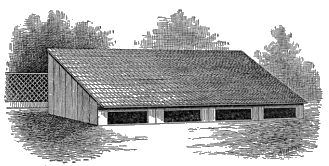
Fig. 21.—House for growing Ducks.
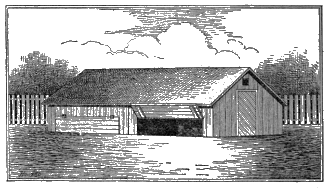
Fig. 22.—Two-pen house for growing ducks.
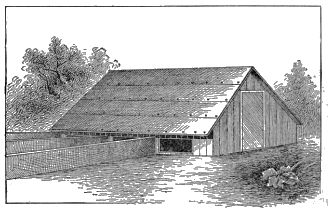
Fig. 23.—Three-pen house for growing ducks.
A Pekin duck at
10 weeks is quite
large, weighing
close to 4 pounds.
It is quite as large
as a full-grown duck of some of the other breeds. In the space of two
or three weeks
from the time the
ducklings are
placed in the growing houses they
will be marketed at
the weight of 4 to
5½ pounds each.
This weight is easily obtained, and
when reached the
profitable time to
sell has arrived, as
they then command the best prices. Often a bird kept after this time
loses in weight and
becomes unprofitable.
The growing
houses are built
after the plan of the
breeding houses,
only much smaller.
They need not be
more than 4 or 5
feet high in rear
and 1 or 2 feet high
in front. Such a
house is shown in
fig. 21. This and
other houses shown
in figs. 22 and 23 may be built singly or in rows, with 12-inch boards
separating the runs.
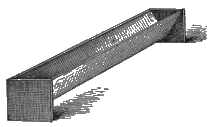
Fig. 24.—Gutter water trough.
As has been previously stated, water for bathing is not at all necessary
for growing ducks, but a liberal supply for drinking is absolutely
essential to their growth. The food of the duck is such as to require
drink when eating, as it is comparatively
dry and can not be eaten
hurriedly as grain is. When feeding,
always replenish the water troughs
or fountains with pure, fresh water.
A duck when feeding will eat a
small quantity and go to the water
troughs, for drink, repeating this
performance several times during
the meal. Conveniences for supplying
drinking water to breeding and growing ducks are varied, and
almost any contrivance will answer the purpose. When small numbers
of ducks are kept, the simplest method of supplying water is in wooden
troughs. These may be built V-shape or with square bottoms. They
are shown in figs. 24 and 25.
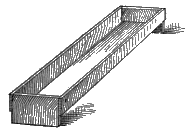
Fig. 25.—Flat water trough.
For smaller ducks, those kept in the
warm brooder house, the fountain plan
is to be preferred, as the youngsters can
not get into the water and become wet
or chilled. These fountains may be
made of air-tight cans for the reservoir
and a tin plate 2 inches larger in diameter
than the can. A tomato can and
an ordinary tin pie plate make an excellent
fountain. Remove the top of the can and punch a small hole in the
side about a quarter of an inch from the free top edge; fill the can with
water and place it inverted on the plate. The water will run out until
it reaches in the plate the level of the hole in the can. The plate will
not overflow and water will
be supplied automatically.
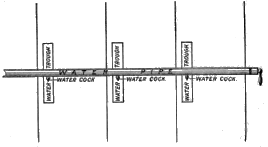
Fig. 26.—Plan for supplying water by pipes.
Some raisers use a pan—a
pie plate, for instance—and
place a stone several inches
smaller in diameter than the
pan in the center, leaving a
margin for water around the
edge.
When large numbers of
birds are kept, it is of course
necessary that a system for watering be adopted for saving labor. A
practical system in use is where the water is supplied by 1-inch pipes
and having a cock in each pen directly over the water trough. Fig. 26
shows a diagram drawing of this plan. The flow of the cocks is regulated
by having the one in the first pen run very slowly and gradually
increasing the flow of the water in each pen. Thus all the troughs
will be full at the same time. The pipe should rest on top of the fencing
about 2 feet high which divides the runs. This plan of watering
can also be used in brooder houses to good advantage.
The food of the duck is both vegetable and animal in nature. In the
wild state it gathers its food from brooks and marshes, consisting of
flag, grasses, small fishes, water insects, etc. When the birds are raised
in confinement this diet must, in a measure, be imitated to get the
most satisfactory results. The duck has no crop, the food passing
directly from the throat to the gizzard, and as a consequence the food
must be in a soft mushy state. Too much hard food, such as grain,
does not agree with these birds and they can not thrive on it. While
some raisers use a small allowance of grain others do not, and it has
not been proved to be of any advantage to feed it. Soft food is their
natural diet, together with grasses, vegetables, and animal food. The
proper selection of the food is extremely important to secure the rapid
growth of the duck, and the ingredients of the food must be such as
will afford a well-balanced and substantial ration. As a whole, it may
be said that the rations used by the largest duck raisers are essentially
the same, differing only in the quantities used in the mixing. Investigations
show the real values of the food to be the same for producing
rapid growth and early development. The duckling grows twice as
rapidly and is a much heavier eater than the chick, and to produce the
best results its food must be such as will be easily assimilated. The
various methods of feeding given in this bulletin are recommended for
raising ducks successfully.
It costs from 6 to 12 cents a pound to raise a duck for market at ten
weeks of age. The cost of feed is from 4½ to 5 cents a pound, and that
of labor, etc., is from 4 to 8 cents a pound. It costs from $1.75 to $2.50
each to keep breeding ducks a year.
The three different methods of feeding ducks are as follows: (1) Feeding
ducks for market (ten weeks old); (2) feeding young ducks to be
kept as breeders; (3) feeding old ducks. The first method, for the sake
of convenience and to explain more fully the composition of the rations,
is subdivided into four parts, as follows.
(1) From time of hatching to five days old provide the following mixture:
Cracker or bread crumbs and corn meal, equal parts by measure;
hard boiled eggs, 15 per cent of the total bulk of crackers and meal;
sand, 5 per cent of the total of crackers and meal. Mix with water or
milk, and feed four times a day.
(2) From five to twenty days old, the following mixture: Wheat bran,
two parts by measure; corn meal, one part; rolled oats, 50 per cent of
this bulk; beef scraps, 5 per cent; sand, 5 per cent; green food, 10 per
cent. Mix with water to a dry crumbly state and feed four times a
day.
(3) From twenty to forty-two days old, the following mixture: Wheat
bran, two parts by measure; corn meal, one part; beef scraps, 5 per cent
of this bulk; sand, 5 per cent; green food, 10 per cent. Mix with water
to a dry crumbly state and feed four times a day.
(4) From forty-two to seventy days old, the following mixture: Corn
meal, two parts by measure; wheat bran, one part; beef scraps, 10
per cent of this bulk; coarse sand or grit, 5 per cent; green food, 10
per cent. Mix with water to a dry crumbly state and feed four times
a day.
The hours for feeding are 6 a. m., 10 a. m., 2 p. m., and 6 p. m.
Below is given another system of feeding ducks for marketing at ten
weeks of age. This system is practically the same as the one given
above, differing only in the ingredients used for the first two parts or
until the duckling is twenty days old. The method given below is
used successfully by one of the largest duck raisers on Long Island.
It is divided into three parts, as follows:
(1) From time of hatching to seven days old, feed equal parts by
measure, corn meal, wheat bran, and No. 2 grade flour, and 10 per cent
of this bulk coarse sand. Mix with water to a dry crumbly state and
feed four times a day.
(2) From seven to fifty-six days old, feed equal parts by measure,
corn meal, wheat bran, and No. 2 grade flour; 10 per cent of this bulk
beef scraps; 10 per cent coarse sand, and 12½ per cent green foods
(green rye, oats, clover, etc.). Mix with water to a dry crumbly state
and feed four times a day.
(3) From fifty-six to seventy days old, feed two parts by measure.
Corn meal; one part wheat bran; one part No. 2 grade flour; 12½ per
cent of this bulk beef scraps; 10 per cent coarse sand; 12½ percent
green food. Mix with water to a dry crumbly state and feed three
times a day—morning, noon, and night. Give last feed an hour before
sundown.
When ducks are raised for breeders they are fed differently from
those intended for market. They are not forced so much as are the
latter, and less fattening food is given them. The corn meal and beef
scraps are reduced to one-half the quantity used in the above rations.
The following is an excellent ration: Equal parts corn meal, wheat
bran, green food, 5 per cent beef scraps, and 5 per cent coarse sand or
grit.
A ration for breeding (laying) ducks is recommended as follows: Fifty
per cent, by measure, corn meal; 15 per cent wheat bran; 15 per cent
green foods (cooked vegetables, such as potatoes, turnips, etc.); 12 per
cent beef scraps, and 8 per cent coarse sand or grit. Mix with water
to a dry crumbly state and feed twice a day, morning and night. After
the breeding season is over and the ducks have stopped laying they
are changed from this to the equal-parts ration, as given above for ducklings
from seven to fifty-six days old.
The feeding stuffs should be mixed in a trough sufficiently large to
hold the quantity without wasting over the edges. First mix the corn
meal and bran together while dry; after these have mixed thoroughly,
making an evenly colored mixture, it should be moistened with water
and mixed to a dry, crumbly state. It should not be too wet or sloppy,
as it is then not so good for the fowls, neither can it be handled and
fed properly. Warm water should be used when the weather is excessively
cold. In a second trough place the green foods, such as cut rye,
oats, etc., and dampen with water; then mix the allowance of the No.
2 grade flour with it. Thoroughly mix, so that the flour will completely
cover the green stuff. After this has been done mix the flour and green
mixture with the corn meal and bran mixture and add the allowance
of beef scraps and sand. When vegetables are used, they should be
well cooked before mixing in the rations.
The duck raisers on Long Island use large quantities of fish for
their breeding stock. This is known as the "fish diet," and is considered
as being very valuable to induce egg production. Where fish are
cheap they form an excellent substitute for beef scraps in the rations
for breeding ducks or ducks not intended for market, but under no
circumstances should fish be fed to stock that will be marketed. Fish
makes the flavor of the flesh strong and ducks fed on fish will not
have ready sales in the market. The fish are cooked by boiling in iron
camp kettles until well done, and then mixed, bones and all, in the
rations as given above for breeding ducks. When fish is used the
beef scraps are omitted.
The amount of feed needed each day for young ducks varies as much
as does their growth. Their growth averages a half pound a week,
and to make this increase of weight each week requires an additional
quantity of food over the preceding one. The rule is, feed each meal
what they will eat up clean with a relish, and do not allow them to
linger over the feed trough. It is better they should have not enough
than too much, as they will be in a much better condition to relish the
next meal. One thing is considered to be of as much importance as the
feed, and that is removing the feed left over and thoroughly cleaning
the troughs after each meal. This is scrupulously attended to by successful
duck raisers.
One raiser gives, as a generous allowance for one day's ration for one
hundred laying ducks, the following: For the morning meal, 35
quarts of the mash, and for the evening meal 40 quarts, making a total
of 75 quarts for the day's portion, or three-fourths of a quart to each
duck a day. Another raiser allows 400 quarts, fed in halves, twice a
day, to six hundred breeding or laying ducks, averaging two-thirds
of a quart to each duck a day.
There are many patterns of feed troughs in use, hardly any two
being alike. They are simple affairs, the simpler the better, as they
are more easily kept clean. The designs given for water troughs are
equally as good for feed troughs and answer the purpose very well. Each
pen of birds should have two troughs, one for water and the other for
feed, built proportionately to suit the age and size of the birds they
are intended for. Make them of sufficient length to avoid crowding, so
that all the birds in each pen will have ample room to eat at the same
time.
Grit in some form is essential to ducks and should be kept before
them at all times. Many overlook this fact and do not seem to understand
that it is of as much value to them as it is to chickens. The sand
used in the mashes tends to supply a certain amount of grinding material
or grit to them, but does not fully satisfy them for digesting their
food. On a farm where more than ten thousand birds are raised annually,
and where disease is practically unknown, it was noted that in
every pen there was a box of grit and a box of crushed oyster shells.
This raiser states that he considers grit and oyster shells an absolute
necessity for ducks, and he attributes the healthy appearance of
his stock to it. His birds eat it freely and the supply is never allowed
to run out.
There are two methods of dressing ducks for market, by dry picking
and by scalding. Both of these methods are good and are being successfully
employed by the largest raisers. Some have a preference
for dry picking and others for scalding, and it becomes only a matter
of taste which method is used. When birds are dressed by scalding
they should be dipped several times, or until the feathers come out
easily. The back should be dipped in the water first. After scalding,
wipe them as dry as possible with a sponge and pick the breast feathers
first. A bird when dressed for market has left on it the feathers on
the wing, the tail feathers, and the feathers on head and neck, as shown
in fig. 27. The legs are left on, and the birds are not drawn.
The process of dry picking is considered the simpler of the two
methods, and one who is accustomed to the work can readily dress
3 dozen birds in a day. The picker's outfit consists of a chair, a
box for the feathers, and a couple of knives, one knife being dull and
the other being sharp pointed and double edged, for bleeding. The
bird is taken between the knees, the bill held open with the left hand,
and a cut made across the roof of the mouth just below the eyes. The
bird is then stunned by striking its head against a post or some hard
substance. The picker seats himself in the chair with the bird in his
lap (fig. 28), its head held firmly between one knee and the box. The
feathers arc carefully sorted while picking; the pins are thrown away
and the body feathers with the down are thrown into the box. Care
should be taken about this, as the feathers from each bird will weigh
about 2 ounces, and will quite pay for the picking.
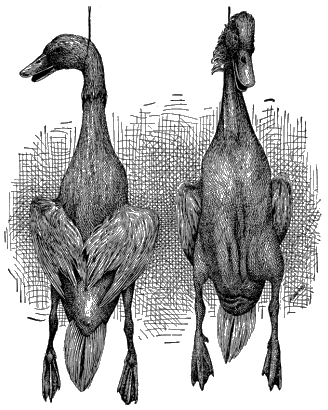
Fig. 27.—Pair dressed ducks (10 weeks old).
The dull knife and the thumb are used to remove the long pinfeathers,
and this should be done without tearing the skin. The down can
usually be rubbed off by slightly moistening the hand and holding the
skin tight. Often
some of the pins
can not be taken
out without tearing
and disfiguring the
skin; when such
is the case they
should be shaved
off. Seven or eight
minutes is all the
time necessary to
dress a bird. After
the birds are picked
they should be carefully
washed, and
plumped by placing
in a tank or barrel
of ice water. They
are hardened in this
ice water and given
a rounded and full
appearance. They
are then packed in
barrels or boxes and
shipped to market.
The first or bottom
layer is packed with backs down; a layer of ice is then placed over
them, and all other layers are packed with the breasts down, a layer
of ice being between each layer of ducks. The top of the box or barrel
is then rounded off with ice and covered with burlaps. A flour barrel
will hold about three dozen birds. Some raisers use boxes for shipping
and have the empties returned free.
Eggs to hatch must have good, strong germs and must be laid by
healthy stock. Debilitated, degenerated stock will not produce healthy
and vigorous young. The health of the breeding stock must be promoted
and everything done that will assist to increase the fertility of
the egg. Comfortable houses, cleanliness, pure water, and above all
wholesome and nutritious food, are the best promoters of health. The
best stock to be had is none too good, and it is erroneous to send the
earliest and best stock to market for the small increase in price, and
save the later and inferior stock for breeding purposes. A continuation
of this practice for a few years means degenerate stock, infertile
eggs, weak germs, and large mortality among the newly-hatched birds.
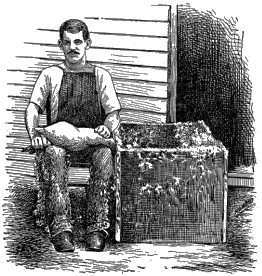
Fig. 28.—Duck picker.
After an egg has been under incubation for thirty six hours, it will,
if fertile, when held to the light, show a small dark spot a trifle larger
than a pin's head. This little spot is the life germ and shows the egg
to be fertile. From this time the development of the germ into the
duckling can be plainly seen
if the egg be held to a strong
light. On the sixth or seventh
day the first testing of the eggs
should be made and all infertile
ones taken out. The
germ is very distinct at this
time, and there has been a
gradual change going on in
the interior of the egg. The
little spot has been constantly
enlarging and becoming more
dense, and little veins are seen
running in divers directions.
This is the appearance of an
egg with a strong, live germ,
which under favorable circumstances
will produce a duck.
An egg that is not fertile on
the sixth or seventh day will be perfectly clear and transparent; all such
should be removed at once, as it is useless to allow them to remain.
Another kind of egg often seen is a weak or imperfectly fertilized egg,
and shows an irregularly-shaped blood vessel, which had started but
lacked vitality enough to continue. Such an egg will not hatch and
should also be removed from the nest or incubator. Frequently the
germ in an egg will show life when tested on the seventh day, but lacks
the vitality to carry it through, and when tested later will show dark,
irregular blotches over the surface of the egg. These will not hatch,
and should be taken out when noticed.
On the fourteenth day the little creature inside the egg begins to
assume shape and show considerable life. It has increased many times
in size since it was seen on the seventh day; the red veins have become
more numerous and have spread over the entire surface, while the yolk
is scarcely distinguishable from the other portions. The pupil of the
eye has now become distinct, and the projection of the wings is clearly
perceived. The absorption of the yolk has also commenced, and this
will continue until the twenty-fourth day, when it will be nearly completed.
The egg from this time on will rapidly grow opaque, and at the
eighteenth or twentieth day is entirely so. On the twenty-fourth day
the duckling is ready to make its way out of the shell, and in forty-eight
hours after pipping the shell it will be entirely out.
Hatching under the sitting hen (generally used for hatching ducks)
is what is termed the natural process of incubation. The hatching of
eggs by this means has always been followed, and no special skill is
needed for success, provided the eggs are well fertilized with healthy
germs. Many who raise ducks in large numbers, however, use almost
exclusively artificial means; some use both the natural and the artificial,
while others use the natural entirely.
Of the natural method we shall treat first: Hens of medium size of
the American class, barred Plymouth Rocks and Wyandottes, are considered
the best for sitting. Nine duck eggs are about the right
number to place under a hen in early spring weather, but when the
season is far advanced as many as thirteen are used. The hens should
be provided with large, roomy nests, and slatted fronts that can be
removed and replaced easily when the hens are fed and watered. The
nesting material should be of hay or straw, and the nest should be
slightly concaved; in the bottom place a little finely cut hay.
Before the hen is put on the eggs she should be thoroughly dusted
with insecticides; the nest also should have a good dusting of the same.
Both hen and nest should undergo a thorough dusting several times
during the process of hatching as a safeguard against lice. When the
ducklings are hatched they should also have their share of the insecticides
before they are given to the hen. When a large number of sitting
hens are used for hatching, as many as possible should be set at one
time, and the ducklings raised in brooders. Hatching with hens may
be done on a large scale and the young brooded artificially. As many
as five hundred sitting hens are used on some farms for hatching ducks.
They are set in small houses or rooms with the nests around the sides
in tiers, each nest having its own lattice door. Each day, in the morning,
the hens are taken from their nests and fed and watered on the
floor of the room. They are taken down in limited numbers, sections,
as it were, at a time, and after they have had the food, drink, and a
little exercise they are placed back on the nests and another section is
fed and watered.
The subject of artificial incubation has engaged the attention of the
civilized world for generations past; the method has done wonders for
the poultry industry and has opened up the pathways to fortunes that
might otherwise never have been made. The science of incubation and
brooding has been developed wonderfully in this country during the
last quarter of a century, and what seemed almost an impossibility then
has indeed become a certainty now. There are many thousands of
chicks and ducklings hatched by artificial means each year, and the
numbers of good machines now being manufactured in this country at
low prices make poultry raising a business that almost anyone with a
limited capital may profitably engage in. The mission of an incubator
is to supplant the sitting hen, and make it possible to hatch a large
number of chicks at a minimum amount of cost and labor. That this
can be done is proved each day.
For artificial incubation, have a room with a temperature as nearly
uniform as possible. Balance the beat in the machines, or in other
words, see that the heat is uniform at both ends, and, in fact, all over
them. See that each is running steadily before placing the eggs in it,
as there is a great deal in starting right. The machines should be run
at a temperature of 102° for the first three weeks, and 103° the last
week. The eggs should be turned twice each day at regular periods.
Introduce a pan of water from the fifteenth to the twenty-second day,
no matter what the location of the machine, whether in a damp cellar
or in a dry room overhead, in a moist atmosphere near the seashore or
in a dry one at an altitude in the country. The temperature may go
as high as 101° just previous to and while hatching without injury.
Place the glass on a live egg after the animal heat rises, which will be
when the circulation begins. This will be perceptible in good eggs the
fourteenth and fifteenth days.
Considerable weight has been put upon the ventilation question in
incubators by manufacturers and operators, but it has been found that
when the egg chamber is roomy, and the eggs are taken out and cooled
twice each day, it is not of so much consequence. There is no doubt
but that there must be some ventilation in the egg chamber, but from
the experience and observation of the writer the value of the subject
has been overestimated by many. Some machines have top ventilation,
some bottom, and others both top and bottom, and there is seemingly
no marked difference in the hatching.
When the ducklings are hatching, the broken egg shells should be
removed once in every six or eight hours, so that they will not slip over
the pipped eggs, as it would be sure death to the imprisoned ones.
Occasionally a little bird is unable to free itself from the shell and needs
help; the expert can readily detect when this is necessary. The one
point to note in this connection is this: The egg just before hatching
radiates a great deal of heat, while the duckling, when first out, being
not unlike a little sponge, absorbs it, or in other words, the rapid evaporation
which takes place generates cold; so that when the ducklings
are out the machine should be gauged one degree higher.
When the ducklings are all out and dried off, the machine will run at
least two degrees lower than when they were in the egg. Plenty of
ventilation is needed in the machines while hatching. Keep the ducklings
in the machine at least twenty-four hours after hatching, when
they will be strong enough to be removed to the brooder. The heat in
the brooder should be started twenty-four hours previous to use, so
that it will be perfectly heated and ready for the ducklings when they
are taken from the machine.