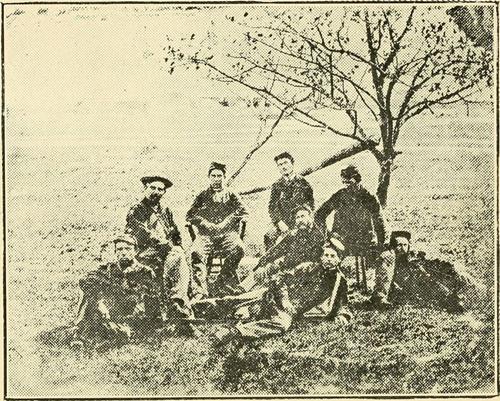
SCATTERING REMINISCENCES.
A COMRADE’S LOVE.
James Tabor and Dennis Garrity were about the last two soldiers that would
have been taken for chums. Garrity was a great thick-chested Irishman with
brawny arms and a roistering sort of manner who had served through the
Crimean war and knew more of tactics in the first year of the Civil war
than half of our officers.
Tabor was scarce more than a boy, a slender, palefaced youth, mild of
manner and gentle of speech as a girl.
Tabor’s mother had given him a little pocket Bible when she kissed him
good-bye, and, unmindful of the jeers of his comrades, he read it every
evening and knelt and offered up a silent prayer before wrapping himself
in his blanket.
When the first death occurred in our camp we had no chaplain. Tabor was
called upon to read the burial service and make a prayer. After that some
of the boys tried to tease him by calling him “parson.”
AN OLD-FASHIONED GARDEN.
Away up in York state there was an old-fashioned flower garden with roses,
hollyhocks, sweet-williams, larkspurs, marigolds, lady-slippers, pansies,
violets and other emblems of purity and the simple life. The boy had loved
that old garden, so when it came summer he had a little reminder of it
with a box of pansies by the side of his tent.
One day a soldier who had been drinking just enough of the sutler’s beer
to make him think he was smart came along, and as he passed Tabor’s tent
he gave the box a kick, upsetting it. Garrity saw the act, and he took the
smart chap by his coat collar and shook him as a terrier would a rat.
A crowd gathered and then Garrity proceeded to read the riot act to those
assembled.
“Look a’here, my hearties,” said he, “I’m going to give you young devils
some advice, an’ you’ll be doin’ well to mind what I be sayin’. I want you
young blackguards to be very careful how you thrate this lad hereafter. No
more pokin’ fun at his religion, ’twould be better if all of you had some
of the same.
“I’m none too good meself an’ ought to be counting me beads oftener than I
do, but I likes fair play, and be that same token I’ll see that James
Tabor has it or me name is not Dennis.
“So now, me laddy bucks, if you don’t like what I’m sayin’ you can put it
in your pipes an’ smoke it.”
This little episode was the beginning of a strange and tender attachment
between Tabor and Garrity that lasted to the close of the war. They tented
together, slept under the same blanket and drank from the same
canteen—except when Garrity’s had some of Uncle Sam’s commissary in it,
for Dennis, like many an old campaigner, liked a little whisky.
The boys called Tabor “Jim” or “Jimmie,” but it was always James when
Garrity spoke of him. When Tabor wanted his comrade it was: “Have you seen
Mr. Garrity?”
BIG INJUNS FROM ONONDAGA.
Among the recruits that came to our regiment in the winter of 1862 was a
squad of 25 or 30 Indians from the Onondaga reservation. Among them was a
fairly good brass band. The officers had no business to enlist them, and
they were all discharged in a few months.
They were with us one pay day, however, and managed to get some firewater.
Then they went on the war path and there was “blood on the moon” and they
indulged in war dances that were the real thing. One “big Injun” was
discovered crawling under the back of the colonel’s tent. He was armed
with a sabre bayonet which had been sharpened for the express purpose of
lifting the hair of that officer.
They dared all the white men to fight them, and, finally, a young buck
rubbed up against Garrity, who gave him a slap on the side of his head
that sent him spinning. This led to a challenge to fight and the affair
was arranged to take place in the fort late in the afternoon.
GARRITY WAS STRENUOUS.
A ring was formed, and the men stripped to the waist and turned their
pants pockets inside out to show that they carried no concealed weapons.
Garrity whipped the Indian in less than two minutes. Then another red man
pulled his shirt over his head and strode up in front of Garrity, who gave
him his medicine in short order. Then another wanted to try his hand and
was given a chance and was quickly vanquished.
Perhaps you will think me yarning, but it is the truth that our Dennis
whipped four strapping Onondagas and was ready for more when his little
guardian angel slid into the ring, and, taking Garrity by the arm, led him
away as though he had been a child.
It was a wonderful influence this little boy had over his great, strong
comrade.
Garrity loved a strenuous life and wanted something doing all the time if
it was nothing more than tossing the colonel’s darkey up in a blanket or
tipping over the cart of a pie peddler.
He could play cards behind the breastworks with the shells screeching over
his head or joke a comrade on the firing line.
In this connection I am reminded of an incident at the opening of the
second Bull Run battle. The regiment was in line of battle nearly two
hours in the morning without firing a shot. The artillery on both sides
were pounding away at each other, and the strain on the men’s nerves was
something intense. A certain lieutenant who had incurred the dislike of
his men by his pompousness in camp duties thought that before going into
battle he would make peace with the boys, so he walked along in front of
the company and said: “Now, my men, we are about to meet the enemy for the
first time and it is more than likely that some of us will never see the
sun rise again. In my position it has become my duty on various occasions
to criticise and reprove, but I hope you will understand that I meant it
for your good. I can assure you, that I have a warm place in my heart for
every one of you, and if any man in the ranks feels the least ill will
towards me I beg of him to put it away out of his heart as we stand here
facing our foes.
“I have a further request to make and that is, if I fall in this fight,
and it is possible for you to do so, that you will have my body embalmed
and sent home.”
There was not a response for a minute or two and then Garrity spoke up:
“The boys don’t mind forgivin’ you, leftenant, but if I may be pardoned
the observation, the facilities for embalming the dead on a battlefield
are devilish poor.”
That same lieutenant covered the distance between Bull Run bridge and the
outposts near Alexandria before taps were sounded that night, and being a
large man, he stripped for the race and those who saw him at the finish
claimed that a shirt, trousers and a pair of socks were all that were left
of his former showy uniform and equipment.
His name? Well, the boys of the regiment who read this will know and it
does not matter to the rest whether it was Smith, Jones or Brown.
Gen. Lee surrendered his army to Gen. Grant the 9th day of April, 1865.
There was skirmishing right up to the last minute, notwithstanding the
fact that negotiations were in progress for 24 hours, but the last hotly
contested battle that occurred between the forces was on the afternoon of
the 7th, when the second corps of the army of the Potomac came in contact
with the bulk of Lee’s army on the old Lynchburg stage road.
They were intrenched on the crest of a long slope of open ground and Gen.
Miles’ division was ordered to attack. The old first division of the
second corps had been in the habit of sweeping things when they went for
the enemy, but in this last fight they were repulsed by the desperate
confederates, who, though they were weary and nearly famished, fought with
the desperation of a hunted animal brought to bay.
It was in this encounter that the subject of this sketch received the
wound that nearly cost him his life.
Gen. Miles’ troops after reaching the works of the enemy had to retrace
their steps and leave their dead and wounded under the guns of the enemy.
When our regiment re-formed again every one was looking around to see who
was missing and it was then that Dennis Garrity discovered that Tabor had
been left behind.
He would go back and find James, he said, and no entreaties would stop
him.
“Dennis Garrity will bring that poor boy in or he’ll lay out there on the
field with him,” he said, and Dennis went, with the bullets and shells
flying and brought in his “little James” on his back, fully a half a mile,
and took him to the field surgeons and had his wound promptly attended to,
which probably saved his life.
Dennis was with us in the final review when we marched down Pennsylvania
avenue in the grandest and most impressive pageant that ever took place in
this country.
Tabor was lying on a cot in a hospital.
We marched back to our Virginia camp that night, and as the men were
unbuckling their equipments Dennis looked up and said: “’Twas a bloody
shame that James wasn’t with us to-day.”
WOMAN AND WAR.
Down the picket-guarded lane
Rolled the comfort-laden wain,
Cheered by shouts that shook the plain,
Soldier-like and merry;
Phrases such as camps may teach,
Sabre cuts of Saxon speech,
Such as ‘Bully!’ “Them’s the peach!”
‘Wade in Sanitary!’
—Harte.
The names of women do not figure in the official reports of the war. They
were not gazetted for gallant deeds; thousands were unknown beyond the
neighborhood where they worked zealously to organize “Soldiers’ Aid
Societies,” for no town was too remote from the scene of action not to
have its relief committee who were constantly collecting comforts and
necessities to be forwarded to the front.
What each family first started out to do for their own fathers, brothers,
husbands and lovers soon became general, and many prompted by love and
patriotism left home and its comforts and went down into the very edge of
the great battles to help rescue the wounded. They endured hardships and
proved themselves angels of mercy as only women can.
Tens of thousands of maimed veterans will remember with tenderness the
noble women who ministered to them on the battlefield, on transports and
in hospitals.
I am sure that none of Hancock’s old corps will ever cease to remember the
motherly Mrs. Husband, Miss Clara Barton, Mrs. Lee, Mrs. Anna Holstein,
Miss Cornelia Hancock, a relative of the general; Miss Willetts, or Mrs.
Barlow, wife of Gen. Francis C. Barlow of the 1st division.
The story of the army life of the last named woman is full of interest and
romance. She was a true friend of the men in the ranks, and her purse was
frequently opened to give money to some wounded soldier who was being sent
to some northern hospital without a cent in his pocket.
She followed her husband’s troops through the unequaled and appalling
scenes of blood and hardship in Grant’s campaign of ’64, using her
strength so that she finally sickened and went home to die in a few
months. If ever there was a pure noble woman it was Mrs. Barlow.
I heard an incident of a lady going among the wounded at Spottsylvania.
Seeing a pale-faced boy whose helplessness had touched her heart, she
stopped by his side and said: “Is there anything that can be done for you,
my poor boy?”
“No, thank you,” was the reply, “but there’s a fellow at my left that you
might help,” pointing to an ashen-faced man dressed in confederate gray.
“He’s a rebel,” she said, “and there’s thousands of our own boys that need
attention.”
“That’s so,” the boy in blue said, “but he is far from home, helpless and
among the enemy, and is somebody’s boy and if he is a rebel, he’s an
American.”
The reb feigned sleep, but he had heard every word, and when the woman
kneeled down by his side and commenced to bathe his face and hands with
bay rum the tears began to steal out from under his eyelashes and he
finally burst right out crying. This was too much for the tender heart of
woman and she cried, too, and rough men about them who had marched up in
front of flaming guns the day before wept like children.
THE ARMY SUTLER.
The sutler was a prominent person in war times. He sold everything, from a
molasses cookie to butter, at 80 or 90 cents a pound.
When the boys did not have the money they would get an order on the sutler
from their captain, and the amount was charged up against their pay. The
sutler would issue tickets in various amounts from 5 cents up.
The business was very profitable and many made fortunes. The soldiers used
to regard the prosperous sutler with envy, but he is never heard of now,
and I do not know of one who makes claim to having assisted in saving the
Union in that capacity.
I remember our first pay day in Virginia. Our colonel thought it would be
a fine thing to give the men a three days’ holiday, so after dress parade
he made a little speech about as follows:
“My poys, I vas browd of you and I vas goin’ to gif you a tree day
holiday. There vill pe no drills, no parades, no notting but fun. Haf a
good time. Pe good poys and after it vas all ofer we vill go after that
Sheneral Shackson and lick him like h—l.”
As the sutlers all sold beer in the early part of the war, there was
pretty hilarious times for three days.
Peddlers of all sorts used to infest the camps about pay day and more than
one “pieman” got his cart upset during Col. Von Wagner’s “three days’
grace.”
In the summer of 1862 gold and silver went to a premium and got pretty
scarce. It was before the “shinplasters” were issued and postage stamps
were used largely in lieu of small change. I remember one day I was over
among McClellan’s troops, and as I was passing a wagon where ice cream and
soft drinks were dispensed, I heard some loud words and pretty soon
someone cried out, “Over with the wagon boys,” and over it went. The
vendor claimed that someone had been treating a large crowd to everything
he had to sell and then offered in payment stamps that had been once used
on letters. Of course the boys took offense at an imputation on their
honesty, hence the capsizing of the cart.
OLD LATITUDE AND LONGITUDE.
A lieutenant of our regiment who was captured at the second Bull Run, was
returned to us some months later. We were then doing garrison duty near
Arlington. Our company was at a fort named “Haggerty,” which had been
built on a little hill on the road leading from the Georgetown bridge to
Arlington.
The roadway had been dug through the hill leaving the banks for a long
distance on each side, from 10 to 40 feet above the road.
An old dry canal ran parallel with the road from the bridge to Alexandria.
The next day after the lieutenant had been returned to the regiment he
obtained leave to go over to Washington for the purpose of supplying
himself with a new uniform, and it is more than likely that he celebrated
his release from captivity by visiting numerous places where liquid as
well as other refreshments were dispensed. He did not return to camp until
evening, and the night being dark and the officer not being familiar with
the lay of the land he started up the bed of the old canal instead of the
road. When opposite the fort he heard the drummers beating the tattoo and
he made a sharp turn to the right and headed in the direction of the
sounds.
After going a few rods he walked off the bank and dropped about 30 feet
into 15 inches of soft Virginia mud. We heard cries of help interspersed
with oaths and other remarks that would have done credit to a pirate
captain. A light was procured, a crowd gathered and one of the men asked
what was the matter. The voice was recognized and out of the depth came
the response: “Its me sergeant and for God’s sake come and help me out of
this hole.” Three or four of the men went to his rescue and when the party
came up the pathway they were greeted by a large crowd headed by the
captain, who inquired of the officer how it happened that he was down
there in the road.
The lieutenant presented a ludicrous appearance, bare-headed and in his
mud bedraggled uniform as he saluted and explained: “You see Cap’n,” said
he “I lost me latitude and longitude when I left the bridge.” The captain
laughed. The men shouted and ever after that he was known as “old latitude
and longitude.”
FAKING DISABILITY.
In a regiment of 1,000 men it is not to be wondered at that there are some
few who are deficient in the qualities that make good soldiers.
Perhaps they had enrolled their names because they had been carried away
by the enthusiasm of a “war meeting” where it was always pictured out as
being an act of heroism to volunteer. Then the chances of promotion and
the opportunities to see the country were always depicted in their most
glowing colors by speakers who in most cases were very careful to not put
their own names down. After the recruit has become an atom of a thousand
he realizes that he is not of as much consequence as he expected to be,
and it is not strange that now and then there was one who had not the
“sand” to stand up like a man and be just as good a soldier as he could.
In that case he resorted to all sorts of ingenious devices to procure his
discharge from the army.
In the summer of 1862 our surgeon—we used to call him “Old Symptoms”—was
puzzled by the numerous cases of fever sores that he had to treat; finally
he “got onto” their game by the accidental discovery of a man wearing a
copper penny bound on his leg for the purpose of producing one. “Weak
heart” was frequently feigned by a candidate for discharge and all sorts
of deceptions were attempted on the surgeons, who had to be pretty good
judges of human nature in order to detect the true from the false.
The case of a man in our regiment, whom we will call Jackson, baffled the
cunning and skill of “Old Symptoms” when we were in the forts near Fairfax
seminary. Jackson pretended to be out of his head and the officers got so
they did not exact any duties of him, not even to answer roll call. He
came and went and did as he had a mind to. Near the fort was a large farm
which he pretended he had bought and he used to spend most of his time
down there working and ordering about the men, who humored him in his
notions. Finally his case was passed upon by a board of surgeons and his
discharge ordered. As he was leaving camp for home one of the boys asked
him what he was going to do with his farm and he winked as he replied,
that he thought the Watkins family could run it without his help.
I recall the case of another young man who became demented. He would not
eat or leave his tent unless driven out. His clothes and person became
filthy and finally the old surgeon ordered two men to take him to a stream
and give him a good scrubbing in almost ice cold water, for it was in a
winter month.
The treatment was severe but had the desired effect of arousing his
manhood and from that day he was a changed person and soon became a model
soldier, noted for clean gun, equipment, etc., and I am pleased to add was
finally made a sergeant and served to the end of the war with honor.
AN ACT OF HEROISM.
When Frederick Funston swam the little Filipino river in the face of a
handful of cowardly natives, the act was heralded all over the world as
one of great heroism and he was rewarded by a general’s commission, yet I
venture to say that there is hardly a civil war veteran, who saw active
service, but that has knowledge of numerous equally as heroic acts that
were scarcely known of outside of the man’s own company or regiment.
Scarcely a gathering of veterans but has more than one hero among them
whose fame has been forgotten except but for a few of his comrades, and
the chances are that the man has had hard work to get the government to
recognize his claim to a pittance of a pension to keep him out of the poor
house.
I recall an incident of great bravery by an officer of our regiment who
went to the war as a bugler in my company. In December, 1864, a part of
the 5th and 2d corps, and Gen. Gregg’s division of cavalry were sent to
the left again to try and turn Lee’s right flank. The weather was
intensely cold for that country, ice forming on all of the streams.
The enemy were encountered at Hatcher’s Run and it was desired to dislodge
a confederate battery that was masked in some woods on the opposite side
of the stream. A staff officer rode down in front of our regiment and
asked Maj. Hulser if he could furnish men to cross the stream and charge
the battery. The major called for volunteers and the first man to respond
was Capt. Orlando T. Bliss of Co. F, a former Carthage boy, who with the
missiles flying thick and fast stepped out in front of his company and
asked all who were willing to go with him to step ten paces to the front,
and when every man of the company lined up with their captain the 2nd
heavy applauded the act with a hearty cheer.
Additional volunteers were called for and Capt. George Armes (now Major
Armes, retired, of Washington, D. C.), and his company responded.
It seemed a hazardous undertaking but the men did not falter as they waded
into the icy cold water which was up to the armpits of most of them and in
many places there were deep holes, so that not a few had to swim, but once
across the stream they made a rush for the battery and the rebel
artillerists took to their heels.
The suffering of the soldiers was great that night, as it was bitter cold
and the clothing of those who forded the stream would have frozen on them
only that the men built fires and stood around them.
Gen. Miles commended the conduct of the men in general orders and the two
officers were breveted for their gallantry.
In this connection I cannot refrain from relating a little episode in the
army experience of Capt. Bliss in which a certain drummer boy was mixed
up.
It was earlier in the war and our regiment was doing duty at Arlington.
Bliss was a corporal and had charge of our drum corps. One day the acting
drum major and a certain lad of my acquaintance thought they would go over
to Washington. When they applied to the adjutant for a pass he told them
they would have to defer their visit until some other day, as he could not
issue any more passes that day, but who ever knew a boy that would put off
a pleasure until to-morrow that he could have today. The two boys had
friends in the quartermaster’s department who had standing passes to go
after supplies, and it occurred to them that they could borrow a couple,
which they did, and went to the city, visited the theatre, and had a fine
time.
Not having the countersign they had to return before dark, and as they
walked up to the sentry box at the end of the bridge on the Georgetown
side, who should step out with the sentry but our adjutant.
It is needless to say that the boys were surprised and the officer
admitted he was also. He inquired if they had passes and when they were
produced he took them and sent the young volunteers over to the fort under
arrest.
Shortly after noon the next day the sergeant major took the youngest lad
over to the colonel’s tent where he listened to a severe lecturing, after
which he was made to do penance by standing on the head of a barrel four
hours in the sun. Say, but the end of a barrel is a pretty small space to
stand on for that length of time with the sun up in the nineties! Among
the orders read on dress parade that night was one reducing Corp. Bliss to
the ranks.
But a more fearless man never shouldered a musket and shortly after we
went to the front Bliss had won his stripes again. At Cold Harbor he was
made a sergeant, at Petersburg a lieutenant, at Reams Station a captain,
at Hatcher’s Run brevet major and if the war had lasted long enough and
some rebel bullet had not caught him he would have been wearing a star.
BRAVE PETE BOYLE A DRUMMER BOY FROM THE BOWERY.
As I passed a man in City Hall park, New York, late one afternoon not many
years ago I instinctively felt that I had known him. He was sitting on one
of the park seats and the particular thing that arrested my attention was
a red clover shaped badge that was fastened on the lapel of his coat. To
one who was with Hancock at Gettysburg or followed his lead from the
Rapidan to Appomattox, tender memories are evoked when the old 2d corps’
badge is seen.
Whenever I see a man with the talismanic emblem on I just feel like taking
off my hat to him. So after I had passed the New York veteran I thought to
myself I should like to know something of his history. I wheeled about,
retraced my steps and approaching him saluted and said, “How are you, old
2d corps.”
It does not take long for two veterans to get acquainted and the exchange
of a few words revealed the fact that we had been members of the same
regiment. In fact it was none other than “Pete” Boyle, a member of our old
2d heavy drum corps.
One of the first things “Pete” said was, “Do you remember that Maryland
fair?” I certainly did and will try and tell the readers something about
it.
It was just a town fair and not on a very large scale either, but it was
held in a beautiful and prosperous settlement a few miles from Washington
and the people all turned in and made the most of it and had a glorious
time. The drum corps of the 2d New York was engaged as one of the star
attractions.
It all came about because our adjutant married a daughter of Mrs. E. D. E.
N. Southworth, the famous writer of those old-time fascinating Ledger
stories, such as the “Hidden Hand,” “Ishmael,” etc., etc. Her home was in
Georgetown and she, having friends out in the country, where the fair was
to be held had told marvelous tales of the dandy drum corps of the 2d and
as a result we were excused from camp duties and allowed to go to the
fair, drink red lemonade and dance with the pretty country maidens. We
thoroughly enjoyed the respite from camp life and made the most of our two
days’ stay with the Marylanders.
Did you ever go out into a peach orchard in the early morning and eat the
luscious fruit that had dropped off in the night? “No?” Well, then you
have never tasted the true flavor of a peach. The house where we were
quartered was flanked on three sides by a peach orchard and we got up in
the morning, went out and sat under the trees and stowed away peaches
enough to stock a fruit stand.
Pete Boyle was the largest boy of the drum corps and he was a born swell.
His home was New York. He had been a newsboy in the Bowery district. He
was a clog and jig dancer equal to many of the professionals and when it
came to sparring and wrestling he was the champion lightweight of the
regiment.
After Pete had taken part in one “Virginia reel” which gave him the
opportunity to show off some of his fancy steps he could have had anything
he wanted from those Maryland farmers, and the girls, why they were just
falling over each other to get a chance to dance with him.
As I have stated, Pete was a swell and would never wear government clothes
without having them cut over and made to fit, and he would not hide his
shapely No. 5 foot with a government brogan.
The girls were all watching Pete from out of the corners of their eyes,
but it was noticed that one in particular was his favorite and that he
danced with her quite frequently, which was not looked upon with favor by
her Maryland escort who was big enough to eat Pete up.
The morning of the second day while we were out in the peach orchard a
darkey approached our party and asking for “Mistah Boyle” handed Pete a
note which after looking over, Pete read to us. It was in substance as
follows:
“Mr. Peter Boyle:
I thought you might like to know, being as you are a Union soldier, that
the young lady you have been paying so much attention to is a secesh
sympathizer and has a brother with Mosby the rebel guerilla. A word to the
wise is sufficient.
“JOE YARDSLEY.”
Of course I am not giving the real name that was signed but it will answer
for the purpose of this article.
Pete called the darkey, gave him a quarter and said, “You can go and tell
Joe Yardsley that I said that if he was half a man he would be with Sue’s
brother. Tell him that I think he is a sneak and a coward and if he will
come over in the grove about 5 o’clock this afternoon I will slap his
face.”
The darkey showed his white teeth, scratched his head and digging his big
toe in the sand said, “I reckon I bettah not tole dat to Joe. Dem
Yardsleys got a powerful temper, dey hab, an’ dey boss all de young
fellahs’ roun’ yere.”
“All right, Sam,” said Pete, “You tell him just what I told you.”
That afternoon Pete and Sue were inseparable. They made themselves
conspicuous everywhere.
The darkey brought Pete another note during the day and it simply said, “I
will meet you in the grove. J. Y.”
Of course all of us boys went over with Pete and the Marylander brought
three companions.
The two principals stripped to the waist and I confess I was fearful of
the result when I saw how much larger Pete’s antagonist was than he.
When they got the word Yardsley made a spring at Pete who dropped his head
and butted the big fellow below the wind and slid him over his back. He
got up and came furiously at our Pete again. But he knew a lot of Bowery
tricks and quick as a flash stepped aside, caught him around the neck,
whirled him around and threw him, slapped his face smartly and then let
him up. The fellow rushed at Pete again, who now thought it about time to
quit fooling, and he landed a good hard blow on the fellow’s nose and
mouth which staggered him and made the blood fly.
The spectators on both sides thought that the affair had gone far enough
and called for a cessation of hostilities. Pete offered to shake hands
with his antagonist, but he declined and went away muttering threats.
That evening we started for our Virginia camp in a large carry-all
accompanied by a bevy of young people on horseback. They rode with us a
couple of miles and then bade us good night and good bye, and as we drove
away we heard them singing, “Maryland, My Maryland.”
When I sat down to write of my old comrade it was to tell of two deeds of
heroism performed by him and not of his adventures at a country fair, but
when I unrolled my knapsack of war memories, the incidents narrated came
tumbling out with the rest so I have jotted them down.
A HERO OF WAR AT COLD HARBOR.
A drummer boy of our regiment who was carrying a musket was wounded and
left between the lines. There were many others of our comrades there, too,
but somehow to us drummer boys who had beaten the reveille and tattoo
together and tramped at the head of the regiment so many long and
wearisome marches, the thought that one of our number was lying out there
in the blazing June sun suffering not only pain but the terrible agony of
thirst, stirred our sympathies to the uttermost and we longed to go to his
relief, but dared not for it was like throwing one’s life away to show
himself over the breastworks.
It was late in the afternoon that Peter Boyle, “our Pete,” suggested a
plan by which our comrade was rescued. Pete cut three or four scrub pine
trees which abounded there and proposed that he and a couple of others
should use them as a screen and go out between the lines.
“Why not wait till dark and go?” someone asked. But then it was feared he
could not be found.
The bushes were set over the breastworks one at a time so as not to
attract attention and as there were many more growing like them they were
probably not noticed. When the evening twilight came on Pete and two
others crawled over the breastworks and got behind the trees. Each had a
couple of canteens of water for they knew that there would be many to whom
a mouthful would be so very acceptable.
The three boys crawled and wriggled themselves toward the rebel lines
shielded by the trees. Their movements necessarily had to be very slow so
as not to attract the attention of the enemy. The ruse was well planned
and executed, but fraught with much danger. They found their comrade and
had to lie behind their shelter until darkness concealed their movements,
and then the wounded comrade was brought into the lines and his life
saved.
A HERO OF PEACE.
Boyle performed a more heroic act at a New York fire in the Bowery a few
years ago.
One afternoon a fire broke out in a block, the two upper stories of which
were used as a “sweat shop.” Boyle was playing the drums in the orchestra
of an adjoining theatre. He, with others, ran up on to the roof and saw
scores of girls who had been working in the burning building, running
frantically around the roof. The flames had cut them off from the lower
part of the building and they had gone to the roof, but as the block was
higher than all of the adjoining ones except the theatre and that was
separated by the space of several feet, it seemed that they were lost and
many flung themselves in despair to the street.
Boyle took in the situation instantly and calling to his aid two men they
wrested an iron fire escape from its fastenings on the theatre and with it
bridged the space between the buildings.
Pete then laid a board on top of it and finding that many of the girls
dare not cross, he took a rope with him, and went over on the burning
building, threw one end back to his helpers and then compelled the girls
to walk over the bridge, using the rope as a hand rail. His bravery and
nerve saved the lives of very many who but for him would have been lost.
He was the last one to leave the roof of the building and was so badly
burned that he had to go to the hospital, and when I met him that day in
the park he was just getting around again.
Peter Boyle probably never attended a Sunday school in his life, but I am
glad that my faith is of the kind that helps me to believe that when the
Book of Life is opened there will be found a balance to his credit.
A COMRADE IN GRAY.
While attending a G. A. R. encampment at Washington not many years ago, a
party of us thought we would run over to the sleepy old town of Alexandria
one afternoon.
Grass was growing in the streets and the town had a deserted appearance,
all so very different from war times, when thousands of soldiers were in
and about the city. Among other places of interest we visited was the
little church where Washington used to worship. Sitting on the steps was a
dusty, grizzly, crippled man of 60, munching a dry crust of bread. He was
dressed in a threadbare suit of gray, and we knew he was a southerner, but
as we passed into the church he gave us a military salute.
When we came out he was still nibbling away, trying to find the soft side
of his bread, and one of our party ventured the remark that “dry bread
wasn’t much of a meal.”
“That’s so, but when rations are low and the commissary wagons are to the
rear, you’ve got to fill up on what you can get. I’ve camped longside of
dry bread and water more’n once.”
“Going anywhere?”
“Well, I reckon I be if my old legs don’t give out. Got a brother over on
the Eastern Sho’ of Maryland and I am marching that way.”
“Were you in the war?”
“I reckon I was, boys, but on ’tother side. Ah, but I can shet my eyes and
see jist how Gineral Pickett looked when he led us agin your 2d corps, (he
had noticed the red clover leaf pinned on our coats) over at Gettysburg on
that 3d of July. Say, Yanks, but ’twere bilin’ that afternoon. How one of
us got back alive is more’n I can tell.”
The survivor of the “Lost cause” had by this time forgotten all about his
rations. He was living again in the past. Like a tired old war horse at
the sound of a bugle, he had risen from the steps and the light of battle
flamed in his eye as he continued:
“Yes, boys, I was right there with Pickett—not coolin’ coffee back under
the wagons, or I wouldn’t hev got two of your bullets in me, nor been
jabbed with a bay’net trying to get over the stone wall near that clump of
trees. Lord, but I thought I was a goner sure.”
We acknowledged it was a hot place.
“Hot! Well I reckon I got ’bout as near old satan’s headquarters that day
as a live man can. When 37 out of a company of 50 are snuffed out and a
half a dozen of the others wounded you may reckon we thought you’uns were
going to wipe we ’uns out.”
He now tossed his crust away with a look of contempt and, grasping his
hickory stick with a firm grip, followed us to a nearby restaurant, where
we invited him to a good square meal, after which we smoked our cigars
while the survivor of Pickett’s charge continued his narrative as he
sipped a generous glass of apple brandy.
We held our breath waiting for the signal guns that were to let us know
when the ball was to open.
The regiments fell in just like clockwork, lots of the boys lookin’ white
round the gills, and not a word was spoken above a whisper except as the
commands were given. Attention! Forward! and we went down across those
fields, with Pickett leading on horseback and every company dressed as
though we were marching in a review.
“Boom! Boom! You’ns let ’em all off on us at once. Say, Yanks, the
screamin’ of the grape and cannister was awful, and they just cut wide
swaths in our ranks, but we didn’t quit—did we—until we were all cut to
pieces?”
“We were close to your lines when I got a bullet in my leg and as I
stooped over to see where I was hit my shoulder caught another. That made
me fighting mad and I tried to go over the stone wall when one of them
Irish brigade fellers chucked his bay’net into me and that laid me out so
that I was off duty awhile.
“But dog-goned if I didn’t get back just in time to run up against your
old second corps again at Spottsylvania. Kinder seems we couldn’t git
away from you’ns. But, comrades, I ain’t got nuthin’ agin you.
“Say, that ‘bloody angle,’ reminded me of Gettysburg. The bullets made
basket stuff of the small oaks, and large ones, too.”
“And when we charged up against them log breastworks you fellers would
jest reach over and jab us with your bay’nets.”
“My, but your man Grant was no quitter, was he? We thought we were going
to drive you fellers back ’cross the Rapidan, as we had done many times
before, but Ulysses jist shut his teeth down tighter on his cigar and kept
moving by the left flank.
“But our Uncle Robert wasn’t caught napping anywhere, was he? When you
tried us at the Pamunky river, Totopotomy, North Anna and Cold Harbor, you
found us ready for you every time. Say, old second corps, we got even with
you fellers at Cold Harbor for the way you had treated us before. Didn’t
we?
“But I’m dog-goned if U. S. G. knew when he was whipped, and, instead of
going back and restin’ up as the others useter do, and come out in the
spring with new uniforms and guns a-shinin’, why he jist tried another
left flanker on us and brought up at Petersburg, where it was nip and tuck
for a long time.
“You could get plenty of men and money and we had got the last of the
boys and their grandfathers months before and were busted in everything
but grit. We knew the jig was up, but were goin’ to die game, and when you
rounded us up at Appomattox the last ounce of corn meal wer’ gone.”
The veteran’s eyes were moist as he expressed thanks for his entertainment
and said he must be “marchin’ on.” We suggested that he would probably
find his brother in Maryland, settle down and forget his hardships and
battles.
“Forgit nuthin; why I’d rather lose my arms than to forgit how Gen.
Pickett looked that day as 5,000 men behind him marched to death. When you
keep step with a man down to the jaws of death and go back alone, if you
forgit him ye are not fit to crawl! But, I ain’t anything agin ye, Yanks;
‘All is quiet on the Potomac’ now and if I git in comfortable quarters
over in Maryland should like to have you boys come and camp with me a week
and eat some of them luscious Eastern Sho’ oysters, canvas backs and fat
terrapin.”
As we shook his hand we pressed a few silver quarters in the palm and when
he started away he turned and with a husky voice said:
“Good bye, old second corps; I’m dog-goned if I’ll ever forgit you’ns.”
A PRECIOUS COFFEE POT.
Not many years since I spent a night with a comrade in his home in a city
of central New York and we sat and smoked and talked, and talked and
smoked, until long after midnight. The walls of his den were adorned with
guns, sabres, canteens, cartridge boxes and belts and various other war
relics. Conspicuously displayed among the other decorations was a battered
and blackened coffee pot.
“Yes,” he replied in answer to my inquiry, “it is the same old coffee pot
I carried from Washington to Appomattox and is one of my most cherished
keepsakes.”
“About the time we went to the front I was in the city one day and knowing
that a coffee pot was a very useful utensil to a soldier I invested in the
best copper bottom one that I could find. There was not another one in the
company and money could not buy one when we were in the field. Six of us
regularly made coffee in it, and others used to take turns in borrowing it
for various purposes, such as cooking rice, beans, meat, boiling shirts
and the making of those famous old ‘Liverpool stews’ when we were
fortunate enough to get an onion, two or three potatoes with hardtack,
pepper and salt.”
“Many a batch of flap jacks have I stirred up in that old coffee pot,
paying the sutler 25 cents a pound for self-rising flour. The ears and
handle got melted off after a time, but I punched holes where the ears had
been, hooked the bale in and so it lasted to the end. My wife wanted to
scour the black off, but I wouldn’t have it.
“Why, it took the smoke of more than a thousand camp fires to put that
finish on it!
“I thought once I had lost it. You remember the day we had that running
fight at Sailor’s Creek when we were chasing Lee and waded the stream
waist deep? The banks were steep, you know, and fringed with bushes that
got tangled with our equipments as we went through them. Well, somehow or
other my coffee pot got pulled off my haversack, but I did not know it
until we had got some distance away, when one of the boys who used it
regularly, exclaimed: ‘By thunder, Will, you’ve lost your coffee pot, and
what in Sam Hill will we do for coffee now?’”
“I remembered having it when we crossed the creek, for several of us used
it to fill our canteens, so I told my pardner I was going back after it. I
found it hanging to a bush and was better pleased than if I had picked up
a hundred dollar greenback.”
ARMY CHAPLAINS.
Just why the 2d New York did not have a chaplain I do not know, and it is
too late now to find out. Probably the officers didn’t want one or else
there were not enough to go around among the 2,000 or more organizations
in the service, for we were not the only regiment without one.
There were some grand men who served as chaplains and they not only
ministered to the soldiers in spiritual matters, but looked after the
welfare of the men in many ways. Particularly were they of service to the
wounded on the battlefield. I never heard of a cowardly chaplain and
instances are not few in number where they were wounded or taken prisoner.
There were also several killed in battle.
Speaking of a regiment not having a chaplain, reminds me of an old camp
fire story about two New York regiments between which existed great
rivalry. An earnest and eloquent chaplain was conducting a series of
meetings among the regiments that were without chaplains and he went to
the colonel of one of the regiments referred to and asked permission to
hold divine services. The colonel told him it would do no good. “The truth
is, chaplain, the boys are the devil’s own fighters, but I am afraid you
would find it a tough job trying to make saints out of them.”
The chaplain insisted he should like to hold a service and mentioned
incidentally that he had preached several times to the ——d New York and
there had been a number of converts. “Why only last Sunday I baptized a
dozen of them.”
At the mention of his rival the bluff old fighter was interested and
immediately gave his consent.
The Sunday following the regiment was drawn up in a hollow square and the
colonel told the men that he had invited chaplain “so-and-so” to preach
to them and then added: “If one of you dares to make faces, laugh or even
move I’ll order you to the guard house with ball and chain.”
The men were all attention during the preaching and when the chaplain had
finished he was surprised to hear the colonel give the following order to
the adjutant:
“Officer, detail 24 men for baptism immediately. I’ll be d—d if we are
going to be beaten in anything by that dirty, cowardly —d New York.”
A SENTINEL’S REVERIE.
The lonely picket on an outpost between two vast contending armies
occupies an important position. Great responsibilities rest upon him,
hence the penalty of being found asleep on one’s post used to be death.
The situation is conducive to serious meditations. You stand in the shade
of a tree which screens you from any reb who may be crawling about for a
shot at some careless Yank.
The moon sends a beam through the leaves right into your eye, and you
recall that it is the same old moon way down in Virginia that used to
shine up in York State. You think how you and some one else who is far
away used to lean across the gate, look at the moon and then at each other
and sigh.
Then you wonder if some one is thinking of you. You wish you might get a
slight wound so you could go home where all would be talking of your
bravery. Perhaps it would touch some one’s heart so she would say “yes.”
Then you would think of your present condition; you wonder why it is that
such a fellow as lazy Jim Lee should be “commissioned” instead of you, who
never “shirked” a guard. You pronounce the war a failure, and would like
to see the leaders on both sides hung. You wonder if your regiment will
get into another battle to-day, and say to yourself that you don’t care if
you get killed (you do though), and then you think of your poor comrade
“Dave,” who was killed at your side yesterday morning in a charge on the
enemy in that clump of “pines” over there at the right. You put your hand
in your pocket and draw forth the lock of hair you cut from his head when
his life’s blood was ebbing away, and which he told you to send to his
“dear old mother.” You brush the silent tear away that has commenced to
course its way down your dust covered cheek.
Then from out the half-light sounds a solitary bugle, like the first
wavering note of the roused bird, chirping good morning to its mate. A
second bugle answers its reveille. Another and another sound along the
line. The drums take up their morning rattle. Soon the air is filled with
their deafening jubilee, for they beat with a perfect recklessness at the
“get up” time of the camp. The hum of voices begin to rise. The roll call
is gone through with. Mules whinner and horses neigh. The camps are alive.
The birds sing, and—it is day. There comes the “relief guard.”
A LETTER FROM THE FRONT.
The following is the copy of an old letter yellow with age, that was sent
home during wartime.
“In the trenches near Petersburg, Va.
“Sept. 14, 1864.”
“My Dear Friend:
Having a little leisure time I thought I would send you a few lines.
You are aware that I am attached to the 2d N. Y. Heavy Artillery, or as
the infantrymen call it, the “2d Weighty.” 1st brigade, 1st division, 2d
Corps, under the command of Gen. Hancock; one of the finest looking
soldiers in this or any other army, and what is better the boys all love
him, and he is proud of his men. If you have kept track of the movements
of the army of the Potomac I need not tell you the part that Hancock and
his men have had in them.
We are now in camp about midway between City Point and Ream’s Station, and
the corps is recruiting up very rapidly. The recruits and convalescents
are pouring in by thousands, and we shall soon have a grand army again,
and then look out for the splinters. Johnny Reb must talk differently or
find his last ditch. The impression here seems to gain ground that the
rebellion is about played out, and that there will be but few more months
of fighting. Within the past few days the City Point railroad has been
extended several miles on our left, and where a few days since no signs of
a track were visible, large trains are running regularly. It is certainly
very astonishing; but that is a way they have of doing business down here.
Ten or twelve days since, our corps was ordered to the left of where we
now are. Arrived there after dark, and halted on a flat open space with a
fine pine wood on our left. In the morning the woods had almost entirely
disappeared, and in our front a splendid line of breastworks had sprung up
as if by magic. Those who have never been in the business can have no
correct conception of how quickly and how quietly an order is executed at
the front. Our new railroad runs but a few rods in front of our camp, and
it seems like old times to see the trains moving, and to hear the whistle
and bell. This forenoon all the bands and drum corps of the division were
ordered to report to division headquarters, which we did. Numbering in all
about one hundred and seventy-five, and under the leadership of Mr.
Higgins, of the division band, played “Hail to the Chief,” and “Hail,
Columbia,” after which the brass bands played the “Grand March from
Belsaria,” “Garry Owen,” “Larry O’Gaff” and “Yankee Doodle,” and if there
was any lack of harmony there certainly was not of noise. We were then
dismissed, with an invitation to repeat the thing at some future day.
The weather here is delightful, the days warm and pleasant, and the nights
cool enough to make blankets necessary. As fast as the new recruits arrive
they are set to drilling, and you can see them in all directions going
through the different evolutions, and it will take but a short time to
have the corps in fine trim for anything that soldiers can do, and so with
the whole army. So you may look out for stirring news shortly. Speaking of
news, reminds me of the many complaints of the boys.—They cannot get
enough to read, and would be very thankful for anything in the way of old
books, magazines and papers, in fact anything which contains stories would
be very acceptable, and a few books and magazines would afford reading for
several hundred, and while away many a tedious hour. If it is not asking
too much, won’t some of the friends of the 2d Heavy do something for the
boys? They have not been paid off for the last six months, and many of
them have not seen any money for a still longer time, and there is no
telling when they will be paid, and there are few who have the means to
purchase the Washington Chronicle, New York Herald, or Philadelphia
Enquirer, which are brought to camp daily.
President Lincoln visited the front a short time ago and rode along our
lines accompanied by Generals Grant and Meade. They were without any staff
officers with them and only had three orderlies. The President wore a
black tile that had seen much service and had on a long linen duster, and
was an awkward looking man on his horse. But the boys love “Uncle Abe” as
they call him and when the party passed us one of our boys enthusiasm got
the best of him and he sang out “three cheers for honest Abe,” and they
were given in true army style. The President lifted his hat and looked
mightily pleased.
If Grant was like some of the new brigadiers he would have had about 25
staff officers and orderlies following him, but U. S. G. is not much on
style. He keeps right on sawing wood though all the same.
“Old Spectacles” as Gen. Meade is called, is Grant’s right bower, and is
virtually the commander of the Army of the Potomac. Like Grant he is a
silent man, too, although they do say that he makes the fur fly when
things don’t go to suit him.
My chum is the cook to-day and has just called out “get ready for grub.”
We are to have an extra dish and you will laugh when I tell you the name.
It is called “slumgullion” by the boys, and is made by pounding up hard
tack which with chopped onions fried with salt pork makes an appetizing
dish fit for a king. My chum has also set up a can of peaches which he
paid the sutler 75 cents for, so I will cut this short.
THE FIGHTING REGIMENTS.
Statistics are considered dry reading and the writer has not bothered the
readers of his sketches with many, but they do tell the story better than
pen or tongue.
There were something over 2,000 regiments in the Union Army. Some never
participated in a battle; others were constantly at the front. Perhaps
they were no better fighters than those who were exempt from battle, but
in war blood is what tells, therefore the casualty lists tell plainer than
words whether a regiment was where the bullets were flying thick and fast
or not.
Col. Fox, the government statistician found that of the 2,000 there were
300 whose losses of killed and died of wounds were over 130, and he has
called these the “300 fighting regiments.” A conservative estimate of the
wounded is six to one, so the reader can easily figure out what the total
casualties of these regiments probably were.
There were about 50 regiments out of the 300 “fighting regiments” that
lost in killed or mortally wounded over 200.
The regiment that heads the list, both in the total and percentage was
the 1st Maine Heavy artillery. Their total was 423. Their loss at
Spottsylvania was 82 killed and 394 wounded. A month later at Petersburg
they made the assault with 900 muskets and their casualty list was 632.
The New York regiment that suffered the greatest loss of killed was the
old 69th, of the Irish brigade. Their total was 259.
A LOSS NEVER EQUALED.
In proportion to the number of men engaged, the greatest loss to any one
regiment during the Civil War was that of the 1st Minnesota at Gettysburg.
Gen. Hancock was desirous of holding back a column of confederates until
reinforcements could be brought against them and, turning to the colonel
of the regiment, he ordered him to capture the enemy’s colors. The command
was obeyed literally, and the enemy was forced back, leaving their banners
in the hands of the Minnesotians. The regiment took into the fight 262
officers and men. It lost 50 killed and 174 wounded and none missing.
Seventeen officers were killed and wounded. Here is a record that has not
as yet been equalled in military statistics. Gen. Hancock said it was the
most gallant deed of history. He knew the men must be sacrificed when he
issued the order, but he needed five minutes time and would have ordered
the regiment if he had known every man would have been killed.
Probably the most remarkable loss on either side during the Civil War was
that of the 26th North Carolina at Gettysburg. They took into the fight
820 men. Of this number 588 were killed and wounded the first day. The
survivors went into the charge with Pickett the third day, and when the
roll was called the next day but 80 men were present. All of the rest had
been either killed or wounded.
Another remarkable case was that of Duryea’s Zouaves at Manassas, or Bull
Run. Out of 490 men who went into action it lost 79 killed, 170 wounded
and 48 missing; total 297. This is the regiment which closed up its ranks
and “counted off” anew while exposed to a terrific fire.
The following nine heavy artillery regiments lost over 200 killed and died
of wounds.
First Maine, 2d corps, 423; 8th New York, 2d corps, 361; 7th New York, 2d
corps, 291; 2d Connecticut, 6th corps, 254, 1st Massachusetts, 2d corps,
241, 2d Pennsylvania, 9th corps 233; 14th New York 9th corps, 226; 2d New
York, 2d corps 214; 9th New York, 6th corps, 204.
Naturally the writer is proud of the fact that his old regiment stands
high on the honor roll. The record of 214 killed in battle tells the
story, plainer than words, that the 2d New York Heavy Artillery were where
the bullets were flying thick and fast.
BOUND FOR THE LAND OF FREEDOM.
The negro contrabands that flocked to our lines during the closing days of
the struggle furnished a great deal of amusement to the soldiers. In their
hasty flight for freedom they picked up the very articles that were of
little use to them, even to feather beds, boxes, cotton umbrellas,
stovepipe hats and of course every musician his banjo. The girls wore huge
hoop skirts which were then in vogue, and many had on flounced silk
dresses that had evidently been borrowed from “Missus’ wardrobe.” There
was nothing these poor black people would not do for “Massa Lincum soldier
men,” whom they fairly worshiped. An old “Mammy” made my chum and I an old
fashioned “hoecake” at high bridge, baking it in a skillet which she
buried in the coals of a campfire, and it was about the most toothsome
morsel I ever ate. Goodness gracious! what would I give for the appetite
and digestion of those days.
PRAYER FOR THE C. S. A.
We entered a neat looking church one day, and one of the boys opened an
Episcopal prayer book at the altar, and at the “Prayer for All in
Authority,” found that the words “the president of the United States” had
been cut out, and, folded in the book, was a manuscript copy of prayers
for the “Confederate States of America.”
RICHMOND AFTER THE EVACUATION.
Those who have visited this beautiful Virginia city in recent years have
no idea of the appearance of the place after it was evacuated by the
Confederates. Lee’s message of April 2, telling Jefferson Davis that “my
lines are broken in three places, Richmond must be evacuated this
evening,” found Mr. Davis in church. He quietly withdrew, and the fate of
the city was soon noised about the streets, which became filled with men,
wagons and negroes carrying trunks and bundles of every description.
After the departure of President Davis and others of the Confederate
government, Gen. Ewell issued orders for the burning of the large
warehouses of the city, and thus a great conflagration was started that
threatened to lay in ashes all of the business structures.
The city council met and decided to destroy every drop of liquor in town,
and at midnight committees of citizens visited every ward and rolled
hundreds of barrels of whisky into the streets, and, knocking the heads
out, the gutters were flooded. The shipping at the wharves was fired and
pandemonium reigned complete for 24 hours.
The Union forces entered the city the next day and proceeded to restore
order.
A few days later the writer accompanied a party of officers to the city,
going by way of City Point and up the James river by boat, past
formidable forts and earthworks that had swarmed with Confederate soldiers
ten days before, now deserted. The cannon that had hardly cooled off for
over nine months were now silent. White tents that had sheltered the enemy
stood as lonely sentinels for the “Lost Cause.”
There were many points of interest, such as the famous Howlett house
battery, Butler’s Dutch Gap canal, the “Crow’s Nest,” a lookout station,
Haxall’s landing where the exchange of prisoners used to take place. The
river was full of mines and torpedoes, and the thought that every minute
might be our last was anything but pleasant.
The defenses of the City of Richmond appeared to have been impregnable, if
the confederates could have kept a sufficient force there to man them.
Every elevation about the city had a fort, and there were two lines of
abatis and three separate lines of rifle pits and earthworks encircling
the city. No attacking army can ever carry by direct assault a city so
fortified, if the army within is anywhere equal in numbers to that on the
outside and has supplies to subsist upon. It used to be reckoned that the
troops that assaulted a fortified position must lose five or more men to
one of those defending the works.
LIBBY PRISON.
The name of which was quite enough to give a Union soldier the cold
chills, was filled with Confederates the day we were there. The blue and
the gray had exchanged places. We being human, were much pleased to see
the rebels peering out through the grated windows with the Union sentries
pacing up and down around the building.
The bridges leading out of the city had mostly been destroyed, also the
great warehouses, the postoffice, the treasury, the leading banks, and, in
fact, the heart of the city had been burned out and the ruins were
smoldering when we were there. The street where the treasury and war
department had been was knee deep with official papers and records that
had been thrown out.
We wandered through the deserted State house, the capitol of the
confederacy, and the writer has a piece of the upholstering taken from the
chair that was presented to the speaker of the Confederate congress by
English sympathizers.
The home of Jefferson Davis was used as the headquarters of Gen. Weitzel,
who commanded the forces that entered the city after its evacuation.
President Lincoln, who was at City Point during Grant’s final operations
against Lee, went up to Richmond the next day after the city fell and held
a levee in the house that had been occupied by Jeff Davis two days before.
Thousands of black people crowded the streets to welcome and bless their
emancipator, and it became necessary to use military force to clear the
streets so that Lincoln could pass. His personal safety was feared for
when he proposed the visit, but no insult was offered him, and two days
later he repeated his visit, accompanied by Mrs. Lincoln, several United
States senators and Vice-President Johnson. Eight days later he was
assassinated in Washington, and the South lost the best friend they could
have had in the pacification and reconstruction days that were to come,
for the heart of the great Lincoln was free from all bitterness and
resentment towards his erring brothers.
BILL’S LAST FIGHT.
William Slater and Eber Ponto were among the best soldiers of our company.
Neither had ever shirked a duty and, having kept step side by side for
three years, were the closest of comrades. In fact, I believe either would
have walked into the jaws of death for the other.
Ponto lived to see the end of the war and came home wearing a sergeant’s
chevrons, while Slater was left sleeping on a hillside at Petersburg.
Ponto was a Frenchman and in after years, at a reunion of the regiment, he
told us the circumstances of Bill’s death in about the following words:
“Remember dat charge at Petersburg, boys? ’Twas a beeg fight, I’ll never
forget dat night when we wer’ lyin’ behind dat stone wall waitin’ for
mornin’ to come.”
“I don’t lak dat waitin’ round’ for a fight. Ze Frenchman he lak de word
an’ de blow together.
“Well, Bill and I were smokin’ our laurel root pipes and I notis Bill wer’
keepin’ mighty quiet lak he doin’ a heap of thinkin’—of course he never
say much, tain’t his way. Fin’ly he look up an he say, Ebe, ole’ boy, dere
goin’ to be a hot time in ze mornin’ an’ ’twill be my las’ fight.”
“I say ’pshaw, Billee boy, guess you bin soke up too much dat air
Chickahominy malaria over at Cole Harbor las’ week’—cause you know boys
when you git dat in your bones it mak’ everything look blue even to your
finger nails.
“Bill he say, ‘no, I’m all right, but something tell me dat if you’re
alive tomorrow night you’ll be smokin’ alone.’
“Then I say to Bill, ‘You just lay low in de mornin’ an’ I’ll tell them
you’r sick an’ get you excuse from dis scrap.’ An’ Bill he say, ‘Ebe, you
never knew me to ‘flunk’ did you? Well, I’m not goin’ to do it now. Where
you an’ old Co. H go I’m goin’, but promis’ me, Ebe, that you’ll keep
close to me and if I’m killed I want you to take my watch an’ always carry
it,’ an’ I promis’, an’ we shake hands for I lak Bill and he lak me.
“Well ze next mornin’ Col. Whistler he led us up thro’ dat peech orchard;
remember dat, boys? Bill and I we touch elbows and say nuthin’. Dem minies
go, zip! zip! pretty fas’. I get excited an’ all at once I don’t feel
Bill’s elbow touchin’ mine. I look roun’ an’ I see him lyin’ on his face.
I turn him over an’ there’s a red spot on his forehead. I unbutton his
shirt an’ feel for his heart; it was stop, an’ mine beat lak a beeg bass
drum. I take this watch you see. I close his eyes. I press my lips to his,
an’ cover him with my blanket, an’ that was the las’ of poor Bill.”
THE COLONEL AND THE PENSION AGENT.
A man whom we will call Jarvis Jenkins was a member of the same company
and regiment as the writer. He served his country well, was wounded in
battle and for nearly 25 years has been trying to establish his claim to a
pension, but, living in the far west away from all of his old comrades, it
has been a hard matter for him to get the testimony to satisfy the
department.
One day, some months since there walked into my place of business a
gentleman who announced himself a special agent of the pension department,
and, after asking my name, age, and if I was the identical person who
served as drummer boy in such a company and regiment during the Civil war,
the answer being in the affirmative, he then desired to know if I recalled
one Jarvis Jenkins, and, if so, could I tell of any particular thing that
happened to him. Yes, he received a scalp wound in one of the assaults at
Petersburg. This did not seem to be the information wanted, for sometimes
it would seem that the affairs of the pension office are administered
somewhat after the manner of the “circumlocution office” described by
Charles Dickens in the charming book of “Little Dorrit.” So another tack
was taken and the following question propounded: “Did you while at Fort
Haggerty, Va., own a revolver?” I admitted that I had once in my life, and
only once been the proud possessor of a deadly weapon. Could I tell what
became of it?
Answer: “Traded with ‘Lige’ Moyer, our company cook, for a watch, and paid
him in boot more than the watch was worth.”
“Now, sir, can it be that you are mistaken and is it not possible that you
loaned your revolver to Jarvis Jenkins to hunt rabbits with and that it
exploded in his hand, lacerating his fingers badly?”
Answer: “No, sir.”
“Then,” said the government agent, “I must look up another drummer boy of
the 2d New York, for it is certain that some one loaned him a revolver
which exploded as stated.”
The special agent was a pleasant fellow, and as we smoked a couple of
cigars he showed me a great mass of testimony that had been taken in the
case and said that he had traveled more than 1,000 miles to interview
members of the regiment. “By the way,” he said, “I am going to read you
extracts from the testimony of your old lieutenant colonel which I took
down in shorthand.”
As near as I remember it ran something like this: “I believe you are Col.
Hulser who commanded the 2d New York in the last months of its service?”
Answer: “The same.”
“What was your previous rank, colonel?”
“Major, captain and lieutenant.”
“Can you give me the dates of your promotions?”
“No.”
“Were you in command of a certain fort in Virginia in 1862?”
“I was.”
“Do you remember of a man being injured on one of the heavy guns in the
fort?”
“No.”
“Do you remember a soldier by the name of Jarvis Jenkins?”
“No.”
“Now, colonel, look at this paper and tell me if that is your signature.”
“Well, I should say it was.”
“Now, colonel, will you oblige me by reading the statement you signed many
years ago and then tell me how you reconcile that statement with the one
you just made to me?”
The colonel was something of a rough diamond but the soul of honor. He was
sturdy, honest and blunt. A man who called a spade a spade. He disliked
subterfuge or deceit. A fighter from way back, and I can imagine something
of the indignation he felt when he got up out of his chair to make reply.
“Say, young man, I’m no highwayman or perjurer. I was fighting my
country’s battles when you was nursing a bottle. The lapse of time, and my
infirmities, the result of wounds and hardships, do not permit me to
remember the names, the color of hair and eyes of several thousand men who
were on the rolls of my regiment nearly 40 years ago, but I will have you
to understand, sir, that I am no less a gentleman than a soldier and
whatever I have put my name to you can bet your bottom dollar is God’s
truth, every word of it, and if you dare to stand up before me and
intimate otherwise, damn me if I won’t knock you down in a jiffy and walk
all over you.”
The government special laughed as he read the interview and rolling the
papers up put them in his grip as he remarked: “Say, I rather liked the
old veteran after all.”
THE COMPANY COOK.
One of the most important personages of a company was the cook. Even the
officers stood in awe of him. What if he did boil his shirts and greasy
trousers in the kettle in which he cooked our food, made soup, tea and
coffee.
As a result the flavor was somewhat mixed at times, but no one dared to
remonstrate with the “son of a sea cook,” for the one that provoked his
displeasure was sure to suffer in some way. If they punished those whom
they disliked they bestowed many favors upon those whom they happened to
take a liking to. The writer always stood in well with “Uncle” Hawley, our
first cook, who was taken prisoner at Bull Run, and “Lige” Moyer, who
succeeded him. Hawley was an elocutionist of no mean ability. “Lige” used
to while away his spare moments with a fiddle.
STORY OF THE MUSTER ROLL.
Spread out before me is a copy of the muster-out roll of Co. H, 2d New
York heavy artillery, organized at Carthage, N. Y., Oct. 14, 1861,
mustered into United States service at Staten Island, Oct. 18, 1861, and
disbanded at Hart’s Island, New York harbor, Oct. 10, 1865.
When a regiment was mustered out of service each company was required to
hand in a muster-out roll bearing the names of every man who had served in
the organization and the particulars of his service were written opposite
the name.
The names were grouped under various headings of: “Present at Muster-out,”
“Previously Discharged,” “Transferred,” “Deserted,” “Killed in Action,”
“Died of Wounds,” “Died of Disease,” etc., etc.
Almost anybody would be interested in looking over an old muster-out roll,
but to the man who was a part of the organization, who knew its history
from beginning to end and can read between the lines, so to speak, the
story told is doubly interesting and in many respects a sad one. Such a
reader is carried back to the war and is enabled to vividly recall its
thrilling scenes.
He knows who were the best soldiers, who stood in the front rank, who led
in the assaults. Likewise he knows who were the skulkers and cowards, for
it was an impossibility for a soldier to hide his weaknesses from his
comrades.
In scanning the remarks opposite of the names one is brought face to face
with the past as in no other way. For instance: “Lieut. William H. Roff,
wounded in a charge at Cold Harbor, June 6, 1864, leg amputated, died.”
“Lieut. John Clapsaddle, disabled by wounds at Petersburg and discharged.”
Another reminder of the desperate fighting at Cold Harbor is the name of
an old schoolmate, “Henry C. Potter,” “wounded June 6,” “died Aug. 2,
1864.” Under the group of “killed in action,” I read “Roscoe Williamson,
killed at Cold Harbor, June 6,” and I recall a bright, rosy cheeked young
fellow that was a great favorite.
“George H. Ormiston, taken prisoner at Reams Station, Aug. 25, 1864; died
en route north April 9, 1865.” And one shudders as he thinks of the
thousands that were literally starved to death in Andersonville and other
southern prison pens.
“Second Lieut. O. T. Bliss promoted to first lieutenant and transferred
to Co. F,” recalls one of the bravest of the brave who enlisted as a
bugler, exchanged his trumpet for a gun at Bull Run, was captured and
later passed through all the various grades of rank from corporal to
brevet major.
“Sergt. Franklin B. Farr, mortally wounded at Round Fort, Va., April 7,
1865,” only two days before the surrender of Lee, and one thinks how sad
to fall in the last battle of the war with victory and home in sight.
“John Satterly, wounded at Cold Harbor, June 3, 1864,” and I see long John
with his peculiar hook-shaped nose which caused one of the boys who was
waggishly inclined to suggest that he could make big money picking
cherries as he could hang to a limb with his nose and gather the fruit in
with both hands. Ever after that John was called “Cherry Picker.”
I pause at the name of “Edwin Smith, mortally wounded at Petersburg, June
16, 1864,” and I recall what he said when being carried to the rear. “Hold
on, boys, don’t carry me off without my grub.” Our regiment was lying
behind a stone wall supporting a battery that was firing over our heads.
Rations had been brought up to us that morning and “Ed” was eating when
wounded, and the stretcher bearers were carrying him off without his
haversack. He never made a murmur about his wound but did not want to
lose his rations. He was a son of a Watertown tailor and was one of the
youngest and smallest boys of our company that carried a musket. There
were a number under 18 years of age in the company and they were called
the “ponies,” but they could outmarch most of the large heavy men. The
“ponies” made up in grit and enthusiasm what they lacked in size.
“Patrick Devereaux, veteran” and I hear the rollicking laugh of as gallant
an Irish soldier as ever carried a gun, whose ready wit and cheery
disposition made him to Co. H what Dickens’ “Mark Tapley” was to “Martin
Chuzzlewit.”
It was Patsy who made Major “Quicker nor that” mark time for him, and Pat
who, when our regiment, with fixed bayonets was lying behind the stone
wall at Spottsylvania waiting for Ewell’s charge, broke the awful
stillness of those few minutes, that seemed like hours, by remarking:
“Boys, wouldn’t a little ‘commissary’ taste good about now?”
He was the “Mulvany” of our company and a prime favorite with everybody.
“Halt who goes there!” was never spoken by a better soldier than Patrick
Devereaux of the 2nd Heavy.
The following letter from my old comrade is characteristic of the man:
PAT’S LETTER.
Troy, N. Y., April 6, 1904.
“Me Little Boy in Blue:”
I see by the papers which somebody has been sendin’ me that our little
‘Sheepskin beater’ of company H has trun down his drum sticks an tuk up a
pen an’ is riting’ war stories. I’ve hearn tell that the ‘pen is mightier
than the sword’ which was probably true of the ‘toad-stabbers’ carried by
the drummer boys durin’ the war. But say, youse lads were great wid the
drum sticks, and would make a divil of a racket in the mornin’ whin a
fellah wanted to slape.
Many’s the time whin lyin’ so comfortable wid me rubber poncho betwix me
an’ the sod, an’ dreamin’ of me darlin’ an’ dear ould Ireland, hev you
disturbed me slumbers wid your batin’ of the reveille, and I’ve bin that
mad I cud have kicked you an’ your drum into the middle of nex’ week. But
whin youse kids led us out on a p’rade to the chune of ‘Rory O’More’ it
was like goin’ to a Donnybrook fair so aisy was the marchin’ behind the
drum corps of the Second Heavy. If ould Pat does say it you were a foine
lot of youngsters, and whin it came to drummin’ youse cud give odds to any
drum corps in the 1st division. Say me boy, them were great days, weren’t
they? You were but a small kid but I suppose are growin’ grey wid the rest
of the ould boys.
Your riferince to me tilt wid Major Roach, who was forever yellin’ out
‘Quicker nor that,’ brings those days back to me mind, an’ it does not
seem 40 years ago. Roach an’ some of the other officers we had on the
go-in were a quare gang. But that Colonel Whistler from the regulars was
all right. Wasn’t he? Jermiah N. G. was a peach an’ he made a good
regiment out of us, an’ the Second Heavy made a brigadier out of him by
the way they wint for them Jonnies the 16th of June at Petersburg. Say, me
blood runs hot whin I think of the mornin’ in the peach orchard whin
Whistler led us in that charge.
Dan, me oldest son, wint to the Spanish war and it makes me laf to hear
him tell about the hardships at Tampa and the charge of San Wan. One
evenin’ he was entertainin’ some of his friends wid riminescences and one
of the young ladies said she thought it an outrage for the government to
send them home from the war in common every-day coaches. ‘Palace cars were
none too good for the soldier boys.’ I agreed with her, but said I
remember thet our regiment who saw four years’ service were sint home in
box cars with divil a seat or whisp of straw to lie on. I tell Dan that if
he had followed Gen. Hancock’s old battle flag with the ace of clubs on
it, from Bull Run to Appomattox, stopping occasionally to take a hand in
skirmishes like Antietam, Gettysburg, Cold Harbor, Spottsylvania,
Petersburg, Reams Station, Five Forks and a few other small affairs, he
would know more about war.
The boys were all right though. The trouble in the last war, was, that
there was not enough of it to go around.
By the way I think you galloped over the Appomattox campaign a little too
lively. It was short and none too sweet, but there was a good bit doin’ in
them ten days, and it seems to me you could have given a few more
particulars without wearying your readers.
The prisint generation who are wadin’ knee deep in clover won’t be hurt by
being reminded of what the old vets suffered for them.
I remember onct that our liftenant Tom Waters said that whin I got to
talking I did not know whin to stop and I guess you’ll think it’s the same
wid me letter rittin’, so here’s to you and yours. Keep a stiff upper lip.
Never show the white flag.
Yours for the Union.
P. DEVEREAUX.
MY CAPTAIN.
“Capt. Charles L. Smith, prostrated by sunstroke near Cold Harbor.” brings
to mind the long, weary marches of that summer under broiling sun; the
choking clouds of dust; the intense thirst; the scanty rations and
consequent weakness which caused countless numbers to fall by the
roadside. The name also stirs tender memories of a kind hearted
officer, a gentleman and soldier—“My Captain,” who was ever gentle with
and considerate for the welfare of the little lad whom he took with him to
a real war.
“Peace be to his ashes!
Soldier, rest! Thy warfare o’er,
Sleep the sleep that knows no breaking;
Dream of battlefields no more,
Days of danger, nights of waking—
We would not forget our dead.”
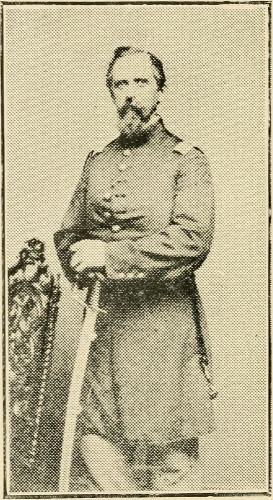
Capt. C. L. Smith
In closing my memories of the war I am going to give an extract from an
old letter written by my captain, who several years since went to join
those of his command who had been summoned by the Great Captain of All.
“Nov. 8, 1883.”
“My Dear Boy: Your welcome letter of the 14th ult. at hand, and was most
happy to learn over your own signature that you had not in the long years
that have intervened forgotten me. Your old captain still lives, daily
praying for and remembering the least under his command.
“Oh, that I could see them pass in review as I did many a time in those
stirring days. Many years have passed since and probably not one in 50
would I recognize, still I remember them all, living or dead, who went
with me to the great war.
“God knows my affection goes out to you all and I am not ashamed to say
that my eyes fill with tears as I write.
“My great regret is that I could not return every man and boy to their
homes. But I could not. You remember I said I had no cowards in old Co. H.
They were a brave, intelligent lot of men who obeyed orders, endured
hardships and faced the guns of the enemy unflinchingly.
“I recall you as but a child going with me to a real war where you were to
spend years of your young life with your little drum. But my dear boy, it
did good service, real genuine war service.
“I remember you were the first drummer boy the 2d New York had, and I am
proud to know that my own little drummer boy marched at the head of the
regiment in every campaign down to Appomattox and beat the last tattoo for
the regiment at Hart’s Island, New York Harbor, after nearly four years of
service.
“God bless you, how could I be other than proud of my little drummer boy?”
FINIS.
Transcriber’s Note:
Seemingly at random, these two lines were printed at the top of page 18 of
the original text:
mules of the wagon trains, and after a couple of
nowhere else for him to go.