It may be taken for granted that most people are in
some degree acquainted with the use of opium, having
had it at some time or other administered to them as a
medicine. Dover’s powder, so useful a remedy for a
cold, contains opium; Laudanum is a preparation of it
which is familiar to everybody; and there are scores
of other remedies and proprietary preparations which
contain opium to a greater or less extent. But useful
as opium may be, it must be used with discretion,
and must not be allowed to change its character of
a faithful servant for that of a master. It can become
an exacting and dominating master, and the habit
once formed is well nigh ineradicable.
For the information of those who have not seen the
pure drug, I may mention that opium is a dark brown,
putty-like substance with an agreeable, sweetish, odour.
It is the dried resin obtained by incising the unripe
capsules of a certain variety of poppy, and is prepared
in large, well-equipped factories, from which it is issued
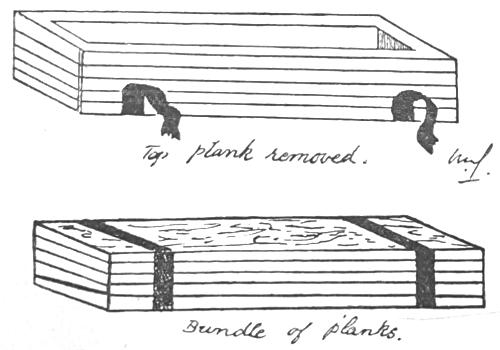
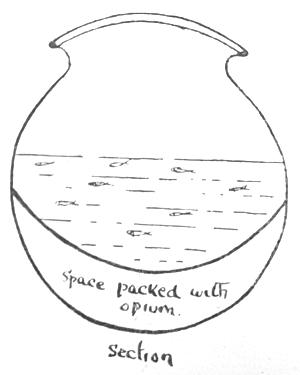
in cakes and balls weighing eighty tolas.[2]
The opium industry is a Government monopoly.
The poppy crops are grown under Government supervision,
and the factories where it is prepared belong to
Government and are staffed by Government servants.
The prepared product is sold from Government opium
shops from which consumers who are so privileged can
get their requirements at a certain fixed price.[3] But
as is the case with all monopolized commodities, opium
may assume a money value far in excess of its intrinsic
worth and be sold for its weight in silver. In fixing
the price of opium, Government is confronted with a
choice between two courses: either to sell opium cheap,
and so extinguish the smuggler; or to prohibit it entirely
and thereby convert India into a happy hunting ground
for the avaricious and rapacious fortune hunter. It
takes a middle course, therefore, and sells opium at
such a rate that facilities for obtaining it are reasonable,
without, on the one hand, rendering it cheap and easily
obtainable, or, on the other, making it prohibitive.
The policy pursued is one of eventual suppression; the
discouragement of recruits to the opium habit being the
means employed as best adapted to bring about its
realization.
The opium habit was an established thing in India
centuries before the British first set foot in the country,
and it is surmised that it was the Arab conquerors, who
invaded India in the 11th century who first introduced
it. The cultivation of the poppy, and the preparation
of opium, were live industries in India in the 16th
century, as Portuguese chroniclers tell us, and when
the British East India Company took over the
administration of Bengal after Clive’s victory at Plassey
in 1757, all that they found themselves able to do was
to adopt a policy of regulation leading to ultimate
suppression. This policy has been followed ever since.
It is a fundamental weakness of human nature that
we desire most that which it is most difficult to obtain.
It is a perpetuation of the genesiac myth of the forbidden
fruit; and no matter how optimistic some may be
that the opium habit will eventually be stamped out,
it is to be feared that this cannot come about until
human nature ceases to be what it always has been.
This contention applies with special cogency to the
opium habit whose insistence in our midst is not only
owing to the fact that it satisfies the sensuousness and
voluptuousness which forms a part of every man’s
nature, but that it establishes a dominance over its
victims which requires almost super-human power of
will to overthrow. In a letter to his friend and medical
attendant Mr. Gilman, Coleridge, who was for
twenty-five years a victim to the opium habit, writes
about the giving up of it as a “trivial task” and as
requiring no more than seven days to accomplish; yet
elsewhere he describes it pathetically, and sometimes
with almost frantic pathos, as the scourge, the curse,
the one almighty blight which had desolated his life.
De Quincey very justly calls this a “very shocking
contradiction,” and asks, “Is, indeed, Leviathan so
tamed?”
It has been more than once suggested that the
dissemination of a healthy propaganda would be the
best means of deterring recruits to the opium habit, and
that reliance upon the efforts of a strong preventive
staff can result only in a diminution of the vice, and
not its extinction. On some, such propaganda might
have the desired effect; but with others, it may have
just that effect which we seek to avoid. There is always
a desire to experience new and strange sensations;
there are always some who want an unfailing panacea
for pain of body or mind; there are always some who
long for oblivion. All these things are to be got from
opium—the sovereign panacea for pain, grief, “for all
human woes”; a weaver of dreams and ecstasies!
And so, with the personal equation always solving
itself, the problem remains to all intents and purposes
unsolvable.
Let us see what the effects of opium are. A writer
on the subject says, “A small dose not unfrequently
acts as a stimulant: there is a feeling of vigour, a
capability of severe exertion, and an endurance of
labour without fatigue. A large dose often exerts a
calming influence with a dreamy state in which images
and ideas pass rapidly before the mind without fatigue,
and often in disorder, and without apparent sequence.
Time seems to be shortened as one state of consciousness
quickly succeeds another, and there is a pleasant feeling
of grateful rest. This is succeeded by sleep which,
according to the strength of the dose, and the idiosyncrasy
of the person, may be light and dreamy, or like
normal profound sleep, or deep and heavy, passing
into stupor or coma. From this a person may awaken
with a feeling of depression, or langour, or wretchedness,
often associated with sickness, headache, or vomiting.”
I have verified these statements by questioning
numerous consumers of opium, and, in substance,
their descriptions tallied exactly with that I have
quoted.
How the opium habit is first contracted is a matter
which deserves investigation, but it would seem that
the most fertile cause is its injudicious administration
in its character of an anodyne. De Quincey, in his
“Confessions of an English Opium-Eater” tells us
that he first took opium for a severe toothache. The
poet Coleridge, who, like De Quincey, was a confirmed
opium-eater, “began in rheumatic pains”; and if
a census of consumers was taken, it would not be
surprising to find that eighty per cent. of them
were first introduced to this “dread agent of
unimaginable pleasure and pain” by its being
given them for a stomachache, toothache, or some
such wrecker of the peace of their mind. The other
twenty per cent. are the victims of curiosity. The
Burman is said to get the taste for opium when he is
drugged with it while young, when he is, according
to Burmese custom, tattoed from the waist to above
his knees.
Nobody needs to be told that a habit is formed by
the frequent repetition of acts or indulgences, and
that some habits are more difficult to break ourselves
of than others. The opium habit falls in this category.
It is formed, of course, in the same way as other habits,
but there are peculiarities connected with it on which
those who are ready to condemn opium-eaters as degenerates
might well ponder. The physiological effects
of opium are such, that the wearing off of the effects
of a dose are attended with the keenest mental and
physical distress. No one who has not been an opium-eater
can describe these adequately. The need, therefore,
for a corrective of this condition becomes what
seems an urgent necessity, and the only immediate
corrective is “a hair from the dog.” A succession of
these “hairs”—and a not very long succession—forms
the habit. Unlike other habits, it is a habit that
cannot be cured without immense strength of will,
and a readiness to undergo great suffering: pains in
the body, diarrhœa, and a general upset of the mental
equilibrium. We see, therefore, that the cause of the
habit lies here: the need for opium to alleviate the pangs
caused by opium.
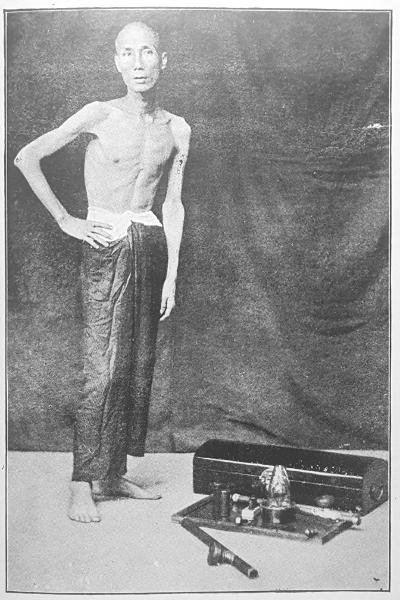
An Excessive Opium Smoker
Amongst unromantically inclined people of the
type who form the bulk of consumers—cultivators,
coolies, artisans of all kinds, humble folk whose creed is
“pice and rice”—it would be difficult (and ludicrous)
to suppose that their object in taking opium is to go in
their dreams to:
“Woods that wave o’er Delphi steep
Isles, that crown the Aegian deep,
Fields that cool Ilissus’ laves
Or where meander’s amber waves
In lingering lab’rinths creep.”
Possibly, they do have pleasant dreams; but the
exertion and hard exercise they must undergo to earn
their daily bread is known to counteract the sedative
effects of opium; and as they take small quantities only,
its effect is to stimulate them rather than to make them
dreamy and sensuous; and I contend that, primâ facie,
it is not to evoke sensuous imaginings that these people
take opium. They take it because they cannot get
away from it, once the pain to ease which it was
given has passed. What strength of will do we
expect to find in an unlettered cooly?
Without any apology I reproduce here some
verses which appeared in 1894, about the time
when the Royal Opium Commission came to India:
THE OPIUM-EATER’S SOLILOQUY.
They began by mourning over my degraded moral state,
Then my physical decadence they would anxiously debate.
Then they raised a pious eye,
And they heaved a pitying sigh,
And they shuddered as they pondered on my melancholy fate.
Now, I never had reflected on the matter thus, at all,
For my luxuries were few, and my expenditure was small.
I was happy as the day,
In my own abandoned way,
Till they said they must release me from the bonds that held me thrall.
I’d been cheered up at my
Chandoo[4] shop, for years at least two score,
To perform my daily labour, and was never sick or sore;
But they said this must not be;
So they passed a stern decree,
And they made my Chandoo seller shut his hospitable door.
Now they’re sending out Commissions with the philanthropic view
Of inducing us to part with sev’ral crores of revenue;
For all opium traffic’s sin,
And, although it brings in tin,
Our nefarious trade papaverous, they say we must eschew.
Who’d have thought that my redemption would have cost so many lakhs
(For they saddle their expenses on my fellow-subjects’ backs).
What with deficits to square,
And Commissions everywhere,
On the “hoarded wealth of India” I shall prove a heavy tax.
If I’d only cultivated, now, a taste for beer or gin,
Or had learnt at Pool or Baccarat my neighbour’s coin to win,
I could roam abroad o’ nights,
And indulge in these delights,
And my soul would not be stigmatized as being steeped in sin!
But as mine’s a heathen weakness for a creature-comfort, far
Less pernicious than their alcohol, more clean than their cigar,
They have sent their howlings forth,
From their platform in the North,
And ’twixt me and my poor pleasures have imposed a righteous bar!
There are two modes of taking opium. It is either
eaten in its crude form, or it is clarified with water
and smoked in a pipe of peculiar construction.
It is generally conceded that opium smoking is less
injurious than opium eating, bulk for bulk, of the
amount consumed, and that the intemperate or immoderate
opium smoker is less liable to the toxic effects of
opium than the man who eats it raw. Why this is
will be clear when it is explained that as a result of the
process of preparation for smoking it, which consists
in boiling opium with water, filtering several times,
and boiling it down again to a treacly consistency,
a considerable portion of the narcotine, caoutchouc,
resin, and other deleterious elements are removed, and
this prolonged boiling and evaporation have the effect
of lessening the amount of alkaloids in the finished
product. The only alkaloids likely to remain in the
prepared opium, and capable of producing marked
physiological effects, are morphia, codeia, and narceia.
Morphia in its unmixed state can be sublimed; but
codeia and narceia are said not to give a sublimate.
But even if not sublimed in the process, morphia
would, in the opinion of Mr. Hugh M’Callum (Government
Analyst at Hong Kong), be deposited in the bowl
of the pipe before the smoke reached the mouth of
the smoker. The bitter taste of morphia is not
noticeable when smoking opium, and it is therefore
possible that the pleasure derived from smoking opium
is due to some product formed during combustion.
This supposition is rendered probable by the fact
that the opium most prized by smokers is not that
containing the most morphia.
But what constitutes moderation or the reverse?
The answer is idiosyncrasy, or the degree of toleration.
This is a factor which is lost sight of by most of those
who declaim against the occasional glass or pipe. They
wish to push temperance to the point of total abstinence,
and condemn the man who takes a peg of whisky
without evil results, with the man who becomes maudlin
after taking a single glass of white wine, for it is only by
outward appearances they are able to judge. But
leaving them to rage in their ignorance, we must
recognise the fact that opium is one of those drugs
the effects of which depend largely upon personal idiosyncrasy
and toleration. Dr. Chapman, in his Elements
of Therapeutics, gives two instances of remarkable cases
of toleration of opium. In one, a wineglassful of
laudanum was taken by a patient several times in the
twenty-four hours; and in another, a case of cancer,
the quantity of laudanum was gradually increased to
three pints daily, a considerable quantity of crude
opium being also taken in the same period!
The usual dose, as a medicine, is from one to three
grains of opium, but a consumer can take from ten to
twenty, while I have met many able to take from sixty
to eighty grains. The degree of tolerance is increased
by usage and habit, and the tendency is to increase
the dose with habituation. With smokers, it is not
uncommon to find Chinamen, the heaviest consumers
of opium in the world, who can dispose of three tolas[5] of
opium in the day; but they smoke it, and so can stand
far more of it than if they ate it in the crude state.
The reader who has troubled to come so far with me
will not unreasonably be curious to know how opium is
smoked; so, if he will accompany me farther, I will
take him into a den and satisfy his curiosity. It is a
Chinese den. From the street it has nothing to proclaim
its character; it is like any other entrance in the street.
Ah! Here comes a smoker. Observe his deathly
pallor, his appearance of emaciation, his dazed
expression. He must be a heavy smoker, soaked in
the vice. Let us go in with him! We enter. For a
moment the dimness of the room flanked on three
sides with raised wooden platforms waist-high, and
covered with mats, is accentuated by our sudden
entrance from the sunlit street. We become aware
of a peculiar odour in the atmosphere of the room,
not unpleasant, but peculiar. It is like nothing that
we have ever sniffed before. It is the odour of smoked
opium. When our eyes, having got used to the light, or
rather darkness, of the room, we look round and see
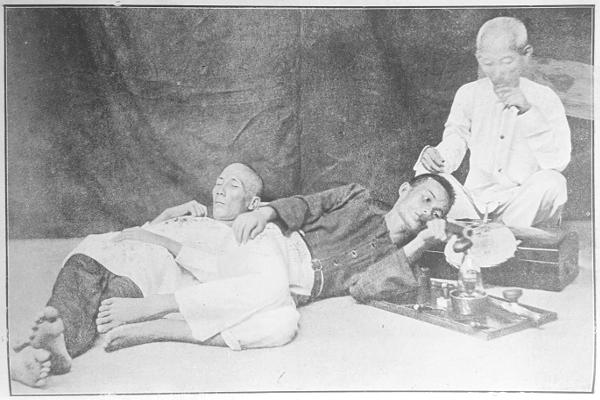
on the platforms, sleeping forms sprawled round trays
containing their smoking utensils. Let us examine
these: First there is the pipe. It is made of a single
joint of bamboo about a foot and a half long, hollow,
and closed at one end, and about an inch in diameter.
About a quarter of its length up from the closed end,
there is an earthenware protuberance, not unlike a door-knob
in appearance, firmly fixed into the stem; on its
top, and in the centre, is a small orifice. This is the
pipe-bowl.
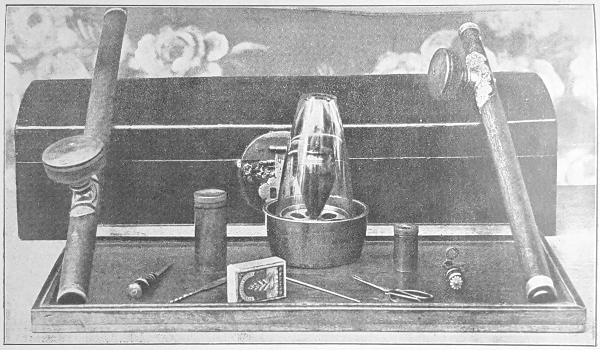
Opium Smokers’ Appliances
Next we notice a lamp. This has a base of wood,
and consists of a glass reservoir of oil, with a string wick
leading from it through a small brass cap. Over this
is a glass chimney.
Then we see the wire, like an ordinary fine knitting
needle; and several horn phials, each containing
prepared opium.
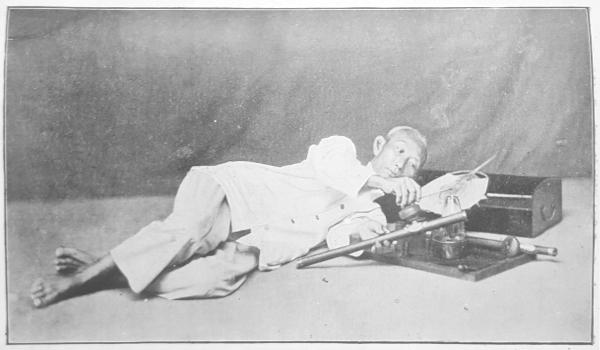
Preparing to Smoke Opium
(The opium on the end of the dipper being roasted over the lamp.)
But here is the new-comer whom we followed in. He
has paid the den-keeper the small fee which makes him
the temporary owner of a tray of smoking utensils, and
with these he passes us, and getting on to the platform
between two sleepers, he puts his tray down, and
assumes a recumbent attitude beside it. Lying on his
left side, with his head on a hard lacquered pillow, he
draws the tray towards him and takes the pipe in his
left hand. With the other hand he takes the piece of
wire, and plunges one end of it into the horn phial
containing treacly prepared opium, withdrawing it
immediately with a drop of the fluid adhering to the
point. This he maintains on the point by rapidly
twirling the instrument between two fingers, and
carrying it over the flame of the lamp, he proceeds to
roast the opium. This is a delicate operation, and
requires practice. The needle is dipped into the phial
again and again, and the opium adhering to the end
roasted over the flame until an appreciable quantity
of the drug has accumulated on the end of the wire.
He rolls this accumulation, still on the end of the dipper,
on the flattened top of the pipe bowl, until it has
acquired the desired shape, and then thrusts the end
into the orifice in the centre of the bowl, and twirling
the wire sharply round, withdraws it, leaving the
opium in the orifice. Now, taking the lower end of
the pipe in his right hand, and the mouth end of the
pipe in his left, he applies the open end to his lips and
holding the bowl almost inverted over the top of the
lamp begins to take long inhalations, the smoke escaping
through his nostrils. The little plug of opium in the
orifice crackles and burns in the heat of the flame,
and we notice that the smoker now and then scrapes
towards the orifice in the bowl, all the particles of
opium which remain unburnt. He finally clears the
orifice by thrusting the wire into it several times, and
disconnects the bowl from the stem. We notice it
contains an appreciable quantity of black, evil-smelling
opium residue. This is the “dross,” carefully preserved
by smokers, and later on boiled with raw opium to
which it is believed to add strength. We watch him
smoke a few more pipes, and eventually the pipe falls
from his nerveless hands, and he lies still. What are
the dreams which flock through his mind? We do not
know, but Bayard Taylor in his book India, China and
Japan tells us of his personal experience of the effects
of opium smoking. It was his first and last attempt,
and his record is interesting. He says:—“To my
surprise I found the taste of the drug as delicious as its
smell is disagreeable. It leaves a sweet, rich, flavour,
like the finest liquorice, upon the palate, and the gentle
stimulus it conveys to the blood in the lungs fills the
whole body with a sensation of warmth and strength.
The fumes of the opium are no more irritating to the
windpipe or bronchial tubes than common air, while
they seem imbued with a richness of vitality far beyond
our diluted oxygen.
“Beyond the feeling of warmth, vigour, and
increased vitality, softened by a happy consciousness of
repose, there was no effect until after finishing the
sixth pipe. My spirits then became joyously excited
with a constant disposition to laugh; brilliant colours
floated before my eyes, but in a confused and cloudy
way, sometimes converging into spots like the eyes in
a peacock’s tail, but oftenest melting into and through
each other, like the hues of changeable silk. Had the
physical excitement been greater, they would have
taken form and substance, but after smoking nine
pipes I desisted, through fear of subjecting myself to
some unpleasant after-effects. Our Chinese host
informed me that he was obliged to take twenty pipes in
order to elevate his mind to the pitch of perfect happiness.
I went home feeling rather giddy, and became
so drowsy, with slight qualms at the stomach, that I
went to bed at an early hour—after a deep and
refreshing sleep, I arose at sunrise, feeling stronger and
brighter than I had done for weeks past.”
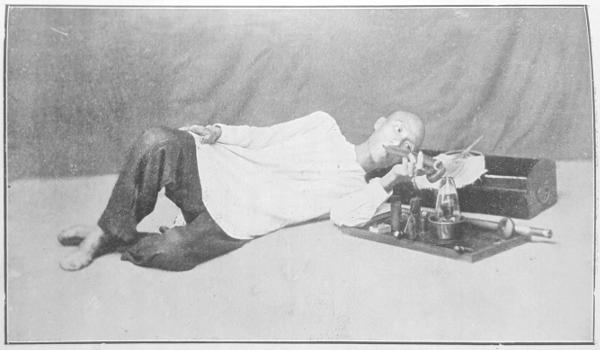
Chinaman Smoking Opium
It is now proper that we should ask the question
“Is opium the very dreadful thing it is made out to
be?” My answer is, yes and no. Anything immoderately
indulged in is bad for one. Over-eating,
excess in smoking and drinking, are all bad. There
is such a thing as too much of even a good thing. I
am prepared to admit that excess in opium is worse
than most things; but as a choice between opium and
drink, I consider drunkenness to be the greater evil.
It may be that it is more common, and therefore
responsible for more distress in the world than opium;
but opium does not, and can never, degrade as drink
does, and a man does not make a beast of himself with
opium. It does not make a nuisance of a man; it does
not lead to violence and to murder as drink does. I do
not ask reformers to subscribe to this view. I express
it as my own opinion, founded as it is upon close
acquaintance with numerous opium consumers, and
many drunkards.
What is it that reformers have to urge against
opium? They will not admit that opium in moderation
does no great harm; they will not agree that the degree
of toleration varies in people. Let us take their
contentions seriatim, and see how they will stand
against logical and informed discussion:
They say: (1) That opium in any degree induces
physical degeneration.
I say, I have met men of wretched physique who are
opium consumers, and men of wretched physique who
are not opium consumers. Also, I have met giants in
strength who are not opium consumers, and giants in
strength who are confirmed opium consumers. I will
also say this, that among the hard-working class of
Indians and Burmans, such as coolies and porters, the
proportion of consumers to non-consumers is about
equal, but I have been able to observe no inferiority
in capacity in the consumers, and very often have
found them superior. Those who wish to learn what the
powers of bodily endurance of an opium consumer
may be are recommended to read that very readable
book “An Australian in China.”
(2) That the consumer is mentally inferior to his
non-consuming brother.
This I qualify. It depends on the degree of indulgence,
and unless this is considered, it is not possible to
argue. It is a proved fact that the effect of opium
is to quicken the perceptions, and stimulate the imagination.
Too often this is taken to be evanescent; and it is
assumed that the intellect weakens, and that, eventually,
it is enfeebled beyond chance of recovery. But if
opium were not taken; in such a case, would not
advancing years bring about a like condition? Charles
Lamb, who drank more than was good for him, and
Coleridge, who was an opium-eater, complained that the
effect of their particular “poisons” was to deprive
them of their capacity for singing when they awoke in
the morning! Lamb complained of this when he was
forty-five, and Coleridge at the age of sixty-three.
Does anyone imagine they would have been able to
“revive the vivacities of thirty-five” if they had been
always temperate men?
There is no doubt that, taken in large quantities,
opium induces a sluggishness, a lethargy, a stupor;
but does not an unusually heavy meal induce a torpor
which is incompatible with any sort of intellectual
labour? I hold only with moderation.
(3) That indulgence in opium weakens the character
and morals.
This applies with equal force to immoderation in
most things. It does not hold good of opium taken in
moderation. To affirm this is a clear indication of
ignorance of the subject. Why, in the name of all
that is extraordinary, should a moderate dose of opium
make a man a thief, or a criminal, or a moral imbecile?
Indians and Burmans, whose religion forbids all manner
of intoxicants, condemn their opium-eating brothers
to a sort of social ostracism, and when asked for a reason,
say, “It is against our religious tenets; and it is
very bad in every way.” Such uninformed statements
are excusable in the unenlightened, but what of those
who ought to know, and who pride themselves upon
their education and reasoning faculties? They are as
clamorous against opium and other things in a more
censurable ignorance of facts. Some who will not clear
their minds of cant, declaim against a glass of wine
with all the fervour and denunciation of fanatics,
without rhyme, reason, or apprehension of what they
are talking about. In their more fluent and exuberant
way, when pressed for a reason, they tell us in effect
that indulgence in opium is “Against our religious
tenets, and it is very bad in every way.” It is time
reformers recognised that opium is not such a dreadful
thing after all, and confined their attention, and
devoted some of their ample leisure, to winning back
those who have gone over the limit of moderation,
instead of anathematizing them.
It is a pity that reformers do not pursue their
propaganda along reasonable and obvious lines, because
they would have more supporters and helpers if they
did. To publish fulminatory pamphlets against the
opium evil, without having any experience of it at
first hand beyond an occasional hurried visit to an
opium den, is worse than futile; and they cannot hope
to convince those who are really in a position, and
qualified to help them in their efforts. This is due to a
profound ignorance of facts, and a lot of people in
India are responsible for the dissemination of a lot of
ill-digested nonsense. An enthusiast visits an opium
den and finds half a dozen Chinamen sprawled around,
with as many opium pipes. He does not know that
these men have come in from a ten-hour day’s work.
He throws up his hands in pious consternation, and
writes home about the dreadful place he has visited,
and of the horrors of intoxication he witnessed there.
The vividness of his description is modified only by the
amount of rhetoric at his command, and no one who
has come into contact with this sort of person will deny
that he always has a vast store!
I once met a missionary, and in the course of conversation,
we happened upon the opium evil. He was
eloquent, his views on the subject were decided. In
fact he was so decided in his views that I found it
impossible to convince him that what he described as
the effects of opium were really those symptomatic of
an overdose of bhang. And yet, I have little doubt
that this person must have written home lurid accounts
of the opium evil, and the ruin and havoc it was causing.
What reformers ought to do is to cease memorializing
Government to totally prohibit the traffic, and try to
help them more by taking an active part in checking
immoderation. Moderate indulgence in opium is less
harmful in every way than the habit of passing public
resolutions and submitting memorials.
By the foregoing, I do not wish it to be surmised
that I hold a brief for the opium habit, or that I consider
it a desirable thing. To be a slave in any degree to
anything is bad; the tobacco habit is bad; the over-eating
habit is bad. But opium comes in for too much
of the attention of religious propagandists, and the
Government is taxed with the charge of reaping revenue
at the expense of the bodies and souls of the people.
This is a view it is the duty of anyone who knows the
subject intimately to correct. The Royal Commission
on Opium in India, which sat under the chairmanship
of Lord Brassey, some thirty years ago, collected a mass
of evidence for and against opium which is unrivalled
in its extent and value. The conclusion come to by a
majority of the Commissioners was that opium in
moderation did no great harm; and to ensure moderation,
they recommended a policy of close control. In
deference to popular opinion, and the religious scruples
of the bulk of Indians, they thought it desirable that
the opium habit should eventually be suppressed, and
trusted that close control would, by attrition, bring
about this result.
Morphia, which is the active principle of opium, is
interesting in its being the first “alkaloid” to be
discovered. Its basic nature was first noticed by
Serturner in 1816.
As a medicine, principally as an anodyne, morphia
is to pharmacy what chloroform is to surgery, and,
as a “boon and blessing” to man in that character,
it is second to none. But like all good things in this
world, it has become the object of the grossest abuse at
the hand of man; and its devotees, in an euphonic
sense, number hundreds of thousands.
Morphia is a narcotic; that is, it “has the power
to produce lethargy or stupor which may pass into a
state of profound coma or unconsciousness, along with
complete paralysis, terminating in death.” The degree
of insensibility depends upon the strength of the dose;
one-sixth of a grain for an adult man, and one-tenth
of a grain for an adult woman, being the largest safe
dose given hypodermically. Two or three grains given
by the stomach is dangerous. But, as with opium,
the dose varies with idiosyncrasy, and some can tolerate
larger doses than others. With habituation, some
persons can take with impunity an amount of morphia
which would prove fatal to five or six healthy, full-grown
men. To have its full effect as an hypnotic or
anodyne—and its power as the one depends upon its
potency as the other—morphia must be given hypodermically.
The possession of morphia by people other than
medical men and chemists is prohibited by law; and
the rules governing its sale by chemists are rigid and
exact. They must account for every grain sold, and
all entries in their sales registers must be supported
by prescriptions signed by qualified medical men.
Yet morphia injecting is more prevalent in cities than
the public is aware of; and it does not require a very
penetrating mind to discover that the morphia used
by its unfortunate victims comes from illicit sources—from
the smuggler. There are, of course, unscrupulous
physicians, dentists, and quacks, who pander to the
cravings of some of their “patients” by administering
regular injections; but we are dealing here with the
type of persons who do not call in doctors, accommodating
or otherwise. The ones I write about are catered
for by an organization which, in spite of the greatest
efforts, has been found to be unrepressible.
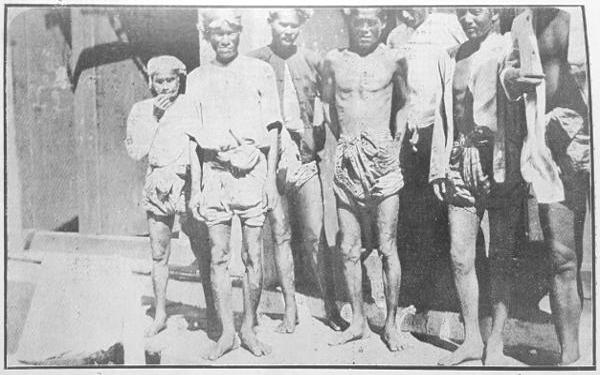
Group of Morphia-Injectors
How do these people get their supplies? Let us go
into a morphia den unofficially, and take a glance at
it in all its sordidity. We draw aside a filthy sheet of
cloth which does service as a curtain, and enter a room
about twenty feet square. It is dim almost to darkness;
but at the farther end, opposite the entrance
door, we notice a wooden partition which has a locked
door in it, and near it a hole not unlike the window
of a box or ticket office. Through this hole a light is
seen, so we presume that there is someone behind the
locked door in the partitioned-off portion of the room.
Looking round us, we see a row of human figures, clad
in the foulest rags, lying along the two sides of the
room, near the walls. Some are apparently asleep;
actually, they are drugged, overcome by the last
injection of morphia. Others are about to make
themselves comfortable for a sleep, having just had an
injection; while some, too poor to afford the cost of
another dose, are groaning and whimpering with the
combined agonies of some painful disease, and the
wearing off of the effects of the last injection. These
accost everybody that enters the den for the price of
“just one little injection.” They appeal to those who
have endured the same pangs with which these unfortunates
are wracked. The appeal is to a real, live sympathy;
and if it can be spared, the required money is
handed over.
One of these beings has not appealed in vain to a
fellow votary who has just entered the den in company
with two companions, and the four make their way to
the hole in the partition, and in exchange for the coppers
handed in, a skinny hand passes out four little paper
packets, each one containing a dose of morphia powder.
Let us peep through the hole, and look at the owner of
the skinny hand before following the four to the place to
which they have retired. It is a Chinaman, characteristically
lean, sitting at a rough table on which is a cigar
box filled with paper packets similar to those we saw
being handed to the late purchasers. The red and
green ones contain morphia, the white cocaine (for he
caters for both classes, the injecters of morphia, and
eaters of cocaine). Looking up at the hole, he sees us,
and thinking we are either excise or police officers, he
hastily gathers up his wares, and rushing to the sanitary
arrangement in the corner of his cubicle, empties them
into the receptacle, and pulling the chain, flushes away
the incriminating evidences of his occupation. Being
assured that they are well on their way to the sea through
the sewer, he turns towards us with a “smile that is
child-like and bland,” and explains that he has “got
nothing—all gone—you can’t do nothing.” We explain
that we had no intention of doing anything, and were
merely curious. Recollecting that he had heard no
call from his ever watchful colleague who stands by
to give timely warning in the event of a raiding
party coming in sight, he admits that he has been
precipitate; but in no way disconcerted, he sends his
colleague off to some place best known to themselves,
for a fresh supply of packets.
We now return to the four men who provided
themselves with morphia two or three minutes ago. We
find them sitting in a ring round another fellow who we
learn is the operator. He possesses a hypodermic
syringe. Let us take and examine it. It is not the
sort of thing one would expect to find in a chemist’s
show-case or a medical man’s pocket-case. This is a
weird instrument; the barrel a length of glass tubing;
the plunger a bit of knitting needle, whose plunging
head consists of tightly wound rag, and whose other end
is topped with a conglomerate of sealing wax and
sewing thimble. Both joints are lumps of sealing wax,
through the lower of which an inch and a half of hollow
needle projects. Handing back this septic instrument
to the operator, who, by the way, tells us that he gets a
copper for every injection he gives, he proceeds to
empty the contents of the packets into a small china
egg-cup. Adding a modicum of water, and stirring
the mixture until a clear solution is formed, he takes up
some in the syringe, and one of the expectant waiters
draws nearer him. A search is made by the operator
for a clear spot on the body of the man, where a dirty
needle has not already penetrated and caused a foul
sore, and after some search such a spot is found, on the
palm of the hand, and here the needle is introduced,
and the contents of the syringe discharged, after which
the man operated on limps away to his place, and lying
down, is soon asleep. The next draws near, and having
received his share of the dose with the same needle,
unsterilized and unwashed, he in turn limps off; and
so with the others.
Let us hope that the fell, loathesome, unnameable
disease, from which one at any rate of the four was too
apparently suffering, has not been introduced into the
blood of the others by that death-dealing needle! But
it is a hope that we cannot think is justified; the
means of propagation employed are too certain to
admit of any hope!
The foul and fetid atmosphere of the crowded room
is almost overpowering, in spite of the strong tobacco
we smoke in our well-lit pipes, but we will linger a little
longer and take a glance at those who are lying around
like so many logs. Look at this one of them. What
an object lesson he is to impetuous youth! Thin to
emaciation; his hair fallen off in tufts; his nose almost
eaten away; his body covered with sores and ulcers.
There is nothing to wonder at in this being taking
morphia to ease his pain of mind and body. Since
death will not come, let him have oblivion. It is better
so.
Here we find a woman; she is a slattern if ever
there was one. Clean-limbed, in the sense that she
has no sores on visible parts of her body, she is nevertheless
almost as certain a disseminator of disease and
misery as the foul needle. She wakes as we watch her,
and in a drowsy way, smiles; probably in a way she
means to be fascinating, but we are not under the
effects of the delusive narcotic, so cannot be expected
to know! Suddenly a look of intelligence comes
into her eyes, and realising who we are, she gets up, and
stumbles towards the door, and out on to the street—on
her way to another den in all probability!
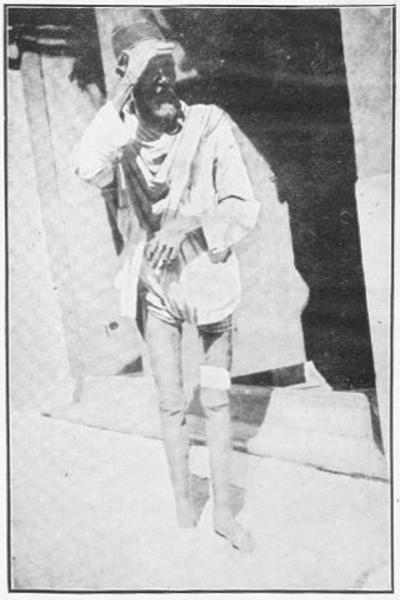
An Indian Morphinist
Here is another. An old, or rather, an old-looking
man, shrivelled and feeble. He is just awaking from
his stupor. We ask him to get up, but he is unable
to do more than humbly indicate the reason for his
inability to do so. A glance, as the sheet which covers
him is withdrawn from his body, sends a thrill of horror
through us, and we turn away sickened at the sight;
and the man—is he a man?—draws his cloth over
his tattered body, and tries to woo sleep again. This
last sight is enough to send us headlong into the fresh
air and sunlight. If these are the results of morphia,
then God have mercy upon its votaries, for they stand
sorely in need of it!
Morphia is imported into the country in large
quantities by smugglers, the drug being brought from
the British Isles, Japan, and the Continent by members
of the crews of steamers plying from these countries.
As many as 500 ounces of morphia have been seized in
one consignment, and, as it is generally admitted by
those who are in position to know that for every ounce
seized, a pound passes through undetected, it only
requires a simple calculation to arrive at the
approximate total quantity which is hawked about
unrestricted.
Morphia, being more portable and concentrated, is
more easily concealed than opium, which is comparatively
bulky. Of the aggregate seizures in any one
year, seventy-five per cent. is made up of numerous
small seizures. To seize four or five ounces of the drug
in one lot is rather the exception than the rule; and
seizure in larger quantities is a comparatively rare
event.
But it is comforting, in a way, to know that morphia,
by the time it reaches the consumer, is very often freely
adulterated, starch being the adulterant used; and
when it is considered that morphia sold illicitly fetches
from five to six times its price when sold licitly, the
increase in its bulk which results after adulteration
represents a handsome additional profit to the vendor.
The big smuggler imports the drug; his lesser brother
buys some from him and adulterates it; the den-owner
buys the mixture from the lesser light and he in turn
adds a little more starch to it; and finally “the man
in the cubicle” retails the mixture to the consumer.
There is little to be said in defence of the morphia
habit. It is bad, utterly bad, in itself, while it is a
fertile disseminator of disease when injected as it is.
Morphia ruins a man, body and soul. As is the case with
opium, pain is a frequent originator of the habit, but its
hold upon the individual is, if anything, stronger than
that exerted by opium, and fatal consequences ensue
with great certainty and rapidity.
In writing about cocaine, we find that interest lies not
so much in itself as in the plant of which it is the alkaloid,
the “erythroxylon coca.”
The coca plant is indigenous to Peru, and from the
most ancient times, Peruvian Indians have chewed the
leaves as a habit, as Indians in this country chew the
betel leaf and tobacco. “The local consumption of
coca is immense,” says Dr. Hartwig, “as the Peruvian
Indian reckons its habitual use among the prime necessaries
of life, and is never seen without a leathern pouch
filled with a provision of the leaves, and containing
besides a small box of powdered, unslaked lime. At
least three times a day he rests from his work to chew
his indispensable coca. Carefully taking a few leaves
out of the bag, and removing their midribs, he first
masticates them in the shape of a small ball, which is
called an acullico; then repeatedly inserting a thin
piece of moistened wood like a tooth-pick into the
box of unslaked lime, he introduces the powder which
remains attached to it into the acullico until the latter
has acquired the requisite flavour. The saliva, which is
abundantly secreted while chewing the pungent mixture,
is mostly swallowed along with the green juice of the
plant.
“When the acullico is exhausted, another is immediately
prepared, for one seldom suffices. The corrosive
sharpness of the unslaked lime requires some caution,
and an unskilled coca chewer runs the risk of burning
his lips, as, for instance, the celebrated traveller Tschudi,
who, by the advice of his muleteer, while crossing the
high mountain-passes of the Andes, attempted to make
an acullico, and instead of strengthening himself as he
expected, merely added excruciating pain to the fatigues
of the journey.”
The poet Cowley succinctly describes the physical
effects of coca in the following lines:
“Our Varicocha first this coca sent,
“Endow’d with leaves of wondrous nourishment,
“Whose juice succ’d in, and to the stomach tak’n
“Long hunger and long labour can sustain
“From which our faint and weary bodies find
“More succour, more they clear the drooping mind,
“Than can your Bacchus and your Ceres join’d.
“Three leaves supply for six days’ march afford
“The Quitoita with this provision stor’d
“Can pass the vast and cloudy Andes o’er.”
“It is a remarkable fact,” Dr. Hartwig tells us,
“that the Indians, who regularly use coca, require but
little food, and when the dose is augmented, are able
to undergo the greatest fatigues without tasting almost
anything else.” Professor Pöppig ascribes this astonishing
endurance to a momentary excitement which must
necessarily be succeeded by a corresponding collapse,
and therefore considers the use of coca absolutely
hurtful. Tschudi, however, is of opinion that its
moderate consumption, far from being injurious, is, on
the contrary, extremely wholesome, and cites the
examples of several Indians who, never allowing a day
to pass without chewing their coca, “attained the
truly patriarchal age of one hundred and thirty years.”
The effects of excess in coca chewing are given by
Hill in his Travels in Peru and Mexico. “The worst
that can be said of the coca is its effects upon the health
of such of the Indians as use it in excess. It then affects
the breath, pales the lips and gums, and leaves a black
mark on either side of the mouth. Moreover, after
some time, the nerves of the consumer become affected,
and a general langour is said to give plain evidence of
the sad consequences of excess.”
Another writer gives a more depressing picture of
the excessive consumer: “The confirmed coca chewer,
or Coquero, is known at once by his uncertain step,
his sallow complexion, his hollow, lack-lustre black-rimmed
eyes, deeply sunk in the head, his trembling
lips, his incoherent speech, and his stolid apathy. His
character is irresolute, suspicious, and false; in the
prime of life he has all the appearances of senility, and
in later years sinks into complete idiocy. Avoiding
the society of man, he seeks the dark forest, or some
solitary ruin, and there, for days together, indulges in
his pernicious habit. While under the influence of
coca, his excited fancy riots in the strangest visions,
now revelling in pictures of ideal beauty, and then
haunted by dreadful apparitions. Secure from intrusion
he crouches in an obscure corner, his eyes immovably
fixed upon one spot; and the almost automatic motion
of the hand raising the coca to the mouth, and its
mechanical chewing, are the only signs of consciousness
which he exhibits. Sometimes a deep groan escapes
from his breast, most likely when the dismal solitude
around him inspires his imagination with some terrific
vision, which he is as little able to banish, as voluntarily
to dismiss his dreams of ideal felicity. How the Coquero
finally awakens from his trance, Tschudi was never
able to ascertain, though most likely the complete
exhaustion of his supply at length forces him to return
to his miserable hut.”
The coca plant has from ancient times been the
object of religious veneration by the Peruvian Indians,
and although we have no historical record to tell us
when the use of coca was introduced, or who first
discovered its peculiar properties, we learn that when
Pizarro destroyed Athualpa’s Empire, he found that the
Incas employed coca in their religious ceremonies and
sacrifices “either for fumigation, or as an offering to the
gods. The priests chewed coca while performing their
rites, and the favour of the invisible powers was only
to be obtained by a present of these highly valued
leaves. No work begun without coca could come to a
happy termination, and divine honours were paid to the
shrub itself.”
“After a period of more than three centuries,
Christianity has not yet been able to eradicate these
deeply-rooted superstitious feelings, and everywhere
the traveller still meets with traces of the ancient belief
in its mysterious powers. To the present day the
miners of Cerro de Pasco throw chewed coca against
the hard veins of the ore, and affirm that they can then
be more easily worked—a custom transmitted to them
from their forefathers who were fully persuaded that
the Coyas, or subterranean divinities, rendered the
mountains impenetrable, unless previously propitiated
by an offering of coca. Even now the Indians put coca
into the mouths of their dead, to ensure them a welcome
on their passage to another world; and whenever
they find one of their ancestral mummies, they never
fail to offer it some of the leaves.”
It is believed that the superstitions regarding coca
were looked upon with great disgust by the Spaniards,
and that their efforts to stamp them out did more to
keep alive the enmity borne them by the Indians than
anything else.
The coca plant was first grown in Ceylon in 1870
when it was introduced from Kew. It was grown there
as a result of a suggestion made by Mr. Joseph Stevenson
who pointed out the commercial importance of the
plant in view of the separation of the alkaloid cocaine
by Nieman in 1859; but owing to the liability of
the coca leaves to rapid deterioration after picking
in unfavourable climatic conditions, this branch of
commerce has not developed, and as yet no attempt
has been made to extract the alkaloid in India, in
commercial quantities at any rate.
But no matter what might be said about coca-chewing,
there can be no two opinions about the dire
and destructive effects of cocaine the alkaloid, and the
results of indulgence in this drug are truly deplorable.
It may be owing to something else in the coca leaves
which ameliorates the full effect of the alkaloid; in
fact it must be so, because I doubt whether even a
confirmed cocaine consumer could find anything to say
in its favour.
The first notice of cocaine consuming appears to be
that of Col. J. Watson, who wrote in the New York
Tribune about cocaine-sniffing. He writes: “I have
visited some of the Negro bar-rooms in Atlanta, and
the proprietors told me that the cocaine-habit which
had been acquired by the Negroes, was simply driving
them out of business. When the cocaine-habit fixes
itself on a person, the desire for liquor is gone, the
victim finding entire satisfaction in sniffing cocaine.
By sniffing cocaine up the nostrils it reaches the brain
quicker, and the effect is more lasting than if swallowed
or administered by hypodermic injection. Persons
addicted to the habit say they have tried the two
latter ways, and that the effects are not the same, nor
do they afford the same degree of satisfaction and
pleasure as when sniffed. Unquestionably the drug
rapidly affects the brain, and the result has been
that, in the south, the asylums for the insane are overflowing
with the unfortunate victims. After a person
has habitually used the poison for a certain length
of time, he becomes mentally irresponsible. No man
can use it long and retain his normal mental condition.
It is a brain-wrecker of the worst kind.”
Cocaine is a highly poisonous narcotic, and when
rubbed on the skin, or injected under it, deadens the
surrounding parts, and renders them insensible to
pain. It is therefore much used in minor surgery,
and in ophthalmic and dental operations. As
such, it replaces chloroform to some extent. But,
unfortunately, its highly stimulating effects, and
its power to allay hunger, have been taken advantage
of by many thousands of people who have made a
habit of taking it, and Col. Watson’s description of
the dire results of cocaine-sniffing apply with equal
force to those which supervene on cocaine-injecting and
cocaine-eating, vices that have spread with alarming
rapidity all over the civilized world.
The cocaine-habit is an unmixed vice. There is no
excuse for it; not even the excuse that the opium and
morphia habits have, viz., accident; and the person
who takes to it, does so wilfully and deliberately.
Cocaine has a greater power over its votaries than
either opium or morphia; the after distress is keener;
and a slave to it is a slave indeed. And the harm it
does, and the certainty with which it eventually kills,
is truly appalling.
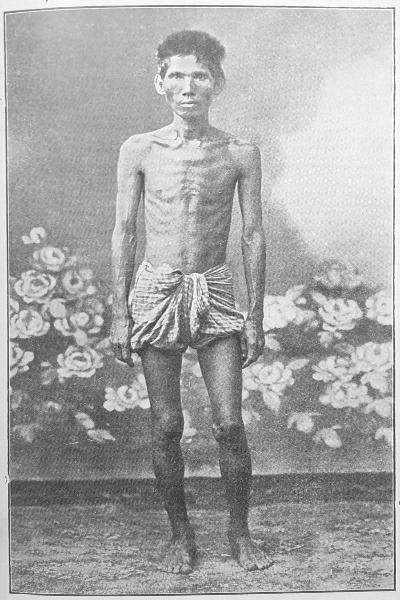
A Burman Cocaine Eater
Extreme poverty is frequently a cause of the habit.
The abject wretch who becomes possessed of a few
coppers, realizing that the amount will be insufficient
for a square meal, buys an innocent looking packet of
cocaine, and mixing it with a small quantity of the
lime-paste used by betel-chewers in their quids, smears
the mixture on his gums, and slowly swallows the saliva.
Gone are the cravings for food; a feeling of pleasant
warmth suffuses his wasted body; he feels equal to any
exertion. Images are distorted to immense proportions;
the stick he holds becomes a club of huge
dimensions, and he takes great pride in his ability to
wield it so easily; an empty jam-tin lying near assumes
the proportions of a five-gallon milk-can; and he
takes great pleasure in showing his agility in jumping
high over the threshold of the door! In all, he considers
himself to be a very fine, powerful, prepossessing fellow
indeed—until the effects wear off, and he once more
sets off to beg or steal the price of another dose of this
elevating narcotic.
I once knew a European who was addicted to this
drug—he injected it—and a more pitiable object it
would be difficult to conceive. He was a dentist by
profession, and the last I heard of him was that he
had died by his own hand, a frequent termination of this
habit, which produces in its last stages, a sort of morbid,
gloomy, mania or insanity in its victims. This individual
was the victim of all kinds of hallucinations, and
under the influence of the drug, was a fluent, and
often convincing, liar. He invested himself with
numerous medical degrees; he went in terror of imaginary
assailants; and he had a fixed idea that his meagre
belongings were the envy of murderous burglars. So
much so, that on more than one occasion he fired off
the revolver he carried by day, and placed under his
pillow by night, at imaginary intruders, to the no small
risk of other occupants of the house he lived in. The
tales of personal adventure he related, the accounts
he gave of deadly combats with men twice his puny
size, his stories of his property and wealth at home,
were the wonder of all to whom he told them, and who
were unable to discover in him the characteristic effects
of the fell drug cocaine.
We are unfortunately without complete information
about cocaine, but we know enough about it to realize
that the habit is spreading with the rapidity and
devastating effects of a conflagration over the world.
As far as India and Burma are concerned, the law is
stringent and severe, and the Dangerous Drugs Bill,
which was lately occupying the attention of the Home
Government, goes far on the road to bringing things
at home into line with India and Burma.
The Germans discovered a method by which cocaine
can be manufactured synthetically; and bogey hunters
will discover a deep plot to undermine the physique and
morals of Indians when they are told that the synthetic
manufacture of cocaine is, to all intents and purposes, a
state-aided industry. It is classed as an industry,
and as such receives the spirit used in the preparation
of the synthetic drug, duty-free. Ninety per cent.
of the cocaine imported into this country before the
war came from Germany.
It would probably surprise the Darmstadt firm,
which purveyed almost all the cocaine that came to
Burma, if they knew that their drachm-phials, neatly
capsuled, and labelled “Cocaine Hydrochloride,” ought
really sometimes to have been labelled “Antefebrin,”
for that indeed is what a great number that were seized
by the authorities contained. In appearance, cocaine
and antefebrin are hard to distinguish from one another;
and for a long time the results of analyses led the authorities
to suppose that the manufacturers were defrauding
their eastern constituents; but the discovery of a
complete plant consisting of phials, labels, capsules,
and a large quantity of antefebrin, eventually cleared
the name of the doubtless reputable manufacturers,
and fastened the guilt upon local swindling smugglers.
Like the poppy which is cultivated for opium, the
hemp plant, cannabis sativa, is grown for ganja, bhang,
and churrus, all highly intoxicating drugs; and for its
bast fibre which makes such excellent rope.
The history of the plant is interesting, but no more
than a very brief allusion to it is necessary here. The
first mention of hemp occurs in Chinese literature, about
the twenty-eighth century, B.C., when the hemp-seed is
mentioned as one of the five or nine kinds of grain.
It is mentioned merely as a “sacred grass” in the
Athavaveda about 1400 B.C. But the narcotic properties
of the plant, with which we are chiefly concerned,
do not seem to have been known until the beginning of
the fourteenth century A.D. In a Hindu play written
about the sixteenth century A.D., Siva brings down the
bhang plant from the Himalaya, and gives it to the
worshippers of himself. Of more recent evidence, we
have the statement of the Emperor Baber, who tells
in his Memoirs (1519 A.D.) of the number of times
he had taken Maajun. John Lindsay, in his Journal
of Captivity in Mysore (1781), relates how his soldiers
were made to eat Majum; and lastly, De Quincey, in
his Confessions of an English Opium-Eater, speaks of
Madjoon, which he inaccurately states is a Turkish
name for opium.
The hemp plant belongs to the diœcious order of
plants, of which the Hop is another member. That
is to say, the flowers, male and female, are borne on
separate shrubs. The male hemp plants die early,
or are removed by hand, an operation which requires
expert knowledge of the two plants; but the female
is tended and looked after until the flowering tops are
developed. These are then collected and dried, and are
called ganja. The leaves, stalks and trash are collected,
and this is called bhang; while the resin (which is
collected by hand, like opium, or sometimes, made to
adhere to the clothes, or special leather garments, or
even the skins of men who walk up and down among
the growing plants and is then scraped off and worked
up into a mass by rolling and pressing) is called churrus.
This is really the active principle of the hemp. Its
presence in the flowering tops, leaves and stalks giving
ganja and bhang their narcotic properties; and churrus
is therefore more potent in its intoxicating effects
than either ganja or bhang.
Ganja is a greenish-brown conglomeration of what
looks like half-dried, tightly pressed grass; bhang is
somewhat similar in appearance, but looser in form;
and churrus, the resin itself, is a greenish-brown, moist
mass. When it has been kept some time, it becomes
hard, friable, and of a brownish-grey colour. When it
assumes this condition and colour, it is inert. All have
a characteristic, faintly pungent, odour, and but slight
taste. It is interesting to note that the word churrus
means a “bag” or “skin.” It is believed that the
name was applied to the drug from the skins or bags
in which it used to be imported in olden times, from
Central Asia.
Indulgence in hemp in India is as common as betel-chewing
and tobacco smoking. It is, in one or other of
its forms, either smoked, or eaten. (The sweetmeat
Majum, is compounded from bhang, honey, sugar, and
spices. Sometimes it is infused in cold water to which
butter is added. The butter in time takes up the
active principle of the drug, and is eaten.) And it is
computed that the votaries of hemp, in one or other
of its many forms, number three millions! There is
great diversity of opinion as to whether hemp is gravely
harmful to its consumers, or whether it is merely an
undesirable form of indulgence without any evil permanent
effects. The Indian Hemp Drugs Commission,
which examined the whole question in detail, was of
opinion that it was harmless if indulged in moderately,
but that the gravest results must follow upon intemperance
in its use. As regards its being a fruitful cause
of insanity, the evidence of alienists was taken, and the
statistics of all the large asylums for the insane in India
were examined; but “only 7·3 per cent. of lunatics
admitted to asylums were those in which hemp could
reasonably be regarded as having been a factor of
importance. Moreover, the form of insanity produced
yields readily to treatment,” and as hemp has not got
the same hold that opium has upon individuals, its
discontinuance is easily effected and immediate
restoration of the mental faculties comes about.
The moderate use of ganja increases the appetite,
and produces a condition of cheerfulness. In excess,
hallucinations, and a sort of delirium is excited, and it
is in this aggravated state that a man may “run amok.”
This is the outstanding evil of the drug: to temporarily
madden a man. But, for the fatal consequences which
often ensue from running amok, people are apt to put
the whole blame on the drug. May it not, however,
be that a man whose desire it is to become reckless
purposely resorts to the drug to hearten himself? I
think it is very likely. It is often discovered, after a
man has run amok, that he has for some time been
broody or sulky, and suffering under some real or
imagined wrong. That he should get desperate, and
take in excess what he well knows to be is an excitant
infinitely more powerful than alcohol, in order to carry
through what he has been longing for some time to do,
is not altogether unreasonable.
To digress from the subject immediately under
discussion; it is common in discussing crime and its
connection with drink, to hear the view expressed that
drink is the cause of crime primâ facie; whereas it often
happens that a person intent on revenge cannot bring
himself to do his neighbour a mischief in cold blood
and requires a little “Dutch courage” to tune himself
up to the pitch of not caring for consequences. Too
often the crime committed is the result of impetuosity;
impetuosity exacerbated by drink. We never hear of
offences against property being attributed to drunkenness;
and yet, from the moral standpoint, the deliberate
commission of theft or robbery is evidential of greater
obliquity than the passionate striking of one’s enemy
with whatever comes to hand at the moment.
Medical Jurisprudence is crowded with instances
in which hemp has been employed in the commission of
crimes. A single instance, which came within the
writer’s personal experience, will however suffice. The
Civil Surgeon of ... had gone out on tour leaving
behind his wife and family of three small boys. The
bedroom occupied by Mrs. Blank adjoined that usually
occupied by the doctor, which contained a large,
heavy iron safe in which was Mrs. Blank’s jewellery and
a large sum of money. That night, Mrs. Blank and the
children retired to bed at the usual hour; but upon
waking in the morning, she felt unrefreshed and languid.
The children complained of a like feeling. Going
into her husband’s room, Mrs. Blank was shocked to find
that the safe had disappeared, one of its heavy massive
handles lay wrenched off upon the floor, and a twisted
gun barrel near by had too apparently been used
ineffectually as a lever. An alarm was raised, and the
police called in. Mrs. Blank averred that the safe was
too large and heavy for fewer than six powerful men to
carry down stairs. That she had been drugged there
could be no doubt; she had slept and the children
had slept through the night undisturbed, and it was
impossible to conceive how they could otherwise have
done so, with evidences of such noisy activities
abundant in the next room. The safe was never
found, and the culprits were never brought to book;
but the discovery of a small patch of cultivated hemp,
on some land belonging to a man servant who was
in the Civil Surgeon’s employ at the time of the
burglary, made the case clear, and the servant’s
complicity morally, if not judicially, certain.