The camphor tree (Camphora officinalis) is a large evergreen, native to Asia.
It is hardy in situations where the winter temperature does not fall below
15° F., and for many years has been grown as an ornamental in the southern
and southwestern United States. Young trees suitable for planting as ornamentals
may usually be obtained from the nurseries in Florida and other
parts of the South, or they can be easily grown from fresh seed.
For culture on a commercial scale the climatic requirements of camphor
are practically the same as those of citrus fruits. The tree can be grown in
almost any soil, but the maximum growth is secured in soils which are rich
and well drained. When planted for commercial cultivation new land is
preferable. The following statements are based upon actual experiments and
observations on the growing and production of camphor under conditions
found in Florida.
Camphor seeds ripen about the middle of October and should be planted
while fresh, a better germination being obtained when the pulp is removed.
The seed bed should be selected with care and the precaution taken to have
one that will give sufficient moisture during the dry season and yet be well
drained. For small seed beds of 2 or 3 acres or less it may be practicable to
provide irrigation. Excellent stands of seedlings have been obtained on
slightly rolling land which originally was covered with "blackjack" oak.
About the first of September, or somewhat earlier if conditions permit, the
land should be well plowed and thoroughly worked down with a disk harrow.
Just before the seeds are planted it should again be worked over and all roots
of Bermuda grass or other weeds removed, since rapidly growing grasses or
weeds will absorb so much moisture from the soil that the seeds can not
germinate.
The seeds begin to ripen during the first part of October and are usually
in a fairly well ripened stage by the last of that month. From this time
until the heavy frosts they can be gathered and planted with safety. Seeds
gathered after heavy frosts have been planted successfully, but it is not
advisable to take the risk of too hard a freeze. In determining the time to
gather seed a simple test is sufficient. Seeds that fall into the hand when the
cluster is slightly twisted are ripe enough to plant.
In planting, a cotton-dropping machine, modified somewhat to meet the
new requirements, may be used. The machine is set to plant the seeds 2 or 3
inches apart and cover them 1 inch deep in rows far enough apart to permit
horse cultivation. The plants begin to come up in about three months, but four
or five months are often required for a full stand. As soon as the plants can
be distinguished in the rows cultivation is begun, which at first is done by
hand with either a wheel or hand hoe. Later, as the plants attain size, a
horse cultivator can be used, but a certain amount of handwork is necessary
throughout the time the plants remain in the seed bed. When the plants are
well started they should receive a good application of sheep or goat manure
or of high-grade fertilizer.
The first season a growth of from 3 to 18 inches may be expected, the irregularity
of development depending on the vitality of the seed, variation in the
soil, and numerous other factors. The plants are allowed to grow in the seed
bed usually for a year and are then transplanted to the field. In transplanting
it is customary to separate the plants into two grades, "sturdy" and "weak,"
planting each grade in a field by itself. By doing this the replanting is simplified,
since the sturdy stock requires but few trees for replanting and the
weak stock, which will require considerable replanting, is all in one section.
Previous to transplanting, the land is well prepared by deep plowing and
thorough harrowing, and rows are laid off 15 feet apart. The young trees
are set in these rows 4 feet apart, either by hand or with a tree-setting
machine. This machine is simply a tobacco-setting machine fitted with a trench
opener set to open a furrow 8 inches deep, in which the trees are placed. The
trees used for transplanting are headed back to within 1 inch of the crown, and
the lower end of the taproot and all large laterals are removed. The taproot
of the tree as planted is thus reduced in length to 8 or 10 inches and varies in
diameter according to the vitality and previous growth of the seedling. Transplanting
should be done in the winter months, when the trees are dormant.
Cultivation is begun as soon as the trees put forth shoots in the spring and
continued until the rainy season of each year. After the rainy season the
plants are again cultivated and all grass and weeds removed. At times cultivation
is necessary during the rainy season in order to keep the trees from
becoming smothered and killed by the fast-growing weeds. One-horse cultivators
drawn by mules or a gang cultivator drawn by a light tractor may be used.
In three or four years, after transplanting, the trees should be from 7 to 8
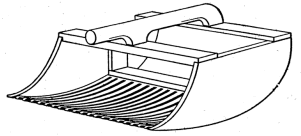
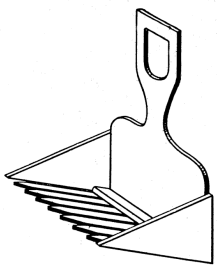
feet high. They are then trimmed by means of a special machine[3] to form an
A-shaped hedge and the trimmings distilled for the oil and camphor gum.
Trimming is carried on when the trees are in the dormant stage, which is twice
each year, usually November to January and May to June. The summer dormant
season is somewhat irregular and governed entirely by local conditions.
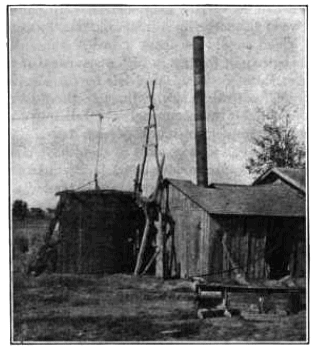
The cuttings are hauled from the field to the distilling plant, and if many
large branches are present they are run through a heavy ensilage cutter. For
distillation they are packed in large iron retorts, to which steam is admitted
at the bottom. The outlet pipe of the retort is connected with a specially constructed
condensing apparatus in which the oil and camphor carried over by
the steam are condensed and partly collected. Portions of oil and camphor
not collected in the condenser are caught in a tub fitted with an outlet siphon
which carries away the excess condensed steam but leaves the oil and camphor
behind.
When removed from the condenser the product is very crude, consisting of
a mixture of oil, water, and camphor. This mixture is either thrown into a
centrifuge and the oil and water removed or it is placed in large cylindrical
vats and the oil and water allowed to drain out. The oil is then separated
from the water by means of a siphon. The camphor and oil are marketed
separately.
The annual yield of cuttings has varied from 2 to 5 tons per acre, which
should give approximately 40 to 100 pounds of marketable camphor. At present
the planting of small areas does not seem advisable, in view of the heavy
outlay required for the machinery necessary to produce camphor gum at a
profit. An area of less than 500 acres would probably not warrant the installation
of the machinery necessary for the commercial production of camphor,
and 1,000 acres or more will doubtless give a greater net return per acre.
Although the crop is a low-priced one, under favorable conditions it is estimated
that a fair return per acre may be expected, but the data so far accumulated
are not sufficient to warrant specific statements concerning the profitableness
of the industry.
Camphor oil, or the oil from which camphor has been removed, is used in
Japan for illuminating purposes, and as a solvent for resins in the manufacture
of lacquer. It is used in Europe for its safrol content, and may probably be
utilized for the same purpose in this country. There exists already in the
American market a demand for the Japanese oil at prices ranging from 11 to
14 cents per pound.
Camphor imports into the United States usually exceed 3,000,000 pounds
annually; hence, it does not seem probable that there is any danger of overproduction
in the Southern States. However, it is possible that at times
camphor may be imported at a price so low as to render production in this
country financially unprofitable.