"Il y a donc des malheurs tellement bien cachés que ceux qui
en sont la cause, ne les devinent même pas."
The first to show kindness to the ladies exiled at Hopton was Isabella
Gayerson, who, in response to a letter from the rightful owner of the
old manor house, called on Madame de Clericy. Isabella's pale face,
her thin-lipped, determined mouth and reserved glance seem to have
made no very favourable impression on Madame, who indeed wrote of her
as a disappointed woman, nursing some sorrow or grievance in her
heart.
With Lucille, however, Isabella speedily inaugurated a friendship, to
which Lucille's knowledge of English no doubt contributed largely, for
Isabella knew but little French.
"Lucille," wrote Madame to me, for I had returned to London in order
to organise a more active pursuit of Charles Miste, "Lucille admires
your friend Miss Gayerson immensely, and says that the English
demoiselles suggest to her a fine and delicate porcelain—but it
seems to me," Madame added, "that the grain is a hard one."
So rapid was the progress of this friendship that the two girls often
met either at Hopton or at Little Corton, two miles away, where
Isabella, now left an orphan, lived with an elderly aunt for her
companion.
Girls, it would appear, possess a thousand topics of common interest,
a hundred small matters of mutual confidence, which conduce to a
greater intimacy than men and boys ever achieve. In a few weeks
Lucille and Isabella were at Christian names, and sworn allies, though
any knowing aught of them would have inclined to the suspicion that
here, at all events, the confidences were not mutual, for Isabella
Gayerson was a woman in a thousand in her power of keeping a discreet
counsel. I, who have been intimate with her since childhood, can boast
of no great knowledge to this day of her inward hopes, thoughts and
desires.
The meetings, it would appear, took place more often at Hopton than in
Isabella's home.
"I like Hopton," she said to Lucille one day, in her quiet and
semi-indifferent way. "I have many pleasant associations in this
house. The squire was always kind to me."
"And I suppose you played in these sleepy old rooms as a child," said
Lucille, looking round at the portraits of dead and gone Howards,
whose mistakes were now forgotten. "Yes."
Lucille waited, but the conversation seemed to end there naturally.
Isabella had nothing more to tell of those bygone days. And, unlike
other women, when she had nothing to say she remained silent.
"Did you know Mr. Howard's mother?" asked Lucille presently. "I have
often wondered what sort of woman she must have been."
"I did not know her," was the answer, made more openly. It was only in
respect to herself that Isabella cultivated reticence. It is so easy
to be candid about one's neighbour's affairs. "Neither did he—it was
a great misfortune."
"Is it not always a great misfortune?"
"Yes—but in this case especially so."
"How? What do you mean, Isabella?" asked Lucille, in her impulsive
way. "You are so cold and reserved. Are all Englishwomen so? It is so
difficult to drag things out of you."
"Because there is nothing to drag."
"Yes, there is. I want to know why it was such a special misfortune
that Mr. Howard should never have known his mother. You may not be
interested in him, but I am. My mother is so fond of him—my father
trusted him."
"Ah!"
"There, again," cried Lucille, with a laugh of annoyance. "You say
'Ah!' and it means nothing. I look at your face and it says nothing.
With us it is different—we have a hundred little exclamations—look
at mother when she talks—but in England when you say 'Ah!' you seem
to mean nothing.."
Lucille laughed and looked at Isabella, who only smiled.
"Well?"
"Well," answered Isabella, reluctantly, "if Mr. Howard's mother had
lived he might have been a better man."
"You call him Mr. Howard," cried Lucille, darting into one of those
side issues by which women so often reach their goal. "Do you call him
so to his face?"
"No."
"What do you call him?" asked Lucille, with the persistence of a child
on a trifle.
"Dick."
"And yet you do not like him?"
"I have never thought whether I like him or not—one does not think of
such questions with people who are like one's own family."
"But surely," said Lucille, "one cannot like a person who is not
good?"
"Of course not," answered the other, with her shadowy smile. "At least
it is always so written in books."
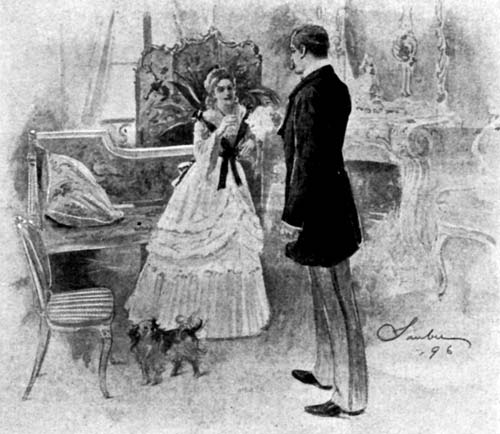
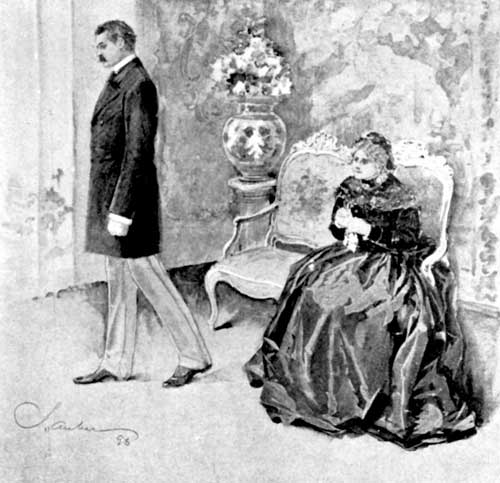
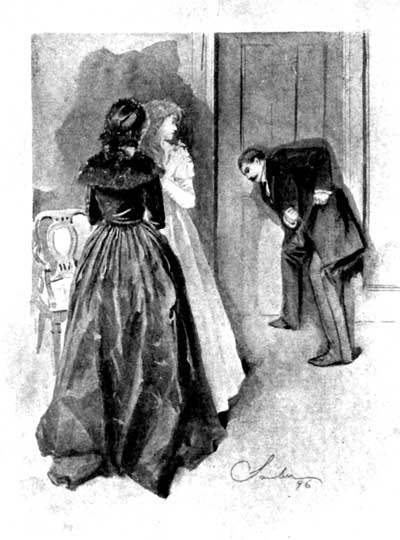
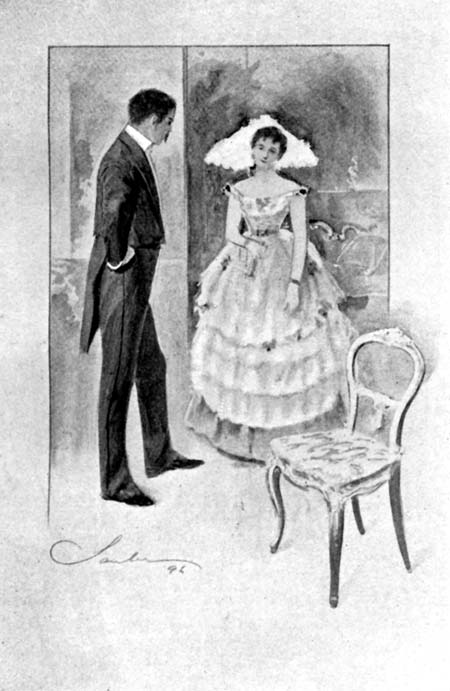
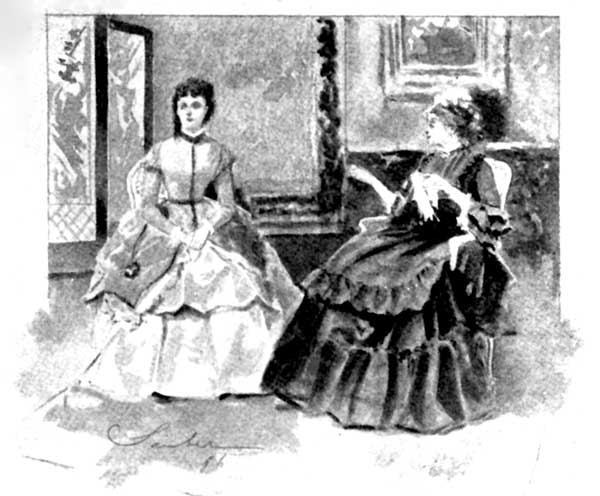 "YOU SAY 'AH!' AND IT MEANS NOTHING. I LOOK AT YOUR
FACE AND IT SAYS NOTHING."
"YOU SAY 'AH!' AND IT MEANS NOTHING. I LOOK AT YOUR
FACE AND IT SAYS NOTHING."
After this qualified statement Isabella sat with her firm white hands
clasped together in idleness on her lap. She was not a woman to fill
in the hours with the trifling occupation of the work-basket, and yet
was never aught but womanly in dress, manner, and, as I take it,
thought. Lucille's fingers, on the contrary, were never still, and
before she had lived at Hopton a fortnight she had half a dozen small
protégées in the village for whom she fashioned little garments.
It was she who broke the short silence—her companion seemed to be
waiting for that or for something else.
"Do you think," she asked, "that mother trusts Mr. Howard too much?
She places implicit faith in all he says or does—just as my father
did when he was alive."
Isabella—than whom none was more keenly alive to my many
failings—paused before she answered, in her measured way:
"It all depends upon his motive in undertaking the management of your
affairs."
"Oh—he is paid," said Lucille, rather hurriedly. "He is paid, of
course."
"This house is his; the land, so far as you can see from any of the
windows, is his also. He has affairs of his own to manage, which he
neglects. A mere salary seems an insufficient motive for so deep an
interest as he displays."
Lucille did not answer for some moments. Indeed, her needlework seemed
at this moment to require careful attention.
"What other motive can he have?" she asked at length, indifferently.
"I do not understand the story of the large fortune that slipped so
unaccountably through his fingers," murmured Isabella, and her
hearer's face cleared suddenly.
"Alphonse Giraud's fortune?"
"Yes," said Isabella, looking at her companion with steady eyes,
"Monsieur Giraud's fortune."
"It was stolen, as you know—for I have told you about it—by my
father's secretary, Charles Miste."
"Yes; and Dick Howard says that he will recover it," laughed Isabella.
"Why not?"
"Why not, indeed? He will have good use for it. He has always been a
spendthrift."
"What do you mean?" cried Lucille, laying down her work. "What can you
mean, Isabella?"
"Nothing," replied the other, who had risen, and was standing by the
mantelpiece looking down at the wood fire with one foot extended to
its warmth. "Nothing—only I do not understand."
It would appear that Isabella's lack of comprehension took a more
active form than that displayed in the conversation reported, tant
bien que mal, from subsequent hearsay. Indeed, it has been my
experience that when a woman fails to comprehend a mystery—whether it
be her own affair or not—it is rarely for the want of trying to sift
it.
That Isabella Gayerson made further attempt to discover my motives in
watching over Madame de Clericy and Lucille was rendered apparent to
me not very long afterwards. It was, in fact, in the month of
November, while Paris was still besieged, and rumours of Commune and
Anarchy reached us in tranquil England, that I had the opportunity of
returning in small part the hospitality of Alphonse Giraud.
Wounded and taken prisoner during the disastrous retreat upon the
capital, my friend obtained after a time his release under promise to
take no further part in the war, a promise the more freely given that
his hurt was of such a nature that he could never hope to swing a
sword in his right hand again.
This was forcibly brought home to me when I met Giraud at Charing
Cross station, when he extended to me his left hand.
"The other I cannot offer you," he cried, "for a sausage-eating
Uhlan, who smelt shockingly of smoke, cut the tendons of it."
He lifted the hand hidden in a black silk handkerchief worn as a
sling, and swaggered along the platform with a military air and
bearing far above his inches.
We dined together, and he passed that night in my rooms in London,
where I had a spare bed. He evinced by his every word and action that
spontaneous affection which he had bestowed upon me. We had, moreover,
a merry evening, and only once, so far as I remember, did he look at
me with a grave face.
"Dick," he then said, "can you lend me a thousand francs? I have not
one sou."
"Nor I," was my reply. "But you can have a thousand francs."
"The Vicomtesse writes me that you are supplying them with money
during the present standstill in France. How is that?" he said,
putting the notes I gave him into his purse.
"I do not know," I answered; "but I seem to be able to borrow as much
as I want. I am what you call in Jewry. I have mortgaged everything,
and am not quite sure that I have not mortgaged you."
We talked very gravely of money, and doubtless displayed a vast
ignorance of the subject. All that I can remember is, that we came to
no decision, and laughingly concluded that we were both well sped down
the slope of Avernus.
It had been arranged that we should go down to Hopton the following
day, where Giraud was to pass a few weeks with the ladies in exile.
And I thought—for Giraud was transparent as the day—that the wounded
hand, the bronze of battle-field and camp, and the dangers lived
through, aroused a hope that Lucille's heart might be touched. For
myself, I felt that none of these were required, and was sure that
Giraud's own good qualities had already won their way.
"She can, at all events, not laugh at this," he said, lifting the hurt
member, "or ridicule our great charge. Oh, Dick, mon ami, you have
missed something," he cried, to the astonishment of the porters in
Liverpool Street station. "You have missed something in life, for you
have never fought for France! Mon Dieu!—to hear the bugle sound the
charge—to see the horses, those brave beasts, throw up their heads as
they recognised the call—to see the faces of the men! Dick, that was
life—real life! To hear at last the crash of the sabres all along the
line, like a butler throwing his knife-box down the back stairs."
We reached Hopton in the evening, and I was not too well pleased to
find that Isabella had been invited to dine, "to do honour," as
Lucille said, to a "hero of the great retreat."
"We knew also," added Madame, addressing me, "that such old friends as
Miss Gayerson and yourself would be glad to meet."
And Isabella gave me a queer smile.
During dinner the conversation was general and mostly carried on in
English, in which tongue Alphonse Giraud discovered a wealth of
humour. In the drawing-room I had an opportunity of speaking to Madame
de Clericy of her affairs, to which report I also begged the attention
of Lucille.
It appeared to me that there was in the atmosphere of my own home some
subtle feeling of distrust or antagonism against myself, and once I
thought I intercepted a glance of understanding exchanged by Lucille
and Isabella. We were at the moment talking of Giraud's misfortunes,
which, indeed, that stricken soldier bore with exemplary cheerfulness.
"What is," he asked, "the equivalent of our sou when that coin is used
as the symbol of penury?" and subsequently explained to Isabella with
much vivacity that he had not a brass farthing in the world.
During the time that I spoke to Madame of her affairs, Alphonse and
Isabella were engaged in a game of billiards in the hall, where stood
the table; but their talk seemed of greater interest than the game,
for I heard no sound of the balls.
The ladies retired early, Isabella passing the night at Hopton, and
Alphonse and I were left alone with our cigars. In a few moments I was
aware that the feeling of antagonism against myself had extended
itself to Alphonse Giraud, who smoked in silence, and whose gaiety
seemed suddenly to have left him. Not being of an expansive nature, I
omitted to tax Giraud with coldness—a proceeding which would, no
doubt, have been wise towards one so frank and open.
Instead I sat smoking glumly, and might have continued silent till
bedtime had not a knocking at the door aroused us. The snow was lying
thickly on the ground, and the flakes drove into the house when I
opened the door, expecting to admit the coast guardsman, who often
came for help or a messenger in times of shipwreck. It was, however, a
lad who stood shaking himself in the hall—a telegraph messenger from
Yarmouth, who, having walked the whole distance, demanded six
shillings for his pains, and received ten, for it was an evil night.
I opened the envelope, and read that the message had been despatched
that evening by the manager of a well-known London bank:
"Draft for five thousand pounds has been presented for
acceptance—compelled to cash it to-morrow morning."
"Miste is astir at last," I said, handing the message to Giraud.
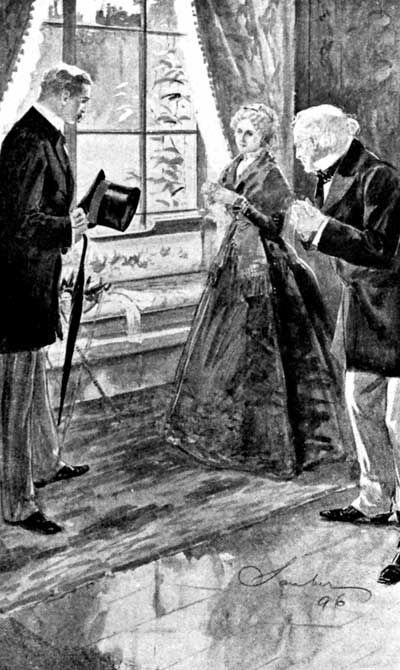
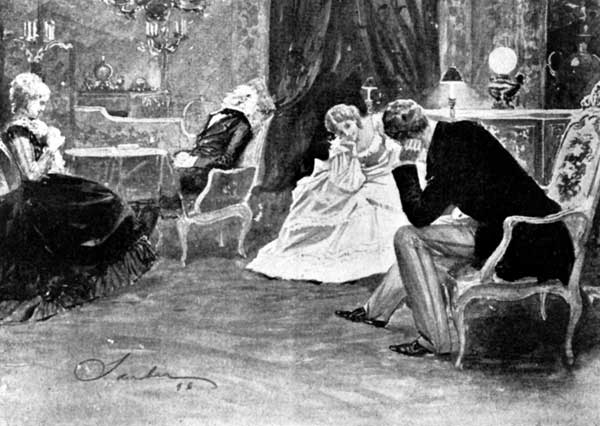
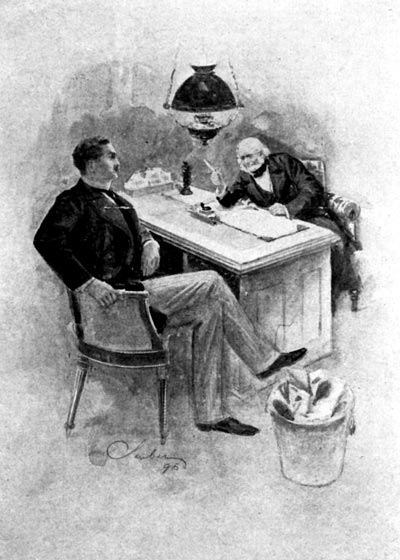
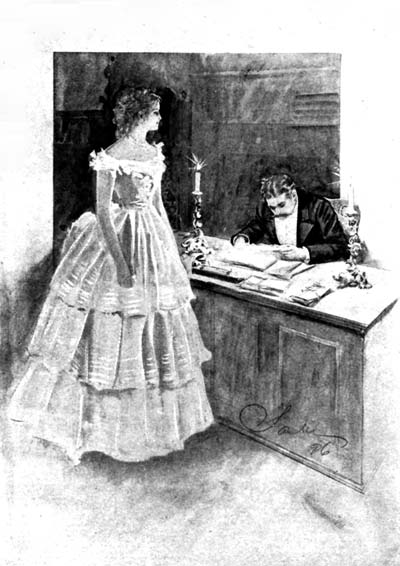 I WAS MAKING PRETENCE, IN A SHALLOW WAY NO DOUBT, TO STUDY THE PAPERS ON THE TABLE. AND LUCILLE STANDING BEFORE MY DESK WAS LOOKING DOWN AT MY BENT HEAD, NOTING PERHAPS THE GREY HAIRS THERE. THUS WE REMAINED FOR A MINUTE IN SILENCE. See Page 140.