We waited, listening intently; but the place was as silent as the tomb.
"What," I asked, "did you hear?"
"I have no idea, Bill, what it was."
"What were the sounds like?"
"I don't know."
"Were they loud or faint?"
"Faint—mysterious."
"Great Heaven," said I, "what can it be? How long since you first heard
it?"
"Only a few minutes. I can't imagine why the sounds have ceased. It
certainly was coming this way. I wonder if it has discovered our
presence."
"In that case, we had better look out."
"Well, that is what we are doing."
"Hadn't we better wake the Dromans?"
"I see no necessity for it. When the thing comes—it was coming, I
know—they may be awakened suddenly enough. The men are farther from
the passage of course, than we are, the ladies farther still. It must
pass us before it can reach them; and we have our revolvers."
"Yes; we have our revolvers. But we don't know what's coming."
"There!" Rhodes exclaimed, his voice a whisper. "We'll soon know. Did
you hear that?"
"I heard it. And there it is again!"
"It's coming, Bill!"
It was coming. What were we to see issue from that passage? I gripped
my revolver and waited in a suspense that was simply agonizing. The
sound ceased. It came again. It was a pad-pad. Once or twice another
sound was heard. I thought that that one was produced by something
brushing along the wall.
"Look!" I said, crouching forward. "Light!"
The rays grew stronger, casting long shadows—shadows swaying, shaking,
crawling.
Then of a sudden the light itself appeared, and a tall figure came
gliding out of the passage.
"Drorathusa!" exclaimed Milton Rhodes.
This sudden lurch from agonized suspense and Gorgonic imagination to
glad reality left me for some seconds speechless.
"Well, well," laughed Milton Rhodes, pressing the button and flooding
the place with light, "isn't imagination a wonderful thing?"
"But," said I, "what on earth does this mean?"
"Look there, Bill, look!" cried Rhodes. "Look at that!"
Drorathusa was moving straight towards us, a strange smile on that
beautiful Sibylline face of hers.
"What do you mean? Look at what?"
"The canteen! Look at her canteen!" cried Milton pointing excitedly.
Drorathusa stopped and raised the canteen, which was incased in
canvas-like stuff. It was wet. Yes, it was wet and dripping.
"Water!" I cried, springing up and rushing toward her.
"Narranawnzee!" smiled Drorathusa, reaching out the canteen toward my
clutching fingers.
Great Pluvius, how I did drink! I'd be drinking yet if Rhodes hadn't
seized the vessel and wrested it from me.
"You must be careful, Bill," he said. "We mustn't drink too much at
first."
And he raised the canteen forthwith and proceeded to swallow a couple
of quarts.
"For Heaven's sake," I told him, "leave some for the others!"
"Yes," said Rhodes, handing the water to Drorathusa. "We have been kind
of ungallant, Bill—hoggish, I'm afraid. But I was as dry as a burnt
cork."
Ere he had ceased speaking, Drorathusa was moving toward her
companions. How wonderful was that change, that rush from out the black
depths of despair! And yet our situation was still truly a terrible
one, for we were lost. But we did not think of that now. Water,
water! We had water now and rejoiced as though we had been caught up
and set down in the loveliest of all the lovely glades of Paradise.
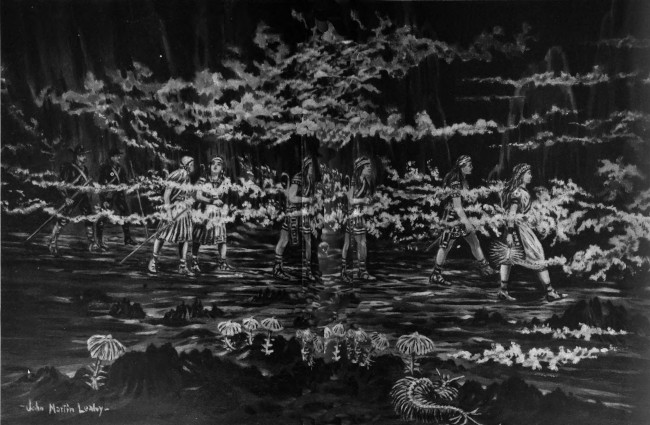
A few minutes, and we all (with tent and packs, with everything) were
following Drorathusa through the passage, were hurrying toward that
spring or stream or pool which she had discovered. What whim, what
freak of strange chance had led that mysterious woman forth whilst
others slept the sleep of despair, forth into that particular passage?
Even now I do not know the answer.
After following its sinuosities for several hundred feet, we suddenly
stepped out of the passage and into a great chamber. This, like our
sleeping-place was weird and savage in the extreme. Broken rock-masses
rose up, in all directions. There were distorted pyramids, fantastic
pinnacles, spires, obelisks, even pillars, but they were pillars
grotesque and awful as though seen in a dream.
Wider and wider grew the place, more and more broken and savage. Soon
even the walls were involved in darkness. The roof, as we advanced,
became more and more lofty. Clearly this cavern was one of enormous
extent. I began to glance about with some apprehension. How had
Drorathusa found her way into such a place—and out again? I marveled
that she had not got lost. But she had not, and evidently there was no
likelihood that that could happen. She was moving forward, into that
place of savage confusion, with never a sign of hesitation, with the
certitude of one following a well-beaten path.
Suddenly Drorathusa stopped, and, after making a sign for silence, she
said, pointing into the blackness before us:
"Narranawnzee."
Narranawnzee. Yes, there it was, the faint murmur and tinkle of
water.
We hurried forward, the wall of the cavern emerging from out the
darkness. And there it was, a large spring of the purest, coolest water
gushing out from the base of the rock, to fall in a gentle cascade and
then flow away to a great pool gleaming dark and sullen in the feeble
rays that found their way to it.
It was near nine o'clock of the day following when we left that spot.
Rhodes and I were smooth-shaven again; yes, he had brought along a
razor, one of your old-fashioned, antediluvian scrapers. I actually
believe that it was an heirloom from the Man of Piltdown, or perhaps
from the more ancient Pithecanthropus erectus himself.
Ondonarkus and Zenvothunbro too had gladly availed themselves of this
opportunity to get rid of their beards, which, however, they had kept
trimmed close with clippers. Your Droman has a horror of mustache,
beard or whiskers.
As for the ladies, they were now radiant and lovely as Dians.
We were following the stream. An hour passed, another. We had advanced
five miles or so and had descended probably half a thousand feet. And
then we lost our guide; the stream flowed into a cleft in the rock, to
burst forth again, perhaps, far, far down, in some black cavern that
has never known, and indeed never may know, the tread of any human foot.
For some moments we lingered there, as though reluctant to quit the
spot; and then, with a last lingering look at those pellucid waters,
flashing dark and sullen, however, as the light moved from them, we
pressed grimly on and soon were involved in a cavern so rugged and
smashed that we actually began to despair of ever getting through it.
But we did get through, to abruptly step out into a place as smooth
almost as a floor. The slope was a gentle one, and we pressed forward
at a rapid rate.
We had gone perhaps a mile and a half when Rhodes, who was walking in
advance with Drorathusa, abruptly halted, cried out and pointed.
Something white was dimly visible off in the darkness. We moved toward
it, the Dromans evincing a tense excitement. A cry broke from them, and
they made a rush forward.
It was a mark upon the wall, a mark which they themselves had placed
there.
We had found the way to Drome.
"And let us hope," said I to Rhodes in the midst of the rejoicing,
"that we don't lose it again."
Drorathusa turned her look upon Rhodes and me and pointed down the
cavern.
"Narranawnzee," she said.
We understood that.
"Narranawnzee," said we.
Again Drorathusa pointed.
"Drome," she told us.
That too we understood; that is, we thought that we knew what she meant
by Drome.
It was a few minutes past seven (p.m.) when we reached the
narranawnzee, a fine deep pool without any discoverable inlet or
outlet, and there we halted for the "night."
In this spot, the Dromans had left a food-depot, and right glad were we
to see this accession to the larder. There was also a supply of oil.
That evening (I find it convenient to use these inaccurate terms) I
fished out my journal and carefully brought it forward, up to the
hour, to the very minute. I felt blithe as a lark, and so, indeed, did
everybody else, everybody save Drorathusa, and even she was somberly
happy.
I thought that our troubles were over!
Of a sudden Rhodes slapped down his journal and, to the surprise of the
Dromans and, forsooth to my own, made a dive at an oil-container, which
Ondonarkus had just emptied.
"At last—our depth, Bill," he cried.
And he proceeded to ascertain the boiling-point of water, the heat
being furnished by Drorathusa's lamp and that of Silvisiris, the older
of the young women. Nandradelphis, by the way, was the name of the
other, the white-haired girl.
It was a strange, a striking picture truly—Milton Rhodes bending over
his improvised hypogemeter, the Dromans looking on with curiosity,
perplexity and with strange questionings in their looks.
At last Rhodes was satisfied with the result, that it was as near
accuracy as the circumstances would permit.
"We are," said he after computing for some moments in his journal, "at
a depth of a little more than twelve thousand feet. The exact figures
are twelve thousand two hundred and sixty feet, though we can not, of
course, claim for our determination any high degree of accuracy. I feel
confident, however, that it is near the truth. Call it twelve thousand
feet."
"Twelve thousand feet!" I echoed. "Below the level of the sea?"
"Yes, Bill; below the level of the sea."
"Great Erebus, I knew that we had descended a long way, but I would
never have believed that we had gone down over two miles. Two miles,
and more, below sea-level. That is a record-smasher."
"Rather," Milton smiled. "Before us no man (of our sunlit world) had
penetrated into the crust of the earth to a greater depth than three
thousand seven hundred and fifty-eight feet below the level of the
sea. That is the depth of the mine at St. John del Rey, Minas Geraes,
Brazil."
"Two miles—over two miles down!" said I.
"And probably, Bill, we are only just getting started."
"But the pressure. We can't go down very far into this steadily
increasing pressure, increasing in a geometrical ratio whilst the depth
increases only in an arithmetical one."
"But," Milton said, "I showed you that there is something wrong with
the law."
"Then how do you know that we have reached a depth of twelve thousand
feet and over, if the law breaks down?"
"I don't believe that it has broken down yet. It will hold good for
this slight descent which we have made. And, of course, if fact is
found to coincide with theory, then our descent will be arrested at no
great depth."
"And," I said, "unless the discrepancy between fact and theory is
a remarkable one, we will have no means of knowing whether the law
has broken down or not. For it is impossible, in this world of utter
darkness, to make anything like an accurate estimate of the descent
made good."
"We shall have no means of knowing, Bill, unless, as you say, truth and
theory are remarkably divergent. Of course, in that case, we should
not long remain unaware of the fact. Of the depth, then, we can not
be certain; but the boiling-point of water will always give us the
atmospheric pressure."
"That isn't what is worrying me," I told him; "it is the pressure
itself."
"The pressure itself," Milton returned, "would produce no dire
effects. It is not the diminution of pressure that produces the dreaded
mountain sickness, as was clearly shown by Dr. Paul Bert. Of educated
people, nine hundred and ninety-nine out of every thousand will tell
you that the acceleration of the pulse as one ascends to lofty heights,
the short, troubled breathing, the disordered vision, extreme weakness,
nausea, vertigo, bleeding at nose and lungs in short, all the symptoms
of the terrible mal des montagnes, are caused by the diminution
of the atmospheric pressure. The average human being (such is their
explanation) having a surface of about fifteen square feet, sustains
an atmospheric pressure of thirty thousand pounds; at an elevation of
eighteen thousand feet, the pressure is but one half of that; is it any
wonder, then, that a man gets mountain sickness?"
"Shades of ten thousand Gullivers," I exclaimed, "do you mean to say
that those nine hundred and ninety-nine are wrong?"
"Certainly they are wrong, so wrong as to cause Dr. Bert to write:
"'It is amazing to find a theory so plainly at variance with elementary
physical laws accepted by eminent men.'"
"Well, well," was my sage remark, "I suppose the next thing on the
programme will be the statement that it is not the fire that makes the
pot boil; it is the heat; and that it is simply amazing to find a man
who thinks that he has an iota of brains in his cranium entertaining
the belief that it is the pot that boils."
"If it doesn't rain, Bill, tomorrow will be Monday. However, Dr. Bert
(Professor in the Paris Faculty of Sciences) proved 'that the lessening
of the barometric pressure,' to use his own words, 'is of no account,
mechanically, in the production of the phenomena.' Yes, he proved that,
to use his own words again, 'it is not the lowering of mechanical
pressure that produces the symptoms, but the low tension prevents the
oxygen from entering the blood in sufficient quantity.'
"Dr. Bert not only experimented on sparrows but entered the air-chamber
himself. As the pressure was reduced, he experienced all the symptoms
of mountain sickness.
"'But,' he says, 'all these symptoms disappeared as by enchantment as
soon as I respired some of the oxygen in the bag; returning, however,
when I again breathed the air of the cylinder.'
"In one of his experiments, the pressure was reduced to 246
millimeters—9.7 inches.
"'This,' he says, 'is exactly the pressure on the highest summit of the
Himalayas—the same degree of pressure which was so near proving fatal
to Glaisher and Coxwell; I reached this point without the slightest
sense of discomfort, or, to speak more accurately, the unpleasant
sensations I felt at the beginning had entirely disappeared. A bird
in the cylinder with me was leaning on one side, and very sick. It
was my wish to continue the experiment till the bird died, but the
steam-pump, conspiring, as I suspect, with the people who were watching
me through glass peep-holes, would not work, and so I had to return to
normal pressure.'
"So you see, Bill, it is the low tension of the oxygen and not the
diminished pressure that produces the distress and suffering and even
death."
"All this is very interesting, but our problem is not one of rarefied
air; the atmosphere here is compressed."
"And, in compressed air," said Milton Rhodes, "it is the oxygen again
that produces the symptoms. Subject a sparrow to a pressure of twenty
atmospheres, and the bird is thrown into convulsions, stronger than
those produced by tetanus or strychnine, convulsions which soon end
in death. If pure oxygen is used, a pressure of only five atmospheres
kills the sparrow. But, and mark this, if the air be deficient in
oxygen, the pressure of twenty atmospheres does not produce even a
tremor.
"So you see, Bill," Milton concluded, "we could descend to a very great
depth in an atmosphere poor in oxygen."
"But how do we know that the atmosphere down there is poor in oxygen?
It may be nothing of the kind. It may be saturated with it."
"Of course, we don't know. All we know is that we know nothing. And
that reminds me of Socrates. That is what he said—that all he knew
was that he didn't know anything. And Arcesilaus—Arcesilaus declared
that Socrates didn't even know that much! However, hope is as cheap
as despair. And, remember, here are our Hypogeans. They can ascend
to our world, to a height of eight thousand feet above the level of
the sea, and that, so far as we know, without suffering the slightest
inconvenience."
"Something queer about that," was my comment.
"It is queer, Bill. However, we know that they can live in the (to
them) rarefied air of our world: why, then, think that conditions down
there, whether five miles down or fifty miles down, will prove fatal to
us?"
On the following morning, we were under way at an early hour. The route
led down a great tunnel; we could not have got lost now if we had
tried. Shortly before noon, the welcome sounds of narranawnzee were
heard, and there was a large stream gushing out of the wall. At times,
as we advanced, the stream would move along dreamy and silent; then it
would be seen rushing and glancing and again growling and foaming in
lovely cascades.
Steadily, save for the noon halt, we toiled our onward and downward
way. It was half-past seven when we halted—the eerie silence of the
place broken by the soft, musical murmuring of the narranawnzee.
Again Rhodes ascertained the boiling-point of water. It was 251°
Fahrenheit. We were, therefore, under a pressure of two atmospheres; we
had reached the depth of eighteen thousand five hundred feet. In other
words, we were three miles and a half below the level of the sea!
It seems strange that I awoke, for I was dreaming the loveliest dream,
a dream of fairy landscapes, birds and flowers, with lovely Cinderella
(she looked very much like Drorathusa) in the midst of them. Nor do I
know why I turned over onto my right side, for I was very comfortable
as it was. But turn I did. And I was just going to close my eyes,
to return to the dreamland of the fairies. But I did not close them.
Instead, my heart gave a wild leap, and I opened my eyes wide. The
next instant I was sitting up, straining my eyes as I looked into the
darkness. Fear had its grip upon me, and I felt my hair begin to stand
on end.
For there was something in that blackness, something visible, something
moving!
Scarcely had my eyes fallen upon this amorphous, ghostly thing when it
rose into the air, slowly and without the faintest sound. Up it rose
and up, whilst I sat watching, immovable, speechless, as though in the
clutch of some uncanny charm.
Up! Up to the very roof of the cavern!
Of a sudden there was a fearful change in its form. Then the ghost, now
of monstrous shape, was coming down—coming down straight towards me!