BY
JAMES MEW, Author of “Types from Spanish Story,” &c., &c.,
AND
JOHN ASHTON, Author of “Social Life in the Reign of Queen Anne,” &c., &c.
ONE HUNDRED ILLUSTRATIONS.
1892.
LONDON: The Leadenhall Press, 50, Leadenhall Street, E.C.
Simpkin, Marshall, Hamilton, Kent & Co., Ltd.
NEW YORK: Scribner & Welford.
“Ingeniosa Sitis.”—Martial, Epig. xiv. 117.
“J’y ai songé comme un autre, et je suis tenté de mettre
l’appétence des liqueurs fermentées, qui n’est pas connue des
animaux, à côté de l’inquiétude de l’avenir, qui leur est étrangère,
et de les regarder l’une et l’autre comme des attributs distinctifs du
chef-d’œuvre de la dernière révolution sublunaire.”—Brillat-Savarin,
Physiologie du Goût, Medit. 9.
“Ac si quis diligenter reputet, in nulla parte operosior vita
est, ceu non saluberrimum ad potum aquæ liquorem natura dederit,
quo cætera omnia animantia utuntur.”—Pliny, Nat. Hist.
xiv. 28.
“Wine that maketh glad the heart of man.”—Ps. civ. 15.
Dedicated to those who know how to use
and thankfully enjoy the good things so bountifully provided
by Dame Nature.
Introduction.
From the Cradle
to the Grave we
need Drink, and we
have not far to look for
the reason, when we
consider that at least
seventy per cent. of the
human body is composed
of water, to compensate
the perpetual
waste of which, a fresh supply is, of course, absolutely
necessary. This is taken with our food (all
solid nutriment containing some water), and by the
drink we consume. But, as the largest constituent
part of the body is fluid, so, naturally, its waste is
larger than that of the solid; this fluid waste being
enormous. Besides the natural losses, every breath
we exhale is heavily laden with moisture, as breathing
on a cold polished surface, or a cold day by condensing
the breath, will show; whilst the twenty-eight
miles of tubing disposed over the surface of the
human body will evaporate, invisibly, two or three
pounds of water daily. Of course, in very hot
weather, or after extreme exertion, this perspiration is
much more, and is visible.
To remedy this loss we must drink, as a stoppage
of the supply would kill sooner than if solid food were
withheld, for then the body would, for a time, live upon
its own substance, as in the cases of the fasting men of
the last two years; but few people can live longer than
three days without drinking, and death by thirst is
looked upon as one of the most cruel forms of dissolution.
To palliate thirst, however, it is not absolutely
necessary to drink, as a moist atmosphere or copious
bathing will do much towards allaying it,—the one by
introducing moisture into the system by means of the
lungs, the other through the medium of the skin.
Thirst is the notice given by Nature that liquid
aliment is required to repair the waste of the body;
and, as in the case of Hunger, she has kindly provided
that supplying the deficiency shall be a pleasant sensation,
and one calculated to call up a feeling of gratitude
for the means of allaying the want. Indeed, no
man knows the real pleasures of eating and drinking,
until he has suffered both hunger and thirst.
Water, as a means of slaking man’s thirst, has been
provided for him in abundance from the time of
Father Adam, whose “Ale” is so vaunted by abstainers
from alcoholic liquors. But Water, unless
charged with Carbonic Acid gas, or containing some
mineral in solution, is considered by some, as a constant
drink, rather vapid; and Man, as he became
civilized, has made himself other beverages, more or
less tasty, and provocative of excess, and also more or
less deleterious to his internal economy. The juice of
luscious fruits was expressed, the vine was made to
give up its life blood; and, probably through accident,
alcoholic fermentation was discovered, and a new zest
was given to drinking. A good servant, Alcohol is a
bad master; but that it satisfies a widely felt craving,
probably induced by civilization, is certain, for most
savage tribes, emerging from their primitive and
natural state, manufacture drinks from divers vegetable
substances, more or less alcoholic.
The present volume is intended for that class of the
public which is known as “the general reader”; and
its object is to interest rather than to inform. Therefore
it deals at no great length with what may be
termed the caviare of the subject, as, for instance, the
varied opinions of the medical faculty with respect to
the hygienic value of drinks, their supposed uses in
health and disease, and their chemical constituents, or
analyses. Nor is the question of price discussed, nor
long lists of vineyard proprietors given, nor the names
of the brewers, nor the number of casks of beer
brewed. In short, as few statistics have been introduced
as possible. In deference to a maxim not
always remembered in books on beverages, “De
gustibus non est disputandum,” or its English equivalent,
abhorred of Chesterfield, “What is one man’s
meat is another man’s poison,” the verdicts of enthusiasts
and vendors have been, except in rare instances,
alike rejected.
Nor has very much been said on the inviting topic
of adulteration. It would be almost cruel to disturb
the credulity of the good people who drink and pay
for gooseberry as Champagne, or Val de peñas as
curious old Port. It is a pretty comedy to watch the
soi-disant connoisseur drinking a wine fully accredited
with crust, out of a bottle ornamented with fungus and
cobwebs of proper consistency—a wine flavoured with
essence at so much a pound, and stained with colour[1]
at so much per gallon. There is no need to proclaim
upon the housetops the constituents of Hamburg
sherry, nor how the best rum is flavoured with “R.E.,”
or brandy with “Caramel” or “Cognacine.”
We have generally avoided the profane use of trade
or professional jargon, too often the outcome of ignorance,
pretence, and affectation, such as “full,” “fruity,”
“smooth on palate,” “round in the mouth,” “full of
body,” “wing,” “character,” etc.; nor have we touched,
or desired to touch, on the influence of alcohol on
man’s social or other well-being. Peter the Hermit is
fully represented already, and we have no mission to
call upon our fellow-countrymen to “rise to the dignity
of manhood,” and never touch another glass of
Madeira.
The authors have followed the example of the illustrious
Molière in taking their matter wherever they
could find it. The information contained in this work
is derived either from other books, oral information,
or personal experience. “The sun robs the sea, the
moon robs the sun, the sea robs the moon,” says
Timon of Athens, repeating Anacreon, who adds
that the earth robs them all. So preceding authors
are indebted to one another, and the present volume
to them all. It has been written, it is hoped, without
bias or prejudice of any kind; but, as the drinks containing
Alcohol are many more than those in which
it is absent, more have been mentioned. That a full
record of all drinks should appear, is impossible; nor
could any critic expect it; but an attempt has been
made to give a fairly full list, and to render it as
pleasant reading as the subject admits.
THE DRINKS OF ANTIQUITY.
Egypt: Method of Wine-Making—Early Wines—Names of Wines—Ladies
and Wine—Beer, etc. Assyria: List of Assur-ba-ni-pal’s
Wines—Method of Drinking—Different Sorts of Wine.
Hittite: Two Ladies Drinking—Their Appreciation of Wine—The
Hittite Bacchus. Judea: Mention of Wines in the Old
Testament—Wine as an Article of Commerce—Mixed Wines—Wine
Vessels.
Has any man been bold enough to attempt to
fix upon the discoverer of Wine? Not to our
knowledge. Nor can a date be even hazarded as to its
introduction. It was so good a thing, that we may be
sure that men very soon came to know its revivifying
effects. We do know this: that the oldest records of
which we have any cognisance, those of the Egyptians
(who were in a high state of civilization and
culture when the Hebrews were semi-barbarous
nomads), show us that they had wine, and used it in a
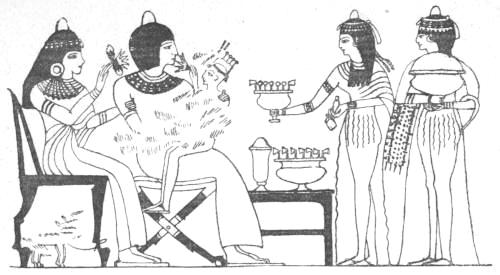
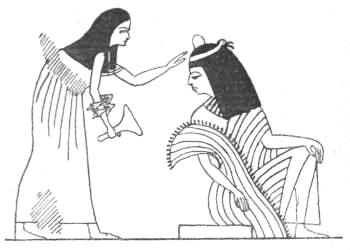
most refined manner, as we see by the headpiece to
this chapter. Here a father is nursing his child, who
invites him to smell a lotus flower, another blossom of
which his mother is showing him. An attendant
proffers wine in bowls wreathed with flowers, and
another is at hand with a bowl possibly of water, and
a napkin. This wreathing the bowls with flowers
shows how highly they esteemed the “good creature,”
and, also, that they were then at least as civilized as
the later Greeks and Romans, who followed the same
practice.
We have the Egyptian pictures showing the whole
process of wine-making. We see their vines very
carefully trained in bowers, or in avenues, formed by
columns and rafters; their vineyards were walled in,
and frequently had a reservoir of water within their
precincts, together with a building which contained a
winepress; whilst boys frightened the birds away
with slings and stones, and cries. The grapes, when
gathered, were put into deep wicker baskets, which
men carried either on their heads or shoulders, or
slung upon a yoke, to the winepress, where the wine
was squeezed out of a bag by means of two poles
turned in contrary directions, an earthen pan receiving
the juice. But they also had large presses, in which
they trod the fruit with their naked feet, supporting
themselves by ropes suspended from the roof.
The grape juice having fermented, it was put into
earthen jars, resembling the Roman amphoræ, which
were closed with a lid covered with pitch, clay, mortar
or gypsum, and sealed, after which they were removed
to the storehouse, and there placed upright. The
Egyptians had a peculiar habit, which used also to be
general in Italy and Greece, and now obtains in the
islands of the Archipelago, of putting a certain quantity
of resin or bitumen at the bottom of the amphora
before pouring in the wine. This was supposed to
preserve it, but it was also added to give it a flavour—a
taste probably acquired from their having been used
to wine skins, instead of jars, and having employed
resins to preserve the skins.
The Egyptians had several kinds of wine, even as
early as the fourth dynasty (above 6000 years ago,
according to Mariette), when four kinds of wine, at
least, were known. Pliny and Horace say that the
wine of Mareotis was most esteemed. The soil,
which lay beyond the reach of the alluvial deposits,
suited the vine, and extensive remains of vineyards
near the Qasr Karóon, still found, show whence the
ancient Egyptians obtained their wines. Athenæus
says, “the Mareotic grape was remarkable for its
sweetness;” and he thus describes the wine made
therefrom: “Its colour is white, its quality excellent,
and it is sweet and light, with a fragrant bouquet; it is
by no means astringent, nor does it affect the head....
Still, however, it is inferior to the Teniotic, a
wine which receives its name from a place called
Tenia, where it is produced. Its colour is pale and
white, and there is such a degree of richness in it, that,
when mixed with water, it seems gradually to be
diluted, much in the same way as Attic honey when
a liquid is poured into it; and besides the agreeable
flavour of the wine, its fragrance is so delightful as to
render it perfectly aromatic, and it has the property of
being slightly astringent. There are many other
vineyards in the valley of the Nile, whose wines are
in great repute, and these differ both in colour and
taste; but that which is produced about Anthylla is
preferred to all the rest.” He also commends some
of the wines made in the Thebaïd, especially about
Coptos, and says that they were “so wholesome that
invalids might take them without inconvenience, even
during a fever.”
Pliny cites the Sebennytic wine as one of the choice
Egyptian crûs, and says it was made of three different
sorts of grapes. He also speaks of a curious wine
called Ecbolada.
Wine took a large part in the Egyptian ritual, and
was freely poured forth as libations to the different
deities; and in private life women were not restricted
in its use. In fact, the ungallant Egyptians have left
behind them several delineations of ladies in a decided
state of “how came you so?” It was probably put
down to the Egyptian equivalent for Salmon.[2] But if
they noticed the failings of their womankind, they
equally faithfully portrayed their own shortcomings,
for we see them being carried home from a feast limp
and helpless, or else standing on their heads, and
otherwise playing the fool.
Still, wine was the drink of the wealthy, or at least
of those, as we should call them, “well to do.” They
had a beer, which Diodorus calls zythum,[3] and which,
he says, was scarcely inferior to the juice of the grape.
This beer was made from barley, and, hops being
unknown, it was flavoured with lupins and other
vegetable substances. This old beer was called hega,
and can be traced back as far as the 4th dynasty.
Then they also had Palm wine, and another wine
called baga, supposed to be made from dates or figs;
and they also made wines from pomegranates and
other fruits, and from herbs, such as rue, hellebore,
absinthe, etc., which probably answered the purpose of
our modern “bitters.”
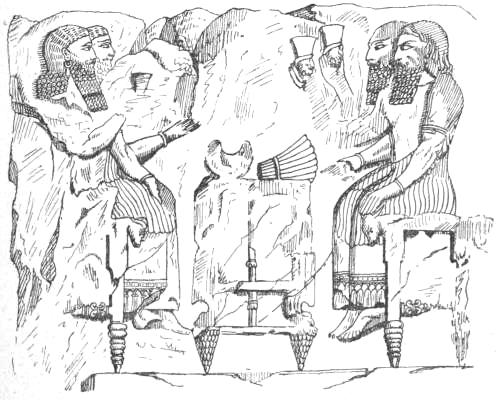
The Assyrians, who rank next in antiquity to the
Egyptians, were no shunners of wine; they could
drink sociably, and hob-nob together, as we see by the
accompanying illustration.
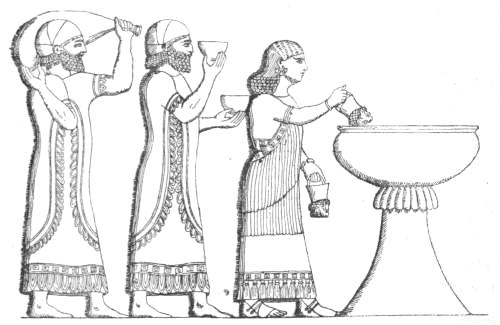
Their wine cups were, in keeping with all the dress
and furniture of the royal palaces, exceedingly ornate;
and it is curious to note the comparative barbarism of
the wine skin, and the nervous beauty of the wine
cups being filled by the effeminate eunuch. The
numerous bas-reliefs which, happily, have been
rescued, to our great edification, afford many examples
of wine cups of very great beauty of form. The
inscriptions give us a list of many wines, and among
them was the wine of Helbon, which was grown near
Damascus, at a village now called Halbûn. It is
alluded to in Ezekiel xxvii. 18: “Damascus was
thy merchant, by reason of the multitude of the wares
of thy making, for the multitude of all riches; in the
wine of Helbon, and white wool.”
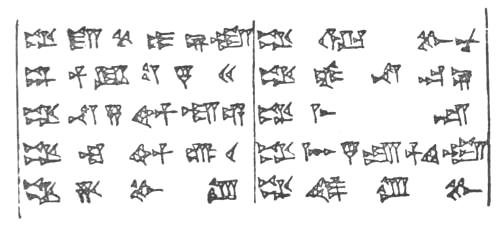
Wm. St. Chad Boscawen, Esq., the eminent
Assyriologist, has kindly favoured us with the following
illustration and note on the subject of Assyrian
wines:—
“This list of wines is found engraved upon a terra-cotta
tablet from the palace of Assur-ba-ni-pal, the
Sardanapalus of the Greeks, and evidently represents
the wines supplied to the royal table. It reads:
Col. I.
Wine of the Land of Izalli.
Wine, the Drink of the King (Daniel i. 5).
Wine of the Nazahrie.
Wine of Ra-h-ū (Shepherds’ Wine).
Wine of Khabaru.
Col. II.
Wine of Khilbunn or Helbon.
Wine of Arnabani (North Syria).
Wine of Sibzu (Sweet Wine).
Wine of Sa-ta-ba-bi-ru-ri (which I think means Wines which
from the Vineyard come not).
Wine of Kharrubi (Wine of the Carrob or Locust bean).”
On Phillips’s Cylinder (col. i. l. 21-26) is a list of
wines which Nabuchodorossor is said to have offered:
“The wine of the countries of Izalla, Toúimmon,
Ssmmini, Helbon, Aranaban, Souha, Bit-Koubati, and
Bigati, as the waters of rivers without number.” And
among the inscriptions deciphered appear a long list
of wines which the Assyrian monarchs are said to
have carried into their country as booty, or to have
received as tribute.
We see the process of filling the wine cups at a
feast. They were dipped into a large vase instead of
being filled from a small vessel. Nor were they alone
contented with grape wine, they had palm wine, wine
made from dates, and beer even as the Egyptians had.
According to the Abodah Zarah, a treatise on false
worship, there was a mixed drink used in Babylon
called Cuttach, which possessed marvellous properties.
“It obstructs the heart, blinds the eyes, and emaciates
the body. It obstructs the heart, because it contains
whey of milk; it blinds the eyes, because it contains
a peculiar salt which has this property; and it
emaciates the body, because of the putrefied bread
which is mixed with it. If poured upon stones, it
breaks them; and of it is a proverb, ‘That it is better
to eat a stinking fish than take Cuttach.’” The same
treatise also mentions Median beer and Edomite
vinegar.
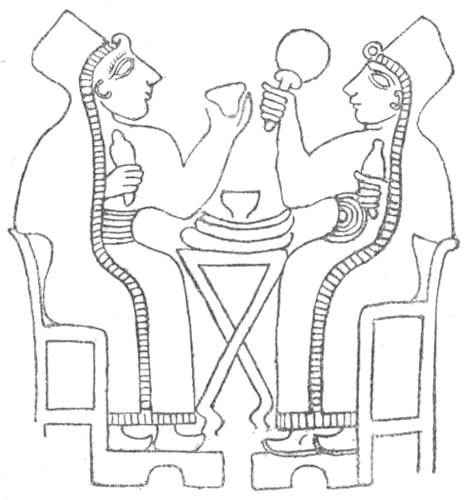
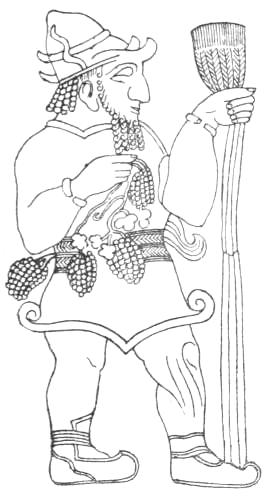
The Hittites had been a powerful and civilized
nation when the Jews were in an exceedingly primitive
condition, and Abraham found them the rightful
possessors of Hebron, in Southern Palestine (Gen.
xxiii.), and so far recognised their rights to the soil, as
to purchase from them the Cave of Machpelah for
“four hundred shekels of silver, current money with
the merchant.” Their power afterwards waned, as
they had left Hebron and taken to the mountains, as
was reported by the spies sent by Moses, four hundred
years afterwards (Num. xiii.), but they have left
behind them carvings which throw some light upon
their social customs. For instance, here is one of two
ladies partaking of a social glass together. Unfortunately,
we do not know at present the true meaning of
their inscriptions, for scholars are yet at variance as
to the translation of them. That they thoroughly
cherished wine may be seen from the accompanying
illustration, which represents one of their deities, who
appears to be a compound of Bacchus and Ceres,
and aptly illustrative of the two good things of those
countries, corn and wine, which, with the olive and
honey, made an earthly Paradise for the inhabitants
thereof. It shows how much they appreciated wine,
when they deified it.
As to the Hebrews, they were well acquainted with
wine, and placed Noah’s beginning to be a husbandman,
and planting a vineyard, as the earliest thing he
did after the subsidence of the flood. Throughout
their sacred writings, wine is frequently mentioned,
and intoxication must have been very well known
among them, judging by the number of passages
making mention of it. A great variety of wines is not
named—nay, there are only two specifically mentioned:
the wine of Helbon, which, as we have seen, was an
article of merchandise at Damascus, a fat, luscious
wine, as its name signifies; and the wine of Lebanon,
which was celebrated for its bouquet. “The scent
thereof shall be as the wine of Lebanon” (Hos. xiv.
7). It is possible that this bouquet was natural, or it
might have been artificial, for it was the custom to mix
perfumes, spices, and aromatic herbs so as to enhance
the flavour of the wine, as we see in Canticles viii. 2:
“I would cause thee to drink of spiced wine of the
juice of my pomegranate;” by which illustration we
also see that the Hebrews made wines other than
those from grapes.
That it was commonly in use is proved, if it needed
proof, by the miracle at the marriage at Cana, where
the worldly-wise ruler of the feast says, “Every man
at the beginning doth set forth good wine; and when
men have well drunk, then that which is worse: but
thou hast kept the good wine until now.” That they
drank water mixed with wine may be inferred by the
two verses (Prov. ix. 2, 5): “She hath mingled her
wine”; “Drink of the wine that I have mingled.”
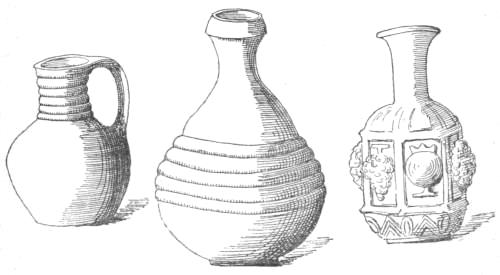
Their wine used to be trodden in the press, the wine
being put into bottles or wine skins, specially mentioned
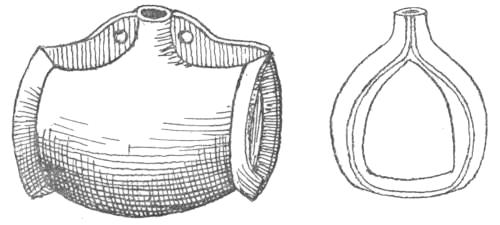
in Joshua ix. 4, 13. In later days they had
vessels of earthenware and glass, similar to those in
the illustration, which were found whilst excavating in
Jerusalem.
That the ancient Jews knew of other intoxicating
liquors, such as palm and date wines, there can be
very little doubt.
J. A.
CLASSICAL WINES. Greek. [4]
Homer’s Wine of the Coast of Thrace—Pramnian Wine—Psithian,
Capnian, Saprian, and other Wines—The Mixing of Wines—Use
of Pitch and Rosin—Undiluted Wine—Wine Making—Spiced
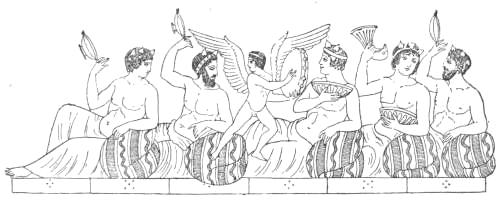
Wines—A Greek Symposium.
The only wine upon which Homer dilates, in a
tone of approval approaching to hyperbole, is
that produced on the coast of Thrace, the scene of
several of the most remarkable exploits of Bacchus.
This wine the minister of Apollo, Maron, gave to
Ulysses. It was red and honey sweet, so strong that
it was mingled with twenty times its bulk of water,
so fragrant that it filled even when diluted the house
with perfume (Od. ix. 203). Homer’s Pramnian wine
is variously interpreted by various writers.
The most important wines of later times are those
of the islands Chios, Thasos, Cos, and Lesbos, and
a few places on the opposite coast of Asia. The
Aminean wine, so called from the vine which produced
it, was of great durability. The Psithian was
particularly suitable for passum, and the Capnian, or
smoke-wine, was so named from the colour of the
grapes. The Saprian was a remarkably rich wine,
“toothless,” says Athenæus, “and sere and wondrous
old.”
Wine was the ordinary Greek drink. Diodorus
Siculus says Dionysus invented a drink from barley,
a mead-like drink called βρύτος; but there is nothing
to show that this was ever introduced into Greece.
The Greek wine was conducive to inebriety, and Musæus
and Eumolpus (Plato, Rep. ii.) made the fairest
reward of the virtuous an everlasting booze—ἡγησάμενοι
κάλλιστον ἀρετῆς μισθὸν μέθην αἰώνιον. Different sorts
of wine were sometimes mixed together; sea water
was added to some wines. Plutarch (Quæst. Nat. 10)
also relates that the casks were smeared with pitch,
and that resin was mixed with their wine by the
Eubœans.
Wine was mingled with hot water as well as with
cold before drinking. To drink wine undiluted was
looked on as a barbarism. Straining, usual among
the Romans, seems to have been the reverse among
the Greeks. It is seldom mentioned. The Roman
wine was most likely filtered through wool. The
Spartans (Herodotus, vi. 84) fancied Cleomenes had
gone mad by drinking neat wine, a habit he had
learned from the Scythians. The proportions of the
mixture varied, but there was always more water, and
half and half ἴσον ἴσῳ was repudiated as disgraceful.
The process of wine-making was essentially the
same among the Greeks and the Romans. The
grapes were gathered, trodden, and submitted to the
press. The juice which flowed from the grapes before
any force was applied was known as πρόχυμα, and was
reserved for the manufacture of a particular species of
rich wine described by Pliny (H. N. xiv. II), to which
the inhabitants of Mitylene gave the name of πρόδρομος.
The Greeks recognised three colours in wines—black
or red, white or straw-colour, and tawny brown
(κιῤῥός, fulvus). When wine was carried, ἀσκοί, or
bags of goat-skin, were used, pitched over to make
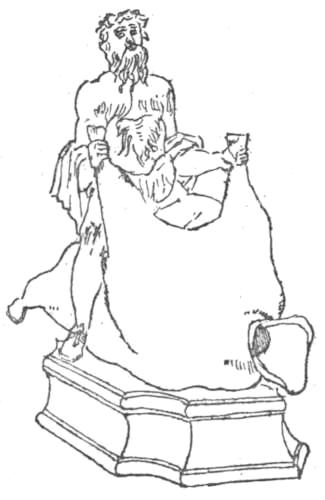
them seam-tight. The cut above, from a bronze found
at Herculaneum (Mus. Borbon. iii. 28) exhibits a
Silenus astride one of them.
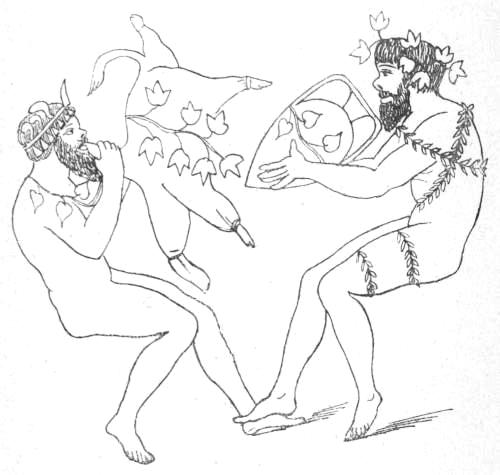
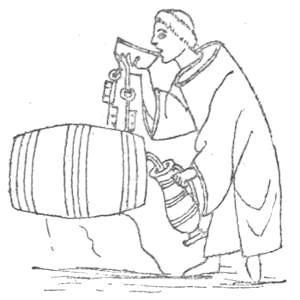
The mode of drinking from the ἀμφορεύς, bottle or
amphora, and from a wine skin, is taken from a painting
on an Etruscan vase.
A spiced wine is noticed by Athenæus under the
name of τρίμμα. Into the οἶνοι ὑγιεινοί, or medical
wines, drugs, such as horehound, squills, wormwood,
and myrtle-berries, were introduced to produce hygienic
effects. Essential oils were also mixed with
wines. Of these the μυῤῥινίτης[5] is mentioned by Ælian
(V. H. xii. 3 I). So in the early ages when Hecamede
prepares a drink for Nestor, she sprinkles her cup of
Pramnian wine with grated cheese, perhaps a sort of
Gruyère, and flour. The most popular of these compound
beverages was the οἰνόμελι[6] (mulsum), or honey
wine, said by Pliny (xiv. 4) to have been invented by
Aristæus. Greek wines required no long time to ripen.
The wine drank by Nestor (Odyss. iii. 391) of ten
years old is an exception.
The sweet wines of the Greeks (the produce of
various islands on the Ægean and Ionian Seas) were
probably something like modern Cyprus and Constantia,
while the dry wines, such as the Pramnian
and Corinthian, were remarkable for their astringency,
and were indeed only drinkable after being preserved
for many years. Of the former of these Aristophanes
says that it shrivelled the features and obstructed the
digestion of all who drank it, while to taste the latter
was mere torture.
CLASSICAL WINES. Roman.
Falernian, Cæcuban, and other Wines—Galen’s Opinion—Columella’s
Receipt—The Roman Banquet—Dessert Wines—The
Supper of Nasidienus—Dedication of Cups—Wines mentioned
by Pliny made of Figs, Medlars, Mulberries, and other Fruits.
Of Roman wines the Campania Felix boasted the
most celebrated growths. The Falernian, Massican,
Cæcuban, and Surrentine wines were all the produce
of this favoured soil. The three first of these
wines have been, as the schoolboy (not necessarily
Macaulay’s) is only too well aware, immortalised by
Horace, who doubtless had ample opportunities of
forming a matured judgment about them.
The Cæcuban is described by Galen as a generous
wine, ripening only after a long term of years. The
Massican closely resembled the Falernian. The
Setine was a light wine, and, according to Pliny, the
favourite drink of Augustus, who perhaps grounded
his preference on his idea that it was the least injurious
to the stomach. Possibly Horace differed from his
patron in taste. He never mentions this wine, which
is however celebrated both by Martial and by Juvenal.
As for the Surrentine, the fiat of Tiberias has dismissed
it as generous vinegar. Dr. Henderson has
no hesitation in fixing upon the wines of Xeres and
Madeira as those to which the celebrated Falernian
bears the nearest resemblance. Both are straw-coloured,
assuming a deeper tint from age. Both present
the varieties of dry and sweet. Both are strong
and durable. Both require keeping. The soil of
Madeira is more analogous to that of the Campania
Felix, whence we may conclude perhaps that the
flavour and aroma of its wines are similar to those
of the Campania. Finally, if Madeira or sherry
were kept in earthen jars till reduced to the consistence
of honey, the taste would become so bitter
that, to use the expression of Cicero (Brut. 83), we
should condemn it as intolerable.
The wines of antiquity present disagreeable features;
sea water, for instance, and resin already mentioned.
Columella advises the addition of one pint of salt
water for six gallons of wine. The impregnation with
resin has been still preserved, with the result of making
some modern Greek wines unpalatable save to the
modern Greeks themselves. Columella (De Re
Rustica, xii. 19) says that four ounces of crude pitch
mingled with certain aromatic herbs should be mixed
with two amphoræ, or about thirteen gallons of wine.
Ancient wines were also exposed in smoky garrets
until reduced to a thick syrup, when they had to be
strained before they were drunk. Habit only it seems
could have endeared these pickled and pitched and
smoked wines to the Greek and Roman palates, as
it has endeared to some of our own caviare and
putrescent game.
To drink wine unmixed was, it has been said before,
held by the Greeks to be disreputable. Those who
did so were said to be like Scythians. The Maronean
wine of Homer was mixed with twenty measures of
water. The common proportion in the more polished
days of Greece was three or four parts of water to
one of wine. But probably Greece, like Rome, had
many a Menenius who loved a cup of hot wine with
not a drop of allaying Tiber in it. If the condition of
Alcibiades in the Platonic symposium was the result of
wine so diluted, the wine must have been strong indeed.
The Grecian and Roman banquet began with the
mulsum, of mingled wine and honey. The dessert
wines among the Greeks were the Thasian and
Lesbian; among the Romans the Alban, Cæcuban,
and Falernian, and afterwards the Chian and Lesbian.
In the triumphal supper of Cæsar in his dictatorship
Pliny says Falernian flowed in hogsheads and Chian
in gallons. At the well-known Horatian supper of
Nasidienus, the Cæcuban and indifferent Chian were
handed round before the host advised Mæcenas that
Alban and Falernian were procurable if he preferred
them.
Juvenal and Martial tell us of the complaint of
clients, that while the master and his friends drank
the best wine out of costly cups, they themselves had
to put up with ropy liquors in coarse, half-broken
vessels. Human nature has changed little in this
respect since those satirists wrote.
The old fashion of dedicating cups to divinities led
perhaps to our modern system of drinking healths.
Sometimes as many cups were drunk to a person as
there were letters in the name of the person so
honoured.
It was better then for the bibulous to toast the
ancient Sempronia or Messalina than the modern Meg
or Kate.
Hydromeli, made of honey and five-year-old rain-water;
oxymeli, made of honey, sea-salt, and vinegar;
hydromelon, made of honey and quinces; hydrorosatum,
a similar compound with the addition of roses;
apomeli, water in which honeycomb had been boiled;
omphacomeli, a mixture of honey and verjuice; myrtites,
a compound of honey and myrtle seed; rhoites,
a drink in which the pomegranate took the place of
the myrtle; œnanthinum, made from the fruit of the
wild vine; silatum, taken, according to Festus, in the
forenoon, and made of Saxifragia major (Forcellini)
or Tordylium officinale (Liddell and Scott); sycites,
wine of figs; phœnicites, wine of palms; abrotonites,
wine of wormwood; and adynamon, a weak wine for
the sick—are most of them mentioned as drinks in
Pliny.[7] This author also mentions drinks made of
sorbs, medlars, mulberries, and other fruits, of asparagus,
origanum, thyme, and other herbs. Hippocrates
praises wine as a medical agent. In his third book
the father of medicine gives a description of the
general qualities and virtues of wines, and shows for
what diseases they are in his opinion advantageous.
For more information on wines the reader may consult
Sir Edward Barry, Dr. Alexander Henderson,
and Cyrus Redding. Henderson, who was, like
Barry, a physician, did not always agree with him.
Barry’s observations, according to Henderson, are
chiefly borrowed from Bacci. Those not so borrowed
are for the most part “flimsy and tedious.”
The vessels and other drinking cups were commonly
ranged on an abacus of marble, something like
our sideboard. It was large, if Philo Judeus is to be
believed. Pliny, speaking of Pompey’s spoils in the
matter of the pirates, says the number of jewel-adorned
drinking cups was enough to furnish nine abaci. Cicero
charges Verres with having plundered the abaci.
When Rome was in the height of her luxury, murrhine
cups were introduced from the East. What this
substance was, the ruins of Pompeii have never revealed;
some maintain it was porcelain, others think
it was a species of spar.
Dr. Henderson adopts the opinion of M. de Rozière
that these cups were of fluor-spar; but this article is
not found in Karamania, from which district of Parthia
both Pliny and Propertius agree that they came,
though they differ with respect to their nature; its
geographic situation seems confined to Europe. The
anecdote told by Lampridius of Heliogabalus (502)
proves, not the similarity of material, but only the
equal rareness and value of vessels of onyx and
murrhine.
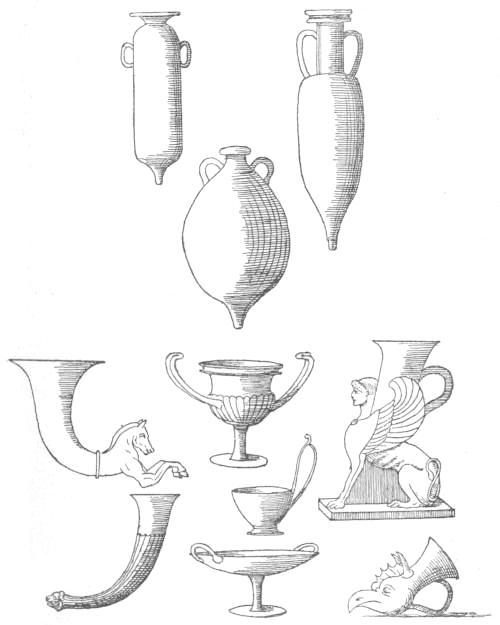
AMPHORÆ, RHYTONS, ETC. (Brit. Mus.).
A writer in the Westminster Review for July, 1825,
believes them to have been porcelain cups from China;
the expression of Propertius, “cocta focis,” proves that
they were manufactured. In the time of Belon (1555)
the Greeks called them the myrrh of Smyrna, from
murex, a shell. From this it seems that their name
was given to the vases from a resemblance of colours
to those of the murex. Stolberg (Travels, ix. 280)
says he saw in a collection at Catania a little blue
vase, believed to be a vas murrhinum.
The modern jars in any of the wine districts of
Italy, such as Asti Montepulciano or Montefiascone,
thin earthen two-handled vessels holding some
twenty quarts, are almost identical with the ancient
amphoræ. Suetonius speaks of a candidate for the
quæstorship who drank the contents of a whole
amphora at a dinner given by Tiberius. This
amphora was probably of a smaller size. Wooden
vessels for wine seem to have been unfamiliar to the
Greeks and Romans; they, however, occasionally employed
glass. Bottles, vases, and cups of that material,
which may be seen often enough now in collections of
antiquities, show the great taste which in these and
in other matters they possessed. A few of these are
given to illustrate our text. Skins of animals, rendered
impervious by oil or resinous gums, were
probably the most ancient receptacles for wine after
it was taken from the vat. To these there are frequent
allusions in Homer and Isaiah. Vessels of clay,
with a coating of pitch, were introduced subsequently.
NORTHERN DRINKING.
Beowulf—Ale—Beer—Mead—English Wine—The Mead Hall—Drinking
Horns—Tosti and Harold—Pigment, etc.—The
Clergy, etc., drinking—Northern Wine drinking—King Hunding—Brewing—Strange
Drinking Vessels, and their Use—Punishment
of Drunkards.
Sailing from the north, being lured to the
south with visions of plunder and luxury, came
the Danish and Norwegian Vikings, and, as England
was the nearest to them, she received an early visit.
With them they brought their habit of deep drinking,
which was scarcely needed, as on that score the then
inhabitants of England could pretty well hold their
own. Their liquors seem to have been ale, ealu, beer,
beor, wine, win, and mead, medo.
There was a difference between those that drank
ale and those that drank beer, as we find in
Beowulf[8]:—
“Full oft have promis’d,
with beer drunken,
Over the ale cup,
sons of conflict,
that they in the beer-hall
would await
Grendel’s warfare
with terrors of edges:
then was this mead-hall,
at morning tide,
this princely court, stain’d with gore;
when the day dawn’d,
all the bench-floor
with blood bestream’d,
the hall, with horrid gore;
of faithful followers I own’d the less,
of dear nobles,
who then death destroyed.
Sit now to the feast,
and unbind with mead
thy valiant breast with my warriors
as thy mind may excite.
Then was for the sons of the Goths
altogether
in the beer hall
a bench clear’d;
there the strong of soul
went to sit
tumultuously rejoicing:
the thane observ’d his duty,
who in his hand bare
the ornamented ale-cup,
he pour’d the bright, sweet liquor:
the gleeman sang at times
serene in Heorot:
there was joy of warriors,
no few nobles
of Danes and Weders.”
In Dugdale’s Monasticon (ed. 1682, p. 126), in a
Charter of Offa to the Monastery of Westbury, three
sorts of ale are mentioned. Two tuns full of hlutres
aloth (Clear ale), a cumb full of lithes aloth (mild ale),
and a cumb full of Welisces aloth (Welsh ale), which
is again mentioned as cervisia Walliæ.
But though beer and ale were the drinks of the
common folk, yet they were not despised by their
leaders.
We see the social difference between ale and wine
drinkers in one of the Cotton MSS. (Tib. A. 3), where
a lad having been asked what he drank replied: “Ale,
if I have it; Water, if I have it not.” Asked why he
does not drink wine, he says: “I am not so rich that
I can buy me wine; and wine is not the drink of
children or the weak-minded, but of the elders and
the wise.”
The English at that time grew the Vine for wine-making
purposes; indeed, very good wine can now
be, and is, made from English grapes. Every monastery
had its vineyard, and to this day London has
six Vine Streets and one Vineyard Walk. The wine-hall
seems to have been a different apartment to either
the mead or ale-halls, and of a superior order.
Mead was considered a glorified liquor fit for Men
and is thus sung of by the bard Taliesin:—
“That Maelgwn of Mona be inspired with mead and cheer us with it,
From the mead-horn’s foaming, pure, and shining liquor,
Which the bees provide, but do not enjoy;
Mead distilled, I praise; its eulogy is everywhere
Precious to the creature whom the earth maintains.
God made it to man for his happiness,
The fierce and the mute both enjoy it.”
Mead was made from honey and water, fermented,
and in many languages its name has a striking similarity.
In Greek, honey is methu, in Sanskrit, madhu,
and the drink made therefrom in Danish, is miod, in
Anglo-Saxon, medu, in Welsh, medd, whence metheglyn—medd,
mead, and llyn, liquor. In Beowulf we frequently
find mention of the mead-horns, and we see
it vividly portrayed in the heading of this chapter,
which is taken from the Bayeux Tapestry. These
horns were generally those of oxen, although some
were made of ivory, and were probably used because
fictile ware was so easily broken in those drinking
bouts in which they so frequently indulged. Another
reason was doubtless that they promoted conviviality,
for, like the classical Rhyton, they could not be set
down like a bowl, but must either be nursed, or their
contents quaffed.
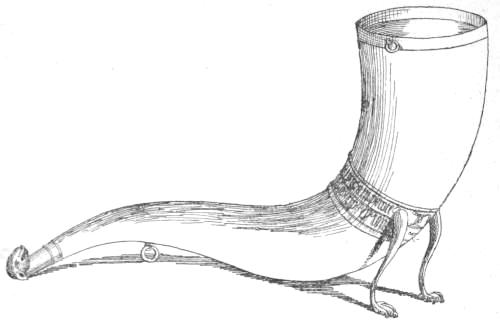
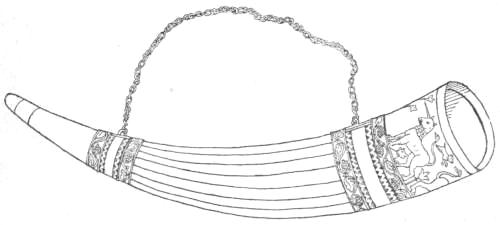
Many examples of drinking horns remain to us, and
illustrations of two are here given: one that of Ulph,
belonging to, and now kept at, York Minster, and the
other the Pusey horn. These are veritable drinking
horns; but there are many other tenure horns in
existence, which are hunting horns.
The Pusey Horn.
This horn is an old tenure horn. It was once the
custom, when making a gift of land, instead of making
out a deed of gift, to present some article of personal
use, such as a knife, a drinking or hunting horn, and
with it the manor or land, the recipient keeping the
present, as a proof that the land was given him. This
Pusey horn is said to have been given by King Knut
to William Pewse, and on the silver-gilt band, to
which are appended dog’s legs and feet, is inscribed
in Gothic letters—
“Kyng Knowde geve Wyllyam Pewse
This horne to holde by thy lond.”
It is an ox horn, dark brown, and is 25½ inches
long, having a silver-gilt rim, and at the small end a
hound’s head, also of silver-gilt, which unscrews, thus
enabling it to be used either as a drinking or hunting
horn.
Ulph’s horn is considered of somewhat later date,
and is of ivory.
Ulph’s Horn.
Of this horn Dugdale[13] says: “About this time also,
Ulphe, the son of Thorald, who ruled in the west of
Deira,[14] by reason of the difference which was like to
rise between his sons, about the sharing of his lands
and lordships after his death, resolved to make them
all alike; and thereupon, coming to York, with that
horn wherewith he was used to drink, filled it with
wine, and before the altar of God, and Saint Peter,
Prince of the Apostles, kneeling devoutly, drank the
wine, and by that ceremony enfeoffed this church with
all his lands and revenues. The figure of which horn,
in memory thereof, is cut in stone upon several parts
of the choir, but the horn itself, when the Reformation
in King Edward the VIth’s time began, and swept
away many costly ornaments belonging to this church,
was sold to a goldsmith, who took away from it those
tippings of gold wherewith it was adorned, and the
gold chain affixed thereto; since which, the horn itself,
being cut in ivory in an eight square form, came
to the hands of Thomas, late Lord Fairfax.”
He, dying in 1671, it came into the possession of his
next relation, Henry, Lord Fairfax, who restored its
ornaments in silver-gilt, and restored it to the cathedral
authorities. It bears the following inscription:—
“Cornv hoc, Vlphvs in occidentali parte
Deiræ princeps, vna cum omnibvs terris
et redditibvs suis olim donavit.
Amissvm vel abreptvm.
Henricvs dom. Fairfax demvm restitvit.
Dec. et capit. de novo ornavit.
A.D. MDC. LXXV.”
Most of us know Longfellow’s poem of King Witlaf’s
drinking horn, a story which may be found in
Ingulphus, who says that Witlaf, King of Mercia,
who lived in the reign of Egbert, gave to the Abbey
of Croyland the horn used at his own table, for the
elder monks of the house to drink out of it on festivals
and saints’ days, and that when they gave thanks, they
might remember the soul of Witlaf the donor. That
they had some horn of the kind is probable, for the
same chronicler says that when the monastery was
almost destroyed by fire, this horn was saved.
Besides the liquors above mentioned, the Anglo-Saxons
had others, as we see in a passage of Henry
of Huntingdon (lib. vi.), which is probably an invention,
the same story being told by Florence of Worcester,
of Caradoc, the son of Griffith, A.D. 1065.
However, he says that in 1063, in the king’s palace
at Winchester, Tosti seized his brother Harold by the
hair, in the royal presence, and while he was serving
the king with wine; for it had been a source of envy
and hatred that the king showed a higher regard for
Harold, though Tosti was the elder brother. Wherefore,
in a sudden paroxysm of passion, he could not
refrain from this attack on his brother.
Tosti departed from the king and his brother in
great anger, and went to Hereford, where Harold had
purveyed large supplies for the royal use. There he
butchered all his brother’s servants, and inclosed a
head and an arm in each of the vessels containing
wine, mead, ale, pigment,[15] morat,[16] and cider, sending
a message to the king that when he came to his farm
he would find plenty of salt meat, and that he would
bring more with him. For this horrible crime the
king commanded him to be banished and outlawed.
There is no doubt but that the Anglo-Saxons drank
to excess, and thought no shame of it. Many times in
Beowulf are we told of their being dragged from the
mead-benches by their enemies and slaughtered, and
in a fragment of an Anglo-Saxon poem on Judith we
read:—
“Then was Holofernes
Enchanted with the wine of men:
In the hall of the guests
He laughed and shouted,
He roared and dinn’d,
That the children of men might hear afar,
How the sturdy one
Stormed and clamoured,
Animated and elate with wine
He admonished amply
Those sitting on the bench
That they should bear it well.
So was the wicked one all day,
The lord and his men,
Drunk with wine;
The stern dispenser of wealth;
Till that they swimming lay
Over drunk.
All his nobility
As they were death slain,
Their property poured about.
So commanded the lord of men,
To fill to those sitting at the feast,
Till the dark night
Approached the children of men.”
Even the clergy and monks drank probably more
than was good for them, for a priest was forbidden by
law to eat or drink at places where ale was sold. But
that did not prevent their drinking at home; their
benefactors provided well for that, as one instance will
show. Ethelwold allowed the Monastery of Abingdon
a great bowl, from which the drinking vessels of the
brothers were filled twice a day. At Christmas, Easter,
Pentecost, the Nativity and Assumption of the
Virgin, on the festivals of Saints Peter and Paul, and
all the other saints, they were to have wine, as well
as mead, twice a day; and taking the number of Saints
in the Anglo-Saxon Calendar, it must have gone hard
with them, if this was not almost an every-day occurrence.
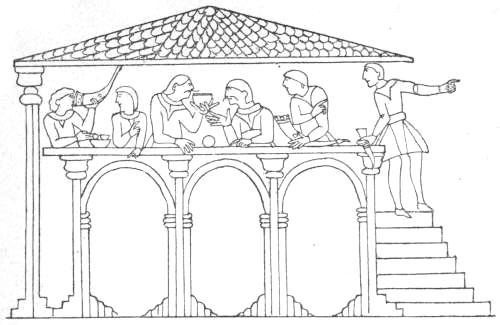
The Northern nations did not lose their love of
drink as time rolled on, as we may find in the pages
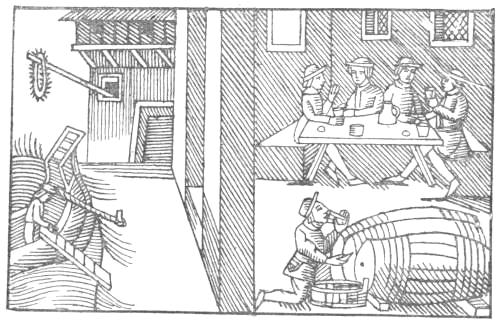
of Olaus Magnus. They drank wine, but owing to
the extreme cold it was not of native production, but
imported. In this illustration we see the vessel that
has brought it, and the bush outside, denoting that it
was to be sold. They got it from Spain, Italy, France,
and Germany, but he says that the wine most in repute
was a Spanish wine called Bastard, which Shakspeare
mentions more than once, as (1 Henry IV. act ii. sc. 4)
Prince Henry relating his adventures with a drawer,
says, “Anon, anon, sir! Score a pint of Bastard in
the Half Moon.”
He gives receipts for making Hydromel, or Mead,
which was to be made of one part honey, and four of
boiling water, to be well stirred, boiled, and skimmed.
Hops were then to be added, then casked, and brewers’
yeast added. Then to be strained, and it was fit for
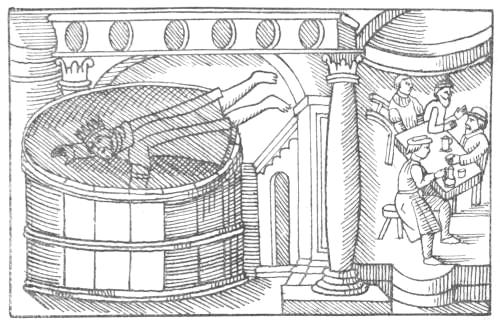
drinking in eight days. He tells a pathetic story of
King Hunding, who being sorely grieved at the loss
of his brother-in-law, Gutthorm, called all his nobility
around him to a great feast, and had a large tun, filled
with hydromel, placed in the middle of the hall. When
his guests were sufficiently inebriated, he threw himself
into the liquor, and died sweetly.
Beer had they, made of malt and hops, and he gives
various methods of brewing, and also a list of divers
beers and their medicinal qualities.
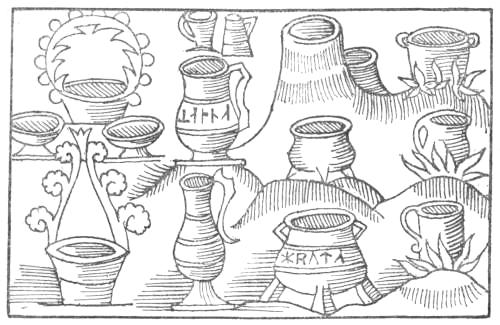
He also gives an illustration of various drinking
vessels then (16th cent.) in use among the Danes and
Swedes, where is here reproduced. Here we see
some plain, others ornamental with runes, and some
with very curious handles. He says they were mostly
of brass, copper, or iron, because in that cold climate
the liquor they held had to be warmed over the fire.
An old translation of a portion of his Historia de
Gentibus Septentrionalibus gives the following account
“Of the manner of drinking amongst the Northern
People.”
“It will not displease curious Readers to hear how
the custom is of drinking amongst the Northern
People. First, they hold it Religion to drink the
healths of Kings and Princes, standing, in reverence of
them; and here they will, as it were, sweat in the
contention, who shall at one or two, or more draughts,
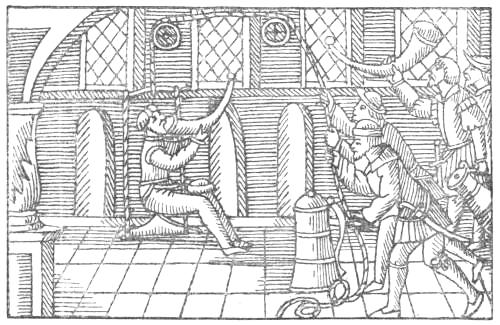
drink off a huge bowl. Wherefore they seem to sit at
Table as if they had Crowns on their heads, and to
drink in a certain kind of vessel; which, it may be,
may cause men that know it not, to admire it. But
that were more admirable to see the servants go in a
long train, in troops, as Pastours of Harts with horns,
that they may drink up those Cups full of beer to the
Ghests. And, not content with these Ceremonies,
they will strive to shew their Sobriety, by setting such
a high Cup full of Beer upon their naked heads, and
dance and turn round with it; in like manner they
deliver other Cups which they bring in both hands to
the Ghests to drink off, at equall draughts, which are
full of Wine, Ale, Mede, Metheglin, or new Wine.”
He winds up with a moral dissertation on the
punishment of drinkers, and, after detailing the various
effects of alcohol on different races, as rendering the
Gaul petulant, the German quarrelsome, the Goth
obstreperous, and the Finn lachrymose, he suggests
that drunkards should be seated on a sharp wedge,
compelled to drink a mighty horn of beer, and then
be hauled up and down by a rope.
J. A.
WINES.
Definition—Various Meanings of Wine—Alcohol—Varieties of
Wine—Miller—Professor Mulder—Origin of Wine—Brook of
Eshcol—Strabo and Reland—Francatelli’s Order of Wines—Classification
of M. Batalhai Reis.
In the matter of wine, as in that of beer, it is
perhaps as well to commence with a dictionary
description or definition. Ogilvie declares it to be the
“fermented juice of the grape, or fruit of the vine.”
It is, however, also the juice of certain fruits, prepared
in imitation of wine obtained from grapes, but distinguished
by naming the source whence it is derived,
as currant wine, gooseberry wine, etc.; and a third
meaning of wine—a meaning with which we have
happily little to do—is the effect of drinking wine in
excess, or intoxication.[17]
Wines are practically distinguished by their colour,
flavour, stillness or effervescence, and what is known
as hardness or softness. The differences in quality
depend on the vines, the soils, the exposure of the
vineyards, the treatment of the grapes, and the mode
of manufacture. The alcohol[18] contained is the leading
characteristic. In strong ports and sherries this varies
from about 16 to 25 per cent. It is about 7 per cent.
in claret, hock, and other so-called light wines. Wine
containing about 13 per cent. of alcohol may be assumed
to be fortified, as it is called, with brandy or
other spirit.
The varieties of wine produced are said to be
“almost endless.” This great number of wines is in
some measure owing to an interesting fact mentioned
by Miller in his Organic Chemistry (3rd ed. p. 187),
who tells us that a particular variety of grape, when
grown upon the Rhine, furnishes a species of hock;
the same grape, when raised in the valley of the
Tagus, yields Bucellas, in which the palate of a connoisseur
may possibly detect the flavour of hock;
whilst in the island of Madeira the same grape
produces the wine known as Sercial, which, though
generally allowed to be a delicious wine, has suggested,
it seems, to no skilled palate the flavour either of
Bucellas or of hock.
It would therefore be more logical to commence an
article on wines with an article on the grapes from
which they are produced, but we fear it would be far
less interesting. Of the chemical composition of wine,
and of its uses in health and disease, on which so many
books from the days of old have been already written,
we shall, in accordance with our preface, say nothing
at all, or very little. Every person who feels himself
or herself interested in this latter matter may learn as
much as he or she will from the pages of the Lancet,
while Professor Mulder has probably written enough
about the former to satisfy the most anxious student.
The origin of most things is obscure. Treatises
have been composed about that of wine. We have no
intention of reproducing aught of them in the present
work. Let us be content to suppose that wine had its
origin, again like most things, somewhere at some
time in the East. The date of its introduction into
Greece is no more known than that of its introduction
into Italy. A traditional credit is due to Saturn, to
Noah, and to Bacchus as early wine manufacturers.
Certainly in Palestine they had the advantage of fine
grapes. On the well-known historic occasion of Moses
sending men to search the land of Canaan, in the time
of the first ripe fruit, we learn that when they came
unto the brook of Eshcol, they cut down from thence
a branch with one cluster of grapes and “bare it between
two upon a staff.” It has been perhaps somewhat
hastily assumed that the fruit was therefore
necessarily of a large size. There may have been other
reasons for this proceeding than an enormity of weight.
But if, as is generally imagined, these grapes were
unusually fine and large, wine makers would be clearly
benefited thereby. In support of this interpretation of
the passage in Numbers, Strabo has declared that
some of the grapes in the Holy Land measured two
feet in length; and Reland has not hesitated to declare,
as if unwilling to be outdone by Strabo, that some
bunches are of ten pounds weight.
This prefatory matter could make no pretence to
completeness if it omitted an instruction for the
service of wines, denoting the order in which they
should be drank at the dinner table, which has already
been given by an adept. Whether the matter is more
admirable, or the style, it is difficult to determine.
“I would recommend,” says Francatelli, “all bon
vivants desirous of testing and thoroughly enjoying a
variety of delectable wines, without being incommoded
by the diversity of those introduced for their learned
degustation, to bear in mind that they should be drunk
in the following order;” viz., “When it happens that
oysters preface the dinner, a glass of Chablis or Sauterne
is their most proper accompaniment.”
After soup of any kind, genuine old Madeira, East
India Sherry, or Amontillado are recommended as
“welcome stomachics.” But you are to avoid, as you
value your health, drinking punch after Turtle soup,
especially Roman punch. With fish, a large variety
of wines, such as Pouilly, Meursault, Montrachet,
Barsac, and generally all dry white wines, is allowed.
With the entrées you are permitted to drink any
variety of Bordeaux or Burgundy.
Second course and dessert wines are given at too
great a length to admit of reproduction. About these a
“question of the highest importance” arises as to which
should be preferred. But here Francatelli remembers
a fact which might have spared him his vast labour on
this service of wines: that “it is difficult, not to say
impossible, to lay down rules for the guidance of the
palate.” The sanguine person, we are told, will prefer
the genuine Champagne; the phlegmatic, Sherry or
Madeira. The splenetic and melancholy man will be
prone to select Roussillon and Burgundy. The bilious
will imbibe Bordeaux. In few words, “Burgundy is
aphrodisiac, Champagne is captious, Roussillon restorative,
and Bordeaux stomachic.” By careful attention
to the foregoing remarks, the reader will happily be
preserved from any serious mistake in the matter of
his dinner. But other meals must also be taken into
consideration, about which Francatelli preserves a
Sibylline and mysterious silence. For instance,
luncheon. We learn, however, from another source
that there are luncheon sherries and dessert sherries.
With lunch the brown, rich, and full-bodied Raro may
be suitably drunk; but the pale Solera and the soft yet
nutty Oloroso should make their appearance at dessert
alone.
M. Batalhai Reis, Consul for Portugal at Newcastle-on-Tyne,
in a report on the wine trade of England,
has troubled himself thus in the interests of posterity
to classify the wines of the world.
Class I.—Table Wines.
Alcohol and sugar imperceptible. Taste acid and
astringent.
Division A. Red.
Group 1. Acid. Examples: Inferior Bordeaux and
Burgundies, Wines from North of Portugal.
Group 2. Astringent. Examples: Superior
Bordeaux and Burgundies, Collares from Portugal.
Division B. White.
Group 1. Simple Flavour. Example: Rhine
Wines.
Group 2. Complex Flavour. Example: Bucellas
of Portugal.
Class II.—Transition Wines.
Alcohol and sugar perceptible. Taste astringent.
Flavour complex.
Division A. Red. Examples: Many Spanish and
Portuguese wines.
Division B. White. Examples: Many Spanish
and Portuguese wines.
Class III.—Generous Wines.
1st Family. Madeira type. Wines of the Canaries,
Azores, Lisbon; Carcanellas, Sherry, Marsala, and
Cyprian wines.
2nd Family. Port type.
3rd Family. Tokay, Malaga.
4th Family. Château Yquem, Johannisberg,
Steinberg.
Class IV.—Sparkling Wines.
Group A. Natural.
Group B. Artificial.
This division of the wines of the world is presented
to the reader as a literary curiosity. It is at once
simple and scientific. In a word, no book on wines
can be considered complete without it. In the succeeding
pages Wines as Beers are, for convenience
of reference, arranged after the alphabetical order of
their countries.
Of this country the most important wines of the
present are, perhaps, Pontac, Hanepoot, Frontignac,
and Drakenstein. On the wines of the Cape of
Good Hope, Dr. Edward Kretschmar is a great
authority. Kokwyn, made from Muscat grapes, resembles
Malaga. The best dry white wines, called
Cape Hocks, are produced in the village of Paarl.
The Constantias, so called from the wife of the Dutch
governor, Van der Stell, are of three kinds. These
excellent sweet wines are too frequently falsified and
adulterated before reaching the palate of the English
consumer. A red wine, called Rota, is made at
Stellenbosch. Cape Madeira is a boiled and mixed
wine. Stein wine is excellent when old. Red
Cape, when drunk in the country, is a “sound, good
wine,” says Cyrus Redding.[19] The wine of Morocco
is chiefly made by the Jews; it is light, acid, and will
not keep. In Tetuan a wine is made nearly equal,
according to Cyrus Redding, to the Spanish wine of
Xeres. Palm wines are, of course, common. The
people of Cacongo prepare a wine called Embeth, and
those of Benin Pali and Pardon. The Caffres make
a wine called Pombie, from millet or Guinea corn.[20] In
Congo they drink a wine called Milaffo, which will not
keep beyond three days.
Of the many wines produced at Algiers, the best is
probably the white wine of Mascara, situated on a
slope of the plane of Egbris, 1,800 feet above the sea
level. The Arabic name of the place is a corruption
of Umm-al-asakir, or the Mother of Soldiers. The
wine is the principal industry of Algiers. It is eagerly
bought up by agents of Bordeaux houses. Wines of
inferior quality are made at Boue, Tlemcen, Medeah,
and Milianah. The wines of Oran are said to resemble
the small wines of Languedoc. In ancient times
the valley of the Nile produced the wines of Mareotis,
Mendes, Koptos, and Arsinoe, and its Delta the
liqueur wine of Sebenytus.
The first attempt to cultivate the vine in North
America was made, we are informed by Drs. Thudichum
and Dupré, in 1564. Some of its best known
wines at the present time are the Catawbas[21] (still and
sparkling), red Aliso and Angelico. Wine has been
made from the vines on the Ohio, said to resemble
Bordeaux in quality. In several parts of Mexico, as
at Passo del Norte, at Zalaya, and at St. Louis de la
Paz, wines are made of tolerable flavour. The red
wine of California is agreeable. In Florida, according
to Sir John Hawkins, wine was made from a grape
like that of Orleans, as far back as 1564. The island
of Cuba possesses a “light, cool, sharp wine,” according
to Redding.
In South America wine was made long ago in
Paraguay. A sweet wine resembling Malaga is
made at Mendoza, at the foot of the Andes, and is
found to improve by transportation some thousand
miles across the Pampas. The wines made in Chili
and Peru are white and red. The Muscatel of Chili
is considered to be especially good.[22] The white wine
of Nasca is inferior. The wine of Pisco is highly
esteemed. Though the white is held by connoisseurs
to be superior to the red wine of Chili, yet
it is little drunk in the cradle of its production.
Chacoli is a wine commonly patronised by labourers.
The Mosto of Concepcion differs from Mosto asoleado
by the grapes of the latter being sundried for some
twenty days.
Australian wines are pretty well known from our
tradesmen’s circulars. For instance, there is the
Gouais, the Carbinet, a soft wine like Burgundy, the
Mataro, the Sauvignon. There is that “elegant
dinner wine,” Kaludah, the Singleton Red or White
Hermitage, “noted for its refinement”; the Tintara
Ferruginous, of “immense power and generous
quality”; the Tokay Imperatrice; and the Alexandrian
Moscat, both poetically described as “abounding in
memories of the sun which begot them,” and possessing
the “most beautiful bouquet that can be imagined,”
with a flavour “resembling the first crush in the
mouth of three or four fine ripe Muscatel grapes—the
large white oval ones—covered with a light bloom,
and attached to a clean, thin stalk.”
Drs. Thudichum and Dupré, who are themselves
indebted to a publication by Toovey, have given an
excellent description of these wines. Verdeilho is a
wine, like Madeira, of delicate aroma and a full body;
Frontignac is described as a thin white wine with a
slight taste of the Muscat grape, being a fictitious elderflower
flavour; Malbee is described as made from
“claret” grape; Tavoora is described as a pure
“port” of 1859; Tintara, a red, clear wine; Adelaide,
a pure white wine, mainly from Riessling grapes with
a soupçon of Muscatel, “a little too fiery for greatness.”
Wattlesville is an acidulous white wine. The
poor and acid Chasselas, the strong-scented Highercombe,
said to resemble good Sauterne, with many
varieties of so-called claret, as Emu, St. Hubert, and
so-called Hock, as Heron and Royal Reserve, are
also imported from Australia. The Conatto is a rich
liqueur with a flavour of Curaçoa and Rum Shrub
combined.
The Canary Islands have long been celebrated for
their wines. The favourite Teneriffe wine is Vidueño
or Vidonia. Canary sack is supposed to have been
made from the Malvasia sweet grape, whereas the
modern sack is dry (sec). The best vineyards are at
Orotava, S. Ursula, Ycod de los Vinos, Buenavista,
and Valle de Guerra.
British made wines hold no very high rank. A
cheap foreign manufacture is, according to some of
their vendors, gradually ousting them from the market.
But at one time they formed a part of the education
of the good housewives of Great Britain. Home wines
were chiefly made from plums, apples, gooseberries,
bilberries, elderberries, blackberries, currants (red and
black), raspberries, cherries, cowslips, parsnips, raisins,
greengages, damsons, ginger, oranges, and lemons.
Less commonly and in former times we had wines from
mulberries, quinces, peaches, apricots, and from the
sap of the birch, beech, sycamore, and other trees.
Years ago “sweets” or home-made wines were sent
from Scotland and Ireland, such as ginger wine and
so-called cherry and raspberry whiskies. The flowers
of meadow-sweet (Spiræa ulmaria) yield a fragrant
distilled water, which is said to be used by wine
merchants to improve the flavour of their wines. In
a little work by Mr. G. Vine on Home-made Wines,
the reader will find numerous receipts how to make
and keep these wines, with observations on gathering
and preparing the fruit, fining, bottling, and storing.
A correspondent of the Gardeners’ Chronicle gives a
receipt for beer wine, a beverage which has puzzled
many connoisseurs. The curious may find it also
quoted in Vine’s brochure.
The manufacture of home-made wines is familiar.
An excellent wine is sometimes made from a mixture
of the fruits above mentioned, as, for instance, that
from gooseberries and currants. All home-made wines
are prone to run into acetous fermentation without the
addition of a due proportion of pure spirits. Plums or
sloes, with other ingredients, can, it is said, be turned
into excellent fruity port, the “very choice” kind, silky,
soft, and full bodied. A wine said to be agreeable is
also made from the red berries of the mountain ash
or service-tree (pyrus aucuparia). Birch wine is still
made in some parts of England. Morewood gives a
long receipt for its manufacture. Like most other
wines, it improves greatly with age. This is especially
true of parsnip wine. From potatoes which have
suffered a sort of malting from frost, a tolerable wine
has been obtained. It is said—but there are people
who will say anything—that a great portion of the
champagne drunk in this country is made from sugar
and green gooseberries. Rhubarb wine has been
affirmed to be synonymous with British champagne.
The reader anxious on this subject may consult Dr.
Shannon’s elaborate Treatise on Brewing. Cowslip
wine is all too like some of the Muscatel wines of
Southern France, and the wine of the Sambucus nigra
has been more than once, through some unlucky
accident, confused with Frontignac.
FRENCH WINES. — Champagne. — Bordeaux or Claret. — Burgundy and other Wines.
The Great Makers of Champagne—Its Manufacture—Bottling—Treatment—Bordeaux
or Claret—Its early Use and Name—Whence
it comes—The different Growths—White Wines of the
District—Burgundy—Different Growths and Qualities—Other
Wines.
Reims and Epernay are the two great centres
of the Champagne district; but Reims, from
its size and antiquity, must be considered its capital.
Here are the establishments of Pommery & Greno,
Ernest Moy, Théophile Roederer & Co., Louis
Roederer & Co., Henriot & Co., Permet & Fils,
De St. Marceaux & Co., Werlé & Co. (successors to
the renowned Veuve Cliquot), Heidsieck & Co., De
Lossy & Co., G. H. Mumm & Co., Jules Mumm &
Co., Piper & Co., and many others of lesser note.
The wines of this district have, for centuries, been
famous, and especially beloved of kings and potentates.
Our Henry VIII. had a vineyard at Ay, and, in order
to know that he got the genuine article, he had a
superintendent of his own on the spot. Francis I.,
Leo X., and Charles V. of Spain, all had vineyards
in the Champagne district. But the wine they obtained
thence was not sparkling: that was to come
later, and is said to have been the invention of Dom
Petrus Perignon, who died in 1715, monk of, and
cellarer to, the Royal Monastery of St. Peter’s at
Hautvilliers. He was especially happy in his blends
of wine, and having found out the secret of highly
charging the wine, naturally, with carbonic acid, is
said to have introduced the cork and string necessary
to confine it in its bottles.
Champagne Wine owes its goodness, in the first
place, to the soil on which it is grown, which is unique
in its mixture of chalk, silica, light clay, and oxide
of iron; in the second, to the very great care and
delicate manipulation which the wine receives. Every
doubtful grape is discarded, and the carts conveying
the grapes from the vineyard go at a most funereal
pace, so that none of their precious contents should
get bruised; for if these little grapes (for they are little
larger than currants) get at all crushed, or partly
fermented, in carriage, the fruit is rendered absolutely
worthless for Champagne purposes.
Very great care, too, is exercised in the pressing.
The grapes are laid in carefully stacked heaps upon
the floor of the press, where they are left for a time,
and then the first gentle, but firm, sustained squeeze
is applied. The juice thus extracted is the cream of
the grape, and is used only for the finest brands.
There are six of these squeezes made, each more
powerful than the last; and the result of each is, of
course, inferior in quality to its predecessor, till the
sixth, called the rébêche,[23] is reached, which produces a
coarse wine, reckoned only fit to be given to the
workmen.
The must begins to ferment more or less quickly,
according to the temperature, in the casks, at the end
of ten or twelve hours, and the process continues for
a considerable time, during which the colour changes
from pale pink to a light straw tint. About three
months are allowed to elapse, when the fermentation
stops through repeated rackings and the cold of the
season.
And now the real trouble of the Champagne manufacturer
begins. First, there is the blend, which
varies in the case of each manufacturer. The produce
of the different vineyards is mixed in enormous vats,
according to the recipe in vogue in the particular
establishment, and to this mixture is added, if necessary,
a proportion of some old wine of a superior
vintage. A most subtle, carefully educated, and
exquisite taste is required to discern when the wine,
in this crude state, has acquired the proper flavour
and bouquet. Then comes the important point of
effervescence—a source of much anxiety to the manufacturer,
for the extremest care is required to regulate
the quantity of carbonic acid gas, so that there shall
be neither too little nor too much. For if there be
too little, the wine will be flat; and if there be too
much, the bottles will burst by thousands. An instrument,
called a glucometer, or saccharometer, is used to
measure the amount of saccharine matter in the wine
at this point; and if the necessary standard be not
reached, the deficiency is supplied by the purest sugar
candy. To the ordinary palate, at this stage it differs
in no respect from still white wine, of somewhat tart
flavour, and is now drawn off into other casks to
undergo the next treatment in the process; viz., the
fining, to make it bright, and remove what is known
to connoisseurs of wine as “ropiness.”
The wine is now ready for bottling, and the danger
to be avoided is the bursting of the bottles, for the
pressure of the gas is tremendous; hence it is that the
champagne bottle is the most solid and massive in use.
The bottling takes place, as a rule, about eight months
after the grapes have been first pressed, and the precautions
against breakage are of the most minute
description. The instant any symptoms of bursting
display themselves, the wine has to be removed to a
cooler temperature; but even with every precaution,
the loss sustained by the bursting of bottles is often
very serious indeed, sometimes to an almost ruinous
extent. The risk of breakage is generally almost past
by the end of October, and the bottles are then kept
in the cellars for a period ranging from eighteen
months to three years, according to the custom of
the establishment.
But even now all is not over, for, during this period,
a sediment, resulting from the fermentation of the
wine, has been deposited, which must be removed
before the wine is ready for consumption; and very
troublesome work it is to get rid of this sediment.
The bottles are placed in a slanting direction with the
necks downward, and the angle of inclination is altered
from time to time till they stand almost perpendicular,
whilst every time the position is changed, the bottle
is sharply twisted round, so that the sediment may not
cling to the sides. Finally, the deposit collects in a
ball in the neck of the bottle, from whence it is “disgorged”—literally
blown out—when the original cork
is removed. A temporary stopper is then inserted
until the liqueur, which is to give the wine its distinctive
character, dry or sweet, is introduced. This liquor
consists of a preparation of the very finest sugar candy,
the best Champagne, and the oldest and purest Cognac.
The next process is corking, and, as we all know,
champagne corks are not as other corks. They are
made larger than the vent of the bottle, and are
soaked in water, and very often steamed. They are
somewhat expensive, the best corks used costing
about threepence each; but it is a very false economy
to use common corks, for the gas would escape. The
pliant cork is placed in a machine which pinches it
and compresses it to the size of the aperture of the
bottle, and holds it there till a twenty-pound weight
is let drop, on the principle of a pile-driving hammer,
and drives the cork in firmly. The powerful leverage
used to bring down the edge of the cork for wiring
and stringing, imparts the round-shaped top peculiar
to champagne corks. The bottles, after being corked
and wired, are allowed to rest for two or three months,
in order that the wine and the liqueur may properly
amalgamate, and are then tinselled and labelled, ready
for the consumer; but some of the best wines are kept
for years to mature, and are, of course, of far higher
value.
A sweet Champagne may be made of any wine, but
a dry Champagne must be a good wine, as, if it is not
sound, its acidity is detected at once; but this defect
would be hidden by the liqueur necessary to make it
sweet.
At Epernay, the bulk of the wine is not so good as
that coming from Reims, and sells at a lower price;
but there are firms there of world-wide note, such
as Moet & Chandon, Perrier, Joüet & Co., Meunier
Frères, Wachter & Co., etc.
In England we generally call the wines coming
from Bordeaux, Clarets, the derivation of which
cognomen is somewhat obscure; but it seems almost
universally accepted that it comes from the French
word Clairet, which is used even at the present time
as a generic term for the vins ordinaires of a light and
thin quality, grown in the south of France, and was
in use from a very early date. The old French poet,
Olivier Basselin (who died 1418 or 1419), sings:—
“Beau nez, dont les rubis ont coûté mainte pipe
De vin blanc et clairet ...”
There was, however, another Claret, a compounded
wine, resembling hypocras, which Giraldus Cambrensis,
who lived in the twelfth century, classes thus: “Claretum,
mustum, et medonem” (Claret, must, and mead).
And the venerable Franciscan, Bartholomew Glanville,[24]
says: “Claretum, ex vino et melle et speciebus
aromaticis est confectum” (Claret is made from wine,
honey, and aromatic spices). It makes a marked
feature in a curious tenure.[25] “John de Roches holds
the Manor of Winterslew, in the county of Wilts, by
the Service, that when our Lord the King should
abide at Clarendon, he should come to the Palace of
the King there, and go into the Butlery, and draw out
of any vessel he should find in the said Butlery at
his choice, as much Wine as should be needful for
making (pro factura) a Pitcher of Claret (unius Picheri
Claretti), which he should make at the King’s charge,
and that he should serve the King with a Cup, and
should have the vessel from whence he took the Wine,
with all the Remainder of the Wine left in the Vessel,
together with the Cup from whence the King should
drink that Claret.” This refers to a roll of 50 Ed.
III., or 1376.
FROM THE “COMPOST ET KALENDRIER DES BERGERES,” 1499.
But this is not the Claret of our days, which is the
wine produced in the countries watered by the rivers
Dordogne and Garonne and the Gironde, at least it
should be so; but, in truth, owing to the good railway
communication, wine comes to Bordeaux from every
part of France, large quantities owing their birth to
the banks of the Rhone, from the Hérault, Roussillon,
etc.; and a judicious blending at Bordeaux, and its
being shipped thence, is a very good title to its being
grown in the Médoc; but the quantity shipped to all
parts of the world, compared with the acreage of
growth, entirely precludes the supposition that it
possibly could have been the production of that
district.
The nobility of the Médoc wines is small. There
are only four premiers crûs, but they are magnificent.
They are Château Lafitte, Château Latour, Château
Margaux, and Château Haut-Brion; and all these,
especially the Latour, have a flavour and seductive
bouquet all their own, which is believed to arise from
an extremely volatile oil contained in the grape skins,
which, like all ethers, requires time to evolve and
mature. But the soil, undoubtedly, has most to do
with it, and this must be in a very large degree composed
of fragments of rock, small and large, while the
smooth round pebbles reflect the rays of the sun and
throw them upwards, so as almost to surround the
grapes with light and heat. Again, these stones
absorbing the sun’s rays during the day, give out
warmth after sunset, whilst they keep the roots of the
vines cool, and prevent to a great degree the evaporation
of the natural and necessary moisture of the
earth.
But these premiers crûs are not always good; for
instance, in 1869, Messrs. Fulcher & Baines, wine
brokers, sold by auction a very large parcel of
Château Margaux for about 30s. per dozen. There
was no doubt but that it was genuine wine, bottled
at the Château, for the cases and corks were all
properly branded; but of such low quality was it, or
it deteriorated so rapidly, that when sold again in
1871 the same wine only averaged 18s. per dozen.
The 2nd Growths are:—
Mouton,
coming from
Pauillac.
Rauzan-Segla,
”
Margaux.
Rauzan-Gassies,
”
”
Léoville-Las Cases,
”
St. Julien.
Léoville-Poyféré,
”
”
Léoville-Barton,
”
”
Durfort-Vivens,
”
Margaux.
Lascombes,
”
”
Gruard-La rose-Sarg,
”
St. Julien.
Gruard-La rose,
”
”
Braune-Cantenac,
”
Cantenac.
Pichon-Longueville,
”
Pauillac.
Pichon-Longueville-Lalande,
”
”
Ducru-Beaucaillou,
”
St. Julien.
Cos-Destournel,
”
St. Estèphe.
Montrose,
”
”
3rd Growths.
Kirwan,
coming from
Cantenac.
Château-d’Issau,
”
”
Lagrange,
”
St. Julien.
Langoa,
”
”
Château-Giscours,
”
Labarde.
Malescot-St. Exupéry,
”
Margaux.
Cantenac-Brown,
”
Cantenac.
Palmer,
”
”
La Lagune,
”
Ludon.
Desmirail,
”
Margaux.
Calon-Ségur,
”
St. Estèphe.
Ferrière,
”
Margaux.
M. d’Alesmeis Becker,
”
”
4th Growths.
St. Pierre,
coming from
St. Julien.
Branair-Duluc,
”
”
Talbot,
”
”
Duhart-Milon,
”
Pauillac.
Poujet,
”
Cantenac.
La Tour-Carnet,
”
St. Laurent.
Rochet,
”
St. Estèphe.
Château-Beychevelle,
”
St. Julien.
La Prieuré,
”
Cantenac.
Marquis de Therme,
”
Margaux.
5th Growths.
Pontet-Canet,
coming from
Pauillac.
Batailley,
”
”
Grand-Puy-Lacoste,
”
”
Ducasse-Grand-Puy,
”
Pauillac.
Lynch-Bages,
”
”
Lynch-Moussas,
”
”
Dauzac,
”
Labarde.
Moulton d’Armailhacq,
”
Pauillac.
Le Tertre,
”
Arsac.
Haut-Bages,
”
Pauillac.
Pédesclaux,
”
”
Belgrave,
”
St. Laurent.
Camensac,
”
”
Cos-Labory,
”
St. Estèphe.
Clerc-Milon,
”
Pauillac.
Croizet-Bages,
”
”
Cantemerle,
”
Macau.
These are only some of the wines of the Médoc,
so that I may be excused from recapitulating the
names of the different growths of the Graves, the
Pays de Sauternes, the Côtes, the Palus, and those of
Entredeux Mers—their name is legion, and it would
answer no good purpose. Cocks, in his Bordeaux
and its Wines, gives a list of 1,900 of the principal
growths, so that we can have a good choice of names
from which to christen our “Shilling Gladstone.”
The wines of Bordeaux used to be greatly drank
in England until the great wars with France—in the
last century, when, of course, their importation was
prohibited—but, even then, large quantities were
smuggled. They must, however, have been of better
quality than the cheap stuff now imported. In Scotland,
where an affinity with France always existed, it
was a common drink, and very cheap; for in Campbell’s
Life of Lord Loughborough (vi. 29), we find
that excellent claret was drawn from the cask at
eighteenpence a quart: and its downfall as a
beverage in Scotland is thus sung by John Home,
probably in allusion to the Methuen Treaty of 1703.
“Firm and erect the Caledonian stood,
Prime was his mutton, and his claret good:
Let him drink port, an English Statesman cried;
He drank the poison, and his spirit died.”
The white wines of these districts are delicious,
and are not sufficiently appreciated in England,
where we know very little of the Sauternes, Bommes,
Barsac, Fargues, St. Pierre de Mons, Preignac, and
those of Petits Graves and the Côtes. Chief of all is
the wine of Château d’Yquem, of which Vizitelly[26] thus
writes:—
“Among the white wines of the Gironde which
obtained the higher class reward, two require to be
especially mentioned. One, the renowned Château
d’Yquem of the Marquis de Lur Saluces, the most
luscious and delicately aromatic of wines, which, for
its resplendent colour, resembling liquid gold, its
exquisite bouquet, and rich, delicious flavour, due,
according to the chemists, to the presence of Mannite,
is regarded in France as unique, and which, at
Vienna, naturally met with the recognition of a medal
for progress.
“Mannite, the distinguished French chemist Berthelot
informs us, has the peculiar quality of not becoming
transformed into alcohol and carbonic acid during
the process of fermentation. For a tonneau of this
splendid wine twelve years old, bought direct from
the Château, the Grand Duke Constantine paid, some
few years since, 20,000 francs, or £800. The other
wine calling for notice was La Tour Blance, one of
those magnificent, liqueur-like Sauternes, ranking
immediately after Château d’Yquem, and to some fine
samples of which, of the vintages of 1864 and 1865,
a medal for merit was awarded.
THE DILETTANTE SOCIETY.
In this illustration of “the Dilettante Society” we find that Noblemen
and Gentlemen such as Lord Mulgrave, Lord Seaforth, Hon.
Chas. Greville, Charles Crowle, and the Duke of Leeds, drank their
claret out of the black bottle—dispensing with the decanter altogether.
“The characteristic qualities of Château d’Yquem,
which certain soi-disant connoisseurs pretend to pooh-pooh,
as a mere ordinary vin de liqueur, are due, in
no degree, to simple accident. On the contrary, the
vintaging of this wine is an extremely complicated
and delicate affair. In order to insure the excessive
softness and rich liqueur character which are its distinguishing
qualities, the grapes, naturally excessively
sweet and juicy, are allowed to dry on their stalks,
preserved, as it were, by the rays of the sun, until
they become covered with a kind of down, which
gives to them an almost mouldy appearance. During
this period, the fruit, under the influence of the sun,
ferments within its skin, thereby attaining the requisite
degree of ripeness, akin to rottenness.
“On the occasion of the vintage, as it is absolutely
essential that the grapes should be gathered, not only
when perfectly dry, but also warm, the cutters never
commence work until the sun has attained a certain
height, and invariably suspend their labours when
rain threatens, or mists begin to rise. At the first
gathering they detach simply the graines rôties, or
such grapes as have dried after arriving at proper
maturity, rejecting those which have shrivelled without
thoroughly ripening, and, from the former, a wine
of extreme softness and density, termed crème de tête,
is produced.
“By the time the first gathering has terminated,
other grapes will have sufficiently ripened and rotted,
or dried, and both sorts are now detached, yielding
the wine called vin de tête, distinguished by equal
softness with the crème de tête, but combined with a
larger amount of alcohol, and greater delicacy of
flavour. At this point, a delay generally ensues,
according to the state of the weather, it being requisite,
towards the end of October, to wait while the
rays of the sun, combined with the night dews, bring
the remainder of the grapes to maturity, when the
third gathering takes place, from which the wine,
termed centre, frequently very fine and spirituous, is
produced. Another delay now ensues, and then commences
the final gathering, when all the grapes remaining
on the stalks are picked, which, when the
vintage has been properly conducted, is usually only
a very small quantity, yielding what is termed the
vin de queue.”
However, although it is not given to all of us to be
able to afford Château d’Yquem, yet there are many
of the other white wines of France, which are within
ordinary limits, and which compare more than favourably
with the red wines.
Verily there cannot be much amiss with wine that
causes a holy man (by profession) to break forth into
song as follows:—
“Nous les boirons lentement,
Nous les boirons tendrement,
Ton Clos Vougeot, ton Romanée:
Par nous la sainte liqueur,
Qui nous rechauffe le cœur,
Ne sera jamais profanée.”
More generous than the wines of Bordeaux, it has
been the drink of Kings and Popes, and perhaps no
vineyard has a similar honour done it as that of Clos-Vougeot
(Napoleon’s favourite wine); for when a
French regiment marches past that celebrated vineyard,
it halts, and presents arms. On the golden
slope—the Côte d’Or—is grown this wine of Burgundy,
and the vignerons divide the district into two
parts, the Côte de Nuits and the Côte de Beaune, the
first of which produces the finest wines, from Vosne
especially, whence come Romanée-Conti, La Tâche,
Richebourg, Romanée-St. Vivant, La Grande Rue,
Gaudichat, Malconsort, and others; but of all these
Romanée Conti is king. Unfortunately the yield of
this vineyard is very small, and genuine Romanée is
seldom to be met with. But there are plenty of good
wines to be bought at moderate prices, those of
Chambertin, Volnay, Beaune, Mâcon, and Beaujolais.
Chief among the white Burgundies is Chablis; but
there are other sorts, not half enough drank in England—Mâcon,
Pouilly, Meursault, Chevalier-Montrachet,
Montrachet-Ainé, and many other fine white wines.
Sparkling Burgundy is not to be despised.
The Côtes du Rhone produce fine wines, too, such
as Hermitage, Côte Rôtie, Condrieu, and St. Peray;
but of these, perhaps, Hermitage red and white are
best known to us.
Much wine is made in the South of France, in the
departments of the Hérault, the Gard, the Aude, and
the Pyrenées-Orientales, whilst Languedoc has always
been famous for its wines, which are very similar to
some Spanish varieties. Roussillon is nearly as good
as Burgundy, and, after being manipulated at Cette, is
often palmed off as “Vintage Port,” and the Muscat
wines of the Hérault and the Pyrenées-Orientales are
particularly luscious, especially those from Lunel.
Some wines come from Corsica, but they do not find
their way, as such, into the English market; no doubt,
though, but we have them in some shape, for the
mystifications of the wine trade are stupendous, and,
to an outsider, unfathomable.
Germany: Rhine Wines—Heidelberg Tun—Hock—Stein-wein—Asmannhäuser—Straw
Wines—Goethe’s Opinion of Wine
Greece: Verdea—Vino Santo—The Wine of Night. Hungary:
Maszlacz—Tokay—Carlowitz—Erlauer. Italy: Monte
Pulciano—Chianti—Barolo—Barbera—Montefiascone—Lacryma
Christi, etc. Madeira: Malvasia—Tinta—Bual, etc.
Persia: Shiraz.
The Germans, says Cyrus Redding, like vain men
of other nations, have wasted a good deal of idle conjecture
on the antiquity of the culture of the vine in
their country; and then, as though to show by example
that this waste of idle conjecture is not confined to
the Germans, Mr. Redding continues the investigation
of this important matter himself. In the opinion
of an experienced merchant these wines have a “distinct
character and classification of their own.” Their
alcoholic strength is low, averaging about 18 per cent.
This illustration dates 1608 as “A Sciographie or Modell of that
stupendous vessel which is at this day shewed in the Pallace of the
Count Palatine of Rhene in the citie of Heidelberg.” A model of
this Tun was shown at the German Exhibition held in London,
1891. Its capacity was eclipsed by a famous tonneau, elaborately
ornamented with allegorical figures, etc., which was shown in the
French Exhibition of 1889. It would hold 200,000 bottles of
Champagne, and came from Epernay. It had to be drawn by a
large team, by road, and the French press was full of its imaginary
adventures on its journey to Paris.
To the north of Coblentz the wines are of little
comparative value, though a Rhenish wine has been
produced at Bodendorf, near Bonn. On the Rhine or
its tributary rivers between Coblentz and Mayence, all
the most celebrated wines of Germany are grown.
The grapes preferred for general cultivation are the
Riessling, a small, white, harsh species. The true
Hochheimer, daily consumed in Germany, is grown to
the eastward of Mentz, between there and Frankfort.
The wines mellow best in large vessels, an experience
which has produced the celebrated Heidelberg Tun,
holding some six hundred hogsheads. The distinguishing
characteristics of German wine have been
said to be generosity, dryness, fine flavour, and endurance
of age. The dyspeptic will learn with delight
that the strong wines of the Rhine are extremely
salutary, and contain less acid than any other. It is
also averred that they are never saturated with
brandy. Liebfrauenmilch[27] is grown at Worms. It
is full bodied, as is that of Scharlachberg. Wines of
Nierstein,[28]Laubenheim, and Oppenheim are good, but
Deidesheimer is considered superior to them. Hock[29]
is derived from Hochheim; but nearly every town on
the banks of the Rhine gives its name to some lauded
vintage. The flavour of Hock is supposed to be
improved by thin green glasses. Perhaps, says the
judicious Redding, this is mere fancy. The Palatinate
wines are cheaper Hocks. Moselles have a
more delicate perfume. The whole eastern bank of
the Rhine to Lorich, called the Rheingau, about fourteen
miles in extent, has been famous for its wines for
ages. Naturally, therefore, it was once the property
of the Church. Here is Schloss-Johannisberger, once
nearly destroyed by General Hoche, where a leading
Rhine wine is made. Steinberger takes the next rank
to Johannisberger. Gräfenberg, also once ecclesiastical
property, produces wine equal to Rüdesheimer, which is
a wine of the first Rhine growths. Marcobrunner, Roth,
Königsbach are excellent drinks. Bacharach has lost
its former celebrity. The conclusion to which a celebrated
connoisseur has arrived after an exhaustive
examination of German wines is this: “On the whole,
the wines of Bischeim, Asmannshäuser, and Laubenheim
are very pleasant wines; those of rather more strength
are Marcobrunner, Rüdesheimer and Niersteiner, while
those of Johannisberg, Geissenheim, and Hochheim give
the most perfect delicacy and aroma.” The Germans
themselves say Rhein-wein, fein-wein; Necker-wein,
lecker-wein; Franken-wein, tranken-wein; Mosel-wein,
unnosel-wein.[30]
The red wines of the Rhine are considered inferior
to the white. Red Asmannshäuser is perhaps the
best. Near Lintz Blischert is made. Königsbach
and Altenahr yield ordinary wines. The most celebrated
of Moselle wines is the Brauneberger, of
which the varieties are numerous. A variety called
Gruenhäuser was formerly styled the Nectar of the
Moselle. The wines of Ahr, of which some are red,
resemble Moselles, but will keep longer. Of the wines
of the Neckar the most celebrated is Besigheimer.
Baden, Wiesbaden, Wangen, and Würtzberg, all grow
good wines. Of the last is Stein-wein, produced on
a mountain so called, and named by the Hospital
to which it belongs, Wine of the Holy Ghost. Leisten
wines are grown on Mt. Saint Nicolas. Straw wines
are made in Franconia. Calmus, a liqueur wine, like the
sweet wines of Hungary, is made in the territory of
Frankfurt. The best vineyards are those of Bischofsheim.
Wines of Saxony are of little worth. Meissen
and Guben produce the best. Naumburg makes some
small wines, like inferior Burgundy. The excellence
of the Rhine wines has seldom perhaps been proved
more clearly than by one who loved them well.
Goethe, in his Aus einer Reise am Rhein, Main und
Neckar, says: “Niemand schämt sich der Weinlust, sie
rühmen sich einigermaassen des Trinkens. Hübsche
Frauen gestehen dass ihre Kinder mit der Mutterbrust
zugleich Wein geniessen. Wir fragten ob denn wahr
sey, dass es geistlichen Herren, ja Kurfürsten geglückt,
acht Rheinische Maass, das heisst sechzehn unserer Bouteillen,
in vierundzwanzig Stunden zu sich zunehmen?
Ein scheinbar ernsthafter Gast bemerkte, man dürfe
sich zu Beantwortung dieser Frage nur der Fastenpredigt
ihres Weihbischofs erinnern, welcher, nachdem
er das schreckliche Laster der Trunkenheit seiner Gemeinde
mit den stärksten Farben dargestellt, also geschlossen
habe—” But for those who understand not
the German tongue we will give some of the sermon
of this Church dignitary on the Rochusberg in English.
“Those, my pious brethren, commit the greatest sin
who misuse God’s glorious gifts. But the misuse excludes
not the use. Wine, it is written, rejoices man’s
heart. Therefore we are clearly intended to enjoy it.
Now perhaps, beloved brethren, there is not one of
you who cannot drink two measures of wine without
feeling any ill effects therefrom; he, however, who with
his third or fourth measure has so far forgotten himself
as to abuse, beat and kick his wife and children,
and to treat his dearest friend as his worst enemy, let
such a one discontinue to drink three or four measures,
which thus render him unpleasing to God and
despicable to man. But he who with the fourth measure,
nay, with his fifth or his sixth, still maintains his
sense in such a manner that he can behave properly
to his fellow-Christian, attend to his domestic duties,
and obey his spiritual superiors as he ought, let him
be thankful in modesty for the gift accorded to him.
But let him not advance beyond the sixth measure,
for here commonly is the term set to human power
and endurance. Rare indeed is the occasion in which
the benevolent God has lent a man such especial grace
that he may drink eight measures—a grace which
He has, however, accorded to me His servant. Let,
therefore, every one take only his allotted measure
und auf dass ein solches geschehe, alles Ubermaass dagegen
verbannt sey, handelt sämmtlich nach der Vorschrift
des heiligen Apostels welcher spricht; Prüfet alles und
das Beste behaltet!”
“TASTING THE VINTAGE.”—After Hasenclever.
The vinification of Greece is commonly imperfect.
Most of its wines become vinegar in summer. Avoid,
says a well-known guide-book, the wine of this country,
which is generally acid and always impure.[31] The
best Greek wines are those of the islands Ithaca,
Zante, Tenos, Samos, Thera (Santorin),[32] and Cyprus.
The white wine of Zante, called Verdea, resembles
Madeira in flavour. The wine of Naxos is of considerable
strength, and is greatly improved by age. A
quantity of it, known as Vino Santo, is exported.
Andros was sacred to Dionysus, and a tradition (Plin.
ii. 103; xxxi. 13; Paus. vi. 26) says that for seven
days during a festival of this god the waters of a certain
fountain were changed to wine. The wine did
no credit to the god, if it resembled that which this
island at present produces. The “Nectar” of Morta
is bitter and astringent. Dr. Charnock has recommended
the Monthymet as a good mild wine, and the
œconomos. A white wine, called “the wine of night,”
is supplied under the distinctive names of St. Elie and
Calliste; the latter is the better.
The wines of Hungary, we are told, “possess considerable
body with a moderate astringency.” The
varieties of wine known as Ausbruch and Maszlacs,
including the Tokays, Rust, Menes, and many more,
are of the most important character. Without the
addition of dry berries the so-called natural wine or
Szamorodni is obtained. The Tokay essence, a very
sweet wine, should be also very old. When fifty years
in bottle it costs some £3[33] for a small flask. Ausbruch,
also sweet, should be also old. Maszlacz is of four
different kinds. The Mezes, Male or Imperial, does
not get into trade. Meograd, Krasso, and Villany
from the West of Hungary are good strong wines of
the second class. Wines of the third class are very
numerous. There is no space to mention more than
the red wines: Baranya, Presburger, Somogy, Vagh-Ujhelyer,
Paulitsch, and Erdöd, and the white Miszla,
Balaton, Füred, Hont, Pesth, and Weissenburger.
Samlauer is one of the best white wines made at a
place called Samlau, as Erlauer another good wine at
Erlau. The most commonly known Hungarian wines
of the present are Oedenburger, Samlauer, Neszmely,
and Carlowitz.
That Italy produces good wines is, says Cyrus
Redding, undeniable. She also produces wines that
are very bad. The best Italian wines are believed
to be of Tuscany. As Hafiz is the authority for
Shiraz, so Redi’s Bacco in Toscana should be consulted
for the wines of Italy. Monte Pulciano is of a
purple hue, sweet and slightly astringent. It is to
this wine that Redi gives the palm, calling it la manna
di Monte Pulciano. The wine of Chianti, near Sienna,
is well known. Artiminio, Poncino, Antella, and
Carmignano, though of less reputation, are not greatly
inferior. The best Verdea[34] comes from Arcetri near
Florence. Trebbiano, a gold-coloured syrup, is produced,
according to Drs. Thudichum and Dupré, from
grapes, “passulated on the vine by torsion of the
stalk.” Montelcino, Rimaneze, and Santo Stefano are
Siennese wines. Of Sardinia the chief wines are
the so-called Malvasias, Giro, Aleatico, like the Tinto
of Alicante, and Bosa, Ogliastra, and Sassari. Of
Piedmont the principal wines are Barolo, Barbera,
Nebbiolo, Braccheto. Asti, Chaumont, Alba, and
Montferrat have had reputation thrust upon them.
Grignolinos are made from a vine closely related to
the Kadarka of Hungary, and the Carmenet of the
Gironde. The wines of Genoa are of small repute.
Central Italy furnishes Montefiascone,[35] with a delicious
aroma, Albano, resembling Lacryma Christi, and
Orvieto. The principal wine of Naples, from the
base of Vesuvius, is Lacryma Christi, a rich, red, exquisite
drink, affirmed by some adventurous fancies
to be the Falernian of Horace. “O Christ!” said
a Dutchman who drank, “why didst Thou not weep
in my country?” Gallipoli, Tarento, Baia, Pausilippo,
yield good wines. The islands in the Bay of Naples
all produce wine; that of Caprea is of good ordinary
quality, both white and red. Calabria furnishes many
good wines. Muscadenes and dry wines are made at
Reggio. Asprino, a white foamy wine, with a pleasant
sharpness, is a favourite of the Campagna.
Carigliano is a Muscadine, with a flavour of fennel.
Dr. Charnock speaks highly of the wine of Capri,
and of Orvieto, a delicate white wine of Rome. The
disagreement of travellers about the merits of wines
arises principally, of course, from a diversity of tastes,
but also in the matter of Italian wines, from the fact
that different wines bear the same names in different
countries. There is, for instance, a vino santo and a
vino greco in Naples. A Veronese wine, vino debolissimo
e di niuna stima, is also called vino santo, and an
excellently good wine at Brescia. It is the same with
half a dozen of the most noted wines of Italy. Modico,
a fine white wine from the place of that name near
Salerno, was apparently a favourite of the noted School
of Salernum. The best known wines out of Italy are
the Barola, Barbera, and the rest which may be
found on the wine-list of every padrone of an Italian
restaurant; the Inferno of the Valtellina; the Lambrusco
of Modena; the Chianti of Tuscan—a wine
grown on the estate of Baron Ricasoli, not thought so
much of in Italy as in England; and the Lacryma
Christi of Naples. Most Italian wines are bottled in
flasks, in the old Roman style, with oil[36] on the top,
and wool over the oil.
Wine is first mentioned as a product of Funchal,
the capital of Madeira, in the fifteenth century. In
1662, when Charles II. married the Infanta Catherine
of Bragança, English merchants began to settle in
Madeira. The principal varieties of Madeira are
Malvasia, Bual, Sercial, Tinta, and Verdelho (the
Verdea of Tuscany). In England, Madeira is now
within the reach of all. At the beginning of this
century, it was known only to connoisseurs. The
“fine rich old Boal” is fairly familiar, and if we may
trust the wine merchants, the “Very Superior Old,”
variously described as full, soft, golden, delicate, and
mellow, is gradually winning its way into public favour,
since that same “soft fulness,” added to a delicious
and yet pungent flavour, produces a drink “altogether
superior” to the best Sherry.
The ancient, most famous wines of this country were
those of Chorassan, Turan, and Mazanderan. These
places still produce wines; but their characteristics
and reputation have, it is affirmed, become blended in
the wine of Shiraz, in the province of Ferdistan, on
the Persian Gulf. Chardin, the Frenchman, describes
this wine as of excellent quality, but of course not
so fine as the French wines. The German, Kämpfer,
puts Shiraz on the same level with the best Burgundy
and Champagne. He who wishes to learn the nature
of the wine of Shiraz should consult the Diwan of
Hafiz. How far this poet speaks of wine literally
understood, and how far of spiritual delights, is a
matter for commentatorial investigation. Persian
wine is frequently mixed with raki and saffron, and
the extract of hemp. Sherbet, made of fruit juices
and water, is English rather than Oriental.
Russia. — Sicily. — Spain. — Switzerland.
Portugal: Peso da Regoa—Four Methods of Cultivation of Vine—White
and Black Ports—The Quintas—Tarragona—Charneco.
Russia: Kahetia—Gumbrinskoé. Sicily: Marsala. Spain:
Malaga—Sherry—Amontillado. Switzerland: Chiavenna—St.
Gall—The Canton of Vaud. Cider: Derivation—Ainsworth—Gerard—Bacon—Evelyn—Turberville—Macaulay—Phillips.
Perry.
One hundred and fifty years ago, in the small town
of Peso da Regoa, then called Regua only, near the
confluence of the Corgo with the Douro, lived a single
fisherman, in a hut which he had himself constructed.
When the Oporto Wine Company was established,
their warehouses were erected here, and an annual fair
for the sale of wine was established.
Peso da Regoa—the Peso comes from an adjoining
village—is now a thriving town, and may be considered
the capital of the Alto Douro district (Paiz
Vinhateiro do Alto Douro), whence are sent to England
and elsewhere those wines which are here known as
Port. The wine district is bounded by Villa Real on
the north, Lamego on the south, S. João da Pesqueira
on the east, and Mezãofrio on the west. It is unwholesome,
and but thinly populated. Those who list may
draw from this fact a divine prohibition of the bibbing
of Port.
The vine is cultivated in Portugal in four ways.
(1) By being trained round oaks or poplars de enforcado,
as the Romans ulmisque adjungere vites. (2) By the
terrace system, the best as (1) is the most picturesque.
(3) By bushes in rows, with the intermediate ground
ploughed. (4) By the trellis or de ramada. The first
liquor drawn from the lagar, or press, the result of the
weight of the grapes alone, is called Lacryma Christi.
After that a gang of men jump into the lagar, and
dance to the sound of the fife or bagpipe. The
weather is warm, the work is hard; the result is better
conceived than expressed.
Of white Ports the best are Muscatel de Jesus (the
testimony to religious influence in this and the
Lacryma Christi is extremely touching), considered
the prince of all, the Dedo de Dama, the Ferral
Branco, Malvazia (our Malmsey),[37]Abelhal, Agudelho,
Alvaraça, Donzellinho, Folgozão, Gonveio, White
Mourisco, Rabo da Ovelha, and Promissão. Of the
black Ports the finest is Touriga, and the sweetest
Bastardo. Other dark Ports are Souzão, the darkest
of all, Aragonez, Pegudo, besides Tintas, whose names
are legion. Other wines grown here, or in the immediate
vicinity, are Alvarilhão, a kind of Claret,
Alicante, Muscatel, Roxo, and Malvazia Vermelha.
Great quantities of wine are produced in the quintas
outside the line of demarcation, and some of these
wines are equal to those made in the wine district of
the Alto Douro itself. Red wines transformed into
French Clarets at Bordeaux, are exported in large
quantities. A wine from Tarragona, known as
“Spanish Red,” or superb Catalan, is sent yearly to
England, and sold as very full, rich, fruity, and tawny
Port. Port will not keep good in the cask for more
than two years without the addition of alcohol. The
Oporto merchants use a pure spirit distilled from the
wine itself. The old Port which we prize so highly
and pay for so dearly is seldom unaffected by brandy
or other spirit.
INTRODUCTION OF THE GOUT.
THE GOUT.
Some of the best wines are produced by Estremadura,
such as Bucellas, Collares, Lavradio, Chamusca,
Carcavellos, Barra a Barra, and many others of which
not even the names are known in England. The
vines round Torres Vedras might, it has been said,
produce the finest wines in the world, if properly cultivated.
Arinto and Estremadura are comparatively
new wines. The white wines of Tojal and the vintages
of Palmella and Inglezinhos have only to be
known to become popular. The province of Traz-os-Montes,
in spite of its climate of nove mezes de inverno,
e tres de inferno, produces excellent wines in the Piaz
Vinhateiro. Those in the vicinity of the river Tua
and the Sabor are considered by connoisseurs to resemble
the celebrated Clos Vougeot. There is a
remarkable red wine called Cornifesto, and the white
wines of Arêas, Bragança, Moraes, Moncorvo, and
Nosedo are excellent. The cup of Charneco (2 Hen.
VI. ii. 3), a wine mentioned by Beaumont and Fletcher
and Decker, is said to have been made at Charneco,
a village near Lisbon (European Magazine, March,
1794).
Port-wine is accredited with producing gout, and
the two accompanying illustrations give the “Introduction
to the Gout,” and the real fiend itself.
Kahetia is a wine produced in a district of that
name, east of Tiflis. It is of two descriptions, red
and white, and is much esteemed throughout Transcaucasia.
As it is kept in skins made tight with
naphtha, it has generally a slight taste of leather and
petroleum. Gumbrinskoé is a sweet wine grown in
the Gumbri district of the Caucasus. Donskoé Champanskoé,
the champagne of the Don, is said by Dr.
Charnock to be a very good wine, and better than
many sorts drunk in Britain. Russian wines generally,
as those of many other countries, are largely diluted,
and, like the majority of Greek wines, do not improve
by keeping.
A thousand years before Christ, says Mr. Simmonds,
districts of Sicily were famous for wine. The
coins of Naxos (500 B.C.) bear the head of Bacchus
on the obverse, on the reverse Pan, or a bunch of
grapes. Of Sicilian wines, the light amber or brown
wine of Marsala is best known. There is Ingham’s
L.P., and Woodhouse’s; there is also the Old Brown.
The Faro is perhaps the strongest wine of Sicily.
The wine of Terre Forte is made near Etna, in some
vineyards of Benedictine monks. Marsala, as we know
it, is generally adulterated, or fortified, to use a more
technical term. Even the “Virgin” has not escaped
this common lot of wines. Much Marsala is indeed
sold as Marsala, but much more is sold as Sherry.
The wine of Taormina has the classic taste of pitch.
Augusta produces a wine with a strong flavour of
violets. This to some palates is the most agreeable
wine drank in Sicily or elsewhere. The Del Bosco
of Catania, and the Borgetto have been both recommended
by the subtle taste of Dr. Charnock. A dry
wine called Vin de Succo is made about ten miles from
Palermo. The wine of Syracuse somewhat resembles
Chablis.
As Spain succeeds France geographically, so it
follows it in the excellence of its vinous productions.
Throughout all ages this country has been distinguished
for its wines. But the Spaniard’s chief glory
under heaven is in the preparation of white dry fortified
wines such as Sherries, and sweet wines such as
Malagas. In the province of Andalusia is situated
Xeres de la Frontera, and the convent of Paxarete,
which produces a rich sweet sparkling drink. Here,
too, are the vines of the vino secco and the abocado,
and Rota,[38] which produces Andalusia’s best red
wines. Here are Ranico, Moguro, or Moguer, a
cheap light wine, Negio, and the capital Seville.
Catalonia yields a large quantity of red wine shipped
to England mostly as a drink for the general. The
Malaga of Granada is well known. Sherry[39] wines
are, or ought to be, the products of Cadiz, including
Xeres de la Frontera, San Lucar de Barrameda,—where
Tintilla, an excellent Muscadine red wine, is manufactured,—Trebujena,
and Puerto de Santa Maria.
The celebrated wine known as Manzanilla[40] is made in
San Lucar de Barrameda. Val de Peñas[41] wines are
commonly red. After the perfection of age, this
celebrated product of La Manche[42] is, in the opinion
of Redding, equal to any red wine in the world.
Much wine of Catalonia is now imported into England
as Catalan Port. Borja produces a luscious white
wine. The country about Tarragona on the road to
Barcelona is almost wholly occupied with wine making.
Beni-Carlos, La Torre, Segorbe, and Murviedro, are
all fair wines of Valencia. Alicant produces an
excellent red wine, vino tinto, strong and sweet; when
old, this wine is called Fondellol. Vinaroz, Santo
Domingo, and Perales, offer red wines of moderate
excellence. The best wines of Aragon are Cariñena
and the Hospital, from the vine which the French call
Grenache. In Biscay, at Chacoli, a vino brozno, or
austere wine, is produced in large quantity. The
best is made at Vittoria, and called Pedro Ximenes.[43]
Fuençaral, near Madrid, offers a good wine seldom
exported. The most famous wine-growing district of
Granada is that of Malaga, termed Axarquia. This
produces Malagas, Muscatels, Malvasies, and Tintos.
The red wines called Tinto de Rota and Sacra are
unfermented with only enough spirit for preservation,
and are commonly advertised in our wine circulars
as “suitable for sacramental purposes.” Guindre is
flavoured with cherries from which it derives its name.
Into this wine, as into some others, the Spaniards are
wont to put roasted pears, under the conceit that
thereby it is much improved in taste and rendered
more wholesome. Hence arose the proverb El vino
de las peras dalo a quien bien quiéras. Malaga Xeres
is often known in England as the pale, gold, dry
Sherry,[44] as the wines of Alicant, Benicarlos, and
Valencia are sold as a rich and fruity Port. The so-called
Amontillado Sherry is very often the outcome
of accident. Out of a hundred butts of Sherry from
the same vineyard, some, says a great authority, will
be Amontillado, without the manufacturers being able
to account for it. At Cordova, a dry wine called
Montilla is commonly drunk.
Swiss wines are commonly consumed only in Switzerland.
The best is produced in the Grisons, called
Chiavenna, aromatic and white from the red grape.
A white Malvasia of good quality is made in the
Valais. It is luscious, as is Chiavenna. The Valais
also furnishes red wines, made at La Marque and
Coquempin in the district of Martigny. Schaffhausen
gives plenty of red wine. The wine of blood[45] is
manufactured at Basle. These wines are also known
as those of the Hospital and St. Jaques. The red
wines of Erlach, in Berne, are of a good quality. The
red wine of Neufchâtel is equal to a third-class
Burgundy. St. Gall produces tolerable wines. In
the Valteline, the red wines are both good and durable,
much resembling the aromatic wine of Southern
France. These wines are remarkably luscious, and
will, it is said, keep for a century. The largest amount
of wine is produced by the Canton of Vaud. The
wines of Cully and Désalés, near Lausanne, much
resemble the dry wines of the Rhine.
CIDER. — Perry.
APPLES FOR CIDER.
The original meaning of the word cider[46] appears
to have been strong drink. It was used to
designate a liquor made of the juice of any fruit
pressed, and an example of the word in this use is to
be found in Wycliffe’s Bible, in the speech of the angel
to Zacharias (Luke i. 15), in allusion to his promised
progeny: He schal not drynke wyn and syder. The
next meaning is that of a liquor made from the juice
of apples expressed and fermented.
“A flask of cider from his father’s vats,
Prime, which I knew.”
Tennyson: Audley Court.
We have little information about cider either from
the Greeks or the Latins. It would seem that it
was not known to them, if we may trust Ainsworth,
who translates cider by succus e pomis expressus, and
Byzantius, who gives μηλίτης (οἶνος) εἶδ. ποτοῦ as the
equivalent for cidre.[47] Gerard, in his Historie of
Plants, published in 1597, says that he saw in the
pastures and hedgerows about the grounds of a
“worshipful gentleman,” dwelling two miles from
Hereford, called M. Roger Bodnome, so many trees
of all sorts that the servants drunk for the most part
no other drink but that which is made from apples.
The quantity, says Gerard, was such that by the
report of the gentleman himself, the parson “hath
for tithe many hogsheads of Syder.” This reference
to the servants and the parson drinking it, but not to
the “gentleman,” seems to show that the liquor was
not then held in much esteem.
Bacon placed cider after wine, and we have followed
in our arrangement of the present volume his august
example. This great philosopher speaks of cider and
perry as “notable beverages on sea-voyages.” The
cider of his day did not, he says, sour by crossing the
line, and was good against sea-sickness. He also
speaks of cider, a “wonderful pleasing and refreshing
drink,” in his New Atlantis.
John Evelyn’s French Gardener gives much information
on this subject, and his Pomona is, says Stopes,
the first monograph on the manufacture of cider in
England.
Cider is made in many parts of Barbary, and in
Canada. In all the States, apples are abundant,
particularly in New York and New England, and
cider is a common drink of the inhabitants. And it
is as excellent as it is common. That of New Jersey
is generally considered the best. It is curious that
the least juicy apples afford the best liquor. Cider of
a superior quality is abundant in Cork, Waterford, and
other counties of Ireland, where it was introduced, we
are told, in the reign of Elizabeth. It was first made
at Affane, in the county of Waterford.[48] Worledge’s
Vinetum Britannicum, 1676, and his Most Easy
Method for Making the Best Cider, 1687, have been
considered at full length by Mr. Stopes. Worledge’s
press is an improvement upon one shown in Evelyn’s
Pomona.
Cider appears in Russia under the name of Kvas.
There is Yàblochni kvas, made of apples; Grùshevoi
kvas, of pears, a perry; and Malinovoi kvas, of raspberries.
George Turberville, secretary to the English
Embassy to Moscow in the year 1568, mentions
kvas in a description of the Russians of his time
as:—
“Folk fit to be of Bacchus’ train, so quaffing is their kind;
Drink is their whole desire, the pot is all their pride.
The soberest head doth once a day stand needful of a guide.
If he to banquet bid his friends, he will not shrink
On them at dinner to bestow a dozen kinds of drink,
Such liquor as they have, and as the country gives;
But chiefly two, one called kwas, whereby the Moujike lives,
Small ware and waterlike, but somewhat tart in taste;
The rest is mead, of honey made, wherewith their lips they baste.”
Stopes is of opinion that the finest cider is made, not
in the west, as has been commonly asserted, but in the
east of England. This authority seems particularly
to favour the Ribston pippins of Norfolk.
“Worcester,” says Macaulay, in his History of
England, ch. iii., “is the queen of the cider land;” but
Devon and Somerset, Gloucester and Norfolk, might
dispute the title. To make good cider the apples
should be quite ripe, as the amount of sugar in ripe
apples is 11·0; in unripe apples, 4·9; in over-ripe
apples, 7·95. The fermentation should proceed slowly.
Brande says that the strongest cider contains, in 100
volumes, 9·87 of alcohol of 92 per cent; the weakest,
5·21. By distillation, cider produces a good spirit; but
it is seldom converted to that purpose in consequence
of its acidity, which, however, is greatly remedied by
rectification.
Much cider is distilled in Normandy, and sent to
this country under the name of arrack, or some other
foreign spirit, according to its flavour. To the Normans
the invention of this liquor has been attributed.
They are also said to have received it from the Moors.
Whitaker (Hist. Manchester, i. 321) says this drink
was introduced into this country by the Romans; and
Simmonds (p. 25) that it was first used in England
about 1284.
AN OLD CIDER MILL.
Cider has been immortalised by Phillips in a classical
poem, in imitation of Virgil’s Georgics, which, according
to Johnson, “need not shun the presence of the
original.” Milton’s nephew thought that cider—
“far surmounts
Gallic or Latin grapes.”
Perry is prepared from pears, as cider from apples.
It is capable of being used in the adulteration of champagne.[49]
The harsher, redder, and more tawny pears
produce the best drink. Perry is less popular than
cider, but some consider it superior.[50]
BRANDY.
The Invention of Brandy—Early Alchemists—Aqua Vitæ—Distillation—The
Still-room—Ladies Drinking—Nantes and Charente—Johnson’s
Idea of Brandy—The Charente District—Manufacture
of Brandy—The Cognac Firms.
Who invented Brandy? is a question that
cannot be authoritatively answered offhand;
but the good people of some parts of Germany hold
that it was the Devil. And their legend is, at all
events, circumstantial.
Every one who is at all acquainted with old legends
is fully aware that the Father of Evil is extremely
simple, and has allowed himself, many times, to be
outwitted by man. Once, especially, he was so guileless
as to put trust in a Steinbach man, who cajoled
him into entering an old beech tree, and there he was
imprisoned until the tree was cut down. His first step,
on regaining his freedom, was to revisit his own
particular dominion, which, to his horror, he found
empty!
This, naturally, would not do, and he set about re-peopling
hell without delay. He thought the quickest
plan would be to start a distillery; so he hurried off
at once to Nordhausen, where his manufacture of
Brandy (his own invention) became so famous that
people from all parts came to him to learn the new art,
and to become distillers. From that time his Satanic
Majesty has never had to complain of paucity of
subjects.
It seems fairly established that the famous chemist
Geber, who lived in the 7th or 8th century, was
acquainted with distillation, and we know that it was
practised by the Arabian and Saracenic alchemists,
but have no knowledge whether they made any practical
use of the alcohol they produced. They, at all
events, gave us the word by which we now know the
spirit, or ethereal part, of wine.
Alcohol, distilled from wine, is first reliably mentioned
by a celebrated French alchemist and physician,
Arnaud de Villeneuve, who died in 1313, who gave it
the name of aqua vitæ, or water of life,[51] and regarded
it as a valuable adjunct in physic, and as a boon to
humanity. Raymond Lully, the famous alchemist,
who is said to have been his pupil, declared it to be
“an emanation from the Deity,” and on its introduction
it was supposed to be the elixir of life, capable
of rejuvenating those who partook of it, and, as such,
was only purchasable at an extremely high price.
We may see, by a book[52] written 200 years after the
death of Arnaud de Villeneuve, the esteem in which
Aqua Vitæ was held even after so great a lapse of
time.
Aqua Vite is comonly called the mastresse of al medycynes,
for it easeth the dysseases comynge of
colde. It gyveth also yonge corage in a person,
and cawseth hym to have a good memorye and remembraunce.
It puryfyeth the fyve wittes of
melancolye and of unclenes whan it is dronke by
reason and measure. That is to understande fyve or syx droppes
in the mornynge lastyng with a sponefull of wyne, usynge the
same in the maner aforsayde the evyl humours can not hurte the
body, for it withdryveth them oute of the vaynes.
¶ It conforteth the harte, and causeth a body to be mery.
¶ It heleth all olde and newe sores on the hede comynge of colde,
whan the hede is enoynted therwyth and a lytell of the same water
holden in the mouthe, and dronke of the same.
¶ It causeth a good colour in a parson whan it is dronke and
the hede enoynted therwyth the space of xx dayes; it heleth Alopicia,
or whan it is dronke lastyng with a lytell tryacle. It causeth the
here well to growe, and kylleth the lyce and flees.
¶ It cureth the Reuma of the hede, whan the temples and the
fore hede therwith be rubbed.
¶ It cureth Litargiam,[53] and all yll humours of the hede.
¶ It heleth the coloure in the face, and all maner of pymples.
It heleth the fystule when it is put therein with the Juce of Celendyne.
¶ Cotton wet in the same and a lytell wronge out agayn and
so put in the eares at nyght goynge to bedde, and a lytell dronke
thereof, is good against all defnes.
¶ It easeth the payn in the teethe, when it is a longe tyme
holden in the mouthe, it causeth a swete brethe, and theleth the
rottyng tethe.
¶ It heleth the canker in the mouthe, in the teethe, in the lyppes,
and in the tongue, whan it is longe time holden in the mouthe.
¶ It cawseth the hevy togue to become light and wel spekyng.
¶ It heleth the shorte brethe whan it is droke with water wheras
the figes be soden in, and vanisheth al flemmes.
¶ It causeth good dygestynge and appetyte for to eat, and taketh
away all bolkynge.[54]
¶ It dryveth the wyndes out of the body, and is good agaynst
the evyll stomake.
¶ It easeth the fayntenes of the harte, the payn of the mylte,
the yelowe Jandis, the dropsy, the yll lymmes, the goute, in the
handes and in the fete, the payne in the brestes whan they be
swollen, and heleth al diseases in the bladder, and breaketh the
stone.
¶ It withdryveth venym that hath been taken in meat or in
drynke, whā a lytell tryacle is put therto.
¶ It heleth the flanckes[55] and all dyseases coming of colde.
¶ It heleth the brennyng of the body, and of al membres whan
it is rubbed therewith by the fyre viii dayes contynnynge.
¶ It is good to be dronke agaynst the sodeyn dede.
¶ It heleth all scabbes of the body, and all colde swellynges,
enoynted or washed therwith, and also a lytell thereof dronke.
¶ It heleth all shronke sinewes, and causeth them to become
softe and right.
¶ It heleth the febres tertiana and quartana, when it is dronke
an houre before, or the febres becometh on a body.
¶ It heleth the venymous bytes, and also of a madde dogge,
whan they be wasshed therwith.
¶ It heleth all stynkyng woundes whan they be wasshed therwith.”
From use in medicine, Aqua Vitæ soon came into
domestic use, and here is given one of Iherom
Bruynswyke’s “Styllatoryes,” which he says was the
“comon fornays” which was “well beknowen amonge
the potters, made of erthe leded or glased, and it may
be removed from the one place to the other.”
It was in a still of this sort that the old housewives
of the sixteenth and succeeding centuries used to
concoct their strong and cordial waters—a practice
which has given, and left to, our own times, the name
of “Still-room,” as the housekeeper’s own particular
domain. They experimented on almost every herb
that grew, and some of their concoctions must have
been exceedingly nasty. Yet some of their recipes
read as if they were comforting, and they were not
deficient in variety.
Heywood, in his Philocothonista, or The Drunkard,
Opened, Dissected, and Anatomized, 1635, p. 48, mentions
some of them. “To add to these chiefe and
multiplicitie of wines before named, yet there be Stills
and Limbecks going, swetting out Aqua Vitæ and
strong waters deriving their names from Cynamon,
Lemmons, Balme, Angelica, Aniseed, Stomach Water,
Hunni, etc. And to fill up the number, we have
plenty of Vsque-ba’ha.”
The old housewives’ books of the latter end of the
sixteenth century, until much later, are still in existence,
and from them we may learn many drinks of our forefathers,
how to make Ipocras (very good, especially
when taken in a “Loving Cup”), to clarify Whey, to
make Buttered Beer, Sirrop of Roses or Violets, Rosa
Solis, a Caudle for an old Man, or to distil Spirits of
Spices, Spirits of Wine tasting of what Vegetable
you please, Balme Water, Rosemary Water, Sinamon
Water, Aqua Rubea, Spirits of Hony, Rose Water,
Vinegar, very many scents, and a distillation called
Aqua Composita, which entered into many receipts.
There are many formulæ for this, but Bruynswyke
gives the following:—
“AQUA VITE COMPOSITA.
“The same water is made some time of wyne with spyces onely,
sometyme with wyne and rotes of the herbes, sometyme with the
herbes, some tyme with the rotes and herbes togyder, for at all tymes
thereto must be stronge wyne.
“Take a gallon of strong Gascoigne wine, and Sage, Mints,
Red Roses, Time, Pellitorie, Rosemarie, Wild Thime, Camomil,
Lavender, of eche an handfull. These herbes shal be stamped all
togyder in a Morter, and then putte it in a clene vessell and do
herto a pynte of Rose Water, and a quart of romney,[56] and then
stoppe it close and let it stand so iii or iiii dayes. Whan ye
have so done, put all this togyder in a styllatory and dystyll water
of the same; than take your dystylled water, and pore it upon the
herbes agayne into the styllatory, and strewe upon it these powders
followynge.
¶ Fyrst cloves and cynamon, of eche an halfe ounce, Oryous[57]
an ounce, and a few Maces, nutmeggs halfe an ounce, a lytell
saffran, muscus, spica nardi, ambre, and some put campher in it,
bycawse the materyals be so hote. Stere[58] all the same well togyder
and dystylle it clene of, tyll it come fat lyke oyle, than set
awaye your water, and let it be wel kepte. After that make a
stronge fyre, and dystyll oyle of it, and receyve it in a fyole,[59] this
oyle smelleth above all oyles, and he that letteth one droppe fall on
his hande, it will perce through. It is wonderfull good, excellynge
many other soveraygne oyles to dyvers dysseases.”
Although the Still-room was serviceable for medicinal
purposes, yet, as we have seen, there were many
comforting drinks made, including Vsquebath, or Irish
aqua vitæ (a recipe for which we will give in its proper
place), and doubtless this contributed much towards
the tippling habit of some ladies in the 17th and
18th centuries. We hear somewhat of this in the
reign of good Queen Anne (who, by the bye, was
irreverently termed “Brandy-faced Nan”), when they
used to make, and drink, Ratifia of Apricocks, Fenouillette
of Rhé, Millefleurs, Orangiat, Burgamot, Pesicot,
and Citron Water, etc., etc., numerous allusions to
which are made in the pages of “The Spectator,” and
other literature of the times. Edward Ward, who had
no objection to call a spade, a spade, thus plainly speaks
out.[60]
“It would make a Man smile to behold her Figure
in a front Box, where her twinkling Eyes, by her
Afternoon’s Drams of Ratifee and cold Tea, sparkle
more than her Pendants.... Her closet is
always as well stor’d with Juleps, Restoratives, and
Strong Waters, as an Apothecary’s Shop, or a
Distiller’s Laboratory; and is, herself, so notable a
Housewife in the Art of preparing them, that she has
a larger Collection of Chemical Receipts than a Dutch
Mountebank.... As soon as she rises, she
must have a Salutary Dram to keep her Stomach from
the Cholick; a Whet before she eats, to procure
Appetite; after eating, a plentiful Dose for Concoction;
and to be sure a Bottle of Brandy under her Bed side
for fear of fainting in the Night.”
There is no necessity to multiply instances of the
feminine liking for brandy, for everyone finds numerous
examples in his reading, from Juliet’s nurse,[61] who, after
Tybalt’s death, says, “Give me some aqua vitæ,” to
old Lady Clermont, of whom Grantley Berkeley tells
the following story[62]:—
“Prominent among my earliest Brighton reminiscences
are those of old Lady Clermont, who was a
frequent guest at the Pavilion. Her physician had
recommended a moderate use of stimulants, to supply
that energy which was deficient in her system, and
brandy had been suggested in a prescribed quantity,
to be mixed with her tea. I remember well having
my curiosity excited by this, to me, novel form of
taking medicine, and holding on by the back of a
chair to watch the modus operandi. Very much to
my astonishment, the patient held a liqueur bottle over
a cup of tea, and began to pour out its contents, with
a peculiar purblind look, upon the back of a teaspoon.
Presently, she seemed suddenly to become aware of
what she was about, turned up the spoon the right
way, and carefully measured, and added the quantity
to which she had been restricted. The Tea, so
strongly ‘laced,’ she now drank with great apparent
gusto.”
We derive our name of Brandy from the Dutch
brand-wijn, or the German brannt-wein, that is, burnt
or distilled wine; and in the 17th and 18th centuries
it was generally spelt, and spoken of as brandy wine.
But, also, in those centuries was it known by the name
of “Nantz,” from the town (Nantes, the capital of the
Loire Inferieure) whence it came. But this name was
changed early last century, when the trade left Nantes,
and got into the Charente district, of which Cognac
was the centre; so what used to be “right good
Nantz” of the old smuggling days, turned into the
delicate, many-starred “Cognac” of our times.
It was an eminently respectable spirit. Whiskey
was practically unknown out of Scotland and Ireland.
Gin was the drink of the common people, and rum was
considered only fit for sailors. Even Dr. Johnson,
though so fond of his tea, was also fond of brandy,
as Boswell chronicles of him, when in his 70th year:
“On Wednesday, April 7, I dined with him at Sir
Joshua Reynolds’s. Johnson harangued upon the
qualities of different liquors; and spoke with great contempt
of claret, as so weak, that ‘a man would be
drowned by it, before it made him drunk.’ He was
persuaded to drink one glass of it, that he might judge,
not from recollection, which might be dim, but from
immediate sensation. He shook his head, and said,
‘Poor stuff! No, sir, claret is the liquor for boys;
port for men; but he who aspires to be a hero’
(smiling) ‘must drink brandy. In the first place the
flavour of brandy is the most grateful to the palate,
and then brandy will do soonest for a man what
drinking can do for him. There are, indeed, few who
are able to drink brandy. That is a power rather to
be wished for than attained.’”
And two years later on he gives another illustration
of the doctor’s liking for strong potations. “Mr. Eliot
mentioned a curious liquor peculiar to his country,
which the Cornish fishermen drink. They call it
Mahogany; and it is made of two parts gin and one
part treacle, well beaten together. I begged to have
some of it made, which was done with proper skill by
Mr. Eliot. I thought it very good liquor, and said it
was a counterpart of what is called Athol porridge[63] in
the Highlands of Scotland, which is a mixture of
whiskey and honey. Johnson said ‘That must be a
better liquor than the Cornish, for both its component
parts are better.’ He also observed, ‘Mahogany must
be a modern name; for it is not long since the wood
called mahogany was known in this country. I
mentioned his scale of liquors: Claret for boys—port
for men—brandy for heroes. ‘Then,’ said Mr. Burke,
‘let me have claret; I love to be a boy; to have the
careless gaiety of boyish days,’ Johnson: ‘I should
drink claret too, if it would give me that; but it does
not; it neither makes boys men, nor men boys. You’ll
be drowned in it before it has any effect upon you.’”
But it was the spirit always drunk by gentlemen
until well on in this century, as we see by Mr. Pickwick,
whose constant resource in all cases of difficulty,
was a glass of brandy. Pale brandy was not so much
drank as brown, which is now only taken, when very
old, as a liqueur, although a brown brandy of very
dubious quality is to be met with in some country
public houses. Brandy, like every other spirit, developes
its ethers with age, gets mellower, and of
exquisite flavour; and its popularity would undoubtedly
be revived if the drinker were only sure he could get
such brandy as the many starred brands of Hennessy
and Martell, instead of that awful substitute so often
given—British brandy, made of raw potato spirit.
The soil of the Charente slope is particularly adapted
to the growth of the vine, although, as in all vine-growing
countries some districts, and even small
patches of land, produce finer wine than others. The
grapes are white, not much larger than good-sized
currants, and the vines seldom bear fruit until four or
five years from their planting, and are most vigorous
at the age of from ten to thirty. Many bear well up
to fifty and seventy, and some are fruitful at one
hundred years or more.
As a rule, the large firms do not distil the brandy
they sell, but leave that operation to the small farmers
round about, and then blend their products; as, to
produce the quantity they sell, enormous distilling
space would be necessary, wine only producing one-eighth
or one-tenth of alcohol to its bulk. The
farmer’s distillery is very primitive; merely a simple
boiler with a head or receiver, and a worm surrounded
with cold water. There are generally two of these
stills at work, and when once the farmer commences
making his brandy, he keeps on day and night,
bivouacking near the stills, until he has converted all
his wine into crude spirit, as colourless as water, which
he carts off, just as it is, to the brandy factory for sale.
There it is tasted, measured, and put into new casks
of oak, hooped round with chestnut wood. These
casks are branded with the date, together with the
quality and place of growth of the wine from which
the brandy was distilled, and they remain some time
in stock before their contents are blended in the proportions
which the firm deem suitable.
This new spirit is housed on a floor over large vats,
which are filled from selected casks, the spirit being
filtered through flannel discs on its way. This mixes
the various growths pretty well, but the spirit is run
into other vats, being forced through filters of a
peculiar kind of paper, almost like paste-board.
When it gets to the second series of vats, it is kept
well stirred, to prevent the heavier spirit sinking to the
bottom. It is then drawn off into casks, which are
bunged up, and stored for several years that the
brandy may mature, and that the fusel oil may
develope into the ethyls, which give such flavour and
fragrance to the brandy.
Perhaps the oldest house in the Cognac district is
Hennessy’s, but it would be invidious to say that their
brandy was superior either to Martell’s, Otard and
Dupuy’s, the Société Vignicole, Courvoisier, or many
other firms. That must be left to individual taste.
But from these firms we can rely on having pure unadulterated
brandies, the pure product of the vine,
without any admixture of grain or beet spirit. At one
time, adulteration was rife among the farmers, but in
1857 and 1858 several of them were prosecuted, and
they are now credited with having abjured their evil
ways.
J. A.
GIN.
Massinger’s Duke of Milan—Pope’s Epilogue to Satires—The Dunciad—William
III.—Lord Hervey—Sir R. Walpole—The Fall
of Madame Geneva—Hogarth’s Gin Lane—Schiedam Adulteration—Gin
Sling—Captain Dudley Bradstreet—Tom and Jerry
Hawthorn.
Gin is an alcoholic drink distilled from malt or
from unmalted barley or other grain, and afterwards
rectified and flavoured. The word is French,
genièvre, juniper, corrupted into Geneva, and subsequently
into its present form. It is to the berries
of the juniper that the best Hollands owes its flavour.
Perhaps one of the earliest allusions to gin is in
Massinger’s Duke of Milan (1623), Act I., scene i.,
when Graccho, a creature of Mariana, says to the
courtier Julio, of a chance drunkard,
“Bid him sleep;
’Tis a sign he has ta’en his liquor, and if you meet
An officer preaching of sobriety,
Unless he read it in Geneva print,
Lay him by the heels.”
In this extract the word is played upon, Geneva
suggesting both the habit of spirit-drinking and Calvinistic
doctrine.
When Pope wrote, the corrupted word “Gin”
had become common. In the Epilogue to the Satires,
I. 130.
“Vice thus abused, demands a nation’s care;
This calls the Church to deprecate our sin,
And hurls the thunder of our laws on gin.”
Pope has added a note to this passage, to the effect
that gin had almost destroyed the lowest rank of
the people before it was restrained by Parliament
in 1736.
Another early allusion to Geneva is to be found in
Carmina Quadragesimalia, Oxford, 1723, vol. i., p. 7,
in a copy of verses contributed by Salusbury Cade,
elected from Westminster to Ch. Ch. in 1714.
The thesis of which Salusbury Cade maintained
the affirmative, is whether life consists in heat, or
in the original An vita consistat in calore?
“Dum tremula hyberno Dipsas superimminet igni
Et dextra cyathum sustinet, ore tubum,
Alternis vicibus fumos hauritque, bibitque,
Quam dat arundo sitim grata Geneva levat.
Languenti hic ingens stomacho est fultura, nec alvus
Nunc Hypochondriacis flatibus ægra tumet.
Liberior fluit in tepido nunc corpore sanguis,
Hinc nova vis membris et novus inde calor.
Si quando audieris vetulam hanc periisse: Genevæ
Dicas ampullam non renovasse suam.”
Which being Englished, is
“Dipsas, who shivers by her wintry fire,
While her pipe’s smoke ascends in spire on spire,
Alternate puffs and drinks—Geneva lays
That thirst the weed is wont in her to raise.
With this her belly propped, its pain expels;
Intestine wind no more her stomach swells;
A freer blood runs leaping through her frame,
New heat, new strength recalls the ancient game.
And should you hear she’s dead, the cause you’ll know
Was that Geneva in her jug ran low.”
In the Dunciad, which Pope wrote in 1726 (book iii.,
l. 143), we read,—
“A second see, by meeker manners known,
And modest as the maid that sips alone;
From the strong fate of drams if thou get free,
Another D’Urfey, Ward! shall sing in thee!
Thee shall each ale-house, thee each gill-house[64] mourn,
And answering gin-shops sourer sighs return.”
An early allusion to Geneva is in a poem by
Alexander Blunt, Distiller, 8vo, 1729, price 6d., called
“Geneva,” addressed to the Right Honourable Sir
R⸺ W⸺. It commences,
“Thy virtues, O Geneva! yet unsung
By ancient or by modern bard, the muse
In verse sublime shall celebrate. And thou
O W⸺ statesman most profound! vouchsafe
To lend a gracious ear: for fame reports
That thou with zeal assiduous dost attempt
Superior to Canary or Champaigne
Geneva salutiferous to enhance;
To rescue it from hand of porter vile,
And basket woman, and to the bouffet
Of lady delicate and courtier grand
Exalt it; well from thee may it assume
The glorious modern name of royalBob!”
Though “Brandy cognac, Jamaica Rum, and costly
Arrack” are alluded to, there is no mention of
Hollands in the poem, which is a defence of Geneva
against ale.
In this poem a statement is contained that Geneva
was introduced by William III., and that he himself
drank it.
“Great Nassau,
Immortal name! Britain’s deliverer
From slavery, from wooden shoes and chains,
Dungeons and fire; attendants on the sway
Of tyrants bigotted and zeal accurst,
Of holy butchers, prelates insolent,
Despotic and bloodthirsty! He who did
Expiring liberty revive (who wrought
Salvation wondrous!) God-like hero! He
It was, who to compleat our happiness
With liberty, restored Geneva introduced.
O Britons. O my countrymen can you
To glorious William now commence ingrates
And spurn his ashes? Can you vilify
The sovereign cordial he has pointed out,
Which by your own misconduct only can
Prove detrimental? Martial William drank
Geneva, yet no age could ever boast
A braver prince than he. Within his breast
Glowed every royal virtue! Little sign,
O Genius of malt liquor! that Geneva
Debilitates the limbs and health impairs
And mind enervates. Men for learning famed
And skill in medicine prescribed it then
Frequent in recipe, nor did it want
Success to recommend its virtues vast
To late posterity.”
In 1736 Lord Hervey, describing the state of
England, says: The drunkenness of the common
people was so universal by the retailing a liquor called
Gin, with which they could get drunk for a groat, that
the whole town of London and many towns in the
country swarmed with drunken people from morning
till night, and were more like a scene of a Bacchanal
than the residence of a civil society.
Retailers exhibited placards in their windows, intimating
that people might get drunk for the sum
of 1d. and that clean straw would be provided for
customers in the most comfortable of cellars.
On Feb. 20, 1736, in the ninth year of George II.,
a petition of the Justices of the Peace for Middlesex
against the excessive use of spirituous liquors was
presented to the House of Commons, setting forth:
That the drinking of Geneva and other distilled spirituous
liquors had greatly increased, especially among
the people of inferior rank, that the constant and
excessive use thereof had destroyed thousands of his
Majesty’s subjects, debauching their morals, etc., that
the “pernicious liquor” was then sold not only by the
distillers and Geneva shops, but many other persons
of inferior trades, “by which means journeymen,
apprentices and servants were drawn in to taste,
and by degrees to like, approve, and immoderately
to drink thereof,” and that the petitioners therefore
prayed that the House would take the premises into
their serious consideration, etc. The House having
resolved itself into a committee on Feb. 23, Sir Joseph
Jekyll moved the following resolutions: (1) That the
low price of spirituous liquors is the principal inducement
to the excessive and pernicious use thereof.
(2) That a discouragement should be given to their
use by a duty. (3) That the vending, etc., of such
liquors be restrained to persons keeping public brandy-shops,
victualling houses, coffee houses, ale houses and
inn-holders, and to such apothecaries and surgeons
as should make use of the same by way of medicine
only; and, (4) That no person keeping a public
brandy-shop, etc., should be permitted to vend, etc.,
such liquors, but by licence with duty payable thereon.
These Resolutions were agreed on without debate.
On March 8, Mr. William Pulteney affixed a duty
of 20s. per gallon on gin, on the grounds of ancient
use and sanction, and of its reducing many thousands
of families at once to a state of despair.
Sir Robert Walpole had no immediate concern in
the laying of this tax on spirituous liquors, but suffered
therefrom much unmerited obloquy. The bill was
presented by Jekyll from a spirit of philanthropy,
which led him to contemplate with horror the
progress of vice that marked the popular attachment
to this inflammatory poison. The populace showed
their disapprobation of this Act in their usual fashion
of riot and violence. We are told in Coxe’s Walpole
that numerous desperados continued the clandestine
sale of gin in defiance of every restriction.
The duty of 20s. per gallon was repealed 16 Geo. II.,
c. 8. On the 28th of September, 1736, it was deemed
necessary to send a detachment of sixty soldiers from
Kensington to protect the house of Sir Joseph Jekyll,
the Master of the Rolls, in Chancery Lane, from the
violence threatened by the populace against this
eminent lawyer. Two soldiers with their bayonets
fixed were planted as sentinels at the little door next
Chancery Lane, and the great doors were shut up,
the rest of the soldiers kept garrison in the stables in
the yard.
This agitation gave rise to many a ballad and
broadside, such as the “Fall of Bob,” or the “Oracle of
Gin,” a tragedy; and “Desolation, or the Fall of Gin,”
a poem.
The Lamentable Fall of Madame Geneva.—29
Sept., 1736.[65]
The Woman holds a song to yᵉ tune to yᵉ Children
in yᵉ Wood.
“Good lack, good lack, and Well-a-day,
That Madame Gin should fall:
Superior Powers she must obey.
This Act will starve us all.”
The Man has the second part to yᵉ same tune.
“Th’ Afflicted she has caus’d to sing,
The Cripple leap and dance;
All those who die for love of Gin
Go to Heaven in a Trance.”
Underneath are the following verses—
“The Scene appears, and Madame’s Crew
In deep Despair, Exposed to view.
See Tinkers, Cobblers, and cold Watchmen,
With B⸺s and W⸺s as drunk as Dutchmen.
All mingling with the Common Throng,
Resort to hear her Passing Song.
“Whilst Mirth suppress’d by Parliament,
In Sober Sadness all lament,
Pursued by Jekyl’s indignation,
She’s brought to utter desolation.
With Oaths they storm their Monarch’s name,
And curse their Hands that form’d the Scheme.
“All Billingsgate their Case Bemoan,
And Rag-fair Change in Mourning’s hung;
Queen Gin, for whom they’d sacrifice
Their Shirts and Smocks, nay, both their Eyes.
Rather than She want Contribution,
They’d trudge the Streets without their shoes on.”
The following verses on the Gin Act, in 1736, are
supposed by John Nichols to be the production of Dr.
Johnson.
“Pensilibus fusis cyatho comitata supremo,
Terribili fremitu stridula mæret anus.
O longum formosa vale mihi vita decusque,
Fida comes mensæ fida comesque tori!
Eheu quam longo tecum consumerer ævo,
Heu quam tristitiæ dulce lenimen eras.
Æternum direpta mihi, sed quid moror istis,
Stat, fixum est, nequeunt jam revocare preces;
I, quoniam sic fata vocant, liceat mihi tantum,
Vivere te viva te moriente mori.”
A clever cento from the Latin poets, which may be
thus represented in English:—
“... Left with her last glass alone,
Thus loud laments her lot, the squeaking crone:
Farewell, my life and beauty, thou art sped,
Faithful companion of my board and bed!
My earthly term fain with thee would I live,
Who to my sorrowing heart can’st solace give.
Bereft of gin, alas! am I for aye!
The Act is passed. ’Tis all in vain to pray.
Go where the Fates may call, and know that I
Living, with thee would live, and dying, die!”
Hogarth’s Gin Lane was advertised in 1751, with a
note that, as its subject was calculated to reform some
reigning vices peculiar to the lower class of people, in
hopes to render them of more extensive use, the author
had published them in the cheapest manner possible.
“The cheapest manner possible” was one shilling
which in those days was a fairly good price for a print.
The following lame and defamatory verse was composed
for the occasion by the Rev. James Townley:—
“Gin Lane.
Gin, cursed fiend, with fury fraught,
Makes human race a prey;
It enters by a deadly draught,
And steals our life away.
Virtue and Truth, driven to despair,
Its rage compels to fly;
But cherishes, with hellish care,
Theft, murder, perjury.
Damned cup, that on the vitals preys,
That liquid fire contains;
Which madness to the heart conveys,
And rolls it through the veins.”
Hogarth tells us that in Gin Lane every circumstance
of the horrid effects of gin drinking is brought to view
in terrorem. Idleness, poverty, misery, and distress,
which drives even to madness and death, are the only
objects that are to be seen; and not a house in tolerable
condition but the pawnbrokers and gin shop.
The same moral is taught by Cruikshank, but not
before his conversion to teetotalism.
Schiedam is the metropolis of gin, and its numerous
distilleries are omnivorous, taking with equal relish cargoes
of rye and buckwheat from Russia, and damaged
rice or any cereal from other countries, and sometimes
also potato spirit from Hamburg.
The distillery of De Kuypers is probably that of the
greatest note, and that firm’s black square bottles,
packed in cases filled with hemp husks, are known all
over the world. In Africa “square face” is king, but
he frequently holds some counterfeit liquor, even sometimes
the vilest of Cape Smoke.
Schiedam is the Mecca of the Dutchman, the birthplace
of his beloved Schnapps. This drink is always
acceptable, and fifty good reasons exist for drinking it.
The chief varieties of the aromatised popular spirit
called gin are now known as Geneva, Hollands, and
Schiedam. It is current in some parts of Africa as a
species of coin.
Since, however, every distiller varies his materials
and their proportions, the species of this beverage are
practically unlimited. Generally, however, the distinction
is clear between Hollands or Dutch and English
gin. The former is commonly purer than the highly
flavoured and too frequently adulterated British product.
The matters employed in the adulteration are very
many. Corianders, crushed almond cake, angelica
root powdered, liquorice, cardamoms, cassia, cinnamon,
grains of paradise, and cayenne pepper, and many
more substances take the place of the berries of the
juniper tree. As these substances frequently produce
a cloudy appearance, the liquid is subsequently refined
by other adulterants, such as alum, sulphate of zinc,
and acetate of lead.
The variety of gin dear to ancient beldams, which is
known as Cordial, is more highly sweetened and aromatized
than the ordinary quality.
The alcoholic strength of gin as commonly sold
ranges from 22 to 48 degrees. The amount of sugar
varies between 2 and 9 per cent.
Gin is a beneficial diuretic, but the compounds sold
under that name are too often detrimental in their
effects.
A popular drink called gin-sling takes its name from
John Collins, formerly a celebrated waiter in Limmer’s
old house. The old lines on this drink ran as
follows:—
“My name is John Collins, head waiter at Limmer’s,
Corner of Conduit Street, Hanover Square.
My chief occupation is filling of brimmers
For all the young gentlemen frequenters there.”
The poetry is very far from bad, and so was the
liquor. It was a composition of gin, soda water,
lemon, and sugar. John was abbreviated to gin and
Collins to sling.
Gin has had many popular names, but why gin
should be called Old Tom by the publicans and lower
orders of London has sometimes puzzled those who
are inquisitive enough to consider the subject etymologically.
The answer may, perhaps, be found in a
curious book, called “The Life and Uncommon Adventures
of Captain Dudley Bradstreet, Dublin, 1755.”
Captain Dudley, a government spy of the Count
Fathom species, after declaring that the selling of
Geneva in a less quantity than two gallons had been
prohibited, says: “Most of the gaols were full, on
account of this Act, and it occurred to me to venture
upon the trade. I got an acquaintance to rent a house
in Blue Anchor Alley, in St. Luke’s parish, who
privately conveyed his bargain to me: I then got it
well secured, and laid out in a bed and other furniture
five pounds, in provision and drink that would keep,
about two pounds, and purchased in Moorfields the
sign of a cat and had it nailed to a street window. I
then caused a leaden pipe, the small end out about
an inch, to be placed under the paw of the cat, the
end that was within had a funnel to it.
“When my house was ready for business I inquired
what distiller in London was most famous for good
gin, and was assured by several that it was Mr. L⸺dale,
in Holborn.[66] To him I went, and laid out thirteen
pounds.... The cargo was sent to my house, at
the back of which there was a way to go in or out.
When the liquor was properly disposed, I got a person
to inform a few of the mob that gin would be sold by
the cat at my window next day, provided they put the
money in his mouth, from whence there was a hole
which conveyed it to me.” This, by the way, is a rare
anticipation of our automatic sweetstuff, scent, and other
machines. To continue: “At night I took possession
of my den, and got up early next morning to be ready
for custom. It was over three hours before anybody
called, which made me almost despair of the project;
at last I heard the chink of money and a comfortable
voice say, ‘Puss, give me two pennyworth of gin!’
I instantly put my mouth to the tube and bid them
receive it from the pipe under her paw”—the cat
seems to have changed its sex in this short interval of
time—“and then measured and poured it into the funnel,
from whence they soon received it. Before night
I took six shillings, the next day about thirty shillings,
and afterwards three or four pounds a day. From all
parts of London people used to resort to me in such
numbers that my neighbours could scarcely get in and
out of their houses. After this manner I went on for
a month, in which time I cleared upwards of two-and-twenty
pounds.”
So far Captain Bradstreet, “but,” says the Editor of
Notes & Queries, “the ghost of ‘old Tom Hodges’
will probably enter a protest against Captain Bradstreet’s
cat.”
Another popular name for gin was used when Corinthian
Tom and Jerry Hawthorn visited Bob Logic in
the Fleet. Bob says, “Let us spend the day comfortably,
and in the evening I will introduce you both to
my friend the haberdasher. He is a good whistler,[67]
and his shop always abounds with some prime articles
that you will like to look at....” A glass or two
of wine made them as gay as larks, and a hint from
Jerry to Logic about the whistler brought them into
the shop of the latter in a twinkling.
Hawthorne, with great surprise, said, “Where are
we? This is no haberdasher’s. It’s a ⸺”
“No nosing, Jerry,” replied Logic, with a grin;
“you’re wrong, the man is a dealer in tape.”
WHISKEY.
Uisge-beatha—“My Stint”—Its Manufacture—Good and Bad—Early
Mentions of Whiskey—Materials used in its Manufacture—St.
Thorwald—Duncan Forbes and Ferrintosh—Duty on
Whiskey—Silent Spirit—Artificial Maturing.
No matter in what country, wherever it was
known, alcohol has been hailed as the Water
of Life, even in the Gaelic. Uisge-beatha, or, as we
term it, whiskey, bears literally that interpretation.
This is “the wine of the country,” both in Ireland
and Scotland, and the quantities drank, without any
apparently hurtful effect, is astonishing to a southern
Englishman. Northwards, on the border land, it is
a question whether more whiskey is not drunk, pro
rata, than in Scotland.
Still, even there, every one is not gifted, as was the
Irishman spoken of by John Wilson Croker. He tells
the story of a lawsuit, in which a life insurance company
disputed a claim, on the ground that the death
was caused by excessive drinking. One witness for
the plaintiff was called, who deposed that, for the last
eighteen years of his life, he had been in the nightly
habit of imbibing twenty-four tumblers of whiskey
punch. The cross-examining counsel wished to know
whether he would swear to that, or whether he ever
overstepped that limit. The witness replied that he
was upon his oath, and would swear no farther; “for
I never kept count beyond the two dozen, though
there is no saying how many beyond I might drink to
make myself comfortable; but that’s my stint.”
Good whiskey should be made solely from the finest
barley malt, and is so made by the largest and best
distillers; but the smaller ones, and those who are in
a hurry to get rich by any means, use all kinds of
refuse grain, and produce a spirit which, if drank new,
is neither more nor less than rank poison. The fusel
oil, which is present in all distillations from grain, requires
time to resolve itself into those delicate ethers,
which, while enhancing the flavour and bouquet of the
spirit, are harmless. Good whiskey, properly matured,
mixed with a sufficient quantity of water, and used in
moderation, is a good and a wholesome drink, acting
also in lieu of food.
When this life-giving liquor was discovered is uncertain.
Edward Campion, in his History of Ireland,
1633, speaking of a famine which happened in 1316,
says that it was caused by the soldiers eating flesh and
drinking aqua vitæ in Lent; and, in another place, he
states that a knight, called Savage, who lived in 1350,
having prepared an army against the Irish, allowed to
every soldier, before he buckled with the enemy, a
mighty draught of aqua vitæ, wine, or old ale.
Walter Harris, in his Hibernica, 1757, says that in
the reign of Henry VIII. it was decreed that there be
but one maker of aqua vitæ in every borough town,
upon pain of 6s. 8d.; and that no wheaten malt go to
any Irishman’s country, upon pain of forfeiture of the
same in value, except only bread, ale, or aqua vitæ.
In a little book, Delightes for Ladies, etc., 1602,
is the following recipe for Usquebath, or Irish Aqua
Vitæ:—
“To every gallon of good Aqua Composita, put two
ounces of chosen liquerice, bruised and cut into small
peeces, but first clensed from all his filth, and two
ounces of Annis seeds that are cleane and bruised.
Let them macerate five or six daies in a wodden
Vessel, stopping the same close, and then draw off as
much as will runne cleere, dissolving in that cleare
Aqua Vitæ five or six spoonfuls of the best Malassoes
you can get; Spanish cute, if you can get it, is thought
better than Malassoes; then put this into another
vessell; and after three or foure daies (the more the
better), when the liquor hath fined itself, you may use
the same; some add Dates and Raisons of the Sun to
this receipt: those groundes which remaine, you may
redistill, and make more Aqua Composita of them, and
of that Aqua Composita you may make more Usquebath.”
The distillation of whiskey in Ireland, on a large
scale, is of comparatively modern date, the poteen
having been manufactured in illicit stills, in inaccessible
and unhandy places. Now, Roe’s distillery turns out
over two million gallons a year, and Jameson’s more
than a million and a half. The whiskey made by these
firms, that of Sir John Power & Sons, and some others,
is distilled from pure malt; but there are many distilleries
that send out a spirit made from molasses,
beet-root, potatoes, and other things, which cannot
possibly be called whiskey, which has brought Irish
whiskey somewhat into disrepute, to the great advantage
of the Scotch distillers. Again, unmalted grain is
used, which gives a practically tasteless spirit, which
is almost entirely deficient in the grateful ethers, and
is only so much raw alcohol and water, a very different
article to that which occasioned the following verses:—
“Oh, Whiskey Punch, I love you much, for you’re the very thing,
To level all distinctions ’twixt a beggar and a king.
You lift me up so aisy, and so softly let me down,
That the devil a hair I care what I wear, a caubeen or a crown.
“While you’re a-coorsin’ through my veins I feel mighty pleasant,
That I cannot just exactly tell whether I’m a prince or peasant;
Maybe I’m one, maybe the other, but that gives me small trouble,
By the Powers! I believe I’m both on ’em, for I think I’m seein’ double.”
Scotch whiskey is the same as Irish, and should be
similarly made from pure malted barley. No one
knows when it was first made; but, until the time of
the Pretender, it was hardly known in the Lowlands,
being a drink strictly of the Highlanders. There is a
tradition of a certain St. Thorwald, whose name may be
sought for in vain in the pages of Alban Butler, who
had a cell in the side of a hill looking upon the Esk.
He is said to have possessed a wonderful elixir, famous
for curing all diseases, and, consequently, he was resorted
to by pilgrims both far and near. Could it be
that he had a whiskey still? We know not; but to
this day a spring on the site of his hermitage helps
to supply the Langholm distillery.
Perhaps the earliest historical account of Scotch
whiskey is the grant, in 1690, to Duncan Forbes of
Culloden, in consideration of his services to William
III., of the privilege of distilling whiskey, duty free,
in the barony of Ferrintosh. Naturally, a number of
distilleries were erected there, and Ferrintosh became
the generic term for whiskey. In 1785 this grant was
annulled on payment of £20,000 to the representatives
of Duncan Forbes, a proceeding which Robert Burns
thus wrote about, in his “Scotch Drink”:—
“Thee, Ferrintosh! O sadly lost!
Scotland laments from coast to coast!
Now colic-grips an’ barkin’ hoast
May kill us a’;
For loyal Forbes’ chartered boast
Is ta’en awa’.”
The Highland risings made the Lowlanders more
familiar with this spirit; but it was a long time before
the drink became general, and a far longer before it
was generally introduced into England. “Bonnie
Prince Charlie” got too fond of it, and his affection
for strong drinks was life-long. George IV., on his
visit to Scotland, thought the best way to popularise
himself on his arrival was to call for, and drink, a glass
of whiskey; and even our good Queen has tasted
“Athol-brose.”
The manufacture of whiskey was encouraged for
several reasons: first, that it gave employment;
secondly, that it used up large quantities of grain,
to the benefit of the farmer; and thirdly, it was hoped
that it would, in many cases, supersede the French
brandy, which was most extensively smuggled. But
Government imposed so high a duty, that illicit stills
sprang up everywhere, and contraband whiskey was
universally drank, the smugglers openly bringing their
wares down south, and in such force as to defy the
Excise, and frequently the military. A wise step was
then taken, and in 1823 the excise duty was lowered
from 6s. 2d. to 2s. 4¾d. per imperial gallon, a proceeding
which, in a year, doubled the output of exciseable
spirits; but, by degrees, fiscal exigencies have raised
it to 10s. per proof gallon. Now, the quantity of home-made
spirits on which duty was paid for the year
ending 31st March, 1890, is as follows:—
England.
Scotland.
Ireland.
Galls.
Galls.
Galls.
12,636,060
9,463,012
7,521,998
or in all, 29,621,070 gallons, yielding a revenue of
£14,810,522.
It would be invidious to particularize any of the
large Scotch distilleries, which mostly owe their fame
to the excellence of their malt and the extreme purity
of their water, together with the fact that peat is extensively
used as fuel, even to the drying of the malt;
but “Glenlivet” has a name as world-wide as “Ferrintosh.”
Do we not read in the Bon Gaultier
Ballads that—
“Fhairhson had a son
Who married Noah’s daughter,
And nearly spoiled ta flood,
By trinking up ta water;
Which he would have done,
I at least pelieve it,
Had ta mixture peen
Only half Glenlivet”?
It was such a famous place that, according to the
Ordnance Gazetteer of Scotland, there were as many
as 200 illicit stills there, in brisk work, at the beginning
of the present century.
“Small still” whiskey is undoubtedly the best, for
only good materials can be used, as the distillation
carries over the flavour of the malt. Hear what Dr.
Thudicum says[68]:—
“The product of the patent still derives its name
from the fact that it is mere alcohol and water, having
no distinctive qualities, telling no tales to nose or
palate of the source from which it was obtained, and
hence, in the almost poetic spirit of the trade, it is
commonly called ‘silent spirit.’ The owner of a
patent still, instead of being confined, like a whiskey
distiller, to the use of the best materials, is able to
make his spirit from any, even spoiled and waste,
materials, and with little reference to any other quality
than cheapness. The worst of the spirit thus produced
is fit only for methylation, preparatory for being used
for trade purposes, exclusive of consumption as a
beverage. When intended for a beverage, it must
be rectified and flavoured. It thus serves as a basis
for the implanting of artificial flavours, which may
be those of sham whiskey, sham brandy, or sham
rum....
“The presence of grain ethers is the condition of
the genuineness of whiskey. Silent spirit, on the
other hand, undergoes no change by keeping, and
must be flavoured to become drinkable. For that
purpose it is either made smoky, to become like
Scotch, or it is mixed with Irish pot whiskey, to
become like Irish whiskey.”
There is yet another and a newer way of altering
whiskey, which was shown in the Brewers’ Exhibition
at Islington, October, 1890, and described in an
advertisement in a morning paper as “A Transformation
Scene; no Pantomime.” This new process of
maturing spirits is by subjecting them to the action
of compressed air confined in a close chamber. Nothing
but atmospheric air is used, which is filtered
through pure water before being compressed. The
air chamber shown was a cylindrical vessel, which, in
practice, would be some twelve feet high or more. It
is supplied with a finely perforated floor, at a convenient
distance below the top, and it has, besides, one or
two lower floors of metallic gauze. The cylinder is
charged with the liquor to be treated, and the compressed
air is then let into it. The taps having been
closed on the completion of this operation, a rotary
pump keeps the liquor in continuous circulation as it
passes through the floors in the form of a fine shower.
As soon as it reaches the gauze floor it breaks up into
spray, and, in this minute state of sub-division, it is
acted on by the condensed air. This air, rising through
a pipe, collects at the top of the cylinder, and in that
way it is prevented from interfering with the steady
flow of the shower. A slight circulation of the air is
at the same time promoted. On the process being
completed, the liquor is run into casks, and the air
which remains in the vessel is allowed to escape, the
quantity of alcohol in combination with it not being
worth saving.
The object of this process is to bring about the
oxidation of the essential oils contained in the whiskey
or other spirit, and to promote their conversion into
ethers. It is claimed that this transformation does
take place, and that the spirit is changed from a new
spirit, and has all the character, mellowness, and
flavour of that matured by time. This change is said
to be effected in twenty-four hours, and that the spirit
has, in that period, put on a maturity of ten years.
J. A.
WOODEN CUAGH OR QUAIGH. (Brit. Mus.)
RUM.
Derivation of Name—Whence Procured—Its Manufacture—Its
Price—Trade Rum.
The etymon of the name of this spirit is somewhat
dubious. Some have it that it was
formerly spelt (as it now is in French) Rhum, and
that it is derived from rheum, or ῥεῦμα, a flowing, on
account of its manufacture from the juice of the sugar
cane. Others say that, as rum has the strongest
odour of any distilled spirit, it is a corruption of the
word aroma.
Rum is made from the refuse of sugar, and can, of
course, be produced wherever sugar is grown. This
is notably the case in the West Indies, and the best
rum comes thence. The finest, and that commanding
the highest price in the market, is from Jamaica;
Martinique and Guadaloupe perhaps come next; and
Santa Cruz has a very good name. British Guiana,
the Brazils, Natal, Queensland, and New South
Wales all produce it.
It is made from molasses and the skimmings of the
boiling sugar. Molasses is the syrup remaining after
the separation of all the saccharine matter which will
crystallize, and is a dense, viscous liquid, varying from
light yellow to nearly black, according to the source
from which it is obtained; but its distillation will not
produce rum. Sugar or molasses, if distilled, will
produce alcohol, but it will have no character of
rum. This peculiar odour is imparted to it by the
addition, in distillation, of “skimmings,” which are
the matters separated from the sugar in clarifying and
evaporation; that is to say, the scum of the precipitators,
clarifiers and evaporators is mixed with the
rinsing of the boiling pans, and is thus called. They
contain all the necessaries of fermentation, and when
mixed with molasses and “dunder,” which is the fermented
wash left from distillation, are distilled into
rum.
The odour of rum is very volatile; so much so, that
it should be casked immediately after distillation.
The raw spirit is extremely injurious; but it improves
so much by age that, at a sale in Carlisle in 1865,
rum, known to be 140 years old, sold at three guineas
a bottle. Like all alcohol, rum, when distilled, is
white, the colour being given to it, as it used to be
in brown brandy, by caramel (burnt sugar). Much
of the rum sold in England is made from “silent”
spirit, flavoured with butyric ether; and it is this stuff
which is sold as “trade rum” for export to Africa.
Some years since an action was brought by an African
merchant against the vendor of “trade rum” for
damages caused by it to his trade. All went merrily
till the negroes drank the rum, when it suddenly
ceased, owing to its colouring their excreta red,
probably owing to the colouring matter.
In the old days of punch drinking, rum was the
great ingredient in that beverage, but its use has
gradually died out, except among sailors, it still being
served out in the navy, on account of its supposed
warming qualities. Rum and milk, taken before
breakfast, is also a beverage used very extensively.
J. A.
LIQUEURS. I.
Derivation of Term—Eichhoff—Gregory of Tours—Liqueur Wines—Herb
Wines—Scot’s Ivanhoe—Hydromel—Murrey—Delille—Montaigne—Monastical
Liqueurs—Arnold de Villeneuve—Catherine
de Medicis—Elixir Ratafia.
The word liqueur has been traced by Eichhoff
to a Sanskrit root, viz., laks or lauc, to see,
appear. It is now commonly understood of a drink
obtained by distillation, a beverage of which alcohol is
the base.
To the ancients liqueurs appear to have been unknown.
The art of distillation on which they depend
was not apparently discovered till the middle ages.
Fermented wines, of which some description will be
found in another part of this book, occupied their
place at dinner and dessert. Old Falernian when mixed
with honey probably bore some near resemblance to
what is now understood by liqueur. But this drink
was found to have such disastrous effects by way of
intoxication that it was forbidden to women to drink
of it.
Our ancestors, perhaps in imitation of the ancients,
composed a sort of liqueur with the must of wine, in
which they had infused berries of the lentiscus, or a
portion of its tender wood. The artificial wines made
either with this lentiscus, or with other aromatic herbs,
called by Gregory of Tours vina odoramentis immixta,
were the only approaches to the modern liqueurs, even
some time after the discovery of the process of distillation.
Among these liqueur wines must be mentioned that
species of cooked wine which was the result of a portion
of must reduced to half or a third of its original
bulk by boiling. The capitularies of Charlemagne
speak of this drink as vinum coctum, and the southern
provinces called it Sabe, from the Latin sapa, which
with the Romans had the same signification. Both
Galen and Hippocrates refer to a Greek composition
called Siræum or Hepsema, which, says Pliny,
we call sapa. The fashion in which this wine was
cooked is shown in the Pitture antiche d’Ercolano,
t. I., tab. 35.
Those artificial wines which consisted solely of infusions
of aromatic or medicinal plants, such as absinthe,
aloes, anise, rosemary, hyssop, and so on, were called
herb wines, and were frequently employed as remedies
and preventives. With a herb wine, the wine of a
honied absinthe, it was that Fredegonda poisoned him
who reproached her with the murder of the Pretextate.
The most famous of these wines were those into which
entered, besides honey, the spices and aromatic confections
of Asia, to which were given the name of pigments.
The highly spiced and “most odoriferous”
wine sweetened with honey is one of those drinks
which Cedric bids Oswald, in Ivanhoe,[69] to place upon
the board for the refreshment of the Knight Templar.
It is mentioned in company with the oldest wine, the
best mead, the mightiest ale, the richest morat,[70] and
the most sparkling cider.
The poets of the thirteenth century speak of this
decoction with transport. They regarded it in the
light of an exquisite delicacy. As no gentleman’s
library is complete without the presence of some particular
work of which a bookseller is anxious to dispose,
so no feast at which pigment was not present
was held to be complete by the medieval gourmet.
Indeed this drink seems to have been all too sweet,
and was, in consequence of its inebriating property,
like the honied Falernian, partially prohibited. The
Council of Aix-la-Chapelle in 817 decreed that on
festival days only might this voluptuous cup be introduced
into conventual repasts.
Hydromel and hippocras were allied to this category
of fermented and almost alcoholic drinks, but they
were not liqueurs. Finally certain liqueurs were composed
entirely of juices of fruits and held the rank and
title of wines. Such were cherry, gooseberry, strawberry
wine, and others. Another liqueur wine often
cited by the thirteenth-century poets is Murrey, a thin
drink coloured or otherwise affected by mulberries.
The word liqueur appears to have had a considerable
latitude of signification. We talk now of
coffee and liqueur, but according to the French poet
Delille, who lived at a time very near our own, coffee
itself was included under the latter category—
“Cest toi, divin café, dont l’aimable liqueur
Sans altérer la tête épanouit le cœur”:
which presents us with a view of coffee akin to that
held by Cowper of tea, when he talks in his Task
(Book IV.) of
“the cups
That cheer but not inebriate.”
Liqueurs, indeed, properly so called were not known
till long after the distillation of wine had been recognised,
probably about the fourteenth century. Many
years elapsed before these preparations escaped from
the domination of the alchemists. Those religious
who employed distillation for the confection of balsams
and panaceas seem to have been the first to discover
them to the world. Montaigne, in the strange account
he has written of his travel in Italy, speaks of the
Jesuits of Vicenza—the Jesuates as he calls them—who
had a liquor shop in their fair monastery, in which
were sold phials of scent for a crown. The good
fathers appear to have busied themselves in the intervals
of their religious exercises with distilling waters
of different herbs and flowers for the public use, as
well for medicine as for sensual delight. Speaking of
Verona, Montaigne says he saw also a religious of
monks who call themselves Jesuates of St. Jérosme.
They are dressed in white under a smoked robe with
little white caps. They are not priests, neither do
they say mass, nor preach,[71] and they are for the most
part ignorant. But they make a boast to be excellent
distillers of eau de naffé[72] and other waters, both in
Verona and elsewhere.
Monastical liqueurs are worthy of a paragraph to
themselves. So long as monks have existed, they seem
to have manifested a taste for the concoction of these
drinks. We can scarcely pass the shop window of
a liqueur-seller without having our attention attracted
by what the French call a Kyrielle or litany of flasks
of diverse forms, decorated with tickets bearing such
titles as the following:—Liqueur des Chartreux,
Liqueur des Benedictins, Liqueur des Carmes, Liqueur
des Trappistes, Liqueur des Pères de Garaison, Liqueur
du P. Kermann, and so on. A large volume might
well be composed on these liqueurs alone. About
their supposed virtues,—aperient, digestive, antiapoplectic,
antispasmodic, anticholeric, tonic, etc., that
book might be well supposed likely to stretch out as
far as the list of Banquo’s issue to the diseased imagination
of Macbeth.
The search for the philosopher’s stone and the
powder of projection was by no means wholly fruitless.
It strengthened the hands of chemistry. It was also
the cradle of liqueurs. In the early part of the
middle ages the learned inhabitants of the convents
devoted their leisure time, of which they appear to
have had no lack, to the so-called magnum opus. The
magnum opus, the quintessence, the elixir of long life,
were three different denominations of one and the
same thing. Monkish intellectual toil was chiefly connected
at that time with the study of essences, spirits,
alcohols, and distillations. The plants which they
sought with the greatest eagerness were rosemary,
arnica, elder, camomile, sweet trefoil, rose, borage,
balm mint, snake weed, iris, etc.
In the thirteenth century, Arnold de Villeneuve, a
celebrated physician, possessed with this devil of a
magnum opus, formulated the question of the quintessence
or elixir of long life in these terms, which
became afterwards a dogma for all his monastic
successors. “This is the secret, viz., to find substances
so homogeneous to our nature that they can
increase it without inflaming it, continue it without
diminishing it ... as our life continually loses
somewhat, until at last all is lost.” The outcome of
the long and patient labours of the monkish alchemists
was certain elixirs and liqueurs, of which the secret
composition was transmitted from generation to generation
in convents and monasteries. Such liqueurs
were in their origin simply a pharmaceutic product.
It is only within the last few years comparatively that
they have been converted into delicacies after dinner.
Our age bears the hall mark of positivism. The
monks labour no longer for the sole glory of God and
comfort of the sick. Their object at the present day
is to effect, it is affirmed, a ready and productive sale.
It may be so; happily it is not our business to determine.
It is certain that a vast development has taken
place in the manufacture of the majority of the monkish
liqueurs. The Chartreux of L’Isère now realize
annual benefices of considerable value, of which a portion
is said to be contributed to the continually diminishing
Papal exchequer, under the title of Peter’s
pence. Of this medicinal liqueur the active and
benevolent element is gathered from herbs scattered
on the Alpine mountains cold, or on the slopes of the
Pyrenees, or in the sombre forests of the north (see
the Prospectus), or in the shops of the apothecaries.
But they all assuredly depend upon cognac for their
element of life. Benedictine, with its four cabalistic
letters, A M D G,[73] is made by the monks of Fécamp,
at the famous Carthusian monastery of La Grande
Chartreuse, near Grenoble. The elixir of long life, de
Sept-Fonds, is made in a convent of the Trappists of
l’Allier, and Trappistine is the work of the good
fathers of the abbey of La Grâce-Dieu (Doubs). It
is, however, affirmed that only Chartreuse, coloured
yellow or green at will, and Trappistine, are the
works of religious hands, while all other liqueurs are
made by the laics. The methods of fabrication employed
in the convents are now well known.[74] Benedictine
is the only liqueur which has escaped analysis.
Absinthe is not strictly a liqueur. It substitutes
bitter for sweet. This strong spirituous liquor, so
prejudicial to French health and morality, is, however,
commonly called a liqueur. Its base is an alcoholate,
composed of anise, coriander, and fennel. It is
flavoured with wormwood, a species of artemisia, and
other plants containing absinthin. It is said to be
commonly coloured with indigo and sulphate of copper.
It is prepared chiefly in Switzerland, but much of it is
made at Bordeaux.
Arnold de Villeneuve, in his medical treatise, written
in Latin, On the preservation of youth and the retardation
of age, has a sermon upon Golden water. “I have
not,” he says, “read the properties of this water in
books of distinguished authority, but it is to be presumed
that, if it exists, it is so sublime a work that they have
concealed the method of its preparation, and have
even refused to mention its name. Of gold, however,
they have spoken, and set it among cordial medicines.
They have praised it for the comforting of the heart
and for the palliation of leprosy. It is possible that
since we every day find things diversified by alteration
of substance, acquiring the operations of those
other things into which they have been transformed,
so out of wine may be made a water of life very different
from wine both in colour and in substance, in effect
and in operation. And the doubt here is, not about
the fact, but how it is brought about. That the bodies
of all metals may be reduced into water by the ingenuity
of mankind, experience allows us not to question;
but the operation and nature of those things by
which this end is obtained it is no easy matter to discover.”
This golden water was originally nothing else than
eau de vie in which had been macerated certain herbs
and aromatic spices to give it taste and colour; afterwards
minute portions of metallic gold were added.
The ingredients mentioned by Arnold de Villeneuve
are rosemary flowers, from which, he says, the water
obtains its golden colour, cinnamon, grains of paradise,
cloves, cubebs, liquorice, and the like.
In the mind of the middle ages, gold was held to
be a remedy for every ill. Many people applied
themselves to the task of dissolving this metal and
rendering it potable. It was put into drinks, baths,
victuals, pills, and the pharmacopeia of the time
abounds in elixirs of gold, tinctures of gold, drops of
gold, and so on. To please the public eye, those
pieces of the precious metal were cast into the composition
which we now know as Eau de vie de Dantzig.
Catherine de Medicis brought into France all the
voluptuous discoveries and superfluities of Italy, and
helped to augment considerably the number of new
liqueurs and to popularize their usage. Henry II.
was especially fond of the anisette of Marie Brizard
of Bordeaux. Sully, in 1604, examining the objects of
luxury in France, found Populo and Rossolio to have
the chief share in the public estimation and expenditure.
Of them Populo is mentioned in the Letters of
Gui-Patin.[75] It was composed of spirits of wine,
water, sugar, musk, amber, essence of anise, and essence
of cinnamon.
Rossolis, our Rossolio, or Rossoli, said to be derived,
in consequence of its extreme excellence, from the dew
of the sun, ros solis, was made of burnt brandy, sugar,
and the juice of sweet fruits, such as cherries or mulberries.
Louis XIV. was much attached to this particular
liqueur. That prepared for him was said to
differ a little from the ordinary compound. A receipt
is given of the king’s drink.
Equal quantities of eau de vie and Spanish wine, in
which were infused anise, coriander, fennel, citron, angelica,
and sugar-candy dissolved in camomile water,
and boiled to a thick syrup, were a distinctive feature
in this royal liqueur.
Owing to oblivion or ignorance of the anisette of
Henri II. this monarchical recognition of rossolio has
led to the supposition that liqueurs were invented to
invigorate the senile decrepitude of Louis XIV., but
it has been shown that they existed long before his
time. George IV. is said to have been attached to
liqueurs in much the same way as Louis XIV., who
may have supposed that they in some measure improved
his health or arrested his decay.
The liqueur industry is chiefly continental, and the
liqueurs are very numerous. Holland is famous for
its Curaçoa and Russia for its Kümmel, and almost
every large district of France has its own speciality of
liqueur. Bordeaux[76] is remarkable for its Anisette,
Dijon for its Cassis, Marseilles for its Absinthe, Grenoble
for its Ratafias, and Paris and Lyons are each
noted for many different kinds.
The English have attained as yet no high rank as
liqueur manufacturers. The prosaic nature of the
Trade Returns includes all liqueurs of foreign origin
under the heading of “Sweetened or mixed Spirits.” It
makes no distinction between Eaux and Crèmes or
between Ratafias and Elixirs. We have been told
that elixirs are yellow and aromatized, and eaux or
crèmes white, while ratafias are substantially infusions
of fruit. Originally this may have been so. It is not
the case at present.
Both Elixir and Ratafia are interesting from an
etymological standpoint. The latter word has excited
considerable discussion. Menage, writing it as it was
commonly written in his time, ratafiat, says it is a
term derived from the East Indies. Leibnitz, on the
contrary, holds it to be a corruption of rectifié applied
to alcohol. Another etymology is rata fiat. Parties
were supposed to enter into a contract, and after
drinking the liqueur to say, “Let it be ratified.”
Elixir[77] is an Arabic word derived from the Greek,
by which the alchemists denoted their powder of projection
or philosopher’s stone.
LIQUEURS. II. — German Liqueurs. — Eau de Sultane Zoraide. — Eau Nuptiale. — Eau d’ Amour. — Eau de Yalpa. — Eau Divine. — Eau de Pucelle. — Dantzig Liqueurs. — Eau Miraculeuse. — Eau Aerienne. [84] — French Liqueurs. — Vespetro. [86] — Eau de Scubac. [87] — Elixir de Garus. [88] — Amiable [89] Vainqueur. — Guignolet [90] d’Angers. — Huile des Jeunes Mariés.
Liqueur Maker’s Guide. German Liqueurs: Eau d’Amour—Eau
Divine. Dantzig Liqueurs: Eau Miraculeuse—Eau Aerienne.
French Liqueurs: Vespetro—Scubac—Absinthe—Maraschino,
etc. Du Verger—Vermuth, etc.
To a humble and unpretending volume, little known
by the world, to the Cordial and Liqueur Makers’
Guide, and Publicans’ Instructor, we are indebted for
a large part of the information in the present chapter.
This excellent and possibly unique volume of modern
date contains some two hundred receipts for the manufacture
of the most favourite drinks in their greatest
perfection; in addition to a variety of miscellaneous
matter of much practical utility to the publicans’ profession,
though of no immediate interest probably to
the readers of the present book. For instance, we are
taught therein the mysteries of Spirit Beading, or, in
exoteric language, the putting a head on weak spirits,
and the fining of sherry, port, gin, ale, and porter.
Most of the receipts, we are assured, have never before
appeared in print. They are the result of an experience
of some thirty years. A warning is given in the
preface about the common and extensive adulteration
of liqueurs with essential oils, turpentine, and spirits of
wine.
In the first chapter of the Cordial and Liqueur
Makers’ Guide, we find receipts for those familiar
beverages which are most common in our respectable
public firms—public house is what Bentham would call
an emotional term—such as Peppermint, Cloves, Rum
Shrub, Aniseed, Caraway, Noyeau, Raspberry, Gingerette,
Orange Bitters, Wormwood Bitters, Lemonade,
Capillaire, Cherry Brandy, Cinnamon, Lovage, and
Usquebaugh—of these the receipt for Lovage may be
taken as a sole representative.
This aromatic drink, which is comparatively rare, is
perhaps not generally known to be prepared from a
plant indigenous to Liguria, a country of Cisalpine
Gaul—from which country its name is through sundry
philological decadences derived.[78] After reading this,
the student of human nature and mercantile morality
will be fully prepared to learn that the plant indigenous
to Liguria enters in no way into its composition.
Mix, says the receipt, five drams of oil of nutmegs,
five drams of oil of cassia, and three drams of oil of
caraway in a quart of strong spirits of wine. Shake it
well, and put it into a ten gallon cask with two gallons
more of spirits of wine. Dissolve twenty pounds of
lump sugar in hot water, add this to the spirit with a
quarter of a pint of colouring, and fill up the cask with
water. Fine it down with two ounces of alum dissolved
in boiling water, and put into the goods[79] hot;
afterwards add one ounce of salts of tartar, and stir the
whole well together.
The receipts which follow of German, Dantzig, and
French liqueurs postulate a preliminary grinding of all
dry substances, such as cloves or cinnamon; the cutting
into the smallest pieces of leaves, flowers, peels; and the
reducing to a paste, by means of a marble mortar, of
almonds and fruit kernels with a small quantity of
spirits to prevent them oiling.[79] These ingredients
should be allowed to soak in the spirit for a month
with diurnal shakings in a warm place. Then the
spirit must be poured off and the water added after
the quantity in the receipt. After standing a few days,
pour off, press out all the liquid, mix with the spirit,
add sugar and colouring matter, and filter through a
flannel bag. In the matter of gold and silver leaf, an
attempt to break it when dry would reduce one half to
dust, and so spoil the appearance of the liqueur. It
must be spread on a plate which has a little thin syrup
on it. The leaf must also be covered with the syrup,
and then torn by means of two forks into small pieces
about the size of a canary seed. The leaf should not
be added until the liqueur is in the bottle. The
reader will observe the common use of capillaire.[80]
Other German liqueurs, according to our authority,
are Eau de Zelia, de Rebecca, de Fantaisie, the ruby
Eau des Epicuriens, the Elixir Monfron, the Eau
Divine, the Eau d’Orient de Napoleon, de Didon, du
Dauphin, de Santé, Royale, Américaine, de Paix, de J.
Saint-Aure, de Mille-Fleurs, d’Argent, de Montpellier,
d’Ardelle, de Turin, de Tubinge, du Sorcier-Comte, de
Vertu, de Chypre, de Jacques, Romantique, Crème
Voizot, Aqua Bianca, and many others.
Other Dantzig liqueurs mentioned are the Eau de
vie de Dantzig, Eau Forcifère, Christophelet, Eau
Carminative, de Musettier, de Girofle, Persicot, Amer
d’Angleterre, and Eau des Favorites, the ruby gold
sprinkled Eau de Lisette, the yellow Krambambuli,[85]
the Eau de Baal, and the Liqueur des Évèques.
Spirits of wine, p., 25 quarts; essential oil of citron,
1 ounce; of neroli, of angelica, ½ ounce each; tincture
of vanilla, 1 dram; sugar 12 pounds; water, 4 quarts.
Spirits of wine, p., 12 quarts; cherries with the
stones, raspberries, gooseberries, red currants, 1 pound
each; oil of cinnamon, of cloves, 10 drops each; sugar,
7 pounds; water, 2 quarts.
Other French liqueurs worthy of notice are Eau
Archiepiscopale, des Financiers, de Noyeau, de Phalsbourg,
de Jasmin, des chevaliers de Saint Louis, des
Pacificateurs de la Grèce, Souvenir d’un Brave,
Goûte Nationale, Coquette Flatteuse, Ratafias of different
kinds, such as Absinthe, Angelique, Celery, Quatre
Graines,[91]Cerises, Noyeau and Carve,[92]Amour sans
Fin, Gaîté Française, Plaisir des Dames, Citronelle,
Elixir Columbat, Eau des Chevaliers de la Legion
d’Honneur, Eau des Amis, Crème de Macaron, and
Eau de Pologne, the crimson Alkermes, the emerald
Huile des Venus, the Elixir des Anges, the pale straw-coloured
Eau de vie d’Andaye,[93] the crimson Nectar des
Dieux, and Missilimakinac.
The most important, or rather the most popular in
this country, of the very numerous alcoholic preparations
which are flavoured, or perfumed, or sweetened,
or more commonly treated in all these three ways to
be agreeable to the taste are, placing them as they
suggest themselves:—
Kümmel, or Kimmel, as it is sometimes incorrectly
written, from the German name of the herb cumin,
is made with sweetened spirit, generally brandy,
flavoured with coriander and caraway seeds. It is
chiefly produced at Riga, and is much esteemed in
Java and the Eastern Archipelago generally.
Maraschino is distilled from bruised cherries. The
fruit and seed are crushed together. It is commonly
prepared in Italy and Dalmatia from a delicately
flavoured variety called Marazques or Marascas, a
small, black, wild cherry, so named, it is said, from its
bitterness. Zara, in Dalmatia, is the principal place of
production of Maraschino.
Cassis[94] (or Cacis) is a sort of ratafia made with the
fruit of the cassis, the vulgar French name of a species
of gooseberry with black berries.
Noyau, or Crème de Noyau, derived from the
French word for a kernel, is commonly prepared from
white brandy, bitter almonds or amygdalin, sugar candy,
mace, and nutmeg. Its distinctive flavour comes from
the amygdalin, or the kernels of peaches, plums, cherries,
apricots, and other fruit. In Dominica the bark of the
noyau tree (Cerasus occidentalis) is used, and in France
the leaves of a small convolvulus-like tropical plant
called Ipomœa dissectis. It is coloured white and pink.
Ratafias are called by du Verger liqueurs de conversation,
and eau clairettes and hypoteques, an old term
of which Menage expresses himself unable to find the
derivation as applied to a liqueur. The Master
Distiller considers them preferable to spirituous
liqueurs. Procope, the ancient Master of Paris,
includes under this term liqueurs, or syrups, as we
should say, of cherries, strawberries, gooseberries,
apricots, peaches, and other fruits. He it was who
first proposed the pressure of the fruits, without infusing
them entire. Some years afterwards, Breard, one
of the chiefs of the fruitery of Louis XIV., gave these
liqueurs the name of Hypoteques to distinguish them.
The products both of Procope and Breard were of
the highest excellence. “‘I,’ says du Verger, ‘have
always considered Procope’s Ratafias as finer and more
delicate, those of Breard softer and more flowing;
but,’ he adds, ‘as tastes differ, both their Ratafias
have their approvers and their critics. It is difficult
to equal them in cold countries, either in taste or in
smell.’” They are called Liqueurs of conversation,
because, according to this authority, in talking after
meals, you may drink of them three or four times as
much as of other liqueurs without fear of any inconvenience.
Nay, they nourish and fortify the stomach,
and in addition to being pleasant to the palate, are
good friends of the liver.
The first Ratafia was called Eau de Cerises, or
cherry water. The kernels should be added to the
juice of the fruit with cinnamon and mace in small
quantities. This renders the composition beneficent,
strengthens the brain, and banishes the vapours.
The Eau clairette de framboises is also composed
of cherries, though a few strawberries are added to
give the dominant flavour. It should, therefore, says
the Master Distiller, be rather called Eau clairette
framboisée.
L’eau clairette de groseilles has a specific virtue
against biliousness.
L’eau clairette de grenade is the most agreeable of
Ratafias, but has an astringent property.
L’eau clairette de coings is still more estimable than
the preceding, and imparts a new activity to the
limbs.
Eau clairette de Chamberri should be made of the
ripest black grapes, a small quantity of spirit of wine,
a little sugar, and other ingredients. In addition to
giving an appetite, it rejoices the heart. The longer
it is kept, as in the case with all Ratafias, the better.
The white Ratafias, or Hypoteques, should be mixed
with cinnamon, mace, cloves, and coriander. Under
these circumstances they render the blood balsamic.
The best fruits for white Ratafias are oranges,
peaches, and apricots.
Curaçoa derives its name from the group of small
islands in the West Indies, situated near the north
shore of Venezuela, in the Caribbean Sea. The
liqueur is made in these islands by the Dutch. It is
also made at Amsterdam from orange peel imported
from the Curaçoas. The bitter orange used is the
Citrus bigaradia.
It is commonly obtained by digesting orange peel
in sweetened spirits, and flavouring with cinnamon,
cloves, or mace. The spirits employed are usually
reduced to nearly 56 under proof, and each gallon
contains about 3½ pounds of sugar. Curaçoa varies in
colour. The darker is produced by powdered Brazil
wood, mellowed by caramel.
Parfait Amour is a liqueur composed of several
ingredients, such as citron, clove, muscat, and others.
Kirsch, Kirschwasser, or Kirschenwasser, or cherry
water, is the genuine drink of the Black Forest. The
head-quarters of this liqueur, as Griesbach and Petersthal
in the Reuch valley, are rich in cherry trees of the
Machaleb variety. H. W. Wolff, in his Rambles, rises
into an almost poetic description of its virtues. “It
is,” he says, referring to the Black Foresters, “their
general stimulant and comforter, their consoler in
grief, their promoter of conviviality, their safety valve
in trouble or excitement.” After this, little can be
added without the danger, or rather the certainty, of
bathos. When genuine—for alas, it shares the common
fate of drinks, adulteration—it is said to be ardent
and slightly poisonous. In other words, it contains
“that excellent stomachic, hydrocyanic acid.” Of late
the Black Foresters have rivalled the Servians in a
spirit distilled from wild plums. Stolberg thinks
Kirschenwasser in no way inferior to the spirit made
from corn at Dantzic,[95] and others hold it equal to the
Dalmatian Maraschino. The liqueur is also made in
Germany, France, and elsewhere.
Pomeranzen, or Pomeranzen-Wasser, somewhat
resembling our orangeade, is principally drunk in
Northern Germany.
Raspail was originally, as many other liqueurs,
medicinal, and was so called from the name of its
inventor. Mariani has made an Elixir à la coca du
Pérou. This, like Raspail, is an agreeable tonic.
Vermuth[96] is composed of white wine, angelica,
absinthe, and other aromatic herbs.
Many sweet wines approach very nearly liqueurs.
Of these are in Austria some sweet wines of Transylvania
and Dalmatia. In Spain, the Tinto d’Alicante,
and the white Muscats of Malaga. In France, Hermitage,
Grenache, Colmar, and the Muscats of Rivesaltes
and of Roquevaire. In Cyprus, La Commanderie.
In Italy, the Muscats of Vesuvius, Orvieto and
Montefiascone, the holy wine of Castiglione, the white
wines of Albano, and the aromatic wine of Chiavenna.
In Greece, the Malmseys of Santorin and the Ionian
Isles. In Russia, the wines of Koos and Sudach in the
Crimea; and in Mexico, those of Passo del Nocte,
Paras, San Luiz de la Paz, and Zelaya.
In the Widdowes Treasure, London, 1595, are
receipts for Sirrop of Roses or Violets, and two receipts
for Rosa Solis, and in the Good Housewife’s Jewele,
London, 1596, are receipts for distilling of Rosemary
water, Imperiall water, Sinamon water, and the
Water of Life.
AMERICAN DRINKS. — A Yard of Flannel. — White Tiger’s Milk — Bottled Velvet — Stone Fence. — Sleeper. — Rumfustian. — Bimbo Punch. — Bishop. — Archbishop. — Cardinal. — Pope. — Locomotive. — Pousse l’Amour. — Blue Blazer — Black Stripe.
Cobblers—Cocktails—Flips, etc.—Punch—Varieties—A Bar Tender—Anstey’s
Pleader’s Guide—A Yard of Flannel—Bottled
Velvet—Rumfustian, etc.
The great authority, probably the greatest
authority, on this interesting subject is a
gentleman who, with the true modesty of genius,
allows himself to be known only by the pseudonym of
Jerry Thomas. Formerly a bar-tender at the Metropolitan
Hotel, New York, and the Planter’s House,
St. Louis, he is said to have travelled over Europe
and America in “search of all that is recondite in this
branch of the spirit art.” His very name, says one of
his admirers, is synonymous in the lexicon of mixed
drinks with all that is rare and original.
Among the chief American drinks are, being alphabetically
arranged, cobblers, cocktails, cups, flips, juleps,
mulls, nectars, neguses, noggs, punches—of which there
are at least three score—sangarees, shrubs, slings,
smashes, and toddies.[97]
The cobbler is an American invention, though now
common in other countries. It requires small skill in
its composition, but should be arranged to please the
eye. Of this drink the straw is the leading characteristic.
The cocktail is a comparatively modern discovery.
In this drink Bogart’s Bitters occupies invariably a
prominent place. The Crusta is an improvement on
the cocktail, and is said to have been invented by
Santina, a celebrated Spanish caterer. Its differentia
is a small quantity of lemon juice and a little lump of
ice. The paring of a lemon must also line the glass,
from which feature it probably derives its name.
Flip has been immortalised by Dibdin as the favourite
beverage of sailors, though it has been asserted
that they seldom drink it; a somewhat hazardous
statement, unless limited to the times in which there
is none to be had. The essential feature in a flip is
repeated pouring between two vessels, supposed to
produce smoothness in the drink. The Slang Dictionary
holds flip to be synonymous with Flannel, the
old term for gin and beer drunk hot with nutmeg,
sugar, etc., a play on the old name lamb’s wool. The
anecdote of Goldsmith drinking flannel in a night-house
with George Parker, Ned Shuter, and the
demure, grave-looking gentleman, is well known.
MINT JULEP.
The julep is especially popular in the Southern
States, and is said to have been introduced into
England by Captain Marryatt. That romance-writing
seaman in his work on America, says: “I must
descant a little upon the mint julep, as it is, with the
thermometer at 100°, one of the most delightful and
insinuating potations that ever was invented, and
may be drunk with equal satisfaction when the thermometer
is as low as 70°. There are many varieties,
such as those composed of Claret, Madeira, etc., but
the ingredients of the real mint julep are as follows.
I learned how to make them, and succeeded pretty
well.” Then follows the receipt:—
“Put into a tumbler about a dozen sprigs of the
tender shoots of mint, upon them put a spoonful of
white sugar, and equal proportions of peach and
common brandy so as to fill it up one-third, or perhaps
a little less. Then take rasped or pounded ice and fill
up the tumbler. Epicures rub the lips of the tumbler
with a piece of fresh pine apple, and the tumbler itself
is very often incrusted outside with stalactites of ice.
As the ice melts, you drink.”
“I once,” says the marine author of this receipt, of
which the reader has ipsissima verba, “I once overheard
two ladies talking in the next room to me, and
one of them said, ‘Well, if I have a weakness for any
one thing, it is for a mint julep!’”
This weakness of the American lady was, in the
opinion of the Metropolitan Hotel barman in New
York, very amiable, and proved, not only her good
taste, but her good sense.
In mulls, which may be made of any kind of wine,
the essential feature is the boiling. Sugar and spice,
of which the nursery song tells us little girls are manufactured,
are also invariably used in mulls. We give a
rhymed receipt for mulled wine, not for the sake of
the poetry, which is indifferent, but for that of the
cookery, which is not bad.
“First, my dear madam, you must take
Nine eggs, which carefully you’ll break,
Into a bowl you’ll drop the white,
The yolks into another by it.”
Here the poet was evidently hard pressed for a
rhyme.
“Let Betsy beat the whites with switch,
Till they appear quite frothed and rich;
Another hand the yolks must beat
With sugar, which will make them sweet.”
An ordinary effect of sugar. Poet probably hard
pressed as before.
“Three or four spoonfuls maybe’ll do,
Though some perhaps would take but two.
Into a skillet next you’ll pour
A bottle of good wine, or more;
Put half a pint of water, too,
Or it may prove too strong for you.”
This is personal, nay more, it might to some good
people be offensive, as indicating deficiency of cerebral
power or endurance.
“And while the eggs by two are beating,
The wine and water may be heating;
But when it comes to boiling heat,
The yolks and whites together beat
With half a pint of water more,
Mixing them well, then gently pour
Into the skillet with the wine,
And stir it briskly all the time.”
Poet again hard pressed.
“Then pour it off into a pitcher,
Grate nutmeg in to make it richer,
Then drink it hot, for he’s a fool
Who lets such precious liquor cool.”
Of nectar we have no information worth the reader’s
acceptance. It appears to be applied indifferently to
any dulcet drink.
Negus may be made of any sweet wine, but is commonly
composed of Port. “It is,” says Jerry Thomas,
“a most refreshing and elegant beverage, particularly
for those who do not take punch or grog after supper.”
Egg-nogg, of which other noggs seem to be the lineal
descendants, though a beverage of American origin,
has “a popularity that is cosmopolitan. In the South
of the United States it is almost indispensable at
Christmas time, and at the North it is a favourite at
all seasons.” In Scotland the beverage is called
“auld man’s milk.” The presence of the egg constitutes
the differentia in this drink. Every well-ordered
bar has a tin egg-nogg “shaker,” which is a
great aid in mixing. The historian will be glad to
learn that it was General Harrison’s favourite beverage,
and the consumptive and debilitated person that
it is full of nourishment.
“A CROWN BOWL OF PUNCH.”
Punch[98] is remarkable for its variety. It is considered
necessary by the adept to rub the sugar on the
rind of the citron or lemon, to extract properly what
the experienced drinker calls “the ambrosial essence.”
The extraction of the ambrosial essence, and the
making the mixture sweet and strong, using tea
instead of water, and thoroughly amalgamating all the
compounds, so that the taste of neither the bitter, the
sweet, the spirit, nor the element shall be perceptible
one over the other, is the grand secret of making
punch. And to this, as to other learning, there is no
royal road. It must, alas! be laboriously acquired
by practice. Many are the mysteries of its concoction.
For instance, it is essential in making hot punch
that you put in the spirits before the water; in cold
punch the other way. The precise portions of spirit
and water, or even of the acidity and sweetness, can
have no general rule. To attempt offering one would
only mislead. A certain inspiration must animate the
artist. It has been asserted that no two persons make
this drink alike. This remark is admirable, and
might probably be applied not only to punch, but
to every drink that has yet been composed.
It has been said that of punches there are at least
threescore. Here follow a few of the many varieties:
Brandy, Sherry, Gin, Whiskey, Port, Sauterne, Claret,
Missisippi, Vanilla, Pine Apple, Orgeat, Curaçoa,
Roman, Glasgow, Milk, and Regent’s, brewed by
George IV.; St. Charles’, Louisiana, Sugar House,
La Patria, Spread Eagle, Imperial, Rochester, and
Rocky Mountain; Non-Such, Philadelphia, Fish-House,
Canadian, Tip-Top, Bimbo, Nuremburgh,
Ruby, Royal, Century Club, Duke of Norfolk, Uncle
Toby, and Gothic.
People have immortalised themselves by the invention
of punches to which a grateful country has
attached their names. Of these famous ones are
General Ford, for many years commanding engineer
at Dover; Dr. Shelton Mackenzie, of Glasgow;
D’Orsay; and M. Grassot, the eminent French comedian
of the Palais Royal, who communicated his
receipt to Mr. Howard Paul, the equally eminent
entertainer, when performing in Paris.
Last, though not least, the military have thus distinguished
themselves by the National Guard, the
7th Regiment Punch, the 69th Regiment Punch, the
32nd Regiment or Victoria Punch, and the Light
Guard Punch.
The sangaree, originally a West Indian drink, is as
unsatisfactory in its explanation as in its etymology.
It seems, indeed, to be little more than spirit and
water, with sugar and nutmeg to taste. It very nearly
approaches, if it is not identical with, toddy.[99]
Shrubs[100] are unsatisfactory, like sangarees. They
seem to have no distinctive or differentiating feature.
The most common kinds are Rum, Brandy, Cherry,
and Currant.
Slings are very closely related to toddies. Their
difference is, indeed, infinitesimal, so far as we are able
to learn.[101]
Of the smash, even Jerry Thomas speaks slightingly.
He says, “This beverage is simply a julep on
a small plan.” It, however, can boast of three species—gin,
brandy, and whiskey, and for all a small bar-glass
must be used. It is usual, though not apparently
essential, to lay two small pieces of orange on
the top, and to ornament with the berries of the season.
Toddy is the Hindustani tári tádi, or juice of the
palmyra and cocoa-nut. Tar is the Hindustani word
for a palm. It is the name given by Europeans to
the sweet liquors produced by puncturing the spathes
or stems of certain palms. In the West Indies toddy
is obtained from the trunk of the Attalea cohune, a
native of the Isthmus of Panama. In South-Eastern
Asia the palms from which it is collected are the
gomuti, cocoa-nut, palmyra, date, and the kittul
(Caryota urens). When newly drawn the liquor is
clear, and in taste resembles malt. In a very short
time it becomes turbid, whitish, and sub-acid, quickly
running into the various stages of fermentation, and
acquiring an intoxicating quality.
In our use of the word, toddy seems to mean
nothing more than spirit and water sweetened, with
the occasional addition of lemon peel. Whiskey toddy
is the common and favourite species, though there are
also apple, gin, and brandy toddies. Toddy differs
from grog in being always made with boiling water,
but this distinction is not universally maintained, nor,
indeed, used by the best authors. Whiskey is probably
the “vulgar” kind alluded to by Anstey in his
Pleader’s Guide, Lect. 7.
“First count’s for that with divers jugs,
To wit, twelve pots, twelve cups, twelve mugs,
Of certain vulgar drink called toddy,
Said Gull did sluice said Gudgeon’s body.”
The names of American drinks form an amusing
study. Passing over the well known sleepers, sifters,
flosters, knickerbockers, ching-chings, Alabama fog-cutters
and thunderbolt cocktails, the lightning
smashes and eye-openers of Connecticut, the corpse
revivers, the Mother Shiptons and the Maiden’s
Prayers, we propose to give a list of some of the most
remarkable titles, with receipts added, to satisfy the
appetite of any who care to compound them.
A yard of flannel, otherwise called egg flip.—Boil
a quart of ale in a tinned saucepan. Beat up yolks
of four with the whites of two eggs. Add four tablespoonfuls
of brown sugar and a soupçon of nutmeg.
Pour on this by degrees the hot ale, taking care to
prevent mixture from curdling. Pour back and forward
repeatedly, raising the hand as high as possible.
This produces the frothing and smoothness essential
to the goodness of the drink. It is called a yard of
flannel from its fleecy appearance.
(à la Thomas Dunn English, Esq.).
Half a gill apple jack, ½ gill peach brandy, ½ teaspoonful
aromatic tincture,[102] white of an egg well
beaten. Sweeten with white sugar to taste. Pour
the mixture into 1 quart of milk, stir well, and
sprinkle with nutmeg. This receipt will make a quart
of the compound.
(à la Sir John Bayley).
A bottle of Moselle, ½ a pint of sherry, small quantity
of lemon peel, 2 tablespoonfuls of sugar. Well
mix, add a sprig of verbena, strain, and ice.
One wine glass of whiskey (Bourbon), 2 small lumps
of ice. Use large bar-glass, and fill up with sweet
cider.
To a gill of old rum add 1 ounce of sugar, 2 yolks
of eggs, and the juice of half a lemon. Boil ½ a pint
of water with 6 cloves, 6 coriander seeds, and a bit of
cinnamon. Whisk all together, and strain into a
tumbler.
Whisk yolks of a dozen eggs, and put into a quart
of beer and a pint of gin. Put a bottle of sherry into
a saucepan, with a stick of cinnamon, a grated nutmeg,
a dozen lumps of sugar, and the thin rind of a lemon.
When the wine boils, pour it on gin and beer, and
drink hot.
Steep in 1 quart cognac brandy 6 lemons, cut in
thin slices, for six hours. Then remove lemon without
squeezing. Dissolve 1 pound loaf sugar in 1
quart boiling water, and add this hot solution to the
cognac. Let it cool.
Stick an orange full of cloves, and roast it. When
brown, cut it in quarters, and pour over it 1 quart of
hot port. Add sugar to taste, and let mixture simmer
for half an hour.
The same as Bishop, with substitution of best claret
for port.
The same as Archbishop, with substitution of champagne
for claret.
The same as Cardinal, with substitution of Burgundy
for champagne.
Put 2 yolks of eggs into a goblet with 1 oz. of
honey, a little essence of cloves, and a liqueur glass of
Curaçoa; add 1 pint of high Burgundy made hot,
whisk together, and serve hot in glasses.
Fill a small wineglass half full of maraschino, then
put in yolk of 1 egg; in this pour vanilla cordial, and
dash the surface with cognac.
(use two large silver-plated mugs with handles).
One wine glass Scotch whiskey, 1 ditto boiling water.
Mix whiskey and water in one mug; ignite, and,
while blazing, pour from one mug to the other.
Sweeten to taste, and serve in a bar tumbler, with a
piece of lemon peel. Blue Blazer is really nothing
more than ordinary whiskey and water.
Into a small bar-glass pour 1 wine glass of Santa
Cruz rum and 1 tablespoonful of molasses; cool with
shaved ice, or fill up with boiling water, according to
season. Grate nutmeg on top. This is ordinary rum
and water.
The following appeared in Moonshine, and may
fitly conclude our chapter on American drinks, for
which the verdant English youth has paid to the
cunning dispenser so many nimble ninepences:—
“Thou art thirsty, Amaryllis; say to what dost thou incline?
Wilt thou toy with amber bubbles at the Fons Burtonis brink?
Shall I crown the crystal goblet with the flashing Rhenish wine?
Or it may be thou would’st wish for an American long drink?
Shall I brew a Flash of Lightning or a Bourbon Whiskey-skin?
Or a Saratoga Brace-up? Sweetest, you have but to say.
Nay, perhaps a Bottle Cocktail would your kind approval win?
Or a Santa Cruz Rum Daisy will be something in your way?
I can recommend a Morning-Glory Cocktail to your taste
And a Corker or a Nerver there are few who will despise;
Tom and Jerry offers pleasures it were folly rank to waste;
In a Nectar for the dog-days sweet Elysian rapture lies.
Be not silent, Amaryllis, name your poison, whatsoe’er
You’ve a mind for, be it Thunder, Locomotive, or Egg Nogg.
I have all ingredients handy, and I reckon I’m all there
When the question’s on the tapis as to what shall be the grog.”
Definition—Different Modes of Manufacture—Antiquity—Osiris, the
Inventor—Adam’s Ale—Egyptian—Scandinavian—Adulterations.
Africa: Pitto, Ballo, Bouza. America: Persimon, Chica,
Vinho de Batatas. Bavaria: Schenk and Lager. Belgium:
Lambic, Faro. Borneo: Ava or Cava. China: Samtchoo.
The dictionary definition, or rather description,
of Beer is “an alcoholic liquor made from any
farinaceous grain, but generally from barley.” This
barley clause is, of course, not true in all countries,
nor is beer always made from a farinaceous grain.
For the rest, the description is all that could be desired.
After the barley is malted and grained, its
fermentable substance is extracted by hot water. To
this extract or infusion hops, or some other plant of
an agreeable bitterness, are added, and it is afterwards
boiled for some time, both to concentrate it and to
obtain all the useful matters from the hops. The
liquor is subsequently allowed to ferment in vats.
The time allowed for fermentation depends upon the
quality and kind of beer. After it has become clear
it is stored for drink.
This ordinary popular description of beer will be
probably sufficient to satisfy the general reader. But
we must add to it a second explanation of beer, which
is applied to a fermented extract, not from any
farinaceous grain, but from the roots and other parts
of various plants, as ginger, spruce-sap, beet, molasses,
and many more. The scientific inquirer may learn
the mysteries of malting and brewing, which are very
nearly distinct trades, in the many treatises on beer-making
which have adorned the literature of this
and other countries. In these he may read as much
as he wills of the steeping of the barley, its extension,
its absorption of water, and the time occupied in this
process; of the couching and sweating, as it is called,
a result of the partial germination of the grain; of
the flooring, or spreading out like hay over a field;
of the kiln-drying, or the introduction of the half-germinated
grain into a kiln with a perforated floor,
with the necessary and variable amount of heat
beneath it. And if all this is not enough, he may
continue to read at full length of cornings or cummings,
of pale and amber-coloured malt, of grinding
the malt, of washing the malt thus ground, of boiling
the worts with hops, of cooling the worts, of fermenting
the worts, and, finally, of clearing and storing.
Beer is probably a word of German, as ale, signifying
the same thing, is of Scandinavian origin. But
the source of the German word is a moot question of
comparative philology. Those interested in this matter
may find abundant information in a note inserted
by M. A. Schleicher in the Zeitschrift of Kuhn. We
are led thereby to a Gothic form, pius, which in its
turn conducts us to the Lithuanian pyvas. Pyvas or
pivas—since etymology is a science dans laquelle les
consonants font peu de chose, et les voyelles rien de tout—may
be easily attached to the secondary root piv
found in the Sanskrit pivâmi. In Indo-European
tongues, and in accordance with the dictum of
Voltaire, p, b, v, are interchangeable as labials.
And so we come to the conclusion that pivas, or its
descendant beer, means nothing else but drink; or, in
other words, that this particular form of drink is the
drink par excellence. And so we might rest content,
were it not for the uneasy scruples of a certain
M. Pictet, who has introduced a Slavic origin. But
of etymology this taste will suffice.
Twenty centuries before the Christian era, Osiris,
according to some authors, invented beer,[103] and according
to others it has been at all times a drink of the
Hebrews. We have, indeed, heard of Adam’s ale, but
that term has been generally applied to a species of
drink which would hardly come under our present
category. It is perhaps more probable that the
beverage of Osiris and the early Hebrews was a
simple infusion of barley without more. Pliny, however,
Theophrastus, and Tacitus, speak of beer as
known from very early times to the people of the
North, who were prevented by their situation from the
cultivation of wine.[104]
The ancient beer of Egypt is compared by
Diodorus Siculus to wine on account of its strength
and flavour. This Egyptian beer is indeed spoken of
by Herodotus as barley wine, a title which still survives
in some of the windows of our public-houses.
At present beer is the habitual drink of the English,
German, Dutch, and Scandinavian races. A drink,
better called barley water than beer, appears to have
been the favourite beverage of the Danes and Anglo-Saxons,
our ancestors in the remote past. Before
Christianity had enlightened and corrected their
views about the delights of a future state, these
benighted folk supposed that the chief felicity enjoyed
by the good—in those days synonymous with the brave—after
their death and transplantation into Odin’s
paradise, would be to drink in large goblets large
quantities of ale. Perpetual intoxication thus entered
largely into their conception of celestial joy.
Beer as we understand it—modified, that is, by the
introduction of the hop—was probably little known in
England before the beginning of the sixteenth century.
The varieties of beer at the present time are
numerous. Some of them will be considered later on
in detail. There are, however, only three principal
types of fabrication,—the Belgian, Bavarian, and English.
The beers of England, as of France, and for the
most part of Germany, become sour by the contact of
air. This defect is absent from Bavarian beers.
So favourite a drink has, of course, been largely
adulterated. Taste, colour, and smell are frequently
due to unscrupulous falsifications. Bitterness is produced
by strychnine, aloes, nux vomica, gentian,
quassia, centaury, pyrethrum, absinthe, and many
other ingredients. Colour is obtained by liquorice,
chicory, and caramel; and flavour by other additions,
which perhaps it is better not to particularize.
Water, of course, is added to beer, as to most drinks,
to enlarge the quantity and therefore the price. Potatoes
are frequently a substitute for grain. Potash is
introduced to give the much-desired “head,” chalk to
diminish acidity, and chloride of sodium, or common
salt, for the sake of what is called a piquant flavour.
It were well if these little eccentricities of the beer
vendors had here their confine; but the sacred hunger
for gold has added, alas! to these, virulent and narcotic
poisons,[105] such as belladonna and opium, henbane
and picric or carbazotic acid. In the city of London
this kind of adulteration was formerly, it was fondly
imagined, to some extent prevented by some ancient
guardians, known as ale-conners, who had the right of
entering all public-houses and tasting their ales.
Only the most important beers of different countries
are given in the following list, arranged alphabetically
for convenience of reference:—
Captain Clapperton (Expedition to Africa, i., 133,
187) found at Wow-wow, the metropolis of Borghoo,
a kind of ale bearing the name of pitto, obtained from
the same grain as that used for the same purpose in
Dahomey, and by a process nearly similar to the
brewing of beer in England from malt, only that no
hops were added, a defect which prevented it keeping
for any length of time. The people of the countries
from the Gambia to the Senegal use a kind of beer
called ballo. At a village called Wezo there is a beer
called otèe, a sort of ale made from millet, of a very
enlivening nature. Another sort of beer, called gear,
is found at Ragada. At Whidah an excellent beer is
made from two sorts of maize. The Jews at Taffilet
use beer of their own brewing. Isaacs (Travels in
Africa, ii., 319) says that the Zoola nation, between
Delagoa Bay and the Bay of Natal, has a description
of beer, with which the natives are wont to get drunk.
This beer is made from a seed called loopoco, something
in size and colour like rape. It has powerful
fermenting properties, and forms a beverage of a light
brown hue, potent and stimulating. In Sofala a beer
is made from rice and millet; also in Abyssinia is to
be found a drink of many names—tallah, or selleh, or
donqua, or sona—commonly brewed from wheat, millet
or barley, mixed with a bitter herb called geso.
According to Bruce, Abyssinian beer of an inferior
kind is made from tocusso. This is really a variety of
bouza, which is also made from teff, the poa abyssinica
of botanists.
Persimon beer, from the fruit of the date plum
(Diospyros Virginiana), is drunk in North America.
In South America, long before the Spanish conquest,
the Indians prepared and drank a beer obtained from
Indian corn, called chica or maize beer. The process
followed in making chica is very similar to that of
beer brewing in Britain. The maize is moistened
with water, allowed partially to germinate and dried
in the sun. The maize malt so prepared is bruised,
treated with warm water, and allowed to ferment.
The liquor is yellow, and has an acid taste something
like cider. It is in common demand on the west
coast. In the valleys of the Sierra the maize malt
is subjected to human mastication, not invariably by
the young and beautiful girls, but by old ladies and
gentlemen who still retain, by the indulgence of nature,
the requisite dental arrangement. The saliva mixed
with the chewed morsel is supposed to produce a
more excellent chica. Indeed, the result is so choice
that this kind is commonly called Peruvian nectar.
Chica can also be made from barley, rice, peas,
grapes, pine-apples, and manioc. The Brazilians have
a beer called Vinho de Batatas, from the Batata[106] root.
Sora, a Peruvian beer, was formerly forbidden by the
Incas because of its extremely intoxicating nature.
The most famous beer is perhaps the Pilsener, or
white beer, from Pilsen in Bohemia, the favourite
drink in Vienna. Gratzer is brewed from wheat malt.
The peculiar flavour of the Bavarian ale is perhaps
a result of the very free use of pitch or resinous
matters to protect the wood of the fermenting tun,
but it seems more probable that it is due to the commixture
of pine tops. Schenk beer is draught beer,
in contradistinction to Lager, or store beer. The one
is drunk in summer, the other in winter. Bock beer[107]
and Salvator, dark heavy kinds of stout, are both well
known. Kaiserslautern is the name of a famous
brewage in Rhenish Bavaria.
White beers, the result of a mixture of oats and
wheat, called Walgbaert and Happe, were made in
Brussels in the fifteenth century. Roetbier and Zwartbier
were, as their names tell us, red and black beers.
Cuyte was at one time a favourite and aristocratic
drink. It has since fallen from its high estate. There
are some forty kinds of beer, at least, now manufactured
in Brussels. The white beer of Louvain in South
Brabant is the most esteemed; but an Englishman
has described it as having the flavour of pitch, soapsuds
and vinegar. The winter brew is termed Faro, the
summer Lambic. The Faro is by some said to be
prepared from the strong Lambic and a small beer
called Mars. All Belgium beers, according to the
opinion of some experts, have a certain stamp of
vinosity. In addition to the Lambic and Faro, which
are distinguished in this particular, may be mentioned
the Uitzet of Flanders, the Arge, of Antwerp, and
Fortes-Saisons of the Walloons. The white sparkling
beers of Louvain are the best of summer beers, they
are succeeded by those of Hougaerde and Diest. The
brown beers of Malines and the Saison of Liege
possess good reports. Latterly the Grisettes of Gembloux,
the beer of Dinant, the blonde of Buiche, and
the ale of Oppuers have been creditably mentioned.
The aborigines[108] of Borneo, if we are to believe
Commodore Roggewein,[109] are the “basest, most cruel
and perfidious people in the world.” They are
“honest, industrious, strongly affectionate and self-denying,”
if we are to credit the account of the Italian
missionary, Antonio Ventimiglia. When such diversity
of opinion is manifested about the people,
some discordance might naturally be supposed to
exhibit itself in the matter of their potations. But
this is not thus. The great drink of the Beajus is
allowed on all hands to be the ava or cava, prepared
from the piper methysticum, or intoxicating pepper
plant. This is a shrub with thick roots, long heart-shaped
leaves, and a clump or spike of berries. The
root is chewed only—it is satisfactory to learn—by
young girls with good teeth and dainty mouths.[110]
Water or cocoa-nut milk is poured on the masticated
pulp, fermentation ensues, and the Beajus drink and
become drunken. The mass of chewed matter is
kneaded with considerable dexterity by practised professionals.
“Every tongue is mute,” says Mariner—one
of the crew of a vessel seized by the natives in
the commencement of this century,—“while this operation
is going on; every eye is upon them, watching
every motion of their arms as they describe the
various curvilinear turns essential to success.” Ava
is also drunk in Otaheite, in the Feejee islands, and
those of the Marquesas and of the South Seas.
Tar-asun, extracted from barley or wheat, is the beer
of China. It is sweet, and commonly drunk warm,
before distillation. The mixed liquor from which it is
prepared is called tchoo, or wine; after that, sam or san
is prefixed, to show its hot nature. Samtchoo—the
word is spelt in many ways—may, says Barrow
(Travels, p. 304), be considered the basis of the best
arrack, itself a mere rectification of the above spirit
with the addition of molasses and the juice of the
cocoa-nut tree. Bell’s Travels, ii., 9.
England.
Love of the English for Beer—A National Drink—Private Brewing—A
French View of English Society—Sir John Barleycorn—The
“Black Jack” and “Leather Bottel”—“Toby Philpot”—Burton-on-Trent—Bottled
Beer—Brewers—The Village Ale-house—Various
Beers.
“Back and syde goo bare, goo bare,
Both hande and foote goo colde;
But, Bellie, God send the good ale inowghe
Whether hyt be newe or old.”
“Brynge us home good ale, syr, brynge us home good ale,
And for our der lady’s love, brynge us som good ale.
Brynge us home no beff, syr, for that is full of bonys,
But brynge us home goode ale y-nough, for that my love alone ys;
Brynge us home no wetyn brede, for yᵗ be ful of branne,
Nothyr of no ry brede, for yᵗ is of yᵉ same;
Brynge us home no porke, syr, for yᵗ is verie fatt,
Nothyr no barly brede, for neythir love I that;
Brynge us home no muton, for that is tough and lene,
Neyther no trypys, for thei be seldyn clene;
Brynge us home no veel, syr, that do I not desyr,
But brynge us home good ale y-nough to drynke by yᵉ fyer;
For, and yᵘ do, thow shalt have Criste’s curse and mine.”
The foregoing verses epitomise the praise of good
beer. The first is from one of the earliest known
drinking songs in the English language—the last is
an old Wassail song—the Wassail bowl, which was
of hot spiced ale, with roasted apples bobbing therein,—a
kindly way of welcome on New Year’s Eve, of
Saxon derivation as its name “Wes-hal,” be of
health, or your health, testifies.
That the Anglo-Saxon took kindly to his beer, we
have already seen; and that that feeling exists at the
present day is undoubted, for what says the refrain
of a comparatively modern drinking song?
“I loves a drop of good beer—I does—
I’se partickler fond of my beer—I is—
And ⸺ their eyes,
If ever they tries
To rob a poor man of his beer.”
Its popularity has never waned—and it has reached
to such a height that the brewing trade seems to be
instituted for the propagation of Peers of the realm—a
fact which Dr. Johnson even could not have foreseen,
although, at the sale of Thrale’s brewery, he did
say that they had not met together to sell boilers and
vats, but “the potentiality of growing rich beyond the
dream of avarice.”
It was the national drink—for tea and coffee were
not introduced into England until the middle of the
seventeenth century—and it is only of very modern
times that the “free breakfast table” fad of statesmanship
has made those beverages so popular, by bringing
them within the means of the very poorest.
Beer was, perforce, drank morning, noon and night
by those, and they were the vast majority, who could
not afford wine—and, as a rule, after the Norman
Conquest, when the Anglo-Saxons copied the soberer
customs of their conquerors, the English were not
drunkards as a nation; in fact, although almost all
their jests hinge on drinking, there is in most of them
an underlying moral, which in print are as telling as
in this illustration, which, in deference to nasty Mrs.
Grundy, has been slightly toned down. Here is very
cleverly satirised for reprobation the phases of men
under the influence of drink. How it transforms
them into beasts, some like lions, others like asses
and calves, sensual as hogs, greedy as goats, stupid
as gulls.
Every man brewed his own beer up to the seventeenth
century, when we find Pepys speaking of Cobb’s
strong ales at Margate; and in the reign of Queen
Elizabeth the public brewing had begun at Burton, for
an inquiry was made by Walsingham to Sir Ralph
Sadler, the governor of Tutbury Castle, as to “What
place neere Tutbury, beere may be provided for her
Majesty’s use?” and the answer was that it might be
obtained at Burton, three miles off. Good Queen Bess
would, indeed, have fared badly without her beer, for
her breakfast beverages were always beer and wine.
Yet every one was fairly sober. They were weaned
on alcoholic liquors, and, consequently, enjoyed them
as foods, as they undoubtedly are, if properly used.
It is very well to “see our sen as others see us,” but
it is almost impossible to agree with Estienne Perlin,
who published his Description des Royaulmes d’Angleterre
et d’Escosse, at Paris in 1558, in which he says
that the English “sont fort grands yvrongnes.” His
description is, we feel, as untrustworthy as his English.
“Car si un Anglois vous veult traicter, vous dira en
son langage, vis dring a quarta rim vim gasquim, vim
hespaignol, vim malvoysi, c’est a dire veulx tu venir
boire une quarte de vin du gascoigne, une autre
d’espaigne, & une autre de malvoisie, en beuvant
& en mengeant vous diront plus de cent fois drind
iou, c’est a dire je m’en vois boyre a toy, & vous
leur responderes en leur langage iplaigiu, qui est a
dire, je vous plege. Si vous les remarcies vous leurs
dires en leurs langages, god tanque artelay, c’est a
dire, je vous remercie de bon cœur. Eulx estans
yvres, vous jureront le sang et le mort que vous
beures tout ce que vous tenes dedans vostre tace, &
vous diront ainsi, bigod sol drind iou agoud oin.” It
is much to be feared that the worthy Frenchman, if
his description is to be at all relied on, mixed with
rather a fast lot.
Ale was looked upon as a kindly creature, and
our ancestors of the seventeenth century had several
ballads in praise of the “little Barleycorn” and the
indictment, as well as the “Bloody Murther,” of Sir
John Barleycorn. From this latter the peasant poet,
Burns, plagiarised right royally. There was also a
very curious Chap book published in the early part
of the eighteenth century, entitled,
“The whole Trial and Indictment of
Sir JOHN BARLEY-CORN—Kⁿᵗ.
A Person of Noble Birth and Extraction, and well
known by Rich and Poor throughout the Kingdom of
Great Britain: Being accused of several Misdemeanours,
by him committed against His Majesty’s
Liege People; by killing some, wounding others, and
bringing Thousands to Beggary, and ruins many a
poor Family.
Here you have the Substance of the Evidence given
in against him on his Trial, with the Names of the
Judges, Jury, and Witnesses. Also the Comical Defence
Sir John makes for himself, and the Character
given him by some of his Neighbours, namely, Hewson
the Cobbler, an honest friend of Sir John’s,
who is entomb’d as a Memorandum, at the Two
Brewers in East Smithfield.
Taken in Short Hand by Thomas Tosspott, Foreman
of the Jury.”
One of the witnesses, hight Mistress Full-Pot, the
hostess, called in his defence, thus winds up her
evidence,—
“Nay, I beseech you, give me leave to speak to
you; if you put him to Death, all England is undone,
for there is not such another in the Land that can do
as he can do, and hath done; for he can make a
Cripple to go, he can make a Coward to fight with a
valiant Soldier, nay, he can make a good Soldier feel
neither Hunger or Cold. Besides, for Valour in himself,
there are few that can encounter with him, for
he can pull down the strongest Man in the World,
and lay him fast asleep.”
Of course, the jury found a verdict of Not Guilty.
Beer has a large literature of its own, principally
metrical, but this has pretty well been collected in
two books—The Curiosities of Ale and Beer, by
John Bickerdyke; and In Praise of Ale, by W. T.
Marchant—either of which would be a valuable
addition to any one’s library. Yet in neither of
them is met with Ned Ward’s “Dialogue between
Claret and Darby Ale,” published 1691, in which
each of the drinks speak for themselves; and, of
course, the arguments of ale are all potent over his
antagonist. Space will only allow of a very short
extract.
“Darby.—I’m glad to know you, High and Mighty Sir;
Think you your pompous empty Name could stir
My Choler? No, your Title makes me fear
As much as if you’d been Six Shilling Beer.
Claret.—Thou Son of Earth, thou dull insipid thing,
To level me, who am of Liquors King,
With lean Small Beer, but that thou art not worth
My Anger, else I’de frown thee into Earth.
Darby.—I neither fear your Frown, nor court your Smile;
But, if I’m not mistaken all this while,
By other names than Claret you are known—
Claret.—You do not hear me, Sir, the Fact disown,
Some call me Barcelona, some Navar,
Some Syracuse, but at the Vintner’s Bar
My name’s Red Port. But call me what they will,
Claret I am, and will be Claret still,” etc., etc.
Not content with praising the liquor ale, our ancestors
fell to eulogising the vessels used for its consumption,
and the “Black Jack” and “Leather Bottel”
both came in for their meed of praise. Sketches
of a fine example of each are here given, taken from
the national collection in the British Museum.
The Black Jack is a jug or pitcher, made of leather,
which was sometimes ornamented with a silver rim
and a silver plate with the owner’s name or coat of
arms engraved thereon. Here is a short lyric, “In
praise of the Black Jack.”[112]
“Be your liquor small, or as thick as mudd,
The cheating bottle cryes, good, good, good,
Whereat the master begins to storme,
Cause he said more than he could performe.
And I wish that his heires may never want Sack,
That first devis’d the bonny black Jack.
No Tankerd, Flaggon, Bottle nor Jugg
Are half so good, or so well can hold Tugg,
For when they are broke, or full of cracks,
Then they must fly to the brave black Jacks.
And I wish, etc.
When the Bottle and Jack stands together, O fie on’t,
The Bottle looks just like a dwarfe to a Gyant;
Then had we not reason Jacks to chuse
For this’l make Boots, when the Bottle mends shoes.
And I wish, etc.
And as for the bottle you never can fill it
Without a Tunnell, but you must spill it,
’Tis as hard to get in, as it is to get out,
’Tis not so with a Jack, for it runs like a Spout
And I wish, etc.
And when we have drank out all our store,
The Jack goes for Barme to brew us some more;
And when our Stomacks with hunger have bled,
Then it marches for more to make us some bread.
And I wish, etc.
I now will cease to speak of the Jack,
But hope his assistance I never shall lack,
And I hope that now every honest man,
Instead of Jack will y’clip him John.
And I wish, etc.”
But the composer of “A Song in praise of the
Leather Bottel” could rise to the magnitude of his
subject in a far superior manner than the preceding
poet, the refrain of his song being of a higher type.
“And I wish in Heaven his Soul may dwell,
That first devised the Leather Bottel.”
The uses of the Bottel were so manifest, and its
material so superior to any other, that it occupied a
higher position. It was better than wood, for it
would not run, and was unbreakable. When a man
and his wife fell out, as will occasionally happen even
in the best matrimonial existence, the bottel could be
thrown at each other, without great injury either to
human, or the bottel. It held no temptation to steal,
as if it were of silver; nor could it be broken, as if it
were of glass—because, as the song justly says,—
“Then what do you say to these Glasses fine?
Yes, they shall have no Praise of mine;
For when a Company there are sat,
For to be merry, as we are met;
Then, if you chance to touch the Brim,
Down falls your Liquor, and all therein;
If your Table Cloath be never so fine,
There lies your Beer, your Ale or Wine;
It may be for a small Abuse,
A young Man may his Service lose;
But had it been in a Leather Bottel,
And the Stopple in, then all had been well.”
The rhymester recapitulates the gratitude of all
classes for this extremely handy and unbreakable convenience,
and winds up thus, somewhat sadly—
“Then when the Bottel doth grow old,
And will good Liquor no longer hold,
Out of its side you may take a Clout,
Will mend your Shooes when they’r worn out;
Else take it, and hang it upon a Pin,
It will serve to put many Trifles in,
As Hinges, Awls, and Candle-ends,
For young Beginners must have such things.
Then I wish, etc.”
The next most popular English drinking vessel was
the greybeard, or as it was sometimes, but seldom, called
the Bellarmine, from the Cardinal of that name so
famous for his controversial works. These jugs were
imported largely from the Low Countries, where the
Cardinal’s name was a reproach. These greybeards
are of very common occurrence, being frequently
found in excavating on the sites of old houses.
Two centuries after the greybeard, came the
brown Staffordshire Toby Philpot, an enormously
stout old gentleman, whose arms and hands encircle
his enormous paunch, and his three-cornered hat
forms a most convenient lip, whence the ale can be
poured. It owes its origin to a once very popular
drinking song, entitled “The Brown Jug,” which is an
imitation from the Latin of Hieronymus Amaltheus,
by Francis Fawkes, M.A., published in 1761, which
is the date of the accompanying illustration.
“Dear Tom, this brown jug, which now foams with mild ale,
Out of which I now drink to sweet Nan of the Vale,
Was once Toby Philpot, a thirsty old soul,
As e’er cracked a bottle, or fathom’d a bowl;
In bousing about, ’twas his pride to excel,
And amongst jolly topers he bore off the bell.
It chanced as in dog-days he sat at his ease,
In his flower-woven arbour, as gay as you please,
With his friend and a pipe, puffing sorrow away,
And with honest Old Stingo sat soaking his clay,
His breath-doors of life on a sudden were shut,
And he died full big as a Dorchester Butt.
His body, when long in the ground it had lain,
And time into clay had dissolved it again,
A potter found out, in its covert so snug,
And with part of Fat Toby he form’d this brown jug;
Now sacred to friendship, to mirth, and mild ale—
So here’s to my lovely sweet Nan of the Vale.”
Burton-on-Trent may be termed the Metropolis of
English Beer, and there, veritably, “Beer is King.”
This pre-eminence is attributed to the quality of the
water, which seems peculiarly fitted for brewing purposes,
and the fact that the large brewers there located
use none but the finest malt and hops procurable.
There is an old saying, that wherever an Englishman
has trodden, and where has he not? there may be found
an empty beer bottle. And, truly, he does carry the
taste for his natural beverage wherever he goes, and
the export trade is enormous, every ship wanting
freight, filling up with bottled beer, as a safe thing.
Fuller, in his Worthies of England (ed. 1662,
p. 115), gives his account of the origin of bottled
beer. Speaking of Alexander Nowell, who was made
Dean of St. Paul’s as soon as Queen Elizabeth came
to the throne, he mentions his fondness for fishing,
and says, “Without offence it may be remembred,
that leaving a Bottle of Ale (when fishing) in the
Grasse; he found it some dayes after, no Bottle, but a
Gun, such the sound at the opening therof. And this
is believed (Casualty is Mother of more Inventions
than Industry) the original of bottled-ale in England.”
The London brewer had to be content, before Sir
Hugh Myddleton brought the New River to the
Metropolis, with the water obtained from the Thames,
for Artesian wells were not, and other well water must,
from the crowded state of the City, have been highly
charged with organic matter. But their trade was
so important that they were incorporated into a Gild,
and the Brewers’ Company is now in existence, having
their Hall in Addle Street, Wood Street. The City
still maintains the importance of beer as a beverage by
keeping an Ale Conner, whose duty is to taste ales,
and see that the price charged is not excessive. Their
oath of office may be found in the Liber Albus, published
at the instance of the Government.
VILLAGE INN.
VILLAGE INN.
The names of our great English brewers are too
well known among the English people to need recapitulation—and
space is too scarce to describe their
premises. The London draymen have always been
noted as a race of tall stalwart men, and brewers
generally have taken a pride in getting the largest and
strongest horses for their work. These two draymen
are of the time of George I., and the weight they
are carrying contrasts favourably with the satire of a
huge dray horse dragging a four and a half gallon
cask. On one notable occasion brewers’ draymen
have gone beyond their last. When General Haynau
visited Barclay’s Brewery, they rose in indignation
against him and chased him from the place, because it
was alleged that the General had caused a lady to be
flogged!
The Village Ale-house is, or was, the village club,
and certainly is a welcome place of rest for the wayfarer.
They are always clean, and frequently quaint,
although now-a-days it would be hard to find, as
Rowlandson did, a turnspit dog on duty.
The names of ales are legion; but some are worthy
of a passing notice on account of their strength, such
as some of the College Ales, those brewed at the
birth of an heir—to be drank at his coming of age,
Ten Guinea Ale, etc., and there are any quantity of
pseudo beers—i.e. those not made from malt and hops,
China Ale, Radish Ale, ale made from beet or mangel
wurzel, and heather beer, which latter is of so great
antiquity that its method of manufacture is said to have
been lost with the extirpation of the Picts, although
some say it was brewed by the Danes. It is probable
that the flowers and tops of the heath were used as a
substitute for hops, as, previous to the introduction of
the latter plant, broom, wormwood and other bitter
herbs were used.
J. A.
After Rowlandson.
France. — Germany. — India. — Japan. — Russia. — Sweden. — Tartary.
In France beer was originally known as cervoise
from the Low Latin cerevisia. There are two sorts,
white and red; the latter has more hops. When much
grain enters into the composition it is called double
bière. Its qualities vary here as elsewhere, according
to the grain employed in its manufacture, the malt,
and the fermentation. It has been commonly adulterated
with ledum palustre or wild rosemary, a strong
narcotic. Allusions to beer are comparatively infrequent
in French works. The details of its manufacture,
which present no remarkable points of variation, may
be found in any French work on brewing.
After A. L. Mayer.
Of the many beers of this country, perhaps the most
deserving of notice here is the Mum of Brunswick,
well known and appreciated for its excellence. The
process observed in its manufacture has been, it is
said, always kept a mystery,[113] and to prevent discovery,
the men who brewed it were hired for life.
The origin of the word Mum is obscure. The
German Mumme, a strong ale producing silence[114] from
intoxication; the Danish word for a mask, because it
exhibits the parties drinking it with a new face; and
Christian Mummer of Brunswick, the supposed inventor
of the drink, have been by turns suggested.
The varied kinds of Schenk, or winter beer, and Lager,
or summer beer, are fairly well known. The Leipzig
Goose and the Berlin white beer are refreshing drinks
in summer. An excellent description of Bierbrauerei
apparatus is given in Brockhaus’ Conversations Lexikon,
Band iii. The most important beer factories are in
Munich,[115] Erlangen, Zirndorf, Nürnberg, and Vienna.
German beer is far less potent than that of
England, but want of strength is made up by the
quantity taken. From the time of Goethe, and long
before, Germans were great consumers of beer, and
the scene in his “Faust,” of students in Auerbach’s
Cellar, was typical of his time. Now-a-days there is
no degeneracy in the German beer drinker, and a
Viennese “Saufender Renommist” will drink his
thirty half-pints of Märzen at a sitting. German
beers are now readily attainable at any German
restaurant in London.
The Hill-tribes of India commonly consume
Pachwai, prepared from rice and other grain in Bengal.
In Nepaul a beer named Phaur, made from rice or
wheat, is brewed much in the same manner as English
ale, which it is said strongly to resemble. It is in considerable
repute and, according to Hamilton,[116] wheat
and barley are in Nepaul reared for the express purpose
of making the beer and other drinks similar to it.
In the West Indies the negroes make a fermented
drink resembling beer from cassava, which in Barbadoes
is termed piworree,[117] and in other places ouycou.
This plant, the manioc or mandioc of America, grows
to the size of a small tree, and produces roots like our
parsnips.[118]Ouycou is sometimes brewed very strong.
It is considered nourishing and refreshing, as indeed
most drinks which gratify the palate seem to be considered.
Molasses and yams are used in its preparation.
The liquor is red. Piworree or paiwari is also
made by the Indians in Honduras, as in Brazil, from
cassava. Cassava bread carbonised superficially is
placed in hot water until fermentation arises. To
promote this, feminine chewing is found efficacious.
The taste, says Simmonds, is said to resemble that of
ale, but is not “quite so agreeable—this may easily
be believed.” Cela dépend, as in the case of the chica
of the sierras of South America.
Kæmpfer, in his History of Japan, i., 121, tells us
that in the manufacture of Sacke or Saki,[119] a strong and
wholesome beer produced from rice, the Japanese are
not excelled by any other people. This beer, a very
ancient drink, is white when fresh, but becomes brown,
if it remains long in the cask. It is manufactured to
the highest degree of excellence in Osacca, and thence
exported to other countries. The beer’s name is said
to be derived from that of this city, being the genitive
case of the word, with the initial letter omitted. It is
wholesome and pleasant, but should be drunk moderately
warm.[120] There are many varieties of saki, distinguished
by different names.
Quass, or Kvas, a word signifying sour, an ancient
Scythian beverage, is the ordinary household beer of
Russia. A variety of it called Kisslyschtschy is
variably described as exceedingly pleasant, and as an
abominable small beer, something like sweet wort or
treacle beer, almost as vile as the Vodki or Russian
gin. These matters of course depend on individual
taste. The Russian pivo, also in common use, is said
to resemble German beer, but German beers are many
and diverse.
Swedish beer is made at Stockholm. Spruce beer
is much in use. This drink is said to have originated
from a decoction of the tops of the spruce fir. In
Norway and Denmark as well as in Sweden this
liquor is made from boiling the leaves, rind and
branches of pines. But the Spruce beer of Great
Britain and Ireland—either white or brown, according
as sugar or molasses is employed in the making—is
an essence or fluid extract procured by boiling the
shoots, tops, bark and cones of the Scotch fir (pinus
sylvestris). Spruce beer is supposed to be of much
medicinal value as an antiscorbutic. Samuel Morewood
presents us with a gratifying reflection on this
matter. While, he says, Spruce is beneficial to the
health of man, it has not, by its “consequence depreciated
his character, or lowered him in his moral
dignity.”
The beer to be met with in Tartary is for the most
part of an indifferent quality. That brewed from
barley and millet by the Turkestans, termed baksoum,
more resembles water boiled with rice than beer.
They, however, admire it, and affirm that it is an invaluable
remedy for dysentery. The reader will have
already perceived that it is a cosmopolitan practice to
pamper the appetite under the pretence of preserving
the health. Baksoum is acid in taste, of no scent, a
feeble intoxicant, and cannot be kept for any length of
time.
Non-Alcoholic Drinks.
TEA. I.
Popularity of Tea as a Drink—Consumption in England, and comparative
Use all over the World—Legend of its Origin—Date of
its Use—Growth of the Plant—Different Kinds of Tea—Great
Falling off in the Exports from China—Ceylon Tea—High
Prices of—Statistics—Analysis of Tea.
Of all non-alcoholic beverages, Tea claims the
pre-eminence, being drank by nearly, if not
quite, half the population of the world, and common
alike to all climes and all nations.
In China it is the national beverage, and it is used
not only as an ordinary drink, but it is the chief factor
in visits of ceremony, and in hospitality. Japan, too,
is a large consumer, and its houses of entertainment
are “Tea” houses. In the wilds of Thibet its use is
universal, and so it is on the steppes of Tartary,
where, however, it is made as nauseous and repulsive
a drink as possible. In Russia, it is the traveller’s
comfort, and every post house is bound by law to
have its samovar hot and boiling, ready for the wayfarer.
In Australia, New Zealand, and Tasmania, the
“billy” of tea is familiar, and forms the only drink
of the shepherd, the stockman, and the digger. All
the British colonies and possessions are devotees to
the “cup which cheers, but not inebriates.” Great
Britain herself is a great tea drinker, whether it be
the “five o’clock tea,” which has developed into a cult,
with vestments peculiar thereto; the poor seamstress,
stitching for hard life, who takes it to keep herself
awake for her task; or the labourer, who takes his tin
bottle with him to the field. In fact, go where you
will, in every civilized portion of the world (except
Greece, where the consumption is merely nominal),
and you will find drinkers of tea.
Great Britain is the centre of the tea trade of the
world, and in 1889 she imported a total quantity of
222,147,661 lbs., the declared value of which was
£9,987,967. Of this she took for her own consumption,
and paid duty thereon, 185,628,491 lbs, which, at
6d. per lb. duty, produced a revenue of £4,640,704.
Wisely or not, Mr. Goschen, in the Budget for 1890,
reduced the duty to 4d. per lb.
In spite of this enormous quantity of tea drank in
Great Britain, she does not rank as the largest consumer
per head, which, leaving out China, Japan,
Thibet, and Tartary, where statistics are unknown, is
as follows:—[121]
Australian Colonies,
New Zealand,
Tasmania,
Great Britain,
Newfoundland,
Canada,
Bermuda,
United States,
Holland,
Cape Colony,
Natal,
Russia,
Denmark,
Uruguay,
Argentine Republic,
B. Honduras,
Barbadoes,
Trinidad,
Antigua,
British Guiana,
Persia,
Portugal,
Bahamas,
Switzerland,
Norway,
Germany,
Grenada,
Morocco,
St. Vincent,
Jamaica,
Belgium,
Sweden,
France,
Roumania,
Austria-Hungary,
Bulgaria,
Spain,
Turkey (no returns),
Italy (ditto),
Greece (nominal),
Mauritius, 1888, 106,589 lbs.
Sierra Leone, 1888, 6,008 lbs.
The tea shrub grows wild in Assam, and in other
parts between the limits of N. Latitude 15° to 40°, and
this zone is most favourable to its growth in its cultivated
form, although of late years Ceylon, which is
nearer the equator, has made enormous strides in the
production of tea. Up to the present time, however,
China has furnished the largest quantity, and for centuries
has enjoyed the monopoly of its production; a
monopoly now broken down, and every day vanishing,
mainly owing to the roguery of its manufacturers and
the folly of its growers.
Of course such a plant could have had no common
origin, and no reader need be surprised at its story.
The legend runs that Prince Darma, or Djarma, the
third son of King Kosjusvo, went, very many centuries
ago, from India to China, where he abode, and
became celebrated for his piety. Like the fakirs of
India, he showed his religious tendencies in a morbid
manner—living only under heaven’s canopy, fasting
for weeks together, and eliminating sleep altogether
from his daily wants. Tradition says that this state
of things continued for years, until, one day, weary
nature asserted her pre-eminence, and Darma slept.
Imagine his holy horror on his awakening! Something
of the same kind must have possessed Cranmer
when he stretched forth his right hand in the flames
of his funereal pyre, with the heart-wrung exclamation,
“This hand hath offended.” So with Darma; filled
with pious horror, his first thought was, how to expiate
his offence, and his peccant eyelids were, consequently,
cut off and thrown upon the ground. Next day, returning
to the spot where he had involuntarily sinned,
he saw two shrubs, of a kind never before beheld in
China. He tasted them, found them aromatic, and,
moreover, possessing the quality of imparting wakefulness
to their consumer. The discovery and miracle
became noised abroad, and hence the popularity of
tea in China.
But, apart from this legend, the Chinese themselves
have no certain record of the introduction of tea into
their country. They believe that it was in use in the
third century, and in the latter end of the fourth century,
Wangmung, a minister of the Tsin dynasty,
made it fashionable and much increased its consumption.
In all probability it was chewed at that time,
for a decoction of it does not appear to have been
drank until the time of the Suy dynasty, when the
Emperor Wass-te, suffering from headache, was cured
by drinking an infusion of tea leaves, by the advice
of a Buddhist priest. In the early seventh century
this manner of using the shrub was general, and it
has maintained its popularity unto the present time,
making itself friends wherever it is introduced.
The tea-plant somewhat resembles the Camellia
Japonica, and Linnæus, imagining that the black and
green teas came from different shrubs, named them
Thea bohea and Thea viridis. Fortune has definitely
settled that both green and black tea are made off the
same plants, and it is now taken that there is but one
tea-plant, the Thea Sinensis, of which, however, there
are several varieties, induced by climate, soil, etc.
Tea-plants are grown from seeds, and are made
bushy by pinching off the leading shoots. They are
planted in rows, each plant being three or four feet
distant from the other, and the leaves are stripped in
the fourth or fifth year of its growth, and are plucked
until the tenth or twelfth, when the plant is grubbed
up. May and June are the general months of picking,
which is done mostly by women; but the time varies
according to the district.
The young and early leaves give the finest and
most delicate teas, but the flavour very much depends
upon the drying and roasting; but still some soils and
climates have a great deal to do with the taste, the
finest tea in China growing between the 27th and 31st
parallels of latitude.
THEA SINENSIS.
The Trade names of teas imported from China to
England are: Black—Congou, Souchong, Ning Yong
and Oolong, Flowery and Orange Pekoe. The latter,
and Caper, being artificially scented, are, therefore,
carefully eschewed by cognoscenti. Green—Twankay,
Hyson Skin, Hyson, Young Hyson, Imperial, and
Gunpowder. Black tea has the rougher taste, and
produces the darkest infusion. Green tea, however,
has the greater effect upon the nerves, and if taken
strong, acts as a narcotic, producing, with some people,
tremblings and headaches, and on small animals even
causing paralysis. It is, therefore, generally mixed
with black in small proportion, say ¼ lb. to 1 lb. black
tea. There is also what is called brick tea, which is
consumed in the North of China, Tartary, and Thibet,
but which we never see in England. This choice tea
is made from the stalks and refuse and decayed twigs,
mixed with the serum of sheep and ox blood, which,
when it is pressed into moulds, hardens it.
The Russians are said to get the finest tea that
comes out of China—called Caravan Tea—which is
made into large bales, covered with lead. This goes
to Russia entirely overland, and to this fact some attribute
its superior and delicate flavour.
The tea trade of China is rapidly going from her,
and she has but herself, and the shortsighted knavery
of her growers and manufacturers, to thank for it.
According to a Tea Circular,[122] the following are the
imports and deliveries of China tea from 1st to 30th
June:—
1888.
1889.
1890.
6,697,000 lbs.
508,000 lbs.
452,000 lbs.
a truly fearful falling off. English people got tired
of the flavourless stuff sent from China, and India
and Ceylon having perfected the manufacture (which
at first start of the industry of tea growing in those
parts was not good), send us delicious tea, of a much
higher market value than that of China.
Ceylon tea, especially, has enormously won the
favour of the English tea-drinking community in a
very few years, as the following short statistics, taken
from a Tea Circular,[123] will show,—
The total value of all the Ceylon tea in bond in
1880 was
£5,024.
Dittodittoditto
1888 ”
£1,555,095.
The duty on above, at 6d. per lb., was respectively
£2,871.
£464,664.
showing that not only had the quantity imported
enormously increased, but so had the quality, as shown
by the enhanced market value. One instance, although
an exceptional one, will show what Ceylon can
produce in the way of tea. On 13th January, 1890,
was sold at the London Commercial Tea Sale Rooms,
a consignment of tea from the Gallebodde Estate,
Ceylon, which experts described as the finest tea ever
grown. This unique tea was of the brightest gold
colour, resembling grains of gold. Its sale excited the
keenest competition, and it was eventually knocked
down for £4 7s. per lb., but it was resold a few days
afterwards to a wholesale firm at the enormous price
of £5 10s. per lb.
“Much excitement prevailed yesterday in the London
Commercial Tea Sale Rooms, Mincing Lane, on the
offering of a small lot of Ceylon tea, from the Gartmore
Estate. This tea is composed almost entirely
of small ‘golden tips,’ which are the extreme ends
of the small succulent shoots of the plant. Competition
was of a very keen description, the tea being ultimately
knocked down to the Mazawattee Ceylon Tea Company
at the unprecedented price of £10 2s. 6d. per
pound.”—Standard, March 11th, 1891.[124]
Another circular of the same firm of tea brokers
gives a list of 132 tea gardens in Ceylon.
Indian tea is fast helping to supersede China tea,
and another Tea Circular[125] points out that, “Towards
the 190 million lbs. probably required for home use
during the coming year, India and Ceylon together
will contribute fully 150 millions.” It also gives the
following:—
“London Statistics for Year ending 31st May.”
1888.
1889.
1890.
Import,
Indian
86,371,000
94,954,000
101,052,000
Ceylon
14,705,000
26,390,000
34,246,000
China
117,185,000
98,695,000
90,097,000
Java
2,989,000
4,170,000
3,107,000
Total
221,250,000
224,209,000
228,502,000
Delivery,
Indian
85,619,000
91,368,000
101,168,000
Ceylon
12,578,000
23,830,000
31,947,000
China
116,870,000
105,668,000
87,652,900
Java
3,133,100
3,862,000
3,280,000
218,200,000
224,728,000
224,047,000
Of which—
Home Consumpt.
183,000,000
185,250,000
187,940,000
Export
35,200,000
39,500,000
36,107,000
There are three active substances in tea, which we
should do well to notice: Volatile Oil, Theine, and
Tannin.
The volatile oil can be distilled by ordinary process,
and it contains the aroma and flavour of tea in perfection.
Its action on the human body is not thoroughly
known, with the exception that it is injurious in a
greater or less degree. The Chinese are well aware
of the fact, and will rarely use tea until it is a year old,
thus allowing some of it to evaporate, and it is probably
owing to this oil that tea-tasters (who taste as
much by smell as by palate) are subject to attacks of
headache and giddiness.
Theine is the principle which gives to tea its power
of lessening the waste of the tissues in the human
body, and, when separated from the decoction, it forms
an alkaloid having no smell, a slightly bitter taste, and
is composed of colourless crystals. It is also an active
agent in Maté or Paraguay tea, in coffee (when it is
called caffeine, although identical in substance), in
Guarana, which is used as coffee in Brazil, and in the
Kola Nut of Africa.
The third product, tannin, gives roughness of
flavour to the tea, and is particularly developed by
allowing the infusion to stand a long time. It is
harmless; at least, its combination in tea has never
been found to be hurtful; Its presence is at once
shown by dropping some tea on the clean blade of a
knife, when it will produce a black stain—the tannin
derived from oxgalls, and a solution of iron, forming
the ink with which we write.
That Chinese tea has been, and is, largely adulterated,
is an indisputable fact, and in those bygone days, when
all our supply came from China, it had to be borne.
Now, at all events, the Indian and Ceylon teas are
pure, and can be taken without the slightest fear. The
green teas used to be most adulterated, but the black
teas could also tell their tale of fraud.
J. A.
TEA. II.
Introduction of Tea into Europe—Early Authorities thereon—“Tay”—Its
Introduction into England—Excise Duty thereon—Thomas
Garway’s Advertisement.
When tea was first introduced into Europe is
still an unsettled question, and the earliest
mention that the writers can find (that is, to verify)
is in a volume of Travels by Father Giovanni Pietro
Maffei,[126] published 1588 (book vi., p. 109). Speaking
of his travels in China, he says: “Quanquam è vitibus
more nostro non exprimunt merum, uvas quodam
condimenti genere in hyemem adservare, mos est;
cœterum ex herba quadam expressus liquor admodum
salutaris, nomine Chia, calidus hauritur, ut apud
Japonios: Cujus maxime beneficio, pituitam, gravedinem,
lippitudinem nesciunt; vitam bene longam, sine
ullo ferme languore traducunt, oleis alicubi carent.”
“Although they do not extract wine from the vines
as we do, but have a custom of preserving the grapes
as a kind of condiment for the winter, they yet press
out of a certain herb, a liquor which is very healthy,
which is called Chia, and they drink it hot, as do the
Japanese. And the use of this causes them not to
know the meaning of phlegm, heaviness of the head,
or running of the eyes, but they live a long and happy
life, without pain, or infirmity of any sort.”
Another early mention of it is in a book by Giovanni
Botero,[127] which was translated into English by Robert
Peterson, “of Lincolne’s Inne, Gent.” He says
(p. 75), “They haue also an herbe, out of which they
presse a delicate iuyce, which serues them for drincke
instead of wyne. It also preserues their health, and
frees them from all those euills, that the immoderat vse
of wyne doth breed vnto us.”
Early in the seventeenth century tea was becoming
known in Europe, mainly through the instrumentality of
the Dutch East India Company, and we learn much
about it in the writings of Father Alexandre de Rhodes,
who, after thirty-five years’ travel, gave the benefit of
his experiences to the public. He left Rome in October,
1618, and thus writes about “De l’Vsage du Tay, qui
est fort ordinaire en la Chine.”[128] He says, “One of
the things which, in my opinion, contributes most to
the great health of this people, who often attain to
extreme old age, is Tay, the use of which is very common
throughout the East, and which is beginning to
be known in France, by means of the Dutch, who
bring it from China, and sell it at Paris at 30 francs
the pound, which they have bought in that country for
8 or 10 sols, and yet I perceive that it is very old, and
spoilt. Thus it is that we brave Frenchmen suffer
strangers to enrich themselves in the East India trade,
whence they might draw the fairest treasures of the
world, if they had but the courage to undertake it as
well as their neighbours, who have less means of being
successful than they have.
“Tay is a leaf as large as that of our pomegranate,
and it grows on shrubs similar to the myrtle: it does
not exist elsewhere throughout the world, but in two
provinces of China, where it grows. The chief is that
of Nanquin, whence comes the best Tay, which they
call Chà; the other is the province of Chin Chean.
The gathering of this leaf in both these provinces is
made with as much care as we exercise in our vintage,
and its abundance is so great, that they have enough
to supply the rest of China, Japan, Tonquin, Cochin
China, and several other kingdoms, where the use of
tea is so common, that those who drink it but three
times a day are most moderate, many taking it ten or
twelve times, or, in other words, at all hours of the
day.
“When the leaf is gathered, it is well dried in an
oven, after which it is put in tin boxes, which are tightly
closed, because if the air gets to it, it is spoiled, and
has no strength, the same as wine that is exposed to
the air. I leave you to judge if Messieurs the Hollanders
take care of that when they sell it in France.
To know whether the Tay is good, you must see that it
is very green, bitter, and so dry as to be easily broken
with the fingers. If it passes these tests, it is good;
otherwise, be assured it is not worth much.
“This is how the Chinese treat the Tay when they
take it. Some water is boiled in a very clean pot, and
when it boils it is taken off the fire, and this leaf is put
therein, according to the quantity of water: that is to
say, the weight of a crown of Tay to a large glass of
water. They cover the pot well, and, when the leaves
sink to the bottom of the water, then is the time to
drink it, for then it is that the Tay has communicated
its virtue to the water, and made it of a reddish colour.
They drink it as hot as they can, for it is good for
nothing if it gets cold. The same leaves which remain
at the bottom of the pot will serve a second time, but
then they boil them with the water.
“The Japanese take Tay differently, for they make
it into powder, which they throw into boiling water,
and swallow the whole. I know not whether this
method of making it is more wholesome than the
former; I always use it thus, and find that it is common
among the Chinese. Both mix a little sugar with
the Tay to correct the bitterness, which, however, does
not seem disagreeable to me.
“There are three chief virtues in Tay. The first is
to cure and prevent headache; for my part, when I
had a headache, by taking Tay, I felt so comforted,
that it seemed to draw all my pain away, for the principal
force in Tay is to expel those gross vapours that
mount to the head, and inconvenience us. If it is
taken after supper, it generally hinders sleep; yet
there are some in whom it causes sleep, because by
only expelling the grossest vapours, it leaves those
which induce sleep. For myself, I have experienced
it often enough, when I have been obliged to sit up
all night hearing the confessions of my native Christians,
which frequently happened; I had only to take
Tay at the hour when I should have been going to
sleep, and I could go all night without wishing for
sleep, and next morning I was as fresh as if I had had
my usual slumber. I could do this once a week
without being incommoded. Once I tried to continue
this wakefulness for six consecutive nights, but on the
sixth I was quite knocked up.
“Tay is not only good for the head; it has a marvellous
effect in comforting the stomach, and aiding
the digestion, so that it is ordinarily drank after dinner,
but not generally after supper, if sleep is required.
The third thing that Tay does is to purge the reins
of gout and gravel, and it is, perhaps, the true reason
why these maladies are unknown in these countries,
as I have said before.”
One thing is very certain. Tea would not have
been in use any length of time in France before it
would be drank, as a novelty, in England, and by the
year 1660 it had become in such general use that it
was made a vehicle for taxation, as we see by the
12 Chas. II., c. 23: “For every gallon of Chocolate,
Sherbet, and Tea, made and sold, to be paid by the
Makers thereof, Eightpence,” and men were appointed
to visit the coffee-houses twice daily to see the quantity
brewed.
But this was so inconvenient, that in 1688, after
giving this scheme a good trial, the Act was repealed
by 1 Will. & Mary, c. 40, and the duties on coffee,
chocolate, and tea (for this latter 1s. per lb.) were
charged and collected at the Custom House, because
“It hath been found by experience, that the collecting
of the duty arising to your Majesties by virtue of
several Acts of Parliament, by way of excise, upon
the liquors of Coffee, Chocolate and Tea, is not only
very troublesome and unequal upon the retailers of
those liquors, but requireth such attendance of officers,
as makes the neat receipt very inconsiderable.”
In the British Museum is a broadside folio advertisement,
supposed to be about A.D. 1600, of a tobacconist,
one Thomas Garway, who kept a coffee-house in
Exchange Alley, known up till late years, when it has
disappeared in the universal rage for improvements,
as Garraway’s Coffee House. It is as follows:—
“An Exact Description of the Growth, Quality, and
Vertues of the Leaf TEA, by Thomas Garway in
Exchange Alley, near the Royal Exchange in London,
and Seller and Retailer of TEA and COFFEE.
“Tea is generally brought from China, and groweth
there upon little Shrubs or Bushes, the Branches
whereof are well garnished with white Flowers that
are yellow within, of the bigness and fashion of sweet
Brier, but smell unlike, bearing thin green leaves
about the bigness of Scordium, Mirtle, or Sumack,
and is judged to be a kind of Sumack: This Plant
hath been reported to grow wild only, but doth not,
for they plant it in their Gardens about four foot
distance, and it groweth about four foot high, and of the
Seeds they maintain and increase their Stock. Of all
places in China this Plant groweth in greatest plenty
in the Province of Xemsi, Latitude 36 degrees, bordering
upon the West of the Province of Honam, and
in the Province of Namking, near the City of Lucheu;
there is likewise of the growth of Sinam, Cochin China,
the Island de Ladrones and Japan, and is called Cha.
Of this famous Leaf there are divers sorts (though all
of one shape) some much better than the other, the
upper Leaves excelling the other in fineness, a property
almost in all Plants, which Leaves they gather
every day, and drying them in the shade, or in Iron
pans over a gentle fire till the humidity be exhausted,
then put up close in Leaden pots, preserve them for
their Drink Tea, which is used at Meals, and upon all
Visits and Entertainments in private Families, and in
the Palaces of Grandees. And it is averred by a
Padre of Macao, native of Japan, that the best Tea
ought not to be gathered but by Virgins who are
destined to this work, and such Quæ non dum Menstrua
patiuntur; gemmæ quæ nascuntur in summitatæ
arbuscula, servantur Imperitorie̅, ac præcipuis ejus
Dynastis: quæ autem infra nascuntur, ad latera, populo
conceduntur. The said Leaf is of such known vertues,
that those very Nations so famous for Antiquity,
Knowledge, and Wisdom, do frequently sell it
amongst themselves for twice its weight in Silver,
and the high estimation of the Drink made therewith,
hath occasioned an inquiry into the nature thereof
among the most intelligent persons of all Nations that
have travelled in those parts, who, after exact Tryal
and Experience by all Wayes imaginable, have commended
it to the use of their several Countries, for
its Vertues and Operations, particularly as followeth,
viz.:—
“The Quality is moderately hot, proper for Winter
or Summer.
“The Drink is declared to be most wholesome, preserving
in perfect health untill extreme Old Age.
“The particular Vertues are these:—
“It maketh the Body clean and lusty.
“It helpeth the Head-ach, giddiness and heaviness
thereof.
“It removeth the Obstructions of the Spleen.
“It is very good against the Stone and Gravel,
cleansing the Kidneys and Vriters, being drank with
Virgin’s Honey instead of Sugar.
“It taketh away the difficulty of breathing, opening
Obstructions.
“It is good against Lipitude distillations, and
cleareth the Sight.
“It removeth Lassitude, and cleanseth and purifieth
adult Humors and a hot Liver.
“It is good against Crudities, strengthening the
weakness of the Ventricle or Stomack, causing good
Appetite and Digestion, and particularly for Men of
a Corpulent Body, and such as are great eaters of
Flesh.
“It vanquisheth heavy Dreams, easeth the Brain,
and strengtheneth the Memory.
“It overcometh superfluous Sleep, and prevents
Sleepiness in general, a draught of the Infusion being
taken, so that, without trouble, whole nights may be
spent in Study without hurt to the Body, in that it
moderately heateth and bindeth the mouth of the
Stomach.
“It prevents and cures Agues, Surfets and Feavers,
by infusing a fit quantity of the Leaf, thereby provoking
a most gentle Vomit and breathing of the Pores,
and hath been given with wonderful success.
“It (being prepared and drank with Milk and
Water) strengtheneth the inward parts, and prevents
Consumptions, and powerfully asswageth the pains of
the Bowels, or griping of the Guts, or Looseness.
“It is good for Colds, Dropsies, and Scurveys, if
properly infused, purging the Blood by Sweat and
Urine, and expelleth Infection.
“It drives away all pains in the Collick proceeding
from Wind, and purgeth safely the Gall.
“And that the Vertues and Excellencies of this
Leaf, and Drink, are many and great, it is evident and
manifest by the high esteem and use of it (especially
of late years) among the Physitians and Knowing men
in France, Italy, Holland, and other parts of Christendom;
and in England it hath been sold in the Leaf for
six pounds, and some times for ten pounds the pound
weight, and, in respect of its former scarceness and
dearness, it hath been only used as a Regalia in high
Treatments and Entertainments, and Presents made
thereof to Princes and Grandees till the year 1657.
The said Thomas Garway did purchase a quantity
thereof, and first publickly sold the said Tea in Leaf
and Drink, made according to the directions of the
most knowing Merchants and Travellers into those
Eastern Countries; And upon knowledge and experience
of the said Garway’s continued care and industry
in obtaining the best Tea, and making Drink thereof,
very many Noblemen, Physitians, Merchants and
Gentlemen of Quality have ever since sent to him
for the said Leaf, and daily resort to his House in
Exchange Alley aforesaid, to drink the Drink thereof.
“And that Ignorance nor Envy have no ground or
power to report or suggest that what is here asserted
of the Vertues and Excellences of this pretious Leaf
and Drink hath more of design than truth, for the
justification of himself and satisfaction of others, he
hath here innumerated several Authors, who, in their
Learned Works, have expressly written and asserted
the same, and much more, in honour of this noble
Leaf and Drink, viz., Bontius, Riccius, Jarricus, Almeyda,
Horstius, Alvarez Semeda, Martinious in his
China Atlas, and Alexander de Rhodes in his Voyage
and Missions, in a large discourse of the ordering of
this Leaf, and the many Vertues of the Drink, printed
at Paris 1653 part 10. Chap. 13.
“And to the end that all Persons of Eminency and
Quality, Gentlemen and others who have occasion for
Tea in Leaf, may be supplyed, These are to give
notice that the said Thomas Garway hath Tea to sell
from sixteen to fifty Shillings the pound.
“And whereas several Persons using Coffee, have
been accustomed to buy the powder thereof by the
pound, or in lesser, or greater quantities, which, if kept
two dayes looseth much of its first Goodness. And,
forasmuch as the Berries after drying may be kept, if
need require for some Moneths; Therefore all persons
living remote from London, and have occasion for the
said powder, are advised to buy the said Coffee Berries
ready dryed, which being in a Morter beaten, or in a
Mill ground to powder, as they use it, will so often be
brisk, fresh, and fragrant, and in its full vigour and
strength as if new prepared, to the great satisfaction
of the Drinkers thereof, as hath been experienced by
many in this City. Which Commodity of the best
sort, the said Thomas Garway hath alwayes ready
dryed to be sold at reasonable Rates.
“Also such as will have Coffee in powder, or the
Berries undryed, or Chocolata, may by the said Thomas
Garway be supplied to their content: With such further
Instructions and perfect Directions how to use
Tea, Coffee and Chocolata, as is, or may be needful,
and so as to be efficatious and operative, according to
their several Vertues.
“Finis.
“Advertisement. That Nicholas Brook, living at
the Sign of the Frying-pan in St. Tulies Street against
the Church, is the only known man for the making of
Mills for grinding of Coffee powder; which Mills are
by him sold from 40 to 45 shillings the Mill.”
J. A.
TEA. III.
Pepys and Tea—First English Poem on Tea—Price of Tea temp.
Queen Anne—Scandal over the Tea Cup—Jonas Hanway
and Dr. Johnson on Tea—Love of the latter for this Beverage—How
to make Good Tea.
By Garway’s Advertisement we get at one fact,
that the use of tea had not been brought into
popular use before 1657: a fact which is borne out by
that old quid nunc Pepys, who would surely have
noticed it, as, indeed, he did as soon as it was brought
under his ken. He mentions it in his diary under
date 25th Sept., 1661, as being then a novelty, at all
events to him. “I did send for a Cup of Tee, a China
Drink of which I never drank before.” And again,
28th June, 1667, “Home, and there find my wife
making of Tee, a drink which Mr. Pelling the Potticary
tells her is good for her cold and defluxions.” So
that even then it was not a common drink with people
well to do, as we know Pepys was. The old English
custom of drinking beer at breakfast died very hard—nay,
it is not yet dead—surviving in farm houses in
many places in the country, notably in Somersetshire;
and when tea became cheap enough to be drank by
the middle classes, those beneath them in the social
scale indulged in sage tea, and infusions of other
home grown herbs.
As it increased in popularity, the poets got hold of
it, and numerous were the laudatory verses in Latin
respecting its virtues. But, as far as can be found,
the earliest English poem about it was by Waller, as
under:—
As years went on, its popularity became greater,
and it is satisfactory to find by the following extract
from Lord Clarendon’s diary, 10th Feb., 1688, that
the tea imported was good, and that it was treated
properly. “Le Père Couplet supped with me; he is
a man of very good conversation. After supper we
had tea, which he said was as good as any he had
drank in China. The Chinese, who came over with
him and Mr. Fraser, supped likewise with us.”
With time, the consumption of tea increased, and
its price was much lower; but still, taking the money
value in the time of Queen Anne, in relation to our
own it was excessively dear, and its value fluctuated
much. Black tea varied in 1704 from 12s. to 16s. per
pound; in 1706, 14s. to 16s.; in 1707, which seems
to have been an exceptionally dear year, 16s., 20s.,
22s., 24s., 30s., and 32s. In 1709 it was from 14s. to
28s.; and in 1710, 12s. to 28s. Green tea in 1705
was 13s. 6d.; in 1707, 20s., 22s., 26s.; in 1709, 10s. to
15s.; and in 1710, 10s. to 16s. The difference between
new and old is given once; the new tea is 14s., and
the old 12s. and 10s.
The margins in price are not only accounted for by
difference in age, but it was well known that old leaves
were re-dried and used in the cheaper sorts; indeed,
there is a very curious advertisement in the advertising
portion of the Tatler, Aug. 26th, 1710: “Bohea
Tea, made of the same Materials that Foreign Bohea
is made of, 16s. a Pound. Sold by R. Fary only, at
the Bell in Grace Church Street, Druggist. Note.
The Natural Pecko Tea will remain, after Infusion, of
a light grey colour. All other Bohea Tea, tho’ there
be White in it will Change Colour, and is artificial.”
Tea was now “in Society,” and was made the
medium of pleasant little réunions. The accompanying
illustration gives a Tea-party, temp. Queen Anne,
by which it appears that the cups had no handles at
that time, and were of veritable oriental porcelain, and
that it was not considered a breach of good manners
to drink tea out of saucers.
But even this Eden had its serpent, in the shape
of scandal, from which the tea table seemed no freer
in the time of Good Queen Anne than our own.[131]
“Thus they take a sip of Tea, then for a draught or
two of Scandal to digest it, next let it be Ratifia, or
any other Favourite Liquor, Scandal must be the
after draught to make it sit easie on their Stomach,
till the half hour’s past, and they have disburthen’d
themselves of their Secrets, and take Coach for some
other place, to collect new matter for Defamation.”
An anonymous poet of that time sings thus of the
tea table:—
“Here we see Scandal, (for our sex too base),
Seat in dread Empire in the Female Race,
’Mong Beaus and Women, Fans and Mechlin Lace,
Chief seat of Slander, Ever there we see
Thick Scandal circulate with right Bohea.
There, source of black’ning Falsehood’s Mint of Lies,
Each Dame th’ Improvement of her Talent tries,
And at each Sip a Lady’s Honour dies;
Truth rare as Silence, or a Negro Swan,
Appears among those Daughters of the Fan.”
Peter Motteux, in the same reign (1712), wrote “A
Poem in Praise of Tea;” but his theme may, after all,
only have been taken to advertise his East India Warehouse
in Leadenhall Street. He says:—
“From boist’rous Wine I fled to gentle Tea;
For, Calms compose us after Storms at Sea.
In vain wou’d Coffee boast an equal Good;
The Chrystal Stream transcends the flowing Mud.
Tea, ev’n the Ills from Coffee sprung, repairs,
Disclaims its Vices, and its Vertue shares.
To bless me with the Juice two Foes conspire,
The clearest Water with the purest Fire,
Wine’s Essence in a Lamp to Fewel turns,
Exhales its Soul, and for a Rival burns.
The Leaf is mov’d, and the diffusive Good,
Thus urg’d, resigns its Spirits in the Flood.
In curious Cups the liquid Blessing flows,
Cups fit alone the Nectar to enclose.
Dissembled Groves and Nymphs by Tables plac’d,
Adorn the Sides, and tempt the Sight and Taste,
Yet more the gay, the lovely Colour courts,
The Flavour charms us, but the Taste transports,” etc., etc.
As years went on, the poets still sung its praises;
and the following portion of “Tea Drinking” brings
us down to 1752, by which time it was a necessity in
polite society:—
“Sparkling with Youth’s gay Pride, like mirthful May
In the Sedan enclos’d, by Slaves up-born;
See the Love-darting Dame, swing ’long the Way,
Or to present the Visit, or return.
The sleek-comb’d Valet trimly trips before;
Loud, thro’ the gazing Croud, commanding Place;
With well-tim’d Raps he strikes the sounding Door,
Thunders in Taste, and rattles with a Grace.
Along the Pavement grates the swift-slop’d Chair,
Back on its well-oil’d Hinges flies the Gate;
Behind the high held Hoop, up-springs the Fair,
Rustling in rich Array, and silken State.
The how d’ye ended, the Contest of Place,
And all the fashionable flutt’ring Toils,
Down, curtsying, sink the Laughter loving Race,
And undisturb’d one Moment, Silence smiles.
Behold! the Beau-complexion’d Porcelain,
As Bell turn’d Tulips variegated show,
In order set among the tittering Train,
Replete with Spoils which from Cathaya flow.
The leading Fair the Word harmonious gives,
Betty around attends with bending Knee;
Each white-arm Fair, the painted Cup receives
Pours the rich Cream, or stirs the sweetened Tea,” etc., etc.
But, although some wrote in praise of it, there was
a class of people who were opposed to its use, and
one of them was the celebrated Jonas Hanway, of
umbrella fame. Possessed of a competence, he had
nothing particular to do, so he turned philanthrope.
He took up the cause of the Marine Society, he was
a Governor of the Foundling Hospital, and he founded
a Magdalen Hospital, which is now at Streatham.
These things, however, did not fully occupy his time,
and he scribbled de omnibus rebis: among other things,
about Tea, against which he had a great aversion. In
1757 he wrote “An Essay on Tea, considered as
pernicious to Health, obstructing Industry, and impoverishing
the Nation; also an Account of its
Growth, and great Consumption in these Kingdoms.”
Judged from our present standpoint, it was a farrago
of rubbish and false arguments, and he recommends
“Herbs of our own growth in lieu of Tea.” He gives
a list of plants which he thinks useful for the purpose:—Ground
Ivy, plain, or with a few drops of
lemon Balm, or lemon Balm alone, or mixed with
Sage, and Lavender flowers; Lavender itself; the
fresh tops of Thyme; Mint; the flowery tops of
Rosemary, by themselves, or mixed with Lavender;
Penny royal and Lavender; Horehound; Trefoil
flowers; Sorrel; Angelica; Sage; Cowslips; and
recommends a drink, which he occasionally used
himself, made of Ground Ivy and stick Liquorice.
A Tea Garden: George Morland.
This roused the ire of no less a person than Dr.
Samuel Johnson, who, as “a hardened and shameless
tea drinker; who has for many years diluted his meals
with only the infusion of this fascinating plant; whose
kettle has scarcely time to cool; who with tea amuses
the evening, with tea solaces the midnights, and with tea
welcomes the morning,”[132] could not sit still, and have
his favourite beverage abused. So he wrote a review
of Hanway’s Essay, and demolished it. Johnson certainly
was an immoderate and enthusiastic tea drinker,
and somewhat a tyrant over it, as Mrs. Piozzi rather
ruefully relates. “By this pathetic manner, which no
one ever possessed in so eminent a degree, he used to
shock me from quitting his company, till I hurt my
own health not a little by sitting up with him, when
I was myself far from well; nor was it an easy matter
to oblige him even by compliance, for he always maintained
that no one forebore their own gratifications for
the sake of pleasing another; and if one did sit up, it
was, probably, to amuse one’s self. Some right, however,
he certainly had to say so, as he made his company
exceedingly entertaining, when he had once
forced one, by his vehement lamentations and piercing
reproofs, not to leave the room, but to sit quietly, and
make tea for him, as I often did in London till four
o’clock in the morning.”
When dining one day with William Scott (afterwards
Lord Stowell), Johnson told a little story of
Garrick and his tea drinking. “I remember drinking
tea with him long ago, when Peg Woffington made it,
and he grumbled at her for making it too strong.” But
the names of worthy and eminent tea drinkers are
legion, and its virtues are so patent that even our
Legislators have a room set apart in the Houses of
Parliament for the discussion of it and other matters.
One or two words only, before concluding the subject
of tea, and those are to show how to make a
good cup of tea.
The teapot should be thoroughly warmed, and the
tea put into it before the addition of the water, which
should just have come to the boil, and not have been
boiling for any length of time. After standing about
three minutes it should be ready for drinking. No
second water should be used. A sufficiently large
teapot, or teapots, should be provided, and if the
quantity required exceeds the supply, then fresh tea
should be made.
Tea drinking has been stigmatised by some as slow
poisoning; and in one of Hood’s works we are treated
to a pictorial representation of “Sloe poison.”
J. A.
MATÉ.
Its Use in South America—Districts where Grown—Its Manufacture—Early
Notice of—The Maté Cup and Bombilla—Method
of Drinking—Its Rapid Deterioration.
Yerba Maté, or Paraguay Tea, which is made
from the leaves of the Ilex Paraguayensis, or
Brazilian Holly, takes the place of Thea Sinensis
in nearly the whole of South America, where it has
been used by the Indians from time immemorial, and
by their conquerors and settlers since the seventeenth
century.
It grows abundantly in Paraguay, Corrientes, Chaco,
and the south of Brazil, forming woods called yerbales.
One of the principal centres of the Maté industry is
the Villa Real, a small town above Asuncion, on the
Paraguay River; another is the Villa de San Xavier
in the district between the rivers Uruguay and Parana.
If let alone, it grows into a tree some fifteen or twenty
feet high; but the plants from which the Maté is collected
are moderate-sized shrubs, with numerous stems
from one root. The leaves are from four to five inches
long, and the finest Maté is made from the smallest
shrubs. One bush will furnish three different kinds
of tea, which are called caa-cuys, caa-miri, and
caa-guaza—caa meaning leaf. Caa-cuys is made from
the half expanded buds; but, although fine in flavour,
it has the misfortune of not keeping, and, consequently,
is all consumed in Paraguay. Caa-miri is prepared
in the same way as the Jesuit padres made it, the
leaves being carefully picked, and the nerves stripped
before roasting them; and the Caa-guaza, which is the
commonest, is prepared as follows:—
A Maté yerbal, or plantation, having been found,
and a sum paid to Government for the collection of
its leaves, a party of from twenty-five to thirty Indians
settle down there with the intention of passing some
five or six months. They make themselves as comfortable
as circumstances will permit, by building
wigwams covered with palm or banana leaves. Their
next care is to beat, with mallets, a good hard and
smooth earthen floor, about six feet square, which is
called a tatacua. Over this is built an arch of poles,
on which is spread the boughs of the Ilex, and under
which a lively fire is kindled, that the leaves may be
thoroughly dried without being scorched. This result
being effected, the fire is swept off the hearth, and the
dried branches being spread thereon, the leaves are
beaten off with sticks, which operation reduces them to
a coarse powder. Sometimes they are pounded in
mortars, made by digging holes in the ground, well
rammed; but now-a-days the Maté is generally treated
in a more scientific and cleanly manner, the leaves
being heated, as tea in China, in large iron pans set
in brick work. The dried leaves are then taken to
the Maté mill, which may be worked by water power,
or by mules, the wooden stampers being worked by
teeth placed spirally round the circumference of a
revolving cylinder. A good-sized mill will turn out
three tons of Maté in a day. The crushed leaves are
then tightly packed in bags of damp bullock’s hide,
sewn up and left to dry, when they become as hard
as stones. These sacks generally weigh from 200
to 220 lbs., and this quantity is considered a good
day’s work for a peon. The collectors suffer terribly
during this six months of forest life, and the severe
labour of collecting, in those tropical forests, is especially
fatal to the unfortunate peons.
Its use is as universal as tea in China. The
method of taking it has not varied for centuries; and
a description of it in 1713[133] is as good as if written
to-day.
“During the day, they make much use of the Herb
of Paraguay, which some call St. Bartholomew’s Herb,
who, they pretend, came into that Province, where he
made it wholesome and beneficial, whereas, before, it
was venomous. Being only brought dry, and almost
in Powder, I cannot describe it. Instead of drinking
the Tincture, or Infusion, apart, as we drink Tea, they
put the Herb into a cup or bowl, made of a Calabash
or Gourd, tipped with silver, which they call Maté;
they add sugar, and pour on it the hot water, which
they drink immediately, without giving it time to
infuse, because it turns as black as ink. To avoid
drinking the Herb which swims at the top, they make
use of a silver pipe, at the end whereof is a bowl, full
of little holes, so that the liquor sucked in at the other
end is clear from the Herb. They drink round from
the same pipe, pouring hot water on the Herb as it is
drank off. Instead of a pipe, which they call Bombilla;
some part the Herb with a silver separation, called
Apartador, full of little holes. The reluctance which
the French have shown to drink after all sorts of
people, in a country where so many are diseased, has
occasioned the inventing of the use of little glass
pipes, which they began to use at Lima. That liquor
is, in my opinion, better than Tea; it has a flavour
of the Herb, which is agreeable enough; the people of
the country are so used to it, that even the poorest
use it once a day, when they rise in the morning.”
Frezier gives us an illustration of Maté drinking, in
which we see a lady using the bombilla, although the
Maté cup has an apartador. The silver kettle for
supplying hot water is fed with charcoal at the side,
and somewhat resembles the Russian Samovar.
We give a modern Maté cup and bombilla; but
this, which is made wholly of silver, is only intended
for one person’s use.
Sometimes the Maté cups are made of the gourds
of the Cuca (Crescentia Cujete) or Cabaço (Cucurbita
lagenaria) silver mounted. Indeed, the cup itself is
the Maté, which gives the name to the herb, meaning,
in the language of the Incas, a calabash. The decoction
is drank with a little brown sugar or lemon added,
never with milk, and if not drank very quickly will
turn quite black.
It loses in flavour and aroma by keeping, so that in
England it cannot possibly be drunk in perfection,
which, of course, can only be done on the spot where
it is produced. Its virtues are much vaunted. It is
supposed to give nervous vigour, and to enable the
system to resist fatigue; but this can scarcely account
for the enormous quantity drunk, although to persons
unused to it, when taken in large doses it is both purgative
and emetic.
Like Chinese tea, it has a volatile oil, which gives
it its peculiar aroma; it also contains nearly 2 per
cent. of theine, and about 16 per cent. of an astringent
acid, resembling tannin, which causes the infusion to
turn black after a slight exposure to the air.
There is another variety of Maté, called Gongonha,
which is drunk in Brazil, which is prepared from two
other species of holly, the Ilex Gongonha and the Ilex
Theezans. In Chili a tea is made from the leaves
of the Psoralea glandulosa, and in Central America
an infusion of the leaves of the Capraria bifolia is
drunk.
J. A.
CUCA.
Where Grown—Sustaining Power of Cuca—Early Mention of it,
and Methods of Preparing and Using it—Cowley on Cuca—Its
Modern Manufacture and Cost—Its Medicinal Properties—Cocaine
and its Dangers.
Cuca or Coca (Erythroxylon Coca) is now used
as a drink, the leaves, hitherto, having been
masticated. It has very valuable medicinal qualities,
one of the chief being the ability to sustain fatigue
by those who use it. It grows in the valleys of the
eastern slope of the Andes, in Bolivia, and Peru; wild
in many places, but that in use is generally cultivated.
It has been known ever since the Conquest of Peru,
notices of it being very early; and, considering the
length of time this knowledge has obtained, it is
marvellous that it is only of very late years that
our scientific men have interested themselves in its
medicinal properties, and that an infusion of its leaves
has not come into common use.
The earliest mention to be found of it in English
is in a[134] translation (1577) of a book written by Dr.
Monades of Seville.
“Of the Coca.
“I was desirous to see that hearbe so celebrated
of the Indians, so many yeares past, which they doe
call the Coca, which they doe sow and till with muche
care and diligence, for because they doe use it for
their pleasures, which we will speake of. The Coca is
an hearbe of the height of a yerd, little more or lesse,
he carrieth his Leaves like to Arraihau, somewhat
greater, and in that Leafe there is marked another
Leafe of the like forme, with a line very thinne, they
are softe, and of Coulour a light greene, they carrie
the seede in clusters, and it commeth to be so redde
when it is ripe, as the Seede of Arraihau, when it is
ripe. And it is of the same greatnesse, when the
hearbe is seasoned, that it is to be gathered, it is
knowen in the seede, that it is ripe, and of some
rednes like to a blackekishe coulour, and the hearbe
beyng gathered, they put them into Canes, and other
thinges, that they may drie, that it maie be kepte and
caried to other partes. For that they carrie them from
some high Mountaines, to others, as Marchaundise
to be soulde, and they barter and chaunge them for
Mantelles, and Cattell, and Salte, and other thinges
whiche doe runne like to money amongest us, they doe
put the seede into Almaciga,[135] and from that thei do
take them up, and set them in another place, into
Earth that is wel laboured or tilled, and made as
it is convenient for to put them, by their lines and
order, as we doe put here a Garden of Beanes, or of
Peason.
“The use of it amongest the Indians is a thing
generall, for many thinges, for when they doe travail
by the waie, for neede and for their content when they
are in their houses, thei use it in this forme. Thei
take Cokles or Oisters in their shelles, and they doe
burne them and grinde them, and after they are
burned they remaine like Lyme, very small grounde,
and they take of the Leves of the Coca, and they
chawe them in their Mouthes, and, as they go
chawyng, they goe mingling with it of that pouder
made of the shelles in such sorte, that they make it
like to a Paste taking lesse of the Pouder then of the
Hearbe, and of this Paste they make certaine small
Bawles rounde, and they put them to drie, and when
they will use of them, they take a little Ball in their
mouthe, and they chawe hym; passing hym from one
parte to another, procuring to conserue him all that
they can, and that beyng doen, they doe retaurne to
take another, and so they goe, using of it all the tyme
that they have neede, whiche is when they travaill
by the waie, and especially if it be by waies where is
no meate, or lacke of water. For the use of these
little Bawles doe take the hunger and thurste from
them, and they say that they dooe receive substaunce,
as though that they did eate. At other times thei
use of them for their pleasure, although that they
labour not by the waie, and thei do use the same Coca
alone, chawing it and bringing it in their mouthes,
from one side to another, untill there be no vertue
remainyng in it, and then they take another.”
Garcia Lasso de la Vega, who wrote his Commentarios
Reales in 1609, gives a fine description of
Cuca—which is taken from his translator, Sir Paul
Rycaut.
“Of the pretious Leafe called Cuca.”
“But above all we must not omit to discourse at
large of the Herb which the Indians call Cuca, and
the Spaniards, Coca, being that which is, and hath
been a considerable part of the Riches of Peru, and
such as hath yielded great benefit to the Merchants.
And, indeed, the Indians did justly esteem it for the
rare Virtues and Qualities of it, which the Spaniards
have not onely approved, but have also discovered
several other specifick and medicinal Qualities belonging
to it. Blas Valera, who was a very curious
Person, and one who had resided many years in Peru,
and came from thence thirty years after my departure,
hath wrote Very largely of the many Virtues of this
Herb, and such as he hath found out by his own
experience. His words are these, ‘The Cuca is a
small, tender Tree or Bind, about the height and
biggness of a Vine; it produceth not many Branches,
but is full of delicate Leaves, of about the breadth and
length of a Man’s Thumb; it is of an excellent smell,
and very fragrant; the Spaniards and Indians do both
give them the name of Cuca; the which is so much
esteemed by the Indians, that they prefer it before
Gold, or Silver, or Pretious Stones. They plant and
manure them with great art and diligence, and gather
them with great care, pulling them leaf by leaf, and
then lay them to dry in the Sun, and so the Indians
eat them dry.
“‘The Virtue and Benefit of this Cuca is plainly
observable in labouring Men, who, having eaten it are
much refreshed, and often labour a whole day in the
strength of it, without any other nourishment. The
Cuca moreover preserves the Body from many infirmities;
and our Physicians make use of it, being
dried and beaten to powder, to ease and assuage the
Inflammation, or swelling of any Wound; it is good
to strengthen bones which have been broken, and
expell colds from the Body, and to prevent them; it
is good also to cleanse great Wounds of Worms, and
heal them; nor is the Virtue of it less, being taken
inwardly, than it is by outward applications. Besides
all which Virtues, it yields a great benefit to the
Bishop and Canons and other Dependents on the
Cathedral Church of Cozco, the Tithes of the Leaves of
Cuca being their greatest Revenue; it is also a great
commodity amongst the Merchants; notwithstanding
all which good Qualities of the Cuca, there are many,
who being ignorant of its Virtues have wrote against
it; for no other reason, than because the Gentiles, in
ancient times, did, by their Diviners and Wizards offer
this Cuca to their Gods in Sacrifice; and, therefore,
having been abused to Idolatry, they conclude that it
ought for ever to be esteemed abominable and prophane.
This Argument might be available, if it had
been the custome to offer this Herb onely to the Devil,
but, in regard that both ancient and modern Idolaters
have made their Corn, and Fruits, and whatsoever
grows above or beneath the earth, their Drinks and
Water, their Wool and Clothing, their Flocks and
Herds, and all things else, the matter and subject of
their Sacrifices; we may argue from the same foundation,
that all those things are defiled and rendred as
abominable and unclean as the Cuca; but to the clean,
all things being clean, let us teach them to abhor and
forsake their superstitious and idolatrous Worships,
and let us, using our Christian Liberty, receive those
Blessings with moderation and thanksgiving.’
“Thus far are the Words of Blas Valera. To which
we shall add thus much farther, that this little Tree is
about the height of a Man, in the planting of which
they cast the seed in its green shell, and when it
grows up, they then hoa and open the Earth for it, as
they do for Vines, supporting the tender twigs with
stakes; and in planting, they take great care that the
tender roots be laid streight in the Earth, for with the
least doubling they dry and wither; they take likewise
the Leaf of every sprig by itself, and, holding it
between their fingers, they cut it with great care till
they come to the Bud, but do not touch it, for then
the whole branch will wither; both the outside and
inside of this Leaf in the greenness and shape of it, is
like the Arbuteus, onely the Leaves are so thin, that
three or four of them, being doubled, are not so thick
as that of the Arbuteus....
“When they gather the Leaves they dry them in the
Sun; but care is to be taken that they are not over-dried,
for then they lose much of their Virtue, and,
being very thin, soon turn to powder; nor will they
bear much moisture; for they soon grow musty and
rotten; but they lay them up in Baskets of slit Canes,
of which many fine ones are made in the Antis.
With the Leaves of those big Canes, which are about
the third of a yard long, they cover the top of the
Baskets, to keep Moisture from the Leaves, which is
very prejudicial to them; and to consider the great
pains and care which is taken to nourish this Cuca,
and the provisions of all things which are made for it,
we ought rather to render thanks to God for his
abundant blessings in the variety of his Creatures,
than to believe or conclude that what we write is
fabulous or incredible; if these fruits were to be
planted or nourished in other Countries, the charge
and labour of them would be more than the benefit.
“The Herb is gathered every four Months, that is
three times a year, and in the manuring of it care is
taken to weed it often; for the Country being hot and
moist, the Weeds grow apace, and the Herb sometimes
increases so fast, that the season for gathering of it
advances fifteen days; so that sometimes they have
four Harvests for it in a year; the which, a certain
covetous Tithe-gatherer observing, in my time, farmed
the Tithes of all the principal and rich Inheritances
and Possessions about Cozco, and, taking care to keep
them clear and clean from Weeds, he so improved his
Revenue, that the year following, the Farmer of the
Tithes made two thirds more than what had been
made in the preceding years; which caused a Law
Suit between the Farmer and the Proprietor, but what
the Issue was of it, I that was then but a Boy, did
not much remark.
“Amongst many other Virtues of this Cuca, they say
it corroborates the Gums, and fortifies the Teeth, and
that it gives strength and vigour to any person that
labours and toils, onely by carrying it in his mouth. I
remember a Story which I heard in my own Countrey.
That a certain Gentleman, both by Bloud and Vertue,
called Rodrigo Pantoia, journeying once from Cozco to
Rimac,[136] met with a poor Spaniard (for there are some
poor there, as well as here), travelling on foot, carrying
a little Girl of about two years of age in his Armes;
and being an acquaintance of this Pantoia, he asked him
how he came to give himself the trouble of carrying
that burthen; to which the person that was on foot,
replied, that he was poor, and had not money to hire
an Indian to carry it.
“In this discourse with him, Pantoia observed that
his mouth was full of the Cuca; and it being, at that
time, that the Spaniards abhorred all things which
the Indians did eat or drink, because they had been
abused to Idolatry, and particularly they hated the
Cuca, as a base and stinking Weed, which gave cause
to Pantoia to ask him farther, why he, being a
Spaniards, did use those things which the Spaniards
hated; for his necessities could never be so great as
to compell him to Meats or Customs unlawfull. To
which the Souldier replied, that though he abhorred
it as much as the Spaniards, yet necessity forced him
to imitate the Indians therein; for that without it he
could never be able to travell and carry his Burthen,
for that holding it in his mouth, he found such refreshment
and strength, that he was able to carry his Load,
and perform his Journey with chearfulness. Pantoia
wondring at this Report, related to many others, who,
afterwards, making the same experiment thereof,
found that the Indians made use of it rather for their
refreshment and necessity, than for any pleasure in the
taste, which in itself is not very pleasant or agreeable.”
A plant having such manifold and beneficent properties
must needs have a supernatural origin, and
the Indians had a belief that the goddess Varischa
first introduced the Cuca plant into Peru, and taught
the inhabitants the use thereof. Abraham Cowley
sang thereof in his Latin poems, “Sex libri plantarum,”
and use is made here of the translation by
Nahum Tate, of the fifth book, published in 1700.
The Indian Bacchus challenge the other deities to
judge between the fruits of the two worlds.
...
“But Bacchus much more sportive than the rest,
Fills up a Bowl with Juice from Grapestones drein’d,
And puts it in Omelichilus hand;
Take off this Draught, said he, if thou art wise,
’Twill purge thy Cannibal Stomach’s Crudities.
He, unaccustomed to the acid Juice
Storm’d, and with blows had answer’d the Abuse,
But fear’d t’engage the European Guest,
Whose Strength and Courage had subdu’d the East.
He therefore chooses a less dang’rous fray,
And summons all his Country’s Plants away:
Forthwith in decent Order they appear,
And various Fruits on various Branches wear;
Like Amazons they stand in painted Arms,
Coca alone appears with little Charms;
Yet led the Van, our scoffing Venus scorn’d
The shrublike Tree, and with no Fruit adorn’d.
The Indian Plants, said she, are like to speed
In this Dispute of the most sterile Breed,
Who choose a Dwarf and Eunuch for their Head.
Our Gods laugh’d out aloud at what she said.
Pachamama defends her darling Tree,
And said the wanton Goddess was too free,
You only know the fruitfulness of Lust,
And therefore here your Judgement is unjust,
Your skill in other offsprings we may trust,
With those Chast Tribes that no distinction know
Of Sex, your Province nothing has to do.
Of all the Plants that any Soil does bear,
This Tree in Fruits the Richest does appear,
It bears the best, and bears ’em all the year.
Ev’n now with Fruits ’tis stor’d—why laugh you yet?
Behold how thick with Leaves it is beset,
Each Leaf is Fruit, and such substantial Fare
No Fruit beside to Rival it will dare.
Mov’d with his Countries Roming Fate (whose Coil
Must for her Treasures be expos’d to toil)
Our Varicocha first this Coca sent,
Endow’d with Leaves of wondrous Nourishment,
Whose Juice succ’d in, and to the Stomach ta’en,
Long Hunger and long Labour can sustain;
From which our faint and weary Bodies find
More Succour, more they cheat the drooping Mind
Than can your Bacchus and your Ceres join’d.
Three Leaves supply for six days march afford,
The Quitoita with this Provision stor’d
Can pass the vast and cloudy Andes o’er—
The dreadful Andes plac’d ’twixt Winter’s store
Of Winds, Rain, Snow, and that more humble Earth,
That gives the small but valiant Coca Birth;
This Champion that makes war-like Venus Mirth.
Nor Coca only useful art at home,
A famous Merchandize thou art become;
A thousand Paci and Vicugni groan
Yearly beneath thy Loads, and for thy sake alone
The spacious World’s to us by Commerce known.”
Dr. Von Tschudi says that the Coca plant is regarded
by the Peruvian Indian, as something sacred
and mysterious, and it sustained an important part in
religion of the Incas. In all ceremonies, whether
religious or warlike, it was introduced, for producing
smoke at the great offerings, or as the sacrifice itself.
During divine worship the priests chewed Coca
leaves, and, unless they were supplied with them, it
was believed that the favour of the gods could not be
propitiated. It was also deemed necessary that the
supplicator for divine grace should approach the
priests with an Acullico in his mouth. It was
believed that any business undertaken without the
benediction of Coca leaves could not prosper; and to
the shrub itself worship was rendered.
During an interval of more than 300 years, Christianity
has not been able to subdue the deep-rooted
idolatry; for everywhere are found traces of belief in
the mysterious power of this plant. The excavators
in the mines of Cerro de Pasco throw masticated Coca
on hard veins of metal, in the belief that it softens the
ore and renders it more easy to work. The origin of
this custom is easily explained, when it is recollected
that in the time of the Incas it was believed that the
Coyas, or deities of metals, rendered the mountains
impenetrable, if they were not propitiated by the
odour of Coca. The Indians, even at the present
time,[137] put Coca leaves into the mouths of dead persons,
to secure to them a favourable reception on their
entrance into another world; and when a Peruvian
Indian, on a journey, falls in with a mummy, he, with
timid reverence, presents to it some Coca leaves as his
pious offering.
Markham[138] also says, “The reliance on the extraordinary
virtues of the Coca leaf, amongst the
Peruvian Indians, is so strong, that, in the Huanaco
province, they believe that, if a dying man can taste
a leaf placed on his tongue, it is a sure sign of his
future happiness.”
He also gives an account of the modern cultivation
of the plant. Sowing is commenced in December and
January, when the rains begin, which continue until
April. The seeds are spread on the surface of the
soil in a small nursery or raising ground called
almaciga, over which there is generally a thatch roof
(huascichi). At the end of about a fortnight they
come up; the young plants being continually watered,
and protected from the sun by the huascichi. The
following year they are transplanted to a soil specially
prepared by thorough weeding, and breaking up the
clods very fine by hand; often in terraces only affording
room for a single row of plants, up the side of the
mountains, which are kept up by small stone walls.
The plants are generally placed in square holes called
aspi, a foot deep, with stones on the sides to prevent
the earth from falling in. Three or four are planted
in each hole, and grow up together.
In Caravaya and Bolivia the soil in which the Coca
grows is composed of a blackish clay, formed from the
decomposition of the schists, which form the principal
geological features of the mountains. On level ground
the plants are placed in furrows called nachos, separated
by little walls of earth, umachas, at the foot of each of
which a row of plants is placed; but this is a modern
innovation, the terrace cultivation being the most
ancient. At the end of eighteen months the plants
yield their first harvest, and continue to yield for upwards
of forty years. The first harvest is called quita
calzon, and the leaves are then picked very carefully,
one by one, to avoid disturbing the roots of the young
tender plants. The following harvests are called mitta
(“time” or “season”), and take place three and even
four times in the year. The most abundant harvest
takes place in March, immediately after the rains; the
worst, at the end of June, called the Mitta de San Juan.
The third, called Mitta de Santos, is in October or
November. With plenty of watering, forty days
suffice to cover the plants with leaves afresh. It is
necessary to weed the ground very carefully, especially
while the plants are young, and the harvest is gathered
by women and children.
The green leaves, called matu, are deposited in a
piece of cloth which each picker carries, and are then
spread out in the drying yard, called matu-caucha,
and carefully dried in the sun. The dried leaf is called
Coca. The drying yard is formed of slate flags, called
pizarra; and when the leaves are thoroughly dry,
they are sewn up in cestos, or sacks, made of banana
leaves, of 20 lbs. each, strengthened by an exterior
covering of bayeta, or cloth.[139] They are also
packed in tambores of 50 lbs. each, pressed tightly
down. Dr. Poeppig (writing in 1827-32) reckoned
the profits of a Coca farm to be forty-five per cent.
The harvest is greatest in a hot moist situation; but
the leaf generally considered the best flavoured by
consumers, grows in drier parts, on the sides of hills.
The greatest care is required in the drying; for too
much sun causes the leaves to dry up and lose their
flavour, while, if packed up moist, they become fetid.
They are generally exposed to the sun in thin layers.
The approximate annual produce of Coca in Peru is
about 15,000,000 lbs., the average yield being about
800 lbs. an acre. More than 10,000,000 lbs. are produced
annually in Bolivia, according to Dr. Booth of
La Paz; so that the annual yield of Coca throughout
South America, including Peru, Bolivia, Ecuador, and
Pasto, may be estimated at more than 30,000,000 lbs.
At Tacna, the tambor of 50 lbs. is worth 9 to 12
dollars, the fluctuations in price being caused by the
perishable nature of the article, which cannot be kept
in stock for any length of time. The average duration
of Coca in a sound state, on the coast, is about five
months, after which time it is said to lose flavour, and
is rejected by the Indians as worthless.
Cuca leaves can be bought in London, but up to
the present time it has not come into much use as
a beverage, yet it is supplied in Roots’ Cuca Cocoa,
which is a combination of Cuca leaves, and the Cocoa
bean.
There is no doubt whatever in Cuca possessing the
qualities ascribed to it, and its application in medicine
for many “ills that man is heir to,” is being diligently
pursued by physicians all over the civilized world,
with very beneficial results, and it is a valuable
addition to our pharmacopœia. Johnston, in The
Chemistry of Common Life,[140] speaking of the general
effects of the Coca leaf, says that it “acts differently
according to the way in which it is used. When infused,
and drunk like tea, it produces a gentle excitement,
followed by wakefulness; and, if taken strong,
retards the approach of hunger, prevents the usual
breathlessness in climbing hills, and, in large doses,
dilates the pupil, and renders the eye intolerant of
light. It is seldom used in this way, however, but is
commonly chewed in the form of a ball or quid, which
is turned over and over in the mouth, as is done with
tobacco. In this way its action is more gradual and
prolonged than when the infusion only is taken. It is
also very different in its character, because the constant
chewing, the continued action of the saliva, and the
influence of the lime or ashes chewed along with it,
extract from the leaf certain other active constituents
which water alone does not dissolve, when it is infused
after the manner of tea.”
It contains at least three different constituents; an
odoriferous substance, a bitter principle, and a kind of
tannic acid. When Cuca is imported into this country
the leaves are coated with a resinous substance, like
hops have, slightly soluble in water, but wholly in
ether—which, on evaporation, leaves a brownish resin,
which is powerfully odorous. This scent vanishes if it
is exposed to the air for any length of time, and thus
is lost one of the most important ingredients of good
Cuca—rendering the leaf useless by keeping.
It contains a crystalline bitter principle which can
be separated from it by alcohol. Like Theine, it is an
alkaloid, and is called Cocaine; but it is not harmless,
as, in many particulars, and in its physiological action
upon the system, it resembles Atropine, the alkaloid
of the deadly nightshade.
It also has a tannic acid, which gives a deep brownish
green colour to the per salts of iron. So we see in its
constituents it closely resembles the Thea Sinensis,
only it is more powerful in its effects on the human
frame, and, consequently, ought not to be taken in the
same quantity as we now take tea, but it is invaluable
in preventing, or greatly diminishing, the ordinary and
natural waste which usually accompanies bodily exertion.
J. A.
KOLA.
Whence Kola comes—Early Mention of—Early Trade in—Cure
for Drunkenness—The Cattia edulis—Substitutes for Tea.
Kola can scarcely be called a tea, because, as
a drink, it is produced from a nut, instead of a
leaf, but it is put here because it contains the alkaloid
Theine. Its botanical name is Sterculia acuminata,
and it is a native of tropical West Africa, although
now introduced into the West Indies and Brazils.
The earliest mention of it to be found, is in “the
Sieur Brüe’s Journey from Albreda, on the river
Gambia, to Kachao, by land, in the year 1700.” Shortly
after his start from Gambia, he was entertained by a
Portuguese lady, and “after a short Compliment, one
of her Slaves, a young, handsome Girl, but very immodestly
dressed, presented the General a Pewter
Basin full of Kola, a fruit much valued by the
Portugueze. It is bitter, and makes the Teeth and
Spittle yellow.”
Barbot[141] gives a very bad illustration of the nut, and
the following description. “The Cola is a sort of fruit,
somewhat resembling a large chestnut. The tree is
very tall and large, on which this fruit grows, in clusters,
ten or twelve of them together; the outside of it is
red, with some mixture of blue; and the inside, when
cut, violet colour and brown. It comes once a year,
is of a harsh, sharp taste, but quenches the thirst, and
makes water relish so well, that most of the Blacks
carry it about them, wheresoever they go, frequently
chewing, and some eat it all day, but forbear at night,
believing it hinders their sleeping. The whole country
abounds in this Cola, which yields the natives considerable
profit, selling it to their neighbours up in the inland;
who, as some Blacks told me, sell it again to
a sort of white men, who repair to them at a certain
time of the year, and take off great quantities of it.
These white men are suppos’d to be of Morocco or
Barbary, for the English of Bence island assur’d me,
there was a great quantity carry’d yearly by land to
Tunis and Tripoli, in Barbary.”
So we see that, although a fair trade was done in
Kola over 150 years ago, it is only beginning to be
known in Europe.
In Congo it is called Makasso, and Guru in Soudan,
and the seeds or nuts are used in West and Central
Africa to make a refreshing beverage, which is somewhat
allied to tea, and which has the same active
principle as cocoa, without so much fatty matter. It
is refreshing, invigorating, and has digestive properties.
In the West Indies it is sometimes used by the
negroes to counteract the effects of intoxication. It
grows in pods, which contains several seeds, about the
size of a horse chestnut. At present it is only used as
a tonic. Kola is said to be a cure for drunkenness,
and to sober an inebriate in an hour’s time; but woe
be to him if he returns to his evil courses for three or
four days—his punishment will be equal to sea-sickness.
There is a new product, about which, at present,
very little is known in Europe. This is the Cattia
edulis, which is said to be similar in its properties to
Maté, Cuca, and Kola, in maintaining animal strength
for a time, in the absence of food. It has been used
by the natives of Arabia and Abyssinia for centuries.
The plant is a shrub with lanceolate leaves of an olive-green
colour, and it flourishes in Africa between 15°
N. and 30° S. latitude, but it is chiefly cultivated in
Arabia, especially in the province of Yemen. From
Aden it is exported to the north-east of Africa, and
the coasts of Somali land. The leaves are either
chewed or infused like tea, and their sustaining virtues
have recently been tested by M. Leloups, a French
therapeutist. He employed not only the infusion, but
the tincture, and an extract of the leaves, finding them
all to produce wakefulness and banish fatigue. No
definite alkaloid has yet been obtained from the
leaves.
In conclusion I may give the following list of substitutes
for Chinese Tea and Maté.
Popular Name.
Where collected and used.
Name of Plant.
Arabian Tea.
Arabia.
{ Cattia edulis.
Abyssinia.
{ Cattia Spinosa.
Unnamed.
China.
Sageretia theezans.
New Jersey Tea.
N. America.
Ceanothus Americanus.
Unnamed.
Chili.
Psoralea glandulosa.
Boer Tea.
Cape of Good Hope.
Cyclopia Vogelii.
Sloe and Strawberry Tea.
North Europe.
{ Prunus spinosa ⅓
{ Fragraria collina or F. resca ⅔.
Long-life Tea.
Bencoolen.
Glaphyria nitida (flowers).
Tea Plants.
New Holland.
Leptospermum scoparium and L. Thea. Melaleuca genistifolia, and M. scoparia.
Tasmanian Tea.
Unnamed.
Chili.
Myrtus ugni.
Colony Tea.
Cape of Good Hope.
Helichrysum serpyllifolium.
Mountain Tea.
N. America.
Gualtheria procumbens.
Labrador Tea.
N. America.
Ledum palustre and Ledum latifolium.
James’s Tea.
Toolsie Tea.
India.
Ocymum album.
Oswego Tea.
N. America.
Monarda didyma and M. purpurea.
Unnamed.
France.
Micromeria thea sinensis.
Sage Tea.
North Europe.
Salvia officinalis.
Ama tsja: Tea of Heaven.
Japan.
Hydrangea thunbergii.
“Burr.”
New Holland.
Acæna sanguisorba.
Santa Fé Tea.
New Granada.
Styrax alstonia.
Unnamed.
Central America.
Capraria bifolia.
Cape Barran Tea.
New Holland.
Correa alba.
Capitão da matto.
Brazil.
Lautana pseudo thea.
Faham or Bourbon Tea.
Mauritius.
Angrœcum fragrans.
Brazilian Tea.
Austria.
Stachytarpheta jamaicensis.
Mexican Tea.
Mexico and Columbia.
Chenopodium ambrosoides.
Apalachian Tea.
N. America.
Viburnum Cassinoides, and Prinos glaber.
A tea is also made of coffee leaves, and this infusion
has been drunk for an unknown time in the
Eastern Archipelago, especially in the island of Sumatra.
It is said to be an agreeable beverage, and is
preferred by the natives to the berry.
J. A.
COFFEE.
Its Growth and Birthplace—Where most Drank—Legends as to its
Origin—Its Gradual Spread—Introduction into Europe and
England—Pasqua Rosee’s Handbill—The English Coffee
Houses—Their Rules—A Poem about Coffee Houses.
Next to tea, Coffee is, perhaps, the infusion
most drank, its use being universal in Turkey,
Egypt, Persia, and most Mahometan countries; and on
the continent of Europe, with the exception of Russia,
it is a greater favourite than tea. In Norway and
Sweden it is especially drank, whilst tea is comparatively
disused.
It is the seed of an evergreen shrub (Coffea Arabica)
which grows from six to twelve feet high, with a stem
of from six to fifteen inches in circumference. When
the blossom falls off, there remains, in its room, or
rather, springs from each blossom, a small fruit, green
at first, but which becomes red when it ripens; it is
not unlike a cherry, and is very good to eat. Under
the flesh of this cherry, instead of the stone, is found
the bean, or berry, which we call coffee, wrapped
round in a fine thin skin. The berry is then very
soft, and of a disagreeable taste; but as the cherry
ripens, the berry in the inside grows harder, and the
dried-up fruit being the flesh or the pulp of it, which
was before eatable, becomes a shell or pod, of a deep
brown colour. The berry is now solid, and of a clear
transparent green. Each shell contains one berry,
which splits into two equal parts.
In Abyssinia coffee appears to have been used as a
drink from time immemorial. Abd-Alkader, a learned
native of Medina, writing at the beginning of the
seventeenth century, gives us the history of its introduction
into Arabia. A certain Sheikh, notorious for
his piety and knowledge, named Jemal-Eddin, brought
it from Persia to Aden. He was wont to take it as a
medicine relieving the headache, enlivening the heart,
and preventing drowsiness. This last attribute at
once recommended it to the various imams, muftis, and
dervishes, who wished to remain awake for the performance
of religious exercises at night. The examples
of these holy persons had its usual influence
upon the people, and coffee drinking soon became a
common custom.
Not, however, without considerable opposition did
this fashion come into vogue; there were many long
and animated disputes about the legitimacy of drinking
coffee. Its defenders alleged its medicinal virtues, its
opponents declared it to be like wine, of an inebriating
nature—indeed, a sort of wine itself; and went so far,
in the heat of argument, as to say that all who drank it
would appear at the general resurrection with faces
blacker than the bottoms of their coffee-pots.
An insult of this sort was surely sufficient to justify
a prompt adoption of the severest rejoinder by the
other side, and, in replying, they became poetic. Said
one:—
“It is a dear object of desire to the collector of knowledge;
It is the drink of the people of God, and in it is health,
It’s odour is Musk, it’s colour Ink:
The wise man and the good will sip it pure as milk in its innocence,
And differing from it but in blackness.”
And another sang—
“Courtesy is the coat of the customers in a Coffee-house.
The Coffee-house itself is as Paradise in its carpets, its company and its tender delights.
When the waiter comes with the Coffee in its cup of porcelain, sorrow disappears, and all anguish sinks under its dominion.
In its water we wash away our impurities, and burn out our solicitudes in its fire.
The man who has looked only on its chafing dish will say, ‘Fie upon the Wine and the Wine Vats.’”
Coffee won the day.
There is, however, another story of its introduction—how
in the far-off past a poor dervish, who lived in
the deserts of Arabia, noticed that his goats came
home every evening in a state of hilarity. Unable to
account for this, he watched them, and found them
feeding on the blossoms and berries of a tree which he
had never before noticed. He experimented upon
himself by eating them, and soon became as jocund
as his goats, so much so, that he was accused of having
partaken of the accursed juice of the grape. But he
soon convinced his maligners that the source of his
high spirits was harmless, and they, tasting, became
converts, and the berry became of general use.
From Abyssinia, the use of coffee spread to Persia
and Arabia, thence to Aden, Mecca, Cairo, Damascus,
Aleppo and Constantinople, whence it found its way
to Venice in 1615. But it is hard to say exactly when
its use was introduced into England. Robert Burton
mentions it in his Anatomy of Melancholy, but not
in the 1621 edition. He says,[142] “The Turks have a
drink called Coffee (for they use no wine), so named of
a berry, as black as soot, and as bitter (like that black
drink which was in use among the Lacedæmonians,
and perhaps the same), which they sip still of, and sup
as warm as they can suffer; they spend much time
in those coffee houses, which are somewhat like our
alehouses or taverns, and there they sit, chatting and
drinking, to drive away the time, and to be merry
together, because they find by experience that kind
of drink, so used, helpeth digestion, and procureth
alacrity.”
Anthony à Wood says that the first coffee-house was
kept in 1650 in Oxford, by Jacobs, a Jew; and it
seems generally recognised that the first coffee-house
in London was opened in St. Michael’s Alley, Cornhill,
in 1652, by one Pasqua Rosee, a Greek, servant
to Mr. Edwards, a Turkey merchant. In “A Broadside
against Coffee, or the Marriage of the Turk”
(1672), he is thus mentioned:—
“A Coachman was the first (here) Coffee made,
And ever since the rest drive on the trade;
Me no good Engalash! and sure enough,
He plaid the Quack to salve his Stygian stuff;
Ver boon for de stomach, de Cough, de Ptisick,
And I believe him, for it looks like Physick.”
Here is Rosee’s handbill:—
“The Vertue of the Coffee Drink.
“First publiquely made and sold in England, by
Pasqua Rosee.
“The grain or berry called Coffee, groweth upon
little Trees, only in the Deserts of Arabia.
“It is brought from thence, and drunk generally
throughout all the Grand Seignior’s Dominions.
“It is a simple innocent thing, composed into a
Drink, by being dryed in an Oven, and ground to
Powder, and boiled up with Spring water, and about
half a pint of it to be drunk, fasting an hour before,
and not Eating an hour after, and to be taken as hot
as possibly can be endured; the which will never fetch
the skin off the mouth, or raise any Blisters, by reason
of that Heat.
“The Turks drink at Meals and other times, is
usually Water, and their Dyet consists much of Fruit;
the Crudities whereof are very much corrected by this
Drink.
“The quality of this Drink is Cold and Dry; and
though it be a Dryer, yet it neither heats, nor inflames
more than hot Posset.
“It so closeth the Orifice of the Stomack, and fortifies
the heat within, that it’s very good to help
digestion; and therefore of great use to be taken
about 3 or 4 o’clock afternoon, as well as in the morning.
“It much quickens the Spirits, and makes the Heart
Lightsome.
“It is good against sore Eys, and the better if you
hold your Head over it, and take in the Steem that
way.
“It suppresseth Fumes exceedingly, and therefore
good against the Head-ach, and will very much stop
any Defluxion of Rheums that distil from the Head
upon the Stomack, and so prevent and help Consumptions,
and the Cough of the Lungs.
“It is excellent to prevent and cure the Dropsy, Gout
and Scurvy.
“It is known by experience to be better than any
other Drying Drink for People in years, or Children
that have any running humors upon them, as the
King’s Evil, etc.
“It is very good to prevent Mis-carryings in
Child-bearing Women.
“It is a most excellent remedy against the Spleen,
Hypocondriack Winds, or the like.
“It will prevent Drowsiness, and make one fit for
busines, if one have occasion to Watch; and therefore
you are not to drink of it after Supper, unless you
intend to be watchful, for it will hinder sleep for three
or four hours.
“It is observed that in Turkey, where this is generally
drunk, that they are not trobled with the Stone, Gout,
Dropsie, or Scurvey, and that their Skins are exceeding
cleer and white.
“It is neither Laxative nor Restringente.
“Made and Sold in St. Michael’s Alley in
Cornhill, by Pasqua Rosee, at the Signe of
his own Head.”
That it met with opposition at its introduction, we
have already seen in “A Broadside against Coffee;”
but Hatton, in his “New View of London,” 1708,
gives a case of clear persecution. “I find it Recorded
that one James Farr, a barber, who kept the Coffee
House which is now the Rainbow, was, in the year
1657, presented by the Inquest of St. Dunstan’s in
the W. for Making and Selling a sort of Liquor, called
Coffee, as a great Nusance and Prejudice of the neighbourhood,
etc. And who would then have thought
London would ever have had near 3000 such Nusances,
and that Coffee should have been, as now, so much
Drank by the best of Quality and Physicians.”[143]
The coffee houses soon became popular, because
they filled a social want. There were no clubs, as we
know them, although there were limited social gatherings,
under the name of club, held at stated periods—and
the coffee house provided a convenient place for
gossip and news. Here were served alcoholic drinks
as well as coffee; here the newspapers might be seen;
here, also, men could indulge in a pipe, and its advantages
are well summed up by Misson,[144] who
travelled in England in the reign of William and
Mary. “These Houses, which are very numerous in
London, are extreamly convenient. You have all
Manner of News there; You have a good Fire, which
you may sit by as long as you please; You have a dish
of Coffee, you meet your Friends for the Transaction
of Business, and all for a Penny, if you don’t care to
spend more.”
“First, Gentry, Tradesmen, all are welcome hither,
And may, without Affront, sit down Together:
Pre-eminence of Place, none here should Mind,
But take the next fit Seat that he can find:
Nor need any, if Finer Persons come,
Rise up for to assigne to them his Room;
To limit Men’s Expence, we think not fair,
But let him forfeit Twelve pence that shall Swear;
He that shall any Quarrel here begin,
Shall give each Man a Dish t’ Atone the Sin;
And so shall he, whose Complements extend
So far to drink in Coffee to his Friend;
Let Noise of loud Disputes be quite forborn,
No Maudlin Lovers here in Corners Mourn:
But all be Brisk, and Talk, but not too much;
On Sacred things, Let none presume to touch,
Nor Profane Scripture, or sawcily wrong
Affairs of State with an Irreverent Tongue:
Let mirth be Innocent, and each Man see,
That all his Jests without Reflection be;
To keep the House more Quiet, and from Blame,
We Banish hence Cards, Dice and every Game:
Nor can allow of Wagers, that Exceed
Five Shillings, which, oft-times, much Trouble Breed;
Let all that’s Lost or Forfeited be spent
In such Good Liquor as the House doth Vent,
And Customers endeavour to their Powers,
For to observe still seasonable Howers.
Lastly, Let each Man what he calls for Pay,
And so you’re welcome to come every Day.”
To know of coffee-houses in their prime, we must
turn to the pages of Addison and Steele, to the Guardian,
the Spectator, the Tatler, etc., but they are well
epitomised in the following poem, which bears date
1667:—
“NEWS FROM THE COFFEE-HOUSE.
“In which is shewn their several sorts of Passions,
Containing Newes from all our Neighbour Nations.
“A Poem.
“You that delight in Wit and Mirth,
And long to hear such News,
As comes from all Parts of the Earth,
Dutch, Danes, and Turks, and Jews,
I’le send yee to a Rendezvouz,
Where it is smoaking new;
Go, hear it at a Coffee-house,
It cannot but be true.
There Battles and Sea-Fights are Fought,
And bloudy Plots display’d;
They know more things than ’ere was thought
Or ever was betray’d:
No Money in the Minting House
Is halfe so Bright and New;
And, comming from a Coffee-House
It cannot but be true.
Before the Navyes fall to Work,
They know who shall be Winner;
They there can tell ye what the Turk
Last Sunday had to Dinner;
Who last did cut Du Ruitter’s Corns,
Amongst his jovial Crew;
Or Who first gave the Devil Horns.
Which cannot but be true.
A Fisherman did boldly tell,
And strongly did avouch,
He Caught a Shoal of Mackarel,
That Parley’d all in Dutch,
And cry’d out, Yaw, yaw, yaw, Myne Here;
But as the Draught they Drew,
They Struck for fear that Monck was there,
Which cannot but be true.
Another Swears by both his Ears,
Mounsieur will cut our Throats;
The French King will a Girdle bring,
Made of Flat-bottom’d Boats;
Shall compas England round about,
Which must not be a few,
To give our Englishmen the Rout;
This sounds as if ’twere true.
There’s nothing done in all the World,
From Monarch to the Mouse,
But every Day or Night ’tis hurl’d
Into the Coffee-house.
What Lillie or what Booker can
By Art, not bring about
At Coffee-house you’l find a Man,
Can quickly find it out.
They’l tell ye there, what Lady-ware,
Of late is grown too light;
What Wise-man shall from Favour Fall,
What Fool shall be a Knight;
They’l tell ye when our Fayling Trade
Shall Rise again, and Flourish,
Or when Jack Adams shall be made
Church-Warden of the Parish.
They know who shall in Times to come,
Be either made or undone,
From great St. Peter’s-street in Rome,
To Turnbull-street in London.
And likewise tell, in Clerkenwell,
What w⸺ hath greatest Gain,
And in that place, what Brazen-face
Doth wear a Golden Chain.
At Sea their knowledge is so much,
They know all Rocks and Shelves,
They know all Councils of the Dutch,
More than they know Themselves.
Who ’tis shall get the best at last,
They perfectly can shew
At Coffee-house, when they are plac’d
You’d scarce believe it true.
They know all that is Good, or Hurt,
To Dam ye, or to Save ye;
There is the Colledge and the Court,
The Country, Camp, and Navie;
So great a Vniversitie
I think there ne’re was any;
In which you may a Schoolar be
For spending of a Penny.
A Merchant’s Prentice there shall show
You all and every thing,
What hath been done, and is to do,
’Twix Holland and the King;
What Articles of Peace will bee
He can precisely show,
What will be good for Them or Wee,
He perfectly doth know.
Here Men do talk of every Thing,
With large and liberal Lungs,
Like Women at a Gossiping,
With double tyre of Tongues;
They’l give a Broad-side presently,
Soon as you are in view,
With Stories that you’l wonder at,
Which they will swear are true.
The Drinking there of Chockolat,
Can make a Fool a Sophie,
’Tis thought the Turkish Mahomet
Was first Inspir’d with Coffee:
By which his Powers did Over-flow
The Land of Palestine;
Then let us to the Coffee-house go,
’Tis Cheaper farr than Wine.
You shall know there, what Fashions are;
How Perrywiggs are Curl’d;
And for a Penny you shall heare
All Novells in the World.
Both Old and Young, and Great and Small,
And Rich and Poore, you’ll see;
Therefore let’s to the Coffee all,
Come All away with Mee. Finis.”
J. A.
Different Sorts of Coffee—Its Enemies—Its Composition and Treatment—Methods
of Making—Adulterations—Liberian Coffee—Date
Coffee and other Substitutes.
There are about twenty-two species of coffee,
seven of them belonging to Asia, and fifteen to
Africa, where it grows in districts widely apart, as in
Angola and on the shores of the Victoria Nyanza;
yet, although it is so widely disseminated, and comes
from so many different places, it is getting commercially
dearer without any present prospect of any
reduction. Its value in the market is as follows—the
first being the highest, and the last the lowest in price.
Mocha, Jamaica, Ceylon, Honduras, Mysore, Costa
Rica, Guatemala, Brazil, New Grenada, and divers
East Indian growths; and its consumption per head
in Europe, ranks thus: Holland, Denmark, Germany,
Belgium, Norway, Switzerland, Sweden, France,
Austria, Greece, Great Britain, Italy and Russia.
Unfortunately the coffee plant has its enemies, in
the shape of two fungi which have devastated the
plantations of Ceylon and Mysore, one the Hemileia
Vastata, and the other the Pellicularia Kolerota,
whilst an insect called the coffee bug (Lecanium Coffeæ)
causes great destruction, as does also the coffee, or
Golunda rat. Indeed, these enemies so prevailed in
Ceylon as to render coffee growing not only unprofitable,
but almost impossible, so the planters took to
growing tea, with the good results which we have
seen.
Raw coffee has very little scent, and a bitter taste,
and no one would credit it with the delicious aroma
which is developed—like the tea leaf—by roasting, an
operation which increases the bulk of the berry, whilst
diminishing its weight. Its commercial value is in proportion
to its aroma; and it is found that, by keeping
the raw berry, a chemical change takes place, which
very much improves inferior qualities. But this aroma
is extremely volatile, and ground coffee should be kept
in scrupulously air-tight cases. Indeed, so fugitive is
it, that coffee to be drank in perfection should be made
from berries roasted freshly every day, as is frequently
done in France.
Raw coffee contains an astringent acid, which does
not stain iron black, like that of tea, but green; and it
also embodies Theine, or, as it is called when applied to
coffee, Caffeine. This alkaloid does not exist in large
quantities as in tea, i.e., the drinker of an equal number
of cups of both beverages would have less of the
alkaloid if coffee was drunk.
The berries, when roasted, and their flavour developed,
are ground—coarse or fine according to taste,
and are then ready to be made into a drink. It is
here, in conjunction with the use of stale, and consequently,
tasteless coffee, that we, in England, go to
grief. Of coffee-making machines there are numbers;
but if pure coffee is used, they might as well be dispensed
with, whilst they are almost necessary if the
coffee is adulterated. Another thing that our English
housekeepers do not understand is, that coffee, in
order to be productive of a good result, should be
used large-handedly and generously, and not according
to the time-honoured, grandmotherly, but parsimonious
method applied to tea, of a teaspoonful for each person
and one for the pot. The allowance of freshly ground
coffee should be from 1½ to 2 oz. per pint of water,
and any less does not make coffee, but only “water
bewitched.”
With this quantity excellent coffee can be made
without the aid of any machine. Warm the coffee
pot, or jug, put in the coffee, and then add the water,
which, as with tea, should just have come to the boil,
and after standing a little time, the coffee is fit to
drink. If the coffee is boiled, the extremely volatile
aroma is dissipated, and its exquisite flavour lost.
But a good way of making coffee is to make it over
night. Put the coffee in a jug, and pour cold water
on it. The lighter particles soon get soaked and fall
to the bottom. In the morning it has only to be
warmed until it just boils, when it should be strained
and served at once. This only applies to pure coffee.
There are too many adulterants used, and what
“French Coffee” and “Coffee as in France” is made
of, the Lord and their manufacturers only know. The
chief of these offenders in England is the root of the
succory, chicory, or wild endive (Cichorium Intybus),
which, originally wild, is now extensively cultivated in
England; whilst on the Continent it is very largely
grown in France, Germany, Belgium, and Holland,
and both home-grown and foreign chicory are largely
in our market, the latter fetching the higher price. It
does not taste like coffee, nor has it any aroma; but,
when roasted, it gives a dark colour to water, and
a bitter taste, as if a great deal of coffee had been
used; and for this purpose it must have been first
used in the old coffee-houses. But it is a question
whether you buy pure roasted and ground chicory.
In Germany it is adulterated largely with turnips and
carrots, whilst Venetian red is used to give it a colour.
Notice has already been made of the different kinds
of coffee, but not the West African species—the Liberian
coffee (Coffea Liberica)—which has not, as yet,
come into common use in England. There are many
substitutes for coffee, one of which developed a few
years since into a large commercial undertaking, but
eventually collapsed. It was Date Coffee, made out
of date stones roasted and ground. Among other
substances used in lieu of coffee, are the roasted seeds
of the yellow water-lily (Iris pseudocorus); the seeds
of a Goumelia, called in Turkey Keuguel; roasted
acorns and beans, chick peas, rye and other grains,
nuts, almonds, and dandelion roots (Leontodon taraxacum),
whilst in Africa many berries are used in its
stead.
J. A.
COCOA.
Where Cocoa is Grown—Its Manufacture—Its Use Abroad and in
England—Cocoa as a Drink—Chocolate, Edible and Otherwise—Substitutes
for Cocoa.
Linnæus was so fond of the drink made
from the seeds of this plant that he gave it the
name of Cacao Theobroma, or “Food of the Gods.”
As a drink it cannot be classed among the infusions,
like tea, nor is it roasted and ground to powder like
coffee; but the seeds are crushed and mealed in a
mill, and from this oily meal is made the thin gruel
which we drink as cocoa.
It seems to have been originally a native of Mexico,
and is now cultivated there, in Honduras, Guatemala,
Nicaragua, Brazil, Peru, Ecuador, New Granada,
Venezuela, Guiana, and most of the West India
Islands. Commercially the different sorts rank in
value as follow: Trinidad, Caraccas, Grenada, Guayaquil,
Surinam, Bahia, Ceylon, and British West
Indies.
It grows, as we see in the illustration, somewhat
like a melon, which contains some fifty or more seeds,
in rows embedded in a spongy substance, from which
the seeds are cleansed and then dried in the sun,
when it becomes brittle and of a dark colour internally,
eating like an oily nut, but with a decidedly bitter
and somewhat astringent taste. To render it fit for
food, it is gently roasted to develop the aroma, allowed
to cool, deprived of its husk, and then crushed into
small fragments called cocoa nibs, which is the purest
form in which it is used, but also the one which entails
the greatest trouble in making a drink therefrom. The
granulated, rock, flake, and soluble cocoas are made
by the beans being ground into a paste in a rolling
mill; starch, flour, sugar, and other ingredients being
used, according to the taste of different manufacturers.
It was used by the Mexicans and Peruvians before
their conquest by the Spaniards, and formed an article
of barter among them. Columbus brought a knowledge
of it to Europe; but those were not the days
of non-alcoholic drinks, and it was some time before it
came into vogue. Naturally, first of all in Spain, and
to this day Spain is the greatest European consumer
of cocoa in some shape or other. It was introduced
into England about the same time as tea and coffee,
but the chocolate houses, pure and simple, as such,
were very few compared to the coffee houses. It was
taxed as a drink by the same Acts as tea, and paid
the same duty. In the eighteenth century it became
a fashionable morning drink, especially for ladies, and
is perpetually alluded to by the essayists; but it was
so expensive as to be only a drink for the upper
classes.
CHOCOLATE DRINKING.
Cocoa as a drink is far more nutritious than either
tea or coffee, and like those two substances it has a
volatile oil which gives the delicious aroma, and an
active principle resembling Theine or Caffeine—but not
identical with them—called Theobromine. It has no
tannic acid, but it has what the other two do not
possess, it has a peculiar fatty matter, known as cocoa
butter, which sometimes amounts to half the contents
of the seed. It is this excess of fat which renders it
liable to disagree with some susceptible stomachs, but
the mixture of farinaceous matter and sugar tend in a
great measure to obviate this inconvenience.
In another method of manufacture it is known as
Chocolate, which is simply the cocoa bean ground and
flavoured with sugar, vanilla, almonds, cinnamon, or
what not, according to taste. It is in a dry form the
most popular of sweetmeats, although the adulterations
practised by low class firms, in order to sell a cheap
article, are many, owing to its high price; yet the
goods of first-rate firms like Menier, Fry, Cadbury,
and others, may be taken without suspicion, and
are—good!!!
There are pseudo cocoas, as there are pseudo coffees
and teas. The Guarana, or Brazilian Cocoa (Paullina
sorbilis); a ground nut, the Arachis hypogeia, used in
South Carolina, Angola, and elsewhere; the Cyperus
esculentus, or earth chestnut, in Spain, are the chief
substitutes; but it is needless to say that none compare
with the Theobroma. Alas! that it should be
adulterated.
J. A.
AËRATED DRINKS.
Ginger Beer—Old and New Methods of Manufacture—Lemonade—Chemicals
in Non-Alcoholic Drinks—Fruit Syrups—Non-Alcoholic
Cordials and Liquors—Natural Mineral Waters—Their
Constituents—Artificial Aërated Waters—Their Introduction
into England—Manufacture.
Popular among non-intoxicant drinks is the
homely Ginger Beer, so dearly beloved of thirsty
holiday makers and small children; dear also to the
boating man in connection with good ale, as “Shandy-gaff.”
And the stone bottle, in which it used generally
to be encased, is familiar to every reader. We
say, advisedly, used, because now-a-days it is also put
up in glass bottles; nay, it is sold in casks, like beer,
to the publicans and others. The probability is that,
in the old days, its somewhat murky colour would not
bear inspection through bright glass. The old ginger
beer, whose flavour cannot be approached by the
modern decoctions, was made of Jamaica ginger macerated
in water, with the addition of lemon juice and
sugar. It was allowed to ferment, and possessed
decided traces of alcohol. It was made after this
fashion:—
Take 1 ounce of best Jamaica ginger, and crush
thoroughly with a hammer or suitable crushing machine;
boil gently for about an hour in about a quart
of water, then add 1 lb. of best loaf sugar, and make
up to a gallon with hot water; stir until all is dissolved.
Add a small quantity of the soluble essence
of lemon, and gum extract, the quantity to be regulated
to taste of the maker. Then stir in ¼ ounce of
tartaric acid, and, if required for quick fermentation, a
very small quantity of yeast. The beer should fine
down perfectly clear, and should then be bottled. In
from one to three weeks time it is ready for drinking,
and should keep good about six months.
Use 1 to 1½ ounce of the flavoured spirit to each bottle.
First incorporate the lemon oil with 1 quart of the
thick syrup. (If the oil contains a large proportion of
insoluble matter, it may be well to use rather less than
1 quart of syrup in the first place.) Then add the
boiling water, and, after that, the remaining syrup;
taking care to keep the mixture constantly agitated
during the process.
Lastly, add the acid, and ginger tincture according
to taste, or the requirements of the public analyst.
By adding boiling syrup instead of boiling water to
the mixture of plain syrup and oil of lemon, and subsequently
adding the required quantity of cold water,
the whole operation will be brought more thoroughly
under control, and a larger proportion of oil may be
employed without waste. With some samples of the
oil, it may be necessary to heat a larger portion of the
syrup; but the oil should always be mixed with cold,
thick syrup in the first place, unless a perfectly close,
air-tight vessel is provided for mixing; in this case,
hot, thick syrup may be poured on the oil, cold
water being subsequently added to give the requisite
density.
When it is required to incorporate a maximum
quantity of lemon oil with the syrup, it should first be
whisked into the whole of the thick syrup cold; the
flavoured syrup should then be carefully heated by
means of a steam jacket, or other convenient arrangement,
until the suspended oil is reduced to a state of
solution. The syrup will then be transparent. Let
it be cooled again as quickly as possible.
Use 1 to 1½ ounce of flavoured syrup to each bottle.
Ginger Ale is a beverage supposed to beguile the
artless teetotaller into an idea that he is doing something
naughty, or at all events, placing himself on the
very verge of tampering with the accursed thing
“Beer.” Hence its name, but what a difference in
the two drinks! Here are two receipts for making
Ginger Ale.
Plain Syrup, 42° T.
1
gallon
Comp. Ginger Tincture (No. 23)
4
fluid ounces
Acetic Acid
4
”
Sugar Colouring
½
”
Or
Plain Syrup, 42° T.
1
gallon
Ginger Tincture (No. 21 or 22)
4
fluid ounces
Capsicum Tincture (No. 24)
1
”
Sugar Colouring
½
”
Use 1 to 1½ ounce of flavoured syrup to each bottle.
If desired, the bouquet may be enriched by the use
of one or more of the following ingredients:—
Essence of Vanilla
3
drams (180 minims)
per gallon
Butyric Ether
4
minims
”
Otto of Roses
⅓
”
”
Half an ounce of Spanish liquorice to the gallon will
considerably improve the flavour.
Lemonade.
Plain Syrup, 42° T.
1
gallon
Lemon Tincture (No. 19)
4
fluid ounces
Acetic Acid
4
to 5 ”
Use 1½ ounce of flavoured syrup to each bottle.
When lemonade is required specially for medicinal
purposes, and is sold expressly as a genuine fruit preparation,
citric acid should be employed instead of
acetic. In that case dissolve 1 lb. of citric acid in a
pint of boiling water, and use 4 fluid ounces of the
clear solution to each gallon of syrup.
Some manufacturers have attained a high reputation
for their lemonade by adding a small quantity of
Neroli[150] to the ordinary syrup. This, if judiciously
used, will doubtless be deemed an improvement by
connoisseurs generally, provided they are kept in
ignorance of the substance employed; but a still
greater improvement is produced by adding about
1 fluid ounce of good orange flower water to each
gallon of syrup.
In the next beverage we are perilously tempting the
fiend Alcohol, although it ranks as a Temperance
drink.
Use 1 to 1½ fluid ounces of this syrup to each bottle.
But here is a direction which plainly shows the
cloven hoof.
“The Ethyl and Amyl compounds are conveniently
used by mixing them separately in the first place with
nine times their bulk of Alcohol, or strong rectified
spirit, adding these mixtures to the Acetic Acid, and
this in turn to the syrup.”
At every turn, in all these drinks, are chemicals
used. Do you want the flavour of the luscious
Jargonelle pear? hey, presto! There it is for you
in a spirituous solution of Acetate of Amyl, made by
distilling potato spirit with Oil of Vitrol and Acetate
of Potash, at least this gives a fine fruity flavour, but to
bring out the true Jargonelle taste it must be mixed
with six times its bulk of spirits of wine (Mem. for
Teetotallers). The taste of apples can be counterfeited
by mixing Amylic Ether (potato ether) and
Valerianic Acid, which latter is made by substituting
Bichromate of Potash for Acetate of Potash, and
largely added Alcohol. The delicious aroma of the
Pine-apple is made from Butyric Acid, mixed with
ordinary ether, and dissolved in Alcohol. Indeed
with compounds of the Ethyls, Methyls, and Amyls,
all the bouquets contained in wines or spirits can be
obtained.[153]
Does your chemical compound look flat and dull
when poured out? lo! you can produce a “head,” or
froth, made out of isinglass, gum arabic, gelatine,
white of egg, Irish moss, or soapwort. The latter
gives an excellent head; but as these frothing
mixtures detract from the keeping of the chemical
drink, yet another chemical has to be used as an antiseptic,
and Salicylic Acid, made from Carbolic Acid,
is recommended. Do you want to colour your decoctions?
There is a wide range of tints for you to
choose from, from the harmless burnt sugar to the
Acetate of Rosaniline, or Aniline Magenta, of which
1/30th of a grain will colour a bottleful, a beautiful red.
For the fruit syrups, fruits are very often used, but
of course not necessarily. Even milk is not sacred
from the chemist. Here are two recipes for making
Cream Syrup:—
No. 1.
Fresh Cream
½
pint
Fresh Milk
½
”
Powdered Sugar
1
pound
Another formula:—
No. 2.
Oil of Sweet Almonds
2
ounces
Powdered Gum Arabic
2
”
Water
4
”
Make an emulsion, and add simple syrup to make
up 2 pints, and there you are, thoroughly independent
of the cow!
In these syrupy mixtures the Americans run riot,
and a few years since many shops, notably druggists,
sold strange and curious frothing mixtures; but there
was no call for them in the winter, and they died out
as suddenly as they were introduced. The following
is a fair list of syrups, some of which, however, are
decidedly exciseable. Ambrosia, Apple, Apricot,
Banana, Blackberry, Brandy, Capillaire, Cherry,
Chocolate, Citron, Clove, Coffee, Cream, Curaçoa,
Currant (black or red), Ginger, Grape, Groseille, Gum,
Lemon, Limes, Mulberry, Nectar, Nectarine, Noyeau,
Orange (bitter), Orange (sweet), Orange (Tangerine),
Orgeat, Peach, Pear, Peppermint, Pine-apple, Plum,
Quince, Raspberry, Roses, Sarsaparilla, Sherbet,
Strawberry, Vanilla, Violets.
And here is a list of Non-Alcoholic Cordials and
Liqueurs (non-exciseable), it is said; but if so, they
must be fearfully and wonderfully made. Anisette,
Bitters, Caraway, Cherry Brandy, Clove, Curaçoa,
Elderette, Fettle, Ginger Brandy, Ginger Cordial,
Ginger Gin, Ginger Punch, Gingerette, Lemon Punch,
Lime Fruit, Nectar Punch, Noyeau, Orange Bitters,
Orange Gin, Peppermint, Pepper Punch, Pick-me-up,
Raspberry, Raspberry Punch, Rum Punch, Rum
Shrub, Sarsaparilla, Shrub, Spiced Ale, Strawberry,
Tangerine, Tonic, Winter Punch.
But enough of these chemical concoctions of man;
let us go to Nature, and see what she turns out of
her laboratory. Most marvellous combinations of
Minerals, Acids, Gases, and Water. Among the
Minerals may be named Alumina, Arsenic, Barium,
Boron, Bromine, Cæsium, Calcium, Copper, Fluorine,
Iodine, Iron, Lithium, Magnesium, Manganese,
Phosphorus, Potassium, Rubidium, Silicon, Sodium,
Strontium, Sulphur, Zinc, etc. And of Gases we
have Ammonia, Carbonic Acid, Hydrogen, Hydro-Sulphuric,
Nitrogen, and Oxygen. These materials
are mixed in very varying amounts, and from very
valuable medical agencies, from the purgative
Friedrichshall, to the nauseous Harrogate. But all
are not nasty: some are just sufficiently alkaline to be
tasty, and, having a briskness imparted to them either
naturally, or otherwise, by carbonic acid, make
pleasant drinks for table.
These simple waters are abundant on the Continent.
In Germany we have the well-known Apollinaris,
Selters, Landskro, Brückenau, Roisdorf, Gieshübel,
and Heppingen, whilst in France there are those of
St. Galmier, Chateldon, and Pougues, besides some
in Italy and many in America.
These, especially the medical waters, are imported
into England; but mineral waters are largely manufactured.
By mineral waters I do not mean the
aërated waters we drink under the names of Soda, and
Seltzer, but the medicinal waters.
The effervescing, or aërated waters, which are now
so much used all over the civilized world, were
first made on a large commercial scale by the firm of
J. Schweppe, of Geneva (a name very well known in
England, in connection with the manufacture), in
1789; and ten years afterwards, his partner, Mr. N.
Paul (whose name yet survives in the firm Paul &
Burrows, St. George’s Road, S.E.), established an
Aërated Water Factory in England. It is somewhat
curious how the names last in this trade, for in 1799 a
Mr. Thwaites established a factory in Dublin, and the
firm still remains as A. & R. Thwaites & Co.
Since its introduction, aërated water has much improved,
especially the universal soda water, which is
simply ordinary water charged with carbonic acid
gas. Vastly improved machinery has been introduced,
cleanliness and purity of materials are specially looked
after, and the bottles and vessels for holding it
wonderfully improved. We have not, in England,
taken so kindly to the syphon as they have abroad;
but the cork in the bottle has been nearly entirely done
away with, and we are no longer compelled to pay for,
if we could not drink, the large bottle, which at one
time bid fair to be perennial; but which has almost
succumbed to its younger brother the “Small” Soda.
Year by year, through competition and vastly increased
consumption, aërated waters are getting cheaper, and
consequently more used.
The ordinary soda water of commerce contains no
soda,—it is made by the absorption, under pressure, of
carbonic acid gas, which is generally obtained from
chalk or whitening, and sulphuric acid, which makes
as good a gas for commercial purposes as if it were
produced from the purest Carrara marble.
The number of chemical teetotal drinks is legion.
They are all calculated according to their concocter’s
reports, to make the drinker healthier and wiser; nay,
even to provide him with extra brain power, as did
the vaunted Zoedone, which contained phosphates and
iron. They have their little day, and another nostrum
takes their place. It has, hitherto, always been so,
and probably will continue, only intensified, to the end
of time.
J. A.
MILK.
First Food of all Mammals—Skim and Butter Milk—Chemicals
used in its Preservation—Condensed Milk—Syllabubs—Koumiss—Its
Early Use—When first utilized in Medical
Treatment—Koumiss from Cows’ Milk—Methods of Manufacture—Intoxicating
Drinks made from Milk.
Milk is the first liquid food taken by man, in
common with all mammals, after his birth;
and this liquid is so happily ordered, as to contain all
the elements of food necessary for him, at this period
of his existence. The new-born mammal naturally,
and directly after its birth, seeks the fountain of its
nourishment, and even that most helpless of all created
beings, a baby, is soon taught where to seek its food.
But we have to consider milk as a beverage, more
than as a food, and, as a drink, it is comparatively a
failure, as to most people it is indigestible, if taken in
any quantity. It may, however, be taken with comparative
impunity as skim milk, i.e. when deprived to
a very large extent of its fat, and of a hot day, for a
perfect thirst quencher, let us commend slightly acidulated
butter milk. Milk has very great disadvantages
as a beverage: first, that it will not keep good any
time, unless chemicalized by salicylic acid, borax,
liquor potassæ, or some other bedevilment, except as
condensed milk, which is milk with much of its water
evaporated, and sugar added. This, however good it
may be as a substitute for fresh cow’s milk, where such
is not attainable, can hardly be called a drink. Secondly,
milk, in common with all fatty animal substances, has
a tendency to absorb any odour which may come in
contact with it, and is a ready vehicle for the seeds of
disease, especially the microbes of fever or cholera.
It is singular that milk has not been made into more
drinks. Of modern times we have soda and milk, or
aërated milk and water, and in the pastoral times of the
last century, the times of Corydon and Phyllis, Chloe
and Strephon, it was de rigueur to indulge in “syllabubs”
whenever the nearest approach to rurality, in the shape
of a grass field, and a cow, presented itself. Whoever
tastes a syllabub now? Ask fifty people—forty-nine at
least, will answer that they have never partaken of the
delicacy, and the vast majority will be totally ignorant
even of its composition. It was made of milk, milked
from the cow into a bowl containing mashed fruit, such
as gooseberries, and sugar, or else, wine or beer. The
great thing was to make it froth, as we may see in the
following recipe for an Ale Syllabub, which our forefathers
considered as the ne plus ultra of a syllabub.
“No Syllabubs made at the milking pail,
But what are composed of a pot of good ale.”
“Place in a large bowl, a quart of strong ale or
beer, grate into this a little nutmeg, and sweeten with
sugar: milk the cow rapidly into the bowl, forcing the
milk as strongly as possible into the ale, and against
the sides of the vessel, to raise a good froth. Let it
stand an hour, and it will be fit for use. The proportion
of milk, or of sugar, will depend upon the taste
of the drinker, who will, after a trial or two, be able to
make a delightful beverage. Cider may be used instead
of malt liquor for those who object to the alcoholic
strength of the ale, or a bottle of wine.”
The Dutch, who are naturally a pastoral people,
make a syllabub of milk, sugar, etc., which they call
Slemp; but this rustic delicacy has died out owing to
the universal use of tea and coffee. Curds and whey
used to be much drank, and white wine whey is not to
be despised when one has a very heavy cold—but, of
course, it can only be drank by the wicked and intemperate;
good people confining themselves to hot
milk, or treacle posset, either of which served the purpose
nearly as well. So, also, the unregenerate have
the solace of rum and milk in the early morning.
We have now exhausted all the milk drinks we know
of, except “Koumiss,” which, although as old as the
hills, is of very modern introduction into civilization,
and comes to us heralded by a fanfare of medical
trumpets as a panacea for many evils which the human
body has to bear, especially consumption; but Koumiss
is decidedly alcoholic.
As a drink made from mare’s milk, it has been
known for centuries to the Tartars, Khurgese, and Calmucks
of the Russian Steppes, and Central and South
Western Asia. Perhaps the first mention of it may
be found in the Ipatof Annals, published at St. Petersburg,
1871. “In 1182, Prince Igor Seversky was
taken prisoner by the Polovtsky, and the captors got
so drunk upon Koumiss that they allowed their prisoner
to escape.” The old monk and traveller Gulielmus
de Rubruquis, who travelled in Tartary in the middle
of the thirteenth century, says: “The same evening,
the guide who had conducted us, gave us some Cosmos.
After I had drunk thereof, I sweat most extremely
from the dread and novelty, because I never drank of
it before. Notwithstanding I thought it very savoury
as indeed it was.” And in another place, he thus refers
to it: “Then they taste it, and being pretty sharp,
they drink it; for it biteth a man’s tongue like wine of
raspes,[154] when it is drunk. After a man has taken a
draught thereof, it leaveth behind it a taste like that of
almond milk, and maketh one’s inside feel very comfortable;
and it also intoxicateth weak heads.” Ser
Marco Polo speaks of it. “Their drink is mare’s
milk, prepared in such a way, you would take it for a
white wine; and a right good drink it is, called by
them Kemiz.”
It remained as a traveller’s curiosity until 1784,
when Dr. John Grieve, a surgeon, one of the many
Scotchmen who have from time to time entered the
Russian service, wrote to the Royal Society of Edinburgh
(who published his communication in their
“Transactions,” Vol. I., 1788). “An account of the
Method of making a Wine, called by the Tartars
Koumiss, with observations on its use in Medicine,”
and, especially, he thought that, “with the superaddition
of a fermented spirit, it might be of essential
service in all those disorders where the body is defective
either in nourishment or strength.” And he
further proved the benefit of the milk-wine on three
patients, two consumptive, and one syphilitic, sending
them to the Steppes among the Tartars, whence they
returned stout, and in perfect health. From time to
time, until the middle of this century, phthisical patients
were sent to Tartary to undergo this milk cure; but
life among these nomad tribes, with its filth and privations,
was hardly congenial to a sick man, so that
although some returned cured, others came back only
to die.
But, in 1858, Dr. Postnikof started an establishment
for the cure of diseases by fermented mare’s
milk, at Samàra, in Eastern Russia, and a similar
establishment, about forty-five miles distant, was started
by the late Dr. Tchembulatof, both of which have
been extremely well patronised, as their places were
well ordered, and the Koumiss was prepared in a cleanly
manner. So successful were they, that the Russian
Government, in 1870, started a place of their own for
the cure of sick soldiers belonging to the Kazan
district. Here are beds for 100 soldiers and 20 officers.
The curative effect of fermented mare’s milk set
people thinking whether the milk of cows, which is
much more easy to procure, would not answer the
same purpose. It was tried, and a new drink was
given to the civilized world, as also a new name, which
was coined expressly for it—Galazyene, from γάλα,
milk, and ζῦμη, a ferment. It can be obtained in
London from the large dairies.
Dr. Polubensky gives the following formula for
fermenting cow’s milk.
“An oak churn, such as is used for churning butter,
has a bottle of fermented cow’s or mare’s milk, five
days old, poured into it in the morning. A tumbler
and a half of warm milk (of a temperature of about
90° Fahr.), in which half an ounce of cane, still
better milk, sugar has been dissolved, and a bottle of
skimmed cow’s milk, are then added.
“The addition of the sugar is made for the purpose
of remedying the small amount of lactine in cow’s milk;
the water is added to make the milk, which is rich in
casein, thinner, and thus to facilitate its agitation and
emulsion. Skim milk is used because it contains less
fat, an excess of which interferes with fermentation.
The mixture is then beaten up during half an hour, to
prevent the curdling of the casein, and is then laid
aside for three hours. (This is effected at an ordinary
room temperature of 60° Fahr.)
“After the lapse of three hours, when the surface of
the mixture is covered with a film (of casein and fat in
a non-emulsioned condition), it is again agitated for
half an hour, and another bottle of skim milk—with or
without warm water, according to the thickness of the
milk—is added; the whole mass is again churned for
an hour and a half, or longer, until the casein is well
divided, and small bubbles appear on the surface of
the fluid. Then the mixture, having stood for half an
hour, has a fresh bottle of milk added to it, and
the stirring is again renewed, with short intervals,
until the Koumiss is ready, which usually happens by
10 o’clock p.m., if its preparation was commenced at
8 a.m.
“The approaching completion of the Koumiss is
known by a thick froth, which sometimes rises very
high, forming on its surface; while the full completion
of fermentation is recognised by a falling of the froth,
and by certain signs detectable by the ear and hand;
the process of churning becomes easier, and the splash
of the drops during agitation presents a clearer and
more metallic sound. The Koumiss is then poured
into Champagne bottles, well corked, and left for the
night at a room temperature of from 60° to 70° Fahr.
Towards morning, the Koumiss is quite fit for use.
Left in bottle till the next day, it becomes stronger,
but is still drinkable; while, if placed in a cold room,
it may be used even on the fifth day.
“In order that the preparation of Koumiss may be
carried on successfully, it will be necessary to put aside
two bottles of the Koumiss first prepared, and to keep
them for three or four days, so as always to have a
bottle of four days old Koumiss in store for fermenting
new portions of milk, and of replacing the used bottles
by new ones.”
This seems to be rather a long method of making
Koumiss, compared to that given by Dr. Wolff of
Philadelphia, which is excessively simple.
“Take of grape sugar ½ oz.; dissolve in 4 ozs. of
water. In about 2 ozs. of milk dissolve 20 grains of
compressed yeast, or else well washed and pressed out
brewer’s yeast. Mix the two in a quart Champagne
bottle, which is to be filled with good cow’s milk to
within two inches of the top; cork well, and secure the
cork with string or wire, and place in an ice chest or
cellar at a temperature of 50° Fahr. or less, and agitate
three times a day. At the expiration of three or four
days, at the latest, the Koumiss is ready for use, and
ought not then to be kept longer than four or five
days. It should be drawn with a Champagne syphon
tap, so that the carbonic acid may be retained, and
the contents will not entirely escape on opening the
bottle.”
Be wary in opening a bottle of Koumiss, or you may
be thoroughly drenched, and have nothing left to drink,
for it generates a large quantity of carbonic acid gas,
so much so, indeed, that extra thick bottles should be
used.
There is an interesting speculation abroad, that the
milk which Jael gave Sisera was fermented, and highly
intoxicating, which rendered him in a condition favourable
for her purpose.
The Usbecks, Mongols, Kalmucks, and other
Tartars not only make milk into Koumiss, but distil a
very strong spirit from it, which they call araka, conjectured
by some, from its high antiquity, to be the
true source whence the Indian Arrack derives its
name. The distillation is generally effected by means
of two earthen pots closely stopped, from which the
liquor slowly runs through a small wooden pipe into a
receiver, which is usually covered with a coating of
wet clay. The spirit, at first, is weak, but after two or
three times distilling, it becomes exceedingly intoxicating.
Dr. Edward Clarke, in his Travels in Russia,
Turkey, and Asia, saw this process performed by
means of a still constructed of mud, or very coarse
clay, having for the neck of the retort a piece of
cane.
J. A.
ADDITIONAL DRINKS.
Jewish Prayers respecting various Drinks—Women’s Tears—Dew—Oil—Sea
Water—Blood—Vegetable Water—Ganges Water—Vinegar—Ptisana—Toast
Water—Bragget—Ballston Water—Warm
Water—Asses’ Milk—Ghee—Milk Beer—Kumyss—Syra—Lamb
Wine—Rice Wine—Garapa—Fenkål—Brandy and
Port—Methylated Spirit.
In the Jewish prayers there is an especial, exclusive
and extensive blessing upon wine, which runs in
the following wise:—
“Blessed art thou, O Lord our God, universal King,
for the vine, and for the fruit of the vine, and for the
produce of the field, and for the land of delight and
goodness and amplitude which Thou hast been pleased
to give as an inheritance to thy people Israel, to eat
of its fruit, and to be satisfied with its goodness.”
Then follow petitions for the divine mercy upon those
who say the blessing, upon Israel, God’s people, and
upon God’s city, Jerusalem, and upon Zion, the
dwelling-place of His glory, and upon His altar, and
upon His temple.
The blessing concludes with a prayer for speedy
transportation into the holy city: “Bring us up into
the midst thereof eftsoons, even in these present
days, that we may bless Thee in purity and holiness.
For Thou art good, and the Giver of good to all.
Blessed art Thou, O Lord, for the land and for the
fruit of the vine.”
This beautiful prayer,[155] of which only the roughest
sketch has been given here, has been said by pious
Hebrews at every meal in which wine has been drunk
from time immemorial. But upon wine alone has this
honour been conferred. Those who drink Shecar, or
water, or any other beverage except wine, say before
their draught thus much only: “Blessed art Thou, O
Lord our God, universal King, by whose word all
things were made;” and after it, “Blessed art Thou,
O Lord our God, universal King, the Creator of many
souls, and their needs, for all which Thou hast created,
to keep alive the soul of every living thing. Blessed
art Thou who livest everlastingly.”
But these two prayers have no especial and necessary
relation to drinks. They are also used where
aught is eaten which has not grown originally and
directly out of the earth, as, for example, the flesh of
some beasts, and birds, and fishes, and cheese, milk,
butter, and honey.
In the present work particular attention has been
given, in the case of alcoholic drinks, to wines, spirits,
liqueurs, and beers, and in the case of non-alcoholic,
to mineral waters, tea, coffee, and other beverages
usually considered non-intoxicant; but under both
these widely extended categories a large number of
drinks must enter of which no mention whatever has
been made in the preceding pages. It remains for us,
therefore, to consider in the present chapter the most
interesting and important of these drinks which have
been hitherto excluded. Of the curious and, in many
cases, repulsive liquids which have from time to time
been taken, either to assuage the pangs of human thirst,
or to gratify the taste of the human palate in health
or in disease, the reader who has not devoted some
little time and attention to the investigation of this
subject will probably have but a very faint conception.
To go no farther back on the pathway of time than
to the age of John Taylor, the water poet, we find so
strange a drink as women’s tears.
But at a date far earlier than that of the water poet,
the date of the Babylonian Talmud, in Machshirin,
vi. 64, there are seven liquids comprehended under
the generic term drink (Lev. xi. 34, and therefore
liable to ceremonial defilement), dew, water, wine, oil,
blood, milk, and honey. Upon every one of these
seven liquids something curious and interesting might
be written.
About these drinks a question arises in the Talmud,
whether under water are included such beverages as
mulberry water, pomegranate water, and other waters
of fruits which have a shem livoui, or compound name.
Rambam the great Eagle, more commonly known as
Maimonides, seems to exclude these drinks from the
general category. By honey is to be understood the
honey of bees; the honey of hornets is not to be
numbered in the list. In the Tosephoth of Shabbath
it is asked, How do we know that blood is a drink?
Because it is said (Num. xxiii. 24), And drink the
blood of the slain. How do we know that wine is
a drink? Because it is said (Deut. xxxii. 14), And
thou didst drink the pure blood of the grape. How
do we know that honey is a drink? Because it is said
(Deut. xxxii. 13), But He made him to suck honey
out of the rock. How do we know that oil is a
drink? Because it is said (Isa. xxv. 6), A feast of
fat things. How do we know that milk is a drink?
Because it is said (Judges iv. 19), And she opened
a bottle of milk and gave him drink. How do we
know that dew is a drink? Because it is said (Judges
vi. 38), And wringed the dew out of the fleece, a bowl
full of water. There is a curious addition, reminding
us of Taylor, the water poet. How do we know that
the tears of the eye are a drink? Because it is said
(Ps. lxxx. 5), And givest them tears to drink in great
measure. How do we know that the water of the
nose is a drink? Because—but the reader has had
probably enough of the Rabbinical lucubrations.
A chapter of this book might, were not space a consideration,
be devoted to water, which Thales[156] declared
to be the first principle of things, and, according to
Seneca,[157]valentissimum elementum. Iced, it was inveighed[158]
against by the Stoic philosopher, as injurious
to the stomach. The desire for it was said to proceed
from a pampered appetite. Pliny[159] speaks of a wine
made from sea water, but considers it, with Celsus,
a bad stomachic. In later times sea water has been
converted into fresh.
Bory de St. Vincent,[160] in his Essais sur les Isles Fortunées,
an entertaining description of the archipelago
of the Canaries, says that in Fer, one of the Canary
Islands, a nearly total privation of running water was
compensated by an extraordinary tree. Bacon (Nov.
Scient. Org., 412), the Father Taillandier (Lettr.
Edit., vii., 280), Corneille (Grand Dict., under Fer)
may be consulted about this tree, called the holy one.
Gonzalez d’Oviedo (ii., 9) says it distils water through
its trunk, branches, and leaves, which resemble so
many fountains. The “exaggerator Jakson,” says
Bory de St. Vincent, being at Fer in 1618, saw this
tree dried up during the day, but at night yielding
enough water to supply the thirst of 8,000 inhabitants
and 100,000 other animals. According to this authority,
it was distributed from time immemorial all over the
island by pipes of lead. It is nothing to “Jakson”
that lead was not known from time immemorial.
Viana (Cant., i.) speaks of the sacred tree as a sort of
celestial pump.[161] Another author says the holy tree
was called Garoe, and that its fruit resembled an acorn,
that its leaves were evergreen, and like those of a
laurel. During an east wind the water harvest was
the most abundant.
This celebrated vegetable product was unfortunately
destroyed by a hurricane in 1625. But even about
this date authors disagree. While Nunez de la Pena
is an authority for that given, Nieremberg assures us
the catastrophe occurred in 1629. Another date mentioned
is 1612.
The view of Bory de St. Vincent is that this holy
tree was nothing more than the Laurus Indica of
Linnæus, which is indigenous to the mountain summits
of the Canary Islands. His concluding remark is
pregnant with common sense: Si les auteurs que nous
ont parlé du Garoé ont dit qu’il était seul de son espèce
dans l’île, c’est qu’ils n’étaient pas botanistes, et qu’ils
n’avaient pas réfléchi que cet arbre ayant un fruit, devait
se reproduire, comme tous les autres végétaux.
The water of rivers is often clarified in a peculiar
manner before drinking. For instance, that of the
Ganges is said to be improved by rubbing certain nuts
on the edges of the vessel in which it is kept,[162] though
how this may be it is as difficult to understand, as how
the turtle is affected by a touch of his carapace, or
the Dean and Chapter—to borrow Sydney Smith’s
illustration—of St. Paul’s by stroking the cupola of
that cathedral. The Nile water is also said to be
purified by treating the vessel which holds it in a
similar manner to that which holds the water of the
Ganges, with bitter almonds. The bitter waters of
Marah were made sweet in a far different fashion.
The Melo-cacti of South America have earned for
themselves the name of “springs of the desert,”
owing to their liquor-preserving properties. An ingenious
drink is that of the natives of Siberia, a drink
prepared of an intoxicating mushroom,[163] in a peculiar
and economical manner, by natural distillation.
Vinegar appears as a beverage in a few countries
only, and then for special purposes. The Roman
soldiers received it as a refreshing drink on their
marches, and even in the time of Constantine their
rations included vinegar on one day and wine on the
other. After all, this vinegar may have been nothing
more than what many of us drink at present under the
title of wine. That “excellent claret,” for instance,
“fit for any gentleman’s table,” which may be had at
1s. 6d. a bottle, may be very like the vinegar of the
Roman soldier. Roman reapers used it mixed with
water, we are told by Theocritus (Idyl x.), and before
that time Ruth was directed to dip her morsel in the
vinegar when she gleaned in the field of Boaz.
Ptisana, mentioned by Celsus (iii., 7), appears to
have been a mixture of rice or barley water and
vinegar.
Toast-water is a drink which may be held by
some unworthy of mention, but they may change
their minds after reading what Mr. James Sedgwick,
apothecary at Stratford-le-Bow, had to say on this
subject in the year 1725. The burning of a crust and
putting it hissing hot into water has, according to this
gentleman, several good advantages. By it, the “raw
coldness from nitrous particles are (sic) taken off and
moderated, and it becomes more palatable, besides
which, from the sudden hissing opposition of temperament,
an elevation is made of the heterogeal particles,
a motion, an interchanging position is obtained: These
Principles during their intercourses will be imbibed
and sucked into the bread in order, according to their
respective distance and gravities, whereby the liquor
will become more pure and almost uncompounded,
less foreign than it was under its natural acception.”
And yet though all these securities are taken to blunt
the “frigorific mischiefs” of the water in general, yet
in many constitutions and at particular seasons it is
not to be trusted without some “substantial warmth
to give and maintain a glowing, e’er it dilutes and disperses.”
He goes on to say that it is better to add
wine to the water, “to prevent the contingent hazards
from the limpid element.”
Braket or Bragget or Bragwort, was a drink made
of the wort of ale, honey, and spices.[164] Her mouth,
says Chaucer, speaking of Alison, the carpenter’s
pretty wife in the Mother’s Tale,
“was swete as braket or the meth,
Or hord of apples, laid in hay or heth.”
And in Beaumont and Fletcher’s Little Thief, or the
Night-Walker, Jack Wildbrain speaks with contempt
of
“One that knows not neck-beef from a pheasant,
Nor cannot relish braggat from ambrosia.”
The opponents of alcoholic drinks are often met by
the objection that some of the drinks recommended
by themselves are alcoholic, as indeed they often are.
Even water appears to possess, in some cases, an intoxicating
property. Pliny (Nat. Hist., ii., cvi.) speaks
of a Lyncestis aqua,[165] of a certain acidity, which makes
men drunken. The celebrated Ballston waters in the
State of New York, are said to be affected with qualities
“highly exhilarating,” sometimes producing vertigo,
which has been followed by drowsiness; in other words,
they who drink them exhibit the usual symptoms of
drunkenness.
Timothy Dwight, in his Travels in New England
and New York, says that these waters are considered
by the farmers of the neighbourhood as an excellent
beverage, and are sent for from a considerable distance
for drink to labourers during haymaking and harvesting,
a time well known to be full of desire on the part
of country people employed in these agricultural pursuits,
for alcoholic refreshment. “They supersede,”
says Dwight, “in a great measure the use of any
ardent spirits.” But since the result of drinking these
waters seems precisely the same, as far as regards
inebriation, as that of drinking beer or other alcoholic
liquor, it is questionable whether any advantage is
gained by this supersession.
The properties of the Saratoga water, situated some
seven miles from that of Ballston, are also of a very
remarkable nature. They abound to such an extent
in a species of gas, that we are told a very nice sort
of breakfast bread is baked from them instead of yeast.
The Romans considered warm water an agreeable
drink at the conclusion of the chief repast of the day.
This may explain why Julius Cæsar was always taken
ill after dinner.
Many drinks are derived from animals, either wholly
as milk and blood, or from animals and vegetables in
common, as oil.
It is said that there are people here in England
who like—so strange is the diversity of tastes—a
draught of oil from the liver of a cod as much as an
Esquimaux approves of a draught of the oil of a porpoise
or a seal.
Of milk a large catalogue of drinks can be reckoned.
First, there are the different kinds of milk of different
animals, as the milk of asses, of women, of goats, of
cows, of sheep, of reindeer, of camels, of sows, and
of mares. Then it may be swallowed as it is drawn,
or in the form of whey, or curdled. Ghee[166] is a common
favourite throughout all India. It is a stale butter
clarified by boiling and straining, and then set to cool,
when it remains in a semi-liquid or oily state, and is
used in cooking, or is drunk by the natives.
In milk-beer, milk is substituted for water. Kef is
a kind of effervescing fermented milk, much resembling
Koumiss (or rather Kumyss), of which the best is
probably to be obtained in Samàra. Youourt[167] is a
favourite drink at Constantinople, made of milk curdled
after a peculiar fashion. Syra, a form allied with the
German Säure, is a sour whey, used for drink like
small beer in Norway and Iceland. Aizen and Leban
are both sorts of Kumyss, one of the Tartars, the other
of the Arabs. The latter have also an intoxicating
liquor Sabzi, made of Bhang, a species of hemp. The
green leaf from which the drink derives its name is
pounded and diluted with sugared water.
Even the warm blood of living animals has been
considered suitable for a drink. In the book of Ser
Marco Polo the Venetian, concerning the marvels of the
East, we are told, the Tartar will sustain himself in
an economical manner, by opening a vein in the neck
of the horse upon which he rides, and having taken a
sufficient drink will close the aperture, and ride on as
before. Carpini says much the same of the Mongols.
This appears indeed to have been a time-honoured
institution.
Dionysius Periegetes, in the nineteenth chapter of
his Description of the World, treating of Scythia and
other ancient nations situated in what is now known
as Great Tartary, says of the Massagetæ that they
have no eating of bread nor any native wine, but
ἵππων
Αἵματι μίσγοντες λευκὸν γάλα δαῖτα τίθεντο.
“Or with horses blood,
And white milk mingled set their banquets forth,”
Orbis Desc., 578.
And Sidonius, to the same effect,
“solitosque cruentum
Lac potare Getas, et pocula tingere venas.”
Parag. ad Avitum.
Another strange variety of drink is made by the
Peruvians. The ordinary chica is mixed with the
bloody garments of a slain warrior. Temple (Travels,
ii., 311).
According to Lobo, the Abyssinians esteem the
gall one of the most delicious parts of a beast, and
drink glasses of it, as epicures with us drink Château
Lafitte. Pearce (Adventures in Abyssinia, i., 95)
says that they also drink blood warm from the animal
with an extraordinary relish.
The Mantchoos, the conquerors of China, prepare
a wine of a peculiar mixture from the flesh of lambs,
either by fermenting it reduced to a kind of paste with
the milk of their domestic animals, or by bruising it
to a pulp with rice. When properly matured, it is
put into jars and drawn as occasion requires. It is
said to be strong and nutritious, and the most
voluptuous orgies of the Tartars are the result of an
intoxication from lamb wine. Abbé Rickard, History
of Tonquin.
The only wine in Sumatra, according to Marco
Polo, was derived from a certain tree, the sacred
wine-tree as it might be called, in comparison with the
sacred water-tree, afterwards known as Areng Saccharifera,
from the Javanese name, called by the Malays
Gomuti and by the Portuguese Saguer. It has some
resemblance to a date palm, to which Polo compares
it, but is much coarser and more ragged, incompta et
adspectu tristis, dishevelled and of a melancholy aspect,
as it is described by Rumphius. A branch of this tree
was cut, a large pot attached, and in a day and a night
the pot was filled with excellent wine, both white and
red, which, says the Venetian, cures dropsy and tisick
and spleen.
The Chinese Rice Wine and its manufacture is
described in Amyot’s Memoires, v., 468. A yeast is
employed, with which is often mixed a flour prepared
from fragrant herbs, almonds, pine seeds, dried fruits,
etc. Rubruquis says the liquor is not distinguishable,
except by smell, from the best wine of Auxerre,
a wine so famous in the middle ages that the historian
friar Salimbene went to that town for the express
purpose of drinking it. Ysbrand Ides compares it to
Rhenish, John Bell to Canary, and a modern traveller,
quoted by Davis, “in colour and a little in taste to
Madeira.” Marco Polo says, “it is a very hot stuff,”
making one drunk sooner than any other beverage.
From the walnut, which is cultivated to great extent
in the Crimea, a sweet clear liquor is extracted in the
spring, at the time the sap is rising in the tree. The
trunk of the walnut is pierced and a spigot placed in
the incision. The fluid obtained soon coagulates into a
substance used as sugar. It does not, however, appear
that the juice has been converted to any inebriating
purpose. Not only, however, from the walnut can a
good drink be extracted, but also from the birch, the
willow, the poplar and the sycamore.
A sort of birch wine is made in Normandy.
An excellent drink, resembling brandy, has been
distilled, it is said, from water melons in the southern
provinces of Russia, where consequently much attention
is paid to the culture of this vegetable, producing
in some cases water melons of thirty pounds in weight.
In the Sandwich Islands a drink is distilled from
the root of the Dracæna, something like the beet of this
country. The root of the Dracæna gives a saccharine
juice resembling molasses. From this, with the addition
of some ginger, a kind of tea is made, also a
spirit called by the natives Ywera. Their manufacture
of this drink is remarkable for its complexity,
involving certain mystic operations with an old pot,
a leaky canoe, a calabash, and a rusty gun-barrel. It
is unnecessary to give a detailed account of the process.
We yearn in vain for that absence of entanglement
which distinguishes the religion of the Iroquois,
who have no other worship than the annual sacrifice
of a dog to Taulonghyaawangooa, which being interpreted
is the “supporter of the Heavens.” At this
sacrifice they eat the dog.
Sbitena, or Sbetin, is the name of a delightful drink
sold in the streets of St. Petersburg to the populace.
In Granville’s St. Petersburg (ii., 422) a mention is
made of this beverage. It is composed of honey and
hot water and pepper and boiling milk.
A drink called Omeire is prepared in the South-West
of Africa by the aid of some dirty gourds and
milk vigorously shaken therein at stated intervals.
In Nubia the crumb of strongly leavened bread
made from dhurra is mixed with water and set on
the fire. It is afterwards allowed to ferment for two
days, strained through a cloth, a lady’s garment by
choice, and drunk. It is called Ombulbul, or the
mother of the nightingale, because it makes the drinker
sing like that bird. Pulque is a vinous beverage made
in Mexico by fermenting the juice of the agave. Its
distinctive peculiarity is its odour, which has been
compared by an experimentalist to that of putrid
meat.
There are four drinks in Madagascar: Toak, made
from honey and water; Araffer, from a tree called
Sater, resembling a small cocoa-nut; Toupare, from
boiled cane, a liquid so corrosive as in a short time to
penetrate an egg shell; and Vontaca, from the juice of
the so-called Bengal quince. The last soon produces
intoxication, against which another curious drink is
mentioned as a remedy by Ovalle, to wit, the sweat of
a horse infused in wine.
The aborigines of Australia (Dawson’s Present
State of Australia, p. 60) are inordinately fond of a
beverage known by them under the name of bull.
The recipe for this, as given by Mr. Dawson, runs
thus: Get an old sugar bag, steal it if you cannot get
it by any other means, and cut it into small pieces.
Prepare a large kettle of boiling water, throw into it
as many of these pieces of bag as it will hold, and let
it simmer for half a day. An excellent bull will be
the result. This bull, says Dawson, they are extremely
fond of, and will drink it till they are blown out like
an ox with clover, and can contain no more.
Poncet speaks of booza as the usual liquor of the
Abyssinians, “vastly thick and very ill tasted,” produced
from a day’s soaking of a roasted berry.
The negroes of Brazil affect a mixture of black
sugar and water without fermentation, called Garapa,
to which heat is sometimes added by the leaves of the
Acajou tree.
Snow melted and impregnated with the flavour of
smoke from the fire upon which it is placed is the
common drink of the Lapp. Occasionally he gets a
decoction of the herb angelica in milk. The maritime
Lapp drinks with gusto the oil squeezed from the entrails
of fish. Women, it is said, will take a pint and a
half of this so-called tran at a meal. But the favourite
drink is composed of water and meal flavoured with a
quantity of tallow, and, if circumstances will permit, the
blood of the reindeer.
Taidge or Tedge or Tedj is a kind of honey wine
or hydromel, said by Father Poncet[168] to be a delicious
liquor, pure, clarified, and of the colour of Spanish
white wine. The process of its manufacture is simple.
Wild honey is mixed with water, and set in a jar, with
a little sprouted barley, some biccalo or taddoo bark,
and a few geso or guécho leaves. A superior kind is
made by adding kuloh berries. This is called barilla.
The taste of tedj has been described as that of small
beer and musty lemonade. The women commonly
strain it through their shifts.
Besdon is made like tedj, with honey, and is highly
valued in some parts of Africa. Ladakh beer has the
merit of portability. It is made of parched barley, rice,
and the root of an aromatic plant, and pressed into a
cake. A piece of this is broken off and cast into water.
It resembles in taste sour gruel.
Pombe is a liquid brewed of fruit, furnishing a
common sort of cider known well in Eastern Africa.
In Tonquin[169] on the annual renewal of allegiance,
they drink chicken’s blood mixed with arrack. They
make a sort of cider from miengou, a fruit like a
pomegranate. An extract of wheat, rye, or millet is
mixed with peka, consisting of rice flour, garlic,
aniseed, and liquorice. After fermentation it is distilled
and becomes the celebrated Samchou.
In Sweden, with the smör-gås, or fore taste[170] at a side-table
a glass of fenkål, sometimes very good, sometimes
very bad, is given to him who is about to dine.
It is made from fennel—a form perhaps of fœniculum—growing
wild and abundant, as at Marathon[171] the celebrated
deme on the east coast of Attica, the field of
the famous battle.
In addition to strange compounds known in various
parts of this country, such as Gin and Lime Juice,
Whiskey or Rum and Milk, Brandy and Port, a
drink said to have originated in Lancashire, Dog’s
Nose, Shandy Gaff, etc., etc., may be mentioned Ethyl
or Methylated Spirits, a beverage which, like ether in
Ireland, has of late years advanced considerably in
public estimation. It has the two advantages of being
cheap and heady. An Act of 1880 imposed penalties
on any retail tradesman selling it for the purpose of
drink. A better method perhaps to prevent its being
poured down the throats of Her Majesty’s liege subjects
would be to take steps to ensure its being mixed
before sold with a strong emetic. The palate can be
trained, but the stomach is far less docile.
FOOTNOTES
[1] These essences and colours are no new thing. Addison spoke
of them nearly two hundred years ago in his “Trial of the Wine
Brewers” in the Tatler. Tom Tintoret and Harry Sippet have left
a large family behind them.
[2] See tailpiece, where a servant is coming to the assistance of
her mistress.
[3] Jablonski is our authority for supposing it primarily an Egyptian
drink. A zythum and a dizythum seem to have existed, corresponding,
let us say, to our Single and Double X.
This zythum is nearly allied to the sacera of Palestine, the cesia
of Spain, the cervisia of Gaul, the sebaia of Dalmatia, and the curmi
or camum of Germany. According to Rabbi Joseph, this beer was
made ⅓ barley, ⅓ Crocus Sylvestris, ⅓ salt. He adds, “He that
is bound, it looseth; and he who is loose, it binds; and it is
dangerous for pregnant women.”
[4] Information on this subject is given by Sir Edward Barry,
Observations on the Wines of the Ancients; Henderson, History of
Ancient and Modern Wines; and Becker’s Charicles.
[5] This is probably the murrhina of Plautus (Pseudol. ii. 4, 50)
[6] This drink must not be confounded with ὑδρόμελι, honey and
water, our mead, or ὑδρόμήλον, our cider.
[17] In this sense it is apparently used in Gen. ix. 24: “Noah awoke
from his wine.”
[18] From an Arabic word for antimony, applied to the eyes, the
name is said to have been transferred to rectified spirits (C₂H₆O).
It is a liquid formed by fermentation of aqueous sugar solutions.
Spirit of Wine contains about 90 per cent. of alcohol. 55 parts of
alcohol and 45 of water form proof spirit. Of alcohol, spirits contain
40-50 per cent.; wines, 7-25; ale and porter, 6-8; small beer, 1-2.
[19] Who would believe this from the specimens tasted in England?
Yet we are assured the statement is perfectly true.
[21] One of these inspired Longfellow, who thinks (poetically) the
richest wine is that of the West, which grows by the beautiful river,
whose sweet perfume fills the apartment, with a benison on the
giver:—
“Very good in its way is the Verzenay,
Or the Sillery, soft and creamy;
But Catawba wine has a taste more divine,
More dulcet, delicious, and dreamy.”
A dreamy taste is something startling even in poetical description.
[22] Chili has lately taken Paris medals for its wines; it also produces
a light and wholesome beer.
[23] The rébêche is principally sold to people manufacturing cheap
Champagnes; by mixing with other wines of very light complexion,
they give them body, and make a stuff which can be produced at
a very low price.
[24]De Proprietatibus Rerum. Argent. 1485, lib. xix. cap. 56.
[25] Blount’s Fragmenta Antiquitatis. Sec. “Grand Serjeantry,”
No. IV.
[26]The Wines of the World, Characterized and Classed, 1875, pp.
16, 17.
[27] This wine is said to profit much by a quiescent state of the air
afforded by the town wall.
[28] A wine at Homburg, called Erlacher, at about one mark a bottle,
is, says Dr. Charnock, frequently superior to the ordinary Niersteiner.
[29] “Hock,” says one of those wine circulars, which weary alike the
postman and the public, “is the English name for the noble vintages
of the Rhine, which afford models of what wine ought to be. Their
purity is attested by their durability. They are almost imperishable.
They increase appetite, they exhilarate without producing languor,
and they purify the blood. The Germans say good Hock keeps off
the doctor. Southey says it deserves to be called the Liquor of Life.
And so Pindar would have called it, if he had ever tasted it.”
Nothing surely can be added to this description of its virtues.
[30] Thus unfortunately translated, “Rhine wine is good, Neckar pleasant,
Frankfort bad, Moselle innocent.” But Moselle, we have been
told, is very far from “innocent.” Unnosel is without bouquet. Tranken
means not bad but drinkable, and lecker is rather lickerish than
good. A sample of the same carelessness occurs on the next page,
where ein weinfask von anderhalb ahm ein pipe is intended to express
ein Weinfass von anderthalb Ohm, eine Pipe. It is a pity that an excellent
work, to which we, as many writers on wine like ourselves, have
been deeply indebted, should be marred by these irregularities.
[31] Colonel Leake described the ordinary country wine as a villainous
compound of lime, resin, spirits of wine, and grapes, without body or
flavour. Nor were things better in the days of old. Dugald Dalgetty,
a German Ensign, writing from Athens in 1687, says, “Would
that I could exchange a cask of Athenian wine for a cask of German
beer!” The vin du pays is impregnated with resin or turpentine now
as formerly, whence, according to Plutarch, the Thyrsus of Bacchus
is adorned with a pine cone. Pliny says it favours the preservation
of the drink.
[32] The island owes this name to its patron saint Irene, martyred
here A.D. 304.
[33] The value attached to this wine is one example among many of
the caprice of fashion. The Muscadine of Syracuse or the Lagrima
of Malaga is equal to it in richness, and few people would prefer it
to other wines, did they dare to contradict the decision of fashion
in its favour, and to have a taste of their own.
[34] So called from its green colour. It is said to have been a favourite
wine of Frederick the Great. It is held now in slighter esteem.
[35] Called Est Est from the writing under the bust of the valet of
the bibulous German bishop Defoucris, who drank himself to death,
upon which his valet composed his epitaph.
‘Est est,’ propter minium ‘est,’.
Dominus meus mortuus est.
Reverence for antiquity is our sole excuse for the reproduction of
these wretched lines. Monte Pulciano has also the credit of having
killed a Churchman. Other wines doubtless have had the same
honour.
[36] “Let no man,” says the Talmud, “send his neighbour wine with
oil upon its surface.”—Chulin, fol. 94, col. 1.
[37] Malmsey wine is also a product of Funchal, in Madeira. The
first so-called wine was shipped for Francis I. of France. The word
is probably a corruption of Malvasia or Monemvasia (μόνη ἐμβασία,
or single entrance), a Greek island from which the grape may have
been brought by the Florentine Acciajoli in 1515.
[38] Rota wines are mostly coloured, or Tintos, whence our English
sacramental drink. They are all simmered—at their best in youth,
and their worst in age.
[39] Supposed by some to be the old English Sack. The reader
interested may consult Hakluyt, Nicols, Hewell’s Dictionary, and
Venner’s Via Recta.
[40] The etymology is uncertain. Some derive it from the town near
Seville, others from the Spanish word for an apple, and others again
from that for a camomile flower.
[41]Valley of Rocks, indicating the soil on which it is grown.
[42] It is frequently damaged by the carelessness of the vinatero, or
wine-seller, to such an extent that the proverb Pregonar vino y vender
vinagre becomes, like wisdom, justified of her children.
[43] So called from the grape common in most parts of Spain.
[44] The fine old Amoroso, of which a small stock is still remaining.
[45] So called from the battle of Birs, in the reign of Louis XI., in
which 1,600 Swiss opposed 30,000 French, and only sixteen of the
former survived. The fallen succumbed, we are told, less to the
power of the foe than to the fatigue of the fighting.
[46] It is supposed by the erudite divine, Adam Clarke, to be probably
borrowed from the Hebrew word שֵׁכָר, Greek σίκερα, which,
according to St. Jerome (Epist. ad Nepotianum de vita Clericorum, et
in Isai. xxvii. 1), means any intoxicating liquor, whether of honey,
corn, apples, dates, or other fruits.
[47] In a treatise of the Talmud, Abodah Zarah, fol. 40, col. 2,
cider is called “wine of apples.”
[48] Walker: Hist. Essay on Gardening, p. 166. Anthologia Hibernica,
i. 194.
[49] The extra dry old lauded or pale cremant, or the extra reserve
Cuvée, 1884 vintage.
[50] For further information, see Crocker, Marshall, Knight, and
especially Stopes.
[51] The French name, Eau de Vie, having the same meaning.
[52] “The Vertuose boke of Distyllacyon of the Waters of all maner
of Herbes, with the fygures of the styllatoryes, Fyrst made and compyled
by the thyrte yeres study and labour of the most con̅ynge and
famous master of phisyke, Master Iherom bruynswyke. And now
newly Translated out of Duyche into Englysshe,” etc. Lond., 1572.
[64] Of the word gill-house a recent editor of Pope observes that it is
doubtful whether it is to be understood as a house where gill, or beer
impregnated with ground-ivy, was sold, or whether as an inferior
tavern, where beer was sold by the measure known as a gill.
[65] There are two other prints connected with this event, all
published at the same time. One is “The Funeral Procession of
Madame Geneva, Sept. 29, 1736.” The other is a Memorial, “To
the Mortal Memory of Madame Geneva, who died Sept. 29, 1736.
Her weeping Servants and loving Friends, consecrate this Tomb.”
[66] Whose premises were burnt down during the Lord George
Gordon riots. Dickens immortalized Langdale in Barnaby Rudge.
The distillery is still in existence at the same place.
[67] A whistling shop was a sly grog-shop. No spirits were allowed
in the Fleet prison, but of course they were introduced, and could
be got at some places. The method of telling who could be
trusted, was for the customers to whistle—hence the term.
[70]Morat is a composition of honey and mulberries, from which
latter its name is derived.
[71] According to their first institution the Jesuits were not priests.
This was conceded to them afterwards by Paul V. Their primitive
principal occupation was the assistance of the sick and the distillation
of salutiferous waters, whence they were known as “padri dell’
acquavite,” or Fathers of brandies.
[76] One of the most important liqueur manufactories is that of
Marie Brizard and Roger of Bordeaux. In 1755 Marie Brizard, in
the Quartier S. Pierre, a lady of much devotion and charity, devoted
a large portion of her time, in imitation of the monks, to the concoction
of medicinal cordials. Of these, her Anisette, so called from
its chief ingredient, soon attained a wide reputation. Roger married
the niece of this lady, and the firm is now known under their joint
names. They manufacture many other liqueurs, but are still chiefly
famous for the old medicinal cordial.
[78] Here is the etymological process for the linguistic student:
Ligusticum; Lat., levisticum; Fr., luvesche, leveshe, livèche; O. Eng.,
livish, lovage. The Italian has the form libistico, and the Portuguese
levistico.
[80] So called because said to be prepared from the maidenhair
fern, Adiantum capillus Veneris; “but,” says Pereira, (Materia
Medica), “the liqueur sold in the shops under this name is nothing
but clarified syrup flavoured with orange-flower water.”
[81] These colours by which soi-disant connoisseurs profess to
determine the excellence of the liqueur, are in most cases merely
adscititious. Rules are given for their manufacture. Rose, for
instance, is the outcome of cochineal or sanders wood steeped for a
fortnight in spirits of wine. Blue, of indigo and sulphuric acid.
Yellow, of saffron. Pink, of cudbear, a corruption of the name of the
chemist, Dr. Cuthbert Gordon, who first employed this lichen; and
green, of blue and yellow mixed.
[82] A pharmaceutical term for volatile oil of orange flowers. Said
to be derived from an Italian princess, Néroli, who invented it.
[83] From Arabic خلنج Khulanj, “a tree from which wooden bowls
are made,” Richardson. A dried rhizome brought from China, an
aromatic stimulant of the nature of ginger. The drug is mostly produced
by Alpinia officinarum.
[85] Only an Italian, we are told, can make this liqueur. The
composition is a dark secret, but, we are also told, it originated in
Austria, and is a mixture of tea, wine and milk in unknown quantities.
[86] Said, on account of its carminative properties, to be derived
from the three words vesse, pet, and rot, which it is not incumbent
upon us to translate.
[90] So called because made with guignes, Sp. guindas; dark red,
very sweet cherries, smaller than the bigarreaux. The Guignolet
d’Angers is especially famous.
[91] This is composed of fennel, celery, coriander, and angelica.
[92] Sometimes written Karoy. Carum carve, L., from the Greek
κάρον, an umbelliferous plant of which the root by culture becomes
edible. The fruit is analogous to that of anise.
[93] Also written more correctly d’Hendaye; white, yellow, and green,
according to its alcoholic strength.
[94]Cassis would appear to be the name of a ville (Bouches-du-Rhone)
which has a commerce of wine and fruit.
[96] Germ. Wermuth, absinthe or wormwood, plant of genus
Artemisia—perhaps originally connected with warm, on account of
the warmth it produces in the stomach. This bitter, though
commonly quoted under liqueurs, should be classed with Quinine
Wine, Angostura, Khoosh, etc., Juglandine, made in France from the
walnut, Malakoff made in Silesia, the Shaddock and Quassia bitters
of the West Indies, and the Schapps bitter of Switzerland.
[97] The dictionary explanations of these terms are commonly unsatisfactory.
The experience of the bar-tender is more than the
learning of the lexicographer. Cobbler, indeed, is well explained as
compounded of wine, sugar, lemon, and sucked up through a
straw; but of cocktail we only learn that it is a compounded drink
much used in America. The etymologies given are generally satisfactory.
Julep is from گلاب rose water. Mull from mulled, erroneously
taken as a past participle. According to Wedgwood, mulled is a
form of mould, and mulled ale is funeral ale, potatio funerosa.
Nogg is from noggin, signifying a pot, and then the strong beer which it
contains. Negus is commonly known to have been the invention of Col.
Francis Negus in the reign of Anne. Punch is of course from the
Hindustani پانچ, signifying 5, from its five original ingredients, to
wit, aqua vitæ, rose water, sugar, arrack, and citron juice. A very unsatisfactory
derivation of Sangaree is from the Spanish sangria, the
incision of a vein. Shrub is clearly the Arabic شرب or syrup.
Smash, explained curtly as “iced brandy and water.” (Slang) is probably
from the smashing of the ice; while sling seems evidently to
be from the German schlingen, to swallow.
[98] The verdict of François Guislier du Verger, the master-distiller in
the art of chemistry at Paris, in his Traité des Liqueurs, in 1728,
is altogether unfavourable to what he calls Le Ponge. “It is,” he
says, “an English liqueur, and a man must be English to drink it; for
I think it cannot be to the taste of any other nation in the world.
It upsets the stomach, provokes the bile, and violently affects the
head. How, indeed, can it be otherwise, seeing that it is composed
of white wine, Eau de vie, citrons, a little sugar, and bread crumbs.”
And then follows the observation: “If water were put instead of Eau
de vie, with an equal quantity of wine, a citron, and four ounces of
sugar, a liqueur suitable to every one would be the result, a liqueur
which would do as much good as the other does harm.”
[99] Such at least is the signification of sangaree as far as American
drinks are concerned. But Sang-gris is said by Bescherelle to be a
mixture of tea in wine amongst the sailors of the North. Perhaps
the name is taken from the colour. It recalls David Garrick’s
“Why, the tea is as red as blood.” In the West Indies it is made of
Madeira, water, lime juice, and sugar. Spices are sometimes added.
Pinckard’s “West Indies,” i. 469.
[100]Shrub is called santa in Jamaica. It is made in the West
Indies with rum, syrup, and orange-peel.
[101] The Slang Dictionary, however, defines Sling as a drink peculiar
to Americans, generally composed of gin, soda-water, ice, and slices
of lemon. At some houses (understand public) in London gin
slings may be obtained. Francatelli has an exquisite note on Gin
Sling, which he directs to be sucked through a straw. “I fear that
very genteel persons will be exceedingly shocked at my words; but
when I tell them that the very act of imbibition through a straw
prevents the gluttonous absorption of large and baneful quantities
of drink, they will, I make no doubt, accept the vulgar precept for
the sake of its protection against sudden inebriety.”
[102] Aromatic tincture: Ginger, cinnamon, orange peel, each 1 oz.;
valerian, ½ oz.; alcohol, 2 quarts. Macerate for fourteen days and
filter through unsized paper.
[103] Those who wish to investigate the antiquity of beer may find
ample matter to supply their desire in a work commonly attributed
to Archdeacon Rolleston, entitled, “Οινος Κριθινος, a dissertation
concerning the origin and antiquity of barley wine.” Oxford, 1750.
[104] Much has been written on the comparative merits of wine and
beer. Perhaps as good a remark as any on this subject was made by
a modern tradesman who, wishing to sell both, explained that, while
strongly advocating the introduction of wine, he did not at all intend
to depreciate the merits of our national beverage, beer. Where, he
continued, plenty of out-door exercise is taken, and little intellectual
effort is demanded, good beer is perhaps the most wholesome of all
drinks; and therefore he advised the “labouring man,” who could
not probably afford to buy wine, to drink beer, while others, who
might be supposed able to afford wine, were warned that they could
not drink beer with impunity.
[105] The world has little altered since the time of Martial (i. 19).
“scelus est jugulare Falernum,
Et dare Campano toxica sæva mero.”
[106] This is the sweet potato, introduced into Europe before the
common potato.
[107] For an interesting account of this, vid., Dr., Charnock’s Verba
Nominalia.
[110] According to Kotzebue, old women chew, as in the South
American chica—let us hope this cannot be correct—and little
girls spit on it to thin the paste. Kotzebue’s New Voyage Round
the World, vol. ii., p. 170.
[111] From the old French Pallir, to become vapid, lose spirit.
Washy stuff.
[112] See second part of Westminster Drollery, 1672.
[113] General Monk’s receipt is given in the Harleian Miscellany, i.,
524. London, 1744.
[124] In September, 1890, a small parcel of Flowering Pekoe fetched,
at public sale, 36s. per lb., and this price has been largely exceeded
on former occasions.
“A parcel of tea from the Oriental Bank Estates Company’s
Havilland Estate in Ceylon was sold at auction in Mincing Lane
yesterday for £17 per lb., or over one guinea an ounce.”—Standard,
May 6th, 1891.
“A small lot of Golden Tip Ceylon tea from the Gartmore Estate
was sold by auction in Mincing Lane yesterday to the Mazawattee
Ceylon Tea Company at £25 10s. per lb.”—Standard, May 8th,
1891.
[131] The Works of Thomas Brown, ed. 1708, vol. iii., p. 86.
[132] His friend Tyers parodied the last phrase as “te inviente die,
te decedente.”
[133]Relation du voyage de la Mer du Sud, aux côtes du Chily, et du
Pérou, fait pendant les années 1712, 13, 14, par Amédée François
Frezier. Paris, 1716, 4ᵒ.
[134]Joyfull Newes out of the newe founde Worlde, etc. Englished,
by Jhon Frampton, Marchaunt, 1577, fol 101 b.
[155] The form of this thanksgiving is very nearly akin to that said
on the occasion of eating any of the five kinds of cooked food from
which the challah is due.
[163] The mushroom used by the Chukchees is described by Lansdell,
Through Siberia, ii., 269, as “spotted like a leopard, and surmounted
by a small hood—the fly agaric, which here has the top
scarlet, flecked with white points. It sells for three or four reindeer.”
So powerful is the fungus that the native who eats it remains drunk
for several days. Half a dozen persons may be successively intoxicated
by a single mushroom, but every one in a less degree than his
predecessor. Goldsmith, Chinese Philosopher.
[164] Another description is, “Ale mixed with pepper and honey.”
[169] P. Alex. de Rhodes, Voyages et Missions. P. de Marini, On the
Kingdom of Tonquin.
[170] A word which, according to the Glossarium Suiogothicum, originally
meant simply bread and butter. It now comprehends anchovies
and other antepasts.
[171] So called probably from its being overgrown with fennel
(μαραθρῶν in Strabo, 160).