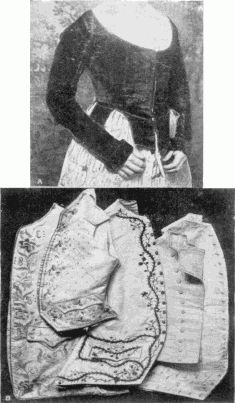
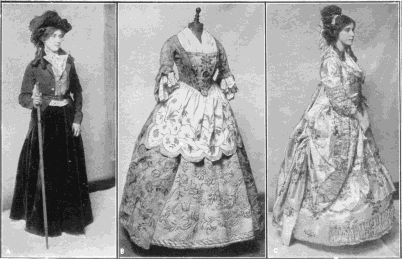
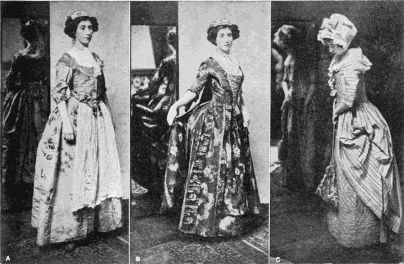
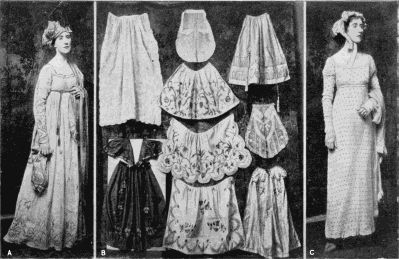
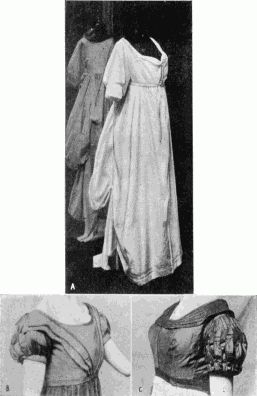
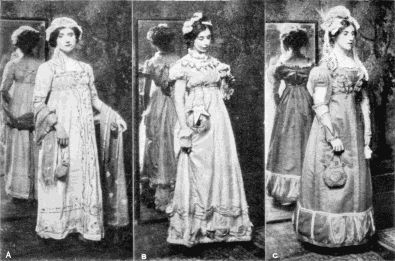
During the later part of the 18th century, a great deal of tinsel drawn
work was done on fine muslin, and became beautifully treated in delicate
design on the hem and down the front of many of the high-waisted dresses
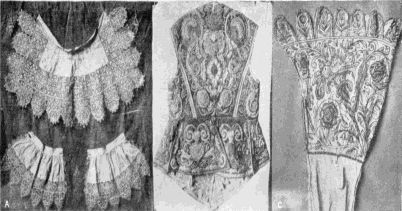
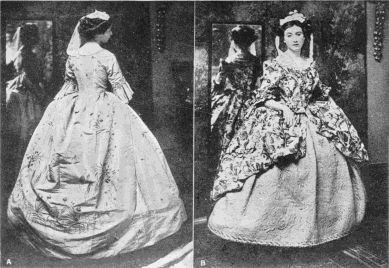
as in Fig. A, Plate XXIII (see p. 218). Later on towards the twenties we
see a great deal of effective coarse work in heavy gold tinsel, and at
the same time to the forties a number of dresses were ably enriched with
fine gold thread.
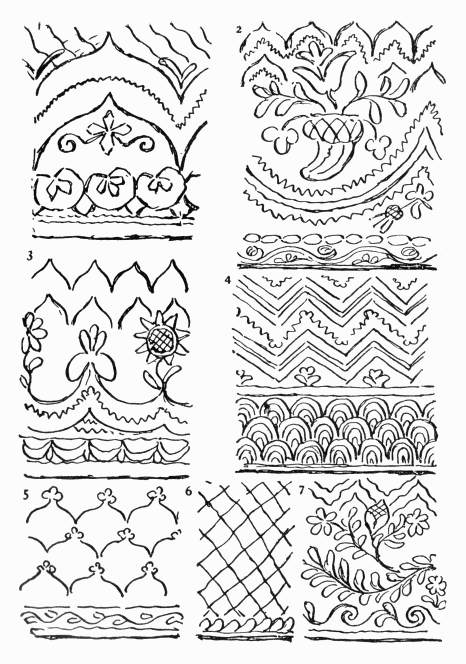
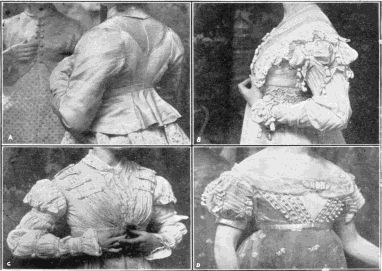
The white embroidery in the earlier trimmings of this period, of which I
give examples in Plate XXIV (see p. 231), was remarkable for its wealth
of fancy; the chief beauty of these dresses was the delightful treatment
of gathered effects, and with the reign of George IV we note the
gradual return of the longer pointed bodice, with the growth of very
full sleeves, also the increase in the size and fuller set-out of the
skirts over the stiff flounced drill petticoats. The V-shaped Bertha
setting to neck and shoulders began to establish itself, and became a
great feature through the thirties and forties; the first signs of it
appear about 1814. Varieties of materials were used to great advantage
in designing, and drawn tulle trimmings were happily introduced to
soften hard shapes and colours. The shoulder fullness also began to be
neatly drawn in and held by straps, which gave a charming character to
many bodices.
From 1816 choice work in piped shapes, often of flower forms decorated
with pearls or beads, was set on fine net, as seen in Plates XXIII and
XXIX (see pp. 218, 263). The attraction to the thirties was the happy
effects gained by the bow and flower looping on the flounces, and these
ripened in fancy and variety through the forties. Braiding was adopted
in the thirties with a rather charming treatment of tassels down the
front of the dress; the polonaises of this time were also effective and
simple, caught here and there with posies of flowers, and we find this
fashion again revived in the sixties.
With the reign of George IV we notice an increasing choice of strong
coloured effects, which culminated in the mid-Victorian era in raw
colour and violent shot silks, velvets, and heavy fringes, but one may
see that many of these dresses of bright pure tone looked exceedingly
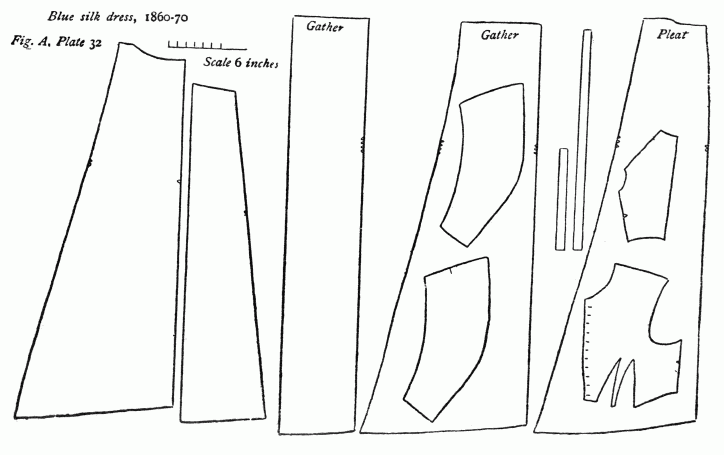
refined and were quite stately. A remarkable dress is Fig. A, Plate
XXXII (see p. 279), which is of very strong bright blue; its only
enrichment being a curved line of folded silk. All these dresses from
1800 were delightfully embellished with embroidered fichus, light
scarves of frail gauze, crêpe, or Norwich silk, and in the Victorian
times capes and V-shaped shawls; fascinating lace ruffles and tuck-in
fronts to the bodice necks, of frills and bands of embroidery, broke the
severity or bareness of many dresses. An endless variety of fascinating
caps and lace head-lappets was pinned or caught into the hair at the
wearer's fancy; besides the bows, flowers, and jewels (especially
pearls) which have always played an important part in the coiffure from
early times, the chatelaines and bags, fobs, fans, and lace or silk
handkerchiefs all give the artist a note of extra colour when desired.
The cruel period of taste really came with the seventies, though one can
trace many quaint and interesting cuts in the bodices and skirts of this
time; but the "grand dress" of complicated drapings, heavily fringed or
braided, was a "set piece" which, let us hope, will never appear again.
The long stocking-purse which began to appear in the late 17th century
was up to 1820 sometimes carried tucked through the belt; it was set
with a pair of metal rings and tassels of steel or gilt beads. Small and
large circular and bag-shaped purses were also in use; all these were
made in coloured silk threads enriched with steel, gilt, or coloured
beads, the latter shapes being set in chased metal mounts, the circular
ones generally having a fringe and the bag shape a small tassel or heavy
drop. These shapes can also be seen in coloured leathers with a leather
tassel, besides the plain money-bag with a draw-string.
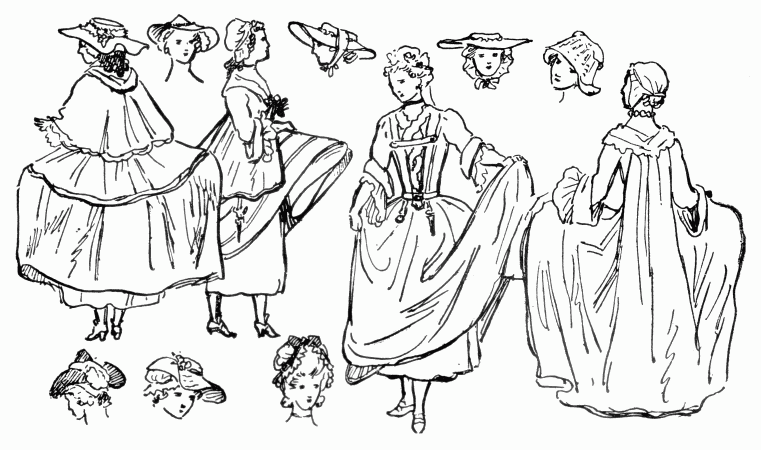
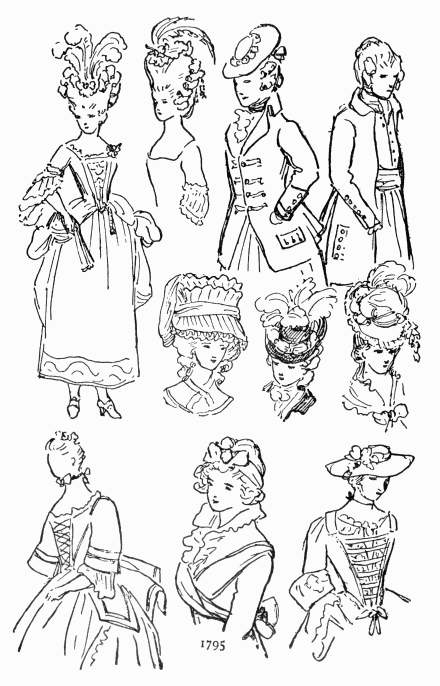
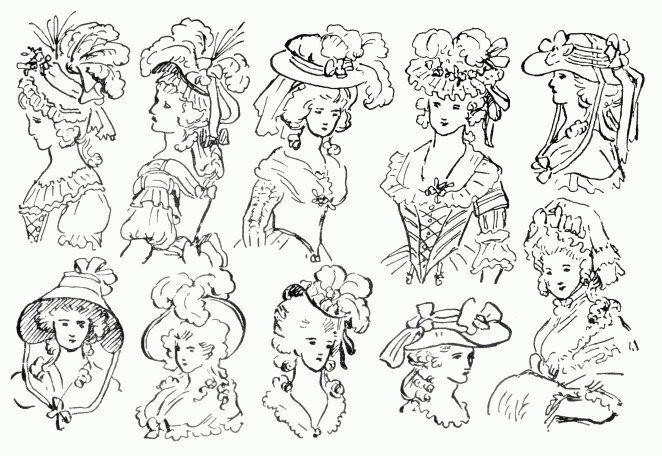
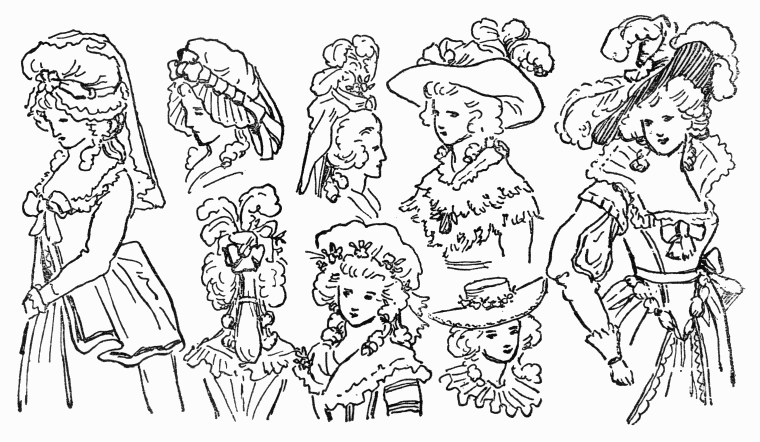
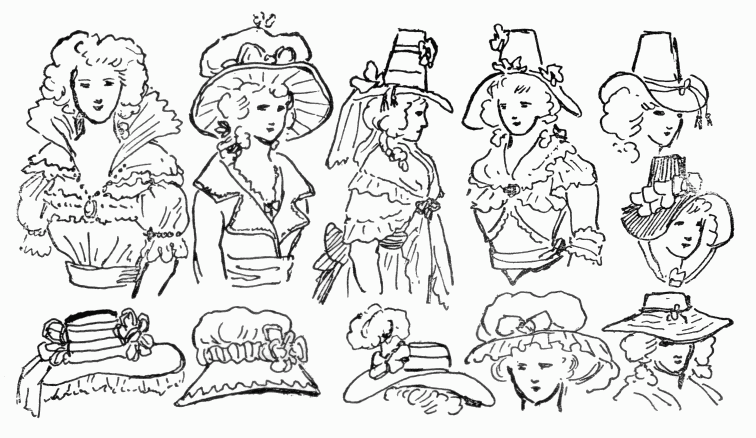
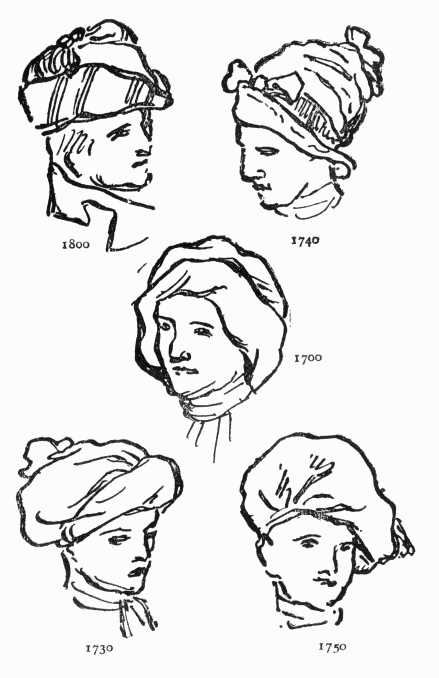
The hair up to 1808 was gathered into a knot of curls at the back of the
head, rather high up, with a small curl at the sides in front of the
ear. Later the knot was set more on the top, and the side curls were
made more of a feature, several being arranged at the sides. Numerous
varieties of large and small brimmed hats, bonnets, and turbans are
seen, and several masculine top-hats and cockade hats may be noted late
in this reign. The usual feather decorations and large ribbons or
flowers were in use, and a handkerchief was sometimes bound over the top
of the straw hat and tied under the chin.
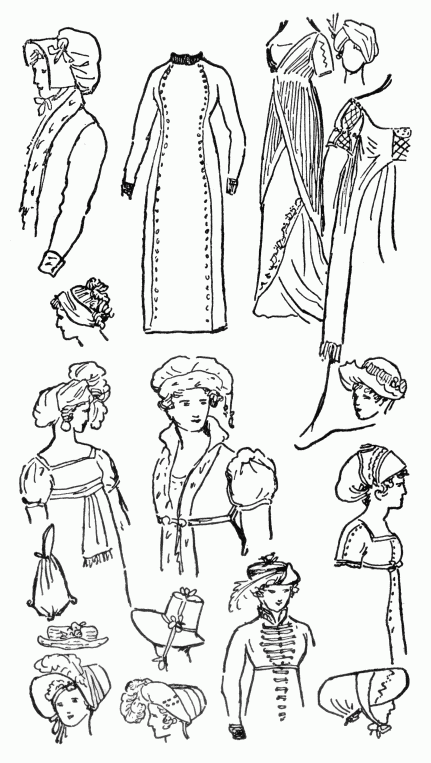
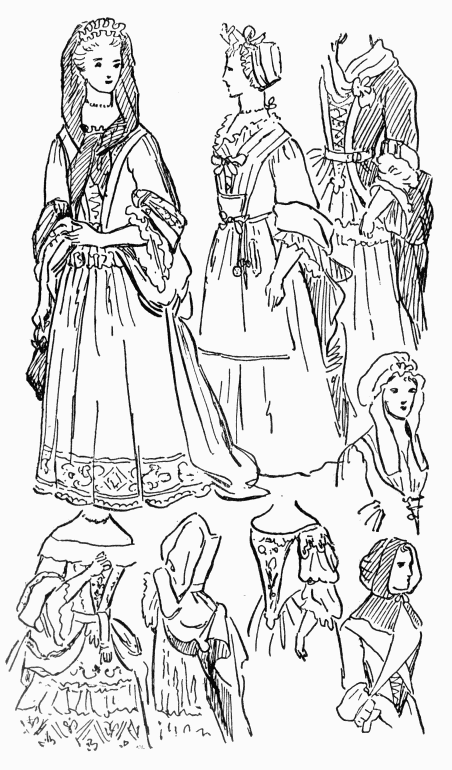
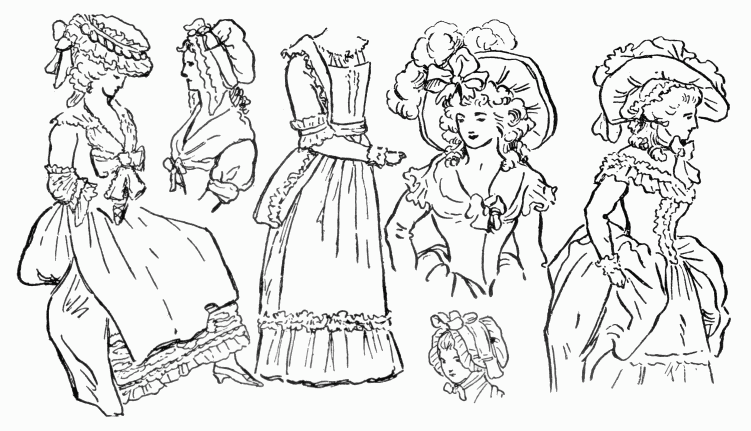
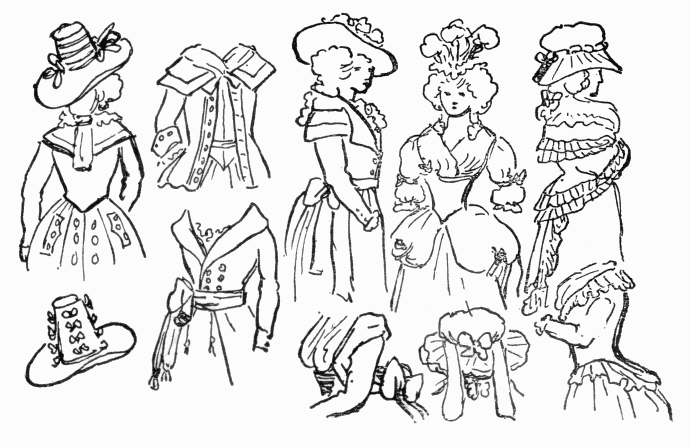
Fig. 107.—Costume notes, 1811-1812.
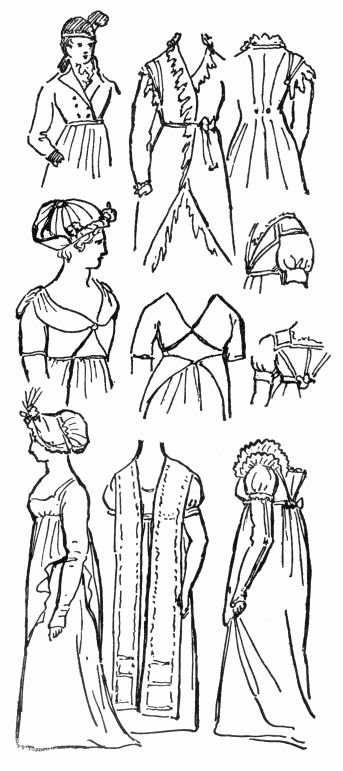
Fig. 108.—Costume notes, 1814-1816.
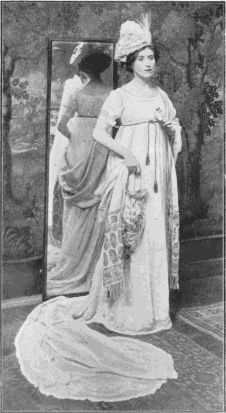
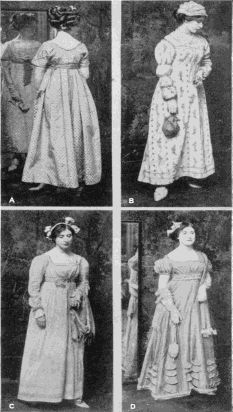
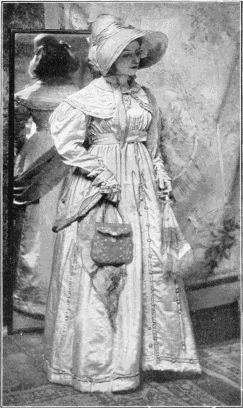
The classic high-waisted dress continued till 1808, and was often
beautifully decorated with white embroidery and gold or tinsel, as in A,
Plates XX and XXIII (see pp. 199, 218), and the frontispiece is a lovely
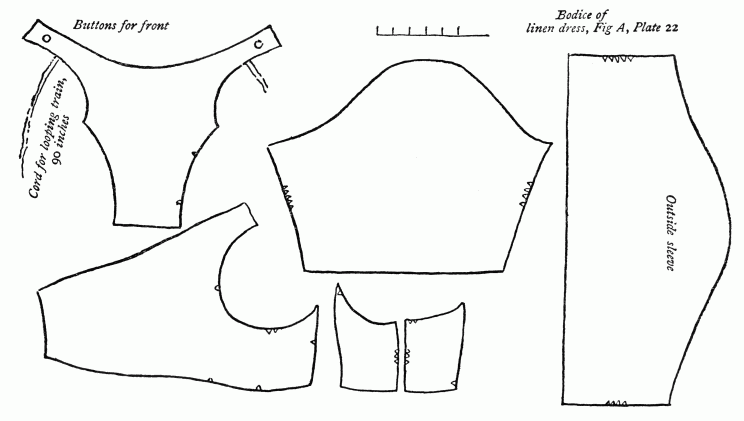
white example. There were several interesting drapings, one being a cord
hanging from the back of the shoulder to loop up the train of the dress,
as in A, Plate XXII (see p. 215). The simple tunic shapes are better
described by the illustrations: more originality was essayed in
design after the last-mentioned date. A high Vandyked lace collar and
fan setting to the shoulders appeared, and many interesting dresses of a
plain cut, mostly in velvet and silks, were worn about 1810-12. A
gathered sleeve drawn tight at intervals was often seen up to 1816, when
embroidered ruffles and frills decorated most of the necks and skirts,
and a braided type of character, rather military in effect with
beautifully piped edgings, came in from about 1817. Spencer bodices were
an additional interest at this period, and a short puff sleeve was
generally banded or caught with bows; these being often worn over a
fairly loose long sleeve gathered by a wristband. Dresses were worn
shorter from about 1810. Charming lace and embroidered fichus crossed
the shoulders, and long scarf-capes were thrown round the neck and were
often tied round behind, as in the 18th century; long capes with points
and tassels in front fell to the knees, and a simple pelisse with cape
became a pleasing feature. Bags were always carried, of which there is a
variety of shapes in the plates; long gloves or mittens were generally
worn. Parasols of a flat shape, or others with round or pagoda shaped
tops are seen, many being edged with a deep fringe. Long purses were
often tucked through the waistband.
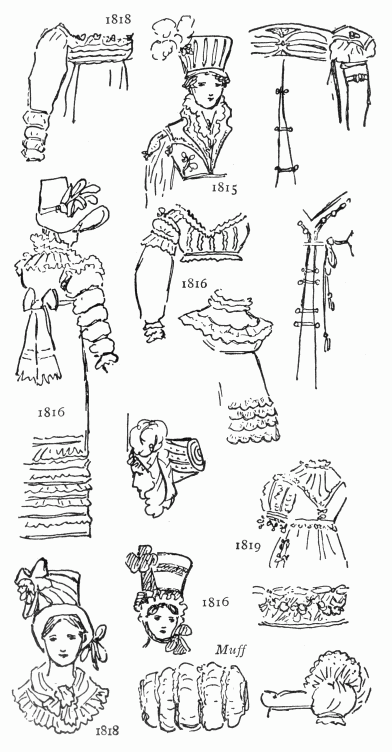
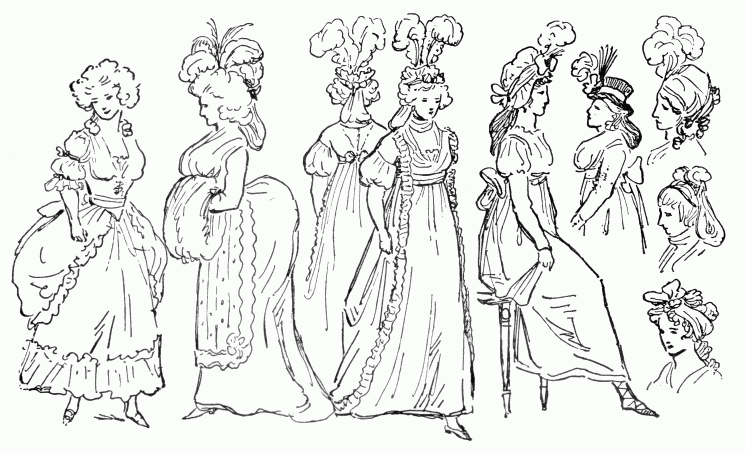
Fig. 109.
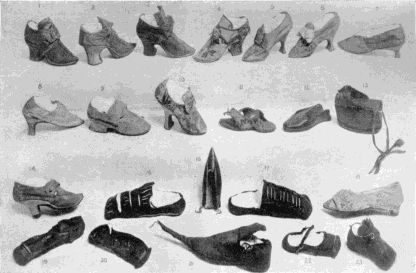
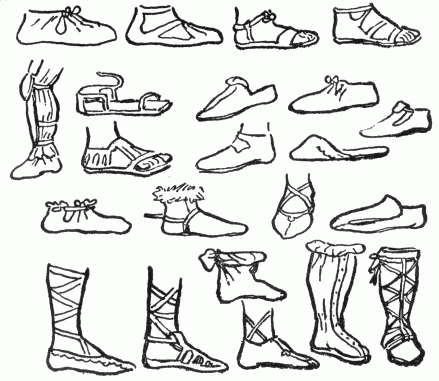
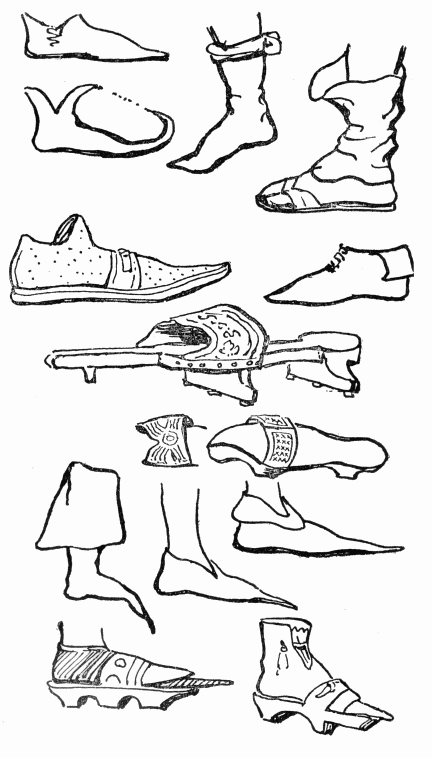
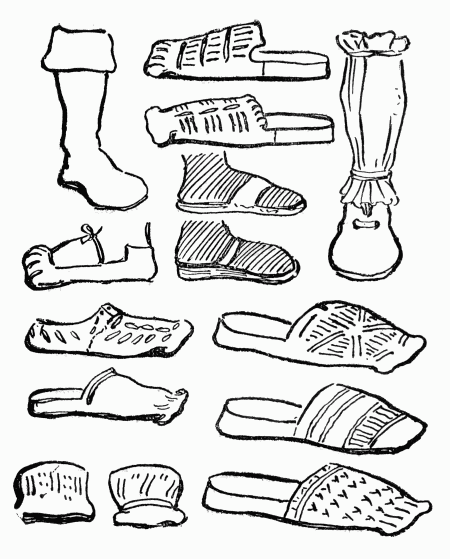
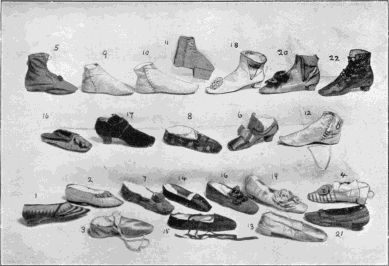
The pointed shoe, tied sandal fashion up the leg, and with no heel,
remained through this reign, but a round-toed low shoe, tied on in the
same manner, began to supersede it about 1810.
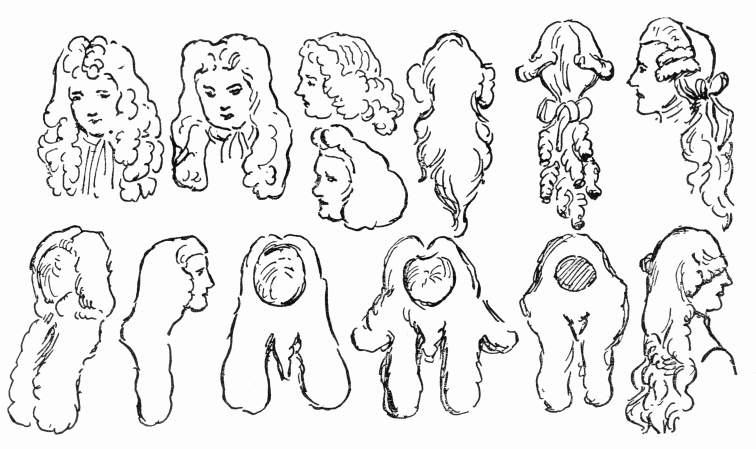
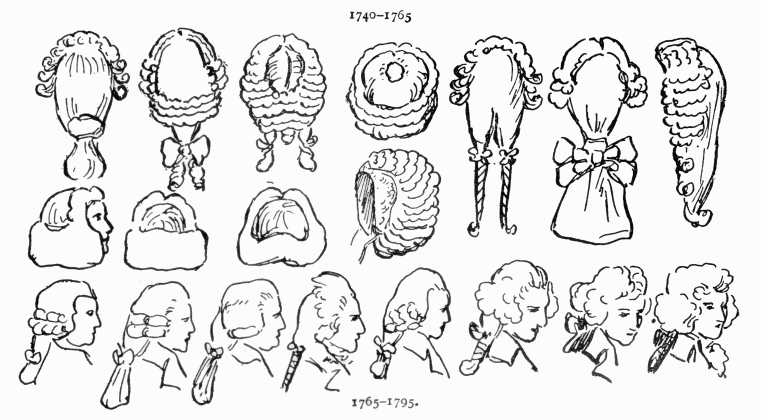
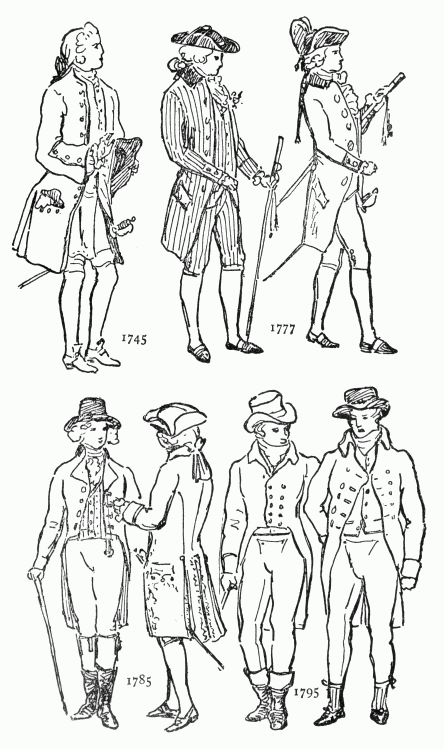
Wigs had practically gone out, except for a few of the latter type of
the 18th century amongst elderly people. The hair was now worn short,
and left rather full on the front, with short side-whiskers. Plain black
or white stocks tied with a front bow, and a starched or unstarched
collar with a frilled or gathered shirt-front were in use. A tie-pin or
stud was also seen in the centre of the stock or frilling.
The same hats as in the latter part of the 18th century continued for a
time, but the top-hat had established its favour, and assumed various
shapes throughout this reign.
larger image
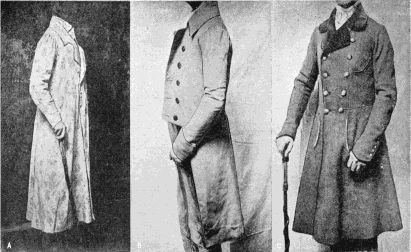
Plate XXVI.
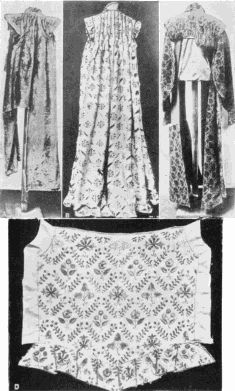
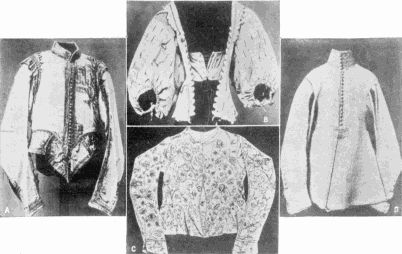
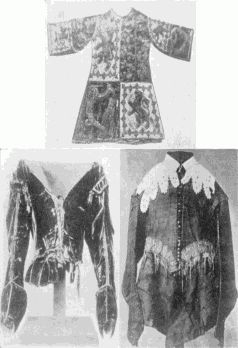
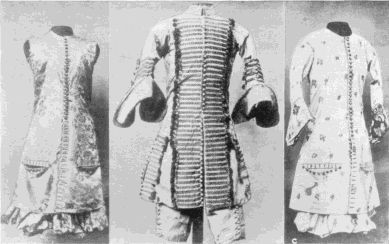
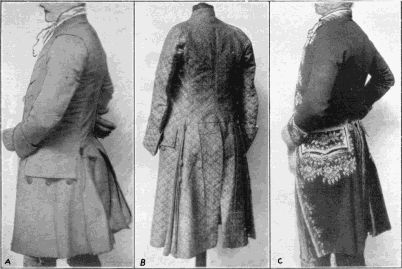
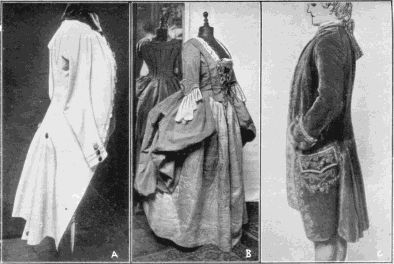
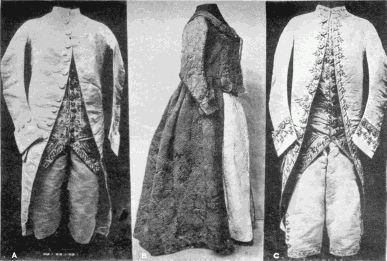
- (a) Morning Coat of Chintz. 1825-45. Pattern, see p. 313.
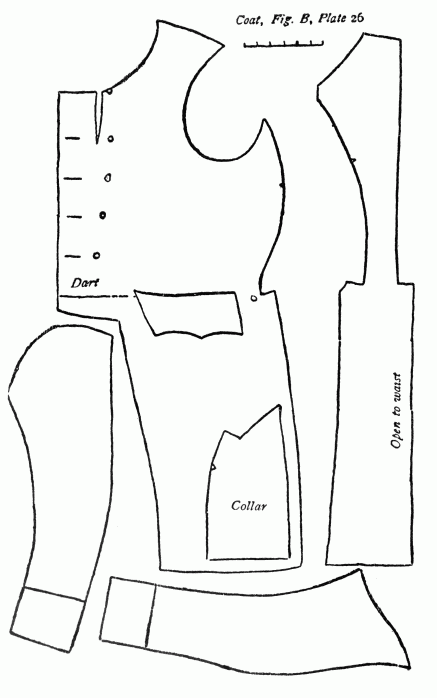
- (b) Cloth Coat. 1808-20. Pattern, see p. 307.
- (c) Cloth Overcoat. 1820-35. Pattern similar to p. 311.
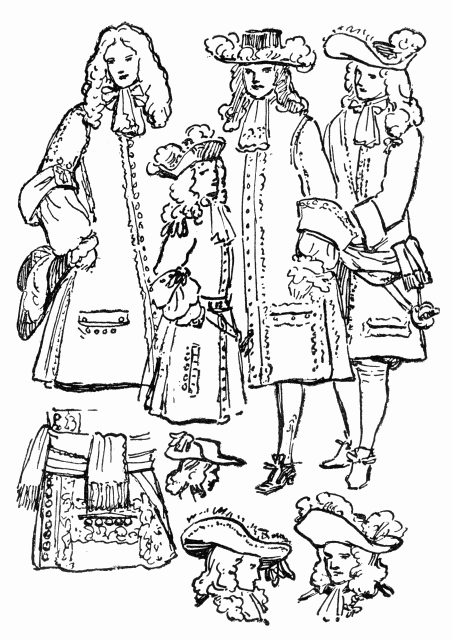
The coats were set with very high turn-over collars and a wide-shaped
lapel, and the lapel of the waistcoat was still brought outside. As
these lapels on the coats became smaller and changed into a roll collar,
they were cut into points at the breast, as seen in the illustrations.
The front of the coat cut away in a short square, rather high in the
waist, which thus formed a long-tailed skirt; the fronts were made
double-breasted, and were often fastened high up the lapel. The
hip-pleats had gone round more to the back into a closely pressed fold,
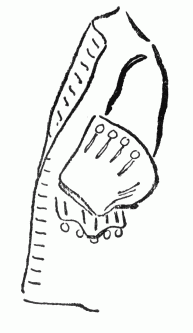
about three inches from the back-opening. Sleeves were gathered rather
full in the shoulders, becoming very tight on the forearm, and were
finished in a cuff, or buttoned cuff-shape. We also see that a short
square coat without tails was worn over the longer one. Overcoats (or
long-skirted coats) with a cape or capes, up to four, were worn all
through this reign, both double and single breasted, sometimes with
turn-up cuffs; but this mode was not frequently used, as a sewn-on cuff
or cuff made in the sleeve was now worn, and began to take a curved
shape well over the hand, with three buttons to fasten it on the outer
sides.
Short double-breasted waistcoats continued much the same, but a
round-shaped lapel appeared on many.
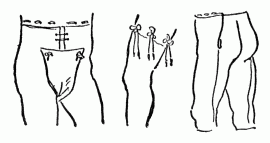
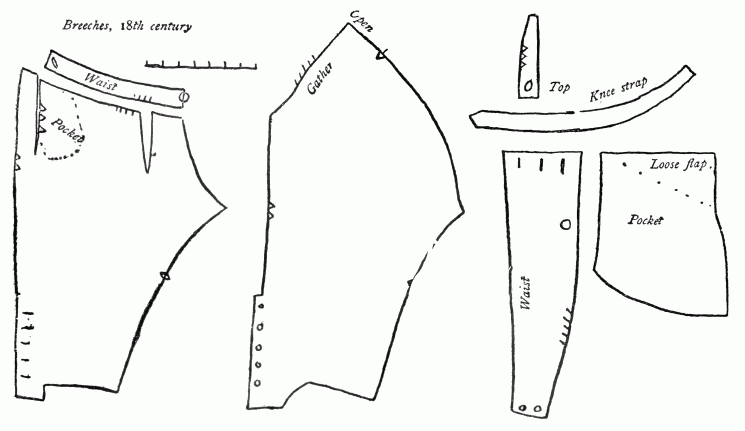
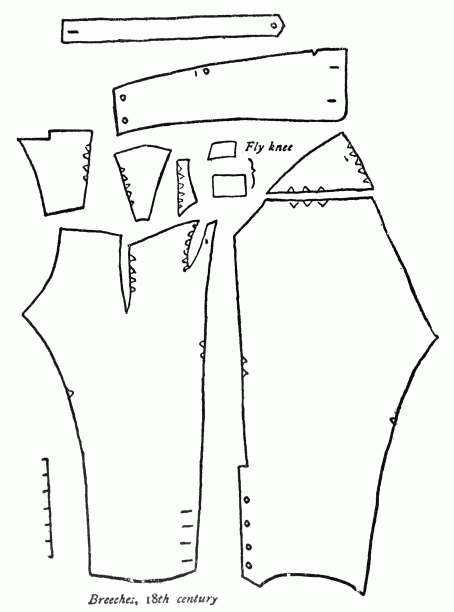
Very tight-fitting breeches were worn of the same 18th-century cut, and
trousers began to gain favour; a fob of seals, &c., was always worn,
coming from under the waistcoat.
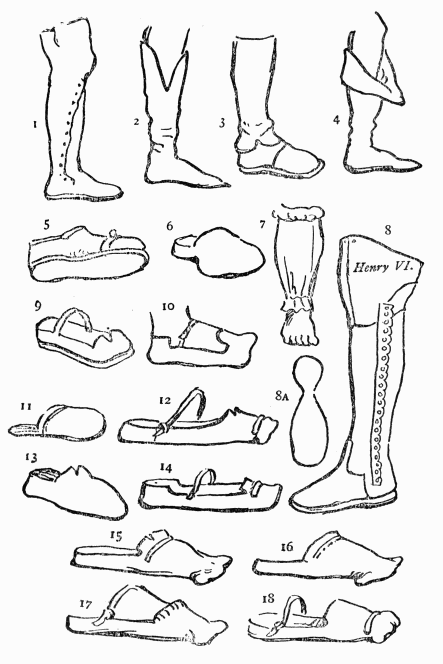
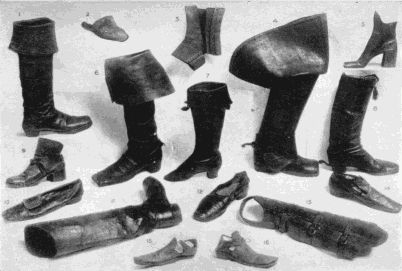
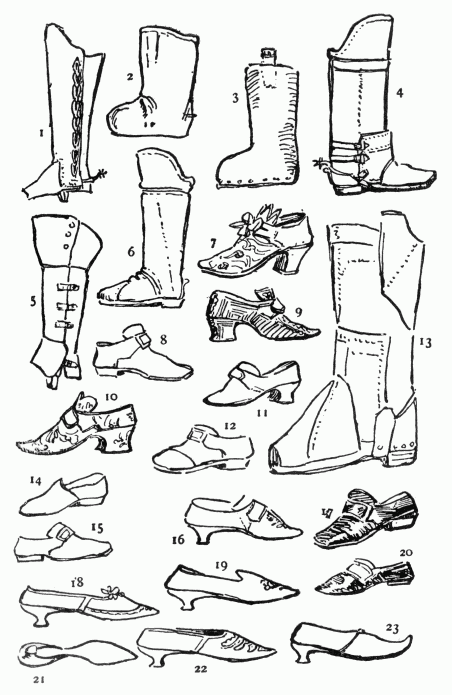
Soft high boots with turn-down tops, and boots with longish brown tops
set low on the leg. The top-boot with the pointed or oval-shaped front
and tassel still held sway, and an oval-toed low shoe with or without
small latchets was in use.
The hair at this period was worn in plaits or curls gathered on top, and
during the latter years was arranged into stiff loops set with a high
comb; a group of curls was drawn to the sides of the face, the hair
being mostly parted from the centre. Plumes were much used for
head-dresses, and caps with gathered puffs and pointed frills. A
high-crowned straw poke bonnet, tilted upwards, was still in form; but
the prevailing mode was a silk bonnet, with the brim curved in at the
front, the sides being drawn together under the chin with a bow. The
prevailing decoration was a group of feathers thrown forward or ribbon
loops, and after this a large round hat, with a full gathered crown,
arrived about 1827, or straw shapes, such as Fig. A, Plate XXVIII (see
p. 259).
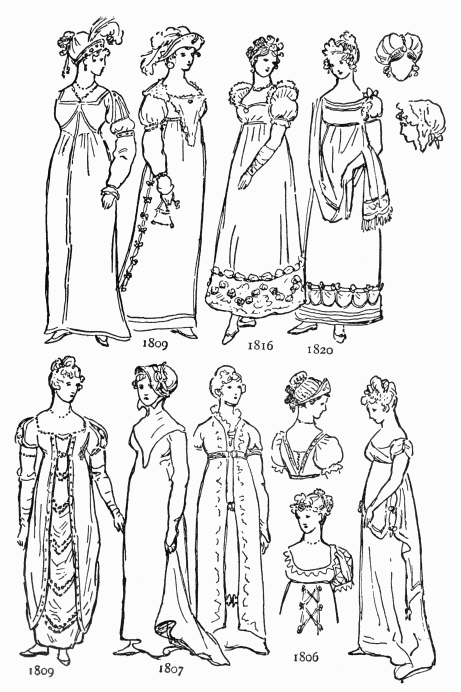
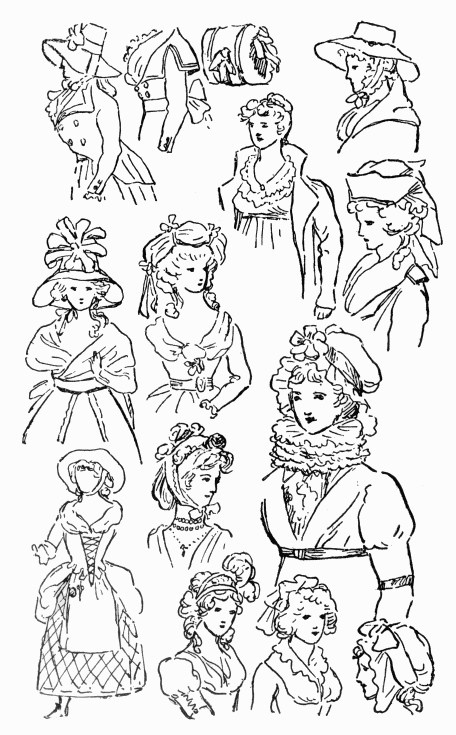
Fig. 110.
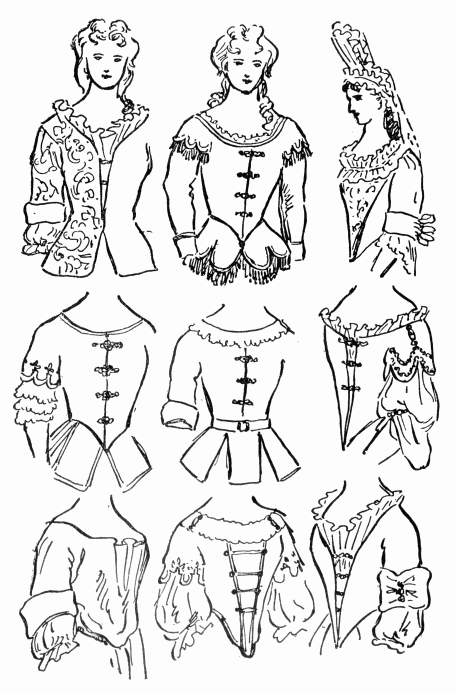
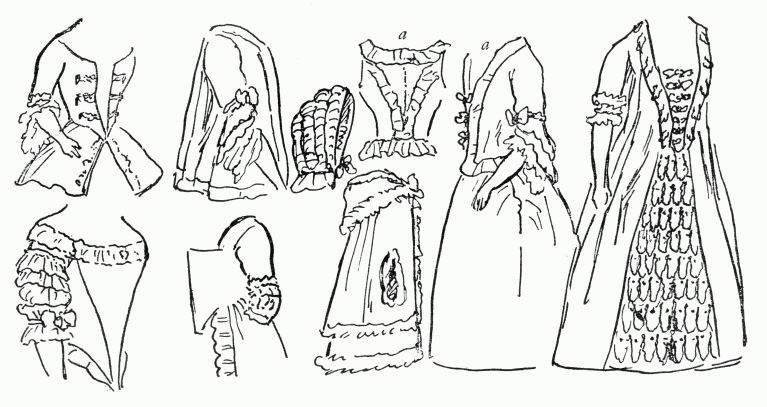
Dresses gradually assumed a longer waist, and a short pointed bodice
made its appearance here and there from about 1822, when short stays
began to return, and pointed belt corselets were frequent, though the
waistband or sash was chiefly used. Short puffed sleeves of charming
character and workmanship were sometimes set in a gauze sleeve, as in
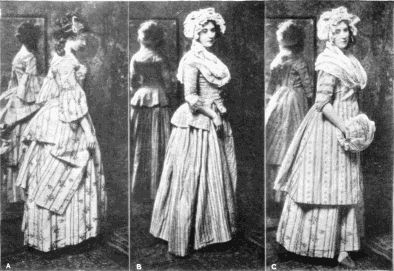
Fig. C, Plate XXIII (see p. 218). Spencers and pelisses had long sleeves
coming from these short ones; they were rather full, and were caught at
the wrist with a band. The upper sleeve gradually disappeared as the
full-topped sleeves began to develop in size, about 1824; this fullness
was often broken up into gathered parts, a tight cuff-piece usually
finished at the wrist. The high set-up collars and neck-frills gave way
to the flat capes about 1827, though the small ruffs were worn round the
top of the high-necked capes to 1830. The gathered shoulder began
about 1823, and soon became a marked feature; pointed or scalloped
frills and trimmings came into favour from 1825, Fig. B, Plate XXIII
(see p. 218), and about 1827 the sloped appearance in the bodice began
to be noticed as the sleeves were set lower. The shoulders in ball
dresses were shown, and a gathered Bertha of silk or lace was arranged
round the neck of bodice, Fig. D, Plate XXIV (see p. 231), or this form
was made in the pattern as in Fig. C, Plate XXII (see p. 215). The
V-shaped piece from the centre of waist or breast began to spread over
the shoulders, where it was opened, as in Fig. B, Plate XXII (see p.
215). This V shape was often open down to the waist, where it was filled
in with a centre-piece of embroidery. Skirts were gradually set out
fuller, with stiff-flounced petticoats; they had various simple or
richly decorated borders and fronts, or several small flounces, or one
deep one often with the edges cut into divers shapes.
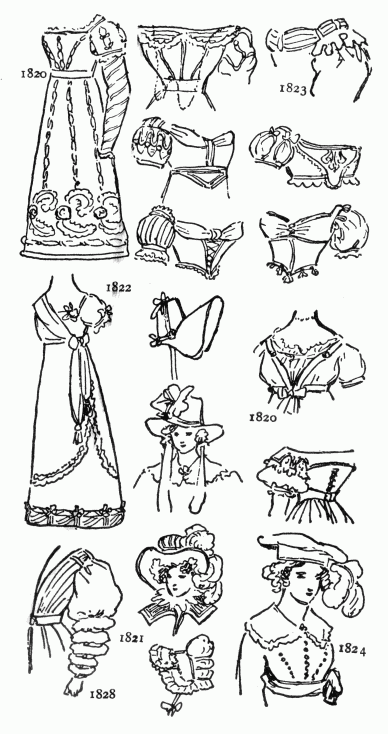
Fig. 111.
I have striven to give good examples of the marked styles in the various
dated illustrations, as well as the court train to dress, Fig. A, Plate
XXXIII (see p. 282), which also comes into this time.
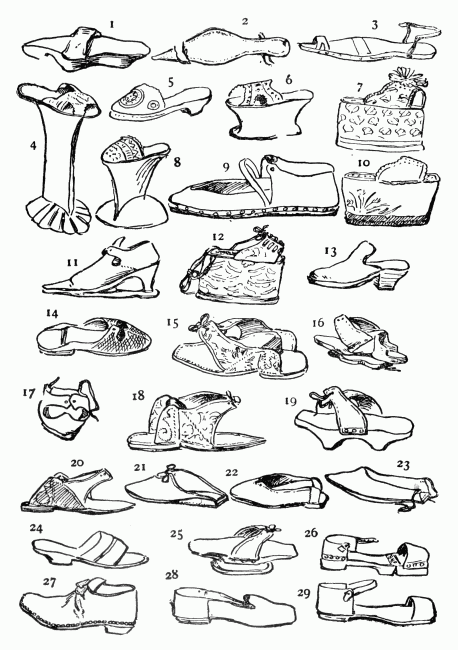
Shoes were rather round at the toes till near the end of the reign, when
they took a square shape; a tiny rosette or bow was placed at the front
of instep, and they were held by narrow ribbons, crossed and tied round
the ankle. Boots lacing at the inside, with seam down the front, often
had a toe-cap as in Fig. 5, Plate XXI (see p. 202); no heels were worn.
Light gauze scarves were usually carried, and very small fans besides
the larger feather ones. Bags or sachets of the forms illustrated were
painted or embroidered in ribbonwork, chenille, tulle, and coloured
silks.
A few specimens of parasols are also given, and gloves and mittens were
of the same character as in the latter part of the last reign.
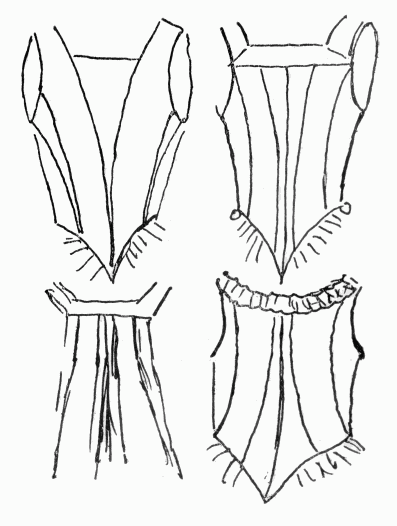
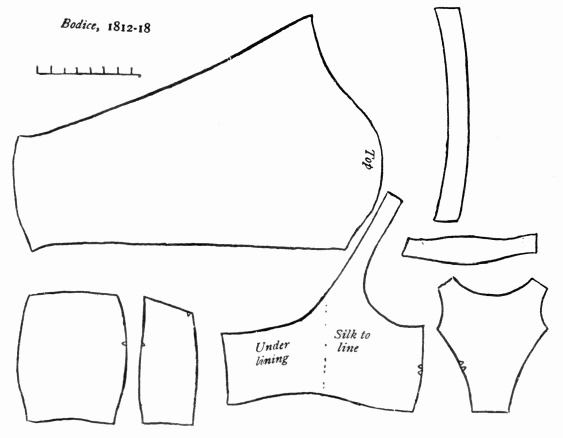
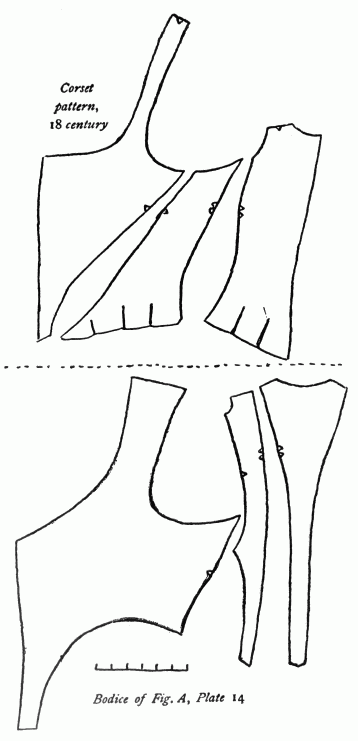
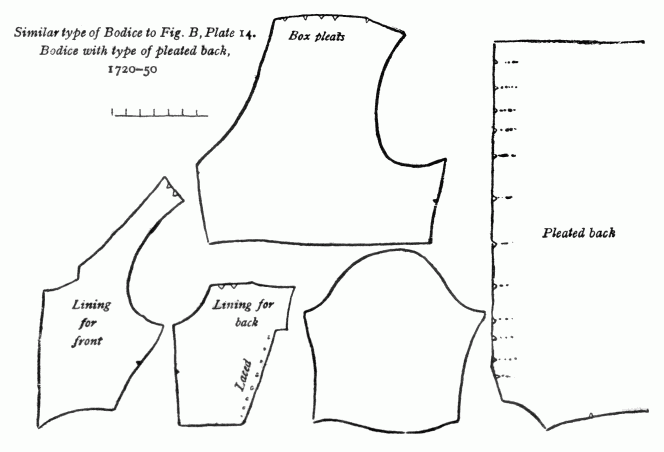
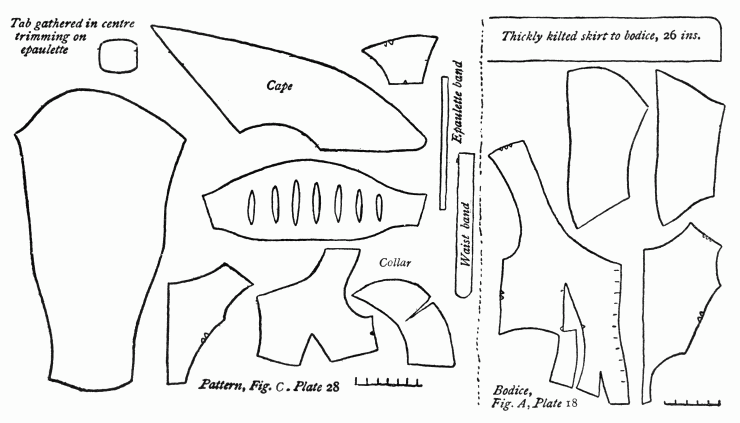
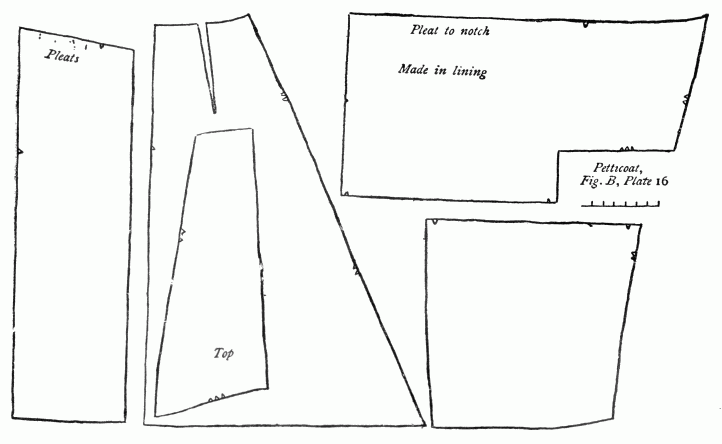
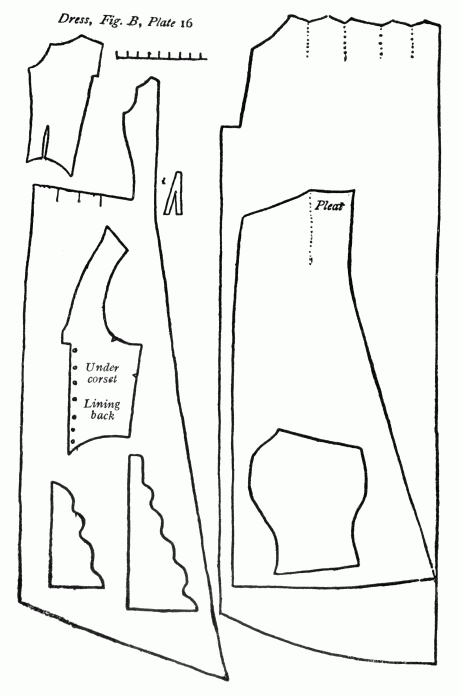
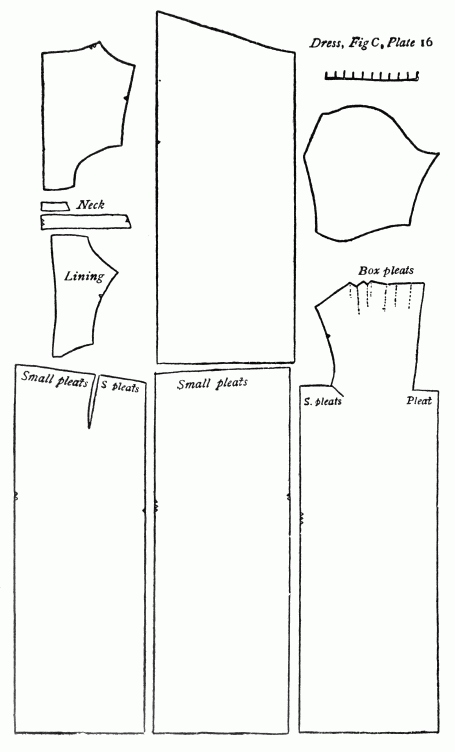
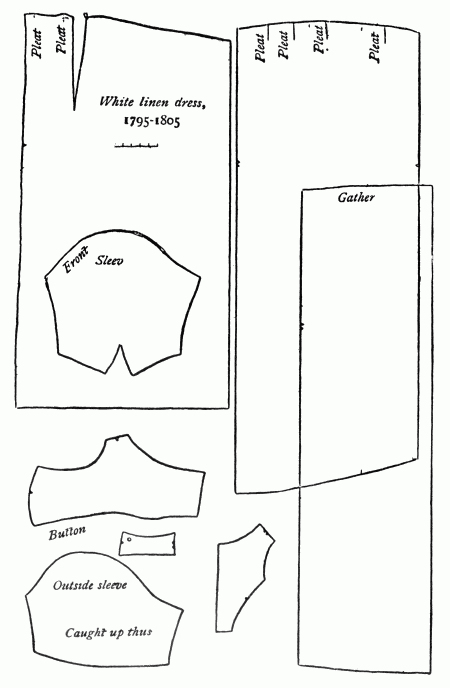
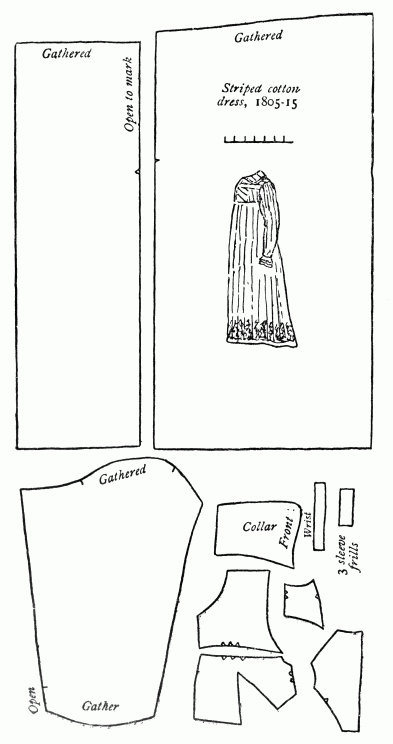
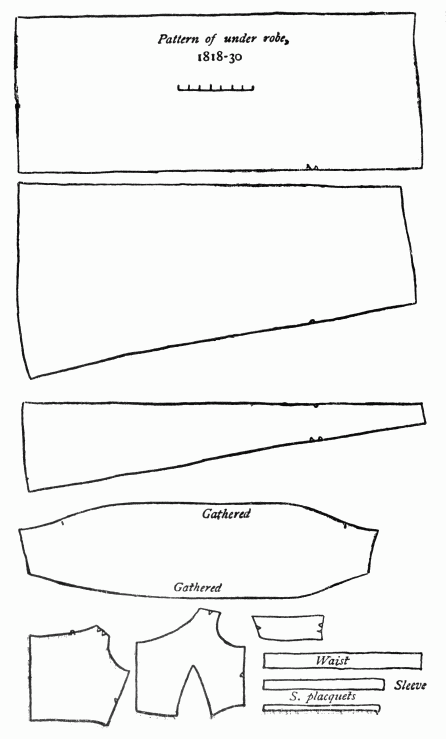
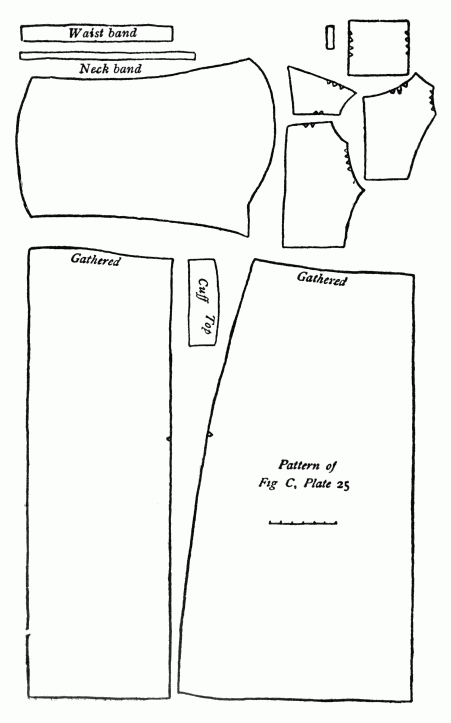
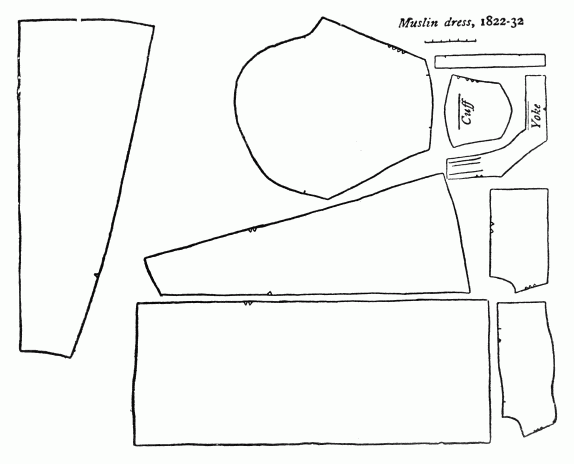
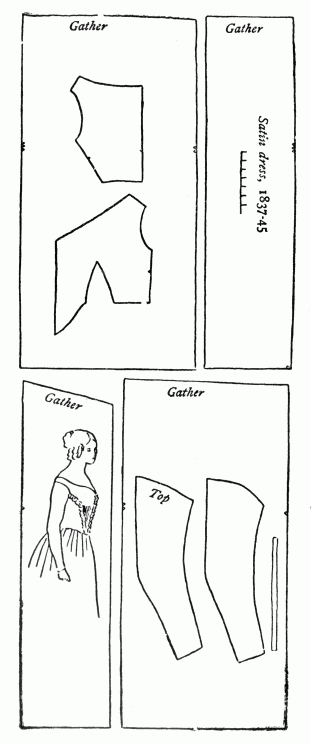
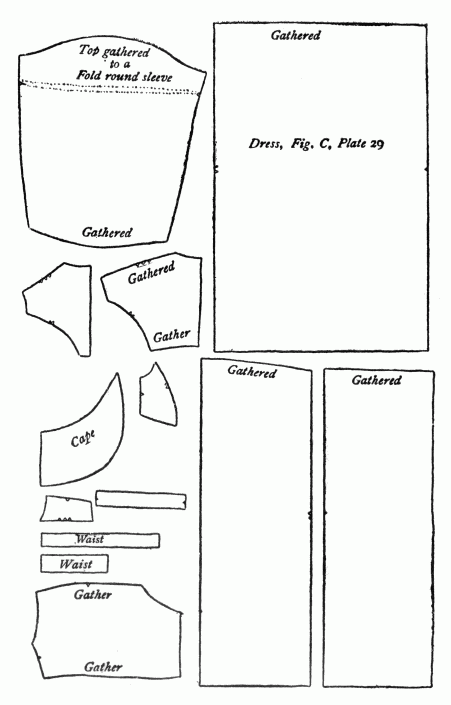
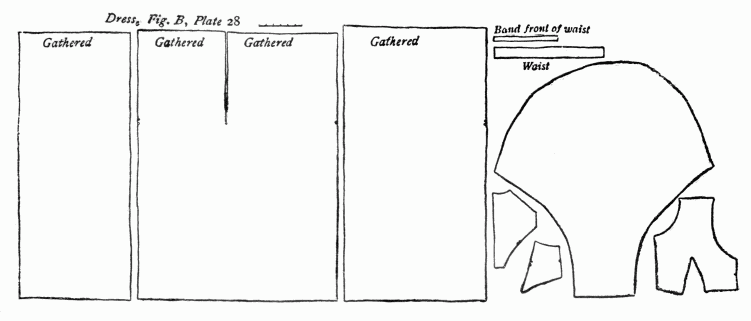
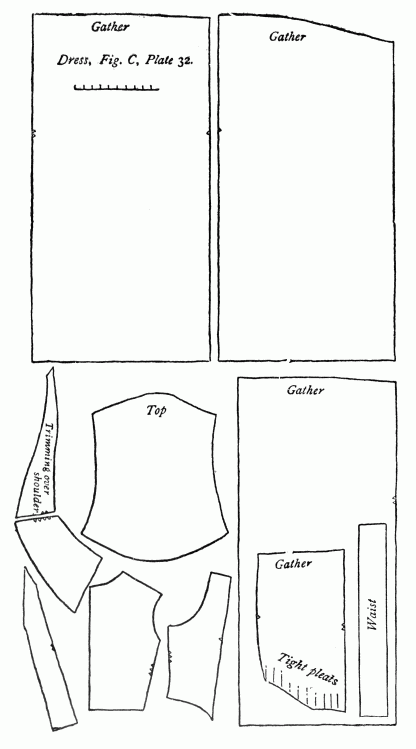
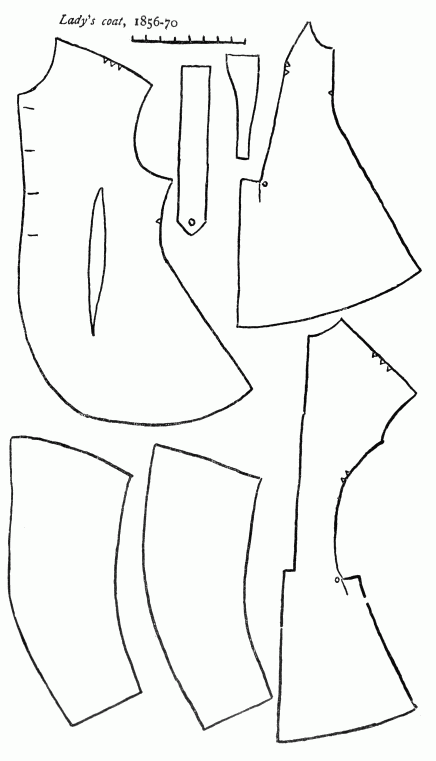
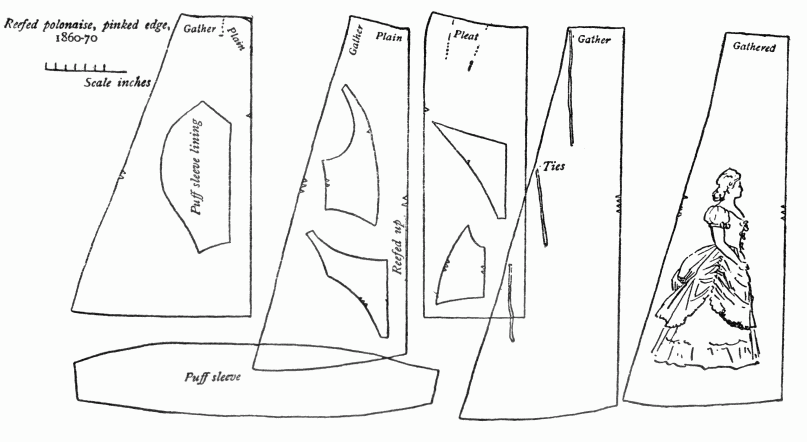
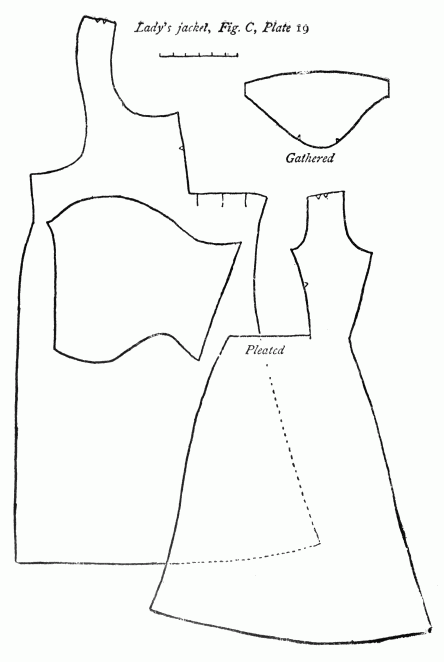
The patterns given of some of the dresses shown in the plates will be
useful as to the measurements of the increase in skirt-width and
sleeves; one may also note the very pointed set-out of the breast,
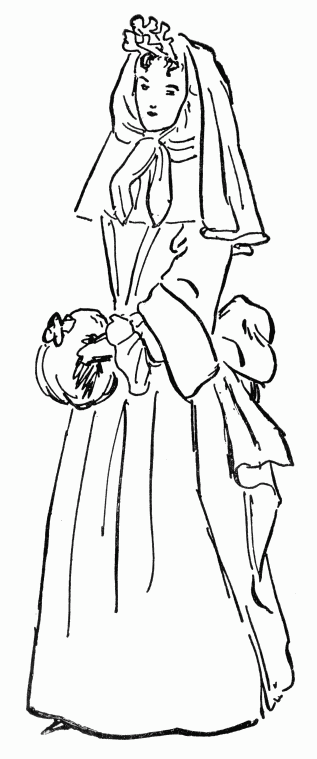
sometimes made with two gores, which only occurs in this reign. Muffs
were usually of a large size, and a bow with long ends was often worn on
the front.
The mode in beaver hats was most varied; high straight crowns with small
brims, others tapering at the top with larger curled brims, or crowns
enlarging at the top with almost straight small brims; a top-hat of
straw is shown on page 309. A short-crowned hat was also worn. The hair
was combed towards the front at either side, and the face shaven, with
the exception of short side-whiskers.
A very high stock of black satin or linen surrounded the throat, with or
without the points of collar showing, and a frilled shirt, often stiffly
goffered.
Coats were very tight-fitting and mostly double-breasted, with long
swallow-tailed skirts, or long full skirts; the waist was rather short,
and the effect of coat-front round-breasted with a high turned-over
collar finished in large lapels, which were often treated with velvets.
The favourite colours for overcoats were greys, buffs, greens, and
blues, and the edges were neatly finished with fine cord. The sleeves,
rather full in the shoulder, became tight on the lower arm, coming to
a curved shape well over the hand, and buttoned up the side. The pockets
were frequently set at an angle, as in illustration, and a short round
cape, or two, was seen on many overcoats. A short type of coat is seen
about 1827, with a single roll collar.
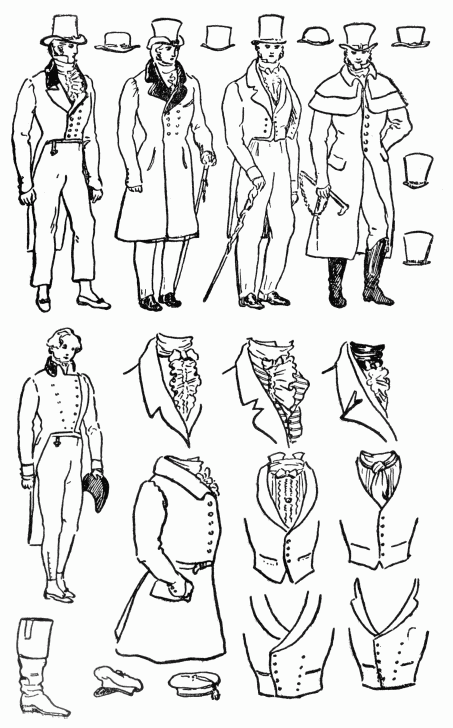
Fig. 112.—Period 1820-1840.
Waistcoats mostly had a round-shaped lapel, and were often
double-breasted and very shaped at the waist, which was set fairly high;
a long opening allowed the frilled shirt-front full display. There were
also waistcoats having no lapels, no pockets, or no cover-flap; the
points of front were very small, being buttoned to the end, or, with the
double-breasted shape, they were straight across.
Breeches were not so much worn as trousers of cloth, nankeen, drill, and
fine white corduroy; these were usually fastened under the boots with a
strap, others were looser and often worn short, well above the ankle. A
very full type in the upper part peg-tops, was in fashion about 1820-25
amongst the dandies, and for evening dress, very close-fitting breeches
to the knee, or just above the ankle, the latter being opened and
buttoned up to the calf. Pince-nez were favoured, with a heavy black
ribbon, generally worn tucked in the lapels of the waistcoat; and a fob
of gold seals, &c., hung from the braces, below waistcoat pocket.
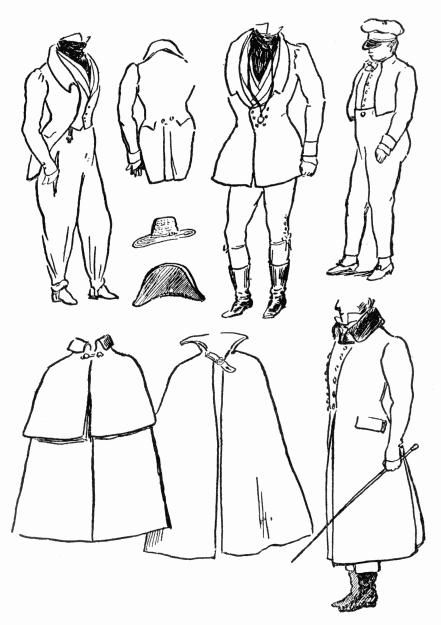
Fig. 113.—1830-1840.
Shoes and short Wellington boots were chiefly worn, the former being low
in the heel and very short in the tongue, which was almost covered by
small latchets, either buckled or tied, the shape of the toe being
rather round. The Hessian boots with curved front and tassel at the top
were still worn.
The hair still retained the high loops on top and the bunch of curls at
the sides, poised by a back comb and set with flowers or feathers; there
was also a great variety of fancy capes with pointed frills, some with
long tie ends, and these are seen with most dresses, and were worn in
conjunction with the hats. The favourite hat was a big, flat, circular
form, generally tilted at one side, and decorated with bows, flowers,
and feathers; a flat tam-o'-shanter shape was often worn with the
riding-dress, sometimes with a large peak-shape in front, and straps
under the chin. The large poke-bonnet also kept the front as flat and
round as possible, with a high crown tilted upward in order to set over
the hair loops.
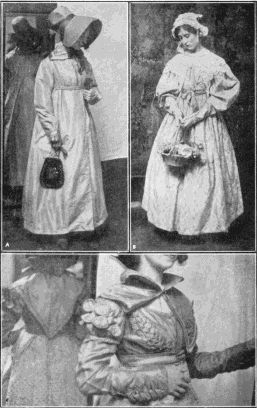
larger image
Plate XXVIII.
- (a) Silk Pelisse. 1820-30.
- (b) Cotton Dress. 1830-40. (Pattern, see p. 343).
- (c) Silk Spencer and Cape. 1818-27 (Pattern, see p. 324).
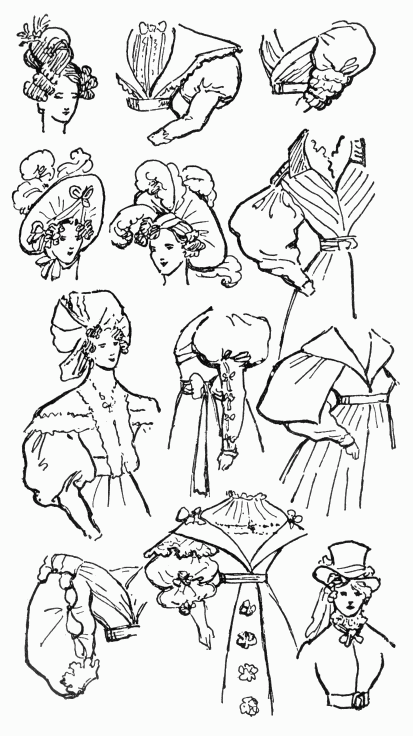
Fig. 114.—1828-1836.
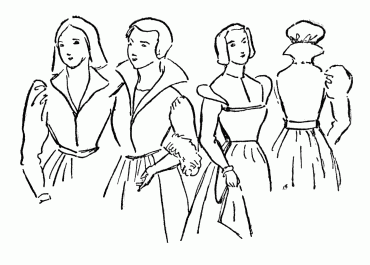
The bodice began with a very pointed front and very low neck off the
shoulders, tuck-ins of fine embroidery, and capes or fichus of the
same, covered the shoulders, often three deep. The pointed bodice only
lasted for a few years, when the waistband again became the favourite.
The sleeves were very large at the shoulders, diminishing at the wrist,
but soon took a big round form, sometimes tightly pleated into quarters
before 1835. We then get the huge sleeve gathered at the wrist, and
often falling below it; this again tightened on the forearm, and we note
a tendency to tighter sleeves coming in before 1837, neatly gathered
well down the shoulder. The evening-dress sleeve was a large puff, set
out by stiffening to a flat wide effect. Very wide epaulet collars were
seen on most dresses, meeting in a V shape at the waist, with a filling
of lace in the front, and many bodices were elaborately gathered, and
some of the sleeves were also gathered into puffs all down the arm.
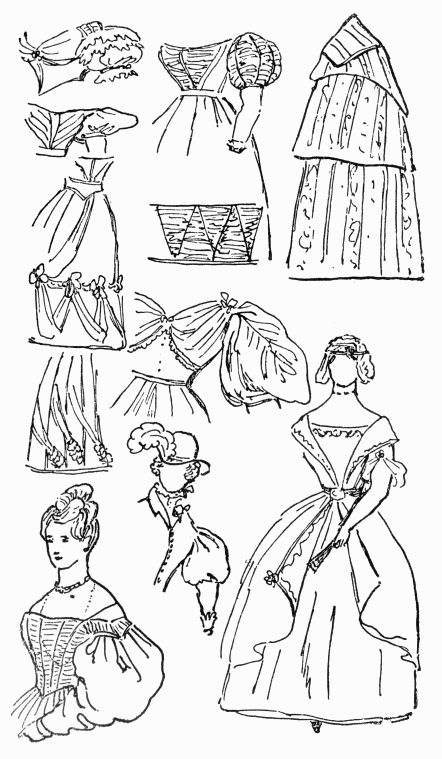
Fig. 115.—1830-1840.
The skirts were set out very full over stiff flounced petticoats, and
were worn rather short; as a rule they were trimmed with one or two
flounces, which were handsomely decorated, and a short polonaise is
occasionally seen. There were many interesting trimmings of gauze,
flowers, and bows; while silk-flowered gauze over dresses made some
charming effects.
Heavy mantles and capes or pelisses began to be braided, and rather
strong colours were in general taste.
The hand-bags were of a curved form and generally bore heavy tassels.
Very small fans and round fans were attractive, and bouquet-holders of
gilt, with pearl handles, became the thing to carry.
Shoes were of the low sandal type, fastened by crossed elastic, with
very square toes, and a tiny rosette or bow on the front; boots to the
ankle were now in fashion, mostly lacing at the inside, and having a
long toe-cap, sometimes with a small rosette at the top of this or a
tassel at front of the top of the boot.
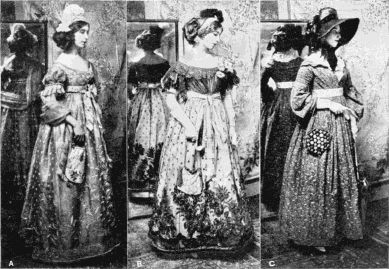
larger image
Plate XXIX.
- (a) Embroidered Silk Gauze Dress. 1820-30.
- (b) Gauze Dress with Appliqued Design. 1825-35.
- (c) Printed Linen Outdoor Dress. 1827-47 (Pattern, see p. 342).
The hair was worn rather full in curls at the sides or on top, parted at
the left side, besides being occasionally parted at the centre. Side
whiskers, curved forward, still continued, and a short trimmed beard was
now worn round under the chin by many, moustaches also made their first
appearance at the end of this reign. Top-hats were high and straight,
but many still adhered to the tapered crown and larger brim.
The same plain stocks of black satin continued, with or without a front
bow, and a soft pleated or frilled shirt-front.
The coats were similar to the last reign: the chief differences being an
increase in the length of the waist, wider tails, and large lapels of a
similar cut: velvet collars and cuffs were much worn, and the waist was
still made tight. A coat with a square skirt as in Fig. 116 is seen for
the first time, and the swallow-tailed coat was worn not quite so long.
A lower opening to the waistcoat was generally seen in evening attire,
which sometimes had but four small buttons, while more of the
single-breasted type were in use, with and without lapels.
Very tight trousers to the ankle buttoned up to the calf continued, or
plain trousers were held by straps under the boot; twill, corduroy, or
nankeen were both strapped or free at the ankle and rather short.
Knee-breeches were still worn by many for evening dress, and long
Italian capes with overcapes and high turn-over collars were
fashionable, besides the very full-skirted greatcoat.
Boots and shoes were square at the toes and rather long and narrow, the
shoes having a bow or buckle. Short Wellington boots continued much in
use, also spats.
Fobs of gold seals, &c., were worn, and eye-glasses attached to a black
ribbon is a noticeable feature.
The hair was parted in the centre and tightened in a top setting of
plaits, with side curls over the ears. This mode was retained by many
till the fifties, but the top plaits began to be set lower at the back,
and the same flat parted hair was brought in a curved shape to the
front of the ears, often in a small plait, allowing the ear to show, or
in a plaited knot at either side; about 1850 it was waved, parted, and
simply curved from the forehead over the ears in a fuller manner,
sometimes being turned under to increase the side fullness, while the
back hair was arranged lower down the neck. In the sixties the hair was
waved and caught behind in ringlets or was bunched into the hideous
chignons, which are seen till about 1880.
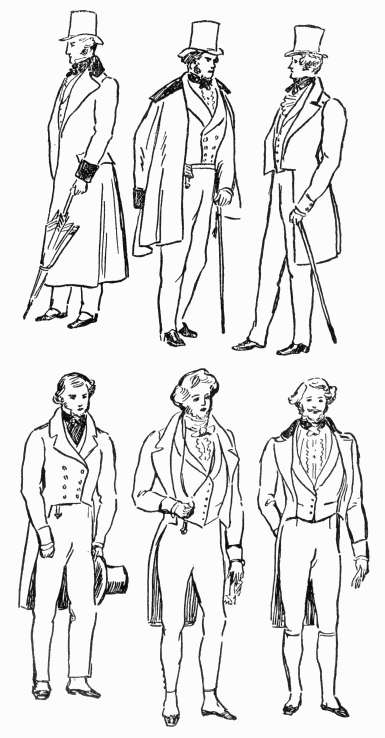
Fig. 116.—1840-1860.
The variety of caps and hats is too alarming to deal with, and baffles
comprehensible description, so it is best for the student to dip into
the hundreds of illustrations through this period in the Ladies'
Magazine, Punch, the Illustrated London News, or the Ladies'
Treasury for the later styles.
The straw bonnet with a straighter poke front was favoured till 1850,
when the front became considerably reduced in size and fitted closely
round the face. The larger brimmed bonnets had a little frill by the
ears, and the tight-brimmed bonnet often had the frill all round with a
flower also tucked in effectively to the wearer's taste, and we see this
favoured till the seventies. In the fifties a large flat Leghorn hat
with a small crown was in evidence, the brim dipping back and front,
decorated with feathers or bows, and a three-cornered French hat with
feathers set in the brim came in with revival of the 18th-century style
about 1860. A small bowler hat and a very small "pork-pie" hat appears
in the late sixties, and a tiny-shaped bonnet of a curved form during
the seventies.
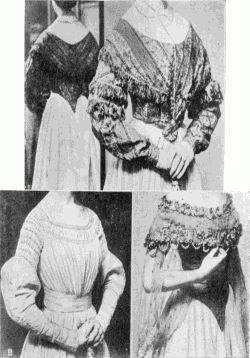
larger image
Plate XXX.
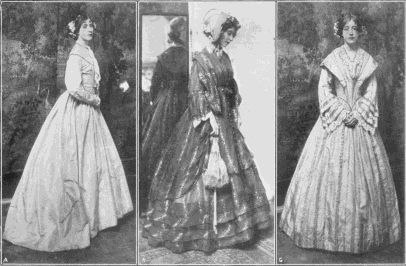
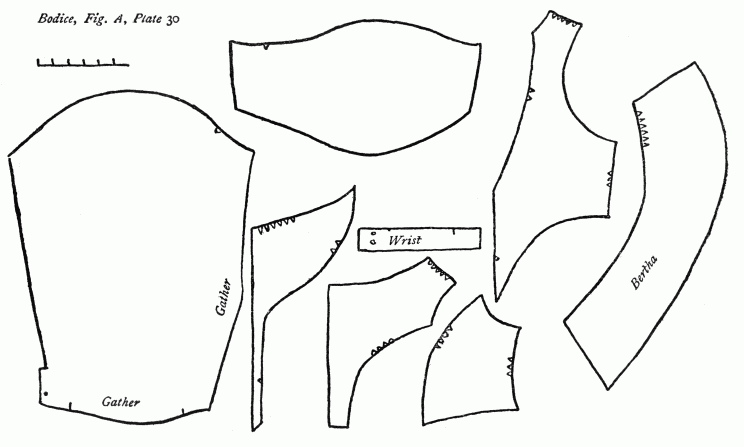
- (a) Printed Silk Bodice. 1840-50. (Pattern, see p. 320.)
- (b) Gathered Linen Bodice. 1837-47.
- (c) Silk Bodice and Bertha. 1845-55.
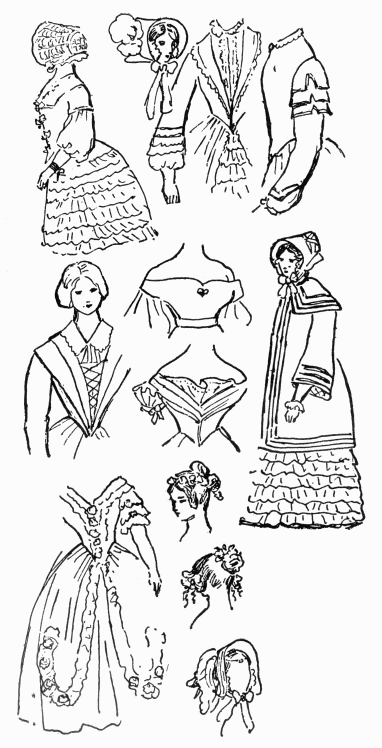
Fig. 117.—1845-1855.
At the beginning of this long reign we find the pointed bodice with a
normal length of waist has really come to stay, though many dresses
retain the waistband till the fifties, and there is such a confusion of
styles at that time, it is difficult to arrange a sequence. From the
18th century fashions became more complicated in the greater variety of
design, each overlapping the other, and several distinct forms of
character come and go during this long reign. I do not envy the person
who undertakes the chronology of our present period.
At the commencement in 1837 the huge sleeves gathered at the wrist were
still in evidence, especially as a gauze oversleeve to evening attire,
and they continued thus to the fifties, but very large sleeves were
really dying out and the usual reaction was setting in; the
full-shouldered sleeve had turned a somersault and was neatly gathered
tight from the shoulder to the elbow, the fullness falling on the
forearm, and this was gathered into a tight setting or wristband. The
V-shaped front to the bodice was kept in many dresses by a collar or two
tapering from the shoulders to the waist, the fullness of the breast
often being tightly gathered at the shoulders, besides a few inches in
the front point of the bodice. A very plain tight-fitting sleeve became
fashionable, and on most of these we find a small upper sleeve or a
double one as shown in A, Plate XXX (see p. 266); this was sometimes
opened at the outer side. These sleeves continued till about 1852. In
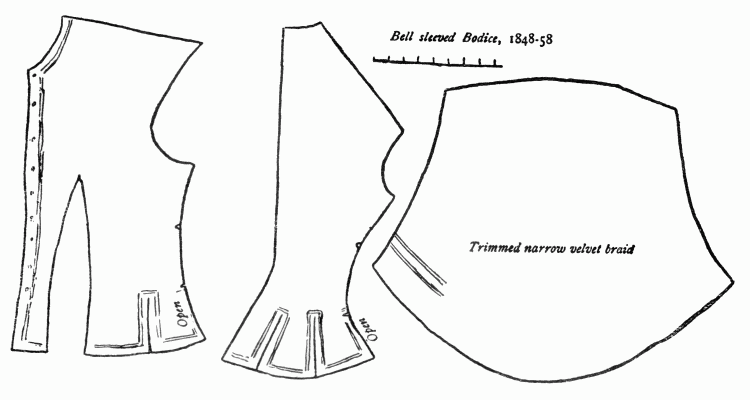
1853 a bell-shaped sleeve is noticed in ordinary dress, and this
continued in various sizes till 1875, reaching its fuller shape about
1864. These types of sleeves were usually worn over a tight one or a
full lawn sleeve gathered at the wrist; most bodices with this sleeve
were closely fitted and high in the neck, the waist often being cut into
small tabs. We also notice for a few years in the early fifties the
deeper part of the bell curved to the front of the arm, giving a very
ugly appearance. A close-fitting jacket also came into evidence till
about 1865 with tight sleeves and cuffs, sometimes with a little
turn-down collar and a longer skirt as in Fig. C, Plate XXXIII (see p.
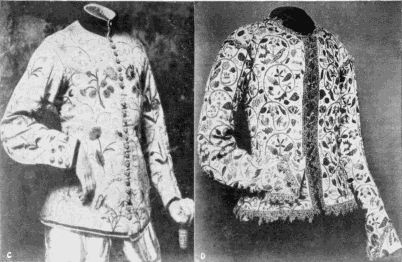
282). This particularly fine embroidered specimen, in imitation of the
18th-century style, is interestingly cut away short at the back to allow
for better setting on the crinoline. There is another type of sleeve
seen about 1848, of a plain, full, square cut; these became varied in
shape, being opened up the side and generally trimmed with wide braids.
This clumsy character is seen up to 1878, the later ones being fuller in
cut. Zouave jackets were occasionally worn in the forties and later in
the early sixties, when the wide corselet belt was again favoured.
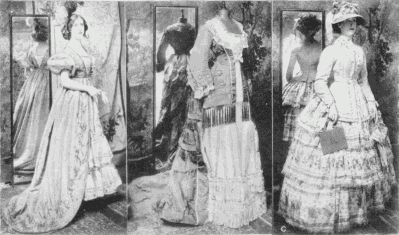
Skirts at the beginning of the reign were fully set out on drill
petticoats, stiff flounces, and even whalebone, so it was hardly "a
great effect" when the crinoline appeared about 1855, though a furious
attack was made against it at first; this undersetting developed to its
fullest extent between 1857 and 1864, and many dresses in the early
sixties were also worn short, showing the high boots of this period.
At first the crinoline was slightly held back from the front by ties,
and again in the sixties it was often kept with a straight front, the
fullness being held to the back, till the appearance of the bustle
brought in another shape. The skirts were now pulled in tight to the
front of the figure and bunched up at the back, with a train or shaped
flounced pieces overlapping each other caught up under the bustle, as in
Fig. B, Plate XXXIII (see p. 282).
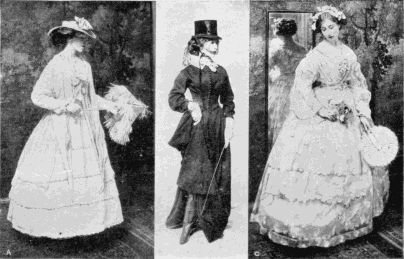
larger image
Plate XXXI.
- (a) Embroidered Muslin Outdoor Dress, 1855-65.
- (b) Riding Habit. 1845-75.
- (c) Gauze Ball Dress. 1840-55.
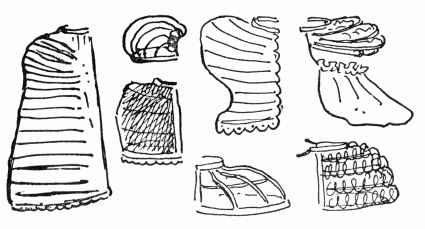
Fig. 118.—Dress improvers, 1865-1875.
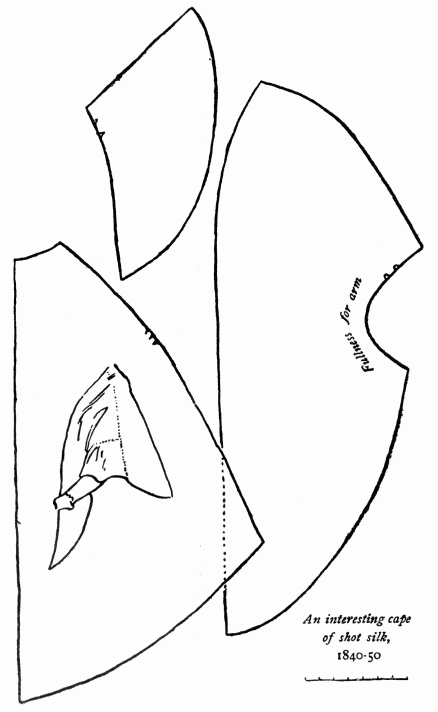
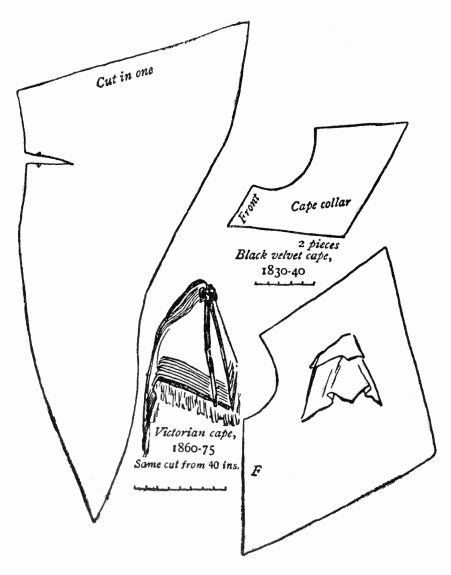
Mantles of a cumbersome type and shot-silk capes with long pointed
fronts were worn, often heavily fringed, the former also being mostly
decorated with braided designs. Large Paisley shawls were much used all
through this reign, besides the cape and hood with its fine tassels
which became very fashionable in the sixties.
Gloves and mittens are seen both long and short, the latter often
beautifully embroidered on the back in the French style. Hand-bags were
often carried, of which examples are given in the plates of a variety of
shapes; the favourite materials for their make were velvets and silks
decorated with bullion, sequins, braids, needlework, and beads, and
these bags were richly set in gilt, silver, or steel mounts.
Parasols were still heavily fringed, and were of the usual shapes. A
very small one was carried in the carriages, and are even seen on the
ladies' driving whips.
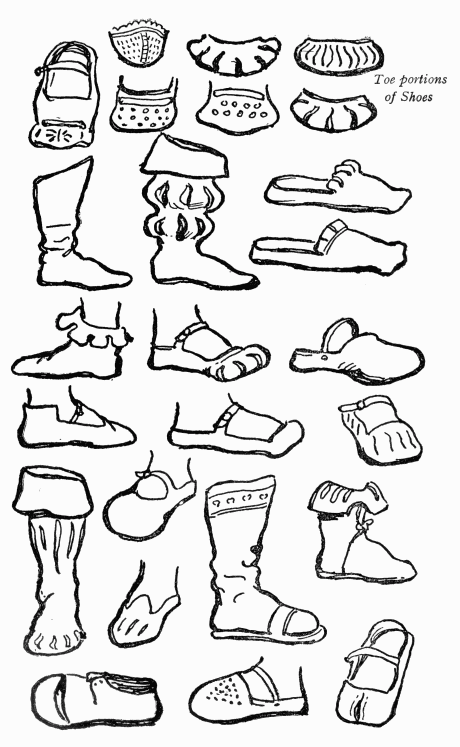
Shoes continued in the same heelless sandal character to the sixties for
evening wear, but from the forties most outdoor shoes had a heel and
large rosettes. With the seventies came round toes with a low round
front and bow, and high shaped heels came to stay till the present day.
Boots of white satin, kid, or coloured silks were chiefly worn till the
seventies, reaching just above the ankle, laced up the inner side, but
many wore elastic sides from the fifties; the toes of these were rather
square, and a toe-cap and front seam was made in many of this type. In
the forties a tight rosette was sometimes placed low down towards the
toes, and later, a huge bow was sewn on the front. High boots buttoned
towards the side and very much shaped, with pointed round toes and high
heels were sometimes laced and finished with a pair of tassels. Spats
were always fashionable through this period.
The same modes of doing the hair remained till the sixties, parted at
one side and worn rather long and waved, with the side whiskers or beard
all round the chin. The side whiskers were allowed to grow long between
fifty-five and seventy, and full beards also became fashionable, while
the hair was parted in the centre from front to back and flattened on
the forehead.
The favourite top-hat still reigned supreme, many of which retained the
tapered top and large curled brim till about 1855, and a bell shape was
frequently seen in the fifties, but the real straight chimney shape was
seen throughout till the eighties, with a rather narrow brim, and often
of white or fawn-coloured cloth. The bowler hat increased in
appreciation, being of a short type, with smallish brim. A short flat
felt hat, with rather straight brim, also came into favour from the
fifties; little round caps and caps with ear-flaps, for travelling, &c.,
were also in general use.
The frock-coat kept the rather tight sleeves and tight waist, and full
square skirt, with back pockets, also a deep lapel, sometimes with a
velvet collar, and small cuffs; a breast-pocket was often placed on the
left side, and in the fifties the type of morning coat with rounded-off
fronts at the skirt appeared, also a small collar and lapel. Square-cut
jackets and tweed suits similar to our present shapes, but heavier in
cut and with braided edges, were much in use. Velvet or fur-trimmed
overcoats, and heavy travelling-coats, also capes and Inverness capes,
were all in vogue.
Waistcoats became buttoned higher in the neck, and the stock-collar was
supplanted in the sixties by a turn-down collar, and small tie or loose
bow; many still affected the black stock and pointed collar to the
seventies, when a high round collar began to appear.
Coloured and fancy waistcoats were much worn till the eighties, and
evening dress was similar to the present cut, with slight differences in
the length of lapels and waistcoat front.
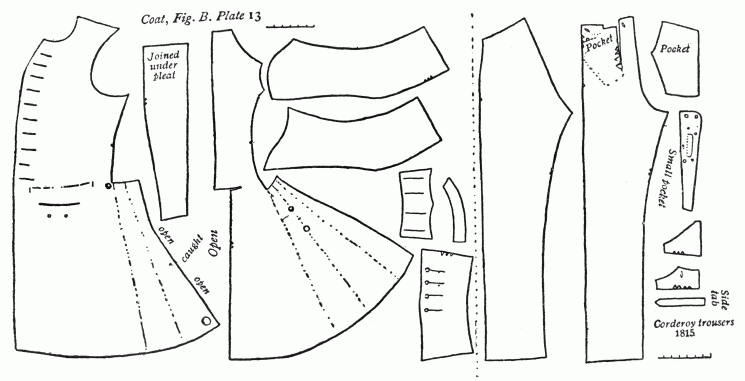
The trousers were made with the front flap till they were buttoned down
the front about 1845, and side pockets became general. Braids may be
noted down the sides in the fifties, and are seen now and then all
through the reign, while large plaids and stripes were highly esteemed.
Short Wellington boots were chiefly preferred up to the sixties, and
trouser-straps and spats were fashionable all through the reign. The
heavier lace-up boot came in during the fifties, and a very shaped type
of fashion appeared in the sixties.
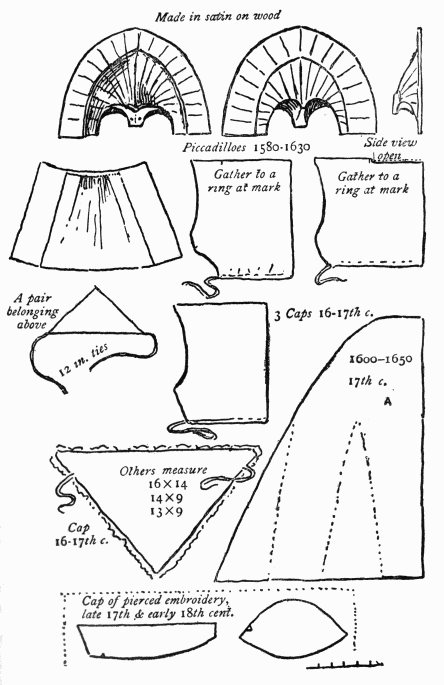
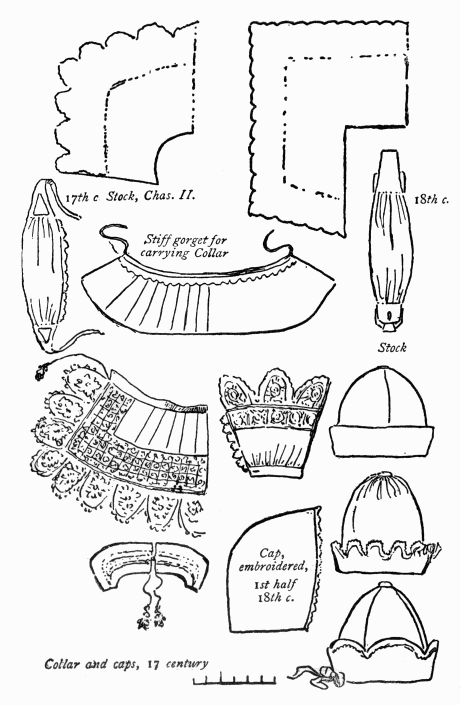
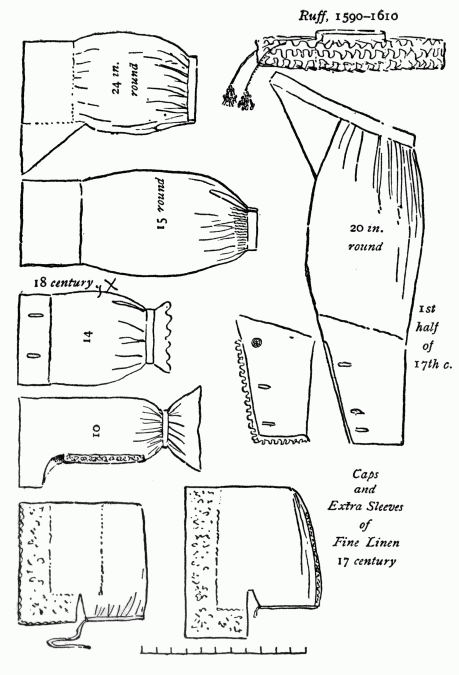
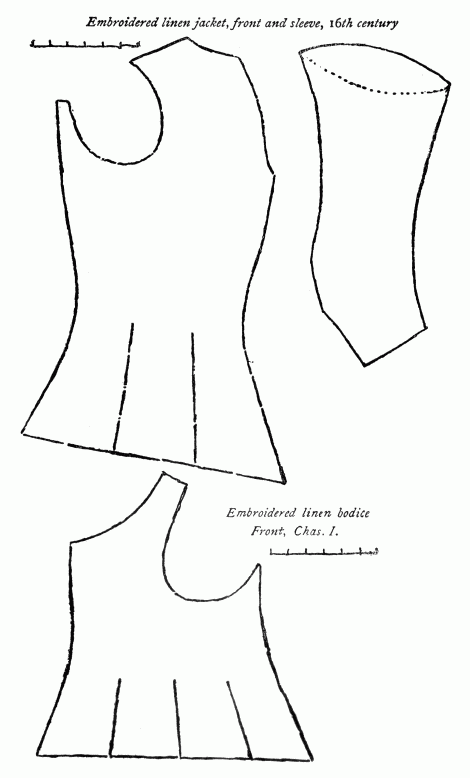
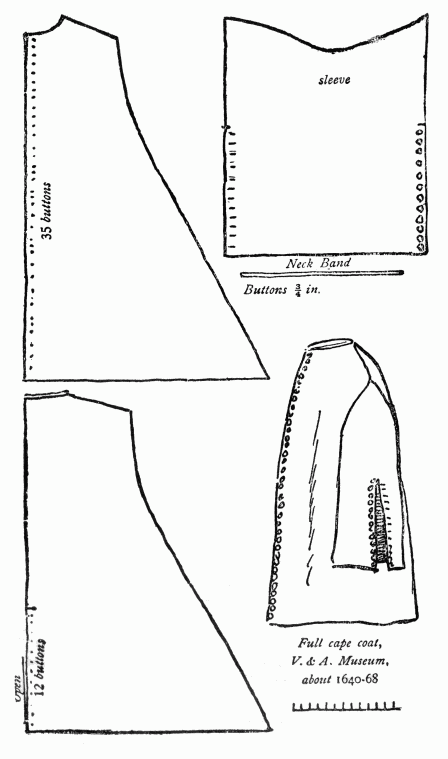
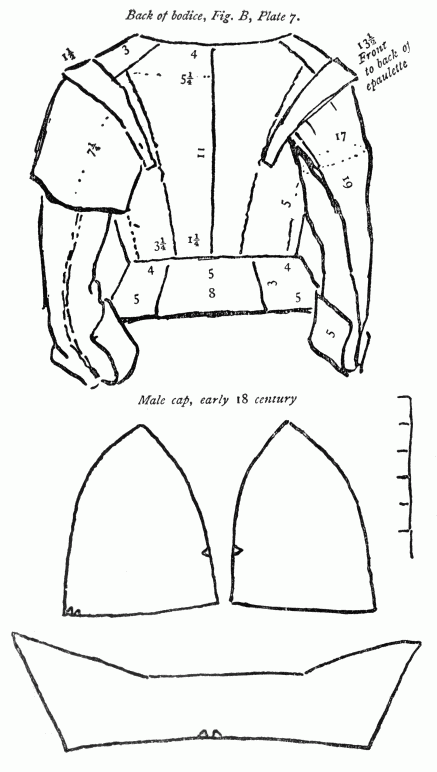
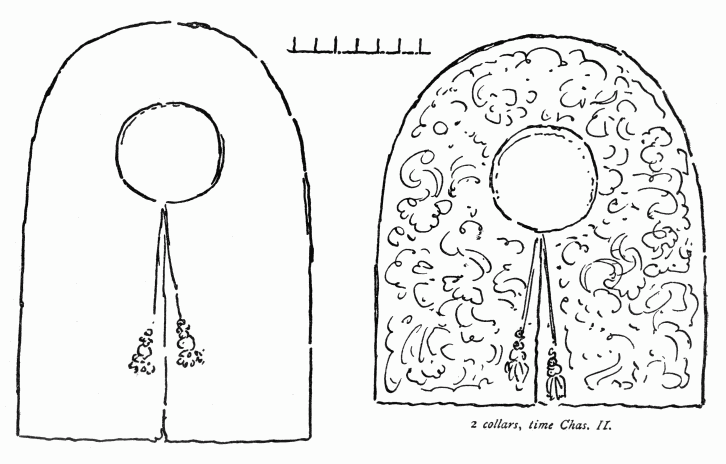
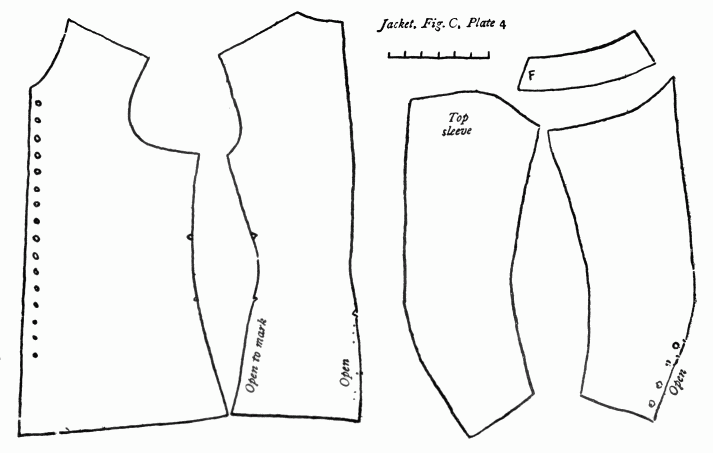
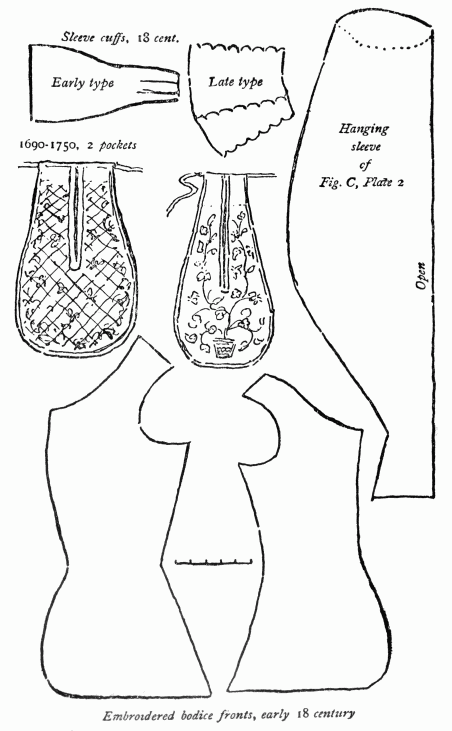
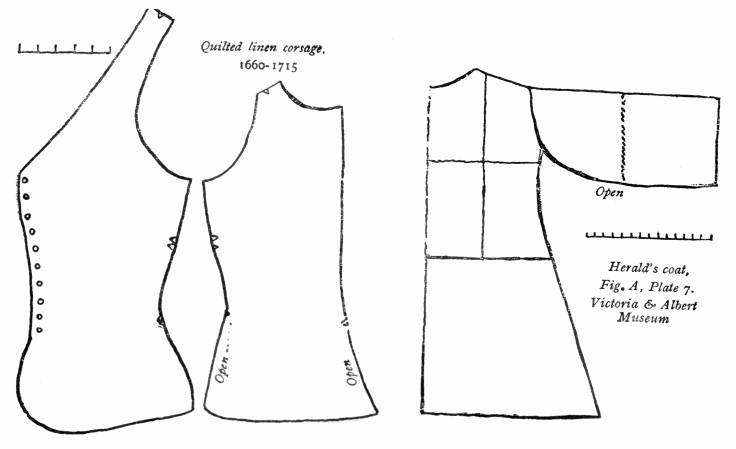
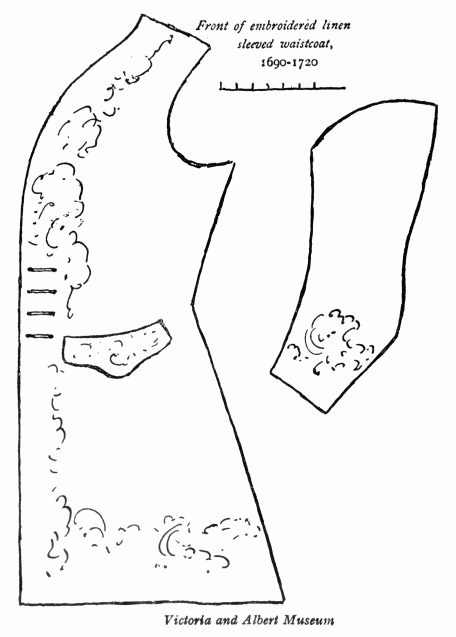
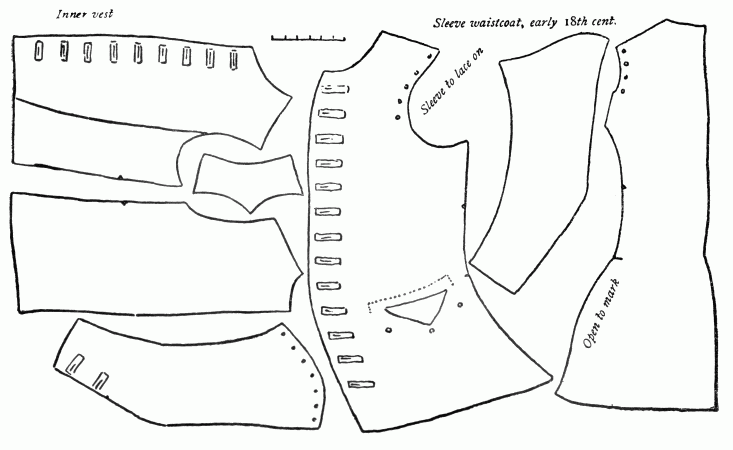
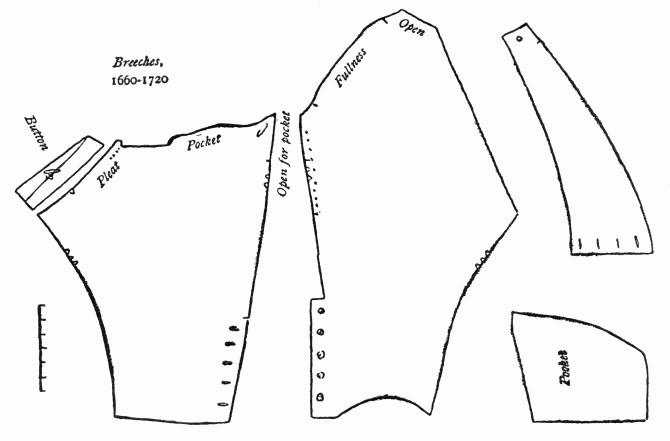
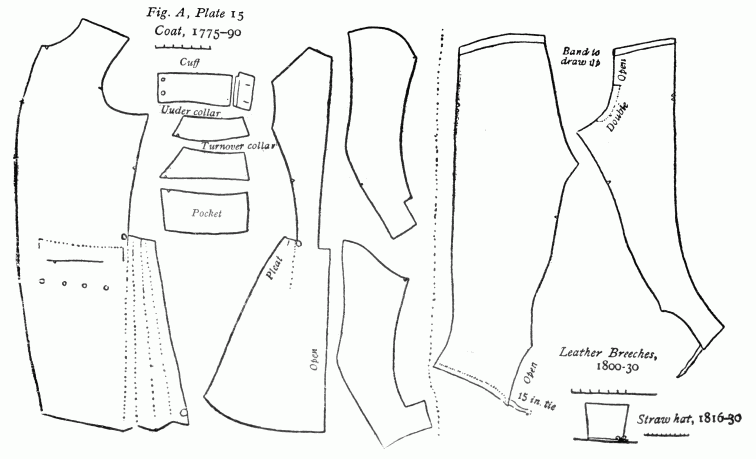
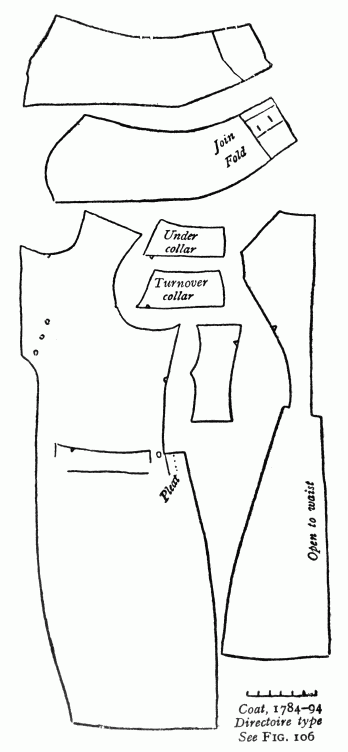
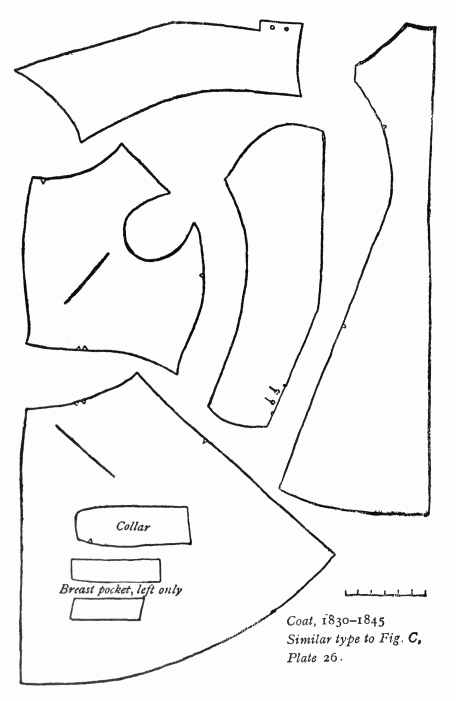
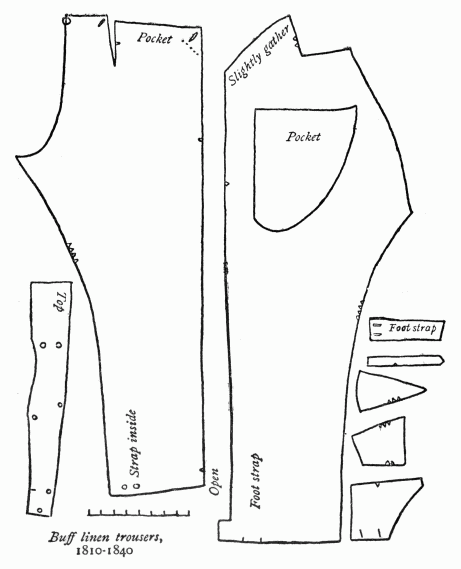
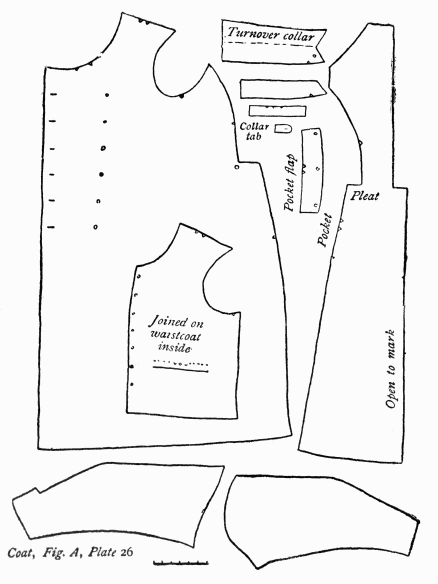
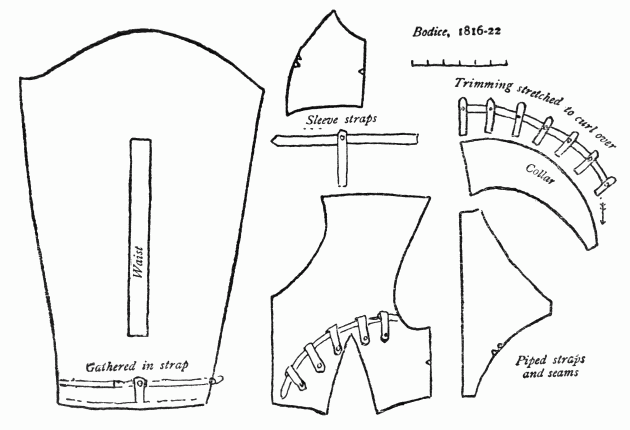
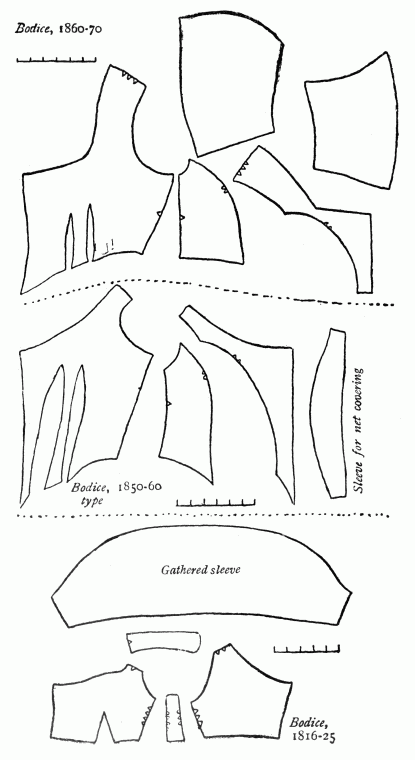
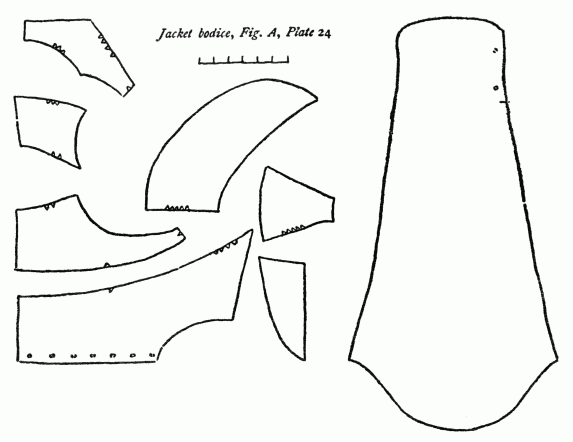
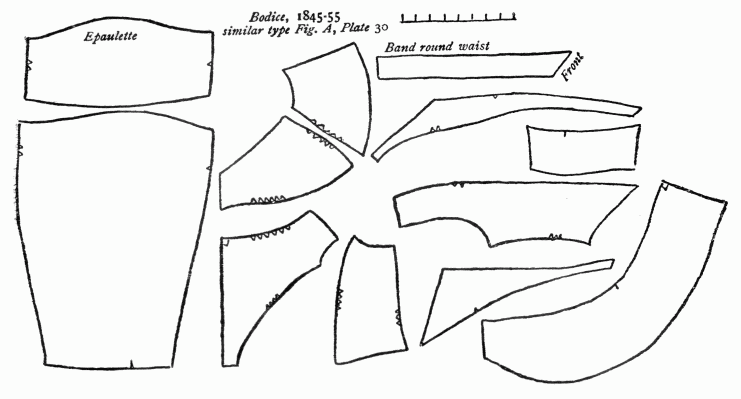
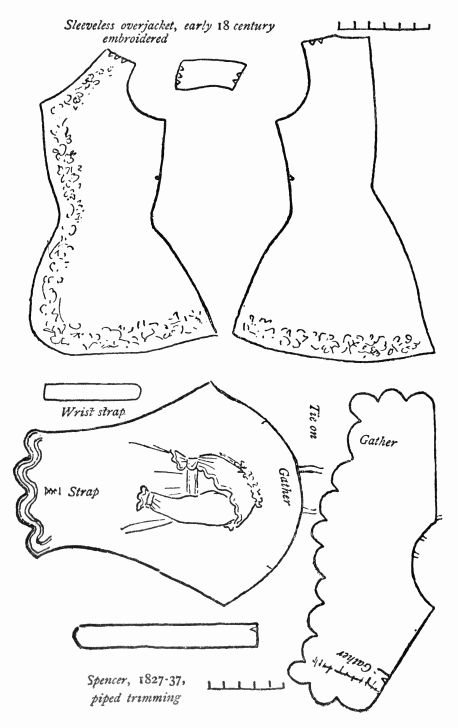
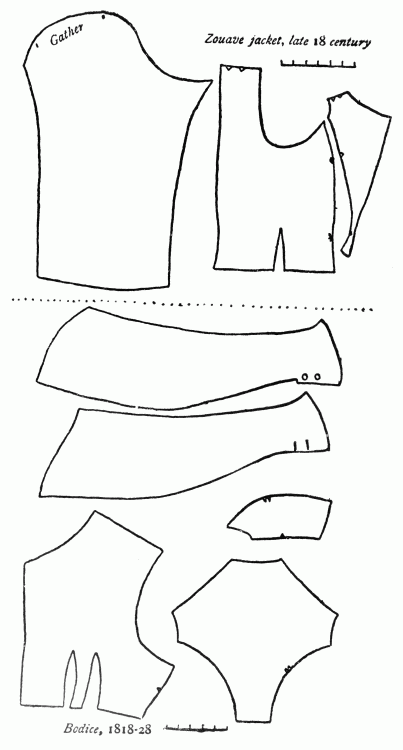
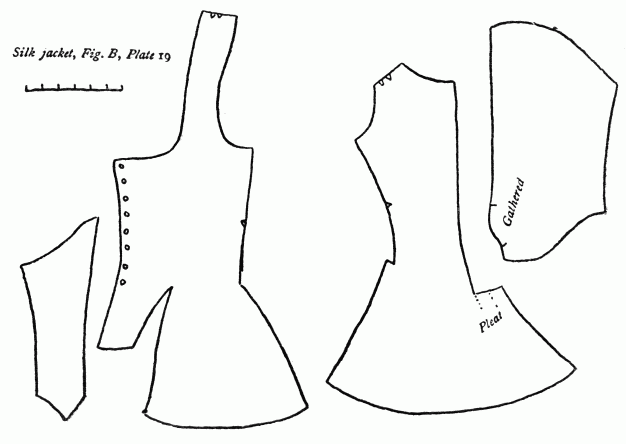
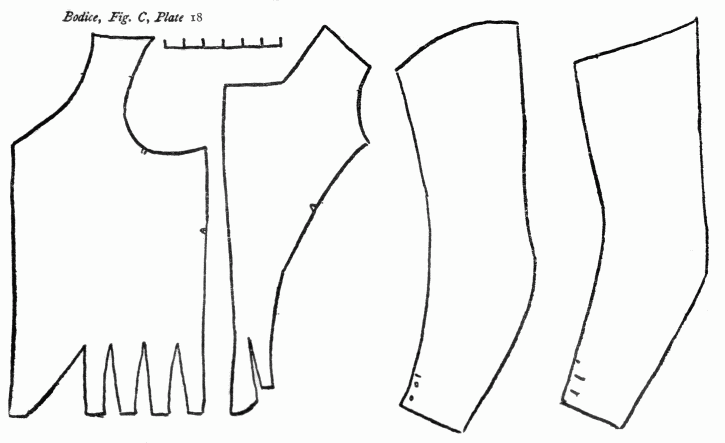
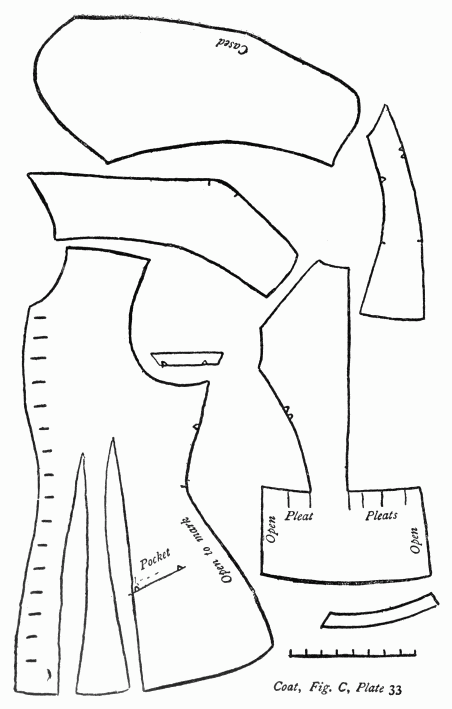
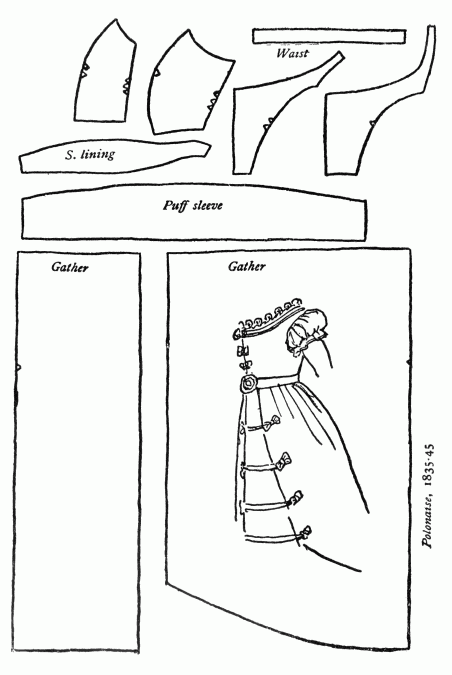
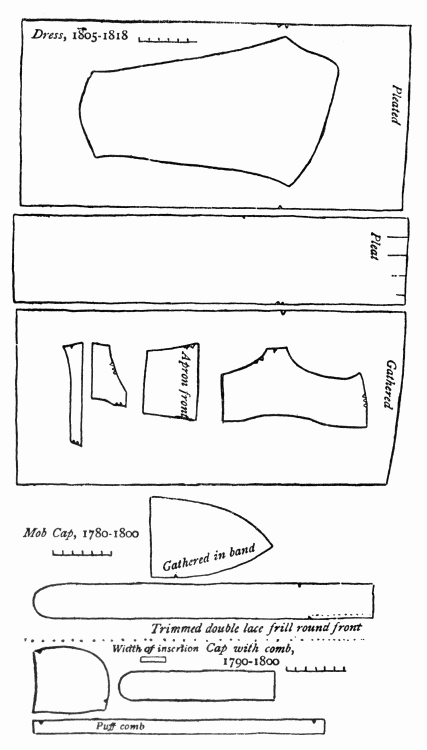
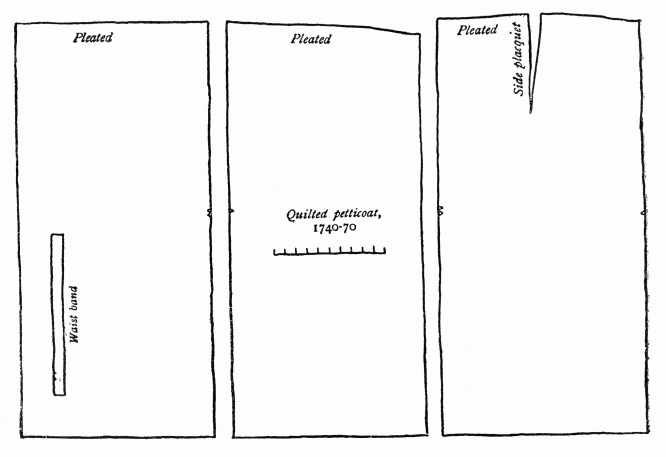
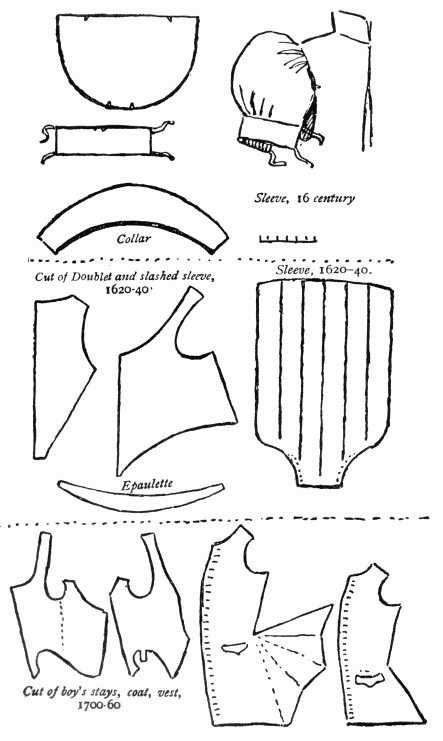
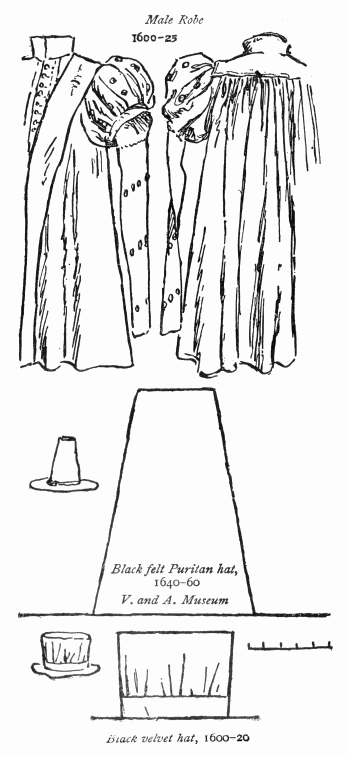
Having now completed the general survey of Costume, the following pages
are given up to the cut and measurements of various antique garments.