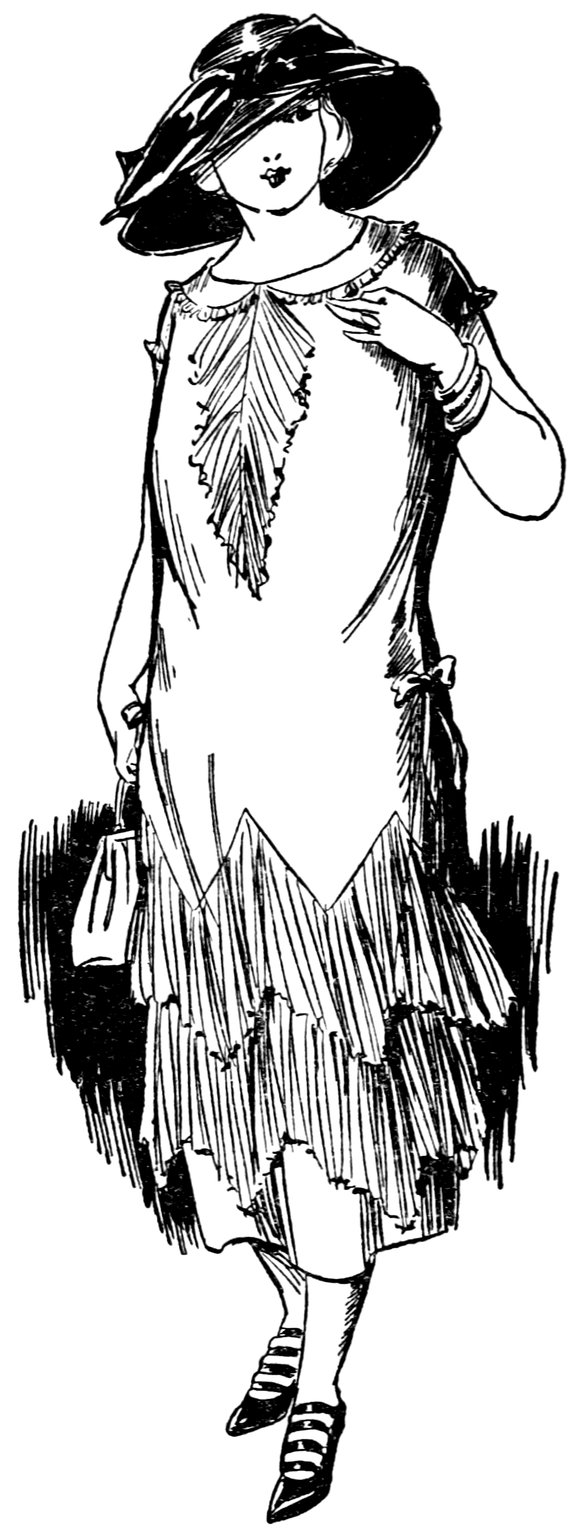
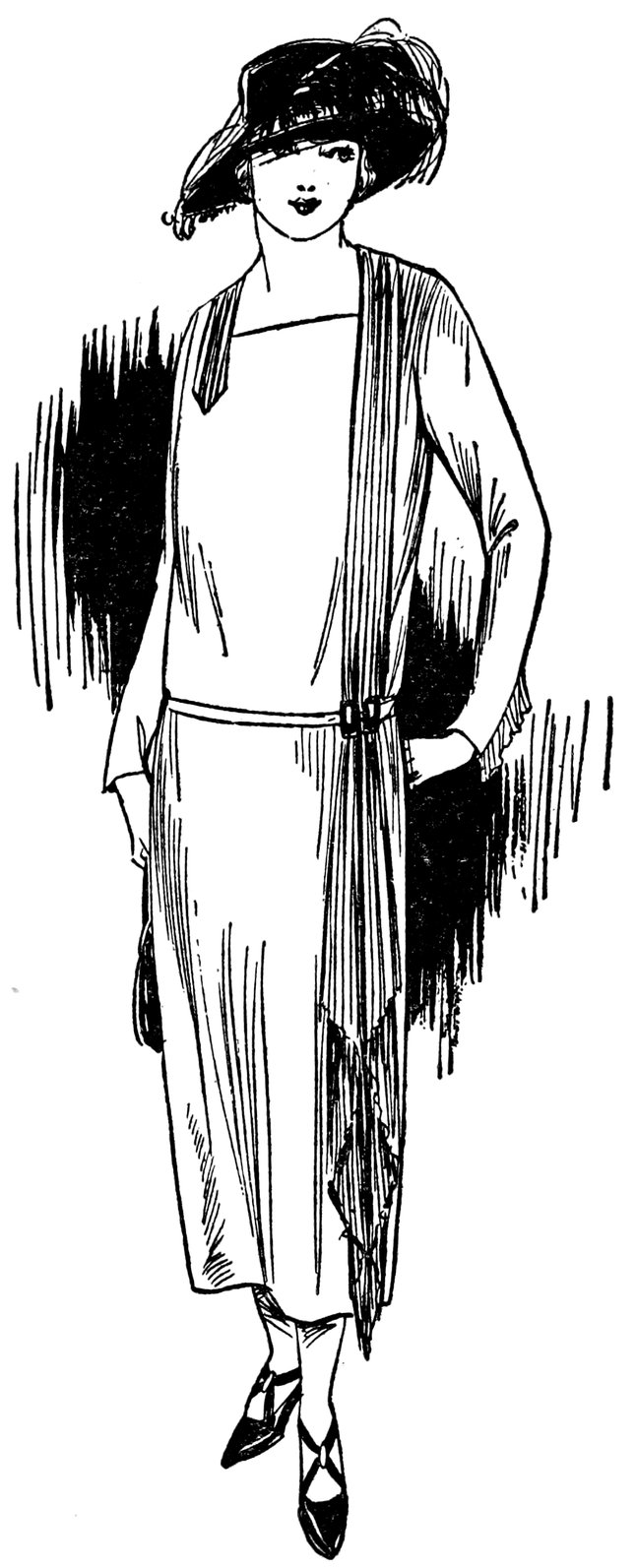
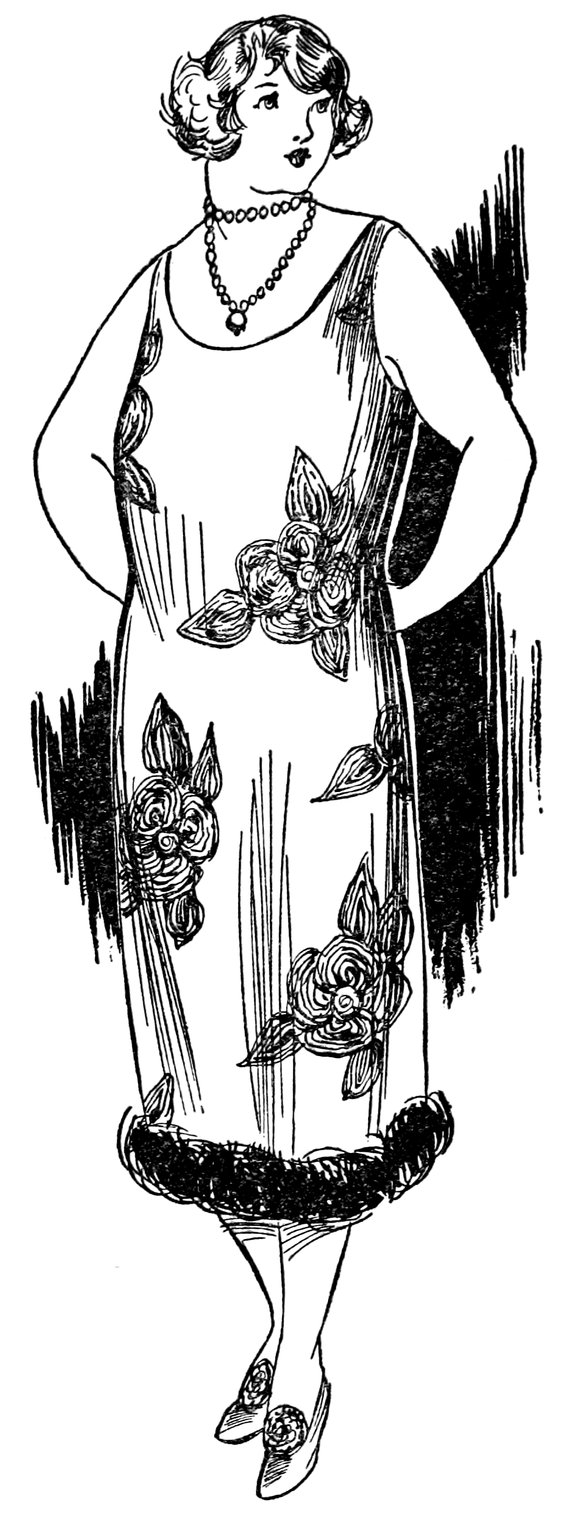
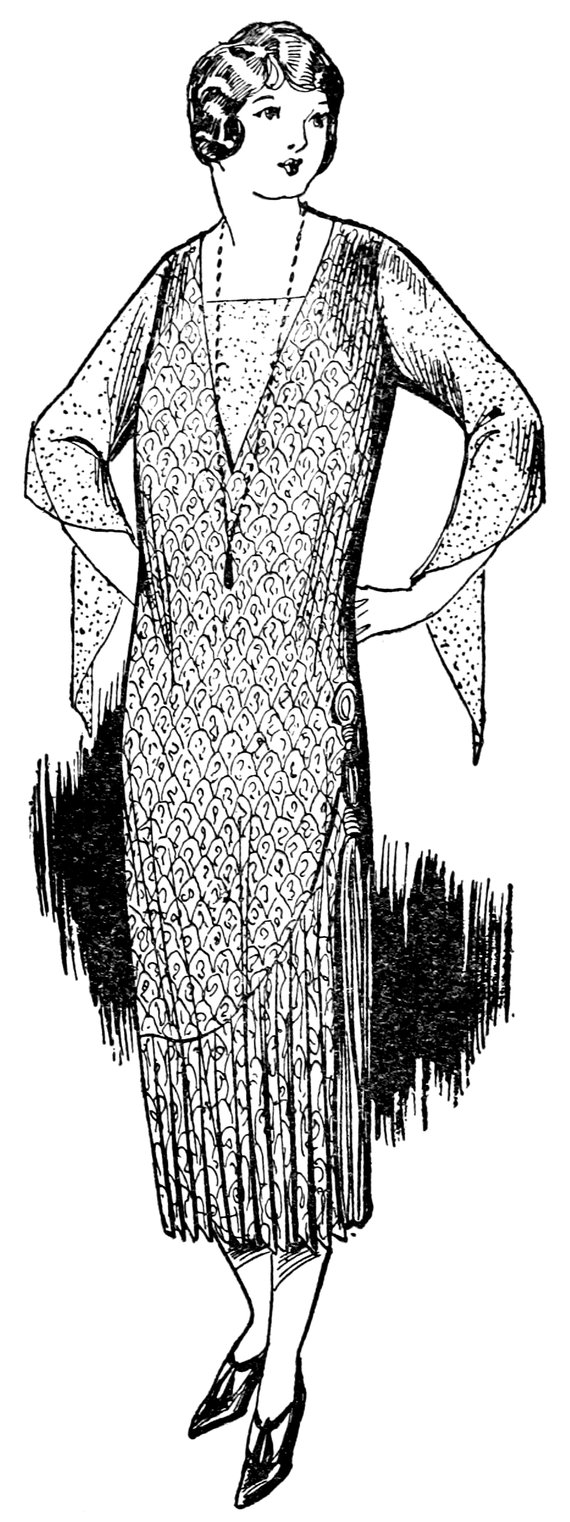
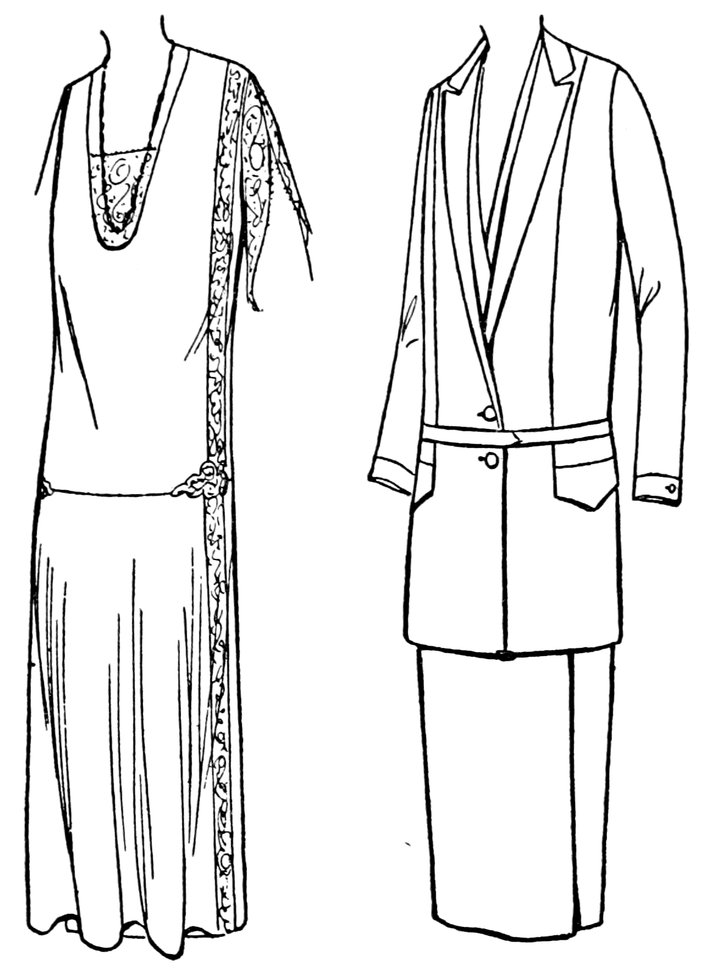
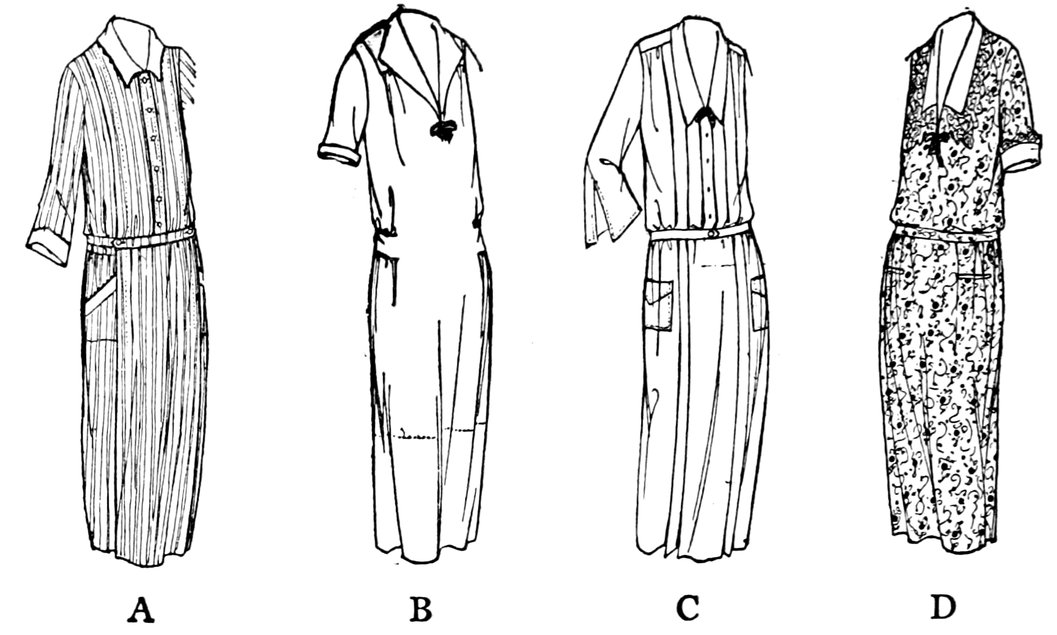
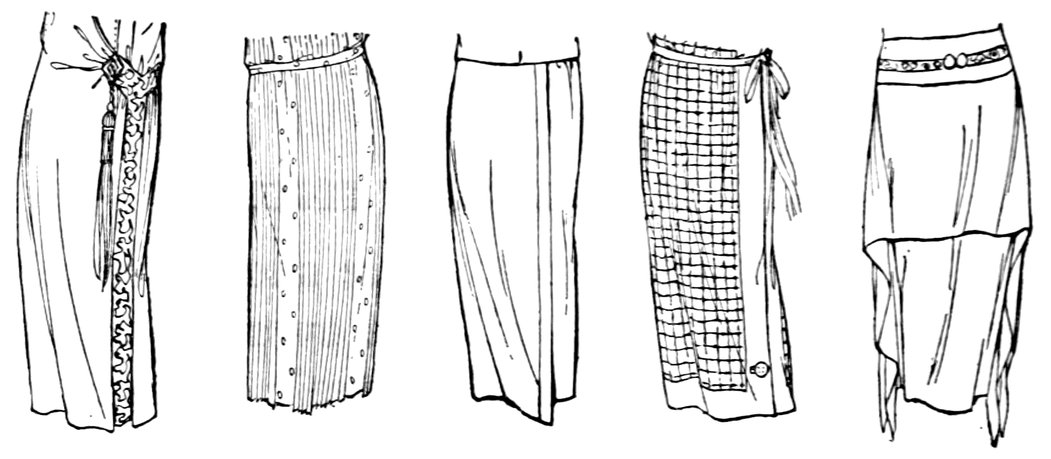
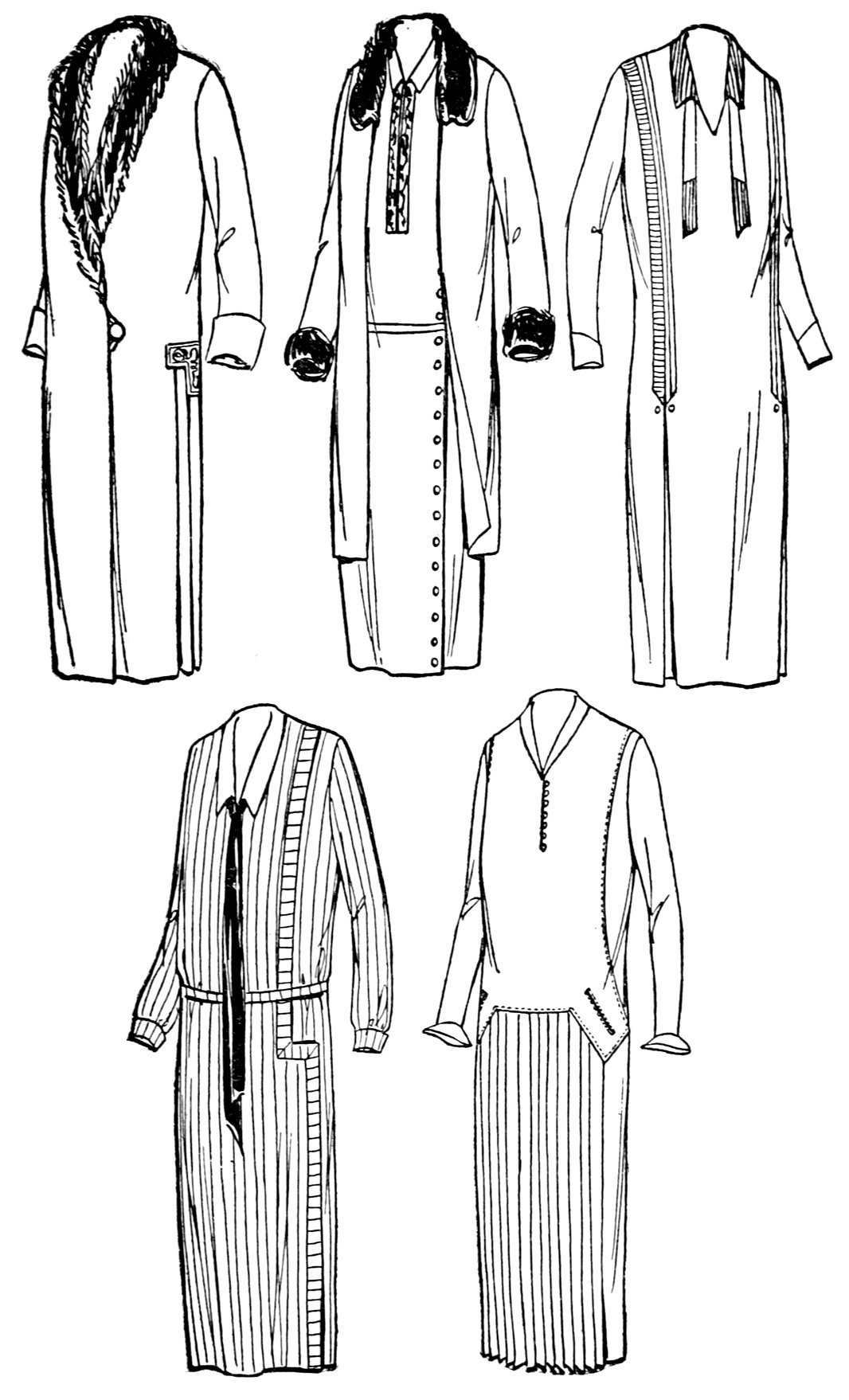
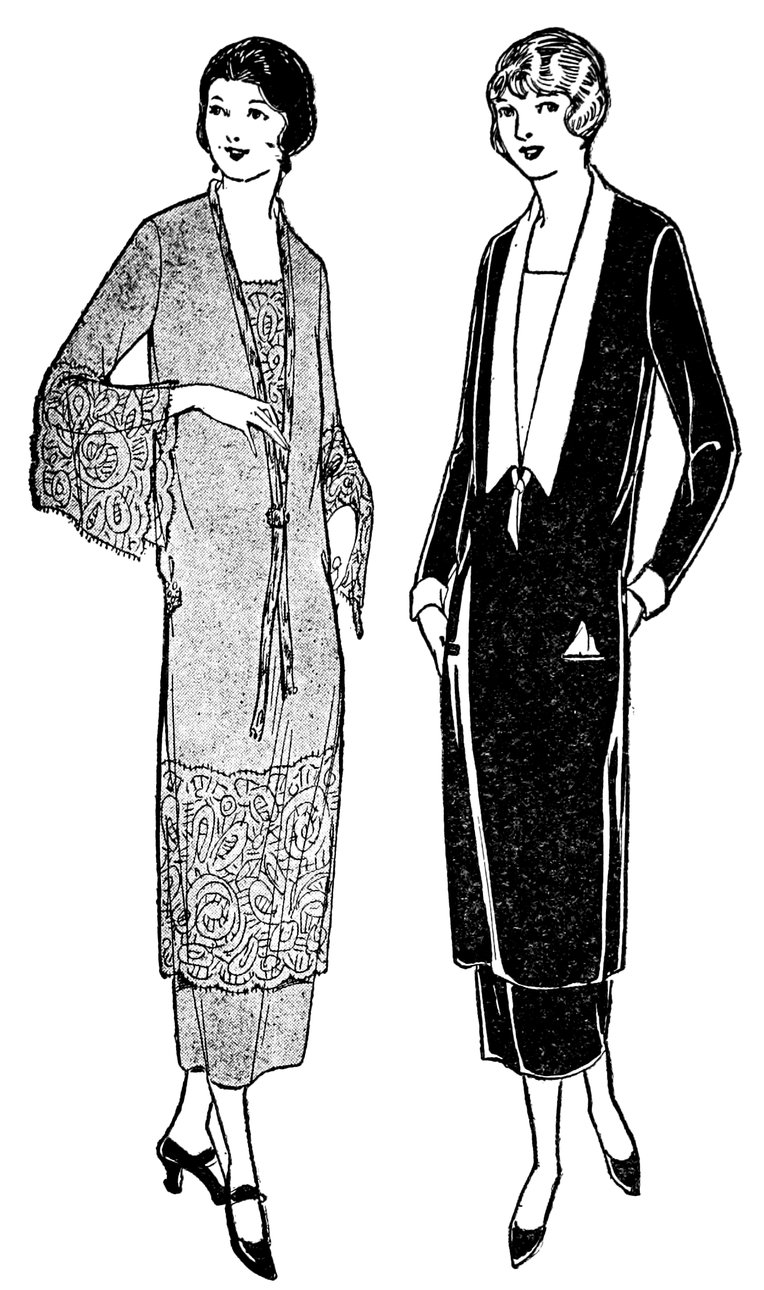
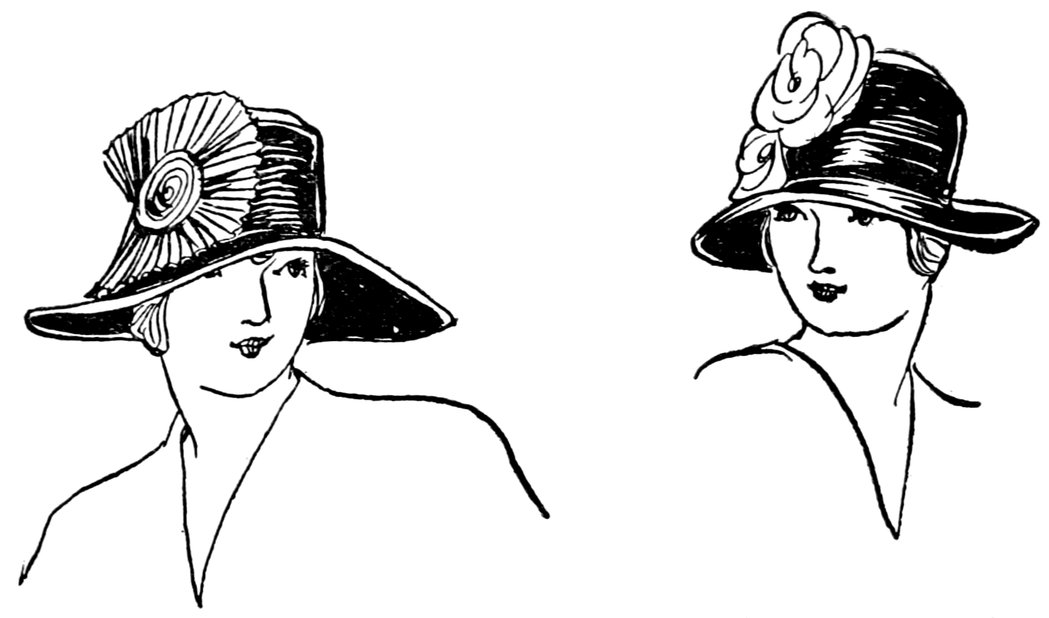
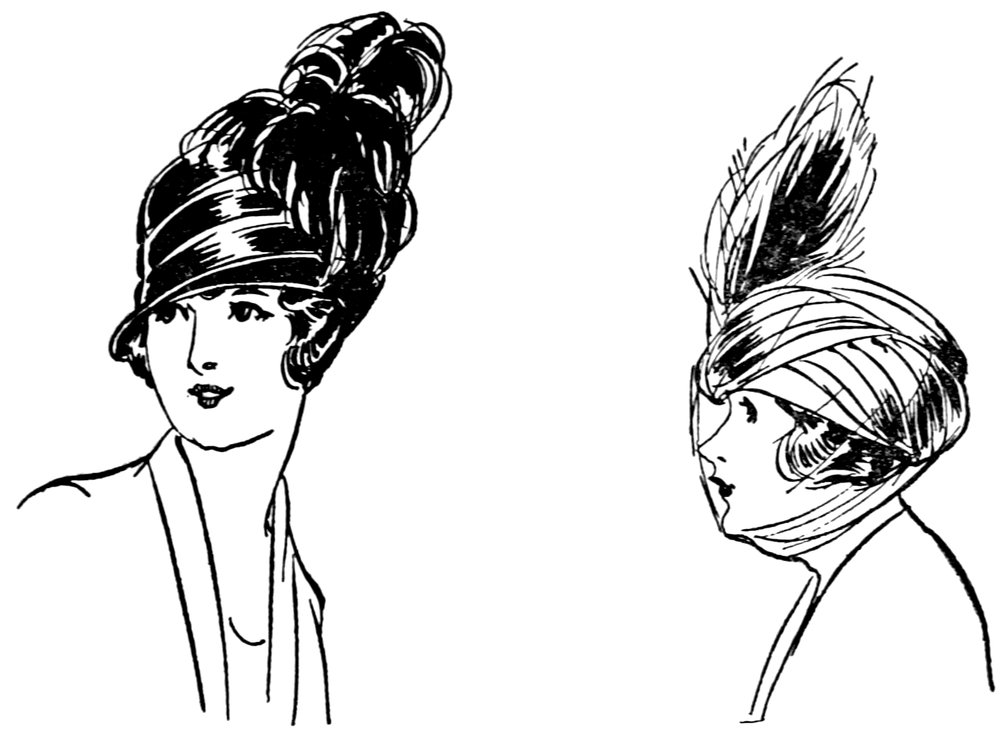
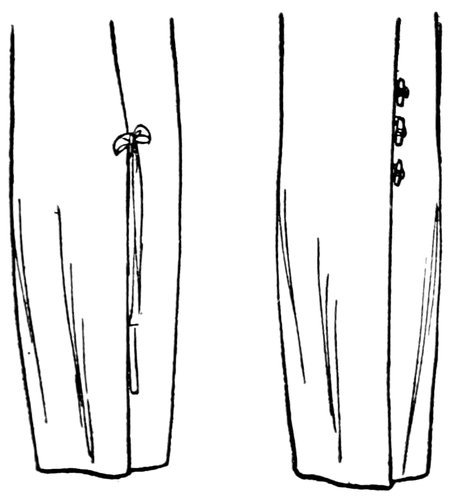
The cover image was created by the transcriber and is placed in the public domain.
BY
JANE WARREN WELLS
PERSONAL ARTS COMPANY
SCRANTON, PENNSYLVANIA
Copyright, 1924
By the Personal Arts Company
All Rights Reserved
International Textbook Press
Scranton, Pa.
FOREWORD
iii
The desire to be attractive, to feel the assurance
that one is correctly if not beautifully
dressed is inherent in every woman. With
the advent of the “slim silhouette” the full
proportioned woman or girl has had a problem.
It is unfashionable to appear over large—and
one cannot help feeling conspicuous
when out of Fashion’s range. But, fortunately,
there is a plan by which the proper
selection of dress can actually aid you in overcoming
the handicap of weight.
There is magic in the principles of “optical
illusion” and rightly applied it is a kind of
magic that one can make a permanent reality.
But magic is subtle. It requires skill, watchfulness,
and a close abiding to the rules if
every “trick” is to be a success.
In reading this book you will find many
things that you are advised not to do, but always
you will find substantial instructions as
to what to do. And always principles are
provided which you can use and adapt to a
great variety of personal needs.
ivOne of the first essentials of teaching is to
start a definite line of thinking, and if the
rules in this book will arouse in you the desire
to compare the points made with illustrations
you see of line and color, both in pictures and
on people, and to test their correctness or incorrectness
for yourself, it will indeed be
worth while.
You, who have started diets and failed with
them, who have tried exercises and become
discouraged, hold to this—read every page
of this book, find the reason back of every
rule and apply the principles laid down. I
guarantee that it will be interesting and that
the results will bring you a renewed assurance,
confidence and satisfaction with your personal
appearance and with yourself. Is that
not enough to commend the book in its entirety?
CHAPTER I WHY WOMEN WANT TO LOOK SLENDER — WHEN FASHION DEMANDS SLENDERNESS AND YOUTHFULNESS — BUSINESS AND SOCIAL LIFE MAKE SLENDERNESS AND YOUTHFULNESS A NECESSITY — MAKING THE MOST OF YOUR GOOD POINTS
1
If there is any one thing in the world that
is not wanted it is too much fat on a woman.
In my whole lifetime I have heard only one
overweight woman say she would not be thin
if she could. I have always regretted that I
did not ask her why.
Before I tipped the scales so definitely myself,
I paid little attention to the problems of
the big woman, for of course I was not vitally
interested in weight reduction or size concealment.
But when I found my own clothes not
meeting and the children in the family saying
I was getting fat, I began to take notice. I must
have read fifty-odd advertisements on “How
To Get Thin,” and I was hopeful of some of
the methods. We almost had to move from
a duplex house because I did exercises to
music and the neighbors could not sleep. I
2ate “woe-be-gone” bread. I even tried to
melt away in reducing corsets but almost took
the skin with them when I tried to get them
off. I read every book I could find on “What
To Eat” and “What Not To Eat,” and I lost
three good cooks in my efforts to reduce the
menu to a get-thin basis.
A prominent actress gave me a prescription
for reducing. Her husband, on finding
it out, came rushing to see me to tell me that
the prescription was for a drug and that his
wife in her eagerness to keep within bounds
demanded by the stage had indulged only to
become a hopeless addict.
Then I went to my physician and told him
I was tired of bruising myself with rolling,
my fear would not allow me to take drugs
and I would have to leave home if I persisted
in the diet. I begged him to give me something
to remove the excess of thirty pounds
and he promptly refused, pointing out to me
the illnesses and other bad effects that could
come from abnormal or unnatural reduction.
He explained that he could give me something
that would take off the fat but that it
would age the tissues of the body ten to fifteen
years. And youth is something that
3every woman wants to keep, no matter what
her weight.
He explained the thyroid theory but refused
to give me an ounce of the preparation
for my relief and very frankly told me to forget
my weight and enjoy the good health that
I evidenced. I left his office crestfallen and
disappointed, thinking that if he only knew
how much the heavy woman wants to appear
thin enough to wear smart clothes, if he could
only know how she actually longs for the
lovely things that fashion creates for the slender
types, he would be more sympathetic.
But he is a very sane and sensible man and all
my appeals had no effect.
However, when my friends continued to
say, “My, I believe you’re getting fat” instead
of “How stunning you look,” I realized
how necessary it was for me to persist in my
determination to dispose of the thirty extra
pounds and at the same time indulge my appreciation
for pretty things which is the right
of every woman, fat or thin.
I found my clothes problem daily growing
more serious. Several times I purchased a
new dress and after one wearing I would discard
it because I looked heavier and older
4than I wanted to look. The problem was
becoming increasingly difficult because each
time I stepped upon the scales, I would invariably
see recorded two or three pounds
more than last time. I am sure that many of
you have meekly slipped off the scales, as I
have, scarcely waiting long enough to see
what weight was actually registered, praying
meanwhile that no one saw where the arrow
pointed. I simply could not believe the
scales were right, because before each weighing
I was certain within myself that I had
climbed enough stairs, done without enough
candy, and touched my hands to the floor
often enough to be at least three pounds
lighter.
About this time an inspiration came to me.
I would “get even” with my slender friends.
If I could not safely reduce, I would at least
give the appearance of having reduced. If
I could not actually take off thirty pounds, I
would make myself look thirty pounds lighter
in the eyes of others.
And, after all, is that not what we are most
concerned about? Plumpness is more often
a sign of good health than bad. We could
be supremely happy with our extra weight if
5only we could look slender. I recalled the
advice of my physician to “go home and enjoy
my good health.”
So I started on my campaign to lose thirty
pounds in appearance. I did it and so quickly
that my friends were amazed at the sudden
change. I was congratulated on my success
in reducing. I was told I had never looked
so well. Friends persistently asked me what
method of reducing I had followed. In fact
the success of my plans has been so remarkable
that I do want every overweight woman
to know about them. And so into this book
I am putting the whole story.
We are all slaves to fashion. For many,
many years it was the fashion to be plump.
Venus herself was not slender, but well
rounded and full of figure. Our mothers
wore bustles, and bust ruffles if they needed
them, but as for us, well, it is the fashion to
look slender, and since it is, we must strive to
keep within the dictates of the mode.
My own work is fashion work. I meet
hundreds of fashion folks. The slender silhouette
6has been promoted, applauded, appreciated
for years, and as the days and
months went by and the youthful outline grew
more important, more prominent, I began to
realize what a handicap the stout woman was
under in trying to find attractive clothes. I
felt like an Eskimo on a summer’s day on
Fifth Avenue. To go into a smart shop to
buy a new dress only to be looked over and
directed to the matron’s department or that
of the stylish stouts was too much for my
pride. I wasn’t willing to put myself in the
out-of-fashion class and appear heavy and
elderly wearing fronts and vests that had
written all over them, “built especially for
a stout.”
Frequently fashion magazines show suggestions
for “length lines”—but they seem to
assume that all overweight women must look
matronly. Two, in particular, that I remember
showed the effect of incorrect crosswise
lines and of correct lengthwise lines. I studied
them carefully for information and decided
that I would prefer to look round and
thirty, than straight up and down and sixty.
Every one of the models, though satisfactory
in design, added 20 to 30 years to the apparent
7age of the wearer, doing nothing to overcome
one of the most dangerous things
with which the stout has to contend. For although
no dignified woman wants to look
like a sixteen-year-old overgrown Susie, still
she does want to look young, modish, and correctly
dressed, and no woman is rightly
dressed who by her clothes adds even one
year to her age.
However, I now know that it is possible
for every woman, whether she is only slightly
too plump in certain places, or decidedly
overweight, to make herself look smart, slender,
and many years younger by studying certain
vital rules of dress and adhering to them
in planning her wardrobe.
Women, young, mature, or elderly, at home
or in business, must always try to look their
best. They must be so pleasingly and so correctly
dressed as always to evidence good
taste, for good taste, after all, is the only real
authority in dress. Without it, dress loses
all its power of charm or influence. Especially
is this true for women in public life.
8The solo singer in the church, the leader of
the club or mothers’ meeting, the social
worker or politician, all must give evidence
of good taste and be modestly and correctly
attired if they are to gain favorable criticism.
No woman who sings should ever allow it to
be said of her, “I adored the song, but the
singer’s hat annoyed me so that I could not
listen.”
A woman’s clothes should be beautifully
alluring and complimentary. This is woman’s
heritage, and any woman who allows
her lack of knowledge to make her unhappy
or unpleasing to see has only herself to blame,
for it doesn’t take money. It does take information,
ingenuity, and a little energy. But
oh, how worth while the result will be!
Sometimes we women of over 36 bust become
discouraged. There is really no reason
for this because most of us have a great many
good points that we simply do not use to the
best of our advantage. We worry so unnecessarily
about our bad points that we forget
about the good ones, but there is much that
we can do with little or no effort and the improvement
9in our appearance is its own reward.
For instance, most big people have nice
hair, and they should keep it. Any big woman
who bobs her hair and leaves it that way
hasn’t eyed herself sufficiently in her mirror.
From her neck up she may look ten years
younger, but from the neck down she probably
looks ridiculous. For one of the chief
rules for good looks is right balance, poise,
and dignity. So why do anything to hinder
these? You have one handicap—too many
pounds. You must do everything you can,
therefore, to retain every possible attraction,
and your hair is one of them for it suggests
womanliness.
We don’t want our friends to say that we
have a great “mother lap” or a shoulder of
Gibraltar to weep on, but we must set out to
be substantial in thought, act, and deed to be
attractive. A little slim girl can giggle and
be silly if she wants to—she can even wear
mussed up dresses—but a big girl must be
modest, and always immaculate in every particular.
And why not? It’s an effort, yes,
to be always striving for perfection, but it can
be made a real hobby. Study the attractive
slender girl who looks well and dresses well.
10Adapt what you can of her attire. Oftentimes,
you can learn more of the “trick” from
the slim looking girl than from the stout.
As you go through fashion books, don’t discredit
all the styles and say they are planned
only for the slim. Study them carefully, find
a collar from one and waist line from another,
fabric suggestions from another. Dress to be
fashionable, but learn to discriminate so that
you can find the best for you in the new.
Sometimes I have thought what fun it
would be if we big folks could dress up and
reach a point of perfection—so much so that
the artist would have to get a more flexible
pencil to express the varying grace of line
that would be manifest. And why not? Isn’t
it our own fault if fashion forgets us? We
deserve to be dowdy if we haven’t enough
pride, ingenuity, and perseverance to conceal
intelligently and comfortably a few extra
pounds.
If you are tall and large but not fat, consider
yourself a full well-proportioned figure
and dress correctly but in plain good quality
fabrics so that neither height nor width will
be accentuated.
Don’t try to fool yourself by wearing
11clothes that are too small for you. It is said
that fat men need the best tailors, and surely
all large women should strive to have perfect
fitting clothes.
When I was fourteen I wore on a special
Sunday a long skirt and a bustle, thinking
that it was better to look eighteen and “ladylike”
than fourteen and overgrown. Don’t
look overgrown in your clothes, but don’t ever
make yourself any older than you are.
If your ankles are large, have your dresses
a wee bit longer than fashion calls for. If
your ankles are small and the legs large above
the ankle, have your dress slightly long for
the same reason. If the legs and ankles are
correctly proportioned for the rest of the
body, remember that even you need to have
the skirt just a little bit longer because when
you sit down you take up some of the skirt
length. A fat woman sitting down with a
dress that is too short is not pleasing to see—and
we big women do love to sit down.
And in speaking of sitting down, a sanitary
apron is a real protection to the backs of big
folks’ dresses as it prevents wrinkling. Buy
one, try it, and you will realize that the back
of your dress looks much better after you get
12up from a two-hour sitting. And, besides,
you can console yourself with the fact that if
perspiration really reduces, your apron is
serving you twofold—melting the fat and preventing
skirt wrinkles all at the same time.
Don’t ever be tempted to wear frills, ruffles,
tassels, or ornaments that go forward or wave
about as you walk. They double your size
every time and must be avoided.
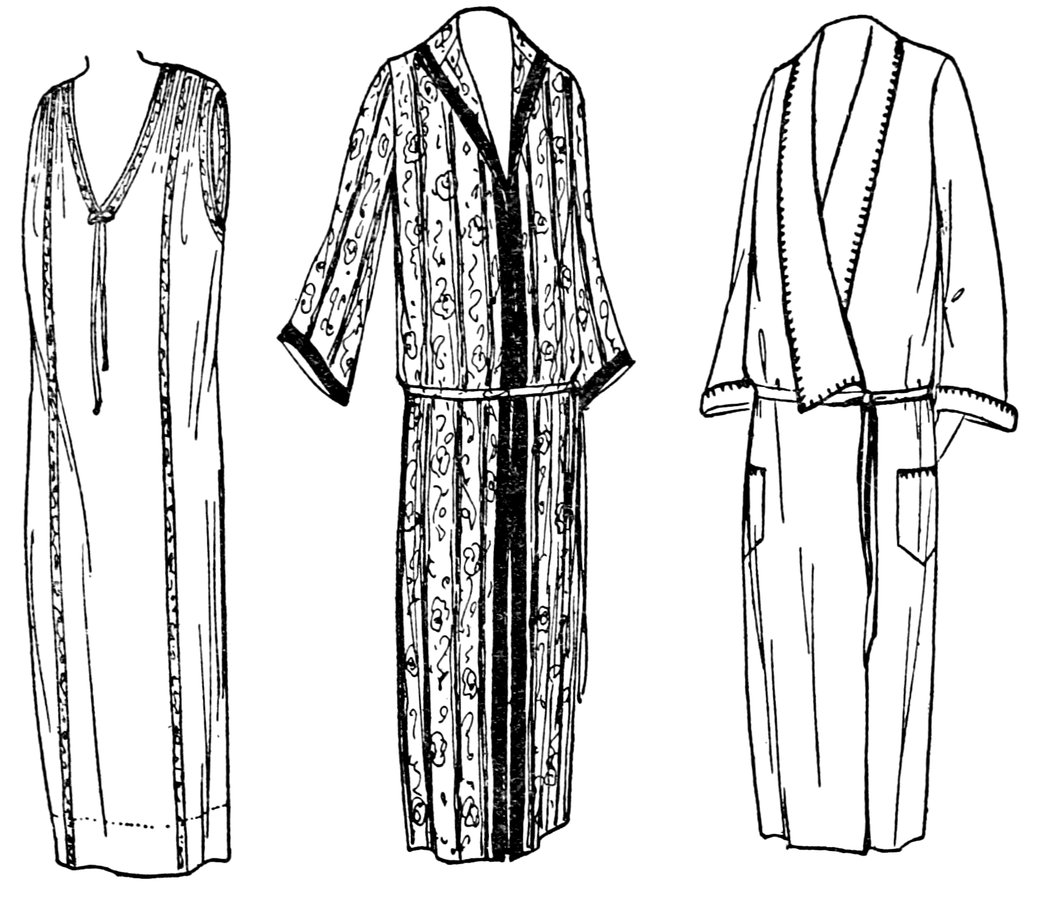
A good plan for those of us who like ruffles,
frills, and bright colors is to put them on our
night clothes where no one but our very own
selves can see.
The house, too, lends opportunity for our
color appetites and there we may use color
freely and safely. But because we love red,
orange, or King’s blue is no sign we must
wear it on our backs for all to see. Buy a
little piece of fabric with just the colors you
revel in; put it in the dresser drawer, or let it
ornament a chair back, look at it every day,
and thus satisfy your longing for color. Then
wear those very simple things that you know
will be becoming.
One woman whom I know and who looks
like a fashion plate in the day time and like
a dream lady at night, always gets everything
13together on the bed before she starts to dress.
She insists that it takes only a little longer to
do this, that it saves time when she does get
ready to dress, and that she is always better
satisfied with the results. She says, “I know
then that I have the right slip, the right stockings,
that my gloves are suitable, and that
there are no holes that need attention. In
putting them on the bed, I always make all
the little repairs that are necessary and do all
the brushing or freshening that is needed;
then when I am ready to dress I feel a sense
of satisfaction that I can find in no other
way.”
And so, why don’t you, who are striving to
express yourself more beautifully, to dress
with more satisfaction and peace of mind, try
this simple little plan of thinking about what
you are going to wear and getting it ready before
you start to dress? Then, watching
always what you see in your mirror, your
fashion books, on the streets, and in the shops,
you will find that which is appropriate, becoming,
and wholly lovely for you.
And to these material fundamentals, add
your own wholesome pride. Don’t cheat
yourself or those who must see you. Don’t
14be dowdy. Life is too short and too real for
that. Learn to be proud of yourself and
dress so that even you will feel a sense of
security and assurance. After all, we can be
rather selfish about just looking right. Other
folks are glad to see us in pretty clothes—looking
our best. A right hat, a right dress,
correctly worn, can really do wonders as a
tonic. Try it. It really is a good prescription.
CHAPTER II THE REAL SECRET OF DRESSING TO LOOK SLENDER — OPTICAL ILLUSIONS—SEEING IS BELIEVING — LINES THAT SLENDERIZE AND LINES THAT DON’T — A SIMPLE TRICK THAT TAKES OFF TWENTY POUNDS — MAKING YOURSELF TALLER THAN YOU ARE — LINES THAT SLENDERIZE TUNICS — APPLY THESE RULES TO EVERY ITEM OF YOUR ATTIRE — SECRETS EVEN THE SLENDER WOMAN MUST KNOW
15
“Reducing”—by no matter what method—is
too often a snare and a delusion; for even
if, after all your efforts, you do lose some
weight, a little indiscretion in your clothes
will make you look as stout as ever.
How to select clothes that are certain to
make you look slender is the most important
knowledge a modern woman can have. Surely
it is the most important art in the whole field
of fashion. And yet, many designers of clothes
for stout women do not understand its very
cardinal principles. Of course, they do design
so-called “slenderizing stouts”—but you
know, perhaps all too well, what they look
like. Their long surplice effects and drab
colors say as plainly as words, “I am designed
for a stout” and nine times out of ten they
simply call attention to your stoutness. Besides
they are for matronly women—not for
those who want to look young and smart. It
seems practically impossible to get youthful
16and appropriate clothes for women who wear
sizes over 38. Yet it may be only necessary
to change a neckline or remove an ornament
or alter the line of a sleeve in order to transform
a “dumpy fat woman’s dress” into a
model of slender grace and youthful charm.
The whole art rests upon a certain scientific
principle known to artists and a few expert
designers. It is called the Principle of Optical
Illusion, by which things appear to the
eye to be different than they really are. By
understanding and properly using this principle,
objects may be made to appear larger
or smaller, taller or shorter. And by employing
this principle in dress any woman
can be made to look older or younger, shorter
or taller, stouter or slenderer than she actually
is.
For example, just as white shoes make
large feet look much larger, so do certain
lines and colors make a large figure look a
great deal larger, while correct lines and colors
and subtle touches give the effect of slenderness,
youth and grace.
Every stout woman has, some time in her
experience, come by chance upon a dress
which seemed to make her look more slender
17and younger, and she has worn and worn that
dress almost to shreds, hating to part with it
because there was no telling when she would
find another one to give that same effect.
But there is no reason why you should trust
to chance in selecting becoming clothes. For
if you know this simple yet all important
principle of optical illusion, you can plan or
make or select every item of your wardrobe
with the certain knowledge that it will have
a slenderizing effect on your appearance.
You can know beforehand that every dress,
every coat, every hat, every garment you wear
will be designed to give you height instead
of width, youth instead of matronliness, slenderness
and grace instead of heaviness. It
doesn’t matter whether you buy your clothes
ready made, have them made by a dressmaker,
or make them yourself—you can
always know just what to select to make your
particular type of figure look as slim and well
proportioned as possible.
18
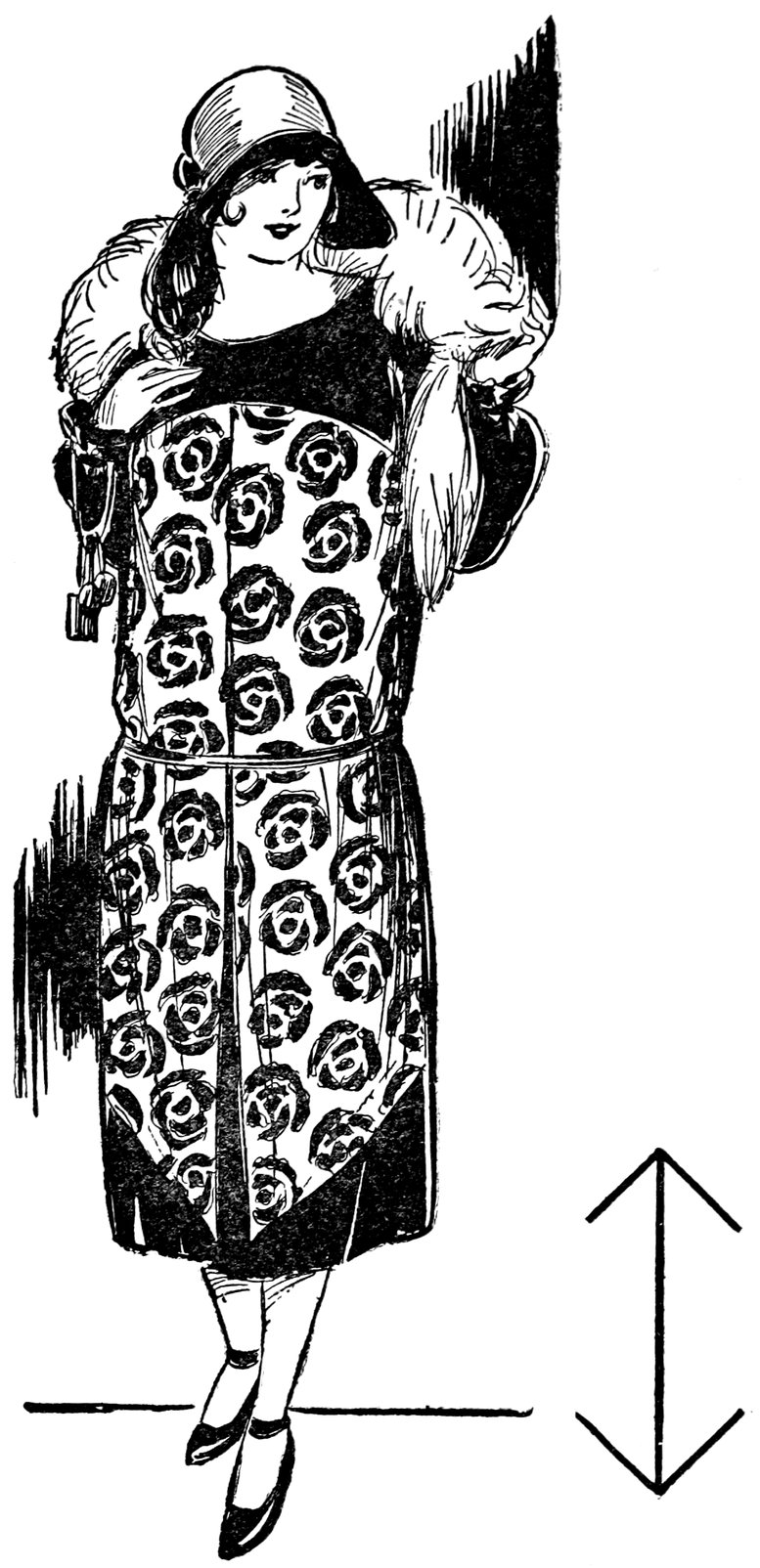
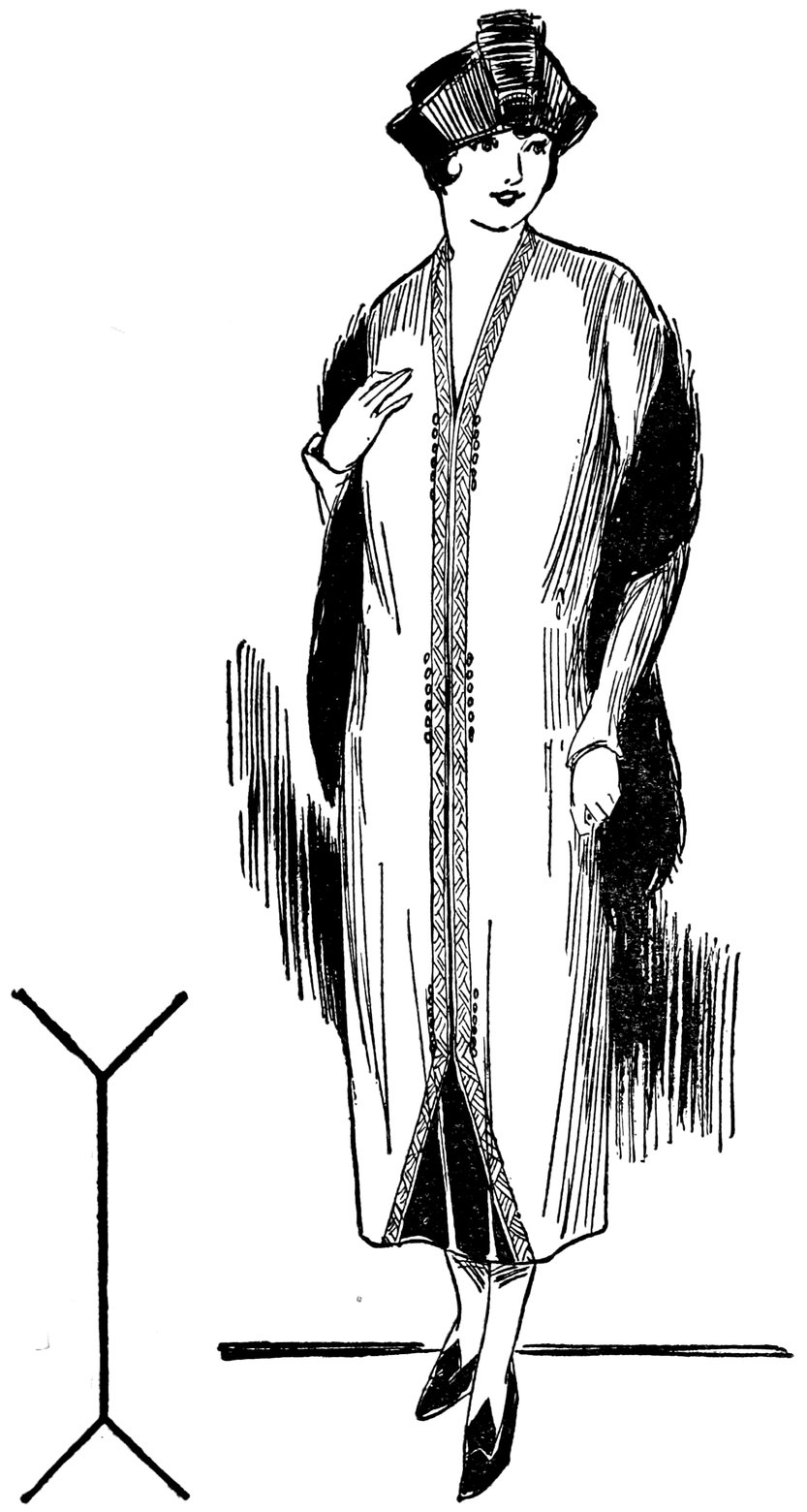
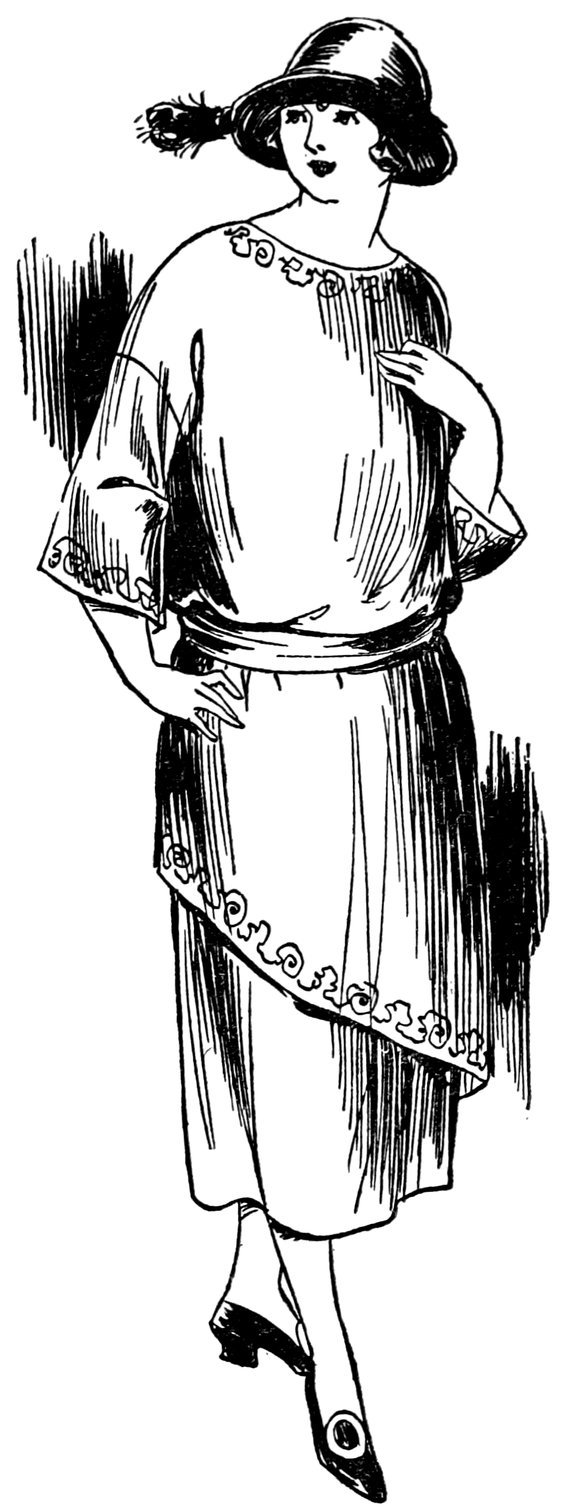
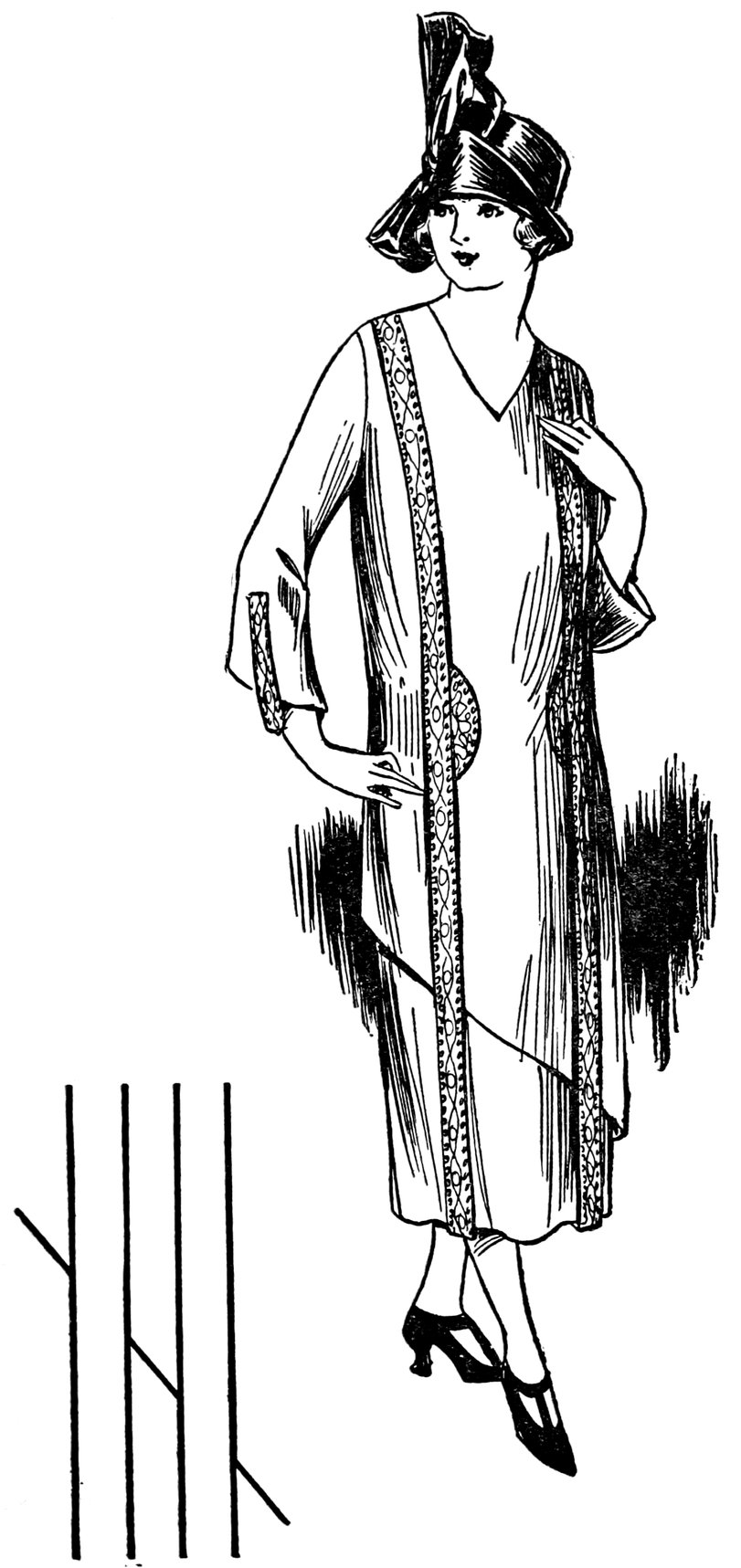
The two vertical lines are exactly the same length—measure them and see. Short lines turned back at either end make one seem short; extended lines make the other seem longer.
19
These two illusions are almost duplicated in the dresses above. As a result one woman looks shorter and heavier, the other taller and slenderer than she really is.
20
You yourself are familiar with many optical
illusions, although you may never have
thought of them as such. When you look
down the railroad tracks the rails appear to
come together in the distance. No matter
how much you tell yourself that the rails do
not actually come together, the fact remains
that they appear to do so. If you put the end
of a stick in water it appears broken, although
you know that in fact it is not broken.
The eyes in a certain portrait seem to follow
you, no matter where you may go in the room
in which it is hung. This illusion persists, no
matter how much you may tell yourself that
the eyes do not actually move. When you
are on a moving train it is only by the constant
succession of passing trees, posts, and
landscape that you realize you are going forward.
When these objects are shut off from
your view by a train going in the opposite
direction, you seem to be going backward.
Or if you look at a moving picture taken from
the front of a rapidly moving train or motor
launch, it is difficult not to get the impression
that you are rushing forward.
All of these are optical illusions, yet we do
not think of them as illusions. They represent
the natural and the normal and we make
allowances for them.
The laws of illusion are more easily understood,
21perhaps, by means of simple lines than
any other way. You will grasp them quickly
by studying the various figures which illustrate
this chapter.
Let us take a simple example to begin with
having directly to do with the use of straight
lines in dress. You have probably read a
thousand times and heard a hundred times
more that stout people must work for straight
line effects and the straight line silhouette.
But it is one thing to know this fact and another
actually to accomplish it in your clothes.
You can’t just hang a straight line down from
the shoulder like a carpenter’s plumb on a
door sill. You must know just where and
just how to apply the straight line. You
must learn to use straight lines so that they
blend in with your costume—so that they give
the desired effect without calling attention to
the means by which it is achieved.
22
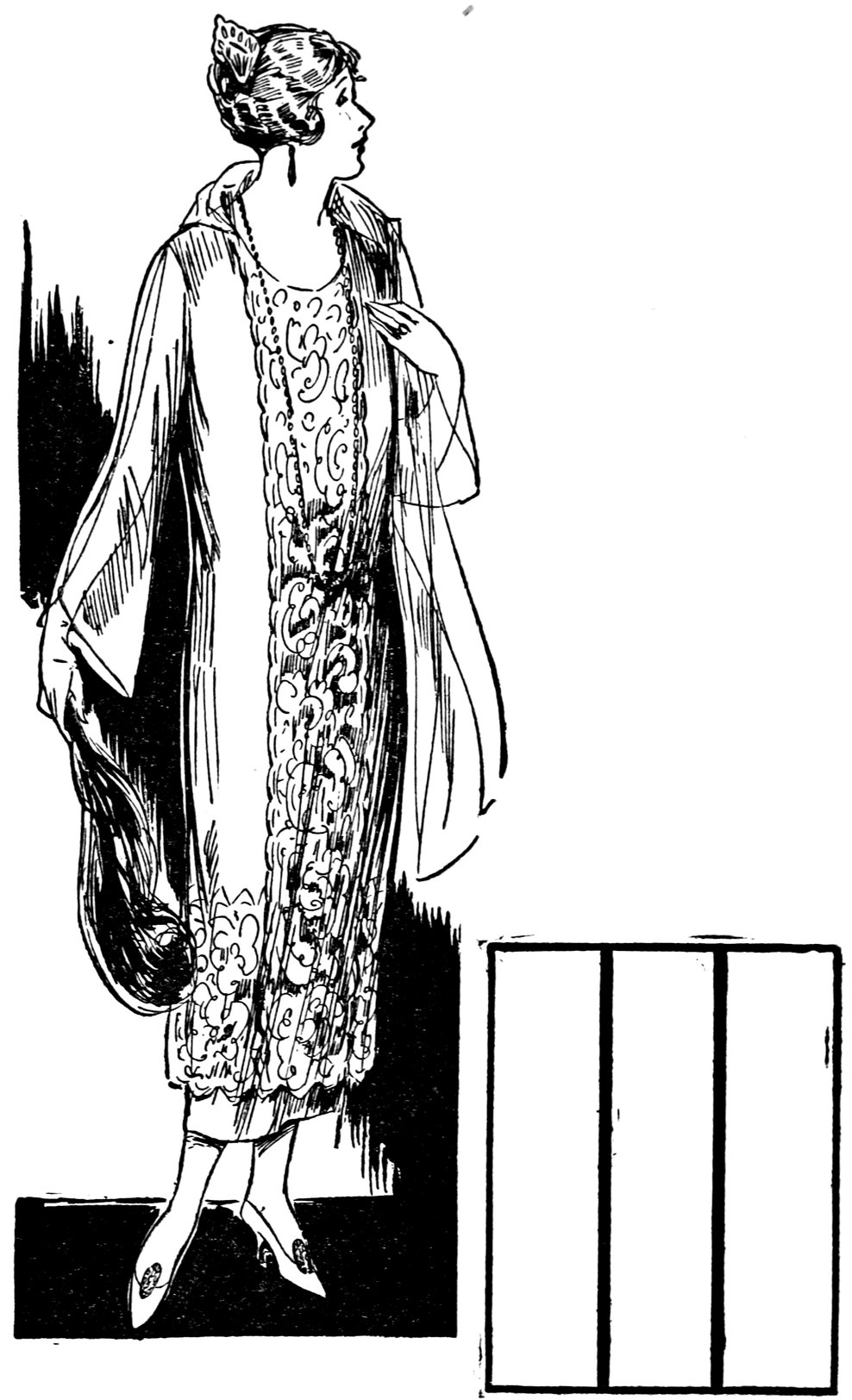
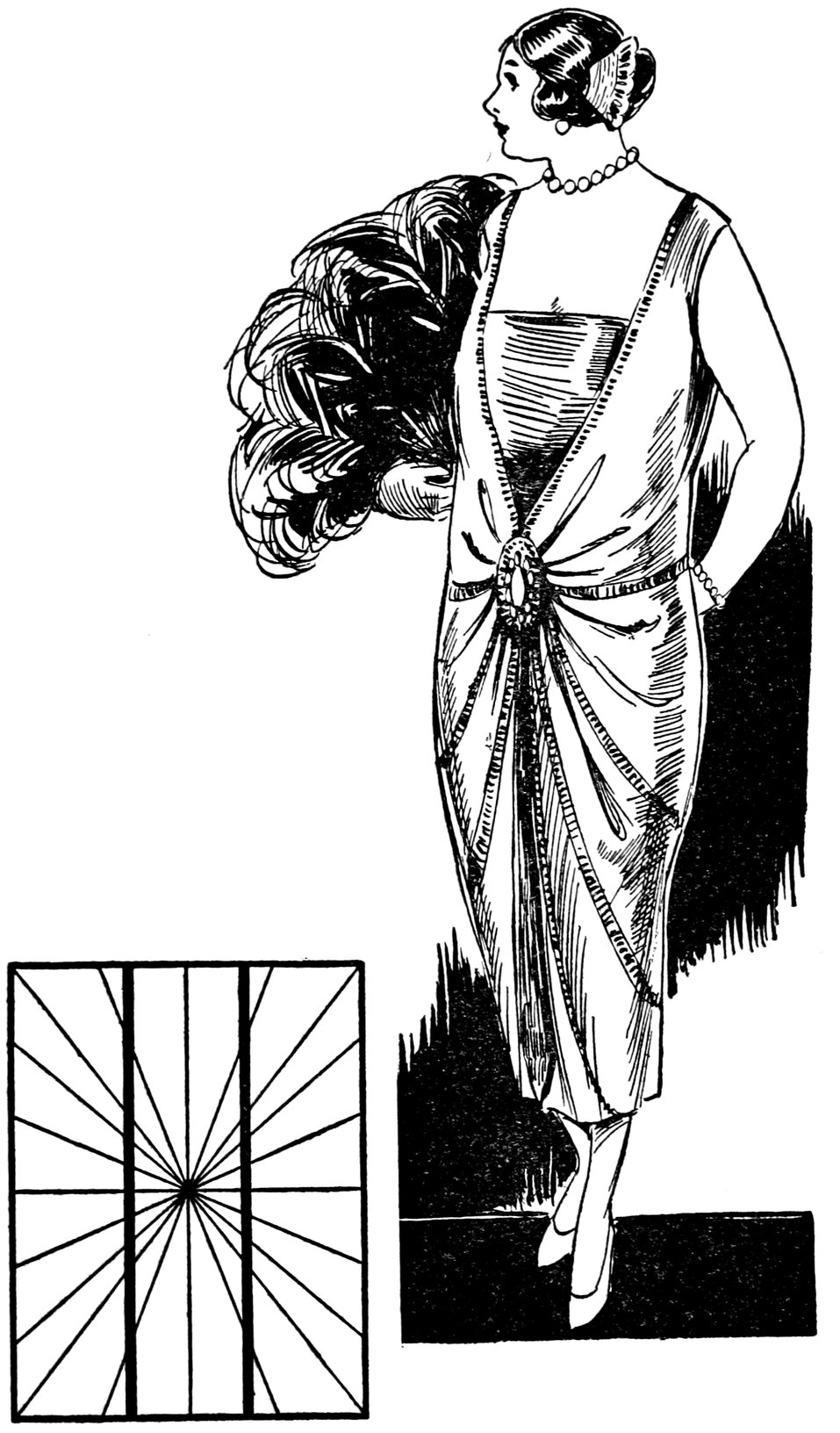
These unbroken parallel vertical lines give the definite impression of height. This principle, used in the design of the dress above, lends it a pleasing slender appearance because no other lines interfere with the straight line effect.
23
Here, also, are two vertical parallel lines. They are straight—test them—but the other lines radiating from the center, make them appear “bowed.” In the dress above a similar design makes the wearer appear stouter and heavier than she really is.
24
It is a popular theory among folks who
would dress to look slender that stripes running
up-and-down are the thing to wear,
while stripes running across are to be avoided.
This belief, like many another old-fashioned
one, is only half true. For instance, it is
true that if the up-and-down stripes in your
material are very fine and unobtrusive they
will have the effect of making you look taller
and slimmer. This, however, is not at all
true of broad stripes or of stripes in a definitely
contrasting color—quite the contrary,
in fact. Pronounced stripes merely call attention
to themselves and do not create the
illusion of slenderness which is desired.
But this is only one of many points to be
taken into consideration when you plan a
dress with stripes or with straight up-and-down
lines of any kind. For instance, the
illustrations on pages 18 and 19 show two
up-and-down lines of exactly the same length.
Take your ruler and measure them to convince
yourself. Now note the effect on these
lines of the shorter lines added to each end.
The inverted arrows added to the line at the
left make it appear shorter than it really is.
The extended lines added to the one at the
right make it appear longer than it really is.
Now note the two costumes on these same
pages in which these principles have been
applied. In the one shown on the left
25the figure looks shorter and stouter than it
really is, while in designing the dress on the
right the correct use of the optical illusion
has been observed and the result is a slender,
graceful appearance. You can readily see
from these pictures how a straight line effect
can be either accentuated or shortened by the
lines that run out from it.
There are many ways in which a stout
woman who does not know this principle
can easily ruin the effect of a costume. For
instance, a woman who wears a perfectly
straight up-and-down dress of quite correct
lines may put a large mushroom shape hat on
her head and perhaps a band of fur around
the bottom of her skirt. This has precisely
the same effect as the arrows which are
turned the wrong way and therefore shorten
and widen the straight line.
“I cannot understand why I look so short
and dumpy,” she wails despairingly. “My
dress is made on perfectly straight up-and-down
lines and yet I look fatter than ever.”
Of course she does, because instead of extending
the straight up-and-down line by a small
upturned hat of some sort and an unobtrusive
skirt hem, she has broken the line at the
top and bottom and thereby shortened and
widened her appearance.
26
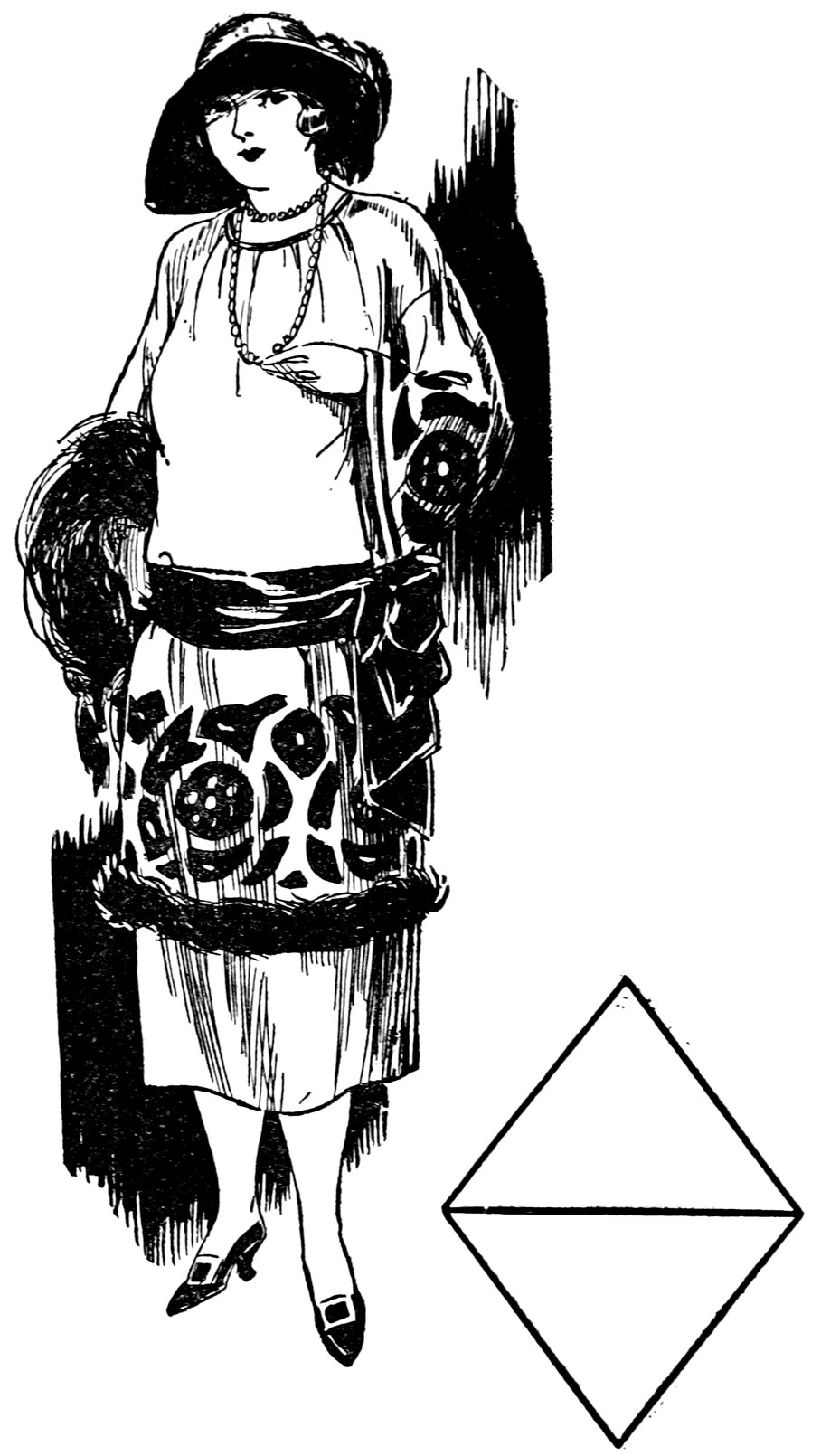
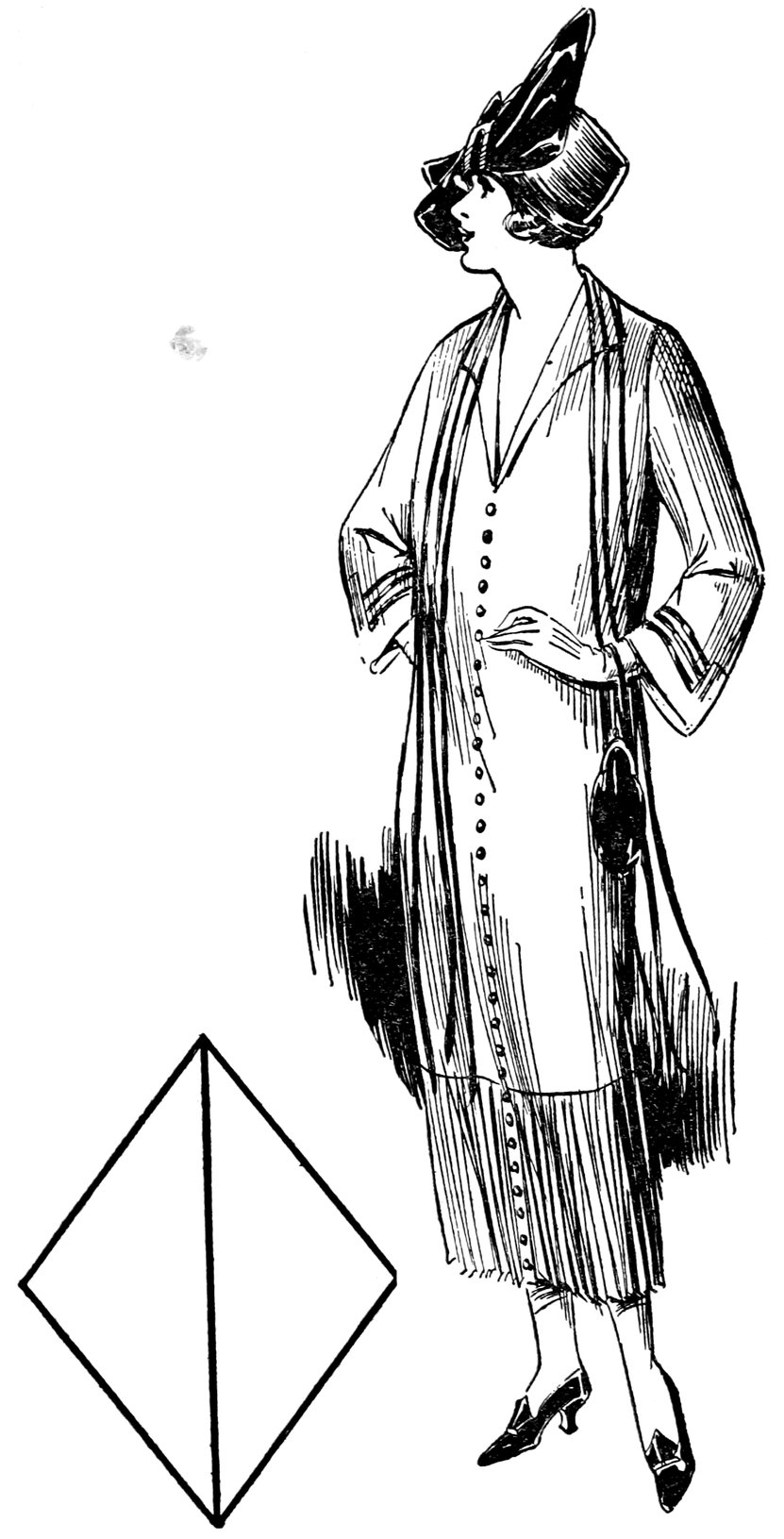
These two diamond-shaped figures are exactly the same size. The crosswise line makes one seem wider, the vertical line makes the other seem narrower.
27
Now note how these same principles used in the dresses above effect the apparent size and weight of those wearing them, making one seem much stouter than the other.
28
Another point to be very careful about is
the matter of uninterrupted straight lines.
For instance, the small diagrams on pages
22 and 23 show two pairs of perfectly
straight up-and-down parallel lines. This is
probably hard for you to believe, since the
lines in the right-hand figure seem to definitely
bulge outwards. However, careful
measurement with your ruler or a pencil will
prove to you that the lines actually are as
straight as those in the figure on the left.
These latter, however, appear straight because
they are uninterrupted and unbroken. Those
at the right appear to bulge outwards merely
because there are so many radiating lines running
through them.
Applying this principle to clothes, you can
easily see that the tall, slender effect you
hoped to gain by the straight up-and-down
lines of your costume may be entirely ruined
if you apply trimmings of any kind which
radiate outwards toward these lines. The
29dresses shown on pages 22 and 23 will prove
this to you. The woman at the left with her
uninterrupted, harmonious, gracefully flowing
up-and-down lines looks taller, slenderer,
more dignified and in every way more pleasing
than the woman at the right, the radiating
lines of whose gown make her figure seem to
bulge outwards in a most discouraging
manner.
Another striking example of optical illusion
showing one reason why some look stouter
than they really are is shown in the illustrations
on pages 26 and 27. As in the previous
examples, the two figures (diamond
shape figures in this case) are, by actual measurement,
exactly the same size. The horizontal
line across the one at the left, however,
makes it appear much wider than the
one at the right with the vertical line through
the center.
Now study the clothes of the two women
which illustrate these illusions. Both women
are holding their arms so as to give their
figures a sort of diamond shape. The one
at the left, however, by her broad, drooping
hat, her large, bulky fur stole, the large-figured
material of her tunic, and especially by
the horizontal, or nearly horizontal lines of
her neck, her girdle, and the band of fur on
her skirt, gives herself the appearance of conspicuous
stoutness.
30
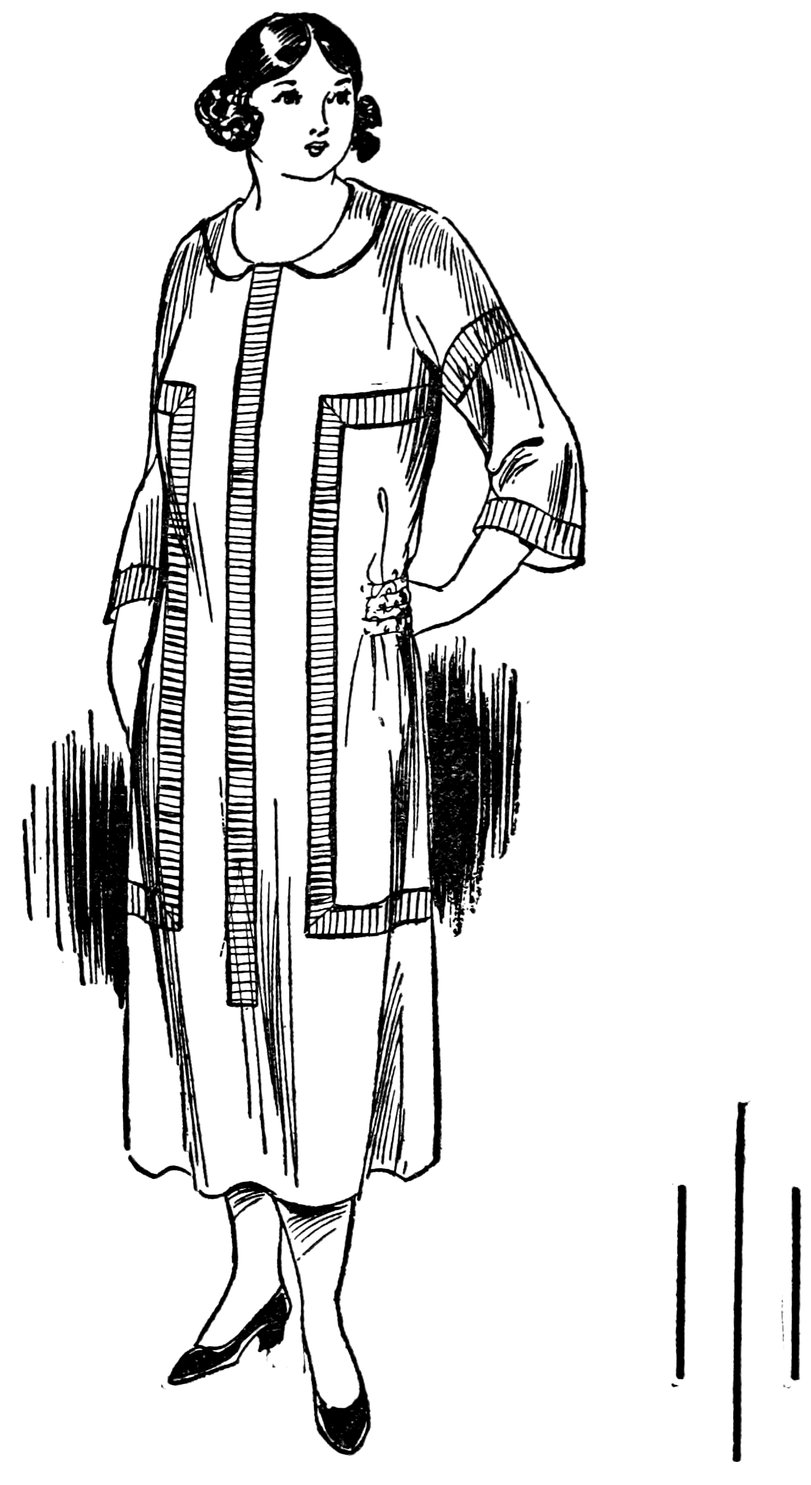
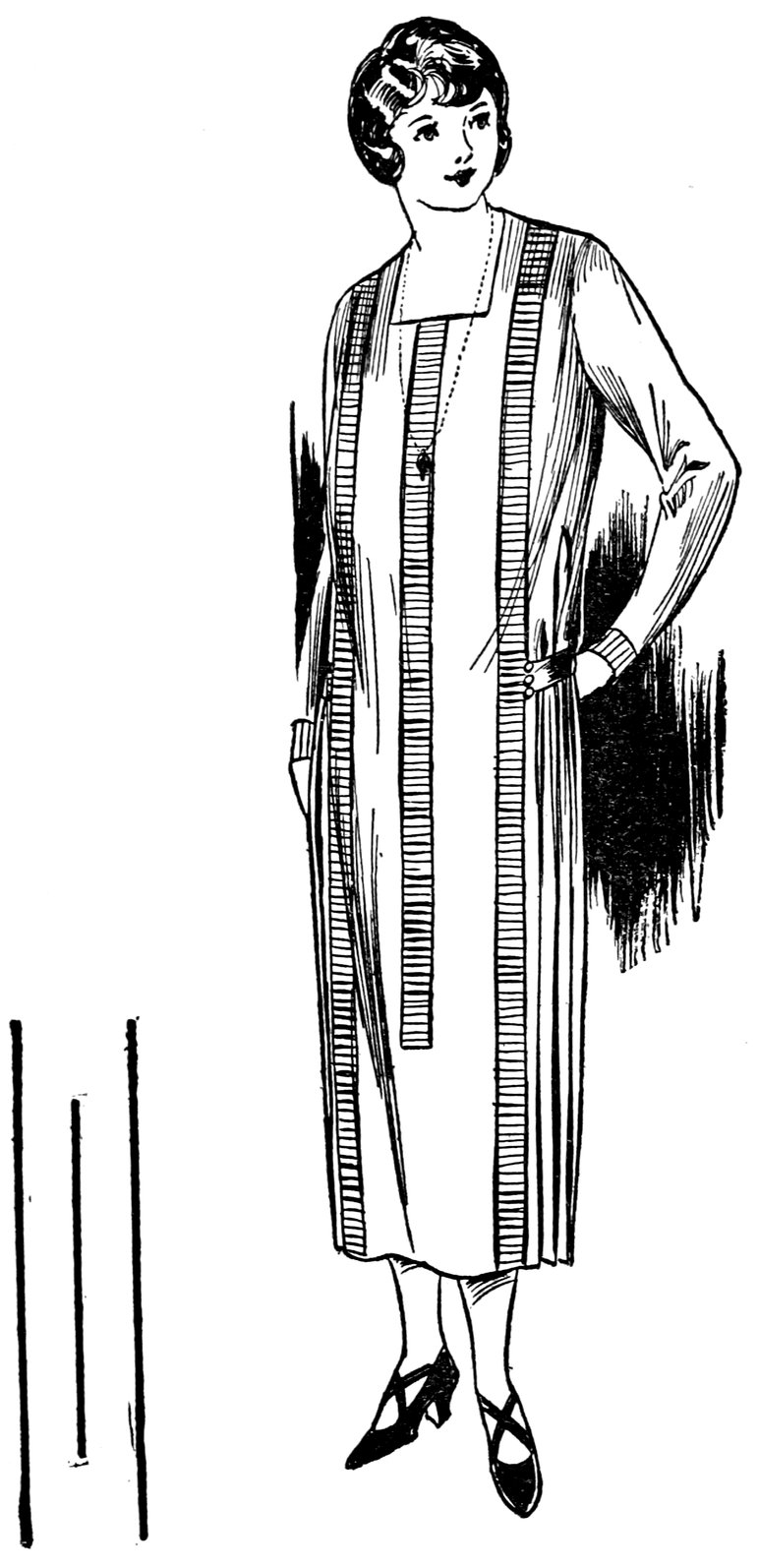
The middle lines in the two small diagrams are the same length. But on the left, shorter accompanying lines seem to shorten the one between. On the right longer accompanying lines seem to lengthen the one between.
31
Now see how the woman at the left has unknowingly emphasized her stoutness while the one at the right has properly gained a slender effect by using trimming in accordance with the principles of these optical illusions.
32On the other hand, the woman at the right
has designed her costume entirely on the
principles of vertical lines. The tall hat with
its appropriate trimming, the long, simple
lines of her collar, her neck-piece, the row of
tiny buttons down the front of her dress, and
indeed the lines of the dress itself all conspire
to give her the appearance of height,
smartness, and slenderness.
By the illustrations on pages 30 and 31
you may learn the value of emphasizing a
long line by the trick of placing it between
two longer lines rather than between two
shorter ones. As in the previous examples,
the middle line in each figure is identically
the same length. The one at the left, however,
appears much shorter than the one at
the right, because of a suggestion contained
in the parallel lines which surround it.
In the dresses illustrated here, this principle
is strikingly applied. The short vertical
33bands of trimming in the figure at the left
make the center band seem shorter than it
really is, whereas, the long vertical bands in
the figure at the right make the center band
seem longer than it really is. Thus, by the
application of this seemingly unimportant
trifle, the woman at the right seems slenderer,
taller, and smarter than the one at the left.
Just one more example. The figures on
pages 34 and 35 show how a longer, slimmer
effect may be created by parallel lines
emphasizing an oblique or slanting line. In
the figure on the left the plain oblique line
seems much more horizontal and wider than
it does in the figure on the right where the
same line, actually on the same slant, seems
much longer and more graceful because of
the parallel lines which break it and thereby
emphasize its length.
This effect is gained by using the simple
principle of optical illusion shown in the
small diagram on page 35. The line running
down from upper left to lower right is
actually straight—test it and see. But the
two perpendicular lines which break it cause
it to seem to drop faster than it really does.
This gives the effect of greater height and
less width to the entire figure.
34
Note the diagonal line in the opposite diagram. It is actually straight, but the vertical lines which break it give it a “going-down-steps” appearance. This principle is used in the dress at the right—the two vertical panels of trimming break the line of the tunic and give the whole figure a more slender appearance than in the figure above.
35
36Dresses planned with this principle in mind
will surely be more successful in their slenderizing
effect, as you will see by these contrasting
illustrations. The oblique line at
the bottom of the tunic in the dress at the left
seems almost horizontal and much wider than
the same line in the figure at the right which
is made to seem longer and more graceful by
the parallel vertical lines of embroidery
which intersect it and so emphasize its appearance
of length and grace.
There are dozens of other tricks which our
eyes play on us which must be taken into account
by women who want to look slender.
A very careful study, therefore, of the optical
illusions in this chapter will repay you many
times in the matter of line, cut and pattern
of every dress, wrap, hat, and pair of shoes
that you buy. You must see that the facts of
illusion may either work to produce an appearance
of bigness or one of smallness.
37Every suggestion in this book is written with
the idea of applying these essential principles
of optical illusion to your dress—of producing
in every case the slenderest possible
effects.
Not only very stout women, but moderately
stout women, and even slender women should
also bear these principles in mind, for even
the slender woman can lose all the advantage
of her slender silhouette and may actually
appear stout by failing to dress in accordance
with these optical illusions. An ill-chosen or
badly-designed gown or wrap may easily give
her the appearance of being many pounds
heavier than she really is.
When you yourself begin planning your
clothes according to these simple, though
magically effective rules, you will very soon
begin to find real artistic pleasure in your
clothes, to say nothing of the improvement in
your appearance. I am certain that you will
feel about it as I did, that here at last is the
only real and permanent way to look slender.
For even though by strenuous efforts you are
38able actually to reduce your weight, it is not
pounds, but appearance, that counts. You
may know what the scales say, but other people
will weigh you with the eye. Dress so
you look slender and you can stop worrying
about your size and weight and be as healthy,
happy, and attractive as any of your slender
friends.
CHAPTER III THE LITTLE THINGS THAT MAKE THE BIG DIFFERENCES — WATCH YOUR STEP — WHAT YOUR POSTURE CAN DO FOR YOU — SHOES AND STOCKINGS MUST BE SELECTED WITH CARE — NECKLINES ARE SLENDERIZED BY CORRECT JEWELRY AND COLLARS — PURSES, FANS AND OTHER ACCESSORIES — NEATNESS AND CLEANLINESS ARE ESSENTIAL — COSMETICS EITHER ADD OR DETRACT — THINK OF THESE LITTLE THINGS BEFOREHAND
39
As I told you in Chapter I, the stout woman
has a great many good points which she sometimes
neglects in worrying about her main
problem. This is a great mistake because
after all the little things do make the big differences
and there are so many little things
that you can do with scarcely any effort at
all which help so tremendously in gaining
the effect that you want.
For instance, there is the matter of walking.
I am not going to give you any definite
exercises, but it is a very easy and splendid
practice to try to walk with a “slipping up”
step, that is, practice walking easily so that
you won’t appear to weigh a thousand pounds.
If you are light on your feet people will forget
to guess your weight. Don’t let your
body slump down, if you have this tendency.
Find some exercises that you can do happily
40and comfortably, not to reduce, but to cultivate
grace and ease of motion. When you are
all alone in the house and nobody is looking,
trip around lightly and exaggerate a light,
easy step. Turn on the victrola and do your
dusting to music. It will help you wonderfully
in gaining that ease of motion which is
attractive and pleasing and encourages youth.
Always endeavor to overcome heaviness in
step and movement, for it adds years both to
your appearance and to your feelings. Remember
that your attitude has so much to do
with your good looks.
Don’t ever stand with your feet apart or
your hands limp at your sides. One foot a
little in front of the other gives an easier
appearance and makes you seem less weighty.
Make a practice of keeping your hands comfortably
in front of you, never rest them on
your hips wash woman fashion. Such positions
broaden the silhouette and give a “set”
look that is most unbecoming. A large woman
with her feet spread apart and arms
hanging like burdens always at her sides
makes a very heavy and unattractive picture.
Don’t cross your arms. Two fat arms can
look like four, if you are not careful.
41Stretch and keep yourself limber. Bend so
that you are continually used to it, then your
face won’t get red every time you drop your
handkerchief. And right here it may be
well to say that most women use up more
energy than they need to and look much more
undignified than they need to when they stoop
to pick things up. It is neither necessary nor
graceful to bend so that your back almost
breaks in the middle. It is a much easier
and pleasanter gesture to bend at the knees
and go straight down until you can reach the
object you want to pick up. In doing this
you can keep your head straight up all the
while and need not get red in the face at all.
Learn to stand up straight like a soldier.
Most fat women seem to have the idea that
they ought to “scrooch” down and disguise
their size in that way. But in this campaign
to dress and be thin the back-bone must be
definitely straight. Don’t hunch yourself up
and look like a pillow tied in the middle.
Sit straight on your chair and stand straight
when you are up. Hold your head high. A
constant practice of chin up makes you appear
42taller and erases in the easiest possible
way any tendency towards a double chin.
Dressing up to your weight is good psychology
for it keeps you alert. You hold
your head a little higher and grow naturally
to observe that essential rule of standing always
just as tall as you possibly can. Also,
your mental alertness is a safeguard against
additional fat. I never knew it to fail—a
definite interest in clothes, in looking one’s
best, keeps the fat away. It has a sort of a
rabbit-foot charm about it that really does
work.
Remember continually that it isn’t the dress
alone that you need watch, but every detail,
for the little things can destroy the big, you
know, and the principles of optical illusion
must be adhered to as strictly in the little
things as in the big. For instance, eyeglasses
can accentuate a round face or slenderize it,
depending upon their prominence and shape.
Buttons can stick out and look bulky; shirtwaists
when worn with different color skirts
can cut you in two; and belts of different
color than skirt or blouse can prove even more
treacherous. Gloves or shoes that are too
small give your size away. Lacy stockings
43emphasize where they shouldn’t and are as
faulty as they are expensive. Before we get
through with this book I hope that I can restore
your pride and self-assurance and that by
making the most of these little pointers you
will find your back-bone right where it ought
to be. You will then be able to meet the
world with a smile, knowing that at last you
not only feel but look better than you ever
have before.
What kind of shoes and stockings do you
wear? Not pumps, I hope, because your
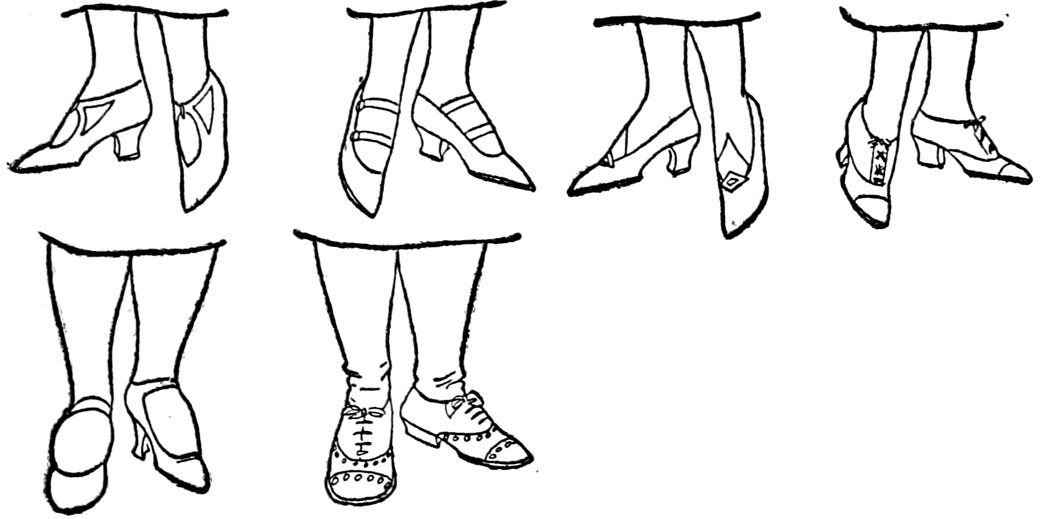
Above—Neatly shod feet.
Left—Low cut pumps and single strap emphasize fat. Heavy shoes have too much decoration.
Stockings must always be on straight and well held up, and shoes must fit. Straps that hold firmly are more effective than those that are narrow and less restraining. Heavy shoes should be plain in design. Skirts should always be long enough to cover the largest part of the leg below the knee.
44weight is too great to be comfortable in them,
and besides if you have studied the principles
of optical illusion as carefully as you should
have, you will realize that pumps will not
give you the harmonious effect that you want
to achieve in your costume. A bulge is sure
to show at the top which is not only uncomfortable
for you but shows in itself that you
are fat. Wear a strap or laced slipper—any
kind that is in good taste, big enough, and not
too heavy. Heavy shoes on a stout woman
interfere with lightness of movement which is
something for which you must continually
strive.
Unless you have very attractive, well-proportioned
feet, do not attempt to decorate the
bottom of your dress, for it will not only
shorten you but will call attention to your
feet. If they are very small they make the
body appear larger and if the ankles are large
they give an undesirable heaviness, so that
the very best way, in any event, is not to call
attention to them.
Many authorities say that a black sheer
stocking is the very best that a stout woman
can wear, that a heavy black or dark colored
stocking is conspicuous, and a light stocking
45is “taboo” because it breaks the height and
interferes with the straight line effect. So
choose sheer stockings, but don’t hesitate to
buy “out” sizes if you need them. If they are
big enough over the knees they will fit better
around the ankles. I know some big women
who refuse to buy “out” size stockings because
they are ashamed to go in and ask for them,
and I know some medium slender women
who buy them because they think they last
longer. So pretend that you are medium
slender and buy them if they are more comfortable.
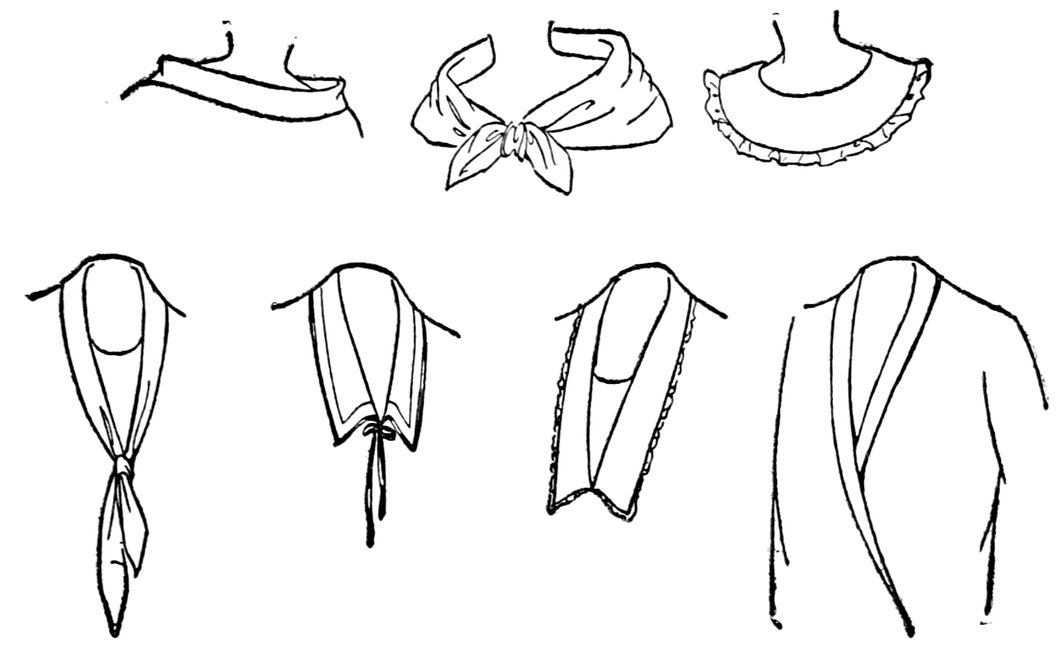
Round necklines emphasize width. Even though tempting, they are taboo for those who would slenderize. Long necklines are always pleasing and are of many variations. A close study of current fashion books will give ideas that can always be accentuated in length without outstepping Fashion dictation.
46
We big women usually have some one who
loves us enough to give us jewelry and we in
turn love them enough to want to wear it on
every occasion. If it doesn’t express slenderness—if
it’s a big cameo or a heavy pair of
earrings or a string of round marble beads,
especially in dog collar arrangement—put it
away and forget where you put it. Wear
such jewelry some morning when no one is
looking; have your own little “revelry” and
have it over with, for such jewelry puts on
more pounds than entire boxes of candy and
makes us look like jeweled couch cushions,
which we can never afford to do.
A necklace that is slender, well made, and
with a tendency to plainness is a real asset to
a stout woman as it helps the collar line,
slenderizes the face, and gives the appearance
of length over the front that is pleasing, but
avoid by all means heavy crystals and don’t
ever wear beads unless they give a definitely
desirable lengthening effect.
Watch your collars closely. Work for
slenderness and becomingness. Avoid all
47neck lines that go around or that are conspicuously
colored. A cream collar is always
better than a snow white one and a soft piqué
or linen collar is better than a starched one.
Remember that long string ribbon ties can be
real friends if you will let them. Tailor
your collars or use soft lace that is not baby
looking. We big folks must always keep
away from babyishness, must learn to stand
on our own two feet and look straight ahead
toward the goal of slenderness.
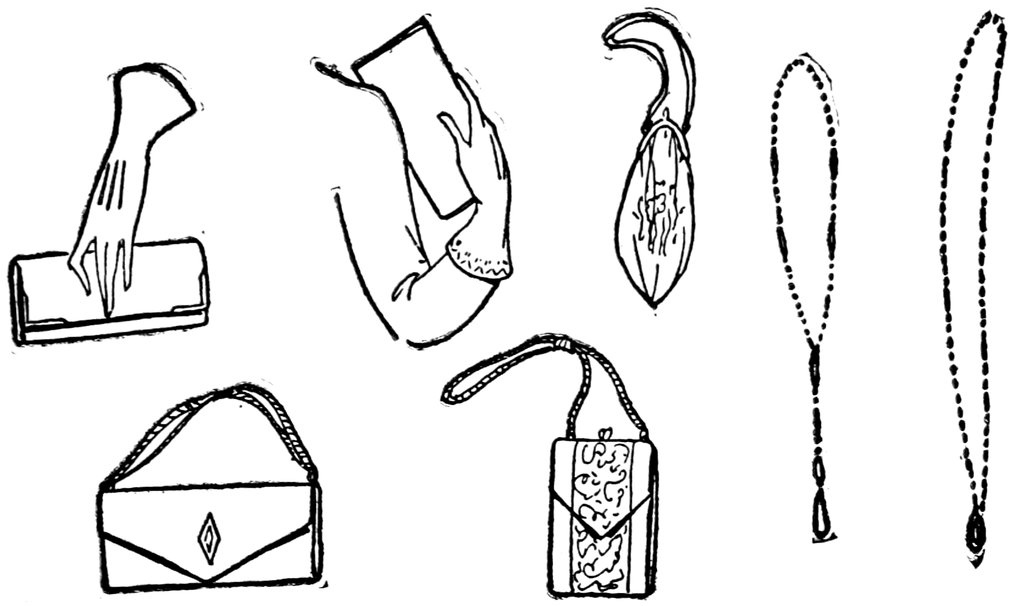
Gloves, purses and necklaces need to be chosen with infinite care to aid in slenderizing. Link chains, cords, fine pearls or small oblong beads are best as necklaces. Slender flat purses are desirable and neat, well-fitting gloves necessary.
Pocketbooks and purse bags must be slender,
never round or bulky looking, and must
48always harmonize with the dress and never
be conspicuously colored. Remember too,
not to let your bag dangle awkwardly from
your hand or add to your width by the way
you carry it. Let it be a part of the line of
your costume just as it is in harmony with the
color.
Graceful fans of subdued colors often aid
in a pleasing gracefulness, but little fans
allow of an uncomplimentary comparison,
just as do small, gay parasols.
Fat fingers are shortened and made more
fat by heavy rings.
Earrings widen the face. Sometimes a
slender face accompanies a broad body. In
such a case, earrings are an advantage if they
are appropriate and graceful.
Jeweled belts, conspicuous in ornamentation,
must all be given away to willowy
friends, because they could prove helpful to
them and a menace to you.
Once when I was writing a book on dress,
a fashion authority and personal friend insisted
that I should not put in a chapter on
cleanliness, which I wanted very much to
49use, saying that it “put an ugly frame on an
otherwise beautiful picture.” But personal
cleanliness and careful grooming to my mind
are so necessary that no book on dress would
be complete without them.
We may not have beautiful clothes, and
may grieve that we are not willowy enough
to wear the smart extremes in dress, but our
grieving is totally unnecessary. We can learn
truly to be as attractive, as admirable as our
slender sisters if we set out with the will and
determination to express perfection so far as
our ability and intelligence will allow. A
fresh bath, some bath talcum, clean, well-fitting
underthings, neat, good-looking shoes,
and modest stockings can give an enhancing
foundation for the dress we have so carefully
planned. And when we are spic and span
from the inside out we are sure to dress with
more dignity, more poise, than we possibly
could otherwise.
Thick lips should never wear rouge, and
black eyebrows should never be blackened;
neither should a pale, grayed face be surrounded
by a dull gray or black hat. This
50is all out of key and attracts unnecessary attention.
We must express some color tone,
just as we do personality, but it must be subtle
or vivacious, discreet or bold, and in both
cases must be individually becoming.
If the eyes are dull in color, do not wear
bright colors on your hats for the eyes lose
in comparison, and eyes can always express
friendly happiness and individuality if we
surround them properly.
Avoid a shiny nose as you would the
Plague.
Beware of oily creams. Remember an astringent
reduces and controls and that 99 cases
out of a hundred need oilless creams rather
than oily ones. Beware of rouge. Your face
usually will have color enough. If it hasn’t,
use it, oh, so wisely.
Study your face carefully, experiment with
color in front of an honest mirror that is
placed in full day light. Rouge and powder
rightly applied can narrow the face and prove
very advantageous, so experiment and put the
color just where you need it, but don’t put
on any until you have picked up a couple of
things from the floor and walked around the
room quickly at least twice. Work to look
51immaculate. It is so much more becoming.
Baby faces and full proportioned bodies don’t
go well together, and harmony we must have
throughout this program.
If your forehead is low, powder the forehead
generously and comb the hair back as
much as becomingness will allow. This will
tend to add height to the body and length to
the face.
It is said that a large woman is usually
very dainty in her habits just as a large man
invariably has a very tiny, neat signature, so
let it be an asset, and be dainty about your
use of cosmetics. It is so much more pleasing
than an extravagant use could ever be.
Buy a few things and have everything
right. Think of all of your wardrobe at one
time. Be sure that everything goes together
agreeably. Take care to keep every part of
your clothing in good repair and immaculately
clean. Every woman can gain a reputation
for being well dressed if she remembers not
to be haphazard in buying, wearing, and caring
for her clothes. If you have any of these
habits, come, let us talk them over confidentially,
52because I, too, have had to learn by
sheer necessity to overcome, one by one, these
very expensive, annoying tendencies, and the
only way I succeeded was to learn, as a matter
of habit, to hang things up carefully when I
took them off, to make sure that dress shields
were in place, and to take special care to have
everything in right shape when it was time to
dress.
Take very special pains to have all supporters
securely fastened, stockings on straight,
and each garment rightly in place, for neatness
in dress is more essential for us than almost
any other thing. In fact, fastidious
care of person and clothes is one feature
which requires constant vigilance.
Avoid every tendency toward over dress.
Don’t trim yourself too much. Modesty,
simplicity—intricate simplicity perhaps, but
a beautiful simplicity—is a definite part of
our program and must be followed out religiously
to conceal at all times an extra 30 or
40 pounds.
Be sure that the brassiere and corset overlap
at their joining. The brassiere should
come over the corset a good 2 inches to insure
its holding. If the abdomen is full or stomach
53high, supporters fastened to the brassiere
at the front are an advantage.
Never allow your shoes to squeak or your
gloves to pinch in their tightness. Never
allow a spot to show on any garment. Be
immaculate, work at it, keep at it, for you,
you know, have a definite purpose that must
be achieved.
CHAPTER IV FOUNDATIONS THAT SLENDERIZE — THE ART OF SELECTING YOUR CORSET — HOW TO KNOW WHEN YOUR CORSET FITS EXACTLY — WHICH IS YOUR TYPE OF CORSET? — THE BEST KIND OF BRASSIERE FOR YOU — THE IMPORTANCE OF SMOOTH, PERFECT FITTING UNDERTHINGS
55
Although this is termed the corsetless era,
the best dressed women are still wearing corsets
and will continue to wear them because
they realize the necessity of retaining lovely
curves and lines. When the slender woman
is careful about her corset, what must the
responsibility be of the large woman? It is
just this—that she must wear a corset—that
she must select it with such care and have it
fitted with such perfection that even she can
forget it once it is on. No evidence of a corset
is ever seen on a correctly dressed woman.
Wear corsets for comfort and perfection in
dress, not with the thought that they will reduce.
Remember that you always need your
wits and all the alacrity of thought you can
master and a too tight corset paralyzes both.
Read with me through this section because
here you will get some real help and be able
56to apparently reduce your hip measure two
inches and your bust possibly six.
Do you know that when your corset is a
28 waist or over you are counted by the corset
manufacturers in the stout class? That
seems absurd. One would think they would
wait at least until the measurement was 30
or 32 before calling one stout, but since this
is so, no one need be sensitive about ordering
a size that is right. That means large
enough usually, for you have a long range—26
to 46 waist measurement—so buy a corset
that is big enough, that allows the flesh to
rest comfortably yet be properly controlled.
Tight corsets are a menace as are tight brassieres,
and by packing the flesh in a fixed
position, grace of movement is destroyed and
you are made to appear actually larger than
you are.
Don’t ever let your modesty or your pride
keep you from being fitted properly. All
merchants and corsetieres expect to fit the corsets
they sell. They know their stock better
than you do, and realize that a proper corset
57can definitely and permanently help in correcting
line, moulding it easily and gracefully,
making a satisfied customer for them. A
full proportioned figure is ugly only when it
runs over. Graceful, even curves are pleasing
to see, and we big folk can make our own
curves graceful if we will.
Your corset should be long enough to hold the flesh securely and evenly. But the front stays must be short enough to allow you to sit and bend comfortably.
Always sit down in your corset when it is
being fitted to make sure that the stays in the
front are not too long. They may be shortened
easily and are much better, because you
cannot comfortably sit rared back as you must
when the stays are too long.
58
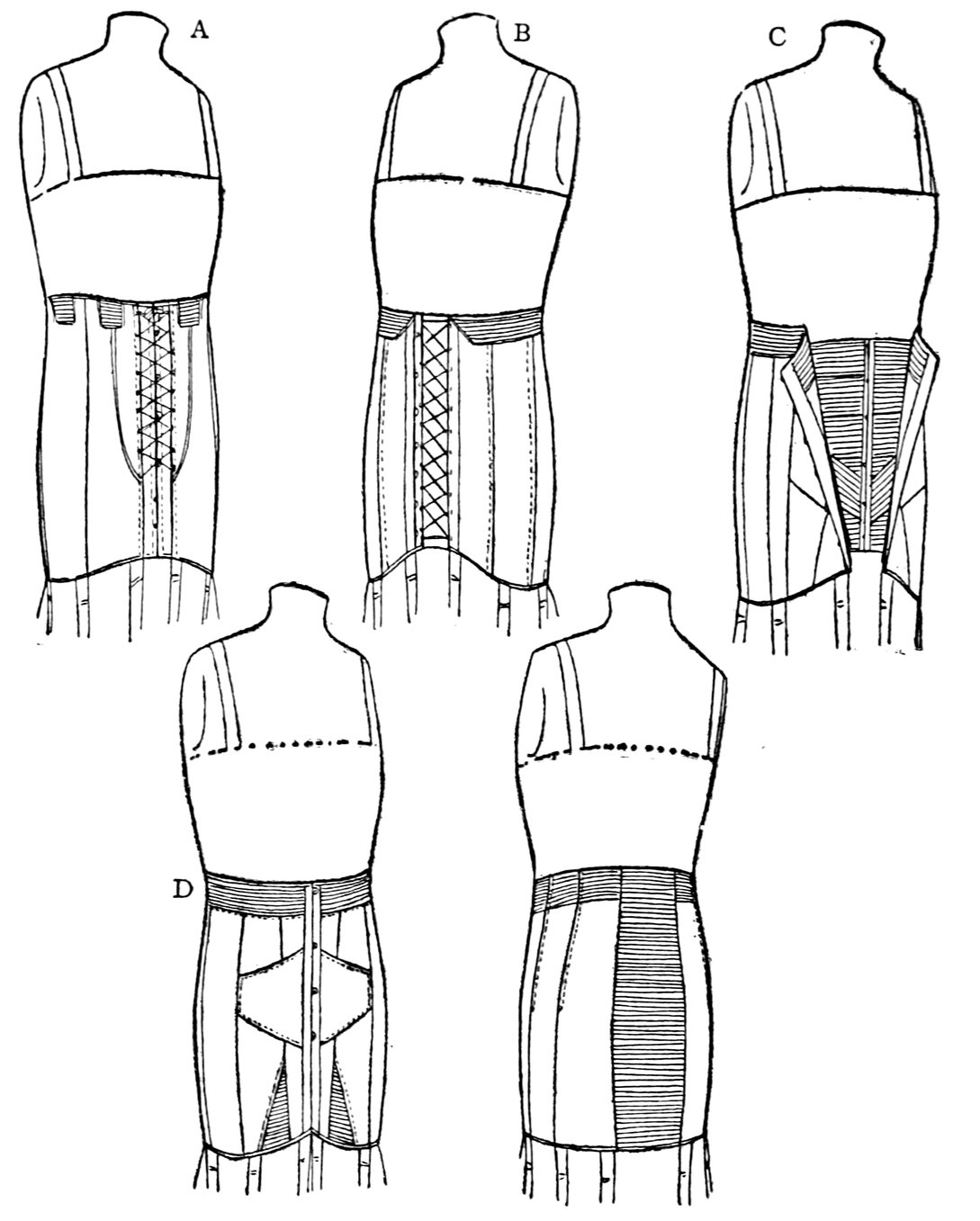
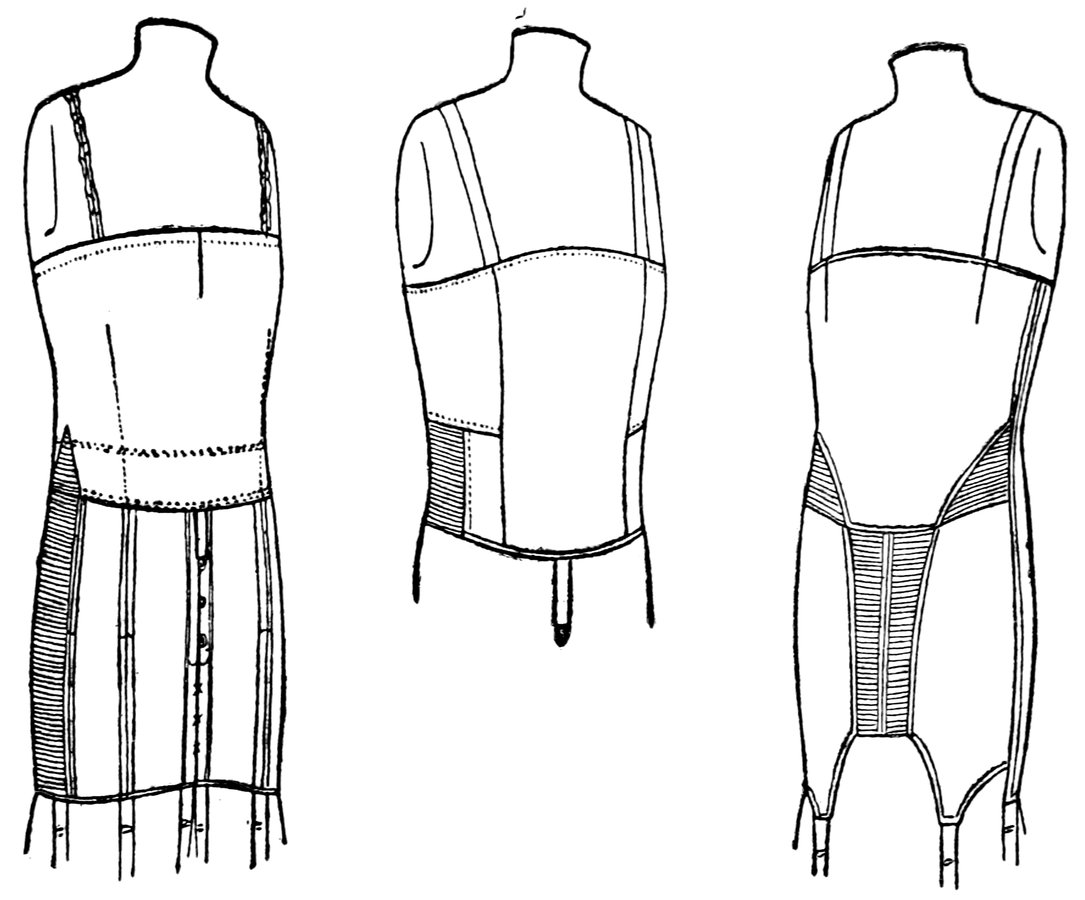
“A” illustrates a corset long over the hips and with elastic inserts at the waistline, suitable for a medium figure.
“B” shows a heavier type suitable for short figures that require considerable support.
“C” shows a very comfortable and practical corset suitable to medium large figures.
“D” shows the front and back of a girdle corset with elastic inserts. This gives a youthful line, particularly suited to the athletic type.
59
Rubber, or silk and rubber corsets or combination corsets and brassieres give a smooth outline and often are graceful and becoming. When new they reduce the hips two to three inches. Be sure to have them fitted properly. If too small, they are very uncomfortable; if too large, useless.
Corsets that lace or fasten in the front give a smoother back and are more easy to adjust than are back lace corsets. Their height, length, elasticity and weight must be considered in buying and fitting, so that your corset when on is in nowise evident to you in feeling or to the eye. A corset does not fit correctly if the line of either top or bottom is visible when the dress is on. Corsets should be kept in perfect repair and discarded when their line is lost.
60
Some corset folks say there are eleven types
of women to fit, others nine, others six. But,
in general, these are the usual types:
Mrs. Brown is big in the hips and small in
the bust. For her type of figure a corset low
above the waist, long in the hips—front laced,
is best. Supple corsets, long in the back, are
a preventative against a large back and help
to slenderize. They should, therefore, be
worn as long as grace and comfort will allow.
If they are too short, a roll of fat will form
around where they terminate and cause you
to lose the easy curve that even big folks can
be proud of. Mrs. Brown should also have
a slip to wear over the corset in preference
to a brassiere. The slip should be semifitted,
shaped over the hips so that not a
wrinkle or line will show.
Mrs. Jones—another stout type—is normal
size but large in the abdomen. She should
have a corset fitted close over the hips, but
not tight in the waist, allowing the fat to
drop down in the top of the corset and find a
comfortable resting place. A brassiere that is
long in the front should be worn.
61A square shoulder, broad hip type of figure
needs a deep girdle—an elastic one is
best—one that is low in the waist, snug and
straight over the hips with an easy fitting
boyish form brassiere.
“And what is a boyish form brassiere?”
you ask. A straight piece of material with
the darts coming down from the top in the
front. You can make one for yourself in a
few minutes. For a fashionable line across
the bust don’t ever dart from the waistline
up, as we have been doing in the past.
For when you do, the fullness is pushed up
under the chin, as it were, and actually will
add six inches to the bust measure. If you
are small in the waist and large in the hips,
you can, by right corseting and “brassiering”
cause some of the fat of the hips and abdomen
to come up slightly, thus acquiring a
more slender and better balanced effect. But
as a general rule, let your watchword be:
Distribute the fat comfortably and correctly.
Don’t crowd it or push it here and there.
Your face, your disposition, and your figure
as well will show it if you do. You can’t be
uncomfortable and be well poised.
62
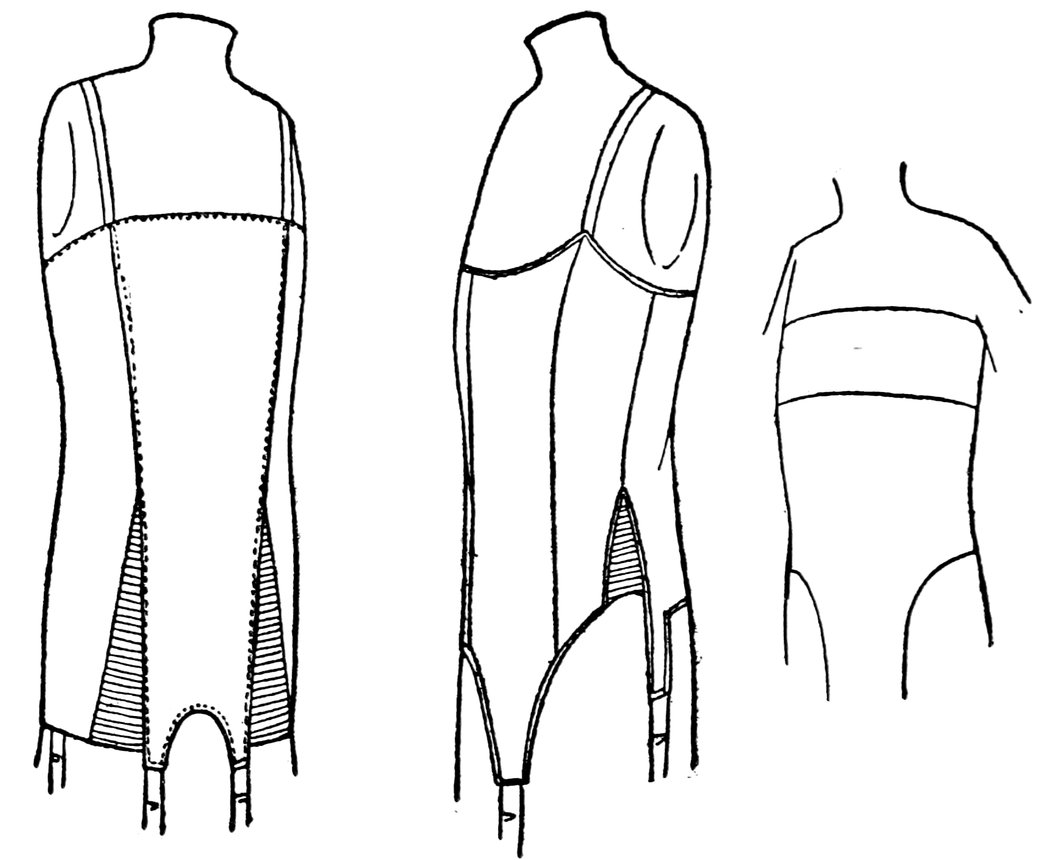
Brassieres are as necessary as corsets. They should never be so tight as to bind, but always close enough to give a smooth outer line. They must always be high enough to confine the bust perfectly and long enough to come down well over the corset so that an unbroken waistline is attained.
Darts at the tops of brassieres give good bust control and hold the garment in correct position on the figure.
63Hunt for the “large above the waist” figure.
If the bust is very low, be sure to wear
a brassiere that lifts up slightly and confines
comfortably. Youth in its greatest perfection
can have unconfined busts; older women,
especially large women, should take care that
no shaping of the bust is discernible. If V
necks are becoming and the bust is full, provide
a band of ribbon or a double fold of
Georgette and wear it over the brassiere, pinning
it tight and high around the figure. This
will conceal the crease between the busts.
Finally, don’t fail, when you are being fitted
in your corset, to stand up in front of a
mirror, walk right up and “shoulder arms”
and survey yourself. The corsetiere is sure
to be stout. Who ever saw a thin one? She
will sympathize with you and be patient.
Try on her best models—not her silkiest
ones, but her best designed ones. Sit down,
stand up, bend over. Buy the one that shows
the least red in your face when you bend. Be
sure it has plenty of supporters.
64
Left—Corselettes may be worn by large women having firm flesh, the “athletic type,” but exercise must go with them to prevent an accumulation of flesh that is sure to occur when the body is unconfined.
Right—Brassieres for evening wear may have a firm band of ribbon sewed tight to the top and this brought around and pinned securely at the center back. Drawing this close will insure the garments staying up properly.
65
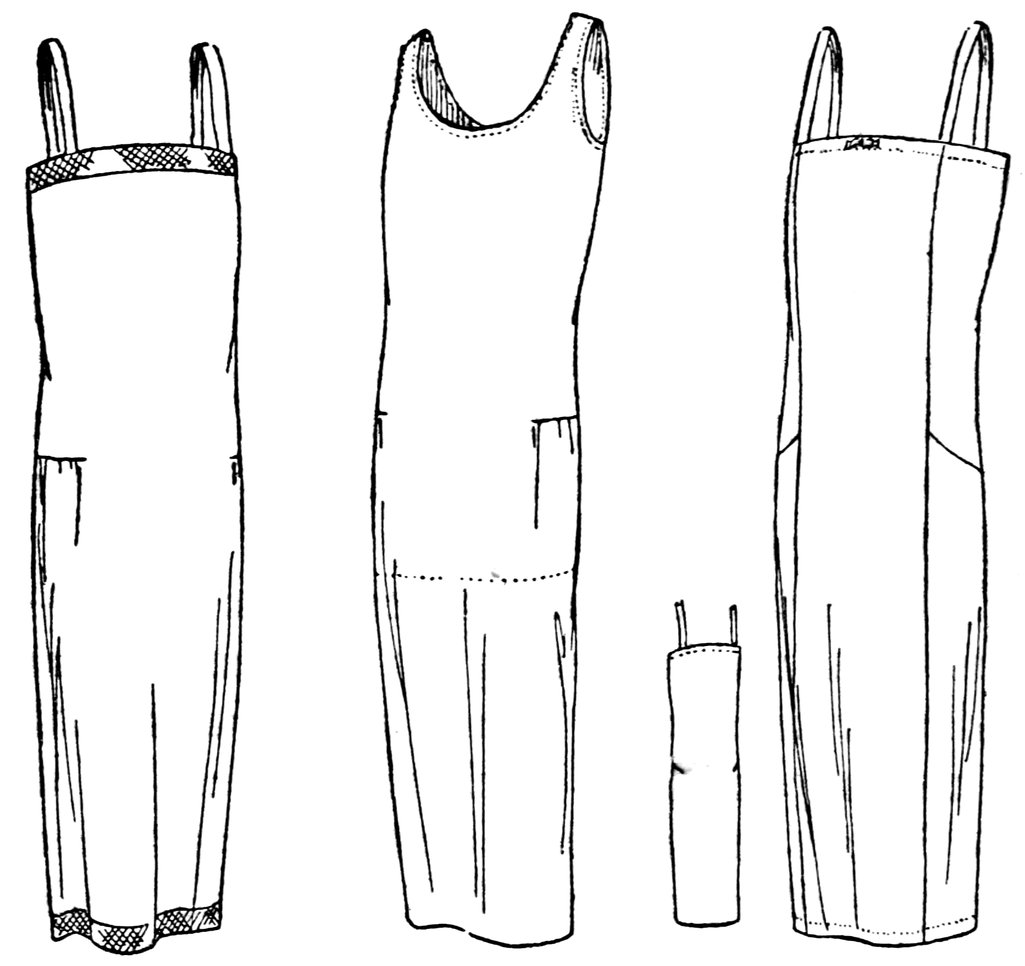
Put your corset under your arm, stop and
buy 2½ yards of 40–inch nainsook or crêpe
de Chine, go home and make yourself a combination
slip. This is to be worn over your
corset and brassiere and will give a perfectly
smooth foundation for your dresses. Remember
that your corset, brassiere, and slip must
be so well fitted that no bumps or hangovers
will be evident.
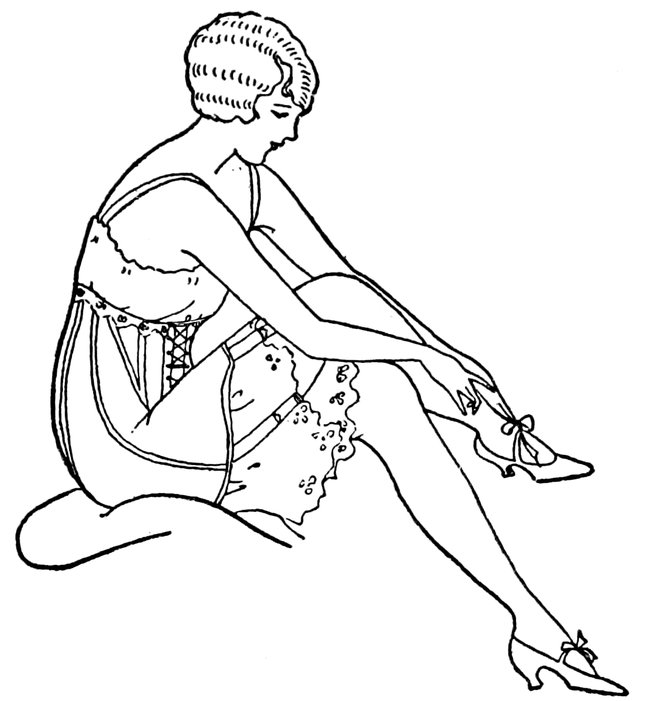
We fat women—and I don’t know why—have
a natural hankering for lacy underwear,
and that hankering is just as uncontrollable
as our appetite for luscious bonbons. I do
not intend to tell you that you can’t have
lovely undergarments, but you must make
sure that the lace or trimming is put where it
cannot bulge out.
Knitted underwear fits best, but you needn’t
wear just the most ordinary kind, because
with a little ingenuity a plain, inexpensive
piece can be bought and trimmed attractively
with bands or strips of lace, straight line
fashion, so that they will have a dainty, handmade
look and yet be as smooth and straight
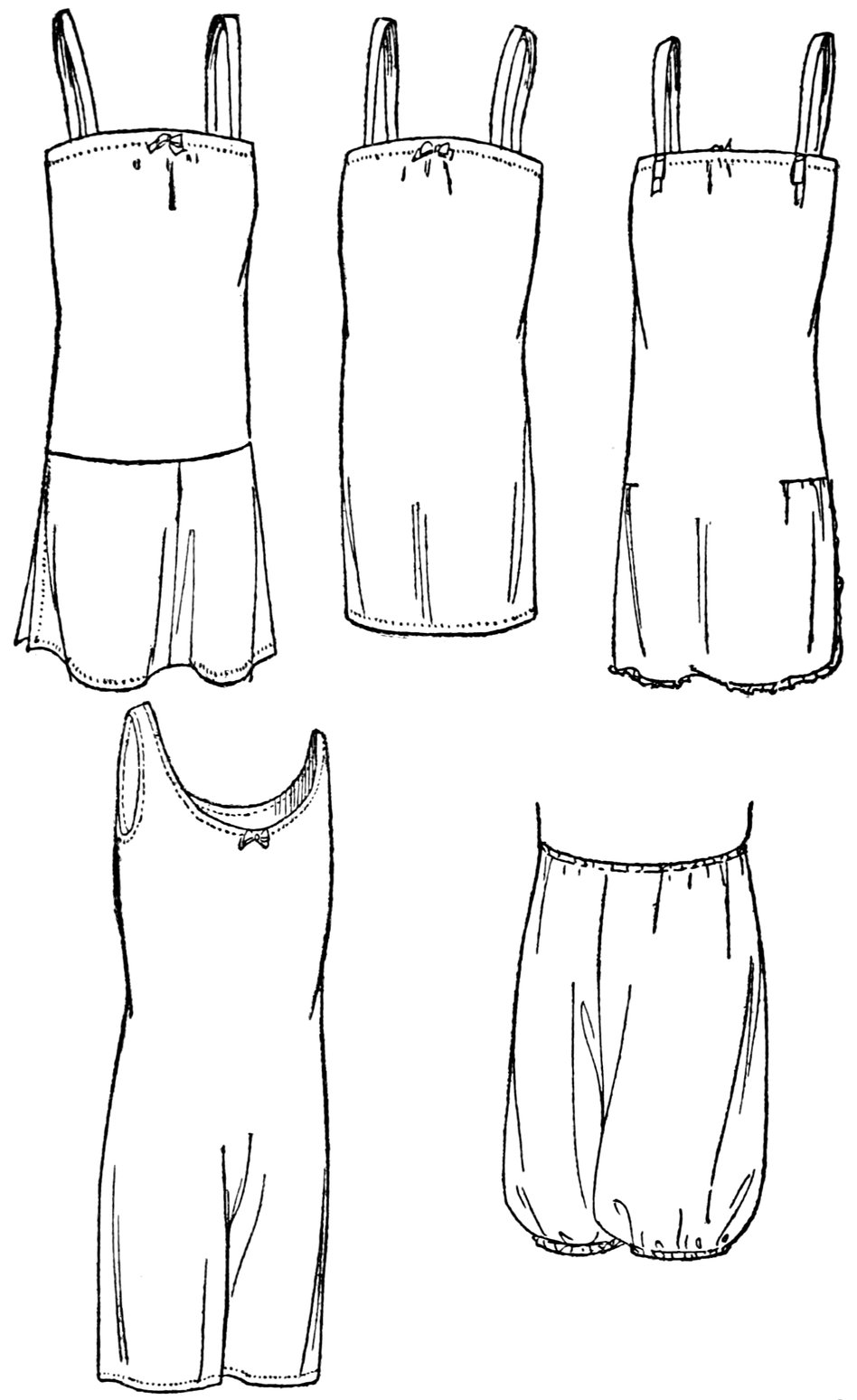
on the body as can be. Combination suits
similar to those illustrated are suggested for
slenderness. If you have ruffles on any that
you have in the dresser drawer, take them off.
Press out the ruffles and stitch the bands on
plain. Don’t indulge in ruffles!
66
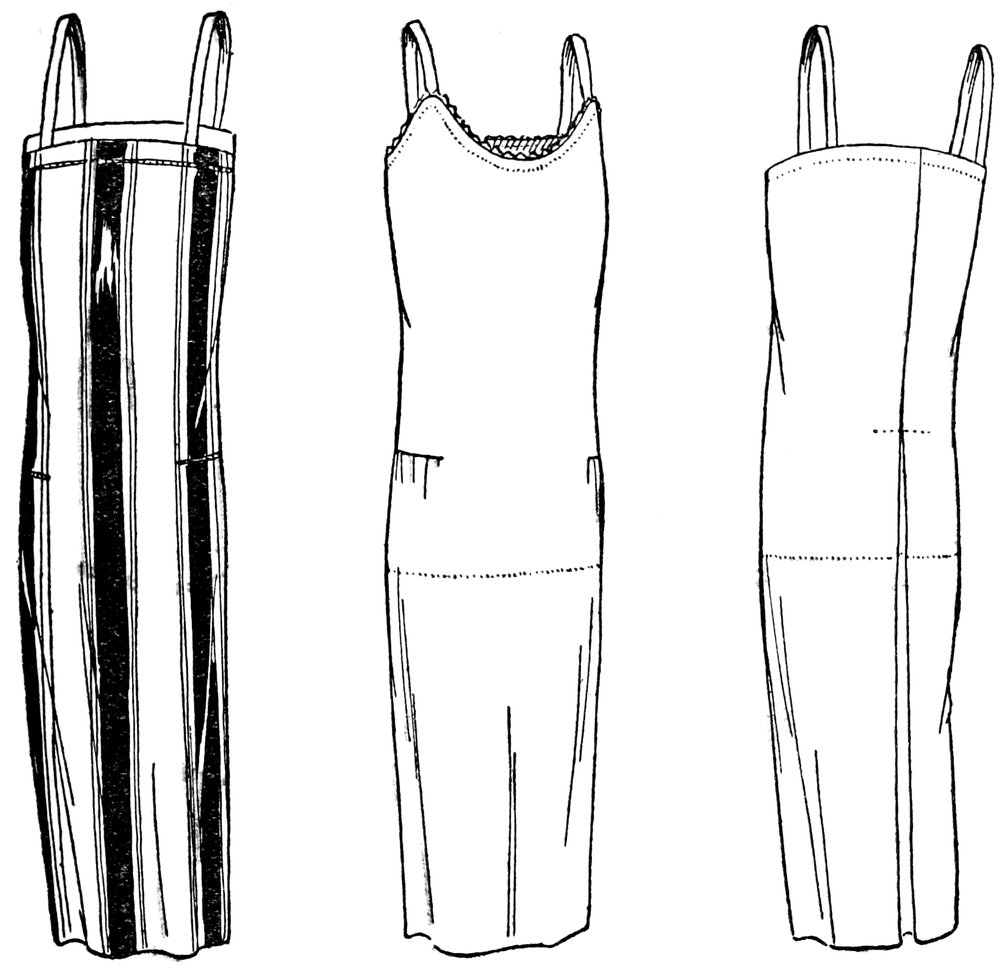
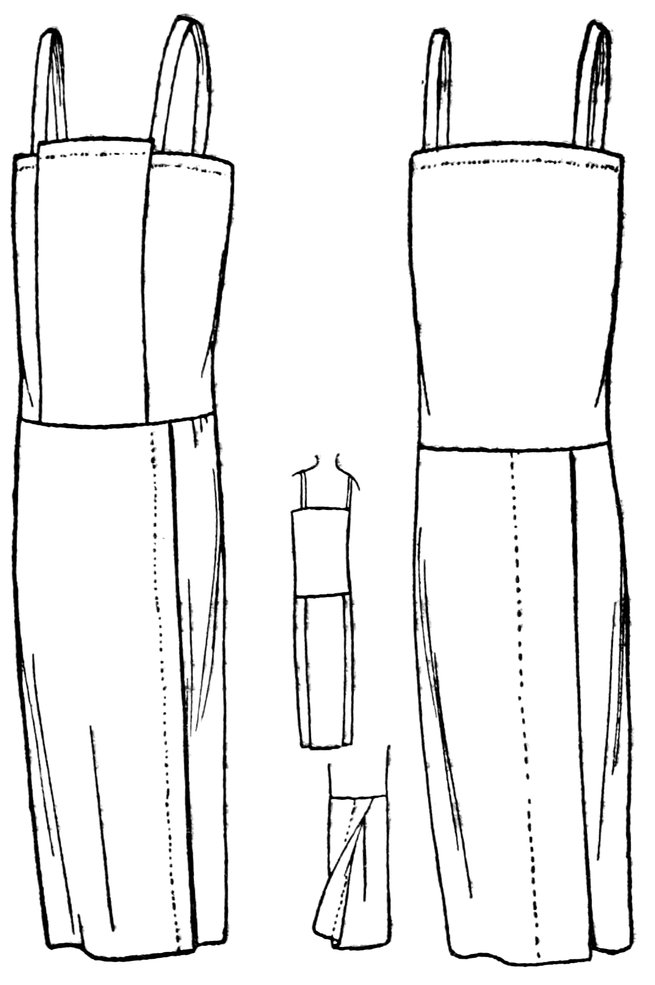
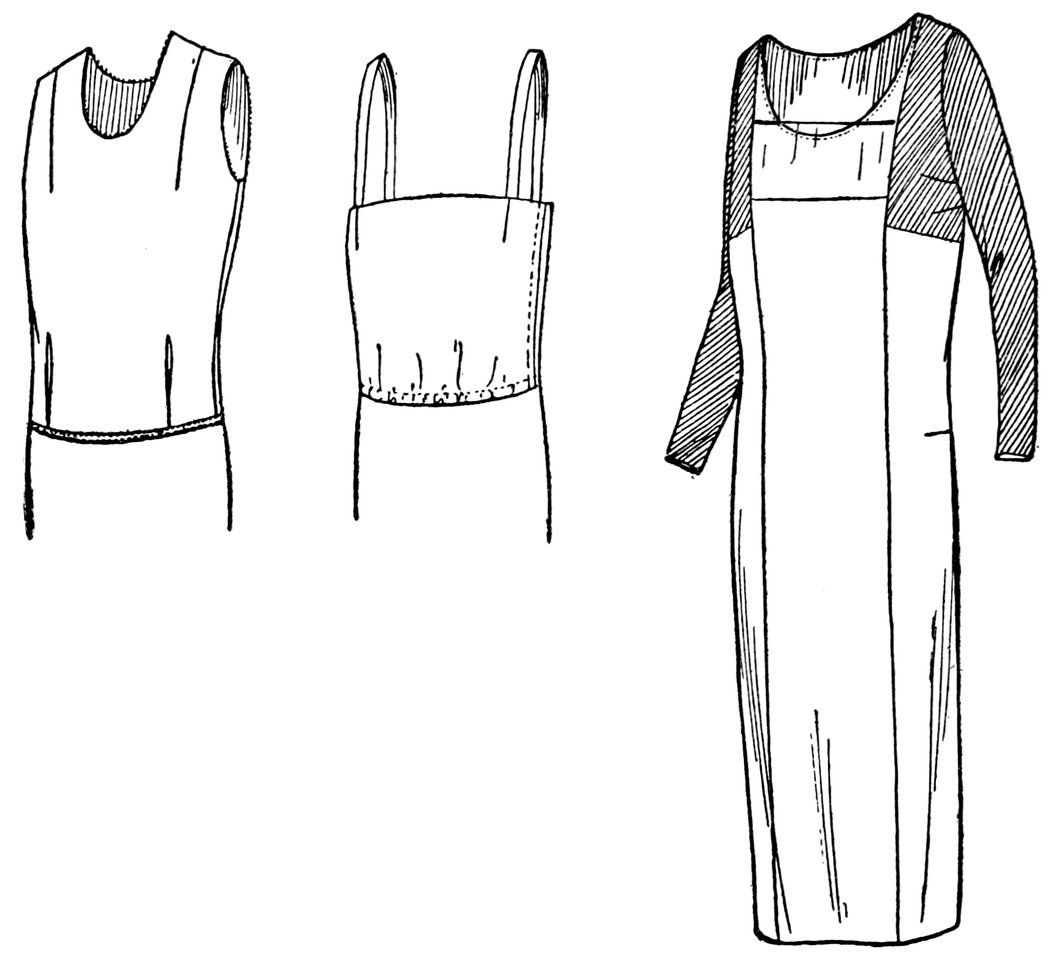
A variety of slips are shown. The one at the left has a 2–inch band of fine net at top and bottom. This as a substitute for lace is quite as dainty and less bulky.
For a full bust, the diagonal darts at the right are advantageous, as they make possible a straight slim skirt.
67
For your slips remember that stripes partially concealed are effective yet unobtrusive, as for example, a striped slip under a plain voile or georgette dress. If you are broad through the shoulders, shape the slip to reduce the width. Deep hems make extra petticoats unnecessary. Fulness in a slip is essential, otherwise the garment will pull up when you sit down, making you seem stouter than you are. An inverted plait at the center back or at the sides is the best way to add fulness.
68
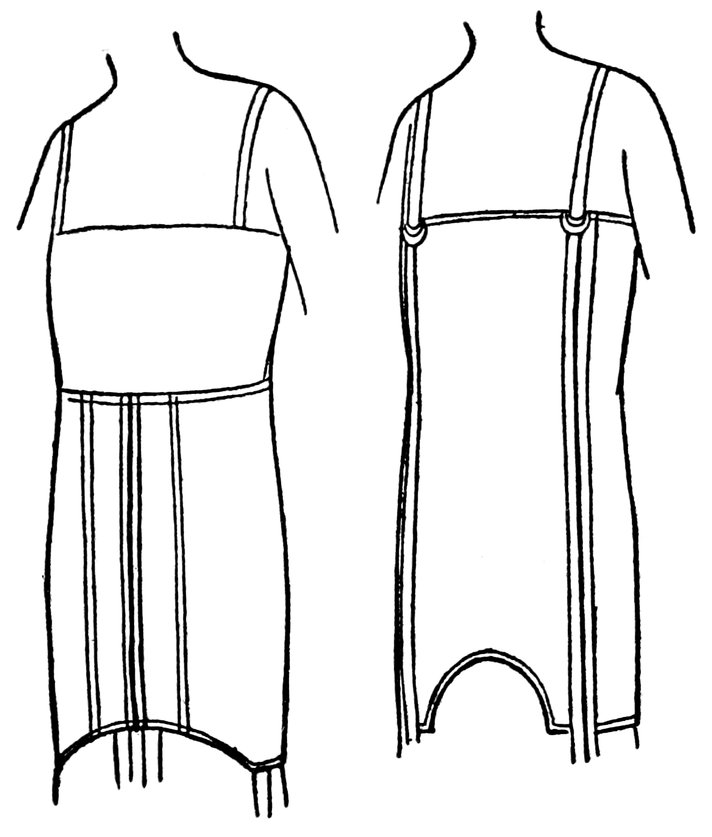
In selecting underwear, choose light-weight, smooth, close-fitting garments—fine knitted ones or those of softest muslin.
A shirt and bloomers are preferred by some—others, the straight combination. Select that which suits you best, but keep in mind the essentials of slenderness.
69Omit all draw ribbons at the top of lingerie.
Use tiny lengthwise darts to fit the
garments close and smooth.
For the same reasons, omit all gathers at
the waistline. Fit the garment so smooth
that not a wrinkle or line is visible when the
dress is on.
By following these really simple rules in
regard to your underthings you are ready to
give your attention to the part of your costume
which shows; namely, dress, wrap, and
hat, but don’t make the mistake of thinking
that these are the only things that show. For
without smooth, perfectly fitting underwear,
corset, brassiere and slip, your outer garments
cannot possibly give you that appearance
of sylph-like slenderness which is your
goal.
CHAPTER V CARDINAL RULES FOR DRESSES THAT CAMOUFLAGE SIZE — REMODELING YOUR PRESENT WARDROBE — SELECTING NEW CLOTHES THAT WILL SLENDERIZE YOU — THE TRUTH ABOUT SURPLICE FRONTS — SLEEVES FOR LARGE ARMS — SLENDERIZING FLESHY SHOULDERS — DISGUISING WEIGHT FROM THE WAISTLINE DOWN — NECKLINES MAKE A TREMENDOUS DIFFERENCE — THE IMPORTANCE OF THESE SLENDERIZING TRIMMINGS — HELPFUL HINTS FROM A LEADING NEW YORK DESIGNER
71
We will now assume that right corsets and
slips have been acquired, that you see and
realize the possibilities of optical illusions
and that a keen desire is evident to avoid,
overcome, and correct every fault that hinders
a right expression of clothes. I use the word
“right” in a broad sense, because in working
to look slender in dress you will necessarily
achieve a happy degree of perfection that
will prove quite as much of an asset as the
appearance of slenderness.
I know you are eager for the start to actual
rules and formulas, but first we must acquire
enough “feeling” for line, color, and fabric
to use the three wisely. The most economical
way to do this is to start with what you
have on hand.
To the closet now.
Take out your big-figured dress. Every
large woman owns a figured dress of some
72kind. There is something different about you
if you haven’t one. I don’t know why, but
evidently we all have felt that we might get
lost in the expanse of the pattern and become
less conspicuous.
Take time to put this figured dress on so
that you won’t get red in the face doing it.
Yes, you will find it is too short waisted; the
sleeves are too short, the neck is too high, the
skirt too full. You hated to admit that you
needed a 44 pattern so used a 42 and allowed
a little extra room across the hips. (I know
just how you felt, for I have done the same
thing myself).
Now survey yourself in front of the mirror.
You haven’t any goods like the dress, so
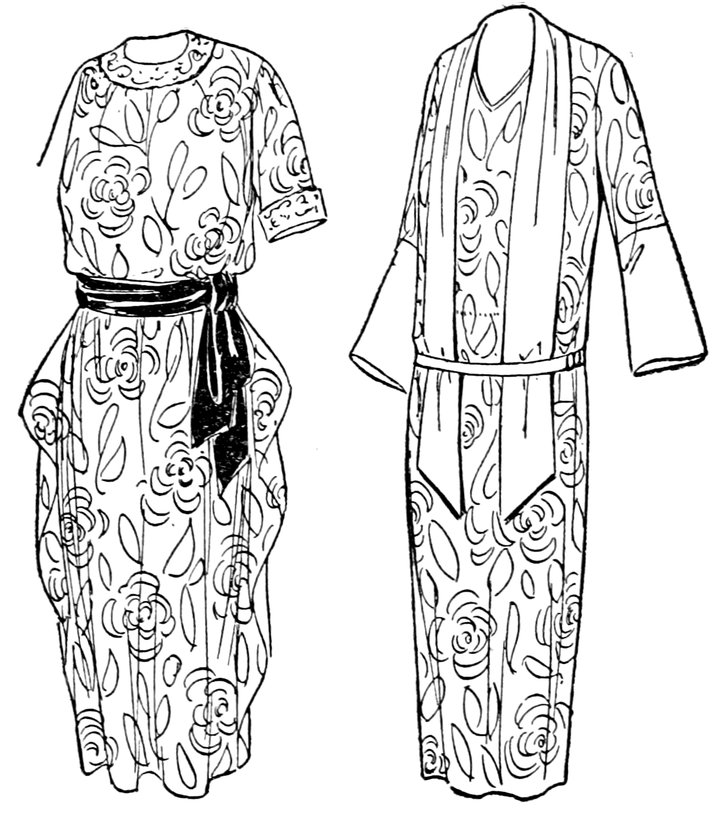
you must add something to it. For a figured
dress of Georgette or silk, plain color Georgette
is suggested. See on page 73 how the
sleeves are lengthened by a deep cuff, the collar
effect lowered by a scarf, the waist let
down and made looser by means of the excess
material in the skirt.
73
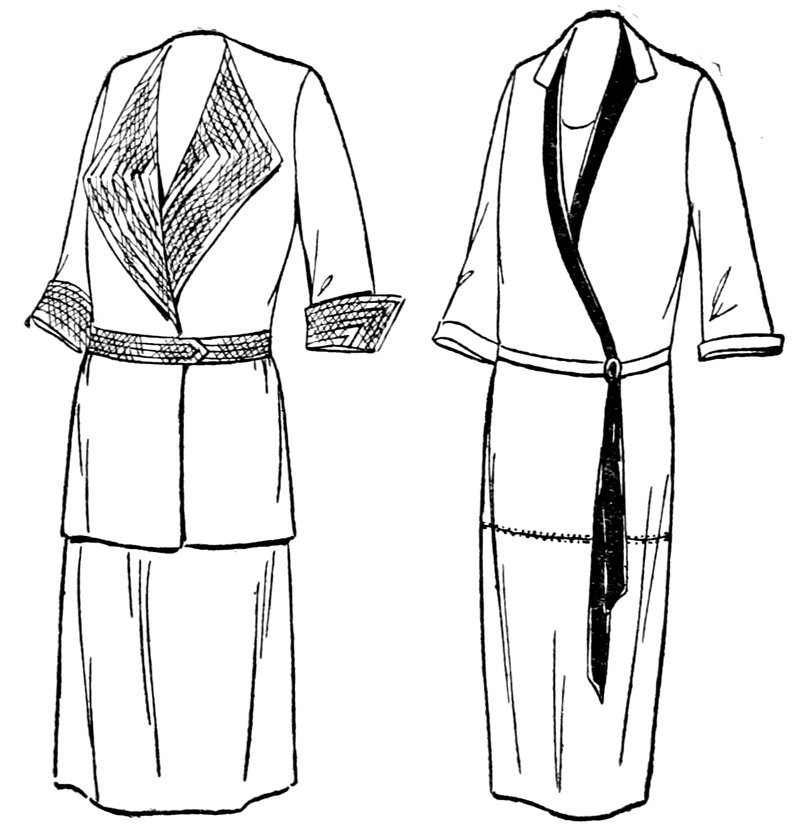
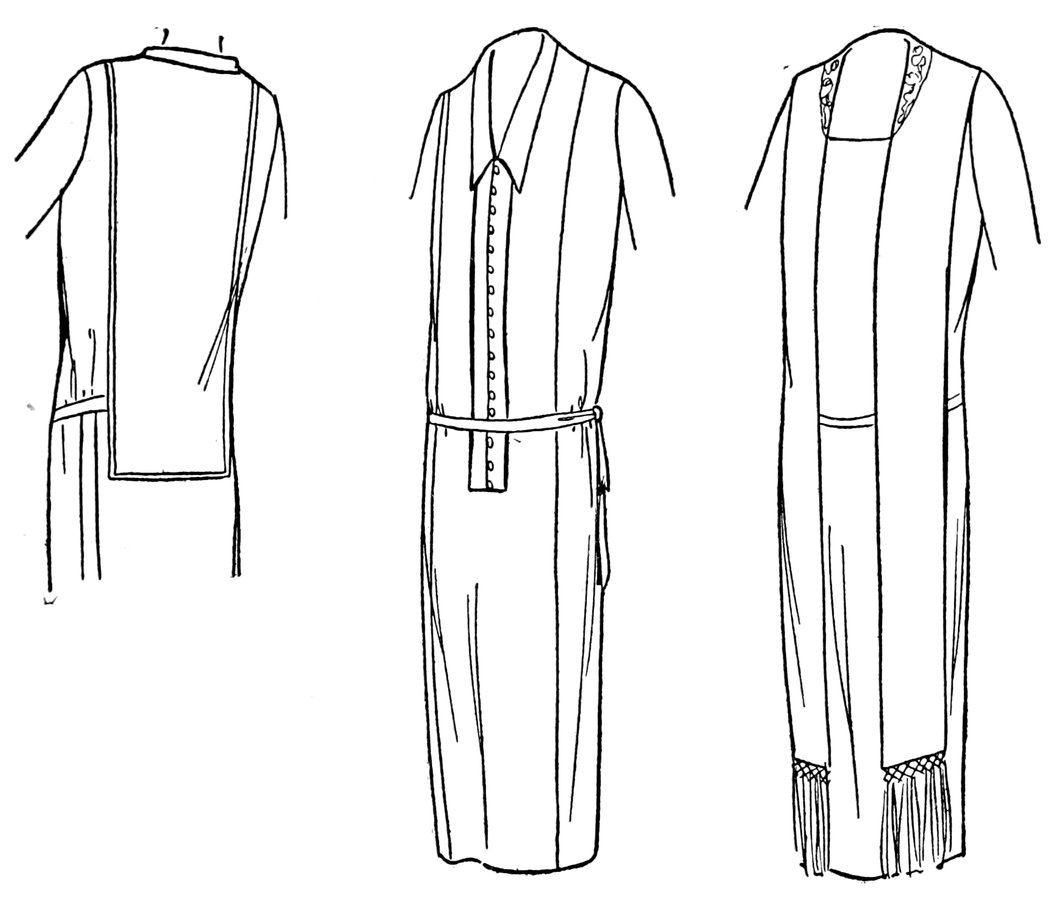
Here is a large-figured dress remodeled to give it length lines and a more slender appearance. The neckline has been changed, the heavy prominent girdle removed and a narrow belt substituted, the waistline dropped, the sleeves lengthened and a scarf of plain material added.
74Next, try on that plain tailored dress that
you have been planning to rip up or give
away. If it has an out of style waistline or
heavily braided revers, make up your mind
to sacrifice them now—to rip apart and to
take off the revers. Consider some black
satin if the dress is dark blue, or some white
piqué if white is becoming, and think of the
improvement some long, slim revers and
some dainty turn-back cuffs will make.
Take the belts or waistlines off the separate
skirts that you own and visualize how some
plain boyish form brassieres as camisole tops
for these skirts will improve them, joined as
shown on page 75 in either one of the ways
suggested. Your blouses may be worn over
these. By this method you may not be able
to camouflage the size so readily but you can
decrease the appearance of years by a considerable
amount. Isn’t it easy to see that on
page 77 the silhouette on the right is years
younger than that on the left?
Try on all the dresses you have. Consider
the tightness of the waist and the length of it.
Look once again at the little figures in Chapter
II that illustrate so well the laws of optical
illusion. Remember that if you are fat in
the back your dress must have some kind of
a neckline trimming or scarf collar, long and
slim as on page 79. This makes a lovely
addition to any dress.
75
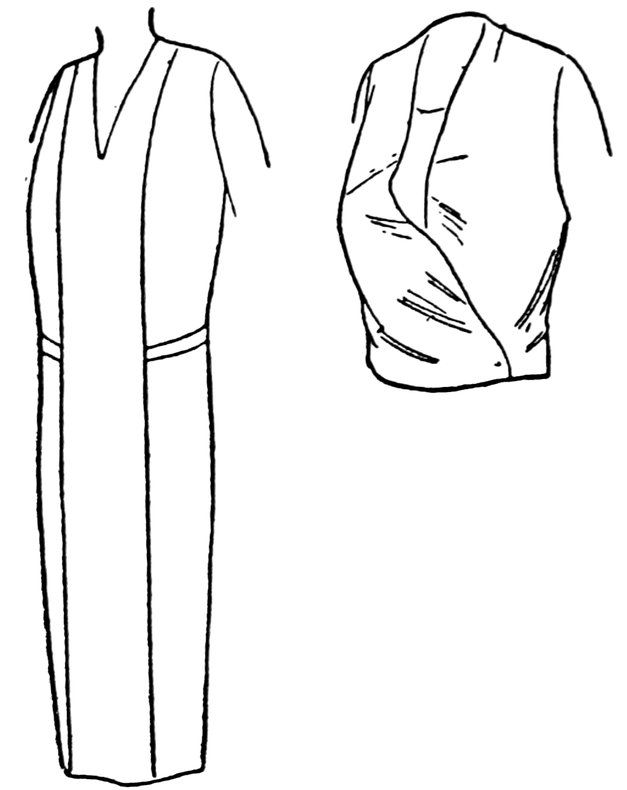
Camisole tops are advantageous and will allow a skirt to appear easy on the figure.
For wrap-around skirts always allow fulness by panels or concealed plaits so that your skirt will not stretch unshapely when you sit.
76After you have had this little seance with
yourself in the fittings, get out your dress
form, wrap it with cotton, cloth or soft tissue
paper until it is as big as you are, put a
straight line lining over it that fits you easily
and yet perfectly, then put your dresses on
it. Loosen them at the waist, ease the sleeves
if necessary and work to add a little youth,
a little smartness, a little trimness by means
of additional materials used in a wholly intelligent
way.
Now that we have improved the clothes on
hand, let us think about the purchase or making
of new ones.
If you make your own clothes you can
work out the points for yourself as you adopt
them. If you have a dressmaker, gain her
cooperation. She may not understand the
principles of “optical illusion,” but she will
be delighted to have suggestions that tend to
slenderize, and I am sure she will work with
you happily in carrying out the ideas and instructions
given.
77
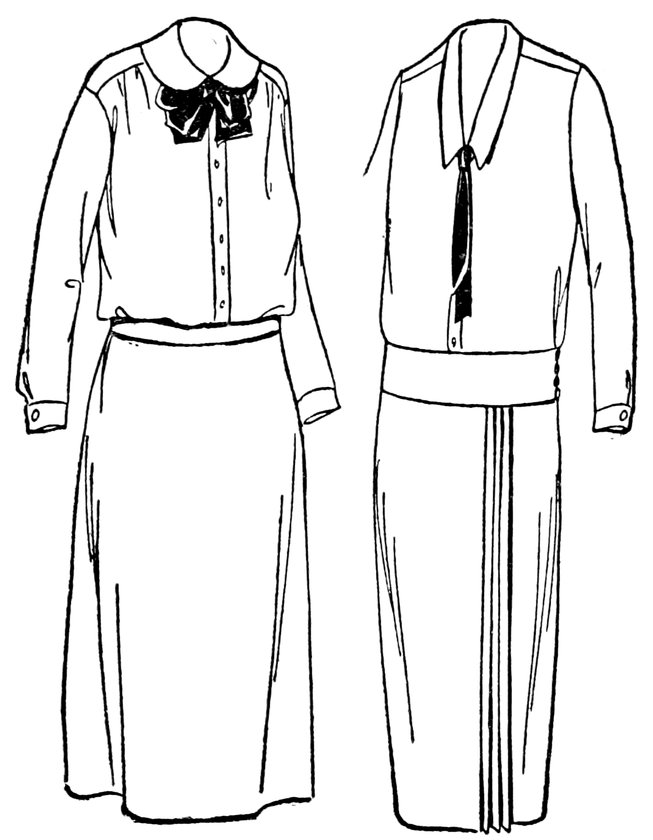
A shirt waist dress, when all of one color, is often becoming, but the lines must all point downward and the waist line must be straight and easy.
In remodeling, as you see, a new collar has been provided, the shoulder shortened, fulness cut out at the shoulder, cuff narrowed to allow the sleeves to be lifted, the belt opened and lined to give ease and width.
The skirt was shortened at the top and attached to a camisole brassiere. The fulness of the skirt was brought around and tucked to give desired length line.
78Before buying a new dress, suit, or wrap,
study fashion pictures, dozens of them, and
try to determine how your type should express
the “new” in fashions. Choose what
you like best in the new mode, cut out the
pictures from the magazines and fashion publications,
go over them carefully again and
again, and determine by study and elimination
what dress and wrap will give the best result
for the money spent.
As an aid in obtaining other valuable pointers,
when you go into the shops to try on new
dresses, observe the saleswoman very closely.
She may not understand either what you
mean by “optical illusion,” but if you understand
the principles you can get a great deal of
help from her for she will let you know at
once what is out of proportion in your figure,
what there is about your shape that doesn’t
correspond to their models. She will invariably
say, “I am afraid your hips are too big for
that dress,” or “We have only a few dresses
that will fit you. You are too large in the
bust for that,” etc. Now, keep your disposition
and listen, then determine to go home
and concentrate upon making less conspicuous
the part that strikes her as being out of
proportion. Remarkable improvements may
be made in this way and the “hardened” saleswoman
can truly be of service, for she, unlike
your friends, is not inclined to flattery
unless she has visions of a sale.
79
Even in a surplice waist, length can be attained, as the illustration shows. Sleeve trimmings should be avoided that come even with the waist line. As you see, they give width where length is needed. Heavy stiff trimmings are difficult and must be very smart to be attractive. The softer, more slender the trimming, the better usually. Skirts should be designed to be free of flare.
80
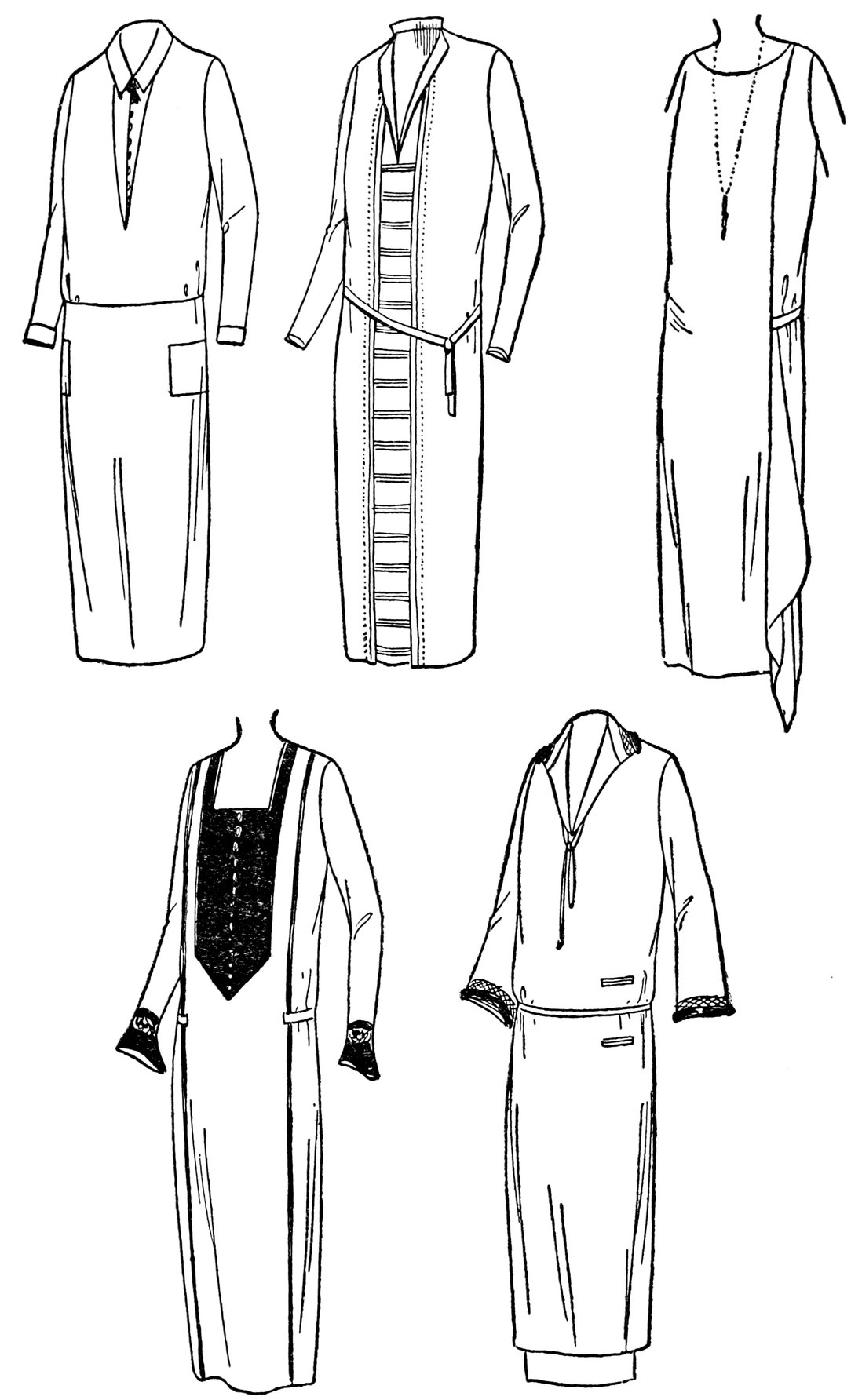
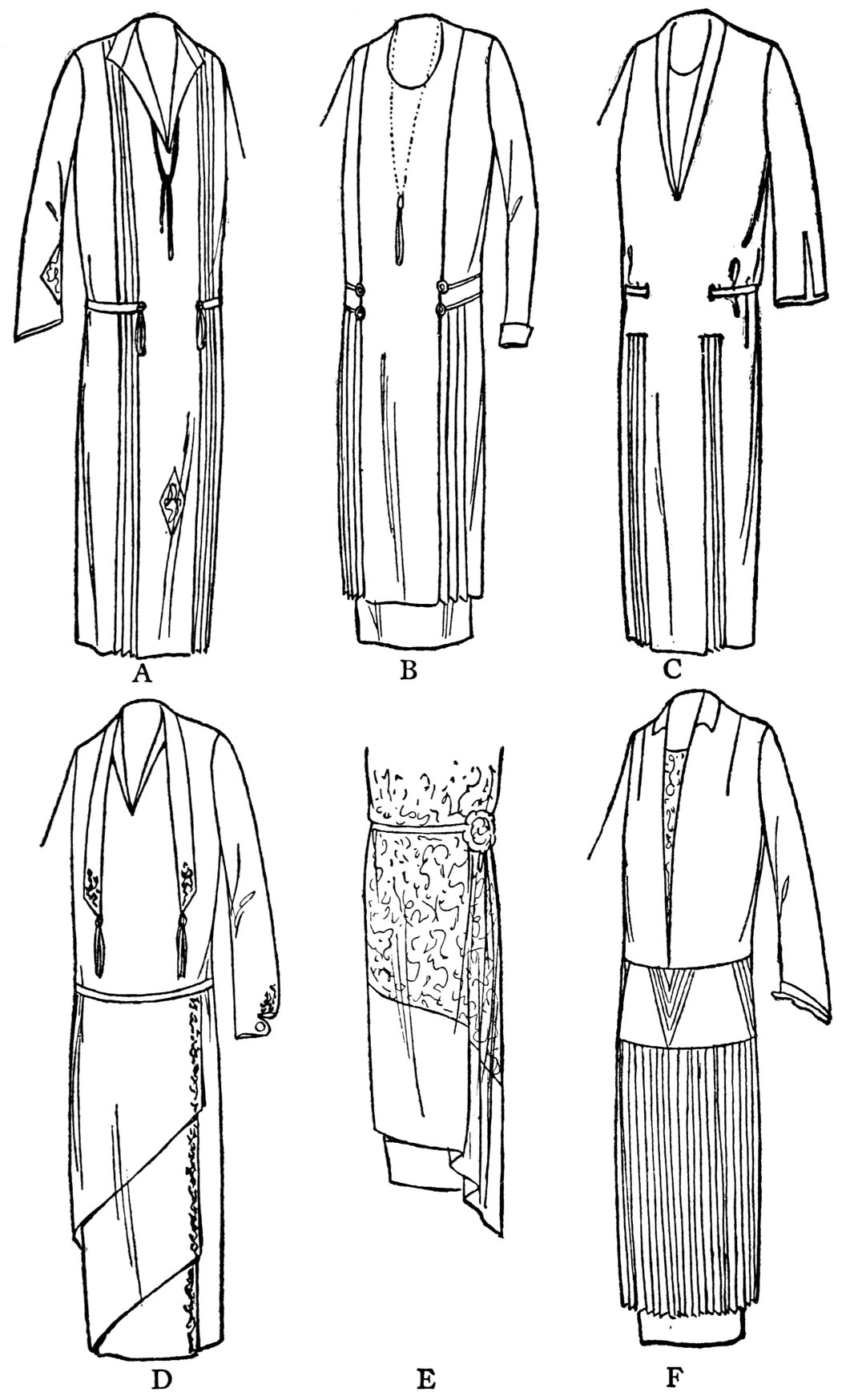
Current fashions are always whimsical but back of every dress or underneath it is a foundation that makes the skeleton of the dress. This you must observe in every pattern you use or dress you buy. The trimming you can vary to suit your needs in slenderness, but your foundation lines must be suitable if you use trimming.
A variety of dresses are given, shown on the opposite page—the waist line dress, the narrow panel front, the wide panel front, the draped side line, and the tunic line. These represent good foundations and are in themselves slenderizing, providing you adhere to the code of long lines and simplicity in decoration and ornament.
82Only careless persons can afford to buy
clothes haphazardly. Even the slender woman
thinks about them and plans about them.
And just consider what a corps of helpers she
has! A thousand hands to work to make
modish clothes for the perfect 36, while only
a dozen in proportion are working for us big
folk! So it is easy to see why we must learn
for ourselves what we can and cannot wear,
what to emphasize and subdue. “We cannot
eat our cake and have it too,” is a line familiar
to us all. We can’t enjoy our pounds unless
we work to dress them so that their number
is not even surmised, let alone accurately
guessed.
One clever woman I know, capable of making
her own frocks and coats as well, visits
the exclusive shops, buys the most becoming,
simple dress that she finds, often paying as
much as $200 for it. This she copies in other
shades and materials, developing three or
four distinctly becoming dresses at far less
cost than the original gown. By averaging
83up she has modestly priced frocks, all smart,
in good taste, and wearable.
I have always said that if I should ever go
into the dress business, it would be to make
slender dresses for big folks, and I would employ
all big women to sell them, because, as
I said about our jolly big friend, the corsetiere,
she has an understanding heart, knows
how difficult it is to find dresses that have
enough youth, enough value in line, and are
sufficiently becoming to us who tip the scales
to any great degree. And she would lend aid
to the discouraged soul that needs to seek and
try, experiment and insist until she finds that
which is becoming.
When the bust is full and the skirt length
is short it is wise to use a panel effect in the
front and let the belt or waistline finish extend
around from side to side across the back,
thus leaving an unbroken front line. As a
rule, the large figure looks best in a very long
waistline, but this does not apply to such proportions
as these.
It is always wise for this type to beware
of surplice front dresses. The mature figure,
84flat in front, can wear a surplice very well
and often it serves to relieve an undesirable
plainness. Many fashion artists, when they
draw full bust figures, take special pains
to put in surplice fronts, but experience will
teach that it is very difficult to duplicate in
fabric the easy, smooth curve indicated by
the pencil.
A panel front is always more desirable than a surplice for figures full in the bust. The seams provide a good fitting line and make darts unnecessary.
Surplice fronts are as difficult for a very
full bust as are plain backs on fat shoulders.
If your back is full and round, remember to
use tucks, bands, folds, plaits, or something
that will definitely break the width. Panels
85also help, so don’t be afraid to use them. Big
backs broken in width are far more pleasing
than broad expanses that know no termination.
Remember the panel can befriend you, so
keep it close but only when it can compliment
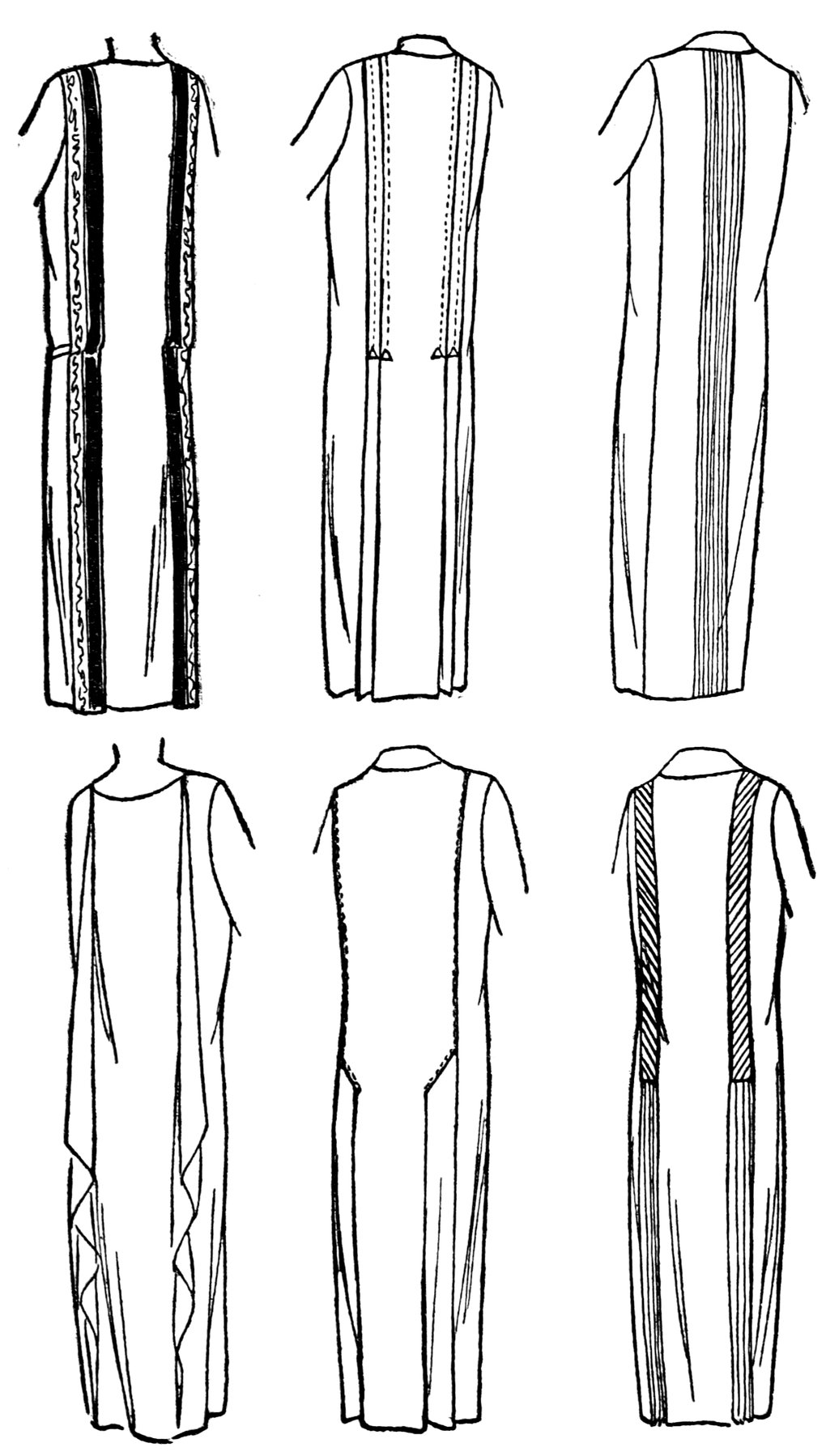
you. If your back is fat and wide looking
after you finish with this book, it is your own
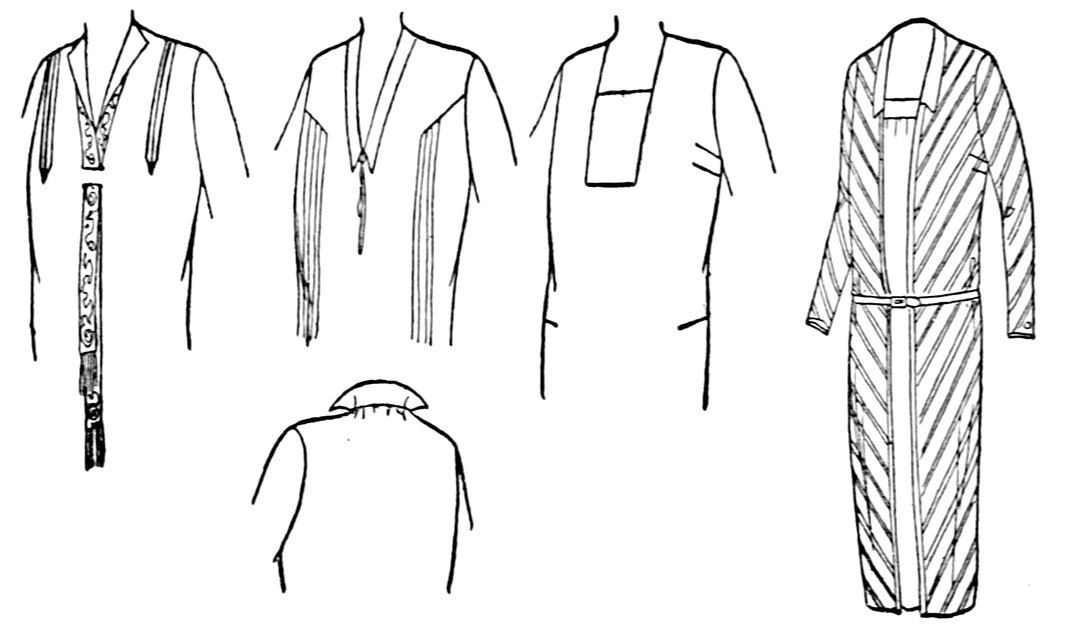
fault, for on page 87 you can see six simple
ways of creating an optical illusion by lines
that make the back less wide in appearance.
If your arms are fat, don’t wear long shoulder
dresses or kimono sleeves. They just
aren’t meant for you. From point of style,
becomingness, service, they will fail you all
the way. On the other hand, don’t overdo
narrow shoulders. Strike a happy medium.
Upper arms that are larger than the armhole
are quite common, and the mistake is
often made of fitting the armhole to the sleeve
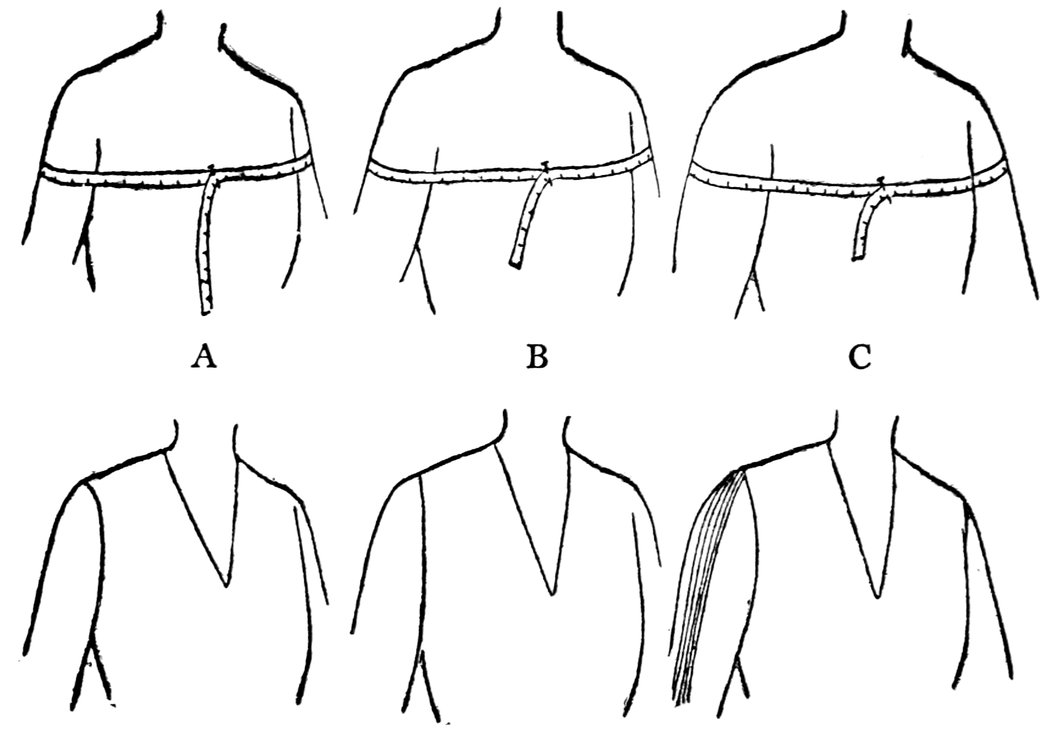
rather than the sleeve to the armhole. Have
the armhole comfortable and smooth and set
a gusset in the sleeves or increase the seams
in cutting from the armhole to the elbow.
87
We can smile and aid our front, our back must always protect us by being at least inoffensive and pleasing.
Here are six ways to slenderize backs of dresses. Study them, find that which becomes you best. Once you have found your line, hold to it, but trim or effect it differently so that there is interest and variety. Observe Fashion illustrations carefully for backs with interesting length lines, and don’t allow yourself to forget that they are just as important as the front in achieving slenderness.
Remember that fulness at the hips is advisable, both as a protection to the dress and to insure more grace in sitting. A dress that draws up on the figure is always to be avoided.
88I know a woman who was wearing size 44
dresses that hung on her unattractively and
heavily. She said that she couldn’t get her
arms into the sleeves of size 40 or 42 models.
A wise saleswoman ripped the sleeve seams,
inserted gussets and moulded her beautifully
into a tailored frock size 40. Since then she
looks 20 pounds lighter, all because of this
little adjustment.
A bias sleeve is sometimes a distinct advantage
for a stout arm. Take flannel or the
heavy crêpes. A “tight as the skin” sleeve
may be fitted that has “give” enough for comfort,
yet not a quarter of an inch surplus.
This type of sleeve is not suitable to flimsy
materials, but very good for the firmer fabrics
and is sometimes economical for cutting,
as often the sleeve pattern can be placed on a
true bias grain to advantage.
There are many details in sleeves to consider
when you want to appear smaller than
you actually are. Your success is due largely
to your knowledge and its right application.
So watch, look, and listen for every hint that
will aid you in expressing perfection. It is
attainable, and every achievement will stimulate
greater desire and effort.
Years ago, in fitting a well-to-do woman,
who was very “heavy set” in mind as well as in
89body, I remember that she would insist upon
drawing her arms up, crossing them over her
ample bosom and saying that the armhole was
too tight and that more and more must be
trimmed out until her waist was unbalanced—narrower
across the front than it should be,
wholly deforming the dress. No dress can
be beautiful if it is out of balance; it is contrary
to every rule of right design.
(Left)—A gusset at the under arm (left) is advisable when the arm is larger than the armhole.
(Center)—Sleeves cut on the true bias, as shown, are often advantageous when very close-fitting sleeves are desired.
(Right)—Beware of dresses that are too narrow across the chest. They always make the bust appear larger.
I know one clever designer who makes for
her larger customers a very firm net foundation
waist with low square neck in front and
back and close-fitting sleeves that extend almost
to the elbow. In this she puts the dress
shields. This net foundation, especially the
sleeve part, protects the dress, makes it last a
third longer, and has the advantage of confining
the arms slightly.
90
Measure and find out if it is your arms or your body you “need to treat” in slenderizing. Sometimes very large arms accompany medium bust measurements and vice versa. Knowing this makes for a wiser use of line.
If your arms are small in proportion to the bust, as in “A,” use a normal shoulder line.
If they are large in proportion to your bust, as in “B,” cut the shoulder high.
If arms and bust are large, use a length line on the sleeves, as in “C.”
91
A foundation lining of net that holds the sleeve is often advisable for sheer dresses. Elastic should hold it at the waist. The bottom of the sleeves and the neck may be bound or picoted.
Large shoulders are a problem because
they can appear quite as full as the bust and
by the roundness add years, which, of course,
nobody wants. A collar that is just right in
depth, not too deep or too short in the back,
is the first essential. For your individual
type, you must make experiments. Take a
piece of muslin or paper and cut out modish
collars that you think would be becoming to
you. Then try them on with two mirrors and
view the back, front, and sides, examining
well down past the waistline, because the collar
line and belt line must always agree.
92Turn under the collar edge, add to it, and
after careful observation, do what your eye
tells you is best. Never let your collar be so
long as to look like a cape unless it is a cape;
and don’t let it be of a length or size to lie up
on your back like a doily on a table. Attach
it—have it there for a purpose, that of giving
a correct and becoming line.
Let your collar aid you. Beware of collars (like those at the left) that widen the shoulders or that cushion the back.
Fashion often allows of back collar trimmings that are both slenderizing and becoming, such as those at the right. Hunt for them, then use them wisely.
If you are full in the back, don’t wear
shoulder capes or bertha collars. Never
wear heavy collars or babyish lace or ribbon,
and avoid collars of vivid color that contrast
definitely in color with that of your dress.
The first importance for a figure with most
of the weight below the waist is the design
93and trimming of the sleeves. It is a weakness
in which we must never indulge to plan
for what should be graceful flowing sleeves,
but which usually turn out to be a tragedy
of adding pounds to pounds. In summer
time and for evening wear, the sleeve may fit
easily but without flare and reach to a point
just above the elbow, provided there is no
trimming feature or cuff. For all other types
of dresses the long, close-fitting sleeve is wisest.
By adding to or taking from the length
of sleeves, emphasis may be given to any part
of the body from the hip line up, as the bottom
of a sleeve is naturally a line which will
attract the eye, so that if this is in the wrong
position it is easy to imagine the result.
Experiment with this feature, and convince
yourself of the truth of the statement.
Some big women have a full abdomen like
a man, which causes their skirts to hike out
at the bottom like ill-fitting maternity clothes.
For this type, correct maternity line dresses
are best. A bodice waist that is long in the
front should be used. The skirt is attached
to this quite low in front, then side panels are
applied to give a correct balance and to widen
the figure at the side.
94A variation of this figure has the full diaphragm
but a flat appearance just at the front
of the hip bones. This type is recognized as
difficult to fit, although it is easily possible to
conceal both points satisfactorily.
First, the full front figure must mask its
size by long collars, panels, plaits, or some
flat trimming, bringing these down so that, if
possible, they may aid the hollow sides. Here
again a thorough knowledge of the laws of
optical illusion will stand you in good stead.
If your skirt still pokes out at the hem in the
center front, follow the suggestion given previously
and provide a corset that laces in
front and that laces up so that the abdomen
is held in, also one that is loose enough at the
waist line to allow the flesh to rest up in it.
A few suggestions are illustrated that may be
applied in making a new dress or in correcting
one that you have—or in perfecting a
plain dress that you might purchase.
Oftentimes, a full abdomen has as an accomplice
a sway back. For this, a panel in
the back that hangs from the shoulder and
that is caught at or below the belt line in the
back is advantageous. A slightly low belt
line is also desirable.
95
When the bust is large and the hips are small, lines as shown at the left are becoming. A V-line in the vest may also be used if the bust is not too high.
If the figure is large and evenly proportioned, a definite centered lengthwise line, as shown in the second design, will break the width.
If the waist is short and the skirt long, length lines, as at the right, carried down on the skirt will balance better and detract from the short waist. The neck line of this dress allows for a small brooch or bar pin.
96Frequently, large figures—though this is
also common to slender folk—find that the
back skirt length measure is shorter than the
front. Elderly folk, especially, find this
trouble where the bust has shrunken or is
small in proportion to the hips. For such
types straight line dresses with a belt line
across the back, or a narrow sash belt that ties
at the side, are advisable. Long collars are
also efficacious, and scarf collars particularly
so.
In order to counteract the roundness of the
face, and provide some contrast for its fullness,
it is usually best to decide upon a neckline
emphasizing angles, not curves. Always
have the dress cut well up at the back but
dropping down with straight lines to a deep
V or square. It is wise to have the neckline
cut low and fill in the opening with sheer
Georgette, batiste or lace in an inconspicuous
color, such as delicate flesh or deep cream.
The short stout figure with a short neck and
medium small head is one type of stout that
can wear a U neck or a slightly rounding neck
line becomingly. Such a neck makes the
head and neck appear larger and gives a good
balance.
97
For sway backs or figures that curve in definitely at the back waistline, a broken panel, as at left, is often advisable. It is especially desirable if the figure is tall or very large.
An interesting lengthwise trimming is shown in the central figure. Such a line can be attained in contrasting or harmonizing fabric or with embroidery tucking or plain stitching, and is adaptable to tailored or sports clothes. Full front figures will find this line especially advantageous.
Very wide or large figures will see merit in side panels that divide the front in three, as shown at the right. Such a design allows for a close-fitting foundation dress and is especially suited to older women.
98
Think long and carefully about trimmings
because a misuse of decoration can mar the
lines of an otherwise becoming gown.
Trimming, judiciously placed, will add to
the appearance of smartness and may by its
position break a wide plain surface into two
or perhaps three spaces, adding with each
line another point to our illusion of slenderness.
It is essential that trimming be placed so as
to emphasize length, but do not make the mistake
of applying it indiscriminately, but
rather, to draw attention to a closing, or to
finish the edge of a panel or for some similar
useful purpose.
Never use a large figured trimming or a
bright colored banding. Plaids, big polka
dots, pronounced stripes, heavily embroidered
fabrics or “gew gaws” are not for the big
woman. Strive for distinctive line which is,
in itself, simple. Wear as good quality fabric
as your purse can buy, but be modest about
99your size and any decoration you employ.
Quantities of string beads are to be avoided,
too, as should anything which will make the
wearer conspicuous.
Self fabrics, that is, the material of which
the dress is made, is always good. It may be
tucked or plaited and inserted between cut
edges, applied as a band, or it may be used to
form a cord, which in turn forms ornament
of various sizes and shapes.
Small patterned laces in the wider widths
are appropriate too, and add richness and
dignity to clothes intended for dress up occasions.
Lace should never be shirred because,
as I have already told you, the stout woman
can never afford to be frivolous in her dress,
and ruffled lace would certainly make her so.
Plaited panels are good, but these should
always be held close to the dress by the use
of a French tuck from two to three inches
long.
The groups of vertical lines are always an
effective means of increasing height while the
long tab will help to keep the panel from
flying out as one walks.
Ribbon banding is effective both when
stretched flat and when used to form sash ends
100or ties. Such finishes must be generous in
length, otherwise they will add to, rather than
detract from width.
If foundation linings are used, plan them as carefully as the dress itself. They must be easy yet fitted to perfection. They must also be designed especially for the dress so that they will support but not hinder the outer line at any point.
A designer in one of the big New York
houses when asked as to her success in designing
becoming dresses for large women gave
these few valuable rules:
“I never use sheer flimsy material. If I
101must use lace, I weight it so that it is as heavy
as any fabric.
“I never use coarse stiff material—the softer
and weightier the better.
“I rarely use fabrics with luster or with
big design.
“I never use pure colors. I use shades
chiefly, very seldom a tint, unless it is a cream
tint. I avoid all white for my large customers.
We see enough big men dressed up in
white to know how much it increases size.
“I always make a foundation slip, smooth,
sleek and close fitting. In this I sew the
sleeves. My dress is made separate and hangs
easier and straighter than it possibly could if
it had the sleeves to hamper it. Then, too,
the dress lasts longer, which is a distinct advantage.
“I give special attention to my customer’s
hats, shoes and corsets. All must be right
for her or my dress cannot be a success.
“Often if I find a model that is definitely
becoming, I vary it in different materials and
colors, often making madam a half dozen
beautiful gowns from the one block. Why
not, if it is most becoming to her?”
CHAPTER VI ESSENTIAL POINTS IN CUTTING AND FITTING — THE HELPFULNESS OF DARTS IN CERTAIN PLACES — HOW TO HOLD THE DRESS UP ON THE SHOULDERS — WHAT THE LONG UNDERARM DOES — THE BIAS CENTER FRONT — HOW TO ADD FULLNESS WITHOUT FLARE
103
There are many skilful tricks in dressmaking
that are advantageous to the overweight
figure. For instance, the shoulder
dart allows ease over the bust, makes a more
comfortable shoulder, and permits of a close
fitting sleeve. It also prevents sagging of the
dress at the underarm, giving a neat good fitting
effect. Don’t avoid or “detest” darts;
learn to use them so that you get the greatest
possible advantage from them. Watch an
adept dressmaker smooth the material around
and slip out the dart in a line over the bust
that fits smoothly and easily. Only carelessly
fitted and stitched darts are unattractive.
The crosswise armhole dart, too, has its advantages
but is not good for a broad shouldered
or short figure as it widens the shoulder
and cuts the height, unless it is wisely made
on a bias grain to slant down so that a crosswise
line is avoided.
104
Darts are necessary for round figures, especially the underarm dart as shown at the right center above. They are often advantageous for flat figures, as at the left. They can, when wisely used, add much to the attractiveness of a garment. Don’t use them, however, unless for a specific purpose and slant them so that they give length rather than breadth.
Diagonal or bias lines such as shown at the right often are employed for smart effect. They can slenderize, are distinctive and youthful, especially if subdued stripes or twilled fabric is used.
Rounding shoulders often need a few gathers at the neck line in the back, as shown in the lower figure. Such gathers eased in insure a better fitting, more comfortable collar line.
105The underarm dart is often used with a
shoulder dart, especially for very full busts.
This helps to shape the material over the bust
easily and to give a smooth, straight underarm
seam. Sometimes a dart is used on the back
seam as well as the front in cases where the
back is fat and round. In any event, fit your
dress so that the underarm seam does not
drag, and so that the crosswise grain of the
material is parallel with the belt line.
The hip dart helps to fit the skirt by providing
a means of lifting the fabric at the
sides. If the hips are straight and not curving
to any extent, only a slight dart, if any, is
necessary. But for large figures a hip dart
is desirable, especially for one-piece dresses.
It should be brought up so that the skirt hangs
evenly all the way at the bottom. Arrange
the dart so that it comes directly over the hip
or under the narrow belt or waistline trimming.
Remember that the larger the hip,
the longer the dart, and the greater the necessity
for accurate fitting.
106
Plaits rightly employed can give length and are often quite necessary in Fashion’s catalog. But make them a part of the dress, surround them, make them give length where length is needed.
For instance, in A you find three forms of decoration, each with a purpose. The plaits for length, the embroidery for interest, the tie for color.
In B plaits for length, buttons for finish, necklace for interest.
In C the tucks must suffice for length, trimming and interest. Often embroidery is desired and it can serve to give length if rightly used. For instance D, a simple dress, is made pleasing with embroidery that helps rather than hinders.
Draped skirts, as in E, need not be taboo entirely, if the draping is used for line emphasis and is soft enough to cling rather than extend.
Large figures often find a dress broken in line advantageous, as in F. If the bust is large and hips small, the skirt should be favored with the trimming. The upper waist line should be omitted if the figure is in the least short.
108
If the back is fat and rounding and the
neck fairly small, it is advisable, in order to
hold the dress well up on the shoulders, to
run a gathering thread across the back neck
line. The fullness thus retained may be
eased in and shrunken out, if wool is used, so
that no gathers are visible but a comfortable
neck is secured. Such fullness is not at all
objectionable in silk or cotton fabrics.
In our quest for becoming clothes, we are
fascinated by the long underarm line and feel
sure that if we could evidence such a constructive
detail, we could look 20 pounds
lighter right away.
To achieve this, consider again what I have
said about the corset, its size and fit. Be
sure that your corset has enough supporters to
hold it securely down. A corset that “rides
up” or a brassiere that is too short will definitely
prevent a long, easy underarm.
Be sure when your dresses are fitted that
the crosswise grain of the cloth is parallel
with the waist line. Be sure that your waistline
109trim or belt is placed as low as your dress
length will allow—not low enough to make
you look top heavy, but low enough for your
own height, size and type. To find what this
is, parade up and down in front of your mirror
with belts, bands, and sashes strung around
your waist, one at a time, of course, until you
know which one is placed best for you. Don’t
be faddish, don’t be extreme, but be modish.
There is a difference. Work for becomingness
so that the line you finally decide upon
will surely be right.
Cutting the center front on the bias may
give a “silent” or a pronounced line, depending
on whether plain or striped material is
used. It takes a third more material to cut
a dress on the bias, but since it is possible to
develop a very smart dress this way it is often
worth considering. It should be worn only
by the type that can wear extreme things well,
however, because a dress cut on the bias is in
no wise conservative.
110
When styles call for plaits, plaits may be used, but not in widening flares as shown above, rather in slenderizing length lines as shown on the opposite page.
111
Hats and shoes in these two pictures also illustrate incorrect and correct choice. The wide hat and prominent straps opposite emphasize width and weight; the neat hat and cross-strap slippers above help to slenderize.
112
To allow fullness in walking, two plaits
may be placed in the skirt at the left side
seam, one directly over the other, the right
side of the skirt being finished plain. This
does not interfere with the slim line effect, yet
gives the desired freedom. Plaitings or panels
of self color that are 5 inches or less in
width soften the line of a dress and, if effectively
used, can improve the garment both in
line and attractiveness, especially for the figure
that is large above the waist. An effective
use of skirt plaiting can aid greatly in
balancing the proportion.
If the waist measure is large, keep the skirt
as straight and narrow as fashion will allow,
and watch your sleeves to fit them close and
plain. Short, full sleeves and a full skirt
must have a small, short waist line to be effective;
they are totally “out of the picture”
where the waist and hips are large.
Plaits aid in line and are youthful, but if
fashion decrees straight skirts we must stitch
or press them down straight and slim, for
flared-out plaits are treacherous for us who
would be slender. For the same reason, we
must avoid panels that flirt out as we walk.
A corded girdle, sash, or string sash that is
long and limp is becoming.
Tunics, if not too full, and if not definitely
113trimmed at the bottom edge, are advantageous.
They slenderize by making it possible to
draw the skirt in at the bottom, thus giving
an appearance of height. This, of course, is
lost if the tunic or the lower skirt is too full.
Large figures should always have tunics and
foundations of the same color and material
so as not to break the height.
CHAPTER VII FABRICS THAT SLENDERIZE — FACTS TO KNOW ABOUT MATERIALS — WHY AVERAGE “BARGAINS” ARE NOT AN ECONOMY FOR YOU — CHOOSE THESE SLENDERIZING FABRICS — MATERIALS YOU CAN WEAR — HOW TO LOOK SMART AT ALL TIMES — IF YOU MUST PRACTICE ECONOMY
115
First of all, buy your clothes with deliberation
so that they will look as though they
belonged to you, not as though they were
bought in a hurry. Deliberate buying is the
economical way. Emergency buying in
clothes is like food from the delicatessen—it’s
a “make shift” and an expensive one.
Buy for suitability, for smartness, and think
of all the uses you can make of a garment before
you buy. If it’s a dress, what wrap or
hat will you wear with it? Does it mean new
shoes, new hat, and gloves? If so, then consider
the advisability of purchasing another
style which would look well with the accessories
you have and are wearing with another
costume. Buy few clothes if you must, but
buy the best quality fabrics your purse will
allow. And buy carefully. Being well-dressed
is not so much a matter of money as
it is information, for the well-dressed woman
gives evidence of discriminate deliberation,
of knowledge applied to selection, and of a
116wise choice of accessories as well as essentials.
So take heed and take your time about
every purchase so that everything harmonizes
perfectly with what you have and so that
every article, from shoes to hat, has its part
in aiding slenderness rather than in emphasizing
stoutness.
Acquaint yourself with materials, their
wearing qualities, their clinging proclivities,
and their color quality. By this latter, I
mean their ability to “take the dye” and be
soft and rich in their shades, because certain
shades we must wear, and we don’t want to
have them dull and lifeless, like brownish
black or grayish drab. We want them to be
deep and soft like those of beautiful old fabrics
that have been ripened to an inimitable
softness by age.
The most becoming colors for us come in
good fabrics, so for the average woman there
must be economy in the number of dresses
rather than in their quality. A garment made
in good style and of good material is more of
a credit to you when half worn out than a
cheap new garment could possibly be.
117It is necessary to remember, too, that materials
with a glossy, brilliant surface or finish,
no matter what the color of the fabric may be,
are difficult to wear and are not generally
becoming, because the sheen and, in some instances,
the stiffness tend to make the figure
appear larger. Materials of soft finish or
dull colors, on the other hand, will make the
figure appear smaller and will attract less
attention.
Every fat woman loves pastry and taffeta.
We know that before we start. Pastry you
can eat if you study hard to dress correctly,
but taffeta you cannot wear because it sticks
out where it shouldn’t and does not cling as
it should. The surest way to have you avoid
it is for me to tell you that it adds 20 pounds,
and it truly does. The luster of satin eliminates
it from our list while the conspicuousness
of large-figured fabrics makes them
equally inappropriate. When you see lengths
of large figured fabrics in the shops, you may
be tempted, but do not buy. They will thwart
your whole purpose of putting into the clothes
you wear the lines that make for slenderness
and grace.
118
These two pictures illustrate improper and proper choice of fabrics for a stout figure. Above, the large-figured material adds size, the fur trim shortens, the round beads shorten the neck. All conspire to emphasize weight.
119
Here a small all-over pattern minimizes size, the plaits and tassels lengthen, the necklace adds a slenderizing touch. The appearance as a whole is graceful and youthful.
120
Shun bargains of miscellaneous materials.
Unless you are offered a type of material that
will slenderize, don’t buy it. And never stint
your dresses by using remnants. Your dresses
should never have an extra inch visible but
likewise they should never in the least appear
as though they were stinted in cutting. And
that means that you must always have plenty
of hems and facings and bias sleeves or bands
if you want them. Stingy, scrimpy hems on
big folks’ skirts are a “give away.” Always
buy enough material for at least a 3½–inch
hem, and more if fashion allows.
It is pitiable to see a big man humiliated
and equally so to see a large woman in cheap
flimsy fabric. Save up your pennies and
look out for remnants if you must, but don’t
buy cheap materials. The better materials,
too, are an incentive for more careful planning,
and as a result you have a more likeable,
wearable dress.
What can you wear to create the illusion of
slenderness? In woolens, everything except
121firm hard finished weaves, or those in big or
definite designs or colors. If silk is to be
purchased, consider the closely woven heavy
ones. They may cost a little more, yes, but
they wear longer, and when you give thought
and time to making a perfect dress you are
happy to have it last as long as it will. Some
big women delight in chiffon and Georgette
and lace dresses, but these fabrics must not be
used unless a substantial foundation dress is
worn under them.
No one needs to use so much care about the
foundation of her dress as a stout woman. It
must be wholly non-transparent. It must fit
perfectly, and any dress of lace or sheer material
fitted over it must follow the slip silhouette
easily but perfectly. Some designers use
two and three thicknesses as though they were
one. They say this softens the line, weights
the fabric, and proves altogether advantageous
where grace and line are desired.
Materials like faille or bengaline, with a
definite crosswise grain, are smart and becoming
and are best when cut and made crosswise.
They hang more limply and, therefore,
are more graceful and entirely desirable
for slenderizing.
122Often the mistake is made of choosing a
material with wide stripes, due to the prevalent
belief that stripes tend to make a person
look slender. This is generally untrue. The
stout woman can wear striped material, but
the stripes, as a rule, must be fine and without
definite color or line when viewed from
a short distance. In other words, stripes
should be felt, not seen, except at very close
range. Stout women, and, in fact, most
women look better in materials of plain or
indistinct design in harmonizing colors than
in those of bold design and of decided color
combinations.
The heavy silks, striped by means of the
weave, and in self color, are the best for tailored
dresses. The heavy crêpe weaves are
more appropriate for draped dresses planned
for occasional wear. And the best quality
means the best wear, appearance and general
satisfaction. It is better to have one very
good, smart dress and take care of it than two
cheap dresses that you are never quite satisfied
with.
In selecting material for skirts, stout women
should choose either plain fabric or fabric
with a narrow or indistinct stripe or small
123figure and of a texture that is as soft and pliable
as Dame Fashion permits.
For summer wear, good quality voiles are
better than linens, and the crêpe de Chines
are better than the tub silks, because they
cling, and that, after all is a vital consideration.
Swiss, organdie, and ratiné, like taffeta,
are too stiff or bulgy to give slenderness,
so these fabrics must be admired always from
a safe distance. Allover lace is permissible
if of small design and heavy enough to hang
rather than bulge.
For quick and easy reference I have made
a complete list of fabrics that are certain to
create a line of slenderness—materials that
you can safely wear with the assurance that
if properly used they will do much toward
giving you the slender, fashionable lines for
which you are striving. When all is said and
done there is really quite a varied range of
fabrics for you after all.
Wool for Dresses
Charmeen (if not too lustrous)
Challis
Covert Cloth
Flannel
Poiret Twill
Poplin
Serge
Wool crêpe
Wool velour (light weight)
124Wool for Coats
Bolivia
Morvilla
Wool Velour (heavy)
Also fabrics listed for dresses which are suitable for light weight wraps
Silks
Bengaline, Poplin or Faille
Canton crêpe
Canton satin (dull side)
Crêpe de Chine (heavy)
Crêpe Romaine
Crêpe Roshanara (plain and self-striped)
Faille
Georgette (heavy)
Wash Goods
Batiste
Crêpe
Gingham (soft quality)
Poplin
Voile
Handkerchief and plain non-crushable linen, provided the latter is not stiff
Never hesitate about navy blue in fine wool
or heavy silk. When beautifully made,
either of these may be irresistibly youthful,
and if care is used in selecting rightly balanced
designs, such dresses can be so interestingly
varied as never to be monotonous. For
instance, a change of collars is allowable.
One day smart turn cuffs may be worn, and
the next day omitted, all giving variety without
deviating from the path of good taste and
slender emphasis. And navy blue is always
smart, no matter what the prevailing fashion
may be.
125Watch for values. Know the kind of wool
you want; avoid stiff satins and taffetas.
Remember when buying or planning dresses
that wools that fuzz up and satins that have
a stiffness back of their shininess, taffetas that
stick out, and voiles and Georgettes that are
over-sheer are to be avoided. Fortunately,
the better grades of these fabrics eliminate
these tendencies by the very quality of the
fabric, and to say that shiny satin is not possible
for the large woman is unnecessary, although
there are some qualities of satins soft
enough to be wearable, provided the sheen is
not too decided. But the heavy crêpes are
always more desirable because of their weight
and lack of luster.
If I could have but one dress, I should choose
soft, brown Canton crêpe with a satin side to
use as trimming. If I could have just two
dresses, one would be blue cloth and the other
brown crêpe because both are becoming. I
say they are becoming despite the fact that a
prominent color specialist says that black,
blue, and brown are heavy colors and not the
best for large figures. But the use of such a
126simple accessory as a scarf of lace or chiffon
can lift out of the ordinary a brown crêpe
dress and can in the quality of its beautiful,
smart lines, prove doubly effective. And fine
white linen or piqué collars and cuffs can do
wonders to a simple, correct-fitting one-piece
dress of blue cloth.
I know of a certain manufacturer of a very
excellent line of dresses for stouts. Expensive?
Certainly, but worth the price, for
following the rules of optical illusion is practically
a religion with him. He uses only
navy blue—the darkest navy—in heavy faille,
crêpe silks, Poiret twill, and charmeen. Some
are trimmed in white linen or piqué, a few
with net, but the majority are untrimmed,
tailored, and pressed “to a turn,” even when
made of silk. Dresses of this type are of a
quality which will permit of one remodeling
at least, so that the maximum of wear may be
had from them. When this is possible the
material can be really “worn out” because it
was conservative in the first place and did not
lose its style value too rapidly.
The feeling of satisfaction you get from
such a costume, even when you discard the
outfit, is much to be preferred to an attempt
127to wring the last drop of usefulness from your
clothes by wearing them in the home. Never
do this. Rip up, renovate, and make over,
but don’t be shabby at home. There is too
much to lose if you do. The stout woman
just must get into the habit of looking smart
at all times. Once acquired, it is a habit that
brings with it a sense of pride, pleasure, and
self-reliance very much worth cultivating.
CHAPTER VIII COLORS THAT SLENDERIZE — WHAT COLORS NOT TO WEAR — STUDY COLOR “FAMILIES” — CHOOSE THESE SUBTLE SHADES — A COLOR GUIDE TO AID YOU IN ATTAINING A SLENDERIZING APPEARANCE — RULES TO REMEMBER
129
In Chapter II we found that certain uses
of lines cause objects to appear larger or
smaller than they really are. This same principle
of optical illusion applies to colors.
Whether you realize it or not, the color of
an object always seems to affect its size.
In general, dark colors make objects appear
to be smaller; light colors make them seem
larger. This is often demonstrated by a
woman with large feet. If she dresses those
feet in a pair of white shoes they appear to
be much larger than they really are, whereas
shod in a pair of well-made dull black or
dark brown pumps or oxfords, they appear
much smaller than they really are.
Take equal amounts of black crêpe and yellow
satin as examples. The black recedes,
while the yellow stands out, fills the eye more
completely, and as a result seems larger.
Look at blue cornflowers and orange poppies
in a field. It takes twice as many of the
blue flowers to attract your attention as it does
130of the orange, because the latter make a
more definite impression on the eye.
If you intend to take your rightful place
among well-dressed women you must watch
carefully the color of your dress and hold, in
the main, to the quiet colors or shades, such
as seal brown, midnight blue, bottle green,
dull black, blackberry purple, the grays, and
the deep tans. These make outline less definite,
help your observers to lose sight of bulk
and thereby make your size inconspicuous.
Besides, they are always smarter than the
more conspicuous colors. And this isn’t such
a sacrifice, after all, when you realize how
few women there are who are vivacious, alert,
agile enough or clear enough of skin to compete
with active color. Bright colors are
suitable chiefly to the great outdoors, for gala
decoration, or for trimming—and the latter
you may use if you do it wisely and discreetly.
King’s blue and scarlet, and any colors of
their quality, must be “off your list” completely,
for they definitely create the illusion
of huge bulk. Refuse acquaintance with
them right now and whatever you do, don’t
131yield to their entreaties. You have heard, no
doubt, the famous story about the lecturer,
who, when asked by a big woman dressed in
red what color she should wear, said, “Gray,
Madam, gray. Nature makes humming birds
red and elephants gray. Follow Nature,
Madam.”
Don’t force people to see you bigger than
you are by wearing gaudy designs or colors.
Brilliant, hard, cold colors, or what might
be fittingly termed unrelenting or non-retiring
colors should be avoided once a woman is past
her first youth; in fact, not every young woman
or young girl can afford to wear such tones,
especially when she is a bit too stout, for the
purer the color the more definite it is to the eye
and, therefore, the larger it makes the wearer
seem. Many of the colors that are launched
forth each season as the latest thing are so
strong that they add a third to one’s size and
rob the wearer of all the natural color of skin,
hair, and eyes, making even a young, vigorous
girl appear devoid of animation and
charm. The use of such colors even as trimming
is a mistake commonly made by women
lacking in the fresh, natural color of skin,
hair, and eyes.
132
It is well to consider that gray eyes reflect
blue or green, and sometimes brown tints,
and that the right shade of blue—usually old
blue—will emphasize the color and brilliancy
of blue eyes. It is said that a girl with hazel
eyes and chestnut hair can wear any color
becomingly. Yet one must realize that some
colors would naturally be much more emphatic
or subduing than others; therefore,
more becoming or less complimentary. The
best rule is to keep to one family of color
shades, as brown, blue, gray, or black. You
will find this scheme more becoming and
more economical. Of course, if you wish,
you may choose to use one or two shades
lighter of the same color shade, as dark brown
and tan, or perhaps the pleasing combination
of midnight blue and gray. Gray or tan is
good with black; white with black only in the
very smallest quantity and then discreetly
placed.
But gray, used for an entire costume, is
good only for the very young or the old.
Once the hair is white, gray is much better
than black for it will not emphasize face
133lines; but a woman of forty, big or little, unless
she has white hair and clear skin should
choose navy blue or black in preference to
gray. However, we need not wear either
monotonously.
Many designers insist that “color tone”
evidenced somewhere is essential for every
well-dressed woman, maintaining that if the
individual does not have it herself it must be
provided by means of her dress or complexion,
assuming, of course, that it will always
be discreetly and smartly done. If the hair
or eyes are colorless, avoid brown and wear
blue, and use definite color—a bit of braid,
an ornamental buckle, a strap on a purse, a
hat trimming—something that has a smart
color note.
We look smallest in dull black, but we can
look almost as slender in black that has
brightness either in the fabric or the dye, and
at the same time not look so old as with the
dull black. For example, observe the next
dear elderly lady you see in dull black. See
how it makes every wrinkle show and gives
her a shriveled, meek appearance that is in
every way depressing. We must look young,
as well as slender, and, of course, fashionable
134too, so we must keep away from any colors
that will hamper us.
It has always seemed to me that we women
who have the opportunity of making either a
pleasing, indifferent, or offending picture of
ourselves in our dress should realize our opportunity,
sense fully that we are in competition
with real artists and work to achieve a
degree of perfection that at least would be
pleasing to our very own selves and that could
not offend any who might see us.
Those valuable laws of optical illusion
teach us always to select colors that have a
tendency to recede, that is, those that are indefinite
and difficult to classify. For instance,
the moment rose is added to gray, or yellow
to tan, it takes on light and tends to intensify
size rather than to reduce it, while we can add
white to gray, or brown to tan with the opposite
result. So often we see someone who has
achieved a beautiful color plan, change it to
satisfy her own desire for variety and in the
changing lose all that she has worked to gain.
And so I insist that once you find the color or
combination of colors that is becoming, that is
135flattering, as to size and complexion, hair and
eyes, hold to it as a valued possession and
have your color variety in other things rather
than your dress.
I have not yet considered white, or rather
cream, or old blue, or pastel green in discussing
shades. These many of us can wear.
The wearing of white is a luxurious habit
once acquired. The charm of immaculateness
may balance in some minds its tendency
to increase size, but if you wish to look as
small as possible, avoid it. Of old blue this
is not true. It can be worn by old and young,
is becoming generally, and is almost as effective
as gray in its size reducing propensities.
It blends well and is soft enough not to be
distinguished at long range, always a point of
consideration when we are working to look
slender. However, neither gray nor old blue
must be worn if the skin is definitely sallow.
Pastel green that has a gray, rather than a
yellow cast is often becoming, especially for
summer wear, for in addition to its advantages
regarding size, it is cool looking.
136
Type of Woman
Black
Brown
Blue
Green
Gray
Purple
Pink
Pink Blonde
Fair hair; blue, gray, or brown eyes; white skin, moderate color.
Very good in dull surfaced fabrics.
Bronze and warm tans, very good. Dark tones permissible.
Excellent. Greenish and navy blue very good; also medium tones to repeat color of blue eyes.
Gray-green good; also soft blue-green both medium and dark.
Dark, blue-gray very good.
Orchid fair; also, blue-violet in sheer soft fabrics. Red purple may be used in small quantities.
Flesh and dull old rose permissible.
Pale Blonde
Fair hair; blue, gray, or brown eyes; white skin with little or no color.
May be worn with white or cream collar.
Dark red-brown permissible.
Excellent in dark shades and old blue.
Very pale green good.
Dark, blue-gray good.
Orchid good; fuchsia, good for trimming.
Flesh, good; also dull old rose.
Titian Blonde
Fair hair, bordering on red; blue, brown, or gray eyes; fair skin, moderate color.
Excellent.
Dark tones and bronze good if eyes are brown.
Dark tones excellent; or medium blue if eyes are blue.
Almond and reseda good; avoid bright tones.
Stone-gray and taupe good. Blue-gray good.
Very dull orchid good.
Pastel tones in sheer material, good.
Medium Blonde
Light brown hair; blue, brown, or gray eyes; medium complexion.
Best relieved by cream color.
Bronze and medium tan good.
Very good in dark and medium tones.
Dark green and reseda good.
Silver-gray permissible.
Moderately good for trimming if skin is clear.
Flesh and peach may be worn.
Olive Blonde
Light brown hair; brown, blue, or gray eyes; skin inclined to sallowness.
Good, if used with contrasting color.
Very dark tones may be worn.
Dark tones excellent.
Bottle-green good.
Very dark taupe good.
Pinkish tones in sheer material permissible.
Creamy flesh and peach color fair.
Clear Brunette
Dark or medium brown hair; dark blue, gray, or brown eyes; fair, clear skin, with some color.
Excellent, especially with white.
Very good for brown-eyed type; tan good.
Dark tones good with bright trimming. Medium blue fair.
Dark green good. Blue-green for blue-eyed type; bronze-green for brown eyes.
Permissible for a dress that is smartly designed and trimmed.
Orchid good; fuchsia may be used in small quantities.
Rose permissible as trimming.
137Pale Brunette
Medium, dark brown or black hair; brown, gray, or dark blue eyes; pale skin.
Do not use except with bright color for trimming.
Excellent with brown eyes; warm tan good.
Dark tones very good; green-blues good.
Dark green excellent. Blue-green for blue eyes and bronze-green for brown eyes.
Warm taupe permissible.
Dull orchid; also, pink tones of violet.
Flesh, dull rose and peach good.
Colorful Brunette
Medium brown or dark hair; blue, brown, or gray eyes; medium skin, high color.
Very good.
Most browns excellent for brown-eyed type.
Dark blue excellent; green-blue good.
Very good in dark tones. Bronze-green excellent with brown eyes.
Blue-gray and taupe good.
Avoid all except bluish hues.
Auburn Brunette
Brown hair, tinged with red; brown, blue or gray eyes; medium skin.
Transparent black good.
All pure browns that blend with hair and eyes good.
Navy blue and green-blues very good.
Bronze-green excellent; also, medium reseda.
Good, if skin is clear.
Plum color and palest lavender permissible.
Flesh and pale pink good.
Olive Brunette
Dark brown or black hair; brown or black eyes; olive skin, some color.
Permissible if worn with cream collar.
Mahogany and deepest browns moderately good.
Good in darkest tones.
Bronze-green permissible.
Taupe may be worn in rare cases.
Pink lavender in sheer fabric or dahlia in small quantities fair.
Dull pink and apricot tones good.
Gray and Gray
Gray hair; brown, gray, or blue eyes; medium skin.
Permissible if worn with cream collar.
Good in dark and medium tones. Delft blue good for blue eyes.
Permissible in darkest tones.
Silver-gray good.
Soft pink lavender good; also dark tones.
Flesh and old rose very good.
Brown and Gray
Grayish, brown hair; brown, blue, or gray eyes; medium skin.
Permissible with cream collar.
Seal and chestnut good. Avoid all tans.
Dull blue, very good; brighter blues good for trimming.
Dark tones moderately good. Avoid gray-green.
Dark grays brightened by trimming, permissible.
Avoid unless skin is very clear and hair almost white.
Creamy-flesh good. Avoid rose hues.
138All rules may be individually varied and
should be for distinctive effects, so to know
the rule of color is to respect it and adeptly
apply it to express yourself beautifully and
harmoniously. Play with colors as you
would with a fan. Remember that usually
every woman can look better than she does.
It is the age of good-looking women and the
right shade or tone of color has a very great
deal to do with the right emphasis of individual
attractiveness.
Color has so much to do with the final appearance
of any costume, that you must find
your particular color pace. Remember that
if you are stout you cannot stray from the less
colorful byways to the brilliant main road
trodden by your slim sisters. Never lose
sight of the fact that true artistry may be
expressed in the subtle shades to a much
greater degree than by the use of brilliant
colors. As civilization advances, it is gradually
drawing away from pure color. You
will find that practically all of the fabrics
shown in the shops are variations of the
foundation or primary colors. Why not carry
this to its farthest point, emphasizing your
appreciation of the subtlety of the “between”
shades which can do so much toward making
you look smart and slender?
In the selection of shades for becomingness,
139your size is the first consideration; your skin
the second. Consider carefully both the
color and the texture of your skin, and work
to have the shades of your dresses enhance,
harmonize, or subdue, according to the need
or opportunity. The color of your hair and
eyes comes third in color consideration, while
your age comes fourth.
In making use of the table I have given
you, locate your type in the first column. If
you are a blonde read descriptions of all the
blonde types and decide to which you belong.
If you are a brunette, classify yourself under
this heading. Do not feel hampered by the
colors allowable for your particular type, because
it very often happens that a variation of
a shade you like will make it becoming to you
even though it would be unsuited to another
individual whose description would correspond
with yours.
Large figures require subdued colors.
The dominant color in your costume must
harmonize with the color and the texture of
your skin.
A contrasting or emphasizing color may
140be used to enhance the coloring of your eyes
and hair.
Because it is not entirely necessary or desirable
to exclude the lighter, brighter shades
from the wardrobe, a few of these have been
listed in the accompanying table. As a general
thing, you will look best in dark colors;
but in the warm weather, and for home wear,
light colors are permissible and suitable, too.
If the type requires the use of such shades in
the evening, gowns made from them may be
worn becomingly, provided they are properly
chosen as to material, design, and trimming.
With the advent of each season’s new colors,
search carefully for your colors, the ones
that you know are becoming, bearing in mind
all the while that tones, hues, or tints (light
colors) emphasize, and that shades (dark
colors) alone subdue, and then remember that
both fabric and design definitely affect the
color; so decide on all three simultaneously
and thereby be wholly safe.
The extent of your attractiveness rests with
you and don’t forget ever how very much a
right color can help you. Haunt the shops
for the beautiful, the flattering, the becoming
141thing. Don’t be satisfied to buy green, blue,
or gray simply because it’s the season’s color—find
the tone or shade of that color that is
lovely for you—then you can be fashionably
dressed and becomingly so.
CHAPTER IX THE LINE OF YOUTH AND GRACE — WHEN TAILORED CLOTHES ARE SMART — YOUTHFUL STYLES YOU CAN WEAR — YOUTHFUL STYLES TO AVOID — TRIMNESS IS YOUR GOAL
143
There is a distinct difference between the
appropriate clothes for the young stout girl
and those for the elderly stout woman. The
first must work to emphasize trim smartness;
the second simplicity and becomingness. Not
so much difference in the two, you will say,
but think carefully about it and you will realize
that there is a difference. The whole idea
of dress is different at 20, let us say, than it is
at 50. If you are 20, you may wear 20–year
clothes, but if you are 50, you may wear 40–year
clothes. And you can truly look 40 if
you learn to blend the lines suited to youth
and maturity and to do it skilfully.
Work to achieve one of two types—tailored
smartness or supple dignity. Neither need
emphasize age and both can reduce the appearance
of size. If you are best as a tailored
girl, be one morning and evening.
Remember that the soft wools, charmeen and
144poiret, are best, and often smart in stripe
effect. One-piece wool frocks are a boon to
slenderness and every season brings smart,
simple straight lines especially adaptable to
soft, clinging materials. Watch the length of
your suit coat if you are young. Long Eton
effects are often good, and don’t forget the
beauty and long line possibilities in the very
long suit coat.
Tend a little to the vampish black in the
evenings, if you wish, but tailor the lines so
that they are severely smart. Of course, if
you are 18 you may not want to use black and
look vampish, but you can, as far as size goes,
wear cream, sky or old blue, or watery green
effectively. In fact, any of these colors are
wearable if you choose supple fabrics and
wear them unadorned. If you choose boat
necks, be sure to wear a scarf or necklace to
break the line.
But here we are going to talk about the
girl who is young, good-looking, and stout.
You needn’t say that you are not good-looking.
It’s your own fault if you aren’t, that’s
certain. Read the women’s magazines.
Every month they carry excellent articles on
the care of the face, hands, hair and body, and
if you are delightfully clean and follow even
the simplest rules, you can be good to look at
even if you weigh more than you would like
to.
145
Straight lines can be artistically used in lingerie or negligee, and such garments need not be monotonous or unattractive. Beautiful simplicity or distinctive smartness should be your aim with such garments.
At the left is a night dress with pleasing length lines.
Ribbon trimmings or contrasting bands are desirable in finishing dressing gowns, such as shown in the center above, especially if the color harmonizes with the predominating color of the fabric.
Soft crêpe, as at the right, in subdued color, is becoming and inexpensive. Effective length line trimmings can be added by decorative stitches or bindings.
146Fortunately, the flesh on a young stout girl
is usually evenly distributed, thus making the
chief consideration in dress one of choosing
line and fabric that are becoming to youth. It
is very easy for a young stout to be well corseted
and that is an important essential, for
correct corseting will go a long way toward
avoiding additional fat.
If you are young, don’t be indifferent about
any phase of your dress, and don’t ever show
any humiliation because of it. Women who
are continually conscious of their size seem
to look fatter than those who plan to make
the least of it and to enjoy it. Emerson says,
“Never go to a man to tell him that you can’t
pay a debt when you haven’t any money.
Your whole attitude will cause him to lose
confidence in you.”
So it is with stout women. If you yourself
tell about it, pity yourself, evidence it by
word as well as by your appearance, then you
147deserve to be classed as “that fat Brown girl”
instead of “the good-looking Brown girl.”
If you prefer short dresses, and short skirts
are the vogue, be extremely careful about
your feet. Have them perfectly shod. Wear
hose of a neutral or dress-matching shade so
that the height will not be broken. Severe
lines for modish, clear-skinned girls with neat
coiffures are often very effective and they
have the additional advantage of youthfulness
which older women must strive for.
Try to learn about your dress from study
and observation rather than from experience.
The latter is discouraging and expensive.
Visit shops that specialize in tailored things.
Study fashion pictures for line, not color or
trimming, for you know you can vary these to
suit your special slenderizing emphasis. Ice
cream, like candy, is tempting to young folks,
as are bright colors and new fads. So eat
sparingly, but of the best, choose the choicest
of the fads, the smartest of the new colors.
Invariably they will be in good taste and
created of a color and material or design that
you can with discretion adopt.
148
Youthfulness is entirely possible with slenderizing lines. These illustrations, for instance, are simple to the extreme, yet allow of individuality and becomingness. The plaited frill held in place by a definite length band is allowable.
The Tuxedo panels of the black dress are designed as part of the collar, in scarf effect, thus giving a youthful line rather than a heavy, collar trim and one that can be worn by all but full bust figures.
149
Don’t be tempted to buy a bright colored
cheviot suit when a navy charmeen or a smart
black and white stripe would be much more
distinctive and slenderizing.
Don’t let any one make you look old.
Avoid bulk in your clothes, such as heavy
skirts, bulging ornaments, ruffles, frills and
flounces. Learn to delight in slenderizing.
Enjoy it. It can become as much a hobby
as can art in pictures or music. Remember
you have the responsibility of your own loveliness.
If you are not pleasing to see morning,
noon and night, you can blame nary a
soul but yourself. Wholesomeness is beautiful
anywhere, any time, so work to achieve
perfection by way of simplicity. Your responsibility
will be less and the result more
sure.
Wear trim, one-piece dresses with narrow
belts and long, smart collars. Work yourself
into the new fads wisely. Enjoy the new in
dress but do it discreetly so that it blends perfectly
with size, type and inclinations.
150
Youthfulness demands simplicity. Short coats overcome the appearance of heaviness over the hips and are at the same time youthful. In the suit above the long revers, the vertical pockets, the broken cuff line, and the lap-front skirt, all aid in the “magic” of slenderness.
Simplicity and smartness in evening frocks is as essential as those for day-time wear.
The first dress is Georgette with wee pin tucks, the bodice of brocade, thus giving length in line and concealed brilliancy desirable for evening wear.
At the right is metallic cloth in inconspicuous design, aided in line by the long velvet ribbon trim. The long, link necklace also gives length and serves to break the line of the square neck which might otherwise be unbecoming.
151Don’t wear feathers; they are old and “filling.”
Don’t over dress. Remember the
fewer clothes the better—just enough to be
respectable! Never bundle yourself up in
clothes—wear them for comfort, beauty, and
becomingness.
Put a double front in your slips and don’t
wear petticoats. They pull you in at the
wrong place. Let your slip also suffice for a
corset cover. Use perspiration preventatives
rather than dress shields, and don’t put linings
in your dresses. Eliminate even seams that
are bulky.
Avoid buttons. They are allowable for
little folks and older folks, but are too matter
of fact for smart simplicity. If you wear
knickers be sure that they fit correctly; don’t
let them extend too high at the waist or in
wide-cuff effect below the knee. A band just
below the knee is less heavy looking.
Watch out if you wear sweaters. A football
type, never! Get soft, trim coat sweaters
and button the last two buttons, or choose
Tuxedos, which are best of all. White heavy
skirts and bright red heavy sports sweaters
can be your “Waterloo” if you are not careful.
You can, however, wear a neat, white skirt
152that is soft, not too full, and just right in
length, with a dull, soft blue-green or tan
light-weight sweater and look very, very
smart, especially if your shoes and stockings
are all white—not cut up with black and
white or sandal-like in shape. And then a
perky felt or milan hat, trimmed at one side,
can look a lot better for sports wear than a
drooping wide brim which seems so “comfy”
for big folk. Remember, trimness is your
goal—“perfection in simplicity”—so don’t
stop short of it in any detail.
In choosing clothes for young girls who are large for their age, the same rules of optical illusion apply as for adults. For instance, in the above picture the length lines are deftly used to emphasize the line of youth.
Even in negligee and in night clothes consider
every article, because habit is as big a factor
153as fat and quite as difficult to reckon with.
In making your night dresses, you can panel
them by means of tucks and make V yokes
instead of round, or broad square ones. You
may also have them sleeveless and tailored,
all of which will help in making for slenderness.
Soft crêpe night dresses with a woven
stripe in self color are attractive. Stiff materials
will never do. Materials that are too
sheer show the body outline too much, and if
your material is “bumpy” of course it, too, is
taboo.
Use short shoulders in your negligees and
have definite length lines. If you must have
pockets, point them down so that they won’t
square the figure across the hips. And choose
soft, easy colors that are becoming. Changeable
taffetas are to be shunned like the measles.
Soft crêpes and small figured silks and
stripes are all suitable. In this campaign,
even the bedroom slippers should be of inconspicuous
color so as not to take from the
height.
Work for trimness, neatness, preciseness at
all times. They all go with a tailored effect
and must be observed to the letter if you wish
to achieve the illusion of slenderness in dress.
CHAPTER X THE SMART LINE OF DIGNITY — DRESS SMARTLY, NO MATTER HOW OLD YOU ARE — IF YOU ARE SHORT AND STOUT — FOR THE TALL STOUT FIGURE — SKIRTS FOR DIGNITY — SLEEVES FOR GRACE — TRIMMINGS TO AVOID — HOW THE MATURE WOMAN CAN APPEAR SMART, ATTRACTIVE, AND CHARMING
155
There comes a time with all of us when we
have to admit that we are no longer youthful,
but we never need admit nor should we
ever feel that we are no longer young. Young
hearts, young eyes, and young interests can
always keep within us the fountain of youth,
and that is our right in life—to enjoy to the
last day our heritage, which means interest in
living, expressing beauty, tenderness, and true
womanliness.
When you have reached this stage of development
you should be just as proud and
happy about it as when you made your debut
thirty years ago. Your vision can behold
much more now than it could then, for you
can now look both forward and backward,
and then you could only look forward.
A wise educator says that every woman
should have three careers: The first, of youth
and education; the second, of marriage and
motherhood; the third, of activity in business,
or in advanced motherhood, or in social
156or civic life. So it is for the third career that
I want to write these pages—to you who have
a real incentive to be attractive yet have a
definite problem of too much weight.
There is nothing more discouraging than to
see a woman become careless of her appearance
as she grows older. Indeed, nowadays
no woman with proper self-respect would be
guilty of such a crime, for although dignity
and womanliness are much to be admired in
the mature woman, there is certainly no excuse
for a woman to allow herself to look old
or dowdy, no matter what her age may be.
On the contrary, the older you grow, the
more urgent is your need for clothes that will
make you look smart and attractive, especially
if you are even one pound overweight.
Let your watchword be to dress more smartly
each year and to pay more attention with each
succeeding season to the demands of fashion.
Dress to suit your circumstances and needs, of
course, but never forget to dress appropriately
to the occasion as well as to your figure and
always with a keen appreciation of youth.
157
When dignity is the aim, rich lace is often desirable. The dress above has a circular flare apron in the front only, and a lengthwise panel in the back, the lace band giving the desired length line in the front. Some older women prefer a short sleeve. A lace sleeve cap is shown for evening wear. Full length, close-fitting sleeves are required for this model for day-time wear.
In considering these designs, take up a current fashion book, study closely the effective length lines, remembering that obtrusive breaks in the line are to be avoided. The neckline of the above dress is a good example of correctness, also the waistline decoration.
The side line of the suit coat connecting, as it does, with the pocket, is another example of subtle harmonious line giving the desired length.
158Don’t allow salespeople and the family to
squelch your desire to look attractive. I remember
a dear mother woman of 55, round
and happy looking, who made her husband’s
heart go “pit-pat” as much as it had 30 or 40
years before. She went into a millinery shop
one day and was shown to the case of bonnets
for old ladies. Tears came—sincere, tragic
tears. She turned to her daughter and said
with a definiteness never to be forgotten, “If
you ever let anybody put one of those hats
on me I will leave home.” And the daughter
knew that she meant what she said.
Such a woman is a delight to dress. She is
interested, has a responsibility, and wants to
look 45 instead of 55, and so every available
aid should be at hand to help in so worthy a
cause.
For her, soft silk dresses are best. They
are more nearly in harmony with kindly good
humor than stiff firm fabrics. Blue that is
cool and soft is better for such a type than
purple or lavender. Lovely grays are better
than black. Navy blue is best of all.
Every woman should study her temperament
and mood along with her type of figure
and work to dress both as perfectly as possible,
remembering that a little frosting is
159good on any cake, and even the plainest bread
is improved with butter and jam. Don’t be
afraid of the smart hat, the new trimming, or
a trim new collar that is fashionable. It may
help somebody to fall in love with you all
over again. Keep on the alert for whatever
will add youthful charm, womanly dignity,
and lovely smartness, as well as slenderness.
All the precautions, suggestions, and instructions
throughout this book are even more
important for you than they are for younger
women. Here are a few, however, that apply
especially to you.
If you are short and stout, select lines definitely
lengthwise to aid height. Lines that
extend the full length of the figure are best.
Neck lines, panels, etc., will improve the general
effect if they are made to terminate in a
point. Crosswise lines and trimmings on
skirts are not for the short woman, as they
emphasize breadth and tend to shorten the
figure. It is particularly important that you
give careful study to those optical illusions
which seem to add height and detract width.
You cannot be too particular about applying
these rules to every garment that you either
make or buy.
160
House or home dresses are as important as those for dress up wear.
Plain foundation patterns lend themselves to development of good taste dresses such as are shown here.
A—Fine stripes of smart coloring are often effective, especially when definitely tailored.
B—Broken yoke and belt lines are frequently used in sports clothes, are youthful, and if right in proportions can be as effective as definitely straight lines.
C—A shirtwaist dress often achieves the slender line by the continuance of the double line panel in both blouse and skirt. Note that the sleeve is slashed to break the width.
D—Small figured all-over design materials are allowable if both design and coloring are inconspicuous. Note here that the sleeve is short, an appropriate length with an untrimmed skirt.
161
The tall mature stout figure should watch
her lines so that they will not overemphasize
height. Draped, as well as tunic skirts may
be used to advantage. The possibilities of
applying trimming features to garments for
the tall woman are more allowable than for
the short woman, but great care must be used
to avoid an upholstered effect that detracts
from her essential dignity.
If the length of the waist is short in proportion
to the skirt length, design and color
combinations that do not tend to accentuate
this irregularity should be selected. A very
common mistake in such cases is to wear a
skirt with a high waist line or a dark belt
with a white or a light-colored blouse. A
short-waisted woman should choose skirts
with regulation waist lines or long-waisted
blouse effects.
Skirts, whether full or narrow, that are cut
as long as possible without attracting undue
162attention to their length or causing discomfort,
long tunic skirts, and plain, straight-plaited
skirts are desirable for the stout woman.
She should consistently avoid tiered
skirts or skirts with ruffles, shirring, and excessive
or crosswise trimming.
Straight lines in skirts are always advantageous, especially so if the figure is short below the waist. These suggestions are given as aids to variety.
The older you are, the more generous you
can be in skirt length and fullness, though in
no case should your skirts be noticeably far
from fashion’s dictates.
The sleeves for the mature stout should be
plain and soft in appearance and have a tendency
to cling to the arm. If the forearm
is large and heavy, a sleeve that comes just
below the elbow or to a point 3 or 4 inches
163above the wrist is suitable. Long, bulky
sleeves, however, should never be worn on a
heavy forearm. If long sleeves are worn,
they should be made to fit very close below
the elbow, and should be finished at the lower
edge with a fold of net or lace or fabric or
with a moderately small, light-weight, flaring
cuff. Such finishes will make the hand appear
smaller when a glove is not worn.
The mature stout woman should never expose
her shoulders and upper arms when in
evening attire; rather, she should cover the
flesh with filmy lace or chiffon, or she should
wear a scarf of tulle, preferably of black or
a silent tone, across the shoulders and the
arms. White will make the arms appear
larger than they really are, and black will
give the opposite effect.
164
When dignity is the aim, one must always seek to give interest in line. Youth can manage severity in line and can wear satisfactorily garments that are untrimmed, but with advancing years, there comes a greater necessity for variety in detail.
A coat, for instance, might be boyishly plain for a 20–year-old girl weighing 160, but for the same weight at 50 one needs to slip in a friendly line or cozy bit of fur to modify the severely tailored.
The examples shown on the opposite page are worthy of close study, and a smart Fashion Book at your right hand will allow you a modish use of these correct lines in any current fashion.
166
In choosing the trimmings for your garments,
remember that buttons or trimmings
placed in flat patch effect, as in squares, triangles,
or diamonds, will tend to add thickness
and destroy dignity, while if they are
arranged in single rows or broken lines they
will add dignity and at the same time give
the appearance of length. Harmonizing,
rather than contrasting colors should be selected
for trimmings, so that they will not
stand out boldly from the garment. Never
should the collar, the belt, or the finish at the
bottom of the skirt be permitted to attract the
eye before the garment itself does, but they
should be arranged so as to be as inconspicuous
as possible. Tucks, plaits, and
seams should be made to extend up and down
the garment instead of around it. Nowhere
else can the laws of optical illusion be so
effectively applied, with such noticeable results,
as in the matter of trimmings. A single
ornament, wrongly placed, can mar an entire
costume for the woman who wants to achieve
slenderness.
The mature woman—the woman past her
first youth—owes it to herself, her family,
and the world at large to be as becomingly
and appropriately dressed as intelligent effort,
skill, and available money will permit.
On her rests the responsibility, example,
standard of right living, and the function of
167leadership. Also it is her duty not only to
attract and please, but to hold the admiration
of those who believe in her, and by her
charming appearance, poise, and dignity to
make her particular sphere, no matter how
small or seemingly unimportant it may be,
radiate joy, peace, and progress.
Nearly everybody agrees with the adage
that “a woman is as old as she looks and a
man as old as he feels;” at least, there is no
doubt that the mature woman has a big advantage
over the mature man. By her dress,
the woman of today can prolong her youth
and at the same time she can take on that
poise and dignity which the accumulation of
years and experience generously bestows upon
her, provided, of course, she accepts these
years and experiences in the right spirit.
Deep down in every normal woman lies the
girl nature, and becoming, appropriate
clothes make possible the return of the girl
spirit in a dignified way that imparts real
charm.
168
Would you believe that the pattern of these two dresses is exactly the same? This illustrates how you can vary a dress once you find the foundation lines that are becoming to you. One pattern can suffice for both a tailored and an afternoon dress, as you see both effects are pleasing in their slenderness.
169There is no definite or set period when certain
styles of clothes are to be worn by women
of different ages. The age limit for certain
styles is within the control of every woman
herself, and, naturally, the woman who has
the most intelligent knowledge and appreciation
of herself and her clothes will generally
be the best dressed and will convey that
undeniable pleasure to observers—a well-dressed
and dignified appearance.
Frequently, a woman does not become
noticeably stout until she has reached the
neighborhood of 45 or 46 years. This time
of life is usually the most trying for any
woman, for when youth has taken flight it
makes necessary three things if a woman
wishes to continue to appear attractive and
pleasing: dignity, careful grooming, and correct
selection of color, lines, and fabric. Correct
corseting is, of course, absolutely essential
in order that the entire costume may be in
perfect harmony with her individuality and
that she may have the appearance of absolute
comfort and ease.
But there is no reason why a woman of fifty
cannot look smartly dressed, and so she
should. It is not only desirable but necessary
for her to keep active and progressive
both in mind and in body, and as women’s
clubs and good reading matter help to develop
her intelligence in other respects, so
170they are aiming also to help her in selecting
the best materials, colors, and styles for her
clothes.
Fashion folks need money from all of us
to keep their lovely shops going, so hunt
around, find the shop that has things becoming
to you, then buy or copy them as your
purse dictates, and study fashion magazines
and shop windows as you would a speller at
a “spelling bee.” Dress up—be gracious and
charming! Everybody will love you for doing
it and you will look ten years younger as
a result.
CHAPTER XI HATS AND WRAPS THAT SLENDERIZE — HAT SHAPES TO WEAR AND NOT TO WEAR — HAT COLORS TO WEAR AND NOT TO WEAR — WRAPS THAT SLENDERIZE AND THOSE THAT DO NOT
171
Don’t wear your hats too small. No big
woman should look like a pyramid. On the
other hand, don’t ever allow your hat brims,
when you want to look alluring, to extend beyond
your shoulders. Just inside is wide
enough and more becoming. Medium sized
hats are best at all times. Pokes are taboo if
your head sets close to your shoulders. Let
the facings of your hats be of a becoming
color. This is an ideal way of emphasizing
the color of your eyes. But don’t let the facing
show prominently, for if you do your
height will seem to terminate with the bottom
of your hat and you will lose in appearance
in consequence.
The evolution in woman’s habits of living
has made the enormous hat perched on top of
a high pompadour an utter impossibility, and
no woman needs to move farther away from
such a fad than the big woman. Her hat
must fit her perfectly, in head size and in
width and height, and at the same time must
172be comfortable, smart, and becoming. It is
essential that the hat be worn correctly,
“rightly set,” for it is easy to lose dignity if
the hat appears to be hung on a corner of the
head instead of being placed so as to become,
apparently, a part of the head.
In the category of shapes we have the flat
sailor, with brim from 1 inch to 5 inches
wide; the drooping or mushroom brim; the
even roll brim; the irregular roll; the coronet
brim; and the toque. The round plump face
should never be framed with an even rolling
brim which suggests the moon with a ring
around it, but should have its roundness
lengthened by an angular curve or broken
line that will give height at the side, or a diadem
coronet effect, giving height in the
direct front. The crown should be at least as
broad as the cheeks and continue that width,
or spread a little wider at the top, but never
assume a cone shape.
The plump woman lives through a period
when a sailor line is most becoming of all.
Then comes a time, and she, herself, cannot
tell why, when the sailor proves a disappointment.
173It is then that she turns to a larger
hat or to a turban type, either of which can
prove just as unflattering as the sailor if it is
too large or too small. You need to watch
both size and shape for the big hat can make
you look top heavy, the little hat old.
These two examples show how even a hat with drooping brim, if not too wide, can be worn by the stout person if trimming is adeptly used to direct the vision upward and lend an illusion of height.
A short, stout woman should avoid a
squatty mushroom hat, because it exaggerates
her lack of height, and adds years in appearance.
She should choose a narrow brim and
high crown, calculated to add length of line
and absorb some of the rotundity of her features.
The woman who is proportionately
larger than the average will find the drooping
174mushroom with rather broad sides and a medium
size crown that conforms to the shape
of the head, trimmed in an even compact
arrangement, decidedly becoming.
The stout woman of medium height can
wear this same type of hat with slight alteration
on the brim line; that is, instead of the
sides drooping down midway from the head-size
on both sides, the brim assumes a slight
upward curve which continues around the
back while the crown may be from one to two
inches taller than ordinarily. This depends
upon the prevailing fashion.
If the chin recedes, never wear a hat that
flares up and forward from the brow, for it
would emphasize the line of the chin. A
hat with a tiny brim and a high, straight
crown seems the best style. Accordingly, the
large woman with a protruding chin requires
a counteracting forward effect in the brim;
therefore, she will find a small hat, with an
abrupt upward turning brim, in the style generally
known as the Russian effect, smart and
becoming.
175
Here trimming is used on two entirely different types of hats to give in each case added height to the figure and help in attaining a slenderizing appearance.
Left—Hats with medium brims and high trimming are often becoming, especially if wide enough to avoid the pyramid effect.
Right—High built trimming and delicate veils are advantageous where a double chin is the handicap.
The double chin is another problem that
the large woman has found difficult to solve.
For this type, the rather high hat, or a top-heavy turban, if it conforms to the vogue and
is in good taste, is desirable. A scarf or veil
craftily arranged around the neck will do
much to hide this unbecoming roll of flesh.
Nowhere is a thorough knowledge of the laws
of optical illusion more necessary than in your
selection of hats. Cheap hats are a false
economy, especially for the large woman.
Do not, therefore, spend your good money on
176any hat unless you are sure it will add the
desired lines to your appearance. This, as
you must realize by this time, is really quite
easy to do.
To avoid harsh and trying colors in hats
should be the principal aim of the big woman,
for they tend to emphasize the bigness
we are trying to make less conspicuous. The
staples, dark navy and black, are always
equally suitable for blondes and brunettes,
and carry smartness for street wear. Grays,
too, provided the skin permits them, are in
good taste. Silver-gray, platinum or zinc
are good choices for the large woman. While
you need not be overwhelmingly conventional,
you must appreciate your limitations about
the extremes in shapes, color, and trimming
arrangement.
Trimmings for our hats should never be
heavy nor “bunchy,” but at an angle and
more perky than anything else. Avoid small
ornaments, too. A bow or ornament on a hat
can make a great deal of difference in its
height-giving advantages.
177
First, beware of fur coats. Even though
rich and luxurious, they are bulky and heavy
in appearance. Trim, tailored coats are more
flattering and less expensive, so think twice
before you buy a fur coat. Buy lovely soft
fabrics that are rich in quality and soft
enough to “cling.” Remember that word and
think of it every time you buy anything but
hats. Let your coat be unbroken in line and
untrimmed. A big button set on the stomach
can destroy more art than you can plan out
in a month. Oblong buttons at the side or
string ties of the material of the coat are best.
Have your coat long or hip length. Watch
the line carefully. There is a point that is
becoming in length; make sure you find it.
As shown here, fasteners for coats should be placed at the side and be as inconspicuous as possible.
178If you are square shouldered you may find
capes very becoming, but generally they add
size rather than reduce it.
Long fur or fabric scarfs are desirable.
Ostrich or ruffly scarfs, of course, are to be
looked at with admiration for their softness
and color, but rarely worn by anyone desiring
a slenderizing effect.
CHAPTER XII LOOKING SLENDER IS AN ART, A NECESSITY, AND A PLEASURE — HARMONIOUS PROPORTIONS—THE AIM OF EVERY WOMAN — SIMPLICITY IS THE FIRST ESSENTIAL — HERE ARE THE TEN CHIEF RULES IN A NUTSHELL
179
We cannot all be beautiful but we can give
pleasure to ourselves and others by being
correctly and pleasingly attired at all times.
And it is necessary, too, this keeping always
alert, in this day of competition and progressive
freedom of women. Your responsibility
to look well is greater than ever before. So
work, watch, study and persevere and be
happy about it. Good health is the greatest
essential. And no matter what you weigh,
you can, by following the rules given you in
this book, look at least 20 to 40 pounds lighter
than you are. You can have real fun and
keep off any additional weight by your alertness,
interest and enthusiasm for looking your
“slenderest best” all the time.
Of course, women who are decidedly overweight
need to know these rules of slenderizing
dress more than those who are only a
few pounds above the normal. But in this
imperfect world of ours there are few women
180indeed, no matter how much or how little
they may weigh, whose proportions are perfect
and satisfactory. Where indeed is the
woman or girl who would not like to be a
little slimmer here, a little taller there, a
little more gracefully proportioned one place
or another?
I cannot be too emphatic in my assertion
that the wrong clothes, or even a wrong detail
in a costume may mar an entire effect and
may indeed create the illusion of ungainliness
and dumpiness even in a girl who may
be underweight, as far as actual pounds go.
Perfect proportions then are the aim of every
woman who wants to make the best of herself
and I am certain that a careful study of
these rules of optical illusion and an intelligent
application of them will improve the
appearance of every woman.
Nor is it the moneyed woman who is always
the best dressed. Far from it indeed.
Sometimes it is the shop girl whose few dollars
have been wisely and intelligently spent
for smartness and becomingness who looks
181most charming and most distinguished, for
since these girls rarely have rich furs and
jewels they can more simply and more tellingly
emphasize beauty of line and color.
The stout woman improves her position by
omission rather than addition. “Every little
bit added to what you have makes just a little
bit more” is all right for Scotch pennies, but
not for one who is working to look 30 or 40
pounds lighter. Be slim by being trim; be
attractive by being immaculate; and strive
with all your might for grace, ease, and personal
charm. Never yield to a misuse of
color, line, or fabric. Never give up in your
determination to dress for slenderness. You
must admit right now that it is far more interesting
than diet and much more effective.
And now that you know the rules, study
and practice them. Apply them to perfection
so that when dressed you will make a
picture of loveliness such as all may envy
and admire.
Whistler says, “A picture is finished when
all trace of the means used to bring about the
end has disappeared.
“To say of a picture, as is often said in its
praise, that it shows great and earnest labor,
182is to say that it is incomplete and unfit to
view.
“The work of the master reeks not of the
sweat of the brow—it suggests no effort.”
So hide the means, let it not be visible to
any one that you have deliberately and with
intent worked to achieve slenderness in your
dress. Only in that way will you really
achieve it.
As you have read and studied this book you
have been told many times what not to do.
This advice has been repeated so frequently
because I have wanted to impress you with
the fact that simplicity in dress is the first
essential of Youth, Dignity and Slenderness.
So to leave out of your costume the offensive
coloring, line or trimming is of prime importance.
Here are a few points always to be remembered
in planning and designing or in buying
clothes for yourself:
Choose fabrics that cling, that are of
smooth, soft surface, that are lusterless.
Choose colors that recede—none that “light
up” and “advance” in the eye.
183Avoid clothes that are too small.
Avoid a tight, short waist line.
Avoid skirts that are too full, too short, or
too long.
Use set-in sleeves rather than kimono
sleeves unless the arm is very attractive. Then
the sleeve must be very short or the dress
sleeveless.
And here, finally, are ten chief rules that
will help you profit to the utmost by what
you have learned from this book and aid you
speedily in attaining that slenderized appearance
which is your aim:
1. Whenever you make over an old garment
or design, have made, or purchase a new
one always apply to it the rules of optical
illusion as regards line, color, and fabric.
2. When you know what is becoming, try
to achieve becomingness in an attractive way,
emphasizing as much smartness and youthful
charm in your dress as age, circumstances and
occasion will allow.
3. Consider what is best for you as an individual.
Study your type until you are
184sure what you can and what you cannot wear—do
not try fantastic experiments unless you
have unlimited means.
4. Make it a definite rule to assemble your
attire and decide on every detail before you
begin to dress.
5. Aim always to be refreshing, clean,
neat, and carefully groomed.
6. Wear neat, good-looking, perfect fitting
shoes appropriate to the size of your feet,
and choose trim, sheer stockings that do not
contrast too strikingly, if at all, with the color
of your costume.
7. Be sure your corsets are right for you
and that they surround you comfortably, but
do not mold or hold your flesh too tightly.
Let your brassiere fit perfectly.
8. Let your slip be of fine, smooth silk or
batiste. Have it of the same color as your
dress or of a harmonizing shade. Let the
bottom edge come a trifle shorter than that
of the dress, and be sure it fits you without a
wrinkle.
9. When you are dressed, look yourself
over carefully in front of your mirror and
improve every detail as much as possible.
Before the last look or the last dab of powder,
185consider carefully whether you are overdressed
and whether all accessories go together,
and especially make certain that you
are not overtrimmed with jewelry, necklaces,
or knickknacks.
10. Then, when all is done, put on a smile
that expresses the finest that is in you, that
compliments you for doing your best. And
if, to this smile, you add all the kindliness
that you can command, all the happiness that
you can summon, your friends and your very
own folks will declare you charming.
PRINTED IN U.S.A.
TRANSCRIBER’S NOTES
Silently corrected typographical errors and variations in spelling.
Archaic, non-standard, and uncertain spellings retained as printed.