THEIR NATURAL SHAPE AND CONSTRUCTION; THEIR
USUAL DISTORTED CONDITION; HOW CORNS, BUNIONS,
FLAT FEET, AND OTHER DEFORMITIES ARE CAUSED,
WITH INSTRUCTIONS FOR THEIR PREVENTION
OR CURE.
ALSO,
DIRECTIONS FOR DRESSING THE FEET WITH COMFORT
AND ELEGANCE, AND MANY USEFUL HINTS TO
THOSE WHO WEAR, AS WELL AS THOSE WHO
MAKE FOOT-COVERINGS.
ILLUSTRATED.
LONDON: WILLIAM TEGG.
1872.
PREFACE.
The object of this little treatise is to bring before
the popular attention some ideas concerning the
feet that are not generally familiar; to exhibit the producing
causes of the common deformities and discomforts
to which they are subject; to show the best
means of preserving their natural shape and condition,
or of restoring it as far as possible when lost; and to
suggest better methods for their dress and general
treatment, in order to their more perfect health,
beauty, and performance of function.
The subject has already received some little attention.
Some time about the beginning of the present century
Dr. Peter Camper, of Amsterdam—a distinguished
man of his time—wrote a short dissertation upon the
“Best Form of Shoe,” which was eventually translated
and published in England in 1861, in connection with
a larger work by Mr. James Dowie. Dr. Camper’s
essay was excellent as a first effort in this direction,
furnishing some ideas upon the form of the foot and
the defect of its covering, which still remain hardly
less just and appropriate. Mr. Dowie added some
good suggestions, and faithfully exposed the faults of
the foot-gear worn by the British army and the humbler
classes; but a considerable portion of his book
was taken up in the explanation and advocacy of
elasticated leather—an article of his own invention—while
the whole was written in a style too difficult to
be generally read.
Another work published in England was the “Book
of the Feet,” by J. Sparkes Hall, issued a few years
previous to that of Mr. Dowie. Though very interesting
as a concise history of the shoemaking art, it
touched but slightly upon those abuses of the feet with
which shoemaking is connected.
But a late essay directly upon the subject, by Prof.
Hermann Meyer, of Zurich, Switzerland, has a value
superior in this respect to that of all the preceding
ones.
The present writer has intended to include all the
important ideas of previous writers on the subject,
together with such information as could be gathered
from medical and other works, but going farther and
adding such original notions as the observation and
thought of his own mind could supply, with the purpose
of making the whole as thorough and complete
as possible, both from the point of view of the physiologist
and that of the practical shoemaker.
The book is not written in the dignified style of a
professor, nor with literary correctness; but it is hoped
the ideas contained, and the nature of the subject-matter,
will make it readable. It is addressed to those
who desire comfort for their feet, and no less to those
who wish to see them handsome in form and tastefully
dressed.
As first prepared, the matter, under a different title,
was printed in a trade journal—the Shoe and Leather
Reporter—in 1868, since which a careful revision has
improved and adapted it for its present form.
Distortion of the Toes and Joint—Various Causes—Want of Harmony between Shape of Foot and Shape of Shoe—Grown-in-Nails—Influence of Stockings, Narrow-Toed Soles, High Heels, and Changing of Shoes—Faults of Lasts
Prevention of Deformed Toes and Joint—New Forms of Sole—Eureka Last—True Standard of Taste—How Distorted Great Toe may be Straightened—Ancient and Medieval Foot-apparel—Suggestions
Flattened Condition, of the Arch—Beauty of One that is Natural—Nature and Purpose of its Construction—How it becomes Broken Down—Lengthening of the Foot—Lack of Development—Means of Improvement—Lasts for Flat Feet—Transverse Arch
Corns, Bunions, and Callosities—How they Originate—Nature of the Skin—Various Causes of Corns—How to Remove them—Quotations from the Medical Books—Nature and Treatment of Bunions
Recapitulation—Lasts for Individual Feet—Possibility of all Feet being Well Fitted in their Clothing—Ease and Grace of Movement—A Last Word for Children
Miscellaneous—Criticism of Different Forms and Fashions—Elasticity—Sensitiveness—Rubbers and Water-proof Leather—Cure for Sweating—Qualities of a Good Covering
The human foot, it appears to us, is one of those
members of the body that have never received their
due share of consideration. Like certain downtrodden
members of the social body, it seems to have been looked
upon as having fewer “rights that were entitled to respect”
than those organs which occupy a higher place, as the
hands and eyes. No other part has been so abused by
pinching, squeezing, chafing, freezing, and corning. The
waist, of one sex especially, has suffered a good deal of
compression, but not so much, we think as has the foot.
It might perhaps be contended that the lowest parts of the
system perform a function equally necessary with that of
those above them and are therefore entitled to as tender
care; but whether this be so or not, it is at least certain
they are “pressed to earth” in a way that is wrong; and
knowing this, it shall be our duty to set forth their wrongs
and rights as well as we may, hoping to effect some improvement
in the manner of their treatment.
The natural object and intention of the foot is the
support of the body, and the carrying of it, in all its
movements, lightly, easily, safely, and gracefully. To this
object it is as beautiful and wonderfully adapted as the
eye and ear, those special objects of wonder, to the functions
performed by them. Its perfection may be most
frequently seen in the graceful steps of the dance, though
often also in the ordinary walk, while its capabilities may
be judged of by the fact, not so generally known, that
men deprived of their hands have succeeded in making
their toes do the work of the fingers in writing. Anatomy
recognizes the fact, that in the number and character of
the bones, joints, and muscles of the foot and leg, and the
connection of the femur or thigh-bone at the pelvis, there
is a strict similarity or correspondence with those of the
hand and arm, and the connection of the latter at the
shoulder-blade. This justifies the conclusion, that all the
variety of motion, and complete adaptation to an infinite
number of uses, which exists in the hand, exists also to a
less degree in the foot, and can be brought out and exhibited,
much of it at least, under circumstances requiring
its development. There is no reason for scepticism as to
the foot’s concealed powers—none for withholding the
admiration due to its perfect performance of the offices for
which it is designed.
Nature, when allowed free scope for her work, does it
thoroughly and handsomely. Healthy children are born
with arched insteps and straight toes. Notice the foot of
the little urchin who runs barefoot in summer time around
the outskirts of our cities and villages, and there is no fault
to be found with it. Though the parents’ feet have flat
insteps, crooked toes, and big joints, those of the child are
regular-shaped and sound. There seems to be an intention
to give every one a fair start in the race of life with
good pedal extremities. It is not at all probable that old
father Adam went perambulating about his garden with
the “hollow of his foot making a hole in the ground,” or
that his great toes pointed off in the direction of the little
ones, as though they had a secret affinity for them, while
the others were forced upward out of place, in order to
cover up the affair; nor that our beautiful mother Eve
wandered among the flowers with her feet disfigured by
corns and large joints. If they had been, would the
serpent have cultivated her acquaintance in the way he
did? On the contrary, does not every painter and sculptor
represent her with feet beautiful and shapely, like every
other feature of her person? Did the old Greek, Phidias,
make flat feet on his statues, and ornament them with
corns and callosities? Did old Hercules have a big toe-joint
on which to rest his club? Or did the ancients of
the Golden Age know about such things at all? The Art
of the world has never recognized them as beautiful or
natural. We venture to say that in all the painting and
sculpture of the past they cannot be found. They are
entirely unnatural and deformed, belonging to the days of
modern civilization. Nature makes her feet, except in rare
instances, with arches well-marked and strong, and toes
that point directly forward in the line of the foot’s length.
Yet the deformities spoken of are very common at the
present time, and in this most intelligent part of the world.
We believe, judging from a dozen years’ experience in the
making of boots and shoes for individual feet, that those
more or less deformed constitute the rule, and the healthy
and well-formed ones the exception. Such disfigurements
and distortions are thrust upon our attention every day—crooked
feet—short, stumpy feet—feet that tread inward,
and those that tread only on the outside edge—flat feet—crippled
feet—and feet so disproportioned that the part
which should be an inch smaller than the instep is often
half an inch larger—feet with large ankles, and feet with
long heels—swelled feet, and feet that are nothing but
bones—feet that turn inward and outward, and backward—feet
with flat insteps—with big joints—with great toes
that lie crosswise of the smaller ones—with small ones that
grow over each other—with nails grown in, or to one side—with
hard corns, and soft corns, little and big—with callosities
on insteps, and heels, and ankles—with chilblains
all over—feet with weak ankles that have lost their uprightness—sweaty
feet—sensitive feet that take cold by wetting,
and give their owner a consumption—and dirty feet that
deserve to be diseased if they are not.
The causes of these depravities, diseases, and deformities
are many and various. Thick and stiff leather coverings
have had much to do with corns and callosities. False
taste and fashions, bad habits of changing shoes, unnatural-shaped
lasts, awkwardness in gait and movement,
muscular weakness, and perhaps other causes that we do
not yet know, have combined to produce flat insteps,
crooked toes, large joints, weak ankles, and all the rest.
The subject is one in which all who have not lost their
feet are more or less interested. To those who have children
it is more especially important. While much may be
done to reform the feet of adult persons, and it is intended
to hold out all possible encouragement to them to attempt
it, still it is with the children that the main work of correcting,
improving, and educating must be effected. If a
child’s feet are trained up in the way they should go, they
will not be likely, when they are older, to depart from it,
and incur those penalties appropriately attached to an
abuse of the foot’s nature.
The particular causes of the more important of these
troubles will be shown in the succeeding chapters, and
suggestions for their remedy or prevention given.
CHAPTER II. — FOOTNOTES:
Natural Position of the Toes—Anatomical Argument—correspondence
of Foot and Hand—Necessity of Freedom for the Toes—Criticism
on Forms of Sole.
One of the worst of the distortions of the feet is the
obliquity or bending of the great toe toward the
outside, a fault with which several troublesome affections
are often connected, besides the more prominent one, the
enlargement of the joints.
To be convinced that this is a deformity, and of the
extent to which it is so, let any one notice the shape and
natural position of a child’s foot, before it has been altered
by forcing into a falsely-shaped shoe. The toes will be
found lying straight forward in the line of the foot’s length,
with plenty of room for them to touch the ground without
pressing against each other. This is plainly the case with
every barefoot boy who is running about the streets or
over the farm. There are no cramped toes; on the contrary,
they sometimes appear to be separated more than
necessary, and the great toe, instead of inclining toward
the outside of the foot, seems to be almost turning to the
opposite direction.
All art, as already noticed in the first chapter, recognizes
the right of the toes to sufficient space to touch the surface
upon which they tread. It does not crowd them or turn
them aside from their natural straightness.[1] An observation
of the best specimens of statuary will confirm the
assertion, that the great toe ought, naturally, to lie pointing
directly forward, in such a position that a line drawn from
the inner surface of the heel past the ball or joint will be
nearly parallel to it. It would seem that such a statement
is so nearly self-evident that every one must instantly
admit its truth, and ought to be aware of it without argument.
Yet we doubt that it is commonly recognized, or
that the mass of people ever really think of it. Nor do
we suppose those who have thought of it have considered
the matter to be of any importance, unless they happened
to be afflicted with some of the troubles that accompany
toe-distortion; nor often then with any idea of removing
or preventing those evils. It is certain that the shoe
manufacturer and the last-maker have not had such a
supposition clearly in mind, at least with any idea of
changing the shape of the last accordingly. One manufacturer
who had been engaged in making boots and
shoes for the feet of his customers during twenty years
recently stated that, having drawings of thousands of feet,
and always finding the big toe turned toward the outside,
more or less, he never thought of it as being other than
the foot’s normal shape. This shows how common the
deformity, as well as how uncommon the thought of what
is the foot’s true form according to nature.
A pamphlet called “Why the Shoe Pinches,” discussing
this subject quite clearly, and with the authority of science,
was written by Hermann Meyer, M.D., Professor of
Anatomy in the University of Zurich. To it we are
indebted for many of the most important ideas here contained,
and for a presentation of the matter which first
drew our earnest attention. It gives an anatomical argument,
illustrated by diagrams, to show the proper form of
the toes and forward part of the foot, which we will try to
present in our own way.
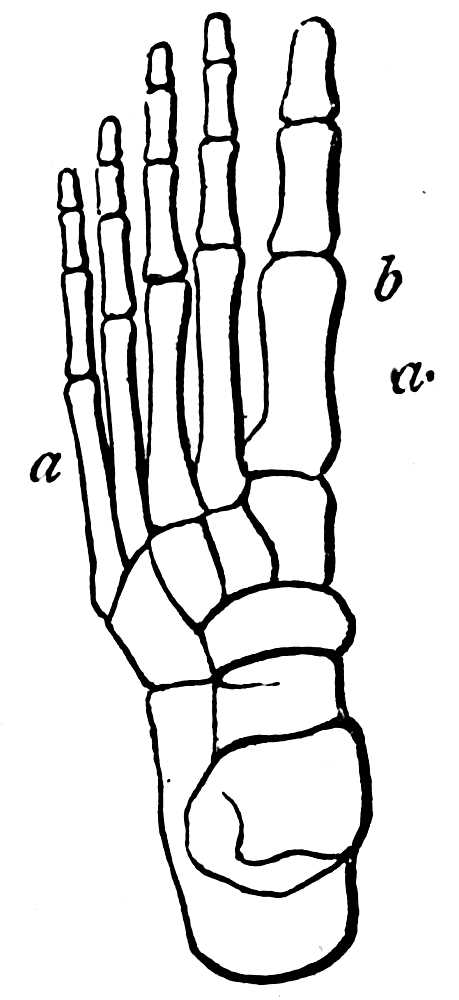
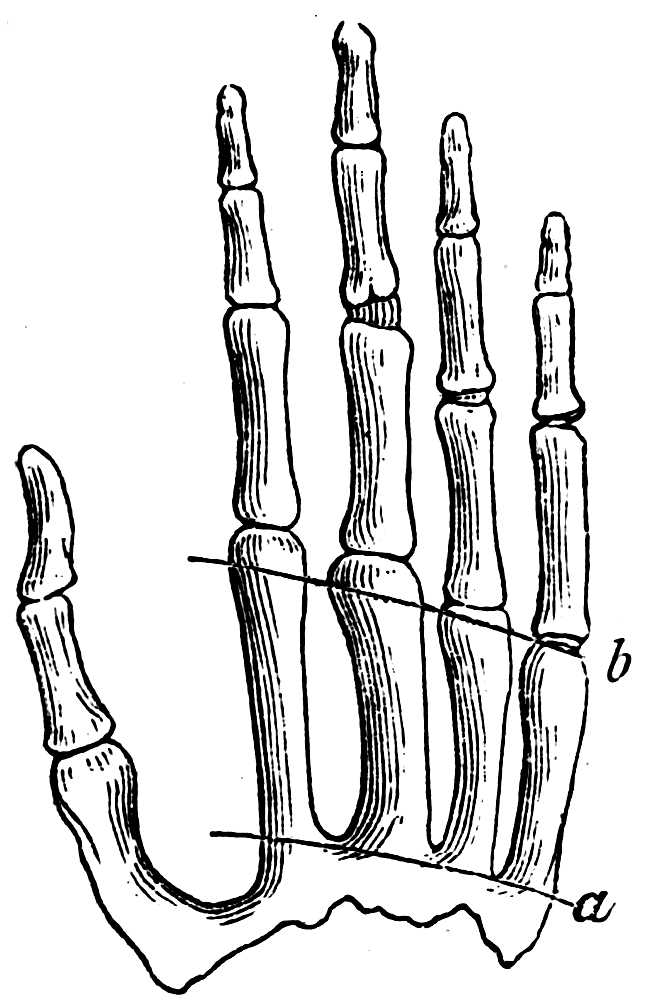
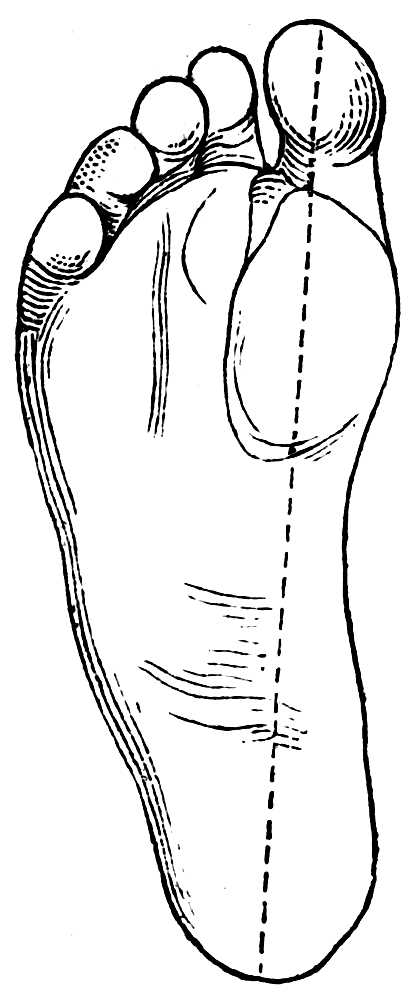
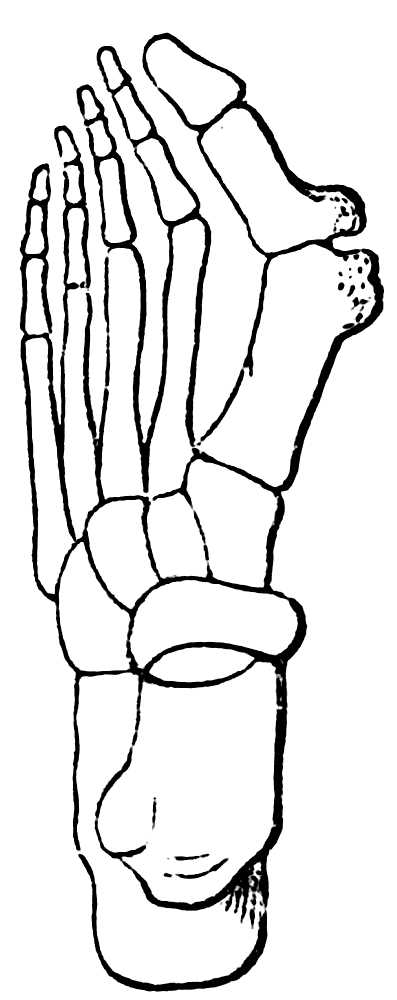
Fig. 1.—a a, Metatarsal Bones; b, Joint.
The metatarsal bones are five of the longest bones of
the foot, lying below, or in front of, what is commonly
known as the instep, and filling the space between the
instep and the toes, though, strictly speaking, they form a
part of the whole instep. They are nearly parallel with
each other, and to their forward ends the bones of the
toes are attached, forming the back toe-joints, at the part
called the bend of the foot. Where the great toe joins its
metatarsal bone, is called the ball or inside ball; or, more
strictly, it is the under surface which is so called. These
metatarsal bones being straight, and so nearly parallel to
each other, it is a natural inference that the toe-bones
attached to them should lie straight in front of them, on
the same lines, and nearly parallel to each other also. In
short, they must do so, in order that when covered with flesh
they shall have room to touch the ground, or bend, without
interfering. This would bring all the toes, and their metatarsal
bones, parallel or nearly so, with a line drawn past
the whole inside of the foot. They would thus be allowed
space to grow naturally, to lie side by side, and perform
their proper functions without crowding or chafing, or
inclining sideways in either direction. The diagram of a
skeleton foot (copied from Professor Meyer’s pamphlet)
will show this more plainly than words.
It is claimed by the Professor, in this little book, that a
line drawn from the middle of the heel—on the sole—under
the centre of the ball or joint, should pass under the
middle of the great toe, through its whole length. His
reasoning for this idea is thus given:
“The great toe plays by far the most important part in
walking, because when the foot is raised from the ground,
with the intention of throwing it forward, we first raise the
heel, then rest for a second on the great toe, and in lifting
this from the ground the point of it receives a pressure
which impels the body forward. Thus, in raising the foot,
the whole of the sole is gradually, as it were, ‘unrolled,’
up to the point of the great toe, which again receives an
impetus by contact with the ground. The great toe ought,
therefore, to have such a position as will admit of its being
unrolled in the manner described; that is to say, it must
so lie that the line of its axis, when carried backward,
will emerge at the centre of the heel; and this is its position
in the healthy foot.”
The great toe certainly plays an important part in walking,
and is therefore entitled to all necessary freedom.
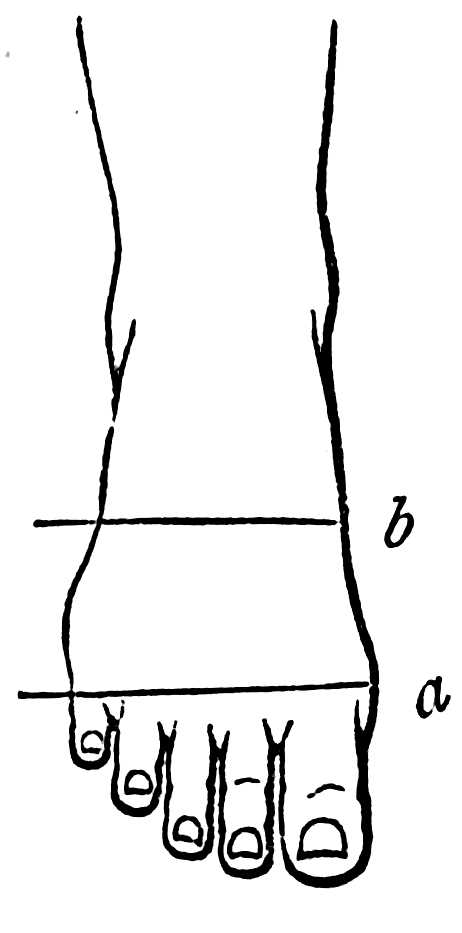
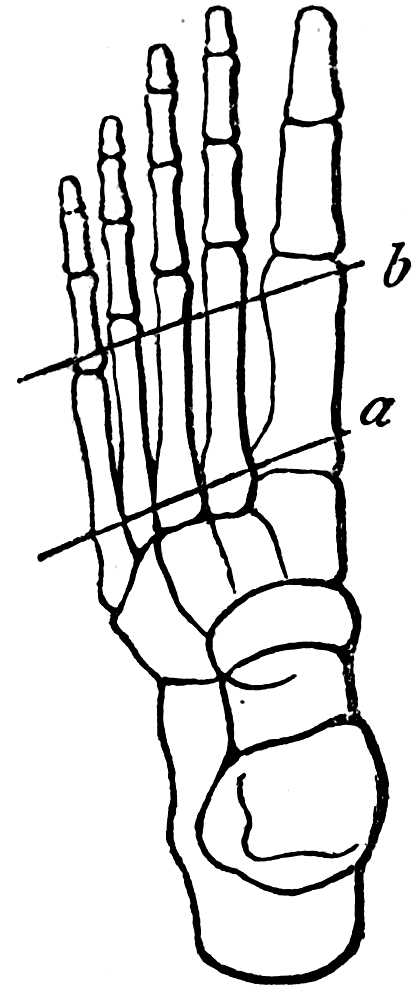
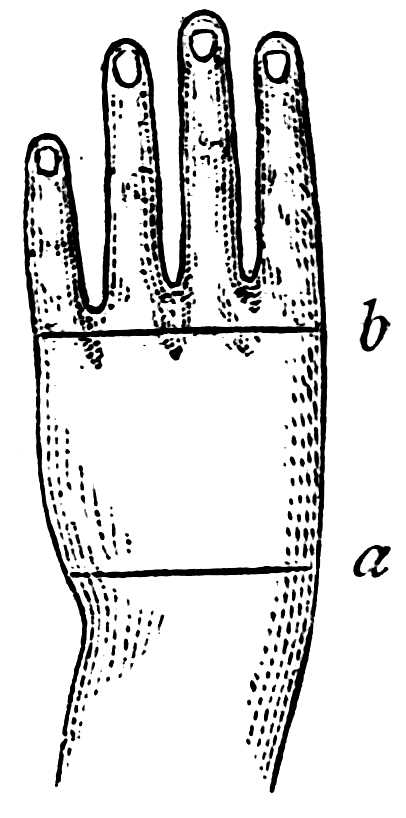
The position taken may be further strengthened by bringing
forward the fact that all natural feet are slightly wider
at the ball than at the instep, an inch and a half farther
back; that is, wider at the forward than at the back or
upward ends of the metatarsal bones. This is readily seen
in the cut of a healthy foot, Fig. 2, and still more plainly
in that of the foot-skeleton, Fig. 3.
Fig. 2.
Fig. 3.
In each of these figures the difference in the width at
the points a and b is what we wish to be noticed. It is
argued above, with good reason, that the bone of the great
toe should lie directly forward of its metatarsal bone, on
the same line, which line, when carried back, passes under
the centre of the heel. And it is equally fair to infer that
the smaller toes should lie directly forward of their metatarsal
bones, on the same lines. This would allow all the
toes to be spread a very little, as is apparent in Fig. 2, and
as the bones are spread in Fig. 3. There is thus a slight,
but distinct, gradual widening of the foot, from the middle
region to the ends of the toes, an idea which will be confirmed
in every child’s foot that may be observed.
The correspondence between the bones of the foot and
leg and those of the hand and arm also give countenance
to this notion. The metacarpal bones of the hand are
those which answer to the metatarsal bones of the foot;
and that they are wider apart at their forward ends than
at their base or origin, is observable from the skeleton hand
Fig. 4, and from the hand having the thumb turned under,
Fig. 5.
Fig. 4.
Fig. 5.
In this case, as in that of the foot, if the fingers lie
directly forward of their metacarpal bones, they are slightly
spread or separated. And the next fact to which attention
is requested is, that we never think of forcing them into
one position, or of confining them there, as is done with
the toes—a treatment that would quickly destroy their
usefulness, if attempted. They are allowed perfect freedom
to close or separate; to be pushed over to one side or the
other, as occasion requires; and to assume any natural
position when unoccupied.
Now, although there is a greater demand for the liberty
of the fingers, on account of the innumerable uses to which
they are capable of being put, the difference between them
and the toes, in this respect, is only a difference of degree;
and it is evident that something, more or less, of the same
bad effect which would attend the cramping of the former,
must, as it does, attend the confinement and squeezing undergone
by the latter. It seems clear that in a state of
nature the toes are left equally free to “spread themselves,”
or draw together when necessary, or to return to their
proper places in line with the metatarsal bones, when
there is nothing to draw them on one-side. In circumstances
where they would not be interfered with, the large
one would doubtless have the position given it by Professor
Meyer, or, at least one very nearly the same; that is, the
line of the toes carried backward would touch the middle
of the heel, and the whole inside of the foot would have a
general appearance of straightness. This, it is repeated,
is the form of the normal adult foot, and of the child’s foot
universally.
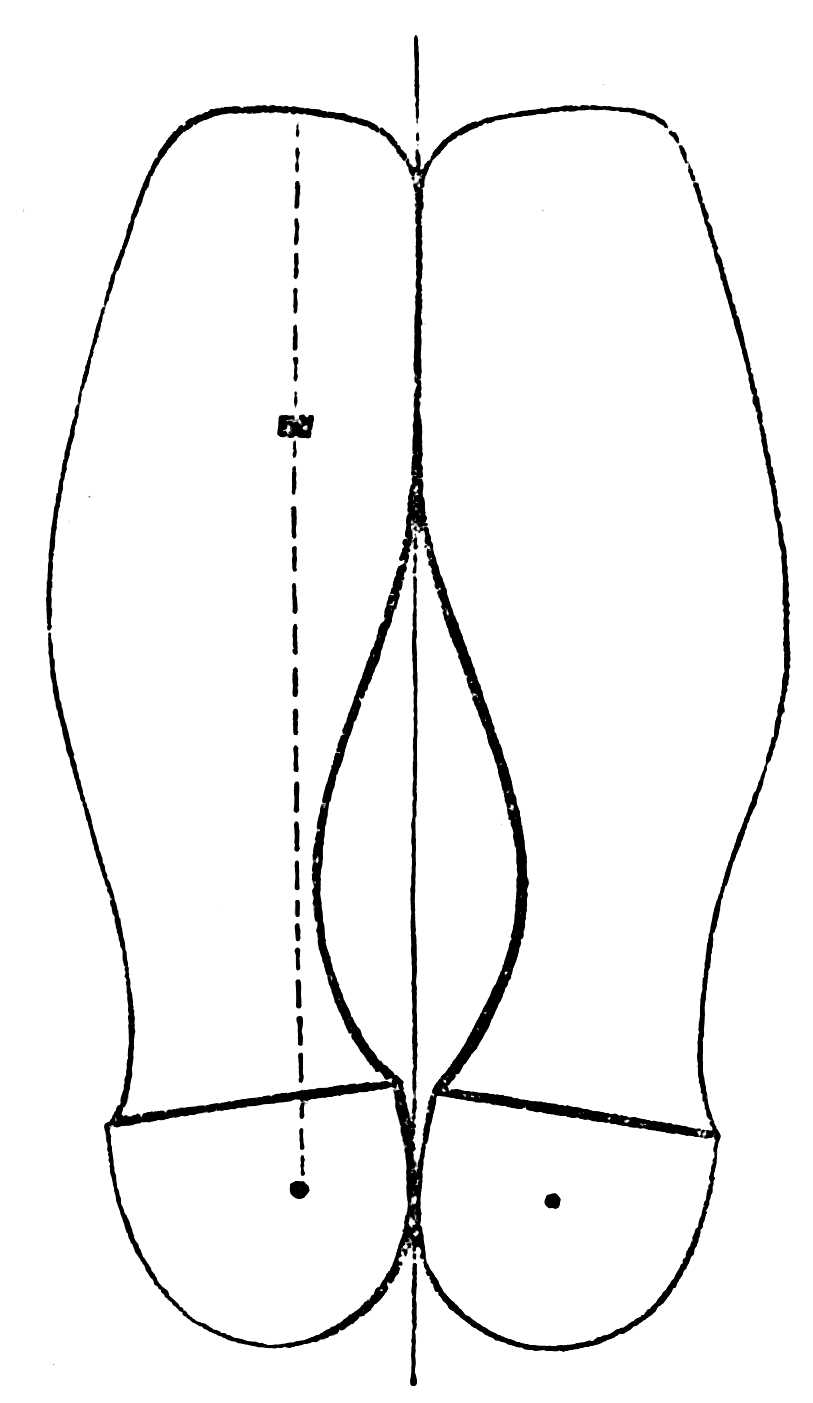
The only form of shoe which is absolutely correct, then,
is one allowing this amount of freedom to the toes—not
alone to the great one, but to all. The form recommended
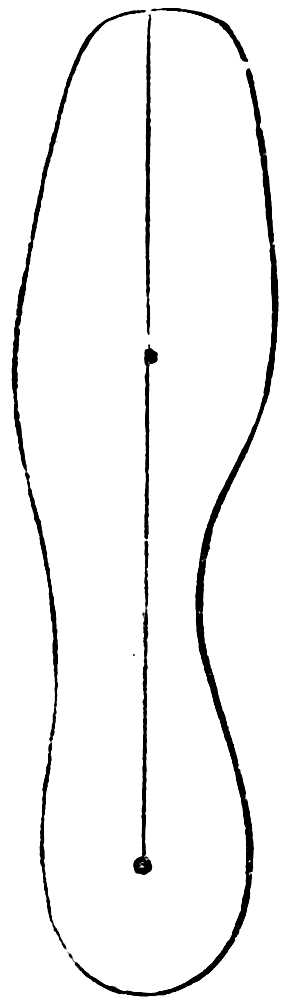
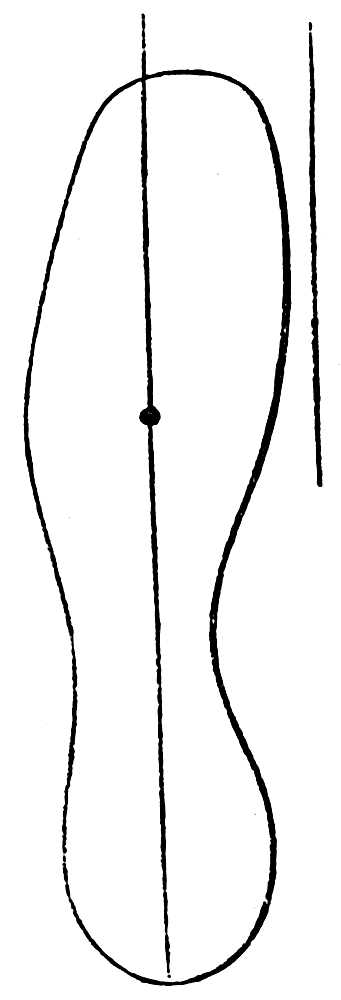
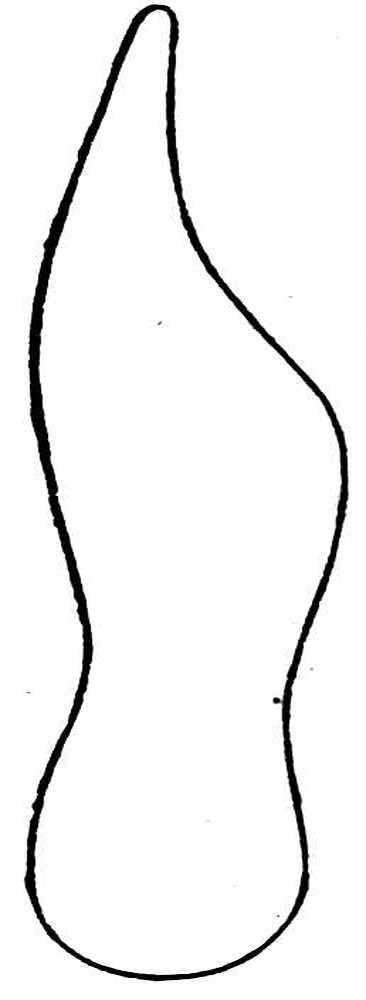
by Dr. Meyer, which is represented in Fig. 6, like every
other now made distorts the little toe, compelling it to
turn under toward the middle of the foot, and giving it that
peculiar twist that almost every one may notice in his own.
Fig. 6.—Shape of Sole given in “Why the Shoe Pinches.”
This, however, is only a slight fault compared to the
bending aside of the large toe, and is mentioned mainly
to show that neither that form nor any other gives to all
the toes the freedom which properly belongs to them.
The true standard form is one that will not compel any of
them to be cramped or bent aside, nor press injuriously
upon any part of the foot; and to this form it should be
the shoemaker’s endeavour to approximate as nearly as
possible.
But such a shape as would fulfil this requirement has
never been realised since the days of the ancient sandal.
And the problem for the shoemaker to solve is to create a
covering that will give the freedom and ease of the old
sandal, combined with neatness and elegance of fit, with
protection from dirt, cold, and dampness; and with propriety
and beauty throughout. It will be something
considerably different from any now worn, and may tax
his ingenuity to a greater extent than is supposed. Professor
Meyer is right concerning the form of its sole at the
inside; but the curve at the outside is too much like the
common style to be exactly the right thing. There seems
to be required a more abrupt curve at a point somewhat
farther forward than where the widest part is usually found—a
curve approaching more nearly to an obtuse angle,
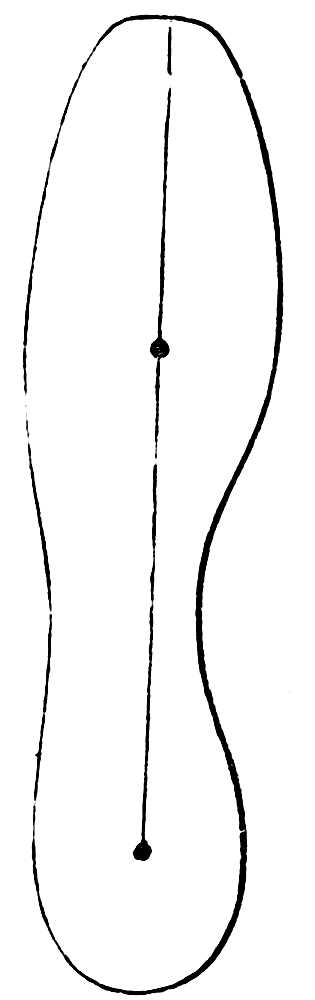
something like what is represented in Fig. 7.
Fig. 7.
Thus, modifying, or adding to, the form of sole given
by Dr. Meyer, we present it as the most perfect one we are
now able to suggest, and one the correctness of which is
confirmed by all the facts of anatomy, and by everything
bearing upon the subject.
As to what is theoretically right, then, we not only
indorse all that is urged by the author quoted, but go
farther, and claim for little toes, as well as great ones, the
right to grow as straight as nature intended them, and to
spread as freely as circumstances may require. There is
a point, however—one of practice, not theory—upon which
we may perhaps be said to partially disagree, and which
will be explained farther on. It is designed now to show
some of the bad results of a failure to conform the shape
of the boot or shoe to that of the foot; and afterward
to consider what can be done in the way of improvement.
[1] It is also true that many artists have been led to a mistake by
observation of the adult foot, which has been more or less deformed
by its coverings. In many works of art there is a larger joint than
natural, and the great toe is turned aside sufficiently to bring all
the toes close together, though not enough to be a positive distortion.
CHAPTER III. — FOOTNOTES:
Distortion of the Toes and Joint—Various Causes—Want of Harmony
between Shape of Foot and Shape of Shoe—Grown-in Nails—Influence
of Stockings, Narrow-Toed Soles, High Heels, and
Changing of Shoes—Faults of Lasts.
The doctrine concerning the shape and position of the
toes is considered to be made sufficiently clear by
what has been already advanced. As the best illustration
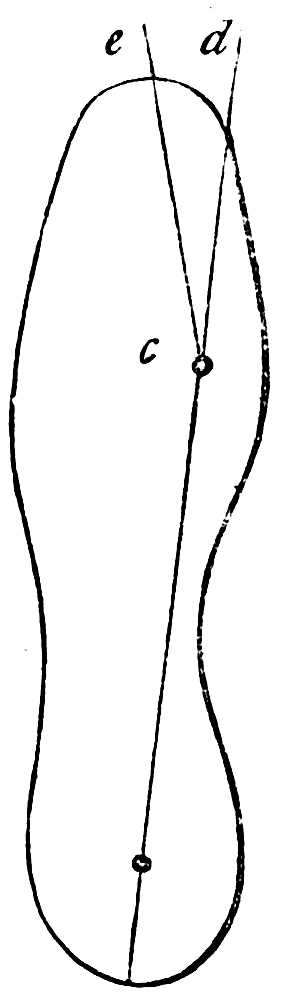
of it, we copy from Dr. Meyer’s book a cut of the natural,
healthy foot of a child (Fig. 8), in which the line of the
great toe, continued backward, passes under the middle of
the heel. By the side of this is placed a shoe-sole of the
common form (Fig. 9), and which plainly does not harmonize
with the shape of the foot. From the ball forward
instead of being straight on the inside line, it slants off
obliquely toward the middle of the toe, making as great an
inclination or curve on that side as on the outside. As
the toes of the foot cannot force the upper of a boot over
the sole to any great extent, the form of the sole determines
the shape in which the toes shall lie when they are
inside the boot. The line c d, in the diagram, shows
where the great toe ought to be; but, far from being there,
it is turned aside into the line c e, a position entirely unnatural.
We will here quote again from the book, taking the
liberty to italicize:
Fig. 8.
Fig. 9.
“It is quite clear that the foot must get into the shoe;
and if the shoe differs in shape from the foot, it is no less
plain that the foot, being the more pliable, must necessarily
adapt itself to the shape of the shoe. If, then, fashion
prescribes an arbitrary form of shoe, she goes far beyond
her province, and in reality arrogates to herself the right
of determining the shape of the foot.
“But the foot is a part of the body, and must not be
changed by fashion; for our body is a gift, and its several
parts are beautifully adapted to the purposes for which
they were intended.
“If, therefore, we in any way change its normal form,
not only do we not improve, but we actually disfigure
it.
“We do not, indeed at first sight, perceive the arrogant
absurdity of which fashion is guilty in going so far as to
determine the shape of our feet, because we are not alive
to the fact that the case is peculiar to the feet. We only
see it influencing the shape of the shoe, and come to the
conclusion that it may regulate this, as well as the cut of
the coat. To this prevalent opinion we yield, regardless
of the influence on the shape of the shoe, and thereby on
the foot. As well, indeed, might fashion one day come to
the conclusion that fingers are inelegant, and decree that
henceforth the hand be squeezed into a conical leather
bag; as well, indeed, might she in one of her freaks, forbid
the display of our arms, and bind them firmly to our bodies,
like those of children in swaddling clothes.
“The shoe ought to protect the foot, but it has no right
to distort its shape.”
Seeing, therefore, that the common form of boots and
shoes, as now made, is not the true one, and that it arbitrarily
forces the great toe into a false position, it follows
that all the bad effects resulting from this false position
are to be attributed directly to the incorrect form of the
last and shoe. The first of these is a crowding together
of all the toes, in which some are obliged to find their
places under, and some above, the more ambitious of them
sometimes pushing their nails through the upper leather,
the rubbing and chafing they meet making them sore,
while the more humble are glad to curl themselves down
in any way that will give them a place of comfort. When
the crowding is not so great as to force them out of place
there is still a constant pressure against each other that is
liable to create corns between them.
Another effect is the growing in, or to one side, of the
nails. The boot-upper presses the flesh against the nail of
the great toe on one side, while there is a similar pressure
from the smaller toes on the opposite side, and between
both, the nail is almost compelled to grow into the flesh, if
it grows at all. If the great toe gets the advantage, then
the one next to it is likely to suffer in the same way, and
all of them are liable to the same trouble. When the nail
grows so far that its edge turns downward, the pressure
against the sole, in walking or standing, is a more aggravated
discomfort. Dr. Meyer says that “by degrees it [the
toe] gets into a state of chronic inflammation, and may
eventually become ulcerated, producing what is popularly
known as ‘proud flesh.’ The ailment not only interferes
with the use of the foot, but too often requires, for its relief,
medical, and even operative interference.” A surgical
operation of this kind, which consists in removing the nail
entirely, we are assured, by those who have seen it, is an
intensely painful thing to witness, and cannot be less so to
be borne. The following description of the nature of the
trouble, and of the mode of treatment, is copied from Dr.
R. T. Trall, for the benefit of those who may wish to treat
it for themselves.
“Onyxis.—This distressing affliction consists in an incurvation
of the toe-nail from a bruise or the pressure of a
tight shoe, producing inflammation and ulceration, and
followed eventually by fungous growths, or proud flesh,
which is exceedingly tender and painful. The cure is slow
but certain. The foot must be frequently soaked in warm
water, until the soreness is so far abated that it can be
handled without pain; then, with a probe, press pledgets
of lint as firmly as can be borne under the most detached
point of the nail, pressing them also between the nail and
projecting portions of the flesh, as far as possible. Cover
these with the wet compress, and apply a moderately tight
bandage over the whole, frequently wetting the whole with
warm, tepid, or cold water, as either temperature is most
agreeable. The lints are to be pressed farther and farther
under the nail, from time to time, and the foot should be
soaked and dressed once or twice daily. When portions
of the nail become free they may be cut off, and mild
caustics may be employed to remove fungous or indurated
growths, which do not yield to the other measures of
treatment.”
A slim-toed shoe—one that is thin, and scant in the
upper—whatever be its width or shape, has a bad influence
upon the nails, not only by inciting them to grow in, but
by turning them down at the ends, and keeping them
constantly irritated and sore, a condition which effectually
prevents the toes from being of any use. The seller of
such an article will sometimes try to persuade the wearer
that it is a “good fit” when snug at the forward part,
however loose elsewhere; and many persons are quite
willing to be persuaded in this way. But if they are wise
they will not attempt to wear anything that is not perfectly
easy to the toes, for these may be allowed all necessary
room, and still, if the fit is “just right,” there will be no
wrinkling, nor any other bad appearance.
The next and most important of the difficulties springing
from this source is the enlargement of the great-toe
joint. We continue to quote from Meyer:
“Not less important are the evils arising at the root of
the great toe from the same cause. It has already been
stated that the pressure of the upper leather pushes the
point of the great toe against the smaller toes. The joint
at the metatarsal bone thus becomes bent aside, so that it
forms a protuberance on the inner side of the foot. If the
point of the toe is now pressed against the ground in walking,
this protuberance must be made still greater, and so
pressed more forcibly against the upper leather. At the
same time, moreover, the great transverse wrinkle in the
upper leather—the result of the bending of the toes—presses
directly on the same point, and the protuberance
at the root of the toe is thus constantly subjected to a twofold
and very injurious pressure. In these circumstances
it is by no means wonderful that this joint becomes subject
to a continual inflammation, which by extending to the
bones must, in this situation, produce permanent and painful
swellings, which become, in their turn, and even from
slight causes, the source of inflammations and new growths
of bone.
“In this manner arise those unseemly and painful
swellings at the root of the great toe, which, either from
mistaking their true nature, or from wilful deception, are
called ‘chilblains,’ or ‘gout,’ just as one or the other term
appears the most interesting. In many cases, moreover,
this kind of inflammation of the bones, and their investing
membrane, may lead to the formation of matter, and
eventually to the disease known as ‘caries,’ or ulceration
of the bone.”
Narrow-toed shoes furnish another influence strongly
operating to produce large joints. The great toe is drawn
farther than usual toward the others, and its joint thrown
out in the opposite direction. All the toes are more
crowded, until some of them are forced out of place while
corns and grown-in nails are developed or made worse.
Width at the ball alone will not prevent these effects.
French and English styles are in this respect often pernicious.
The whole tendency of narrow toes is toward deformity;
and those who cannot because they happen
to be the style, refuse to wear them, should make up
their minds to accept the consequences with a good
grace.
Another great cause of the prominence and swelling of
the joint—which our author alludes to, but gives it hardly
any of its real importance—is the backward pressure of
the toe by shoes that are too short. This, in addition
to causing sore nails, crowds the toes still more closely
together, and pushes the joint still farther inward, away
from its proper place. To illustrate.
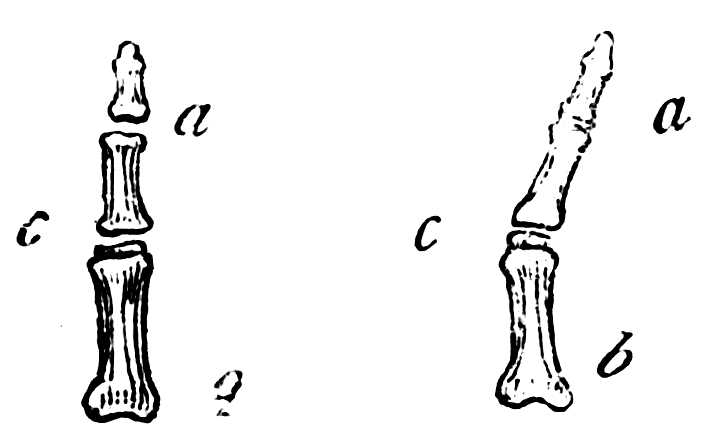
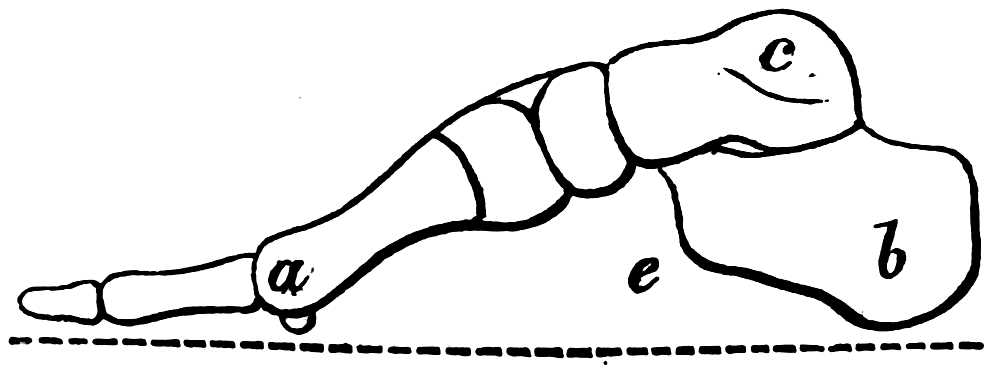
Fig. 10.Fig. 11.
a, Phalanges, or Bones of the Toe; b, Metatarsal Bone;
c, Joint.
Supposing these to represent the bones of the great
toe and its metatarsal bone—which, in their normal position,
are on the same line—we can see that if the toe
bones a are bent toward the other toes first, and then
pushed backward, it necessarily forces out the joint in the
only direction in which it can bend, which is inward.
The greater and more constant the pressure against the
end of the toe by the short boot or shoe, the larger the
joint, and the more it will project from the inside of the
foot; the more liable also to soreness, swelling, corns,
bunions, inflammation, and settled disease, and the more
awkward, ill-shaped, and uncomfortable, not only to walk
with but to look upon.
High heels also do their share toward bringing on this
deformity. They cause the foot to pitch downward on
the toes, sometimes pushing it a size farther forward into
the boot than it would go if the heel was only moderately
high, thus creating the necessity for a longer boot.
The crowding of the toes is increased; and as they meet
with resistance or a backward pressure from both sides
and the end of the shoe, at the same time that there is a
forward pressure from the heel by the weight of the body,
of course the angle formed at the joint must be pushed out
more acute, the foot making room for itself by stretching
and treading over the upper at the sides.
There is a peculiarity about the Plumer last recommending
it in this particular. The heel, on the bottom, is quite
convex, which allows the heel of the foot to settle down
into that of the boot more than usual, and thus what appears
to be a high heel, outside, feels, on the foot, to be no higher
than one made upon ordinary lasts an eighth of an inch
lower. There is hence so much less pressure upon the
ends of the toes.
A false habit, tending in the same direction, is that of
changing the shoes of children to make them wear evenly
or prevent their treading over to one side at the heel. It
is a practice productive of far more harm than good—a
saving of shoe-leather at the foot’s expense. After one
foot has shaped a shoe to itself, to put the other into it
forcing the great toe into the curve made by the little toe
and outside of the foot, must do much toward bending the
toe permanently out of place. It should never be allowed
or proposed. Give children right and left shoes, and guard
against their wearing on one side by good firm counters.
It is their right, when obtainable, and anything less is
injustice.
While the foot is growing, it easily adapts itself to its
surroundings; and by wearing short boots and shoes it
may be encouraged to grow into a bad shape in a few years.
Most old people have joints deformed in this way. We
have also seen them on the feet of young and beautiful
women, where they seemed most sadly out of place. Young
feet are often forced to grow into uncomely shape through
the good intentions of parents, whose falsely-taught instinct
of beauty induces them to put as small a shoe on
the child’s foot as it will bear, fearing that if left to itself
it will grow too long, or too wide, to be elegant in form.
The motive of this action is most commendable, but its
wisdom extremely doubtful and weak. Beauty, taste, elegance,
are to be sought for everywhere and always. We
have not the least sympathy with any attempt to depreciate
them. But they are not to be sought by counteracting
nature. On the contrary, nature is most trustworthy. If
not interfered with, she will make the foot grow in due proportion
to the size of the whole body; and every part will
be developed in the right proportion to itself.
“Children of a larger growth” continue to carry out the
same false idea by wearing as short and narrow a boot as
they can squeeze their foot into with any degree of comfort.
While the object is to obtain a handsome foot, all such
cramping inevitably defeats its purpose. The effect which
it invariably has and must have, is to make the joints project,
and add from one-fourth to three-fourths of an inch
to the foot’s width, leaving out of account the torture accompanying
the process. Nobody will claim that large
joints and extra width at this point make a good-looking
foot, but they are the sure results, in greater or less degree
according to the severity of the pinching, and the length
of the time it is continued.
It is well to ascertain if stockings do not have some effect
in giving a bad shape to this part of the foot, although
made of such yielding materials that they may at first
thought, appear harmless. Mr. James Dowie, in a work
published in England some years since, speaking of the
toes being cramped, crowded, bent, and piled over each
other, attributes part of this result to the stocking, and recommends
the wearing of one having toes on it—similar
to the fingers on a glove. There is no reason to doubt
that this conclusion is correct, for while a stocking that
is loose may be drawn into almost any shape to suit the
toes, one which is tight, short, and narrow-toed, must, and
does, draw the toes together and keep them so, however
favourable may be the form of the boot outside. It is a
fact, too, that stockings are narrow and pointed at the toe;
almost universally. The suggestion of putting toes to them
is a good one. But if this is thought to be taking too
much pains with such an article—though it is evidently
impossible to take too much pains in dressing any part of the
body so as to protect it from being injured in any manner—it
is perfectly easy to make the stocking wider at this
part, leaving it nearly square, or with only a slight roundness
at the end. This would be a very decided improvement,
and cannot be urged too strongly.[2]
Like the defects of the shoe, those of the stocking must
be felt more seriously by children. They are ignorant of
the matter, and would be careless and inattentive even if
they were not. But if parents will half do their duty by
them, there is no reason why they should not grow up
with well-formed feet, thankful for the care which has saved
them from distortion and blessed them with pedal comeliness.
There is here, also, a question of the comparative taste
and elegance of wide and narrow soles, which needs a
little discussion. It is the practice with many persons to
wear as narrow a boot or shoe as they can, thinking we
suppose, that if they have not a narrow foot, they ought
to have, and that by putting it into a narrow boot they
prevent it from spreading. As such a boot is and will be
narrow at the toe, the effect is just the opposite of that intended
as in the case of short ones. The toes are drawn
together, and the ball pushed out wider than before. Then
besides this tendency to make it wider, the foot looks
wider in a shoe that is too narrow for it, because it treads
the upper over, and the narrow toe makes it appear all the
wider by contrast. A foot that is narrow may wear a
narrow-soled shoe with propriety; for a wide one to
attempt to do so is foolish. We have seen a lady’s boot
trodden over so far that a hole had been worn through the
upper on each side of the sole by its contact with the
ground. The wearer doubtless thought it was necessary
for her to wear a narrow sole to prevent her foot from
spreading, and keep it in an elegant shape. She did not
know that she was taking the most direct way to defeat
her object, and that her true policy would have been to
wear the widest-soled shoe she could get. This case was
extreme, but it is quite common to see the upper worn
through on one side from the same cause. The right kind
of shoe for a wide foot is one so wide on the sole that the
upper will project over it on the sides but slightly, and with
as great a width of the toe, in proportion to the ball, as
there would be in a narrow one. Such a shoe will make
the foot appear narrower, by contrast, than it really is,
and the greater the width of the toe, the more this effect
is produced. Besides, the shoe or boot keeps its proper
shape much better and longer when not too narrow or too
short. If the foot be short proportionately, as well as
wide, the covering should be of good length—at least a
full size to spare at the toe, after being worn a few days
and fitted, or broken in. These doctrines may not be
readily accepted, but let any one who doubts give them a
trial, and we are willing to be judged by the opinion formed
afterward.
There are those who appear to urge the idea that broad
soles are eminently proper always, and for everybody,
which doctrine we do not endorse; but we mean to say
that persons who have wide feet naturally, or who have
made them wide at the joints in the ways here pointed out,
ought to wear wide soles. It is also quite certain that if
people wore soles of the correct shape from childhood
there would be a far less number than now of those feet,
that require this extra width of sole, for nine-tenths of
them are forced into a width which they would not have
by nature, and, when once deformed, no pains taken in
fitting them can make them look well, or like those which
keep their proper shape.
A narrow foot must not be confounded with a slim one.
Feet that are slim—that measure less than an average in
circumference—are often found wider than most of those
of the same length which are of medium size or fulness.
These are feet that spread, and may generally be found on
individuals of spare or muscular temperament. Such persons
ought to wear boots made on wide lasts, with wide
toes, though at the same time sufficiently slim to fit. As
such lasts cannot easily be found ready-made, those
having feet of this shape ought to possess a pair made
expressly for themselves.
There is an opposite style of feet, those which are long
and narrow, while they may be also full, or thick, vertically.
These are usually found on persons who are tall,
yet round, and fleshy in physique. They can wear boots
made on lasts that are comparatively narrow, such as may
be found at any shoe-shop. It is not intended to argue in
favour of any unnecessary width in either case, but simply
to urge the necessity, not only for comfort, but especially
for elegance also, of having sufficient width to accommodate
the foot easily, and preserve the natural shape of
both the foot and its covering.
Bad fashions of lasts have had much to do in producing
a deformed condition of the feet, as well as the false ideas
and tastes of the people. Shoemakers, and more especially
last-makers, who should have studied the nature of the
foot, and given the people, who looked to them for a correctly-shaped
last and shoe, something truly and naturally
adapted to its purpose, have failed in this part of their
duty. The latter have made lasts of all varieties of shape
except the true one, while the maker of the shoe has made
a bad matter worse with his high and short heels.
Formerly the great majority of ladies’ shoes and gaiters
were made upon lasts that were straight, and the same is
true even yet. Almost the whole of the cheaper kinds of
work got up in the manufactories is of this style. Slippers
are hardly ever seen made upon other than straight lasts.
The whole custom is a wrong one, for this reason; the
middle of the toe of shoes made upon straight lasts is
nearer to the outside than it is in those made on rights-and-lefts.
Hence they draw the great toe farther toward
the outside of the foot than do those of the latter kind,
and have a greater effect in producing all the evils that go
with deformed toes and joints. No woman ought to be
asked to wear them, nor should she allow herself to do so
if those of another form can be obtained. Girls whose
feet are growing cannot have them forced into straight
shoes, especially if tight, without perpetrating a kind of
tyranny very similar in character to that of the Chinese.
Right-and-left boots and shoes are the natural right of all
men, women, and children. Men and boys have, in this
respect, the advantage over their sisters, as their foot apparel
is almost wholly of the better shape. There is no
reason why women and girls should not have the benefit
of the improvement in form, though it is only a slight one,
and they are counselled to take it whenever they can. In
fact, there is no excuse for straight shoes, except that they
can be made a little more cheaply—that is, there is a little
less expense for the lasts used. They do not wear more
evenly than the others—on the contrary, they are quite as
liable, if not more so, to tread over at the heel. They
never fit the foot so well in the hollow, at the instep, or on
the side. There is no necessity for their existence, for there
is no form of foot-covering but might be made on crooked
lasts with equal facility. Ladies’ slippers are believed to
be the only article that is always made straight, and for
these, right-and-left lasts, properly adapted to the purpose,
might be used without the least difficulty. Considering
these facts, and that there is but a slight advantage to the
manufacturer, and to him only, in their production, and
that the children and poorer class of women, who wear
them—the most helpless classes in the community—are
almost compelled to deform their feet in doing so, it becomes
a disgrace to the shoemaking profession that straight
shoes are not abolished.
Many right-and-left lasts are made so nearly straight that
the difference in form, and the benefit arising from it,
amount to but very little. This must be remedied by the
people learning what is to be desired, and making a demand
for it. It is sometimes argued that the straighter
the last is, the less liable is the foot to tread the boot over
to one side; but this we hold to be a fallacy, and that the
liability to tread over, is determined by the shape of that
part of the last between the heel and instep. The form of
the toe or forward part has nothing to do with the matter.
It is generally, however, an advantage to the foot, though
not to the boot, if it succeeds in treading the latter over to
the outside. It thus gives the boot a more distinctly right-and-left
shape, and can hence more easily preserve its own.
When it goes over inside, there is a good prospect of a
big joint being soon produced.
The last-makers have given us toes of many styles, from
the turn-up toes an inch longer than necessary, to the stub-toes
half an inch shorter than the foot; and from the
round toe narrowed to a point, to the square one nearly or
quite as wide as the ball. All that needs to be said of
them is, that the wider they are, except the extreme just
noted, the better for the foot, at least while the present
lasts are in use, and generally the handsomer also; that the
long toe is unnecessary, and therefore unhandsome; while
the short or stub toe is decidedly awkward and clumsy-looking,
besides being injurious to the foot, and utterly unworthy
of toleration by any person of sense or taste. The
true and most tasteful shape will be found near the half-way
point between the two extremes in each direction.
Whether round or square is of no material consequence.
Here, then, we have found several causes for the deformities
of the forward part of the foot—the crooked great
toe, the cramped and distorted smaller ones, the corns
between, the grown-in nails, the big joint, and the increased
width. The cause first operating to produce them is the
wrong shape of the shoe at the inside, which gives the
oblique position to the great toe. Narrowness and shortness
are stronger influences acting in the same direction,
aided still further by extreme height of heels, by changing,
by narrow-toed stockings, etc. And it is especially worthy
of being noticed that the short and narrow toes, and the
high heels often adopted to improve the foot’s appearance,
do thus inevitably defeat that purpose.
The attention of those who regard their own foot-comfort
is earnestly directed to the points and reasoning presented
in this chapter. Just as earnestly it is desired that
those whose principal aim in dressing the foot is its beauty,
elegance, and perfection of form, should give a thorough
consideration to what has been said. Both classes will
easily see that, in order to gain the object sought, there
must be a reform in the shape and style of the foot’s
covering. The nature of that improvement is already
partially shown—that is, as far as the toes are concerned—and
will be shown fully in what is to follow.
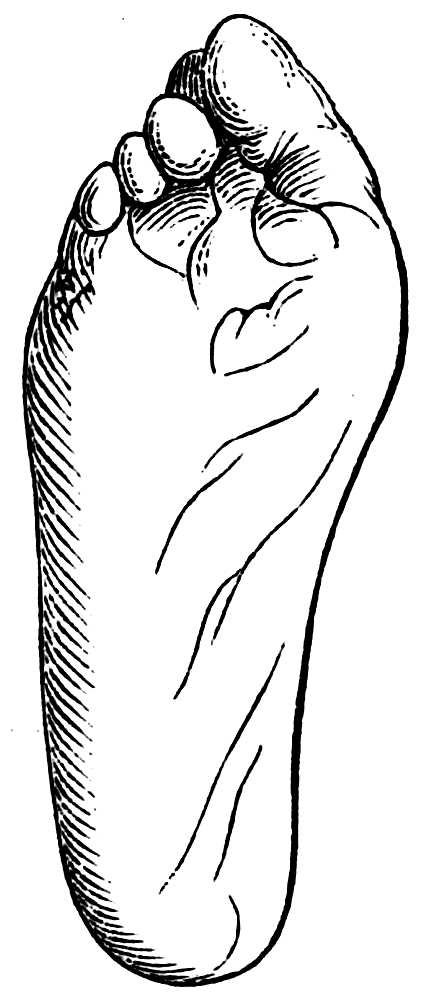
The cuts below, showing some of the worst deformities
of the forward part of the foot, and adding the force of
illustration to what has been said, are an appropriate conclusion
to this chapter. It will do no harm to contrast
them with Fig. 8 and Fig. 3, previously given.
Fig. 12.
Fig. 13.
[2] We have lately seen stockings for sale that were nearly square-toed,
and these should obtain the preference in buying.
CHAPTER IV. — FOOTNOTES:
Prevention of Deformed Toes and Joint—New Forms of Sole—Eureka
Last—True Standard of Taste—How Distorted Great
Toe may be Straightened—Ancient and Medieval Foot apparel—Suggestions.
Let us next endeavour to ascertain what shall be done
toward substituting an improved form of covering
for the present false style, as a method of preventing distortion
of the toes and the evils connected with it; and
also inquire how far these deformities can be relieved by
proper effort after they have been induced.
The shape of sole previously described and illustrated
(Fig. 7) is taken to be as near the absolutely correct one
as anything that can now be devised, and to be approximated
and realized as soon in the future as possible. It
is true that people should be capable of recognizing its
correctness, and of adopting it practically, at once; and,
doubtless, there are some who can conscientiously disregard
the strong tendency to conformity with the prevailing
false styles, and wear a boot or shoe which represents the
right idea, or one as near to it as it is possible for them to
obtain. All such are earnestly advised to take this course,
and continue it, both for their own good, and as a means
of developing a sentiment in favour of the change.
But there are other people, in larger numbers, who will
not be persuaded to attempt so much of a change without
some encouragement from popular sympathy. These
must not only be taught to know what is right and wrong
in the matter, but be led to adopt the right through gradually
approximating steps, that do not vary so far from the
style at any time prevalent as to be unpleasantly odd.
The eye must become accustomed to different forms, and
first to those that deviate least from the present fashion.
Bearing this in mind, what is the best improvement that
can be made generally acceptable?
Our principal care is the preservation of the shape of
the great toe and inside joint, not forgetting that the little
toe is also entitled to care; still, the great one is much the
most important, and if only one can be properly attended
to, the little one must wait its opportunity. Its deformity
consists in being bent and twisted under, and though the
pressure causing this may also develop corns, and injury
of the toe joint, the joint itself is not forced out of place,
nor is the bad effect so common, nor so serious as in the
case of the large one.
Fig. 14.—Compromise.
Fig. 15.—Common Sole.
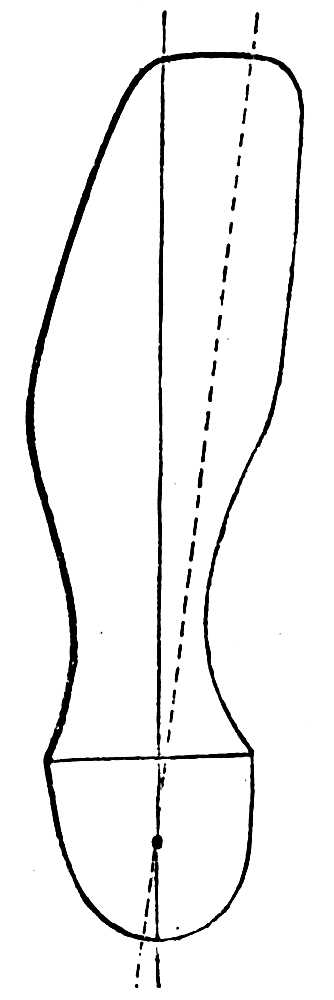
Figure 14 represents the sole of a crooked last, such as
may occasionally be seen in use by some of our best boot-makers
at the present time. Contrasted with the one beside
it, which is a pretty fair specimen of right-and-left
lasts generally, it is evidently nearer to the true form. In
it, the line drawn from the middle of the heel to the
middle of the ball region passes through the toe nearest
the outside corner, leaving the greater space at the inside;
while in the other the line passes through the toe at the
middle, thus making it virtually only a straight last, hollowed
out a little the most at the inner side. For the
purpose of giving the great toe a straight position, it is
seen at a glance that the form of Fig. 14 is far superior
to that of Fig. 15, though the tendency to distortion
would still remain with it to a considerable extent. For
the sake of a name to distinguish it, this may be called
the Compromise. It is not so much in advance of the
common styles that many people would notice the difference
at all, and last-makers and shoe manufacturers
might adopt it, and with a slight effort force it into general
use, with great benefit to those feet that are still tolerably
well-shaped, if not to their own direct advantage. At
least, the acceptance of it is one step in the right direction
for those who are not ready to make a more radical
innovation.
Our next form is something better. The reason for it
is the rule given, some fifty or sixty years ago, by Dr. Peter
Camper, of Amsterdam, who wrote an essay on the subject,
in which he stated that the proper form of shoe was
such as to allow all the toes to lie parallel with a line
drawn through the middle of the sole from heel to toe.
This, though not perfect, was, considering its date, a
pretty good standard; but the shoemakers, if they were
ever governed by it at all, have transgressed it since,
until its intention has been entirely defeated. They
have done this by narrowing the toe of the sole so much
that the toes of the foot, instead of lying parallel to each
other and to the line of the foot’s length, have had their
ends drawn together at an angle till they were compelled
even to lie one over the other.
When the toes lie as closely together as they can without
crowding—parallel, the middle ones at least, to the
line of the foot’s length—there is but little variation on
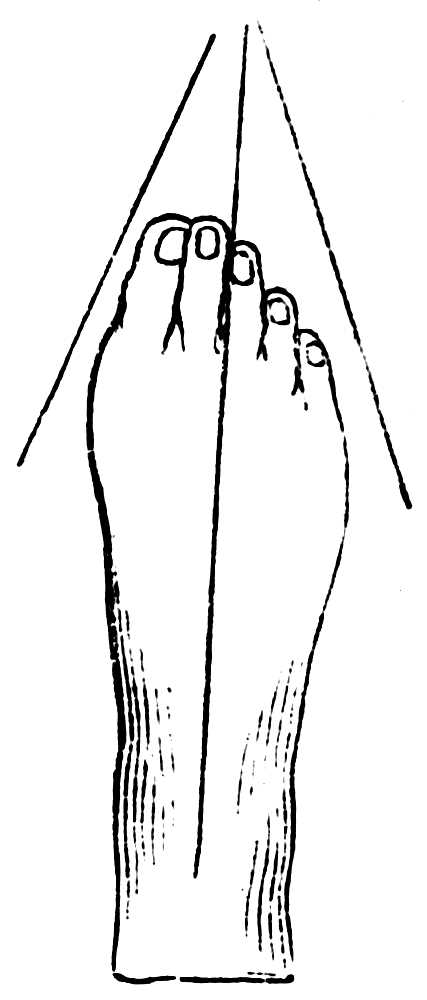
the inside of the foot from a straight line. The cuts 16
and 17 represent, one a foot in which the toes are drawn
together just enough to touch, and one as they usually
appear in the common boot.
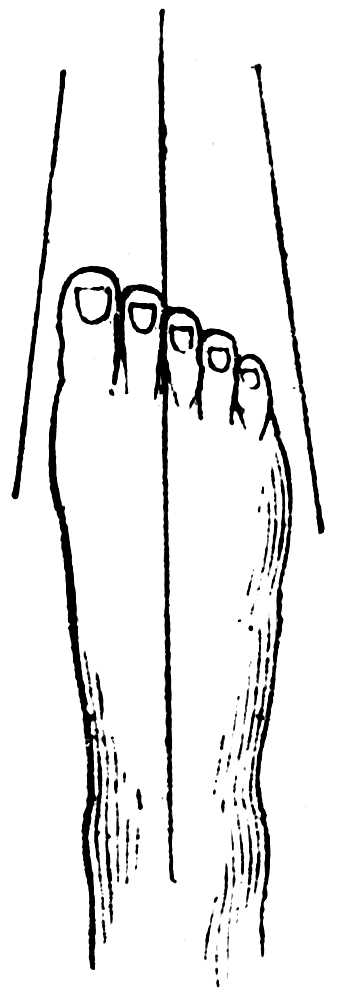
Fig. 16.—Toes Parallel.
Fig. 17.—Toes Drawn to an Angle.
Here it may be observed that in Fig. 16 the lines drawn
past the sides of the toes are nearly parallel to the line
through the foot’s centre, while in Fig. 17 they quickly
form an angle with it.
Dr. Camper’s rule, strictly interpreted, would have
made a right-and-left last of the most extreme character,
but by narrowing the toe from inside and outside
alike, it was converted into one no better than straight.
What is now proposed is, that we take this rule and
amend it by providing that when the inside of the sole has
the right form to let the great toe lie parallel to the line
through the middle, any further narrowing of the toe shall
be done from the outside only; and as the ball of the last
projects slightly over the bottom or sole, it is conceived
that the inside margin of the sole should be nothing less
than straight, and parallel to the line of the foot’s length,
from the ball forward, in order to give the great toe the
position claimed. This would make a last a little more
straight on the inside than the one described as the
Compromise. We will call it the Excelsior, and represent
it by a diagram, Fig. 18.
Fig. 18.—Sole of Excelsior Last.
Our reason for insisting that the toe be narrowed only
from the outside is the fact already stated, that the consequences
of bending the great toe are far worse than those
of bending the little ones. Besides, it is not intended to
draw them together any farther than to make them touch,
and this can be done without distorting any of them, by
leaving the great one in its natural position, or nearly so,
and making all the curve of the sole on the outside. The
outside toes being shortest, they permit this to be done
without bending them more than a very little. Of course
it must be remembered that the sole cannot be narrowed
beyond a certain limit without injury to the foot. A medium
width of toe is the narrowest that is allowable, consistently
with the object we have in view.
The last-maker will understand that the thickest part of
the toe of the last is not to be at the middle, but at the
inside, in order to give room for the great toe in the
straight-ahead position claimed for it. At the ball the
wood is expected to project, as in all lasts, very slightly
over the bottom.
This is, perhaps, the best form—the nearest approach
to that of the foot—which is practically attainable while
the modern boot and shoe retain their present peculiarity,
of a sole narrower at the toe than at the ball. On the
whole, it is probably equal or superior to that recommended
by Prof. Meyer, for though his is more crooked,
giving larger latitude to the great toe, it is a question if
it does not, by the extreme curve, tend to cramp the little
ones more than necessary, thus making a balance between
a good point and a bad one. Prof. Meyer’s form may be
best for certain feet, and for a particular purpose, as will
be explained in speaking of the remedy for crooked toes,
but for general purposes we have more faith in this. If it
were adopted in general use, and more especially for the
shoes of children, and those who have not yet seriously
deformed their feet at the joint, the next generation would
show that crooked toes, soft corns, inverted nails, big
joints, and bunions had been almost abolished. Such a
result is entirely worthy of a noble effort on the part of
those who furnish foot coverings. Such an effort, too,
when made, will surely be seconded by the growing intelligence
of the whole people, who will be constantly
learning a better appreciation of the reform. It is to be
hoped that manufacturers and wearers will both see what
is for their credit and interest, and unite in securing its
realization.
But it will not do to be content with what is, after all,
only a rough approximation to the perfect form, for, superior
as is the Excelsior last to all the existing shapes, it is
still but a transition to one more complete and more permanently
enduring. Like all the others, it fails to give
the outside toes a chance to keep their natural form.
The foot, in its normal condition, does not very closely
resemble any of the shapes that have here been illustrated.
It is only after it has been distorted that there
appears any real fitness between it and the shoe. The
forward part of the foot is wider than the middle; but
this fact is not recognized in making its covering. Even
Prof. Meyer is no more consistent than others, as may
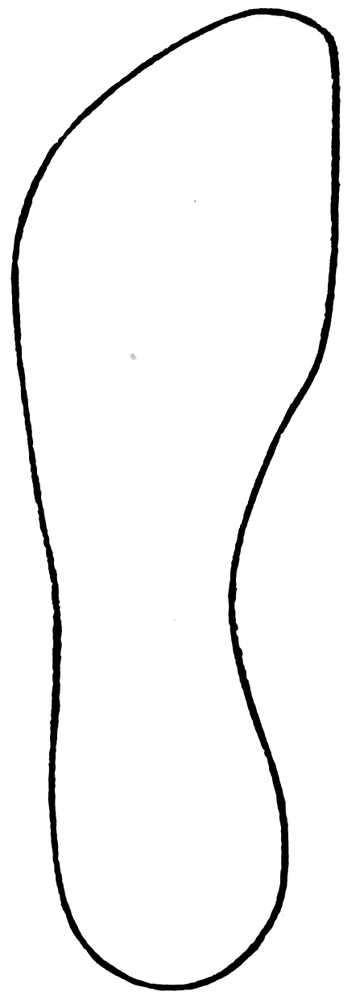
be seen by contrasting one of the specimens of natural
feet which he shows us with the sole of a shoe such as
he would have it clothed with. As exhibited in the cuts
below, is there any good correspondence between the two,
except that both have a general straightness upon the
inside?
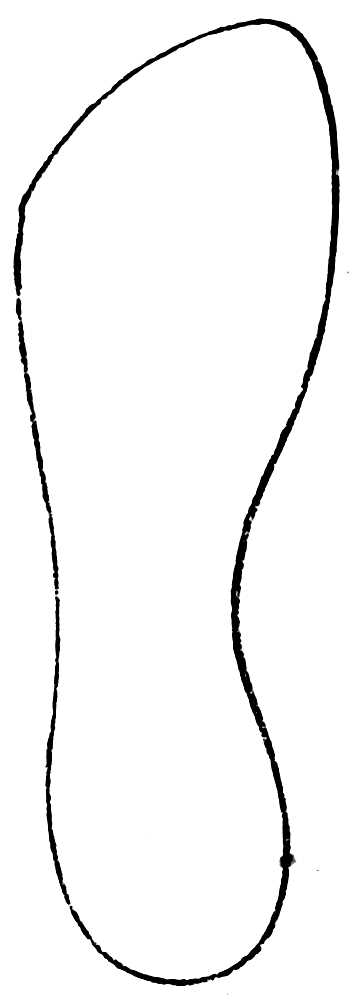
Fig. 19.—Meyer’s Form of Sole.
Fig. 20.—Natural Foot.
The foot is a wide one, and the shoe-sole rather narrow;
but this need not be taken into account, for the
same want of harmony would exist if the widths were
alike. A narrow foot, however, may be seen by reference
to Fig. 8, in a preceding chapter.
The only way out of this awkward inconsistency is the
acceptance of the form before suggested, and here reproduced
(Fig. 21) to be compared with its competitors.
Fig. 21.—Eureka.
This has all the merits of any of them, and the additional
one that it allows as much freedom to the toes at
the outside of the foot as to those at the inside. All have
a chance, provided other things are as they should be, to
develop normally and to perform their functions without
interference. There is an agreement between it and the
foot, not only on one side, but on both sides and all
around. It represents completely the idea of Dr. Camper,
which cannot be done by anything of the narrow-toed
form. By a very slight addition to the width from the
ball forward, on the inside, it also represents the idea of
Prof. Meyer. So far as we can see, it fulfils all the requirements
that can be made concerning the form of sole.
It is proposed to name it the Eureka.
If a requirement were made that it should agree with
the present popular taste, this pattern would signally fail.
But though it does not do this, still, if it corresponds with
the true form of the foot, and possesses the merits claimed,
its excellence will, in time, be acknowledged, and public
taste will come to see its elegance also. If there is any
reason at all why a thing is beautiful, that reason consists
in its fitness or propriety; and if there is any shape more
fit and proper for a sole that is to be trod upon by an
undeformed foot, will some one discover it and make it
known.
Taste comes, at least to a great extent, from education.
The teaching of China creates a taste which admires a
short, stumpy, small, useless foot, as beautiful on a lady.
In more enlightened countries a more intelligent taste
condemns such a foot as anything else than elegant. A
still better educated taste will admire only one that is
entirely normal; and to bring opinion up to this standard
is the object of effort. People are to learn that pointed
toes and big joints are not natural; that they do not
come of themselves, and that the foot-gear which produces
them cannot have any propriety or beauty. The
various long-toed, narrow-toed, broad-toed, stub-toed,
short-heeled, thick-soled, stiff, awkward things that are
worn by the masses must be seen to be, as they are, unfit
coverings to be put upon a decent human foot. Shapes,
styles, and fashions must be judged by their harmony or
want of harmony with natural requirements, and accepted
or rejected accordingly. There must be less deference to
an unreasoning, arbitrary opinion, and more of original
thought and independent action; though it could hardly
be supposed that for such a matter any great amount of
personal independence would be required. A different
set of views and tastes will thus, however, be substituted
for the present ones, as the work of time and a more general
knowledge of the subject.
There is no difficulty in starting a revolutionary movement.
Any of the proposed forms of lasts can be obtained
from the last-makers of the large cities—all but the Eureka
very readily—and often the shoemaker himself, if ingenious,
can provide them for individual feet by altering some of
those now in use.
This is not so very difficult when the last has sufficient
thickness at the toe. At the inside, from the ball forward,
it may be shaved or rasped off enough to give a plane surface
half an inch or more in width, a shoulder being cut
at the commencement near the ball. Successive layers of
firm, solid sole-leather are then pegged or nailed very
strongly to the wood without splitting it, each thickness
separately, to make the work more firm, until enough are
on to bring the corner out where it should be, when they
are rasped into the form required. Nails must not be
driven in the outside pieces. The opposite side of the toe
may be narrowed, curved, and thinned to give the whole
the proper shape.
There is no reason why those persons who are capable
of appreciating the doctrine of this treatise should not set
an example worthy of imitation; and as the abuses complained
of are so very common, it is quite probable they
might soon find themselves in the company of a large
number. Ultimately, it is expected that something not
less perfect than the form last proposed, and having all
the qualities desirable in a model shoe, will be universally
adopted.
There will still remain to be discovered a mode of
covering the foot which will secure to it all its natural
freedom. What this will be it is not easy, just now, to
tell. Possibly it may take the peculiarity of the glove,
and provide separate apartments for each of the toes,
becoming thus a kind of foot-glove, with a flexible sole,
separated between the toes, and which will allow them to
bend or spread, and the whole foot to lengthen or contract
without hindrance whenever occasion may require. It
will be an article of luxury, rather than otherwise, and
there is no prospect of its immediate production. Yet such
an one cannot, without difficulty, perhaps, be made sufficiently
thick to be a good protection against dampness
and the coldest weather. Some compromise, with the
existing style of boot will become necessary, though a
shape better adapted to the comfort of the toes may be
given to the forward part of it, as by the time it is made,
the cramping, narrow-toed boot will be out of favour; and
this brings us again to the Eureka as the most appropriate
form.
What, now, can be done toward the cure of crooked
toes and enlarged joints after they have been induced?
The way of their prevention is already made plain, but to
remove the disfigurement after it has become a settled thing
is a much more difficult matter. The toe must be forced
back to its former position, and kept there by a steady,
constant pressure, and the parts be allowed time to gradually
re-adapt themselves and grow fixed in their proper
shape. The straightening of the toe will allow the bones
to come nearer together at the joint, and this, when not
sore, may perhaps be pushed back slightly, toward the
middle of the foot, by the pressure of a narrow boot. As
this process is the exact opposite of that by which the deformity
is developed, it ought, with proper time, patience,
and thoroughness, to be tolerably successful. Dr. Meyer
even leaves it to be inferred that toes which are not badly
distorted will gradually re-assume their primary position
without any assistance, provided the shoe is of the right
form, with plenty of room at the end, and the stocking is
not allowed to prevent.
For straightening the toe it would seem that some efficient
mechanical contrivance could be easily arranged,
but as yet there is nothing entirely satisfactory. To be
completely successful it ought to be something that can
be easily fastened to the bare foot, so that all the toes may
be brought to their proper place before covering with the
stocking. But there is a difficulty in making the little toe,
or even more than one of them, act as a point of support
from which a force can be brought to bear against the
great one. So, while unable to do better, this stationary
point must be found in the sole of the shoe. The best
thing we have been able to discover is a simple plate of
metal, standing upright between the great toe and its
neighbour, so securely fastened to the insole as to prevent
the toe from inclining toward the side. Of course nothing
can be done in a boot or shoe of the common form, as in
such a one the toe cannot be straightened by any means
whatever. The last on which it is made must be one like
that described as the Excelsior, or, what is still better for
this case, one of the form proposed by Dr. Meyer. There
is no danger of going to an extreme in so shaping the last
as to turn the toe inward, because, the toe, after being fastened
at its end, tends strongly to resume its old, deformed
position by pushing the upper over the edge of the sole at
the joint. It thus partially defeats the object, and will be
straightened less than the form of the last (and shoe) indicates
that it ought to be. Hence it is well not to let the
ball of the last project over the bottom, and thus try to
keep back the joint from pushing over the upper of the
shoe. And, even if the last is crooked inward at the toe
a little more than Meyer’s rule directs, there will be no
harm. It should also be well hollowed or curved on the
inside, at the region back of the ball and above the shank.
The more the wood is taken off here, the more the foot
will be thrown toward the outside of the shoe, or made
to tread outside, and this will somewhat counterbalance
the tendency which the toe has, when the end of it is
made stationary, to push the joint and whole foot toward
the inside. The crookedness will appear extreme,
and perhaps ridiculous, but it will be found in practice
that it takes a very crooked shoe to make a big toe
straight.
We believe, however, that this tendency of the toe and
joint to keep their old position by treading over inside
can be counteracted by putting a low counter or stiffening
of sole-leather into the upper of the shoe at the ball, in
the same way a similar one is inserted at the heel. Or, if
the joint is too sensitive to be touched by stiff leather, let
the stiffening piece be placed just back of the ball, in the
shank. The top part of it must be thinned, while the
bottom part remains thick and firm. It has not been
fairly tried, but if the joint is not sore it can hardly fail
to be effective.
It should be a false insole to which the partition or
separator is fastened, so that it can be easily changed,
because there is some difficulty in fitting it exactly right
the first time, and, besides, the wearer may wish, even
when it suits as well as possible, to remove it and give the
toe a resting-spell in its old position; while if the partition
is secured to the proper insole of the boot, it must remain
there, whether right or wrong, and in the latter case the
boot will be worthless.
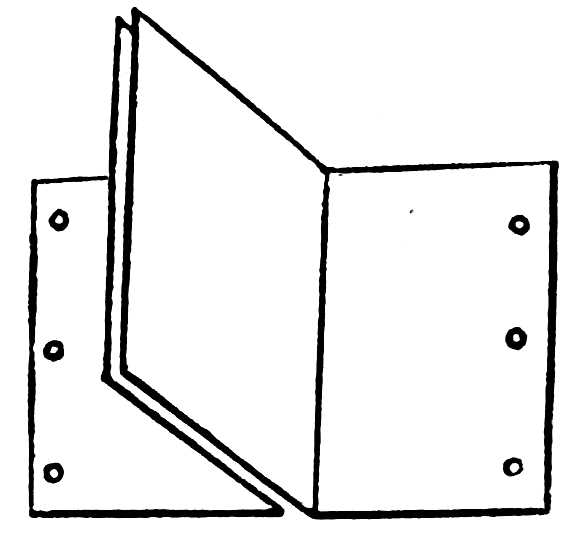
A strip of thick tin, half or three-fourths of an inch wide,
and two and a half inches long, is all that is required for
the material. If preferred, it may be of thin sheet iron
or sheet brass. Any tinsmith will furnish it, bent and
doubled into the form represented in the diagram.
Fig. 22.—Separator.
The upright part is five-eighths or three-fourths of an
inch high, according to the thickness of the toes. A cut
is made in the insole, and this part put through, while the
ends are fastened to the under-side of the sole by some
very small-headed tacks, such as every shoemaker has
upon his bench, or can readily procure, and can drive
after making holes through the tin with a sharp-pointed
peg-awl, clinching their points on his lap-iron; or if the
part goes through snugly, there is no real need of fastening
at all. It is best not to set the partition very far back
from the end of the toe, because at the first joint there is
but a thin covering of flesh to guard the bone from being
hurt. The exact place for it must be determined by carefully
measuring the foot, while the toe is kept straight by
the hand, and afterward measuring the same length on the
insole, with the size-stick; the width of the toe, as well as
the foot’s length, being also taken, and in the same way.
To make sure that it shall not chafe the toe, the partition
or separator may be covered neatly with cloth, or with a
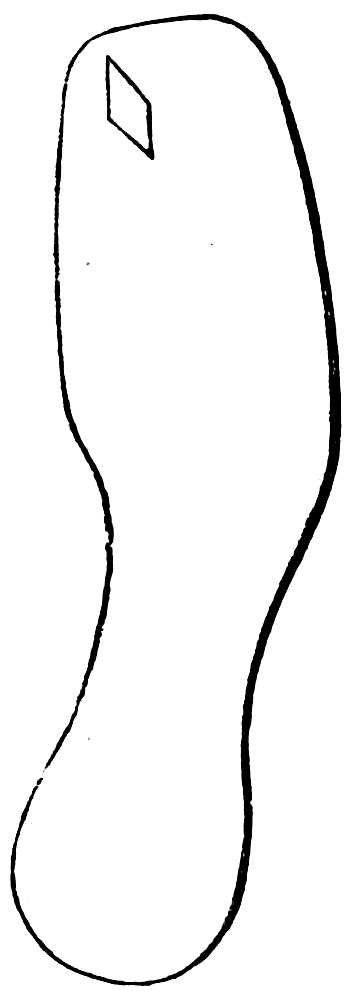
piece of thin sheepskin or kid leather. The following cut
shows it when ready to be put into the shoe.
Fig. 23.—Insole with Separator.
The edges and corners of the separator need to be
smoothly rounded, and the forward upright corner may
be lowered by filing off, if desired, to prevent its showing
against the upper. It should not be wider or thicker at
its forward part, that is, it should not be triangularshaped,[3]
so as to separate the toes more at the ends than
farther back, for if so it would prevent the smaller ones
from straightening out to correspond with the large one.
The large toe often pushes the smaller ones to the outside—part
of them, at least—and when the great toe is restored
to straightness the smaller ones should be allowed
to follow it, as they will be inclined to do, while the curve
of the shoe on the outside tends also to push them back
toward the inside. Almost anything between them will
keep them apart temporarily, as for the purpose of giving
ease to a sore joint, where there is no intention to continue
the improvement.
When the shoe is made ready there may still be some
difficulty about getting the foot into it. There must first
be a toe made in the stocking; which can be done in a
rough way by sewing two parallel seams, an eighth of an
inch or so apart, from the end of the stocking to a depth
equal to the length of the great toe, of sufficient width to
give room for it, and then cutting down between these
seams with the scissors. The stocking should itself be of
good width, to give space for the smaller toes to be separated
also. An ingenious woman would probably find a
better way of making the toe, but this will answer if
necessary. Then, if the joint is not too stiff, or the toe
too much bent aside, it can be kept straight while going
into the boot by the fingers of one hand pressing against
it outside of the upper leather; and when this is the case
the foot may be clothed in any kind of a boot or shoe, and
no difficulty will be experienced in putting it on. A man’s
calf boot may be drawn on in this way the first time it is
worn.
But when the deformity is too decided to allow of the toe
being kept straight by the hand in this manner, a shoe
which laces in front must be made, the opening being cut
down somewhat lower than usual—as low, in fact, as will
answer—though the line of the vamp is still curved so
much that the seam will not cross the joints—a direction
which the maker will understand. On account of the
vamp being so short, the shoe will look better if made
rather long for the foot.
With this the foot can be turned a little, and worked
around in such a way as commonly to get the toe to go in
on the right side of the partition; but if there is still difficulty,
a pretty sure way of accomplishing the object is to
take a yard of tape, ribbon, or something similar, wind it
up around the finger into a large, compact wad, and crowd
it in between the toes till the great one is well straightened
out, taking care to leave one end of the tape hanging outside
the shoe. The toe will then be likely to go into the
place made for it, and the tape can be pulled out by its
free end before the shoe is fully drawn on.
A low shoe is still better than a high one for these
difficult cases, as the lower it is the more freedom will
be allowed to turn the foot one side in entering the
toe.
Even where no trouble of this kind is anticipated, it is
still advisable that the first trial be made with a laced shoe—whether
high or low is not material—when, if entirely
successful, a boot, or a Button gaiter may next be ventured;
and to those who cannot feel sufficient faith in
these statements to risk a failure on a pair of good shoes,
we recommend that they have a pair made of the poorest
and cheapest materials, and try them as an experiment.
The methods here given of straightening the toe, and
the way of making the shoe and getting the foot into
it, have been tried with fair success. Great toes that were
badly deformed have been brought back so much as to
give the appearance of well-formed feet, without creating
any discomfort, and with positive ease and benefit to all
the other toes. Of course, the less the distortion, and the
less time it has existed, the easier to accomplish the purpose.
There may be many cases which there would be
little use in attempting to reform; but the great majority
can probably be improved; and though a complete success
may not be always attainable, the gain in appearance, to
say nothing of comfort, ought to be sufficient inducement
to make a trial of the plan.
In some cases an unpleasant feeling to the toe or joint
may be occasioned by the change, as might be expected
in any change of a similar kind, but it is likely to become
less and less till it entirely disappears.
The greatest direct benefit, however, will doubtless be
in the case of bunion or other soreness of the joint, where
the straightening of the toe would give immediate relief,
and furnish a motive to continue the new habit. The
difficulty of effecting this in the common-shaped shoe is
well known to those who have had occasion to try it.
With the new form it will be comparatively easy.
Having the great toe corrected, and the smaller ones
left free to correct themselves, being also influenced to do
so by the curve on the outside of the shoe, there is the
best reason to believe that by perseveringly continuing the
position for a sufficient length of time, all the parts would
return permanently to their natural form. In the worst
cases this time might be several years; in others only as
many months. The law that any limb or organ of the body
will adapt itself to a change of position is one that cannot
be questioned; the only doubt is as to the extent of the
change which may be thus effected. When the foot has
been years in growing into a bad shape, it cannot be expected
to right itself immediately, though much may
depend upon the thoroughness with which the remedy is
applied.
Prevention, however, is said to be far better than cure.
It certainly is in this matter, and, being so easy and simple,
there can hardly be any good reason for its neglect.
As a means of developing some hints that may be of
service in originating an article superior to any now worn,
as well as a matter of curiosity, and to show some of the
elegance formerly existing, we give a few representations
of the foot-apparel worn in ancient and medieval times.
It seems possible there may be some peculiarity about
them that can be adopted and made of use for the future.
We are indebted for them to Mr. J. S. Hall’s “Book of
the Feet.”
Fig. 24. Ancient Egyptian.
Fig. 25. Roman.
Fig. 26.
Old English.
The first cut is that of a sandal worn by the aristocracy
of Egypt in the earliest ages. There is a fastening over
the instep, and another passing from that, to a point
between the great toe and the smaller ones, to prevent
slipping toward either side. The foot is a handsome one—evidently
that of a lady—and the sandal seems appropriate
to a dry, warm climate, in the days when a partially
bare foot had not become disgraceful.
The second figure represents the cothurnus of the old
Romans—a sort of boot-sandal, laced in front down to the
roots of the toes, but leaving the toes themselves exposed
and free, and with a sole like a sandal, evidently shaped
to fit the foot—not the foot to fit it. The sturdy conquerors
of the world did not, it is plain, believe in subjecting
their toes to any such tyranny as we impose upon ours.
Who can say the foot is not finely formed, although the
toes are not drawn together into a pile? or that the covering
is not appropriate, neat, and elegant?
Figure 26 shows us a form of shoe in fashion among the
nobility of England in the fifteenth century. Though the
toe is somewhat lengthy, the shoe is otherwise eminently
sensible. We ought to be, and think we are, able to
improve upon what was done by our ancestors of four
hundred years ago; yet here is a sole that, notwithstanding
its ridiculously long toe, is better adapted to fit the natural
foot and preserve its shape than any of those made at the
present day. A turn-up toe is not so objectionable, when
of moderate length, as it leaves less necessity for a high
heel. And if our shoes must have long and narrow toes,
something like this is decidedly better, and no more ridiculous,
than the cramping, distorting shapes now in use. It
is at least extraordinary that with all our modern wisdom
we are not yet able to produce a better form than any of
them. But while waiting for the right thing, if the Paris
cordonniers will adopt this, and return it to us duly indorsed
as the latest orthodox French style, there will
be reason for gratitude to them, and for congratulation
among ourselves.
It may be noticed that the form here shown would, if
its long toe were taken off, have a strong resemblance to
that called the Eureka, the breadth at the part where the
toes lie, being its best and most important point. And
thus comparing the Eureka with all the modern shapes of
boots and shoes, we are compelled to re-assert that it is
not only the best of any for all proper purposes, but that,
looked upon with a rightly educated taste—with a knowledge
that the forward part of the foot is, and ought to be,
the widest—it is also the most beautiful.
[3] There is no objection to this form in particular cases where it is
desired to go to an extreme in straightening the toe, provided that
side of the separator next the small toes be kept straight, and the increase
of width made to throw the great one still farther inward. It
may be done by filing off the forward corner of the upright portion
till its two sides are separated nearly back to the opposite corner,
when a wedge of leather can be inserted to keep them apart. There
must be plenty of room in the upper, or the pressure of such a separator
may create soreness at the nail.
CHAPTER V. — FOOTNOTES:
Flattened Condition of the Arch—Beauty of one that is Natural—Nature
and Purpose of its Construction—How it Becomes Broken
Down—Lengthening of the Foot—Lack of Development—Means
of Improvement—Lasts for Flat Feet—Transverse Arch.
Another of the prominent disfigurements of the
foot is that commonly known as flat-foot, which is
seen where the arch of the instep is in a broken-down or
flattened condition. This deformity has, if possible, a
more awkward and ungraceful effect than that caused by
the unnatural position of the toes and joints; though there
may be less painful effects attending it than are attached
to the latter. The worst trouble accompanying this kind
of disfigurement is the weakness which is attendant upon
it, and which is sometimes so extreme as to interfere
seriously with walking for any great distance, or standing
long at a time; making itself felt at various periods, as
there happens to be a demand for strength and activity.
It is almost needless to say how unnatural is such a
condition. Children are seldom subject to it, except when
connected with weak ankles. Even the children of parents
who are notoriously flat-footed have feet that are tolerably
well arched. We venture to say that the wild Indian of
the native forest was never seen with the beauty of his
symmetrical and handsome frame marred by flat feet.
There are some of the race who flatten their heads, but
they never wear boots, nor heels on their moccasins, and
their feet are therefore free from this disagreeable shape.
The artist never allows a representation of this deformity
to appear in his work; on the contrary, an arch that is
high and well-marked has always been considered beautiful.
It gives an airiness, elegance, and grace to the
appearance of the foot which is as beautiful as the flat
foot is ungraceful and awkward. A firm step and upright
carriage of the whole body are also generally to be found
with the arched instep—never without; while the flat
foot, if not seen, may always be inferred from the unnatural,
shuffling gait of its possessor.
The high arch is thus beautiful for the same reason
that any other organ or part of the body is beautiful—because
it is better adapted to perform its intended function
or office, which is the support of the weight of the body,
this design being more perfectly accomplished when the
arch is high, because it is then stronger than when low or
flattened. To flatten it is like drawing apart the ends
upon which it rests, and this, it is apparent, weakens, if it
does not entirely break, the unity and strength of the
whole.
The nature of the construction of the foot in this respect
is thus set forth by Prof. Meyer:
“If the inner aspect of the foot is examined, we find
that it is an arch, resting in front on the anterior heads of
the five metatarsal bones, but principally on that of the
great toe, and on that of the calcaneum behind. The
astragalus forms the key-stone of the arch.
“The arch is enabled to retain its form by means of
strong ligaments or bands passing from one bone to the
others, and thus held closely together, sustains the superincumbent
weight of the body without giving way.
“When we rest on the foot, as in standing, the arch is
flattened by the pressure from above, and consequently
becomes lengthened. When, however, the foot is allowed
to hang free, the curvature of the arch is increased. At
every step in walking, also, when the foot is raised from
the ground, the curvature immediately becomes greater
through the action of the muscles.”
This action, it will be readily seen, is precisely that of a
spring under a carriage, or other similar vehicle, and
seems to have a like intention—that of preventing the
transmission of a shock or jar to the joints, and the
internal organs of the body above.
It will be found true, we believe, that in persons of muscular
temperament—the temperament that gives tall,
spare, and angular forms—the curvature of the arch is
greater than in those whose natural disposition of body is
toward fleshiness. In the latter case, the muscles of the
whole system being weaker, they allow the bones of the
foot to separate more easily, and this, consequently, allows
the flattening. In other words, we strongly suspect that
in this temperament of the body the ligaments are not so
dense, firm, and strong as they are in persons whose physical
structure is more predominantly muscular. The
ligaments which hold the bones together at the joints are
not designed to stretch, under ordinary circumstances, but
they do yield when sufficient force is exerted upon them,
as in the case of sprains and dislocations, and it is reasonable
to infer that they adapt themselves to the demand
made upon them. The muscles grow longer and larger,
as do also the bones, under circumstances that call for
such growth or adaptations to conditions. So do all the
organs and tissues of the body, in greater or less degree;
and if the ligaments do not, they are a plain exception,
which is not probable. This being so, a constant strain
upon the ligaments of the foot’s arch, as in standing for
several hours without rest, must cause them to stretch
somewhat, allowing the bones to loosen and sink down,
while the same severe strain, if continued for a yet longer
period, would force them to grow into this lengthened
condition, to meet the demand upon them, thus rendering
the fault permanent. In persons of fleshy tendency, the
natural softness and weakness of the muscles and ligaments
allow them the more easily to give way to the
pressure upon the arch. It is believed to be the fact that
the deformity is more common among people of this type,
and it will be well for those so constituted to guard against
anything that tends to its development.
It is in persons of the opposite type—those who have
firm, close, hard, and strong muscles, and no extra flesh—that
the arch is found in its greatest perfection. There
the strong muscles and ligaments bind the bones together
with such firmness that the arch is enabled longer to
resist the influences which tend to break it down. Yet
the flat foot is very common, in spite of all nature’s efforts
for prevention. The deformity, in greater or less degree,
may be said to exist as the rule among adult persons,
while the natural arch is the exception. Among some
classes of people, flat-foot is almost wholly prevalent.
Hard toil and degrading conditions not only debase the
person morally and intellectually, but they affect the gait
and carriage, and their influence may be seen to reach
down to the very bottom of the foot.
It was this fault, possibly, which first suggested the
practice of wearing heels, or, if it did not originate, at
least continued it. Heels partially restore that elevation
and airiness of the foot which is given by a natural arch,
and which constitutes its grace and beauty. When rightly
made, and worn as a choice of two evils, or as a partial
remedy for an evil, they are not objectionable; but they
can be only a partial corrective. They can never be substituted
for a good arch; while, worn as they are and have
been, they really become one of the causes of the deformity
which in turn calls for their use. Another cause is thus
explained in Prof. Meyer’s book:
“Flat-foot is occasioned by the loosening of the ligaments
that knit the foot firmly together, and, by the consequent
sinking of the arch, the inner aspect of the foot
no longer presents the natural hollow in the sole. The
causes of such loosening of the ligaments are numerous,
but by far the most frequent, and one readily induced by
the ordinary shoe, is weight improperly directed on the
arch. If, for example, a shoe happens to be trodden
on one side, and especially, as is most commonly
the case, if it be so at the heel, then the heel has no support,
except from the inner margin of the sole, which is
thus worn away, and the heel-piece becomes oblique, or,
in other words, lower at one side than the other. In walking
and standing on such a heel-piece, the whole external
margin of the foot is raised, and the inner, which naturally
supports the arch, is so depressed as gradually to lose its
convexity, and thus flat-foot is produced.”
The nature of the cause here spoken of seems to be
like that of a sprain, to a slight degree, and may be an
influential one, but we doubt that it is the most common
cause of that loosening of the ligaments which allows the
foot to break down. The most common and efficient of
all the causes of this difficulty, it appears to us, is the
short heel which has always been worn on boots and shoes,
and is still, except where an innovation upon its shape has
been made within a few years past. This, though not
strictly a direct cause, like a strain from above, is the condition
which most frequently admits and encourages the
sinking of the arch.
That short heels most frequently admit of and encourage
the sinking of the arch of the foot will be readily seen by
an explanation. There are several bones which, together,
form the forward part of the arch, while the back part
consists of one larger bone, technically called the calcaneum,
or os calcis, which makes up the principal part of
the heel. Partly above this, and between it and the forward
bones, is the one called the astragalus, which is the
keystone, being located the highest of any, and the one
upon which rest the bones of the leg; in size it is next to
the calcaneum. An illustration will show the position.
Fig. 27.
The inner aspect of the foot, showing the arched construction of
the whole foot—a, head of metatarsal bone of great toe,—b, calcaneum,—c,
astragalus.
The forward part of the calcaneum, or heel-bone, at its
lower surface, is somewhat higher than the back part, and
has under it a thicker cushion of flesh. When the bare
foot treads upon the surface, or when there is no heel upon
the shoe-sole, this point—letter e in the diagram—is as
well supported as any other, and, being so, enables all the
other bones to keep their proper places, but when there is
a heel on the sole of the shoe, it is not long enough—does
not extend under far enough—to support this forward
part of the heel-bone. The sole, forward of the heel, is
not usually stiff enough to support it, and therefore it falls
downward as much as the leather will give way; the heel-piece
being often half an inch too short, and sometimes
more than that. Then, if the sole is light, so as to give
way easily, there is nothing to prevent this part of the
bone from settling down to the extent of a quarter of an
inch, or even more. While the back part is supported,
the front is turning directly downward. This allows the
astragalus and the whole arch to sink down to the same
extent, and, in time, all parts of the foot will adapt
themselves to their changed condition, and the flat shank
become a permanent thing. If any person will examine
a slipper worn with a heel, or a boot having an ordinary
sole, it will be seen that just in front of the heel the sole
is depressed, or bent downward, from one-eighth to three-eighths
of an inch. This is almost invariable, except
when a very long heel, or a stiff shank in the sole, preserves
the natural position of the calcaneum or bone of which
the heel is formed. The amount of this depression shows
how much the arch has sunk, and how much higher it
would be if properly supported. It indicates very plainly
the occasion and origin of a large proportion of the flat
and splay feet that may be so frequently observed.
This inefficiency of the common short heel to properly
support the arch was first discovered by Dr. J. C. Plumer,
of Boston, to whom is due the credit of showing the bad
effects just noticed as the result of its being worn. His
style of boot and last will be discussed further on.
It has been stated that as the foot flattens, it also
lengthens. It has been estimated that some flat feet are
as much as two sizes, or two-thirds of an inch, longer than
the same feet would be if well arched; an item worth
noticing by those who are fastidious upon this point.
In falling down, the calcaneum is pushed backward
making the long-heeled foot, while the bones forward of
the astragalus must advance more or less in their direction,
thus adding to the foot’s length at both ends, and
making the leg appear to be set far toward the middle.
The ends must necessarily be separated before the middle
of the arch can sink, and this is why its flattening is accompanied
by the long heel. In a foot that is well arched,
the projection of bone at the upper part of the heel extends
farther back than the lower edge at the sole. In a flat
foot, on the contrary, the bottom part extends back farther
than the bony projection above, which, in fact, is pretty
sure not to project at all.
It may be asked, Why not keep the ends of the arch
together by a boot that is short at both ends, supposing
such a one could be made that would not distort the toes?
Simply because it would prevent the use, and consequent
strength, of the muscles of the under side of the foot,
which are themselves the natural bands for holding the
ends together, and the whole arch in its raised position.
These muscles, being weakened by the cramping of a
short boot, would allow the arch to sink whenever the
artificial support was taken away. This reasoning seems
to indicate such a treatment as one of the causes by which
flatness is produced, and as pinching the foot lengthwise
has been a common fault, this cause may have been quite
effective.
Dr. Meyer thus refers to another bad influence:
“We have already seen that the foot forms an arch, the
efficiency of which in a special manner depends on the
tensity of its ligaments being maintained. If then, an
unnatural and flattening pressure be constantly exercised
on this arch, the binding ligaments get slackened and the
arch falls down; a broken-down arch, as we have already
seen, causes flat-foot. The pressure of the upper leather
on the instep must, therefore, and particularly in the case
of narrow boots, favour the origin of this deformity. The
same cause must further interfere with locomotion, for at
every step the increased arching of the instep, which takes
place the moment that the foot is set to [? raised from] the
ground is resisted by the upper leather, and an injurious
influence is thus exercised on the action of some of the
muscles used in walking, and which runs from the anterior
aspect of the lower leg to the back of the foot.”
All cramping, binding, and confining of any part of
the body weakens it, as is well known to every intelligent
reader. Hence the manifest impropriety of wearing anything
unnecessarily tight or binding to the arch of the
instep. Every boot that is uncomfortably tight has to
some degree the effect of weakening, and rendering it
more liable to fall down.
More especially is this the case when the leather used
is thick, hard, or stiff. Much of the cheap and inferior
goods offered for sale ready-made are seriously objectionable
on this account. The uppers themselves are—a
large share of them, at least—thick and hard, while the
pegged soles are made as stiff as possible, to give the
appearance of thick, solid, and serviceable leather in that
part. Many a poor man is thus actually hobbled, to a
greater or less extent, by the miserable foot-gear his
poverty compels him to wear. As there is but very little
bend to them, there is but little use of the muscles of the
foot. It is cramped or unnaturally pressed upon, even
though having plenty of room, and might almost as well
be cased in iron as in the stiff kip or cowhide boot or
brogan. The result is weakness, flattening, and a tendency
to other kinds of distortion. We believe the
frequency of flat-foot among some of the poorer classes of
people may thus be easily accounted for.
The peasantry of other countries are even less fortunate
than our own. Saying nothing of wooden shoes, the
leather ones they wear are not only thick and stiff in
material, but the soles are often filled with stout iron nails
besides. With such things on the feet there can be no
spring to the toes, no use for the forward part of the arch,
no play to the muscles. The feet can hardly be otherwise
than weak and flat. When tightness is added to stiffness
the effect must be still worse.
Children must feel these bad consequences more than
adults, for being less firm in their muscles and bones, they
have less power of resisting the cramping, weakening influence.
Some of the boots manufactured in this country
for boys can be recommended only as a slightly less evil
than going barefoot in cold weather.
One other reason is, very probably, lack of development.
The calf of the leg is but partially developed in some
races of men, and only comes to its full growth in conditions
of civilized society that call for the use of all its
muscles. So it is confidently believed that all those steps
and motions which give lightness, grace, ease, and elegance
to the movements of the body, such as occur in
most varieties of the dance, and particularly such as
demand the use of the toes, have a tendency to develop
and strengthen the foot’s arch. As its full development
tends to create easy, light, and graceful movements, so
these in turn help it to grow into full strength and beauty.
Hence the well-developed calf, the well-arched foot, and
the graceful step will almost invariably be found to go
together.
There may be yet other and unknown causes of this
deformity; but enough have been noticed to account for
the great majority of cases. While it is already very
common, the influences that have produced it are still
producing and confirming the wrong shape. Of course
the longer the fault is established the more difficult it is
to make a change; but there is believed to be a partial
remedy, at least, in the case of young persons. It consists
in simply supporting the back part of the arch as nature
does in her own way; that is, in supporting the whole
under-surface of the calcaneum, or heel-bone, as is done
when the bare foot is pressed upon the ground. A long
heel—one extending under the sole far enough for its front
edge to support the front part of the bone—is the thing
required. When the foot rests upon such a heel, the
whole weight of the body acts as a force to compel the
forward part of the bone to push itself upward into its
true place, because, being a quarter of an inch—more or
less—lower than it ought to be, it cannot be perfectly at
ease until it gets back where it belongs. The weight of
the body, then, is just as influential in restoring the arch
to its natural form when the long heel is worn, as it is in
breaking it down when the short heel is the only support.
There is reason to think that a large number of the flat
feet could be corrected by this simple expedient. The
long-standing cases might require considerable time, and
even prove too obdurate for this remedy; but the law
which compels all parts of the system to adapt themselves
to circumstances would tend constantly and strongly to
bring about the effect desired. In those cases where the
feet have not grown into a positive, settled distortion, we
doubt not the result would be decided and very gratifying;
and if the children wore these long heels—if, in short, the
whole people were educated to see the necessity of wearing
them, when any at all are worn, the instances of flat-foot
would be far less common.
A few years since, Dr. Plumer (before referred to) patented
a style of boot, of which the long heel is one
characteristic. This is, in fact, the best thing about his
invention, and should go far to make it popular, even if it
has no other recommendation. The fashion has been
considerably introduced in some places, and has also had
some effect in increasing the length of heels in work not
made after that style, and thus may indirectly have saved
many from having the arch of their feet broken down.
For this it is deserving of praise, though we attach less
importance to its other peculiarities.
The old-fashioned way of making heels leaves them
from one-fourth to five-eighths of an inch too short. The
whole tendency of such heels is downward, in a double
sense. The more they are worn the farther downward
goes the foot, not only in form, but in character—in beauty,
gracefulness, and strength.
The long heel, on the contrary, tends to raise the foot
upward in shape, and also to restore its strength and
grace. As a means of prevention, it should be adopted
for all children, to preserve the shape of feet that are still
natural.
The Plumer heel has frequently been carried to an extreme,
and in such a way as to make its shape appear
clumsy and inelegant. For this there is no real necessity.
A heel that will extend under the foot half an inch farther
than the generality of short ones, can be made, by pitching
it well under behind, to appear only slightly longer than
common at the top, (or bottom,) and be tasteful in every
particular. The form may be that of the most approved,
and there is no demand for greater width. If the counters
or stiffenings be of the right kind, the heel may be
made sufficiently narrow to look well, and correspond
with the general appearance of an elegant boot, without
danger of its treading over. This latter kind of trouble
comes mainly from counters that are too weak, though, of
course, a heel that is too small relatively—which is not
handsome—or that is built inclining to one side, will be
likely to produce the same result.
A high heel has an influence in encouraging this false
condition of the arch by throwing the foot forward, thus
creating the same effect as a shortening of the heel itself.
This is not so great a cause as some others, it is true, but,
as one thing tending to the same general result, it should
be considered and guarded against.
It is claimed that a necessity exists for a heel of some
kind in order to prevent the stubbing of the toes in
walking; and the fact that people of Eastern countries
turn up the toes of their shoes seems to countenance the
claim. Yet, it is doubtful. Although Nature did not put
anything under our heels, it cannot be supposed that she
intended us to go about constantly stubbing our toes. If
there had really been a need of raising up the heel, she
would have raised it. It is more likely that by wearing
heels we have got the foot into a false habit of pointing
the toes downward more than is natural, and hence our
inclination to stub them when the artificial heels are not
under us, if such is the fact. The heels must be decided
(described) as unnatural as they are unnecessary. Still,
a moderately high one is not so obnoxious as to be worth
disputing about. If the height were limited to an inch
for the heels of a lady’s boot, and an inch and a quarter
for those of gentlemen, as a general rule, in both cases,
the disadvantage of such heels would be so trifling that
they could hardly be objectionable, provided the length
was sufficient. But a short heel, however low it may be,
is a villainous thing.
Another great means, both of preventing the fall of the
arch, and of restoring it afterward—one hardly inferior to
that of the heel—is the exercise and development of the
muscles of the under side of the foot. These are chiefly
concerned in the use of the toes. They act whenever we
spring upon the forward part of the foot in walking, leaping,
or dancing. Their exercise not only strengthens them,
but it strengthens all the other parts also; the ligaments
and bones, as well, being made more dense, firm, and
enduring, according to the law that the proper use of the
muscles of any part of the body draws blood, vitality, and
strength into the surrounding or contiguous parts. As
these muscles extend in a general lengthwise direction,
their strong and firm condition tends directly to hold the
ends of the arch as near together as they naturally belong,
or in other words, prevent their separation. And as they
must separate before the arch can sink, it is seen that
here is a powerful influence naturally exerting itself to
restrain the foot from flattening; a view which can be
sustained by good anatomical and medical authority.
The ladies of Spain are said to possess the finest feet of
any race of women in the world. The fact can hardly be
disputed; and to account therefore it is only necessary to
take into consideration the general prevalence of their
national habit of dancing, which, by all its movements
and exercises of the foot, tends directly toward strengthening
the toes and raising the arch. A person who can
support the weight of the body on the tips of the great
toes, either naturally or by cultivation, must possess not
only strong muscles in the toes themselves, but a strong
arch, and strong foot throughout. We will risk the
reputation of this book on the assertion that a broken-down
arch cannot be found in the whole dancing profession.
Here, then, is indicated one course of practical effort by
which to avoid or ameliorate the deformity. All those
movements of gymnastics which go to strengthen the foot
may likewise be adopted with advantage. The toes must
also be taught to do their share in the process of walking;
and whatever action, in short, will cause the exercise of
the muscles of the lower part of the foot, should be
favoured, and will help to develop and raise the arch.
But this effect cannot be produced immediately. It may
require patience, determination, and steady perseverance.
There is no royal road to recovery from flat-footedness,
any more than there is to knowledge.
The coverings for flat feet should always be made upon
lasts that are flat in the shank like themselves. A boot
made on an arched last cannot possibly fit a foot whose
sole is convex from heel to toe; hence such feet need lasts
made expressly for them. The upper leather of the boot
cannot, in this case, be too soft and pliable. It should
be loose enough to allow the bending at the ball and the
movements of the toes to be performed with ease. All
the muscles must have a chance to act freely, and the
blood be permitted to circulate without hindrance. At
the same time there is no need of having big wrinkles, or
any extra looseness in the fit of the boot, if only sufficient
care is taken in the making.
Another thing to be considered is the stiffening in the
shank of boots, more particularly in those of men. If a
short heel must be worn a stiff shank had better go with
it. A metallic shank, if strong, will then be useful, and
perhaps generally effective in keeping up the foot. A
shank-piece of leather is seldom so stiff but that a flat
foot will bend it downward to adapt it to its own shape.
So it will also depress the steel shank at the forward and
middle portions, but probably not directly in front of the
heel, where the most support is required. The shank,
too, unless nearly straight, will be apt to press against the
middle of the arch—or where the arch ought to be—so
strongly as to cause discomfort; and it is a question if
such a pressure does not itself tend to weaken the foot
still more. It is thus doubtful if the metallic shank will
be of any benefit to a flat foot, unless pains are taken to
make it conform to a flat-bottomed last by straightening.
Feet that are tolerably well-arched can wear it with no
difficulty.
But, further: the stiffness in the shank of the boot interferes
somewhat with the flexibility of the foot, and
therefore no more of it than is necessary to pull off the
boot ought to be allowed. By far the best way, and the
only right way, is to wear a heel sufficiently long to give
all the needed support, and a shank as flexible as it can
be without breaking or clinging to the foot when the boot
is drawn off. The foot—at least the heel and arch portion—is
then left unimpeded in its natural action. If it be
said that the stiffness is intended to keep the sole in its
proper shape, it is replied that when the boot fits naturally
and easily—not loosely—it will keep its correct shape
without any help, while if it does not it will tread badly
in spite of all the stiffness.
There is an additional elegance, and general appearance
of elevation given to the foot by having the sole of
the boot made as thin and light in the shank or waist as
possible. This can be done in men’s boots by driving a
row of pegs through the shank-piece, putting the pegs
close together, to create stiffness, without increasing the
thickness of the leather. The shoemaker will understand.
A shank made in this manner will be firm enough in
drawing off the boot, the thickly-driven pegs not leaving
room between them for the leather to break; while it is
much more flexible than a thick one. It is thus better
adapted to the foot, at the same time that it is quite as
reliable for its own proper purpose. One piece of leather
may thus take the place of two or three. Where a metallic
shank is used, there will of course be the appearance of
lightness.
The model boot or shoe of the future, however, will be
one in which there shall exist no need of stiffness in order
to draw it off, but where this part of the sole will be so
thin and flexible as to be easily pressed downward by the
large ligament under the arch when the toes are raised,
while it will cling upward close to the hollow of the foot
when the arch is raised and the toes extended.
Another hint to the bootmaker may not be inappropriate.
It is generally considered desirable to have the side seams
correspond with, or meet, the forward corners of the heel.
To effect this when a long heel is made it is only necessary
to add half an inch, or more, to the width of the
back-pattern at the bottom, before cutting. This width
may be added at the bottom, and lessened gradually
toward the top, or continued through the whole length
of the pattern equally, as preferred. A corresponding
amount must of course be taken off from the width of the
front pattern at the same time. In a boot without sideseams
the same rule applies in cutting the ends of the
outside counter.
The front of the heel should not be cut out in curved
form, as is sometimes done, because that is a virtual
shortening of it; though there is no objection to cutting
out the upper lifts of the leather, letting the point of the
knife come out before touching the sole, which makes a
shortened appearance without affecting the length at all
where the sole and heel surfaces unite. A heel rounded
out, lengthwise, would be preferable to one curved in,
though it might not be thought so elegant unless indorsed
by fashion. We speak thus particularly about the construction
of the heel, because it is important; as the good
or ill form of the foot’s arch seems to depend upon it more
than upon anything else, except it be the strengthening of
the muscles.
There is a third peculiarity of the Plumer last that is
worthy of notice, and which consists in a hollowing out or
concaving of the bottom or sole from the heel forward to
the toe, but mostly through the ball. This hollow is designed
to be filled up with leather in making the boot, so
as to leave the bottom of the sole flat, while inside it is
rounded upward. The object of this change in the shape
of the last is to make it conform to the shape of the foot,
which it does very closely. But, at the same time, so far
as this has any effect upon the foot at all it has an injurious
one. The form of the sole of the foot at this place is one
that ought not to be conformed to by the sole of the boot.
There is a low arch, transversely of the foot, from the
ball of the great toe to that of the little one, its two opposite
resting points. In nature it is somewhat like the
great arch between the ball and heel. To raise the
sole under it is like supporting an arch in the middle,
which would be absurd. In this case it is entirely unnatural,
and only of use in a boot that is very tight, or
much too narrow, where it may do good by preventing the
formation of a big wrinkle in the sole of the foot, lengthwise,
which might come from the drawing together of the
opposite sides. The following quotation strongly sets
forth the impropriety of the new mode.
“There has been a good deal said of late about the
transverse arch of the foot, and the necessity of supporting
it to prevent its breaking down, and the unfortunate
possessor becoming splay-footed. Did any one ever hear
of an arch requiring support? * * * What is called the
transverse arch is in reality a portion of an elliptic spring;
and the moment you fill up the natural hollow of the foot
you destroy its elasticity. What carriage-maker puts supports
under the arches of his carriage-springs? The
human foot is a combination of bones and strong muscles
that act as springs, and at each point where it comes in
contact with the ground is placed a cushion to prevent
jarring. When the weight of the body is placed upon the
foot, it spreads both in length and breadth, and it contracts
again when the weight is removed; and any artificial support
under the hollow of the foot prevents this expansion
and contraction, and one may as well have a wooden foot,
for all practical purposes, as one which has a support
under the transverse arch.”[4]
As the foot spreads at every step, the arch naturally
flattens in the middle, but this is prevented when the sole
is built up under it. It is self-evident that the foot is
designed to tread on a flat surface, as its most natural
function. Any attempt to make it tread constantly on a
convex one is manifestly wrong. Yet, as said before, it
may be of use to prevent a greater evil where people are
determined to wear tight or narrow boots in spite of all
reason or propriety.
It is also true that a slight hollow will exist under the
ball of a well-arched foot, even when pressed upon by the
weight of the body. This may be filled up if desired, for,
being so small, it is a matter of indifference whether it is
so or not, while there is perfect safety in letting it alone.
We see, then, that while one characteristic of the Plumer
boot—the long heel—is a very valuable one, another—that
of filling under the transverse arch—is useless, or
positively injurious. The first, or good quality, however,
overbalances the latter, and therefore the boot is an improvement
upon the old or common style. The true and
natural-shaped boot would have a flat or level surface from
heel to toe on the sole, not wholly, but precisely where in
this it is hollowed out. The parts on each side of the
level strip would be slightly convex, like the corresponding
parts of the foot; not too much so, however, for then the
last would be too rounding on the bottom, taking the
whole width in view, which is as bad a fault as the hollow,
or even worse; as it interferes more with the spreading of
the transverse arch, and, by making a concave upper surface
to the insole of the shoe, compels the ball to tread
into just such a hollow as would fit a broken-down, splay
foot. The natural inference is that such a shoe would
tend to favour the production of just such a foot.
It is believed that the broken-down transverse arch will
almost always be found accompanied by the broken-down
arch of the instep. Though the latter may exist without
the former, yet we suspect that the two incline to go together—that
the sinking of the greater arch tends to carry
down the other along with it, while a natural weakness of
muscle would be a predisposing condition. If there are
other causes they are not yet known. The last supposition
being correct, then the most direct way to a cure
would be to restore the arch of the instep to its proper
shape and position; which would probably have the same
tendency to raise the other, that its depression had to
break it down. The grand recipe for this, as already
given, is the long heel; which can be made upon any
kind of covering, whatever its peculiarities. The use of
the muscles of the toes must also come in as an auxiliary
help not to be underrated.
Still another remedial measure is the “righting up” of
the foot. Many, if not most, of the feet that have broken-down
arches also tread over inward along the whole side.
In such cases the weight of the body, as already stated,
falls upon the arch in a wrong direction. The arch, instead
of standing upright and receiving the weight directly
over itself, supports the body while itself leaning over to
one side. Any other kind of arch, in a similar condition,
would quickly fall over or settle down; and it is no wonder
the foot settles down to a level in the shank. Weak
muscles in the ankle and foot of a child will allow the
foot to take a one-sided tendency, and it is not impossible
the child may inherit something of this weakness from a
weak-footed parent, and thus the infirmity be perpetuated.
But with the fault existing, however produced, the foot
cannot get strong till the arch is restored to its natural
perpendicularity. The best manner of righting it up will
be described in a chapter farther on. The uprightness
will give the muscles a better chance to grow strong, while
these assist the operation of the long heel; and possibly
it will prove not inferior to either of them in promoting
the desired result.
We are sorry that facts from practical effort cannot be
given to show a realized success in this direction. But in
truth we doubt that an earnest and systematic attempt
was ever made to raise up a broken-down foot. All that
can be said is that the methods recommended must necessarily
tend toward the restoration of the arch. But
this alone ought to furnish assurance of success, and encourage
an archless-footed person to combine those
methods, and give them a faithful trial.
[4] This paragraph is from Mr. J. L. Watkins, a boot and shoe
manufacturer of New York city, who has attempted to carry into
practice the idea of Prof. Meyer.
CHAPTER VI. — FOOTNOTES:
Natural Character of the Instep—Causes, and Prevention, of Sores
upon it—False Taste—Callosities of the Heel—Counters—Criticism
of Lasts.
In the last chapter the instep was spoken of as a part
of the whole arch of the foot. It is now to be looked
at from the upper side. When the foot is in its best shape
this part is elevated and prominent, with a well-marked
and graceful rise from the ball upward, and a distinct projection
or convexity at its upward portion, or about half
way between the joint and the ankle, which is the upper
surface of the first cuneiform bone, or the point where
that bone joins the first metatarsal. This place is subject
to callosities or thickenings of the skin, resembling corns,
but more frequently is affected by soreness without any
thickening of the skin. In the broken-down foot there is
no convexity here at all, or but very little, the instep being
a straight inclined plane from the ankle to the ball, and
sometimes even bending downward. Insteps of this kind,
whatever bad effects may come from their flatness, are
not afflicted in the way just described. Corns and callosities
are never known to fasten upon them; an advantage
which shows that some good is mixed with evil, in the foot
as well as elsewhere. It is the best formed instep, on the
contrary, that is most subject to callosity and tenderness.
This tenderness or callosity, whichever it may be, has
one cause in the general tightness of the boot worn, and
may have two others, arising from the shape of the lasts
used. One of these is in the fact that the corresponding
part of the last—technically called the cone of the instep—does
not extend far enough forward, or is shaved off too
much—is left too flat, for the fitting of well-arched feet.
There is not wood enough, proportionally, in the last at
this point. The other cause comes from the whole instep,
being placed too near the middle, instead of on the side,
where the foot has it. Mr. Watkins, who was referred to
in the last chapter, thus explains this defect:
“If the instep is not in the right place, the foot swells
in that place. I have seen very troublesome sores on the
instep, and very difficult to cure, arising from the misplacing
of the instep of the last. By a peculiar measurement[5]
I have been enabled to obviate all difficulty in that
respect, so that none of my customers now complain of
tender insteps. The insteps on ordinary lasts are placed
near the middle, which is erroneous, as the point of the
instep lies on one side, and not in the centre, and common
sense would indicate that the thicker parts of the lasts
should be on the side of the large joints and toe, and the
thinner on the outside of the foot, where the small toes
are placed.”
It may seem, at first thought, as we look at a boot after
it is made, that the leather will accommodate itself to the
shape of the foot with the greatest ease. It appears perfectly
pliable, ready to take any form or place that the
foot may give to it; and this is true to a great extent, but
it is not so entirely. When the boot is made the leather
is stretched, and worked into a definite shape—that of the
last. When a foot large enough to fill it is put inside, if
it be of a different form there will be more or less force
exerted to change the shape and adapt it to that of the
foot. This is one reason of the difficulty often experienced
the first time, or first few times, a new boot is worn. The
resistance, pressure, and friction may be considerable, or
only slight, with a corresponding effect.
This misplacement of the instep is true of the ordinary
right-and-left lasts, and it is necessarily still more marked
in the straight lasts on which the great majority of ladies’
boots and shoes are made. If women’s insteps do not
suffer from this difficulty more than men’s, it is because
they wear softer material, and boots fitting less tightly
than those of men. The latter have an advantage of the
former in this respect, as in some others; for while they
have right-and-left lasts wholly, with ladies the straight
last is the rule, the other the exception. As long as
woman does not have her boots and shoes made right and
left, she is losing one of her “rights,” and subjecting her
feet to an “oppression” which, unless they can bear a great
deal, they will be likely to complain of in an unpleasant
way. And this right is not so unimportant, but that it will
be found best to give it a little attention, although the remonstrating
“subject” may be in a very humble position.
The best thing to be done for feet with sore insteps is
to have lasts made to fit them, and their coverings made
by some one who knows the real source of the trouble.
The sore will generally disappear soon after removing the
pressure. The prevention of it is a much better thing,
and will come with a more general understanding of the
foot’s nature, and with the more correctly-shaped lasts and
more perfect skilfulness which that knowledge will give
to the shoe manufacturer.
There is another deformity of the foot, chiefly of the
instep, which might be called the stub-foot. It is not the
natural short, thick foot of short, stout persons, but seem
an unnatural chubbiness, made by prevention of the foot’s
growth lengthwise. It is an approximation to the Chinese
foot—thick and large round the ankle and instep, but
short and small at the toes. There is no correct proportion
between one part and another. The arch is high,
but thick and clumsy, without its natural regularity and
beauty. The constant cramping of small shoes, worn
when the feet are young, is most probably the cause of
such development, by preventing a normal and perfect
growth. As the forward parts of the foot, being smaller
and weaker, are more easily cramped, the increase of size
is at the heel, and around and above the arch.
It is a very Chinese idea of perfection which admires
feet of this character. A correctly educated taste prefers
to see a foot equally well developed in all its parts, and of
a size proportionate to the size of the whole body. This
is the idea of the artist, as opposed to that of the Chinaman,
and has a reason for it, while the other has none.
If a chance is given the toes to develop themselves
before the body gets its full growth, the fault may perhaps
be partially outgrown; but after that, the foot will be
almost sure to keep the same shape always. The thing
to be remedied, is the strange taste which looks upon feet
that are abnormally small with any more admiration than
would be given to a small head, or short legs, or stumpy
fingers. When people who are otherwise intelligent come
to see that the foot has the same right to a full and natural
growth that belongs to any other part of the body, they
will not cramp it with tight boots, or consider a foot of
this kind as any more beautiful than a pug nose, a dwarfed
limb, or any other lack of development whatever. The
defect will then become the result of chance or misfortune
only, instead of intention, governed by a false standard
of beauty.
It is not, however, intended to deny that there are many
feet which are proportionally too large, made so by some
occupation or habit demanding an extreme development
of bone, muscle, and strength. Nature committed no
mistake in their production. She made them no larger
than was necessary to adapt them to the habits of their
possessor, or of the parents from whom they were inherited.
To attempt to improve them by cramping, is only
to make them worse by distortion. They will probably
decrease their size somewhat in time, if circumstances
favour them in so doing; but if not, they are still no worse
than big hands, big noses, big bodies, or many of those
other unbalanced developments from which none of us
can claim to be entirely free.
Callosities upon the heel, sometimes so bad as to be
called corns, are often troublesome, and mostly so to those
persons whose feet are bony and spare of flesh. In these,
if they are not broken down, the heel bone, at its upper
part, projects backward distinctly. If the boot worn slips
at the heel, there is no flesh over the bone to ease the
pressure and friction of the leather, and the skin must
thicken for its own protection. After a while it becomes
so thick, callous, and hard, that every pressure upon it
hurts the bone, as much as before it was formed. It has
become similar to a hard corn, and must be removed.
This can often be done without any softening, by carefully
cutting, scraping, or lifting up gradually with the knife.
It will probably grow again, and need relifting occasionally
as long as the irritation continues. It is due to
flat feet to say that they usually escape these annoyances,
as well as sores of the instep.
Slipping of the boot at the heel, is almost always the
fault of the boot-maker. It may come from bad cutting,
from bad fitting of the upper, from bad lasting, and from
badly shaped lasts upon which the boots are made.
When the cutting is wrong—which affects men’s boots
mainly—it is the leg through the ankle that is too large,
or there is some defect that will not allow the upper to
last properly. Sometimes it is fitted badly, so as to produce
the same result. More often than either of these it
is the workman, who neglects to draw it over the last in
the right way; sometimes from want of knowledge, and
sometimes from carelessness or indifference. The error
consists in not drawing it over the toe sufficiently tight to
make it fit closely at the heel.
A bad fit upon the foot is another cause, in addition to
those mentioned; and it is also true that the heels of well-arched
feet are more liable to slip than those whose arches
are more or less flattened down.
Still another and very decided influence in producing
callosities on the heel, is a counter that is hard and stiff
at its upper portion. Counters of this kind are very common,
and ought to be as commonly avoided. The stiffness
of a counter should be at the bottom of it, where there
can hardly be too much, while the upper half, or more,
should taper to a thin edge, that is soft and flexible. Then,
while firm at the proper place, it bends and fits snugly to
the heel, preventing its slipping; when, if it stands up
straight and stiff throughout, the foot will slip almost invariably.
Lasts, particularly boot lasts, are at fault in this respect
generally. Those upon which shoes and slippers are
made are so shaped as to force the shoe to set tightly at
the heel and ankle. The principle upon which they are
formed is well known, and is a correct one. It is difficult
to see why it should not be carried further in its application,
and govern the making of lasts for boots and gaiters
as well as of those intended for low shoes. The necessity
is the same in both these styles; there is only a difference
in degree, which is greater in the low shoe and slipper
than in the high gaiter and boot. The tightness at the
ankle which prevents slipping, is supplied, more or less
perfectly, in side spring gaiters, and those that are laced.
Lacing compels the boot to fit closely, whether it does so
easily or not. In men’s boots, where there is no lacing
this effect is produced only by having them so small about
the heel and ankle that the foot can hardly move at all
after it is crowded inside. This may, or may not, be too
tight for comfort, but it is doubtful if there is need of its
being so for the sake of having a well-fitting boot. The
fit can be produced in the same way as in the slipper or
shoe, and the demand for doing it is the same, only not to
the same extent. The slipper has nothing to keep it on
the foot, unless strings are resorted to, except the tightness
lengthwise caused by the peculiarity of the last. A boot,
by covering the instep is held more securely, yet it often
slips at the heel, and is all the more likely to do so when
the foot is well arched.
It seems to us that the way to remedy this trouble in
boots is precisely the same as the means taken to prevent
it in shoes: that is, to make more spring in the last forward
of the instep; in other words, a greater curve on the
bottom. The amount of this spring or curve need not be
so great as in the shoe last, for the reason just stated, that
the boot is confined at the instep, while the shoe is not, to
the same extent. A good shoemaker would not like to
make an Oxford shoe upon a boot last, although it is laced
well up toward the ankle. Why should he be willing
to make a boot on it, when the boot is confined at the
instep no more than the shoe? There is the same danger
of slipping in both cases, and why should it not be guarded
against in the same way? Every one who has made or
sold shoes knows that a slipper, or low shoe of any kind,
will fit on the foot much better if made on a shoe last;
that it is less liable to be loose at the sides, and to show
big wrinkles across the ball; that, in short, it must be
made on such a last. The same reasoning and the same
rule applies almost as well to the boot or gaiter. If there
is any exception, it is the side-spring boot, with its elastic
sides to draw the surface smooth, and even this is not an
exception when the material is leather, though it may be
when cloth of any kind is used. In fact, there is no kind
of foot clothing manufactured but would have a better fit
upon the foot, both in front and at the heel, sides, and
ankle, if a last more closely resembling the common shoe
or slipper last was used in the making. There may not
be, and we are confident there is not, a necessity for
having it so flat in the shank as the common slipper last,
nor so wide through the same region, but the upward
curve of the forward part should be nearly or quite as
great. The curve of the shank might be very nearly the
same as that of the hollow of the foot, while at the toes it
may curve, we will say, one-half as much as the whole
bend of the toes in walking. This form makes it a shoe
last at the fore part, while the shank is but little different
from the ordinary boot last. The part between the heel
and instep need not be so wide at the bottom, nor, perhaps,
so narrow at the top, as the best shaped lasts for
shoes. It is believed possible, however, to make the shank
sufficiently wide, at a slight distance above the bottom, to
accommodate the foot easily, while it may be suddenly
narrowed below sufficiently to allow a narrow-shanked
sole to be made upon it, if desired, without difficulty. If
so, this would be the blending of taste with comfort in the
fit. The outside edge would be a little lower than the
other, as it is in the foot. Perhaps the whole may be well
described as half-way between the extremes of the two
different styles. There would be no difference between
those designed for men and those for women, except in
width and bulk—none in the general form.
It may be feared that a tongued boot—patent leather
or Napoleon—may be more difficult to draw on the foot
if made upon a last of this style. We believe that it can
make but very little difference, probably not any after the
boot is bent in the shank, while it will do much to prevent
slipping at the heel when cut with a large ankle, as
is usually the case. The pitch of the leg will be very
nearly the same when on the last as when the boot is
worn.
It may be observed, however, that an improvement has
lately been made in many lasts by giving them a greater
degree of this curve on the bottom. But it is easy to
carry it to an extreme. The sole can be curved too much
as well as left too straight. Men’s lasts of medium size
have been made with the toes raised an inch and a half
above the level of the ball and heel; which is half an
inch more than is necessary, or useful. Too much spring,
in a thick-soled, stiff boot, prevents the straightening of
the toes, while in a thin one, where the toes can be
straightened, it may create longitudinal wrinkles in the
upper, near the sole at the inside joint. An average
spring of an inch in men’s lasts, and three-fourths of an
inch in those for women, is not far from the proper
standard.
Forms of lasts have always been subject to change.
Fifteen or twenty years ago boot lasts were made very
hollow in the shank, and very much curved upward at the
toe. After that came the stub-toes—flat in shank, and
with scarcely any curve at all; and, in addition to all the
changes fashion has imposed, besides the two indicated,
every manufacturer seems to have a style of his own,
more or less distinct. The principles which should
govern their form seem to be very loosely understood,
and hence all the differing shapes and styles.
All this is exactly the opposite of what it should be.
We have no more right to change the shape of lasts every
few years than we have to change that of the foot, and to
do this, for it amounts to nothing less, when Nature has
formed it exactly in the best way to adapt it to its design
and use, is simple absurdity. To change either is just as
foolish as it would be to make hats that would flatten the
head on the back or sides, and compel it to grow in an
upward direction. The whole matter of the shape of lasts
is something which fashion has no right to meddle with,
unless, it may be, to round or square the toes. It has no
right to narrow them beyond a certain limit, nor even at
all except from the outside. The business of the last-maker
is to learn what is the true shape of the natural,
healthy foot, and then to imitate it as closely as possible,
making only the slight differences for different kinds of
coverings that have been pointed out. And when so
formed, let it be considered as a thing not to be altered,
except to make it resemble the foot still more perfectly.
Fashion and taste may change and dictate the cut and
style of the upper parts of the boot or shoe to almost any
extent, but they must not be allowed to shorten the length
of the heel, nor to interfere in any manner with the shape
of the last.
We have been somewhat particular in description, for
the sake of influencing the makers of lasts and boots, as
well as for the comfort of those who are to wear the latter.
When these principles govern in its manufacture,
the boot will fit almost as easily at the first putting on as
it will after a week’s wearing. The trouble of “breaking
in” will be nearly abolished. It may also be promised
that slipping at the heel will be of rare occurrence, and
the callosities produced by it be got rid of with little
difficulty. When once removed they will not be likely to
come again, with a boot that causes no irritation.
[5] A measurement for such cases may be taken by drawing the
strap-measure from the point of the instep around the heel, to give
the size, while the distance between the same two points, in a
straight line, should be taken by the size-stick, in the same way we
take the length of the foot, to show how far forward the point of the
instep ought to be located on the last. The measure around the
foot at the latter place must also be taken.
CHAPTER VII. — FOOTNOTES:
Inclinations of the Feet—How to Make them Tread Squarely—Peculiar
Lasts—Weak Ankles—Cultivation of Muscle—Turning in
of the Toes.
There remains still one other defect to be noticed—that
of treading upon the side of the foot. This is
a very common fault, and seems to be a habit often
acquired quite early. The feet appear to leave the old,
upright way of getting through the world, and take a
sidewise deviation. Having commenced losing their
uprightness when young, they, unless speedily helped,
seldom recover it entirely afterward. The individual who
possesses such unfortunate inclinations never has the
satisfaction of knowing what it is to stand up in perfect
rectitude. Whether the physical leaning of the feet has
any tendency to create a moral one-sidedness may be
considered an open question. It is hardly safe to say
that it does not, when we know that the whole carriage,
attitude, and dress of the individual has an effect upon
the condition of the mind. But leaving that to be settled
as it may, we must see what can be done to straighten
the feet up to their natural position.
Feet that tread upon the inside are, many of them,
flattened somewhat at the same time. This latter fault
may come from any of the influences previously pointed
out, or from a natural weakness of the muscles and ligaments
of the ankle, which condition frequently exists in
children. When this is the case, the arch of the foot
being turned, the weight of the body is improperly
directed upon it—that is, the arch bears this weight
slightly upon one side instead of directly over itself.
This tends to break it down and make the foot flat. The
flatness, if already existing, may tend to throw the foot
still more toward the side. Either way, the first thing to
be done is to counteract the flatness by a sufficiently long
heel under the shoe, to support the arch. The shoe
should also be made upon a flat-bottomed last, and
one that will compel it to draw tight along the sides and
ankle. Another requisite is that the counter shall be very
stiff on the inside, while on the opposite side it should
be weak. It should also be high as well as firm, sometimes
very high, as when the ankle requires very much
support. When, however, it reaches so high as to touch
the prominences of the joint, it must be carefully thinned
on the edge to prevent chafing the bone. If the weakness
is but slight, the principal part of the stiffness may be
near the bottom, where a good deal of it will do no harm.
All persons having feet thus turned should patronize
the last maker before expecting to accomplish much toward
correcting them. An ordinary last is, in these
cases, good for nothing. It needs to be straight, or nearly
so, on its outside edge, from heel to ball, and that part
between the heel and instep—the back half of it—should
be very full on the outside, while it should be much hollowed
out on the inside. In other words without altering
the general form of the front part, the bulk of the wood in
the back and middle parts should incline toward, and be
on, the outside. The bottom of the last, particularly at
the heel, may then be thinned off at the outside edge of
the sole, leaving it deepest, or thickest, relatively, at its
inside. It then has the appearance of being inclined over
outwardly. The shoe or boot made upon it would really
be inclined outwardly, and possess a tendency to push the
foot which wore it over in the same direction. This is its
precise intention. The maker must not forget to see that
the upper is lasted over equally on both sides, or more on
the outside, if either. Then it is just such a shoe as
would fit easily and comfortably a foot that treads outside;
and for that very reason it is exactly such a one as
ought to be worn by a foot that treads inwardly. All the
force exerted by the stiffness of the counter, and the inclination
of the whole shoe, goes toward righting up the foot
and pushing it over outwardly. Still there is nothing that
can hurt the foot—only a steady and gentle pressure in
the right direction, which does not interfere with the use
of the muscles.
In extreme cases a further precaution may be taken by
building the heels more upon the inside than the other,
and raising them a little the highest on that side, fortifying
them still more by some large nails, while the outside
is not guarded at all. The inside edge of the sole, if
sufficiently thick, may be treated in the same way.
We have said the last should be flat. It ought to be
quite as much so as the foot; and the long heel must not be
forgotten. Of course if there is no flatness of the shank,
as is sometimes the case, there need be none in the last.
This plan of treatment will not only right up the foot,
but we believe it will be a great help toward raising the
flattened arch. At least, it ought not to be neglected in
any case of flat-foot associated with treading inward; for
as long as the foot treads on the inside, there is one cause—weight
wrongly directed on the arch—constantly operating
to break it down. And this might defeat all the efforts for
its restoration.
Those feet that tread outside need exactly the same treatment
recommended for the others, only, in the shoes made
for them, it must be directed in a way exactly opposite. The
stiffness of the counter must be on the outside, as also the
guarding of the heel. The last must be straight and very
full upon the inside. The main bulk of the wood between
the heel and instep should be on that side, projecting well
over the bottom at the ball, while it is spare, thinned, or
hollowed on the other. The bottom should be thinned off at
the inner edge, so that when placed upon a level surface it
seems to lean that way. In a word, it will look as though
it would fit beautifully a foot that treads inward. Then it
is just adapted for one that goes outward. The whole
shape and fit of a boot made upon such a last exerts an
easy pressure, tending to right up the foot and force it to
tread on the opposite side. The principle has not heretofore
been generally recognized. Let it not be forgotten
that the last that would appear to fit a foot that treads outward
is just the one to be used for a foot that goes inward,
and vice versa. When this is acted upon, the principal
step is taken in overcoming the difficulty.
But as many persons having such feet preserve the
natural form of them by treading the boots outside, it is
about as well to let them go so, as attempt to right them
up, even if a little more leather is thus worn out. On the
contrary, when the tendency is to tread inside, the remedy
can not be applied too soon if it is wished to avoid the big
joints that result from such a habit.
Without the lasts here mentioned, however, a little temporary
improvement can still be effected in those feet that
tread over but slightly, by what shoemakers call “working
under” the sole of the shoe on the side opposite that which
treads over, and by also putting a piece of leather on the last
above the sole or bottom, to make room in the upper at that
side without increasing the width of the sole. The sole may
be “worked full” on the treading-over side at the same time.
Feet that tread outside generally, if not always, have
good arches.
The directions here given, if put in practice by a shoemaker
who can appreciate and apply them thoroughly,
will, it is believed, straighten up and cure any case of
treading-over feet that can be helped at all. And this probably
includes the majority of instances. The adoption of
such lasts has never been fairly tried, as far as we know,
and we are quite confident they will prove successful.
The turning over of the foot is believed to be sometimes
occasioned in children by their being obliged or encouraged
to stand or walk upon them for too long a time, when making
their first attempts, in infancy. The bones, ligaments, and
muscles being all soft, tender, and weak at this period,
they may be forced into almost any shape by pressure or
overstraining. This is something worthy of careful attention
from parents. It is very easy to let a child contract
a habit of walking which will render the feet and legs
deformed through a whole lifetime. It is also very easy
to prevent it, and give the child a natural, upright, easy,
and graceful walk by taking a little pains at the proper
period. And it should also be remembered that crooked
feet and ankles are more easily straightened while they are
young than when the foot has obtained its growth, and
every part become firmly settled in its false position.
The legs and feet may turn inward, developing knockknees
and flat-foot, or outward, growing into bow-legs, with
the feet invariably treading over the opposite way. If a
child grows up with either of these distortions, after being
born with sound limbs, which might have been continued
in their natural perfection, there is, on the part of somebody,
a sad lack of duty.
It is quite possible, also, that this habit may be adopted
by children sometimes from wearing a shoe that hurts the
foot. The sufferer may turn it on one side to avoid a peg,
or some rough projection on the insole, and in this way
the fault may be developed in some of those cases where
one foot treads over, while the other stands upright. And
children will often get into an awkward manner of standing
or walking, even without any reason for it—from sheer
carelessness—and require a great deal of watching, in order
to train up their feet correctly.[6]
It is to be borne in mind that in all cases of weak ankles,
except those incurably so, the object should be to support
them no more than is necessary; but instead, to allow the
muscles to be used as much as possible for the sake of
strengthening them. When the whole support comes from
braces—in the shoe or outside of it—there is nothing left
to be done by the muscles on the side of the foot and leg,
and consequently they remain weak. The law of growth
and strength is use, exercise, or labour. Hence, though
guards and braces are sometimes required for weak-ankled
children, there ought to be plenty of room between them
and the foot; and it will be well to discard them as soon
as a leather stiffening in the shoe can be safely substituted.
There are many movements of the Light Gymnastics that
for weak ankles would be highly beneficial. It would be
well, where there is an opportunity, to adopt all those movements
in which the muscles of the feet are called into play
such as charging, leaning, bracing, springing on the toes,
and, in short, almost the whole routine of exercises; and
to practice them, cautiously at first, but thoroughly, until
the muscles and ligaments become strong enough to do
their duty in bracing up the foot without any assistance.
There are many feet in which the toes turn inward in
walking—a habit which may be easily corrected by a little
care and perseverance, and the subject of it enabled to
go on his way rejoicing in the knowledge that he has
gained a respectable walk in place of one that was ridiculously
awkward. All that is required to change the habit
is to develope the strength of the muscles by calling them
into exercise. An every-day practice of turning the feet
outward as far as possible, for a few minutes at a time,
will do a great deal. If, in addition to this, the step is
constantly watched, the toes being kept turned out until
the muscles are tired, and then, after resting by a return
to the old step, the toes are again forced outward, and
this is repeated continuously for a few weeks, the awkwardness
will be entirely gone. The practice of light
gymnastics is a good corrective for this fault; and the
dancing-school is another equally excellent. It is to be
hoped that both of them will have their due influence in
this respect, till an ungraceful walk is far less common
than it is now. With such easy means of correcting and
avoiding these faults, any one who will not make a little
effort for that purpose, deserves, to say the least, a good
share of ridicule.[7]
There is a less number of feet that are turned too much
outward, and these can be brought into their right place
by the same means directed in the opposite way. The
only trouble with them usually is a habit, or a weakness
of particular muscles. If the toes are turned in, and perseveringly
kept so for a short time, a great difference will
be discovered. A further continuance in well-doing will
bring its reward in an easy, natural, and graceful step.
Those feet that are wholly turned, or deformed by being
drawn up at the heel or toe, and those impaired by disease
of the structure, are cases belonging to the surgeon and
physician. Many of them might probably have been prevented
by calling in the surgeon’s aid during the childhood
of the unfortunate possessor. Let us hope that few
who can be saved from such disfigurement will be allowed
to suffer from it through ignorance or culpable negligence
in the future.
[6] Another reason for care in guarding against weak ankles is thus
given in a work upon the “Theory and Practice of the Movement-Cure,”
by Dr. Charles F. Taylor.
“Weak ankles, often the result of the ungraceful, and, in other
respects, pernicious fashion of wearing high, narrow-heeled shoes,
straining them by their rolling about, etc., may be the exciting cause
of lateral curvature of the spine. The weaker ankle is generally the
left, and the individual soon forms the habit of standing on the right
foot. The lower portion of the spine is thrown to the left, and the
dorsal portion necessarily thrown to the right.” In another place he
repeats: “We find that almost without exception, in curvature to the
right, the left ankle is much weaker than the other. Movements of
the foot must be employed, such as inward and outward flexion,
twisting the whole leg from the hip, and many others, calculated to
strengthen the left leg, hip, and ankle.”
[7] As a matter not wholly out of place, it may be said that the
graceful walker stands upright, and in taking a step uses the muscles
and joints of the hip, the knee, and the toes. Many people use the
toes but very little, and their step lacks spring, elasticity, life, and
grace; while others do not use the muscles in front of the hip
enough, and their walk has no dignity. Instead of swinging the
whole leg, they seem as though kicking their feet along ahead of
them, swinging only that half of it below the knee. Stiff coverings
on the feet, or very high heels under them, effectually prevent all
gracefulness in walking.
CHAPTER VIII. — FOOTNOTES:
Corns, Bunions, and Callosities—How they Originate—Nature of
the Skin—Various Causes of Corns—How to Remove Them—Quotations
from the Medical Books—Nature and Treatment of
Bunions.
We come now to another class of difficulties to which
the foot is subject, though they affect the outside
mainly, not its structure, and which appropriately call for
a notice here, and for some hints concerning their nature
and treatment. Almost every one, at some period in a
lifetime, forms their unpleasant acquaintance; and to
know how to avoid them entirely, or to destroy and remove
them at pleasure, may be considered information worth
possessing. Although we lack the familiar practical
knowledge of the man who makes corns his profession,
the reader shall have the benefit of as much as we are
able to supply.
A common corn is caused by friction or irritation of the
skin—the chafing and pressure of the foot against the
leather of the boot, or the crowding of the toes against
each other. The skin thickens and hardens to protect
itself in the same way that it does upon the hands or
other parts of the body exposed to rough contact, the fact
and law of which are familiar to everybody. As the irritation
is continued the skin continues growing harder and
thicker, until a large and ugly corn is produced. To understand
its nature more fully, and why it assumes a sharp
point, thus turning its protection into a torture, it will be
necessary to explain something more of the nature of the
skin itself.
There are two layers of membrane composing the skin—the
cutis vera, dermis, or true skin, which is the inner
portion; and the cuticle, epidermis, or scarf-skin, which
is the outside layer. The dermis, or true skin, consists
mainly of a net-work or web of fibrous material, having
outside of this a net-work of capillary blood-vessels and
lymphatics, interwoven with still another net-work, of
nerves, both blood-vessels and nerves terminating in projecting
or upright loops, each loop formed of a blood-vessel
and a nerve-cord, the two being together side by
side. These loops, which are the most extremely sensitive
portion of the skin, are called papillæ, and they form the
projecting fine ridges that are seen on the palm of the
hand, where their abundance gives the hand its superior
sense of feeling or touch. All these parts—the fibrous
meshes, the blood-vessels, nerves, and loops of papillæ—are
microscopically minute.
The outside skin or cuticle has no blood-vessels or
nerves, and hence no life or sensation, but seems to be a
covering to protect the true skin, and to modify or diminish
its otherwise too extreme sensitiveness; besides being
of use in other ways to the general system. It is that
part which is raised up when a blister is produced; and
the sensitiveness of the papillæ under it, where it is taken
off, shows its necessity. The matter of which it is formed
is secreted or poured out by the true skin, and is the same
matter which, when dried and hardened in various degrees,
becomes the thick skin on the sole of the foot, the callous
place on the hand or elsewhere, the dandruff of the head,
the hair on any part of the body, the nails of fingers and
toes, the hard portion of warts, and the hard or soft corn.
All these are essentially the same thing under different
modifications. It is constantly worn off from the external
surface, and as constantly added to at the under side.
This internal or under-side layer of the cuticle is commonly
distinguished as the rete mucosum, and contains a
colouring matter secreted from the true skin, which, as it
is greater or less in quantity gives the different shades of
complexion; the semi-transparent nature of the matter
outside allowing it to show through. The oil tubes and
perspiratory ducts take their rise immediately under the
skin, and find their way to the surface, while nerves and
blood-vessels traverse it forth and back.
Some further idea of the nature of the skin may be
gained by observing a piece of thick sole-leather in which
that part called the grain is the cuticle or epidermis, and
the thicker portion is the dermis, or cutis vera.
Now, when any portion of these sensitive loops is injuriously
irritated by pressure or friction, they sometimes
push entirely through the cuticle, growing large and
covering themselves with hard cuticular matter, thus
forming the warts that appear on the hands and other
parts of the body. Some corns, we believe, are produced
in a similar way—a larger number of the papillæ projecting
and being covered completely and thickly with epidermis,
which, becoming dry and hard, still further pains
the sore and sensitive papillæ as it is pressed upon by the
boot. This kind of corn can be cured only as a wart is
removed—by burning the papillæ, or, as they are called
in the wart, the roots; thus changing the structure of the
skin, or, in other words, making a scar.
Ordinarily a hard corn commences at a point, or by the
irritation of a small surface of the skin, or only a few of
the papillæ. From this point an increased supply of the
cuticular matter is pushed out in every direction to protect
them, growing harder as the process advances, and being
more pressed against by the shoe, while the increasing
external pressure incites the foot to push out a still larger
corn. Thus it grows; and as the matter first thrown out
is the first to become hardened, a point is formed, and
the pressure forces it into the flesh, which is compelled to
retire before it. The longer this is continued the larger
the surface of skin that is made sore, the larger and more
conical in shape the corn becomes, and the farther its
point is forced into the flesh.
This description is more especially true of the smaller
corns; those which extend over a large surface being,
probably, originated by a slighter irritation of a larger
portion of the skin; hence they have less of a point and
penetrate less deeply.
Soft corns appear between the toes, and are soft for the
reason that, so situated, they are kept moist by perspiration.
Some of them are secretions of epidermis having
no centre or point, but thrown out from the foot at the
bottom and sides of the spade between the toes, and
giving a sensation as of some foreign body, like a pea or
a gravel stone, confined there. There may be others that
are accompanied by projections of the papillæ.
It is to be noticed that a corn is thus composed wholly
of cuticular matter, and is entirely outside of the true skin.
It has been suggested that here is an instance in which
the remedial effort made by Nature converts itself into a
diseased and painful action, defeating its primary purpose
and creating a worse condition than the one sought to be
relieved. But this is not correct. Nature does not put
the boot on the foot, nor continue its wear after the corn
has originated. On the contrary, if her intimations were
heeded, the boot would be discarded the first time it
pinched, and there is every reason to believe that then
the growth of the corn would be discontinued, and what
had already formed would disappear. It is stated in
medical works that persons confined by sickness for a
considerable time have had their corns entirely leave
them without any treatment at all, simply because there
was no pressure to keep up the irritation, and consequently
no demand for their existence.
It has been generally considered that tight boots were
the great cause of all the corns and bunions with which
the feet have been tormented, and tight boots have accordingly
been cursed from toe to heel for their mischievous
qualities in this respect. Though it is true that the
unnecessary tightness of boots is a principal source of
corns, there are others that may not be overlooked. Loose
boots, that allow the heel to slip up and down, or the
whole foot to slide forward at every step, are effective in
the production of these annoyances. Hard, stiff leather
is another quite efficient thing in this way. Whether the
boot be tight or loose makes not much difference, if it be
stiff and hard. Large wrinkles over the joint may sometimes
have an effect of the same kind, especially if the
leather is no softer “than it ought to be.” High heels,
that pitch the foot forward, and keep it constantly bearing
against the leather over the toes, have a great tendency
to develop corns. The drawing together of the toes by
boots and shoes that are narrow at this point, forcing the
toes to crowd against each other, and pushing out the
great-toe joint, is one of the most productive of all causes.
When occurring upon the bottom of the foot, a peg or
some hard projection of the insole of the boot is the agent
to which they may be attributed. Between the toes they
are most frequently developed, probably by the pressure
of a boot that is too narrow, not only at the ends of the
toes, but at their roots or metatarsal joints.
Bunions, we believe, are never found except upon the
joint of the great toe, and the projection of this joint, from
the wearing of short and narrow-toed shoes, can not be
otherwise than strongly influential in producing them.
From wearing foot-coverings of this fashion, which is
almost the only kind we have at present, there is the constant
tendency of the joint to enlarge, widen, and project.
This increases its pressure against the leather, and may
even create a pressure where there was none at the time
the boot was first worn. It is not strange, therefore, that
bunions make their appearance under such circumstances.
Thus it is seen that, setting aside the habit of wearing
boots that are tight enough to pinch the foot, there is
already found an abundant cause for corns. It ought to
be sufficiently obvious that the principal characteristics of
the present foot-covering—the narrow toes, being often
short besides, and the high heels—are corn-producing in
all their tendencies. If to these is added the practice, as
with many persons, of wearing boots and shoes that are
too tight for comfort, and often too narrow on the sole,
there is ample reason for the fact that corned feet are
numerous.
We do not know what first induced people to wear boots
unnecessarily tight, unless it was the Chinese idea of taste,
which desired to prevent the full development of the feet,
or make them appear as small as possible. If this be still
the motive, it is only necessary to repeat that a true taste
demands that a foot be of a size proportionate to the size
of the whole body, whether that be large or small. If it is
to make the boot fit more smoothly and handsomely, then
the object is more often defeated than accomplished. A
boot that is too tight—tight enough to be uncomfortable—is
not the boot that best fits the foot. It will have as many
wrinkles in it as a loose one, and even more, if the leather
be thin, while the foot can not go into it naturally. The
best fitting boot or shoe is one made of the right shape to
adapt it to the particular foot; which is just snug enough
to confine it without any uneasy feeling; and into which
it goes easily and naturally to its proper position. There
is sufficient length to allow the toe to move without pressure
on the nail, and sufficient width to let the toes lie side
by side, in which position they appear much better than
when piled one over another. There are no wrinkles made
by loose leather—none by over-tightness. The room is
entirely filled, while at the same time the foot is easy, and
can make its natural movements in walking with ease and
grace; which it can not do when squeezed into a boot that
is too tight. A person wearing a tight boot has a stiff and
unnatural walk, which can not be compensated by any
beauty of the fit so gained, provided it is gained. There
are only the soft and fleshy feet that can bear compression
with any benefit to their appearance, and with these still
the same rule is equally good—they must not be squeezed
more than comfort will allow. If complaint is made that
the upper leather stretches out, and the foot treads over the
sole, and spreads and sprawls about more than appears
neat and proper, it is only to be replied that if a shoe of the
right shape, and sufficiently wide is worn, there will be no
trouble of this kind.
On the whole, tight-boot-wearing is a humbug. It is
entirely unnecessary, doing no good, while often defeating
itself when its object is to improve the foot’s appearance.
Besides the ordinary discomfort created by it, the whole
tendency of extreme tightness is toward corns and deformity.
How much, now, it may be inquired, is meant by extreme
tightness? The answer is—discomfort. A new boot or
shoe that fits as it should, may be worn without serious
discomfort for several hours, or half a day, when first put
on. After three or four days it may be worn all the time.
It ought not to be expected that it can be worn constantly
at first; for if loose enough, for this it will soon be too loose
for a handsome fit. Then, an article that is tight for a
foot belonging to a weak and delicate organization, with a
feeble circulation of blood, may be perfectly easy to a foot
of the same size and shape belonging to a strong, healthy
constitution with an energetic circulation; and for the same
reason a person can wear a tighter shoe when young than
when advanced in life, or failing in health; but either of
these, and at any time, may be governed by the rule, that
positive discomfort indicates extreme tightness. There are
some kinds of material that stretch considerably under the
foot’s pressure, and boots made from these should be a
little tighter at first than those made of firmer stock. Besides,
there are some feet so sensitive that very slight pressure
or friction will develope corns on them, and such must
wear a softer material than is worn by feet that are more
hardy. The question of tightness is somewhat complicated
by such considerations. Most of us, however, can usually
tell for ourselves what is tight, and we have no right to
decide for others.
Ordinary hard corns, when young, may be removed by
scraping up the callous skin around the borders and prying
out carefully with a pocket knife. There is no need of
cutting through the under skin. In more difficult cases some
further treatment will be necessary, and for them we quote
the following methods, the first from Cooper’s “Dictionary
of Surgery.”
“Wide, soft shoes should be worn. Such means are not
only requisite for a radical cure, but they alone often effect
it. Though the radical cure is thus easy, few obtain it,
because their perseverance ceases, as soon as they experience
the wished-for relief.
“When business or other circumstances prevent the
patient from adopting this plan, and oblige him to stand
or walk a good deal, still it is possible to remove all
pressure from the corn. For this purpose from eight to
twelve pieces of linen, smeared with an emollient ointment,
and having an aperture cut in the middle exactly adapted
to the corn, are to be laid over each other, and so applied
to the foot that the corn is to lie in the opening in such a
manner that it can not be touched by the shoe or stocking.
When the plaster has been applied some weeks the corn
commonly disappears without other means. Should the
corn be on the sole of the foot, it is only necessary to
put in the shoe a felt sole wherein a whole has been cut,
corresponding to the situation, size, and figure of the induration.
“A corn may also be certainly, permanently, and speedily
eradicated by the following method, especially when the
plaster and felt with a hole in it are employed at the same
time. The corn is to be rubbed twice a day with an emollient
ointment, such as that of marshmallows, or with the
volatile liniment, which is still better; and in the interim it is
to be covered with a softening plaster. Every morning and
evening the foot is to be put, for half an hour, in warm
water, and while there the corn is to be well rubbed with
soap. Afterwards all the soft, white, pulpy matter outside
of the corn is to be scraped off with a blunt knife; but the
scraping must be left off the moment the patient begins to
complain of pain from it. The same treatment is to be
persisted in without interruption until the corn is totally
extirpated, which is generally effected in eight or twelve
days. If left off sooner the corn grows again.”
The “Hydropathic Encyclopædia” recommends a more
summary mode of dealing.
“These well-known toe-tormenters are produced by tight
shoes or boots. The first principle of cure is to give the
feet a respectable ‘area of freedom;’ and the second is, to
soak them in warm water and shave off the horny substance,
and then touch them with the nitric or nitro-muriatic acid.
When the corn is inflamed or highly irritable, the tepid foot-bath
should be employed to remove this condition before
the acid is applied. The aqua-regia—nitro-muriatic acid—is
the ordinary secret remedy of the ‘corn-curers.’ When
the corn is fully formed, or ripe, a membrane separates it
from the true skin, so that it can be taken off without injuring
that surface; and this circumstance enables professional
chiropodists to ‘elevate the grain’ on the point of
a penknife, after an application of the acid.”
Another mode, similar in character, is taken from a late
work by Dr. Ira Warren.
“Corns should be shaved down close, after being soaked
in warm water and soap, and then covered with a piece of
wash-leather or buck-skin, on which lead plaster is spread,
a hole being cut in the leather the size of the corn. They
may be softened so as to be easily scooped out by rubbing
glycerine on them. Manganic acid destroys warts and
corns rapidly.”
Still another, and one very easy to practice, is from Dr.
Calvin Cutter’s “Anatomy, Physiology, and Hygiene.”
“To remove these painful excrescences, take a thick
piece of soft leather, somewhat larger than the corn; in
the centre punch a hole of the size of the summit of the
corn; spread the leather with adhesive plaster, and apply
it around the corn. The hole in the leather may be filled
with a paste made of soda and soap on going to bed. In
the morning remove it, and wash with warm water. Repeat
this for several successive nights, and the corn will
be removed. The only precaution is, not to repeat the
application so as to cause pain.”
It is altogether probable that the last treatment here
advised for hard corns would be equally effective for soft
ones, if we could contrive to cover up the surrounding
parts with a plaster so as to admit of its application. The
other remedies are, to keep continually cutting away at
them with the knife, or burn them out thoroughly with
caustic.
In all these cures the essential parts of the treatment
are, first, the emollient ointment or warm water to soften
the skin and remove soreness; then caustics—soap and
soda, nitric, muriatic, and manganic acids—to destroy the
mass of the corn; after which the remainder is lifted out
with a knife; the leather and felt serving as a protection
from the shoe.
It is said, and with considerable evidence to support the
statement, that ordinary mild corns may be cured in a
couple of weeks by winding a cotton rag around the toe
or foot, so as to cover the corn with several thicknesses,
and then keeping this bandage constantly wet by bathing
the feet twice a day in cold water. To which it may be
added, that many corns will probably disappear if constantly
kept moist and soft in any manner, provided the
external irritation is entirely removed.
Very often it is the case that new corns, both hard and
soft, grow up in the places where they have been taken
away before, re-appearing, some of them, several times;
and it is a question if the common practice of putting
leather with a hole in it around the corn does not tend to
make the latter grow up again by pressing on the edges of
the cavity. It is perhaps better, therefore, that the leather
or felt be worn for some time after the corn is gone, to
keep the pressure of the boot away from the part till it
has regained its natural condition, and it is well to make
the hole in the plaster so large, that even the border of
the sensitive cavity will not be touched. When a surface
has been secreting corn-material for a length of time, it is
not strange that it should continue the habit without much
provocation. In these cases where the corn grows again,
it may perhaps be advisable to touch the most central
part, or place of the point, with nitric acid or some other
caustic, to destroy the papillæ, and change the structure
of the skin, as is done with a wart; where it is so effectual
that the wart never re-appears. It is not necessary to
burn the surrounding surface, or make anything more than
a very small burn anywhere. The acid should be applied
with some sharp-pointed instrument, just wet with it, so
there shall be no danger of putting on too much. If there
is any fear of creating too much inflammation, it can be
postponed till the acute sensitiveness has become somewhat
abated.
For soft corns it is doubtful whether any other treatment
than burning will be completely successful, though
it may be well to try some other method first. Burning is
rather severe, but reasonably sure, and a thousand times
better, than to suffer from the corn. But little acid
need be applied at a time, and as soon as the under skin
becomes inflamed the desired effect is accomplished; for
when it heals, the corn is “done for” and gone. Something
soft may be put between the toes to separate them,
and prevent any unnecessary irritation during the process.
Corns on the bottom of the foot are amenable to caustic
like the rest, the felt sole with a hole in it being used for
protection during the operation.
Inflamed and suppurated corns are to be cut down as
much as possible and lanced, according to Erichsen—one
of the best authorities—though it would seem to one unacquainted
with the matter that they might be removed
like the others. They are intensely painful, and a surgeon’s
skill is necessary to treat them properly.
Some of the medical books represent that there is more
or less danger in using caustics in severe cases, where the
patient is an old person, or one of feeble vitality, or extreme
nervous sensibility. It is always well to proceed
safely, and have medical advice before operating on such
a patient.
In addition to the ordinary hard and soft varieties,
black and bleeding corns are described by one writer on
the subject, some of which are reported very difficult to
cure and dangerous to manage; their injudicious removal
being liable to result in convulsions, and even lockjaw and
death; all of which frightful consequences may be accepted
as inducements to avoid the productive first causes
of the trouble.
In regard to the treatment of bunions, the following
from the “Hydropathic Encyclopædia,” is the only thing
we are able to find in the books.
“This affliction, though generally regarded as a kind of
corn, is really an inflammation and swelling of the bursa
mucosa,[8] at the inside of the ball of the great toe; it
often produces a distortion of the metatarsal joint of the
great toe, and is produced by the same causes as corns.
The treatment is, warm foot-baths when the part is very
tender and irritable; at other times frequent cold baths;
and when a horny substance, resembling a corn, appears
externally, the application of caustic. I have known bad
corns and bunions cease to be troublesome after the patient
had been a few months under hydropathic treatment
for other complaints.”
The straightening of the great toe in the manner previously
described will probably do more toward the relief
and cure of bunions than any other remedy. The material
of a shoe for that purpose should, of course, be soft—the
softest kinds of calfskin are good—but not of too
yielding a nature, or the toe and joint will force it into
their own abnormal shape in spite of the form of the shoe,
unless this can be prevented by a stiffening piece of sole-leather
at the ball (see Chapter Four), because the parts
tend to assume their old position, and do so, as far as the
leather will allow. With the ordinary shoe, all that can
be done, is to give the foot the softest of leather—buck-skin,
when obtainable, is the best—and make the shoe
over a last having also a big joint upon it, made of sole-leather,
in the exact place to fit that of the foot, and thus
allow it plenty of room.
The callosities that come upon the heel, instep, or other
part of the foot, can almost always be lifted or scraped off,
without the necessity of using caustic, and there is less
probability of their re-appearing after the cause is removed
than in the case of corns. But if the pressure that caused
them first is continued, of course they grow again. When
they are so bad as to make it difficult to remove them
without softening, they can be subjected to the same treatment
which softens corns.
Sore insteps, big joints, and corns, when no positive
means are adopted for their cure or removal, may often
be made tolerably comfortable by having the shoe carefully
adapted to fit them. This is done by making leather corns
or joints on the lasts before the shoes are made.
Particular places in a shoe can also, generally, be stretched,
so as to render them much more easy.[9]
Trusting that those readers who are not able to avail
themselves of the services of a professional chiropodist,
will here find a sufficient guide for the management of
ordinary difficulties of this kind, attention will next be
called to a re-statement of some of the ideas and points
of argument previously advanced in this treatise.
[8] The bursa mucosa is a synovial membrane lining the joint, and
secreting a lubricating fluid, like similar membranes in other joints.
[9] It will, perhaps, not be amiss here to give a cure for chilblains,
taken from a recent work upon the “Movement Cure,” by Dr.
George H. Taylor. It consists in raising the foot, with the shoe
upon it, and giving it thirty or forty smart blows upon the sole with
a heavy stick of convenient length to be handled. The shock upon
the foot dissipates the congestion of blood in the capillary vessels
under the skin, which causes the intense itching and smart. It is so
simple that every one afflicted ought to try it, and is asserted to be,
with few repetitions, a permanent cure.
CHAPTER IX. — FOOTNOTES:
Recapitulation—Lasts for Individual Feet—Possibility of all Fee
being Well Fitted in their Clothing—Ease and Grace of Movement—A
Last Word for Children.
We have heretofore endeavoured to show what is the
true, normal shape of the healthy foot, as recognized
by science, art, and common sense; that in it the
toes lie directly forward of the metatarsal bones, in the
same line, having plenty of room for all of them to come
to the ground, or the surface on which they tread; that
there is no occasion for grown-in-nails, big joints, or corns
until after the adoption of false habits in the manner of
the foot’s clothing; that the elevation of the instep is
made by a well-formed and distinct arch, the breaking-down
of which, as manifested in the flattened instep and
elongated heel, is unnatural; that all the various deformities,
weaknesses, and ailments pointed out and remarked
upon are so many vitiations or perversions of the foot’s
condition. It has been made plain, also, that all our
present habits and ways of dressing the feet tend, more or
less directly and strongly, toward this depravity and distortion.
We have seen that the common sole, by being
curved where it should be straight—on its inside line—inevitably
draws the great toe to one side, and all the toes
too closely together, pushing out the joint, creating corns
between and outside the toes, and lameness or bunion at
the joint itself; that this tendency is increased by straight
and narrow-toed soles; that it is made still worse by high
heels, which pitch the foot far forward; while the practice
of wearing boots and shoes that are too short makes yet
another addition toward the production of the whole bad
result.
So also it is seen that the old-fashioned short heels, so
long worn, have had an influence in producing the broken-down
arch of the flat-foot; while other defects in the
construction of the foot’s covering manifest themselves by
callosities on the heel and instep, the turning over to one
side, and the pressure, squeezing, and general discomfort
in the fit.
We have, still further, tried to indicate what is the true,
natural, and proper shape of last, and wherein it differs
from those in common use. This it will do no harm to
re-state. First it was proven that a correctly-formed last
was not a thing to be changed by fashion or custom, but
on the contrary, to be as permanent in its form as that of
the foot which it imitates; that one of its peculiarities was
the straight line on the inside, with the curve upon the outside;
that another was the spring, or curve on the bottom;
another, the additional thickness over the place of the
great toe; another, the level bottom side-wise, from the
shank, through the middle, forward; another, the placing
of the instep nearer to the side than is done in lasts of
the present time. This was offered as a positively sure
preventive of all those troubles arising from distortion of
the toes, while also having a tendency to encourage feet
already deformed in a return to their natural state.
From several of the positions thus taken, it necessarily
follows that straight lasts are entirely wrong in formation
and use, and that nothing inferior to, or essentially different
from, a right and left last of the form described, can fully
serve the natural requirements of the foot.
For flat-footedness the long heel was recommended as
one great help toward recovering the natural position of
the arch. A long heel is the next best thing to no heel at
all. It supports the arch the most nearly as it is supported
when the bare foot is pressed upon the ground or floor.
Where this will not restore the shape, it will at least be
likely to prevent the fault from becoming any worse. The
other remedies—the proper exercise and full development
of the muscles at the bottom of the foot, and the righting
of it up when it treads inward—must be considered as in
no way inferior, if not superior, to the first. Taken together,
they offer a strong encouragement to those who
wish to overcome the weakness, while they furnish a sure
prevention of it where it does not already exist.
The importance of having lasts made expressly to fit
individual feet has not been sufficiently urged. Though
many persons can get their feet very well fitted at any
time without them, and others may be so situated that
they can buy a handsomer and better article than they
can get made, yet where a good shoemaker can be relied
upon to make such a covering as is wanted, there is
advantage in knowing how a good fit can always be
obtained. This is by having a pair of lasts made as
nearly right as possible, then allowing the shoemaker to
test and correct them after making a first pair of boots or
shoes on them, when they will be right for the remainder
of a lifetime. The shoemaker may also, after making the
first pair, have a pattern for any particular form of the
upper, likewise corrected and made reliable for further
use. The expense of such lasts is not great, and the custom
shoemaker can himself furnish those from his own
stock for a large proportion of his customers, altering and
fitting them up as may be necessary, and supplying their
places with others from the last-maker. They will need to
be so fitted up that they can be slightly raised or lessened
in size for thick or thin stockings, or an increase or decrease
of flesh. If a perfect fit is not made when they
are used the second time, a further slight correction will
insure it. After this there will be no dissatisfaction on the
part of the buyer; no fear of loss by misfits on the part
of the maker. Those who have any peculiar notion about
their foot-apparel can be suited. There will be very little
trouble from delay, or from getting the foot accustomed to
the boot when first worn. Still further, and better, the
danger of making corns, bunions, grown-in nails, and sore
insteps is reduced to almost nothing; for the covering,
being a good fit, is neither tight nor loose, and does not
pinch, cramp, or chafe any part of the foot.
All these considerations are much more forcible when
the feet differ from an ordinary size and shape. A ready-made
article to fit cannot be bought. It is often difficult
for even the best mechanic to make work that will fit
easily and handsomely upon feet that are flat, and have
corns and large joints besides—a combination of difficulties
he is frequently called upon to meet. There is the
additional fact that many feet can seldom or never be
measured twice alike, for all feet vary in size under different
conditions, and some of them a great deal; and
hence the uncertainty of being fitted by a shoemaker the
first time he is employed.[10] But when a last of the right
size, length, width, and general shape has been obtained,
with all the corns, joints, sore insteps and other peculiarities
fairly represented upon it, the owner may expect more
comfort for the feet, and a better-looking boot, than has
ever been realized for them before. But such a last cannot
be made perfectly correct at first, and the customer
must not be discouraged at finding a little difficulty. The
final satisfaction will repay all the trouble.
A pair of lasts for boots, if made in the right way, with
a good width at the shank (or just above it), while rather
narrow at the top, and with a full amount of spring at the
toe, can be used for making shoes and slippers, in ordinary
cases, by filling up the shank with a piece of sole-leather
in a way well known to custom shoemakers; although the
most perfect results are obtained by having a separate
pair designed for slippers and low shoes. Those who
have difficult feet had better limit themselves to one pair
for all kinds of coverings.
There is hence no need of feet being badly fitted because
they are badly shaped, if their possessors will act
upon the suggestions given. Yet it must not be expected
that big joints and flat insteps can be made handsome by
any degree of skill; they can be well fitted, but their
shape remains visible.
A boot or shoe ought to fit easily, yet snugly and
smoothly, all over the foot—around the heel and ankle as
well as the forward part There is no necessity for pinching
the instep or crowding the toes; no occasion for loose
leather at the ankle and heel; no propriety in wrinkles
over the instep of a flat foot, nor having a slipper loose at
the sides. All boots must have wrinkles at the ankle, and
all kinds of covering must have some across the foot at
the joints. There need not be any of marked size elsewhere,
nor should these be as large as they commonly are.
A new boot should be put on with care to avoid making
them.
The ease and grace of movement connected with feet
in their normal condition, and when properly dressed, has
been hinted at several times previously. This is a consideration
almost entirely overlooked; yet it is not a thing
of small importance. Everybody, in greater or less degree,
admires grace and beauty. Nearly everyone who
has a consciousness of being awkward in any way, suffers
from that feeling or knowledge. This love of the beautiful
is as much a part of human nature as conscience; and
contributes as much to our pleasure as almost any other
sentiment or affection. When turned more in this direction,
as it should be, it will appreciate beauty in the feet
as quickly as elsewhere. Its influence must be brought
to bear in developing the true and elegant in this department,
no less than in others. It should appreciate a well-formed
foot, whether small or large; and a graceful, easy
step in the street as well as in the ball-room. Let the
shuffling or stamping gait of flat-footed persons generally,
be contrasted with the light yet dignified carriage of those
whose feet are properly arched; let the stiff walk of a man
in tight boots be noticed, and then the step of one who
goes along in a pair of light, easy shoes with low heels.
The difference in each of these cases will be very plain.
A person cannot walk easily and handsomely—much less
run—in boots that are uncomfortable, or with corns and
sore joints crying out at every step. High heels necessarily
give an unnatural character to the step, because the
heel of the foot does not come near the surface, as Nature
intended. The weight of the body is thrown too much
upon the forward part of the foot, which would seem
likely to have some tendency toward breaking it down,
while it prevents that very spring upon the ball and toes
which is the most essential thing in graceful walking.[11]
Besides this, it is known that high heels prevent the full
growth of the calf of the leg, by preventing the full exercise
of those muscles which raise the heel at every step.
As it is kept constantly raised already by an inch and a
half of leather under it, of course there is less required
of the muscles, and they are decreased in size.
Stiffness, also, has a decided effect upon the carriage of
the body. One who has always worn stiff, clumsy foot-gear
has a stiff, awkward walk, because all the muscles of
the foot and leg brought into play by natural walking have
been interfered with and cramped by the miserable clogs
on the feet. As these will bend, or allow the foot to bend,
but very little, there can be but little use of the muscles
which form the calf of the leg and raise the heel. Hence
the calf remains weak and undeveloped, instead of presenting
the full, round, muscular appearance it shows in a
well-developed leg, and which is so necessary to a light,
easy, elastic step, and graceful movement.
The fashionable world—those people whom the earnest
thinker and the practical utilitarian look upon almost as
useless idlers in the community—still have their superiority
in one direction, over the thinker or business man,
which must be fairly acknowledged. They are artists in
the matter of dress and personal ornamentation. They
possess that taste and keen sense of the beautiful which
forms everything around them into elegance, grace, and
charm. Though they sometimes sacrifice strength and
usefulness, and often go to foolish extremes, as do the
plainer sort in an opposite way, yet they generally manifest
a propriety in dress and surroundings which compels the
admiration even of those sensible and steady ones who
think so highly of the useful, but depreciate the value of
beauty.
To the fashionable class, then, no less than to others
we appeal to adopt a fashion in dressing the feet which
will tend strongly to develop beauty in their form and
appearance, and grace in all their movements. What this
is, has been sufficiently well explained. It may be added
that no one should be satisfied without a good fit, and an
article as tasteful and carefully selected as anything that
is worn upon the head, or any other part of the person.
The foot has the same right to be well dressed that is
possessed by any other portion of the body.
A shape of the sole that would be a compromise between
the common form and the correct one, has been suggested
for the benefit of those who could not be persuaded to
have anything better. This is a good one for such feet
as are somewhat distorted at the toes, and whose owners
are not disposed to attempt any correction. But we protest
against putting anything less perfect than the “Excelsior”
upon young feet, that are still undeformed, and
hence entitled to a covering that will correspond. Parents
have no right to treat their children in such a way as to
induce any of the troubles that have been described. But
this they are almost sure to do, in greater or less degree,
by compelling them to wear the ordinary boot and shoe.
It is true the better kind cannot be obtained ready-made
at first, though the demand will produce them in a reasonable
time, yet some approach to the true thing can be
made by a shoemaker of intelligence and ingenuity, even
though, in the absence of proper lasts, he is obliged to
alter and improve some which he already has. Some day
the better article will be both obtainable and inexpensive.
In the mean time those most interested must take the best
substitute within their reach—that which comes nearest
the true standard.
[10] To those custom shoemakers who continue trying to fit everybody
without any specially-made lasts it is suggested that in some of the
most difficult they make a trial shoe, the upper for it being cut from
some cheap material, such as cotton drilling for representing serge or
cloth, and split-leather or sheepskin for leather uppers, while a piece
of insole-leather will answer for the bottom. The upper can be sewed
together without lining, only some eyelets being necessary for lacing,
and when drawn over such a last as is judged likely to fit the foot it
may be roughly fastened down all around with a waxed thread. After
trial on the customer’s foot, the upper can be ripped off and the sole-leather
used for an insole or something else, while if the shoe fits badly
the last is easily modified, before making a permanent article. The
same plan might be tried with any new last designed for a particular
foot.
[11] The effects upon the foot are not the only bad results springing
from heels that are extremely high. The work of Dr. C. F. Taylor
has already been quoted from to show the influence of weak ankles
in developing lateral curvature of the spine. We also find in it
some hints concerning stoop-shoulders, which are thus expressed.
“Man has a much narrower base of sustentation than most other
animals, which renders it important that that base should not be
lessened by cramping the feet in narrow shoes, rendering progression
difficult, awkward, and quickly fatiguing. But probably the most
serious fault in the feet-coverings is the elevated heel often given to
them. By elevating the heel, besides the still narrower base given,
whether in progression or standing, the anatomical relations of the
whole body as an instrument of locomotion are materially changed.
As in lateral curvature of the spine, a deviation from the proper
position at one point may cause several other compensating curves at
other points, so an improper position of one part of the locomotive
apparatus will cause a succession of other false positions of other
parts. By elevating the heel and constantly keeping the flexors of
the feet [the muscles on the upper side] on the stretch, relief to them
is instinctively sought by a slight flexion at the knee; this would
destroy the perpendicularity of the figure, were not another slight
flexion made at the hips; but as this would throw the trunk forward
still another flexion backward is required, and then forward, etc.
But in the spinal column a compromise is effected by a forward
curve and inclination of the head. Thus, high heels tend to produce
and permanently establish a succession of zigzags from the ankles
upward, with the weight of the body supported by the tension of the
muscles, and not, as in erect stature, by the bony framework.”—Theory
and Practice of the Movement-Cure, p. 75.
The position here described is an approach to that assumed by old
people—those “bent over by age”—who are unable from weakness
to stand upright. The abdominal muscles are relaxed, the chest
sinks, the head falls forward, and the spine adapts itself by bending
at the neck and shoulders. The author goes on to show that these
effects are felt more sensibly by women than by men, and that their
diseases and weaknesses are thus rendered more aggravated, and the
complete cure of them retarded or prevented by the wearing of high
heels.
CHAPTER X. — FOOTNOTES: — Transcriber’s Notes
Miscellaneous—Criticism of Different Forms and Fashions—Elasticity—Sensitiveness—Rubbers
and Water-proof Leather—Cure for Sweating—Qualities of a good Covering.
It has been said that fashion should never be allowed
to change the shape of the sole, or interfere with the
form of the lasts used in the construction of the foot’s
coverings. This restriction, however, does not apply to
the materials of which they are made, nor the form into
which the uppers may be cut. The latter may be of a great
variety of forms, and the material of almost any kind or
quality, and of all colours and descriptions of ornamentation.
Yet there are many particulars that are matters of
style now, which will give way to something different in
another year, or in two or three years. Each of the different
kinds of boots has certain peculiar advantages which, in
addition to its being fashionable, contribute to make it
popular. The side-spring boot, that has been a favourite
so long, seldom slips at the heel, and this is a decidedly
good point; it also, by fitting closely at the ankles, gives
a feeling of snugness and security which is comfortable,
while it admits of perfect freedom in all movements of the
ankle in walking. There is less trouble in putting it on and
off than with most other descriptions of boots and shoes
which is a recommendation to many people who value time
or dislike extra labour.
The Balmoral boot for ladies has its recommendation in
its superiority of fit. This has made, and keeps it, a favourite,
causing it to be more generally worn than any other.
The mariner of lacing enables the wearer to draw it smooth
and snug over the instep and around the heel and ankle—an
advantage possessed by no other, except, partially, by
the side-laced boot; which is likely to come again into
favour.
The Polish boot takes the place of the Balmoral when a
greater height upon the leg is required. There is no other
difference in its form, and the quality of fit is the same. Its
worst disadvantage is the amount of time required in lacing
and unlacing it, although, when made of thick leather, it
may have a slight cramping effect upon the muscles of the
ankle.
The Button boot, often called the Hungarian, when cut
high like the Polish, is at this time the most fashionable.
It is quite as handsome, but has not usually the neatness
of fit which the Balmoral possesses.
One style, not generally introduced, but of which a pair
has been made occasionally, is superior to the Polish or
Hungarian in that there is only half as much trouble in
lacing. It may be made very high—thirteen inches, if
desired—being laced or buttoned about as far up as the
Balmoral, when the upper part of one quarter is folded over
past the opening, and fastened with two or three handsome
clasps attached to elastic straps, which give and retract
sufficiently to accommodate the action of the leg, while at
the same time the leg is snugly fitted. This is a good
heavy winter boot for ladies, where an extreme height or
length of leg is in demand. The Highland buckle is similar
to it, the part that laps over being fastened with one inelastic
strap. We have also noticed a high boot made
with gores like the side-spring—one at the ankle and two
above on each side—which would seem to be a very
convenient thing to put on, but one that needs the best
gores to make it serviceable. It is not probable that either
of these varieties will be extensively popular. The first is
of the three the most deserving.
The quality needed by all laced, buckled, or buttoned
boots is elasticity at the leg, ankle, or instep, such as is
possessed at one point—the ankle—by the side-spring. A
great advantage would be gained if this elasticity could be
extended down even to the ball or joint. One purpose of
it is to give free play to the muscles of the leg and ankle,
and also allow the foot to lengthen and spread without
hindrance as its arches expand under the weight of the body
in walking or standings and another is to keep the upper
closely drawn over all parts of the foot, ankle, and leg,
when the arches are contracted and the muscles inactive,
as in a state of rest; both objects—ease to the foot and
beauty of fit—being secured by the same means. Buckle
and button boots for gentlemen, with this quality supplied
at the ankle by a narrow goring on one side of it,
while the buckles or buttons are on the other side, have
lately been made. The gored Oxford shoe supplies the
elasticity at the instep. Perhaps some other style can be
invented that will do as much for the ball and transverse
arch as these kinds have done for the parts above. Any
boot or shoe with this peculiarity is superior to the same
thing without it. It must not, of course, be supposed
that such a shoe will fit a thick or a slim foot equally well,
for the elastic may be too tight for ease in one case, and too
loose for a good fit in the other.
In connection with this matter, strong elastic cords for
laces are suggested as worthy of a trial in Balmoral and
Polish boots. If successful, they accomplish the same
result as elastic goring, and, besides, may be drawn
tightly or loosely to meet the defect of the boot, or suit
the convenience or taste of the wearer.
Cloth and leather materials are joined together in
ladies’ work in all sorts of proportions. In regard to this
practice it may be said that those kinds of shoes in which
the higher part is made of cloth or lasting, and the lower
and forward parts of leather, are to be preferred for one
reason: the softer part at the ankle allows of more freedom
and ease to the muscles, while the leather below
serves all the purposes it would if extending throughout,
and thus the advantages of both are combined. There is
no difficulty in making this union, whatever the cut of
the boot may be—whether gored, laced, or buttoned.
Tender feet may find what suits their wants in the
softer kinds of kid and morocco, when cloth is not preferred.
There is no reason why a woman’s boot, though
a heavy one, should be hard and stiff; as a good quality
of oiled morocco, pebbled calf, or calf-kid leather, to
be obtained almost anywhere, will commonly be found
pliable enough, even for moderately sensitive corns. Still
more softness may be given by double linings of flannel.
There is no leather worn by ladies that is water-proof,
and that quality ought not to be expected. Their heaviest
boots are made with a double sole and double upper,
which give additional warmth, and protect against
ordinary dampness. But the only thing they have as a
sure protection against wet is rubber. Rubber sandals or
shoes for the sidewalk or a rainy day, and high rubber
boots for snow, are a complete security.
Men are, in this respect, better provided for. There
are several kinds of leather worn by them which, if saturated
with grease or special preparations, will be water-proof,
though exposed for a considerable time. They
have the benefit of rubber besides.
The Napoleon tongued boot, for a heavy one, is supposed
to have a superiority of fit about the ankle, and is
more tasteful in a general way.
The double-footed boot is considered, with some reason,
to be warmer than a single one of the same thickness.
For men’s feet that are very sensitive to cold, perhaps the
best thing is a doubled boot, having the inside part, or
foot-lining, made of fur-calf—calf skin dressed with the
hair on—or some other kind of fur. Arctic overshoes
are very excellent for riding in cold weather, provided
they are not too small. Cork soles, covered with wool or
flannel, for either sex, are another help toward keeping
the feet warm, with which, in addition to flannel linings
and other provisions, the most cold-footed ought to be
tolerably comfortable. It must not, however, be expected
to keep the feet warm in any kind of a covering that is
tight.
But as this kind of sensitiveness is, in healthy persons,
very much a matter of habit, it is perhaps quite as well
for such to accustom themselves to wearing an ordinary
doubled boot through the winter, unless much exposed,
and put on a light boot, shoe, or gaiter for the summer.
Appropriateness and adaptation to weather or circumstances
are always to be considered. A heavy leather
boot with double sole is as much out of place and time in
a warm day, as a light cloth gaiter in a snow-storm.
While the latter would expose the foot unnecessarily, the
first, besides being uncomfortable, keeps the foot in an
unnaturally sensitive condition. It is not intended to
make any suggestions to invalids. We only state the
well-known rule that exposure to cold makes the feet, or
any other part of the body, more hardy, when there is an
ordinary state of health, or sufficient blood in the system
to be easily drawn to the surface by this demand. Where
there is too little vitality for this, the experience of the
person or the counsel of the physician is the best guide.
So also in regard to dampness or wetting the feet. While
making no law for sickly or feeble constitutions, it seems
to us very evident that the more often the feet are exposed
to damp or wet, the greater the ability acquired by the
system to resist it;[12] and that when the feet happen to get
wet only occasionally, the consequences of the exposure
are proportionately more serious. It is probable that if
care were taken to keep the feet comfortably warm when wet,
either by exercise, as in walking, or in some other manner,
there would be very little danger from the wet alone,
unless in cases of invalid feebleness, or where they were
dampened so seldom that the intelligence of the physical
system was unprepared for such an occurrence.
One of the well-established facts of physiology is that anything
worn upon the feet which, like rubber or patent leather,
prevents the passing off of the insensible perspiration,
is detrimental to the health. Those who regard the organic
laws as having any sacredness, will not use patent leather
boots covering the whole foot, for constant wear, but limit
them to particular occasions. Rubbers ought to be removed,
and something else substituted in their place, as
soon as the feet come out of the wet which occasions their
being put on. The same is true of all boots that are water-proof.
They should be worn only when times of exposure
make them necessary. This is sufficiently well known
with regard to rubbers; but few know that leather boots
are objectionable, for the same reason, in proportion as they
are watertight. There are comparatively few of them
which are perfectly so; yet there are many, which, worn
as they are, day after day, in dry weather as well as wet,
must, by retaining a large part of the foot’s perspiration,
have an unhealthful effect. It is a good practice to bathe
the feet after removing a pair of water-proof boots which
have been worn during the day. With many men this is
a necessity, and it would be such with many more if they
knew all the requirements of the laws of hygiene, to say
nothing of any other reason. To give the boots themselves
a washing-out occasionally might be advantageous. The
feet must be allowed to perspire naturally, or the skin in
some other part is liable to be overtasked; and it is stated
by medical authorities that skin diseases have been produced
by neglect of the feet in this particular.
The following cure for abnormal sweating of the feet is
taken from one of our first-class periodicals;[13] and from the
nature of the remedy it would seem that it ought to have
the effect indicated.
“Pulverized tannin sprinkled inside the boots or shoes
in three days prevents tender feet from perspiring and
blistering. Tanning thus applied, rapidly strengthens and
hardens the skin, softened by the simultaneous action of
moisture and heat; perspiration being thus reduced to the
proper degree, without its healthy action being in the
slightest interfered with, the exhalations as a matter of
course cease to be offensive. The cessation of disagreeable
odours is explained by the fact that the products of
the ammoniacal decomposition of the skin are immediately
combined with the tannin and so carried off.”
Rubber-soled shoes for ladies, with leather or other
material for the uppers, have been manufactured to a slight
extent; and, as far as we know, are a success. The objection
on account of health does not apply to them seriously,
because the rubber is at the bottom. Possibly, however,
an uncomfortable effect may be produced upon the sole of
the foot.
Water-proof serge or lasting, also, is among the late
inventions. It is claimed to be sufficiently porous to
allow the escape of perspiration, yet water-proof under all
ordinary exposure. The two qualities are incompatible
and if really water-proof it is only fit, like rubber, to be
worn occasionally.
Cloth materials of different kinds have been much worn.
They permit a partial saving of leather, and are equally
handsome. They are light, soft, may be made sufficiently
warm, and are far more favourable to health. They answer
nearly every requirement for a good shoe, except the defence
against dampness; and their wearing ought to be encouraged.
The defect named must be supplied by rubbers.
Nearly all the coarser and cheaper kinds of men’s shoe
goods have the bad quality of general stiffness. Their
wearing makes, in a very decided and proper sense, stiff
feet. They are all the worse for having pegged soles.
Whether the soles are curved or straight makes not much
difference, for the stiffness prevents the use of either the
upper or lower set of the foot’s muscles. As these goods
can not be generally manufactured at the present time
without being made stiff by pegs, in addition to the firmness
of the leather, there is but little chance for improvement.
Those obliged to wear them are advised to do so
only so far as they are compelled, and to keep the upper
parts in as pliable a condition as possible by frequent applications
of oil. It is to be hoped that something softer will
some time take their place.
The value of all these various styles, and of any other
that may come up hereafter, may be tested by the presence
or absence of the following general qualities: sufficient
porosity of the upper to admit the passage of the insensible
perspiration; softness and pliability sufficient to allow of
ease and comfort to the foot in all its movements; flexibility
and elasticity that will yield to accommodate the
action of the muscles at the ankle and top of the foot, yet
draw the upper tight enough to fit smoothly; general good
shape and proportion; flexibility of sole; strength for protection
and service. The more of these there can be combined
into any species of foot-clothing the better will the
foot be protected and preserved, and at the least expense
of money and trouble in proportion to the benefit gained.
THE END.
BILLING, PRINTER, GUILDFORD, SURREY.
[12] It may become an important problem to the physiologist and
physician to determine whether the same law does not hold good in
respect to whatever is naturally injurious to the human constitution
in any way, so long as its resisting power is not overbalanced. If
all kinds of unhealthy conditions, surroundings, and exposures can
be made to produce the good effects of healthful stimulation when
made use of to the proper extent, however little that may be, while
only past that limit they become destructive, then a change will
come over a great many notions and practices. Some facts are
reconciled by such a theory which are otherwise quite contradictory.
[13] Appleton’s Journal—department devoted to Science.
pg 21 Changed: which is excedingly tender and painful to: which is exceedingly tender and painful
pg 27 Changed: it invaribly has and must have to: it invariably has and must have
pg 129 Changed: The “Hydropathic Enclyclopædia” recommends to: The “Hydropathic Encyclopædia” recommends