Drury Villard waited impatiently and well into the dark of the night for
the arrival of Henry Updyke at Dreamy Hollow. And when he did arrive, he
was worn and weary to the point of brain fag. Parkins had been given the
"third degree" and was now "a master crook"—according to the man who
for two hours had raked him fore and aft with scathing contempt and
pitiless ridicule. Hour after hour Updyke had battered at the portal of
his victim's brain, until, at last, it creaked—then, opened wide to the
flood of light that revealed the manner of man he was. The big fellow
was glad, indeed, that Villard had not been present. Soft-hearted men
had no place in such proceedings.
Updyke was not the only one to ply the questions. The Updyke "system"
was there in force—certain lawyers—trained for the work, who came to
browbeat and cajole, to threaten and scorn. To none of these had the
case of Winifred Barbour been confided—that was a job which the master
mind reserved for itself. Old matters long since condoned were exhumed
whereby to wear the culprit down to a full confession of his most recent
exploit. When that moment arrived the man was limp, dazed and completely
shorn of combativeness.
Then came Updyke himself, and along with him five additional operatives,
fierce of eye, solemn, and noiseless, as they arranged their chairs in
semicircle formation, the better to confront the would-be kidnapper. Two
shorthand men took seats, one on either side of the witness—then the
steel door, to the great concrete "sweat room," was closed with a
bang—and locked against further admissions. All this had been done
within three minutes, and with studied intent, that the witness should
not have the advantage of an unnecessary moment of respite.
The Barbour matter was Updyke's own case and he went about it "hammer
and tongs." To the stenographers he said—
"Every word must be taken down verbatim—see that your notes compare,
rigidly alike, at the close of the confession." Then to Parkins he
bawled—
"Sit up like a man and tell the truth! Don't try to lie, for we know
every side of the case and you will only serve yourself a bad turn if
you try any smart-aleck subterfuge. The more you tell of your deviltry
the fewer the witnesses that will be brought in to testify against you.
It's up to you, whether or not you gain credence with those who confront
you—all sworn officers of the law—who have no prejudices to start
with, but will give you all that is coming to you should you lie in an
attempt to save yourself. For once in your life it will pay you to be
honest! Talk out loud so every one present can hear you plainly, or you
will get a bucket of ice water in your face! No foolishness—we will now
begin—sit up straight and don't look annoyed. You are the star actor in
this drama."
To Martin Leroy, one of the stenographers, a public notary, he winked.
Then said—"Swear this man to tell the truth!"—and turning toward the
much-perturbed Parkins he shouted—"Stand up and raise your right hand!"
The notary knew full well that such an oath had no legal force—but it
was part of the sweating process.
Weak from mental anxiety, Parkins struggled to his feet. When he had
repeated the last words of the oath—"so help me God"—he fell back into
his chair exhausted. All bravado had left him.
"Sit up straight, and answer the questions that are put to you,"
commanded Updyke, whose deep voice and ominous frown bore down upon the
wilting degenerate until he squirmed in his chair.
"Stop that fidgeting, and make up your mind that the truth will serve,
but the lie will condemn!" he shouted.
"Now sir"—began the man whose iron blood coursed through veins of
corresponding vigor—"state your full name, your age, place of birth,
residence, and avocation."
"I was born in New York City—and, er——"
"Speak up!" shouted the inquisitor. "A brave kidnapper would never
cringe like a starving puppy."
"I am thirty-five years old, and I was born——"
"Here in New York—we managed to get that. Go on with the rest," said
Updyke, gruffly, well knowing the advantage of getting in a quick first
blow.
Then came the answers to the other questions in sequence from the
beginning.
"Now tell us the story of your life—the good—and the bad—the
indifferent," commanded Updyke. "We know it, pretty well now, but we
want it from your own lips, so, by comparison with our records, we will
know whether or not you are lying."
Parkins' face turned purple at the thought of his predicament. To be
stigmatized as a liar in the presence of men was as a blow in the face.
"It's—it's a long story—not all bad," said he, reminiscently. "There
was a time when none could say anything against me. I am a victim of
drink and narcotics. If I could go somewhere—find a place in which I
could be cured, I would begin over again. Often the feeling comes to me
to run away from it all—but where could I go? The stuff is found
everywhere! Most men drink, to some extent, but are moderate. To one of
my temperament, one drink means a drunk, for I cannot quit until I
become a sodden rotter."
"That is a sad state of affairs, Parkins, but interesting—go on with
your story," snapped Updyke, his eyes fixed cruelly upon the man in the
witness chair.
"There are many things and many angles, to a life such as mine," began
Parkins, nervously. "I was orphaned when a small boy, and grew up on the
streets of the city. I sold papers, slept in delivery wagons, tended
furnaces, did odd jobs—anything to keep going—but they were happy
days. After a time I became a messenger boy, in uniform, and to find
myself in decent clothing gave me an uplift. But that job was my
ruination. It took me into vile places as well as the best of homes,
clubs and hotels. A messenger boy goes where he is sent—into a saloon,
a house of shady repute, or a home on the avenue."
Here Parkins paused and wiped his face with a silken kerchief. At a
glance he could see that his story, thus far, had been listened to
attentively.
"But it was not at any of those places that I took my first drink," he
continued. "A stag dinner of young college fellows at one of the leading
hotels required some one to attend the door. A ring for a messenger
took me out on the job. They had expected a man, and here was I, with my
brass buttons, red stripes, and cap to match the blue coat and trousers.
The party was well under way when I arrived, and when I opened the door
and announced who I was, and what I was wanted for, a big howl of
laughter took place. 'The Doorman!' shouted one fine big fellow, as he
grabbed me and stood me in the center of a very large dining table. At
once they proposed a toast to 'The Doorman,' and I was 'it' from then
on. They served me a tiny cocktail, which I drank without trouble,
although it was my first. One man protested, and was brushed aside. But
another fellow handed me a glass half filled with champagne. That
appealed to me, and I asked for more, whereupon several guests shook
their fists at the man who gave it to me. To stop the fight I shouted in
regular newsboy language—'What's de matter wid you'se fella's. I drink
dis stuff wid me breakfas' ev'ry day of me life!'—then I began to feel
dizzy."
"Very interesting," observed one of the operatives to another in a
whisper.
"Then what happened?" grunted Updyke, less gruffly.
"The next thing I knew I woke up in a wonderful room. It was part of a
suite in one of the swell hotels of those days—the old Fifth
Avenue—and a kindly faced woman arose and came over to me. I was all
right—and I told her so. I wondered why she had on nurse's clothing,
but later on learned that all hotels had a head nurse. A few hours later
a very bright faced, well dressed young man, not over twenty-one, came
rushing in. His eyes twinkled, and he patted me on my cheeks—'Never
again for you—young fellow!' he said—then—'I nearly got my jaw broke
last night at the fraternity smoker. I'm only a freshman, and
unfortunately the man who was serving you wine was a senior. Don't you
ever let another drink go down your throat as long as you live!' he
urged—and I promised."
"Who was that man? Did you learn his name?" asked Updyke.
"Yes—Drury Villard," sighed the witness. "He did not drink, and had his
senses about him. If I had stuck to his advice, this situation would
never have come about."
A blank expression came over the face of Updyke when the name of
Villard was spoken. In a brown study he paced the concrete floor for
several moments, then suddenly he turned toward his operatives and
dismissed them from the room.
"The inquiry will be private between this man and myself—except the
stenographers, who will make of this case a separate verbatim report.
They will be kept on file for further reference," growled Updyke,
scowling at Parkins.
When the door was shut upon the operatives, Parkins, relieved, again
took up the history of his life.
"The upshot of my meeting with Drury——"
"Mister Villard!" corrected Updyke. "You have forfeited, many times
over, his respect for you. He is no longer an intimate friend of
yours—now proceed."
"Mr. Villard got me a place in an office downtown—an investment
company, now merged with another concern. There is where I learned to
figure in a financial way. I——"
"Yes—and you stole a ten-dollar bill, and was caught at it!" bellowed
Updyke, breaking in on the testimony. "Don't miss anything—I know your
record, and it won't hurt you to refresh your memory of your rascality."
Parkins winced, but he had no courage with which to combat his
interrogator.
"That one overt act made an honest man of me for several years. When
Drury—I mean Mr. Villard—came out of college as a graduate, he
returned to New York, bent on going into a business that was entirely
new. We met on Broadway one day, and he was very cordial. He asked all
about myself and I told him I was still at the old place."
"Didn't tell him about the ten spot, though—did you?" leered Updyke,
intentionally. He would leave no loophole for sentimental nonsense by
which Parkins might try to crawl back into his good graces.
"No," said the witness, dully. "I had learned a lesson that I thought
unforgettable. I had become an honest man, and I would be yet—only for
drink," he added, sadly.
"Yes—and for drugs, and bad companions, and the natural-born tendencies
of a crook," snarled Updyke.
"Perhaps so," responded Parkins wearily. "As I was going to say, I met
Mr. Villard, and after a most friendly conversation he seemed to think I
was the right man to help steer the new organization he had in
contemplation. His mind was that of a dreamer of great projects, while
my own was full of the figures with which to carry out big financial
undertakings. I had practical experience against his theoretical college
training. We were well met, at the time. He had personality and
tremendous energy, to say nothing of wealthy acquaintances—fathers of
his college chums. So he——"
"Yes—I follow," said Updyke. "He took you in as an expert in financial
figures, and made you treasurer, also gave you his whole hearted support
in every way, and finally gave up active work in the business, thus
practically turning it over to you to run," sneered Updyke. "But that is
all off now. You are done for—where you will land is not yet decided
upon. But you may be well assured that you will miss the golden
opportunity that was yours only a short while back. You are a failure—a
dishonest, worthless drunkard!" concluded the big fellow who now
advanced to a position where he could look into Parkins' eyes and fill
them with fear.
The witness, already faint from Updyke's relentless tongue lashing,
wavered in his chair, though making great effort to steady himself. He
craved a stimulant—wine, beer, whisky—anything to quench the parching
thirst within him. At this point Updyke handed him a drink of cool
water, and he swallowed it down at a gulp. The effect was carefully
noted, the demeanor of Parkins almost immediately changing back to
normal. He asked for another and that was given to him. Then he sat up,
quite refreshed, and indicated that he was ready to proceed.
"Did you ever consider the fact that water is one of nature's greatest
stimulants?" queried Updyke.
"I never thought of it as a stimulant, but rather as a necessity," was
Parkins' reply.
"Now then, I'll ask you a question that might help you if you ever test
its meaning. You have just drank two glasses of cool, fresh water—would
you care to take a drink of liquor on top of them? Would your appetite
call for whisky, now, if you saw it before you?"
Parkins carefully considered the matter, remaining in deep thought for
several moments, as he analyzed his desire for strong drink.
"No, I wouldn't care for any sort of liquor, at the moment," he replied.
"I seem to have appeased my thirst for the present."
"Then why not drink your fill of water the next time your stomach craves
an intoxicant," suggested Updyke. "Of course your dissipation has
undermined your powers of resistance and you might have some trouble at
first—but it's worth a try-out. Anyhow you will be afforded the
opportunity," suggested the big fellow.
At this point of the inquisition Updyke found himself approaching the
main issue—the affair concerning Winifred Barbour. All else had been
more or less the paving of the way to that subject, and taking the
combativeness out of the witness. Now the time had come when Updyke felt
compelled to take the chance. Parkins' testimony was necessary to his
plans, and if successfully brought out the case against the man himself
was "nailed down and copper riveted," a time-worn expression, that
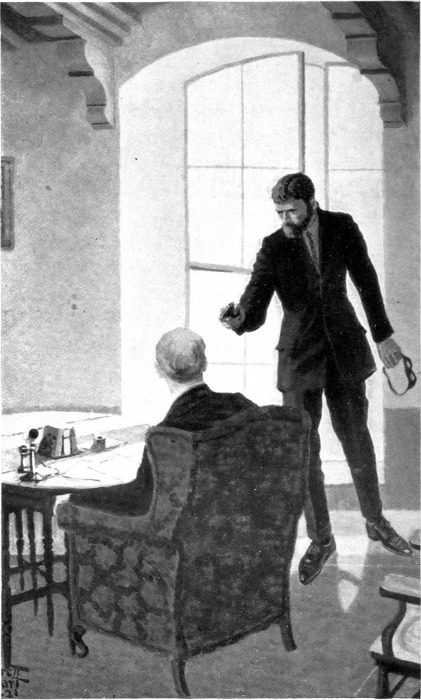
Updyke often used. Before starting on the subject he drew a table
between himself and the witness, and placed upon it an automatic
revolver. This action very naturally caused Parkins to look up in alarm,
and also the stenographers.
"No one need be afraid of that little thirty-eight. It's harmless," said
Updyke. "I've carried it for years and have never shot any one with
it—yet. But I am always prepared to use it instantly, as I carry it in
a hidden holster just under the left side of my coat. Now I am going to
leave it there, in plain view on the table, at present, for I am about
to question the witness concerning his intentions toward a certain young
woman, on a certain day, not long since. The name of the girl is not to
be spoken. Parkins will speak of her as 'the girl,' and the
stenographers will write it that way. If Parkins, either by accident or
design, speaks her name I'll shoot him the moment he utters it! What I
am now saying is a personal matter, and must not go into the record.
When I hold up my hands the recorders will proceed."
Immediately Updyke raised his hand.
"Now then, Parkins, I want nothing but the truth out of you. Lying will
be your undoing, if you expect clemency. You remember the day of the
accident?"
"Yes, sir—I do," replied the witness.
"A few days before that you invited the girl, and her father, to take a
trip to New York with you in your automobile, did you not?"
"I did, sir. They had never been to New York, and being friends of long
standing I invited them to go in my car—and the date was set."
"Why do you sit there and lie in answer to my first question!" yelled
Updyke, his face denoting extreme anger.
Parkins grew pale at the sudden fury of his inquisitor.
"I meant to tell you the truth," he replied meekly.
"Parkins, your habit of lying is constitutional. Maybe you don't know
how to speak the truth—even under oath. You said the girl and her
father were old friends of yours, didn't you?"
"That was a mistake—unintentional," said Parkins, now thoroughly
alarmed.
"You had known them for about six weeks," snapped Updyke. "No more
lying, or there will be some one hung up by the thumbs so he will
remember to tell the truth thereafter. Now then—I'll ask you to tell me
how and when you got acquainted with her?"
"I bought some cakes, and pies, at her stand on the motor parkway at
Patchogue," said the witness.
"Started in by kidding her, didn't you?"
"Perhaps—I don't quite recall," replied Parkins, mystified as to
Updyke's source of information.
"Yes you do recall—and you also remember apologizing to her for calling
her 'little sister'—now don't you? Speak up—say yes or no," growled
the big fellow, as he stared the witness out of countenance.
"Yes"—replied the witness, his face now almost purple.
"You have a so-called hut on the ocean side—did you ever drive her out
that way?"
"Yes—once."
"Showed her all the conveniences, too—didn't you?—the kitchenette and
everything?"
"I presume I did—that would have been the natural thing," replied
Parkins.
"You really think so—eh? Don't you know that you are lying again?
Well, now, you quit that stuff! I wasn't born yesterday," snarled Updyke
as his eyes sought those of the man on the witness stand.
"Now I'm going to ask you a question," he continued, "that is going to
stagger you!—what were your intentions toward her had you got her
safely to New York? Be careful—say nothing but the truth!"
Updyke's steady eyes caused Parkins to shut his own and consider well
before answering. How his persecutor could know so much was beyond his
power to reckon. But he had to answer. The question was categorical.
"I meant to marry her," he blurted.
"Open your guilty eyes and tell me that again," shouted Updyke, bending
over the table where lay the automatic. "It was to be a mock
marriage—now wasn't it?—'poor little country maid!' Do you remember
your maudlin conversation with yourself in your apartment the morning
you were fired out of Dreamy Hollow? Of course you do—and only an act
of God saved her from experiencing a try-out of your scheme. You had won
her trust, and that of her father, who was to be allowed to
'drift'—wasn't he? Zim's Midnight Inn was a fine place to sup and
drink—and tempt! you—scoundrel!—but God saved the girl by upsetting
your car—her father is at death's door!"
"Oh, merciful heaven—stop this cruel torment! I am going crazy!
I'm——"
But Parkins could go no further. He put his face in his hands and
sobbed, while Updyke pulled forth a long black cigar and lighted it. He
was "dying" for a smoke, and now was his chance. The stenographers, used
as they were to "third degree" work, showed signs of pity for the
wretched man on the stand. They watched Updyke, too, and saw him touch a
button on the wall near the door. Then they saw him go to a speaking
tube and heard him say—"Send him in...."
During the interim Parkins never lifted his head, until he heard the
rasping noise of the steel door as it opened and closed. When he raised
his eyes to see what was going on, there stood his valet and man of all
work, talking with Updyke. They shook hands cordially and stood near the
door, talking to each other for several minutes. By that time Parkins,
red eyed and sullen, had assumed an air of defiance. His own man had
trapped him, and a desire to kill crept into his mind. There lay the
automatic—one jump would be sufficient, and it would be "all off" with
Updyke! A wonderful chance, and he would take it—but his mind moved
slowly. Updyke, standing at the far end of the room, knew his thoughts
and laughed at him, mockingly—
"No use, Parkins—it isn't loaded. Here's it's mate," he said, flashing
it quickly, "and it's all set for action."
Then, walking toward the table, he picked up the other weapon and
emptied it of six cartridges, and put them in his pocket.
"It was loaded, after all," said he. "Very careless of me—eh—Parkins?
Allow me to introduce you to one of our most valuable operatives—Mr.
Parkins—Mr. Michael Curran. He says you have the best equipped
sideboard in the city."
Parkins was dumfounded.
The trusted servant was an Updyke "plant," and his case now seemed
hopeless. There was nothing to say, and his eyes sought the floor.
"Look up, and face the music," nagged the relentless Updyke. "A brave
fellow like you who connives against young women and sickly fathers
surely must be a courageous man! What were your real intentions toward
that girl?" yelled the big fellow, pointing his finger at the wilted
Parkins.
"I had no real plan," said he finally. "I was sober when I took her into
my car, and I meant to keep sober. No man in his right mind would offer
insult to an innocent girl."
"Is that so!—then why did you, absolutely sober, and after ten days in
bed with a wounded scalp—kidnap her and start for Herman's Roadhouse?"
snarled Updyke. "For the sake of counterfeiting respectability the name
has been changed to fool decent people. It is called a social
club—bah!"
"I—I—ah—or rather I should say—we were eloping—we were going to be
married! She and I are engaged, and——"
"Stop right where you are! Now I want you to look me squarely in the eye
and tell me that lie over again."
Updyke's lowering face at once took on the look of a demon. His right
hand stole slowly under the left side of his coat and his eyes seemed
to be turning green.
"It was a lie! Don't shoot me! I'll tell the truth, sir," screamed the
witness. "You already know every move, every thought, every act—what's
the use? Do what you will but don't ask more questions—I'm done for!"
he ended, as he swooned and fell forward, but Updyke caught him in time
to save him from injury.
The erstwhile "valet," stepped forward and helped to lift the limp body
to the table in front of him, the barrier that had stood between him and
his tormentor.
"The jig is up!" said Updyke, grimly, two big tears rolling down his
rugged cheeks. "We have it all. His guilt cannot be questioned. And
that's the only reason why the so-called third-degree inquisitions are
to be tolerated. Slap cold water on his face. He'll come out of it in a
minute or so."
Turning to Curran, he whispered—"Stay with him, and when he is fully
aroused help him up to my suite upstairs and put a guard in with him. He
can't get out, but he needs company," said he significantly. "I'm going
out to Dreamy Hollow as soon as I get first copies of the testimony.
Order my car around as soon as you can—no hurry—tell Miss Johnson to
phone for it to be ready in an hour."
With that the big fellow left the "star chamber" with its windowless
walls and concrete floor, a sigh of relief escaping from between his
yawning jaws. He was tired, dead tired, and victory won, left no feeling
of elation in his breast.
"Justice is hell for some and joy for others," said he to himself as he
stole his way through to the private door into his office. Updyke's mind
was upon the man that had collapsed under his lash and the cruelty of it
had left its imprint upon his own heart.
A few hours later he was welcomed by the master of Dreamy Hollow.
"I've come to stay until the day after to-morrow. I need a day off,"
said Updyke, as he grasped the welcoming hand of Drury Villard. "I'm all
in and I want to go to bed at once."
Villard scrutinized him carefully, and decided that his friend and guest
knew what was best for himself.
"I'd planned for a lively evening—what is the news of the day? Did
you——"
"Yes—here it is, all typewritten, and will afford you an evening of
varying emotions. Show me a room—that's all I ask. To-morrow we will
both be fresh, and will talk things over. No food—I snacked in my
office," said the master inquisitor.
And so it was settled, and a short time thereafter Villard sat alone in
his office, reading the testimony of his old-time friend, now a
self-confessed pariah, and a conscienceless scoundrel. When he had
finished his lips trembled, and his heart cried out against the villainy
of his once trusted partner. He now loathed him as he would a viper, and
there was nothing left in his bosom but abhorrence. In his present mood,
good man that he was, Villard felt that he could have looked on without
mercy while the low creature was strung up and tortured.
"No wonder Henry left, and went to his bed," he mumbled to himself.
"Case hardened as he is to crime and malevolence, his soul has been
seared with the events of this day."
Villard arose to his feet and slipped quietly out into the night, where
his heated brain could be cooled and his senses restored. He hurried on
toward the beach as if bewildered, caring naught for the bats that
darted in front of him, and the limbs of bushes which swung back and
whipped his face. The Parkins' confession stood out as might a picture
of Herod cleaving the heads of helpless babes, and watching their
writhing bodies as they fell at his feet.
What Villard would have done, or where he would have gone in his madness
to rid himself of his obsession was a matter of conjecture, but for a
terrible coughing spell on the part of some person just ahead of him. It
was Alexander Barbour, bundled from head to foot against the chill of
the night, who stumbled along the same path, only a few yards in
advance. His walk was painful, and his voice hollow and unreal as he
cried—"I want to go home to die!"
This dismal wail brought Villard back to his senses, and he ran forward
in time to catch the man in his arms. For a moment there was a struggle
but Barbour was too feeble to resist.
"You shall go to-morrow," whispered Villard, "and your daughter will go
with you. The time has come when it will be safe for her to return to
her native town, and I shall take you both home in the morning. I know
how you feel, and I sympathize. Come, let us go back into the warmth of
your room."
Some hours previously Winifred had helped her father into his bed, and
stood over him, while rubbing his forehead and chafing his icy hands.
She had placed a small electric heater at his feet.
"They feel like lumps of ice," he complained, but to the soft touch of
Winifred's hands upon his forehead he succumbed to nature's balm—sleep
without pain.
For half an hour she stayed beside him, and then as his hands relaxed
and his breathing became normal, she knelt and prayed for his
restoration to health and happiness.
Then she went to her room, but on returning a few minutes later the bed
was empty—her father had gone. She notified Santzi at once, who gave
the alarm, but when all hands had taken up the search, they came upon
Villard and with him was the night-clad figure of Winifred's father.
There was much in the way of speculation as to the result of the sick
man's adventure, but the night nurse, arriving soon afterward, said
that his effort to help himself might turn out to his advantage.
All through the excitement, Updyke slept on unknowing, but Winifred and
Villard sat out on the moonlit veranda and talked of the plans for the
morrow. He felt that she should be told of Parkins' "detention" pending
further developments, but in no way did he intimate the happenings at
the Updyke inquiry.
"I think your father should go back to his old home at Patchogue for a
time. This place palls upon him and he will never be happy here. You
must go with him, of course, and I shall ride over every day or so to
see how he is getting on. We must not allow him to die from longing for
his old home, where your mother lived and died. That's his trouble—and
if I were in his place I'd feel just as he does."
"I believe you have solved his problem, and I am very glad you have
thought it all out for us. We are plain country folk, and fairyland is
too much for us. Indeed we have grown in experience since we left our
little country home. But our country eyes have been opened to the love
we feel for our native town and its people. There is where we belong,"
said Winifred, dreamily, as her face broke out into smiles.
"You shall have your wish, dear child," said he, gently. "There is
nothing that I would deny you."
"But you wouldn't live there," bantered Winifred, throwing back her head
and laughing at the idea. "We'll wait and see how you hold to your
resolution to 'ride over every day or so.' My, how my friends would get
together and gossip! I just dare you to try it," she gurgled, as she
held out her hand and bade her host good night.
"No—you don't get off that easy," said Villard, striving to catch her
up in his arms, but she escaped through the door of her father's chamber
and tiptoed in to see if he was resting comfortably.
"All is well," she whispered on her return, looking up into Villard's
eyes—"so you may return to your den, Mr. Lion—it's bedtime for me!"
she laughed, as she started to go.
"And kissing time for me," laughed Villard, reaching out as if to take
her in his arms.
"No, sir—this is the kind of kiss you shall have," cried Winifred, as
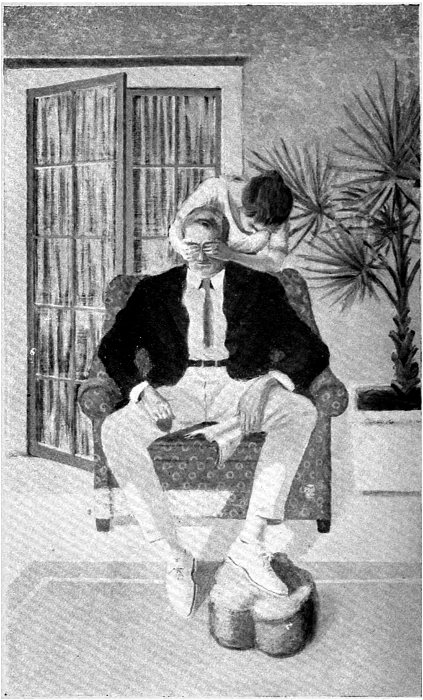
she put her arms about his neck and her lips upon his forehead. Then she
blushed, and sighed, a shyness creeping into her eyes.
"Only a kiss on my forehead!—not surely——"
"If I ever do kiss a man on the lips it will be the one to whom I am
wedded—not before," said she, her face lighted with honest conviction.
"Don't forget that I am going out Patchogue way very often, in the
future," he warned.
"I am sure my father and I will be ever so proud if you will come to our
home as often as you can," replied Winifred, as prettily she dropped him
a curtsey in a quaint, old-fashioned way.