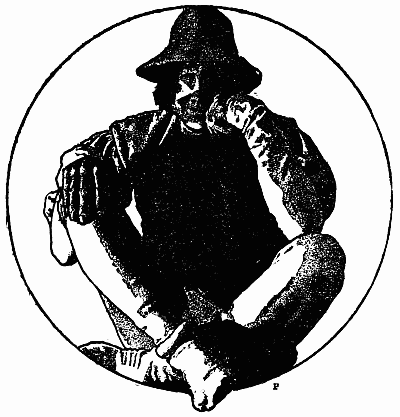
FOOTPRINTS in the snow have been unfailing
provokers of sentiment ever since
snow was first a white wonder in this drab-coloured
world of ours. In a poetry-book presented
to one of us by an aunt, there was a
poem by one Wordsworth, in which they stood
out strongly—with a picture all to themselves,
too—but we didn't think very highly either of
the poem or the sentiment. Footprints in the
sand, now, were quite another matter, and we
grasped Crusoe's attitude of mind much more
easily than Wordsworth's. Excitement and
mystery, curiosity and suspense—these were
the only sentiments that tracks, whether in sand
or in snow, were able to arouse in us.
We had awakened early that winter morning,
puzzled at first by the added light that filled the
room. Then, when the truth at last fully dawned
on us and we knew that snow-balling was no
longer a wistful dream, but a solid certainty
waiting for us outside, it was a mere brute fight
for the necessary clothes, and the lacing of boots
seemed a clumsy invention, and the buttoning of
coats an unduly tedious form of fastening, with
all that snow going to waste at our very door.
When dinner-time came we had to be dragged
in by the scruff of our necks. The short armistice
over, the combat was resumed; but presently
Charlotte and I, a little weary of contests
and of missiles that ran shudderingly down inside
one's clothes, forsook the trampled battle-field
of the lawn and went exploring the blank virgin
spaces of the white world that lay beyond. It
stretched away unbroken on every side of us,
this mysterious soft garment under which our
familiar world had so suddenly hidden itself.
Faint imprints showed where a casual bird had
alighted, but of other traffic there was next to
no sign; which made these strange tracks all
the more puzzling.
We came across them first at the corner of
the shrubbery, and pored over them long, our
hands on our knees. Experienced trappers that
we knew ourselves to be, it was annoying to be
brought up suddenly by a beast we could not at
once identify.
"Don't you know?" said Charlotte, rather
scornfully. "Thought you knew all the beasts
that ever was."
This put me on my mettle, and I hastily rattled
off a string of animal names embracing both the
arctic and the tropic zones, but without much
real confidence.
"No," said Charlotte, on consideration;
"they won't any of 'em quite do. Seems like
something lizardy. Did you say a iguanodon?
Might be that, p'raps. But that's not British,
and we want a real British beast. I think it's
a dragon!"
"'Tisn't half big enough," I objected.
"Well, all dragons must be small to begin
with," said Charlotte: "like everything else.
P'raps this is a little dragon who's got lost. A
little dragon would be rather nice to have. He
might scratch and spit, but he couldn't do anything
really. Let's track him down!"
So we set off into the wide snow-clad world,
hand in hand, our hearts big with expectation,—complacently
confident that by a few smudgy
traces in the snow we were in a fair way to
capture a half-grown specimen of a fabulous
beast.
We ran the monster across the paddock and
along the hedge of the next field, and then he
took to the road like any tame civilised tax-payer.
Here his tracks became blended with
and lost among more ordinary footprints, but
imagination and a fixed idea will do a great
deal, and we were sure we knew the direction
a dragon would naturally take. The traces,
too, kept reappearing at intervals—at least
Charlotte maintained they did, and as it was
her dragon I left the following of the slot to
her and trotted along peacefully, feeling that
it was an expedition anyhow and something was
sure to come out of it.
Charlotte took me across another field or two,
and through a copse, and into a fresh road; and
I began to feel sure it was only her confounded
pride that made her go on pretending to see
dragon-tracks instead of owning she was entirely
at fault, like a reasonable person. At last she
dragged me excitedly through a gap in a hedge
of an obviously private character; the waste,
open world of field and hedgerow disappeared,
and we found ourselves in a garden, well-kept,
secluded, most undragon-haunted in appearance.
Once inside, I knew where we were. This was
the garden of my friend the circus-man, though
I had never approached it before by a lawless
gap, from this unfamiliar side. And here was
the circus-man himself, placidly smoking a pipe
as he strolled up and down the walks. I stepped
up to him and asked him politely if he had lately
seen a Beast.
"May I inquire," he said, with all civility,
"what particular sort of a Beast you may
happen to be looking for?"
"It's a lizardy sort of Beast," I explained.
"Charlotte says it's a dragon, but she doesn't
really know much about beasts."
The circus-man looked round about him slowly.
"I don't think," he said, "that I've seen a
dragon in these parts recently. But if I come
across one I'll know it belongs to you, and I'll
have him taken round to you at once."
"Thank you very much," said Charlotte,
"but don't trouble about it, please, 'cos p'raps
it isn't a dragon, after all. Only I thought I
saw his little footprints in the snow, and we
followed 'em up, and they seemed to lead right
in here, but maybe it's all a mistake, and thank
you all the same."
"Oh, no trouble at all," said the circus-man,
cheerfully. "I should be only too pleased.
But of course, as you say, it may be a mistake.
And it's getting dark, and he seems to have got
away for the present, whatever he is. You'd
better come in and have some tea. I'm quite
alone, and we'll make a roaring fire, and I've
got the biggest Book of Beasts you ever saw.
It's got every beast in the world, and all of 'em
coloured; and we'll try and find your beast
in it!"
We were always ready for tea at any time,
and especially when combined with beasts.
There was marmalade, too, and apricot-jam,
brought in expressly for us; and afterwards
the beast-book was spread out, and, as the man
had truly said, it contained every sort of beast
that had ever been in the world.
The striking of six o'clock set the more prudent
Charlotte nudging me, and we recalled
ourselves with an effort from Beastland, and
reluctantly stood up to go.
"Here, I'm coming along with you," said
the circus-man. "I want another pipe, and a
walk'll do me good. You needn't talk to me
unless you like."
Our spirits rose to their wonted level again.
The way had seemed so long, the outside world
so dark and eerie, after the bright warm room
and the highly-coloured beast-book. But a walk
with a real Man—why, that was a treat in itself!
We set off briskly, the Man in the middle.
I looked up at him and wondered whether I
should ever live to smoke a big pipe with that
careless sort of majesty! But Charlotte, whose
young mind was not set on tobacco as a possible
goal, made herself heard from the other side.
"Now, then," she said, "tell us a story,
please, won't you?"
The Man sighed heavily and looked about
him. "I knew it," he groaned. "I knew I
should have to tell a story. Oh, why did I
leave my pleasant fireside? Well, I will tell
you a story. Only let me think a minute."
So he thought a minute, and then he told us
this story.
Long ago—might have been hundreds of
years ago—in a cottage half-way between this
village and yonder shoulder of the Downs up
there, a shepherd lived with his wife and their
little son. Now the shepherd spent his days—and
at certain times of the year his nights too—up
on the wide ocean-bosom of the Downs, with
only the sun and the stars and the sheep for
company, and the friendly chattering world of
men and women far out of sight and hearing.
But his little son, when he wasn't helping his
father, and often when he was as well, spent
much of his time buried in big volumes that he
borrowed from the affable gentry and interested
parsons of the country round about. And his
parents were very fond of him, and rather proud
of him too, though they didn't let on in his hearing,
so he was left to go his own way and read
as much as he liked; and instead of frequently
getting a cuff on the side of the head, as might
very well have happened to him, he was treated
more or less as an equal by his parents, who
sensibly thought it a very fair division of labour
that they should supply the practical knowledge,
and he the book-learning. They knew that
book-learning often came in useful at a pinch,
in spite of what their neighbours said. What
the Boy chiefly dabbled in was natural history
and fairy-tales, and he just took them as they
came, in a sandwichy sort of way, without
making any distinctions; and really his course
of reading strikes one as rather sensible.
One evening the shepherd, who for some nights
past had been disturbed and preoccupied, and
off his usual mental balance, came home all of
a tremble, and, sitting down at the table where
his wife and son were peacefully employed, she
with her seam, he in following out the adventures
of the Giant with no Heart in his Body,
exclaimed with much agitation:
"It's all up with me, Maria! Never no
more can I go up on them there Downs, was it
ever so!"
"Now don't you take on like that," said his
wife, who was a very sensible woman: "but
tell us all about it first, whatever it is as has
given you this shake-up, and then me and you
and the son here, between us, we ought to be
able to get to the bottom of it!"
"It began some nights ago," said the shepherd.
"You know that cave up there—I never
liked it, somehow, and the sheep never liked it
neither, and when sheep don't like a thing there's
generally some reason for it. Well, for some
time past there's been faint noises coming from
that cave—noises like heavy sighings, with
grunts mixed up in them; and sometimes a
snoring, far away down—real snoring, yet
somehow not honest snoring, like you and me
o'nights, you know!"
"I know," remarked the Boy, quietly.
"Of course I was terrible frightened," the
shepherd went on; "yet somehow I couldn't
keep away. So this very evening, before I
come down, I took a cast round by the cave,
quietly. And there—O Lord! there I saw
him at last, as plain as I see you!"
"Saw who?" said his wife, beginning to
share in her husband's nervous terror.
"Why him, I'm a telling you!" said the
shepherd. "He was sticking half-way out of
the cave, and seemed to be enjoying of the cool
of the evening in a poetical sort of way. He
was as big as four cart-horses, and all covered
with shiny scales—deep-blue scales at the top
of him, shading off to a tender sort o' green
below. As he breathed, there was that sort
of flicker over his nostrils that you see over our
chalk roads on a baking windless day in summer.
He had his chin on his paws, and I should say
he was meditating about things. Oh, yes, a
peaceable sort o' beast enough, and not ramping
or carrying on or doing anything but what
was quite right and proper. I admit all that.
And yet, what am I to do? Scales, you know,
and claws, and a tail for certain, though I didn't
see that end of him—I ain't used to 'em, and
I don't hold with 'em, and that's a fact!"
The Boy, who had apparently been absorbed
in his book during his father's recital, now closed
the volume, yawned, clasped his hands behind
his head, and said sleepily:
"It's all right, father. Don't you worry.
It's only a dragon."
"Only a dragon?" cried his father. "What
do you mean, sitting there, you and your dragons?
Only a dragon indeed! And what do you know
about it?"
"'Cos it is, and 'cos I do know," replied the
Boy, quietly. "Look here, father, you know
we've each of us got our line. You know about
sheep, and weather, and things; I know about
dragons. I always said, you know, that that
cave up there was a dragon-cave. I always
said it must have belonged to a dragon some
time, and ought to belong to a dragon now, if
rules count for anything. Well, now you tell
me it has got a dragon, and so that's all right.
I'm not half as much surprised as when you
told me it hadn't got a dragon. Rules always
come right if you wait quietly. Now, please,
just leave this all to me. And I'll stroll up
to-morrow morning—no, in the morning I can't,
I've got a whole heap of things to do—well,
perhaps in the evening, if I'm quite free, I'll
go up and have a talk to him, and you'll find
it'll be all right. Only, please, don't you go
worrying round there without me. You don't
understand 'em a bit, and they're very sensitive,
you know!"
"He's quite right, father," said the sensible
mother. "As he says, dragons is his line and
not ours. He's wonderful knowing about bookbeasts,
as every one allows. And to tell the
truth, I'm not half happy in my own mind,
thinking of that poor animal lying alone up
there, without a bit o' hot supper or anyone to
change the news with; and maybe we'll be
able to do something for him; and if he ain't
quite respectable our Boy'll find it out quick
enough. He's got a pleasant sort o' way with
him that makes everybody tell him everything."
Next day, after he'd had his tea, the Boy
strolled up the chalky track that led to the
summit of the Downs; and there, sure enough,
he found the dragon, stretched lazily on the
sward in front of his cave. The view from that
point was a magnificent one. To the right and
left, the bare and willowy leagues of Downs;
in front, the vale, with its clustered homesteads,
its threads of white roads running through orchards
and well-tilled acreage, and, far away,
a hint of grey old cities on the horizon. A cool
breeze played over the surface of the grass and
the silver shoulder of a large moon was showing
above distant junipers. No wonder the dragon
seemed in a peaceful and contented mood; indeed,
as the Boy approached he could hear the
beast purring with a happy regularity. "Well,
we live and learn!" he said to himself. "None
of my books ever told me that dragons purred!"
"Hullo, dragon!" said the Boy, quietly, when
he had got up to him.
The dragon, on hearing the approaching footsteps,
made the beginning of a courteous effort
to rise. But when he saw it was a Boy, he set
his eyebrows severely.
"Now don't you hit me," he said; "or bung
stones, or squirt water, or anything. I won't
have it, I tell you!"
"Not goin' to hit you," said the Boy, wearily,
dropping on the grass beside the beast: "and
don't, for goodness' sake, keep on saying 'Don't;'
I hear so much of it, and it's monotonous, and
makes me tired. I've simply looked in to ask
you how you were and all that sort of thing;
but if I'm in the way I can easily clear out.
I've lots of friends, and no one can say I'm in
the habit of shoving myself in where I'm not
wanted!"
"No, no, don't go off in a huff," said the
dragon, hastily; "fact is,—I'm as happy up
here as the day's long; never without an occupation,
dear fellow, never without an occupation!
And yet, between ourselves, it is a trifle dull at
times."
The Boy bit off a stalk of grass and chewed
it. "Going to make a long stay here?" he
asked, politely.
"Can't hardly say at present," replied the
dragon. "It seems a nice place enough—but
I've only been here a short time, and one must
look about and reflect and consider before settling
down. It's rather a serious thing, settling
down. Besides—now I'm going to tell you
something! You'd never guess it if you tried
ever so!—fact is, I'm such a confoundedly
lazy beggar!"
"You surprise me," said the Boy, civilly.
"It's the sad truth," the dragon went on,
settling down between his paws and evidently
delighted to have found a listener at last: "and
I fancy that's really how I came to be here.
You see all the other fellows were so active and
earnest and all that sort of thing—always rampaging,
and skirmishing, and scouring the desert
sands, and pacing the margin of the sea, and
chasing knights all over the place, and devouring
damsels, and going on generally—whereas
I liked to get my meals regular and then to prop
my back against a bit of rock and snooze a bit,
and wake up and think of things going on and
how they kept going on just the same, you
know! So when it happened I got fairly
caught."
"When what happened, please?" asked the
Boy.
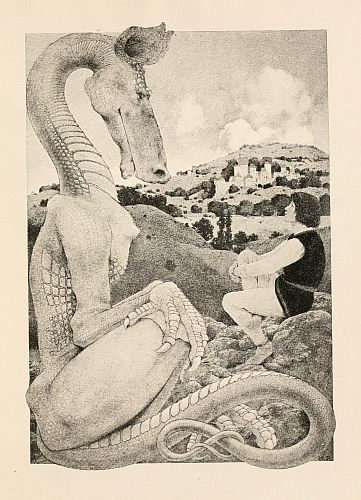
| THE RELUCTANT DRAGON
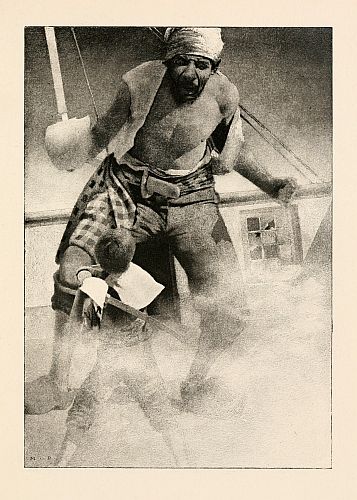
"'What's your mind always occupied about?' asked the Boy.
'That's what I want to know.'" |
"That's just what I don't precisely know,"
said the dragon. "I suppose the earth sneezed,
or shook itself, or the bottom dropped out of
something. Anyhow there was a shake and a
roar and a general stramash, and I found myself
miles away underground and wedged in as tight
as tight. Well, thank goodness, my wants are
few, and at any rate I had peace and quietness
and wasn't always being asked to come along
and do something. And I've got such an active
mind—always occupied, I assure you! But time
went on, and there was a certain sameness about
the life, and at last I began to think it would
be fun to work my way upstairs and see what
you other fellows were doing. So I scratched
and burrowed, and worked this way and that
way and at last I came out through this cave
here. And I like the country, and the view,
and the people—what I've seen of 'em—and
on the whole I feel inclined to settle down here."
"What's your mind always occupied about?"
asked the Boy. "That's what I want to
know."
The dragon coloured slightly and looked
away. Presently he said bashfully:
"Did you ever—just for fun—try to make
up poetry—verses, you know?"
"'Course I have," said the Boy. "Heaps
of it. And some of it's quite good, I feel sure,
only there's no one here cares about it. Mother's
very kind and all that, when I read it to her, and
so's father for that matter. But somehow they
don't seem to—"
"Exactly," cried the dragon; "my own
case exactly. They don't seem to, and you
can't argue with 'em about it. Now you've
got culture, you have, I could tell it on you at
once, and I should just like your candid opinion
about some little things I threw off lightly, when
I was down there. I'm awfully pleased to have
met you, and I'm hoping the other neighbours
will be equally agreeable. There was a very
nice old gentleman up here only last night, but
he didn't seem to want to intrude."
"That was my father," said the Boy, "and
he is a nice old gentleman, and I'll introduce
you some day if you like."
"Can't you two come up here and dine
or something to-morrow?" asked the dragon,
eagerly. "Only, of course, if you've got nothing
better to do," he added politely.
"Thanks awfully," said the Boy, "but we
don't go out anywhere without my mother, and,
to tell you the truth, I'm afraid she mightn't
quite approve of you. You see there's no getting
over the hard fact that you're a dragon, is
there? And when you talk of settling down,
and the neighbours, and so on, I can't help
feeling that you don't quite realise your position.
You're an enemy of the human race, you see!"
"Haven't got an enemy in the world," said
the dragon, cheerfully. "Too lazy to make
'em, to begin with. And if I do read other
fellows my poetry, I'm always ready to listen
to theirs!"
"Oh, dear!" cried the Boy, "I wish you'd
try and grasp the situation properly. When the
other people find you out, they'll come after
you with spears and swords and all sorts of
things. You'll have to be exterminated, according
to their way of looking at it! You're
a scourge, and a pest, and a baneful monster!"
"Not a word of truth in it," said the dragon,
wagging his head solemnly. "Character'll bear
the strictest investigation. And now, there's a
little sonnet-thing I was working on when you
appeared on the scene—"
"Oh, if you won't be sensible," cried the
Boy, getting up, "I'm going off home. No,
I can't stop for sonnets; my mother's sitting
up. I'll look you up to-morrow, sometime or
other, and do for goodness' sake try and realise
that you're a pestilential scourge, or you'll find
yourself in a most awful fix. Good-night!"
The Boy found it an easy matter to set the
mind of his parents at ease about his new friend.
They had always left that branch to him, and
they took his word without a murmur. The
shepherd was formally introduced and many
compliments and kind inquiries were exchanged.
His wife, however, though expressing her willingness
to do anything she could,—to mend
things, or set the cave to rights, or cook a little
something when the dragon had been poring
over sonnets and forgotten his meals, as male
things will do,—could not be brought to recognise
him formally. The fact that he was a dragon
and "they didn't know who he was" seemed
to count for everything with her. She made no
objection, however, to her little son spending his
evenings with the dragon quietly, so long as he
was home by nine o'clock: and many a pleasant
night they had, sitting on the sward, while the
dragon told stories of old, old times, when dragons
were quite plentiful and the world was a livelier
place than it is now, and life was full of thrills
and jumps and surprises.
What the Boy had feared, however, soon
came to pass. The most modest and retiring
dragon in the world, if he's as big as four cart-horses
and covered with blue scales, cannot
keep altogether out of the public view. And
so in the village tavern of nights the fact that
a real live dragon sat brooding in the cave on
the Downs was naturally a subject for talk.
Though the villagers were extremely frightened,
they were rather proud as well. It was a distinction
to have a dragon of your own, and it
was felt to be a feather in the cap of the village.
Still, all were agreed that this sort of thing
couldn't be allowed to go on. The dreadful
beast must be exterminated, the country-side
must be freed from this pest, this terror, this
destroying scourge. The fact that not even a
hen-roost was the worse for the dragon's arrival
wasn't allowed to have anything to do with
it. He was a dragon, and he couldn't deny it,
and if he didn't choose to behave as such that
was his own lookout. But in spite of much
valiant talk no hero was found willing to take
sword and spear and free the suffering village
and win deathless fame; and each night's heated
discussion always ended in nothing. Meanwhile
the dragon, a happy Bohemian, lolled on the
turf, enjoyed the sunsets, told antediluvian anecdotes
to the Boy, and polished his old verses
while meditating on fresh ones.
One day the Boy, on walking in to the village,
found everything wearing a festal appearance
which was not to be accounted for in the calendar.
Carpets and gay-colored stuffs were hung
out of the windows, the church-bells clamoured
noisily, the little street was flower-strewn, and
the whole population jostled each other along
either side of it, chattering, shoving, and ordering
each other to stand back. The Boy saw a
friend of his own age in the crowd and hailed
him.
"What's up?" he cried. "Is it the players,
or bears, or a circus, or what?"
"It's all right," his friend hailed back.
"He's a-coming."
"Who's a-coming?" demanded the Boy,
thrusting into the throng.
"Why, St. George, of course," replied his
friend. "He's heard tell of our dragon, and
he's comin' on purpose to slay the deadly beast,
and free us from his horrid yoke. O my! won't
there be a jolly fight!"
Here was news indeed! The Boy felt that
he ought to make quite sure for himself, and he
wriggled himself in between the legs of his good-natured
elders, abusing them all the time for
their unmannerly habit of shoving. Once in the
front rank, he breathlessly awaited the arrival.
Presently from the far-away end of the line
came the sound of cheering. Next, the measured
tramp of a great war-horse made his heart beat
quicker, and then he found himself cheering with
the rest, as, amidst welcoming shouts, shrill cries
of women, uplifting of babies and waving of
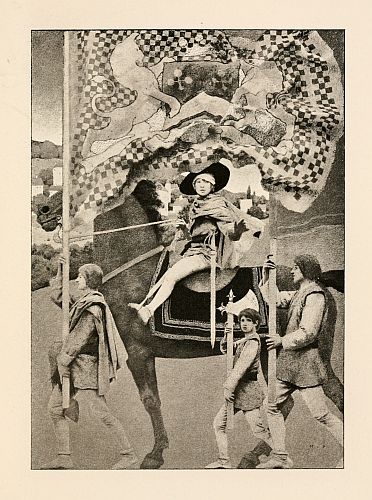
handkerchiefs, St. George paced slowly up the
street. The Boy's heart stood still and he
breathed with sobs, the beauty and the grace
of the hero were so far beyond anything he had
yet seen. His fluted armour was inlaid with
gold, his plumed helmet hung at his saddle-bow,
and his thick fair hair framed a face gracious
and gentle beyond expression till you caught
the sternness in his eyes. He drew rein in front
of the little inn, and the villagers crowded round
with greetings and thanks and voluble statements
of their wrongs and grievances and oppressions.
The Boy heard the grave gentle voice of the
Saint, assuring them that all would be well
now, and that he would stand by them and see
them righted and free them from their foe; then
he dismounted and passed through the doorway
and the crowd poured in after him. But the
Boy made off up the hill as fast as he could lay
his legs to the ground.
"It's all up, dragon!" he shouted as soon
as he was within sight of the beast. "He's
coming! He's here now! You'll have to pull
yourself together and do something at last!"
The dragon was licking his scales and rubbing
them with a bit of house-flannel the Boy's mother
had lent him, till he shone like a great turquoise.
"Don't be violent, Boy," he said without
looking round. "Sit down and get your breath,
and try and remember that the noun governs the
verb, and then perhaps you'll be good enough
to tell me who's coming?"
"That's right, take it coolly," said the Boy.
"Hope you'll be half as cool when I've got
through with my news. It's only St. George
who's coming, that's all; he rode into the
village half-an-hour ago. Of course you can
lick him—a great big fellow like you! But I
thought I'd warn you, 'cos he's sure to be round
early, and he's got the longest, wickedest-looking
spear you ever did see!" And the Boy got up
and began to jump round in sheer delight at the
prospect of the battle.
"O deary, deary me," moaned the dragon;
"this is too awful. I won't see him, and that's
flat. I don't want to know the fellow at all.
I'm sure he's not nice. You must tell him to
go away at once, please. Say he can write if
he likes, but I can't give him an interview. I'm
not seeing anybody at present."
"Now dragon, dragon," said the Boy, imploringly,
"don't be perverse and wrongheaded.
You've got to fight him some time or other, you
know, 'cos he's St. George and you're the
dragon. Better get it over, and then we can
go on with the sonnets. And you ought to consider
other people a little, too. If it's been dull
up here for you, think how dull it's been for
me!"
"My dear little man," said the dragon, solemnly,
"just understand, once for all, that I
can't fight and I won't fight. I've never fought
in my life, and I'm not going to begin now, just
to give you a Roman holiday. In old days I
always let the other fellows—the earnest fellows—do
all the fighting, and no doubt that's why
I have the pleasure of being here now."
"But if you don't fight he'll cut your head
off!" gasped the Boy, miserable at the prospect
of losing both his fight and his friend.
"Oh, I think not," said the dragon in his lazy
way. "You'll be able to arrange something.
I've every confidence in you, you're such a
manager. Just run down, there's a dear chap,
and make it all right. I leave it entirely to
you."
The Boy made his way back to the village in
a state of great despondency. First of all, there
wasn't going to be any fight; next, his dear and
honoured friend the dragon hadn't shown up in
quite such a heroic light as he would have liked;
and lastly, whether the dragon was a hero at
heart or not, it made no difference, for St. George
would most undoubtedly cut his head off. "Arrange
things indeed!" he said bitterly to himself.
"The dragon treats the whole affair as
if it was an invitation to tea and croquet."
The villagers were straggling homewards as
he passed up the street, all of them in the highest
spirits, and gleefully discussing the splendid
fight that was in store. The Boy pursued his
way to the inn, and passed into the principal
chamber, where St. George now sat alone,
musing over the chances of the fight, and the
sad stories of rapine and of wrong that had so
lately been poured into his sympathetic ears.
"May I come in, St. George?" said the Boy,
politely, as he paused at the door. "I want to
talk to you about this little matter of the dragon,
if you're not tired of it by this time."
"Yes, come in, Boy," said the Saint, kindly.
"Another tale of misery and wrong, I fear me.
Is it a kind parent, then, of whom the tyrant has
bereft you? Or some tender sister or brother?
Well, it shall soon be avenged."
"Nothing of the sort," said the Boy. "There's
a misunderstanding somewhere, and I want to
put it right. The fact is, this is a good dragon."
"Exactly," said St. George, smiling pleasantly,
"I quite understand. A good dragon.
Believe me, I do not in the least regret that he
is an adversary worthy of my steel, and no feeble
specimen of his noxious tribe."
"But he's not a noxious tribe," cried the
Boy, distressedly. "Oh dear, oh dear, how
stupid men are when they get an idea into their
heads! I tell you he's a good dragon, and a
friend of mine, and tells me the most beautiful
stories you ever heard, all about old times and
when he was little. And he's been so kind to
mother, and mother'd do anything for him. And
father likes him too, though father doesn't hold
with art and poetry much, and always falls
asleep when the dragon starts talking about
style. But the fact is, nobody can help liking
him when once they know him. He's so engaging
and so trustful, and as simple as a child!"
"Sit down, and draw your chair up," said
St. George. "I like a fellow who sticks up for
his friends, and I'm sure the dragon has his
good points, if he's got a friend like you. But
that's not the question. All this evening I've
been listening, with grief and anguish unspeakable,
to tales of murder, theft, and wrong; rather
too highly coloured, perhaps, not always quite
convincing, but forming in the main a most
serious roll of crime. History teaches us that
the greatest rascals often possess all the domestic
virtues; and I fear that your cultivated friend,
in spite of the qualities which have won (and
rightly) your regard, has got to be speedily
exterminated."
"Oh, you've been taking in all the yarns
those fellows have been telling you," said the
Boy, impatiently. "Why, our villagers are the
biggest story-tellers in all the country round.
It's a known fact. You're a stranger in these
parts, or else you'd have heard it already. All
they want is a fight. They're the most awful
beggars for getting up fights—it's meat and
drink to them. Dogs, bulls, dragons—anything
so long as it's a fight. Why, they've
got a poor innocent badger in the stable behind
here, at this moment. They were going to have
some fun with him to-day, but they're saving
him up now till your little affair's over. And
I've no doubt they've been telling you what a
hero you were, and how you were bound to win,
in the cause of right and justice, and so on; but
let me tell you, I came down the street just
now, and they were betting six to four on the
dragon freely!"
"Six to four on the dragon!" murmured St.
George, sadly, resting his cheek on his hand.
"This is an evil world, and sometimes I begin
to think that all the wickedness in it is not entirely
bottled up inside the dragons. And yet—may
not this wily beast have misled you as
to his real character, in order that your good
report of him may serve as a cloak for his evil
deeds? Nay, may there not be, at this very
moment, some hapless Princess immured within
yonder gloomy cavern?"
The moment he had spoken, St. George was
sorry for what he had said, the Boy looked so
genuinely distressed.
"I assure you, St. George," he said earnestly,
"there's nothing of the sort in the cave at
all. The dragon's a real gentleman, every
inch of him, and I may say that no one would
be more shocked and grieved than he would,
at hearing you talk in that—that loose way
about matters on which he has very strong
views!"
"Well, perhaps I've been over-credulous,"
said St. George. "Perhaps I've misjudged
the animal. But what are we to do? Here
are the dragon and I, almost face to face, each
supposed to be thirsting for each other's blood.
I don't see any way out of it, exactly. What
do you suggest? Can't you arrange things,
somehow?"
"That's just what the dragon said," replied
the Boy, rather nettled. "Really, the way
you two seem to leave everything to me—I
suppose you couldn't be persuaded to go away
quietly, could you?"
"Impossible, I fear," said the Saint. "Quite
against the rules. You know that as well as I
do."
"Well, then, look here," said the Boy, "it's
early yet—would you mind strolling up with
me and seeing the dragon and talking it over?
It's not far, and any friend of mine will be most
welcome."
"Well, it's irregular," said St. George, rising,
"but really it seems about the most sensible
thing to do. You 're taking a lot of trouble on
your friend's account," he added, good-naturedly,
as they passed out through the door together.
"But cheer up! Perhaps there won't have to
be any fight after all."
"Oh, but I hope there will, though!" replied
the little fellow, wistfully.
"I've brought a friend to see you, dragon,"
said the Boy, rather loud.
The dragon woke up with a start. "I was
just—er—thinking about things," he said in
his simple way. "Very pleased to make your
acquaintance, sir. Charming weather we're
having!"
"This is St. George," said the Boy, shortly.
"St. George, let me introduce you to the dragon.
We've come up to talk things over quietly,
dragon, and now for goodness' sake do let us
have a little straight common-sense, and come
to some practical business-like arrangement, for
I'm sick of views and theories of life and personal
tendencies, and all that sort of thing. I
may perhaps add that my mother's sitting up."
"So glad to meet you, St. George," began
the dragon, rather nervously, "because you've
been a great traveller, I hear, and I've always
been rather a stay-at-home. But I can show
you many antiquities, many interesting features
of our country-side, if you're stopping here any
time—"
"I think," said St. George, in his frank,
pleasant way, "that we'd really better take the
advice of our young friend here, and try to come
to some understanding, on a business footing,
about this little affair of ours. Now don't you
think that after all the simplest plan would be
just to fight it out, according to the rules, and
let the best man win? They re betting on you,
I may tell you, down in the village, but I don't
mind that!"
"Oh, yes, do, dragon," said the Boy, delightedly;
"it'll save such a lot of bother!"
"My young friend, you shut up," said the
dragon, severely. "Believe me, St. George,"
he went on, "there's nobody in the world I'd
sooner oblige than you and this young gentleman
here. But the whole thing's nonsense, and
conventionality, and popular thick-headedness.
There's absolutely nothing to fight about, from
beginning to end. And anyhow I'm not going
to, so that settles it!"
"But supposing I make you?" said St.
George, rather nettled.
"You can't," said the dragon, triumphantly.
"I should only go into my cave and retire for
a time down the hole I came up. You'd soon
get heartily sick of sitting outside and waiting
for me to come out and fight you. And as soon
as you'd really gone away, why, I'd come up
again gaily, for I tell you frankly, I like this
place, and I'm going to stay here!"
St. George gazed for a while on the fair landscape
around them. "But this would be a
beautiful place for a fight," he began again
persuasively. "These great bare rolling Downs
for the arena,—and me in my golden armour
showing up against your big blue scaly coils!
Think what a picture it would make!"
"Now you're trying to get at me through my
artistic sensibilities," said the dragon. "But it
won't work. Not but what it would make a
very pretty picture, as you say," he added,
wavering a little.
"We seem to be getting rather nearer to
business," put in the Boy. "You must see,
dragon, that there's got to be a fight of some
sort, 'cos you can't want to have to go down
that dirty old hole again and stop there till
goodness knows when."
"It might be arranged," said St. George,
thoughtfully. "I must spear you somewhere,
of course, but I'm not bound to hurt you very
much. There's such a lot of you that there
must be a few spare places somewhere. Here,
for instance, just behind your foreleg. It couldn't
hurt you much, just here!"
"Now you're tickling, George," said the
dragon, coyly. "No, that place won't do at
all. Even if it didn't hurt,—and I'm sure it
would, awfully,—it would make me laugh, and
that would spoil everything."
"Let's try somewhere else, then," said St.
George, patiently. "Under your neck, for
instance,—all these folds of thick skin,—if I
speared you here you'd never even know I'd
done it!"
"Yes, but are you sure you can hit off the
right place?" asked the dragon, anxiously.
"Of course I am," said St. George, with
confidence. "You leave that to me!"
"It's just because I've got to leave it to you
that I'm asking," replied the dragon, rather
testily. "No doubt you would deeply regret
any error you might make in the hurry of the
moment; but you wouldn't regret it half as
much as I should! However, I suppose we've
got to trust somebody, as we go through life,
and your plan seems, on the whole, as good a
one as any."
"Look here, dragon," interrupted the Boy,
a little jealous on behalf of his friend, who
seemed to be getting all the worst of the bargain:
"I don't quite see where you come in!
There's to be a fight, apparently, and you're
to be licked; and what I want to know is, what
are you going to get out of it?"
"St. George," said the dragon, "just tell
him, please,—what will happen after I'm vanquished
in the deadly combat?"
"Well, according to the rules I suppose I shall
lead you in triumph down to the market-place or
whatever answers to it," said St. George.
"Precisely," said the dragon. "And then—"
"And then there'll be shoutings and speeches
and things," continued St. George. "And I
shall explain that you're converted, and see the
error of your ways, and so on."
"Quite so," said the dragon. "And then—?"
"Oh, and then—" said St. George, "why,
and then there will be the usual banquet, I
suppose."
"Exactly," said the dragon; "and that's
where I come in. Look here," he continued,
addressing the Boy, "I'm bored to death up
here, and no one really appreciates me. I'm
going into Society, I am, through the kindly
aid of our friend here, who's taking such a lot
of trouble on my account; and you'll find I've
got all the qualities to endear me to people who
entertain! So now that's all settled, and if you
don't mind—I'm an old-fashioned fellow—don't
want to turn you out, but—"
"Remember, you'll have to do your proper
share of the fighting, dragon!" said St. George,
as he took the hint and rose to go; "I mean
ramping, and breathing fire, and so on!"
"I can ramp all right," replied the dragon,
confidently; "as to breathing fire, it's surprising
how easily one gets out of practice; but I'll do
the best I can. Good-night!"
They had descended the hill and were almost
back in the village again, when St. George
stopped short, "Knew I had forgotten something,"
he said. "There ought to be a Princess.
Terror-stricken and chained to a rock, and all
that sort of thing. Boy, can't you arrange a
Princess?"
The Boy was in the middle of a tremendous
yawn. "I'm tired to death," he wailed, "and
I can't arrange a Princess, or anything more, at
this time of night. And my mother's sitting up,
and do stop asking me to arrange more things
till to-morrow!"
Next morning the people began streaming up
to the Downs at quite an early hour, in their
Sunday clothes and carrying baskets with bottlenecks
sticking out of them, every one intent on
securing good places for the combat. This was
not exactly a simple matter, for of course it was
quite possible that the dragon might win, and in
that case even those who had put their money
on him felt they could hardly expect him to deal
with his backers on a different footing to the
rest. Places were chosen, therefore, with circumspection
and with a view to a speedy retreat
in case of emergency; and the front rank was
mostly composed of boys who had escaped from
parental control and now sprawled and rolled
about on the grass, regardless of the shrill
threats and warnings discharged at them by
their anxious mothers behind.
The Boy had secured a good front place, well
up towards the cave, and was feeling as anxious
as a stage-manager on a first night. Could the
dragon be depended upon? He might change
his mind and vote the whole performance rot;
or else, seeing that the affair had been so hastily
planned, without even a rehearsal, he might be
too nervous to show up. The Boy looked narrowly
at the cave, but it showed no sign of life
or occupation. Could the dragon have made a
moon-light flitting?
The higher portions of the ground were now
black with sightseers, and presently a sound of
cheering and a waving of handkerchiefs told that
something was visible to them which the Boy,
far up towards the dragon-end of the line as he
was, could not yet see. A minute more and
St. George's red plumes topped the hill, as the
Saint rode slowly forth on the great level space
which stretched up to the grim mouth of the
cave. Very gallant and beautiful he looked, on
his tall war-horse, his golden armour glancing
in the sun, his great spear held erect, the little
white pennon, crimson-crossed, fluttering at its
point. He drew rein and remained motionless.
The lines of spectators began to give back a
little, nervously; and even the boys in front
stopped pulling hair and cuffing each other, and
leaned forward expectant.
"Now then, dragon!" muttered the Boy,
impatiently, fidgeting where he sat. He need
not have distressed himself, had he only known.
The dramatic possibilities of the thing had tickled
the dragon immensely, and he had been up from
an early hour, preparing for his first public appearance
with as much heartiness as if the years
had run backwards, and he had been again a
little dragonlet, playing with his sisters on the
floor of their mother's cave, at the game of
saints-and-dragons, in which the dragon was
bound to win.
A low muttering, mingled with snorts, now
made itself heard; rising to a bellowing roar
that seemed to fill the plain. Then a cloud of
smoke obscured the mouth of the cave, and out
of the midst of it the dragon himself, shining,
sea-blue, magnificent, pranced splendidly forth;
and everybody said, "Oo oo-oo!" as if he had
been a mighty rocket! His scales were glittering,
his long spiky tail lashed his sides, his claws
tore up the turf and sent it flying high over his
back, and smoke and fire incessantly jetted from
his angry nostrils. "Oh, well done, dragon!"
cried the Boy, excitedly. "Didn't think he
had it in him!" he added to himself.
St. George lowered his spear, bent his head,
dug his heels into his horse's sides, and came
thundering over the turf. The dragon charged
with a roar and a squeal,—a great blue whirling
combination of coils and snorts and clashing
jaws and spikes and fire.
"Missed!" yelled the crowd. There was
a moment's entanglement of golden armour and
blue-green coils, and spiky tail, and then the
great horse, tearing at his bit, carried the Saint,
his spear swung high in the air, almost up to the
mouth of the cave.
The dragon sat down and barked viciously,
while St. George with difficulty pulled his horse
round into position.
"End of Round One!" thought the Boy.
"How well they managed it! But I hope the
Saint won't get excited. I can trust the dragon
all right. What a regular play-actor the fellow
is!"
St. George had at last prevailed on his horse
to stand steady, and was looking round him as
he wiped his brow. Catching sight of the Boy,
he smiled and nodded, and held up three fingers
for an instant.
"It seems to be all planned out," said the
Boy to himself. "Round Three is to be the
finishing one, evidently. Wish it could have
lasted a bit longer. Whatever's that old fool
of a dragon up to now?"
The dragon was employing the interval in
giving a ramping-performance for the benefit of
the crowd. Ramping, it should be explained,
consists in running round and round in a wide
circle, and sending waves and ripples of movement
along the whole length of your spine, from
your pointed ears right down to the spike at the
end of your long tail. When you are covered
with blue scales, the effect is particularly pleasing;
and the Boy recollected the dragon's
recently expressed wish to become a social
success.
St. George now gathered up his reins and
began to move forward, dropping the point of
his spear and settling himself firmly in the
saddle.
"Time!" yelled everybody excitedly; and
the dragon, leaving off his ramping, sat up on
end, and began to leap from one side to the
other with huge ungainly bounds, whooping like
a Red Indian. This naturally disconcerted the
horse, who swerved violently, the Saint only just
saving himself by the mane; and as they shot
past the dragon delivered a vicious snap at the
horse's tail which sent the poor beast careering
madly far over the Downs, so that the language
of the Saint, who had lost a stirrup, was fortunately
inaudible to the general assemblage.
Round Two evoked audible evidence of
friendly feeling towards the dragon. The spectators
were not slow to appreciate a combatant
who could hold his own so well and clearly
wanted to show good sport; and many encouraging
remarks reached the ears of our friend as
he strutted to and fro, his chest thrust out and
his tail in the air, hugely enjoying his new
popularity.
St. George had dismounted and was tightening
his girths, and telling his horse, with quite
an Oriental flow of imagery, exactly what he
thought of him, and his relations, and his conduct
on the present occasion; so the Boy made
his way down to the Saint's end of the line, and
held his spear for him.
"It's been a jolly fight, St. George!" he
said with a sigh. "Can't you let it last a bit
longer?"
"Well, I think I'd better not," replied the
Saint. "The fact is, your simple-minded old
friend's getting conceited, now they've begun
cheering him, and he'll forget all about the
arrangement and take to playing the fool, and
there's no telling where he would stop. I'll
just finish him off this round."
He swung himself into the saddle and took
his spear from the Boy. "Now don't you be
afraid," he added kindly. "I've marked my
spot exactly, and he's sure to give me all the
assistance in his power, because he knows it's
his only chance of being asked to the banquet!"
St. George now shortened his spear, bringing
the butt well up under his arm; and, instead of
galloping as before, trotted smartly towards the
dragon, who crouched at his approach, flicking
his tail till it cracked in the air like a great
cart-whip. The Saint wheeled as he neared his
opponent and circled warily round him, keeping
his eye on the spare place; while the dragon,
adopting similar tactics, paced with caution
round the same circle, occasionally feinting with
his head. So the two sparred for an opening,
while the spectators maintained a breathless
silence.
Though the round lasted for some minutes,
the end was so swift that all the Boy saw was
a lightning movement of the Saint's arm, and
then a whirl and a confusion of spines, claws,
tail, and flying bits of turf. The dust cleared
away, the spectators whooped and ran in cheering,
and the Boy made out that the dragon was
down, pinned to the earth by the spear, while
St. George had dismounted, and stood astride
of him.
It all seemed so genuine that the Boy ran in
breathlessly, hoping the dear old dragon wasn't
really hurt. As he approached, the dragon
lifted one large eyelid, winked solemnly, and
collapsed again. He was held fast to earth by
the neck, but the Saint had hit him in the spare
place agreed upon, and it didn't even seem to
tickle.
"Bain't you goin' to cut 'is 'ed orf, master?"
asked one of the applauding crowd. He had
backed the dragon, and naturally felt a trifle
sore.
"Well, not to-day, I think," replied St.
George, pleasantly. "You see, that can be
done at any time. There's no hurry at all. I
think we'll all go down to the village first, and
have some refreshment, and then I'll give him
a good talking-to, and you'll find he'll be a
very different dragon!"
At that magic word refreshment the whole
crowd formed up in procession and silently
awaited the signal to start. The time for talking
and cheering and betting was past, the hour
for action had arrived. St. George, hauling on
his spear with both hands, released the dragon,
who rose and shook himself and ran his eye over
his spikes and scales and things, to see that they
were all in order. Then the Saint mounted and
led off the procession, the dragon following
meekly in the company of the Boy, while the
thirsty spectators kept at a respectful interval
behind.
There were great doings when they got down
to the village again, and had formed up in front
of the inn. After refreshment St. George made
a speech, in which he informed his audience that
he had removed their direful scourge, at a great
deal of trouble and inconvenience to himself,
and now they weren't to go about grumbling
and fancying they'd got grievances, because
they hadn't. And they shouldn't be so fond
of fights, because next time they might have to
do the fighting themselves, which would not be
the same thing at all. And there was a certain
badger in the inn stables which had got to be
released at once, and he'd come and see it done
himself. Then he told them that the dragon
had been thinking over things, and saw that
there were two sides to every question, and he
wasn't going to do it any more, and if they
were good perhaps he'd stay and settle down
there. So they must make friends, and not be
prejudiced, and go about fancying they knew
everything there was to be known, because they
didn't, not by a long way. And he warned
them against the sin of romancing, and making
up stories and fancying other people would
believe them just because they were plausible
and highly-coloured. Then he sat down, amidst
much repentant cheering, and the dragon nudged
the Boy in the ribs and whispered that he couldn't
have done it better himself. Then every one
went off to get ready for the banquet.
Banquets are always pleasant things, consisting
mostly, as they do, of eating and drinking;
but the specially nice thing about a banquet is,
that it comes when something's over, and there's
nothing more to worry about, and to-morrow
seems a long way off. St. George was happy
because there had been a fight and he hadn't
had to kill anybody; for he didn't really like
killing, though he generally had to do it. The
dragon was happy because there had been a
fight, and so far from being hurt in it he had
won popularity and a sure footing in society.
The Boy was happy because there had been a
fight, and in spite of it all his two friends were
on the best of terms. And all the others were
happy because there had been a fight, and—well,
they didn't require any other reasons for
their happiness. The dragon exerted himself to
say the right thing to everybody, and proved the
life and soul of the evening; while the Saint
and the Boy, as they looked on, felt that they
were only assisting at a feast of which the
honour and the glory were entirely the dragon's.
But they didn't mind that, being good fellows,
and the dragon was not in the least proud or
forgetful. On the contrary, every ten minutes
or so he leant over towards the Boy and said
impressively: "Look here! you will see me
home afterwards, won't you?" And the Boy
always nodded, though he had promised his
mother not to be out late.
At last the banquet was over, the guests had
dropped away with many good-nights and congratulations
and invitations, and the dragon,
who had seen the last of them off the premises,
emerged into the street followed by the Boy,
wiped his brow, sighed, sat down in the road
and gazed at the stars. "Jolly night it's
been!" he murmured. "Jolly stars! Jolly
little place this! Think I shall just stop here.
Don't feel like climbing up any beastly hill.
Boy's promised to see me home. Boy had
better do it then! No responsibility on my
part. Responsibility all Boy's!" And his
chin sank on his broad chest and he slumbered
peacefully.
"Oh, get up, dragon," cried the Boy, piteously.
"You know my mother's sitting up,
and I'm so tired, and you made me promise to
see you home, and I never knew what it meant
or I wouldn't have done it!" And the Boy
sat down in the road by the side of the sleeping
dragon, and cried.
The door behind them opened, a stream of
light illumined the road, and St. George, who
had come out for a stroll in the cool night-air,
caught sight of the two figures sitting there—the
great motionless dragon and the tearful little
Boy.
"What's the matter, Boy?" he inquired
kindly, stepping to his side.
"Oh, it's this great lumbering pig of a
dragon!" sobbed the Boy. "First he makes
me promise to see him home, and then he says
I'd better do it, and goes to sleep! Might as
well try to see a haystack home! And I'm so
tired, and mother's—" here he broke down again.
"Now don't take on," said St. George. "I'll
stand by you, and we'll both see him home.
Wake up, dragon!" he said sharply, shaking
the beast by the elbow.
The dragon looked up sleepily. "What a
night, George!" he murmured; "what a—"
"Now look here, dragon," said the Saint,
firmly. "Here's this little fellow waiting to
see you home, and you know he ought to have
been in bed these two hours, and what his
mother'll say I don't know, and anybody but
a selfish pig would have made him go to bed
long ago—"
"And he shall go to bed!" cried the dragon,
starting up. "Poor little chap, only fancy his
being up at this hour! It's a shame, that's
what it is, and I don't think, St. George, you've
been very considerate—but come along at once,
and don't let us have any more arguing or shilly-shallying.
You give me hold of your hand, Boy—thank
you, George, an arm up the hill is just
what I wanted!"
So they set off up the hill arm-in-arm, the
Saint, the Dragon, and the Boy. The lights
in the little village began to go out; but there
were stars, and a late moon, as they climbed to
the Downs together. And, as they turned the
last corner and disappeared from view, snatches
of an old song were borne back on the night-breeze.
I can't be certain which of them was
singing, but I think it was the Dragon!
"Here we are at your gate," said the man,
abruptly, laying his hand on it. "Good-night.
Cut along in sharp, or you'll catch it!"
Could it really be our own gate? Yes, there
it was, sure enough, with the familiar marks on
its bottom bar made by our feet when we swung
on it.
"Oh, but wait a minute!" cried Charlotte.
"I want to know a heap of things. Did the
dragon really settle down? And did—"
"There isn't any more of that story," said
the man, kindly but firmly. "At least, not tonight.
Now be off! Good-bye!"
"Wonder if it's all true?" said Charlotte,
as we hurried up the path. "Sounded dreadfully
like nonsense, in parts!"
"P'raps it's true for all that," I replied
encouragingly.
Charlotte bolted in like a rabbit, out of the
cold and the dark; but I lingered a moment in
the still, frosty air, for a backward glance at the
silent white world without, ere I changed it for
the land of firelight and cushions and laughter.
It was the day for choir-practice, and caroltime
was at hand, and a belated member was passing
homewards down the road, singing as he went:—
"Then St. George: ee made rev'rence: in the stable so dim,
Oo vanquished the dragon: so fearful and grim.
So-o grim: and so-o fierce: that now may we say
All peaceful is our wakin': on Chri-istmas Day!"
The singer receded, the carol died away. But
I wondered, with my hand on the door-latch,
whether that was the song, or something like it,
that the dragon sang as he toddled contentedly
up the hill.
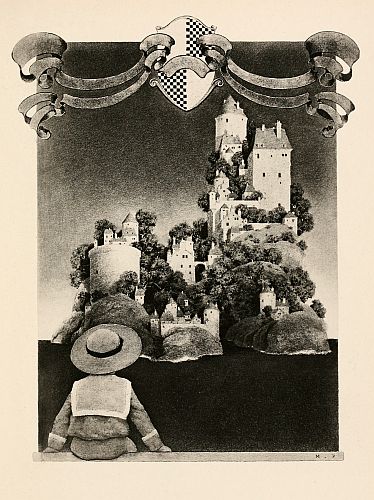
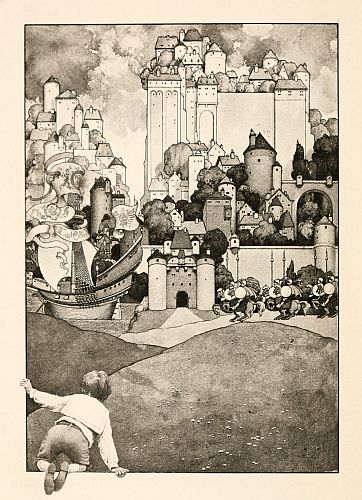 ITS WALLS WERE AS OF JASPER