| |
PLATE. |
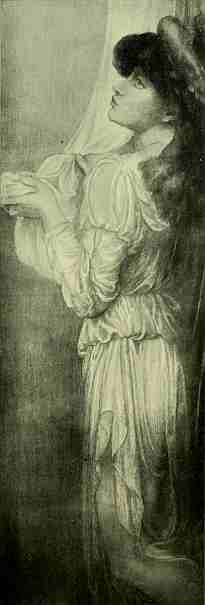
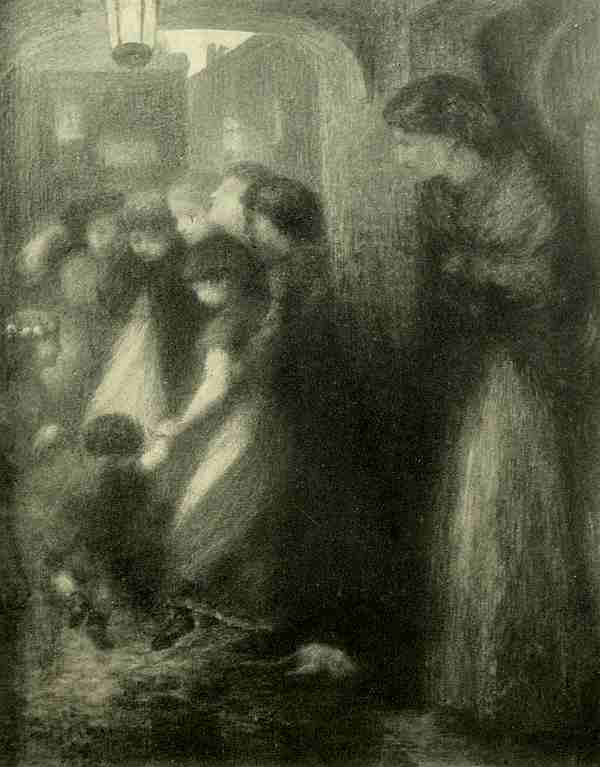
| MARY AT THE DOOR OF SIMON |
Frontispiece |
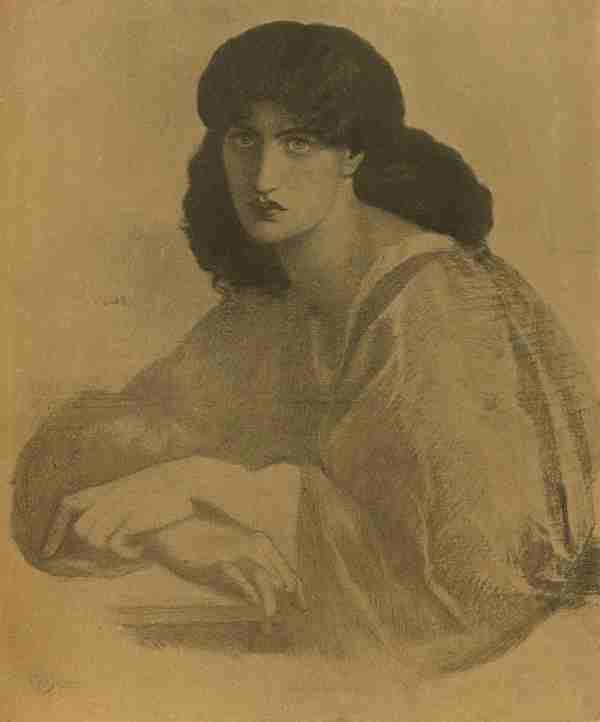
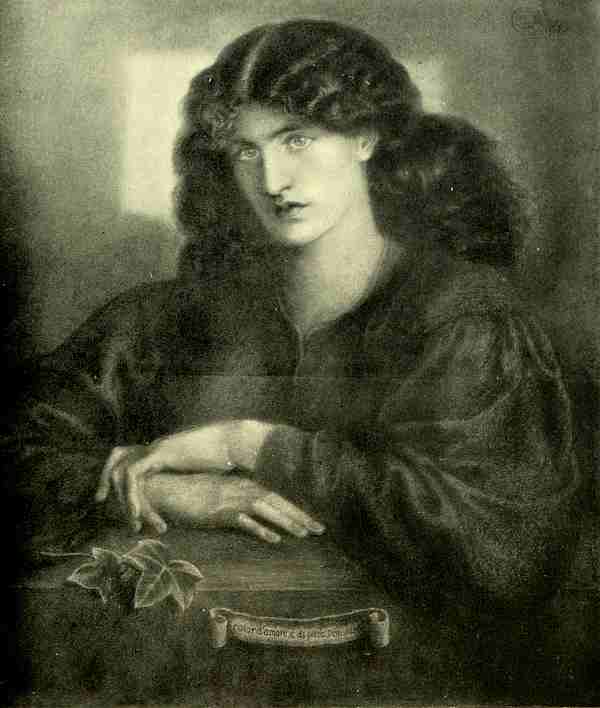
| LA DONNA DELLA FINESTRA |
I |
| ST. GEORGE |
II |
| ST. GEORGE |
III |
| DANTIS AMOR |
IV |
| LA GHIRLANDATA |
V |
| THE PRINCE'S PROGRESS |
VI |
| STUDY FOR THE SALUTATION |
VII |
| THE SANGRAAL |
VIII |
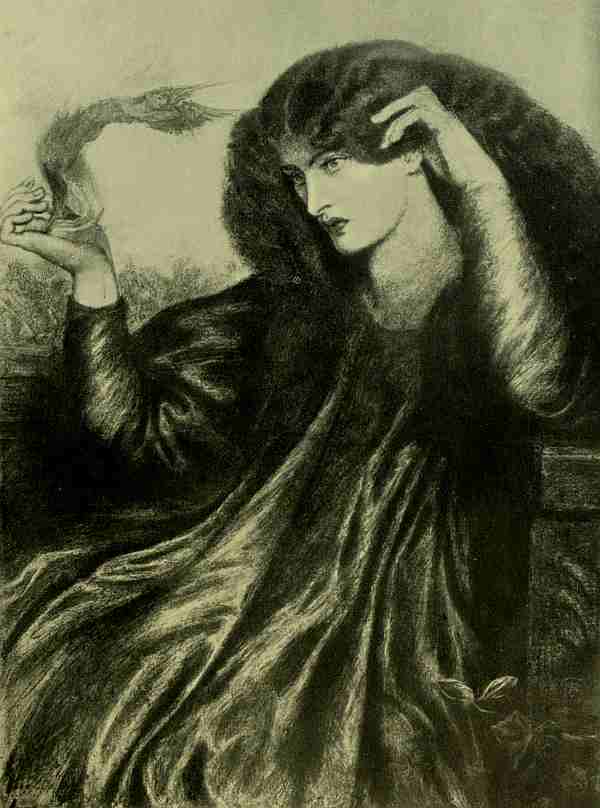
| LA DONNA DELLA FIAMMA |
IX |
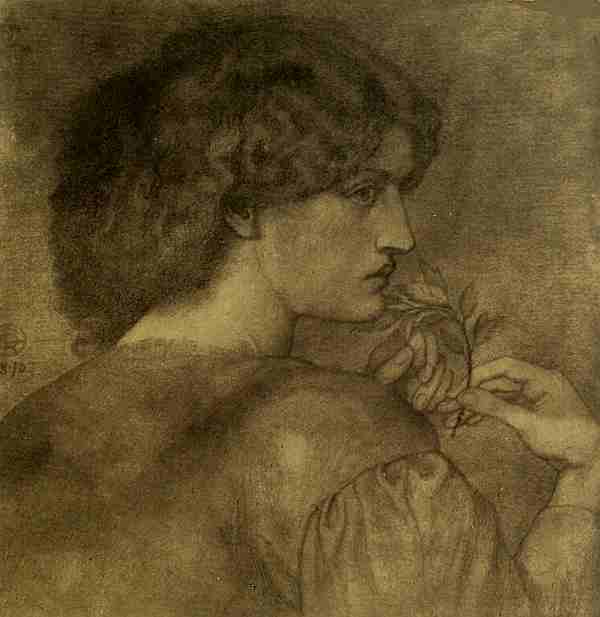
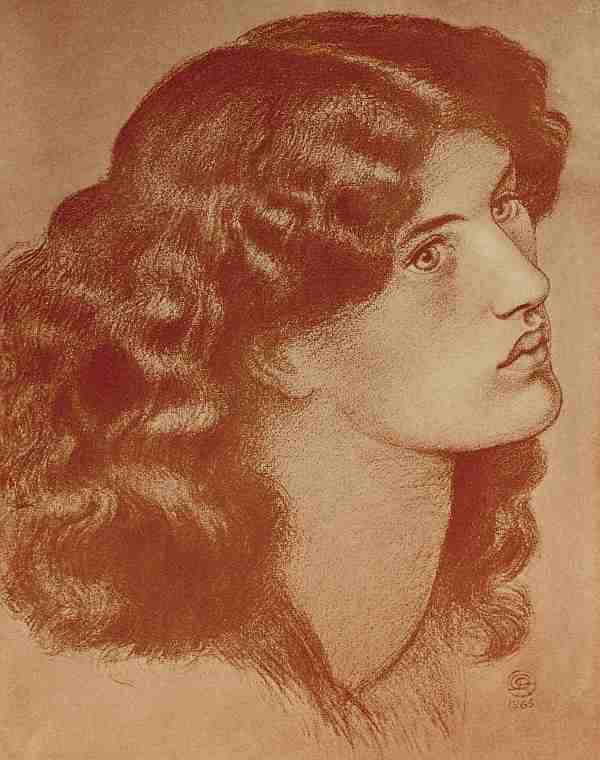
| THE ROSELEAF |
X |
| HESTERNA ROSA |
XI |
| STUDY FOR LA BELLA MANO |
XII |
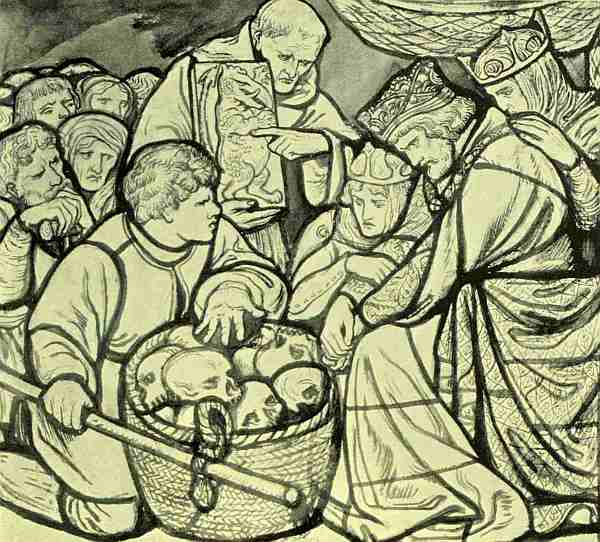
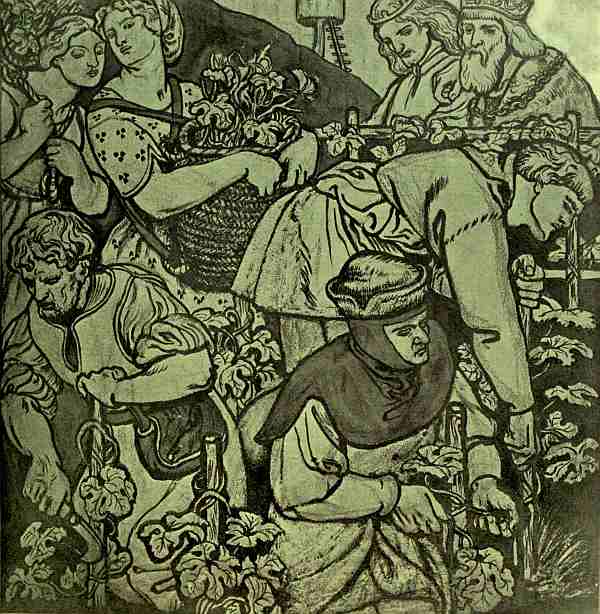
| THE PARABLE OF THE VINEYARD |
XIII |
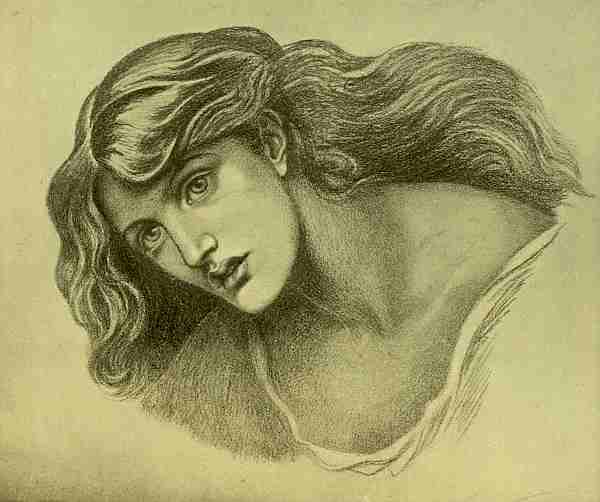
| STUDY FOR HEAD: DESDEMONA'S DEATH SONG |
XIV |
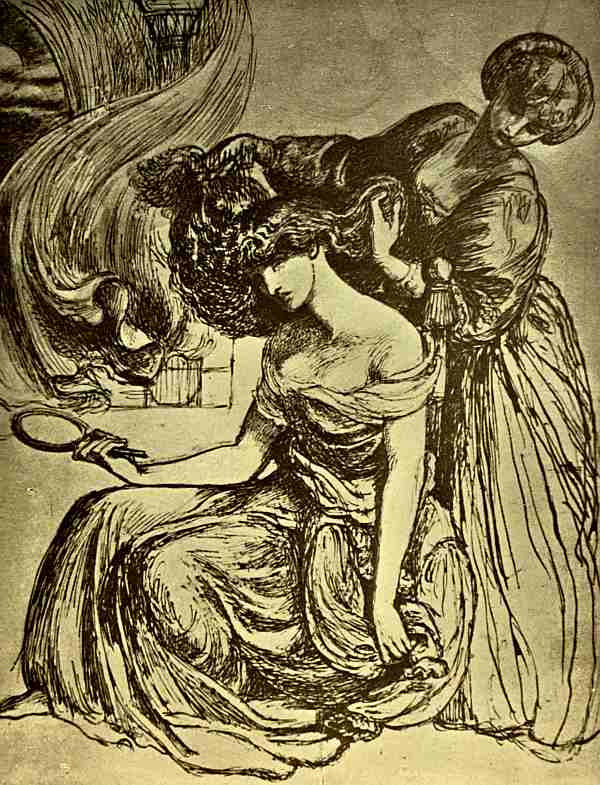
| STUDY FOR DESDEMONA'S DEATH SONG |
XV |
| STUDY FOR ASTARTE SYRIACA |
XVI |
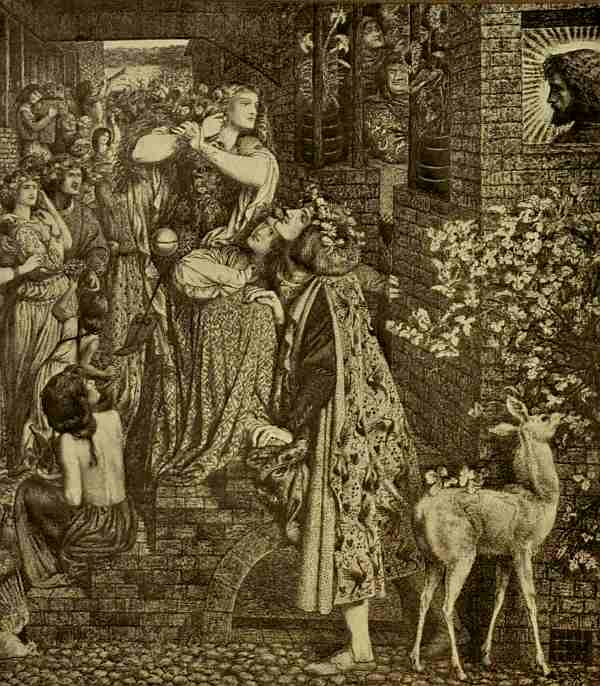
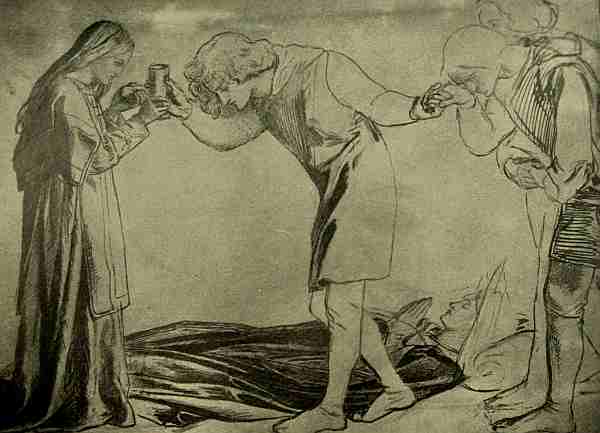
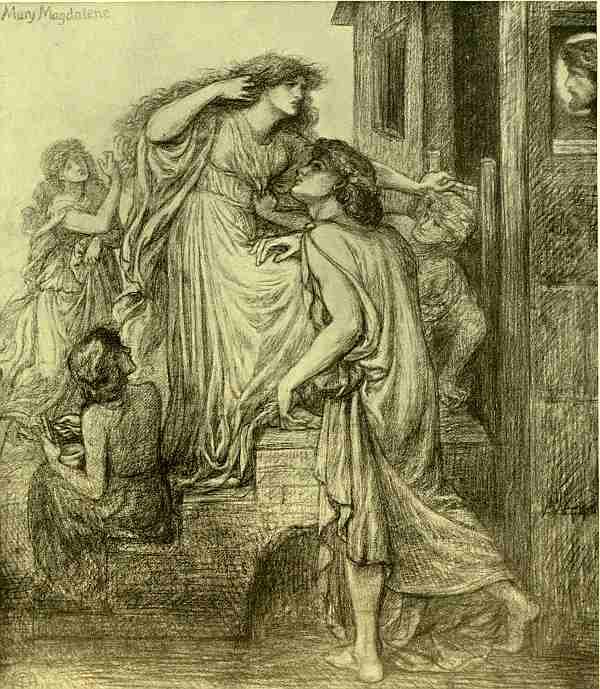
| MARY AT THE DOOR OF SIMON |
XVII |
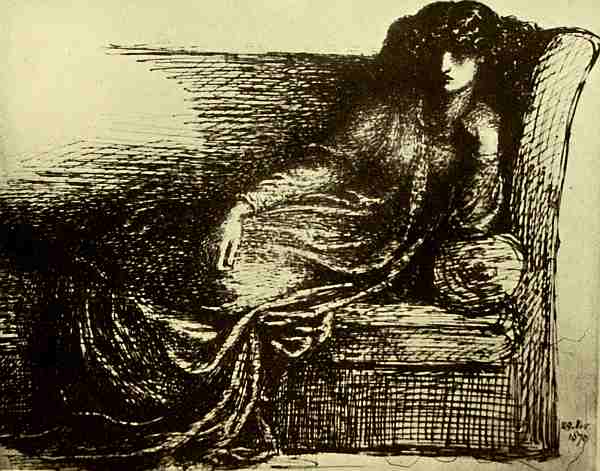
| THE COUCH |
XVIII |
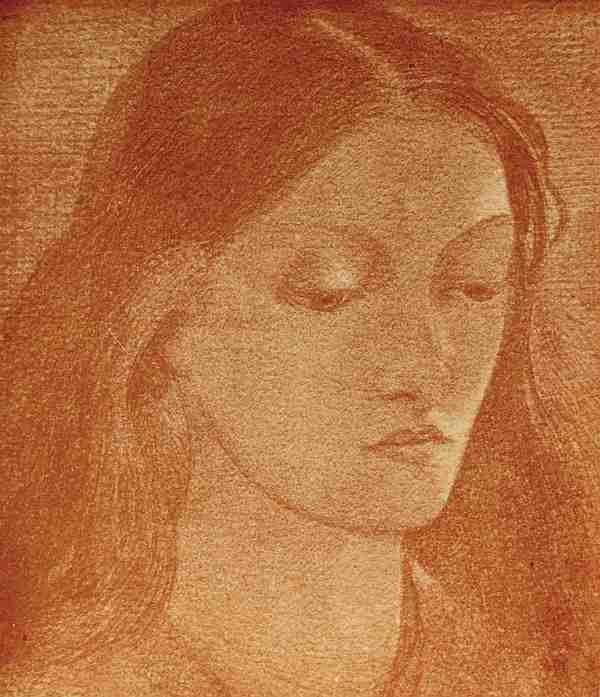
| STUDY FOR BEATRICE |
XIX |
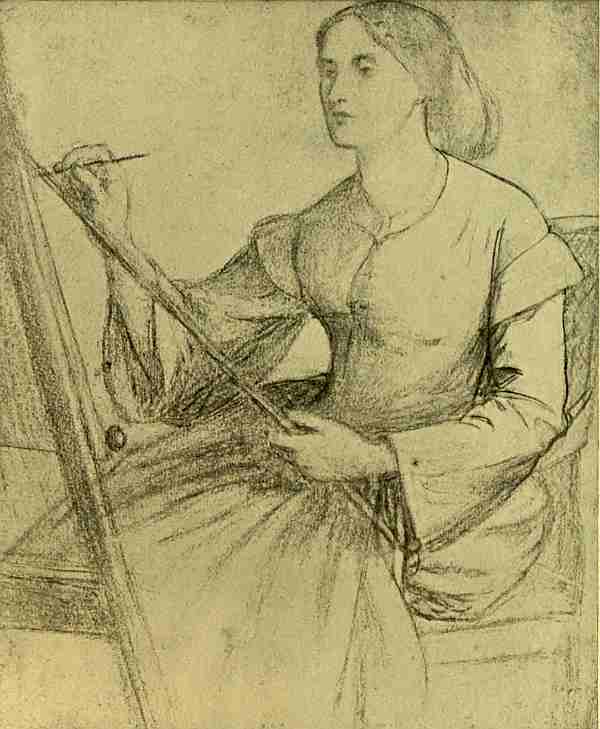
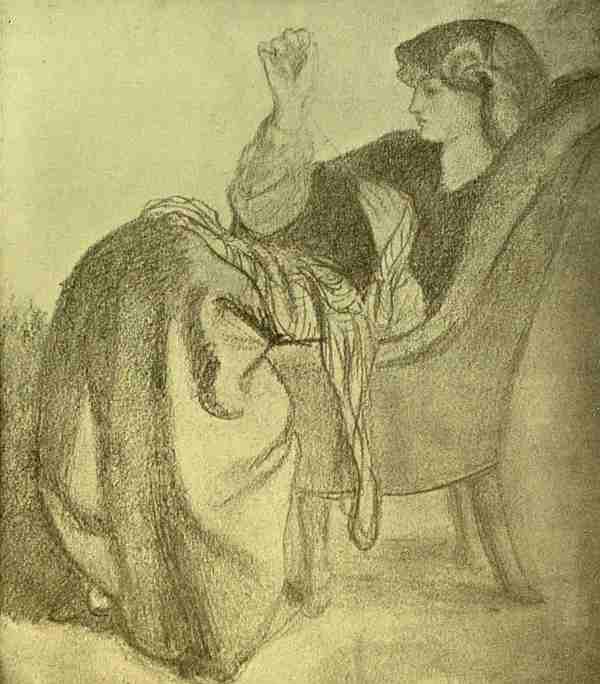
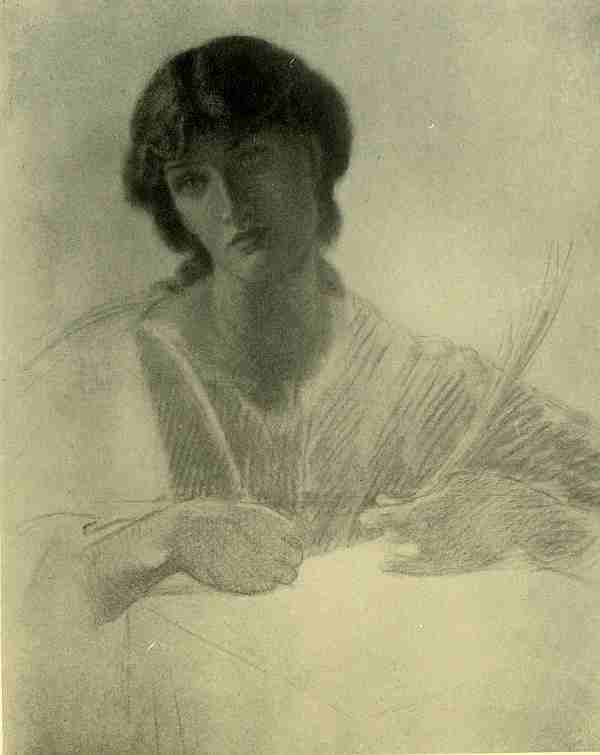
| SKETCH OF MISS SIDDAL |
XX |
| RICORDITI DI ME CHE SON LA PIA |
XXI |
| THE PARABLE OF THE VINEYARD |
XXII |
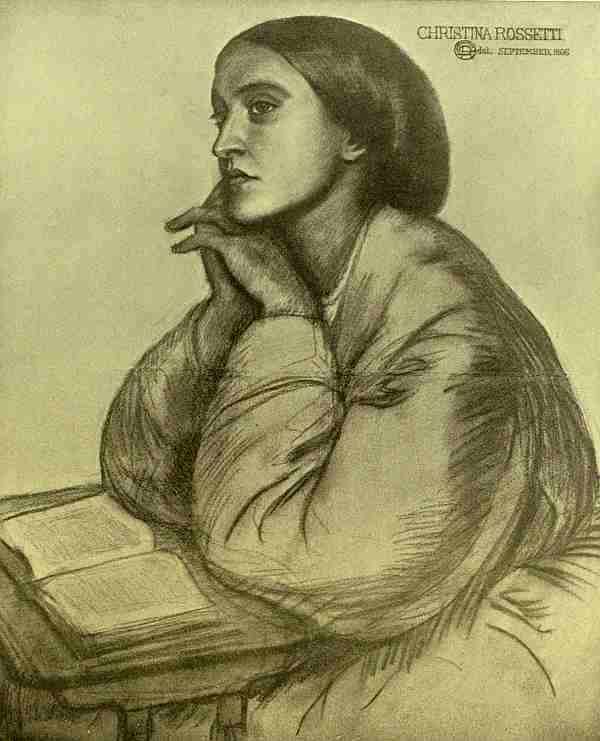
| CHRISTINA ROSSETTI |
XXIII |
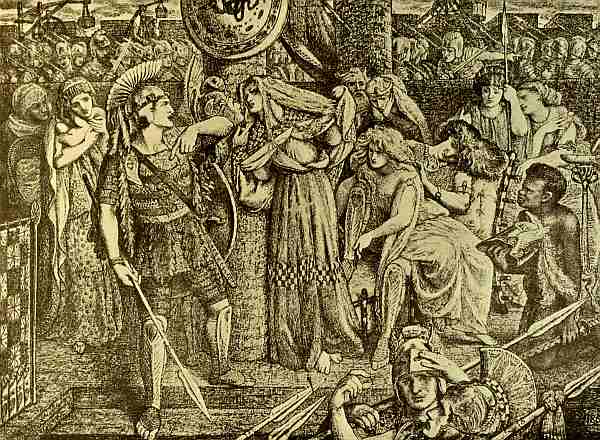
| CASSANDRA |
XXIV |
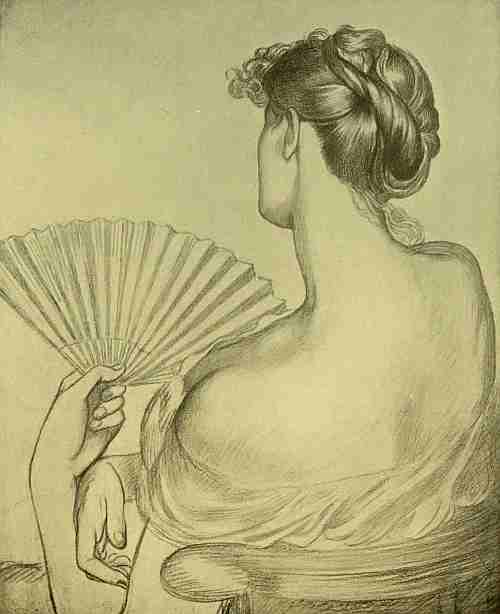
| LADY WITH A FAN |
XXV |
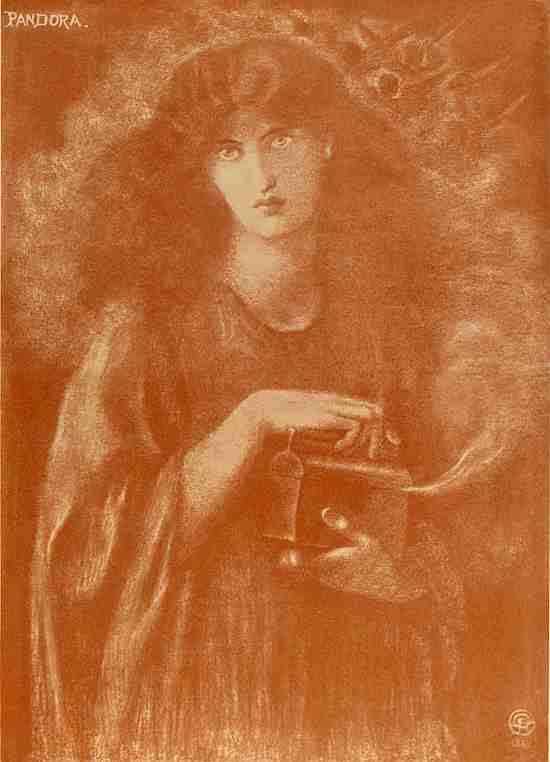
| PANDORA |
XXVI |
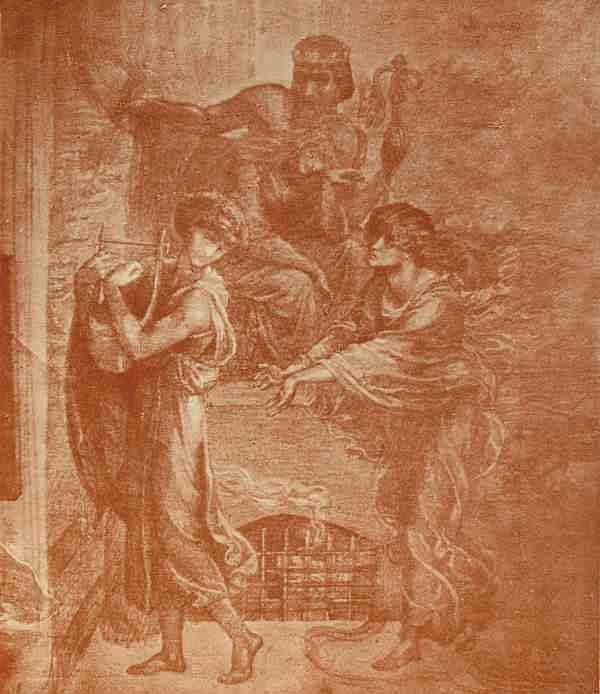
| ORPHEUS AND EURYDICE |
XXVII |
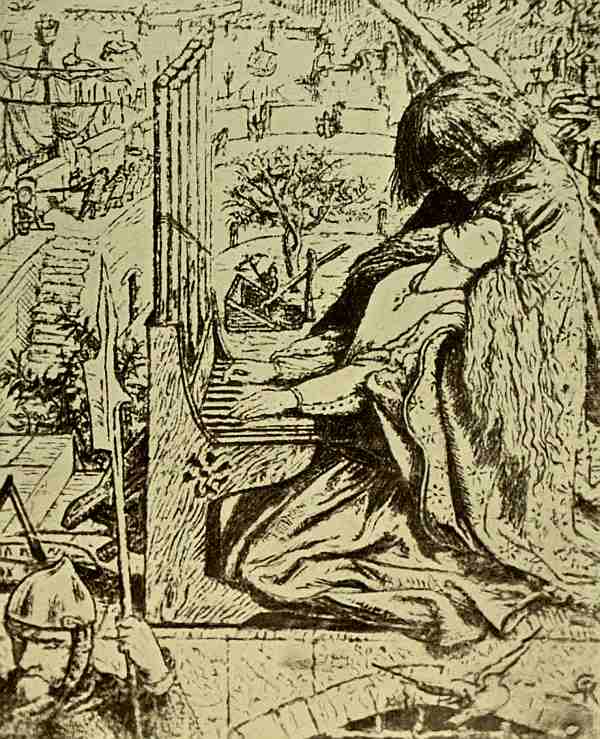
| THE PALACE OF ART |
XXVIII |
| LACHESIS |
XXIX |
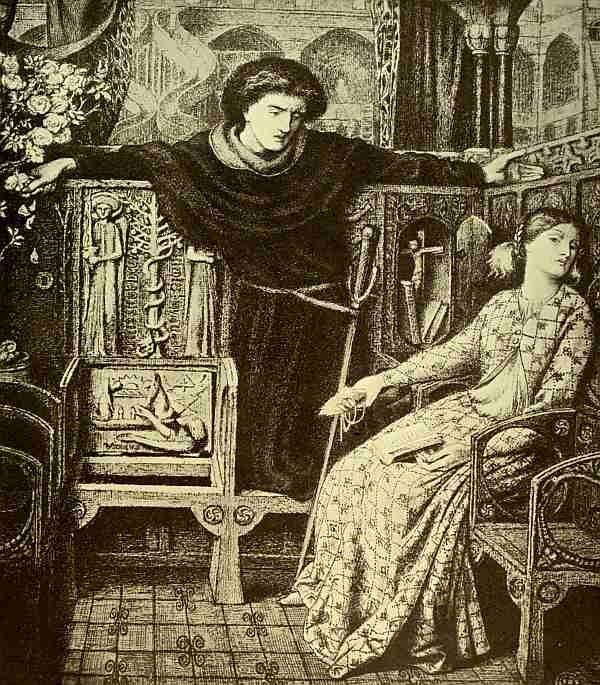
| HAMLET AND OPHELIA |
XXX |
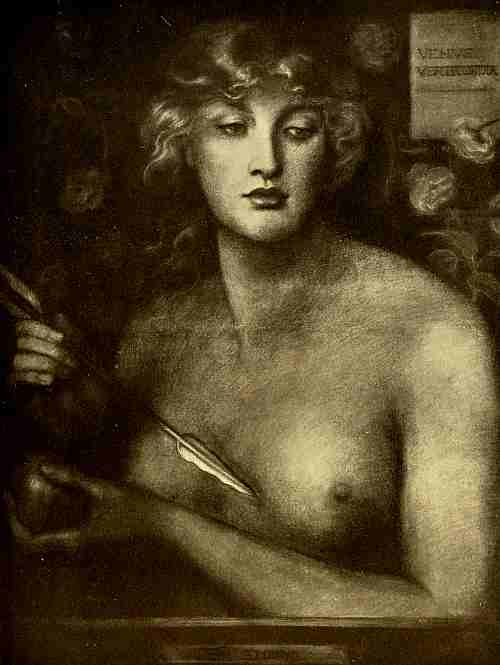
| VENUS VERTICORDIA |
XXXI |
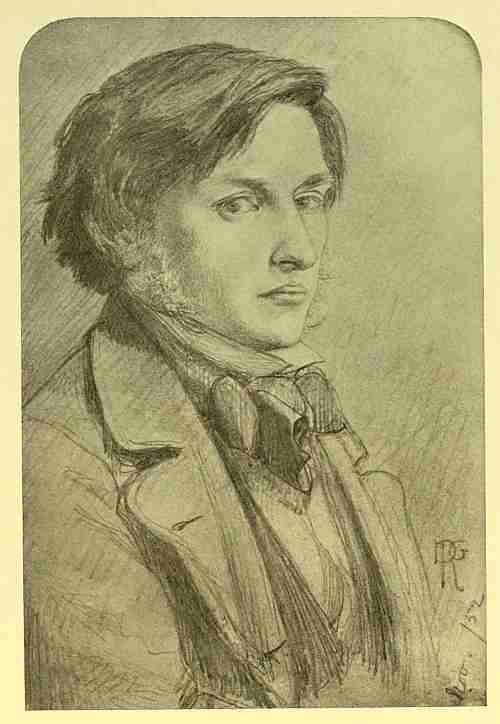
| FORD MADOX BROWN |
XXXII |
| MISS SIDDAL |
XXXIII |
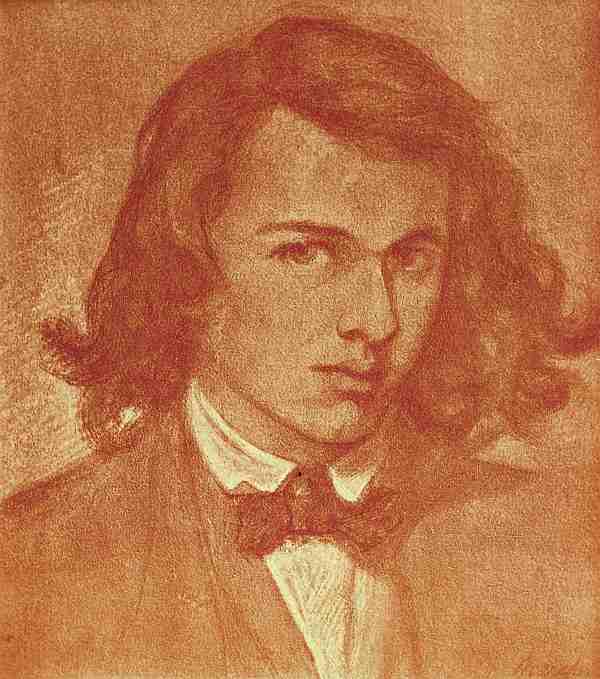
| DANTE GABRIEL ROSSETTI |
XXXIV |
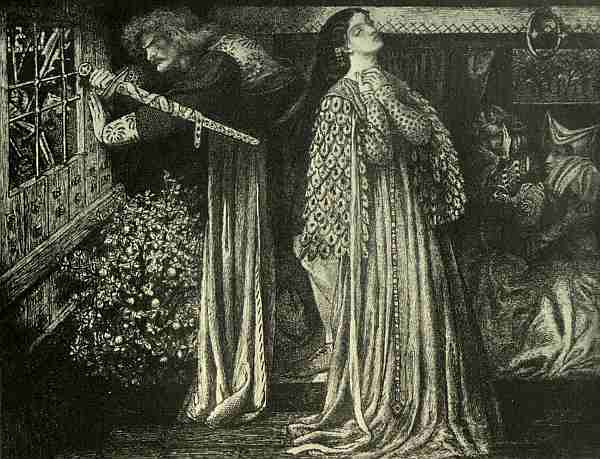
| STUDY FOR QUEEN GUINEVERE |
XXXV |
| STUDY FOR DESDEMONA'S DEATH SONG |
XXXVI |
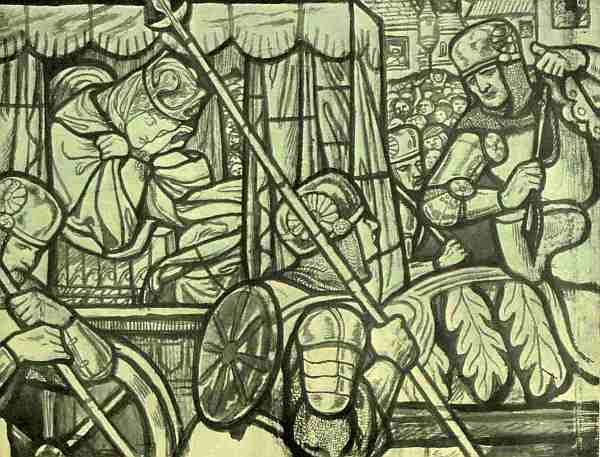
| SIR LAUNCELOT IN THE QUEEN'S CHAMBER |
XXXVII |
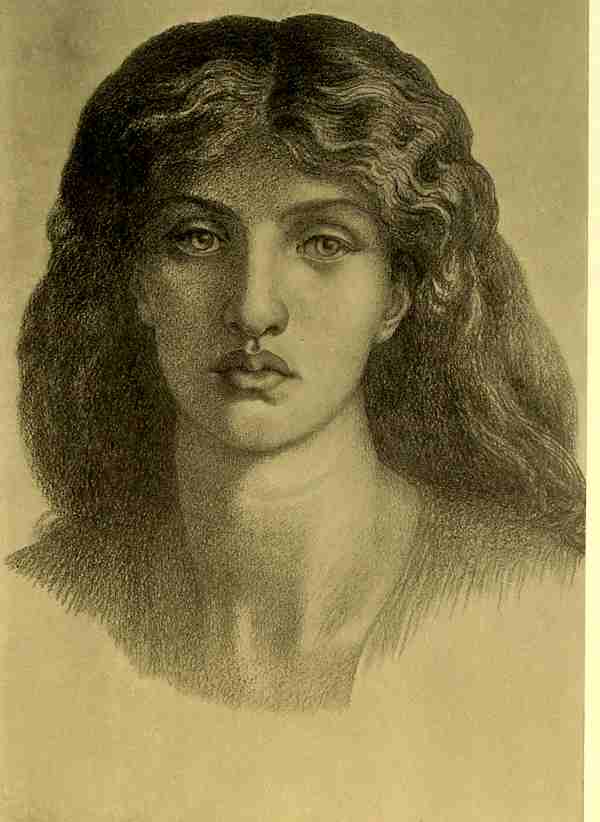
| STUDY FOR LA DONNA DELLA FINESTRA |
XXXVIII |
| STUDY FOR DANTE'S DREAM |
XXXIX |
| THE GATE OF MEMORY |
XL |
| STUDY FOR THE BLESSED DAMOZEL |
XLI |
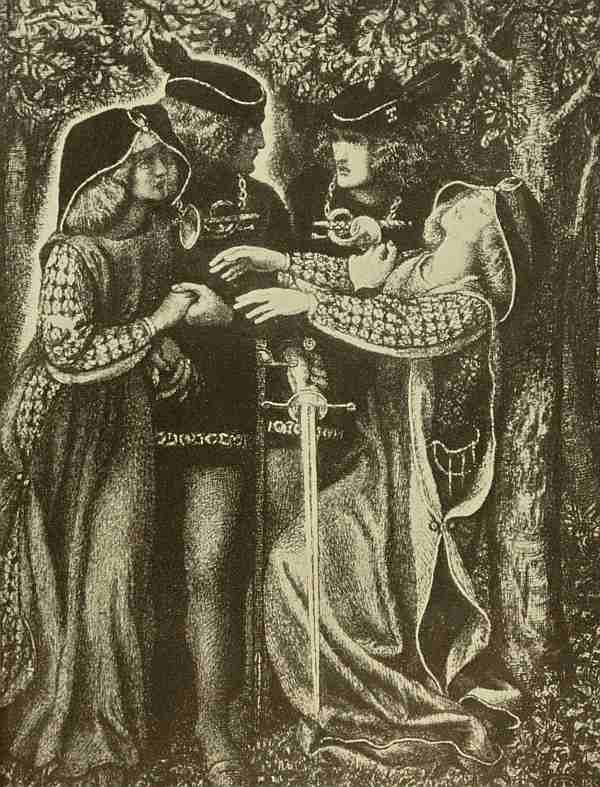
| HOW THEY MET THEMSELVES |
XLII |
| THE LADY OF THE GOLDEN CHAIN |
XLIII |
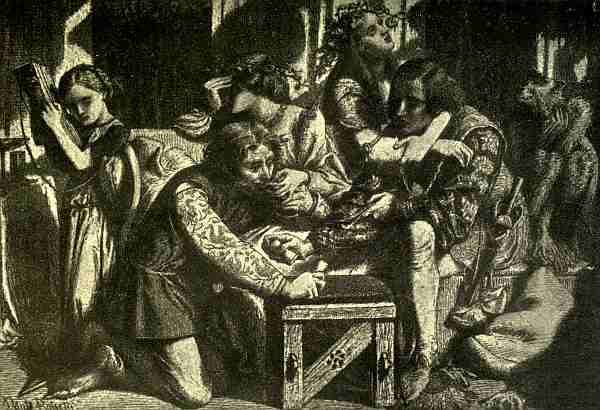
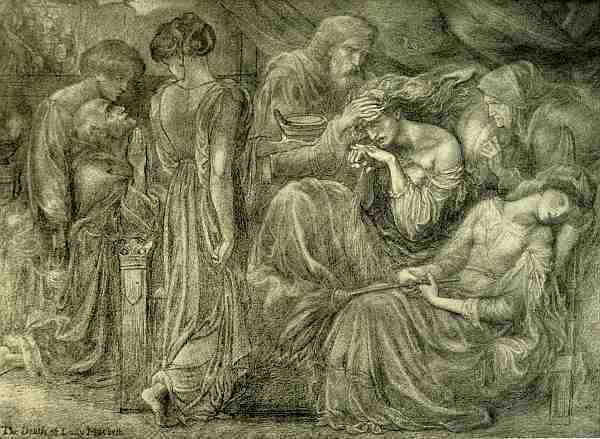
| THE DEATH OF LADY MACBETH |
XLIV |
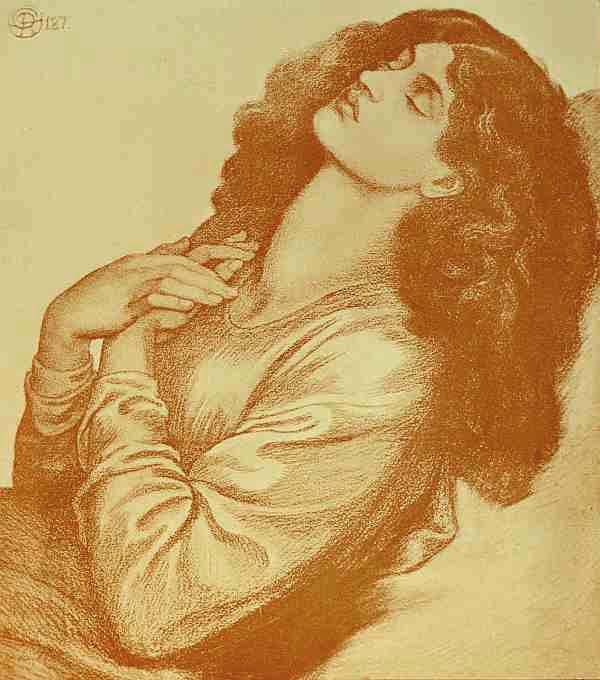
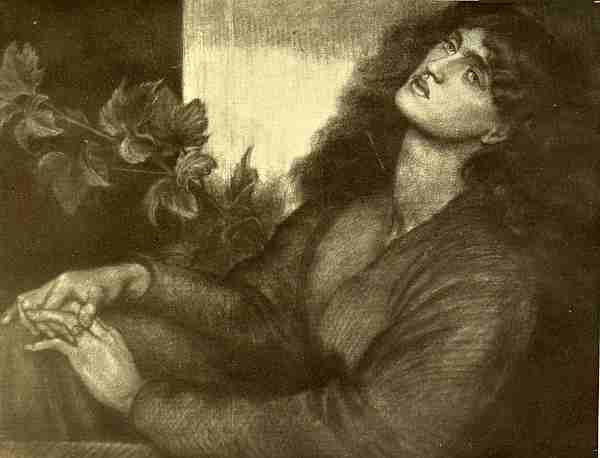
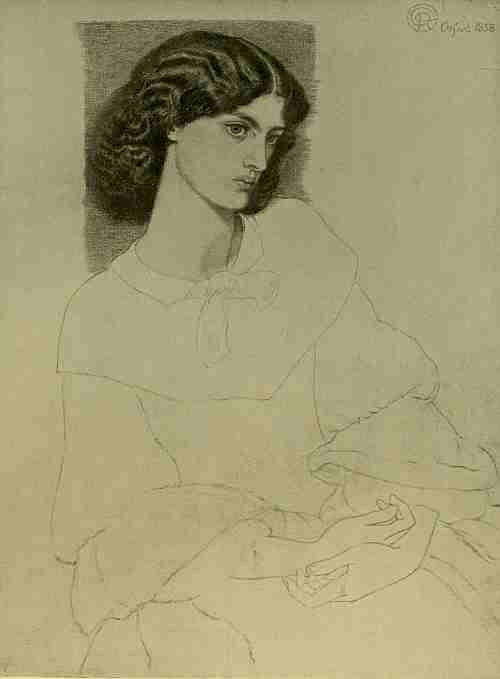
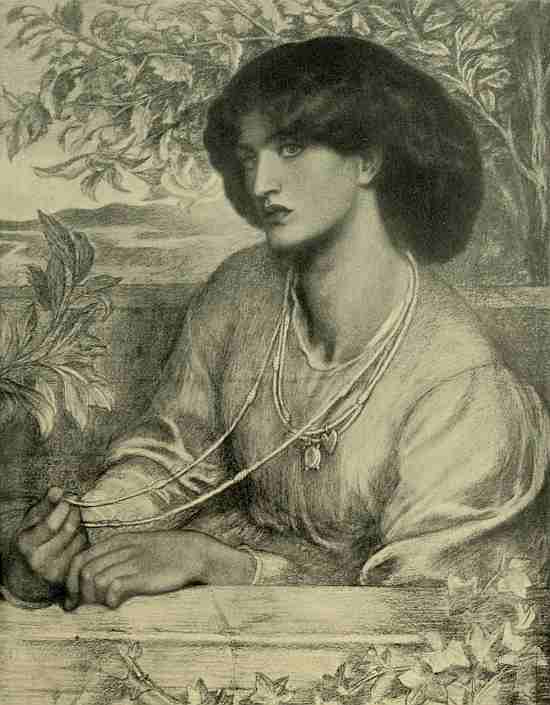
| MRS. WILLIAM MORRIS |
XLV |
| STUDY FOR DANTE |
XLVI |
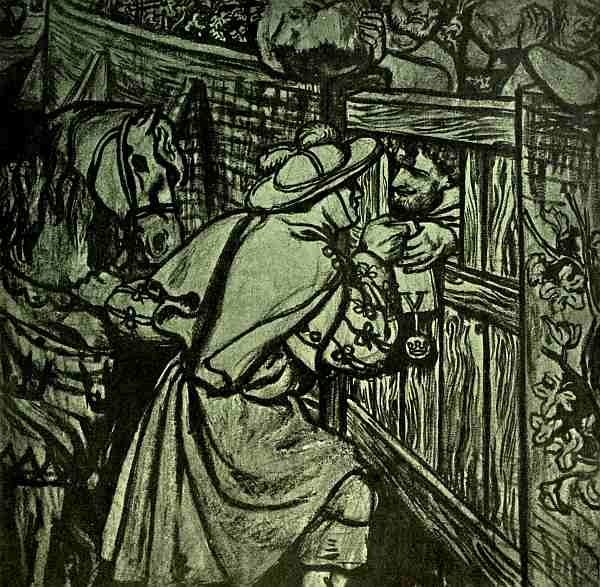
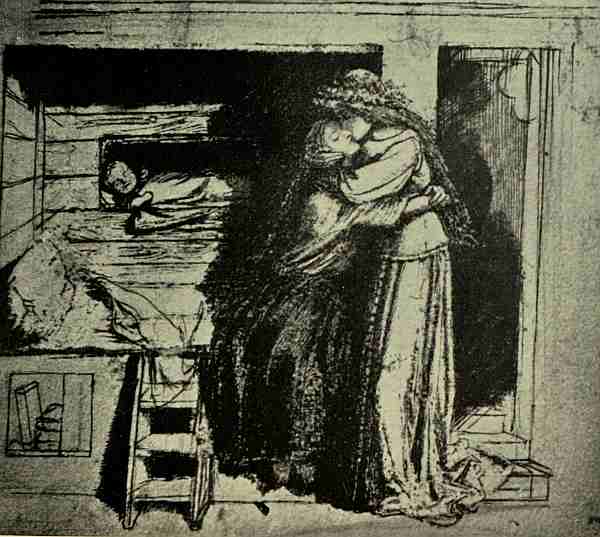
| DESIGN FOR A BALLAD |
XLVII |
| THE PARABLE OF THE VINEYARD |
XLVIII |
Transcriber Notes:
The caption on Plate XXXIII was changed to FORD MADOX BROWN.
The caption on Plate XXXV was changed to STUDY FOR QUEEN GUINEVERE.
In LIST OF ILLUSTRATIONS, changed MR. WILLIAM MORRIS to MRS. WILLIAM MORRIS.
THE DRAWINGS OF
D. G. ROSSETTI
BY T. MARTIN WOOD
THE intensely subjective nature of Rossetti's
art is what gives it fascination for its lovers; it belonged to
himself. Even in his early period and with his
dramatic subjects this was so, and partly by the depth
of imaginative meaning he read into the faces of
women. The last phase of his art was entirely one of
self-revelation; his own moments of sorrow were mirrored in one
woman's face, moments in which he created sadly, living over again
in them some hours that had been happy.
This is her picture as she was:
It seems a thing to wonder on,
As though mine image in the glass
Should tarry when myself am gone.
* * * *
for so
Was the still movement of her hands
And such the pure line's gracious flow.
* * * *
'Tis she: though of herself, alas!
Less than her shadow on the grass
Or than her image in the stream.
One might hazard the question whether it were possible
for a painter such as Rossetti, seeking expression in his art for this
intensity of feeling, to vie in the rendering of the external aspects
with those painters who have approached life with that cold
acuteness to the appearance of things and aloofness from their
meaning characteristic of work that has contributed largely to the
actual science of painting. To Rossetti life came over-crowded,
over-coloured. There was too much for him to realise in his working
moments. The very richness of his nature embarrassed his
output. His gifts gave him so many ways of self-expression from
which to choose. The phases through which his genius passed, the
result of an inherited and rare temperament and its adventures, made
the science of painting prosaic for him. He himself felt latterly
that this impatience had left his ideas pathetically at the mercy of his
materials. Apart from the quality in colour to which he attained,
one is conscious always in his paintings of the tragedy of genius
striving for expression through an ineffectual technique. Rossetti's
individuality, however, was so strong that it stamped itself everywhere;
in spite of every limitation his art explains his attitude
towards life. In his ability to make it show this his greatness lies,
and in the fact that the point of view that it suggested was his alone.
His art created for itself its own atmosphere—an unfamiliar one at
first to Englishmen, with its subserviency of everything to a romantic
emotionalism. The histories of the world for Rossetti were its
stories of emotion, and in every place that his memory knew Love's
image had been set to reign, Love who had wandered down through
the ages decked with the flowers of art, offerings of bygone lovers,
dead lovers to never dying Love. As a strange spirit Rossetti entered
modern London. A heart rich from many forgotten experiences
seemed to have lodged itself in him and he painted with eyes filled
with the colours of old things. For him the tapestries could never
fade in a room that had known love's history, nor the colours leave
the missal which told the story of a soul.
How far his drawings were intended to foreshadow large
paintings which he desired to make as windows for us to look with him
into his romantic country we cannot say. As it is they show that
it was in Rossetti's power to be the greatest imaginative illustrator
of his century; that he was not so seems to prove that in this way,
as in some others, he failed to attain to much that at first had seemed
included in his destiny. In his paintings, in his poetry, in these
drawings something there is that was new, and that brought a fresh
phase into art and literature in England. It is something which has
influenced permanently the nation's thought and has been even admitted
into the procession of its fashions. For a time women tried to
look as the women in his paintings, so much had the type he chose,
which was his own creation, imposed itself upon their imagination.
The Rossetti woman, if she did not supersede the early
Victorian type, at least helped to change it, and to mark a change which
was taking place in the ideals of the nation. Fresh tendencies in national
thought are always correspondingly represented by a change in the
type of women idealised in its art and poetry. When the Victorian
type went, the time had passed when homage was given to women
for a surrender of their claims on life. The new type spoke of the
ardent way in which another generation of women was creating for
itself wide interests in the world.
Rossetti displayed in his art the dramatic sense; we find
him in his earlier drawings always illustrating dramatic subjects, rendering
action in his figures in a way that proclaims him at once as one of
those to whom the actions of men, the faces of women, come tragically
or otherwise into every dream. One is enabled to write more
clearly on this point by comparing him with his friend Burne-Jones.
Burne-Jones' figures live in a dream in which the world has little
part, whilst Rossetti's dream is of the world itself. His work is
rich with the human experience that is absent in the art of his friend.
He is accredited with being the leader of a phase of decadence, while,
as a matter of fact, no one could have been further removed from
anything like a "decadent" pose. Rossetti had an unconscious and
unexplained sympathy for life that tragically pursued, and found itself
shipwrecked upon, its own illusions. It was part of his art's vitality.
There was little defiance in his attitude, it was altogether one of pity.
Indiscriminate publication has familiarised the public only with the
last sad phase of Rossetti's art, and unhappily this is esteemed
characteristic. The intimate patrons of the painter possessed
themselves of his early work; now it is inaccessible, and it is
not at his best that he is seen in any public collection.
It is possible to like the art of Rossetti very deeply, and
also to love the changing colours of the sea and the shadows of the sun clouds
moving swiftly on the hills. But often to pagan lovers of such things
the art of Rossetti, shuttered close in its mediaeval darkened rooms,
has seemed as an almost poisonous flower, with its forgetfulness of
the world without.
It can never be sufficiently emphasised how necessary
it is in judging any art first of all to share some of the mood in which
it was created. Those who would enter into the atmosphere
of Rossetti's art must find their way to it in the darkened light
of dreams. It stands in no relation whatever to the workaday world.
A poet whose writings realised an opposite temperament
to Rossetti's own would have had the test of poetry that it could be
taken to the fields in the early morning and read. To attempt to
bring a painting of Rossetti's into relationship with nature out of
doors would to all intents put an end to the reason for its artistic
existence. It would be to demand of it that it should strike
a note in tune with a mood the direct opposite to that which
it was its intention to create. Though art should always be
examined in its own atmosphere, much of the criticism applied
to Rossetti is but the bringing of his art out into the fields. It
is not valuable criticism that approaches work in a spirit of this kind.
A great deal too much has been made in writing of
Rossetti's Pre-Raphaelitism. To a nature like Rossetti's any school,
any methods he may have taken up with, or inspired, would be largely
accidental to his environment. Arrived at a time of reaction, of
revolution in English painting, with his qualities of leadership
he threw himself into Pre-Raphaelitism as a new movement, but it
is more than probable his genius would have found methods of
expression as personal to itself in the refinements that entered
English painting in the wake of Pre-Raphaelitism,—only the
Pre-Raphaelite movement could not have been but for the ardent
genius of Rossetti which poured inspiration into all those who
gathered about him. He departed from Pre-Raphaelite tenets just
when it suited him; its hold over him lay chiefly in that he liked
to realise very definitely the shapes of objects in his art, because
they made his dreams real and gave pleasure to those eyes of his that
so hungered after every sign of beauty. The secrets of art lie, after
all, more within the vision than in expression. That Rossetti could
have directed his genius into another manner from Pre-Raphaelitism
seems possible from the fact that in his poetry so many styles meet
and show his variegated temperament expressing itself in opposing
forms. What was of literary significance in Rossetti's art perhaps
gained from Pre-Raphaelitism, for Pre-Raphaelitism made things
symbolical. To nearly every object that they brought into their
pictures the Pre-Raphaelites gave meaning other than its own, other
than that which was simply artistic. Now Rossetti, looking on his
art and its relationship to life from a literary more than from an
artistic standpoint, striving to attain in art not an imitation of
life but an expression of his ideas about it, found, as we have said,
painters' problems a difficulty. He was irritated by difficulties
which to a whole-hearted painter present pleasures of conquest in
proportion to their resistance to his craftsmanship and skill. In other
ways Rossetti lacked the characteristics of really great painters as
such; he had not the seeing eye that gives to every outward thing
a shape and colour already formed within the mind. From such
a cult of the eyes as this comes the true painter. By taking
thought art does not become a metaphor for ideas, though the
whole aim of its subject may be to make it so. Art is always
metaphorical, whatever its subject and however unconsciously, to
itself. The presence of genius only is needed. Yet because in
actual pigment red can never be anything other than red, ideas
are clothed more easily in the colour of words, for in themselves
words have no colour and they have no existence other than the
existence which they have in thought, and the colour which any
language lends them.
Rossetti could not learn painting instinctively as he
learnt writing; for him the materials were not so simple, they remained
during a long apprenticeship an obstacle rather than an aid to
impassioned expression, and from his apprenticeship he never
emerged into anything approaching freedom. Upon the vivacity
of the imagination in them, and not upon subtlety of line or of
observation, the claims of Rossetti's drawings rest, though it is
wonderful how often he lifts his art up to the level of all that
he has to say and imposes upon us a forgetfulness of its
shortcomings. His studies do not reveal a master who looked
upon objects and beautiful forms for their own sake and for the
sake of the tender drawing he could find in them. Rossetti,
indeed, loved a visible world, and liked to interpret the beauty of
natural objects, but he was always in haste to get the scene set
where such objects were, after all, for him only as accessories to
the thing enacted, or as notes in an orchestration; of value but not
existing by themselves. He gave to every object the import of the
drama in his mind; in his art things seem to have about them the
meaning lent them by an imagination that spiritualised objective
things so that they seem there in essence only and rendered with
a sympathy that shows how alive to the significance of outward
beauty Rossetti was, and how his own time and every-day surroundings
were fused and blent with his most far-reaching imaginings. To
turn to outward things, and to study them as merely offering various
surfaces to the light, holding depths of shadow, possessing lines of
delicate shape, was, however, impossible to his temperament. The
characteristic story of Madox Brown setting in early
days the young Rossetti down to paint such still life as jam jars, and of the
young painter's impatience, shows that to paint or draw the objects
for their own sake only was not congenial to him. There was very
likely sufficient of the true painter in Rossetti to make such study a
delight, had his mind ever been still enough for his hand to playfully
carry out such problems; but always at the back of his mind, at the
back of the world for him, a strange drama of love and beauty went
on. How then could time be spent in studying what, after all, were
merely objects, how could time be spent in deliberating over the
study of them? And so the drawings which Rossetti left us are
seldom studies of poses and draperies, such elaborate scaffolding as
that upon which the art of Burne-Jones was built. They are little
pictures in most cases, in which the pencil or the pen afforded a
readier and less laboured means of realising quickly the life dramatic
of imagination.
Illustration essentially suited his genius in so far as in
small dimensions it was easier to reflect easily, whilst the power of creation
lasted, what was moving in a mind that was held by no one mood for
long. It suited his genius also because it minimised the labour of
creation, and with Rossetti it was always apparent that creation was a
labour. He himself has said in that other art in which perhaps he
always found his happiest expression—
Unto the man of yearning thought
And aspiration, to do nought
Is in itself almost an act,—
Being chasm-fire and cataract
Of the soul's utter depths unseal'd.
A body that grew faint under the strain of over-feverish
genius undoubtedly imposed its indolence upon Rossetti's spirit, so that he
shirked the difficulties of his earlier subjects until the downfall of
his art set in with the constant production, for indiscriminating
purchasers, of a face that grew more and more distant from the
beautiful type of his earlier inspiration, which till the end he always
pathetically imagined himself to be creating.
Turning to the illustrations, that called
A Drawing for a Ballad
with its free and loose handling, its qualities of selection and
emphasis, show how great in many ways Rossetti was. What lines
could be simpler than those in the girl's dress? In such a sketch
as this, in the little things, Rossetti is masterly, and one cannot here
separate what he has to say from the saying of it. This sketch shows
an artist great enough to be unpretentious, and it shows that the happy
qualities of mind, united with its craft, sprang from his habits of
thought. We see in it with what natural tenderness he has sketched,
how by one of the girl's hands her companion's face is lifted to the
kiss. This naturalness holds the secret of Rossetti's power. His art
was consciously set on decoration, but this is not a decoration; in all
that he has read into the miniature faces and in the embracing of the
hands, we get in this sketch more intimately than anywhere else evidence
of his great heart. This dramatic sympathy would attract every
one could it shine more often through the carelessness, the unhappiness,
that at the end obscured it. In this way we must think of
Rossetti as a failure, and a great man cannot fail once without
blinding the world to his many successes. Had Rossetti possessed
no sense of colour, and had he not completed many large pictures
and elaborate illustrations, but only followed this one path as far as
he could go, doing only such things as this, without being a poet
and without being a painter, who knows to what extent we should
have praised him for these slighter things alone? There is no doubt
that we expect so much from him, and he has given us so much
in other ways, that we forget the treasures hidden here. One could
wish that he had always worked in his drawings with the freedom
indicated in this sketch, but it was not the fashion then. Work in
Rossetti's day had to come into the market elaborated to the point of
its soul's extinction in order to be taken seriously. Now that we have
taught ourselves always to value first any indication of the spirit,
what would we not give to possess ourselves of work by this artist in
impulsive drawings, and it must have been within Rossetti's power
to do them down to the last.
The drawing of the death of
Lady Macbeth is one of
the most wonderful things Rossetti ever did, and it is characteristically
marred by imperfect drawing. The drawing is of great quality
throughout, except for the figure with head averted. Some
wonder why the ability to make the rest of the picture perfect
failed the artist here. It is probably because the action of each
figure is controlled only by the imaginative impulse that sways the
whole composition, that gives to every part of it dramatic intensity as
if executed all in one mood, bringing in one moment of creation the
whole to life on paper. Those in sympathy with the nature of
Rossetti's art do not count this piece of bad drawing a disastrous
flaw. The rarity of genius makes them accept everything gratefully;
it disarms a cavilling attitude. The fault in their eyes even seems to
add to the tense note struck as a changed note in an over sweet
harmony. Its dissonance breaks the monotonous rhythmic decoration,
and its harshness relieves the detail so delicately wrought.
Rossetti is of the extreme few who have finished minutely without
sacrificing the qualities of greater significance than finish. His art
is great enough to make us forget the detail and to render us for
the time oblivious of it. In our absorption in the subject it seems
for a time not to exist, only the tense mood exists, the intense
moment. In a picture in which the moments are aflame with
tragedy Rossetti drew this figure moving slowly and with decorative
convention. All the figures are controlled by such a convention;
they are partaking in a high drama. Such a convention as Irving
has in the art of acting gives something to the dignity of tragedy.
The conventions of Rossetti too are so much in the spirit of high
art, they conform so well to the claims of art, that they lend beauty
to that power of his of giving to his drawings dramatic perfection.
In regard to the particular figure of which we write it is better,
faulty as it is, than if it had been redrawn in another mood and
given again to the picture. It is to be regretted, of course, that it
did not come rightly as it is, but it is less to be regretted than if
he had substituted dead perfection for living imperfection, a studied
and acquired idea of the pose in place of the instinctive one.
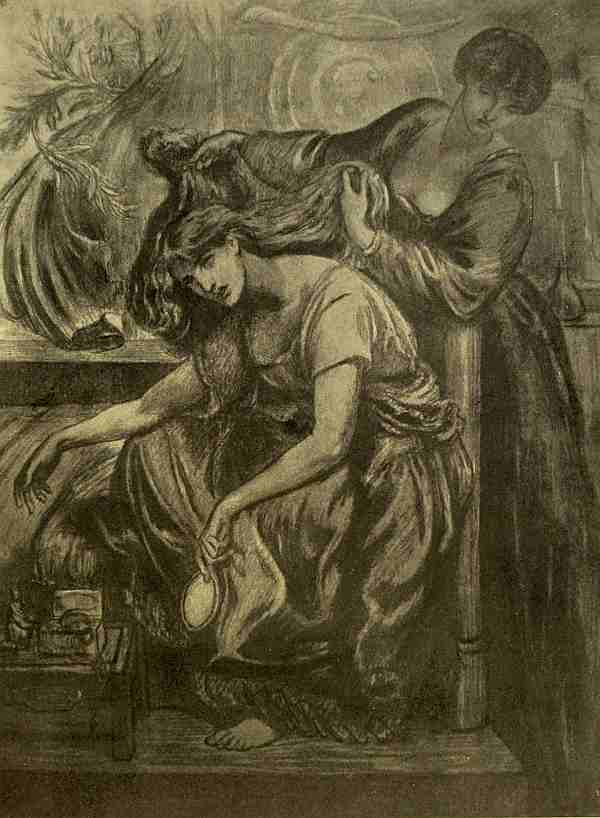
The first illustration for
Desdemona's Death Song
is simply a rough sketch, but even taken as such it shows how blind or how
careless in the matter of form Rossetti at times could be. Here the
lower part of the figure is so obviously lacking in proportion that
it prevents us accepting an otherwise characteristic drawing as such.
Still of Rossetti's best moments is the controlling grace of the bend
in the maid's wrist, and the movement of her head as she combs
Desdemona's hair. The curtain blown into the room by the wind
is one of those touches Rossetti gives everywhere; by insistence on
such an incident he makes us live the moments depicted in his
pictures—just as we find ourselves in moments of extreme tension
watching eagerly something absolutely trivial and making some
accident portent with meaning.
In the second and completer
study for this picture we find
the proportions corrected; thought and after-thoughts have developed the
artist's intentions. Desdemona, with her hand hanging thoughtfully,
is an improvement on her attitude at first. The maid, however, has
lost much of the spontaneity of her original gestures.
Like all those in whose art we find phases of an extraordinary
beauty Rossetti could often draw in the most uninspired fashion,
presumably where his interest flagged. In the drawing of
Hamlet and Ophelia,
Ophelia is charming; but it is with difficulty that we are
reconciled to the Hamlet; it is difficult even to understand in what
position the figure is standing; not that this indefiniteness often
matters in art, but here, where everything else is so precise, it
provokes dissatisfaction. From Rossetti alone could have come the
background with the winding ways parting and meeting rhythmically with
steps up to the bridge. Such architecture as this, and all the quaint
furniture in his pictures, were designed by himself. From his facile
imagination anything might come. Certain objects that were full of
associations of old things he returned to often in his drawings, such
as old Books of Hours with all the sentiment that many hands had
given to them. The niche in the picture containing the Crucifix
and the Breviaries is significant of the Religion in Rossetti's art.
This was his religion, to think of Divine things by the legends of a
romantic Church.
In comparing the study for
Christ at the House of Simon the Pharisee
with the completed drawing, the question arises whether,
with the elaboration that has come into the latter, some of the intensity of
the study has escaped; or whether, on the other hand, the subject has
gained. The simplicity of the first undoubtedly possesses something
which is subsequently lost in elaboration, and yet taking the completed
picture and looking into it one finds a lesson in Rossetti's
methods. We find that by dwelling upon his subject he has
emphasised certain notes, has repeated as it were a refrain, and made
more spirited and poetic in rendering the figure of the lover in the
foreground. After-thoughts have given every touch that could
possibly enrich, and, at the same time concentrate, dramatic motif in
this figure. The embroidery on his coat, the flowers in his hair, the
hair itself, and the face so mocking and fascinating and sure of itself,
is more in the spirit of the subject than the gentler face as it appears
in the sketch.
The figure of the Magdalene gains in many ways as completed,
and though the distressed loving face and the flowing hair of the
sketch are changed, the alteration of the expression on the face from
one of intense distress to one of proud determination is very
interesting as showing how his subjects grew and changed under his hand.
It is wholly to the gain of the picture the different gesture which he
has arrived at in the second drawing, where the Magdalene with both
hands throws the flowers from her hair. The dramatic quality upon
which we have insisted as part of Rossetti's art is nowhere better
shown than in the deer quietly eating leaves from the wall, all
unconscious that there is acted out beside it the most pathetically
beautiful drama of the world. One misses in the finished picture
some of the sensitive drawing given in the sketch to the Magdalene's
dress. Here, instead, her clothes are as if she were perfectly still;
they give no indication of her movements and the stormy action
round her. That is the fault of Pre-Raphaelitism—to fritter away
the spirit for the sake of the embroidery upon the body's clothes;
to lose emphasis in elaboration, to sacrifice a greater beauty for a
meaner one.
Certain characteristics that are strongest in Rossetti's
art are the outcome of the intensely human course his imagination took.
His drawings are of the kind that one can live with long; looking into
them often one is always rewarded by finding some new thing, and
one's thoughts are ever being arrested by new appreciation of some
quaint conceit. The depths of Rossetti's imagination are such in
these drawings that we may look into them whilst watching the
changes of our own thought.
The best that art has given to us has often come from artists
in a quite sub-conscious way. Because Rossetti's genius was so many-sided
it is probable that he could explain most of what he did to himself,
and if in the picture of which we have been speaking we take such a
thing as the alterations between the figures in the background, and
as they are shown in the sketch, it will seem apparent that he gave
reasons to himself for everything in his compositions, and did not
drift into anything by accident in aiming at design. In the sketch
the nearest figure pursues the Magdalene beckoning, in the finished
drawing her movements are arrested, she and the other figures pause
before the door, speechless with cynical amusement and surprise as
the Magdalene enters.
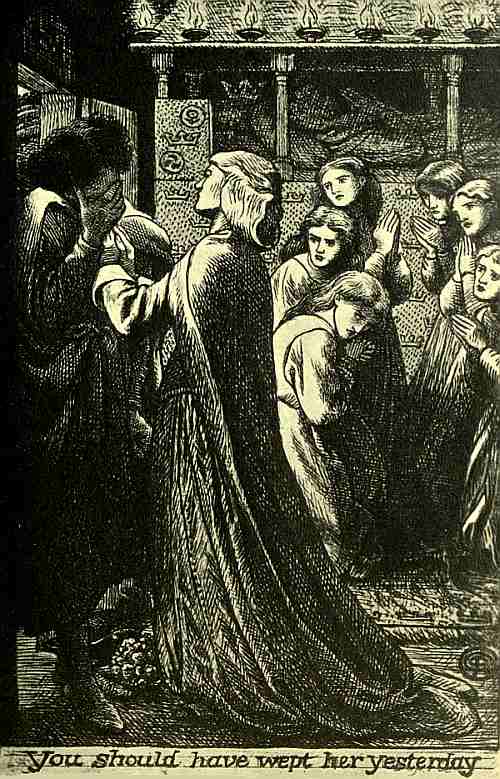
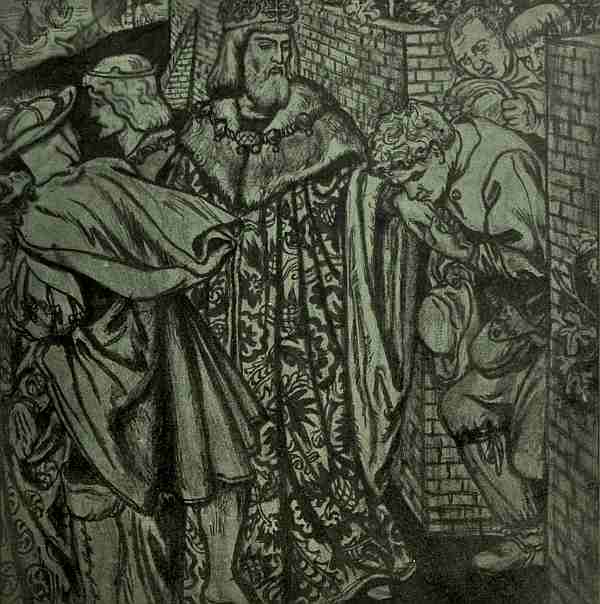
You should have wept her yesterday
was done as an illustration to one of his sister's poems. It represents the return
of the Prince after many delays to find his lady has died, believing him unfaithful.
The ugly drawing of the Prince spoils an otherwise beautiful
design. This ugliness is only compensated for by the six girls
who turn their pitiful eyes so naturally from their prayer to look
towards the Prince. The grace of girlhood in their faces must
come as a revelation to some of Rossetti's critics.
The illustration to Tennyson's "Palace of Art"
should excite us as curious and beautiful. We have in it one great poet's
illustration for another's poem, made with perfect art. We have in this
drawing the echo of the one's imagination in the other. Rossetti
has brought the drawing on to the paper as a dream. An immense
courage is demanded of the artist, when he shall forget his reason for
a dream, and when he has the courage not to reconcile his dream
with the demands of the prosaic mind, demanding only what is
prosaic. The lines illustrated are—
in a clear-wall'd city on the sea,
Near gilded organ-pipes, her hair
Wound with white roses, slept St. Cecily
An angel look'd at her.
The drawing interprets, and it is wonderful that it should
do so, the imaginative mood in which we feel these lines were written.
Like music they bring their message in mystical sound. One accepts
their beauty feverishly. In such a mood as they invite reason greets
imagination. The words do not represent things or a place, but a
mood and an emotion. In them is just such a strange and beautiful
medley as music brings to us, as great art always makes reasonable to us.
One thing we must not forget in criticising Rossetti, and
that is that we are speaking of one who was among the first to enter into
the inheritance of his age, that on these grounds his art is placed
amongst the arts which in every age live by reason of their
significance. Commemorated in Grecian art is the perfected form of
man as the flower of animal evolution. With this perfection attained
another day of creation was begun and is continued, in which
the things of the spirit are being built up until the perfect spirit is
made. And just as it was long before man so far awoke to a knowledge
of the beauty which triumphs in him as to worship his own
shape (placing before himself his own image as the standard to which
the gods had led him, and from which he might not go back without
fear of their displeasure) so not everywhere yet is the spirit of man
learning its own beauty from the consciousness of itself to which it
has attained.
Such art as Rossetti's, with its subordination of everything
to an emotional and spiritual motive, does certainly anticipate, as
other modern work like the sculpture of Rodin anticipates, the
direction in which the greatness of art in the future must tend.
That which is concerned with character, with all that outwardly
gives indication of the soul, has appeared and re-appeared triumphantly
throughout the history of art—a spirit changing its raiment.
The art of Rossetti fails just in so far as its craftsmanship is a
failure, but its imperfections cannot take away its significance.
Christianity made the spirit visible and took serenity from the face
of art. To-day Art is spiritualising itself by its refinements. It is
perfecting itself through such an impressionism of the senses as we
have in the art of Whistler, and through the science of the
impressionists of France. Their subtleties are based on the broad truths
given by masters long ago, and fearful lest any sources of our
inspiration should be forgotten what is modern in art has in turn
assumed almost every antique shape.
An old manner of painting which was great, does not share
its greatness with the modern imitator, but it does not necessarily withhold
it from him. Art may clothe itself in some old style, as
Rossetti's did, and what shape it takes, whether based on the old or
growing out of the new, does not matter when it is the messenger
of inward things.
And since no beauty of bodily form greater than Grecian
beauty is possible to art, that art will be great which betrays the spirit's
flame. The future of life and of art are one. It is inevitable that
art shall be great as the spirit of man grows rich. It is for this that
we have left behind the serenity which was of Greece and of
the partly awakened soul.