Probably the earliest independent work in Arabic Spain to embrace
the whole of medical knowledge of the time is the encyclopedic al-Tasrīf,
written in the late 10th century by Abū al-Qāsim al-Zahrāwī,
also known as Abulcasis. Consisting of 30 treatises, it is
the only known work of al-Zahrāwī and it brought him high prestige
in the western world.
Here we are concerned only with his last treatise, on surgery.
With its many drawings of surgical instruments, intended for the
instruction of apprentices, its descriptions of formulas and medicinal
preparations, and its lucid observations on surgical procedures, this
treatise is perhaps the oldest of its kind.
Scholars today have available a translation of the text and reproductions
of the drawings, but many of the latter are greatly modified
from the originals.
This study reproduces examples of al-Zahrāwī’s original illustrations,
compares some with early drawings based on them, and comments
on passages in the treatise of interest to students of pharmacy
and medical therapy.
The Author: Sami Hamarneh undertook this research into the
history of medicine in connection with his duties as associate curator
of medical sciences in the United States National Museum, Smithsonian
Institution.
 HE INTRODUCTION OF THE WRITINGS
of Abū al-Qāsim Khalaf ibn ʻAbbās
al-Zahrāwī—better known as Abulcasis (d.
ca. 1013)—to Western Europe was through the
Latin translation of his surgical treatise (maqālah)
by Gerard of Cremona (d. 1187).1 The response to
this treatise, thereafter, was much greater than the
attention paid to the surgery of any of the three
renowned physicians of the Eastern Caliphate: al-Rāzī
(Latin, Rhazes, d. ca. 925), the greatest clinician
in Arabic medicine; al-Majūsī (Haly Abbās, d. 994),
the author of the encyclopedic medical work, al-Malakī;2
and Ibn Sīnā (Avicenna, 980-1037), the
author of the famous al-Qānūn fī al-Ṭibb, a codification
of the whole of medical knowledge. Because of the
widespread dissemination of this Latin version in
medieval Europe beginning with the latter part of
the 12th century, al-Zahrāwī attained more prestige
in the West than he did in Arabic Spain, his native
country, or in any other part of the Islamic world.3
HE INTRODUCTION OF THE WRITINGS
of Abū al-Qāsim Khalaf ibn ʻAbbās
al-Zahrāwī—better known as Abulcasis (d.
ca. 1013)—to Western Europe was through the
Latin translation of his surgical treatise (maqālah)
by Gerard of Cremona (d. 1187).1 The response to
this treatise, thereafter, was much greater than the
attention paid to the surgery of any of the three
renowned physicians of the Eastern Caliphate: al-Rāzī
(Latin, Rhazes, d. ca. 925), the greatest clinician
in Arabic medicine; al-Majūsī (Haly Abbās, d. 994),
the author of the encyclopedic medical work, al-Malakī;2
and Ibn Sīnā (Avicenna, 980-1037), the
author of the famous al-Qānūn fī al-Ṭibb, a codification
of the whole of medical knowledge. Because of the
widespread dissemination of this Latin version in
medieval Europe beginning with the latter part of
the 12th century, al-Zahrāwī attained more prestige
in the West than he did in Arabic Spain, his native
country, or in any other part of the Islamic world.3
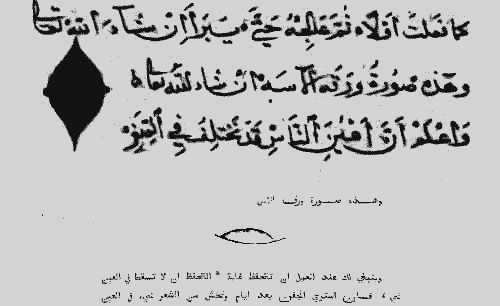
Figure 2.—The myrtle-leaf shape recommended for paper on which medicine is to be
placed for cauterizing eyelid. Top, from original Arabic manuscript (Tüb. MS. 91),
courtesy Universitätsbibliothek Tübingen. Bottom, from Channing, Albucasis
The fame attached to this surgical treatise, the 30th
and last in al-Zahrāwī’s encyclopedic work al-Taṣrīf
Liman ʻAjiza ʻan al-Taʼ līf, is founded on certain merits.
The text is characterized by lucidity, careful description,
and a touch of original observation of the
surgical operations to which the treatise as a whole is
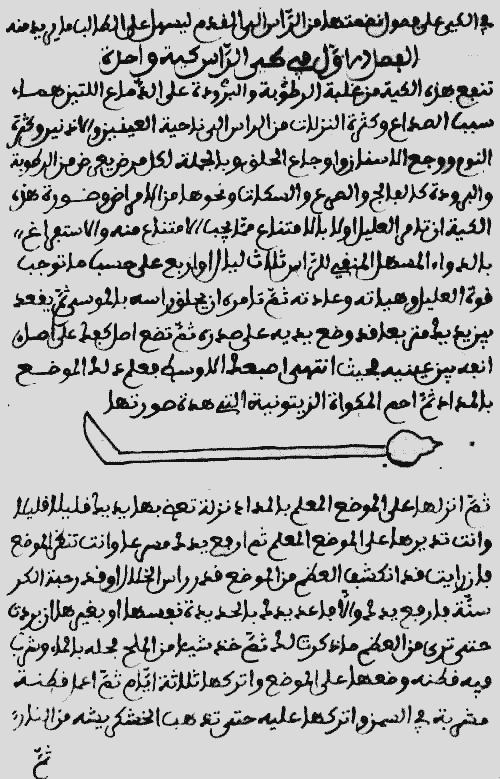
devoted.4 Al-Zahrāwī furnishes his own drawings of
the surgical and dental instruments he used, devised,
or recommended for a more efficient performance.
The illustrations were intended to provide instructional
material for apprentices—whom al-Zahrāwī calls his
children—as well as for the benefit of those who
would read the work later on.5 The treatise is
probably the oldest one known today that contains
such instructive surgical illustrations and text.6
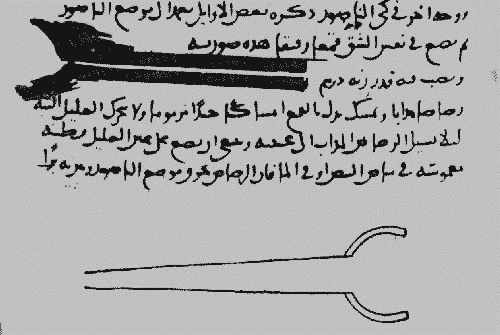
Figure 3.—Small funnel for pouring heated
lead into fistula of the eye for cauterization.
Top, from original Arabic manuscript (Vel.
2491), courtesy Süleymaniye Umumi Kütüphanesi
Müdürlüğü. Bottom, from Sudhoff,
Chirurgie, courtesy National Library of
Medicine.
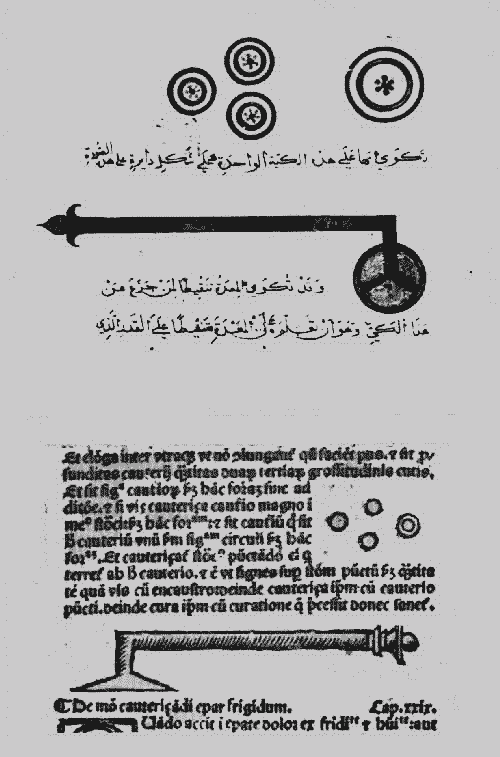
Figure 4.--Circular cauterization in stomach
ailments. Top, from original Arabic manuscript
(Tüb. MS. 91), courtesy Universitätsbibliothek
Tübingen. Bottom, from the
1531 Latin edition of Pietro d’Argellata,
Chirurgia Argellata cum Albucasis, hereinafter
cited as Argellata 1531, courtesy National
Library of Medicine.
This surgical treatise has been investigated, translated,
and commented upon by eminent historians
of medicine and surgery to whose works I shall refer
in this article. However, the pharmaceutic and
therapeutic details of the treatise have been somewhat
overlooked.
As to the various illustrations of the surgical instruments
(over 200 figures in all), an almost complete
representation of samples has been introduced by
Channing,7 Leclerc,8 Gurlt,9 Sudhoff,10 and others.
Nevertheless, a good number of the reproduced
drawings are greatly modified, most likely having been
influenced by earlier illustrations in several Latin and
vernacular versions of the treatise.11 This becomes
clearer on comparison with seven Arabic manuscripts
that have not been fully examined by Western
scholars before and that—in several instances—show
more authentic drawings of al-Zahrāwī’s surgical
instruments than any heretofore published.12
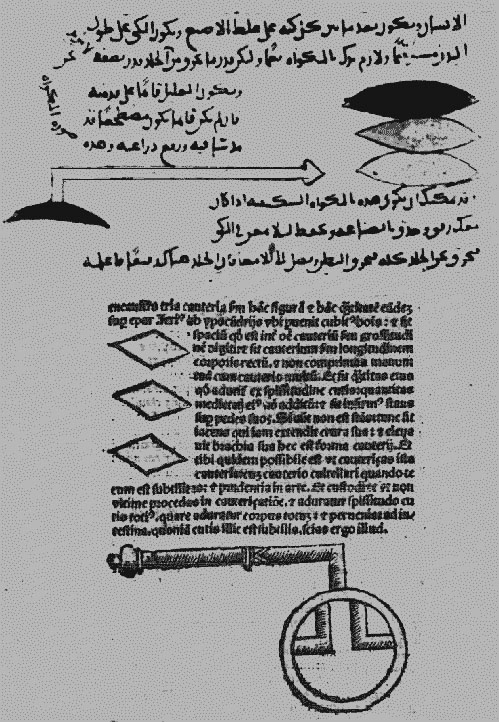
Figure 5.--Ink markings for identifying place
of cauterization. Top, from original Arabic
manuscript (Vel. 2491), courtesy Süleymaniye Umumi Kütüphanesi.
Bottom, from Argellata 1531, courtesy National
Library of Medicine.
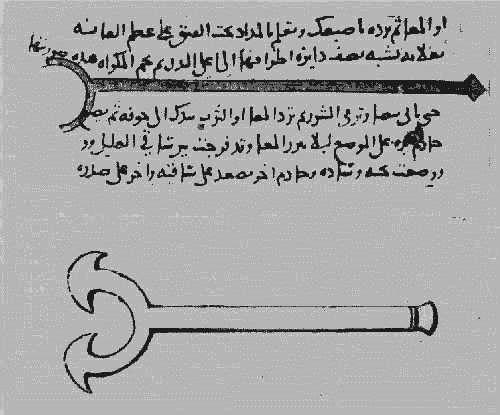
Figure 6.—Cautery in hernia. Top, from
original Arabic manuscript (Vel. 2491),
courtesy Süleymaniye Umumi Kütüphanesi
Müdürlüğü. Bottom, from Leclerc, Albulcasis.
This article therefore, is an attempt to present a
sample of these illustrations with brief comments
regarding certain figures and passages of interest to
pharmacy and medical therapy.
With much gratitude I express my indebtedness to
Prof. G. Folch Jou of Madrid, to Dr. A. Süheyl Ünver
and Mr. H. Dener of Istanbul, and to the librarians of
the depository institutions for their cooperation in the
reproduction of the manuscripts on microfilm.
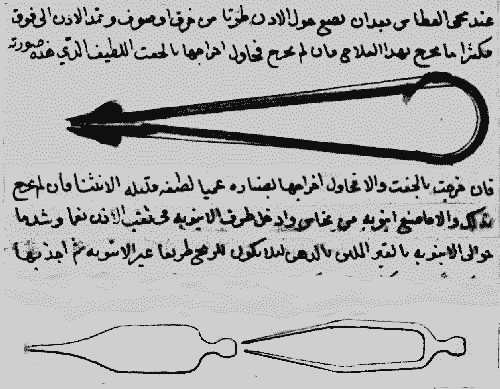
Figure 7.—Fine tweezer for removing foreign
bodies from the ear. Top, from original
Arabic manuscript (Ali 2854), courtesy
Süleymaniye Umumi Kütüphanesi Müdürlüğü.
Bottom, from Leclerc, Abulcasis.
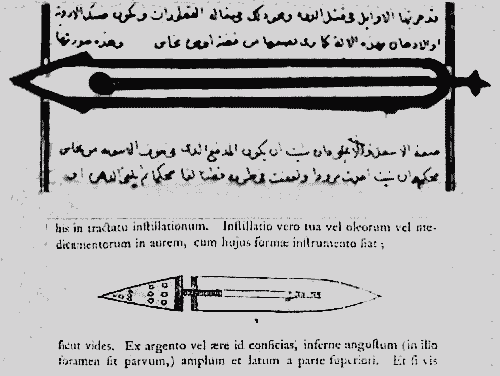
Figure 8.--Syringe with metal plunger-pump.
Top, from original Arabic manuscript
(Ali 2854), courtesy Süleymaniye Umumi Kütüphanesi Müdürlüğü. Bottom, from
Channing, Albucasis.
Al-Zahrāwī frequently introduces his treatises with
brief instructive and sometimes informative preludes.
However, in launching the last treatise of al-Taṣrīf he
expounded in a most interesting and illuminating
manner the status of surgery during his time. He also
explains the reasons that forced him to write on this
topic and why he wished to include, as he did, precautions,
advice, instructional notes, and beautifully
illustrated surgical drawings. For example, the prelude
to the treatise mentions four incidents that he
witnessed, all ending with tragic results because of the
ignorance of physicians who attempted to operate on
patients without the proper training in anatomy and
surgical manipulation. "For if one does not have the
knowledge of anatomy," al-Zahrāwī protests, then
" ... he is apt to fall in errors that lead to death as
I have seen it happen to many."13
Al-Zahrāwī divides his surgical treatise into three
sections (abwāb). In the first section (56 chapters)14
he elaborates upon the uses and disadvantages of
cautery in general. And on the ground that "fire
touches only the ailing part ... without causing
much damage to surrounding area," as caustic medicine
does, he prefers cautery by fire (al-kay bi al-nār)
to cautery by medicine (bi al-dawā).15 This, he adds,
"became clear to us through lifelong experience, diligent
practice, and thorough investigations of facts."16
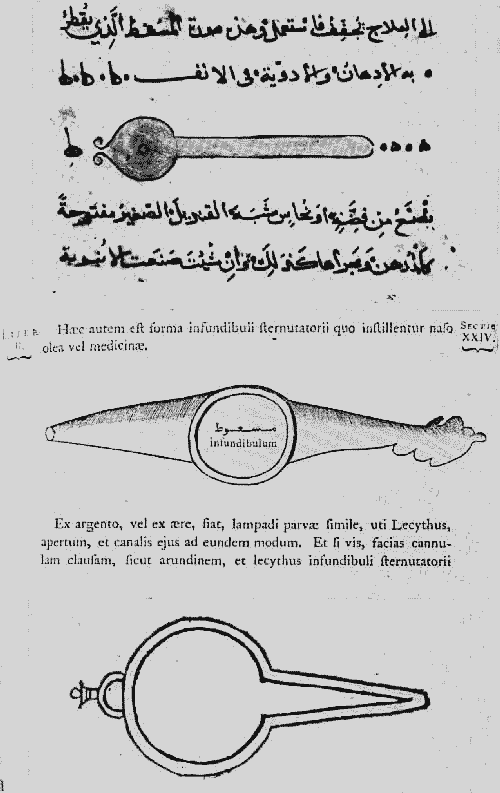
Figure 9.—Metal nose dropper. Top, from
original Arabic manuscript (Tüb. MS. 91),
courtesy Universitätsbibliothek Tübingen.
Middle, from Channing, Albucasis (Smithsonian
photo 46891-C). Bottom, from Sudhoff,
Chirurgie, courtesy National Library of
Medicine.
He also proposes that instruments made of iron are
more practical in many ways than those made of gold,
because often, when gold instruments are put in fire,
they either are not heated enough or are overheated,
causing the gold to melt.
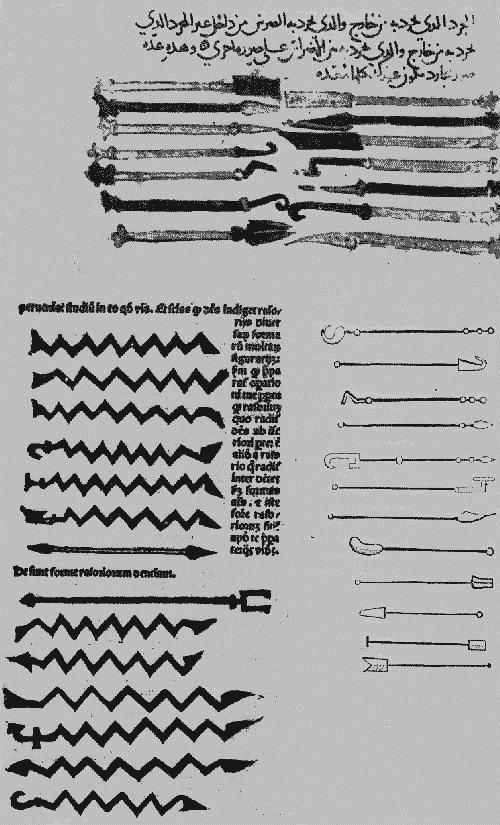
Figure 10.—Dental scrapers. Top, from original
Arabic manuscript (Vel. 2491), courtesy
Süleymaniye Umumi Kütüphanesi Müdürlüğü.
Left, from Argellata 1531, courtesy
National Library of Medicine. Right, from
Channing, Albucasis.
Al-Zahrāwī gently refutes the superstition that
cautery is "good only in springtime," and states that
under the right conditions of the body’s humors it
could be used in all seasons."17 Although he recommends
cautery rather highly, he never minimizes the
importance of treatment by drugs. Actually, he
encourages the use of drugs, before, with, and after
cauterization.18 For example, in chapter 16 on "the
cauterization of eyelid when its hair grows reversedly
into the eye," he recommends treatment by cautery
and by medicine. In cautery, the area where fire is
to be placed is marked with ink in the shape of a
myrtle leaf. In drug treatment, the caustic medicine
is applied to the eyelid over a paper in the shape of a
myrtle leaf (fig. 2).
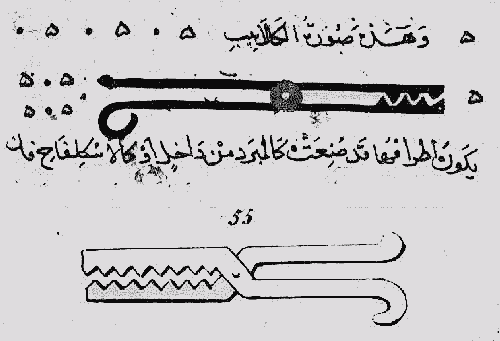
Figure 11.—Dental forceps. Top, from original
Arabic manuscript (Tüb. MS. 91), courtesy
Universitätsbibliothek Tübingen. Bottom,
from Leclerc, Abulcasis.
In chapter 17 the author refers to an ancient method
regarding cautery of the fistula in the inner corner of
the eye. After incising the fistula, one "dirham"
(derived from the Greek "drachma," which is equal
to about 2.97 grams)19 of melted lead is poured into it
through a fine funnel used for cauterization (fig. 3).
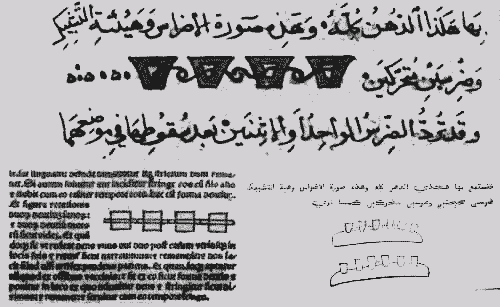
Figure 12.—Golden bridge to stabilize shaky teeth. Top, from original Arabic manuscript
(Tüb. MS. 91), courtesy Universitätsbibliothek Tübingen. Left, from Argellata 1531,
courtesy National Library of Medicine. Right, from Channing, Albucasis.
In like manner, al-Zahrāwī discusses cautery of the
stomach and the "cold liver" in chapters 26 and 27,
respectively. The drawings therein represent shapes
of the burns on the skin (fig. 4) and marks of ink to be
drawn beneath the cartilage of the ribs (fig. 5) for the
purpose of spotting the area of operation. Here also
he describes carefully and clearly the methods of
applying cautery and the types, position, and number
of tools employed in each case. He likewise depicts
(in chapter 45) instruments used in the treatment
of hernia (fig. 6).
The second section (bāb), with about 99 chapters,20
deals with incision, puncturing, venesection, cupping,
surgery on abscesses, and the withdrawal of arrows
from the body. Al-Zahrāwī warns that ignorance in
such operations may lead to damage of an artery or
vein, causing loss of blood "by which life is sustained."21
Moreover, needle and thread (more than
one kind is mentioned) for the stitching of wounds are
repeatedly recommended.
According to al-Zahrāwī, foreign bodies that lodge
in the ear (chapter 6) are of four origins: (1) "mineral
stones" or substances resembling mineral stones
such as iron and glass; (2) plant seeds (chick-peas and
beans); (3) liquids, such as water and vinegar; and (4)
animals, such as fleas. Several instruments are recommended
for the removal of such foreign bodies—fine
tweezers shaped like a dropper (fig. 7), a syringe
with plunger-pump, and a tube made of silver or
copper (fig. 8). Also of interest to pharmacy and
therapy is the advice in regard to the use of lubricants
to be applied before administering these fine instruments
into the body’s cavities.
Chapter 24 is concerned with the treatment of the
polypus that grows in the nose. The various kinds
(including cancer growth), shapes, and colors of this
type tumor and its treatment by surgery or medicine
are described. A hollowed nose-dropper made of
metal in the shape of a small kerosene lamp22 is suggested
(fig. 9). The dropper is held by its handle
while its contents are heated before use. Applying
heat to nose drops was probably proposed because it
serves two purposes: it allows easier flow of the
"duhn," or the fatty substance used, and it raises the
temperature of the drops to that of the body.
In his discussion on dental hygiene,23 al-Zahrāwī
describes scrapers and dental forceps for teeth cleaning
and extraction (figs. 10, 11) and brings in a few points
of historical interest.24 He warns of the common error
of extracting the adjacent healthy tooth instead of the
ailing one due to the patient’s sense deception. For a
gargle he prescribes salt water, vinegar, and wine
(sharāb). To stop hemorrhage he used blue vitriol
(al-zāj)—copper sulfate in our modern terminology.
In chapter 33 al-Zahrāwī discusses bridge-making
for the consolidation of shaky teeth (fig. 12). He
prefers the use of stable gold over silver which, he says,
putrifies and rots in a short time. In a rational approach,
he also suggests that the fallen tooth itself, or
a similar one shaped out of a cow’s bone, be installed
and connected with adjacent, stable teeth by a bridge.
Now, turning to chapter 36, we find al-Zahrāwī
describing a knife-thin tongue depressor (fig. 13) that
he used to facilitate the examination of inflamed
tonsils and other swellings of the throat; it was made
of silver or copper. And in chapter 37 (chapter 34
in Bes. 503), he describes the excision of an inflamed
uvula by surgery. In the same chapter, he also mentions
the use of instruments made of steel. Of
pharmaceutical interest is the following free translation
of the formula he prescribes "as a milder treatment
by fumigation ... to be resorted to only when the
swelling is subsiding":25
Take pennyroyal [Mentha pulegium Linn.], absinthe
[Artemisia maritima Linn.], thyme, rue, hyssop, camomile,
abrotanum [Artemisia abrotanum Linn.], and other similar
herbs. Put all in a casserole and cover them with vinegar.
Then close tightly with clay [lutum-sapientiae]—except for a
small hole in the middle of the cover—and boil. Connect
one end of a hollowed instrument, a crude form of an
inhaler [fig. 14], with the hole in the cover and insert the
other end, which contains the nozzle, into the patient’s
mouth, allowing the vapor to rise up to the uvula. And
if you are not able to secure this instrument, take a straw
and attach its end to an egg-shell. The egg-shell will
prevent burns in the patient’s mouth that might be caused
by the heated vapor.
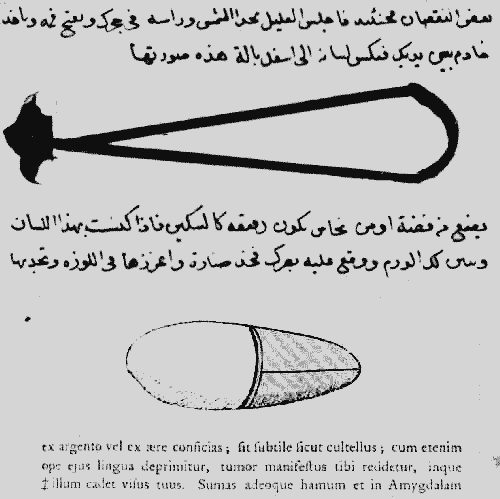
Figure 13.—Metal tongue depressor. Top,
from original Arabic manuscript (Ali 2854),
courtesy Süleymaniye Umumi Kütüphanesi
Müdürlüğü. Bottom, from Channing, Albucasis.
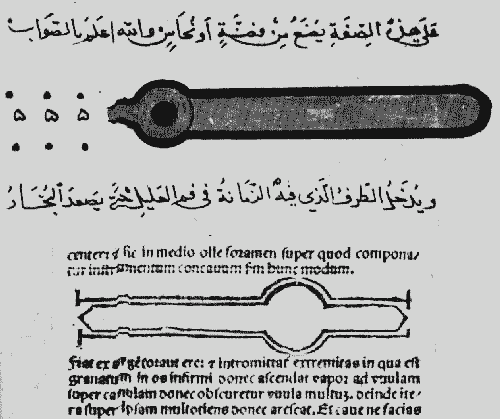
Figure 14.—Crude form of an inhaler. Top,
from original Arabic manuscript (Tüb. MS.
91), courtesy Universitätsbibliothek Tübingen.
Bottom, from Argellata 1531, courtesy
National Library of Medicine.
Al-Zahrāwī repeats in chapter 53, on cancer, what
Greek physicians had said earlier, that cancer could
be removed by surgery only at its first stage and when
found in a removable part of the body, such as the
breast. Therefore, he confesses that neither he nor
any one else he knew of ever applied surgery with
success on advanced cancer.26
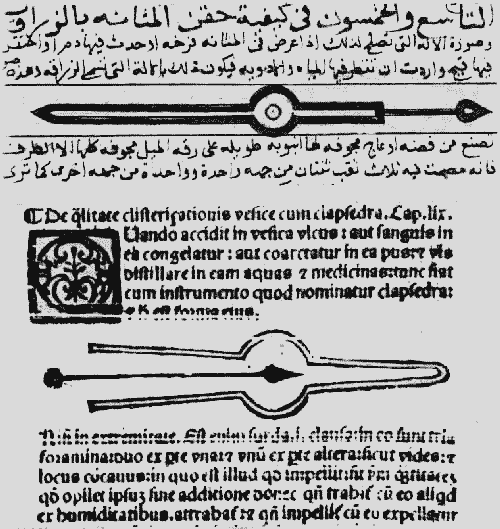
Figure 15.--Metallic syringe for injecting solutions
into the bladder. Top, from original
Arabic manuscript (Bes. 503), courtesy
Süleymaniye Umumi Kütüphanesi Müdürlüğü.
Bottom, from Argellata 1531, courtesy
National Library of Medicine.
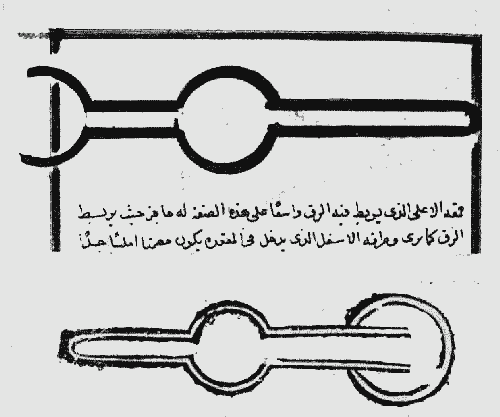
Figure 16.—Metallic or porcelain syringes for
injection of enemas. Top, from original
Arabic manuscript (Ali 2854), courtesy
Süleymaniye Umumi Kütüphanesi Müdürlüğü.
Bottom, from Argellata 1531, courtesy
National Library of Medicine.
Of special interest in chapter 59 is the metallic
"syringe" (fig. 15) used to inject medicinal solutions
into the bladder: "The hollow passage [of the syringe]
should be exactly equal to the plunger it contains and
no more, so that when such fluids from an excess of
humors are aspirated they will be drawn out, and
likewise when the solutions are injected they will be
pushed in easily." Such description of the use of a
"bladder syringe" in the late 10th century clearly
points to the practical and interesting approach to
surgery in al-Taṣrīf. Moreover, his description of the
removal of a stone from the bladder—an operation
we now call lithotomy—is considered a contribution
to bladder surgery.
One of the earliest recorded operations for the
extractions of two dead fetuses from the womb is
clearly described in chapter 76. The account of this
case shows not only al-Zahrāwī’s intelligent approach
as a shrewd observer but also his clinical and surgical
ability.
Drawings of bulb-syringe instruments used for administering
enemas in ailments of the rectum and for
the treatment of diarrhea and colic are depicted in
chapter 83. The text describes several kinds of
syringes made of silver, porcelain, and copper in
various sizes (fig. 16). Of particular interest is an
illustration of a syringe, especially recommended for
children, to which a piece of leather (jildah) is
attached (fig. 17). This instrument is a precursor of
our modern bulb syringe.
In chapter 84 al-Zahrāwī turns to the treatment
of various wounds. He prescribes the following
powder formula for use: "Take olibanum [frankincense]
and dragon’s blood,27 two parts of each, and
three parts of slaked or unslaked lime. Pound them
well, pass through a sieve and apply the powder to
the wound." In cases of damaged blood vessels, he
tied the arteries by ligature, a practice of which he
was a pioneer. In another chapter he describes four
methods for suturing the intestines.
Al-Zahrāwī, being associated with war casualties
and writing his treatise about the end of the 10th
century, no doubt had the experience of dealing with
cases involving injuries caused by arrows. The text
in chapter 94 discloses his observations in elaborate
investigations regarding the extraction of various kinds
of arrows from the body.28 Accordingly, several kinds
of hooks and forceps for removing arrows are described
and depicted in the treatise (see fig. 18). Al-Zahrāwī’s
mention of Turkish bows and arrows led Freind to
believe, erroneously, that the author of the treatise
must have lived in the 12th century,29 notwithstanding
the fact that Turkish bows and arrows were in common
use in the latter part of the 10th century.
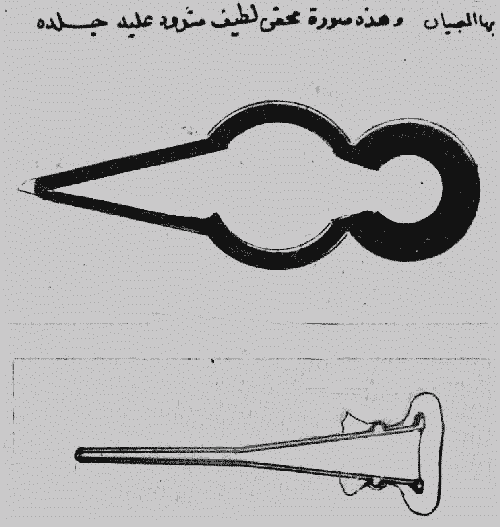
Figure 17.—A crude form of bulb syringe
recommended for use with children. Top,
from original Arabic manuscript (Ali 2854),
courtesy Süleymaniye Umumi Kütüphanesi
Müdürlüğü. Bottom, from Leclerc, Abulcasis.
The next chapter, on cupping, mentions the use of
cups made of horns, wood, copper, or glass, according
to circumstances and the availability of material.
The methods of treatment are divided into two kinds:
dry cupping, with or without fire, and wet cupping
(see fig. 19). He prescribes ointments and aromatic
and medicated waters to be applied before and after
cupping to facilitate healing. Only when cupping is
not possible, as on the nose, fingers, and similar parts
of the human body, does he propose the use of
leeches for treatment.30 Evidently this is an indication
that he did not, as generally supposed, encourage
the widespread use of leeches.
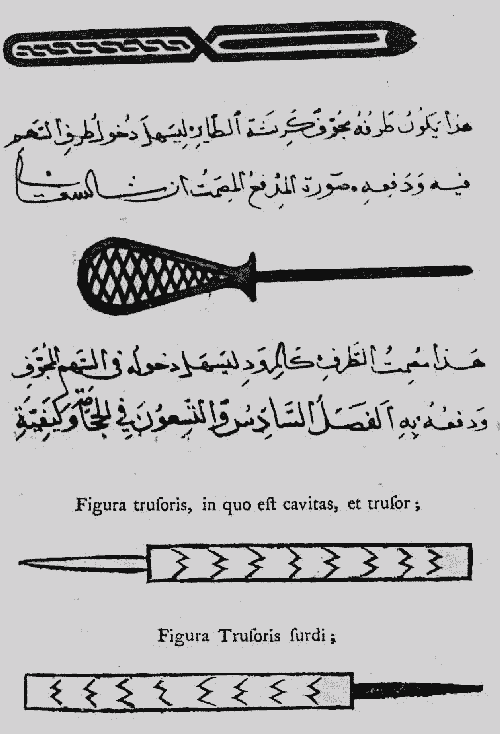
Figure 18.—Hooks and forceps used for the
extraction of arrows. Top, from original
Arabic manuscript (Tüb. MS. 91), courtesy
Universitätsbibliothek Tübingen. Bottom,
from Channing, Albucasis.
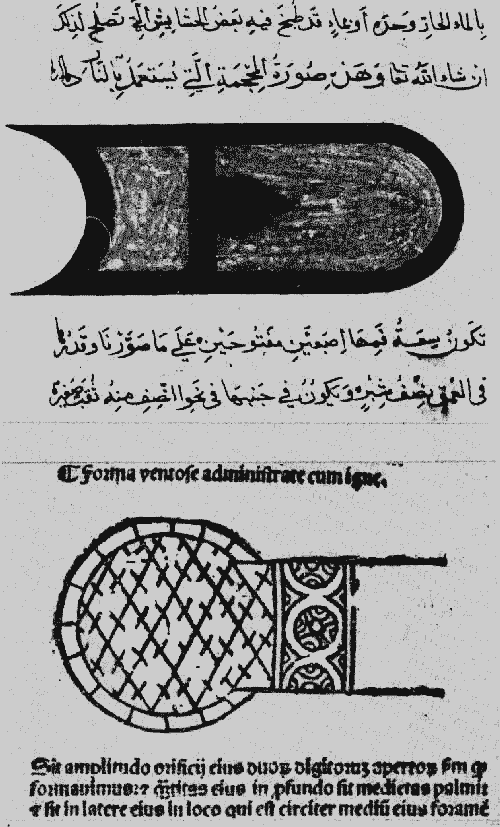
Figure 19.—Cupping. Top, from original
Arabic manuscript (Tüb. MS. 91), courtesy
Universitätsbibliothek Tübingen. Bottom,
from Argellata 1531, courtesy National
Library of Medicine.
The third and final section, of 35 chapters, deals
with the reduction, luxation, and treatment of injured
bones, including fracture of the pelvis. The advices
and warnings in the prelude of this section appear to
repeat some of al-Zahrāwī’s sayings that had been
covered in his previous introductions. The text, however,
presents many facets of interest to the health
professions. It elaborates upon the application of
various forms of bandages and plasters in a variety
of operations. Al-Zahrāwī’s detailed description relating
to fractures of bones is a fine anatomical
document of historical interest. He illustrates and
describes special methods for tying injured or broken
bones, and he suggests that bandages made of soft
linen be less and less tight as distance increases from
the injured place (chapter 1). For the protection of
areas adjacent to the injured part against contact
with edges of splints he advocates padding with soft
gauze and carded wool. In some cases, to guard
against swelling, he preferred a delay of one or more
days in applying bandages over splints. Al-Zahrāwī
also devised and depicted many kinds and shapes of
splints for use in simple and compound fractures of
the head, shoulders, arms, fingers, etc. (see fig. 20).
For example, in discussing the reduction of the
humerus, he recommends a splint consisting of a
smooth, thin stick bent in the shape of a bow
with two strings, each attached to one end of
the stick (fig. 21). The injured bone is then placed
in the middle of the bent splint for reduction while
the patient is seated on a chair. Tying is applied
only when there is no "hot" swelling (chapter 11).
One of the remarkable observations made in this section
is the description of the paralysis caused by fracture
of the spine.
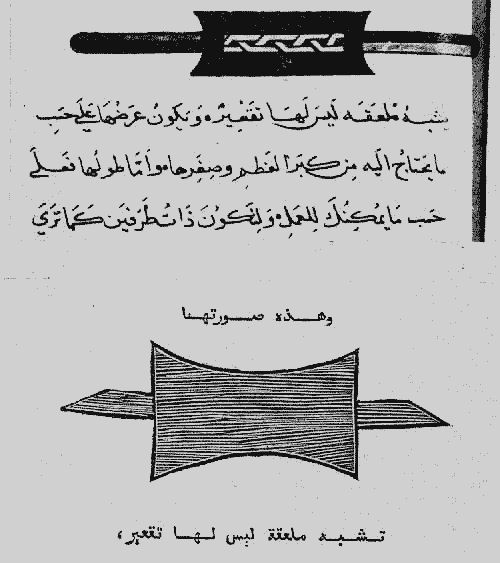
Figure 20.—Splint "in the shape of a spoon
without a bowl." Top, from original Arabic
manuscript (Tüb. MS. 91), courtesy Universitätsbibliothek
Tübingen. Bottom, from
Channing, Albucasis.
Of interest to historians of medical therapy and pharmacy
are the recipes for poultices that al-Zahrāwī
recommends for use over fractured bones. For example,
he gives the following recipe for one such
poultice: "Take the so-called 'mill’s dust' [ghubār
al-rahā], which is the part of the wheat flour that
clings to the walls of the mill during grinding [lubāb
al-daqīq], and, without sifting away the bran, knead
with white-of-egg to a medium consistency, and
apply." Another, more elaborate, recipe calls for
10 dirhams each of the roots of wild pomegranate
[Glossostemon bruguieri D.C.], chickling vetch [the grass
pea, Lathymus sativus], and white marshmallow; 5
dirhams each of myrrh and aloes; 6 dirhams of white
gum Arabic [Acacia]; and 20 dirhams of bole [friable
earthy clay consisting largely of hydrous silicates of
aluminum and magnesium, usually colored red
because of impurities of iron oxide]. Procedure was
to pound all ingredients gently, pass them through
a sieve, and knead with water or white-of-egg (chapter
1).
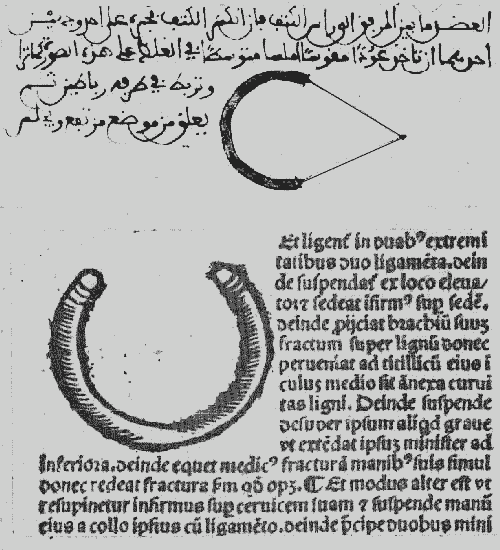
Figure 21.—A splint to support the arm.
Top, from original Arabic manuscript (Cod.
N.F. 476A), courtesy Oesterreichische Nationalbibliothek.
Bottom, from Argellata
1531, courtesy National Library of Medicine.
The question arises as to whether al-Zahrāwī did
any human dissection. The answer is uncertain because
our knowledge of his life is fragmentary. However,
he gives no clue to the dissection of humans in
any of the 30 treatises of al-Taṣrīf—his only known
writings—and there is no evidence that he practiced
it in secret. His upright attitude as a Muslim who
repeatedly emphasized his adherence to his faith suggests
that he relied completely on animal dissection
and the writings of his Greek-Roman and Islamic
predecessors. Physicians in both the Islamic domain
and in Christendom for many centuries were hostile
to the idea of human dissection for any purpose because
of their traditional socio-religious convictions,
considering it an unethical and undignified practice.
Perhaps it has been al-Zahrāwī’s original contributions
to surgery, his enthusiasm in emphasizing the
value of anatomical knowledge, and his recognition of
the necessity that only well-educated, well-trained
doctors should perform surgery that have led some
medical historians to wonder whether he did human
dissection at some time in his long years of experience.
In Summary
The few examples of illustrations of surgical instruments
given here indicate that the Arabic manuscripts,
in general, have preserved the original, oriental,
artistic features of the drawings in a way that has been
overlooked in Latin and vernacular versions of
al-Taṣrīf.
In presenting his personal observations and original
ideas on surgery late in life, al-Zahrāwī, for the most
part, was inspired by a thorough acquaintance with
Greek and Arabic medical literature supplemented
by lifelong intelligent observation and experience.
Through its descriptions and illustrations, the surgical
treatise of al-Zahrāwī very likely played a
significant role in the designing of improved surgical
instruments in the Middle Ages. Also, the treatise no
doubt promoted the development of improved surgical
techniques in Islam and, through its translations,
promoted these techniques to an even greater extent
in the West, a fact that justifies the fame of this
treatise as the highest expression of the development
of surgery in Arabic Spain—a treatise whose influence
continued to the Renaissance. It contributed in no
small measure to the idea of equipping learned and
well-trained surgeons with the best surgical tools and
techniques of the time; moreover, it encouraged the
invention of new instruments to meet differing circumstances
and special conditions. These tools no
doubt greatly facilitated the work of the surgeon.
Throughout the text of al-Taṣrīf al-Zahrāwī gave
careful attention to the importance of pharmaceutical
preparations in the healing art, including cases
requiring surgery.
U.S. GOVERNMENT PRINTING OFFICE: 1961
For sale by the Superintendent of Documents, U.S. Government Printing Office
Washington 25, D. C.—Price 20 cents