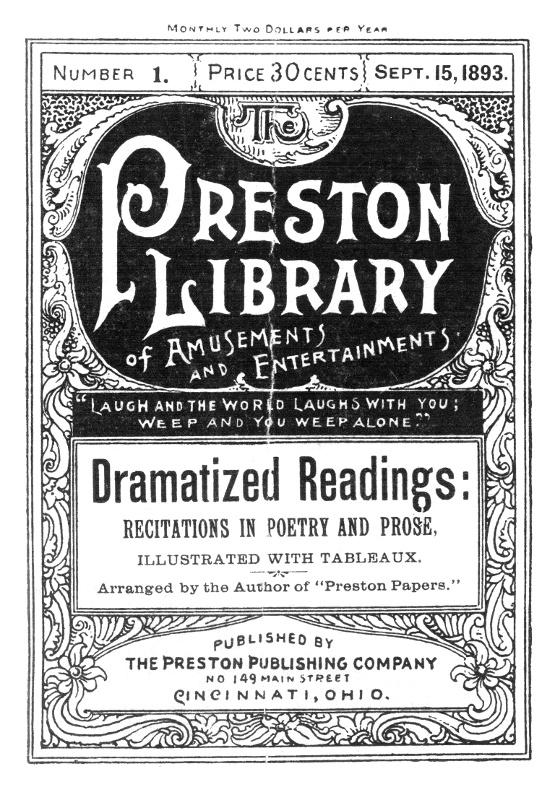
Dramatized Reading: recitations in poetry and prose
Whole book · 8 sections
Dramatized Readings : RECITATIONS IN POETRY AND PROSE,
Transcriber’s Note:
Footnotes have been collected at the end of each chapter, and are
linked for ease of reference.
Minor errors, attributable to the printer, have been corrected. Please
see the transcriber’s note at the end of this text
for details regarding the handling of any textual issues encountered
during its preparation.
The cover image has been created, based on title page information, and
is added to the public domain.
I
Monthly Two Dollars per Year
Number 1.Price 30 centsSept. 15, 1893.
The Preston Library of Amusements and Entertainments
“Laugh and the world Laughs with you; Weep and you weep alone.”
Dramatized Readings: RECITATIONS IN POETRY AND PROSE, ILLUSTRATED WITH TABLEAUX.
Arranged by the Author of “Preston Papers.”
PUBLISHED BY THE PRESTON PUBLISHING COMPANY NO 149 MAIN STREET CINCINNATI, OHIO.
Preston Library No. 2,
(ISSUED OCT. 15, 1893.)
Life Studies from Mother Goose,
In Wax Works, Pantomimes, Plays,
Songs and Tableaux.
ARRANGED BY THE AUTHOR OF “PRESTON PAPERS.”
Adapted to a variety of places and purposes, and arranged
for different grades of talent, with complete directions for
staging, costumes, etc.
Preston Library No. 3,
(ISSUED NOV. 15, 1893.)
A CHRISTMAS
NUMBER,
and will provide a number of entirely original entertainments
for the Christmas Holidays.
SUBSCRIPTIONS RECEIVED AT ANY TIME.
PRESTON LIBRARY No. 1.
Illustrated with Tableaux.
ARRANGED BY THE AUTHOR OF “PRESTON PAPERS.”
CINCINNATI:
THE PRESTON PUBLISHING COMPANY.
1893.
Copyright 1893.
GENERAL SUGGESTIONS.
3
In preparing tableaux to illustrate a song, poem or prose
reading or recitation, the manager will find that success depends
largely upon promptness. This requires a thorough
knowledge of the part to be rendered, as well as of the places
in the reading where tableaux are to be shown, and of the
characters and stage settings for each picture.
A full dress rehearsal is indispensable, as many points--insignificant
of themselves--will come up for adjustment that
cannot be decided upon at the last minute; and although of
itself trivial, the pose or expression of a single character, the
misplacing of an article of furniture or ornament, the draping
of a costume, etc., will help make or mar a beautiful picture.
A stage manager who will see to all these details and provide
himself with intelligent assistants who will quietly “set”
the stage for one picture and clear it for the next, behind the
curtain, in such a manner as not to interrupt the reader in
front of it, nor take the attention of the audience, is equally
necessary.
Absolute quiet behind the curtain must be insisted upon,
and the “characters” not allowed to make it a place for
social reunion between the parts.
Two dressing rooms are necessary, even if the characters
are all of one sex--as things can be more easily arranged with
but few to disturb them.
4All persons not needed behind the curtain must be excluded,
as their presence only tends to confusion and delay.
The assistants who manage the furniture and other stage
accessories, must know just what is required for each tableau,
and when--and have those near at hand that are first needed,
storing at the greatest distance those not again required, when
clearing the stage.
The tableaux should be numbered, and the requisites for
each listed, and a copy given to the stage director and assistants,
for their reference and to avoid mistakes and delay.
Look out for the curtain. At the last moment it has sometimes
been found that the curtain would not work, or that those
appointed to manipulate it did not understand its mechanics,
and great embarrassment has resulted. A signal must be determined
upon, between the reader and the stage manager,
that the curtain may rise at the point proper to illustrate what
has just been read--not what will follow.
Should there be a lack of side screens, these may be supplied
by covering ordinary clothes-horses with cambric, cotton,
or cotton flannel, having due regard to the costumes and figures
to be shown. A dark back and side for a picture all
light and brightness (as a fairy or wedding scene), and light
if the picture is a darker one. Judgment here is valuable.
DIRECTIONS.
5
Having selected the poem or story you wish to present,
make choice of your reader. Get some one who reads naturally
and distinctly. The tableaux take away all necessity
for dramatic action on the part of the reader--if any ever existed--and
the entire attention may be devoted to bringing
out the thought of the author.
The reader should practice in the room where the entertainment
is to be given, at least enough to be sure of its acoustic
properties and so secure the right pitch of voice,--height
and size of room, as well as shape and furnishings, making
a great difference.
The reading must be given in front of the closed curtain,
that the manager may be having the stage prepared for each
succeeding tableau, that it may be presented promptly when
desired.
Ordinarily tableaux should he shown twice, as few in the
audience get more than a glimpse of what they want to see in
detail. If elaborate, even a third showing is always acceptable,
and as the picture is already arranged it requires but
little time, and is better than one long period of showing it.
In making up, use as simple materials as possible; scorched
flour for darkening the skin, corn starch for white powder,
an ordinary soft lead pencil for outlining eyebrows, etc.
Dark wigs may be made of curled hair (such as is used for
6mattresses) sewed to a cambric “skull” fitted to the head for
which it is intended; white ones of cotton batting sewed on in
tufts to represent short curls; mustache, whiskers, etc., may
be manufactured from coarse linen thread attached to a bit of
cloth which again has to be “stuck on” by means of mucilage,
court plaster or white of egg.
Foot-lights are essential for tableaux, and if not supplied, a
row of small hand lamps at the front edge of platform is easily
procured. Candles are good also--but not quite so safe.
Shades for either may be made of old tin cans, all the seams
unsoldered, top and bottom removed, the tin being turned
toward the audience, and throwing the light on the picture.
Shade must at least be as high as the blaze. Wings are as
difficult to make seem natural as anything, and yet should be
easily made and adjusted, by first cutting a pattern of the desired
shape and length; cut the wings from cotton flannel, nap
running from shoulder to tip; sew stiff bonnet wire around
the edges, being sure to make a pretty shape and not too small;
set them on a piece of cloth three by six inches, also wired.
Wings must not be stiff enough to be awkward, nor limp
enough to be troublesome; if the latter, additional wiring,
lengthwise diagonally, will correct it--and if the cloth is too
light in texture it may be used double.
THE BIRTH OF THE IVY.
7
Illustrated with Ten Tableaux, especially arranged for this Publication.
Characters:--“A Ladye of High Degree”; Her Knight; Her
Page; Peasants.
Costumes:--In the first two tableaux the Ladye wears any elegant
dress that is sufficiently antique, and which can be put on over the
white one used in the third and fourth. In the fifth a hat and mantle
may be used to change the appearance, but little time being given
between the changes of scene; a plain dark gown in the sixth and
seventh, over which may be draped something brilliant for the eighth;
in the ninth a white or light colored wrapper or simple house dress.
In the second tableau the Knight first appears--and in ordinary
dress; in the next in full military costume, as also in the fifth, his
“last appearance.”
The Page, who should be a handsome boy of from seven to twelve
years old, wears dark blouse waist, dark knee pants, sash of brilliant
color, deep lace ruffles at wrist, broad round collar of same, low shoes
with high heels; black velvet cap with plume; velvet cape with
bright lining for last tableau.
Peasant women’s dress--short, scant skirt of any bright color;
plain, round short sleeved; bodice of same or harmonious contrasting
color. If an old woman is shown in group, she may wear cap and
kerchief of white, the latter voluminous and crossed over chest.
1. Drawing room scene. Ladye Clare stands in foreground. Furniture should be as elegant as possible.
2. Ladye Clare at left of center, in easy chair; Knight half kneels in front of her; both side-face to audience; Ladye’s hand extended to Knight, who is in the act of raising it to his lips.
3. Ladye stands at right of center, head erect, Knight again kneeling--but in reverse position.
4. Ladye in center, sitting with head bowed on center table, over which her arms are thrown.
5. Ladye at left, half way back on stage; Knight entering with long strides from left of foreground, each looking intently at the other.
6. “Ladye’s bower.” Couch at left, with handsome cushions and spread; vases filled with flowers, bric-a-brac, pictures, etc., adapted to a young lady’s room. Ladye Clare in easy chair at right; handkerchief pressed to her eyes by right hand, while left falls over arm of chair.
7. Same scene--Page entered back of couch, in listening attitude, cap held in hand in front of him, facing Ladye, who waves him away with right arm, hope in her face.
8. Same scene.--Ladye sits on couch; Page stands in center front, with head down, cap held behind him--in full view of audience.
9. Ladye on couch, half reclining, white spread thrown over her; hair hanging loosely (face should be powdered); expression of disappointment; Page stands at entrance, reluctant to intrude or to give his message.
10. Grave in center of foreground, covered with green vines and cut flowers. Peasants at either end, and in background. Stones (boards covered with white paper) may be placed at head and foot of grave.
CALLAGHAN’S FAILURE. — MATRIMONIAL PHILOSOPHY. — THE OPENING OF THE PIANO. — DEAR OLD GRANDMOTHER. — ANSWERING AN ADVERTISEMENT. — THE BRIDAL VEIL — JIMMY BROWN’S SISTER’S WEDDING — STRONG COFFEE. — “IF.” — THE WASHER-WOMAN’S SONG. — THE SMALL BOY’S EXPLANATION. — LOOKING BACKWARD.
13
by Thomas Winthrop Hall.
Mr. Callaghan was busily engaged in an inspection of silverware
that seemed to interest him exceedingly. He examined
each object carefully, often stopping long enough to test
the particular object with his teeth, or even to bend it. At
the same time his actions were quiet, and, one might say,
reserved. He did not appear to care to be noticed.[1]
He was a rather tall young fellow, carelessly dressed, as
they say in novels, and he had a pale face, like a student’s.
One might, indeed, have thought him a poor student, were it
not for his eyes, which, instead of looking tired and dreamy,
like a student’s, were exceedingly active and restless. On
the whole, his face and his general appearance were not pre-possessing.
Indeed, the policeman on the beat most frequented
by Mr. Callaghan in social life, reported him at the Precinct
House as “a general tough--suspicious.”
Mr. Callaghan, although very young, had already learned
the value of exceeding caution. Hence, he was almost noiseless;
and he inspected the silverware in the very mild light of
a half-opened dark lantern. A happy smile played around
the corners of his face for a while, for the silverware he was
examining proved to be of the finest and newest, and bore
the monogram of a famous New York family. For that
matter, the entire surroundings of Mr. Callaghan, at that time,
were of the richest. The very sideboard at which he labored
was worth a small fortune, and the cut glass upon it looked
very beautiful in the mellow light. There were rich red tints
14in some of the glassware, occasioned by their contents, but
Mr. Callaghan did not stop to examine them. He did not believe
in drinking during business hours. The time was something
after midnight.
Mr. Callaghan was aroused from his pre-occupation by a
faint click. It sounded very much like the click of the trigger,
as a revolver is cocked. ’Twas a trifle startling, but he
did not lose his presence of mind. He faced around like a
flash, and turned off the rays of his dark lantern. He knew
it was almost useless to take the latter precaution, however,
for he was well informed, and knew that, in the houses of the
rich of to-day, it required but the pressure of a button to turn
on a full stream of electric lights throughout an entire floor.
The sudden burst of light came, just as he expected it would,
and as it did so, he heard a voice say “Don’t dare to move!”
He was more startled by the voice than he was by the sudden
glare of electric light, for it was the voice of a young
girl!! Mr. Callaghan blinked a few times, took a good look,
and then his thin face broadened a trifle into a smile. At
the other end of the room stood a very pale but resolute girl
in a pink wrapper. She held a little gold-mounted revolver,
of a calibre so small that Mr. CallaghanCallaghan but for his natural
politeness, would have laughed at it outright, and she was biting
her lip, for she was apparently rather nervous. The revolver
was pointed in Mr. Callaghan’sCallaghan’s direction, but alas! the
hand that held it was shaking very perceptibly[2]....
Callaghan grinned. “Isn’t it rather late for you to be
out?” he asked her.
15“Don’t dare to move,” she replied; “I know precisely
what to do. Papa told me before he went away. I’m going
to sound the burglar alarm and have you arrested; then you
will be sent to State’s Prison.”
“Well,” almost laughed Mr. Callaghan, “why don’t you
do it? I’m waiting.”
“Because,” she answered, hesitatingly,--“because you’re
standing in front of it.”
“Oh, am I?” answered Callaghan. “Then I’ll move away,
I always like to be polite to ladies.” He moved away a few
steps. She frowned a little bit. Then she said “Excuse me.
Will you please move a little further away?” “Certainly,” he
replied, “anything to oblige a real lady.”
She stepped toward the alarm, which Callaghan had not,
until then, perceived, and stretched forth her hand.[3]
She was about to turn the little handle, when Callaghan
said hastily: “Hold on a minute. Do you think that would
be a nice thing to do?”
“Of course it would,” she answered.
“Just think about it a moment,” Callaghan continued; “if
you did that, I’d be arrested, and sent up for fifteen or twenty
years. Fifteen or twenty years, in a little cell, all by myself,
with no one to talk to and nothing to do--except break
stones for my health. Now, I don’t care anything about it
myself, of course; I havn’t done you any wrong. I havn’t got
away with the silver, and therefore, there isn’t any wrong done
you, is there? I tried to, but you’ve got the best of me, and
you’re an awfully brave little girl to do it, too. But just think of
16yourself during the next fifteen or twenty years, if you have
me sent up. Every day you’ll be thinking about the poor
fellow who’s doing time because you made him; and every
night you’ll be lying awake, crying, because you made him
suffer so much, for such a little thing; and every time the
minister in your church says anything about forgiving your
enemies, you’ll be thinking he means you; and,”
She broke in “I think I’ll let you go.” She said it very
earnestly.
Callaghan laughed aloud. “That’s right,” he said, “I knew
you would, for I knew you were a lady the minute I saw you.
I didn’t mean what I said. Probably in a month you’d forget
all about me. No one remembers a fellow who’s doing time,
but the police and the detectives. I was just trying an experiment.
Do you think I was afraid you’d call the police?
Nonsense. Do you think I was afraid of your little revolver?
Nonsense. I’ve been shot twice by real revolvers. If you’d
tried to sound the burglar alarm, do you know what I’d have
done? I’d have made a quick jump for you and I’d have my
hands about your throat before you could have winked. If
you’d fired the revolver, you’d missed me. Girls can’t shoot.”
He said this last almost contemptuously, but he was sorry a
moment after, for he noticed that she was growing very white,
and very frightened too. Nevertheless, he continued: “And
after I’d got my hands about your neck, and you couldn’t
scream or struggle or shoot, what do you suppose I’d have
done?”
She did not reply. She could not speak. She was trembling
17violently. “I’d have--I’d--,” he was embarrassed, and
he actually blushed,--Callaghan blushed--“I’d have kissed
you,” he said with an effort, “and then I’d have gone away.
But you needn’t look frightened any longer. I ain’t going to
hurt you, and I ain’t going to kiss you; for some day you’d be
ashamed of it. You’d be ashamed to tell your sweetheart that
Rocky Callaghan kissed you; and I ain’t goin’ to take any thing
that belongs to this house, although I could, right before your
eyes. I’m just going home peaceably.”
He started to walk toward the window by which he had
entered.[4] As he did so, however, he looked at her critically,
stopped, and said: “You’re going to hold out just about
till I’m gone. Then you are going to faint. I can’t leave
you here alone in a faint. I’ll fix it.”
He walked deliberately to the sideboard and poured out a
glass of ice-water. “Here,” said he, “drink this, and then
go upstairs as quick as you can. I’ll lock the window after I
go out.”[5]
She took the water with a frightened “Thank you,” and
drank it. Mr. Callaghan turned to leave. “That brings the
red back in your cheeks,” he said.... “Now, I’m going,
but I want you to remember that I’m not afraid of the burglar
alarm nor of your little revolver. I’m not going to rob you
because--because you’re so brave and because you’re so pretty.
I sort of hate to make a failure of a job, and I guess the boys
will guy me a bit for it; but you are too pretty.” Saying
which, Mr. Callaghan climbed nimbly through the window
and disappeared.
18TABLEAUX.
1. Dining-room scene, very scant light. Silverware on table, on which sits half-opened dark lantern; side-board in background; burglar behind table in center, faces audience while examining silverware, face lighted by lantern. (Face may be darkened by scorched flour.)
2. Same scene, brilliantly lighted, with burglar at left end of table; girl in pink wrapper at right end of room, hair down and arm extended holding toy pistol or revolver. (Face powdered white.)
3. Same as second. Girl moved a little to right with arm reached toward burglar alarm.
4. Burglar turned facing girl, back half turned to audience.
5. Burglar passing water, which girl has stretched hand to receive.
[With Moving Tableaux Arranged for this Publication.]
There were lovers three in the days gone by,
They were healthy, they were wealthy, yet they’d sit and sigh,
Sit and sigh till the window curtains shook,
And all for the sake of a sweet maid’s look.
For they loved her one, and two, and three,
And each one prayed her his bride to be;
Till she cried, “Ah, no, you must surely see,
If I don’t love one that I can’t love three.”
Three sad men, but they loved enough for ten,
And they sighed enough for twenty, these sad young men.[1]
19Then these lovers three in the days gone by,
In their anguish did they languish, and they longed to die.[2]
And they laughed enough for twenty, these wise young men.[6]
TABLEAUX.
1. Parlor scene, with lady on one side of the room, the lovers in waiting--each in turn approaching and being rejected, retire to a seat to “sit and sigh.”
2. Shows the young men only; having changed their positions they are doing a general “languishing” business.
3. The young lady in center of foreground receives suitor No. 4, who comes on “bended knee.”
20
4. Shows the first three young men in center of front, hands in pockets--frowning and scowling.
5. Shows husband and wife at left end of stage quarreling--young men at right in attitudes of interest, watching the couple.
6. The three young men in center, front of stage, one smiling, the other two laughing.
Oliver W. Holmes.
(With Tableaux.)
In the little southern parlor of the house you may have seen,
With the gambrel roof, and the gable looking toward the green,
At the side towards the sunset with the window on the right,
Stood the London-made piano I am dreaming of to-night.[1]
Ah me! how I remember the evening when it came,
What a cry of eager voices, what a group of cheeks in flame.
When the wondrous box was opened that had come from over seas,
With its smell of mastic, and its flash of ivory keys.[2]
Then the children all grew fretful in the restlessness of joy;
For the boy would push his sister and the sister crowd the boy,[3]
Till the father asked for quiet in the grave, paternal way,
But the mother hushed the tumult, with the words, “Now Mary, play!”
21For the dear soul knew that music was a very sovereign balm;
She had sprinkled it o’er sorrow, and had seen its brow grow calm;
In the days of slender harpsichords, with tapping twinkling quills,
Or caroling her spinit with its thin metallic trills.
So Mary, the household minstrel, who always loved to please,
Sat down to the new “Clementi” and struck the glittering keys;[4]
Hushed were the children’s voices, and every eye grew dim,
As floating from lips and finger, arose the Vesper Hymn.[5]
Catherine, child of a neighbor, curly and rosy red,
(Wedded since, and a widow--something like ten years dead,)
Hearing a gush of music such as never heard before,
Steals from her mother’s chamber and peeps at the open door.[6]
Just as the “Jubilate” in threaded whisper dies,
“Open it! open it, lady!” the little maiden cries.
(For she thought ’twas a singing creature caged in a box she heard);
“Open it! open it, lady! and let me see the bird!”[7]
TABLEAUX.
1. Sitting-room. Piano at right. Piano box just opened, in background at left. Center-table has books and papers.
2. Several children crowding about the instrument in attitudes of eager inspection. Parents a little in background.
22
3. Boy and girl in foreground, crowding and pushing.
4. Oldest daughter sits down to play, children near front, parents in background.
5. Sing “Vesper Hymn”--if possible, with piano accompaniment.
6. Little girl looking in from opposite side of room, screen door ajar; family grouped as above.
7. She has advanced to center of foreground, side face to audience, but looking toward the mother, the rest watching her.
1. Sitting-room with antique furniture. Old lady pacing across stage front, carrying baby in red night-dress.
2. Baby in cradle; grandmother near, facing audience, sings “Hush, my dear; lie still and slumber.” If Grandmother’s part is taken by some one who can not sing, this may be done by a hidden voice.
1. Drawing-room scene. Bride and groom in full wedding costume; bride in white, with orange blossoms and veil of tarlatan or lace; both stand near center in foreground, a little apart, facing each other.
2. Husband in act of lifting veil from side front.
She ought to have been married a long while ago. That’s
what everybody says who knows her. She has been engaged
to Mr. Travers for three years and has had to refuse lots of
offers to go to the circus with other young men. I have
wanted her to get married, so that I could go and live with
her and Mr. Travers. When I think that if it hadn’t been
for a mistake I made she would have been married yesterday,
I find it dreadfully hard to be resigned.
Last week it was finally agreed that Sue and Mr. Travers
should be married without waiting any longer. You should
have seen what a state of mind she and mother were in.
They did nothing but buy new clothes and sew, and talk about
the wedding all day long.[1]
Sue was determined to be married in church, and to have
six bridesmaids and six bridegrooms, and flowers and music
and all sorts of things. The only thing that troubled her, was
making up her mind who to invite. Mother wanted her to
invite Mr. and Mrs. McFadden and the seven McFadden
girls; but Sue said they had insulted her and she couldn’t bear
the idea of asking the McFadden tribe! Everybody agreed
that old Mr. Wilkinson, who once came to a party at our house
with one boot and one slipper, couldn’t be invited; but it was
decided that every one else that was on good terms with our
family should have an invitation.
Sue counted up all the people she meant to invite and there
was nearly three hundred of them! You would hardly
30believe it but she told me that I must carry round all those
invitations and deliver them myself. Of course I couldn’t do
this without neglecting my studies and losing time, so I
thought of a plan which would save Sue the trouble of directing
the invitations and save me from wasting time in delivering
them.
So I got to work with my printing press and printed a dozen
splendid big bills about the wedding. When they were
printed I cut out a lot of small pictures (of animals and ladies
riding on horses) of some old circus bills and pasted them
on the wedding bills.[2] They were perfectly gorgeous and you
could see them four or five rods off. When they were all
done I made some paste in a tin pail, and after dark went out
and pasted them in good places all over the village.
The next afternoon father came into the house looking
very stern and carrying in his hand one of the wedding bills.
He handed it to Sue and said: “Susan, what does this mean?
These bills are posted all over the village, and there are
crowds of people reading them.” Sue read the bill, and then
gave an awful shriek and fainted dead away--and I hurried
down to the post-office, to see if the mail had come in.[3]
This is what was on the wedding bills, and I am sure it was
spelled all right:
Miss Susan Brown announces that she will marry
Mr. James Travers,
at the church, next Thursday, at half-past seven sharp
All the friends of the family
with the exception of the McFadden tribe and old Mr. Wilkinson
are invited.
Come early and bring lots of flowers and cake and ice cream.[4]
31(The wedding as it finally took place will now be shown.)[5]
TABLEAUX.
1. Sewing-room; Susan, mother and two dressmakers at work, by hand and machine, on the trousseau, “billows” of which appear everywhere. (Properly--Susan should be in duplicate, one for the sewing-room and one for the bridal scene there not being enough time for the bride to dress between the scenes.)
4. The “poster” illustrated according to description. (Insert the name of your most prominent local church.)
5. The wedding as it finally took place--a typical scene, with minister, bride and groom in foreground, bridesmaids and attendants on either side; parents and guests in background; pages and maids of honor, if stage is large enough. Costumes should all be elegant and harmonious. (See “Bridal Wine Cup,” p. 44.)
1. Scene. Breakfast-room; man and woman at opposite ends of table, side face to audience--she busy cutting her meat and looking down at her plate; he looking at her, cup poised in right hand, on the way toward his mouth.
1. Kitchen scene, with woman washing in center of stage, side face to audience; clothes baskets, soiled linen, boiler, clothes bars, etc., scattered in the room. The washer-woman sings last two lines, while curtain is raised.
2. Same scene. Woman and tub in background facing audience while she rubs and sings; children on floor in foreground. Sings again.
3. Baby is the most conspicuous part of this picture, and the livelier the better, even to laughing or crying. Woman hums the tune as she works.
It was Sunday evening. Angelica had invited her young man
to the evening meal.[1] Everything had passed off harmoniously
until Angelica’s seven-year-old brother broke the blissful
silence that had settled like a rainbow on the family circle,
with:
“O, Ma! You oughter seen Mr. Lighted last night when
he called to take Angie to the drill! He looked so nice, sitting
’long side o’ her, with his arm”----
“Fred!” screamed the maiden, quickly placing her hand
over the boy’s mouth.[2]
“You just ought ter seen him,him,” continued the persistent informant,
after gaining his breath, and the embarrassed girl’s
hand was removed; “he had his arm”--
“Freddie,” shouted the mother; and in her frantic attempts
to reach the boy’s ear she upset the tea-pot, sending its scalding
contents into Mr. Lighted’s lap.[3]
39“I was just going to say,” the half-frightened boy pleaded,
between a cry and an injured whine, “he had his arm”--
“You boy,” thundered the father, “away to the wood-shed.”
And the boy made for the nearest exit, exclaiming as he
went, “I was only a goin’ to say that Mr. Lighted had his
army clothes on, and I’ll leave it to him if he didn’t.”[4]
TABLEAUX.
1. Dining-room scene. Father at right and mother at left end of dinner table; small boy and Angelica at side facing to audience; young man on opposite side, back to audience; servant in side rear, with glasses on tray.
2. Angelica’s hand is over the boy’s mouth, he evidently struggling to get away from it.
LESSONS IN COOKERY. — THE BRIDAL WINE CUP. — GRANDMA’S MINUET. — ABOU BEN ADHEM. — EASTER EXERCISE. — DRAFTED. — AN ORDER FOR A PICTURE. — MY SISTER’S PHOTOGRAPHS. — THE NIGHT WATCH.
41
Miss Cicely Jones is just home from boarding-school and
engaged to be married, and as she knows nothing about cooking
or housework, she is going to take a few lessons in the culinary
art to fit her for the new station in life which she is expected
to adorn with housewifely grace.
She makes a charming picture as she stands in the kitchen
door, draped in a chintz apron prettily trimmed with bows of
ribbon, her bangs hidden under a Dolly Varden cap, while
she gracefully swings to and fro on her French kid heels.[1]
“Mamma,” she lisped, “pleathe introduce me to your
assistant?”
Mamma said, “Bridget, this is your young lady, Miss
Cicely, who wants to learn the name and use of everything in
the kitchen and how to make cocoanut rusks and angel-food,
before she goes to housekeeping for herself.”[2]
Bridget is not very favorably impressed, but as she looks at
the vision of youth and beauty before her, she relents a little
and says:
“I’ll throy.”
“Now Bridget, dear,” said Miss Cicely when they were
alone, “tell me everything, won’t you? You see I don’t
know anything except what they did at school--and oh, isn’t
this old kitchen lovely? What makes the ceiling such a beautiful
bronze color, Bridget?”[3]
“Shmoke,” answers Bridget shortly, “an’ me ould eyes are
put out wid the same.”
42“Shmoke, I must remember that. Bridget, what are those
shiny things on the wall?”
“Kivvers--tin kivvers for the kittles.”
“Oh, yes--kivvers. I must look for the derivation of that
word. Bridget, what are those round things in the basket?”
“Sure, thim’s praties. Fur the Lorrud’s sake where hev
yez lived niver to hear tell o’ praties? Feth, thim’s the principal
mate in the oul’ counthry!”
“Oh, but we have corrupted the name into potatoes. I see.
It is such a shame not to retain the idioms of a language.
Bridget, do you mind if I call you Biddie? it is more euphonious,
and modernizes the old classic appellation. But what is
this liquid in the pan here?”[4]
“Howly Mither! Where wuz ye raised? Feth, that’s
millick, fresh from the coo.”
“Millick! That is the vernacular I dare say, for milk;
and this thick yellow coating?”
“It’s crame--Lord--sich ignurntz.”
“Crame! Well, well; now Biddie, dear, I must get to work.
I’m going to make a cake--all out of my own head, for Henry--he’s
my lover, Biddie--to eat when he comes to-night!”
(Aside) “It’s dead intirely he’ll be if he ates it.”
“Now Biddie, I’ve got everything down here on my tablet:
A pound of butter, 20 eggs, 2 pounds of sugar, salt to your
taste--flour, vanilla, baking powder in proportion as your
judgment dictates. Now Biddie, let me have the eggs first.
Why! it says, ‘beat them well,’ but won’t that break the
shells?”[5]
43“Feth, I’d brek ’em this time anny how, lest they don’t set
well on Mister Henry’s stummick,” said Bridget pleasantly.
“All right. I suppose I can use the shells separately.
There they go! Biddie dear, I’ve broken all the eggs into the
flour, and you may save the shells to give to some poor people.
Now, what next? Oh, I’m so tired! Isn’t housework just
awfully hard? But I’m so glad I’ve learned to make cake.
Now what shall I do next, Biddie?”
“Axin yer pardon, yez might give it to the pigs, Miss
Cicely,” said Bridget, “it’s mesilf can’t say no ither use for it.”
“Pigs! Oh, Biddie!!! You don’t mean to say that you have
some dear cunning little white pigs! Oh, do bring the little
darlings in and let me feed them! I’m just dying to have one
for a pet. I think they are too awfully sweet for anything.”
Just then the bell rang and Mr. Henry was announced.
Cicely told Bridget she would take another lesson the next
day, and she went into the parlor with her chintz apron on,
with a little dab of flour on her nose, and told Henry she was
learning to cook[6]--and he told her she must not get worried
nor overheated, and that he didn’t care whether she could
cook or not--he didn’t want to eat when he could have her to
talk to----and poor Bridget was just slamming things in
the kitchen and talking to herself (in that sweet idiom) about
“idgits ternin things upsid down for her convanience.”
TABLEAUX.
1. Kitchen scene. Bridget working at table, Miss Cicely entering half-opened door from rear; mother in foreground.
2. Bridget faces audience, eying Miss Cicely in center of foreground; mother at right.
44
3. Miss Cicely pointing and Bridget looking at ceiling. They are alone.
4. Miss Cicely points to a pan of milk on the table at the left, Bridget standing at right side, face to audience.
5. Miss Cicely, tablets in hand, in front of table contemplates her ingredients, and Bridget looks on contemptuously.
6. Parlor. Henry and Cicely discussing matters on a sofa.
(Specially Arranged for this Number.)
Characters and Costumes:--Marion, the bride, young and as
pretty as possible, in full bridal costume of white; her husband, a
little older and as fine looking as he can be made; her father, a man
about fifty, gray, portly and dignified, both in full dress; his wife,
some younger, in elaborate toilet of dark silk en traine, hair powdered;
three of six bridesmaids--as stage and other circumstances will permit--in
one color if possible (dresses of cheese-cloth are very pretty in
rose, blue or sea-green--and very cheap) if not, in colors that harmonize;
the same number of attendants in evening dress; two maids of
honor, about five years old, in white, carrying baskets of flowers; two
pages, about eight years old in Lord Fauntleroy costume; clergyman,
as spirituelle in appearance as can be had--powder if complexion is
dark or florid--should be smooth-faced, wears episcopal gown and
carries prayer-book; guests ad lib. in the background and sides in
groups.
(First tableau is announced and shown before the reading begins--as
the “staging” is elaborate and should be carefully done.)[1]
“Pledge with wine, pledge with wine,” cried the young
and thoughtless Harvey. “Pledge with wine,” ran through
the bridal party.
The beautiful bride grew pale--the decisive hour had come--she
pressed her white hands together, and the leaves of her
bridal wreath trembled on her pure brow; her breath came
45quicker, her heart beat wilder. From her childhood she had
been most solemnly opposed to the use of all wines and
liquors.
“Yes, Marion, lay aside your scruples for this once,” said
the judge in a low tone, going towards his daughter, “the
company expect it. Do not so seriously infringe upon the
rules of etiquette--in your own house act as you please; but
in mine, for this once please me.”[2]
Every eye was turned towards the bridal pair. Marion’s
principles were well known. Harvey had been a convivialist,
but of late his friends noticed the change in his manners, the
difference in his habits--and to-night they watched him to see,
as they sneeringly said, if he was tied down to a woman’s
opinion so soon.
Pouring out a brimming beaker, they held it with tempting
smiles toward Marion.[3] She was very pale, though more
composed, and her hand shook not as, smiling back, she
gracefully accepted the crystal tempter and raised it to her
lips. But scarcely had she done so when every hand was arrested
by her piercing exclamation of “Oh, how terrible.”
“What is it?” cried one and all, thronging together, for she
had slowly carried the glass at arm’s length and was fixedly
regarding it as though it were some hideous object.[4] “Wait,”
she answered, while an inspired light shone from her dark
eyes; “wait, and I will tell you. I see,” she added, slowly
pointing one jeweled finger at the sparkling ruby liquid, “a
sight that beggars all description, and yet listen, I will paint it
for you if I can. It is a lovely spot; tall mountains, crowned
46with verdure, rise in awful sublimity around; a river runs
through, and bright flowers grow to the water’s edge. There
is a thick warm mist, that the sun seeks vainly to pierce;
trees, lofty and beautiful, wave to the airy motion of the birds;
but there, a group of Indians gather; they flit to and fro with
something like sorrow upon their dark brow; and in their
midst lies a manly form, but his cheek how deathly; his eye
wild with the fitful fire of fever! One friend stands beside
him; nay, I should say, kneels, for he is pillowing that poor
head upon his breast.
“Genius in ruins. Oh! the high, holy-looking brow! Why
should death mark it, and he so young? Look how he throws
aside his dark curls! See him clasp his hands! Hear his
thrilling shrieks for life! Mark how he clutches at the form of
his companion, imploring to be saved. Oh! hear him call
piteously his father’s name; see him twine his fingers together
as he shrieks for his sister--his only sister, the twin of his
soul--weeping for him in his distant native land.”
“See!” she exclaimed, while the bridal party shrank back,
the untasted wine trembling in their faltering grasp, and the
judge fell, overpowered, upon his seat; “see! his arms are
lifted to heaven; he prays, how wildly, for mercy; hot fever
now rushes through his veins. The friend beside him is
weeping; awe-stricken, the dark men move silently and leave
the living and dying together.”
There was a hush in that princely parlor, broken only by
what seemed a smothered sob, from some manly bosom. The
bride stood yet upright, with quivering lip, and tears stealing
47to the outward edge of her lashes. Her beautiful arm had lost
its tension, and the glass, with its little troubled red waves,
came slowly towards the range of her vision. She spoke
again; every lip was mute. Her voice was low, faint, yet
awfully distinct; she still fixed her sorrowful glance upon the
wine cup.[5]
“It is evening now; the great white moon is coming up,
and her beams lay gently upon his forehead. He moves not;
his eyes are set in their sockets; dim are their piercing
glances; in vain his friend whispers the name of father and
sister--death is there. Death, and no soft hand, no gentle
voice to bless and soothe him. His head sinks back--one
convulsive shudder--he is dead!”
A groan ran through the assembly. So vivid was her description,
so unearthly her look, so inspired her manner, that
what she described seemed actually to have taken place then
and there. They noticed, also, that the bridegroom hid his
face in his hands and was weeping.
“Dead!” she repeated again, her lips quivering faster and
faster, and her voice more and more broken; “and there they
scoop him a grave; and there, without a shroud, they lay him
down in the damp, reeking earth--the only son of a proud
father, the idolized brother of a fond sister. And he sleeps
to-day in that distant country, with no stone to mark the spot.
There he lies--my father’s son--my own twin brother, a victim
to this deadly poison. Father,” she exclaimed, turning
suddenly, while the tears rained down her beautiful cheeks,
“father, shall I drink the poison now?”
48The form of the old judge was convulsed with agony. He
raised his head, but in a smothered voice he faltered: “No,
no, my child; in God’s name, no.”
She lifted the glittering goblet, and letting it suddenly fall
to the floor it was dashed into a thousand pieces.[6] Many a
tearful eye watched her movements, and instantaneously every
wine-glass was transferred to the marble table on which it had
been prepared. Then, as she looked at the fragments of
crystal, she turned to the company, saying: “Let no friend,
hereafter, who loves me, tempt me to peril my soul for wine.
Not firmer are the everlasting hills than my resolve, God helping
me, never to touch or taste that terrible poison. And he
to whom I have given my hand; who watched over my
brother’s dying form in that last solemn hour, and buried the
dear wanderer there by the river in that land of gold, will, I
trust, sustain me in that resolve. Will you not, my husband?”
His glistening eyes, his sad, sweet smile was her answer.
The judge left the room, and when an hour later he returned,
and with a more subdued manner, took part in the
entertainment of the bridal guests, no one could fail to read
that he, too, had determined to banish the enemy for once and
forever from his princely rooms.
TABLEAUX.
1. Bridal party in foreground, ceremony in process; maids of honor and pages in front.
2. Supper table at left, near which stands the Judge and in center of foreground the bride, who looks at her father; others in groups.
3. One of the attendants handing a wine-glass (by all means filled with cold tea, or fruit juice) to Marion, on whom all eyes are fixed.
49
4. Glass in extended right hand, pointing to it with index finger of left.
5. Guests seem transfixed with interest in the recital and Marion’s glass has been brought nearer to herself.
6. The bride has advanced to the front (so as not to spatter the others--and must have practiced sufficiently not to spatter her own gown) and in the instant when the curtain is drawn she dashes the wine-glass to the floor. If this tableau is shown a second time, a second wine-glass must be sacrificed.
Grandma told me all about it;
Told me so I couldn’t doubt it,
How she danced--my grandma danced--
Long ago.
How she held her pretty head,
How her dainty skirt she spread,
How she turned her little toes[1],
Smiling little human rose!
Long ago.
Grandma’s hair was bright and sunny,
Dimpled cheek, too--ah, how funny!
Really, quite a pretty girl,
Long ago.
Bless her! Why, she wears a cap,
Grandma does, and takes a nap
Every single day; and yet
Grandma danced a minuet,
Long ago.
50Now she sits there rocking, rocking,
Always knitting grandpa’s stocking[2]
(Every girl was taught to knit
Long ago);
Yet her figure is so neat,
I can almost see her now
Bending to her partner’s bow[3]
Long ago.
Grandma says our modern jumping,
Hopping, rushing, whirling, bumping,
Would have shocked the gentlefolk
Long ago.
No--they moved with stately grace,
Everything in proper place;
Gliding slowly forward, then
Slowly courtesying back again[4]
Long ago.
Modern ways are quite alarming,
Grandma says; but boys were charming--
Girls and boys, I mean, of course--
Long ago.
Bravely modest, grandly shy--
What if all of us should try
Just to feel like those who met
In their graceful minuet,
Long ago?
51With the minuet in fashion,
Who could fly into a passion?
All would wear the calm they wore
Long ago.
In time to come, if I perchance
Should tell my grandchild of our dance
I should really like to say:
“We did, dear, in some such way
Long ago.”
MOVING TABLEAUX WITH PIANO OBLIGATO.
(Specially arranged for Preston Library.)
The music continues through the entire reading and should be very
soft, player and piano may be hidden. A child eight or ten years
old will often be found who can take the part gracefully and keep
time to the music, but if not, get a young lady--as the beauty of the
tableaux depends largely upon the dancing. The dress should be
white and simple.
The Grandmother sits in the background, in ordinary makeup for
old lady. The words suggest the appropriate tableaux at the places
indicated.
by Leigh Hunt.
(Arranged for an Illustrated Reading with Three Tableaux)
Characters and Costumes:--Abou Ben Adhem, on a couch over
which an oriental spread is thrown. (If the genuine article is not to
be had, substitute one of the most brilliant coloring obtainable.) He
should be large and dark-skinned, head enveloped in turban of bright
colored cloth or pure white. Angel, tall blonde; must be blonde, even
if golden wig has to be rented or made of yellow Germantown yarn;
face and arms freely powdered; hair hangs loosely and shows for all
it is worth; draping is done most easily by means of two sheets (old,--new
ones are too stiff to form graceful folds) as follows: over the
ordinary underclothing, which must be sleeveless so far as the lower
half of the arm is concerned, fold over a corner to a foot in depth,
and place folded part over the chest, pinning drapery to each
shoulder, letting it fall easily and full to floor, even trailing; do the
same with the second sheet, using it to drape the back of the angel(?)
pinning both under the arms in such a way as not to interfere with
their free use, nor to cover below the elbow; a white or silver cord
and tassel is tied loosely in front just below the waist line, and in such
a manner as to allow the drapery above to fall in folds over the girdle;
the wings must not be “stingy” nor set too high on the shoulders,
53must nearly touch floor (see directions, p. 6, for making) and are
pinned in place before the second sheet is draped; a silver band of pasteboard
covered with paper with a star in front confines the hair ever
so slightly.
The “book of gold” is any large book covered with gilt paper.
The scroll containing “the names of those whom love of God had
blessed” is made of blank white paper, two and a half by five feet,
paste-hemmed edge of one inch on sides and lower end, the upper end
pasted on a round stick of light wood (the writer has used a curtain
roller or broom handle) and the name Abou Ben Adhem in large gilt
letters pasted about a foot from the top. The “odds and ends” of gilt
paper that are left from this cutting may be used to simulate the other
names further down upon the scroll, only Abou’s being intended as
readable.
The light for these tableaux should be as yellow and mellow as
possible--and in the writer’s opinion nothing is so good for obtaining
this effect as kerosene lamps used abundantly, as foot-lights, on
brackets, and wherever a place may be found for one--with shades of
yellow tissue paper thrown over plain white porcelain or glass ones on
as many of the lamps as can be dressed in this way. Gas is next best--but
electric light is too white. (See(See “Directions,” p. 6, for making
foot-lights.)
TABLEAUX.
1. Sitting-room scene; couch at right of center of foreground, head pointing toward left and a little back. Desk or table at convenient distance on left, where angel writes, facing the dreamer, who has raised his head and watches intently, resting it on his hand. Angel’s look is toward the book of gold.
2. Same as preceding, except that Angel’s head is raised while speaking, and she looks at Abou.
3. Angel stands, holding scroll so that both audience and Abou may see and read his name.
54
Longfellow’s “King Robert of Sicily” Illustrated with Tableaux.
(The following is designed for a high-school or academy entertainment.--Author.)
Only “cue” lines from the well-known poem are given. The reader
should stand in front of the drawn curtain, reading during arrangement
of stage for scenic illustration. Everything must be in readiness
for prompt and silent changes from one tableau to another, that the
poem may be “illustrated,” not spoiled. The entire poem should be
read--the tableaux shown at the cue.
1. Stage represents church, with dim lights; at left altar, priests
chanting; at right, king and retinue in pews. Altar may be fashioned
from upturned box, over which showy table-spread is thrown; railing
may be made by turning chairs of one pattern, with backs toward
pews; king’s crown of pasteboard covered with gilt paper; loose robe
of any soft, brilliant color; ermine can be made from sheets of cotton
wadding cut in strips three or four inches wide having black spots an
inch and a half long, tapering from half inch wide to round point;
courtiers’ costumes brilliant with gilt and tinsel.
“And leaning back, he yawned and fell asleep,
Lulled by the chant monotonous and deep.”
2. Same scene; lights dimmer; music softer and more monotonous--King
sleeping.
“The sounds re-echoed from the roof and walls--
As if dead priests were laughing in their stalls.”
3. Same, but with lights all extinguished save one or two dimly
burning; king alone, near door at extreme right.
55“King Robert’s self, in features, form, and height,
But all transfigured by angelic light.”
4. Banquet room brilliantly lighted in the palace; table elegantly
equipped with damask, glass (the more beautiful color the better),
silver, flowers, etc., people standing in groups; king’s counterpart on
dais in background; real king in foreground, side to audience, staring
at his “other self.”
“And in the corner, a revolting shape,
Shivering and chattering, sat the wretched ape.”
5. Barren dark room; straw bed in further corner, with king sitting
thereon in plain dark robe, disheveled hair, wonder in face, and
attitude. Ape may be omitted, or “made to order” of dark cloth, on
wooden chair or stool in opposite corner.
“He heard the garments of the Lord
Sweep through the silent air, ascending heavenward.”
6. Same scene; but king kneels, facing audience.
“Across these stones, that lead the way to heaven,
Walk barefoot, till my guilty soul be shriven.”
7. King Robert in the foreground in same garments, bowed head,
hands crossed on breast, standing; Angel King on throne in background.
(Throne may be improvised from big old-fashioned sofa, or
two large chairs without arms, having handsome spread thrown over
it, with showy rug in front.)
“Rose like the throbbing of a single string;
‘I am the Angel, and thou art the King.’”
56
A Memorial Day Poem, Illustrated with Moving Tableaux.
Arranged by the Author of “Preston Papers.”
I.
What? Drafted? My Harry! Why man, ’t is a boy at his books,
No taller, I’m sure, than your Annie; as delicate, too, in his looks.
Why it seems but a day since he helped me, girl-like, in my kitchen, at tasks.
He drafted! Great God! Can it be that our President knows what he asks?
II.
He never could wrestle, this boy, though in spirit as brave as the best.
Narrow-chested, a little, you notice, like him who has long been at rest.
Too slender for over-much study; why his teacher has made him to-day
Go out with his ball, on the common; and you’ve drafted a child at his play!
III.
“Not a patriot?” Fie! Did I whimper when Robert stood up with his gun
And the hero-blood chafed in his forehead, the evening we heard of Bull Run?
Pointing his finger at Harry, but turning his face to the wall,
“There’s a staff growing up for your age, Mother,” said Robert, “if I am to fall.”
57IV.
“Eighteen?” Oh, I know; and yet narrowly. Just a wee babe on the day
When his father got up from his sick bed, and cast his last ballot for Clay.
Proud of his boy and his ticket, said he, “A new morsel of fame
We’ll lay on the candidate’s altar;” and christened the child with that name.*/
V.
O, what have I done, a weak woman? In what have I meddled with harm
(Troubling God only for sunshine and rain, on my rough little farm)
That my ploughshares are beaten to swords, and sharpened before my eyes--
That my tears must cleanse a foul nation, my lamb be a sacrifice?
VI.
Oh, I know there’s a country to save, man; and ’tis true there is no appeal.
But did God see my boy’s name, lying the uppermost one in the wheel?
Five stalwart sons has my neighbor, and never the lot upon one!
Are these things Fortune’s caprices, or is it God’s will that is done?
58VII.
Are the others too precious for resting when Robert is taking his rest
With the pictured face of young Annie, lying over the rent in his breast?
Too tender for parting with sweethearts? TooToo fair to be crippled or scarred?
My boy! Thank God for these tears--I was growing so bitter and hard!
VIII.
Now read me a page from the Book, Harry, that goes in your knapsack to-night,
Of the Eye that sees when the sparrow grows weary and falters in flight.
Talk of something that’s nobler than living; of a Love that is higher than mine;
And a Faith that has planted its banners where the heavenly camp-fires shine.
IX.
Talk of Something that tenderly watches, while the shadows glide down in the yard,
That shall go with my soldier to battle--and stand, with my picket, on guard.
Spirits of loving and lost ones! Watch softly o’er Harry to-night--
For to-morrow he goes forth to battle! Arm him for Freedom and Right.
59(The effectiveness of the above poem will depend mainly upon the
reading. The words are a constant outburst of emotions that find relief
only in vocal expression--and unless the reader can fully enter into
sympathy with the various feelings displayed by the widowed mother
when she learns that her only remaining son is drafted, its rare qualities
will be lost on the audience. The tableaux are but a mere accompaniment.)
SUGGESTIONS.
First Stanza. Scene. Ordinary sitting-room; lady in widow’s
weeds, knitting near table--having books, papers and work on it--in
center of foreground. She rises to greet army officer in uniform, who
enters at left, carrying hat in left hand, and in his right, official paper
which he passes to lady who reads and turns to him as the reader (who
is concealed) pronounces the first words. Her face expresses surprise
and incredulity during first half of first line; then expostulation and
entreaty. At the words: “Great God,” she drops back into her
chair, overwhelmed by the thought.
Second Stanza. Without rising, she again turns to the officer, and
argues the case with special resistance on the last half of the last line.
Third Stanza. She is roused to dispute the officer’s charge that she
is not a patriot, and there is defiance in her attitude as she calls up
the memory of Robert’s enlisting.
Fourth Stanza. Her manner changes as her recollection goes back
to Harry’s babyhood, and she grows tender in the thoughts of her
dead husband.
Fifth Stanza. Reflecting on what seems great injustice, her head
bowed on her hand.
Sixth Stanza. She turns her face to the officer again, to answer his arguments,
her face first expressing the helplessness she feels, then doubt.
Seventh Stanza. Still addressing the officer she becomes hard in her
despair. At the words “My boy” she turns from the officer, holds out
both arms to Harry, who has just entered from rear and advances to
meet his mother, who embraces him, weeping. Officer retires slowly
and quietly, from rear, wiping his eyes. Harry brings a low stool and
sits upon it, his elbow on his mother’s chair--she caressing him.
Eighth Stanza. Harry takes big Bible from table and turns leaves
slowly, until he finds what he wants. Mother leans back in chair,
with closed eyes, one hand on Harry; countenance calm, expressing
resignation.
Ninth Stanza. Harry kneels near mother, who, in last two lines,
with clasped hands and uplifted face makes her petition. Curtain falls
on this tableau, after the last word of the poem.
60
by Alice Cary.
(Tableaux Illustrating This Poem, Arranged Especially for the “Preston Library.”)
Only the “cue” lines are given for each tableau, the well-known
poem being found in various collections, and space forbidding an
entire reprint.
Characters and Costumes:--The old man, who is speaking; the
artist, who may be a young man, in sack coat or cardigan jacket, with
fez or smoking cap; the mother in quaint old style dress, hair parted
on forehead; two small boys in roundabout and long pants, such as
were worn thirty years ago.
TABLEAUX.
First scene, cue lines:
“O good painter, tell me true,
Has your hand the cunning to draw
Shapes of things that you never saw?”
Artist’s studio; pictures on walls and easels; bric-a-brac on what-not
or chiffonier; artist paints at easel in center front of platform, side
face to audience; customer enters from left, hat in hand, facing
audience, looking earnestly at artist.
Second scene, cue line:
“At last we stood at our mother’s knee.”
Sitting room, rather plainly furnished with old style chairs, sofa,
etc.; mother at left of front center; boys standing at her knee,
grouped with three-quarter faces toward the audience; mother looking
very grave; boy having bird’s nest stands so that nest may be seen.
Third scene. Studio again.
61
(Adapted and Abridged Expressly for this Publication--with Tableaux Arranged by the Author of “Preston Papers.”)
Characters:--Geordie, a boy about twelve years old; Miss Watson
and Geordie’s three sisters, all fashionable young ladies; a foppish
young man, a clerk, with an exceedingly long mustache; Peters, red-haired
and freckled; Mr. Courtenay, a lawyer, who carries his head
away up in the air.
To-day I was let set up in a arm-chair, tucked up in a
quilt.[1] I soon got tired o’ that, so I ast Betty to git me a
glass o’ ice water to squench my thirst, an’ when she was gone
I cut an’ run, an’ went into Susan’s room to look at all them
photographs of nice young men she’s got there in her bureau
drawer.
The girls was all down in the parlor, ’cos Miss Watson had
come to call. Betty she come a huntin’ of me, but I hid in
the closet behind a ole hoop-skirt. I come out when she went
down stairs, an’ had a real good time. Some o’ them photographs
was written on the back like this:
“Conseated fop!”
“Oh, ain’t he sweet?”
“A perfick darling.”
“What a mouth!”
“Portrait of a donkey!”
I kep about two dozen o’ them I knew, to have some fun
when I get well--’n’ then shut the drawer, so’s Sue wouldn’t
know they’s took.
I couldn’t bear to go back to that nasty room, I was so
tired of it, ’n’ I thot I’d pass my time playin’ I’s a young lady.
62I found a lot o’ little curls in the buro, wich I stuck on all
around my forehead with a bottle o’ mewsilage. Then I seen
some red stuff on a sawser, wich I rubbed onto my cheeks.[2]
Wen I was all fixed up I slid down the bannisters, plump
agin Miss Watson, wot was a sayin’ good-by to my sisters.
Such a hollerin’ as they made!
Miss Watson she turned me to the light, an’ sez she, as
sweet as pie: “Geordie, where did you get them pretty red
cheeks?”
Susan she made a sign, but I didn’t pay no ’tention to it.
“I found some red stuff in Sue’s buro,” sez I--’n’ she
smiled kind o’ hateful ’n’ said:
Wich my sister says she is a awful gossip, wot’ll tell all over
town that they paint, wich they don’t, ’cause that stuff was
just to make red roses on card-board, wich is all right.
Sue was so mad she boxed my ears.
“Aha, Missy,” sez I to myself, “you don’t guess about
them photographs wot I took out o’ your buro!”
Some folks think little boys’ ears are made o’ purpose to be
boxed--my sisters do. If they knew how it riled me up
they’d be more careful.
I laid low--but beware to-morrow.
This morning they let me come down to breakfast.
I’ve got all those pictures in my pockets, you bet your sweet
life.
“Wot makes your pockets stick out so?” ast Lily, when I
was a waiting a chance to slip out un-be-known.
63“Oh, things,” sez I--’n’ she laughed.
I got off down town, an’ had piles o’ fun. I called on every
one o’ them aboriginals of them photographs.
“Hello, Geordie! Well agen?” said the first feller I
stopped to see.
Oh, my! when I get big enuff I hope my mustaches won’t
be waxed like his ’n! He’s in a store, ’n’ I got him to give me
a nice cravat, ’n’ he ast me, “Was my sisters well?” so I
fished out his photograph and gave it to him.
It was the one that had “Conseated Fop” written on the
back. The girls had drawed his mustaches out twict as long
with a pencil, ’n’ made him smile all acrost his face. He got
as red as fire, ’n’ then he scowled at me.[4]
“Who did that, you little rascal?” “I guess the spirits
done it” I said, as onest as a owl--’n’ then went away real
quick ’cause he looked mad.
The next place I come to was a grocery store, where a
nuther young man lived. He had red hair, an’ freckles, but
he seemed to think hisself a beauty. I said:
“Hello, Peters!”
He said: “The same yourself, Master George. Do you
like raisins? Help yourself.”
Boys wot has three pretty sisters allers does get treated
well, I notiss. I took a big handful o’ raisins, ’n’ a few peanuts,
’n’ sot on the counter eating ’em, till all at onst, as if I
jest tho’t of it, I took out his photograph an’ squinted at it,
an sez:
“I do declare it looks like you.”
64“Let’s see it,” sez he.
I wouldn’t for a long time, then I gave it to him. The girls
had made freckles all over it. This was the one they wrote
on its back: “He ast me, but I wouldn’t have him.” They’d
painted his hair as red as a rooster’s comb. He got quite pale
when he seen it clost.[5]
“It’s a burning shame” sez I, “for them young ladies to
make fun o’ their bows.”
“Clear out,” sez Peters.
I grabbed a nuther bunch o’ raisins ’n’ quietly disappeared.
I tell you he was wrathy.
Mister Courtenay he’s a lawyer ’n’ got a offis on the square
by the court-house. I knew him very well, ’cos he comes to
our house offen. He’s a awful queer lookin’ chap, an’ so stuck
up you’d think he was tryin’ to see if the moon was made o’
green cheese, like folks says it is, the way he keeps his nose
up in the air. He’s got a deep, deep voice--way down in his
boots. My heart beat wen I got in there, I was that frightened;
but I was bound to see the fun out, so I ast him:
“Is the ‘What is It’ on exabishun to-day?”
“Wot do you mean?” sez he, a lookin’ down at me.
“Sue said if I would come to your offis I would see wot
this is the picture of,” sez I--given’ him his own photograph
inscribed “The Wonderful What is It.”
It’s awful funny to see their faces wen they look at their
own cards.
In about a minute he up with his foot--which I dodged
just in time.[6]
65Well, sir, I give them cards all back afore dinner time. I
expect there.’ll be a row. I’ve laughed myself almost to fits
thinkin’ of the feller wot I give the “Portrait of a Donkey”
to. He looked so cress-fallen. I do believe he cried.
Wen I got home they wuz teazin’ ma to let ’em give a party
next week. I don’t believe one o’ them young men ’ll come
to it; the girls have give ’em dead away. I don’t care, worth
a cent. Wot for makes ’em box my ears ’f they want me to
be good to ’em?
TABLEAUX.
1. Boy’s room. Geordie in an arm-chair wrapped in a quilt.
2. Girls’ room. Geordie, fixed up as described, stands in center of foreground--grinning self-consciously.
3. Parlor. Miss Watson and Geordie in foreground, side face to audience; sisters scattered in rear and at sides.
4. Clothing store; counters, shelves, etc., may be simulated by tables, boxes and what-nots, on which clothing may be piled. Clerk and Geordie in front, clerk scowling--Geordie as innocent as it is possible to look.
5. Grocery store. Boxes and barrels standing around, Geordie sitting on one and just in the act of handing the picture to Peters.
6. Lawyer’s office. Desk and chairs in rear and side of room. Table with books at opposite side. Lawyer at right and Geordie at left of center, the former in the act of administering a kick, which Geordie wards off with his hand.
66
François Coppêe.
(Illustrated by Tableaux Arranged Expressly for the Preston Library by the Author of “Preston Papers.”)
Characters and Costumes:--Irene in Nun’s dress, with silver
cross, and ring, as suggested in the poem; she should be tall, slight,
and pale, with black hair--which is covered by a white wig for the
last tableau; the wounded officer, in regimentals for first tableau, on
a cot after that (any soldier uniform with gilt lace and epaulettes will
do;) the valet, an old man in servants’ livery; the doctor, in a business
suit; the postman, in uniform, with mail-bag.
Will forward this,’ he said, his fingers clutching
A gold medallion hanging at his breast,
Dabbled in blood, ‘to’--then his latest thoughts
Passed with his latest breath. The loved one’s name,
Mistress or bride affianced, was not told
By that poor Frenchman.
Seeing blazoned arms
On the medallion, I took charge of it,
Hoping to trace her at some future day
Among the nobility of France,
To whom reverts the dying soldier’s gift;
Here it is. Take it. But, I pray you, swear
That, if death spares me not, you will fulfill
This pious duty in my place.”
72Therewith
He the medallion handed her; and on it
Irene saw the Viscount’s blazoned arms.
Then--her heart agonized with mortal woe--
“I swear it, sir!” she murmured. “Sleep in peace,”
Solaced by having this disclosure made,
The wounded man sank down in sleep. Irene,
Her bosom heaving, and with eyes aflame
Though tearless all, stood rooted by his side.[8]
Yes, he is dead, her lover! Those his arms;
His blazon that, no less renowned than ancient;
The very blood stains his! Nor was his death
Heroic, soldier-like. Struck from behind,
Without or cry or call for comrade’s help,
Roger was murdered. And there, sleeping, lies
The man who murdered him!
Yes; he has boasted
How in the back the traitorous blow was dealt.
And now he sleeps, with drowsiness oppressed,
Roger’s assassin; and ’twas she, Irene,
Who bade him sleep in peace! And then again,
With what cruel mockery, cruel and supreme,
She from this brow must wipe away the sweat!
She by this couch must watch till dawn of day,
As loving mother by a suffering child!
She must at briefest intervals to him
Administer the remedy prescribed,
So that he die not! And the man himself
73Counting on this in quiet,--sheltered, housed
Under the roof of hospitality!
And there the flask upon the table stands
Charged with his life. He waits it: Is not this
Beyond imagination horrible?
What! While she feels creeping and growing on her
All that is awful in the one word “hate,”
While in her breast the ominous anger seethes
That nerved, in holy scripture, Jael’s arm
To drive the nail through Sisera’s head! She save
The accursed German! Oh, away! Such point
Forbearance reaches not.
What! While it glitters
There in the corner, the brass-pommeled sword,
Wherewith the murderer struck--and fell desire,
Fierce impulse bids it from the scabbard leap--
Shall she, in deference to vague prejudice,
To some fantastic notion that affects
Human respect and duty, shall she put
Repose and sleep, and antidote and life
Into the horrible hand by which all joy
Is ravished from her?
Never! She will break
The assuaging flask.
But no! ’Twere needless that.
She needs but leave Fate to work out its end.
Fate, to avenge her, seems to be at one
With her resolve. ’Twere but to let him die!
74Yes, there the life preserving potion stands;
But for one hour might she not fall asleep?
Then, all in tears, she murmured “Infamy!”
And still the struggle lasted, till the German,
Roused by her deep groans from his wandering dreams,
Moved, ill at ease, and, feverish, begged for drink.
Up toward the antique Christ in ivory,
At the bed’s head suspended on the wall,
Irene raised the martyr’s look sublime;
Then, ashen pale, but ever with her eyes
Turned to the God of Calvary, poured out
The soothing draught, and with a delicate hand
Gave to the wounded man the drink he asked.
And when the doctor in the morning came,
And saw Irene beside the officer,
Tending him still and giving him his drink
With trembling fingers, he was much amazed,
That through the dreary watches of the night
The raven locks, which, at set of sun,
Had crowned her fair young brow, by morning’s dawn
Had changed to snowy white.[9]
TABLEAUX.
Scene only changes from reception room to chamber, and the poem
suggests the characters for each, and the surroundings. Look out for the
details mentioned in the poem.
SYSTEMATIC AND INTELLECTUAL HOUSEKEEPING.
75
(With Tableaux.)
“What is that, my dear? A trip into the country? Why,
certainly. Go and enjoy yourself. Stay as long as you like.
Take the children with you and give the domestics a holiday.
Don’t hurry back on my account. I shall get along well
enough. I guess I haven’t forgotten all my old bachelor ways
and means yet. Besides, I don’t believe in all this fuss and
nonsense about housekeeping being burdensome. It all depends
upon the amount of intellect you bring to bear upon the
matter. Of course, women have no idea of ‘system’ such as
a man uses in his business--but I know that it can be carried
into the domestic economy with very good results, and I shall
be glad of a chance to show you the effect of a little brain
power in the kitchen.”[18]
Mrs. Brown was a very indulgent wife who never found it
necessary to proclaim superiority to her liege lord, even in
the domestic lines where he now seemed really anxious to test
his ability--besides, she really wanted a summer in the country
for the children’s sake (or the children’s ache, as it proved
later), so she smiled sweetly at his ready acquiescence to her
suggestion and immediately set about preparations for departure.
She wanted to retain at least one domestic, as a reserved
force in case of emergency; but Mr. Brown scouted the idea,
and upon reflection she decided to let him have his way,
knowing that he could exist upon restaurant fare if worse came
76to worst, and he was not so successful in his culinary experiments
as he hoped.
So in three days the house was left in solitary possession of
its sanguine head, who had gone to the suburban station with
his family, bag and baggage, at noon.[18]
Being in business for himself, Mr. Brown could not drop
his work, as his clerks did, regardless of importance, when
the clock pointed to the hour of five--and on this particular
day he had been in close consultation with one of his out of
town drummers, and in planning the fall campaign of business
the time had sped so rapidly that he was surprised to find
it half past six when the commercial man left him--and as he
left the street car he half wished he had kept the cook for a
day or two until he was fairly initiated, for he was hungry--very--and
did not want to wait to cook a dinner. But thinking:
“I’ll broil a steak and make some coffee,” he walked up
the steps and into the house with a tolerably light heart. Once
within, he had to whistle and talk to himself, to prevent the
feeling of utter loneliness that would steal over him in spite of
his weighty intellect.[18]
Mr. Brown was orderly, even in haste, so when he took off
his coat he hung it up with usual care--and put on his slippers
before descending to the dining-room, which he found very
dark. He opened the blinds wide, and as the light from the
settingsetting sun flooded the room he took fresh courage. “Oh,
this isn’t half bad, as our English cousins would say”--and he
smiled with gratitude at Maria’s tender thoughtfulness (which
just then struck him as better “pound for pound” than intellect
77or system) in having left the table already set, and with bits
of her very choicest China, too.[18]
“She’ll trust me with her hand-painted ware, if she doesn’t
Bridget”--and he smiled again with pardonable pride as he
thought of his own worthiness to be thus exalted beyond a
mere drudge, while he proceeded to the kitchen.
The range was polished to a degree--for Maria was a good
housekeeper and her domestics well trained, even without that
mighty “intellect” and that forceful “system” on which Mr.
Brown was at times prone to expatiate--but it was also dark
and cold, and he didn’t want to stop and kindle a fire. As
he turned to the gas stove, thinking he would use that, he
remembered that he hadn’t brought any steak!
There was no help for it, he must go back down town for
his dinner, as he had told Maria to be sure and have the cupboards
cleared out, as he didn’t “want to live on cold victuals”
and all the markets near were closed now. He locked up
carefully, got on the next street car that came along, and went
to a club-house that he had patronized in the beautiful long ago.
Apprehensive of more loneliness on his return home, he
went out to a news stand and purchased a copy of Stockton’s
latest story, for evening company. The house seemed darker
than ever when he again entered it, and the silence was almost
oppressive. He could hear his watch tick and his heart
beat--and it seemed as if both said “Alone, alone, alone,”
with provoking iteration, while he groped for a match.
Until then Mr. Brown had not known how much of his
happiness depended upon light--light and sound. How still
78it was, even after the gas had made the house brilliant! What
would he not have given to hear even one of Maria’s commonplaces
about household matters! How he did wish Ben were
here, his sturdy ten-year old Ben, who was so manly and yet
so boyish!! The girls, of course, ought to be with Maria; but
he and Ben would have been capital chums. Why had he
not thought of it?
Even Stockton was dull alone--and he had sometimes had
double fun with his favorite author, because in reading aloud
he would have to stop and explain a joke that to him seemed
bare. He put away the book, lighted a cigar and took up the
daily newspaper--but now he missed Maria more than ever,
for usually while he smoked, she billed and cooed and admired
him in the most lavish way imaginable. That didn’t seem to
be the product of any cast-iron system, nor to require any
great intellectual effort; but Mr. Brown liked it, was accustomed
to it, and he missed it from among the home comforts
and luxuries by which he was surrounded.[18]
A happy thought struck him, and he prepared to write a
letter to his family. Now that was a sacrifice of self, for if
there was anything Mr. Brown detested it was correspondence
of any kind; but as he wrote he forgot himself and poured out
some of his finest feelings in his letter to his wife and little
ones, writing on and on, page after page--until he was not
surprised next day to have to pay a sixteen cent tribute to
Uncle Sam for carrying the precious missive.[18]
The morning found him up early, having received an
inspiration about breakfast, before going to bed. He would
79cook some rice! The baker’s man would come with hot rolls,
which he had ordered the day before, and with the strawberries
(which he heard the grocer’s boy bringing even now) coffee,
and eggs, he would breakfast like a king. Also, he would
bring Ed Nash home to dinner, and to stay all night, for
spend another evening by himself he would not--if he could
help it.
After a careful toilet Mr. Brown began a search for the
rice, rightly judging that it would require longer to cook than
coffee or eggs. That was premeditated intellect. What
followed was neither premeditated nor--strictly speaking--intellect,
for when it came to a matter of judgment regarding
quantity, he simply hadn’t any; any judgment, I mean;
the quantity was there--so far as the rice was concerned--and
with a hasty “I’ll be sure to cook enough, so I can have
some left for griddle cakes,” he washed a quart and put it on
to boil in a tiny farina kettle, with just enough water to keep
it from sticking, while he looked after the other things.
Something ailed that rice. That was certain; and as he
looked at the hard, shiny grains after having put the coffee
and eggs to boil, in real systematic shape, he brought his
great, massive, masculine intellect to bear on the rice and its
nature. “It needs more water”--and he covered it, feeling
encouraged at the evident effect of mind over matter, and
proceeded to hull the strawberries and give them a liberal
powdering with sugar.
Then Mr. Brown looked at the rice again. Dry and hard
as a stone! No evidence of ever having had a drop of water!!
80More meditation. The kettle was full--no room for water--rice
must have swollen--get a larger kettle! Eureka!! And
he got the larger kettle, and again flooded the rice, hoping it
would be done by the time he had arranged his breakfast on
the table. It had been cooking half an hour, and he had
often heard Maria say that half an hour of quick boiling was
enough--more spoiled it. To be sure this had not been
“quick,” but “the extra length of time ought to compensate,”
he reasoned, and with a very good show of logic.
But the law of compensation didn’t work, and all Mr.
Brown’s logic left him helpless in the presence of that rice,
when, after getting everything else on the table he again
looked at it, only to find it as hard as possible, dry again, and
up to the very edge of the second kettle!
“Well, I can have it for dinner. It will save cooking
fresh;” and he again emptied it into a still larger kettle and
sat down to a really good breakfast of which rice was not a
component. Under the exhilarating influence of the coffee he
grew facetious, and sustained all sides in a family conversation--to
keep up a flow of spirits during the meal--varied
by calls to an imaginary Bridget, whom he assured in a very
good imitation of Maria’s blandest tones, “Mr. Brown will
bring company to dinner to-night, so be prompt.”
He read the morning paper, while indulging in his third
cup of the delicious beverage---then decided to put the dishes
in the sink, unwashed, as there were so few soiled and plenty
of fresh ones.
“Besides,” he reasoned with masculine forethought, “maybe
81Ed will help me wash them to-night”--which no one who
knew Ed’s innermost would ever have suggested, as he had no
genius for housekeeping, no intellectual craving for its drudgery,
and a horror of anything about it except its most fastidious
results. However, Mr. Brown did not know this, when he
banked on Ed’s company and help--and when Ed was invited
home to dinner “and to stay all night” he accepted with
alacrity and with no thought of what was in store for him.
Mr. Brown dismissed himself from his office promptly at five
this time, hoping to surprise Ed with a properly-served and
really elegant dinner, having made elaborate preparations by
telephone orders for steak, vegetables and fruit; and he
hurried home happy in the consciousness of having demonstrated
“intellectual capacity as a necessary adjunct of good
housekeeping.” As he opened the door, an odor of something
burning offended his somewhat delicate olfactory organs,
but he proceeded with deliberate precision to divest himself
of his street garb before descending to the kitchen, where he
saw, oh, horrors! Rice on the range, on the floor, and everywhere,
in great abundance; boiling, burning and dry, and
that large kettle standing there full to the brim of a solid mass,
dry and hard, the fire nearly out, having burned all day without
a damper.
Mr. Brown was somewhat discouraged, but went bravely to
work to rescue the range and floor from another inundation
of rice and to clean up what had overflowed; but long before
through the work of restoration the bell rang. He made no
change in his looks before going up stairs, rightly thinking
82Ed would size up the joke in good shape and they would
enjoy the whole thing in royal masculine style. He even
forgot to drop the little shovel with which he had been scooping
up the rice--his intellect was too weighty to suggest the
use of a broom--so it now and then dropped a tear of rice
on the carpet as he went to the door.
“Glad to see you, old fellow (fumbling at the night latch)
at least I will be as soon as I get this measly door open”, and
he fairly beamed at the prospect of company to dinner.
Mr. Brown’s face and attitude would have been a study for
an artist when the door finally opened--and instead of Ed
Nash, he saw an elegantly dressed young lady whom he did
not know, but who smiled brightly, and said:
“Cousin George, I believe?”
No reply. Mr. Brown might have been petrified, for all
the emotion he betrayed. He was dazed. After waiting two
or three seconds the brilliant creature laughed outright, and
asked:
“Didn’t Maria get my telegram? I don’t believe you were
expecting me.”
Then he gasped, “Maria is out in the country. I thought
it was Ed Nash.”
She laughed again, and that laugh reassured him, and as
she said: “My name is Edna, but I was never before saluted
as ‘old fellow’”, he opened the door wide and said:
“Come in and stay for dinner. I am here alone just now,
but Ed is coming.”
Miss Russell hesitated but for a moment. She was only to
83be in the city between trains, and had telegraphed Maria that
she would call--but the messenger had found no one at home
and was just too late to find Mr. Brown at his office. She
must get to the 8:30 train and “Cousin” George must go with
her. So she declared, while taking off hat and gloves, at the
hatrack.
Here was a dilemma. Dinner must be hastened; he must
leave her in the library to entertain herself while he again
went below stairs to reduce chaos to a semblance of civilization.
Just then the bell rang again. This time it was Ed, and
Mr. Brown received him with visible embarrassment--but
kept him in the hall while explaining the situation before
taking him into the library to present to Miss Russell--who,
even yet, did not know that the house was being run by a
one-man-power, else she would have gone down stairs at once
and relegated Mr. Brown to the office of entertainer while
she officiated as Bridget.
It was with an air of humility that our hero finally invited
his guests to a dinner of which the fruit and coffee were by
far the best part. Then they learned of his struggles, and
together they laughed and ate, both gentlemen finally going to
the train with Miss Russell, leaving the dinner table to stand
until their return.
Here the writer will draw the veil of obscurity--referring
you to Ed Nash for details as to what happened on their
return--and leaves you to judge of the next six weeks’ doings
by the dialogue that was heard the day following Maria’s
return from the country:
84“George, what is my garden-fork doing out there in the
kitchen? It looks as if it had been burned. ‘You used it to
broil steak on? You couldn’t use the broiler because the fat
all ran down into the fire?’ You should have used your
intellect, my dear.
“And this sticky stuff in the soup tureen; what is it?
‘You thought you would make a pie or two, but as the flour
and water stuck to your fingers you ate the apples raw?’ A
pie-ous plan, I am sure.
“And these dishes; why is all this China piled into these
tubs and barrels? Upon my word, they look dirty. What’s
the trouble? ‘Oh, you got tired of washing dishes, and it
made your hands sore?’ You should have had a little more
system, dearest, then it would have been all right.
“And this soiled linen? Why was it not given to the
washerwoman, or sent to the laundry? ‘Oh, you kept using
the clean and when that was gone you bought more?’ That
was hardly good domestic economy, but if you have been
buying so long you must have a good supply on hand, darling.
“How about the beds? I see that none of them are made.
What! ‘You took turns, sleeping in each, to save the trouble
of making?’ Well, that was ingenious, even if slightly
tinctured with inertia.
“What is all this broken bric-a-brac out in the coal scuttle?
‘You attempted to dust the what-not and knocked the whole
blamed thing endwise?’ George, your language is positively
shocking, and is only equaled by your want of knowledge of
some of the commonest truths in gravitation. You know that
85to maintain an equilibrium”--but here Mrs. Brown’s pretty
mouth was closed by George’s larger one, who emerged from
the oscular demonstration with a profession of profound
respect for anyone who can run the household machinery with
or without “system” and by bringing intellectual weight into
it or leaving it out entirely.
TABLEAUX.
The tableaux will suggest themselves at the places indicated; and
during the last part of the reading the curtain should remain drawn
from “George, what is my garden fork doing” until he kisses her,
while she points to everything of which she speaks.
For the Home, for Schools, Churches, Temperance, Social,
Literary and other organizations desiring something
different from that found in the ordinary book
of Recitations, Dialogues, etc.
Each number is complete in itself, and has a distinctive character,
the annual “scheme” taking up programs for special days and special
subjects, and a variety of entertainments, embracing
Teachers and Entertainment Committees will be glad to embrace
this opportunity to secure fresh, appropriate and acceptable material
for entertainments; the trouble of searching for declamations, dialogues
and the more difficult programs being avoided by a year’s subscription
to The Preston Library.
Subscriptions should be sent without delay. Address
The Preston Publishing Company,
149 Main Street, CINCINNATI, O.
88☩ An Entertaining Pedagogical Study! ☩
BRIGHT! BREEZY! THOUGHT-PROVOKING!
Preston Papers.
A recital of actual school-room experiences, in which all
the common and uncommon pedagogical difficulties are met
and remedied.
It is a book of new methods, but not of fine-spun theorizing.
All of the important subjects, such as Government, Responsibility,
Punishment, Examinations, Prize-giving, Reports,
Museums, etc., are exhaustively treated, NOT in the stilted
way usual with books of its kind, but woven into the story
of a teacher’s experience.
Preston Papers has been more widely and favorably
reviewed than any other American pedagogical work. It
never fails to delight and profit its readers. Its constantly
increasing sale is proof of its excellence.
HANDSOMELY BOUND IN CLOTH. PRICE, $1.00.
ADDRESS ALL ORDERS TO
THE PRESTON PUBLISHING COMPANY,
149 Main Street, CINCINNATI, O.
Transcriber’s Note
Most readings are accompanied by a numbered set of 'tableaux', or
stage directions, which appear at the end of each text, and act
as footnotes. In the first two readings, the final tableau (nos. 10
and 5 respectively), had no corresponding reference in the text.
These have been added at the end of each reading.
Some readings, while there are references in the text, have no
directions in the 'Tableaux' section following them.
Errors deemed most likely to be the printer’s have been corrected, and
are noted here. The references are to the page and line in the original.
The following issues should be noted, along with the resolutions.