It had been a race against the peril of
fog and the discomfort of a wet night
all the way from Hooping Harbour.
We escaped the scowl of the northeast, the
gray, bitter wind and the sea it was fast
fretting to a fury, when the boat rounded
Canada Head and ran into the shelter of the
bluffs at Englee—into the damp shadows
sombrely gathered there. When the punt
was moored to the stage-head, the fog had
thickened the dusk into deep night, and the
rain had soaked us to the skin. There was
a light, a warm, yellow light, shining from
a window, up along shore and to the west.
We stumbled over an erratic footpath, which
the folk of the place call “the roaad”—feeling
for direction, chancing the steps, splashing
through pools of water, tripping over
sharp rocks. The whitewashed cottages of
the village, set on the hills, were like the
ghosts of houses. They started into sight,
hung suspended in the night, vanished as we
trudged on. The folk were all abed—all
save Elisha Duckworthy, that pious giant,
who had been late beating in from the fishing
grounds off the Head. It was Elisha
who opened the door to our knock, and sent
a growling, bristling dog back to his place
with a gentle word.
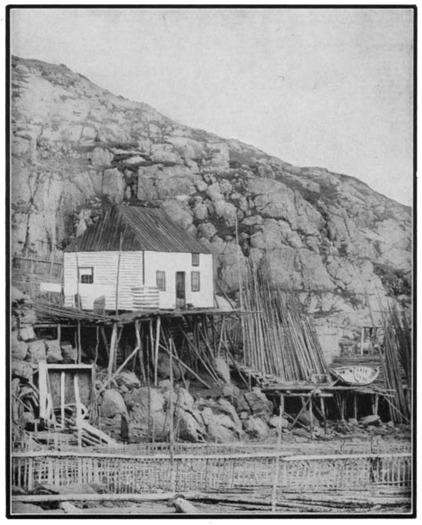
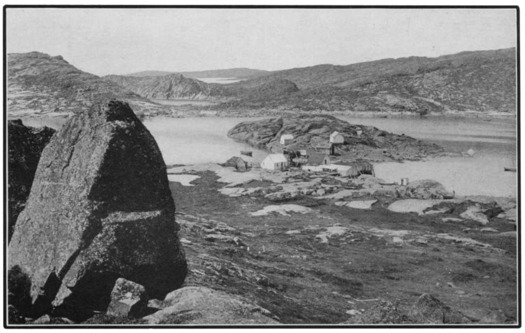
“THE WHITEWASHED COTTAGES ON THE HILLS”
“Will you not——”
“Sure, sir,” said Elisha, a smile spreading
from his eyes to the very tip of his great
beard, “’twould be a hard man an’ a bad
Christian that would turn strangers away.
Come in, sir! ’Tis a full belly you’ll have
when you leaves the table, an’ ’tis a warm
bed you’ll sleep in, this night.”
After family prayers, in which we, the
strangers he had taken in, were commended
to the care and mercy of God in such simple,
feeling phrases as proved the fine quality of
this man’s hospitality and touched our hearts
in their innermost parts, Elisha invited us to
sit by the kitchen fire with him “for a
spell.” While the dogs snored in chorus
with a young kid and a pig by the roaring
stove, and the chickens rustled and clucked
in their coop under the bare spruce sofa
which Elisha had made, and the wind flung
the rain against the window-panes, we three
talked of weather and fish and toil and peril
and death. It may be that a cruel coast
and a sea quick to wrath engender a certain
dread curiosity concerning the “taking off”
in a man who fights day by day to survive
the enmity of both. Elisha talked for a
long time of death and heaven and hell.
Then, solemnly, his voice fallen to a whisper,
he told of his father, Skipper George, a man
of weakling faith, who had been reduced to
idiocy by wondering what came after death—by
wondering, wondering, wondering, in
sunlight and mist and night, off shore in the
punt, labouring at the splitting-table, at work
on the flake, everywhere, wondering all the
time where souls took their flight.
“’Twere wonderin’ whether hell do be
underground or not,” said Elisha, “that
turned un over at last. Sure, sir,” with a
sigh, “’twere doubt, you sees. ’Tis faith us
must have.”
Elisha stroked the nearest dog with a gentle
hand—a mighty hand, toil-worn and misshapen,
like the man himself.
“Do your besettin’ sin get the best o’ you, sir?” he said, looking up.
It may be that he craved to hear a confession of failure that he might
afterwards sustain himself with the thought that no man is
invulnerable. “Sure, we’ve all besettin’ sins. When we do be snatched
from the burnin’ brands, b’y, a little spark burns on, an’ on, an’ on;
an’ he do be wonderful hard t’ douse out. ’Tis like the eye us must
pluck out by command o’ the Lard. With some men ’tis a taste for
baccy. With some ’tis a scarcity o’ salt in the fish. With some ’tis
too much water in the lobster cans. With some ’tis a cravin’ for
sweetness. With me ’tis worse nor all. Sure, sir,” he went on, “I’ve
knowed some men so fond, so wonderful fond, o’ baccy that um smoked
the shoes off their children’s feet. ’Tis their besettin’ sin,
sir—’tis their besettin’ sin. But ’tis not baccy that worries me. The
taste fell away when I were took from sin. ’Tis not that. ’Tis worse.
Sure, with me, sir,” he said, brushing his hand over his forehead in a
weary, despairing way, “’tis laughin’. ’Tis the sin of jokin’ that puts
my soul in danger o’ bein’ hove overboard into the burnin’ lake. I
were a wonderful joker when I were a sinful man. ’Twas all I lived
for—not t’ praise God an’ prepare my soul for death. When I gets up
in the marnin’, now, sir, I feels like jokin’ like what I used t’ do,
particular if it do be a fine day. Ah, sir,” with a long sigh, “’tis a
great temptation, I tells you—’tis a wonderful temptation. But ’tis
not set down in the Book that Jesus Christ smiled an’ laughed, an’
with the Lard’s help I’ll beat the devil yet. I’ll beat un,” he cried,
as if inspired to some supreme struggle. “I’ll beat un,” he repeated,
clinching his great hands. “I will!”
Elisha bade us good-night with a solemn
face. A little smile—a poor, frightened
little smile of tender feeling for us—flickered
in his eyes for the space of a breath.
But he snuffed it out relentlessly, expressed
his triumph with a flash of his eye, and
went away to bed. In the morning, when
the sun called us up, he had come back
from the early morning’s fishing, and was
singing a most doleful hymn of death and
judgment over the splitting-table in the
stage. The sunlight was streaming into
the room, and the motes were all dancing
merrily in the beam. The breeze was rustling
the leaves of a sickly bush under the
window—coaxing them to hopeful whisperings.
I fancied that the sea was all blue
and rippling, and that the birds were flitting
through the sunlight, chirping their sympathy
with the smiling day. But Elisha,
his brave heart steeled against the whole
earth’s frivolous mood, continued heroically
to pour forth his dismal song.
Twilight was filling the kitchen with
strange shadows. “We had disposed of
Aunt Ruth’s watered fish and soaked hard-bread
with hunger for a relish. Uncle
Simon’s glance was mournfully intent upon
the bare platter.
“But,” said Aunt Ruth, with obstinate
emphasis, “I knows they be. ’Tis not what
we hears we believe, sir. No, ’tis not what
we hears. ’Tis what we sees. An’ I’ve
seed un.”
“’Tis true, sir,” said Uncle Simon, looking
up. “They be nar a doubt about it.”
“But where,” said I, “did she get her
looking-glass?”
“They be many a trader wrecked on this
coast, sir,” said Uncle Simon.
“’Twere not a mermaid I seed,” said
Aunt Ruth. “’Twere a merman.”
“Sure,” said Uncle Simon, mysteriously,
“they do be in the sea the shape o’ all
that’s on the land—shape for shape, sir.
They be sea-horses an’ sea-cows an’ sea-dogs,
Why not the shape o’ humans?”
“Well,” said Aunt Ruth, “’twas when I
were a little maid. An’ ’twas in a gale o’
wind. I goes down t’ Billy Cove t’ watch
me father bring the punt in, an’ I couldn’t
see un anywhere. So I thought he were
drownded. ’Twere handy t’ dark when I
seed the merman rise from the water. He
were big an’ black—so black as the stove.
I could see the eyes of un so plain as I can
see yours. He were not good lookin’—no,
I’ll say that much—he were not good
lookin’. He waved his arms, an’ beckoned
an’ beckoned an’ beckoned. But, sure, sir,
I wouldn’t go, for I were feared. ‘’Tis
the soul o’ me father,’ thinks I. ‘Sure,
the sea’s cotched un.’ So I runs home an’
tells me mother; an’ she says ’twere a
merman. I knows they be mermans an’
mermaids, ’cause I’se seed un. ’Tis what
we sees we believes.”
“’Tis said,” said Uncle Simon, “that if
you finds un on the rocks an’ puts un in the
water they gives you three wishes; an’ all
you has t’ do is wish, an’——”
“’Tis said,” said Aunt Ruth, with a prodigious
frown across the table, “that the
mermaids trick the fishermen t’ the edge o’
the sea an’ steals un away. Uncle Simon
Ride,” she went on, severely, “if ever
you——”
Uncle Simon looked sheepish. “Sure,
woman,” said he, the evidences of guilt
plain on his face, “they be no danger t’ me.
’Twould take a clever mermaid t’——”
“Uncle Simon Ride,” said Aunt Ruth,
“nar another word. An’ if you don’t put
my spinnin’ wheel t’ rights this night I’ll
give you your tea in a mug[4] t’-morrow—an’
mind that, sir, mind that!”
After we had left the table Uncle Simon
took me aside. “She do be a wonderful
woman,” said he, meaning Aunt Ruth.
Then, earnestly, “She’ve no cause t’ be jealous
o’ the mermaids. No, sir—sure, no.”
It is difficult to convey an adequate conception
of the barrenness of this coast. If
you were to ask a fisherman of some remote
outport what his flour was made of he would
stare at you and be mute. “Wheat” would
be a new, meaningless word to many a man
of those places. It may be that the words
of the Old Skipper of Black Harbour will
help the reader to an understanding of the
high value set upon the soil and all it produces.
“Come with me,” said the Old Skipper,
“an’ I’ll show you so fine a garden as ever
you seed.”
The garden was on an island two miles
off the mainland. Like many another patch
of ground it had to be cultivated from a
distant place. It was an acre, or thereabouts,
which had been “won from the
wilderness” by the labour of several generations;
and it was owned by eleven families.
This was not a garden made by gathering
soil and dumping it in a hollow, as
most gardens are; it was a real “meadow.”
“Look at them potatoes, sir,” said the
skipper. He radiated pride in the soil’s
achievement as he waited for my outburst
of congratulation.
The potatoes, owing to painstaking fertilization
with small fish, had attained admirable
size—in tops. But the hay!
“’Tis fine grass,” said the skipper. “Fine
as ever you seed!”
It was thin, and nearer gray than yellow;
and every stalk was weak in the knees. I
do it more than justice when I write that it
rose above my shoe tops.
“’Tis sizable hay,” said the skipper.
“’Tis time I had un cut.”
On the way back the skipper caught sight
of a skiff-load of hay, which old John Burns
was sculling from Duck Island. He was
careful to point it out as good evidence of
the fertility of that part of the world. By
and by we came to a whisp of hay which
had fallen from the skiff. It was a mere
handful floating on the quiet water.
“The wastefulness of that dunderhead!”
exclaimed the skipper.
He took the boat towards the whisp of
hay, puffing his wrath all the while.
“Pass the gaff, b’y,” he said.
With the utmost care he hooked the whisp
of hay—to the last straw—and drew it over
the side.
“’Tis a sin,” said he, “t’ waste good hay
like that.”
Broad fields, hay and wheat and corn, all
yellow, waving to the breeze—the sun flooding
all—were far, far beyond this man’s imagination.
He did not know that in other
lands the earth yields generously to the
men who sow seed. How little did the
harvest mean to him! The world is a world
of rock and sea—of sea and naked rock.
Soil is gathered in buckets. Gardens are
made by hand. The return is precious in
the sight of men.
Uncle Zeb Gale—Daddy Gale, who had
long ago lost count of his grandchildren,
they were so many—Ol’ Zeb tottered up
from the sea, gasping and coughing, but
broadly smiling in the intervals. He had
a great cod in one hand, and his old cloth
cap was in the other. His head was bald,
and his snowy beard covered his chest.
Toil and the weight of years had bowed
his back, spun a film over his eyes and
cracked his voice. But neither toil nor
age nor hunger nor cold had broken his
cheery interest in all the things of life.
Ol’ Zeb smiled in a sweetly winning way.
He stopped to pass a word with the
stranger, who was far away from home,
and therefore, no doubt, needed a heartening
word or two.
“Fine even, zur,” said he.
“Tis that, Uncle Zeb. How have the
fish been to-day?”
“Oh, they be a scattered fish off the
Mull, zur. But ’tis only a scattered one.
They don’t run in, zur, like what they
used to when I were young, sure.”
“How many years ago, sir?”
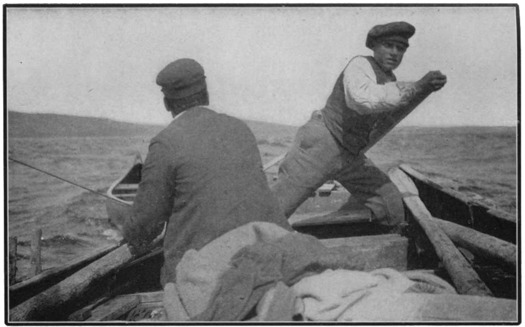
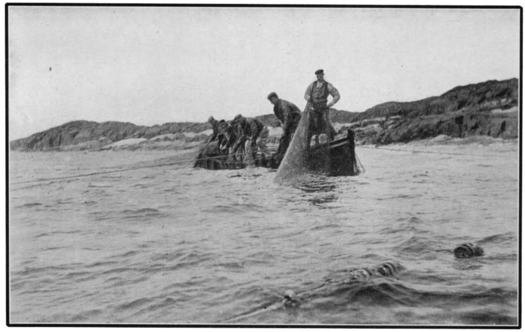
“TOIL”
“’Tis many year, zur,” said Uncle Zeb,
smiling indulgence with my youth. “They
was fish a-plenty when—when—when I
were young. ’Tis not what it used t’ be—no,
no, zur; not at all. Sure, zur, I been
goin’ t’ the grounds off the Mull since I
were seven years old. Since I were seven!
I be eighty-three now, zur. Seventy-six
year, zur, I has fished out o’ this here
harbour.”
Uncle Zeb stopped to wheeze a bit. He
was out of breath with this long speech.
And when he had wheezed a bit, a spasm
of hard coughing took him. He was on
the verge of the last stage of consumption,
was Uncle Zeb.
“’Tis a fine harbour t’ fish from, zur,” he
gasped. “They be none better. Least-ways,
so they tells me—them that’s cruised
about a deal. Sure, I’ve never seen another.
’Tis t’ Conch[5] I’ve wanted t’ go since I were
a young feller. I’ll see un yet, zur—sure,
an’ I will.”
“You are eighty-three?” said I.
“I be the oldest man t’ the harbour, zur.
I marries the maids an’ the young fellers
when they’s no parson about.”
“You have fished out of this harbour for
seventy-six years?” said I, in vain trying to
comprehend the deprivation and dull toil of
that long life—trying to account for the
childlike smile which had continued to the
end of it.
“Ay, zur,” said Uncle Zeb. “But, sure,
they be plenty o’ time t’ see Conch yet. Me
father were ninety when he died. I be only
eighty-three.”
Uncle Zeb tottered up the hill. Soon the
dusk swallowed his old hulk. I never saw
him again.
We were seated on the Head, high above
the sea, watching the fleet of punts come
from the Mad Mull grounds and from the
nets along shore, for it was evening. Jack
had told me much of the lore of lobster-catching
and squid-jigging. Of winds and
tides and long breakers he had given me
solemn warnings—and especially of that
little valley down which the gusts came,
no man knew from where. He had imparted
certain secrets concerning the
whereabouts of gulls’ nests and juniper-berry
patches, for I had won his confidence.
I had been informed that Uncle
Tom Bull’s punt was in hourly danger of
turning over because her spread of canvas
was “scandalous” great, that Bill Bludgell
kept the “surliest dog t’ the harbour,”
that the “goaats was wonderful
hard t’ find” in the fog, that a brass
bracelet would cure salt-water sores on
the wrists, that—I cannot recall it all.
He had “mocked” a goat, a squid, a
lamb, old George Walker at prayer, and
“Uncle” Ruth berating “Aunt” Simon for
leaving the splitting-table unclean.
Then he sang this song, in a thin, sweet
treble, which was good to hear:
“‘Way down on Pigeon Pond Island,
When daddy comes home from swilin’,[6]
(Maggoty fish hung up in the air,
Fried in maggoty butter)!
Cakes and tea for breakfast,
Pork and duff for dinner,
Cakes and tea for supper,
When daddy comes home from swilin’.”
He asked me riddles, thence he passed to
other questions, for he was a boy who wondered,
and wondered, what lay beyond those
places which he could see from the highest
hill. I described a street and a pavement,
told him that the earth was round, defined
a team of horses, corrected his impression
that a church organ was played with the
mouth, and denied the report that the flakes
and stages of New York were the largest in
the world. The boys of the outports do not
play games—there is no time, and at any
rate, the old West Country games have not
come down to this generation with the
dialect, so I told him how to play tag,
hide-and-go-seek and blind man’s buff, and
proved to him that they might be interesting,
though I had to admit that
they might not be profitable in certain cases.
“Some men,” said I, at last, “have never
seen the sea.”
He looked at me and laughed his unbelief.
“Sure,” said he, “not a hundred haven’t?”
“Many more than that.”
“’Tis hard t’ believe, zur,” he said. “Terrible
hard.”
“We were silent while he thought it over.
“What’s the last harbour in the world?”
he asked.
I hesitated.
“The very last, zur! They do say ’tis St.
Johns. But, sure, zur, they must be something
beyond. What do it be?” After a
silence, he continued, speaking wistfully,
“What’s the last harbour in all the whole
world, zur? Doesn’t you know?”
It had been a raw day—gray and gusty,
with the wind breaking over the island from
a foggy sea: a sullen day. All day long
there had been no rest from the deep harsh
growl of the breakers. We were at tea in
Aunt Amanda’s cottage; the table was
spread with dried caplin, bread and butter,
and tea, for Aunt Amanda, the Scotsman
who was of the harbour, and me. The
harbour water was fretting under the windows
as the swift gusts whipped over it;
and beyond the narrows, where the sea was
tumbling, the dusk was closing over the
frothy waves. Out there a punt was reeling
in from the Mad Mull fishing grounds;
its brown sail was like a leaf driven by the
wind. I saw the boat dart through the narrows
to the sheltered water, and I sighed in
sympathy with the man who was then furling
his wet and fluttering sail, for I, too,
had experienced the relief of sweeping from
that waste of grasping waves to the sanctuary
of the harbour.
“Do you think of the sea as a friend?”
I asked Aunt Amanda.
She was a gray, stern woman, over whose
face, however, a tender smile was used to
flitting, the light lingered last in her faded
eyes—the daughter, wife, and mother of
punt fishermen. So she had dealt hand to
hand with the sea since that night, long
ago, when, as a wee maid, she first could
reach the splitting-table by standing on a
bucket. As a child she had tripped up the
path to Lookout Head, to watch her father
beat in from the grounds; as a maiden, she
had courted when the moonlight was falling
upon the ripples of Lower Harbour, and the
punt was heaving to the spent swell of the
open; as a woman she had kept watch on
the moods of the sea, which had possessed
itself of her hours of toil and leisure. In
the end—may the day be long in coming—she
will be taken to the little graveyard
under the Lookout in a skiff. Now, at my
suggestion, she dropped her eyes to her
apron, which she smoothed in an absent
way. She seemed to search her life—all the
terror, toil, and glory of it—for the answer.
She was not of a kind to make light replies,
and I knew that the word to come would be
of vast significance.
“It do seem to me,” she said, turning her
eyes to the darkening water, “that the say
is hungry for the lives o’ men.”
“Tut, woman!” cried the old Scotsman,
his eyes all a-sparkle. “’Tis a libel on the
sea. Why wull ye speak such trash to a
stranger? Have ye never heard, sir, what
the poet says?”
“Well,” I began to stammer.
“Aye, man,” said he, “they all babble
about it. But have ye never read,
“‘O, who can tell, save he whose heart hath tried,
And danced in triumph o’er the waters wide,
The exulting sense, the pulse’s maddening play,
That thrills the wanderer of that trackless way?’”
With that, the sentimental old fellow
struck an attitude. His head was thrown
back; his eyes were flashing; his arm was
rigid, and pointing straight through the
window to that patch of white, far off in
the gathering dark, where the sea lay raging.
It ever took a poet to carry that old
Scotsman off his feet—to sweep him to some
high, cloudy place, where the things of life
rearranged and decked themselves out to
please his fancy. I confess, too, that his
enthusiasm rekindled, for a moment, my
third-reader interest in “a wet sheet and a
flowing sea” and “a wind that follows
fast.” We have all loved well the sea of
our fancy.
“Grand, woman!” he exclaimed, turning
to Aunt Amanda, and still a-tremble.
“Splendid!”
Aunt Amanda fixed him with her gray
eye. “I don’t know,” she said, softly.
“But I know that the say took me father
from me when I was a wee maid.”
The Scotsman bent his head over his
plate, lower and lower still. His fervour
departed, and his face, when he looked up,
was full of sympathy. Of a sudden my
ears hearkened again to the growling breakers,
and to the wind, as it ran past, leaping
from sea to wilderness; and my spirit felt
the coming of the dark.
XI— WINTER PRACTICE
It is, then, to the outporter, to the men
of the fleet and to the Labrador liveyere
that Doctor Grenfell devotes himself.
The hospital at Indian Harbour is the
centre of the Labrador activity; the hospital
at St. Anthony is designed to care for
the needs of the French shore folk; the hospital
at Battle Harbour—the first established,
and, possibly, the best equipped of
all—receives patients from all directions, but
especially from the harbours of the Strait
and the Gulf. In the little hospital-ship,
Strathcona, the doctor himself darts here and
there and everywhere, all summer long, responding
to calls, searching out the sick,
gathering patients for the various hospitals.
She is known to every harbour of the coast;
and she is often overcrowded with sick bound
to the hospitals for treatment or operation.
Often, indeed, in cases of emergency, operations
are performed aboard, while she tosses
in the rough seas. She is never a moment
idle while the waters are open. But in the
fall, when navigation closes, she must go into
winter quarters; and then the sick and
starving are sought out by dog-team and
komatik. There is no cessation of beneficent
activity; there is merely a change in the
manner of getting about. Summer journeys
are hard enough, God knows! But winter
travel is a matter of much greater difficulty
and hardship. Not that the difficulty and
hardship seem ever to be perceived by the
mission-doctor; quite the contrary: there is
if anything greater delight to be found in a
wild, swift race over rotten or heaving ice,
or in a night in the driving snow, than in running
the Strathcona through a nor’east gale.
The Indian Harbour hospital is closed in the
fall; so intense is the cold, so exposed the
situation, so scarce the wood, so few the
liveyeres, that it has been found unprofitable
to keep it open. There is another way of
meeting the needs of the situation; and that
is by despatching the Battle Harbour doctor
northward in midwinter. The folk know
that he is bound towards them—know the
points of call—can determine within a
month the time of his arrival. So they
bring the sick to these places—and patiently
wait. This is a hard journey—made alone
with the dogs. Many a night the doctor
must get into his sleeping bag and make
himself as comfortable as possible in the
snow, snuggled close to his dogs, for the sake
of the warmth of their bodies. Six hundred
miles north in the dead of winter, six hundred
miles back again; it takes a man of
unchangeable devotion to undertake it!
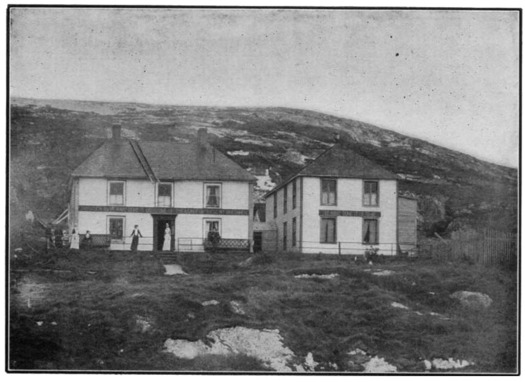
“THE HOSPITAL AT BATTLE HARBOR”
The Labrador dogs—pure and half-breed
“huskies,” with so much of the wolf yet in
them that they never bark—are for the most
part used by the doctor on his journeys.
There would be no getting anywhere without
them; and it must be said that they are
magnificent animals, capable of heroic
deeds. Every prosperous householder has
at least six or eight full-grown sled-dogs and
more puppies than he can keep track of. In
summer they lie everywhere under foot by
day, and by night howl in a demoniacal
fashion far and near; but they fish for
themselves in shallow water, and are fat,
and may safely be stepped over. In winter
they are lean, desperately hungry, savage,
and treacherous—in particular, a menace to
the lives of children, whom they have been
known to devour. There was once a father,
just returned from a day’s hunt on the ice,
who sent his son to fetch a seal from the
waterside; the man had forgotten for the
moment that the dogs were roaming the
night and very hungry—and so he lost both
his seal and his son. The four-year-old son
of the Hudson Bay Company’s agent at
Cartwright chanced last winter to fall down
in the snow. He was at once set upon by
the pack; and when he was rescued (his
mother told me the story) he had forty-two
ugly wounds on his little body. For many
nights afterwards the dogs howled under the
window where he lay moaning. Eventually
those concerned in the attack were hanged
by the neck, which is the custom in such
cases.
Once, when Dr. Grenfell was wintering
at St. Anthony, on the French shore, there
came in great haste from Conch, a point
sixty miles distant, a komatik with an
urgent summons to the bedside of a man
who lay dying of hemorrhage. And while
the doctor was preparing for this journey,
a second komatik, despatched from another
place, arrived with a similar message.
“Come at once,” it was. “My little boy
has broken his thigh.”
The doctor chose first to visit the lad.
At ten o’clock that night he was at the bedside.
It had been a dark night—black dark:
with the road precipitous, the dogs uncontrollable,
the physician in great haste. The
doctor thought, many a time, that there
would be “more than one broken limb” by
the time of his arrival. But there was no
misadventure; and he found the lad lying
on a settle, in great pain, wondering why
he must suffer so.
“Every minute or two,” says the doctor,
“there would be a jerk, a flash of pain, and
a cry to his father, who was holding him all
the time.”
The doctor was glad “to get the chloroform
mask over the boy’s face”—he is a
sympathetic man, the doctor; glad, always,
to ease pain. And at one o’clock in the
morning the broken bone was set and the
doctor had had a cup of tea; whereupon, he
retired to a bed on the floor and a few
hours’ “watch below.” At daylight, when
he was up and about to depart, the little
patient had awakened and was merrily calling
to the doctor’s little retriever.
“He was as merry as a cricket,” says the
doctor, “when I bade him good-bye.”
About twelve hours on the way to Conch,
where the man lay dying of hemorrhage—a
two days’ journey—the doctor fell in
with a dog-train bearing the mail. And
the mail-man had a letter—a hasty summons
to a man in great pain some sixty
miles in another direction. It was impossible
to respond. “That call,” says the doctor,
sadly, “owing to sheer impossibility, was not
answered.” It was haste away to Conch,
over the ice and snow—for the most of
the time on the ice of the sea—in order that
the man who lay dying there might be succoured.
But there was another interruption.
When the dog-train reached the coast, there
was a man waiting to intercept it: the news
of the doctor’s probable coming had spread.
“I’ve a fresh team o’ dogs,” sir, said he,
“t’ take you t’ the island. There’s a man
there, an’ he’s wonderful sick.”
Would the doctor go? Yes—he would
go! But he had no sooner reached that
point of the mainland whence he was bound
across a fine stretch of ice to the island
than he was again intercepted. It was a
young man, this time, whose mother lay
ill, with no other Protestant family living
within fifty miles. Would the doctor help
her? Yes—the doctor would; and did.
And when he was about to be on his way
again——
“Could you bear word,” said the woman,
“t’ Mister Elliot t’ come bury my boy?
He said he’d come, sir; but now my little
lad has been lying dead, here, since January.”
It was then early in March. Mr. Elliot
was a Protestant fisherman who was accustomed
to bury the Protestant dead of that
district. Yes—the doctor would bear word
to him. Having promised this, he set out
to visit the sick man on the island; for
whom, also, he did what he could.
Off again towards Conch—now with
fresh teams, which had been provided by
the friends of the man who lay there dying.
And by the way a man brought his little
son for examination and treatment—“a lad
of three years,” says the doctor; “a bright,
healthy, embryo fisherman, light-haired and
blue-eyed, a veritable celt.”
“And what’s the matter with him?”
was the physician’s question.
“He’ve a club foot, sir,” was the answer.
And so it turned out: the lad had a club
foot. He was fond of telling his mother
that he had a right foot and a wrong one.
“The wrong one, mama,” said he, “is no
good.” He was to be a cripple for life—utterly
incapacitated: the fishing does not
admit of club feet. But the doctor made
arrangements for the child’s transportation
to the St. Anthony hospital, where he could,
without doubt be cured; and then hurried
on.
The way now led through a district desperately
impoverished—as much by ignorance
and indolence as by anything else.
At one settlement of tilts there were forty
souls, “without a scrap of food or money,”
who depended upon their neighbours—and
the opening of navigation was still three
months distant! In one tilt there lay what
seemed to be a bundle of rags.
“And who is this?” the doctor asked.
It was a child. “The fair hair of a blue-eyed
boy of about ten years disclosed
itself,” says the doctor. “Stooping over
him I attempted to turn his face towards
me. It was drawn, with pain, and a moan
escaped the poor little fellow’s lips. He
had disease of the spine, with open sores in
three places. He was stark naked, and he
was starved to a skeleton. He gave me a
bright smile before I left, but I confess to a
shudder of horror at the thought that his
lot might have been mine. Of course the
‘fear of pauperizing’ had to disappear before
the claims of humanity. Yet, there, in
the depth of winter,” the doctor asks, with
infinite compassion, “would not a lethal
draught be the kindest friend of that little
one of Him that loved the children?”
For five days the doctor laboured in
Conch, healing many of the folk, helping
more; and at the end of that period the
man who has suffered the hemorrhage was
so far restored that with new dogs the
doctor set out for Canada Bay, still travelling
southward. There, as he says, “we
had many interesting cases.” One of these
involved an operation: that of “opening a
knee-joint and removing a loose body,” with
the result that a fisherman who had long
been crippled was made quite well again.
Then there came a second call from Conch.
Seventeen men had come for the physician,
willing to haul the komatik themselves, if
no dogs were to be had. To this call the
doctor immediately responded; and having
treated patients at Conch and by the way,
he set out upon the return journey to St.
Anthony, fearing that his absence had already
been unduly prolonged. And he had
not gone far on the way before he fell in
with another komatik, provided with a box,
in which lay an old woman bound to St.
Anthony hospital, in the care of her sons,
to have her foot amputated.
Crossing Hare Bay, the doctor had a
slight mishap—rather amusing, too, he
thinks.
“One of my dogs fell through the ice,”
says he. “There was a biting nor’west
wind blowing, and the temperature was
ten degrees below zero. When we were
one mile from the land, I got off to run
and try the ice. It suddenly gave way,
and in I fell. It did not take me long to
get out, for I have had some little experience,
and the best advice sounds odd:
it is ‘keep cool.’ But the nearest house
being at least ten miles, it meant, then,
almost one’s life to have no dry clothing.
Fortunately, I had. The driver at once
galloped the dogs back to the woods we
had left, and I had as hard a mile’s running
as ever I had; for my clothing was
growing to resemble the armour of an ancient
knight more and more, every yard,
and though in my youth I was accustomed
to break the ice to bathe if necessary, I
never tried running a race in a coat of
mail. By the time I arrived at the trees
and got out of the wind, my driver had a
rubber poncho spread on the snow under
a snug spruce thicket; and I was soon as
dry and a great deal warmer than before.”
At St. Anthony, the woman’s foot was
amputated; and in two days the patient
was talking of “getting up.” Meantime, a
komatik had arrived in haste from a point
on the northwest coast—a settlement one
hundred and twenty miles distant. The
doctor was needed there—and the doctor
went!
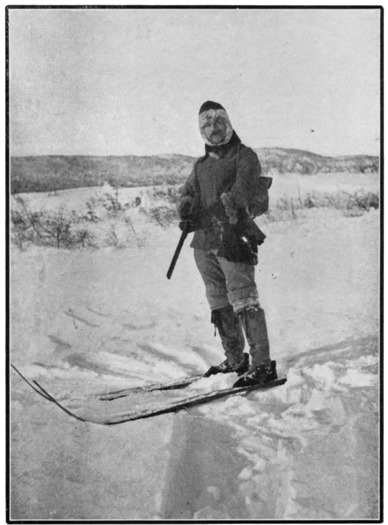
“THE DOCTOR ON A WINTER’S JOURNEY”
This brief and inadequate description of
a winter’s journey may not serve to indicate
the hardship of the life the doctor leads: he
has small regard for that; but it may faintly
apprise the reader of the character of the
work done, and of the will with which the
doctor does it. One brief journey! The
visitation of but sixty miles of coast! Add
to this the numerous journeys of that winter,
the various summer voyages of the Strathcona;
conceive that the folk of two thousand
miles are visited every year, often
twice a year: then multiply by ten—for
the mission has been in efficient existence
for ten years—and the reader may reach
some faint conception of the sum of good
wrought by this man. But without knowing
the desolate land—without observing
the emaciated bodies of the children—without
hearing the cries of distress—it is
impossible adequately to realize the blessing
his devotion has brought to the coast.
XII— THE CHAMPION
The Deep-sea Mission is not concerned
chiefly with the souls of the
folk, nor yet exclusively with their
bodies: it endeavours to provide them with
religious instruction, to heal their ailments;
but it is quite as much interested, apparently,
in improving their material condition.
To the starving it gives food, to the naked
clothing; but it must not be supposed that
charity is indiscriminately distributed.
That is not the case. Far from it. When
a man can cut wood for the steamer or hospitals
in return for the food he is given, for
example, he is required to do so; but the
unhappy truth is that a man can cut very
little wood “on a winter’s diet” exclusively
of flour. “You gets weak all of a suddent,
zur,” one expressed it to me. In his effort
to “help the people help themselves” the
doctor has established cooperative stores
and various small industries. The result
has been twofold: the regeneration of several
communities, and an outbreak of hatred
and dishonest abuse on the part of the traders,
who have too long fattened on the isolation
and miseries of the people. The cooperative
stores, I believe, are thriving, and
the small industries promise well. Thus the
mission is at once the hope and comfort of
the coast. The man on the Strathcona is
the only man, in all the long history of that
wretched land, to offer a helping hand to
the whole people from year to year without
ill temper and without hope of gain.
“But I can’t do everything,” says he.
And that is true. There is much that the
mission-doctor cannot do—delicate operations,
for which the more skilled hand of a
specialist is needed. For a time, one season,
an eminent surgeon, of Boston, the first of
many, it is hoped, cruised on the Strathcona,
and most generously operated at Battle
Harbour. The mission gathered the
patients to the hospital from far and near before
the surgeon arrived. Folk who had
looked forward in dread to a painful death,
fast approaching, were of a sudden promised
life. There was a man coming, they were
told, above the skill of the mission surgeons,
who could surely cure them. The deed was
as good as the promise: many operations
were performed; all the sick who came for
healing were healed; the hope of not one
was disappointed. Folk who had suffered
years of pain were restored. Never had
such a thing been known on the Labrador.
Men marvelled. The surgeon was like a
man raising the dead. But there was a
woman who is now, perhaps, dead; she
lacked the courage. Day after day for two
weeks she waited for the Boston surgeon;
but when he came she fled in terror of the
knife. Her ailment was mortal in that
land; but she might easily have been cured;
and she fled home when she knew that the
healer had come. No doubt her children
now know what it is to want a mother.
Dr. Grenfell will let no man oppress his
people when his arm is strong enough to
champion them. There was once a rich man
(so I was told before I met the doctor)—a
man of influence and wide acquaintance—whose
business was in a remote harbour of
Newfoundland. He did a great wrong;
and when the news of it came to the ears of
the mission-doctor, the anchor of the Strathcona
came up in a hurry, and off she steamed
to that place.
“Now,” said the doctor to this man, “you
must make what amends you can, and you
must confess your sin.”
The man laughed aloud. It seemed to
him, no doubt, a joke that the mission-doctor
should interfere in the affairs of one so
rich who knew the politicians at St. Johns.
But the mission-doctor was also a magistrate.
“I say,” said he, deliberately, “that you
must pay one thousand dollars and confess
your sin.”
The man cursed the doctor with great
laughter, and dared him to do his worst.
The joke still had point.
“I warn you,” said the doctor, “that I
will arrest you if you do not do precisely as
I say.”
The man pointed out to the doctor that
his magisterial district lay elsewhere, and
again defied him.
“Very true,” said the doctor; “but I
warn you that I have a crew quite capable
of taking you into it.”
The joke was losing its point. But the
man blustered that he, too, had a crew.
“You must make sure,” said the doctor,
“that they love you well enough to fight
for you. On Sunday evening,” he continued,
“you will appear at the church at seven
o’clock and confess your sin before the congregation;
and next week you will pay the
money as I have said.”
“I’ll see you in h—ll first!” replied the
man, defiantly.
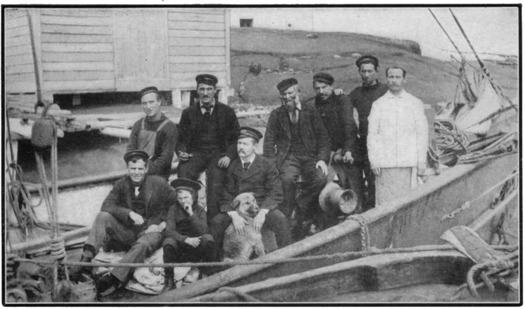
“A CREW QUITE CAPABLE OF TAKING YOU INTO IT”
At the morning service the doctor announced
that a sinful man would confess his
sin before them all that night. There was
great excitement. Other men might be prevailed
upon to make so humiliating a confession,
the folk said, but not this one—not
this rich man, whom they hated and feared,
because he had so long pitilessly oppressed
them. So they were not surprised when at
the evening service the sinful man did not
show his face.
“Will you please to keep your seats,” said
the doctor, “while I go fetch that man.”
He found the man in a neighbour’s house,
on his knees in prayer, with his friends.
They were praying fervently, it is said; but
whether or not that the heart of the doctor
might be softened I do not know.
“Prayer,” said the doctor, “is a good
thing in its place, but it doesn’t ‘go’ here.
Come with me.”
The man meekly went with the doctor;
he was led up the aisle of the church, was
placed where all the people could see him;
and then he was asked many questions, after
the doctor had described the great sin of
which he was guilty.
“Did you do this thing?”
“I did.”
“You are an evil man, of whom the people
should beware?”
“I am.”
“You deserve the punishment of man and
God?”
“I do.”
There was much more, and at the end of
it all the doctor told the man that the good
God would forgive him if he should ask in
true faith and repentance, but that the people,
being human, could not. For a whole
year, he charged the people, they must not
speak to that man; but if at the end of that
time he had shown an honest disposition to
mend his ways, they might take him to
their hearts.
The end of the story is that the man paid
the money and left the place.
This relentless judge, on a stormy day of
last July, carried many bundles ashore at
Cartwright, in Sandwich Bay of the Labrador.
The wife of the Hudson Bay Company’s
agent exclaimed with delight when
she opened them. They were Christmas
gifts from the children of the “States” to
the lads and little maids of that coast. With
almost all there came a little letter addressed
to the unknown child who was to receive
the toy; they were filled with loving words—with
good wishes, coming in childish sincerity
from the warm little hearts. The
doctor never forgets the Christmas gifts.
He is the St. Nicholas of that coast. If he
ever weeps at all, I should think it would be
when he hears that despite his care some
child has been neglected. The wife of the
agent stowed away the gifts against the
time to come.
“It makes them very happy,” said the
agent’s wife.
“Not long ago,” I chanced to say, “I saw
a little girl with a stick of wood for a dolly.
Are they not afraid to play with these pretty
things?”
“They are,” she laughed. “They use
them for ornaments. But that doesn’t matter.
It makes them happy just to look at
them.”
We all laughed.
“And yet,” she continued, “they do play
with them, sometimes, after all. There is a
little girl up the bay who has kissed the
paint off her dolly!”
Thus and all the time, in storm and sunshine,
summer and winter weather, Grenfell
of the Deep-sea Mission goes about doing
good; if it’s not in a boat, it’s in a dog-sled.
He is what he likes to call “a Christian
man.” But he is also a hero—at once the
bravest and the most beneficently useful
man I know. If he regrets his isolation, if
the hardship of the life sometimes oppresses
him, no man knows it. He does much, but
there is much more to do. If the good people
of the world would but give a little more
of what they have so abundantly—and if
they could but know the need, they would
surely do that—joy might be multiplied on
that coast; nor would any man be wronged
by misguided charity.
“What a man does for the love of God,”
the doctor once said, “he does differently.”
Decorated Cloth, $1.50
Doctor Luke of The Labrador
BY NORMAN DUNCAN
“Mr. Duncan is deserving of much praise for this, his first
novel.... In his descriptive passages Mr. Duncan is sincere
to the smallest detail. His characters are painted in with
bold, wide strokes.... Unlike most first novels, ‘Doctor
Luke’ waxes stronger as it progresses.”—N. Y. Evening
Post.
James MacArthur, of Harper’s Weekly, says: “I am
delighted with ‘Doctor Luke.’ So fine and noble a work
deserves great success.”
“A masterpiece of sentiment and humorous characterization.
Nothing more individual, and in its own way
more powerful, has been done in American fiction....
The story is a work of art.”—The Congregationalist.
Joseph B. Gilder, of The Critic,
says: “I look to see it take its place
promptly among the best selling
books of the season.”
“It fulfills its promise of being one of the best stories of
the season. Mr. Duncan evidently is destined to make a name
for himself among the foremost novelists of his day....
Doctor Luke is a magnetic character, and the love story in
which he plays his part is a sweet and pleasant idyl....
The triumph of the book is its character
delineation.”—Chicago Record-Herald.
Miss Bacon, Literary Editor of The Booklover’s Library,
says: “Of all the stories I have read this Autumn there is
none that I would rather own.”
“Norman Duncan’s novel is a great enterprise, and
will probably prove to be the greatest book yet produced
by a native of Canada.”—Toronto Globe.
8vo, Cloth Price, $1.75 net
Denizens of the Deep
By FRANK. T. BULLEN
There is a new world of life and intelligence opened to our
knowledge in Mr. Bullen’s stories of the inhabitants of the
sea. He finds the same fascinating interest in the lives of
the dwellers in the deep as Thompson Seton found in the lives
of the hunted ashore, and with the keenness and vigor which
characterized his famous book “The Cruise of The Cachalot” he
has made a book which, being based upon personal observation,
buttressed by scientific facts and decorated by imagination,
is a storehouse of information—an ideal romance of deep sea
folk and, as The Saturday Times-Review has said, worth
a dozen novels.
Not the least attractive feature of an unusually attractive
volume is the series of illustrations by Livingston Bull and
others.
By MARGARET SANGSTER Cloth, each, $1.50
Janet Ward
Eleanor Lee
Without exaggeration and with perfectly consistent naturalness
Mrs. Sangster has produced two pieces of realism of a most
healthy sort, demonstrating conclusively that novels may be at
once clean and wholesome yet most thoroughly alive and
natural. As with all her work, Mrs. Sangster exhibits her
splendid skill and excellent taste, and succeeds in winning
and holding her readers in these two books which treat of the
life of today.
“If ever there was an author whose personality shone through
her work, Mrs. Margaret E. Sangster is that author. Mrs.
Sangster has written a novel with a moral purpose. That was
to be expected, but it was also to be expected that the
story would be free from hysteria and intolerance, filled
with gentle humor, sane common sense and warm human
sympathy, and saturated with cheerful optimism. The book
fulfills the expectation.”—The Lamp.
Essays Fiction
By JAMES M. LUDLOW
Incentives for Life. Personal and Public.
12mo, cloth, gilt top, $1.25 net.
“Dr. Ludlow shows versatility and rare culture in this book of
essays. From the first page one is impressed with the
beautifully clear style, the brilliant thought which flashes
through every sentence, and the marvelous storehouse of
illustration from which the author draws. The vital importance
of will power in the formation of character, and the
incentives which lie back of it as motives to action, are set
forth with vigor and power.”—Christian Observer.
Deborah. A Tale of the Times of Judas Maccabaeus. By
the author of “The Captain of the Janizaries.” 12mo, cloth,
illustrated ... $1.50
“Deborah is a genuine Jewess, noble, brilliant, loving and
lovely.”—Congregationalist.
“Nothing in the class of fiction to which ‘Deborah’ belongs,
the class of which ‘Ben Hur’ and ‘Captain of the Janizaries’
are familiar examples, exceeds the early chapters of this
story in vividness and rapidity of action. The book as a whole
has vigor and color.”—The Outlook.
Tales of the West Virile, true, tender
By RALPH CONNOR
The Sky Pilot; A Tale of the Foothills.
12mo, cloth, illustrated ... Price, $1.25
“Ralph Connor’s ‘Black Rock’ was good, but ‘The Sky Pilot’ is
better. The matter which he gives us is real life; virile,
true, tender, humorous, pathetic, spiritual, wholesome. His
style, fresh, crisp and terse, accords with the Western life,
which he understands. Henceforth the foothills of the Canadian
Rockies will probably be associated in many a mind with the
name of ‘Ralph Connor.’”—The Outlook.
The Man From Glengarry; A Tale of the Ottawa.
12mo, cloth ... Price, $1.50
“As straight as a pine, as sweet as a balsam, as sound as a
white oak.”—The Interview.
Glengarry School Days; A Tale of the Indian Lands.
12mo, cloth ... Price, $1.25
In pathos it reaches the high level of “The Sky Pilot.” In
atmosphere it is “The Man from Glengarry.” In action it rivals
“Black Rock.”
Black Rock; A Tale of the Selkirks.
12mo, cloth ... Price, $1.25
12mo, cloth, cheaper edition ... .25
“‘Ralph Connor’ is some man’s nom de plume. The world would
insist on knowing whose. He has gone into the Northwest
Canadian mountains and painted for us a picture of life in the
mining camps of surpassing merit. With perfect wholesomeness,
with exquisite delicacy, with entire fidelity, with truest
pathos, with freshest humor, he has delineated character, has
analyzed motives and emotions, and has portrayed life. Some of
his characters deserve immortality, so faithfully are they
created.”—St. Louis Globe-Democrat.
The world has known and today Ralph Connor has been accorded
the signal honor of seeing his books, by virtue of their
sterling worth, attain a sale of over one and one-half million
copies.