‘Run the straight race through God’s good grace,
Lift up thine eyes and seek His face;
Life with its way before us lies,
Christ is the path, and Christ the prize.’
‘Prove all things; hold fast that which is good.’
Elsie Inglis took up practice in Edinburgh, and
worked in a happy partnership with the late Dr.
Jessie MacGregor, until the latter left Scotland for
work in America.
When the University of Edinburgh admitted
women to the examinations for degrees in medicine,
Dr. Inglis graduated M.B., C.M. in 1899. From
that date onwards her practice, her political and
suffrage work, and the founding of the Hospice in
the High Street of Edinburgh, as a nursing home
and maternity centre staffed by medical women,
occupied a life which grew and strengthened amid
so many and varied experiences.
Her father’s death deprived her of what had
been the very centre and mainspring of her existence.
As she records the story of his passing on,
she says that she cannot imagine life without him,
and that he had been so glad to see her begin her
professional career. She was not one to lose her
place in the stream of life from any morbid inaction
or useless repining. She shared the spirit
of the race from which she had sprung, a reaching
forward to obtain the prize of life fulfilled with
service, and she had inherited the childlike faith
and confidence which inspired their belief in the
Father of Spirits.
Elsie lost in her father the one who had made
her the centre of his thoughts and of his most
loving watchfulness. From the day that her home
with him was left unto her desolate, she was to
become a centre to many of her father’s wide
household, and, even as she had learnt from him,
she became a stay and support to many of his
children’s children.
The two doctors started practice in Atholl
Place, and later on they moved into 8 Walker
Street, an abode which will always be associated
with the name of Dr. Elsie Inglis.
Mrs. M‘Laren says:—
‘My impressions of their joint house are all pleasant
ones. They got on wonderfully together, and in every
thing seemed to appreciate one another’s good qualities.
They were very different, and had in many ways
a different outlook. I remember Jessie saying once,
“Elsie is so exceptionally generous in her attitude of
mind, it would be difficult not to get on with her!”
They both held their own opinions on various subjects
without the difference of opinion really coming between
them. Elsie said once about the arrangement,
“It has all the advantages of marriage without any
of its disabilities.” We used always to think they did
each other worlds of good. I know how I always enjoyed
a visit to them if it was only for an afternoon
or some weeks. There was such an air of freedom in
the whole house. You did what you liked, thought
what you liked, without any fear of criticism or of
being misunderstood.
‘I do not know much about her practice, as medicine
never interested me, but I believe at one time, before
the Suffrage work engrossed her so much, she was
making quite a large income.’
Professionally she suffered under two disabilities:
the restricted opportunities for clinical work in
the days when she was studying her profession,
combined with the constant interruptions which
the struggle against the medical obstructionists
necessitated; secondly, the various stages in the
political fight incident to obtaining that wider
enfranchisement which aimed at freeing women
from all those lesser disabilities which made them
the helots of every recognised profession and
industry.
When in the Scottish Women’s Hospitals abroad,
Dr. Inglis rapidly acquired a surgical skill, under
the tremendous pressure of work, which often kept
her for days at the operating-table, which showed
what a great surgeon she might have been, given
equal advantages in the days of her peace practice.
Dr. Inglis lost no opportunity of enlarging her
knowledge. She was a lecturer on Gynecology in
the Medical College for Women which had been
started later than Dr. Jex Blake’s school, and was
on slightly broader lines. After she had started
practice she went to study German clinics; she
travelled to Vienna, and later on spent two months
in America studying the work and methods of
the best surgeons in New York, Chicago, and
Rochester.
She advocated, at home and abroad, equal opportunities
for work and study in the laboratories for
both men and women students. She maintained
that the lectures for women only were not as good
as those provided for the men, and that the women
did not get the opportunity of thorough laboratory
practice before taking their exams. She thus
came into conflict with the University authorities,
who refused to accept women medical students
within the University, or to recognise extra-mural
mixed classes in certain subjects. Step by step
Dr. Inglis fought for the students. ‘With a great
price’ she might truly say she had purchased her
freedom, and nothing would turn her aside. If
one avenue was closed, try another. If one
Principal was adamant, his day could not last for
ever; prepare the way for his successor. Indomitable,
unbeaten, unsoured, Dr. Inglis, with
the smiling, fearless brow, trod the years till the
influence of the ‘red planet Mars’ opened to her
and others the gate of opportunity. She had
achieved many things, and was far away from
her city and its hard-earned practice when at
length, in 1916, the University, under a new ‘open-minded,
generous-hearted Head,’ opened its doors
to women medical students.
There were other things, besides her practice,
which Dr. Inglis subordinated in these years to the
political enfranchisement of women. It has been
shown in a previous chapter how keen were her
political beliefs. She joined the Central Edinburgh
Women’s Liberal Association in its earliest
organised years. She acted as Vice-President in
it for sixteen years, and was one of its most active
members.
Mr. Gulland, the Liberal Whip, knew the value
of her work, and must have had reason to respect
the order in which she placed her political creed—first
the citizenship of women, then the party
organisation. He speaks of her fearless partisanship
and aloof attitude towards all local political
difficulties. An obstacle to her was a thing to be
overcome, not to be sat down before. Any one
in politics who sees what is right, and cannot
understand any reason why the action should not
be straight, rather than compromising, is a help
to party agents at rare intervals; normally such
minds cause anxiety. Her secretary, Miss Cunningham,
says about her place in the Liberal
organisation:—
‘Not only as a speaker—though as that she was
invaluable—but as one who mixed freely with all our
members, with her sympathy, in fact, her enthusiasm
for everything affecting the good of women, she won
respect and liking on every side. It was not until she
became convinced that she could help forward the great
cause for women better by being unattached to any
party organisation that she severed her connection with
the Liberal Party. Regretted as that severance was by
all, we understood her point of view so well that we
recognised there was no other course open to her. Her
firm grasp of and clear insight into matters political
made her a most valued colleague, especially in times
of difficulty, when her advice was always to be relied
upon.’
In 1901 she was a member of the Women’s
Liberal League, a branch of the W.L.A. which
split off at the time of the Boer War, in opposition
to the ‘Little Englanders.’ Dr. Inglis was on its
first committee, and lent her drawing-room for
meetings, addressing other meetings on the Imperialist
doctrines born in that war. When that
phase of politics ended, the League became an
educational body and worked on social and factory
legislation.
Among her other enterprises was the founding
of the Muir Hall of Residence for Women Students
at the University. Many came up from the
country, and, like herself in former days in Glasgow,
had to find suitable, and in many cases uncomfortable,
lodgings.
Principal Muir’s old Indian friendship with Mr.
Inglis had been most helpful in former years, and
now Lady Muir and other friends of the women
students started a Residence in George Square for
them, and Miss Robertson was appointed its first
warden. Dr. Inglis was Hon. Secretary to the
Muir Hall till she died, and from its start was a
moving spirit in all that stood for the comfort of
the students. She attended them when they were
ill, and was always ready to help them in their
difficulties with her keen, understanding advice.
The child of her love, amid all other works, was her
Maternity Hospice. Of this work Miss Mair, who
was indeed ‘a nursing mother’ to so many of the
undertakings of women in the healing profession,
writes of Dr. Inglis’ feeling with perfect understanding:—
‘To Dr. Inglis’ clear vision, even in her early years of
student life, there shone through the mists of opposition
and misunderstandings a future scene in which a
welcome recognition would be made of women’s services
for humanity, and with a strong, glad heart she joined
with other pioneers in treading “the stony way”
that leads to most reforms. Once landed on the firm
rock of professional recognition, Dr. Inglis set about
the philanthropic task of bringing succour and helpful
advice to mothers and young babies and expectant
mothers in the crowded homes in and about the High
Street. There, with the help of a few friends, she
founded the useful little Hospice that we trust now to
see so developed and extended by an appreciative
public, that it will merit the honoured name “The Dr.
Elsie Inglis Memorial Hospice.”
‘This little Hospice lay very near the heart of its
founder—she loved it—and with her always sensitive
realisation of the needs of the future, she was convinced
that this was a bit of work on the right lines for recognition
in years to come. Some of us can recall the
kindling eye, the inspiring tones, that gave animation
to her whole being when talking of her loved Hospice.
She saw in it a possible future that might effect much,
not only for its patients, but for generations of medical
women.’
With Dr. Elsie one idea always started another,
and ‘a felt want’ in any department of life always
meant an instantly conceived scheme of supplying
the need. Those who ‘came after’ sometimes felt
a breathless wonder how ways and means could be
found to establish and settle the new idea which
had been evolved from the fertile brain. The
Hospice grew out of the establishment of a nursing
home for working women, where they could be
cared for near their own homes. Through the
kindness of Dr. Barbour, a house was secured at a
nominal rent in George Square, and opened in
1901. That sphere of usefulness could be extended
if a maternity home could be started in a poorer
district. Thus the Hospice in the High Street was
opened in 1904. Dr. Inglis devoted herself to the
work. An operating theatre and eight beds were
provided. The midwifery department grew so
rapidly that after a few years the Hospice became
a centre, one of five in Scotland, for training nurses
for the C.M.B. examination.
Dr. Inglis looked forward to a greater future for
it in infant welfare work, and she always justified
the device of the site as being close to where the
people lived, and in air to which they were accustomed.
Trained district nurses visited the people
in their own homes, and in 1910 there were more
cases than nurses to overtake them. In that year
the Hospice was amalgamated with Bruntsfield
Hospital; medical, surgical, and gynecological cases
were treated there, while the Hospice was devoted
entirely to maternity and infant welfare cases.
Dr. Inglis’ ‘vision’ was nearly accomplished
when she had a small ward of five beds for malnutrition
cases, a baby clinic, a milk depot, health
centres, and the knowledge that the Hospice has
the distinction of being the only maternity centre
run by women in Scotland. This affords women
students opportunities denied to them in other
maternity hospitals.
A probationer in that Hospice says:—
‘Dr. Inglis’ idea was that everything, as far as
possible, should be made subservient to the comfort
of the patients. This was always considered when
planning the routine. She disapproved of the system
prevalent in so many hospitals of rousing the patients
out of sleep in the small hours of the morning in order
to get through the work of the wards. She would not
have them awakened before 6 A.M., and she instituted
a cup of tea before anything else was done. To her
nurses she was very just and appreciative of good
work, and, if complaints were made against any one,
the wrongdoing had to be absolutely proved before she
would take action. She also insisted on the nurses
having adequate time off, and that it should not be
infringed upon.’
These, in outline, are the interests which filled
the years after Dr. Elsie began her practice. Of
her work among the people living round her
Hospice, it is best told in the words of those who
watched for her coming, and blessed the sound of
her feet on their thresholds. Freely she gave them
of her best, and freely they gave her the love and
confidence of their loyal hearts.
Mrs. B. had been Dr. Inglis’ patient for twenty
years, and she had also attended her mother and
grandmother. Of several children one was called
Elsie Maud Inglis, and the child was christened
in the Dean Church by Dr. Williamson, who had
known Dr. Inglis as a child in India. The whole
family seem to have been her charge, for when
Mrs. B.’s husband returned from the South African
War, Dr. Inglis fought the War Office for nine
months to secure him a set of teeth, and, needless
to say, after taking all the trouble entailed by a
War Office correspondence, she was successful. A
son fought in the present war, and when Dr. Inglis
saw the death of a Private B., she sent a telegram
to the War Office to make sure it was not the son
of Mrs. B. She would never take any fees from
this family. On one occasion Mr. B. gave her
some feathers he had brought home from Africa.
She had them put in a new hat she had got for a
wedding, and came round before she went to the
festival to show them to the donor. Her cheery
ways ‘helped them all,’ and when a child of the
family broke its leg, and was not mending all
round in the Infirmary, Dr. Inglis was asked to go
and see her, and the child from then ‘went forrit.’
In another family there was some stomach weakness,
and three infants died. Dr. Inglis tried hard
to save the life of the third, a little boy, who was
evidently getting no nourishment. So anxious
was she, that she asked a sister who had recently
had a baby, to try if she could nurse the child.
This was done, the foster mother going every day
to the house, but they could not save the infant.
When the next one arrived, Dr. Inglis was so
determined the child should live, she came every
day, whatever were her engagements, to sterilise
the milk. The child throve under her care, and
grew up in health.
Another of these patients of her care ‘could not
control her feelings’ when speaking of the good
physician. It was evident the family had lost their
best friend. The husband spoke most warmly of
Dr. Inglis’ kindness to them. She would come
round, after she had finished her other work at
night, to bath the baby. When another child
was ill, she told the mother not to open the door
even if the King himself wished to come in. The
husband said she was so bright one felt the better
for her visit, ‘though her orders had to be obeyed
and no mistake, and she would tell you off at
once if you did not carry them out.’ If they
offered payment, she would say, ‘Now, go and
buy a nice chop for yourself.’
Another family had this story. Mr. G.: ‘That
woman has done more for the folk living between
Morrison Street and the High Street than all the
ministers in Edinburgh and Scotland itself ever
did for any one. She would never give in to difficulties.
She gave her house, her property, her
practice, her money to help others.’ Mrs. G. fell
ill after the birth of one of her children. Dr. Elsie
came in one night, made her a cup of tea and some
toast, and, as she failed to get well, she raised
money to keep her in a sanatorium for six months.
After she had been there one child, in charge of a
friend, fell ill, and finally died, Dr. Inglis doing all
she could to spare the absent mother and save the
child. When it died, she wrote:—
‘My dear Mrs. G.,—You will have got the news
by now. I cannot tell you how sorry I am for you,
my dear. But you will believe, won’t you, that we
all did everything we could for your dear little boy.
Mrs. E. was simply goodness itself. Dr. H. and I saw
him three times a day between us, and yesterday we
saw him four times. When I sent you the card I hoped
the high temperature was due to his teeth, because his
pulse seemed good. However, later, Dr. H. telephoned
that she was afraid that his pulse was flagging, and he
died suddenly about one. Mr. G. has just been here;
you must get well, my dear, for his sake, and for the
sake of all the other little children. Poor little Johnnie
has had a great many troubles in his little life has he not?
But he is over them all now, dear little man. And the
God in whose safe keeping he is, comfort you, dear Mrs.
G.—Ever your sincere friend,
‘Elsie Maud Inglis.’
The caretaker of the dispensary in St. Cuthbert’s
Mission in Morrison Street speaks of Dr. Inglis as
the true friend of all who needed her. She gave
an hour three mornings in the week, and if she
could not overtake all the cases in the time, she
would occasionally come back later in the day.
Another of her patients was the mother of
twelve children; six of them were ‘brought home’
by Dr. Inglis. She was a friend to them all, and
never minded what trouble she took. If they did
not send for her, wishing to spare her, she scolded
them for thinking of herself and not of their need
for her services. All the children loved her, and
they would watch from the window on her dispensary
days for her, and she would wave to them
across the street. She would often stop them in
the street to ask after their mother, and even after
she had been to Serbia and returned to Edinburgh,
she remembered about them and their home affairs.
She always made them understand that her orders
must be carried out. Once Mrs. C. was very ill,
and Dr. Inglis came to attend her. The eldest
girl was washing the floor, and Dr. Inglis told her
to go for some medicine. The girl continued to
finish the work she was at. ‘Child,’ said Dr. Inglis,
‘don’t you know that when I say a thing I mean
it?’ Another time she had told Mrs. C. to remain
in her bed till she came. Household cares were
pressing, and Mrs. C. rose to wash the dishes. Dr.
Inglis suddenly appeared at the door. ‘What did
I tell you? Do not touch another dish.’ And she
herself helped Mrs. C. back to bed. Later on two
of the children got scarlet fever, and Dr. Inglis
told the mother she was proud of her, as, through
her care, the infection did not spread in the family
or outside it.
The people in Morrison Street showed their
gratitude by collecting a little sum of money to
buy an electric lamp to light their doctor friend up
the dark staircase of the house. These were the
true mourners who stood round St. Giles’ with the
bairns she had ‘brought home’ on the day when
her earthly presence passed from their sight.
These were they who had fitted her for her strenuous
enterprises in the day when the battle was
set in array, and these were the people who knew
her best, and never doubted that when called
from their midst she would go forth strong in that
spirit which is given to the weak things of the
earth, and that it would be her part to strengthen
the peoples that had no might.
The Little Sisters of the Poor had a dispensary
of St. Anne, and Dr. Elsie had it in her charge
from 1903 to 1913, and the Sister Superior speaks
of the affection of the people and the good work
done among them.
‘“How often,” writes one in charge of the servant
department of the Y.W.C.A., “her deliberate tread has
brought confidence to me when getting heartless over
some of these poor creatures who would not rouse
themselves, judging the world was against them. Many
a time the patient fighting with circumstances needed
a sisterly word of cheer which Dr. Inglis supplied,
and sent the individual heartened and refreshed.
The expression on her face, I mean business, had a
wonderful uplift, while her acuteness in exactly describing
the symptoms to those who were in constant
contact gave a confidence which made her a power
amongst us.”’
A patient has allowed some of her written
prescriptions to be quoted. They were not of a
kind to be made up by a chemist:—
‘I want you never to miss or delay meals. I want
you to go to bed at a reasonable time and go to sleep
early. I want you to do your work regularly, and to
take an interest in outside things—such as your church
and suffrage.’
‘We should not let these Things (with a capital T)
affect us so much. Our cause is too righteous for it to
be really affected by them—if we don’t weaken.’
‘My dear, the potter’s wheel isn’t a pleasant instrument.’
‘Go home and say your prayers.’
‘Realise what you are, a free born child of the
Universe. Perfection your Polar Star.’
These stories of her healing of mind and body
might be endlessly multiplied. Sorrow and disease
are much the same whether they come to the rich
or the poor, and poverty is not always the worst
trial of many a sad tale. Dr. Elsie’s power of
sympathy and understanding was as much called
upon in her paying practice as among the very
poor. She made no distinction in what she gave;
her friendship was as ready as her trained skill.
There was one patient whose sufferings were largely
due to her own lack of will power. Elsie, after
prescribing, bent down and kissed her. It awoke
in the individual the sense that she was not ‘altogether
bad,’ and from that day forward there was
a newness of life.
From what sources of inner strength did she
increasingly minister in that sphere in which she
moved? ‘Thy touch has still its ancient power,’
and no one who knew this unresting, unhasting,
well-balanced life, but felt it had drawn its spiritual
strength from the deep wells of Salvation.
In these years the kindred points of heaven and
home were always in the background of her life.
Her sisters’ homes were near her in Edinburgh,
and when her brother Ernest died in India, in
1910, his widow and her three daughters came
back to her house. Her friendship and understanding
of all the large circle that called her aunt
was a very beautiful tie. The elder ones were
near enough to her own age to be companions to
her from her girlhood. Miss Simson says that she
was more like an elder sister to them when she
stayed with the family on their arrival from
Tasmania. ‘The next thing I remember about
her was when she went to school in Paris, she
promised to bring us home Paris dolls. She asked
us how we wanted them dressed, and when she
returned we each received a beautiful one dressed
in the manner chosen. Aunt Elsie was always
most careful in the choice of presents for each
individual. One always felt that she had thought
of and got something that she knew you wanted.
While on her way to Russia she sent me a cheque
because she had not been able to see anything
while at home. She wrote, “This is to spend on
something frivolous that you want, and not on
stockings or anything like that.”’
‘It is not her great gifts that I remember now,’
says another of that young circle, ‘it is that she
was always such a darling.’
These nieces were often the companions of Dr.
Elsie’s holidays. She had her own ideas as to how
these should be spent. She always had September
as her month of recreation. She used to go away,
first of all, for a fortnight quite alone to some
out-of-the-way place, when not even her letters
were sent after her. She would book to a station,
get out, and bicycle round the neighbourhood till
she found a place she liked. She wanted scenery
and housing accommodation according to her mind.
Her first requirement was hot water for ‘baths.’
If that was found in abundance she was suited; if
it could not be requisitioned, she went elsewhere.
Her paintbox went with her, and when she returned
to rejoin or fetch away her family she
brought many impressions of what she had seen.
The holidays were restful because always well
planned. She loved enjoyment and happiness,
and she sought them in the spirit of real relaxation
and recreation. If weather or circumstances turned
out adverse, she was amused in finding some way
out, and if nothing else could be done she had a
power of seeing the ludicrous under all conditions,
which in itself turned the rain-clouds of life into
bursts of sunlight.
Mrs. Inglis gives a happy picture of the life in
8 Walker Street, when she was the guest of Dr.
Inglis. Her love for the three nieces, the one in
particular who bore her name, and in whose medical
education she deeply interested herself, was great.
She used to return from a long day’s work, often
late, but with a mind at leisure from itself for the
talk of the young people. However late she was,
a hot bath preluded a dinner-party full of fun and
laughter, the account of all the day’s doings, and
then a game of bridge or some other amusement.
Often she would be anxious over some case, but
she used to say, ‘I have done all I know, I can
only sleep over it,’ and to bed and to sleep she
went, always using her will-power to do what was
best in the situation. Those who were with her
in the ‘retreats’ in Serbia or Russia saw the same
quality of self-command. If transport broke down,
then the interval had better be used for rest, in
the best fashion in which it could be obtained.
Her Sundays, as far as her profession permitted,
were days of rest and social intercourse with her
family and friends. After evening church she
went always to supper in the Simson family, often
detained late by pacings to and fro with her
friends, Dr. and Mrs. Wallace Williamson, engaged
in some outpouring of the vital interests which
were absorbing her. One of the members of her
household says:—
‘We all used to look forward to hearing all her doings
in the past week, and of all that lay before her in the
next. Sunday evening felt quite wrong and flat when
she was called out to a case and could not come to us.
It was the same with our summer holidays. Her visit
in September was the best bit of the holidays to us.
She laid herself out to be with us in our bathing and
golfing and picnics.’
The house was ‘well run.’ Those who know
what is the highest meaning of service, have always
good servants, and Dr. Elsie had a faithful household.
Her cooks were all engaged under one
stipulation, ‘Hot water for any number of baths
at any time of the day or night,’ and the hot
water never failed under the most exacting conditions.
Her guests were made very comfortable,
and there was only one rigid rule in the house.
However late she came downstairs after any night-work,
there was always family prayers before breakfast.
The book she used was Euchologion, and
when in Russia asked that a copy should be sent
her. Her consulting-room was lined with bookshelves
containing all her father’s books, and of
these she never lost sight. Any guest might
borrow anything else in her house and forget to
return it, but if ever one of those books were
borrowed, it had to be returned, for the quest after
it was pertinacious. In her dress she became
increasingly particular, but only as the adornment,
not of herself, but of the cause of women as citizens
or as doctors. When a uniform became part of her
equipment for work, she must have welcomed it
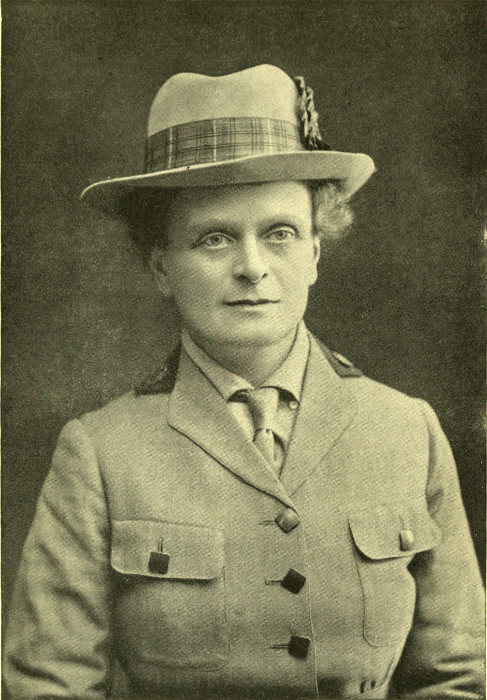
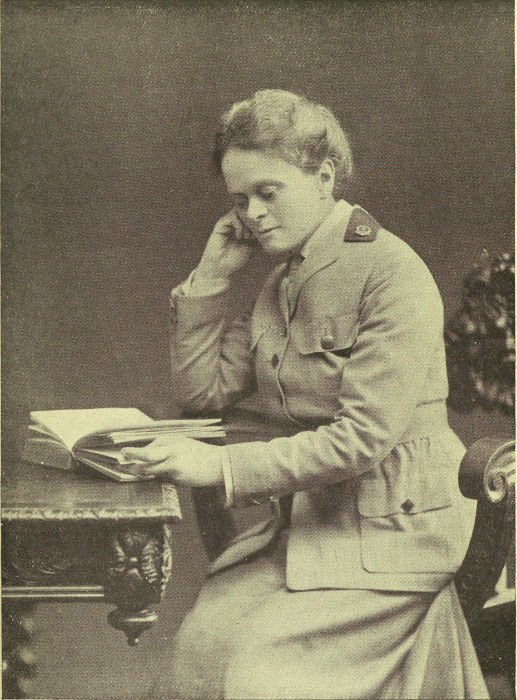
with great enthusiasm. It is in the hodden grey
with the tartan shoulder straps, and the thistles
of Scotland that she will be clothed upon, in the
memory of most of those who recall her presence.
It is difficult to write of the things that belong
to the Spirit, and Dr. Elsie’s own reserve on these
matters was not often broken. She had been reared
in a God-fearing household, and surrounded from
her earliest years with the atmosphere of an intensely
devout home. That she tried all things,
and approved them to her own conscience, was
natural to her character. Certain doctrines and
formulas found no acceptance with her. Man was
created in God’s image, and the Almighty did not
desire that His creatures should despise or underrate
the work of His Hand. The attitude of regarding
the world as a desert, and human beings as miserable
sinners incapable of rendering the highest
service, never commended itself to her eminently
just mind. Such difficulties of belief as she may
have experienced in early years lay in the relations
of the created to the Creator of all that is divine in
man. Till she had convinced herself that a reasonable
service was asked for and would be accepted,
her mind was not completely at rest. In her correspondence
with her father, both in Glasgow and
London, her interest was always living and vital
in the things which belonged to the kingdom of
heaven within. She wandered from church to
church in both places. Oblivious of all distinctions
she would take her prayer book and go for ‘music’
to the Episcopal Church, or attend the undenominational
meetings connected with the Y.W.C.A.
Often she found herself most interested in the
ministry of the Rev. Dr. Hunter, who subsequently
left Glasgow for London. There are many shrewd
comments on other ministers, on the ‘Declaratory
Acts,’ then agitating the Free Church. She thought
the Westminster Confession should either be
accepted or rejected, and that the position was made
no simpler by ‘declarations.’ In London she
attended the English Church almost exclusively,
listening to the many remarkable teachers who
in the Nineties occupied the pulpits of the Anglican
Church. It was not till after her father’s death
that she came to rest entirely in the ministry of the
Church of Scotland, and found in the teaching and
friendship of Dr. Wallace Williamson that which
gave her the vital faith which inspired her life and
work, and carried her at last triumphantly through
the swellings of Jordan.
St. Giles’ lay in the centre of her healing mission,
and her alert active figure was a familiar sight, as
the little congregation gathered for the daily service.
When the kirk skailed in the fading light of the
short days, the westering sun on the windows would
often fall on the fair hair and bright face of her
whose day had been spent in ministering work.
On these occasions she never talked of her work.
If she was joined by a friend, Dr. Elsie waited to
see what was the pressing thought in the mind of
her companion, and into that she at once poured
her whole sympathy. Few ever walked west with
her to her home without feeling in an atmosphere
of high and chivalrous enterprise. Thus in an
ordered round passed the days and years, drawing
ever nearer to the unknown destiny, when that
which was to try the reins and the hearts of many
nations was to come upon the world. When that
storm burst, Elsie Inglis was among those whose
lamp was burning, and whose heart was steadfast
and prepared for the things which were coming on
the earth.