Dr. B. MURE’S MATERIA MEDICA, OR Provings of the principal Animal and Vegetable Poisons OF THE BRAZILIAN EMPIRE; AND THEIR APPLICATION IN THE TREATMENT OF DISEASE.
TRANSLATED FROM THE FRENCH
AND
ARRANGED ACCORDING TO
HAHNEMANN’S METHOD, BY
CHARLES J. HEMPEL, M.D. FELLOW AND CORRESPONDING MEMBER OF THE PENNSYLVANIA HOMŒOPATHIC
COLLEGE; HONORARY MEMBER OF THE HAHNEMANN SOCIETY OF
LONDON, &C., &C.
NEW-YORK:
WILLIAM RADDE, No. 322 BROADWAY, Philadelphia: Rademacher & Sheek.—Boston: Otis Clapp.—St.
Louis: J. G. Wesselhoeft.—London: James Epps,
112 Great Russell-Street, Bloomsbury.—Manchester:
H. Turner, 41 Piccadilly.
1854.
Entered according to Act of Congress, in the year 1853, by
WILLIAM RADDE,
In the Clerk’s Office, of the District Court, for the Southern District of
New-York.
Henry Ludwig, Printer,
45 Vesey-street.
TO THE BRAZILIAN PEOPLE.
Though the precious metals hidden in the Brazilian soil,
may be never so abundant; though the splendor of its
precious stones, may be never so brilliant; though the crops
which the soil yields to the farmer, may be never so rich:
yet there are, in the Brazilian empire, treasures of a far,
greater importance, and infinitely more necessary to human
happiness. They are the powerful means which this vast
country furnishes for the cure of disease.
Previous to Hahnemann’s discovery, we were ignorant
of a positive method of determining the use of drugs. We
knew that they existed, but we did not know how to use
them; and popular experience, more successful than the
wisdom of the School, had alone picked up a few stray
fragments from the rich harvest which had been abandoned
for want of the proper means of gathering. Providence
at last permitted Hahnemann and his disciples to discover
the method of applying remedies to diseases in a positive
and efficacious manner. The dominion of mere palliatives
is at an end.—Homœopathy, by attacking the cause of disease,
destroys the chronic miasms, which are transmitted
from generation to generation; dries up the fountain-heads
of epidemic and contagious diseases; enables the infant-body,
by a positive hygiene, to resist the deleterious influences
to which it might be exposed in the course of its
existence; and, by preserving human life, which is the
most precious capital of nations and the first element of
their greatness, Homœopathy will insure their prosperity,
provided they adopt it without reserve.
We admire the bold hunter who skims the sharp points
of the rocks, for the purpose of snatching the down from
the little ones of the eider; the indefatigable diver, who, by
dint of patient toil, succeeds in bringing up the diamond
from the sands of the river, or the pearl from the bosom
of the sea. Should not the people of Brazil sympathise
with the patient and courageous experimenters, who, under
the auspices of Hahnemann, discover a world of wonderful
uses in the neglected products of this country?
The work which we here offer to the Brazilian people, is
not a work of fiction intended to amuse, but a serious work
detailing a series of painful sensations voluntarily endured
by a few devoted men, who were desirous of finding out
the therapeutic uses of the poisonous animals and plants,
the pathogenetic symptoms of which will be found described
in this volume. We shall be amply compensated for the
patience and devotedness which the composition of such
a work requires, by the consciousness that it will do its
share in diminishing the sufferings of mankind.
B. Mure, Rio Janeiro.
Note to the reader:—The symptoms in the following work, are
arranged in groups of five; the figures in the text indicate the numerical
order of these groups.—Ed.
CROTALUS CASCAVELLA. — FIRST EXPERIMENT. — SECOND EXPERIMENT. — ARRANGEMENT ACCORDING TO HAHNEMANN.
We commence the publication of our provings by the
symptoms of the Crotalus Cascavella, not so much on account
of the importance of the symptoms which the poison
of this dangerous reptile produces on the healthy body;
but because the unfortunate experiment which was attempted
a few years ago, on a sick person, offers a fair opportunity
of contrasting the hazardous and uncertain results of a
merely clinical experimentation, with the positive advantages
of Hahnemann’s method of proving.
A popular notion,—and the therapeutics of the Old-School
was gradually built up of such notions,—attributed to the
poison of the crotalus cascavella, the power of curing the
elephantiasis of the Greeks, a malady which, in Brazil,
goes by the name of morphea, or Lazarus’-evil. A disciple
of Hahnemann might have verified this belief without any
difficulty, and without endangering human life. But the
Old-School who does not acknowledge our method of proving,
had to remain in doubt about this curative virtue of
the cascavella, until a patient and physician would be found
sufficiently bold and logical to apply to a frightful disease
a still more frightful remedy. Mariano José Machado, fell
a victim to his heroic attempt, and, by his death, dissipated
the illusory hopes founded on the curative virtue
of the poison of the cascavella. Now what conclusion
shall we draw from this fact? That the practitioner
who advised the attempt, has been imprudent and censureable?
God forbid that we should commit such an act
of injustice. A patient has succumbed to a clinical experiment;
let us honor the heroic courage with which he
braved the serpent’s bite; let us honor the zeal of the
practitioner, who persuaded him to risk a few years of a
loathsome existence for the chance, though uncertain, of a
cure. The unhappy Machado has been saved a few years
of cruel suffering; but what a joy it would have afforded
him and his miserable fellow-sufferers, if the remedy for
their loathsome disease had been known! what a glory it
would have been to the physician who should have conducted
them to the haven of relief![1]
However, a homicide has been committed on this occasion,
and though the perpetrators may be free from blame,
yet we may justly condemn the deceitful science that has
to resort to such dangerous practices, in order to augment
its resources and enlarge its boundaries. Like unto the vile
poisoner who, when his poisons fail him, resorts to the
stiletto, as a means of gratifying his cupidity or his ambition,
allopathy sacrifices human life, and, like him, will have an
ignominious end. The solemn homicide, which was committed
a few years ago in this capital in the name of science,
may be of use to the world, by hastening the glorious recognition
of the homœopathic healing art, in these distant regions.
If it was permitted as recently as four years ago,
when the name of Hahnemann was scarcely known in this
country, to kill a man for the purpose of trying a drug, we
venture to say that, at this period, nobody would either dare
to propose or accept such a murderous practice.
It will be seen, in studying the symptoms which we have
obtained from the poison of the crotalus, that there are very
few among them which resemble the tuberculous lepra, and
that this terrible malady will, therefore, have to be cured by
some other means. Fortunately, homœopathy teaches us
the method of discovering a suitable remedy in the place
of the crotalus poison, which we now know has to be abandoned
as a remedy for lepra, and the success which we have
already obtained, enables us to indulge the hope, that the
Brazilian lepra, as well as the elephantiasis of the Arabs,
will soon disappear entirely, under the operation of the
suitable dynamised homœopathic agent.
The crotalus will become a useful adjunct to the lachesis
proved by Doctor Hering; it is my belief that it affects the
organism longer and more thoroughly than the latter, and
will effect many cures which had to remain incomplete under
the use of lachesis.
The serpent from which this poison has been extracted,
was caught in the province of Ceara. In this operation I
was aided by the young practitioner who alone, four years
ago, had protested against the dangerous experiment which
was made in the hospital of the leprous patients, of which he
was at that time chief physician. His noble heart revolted
against the practice of risking human life, for the sake of a
medical doctrine, and, soon after, he imitated the glorious
example which Hahnemann had set him fifty years previous,
by abandoning a lucrative practice, and the direction of two
hospitals. Having first protested against the bite which the
reptile was caused to inflict upon his patient, he now voluntarily
exposed his own life for the purpose of extracting the
poison, which was to be suitably attenuated in order to convert
it into a curative agent. Several drops of the poison
spirted on his face, and might have ended his life, if the
inner corner of the eye had been touched as I first feared
it was. At this day, when his suspicions have been abundantly
confirmed by the physiological provings, Dr. J. V.
Martins, is one of the firmest adherents of our rising School.
May he live to see the error which he had instinctively
rejected, completely extinguished by the brilliant light of
medical truth.
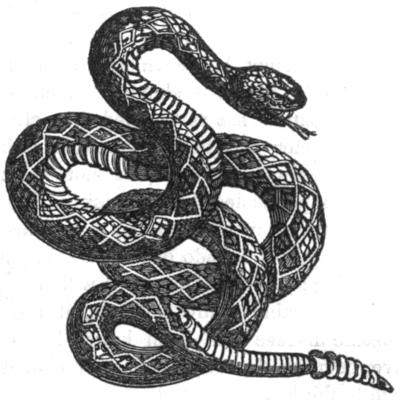
This terrible serpent is found in the province of Ceara,
whence it was brought to Rio Janeiro. This species generally
attains a length of from four to five feet but the animal
from which the poison was taken for our provings, was three
feet long. Its oval-triangular head one half of which is
provided with shields, shows a round depression in front of
the eyes, which are covered with a large elliptical shield,
serving as a lid. The body is big, conical, its movements
are sluggish; its upper surface is covered with scales, the
dorsal scales being keeled and somewhat lanceolate, the
scales of the tail being quadrangular and smaller. The belly
is provided with one hundred and seventy large transversal
plates; there are twenty-five plates belonging to the tail, the
three first of which are divided in shields. The extremity of
the tail is furnished with seven or eight capsules of the consistence
of parchment which, when agitated, produce a shrill
sound. The color of the crotalus is a yellowish-brown,
much lighter under the belly, with twenty-four or twenty-six
regular long rhomboïdal lines on each side of the back.
When irritated and during the excessive heat, the crotalus
spreads a very fetid musk-like odor. The molar teeth which
are few in number, but long and excessively poisonous, are
inserted in exceedingly dilatable jaws. Every body knows
that the poison of this reptile acts with a frightful intensity;
and it was not without great danger that Doctors Mure and
Martins succeeded in obtaining a few drops of it, by compressing
from the living animal the gland which secretes it.
1. First day: Heavy pain in the back part of the orbit, and
at the left eyebrow.—Second day: Pain under the right
orbit and at the forehead, right side.—Third day: Dry
cough with tickling in the throat, at night.—Fourth day:
Headache extending over the forehead and then the rest of
the head. 5. Fifth day: Smell all day like that of the
crotalus, insipid, nauseous, like the odor perceived in a hospital.
Sixth day: Lancinations in various parts of the body.—Seventh day:
Contraction with pressure at the right eyeball
which felt as if drawn out.—Eighth day: Yellowish
diarrhœa.—Ninth day: Pain in the middle of the forehead.
10. Tenth day: Rheumatic pain in the right shoulder.—Eleventh
day: Rheumatic pain in the left wrist.—Twelfth
day: Violent cramps in the heel.
(The drug is taken at 10 o’clock in the evening.)
Spitting of black blood.15. Prickling all over the body.
Starting during sleep. Sleeplessness. Fright at night,
without knowing about what. 20. Sleep in the morning.
The tip of the nose is drawn up as by a string which is fastened
to a central point of the forehead. Tingling in the
throat. Salt taste in the mouth which cannot be removed by
drinking sugar-water. 25. Pulse a little heavy. Small
red conical pimples on the wrist. Painful pulling on the
sides of the neck in turning the head. Feeling of coldness
in the stomach, after having eaten. Sensation as if a peg
were sticking in the middle portion of the liver. 30. Aching
pain at the gums, left side. Circular pain round the
abdomen, terminating at the navel. Two lancinations under
the right shoulder, as if with a dagger, arresting the breathing
and reverberating in the chest. Sensation as of a grain of
sand in the outer canthi of the eyes. Burning pinching at
the pylorus. 35. Constriction in the thyroid body. Sensation
as if the right lower limb, from the hip to the heel, were
shorter; this sensation, though illusory, causes him to limp.
The left eye feels as if drawn towards the temple. Burning
and constriction in the throat.
Second day: Pain in the inner head. 40. The feet are
cold. The arms are weak. Contusive feeling at the inner
side of the right shoulder-blade. Painful heaviness in the
loins. Appearance of a blue dazzling light before the eyes.
45. Borborygmi. Painful pressure in the temples. Desire
to vomit. Sensation, below the breasts, of subcutaneous ulceration.
Lancinations in the dorsal spine as from needles.
50. The prover imagines he hears some one walking behind
him. The cranium presses on the brain on all sides like an
iron helmet. Pulling in the pit of the stomach. Itching on
the thighs. Titillating itching in the ears. 55. Swelling
of the right ear. Deafness. Dreams about parties with
illuminations; quarrels, battles. Frontal headache, as if the
forehead would split, with weight above the eyes, especially
at night. Pain in the stomach extending to the navel.
60. Weariness of the arms and lower limbs. Smarting in
the nostrils. Cutting sensations all round the eyeball as if
cut out with a penknife. Pain in the left cheek. Sweat and
debility after eating. 65. Greenish spitting in the morning.
Sensation in the head, as if some living being were
walking about in a circle. Shocks in the brain so violent
that one is near losing one’s equilibrium. Continual twitching
of the eyebrows, especially the left. Black, bloody froth
around the lips, in the morning. 70. Tongue of a scarlet-red.
Jerking in the fingers. Pain in the elbow as if the
bones were pulled. Sensation as if a thread were rolling in
the eye and were pulling the eyeball toward the temple.
Acute pulling in the thigh, with momentary paralysis in the
right pelvic extremity. 75. Acute lancinations in the right
temple. Very thirsty. Belly-ache after drinking. Pressure
in the whole abdomen, in the direction of the navel. The
abdomen is exceedingly sensitive. 80. Great desire for
food, suddenly passing off at the sight of the latter. Loathing
of meat. Yellow rings around the eyes. Discharge of
an albuminous substance from the rectum, preceded by tenesmus
and urging. Falling of the rectum for ten minutes.
85. Pain in the hollow of the hand.
Third day.—Pain in the chest which reaches as far as
the back. Sensation as of an opening in the pit of the stomach
through which air passes. Sleeplessness with agitations.
Headache as if the forehead would split. 90. Headache,
nosebleed, and excited feeling in consequence of having
been roused from sleep suddenly. Drawing-up of the
lower limb from the hip to the foot, with crampy pain. Leucorrhœa.
Small pimples on the hairy scalp. The toes remain
bent. 95. The nails are red. Sensation as of
water in the chest, with efforts to throw it up, and sensation
as if the heart were floating in a liquid. Constant yawning.
Itching of the tongue. Smarting at the tips of the fingers.
100. Sensation as of dust in the throat. The pimples at
first look like flea-bites, after which they become elevated
like little cones and constitute the centres of an exfoliation
less extensive than that caused by the elaps coralinus, with a
little black speck remaining in the middle. Itching in the
canthus of the eye. Acute sensation of burning and redness
of the skin which is perceptibly sunken in at the opening of
the right nostril. The prover imagines he hears some one
moan. 105. The thorax and head feel as if pressed upon
by an iron armor. Sensation as of bands round the abdomen.
Pain in the elbows. Pain in the jugular veins when
moving the neck. Abundant discharge of nasal mucus, at
night. 110. Foul taste, or taste as of onions in the mouth
until it is rinsed. Burning and prickling at the tip of the
tongue. Swoon which passes off in the open air. Anorexia
all day, and a good deal of appetite in the evening. Pain
above the right breast. 115. The soup falls into the stomach
quite suddenly, and lies there like a stone, with pain in
the back. Stitch in the left side when drawing breath after
drinking. Lancinations in the side.
Fourth day.—Violent lancinations in the uterus while
washing one’s-self with cold water, the lancinations become
frightful when using warm water, with weight at the uterus.
Itching under the feet. 120. Formication in the feet as
high up as the ankles. Prickling in the bends of the knees.
Faint feeling at the stomach. While in a clairvoyant state,
he speaks to somebody who does not answer him. 125.
Feeling of fright at night. First the blood is felt rising in the
carotid arteries several times; this is followed by a faint
feeling and lastly by a sensation as if a valve were suddenly
opened. Violent blow at the epigastrium. All his limbs
tremble. Chilliness all over which continues even under the
bed-cover. 130. Violent ache at the vertex, and sensitiveness
of the hairy scalp to the touch. Extinction of the voice.
Great weakness. Depression of spirits. Suffocative oppression
and fear of another paroxysm. 135. Sensation as
if a red-hot iron were sticking in the vertex. The eyelids
feel heavy. Pain in the lower gums as if they had been
touched by a red-hot iron. Excessive weight at the diaphragm.
Continual contusive pain between the two shoulders,
and sometimes slow and measured lancinations when inclining
backwards, as if a vertebra had been fractured. 140.
Constrictive pain in the thyroid body as if strung together
with a string.
Fifth day.—Coldness in the back after eating. Drawing
from the neck to the epigastrium. Pain in the right clavicle.
Weight on the orbits, at night. 145. The feet are icy-cold.
Headache above the eyes, at ten o’clock in the morning.
Stomach-ache when eating, as if too empty. The
heart feels as if beating from above downwards. Internal
pain between the shoulders. 150. The inner nose is
ulcerated. He is pursued all over by the idea of death,
especially when alone. He can only think of death with
great depression of spirits. Ineffectual desire to weep.
Lancinations in the meatus and auditorius. 155. Vermillion-colored
metrorrhagia. Paralysis of the tongue.
She stands for ten minutes on the window-sill, and she is
arrested when on the point of precipitating herself out of the
window. She rises suddenly at three o’clock, uttering two
shrill cries and throwing herself forward. The vermillion-colored
metrorrhagia with which she had been affected since
the morning, disappears suddenly. 160. Profuse flow
of tears. The hands are cold. The hands tremble. Loss
of memory. Second attack at six o’clock, after which she
seats herself in an arm-chair. 165. Burning forehead.
Palpitation of the heart. Weeping. She plays with her
fingers like a child. The suffocative oppression increases.
170. Magnetic state, she hears nothing, and again sees the
phantom of death, an immense, black, fleshless skeleton; her
tears and mania increase. Vacant stare. Pressive points
in the abdomen.
Sixth day.—Bone-pain and swelling of the left clavicle.
Dream about a horse which is bathed in a pond and gets
drowned gradually. 175. Piteous moaning during sleep.
Even while awake one feels as if one were falling out of
bed. Acute pain at the sacro-lumbar articulation. Loss of
consciousness, one hears and sees nothing. Coldness in the
back. 180. Oppression of breathing, as though there
were not air enough in the house. Contraction of the toes.
Desire for snow, without desiring either water or wine.
Itching at the epigastrium. Heat in the thighs. 185. She
exclaims several times: he is in the lions’ den, but they will
not bite him. At six o’clock in the evening, another fit of
mania. Magnetic state, during which she does not answer
any questions but hears a strange voice on her left side and
behind her; she follows it, and tilts against the doors which
had been closed and which she scratches with her nails.
Three very nearly similar attacks succeed each other, they
are occasionally interrupted by silly laughter and always end
with a flood of tears. She exclaims again: he is in the den,
but the lions will not eat him.
Seventh day.—Fainting from hunger, before eating. 190.
Contusive pain at the occiput. Somnolence the whole morning.
Another attack of mental alienation, she hears voices
which she follows, and sheds a flood of tears. Her head
feels heavy, with stupor. The humeral extremity of the left
clavicle continues to swell. 195. Intermittent metrorrhagia
twice a day, and alternating with the paroxysms of
mania. Involuntary emission of urine during sleep. Pain
across the umbilical region, with alternate sensation of
spreading out and pinching together. Swelling of the three
last toes of the left foot. Excoriation and pustules on the
toes of the left foot. 200. Suffocative oppression. Pain
in the bones, especially in the joints, at the shoulder-blades,
elbows, at the phalanxes of the fingers, at the knees, hip and
under the toe-nails. Pressure at the right hip as with the
blade of a knife. The metrorrhagia ceases. She cannot
bear seeing any one on her right side, without experiencing
palpitation of the heart and a real fatigue from pleasure.
Eighth day.205. Dreams about enormous shaggy spiders
walking towards one and attempting to crawl over one’s person.
Pain in the large psoas-muscle resembling lancinations.
Suffocative oppression. A circular spot between
the two breasts which is black at the upper and red at the
lower portion. Hepatic spots of a bright-yellow color, or
freckles on the upper part of the right hands. 210. Small
red pimples on the left foot, like those which appeared on
the hand on the second day of the proving. Obstinate constipation.
Lancinations, as if stabbed with a knife, in the
uterus and anus, especially while washing herself with cold
water. Pains in the lower parts of the belly when taking a
cold drink. Excessive sensitiveness of the epigastrium,
which does not even allow the pressure of the clothes.
215. The molar teeth are excessively sensitive and set on
edge. Vomiting after breakfast in consequence of drinking
tepid water. Flushes of heat in the face. Violent itching
at the calves. Small red pimples with a white tip. 220.
While drinking cold water, the veins of the bend of the knee
have a deep-black color. Buzzing in the ears while going
down-stairs.
Ninth day.—Ache, at night, in the upper molares, with
inflammation of the gums. Spitting of blood mixed with
thick phlegm. Dreams about dead persons and phantoms.
225. Loathing of food. Very deaf, after a month. She
feels as though her eyes were falling out. Slight pain under
the lids. Discharge of white mucus from the mouth. 230.
Discharge of a bright-red blood from the nose. The last
phalanges feel as if broken. The tips of the fingers are blue.
The nails are bare. Yellow complexion. 235. Pain in
the left side. She feels uncomfortable in consequence of
having her courses, and is out of humor on account of having
them. Aversion to talking; sensitive mood. Desire to move
about. 240. She answers all questions with: no. Small
red pimples all over. Tightness of the head, from above.
Cramps in the arms, as if the nerves had been tied up in a
knot during a venesection.
Moral and Mental Sphere: 1. She answers no,
whenever she is asked a question. Sensitive mood. Aversion
to talking. Sensation as if one were falling out of bed,
even while awake. 5. Loss of consciousness. She exclaims:
he is in the lions’ den, but they will not bite him.
Magnetic state; she hears a strange voice, follows it and tilts
against the doors; she has three such attacks, occasionally
interrupted by laughter and tears. Ineffectual desire to
weep. Loss of memory. 10. Magnetic state; she hears
nothing, and sees a black skeleton. Mania. He thinks he
will die, especially when alone. Depression of spirits.
Despair. 15. Anguish.
Head: Sensation as of a red-hot iron in the vertex. Lancinations
in right temple. Violent ache at the vertex. Burning
forehead. 20. Contusive pain at the occiput. Tightness
of the head, from above. Her head feels heavy, with
stupor. Sensation in the head as if some thing alive were
walking about in a circle. Shocks in the brain. 25. Painful
pressure in the temples. Sensation as if the brain
were pressed upon by an iron helmet. Headache as if the
forehead would split, with weight above the eyes. Pain in
middle of forehead. Pain in the interior of the head. 30.
Pain under the right orbit and in right side of forehead.
Frontal headache, afterwards all over the head. Sensitiveness
of the having scalp.
Eyes: Pain under the lids. Sensation as though her
eyes would fall out. 35. Profuse lachrymation. Heavy
pain at back part of orbit and left eyebrow. Vacant stare.
Weight on the orbits, at night. The eyelids feel heavy.
40. Itching of the canthus. Yellow rings round the eyes.
Blue dazzling light before the eyes. Twitching of the eyebrows.
Sensation as if the eyeball were pulled towards the
temple by a thread. 45. Sense of a grain of sand in the
outer canthi. The left eye feels as if drawn towards the
temples. Contractive pressure at right eyeball, which felt
as if drawn out. Cutting round the eyeball.
Ears: Buzzing in the ears while going down-stairs.
50. Lancinations in the meatus auditorius. He imagines he
hears some one walking behind him. Sensation as if some
one were moaning. Titillating itching in the ears. Deafness.
55. Swelling of the right ear.
Face: Yellow complexion. Alteration of the features.
Formication in the face. Flushes of heat in the face. Pain
in left cheek.
Nose: 60. Ulceration of the inner nose. Discharge of
a bloody liquid from the nose. Sense of burning and redness
of the skin, with depression, at the orifice of the right
nostril. Nosebleed. Smarting in the nostrils. 65. Insipid,
nauseous smell all day, as in a hospital. The tip of the
nose is drawn up.
Teeth: Pain in lower gums as from a red-hot iron.
Aching in the upper molares, at night, with inflammation of
the gums. The molar teeth are sensitive and set on edge.
70. Aching pain in left gums.
Mouth: Paralysis of the tongue. Burning and prickling
at the tip of the tongue. Itching of the tongue. Tongue of
a scarlet-red. 75. Pain in the tongue. Spitting of black
blood. Spitting of blood, mixed with thick phlegm. Discharge
of white mucus from the mouth. Greenish spitting
in the morning. 80. Black, bloody froth around the lips
in the morning. Thick, viscid saliva which it is difficult
to get out.
Taste and Gastric Symptoms: Salt taste in the mouth,
not removed by drinking sugar-water. Taste as of onions
in the mouth, before rinsing it. Aversion to food. 85. Desire
for snow. Desire for food, passing off on seeing it.
Thirst. Fainting from hunger. Coldness in the back after
eating. 90. Anorexia all day. The soup descends into
the stomach quite suddenly, and lies there like a heavy body,
with pain in the back. Stitch in the left side, after drinking
when drawing breath. Colic after drinking. Aversion to
meat. 95. Sweat and debility after eating. Desire to
vomit.
Throat: Constriction of the throat. Sensation of a
lump in his throat. Difficulty of swallowing. 100. Sense
of dust in the throat. Burning and constriction in the
throat. Tingling in the throat.
Stomach: Stomach-ache, when eating, as if too empty.
Faint feeling at the stomach. 105. Pulling in pit of
stomach. Sensation of an opening in pit of stomach, through
which air passes. Pain from stomach to navel. Burning
pinching at the pylorus. Feeling of coldness in the stomach,
after eating.
Abdomen: 110. Sensitiveness of the epigastrium. Pressive
points in the abdomen. Lancing pains in the large
psoas-muscle. Pains in lower part of belly when taking a
cold drink. Pain across the umbilical region, with alternate
sensation of spreading out and pinching together. 115. Itching
at the epigastrium. Shock at the epigastrium. Falling
of the rectum. Weight at the diaphragm. Sense of bands
round the abdomen. 120. Pressure in abdomen, towards
the navel. The abdomen is sensitive. Discharge of an albuminous
substance from the rectum, preceded by tenesmus.
Borborygmi. Sense of a peg sticking in the middle of the
liver. 125. Circular pain round the abdomen, terminating
at the navel.
Stool: Constipation. Yellowish diarrhœa.
Urinary and Sexual Organs: Emission of a deeply-colored
urine. Metrorrhagia (vermillion-colored). 130.
Feels uncomfortable in consequence of having her courses.
Metrorrhagia alternating with mania. Lancination in uterus,
especially when washing one’s self with warm water, with
weight at the uterus. Leucorrhœa.
Bronchial Symptoms: Aphonia. 135. Pain in the
larynx. Dry cough, with tickling in the throat, at night.
Chest: Round spot between the breasts, black above
and red below. Swelling of the humeral extremity of the
left clavicle. Palpitation of the heart. 140. Suffocative
oppression. Oppression of breathing, as from want of air.
Bone pain and swelling of the left clavicle. Anxious
breathing. The heart feels as if beating from above downwards.
145. The thorax feels as if encased in iron. Pain
in the right clavicle. Violent pains in the chest. Pain
above the right breast. Sensation of water in the chest, and
as if the heart were floating in a liquid. 150. Copious sweat
on the chest. Ulcerative feeling under the breast.
Back: Coldness in the back. Slow lancinations between
the shoulders, when inclining backwards. Acute pain at
the sacro-lumbar articulation. 155. Internal pain between
the shoulders. Contusive pain between the shoulders. Lancination
in the dorsal spine, as from needles. Painful heaviness
in the loins. Contusive feeling at inner side of right
shoulder-blade.
Neck: 160. Constrictive pain in thyroid body. Swelling
of the jugular veins. He feels the blood rise in the carotid
arteries, followed by faint feeling and sensation as if a valve
were opening. Drawing from the neck to the epigastrium.
Pain in the jugular veins when moving, the neck. 165.
Constriction in thyroid body. Painful pulling in the sides
of the neck when turning the head.
Upper Extremities: Lancinations under the right
shoulder arresting the breathing. The bitten hand and arm
are inflamed and very painful. Sensation of swelling in the
forearm. Violent pain in the whole arm. Weakness of the
arms. 170. Cramps in the arms as if the nerves had been
tied up in a knot, during a venesection. Rheumatic pain in
right shoulder. Trembling of the hands. Slight pain in the
hollow of the hand. Pulling pain in the elbows. 175. Pain
in the elbows. Enormous swelling of the hand. Feeling
of coldness in the hand. Jerking in the fingers. Smarting
of the tips of the fingers. 180. The tips of the fingers
are blue. The last phalanges feel as if broken. She plays
with her fingers. Nails are red. The nails are bare.
185. Rheumatic pain in left wrist.
Lower Extremities: Sensation as if the whole right
lower limb were shorter; this causes him to limp. Acute
pulling in the thigh, with momentary paralysis. Itching on
the thighs. Drawing-up of the lower limb, with crampy pain.
190. Pressure at right hip as from a knife. Heat in the thighs.
Sense of burning heat in the legs. Prickling in the bends of
the knees. Itching of the calves. 195. Cold feet. Sense
of coldness in the feet. The feet are icy-cold. Itching
under the feet. Formication in the feet. 200. The toes
remain bent. Contraction of the toes. Swelling of the three
last toes of the left foot. Violent cramp of the heel.
Sleep: Sudden rising at three in the morning, and uttering
two shrill cries, with throwing herself forward. 205.
Dreams about dead persons and phantoms. Dreams about
spiders attempting to crawl over her. Disposition to slumber.
Somnolence, the whole morning. Moaning during sleep.
210. Involuntary urination during sleep. Dream about a
horse which is drowned in a pond. Yawning. Dreams
about illuminations, quarrels. Sleeplessness. 215. Starting
during sleep. Fright at night, without knowing about
what.
Fever: Chilliness all over. Sense of chilliness. Pulse
heavy. 220. Pulse 98 to 104.
Cutaneous Symptoms: Bright-yellow spots on upper
part of right hand. Red pimples on left foot. Red pimples
all over. Red pimples with white tips. 225. Pustules on
the left toes. Pimples on the hairy scalp. Pimples resembling
flea-bites, afterwards becoming raised and exfoliating,
leaving a black point in the centre. Red pimples on the
wrist.
General Symptoms: Pain in left side. 230. Trembling
of the whole body. She cannot see any one on her
right side without feeling a palpitation of the heart, and a
real fatigue from pleasure. Desire to move about. Pain in
the joints, shoulder-blades, elbows, &c. Trembling of the
limbs. 235. Weakness. Torpor. Pains in the whole
body, inducing a moaning. Swoon. Lancinations in the
side. 240. Prickling all over. Weariness of the arms and
lower limbs. Lancinations in various parts of the body.
ELAPS CORALLINUS. ELAPS. ELAPS VENUSTISSIMUS (SPIX.) VIPERA CORALLINA. — SECOND EXPERIMENT. — ARRANGEMENT ACCORDING TO HAHNEMANN.
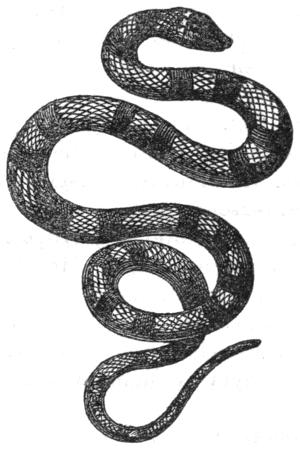
The elaps corallinus is found quite frequently in the
woods all along the coast of Brazil, and its bite is much
dreaded. Its colors are more brilliant and more agreeably
combined than those of any other serpent in Brazil. Its
head is small, covered with large polygonal scales; it swells
behind and is continuous with the neck from which it is
scarcely distinguished as regards size. It has round and
small eyes; the jaws which are little dilatable, are furnished
with sharp teeth accompanied by fangs that rest on the venomous
glands. The body is about two feet and a half in
length; it is round, rather big in proportion to the head, and
terminates in a sharp tail. The upper part is covered with
smooth rhomboïdal scales; the belly is covered with two
hundred transverse shields; the tail numbers fifty shields,
which are disposed in two parallel rows. Its colors are disposed
in the shape of rings of a vermillion-red, alternating
with black rings, each two rings being separated by circular
lines of a greenish white. The upper part of the head is
black; likewise the first colored ring of the neck; the
shields of the jaws are white, and are separated from each other
by black lines. As in the case of the crotalus cascavella, the
poison was taken from the living reptile, not without danger.
As soon as I had determined to institute provings with the
poison of the cobra-coral, several of these reptiles were, at
my request, brought to me on the same day, so frequent are
they in the forests of Sahy. The animal which I selected
was wrapt up in a piece of linen-cloth, and, after its head
had been steadied with a little wooden pin, some eight or ten
drops of poison were pressed out of its jaws by means of a
pair of steel-pincers, which I received on one hundred
grains of sugar of milk, and at once subjected to the process
of trituration in my mechanical mortar. They received six
thousand successive turns. One grain of this mass was triturated
a second time, and a grain of this second trituration a
third time, each receiving three thousand turns.
Even while triturating the drug in my mortar, the most
striking effects were produced by the simple emanations
ascending from it. This phenomenon, however, is observed
whenever I cause a somewhat active drug to be triturated
in the mortar.
The symptoms which I have collected, are not a great
many, but they can be depended upon. Most of the symptoms
were experienced by several provers, and some of them
have already been confirmed by treatment, among which may
be mentioned the oppression in going up-stairs, the vesicular
eruption on the feet and the deafness. This last symptom is
of great importance on account of its being so obstinate. For
pulmonary affections the poison of the cobral may likewise
prove a valuable remedy, especially for the second stage of
phthisis, characterised by bloody cough and derangement of
the digestive functions. It may likewise be serviceable in
mental alienation and cutaneous eruptions.
The special action which this poison seems to exercise
on the right side, the paralysis, the lancinations, have appeared
to me worthy of attention. The gyratory motions,
the desire to move to and fro, the scaling off of the epidermis
and several symptoms relating to the disposition and the mind,
seem to deserve the attention of the philosophical physician.
There certainly exist remarkable analogies between the
symptoms of the cobral and those of the lachesis. The differences,
however, are sufficiently numerous to refute the
doctrine that all serpent-poisons act almost alike and that the
cobral, for instance, may be resorted to as a perfect succedaneum
of the lachesis. I am convinced of the contrary to
such an extent that it is my belief that the poison of serpents
alone would, if sufficiently proved, furnish the safest and most
rapid means of combating all human infirmities. Every epoch
in the history of the world is undoubtedly possessed of therapeutic
means which are more particularly homœopathic to
the general character of the ruling maladies. Hence it is
probable that when the human species shall have been freed
from the miasms which now undermine its vitality, the simple
flowers on the fields will be sufficient to control the remaining
indispositions. Whereas we, unfortunate heirs of the
chronic miasms of all ages, lepra, scrofula, syphilis and a host
of other subtle plagues, are compelled to employ the most
frightful agents in order to meet the intensity of our diseases.
First to third day.—1. Reveries in the day-time, one imagines
one is receiving blows. One imagines one hears
some one speak. One hears talking without comprehending.
Absence of mind. 5. Nightmare and congestion
about the head. Anxious dreams. Weight in the right
parietal region and pain which penetrates to the nape of the
neck. Beating at regular intervals in the nape of the neck,
like the ticking of a clock. Weight in the forehead and
above the orbits. 10. Boring pain from the vertex to the
right eyebrow. Pain on the right side, which seems to be
seated in the cerebellum. Sweat on the forehead and nape
of the neck. The head falls forward with violence. Painful
constriction in the temples and eyes. 15. Violent
throbbing of the external carotid. Horrid pains when
inclining the head backwards; less when inclining it
forwards. Tension in the nape of the neck. Stiffness
which prevents the head being turned. Sensation as of a
foreign body in the right temple. 20. Lancinations in the
outer angle of the left eye. Boring pain from the lower jaw
to the right eye, and then from the right eyelid to the ear.
Desire to close one’s eyes as in fever. Sharp pricking in
the inner canthi of the eyes. Aching pains around the eyes,
with vanishing of sight. 25. Continual buzzing as from a
fly in the meatus auditorius. Constant deafness. Ringing
in the ears. Discharge of a serous fluid from the left ear.
Distressing prickling in the superior nasal fossa. 30.
Swelling of the gums on the last three molar teeth. Prickling
as if caused by strong spice, after having triturated the
drug. Prickling at the tip of the tongue. Sour eructations,
desire for cold water, ice. Loathing of food, acidity after
every mouthful of food. 35. Pressive constriction in the
throat. Burning from the larynx to the tongue as from peppermint,
with desire for fresh air. The food descends in the
œsophagus as if turned round like a screw. At other times
the soup falls heavily and precipitately, as if through a metallic
tube into the stomach, which trembles violently.
Watery, yellowish diarrhœa, which is mixed with slime, attended
with rumbling in the bowels. 40. Urine almost
red. Urine profuse. Urine red. Constriction of the sphincter.
Continual discharge of prostatic fluid. 45. Thickening of
the skin of the prepuce, with inflammation. Excoriation on
the back of the penis, which causes a continual itching.
Weakness of the genital powers, impotence. Lancinations
and prickings in the penis. Weight and swelling of the
testicles. 50. Spitting of black coagula of blood, with
painful tearing as if proceeding from the heart. Almost
constant cough. Sensation in the chest and at the sternum
as if the pleuræ would be torn off, and as if the two lungs
would be separated from each other by force. Inability to
incline to the right side, in consequence of a very painful
pulling in the right lung. Violent itching, drawing, pricking
at the epigastrium, which hinders drawing a full breath. 55.
A chronic loss of breath when going up-stairs, disappears
after the second day of the proving. Violent fit of dry cough
which finally ends in raising black blood, with frightful tearing
pains in every part of the lungs, and especially in the
right side, at the upper part of the chest. Taste of blood in
the mouth previous to the paroxysm of cough, succeeded by
a desire to vomit. Burning in the hands while preparing the
drug. Prickling in the back of the right hand. 60. Pulling
in the right hand, which extends to the ring-finger.
Pains in the elbows. Crampy constriction in the phalanxes
of the fingers and under the nails. Lancinations and prickling
in the back of the hand. The blood remains congested
in the hand, which is of a violet color and as if paralysed;
it has to be kept erect in order to prevent the congestion.
65. A black blood spirts out of the finger when pricking it
ever so little. Vesicular eruption on the feet. Pains in the
knees. Pains in the knees as if bruised and contused, especially
in the left knee, which does not bear contact, and
where the pain is as keen as if the part had been sprained.
Third to sixth day.—Sensitiveness of the right side. 70.
Inability to rise in the morning in consequence of the pain in
the right side. Slight phlyctænæ make their appearance here
and there, especially on the extremities; the epidermis surrounding
them sometimes scales off. Drowsy the whole
day, but sleepless nights. Dreaming about the business of
the day. Pain in the forehead. 75. Red eyebrows. The
eye is extremely sensitive to cold water. Stoppage of the
right nostril, improved by resting on the same side. Bad
smell from the nose. Pulling in the œsophagus. 80.
Violent headache, if the desire for food is not satisfied on the
instant. Suffocative oppression after eating. Bloating of
the stomach after eating. Pulling in the pit of the stomach.
Violent hunger. 85. Pressure at the right hypochondrium.
Pressure in the left side, which extends to the vertebral
column. Dull pain in the right lung, worse when walking.
Congestion of blood to the throat, which is caused by the
pain in the lung. Sense of spraining and stiffness in the
knee joint.
Seventh day.—90. Painful pressure at the nape of the neck,
as if the cerebellum had settled downwards. Eyes red and
inflamed. Blood oozes from the eyes. Glassy look. Bitter,
salt taste in the mouth. 95. Noisy and violent borborygmi.
Stitch in the side. Falling of the rectum. Hoarse voice.
Violent beating of the heart. 100. Pain as if bruised
in the sides of the neck. Painful drawing at the inner side
of the arm, from the axilla to the wrist, but felt especially at
the bend of the elbow. The right hand feels as if paralysed.
Shuddering from the hand to the shoulder when dipping the
former into cold water. A good deal of distress in the whole
abdomen. 105. The left foot is swollen and blue, with
red spots. Drawing-up of the feet. Twitching in the parotid
gland. The saliva tastes salt. Crusty eruption over the ear
and a part of the cheek. 110. Itching in the ear, in the
evening. Red urine, with cloudy sediment. Pinching sensation
at the helix and lobe of the ear. Discharge of a
greenish-yellow liquid from the ear, in the morning. Painfulness
of the parotid gland. 115. Itching pimple on the legs.
Discharge of blood from the ear. Swelling of the inguinal
gland. The left groin is painful to contact. Colic with
urging to stool. 120. Blackish and frothy diarrhœa. The
urine is very thick and deposits a red sediment.
First day.—Tension in the nape of the neck and inability
to turn the head. Dark, almost red complexion. Pain in
the urethra while urinating. 125. Pricking in the left
gums. Desire for food, with aversion to eating. Lassitude
in the limbs. Prickling under the toe-nails. Sense of
excoriation at the nape of neck. 130. Violent pains in
the lumbar region, like a band extending to the uterus.
Weight at the uterus. Weight at the stomach after eating.
Acidity, nausea and faint feeling. Weight at the left side of
the uterus. 135. Unquenchable thirst. Feeling of coldness
in the chest after drinking. The lower limbs give way.
Pain in the right instep as after a forced journey. Colic
gradually spreading all through the colon, from the cœcum
to the rectum. 140. Sleeplessness with uneasiness.
Weight at the vagina, in consequence of an attack of hysteric
colic. After a continued congestion of the blood to
the thoracic viscera, it seems to rush to the viscera of the
abdomen. Prickling in the uterus, vagina and pubic region,
extending to the epigastrium, with painful lancinations.
Lancinations at the umbilicus from above downward, extending
to the womb. 145. Vomiting of green bile, followed
by bilious diarrhœa. Buzzing in the ear. In cleaning the
meatus auditorius, small balls of hardened and black wax are
taken from it.
Second day.—Dull pain in the right lung, worse while
walking, with distress and rush of blood to the throat. Prickling
and pulling in the right lung. 150. Blear-eyedness.
Constriction of the thorax as by a corset. Pressure under
the right arm. White, albuminous leucorrhœa. Sensation
as of sand in the eyes. 155. Discharge of white and
watery mucus from the nose. Constant tickling at the nose.
Great weight at the uterus when rising, worse during a walk.
Coryza when exposed to the least current of air; sneezing.
Acute contusive pain at the inner side of the left leg, and
sensation as if something were rising and descending in the
tibia. 160. Difficulty of opening the eyes. Sensation as
if long and white filaments were floating before the eyes.
In closing the eyes, every thing looks red, dotted with black
points. Itching in the right meatus auditorius. Stoppage in
the œsophagus, after eating, as if a sponge had lodged there.
165. The beverage is arrested in the œsophagus as by a
spasmodic contraction of this organ, after which it falls
heavily into the stomach. Lancinations from above downward
in the posterior muscles of the trunk, from the occiput
to the sacrum, attended with pains in the temples. Lancinations
in the soles of the feet, while seated; they disappear
by walking. Pains in the forehead. Discharge of black
blood, between the menstrual periods. 170. In the morning
the hairy scalp, at the occipital protuberance, feels as if
raw. Violent itching in the vagina. Prickling as with thousands
of pins. Aching pain in the left side. Cramps in the calves,
worse in the afternoon.
Third day.—175. Breakfast agrees pretty well, but the
dinner distresses him. Very sensitive to the cold. Warmth
in the hollow of the hand, after dinner. Coldness in the
back. Blear-eyed. 180. Sensation, in the right eye, of
a gauze having a bluish-white or mother-of-pearl color.
Sense of stiffness and spraining in the knee-joint. Disposition
to faint. Sleeplessness or else drowsiness, with distressing
dreams about the business of the day. 185. Lancinations
in the vagina. Heat in the left nostril, and swelling
of the nasal septum. Weight in the vagina, on the left
side, and acute pain which prevents her from going up-stairs.
Sensations in the abdomen as of a tube which can suddenly
be closed by means of a valve, and through which a column
of some liquid is poured into the abdomen, where a violent
rumbling takes place. The left eyebrow is painful and
drawn down. 190. Eructation tasting like spoiled eggs
in the throat. Lancinations which proceed simultaneously
from the groins and cross each other at the symphysis pubis.
Violent diarrhœa, consisting of sanguinolent mucus and yellow
bile, whereas it had been green heretofore. Sensation, while
walking, of a black disk of four inches in diameter, at the
distance of a few paces from the eye. Discharge of black
blood with stool, with acute colic as though the intestines
would be twisted together. 195. Stye at the left eye,
with violent lancination. Tickling and reddish streaks of the
sclerotica. Red spot on the knee-pan. Violent colic as
though the intestines would become twisted amongst each
other. Bloody dysentery, followed by sleep. 200. The
menses appear before their regular period. Pressure between
the shoulders. Greyish gauze before the eyes, like a cloud,
which becomes thicker; at first it is of the size of a penny,
and spreads until finally it covers the whole field of vision.
Sensation as if an iron bar were pressing on the loins. Lancination
in the stye on the left eye. 205. Lancinations
in the dorsal muscles, especially in raising the arms. The
right side is numb and as if paralysed, from the shoulder to
the knee. Pulling at the cardiac orifice, with sensation of
hunger and boring feeling extending to the vertebral column.
Pain in the spinal marrow, from the nape of the neck to the
sacro-lumbar articulation. The neck remains twisted when
turning it, with constriction in the thyroid gland. Crampy
constriction at the bend of the elbow, especially when moving
it. 210. Weight in the stomach after the introduction
of food; it turns, with desire to vomit. Constrictive pain at
the bend of the elbow and knee. Itching in the meatus
auditorius. This itching spreads in the interior of the cheek
all along the duct of steno. Watery saliva. 215. The
viscous saliva is more abundant. Changing one’s position is
painful, one would like to remain seated or lying. Diarrhœa
consisting of undigested food. The teeth are loose; one is
unable to chew bread. Loose cough.
Fourth day.—220. Complete paralysis of the right side,
with inability to rise in the morning. Violent itching in the
left eye. Complete blindness for five minutes. The right
hand is benumbed; a stitch is felt through the thickness of
the metacarpus. Smarting under the nails. 225. Painful
drawing at the inner part of the arm, from the axilla to the
wrist; but especially distressing at the spot where the prover
had been bled. Small red tetter at the corner of the right
nostril, spreading to the cheek, with tickling. Stoppage of
the nostrils, one has to breathe by the mouth. Suffocative
oppression while eating. 230. Violent distress throughout
the thoracic viscera. Cyanosis and reddish spots of the
extremities. Violent itching under the axilla, and appearance
of a tetter. The blood rushes to the right hand, which is of
a violet color and as if paralysed. Shuddering up to the
shoulder when dipping the hand in water. 235. The arm and
hand are swollen, blueish, and covered with red spots, likewise
the right leg and foot. Cramps in the whole of the
right side. Cramps in the calves. Swelling of the stomach.
Acute lancinations, from time to time, in the fourth
toe of the left foot, as if pierced by a needle. 240. Quick
and transitory lancinations in the back, sides and arms. Pain
at the roots of the hairs on the occiput. Fruit and cold
drinks lie in the stomach like ice. Sudden colic, with
diarrhœa. Lancinations and stitches in the upper part of
each lung. 245. Bloat in the region of the diaphragm.
After taking a cold drink, shuddering from the head to the
feet, and chattering of the teeth. Lancinations in the inner
side of the knee. Lancinations from the root of the nose to
the ear. Sensitiveness in the pit of the stomach. 250.
The tips of the fingers peel off, which is painful. Redness
and pain under the nails, the parts look as if raw. Biting
one’s hand during sleep, without waking. Pressure between
the shoulders. Liquids descend in the œsophagus with a
sound like glou-glou. 255. The nose continues to swell
and the pain extends to the ear. Prickling in the eyebrows,
especially the left. Acute pain in the iliac bone, on the right
side, as though the crest were swollen and the periosteum
inflamed. The right leg up to the knee is cold as ice. Frontal
headache. 260. Discharge of black, liquid blood from
the bowels. Borborygmi and noisy flatulence. Constriction
of the sphincter, a quarter of an hour after the discharge.
The peristaltic motion of the intestines takes place from
below upwards; the blood seems to flow backwards in the
abdomen, with violent pain and frightful palpitations, succeeded
by lancinations which prevent walking.
Fifth day.—Dreams about dead persons; she kisses dead
persons, falls into pits where her feet get entangled; she
walks sideways. 265. Quarrelsome, irritable mood, with
agitation of the mind. Good appetite. The heel begins to
peel off the same as the fingers. While dreaming she bites
her forearm. Vertigo so as to fall forwards. 270. Sensation
as if falling forward, though the prover remains immoveable.
When raising the hand to the right side of the
nape of the neck, a penetrating pain is felt which spreads
to the ear. Stitch in the side, a whole day. The breathing
through the nose is interrupted. One hears some one
talking. 275. Violent itching of the hairy scalp.
Sixth day.—Strange illusion of hearing; she heard whistling
and ringing, and rises to see where it is. Frightful
dreams; she buries a dead person and, with a knife, digs
about in his wounds. Afterwards the experiences a burning
remorse and sheds a flood of tears. She dreams that she
has a fight with a man condemned to the galleys. 280.
Desire to strike and pick a quarrel. Mental excitements.
Itching of the soles of the feet, which continue to peel off.
Small pimple with a good deal of itching. Slight discharge
of a clear mucus from the urethra. 285. At the least contrariety
the body shudders and the blood boils, with pricklings.
Lassitude in all the limbs.
Seventh day.—Desire to go to the country and play about
in the grass. Desire to be alone; for days she remains in
the corner of the anti-chamber. Sound sleep. Plans about
travelling, &c. 290. She hears distant whistling. Bread
tastes flat, like the triturated poison which had been swallowed
for the purpose of proving it. She wants to leave the
house at the moment when she is going to bed. She retires
to a distant room to work. Irresistible desire to cry out with
all her might. 295. Loathing of meat, bananas, and particularly
bread. Desire for oranges, acids, and especially for
sour beef. Profuse cold sweat all over the body.
Eighth day.—During a whole month, bread does not mix
up with other food, it returns by the nose the whole day,
whereas the other kinds of food are either digested naturally
or thrown up again by the mouth. Metrorrhagia. 300.
Violent aversion to light; one prefers to be in the dark.
Violent diarrhœa, continued. Breaking out of little pimples
with an oval base, they dry up and are followed by desquamation
of the epidermis.
Ninth day.—Complete loss of appetite, she eats nothing
but oranges. Bruising pain in the upper portion of the deltoid
muscle, as if she had received a violent blow on the
shoulder. 305. Tongue black or of a dark-red color.
The tetter at the wing of the nose peels off. Yellow, irregular
spots on the hand and around the fingers, over a considerable
space. A red, transversal bar of an inch in thickness
is seen in opening the eyes, and a red disk when shutting
them. Boils on the arm. 310. Profound ennui. Depression
of spirits; desire to be in a deep cavern, where nobody
can be seen. Absence of thought. Complete loss of
one’s self, so that the time passes away without one being
conscious of it in the least.
Tenth day.—After eating an orange and bread, the orange
returns by the mouth and the bread by the nose. 315.
Coldness at the back part of the thighs. Furfuraceous tetter
and itching at the hairy scalp. She feels hungry and yet is
unable to eat. Small miliary pimples upon a red base at the
corner of the nose. Violent hunger. 320. Burning in
the stomach which extends to the duodenum. Suffocative
oppression after eating. Pain in the right side, as if in the
pleura, striking to the axilla. Constant hunger which cannot
be appeased on account of the continual vomiting. Small
suppurating pimples on the hands, fingers, wrists, gums, at
the inside of the cheeks. 325. Violent itching at the abdomen,
especially while walking. Innumerable white
pimples at the inside of the thighs, which get inflamed in the
day-time and prevent one from walking in the evening.
Burning of the eyebrows. Drowsy in the day-time, especially
at two o’clock, and sleepless at night. Tickling at the
root of the nose, as from worms. 330. Tongue swollen
and whitish, in the morning. Bloating around the eyes which
appear sunken in the morning. The arterial blood spirts
from the nose and ears. Formication at the anus as if a
worm were gnawing at the parts. Suppression of urine.
335. Tickling and frightful formication at the vulva. Very
thirsty; desire for milk. Cold sweat all over. Slow digestion,
one has to drink after every mouthful that one swallows.
Excessive horror of rain. 340. Discharge of a black
blood from the womb. Noise as from a valve closing in the
trachea and causing a column of air to ascend to the pharynx.
Eleventh day.—Discharge of blood from the ear. The
bread returns by the nose.
Twelfth day.—Loathing of bread and other food. 345.
Decided taste for oranges and salad. Watery vomiting in
the morning. Ellyptical pimples full of serum. Acute pains
in the descending colon. Small red pimples at the tips of
the fingers.
Thirteenth day.—350. The gums become loose near to
the roots of the teeth. The intestines seem to turn violently
about one other, after which they feel for a few moments as
if twisted together like a cord, and then are suddenly strung
together as by a knot, causing a sensation as if the abdomen
would be choked from side to side. Extreme sensation of
coldness after drinking and as if ice-water were rising and
descending through a cylindrical opening in the left lungs.
Vomiting of food.
Mental and Moral: 1. He imagines he is receiving
blows. Absence of mind. Horror of rain. Complete forgetfulness
of one’s-self. 5. She wants to go out at the
moment of retiring to bed. Irresistible desire to cry out.
Vertigo, she falls forwards. Depression of spirits, she desires
to be in a cavern, alone. Desire for country-air and
sport. 10. Desire for solitude. Plans about travelling, &c.
Quarrelsome.
Head: Pain in cerebellum, right side. The hairy scalp
at the occipital protuberance feels raw, in the morning.
15. Painful constriction in the temples and eyes. Horrid
pains when inclining the head backwards. Weight in forehead.
Weight in right parietal region and pain penetrating
to the nape of the neck. Sensation as of a foreign body in
right temple. 20. Pain in the forehead. Boring pain
from vertex to right eyebrow. Pain at the roots of the hairs
on the occiput. Itching of the hairy scalp.
Face: Dark complexion. 25. Itching in the ear and
cheek. Lancinations from the root of the nose to the ear.
Boring pain from the lower jaw to the right eye, and then
from the right eyelid to the ear.
Ear: Pinching at helix and lobule. Itching in the ear.
30. The cerumen is hardened and black. Itching in the
right meatus. Deafness. Illusion of hearing, she hears a
whistling and ringing. He imagines he hears some one
speak. 35. Ringing. Constant buzzing in the meatus.
Buzzing. Discharge of a serous fluid from the left ear.
Discharge of blood from the ear. 40. Discharge of a
greenish-yellow liquid from the ear, morning.
Eyes: Stye at left eye, with lancination. Tickling and
red streaks of the sclerotica. The left eyebrow is painful
and drawn down. Blood oozes from the eyes. 45. Blindness
for some minutes. Violent itching in the left eye.
Prickling in the eyebrows. Aversion to light. Burning of
the eyebrows. 50. Bloating around the eyes, in the
morning. Aching pain around the eyes, with vanishing of
sight. Sharp prickling in the inner canthi. Desire to close
one’s eyes. Lancination in outer canthus of left eye.
55. The eye is sensitive to cold water. Red eyebrows.
Eyes red and inflamed. Difficulty of opening the eyes.
Sand in the eyes. 60. Blear-eyed. Glassy look. Sensation
in the right eye as of a gauze of a blueish-white or
mother-of-pearl color. Black disk at a few feet from the
eye, when walking. Greyish gauze before the eyes, gradually
spreading over the whole field of vision. 65. Red
bar before the eyes when opening them, and a red disk when
shutting them. When closing the eyes, every thing looks
red, dotted with black points. Sense of long, white filaments
before the eyes.
Nose: Tickling at the nose. Stoppage of right nostril.
70. Bad smell from the nose. Distressing prickling in the
superior nasal fossa. Tickling at the root of the nose.
Swelling of the nose, with pain extending to the ear. Stoppage
of the nostrils. 75. Heat in left nostril, and swelling
of the septum. White and watery mucus is discharged
from the nose.
Teeth: The teeth are loose. Prickling in left gums.
Swelling of the gums on the last three molares. 80. Looseness
of the gums at the roots of the teeth.
Mouth: Salt tasting saliva. Bitter, salt taste in mouth.
Prickling at the tip of the tongue. Tongue swollen and
whitish, in the morning. 85. Tongue black or dark-red.
Throat: The beverage is arrested in the œsophagus as
by a spasmodic contraction of this organ, after which it descends
like a heavy weight. Pulling in the œsophagus.
Constriction with pressure, in the throat. Sensation as if
the food turned like a screw while passing down. 90.
Burning as from peppermint, from the larynx to the tongue.
Sensation as of a valve in the trachea causing a column of
air to ascend in the pharynx. Stoppage in the œsophagus,
after eating, as if a sponge had lodged there.
Gastric Symptoms: Vomiting of green bile, followed by
bilious diarrhœa. Weight at the stomach, after eating.
95. Acidity, with nausea and faint feeling. Violent thirst.
Cold feeling in the chest, after drinking. Desire for food,
with aversion to eating. Desire for food causing a violent
headache, unless satisfied at once. 100. Violent
hunger. Suffocative oppression after eating. Bloating
of the stomach after eating. Acidity after every mouthful
of food. Aversion to food. 105. Desire for cold water,
ice. Sour eructation. Sense of coldness after drinking, as
if ice-water were rising and descending through an opening
in the left lung. She has to drink after every mouthful she
swallows. Watery vomiting in the morning. 110. She
feels hungry, but is unable to eat. Hunger, with continual
vomiting, preventing one from appeasing the hunger. Aversion
to meat, bread. Desire for oranges, acid. Loss of appetite.
115. Bread returns by the nose, and does not mix
up with the other kinds of food, for a month. Bread tastes
flat, like the poison. Fruit and cold drinks feel like ice in
the stomach. Shuddering and chattering of the teeth, after
taking a cold drink. Suffocative oppression while eating.
120. Eructations tasting like spoiled eggs. The dinner distresses
him. Pulling in pit of stomach. The food descends
violently into the stomach, which trembles.
Stomach: Burning in the stomach. 125. Sensitiveness
of the pit of the stomach. Swelling of the stomach. Pulling
at the cardiac orifice, with sense of hunger and boring to the
spine. Weight in stomach, with desire to vomit, after eating.
Abdomen: Lancinations from the navel to the womb.
Pains in the loins as from a band, extending to the uterus.
Colic spreading from the cœcum to the rectum. Swelling
of the inguinal glands. Colic, with urging to stool. Borborygmi.
130. Falling of rectum. Distress in abdomen.
Pressure in right hypochondrium. Itching, drawing and
pricking at epigastrium, hindering breathing. The intestines
turn about one another, and then feel twisted as by a
cord, and strung together in a knot, with strangulating sensation
in the abdomen. 140. Formication at the anus, as
from worms. Acute pains in the descending colon. Itching
at the abdomen, especially when walking. Sensation as if
the blood in the abdomen were flowing backwards, with
violent pain and palpitations, succeeded by lancinations.
Sudden colic, with diarrhœa. 145. Bloat in region of
diaphragm. Sense of an iron bar pressing on the loins. Sensation
in the abdomen as of a tube which can be closed by
a valve and through which liquid is poured into the abdomen.
Lancinations from both groins to the symphysis pubis.
Stool: Blackish and froth, diarrhœa. 150. Lienteria.
Constriction of the sphincter. Watery, yellowish
diarrhœa, with slime, also rumbling. Discharge of black,
liquid blood from the bowels. Constriction of the sphincter,
after bloody stool. 155. Bloody dysentery. Diarrhœa consisting
of bile and bloody mucus. Discharge of black blood
at stool, with colic as though the bowels would be twisted.
Urinary and Sexual: Red urine, with cloudy sediment.
Thick urine with red sediment. 160. Pain in
urethra while urinating. Red urine. Suppression of
urine. Discharge of mucus from the urethra. Itching
excoriation on the back of the penis. 165. Impotence.
Lancinations and prickings in the penis. Weight and
swelling of the testes. The skin of the prepuce is thick
and inflamed. Discharge of prostatic fluid. 170. Discharge
of black blood between the menses. Prickling in the uterus,
vagina and pubic region. White, albuminous leucorrhœa.
Weight at the uterus. Weight at the vagina, after an attack
of hysteric colic. 175. Horrid formication at the vulva.
Discharge of black blood from the womb. Metrorrhagia.
Itching in the vagina. Premature menses. 180. Weight
in the vagina, with acute pain preventing her from going up-stairs.
Bronchial: Coryza from the least currents of air.
Constant cough. Fit of dry cough which ends in raising
black blood, with tearing pains in every part of the lungs
and especially in right side, superiorly. Taste of blood
in mouth before coughing. 185. Loose cough. Hoarseness.
Chronic loss of breath on going up-stairs. Violent
distress in the chest. Sensation as if the pleura would be
torn, and as if the lungs would be split by force.
Chest: 190. Spitting of black blood, with painful tearing
as if proceeding from the heart. Constriction of the
chest. Stitches in upper part of each lung. Painful
pulling in right lung on which account he is unable to lean
to the right side. Dull pain in right lung, worse when
walking. 195. Dull pain in right lung, worse when
walking, with rush of blood to the throat. Prickling and
pulling in right lung. Palpitation of the heart.
Back: Lancinations in the dorsal muscles. Pain in
the whole spinal marrow. 200. Pressure between the
shoulders. Coldness in the back. Lancinations from the
occiput to the sacrum, with pain in the temples.
Neck: Sense of excoriation at the nape of the neck.
Painful pressure at nape of neck. 205. The parotid glands
are painful. Bruising pain in sides of neck. Twitching
in the parotid glands. Tension in nape of neck. Stiffness
of the neck. 210. Beating in the nape of neck, like
the ticking of a clock. Throbbing of the external carotid.
When raising the hand to the right side of the neck, a
penetrating pain in feet, spreading to the ear. The neck
remains twisted when turned.
Upper Extremities: Painful drawing at the inner
side of the arm. 215. Itching under the axilla, with tetter.
The arm and hand are swollen, blueish, covered with red
spots, also the right leg and foot. Bruising pain in the
deltoid muscle. Painful drawing from axilla to wrist, at
inner side. Crampy constriction at the bend of the elbow.
220. Pains in the elbows. Warmth in the hollow of the
hand, after dinner. The right hand feels numb, with a
stitch through the metacarpus. The hand looks congested,
and is as if paralysed. Lancinations in the back of the
hands. 225. Pulling in right hand. Prickling in the
back of the right hand. Burning in the hands while preparing
the drug. The right hand feels as if paralysed.
Smarting under the nails. 230. The tips of the fingers
peel off. Redness and pain under the nails, the parts look
as if raw. Crampy constriction in the phalanxes and under
the nails.
Lower Extremities: The lower limbs give way. Acute
pain in the right iliac bone, as though the crest were
swollen and inflamed. 235. Coldness behind the thighs.
Cramps in the calves. Lancination at inner side of the
knee. Cramps in the calves. Icy-coldness of the right
legs. 240. Pains in the knees, especially the left, as if
bruised and contused. Sense of spraining and stiffness in
the knee-joint. Contusive pain at inner side of left leg,
with sensation as if something were rising and descending in
the tibia. The soles of the feet itch and peel off. Drawing-up
of the feet. 245. The left foot is swollen and
blue, with red spots. Pain in the right instep, as from
walking. Lancinations in the soles of the feet while seated,
ceasing when walking. Dartings in the left fourth toe,
now and then. The heel peels off. 250. Prickling under
the toe-nails.
Fever: Sensitive to cold. Sweat on the forehead and
nape of neck. The arm shudders when dipping the hand in
water. Shuddering of the arm when dipping the hand into
cold water. 255. Cold sweat all over.
Sleep: Sleeplessness with uneasiness. Drowsy all
day, no sleep at night. Dreams about previous business.
Nightmare, with congestion about the head. 260. Anxious
dreams. She dreams that she buries a dead person and digs
in his wounds with a knife. She dreams that she is fighting
with a man condemned to the galleys. She bites his hand
during sleep. Dreams about dead persons, she kisses them
and falls into pits. 265. Dreams about business.
Cutaneous: Red spot on the knee-pan. Boils on the
arm. Crusty eruption on the ear and cheek. Itching
pimple on the legs. Vesicular eruption on the feet. 270.
Phlyctænæ here and there, especially on the extremities.
Pimples full of serum. Red pimples at the tips of the fingers.
Miliary pimples at the corner of the nose, upon a red base.
Furfuraceous tetter at the hairy scalp. 275. Suppurating
pimples on the hands, fingers, wrists, gums, &c. Numerous
white pimples at the inside of the thighs, inflamed in the day-time.
Little pimples, followed by desquamation. Yellow
spots on the hand and fingers. Red tetter from the corner
of the right nostril to the cheek.
General: 280. Lassitude in the limbs. Congestion
first to the chest, then the abdomen. Stitch in the side.
Pressure in left side, extending to the vertebral column.
Black blood spirts out of the finger when pricked. 285.
The right side feels sensitive, with inability to rise in the
morning. Prickling as by spice, after triturating the drugs.
Spirting of arterial blood from the nose and ears. Pain in
the right side, up to the axilla. Stitch in the side. 290.
Lassitude in all the limbs. At the least contrariety the
body shudders and the blood boils, with prickling. Cramps
in the right side. Quick lancinations in the back, sides and
arms. The extremities look blue, with reddish spots. 295.
Paralysis of the right side. The right side is numb and as
if paralysed. Constrictive pain at the bend of the elbow
and knee. A change of position is painful. Aching in left
side. 300. Disposed to faint.
PEDICULUS CAPITIS ( Common Louse ). — SYMPTOMATIC ARRANGEMENT ACCORDING TO HAHNEMANN.
It is scarcely necessary to give a description of this
species which is sufficiently known; we shall content ourselves
with indicating the principal characteristics which
distinguish it from the other vermin living on the surface of
the human body. The louse is of an oval form; flattened,
longer than the crab-louse; its head is very small; its
thorax is composed of three not very distinct rings; the
abdomen is all of one piece, rounded off on the sides; it is
ash-colored, whereas the crab-louse is entirely white. The
lice which have been made use of in our provings, were
taken from the head of a healthy child of five years.
Even before undertaking this experiment we expected to
derive from it important results. We entertained the belief
that nature pointed out to us the louse as a specific for the
hereditary psora, in which belief we were strengthened by
the fact that psorin develops the lice-malady in healthy persons.
And we are now prepared to affirm that we have found
the louse one of the most useful agents in diseases of
children. We offer the following pathogenesis with a sincere
pleasure which none but those who devote themselves
to such patient investigations, can appreciate.[2]
Moral and Mental: 1. Depression of spirits. Dulness
of feeling. Merry in the evening. Very merry. 5.
Irascible. Sad without cause. Sensation as if raised off
the ground by the hair. She is waked in the night by
an attack of dizziness, and inability to open the eyes.
Dizziness while walking; the cerebellum feels compressed,
with beating and an acute pain on rising in the morning.
Head: 10. Frontal headache. Headache at intervals,
and abating all at once. Headache in the evening. Heaviness
of the head. Dulness of the head, on rising, with
beating in the right temple. 15. Heaviness at the vertex.
Violent headache, with dizziness and nausea, in the forenoon.
Violent headache, worse on stooping. Headache, with
nausea, when walking. Violent headache, and darting in
the forehead, when walking. 20. Dull pain in the head,
on rising from bed. Headache and pressure at the nasal
eminence. Lancinations in the forehead. Dartings in the
forehead. Dartings in the right parietal bone. 25. Intermittent
dartings in the head, worse when stooping. Heat
about the head. Itching of the hairy scalp, in front. Contraction
of the hairy scalp. Itching of the left temple.
30. Itching of the hairy scalp. Shuddering over the left side
of the hairy scalp. Falling of the hair.
Face: Dark complexion. Warmth of the face, afternoon.
35. Itching of the beard. The face is red and
bloated. Sweat in the face. Scarlet-redness of the face.
Itching at the right lower part of the face. 40. Heat in
the face. Tingling pain in the right cheek. Itching of
the face and hairy scalp. The left cheek is swollen.
Nose: Tickling and prickling at the left wing of the
nose. 45. Inflammation of the nasal fossæ. Dartings in
the root of the nose. Itching of the tip of the nose.
Ears: Itching in the left ear, evening. Buzzing in the
ears. 50. Hot ears. Itching of the right ear. Whizzing
in the ears, when whistling. Cracking in the right ear,
when eating.
Eyes: Itching of the left eyelid. 55. Rings around
the eyes. Dilatation of the pupils. Smarting of the eyes
as from weeping. The eyes feel weary, are red and smart.
Sensation as of sand in the eyes. 60. Smarting around
the eyes.
Teeth: The lower jaw feels tired, as from chewing too
much. Dartings in the right upper molares.
Mouth: The lips are black and cracked. Dry, swollen
and red lips. 65. Burning and prickling on the border of
the tongue, which is red and cracked.
Gastric: Hunger, with inability to swallow; the pharynx
seems to contract, followed by fainting and desire to vomit,
at noon. Aversion to food. Constant nausea in the evening.
Difficult digestion, with contraction of the stomach. 70.
Colic and diarrhœa after dinner.
Throat: Sore throat, getting worse until evening.
Scraping in the throat. Sore throat every evening. Transitory
choking, especially after supper. 75. Dryness of the
throat. Scraping at the tonsils, when swallowing. Sore
throat, with constriction of the pharynx. Constant swallowing
of saliva.
Stomach, &c.: Stomach-ache, and dartings in the umbilical
region. 80. Violent colic. Slight colic.
Stool: Soft stool, in the evening. Diarrhœa evening
and next morning. Hard and scanty stool.
Urinary, Genital, &c.: 85. Frequent and copious discharge
of a watery, yellow-greenish urine. Red urine.
Yellow, clear urine. Frequent and copious micturition.
Continual erection, without desire. 90. Leucorrhœa.
Shifting pain in the uterus, in the evening. Painful stitch
in the uterus. Painful dartings, heat and itching in the
uterus.
Bronchial, Chest: Thirst with hoarseness, towards
evening. 95. Dry and convulsive cough. Numbness
while drawing breath. Pain in the breasts, when drawing
breath. Pain in the chest, worse when touched. Oppression
on the chest, in the evening.
Back: 100. Tickling at the nape of the neck and between
the shoulders. Itching of the nape of the neck and back.
Frequent pain in the loins, when standing. Itching of the
back.
Extremities: Bruising pain on the shoulders and arms.
105. Darting at the arms. Itching of the forearm, in the
evening. Pain in the bend of the right arm. Itching of the
forearm, in the evening. Tickling at the left wrist. 110.
Tickling at the wrists. Darting in the back of the left
hand. Itching at the backs of the hands. Itching of
the back of the hand, with redness and swelling of
the veins. Tremor of the hands. 115. Darting and
itching at the first phalanx of the middle-finger. Tingling
in the tips of the middle and index fingers. Itching at
the ring-finger. Itching of first phalanx of right index-finger.
Redness and itching at the right hip. 120. Itching
as from nettles in the bend of the thigh. The skin on
the left thigh peels off. Weakness of the lower limbs. The
knee and upper portion of the left lower limb feel tired.
Violent lancination above the left knee-pan. 125. Beating
above the left knee-pan. Weariness of the knees, especially
the left, in the evening. Intense itching at the right instep.
Cold sweat at the feet, followed by excessive coldness, in
the evening. Ganglion under the foot, hard, swollen, and
painful when walking.
Sleep, Fever: 130. Yawning. Drowsy. Uneasy
sleep. Restless night. Frequent waking. 135. Dreams
about a mob, then amorous dreams with an emission. Confused
dreams about being pursued. He dreams that he is
dissecting one of his friends. He dreams that he sees people
skate on the Seine, in summer. She dreams that she sees
acquaintances walk on water. 140. She dreams that she
is sick in a dirty hospital, full of vermin; water flows from
her mouth. Dream about large-lice. She dreams that she
sees a large, black figure flying to the clouds. He dreams
that he is to die in a prison, whence he escapes by crawling
out. Shuddering all over, eight or ten times in succession.
145. Shuddering in the evening. Shuddering and twitching.
Fever.
Cutaneous: Pimples in the face, on the forehead,
temples, chin, &c., vesicular with a black point in the centre.
Miliary pimples at the nape of the neck, on a red base.
150. Red pimples on the hands, passing off soon. Red, inflamed
pimples on the temples, shoulders, arms, legs. Inflamed
pimples on the back, red all around, white in the
middle, with a black point in the centre. Red inflamed
pimples in the face, evening. Smarting pimples on the back,
white at their tips. 155. Red inflamed pimples on the
left shoulder and arm. White blotches above the left breast.
A number of small pimples on the left knee, black at the
centre. Small red pimples on the feet, on taking them out
of the warm water. Red pimples on the shoulders. 160.
Small red pimples and itching on the right calf. Red pimples
with a black point in the middle, on the right side of the
neck. Miliary pimples on the calves, with itching. Miliary
eruption at the inside of the thighs, with itching. Former
pimples at the nape of the neck reappear. 165. Miliary
pimples at the inside of the arms. White pimples on the
forehead.
General: Increase of physical strength. Swelling of
the breasts, face, and then of the whole body. Itching all
over. 170. Face, hands and feet look red. Tickling all
over. Starting when sitting or lying in the evening. Prickling
all over, the whole day. Prickling all over, especially
at the front part of the thigh. 175. Weariness, dizziness,
faint feeling. Shivering, heat and dryness of the extremities.
Itching of the skin. Heaviness. Itching here and there,
at night.
ELEIS GUINEENSIS. ( Jacq. ) ELE.—PALM-TREE. — ARRANGEMENT ACCORDING TO HAHNEMANN.
This species is spread all over South-America; it prefers
cultivated and sunny regions. Its trunk, which is from 25
to 30 feet high, is covered by the persistent bases of the
leaves. The top-leaves form a thick tuft; they are large,
pennate, with numerous folioles, ensiform, alternate and sessile,
attached to a strong rachis or spike the petioler portion
of which is garnished with long and sharp prickles. The
flowers are monœcious with a papyraceous perianthus having
six divisions. The male flowers have six stamens and
three internal, erect and converging folioles. They form
ramose spathes in fusiform masses, placed between the bases
of the leaves. The female flowers are scattered; the ovary
is sub-cylindrical, surmounted by a short style with a bilobate
stigma. The fruit is oval, oleaginous, of a reddish yellow,
surrounded by a hard and angular pericarp. We have had
it drawn of a large size in comparison to the tree.
The fruit is triturated.
First day (in the morning).—1. Ennui when alone. Bitter
eructations. Nausea. Drowsiness in the day-time. 5.
Heat in the face. Throbbing pain in the nape of the neck.
(In the afternoon): pain in the middle of the chest, as if
pricked by pins. The breathing is embarrassed. Hammering
pain all through the head. 10. Vacillating gait. Loss
of appetite. Beating at the left arm, as if drumming on it
with the finger.
Second day.—Swelling of the right leg. Pain at the foot
when walking, whenever the foot touches the ground. 15.
The same pain is felt when touching the sole of the foot
with the hand. Itching all over. He feels strong and healthy.
Small vesicles on the swollen leg. They break when pressed
upon, a little fluid spirting out. 20. Similar vesicles break
out on the left leg, arm and on various other parts of the body,
without any swelling. Merry mood, and laughter, even
when alone. Remembrance of a former shipwreck. Pain
at the right knee as from a blow. Pains at the right leg as
if stung. 25. Continual itching all over. Pain as if contused
at the right side of the chest. Swelling, roughness
and itching of the skin of the right leg. The skin seems to
be thicker. Acute pain at the lower past of the left leg, as
if a penknife had been thrust in.
Third day.—30. The leg is less swollen. Colic after taking
a cold drink. Sadness. Pain at the bend of the knee, as
from a blow. Desire to vomit. 35. Violent colic. Weakness
of the legs. At candle light the sight becomes confused;
when writing he makes the letters much larger than usual.
Throbbing pain in the calves. Breathing embarrassed, with
a sigh. 40. Hammering pain at the tibia, nape of the
neck and right foot. Pains in the right shoulder, as from a
blow. The sight is weaker than before. Shuddering.
White urine. 45. Blackish stool. Constrictive pain
around the neck as if a string were tied round. Good appetite.
Out of humor. Disobedient. 50. Wants to cry
(weep).
Fourth day.—The foot swells up more and more. Hammering
pain in the foot all the time. Lancinations in the
throat when swallowing. Pain in the abdomen, with sensation
as if bruised. 55. Throbbing toothache. Prickling
in the larynx when drawing breath. He approaches his hand
to the fire without burning himself, whereas another person
got burnt at the same distance. An hour after, he feels very
keenly that he had been burnt. Stinging pain in the throat
when swallowing saliva.
Fifth day.—60. Bad smell in the mouth, after drinking
water. Cough with lancinations in the sides. Heat in the
tongue when taking dinner, so violent that he was obliged to
stop eating.
Sixth day.—The swelling of the leg increases. The vesicles
on the right leg and foot have dried. Other vesicles
break out on the left leg and arm.
Tenth day.—65. After a complete disappearance of all the
symptoms, he smells of the drug and afterwards takes 10
drops of the mother-tincture. After taking them, bad smell
in the mouth. Foul eructations. Merry mood. Hammering
in the temple. 70. Lancinations in the right side of
the chest, every 5 minutes, less during rest. Breaking out
of vesicles which are full of water and larger than the former
ones. Itching every 5 minutes, especially at the legs. On
each side of the pit of the stomach the skin appears thicker,
with pain in the last false ribs as if a peg were stuck in
there.
Eleventh day.—Swelling of the right eye. 75. He is
unable to look at an object steadily. Lancinations in various
parts of the body, especially when going down-stairs. Tumor
at the left arm. No sleep at night in consequence of
the violent itching. Swelling of the left eye. 80. Frequent
diarrhœa. He vomits up a cake as soon as he had
eaten it.
Mental and moral: 1. Out of humor. Sad. Ennui
when alone. Merry.
Head, &c.: 5. Hammering in the temple. Hammering
in the head. Hot face.
Eyes, ears, nose: Swelling of the left eye. Swelling of
the right eye. 10. Unable to look at an object steadily.
Confused sight at candle-light. Throbbing toothache. Bad
smell in the mouth, after drinking water. Violent heat in
the tongue when taking his dinner.
Gastric: 15. Foul eructations. Colic, after taking a
cold drink. Desire to vomit. Nausea. Bitter eructations.
20. Loss of appetite. He throws up cake immediately after
eating it. Shootings in the throat when swallowing. Bruising
pain in abdomen.
Stool: Black stool. 25. Frequent diarrhœa. White
urine. Prickling in larynx when drawing breath. Cough,
with lancinations in the sides. Lancinations in the right
side of the chest, less during rest. 30. Contusive pain at
right side of chest. Embarrassed breathing. Pricking pain
in middle of chest. Constrictive pain around the neck.
Throbbing pain in nape of neck.
Extremities: 35. Swelling at the left arm. Beating at
the left arm. The hand gets burnt when holding it near the
fire. Swelling of the right leg. Throbbing pain in the
calves. 40. Sharp sticking pain at lower part of left leg.
Swelling, roughness and itching of right leg. Pain at the
right leg as if stung. Bruising pain at the bend of the knee.
Bruising pain at the right knee. 45. Pain at the foot
when walking or touching the sole. Drowsy. Shuddering.
Itching all over. The skin on each side of the stomach
appears thicker, with sticking pain in the last false ribs.
50. Itching every few minutes, especially at the legs. Vesicles
here and there, containing a fluid. Vesicles on the
swollen leg, containing a fluid. Hammering pain at the tibia,
nape of the neck and foot. Vacillating gait. Lancinations
in various parts, especially when going down-stairs.
MIMOSA HUMILIS. ( Wild. ) MIM. — ARRANGEMENT ACCORDING TO HAHNEMANN.
This species which is one of the smallest of the genus
Mimosa, is found in the prairies around Rio-Janeiro. Its
stem is feeble, rather woody, ramose, pubescent above and
covered with very sharp prickles. The leaves are bipinnate,
the pinnæ being three- or four-paired, with small, linear folioles,
which close at the least contact; there are from 6 to
12 on each side of the spike. The flowers are small, sessile,
forming pretty silky tufts of a violet color. The fruit is
somewhat triangular, flattened, covered with long and stiff
hairs, and surrounded by a persistent pericarp, divided in two
capsules, each of which contains one seed.
First day.—1. Twitching of the arm, which extends even
to the chest. Smarting pain in the legs, with lameness of
the knee. Headache, with weakness of the stomach. Stomach-ache
after breakfast. 5. Drowsiness. Flatulence and
rumbling in the bowels. Yawning. Ptyalism. Shuddering.
10. Trembling of the legs. Lancinations in the legs and
hands. Sneezing. Coryza and discharge from the nose.
Inflamed eyes. 15. Papulæ on the left leg. Constipation.
Depression of spirits.
Second day.—Frequent waking at night. Dry cough in
the morning. 20. Stomach-ache after breakfast. Vertigo.
Halo around the candle-light. Numbness of the hands.
Stiffness of the bends of the knees. 25. Sense of heat in
the head. The head seems larger than usual. Yawning.
Indolent indifference. Flatulent colic in the evening. 30.
Frequent stools, with colic. Papulous excrescence of the
size of an almond on the right leg, painful and itching. The
same swelling at the instep. Drowsy in the evening. Difficult
breathing.
Third day.—35. Inflammatory swelling of the scrotum.
Itching of the eyes. Pressure at the nape of the neck and
the right temple. Papulous excrescence at the tendo-Achillis.
Dimness of vision. 40. Pain in the sides of the
head. Diarrhœa.
Fourth day.—Swelling of the left ankle, with redness,
tension and lancinations. The excrescences on the leg disappear;
similar ones appear on the left arm. Easy stool.
45. Numbness of the arm and right hand, passing off when
moving the parts. The left eye becomes inflamed. Want
of breath.
Fifth day.—Bleeding of the gums. The papulæ disappear.
50. Acute lancinations, now in the legs, then in the arms.
Violent lancinations in the back as from a penknife. Drowsy
in the evening, with frequent waking at night.
Sixth day.—Inflammatory swelling of the left hand. Shuddering.
Eighth day.—55. Flatulence. Diarrhœa.
Tenth day.—Diarrhœa. Whizzing in the ears.
Head, &c.: 1. Vertigo. Indifference. Depression of spirits.
Pain in the sides of the head. 5. Headache, with weak
stomach. Heat in the head. The head feels as if swollen.
Coryza, fluent. Itching of the eyes. 10. Dimness of
sight. The left eye is inflamed. Inflamed eyes. Whizzing
in the ears. Bleeding of the gums.
Extremities: Pressure at nape of neck. 25. Lancinations
in the back. Twitching of the arm. Smarting
in the legs, with lame knee. Trembling of the legs. Lancinations
in the legs and hand. 30. Stiffness of the bends
of the knees. Numbness of the arm and right hand. Lancinations
in the legs and arms. Inflammatory swelling of
the left hand. Swelling of left ankle, with redness. 35.
Yawning. Drowsy. Shuddering. Papulæ on left leg and
arm. Papulous excrescence on the right leg and instep.
CERVUS BRAZILICUS ( Nobis ). CERV.—BRAZILIAN STAG; GUAZOUTI. PORTUG: GOUAZOUPITA. — ARRANGEMENT ACCORDING TO HAHNEMANN.
This stag whose forms are extremely fine and graceful,
inhabits the forests of Brazil. Its size is about the same as
that of our stag. Its skin the color of which never changes,
is of a brownish fallow, being rather lighter towards the
abdomen, the posterior part of the thighs and the tail. The
inferior surface of the lower jaw, the part above and below
the eyes, the interior of the ears and the abdomen are white;
a black line encircles the jaws and gradually disappears
under the lower one. The eyes of the guazouti are black,
it has no canine teeth; its mouth, which is very slender,
tapers to a muzzle. The horns which, in every case, are
not very high and extremely regular, are at first straight;
they curve forward in the second year, send forth three antlers,
the anterior being placed about two inches above the
burr, which is turned a little inward, and the other two at
the superior and posterior part of the staff. The horns become
bigger as they grow older, but the number of antlers
remains the same. We triturate the skin, which should be
used fresh and covered with the hair.
First day.—1. Copper taste in the mouth, and a sensation
of heat in the throat when taking the drug. Light or comatose
sleep, with dreams about men who are dressed in black,
about pistol-shots, imprisonment. Uneasiness. At five o’clock
in the morning, the head feels heavy and dull, especially the
front part. 5. Constant heat in head. At half past nine
the left side of the tongue feels hurt. Languid feeling, he
wants to lie down. Unable to work. Sensation of goose-flesh
as if some one were cutting cork close to him. 10.
Repeated yawning. He feels cold though he is wrapt up
well. Slumbers from half past two to three o’clock. Slight
diarrhœa. 15. The heat in the face increases (at four
o’clock). Dark-red spots, with inflammation of the right
side of the face. Head dull and heavy. Heat about the
legs. At six o’clock, slight pain around the navel, which,
however, does not last long. 20. Pricking at the right
nasal wing. At noon, the head feels compressed as by a
band tied together at the nape of the neck. Bruising sensation
in the left toes. Frequent pain, now in the left buttock,
and then in the thigh. The left leg feels weak. 25.
Small callosity above the internal ankle of the left foot.
General feeling of weariness and of being bruised.
Second day.—Restless sleep as the first night. Wakes
several times at night, always preoccupied with the idea of
quarrelling with somebody who frightened him. The dulness
continues. 30. Weight at the forehead. Tight feeling
at the inner side of the right leg, with red spots. Appearance
like incipient erysipelas. Shuddering with twitching.
Yawning. 35. Intermitting pain in the right groin after
walking. Taste of doughy bread in the mouth. The sight
is very sensitive to light, he cannot open his eyes in a spot
which is illumined by the sun. At eight o’clock in the
evening, pain in the right groin as if pricked with a pin, in
the direction of the joint, for a quarter of an hour. The
same pain is felt in the navel in a recumbent posture.
Third day.—40. Numbness of the arm on which he had
been lying at night. Hardness of the left leg, with lancinations.
Mottled appearance of the face. Red and humid
spots on the left leg. Quiet and short sleep, he wakes four
times at night. 45. Dulness of the head; same weight at
the forehead. Heat in the right leg, where the red spot is;
this is sensitive to contact. Taste as of doughy bread in the
mouth. Depression of spirits in the day-time. Erection in
the evening, with desire to lie down.
Fourth day.—50. Numbness of the hands and legs. Uneasiness
in the left leg.
Head, &c.: 1. Depression of spirits. Weight at forehead.
The head feels heavy and dull. Heat in the head. 5. The
head feels compressed as by a band tied behind. Sensitiveness
to light. Left side of the tongue feels sore. Taste of doughy
bread. Copper taste in mouth, with heat in throat. 10.
Mottled appearance of the face. Hot face. Pricking at
right nasal wing. Pain in right groin after walking. Pricking
pain in the right groin and navel. 15. Slight pain
around the navel. Diarrhœa. Erection.
Extremities, &c.: Numbness of the arm on which he
had been lying. The left leg feels weak. 20. Tight
feeling at inside of right leg, with red spots. Hardness
of the left leg, with lancinations. Heat at the legs. Heat
in the right leg, where the red spot is. Bruising sensation
in left toes. 25. Uneasiness in left leg. Restless
sleep. Yawning. Quiet sleep, with frequent waking.
Dreams about men dressed in black, about imprisonment, &c.
30. Yawning. Shuddering with twitching. Sensation of
goose-flesh. Cold feeling. He feels weary and sore. 35.
Languor. Numbness of the hands and legs. Incipient erysipelas.
Callosity above the left inner ankle. Red and humid
spots on left leg. 40. Dark-red inflamed spots in
face, right side.
GUANO AUSTRALIS. — ARRANGEMENT ACCORDING TO HAHNEMANN.
This substance, which has been used for some years past
as manure, is found on the coasts of Patagonia—and principally
on the Lobos Island near the coast of Peru. We have
proved the different varieties of guano, and likewise the crystalline
particles formed by the condensation of ammonical
vapors which rise from the guano in abundance. Our hope
to discover in these crystals a more active normal agent, has
not been realized, so that, in the end, we have found the
freshest possible guano preferable for medicinal purposes.
It is triturated in the same way as all other substances.
First day.—1. Internal shuddering for three minutes in
the morning. Violent headache. Pain in the forehead when
inclining the head forward, at 6 o’clock in the morning. Violent
itching at the back, and painful smarting after scratching,
at 7 o’clock in the morning. 5. Formication in the right
nasal fossa, at 7 and a half o’clock. Pain with pinching
behind the ears, at 8 o’clock in the morning. Dizziness,
objects turn from below upward, at 9 o’clock in the morning.
Nausea with profuse flow of saliva. Pale face with faint
feeling, at noon. 10. Lassitude, at half past two in the
afternoon. Desire to vomit, at half past two in the afternoon.
While eating, pain at the pit of the stomach and desire to
vomit. Profuse sweat all over, after eating. Aching in the
forehead and temples, worse when stooping, at half past
three. 15. Pain at the styloid process of the left wrist.
Pain in the lungs which stops the breathing, for three minutes.
Swelling of the right index-finger. Itching of the genital
organs. Water feels extremely cold to the hands, they feel
like ice when keeping them in the water a little longer.
20. Pain at the feet which prevents one from pressing them
to the ground, at 5 o’clock in the evening. Red spot, with
itching at the back, and smarting pain after scratching. Violent
headache as if the head were incased in iron.
Second day.—Beating at the left commissure of the lips,
at 6 o’clock in the morning. Itching in the right nostril and
frequent sneezing, for one hour, at half past 6 o’clock. 25.
Great weakness. She remains at the spot where she happened
to have located herself.
Third day.—Painful ganglion on the left arm, with redness
and itching; when scratching the arm, it remains insensible
until the skin was off; lasts for half an hour, at 6 o’clock in
the morning. Headache: he feels as if the head were opened,
at 8 o’clock in the morning. Smarting ganglion below
the right calf, hindering walking, and lasting until night.
Fourth day.—30. Nausea, one cannot bear seeing persons
eat, at 7 o’clock in the morning. Painful ganglion at the
left elbow. Small itching pimples. Violent beating of the
heart; feeble breathing, for five minutes. Large hard and
red place on the back, with pricklings as from a thousand
pins. This sensation commences at 9 o’clock and lasts all
night.
Fifth day.—35. Profuse sweat on the arms and hands; the
skin on the thighs is insensible; a prick is not felt; for two
days they are covered with little pimples. Cramp at the pit
of the stomach before eating.
Sixth day.—Violent pain at the right knee, as though
pieces of flesh would be torn from him, at 7 o’clock in the
morning. Burning under the soles of the feet, she cannot
keep her shoes on. Cramp at the left thumb, for an instant.
Seventh day.—40. Sensation as if the gums were cut with
penknives, after which they bleed for half on hour, at 6
o’clock in the morning. Formication in the right nostril, for
five minutes, at 10 o’clock. Sensation of hammering in the
nape of the neck, at 3 o’clock in the afternoon. Pain in the
abdomen as if pierced by sharp points, at 9 o’clock in the
evening.
Eighth day.—Tongue white and thickly coated. 45.
Bitter bilious taste in the mouth, at 6 o’clock in the morning.
Deep sleep. She dreams that she is playing with wild
beasts.
Head, &c.: 1. Dizziness, objects turn from below upward.
Headache. Headache as if the head were encased in iron.
Headache as if the head would split. 5. Aching pain in
forehead and temples. Pain in forehead when inclining the
head forward. Pale face, with faint feeling. Pinching pain
behind the ears. Cutting in the gums, followed by bleeding.
10. Tongue coated white. Beating at the left commissure of
the lips. Formication in right nasal fossa. Itching in right
nostril, with sneezing.
Gastric, &c.: Bilious taste in mouth. 15. Cramp
at pit of stomach before eating. Nausea, cannot bear seeing
people eat. Pain at pit of stomach, with desire to vomit,
while eating. Sweat all over, after eating. Nausea, with
flow of saliva. 20. Desire to vomit. Sharp piercing-sticking
pain in abdomen. Itching of the genital organs.
Palpitation of the heart. Pain in the lungs, arresting the
breathing.
Extremities, &c.: 25. Hammering sensation in nape of
neck. Itching of the back, with smarting after scratching. The
hands feel like ice in cold water. Pain at the left wrist.
Swelling of the right index-finger. 30. Cramp at the left
thumb. Burning at the soles. Pain at the feet when pressing
them to the ground. Pain at right knee, as if the flesh
would be torn off. Internal shuddering, in the morning.
35. She dreams that she is playing wild beasts. Itching,
red spot on the back. Hard and red spot on the back, with
pricklings. Smarting ganglion below the right calf. Painful
ganglion on left arm, with redness. 40. Weakness, no
desire to stir. Lassitude. Profuse sweat on the arms and
hands, with insensibility of the skin and little pimples.
HIPPOMANE MANCINELLA. (L.) HIPP. MANCINELLA VENENATA, TUSS. — FIRST PROVING. — SECOND PROVING. — ARRANGEMENT ACCORDING TO HAHNEMANN.
Although the poisonous properties of the mancinella have
been very much exaggerated, it is nevertheless a very poisonous
tree, which, happily, becomes more and more rare,
owing to its being rooted up with great care wherever it
shows itself. It is a tree from 12 to 15 feet high, with a
trunk having a white and soft wood and covered with a greyish
bark. Its branchy top gives it the appearance of a
European fruit-tree. Its leaves are alternate, oval-acute, somewhat
cordate at their base, with fine indentations, and a red
gland at their apex. They are attached to long petioles;
stipulate while young. Flowers monoïchous, forming long
terminal spikes, the male flowers being above, the female
below or at the axilla of the leaves. The male flowers have
a bifid perianth whence emanate the stamens, the united
filaments of which form a column that supports the anthers.
The female flowers have a perianth with two or three divisions
and a rudimentary foliole; the ovary is round and
superior; style straight, terminating in 6 or 7 red, radiating,
reflexed stigmata. The fruit is round, pulpy, from 5 to 6
inches in diameter, umbilicate at the top, and inclosing a
wooden kernel with seven monosperm compartments.
The fresh leaves are triturated. When we were informed
that a mancinella had been discovered near Rio, we requested
Mr. Ackermann, a pupil of the institute, to repair to
the spot for the purpose of verifying the identity of the plant,
and collecting its juice. Having accomplished his mission,
he drunk a portion of the liquid, on the 10th of January,
1847, in a public sitting of the institute. He was joined in
the proving by several of our pupils. Some of the following
symptoms were so violent, that they had to be counteracted
by antidotes. The pathogenesis of the mancinella is one of
the most precious additions which our Brazilian provers have
furnished to our Materia Medica.
Prover: M. E. T. Ackermann.
First day.—1. Merry mood, desire to sing. Is disposed
to take every thing in good part. Buzzing in the ears and
whizzing like the wind, when walking. Urine scanty and
whitish. 5. Sensation of heat and trembling in the chest.
Constant eructations like volumes of air. Watery vomiting.
Violent pain in the abdomen, as if he had been struck by the
point of a stick.
Second day.—10. Heavy sleep, and late waking. Evanescent
ideas. Sensation of paralysis immediately after rising,
his hand trembles a good deal; he is unable to open the
door of his room. Absence of thought. Disposed to be
silent. Deep tranquillity of mind, in the morning. 15.
Sadness. Drowsy after breakfast. Embarrassed breathing
when falling asleep again. Redness of the skin. Sweat in
the palm of the hands whereas the rest of the body is perfectly
dry. 20. Pain at the lower part of the head, and
weight as if he had knocked it against any thing. Small
pimples. Beating pain at the left side of the neck. Pain
all around the neck like beats with a hammer. Pain at the
right side of the head while hearing the strokes on an anvil,
he felt as though he were struck with a hammer. 25.
Pain at the nape of the neck and forehead when stooping; it
is a dull, confused pain which he cannot describe. In the
day-time the hands become red. Sense of weight over the
eyes. His nose is looser than usual. Pain all round the
head as from a blow after having remained in the sun for a
time. 30. Redness and heat of the ears. Alternate hunger
and loss of appetite. Weak stomach. Loathing. Profuse
urine, but always a little white. 35. Acute pain with
weight in the pit of the stomach, for a minute. Eructation
during an expiration, like a volume of hot air, which ascends
to the mouth with a feeling of oppression. Metallic taste in
the mouth. White expectoration. Beating pain in the abdomen
after breakfast. 40. Disagreeable sensation while
hearing the noise of a saw. When hearing blows with a
hammer the counter-shock is felt in the whole body. He
alternately lays himself down and raises himself again.
Swelling of the veins of the hands. Constant pain all day,
in the wrist and metacarpus, as if strings were tied round
very tightly. 45. Three slight beats on the arm, as if
touched with the finger. Easy stool. The face is yellow
and the body red. Copious emission of wind. Weak all
over in the day-time. 50. Two attacks of colic and diarrhœa,
with pulling and pinching in the bowels, at midnight.
Third day.—Sad, then merry dreams. Every thing is unpleasant
to him. The headache continues and renders him
impatient. Feeling of tenderness and deep pity. 55.
Profuse and whitish urine. The chest dilates a good deal,
when drawing breath, even with the mouth closed. The
chest feels bruised, with embarrassed respiration. The constrictive
pain at the wrist shifts to the middle of the arm for
an hour, after which it returns again to the wrist.
Fourth day.—Lancinating pain in the left temple. 60.
Buzzing in the ears, and drumming noise when walking
against the wind. Lancinating pain in the chest. Prickings
through the heart. The moral emotions are accompanied by
an indescribable malaise, beating pain in the chest and loss
of speech. When making the least exertion, he is attacked
with violent cough and painful prickings in the throat.
65. When commencing to talk, a sudden suffocation and violent
beatings in the chest. Suffocation and beatings in the chest
when attempting to cough. Beating pain in the head and
nape of the neck, with inability to bend the head forwards
for the purpose of writing. Weak chest. Thirst every
hour in the day-time; desire for water, with aversion to wine
or any other liquor. 70. The weakness increases. Sadness.
Colic and diarrhœa. Full and frequent inspirations.
Urine clear and abundant, but whitish. 75. Lancinations
in the bladder when commencing to urinate, he feels relieved
after urinating. Pulling and dragging pain in the bowels.
Fifth day.—Headache. Pain in the chest when making
the least motion. The breathing is no longer embarrassed.
80. Extraordinary desire to smoke. Pricking in the feet
when sitting. Weakness all over. Pain in the bends of the
knees as if bruised. 85. Constriction round the thighs
and legs as if a thread had been tied around. Lancinations
in the groins. Sexual desire. Continual thirst in the day-time.
Dry mouth. 90. Depression of spirits. Sadness.
Cold extremities. Profuse and clear urine. Deep sleep in
the day-time. 95. Aversion to work.
Sixth day.—Dream about ghosts and phantoms. Headache.
Sad in the morning. Increasing thirst in the day-time,
until evening. 100. Heaviness all over. Profuse
and clear urine. Loathing of every thing. Aversion to
work. Desire to lie down.
Seventh day.—105. Headache with vertigo, especially in
the morning, after eating a piece of bread. Sensation as of
a blow in the abdomen, followed by stool. Formication in
the right hip, and lancinations when walking. Continual
thirst. Sadness. 110. Clear and profuse urine.
Eighth day.—The urine becomes natural again.
Ninth day.—The previous symptoms disappear. Active
mind, disposed to work. Good appetite.
Eleventh day.—115. Tetter of an inch in diameter on the
left arm; it disappears on the following day. Beating pain
in the neck, abating for a few moments by reclining the head.
Pricking in the mouth when eating bread. Desire to remain
lying. Frequent stool. 120. Swelling of the left ankle.
Pricking for two hours at the left knee-joint.
Twelfth day.—Lancinating pain in the head. Heaviness
at the head. Pain at the head after thinking, as from bandaging
the head from temple to temple with the skin of a
bladder. 125. Confused pain in the head when writing.
Lancinating pain in the head, as soon as one sets about
eating. Contusive pain at the clavicles, when turning the
head right or left.
First day.—(The drug was taken at half past seven in the
evening.)
One hour after, violent headache, with painful lancinations.
The pains continued all night, with sleeplessness.
Second day.—130. The headache continues, especially at
the temples and above the eyes. Acute pain at the elbow-joints.
Taste of blood in the mouth. Rheumatic pain at
the shoulder-blade. Repeated, violent lancinations in the
right side of the abdomen. 135. Lancinations at irregular
intervals, in the left shoulder-blade and muscles, from the
left side of the chest. Headache all day. Constant dryness
in the throat. Taste of blood in the mouth all day.
Third day.—Painful lancinations in the head, temples,
and over the eyes. 140. Intense lancinating pains in the
left side. Lancinations in the hypochondria and shoulder-blades.
The pain at the elbow-joint continues. Lancination
in the right knee-joint. Excessive heaviness and
dulness of the head. 145. Constant drowsiness. Incessant
headache. Intense, lancinating and constrictive pain
in the muscles of the upper part of the right arm, for more
than an hour. Continued formication in both feet, especially
the left. Taste of blood in the mouth, as if blood had ascended
in the throat, and had left the taste of it in the mouth.
150. Frequent and violent lancinations in the abdomen and
bowels. Almost complete loss of appetite. Comatose, constantly
drowsy. The head feels very heavy, with constant
pain in it.
Fourth day.—No sleep at night. 155. The headache
becomes intolerable. Taste of blood in the mouth. Attack
of diarrhœa, with pain and tenesmus. First a natural stool,
followed by frequent, painful discharges, first of black, fetid
substances, then of a watery liquid; the attack lasts upwards
of two hours. Lancination in the muscles of the right knee,
also in the ribs and right side. 160. Pains in the hypochondria.
Lancinating pain in the bowels. Lancinating
pain in the left shoulder. The headache continues. Complete
loss of appetite. 165. No sleep.
1.Mental and Moral: Taciturn. Deep repose of mind.
Evanescent ideas. Merry. 5. Sadness. Feeling of tenderness.
Sad, then merry dreams.
Head: Heaviness and dulness of the head. Lancinating
pain in the head. 10. Pain at the head, as if bandaged
all round, after thinking. Headache with vertigo, after
eating bread in the morning. Headache, especially in the
temples, and above the eyes. Violent headache with painful
lancinations. Pain as from a blow all round the head,
when staying in the sun. Weight above the eyes. 15.
Pain at nape of neck and forehead, when stooping. Pain and
weight at lower part of the head. Lancinating pain in left
temple.
Face, Gastric: Face yellow, and body red. 20. Buzzing
in the ears. Redness and heat of the ears. Buzzing
and whizzing in the ears. Dry mouth. Loathing. 25.
Loathing of every kind of food. Loss of appetite. Watery
vomiting. Desire to smoke. Thirst every hour, with aversion
to wine or liquor. 30. Alternate hunger, and loss of
appetite. Pricking in the mouth when eating bread. Eructations,
like volumes of air rising upwards. Hot air rises
during an expiration. Taste of blood in the mouth. 35.
Metallic taste in mouth. Dryness of the throat.
Stomach, Bowels: Weak stomach. Acute pain and
weight in pit of stomach. Lancinations in the groins.
40. Pulling and dragging pain in the bowels. Sensation as
of a blow in the abdomen, followed by stool. Violent lancinations
in right side of abdomen. Pains in the hypochondria.
Lancinations in abdomen and bowels. 45. Sticking
pain in abdomen. Beating pain in abdomen, after breakfast.
Flatulence.
Stool, Urinary, Genital: Easy stool. Colic and
diarrhœa, with pulling and pinching in the bowels. 50.
Diarrhœa, with pain and tenesmus. Natural stool, followed
by painful discharges, first of black and fetid, then of watery,
liquid substances. Frequent stool. Dartings in the bladder,
when commencing to urinate. Profuse urine, rather white.
55. Urine scanty and whitish.
Chest: Full and frequent inspirations. Weak chest.
Contusive pain at the clavicles when turning the head.
Sense of heat and trembling in the chest. 60. Suffocation
and beating in the chest, when attempting to talk or
laugh. Violent cough and painful prickings in the throat,
after the least exertion. The chest feels bruised, with oppressed
breathing. Lancinating pain in the chest. Considerable
dilatation of the chest, when drawing breath.
65. Embarrassed breathing. Prickings through the heart.
Back, Extremities: Beating pain at left side of neck, or
all around it. Pain at right side of neck as if struck with a
hammer. Rheumatic pain at the shoulder-blade. 70.
Dartings in the left shoulder-blade and muscles, from the left
side of the chest. Beating pain in the neck, abating when
reclining the head. Lancinating pain in the left shoulder.
Intense darting and constrictive pain in the muscles of the
upper part of the right arm. Tetter on left arm. 75.
Slight beats on the arms as with a finger. Acute pain at the
elbow-joints. Constrictive pain in wrist and metacarpus, all
day, shifting to the arm. His hand trembles after rising, as
if paralyzed. Sweat in the palm of the hand. 80. The
veins of the hand are swollen. Formication in the right
hip, and lancinations when walking. Constrictions around
the thighs and legs. Bruising pain in the bends of the
knees. Pricking at left knee-joint. 85. Dartings in the
right knee joint. Swelling of the left ankle. Pricking in
the feet when sitting. Formication in the feet.
Sleep, &c.: Heavy sleep. 90. No sleep at night.
Dream about ghosts and phantoms. Constant drowsiness.
Deep sleep in the day-time. Red skin. 95. Pimples.
Desire to lie down. Aversion to work. Indescribable
malaise, with beating pain in the chest and loss of speech.
Nervousness, the blows of a hammer produce a counter-shock
in the whole body. 100. Beating pain in the head
and nape of the neck, with inability to bend the head forwards.
Cold extremities. Heaviness all over. Painful
dartings in the head, temples, and above the eyes. Darting
in the muscles of the right knee, ribs and right side. 105.
Weakness in the day-time.
HURA BRAZILIENSIS. ( Willd. ) HURA.—ASSACÙ.—OASSACÙ. — ARRANGEMENT OF THE SYMPTOMS ACCORDING TO HAHNEMANN.
This plant inhabits the equatorial regions of South-America,
the provinces of Para, Rio-Negro, and the neighborhood
of the Amazon, where it is very frequent. It resembles the
hura crepitans; its leaves are alternate, somewhat cordate,
rounded, glabrous, serrate; rolled up and stipulate while
young. The petiole is provided at its top with two large
glands. Flowers monoïchous; the male flowers having a
short, urceolate perianth, and covered with a scaly bract;
they form elongated, peduncled, terminal husks. The female
flowers, which are twice as long as those of the hura
crepitans, have their perianth resting against the ovary,
which is surmounted by a long and infundibiliform style,
terminated by a stellate stigma; they are solitary and placed
near the male flowers. It is from this tree that the Indians
draw the milky juice called Assacù by the Brazilians.
A man affected with lepra, and who had sought refuge in
the solitary regions of the Amazone, took, by the advice of
an Indian whom he met there, a considerable quantity of a
juice known under the name of Assacù, flowing from the
trunk of a tree, which has been described by Willdenow,
under the name of hura braziliensis. He was cured; and
the president of the province of Para, informed the imperial
government of it. Since then, this juice has been very
generally used by leprous patients without, however, curing
them.
The first and third provers of this drug, on a voyage to
Brazil, in 1842, had both been attacked with the lepra.
Under homœopathic treatment they seemed both to have got
well, though one might have inferred from the gravity of
their symptoms, that they had been palliated rather than
cured. The frightful symptoms of compression of the spinal
marrow, which supervened in the case of one of the provers,
point to the Assacù as a powerful remedy for various forms
of myelitis. The symptoms of nervous excitement, the
twitching, the irritability of the temperament exhibited by all
the provers, favor the doctrine that the lepra is a particular
lesion of the nervous system. If the exanthems and the
insensibility of the skin characteristic of the lepra, have been
less marked in our provings, it is undoubtedly because these
phenomena belong to some chronic form which a continued
use of the drug and a real poisoning are alone capable of
producing.
These four provings have been instituted with a single
drop of the fifth attenuation. It is our rule to avoid repeating
the dose lest the chronological succession of the symptoms
which we regard as important, should be disturbed. We do
not believe that repeated doses can do much good, and if a
prover should not experience any effects from one dose, we
should prefer dropping this proving, and resort to some other
drug, to which his organism should be more sensible.
First prover: Aug. Joly, 29 years of age, bilious-nervous
temperament, healthy constitution.
First day.—Took one drop of the 5th attenuation at ten
o’clock at night.
1. One hour after, itching at the ribs and sternum, at the
biceps and the posterior parts of the right arm. Doughy
mouth, in the morning, on waking. Dreams about a ball,
about houses in process of erection. In the morning, itching
at the arms, legs, outer parts of the tibia. 5. The upper
and lower eyelids are inflamed and blueish. Itching at the
right arm, at the lower and inner portion of the humerus,
owing to a little pimple which is forming. Taste of blood
in the mouth. Whizzing in the ears, especially the right.
Clusters of miliary pimples on the back, arms, legs and
chest. 10. Irritated by the least contrariety. Desire to
vomit, sick stomach. Rheumatic pain at the left arm. He
looks weary as if he had been carousing all night, though he
slept well all night. Pinching at the right side of the
tongue. 15. Lancination in the canal of the urethra.
Prickling around the eyes, and especially around the right
one. Sensation as if small pimples would break out on the
inside of the eyelids. Nervous beating in the eyelids. Rheumatic
pain at the sacrum, especially when stooping. 20. Contusive
pain at the lumbar region. Miliary eruption in the joints.
Second day.—Dry mouth in the morning. Acute pain in
the lumbar region and at the sacrum, as from a fall. Smoky
taste of the water which is drank at breakfast. 25. Pain
in the ileo-femoral articulation. Pain all along the left thigh.
Sneezing, and frequent blowing, as when a catarrh is about
setting in, followed by involuntary discharge from the nose
of a lemon-colored mucus, with tickling. Constant pain in
the lower part of the lumbar regions, worse when stooping
or sitting down. Lancinating pain at the top of the head.
30. Slight desire to vomit at eleven o’clock in the morning.
Dizziness. He dreams that he was swimming in a river
with warm and dark-green water; afterwards that he was
on a plantation in Brazil, where men drew water from a
yellow pond. Moist, intermittent heat, mounting every
fifteen minutes from the feet to the face. Prickling at the
right eye. 35. Sense of heat mounting to the clavicles.
(At a quarter of ten o’clock:) Dry nose, he cannot blow it;
with itching at the interior of the nose.
Third day.—In the morning, the pain at the sacrum had
disappeared. (At ten o’clock and a half:) The pain at the
sacrum returns worse, after moving a box. Burning at the
right index-finger, a red spot extending from the nail to the
second phalanx. Numbness; almost amounting to insensibility.
40. (At half past twelve:) Pain as from a splinter
under the thumb-nail. In the evening, tickling under the
arms and along the dorsal spine. No sleep at night, frequent
waking, feverish agitation.
Fourth day.—Heat in the hands, in the morning. At two
o’clock, a small vesicular pimple on the back of the left
hand; for four hours. 45. Stiffness in the trapezoid
muscle, near its attachment at the occiput. Pain at the left
forearm as from a blow. Small vesicular pimples, and
itching at the ribs, arms, and at every prominent process
of the bones.
Fifth day.—In the morning, the pimples on the arms have
almost disappeared; there remains only a little itching at the
sternum. Heat at the tips of the right fingers. 50. Sensation
as if a small portion of the nail of the right index-finger
had become detached. At half past six in the evening,
heat and passing sweat. At half past seven in the evening,
sensation of burning, smarting on the left side of the chin,
in the beard, as from an incipient tetter. Sensation under
the masseter muscle, as from a recent blow on the parotid.
At eight o’clock in the evening, the spot becomes sensible to
contact; a small swelling is observed extending below the
zygomatic arch. 55. Sensation at the supinator muscle
of the forearm, as from an incipient tetter. Small pimples
on the inner surface of the lower lip. Stiffness of the trapezoid
muscle and the neck. Prickling as from dust, at the
border of the lower lid of the right eye. 60. Itching at
the back, legs, arms, at the same time.
Sixth day.—Fleshy excrescenses on the inner surface of
the lips. At four o’clock, weariness in the legs, in going up-stairs.
At eight o’clock in the evening, painful stiffness of
the neck. The pain in the masseter muscle, which had
already decreased in the morning, disappeared entirely in
the evening. Weight in the testicles in walking, at five
o’clock in the evening. 65. Taste of blood in the throat
before breakfast.
Seventh day.—Itching at the right lower eyelid, as if a
pimple would appear. At three o’clock, sensation as of dust
in the left eye. Sense of weight at the eyes, as if they had
been strained.
Eighth day.—No sleep all night. 70. Pressive pain at
the cranium. Heat in the nails of the left hand.
Ninth day.—Straining sensation in the upper part of the
sacrum, preventing him from standing erect, at noon. Taste
of blood in the throat before breakfast. Sputa mixed with
blood. 75. Sense of giving way in the knee-joint, in
going down-stairs, at two o’clock. At four o’clock, pain
in the renal region, which keeps increasing; it decreases at
five o’clock. Prickling in the left eye, and intolerable
itching, with nervous irritation which spreads to the heart,
but passes off soon.
Tenth day.—Prickling in the left eye as from dust.
Smarting sensation in the beard as from a pimple at each
hair, at nine o’clock. 80. Burning sensation at the inner
canthus of the right eye, at half past nine in the evening.
The carunculæ lachrymales look inflamed.
Eleventh day.—Itching at the anterior surface of the tibia,
at night, and smarting sensation as from a tetter. Appearance
of a small red circle, with a small dark-red pimple in the
middle; followed by peeling off. Itching at the hairy scalp,
especially behind and in the mastoid process, as from a tetter.
85. Sensation as if he had torn off a hang-nail, or
as from a splinter in the ring-finger of the left hand. At ten
o’clock, smarting at the bend of the right elbow, on the
outside.
Twelfth day.—Tickling at the left arm, with small vesicular
pimples. Itching in the beard, with small pimples which
form a crust under the chin. Itching and small crusty pimples
on the hairy scalp. 90. Constrictive sensation at the
anus; at half past five o’clock.
Thirteenth day.—Painful sensation at the upper and lateral
portions of the sacrum, as if strained or bruised. Clusters
of small miliary pimples at the bend of the elbow, with
redness around the pimples after scratching them. The
pimples cease to be vesicular; other pimples appear on the
insteps. Prickling sensation in the eyes all day, with redness
and smarting at the border of the lids. 95. Sensation
as if there were dust or foreign bodies in the eyes. The
right eye is more sensible than the left. Weariness in the
legs, after noon. Pain in the left knee as from a sprain,
with lancinations below the pain.
Fourteenth day.—Contractive sensation below, and at the
right side of the coccyx. 100. Rheumatic pain at the left
side of the neck, the splenius, complexus and trapezoides
muscles.
Fifteenth day.—Rheumatic pain at the neck, with difficulty
of turning the head to the left side, in the morning.
Pain in the head like a weight on the skull, extending to
the mastoid processes. Sense of loathing with nausea.
Oppression at the stomach when standing erect. 105.
Pale face, with rings around the eyes and redness at the
margin of the eyelids. Pains in the head like a beating in
the sides and at the vertex, reverberating in the mastoid
processes, and extending to the sterno-mastoid muscles.
Sense of constriction in the upper part of the throat. Yellowish,
heavy and frothy expectoration, ever since he took
his drug. The affective sphere is very active. 110.
Painful stiffness of the neck, which prevents one from turning
the head to the left side. Sensation, in closing the
eyes, as though the eyelids were cold. Pain from the occiput
to the vertex, with beating, and acute pains.
Sixteenth day.—Horrid pain in the sacro-lumbar region,
at the articulation of the last lumbar vertebra and sacrum,
when attempting to raise a weight. Pain as when straining
a ligament; numb pain in the left thigh, along the course
of the sciatic nerve. 115. Inability to stoop without experiencing
acute pains in the sacro-lumbar region; he is
obliged to lie down. Fainting when trying to sit down,
caused by the violence of the pain at the sacrum; sense
of tearing. Nervous spasms, convulsions, cramps in the
calves and toes during the fainting spell. Sense of shuddering
at the rectum. Tickling like worms creeping along
in the rectum. 120. In spite of the pains, he slept pretty
well in the night, from the fifteenth to the sixteenth. Desire
to urinate, every half hour. He urinates a long time.
Watery urine, with a greenish tint. Cramp in the right
middle, and ring-finger. 125. Pulse interrupted for two
minutes, ringing in the ears, roaring in the head, beating in
the temples. During and after the fainting-spell disposition
to love everybody, especially those around you. He often
thinks of death, but he is not afraid of dying; he even feels
as though he would die without regret. He reproaches
himself with everything bad he has done, even the least
trifles, and considers himself very guilty for having done
them. During the nervous attacks, he thinks of his salvation.
The sense of smell is very acute, he even smells
persons at a distance.
Seventeenth day.—130. The pain at the sacrum seems to
decrease, but he is not yet able to rise from bed, nor stir
about in it, he has to remain lying on the back. He has an
appetite, but eats little. A sort of painful glandular swelling
behind the masseter muscle, below the right ear. Dulness
of the head, in front. Sense of oppression at the forehead.
Eighteenth day.—135. Frequent waking at night. He
wakes earlier than usual. Doughy mouth, in the morning.
Foul, bloody sputa, of the color of chocolate with milk. The
pain at the sacrum is feebler, it seems to have spread over
a larger space, rises a little towards the dorsal and lumbar
muscles, and to the dorsal vertebræ. 140. The head,
above the eyebrows, is still somewhat dull. Weakness in
the finger-joints and wrists. The gland at the neck continues
painful, with lancinations. Taste of blood in the
throat. Flushes of heat. 145. The breathing is painful,
as if there were a sore in the lumbar region.
Nineteenth day.—Deep and long sleep. Nosebleed, in
the morning. Pimple at the forehead. Weight above the
eyes, he is unable to read long. 150. Sense of weariness
in the arms, though lying down. The pain at the sacrum
decreases; sometimes, however, it rises again to the cervical
vertebræ. Prickling in the eyes. A cluster of pimples
breaks out at the wrist, on the external and inferior surface
of the radius; they are vesicular, (like those which he had
after his return from Brazil.) Bloating sensation in the
eyes. 155. Throbbing at the sacrum, without pain. Pale
face, eyes sunken, with redness around the eyelids.
Twentieth day.—No stool from the sixteenth to the twentieth
day. Hard and difficult stool. The pain at the sacrum
is much less, though he still feels a violent throbbing
in this region, but painless. 160. Rose at eight o’clock,
his legs were weak and his head felt heavy; he laid down
again an hour after, with very cold feet. He feels a pain at
the iliac bones, though not all the time. There are fever
pimples on the arm, and the remaining pimples contain a
little water which spirts out when pressed. Sensation in
the glutei muscles as if bruised. Full and slow painless
beatings in the sacro-lumbar region.
Twenty-first day.—165. Restless night, dreams about crime,
dead bodies, children with their heads half cut off, and of
others whose heads were being cut. Pain in the glutei
muscles as if bruised, now on the right, then on the left side.
Pain as if bruised at the sacrum, with heat mounting to the
face, at nine o’clock in the morning, shortly after rising.
Cramp in the toes. Beatings in the left temple. 170.
Painful stitch and beating sensation between the shoulder-blades.
Twenty-second day.—Lascivious dream with emission.
Heat mounting to the face, with oppression of the chest.
Acute pain in one of the right toes. Weight at the sacrum,
but less bruising in the glutei muscles; weakness in the
knee joints, with cracking, either in going up or down-stairs,
175. Sensation as if a warm liquid were flowing from a sore
in the lumbar region. Heat mounting to the face, at seven
o’clock in the evening. Weakness of the legs in going up
or down-stairs.
Twenty-third day.—Restless night, heat and sweat all
night. Dream about work, vast business. 180. Dizziness
at two o’clock, waves before the eyes; the sight becomes
dim when writing. Sparks and zig-zag movements before the
eyes, when walking or sitting. Weak legs. Weight in the
upper lids. Frontal headache. 185. Pressure at the forehead,
with damp coldness at the feet and hands. The headache
extends to eyebrows and eyes. Short-lasting oppression
at the throat, in the region of the tonsils. The eyes
are red, with blue dark margins; face pale, yellow, dull.
Less pain in the renal region; but he is unable to stand any
length of time without experiencing an uneasiness in the
stomach which extends to the chest with oppression. 190.
Sclerotica red, inflamed, and the capillaries injected. Beating
pressure at the sclerotica. Weakness of the knee-joint,
when walking or going up and down-stairs. Hiccough four
hours after eating.
Twenty-fourth day.—Restless sleep. 195. Slight prickling
pain at the sacro-lumbar articulation, in going up-stairs.
Sense of oppression at the chest.
Twenty-fifth day.—Pressure at the forehead. Heat in the
sacro-lumbar region; sense of oppression at the chest, and
rush of blood to the larynx, with suffocative oppression; taste
of blood and tearing in the chest.
Twenty-sixth day.—Restless sleep. 200. Throbbing and
weakness in the sacro-lumbar region. Nausea while riding
in a carriage, before breakfast. Sense of heat in the renal
region, after a long ride in a carriage. Slight aching pain
at the forehead and vertex.
Twenty-seventh day.—Restless sleep. 205. Beatings in
the lumbar region, with slight pullings or shudderings.
Weakness in the lumbar region. Weakness in the knee-joint;
sense as if sprained, after a walk.
Twenty-eighth day.—Restless sleep, with dreams about
work, wild beast devouring meat in a public slaughter-house.
Sense of heat with throbbing and fatigue in the lumbar region
and above the iliac bones. 210. Paleness, cold hands
and feet, with weakness all over while the pains last.
Twenty-ninth day.—Dream about revolution, gun-shots, demolition
of some public edifice; he walked among the ruins.
Sense of well-being, in the morning on rising. Doughy
mouth every morning, with sputa that has the color of chocolate
with cream, and fœtid smell. Spits blood in the morning
that seems to come deep out of the throat. 215. Swelling
of the left lower gums, over the molar teeth, outside, with
toothache in this region. Small pimples on the right knee,
with smarting as from a tetter and painful itching when touching
them; they emit a fluid when pressed upon; itching at
the tibiæ.
Thirtieth day.—The swelling of the gums continues, but
the toothache is less. The cheek threatens to swell. Taste
of blood in the mouth and throat, very marked, with scratching
or tearing sensation when drawing breath. 220. Headache
at two o’clock, as from a nail in the vertex, with violent
toothache, swelling of the gums, after a walk. Beatings
in the left side of the face, extending up to the eye. The
feet, and mostly the whole body are constantly damp and cold,
with weakness. Uneasiness at the stomach. His breakfast
does not seem to sit well on his stomach; he eats with a
good appetite, however (from the twenty-fourth day).
Thirty-first day.—Restless night. Intolerable erections,
sexual dreams, with emissions. 225. Large pimples on
the legs, around the root of each hair. In the evening, large
pimples, swollen, like mosquito-bites, with violent itching, and
raw feeling when touched.
Thirty-second day.—Weakness, with painful stitch in the
lumbar region. Uneasiness in the stomach, every day after
the noon-meal. Violent headache on the left side.
Thirty-third day.—230. Sense of tearing and spraining in
back when sitting (for one minute). Spitting of blood, with
sense of rawness in the throat and the respiratory passages,
after talking. Contractive sensation on the skin of the forehead.
Pimples all over the body, similar to those above described;
suffocative sensation rising to the larynx.
Thirty-fourth day.—Taste of blood in the mouth during
an embrace. 235. General emaciation. Inability to incline
forward; he can only walk by reclining the trunk backwards;
when inclining forward ever so little, he feels a pulling
in the lumbar region and is obliged to straighten himself.
Thirty-fifth day.—Uneasiness at the stomach from the
noon-meal until four in the afternoon. Irritable mood.
Thirty-eighth day.—Frequent desire to urinate. 240.
Clear urine, after a return of the pain in the sacro-lumbar
region. Tearing sensation in the renal region; acute pain,
with faint feeling and pale face.
Forty-sixth day.—Cold sweat at night.
Fifty-fifth day.—Pale, sickly face; rings around the eyes.
Red lips. 245. Emaciation. Weakness in the sacro-lumbar
region. Dimness of sight, and prickling in the eyelids.
(From this period, he gradually gets better.)
Second prover: Chr. Dieudonné Joly, twenty-four years
old, sanguine-nervous temperament, robust constitution.
At eight o’clock in the evening, took one dose of assacù
of the fifth attenuation.
First day.—Contraction of the papillæ on the tongue, immediately.
250. Heaviness of the head. Acute pain in
the right kidney while walking, with urging to urinate, at
nine o’clock in the evening; for two minutes.
Second day.—In the morning, while walking, pain as if
sprained in the left coxo-femoral articulation, for some moments.
Prickling at the margin of the eyelids, in the day-time.
Face looks weary, with rings around the eyes. 255.
Lancinations in the left index and thumb. Dull lancinations
in the right hand. Itching at the left side and calf. Stitch
in the right index-finger at eight o’clock in the evening.
Feeling as of sand in the left eye, at ten o’clock.
Third day.—260. Nocturnal emission. Sneezing at noon,
as when a catarrh is about setting in. At two o’clock, dark
redness and almost complete insensibility of the sides of the
neck in the region of the sterno-cleido-mastoideus-muscles;
he pricks the parts and does not feel any pain until one hour
after.
Fourth day.—No sleep at night, and drowsy in the day-time.
Livid complexion at noon. 265. At nine o’clock
in the evening, itching at the left eyelids.
Fifth day.—Violent nosebleed, at seven o’clock in the
morning. Stinging in the ball of the right thumb. Slight
pain in the medius of the left hand.
Sixth day.—Itching at the margin of the left eyelids.
270. At noon, pimple at the right lower part of the lower jaw.
At ten o’clock in the evening, in bed, smarting and itching of
the puncta lachrymalis and the left lower eyelid.
Seventh day.—At two o’clock: Aching pain like a stitch in
the side, under the right lower ribs, for one minute.
Tenth day.—At three o’clock in the afternoon, slight colic,
and nausea. Dull and heavy head, with weak legs.
Eleventh day.—275. At eleven o’clock, hypochondria, sadness,
despair; he imagines that he is abandoned by his
family.
Twelfth day.—Fatigue, and weakness of sight.
Thirteenth day.—Eyes red, with weak sight, he reads with
difficulty. The upper and lower limbs feel weak.
Fourteenth day.—Eyes weary, sight weak. 280. Short,
dull, painful lancinations in the pectoral muscles, rather internal,
without impeding the breathing.
Fifteenth day.—Weariness of the eyes, pressure at the
superior portion of the orbits. Headache. At nine o’clock
in the evening, lancinating pain in the biceps and triceps
muscles of the arm, similar pain between the shoulder-blade
and the spinal column, in the trapezoid muscle. The throat
feels dry and irritated, compelling one to cough. 285.
Dryness of the glottis; causing a cough as from a cold.
Sixteenth day.—Itching at the margin of the eyelids.
Seventeenth day.—Sense of stoppage in the ears; afterwards
as if air-bubbles were passing through the left ear (for
two or three seconds). Small smarting pimples on the
lower part of the right leg.
Twenty-third day.—Diarrhœa.
Twenty-seventh day.—290. Nocturnal emission. Weight
at the frontal muscle. Heat about the head. Painful stitch
in the ileo-cœcal region, recurring several times when walking
or moving about. Slight nausea.
Thirtieth day.—295. Pain as from weariness in the outer
portion of the left crural muscle when pressing upon it.
Thirty-first day.—This pain is very marked and continues
all day.
Thirty-second day.—Violent headache in the left side of
the head.
Thirty-third day.—Headache in the side of the head.
Thirty-fourth day.—In the evening, slight pain in the lumbar
muscles as from weariness.
Thirty-fifth day.—300. The weariness in the loins continues
in the morning. At 9 o’clock in the evening, slight
pain as from weariness, with an acute lancination in the
lumbar region, for one second.
Thirty-sixth day.—At noon, long-lasting lancinating pain
under the left big toe. A good appetite for some days past.
Thirty-seventh day.—305. Hard, scanty and difficult stool.
Absence of mind. Not disposed to work. Peevish. Red
eyelids. 310. Lazy, weary. Constant yawning.
Thirty-eighth day.—Hungry, two hours after a copious
meal. Tightness at the stomach, in the evening.
Thirty-ninth day.—At five o’clock in the morning, violent
sensation of hunger, with tensive and pressive pain at the
stomach; when lying, the pain extends to the umbilical region.
315. The pain during a walk continues; pressure
after eating; painful sensation of hunger. Acute pain at
the stomach, with constant hunger. Frequent desire to urinate.
The urine deposits a white sediment. At noon, pressive
pain at the stomach, before and after eating. 320.
Acute pain, like a stitch, at the anterior surface of the right
lung, which hinders breathing. Absence of mind, he makes
many mistakes, mistakes one month for another, for several
days. He mistakes the street twice. During the last days
of the proving, frequent urination with whitish deposit.
Third prover: Mme. Al. j., 26 years old, sanguine temperament,
good constitution.
First day.—Took one dose of the 5th attenuation, at 10
o’clock in the evening.
In the morning on waking, doughy taste in the mouth, and
great drowsiness. 325. She dreams about death, burial.
Small painful pimples on the left side of the tongue. Burning
at the stomach. Stiffness at the nape of the neck.
Weakness of the legs and arms. 330. Nausea at two
o’clock. Fever: face of a scarlet-red, hands burning-hot.
Depression of spirits, has no desire to do any thing, nothing
pleases him. White spots on the tongue. Frequent desire
to urinate. 335. Feeling of weariness all over. Sense
of pain with heat at the sacrum.
Second day.—Lancinating pain, zig-zag, in the uterus, at
half past six in the morning. Slight leucorrhœa. Dry
cough. 340. Pain in the groin, compressive sensation as
during parturition. Lancination from the lumbar region to
the coccyx.
Third day.—Restless night, frequent waking. On waking,
sense of weariness, as if strained. Acute pain in the palm
of the left hand, proceeding from the index, and describing a
circle extending to the carpal articulation of the thumb.
345. Very weary, especially the left leg. At half past 12,
third night, writhing colic. Violent diarrhœa at one o’clock,
with pains similar to those which she had experienced on
her return from a voyage to Brazil. Fetid stool, with white
little worms. 350. The diarrhœa continues and is succeeded
by a great weakness of the chest. Violet-colored
cheeks. Heat in the cheeks and temples. Red forehead.
Small miliary vesicles on the right cheek, on the middle of
the forehead and on the left cheek. 355. Listless, she
attends to things as if she took no sort of interest in them.
Fifth day.—Dreams about a church-yard; she placed
torches on the graves. On waking, her face is bloated and
scarlet-red. Blotches on the right cheek, similar to those
which she had after her return from a voyage to Brazil (at
this time an enormous crusty tetter commenced in this way).
Intolerable heat at the chest, at two o’clock, violent pain and
burning sensation at the sternum.
Sixth day.—360. Restless sleep. Nervousness, impatience,
at half past 12. Dry heat in the hands.
Seventh day.—Small vesicular pimple at the right wrist-joint.
Marked feeling of heaviness from the parietal bone
to the lower attachment of the sterno-mastoideus muscle, at
the upper side of the sternum. 365. At two o’clock: the
weight, at times, descends to the forehead, with heat. Small
pimple on the right wrist, red at its base, containing a fluid.
Eighth day.—No sleep. Twisting pain in the left side,
or lancinations around the pelvis; the pain passes off soon
and extorts cries from her, at 9 o’clock in the morning. Burning
all over.
Ninth day.—370. Twisting pain at the scapulo-humeral
articulation. Acute pain under the breast. Half past twelve:
the pain at the scapulo-humeral articulation recurs from time
to time with great violence. Five o’clock in the evening:
the pain is constant but less, always of the same kind. Half
past nine: miliary eruption in the face. 375. Small red
pimples on the right cheek, smarting on the right cheek, the
eruption first showed itself at 7 o’clock in the morning. Miliary
eruption on the shoulders, with itching, in the evening.
Red vesicular pimples, they break when pressed upon, and
discharge a smart stream of water.
Tenth day.—Dulness of the head, in the morning, on rising.
Red face, the little pimples are less apparent. 380.
Pain at the stomach, as from hunger, though she is not hungry.
She swallows her saliva. She has to eat to quiet her
pain.
Eleventh day.—Headache, slight beating at the forehead,
during a considerable portion of the night. The headache
continues with a heaviness in the forehead, in the morning.
Twelfth day.—385. Small pimples on the back, with
itching. Nosebleed, at 8 o’clock. Hard stool for 8 days.
Nosebleed, at 10 o’clock.
Thirteenth day.—390. Restless night, dream about a sea-voyage.
Heaviness of the head, nosebleed on rising. Headache,
heaviness with beating in the forehead, all day. Red
pimples on the shoulders, with pricking when touched. Lancination
and pricking in the left little finger, three or four
different times.
Fourteenth day.—395. Hot and red face. Itching red
pimples on the shoulders.
Fifteenth day.—Sense as of crumbs in the eyes. Sclerotica
red, with margins around the eyes, red eyelids, red face.
Red pimples on the sides of the hips, smarting.
Sixteenth day.—400. Sharp pain, followed by an acute
lancinating pain about the heart.
Seventeenth day.—At eight o’clock in the morning, sharp,
lancinating pain, by fits and starts, at the right side of the
sacrum, more or less violent. Ten o’clock in the evening:
wry neck on the right side.
Eighteenth day.—While slumbering, sensation as if she
were hanging three feet from the ground. Sensation as if
she would fall into a ditch. 405. Coldness and heat, alternating
at night.
Nineteenth day.—Acute pain at the left hip, at 9 o’clock in
the morning. The pain recurs at 9 o’clock in the evening,
and continues for several days at the same hour. Pain at
the uterus as if compressed. Pain at the heart, which is at
times very sharp, almost unbearable. 410. The breathing
is arrested; this pain makes her very uneasy. Lancinating
pain in the head.
Twentieth day.—Pain at the left knee, as if sprained.
Twenty-first day.—Writhing colic, and diarrhœa, five times
in the day.
Twenty-second day.—Restless night. 415. In the evening,
pain at the loins and on each side of the ovary. Violent
lancinations with prickling, afterwards lancinating pain in
the vagina; appearance of the menses, but very slight.
Twenty-third day.—Pain in the uterus as if a sharp instrument
were thrust in. Lancinating pain above the left
breast. Pain at the right little toe, like an intermittent
throbbing, with intolerable prickling, at half past 10 o’clock
in the evening.
Twenty-fourth day.—420. Sleep disturbed by a violent
itching caused by small pimples on the shoulders. In the
morning, the pain of the little toe returns, but it does not last
as long as the day previous. Pain in the renal region, with
sense of weariness in the region of the sacrum. Cold and
heavy pain at the left hip. Painful pricking in the wrist and
along the left hand, between the middle and ring-finger.
Twenty-fifth day.—425. Prickings and stitch above the left
breast, hindering breathing, whether walking or sitting.
Acute pain when drawing breath.
Twenty-sixth day.—Sense as if sprained in the left knee
and cracking when walking.
Twenty-eighth day.—Restless night. Desire to cry. 430.
Fever, inability to close her hand. Sad, vexing thoughts.
Twenty-ninth day.—Sensation as if floating in the air. No
sleep. Starting in bed. 435. Sensation as if she were
falling to the ground. Lancinating pain under the heart; it
continues, more or less feeble. Bad digestion, the stomach
feels yet full since supper.
Thirtieth day.—Restless night, starting during sleep. Sense
of weariness in the lumbar region, all night. 440. Pain at
the sacrum as from a recent blow, this pain increases until
four o’clock in the evening. Pressure at the sacrum, with
weariness in the left thigh. Heaviness at the sacrum, when
sitting. Sensation as if worms were crawling in the posterior
and external portion of the sacrum.
Thirty-first day.—The pain at the sacrum obliges her to
keep bent; this pain shifts up and down from the sacrum to
the left thigh, and is accompanied by chattering of the teeth,
which interrupts the speech, and by cold hands and feet.
445. Quickly-passing tingling and twisting pain in the right
leg, at three o’clock in the evening, when lying. Twisting
pain extending from the sacrum into the left leg, and obliging
her to lie down. Every paroxysm of pain excites a
nervous laugh, with moanings like those of a sick child.
Sensation as if dogs had bitten her where the pain is felt.
Sensation as if she had a plaster at the region of the kidneys.
450. The pain descends along the vastus externus muscle.
Mottled face, in the beginning of the proving it became red,
now it is sometimes pale. She cannot walk, without fearing
to fall. No solicitude for the future, generally speaking;
tears with ennui; she thinks of death without fearing it.
The pain at the sacrum is worse when sitting, and obliges
her to lie down.
Thirty-second day.—455. Sleep during the night, but
the pain in the renal region returns as soon as she rises from
bed. The pain is seated in the sacro-lumbar articulation; it
extends to the glutei muscles with sensation as though she
were gnawed by dogs. At times the right thumb feels numb.
Thirty-third day.—Pain in the vertebral column. Sense
of luxation, with pain in the glutei muscles, of the same nature
as the day previous.
Thirty-fourth day.—460. Twisting sensation in the groin.
Nosebleed, when lying. Vesicular pimples all over, with
red spots as if the skin had been rubbed. Large blotches on
the legs like mosquito-bites. Sensation in the renal region
and buttocks as if gnawed by dogs. 465. Continual sneezing
for two hours.
Thirty-seventh day.—Sensation in the thighs, as if bitten
by dogs. The pimples increase during an increase of temperature,
and leave large red spots in the renal region and on
the hips. Since she had the pains in the sacrum, she is
unable to sleep or rest on the stomach.
Thirty-eighth day.—Uneasiness, sometimes she cries in
the street. 470. Acute headache, like a circle which
rolls quickly over the forehead. Dizziness. Profuse nosebleed
from both nostrils. The nosebleed is preceded by a
smell of blood. Red face, with little pimples between the
skin and flesh. 475. Heat at the face. Sensation as if
the skin of the face were stretched too much. Frequent
emission of watery urine. Sense of coldness in the right-thigh.
Fortieth day.—480. Dreams about dead bodies, assassins,
decayed oxen, yellow water. Continual nosebleed, especially
in the morning. The pains in the renal region decrease.
Forty-third day.—Nervous twitching at the left lower
eyelid.
Forty-fifth day.—Flow of sad thoughts; she imagines she
will lose somebody who is dear to her. 485. She cries
every moment, and, for several days past imagines she is seeing
the dead person before her eyes.
Fifty-eighth day.—Painful sensibility of the whole right
half of the head, especially when touching it. Lancinations
in the jaws, pain at the right arm. Impatience, anger; she
bites her hands, and gets mad because her ideas flow too
slowly.
Fourth prover: Mlle E. R. 17 years, sanguine temperament,
good constitution. 490. At 8 o’clock in the morning,
the ball of the thumb of each hand is painful. 9 o’clock:
her feelings are excited and she cries a good deal. 10
o’clock: numbness of the right index, every minute. Half
past 10: cold and clammy feet, followed by heat for three
hours. Half past 11: short lancinations in the last two left
molares, lower jaw; numbness in the bend of the right arm.
495. Lancination in the right index-finger, and especially in
the articulation of the last phalanx. Sensation of a small
ball under the left breast; at the same time, lancination
under the left shoulder, for 5 minutes. At noon, large red
spot on the lower part of the left cheek. Half past 12: heat
at the face, for half an hour. Half past 12: small pimples
on the left cheek, above the nose and near the lower lip;
they are red, with a small white point in the middle. 500.
At two o’clock, beating in the right index-finger. At half
past 2, lancination in the gums. At a quarter past four; pain
in the gums corresponding to the left eye, with heat in the
face. Burning in the left cheek, weight at the eyes, lancinating
pains in the ears. Pain at the outer ankle, as from
a blow. 505. Frontal headache, at half past 9 in the
evening. Cold sweat on the face. Pressure in the orbits,
as from a violent headache. The teeth and gums are painful
when pressing the teeth against each other; the pain extends
to the nose. Toothache on the left side.
Second day.—510. Half past seven, white-coated tongue.
Slight pain shifting from the left ear, where it commenced,
to the left orbit. Small pimple at the inside of the left
elbow, causing a smart itching. Half past 7, lancinations in
the right side, every second. Cold feet. 515. Eight
o’clock, pain as if the right arm had been stretched a long
time, contusive pain at the back of the right hand, especially
at the middle-finger. Lancinations in the gums on the right
side. Itching at the forehead. Small pimples at the forehead.
Suffocative oppression in the chest, especially when
thinking of any thing contrary. 520. The oppression ascends
and immediately after descends again. Heat mounting
to the face. Pain at the sternum. Lancinations in the
temples. Pain in the gums on the left side. 525. Discouraged,
does not wish to do any thing. Weight at the arms.
Suffocative oppression in the chest. Ten o’clock in the
evening, pain in the orbits as from a violent headache, or as
from looking fixedly at the same object.
Third day.—Half past 6 in the morning, the right cheek
is quite swollen, without toothache. 530. Red pimple on
the left cheek, in the middle, and on the left side of the neck,
with a good deal of itching. Nine o’clock, beating at the
right side of the thorax, almost under the shoulder. Half
past 3, pain at the right wrist; all the veins and fibres hurt
her. Half past 8, oppression at the stomach. Twisting
colic. 535. Nine o’clock, heat at the face. Half past
10, desire to cry. Since taking the drug, the least thing irritates
her; at such times she feels oppressed, with desire to
cry, she blushes, sighs a good deal, several times a day.
Less appetite. Pain at the chest, especially the left breast,
when lying; the pain gradually passes to the right side.
Fourth day.—540. Since the first day, she wakes sooner
than previously; her sleep was heavy and she was unable to
open her eyes. Now she opens them easily, and the ideas
come to her at once. Half past 5, shuddering all over, she
feels oppressed, wants to cry. Colic, with cold feet. Eight
o’clock, the shuddering extends over the legs; she feels oppressed
and has cold feet. 545. Nine o’clock, prickling at
the tongue on the left side, causing a good deal of water to
accumulate in her mouth. Nervous pain shifting speedily
from the orbits to the forehead, and disappearing at once.
She sighs a good deal. Ten o’clock, she feels sick at the
stomach, as from hunger, generally she is not hungry till noon.
Hungry, sometimes shortly after a meal. 550. Pain as from
pressing strongly on a sore behind the right ear, and under
the neck, at the larynx; pain when moving the head. Cold
feet, at 10 o’clock in the morning. Hunger, with pain in the
stomach, at 11 o’clock. Tightness at the root of the nose,
for an instant. Short lancinations all over the face, with
tightness of the head emanating from the temples. 555.
Slight contusive pain under the false right ribs.
Fifth day.—At noon, oppression hindering breathing. Oppression
in the chest, causing her to sigh a good deal. Numbness
of the head. The face, and head, from the vertex, pain
her horribly. 560. Contusive pain between the ring- and
little finger, only for a moment; reaching up to the elbow.
Tightness at the back of the head. Pain as from weariness
in front of and behind the neck. Frequent desire to urinate.
The left cheek is very red. 565. Redness of the wing of
the nose. Shuddering along the back and legs while taking
breakfast. At 5 o’clock, oppression and sighs. Pain in the
ear, and half of the jaw, followed by pricking in the ear. At
a quarter past 5 o’clock, colic and shuddering. 570. At 8
o’clock, pain as from weariness between the shoulders. At
9 o’clock, oppression on the chest. She sighs a good deal.
Internal trembling. Cold sweat on the feet. 575. At half
past 10, red blotch on the right shoulder; hot feet, after lying
down, in bed.
Sixth day.—At 6 o’clock, colic, with diarrhœa and internal
trembling. Shuddering at half past 6. Red spot and
itching at the forearm. At 7 o’clock, colic with diarrhœa
and shuddering. 580. Nervous laughter which causes
her to shudder. Cold feet, shuddering in the left leg.
At 8 o’clock, cracking in the right forearm. Lancination in
the left gums, reaching to the right ear. At a quarter past
8, red spot like a flea bite, on the back of the left hand.
585. Dulness of the head, with weight at the orbits. Cold
feet, especially the left. At 9 o’clock, oppression on the
chest, with sighing. At 11 o’clock, weight at the orbits, as
from sleep. Crampy pain at the right wrist, shifting to the
arm and then to the axilla. 590. Colic at the stomach.
Oppression and sighing. Trembling of the right arm,
and beating at the anterior surface of the wrist. At a quarter
past 11, rheumatic pain at the right shoulder. Small vesicular
pimples on the lower lip, itching a good deal. 595.
Pain as from having been lying in a wrong position, under
the arm, under the right sight side of the chest. Painful
beating above the right breast. Painful lancinations in the
head, striking to the ear and the left teeth, and then shifting
to the upper part of the orbit. Drowsy at noon. Pain
between the shoulders, worse by pressing against the sternum.
600. Contusive pain at the left leg. Painful stitch
at the outer breast, extending under the arm. Hungry, but
satiated at once. Itching at the right outer ankle. Numbness
of the right arm, as far as the left index-finger, all the
muscles hurt him. 605. At one o’clock, formication in the
soles of the feet. At half past one, contusive pain in the
back, at the hips and in the renal region. Strong pressure
at the left temple. Drowsy at 2 o’clock. Colic at half past
3. 610. At 4, beating at the outer side of the right wrist.
Nervous shuddering all through the chest, and passing between
the shoulders. Lancination from the left side of the
head to the eye, temples, above the ear and in the lower jaw.
Whizzing in the ears. Pain at the stomach as from hunger.
615. Lancination in the left breast. Lancination in the first
phalanx of the middle-finger. At 4, toothache on the left side,
affecting the eyes. Violent pain in the back as if weary,
and affecting the lumbar region. Pain at the stomach, oppression,
sighs. 620. Lancination in the left gums. At
4, beating in the right external ankle. Lancination in the
whole jaw. Redness, and heat mounting to the face;
cheeks and forehead are redder than the rest of the face. At
half past 8, oppression, pain at the stomach, as from hunger.
Seventh day.—625. At 6, colic, diarrhœa and shuddering.
At 8, merry, with desire to laugh, followed by shuddering in
the head and legs. Cold feet. Lancination in the left lower
gums, tightness of the nose, felt even in the jaw. Feelings
excited, oppressed, as from some great misfortune. 630.
Nervous pain below the bend of the right elbow, descending
to the ring- and little fingers, at 10 in the morning. Painful
pressure on the left shoulder, which is very sensitive, at 11
in the morning. Beating at the right shoulder. At 11, lancination
in the gums and left eye. Stiff neck, the least motion
causes a pain in the nape of the neck and gums. 635.
Weight at the eyes and in the head. Numbness at the nape
of the neck. Sensation as of a bar through the jaws, from
ear to ear, with tightness of the head. Tightness at the root
of the nose. 640. The teeth are painful when chewing.
Pain in the back, under the right shoulder, accompanied by
beatings in the chest. Cold feet at one o’clock. Beatings
in the right side of the chest. Heat in the face and drowsy
after dinner. 645. Weight at the orbits. Pain in the
side, with lancinations in the right breast. Pain in the bend
of the right elbow, worse when moving it. Beating at the
lip of the right index-finger. Suffocative oppression, causing
her to sigh a good deal. 650. Colic, yawning. Beatings
at the tip of the tongue, on the left side. At half past 2, pain
in the renal region when sitting. Heat and pain in all the
toes. Numb pain from the wrist to the upper part of the
right arm. 655. Stiffness and beating in the left side of
the neck, especially when moving the head. At half past 8
in the evening, beating in the right orbit, afterwards in the
sides. Beating at the root of the nose. Painful stitches in
the right side, hindering breathing. At a quarter past 10,
aching and contusive pain in the right side. 660. Pain
as from weariness below the right shoulder. Head heavy and
dull, the least motion affects her eyes and the region of
the orbits. Lancinations in the gums and heat in the face.
Eighth day.—At 6, colic and diarrhœa. Lancination in
the left breast, at 2 in the evening. 665. Pain in the right
renal region. At noon, pimple on the forehead, left side.
At 2, heat in the face. At 4, beating in the right, and sometimes
left orbit. At 6, painful stitch in the right side, hindering
breathing. 670. At 7, sadness, desire to weep. Rush
of blood to the head. Heat in the face. At 10, nosebleed.
At 11, cold and clammy feet, while lying down. 675. Hot
feet, some time after.
Ninth day.—At 6, pain in the right thigh, high up, at the
outer side, causing her to limp. Painful stitch in the left
breast. At half past 7, desire to weep, oppression as from
some emotion. At half past 8, desire to weep, the least trifle
makes her sad; she starts when hearing a door opened suddenly.
680. She is oppressed and breathes heavily. Pain
in the right wrist, striking to each finger. Hot face. Great
desire to weep, even while singing, followed by oppression,
at half past 9 in the morning; she weeps. Acute nervous
pain from the shoulder to the left breast. 685. Pain at
the bend of the right elbow. Heaviness in the eyes and
desire to sleep, at a quarter of one. Beating in the left side
of the abdomen. Beating in the pit of the stomach, reverberating
in the whole chest. Frequent ineffectual urging to
stool. 690. Tight pain above the ears, with numbness of
the jaw. Heaviness in the whole head. Lancination in the
left lower gums; shortly after, lancination in the upper gums.
Stiffness of the nape of the neck. Hot face. 695. Loud
whizzing in the left ear. Drowsy. Numbness of the gums.
Deep sighing, yawning. Mounting of heat to the face, now
and then. 700. Pain in the left gums striking to the eye
and behind the ear. At one o’clock, heat, no appetite. Lancinations
in the gums, reverberating in the whole head. Violent
beating at the left temple. Numbness of the left wrist,
the whole hand is painful. 705. Acute pain in the left
gums, the whole left side of the head is numb. Warm hands
and cold sweat, at 3 in the afternoon.
Tenth day.—Torpor of the head, with numbness in the
upper gums and the muscles of the eye. Pain at the right
hip, at one o’clock. Tightness at the epigastrium; her feelings
are very much excited, as if some misfortune should
happen to her, at 2 in the afternoon. 710. Pain in the right
ear. Pain in the left cheek and gums. Beating in the arm
and right wrist. Weight at the right orbit, at 3. Little appetite.
715. Cold sweat in the face, at half past 6. Suffocative
oppression. Drowsy, at half past 8. Hot face, at 9.
Eleventh day.—Restless sleep. 720. Doughy mouth,
at 6 in the morning. Inflammation of the left puncta lacrymalis.
Pain at the right gums and cheek, at noon. Burning
of the cheeks, from one to four.
Twelfth day.—Small pimples in the face, at 6 in the morning.
725. Pain in the renal regions, at 9. Weakness of
the legs. Beating under the right hip. Pain at the gums,
at 11. At 2 in the afternoon, pain and beating under the left
shoulder. 730. At 8, small pimples on the chin, itching a good
deal. At half past 8 in the evening, colic and cold sweat.
Thirteenth day.—Eyes bloated, surrounded by margins.
Colic and diarrhœa. Uneasiness when lying down. 735.
Leucorrhœa. The period sets in 8 days before its time.
Profuse menses. At half past 6, lancination in the left gums.
At 7, lancinations in the jaw. 740. Tightness at the root
of the nose. Numbness of the right arm. At 9, whizzing in
the right ear. Pain and beating on the right shoulder. At 10,
beating in the left little finger, thumb and index-finger. 745.
Burning at the whole hand. Violent itching at the index-finger,
the whole of the left arm is painful, especially the wrist joint.
At half past 10, beating pain near the right internal ankle. Hot
feet. Toothache, on the left side. 750. At 11, pain and
itching at the left foot, violent pain in the whole of the right
foot. Violent pain near the inner canthus of the left eye.
Pain in the left wrist-joint. Beating in the right index-finger.
At noon, bloating of the lower eyelids. 755.
Redness on the left side of the nose. Pain in the wrist and
bend of the left arm. Contusive pain at the right knee.
Pain in the left gums. Pain in the legs as from weariness.
760. At 2, lancinating pain shifting from the knees to the
right elbow, then to the shoulder, to the right foot, right
wrist, and lastly to the knees. At half past 2, nervous pain
in the renal region. Pain behind and in the right ear. Colic.
Pain in the left gums, striking to the root of the nose.
765. Pain in the left wrist. Pain as from weariness in the
back, near the left shoulder. Whizzing in the right ear.
Pain as if her arm were pulled violently. Painful stiffness
in the left side of the neck.
Fourteenth day.—770. At half past 6, pain in the wrist.
Pain behind the head and in the neck, reverberating in the
left gums. Stiff neck. Pain and beating in the elbow, at
the right forearm and in the bend of the left elbow. Rheumatic
pain in the right shoulder, passing under the arm.
775. Painful stitch in the left breast. At noon, the left foot
burns, the right foot is cold. Heat and pain at the right index-finger.
At half past one, heat at the feet, especially the right
foot. Pain at the right little toe. 780. At 2, pain at the
tip of the tongue. At 10, pain in the left gums.
Fifteenth day.—At 10 in the morning, pain at the gums.
Suffocative oppression of the chest. At 9 in the evening,
nervous trembling of the right arm.
Sixteenth day.—785. At noon, beating at the right middle
and index-finger.
Seventeenth day.—Dreams about purchases. At half past 9,
pain at the right arm, shifting to the little finger. Pain at
the left breast, almost under the shoulder. Numbness of the
right wrist. 790. Beating at the right shoulder. Lancination
in the left gums. At half past 10, pain in the whole
right hand. Pain in the right orbit. Pain at the left wrist
and in the whole hand. 795. Pain in extending the left
arm. At noon, nervous shuddering. Burning pain with red
spot above the right elbow. Nervous pain shifting from the
eye to the gums, with beating at the left temple. Violent
beating in the left side of the thorax, under the shoulder.
800. Heaviness at the left orbit. Lancinations in the right
wrist and thumb. Drowsy, at 2. Numbness of the arm. At 3,
pain in the back and chest. 805. Beating at the right temple.
Violent pain like a stitch, in the left breast. At 2, slight itching
at the knee, below the lower lip, changing to an acute
pain when rubbed, which lasts all day.
Eighteenth day.—Dreams about mutilated bodies, dead bodies,
with the arms cut off. At half past 6, pain under the
lower lip, with swelling on the left side, and a large red
pimple in the centre of the swelling. 810. At 8, pain and
prickling at the right shoulder. Beating above the right
knee. At 5, cold feet, hot face.
Nineteenth day.—Dreams about children, prisoners being
set free. At half past 8, cold feet. 815. At 3, pain in the
orbits and forehead. At half past 4, pain at the gums passing
to the left eye. Pain at the right wrist, between the thumb
and index-finger, also near the bend of the arm. Nervous
beating in the left orbit. The skin on the forehead feels
stretched. 820. Impatient; she wants to break every
thing. Absence of mind at work. She imagines she is
alone in the world and lost. Weeping without cause, followed
by nervous laugh. Sad, melancholy; she thinks of the future,
feels unhappy.
Twentieth day.—825. At one o’clock in the afternoon,
sickness at the stomach after eating. Hemicrania, pains all
through the head. Drowsy, with nausea. Tightness of the
back part of the head. Sharp pain behind the ears. 830.
The least thing hurts her, causing horrible pains in the forehead,
temples and under the chin. Lancination behind the
neck, on the left side. Beating in the left breast. Cold
feet. At 5, shuddering all the time. 835. Headache
when walking. Horrible pain and beating in the chest.
Involuntary closing of the eyelids. Pain in the gums. Internal
trembling. 840. Rush of blood to the head; she
turns red.
Twenty-first day.—From the 11th to the 21st day, profuse
menses with leucorrhœa. At half past 2, pain and beating
in the left shoulder. At 3, beating in the left side of the
head. Drowsy: heaviness of the head.
Twenty-second day.—845. No sleep. Colic with diarrhœa,
from the 18th day. Heaviness of the head. From
the 23d to the 28th day, horrible colic, every morning, with
diarrhœa, and pains in the middle of the back. Nervous,
she starts when a chair is moved with a little noise. 850.
She turns red, and her chest feels oppressed. Every day,
after breakfast, she has an attack of oppression on the chest.
Difficult digestion after breakfast; after noon she turns pale.
Thirty-third day.—She feels hot at the hands, feet and
face, though the hands are cold and clammy to contact; she
thinks this is likewise the case with her feet and face. Cold
sweat on the face and body.
Thirty-fourth day.—855. The eyes are bloated and smaller.
Painful pimples when touched, on the left cheek and at
the eyebrows.
Thirty-fifth day.—Starting from the least noise. Yawns
all the evening.
Thirty-eighth day.—Violent pain in the chest, shifting to
the left breast, sometimes to the right, especially when moving
the arm. 860. Headache.
Thirty-ninth day.—Pain and sense of weariness in the
renal region. Dreams about travelling and parties. Drowsy
at one in the afternoon. Hot face. 865. Coryza. Face
dull and dark, with paleness, mottled with red spots. Pain
in the renal region, as from falling on the sacrum. Copper
taste in the mouth. Pain in left side hindering breathing.
870. Inflammation of the right eye.
Mental and Moral: 1. Sensation as if floating in the
air. Dizziness. She imagines she sees a dead person, and
cries. Sensation as if falling to the ground. 5. Sensation
as if hanging three feet from the ground. Listless.
Absence of mind, he makes mistakes. She imagines she is
alone in the world. Laughter with shuddering. 10.
Weeping, followed by a nervous laugh. Sad, thinks of the
future. Desire to weep, with oppression and tendency to
start. Merry, with desire to laugh, followed by shuddering
in the head and legs. Depression of spirits. 15. Impatience,
because her ideas flow too slowly. Impatience.
Peevish. Sadness, despair, he imagines he is abandoned.
Thinks of his salvation during a paroxysm. 20. Irritable.
Head: Lancinating pain at the top of the head. Beating
pain from the occiput to the vertex. Pain in the head, like
a weight. Headache down to the eyebrows and eyes. 25.
Contractive sensation in the skin of the forehead. Headache
as from a nail in the vertex. Aching pain at the forehead
and vertex. Headache on the left side. Semilateral
headache. 30. Heat about the head. Slight beating at
the forehead. Weight at the frontal muscle. Dulness of the
head, in the morning. The right half of the head is painfully
sensitive. 35. Headache as if a circle were rolling
over the forehead. Frontal headache. Dulness of the head,
with weight at the orbits. Numbness of the head. The
face and head, from the vertex pain her horribly. 40.
Tightness at the back of the head. Painful darting in the
head, striking to the ear, teeth, and then shifting to the orbit.
Pressure at left temple. Heaviness of the head. Tightness
of back part of the head. 45. Rush of blood to the head.
Beating in left side of head. Headache. Hemicrania.
Heaviness of the head. 50. Torpor of the head, with
numbness of the upper gums and muscles of the eye.
Face: Weary look. Burning smarting in the beard, left
side. Hot face. Swelling below the zygoma, with sensitiveness
to contact. 55. Pale face, with sunken eyes.
Beating in the left side of the face. Livid complexion. The
face looks weary. Sensation as if the skin of the face were
stretched too much. 60. Mottled face, red and pale alternately.
Cold sweat in the face. Lancinations all over the
face, with tightness proceeding from the temples. Swelling
of the right cheek. The left cheek is very red. 65.
Cold sweat in the face. Mounting of heat to the face. Burning
of the cheeks.
Eyes: Bloated eyes. Inflammation of the left eye. 70.
Beating in left orbit. Pain in the orbits and forehead.
Heaviness at left orbit. Pain shifting from the eye to the
gums. Pain in right orbit. 75. Beating in the orbits.
Beating in the right orbit, afterwards in the sides. Nervous
pain shifting from the orbits to the forehead. Pressure in
the orbits as from a severe headache. Sensation as of
crumbs in the eyes. 80. Redness of the sclerotica, with
margins around the eyes, red lids. Weariness of the eyes,
with pressure at the superior portion of the orbits. Weak
sight. Dimness of sight and prickling in the lids. Beating
pressure at the sclerotica. 85. Red eyes, with pale face.
Prickling in the eyes. Bloating in the eyes. Sense as of
dust in the eyes. Violent pain near the left inner canthus.
90. Inflammation of left puncta lachrymalis. Smarting and
itching of the puncta lachrymalis, in the evening, in bed.
Burning at right inner canthus. Involuntary closing of the
eyelids. Bloating of the lower eyelids. 95. Twitching
of left lower eyelid. Itching at the eyelids. Prickling at
the margin of the eyelids, in the day-time. Sensation of
coldness in the lids when closing them. Beating in the lids.
100. Sparks and zig-zag before the eyes. Dizziness, with
waves before the eyes.
Ears: Stoppage of the ears, as if air-bubbles were passing
through the left ear. Pain shifting from the left ear to
the orbit. Lancinating pains in the ears. 105. Pain in
the ear and jaw, followed by pricking in the ear. Pain in
the right ear. Tight pain above the ears, with numbness of
the jaw. Pain in the right ear. Whizzing in right ear.
110. Sharp pain behind the ears.
Nose: Dry nose, with itching inside. Redness on the
left side of the nose. Redness of the wing of the nose.
Beating at the root of the nose. 115. Nosebleed. Tightness
at the root of the nose.
Teeth: The teeth and gums are painful when pressed
against each other. Short lancinations in the last two molares.
Toothache on left side, affecting the eyes. 120.
Lancination in left lower gums, with tightness of the nose
and jaw. Darting in the gums and left eye. Sensation as
of a bar through the jaws, from ear to ear. The teeth are
painful when chewing. Lancinations in the jaws. 125.
Numbness of the gums. Pain in left gums striking to the eye.
Lancinations in the gums, affecting the whole head. Acute
pain in the left gums, the whole left side of the head being
numb. Pain in the right gums and cheek. 130. Pain in left
gums. Toothache on left side. Lancination in the left gums.
Swelling of the left lower gums, with toothache.
Mouth: Beating at the tip of the tongue. 135. Pain
at the tip of the tongue. Pricking at the tongue, with flow
of water. White-coated tongue. White spots on the tongue.
Contraction of the papillæ on the tongue, immediately. 140.
Pain under the lower lip, with swelling and a red pimple in
the centre of it. Fleshy growths on the inner surface of the
lips.
Gastric: Coppery taste in mouth. Doughy taste every
morning, with chocolate-colored sputa and fetid smell.
Smoky taste of the water. 145. Violent sensation of
hunger early in the morning, with tensive and pressive pain
at the stomach. Difficult digestion after breakfast. Sick at
the stomach, after eating. Hungry, shortly before a meal.
She has to eat to quiet her pain at the stomach. 150.
Hungry after a good meal. Uneasiness after dinner, every
day. Loathing and nausea.
Stomach: Oppression at the stomach, when standing.
Uneasiness in the stomach and chest, after standing. 155.
Tightness at the stomach, evening. Burning at the stomach.
Oppressive pain at the stomach, before and after eating.
Pain at the stomach, with oppression, sighs. Beating in pit
of stomach, affecting the whole chest.
Abdomen: 160. Pain in the renal region as from falling
on the sacrum. Pain and feeling of weariness in the renal
region. Colic with diarrhœa, also every morning. Colic
and cold sweat, or diarrhœa. Pain in the renal region. 165.
Tightness at the epigastrium, with excited feelings. Beat
in left side of abdomen. Colic with diarrhœa and shuddering.
Twisting colic. Twisting sensation in the groin. 170.
Pain in the renal region, with sense of weariness in the
sacrum. Sensation as of a plaster in the region of the
kidneys. Pain at the loins and on each side of the ovary.
Lancinations around the pelvis, extorting cries. Compressive
pain in the groin. 175. Painful stitch in the ileo-cœcal
region, again when stirring. Acute pain in the right
kidney, while walking. Tearing sensation in the renal
region. Sense of heat in the renal region. Shuddering at
the rectum. 180. Constrictive sensation at the anus.
Stool, Urine: Ineffectual urging to stool. Constipation.
Hard stool. Diarrhœa succeeded by weakness of the chest.
185. Fetid stool with white little worms. Lancination in the
urethra. Watery urine with a greenish tint. Urine with
white sediment. Frequent desire to urinate. 190. Frequent
emission of watery urine.
Sexual: Nocturnal emission. Distressing erections.
Taste of blood in the mouth, during an embrace. Weight in
the testicles in walking. 195. Profuse menses with leucorrhœa.
Premature and profuse menses. Lancinating
pain in the vagina. Compressive pain at the uterus. Lancinating
pain in the uterus, in zig-zag. 200. Pain in the
uterus as if a sharp instrument were thrust in. Leucorrhœa.
Bronchial, Chest: Dry cough. Constant sneezing.
Dry throat, she has to cough. 205. Suffocative sensation
rising to the larynx. Sense of constriction in the upper part
of the throat. Sneezing, with discharge of lemon-colored
mucus from the nose. Pain behind the right ear and at the
larynx as from pressing on a sore. Spitting of blood, with
sense of rawness in the throat and the respiratory passages,
after talking. 210. Spits blood, coming deep out of the
throat. Yellowish, heavy and frothy expectoration. Oppression
of the chest, with rush of blood to the larynx, taste
of blood, and tearing in the chest. Shifting pain in the chest.
Severe pain and beating in the chest. 215. Beating in
left breast. Pain in left side, hindering breathing. Stitch-like
pain in the left breast. Suffocative oppression of the
chest. Painful stitch in the left breast. 220. Deep sighing.
Pain from the shoulders to the left breast. Oppressed
and heavy breathing. Painful stitch in left breast. Suffocative
oppression, with sighing. 225. Darting in left
breast. Aching and contusive pain in the right side. Painful
stitches in the right side, hindering breathing. Lancination
in left breast. Painful stitch at the outer breast, extending
under the arm. 230. Painful beating above the
right breast. Pain at the right side as if strained. Contusive
pain under the false right ribs. Sensation as of a small
ball under the left breast. Acute pain when drawing breath.
235. Stitch above the left breast, hindering breathing. Acute
pain under the breast. Stitch-like pain at the anterior surface
of right lung, hindering breathing. Pain and burning at the
sternum. Intolerable heat at the chest. 240. Painful
lancinations in the pectoral muscles. Stitch-like pain under
the right lower ribs. Rheumatic pain at the sternum when
stooping. Lancinating pain under the heart.
Neck: Painful glandular swelling below the right ear.
245. Painful stiffness of the neck. Rheumatic pain at left
side of neck. Dark redness and numbness of the sides of
the neck, even a prick is not felt. Heaviness along the side
of the neck. Wry neck on the right side. 250. Pain as
from weariness in front of, and behind the neck. Numbness
at the nape of the neck. Stiffness of the nape of the neck.
Stiffness and beating in left side of neck. Painful stiffness
in left side of neck. 255. Darting behind the neck, left
side.
Back: Tickling under the arms and along the dorsal
spine. Horrid pain in the sacro-lumbar region, when attempting
to raise a weight. Contractive sensation below the
coccyx. Pain in the glutei muscles and sacrum, with heat
mounting to the face. 260. Painful stitch and beating
between the shoulder-blades. Sensation as of a warm liquid
flowing from a sore in the lumbar region. Throbbing at the
sacrum. Painful breathing as from a sore in the lumbar
region. Beating in the lumbar region, with slight pulling or
shuddering. 265. Sense of heat, with throbbing and fatigue,
in the lumbar region. Prickling pain at the sacro-lumbar
articulation in going up-stairs. Inability to stoop forward,
he then feels a pulling in the lumbar region. Weakness
in the sacro-lumbar region. Tearing and spraining in
the back, when sitting. 270. Painful weariness in the
loins. Twisting pain at the scapulo-humeral articulation.
Pain in the sacrum, accompanied by chattering of teeth.
Twisting pain in the sacrum, exciting a nervous laugh, with
moanings. Pressure at the sacrum, with weariness in left
thigh. 275. Sense of worms crawling in the sacrum.
Pain in the sacrum as if gnawed by dogs. Sense of weariness
in the lumbar region. Heaviness at the sacrum when
sitting. Pains in the sacrum preventing sleep, she has to
lie on her stomach.
Upper Extremities: 280. Pain between the shoulders,
worse when pressing against the sternum. Pain in the
back as if weary, affecting the lumbar region. Pain and
beating in left shoulder. Pain and prickling at right shoulder.
Weary pain near the left shoulder, behind. 285. Violent
beating under the left shoulder. Beating at the right
shoulder. Rheumatic pain in the right shoulder. Painful
beating on the right shoulder, in the left little finger, thumb, &c.
Pain under the right shoulder, behind, with beating in the
chest. 290. Painful pressure on the left shoulder. Rheumatic
pain at the right shoulder. Pain at the right arm,
shifting to the little finger. Numbness of the arm. Burning
pain above the right elbow, with red spot. 295. The
left arm is painful, with violent itching of the index-finger.
Trembling of the right arm. Pain as if her arm were pulled.
Pain in the bend of the left arm. Numbness of right arm.
300. Pain in the bend of the right elbow. Numb pain from
the wrist to the upper part of the right arm. Crampy pain
at right wrist, shifting to the axilla. Pain at the right wrist,
all the veins and fibres hurt. Painful prickings in the wrist
and along the left hand. 305. Pimple at the wrist, on a
red base. Pain at the right wrist. Dartings in right wrist
and thumb. Numbness of the right wrist. Pain in the wrists.
310. Numbness of the left wrist, the hand being painful.
Pain in right wrist, striking to each finger. Beating in the
arm and right wrist. Nervous pain from the right elbow to
the ring- and little fingers. Cracking in right forearm.
315. Numbness of the right arm, all the muscles hurt him.
Trembling of the right arm. Weight at the arms. Lancinating
pain in the muscles of the upper arm, and in the trapezoid
muscle. Sense of weariness in the arm, though lying
down. 320. Pain in whole right hand. Burning at
the whole hand. Contusive pain at the back of the right
hand. The ball of the thumb of each hand is painful. Acute
pain in the palm of the left hand, proceeding from the index
to the thumb in a circle. 325. Dry heat in the hands.
Dartings in the right hand. Heat in the nails of the left
hand and at the tips of the right fingers. Beating at right
middle and index-finger. Heat and pain at right index-finger.
330. Beating at the tip of the right index-finger. Darting in
first phalanx of middle-finger. Contusive pain between the
ring- and little fingers. Numbness of the right index-finger.
Lancination and pricking in left little finger. 335. Stitch
in the right index-finger. Stinging in the ball of the right
thumb. Weakness of the finger-joints and wrists. Sensation
as if a portion of the nail of the right index-finger had
become detached. Sensation as of a splinter in the ring-finger.
340. Lancination in the right index-finger.
Lower Extremities: Beating under the right hip.
Pain in right hip. Cold and heavy pain at the left hip.
Acute pain at the left hip. 345. Pain as if sprained in
the left hip-joint, when walking. Pain in right thigh, high
up, causing her to limp. Sensation in the thighs, as if bitten
by dogs. Sense of coldness in the right thigh. Weary
pain on the left thigh, when pressed upon. 350. Pain
along the left thigh. Pain in the legs as from weariness.
Contusive pain at left leg. Tingling and twisting pain in
the right leg. Itching and smarting at the tibia, in front, at
night. 355. Beating above the right knee. Slight itching
at the knee, changing to an acute pain when rubbed.
Contusive pain at right knee. Spraining sensation in left
knee, with cracking when walking. Pain at the left knee
as if sprained. 360. Pain as from a sprain in left knee,
with dartings below the pan. Violent pain in the feet.
Beating pain near the right inner ankle. The left foot burns,
the right foot is cold. Cold and clammy feet, while lying
down. 365. Beating in the right outer ankle. Formication
in the soles of the feet. Bruising pain at the outer
ankle. Cold and clammy feet, followed by heat. Heat and
pain in the toes. 370. Intermittent throbbing pain at the
right little toe, with prickling. Lancinating pain under the
left big toe. Cramp in the toes. Pain as from a splinter
under the toe-nail.
Sleep: Frequent yawning. 375. No sleep. Drowsy,
with nausea. Restless sleep. Heavy sleep at first, afterwards
easy sleep and ready awakening to consciousness.
Starting during sleep. 380. Restless night, heat and
sweat all night. Drowsy in the afternoon. Dreams about
travelling. Dreams about dead bodies. Dreams about purchases.
385. Dreams about prisoners. Dreams about
dead bodies, decayed oxen, assassins. Dreams about a
church-yard, she places torches on the graves. Dreams about
a sea-voyage. Dreams with emissions. 390. Dreams
about a revolution, &c. Restless sleep, with dreams about
wild beasts in a slaughter-house. Dreams about children
with their head half cut off. He dreams, that he was swimming
in a river with warm and green water.
Fever: Moist heat mounting from the feet to the face.
395. Pulse interrupted with roaring in the head. The body
feels damp and cold. Cold sweat at night. Burning all
over. Alternate coldness and heat at night. 400. Fever,
with inability to close her hands. Shuddering all over, with
oppression. Shuddering along the back and legs while
taking breakfast. Shuddering through the chest and between
the shoulders. Cold feet, with shuddering in the left leg.
405. Warm hands and cold sweat. Cold feet and hot face.
Shuddering. Cold feet with shuddering. She turns red
and her chest feels oppressed. 410. Cold sweat on the
face and body.
Cutaneous: Miliary eruption in the joints. Vesicular
pimples on left arm, with itching. Miliary pimples at the
bend of the elbow, with redness around. Small red circle
on the tibia, with red pimple in the middle. 415. Pimples
all over, similar to those on the legs. Small smarting pimples
on the right knee, containing a fluid. Large pimples on
the legs, around the root of each hair. Painful pimples on
the left side of the tongue. Smarting red pimples on the
right cheek. 420. Itching, red pimples on the shoulders.
Smarting red pimples on the side of the hips. Vesicular
pimples all over, with red spots. Miliary eruption in the
face. Large blotches on the legs. 425. Pimples leaving
red spots behind. Small itching pimple at the inside of the
left elbow. Itching and pimples at the forehead. Large red
spot on the lower part of the left cheek. Small, red pimples
on the left cheek, with a white point in the middle. 430.
Red blotch on the right shoulder. Red spot and itching at
the forearm. Red spot on the back of the left hand. Red
pimples on the left cheek. Small vesicular pimples on the
lower lip, itching. 435. Pimples in the face and on the chin.
The skin on the forehead feels stretched. Face mottled
with red spots. Painful pimples on left cheek and eyebrows.
Itching of the back, legs, arms. 440. Contusive pain in
the back and the hips. Lancinating pain shifting from the
knees to the right elbow, shoulder, right foot, &c. Uneasy
when lying down. Pain in the back and chest. The hands,
feet and face feel hot to her, but clammy to others. 445.
Liable to starting. Internal trembling. Weakness of the
legs and arms. Sense of weariness as if strained, on waking.
Weakness of the extremities. 450. Emaciation. Paleness,
cold hands and feet, with weakness during the pains.
Fainting spell, with spasms, cramps in the calves and toes.
LEPIDIUM BONARIENSE (D. C.). LEP. MASTRUCO. — SECOND PROVING. — THIRD PROVING. — FOURTH PROVING. — FIFTH PROVING. — ARRANGEMENT ACCORDING TO HAHNEMANN.
This plant is very common in the neighborhood of Rio,
where it is found along the roads and in stony regions. It is
herbaceous, with numerous glabrous, erect stems, attaining a
height of from twenty to thirty inches; the radical leaves
are petiolate, finely indented; the superior leaves are alternate,
sessile and almost linear. It blossoms in September.
The flowers, which form terminal spikes, are supported by
filiform pedicles; calix with four folioles; corol small, cruciform,
with four hypozynous petals, six tetradynamous stamens,
short style, small, subelliptical pod, which is somewhat
crenated at the top; root fibrous, simple, erect.
The fresh leaves are triturated.
In Brazil the Lepidium bonariense is used for similar purposes
as the Arnica. It is universally used in domestic practice.
The pathogenesis of this plant may be perhaps welcome
to our profession.
First day.—1. Sleeps well until midnight; no sleep since
then; has pains all over when stirring. Heat all over, with
dull pain; she had the most pain on the left side. Violent
pain in the left arm before rising; she cannot stretch it; the
more she covers it, the greater is the pain; the pain ceases
on uncovering the arm.
Second day.—Dizziness at nine in the morning; her head
fell forward and she imagined the floor was sinking under
her; every thing turned with her. 5. At eleven, heat in
the face, left side. Dull pain at the stomach, followed by
desire to vomit. Cold as when she had her spasms. Hunger
after dinner. In the evening, hot face. 10. Pain as if
scratched, for an hour, followed by heat, at the feet. Beating
pain above the left ear. Acute stitching pain in the lower
gums, for an hour. Itching in the right ear, worse when
stooping, for half an hour. Dreams that she is talking with
dead people; very restless. 15. Sad on waking.
Third day.—On rising, pain as from a crown pressing on
her head. Pain round the right ear, as if pricked with pins,
ceasing by rubbing the part; for a quarter of an hour. Stitch
in the right lung for five minutes. Pain at eminence in the
left cheek, with redness. 20. Heat in the mouth, on the
left side, as from eating spice. Palpitation of the heart, felt
in the side, with violent pain hindering breathing; worse
when stooping, ceasing when lying down. At noon, boring
pain at the vertex, left side, extending to the ear. Heat in
the nose, and sensation as of a current of cold air in the left
nasal fossa. Pain in the nape of the neck, right side, ceasing
by rubbing the part and moving the neck. 25. Sensation
as if a knife were slowly penetrating into the heart,
ceasing when pressing for a few minutes strongly against the
region of the heart. Prickings at the shoulder-blade, extending
along the right side of the neck. Itching at the
right nostril. Pricking at the skin, followed by itching.
Pricking in the ear, down the jaw. 30. Lancination in
the right breast, less when standing erect. Stitching pain
under the axilla, in a half-moon shape. Prickings between
the breasts. Pain as from a band on the right side, worse
when pressed upon, hindering breathing. Lancination in
the spine of the shoulder-blade, shifting to the other shoulder;
less when standing erect. 35. Prickings in the left hypochondrium.
Stitch under the axilla. Desire for chocolate,
salad, green fruit. Great thirst for vinegar. Lancination
in the heart, in the evening. 40. Oppression after eating.
Convulsive trembling of the heart. Pain at the pit of the
stomach after eating, worse when walking, or when touching
the part. The blood which is discharged on the second day
of the courses is darker and coagulated.
Fourth day.—Band in the side as the day before. 45.
Passing lancinations in the abdomen, sides and breasts. Lancinations
from the elbow to the shoulder-blade. Heaviness
and pressure on the bladder when urinating. The menses
cease after twenty-four hours. Short sleep. 50. Desire
to vomit all night. Formication above the left shoulder.
Slight spitting of blood after coughing. Cutting as with a
penknife below the left breast. Heat in the throat with desire
to vomit, and noise in the ears when swallowing the saliva.
55. Constrictive pain in the head. Vertigo, with
disposition to fall forward. Thick expectoration, which it is
difficult to get loose, with roaring in the ears. Painful stitch
at the knee, less when walking. Stitch in the cheeks. 60.
Lancinations under the axilla. Colic in the umbilical region.
Hard hearing. Throbbing at the epigastrium. Very sad,
thinks of sickness. 65. Pain in the bone of the left
thumb, with trembling when attempting to use it. When attempting
to read her eyes fill with tears.
Fifth day.—Sad, uneasy, quarrelsome, dissatisfied, deep
sleep.
Sixth day.—Dim eye as if looking through a white gauze;
when looking at the sky, the air looks gray. Her left eye
is full of water; the pain is worse when moving, it follows
the eyebrow, for six hours. 70. Crampy pain at the right
ring-finger, extending to the elbow, contracting the flexor
communis digitorum, with redness at the lower part of the
nail; for twenty minutes, it passes off in the open air.
Toothache on the right side, at one o’clock. Water in the
eye, worse in the open air, ending with itching, for ten minutes.
Heat in the corner of the left nostril, and stitch at
the tip of the nose, for fifteen minutes. Pain at the forehead,
with beating in the left side, for ten minutes. 75.
Merry, she laughs about every thing. Desire to vomit after
dinner, when inclining her head forward. Difficult digestion,
weight on the stomach. Salt, thick and difficult sputa.
Pains for five minutes, from the shoulder to the middle of the
back, with lancinations hindering breathing. 80. Pain
passing quickly through the right side of the head, from the
top of the left parietal bone to the eyebrow. Desire for tea.
Lancinations in the ears. Pain at the cardia as if cut with
a penknife, short-lasting. Thirst, dry mouth. 85. No
sleep at night, the whole body feels tired as in the third
night.
Seventh day.—Pain in the left lung, striking through the
back, and worse when carrying any thing heavy; for twelve
hours. Stitch in the left side; when drawing breath, the
pain is felt like a cut with a knife, and, after a short interval,
coalesces with the former pain; three times. Urine clear,
white and not very thick. Sense as of a string at the right
breast, painless. 90. Pain in the teeth of the left lower
jaw, striking to the ear, and rendering her deaf for three minutes.
She feels as if a string were pulled from the shoulder
to the ear. Toothache, the teeth are soft and on edge,
all day; every day since she took the drug, not at night.
Violent drawing pain from the shoulder to the ear, hindering
the motion of the head for three minutes. Shuddering, with
paleness, and margins around the eyes. 95. The fever
abates by covering herself and exciting a profuse perspiration;
it is succeeded by malaise.
Eighth day.—Cough at night, light sleep. Sad dreams,
with fear on waking, for a quarter of an hour. Itching at the
tongue, like prickings, for five minutes. Itching at the nipples,
swelling of the glands, hardness of the breasts; the
itching does not last long. 100. Pain at the pit of the
stomach, which strikes to the left breast and shifts about;
stitch in both places at the same time. Itching under the
chin, from ear to ear; proceeding from the throat. Dry hacking
cough which causes a desire to spit, and, after repeated
efforts, produces a salt saliva. Pain in the left lower jaw,
extending to the shoulder, for five minutes. Pain as if a penknife
were thrust in, with itching at the biceps muscle. 105.
Pricking at the temple with itching, which spreads all over,
all day. Pain at the shoulder-blade as if a pin were stuck
through the bone, for three minutes. Pain in the middle-finger,
while running, the finger remained stretched for some
minutes. Pain from the left hip to the knee, with weakness
of the leg which abates when sitting down. Pain and beating
in the left jaw, for ten minutes. 110. Vertigo and desire
to vomit in the evening. Cough with hoarse voice.
First day.—Heavy sleep, with numbness on waking; sensation
as if the whole body were bruised. Drawing pain
from the throat to the arm; her tongue is thick as if very
much swollen.
Second day.—The left arm is very numb, pain in the left
shoulder, as if beaten by hammers. 115. Stitching pain
at the pit of the stomach, after eating. Crampy pain in the
right hand, followed by shuddering all over.
Third day.—No sleep until midnight. At seven in the
morning, itching at the corner of the right lip. Nose swollen
on the left side, with pain, which is less in the open air
and worse when the parts are touched. 120. Painless lachrymation.
Itching on the back of the hands. Weariness.
Desire to vomit, worse after half an hour; passes off by
stirring about. Pain in the pit of the stomach as from a band
cutting the body in two, for half an hour. 125. Pain at
the bend of the knee, as if a tendon were slowly drawn inwards.
Buzzing in the left ear. Rheumatic pain at the
right shoulder-blade, for some minutes. Drowsy from noon to
three o’clock. Headache above the orbits and in the temples,
worse when raising the eyes or touching the parts. 130.
Pain in the pectoralis major, commencing under the axilla,
and, in a few minutes, extending to the heart. Worm-colic
in the lower part of the abdomen, for five minutes, with ineffectual
effort to go to stool, and with tenesmus. Frequent
yawning. Pain at the right arm, like a blow with the hammer,
and numbness. Vertigo while steadying a basin with
water, the head inclining forward. 135. Pain in the right
cheek, passing off by pressing on the bony eminence. Compression
as by a band around the waist, especially at the epigastrium.
Feeling of weakness in the stomach, with faint
feeling. Crampy pain in the right side of the neck, extending
to various parts of the shoulder and arm; relieved by
pressure. Colic caused by the damp air. 140. Coldness
at the stomach, extending over the chest as far as the throat.
Pain with twitching of the muscles under the right breast,
extending and diminishing towards the axilla. Rheumatic
pain and stiffness of the left index-finger, which remains
stretched for some minutes. Contusive pain at the right hip,
lessened by pressure. A cake remains arrested in the œsophagus,
after which it suddenly falls into the stomach with a
shaking sensation; the same symptom is experienced in drinking.
145. Heat at the tip of the tongue as from spice,
and sensation as if the papillæ would expand and open. The
abdominal functions are regular. Dark urine. Stitching pain
in the left axilla. Shuddering and cold sweat in the air.
150. Violent coryza, inflammation, itching at the nose. The
limbs feel bruised. Desire for cressis, with loathing when
seeing it. Contraction of the leg, with stiffness of the bend
of the knee.
Fourth day.—Sensation as if a knife were plunged into
the epigastrium from without inwards. 155. Dry cough,
with loss of breath. Violent shock across the middle of the
back. Throbbing in the head, from within outwards, causing
her to incline the head forwards. She imagines she is
abandoned in a church-yard, pursued by a phantom, and cries
though nobody hears her, with loss of voice next morning.
Lancination from the ear to the shoulder. 160. Beating
in the forehead, causing her to incline her head forward, not
long. Sensation like a blow at the left big toe. Merry after
the sadness of the previous days (curative effects). Desire
for fruit and loathing of food.
Fifth day.—Bleeding from the right nostril, the blood is
black and coagulated, with itching. 165. Pain in the right
eye as from some round weight, resting upon it, with itching
in the inner canthus. Pain in the shoulder extending around
the neck like a band, with stitch in the pit of the stomach
and nape of the neck. Pricking and pressing pain around
the head. Crampy pain in the left hand. The nose bleed
continues until one o’clock, when it becomes violent, with
red and bright blood.
Sixth day.—170. Deep sleep. Pain as if a penknife
were stuck along the jaw, short-lasting. Crampy pain behind
the neck, for five minutes. Short pain from the temple
to the chin, as if the face were cut with a razor. Beating
in the pit of the stomach, with pricking, worse when drawing
breath, not long. 175. Pain from the left ear to the lower
part of the neck, along the course of the carotid, worse when
inclining the head toward the right. The left ear feels as if
stopped up, she does not hear any thing with it. Loathing
of meat.
Seventh day.—Pain in the back as from a nail, extending
to the intra-scapular region. Pain in the right side arresting
the breathing. 180. Shuddering all over as when the
fever commences. Heat after the cold, especially in the
renal region. Constrictive pain at the heart, extending to
the left axilla. Desire to vomit, for half an hour. Pricking
at the tip of the middle-finger, drawing it up, so that she is
unable to stretch it.
First day.—185. Very drowsy, shuddering in the legs as
before an attack of fever, very short. At 8, stitch in the left
side, disappearing of itself. At 11, tightness in the forehead
as if pressed upon, for 15 minutes. Constant physical and
moral torpor. Constant dull pain in the head. 190. Frequent
yawning. Desire to vomit before eating. Violent
headache at 4 in the afternoon. Dull pain in the abdomen,
especially on the right side, not aggravated by pressure.
Headache with heat at the forepart of the vertex. 195.
Absence of ideas; inability to think, with indifference for
every thing. Comatose condition without being able to sleep.
Weight at the eyelids, with desire to close them. The
outer air feels very fresh. Pricking in the left side of the
face. 200. Thirst. Desire for coffee. Internal heat,
and restlessness after lying down, she has to get up again.
Pulling at the forehead and at the root of the nose. Heat
in the stomach, with feeling of dryness and irritation. 205.
Throbbing in the back, which seems to proceed from the
aorta. Aversion to milk. Desire to walk about. Passing
heat in the back, followed by a general shuddering.
Second day.—No sleep at night, general restlessness
followed by prickings all over, all night. 210. Eyelids
weary, she raises them with difficulty all night. At 4, pains
in the abdomen, on the right side, the same as the night
previous.
Third day.—The same restlessness, as the night before,
followed by sleeplessness. Pain in the left arm, she is
scarcely able to raise it, not long. Sickness at the stomach,
followed by a desire to vomit, before a meal. 215. Lancinations
in the right eye, without redness, for three hours.
Fourth day.—Sickness at the stomach before eating.
Weariness in the legs for three hours. Heat in the back,
not long, followed by shuddering.
Second day.—At 10 in the morning, pain all along the
trunk, from above downwards. 220. Pulling in the course
of the left sartorius muscle. At 2, pain in the left gluteus
maximus, as if contracted and twisted. At 6, pain as if cut
with a penknife, under the left axilla.
Third day.—Laming pain at the left arm, when holding
it still for a time. Dreams about dead bodies, at night.
Fourth day.—225. At 11, distress at the pit of the stomach,
with desire to vomit. Physical and moral prostration, loss
of appetite, loathing of food. At 2, heat in the head, with
cold sweat and a little fever. Constant desire to gape. At
6, heat in the head, no sweat. 230. Diarrhœa. At 8 in
the evening, violent colic, less when sitting, flatulence from
the bowels. Sour eructations.
Fifth day.—At 7 in the morning, the abdomen feels sensitive
as if sore. Sensitiveness of the hairy scalp. 235.
Short breathing. The abdomen feels better. At 11, burning
in the eyes. At 12, quick beating on the right shoulder,
as with a little hammer, for a minute. At 2, stitch in the
abdomen, on the left side. 240. From 4 to 7, faint feeling
in the stomach.
Sixth day.—At half past 6, pain in the gluteus maximus,
for one hour.
Seventh day.—At 3, palpitation of the heart. At night,
while lying, suffocative fit. Foul eructations all day. 245.
Nightly pain in the whole abdomen. At 5, buzzing in the
right ear, for two minutes.
First day.—Violent lancinations in the right side of the
chest for a few minutes, below the third rib, every few moments.
Acute pain at the inner side of the right tibia.
Second day.—Heaviness of the body. 250. Drowsy
all day. Bad night, nervous restlessness. Pains in the left
brain, spreading from above the left eye (which experiences
a contractive sensation) to the vertex, the back part of the
head, and lastly to the nape of the neck where they remain
seated for a time. The pains seem to be seated in the cerebral
membranes, and succeed each other, never appear
simultaneously. Sharp stitching pain, in the region of the
heart, with lancinations under the false ribs. Violent headache,
as if a hammer were beating inside and as if the brain
were bounding in an empty space, for half an hour. 255.
Sharp pain in the right lower jaw-bone, all the teeth being
sound. Palpitation of the heart.
Third day.—Night less restless. Sleeps all the time.
Heaviness of the head, with an undefined feeling of malaise
in the brain, especially on the left side. 260. Painful
sensation at the right zygoma, for a short time.
Fourth day.—On waking, acute pains in the head and
posterior cervical muscles. Intense lancinating pains in the
muscles of the right hand, and its phalangeal articulations.
Two hours, similar sensations in the right shoulder-blade,
accompanied by pains in the right wrist, all these pains are
well marked, but short.
Fifth day.—Restless night, without any apparent cause;
no sleep.
Sixth day.—265. Prickling in the eyes, in the evening,
as from some astringent body. Eyeball and lids congested.
Lancinations in the right shoulder-blade.
Seventh day.—Continual redness and pain in the eyes.
Lancinating pains above the eyes and in the temples.
Eighth day.—270. Eyes still red, but less; no prickling.
Ninth day.—Eyes well.
Thirteenth day.—Acute and repeated pains in the cervical
muscles, and those of the left shoulder-blade. Violent headache
in the morning, which lasts until 2 o’clock.
Fourteenth day.—Heavy and drowsy.
Fifteenth day.—275. Recurrence of the pains in the neck
and shoulder-blade, in the morning. Heavy and drowsy;
unable to apply himself to a serious work; at 3, continued
his work with ease.
Sixteenth day.—Acute pains in the muscles of the neck
and shoulder-blade. Violent headache, in the evening, with
sense of compression in the forehead; from temple to temple.
Dry mouth and throat.
Seventeenth to nineteenth day.—280. Violent headache, all
day, from ten every morning until night. Violent palpitation
of the heart. Violent pains in the muscles of the neck, thigh
and left leg, frequently recurring, but short. (Rising of air
in the evening, without acidity).
Twentieth day.—No headache. Same symptoms as on
the preceding days, in the muscles of the left side. 285.
Passing palpitations. Eructations. Loathing of food, especially
meat. Pains in the maxillary bones, as if all the teeth
were affected.
Twenty-first day.—Lancination above the left eye and in
the left temple. 290. Lancinations in the left jaw-bone.
No appetite, loathing of meat.
Twenty-second and -third day.—No appetite. Pains in
the left side of the head. 295. Palpitations of the heart.
Twenty-fourth day.—The stomach feels better. Slight
darlings in the head, always on the left side.
Twenty-fifth day.—The appetite returns.
Mental and Moral: 1. She imagined the floor was
sinking under her. Inability to think. She imagines she is
pursued by a phantom in a church-yard, cries, with loss of
voice next morning. Vertigo, with desire to vomit. 5.
Vertigo when stooping slightly. Sad and quarrelsome.
Head: Painful pressure on the head. Headache, with
heat at front-part of vertex. Headache above the orbits and
in the temples. 10. Constrictive pain in the head. Headache,
with sense of compression in forehead. Beating headache,
as if the brain were bounding. Pains in the left brain,
spreading to the occiput and nape of the neck. Boring pain
in the vertex. 15. Pricking and pressing pain round the
head. Throbbing in the head, causing one to bend it forward.
Pricking at the temple, and itching all over. Tightness
of the forehead. Pulling at the forehead and root of
the nose. 20. Lancinations in left side of the head.
Heaviness of the head, with indescribable malaise in the
brain, especially the left. Heat in the head, with cold
sweat and fever. Sensitiveness of the hairy scalp.
Face, Eyes, Ears: Pain in the right cheek, passing off
by pressing on the bone. 25. Pricking in left side of the
face. Cutting pain from the temple to the chin, across the
face. Heat in left side of the face. Heat in the corner of
the left nostril, with stitch in the tip. Nose swollen and
painful on the left side. 30. Coryza, inflammation, itching
of the nose. Discharge of black blood from the right nostril.
Heat in the nose, with sensation as of a current of cold air
in left nasal fossa. Buzzing in the right ear. Beating pain
above the left ear. 35. Itching in the right ear, worse
when stooping. Dartings in the ears. Buzzing in left ear.
Pricking pain round the right ear. Prickling in the eyes.
40. Burning in the eyes. Eyelids weary at night. Redness
and pains of the eyes. Dartings in the right eye.
Dimness of sight as if looking through a white gauze.
45. Lachrymation, with itching. Pain in right eye as
from a round weight resting upon it.
Teeth, Jaws: Sticking pain in the jaw. Painful beating
in the left jaw. Lancinations in the left jaw. 50. Pains
in the jaws, as if in the teeth. Pain in the lower teeth,
with deafness. Toothache, as if soft and on edge. Stitching
pain in the lower gums. Itching under the chin, from ear
to ear.
Mouth, Throat: 55. Pricking itching at the tongue.
Drawing pain from the tongue to the arm, with sensation
as if the tongue were swollen. Smarting at the tip of the
tongue. Dry mouth and throat. Heat in the throat with
desire to vomit and noise in the ears on swallowing.
Gastric: 60. Aversion to meat. Desire for tea. Desire
for fruit, with loathing of food. Desire for cressis,
with loathing when seeing it. Desire for chocolate and
salad, vinegar. 65. Desire for coffee. Desire to vomit.
Sour eructations. Foul eructations. Prostration with
loathing of food. 70. Loathing of food. A cake descends
into the stomach suddenly, with a shaking sensation. Oppression
after eating.
Stomach, Bowels: Faint feeling in stomach. Distress
in pit of stomach, with desire to vomit. 75. Heat in
stomach, with feeling of dryness. Sickness at the stomach,
followed by a desire to vomit, before eating. Pain at the
pit of the stomach, after eating. Stitching pain in the pit
of the stomach after eating. Weak feeling in the stomach.
80. Pain in the pit of the stomach, as if cut through.
Beating and pricking in the pit of the stomach. Throbbing
at the epigastrium. The abdomen feels sensitive. Cutting
pain at the cardia. 85. Lancinations in the abdomen
and sides. Worm-colic, with tenesmus. Compression as
by a band round the waist. Colic in damp air. Sense as
of a knife being plunged into the epigastrium. 90. Colic.
Stitch in left side of abdomen.
Stool, Urinary, &c.: Diarrhœa. Weight and pressure
at the bladder when urinating. Dark urine.
Bronchial: 95. Dry cough, with loss of breath. Cough
with hoarseness. Hacking cough, with salt saliva. Cough
with slight spitting of blood. Salt, thick sputa. 100.
Stitch in the right lung. Pain in the right side, arresting
the breathing. Twitching pain in the muscles under
the right breast. Coldness from the stomach to the throat.
Pain in the pectoralis major. 105. Sense as of a string
at the right breast. Pain in the left lung, through to the
back. Itching at the nipples, swelling of the glands, hardness
of the breasts. Sensation as of a band in the side.
Pricklings between the breasts. 110. Pain all along the
trunk. Lancinations in the right chest. Shortness of breath.
Palpitation of the heart, with pain hindering breathing.
Convulsive trembling of the heart. 115. Sense as of a
knife slowly penetrating into the heart. Constrictive pain
at the heart, extending to the left axilla. Palpitation of
the heart. Sharp stitching pain in the region of the heart,
with lancinations under the false ribs.
Back: Acute pains in the muscles of the neck and
shoulder-blade. 120. Pricklings from the shoulder-blade
along the right side of the neck. Sensation as if a string
were pulled from the shoulder to the ear. Crampy pain
in right side of the neck, extending to the arm. Darting
from the ear to the shoulder. Pain from the shoulder
round the neck, like a band, with a stitch in the pit of the
stomach and nape of the neck. 125. Crampy pain behind
the neck. Pain in the side of the neck, worse when turning
the head to the right side. Throbbing in the back.
Passing heat in the back, followed by shuddering all over.
Darting in the spine of the shoulder-blade, shifting to the
other shoulder. 130. Pains from the shoulder to the
back, with lancinations hindering breathing. Sticking pain
at the shoulder-blade. Shock across the back. Pain in the
back as from a nail.
Upper Extremities: Stitching pain in the left axilla.
135. Formication above the left shoulder. Pain under the
left axilla, as if cut with a penknife. Quick throbbing on
the right shoulder. Violent pain in left arm, worse when
covered; she cannot stretch it. Pain as from a blow at the
right arm, with numbness. 140. Numbness of the left
arm, with pain in the shoulder as if beaten by hammers.
Darting from the elbow to the shoulder-blade. Pain in
left arm, she can scarcely raise it. Laming pain at left
arm, when holding it still. Crampy pain in left hand.
145. Itching on the back of the hands. Crampy pain in the
right hand, followed by shuddering all over. Lancinating
pains in the muscles of the right hand and shoulder-blades.
Rheumatic pain and stiffness of left index-finger. Crampy
pain at the right ring-finger. 150. Pain in the bone of
the left thumb, with trembling when attempting to use it.
Prickling at the tip of the middle-finger, which draws it up.
Lower Extremities: Contusive pain at the right hip.
Pulling along the left sartorius muscle. Pain in left gluteus
maximus as if contracted. 155. Contraction of the leg,
with stiffness of the bend of the knee. Acute pain at inner
side of right tibia. Pain from the left hip to the knee, with
weakness of the leg. Pain in the bend of the knee as if a
tendon were slowly drawn inwards. Pain as if scratched at
the feet, followed by heat. 160. Sense as of a blow at
the left big toe.
Sleep, &c.: Desire to gape. No sleep after midnight,
with pains all over when stirring. Comatose condition, but
no sleep. Heavy sleep, with numbness and sense as if
bruised on waking. 165. Drowsy, and shuddering in the
legs. Restless at night, followed by prickings all over.
Heavy and drowsy. Restless night. Suffocative fit at
night. 170. She dreams that she is talking with dead persons.
Sad dreams with fear on waking. Dreams about
dead bodies. Internal heat with restlessness; she has to
rise. Heat after the cold, especially in the renal region.
175. Shuddering and cold sweat in the air. Violent pain in
the muscles of the neck, thigh and left leg. The limbs feel
bruised.
PANACEA. — HAHNEMANN’S ARRANGEMENT.
We regret to say that we lost the drawings and the
notes which we had collected about the tree called by the
Brazilians “panacea” on account of the many ailments for
which they use it. It is called in Brazil, azougue dos pobres
(mercury of the poor), cabedula, and erva carneira. This tree
is exceedingly common in Brazil; knowing its name, foreign
homœopathists will find it perhaps easier to procure the plant.
First day.—1. Heaviness in the forehead, worse when
drowsy, at 10 in the evening. Heat followed by considerable
cold, at half past 10.
Second day.—Bitter mouth, in the morning after rising,
at 5. Pain at the shoulder-blade by turning the head to the
left side. 5. Nausea. Spasmodic yawning arrested suddenly.
Cramp from the index-finger to the elbow. Violent
headache, worse when inclining to the left side, at 6. Pain
at the forehead and temples. 10. Pain at the loins as if
bruised, at 6. Globus hystericus at the pit of the stomach,
she cannot lace herself. Hunger, with loathing of food.
Fainting turn. Pain from the right wrist to the elbow.
15. Vertigo with increase of the headache, at 6. Heaviness
of the head. Drowsy. Tearing, from the chest to the
throat, at 7. Pain like a blow with a hammer, at the left
shoulder. 20. Dizziness, she inclines backwards as if
she would fall, at half past 7 in the evening. Pain at the
navel as if cut by a penknife, all around the abdomen and
terminating in the loins. Heat at the tongue, with sensation
as if little drops of ice-water were upon it, at 9 in the morning.
Pain at the temples as if in a vice. Very drowsy at
noon, with heaviness of the eyes. 25. Cramps from the
feet to the bends of the knees. Empty feeling in the stomach,
with desire to eat. Hunger causing a burning at the
stomach. The knees give way, at 4 in the evening. Desires
to be alone. 30. Shuddering in the open air, at 7 in
the evening. She cannot kneel for any length of time.
Pain in the chest, rising upwards, with pulling. Pain above
the orbits as if a rusty saw were rapidly moved across the
part. Sensation as if the toe-nail were torn off. 35.
Weariness as after a long journey, at 8 in the evening.
Third day.—Numbness of the left hand, it cannot be
stirred, at 6 in the morning. Pain as if stabbed with a knife,
in the sides and navel. Pain in a decayed tooth, as if a
penknife were thrust in, at 7 in the morning. Aching pain
at the vertex, with dizziness; this pain shifts to the left eye,
followed by sensation as if a rocket were rushing out of it, at
half past 7. 40. Sense of choking at 9 in the morning.
Trembling of the right hand. Dissatisfied with herself,
every thing is unpleasant to her. Headache which increases
her dissatisfaction. Shuddering all over.
Head, &c.: Vertigo. Dissatisfied with herself, more so when
she has the headache. Pain at the temples as if in a vice.
Aching pain at the vertex with dizziness, shifting to the left
eye, with sensation as if a rocket were rushing out of it.
Heaviness in the forehead. Headache worse when inclining
the head to the left side. Sawing pain above the
orbits. Pain in a decayed tooth, as if a penknife were thrust
in. Heat at the tongue, with sensation as if little drops of
ice-water were upon it. Sense of choking.
Gastric, &c.: Hunger with burning at the stomach.
Nausea. Hunger, with loathing of food. Bitter mouth, after
rising from bed. Globus hystericus at the pit of the stomach.
Empty feeling in the stomach. Pain in the sides and navel
as if stabbed with a knife. Cutting pain; from the navel all
around the abdomen. Pulling pain in the chest. Tearing from
the chest to the throat. Pain at the loins as if bruised.
Extremities: Pain at the shoulder-blade when turning
the head to the left side. Pain in the right forearm.
Trembling of the right hand. Numbness of the left hand.
Cramp from the index-finger to the elbow. Cramps in
the legs. Sensation as if the toe-nails were torn off.
Pain at left shoulder as from a blow. Spasmodic yawning.
Shuddering all over. Shuddering in the open air. Heat
followed by cold. Weariness. Fainting turn.
SOLANUM TUBEROSUM ÆGROTANS. SOL. T. ÆG.—DISEASED POTATO. — HOMŒOPATHIC TREATMENT OF THE POTATO-ROT. — ARRANGEMENT ACCORDING TO HAHNEMANN.
A description of the potato in a work destined for European
pharmaceutists and physicians, would be entirely useless; so
well and so universally known is this plant in Europe.
However, since our work will get into the hands of persons
who are less familiar with the productions of the European
continent, we deem it advisable to subjoin a drawing and a
short description of this plant. The potato is a native of
Chili; it is an herbaceous plant, with a branchy stem about
one or two feet high. Its leaves are pinnatifid, with leaflets
that are oval, entire, slightly hairy on their lower surface and
almost opposite. Smaller folioles sometimes arise between
the larger ones. The flowers constitute corymbs either erect
or inclined; calice in five parts; corol of a white violet with
five equal divisions; five stamens attached to the basis of the
corol; one style and stigma, fleshy berry with two chambers.
The roots develop tubercles of different sizes and called
potatoes. The potato-rot first reveals itself by brown spots
irregularly distributed through the interior of the tubercles;
gradually these spots are transformed into white points of a
cottonny appearance which may be compared to the cryptogamia
termed byssus, and found on damp wood. From this
point a general process of decomposition sets in, and the
potato exhales an insupportable nauseous odor. In our
provings we have made use of a potato in an entire state of
decomposition, without, however, being completely rotten;
there were brown portions intermingled with those byssus-shaped
parts described above.
Human pathology is not the only field of the homœopathist.
He should take an interest in every species of suffering,
and endeavor to restore the harmony of the organic kingdom
wherever it has been disturbed by some accidental cause.
Homœopathy is a vast, unitary science. The healing art is
one; there is no such thing as one healing art for man and
another for the animal, though it is on man that we should
prove our drugs because he is the complex of the various
kingdoms of nature.
The question now occurs, how is the potato-rot to be treated?
It is evident that the great point is to prevent the disease,
and, for this purpose, we must endeavor to remove the
cause. Principiis obsta, has ever been the fundamental rule
of medical treatment.
In order to attain this end, we have deemed it necessary
first to ascertain the effects which the diseased potato would
produce on a healthy person and afterwards to find out what
drugs produce similar effects. We might have instituted our
provings on the potato itself, and, among a number of drugs,
might have discovered the one that would produce a disease
similar to the rot. But this mode of investigation would have
been too long and uncertain, whereas the proving on the
human body is simple and direct, and is, we think, the true
mode which Providence has designed we should pursue even
in regard to the potato-rot.
It is true, man cannot be assimilated to the myriads of organized
beings that surround us; man constitutes the highest
link in the chain of beings; he is the complex of the animal
life on our globe, and the most perfect type to which all inferior
existences can be referred; he is a microcosm containing
all the wonders of the universe; he is the responsible
administrator of this earth. Man alone is able to produce a
true pathogenesis by revealing the most evanescent as well
as the most characteristic and most permanent symptoms, or
lesions of sensation. On plants and animals we can only
perceive disordered functions, disorganizations of tissues, or
acute pains as manifested by gestures or cries; but the truly
dynamic action can only be properly perceived and described
by man.
The veterinary homœopathist does very well in selecting
his remedy by the human pathogenesis. Why should not
the same mode be applicable to vegetables? We have invited
our fellow-beings to try it; we have not only invited
them to teach, and to cure, and to make themselves sick, in
order to discover the true means of healing; but we have
encouraged them to suffer themselves to be persecuted, and
even imprisoned, as a reward for their labors of love, we have
said to them; whilst the world is hesitating whether it
should accept or reject the blessing offered by Hahnemann,
let us lose no time; there are other regions where the evil
is still triumphant, and where truth is not even known by
name; let us expel error from its last hiding-places. And
we have never failed in meeting corresponding souls that
would hear us and follow us. And thus it is that homœopathy,
this physical reflex of the Christian redemption, combats
evil by itself, pursuing it from region to region until it
shall have been exterminated from the world.
Now let us describe the practical part of our proving.
From the first, frontal headaches, with pressure above the
orbits, have been observed with much regularity not only by
the three provers whose symptoms are published, but also by
other provers who continued the proving only for a few days.
Until the 20th day, these headaches were often accompanied
by fever, with chill, heat, sweat, shudderings followed
by sore throat, cough and greenish mucous expectoration.
The palpitation of the heart which occurs during the
whole period of the proving, and with particular violence at
the end of the third proving, appears to be represented in
the case of the second prover by violent muscular pulsations
occurring in the same chronological order. The hard, large-sized,
fragmentary stools, and their painful expulsion which
sometimes caused a falling of the rectum; the frequent
emission of flatulence preceded or accompanied by colic,
with sensitiveness of the abdominal integuments in the case
of the first prover, are very constant symptoms of this drug;
they were observed from the first and increased until the last
days of the proving.
We will likewise point to the general or partial weakness,
which, in the case of the third prover, were followed by
violent pains in the loins.
The white coating of the tongue which was observed on
the first day, gradually limited itself to a yellow line along
the middle. Among the less general symptoms which were
observed during the whole time of the proving, we may note
the want of appetite, the bitter taste of food, the cutaneous
eruptions, the swelling of the mucous membrane of the palate,
the thick urine, and lastly the pain in the groin or the right
ileo-femoral articulation.
In the emotive sphere the drug induced a great irritability.
The dreams about a change of form occurred very generally
to the three provers. The second prover had the same
dreams on two successive nights.
After a careful comparison of the symptoms of the Solanum
tuberosum ægrotans with those of the other known remedies
of our Materia Medica, we have found them to agree with
the symptoms of the following drugs which we enumerate in
the order of their importance:
1. Bryonia;
2. Arsenicum;
3. Plumbum;
4. Nux-vomica;
5. Sepia;
6. Strontiana;
7. Viola-tricolor;
8. Squilla;
9. Pulsatilla;
10. Graphites;
11. Alumina;
12. Mercurius;
13. Natrum-mur;
14. Ignatia;
15. Calcarea.
We have no doubt that Bryonia and Arsenicum will prevent
the rot; but, to be frank, we believe that, in this case
at least, the isopathic method of treatment will prove more
successful than the homœopathic. It is well known that the
mode of preparing our drugs for medicinal purposes, modifies
their action a good deal. This result is principally obtained
by rubbing them down with sugar of milk, which is not an
inert substance as Hahnemann believed, but is on the contrary
endowed with the most useful powers of action. The
sugar of milk effects a preliminary digestion of the drug, and,
by imparting to it vital qualities, fits it for medicinal purposes.
Do we not know that certain animal products are preferable
to corresponding mineral substances? Is not the calcarea
prepared from the oyster-shell preferable to the chemically
prepared carbonates and phosphates of lime? Are not the
poisons of serpents destined to occupy the first rank among
the polychrests?
To return to our subject, the medicinal preparation obtained
from the diseased potato is not the original poison as used
by nature, but the poison modified in consequence of its
having been previously engrafted on a living tubercle.
Our mode of inoculating either the isopathic or homœopathic
preparation is as follows. Before putting the potato
in the ground we perforate it with a big needle, and into this
hole we insert a single globule of the third attenuation.
This operation is simple and easy. It can be applied on
a large scale and we think that by its means the potato
will be preserved for a long time yet to the European continent.
First prover: Van-Dyck, 26 years old, of a sanguine
nervous temperament and a robust constitution.
First day.—1. Painful stitch in the right side, a few moments
after taking the drug. Acidity and eructations, at 9 in
the evening.
Second day.—On waking, weight above the eyes and in
the forehead, as the morning after being intoxicated. Shuddering
and sensation of cold internally, at noon. 5. Scanty
and difficult stool, in the shape of small hard balls, in the
evening.
Third day.—He dreams that he is to dress and draw the
body of a drowned man; this body bounded up every moment
and fell back either on his clothes or on his drawing board.
The mucous membrane of the palate seems to detach itself
here and there. Cross; he blames every thing, and cannot
bear that any thing near him should be disturbed.
Fourth day.—Difficult stool in small red balls.
Fifth day.—10. Stool as above.
Sixth day.—Horrid colic, as if the bowels were violently
twisted; 15 minutes after, hard and copious stool, followed
by two almost liquid stools (at night).
Seventh day.—Copious and liquid diarrhœa, of a greenish
yellow, in the morning. Prickling around the eyelids; on
their internal surface they are red and congested. Tongue
coated white. 15. White sordes on the teeth. (Profuse
lachrymation). Little appetite. Pulse rather agitated.
Eighth day.—The median line of the abdomen from the
sternum to the hypogastrium is painful to the touch. 20.
Thirst. Little appetite. Sensation of warmth about the
head, at 4 in the evening.
Ninth day.—Dreams about magic, men being transformed
into speaking animals, changes at night, &c. Heat in the
canal of the urethra, after urinating. 25. The urine deposits
a yellowish sediment. Small pimples on the back,
causing a violent itching. Sneezing in going up-stairs.
Tenth day.—Heaviness on the eyes. Slight beating in
the temples. 30. Mounting of heat to the head from time
to time.
Eleventh day.—Pricking around the eyelids, on waking.
Itching of the back. Sweat on doing the least work.
Heaviness of the head.
Twelfth day.—35. Heaviness in the head which is at
times very violent, especially when raising the head again
after stooping. Smarting and prickling in the eyes. No
stool for five days past.
Thirteenth day.—Heaviness of the head, worse in the
morning than evening. Ordinary stool. 40. Difficult
digestion. Sneezing after going up-stairs. Likes to loiter
about.
Fourteenth day.—Heaviness of the head. Ordinary stool.
45. He would like to go to bed, but is too lazy, at 10 in the
evening. Pains in the thighs, above the knee-pan.
Fifteenth day.—(Lachrymation on waking). Slight heaviness
of the head. Greenish yellow coating on the tongue,
along the middle. 50. White slime on the teeth. Headache
at noon. Lancinations in the region of the heart.
Chilliness with chattering of the teeth. Smarting at the eyes,
in the evening. 55. Not much appetite. Sneezing. Lips
cracked, bleeding and almost raw.
Sixteenth day.—Smarting at the eyelids. Tongue slightly
coated white. 60. White mucus on the teeth. Dreams
about his daily business. Flatulence and eructations. Agitated
pulse. Sneezing at 4 in the afternoon. 65. Smarting
and prickling at the eyes.
Seventeenth day.—Colic followed by two stools at 4 in the
morning. The right umbilical region is painful to contact.
Eighteenth day.—Colic. Not much appetite. 70. Sneezing
at 5 in the evening.
Nineteenth day.—Prickling in the throat, inducing cough.
Dry cough.
Twenty-third day.—Heaviness of the head on waking.
Twenty-fourth day.—Headache aggravated by the smell
of alcohol and disappearing at 3 in the evening.
Twenty-fifth day.—75. Colic on waking. Frequent emission
of flatulence. Pains between the shoulders (at 10 in
the evening).
Twenty-sixth day.—He dreams that his hands are cut in
pieces. Tickling in the throat causing a cough.
Second prover: Charles Dieudonné Jolly, 24 years old,
nervous-sanguine temperament, robust constitution.
First day.—80. Pressure at the root of the nose. Dreams
about religious things.
Second day.—Heaviness of the head, in the morning. The
head and especially the forehead, feel dull as during a catarrh,
all the afternoon. Colic after eating. 85. Sexual dream,
followed by a dream about women that are changed to
animals.
Third day.—Frequent emission of flatulence, in the morning.
Tongue slightly coated white, in the morning. Colic
and twisting in the stomach after eating. Salt taste in the
throat. 90. Pressure in the forehead and above the orbits.
Fifth day.—Slight yellowish-white coating on the
tongue, in the morning. Heat in the face, at half past 4 in
the afternoon. Pain as if sprained at the right coxo-femoral
articulation, posteriorly. Flow of ideas, at 5. 95. Beating
at the middle portion of the triceps brachialis, at 8.
Seventh day.—Wakes very early since the third day.
Itching at the ball of the thumb, at 9 in the evening.
Eighth day.—Wakes very early. Thin yellowish coating
on the tongue, in the morning. 100. Prickling in the
lumbar muscles, at 6 in the afternoon.
Ninth day.—Stitch in the left ring-finger, at 7 in the
morning. Stitch and sharp pinching in the right groin, near
the inguinal ring; this pain was felt shortly after an ordinary
stool, while raising one leg as if one would mount three steps
at once, at 11 in the morning. Beating in the left thigh at 4
in the afternoon, while sitting. Drowsy at half past 7,
waking very early.
Tenth day.—105. Beating under the right shoulder, at 9
in the evening. Drowsy at 8 o’clock in the evening.
Eleventh day.—Weight in the left testicle, the whole day,
also in the evening while sitting.
Twelfth day.—Violent pulsations at the lower part of the
vastus internus muscle, in a demi-circle, for an hour and a
half, in the morning.
Thirteenth day.—Beating in the lumbar muscles at 4 in the
afternoon.
Fourteenth day.—110. Headache. Repeated sneezing, at
half past 8 in the evening.
Fifteenth day.—Sense of weariness in the muscles of the
right thigh, after walking. Involuntary crowding of heterogenous
ideas on one’s mind while listening to a discourse or
attending to some work; frequently during the proving.
Sixteenth day.—Tongue coated white, in the morning.
115. Contraction and beating at the left superior eyelid, at 7
in the evening. Slight colic and copious flatulence all night.
Seventeenth day.—Restless sleep. Flatulence in the
evening. Hard and scanty stool.
Eighteenth day.—120. He dreams that he will fall from a
tower. Violent beating of the heart in raising himself.
Pricking in the right side of the tongue, from noon until 3.
Roughness in the throat, with thirst, in the evening. Cough
and yellowish mucous expectoration, at night.
Nineteenth day.—125. He dreams that he is in danger of
falling from the roof of a house. Swelling of the mucous
membrane of the internal alveolar margin of the two incisores
and the left canine tooth. Violent frontal headache and
coryza all day. Pain as if sprained at the right scapulo-humeral
articulation, after having rested on the elbow, in the
evening, in bed. Restless night.
Twentieth day.—130. Confused dreams. Agitated pulse
in the morning. Coryza.
Twenty-first day.—Confused dreams. Frontal headache.
135. Coryza. Agitated pulse. Sweats all over, in the morning,
in bed. Strong pulsations at the perineum, loins and
right ring-finger, at half past 4. Violent frontal headache
at 5 in the afternoon, while walking. 140. Large, hard,
fragmentary stool. Urinates all the time during stool.
Twenty-third day.—Strong pulsations in the vertebral
region, in the morning while lying. Whizzing in the left
ear, at 5 in the evening. Disposed to remember past journeys;
flow of ideas about theories, &c.
Twenty-fourth day.—145. Aching pain in the right hypogastric
region, towards the ring, after a long walk.
Twenty-fifth day.—Reddish urine, with mucus floating
in it.
Third prover: Mme Al. J—, 26 years old, of sanguine
temperament, good constitution.
First day.—Tearing in the chest and throat, immediately.
Second day.—Sexual dream. Dull colic in the hypogastric
region, at night.
Third day.—150. Dream about witchcraft. Difficult digestion
accompanied by twisting in the stomach, after breakfast
and dinner. Hard and knotty stool; after stool, renewed
urging, with smarting at the anus. Falling of the rectum.
Sense of contraction at the sphincter. 155. After stool,
the rectum alternately descends and returns again. The
falling of the rectum is accompanied by shuddering all over,
for ten minutes.
Fifth day.—Palpitation of the heart, at 11 in the evening,
while lying.
Sixth day.—Palpitation of the heart, at 7 in the morning.
Colic at the stomach, after eating, at 6 in the evening.
Seventh day.—160. Tearing in the throat, at 8 in the
morning. Tongue coated white.
Eighth day.—Restless sleep, she dreams that she is eating
human flesh. The least thing puts her out of humor. Palpitation
of the heart, at noon. 165. Palpitation of the heart,
at 11 in the evening, at three different periods.
Ninth day.—Thick tongue, at 2 in the morning.
Eleventh day.—Restless sleep. Cold sweat at night,
while lying.
Twelfth day.—Sense of spraining in the ileo-femoral articulation,
causing a pain in the womb; while making a trifling
exertion. 170. Flatulence; sometimes is unable to expel
them. Headache. Contraction of the sphincter ani. Lancinating
pain at the forehead, until 9 in the evening. Twisting
colic. 175. Stool always hard and difficult. Heat at the
anus, after stool. Weeping of the right eye, for some minutes.
Frequent urging to stool. Shuddering all over, every
moment, at 9 in the evening. 180. Eructations in the
evening. Flatulence in the evening. Quarrelsome mood.
Thirteenth day.—No sleep. Heat all over, with sweat.
185. Agitated pulse. She dreams that she is floating in a
river and cannot get out. Flushes of heat in the face, now
and then, especially while eating. These flushes are followed
by chilliness. (Is unable to close her hand). 190.
Irregular pulse, at times feeble, at others strong. Frontal
headache with dulness, and disposition to incline forwards.
Lazy. Weary all over, she has to lie down, at noon.
Little appetite. 195. Pressure at the chest. Thirst.
Shivering while drinking cold water, or washing her face
with it. Headache ceasing for a while and then recommencing
again. Lancinations with sensation as if the brain
would fly to pieces, in going up-stairs. 200. Vivid redness
on the right malar eminence. Small red pimples on the
cheeks. Shuddering now and then. Congestion of the
sclerotica. Red face at three in the evening. 205. Flush
of heat all over, at half past 3. Sensation, while stooping
as if the brain would bound in the skull. Heat at the vertex,
which spreads all over, at 4. Sensation in the left hypochondrium
as if a spring were rolled out. Sense of fainting,
she has to stand still. 210. Acute pain in the right
pectoralis major when drawing breath. Borborygmi. Twisting
of the bowels, at half past 10. Colic and shuddering.
Dry cough in the evening. 215. Headache decreases in
the evening. Flatulence. Red and hot face. The skin of
the face peels slightly.
Fourteenth day.—Heat at night, disturbing the sleep.
220. Sense of weariness in the limbs, on waking. Dulness
of the forehead. Tongue coated white. In the morning,
taste of raw potatoes. Menstrual blood rose-colored, at 9 in
the morning. 225. Borborygmi, in the morning. At the
least movement she feels as if a hollow body were turning
rapidly round in the chest, with a rattling noise; she then
fancies she will faint, at 8 in the morning. Frontal headache
all day. Smarting and painful sensation at the fifth
dorsal vertebra, when the clothes rub against the part. Little
appetite. 230. Stiffness of the posterior cervical muscles.
Dark redness and warmth of the cheeks. Heat all over in
cold and damp weather. The menstrual flow is interrupted.
Repeated sneezing, followed by a slight cough, every
evening at 5, from the tenth day. 235. Smell of blood,
as if nosebleed would take place, at 7 in the morning.
Fifteenth day.—Restless sleep. Last evening’s dinner
does not sit well on her stomach, with acidity at night.
Doughy mouth, in the morning. Weariness all over, when
rising. 240. Drawing pain in the right lower limb,
posteriorly, from the gluteus maximus to the heel. The
menstrual flow is interrupted. When bending the knee,
pulling pain in the posterior and internal muscles of the thigh.
Hypochondria. Sadness. 245. Every thing is disagreeable
to her, she would like to go far away. Small pimples
on the lower part of the neck and on the right knee, they are
very red at the base, with a white point in the centre; they
disappear in an hour. Sense of weight in the nape of the
neck, at half past 11. The head feels heavy, she can scarcely
keep it erect. Pain as from weariness in the back and
the posterior muscles of the thighs and arms. 250. Dulness
of the head. Pain as if bruised, hindering her movements
in bed. Very hot hands. Slight nosebleed, at 11 in
the morning. She walks with difficulty, she fears, she will
lose her muscular powers. 255. The pain is worse in the
day-time and less in the evening. The menstrual flow is
interrupted. The epidermis of the face peels off. Numerous
small pimples on the face. Desire to stretch.
Sixteenth day.—260. No sleep; disturbed sleep. Oppression,
owing to the dinner of last evening not sitting well on
her stomach, she has to rise at 3 in the morning. Eructations
followed by rumbling in the stomach, ceasing after
drinking a glass of water with sugar. Tongue coated white,
with a yellow line along the middle. (She would like to
break every thing, on account of not being able to understand
a certain phrase). 265. Doughy mouth, in the
night. Alternate heat and shuddering, in the night. (Has
the taste of potatoes in the mouth, all night, from last evening’s
dinner). Beating in the left temple. Stiffness in the posterior
cervical muscles. 270. The sacrum is painful when
touched or during a walk. After eating, choking and difficulty
of breathing, caused by dryness of the mouth. Very
fine pimples and intolerable itching at the labia majora.
Seventeenth day.—Restless sleep. Is roused at 4 in the
morning by a stomach-ache with eructations, for an hour.
275. Headache during a half-slumber. Heaviness at the
vertex in the evening. Shuddering and burning, in the
evening, in bed. Palpitation of the heart, while lying down.
Ringing in the ears as if she would faint. 280. Acute
stitch-like pain in the left side, preventing her from turning
about in bed. The hair in the axilla sticks together.
Eighteenth day.—Heaviness at the vertex. Disturbed
sleep. Pain at the stomach and redness of the face after
breakfast.
Nineteenth day.—285. Feels well all over. Prickings at
the right internal surface of the sternum.
Twentieth day.—Sore throat; she is unable to swallow her
saliva, in the evening. Distressing pain in the lumbar
region, she cannot keep herself erect.
Twenty-first day.—She feels as if a piece of flesh had
grown out in her throat. 290. Lancinating pain in the
left iliac region, less in the right. Good appetite. Is unable
to walk erect. Complains a good deal about her pain
in the loins.
Twenty-second day.—She is waked by a violent shrill
cough which last five hours. 295. The pains in the loins
are worse when stooping. Acute pain as if the sacrum were
out of place. The pain in the loins causes her to cry out;
she walks bent forward, at 11. The least movement causes
her an acute pain in the sacro-lumbar articulation. Pain in
the posterior part of the right thigh as if a penknife were
thrust in. 300. Pain in the left gluteus muscle, accompanied
by nausea. Sensation as if something would become
detached from the sacrum. She can neither remain standing
nor sitting. Pressure as from an iron bar at the sacro-lumbar
articulation, obliging her to lie down when she feels better.
Formication at the sacrum. 305. Cough as from
obstruction of the pharynx.
Twenty-third day.—Restless sleep. Acute lancinating
pain above the right breast, for two hours, in the morning.
Pain as if sprained all along the vertebral column, and extending
down the posterior muscles of the lower limbs to the
heels. The face is dark red. 310. She walks inclined
forwards. Heaviness in the stomach, her dinner does not
sit well on her stomach, at 9 in the evening. Walking is
hindered by the pain in the lumbar vertebræ. Desire for
coffee.
Twenty-fourth day.—Her dinner hurts her all night. 315.
Palpitation of the heart, in the night, three different times.
Colic with loud emission of flatulence. Incoherent dreams.
The pain in the loins is less. Twisting pain through the
uterus, at nine in the evening.
Twenty-fifth day.—320. Itching wakes her at four in the
morning. Dreams about a witch, actors changing to yellow
and black. Sense of spraining in the right groin. Slight
nosebleed, at six in the evening. Thick urine, with appearance
of white mucus some time after standing.
Twenty-sixth day.—325. Dreams about fire, then a comedy.
The urine continues to show white flocks after standing.
Twenty-seventh-day.—Slight nosebleed after supper. Violent
itching at the labia majora, at two.
Twenty-ninth day.—Hard, difficult and large stool.
Thirtieth day.—330. Dreams about a revolution, about a
city being destroyed by fire and the sword. Sour eructations
exciting her cough. Smarting and itching at the vulva, at
two in the afternoon.
Thirty-second day.—Canine hunger at dinner. Acidity,
bitterness and regurgitations after dinner, 335. Hard and
large stool. Difficult, fragmentary stool. Painful stool, making
the tears rush to her eyes; the sclerotica becomes red in
consequence of the efforts she is obliged to make. Soapy
pale-yellow urine. Colic along the large gut, at nine in the
evening.
Thirty-third day.—340. Pulling at the stomach, at two in
the morning. Mouth dry. Large, dry, hard, difficult stool.
Stool breaking off after one half is expelled. Pain and
smarting at the rectum, caused by the violent efforts required
to expel the stool. 345. Not disposed to work, at eight in
the evening. Irresistible drowsiness. Turbid urine, of a
dingy-yellow, and covered with an oily pellicle. Dreams
about persecutions. Stitches during sleep as though needles
were stuck in the spinal marrow; this wakes her. 350.
Starting during sleep. Dry mouth with tearing sensation in
the chest, at two in the morning. She rises in the night,
imagining that thieves are hidden behind the curtains, but she
dares not look behind and begs somebody else to do it.
Thirty-fourth day.—Restless sleep. Anxiety on waking.
355. Cracked tongue, in the morning. Violent palpitations
and pulsations with sensation as though the heart were turning
about very briskly. The flatulence presses on the uterus.
Hard, dry, large stool, expelled with difficulty, and causing
the tears to rush to her eyes. Regurgitations and eructations
at three. 360. Noisy flatulence, at nine in the evening.
Thirty-fifth day.—Light sleep. Hoarseness on waking.
White-coated tongue. Desire for liquor and oranges.
Thirty-sixth day.—365. Dry cough day and night.
Thirty-seventh day.—Dry cough on waking. Burning in
the hand and all over. Hard and tense pulse. Tongue
white in the middle and red at the tip. 370. Pain at the
vertex. Sensation as of water splashing in the head. The
posterior cervical muscles are stiff. Scarlet-redness of the
cheeks. Headache aggravated by work. 375. In bed the
sweat smells like potatoes. Tongue very red. Burning
hands, with somewhat uneasy pulse.
Thirty-eighth day.—The breasts have been painful during
the whole time of the proving, the pain is worse when moving
the arms, it then seems to become seated at the external
border of the pectoralis major. Feels chilly all over, cannot
get warm, at half past five in the evening. 380. Scarlet-redness
of the cheeks. After dinner, her clothes feel too
tight. Dry cough for six minutes, at half past ten in the
evening. Her thoughts dwell upon her future, which she
imagines will be wretched.
Fortieth day.—Dry cough, in the evening. 385. Dull
colic in the lower abdomen.
Forty-first day.—Premature menses. Discharge of black
coagulated blood. For five days the menstrual blood has a
very fetid smell, similar to the smell of spoiled fish. Turbid
urine of a dingy yellow, depositing a copious whitish sediment.
Forty-second day.—390. Burning thirst, as though her
mouth were salt. Twitching of the right lower limb. Sensitiveness
of the hairy scalp and of the roots of the hairs.
Tearing at the vertex; she cannot bear the least covering on
her head.
Forty-third day.—Hoarseness on rising which disappears
immediately. The same hoarseness in the evening, not long.
Forty-fourth day.—395. Tearing sensation in the throat,
with accumulation of phlegm which it is difficult to get loose.
Expectoration consisting of yellowish lumps. The phlegm
seems to cover the whole anterior portion of the throat. The
pain in the throat disappears after talking and stirring about.
Sensitiveness of the hairy scalp, every day; she feels a
pulling in it which does not allow her to bear the comb. 400.
In the morning, raising of black coagulated blood. In the
morning she blows bloody mucus from the nose. Nosebleed
every morning, from forty-second to forty-fourth day.
She dreams of battles, dead bodies and an immense pool of
blood.
Forty-fifth day.—She dreams about green men, covered
with moss and living in the water; these men were changed
to dogs.
Forty-sixth day.—405. At dinner, the dishes taste to her
bitter as gall.
Forty-seventh day.—Sensation as of some obstacle in her
throat which she is unable to expel, followed by the expectoration
of a small, hard, yellowish-gray lump. The urine deposits
less, though still turbid. When attempting to sing,
violent palpitations of the heart prevent her from articulating
the sound; her breathing is stopped, she feels as though she
would faint. (Her face is scarlet-red.)
Fiftieth day.—410. Strong palpitations of the heart, with
oppression, and disposition to faint. She is on the point of
fainting, a glass of water brings her to.
Fifty-first day.—Palpitation of the heart.
Fifty-second day.—Heat on the malar eminences and forehead,
when going out to the open air. Palpitations of the
heart, after supper. 415. The palpitation was irregular,
stopped for a moment, and then reappeared with redoubled
vigor. These palpitations are accompanied by oppressions,
less when lying down. Alternate subcutaneous pulsations
or beatings above the knee-pan, in the two legs. She does
not wish to hear anything in explanation and is out of humor.
Red face, and congestion of blood to the sclerotica.
Fifty-third day.—420. Palpitation of the heart the whole
day. It is caused by the act of swallowing. The palpitation
is instantaneous and corresponds to the superior portions
of the thorax. (Her lower limbs tremble on account of the
hunger.)
Emotive Sphere.—1. Quarrelsome, irritable mood.
Dread of work. Hypochondriac mood. She wants to enjoy
a change of scenery, &c. She fancies she is miserable, and
dwells much on the future.
Sentient Sphere.—5. Crowd of ideas. His attention
is easily disturbed by other things.
Head: Heat in the head, evening. Heaviness of the
head; in the vertex; on stooping and then raising the head
again. Catarrhal dulness of the head, especially the forehead.
10. Headache at noon; increased by the smell of
spirits. The head feels too heavy, she has to make an effort
to support it. Pressure above the eyes, on waking. In the
forehead: violent pain, all day; stitching pain; with dulness
of the head, and disposition to fall forwards. Slight beating
in the temples. 15. Sensation as if the hair would be torn
out on the vertex.
Eyes: Prickling about the lids, the surface of which is
red. Spasmodic contraction and twitching of the left upper
lid. Burning in the lids. Prickling and burning in the eyes.
20. Congestion of the conjunctiva. Lachrymation on
waking.
Ears: Ringing in the left ear.
Nose: Repeated sneezing, followed by feeble cough.
Nosebleed.
Face: 25. Face hot and red. Mounting of heat to the
face, now and then. Upper lip bleeding, cracked.
Teeth: Swelling of the mucous membrane of the inner
margin of the two incisores. Teeth covered with white
mucus.
Mouth: 30. Dry mouth. Salt taste. Taste of raw potatoes.
The mucous membrane of the velum palati seems to
become detached here and there. Tongue swollen, cracked,
early in the morning; coated white or yellowish-white; or
coated white, with red tip, or yellowish along the median
line. 35. Prickling in the right half of the tongue.
Throat: Inflamed fauces, she is unable to swallow the
saliva.
Appetite: Canine hunger. Food tastes bitter as gall.
Great desire for liquor and oranges.
Gastric Symptoms: 40. Eructations followed by rumbling
in the stomach. Sour eructations causing a cough. Acidity,
bitterness, and gulping-up, after eating. Cardialgia after
breakfast, dinner, and supper.
Stomach: Pain in the stomach, with red face, after breakfast.
45. Spasmodic pains, griping-tearing at night.
Abdomen: Pains and working in the bowels, early in the
morning. Painfulness of the abdomen to contact along the
median line. In the abdomen: pain after eating; spasmodic
pains, as though the bowels became twisted together; dull
pains in the hypogastric region, at night; pain with chilliness;
rumbling: the clothes cause a feeling of tightness.
Emission of flatulence, also with colic. 50. Pain, as if
sprained, in the right groin.
Stool and Anus: Frequent urging to stool. Stool scanty,
with straining, passing off in small, black lumps; she has to
strain until tears come; hard, large, lumpy; with violent
burning in the anus and rectum; hard and large, followed by
two liquid stools. Copious, greenish-yellow diarrhœic stool.
Constipation for five days. 55. Violent colic previous to
stool. Alternate protrusion and retraction of the rectum
during stool, with feeling of chilliness in the body.
Urinary Organs: Urine reddish, mingled with mucus.
Thick urine; it becomes covered with white mucus after
standing; turbid, of a dingy-yellow, with copious white sediment;
turbid, dingy-yellow, covered with an oily pellicle.
Pain in the urethra, after urinating.
Sexual Parts: 60. Weight in the right testicle, the
whole day. Suppression of the menses. Menses smelling
of foul fish, mixed with black coagula. Small pimples and
intolerable itching of the labia. Spasmodic pains striking
through the uterus. 65. Burning and itching in the vagina.
Windpipe: In the windpipe: tearing, prickling, with
cough; tearing, with phlegm; sensation as of an obstacle,
followed by cough and expectoration of a lump of hard, yellowish-gray
mucus. Hoarseness, on walking. Cough, with
expectoration of yellow mucus, at night. Dry cough, day
and night. 70. Cough, as from stoppage in the pharynx.
Expectoration of lumps of black blood, early in the morning.
Chest: Constriction and difficulty of breathing, caused
by dryness of the mouth. Oppression after supper. Tearing
in the chest, also with dryness of the mouth. 75.
Sensation, on making the least motion, as though a hollow
body were moving about in the chest quickly and with a
noise, after which she fancies she will faint, early in the
morning. Prickling as from a thousand pins, on the inner
surface of the sternum. Violent stitching pain above the
right breast. The mammæ are painful, especially when
raising the arm. Congestions to the chest. 80. Acute
pain in the left side, like a stitch. Painful stitches in the
right side. Palpitation of the heart, for moments; at night;
when lying; when raising one’s-self; as though the heart
would turn; with fainting feeling; with oppression of the
chest (less when lying); irregular (after eating).
Back: Violent beating in the spine, early, when lying.
Prickling sensation in the spine, during sleep, waking her.
85. Stinging pain in the large dorsal muscle, right side, when
drawing breath. Burning and painful sensation on the fifth
dorsal vertebra, caused by the friction of the clothes. Sensation
of weariness in the whole back. Stiffness in the
muscles of the back. Sense of weight in the back part of
the neck. 90. Sensation as if something on the os-sacrum
became detached. Pain at the sacrum, when walking or
touching the part. Tingling at the os-sacrum. Beating in
right shoulder. Prickling in the psoas-muscles. 95. Violent
beating in the loins. Pain in the lumbar vertebræ, impeding
walking. Intolerable pain in the lumbar region,
obliging her to walk bent.
Upper Extremities: Feeling of weariness in the muscles,
posteriorly. Pain as if sprained, in the right upper arm, after
leaning on the elbow. 100. Beating in the middle portion
of the triceps brachealis. Heat in the hands. Stinging in
the left little finger. Beating in the right ring-finger.
Lower Extremities: Acute pains in the hip-joint,
caused by the least motion. 105. Painful pressure on the
hip-joint, as with an iron bar, compelling her to lie down.
In the left gluteus muscle: beating; pain, accompanied by
loathing. Lancinations in the posterior part of the right
thigh. Weary feeling in the muscles of the right side, after
walking. Feeling of dislocation in the hip-joint, with pain
in the womb, after a slight exertion. 110. Shooting pain
in the posterior and inferior femoral muscles, when bending
the knee. Beating in the internal femoral muscles. Alternate
heating and throbbing above the patella, in both limbs. Pain
as if sprained, in the whole of the vertebral column, striking
through the posterior parts of the thigh, and extending down
to the heels. Drawing pain in the posterior part of the right
lower limb, from the gluteus muscle down to the heel.
General Symptoms: 115. General and partial debility.
Debility, she is about to faint. Weariness in all the limbs,
on waking. Pain as if bruised, in bed, preventing her from
stirring. Cold water causes a sense of oppression.
Skin: 120. Small pimples on the back; causing a violent
itching. Small red pimples on the cheeks. The skin in the
face peels off a little.
Sleep: Irresistible drowsiness. Very sleepy in the
evening. 125. Restless sleep. Starting from sleep, as in
affright. Sleepless. Confused dreams, about fires, revolution,
corpses, thieves, &c. Amorous dream. 130. He
dreams that he is to dress or draw the body of a drowned
person, but is prevented in consequence of the body falling
all the time on the clothes or paper. Dreams about men who
become transformed to talking animals. He dreams that his
hands are cut to pieces. He dreams that he is falling from
a steeple. 135. She dreams that she is eating human
flesh. She dreams that she is swimming in a river, and that
she cannot get out of it.
Fever: Chilliness and sensation of internal coldness.
Coldness, with chattering of teeth. Repeated chilly creepings
through the whole body, in the evening. 140. Feeling
of coldness all over, she is unable to get warm, her
cheeks being very red, in the afternoon. Heat all over, with
sweat. Violent paroxysms of heat, suddenly passing through
the whole body, and proceeding from the vertex. Alternate
burning heat and chilliness, at night, in bed. Exhalations
from the skin, when performing the least work. 145.
Sweat all over, early in the morning, in bed. Cold night-sweat.
The sweat smells of potatoes, in bed. Pulse irritated;
irregular; hard and tense.
PLUMBAGO LITTORALIS ( Nobis ). P. LIT. PICAO DA PRAIA. — ARRANGEMENT ACCORDING TO HAHNEMANN.
This is a creeper, inhabiting the shores in the bay of
Rio Janeiro. Its stem is herbaceous, rounded, covered
with short and rather stiff hairs. Its leaves are simple,
opposite, gradually tapering to a short channelled petiole
adhering to that of the opposite side, and forming tufts at
certain intervals whence arise adventitious roots. They
have a smooth, trapezoid, coarsely intended limb. The
flowers form little axillary heads, with from 15 to 20 flowers
each, arising from an involucre with five divisions and
supported by a somewhat filiform pedicle. Calix tubulous,
monophyllous, with five teeth, and much shorter than the
tube of the corol. The corol is monopetalous, of a yellowish
white, tubulous, puffed up at its extremity, with five reflexed
divisions, and five stamens with bilocular, connivent anthers
which are longer than the corol. Ovary one-celled, flat
at the top, whence proceeds a slender style, terminated by
a glandular stygma which is longer than the stamens. Fruit
monospermous, elongated, with a crustaceous integument
which is covered with a number of stiff hairs that are
bent over, and which presents irregular longitudinal furrows.
The root is perennial and ramose. We employ
the leaves.
First day.—1. Weakness of the joints of the lower extremities,
immediately. Vertigo. Slight pain in the right
side of the neck, for five minutes. Body and head are very
warm. 5. Cold extremities. Violent sexual desire at 11,
disappearing afterwards during the remainder of the day.
Second day.—Headache in the morning. Pain in the
sides of the chest. Weakness of the lower limbs. 10.
Aversion to every thing. Taciturn. Acute pain in the left
ear, for some minutes. Hot face, with sickness at the
stomach. Passing pain in the left arm. 15. Passing pain
in the left lower limb, for ten minutes. Very drowsy after
noon. Headache after a walk. Acute pain in the left lower
limb, in the evening. In the evening, pain in the limbs.
20. Pain in the head. Internal heat. At night, very hot
internally. Pulse hard and small. Passing and lancinating
pains in various parts. 25. Lancinations in various parts
of the head. Lancinating pain in the kidneys; the parts
were all painful as if pricked. Pain at the right shoulder.
Painful burning pricking at the right shoulder. Catarrhal
sore throat. 30. Frequent and scanty flow of saliva.
Passing pains at the neck. Constant pain in the head.
Slight sense of heaviness at the stomach. Sense of chilliness
at every motion. 35. Vertigo for 3 or 4 minutes,
after eating. Heat in the eyes. Sensitive smell all day.
Constant headache, especially in the forehead. Pain in the
left lumbar region. 40. Heaviness of the head, with vertigo.
Drowsy after 9. No stool, red urine.
Third day.—Pain in the right lower limb, in the morning.
Pain at the neck. 45. Heaviness of the head and on the
eyelids. Taciturn. Sad. Extremely languid. Pricking
in various parts of the thorax. 50. Unable to lean on an
arm, on account of the pain in the thorax. Pain in the
temples. Weak stomach. Painful palpitation of the heart.
Heat in the limbs. 55. Hot arms with cold hands. At
9 in the evening, hard and small pulse, pain in the right
lower limb, all day. Vertigo. Heaviness of the head.
Drowsy. 60. Heat in the eyes. Passing pains in various
parts of the trunk. Passing pain at the humerus. Constant
pain at the right hip and lower limb. Passing pains at the
neck. 65. Sexual desire as above. Headache. Internal
heat, coming and going momentarily. Pain in the ribs when
bending forward; feeble pulse. Pain and constriction of
the throat. 70. After a walk, heat in the head lasting all
day. Pains here and there, which seem to shift. Red urine.
Excessive heat about the head.
Fourth day.—Aversion to every thing, in the morning.
75. Pain in the neck. Pain at the back. Headache. Heat
in the face. Pain in the stomach. 80. Pain at the heart.
Pain in the chest when straining. Pain at the humerus when
lifting any thing. Slight headache above the brows. Palpitation
of the heart. 85. Agitated pulse. Ulceration of
the commissure of the lips. Constant pain in the iliac
region. Milk-colored spittle. Easy discharge of urine.
90. When drawing breath, pain below the last false ribs,
left side. The same pain on the right side, less lasting.
Stool hard, inodorous. Headache, at night. Pain, with
difficult breathing. 95. Little saliva. An old pain in the
chest is worse.
Fifth day.—Profuse saliva in the morning. Inflammation
and lachrymation of the left eye. Lips dry and cracked at
the corners. 100. Heaviness at the stomach. Extreme
languor. Hot fever, vertigo, uneasy pulse. Acute pains all
over for three hours. Pain in the ribs and at the nape of the
neck, in the evening. 105. Violent pain in the eyes.
Frontal headache. Taciturn for some time. Painful stitch
in the region of the heart. Stomach-ache. 110. Pains in
the joints hindering movement.
Sixth day.—Stomach-ache. Pain in the back, while
sitting. Languor and general prostration. Profuse saliva.
115. Bitter mouth. Headache. Pain here and there. The
right lower limb is always painful. 120. White-colored
spittle.
Seventh day.—Pain in the belly. Pain at the right
shoulder. Frightful dreams, about dead bodies. 125.
Pain in the forehead. Heaviness in the stomach.
Eighth day.—Pain in the joints. Pain at the right ribs.
Pain in the forehead. 130. Slight pain at the right
shoulder. Pain in the lower limbs. Passing pains above
the right ear.
Head, &c.: 1. Vertigo after eating. Vertigo. Taciturn. Excessive
heat about the head. 5. Dartings in the head. Pain
in the temples. Frontal headache. Sensitive smell, all
day. Acute pain in the left ear. 10. Heat in the eyes.
Inflammation and running of the left eye.
Gastric, &c.: Profuse saliva. Ulceration of the commissure
of the lips. Milky spittle. 15. Bitter mouth. Aversion to every
thing. Painful constriction of the throat. Sore throat. Heaviness
at the stomach. 20. Pain in the iliac region. Pain in the
kidneys as if pricked. Pain below the false ribs when drawing
breath. Costiveness with red urine. Violent sexual desire.
Chest, &c.: 25. Pain at the right ribs. Prickings in
the chest. Pain in the chest, on which account he is unable
to lean on the arm. Pain in the sides of the chest.
Painful stitch in the region of the heart. 30. Pain at
the heart. Palpitation of the heart. Passing pains at the
neck. Pain in the back. Pain at the right shoulder.
35. Pain at the humerus when lifting any thing. Burning
pricking at right shoulder. Weakness of the joints of the
lower limbs. Weakness of the lower limbs. Drowsy.
40. Dreams about dead bodies. Hot arms with cold hands.
Internal heat, coming and going. Sense of chilliness when
stirring. Heat in the limbs. 45. Very hot, internally,
at night. Pulse hard and small. Prostration. Darting
pains here and there. Acute pains all over, for three
hours. 50. Pain in the joints.
SOLANUM OLERACEUM. ( Velloz. ) SOL. OL.—PORTUG.: GYQUIRIOBA, JUQUERIOBA. — ARRANGEMENT ACCORDING TO HAHNEMANN.
This is an herbaceous plant with a creeping and somewhat
ligneous, cylindrical stem, the upper branches being
covered with short and crooked thorns. The leaves, of a
dark green, are alternate, irregularly pennate; the folioles
are long, lanceolate, almost sessile on a thorny spike; there
are from 7 to 9, those at the top being the largest. The
flowers are supported by ramose pedicles, which do not
grow out of axils; calice campanulate, with five divisions;
corolla of a greenish white, monopetalous, with five equal,
rotaceous, somewhat reflexed divisions alternating with those
of the calix. Five stamens with erect, converging and bilocular
anthers; their filaments are short, with the exception
of one, which is longer than the rest. Ovary oval, surmounted
by a filiform style. Berry spherical with two compartments,
of a dark green, with white spots. This solanum
grows on the shores around Rio Janeiro, in damp and shady
places. We employ the flower.
1. Scanty urine. Short-lasting menses. Toothache at
night. Acute catarrh. 5. Suffocating cough. Pain in
the face. Toothache. Pain and swelling of the face and
throat, with inflammation. No sleep for two nights. 10.
Stye on the right lower eyelid. Swelling of a cervical
glands. Continual redness of the face. Difficult digestion.
Pain at the internal canthi of the eyes. 15. Inflammation
of the left upper eyelid. Tickling at the lower limbs. Pustules
all over, first white, then red, with an intolerable itching
now and then. Lancinating pain in the stomach not lasting
long. Sense of chilliness in the left side of the chest,
after drinking. 20. Violent pain in the left cheek, spreading
over the whole face. Discharge of fetid yellow mucus
from the left nostril. Sadness. Irritable. Drowsiness with
headache. 25. Herpetic eruption at the ankle. Nettle-rash fever.
Sore throat. Itching. Ptyalism. 30. No
appetite. Tongue coated white. No sleep. Drowsy for
four hours in the middle of the day. Discharge of white
mucus from the vagina. 35. Swelling of the mammary
glands with profuse effusion of milk, on the second day.
Drowsy all day. Shortly after taking the drug the breasts
of a negro-woman of 60 years began to swell and discharged
a quantity of milk.
1. Sad. Irritable. Toothache. Pain in the face, also
with swelling of the face and throat, and inflammation.
Redness of the face. 5. Pain in left cheek, spreading over
the face. Stye on right lower lid. Inflammation of left
lower lid. Pain at the inner canthi. Discharge of fetid
yellow mucus from left nostril. 10. Difficult digestion.
No appetite. Tongue coated white. Chilly feeling in left
chest, after drinking. Sore throat. 15. Ptyalism. Lancinating
pain in the stomach. Scanty urine. Short-lasting
menses. Discharge of white mucus from the vagina. 20.
Swelling of the mammary glands, with discharge of milk.
Tickling at the lower limbs. No sleep. Drowsy with
headache. Itching pustules all over, first white, then red.
Herpes at the ankle. Nettle-rash with fever.
PAULLINIA PINNATA. PAUL.—PAULLINIA TIMBO (VELL).—PORTUG.: GUARATIMBO, TIMBO-SIPO, CURURU—APÉ. — SECOND PROVING. — ARRANGEMENT ACCORDING TO HAHNEMANN.
This beautiful liana is commonly found in the woods of Brazil;
its stem, of a flexible and tenacious wood, furnishes slender,
slightly pubescent branches with deep parallel furrows.
The leaves are alternate, with winged petioles; they are composed
of five folioles which are almost sessile, oval-lanceolate,
crenulate, irregularly bizugate. The flowers are small,
in spikes, situated on axes that are accompanied by leaflets
arising from the axillæ of the leaves. Calix with five
folioles, corolla with four petals, alternating with the folioles
of the calix; eight stamens; ovary with three uni-ovulate
chambers. Capsule pear-shaped and sharp, divided at its
superior part in three tubercles. Root with long fasciculate
branches which are a little hairy at their extremity. We
employ the fresh root.
First day.—1. Loathing, tongue thick and doughy, in a
few minutes. She dreams about a leprous woman, which
disgusts her.
Second day.—Very chilly. Colic followed by a reddish
diarrhœic stool mixed with slime. 5. Headache as if the
head were covered with a cap of lead on which one strikes.
Loathing of food. Desire for dainties. Frequent and ineffectual
desire to urinate. Pain of the soles in walking,
increased by pressure. 10. Lancinating pain in the heel.
Third day.—Sensation in all the limbs as if bruised.
Dizzy, her head inclines forwards. The feet feel numb, after
going up-stairs. The arms, chest and head, except the ears,
are very cold. 15. Desire to vomit. Her tongue feels as
if it were as thick as a finger. Burning when urinating.
She likes to remain quiet and shut up. Dreams about a
leprous patient whose sores bleed. 20. Her chest feels
as if it would open, with a cracking noise. Stitch under
the right eye.
Fourth day.—Shuddering on rising. Sharp pain during
stool, as if a penknife had been plunged into the abdomen.
Prickling at the left eye, which weeps and is very much inflamed.
25. Redness of the sclerotica. Buzzing in the
left ear for 15 minutes. Pain in the groin as if the nerves
were cut. Crampy pain in the left side of the hypogastrium.
Itching and tingling in the throat. 30. Pain at the eyebrows
meeting from opposite side at the root of the nose.
Heat in the soles. Oppression and burning in both sides
of the chest. Pressure in the hypogastrium. Pain as if a
string had been strung round the hypochondria. 35. Intolerable
itching, with sense of burning in the chest. Beating
in the temple and above the left eye. Pain at the navel as
from a penknife. Painful sensation as from an iron bar, compelling
the head to incline forwards. Constant ennui. 40.
Loathing at the sight of food. Desire for the taste and smell
of coffee. General lassitude.
Fifth day.—Pain in the lower limbs, which become stiff
by walking. Cramp in the palm and fingers of the left
hand, extending to the arm. 45. Violent pain in the side
as if a stone were pressed in. Itching and suppuration behind
the head.
Sixth day.—Hammering in the vertex, reverberating in
the temples. Restless sleep. She dreams that she wishes
to open her chest in order to look into it. 50. Pressure
at the chest and sides, as if pressed upon by iron sheeting,
and then pierced with penknives, causing an acute pain.
Nausea. Lancinating pain in the left nipple, as if a penknife
were thrust in, at regular intervals. Sawing pain as
if the cartilage of the left ear were cut; this pain extends to
the left side of the neck. Prickings as from a thousand
needles in the left thigh, high up, for several minutes.
Seventh day.—55. Pressure as from an iron band around
the waist; and stitches in the upper part of the thorax, worse
during motion. Crampy pain in the left hand, for a moment.
Sensation, while talking, as if a stone were burying itself
in the stomach. Pain as if a knife were plunged into the
right side.
Eighth day.—She dreams that a scabby dog full of sores
is walking towards her; she took hold of the dog, who bit
her; then she uttered loud cries, in the midst of which she
awoke with a severe pain in the chest. 60. She feels
bruised all over. Headache as if her head would split.
Lachrymation, especially of the left eye. Very hungry at
dinner. Stabbing sensation in the ovaries, for a moment.
65. Painful stitches in each side of the abdomen.
Ninth day.—Burning in the chest. Pain at the right
ankle, as if sprained. Tingling in the throat. Pain in the
loins as if bruised; she is unable to raise herself after
stooping. 70. Pain at the right shoulder, disappearing by
friction. Numbness in the shoulder. Intense itching under
the arm.
First day.—Sense of scraping in the throat. Heat in the
front part of the chest. 75. Short breathing. Passing
in the region of the liver. Acute pain at the left wrist.
Rumbling in the right hypochondrium. Pain in the left
hypochondrium. 80. Pain in the right parietal region,
as if pressed from within outwards. Internal trembling in
the umbilical region and the left hypochondrium. Pain in
the whole abdomen, worse when touching it. Pain at the
heart, at 2 in the afternoon. Lancination in the præcordial
region. 85. Chilliness, first of the upper part of the body,
and then all over. Alternate heat and chilliness in the face.
Dry mouth. Rough tongue with sensation as if larger. Obnubilation.
90. Lancination, as after chewing cloves; a
constant symptom. Numbness of the arms. Trembling of
the lower limbs. In walking, she feels as though she were
walking backwards. Lazy, not disposed to work. 95.
Desire to lie down. Rough voice. Yellowish, bitter, difficult
and tenacious expectoration. No appetite. At 6, the
pain at the heart extends to the last ribs. 100. Acute
pain in the middle of the head, on the right side. Headache,
on the left side. Out of breath, with desire to vomit. Pain
above the eyes, penetrating to the brain. Pain at the left
breast. 105. Pain in the right side of the chest, at half
past 7 in the evening. Melancholy. Pain in the right
temple. Weakness and heaviness in the lower limbs. 110.
Numbness in the sole of the right foot and at the knee.
Pain in the shoulder-blades. Red spots in the face and on
the chest. Shooting in the jaws. Sadness and drowsiness
all day.
Second day.—115. Desire to vomit on waking. Pain at
the left groin, at 8. Weak feeling in the chest. Pain in
the left temple. Pain in the left arm, extending to the back.
120. Pain in the middle of the head as if a nail were thrust
in. Itching in the hand and fingers, obliging one to scratch
until the skin is off. Deep ennui. Acute pain in the right
side of the chest, at 4 in the afternoon. 125. Pain in the left
thigh. Pain in the right teeth. Contusive pain in the
region of the liver, in touching the right ribs; worse when
walking. Chilliness all over in the evening. 130. Pain
near the right elbow; at 9 in the evening.
Third day.—Acute lancinations under the right arm.
Pain at the neck. Lancinations in the left side. Heaviness
of the head; with pain in the right temple. 135.
Heat in the face. Lancination under the right breast, at one
o’clock. Dull pain in the left ear, at 2. Lancinations in
the liver. Headache at night.
Fourth day.—140. Pain in the whole abdomen. Extraordinary
desire for coffee and fruits. Constipation, for two
days. Toothache continued. Pain under the right arm.
145. Pain at the internal part of the right arm. Lancinations
in the right side of the chest, at 4 in the evening.
Fifth day.—Dreams about dead persons. Vision of dead
persons. Headache, in the region of the right temple.
150. Pain from the arm to the chest, at 8 in the morning.
Heat in the chest, around the breast, which feels as if pressed
together by an iron band. Staggering gait. Bitter mouth.
Profuse saliva. 155. Shortness of breath. Pain in the
left arm when stretching it. Pain in the neck, less in the
open air. Pain in the right side of the chest, below the
clavicle and the right axilla, at 6 in the evening. No sleep.
Sixth day.—160. Diarrhœa. Pain in the right side of the
chest. Rheumatic pain in the knees. Pain around the
navel. Pain in the chest. 165. Headache all day.
Desire to walk. Lancinations in the splenetic region, at
noon. Pain in the right shoulder, at one o’clock. Chilliness,
at 3. 170. Shuddering with drowsiness and arthritic
pains. Lancinations in the right side of the chest, at half
past 3. Lancinations in the right breast, at 6 in the evening.
Heaviness of the head and forehead.
Seventh day.—Short breathing. 175. Pain under the
sternum. Pain in the right wrist. Pain in the joints. Pain
in the right ear. Blood-streaked saliva. 180. Headache
in the evening, with inability to stoop. Violent cough, with
inflamed throat. Fear of being phthysicky. Sad dreams.
Eighth day.—When drawing breath, the chest feels as if
opened. 185. Dry and short cough.
Ninth day.—Headache in the morning. Weariness of the
lower limbs. Pain in the left side of the chest, as far as the
arm, as if the parts were scratched.
Tenth day.—Pain around the umbilicus. 190. Lancinations
in the right side of the chest. Lancinations in the
right eye, with lachrymation. Heat all along the back. A
good appetite all day. Dreams about dead persons, with
tears on waking. 195. Dry and short cough.
Eleventh day.—Oppression on the chest. Dry cough.
Pain in the right side of the chest. No appetite. 200.
Ulceration at the lower limbs, with itching.
Mental and Moral: 1. She likes to be alone and quiet.
Ennui. Melancholy. Dizzy, her head inclines forward.
5. In walking she imagines she is walking backwards.
Staggering gait. Vision of dead persons.
Head: Headache in the evening, with inability to stoop.
Heaviness of the head, with pain in right temple. 10.
Acute pain in middle of the head. Pain in head as from a
nail. Pressing pain from within outwards, in right parietal
region. Splitting headache. Beating in the temple and
above the left eye. 15. Pain as from an iron bar compelling
the head to stoop forward. Hammering in the vertex.
Headache as if the head were covered with a cap of lead
on which one strikes.
Ears, Eyes, &c.: Dull pain in left ear. Sawing pain in
the cartilage of the left ear, extending to the neck. 20.
Buzzing in left ear. Alternate heat and chilliness in the
face. Shooting in the jaws. Pain in right teeth. Darting
in right eye, with lachrymation. 25. Pain above the
eyes, penetrating to the brain. Stitch under the right eye.
Prickling in left eye, which runs and is inflamed. Pain at
the eyebrows, towards the root of the nose.
Gastric: Rough tongue, with sensation as if larger.
30. Bitter mouth. Out of breath, with desire to vomit.
Loathing at the sight of food. Desire for coffee. Desire to
vomit. 35. Loathing, with tongue thick and doughy.
Desire for dainties. Itching and tingling in the throat.
Scraping in the throat. Yellowish, tenacious expectoration.
40. Sensation, while talking, as if a stone were burying itself
in the stomach.
Abdomen: Pain around the navel. Lancinations in the
splenetic region. Contusive pain in the region of the liver.
Pain in the region of the liver. 45. Pain in abdomen,
worse when touched. Pain in right side, as if a knife were
plunged in. Painful stitches in each side of the abdomen.
Constrictive pain round the hypochondria. Cutting pain at
navel. 50. Pain in the side as if a stone were pressed in.
Crampy pain in left side of hypogastrium. Pain in the groin
as if the nerves were cut. Colic followed by a reddish
diarrhœic stool. Constipation. 55. Diarrhœa. Sharp
pain during stool, as from a penknife. Ineffectual desire to
urinate. Burning when urinating. Stabbing sensation in
the ovaries.
Bronchial: 60. Blood-streaked saliva. Cough with inflamed
throat.
Chest: Her chest feels as if it would open, with cracking.
Itching and burning in the chest. Oppression and burning
in the sides of the chest. 65. Burning in the chest.
Lancing pain in left nipple. Pressure at the chest and sides
as from iron sheeting, followed by sensation as if pierced by
a penknife. Acute pain in the right side of the chest. Weak
feeling in the chest. 70. Pain at the right breast. Dartings
in the right breast. Pain under the sternum. Pain
under the right clavicle. Shortness of breath. 75. Heat
around the breast which feels compressed. Dartings in right
side of chest. Scratching pain in left side of chest. When
drawing breath, the chest feels as if being opened. Pain at
the heart. 80. Lancination in the præcordial region.
Back: Heat along the back. Pain in the neck. Pain
in the shoulder-blades.
Extremities: Numbness in the shoulder. 85. Numbness
of the arms. Itching under the arm. Dartings under
the right arm. Pain from the left arm to the back. Cramp
in the palm and fingers of the left hand. 90. Pain in the
lower limbs, which become stiff by walking. Prickings in
left thigh, high up. Trembling of the lower limbs. Numbness
in right foot and knee. Rheumatic pains in the knees.
95. Pain at right ankle as if sprained. Lancing pain in the
heel. Pain of the soles in walking. Heat in the soles.
The feet feel numb after going up-stairs.
Fever, Sleep: 100. Shuddering with drowsiness and arthritic
pains. Chilliness. Shuddering on rising. Chilly.
Restless sleep. 105. She dreams that a scabby dog is
walking towards her; it bit her, and she cried out. She
dreams that she wishes to look into a chest. Dreams about
a leprous woman.
Cutaneous, General: Ulcers at the lower limbs, with
itching. Red spots in the face. 110. Itching and suppuration
behind the head. Pain in the joints. Distressing
itching in the hand and fingers. Desire to lie down.
Bruised all over. 115. Lassitude. Sensation in the limbs
as if bruised.
BLATTA AMERICANA ( Lam. ) BLATTA.—KAKERLAT AMERICANA (SAR.) PORTUG.: BARATTA. — HAHNEMANN’S ARRANGEMENT.
The blatta americana, which is very common in Brazil,
where it inhabits human dwellings, is an orthopterous insect,
with an elongated, oval, rather flat body, from 12 to 16 lines
in length, of a brown-red which becomes paler under the
belly. The prothorax is smooth, shining, of an ochre yellow,
with two large brown spots, which are sometimes united in
one. In the male the elytræ reach beyond the belly by a
few lines; in the female they are a little shorter. They are
marked with numerous longitudinal streaks which bifurcate
near the dotted margin terminating the elytræ. The wings
are striate and reticular, of the length of the elytræ. The
antennæ which are longer than the body, exhibit at their
base a small yellowish point. The feet are provided with
black prickles and terminate in a tarsus with five articulations.
We triturate the whole insect, if possible alive, for 15
minutes; after which we take two or three grains of this
paste and rub them down with 100 grains of sugar of milk in
order to obtain the first trituration.
First day.—1. Aching pain in the temples. Numbness
and heaviness of the head. Formication in the toes, at 7
in the morning. Pain shifting from the back to the shoulder-blade.
5. Prickings in the left side of the neck.
Heat in the urethra when urinating. Stitch as by a fly, in
the corner of the left eye, at 10 in the morning. Sense of
weariness in the bends of the knees. Yellowness of the
face. 10. Yellowness of the sclerotica. (When the
prover had the jaundice, for which the blatta is considered
empirically as a specific, he felt a number of pains which
have been reproduced in this proving, such as general
prostration, weariness, &c.) Frequent yawning, watery
discharge from the nose. Lachrymation. Passing bloating
at the pit of the stomach. 15. Drowsy in the afternoon.
Acute pains in the temples, every now and then, at 4 in the
afternoon. Chill and shuddering for half an hour. Pain at
the right leg, from the toes to the knees. Slight colic.
20. Pain in the back, right side. Shuddering; sense of
heat and slight moisture all over. Pain in the transverse
colon, duodenum and pit of the stomach. Pain at the left
little toe. Pain in the right side of the chest. 25. Shuddering
for one hour. The pain in the temples continues.
Yellow color of the urine, increasing more and more. Salt
saliva.
Second day.—Pain in the temple, with lancinations now
and then. 30. Sense of weariness in the bend of the
knee. Pain in the feet, here and there, and sometimes in
the sole. Lazy. Frequent yawning. Acute pain in the
chest, afternoon. 35. Cramp in the right leg. Weary
when going up-stairs. Violent pain in the chest, with want
of breath. Urine of a bright-yellow, albuminous. The
proving was interrupted by an accident.
1. Aching in the temples. Numbness and heaviness in
the head. Acute pains in the temples. Pain in the temple,
with lancinations now and then. Stitch in canthus of left
eye. Yellowness of the sclerotica. Lachrymation.
Bloating at the pit of the stomach. Pain in the transverse
colon. Heat in the urethra when urinating. Bright-yellow,
albuminous urine. Acute pain in the chest, afternoon, also
with want of breath. Pain shifting from the back to the
shoulder-blade. Pricklings in the left side of the neck.
Formication in the toes. Sense of weariness in the bends
of the knees. Pain in the feet, here and there. Chill and
shuddering. Shuddering, with sense of heat and moisture
all over. Weary when going up-stairs.
This dolphin is from 9 to 10 feet long; its body is large
and cylindrical, of a brownish-gray color above and a pure
white below. Its jaws, of equal length, are long, narrow,
linear, armed on each side with 26 large conical, somewhat
rugose teeth, with wide crowns. Its forehead is bomb-shaped,
the eyes a little above the commissure of the lips.
The pectoral fins are of considerable size, brownish at their
extremities, and placed very low; the dorsal fin is elevated
and semilunar. This dolphin, as its name shows, inhabits
the mouth of the Amazon. It has a thick and fibrous skin,
which we employ in medicine.
(Before trying the drug, the prover had paroxysms of cough
with suffocation, during which a hernia protruded with much
force.)
First day.—1. Slight pain at the navel, after five minutes.
Feeling of a quantity of air in the stomach, with grumbling
in the abdomen. Pain at the loins, on rising in the morning.
Eructations. 5. Violent smarting and excoriating pains,
shifting from the right thigh to the heel, then to the right
shoulder; these pains are aggravated by contact. In moving
the right toes, the bones cracked as if notched. Quickly
passing pain at the right eyebrow (when coughing, the hernia
did not protrude any longer with so much force.)
Second day.—Doughy mouth. 10. He has not been
troubled with suffocation and the cough is less. Headache.
Violent colic with soft and strong-smelling stools. Pain in
the loins. Hard abdomen, especially on the right side,
where he feels like a ball which is painful when touched,
in the evening. 15. Dry lips.
Third day.—Restless and disturbed sleep. (Cough continues.)
Pain in the loins. The hardness in the abdomen
has shifted to the left side. 20. Bleeding from the left
nostril. (Before taking the drug he bled from the right
nostril.)
Fourth day.—Acid stomach. (Cough with suffocation.)
Erections, with sexual desire. Itching at the anus as from
worms. 25. The bones of the thorax are affected with
rheumatic pains.
AMPHISBŒNA VERMICULARIS. AMPH.
This species moves either backwards or forwards, as
occasion may require, and is quite frequent in the woods of
Brazil. Its body is cylindrical, from two feet to two and a
half long, terminated by a very obtuse tail. It has no scales
properly speaking, but its skin is divided into quadrilateral
compartments disposed in rings round the body; 228 on the
trunk and 26 on the tail. The lower lip is divided into six
long and narrow plates; the head is small, rather sharp,
protected by scutellæ, and not distinguished from the neck.
It has small eyes; the jaw is not dilatable, the teeth are
conical, bent, unequal and distinct from each other; the
nostrils are on the sides, and pierced in a single naso-rostral
plate. The amphisbœna is of a brownish color above, and
a pinkish-white under the belly. The poison was taken
from the living animal by cutting off part of its jaw, which
was triturated immediately.
1. Debility. Sadness and lassitude in the morning,
which leaves one while walking. Tender sadness which
disposes one to be gentle and meek. Violent pain in the
whole of the vertebral column, worse when walking, moving
the arms or stooping. 5. Painful and large pimple on
the left side of the upper lip, suppurating. Acne rosacea
miliaris (a dry itch cured), covering extensive ellyptical
spots; after the eruption healed, a furfuraceous desquamation
took place wherever a pimple had been situated.
Wakes at midnight, for ten consecutive nights. Disturbed
sleep.
Fifteenth day.—Depression. 10. Ennui. Impatience.
Weight in the forehead and parietal regions. Weight at the
forehead. Vertigo as if one would fall towards one side
and is then impelled towards the opposite side by a contrary
oscillation. 15. Pain at the inner canthus of the
right eye as if a stye would form. Repeated beating at the
right side of the forehead as if hail-stones fell upon it.
Sweat about the head. Horrible headache, with sensation
as if the feet were in the brain. Dizziness when turning
round. 20. Constant twitching at the upper eyelids,
especially the left. Constriction of the right eye as if
strung together with a cord. Shooting pain in the outer
angle of the left eye. Sensation as of a grain of sand in the
right eye. Weariness of the eyes, in the evening, with
pain and pricking when looking at the light. 25. Lachrymation
and constriction of the left eye. Pain in the meatus
auditorius, as if air were rushing in. Pricklings and heat at
the right malar eminence. Dull pain in the right lower jaw-bone.
Lancination and pain all through the right side of the
head. 30. Pains in the right lower jaw, and considerable
swelling aggravated by air and dampness. Swelling of the
right lower jaw, worse in the open air. The teeth feel
elongated and set on edge, especially the right lower molares.
The toothache is worse in the evening and afternoon.
Chewing is painful, but the contact of liquids is not painful.
35. Swelling of the tonsils. Deglutition is difficult, one is
not able to swallow saliva. Protrusion of umbilical hernia.
Chilliness and pains at the epigastrium. Tearing pain at the
navel, all day. 40. Suppuration of inguinal hernia. The
hernia is painful, and air is felt in it. Lancination in the
navel as from a stiletto. Constipation. The miliary acne
rosacea spreads over the chest, neck and back, with itching
which is worse in the morning and decreases in the evening.
45. Gradually a white vesicle forms on every pimple, discharging
a clear serum, after which the eruption dries up on
the fifth day. Breaking out of little pimples, especially on
the forearm. Painful swelling of the arm, on the fifteenth
day. Cramp in the left leg. Painless drawing up of the
legs. 50. Cramp in the left leg; it remains behind in
walking as if paralyzed.
ARISTOLOCHIA MILHOMENS. ( Nobis. ) ARIST. ARISTOLOCHIA GLANDIFLORA (GOM.)—ARISTOLOCHIA CYMBIFERA (MART.) SNAKE-ROOT. — ARRANGEMENT ACCORDING TO HAHNEMANN.
A climbing plant with a glabrous stem; leaves alternate,
uniformly cordate, pedati-nerved, with reticulate little veins
between the nerves; they are supported by long petioles,
furnished with a large, entire, reni-form, amplexicaule stipule.
Flowers solitary, upon a sulcate peduncle from four
to five inches long. Perianth single, large, of a yellowish
brown, tuberculated, curved, divided into two lips; the upper
lip sharp, lanceolate, and somewhat bent outwards; the lower
lip, twice as long as the other, at first dilated at the base, and
expanding into a large oval disk with undulate borders. The
whole flower is covered with prominent nerves. Stamens
six epigynous. Ovary glabrous, surmounted by a stygma
with six short and rounded lobes.
We employ the flower.
First day.—1. Restless sleep. He dreams that he is
neither able to work, drink or walk. Gurgling at the right
frontal eminence, for one minute. Doughy mouth the whole
morning. 5. Thirst. Pain in the right groin. Numbness
of the left leg. Numbness of the lower part of the calf.
Borborygmi in the stomach and bowels. 10. Lancinations
in the whole of the left lower limb. The left leg is red and
swollen. The head feels heavy. Very thirsty, with bitter
mouth. No appetite. 15. Stitch in the ball of the left
thumb, at half past three in the afternoon. Torpid sensation
at the vertex. Pricking in the right testicle. Pricking at
the right thigh. Pricking at the lower part of the left leg.
20. Itching at the inside of the left thigh. Prickings here
and there, over the body. Pain at the ball of the right
thumb, at 7 in the evening. Torpid sensation in the cerebellum.
Stitch under the heel. 25. Itching at the left
outer ankle, at 8. Itching at the skin of the prepuce.
Crampy pain at the right inner ankle. Contusive pain at the
left pectoral muscle, which is sensitive to contact, at night.
Second day.—Restless sleep. 30. He dreams about a
sheep and dog covered with red scarfs; the first was lifted
off the ground and seized by the latter in the middle of the
back; the dog was suspended by the back, by some individual
accompanied by a number of persons. Afterwards an
intense sexual dream with emission. Painful stitch under
the shoulder-blade, as after receiving a blow. Sense of embarrassment
behind the left inner ankle. Uneasiness in the
thighs, followed by pricking, at 2 in the afternoon. 35.
Contusive pain at the left knee. Lancinations at the forepart
of the left outer ankle, at 7 in the evening. Fulness of
the stomach. Stitching pain at the right thigh. In the
morning, the leg is swollen and violet-colored; it becomes
inflamed by walking, and, towards evening, changes to a
blackish red. 40. Loss of appetite. The whole leg is
covered with irregular blackish spots formed by extra-vasated
blood. Urinates more frequently than usual. Burning
head. Continual thirst, with bitter mouth. 45. The lips
and gums are excoriated. Complete loss of appetite. The
left leg is painful as if excoriated; the pain shifts to the
right inner ankle, where it becomes more acute.
Third day.—Lancinating pains at the apex of the heart,
which arrests the breathing all night. The temples are
painful to contact, the whole day. 50. Stiffness of the
leg, with inability to stand for a few minutes. Stitching
pain between the shoulders. Dull pain at the lower part of
the lumbar region and at the abdomen. Burning pains at the
anus. The lips and gums are raw as before. 55. Itching
above the bend of the right elbow. Crampy pain in the left
tendo-Achillis. Partial numbness around the ankles. Contusive
pain below the left knee-pan, at 3 in the afternoon.
Lancinations in the lower part of the right leg and at the
inner ankle, at half past 3. 60. The upper and lower
part of the left arm is painful to the touch, at half past 4.
Painful lancinations at the inner part of the left knee.
Stitch in the articulation of the first phalanx of the little
finger, at 8 in the evening.
Fourth day.—Pain at the dorsal part of the left index.
Colic, followed by stool the first part of which is soft,
the latter diarrhœic, twice in succession, in the morning.
65. Malaise as if something would accumulate at the inside
of the right leg, above the knee, in the evening and
during part of the night.
Fifth day.—Difficulty of using the lumbar region. Sensation
as if the skin of the right leg would fall upon the
ankles, like a stocking; he frequently puts his hand there
for the purpose of raising the skin again. Itching at the
forepart of the right leg. Pricking at the inside of the
right leg. 70. A difficulty at the lower part of the tendo-Achillis.
Easy stool.
Sixth day.—Itching at the internal ankle of the left foot.
Itching at the left thigh. Pain above the right inner ankle.
75. Disgusting dreams.
Seventh day.—Malaise after waking in the morning; he
is unable to fall asleep again; he feels as if something
near the ankles inconvenienced him for several hours. This
pain increases towards three, changing to a contusive pain.
The ankles feel swollen. 80. Acute pain in the sacro-lumbar
region. Pain in the right side.
Eighth day.—Pain at the pit of the stomach. The pain
in the legs continues. Permanent pain above the left inner
ankle. 85. Smarting at the inner and upper right thigh,
in the evening. Acute lancination in the head, evening.
Ninth day.—Acute lancination in the left side of the head,
evening.
Tenth day.—Violent lancination behind the head. The
forepart of the left leg is painful to contact. 90. Shootings
in the cerebellum.
Head. Head heavy. The head is burning hot. Throbbing
in the right frontal eminence for a minute. Sensation
of torpor at the vertex. 5. His temples are very sensitive
to touch during the whole day. Acute lancination in
the head. Acute lancination in the left side of the head.
Severe lancination behind the head. Shooting in the cerebellum.
10. Sensation of torpor in the cerebellum.
Mouth: Mouth pasty through the whole morning. Excoriations
of the lips and gums. Excoriations of the lips
and gums as on the second day.
Appetite: Anorexia. 15. Want of appetite. Complete
anorexia. Thirst. Great thirst with bitterness of the mouth.
Continual thirst and bitter mouth.
Stomach: 20. Borborygmus in the stomach and intestines.
Fulness of the stomach. Pain at the scorbiculus.
Stool and Anus: Colic, followed by a stool, at first soft,
then diarrhœic, twice in succession. Easy stool. 25.
Burning pains at the anus.
Urinary and Genital: He makes water more frequently
than usual. Itching on the skin of the prepuce. Pricking
in the right testicle.
Chest: Lancinating pain at the apex of the heart which
takes away his breath at night. 30. Bruised pain over the
left pectoral muscle, which is sensitive to the touch at night.
Back: Painful spot under the scapula, as if from having
received a blow. Sharp pain between the shoulders. Pain
in the right side. Uneasiness in the lumbar region. 35.
Dull pain at the lower part of the lumbar region and in the
hypogastrium. Acute pain in the sacro-lumbar region.
Superior Extremities: The upper and lower parts of
the left arm are painful to the touch. Itching above the bend
of the right arm. Stinging in the hypothenar eminence of
the left hand. 40. Pain in the hypothenar eminence of
the right hand. Pain in the dorsal portion of the left index.
Pricking in the joint of the first phalanx of the little finger.
Inferior Extremities: Pain in the right groin. Lancinations
through the whole extent of the left inferior extremity.
45. The left leg is red and inflamed. Swelling
of the left leg. The leg is swollen and violet-colored in the
morning; it becomes inflamed by fatigue and turns blackish
red towards evening. The whole leg is covered by large
irregular patches formed by extra-vasated blood. Malaise as
if something were collected in the internal part of the right
leg above the knee. 50. The pains in the legs continue.
Uneasiness, then pricking in the thighs. Stiffness of the
leg, with impossibility of standing up for a few minutes.
Pricking on the internal surface of the right leg. Smarting
on the internal superior part of the right thigh.
55. Pricking in the right thigh. Acute pain in the right
thigh. Itching on the right thigh. Itching on the internal
surface of the left thigh. The upper part of the left leg is
painful to the touch. 60. Itching on the anterior part of
the right leg. Bruised pain in the left knee. Bruised pain
under the left patella. Painful lancinations in the internal
part of the left knee. Prick as from a pin in the lower part
of the left leg. 65. Swelling of the lower part of the calf.
Cramplike pains in the left tendo-Achillis. Uneasiness in
the lower part of the tendo-Achillis. Prick under the heel.
Malaise after waking in the morning; he cannot go to sleep
again; he feels as if something incommoded him about the
malleoli for several hours. This pain increases, becoming
a bruised pain. 70. Partial swellings around the malleoli.
The malleoli appear swollen. Feeling as if the lower part
of the right leg had a tendency to fall down upon the malleoli,
as a stocking might do; he often carries his hand there
as if to raise it up. Cramplike pain in the right internal
malleolus. Pain above the right internal malleolus. 75.
Lancinations in the lower part of the right leg and internal
malleolus. The left leg is painful as if excoriated; the pain
passes to the right internal malleolus and becomes more
acute. Lancinations in the anterior part of the left external
malleolus. Itching on the left external malleolus. Itching
on the left internal malleolus. 80. Persistent pain above
the left internal malleolus. Disagreeable sensation behind
the left internal malleolus.
Sleep: Disturbed rest. Unquiet sleep. Dreams. Disgusting
dreams. 85. He dreams that he can neither act
nor drink nor walk. He dreams of a sheep and a dog, covered
with red scarves; the former, elevated above the ground,
shook his head and was seized by the dog in the middle of his
back; the dog himself was suspended by the back by a man
accompanied by many other individuals. Afterwards, a very
amorous dream with pollution.
General: Prickings in different parts of the body.
RESINA ITU. ITU. — ARRANGEMENT ACCORDING TO HAHNEMANN.
This rosin which comes to us from the province of St.
Paul, is used empirically for hernia.
First day.—1. Stupefying pain in the head, worse when
stooping. Vertigo as if one would fall to the right. Earache
when the least dampness sets in, extending to the articulation
of the jaw. Numbness at the tarsal joint, after
sitting. 5. Pain in the abdomen, from within outwards.
Sense of chilliness at the hypogastrium, especially in the
evening.
Second day.—Light sleep at night, but continual. Continual
hiccough. Aching pain in the forehead and eyes.
10. Beating in the right temple. The pain extends to the
ear and the articulation of the jaw. Pain on the left side
like wry-neck. Lancination in the forehead, right side.
Nausea worse during motion. 15. Pain in the left hypochondrium,
when inclining forwards.
Third day.—Violent itching near the sternal extremity of
the right clavicle, followed by a moist tetter, which scatters
in six hours.
Fourth day.—Violent itching at the right arm; it is covered
with red pimples, rounded like pins’ head. The itching
ceases in the day-time, but the eruption lasts all day. Pimples
on the left side of the neck; they itch as much, though
less inflamed. 20. Numbness of the legs. On rising
from a chair one is unable to stand straight.
Fifth day.—Stiffness of the nape of the neck, which prevents
one from raising or inclining the head. Pain at the
nape of the neck, penetrating to the forehead and causing a
numbness and heaviness which carries the head forward.
The pimples on the arm and neck scatter gradually.
Sixth day.—Cramps at the left tarsal joint. 25. Involuntary
stools.
Seventh day.—Sudden report in the ear, with frightful
pain extending to the teeth, for several minutes; this paroxysm
recurs four times in the morning, from hour to hour.
Numbness in the tarsal joint every time one rises from a
seat. Profuse painless diarrhœa. Copious, yellow, diarrhœic
stools.
Eighth day.—30. Reports in the ears, as often as eight times
a day. Profuse sweat after the reports. Air aggravates the
pain. Lancinating pain in the region of the liver, worse
when walking or stooping. Heaviness of the head, it inclines
forwards. 35. Heaviness at the eyes when walking.
Burning pain at the anus after sitting. Twinkling of
the eyes. Burning in the eyelids. Muscæ volitantes like
pins’-heads. 40. Pain from the ear to the teeth, less but
longer than previously. Lancinating pain in the orbit of the
left eye, extending to the eyebrow. Toothache worse when
taking a cold drink.
Ninth day.—Burning at the vulva followed by violent itching.
Crampy pain at the tendo-Achillis. 45. Bright-yellow
stool, which cannot be retained as soon as one stands
up. Repeated sneezing. Coryza. Crampy pain from the
calf to the heel. Heaviness in the legs and weariness towards
evening.
Twelfth day.—50. Acute pain in the knee-joint. The
tongue feels big, as if it filled the whole mouth, though the
swelling is but trifling. Red tongue. Difficulty of moving
the tongue and talking. Inflammation of the tonsils. 55.
Pain in the throat and sensation as of a lump in the pharynx.
Pain in the left breast worse when walking. Itching at the
left breast and nipple, especially in the morning. Pain at
the posterior iliac spine when stretching the leg or rising,
several days in succession.
Head, &c.: 1. Vertigo as if one would fall to the right.
Stupefying pain in the head. Aching pain in forehead and
eyes. Beating in the right temple. 5. Twinkling of the
eyes. Burning in the eyelids. Muscæ volitantes. Lancing
pain in left orbit. Earache in damp weather. 10. Sudden
report in the ear, with pain extending to the teeth. Coryza.
Toothache worse after a cold drink.
Gastric, &c.: Hiccough. Nausea. 15. The tongue
feels big as if filling the mouth. Difficulty of moving the
tongue. Red tongue. Inflamed tonsils. Sore throat with
sensation of a lump. 20. Lancing pain in the region of the
liver worse when stooping. Involuntary stools. Diarrhœa,
yellow. Burning pain at the anus after sitting. Burning at
the vulva.
Chest, &c.: 25. Itching at the left breast and nipple.
Pain in left breast. Stiffness of the nape of the neck.
Pain like wry neck. Pain from nape of neck to forehead,
causing a numbness and heaviness. 30. Pain
at the posterior iliac spine when stretching the leg. Heaviness
in the legs. Acute pain in the knee-joint. Cramps at
left-tarsal joint. Numbness of the legs and tarsal joints.
35. Numbness at the tarsal joint. Crampy pain at tendo-Achillis.
Moist tetter with itching at right clavicle. Itching
red pimples on the right arm. Pimples on left side of neck.
40. Sense of chilliness in hypogastrium.
This herbaceous plant is pretty common in Brazil. Its
ramose and cylindrical stems are erect or a little inclined;
the leaves are alternate, sheathed, somewhat lanceolate, and
constituting at the extremity of the branches tufts whence
arise long pedicles each of which carries from four to six
flowers; perianth double, three-leaved, the outer one having
sharp, herbaceous divisions, and the inner one being petaloïd
and blue-colored. Stamens six fertile; a free tri-locular
ovary, surmounted by a simple style. We employ the leaves.
First day.—1. Vertigo. Pain in the left side of the chest.
The breathing is embarrassed as when one is affected with
catarrh.
Second day.—Yellowish, copious urine, depositing at the
bottom of the vessel an ash-colored, copious sediment. 5.
The urine has an acrid smell. Inflammation of the scrotum
which is painful and very red. Difficult breathing, sighing
as from want of air. The symptoms continue from the third
to the fifteenth day. The breathing is very painful. 10.
The inflammation of the scrotum decreases since the twelfth
day. Whitish discharge from the urethra. Pain when
urinating. Thin stream of urine. Diarrhœa. The testicles
return by the inguinal ring.
MURURE LEITE. MUR. L. — HAHNEMANN’S ARRANGEMENT.
This rosin is used as an anti-syphilitic.
1. Blennhorrhœal discharge. Ulcers on the legs. Yellow
and fetid urine. Cracking sensation in the tibia. 5.
Profuse flow of saliva. Small painless pimple which terminates
in suppuration, with smarting. Spot at the instep,
painful in the middle and insensible all round the circumference.
Numbness of the left arm. Numbness of the
limbs. 10. Sciatica. Swelling of the face as in the elephantiasis
of the Greeks. Pain in a former cicatrix on the
left side of the tongue. Cold hands. Heaviness of the head.
15. Pains in the head, recurring on the third and fourth day.
Pain in the left ear, on the first day. Stool easier. Heat
in the eyes. Sore eyes. 20. Drowsy day and night.
Constant restlessness during sleep. Exaltation of ideas.
Loathing of food, loss of appetite. Pain at the left shoulder,
hindering breathing when walking. 25. Pustules on the
penis. Eruption on the legs. Toothache for four days.
Pimples on the occiput, on the fourteenth day. Vomiting, on
the sixteenth day. 30. Urging to stool, with soft fæces.
Little appetite. Severe pain in the thighs. Prickings in
the tongue. Heaviness of the head.
1. Pain in the head. Heaviness of the head. Pain in left
ear. Swelling of the face. 5. Heat in the eyes. Sore eyes.
Toothache for four days. Prickings in the tongue. Flow
of saliva. 10. Pain of a former cicatrix at the tongue.
Loathing of food. Vomiting. Blennorrhœa. Yellow and
fetid urine. 15. Pain at left shoulder, hindering breathing
when walking. Numbness of left arm. Cold hands.
Severe pain in the thighs. Cracking in the tibia. 20.
Painful spot at the instep, insensible all round. Sciatica.
Drowsy. Restless sleep. Pustules on the penis. 25.
Pimples on the occiput. Numbness of the limbs.
CANNABIS INDICA. CANN. IND. HASCHICH. PANGO.
This is an intoxicating, herbaceous plant, with an erect
stem which is furrowed its whole length. Leaves alternate,
palmate, composed of five almost linear, serrate folioles on
slender petioles. Flowers dioïchous, with a monophyllous
greenish perianth, in groups of two, placed at the base of the
leaves, and constituting a terminal spike. The male flowers
with five reflexed divisions, five stamens with almost vesicular,
pendant anthers; female flowers with an entire perianth
that is split only on one side. Fruit ovoïd, with one seed.
The haschich which has been introduced into Brazil by the
blacks, is called by them pango; they are severely forbidden
to grow it in Brazil. It can only be procured with difficulty.
We employ the leaves.
This narcotic develops a good many symptoms in those
who make use of it. It is our belief that, if it had been sufficiently
proved, it would be used as much as opium and belladonna.
The few symptoms which we give below, are
simply intended to stimulate others to continue the proving
of this interesting agent.
1. Dizziness when stooping, vertigo, the head inclines
backwards. Aching in occiput and temples. Beating headache
at vertex. 5. Slight pain at the pit of the stomach.
This pain is followed by a very marked pricking sensation.
These pains cease after eating. Little appetite. 10. Contraction
of the eyelids. Twinkling of the eyes. Pale face.
Haggard looks. Languid eyes, heaviness of the head. Loss
of appetite. 15. Very hungry. Bitter mouth. Tongue
coated white. Urine thick and reddish. Very drowsy, even
in the day-time. 20. Weary pain in the bend of the right
elbow. Vivid, sometimes extatic dreams. Chill and heat
all over. Shuddering. Pain in the joints.
PETIVERIA TETRANDRA. ( Gom. ) PET. MAPPA GRAVEOLENS (WELL.) PIPI. ERVA DE PIPI. — Prover: Dr. Manuel Duarte Moreira. — ARRANGEMENT ACCORDING TO HAHNEMANN.
This bush is common in the fields around Rio-Janeiro,
where it blossoms the whole year. Its branches are erect,
somewhat sarmentose, slightly pubescent at their extremities,
with alternate, glabrous, somewhat undulate leaves.
Flowers small, scattered over long axillary or terminal
spikes; perianth persistent, herbaceous, with four linear
divisions. Stamens four, alternate with the divisions of the
perianth and a little taller. A single ovary, surmounted by
a style, divided into ten reflexed stigmata. Capsule flattened,
containing a single seed. The roots are branching and very
fibrous; they smell strongly of garlic.
We employ the recent root.
1. Merry, disposed to sing. Deep sleep, longer than
usual, for the first three days. Drowsy all day, with frequent
yawning, but no desire to lie down. Insignificant or unpleasant
dreams, scarcely recollected on waking. 5. Sleeps
longer, the first day. Headache, on waking. Sleepy with
yawning, after breakfast, the first day. Drowsy after dinner,
but no sleep, second day. Shuddering all over, sweat; the
hair stands on end, second day, 9 in the morning. 10.
Heaviness of the head on waking, eight hours after taking
the drug. Weight at the vertex, which seems to press on
the brain, with heaviness of the eyelids and difficulty of
opening them, without sleep. Deep-seated and dull pain in
the upper part of the brain, worse when touched, talking or
sitting; less when walking or moving about, first day. Same
symptom on the second day, but less. Sense of fullness in
the head, second day. 15. Sense of fullness in the head,
as if it would split, especially after twelve o’clock, on the
third day. Sensation as if hot water were thrown on the
hairy scalp, penetrating to the brain, second day. The
headache disappears on the third day, it becomes lighter
and changes. Sight feebler and dimmer than usual. Painful
heat at the margin of the eyelids, worse when closing
the eyes. 20. Dim sight after dinner, second day. Fetid
breath. Sensation in the throat as if one had swallowed
some astringent substance. Sensation in the mouth and
throat as if one had eaten some acrid and resinous fruit,
second day, in the morning. Dull pain in the bowels and
hypogastrium, second day. 25. Constipation for three
days. Copious urination, in the morning. Light-colored,
watery urine, without smell or sediment, third day. Violent
lancinations cinder the right breast, at each inspiration.
Slight pain at the sternum, when stooping. 30. The voice
becomes hoarse from much coughing. Weariness and numbness
of the left arm, with pain in the humero-cubital articulation,
first day. Numbness of the tips of the fingers, especially
the ring-finger. Sensation at the middle of the
right thigh as if bitten by an ant; itching and heat after
scratching. Cramp in the calves during the night, second
day.
Second prover: Mlle. Norma, 21 years old, sanguine
temperament, good constitution, pale face, melancholy disposition,
chestnut-colored hair.
35. Disposed to laugh and jest, first day. Sad, desires
to weep; shortly after, involuntary weeping, sixth day,
morning. Long, deep sleep, the first three days. Sleeps
all day, with frequent gaping, but no desire to lie down.
Dreams about quarrelling, she does not recollect her dreams
on waking. 40. First day, sleeps longer than usual in the
morning. Headache on waking. Somnolence after breakfast,
with gaping, first day. Drowsy after dinner, second
day. Sad dreams about sick persons in her family, fifth day.
45. Profuse, cold sweat, and chilliness all over, with shuddering
after the first sleep, sixth day. Shuddering throughout
her body, when lying down. Febrile heat, pale face,
cold hands, on the evening of the sixth day. Two small
dark-yellow spots on the neck. Headache, with a small and
feeble pulse; heat in the face, especially on the right cheek,
which is felt very intensely, though the skin feels cool, first
day. 50. Painful stitch in the forehead, worse when
opening the eyes, with external heat of the head on the first
day, at 2 in the afternoon. Stabbing sensation in the right
temple, first day, at 3 in the afternoon. Dull pain, with
beating in the left temple, third day. Aching pain in the
temples. Pain in the forehead, with compressive sensation
in the brain, aggravated by walking. 55. Eyes half
closed, swollen externally, surrounded by blue margins, especially
near the nose, for three days. Weight on the eyelids
constraining her to close her eyes; in this state she sees
a variety of figures, sixth day. The veins of the nose are
swollen and bluish. Redness and heat of the left ear, for
some minutes, third day. Stomach-ache with sensation of coldness
internally. 60. Acute and seated pain in the whole
stomach, when rising from a chair, suffocation, with cold feet,
which obliges her to remain in bed, on the evening of the
sixth day. Pains in the muscles of the superior and inner
side of the elbow, like stings of ants. Contusive pain in
the arms and legs. Heaviness and weariness of the limbs,
sixth day, morning. 65. Numbness of the lower limbs,
with aversion to exercise. Contusive pain in the arms and
legs, sixth day. Cold feet, in bed, morning.
Third prover: Mlle. Silvia, 20 years old, sanguine
temperament, good constitution, gay disposition.
Disposed to sing. Regular and deep sleep, longer than
usual, the first three days. 70. Sleeps all day, with frequent
yawning, but no desire to lie down. Unpleasant dream
which she does not recollect on waking. Wakes at 4 in the
morning, falls asleep again a quarter of an hour afterwards.
Light and disturbed sleep, after breakfast, first day, 9 in the
morning. Deep sleep at 10, same day. Deep sleep, second
day. 75. General prostration, with disposition to lie down,
but no sleep, third day, 9 in the morning. Sad dreams,
which she does not recollect. No sleep in bed. Profuse
and cold sweat, after her first sleep. Prickings at the right
shoulder, followed by inflammatory redness for 15 minutes.
80. Lancinations or shootings through the whole body, as if
needles were stuck in; followed by itching from the elbow
to the hands, with small violet-colored spots on the arm,
back and feet, second day. Pain at the outer part of the
left arm, with a large, red, inflamed spot like erysipelas.
Heat on the surface of the body as from exposure to the sun,
the feet being cold. Pain at the vertex, as from a blow, dull
pain on the top of the head, left side, worse when turning the
head or walking, second day, 11 o’clock in the morning.
Benumbing and deep-seated pain with pressure, in the
temples, and dull pain on the vertex, second day. 85. At
the moment if lying down in bed, explosion in the head, the
noise passing through the ears, third day. Deep-seated pain,
at times in the forehead, at times in the nape of the neck.
Aversion to exercise, she wants to remain quiet. Laming
numbness of the arm and legs, fifth day, morning. Heaviness
in the forehead, when stooping, here and there, sixth day,
noon. 90. Weight in the eyes, and prostration as from
sleepiness, without however being sleepy. Sensitiveness to
the light of day. Redness of the conjunctiva, especially
near the internal angle of the left eye. Sudden inflammation
of the left eye at dinner, continuing for three days. The
flame of the candle looks yellow, and seems surrounded by
a red halo. 95. Redness of the wing of the nose and left
cheek, third day. Frequent sneezing after 12, fifth day.
Redness on the left cheek. Sharp lancinations in the epigastrium
from within outwards, fifth day, evening. Lancination
in the stomach after dinner, seventh day. 100. Pain
in the throat, with difficulty of swallowing saliva. Catarrh
from the third to the fifth day. When lying down, sensation
in the spine as if she had strained it by lifting a heavy weight,
first and second day, evening; the pain is aggravated by
raising herself again or by inclining backwards, and disappears
when she inclines forwards. Numbness at the wrist,
along the course of the cubital nerve, with sensitiveness to
contact, second day, evening. Shooting throughout the body,
followed by itching at the back part of the forearm, second
day, morning. 105. Redness and intense inflammation
at the outer part of the left forearm, second day, 11 in the
morning. Burning pain at the left radius, with contusive sensation
when touched, third day. Violent itching of the ball
of the left thumb, followed by inflammatory swelling, third
day, evening. Weariness of the arms and legs, and numbness
as after a long walk, fourth day, morning. Painful
numbness at the outer parts of the arms and legs. 110.
Cold feeling in the interior of the bones, fourth day, noon.
Numbness of the anus and legs, with deep-seated pain at
times in the forehead, at others in the nape of the neck, with
aversion to motion, fifth day, morning. Excessive coldness
penetrating to the bones, hands and feet, seventh day.
Sudden numbness of the knees, with dull pain in the tibia,
first day, noon. Acute and lancinating pain in the metatarsal
bone, which corresponds to the left little toe. 115.
Painful pricking in the left fifth toe, eighth day, morning, a
few moments after, the same toe feels as if it would turn
round from above downwards.
Fourth prover: Miss Célia, 17 years old, sanguine
temperament, good constitution, pale face, cheerful disposition,
auburn hair.
Evanescent and confused ideas. Want of memory. Passing
recollection, which escape from her mind without her
thinking of it. Sadness unto tears, with headache, second
day. 120. Deep sleep, commencing early, and lasting
longer than usual, for three days. Drowsy all day, with
frequent yawning, but no desire to lie down. Unpleasant
dreams which she does not recollect on waking. Quiet
sleep in spite of the disturbing dreams which she forgets
on waking, second day. Prostration as from sleepiness,
without desiring to sleep. 125. Dreams about dead
bodies, she wakes with a start and cold sweat all over her
body. Sensation as if the finger were pressed on the right
temple, with sensitiveness to contact, second day, noon.
Lancinating pain in the right temple, suddenly shifting to
the left temple and thence to the vertex, where a burning
sensation is experienced, second day. Pain and heat in
the forehead, with pressure on the eyes, second day, three
in the afternoon. Dull pain at the root of the nose, evening.
130. Numbness and compressive sensation as if a warm
bandage were wrapped round the head. General prostration
as from sleepiness. The voice seems to come from
afar. The body seems insensible when she is lying down,
and she feels as if in a swoon. When walking she feels as
if she did not touch the soil, and as though she would fall.
135. Painfulness of the eyes, as if the eyeballs were driven
out of the orbits by some foreign body. Sensation as if
the head were full of warm water. Sadness, tears; in her
sadness she remains seated, motionless, speechless (all
these symptoms occurred within an hour, second day, after
12). Headache, with weight on the eyes, second day.
Sensation as if stung by ants under the left lower eyelid.
140. Nose slightly inflamed and shining. Dull pain at the
root of the nose, on the evening of the first day. Pain at
the left wing of the nose, which spreads to the opposite
side, followed by bloating on the dorsum of the nose, second
day, at noon. Sense of heat in the face, though the skin
feels cool. Sensation as if a needle had been stuck in the
upper lip from within outwards, eleventh day, on rising in
the morning. 145. Toothache. Dry mouth. Burning
tongue as from hot water, on rising from bed. On going to
bed, flow of watery and cold saliva, depositing an ash-colored
sediment and whitish granulations, which taste and
smell like bile, but are not bitter. Sharp and lancinating
pain striking through the spleen from below upwards, second
day. 150. Slight colic in the descending colon. From 11
in the morning until evening she urinates every five minutes,
with heat in the urethra, second day. She urinates three or
four times an hour, without pain, third day. Urine colorless,
on the following days. Tightness and beating in the region
of the heart, fourth day, evening. 155. Deep-seated and
dull pains in the chest, under the sternum. Dull pain in the
posterior cervical region, when moving, the neck, second
day, noon. In the right wrist-joint she feels an internal,
sharp pain which seems to be more violent externally. A
similar pain is felt at the left wrist, but less intense. Pain
from the humero-cubital articulation to the wrist. 160.
Numbness at the posterior and internal part of the forearm.
Sharp pain, and sensation of painful roughness at the forearm,
first day, evening. Pain in the right hand, from the
circumference to the centre. Sudden pain at the left little
finger, striking through the whole forearm, becoming seated
at the humero-cubital articulation and increasing gradually,
with sensation of constriction, second day, morning. Shooting,
and itching at the internal and upper part of the forearm,
second day, morning. 165. Pains in the last fingers
of the right hand as if they had been struck with a hammer,
second day, noon. Sweat in the palm of the hands, second
day, evening. Twisting sensation in the scapulo-humeral
articulation, when stooping, third day. Sense of paralysis
in the forearms and the phalangeal articulations, the fingers
feeling numb, third day, evening. Heat in the skin of the
arm, as if slightly burnt, after rubbing the hand over it.
170. Slight crampy pain in the tendons of the palms of the
hands, and in the forepart of the wrist. Similar pain in the
tendons of the ring-fingers, sixth day. Renewed crampy
pain in the hands, ninth day. Cramp in the right ring-finger,
tenth day. Slight cramps in the hands, twelfth day. 175.
Numbness from the knee to the sole of the foot, where it
becomes seated, first day, noon. Weakness and numbness
of the legs, especially when rising, first day, after 12 in the
day-time. Weakness in the legs and knees when stooping.
Weakness in the legs, so that the knees give way, second
day, after 12. Pain at the forepart of the tibia, as from a
blow. 180. Contusive pain at the calf, aggravated by contact.
Dullness of the sentient faculty when lying, as if the
body were numb.
Fifth prover: Miss Nina, 14 years old, sanguine temperament,
cheerful disposition, red face, auburn hair.
The least cause excites her mirth; she would like to
sing. Regular sleep, generally longer than the three first
days. Drowsy all day, with frequent yawning, without any
desire to go to bed. Dreams which she is unable to recollect.
Lachrymation, with sensation as of sand in the eyes.
Urine more profuse and of a lighter color. Numbness of the
right arm.
Sixth prover: Mr. Cyprien Huet, 51 years old, sanguine
temperament, robust constitution, serious disposition,
red conjunctiva, weak sight, redness of the margin of the
eyelids.
Very gay. He laughs and sings all day. Deep sleep,
commencing sooner and ending later than usual, for four
days. Quarrelsome dreams, second day. Violet-colored
spots elongated horizontally, on the right hypochondrium.
Dull pain at a point on the hairy scalp, and pressure at the
occiput on the right side. 195. Boring pain at the top of
the forehead, second day. Contusive pain at the zygomata.
Violent lancinations in the upper part of the forehead and in
the left side of the head, for one minute, second day, noon.
Pain in the upper part of the left parietal bone, as if the skull
would split. Boring pains in the right upper lid, first day.
200. Dull pain at the right eye, as from a blow, relieved by
pressure, second day, noon. Slight pain in the nose. Intense
and sudden itching on the dorsum of the nose. Stoppage
of the right ear, with hard hearing. Contusive pains
in the outer parts of the orbits. 205. Sensation as of a
pustule on the cheek, of the size of a pea, for some seconds.
Violent itching at the same place. Sensation in the throat
as from swallowing some astringent substance. Borborygmi
when lying down, second day, morning. Lancination in
the hypochondria. 210. Mucous diarrhœa, dark-colored,
mixed with fæcal matter in hard and single fragments, third
day. Light-colored and copious urine, second and third day.
Dry heat in the palms of the hands, for several days. Sense
of contusion in the muscles of the right forearm, at the inner
side between the radius and cubitus, first day, morning.
Crampy pain in the muscles of the right hand, especially at
the thumb, first day, morning. 215. Dull pain and numbness,
as is experienced when pressing the brachial nerve
where it passes over the internal condyle of the humerus;
aggravated by contact, first day, noon. Violent crampy pain
in the muscles of the palm of the right hand, for five minutes.
Crampy pain in the left little finger. Numbness of the fingers
of the right hand for several hours, first day, after 12. Lancination
and heat at the tip of the right thumb, as if there
were a whitlow, extending to the first phalangeal articulation.
220. Heaviness and numbness of the extremities, first day,
evening. Contusive pain at the forearm. Itching at the last
fingers. Numbness of the extremities after rising from bed,
second day, three different times. Itching in the palm of the
left hand. 225. Pain in the external middle part of the
right forearm, as if needles were thrust in. A similar feeling
at the left arm, but less distinct. On rising from bed, in the
morning, numbness and itching at the right foot, first day.
Dull pain in the knee-joint and bend of the knee, especially
the first day. Numbness and slight itching of the right leg,
down to the foot, second day, noon. 230. Slight, acute
and circumscribed pains in the groins, repeatedly and at intervals.
Heat in the loins, second day. Dry heat all over,
especially in the palms of the hands. General weakness,
every morning after rising from bed.
Mental, Moral, Head: 1. Sad. Sad, motionless,
speechless. Confused ideas. Merry, disposed to sing. 5.
Boring pain at the top of the forehead. Lancinations in
forehead and left side of the hand. Splitting pain in left
parietal bone. Pain and head in forehead, with pressure on
the eyes. Numbness and compressive sensation at the head
as from a warm bandage. 10. Sensation as if the finger
were pressed on the right temple. Lancing pain in the
temples, shifting to the vertex where she feels a burning.
Pain at vertex, as from a blow. Numb pain, with pressure,
in the temples. Heaviness in the forehead when stooping.
15. Headache, with small pulse and hot face. Painful stitch
in forehead, worse when opening the eyes. Stabbing sensation
in right temple. Dull, beating pain in left temple.
Compressive pain in forepart of head. 20. Headache on
waking. Heaviness of the head, also at the vertex. Sense
of fullness in the head, as if it would split. Sense as if hot
water were thrown on the hairy scalp. Deep-seated pain in
upper part of the brain, less when walking about. 25.
Dull pain at a point on the hairy scalp.
Eyes, &c.: Lachrymation and feeling as of sand in the
eyes. Boring pains in right upper lid. Dull pain at the
right eye as from a blow. Pain as if the eyes were driven
out. 30. Stinging under the left lower lid. Redness of
the conjunctiva. The flame of the candle looks yellow.
Eyes half closed, bloated. Weight at the eyelids, she has
to close them and then sees figures. 35. Dimness of
sight. Painful burning at the margin of the eyelids. Toothache.
Sense of heat in the face. Itching of the dorsum of
the nose. 40. Nose inflamed, shining. Pain at the alæ
nasi, followed by bloating of the dorsum of the nose. Stoppage
of the right ear. Report in the ears when lying down.
The left ear is hot and red.
Mouth, Stomach, &c.: 45. Stitching in the upper lip.
Dry mouth. Burning in the tongue. Flow of saliva in the
evening, with ash-colored sediment and granulations tasting
like bile. Sore throat with difficulty of swallowing saliva.
50. Astringent sensation in the throat. Lancinations in the
epigastrium and stomach. Stomach-ache, with cold feeling
internally. Acute pain in stomach when rising from a chair.
Circumscribed pains in the groins. 55. Rumbling. Lancing
pain in the spleen. Dull pain in bowels.
Stool: Constipation. Slimy diarrhœa. 60. She
urinates every five minutes, with heat in the urethra. Light-colored
urine.
Bronchial: Cough with hoarseness. Suffocation, with
cold feet, in bed. Fetid breath. 65. Pain at the sternum
when stooping. Deep-seated pain under the sternum.
Tightness and beating in the region of the heart.
Extremities: Heat in the loins. Twisting sensation
at the shoulder-blade, when stooping. 70. Sensation in the
spine as if strained when lying down. Prickings at right
shoulder, followed by inflammatory redness. The left arm
feels weary and numb. Pain at left arm, with large, red,
inflamed spot. Burning pain at left radius. 75. Inflammatory
redness at left forearm. Sense of paralysis at the
forearm and phalanges. Shootings and itching at the inner
forearm. Numbness at the inside of the forearm. Sharp
pain and rough feeling at the forearm. 80. Pain in the
forearm. Contusive sensation at right forearm. Pricking
pain at the outer and middle part of the right forearm.
Numbness of the right fingers. Stinging pains at the elbow.
85. Numbness at the wrist with sensitiveness to contact.
Internal sharp pain in right wrist. Crampy pain in the palm
of the hand. Sweaty in the palms of the hands. Pain in the
fingers of the right hand, as from a blow. 90. Pain in the
right hand. Dry heat in the palms of the hands. Crampy
pain in the muscles of the right hand. Numbness of the
tips of the fingers. Itching and inflammatory swelling of
the ball of the left thumb. Cramp in the ring-finger. 95.
Sudden pain from the little finger to the extent of the forearm,
with constriction at the elbow. Darting and heat at the tip
of the right thumb. Numbness of the lower limbs. Biting
sensation at right thigh, with itching and smarting after
scratching. Cramp in the calves, at night. 100. Numbness
of the legs, also with weakness. Contusive pain at the
calf. Numbness and itching of the right leg. Sudden
numbness of the knees. Dull pain in the knee joint. 105.
Lancing pain in the metatarsal bone. Painful pricking in
the left fifth toe, followed by a sensation as if it would
turn.
Sleep: Drowsy, yawning. Deep sleep. Drowsy after
breakfast and dinner. 110. Light sleep. Sad dreams
about sick persons. Dreams about quarrelling. Unpleasant
dreams. Sad dreams. 115. Dreams about dead bodies,
she wakes with a start and covered with cold sweat. Quarrelsome
dreams.
Fever: Febrile heat, pale face, cold hands. Heat all
over. Dry heat all over. 120. Shuddering all over.
Cold feeling in the bones. Profuse cold sweat and chilliness,
first part of the night.
Cutaneous: Violet-colored spots on the right hypochondrium.
Two yellow spots on the neck.
General: 125. Heaviness and numbness of the extremities.
Weakness every morning. The body feels insensible when
lying down, as if in a swoon. Prostration. Dartings through
the whole body, followed, by itching and violet-colored spots
on the arm, back and feet. 130. Numbness of the arms
and legs. Contusive pain in the arms and legs. Heaviness
of the limbs.
The manioca which is cultivated, a good deal in South-America,
for its nutritious root, is a bush with a round
and ramose stem, often growing to the size of three feet
high. Its leaves, which are of a sea-green color, and supported
by long petioles, are alternate, palmate, with five to
seven lanciolate, smooth and entire lobes. The flowers,
which are monoïchous, form branching panicles either terminal
or axillary; their perianth is calicoïd, campanulate,
with five deep divisions of a light-yellow color, changing to
a brown at the extremity of the divisions. Flowers male,
ten stamens, with alternately long and short filaments inserted
in a fleshy disk, which, in the female flowers, surrounds the
base of a sub-globular ovary, with three uni-ovulate chambers;
no style, but three stygmata presenting six or seven
thick, compressed lobes that constitute a thick and sinuous
mass. The roots, which are tuberculous and very big, contain
an abundance of milky juice which is very poisonous
when fresh, and which is extracted first by pressure and
afterwards by the desiccation of the feculent portion that constitutes
the chief nutriment of the Brazilian farmer. It is this
juice that we employ in medicine.
On the second of July, 1845, a large quantity of this
dangerous liquid was expressed before the institute, and an
ounce of it was taken by Dr. Jo. Vincente Martins, and
several pupils among whom Messrs. Antonio de Souza, Dias
and Chedifer, seemed to be the most eager. The symptoms
were so violent that most of the provers were obliged to antidote
them. We trust that the devotedness of the Brazilian
physicians will excite a corresponding enthusiasm among
their brethren in other parts.
First day.—1. Eructations, at half past 6 in the morning.
Slight feeling of dryness in the œsophagus. Slight weight
in the stomach. Drowsy in the day-time. 5. Thirst.
Falls asleep late. Stool easier than common. Pain at the
velum palati. Pain in the orbits. 10. Pain in the chest.
Weakness of the knees in going up-stairs. Sad. Feeble.
Dizzy. 15. Acute pain in the left arm, at night.
Second day.—Vague pain in the abdomen, while urinating,
at 6 in the morning. Copious light-colored, watery, fetid
stools. Renewed ineffectual urging to stool, at 8. Appetite
when commencing breakfast, it suddenly ceases after taking
a little milk. 20. Sense of swelling in the left tonsil.
Profuse sweat during sleep, ceasing on waking. Watery,
greenish, fetid stools. Slight dull pains in the stomach and
bowels, with rumbling. Sudden pain, with lancination in
the urethra, above the fossa navicularis, for two minutes.
25. Tenesmus and pressure in the sphincter ani, with pricking,
at 3 in the afternoon. Weight in the head, especially
high up in the forehead, at 4 in the afternoon. Drowsy, at
4 in the afternoon. Distressing dreams, he wants to save a
child from asphyxia, but the parents refuse to have it treated.
Dizzy. 30. Wakes in bad humor. Trembling of the
knees and limbs, with violent emotion when hearing other
persons talk about the malady which he fears he is afflicted
with. Pain in the side of the chest and in the shoulders,
worse during motion.
Third day.—Uncertain and transitory, but very acute
pains in the stomach. Fetid sweat in the axillæ and about
the scrotum. 35. Doughy mouth, with bad breath. Noise
in the ears like that of rushing steam. Slight heat in the
urethra. Swelling of the ankles, rather less at night. Pain
in the back. 40. Pain at the left elbow. Moral and physical
prostration.
Fourth day.—Heaviness in the stomach, all night, eased
by placing the hands upon the part. Optical illusions. Bitter
mouth. 45. Pain in the forehead and the nasal fossæ.
Fifth day.—Pain at the inside of the thigh. Dreams about
a fire with little flames like those which were observed
during the examination at the institute of Rio Janeiro from
the tenth attenuation of the crotalus cascavella, by means of
the solar microscope.
Sixth day.—Drowsy. Diarrhœa in the morning. 50.
Pain at the loins. Icy coldness of the knees.
Seventh day.—Icy coldness under the shoulder-blades, in
bed, even when well covered. Cold feet and hands.
Eighth day.—Rheumatic pain in the right thigh. 55.
Icy coldness in the arm, even to the marrow. The whole
head, especially the nape of the neck, is cold.
Dizzy. Sad. Bad humor on waking. The whole head
and especially the nape of the neck, are cold. Weight
in the head. Pain in forehead and nasal fossa. Optical illusion.
Pain in the orbits. Whizzing in the ears. Eructations.
Thirst. Appetite at breakfast, ceasing suddenly
after tasting milk. Doughy mouth. Dry feeling in the œsophagus.
Pain at velum palati. Sense of swelling in left
tonsil. Dull pain in stomach and bowels. Weight at the
stomach. Tenesmus, and pressure in sphincter ani, with
pricking. Watery, fetid stool. Ineffectual urging to stool.
Painful darting in the urethra. Heat in the urethra. Vague
pain in the abdomen when urinating. Pain in the side of
the chest, during motion. Pain in the chest. Fetid sweat
in the axillæ. Acute pain in the left arm. Pain at the left
elbow. Icy coldness in the arm. Cold feet and hands.
Rheumatic pain in the right thigh. Trembling of the knees
and limbs. Swelling about the ankles. Weakness of the
knees: Icy coldness under the shoulder-blades, in bed.
Distressing dreams. Drowsy. Dream about little flames.
Sweat during sleep. Prostration.
MELASTOMA ACKERMANI. MELAST. TAPIXIRICA.
This species has never yet been described by authors.
It is a bush with round branches, triangular at their extremities,
and covered with a brownish bark. The leaves
are opposite, supported by short and hairy petioles; their
limb is oval, reticulate, covered with stiff hairs, and traversed
on its lower surface by five thick almost parallel nerves
running from the base to the summit of the leaf. The
flowers are sessile supported by terminal axes. We employ
the leaves.
First day.—1. In the morning, pain in the region of the
sternum. Sneezing. Heat all over. Palpitation of the
heart. 5. Buzzing in the left ear. Acid stomach. Profuse
saliva. Shuddering, then sweat. Vertigo.
Second day.—10. Looseness of the teeth. Lancination
and prickings at the vertex. Stitches at the feet, ankles and
wrists. (Disappearance of an inveterate diarrhœa with colic).
Itching and heat at night. Tenesmus with constriction
of the sphincter. 15. Pain at the perinæum. Light-colored
and foaming urine. Hardness of the penis, even when there
is no erection. Fetid urine. Digging in the teeth. 20.
Heat and pricking at the anus. Pricking in the urethra.
Weakness of the thighs. Profuse urine. Lancinations in
the perinæum, the urethra and the testicles. 25. Rumbling.
Urine more cloudy and less foaming. Pain in the abdomen.
Prostration. Pale face. 30. Drowsy in the day-time.
Urine with white sediment. Albuminous urine. Horrid
pain and pulling from the perinæum to the groin, for six hours;
while seated and not passing off in any position. Violent
shuddering for four hours, followed by heat without sweat.
35. White coated tongue. Bitter mouth. Pain in the loins.
Red urine without smell, with bloody coagula. Headache
and sensitiveness of the hairy scalp. 40. Œdema of the
legs. Eruption on the lips, especially the upper. Internal
heat.
SEDINHA.
Herbaceous plant, with a slender, round and pubescent
stem; the leaves are opposite, lanceolate and very sharp;
their upper surface is hairy and of a darker green than their
lower surface, which is covered with long, silky hairs. This
plant is quite common in the neighborhood of Rio-Janeiro.
We employ the leaves.
1. Aching pain at the sternal articulation of the fourth ribs.
Internal itching, with desire to scratch, in the pit of the
stomach. Sensation in the region of the liver as if penknives
were thrust in. Tenesmus. 5. The urine burns like boiling
water. Restless dreams about murders, monstrous animals.
Distress on seeing any one eat. Pain in the pit of
the stomach in raising one’s-self. Pressure in the temples
and vertex. 10. Bone-pains above the eyes. Constant
yawning for two days. Pain in the abdomen, after dinner,
apparently proceeding from the pit of the stomach, with slight
colic. The teeth are sensitive and set on edge, especially
the right upper incisores. Itching in the left ear, with a
good deal of ear-wax. 15. Digging pain in the right lung.
He raises a bloody mucus. Desquamation on the back of the
hand, extending to the nails, where the skin becomes loose
and forms hang-nails. Itching at the pubis. Pimples and
itching on the back, chest and arms. 20. Colic in the
evening, with incarcerated flatulence; relief is obtained by
the emission of flatulence. Toothache after eating, with
bleeding and sensitiveness of the gums. Pain in the bad
teeth. Headache as if from water-bubbles enclosed here and
there in the forehead. Sense of excoriation in the urethra.
25. Slight pain in urinating. Discharge from the urethra of
a water mixed with little mucous flocks. Heat on the back
of the hand as if scorched by the sun, followed by desquamation.
The gums are extremely sensitive, and the incisor
teeth set on edge. Ludicrous dreams; he is pursued by crocodiles
and he drives them away by sneezing. 30. Coffee
aggravates the symptoms; the incisor teeth are set on edge,
with sense of coldness in these teeth which descends from
time to time. Caries of an incisor tooth.
SPIGGURUS MARTINI. ( Nobis. ) SPIG. SPIGGURUS SPINOSA (FR. CUV.) HISTRIX SUBSPINOSUS. THE PORCUPINE. — Prover: Jo. Vincente Martins. — ARRANGEMENT ACCORDING TO HAHNEMANN.
This little animal is common in Brazil where it lives on
trees and secures itself by means of its hind-feet, it uses its tail,
which is pretty long, as a means of descending. Its length, from
the muzzle to the tip of the tail, is about a foot; the tail is
almost as long as the trunk. The upper parts of the body are
covered with sharp prickles about an inch and a half long,
and attached to the skin by means of a very thin pedicle.
The head-prickles are white at the base, black in the middle
and of a yellowish-brown at the top, the dorsal prickles are
of a sulphur-yellow at their base. The prickles on the rump
and the first third of the tail, are black at their extremity.
All the prickles are very close together, mingled with a few
long and fine hairs. The lower limbs are covered with a
grayish fur, interspersed with little prickles; the tail is furnished
with prickles at its upper part, and is covered with
stiff and black hairs; the extremity of the tail is bare.
We triturate the prickles taken from one of the sides.
First day.—Took one dose of the third trituration at 8
in the morning. 1. Desire to vomit and nausea at the
sight of food, immediately. At night, sense of dryness and
fullness in the stomach. Very drowsy after dinner.
Second day.—5. Wakes early. Merry and quiet dreams.
Sense of fullness in the abdomen, at 5 in the morning, when
lying. Diarrhœa. Transitory pains in the toes, right temple
and one of the right cuspidati. 10. Pains at the lower
extremity of the right forearm. Pain at the right zygoma.
Pain at the first incisor. Bleeding of the gums. Pain in
one half of the head. 15. Buzzing in the ears. The knees
give way, likewise the tarsal joints. The toothache becomes
obstinate. After dinner all the pains cease. Shuddering
with chattering of the teeth. 20. Cough with pains in the
chest. Stitch in the region of the heart, left side, which
stops his speech for two minutes. Pain at the right arm,
from the hand to the elbow, as if extending the arm were
prevented by a string. Improvement when turning the arm
or lifting a weight, or moving it about; aggravation as soon
as these movements cease. After breakfast, boring pain
through the bones of the skull. 25. Aggravation when
lying down, and improvement when walking in the open air.
Pains in the stomach, as if strung together.
Third day.—Quiet sleep with merry dreams; in the morning
he dreams of insects and a serpent which it was difficult
to kill. Painful sensation at the articulation of the
jaw. Whizzing and buzzing from the left ear to the back
part of the head. 30. Long-lasting prickings at the zygoma.
Very much disposed to write, in the morning, ceasing
after breakfast. Heaviness of the head from 10 to 11. Abundant
desquamation in the region of the whiskers and at the
knee. The whizzing in the ears continues. 35. Acute
pain in the intercostal muscles, in the evening, while riding
on horseback. Prickings on the vertex from time to time,
especially on the right side. Pain at the lower extremity of
the forearm. Dizziness in the back part of the head when
writing. Roaring in the ears, as from a distant gale. 40.
Bitter mouth and throat, with salt taste. Nausea, with piercing
pain in the back, for 15 minutes.
Fourth day.—Boring pain through the skull-bones. Cough
as the day before. General weakness. 45. Drowsy all
day. Lancination in the left side of the head, through the
skull-bones; inability to move the head, for three minutes.
When sitting or rising, lancinating pain in the right big toe
hindering walking, for two minutes. 50. Painful swelling
of the abdomen, before dinner. Itching of the pubis
after taking tea.
Fifth day.—Disposed to yawn, with flow of saliva. Lachrymation.
Stitch in the left side, for five minutes, hindering
gaping. 55. Shootings in the epigastrium, for several
minutes. Pain in the left side, at the moment when he attempted
to gape. Acute pain from the left ear to the jaw,
for two minutes. Constriction from the neck to the diaphragm,
with heaviness of the head and arms. 60. Numbness
for half an hour. Pain in the right side, for two minutes,
as if a plug were thrust in. Pain in the urethra after
urinating, worse when stooping in order to pick up something.
Pain around the navel. Continued swelling and pain
of the abdomen, down to the left groin. 65. Drowsy.
Good appetite. Nausea after dinner. Shuddering from time
to time. Heat and numbness of the feet. 70. Merry
dreams, at night.
Sixth day.—Itching all over, with bleeding after scratching.
Pain in the right arm, as if the bones were broken,
with inability to grasp any thing. Deafness on the left ear,
as if stopped. Inconsistent and capricious mood.
Tenth day.—The scales on the head and in the whiskers
are less; before, they were so thick that he did not feel
either the cold or heat, and was insensible to water. Irritable,
he quarrels about the least trifle. Cracks between
the toes. Violent pain in the left kidney. Constant whizzing
in the ears. 80. The speech is sometimes embarrassed.
He discovers some gray hairs. His hair falls off.
Every thing is disagreeable to him; he desires to travel.
Dizziness behind the head. Capricious mood. Every
thing is disagreeable to him, he desires to travel. Prickings
on the vertex. Darting through the left skull-bones. Hemicrania.
Boring pain in the skull, after breakfast.
Heaviness of the head. The hair falls off. Lachrymation.
Deafness on the left ear. Whizzing in the ears.
Buzzing in the ears. Pain in the articulation of the jaw.
Bleeding of the gums. Pain at the right zygoma. Prickings
at the zygoma. Bitter mouth, with salt taste. Nausea,
with piercing pain in the back. Desire to vomit at the
sight of food. Drowsy after dinner. Embarrassed speech.
Constrictive pain in the stomach. Dry and full feeling at
stomach, at night. Painful swelling of the abdomen, before
dinner. Shootings in the epigastrium. Pain in right side
as from a plug. Pain around the navel. Violent pain in
the left kidney. Sense of fullness in the abdomen. Pain
in the urethra, after urinating, worse when stooping.
Itching of the pubis, after taking tea. Cough with pain
in the chest. Stitch at the heart. Constriction from the
neck to the diaphragm. Pain in the intercostal muscles.
Pain in right arm, as if broken. Pains at lower end of the
right forearm. Pain at the right arm, as if the stretching
were prevented by a string. The knees give way. Heat
and numbness of the feet. Cracks between the toes.
Lancing pain in the right big toe. Yawning. Morning-dream
about a serpent. Merry dreams. Shuddering.
Shuddering, with chattering of the teeth. Desquamation at
the whiskers. Itching all over, with bleeding after scratching.
Pains in the toes, right temple. Feels better in the
open air.
CONVOLVULUS DUARTINUS. ( Nobis. ) CONVUL. DUART. CALONYCTION SPECIOSUM. (D. C.) IPOMEA BONA NOX. (LINN.) CONVOLVULUS PULCHERRIMUS. (WELL.) MORNING-GLORY. — Prover: Dr. Manoel Duarte Moreira. — ARRANGEMENT ACCORDING TO HAHNEMANN.
This is a climbing plant, cultivated in America and
Europe. Leaves large, entire, cordate, alternate, on long
petioles, generally arising from the axil of the flower-bearing
branches. Calix with five unequal folioles, the three outer
ones sharp, the two inner ones oval and foliaceous. Corol
white, large expanding into a large circular limb. Stamens
five, adhering by their filaments to the tube of the corol
which is shorter than the stamens. Anthers linear acuminate.
The base of the ovary is surrounded by a glandular disk;
style very long, filiform, terminated by a shaggy, bilobate
stygma; fruit with a coriaceous tegument. There are two
or three flowers on the flower-bearing pedicels; they
resemble a trumpet in shape, whence their Brazilian name
“herva trombetta.” This plant blossoms in the summer-months.
We employ the flower.
1. Heat and burning of the skin all over, with prickings
like the stings of insects. Profuse sweat in bed, several
nights in succession. Red spot on the right cheek when
rising from bed, it disappears in the course of the day.
Shuddering in the day-time, several different times. 5.
Small red spot in the right side of the neck. Drowsiness in
the evening, in three provers. Prostration, in two provers.
Dreams about quarrels. 10. Reveries in the day-time.
Dreams about dead persons and about the incisores falling
out. Dreams that one flies along an illuminated street; appearance
of a ghost; waking with a start. Languor. Sinking
of the moral strength, in two provers. 15. Hypochondria.
Mental languor. Discouragement. Pain in the left
temporal region, in relation with the eye. Pain at the right
cheek. 20. Pain in the frontal region. Dizziness, in
three provers. Pain all over the head, especially along the
median line. Pain in the frontal region, with heat at the
root of the nose, in three provers. Two small spots on
the forehead, disappearing in a few minutes. 25. Pain
in the whole head, from the morning until 5 o’clock in the
evening. Acute pain in the left temporal region, in the
morning, on two consecutive days, in two provers. Headache,
at times at the vertex, at others at the occiput. Pain
in the temples. Violent pain at the vertex, evening. 30.
Pressure in the frontal region. Headache on the left side.
Heaviness and dizziness in the frontal region, two days in
succession. Burning in the frontal region, ceasing after
taking a cold bath. Violent pain at the vertex, morning.
35. Vertigo with fainting. Slight pain at the vertex. Inflammation
of the left eye. Dark redness of the face.
Slight heat in the upper part of the œsophagus. 40.
Sore throat for eight days. Sense of swelling at the tongue.
Toothache. Swelling of the gums. Bad taste in the mouth.
45. Spitting up of mucus. Heat and dryness at the anterior
and superior part of the œsophagus, in three provers. Slight
pain on each side of the thyroid cartilage. Appetite when
rising in the morning, in two provers. Stomach-ache for
three days. 50. Decrease of the appetite. Pain in the
abdomen, with internal heat. Violent colic with pulling, in
two provers. Constipation, the first days, in eight provers.
Red urine. 55. Yellow sediment in the urine. Numbness
of the left scapular region. Pain at the left shoulder.
Numbness of the arm, worse when hanging down. Numbness
of both arms. 60. Deep-seated pain in the left
forearm. Numbness of the right index- and middle-finger.
Pain in the left wrist-joint. Deep-seated pain under the
right breast. Pain at the right knee. 65. Deep-seated
pain in the calves. Pain at the forepart of the left leg, for
four days. Laming pain of the legs and thighs for several
days. Deep-seated pain, first in the left, then in the right
thigh. Numbness of the left leg and heel. 70. Shooting
stitch in the right knee.
Mental, Moral, Head: 1. Vertigo with fainting. Dizziness.
Pain all over the head. Headache, at the vertex and
at times at the occiput. 5. Pressure in the frontal region.
Burning in the frontal region. Pain in the left temporal
region, also acute. Pain in the frontal region, also with
heat, at the root of the nose.
Eyes, &c.: Inflammation of the left eye. 10. Swelling
of the gums.
Mouth, Stomach, &c.: Sense of swelling at the tongue.
Sore throat. Heat in upper part of the œsophagus. Bad
taste in the mouth. 15. Decrease of appetite. Stomach-ache
for some days. Pain in abdomen, with internal heat.
Colic, with pulling. Constipation. 20. Red urine. Yellow
sediment in the urine. Deep-seated pain under the
right breast. Pain on each side of the thyroid cartilage.
Numbness of the left scapular region.
Extremities: 25. Pain at left shoulder. Deep-seated
pain in left forearm. Numbness of the index- and middle-finger.
Numbness of the arms. Deep-seated pain in the
calves. 30. Laming pain of the legs and thighs. Deep-seated
pain in the thighs. Numbness of the left leg and
heel. Shooting stitch in the right knee.
Sleep: Quarrelsome dreams. 35. Reveries. Dreams
about dead persons and about teeth falling out. He dreams
that he is flying along an illuminated street. Burning of the
skin all over, with stinging. Profuse sweat in bed. 40.
Shuddering, repeatedly. Red spot on the right cheek, when
rising from bed, also on the neck. Prostration, also moral.
BUFO SAHYTIENSIS. ( Nobis. ) BUFO. BUFO AGUA (LAT.) TOAD. — Prover: Bruno Vidal. — ARRANGEMENT ACCORDING TO HAHNEMANN.
This toad is found all over America; it inhabits swamps
and marshy regions. It is as big as two fists, though its size
varies a good deal. It is readily known by its enormous
rhomboïdal parotids, whence it sends forth a large quantity of
poison. Its head is flat, triangular, more large than long; it
shows a strong osseous edge, commencing at the tip of the
muzzle, thence stretching towards the inner angle of the eye,
round this organ, and finally terminating behind the lids.
The eye and the tympanic wall are very large. The trunk,
which is very large anteriorly, in consequence of the large
development of the parotides, is covered, on each side of the
dorsal spine, with two irregular rows of large elliptical or
conical bladders; sometimes there are such bladders on the
sides. The anterior extremities do not reach to the end of the
trunk; the posterior extremities reach beyond the muzzle by
the length of the fourth toe. The toes are rather flattened; the
first toe is longer than the second. Its colors are various,
consisting of a number of brown spots, which coalesce on the
back, and are separated on the abdomen by yellowish dots.
The horrible croaking of these animals is well known, and
might rouse the indignation of the most phlegmatic individual.
By exciting the animal, we caused it to spirt its saliva,
which we collected on a little sugar of milk, and at once prepared,
by trituration.
First day.—1. Extreme heaviness of the head, at 2. Aversion
to work, with inability, the whole afternoon.
Second day.—Pain at the sacrum, worse when rising,
stooping or sitting. Almost continual expansive pressure in
the orbits, and sensation of internal itching; he is obliged
to rub his eyes with the palm of his hand. 5. Itching at
the pubis. Itching at the face. Violent itching at the lips.
Third day.—Pain at the inner part of the right knee. Easy
stool. 10. Itching, almost all over. Not disposed to
study. Less active than usual. Expansive pressure and
itching in the orbits. The pain at the sacrum continues.
Fourth day.—15. The pain at the sacrum is less; the pain at
the knee has ceased. Expansive pressure and itching in the
orbits. Itching almost all over. Constant erections without
desire; not disposed to intellectual labor, not very active.
Fifth to tenth day.—Laziness of mind as before. 20.
Constant erections, but no desire. Itching and expansive
sensation in the orbits.
Eleventh day.—No sleep.
Twelfth day.—Prickling at the right big toe.
Thirteenth day.—Crampy pain at the outer side of the
right leg. 25. Red pimple, which breaks and leaves a
black spot in its place. Pricking in the pit of the stomach.
Pinching at the inside of the left elbow.
Fourteenth to fifteenth day.—Pressure at the cartilages of
the false ribs. Loathing of study.
Seventeenth to eighteenth day.—30. The eyes are red and
smart. A former fungus bleeds. The orbits feel larger, and
as if they were in contact with the orbital walls. Aversion
to work. He is apt to forget things which he had been occupied
with a moment ago.
Nineteenth day.—35. The eyes smart and are painful
when touched.
Twentieth to Thirty-fifth day.—Careless. Lazy and discouraged.
No disposition to work. Weak memory. 40.
The upper portion of the orbits seems to be in contact with
the orbital walls, especially at night. He is obliged to rub
his face in the morning. Formication of the lower jaw.
Itching at the lumbar vertebræ. Itching at the anus. 45.
A black spot on the right outer ankle, which had remained
after a pimple, continues.
Thirty-sixth day.—Large red pimple on the occiput.
Thirty-eighth day.—Very gay in the evening. Disposed to
talk about merry things.
Thirty-ninth day.—Gay. Lively. 50. The pimple at
the nape of the neck remains. Itching at the lumbar vertebræ.
Pain in front of the lobule of the left ear. Ganglion
on the sole of the right foot. Excoriation of the left masseter
muscle, discharging a little sanguinolent humor. 55.
Heaviness of the head after a walk. The eyes smart and
are painful when touched. Sleeps for an hour, in the middle
of the day, contrary to habit. Sad, he avoids company. He
is unable to act with decision, he forms projects and does not
accomplish them. 60. Tingling in the lumbar region.
Dreams every night, does not recollect his dreams on waking.
Pressure on the right side of the forehead. Taciturn and
gloomy. Painful sensation under the false ribs. 65. Itching
at the sacrum. (Sense of weakness in the whole left
side of the head.) Prickings in the tips of the fingers of the
right hand and the left toes. Pimples on the forehead.
Weakness of mind and memory, less in the evening. 70.
Acute lancinations in the left temple. Acute pain in the
right wrist. Continual headache. Pain in the extensor
muscles of the right arm. Pimple on the right wrist.
75. Violent itching. Drowsy. Poetical and philosophical
dreams. Exalted imagination.
1. Sad, he avoids company. Exalted imagination. Indolence
of mind. Merry and talkative. 5. Pressure on
the right side of the forehead. Darting in the left temple.
Heaviness of the head. Expansive pressure in the orbits,
and sensation of internal itching. The eyes are red and
smart. 10. The orbits feel larger, and as if in contact
with the orbital walls. Formication of the lower jaw.
Violent itching at the lips. Itching of the pubis. Erections
without desire. 15. Pain under the false ribs. Tingling
in the lumbar region. Pain at the sacrum, worse when
rising. Itching at the lumbar vertebræ. Prickings in the
tips of the right fingers. 20. Acute pain in the right
wrist. Pain at the right knee. Prickling at the big toe.
Poetical dreams. Red pimple, leaving a black spot after
breaking. 25. Excoriation at the left masseter muscle.
Aversion to work. Itching all over.
JACARANDA CAROBA. (D. C.) JAC. BIGNONIA CAROBA. (WELL.) — SECOND PROVING. — ARRANGEMENT ACCORDING TO HAHNEMANN.
This is a tree with white wood, the ramose top of which
attains a height of from 20 to 28 feet. Leaves pennate,
tri- or quadrijugate, composed of from five to nine opposite,
sessile, glabrous and oval folioles. Flowers large, violet-colored,
on pedicles that are expanded at their extremities,
and forming ramose terminal panicles. Calix tubulous, with
five teeth, corolla tubulous, slightly pubescent externally, and
expanding at its summit into a limb with five obtuse divisions.
Stamens five, one of which is rudimentary; ovary avoïd,
surmounted by a simple style terminating in a bilamellary
stygma. The husks are linear and flat. The caroba is very
common in Brazil, in gardens and on plantations; it blossoms
in September. We employ the flower.
Several varieties of the caroba are used in Brazil for the
treatment of syphilitic diseases. For our provings we have
selected the Jacaranda caroba, which has furnished results
as complete as could be desired. We consider this drug of
great importance in the treatment of chancres.
First day.—1. Stitch at the heart; the heart seems to beat
slowly in placing the hand upon it, at 9 in the evening.
Stitch and pulling below the stomach, on the right side, at
midnight. Dryness and pricking all over.
Second day.—No sleep at night and drowsy in the day-time.
5. Dry mouth, in the morning, in bed. One does
not feel any longer the beats of the heart, in the morning, in
bed. The heart beats regularly again after going into the
open air. Painful stitch at the heart, almost constantly. Full
and slow pulse, in the morning, in bed. Weary while talking.
10. Drawing pain on the right side, from the axilla
to the false ribs, at 9 in the morning. Dull pain under the
sternum, in raising the head and drawing breath. He eats
little, though his appetite is good, at 9 in the morning. General
weakness, in the morning. Slight pain at the articulation
of the second phalanx of the fingers of the right hand,
at half past 9 in the morning. 15. Weakness of the legs.
Pain as if bruised in the right knee, while walking, at 10 in
the morning, of short duration. Sense as if bruised in the
muscles and bones of the legs. Slight drawing pain from
the eye to the right lower jaw, followed by shuddering in the
same region, at 11 in the morning; this pain recurs, changing
to a contusive pain. Sensitiveness of the malar bone
when pressing on it with the finger. 20. Sensation of
painfulness at the apex of the heart, on the right side, at
noon. Hurried breathing, with sense of fullness under the
sternum, several times in the course of the day. Painful
stitch under the false right ribs, at noon. No stool. Momentary
drawing in the flexor communis digitorum, left wrist, at
half past 12, afternoon. 25. Pulling from the lower extremity
of the forearm to the right little finger, for one hour.
Weariness of the limbs, and desire to remain seated. Weakness
of the limbs; and lumbar region, at 2. Slight pain in
the right ribs, below, at half past 2. Painful fullness in the
right temple, shifting a moment after to the left temple, and
disappearing in the left side of the nape of the neck, in the
evening, in the open air. 30. Sense of fullness in the
head, in the afternoon. Dull pain between the forehead and
right temple; it disappears in the evening, by shifting to
the opposite side. Pain as if excoriated at the left side of
the tongue. Pulling from the lower jaw to the middle of the
neck, on the right side, in the evening. Fullness in the pit
of the stomach, with feeble, hurried breathing; sometimes a
strong and long inspiration, with strong and sudden expiration,
in the afternoon. 35. Lancinating pain in the region
of the heart. Continued prickings under the sternum. Painful
stitch on the left side of the navel. Sensation, while
walking, as of dull thorns or little pieces of straw between
the thighs, or as if stiff and dry moss is applied to a raw sore.
Itching at the anus, while sitting. 40. Pain at the left
elbow, striking through the whole forearm by fits and starts,
in the evening. Dull pain in the right wrist-joints, penetrating
to the middle of the forearm; a similar sensation at the
left arm, but slighter. Pain as if bruised in the bones of the
right forearm, and lancination from the wrist to the forearm,
at 6 in the evening. Acute deep-seated, drawing pain under
the left last rib, at 6 in the evening. Palpitation of the heart
in going up- and down-stairs, with acute pain, as if it were
pushed with the tip of the finger, at 9 in the evening.
Third day.—45. Doughy mouth, at 6 in the morning.
The heart seems to beat in the pit of the stomach, at 6 in
the morning; its beats are no longer felt under the left
breast. The beating of the heart recommences during motion,
but is slow and feeble. Noise in the ears, like the
flapping of the wings of a butterfly, at 8 in the morning.
Sneezing and fluent discharge from the nose, at half past 8 in
the morning. 50. Itching at the left commissure of the
lips, at 9 in the morning. Fatiguing drawing pain in the anterior
cervical muscles, extending to the right ear, at half
past 9 in the morning. Colic; flatulence shifts about in the
abdomen, followed by emission of inodorous flatulence, at half
past 9 in the morning. Painful stitch in the integuments of
the abdomen, between the navel and the pit of the stomach,
a little on the right side, at 10 in the morning. Dull pain
above the wrist and in the radius, at half past 10 in the
morning. 55. Dull crampy pain in the right elbow, shifting
afterwards to the left elbow. Pain as if bruised in the
right side, at a quarter of 11 in the morning. Painful stitch
at the heart, shifting at once to the other side, as if one had
two hearts, at 11 in the morning. Extensive aching pain
from the right upper part of the forehead to the eye, at noon.
Slight pain in the right temple, as if several dull points were
pressed upon it at the same time; dull pain in the right orbit.
60. Coryza at half past 12. Mouth dry and doughy. Sensation
in the skin as if grasped, on the right side of the navel,
at one in the evening. No stool. Lancination from the
elbow to the middle of the forearm, thence to the left wrist,
from 9 to 3 in the evening. 65. Stoppage of the nose, at
3 in the evening. Boring pain at the right external carotid,
at half past 3 in the evening. Vertical pullings above the
pit of the stomach, at 4 in the evening.
Fourth day.—Stiffness of the loins and pain in the abdomen
and hypochondria as if bruised, at 6 in the morning. Soft
and easy stool, (previous to the proving the stools were generally
hard and painful.) 70. The inflammation of the
anus has disappeared. Coryza, with heaviness and weariness
at the vertex, forehead and eyes, at 9 in the morning.
Coryza, with digging, lancinating pain in the left side of the
forehead, corresponding to the palatine arch of the same side,
at noon. Dry lips, mouth and tongue. Intense itching between
the left ring- and little finger, and a red, itching spot
on the second phalangeal joint of the ring-finger. 75. A
red spot, with a yellowish pellicle and itching at the forepart
of the wrists, at noon. Heat at the left ear, with burning
digging pain extending to the left nostril, at half past 2 in the
evening. Sensation as if the left ear were stopped up, at
half past 3 in the afternoon.
Fifth day.—The coryza has ceased.
Sixth day.—80. Dreams about objects, which he defends
courageously against thieves, who lay a thousand snares for
him; also about unknown fruits, which he desires to taste, but
which disappear immediately. Dull pain at the outer side
of the right eyebrow, passes off in the open air. Acute pain
in the left testicle, when walking. A good deal of appetite.
Rheumatic pain in the right knee, it disappears by motion.
85. Slight pinching at the extremity of the prepuce. Dull
pain in the right temporal region, at 10 in the morning.
Seventh to thirteenth day.—Slight pains in the left testicle
when walking, or by the pressure of the clothes.
Fourteenth day.—Heat and swelling of the scrotum, near
the left groin, with pain when rubbing or touching it. Slight
suppuration between the glans and prepuce, on the right side.
Fifteenth day.—90. The swelling of the scrotum is less,
the suppuration of the glans worse.
Sixteenth day.—Itching at the forehead, as if mosquitoes
were walking about there.
Eighteenth day.—The swelling of the scrotum has disappeared,
the testicle is less painful; the suppuration has
spread to the outer side of the prepuce, without affecting the
glans. Swelling of the right groin which is painful when
touched. Pain as from a plug pressing perpendicularly
against the forehead, right side. 95. Violent sneezing.
Dreams about a frightful storm, with smashing and burning of
palaces, or crushing gigantic mountains, from which issue
columns of smoke.
Nineteenth day.—Profuse watery discharge from the nose.
Food tastes flat or acid, sugar-water tastes like vinegar.
Twenty-first day.—Acute pain in the prepuce, as if a
small bundle of fibres were seized. 100. Prickling at the
prepuce. Profuse discharge of a yellowish white liquid
from the prepuce, smelling like ordinary pus. Heat and pain
of the penis, the inflammation being worse in bed. The
prepuce cannot be drawn back. General malaise, nausea,
debility. 105. The swelling of the scrotum has entirely
ceased. The testicle remains a little swollen and painful.
(The excrescence at the anus has considerably decreased for
eight days past.) Dreams about combats, dead persons; he
picks up very small heads, which had been partially calcined
on a pan with coals; these heads opened their eyes and spoke
to him in an angry tone.
Twenty-second day.—The pain and inflammation of the prepuce
are less. 110. The pain in the testicle keeps decreasing.
Very weary in the evening, he has to lie down.
The suppuration and inflammation of the prepuce augment in
the evening, the whole prepuce is affected. Itching at the
scrotum.
Twenty-third day.—Acute pain, with lancinations at the
anus, as if a large needle were stuck in three or four
times. 115. Prostration; a trifling exercise fatigues him
and compels him to lie down. Weariness of the knees.
Sensation of a greenish-yellow pus from the prepuce.
Twenty-fourth day.—Profuse secretion of a greenish-yellow
liquid from the prepuce. The internal membrane of the
prepuce is inflamed.
Twenty-fifth day.—120. Itching at the anus, in the morning.
The inflammation of the prepuce is less on the right
side, it shifts to the left. Itching and prickling at the
margin of the prepuce. Emission of a light colored urine,
four or five times a day.
Twenty-sixth day.—The inflammation on the inner side
of the prepuce has ceased, whereas the margin has become
inflamed over night; and it is raw and bleeds here and
there. 125. The contact of the urine causes tearing
pains, which affect the whole organism, and leave a considerable
malaise behind. The nervous system, head and
neck are painfully affected by these pains. The orifice
of the urethra looks like two small lips, which are inflamed
on the inner side; on touching them, a slight itching is
experienced there, extending to the middle of the penis.
Twenty-seventh day.—130. Internal chilliness, as if the
blood would freeze in the vessels, in the open air, for fifteen
minutes. Erections, which the continual swelling of the
prepuce renders painful. Total suppression of the sexual
desire, with relaxation of the penis.
Twenty-eighth day.—Sound sleep. The inflammation and
suppuration of the glans diminish considerably in the morning.
Twenty-ninth day.—135. He is able to take a long walk
without getting tired.
First day.—Sense of constriction at the throat, until
evening. Rheumatic pain in the left shoulder-blade.
Second day.—The pain in the shoulder-blade continues
until evening.
Third day.—Restless sleep; frightful dreams. 140.
Dull pains in the head, in the day-time.
Fourth day.—Itching pimple at the glans, of the size of
half a grain of corn.
Fifth day.—Restless sleep, and eccentric dreams. Painless
suppuration of the pimple on the glans; with itching; it looks
like a chancre. Heaviness of the head, which is painful all day.
Sixth day.—145. Restless night; sleep is frequently disturbed,
with extreme difficulty to fall asleep again. The
chancrous pimple on the glans has dried up; there remains
in its place a red point; the place is not painful. The
throat is very dry.
Seventh day.—Restless at night, with uneasy and unrefreshing
sleep.
Eighth day.—Rheumatic pain in the right calf. Restless
night.
Ninth day.—150. Sleep more quiet. The pain in the
calf continues; it is intense and hinders walking.
Tenth day.—Sore throat, with constriction of the pharynx
and difficult deglutition. The pain in the calf has shifted to
the shoulder blade, extending from the last ribs to the neck.
The neck is so painful that it is only with difficulty and
pain that the head can be turned to the right side.
Eleventh day.—155. Similar pain in the shoulder-blade
and neck. The constriction of the throat continues.
Twelfth day.—Same symptoms as on the eleventh, but
less intense. No sleep at night, and drowsy in the day-time.
Pain in the nape of the neck. 160. Pain under
the sternum. Weariness and prostration. Emission every
night. Heat at the anus. Prickings around the anus.
165. Fever. Prostration, so that he is scarcely able to
speak. Dry cough. Cough, with white, watery expectoration.
Ulcers on the legs. 170. Pains in the joints.
Sore eyes. Pain in the right leg. Bad taste in the mouth,
in the morning. Headache, in the day-time. 175. Catarrh.
Pressure at the pit of the stomach. Nausea when
eating. Pain in the back and chest. Acute pain at the
hypogastrium, when pressing upon it. 180. He wakes
with a start, twice in the night. He dreams loud all night.
Pain in the left arm, in the morning. Redness at the left
arm. Painful stitch under the right ribs, when drawing
breath, for half an hour.
Head, &c.: Dull pain in right temple, as if several points
were pressed upon it. Frontal headache. Dull pain between
the forehead and right temple, shifting to the other side and
there disappearing. Sense of fullness in the head. Painful
fullness in right temple, shifting to the left and disappearing
in the nape of the neck. Pain in right side of forehead as
from a plug pressing against it. Itching at the forehead as
from vermin crawling about there. Heaviness of the head,
it aches all day. Sore eyes. Flapping in the ears as of
wings. Stoppage of the left ear. Heat at the left ear,
with burning digging pain extending to the left nostril.
The malar bone is sensitive to pressure. Drawing pain
from the eye to the right lower jaw, followed by shuddering
in the same region. Sneezing and fluent coryza.
Coryza, with heaviness and weariness at the vertex, forehead
and eyes. Coryza, with digging and lancing pain in
left side of forehead. He dreams about fighting with
thieves. Catarrh.
Gastric, &c.: Food tastes flat or acid. Bad taste in
the mouth, in the morning. Nausea when eating. Dry
mouth, in the morning, in bed. Raw pain at left side of
the tongue. Mouth dry and doughy. Sore throat with
constriction of the pharynx and difficult deglutition. Constrictive
sensation at the throat. Stitch and pulling below
the stomach. Fullness in pit of stomach, with hurried
breathing. Pulling from above downwards in the pit of
the stomach. Pressure at the pit of the stomach. Bruising
pain in right side. Painful stitch in the integuments
of the abdomen, between the navel and the pit of the
stomach. Colic with flatulence. Acute drawing pain under
the left last rib. Painful stitch on the left side of the navel.
Swelling of the right groin, painful when touched. Sensation
on right side of navel, as if the skin were seized.
Acute pain at the hypogastrium when pressing upon it. No
stool. Soft and easy stool. Itching at the anus while sitting.
Heat at the anus. Prickings around the anus. Acute
pain with lancination in the anus. Excrescence at the
anus. The orifice of the urethra looks like two small inflamed
lips, itching when touched. Heat and pain of the
penis. Discharge of a yellowish white liquid from the prepuce.
Prickling in the prepuce. Pain in prepuce, as if a
small bundle of fibres were seized. The prepuce cannot be
drawn back. Suppuration between the glans and prepuce.
Acute pain in left testicle when walking. Heat and swelling
of the scrotum. Slight pinching at the prepuce.
Emission every night. Itching pimple at the glans, suppurating
like a chancre, and leaving a red point when dry.
Suppression of the sexual desire. Painful erections, owing
to the swelling of the prepuce. The contact of the urine
causes tearing pains, which affect the whole organism. Itching
and prickling at the margin of the prepuce.
Chest: Dry cough, with white, watery expectoration.
Painful stitch under the right ribs, when drawing breath.
Drawing pain from the right axilla to the false ribs. Dull pain
under the sternum when raising the head and drawing breath.
Hurried breathing, with sense of fullness under the sternum.
Painful stitch under the false right ribs. Prickings under the
sternum. Pain at the apex of the heart. Lancing pain in the
region of the heart. Palpitation in going up- or down-stairs, as
if pushed with the tip of the finger. Sensation as if the heart
beat in the pit of the stomach. Painful stitch at the heart,
shifting to the right side. Stitch at the heart, which seems
to beat slowly. The beats of the heart are not felt in the
morning, in bed. Drawing pain from the front part of the
neck to the ear. Pulling from the lower jaw to the middle
of the neck. Boring pain at the right external carotid. The
neck is so painful that the turning the head is difficult and
painful. Weakness of the lumbar region.
Extremities: Rheumatic pain in left shoulder-blade.
Pain in the back and chest. Pain in the left arm, in the
morning. Redness at the left arm. Dull crampy pain in
right elbow, shifting to the left. Pulling from the forearm
to the right little finger. Pain from the left elbow through
the forearm. Bruising pain in the bones of the right
forearm, with lancination. Dull pain from the wrist-joint
to the middle of the forearm. Red spot with a yellowish
pellicle on the wrists. Drawing in the flexor communis
digitorum. Red, itching spot on the ring-finger. Sense
as of thorns between the thighs when walking. Ulcers
on the legs. Pain in the right leg. Weakness of the legs.
Bruising pain in the legs. Rheumatic pain in the right calf.
Rheumatic pain in right knee, disappearing by motion.
Bruising pain in the right knee.
Sleep: No sleep at night. Dreams about a frightful
storm, mountains from which smoke issues, &c. Restless
sleep, with frightful dreams. Dreams about combats,
calcined head, which spoke to him angrily, &c. Loud
dreams. Fever. Internal chilliness. Dryness and
prickings all over. Weariness of the limbs. Weakness in
the morning. Weary while talking. Malaise, nausea, debility.
Stiffness of the loins, and bruising pain in the abdomen
and hypochondria. Pains in the joints. Prostration; he is
easily tired. Weary in the evening.
CANNA ANGUSTIFOLIA. C. ANG. CANNA GLAUCA. PORTUG.: IMBIRI.
This plant inhabits damp regions, or the borders of brooks.
Its stem is erect, cylindrical, growing to a height of about
six feet out of a rhizoma sending off numerous rootlets. It is
provided with knots, whence arise large alternate clasping
leaves, whose lanceolate limbs have strong midribs, sending
off fine parallel transverse nerves. At its summit the stem
bears the flower-bearing pedicels. Flowers alternate, on
short peduncles, and accompanied by bracts. The corol has
a double perianth, with three divisions adhering to the triangular,
greenish and glandular ovary; the stamens present
the changing characters so common in this family. We use
the leaves.
An infusion of the leaves was recommended for the lepra;
but this empirical application of the drug has been abandoned.
1. Whitish expectoration in the morning. Numbness at the instep.
He dreams about doctors, treatment. Vertigo on waking.
5. Heat at the anus. Lancinations at the feet, legs and hands.
Pain in the chest. Swelling of the fingers. Weakness of sight.
10. Itching of the skin. Weariness in the chest. Peeling
off of the skin. Roughness in the throat. Excited sexual
desire. 15. Too sudden emission of the semen, and without
thrill. Heat at the ears. Constipation.
HEDYSARUM ILDEFONSIANUM. ( Nobis. ) HED. DESMODIUM. PORTUG.: AMOR DO CAMPO. BARBA DE BOI. CARAPICHO. ENGL.: BURDOCK.
The brownish and ligneous stem of this plant is about
three feet high; it is ramose, pubescent, especially above.
Leaves alternate, pennate, trifoliate; folioles oval and slightly
tomentose, on a hairy, bistipulate petiole. The flowers which
are small and seated on filiform, unifloral peduncles, form
loose, terminal spikes. Fruit oval, hairy, on bent peduncles,
and attaching itself very intimately to clothes and to the
hairy skin of animals, on which account the Brazilians call
it barba de boi.
1. Painful tearing from the loins to the navel. This pain
is less on the second day. Sudden appearance of a yellowish
discharge from the urethra. No sleep for several nights.
5. Itching of the penis. Pain and pricking at the eyes. The
fingers contract with pain. Redness and smarting at the
penis. Diarrhœa. 10. Profuse urination. Pain in the
upper and lower limbs. Smarting in the eye, with lachrymation.
Redness of the sclerotica. Fever and rheumatic pains.
15. Constipation. Painful swelling of the penis, with
erysipelatous inflammation. Thin stream of the urine, in
consequence of the glans being swollen.
MYRISTICA SEBIFERA. ( Swartz. ) MYR. VIROLA SEBIFERA (AUBLET). PORT.: UCUUBA. — ARRANGEMENT ACCORDING TO HAHNEMANN.
This is a tree of some height, the trunk and branches of
which are covered with a thick, brownish and reticulate bark.
Leaves alternate, oblong, cordate, rather tomentose on their
lower surface, and supported by short petioles. Flowers in
tufted panicles, ramose, arising from the axil of the leaves or
the extremities of the branches; they are dioïchous, with a
simple, urceolate perigone having three divisions. Male
flowers with six stamens, the filaments of which are attached
to each other, and are inserted in a glandular disk. The
female flowers are smaller, one unilocular, ovary, style wanting,
stygma bilobed. Capsular berry, with two valves, containing
an oleaginous seed, surrounded by an aril crenated
above. This tree is found in the provinces of Para and Rio-Negro.
We use the red juice which is acrid and very poisonous
and is obtained by cutting into the bark.
First day.—1. Vertigo from right to left, on waking in the
morning. Difficulty of swallowing the saliva. Constriction
of the isthmus of the pharynx; this pain increases progressively.
Pain and pressure from within outwards at the right
frontal eminence. 5. This pain intermits now and then
and is less in the open air. Pain in the finger-nails, with
swelling of the phalanxes. Painful pinching in the right calf.
Second day.—He is unable to fall asleep in the evening, in
bed. Confused dreams about houses which one is building,
commencing at the upper stories. 10. The buccal cavity,
the tonsils and the upper part of the pharynx are painful to
contact, the soup, when chewing or swallowing it, seems to
make these parts sore. Burning sensation in the throat.
The urine is discharged less frequently. Dizziness, in the
morning. He is indifferent and careless in regard to his
business. 15. Sensation as if a foreign body, of the size
of a walnut, had lodged in the interior of the left inguinal
region, the whole morning. The face is highly colored.
Tingling in the left thumb-joint. Stiff hands as from squeezing
something in one’s hands for a long time. Pain in the left
hand; thirst. 20. He swallows his saliva with less pain
and more ease. The urine is scanty and discharged less frequently,
though he has drank a good deal; it is of a reddish
yellow. The pains in the hands increase when the hands
are joined. He is in the habit of drinking two tumblers of
water before going to bed, and he urinates immediately afterwards;
on the second day he drinks in the evening, but does
not urinate. Pinching at the right side of the neck.
Third day.—25. Restless sleep, he dreams about violent
quarrels. Marked copper-taste in the mouth, followed by
spitting of blood for 20 minutes. No urine since 5 o’clock in
the evening, on the second day. Since 4 in the afternoon he
has been unable to fix his mind upon any one point; he continually
repeats in his mind a tune, which irritates him, and
of which he cannot rid himself. The whole mouth is painful.
30. Two pimples on the left cheek, they disappear in an hour.
Fourth day.—At night, hard pressure in the sides of the
thorax, though this does not hinder the breathing. Restless
sleep, with dreams about occupations that are entirely different
from his ordinary business; afterwards dreams about disputes.
Tongue white-coated and cracked. His head feels
heavy. 35. Stools mixed with yellow mucus. Bitter
mouth. Palate insensible, with loss of taste.
Fifth day.—Restless sleep. Violent starting during sleep.
40. Pain at the frontal eminence, at noon. He is unable to
concentrate his attention on one object, though he has important
business to attend to.
Indifferent and careless about business. He keeps repeating
a tune against his will; this irritates him. Quarrelsome
dreams. Is unable to fix his mind. Vertigo from right to
left. Painful pressure at frontal eminence from within outwards.
Pain at the frontal eminences. Pimples on the left
cheek. Coppery taste in the mouth. Constriction of the
pharynx, painful. Soreness of the mouth, tonsils and pharynx.
Tongue white-coated and cracked. Difficulty of swallowing
saliva. Sensation as if a small body had lodged in the left
inguinal region. Stools mixed with yellow mucus. Scanty
urine, with less frequent discharges. Hard pressures in the
sides of the thorax, at night. Pinching at the right side of
the neck. Stiffness of the hands. Tingling in left thumb-joint.
Pain at the finger-nails, with swelling of the phalanxes.
Painful pinching in right calf. Confused dreams about building
houses. No sleep in the evening.
This is an herbaceous plant having an aromatic odor, with
an erect and ramose stem, about 16 or 20 inches high; it is
pubescent, quadrangular and grooved towards the upper
branches. Leaves opposite, oval, finely indented, on petioles
of the same length, as the limbs of the leaves. Flowers
whorled, forming terminal spikes; each whorl is provided
with two foliaceous bracts. Calix with five divisions, the
upper being oval, large and entire; the other four are sharp
and inferior. Corol tubulous, inverted, with a bilabiate limb;
the upper lip divided into four lobes; the lower lip composed
of a single lobe, which is longer. Stamens four, with free
and outward-bent filaments, and two other stamens, which are
shorter and somewhat geniculate at their base; style filiform
and bifid. Root vertical, fibrous, rather ramose. We use
the leaves.
The ocimum canum is destined to become one of the most
important remedial agents in Brazil, where it is used as a
specific for the diseases of the kidneys, bladder and urethra.
Those who wish to devote themselves to our art, had better
set about proving this drug.
1. Turbid urine, depositing a white and albuminous sediment.
Burning during micturition. Urine of a saffron color.
Diarrhœa, several attacks a day. 5. Crampy pain in the
kidneys. Renal colic, with violent vomiting every 15 minutes;
one wrings one’s hands, and moans and cries all the
time. Red urine with brick-dust sediment after the attack.
Itching at the breasts. Engorgement of the mammary glands.
10. The tips of the breasts are very painful; the least contact
extorts a cry. Compressive pain in the breast, as is the
case with wet-nurses. Dreams about being poisoned. Dreams
about her parents, friends, children. Lancinations in the labia
majora. Swelling of the whole vulva. 15. Falling of the
vagina, so as to issue even from the vulva. Thick, purulent
urine, with an intolerable smell of musk. Swelling of the
inguinal glands. Heat, swelling and excessive sensibility of
the left testicle. Numbness of the right thigh, for two days.
This bush grows spontaneously in the provinces of Rio
Janeiro, along roads and in cultivated places. It is from 10
to 16 inches high; its branches which bifurcate regularly,
are, while young, covered with strong thorns growing from
above downwards. Leaves slightly pubescent, cordate, with
five obtuse lobes; their nerves are furnished with a few irregularly
distributed thorns. The flowers are supported by
peduncles arising from the axils of the leaves in groups of
two or three. Calix with five parts, very prickly on the
outside; corol with five divisions; five stamens; a style.
Berry red, fleshy, with two chambers, containing a large
number of small seeds. Roots fibrous, arising from a common
rhizoma. We use the leaves.
1. Loss of appetite. Superficial ulceration below the left
nipple. Vertigo after bathing. Painful boil below the right
axilla. 5. Pain at the pectoralis major. Suppuration of
the boils. Headache. Slight fever. Swelling of the
stomach. 10. Difficult digestion. Urticaria. Dreams
about quarrels and murders. Waking with a start. Doughy
mouth in the morning. 15. Constant thirst. Impatient
and irritated by trifling causes. Redness of the face, and
rush of blood to the brain. Flash of heat all over. Paleness
and greenish color of the skin after a few days of proving.
20. Swelling of the axillary glands. Lancinations in the
breasts. Glandular tumor in the right breast.
ILLICIUM ANISATUM. ANISUM STELLATUM.
Both the illicium anisatum and the millefolium, which
have been introduced into our practice empirically, will undoubtedly
become important adjuncts in the homœopathic
materia medica, the former in gastric affections, the latter
in those of the chest. We publish the following symptoms
in the hope of facilitating their employment in the treatment
of disease.
1. Dizziness. Buzzing in the ears. Ringing in the ears,
followed by sleep. Bloating of the stomach. 5. Retention
of urine. Pain in the loins. Bilious stools. Acute
catarrh. Constipation. 10. Pain in the spleen. Heat
from the abdomen to the stomach and chest, shifting about
here and there, and decreases in the course of the day.
15. Rumbling in the abdomen. Acid stomach. Satiety
after eating but little. Nausea. Uncertain pains in the
head. The pains are less in the evening and worse in the
morning. Flow of saliva. Watery discharge from the
nostrils. 20. The stools are compact and dark-colored.
Drowsy at twilight. Pain at the spleen. Heat at the navel
and in the œsophagus. Violent erections. Nocturnal emissions.
25. Pains in the chest, also the left side, and feeling
of emptiness after coughing. Pain in the back and chest.
White expectoration. Disturbed sleep.
MILLEFOLIUM.
Second day.—1. Headache as if the skull would fly to
pieces. Stitches in the chest. Oppression, dyspnœa.
Burning eyes. 5. Tongue coated and swollen. Urine
red, frequent and copious.
Third day.—Headache less violent. Prostration. Malaise
in all the limbs. 10. Dry mouth. Lips cracked. Stomach-ache.
Cough with frothy expectoration. Cough and
vomiting. 15. Fever with shuddering, internal and external
heat, for four hours. Hot fever. Thirst. Hot hands and
feet.
FOOTNOTES
[1] This case has been reported in detail, in the Medical Gazette
of Paris, of the 5th of January, 1839, by the attending physicians,
Maïa and Reis. We transcribe it for the benefit of our readers.
Mariano José Machado, fifty years old, of athletic form, bilious-sanguine
temperament, was afflicted with elephantiasis leontina Alibert.
The whole body, especially the extremities, were insensible. The
skin and the cellular tissue were thickened, hard, rugose and covered
with tubercles which were somewhat raised but not ulcerated. A few
pustules under the arms, looked like itch-pustules, and seemed to indicate
a complication with this disease. The epidermis and nails began
to alter, and the fingers had lost their normal shape. Internally, the
patient felt quite well, enjoying both vigor of mind and body. After
six years of suffering, he had come to the determination to try this
dreadful experiment, which would either lead to death or a deliverance
from his horrible affliction.
On the morning of the fourth of September, at fifty minutes past
eleven o’clock, he was bit by a rattle-snake, the crotalus cascavella, in
the two last fingers near the metacarpus. He felt neither the bite, nor
the poison as it penetrated into the wound. A few drops of blood
came out of the wound, and the hand began immediately to swell.—In
five minutes: slight feeling of coldness in the hands.—Twelve o’clock:
slight pain in the hollow of the hands.—Twenty minutes: the hand
swells a good deal.—Thirty minutes: swelling of the jugular veins.
Alteration of the features. Formication in the face.—Fifty-five minutes:
the sense of swelling extends through the whole forearm.—Twenty
minutes past one: trembling of the whole body.—Thirty-six minutes
past one: the head is affected, with frequent pulse, difficulty of moving
the lips, disposition to slumber, constriction of the throat, violent pain
in the whole arm, the hand swells more and more.—Thirty-eight
minutes past one: sense of chilliness; the patient covers himself.—Forty-eight
minutes past one: pain in the tongue and larynx, increased
pains and swelling of the bitten hand; sense of coldness in the feet.—Twenty-five
minutes past two: difficulty of swallowing,—anguish,—copious
sweat on the chest.—Fifty minutes: weakness of the arms,—nosebleed,—anguish,
now and then,—restlessness,—pulse 96.—In three
hours and forty minutes: pulse 100.—Fifteen minutes: intensely violent
pains in the arms.—restlessness.—Thirty minutes: pulse 98,—red
face,—continual bleeding of the nose.—Thirty-five minutes: the patient
drinks some wine and water without any difficulty, and changes his linen
which was all wet from the perspiration.—Intense redness all over.—In
four hours: pulse 100,—the whole of the skin, especially on the
bitten arm, is very red,—violent pains in both arms, which do not leave
the patient any rest,—constriction of the throat,—impeded respiration.—Fifty
minutes: pulse 104,—the body is very hot all over,—flow of
saliva.—In five hours, thirty minutes: torpor,—copious emission of
urine,—thick, viscid saliva, which it is difficult to get out of the mouth,—muscular
debility,—frequent moaning on account of the pains which
he feels in the whole body,—quiet breathing,—pulse full and frequent,
skin soft,—the bitten hand swells enormously.—In seven hours: somnolence
with moaning,—after waking the pains in the arms are less,
but he experiences violent pains in the chest,—sensation of a lump in
his throat,—copious emission of urine,—great difficulty of swallowing,
white, viscid saliva,—discharge of a bloody liquid from the nose,—inability
to swallow a drink composed of water, sugar and brandy.—In
eight hours: the sweating abates,—restlessness,—moaning,—emission
of urine.—In nine hours, ten minutes: the moaning ceases,—deep
sleep.—In ten hours: takes an infusion of guaco,—pulse 108,—the
bloody discharge from the nose ceases,—shrivelling of the tuberculous
formations on the arms and in the face, they exhibit an erysipelatous
redness.—In ten hours, twenty minutes: emits two ounces of a natural
urine,—a few minutes’ quiet sleep, without moaning.—In ten hours,
forty minutes: the pains abate a good deal, but he complains of pains
in the thighs and feet, where he had felt a considerable coldness until
now,—pulse 108,—ordinary thirst,—the patient sits up in order to
drink, and swallows the drink with ease.—In eleven hours: takes four
spoonfuls of a strong infusion of guaco.—In eleven hours, forty-five
minutes: emits a deeply-colored urine,—pulse 119,—the bitten hand
and arm are very much inflamed and intensely painful,—restlessness.—In
twelve hours: quiet sleep, disturbed by eructations,—pulse 112,—emission
of urine.—In twelve hours, thirty minutes: restlessness,—screams,—despair.—In
twelve hours, forty minutes: emission of urine,—pulse
116,—sensation of burning heat in the legs, which he uncovers.—In
thirteen hours: emission of urine,—quiet,—he takes an
infusion of guaco.—In fourteen hours: he sits up in bed, and drinks
water, during which he moves about violently and screams.—In fifteen
hours: emission of urine,—the swelling of the lower lips abates,—the
salivation ceases.—In fifteen hours, forty-five minutes: pulse 110,—involuntary
motion of the right thumb and left foot.—In seventeen
hours: the patient feels very sick,—pulse 100,—frequent moaning.—In
nineteen hours: excessive debility,—involuntary motion of the lower
jaw, and lower extremities,—bloody urine.—In twenty hours: accelerated,
intermitting pulse,—increase of the convulsive motions,—the
swelling of the extremities, and the redness of the skin are less,—extreme
difficulty of swallowing,—anxious respiration.—In twenty hours,
fifty minutes: diminution of the convulsive motions.—In twenty hours,
fifty-five minutes: the convulsions cease.—In twenty-one hours: he
takes an ounce of lizard-oil, which he swallows with difficulty.—In twenty-one
hours, thirty minutes: death.—In a few minutes, the blue-colored
body, swoll considerably.—Twenty-three hours after death, the body had
swollen enormously, was covered with blue and red spots, and smelt so
horridly that no post-mortem examination could be made.—Hempel.
[2] To avoid unnecessary repetition, the natural order of the symptoms has
been left out, it being nearly the same as Hahnemann’s arrangement—Ed.