Much confusion has arisen concerning the family of
Arne; this is not surprising, seeing that three
generations of the same family were named Thomas,
and that all resided in the parish of St. Paul, Covent
Garden. On the 14th of February, 1680, the Bishop
of London granted a marriage licence to “Thomas
Arne, of St. Paul’s, Covent Garden, Bachelor,
27 and upwards, and Mary Thursfield, of St.
Martin’s-in-Fields, Spinster, 20, with her father’s
consent at St. Peter’s, Cornhill, or elsewhere in
Diocese.” A son born to this couple was baptized in
St. Paul, Covent Garden, on the 3rd of December,
1682; the church register records “Thomas, son of
Thomas Arne by Mary his wife.” In due time, when
twenty-five years of age, this second Thomas married
Anne Wheeler in the Mercers’ Chapel, Cheapside,
April, 1707.[1] Three years later a son was born, who
also was named Thomas, and duly baptized in St.
Paul, Covent Garden. The ceremony is recorded in the
church register on the 28th of May, 1710, “Thomas,
son of Thomas Arne by Ann his wife.” This was the
future musician and composer; the date of his birth
cannot be verified by documentary evidence, but
tradition has given the 12th of March, and this has
generally been accepted as correct. It is noteworthy
that Arne received only one Christian name in
baptism, and that in after life he added another,
Augustine. It has been suggested that at some
period he was received into the Roman Catholic
Church, and then took the additional name; but
diligent inquiry at the Sardinian Chapel, Lincoln’s
Inn Fields, a place of worship he frequented, has failed
to discover any evidence of the alleged ceremony. A
letter written by Dr. Burney[2] (Arne’s pupil) to Sir
Joseph Banks in July, 1806, described “Old Mrs.
Arne, the mother of Dr. Arne and Mrs. Cibber, as a
bigotted Roman Catholic.” Surely natural affection
would suffice to induce a mother to instruct her
children in her own religious faith, and there was no
reason why her son should not have been baptized with
both names had the parents wished it. It seems quite
clear that the adoption of the second name became a
necessity to distinguish the composer from his father.
| Thomas Arne, m. 1680, |
|
Mary Thursfield. |
| |
| d. 1713. |
| | |
| | | | | |
| | | | |
| | |
| Thomas Arne, b. 1682, |
|
Anne Wheeler. |
| |
| m. 1736, d. 1778. |
| | |
| | |
|
| | |
| Thomas Arne, b. 1710, |
|
Cecilia Young |
|
| m. 1736, d. 1778. |
|
b. 1711, d. 1789. |
The last-named was born in his father’s house,
King Street, Covent Garden, now No. 34, but in 1710
distinguished by the sign of “The Crown and
Cushion.” It was notable as the residence for a time
of the North American chieftains, who created a
considerable sensation whilst in London, and were
popularly called the Indian Kings. Bancroft’s
“United States” describes them: “Five Sachems
from the Iroquois sailed with Schayler for England.
They appeared amidst the gaze of crowds, dressed in
English small-clothes of black, with scarlet ingrain
cloth mantles, edged with gold, for their blankets;
they were conducted in coaches to an audience with
Queen Anne, and giving her belts of wampum they
avowed their readiness to take up the hatchet and
aid her in the reduction of Canada.” Arne, senior, the
father of the composer, carried on the business of an
upholsterer, which included that of an undertaker.
He paid for his house the considerable rental of £75
per annum, and for a time he filled the responsible
office of parish overseer. There is every indication that
he was a prosperous tradesman, so well to do that he
was able to send his son at a suitable age to Eton
College to be educated. Unfortunately the records of
that ancient foundation afford no information as to
the date of Arne’s admission to the college, nor of the
length of his residence there: he was not admitted
as a foundation scholar, but as an Oppidan, and
as such would live as a boarder in one of the masters’
houses.
Many errors have been printed respecting the status
and career of Arne’s father. Probably they all
originated from the statements made in a letter of
Addison’s which appeared in the Tatler in 1710; a
certain Mr. Arne is there described as an Upholder of
Covent Garden, a rabid politician, neglectful of home
and family, and in consequence a bankrupt. It is
certain that the man thus described was the composer’s
grandfather, who died in the Marshalsea debtors’
prison and was buried in the graveyard of St. Paul,
Covent Garden, as is recorded in the church register,
“24 December, 1713, Thomas Arne from the
Marchelsea.” Commentators on Addison’s letter
evolved a story that Arne’s father died in prison
under very cruel conditions; but investigation shows
that the Arne who was murdered in the Fleet prison
was Edward Arne, probably an uncle of the composer.
The House of Commons Reports published in 1729
states that “it appeared to the Committee that in the
year 1725, one Mr. Arne an Upholder was carried
into a stable which stood where the Strong Room on
the Master’s side now is, and was there confined (being
a place of cold restraint) till he died, and that he was
in a good state of health before he was confined to
that room.” The Prison Committee further inquired
into the case, and presented a detailed statement as
follows: “Mr. Arne, mentioned in the said former
reports, whilst he was in the Tap-House of the said
Fleet prison, during the wardership of John Huggins,
Esq., and behaving himself quietly, was suddenly
seized by James Barnes (agent for Huggins,) and
without any reason given, was forced into the Strong
Room, or Dungeon on the Master’s side; which dungeon
being then but lately built, and so damp that the drops
hung upon the walls, was very nauseous and unwholesome.
In this place was the unfortunate man locked
up, and never once permitted to go out; But by an
accident on a Sunday, the door being opened, he ran
into the parlour adjoining to the Chappell, during the
Time of Divine Service; he had no covering upon his
Body, but the Feathers of a Bed (which Bed was
thrown to him by a Prisoner,) into which he crept, to
defend himself from the Cold, and the Feathers stuck
and were clotted upon him, by his own Excrements,
and the dirt which covered his skin. He was
immediately seized and carried back into the said
dungeon, where thro’ cold and the Restraint, and,
for want of food, he lost his senses, languished and
perished. Notwithstanding the miserable condition of
this man, and the applications were made to Mr.
Huggins, the said Huggins had no compassion on him,
but caused the door to be closed upon him.”[3]
The unhappy victim of tyrannic cruelty was buried
in the precincts of St. Paul, Covent Garden, as is
recorded in the church register, “23 of October,
1725, Edward Arne, from the Fleet Prison.”
The most reliable account of Arne’s early years is
to be found in Dr. Burney’s “History of Music.”
Burney, when a youth, was sent to Chester to be
educated in the Free School. In 1744 he was
introduced to Mr. Arne, who was passing through the
City on his journey from Ireland to London, “and
this most popular of English vocal composers since
the days of Purcell was so pleased with the talents of
this nearly self-instructed performer, as to make an
offer to Mr. Burney, senior, upon such conditions as
are usual to such sort of patronage, to complete the
education of this lively and aspiring young man; and to
bring him forth to the world as his favourite and most
promising pupil. To the proposal Mr. Burney,
senior, was induced to consent; and at the age of
seventeen, the eager young candidate for fame
rapturously set off, in company with Dr. Arne, for the
metropolis.”[4] Arne was a man of pleasure, and seems
to have done little to further the serious studies of his
articled pupil; Burney’s daughter said that the master
constantly employed the pupil in copying music. It
is therefore not surprising that the latter eagerly
embraced an opportunity of emancipation from
drudgery (which was afforded through the recommendation
of Kirkman, the harpsichord maker), and
accepted the appointment of performer and teacher to
the fashionable Fulk Greville. The apprenticeship
articles, however, presented a difficulty, and Greville
called on Arne to inquire on what terms he would
cancel the bond. “Arne at first would listen to no
proposition, protesting that a youth of such promise
was beyond all equivalent; But no sooner was a round
sum mentioned, than Arne, who, in common with all
the dupes of extravagance, was evermore needy, could
not disguise from himself that he was dolorously
out of cash; and the dazzling glare of three hundred
pounds could not but play most temptingly in his
sight. The articles, therefore, were cancelled.”
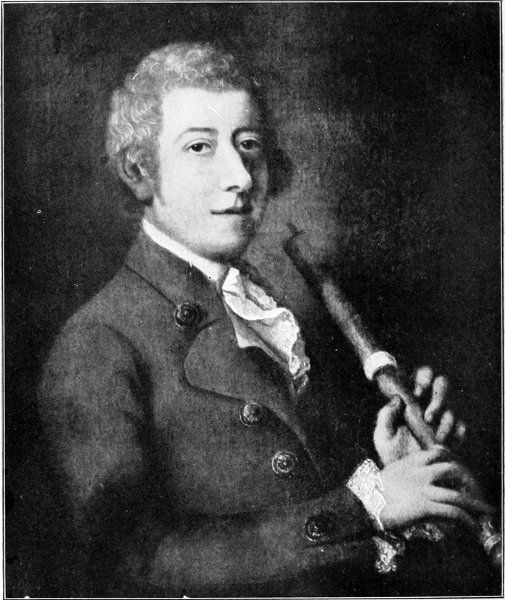
Arne, by Gainsborough.
We now return to the early days of Arne. Burney
writes, “Arne had a good school education, having
been sent to Eton by his father, who intended him for
the law. But I have been assured by several of his
school-fellows, that his love for music operated upon
him too powerfully, even while he was at Eton, for his
own peace, or that of his companions; for with a
miserable, cracked common-flute he used to torment
them night and day when not obliged to attend the
school.” Burney’s description of the flute must be
regarded as somewhat exaggerated if we may judge
from the instrument depicted in the portrait of
Arne painted by Gainsborough, and here reproduced.
Burney’s narrative continues, “He told me himself
that when he left Eton, such was his passion for
Music, that he used to avail himself of the privilege
of a servant, by borrowing a livery and going into
the upper gallery of the Opera, which was then
appropriated to domestics.” Arne’s father, having
decided that the young man should be brought up
to the profession of the law, articled him to an
attorney for three years, but this compulsory legal
study did not prevent him secretly and assiduously
practising on a spinet, which he had smuggled into
his bedroom; using a silk handkerchief, he contrived
to muffle the sounds of the instrument, and could
indulge in play when the other members of the
household were asleep. This he did with fear and
trembling, well-knowing that if discovered by his
father, both he and the musical instrument ran the
risk of violent expulsion through the window. He
further managed to acquire some proficiency on the
violin, and soon contrived to get some lessons from
the accomplished and eminent violinist, Michael
Festing. His natural talent enabled him to make
rapid progress, and shortly after the expiry of his
articles, an incident occurred which happily determined
his future career. His father, one day calling at a
gentleman’s house in the neighbourhood upon business,
found that he was engaged, but sending in his name,
Arne’s father was invited upstairs, where there was a
large company and a concert in progress, and, to his
astonishment, his son in the very act of leading as
first fiddle. This convincing proof that his son was
more successful with music than law, caused him to
relent, and he offered no further opposition to his
adopting the former as a means of livelihood. Arne
was now able to pursue his musical studies without
restraint, and he soon bewitched all the family by his
enthusiasm and ability. He discovered that his sister,
Susanna, possessed a beautiful and sympathetic voice,
which by his instruction rapidly developed. Festing
still continued to give him lessons on the violin, and
calling in King Street one day for this purpose, he
found Arne diligently practising with his music
supported on the lid of a coffin. Horrified with the
sight, he declared he could not play under such
circumstances, as he would be constantly imagining
there might be a corpse in the coffin beneath. “So
there is,” said Arne, and gave proof by removing the lid.
In 1732, Arne’s father dabbled in music as a
business speculation; induced to do so, perhaps, by
the remarkable talent of his children. He and others,
without permission, and without consulting Handel,
announced performances of that composer’s works at
the theatre in the Haymarket. An advertisement of
May the 10th reads: “At the theatre in the Haymarket
on Thursday the 12th inst. Acis and Galatea,
a pastoral drama set by Mr. Handel will be performed,
with all the choruses, songs, machines and other
decorations: being the first time it ever was performed
in a theatrical way. The part of Acis by Mr.
Mountier, being the first time of his appearing in
character on any stage. Galatea by Miss Arne. Pit
and boxes at five shillings. Subscriptions are only taken
in by Mr. Arne at the Crown and Cushion, King
Street, Covent Garden.”
For some reason the performance did not take
place on the 12th, but on the 17th. Dr. Burney says
that the adventurers, or partners, in the speculation
included Arne and his son, and the performers,
Miss Arne and Miss Cecilia Young, afterward young
Arne’s wife. Arne now resolved to essay his powers
in composition, by setting to music the libretto of
Rosamond, written by Addison. The music of the
chief character he designed for his sister, and the
part of the Page for his young brother Michael. The
work when completed was presented to the public at
the theatre in Lincoln’s Inn Fields on the 7th of
March, 1733. In addition to his sister and brother,
the performers were Mrs. Barbier; Leveridge, the
veteran bass, Mr. Corfe, Mrs. Jones and Miss
Chambers. The first performance proved a great
success and was followed by ten others; the last was
announced for the benefit of “Mr. Arne, junior,”
evidently to distinguish the composer from the father.
Thus encouraged Arne now determined to try his hand
on a humorous composition, and selected for the
purpose Fielding’s Burletta “Tom Thumb”; this had
been played as a comedy, with great success, in 1731,
under the title “The Tragedy of Tragedies!” In its
new musical dress the composer called it “The Opera
of Operas,” and it was submitted to the judgment of
the public at the new theatre in the Haymarket on
the 31st of May, 1733. The principal character,
Tom Thumb, was personated by the composer’s brother
Michael. The verdict of the audience was highly
favourable; the piece attained great popularity, and a
very long run. The Princess Amelia and the Duke of
Cumberland attended the second performance; the
Prince of Wales, the sixth, and the younger Princesses
the eighth. Arne’s next composition was an experiment
in another branch of stage work; a Masque with
Harlequinade entitled, “Dido and Æneas.” He was
now regularly employed at Drury Lane Theatre as
composer. His sister, Susannah Maria, had acquired
considerable fame both as singer and actress, and in
April, 1734, she married Theophilus Cibber, who
became notorious as an evil-doer. He was the son of
Colley Cibber, and for about three years husband and
wife lived together; they had two children, who died
in infancy. The profligate husband had a friend, a
Mr. Sloper, who with ample means frequently relieved
Cibber of pecuniary embarrassments, but in 1738 the
latter absconded to France, and his wife placed herself
under the protection of Mr. Sloper, who resided at
Burnham in Buckinghamshire. On returning to
England, Cibber brought an action for adultery, laying
the damages at £5,000; the verdict in his favour gave
him £10. He then brought a fresh action, claiming
£10,000 for the loss of his wife’s professional services,
and obtained a verdict for £500. It appeared that
Cibber[5] had forcibly broken into his wife’s residence,
abstracted her jewellery, and carried her off to the
Bull’s Head tavern, Clare Market, where he had locked
her in an apartment from which she was rescued by her
brother, Thomas Arne.
In 1736, Arne, in the twenty-sixth year of his age,
married Cecilia Young, the charming singer who had
appeared with his sister at the performances in the
new theatre in the Haymarket, in 1732. She was
the daughter of Charles Young, a performer of good
repute and organist of All Hallows’ Church, Barking.
Of three accomplished sisters she was the most
gifted; her natural soprano voice had been well
trained by Geminiani, and was of unusual compass
and flexibility, ranging up to E in alt. She was
also greatly admired on account of the accuracy and
perfection with which she executed trills and shakes.
Dr. Burney said, “her style of singing was infinitely
superior to that of any other English woman of her
time.”
Charles Young refused to sanction his daughter’s
marriage with Arne on account of the latter’s
religious principles. It is said he never forgave her.[6]
In the year of his marriage, Arne wrote the incidental
music for “Zara,” a tragedy produced at Drury
Lane Theatre, in which his sister Mrs. Cibber first
gave proof of her extraordinary ability as a tragic
actress as well as singer. She captivated everyone
by her native sweetness of voice and powers of
expression; “It was difficult to say which of the
two received the greater applause, the actress for
her interesting person, pathetic voice and manner,
or the musician (the composer Arne) for his natural
and pleasing strains, particularly the March which
was encored every night.” Mrs. Cibber’s fame
became pronounced. Handel thought so highly of
her that he engaged her to sing the contralto part
in “The Messiah” at its first performance, in Dublin.
How well she merited his selection was proved at
the conclusion of the Air “He was despised”; her
singing was so natural and touching that the Dean
of St. Patrick’s, Dr. Delaney, arose from his seat
and audibly exclaimed, “Woman, for this thy sins be
forgiven thee!”
Mrs. Cibber was not only a great artist, but also
a very accomplished and amiable woman, as is proved
by her correspondence with David Garrick. When
she died, in 1766, Garrick declared that “tragedy
expired with her.”
She was buried in the North Cloister of Westminster
Abbey.
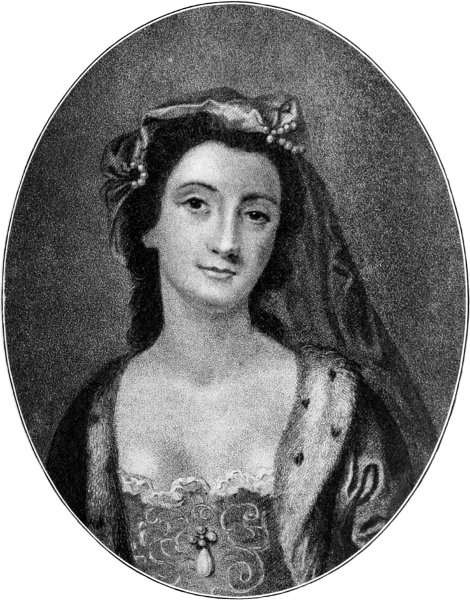
Mrs. Cibber.
The only other composition of Arne’s which can be
traced to the year of his marriage, 1736, is a Serenata,
the words by Thomas Phillips, written to commemorate
the marriage of the Prince of Wales with the beautiful
Princess Augusta of Saxe Gotha, which took place in
April. The Serenata was performed at Drury Lane
Theatre. Arne’s connection with the theatre provided
him with a splendid opening for his talent as composer.
Dr. John Dalton, a Prebendary of Worcester Cathedral
and Rector of St. Mary-at-hill, London, prepared a stage
version of Milton’s “Comus.” He interpolated verses
taken from other works of the poet, and added some
songs of his own, all requiring music; and, as the
sequel proved, no composer could have carried out the
task more efficiently than Arne, who entered upon his
welcome labours with real enthusiasm, and easily
earned the reputation of being the best English
composer of the day. His music combined graceful
melody and expressive accent, needing no extraneous
ornamentation to enhance its beauty. The songs “Now
Phœbus sinketh in the West,” “By dimpled brook,”
“How gentle was my Damon’s Airs,” and “Sweet
Echo,” are amongst the gems. The various characters
were well represented on the stage. Comus by Mr.
Quin; the Lady, Mrs. Cibber; the Brothers, Mr.
Milward and Mr. Cibber; First Spirit, Mr. Mills;
Second Spirit, Mr. Hill; Euphrosyne, Mrs. Clive;
Sabrina, Mrs. Arne; Attendant Spirit, Mr. Beard.
The Masque is preceded by a sprightly Overture scored
for strings, two flutes, two oboes, two trumpets, and
bassoons. The instruments are never employed
simultaneously, an orchestral feature peculiar to Arne.
The song “Sweet Echo” was sung “behind the
scenes” by Mrs. Arne, with an echo played on the
flute, and proved very effective. Either from want of
time, or some other cause, Arne did not compose
chorus music, but adapted several pieces from Handel;
the manuscript of these adaptations is in the British
Museum. Produced at Drury Lane Theatre in 1738
under the composer’s direction, the piece had a long
run and was frequently revived. A notable occasion
was the performance at Drury Lane on the 5th of
April, 1750, when it was given for the benefit of the
grand-daughter of Milton, Mrs. Elizabeth Foster, who
was living in extreme old age and poverty; for this
notable event Dr. Johnson wrote a prologue which
was spoken by Garrick. It is satisfactory to know that
the substantial sum of one hundred and thirty pounds
was handed over to the aged lady as a result of the united
efforts of the artists who gave their services.
The popularity of “Comus” induced Arne to publish
a score of the music in 1740. The title-page of the volume
reads: “The Music in the Masque of Comus. Written
by Milton. As it was Perform’d at the Theatre-Royal in
Drury-Lane. Composed by Thomas Augustine Arne.
Opera Prima. London. Printed by William Smith,
at the musick shop in Middle Row, near Holborn Bars,
and sold by the Author.” The copies were signed by
the composer; we may therefore presume that the
publication was his own venture, which may account
for his calling it Opera Prima. It certainly was not
the first work of his, either composed or printed. He
afterwards sold the plates, and the score was published
with a new title-page bearing the imprint “London.
Printed for and sold by J. Simpson in Sweetings Alley
Royal Exchange.” “Comus” became so popular that
the songs were sung all over the Kingdom, and gave
rise to numerous convivial and musical associations
which were convened under the title Comus’s Court.
In 1739, a number of eminent musicians residing
in London united in establishing a charitable society
for the relief of indigent musicians and their families.
The first steps were taken by Festing, Handel,
Green, Weideman, and nine others; it was then
called “The Society of Musicians,” and since has
become by Charter “The Royal Society of Musicians.”
Among the first to join the Association and to sign
the “Declaration of Trust” were Thomas Arne and
Handel. The former, after some years, neglected to
pay his subscription, and ceased to be a member;
but the latter retained his membership to the end
of his life, and by his Will bequeathed one thousand
pounds to its funds.
1740 was a very busy and prosperous year for
Arne. His composition of the “Masque of Alfred” for
the Prince of Wales will be found fully discussed
in connection with “Rule, Britannia”; the other
Masque, which was performed at the same celebration,
was “The Judgment of Paris,” written by William
Congreve. This author died in 1728, and it is not
known who arranged the book as set by Arne; it
contained much more music than “Alfred,” and,
with the exception of “Rule, Britannia,” of greater
importance. The Overture, composed on the conventional
pattern of the day, beginning with a Largo,
followed by a spirited fugue, concludes with a Minuet
Andante and a Giga con spirito; the only instruments
employed are strings and oboes. The Recitative, “O
ravishing delight,” sung by Mr. Beard in the character
of Paris, it would be difficult to surpass. Accompanied
by the string quartett, it is full of variety and
charm, and leads into an Allegro, with bravura
passages well written for the voice. If revived to-day
by a good tenor singer it would prove a great success.
There is a remarkable Air for Venus, “Gentle
Swain,” which was sung by Mrs. Arne. In the
printed score the composer appends the note, “This
Air is composed for a Violoncello solo, and a double
Bass to play with the Harpsichord.”[7] The violoncello
had quite recently been introduced into England by
Cervetto (Giacobbe Bassevi), who joined the Drury
Lane Theatre orchestra in 1738; by his skill he soon
made the instrument popular. Both Arne and Handel
wrote special obbligato parts for him. His personality
and manners were very marked, and he became a pet
of the gods in the gallery of the theatre, who, when
he appeared in the orchestra, would call out “play up,
Nosey.” He became manager of Drury Lane Theatre,
and died on the 14th of January, 1783, over one
hundred years of age, leaving his son a fortune of
£20,000. He signed the admission book of the
“Society of Musicians” on the 14th of April, 1742.
An amusing story is told of an encounter Cervetto
had with Garrick; the latter had been absent from
Drury Lane Theatre for two years, and on his return he
prepared an address to speak previous to the play.
When the applause which greeted him had subsided,
the house became silent in expectation of the speech.
At this crucial moment, Cervetto anticipated the first
word by a tremendous yawn, which caused the
audience to burst into convulsive laughter, and
several minutes elapsed before quiet was restored.
When the curtain dropped, Garrick rushed to the
music-room and seized Cervetto by the shoulders,
calling him a scoundrel, and a base-viol, and demanded
what he meant by his conduct. The poor man could
only reply that “when he had a great rapture” he
always did “yawn that way.”
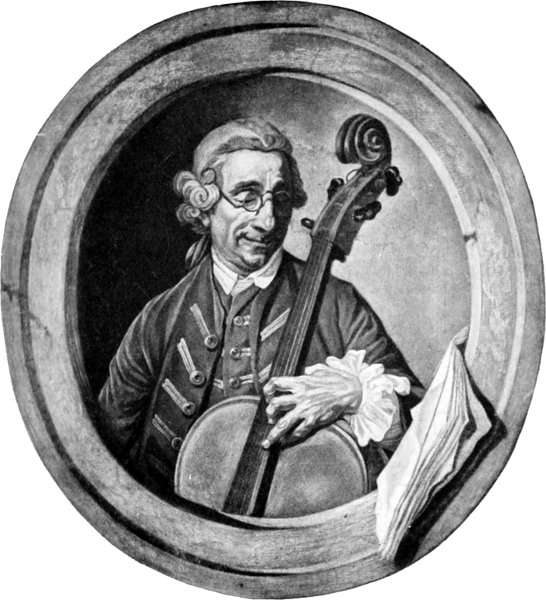
Cervetto, by Zoffany.
The Air “Gentle swain,” sung by Mrs. Arne, in
which Cervetto accompanied, is very melodious vocally
and instrumentally: it was followed by a Trio for
three soprano voices, sung by Mrs. Arne, Mrs.
Clive, and Miss Edwards, representing Venus,
Pallas, and Juno. The music is admirable, in spite
of the words, which cannot be described as poetry.
After an invitation from each of the three divinities:
Hither turn thee gentle swain,
Hither turn to me again:
She will deceive thee,
I’ll never leave thee—
Paris, represented by Mr. Beard, replied:
Apart let me view then each heav’nly fair,
For three at a time no mortal can bear;
And since a gay robe an ill shape may disguise,
When each is undrest
I’ll judge of the best,
For ’tis not a face that must carry the prize.
We have no record how they managed the stage
business at Clieveden, but it must have presented
some difficulty. A Recitative for Pallas is remarkable
for the vigour of the instrumental accompaniment,
and the Air “The glorious voice it was” is very
spiritedly supported by strings, oboes, trumpets and
drums. A fine Recitative, “Stay, lovely youth,”
sung by Mrs. Arne is also worthy of mention. At
the close of the year 1740, on the 20th of December,
Shakespeare’s “As you like it” was played at Drury
Lane Theatre, the first time for forty years. Great
interest was excited by the revival, more especially
on account of the fact that Arne had prepared new
music for the songs. These included “When daisies
pied,” sung by Kitty Clive, “Under the greenwood
tree” and “Blow, thou winter wind,” sung by Mr.
Thomas Lowe. They all captivated the public taste,
who found Shakespeare’s poetry admirably framed in
Arne’s melodies. The immediate popularity of the
music attracted the attention of several unscrupulous
publishers of the day. To protect himself against
their nefarious depredations, Arne obtained a Royal
license, dated 29th of January, 1741. “George, the
Second, by the Grace of God, King of Great Britain,
France, and Ireland, Defender of the Faith, etc.
To all to whom these Presents shall come, Greeting.
Whereas Thomas Augustine Arne, of Craven Buildings,
near Drury Lane, in our County of Middlesex, Gent.
Hath humbly represented unto US, That he hath
with great Study, Labour and Expence, composed
several works, consisting of Vocal and Instrumental
Musick, in order to be printed and published; and
hath Therefore humbly besought US to grant him
Our Royal Privilege and License, for the sole
printing and publishing thereof, for the term of
Fourteen Years. We being willing to give all due
Encouragement to works of this Nature, are graciously
pleased to condescend to his Request: and We do
therefore, by these Presents, so far as may be
agreeable to the Statute in that behalf made and
provided, grant unto the said Thomas Augustine Arne,
his Executors, Administrators and Assigns, Our
License for the sole Printing and Publishing the
said Works, for the Term of Fourteen Years, to be
computed from the Date hereof; strictly forbidding
all our Subjects within our Kingdom and Dominions,
to Reprint or Abridge the same, either in the like,
or any other Volume or Volumes whatsoever; or
import, buy, vend, utter, or distribute any Copies
thereof reprinted beyond the Seas, during the
aforesaid Term of Fourteen years, without the
Consent or Approbation of the said Thomas Augustine
Arne, his Heirs, Executors, and Assigns, as they
will answer the contrary at their Peril. Whereof
the Commissioners and other Officers of our Customs,
the Master, Wardens and Company of Stationers,
are to take Notice, that due Obedience may be
rendered to our Pleasure herein declared. Given at
our Court St. James’s, the Twenty-Ninth Day of
January, 1740-1, in the Fourteenth Year of Our
Reign. By His Majesty’s Command.
“Hollis Newcastle.”
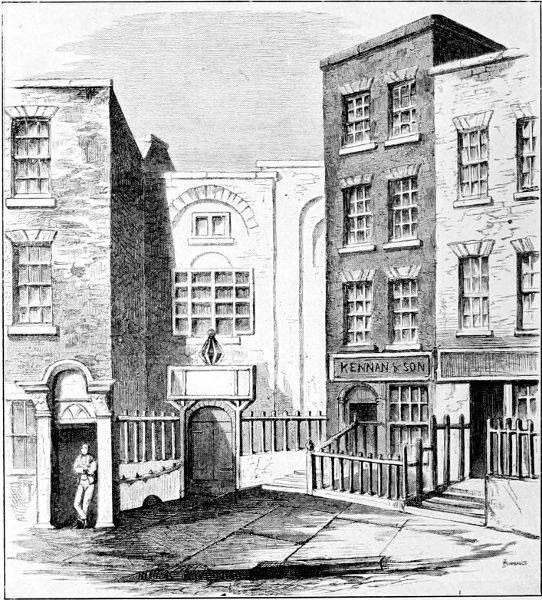
The Great Room, Fishamble Street, Dublin.
In 1741, Arne and his wife made their first united
visit to Ireland; from Faulkner’s Dublin Journal of
June 29-July 3, we learn that: “Last Wednesday
(June 30th) the ingenious Mr. Arne, brother to
Mrs. Cibber, and Composer of the Musick of Comus,
together with his Wife, (the celebrated Singer,)
arrived here from London.” This notice is interesting
as evidence that “Comus” had already been performed
in Dublin; Mrs. Cibber and James Quin, the
original exponents of the Lady, and Comus, were
two of the actors engaged in the Dublin production;
we may therefore reasonably suppose that they had
introduced some of Arne’s music. Mrs. Cibber had
also won a high place in the estimation of the public
by her exquisite singing in the first performance
of the “Messiah” Oratorio when conducted by
Handel on the 13th of April preceding. No time
was lost by Arne and his wife in making a venture
for public favour. Faulkner’s Journal, July 13-17,
exhibited the following advertisement: “At the
particular Desire of several Persons of Quality, for
the Benefit of Mrs. Arne, at the Great Room in
Fishamble-street, on Wednesday, the 21st Inst., will
be performed a grand Entertainment of Musick, to
be divided into three Interludes; wherein several
favourite Songs and Duetto will be performed by
Mrs. Arne and Mrs. Cibber. In the first Interlude
(after an Overture of Mr. Handel’s) a Scene from
Mr. Arne’s Opera of Rosamund, by Mrs. Arne;
O beauteous Queen, from Mr. Handel’s Oratorio
Esther, by Mrs. Cibber; Non chiamarmi, from an
Opera of Signor Hasse’s by Mrs. Arne; and O fairest
of ten thousand Fair, a Duetto, from Mr. Handel’s
Oratorio of Saul, by Mrs. Arne and Mrs. Cibber.
In the second Interlude (after an Overture of Mr.
Arne’s) Lascia cadermi in Volto, a Song of Farinelli’s
Singing, by Mrs. Arne; Chi scherza colle Rose,
from Mr. Handel’s Opera of Hymen, by Mrs. Cibber;
Vo solcando, a song of Signor Vinci’s by Mrs. Arne;
and Vado e vido, a Duetto of Mr. Handel’s in
Faramond by Mrs. Arne and Mrs. Cibber. In
the third Interlude (after an Overture of Mr.
Arne’s), O peace, thou fairest Child of Heaven, from
Mr. Arne’s Masque of Alfred, by Mrs. Arne; Un
Guardo Solo from Mr. Handel’s Opera of Hymen, by
Mrs. Cibber; (by particular Desire) Sweet Bird, from
Mr. Handel’s Allegro, by Mrs. Arne; and Per le Porte
del Tormento, a favourite Duetto of Mr. Handel’s
in Sosarmes, by Mrs. Arne and Mrs. Cibber.—Mrs.
Arne, being a Stranger in this Kingdom, humbly
hopes the Nobility and Gentry will excuse her personal
Application, and to prevent Their being detained at
the Doors of the Hall, while Tickets are delivered
them, that they will send for their Tickets to Mrs.
Cibber’s House in Aungier-street, where Places
may be taken.—And, to prevent mistakes, they are
desired to send their Servants to Keep Places before
five o’clock, To begin exactly at 7 o’clock. N.B. This
Performance (intended for the Theatre) is at the
Request of several Gentlemen and Ladies altered to
the Great Room above mentioned.”
It will be noticed that the programme contains eight
pieces composed by Handel, and only four by Arne.
Handel was residing in Dublin, and it is quite likely
that he extended his friendly patronage to Mrs. Arne
and attended the concert. In any case Handel’s
music was undoubtedly an attraction for the fashionable
world of Dublin; and it is satisfactory to read that
the concert was so great a success that “At the
particular Desire of several Persons of Quality” a
repeat was granted on the following Wednesday, the
28th of July. Very soon after the latter performance,
the Dublin musical season came to an end and the
many artists who had been making hay in that city
transferred their personalities to England. “The
celebrated Mr. Handel” left Dublin on the 13th of
August, and on Monday, the 23rd of the same month,
was followed by Mrs. Cibber, Mr. Arne and David
Garrick. Mrs. Arne remained in Dublin; probably
her husband only went to London to make preparations
for an extended campaign in Dublin. In a month’s
time he returned, and resided with his wife at a house
“over against the Ram in Aungier-street” near the
Theatre. We obtain intelligence of their doings
from an advertisement in Faulkner’s Journal of
September 25-28,—“The Charitable and Musical
Society” announced the commencement of the season
by a concert to be given on the 8th of October. Special
attention is directed to the fact that “they have
provided a fine Organ, and have engaged the celebrated
Mrs. Arne to sing”; the day after the performance
the Journal reported, “Last Night the Charitable and
Musical Society opened their first Concert to a very
numerous and polite Assembly of Ladies and Gentlemen,
when Mrs. Arne (tho’ extremely ill of a Cold) sang
with universal applause.” She speedily recovered and
with her husband gave a concert in the following
December. The Journal of November 27-30
contained the following announcement: “We hear
that on Friday next [Dec. 3] being particularly
desir’d, at the Great Room in Fishamble Street,
Mrs. Arne will sing the Song Sweet Bird, accompanied
on the Violin by Mr. Arne. And that he
intends between the Acts of his Serenatas, Operas,
and other Musical Performances, to intermix Comic
Interludes (after the Italian Manner), amongst which
will be perform’d Tom Thumb, the Original
Burlesque Opera compos’d by him, the Dragon of
Wantley, Miss Lucy in Town, etc. Intended to give
Relief to that grave Attention, necessary to be kept
up in Serious Performances. Which he intends
shall begin in January next.” We learn from this
the evident intention of Arne to make a lengthened
stay in the city which had received him and his
wife with so much favour. It is likewise interesting
to note that hitherto he had acted as harpsichord
accompanist, and now proposed exhibiting his excellent
skill as a solo violinist. The obbligato to the song
“Sweet Bird,” from Handel’s “Allegro,” was composed
for a flute, by no means an easy task for a violin
player at that time. The “Charitable Musical
Society,” evidently satisfied with Mrs. Arne’s performance,
on the 17th of December engaged her for
another concert given “for the Benefit and Enlargement
of Prisoners confined for Debt, in the several
Marshalseas in this City.” An advertisement
announced “On Tuesday next, being the 14th of
December, at 12 o’clock at Noon will be the
Rehearsal of Acis and Galatea, with the celebrated
Coronation Anthem called Zadok the Priest, composed
by Mr. Handel. Mr. Dubourg will perform a new
Solo. The Performance will be on Friday the 17th,
at 6 in the Evening. The Gentlemen of the Choir
of each Cathedral will assist,[8] with Mrs. Arne, Mrs.
Storer, Mr. Colgan, and others. Tickets to be had
at half a Guinea each, from Mr. Neal, at the said
Musick Hall. A Rehearsal Ticket will be delivered
with the Ticket for the Performance, as it was for the
Messiah.” “There are great Numbers of Tickets
already disposed of for the Musical Entertainment
of Acis and Galatea; and it is not doubted but the
Ladies of this Kingdom who so eminently distinguish
themselves for their great Virtue and Charity, will,
upon this Occasion, exert themselves by promoting
this Charity, many of them, of great Quality and
Distinction, having come to a Resolution not to
wear any Hoops next Friday, as it will be a Means
of admitting more People into the Hall than usual.”
In this month, December 11-14, the Journal made
an announcement of considerable importance: “Mr.
Swan being desirous to entertain the Town in the
best manner possible, has contracted with Mr. Arne,
for Mrs. Arne, Mrs. Baildon, Mrs. Sybilla, and other
singers belonging to him, to perform in the Masque
of Comus, written by Milton, and set to Musick by
Mr. Arne. The Choruses will be properly performed,
and Mr. Arne will accompany the Performance,
which will be exhibited on Monday next, being the
10th inst. Jan. N.B. The Orchestra will be doubled,
and there will be a Row at the Pit enclosed for the
Musick.” The same Journal of the 4-8th January,
1743, gave more details: “By His Majesty’s
Company of Comedians, at the Theatre Royal in
Aungier-street, on Monday next, being the 10th
inst. Jan. will be performed a Dramatick Masque
called Comus, written by Milton. The Musick, vocal
and instrumental, composed by Mr. Arne. The Part
of Comus, by Mr. Swan; a pastoral Nymph, and
the Part of Sabrina, by Mrs. Arne; the principal
Bacchanal, by Mrs. Baildon, from London; the Lady’s
Song (Sweet Echo) by Mrs. Arne, accompany’d by
Mr. Neal, from England, who performed it originally;
the second pastoral Nymph by Mrs. Sybilla, a Scholar
of Mr. Arne’s; the Part of Euphrosyne to be
performed by Miss Davis. With all the Choruses
performed in Parts, as originally in England, and
never done here before. The original Prologue to
be spoke by Mr. Swan, and the Epilogue by Mrs.
Furnival. A Row of the Pit will be taken into the
Orchestra, there being an extraordinary Band of
Musick provided on this occasion. The whole
conducted by Mr. Arne, who accompanies the
Performance on the Harpsichord. With new Habits,
Scenes, Machines, Risings, Sinkings, Flyings, and
other Decorations. It is hoped it will not be taken
ill, that none can be admitted behind the Scenes.
N.B. This Performance being exhibited at a much
greater Expense than any Theatrical Entertainment
in this Kingdom, we are obliged to lay the Pit and
Boxes together at 5s. 5d. Lattaces, 5s. 5d. Gallery,
2s. 8d. halfp.” The foregoing advertisement is
brim full of interesting matter; we see that Mr.
Arne was a tower of strength; that Mr. Neal was
the solo flautist at the first performance of “Comus,”
in Drury Lane Theatre; the choruses, performed
in parts, were taken from Handel, as in London; also
that Mr. Arne conducted and accompanied, according
to the fashion of the day, at the harpsichord. The
artistic venture of Mr. Swan met with due reward;
“Comus” was successfully repeated on the 13th, 20th,
and 24th of January, and again on the 8th of
February for the benefit of Mr. Swan; finally, on the
21st of April, Mr. Neal took a benefit at the Smock
Alley Theatre on the 1st of February, when he
exhibited his versatility; the Journal announced
“Between the Acts, Mr. Neale will perform a Solo
and Concerte on the Hautboy, with a Piece on the
German Flute. Mr. Charles and his Second will
perform a Concerto on the French Horn, and Mr.
Storer will sing a favourite Song. Master Neale,
a child of ten Years old, will perform a Concerto on
the Violin, and Elin a Roon, with all its Variations.”
This advertisement is of importance, showing that
Arne had excellent orchestral players. Mr. Charles[9]
was a very skilful performer; possibly he had been
one of the Drury Lane orchestra. On the following
10th of February, Mrs. Arne had a benefit at the
Theatre Royal, Aungier Street, when the programme
consisted of “A Grand Serenata, call’d Love and
Glory; composed by Mr. Arne, in Honour of the
Nuptials of His Royal Highness Frederick Prince
of Wales, with the Princess Augusta. After the
Serenata, a new Farce call’d Miss Lucy in Town,[10]
with all the songs composed by Mr. Arne, and
performed at the Theatre-Royal in Drury Lane.”
A concert was given at the Music Hall in
Fishamble Street, on the 4th of May, for the
benefit of the Charitable Infirmary, when Handel’s
“Alexander’s Feast” was performed. Mr. Arne
conducted and Mrs. Arne sang; “the Gentlemen of
the Choirs of both Cathedrals and several other
voices” assisted. On Saturday, the 7th, three days
afterwards, Mr. Arne had a benefit at the Theatre
Royal in Aungier Street, when the bill consisted of
“an Opera called Rosamond, Written by the celebrated
Mr. Addison, and set to Musick by Mr. Arne:
King Henry, Mr. Baildon; Sir Trusty, Mr. Layfield;
Page, Master Pilkington; being the first Time of his
Appearance on any Stage; Rosamond, Mrs. Sybilla;
Grideline, Miss Davis; and the part of Queen Eleanor
to be performed by Mrs. Arne, After which will
be performed the original comic burlesque Opera
called Tom Thumb. The Part of Tom Thumb by
Master Pilkington; King, Mr. Baildon; Lord Grizzel,
Mr. Layfield; Queen Dollallolla, Miss Davis; Princess,
Huncamunca, Mrs. Sybilla; all the other characters,
as Noodle, Doodle, Foodle, Giantess, Conjurer, etc.,
by a select Company of burlesque Opera Singers.
To prevent Mistakes, Ladies are desired to take their
Places in Time, and on the Day of Performance to
send their Servants to keep Places before five o’clock.”
The above programme was announced for repetition
on the 27th of May, for the benefit of Mr. Baildon
and Mrs. Sybilla, but Mrs. Arne was attacked by
one of her frequent illnesses, which on this occasion
proved so serious, that her physician forbade her
attempting to perform “at the Hazard of her Life.”
In June she had so far recovered that the deferred
benefit was announced for the 11th of June, “being
positively the last time of Mr. Arne’s exhibiting
any Performance this Season.”
Faulkner’s Journal, Oct. 22-25, announced that
“Mr. Dubourg[11] and Mr. Arne are to have six Oratorios
of Mr. Handel’s performed this Season by Subscription,
in which Mr. Lowe, Mrs. Arne, Mr. Colgan, and
Mrs. Storer will perform the vocal Parts”; on the
following Nov. 29-Dec. 3, an elaborate advertisement
detailed Mr. Arne’s plans:—“Mr. Arne proposes
to exhibit, at the Theatre-royal in Aungier-street,
Four Performances in the manner of the Oratorios
in London, viz.: Two Performances of the Distresses
and Conquest of King Alfred, composed by Command
of His Royal Highness Frederick Prince of Wales,
and performed at his Palace at Cliefden, but never
yet exhibited in Publick, and two Performances of
a New Oratorio called The Death of Abel: Both
composed by Mr. Arne. Subscription Three Guineas,
Every Subscriber to have three Tickets on each Night
of Performance. No Person (not subscribing) will
be admitted into Pit, Boxes, or Lattices, under half-a-Guinea
a single Ticket. The first Performance to
begin as soon as one hundred Subscribers shall be
obtained, of which fifty have already subscribed.
Subscriptions are taken in by Mr. Arne, at his House
in Aungier-street, near the Theatre. Mr. Arne has
a few Books of the Works he has published, which
he will dispose of at the following Prices, viz.: The
complete Score of the Overture, Songs and Duettos
in the Masque of Comus, 7s. The Songs in As you
like it, and Twelfth Night, with the favourite Duetto
in the Rival Queens, and other select Airs, 4s. 4d.
And the Songs in the Beggar of Bethnel Green, with
several new favourite Ballads annexed, 6s. 6d.
Likewise, a curious Harpsichord from London, made
by Kirkman, Tabell’s Foreman, which he will sell
very reasonably.” A writer in the Dublin Journal
at this time (November, 1743), said, “Mr. and Mrs.
Arne are beyond comparison, in their way the most
extraordinary Persons this Kingdom has seen. The
Aungier Street Stage has now the very best Company
of Players that ever was in this Kingdom, they are
now better than any Company in London, and the
Prices (except on very extraordinary Occasions) are
at the lowest Rate.”
The Duke and Duchess of Devonshire commanded
a performance of “The Beggar’s Opera” on December
the 8th, at the Theatre Royal in Aungier Street,
when Arne presided at the harpsichord, and also
at seven representations which followed. At a benefit
given for Mr. Lowe on the 17th, “Comus” was
performed, with Mrs. Arne in the parts of the
Pastoral Nymph and Sabrina, singing also, as
usual, the Lady’s song, “Sweet Echo.” She again
appeared with Mr. Arne at a benefit concert given
for Signor Barbatielli, who had broken his leg. The
advertisement announced, “Mr. Dubourg, is so kind
as to perform, and will conduct the whole, assisted
by Mr. Arne and Mr. Pasqualino, the Vocal Parts
by Mrs. Arne, Mrs. Storer, Mr. Lowe, and Mr.
Colgan. Tickets to be had at Mr. Barbatielli’s
Lodgings in George’s Lane, opposite to Fade-street,
and at the Musick hall, at 5s. 5d.—N.B. It is hoped
that the Gentlemen and Ladies will be so good as
to excuse Mr. Barbatielli’s personal Attendance, he
lying under the Misfortune of a broken Leg. Ladies
are requested to order their Coaches down Fishamble-street,
for the more easy going in, as at Mr. Handell’s.”
Arne’s “Comus” was again performed on the
22nd of December. In 1744, on the 2nd of January,
at the Theatre Royal after “Amphitryon,” with
singing and dancing between the acts, the farce
“Miss Lucy in Town” with Arne’s music was performed.
Special attention was directed to Mr. Lowe’s
singing of “the Part of Cantileno” [a Burlesque upon
the Italian Singers]. On the 12th of January Mrs.
Arne made her first appearance in Lampe’s burlesque
Opera “The Dragon of Wantley.” The advertisement
runs, “The Part of Moor-Hall to be performed
by Mr. Lowe. The Part of Margery to be performed
by Mrs. Arne, being her first Appearance in any
comic Character; and the Part of Mauxalinda to be
performed by Madam Chateauneuf; Gubbins by Mr.
Worsdale; the Dragon by Mr. Layfield.” Mr. Arne
presided at the harpsichord.
We have become familiar with Arne’s skill as
composer, violinist, conductor, and harpsichord player;
we now find an interesting notice of his first essay,
and probably his last, as an actor. The Journal of
Jan. 24-28 announced, “By the real and absolute
Command of their Graces the Duke and Duchess of
Devonshire, for the benefit of Mrs. Arne, at the
Theatre-royal in Aungier-street, on Saturday, the
28th Instant, will be performed the Second Part of
Henry IV. With the Humours of Sir John Falstaff.
The Part of Henry Prince of Wales by Mr. Arne,
being his First attempt of that Kind.” The
Shakespeare play was followed by some vocal music
by Mrs. Arne and Mr. Lowe, and the whole concluded
with Lampe’s “Dragon of Wantley.”
We now come to an important event, the performance
of the Oratorio, “The Death of Abel,” which
was first produced in Dublin, and not in London, as is
generally stated. The following curious advertisement
appeared in the Journal, Feb. 11-14, 1744: “By
subscription. At the Theatre-royal in Smock Alley,
on Saturday next, being the 18th of this Inst. Feb.
will be performed A new Oratorio, called The Death
of Abel. Set to music by Mr. Arne. The Principal
Characters to be performed by Mr. Lowe, Mrs. Arne,
and Mademoiselle Chateauneuf. The stage will be
disposed in the same manner as at Mr. Handel’s
Oratorios in London. As but 12 more subscribers
can be admitted, such gentlemen and ladies as
intend to honour Mr. Arne by subscribing, are
greatly desired immediately to send their names
to his house in Aungier-street. where tickets are
ready to deliver to the subscribers. N.B. Attendance
will be given at the Theatre on each Day of
Performance, when Subscribers, on sending their
Subscription Tickets, will have three delivered
on each of the four Nights of Performance.
Pit, Boxes, and Lattices, Half a Guinea. First
Gallery, 2s. 8d. halfp. Upper Gallery, 2s. 2d.
Ladies are requested to sit in the Pit, as well as
Boxes, as is the Custom at the Operas and Oratorios
in London, for which purpose the Pit seats will be
made thoroughly clean. To begin exactly half an
Hour after Six. The Printer made a mistake in the
last bills; but the Subscribers may depend that
(according to Mr. Arne’s proposal) no Person (except
Subscribers) will be admitted into Pit, Boxes, or
Lattices under Half a Guinea. Mr. Arne begs
Leave to acquaint the Public, that he has been
credibly inform’d by several worthy Families that the
Gentlewomen who keep the Saturday Nights Assembly,
or some one concern’d with, or commission’d by them,
have made it their business to complain of his performing
the Subscription Oratorios on that Night,
alledging that it was done on purpose to prejudice
them. Now, so far was that from being thought of,
much less intended, that the Gentlemen Proprietors of
the Theatre, as well as Mr. Arne, endeavoured their
utmost to fix another Night, but could not, for the
following Reasons; The Mondays and Thursdays are
taken up with Benefits for six Weeks. On Tuesdays
are Vicars-street Consort, and the Bear on College
green, which take up all the best Hands. On
Wednesday are the Phil Harmonic Society, and Crow-street,
where they are likewise engaged. And on
Friday is Fishamble Consort, where they are obliged
to perform.” “The Death of Abel” was repeated on the
25th of February. This early oratorio of Arne’s was
never published, and no manuscript copy of it is known
to exist. One song, however, became very popular,
and was in great request—“The Hymn of Eve”:
How cheerful along the gay mead,
The daisy and cowslip appear,
The Flocks as they carelessly feed,
Rejoice in the Spring of the year.
The Myrtles that shade the gay bow’rs,
The Herbage that springs from the Sod;
Trees, plants, cooling fruits, and sweet flow’rs
All rise to the praise of my God.
The music, very simple and melodious, but without
striking evidence of genius, has been frequently
reprinted, and arranged in various forms.
A comedy, “The Rehearsal,” with Arne’s music,
was played on the 1st of March, at the Theatre in
Aungier Street, for the benefit of Mr. Basdin; the
singing parts were performed by Mr. Lowe and Mr.
Worsdale. The Journal, Feb. 28-March 3, 1744,
contained the advertisement announcing the first
public performance of “Alfred,” and the “Judgment
of Paris,” which took place on the 10th of March;
and on the 29th of the same month “Comus” was
again performed, for the last time in the season,
Mrs. Arne, as a matter of course, representing
Sabrina and the Pastoral Nymph, and singing the
song “Sweet Echo.” Lowe was the Bacchanal and
Attendant Spirit; and Miss Davis, Euphrosyne.
This performance was given at the Theatre in
Aungier Street, and shortly afterwards “Rosamond”
was revived at the Theatre Royal in Smock Alley.
It must have been well received, as there were five
performances, on the 2nd, 5th, 9th, 10th, and 19th
of April. Mrs. Arne represented Queen Eleanor;
Lowe, King Henry; Layfield, Sir Trusty; Miss
Davis, Grideline; Madame Chateauneuf, Rosamond.
On the 2nd “The Merchant of Venice” was
also performed “with the songs proper to the
Character,” sung by Mr. Lowe. Faulkner’s Journal,
7-10 April, contained a Song, “The Scene a Bower,”
addressed to Mrs. Arne, which may be taken as
evidence of her popularity. There are nine verses,
commencing:
From yonder Bow’r, where blowing sweets
Perfume the vernal Air,
I hear the music of a voice
Peculiar to the tuneful Fair.
On the 26th of April a performance was given of
the tragedy “Theodosius, or the Force of Love.” This
play, written by Lee, was printed in 1680 with five
songs and two choruses composed by Henry Purcell.
The libretto was revised for the Dublin performance.
The announcement ran, “At the particular Desire of
several Persons of Quality, for the Benefit of Mr.
Barry, at the Theatre-royal in Smock-alley on Thursday
the 26th Inst. will be acted a Tragedy called
Theodosius or the Force of Love. The Part of Varanes
to be performed by Mr. Barry, being the first Time of
his appearing in that Character. Tickets to be had at
Mr. Barry’s in Skinner-Row.—As the original Songs,
and Chorus’s of the Play were never performed in this
Kingdom, for want of Musick and Performances
equal to such an Undertaking; Mr. Arne has been
prevailed upon to set the same to new Musick.”
Purcell’s music was published in 1680; copies of it
are now very rare. It consisted of five songs and two
choruses. Arne’s music was never printed, and only
one manuscript score of it is known.[12] An examination
of that copy shows that Arne wrote music for nine
pieces—four airs and five choruses, very short movements.
The words are not those set by Purcell,
excepting one air and one chorus. The solos
are written for soprano and contralto voices; the
orchestration for strings, two oboes, and two horns.
The last appearance of Mr. and Mrs. Arne in Dublin,
during the year 1744, was at the Great Room in
Fishamble Street on Wednesday, the 30th of May,
when “The Judgment of Paris” and “Alfred” were
performed for their joint benefits. Particulars respecting
this event will be found on page 124. The season
being ended, Arne and his wife returned to England, by
way of Parkgate and Chester. During their stay in the
last named city the youth Charles Burney was introduced
to Arne, and having exhibited his skill as a
performer on the harpsichord became an articled pupil
of the popular composer, with whom he journeyed to
London. Upon his arrival in the Metropolis, Arne
resumed his connection with Drury Lane Theatre as
composer, and obtained an engagement there for his
wife as “Serious Singer.” The year 1745 was a
prosperous one for both Arne and his wife—they were
in constant employ at the Theatre and in concerts.
On the 20th of March, Mrs. Arne had a benefit at
Drury Lane Theatre, when “Alfred” was performed
for the first time in London. The details of this
interesting and memorable occasion will be given
in connection with “Rule, Britannia.”
On the death of Gordon, the leader of the
orchestra at Drury Lane, Arne accepted the appointment
which was virtually that of conductor. This
was a welcome addition to his importance and income.
A letter written by Mrs. Cibber to Garrick, dated
the 1st of May, 1745, gives interesting evidence of
the amicable relations between Arne and Garrick at
that time: “I am very glad to hear you are
better, and if you dare venture out, shall be glad of
your company at dinner. As you are an invalid,
pray send me word what you can eat, and at what
hour you will dine. I shall send Tom [Arne] to meet
you, and am Sir David, Your most faithful friend
and servant, to command till death.”
On Saturday, the 28th of September, 1745, occurred
a memorable scene in the Theatre Royal, Drury
Lane. The Daily Advertiser published on the Monday
following describes it thus: “On Saturday night
last, the audience of the Theatre Royal, Drury Lane,
were agreeably surprised by the Gentlemen belonging
to that House performing the Anthem of God save
our noble King. The universal Applause it met
with, being encored with repeated Huzzas, sufficiently
denoted in how just an Abhorrence they hold the
arbitrary Schemes of our insidious Enemies, and
detest the despotick Attempts of Papal power.”
The Anthem was repeated nightly till nearly the
end of November, and the managers of Covent
Garden Theatre followed suit. The arrangement of
the Anthem for Drury Lane was made by Arne,
who had for principal singers Mrs. Cibber, Mr.
Beard, and Mr. Reinhold. Mrs. Cibber being a
contralto, the music had to be sung in a low key.
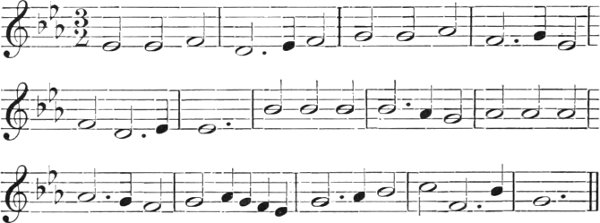
Arne’s autograph manuscript written for the occasion
is in the British Museum: it will be interesting to
see the melody of “God save the King” as then
sung:
[Listen] [XML]
Arne’s pupil Burney made the arrangement of
“God save the King” for Covent Garden Theatre;
the enthusiasm excited at that theatre fully equalled
that of Drury Lane. Benjamin Victor, in a letter he
wrote to Garrick on the 10th of October, 1745, said
“the stage, at both houses, is the most pious, as
well as the most loyal place in the three kingdoms.
Twenty men appear at the end of every play; and
one, stepping forward from the rest, with uplifted
hands and eyes, begins singing, to an old anthem
tune, the following words—God save the King.”
In this year, 1745, Arne was appointed composer
to Vauxhall Gardens, for which fashionable place of
amusement he wrote a considerable number of songs,
ballads, and a dialogue “Colin and Phœbe,” which
was sung every evening throughout the season by
Mrs. Arne and Mr. Lowe. Engagements of a similar
character at Marylebone Gardens and Ranelagh gave
great scope for his talents, and must have kept him
fully occupied.
In 1746, on the 17th of January, a farce, “Miss
in her Teens,” written by Garrick, with music by
Arne, was produced at Covent Garden Theatre. On
the 31st of January Shakespeare’s “Tempest” was
revived at Drury Lane Theatre. The General Advertiser
announced the performances, “Drury Lane. Never
Acted there before. By His Majesty’s Company of
Comedians. At the Theatre Royal, Drury Lane, this
Day will be presented a Play call’d The Tempest,
as written by Shakespeare: with the original
Decorations, particularly the Grand Masque, new
set to music by Mr. Arne. The Part of Ariel (with
the proper songs) by Mrs. Clive.” This was the
birthday of the beautiful melody, “Where the bee
sucks,” a song whose freshness and charm never
tire, and a tuneful combination of poetry and music
destined to endure so long as the concord of sweet
sounds has the power of touching human hearts.
Another interesting letter from Mrs. Cibber to
Garrick, dated 8th of April, 1746, contains several
references to her brother:—“My brother is to thank
you for my playing for him.... Tom Arne sends
his service: he is forced to put his pit and boxes
together, which I reckon will be no advantage to
him, ladies’ hoops taking up more room than the
difference of price.”
In 1748, Mrs. Arne left Drury Lane Theatre,
and went to Dublin with her sister, Mrs. Lampe, a
singer of repute and wife of the composer of “The
Dragon of Wantley.” Previous reference has been
made to Mrs. Arne’s frequent attacks of illness;
one of these prevented her undertaking work in the
early part of the Dublin season; and it was not
before the 11th of November that she was able to
sing in public. On that day she took part in Handel’s
“Esther,” “being recovered from her late illness.”
She next sang the part of Galatea in Handel’s
“Acis” on the 18th, and at a repetition performance
on the 25th. Faulkner’s Journal of Nov. 19-22,
reported that “Mrs. Arne (tho’ but just recovered
out of a violent Fever) gave entire satisfaction.”
In the following December (on the 16th) she sang
in Handel’s “Solomon”; and on the 7th of February,
1749, had a benefit concert at the Fishamble Street
Music Hall, when she took the part of Galatea
in Handel’s “Acis,” and she with her sister, Mrs.
Lampe, “introduced several favourite Songs and
Duets.”
Arne had a son, born in 1740 or 1741 (Dr.
Burney says, he was a “natural son”), who inherited
some of his father’s gifts for music. These were
encouraged and developed, and we find, amongst
Arne’s compositions, songs composed for the youth,
who was introduced to the public by his father at
Marylebone Gardens. Two excellent printed examples
are “Ianthe and Iphis, sung by Master Arne, at
Marybon Gardens”—and “An thou wert mine own
Thing, sung by Master Arne at Marybon Gardens.”
The youth became well known as a composer and
performer in London and Dublin. One of his songs,
popular to-day, “The lass with a delicate air,” is
sometimes ascribed in error to his father.
In 1752 Arne composed music for “Harlequin
Sorcerer,” an old pantomime in which Rich had
many years before made a great success. The performance
took place at Covent Garden Theatre on
the 11th of February, and there was an overwhelming
demand for seats; the doors were therefore opened
at three o’clock in the afternoon. The performers
included Mrs. Arne, Mrs. Lampe, Mr. Lowe, Mr.
Legge, and a Chorus. The music was published by
Walsh, who appears to have had a business contract
with the composer. The following letter, by Arne,
addressed to William Shenstone, the poet, throws light
on the subject: “Nov. ye 30, 1754. Sir—By the hands
of Mr. Dodsley, I receiv’d your very obliging letter,
and wou’d for my own Pleasure comply with
your Request; but Mr. Dodsley’s interest in this
Particular interferes with mine; for if he prints
my Music in his Publication, I shall lose the sale of it
to Mr. Walsh [the King’s Music-Printer] who gives
me 20 guineas for every Collection I compose—consisting
of eight or nine Songs, and who wou’d
not give a shilling for any Thing that another had
first publish’d. Of this I acquainted Mr. Dodsley,
who did not seem inclin’d to make any Gratuity for
the Loss. Any Song, Cantata, or Dramatic Piece
from so delicate a Pen, whereby I should not
considerably lose to promote another’s Gain, wou’d
be the most welcome present I cou’d receive, stamp
an additional Reputation on my Music, and highly
oblige. Sr. your most obedt. servt. Thos. Augne.
Arne, Charles Street, Covent Garden.”
That Arne’s music had obtained repute in Edinburgh,
is shown by an advertisement in the Caledonian
Mercury of the 6th of March, 1752: “New Musick.
Now in the press and will be ready by the beginning
of April next, and delivered to subscribers. All the
Songs, Duettos, and Trios in the Masque of Comus
composed by Thomas Augustine Arne, as adapted
to the Harpsichord and Voice, and all the Songs,
Duettos and Trios in the Burlesque Opera, called
the Dragon of Wantley composed by the great
John Frederick Lampe, likewise adapted to the
Harpsichord and Voice. The above words may
occasionally be accompanied with Violin or German
Flute and Violoncello. This manner of reducting
them to avoid the Perplexity of the different parts in a
score which confound young practitioners was finished
by Mr. Lampe in his lifetime,[13] and the proofs of the
Plates have been revised and corrected by Mr. Arne.”
In May, 1754, Arne went to Edinburgh, possibly
on business in connection with the publications
announced in the above advertisement. Be that as
it may, the Caledonian Mercury of the 23rd of
May contained the following notice:—“For the
benefit of Mr. Arne. At the Assembly Hall on
Monday, 27th May, A Concert of Vocal and Instrumental
Musick. The Vocal part to be performed by
Miss Rodburn, and the Instrumental by Mr. Pasquali,
Mr. Arne and others. To begin Precisely at 6.
Tickets, 2/6. To be had at Mr. Arne’s Lodgings,
at Mr. Johnston’s, Wigmaker, head of Chalmer’s
Close, and at the Old and John’s Coffee houses.”
In the autumn of 1755, Arne and his wife again
visited Dublin. They were accompanied by a number
of capable vocalists, Miss Young, Mrs. Arne’s sister,
her six-year-old niece Miss Polly Young,[14] and Miss
Charlotte Brent; they resided together in Fishamble
Street, at the Passage Door next the Golden
Scales. Arne advertised in Faulkner’s Journal, Oct.
4-7: “To the Public. Mr. Arne, who is arrived in
this Kingdom, with several Vocal Performers, having
agreed with Managers of the Theatre Royal, Proposes,
by Subscription, to entertain the Town Ten Nights,
with Three Operas in the English Language, (viz.):
A new Opera call’d Eliza, An Opera call’d Alfred,
and, an Opera call’d the Fairies. The Subscription
is, this Day, opened at the Office of the Theatre in
Smock Alley, where Attendance will be given every
Day from Twelve to Three. Ten Box Tickets for
the ten Performances will be delivered to each
Subscriber for two Guineas.—The first Performance
will be in the Beginning of November. N.B. The
Orchestra will be considerably enlarged, an Additional
Number of the best Instrumental Performers engag’d,
and Mr. Arne will accompany the Operas on the
Harpsichord.”
This advertisement was repeated several times,
with the additional information that there would be
“A fine Organ put up” and that “Places for the
Boxes for the said Nights of Performance, to be
taken at the Office of the Theatre from 12 to 3,
or of Mr. Neil, at his House in Abbey-street.” In
consequence of the illness of Mrs. Arne, the Journal
of 8-11 Nov. stated:—“The Opera of Eliza is
obliged to be deferred to the 27th, on Account of
the Indisposition of a principal Performer.” The
opera was again postponed to the 29th, when it
was given “By Command of his Excellency the
Marquis of Hartington,” and the “whole House was
illuminated with Wax Lights.” Printed books
of the opera were “published and sold by Mr. Hoey,
at the Mercury in Skinner-Row, and at the Theatre,
at a British Sixpence each.” The Journal gave a
report of the performance: “On Saturday last, at
the Theatre-Royal in Smock-Alley, was perform’d
Mr. Arne’s new Opera call’d Eliza: The noble
and splendid Appearance, and the great and just
Applause throughout the whole Performance, were
strong Indications of the good Taste reigning in
this Kingdom, and a generous, though proper
Compliment to that great Master of his Science, Mr.
Arne,—Mrs. Arne, whose Excellence is well known,
had the Misfortune of a violent Hoarseness, and
rose from her Bed in a Fever to perform; Mr.
Sadler and Miss Brent, were greatly approv’d; but
Miss Polly Young, a Child of six Years of Age,
pleased and astonished the whole Company, having
a sweet melodious voice, accenting her Words with
great Propriety, and Singing perfectly in Time and
Tune. The Poem is, by all judges of good Writing,
thought excellent; the Orchestra was full, and
perform’d without a Fault; but the Judgement, Taste,
Expression, and Variety of the Music would be
injur’d in an Attempt to commend it.” The performance
was repeated on Thursday the 4th, and
Saturday the 20th of December. Arne’s opera
“Rosamond” was played on the 31st, with Mrs. Arne
as Queen Eleanor; Miss Brent, Rosamond; Grideline,
Miss Young; Page, Miss Polly Young; King Henry,
Mr. Sadler. Mr. Arne conducted. The opera was
repeated with the same cast on the 9th of January,
1756; and on the 21st and 26th of the same
month “Comus” was performed under the composer’s
conductorship by Mrs. Arne, Miss Brent,
Miss Spencer, Mr. Sadler and Mr. Corry.
Faulkner’s Journal, 20-24 Jan., 1756, contained an
“Ode to Apollo,” without author’s name. The
following verses, if written by one of the public,
show that Arne and his wife were held in the highest
estimation by music-lovers:
Hark! hark! what notes enchant my Ears,
Sweet as the musick of the Spheres?
’Tis ARNE—the Gods’ Vicegerent comes,
Now vanish Rackets, Routs, and Drums;
And with him come the Muses Hand in Hand,
To see fulfilled Apollo’s great command.
See Taste with Joy its Head uprears,
Rais’d by Arne’s heav’nly Airs;
Skill’d with equal Pow’r t’inspire
Irene’s youth with martial Fire,
And lull to Rest, with Soul-delighting Sounds,
The Pains of Grief, and heal Love’s bleeding Wounds.
Not he that charm’d the Thracians’ Plains,
E’er tun’d his Lyre to softer strains;
Nor does the warbling Bird of Night
More than his sweet-song’d Spouse delight.
O say! what Price or Gifts can both engage
Here to remain, to save a sinking age?
In the following February (24-28) the Journal
announced: “The Play called the Tempest, or the
Inchanted Island (with all the original Musick) is
now in Rehearsal at the Theatre Royal, and will
be performed next Week. The Part of Ariel by
Miss Brent, being her first Appearance in that
Character, Neptune by Mr. Sadler, Amphitrite by
Miss Spencer, and Mr. Arne will accompany the
Musick on the Harpischord.” Mrs. Arne, Miss
Brent and Miss Spencer sang at a concert given on
the 17th March, in aid of the Meath Hospital, and
three days later, the 20th, were engaged in a
performance of “Comus” for the benefit of Mr.
Arne; the “Masque of Comus” was followed by
“a Farce (never acted before) called, The Pincushion:
Being a Manuscript of the celebrated Mr. Gay’s,
Author of the Beggar’s Opera. The Songs
adapted to favourite Ballad Airs of Mr. Arne’s.
The Characters by Mr. Sadler, Mrs. Pye, Miss
E. Young, and Miss Brent.” The Journal informed
the public “that the Masque of Comus will be
performed in a most elegant Manner on Mr. Arne’s
Benefit night next Saturday, that two Rows of the
Pit will be taken in to inlarge the Orchestra, and
Mr. Arne will accompany the musical Part. We
are further assured that the new pastoral ballad
Farce called The Pincushion, which will likewise
then be performed, is a real Manuscript of that
celebrated Poet Mr. Gay, Author of the Beggar’s
Opera, and that Songs are adapted by Mr. Arne.
several of which are New.”
A benefit for Mrs. Knowles, on the 2nd of April,
was given for which Arne composed music. The
advertisement announced: “Act the 2nd. A Duetto
between Mr. Sadler and Mr. Butler, accompanied
with French Horns, etc., called The Death of the
Stag. The Music composed by Mr. Arne!” At the
end of the play “by particular desire” Miss Brent
sang, “Where the bee sucks.” The duet with
French horns was doubtless composed to exhibit
the skill of “Mr. Charles and his Second.” On
the 5th of May, Miss Spencer had a benefit at the
Theatre, when she introduced “A new Ballad call’d
Kitty, or the Female Phaeton; the words by Prior,
set by Mr. Arne.” This song became a favourite at
Ranelagh Gardens. Mrs. Arne contemplated giving
a benefit concert and ball in May; the programme
was to include music from Arne’s “Alfred,” but
after several advertisements and postponements, it
was announced that “Mrs. Arne is obliged to
acquaint the Public that Mr. Arne (by Desire)
intending one capital Performance of Alfred
before his Departure from this Kingdom, she will
make no other Benefit on her own Account, and
those Tickets which are disposed of among her
Friends will be then taken, on paying the additional
Price.” Subsequent advertisement announced: “By
Special Command of their Excellencies the Lords
Justices.—For the Benefit of Mr. and Mrs. Arne.
At the Great Music-hall in Fishamble-street, on
Tuesday, the 25th of this Inst., May, will be
performed, in the Manner of an Oratorio, Alfred
the Great, composed by Mr. Arne, at the special
command of His late Royal Highness, Frederic,
Prince of Wales, and originally performed in his
Palace at Cliefdon. Mr. Arne will accompany the
Performance on the Harpsichord, and Mr. Walsh
will perform a Concerto on the Organ. The Vocal
Parts to be performed by Mrs. Arne, Mr. Sadler,
Miss Brent, Miss Spencer, Miss Young and Miss
Polly Young. Ticket, a British Crown. All outstanding
Tickets, for the Opera of Eliza and the
Tickets delivered by Mrs. Arne, will be taken.
After the Performance (by Desire) will be a Ball,
conducted in the most elegant Manner, on Account
of which the Performance will begin at Seven.
Tickets to be had only of Mr. Arne, at the Passage
Door next the Golden Scales, in Fishamble-street.”
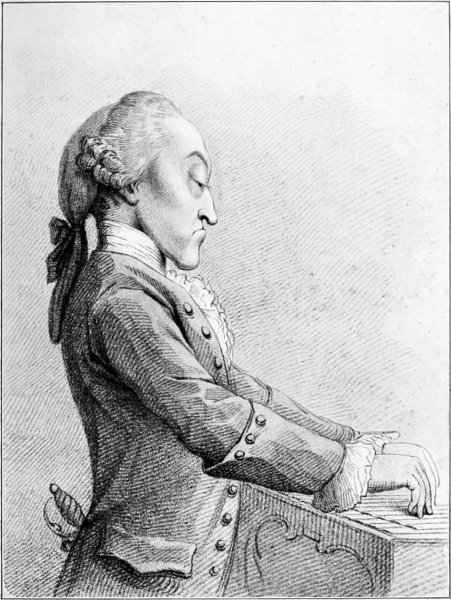
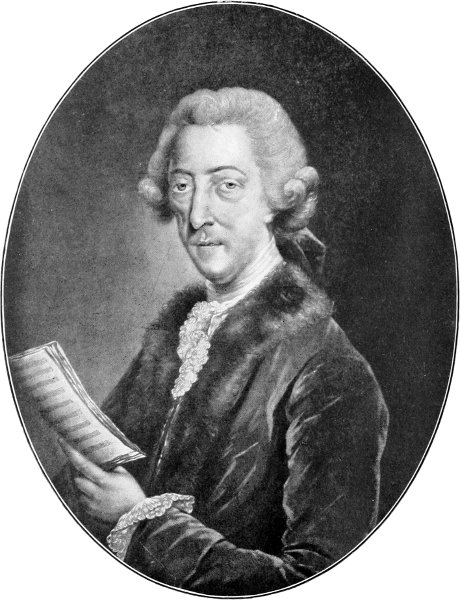
Arne, by Bartolozzi.
After this performance in 1756, Arne appears to
have left Dublin, and probably never revisited that
city. Mrs. Arne remained in Dublin with her
niece, Miss Polly Young, who had a benefit at the
Smock Alley Theatre on the 8th of July, and was
assisted by Miss Young and Miss Brent. The
Youngs sang also at a benefit concert given for
Miss Polly Young, at Marborough Green, on the
7th of September. It seems pretty clear that Arne
deserted his wife at this time, and that the fact
soon became known to many in Dublin. An
“Assembly” was announced for her benefit early in
December, but was postponed from time to time;
finally, the Journal, March 5-8, 1767, announced:
“Mrs. Arne, having opened the Music-Hall in
Fishamble-Street for her Benefit on Saturday
the 12th of Feb., under great Disadvantages, is
advised by her Friends (who had Notice of that
Night, and are sensible of her Losses) to fix on
Thursday, the 10th of March, for her Benefit and
Miss Young’s, when the Ladies and Gentlemen who
will honour them with their Company, may depend
they shall on no Account be disappointed.—N.B. The
Tickets given out for the different Nights she has
advertised will be taken, and others had of Mrs.
Arne, at her Lodgings in Aungier-street and at the
Music-Hall. Price 5s. 6d.” Later in the year
(April 24th) Mrs. Arne and Miss Young gave a
concert. Allusion has already been made to Mrs.
Arne’s frequent attacks of indisposition, and it is
reasonable to think that her husband’s conduct would
have a grave effect on her health and spirits. She
seems to have relinquished public performance for a
time and retired into private life. A very interesting
glimpse of her is to be found in “The Autobiography
and Correspondence of Mary Granville, Mrs. Delany.”
Writing to her sister, Mrs. Dewes, from Mount
Panther, County Down, on the 8th of August, 1758,
she said: “On Saturday we dined at Mr. Bayly’s;
Miss Bayly had gone on a party of pleasure. I was
surprised there at meeting Mrs. Arne (Miss Young
that was); they have her in the house to teach
Miss Bayly to sing; she was recommended to Mr.
Bayly by Mrs. Berkeley as an object of compassion.
She looks, indeed, much humbled, and I hope is as
deserving as they think her to be; great allowances
are to be made for the temptations those poor people
fall under. She has been severely used by a bad
husband, and suffered to starve, if she had not met with
charitable people. She behaves herself very well, and
though her voice has lost its bloom as well as her
face, she sings well, and was well taught by Geminiani
and Handel, and had she not been idle would have
been a charming singer. Mr. Bayly plays on the
violin, his curate on the German flute; Mrs. Arne
and Miss Bayly sing, and a girl of nine years old[15]
accompanies them on the harpsichord most surprisingly;
she is a niece of Mrs. Arne’s; the race of the
Youngs are born songsters and musicians. It is
very agreeable to have such an entertainment in
our power to go to whenever we please.” Poor
Mrs. Arne! humbled, half-starved, deserted by her
husband, losing her good looks, and the bloom of
her voice, sings well, and if she had not been idle
would have been a charming singer! Mrs. Delany,
a gifted and kind-hearted woman, was evidently
ignorant of the fact that the lady she criticised
was forty-seven years of age, and had been constantly
before the public, as a vocalist, for twenty-six years.
In the following January, 1759, Mrs. Arne and
Miss Young were residing together in Dublin, at
Mrs. Rowe’s, in Drogheda Street. A Grand concert
of Vocal and Instrumental Musick, followed by a
Ball, was given for Mrs. Arne’s Benefit at the
Fishamble Street Music Hall on the 6th of March,
when both appeared and sang; another benefit
performance for Mrs. Arne was given on the
17th of April, when “Much ado about Nothing”
was performed. Miss Young, Mrs. Storer and
Mr. Wilder were the vocalists. A benefit concert
and ball, for Mrs. Arne, was given on the 10th of
December; she had then removed to “Mrs. Lee’s,
in William-street.” It is significant that she did
not sing on this occasion, nor is there any evidence
of her appearing again before the Dublin public; a
Grand Ball was announced for the Benefit of Mrs.
Arne and Miss Young at the Fishamble Street Music
Hall on the 25th of November, when it was stated:
“Before the Minuets Miss Young will sing some
capital Songs, accompanied by herself on the
Harpsichord.”
Mr. Arne had been fully engaged in the
various gardens and theatres in London. At
Covent Garden “Cymbeline” was produced, with
songs by him. His pupil, Miss Brent, had
appeared at Drury Lane Theatre, in his opera
“Eliza,” on March the 3rd, 1758, and at Covent
Garden on the 10th of October, 1759, as Polly, in
the “Beggar’s Opera.” On the 6th of July, 1759,
the University of Oxford conferred upon Arne the
degree of “Doctor in Music.”[16] It is said that he
composed an Ode which he submitted to the
authorities; but no copy of it is known to exist.
In 1760, on the 28th of November, Dr. Arne’s
musical entertainment “Thomas and Sally,” written
by Bickerstaff, was produced at Covent Garden
Theatre. Miss Brent made a great success both as
singer and actress; the other vocalists included
Mr. Beard, Mrs. Vernon, and Mr. Mattocks. The
piece obtained immediate and lasting popularity.
The music was published with the following title:
“Thomas and Sally, or the Sailor’s Return, a
Dramatic Pastoral, with the Overture in score, songs,
dialogues, duettos and dance tunes, as performed
at the Theatre Royal in Covent Garden by Mr. Beard
and Miss Brent, Mr. Mattocks, Mrs. Vernon,
and chorus. The music compos’d by Doctr.
Arne. London Printed for J. Walsh, in Catherine
Street, in the Strand. Enter’d at Stationers’ Hall.”
In 1761, on the 27th of February, at Drury Lane
Theatre, Arne brought out his oratorio “Judith,”
one of his most important compositions. The Public
Advertiser of the above date, announced: “At the
Theatre Royal in Drury-Lane, This Day, will be
performed a new Sacred Oratorio call’d JUDITH.
The Music composed by Dr. Arne, with a Concerto
on the Organ. Pit and Boxes will be laid together
at Half a Guinea. First Gallery 5s. Upper Gallery
3s. 6d. Tickets for the Pit and Boxes may be had
of Mr. Varney, at the Stage-Door of the Theatre.
To begin at half an hour after Six o’clock.” The
following day a brief notice appeared in the same
journal, which said: “Last Night the new sacred
Oratorio call’d Judith, was performed at the Theatre
Royal in Drury Lane, to a most polite Audience,
who gave it the greatest Approbation and Applause
ever known, on the Occasion.” Evidence of the
success of the oratorio is the repetition of it on the
4th and 6th of March. It was also again performed
in Lenten season of 1762 at the theatre. In 1764,
on February 29th, it was performed at the Chapel of
the Lock Hospital, Grosvenor Place, Pimlico, on
behalf of the funds of the charity. A more notable
repetition took place at Covent Garden Theatre on the
26th of February 1773, when for the first time ladies
formed a part of the chorus; before this time the
treble chorus was confined to boys’ voices. This
happy innovation of Dr. Arne’s was well received; the
Public Advertiser said: “The Oratorio of Judith,
composed by Dr. Arne, which was performed at the
Theatre Royal in Covent Garden, yesterday evening,
was received with uncommon Applause. The principal
singers acquitted themselves to the utmost Satisfaction
of the Audience. Mr. Barthelemon was greatly
admired in his Solo on the Violin, and too much
cannot be said of Signor Spandau’s Concerto on the
French Horn, as it surpassed any Performance on that
Instrument hitherto heard in this Country. The
striking Appearance of the Band and Chorus, which
were much more numerous than they usually have
been, received a most pleasing Addition from the
Female Singers, then first introduced.” It is somewhat
remarkable that the Pianoforte was first used in public
as an accompaniment for the voice when a song from
“Judith” was sung at Covent Garden Theatre by
Miss Brickler on the 16th of May, 1767. The playbill
announced that after the first Act of the “Beggar’s
Opera,” “Miss Brickler will sing a favourite song from
Judith, accompanied by Mr. Dibdin, on a new instrument
called Piano Forte.” The published score of the
music of “Judith” has for title, “Judith an Oratorio as
it is Perform’d at the Theatre-Royal in Drury Lane,
Compos’d by Dr. Arne, London. Printed for J. Walsh
in Catherine Street in the Strand.” This volume
unfortunately does not contain a single chorus. The
Overture is scored for Strings, Hautboys, Bassoon
and Horns. It opens with a spirited Allegro, followed
by a short Andante movement for strings only; the
other instruments resume in the final Allegro Moderato.
A solo, “Wake, my harp,” which was sung by Mrs.
Cornelys, is accompanied by strings, violins pizzicato,
harp and harpsichord in a very effective manner.
In an air, “Haste to the gardens of delight,” sung
by Mr. Tenducci, two flutes are added to the
orchestration; and in another air, “With heroes and
sages,” also sung by Tenducci, we find the bassoons
have parts independent of the basses, a somewhat
novel departure at the period when Arne wrote. An
air, “No more the Heathen shall blaspheme,” sung
by Mr. Fawcett, has the novel accompaniment of
two violoncellos and bass; no other instruments
until the last four bars of symphony, when the
violins are introduced. Fortunately the composer’s
autograph score exists in the British Museum, and
in that we find much of interest. It exemplifies in
some degree the well-known haste and carelessness
of the composer; there are sundry memoranda,
such as “take care of the Instrumental parts where
I have mistaken the lines,” “Bassoons in semibriefs,”
&c. The choruses are in this case his own;
there was no borrowing from Handel. The first,
“Father of mercies,” is short—only thirty-seven bars.
The next, “When Israel wept,” is also short and
good. “Hear, angels, hear” extends to one hundred
and twenty-six bars; “Hail, immortal Bacchus,”
eighty-five bars; “Prepare the genial bower,”
eighty-seven bars; and the next, a very fine chorus,
“Who can Jehovah’s wrath abide,” one hundred
and eight bars; “Breathe the pipe,” sixty-two
bars; and the last chorus, “Here, sons of Jacob,”
written in five vocal parts for soprano, alto, tenor
and bass, sixty-four bars. Dr. Arne was remarkable
for his deficient memory respecting things
trifling in themselves, yet sometimes of considerable
consequence as connected with other matters. If
he made an appointment to meet a friend, whether
for the purpose of business or amusement, he would
probably mistake the day; if he wrote an order for the
theatre, it was equally probable that the play would
be misnamed, or that the frank would bear a wrong
date. On one occasion, when he had prepared an
elaborate Ode, he had it rehearsed, and announced the
day for its public performance. The great room at
the Crown and Anchor[17] was crowded with company
impatiently waiting for their expected gratification.
Arne arrived at the tavern-door in a fiacre,
leaped out with the score under his arm, and
left the parts behind him. When the doctor
discovered his neglect, he was in the condition of a
madman. Persons were dispatched in all directions
in search of the coach, but it could not be found;
and the band and company were subjected to the
mortification of being dismissed—the first without
performing, and the latter without hearing, a note
of the prepared Ode. Could this have been the Ode
which, it is said, he composed as an exercise for his
degree? Arne, by his connection with the theatres,
had constant opportunities for cultivating the
acquaintance of Italian singers, and of keeping up
his knowledge of the Italian language; he was
evidently influenced in his later compositions by this
familiarity. The simplicity of his melodies became
disfigured by excessive ornamentation, and was the
subject of adverse criticism. The scurrilous poet,
Churchill, in 1761, published the “Rosciad,” a satire
on actors, in which he violently attacked Arne:
Let Tommy Arne, with usual pomp of style,
Whose chief, whose only merit’s to compile,
Who, meanly pilfering here and there a bit,
Deals music out, as Murphy deals out wit;
Publish proposals, laws for taste prescribe,
And chaunt the praise of an Italian tribe;
Let him reverse Kind Nature’s first decrees,
And teach e’en Brent a method not to please:
But never shall a truly British age
Bear a vile race of eunuchs on the stage:
The boasted work’s called national in vain,
If one Italian voice pollute the strain.
Where tyrants rule, and slaves with joy obey,
Let slavish minstrels pour th’ enervate lay;
To Britons far more noble pleasures spring
In native note, while Beard and Vincent sing.
Arne’s Italian proclivities induced him to translate
Metastasio’s drama “Artaserse,” and to transform
it into an Opera on the accepted Italian mode,
without dialogue. This he did successfully; the
recitatives, however, are long and dreary, and the
poetry is by no means of a high order. For instance,
a very favourite air reads:
Water parted from the sea,
May increase the river’s tide;
To the bubbling fount may flee
Or thro’ fertile valleys glide:
Yet in search of lost repose,
Doom’d, like me, forlorn to roam,
Still it murmurs as it flows,
Till it reach its native home.
The music of “Artaxerxes” has much charm, and
presents excellent harmonization in the accompaniments,
which are scored for strings, flutes, oboes,
clarinets, bassoons, horns, trumpets, and drums. In
two of the pieces the violetta is employed; there are
also two violas obbligato, but as was usual with
Arne there is no instance of a general ensemble of
the instruments employed. In the Air “O too
lovely,” sung by Tenducci, the violins and basses
are marked “Sordini e Pizzicati.” The vocal
music is quite overladen with ornament, and the
compass required for the several voice parts is
generally excessive. The opera was produced at
Covent Garden Theatre on the 2nd of February,
1762; the principal performers were Miss Brent,
Mr. Beard, Mrs. Vernon, Miss Thomas, Mr. Mattocks,
and Tenducci and Pesetti, both of whom came under
the lash of Churchill’s satire. The part of Mandane
was composed to show off the compass and flexibility
of the voices of the composer’s celebrated pupil,
Miss Brent, who therefore was the first exponent of
the martial song, “The soldier tired of war’s alarms,”
which for many succeeding years was the prescribed
test for every new soprano who courted public favour
on the stage or in the concert room. This bravura air
with its trumpet obbligato still remains a favourite
with competent vocalists and discriminating audiences.
Arne sold the copyright of his music for sixty
guineas, and it was published with the following
title: “Artaxerxes An English Opera As it is performed
at the Theatre Royal in Covent Garden Set
to Music by Dr. Arne. London. Printed for John
Johnson at the Harp and Crown opposite Bow Church
Cheapside.” Another edition of the full score was
published from Johnson’s plates, “by Authority,”
by Mr. William Warrell, No. 35 Tavistock Street,
Covent Garden. Price 12s. It is again worthy of
note that Arne did not publish the music of the
recitatives in “Artaxerxes,” nor of the concluding
chorus, “Live to us, to Empire live.” Arne’s libretto
was published by Tonson in 1763, with a preface
written by the composer. A short extract follows:
“Metastasio, in his Dialect, seems to affect Simplicity;
and from his great Experience in writing for music,
has given the following Plan for the Poetry of an
Opera, viz., That the Fable, or Recitative, to which
fixed Musical Sounds are adapted, should be simple
Dialect; hard and dissonant Epithets (though ever
so forcible in other Respects) being destructive to
Music, and, when sung, for the chief Part, unintelligible.
That the similes be confin’d to the
Songs; and that the Words, which are to express
them, be as smooth and sonorous as possible lest
the Composer be cramp’d in his Fancy, and the
Singers rendered incapable of shewing their
Skill, which chiefly consists in openly displaying
the Tones of their Voices or running executive
Passages.
“The Translator of this Opera has no Merit, but
from his Endeavour to follow the Author in all these
Particulars. He therefore submits this first Attempt
of the Kind to the Favour and Indulgence of
the Publick, not doubting that (if they consider
the Difficulty of writing under such Restrictions, the
Necessity of sometimes departing from the Author,
on Account of the different Idioms of our Language;
and of leaving out many Beauties in the Narrative
Part of the Drama, for the sake of Brevity;) they
will rather peruse it with an Eye of Favour than
Severity.”
“Artaxerxes” was played twelve nights at Covent
Garden Theatre during the season 1762-63, and
twelve nights in the succeeding season, 1763-64.
Seven nights in 1764-65, and nine nights, 1768-69.
In this latter season, Drury Lane Theatre performed
it for four nights with Mrs. Arne as Mandane.
In 1791, the rival theatres competed; Covent
Garden with the part of Mandane by Mrs. Billington
as a star, and Drury Lane with Madame Mara in
that character. On the 23rd of September, 1813,
it was reproduced at Covent Garden, for the début
of Miss Stephens, afterwards Countess of Essex.
The famous tenor, Braham, after a temporary
absence from the theatre stage, generally selected
“Artaxerxes” for his reappearance. “Artaxerxes”
was performed at the Theatre Royal, Edinburgh, in
1769, with Mr. Rose as Artaxerxes; Mr. Phillips,
Artabanes; Arbaces, Mr. Tenducci; Rimines, Mrs.
Woodman; Semira, Miss Brown; and Mandane
by Madame Tenducci.[18] The curious part of the performance
was “the addition of three favourite Scots
Airs, the words by Mr. R. Fergusson.” The first
of these was “By Heav’n’s displeasure,” to the
tune “Braes of Balansene”; the second “What
doubts oppress,” to the tune “Roslin Castle”;
the third, “O where shall I wander,” to the tune
“Lochaber no more.” The first and last of these
interpolations were sung by Signor Tenducci.
On the 8th of December, 1762, “Love in a village,”
by Bickerstaff, with music by Dr. Arne, and Beard
in the principal character, was brought out at
Covent Garden Theatre. Arne was at the time
not on friendly terms with Garrick, the manager
of Drury Lane, to whom he addressed the following
letter:
“Sir—The occasion of my troubling you with this
arises from a wicked report made by some busy
Argus, who having an hundred eyes, and but one of
them honest, had ninety-nine too many. Mrs. Cibber
not a little amazed me, when she told me I was
charged by you with hissing Master Norris,[19] or, at
least, with holding my head down, in an odd
position, whenever he was hissed.—Sir, I cannot
remember whether my head was up or down, or
inclining to one side or the other, but take upon me
positively to swear, that I never was so mean a rascal
as to hiss the greatest enemy I ever had in the
world, much less a young lad who never offended me;
who, I then thought, as I now think, deserved the
kindest treatment imaginable; being surprised, as
well as shocked, to hear and see the best singer in your
company (except Mr. Vernon), though with some
material defects, treated in so base and undeserving a
manner. I was so far from inclining to any such
unbecoming behaviour that I was the only advocate
he had, and kept all quiet about me, except a young
boy of an officer, who said he did not care for the
lad’s understanding music, that he squalled, and he
would hiss him. I would not have gone to the performance,
for fear of some scandal from these
observing Pickthanks, had I not a friendship for
Mr. Stevens, the lawyer, and an intention to serve
the lad; and was so unhappy, when I came home,
that I could not eat my supper on his account.
Whoever told you that I showed any signs of disapprobation
is a busy lying scoundrel, which I am
ready to assert to his face, and answer the consequence.
Yet, though neither I, nor my small abilities in my
profession, nor those of any person belonging to me,
or in my interest, have ever received the smile of
your favour, but, on the contrary, have been greatly
overlooked and discouraged upon my account, I have
never failed in my respect to you, and still continue
(in spite of ill-treatment) an admirer of your extraordinary
talents, and, Sir,
“Your real humble servant,
“Thomas Augustine Arne.
“Nov. 10th, 1762.”
Garrick lost no time in replying. On the same day
he wrote to Dr. Arne: “Sir,—There are many
mistakes in your letter; and first I did not charge you
with hissing Master Norris; but when Mrs. Cibber
spoke to me about that affair, I told her the truth, that
you was charged with being in the company of
hissers, and though you might not hiss, the persons
averred that you were pleased, and laughed at the
malcontents about you. I thought this affair of so
little consequence, and so little willing am I to hear
Pickthanks, as you politely call them, that I never
spoke to the person who accused you. Mr. Lacy did,
and will inform you of the whole. When you know
and see the person in question, you may deliver your
own messages, for I have too much to do to trouble
myself about these matters. Your assertion, that
neither you nor your abilities, &c., have had a smile
of favour from me, has no foundation; for everybody
who knows me, knows that I have always given you
your due, as a man of genius, but at the same time I
had no great reason to applaud your behaviour to me.
I never ill-treated a man of genius in my life, and I
was so far from returning ill-will towards you, that I
agreed, contrary to my judgment, and against all
rules of reason and policy, that you should make new
prices at our theatre for your Oratorio. Therefore
you will be much at a loss to particularise the
ill-treatment you mentioned; nor know I of any
transactions between us, but your indulging us
with an engagement with Mr. Fawcett, when
you entered into articles with the other house for
Miss Brent.
“I am, Sir,
“Your obedient servant,
“D. Garrick.”
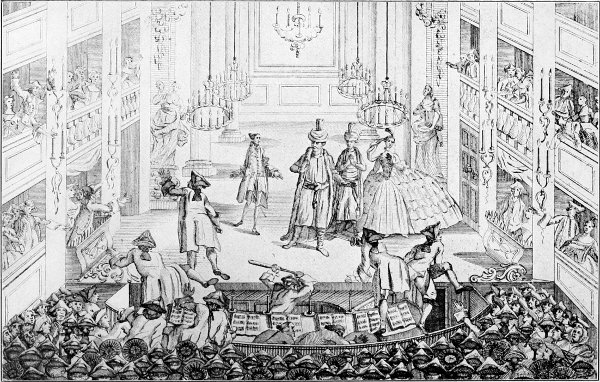
Riot at Covent Garden Theatre, During the Performance of “Artaxerxes.”
In 1759, Arne and Garrick had some negotiations in
reference to Miss Brent. Arne was very anxious that
Garrick should engage her, but terms could not be
arranged. Garrick readily acquiesced in her superior
merit alleged by Arne, but he “told the Doctor that
all his geese were swans.” “Tommy,” said he, in
his usual familiar way, “you should consider that
Music is at best but Pickle to my Roast Beef.”—“By
... Davy,” replied the Doctor, “your Beef
shall be well pickled before I have done.” Accordingly
he went to Covent Garden Theatre, and
concluded an engagement with the manager for Miss
Brent, whose success as Polly in the “Beggar’s Opera”
was so tremendous that Drury Lane Theatre was
nearly deserted on the nights on which she performed.
Arne, of course, transferred his services to Covent
Garden, and “Comus” with his music was played on the
8th of October, 1762, with the celebrated Anne Catley
in the part of the Pastoral Nymph. In 1763, on the
24th of February, “Artaxerxes” was again brought
forward at Covent Garden, and it was advertised that
“nothing under full price would be taken.” This was
observed by Fitzpatrick, the leader of the rioters
who had compelled Garrick, at Drury Lane Theatre,
to submit to the demand that the public should be
admitted, as heretofore, to the theatre at half-price
after the third act. Accordingly the same malcontents
attended the performance of “Artaxerxes” at Covent
Garden, and noisily endeavoured to browbeat the
manager, Mr. Beard. He, however, refused to return
to the half-price custom, on the ground of the enormous
expenses incurred in the splendid manner in which
pieces were got up at Covent Garden; he was reminded
that Garrick had submitted after a vain resistance,
and he was called on to say whether he would
comply with the demand or no; the answer must
be “Yes” or “No.” Beard boldly from the stage
said, “No.” “The benches, chandeliers, etc., were
immediately demolished, and as much injury done
as took four or five days to repair.” Fitzpatrick
and two others were summoned to appear before
Lord Mansfield, with the result that the rioting
ceased; but the actors on the stage were nightly
disturbed by cat-calls and other noises, so that at
last Beard was obliged to give way, and resume the
long-established custom of half-price.
In 1764, on December 12th, the oratorio
“Judith” was repeated, and a new opera with
Arne’s music, “The Guardian Outwitted,” was
produced at Covent Garden Theatre. The libretto
was also the work of Arne. The music of this
opera has disappeared, probably in the fire which
consumed the theatre in 1808. His “Arcadian
Nuptials”—a Masque introduced into “Perseus and
Andromeda”—was also played, with Mr. Beard and
Miss Hallam in the principal parts. In 1765, on
the 30th of October, Mr. William Mawhood, an
intimate friend of Arne’s, proposed him as a member
of the Madrigal Society, founded in 1741, a worthy
assembly of musicians and amateurs who met
regularly to practise the best examples of old
English and Italian madrigals. The books of the
Society, which still exist, show that Arne paid
six shillings and sixpence subscription, and that his
son, Michael, was elected a member shortly after.
In this year Arne composed an Italian opera,
“Olimpiade,” to a libretto by Metastasio, with a
special part for the male soprano Manzuoli. This was
performed at the King’s Theatre, in the Haymarket,
twice only; we may therefore conclude it was
not a success. Arne composed a considerable
amount of music for male voices, unaccompanied,
chiefly Glees and Catches. He obtained three
prizes for pieces he sent in competition to the
Noblemen and Gentlemen’s Catch Club (founded in
1761). His Glee, “Come, shepherds, we’ll follow
the hearse,” was for many years sung after the
announcement of the death of a member. The
proceedings of the Society were frequently of a highly
convivial nature, and it is to be feared that Arne
found them greatly to his liking; in one instance he
outraged good taste and becoming reverence by
composing a burlesque on a most solemn religious
rite, to the words “Poculum elevatum.”
He deserves credit for his endeavours to popularise
vocal concerted music in the theatre and at
garden entertainments; he took care not to present
his musical programmes without due rehearsal.
A letter of his, without date, probably written
about 1766, is evidence of this. “Dr. Arne’s
compliments to W. Smith desiring him not to fail
meeting the other gentlemen concern’d in the
new Catches and Glees, at the Dr.’s house, on
Thursday evening next, exactly at 7; having reason
to hope for some continuance of them; if perform’d
with a requisite spirit and humour; besides another
material employment for him on the Anvil. (Jan.
ye 2d.) West Street, near Litchfield street, Soho.
Pray don’t forget to bring the part.” It may be
necessary to explain that the Mr. W. Smith to whom
the above reminder was sent was not only a singer,
but also the engraver of many of Arne’s publications,
and therefore familiar with the use of the anvil;
evidently the composer had music waiting publication.
On the 4th of February, 1767, we learn from a
note in a private diary kept by Mr. Mawhood that
he “call’d on Dr. Arne and Mic. Arne, and was at
the Madrigal”; probably the Arnes accompanied
him. On the 4th of April Mr. Mawhood attended
“Mrs. Arne’s and Mr. Pemberton’s Benefit: took
3 Pit tickets at 3s. each”; on the 9th of May he
“was at Dr. Arne’s and heard ye Catches performd”;
on the 29th of December “Performd
Dr. Arne’s mass at Church.”
On the 12th of May, 1767, Arne conducted a
concert of Catches and Glees at Ranelagh House,
described in the Gentleman’s Magazine as the first
of the kind. In the following year, 1768, a second
vocal concert was given by Arne at Drury Lane
Theatre; for the occasion a book of the words was
published, with explanatory notes, probably the
earliest example of an annotated programme book.
The title is, “The words of the favourite Catches
and Glees which, with the elegant and humorous
music, composed by the most eminent masters of
the last and present age, will be performed at the
Theatre Royal, Drury Lane, on Tuesday, the
twenty-first of this instant June, by a considerable
number of the best vocal and instrumental performers.
The Choral and Instrumental parts are added, to
give the Catches and Glees their proper effect, being
composed, for that purpose, by Dr. Arne. This
performance (the second of the kind ever publicly
exhibited in this or any Kingdom) is introduced at
the desire of many persons of quality, lovers and
encouragers of good harmony and inoffensive humour.
London, printed in the year MDCCLXVIII.” There
is a preface to the book explaining what is a
Catch and what a Glee. Arne wrote, “these kinds
of entertainment (in the time of Mr. Henry Purcell)
were so much in fashion, that in most polite
families, after dinner and supper, it was a custom
to lay the choicest collections of Catches and Glees
on the table, and thought a deficiency of education
in those, who could not readily perform a part.”
The concert commenced with a New Grand Overture
by Dr. Arne, and was succeeded by a Catch of his
composition, “The family quarrel,” which “gained a
golden prize-medal in the year 1764.” Next came
a Glee composed by Mr. Norris, an “Elegiac on the
death of his late Royal Highness the Duke of
Cumberland.” The words of this are:
O’er William’s tomb, with love and grief opprest,
Britannia mourns her hero, now at rest;
Not tears alone; but praises too she gives,
Due to the guardian of our laws and lives;
Nor shall that laurel ever fade with years
Whose leaves are water’d with a nation’s tears.
Those who are acquainted with Braham’s popular
song, “The death of Nelson,” will recognize the
unacknowledged annexation of the above lines by
Mr. S. J. Arnold, who is credited with the
authorship of the words.
The next item in the programme is a Catch by
Mr. Henry Purcell, “The Soldier and his friend”;
then a Catch by Mr. Giardini, “Beviamo tutti tre.”
The words are printed in Italian and English. A
Glee by Mr. Baildon, “Prithee friend, fill t’other
pipe,” ends “The first Interlude.” The second part
opens with a Catch by Mr. Henry Purcell, “Jack,
thou’rt a toper,” to which Arne has appended a
note, “The words of this last Catch are said to be
written by Mr. Henry Purcell, wherein, it is obvious,
that he meant no elegance, with regard to the
poetry; but made it entirely subservient to his
extream pretty design, in the music.” The catch
originally was a number in the Tragedy “Bonduca,”
for which Purcell composed the music: it was first
published in Delicæ Musicæ, in 1696. Arne was
probably correct in ascribing the words to Purcell.
The next piece in the book is called a Glee, but
should have been described as a Madrigal—“The
Nightingale,” by Weelkes. Arne remarked that
“The mastership and genius of this production may
serve as a specimen of the state of music at that
time, 1608.” A Glee by Mr. Baildon, “When gay
Bacchus fills my breast,” which “gained a golden
prize-medal in 1766,” is followed by a Glee by
Arne, “On Chlœ sleeping,” “the favourite song in
Artaxerxes beginning, ‘Water parted from the sea’;
at the Earl of Eg——t’s particular desire, taken by
the doctor for the subject of this Glee, and set for
different voices, the words being now written to
the measure of the music.” The “Interlude” concluded
with Dean Aldrich’s Catch, “Hark, the bonny
Christ-Church bells.” The third part commenced
with a Catch by Arne, “The street intrigue,” the
words of which are neither elegant nor decent. A
note informs us, “This last Catch was written and
composed in the year 1763, soon after the invitation
of the Catch-Club, and not put in for a prize-medal;
but with humility, presented to the members.” Next
we find a Glee by Arne, “The love rapture”; then his
Catch, “Which is the properest day to drink?” “This
gained a golden prize-medal in the year 1765,” and
is a clever composition, still occasionally performed.
The last piece in the book is a Glee and Grand Chorus
by Arne, “Punch, the medium of life.”
In 1769 Arne composed an Ode for the Shakespeare
Jubilee at Stratford-on-Avon; the words of the Ode
were written by Garrick, who paid the composer
sixty guineas for the music, which was published
with the following title: “An Ode upon dedicating a
building to Shakespeare, which was erected by the
subscription of the Noblemen and Gentlemen in the
neighbourhood of Stratford upon Avon, the music
composed by Dr. Arne. London, Printed and Sold by
John Johnston, at No. 11, York Street, Covent
Garden.” There are nine pieces of music; one Air
became popular, “Thou soft flowing Avon,” which
was sung by Miss Weller; the other singers were
Mrs. Barthelemon, Mr. Vernon, Mr. Champness,
Mrs. Baddeley, and Master Brown. A semi-chorus in
the work is entitled “A strict Fuge for 4 voices. Chapel
Time.” This was evidently sung unaccompanied,
and although short must have made a good effect.[20]
At the same Jubilee festival, Arne’s oratorio “Judith”
was performed at the Church. In 1770, Garrick
determined on reviving Dryden’s “King Arthur” at
Drury Lane Theatre, and engaged Arne to superintend
the musical part of the performance, who seems
to have suffered at the time from an overdose of self-importance,
and addressed the following letter to:
“David Garrick, Esq. Sir,—A due attention to
your Commission having gone hand in hand with
what fancy and judgment I may be thought to possess
in my profession, I thought it necessary to lay before
you a true state of the merits and demerits of the
Musical Performance, you are about to exhibit in
King Arthur. To attain a certain rectitude, in
judging of this matter, I have not only, with the
utmost care and candor, inspected the Score of
Purcell’s composition; but attended two rehearsals
of it; the result of which, is, as follows:
“The long Scene of the Sacrifice, in the 1st Act,
necessary to be deliver’d in, as being written for
Music, may have a solemn and noble effect, provided
that the last Air and Chorus—‘I call you all to
Woden-hall’—be perform’d as I have new compos’d
it; the introductory Air to be sung by Champness,
which being highly spirited, will carry off with an
eclat, an, (otherwise) dull, tedious, antiquated suite of
Chorus: Besides which, that Song, as set by Purcell,
is intirely out of Mrs. Baddeley’s compass, very
indifferent, and no way proper for a woman, where a
troop of warriors are assembled, to bribe their idols
for a success in battle.
“The following Song and Chorus, ‘Come, if you
dare, our Trumpets sound,’ is in Purcell tolerable;
but so very short of that Intrepity and Spirited
defiance pointed at by Dryden’s words and sentiments,
that, I think, you have only to hear what I
have compos’d on the occasion, to make you
immediately reject the other. The Air ‘Let not a
Moon-born Elf mislead you,’ is, after the two first
bars of Purcell, very bad, and out of Mr. Champnes’
compass of voice.—Hear mine. All the other Solo
Songs of Purcell are infamously bad; so very bad,
that they are privately the objects of sneer and
ridicule to the musicians, but, I have not meddled
with any, that are not to come from the mouths
of your principal Performers. I wish you wou’d
only give me leave to Doctor this performance, I
would certainly make it pleasing to the Public,
which otherwise, may prove an obstruction to the
success of the Revival. It is not now my intention
to new set many things, mention’d in our original
plan; but to put it in the power of your principal
performers to make a proper figure, by opening and
adorning the most entertaining points of view, wherein
they are to appear; consequently, the expence will be
much short of the Sume propos’d; all self-interest
subsiding to the earnest desire I shall ever entertain,
of proving my sincerity, when I stile myself Sir
Your devoted humble servt.
ThoS. AugNE. Arne.”
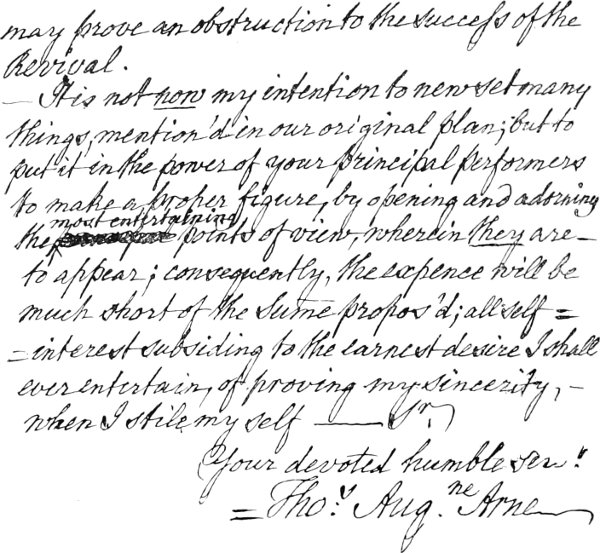
Happily Garrick did not accede to Arne’s requests,
and much of Purcell’s music was left in the Masque.
Arne composed a new Overture in which he introduced
an imitation on the flute of the call of the “Cuckow.”
The whole of the first Act, including the famous
“Come, if you dare,” was left with Purcell’s music
untouched. In the second Act there were several
changes; a new recitative, both words and music,
“Alas, the horrors of this bloody field,” was sung
by Mrs. Baddeley. This, and a new air, “O peace
descend,” were composed by Arne; “the music ill
match’d” that of Purcell. Before the chorus,
“Come follow me,” Arne introduced a solo “on
the subject of Purcell’s chorus, in which he took
care to write a goodly number of runs to show off
Mrs. Baddeley’s execution.” A new song by Arne,
“How blest are the shepherds,” was substituted for
Purcell’s solo and chorus, and Mrs. Baddeley was
provided with a recitative, “We must work, we
must haste,” followed by an air, “To virtue with
rapture,” and also “Thus I infuse these sov’reign
dews.” Mrs. Wrighten had new music composed for
her, a recitative, “Oh sight,” and an air, “’Tis sweet
the blushing morn to view.” It may be noted that
the words of these pieces were written by Garrick.
The third Act, with Purcell’s masterly “Frost
Scene,” was left intact. In the fourth Act Purcell’s
lovely duet, “Two daughters of this aged stream,”
also the solo and chorus, “How happy the lover,”
were retained. The music of the fifth Act included
Purcell’s “Fairest Isle all Isles excelling.” The
final air and chorus, “Saint George the Patron of
our Isle,” had new music by Arne.
There are some entries in the “Mawhood”[21] diary
referring to Dr. Arne in 1770: “13 June, Calld. on
Dr. Arne who will compose some music for Mr.
Pemberton’s Diurge.” “23d. Calld. on Dr. Arne had a
small practtice of the Service, for Mr. Pemberton.”
“28{th}. Was at Church, performd Dr. Arne and
Webb’s Burial for my poor friend Francs. Pemberton.”
A manuscript copy of the Dirge is to be found in
the British Museum. It was presented in the year
1849 by Vincent Novello to the Musical Antiquarian
Society. His father, Giuseppe Novello, in 1770
resided in Oxford Road, and probably worshipped in
the Sardinian Chapel, where Vincent, born in 1781,
became a chorister boy; this may account for his
possession of the manuscript of the Dirge. It is in
the handwriting of a copyist, not an autograph,
and has many errors. It is not complete; at the
commencement there should have been ten bars of
instrumental introduction, which are only indicated
in the manuscript by rests. The pencil marks of
figured bass are in the handwriting of Vincent
Novello; there are also pencilled names of solo
singers—Swiney, Fitz, Lanza, Guichd, Novello. The
music is admirable, and opens with a chorus for
treble, alto, two tenors, and bass, to the words
“Libera me, Domine, de morte æterna.” The pathos
of this quintet, admirably expressive of the text,
cannot be praised too highly. The words “Tremens
factus sum ego” are set as a solo for a bass voice, in
the style of many cathedral anthems of the period.
The manuscript, evidently intended for the organist,
gives the necessary organ-bass part; this solo, in the
key of A minor, leads into a short chorus in C major
to the words “Quando Cœli morendi sunt.” A solo
for a tenor voice to the words “Dies illa, Dies iræ,”
exhibits Arne’s skill in writing vocal music, and is a
very touching and effective piece of work; it is
followed without a break by a chorus, “Dies
Magna”; the next movement is a soprano solo,
“Requiem æternam,” in E major, a charming melody,
with Italian fiorituri. A short chorus, “Requiescat
in pace,” concludes a composition which is a
very fine example of Arne’s genius, quite worthy
of publication and performance. The British Museum
possesses another manuscript of the composer to
Latin words, “O salutaris hostia,” which looks like
an exercise in fugue writing, not intended for
Church performance. It may have been sent to the
“Catch Club” in competition for a prize.
It has already been stated that Arne deserted his wife
in 1756; what their relations were in the succeeding
years can only be surmised. She was regarded by
her contemporaries as a good and injured woman, and
her husband was notoriously a profligate. Some few
years ago a number of autograph manuscript
documents came into the possession of the present
writer, which throw a light on the unhappy condition
of things as they existed in 1770. On the 22nd of
November in that year, Mrs. Arne’s Attorney sent the
following letter to Dr. Arne:
“Sir,—I am employed to institute a Suit in the
Commons on the Complaint of your wife against you.
“The small pittance you gave her for Maintenance
falls greatly Short of Supplying her with Common
Necessaries, and not only so but this Small allowance
which is but £40 a year is now £10 in arrear. You
must be sensible Mrs. Arne could not Subsist without
Running you in Debt, those Debts must be paid very
soon by you. Mrs. Arne has a right and expects to
be maintained by you Suitable to your Circumstances.
I must request an explicit and immediate answer;
Or I shall take the necessary Steps to procure
Mrs. Arne that justice which she has an Undoubted
Right to.”
This called forth the following reply from Dr. Arne.
It will be noted that Arne did not address the
Attorney, but wrote direct to his wife:
“A.D. 1770.
“Mrs. Arne,—After the affectionate note I sent
you yesterday, with 5 Guineas, which was from the
first money I reciev’d, how great was my surprize,
when I reciev’d in return a threatening letter from
one Rennett an Attorney, on your account!
“Cou’d I possibly have suppos’d that after my being
so long in no way of earning a Guinea, which (till this
Job of Mr. Colman’s) was ever since the end of last
March, and being involv’d in debts on that account
that you—my Wife, shou’d be the only person who
sought to distress me? If other people had been as
inhuman, what must have become of a Man, who is a
laborious Slave to support his necessary Dependants;
insomuch that he does not enjoy three days’ ease and
pleasure the whole year round?
“As peace and quiet are all the enjoyments which a
man of my age can hope for, if he is in his senses,
which, in spite of base and wicked minded people, I
thank God I have not yet lost, I shall not fly in a
passion at your very ungenerous treatment; but with
the temper of a Philosopher explain to you the
consequences of your following the ill advice, which
may have been given you, and I know from whom.
“When Mr. Tyers refus’d to engage Polly Young,
unless you cou’d produce a Bond sign’d by me,
whereby we were both impower’d to live and act
seperately, did not I directly on your express
solicitation, enter into such Bond, impowering you
to recieve her whole income? Did I ever desire a
shilling of all she got before and after or wish
otherwise than that it had been ten times as
much for your sake?
“Well, after this, you having married your Niece
to Mr. Bartelmon, which threw you out of a good
income, having besides impoverish’d yourself, by
lending your Money in large Sums to an extravagant,
unprincipled Whore, and to others, who only meant
to defraud you of that and other valuables, you
applied to me by Mr. Forest, to pay you an annual
allowance for your support: I, who was ever desirous
and ready to do all within my power, ent’red immediately
into an Agreement to pay you £40 a year,
though I had no certain income of my own to do it
with, and through years of distress, for want of
something weekly coming in, made up my payments
to you, in one week, fortnight, or month, whenever I
cou’d scrape your money together, till lately, meeting
with no employment for a considerable time,—encumber’d
with an expensive house at Chelsea,
which I have prudently quitted, and being robb’d by
an abandon’d infamous Whore and Thief of a Servant,
my Necessities oblig’d me to be behindhand in my
payments; yet you very well know that whenever I
had two, three, or five Guineas, I never fail’d to give
them to you, in part of payment, and that but a trifle
now remains due.
“Is this a Man to recieve the treatment you now
give me? Fie, fie, Mrs. Arne! don’t drive me to
resentment, when I am willing to act conformable to
the laws of religion, peace and love; if you do, by
Heaven you’ll have terribly the worst of it; for I can
prove that having no regular income, whenever I
recieve any money, it is always consum’d in debts,
and that I am actualy not in a capacity to allow
you £20 a year.
“If, on the contrary, you chuse to continue in
love and friendship, send a line immediately to
Mr. Rennett, that the affair is amicably accommodated,
and though I may be never so distress’d, I
will cheerfuly pay your allowance, and remain,
Your affectte Husband,
“ThoS. AugNE. Arne. (Seal.)
“Saturday Morng.
“One o’clock
“Novr.-ye-23d.”
Evidently Mrs. Arne left the matter in the
Attorney’s hands; accordingly he wrote a reply as
follows:—“Mrs. Arne is Extremely sorry to hear
of any Distresses of Dr. Arne’s and wishes ’twas
in her power to Avoid calling on him, for a
subsistence. Her loss of Doctor Arne’s affections
has been a misfortune she has labour’d under too
many years and that without doing him ye least
injury but on the Contrary behaved with that
affection and Justice that will give her Satisfaction
in her last Moments. She hopes Doctor Arne has
not so little humanity as to add to her Misery by
refusing her a Necessary Subsistance if not Equal
to Dr. Arne’s wife yet Sufficient to provide her
with Common Necessaries which ’tis impossible for
her to do for less than a Guinea a week. If that
is paid into Mr. Rennett’s hands Weekly who will
have the Receipts ready Mrs. Arne must Content
herself with wearing out an Unhappy Life depriv’d
of that Comfort which She had a right to expect
from her Husband. Doctor Arne threatens to
proceed to Extremities with his wife she is sorry
to hear it But must be Contented with her fate
and rely upon the justice of her case.”
No further correspondence is available, nor is
there any record of proceedings at common law;
it is therefore reasonable to suppose that an
arrangement was concluded. (See page 108.)
In 1772, on the 26th of February, the oratorio
“Judith” was performed at Covent Garden Theatre,
with women in the chorus, for the first time, as
has already been narrated. Shortly afterwards Arne
had a performance at the Theatre in the Haymarket;
the bill of announcement said, “By desire, for one
night only, under the Direction of Dr. Arne. At
the Theatre Royal in the Hay-Market, this present
Monday, March 16, 1772, will be performed the
celebrated Catches and Glees. With a Concerto on
the Violin by Mr. Fisher. After which (by permission)
will be performed a New Burletta, called ’Squire
Badger. Altered and planned for Music, from a
favourite Piece. Written by Henry Fielding Esq.;
the Music entirely New Composed by Dr. Arne
& With a New Irish and Scotch Medley Overture.
Fairlove by Mr. Phillips, Sir Thomas Loveland by
Mr. Fox, ’Squire Badger by Mr. Smith, Landlord
by Mr. Hamilton, Clarinda by Mrs. Jewell, Pert
by Mrs. Thompson. Boxes 5s. Pit 3s. First
Gallery 2s. Upper Gallery 1s. To begin exactly
at Six o’clock. Books of both Performances may
be had together at the Theatre at 1s. 6d.”
In 1775 Arne wrote the following letter to
Garrick: “Aug. 21st, 1775. Dr. Arne presents his
best compliments to Mr. Garrick, heartily returning
thanks for his permission to several of his company
to perform in the intended new comedy at the
Opera-House, for the Doctor’s advantage. He is
unluckily, and indeed ungenteelly cut out of, at
least, a clear £100, by Mrs. Greville’s accepting and
promising to perform the principal comic character,
and, after keeping it near three weeks when it was
too late to substitute another, returning the part
with frivolous excuses. The Doctor knows not
whether he is rightly informed; but he has heard
that Mr. Garrick discharged Mr. Dibdin. If (as he
has likewise been told, Mr. Garrick has engaged
Mr. Arne[22] in the other’s place, the Doctor can better
reconcile his being neglected; otherwise should have
thought himself at least as capable of the business as
any other person, and that his name and credit in the
profession would have brought no disgrace on his
friendly employer. Cannot help regretting likewise
that, though he has ever maintained the most cordial
respect and regard to Mr. Garrick for many signal
good qualities, as well as for his being incontestably
the first genius of this age in all that he professes,)
any young person’s belonging to him, though ever
so conspicuous for his abilities, is sufficient cause for
his rejection. These unkind prejudices the Doctor
can no otherwise account for, than as arising from an
irresistible apathy, to which (though painfully) he
submits; but will never (notwithstanding) deviate a
tittle from that respect, with which he has ever been
Mr. Garrick’s most obedient servant.”
To this letter Garrick replied: “Drury Lane
Theatre, Aug. 24, 1775. Dear Sir,—I am very
sorry that Mrs. Greville (to whom I gave free
leave to assist you) should behave so ill to you, and
more so, that your loss will be so great by her
ill-behaviour. The managers of Drury-lane have
no intention to employ a constant composer, but to
engage with different gentlemen, as business may
arise in the theatre. How can you imagine that I
have an irresistible apathy to you? I suppose you
mean antipathy, my dear Doctor, by the general
turn of your letter. Be assured, as my nature is
very little inclined to apathy, so it is as far from
conceiving an antipathy to you or any genius in
this or any other country. You ask me why I will
not make use of your pupils?—Shall I tell you
fairly? because I have not the opinion of them which
you have. I tried Mrs. Bradford, Miss Weller,
and I have now Mr. Fawcet: the two first (as I in
a most friendly manner foretold) did no credit to
you or myself by appearing in a piece which you
obstinately insisted on bringing out, though you
knew it would be the means of making a coolness
between us. In short, dear sir, your heart and
your genius seem more inclined to the theatre of
Covent-Garden than that of Drury-Lane; and when
I consider the additional music to ‘King Arthur,’
and the music to ‘Elfrida,’ I trust that I am
justified in my opinion. Whether I am mistaken
or not, I have not the least antipathy, I give you
my honour I have not, to Doctor Arne; but on the
contrary, if I had a work of consequence, I should
wish to employ him, notwithstanding that our
theatrical connections have not yet been serviceable
to either of us. I am, dear Sir, your very sincere
well wisher, and humble Servant. David Garrick.”
To this conciliatory epistle Dr. Arne replied in the
following month: “Sept. 3rd 1775. Dear Sir.—I
received the favour of your reply to my letter,
which I could not doubt of, you never being
deficient in politeness. You are certainly in the
right to suppose that, if I wrote the word apathy,
I meant antipathy. Did I make the blunder or is
it a joke, like Mrs. Cibber’s asking you how you
could possibly spell King with a Q? I must beg your
permission to assure you that you are greatly
mistaken in two points. First, when you imagine
that I have the least partiality either in favour of
the other theatre or its patentees: next in saying
that the music in ‘Elfrida’ is much superior to
the music I composed for you in ‘King Arthur.’
The principal songs, which for air and mastership
I have never excelled, have not been performed.
They were written for the late Mrs. Arne,[23] and
fashioned to her sweet voice, and glaring abilities.
Mr. Arne expected, from the music and her
performances of it, that they would be productive of
the highest pleasure, that a judicious audience ever
received from either of our endeavours, and several
eminent masters thought as he did: but when those
coups de maître came out of the mouths of persons
who could neither sing in time nor tune, nor turn
out one jeu de la voix in them, the result was much
the same as if an approved author had written a
fine part for ——. I was near hurting your delicacy,
in nominating a gentleman, with whose acquaintance
I am honoured, and this part, through an unfortunate
event, should be acted by Jemmy Raftor, or Dagger
Marr. Champness’s songs, the chorus in the first
scene of Mr. Vernon’s ‘Come, if you dare,’ and
several other things that employed my utmost efforts,
were laid aside, in favour of Purcell’s music, which
(though excellent in its kind) was Cathedral, and not
to the taste of a modern theatrical audience. But
never was my surprise greater than when I perceived
that a drama so fertile of invention and elegant in
poetry, which brought so much to Harry Gifford,
and lately in Dublin should (though strongly performed
at a vast expense at Drury-lane) fail in
making that impression on the public, which the
managers had an undoubted right to expect. You
frankly say that you have not engaged any of my
pupils, because you have not the same opinion of
them that I have. Be pleased to remember that I
did not recommend Miss Weller as an accomplished
singer; but as a young girl, with a good person, who
would be useful in musical pieces; but whose talents
in speaking and acting, might, with your friendly
encouragement, in a little time bring so pretty a
figure to be a shining object. Had you seen her play
Mrs. Cadwallader in Foote’s farce at Covent Garden,
your candour would induce you to think with that
company, who all declared that no young actress ever
did better. When I offered you this girl, you wanted
an accomplished singer. When I recommended
Miss Jameson as such, I was to whistle an angel from
Heaven, or you were full; though you brought out a
raw nothing last year, and have taken Mrs. Jewell
and a Jewess[24] this season. I hope you will, as you
have kindly done, excuse this frankness in me, and
give me leave to add that I will positively bet a
hundred pounds upon Miss Jameson, against any
singer you can name in either theatre—I might safely
a hundred to one. I wish you would ponder on the
contents—not now, because your cast is rather
overloaded—but hereafter, when it may not be so.
And now, Sir, to the last matter I shall at present
trouble you with. Bickerstaff added songs to the
Oracle, and brought it out by the title of ‘Daphne
and Amintor,’ at Drury Lane, which succeeded
very well. I remember a piece of Mr. Lloyd’s,
called the ‘Capricious Lovers,’ when performed in
Clive’s time. Every body liked the Burletta, but
none were pleased with the music—which has
induced me to reset it. Now, Sir, if you think it
will (with the addition of my new music) fill up a
vacancy, till the town fills, the vocal, instrumental,
and speaking parts, are ready drawn out: the
title may, and should be altered to ‘The Country
Girl at Court,’ being the original one, viz.: ‘La
Contadina in Cort,’ and (for a sixth night) I will
attend the getting up of the musical part, and deliver
up the composition to your use. If you don’t want it,
make no ceremony in saying so; for it will be of
use to me, with my catches and glees. Have I
been studying the longitude? Perhaps so; but if I
have tired you, it is more than you could do by me,
were you to fill a ream of paper.
“This requires no other answer, than just whether
you can, with advantage to your undertaking, make
use of my new composition or not. I am, Sir,
with due respects, ever your friend and humble
servant,
“Thomas Augustine Arne.”
There is another letter from Arne to Garrick,
without date; it reads as follows:
“Dear Sir,—Mr. Johnston informing me of your
desire to receive my demand for the composition of
the music in ‘The Little Gipsy,’ I beg leave to expatiate
a little thereon. I think a musician, with regard to
theatrical employment, under an unfortunate predicament,
if comparatively considered with the author
of any little piece, for the following reason. They
should both have learning, invention, and a perfect
knowledge of effects; but an author of a petite pièce
can instantaneously write down his thoughts as
they arise, whereas, the poor musician, when he has
conceived an air, in every respect suitable to the
sense, and emphatically expressed in every part, has
done but half his business; for he has all the
instrumental accompaniments to study and write
down; insomuch as, that in a composition of ten,
twelve, or more different parts, when he has written
a whole side of music paper, he has the mortification
to have composed but one line; all, except the voice
part, being requisite to that one line. And yet an
author of a farce will frequently make upwards of
£100 by his sixth night, besides £50 by the sale
of his copy to the printer; while the poor devil of
a crotchet monger is thought well paid with £50
for six times the study and labour. This last
observation, though strictly just, is not, in me,
productive of a single complaint or grumble;
but convictive that I have taken infinite pains
to be master of a scurvy profession. As to my
bill, it amounts, at my constant and reasonable
rule of charging, but to £45 13 6: If you
should think I have employed extraordinary time
and care to make the composition proper and
perfect in its kind, you will not overpay me with
£50. But do as you please; I shall be satisfied,
and am, with true respects, Dear Sir, your most
obedient servant,
“Thomas Augustine Arne.”
This letter is endorsed by Garrick, “Dr. Arne, about
bill for ‘May Day.’ I gave him the £50 desired.”
“May Day, or the Little Gipsy,” a musical farce
in one act, by David Garrick, was produced at
Drury Lane Theatre on the 28th of August, 1775.
There is much to be learned from the correspondence
which passed between Arne and Garrick; the
following letter, undated, is full of interest:
“Dear Sir,—I was never so conceited of any
abilities, as non cedere majoribus; but then I
ever was above servility, and could not pay a
compliment to the opinion of Socrates or
Seneca, at the expense of my reason. Humanum
est errare, therefore the main study of every
wise man is to arrive at rectitude, which cannot
possibly be accomplished by giving an implicit
concession to our first determinations. But shall
Arne, a musician, have the hardiesse to dispute
with Garrick, in his own way?—Yes, if Garrick,
not giving himself time to debate on the natural
effects arising from their causes, peremptorily
gives his ego dixi to what does not (to Arne)
appear natural. But where Garrick is pleased to
exercise his judgment, as in his own parts, by a
fair trial of his opinion pro and con? No, Arne would
as soon dispute with Sir Isaac Newton (if living) on
his doctrine of colours, sed ad propositum.
“When Miss Weller rehearsed part of Polly’s
character in the green-room, I knew it would be in
vain to attempt a justification of her manner, at
that juncture, and therefore reserved my sentiments
for this occasion. I shall only particularize the
soliloquy, ‘Now I’m a wretch indeed,’ which, in
all the Polly’s I ever saw, had no effect on the
audience, except when Mrs. Cibber played the
character, who spoke and acted in the same manner
as Miss Weller does; and Mr. Barry had the same
idea of it. In you this position is glaringly
illustrated. Now, in regard to Polly’s situation,
it is this. She has been soliciting her husband’s
life with her parents, which, instead of moving
their obdurate hearts, has had no other effect, than
her father’s leaving her mother with a determination
to prepare matters at the Old Bailey for his death.
Polly, overhearing this, comes on in an agony of
grief, says, ‘Now I’m a wretch indeed!’—thinks
she sees him already in the cast—that she hears
vollies of sighs from the windows in Holborn—then
abruptly breaks out—‘I see him at the tree—the
whole circle are in tears—even butchers weep.’
Can it be natural that the sight of a beloved
husband at the gallows should excite fainter emotions
in a doting wife, than arise in butchers exercised
in offices of cruelty? Would not an apple-woman,
who should see so fine a youth, merely in the cast,
naturally clap her hands together, through depth
of concern, and exclaim ‘Ah, poor soul! God bless
him and take him to his mercy!’—perhaps shed
tears? Certainly; then Polly’s emotion on figuring
him at the fatal tree, where the whole circle, through
mere humanity, are in tears, can be nothing short
of distraction, and any action, short of the force
she gave it, must appear trifling, faint, and unfeeling.
You are far from having seen the best of her in
that character, which appears in her scenes of love,
fondness, fears, and strokes of tenderness with
Mackheath. But I was not willing to give you
too much trouble, and besides, I plainly saw that
you could not divest yourself of prepossession;
else, how was it possible that a fine voice both for
speaking and singing; action open, easy, and graceful;
an unexceptionable person and figure, with a
countenance free from the least distortion, could
be productive of such faint approbation? You have
often said you regarded me—but, as in the case of
Miss Brent, were I to produce an angel, her being
ushered by me would create coolness and indifference.
This observation, which I could more forcibly
illustrate, I plainly see has put you out of humour.
Give me leave to say, so it has me, who am not
without my feeling on so mortifying an occasion.
You are possessed both of fortune and merit; the
one considerable, the other supreme. I pay you no
particular respect, on account of the former; but
the highest imaginable on account of the latter.
Providence, by placing you in this beneficial situation,
meant you as the sun and rain, to cheer and water
plants of genius. Your own talents, and the just
encouragement they have met with, demand, as a
debt, those beneficent offices from you. The pay
given to three nothings would be a suitable reward
to a rising, promising genius, whose industry and
advancement could never fail of repaying you ten
fold in return. Having faithfully kept my promise
to take no material step, without first acquainting
you with my design, and therefore given you a
fair offer of Miss Weller, I will trouble you with
no more letters, or applications on her account; so
shall only add, that if you are inclined to encourage
and cherish her, as you have done by many others,
with much lesser talents and requisites, I am
desirous, and immediately ready to give you the
preference; but if otherwise, as I have only my
small merit and hard labour to subsist on, let it never
be a matter of the least difference between us, that
I have acted like a man of honour, and you——overlooked
a jewel. I am, Sir, as I ever was, your
sincere friend, and most obedient servant,
“ThoS. AugNE. Arne.”
No reply to the above can be found. The following
letter from Arne to Garrick must have been written
soon after the above: “Sept. 3rd. Dear Sir,—Having
just received a letter from the ingenious
author of the two operas, and ‘Pennyworth of
Wit,’ under your kind inspection, wherein he begs
concealment of his name, till the fate of one or
other of his pieces is determined.”
Arne enclosed a copy of his unnamed friend’s
letter, which need not be produced here. He then
finished his own as follows: “Now give me leave
to wish you would consult your assured friend in
the musical productions of your theatre, which
(waving your own consequence, undeniably the
first with the public) might produce the best second
dish at the feast. Though half a ghost myself, I
have more honour than the whole ghost in ‘Hamlet.’
He was forbid to tell the secrets of his prison
house——I tell them not, through principle; but
this I may say, in confidence, you actually want
strength for the exhibition of musical performances—and
why should you?—Mr. Garrick, though I
wish him immortal, to the grief of the discerning
world, is not so—sickness, pain, mortality may
intervene. Let it not be said, that so great a master
of his art is deaf or blind to rising merit. I tell
you bona fide, that the young woman and young
girl [Miss Weller’s sister] whom I recommended, are
real objects of your notice, as handsome women,
complete figures, and promising actresses, abstracted
from their utility as singers. Pray be so obliging
as to let me hear from you as soon as you come to
town, and be assured that if my skill or connexions
are of any value, they shall be exerted to the
utmost, in testimony of the respect with which I
am, Dear Sir, your faithful friend, and humble
servant,
“ThoS AugNE. Arne.”
There is yet another letter from Arne to Garrick,
and a characteristic reply, both undated, but which
probably were written in 1775:
“Nov. 17. Sir,—As you have causelessly dropped
the friend, I have sense enough to write at a
becoming distance. You will undoubtedly hear, by
the freshest advice, the tête-à-tête alteration between
your brother and me. How could it happen otherwise,
when the first salutation I received was ‘Dr. Arne,
we have considered of the farce, and protest against it’;
which nearly led me into a mistake; for how could
I suppose he meant the farce you had first promised
to do, and after the last rehearsal concluded on?
But on his warm repititions, I found that I should
have protested against the farce that has been so
long acting ex-parte managers, and tragedy on the
composer’s part. I answered, ‘I am not surprised,
it tallies exactly with the treatment I have all
along received,’ (meaning not only on account of
the farce, but the discharge of two young women,[25]
handsome, perfect figures, and possessed of better
talents than most on either stage have set
out with:) I scorn to retract my words, and
think Mr. G. Garrick[26] will equally scorn to aggravate
them. The young women brought three very good
houses for the opening of a season, and met with
more public applause than I have ever heard; and
though inexperience, mixed with sensibility, might
intimidate Miss Weller so as sometimes to exceed
the exact sound, it was so little that the audience
were not susceptible of it. If you had no intention
to retain them, one night’s performance had surely
been sufficient for their condemnation; but they had
not then been supplanted by my son’s application;—permit
me to give you joy of the acquisition. As
to singing in tune, by my salvation! not above
three in both theatres can do it, though several
have had nearly twenty years’ experience. I did
not, as has been done to you more than once, impose
my young pupils on you as finished singers; why
then should they be discharged for what you knew
before their appearance, especially after three warm
receptions? Your public declaration this morning
appeared as meant to complete the many shocks
which I and mine have received—it was ineffectual:
I shall think myself happy to be mistaken. If you
are willing to show a friendship which I shall deem
an honour to receive, it will not be sufficient that
you perform the piece; I shall have the presumption
to hope that you will further its success; though I
fear that the cold breath of the manager, like a
wintry blast, has chilled the hearts of his dependents;
it is a distemper as catching as the itch. There
has been but one decent rehearsal which was in
your presence; though, even then, two principals
were absent; nor can I expect any better, till the
manager will either graciously appear, or at least
send his general mandate: and, but for the respect
due to the author, I had long since withdrawn the
prettiest music, in the light style, that I ever
wrote; but I will not, uncompelled, incur the
resentment of a gentleman, a man of fortune and a
scholar, respected by the first personages of the
University of Oxford, by assuring him, from your
promise, that his piece will be performed with all
possible expedition; then, that it is in rehearsal,
and now, by writing him word that you ‘protest
against it’? I once had a sparring of this kind
with Mr. Rich; he generously acknowledged that
he had not treated me kindly, and misunderstanding
was the cement of our friendship ever after. May
this candid explanation prove equally successful! It
shall not be my fault if it does not, being ever
desirous of proving myself, your real humble
servant,
“ThoS. AugNE. Arne.”
Garrick’s reply is very short and sharp:
“Dear Sir.—I have read your play and rode your
horse, and do not approve of either. They both
want particular spirit which alone can give pleasure
to the reader and the rider. When the one wants
wits, and the other the spur, they both jog on very
heavily. I must keep the horse, but I have returned
you the play. I pretend to some little knowledge
of the last; but as I am no jockey, they cannot say
that the knowing one is taken in. I am, Sir, your
most obedient servant. D. G.”
Endorsed “Designed for Dr. Arne, who sold me
a horse, a very dull one; and sent me a comic
opera, ditto.”
In 1776, early in the year, Miss Abrams, referred
to in a letter from Dr. Arne to Garrick, made her
first appearance on the Drury Lane stage in Garrick
and Arne’s “May-day, or the Little Gipsy.” She
possessed a sweet voice and good taste, which had
been excellently cultivated under Arne’s tuition.
At the last rehearsal of the piece, which took place
on the morning of the day of performance, Garrick
suddenly conceived that a dance of rustics would
improve the play, and told Dr. Arne of his idea,
adding, “I suppose it would be impossible for you
to compose a tune for it in time?” The Doctor,
smiling and rubbing his elbow, according to his
usual practice, replied, “We’ll see what can be
done,” and calling for pen, ink, and music paper,
sat down at the prompter’s table, and in less than
five minutes produced one of the prettiest dancing
tunes ever heard, which, when played by the band,
astonished and delighted Garrick so much that,
forgetting his age, he ran up to the Doctor, and
embracing, took him by the hands and danced with
him round the stage with much grace and animation,
to the admiration of all who witnessed it.
In 1776, Arne was engaged to compose music
for the Rev. William Mason’s drama, “Caractacus.”
The original libretto was written in 1759; but
considerably revised, altered, and adapted for stage
purposes in 1776 by the author, and this amended
version, with Arne’s incidental music, was produced
at Covent Garden Theatre on the 6th of December.
That it was a complete success is evident; the
New Morning Post, or General Advertiser, on the day
following the performance, congratulated the town
“on the acquisition of so fine an entertainment
as ‘Caractacus’ where poetry and music unite their
fascinating powers.” Dr. Samuel Arnold, the
composer, who was attached to Covent Garden
Theatre when “Caractacus” was produced, spoke in
the highest terms of Arne’s music. Unfortunately
every vestige of this has disappeared; according to
the testimony of Dr. Arnold and of Dr. Thomas
Busby, “One of the latest and finest of Dr. Arne’s
theatrical compositions, was an Opera called
‘Caractacus,’ founded on a piece of that name
written by Mason. Every portion of the music, as
the late Dr. Arnold, who had seen it, informed the
compilor of this work, evinced a vigour and warmth
of imagination worthy of the flower of early
manhood. At Dr. Arne’s decease, this production
came into the possession of his son, Mr. Michael
Arne, who unfortunately sold the manuscript to
one Harrison, a bookseller in Paternoster-row, who
becoming a bankrupt before the piece was published,
it was publicly sold together with his other effects,
to whom it is not now known, and never has been
heard of since.” Six years after Dr. Arne’s death,
in 1784, The Universal Magazine announced that
Mr. Michael Arne was intending to publish his
father’s “Death of Abel, Caractacus, and a Set of
Concertos for the Harpsichord or Pianoforte with
the Choruses in Judith.” Michael Arne died in
1786, without having accomplished his desire; in
1793 the Concertos appeared, having been edited
by Mr. Groombridge, and from the interesting
preface to the volume we learn that this was the
only piece which had been published. Quite recently
an anonymous publication of music for Mason’s
“Caractacus” has been attributed to Dr. Arne, but
the composition is so faulty and puerile that, even
if other evidence were wanting, it would be impossible
to suppose it the work of an experienced and
accomplished musician like Arne. The book in
question has a water-mark in the paper, 1794, which
was sixteen years after Dr. Arne’s death. The author’s
preface to the publication was evidently written by
some one alive at that date; it is therefore not
necessary to waste more space in discussing it.
Dr. Arne had a very high opinion of his own
talent as a poet, and some of his theatrical pieces
are said to have suffered comparative failure in
consequence of the poor quality of the words. But
there was one piece of his, never performed nor
ever published, which, while exhibiting his skill as a
composer of music, shows also that he was at
times wholly wanting in good taste and discretion.
There are two copies of the libretto in existence,
printed by Arne for publication, but never issued:
the title-page is: “Whittington’s Feast, a new
Parody on Alexander’s Feast written by a College
Wag. The Overture, Songs, &c., with all the grand
chorusses, new composed by Thomas Augustine Arne.
Doctor of Music.
Risum teneatis amici?
O what is Music to the ear that’s deaf;
Or a goose pye to him that has no taste?
London: Printed for the Author.”
In the preface, Arne says: “The fairest apologies
I can offer in excuse for this Parody on Alexander’s
Feast, which, by its ludicrous turn, may be thought
an attempt to depreciate one of the noblest poems
in the English, or perhaps any other language, are,
First, that the impossibility, in any degree, to lessen
the value of so perfect an ode was a capital motive.
The second was an irresistible propensity (which
perhaps I may have mistaken for genius) to the
comic muse.” The preface ends with an intimation
that the author hopes the “oddity of the attempt,
with the intense application bestowed on the music,
and the great expence at which it is performed,
will compensate for any defects in the parody, and
invite a good-humoured audience to support it.”
“April the 10th, 1776. From my Garret, in
Cat and Harp Alley.”—“The Scribbler.”
The libretto is printed in double columns, the left
giving Dryden’s text, the right the College Wag’s
parody. It may suffice to say that there are seventeen
pages of vulgarity and sometimes indecency. The
music, which extends to two hundred and fifty pages
in the manuscript score, is superior to the poetry.
There is no Overture; the various songs and choruses
are palpably meant to be in imitation of Handel,
but like the words they fail to detract from the
value of the originals they vainly burlesque. There
is evidence that Arne intended to have a
public performance of “Whittington’s Feast”;
but circumstances, probably indifferent health,
prevented it.
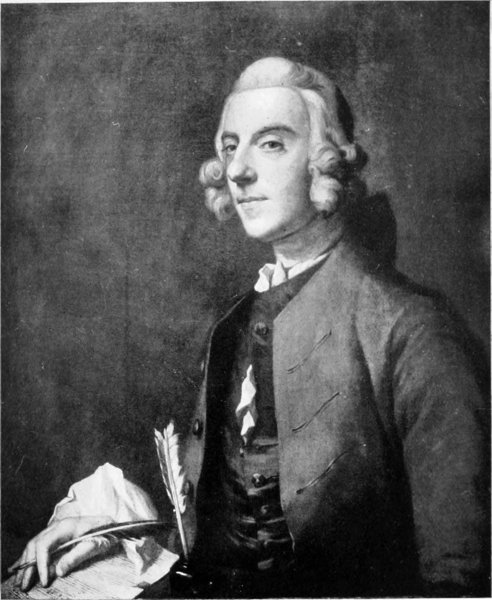
Arne, by Zoffany.
In October, 1777, Arne and his wife met and
became again a united and affectionate pair. This
happy reconciliation was brought about by the
intervention of their grand-niece, Cecilia Maria
Barthelemon. A memorandum written by her, still
preserved by one of her descendants, is worth quoting
verbatim: “In former days the Doctor [Arne] had
taken great pleasure in hearing my mother[27] sing
the songs for Mandane in his Opera of Artaxerxes,
and latterly she used to visit him for the purpose
of receiving her Aunt’s seperate maintenance money,
and the last time she called for this purpose, she
took her little daughter with her, then about ten
years old. The Doctor who was always kind to the
child, had her seated on his knee all the time: and
when her mother was about to leave, she ventured
to say, that she began to be tired of calling for
this purpose, and thought it would be far better for
him to be reconciled to his good wife, who had
always been so irreproachable herself. He, however,
answered her in a manner so violent and angry,
that the child who both loved and revered her great-aunt,
burst into tears and cried aloud; and her
mother at once rose to take leave, observing also that
she would never take the trouble to call upon him again.
A few days after, however, she received a letter
from the Doctor, apologizing for his conduct, adding
that the tears of the dear child had affected him more
than could a host of men, and that if his dear old
wife would be reconciled, he would be happy to see
her and her niece and nephew Barthelemon, and
the dear child also, to dine with him on the following
Sunday. The good Mrs. Arne shed tears of joy,
gave her ready consent, and lovingly embraced her
little grand niece.” The narrative continues: “The
Doctor and his wife lived happily together (alas)
only for six months after this long wished for
reconciliation (after a separation of thirty years)—often
expressing the wish that it had taken place
years, instead of only months before.”
We learn from an entry made by Mawhood in
his diary, dated the 6th of December, 1777, that he
saw Dr. Arne, “who has conformed and is now very
ill; he has made his will betwixt Mrs. Arne and
Michael.” Another entry in the diary, dated the 10th,
stated: “Mr. Paxton called, says Dr. Arne is now
on the recovery.” The improvement in his health,
however, proved only temporary, and on the 5th of
the following March, 1778, the diarist wrote,
“Dr. Arne died this evening at eight o’clock.”
The grand-niece previously quoted says: “Dr. Arne
died a sincere penitent, and a firm Catholic.
His confessor buried him according to the
ceremony of his Church. A cross was put on
his coffin, and he was interred in the burial ground
of St. Paul’s, Covent Garden, on the right hand
side going in.” There are two contemporary printed
accounts of the last moments of the distinguished
composer; one from his intimate friend, the popular
tenor singer, Vernon, who, at that time engaged in
the neighbouring Drury Lane Theatre, was in the
habit of visiting Arne daily at his residence in Bow
Street. The morning after Arne’s decease he told the
company assembled in the music-room at the theatre
that he “was talking on the subject of music with
the Doctor, who suffered much from exhaustion,
when, in attempting to illustrate what he had
advanced, he in a very feeble and tremulous voice
sung part of an air, during which he became
progressively more faint, until he breathed his last,
making as our immortal Shakespeare expresses it, a
swan-like end fading in music.”
The other account says Arne “died of a spasm
on his lungs, retaining his faculties to the last
moment of his existence. He had originally been
instructed in the principles of the Romish Church:
these however he had for many years wholly neglected,
as inconsistent with a life of ease and gallantry, in
which he indulged to the fullest extent of his purse
and constitution. In his last stage, the dormant
seeds of early maxims and prejudices, as is usually
the case, revived in his bosom, too strong to be
checked, or perhaps discriminated by sound reason.
The complicated train of doubts, hopes, and fears,
operated so forcibly on the Doctor’s feelings at this
awful period, that a priest was sent for, by whom
he was awed into a state of most submissive
repentance. In thus renewing the duties of a
Christian, those of his professional line were not
forgotten; for about an hour before his death he
sung an harmonious Halleluja, a flight of fancy,
calculated as it were to usher him into the other
world.” These narratives, though not precisely
similar in detail, leave no doubt in the mind of the
reader that Arne died repentant, doubtless the
happier for having been reconciled to his wife.
“Notwithstanding the number and excellence of his
publications, Dr. Arne left little or no property
behind him; a circumstance which will not appear
extraordinary to those who consider his real character
and life. He was naturally fond of vicious pleasure,
to which he sacrificed every other consideration.”
The Will he made is at Somerset House, and recites
as follows:—“In the Name of God Amen—I Thomas
Augustine Arne of Bow Street Covent Garden in
the County of Middlesex doctor in Music being of
sound mind memory and understanding hereby
make and pronounce this to be my last Will and
Testament revoking all former Wills made or
pretended to be made whatever Whereas I am
possessed of a small Personal Estate consisting of
goods Chattels and Effects most of them now standing
lying or being in the House I rent of Mrs. Woodeville
in Bow Street aforesaid and particularized in the
Schedule hereto annexed I leave give and bequeath
them in manner and form following First to my
beloved wife Cecilia and only son Michael I give
and bequeath the sad remains of my once excellent
Organ mangled trod to pieces and ruined by and
through the Villainy of wicked Servants that they
may dispose of the same to the best advantage and
share the profits equally between them Secondly
I give and bequeath to the said Cecilia and Michael
all my Worldly Goods Chattels Estate Personal
whatever and wherever to be found (except as
hereafter excepted) Books musical and for reading
Plate and every other thing now situate standing
or lying in my house in Bow Street aforesaid or in
any other place to be found As to all books Musical
or Literary and all Manuscripts in either branch
written or composed by me or other Persons My
Will is that such as may by performance at any
time or in any place produce any profit or Benefit
to the said Cecilia and Michael The expenses
attending such Performances being first paid and
defrayed equally between them The Profits or Benefits
arising from the Sale or Public Performance thereof
shall be equally divided between them share and
share alike And the said Property being liable to
an exception before limited I shall make it here
viz. That the share and proportion of the said
Michael is only circumscribed or limited in this
particular viz. that when by sale of the Goods or
part of them or by Public Performance or
Performances of any of my Works, have received
to his share the sum of seventy Pounds that he
shall pay or cause to be paid to his Daughter
Jemima the sum of ten Guineas as a present from
me to his said Daughter for her Love and Kindness
to me It is therefore my last will that all my
works in particular Shall be and remain in the
Possession of my said wife Cecilia subject to their
being called forth used and employed for the mutual
benefit profit and emolument of my said son as well
as my wife, for Security of which to the said
Cecilia she has and shall have by virtue hereof
(before the delivery of any work) an unquestionable
right to be satisfied As to the Probability of Success
in the undertaking and an equal right to elect a
Trustee or Treasurer to sit in the Treasurers Office
on all and every Night whereon any of my works
are performed And after all the charges attending
such performance or performances shall be duly
deducted to take and receive for and to the use of
the said Cecilia one clear half or Moiety of the
Monies or Profits arising therefrom and then take
the Score and Parts of such Work or Works and
reconvey it or them in Safety to the said Cecilia
And this same just method of Proceeding shall duly
be observed for the said Cecilia’s equal Security in
Case that either of the said dramatic Productions
shall by their mutual consent be disposed of for
their mutual Profits or Advantage to either of the
Patent Theatres And in case that the said Cecilia
shall depart this Life before the Death of the said
Michael in such case the whole Personal Estate
and Property above mentioned shall devolve or come
down in right to the said Michael as sole Successor
by this my last Will and Testament And lastly I
hereby nominate and appoint the said Cecilia and
Michael my joint and sole Executors of this my
last will and Testament hereby impowering them to
sue for and recover all debts and Demands whatever
due to me on any account whatever whether in Law
or Equity As Witness my hand and Seal this sixth
of December in the seventeenth year of the Reign
of Our Sovereign Lord George the third and in the
year of our Lord One thousand seven hundred and
seventy-seven.
ThoS. AugNE. Arne.
Sealed and delivered being first duly stamp’d in the
presence of Stephen Paxton Maria Barthelemon.[28]
On the 6th of March, 1778, the Morning Chronicle
had a short paragraph: “yesterday, died Dr. Arne,
at his house in Bow-Street, whose musical talents
were an honour to himself and this country.”
Arne was interred in the burial ground on the
north side of St. Paul’s Church, Covent Garden, on
the 15th of March, and the fact was noted in the
Parish Register, he being described simply as “Thomas
Arne.” No memorial of him was erected, but his
son suggested a scheme for placing a monument in
Westminster Abbey. This, like most of Michael Arne’s
projects, ended in talk; indeed, he only survived his
father eight years, and died in South Lambeth on
the 14th of January, 1786, leaving a widow, his
second wife, in destitute circumstances. His career
had been a varied one. His aunt, Mrs. Cibber,
taught him as a child how to act on the stage, and
he appeared as the Page in Otway’s tragedy “The
Orphan.” His father gave him singing lessons,
and procured him engagements at the Marylebone
Gardens in 1751. He became a skilled harpsichord
player, and made a good reputation as a composer of
songs and ballads. His music to Garrick’s romance,
“Cymon,” produced at Drury Lane in 1767, was
very popular. He married one of his father’s pupils,
Elizabeth Wright, in 1766, who became a successful
stage-vocalist; she died in 1774-5. He
inherited much of his father’s talent, but, infatuated
with the determination to discover the mystery of
the philosopher’s stone, he built a laboratory at
Chelsea, and ruined himself. Removing to Ireland,
he resumed his profession of music, and revived his
fortune; but the old mania returned, and he retired
to Clontarf to make experiments which he believed
would enable him to manufacture gold, with the
result that he again beggared himself, and was
arrested and confined in a sponging-house in Dublin.
From this, by the exertions of friends, he was
released. He returned to London, and again took up
work as a teacher and composer, but with only
moderate success.
Dr. Arne, as we have seen, died on the 5th of
March, and on the 28th of the succeeding month
(April) a performance was given at the Theatre
Royal in the Haymarket for the benefit of Mrs. Arne,
which was attended by the old family friend Mr.
Mawhood, and duly recorded in his diary. The
programme included Dr. Arne’s Elegy Glee,
“Come, shepherds, we’ll follow the hearse,” specially
instrumented for the occasion by Dr. Samuel Arnold.
Previous to the reconciliation with her husband,
Mrs. Arne had resided with Barthelemon and his
wife; after Dr. Arne’s death she again went to live
with them at their house in Vauxhall. Here she
enjoyed a few years of peaceful happiness, loving
and beloved. An extract from a letter addressed
to Mrs. Barthelemon in 1788 by a near relative
will be read with interest: “We rest in hope Mrs.
Arne continues on the mending hand, she has been
a good woman, and has long attended to the future
rest of her soul, which becomes the most important
of all charges, though many of us decline it to a
late moment. Mrs. Scott desires to be kindly
remembered to Mr. Barthelemon, Mrs. Lampe, Miss
Lampe, and dear Mrs. Arne, Yours affectionately,
John Scott.”[29]
“At the advanced age of seventy-nine Mrs. Arne
continued to observe the hours of prayer, and the
usual fast-days of her Church, with a rigour suitable
to the austerity of primitive times, although that
Church’s discipline excused such habits of severe
self-denial in its members at her time of life. Her
manners, her habits, and her person at that great
age, were not only inoffensive and untroublesome,
but edifying, affecting, and affection-moving to those
around her.”
“When she was ill and supposed to be dying,
notwithstanding their different Communions they
[the Barthelemon family] read the Psalms and
Lessons together in Mrs. Arne’s bedroom, where,
at her bed’s head, was a Crucifix, at the foot of
which was a little vase full of holy water.” “One
day, she was supposed to be dead, and the Doctor,
whose name was Carson, being present assured Mrs.
Barthelemon that she was gone. She, however,
could not resign herself to that belief, although he
said he wished he could be as certain of going to
heaven as he was that she was already there. Mrs.
Barthelemon, however, tried to delay his departure,
and accompanied him to the house door, when she
implored him to look at her aunt once more, and
to this he impatiently consented, and almost angrily
applied a flame to her mouth and nose to show
that breathing had ceased, when he suddenly called
out for the strongest cordial at hand, the result of
which was the revival of the supposed deceased,
who soon exclaimed—‘Oh! my dears, you have
called me back from the glories described in the
Te Deum.’” This restoration took place nine months
before she eventually expired, on the 6th of October,
1789. Her mortal remains were placed in the
vaults of the church of St. Martin-in-the-Fields.
Ten years later her loved niece, Mrs. Barthelemon,
was buried in the same vault, “the two coffins being
linked together by a chain.”
The following interesting letter addressed to Mr.
and Mrs. Barthelemon, written by Dr. Burney on
the 21st of October, 1789, throws a flood of light
on the life and character of Mrs. Arne:
“Dear Sir and Madam.—Having been in Norfolk
a considerable time, the melancholy news of my old
and worthy friend did not arrive at my knowledge
till a few days ago, otherwise we should certainly
have been more early in communicating our
condolence. Except yourselves, whose anxious care
and benevolence have been so uninterruptedly manifested
for such a series of years, no one of the
friends or acquaintances of the good Mrs. Arne could
wish to be of some use to her more heartily than I
have constantly done, ever since I first saw her at
Chester, on her way from Ireland, in the Autumn
of 1744; and it has of late years been a matter of
real affliction to me that it has not been in my
power to give more proofs of my zeal. I never had
forgotten the good soul’s kindness to me during my
residence with Dr. Arne; when, it is not too much
to say, I profited more in my studies by the
advantage of accompanying her in her vocal exercises
than by any instructions which the Doctor had
leisure to give me. She was indeed, not only
desirous of my professional improvement, but had a
parental attention to my morals and conduct. As
long as I remained under the same roof, I tried
everything in my power, and not unsuccessfully, to
contribute to domestic harmony, so necessary to
the welfare of the whole family, as well as the
comfort of individuals; and I did flatter myself, if
I had continued longer with them, the union would
have been of longer duration.
“The Doctor, rest his soul! with all his genius and
abilities, was too volage at every period of his life,
to merit the title of a good family man; and soon
after I quitted him, I heard with grief that our
late dear worthy friend was no longer under the
same roof. During a residence of nine years in
Norfolk, I lost sight of her, but never forgot the
goodness of her heart, or the talents and professional
merits of her younger years. There was a time
when her voice, shake and manner of singing, were
superior to those of any female performer in the
country.
“I always respected that benevolence of heart
which inclined you both to afford the poor soul an
asylum after age and infirmity had deprived her of
those talents, and however inconvenient it may have
sometimes been, I am certain you will always think
of it with the pleasure which reflecting upon good
actions constantly affords to minds capable of
performing them.
“It gave me great satisfaction to hear that our
well disposed and virtuous friend had the comfort
of religion in her last moments. She was always
attentive to the duties of a sincere and worthy member
of her church; a disposition to be honoured and
had in reverence among Christians of every denomination.
Mrs. Burney sincerely joins in condolence
and best compliments, and I beg you will believe
me to be with unfeigned regard, dear Sir and Madam,
“Your affectionate friend and faithful Servant,
“Chas. Burney.
“(P.S.) I cannot help regarding the loss of
Mrs. Arne with a kind of filial sorrow; she was the
last survivor among those to whom I attached the
idea of a parent. I lost my poor mother about 12
years ago, at the great age of 86. This letter must
not be sealed before I have added my compliments
and good wishes for the health of Miss Cecilia,
sincerely hoping she will continue a constant source
of comfort to you to your lives’ end!”
The following is a chronological list of music
composed by Dr. Arne.
- 1733 Rosamond. Tom Thumb. Dido and Æneas.
- 1736 Zara. Serenata, Love and Glory. The fall of Phæton.
- 1738 Comus.
- 1739 An Hospital for fools.
- 1740 Alfred. Rule, Britannia. Judgment of Paris. As you like it.
- 1741 Twelfth Night. The Blind Beggar of Bethnal Green.
- 1742 Miss Lucy in town. Merchant of Venice.
- 1743 Britannia. Eliza.
- 1744 The death of Abel. Theodosius. The Rehearsal.
- 1745 The Temple of Dulness. King Pepin’s Campaign. Colin and Phœbe.
- 1746 The Tempest. Neptune and Amphitrite. Capochio and Dorinna. Miss in her Teens.
- 1747 The Tender Husband. Love’s Labour’s Lost.[30]
- 1749 Don Saverio. Much Ado about Nothing[30]. The Provok’d Wife.[30]
- 1750 Dirge in “Romeo and Juliet.” Ode on Cheerfulness.
- 1752 Harlequin Sorcerer. The Oracle.
- 1756 The Pincushion. The Sacrifice of Iphigenia.
- 1759 The Prophetess. The Sultan. Exercise Mus.Doc. Cymbeline. The She Gallants.
- 1760 Thomas and Sally. The Desert Island.
- 1761 Judith.
- 1762 Artaxerxes. Love in a Village.
- 1763 The Birth of Hercules.
- 1764 The Guardian Outwitted. Olimpiade. Perseus and Andromeda. Arcadian Nuptials.
- 1769 Shakespeare Ode. The Jovial Crew.
- 1770 Dirge. King Arthur. The Ladies’ Frolic.
- 1771 The Fairy Prince.
- 1772 The Cooper. Trip to Portsmouth. Squire Badger. Reffley Spring. The Rose. Elfrida.
- 1773 Pasticcio. The Contest of Beauty and Virtue. Achilles in Petticoats.
- 1774 The Rival Queens.
- 1775 Caractacus.
- 1776 Little Gipsy. Whittington’s Feast. Phœbe at Court. Phillis.
Arne composed many pieces for the “Nobleman’s
Catch Club”; thirty-seven of these are printed in
“Warren’s Collection” and in “Vocal Harmony.”
Fifteen are English and Italian Catches, fourteen
are Glees, and eight are Canons. There are published
numerous songs, concertos, sonatas for harpsichord,
and for violins and harpsichord. These are not
dated in the foregoing list. In his orchestral
compositions Arne employed piccolo, flutes, clarinets,
bassoons, horns, trumpets and drums in addition
to the usual strings, violins, violas, violetta,
violoncelli, double-basses and harp. He used the
device of pizzicato and of sordino; he also occasionally
labelled imitative passages, for example, “The Owl,”
in “Where the bee sucks.” He used the abbreviation
 for
for  ; possibly he introduced it.
Arne was the acknowledged author of the libretti
of many stage-pieces and wrote the poetry of
numerous songs. His known libretti included
“Don Saverio,” 1750; “Artaxerxes,” 1762; “The
Guardian Outwitted,” 1764; “The Rose,” 1772;
“The Cooper,” 1772; “The Contest of Beauty and
Virtue,” 1773; a “Pasticcio,” 1773; “Phœbe at
Court,” 1776; and “Whittington’s Feast,” 1776.
[31]
Dr. Arne presents his love to Mrs. Arne, desiring to be inform’d
of her health, which he sincerely hopes she enjoys. He cou’d not
possibly call upon her in the hurry of this new Piece; but will take
a speedy opportunity. Begs the favour of her signing the inclos’d
receipt for the money he has paid, which he thinks was sixteen
Guineas, and five more, sent herewith, make one and twenty.
Reciev’d Nov. ye 21st, of Dr. Arne, the sume of twenty-one
Guineas, in part of the money due to me, at the rate of forty pounds
a year, agreed to be paid for my board, lodging and maintenance.
Dr. Arne’ Accot. of Arrears due to Mrs. Arne from the Allowance
made to her of 16s. 8d. p. week, which from April 16th, 1771, to
Novr. 26th following is Eight Months and two Days and which
amounts to
| |
26 18 10½ |
| Recd. at Sundry times |
16 16 0 |
| Remaining due |
10 2 10½ |
| |
5 5 0 |
| |
4 17 10½ |
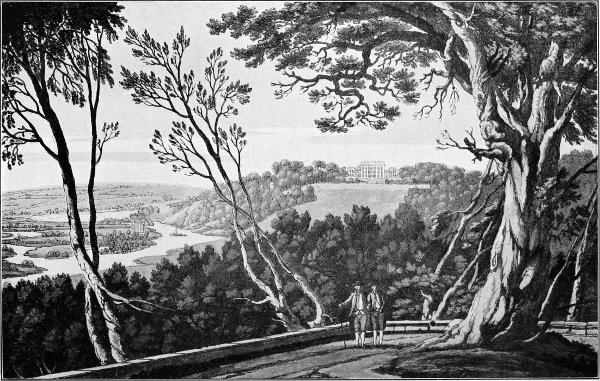
Cliefden in 1740.