Larger versions of most illustrations may be seen by right-clicking them
and selecting an option to view them separately, or by double-tapping and/or
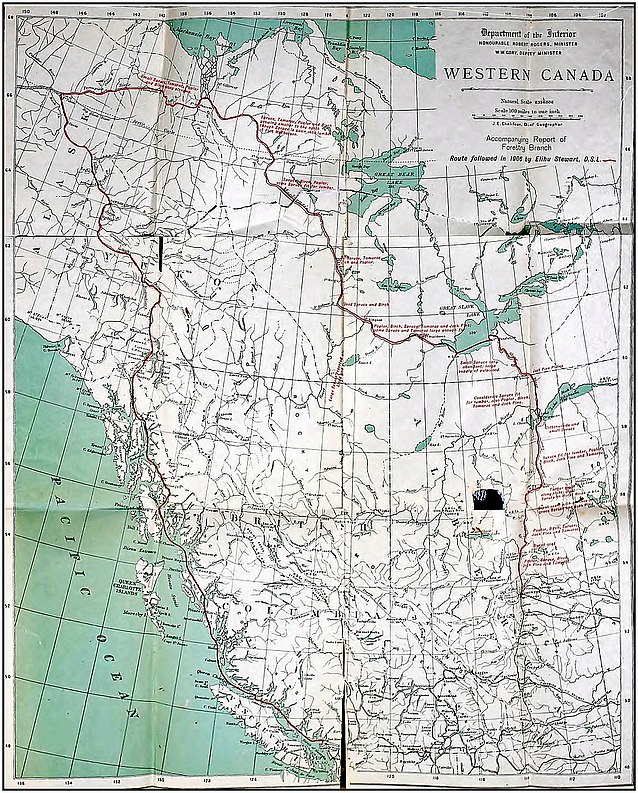
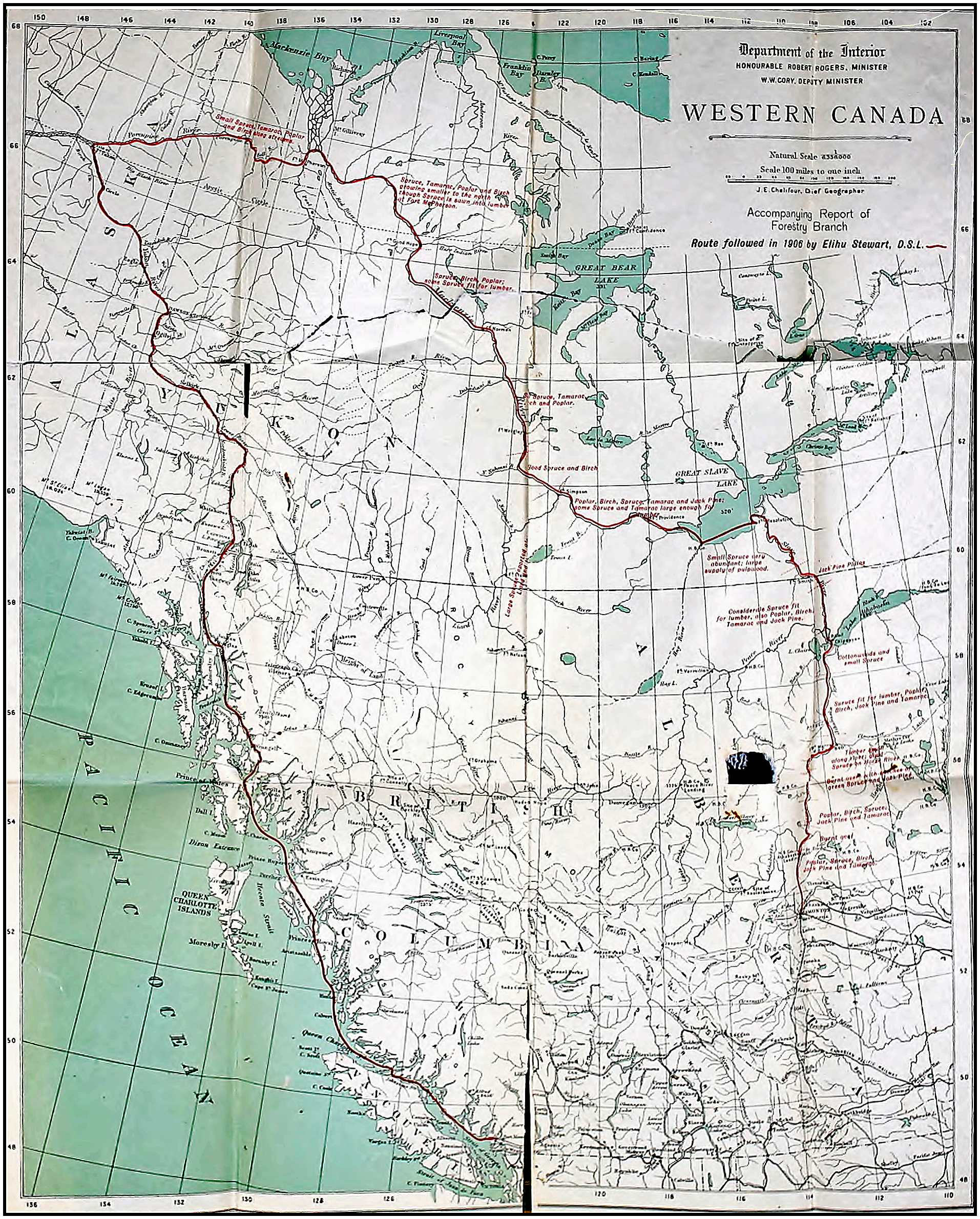
stretching them. A larger, higher-resolution version of the map at the end
of the book may be seen by clicking "High-res".
Cover image created by Transcriber, using an illustration
from the original book, and placed into the Public Domain.
Copyright Ernest Brown
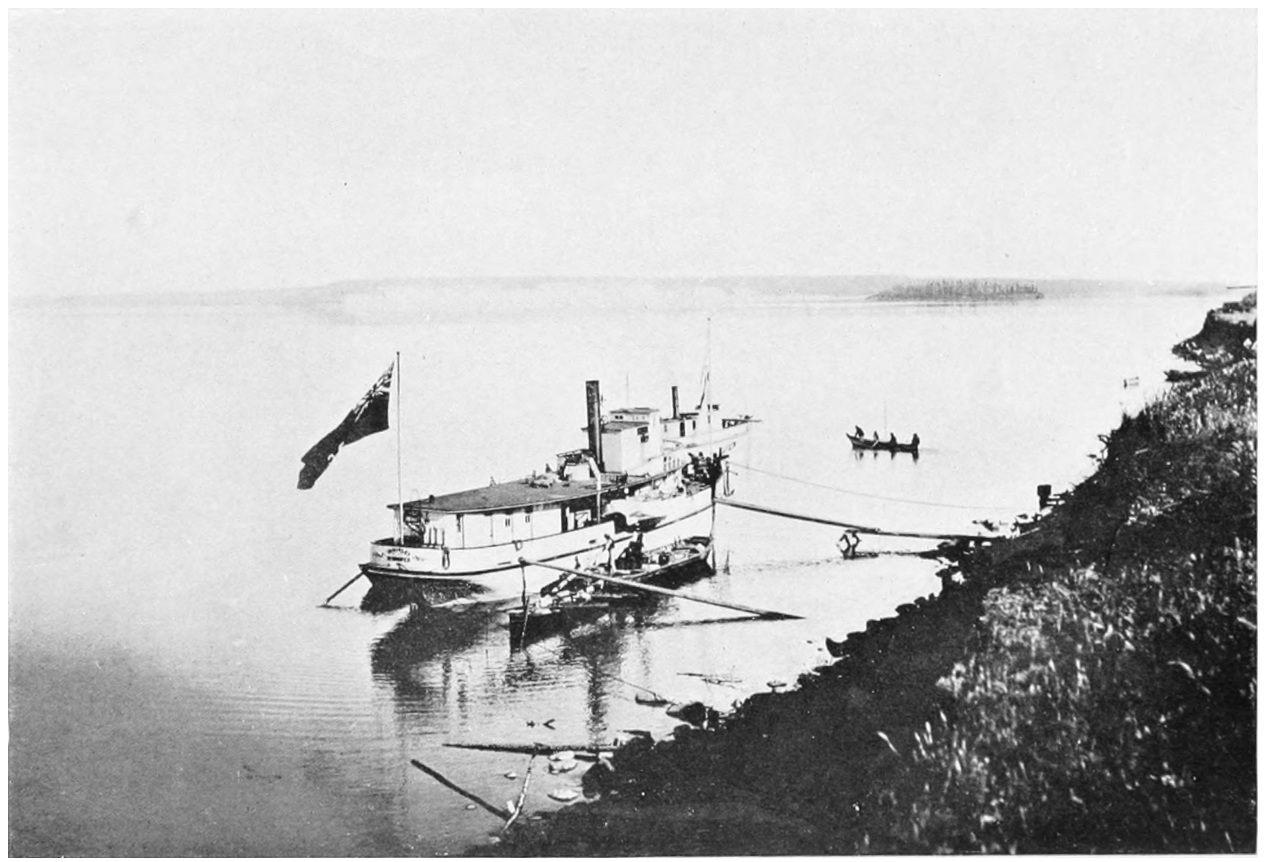
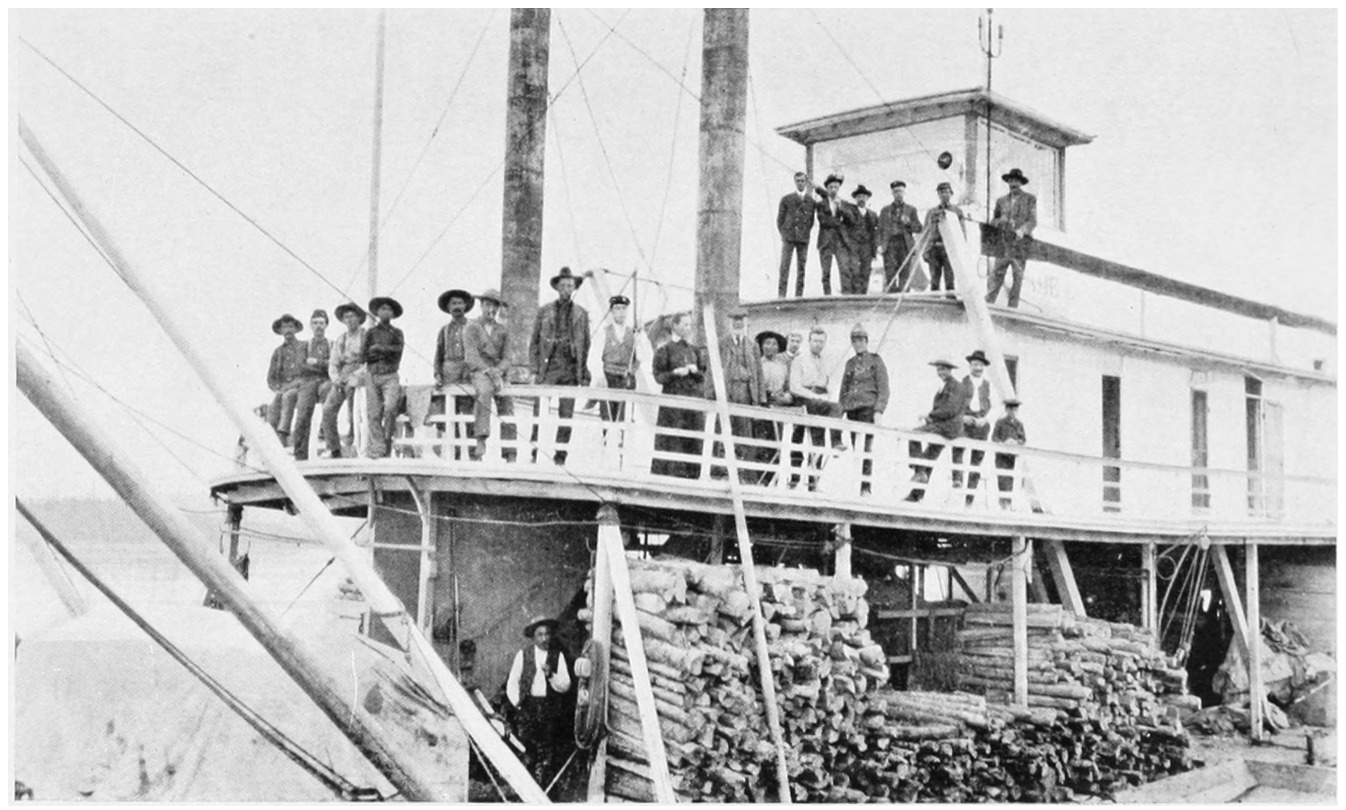
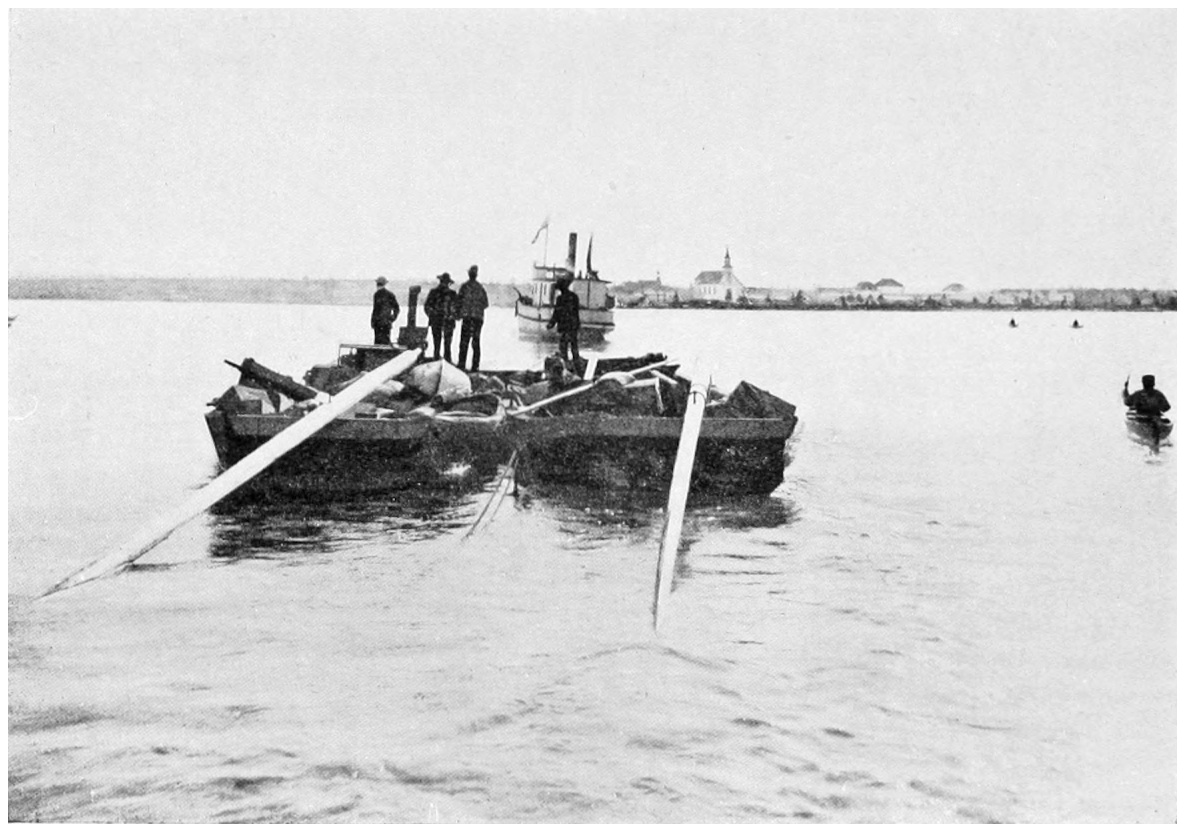
S.S. WRIGLEY AT THE JUNCTION OF THE MACKENZIE AND LIARD RIVERS
DOWN THE MACKENZIE
AND UP THE YUKON
IN 1906
BY ELIHU STEWART Formerly Superintendent of Forestry for Canada
WITH A MAP AND THIRTY ILLUSTRATIONS
FROM PHOTOGRAPHS
LONDON : JOHN LANE : THE BODLEY HEAD NEW YORK : JOHN LANE COMPANY
TORONTO : BELL AND COCKBURN : MCMXIII
SECOND EDITION
THE BALLANTYNE PRESS TAVISTOCK STREET COVENT GARDEN LONDON
TO THE RIGHT HONORABLE EARL GREY
Former Governor-General of Canada who
during his Term of Office found time to
acquaint himself with much of our Northern
Wilderness these pages are respectfully
Dedicated
ERRATUM
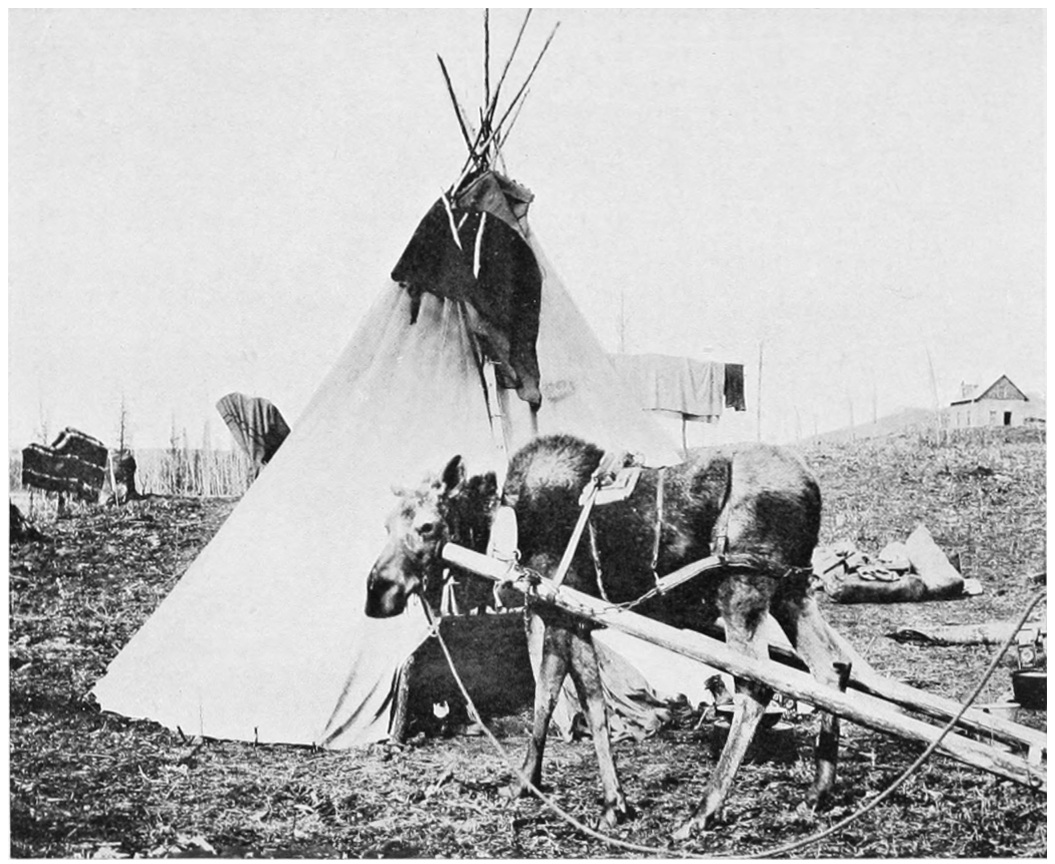
The Photograph entitled “A Moose and Indian Tepee,” reproduced
to face page 218 and on the wrapper, is the copyright
of Ernest Brown of Edmonton
PREFACE
The following narrative is based on a report
which I made to the Government of Canada,
dated November 16, in the year 1906, shortly
after my return to Ottawa from the far
North.
In writing this report I had to resist the
temptation to give many details which were
present in my mind at the time but which
would be scarcely warranted in an official
document. In the following pages I have
allowed myself more latitude and have also
included several illustrations, the greater
number of them being photographs taken
by myself. Many of these were snapshots
taken from the deck of one or other of the
steamers on which I was a passenger, and
for that reason are not as good as when time
exposures were obtained.
I cannot allow this little narrative to pass
out of my hands without expressing heartfelt
thanks for the unfailing kindness and
hospitality, as well as assistance, that I
received from the officials of the Hudson
Bay Company, as well as from the agents
of the independent trading Companies, from
the Missionaries, and also the natives of the
country.
PUBLISHER’S NOTE
Mr. Elihu Stewart’s opening words are
strangely significant. “Perhaps no portion
of America has received greater attention
from the explorer during the last three
centuries than the sub-arctic regions of
Canada, and yet they remain practically
unknown to the present day.” The author
relates his experiences in traversing what
was practically virgin soil. That he should
have carried out his immense programme
without fear or accident is no mean feat,
and this narrative should be found intensely
interesting by all who recognise the great
commercial and historical future in store for
the vast Dominion, as well as those to whom
the adventurous side of life especially
appeals.
Mr. Stewart is well competent to do
more than furnish a superficial travel book.
As Managing Director of “Canada Timber
and Lands, Limited,” he is actively concerned
in the possibilities of the timber trade in
Canada. There is no doubt that with the
completion of the Panama Canal in sight
and with the rapid settlement of the prairies
and the increased railway facilities bound
to eventuate, the superior timber of British
Columbia can be exploited as never before.
No other part of Canada produces timber
in such abundance. Mr. Stewart was formerly
Superintendent of Forestry for Canada,
and much of the knowledge he thus acquired
helps to form the present volume. Mr.
Stewart gives many charming pen-pictures
to relieve the more material side of “Down
the Mackenzie and Up the Yukon,” and he
shows a fine feeling of atmosphere for lands
“where it is always afternoon,” where the
late sun lingers in the quiet west; where
the northern twilight embraces reluctant
day, amid the profound silence of the gradual
shadows. Only the cry of a loon or the
hooting of an owl heard somewhere in the
forest pierces the mournful calm.
Mr. Stewart wisely makes frequent reference
to the soil conditions he has observed
on his line of travel, and his impressions will
be found most valuable. He insists, too,
that before any accurate report can be given
on the subject it will be most desirable—and
indeed necessary—for the Government
to have an exploration survey made by men
competent to give an authoritative opinion.
Canada is losing year after year from lack
of information concerning its unoccupied
areas. The difficulties of handling immense
tracts of land are obvious, but not more
so than the lack of enterprise which stays
the country and delays its cultivation.
In the present state of things the stray
settler has little or no chance. “What
would be thought,” asks Mr. Stewart,
“of the settler who built his house and
commenced to clear and till his land on
the front of his lot without ever taking
the trouble to examine the rest of his
possessions? The chances are he would
afterwards find that much of his labour had
been misdirected. In many parts of the
country land has been surveyed, and opened
up for settlement, that was unfit for agriculture
and which should have been left for
the growth of timber for which it was well
suited. Frequently this land looked attractive
to the inexperienced, and in many cases
the settler spent years of hard labour only
to find at last that beneath the few inches
of humus there was nothing but barren
sand.”
In a country like Canada with its vast
areas of wonderfully fertile land, it is unnecessary
that any one should waste his
labour on any part that is unproductive.
It is well that Mr. Stewart should express
himself forcibly, without circumlocution,
and his grave warning may perhaps act as
a deterrent to the unwary and inexperienced,
while bringing home to the Government the
necessity not only of bringing agricultural
immigrants into the country, but of directing
them to fields where there is a known
and excellent chance of labour and concentrated
industry meeting with adequate
reward.
Mr. Stewart pleads very earnestly for the
establishment of a hospital somewhere in
that vast region of the Mackenzie watershed.
“Between Edmonton,” says Mr.
Stewart, “and the Arctic Sea we pass
over sixteen degrees of latitude, while the
distance by the travelled route is over
two thousand miles. Again, from the Rocky
Mountains on the West to the Hudson Bay
on the East the distance is almost equally as
great. At Athabaska Landing and at Peace
River in the Southern fringe of this great
wilderness a few physicians have established
themselves, but beyond these places the
only medical aid available is from an occasional
visit of the Government physician
and what the missionaries are able to furnish.
At practically every fort and Indian village
on our way we were besieged for medicine
by the afflicted.”
Probably most of the illnesses would have
been relieved, if not actually cured, by
proper surgical treatment. It is curious
to note that the Indians of these regions are
as susceptible to appendicitis as Europeans.
Mr. Stewart goes on to suggest that if such
a hospital at Fort Simpson or at some point
on Great Slave Lake were established it could
be reached by canoes in summer from points
all along the Mackenzie, and it would be
possible to ameliorate the sufferings of many
whose only hope is death. If this little
volume may serve even as a faint plea for
the assistance of those who dwell at present
so far beyond reach of some of civilisation’s
essential requirements, Mr. Stewart will
have performed a profound service.
CONTENTS
PART I
pp.
CHAPTER I
Historical: Early History of the Sub-Arctic Regions of Canada : Formation of the Hudson Bay Company : Rise of the North-West Company
Fort McMurray to Smith’s Landing on the Slave River : The Grahame : Beauty of Northern Twilights : Fort Chippewyan : The Slave River : The Peace River Basin
More about the Slave River : On Steamer Wrigley : Fine Gardens at Resolution : A Nasty Experience : Bishop Reeves Comes Aboard for a Round Trip : Miss Wilgriss Leaves : Hay River : Fort Providence : The Little Lake : Fort Simpson : A Pathetic Incident : An Imaginary Cabinet : We Reach Fort Wrigley
From Fort McPherson to Rampart House : Crossing the Peel River : An Attempt at Intimidation : The Summit of the Rocky Mountains : In Pacific Waters : The Porcupine : John Quatlot Departs
Historical : Early History of the Sub-Arctic Regions of
Canada : Formation of the Hudson Bay Company : Rise of the North-West Company.
“The days were bright, and the morning light was sweet with jewelled song;
We poled and lined up nameless streams, portaged o’er hill and plain;
We guessed and groped, North ever North, with many a twist and turn
We saw ablaze in the deathless days, the splendid sunsets burn.”
Service
Perhaps no portion of America has received
greater attention from the explorer during
the last three centuries than the Sub-Arctic
regions of Canada, and yet they remain
practically unknown to the present day.
As early as 1577, Martin Frobisher spent
some time on the border of the Arctic.
The name Frobisher in English history
carries us back to the defeat of the Spanish
Armada, in which he performed a distinguished
part and for which he was
honoured by his Queen.
Later, in 1611, Henry Hudson after
sailing up the great river of the State of
New York found a tragic death in that
Canadian inland sea, which, along with
the above river, bears his name.
Samuel Herne went down the Coppermine
to the Arctic Ocean and wintered there in
1770 and 1771; and as a result of his
travels wrote the first account of the North
American bison and Indian methods of
hunting.
Later, in 1789, Sir Alexander Mackenzie,
one of the boldest and most resourceful
explorers of modern times, made a journey
in one short summer from Lake Athabaska,
then called the Lake of the Hills, down the
whole course of the Slave River, across
Great Slave Lake and then all the way down
the great, but then unknown river, the
Mackenzie, 1000 miles to the frozen Ocean, returning
the same season to Fort Chippewyan.
In the autumn of 1792 he commenced
another voyage from Chippewyan; this time
with the Pacific Ocean as his objective
point going westward up the Peace River; and
succeeded before winter overtook him, in
reaching a point 600 miles up that stream
near Dunvegan, where he wintered.
The next season he continued the ascent
of the Peace to its headwaters; crossed
the Rocky Mountains, and, after the greatest
difficulties and hardships, reached the Pacific,
returning again by the same route to his
post at Chippewyan where he arrived on
July 24, 1793.
Another name which stands high in the
annals of Arctic exploration is that of
Sir John Franklin, who accompanied by
Dr. Richardson, made the journey down
the Mackenzie to the sea and traversed part
of the Coast in 1825. Many others, whose
names I need not recall, also imbued with
a spirit of adventure, have from time to
time journeyed along the icebound coast
and through that subarctic wilderness, which
to-day forms part of the Dominion of Canada.
And yet, except along a few water routes,
the country is still an almost unknown
land—unknown to all except the agents and
employees of those pioneer trading Companies,
that have for centuries blazed the
path through unfrequented regions of vast
extent. Any narrative concerning that
portion of North America would be incomplete
that did not make frequent reference
to at least two of these Companies.
The first and oldest of them is the Hudson
Bay Company, which under Prince Rupert
received a Royal Charter from Charles the
Second in 1670. This Company of adventurers
obtained great privileges over the
country surrounding Hudson Bay and the
streams flowing into it. In 1785 a great
rival corporation was formed, viz., The
North-West Company. This organisation
had its head-quarters in Montreal, and as
one stands to-day on Beaver Hall Hill in
that City, where once stood Beaver Hall—and
the head-quarters of the Company—and
looks down to the river, it requires no great
stretch of the imagination to behold a vision
of a century ago, with the hardy canoemen
bearing on their backs up to the warehouse
the peltries brought from the remotest
parts of the far North-West and returning
with merchandise to load again their canoes
for the dusky natives of the far away
Saskatchewan, Peace and Mackenzie.
This latter Company, not only established
posts at various points on the great lakes
of the St. Lawrence basin, but extended
them into territory which the Hudson
Bay Company regarded as belonging exclusively
to themselves on the Red River
and the Saskatchewan. Not only this, but
they penetrated regions far beyond those
into which the emissaries of the older
Company had ventured, even to the Pacific
Ocean on the one hand, and the Arctic on
the other. It may be stated here that Sir
Alexander Mackenzie immortal in the annals
of exploration was himself an officer of the
North-West Company. The presence of the
New Company in waters tributary to the
Hudson Bay soon resulted in conflicts
sometimes sanguinary, between the employees
of the two corporations, and this
state of affairs continued till they were
amalgamated in the year 1821.
CHAPTER II
Plan of the Journey: Early Stages : At Edmonton : A Peculiarity of Northern Rivers.
The area drained by the Mackenzie River
is of vast extent, covering something over
450,000 square miles. Its principal tributaries
flow from the west; they consist
of the Athabaska, the Peace, the Liard and
the Nahanni with many others of smaller
size. To illustrate by comparison the size
of the Mackenzie basin with that of some
other streams, it is only necessary to say
that the area of the St. Lawrence basin
above the City of Montreal is about
310,000 square miles, while that of the
Saskatchewan, including its two branches,
is only 159,000 square miles; so that the
Mackenzie basin exceeds that of the St.
Lawrence above Montreal, including that of
all the great lakes by 140,000 square miles,
and is nearly three times as great in extent
as the basin of the Saskatchewan, including
both the north and south branches of that
great river.
A journey down that immense valley with
my objective a point near the Polar Sea was
the last I had set myself to accomplish.
I had also hoped, but scarcely dared to
expect to find my way back again to civilisation
by crossing the Rocky Mountains to
streams, whose waters find their way to the
Yukon. Thence South up the latter stream
to Dawson and Whitehorse, thence over the
White Pass Railway to Skagway and from
there to Vancouver. However, notwithstanding
many misgivings, this programme
was literally carried out and that without
encountering a single accident worthy of
mention. Knowing that my plans could be
best accomplished through the assistance of
the Hudson Bay Company, I applied to
my friend Mr. Chipman, the late Commissioner
from whom I had previously
received assistance on other trips in the
North Country, and was soon in possession
of a letter to their agents, which had merely
to be presented to assure me all the hospitality
that could be given, in a country where
hospitality means so much.
On the last day of May, 1906, I found
myself at Edmonton busily preparing for the
journey. Edmonton, which but a few years
ago was only known as the entrepôt of the
Hudson Bay Company in the far West, is
now, as the Capital of Alberta, putting on
the appearance and assuming the airs of a
modern City. Not only is it advancing
commercially, but socially and intellectually
it is not satisfied to remain in the background.
With its semi-viceregal social
establishment and its Provincial University,
it already claims no inferior place to the
Capitals of Sister Provinces. Edmonton’s
resources are more varied and her population
more cosmopolitan than most of
them. By her doors flows one of the great
rivers of America, with timber and coal
along its banks all the way to its source,
while stretching away on every side is the
rich soil of that wonderfully fertile belt that
is bringing riches to tens of thousands of
pioneer settlers. To all this it may be added
that this new northern City has tributary
to it, the vast northern region even down to
the Arctic Sea, with little fear of any future
rival. In a word, Edmonton is destined to
be at once the Moscow and St. Petersburg
of Canada.
Amid all the evidences of an active bustling
life an incident occurred during the few
days I spent there, which cast a dark shadow
across the path of some of the older residents.
During the early days, before the present
invasion of new-comers began, the scattered
settlements of half breeds and whites here
and there over a large extent of country
formed a somewhat close community, among
the members of which there grew up a very
warm attachment. This was further
cemented by frequent intermarriages, and
it was truly pleasing to hear the eager
inquiries, from these people when we visited
their homes beyond the Arctic Circle, concerning
their relatives at Edmonton and
even Winnipeg.
It so happened that the wife of a Hudson
Bay Official, well-known throughout the
country, had come down to Edmonton from
Fort Simpson on the Mackenzie by the last
(and I might say, the only) boat of the
previous year, intending to return by the
first transport in the following one, (1906)—that
on which I was also to travel. She
had all preparations made for her return
trip and was about ready to start, when a
sudden illness intervened and she was called
to make a journey to a land even less known
than the one we were to penetrate. There
was an old time funeral at Edmonton, and
many were the expressions of sympathy
heard on the street for the husband twelve
hundred miles away, who, all unconscious
of what had occurred, would be looking for
his wife when our boat reached Fort Simpson.
We realised throughout the long days of our
journey to that point that we were carrying
to the widowed husband the saddest of all
messages.
On a bright morning on June 2, in a
comfortable conveyance and with a good
span of horses, we turned our faces to the
North, bidding good-bye to the Railway
and various other adjuncts of modern civilised
life, and in less than three days arrived
at Athabaska Landing, in round figures,
one hundred miles distant.
Little need be said concerning this first
stage in my journey, though the country
passed over for some twenty miles would
certainly be a surprise to any one familiar
only with the new settlement in the wooded
districts in the older Provinces. Certainly
less than twenty years ago, this district
was an unsettled part of a great wilderness.
To-day, with its cultivated fields and with
just enough woodland left to vary the
monotony that characterises the treeless
plains, as we looked across the country,
really park like in appearance, we could
almost fancy that we were passing through
some of the rural districts of Old England.
Early on the second day, we passed the
height of land between the basin of the
Saskatchewan and that of the Mackenzie
River, though the land is so little elevated
that it is imperceptible. Notwithstanding
this, the waters of two neighbouring rivulets
within almost a stone’s-throw of each other,
finally find their outlet into two different
oceans. The one by way of the Saskatchewan,
Lake Winnipeg and the Nelson
River to the Hudson Bay of the Atlantic,
and the other via the Athabaska, Slave and
Mackenzie Rivers to the Arctic.
Athabaska Landing is on a southerly
bend of the Athabaska River. This stream
was named the Elk River in Mackenzie’s
time. At the “Landing” it is about sixty
rods wide and the water is of the consistency
and appearance of the Mississippi at St.
Louis. Its general direction above this
point is easterly, but here it takes a sharp
turn north, which direction it maintains
throughout its remaining course of 430
miles to Lake Athabaska, the latter called
“The Lake of the Hills” by Mackenzie.
At Edmonton nearly every person met
with had been talking land and town lots.
The hotels were filled with “land lookers,”
coming from various parts of Canada with
a large percentage of visitors from the
United States, most of them speaking the
English language, varied in tone in accordance
with the districts from which they
came. There was the “blue nose” from
the Maritime Provinces with a dialect not
unlike that heard in parts of England: the
French Canadian speaking French English:
the man from Ontario, also with his distinctive
mark branded on him, though not
realising it himself: the Western American
from Dakota, Montana, Idaho and Kansas,
each also with his peculiar idioms, but all
self-assertive and reliant.
At Athabaska Landing all was changed.
The conversation here was of none of these
things, but rather of last season’s hunt and
the state of the river; conveyed largely in
the language of the Cree Indian. This is
certainly a border town consisting of two
or three hundred inhabitants largely half
breeds. It is perhaps worthy of remark
that no offence is taken in applying the
term “half breed” to one who by nationality
deserves the name, while he will
bitterly resent the epithet “breed.” A few
years before I had made a journey from
“The Landing” to Peace River, going from
the latter place up the Athabaska some
eighty miles, thence up a tributary, the
Little Slave River into and across Lesser
Slave Lake, thence overland eighty miles
to the Peace River. I crossed near the
entrance of Smokey River, where Sir Alexander
Mackenzie had spent the winter to
which I have already made reference.
Copyright Ernest Brown
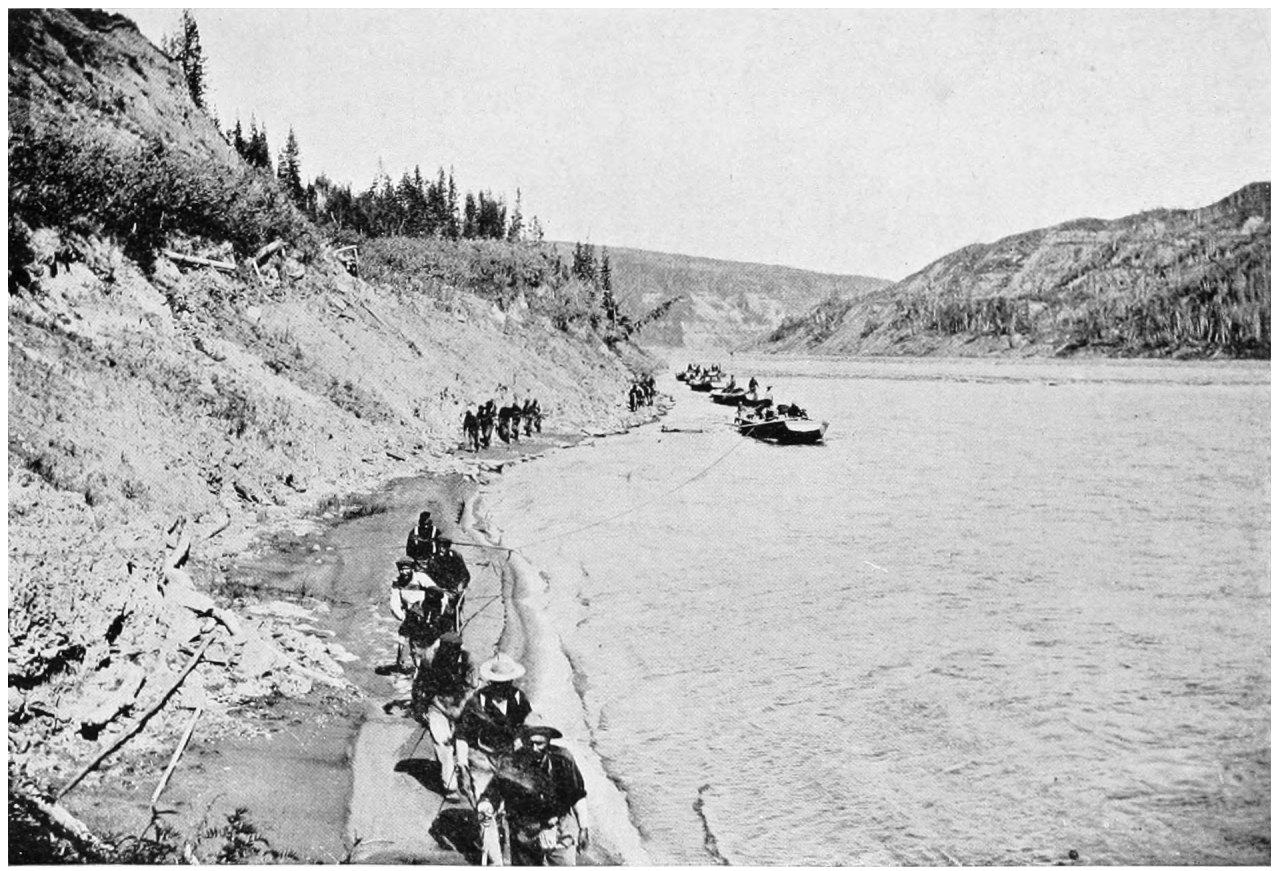
TRACKING ON ATHABASKA RIVER
During this journey I came to admire those
half breed river men. It is a peculiarity of
most of those northern rivers that although
the current is very strong there are few
interruptions to their navigation with canoes,
York boats or small barges. It is impossible
to make much headway however in going up
stream by means of paddles or oars, so
“tracking” is resorted to. This consists
of towing the boat by means of a line, one
end of which is attached to the bow of the
craft while to the other are usually harnessed
four men, who walk or run along the shore,
often making three or four miles an hour.
On one of the usual river craft, the crew
consists, at least, of ten men, four pulling
for about half an hour, while the other four
are resting in the boat during that time, then
changing places. In addition to these there
is a bow man and a steersman, the latter
being the Captain. From twenty to twenty-five
miles a day are frequently made in this
manner. The discipline and order are as
good as on any ship of His Majesty’s navy.
The steersman’s orders are never interfered
with, even if an official of the “The Company”
is on board. These men will undergo
the most fatiguing labour “from early dawn
to dewy eve,” tugging away during those
long northern summer days over slippery
cut banks and fording or swimming tributary
streams without murmur or complaint, and
moreover without profanity. The half breed
seems to take this as his work to do, and well
it is that he is so persuaded, for few others
would so cheerfully perform such labour.
His reward comes on the return trip when
the boat is simply left to drift down stream
both night and day, and the time of making
a journey down is often less than one
quarter of that occupied by the up trip.
The land rises in terraces from the shore
of the Athabaska to a height of from one
to four hundred feet. In some places where
the river is straight enough to give a vista
of a mile or two, and where the fire has
been merciful enough to leave the hill sides
clothed with spruce, balsam, aspen and
birch, with an occasional lobstick standing
up as a sentinel on the water’s edge, the
scenery, if not strikingly beautiful, is at
least pleasing in effect. I might here mention
that the lobstick is always a curiosity
to a new visitor. It will meet his view on
his arrival at Athabaska Landing, and along
the banks of all the rivers of the north, will
be a familiar sight. It is a tree, usually a
spruce, from which the branches have been
trimmed off from a point, commencing, say
ten feet from the top and extending down
the trunk for eight or ten feet. The tree
chosen is generally a tall conspicuous one,
standing on a point on the shore, and on it
near the ground certain hieroglyphics are
inscribed, which record the event for which
the lobstick was made.
In passing it may be observed that in my
trip from Athabaska Landing to Fort McPherson,
a distance of 1854 miles, no part
of it was up stream, and consequently, the
line was not used.
CHAPTER III
From Athabaska Landing to Great Rapids : The
Midnight Sun and its Voyage.
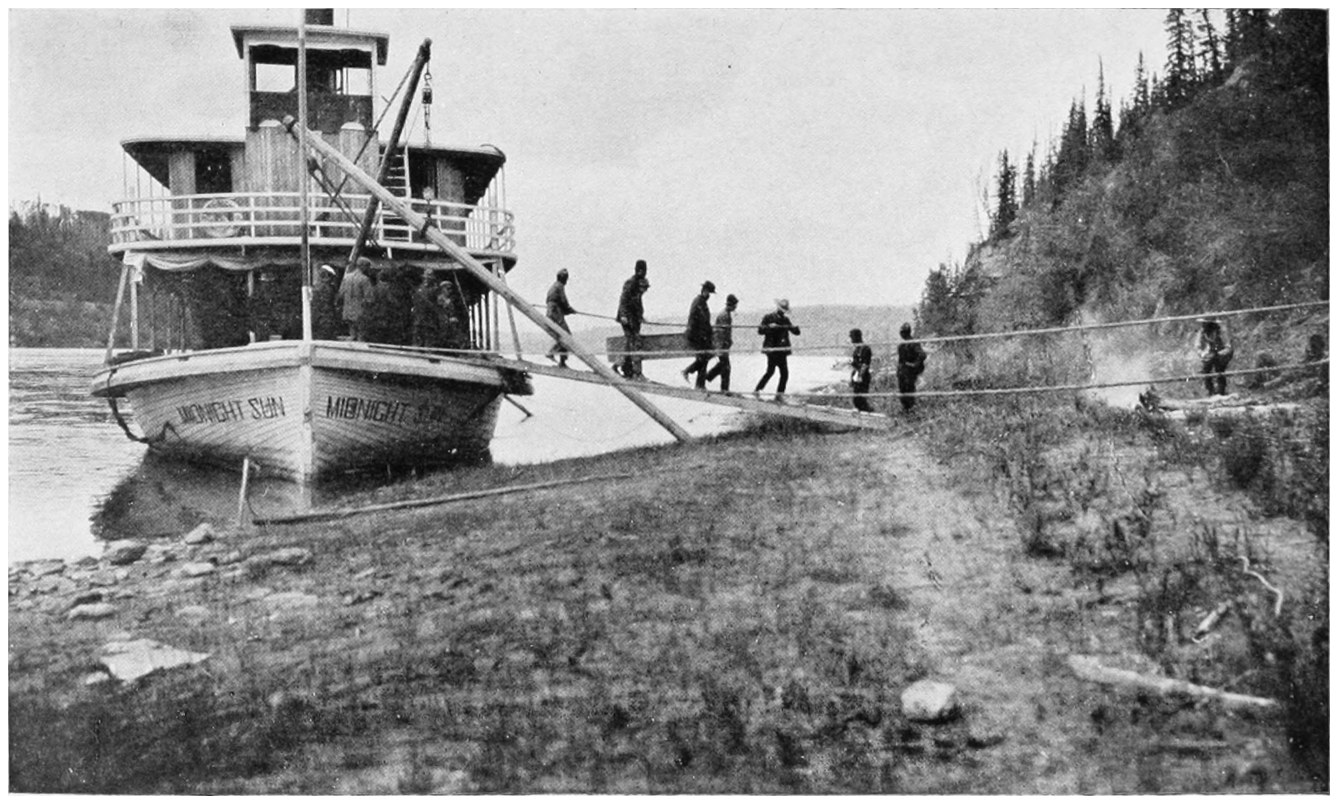
At Athabaska Landing we found the H.B.C
Steamer, Midnight Sun loading with supplies,
all going to the Northern posts. She also
towed six small scows, each carrying from
eight to ten tons. These scows are built
from spruce lumber cut at a small saw mill
here. They each cost about one hundred
dollars and are seldom brought back up
stream, but are broken up when unloaded
and the lumber used for building purposes.
On the afternoon of June 8, we let loose
from the shore, and assisted by the swift
current, were soon moving down stream
at a speed of about twelve miles an hour.
The cargo of the Midnight Sun as well as
that of the scows, contained almost every
article found in a general country store,
flour, bacon, tea, sugar, canned goods, guns,
powder, shot, cartridges, blankets, kettles,
axes, clothing, in fact everything that goes
to make life even endurable in those isolated
regions. The whole population of the village
was on the bank and waved us bon voyage.
The steamer was a flat-bottomed craft,
120 ft. long by 20 ft. beam, and propelled
by a stern wheel, and drew when loaded
about 2 ft. 6 ins. of water.
Once on our way we soon began to look
around and make acquaintance with our
fellow passengers. Among others were Chief
Trader Anderson, the Superintendent of the
Mackenzie River District for the H.B.C.,
Mr. Stefansson, a scientist on his first
voyage to the Arctic, and from whom it is
probable the public will have an interesting
account when he returns again from his
study of Esquimaux life; four young men,
on their way to Fort McMurray to bore for
oil; a Miss Wilgriss, returning to resume
her work at the Anglican Mission at Hay
River on the West shore of Great Slave
Lake; Rev. Mr. Winch, a young missionary,
en route to Fort Norman to take charge of
the Anglican Mission there; a tall gaunt
white man, reminding one of Abe Lincoln
in his early days, and about half a dozen
half breeds, some of them on their way to
different points along the river and others
going to their homes in regions beyond,
while of the crew, the captain, engineer
and cooks were white men, the rest half
breeds.
We had left “The Landing” at 1.30 P.M. and
at seven in the evening tied up for the night
at Calling River about fifty miles from our
starting point, having passed the mouth of
Lac La Biche River an hour before. A half
breed, named Piche Prudens, had made
a clearing here, where we found wheat and
vegetables growing. He claimed that he
raised as good wheat there as can be grown
anywhere on the prairie. We found also
in abundance the pest of all this north
land—the mosquito.
The country all the way is forest, though
its great enemy, fire has done its work and
left its scars to disfigure the landscape.
The timber consists of spruce, aspen and
balsam—poplar, birch, tamarac and willow.
The best spruce lines the river and its
tributary streams. Some of it being large
enough for lumber. The soil in many places
is sandy though probably a fair percentage
will be found capable of producing crops.
There is very little showing of rock on the
surface. The average width of the river
between “The Landing” and Pelican Rapids,
which we reached the second day at 4 P.M.,
is about sixty rods and of sufficient depth
so far as to afford fair navigation to such a
craft as ours.
We tied up for the second night at the
upper end of Pelican Rapids, 120 miles
below Athabaska Landing. With these
rapids we met the first obstruction to free
navigation. It will be seen that this was
the beginning of many annoying delays
caused by lack of sufficient water in the
numerous rapids met with all the way to
Fort McMurray.
Copyright Ernest Brown
GRAND RAPIDS ON ATHABASKA RIVER
Within a short distance from our mooring
place was observed a gas well, sunk by
the Dominion Government, from which issued
a flame of fire some fifteen feet in height.
A few years ago the Dominion Government
sank several wells in the hope of finding
oil on reaching the tar sands, which will be
referred to later on. In this case, after
reaching a depth of 837 ft., 87 ft. being
through these tar sands, gas was struck of
such strength as to prevent further drilling.
The Government also put down a hole at
Victoria, Alberta, hoping also to strike oil
on reaching the tar sands at a calculated
depth of 2100 ft. At 1840 ft. the casing
became wedged and the work was stopped.
Another attempt was made at Athabaska
Landing with a similar result at 1770 ft.
and within 30 ft. of the calculated depth of
the tar sands.
On Monday, June 11, we made a start
down these rapids, but what with the strong
current running rapidly over a boulder
bottom, the speed of our boat being accelerated
by a strong wind blowing down stream
we soon feared for her safety and were
rather pleased than otherwise when our
pilot after an exciting experience of about
an hour, ordered another halt, and we found
ourselves again tied up to a tree on the
bank.
Early the next morning, the wind having
abated, we started again, but in less than
an hour were again tied up. A stone had
been stove through the planking of the
bottom. After repairing the damage we
made another attempt and reached House
River Rapid. We were now beginning to
realise the fact that the Athabaska in this
part of its course scarcely deserves to be
called a navigable stream, except, perhaps
when it is swollen by the sudden melting
of the snows in the mountains at its source.
For the next four days we waited longingly
for the spring flood to overtake us, and finally
succeeded on June 16 in reaching a point
about four miles above Grand Rapids. Here
again we spent four more weary waiting
days, while the men were busy transferring
cargo from the steamer to scows, taking
it down to the head of Grand Rapids, where
it was conveyed across an island in the rapids
on a tram car pushed by the men. The
descent in these rapids is about fifty feet,
and the length of them one mile.
On the morning of the 20th the steamer,
now considerably lightened, made a last
attempt and came down three miles further
to the head of the Rapids. This ended our
voyage on the Midnight Sun.
LUNCH TIME ON THE ATHABASKA RIVER
CHAPTER IV
A Burial in the Wilderness : From Grand Rapids to
Fort McMurray : Tar Sands.
On Wednesday, June 20, about 9.30 P.M., as
we were sitting around a smouldering fire on
the bank close to where the steamer lay, and
watching the day darkening into night, a gun
shot was heard at the Rapids, which meant
the return from Fort McMurray of some of
the river men, and we were soon possessed
of the very welcome news that the steamer
Grahame, which plied between McMurray and
Smith’s Landing on the Slave River, was
again in commission for the season, and
would be waiting for us at McMurray as
soon as we could get there. This news was
very welcome, for it was the first tidings we
had received regarding this boat. What if
she had been burnt or had met some serious
accident since she was last heard from the
season before? I do not know whether any
of the other passengers had feared the
possibility of such a report, but now with only
ninety miles in barges between us and McMurray,
when we would be below the rapids
and have smooth sailing, we all felt like
rejoicing. In a few minutes, however, it
was suddenly noticed that every voice on the
steamer was hushed, and a moment later one
of the crew came over the gang plank and
whispered something to a man on the shore.
We soon learned that the angel of death had
visited the Midnight Sun and claimed as his
victim Herbert Bray, our cook. We had just
before listened to uncharitable words from
one of the men to the effect that his illness
was only feigned; that the night before he
had seen him walking the deck when all were
supposed to be asleep. While the poor
fellow’s condition was too serious to permit
us to believe that he was only acting a part,
we rather hoped that this story might be
true, and it may have been that in his
delirious state he had wandered during the
night from his room, for he had no nurse to
watch over him. He was a young Englishman
of good appearance, who had been a
few years out, living in the neighbourhood
of Edmonton. Like many others in the
country he had by camp experience learnt
something of the culinary art, and had engaged
in this capacity with the Company.
Only a few days after leaving “The Landing”
he was taken ill. Many were the
remedies proposed and a number tried, but
all to no effect. It was probably a case of
appendicitis, which even in expert hands
often proves fatal, but it caused us to realise
our situation here in the wilderness where
no medical attendance was obtainable.
FUNERAL OF HERBERT BRAY ON THE ATHABASKA RIVER
The following day a rough coffin was made
and we buried him on the bank of the river.
I carved his name and date of death on a
small tree near by and Mr. Stefansson made
a lobstick from a spruce growing higher up
the bank. As the grave was being closed over
him, one could not but think of his relatives
in the old country, who probably at that
moment were going through their ordinary
round of daily duty, while this wanderer,
impelled by the spirit of adventure, was
destined to make his long sleep in this sylvan
solitude.
At eight o’clock in the evening of the 21st,
we all very gladly took leave of the Midnight
Sun. We had been nearly two weeks on
board and had made but 160 miles. From
this point to Fort McMurray the river is
very rough and it was necessary to make the
passage in scows. Two days were spent in
getting the supplies over the Rapids, during
which time a few of the men were out
hunting and succeeded in killing a very large
moose, the fresh meat of which was much
relished, since it was the first we had tasted
since leaving “The Landing.”
Specimens of petrified wood are found
along the banks in the neighbourhood of
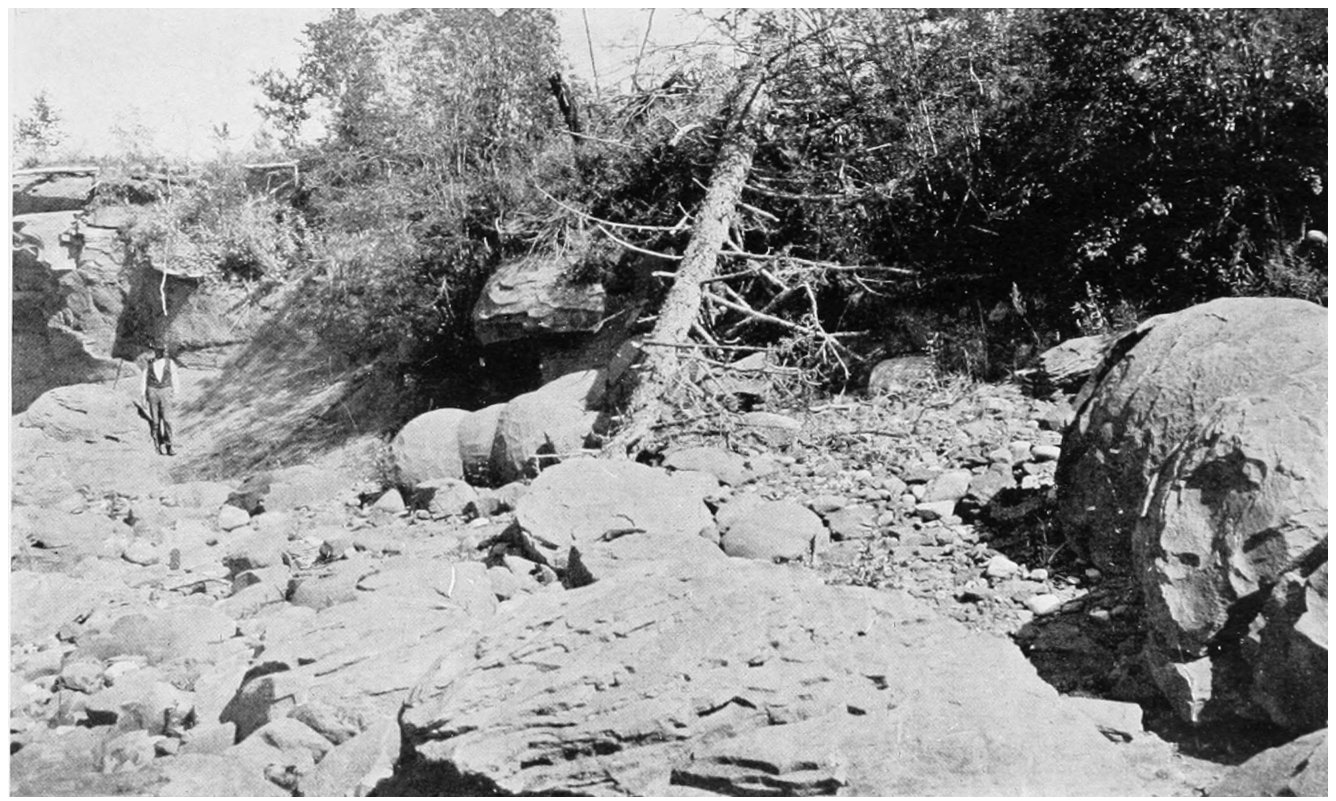
Grand Rapids. Here, too, are seen protruding
from the high sandstone banks and
lying along the beach, stones which are
accretions of the same formation, but apparently
of a harder texture but quite
separated from the stratified rock. They
are of a perfectly spherical shape and vary
in size from two to ten feet in diameter, and
when viewed from the river, one might
fancy they were huge bells that had been shot
into the banks by some gigantic mortar.
STONES ON THE ATHABASKA RIVER
During the next eight days spent in
reaching Fort McMurray, the weather was
almost tropical, registering over 90° Fahrenheit
in the shade, and the period of daylight
was very long. The sun usually rose long
before any of us, and in the evening lingered
around the north-western horizon as if loath
to sink below it. When finally the twilight
set in, the ubiquitous mosquito never failed
to sound his musical lay and to feast on his
victims. It seems that as if to make up for
the short summer in those northern latitudes,
these pests are more industrious than farther
south. They are certainly found in greater
numbers as we go north, and are not less
vicious in character. To illustrate their
persistency it is only necessary to repeat the
remark of a young Englishman of our party
as he vigorously attempted to drive them
away. He said they seemed “quoite determined
to not go awoye.”
While it would be wearisome to relate the
frequent delays on this part of the journey or
to describe the numerous rapids that impeded
our progress, I cannot refrain from
mentioning the two cascades. The first appearance
of limestone is met with near
Boiler Rapid, about fifty-five miles below
“Grand Rapids,” and the scenery along the
banks becomes more picturesque. Both the
Upper and Lower Cascade are formed by the
cleavage in the limestone. It is as if some
engineer had laid out a curved line entirely
across the river, after which his workman
had cut with a saw down into the rock, in
one case, two feet, and in the other four,
and then removed the rock below this point
to that depth, causing the Cascades.
Owing to the dip of the rock formation,
the limestone, which at “The Landing” is
some 1800 feet beneath the surface, makes
its first appearance at the surface of the
river’s bed some 220 miles below, where we
first meet the tar sands. These sands bear
a good percentage of bitumen. They extend
for about ninety miles along the Athabaska.
This bitumen is, the geologists tell us, an
inspissated petroleum, derived from the subjacent
limestones, and reports state that
indications of its presence extend over an
area of 1000 square miles of country. It is
more than probable that some day this may
be one of the greatest oil producing districts
in the world, though up to this time I am not
aware that it has yet been found in paying
quantities, and I would be sorry that any
words of mine should tempt the small
capitalist to invest in prospective oil shares
in that wilderness region till further developments
have been made. An analysis of these
sands made by the Geological Department at
Ottawa gives the following result:
Bitumen
12·42%
Water
5·85%
Siliceous Sand
81·73%
and a cubic foot of this bituminous sand rock
would give 41·59 pounds of bitumen. In
the report accompanying the above analysis
it is estimated that the area covered by this
tar sand is, as I have stated, 1000 square miles
in extent, and of sufficient depth to give a
bulk of 6·50 cubic miles of bitumen. A
further deduction is that the amount of petroleum,
which must have issued from the underlying
limestone, would produce by weight
4,700,000 tons of bitumen. I should say that
in many places near McMurray the tar was
oozing out along the banks of the river and
emitted a very distinct odour.
It was the first of July, the natal day of the
Dominion, that we arrived at Fort McMurray.
Upwards of twenty large boats and barges,
with boatmen and passengers numbering
over 100 in all, made a rather imposing
appearance as we rowed and floated down
the river on that bright and exceedingly hot
morning. Every craft had some kind of a
flag flying in honour of the day, which
caused us to realise that though we were in a
wilderness beyond the borders of civilisation,
we were still in our own country and viewing
our own possessions.
About noon, on rounding a point where the
Clearwater joins the Athabaska, a welcome
object came in view, the steamer Grahame,
tied to the bank at McMurray.
We soon shook off the dust of travel and
entered once more upon a civilised state
of existence. We had now been over three
weeks in making the journey from Athabaska
Landing, a distance of only 252 miles, while
before us on the route to Fort McPherson
lay 1600 miles. Unless we should make
better time henceforth, we would find ourselves
just about in time to be frozen in for
the long arctic winter on our arrival there.
We were, however, assured that our difficulties
were now over and that with the exception
of one portage, which will be referred
to later, we would have hereafter uninterrupted
navigation all the way down, and I
may as well anticipate here by stating that
on July 21, in precisely three weeks’ time, we
arrived at McPherson.
Fort McMurray, situated at the junction of
the Clearwater with the Athabaska, is not
at present a post of very much importance,
but it has a history of considerable interest.
It was here that the weary voyageur in the
early days from far away Montreal, figuratively
speaking threw down his pack and
gave a sigh of relief as he reached one of the
great tributaries of the Mackenzie. Let us
follow him on his journey from his leaving
his home under Mount Royal. We need
not fear that our imagination is misleading
us as we see him push his bark canoe out
from the shore and ascend the St. Lawrence,
to the junction of the Ottawa, thence turning
northwards he soon encounters the rapids
of St. Annes, whose beauties have been extolled
in immortal verse by the Irish poet,
Tom Moore, in his “Canadian Boat Song.”
Having made a portage here and offered up
prayers to his patron saint in the little
church hard by, he bids good-bye to his
friends, who have accompanied him thus far.
With his crew of canoemen as adventurous
as himself (singing those songs that may still
be heard by his compatriots from the St.
Lawrence to the Yukon) they urge their frail
craft against the stream. For over 300 miles
they ascend the Ottawa with the familiar
Laurentides to the right. Then turning to
the left, they enter the Mattawa, which they
ascend to its source near Lake Nipissing.
A portage is made here into the latter lake.
Crossing this sheet of water, they follow its
outlet, the French River, down many rapids
and cascades to the Georgian Bay and Lake
Huron; up Lake Huron to Sault Ste Marie;
over the rapids here to the largest body of
fresh water in the world, Lake Superior; up
this lake, over 300 miles to Grand Portage;
thence up the Pigeon River, and numerous
tributary streams and inland lakes, till the
height of land dividing the St. Lawrence
basin from that of the Hudson Bay is
passed; thence down streams and lakes
little known even at the present day, till
Rainy Lake is entered and passed; until he
finds himself at Fort Frances. Here he
meets canoes laden with furs from far away
Chippewyan on the Lake of the Hills. They
exchange cargoes and each crew starts on his
return journey, the one for Montreal with
bales of peltries from the shadows of the
Rocky Mountains, the other for the interior
of the far North, his canoe laden with
supplies, passes down that beautiful stream,
the Rainy River, to the Lake of the Woods;
across that lake, down Winnipeg River to
Lake Winnipeg; up that lake to the mouth
of the great Saskatchewan, thence up the
latter to Cumberland House, and from there
through lakes and rivers only known to him
and the native Indian, till finally after a
journey of 2500 miles he arrives at this far
away post, McMurray.
But the name, McMurray, is now beginning
to be heard in our Legislative Halls at
Edmonton and at Ottawa. Politicians are
commencing to search for it on the maps of
the new Province of Alberta, and probably
within two or three years, the whistle of the
railway locomotive will awaken echoes on the
surrounding hills. With a railroad completed
from Edmonton to Fort McMurray, the
easterner will be able to see the midnight
sun within one month from the day he
leaves Montreal or Toronto.
CHAPTER V
Fort McMurray to Smith’s Landing on the Slave River : The
Grahame : Beauty of Northern Twilights : Fort
Chippewyan : The Slave River : The Peace River
Basin.
We found the Grahame a much larger
and more comfortable boat than the Midnight
Sun, though constructed on the same lines,
both being flat-bottomed craft and propelled
by stern wheels.
It was late in the afternoon of another
very hot day, July 2, when we resumed our
journey, and sitting on the deck, I watched
a panorama of rare beauty unrolled to view
as we descended the river. The Clearwater
mingled its contents slowly and reluctantly
with those of the turbid Athabaska. Islands
clothed with green spruce receded from view
as others appeared in the distance.
It was after seven o’clock in the evening,
when we left McMurray and yet we sat for
hours taking no note of time, till some one
remarked it was getting late, though the sun,
away around in the north-west, was still a
little above the horizon, and seemed very
loathe to sink below it. As in “The Lotos
Eaters,” it seemed “a land where it was
always afternoon.” There are two features
that cannot fail to impress the stranger on
his visit to these regions, especially in mid-summer;
first, those northern twilights, and
second, the profound silence that always
seems to fall like a pall on the wilderness
as the gathering shadows increase more
and more till all nature is embraced in silent
slumber.
Frequently we tied up to the shore for the
few dark hours we enjoyed at this time and
in this latitude, later we had none—and the
deathlike tranquillity of those approaching
nights was almost bewildering in its intensity.
One actually seemed to have approached very
near to the heart of nature.
This sensation brought back to mind the
words of George Eliot in the scene from Adam
Bede, where she pictures the absolute calm
which prevailed on that night when Adam was
engaged long after midnight in making a
coffin for his father, and when resting for a
moment, he looked across the starlit fields
where “every blade of grass was asleep.”
Here, we beheld the wilderness in its
lethean repose. Occasionally the cry of a
loon would float over the woods from some
inland lake, or the hooting of an owl would be
heard somewhere in the forest. These, however,
seemed rather to add to, than detract
from the loneliness that surrounded us.
Those who have seen nature in repose will
sympathise with me in my feeble attempt to
convey an impression of that which is really
beyond description.
After the junction of the Clearwater, the
Athabaska becomes a stream varying from
a quarter to half a mile in width. Some
good spruce timber is seen on the way.
Asphalt and coal are found along the banks
below McMurray. Seams of soft coal of
considerable thickness are found in the
neighbourhood of Fort McKay, which is used
by the blacksmiths at some of the posts.
During our stay at McMurray the first
flood from the upper sources of the river
overtook us, and on leaving this post the
water had risen about two feet. This
accelerated our speed, and from here on we
were running races with this mountain
water. Sometimes we were with it, and
then after several hours’ run we would leave
it behind till we made another halt, when it
would again overtake us. There was no
mistaking it, as the colour of the new water
was much more muddy than that of the
original, which had in its slower course parted
with a good portion of its alluvial matter.
In the course of some twenty-four hours’
run from McMurray the traveller finds evidences
that he is approaching the mouth of
the river. The stream increases to double
or treble the width it is above McMurray.
The banks become lower. Willows take the
place of the poplar and spruce. Islands on
every hand seem almost to block the passage.
Then drowned land and great marshes, the
home of wild fowl innumerable, stretch away
to the horizon and at last the waters of the
Lake of the Hills, now Lake Athabaska, are
seen glistening to the east, while hills of red
granite stretch far away to the north and
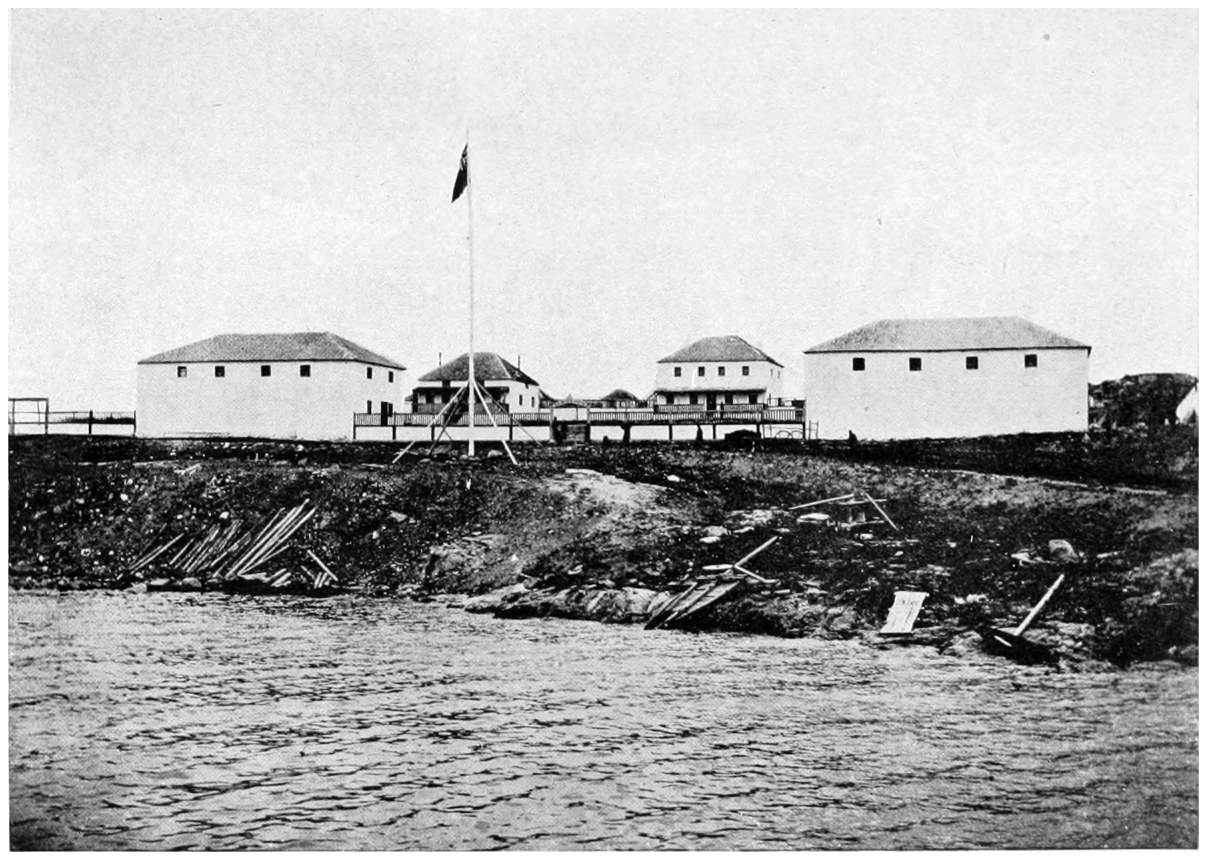
below these along the shore, the whitewashed
buildings of Fort Chippewyan appear.
Copyright Ernest Brown
FORT CHIPPEWYAN ON ATHABASKA LAKE
By reference to my diary, I find that it was
July 4 that we reached Chippewyan, and I
remember rising before four o’clock, so eager
was I to catch the first glimpse of the lake.
We had been for nearly a month following
down a river through a wilderness, where
the range of our vision was limited by the
high banks on either side, and it was like
entering a larger world and was really restful
when we beheld a great expanse of blue
water extending off to the east as far as the
eye could reach. But here, too, was “loneliness
unbroken.” Another of those excessively
hot days, too, that had pursued us for some
time, was again with us. The lake was as
smooth as glass, but the most powerful telescope
revealed nothing of life on its surface,
save a few wild fowl, perfectly secure, for no
fowler was in sight.
Lake Athabaska is about 200 miles in
length from Chippewyan on the west to Fond
du Lac on the east, while its average width is
probably about twenty miles.
The appearance of Chippewyan was quite
picturesque as we approached it from the
south.
The Hudson Bay Company’s buildings are
in the form of a quadrangle and appear very
attractive from a distance. Those of the
Roman Catholic Mission are quite imposing
but lose some of their effect through being
painted a very dull colour.
We only remained at Chippewyan about
twelve hours and then started for the entrance
of Slave River and Great Slave Lake. The
distance from the mouth of Athabaska
River to the entrance of Slave River is only
eight or ten miles.
For the first ten miles after entering the
Slave, the channel, or rather the one we took,
winds in and out between islands and submerged
land, covered with grass. These
drowned lands and marshes extend apparently
a long distance west, between the Athabaska
and Peace River, which latter stream joins
the Slave about twenty miles down the latter
from the Lake. This is a hunter’s paradise,
and when the railway reaches McMurray
the wild goose will soon find its present
security disturbed by the sportsman from the
south.
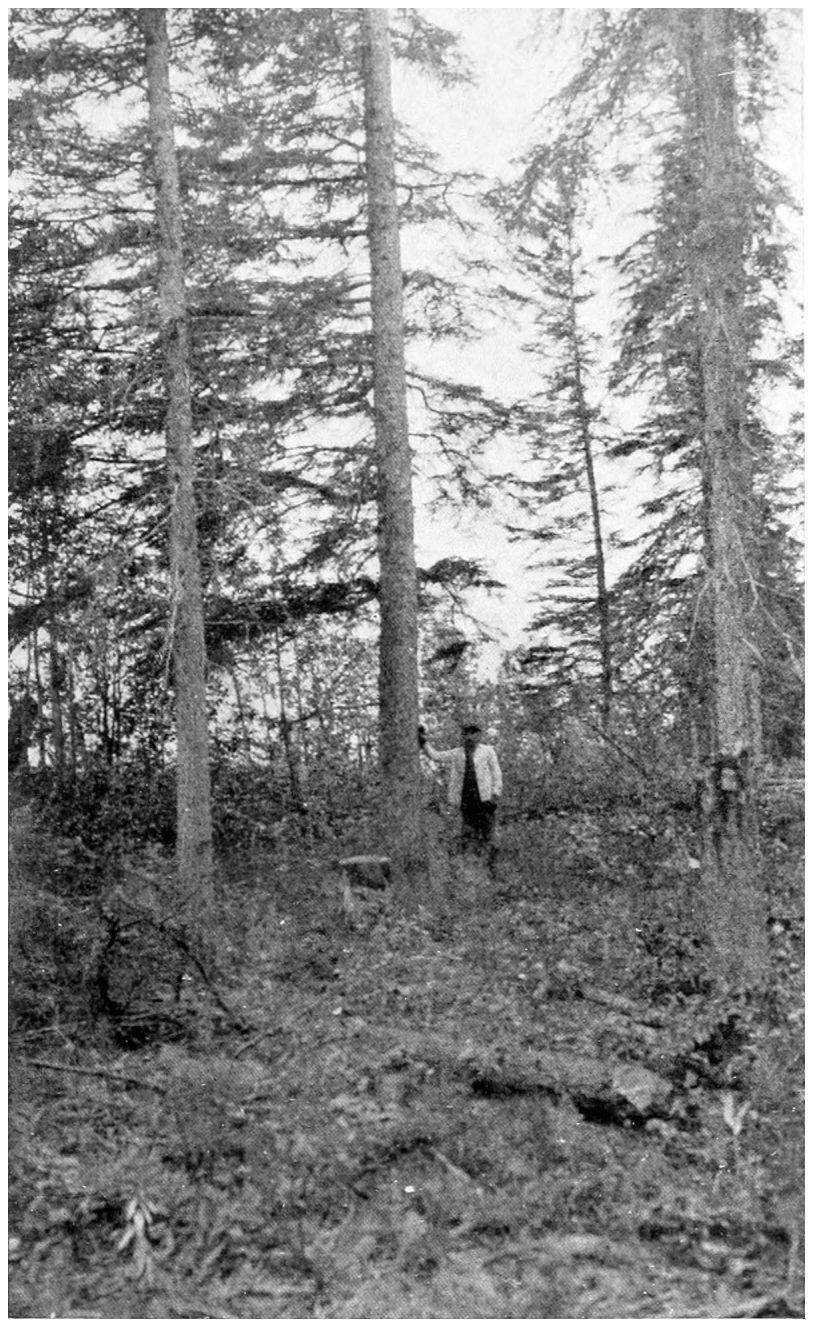
SPRUCE TIMBER ON THE SLAVE RIVER
At 10 P.M. the steamer tied up for the night.
This had been the hottest day yet experienced.
The mercury stood at 100 in the
shade at Chippewyan, but the appearance of
the sky portended rain, and as we retired we
heard rumblings of thunder and some lightning
was to be seen. A little later, the welcome
drops were heard pattering on the
decks. All welcomed a relief from weather
that would be more suitable to the tropics
than to this latitude of 59 degrees north.
On waking the following morning, July 5,
we found the air refreshingly cool. It had
rained nearly all night, and from this on we
had no more such heat as we had heretofore
experienced. At a distance of some fifteen
miles from Chippewyan, the land becomes
higher and is covered with timber, considerable
quantities of which are seen from the
river; the varieties being spruce, poplar,
birch, tamarac and willow; some of the first
named being of good quality, running in size up
to twenty inches at the stump. This timber
continues somewhat irregularly throughout
the whole course of the Slave from here to
Great Slave Lake.
At about twenty miles below Lake Athabaska,
the Slave receives the Peace River,
and the former at once becomes an immense
stream, averaging perhaps a mile in width.
The Peace itself is really a great river: rising
on the eastern slope of that great Atlas chain
of North America, the Rocky Mountains, it
flows easterly and northerly for some 800
miles till finally at this junction its waters
mingle with those coming from the same
watershed via the Athabaska.
Ever since the mountain water overtook
us, we had witnessed considerable drift timber,
but immediately after passing the junction
of the Peace this greatly increased; and
cast up by previous floods on the shores,
sand bars and islands were thousands upon
thousands of spruce trees, sufficiently large
for lumbering purposes.
The Peace River deserves more than a
passing reference. It is much the largest of
the many tributary streams whose waters
find an outlet to the Arctic Sea through the
Mackenzie. In fact, it and the Slave might
be regarded as the Upper Mackenzie with
Great Slave Lake as an immense expansion.
It is something in the neighbourhood of
800 miles from where the Finlay and the
Parsnip, under the shadow of the Rockies,
join to form the Peace, and from here to its
mouth it flows through a valley containing a
large percentage of exceedingly fertile land.
There have been different opinions as to the
future of this valley as an agricultural district,
but it is probable that with the exception
of that portion near the source, where
the elevation is considerable, the basin of
the Peace will not be behind that of the North
Saskatchewan in its yield of cereals and
vegetables and quite equal to any portion of
the great west as a grazing country, though
it must be remembered that it is more or
less wooded.
In the year 1902, I visited the Upper
Peace, as before stated, and on September 16,
at a point nearly 500 miles above the mouth,
wheat was already cut, oats mostly cut, and I
was informed that this was about the usual
time of harvesting. I also saw at the Roman
Catholic Mission, a few miles above Peace
River Crossing, and almost opposite the
mouth of Smokey River, potatoes, cabbage,
beets, onions, pumpkins, tomatoes, muskmelons,
etc., and also tobacco. The latter
may not be equal to the famed Havanna leaf,
but it possesses sufficient nicotine to gratify
the appetite of those dependent on it for their
supply.
The river at this point is considerably over
a quarter of a mile wide, and the water at this
season was clear and blue. The valley, which
is here over two miles wide, about one mile
on each side of the stream itself, is six or
seven hundred feet lower than the table land
above.
Copyright Ernest Brown, Edmonton
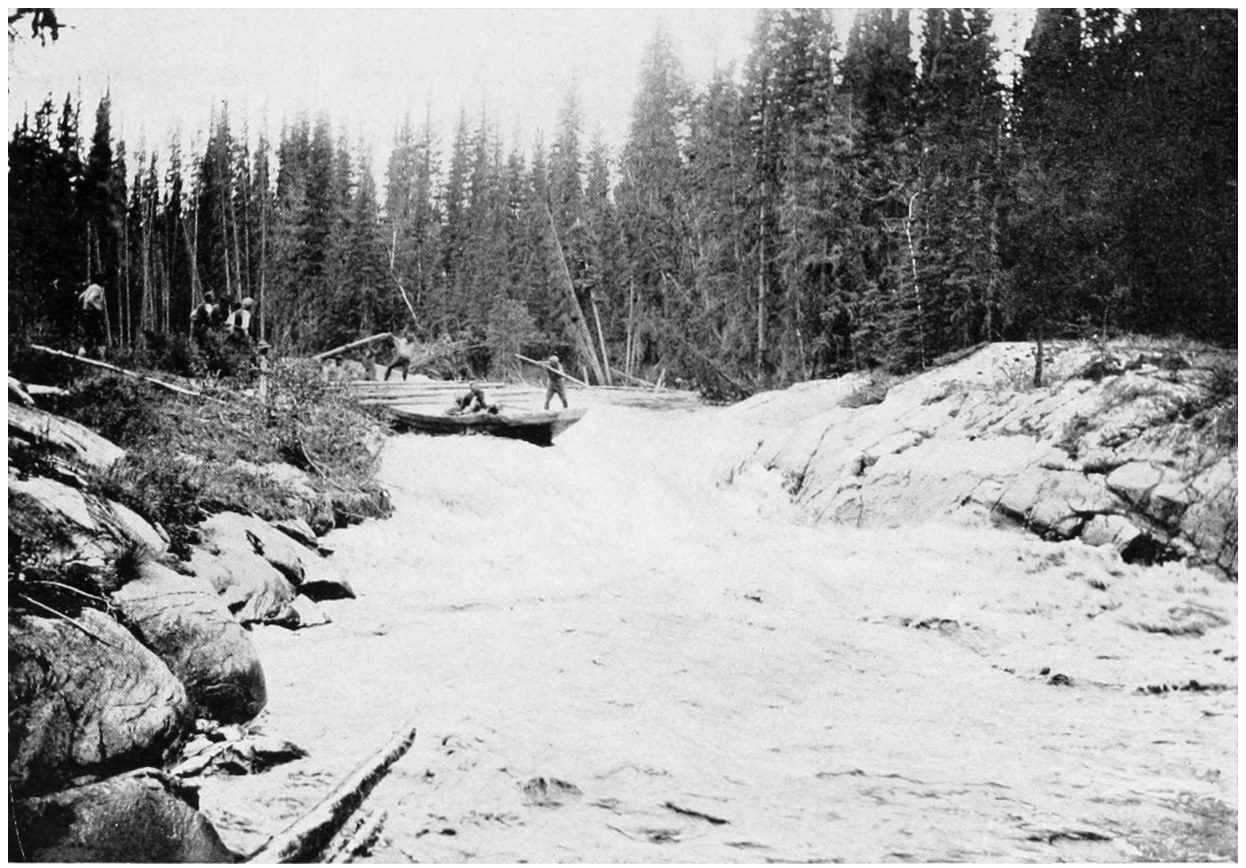
RAPIDS ON THE SLAVE RIVER AT THE SECOND PORTAGE
On the way in from Lesser Slave Lake,
I had been told to have my camera ready as
we approached the descent at Peace River
Crossing. Even the stolid half breed who
accompanied me was almost enthusiastic in
his description of the view that awaited us,
so that I was quite prepared for what I
apprehended would be something like the
view of Niagara River from Queenston
Heights. It resembled more the Grand
Canyon of Arizona. All at once there appeared
before us something so gigantic in its
dimensions and so bewildering in the beauty
of the vista which it revealed, that I feel any
words that I can pen would rather conceal
than reveal any true conception of this
wonderful picture. Looking from the upland
in every direction and on both sides of
the valley, the table land seemed to the eye
as level as the proverbial billiard table,
while beneath and extending east and west
for distances which I hesitate to estimate, lay
this great excavation, for such it really is, and
far below, the blue water of the river was seen
threading its way along the base, at times
dividing itself between islands and sand bars
and then reuniting in its hurried flow ever
onward and downward in its course. A few
miles above “The Smoky” was seen threading
its way through a similar valley, while
farther and farther away were other tributary
streams flowing through other valleys till the
vision was only lost by the interception of
the horizon. One can form but a feeble conception
of the energy that nature has expended
in excavating this great canyon,
through which now flows a navigable stream
with but one obstruction in its course for
some 700 miles. Evidently this has been
accomplished simply by the water from the
mountains seeking ever a lower level. The
swift current of the stream was not only
sufficient to delve out the enormous quantity
of earth embraced in this valley over two
miles wide and to the depth I have stated,
but also to transport it for hundreds of miles
down stream where it was deposited, forming
sand bars and islands all the way to Great
Slave Lake.
At the source of the Danube River at
Donoueschingen stand two statuary figures,
the one representing the country and the
other, the river. The former is indicating
to the latter the route to be taken, and the
injunction is “Go this way and open the
wilderness.”
Here we have a valley even greater than
that through which the Danube flows, and
the injunction is being obeyed in the opening
up of a region of inestimable value for the
benefit of those who will yet seek their homes
in this part of our possessions.
We will now resume our narrative by
returning to the Slave River, which connects
Lake Athabaska with Great Slave Lake. It
is about 300 miles in length, but navigation
is obstructed by rapids that commence at
Smith’s Landing, 100 miles from Athabaska,
and extend down stream to Fort Smith, a
distance of sixteen miles. For this reason,
the steamer Grahame, with the scows that
she had in tow from McMurray, proceeded no
farther than the former place, and the cargo
was freighted overland to Fort Smith on
wagons drawn by oxen, which delayed us
about a week. Most of the country passed
over on this portage is very sandy, which
made very heavy drawing. This will be
spanned one of these days by an electric
tramway, the motive power for which can
easily be obtained from the rapids near by.
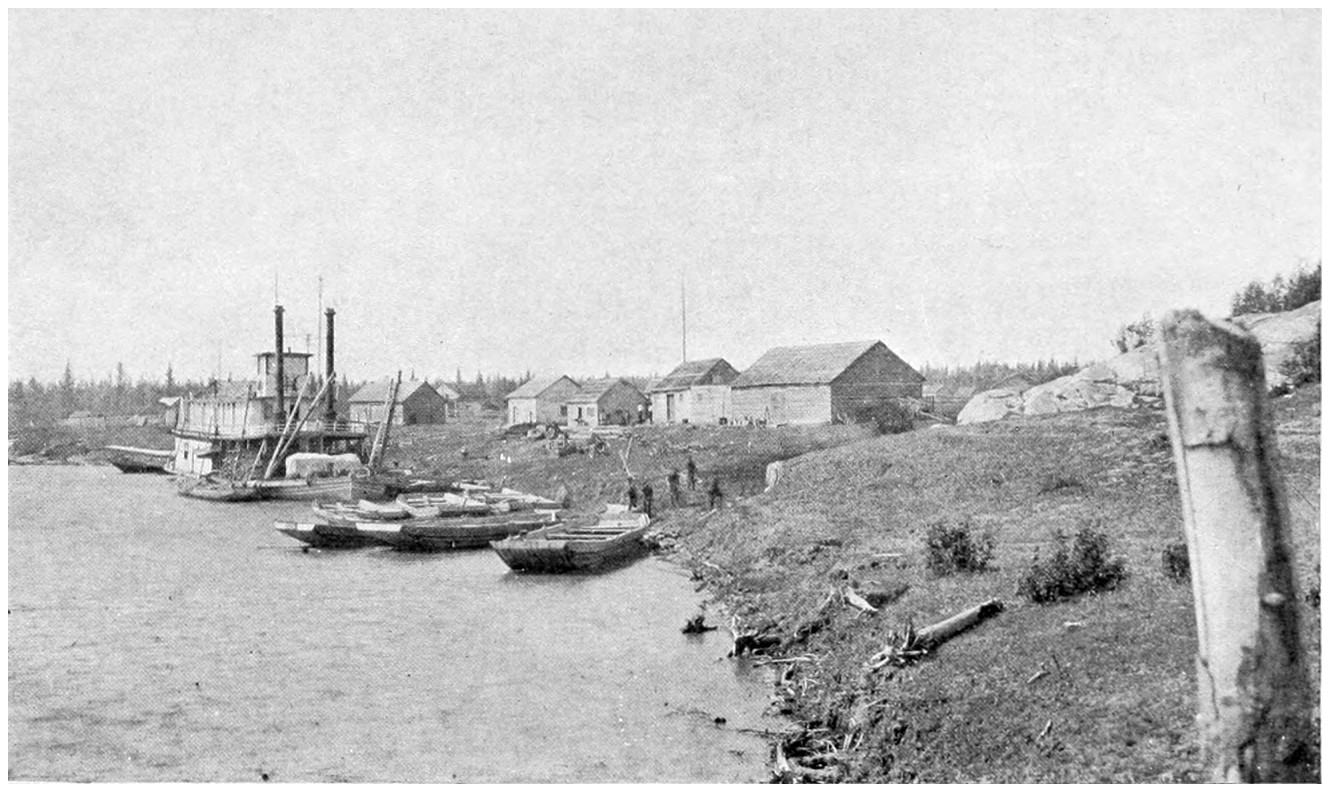
SMITH’S LANDING ON SLAVE RIVER
The prevailing rock formation between
Chippewyan and Smith’s Landing is granite;
that about Chippewyan being of a red colour,
while as Smith’s Landing is approached it
is grey, and the soil covering noted on this
section of our journey proved less inviting to
the agriculturist than that either above or
below it, where there is a good deposit of
alluvial soil.
At La Bute, forty miles above Smith’s
Landing, we saw a good deposit of tar in
the limestone rock on the west side of the
river.
While we were staying at Smith’s Landing
awaiting the transport of the cargo across
the portage to Fort Smith, a tug towing
several scows which we had passed farther up
the river arrived. They were accompanied
by Bishop Grouard and were the property of
the Roman Catholic Church over which he
presides in this district, and also in that of
the Peace River country. I was glad of
having an opportunity of meeting him
again, especially as he had some years before
made the trip which I proposed to take from
Fort McPherson to Fort Yukon.
On July 9, we crossed the sixteen mile
portage to Fort Smith just below the rapids.
We had a comfortable carriage drawn by
horses and made the trip in about three hours.
Here we boarded the trim-built little steamer,
Wrigley, which we found much smaller than
the Grahame, but on the whole fairly comfortable.
She differed from the Grahame
and the Midnight Sun, being built on a
different model, the former being like the
Mississippi steamers, with flat bottoms, and
drawing only about two feet of water, while
the Wrigley is similar in construction to the
steamers of the lower lakes of Canada, with
a screw wheel, and drawing nearly six feet
when loaded.
STEAMER “GRAHAME” AT SMITH’S LANDING
CHAPTER VI — A Change of Scenery
More About the Slave River : On Steamer Wrigley : Fine
Gardens at Resolution : A Nasty Experience : Bishop
Reeves Comes Aboard for a Round Trip : Miss
Wilgriss Leaves : Hay River : Fort Prudence : The
Little Lake : Fort Simpson : A Pathetic Incident : An
Imaginary Cabinet : We Reach Fort Wrigley.
The cargo having all been carted over the
portage and loaded on the Wrigley and her
consorts, we left Fort Smith at 3.15 P.M.,
Mountain or Pacific time, on this last stage
of our journey to Fort McPherson, in round
numbers, 1300 miles distant. The day was
cloudy and quite cool. We were at last clear
of all obstructions to navigation. Throughout
the whole remaining distance there would
also be very little darkness, and the steamer
was to run both night and day. The country
becomes more level than above the rapids.
The banks at first thirty or forty feet high
become gradually lower with the descent of
the river, and the soil reveals a rich alluvial
deposit, similar in appearance to that of
the Western prairies. We passed Salt
River at 5.30 P.M. and Bell Rock a little
after, and later Gravel Point, where we
saw the last gravel to be met with on these
waters.
Thursday, July 12. The boat ran all night
and at 8.30 A.M. we were well down the river,
being opposite McConnell Island. After
leaving Fort Smith the river expands to
probably an average width of a mile and a
half, in some places much more, with
numerous islands on the way. As it widens
out the current decreases and the soil held in
solution yields to the law of gravity and is
deposited, forming numerous islands all the
way to the lake. The earth, that once rested
securely along the present course of “the
Peace” before the waters from the mountains
found their way in that direction and commenced
that great excavation, is here found
in these islands, and the newly formed land
that is pushing the southern shore line of
Great Slave Lake near the mouth of this
river, farther and farther north. How
applicable to this situation are the words
of Tennyson:
LEAVING FORT SMITH ON THE SLAVE RIVER
“The sound of streams that swift or slow
Draw down Æonian hills, and sow
The dust of continents to be.”
The land falls gradually away till it is submerged.
Islands innumerable have been
formed while others in embryo exist in the
sand bars extending for long distances in the
neighbourhood of the channel. It was difficult
to follow the outlet and we grounded
several times after we were well into the
lake. However, by appliances peculiar to
such navigation, we finally got into deep
water, and an hour’s run brought us to a fine
bay on the shore of which we beheld another
whitewashed village with a hundred or
more Indian lodges in the foreground. This
was Fort Resolution, and the lodges were the
temporary habitations of the Chippewyan
and Slavey Indians, who were assembled
here for the payment of “treaty,” as they
call it, that is to say, the Federal Government’s
grant to Indian tribes. It was late
in the afternoon when we entered the lake.
We lost two or three hours on the sand
bars and another in putting on wood, so
that when we went ashore at Resolution, it
was near eleven o’clock at night. I remember
thinking that we would have to make
our journey short so as to get back before
dark; but what with a visit to the tent
of Indian Commissioner Conroy and Dr.
West, and the exchange of information from
outside which we possessed, for that of the
interior which they could furnish, and with
a visit to the Indian camps, I was astonished
to find that we had passed from one day into
another without having experienced any
intervening night. A dull twilight was
giving way to a bright dawn as we went
aboard our ship after midnight. This was
the beginning of constant daylight, that
remained with us for several weeks.
I noticed some very well cultivated gardens
at Resolution, containing most of the
vegetables we would find in the gardens of
Eastern Canada—potatoes, turnips, peas,
cabbage, beets, etc. The potatoes were
particularly good, and so far advanced that
by August 1 they would certainly be fit for
use. There were no evidences either that the
“potato bug” had yet visited this district.
Copyright Ernest Brown
FORT RESOLUTION ON GREAT SLAVE LAKE
We had before us, between here and Hay
River, a large sheet of open water of over
seventy miles to traverse, and delays are
frequently experienced here, especially when
a steamer has, as in our case, several heavily-laden
scows in tow.
We left Resolution at 2 o’clock on the
morning of July 13, but had soon to seek
shelter under an island and wait for the sea
to subside, which it did sufficiently to allow
us to start again about 4 P.M., but for
several hours it seemed doubtful if one of the
scows which was leaking badly could be kept
afloat till we should reach Hay River, and
we were glad to find when we arose in the
morning that the crew of the leaky craft
had been rewarded for their toil. She was
among the other boats lying along the bank,
and without showing much damage either
to the scow itself or to the cargo. The
latter was much the more important, as it
contained food and other necessities brought
such long distances and at such great expense,
and besides there were anxious men,
women, and children in far outlying posts in
this great wilderness, whose very existence
depended on supplies reaching them in good
condition.
Awakening early in the morning and before
the crew or inhabitants of the village had risen,
I walked up the bank of the river, and finding
a sandy beach was soon enjoying a bath.
While engaged in this luxury, I noticed that I
had attracted the attention of half a dozen
rather large-sized and very hungry-looking
husky dogs, that came rushing down the
bank barking furiously, evidently thinking
me a legitimate object of prey. In the
whole course of my journey this is the only
instance where I was the subject of an attack
of any kind, and I must confess I felt greatly
alarmed as I realised my situation, and cannot
help thinking that had it not been for
some Indians, the owners of the dogs, suddenly
appearing in a canoe around a point in
the river, paddling quickly to my rescue, the
consequences might have been serious. The
hungry creatures probably thought I was
some animal from the forest who was trying
to escape them by swimming the river.
Bishop Reeve, of the Anglican Diocese of
the Mackenzie River, came aboard at Hay
River for a round trip to McPherson and
return, and Miss Wilgriss left us to resume her
position at the Mission here. We were all
impressed with the zeal of this lady in her
work, which is certainly one of self-sacrificing
devotion to a great cause.
Copyright Ernest Brown, Edmonton
DOG-RIBBED INDIANS ON GREAT SLAVE LAKE
Hay River is a stream of considerable size
which enters Great Slave Lake from the
west at a distance of some forty miles south
of the entrance to the Mackenzie.
The morning was fine. The wind had
subsided, and the great lake, which serves
as a filtering basin for the turbid waters
entering it from the Slave River, was here as
clear as that of the great inland lakes of
Eastern Canada—Huron, Erie or Ontario.
Wherever a river contains muddy water,
you may at once conclude that it has no large
lake expansions above it. In nearly every
stream pouring its waters into the great clear
water lakes of the St. Lawrence basin the
water is dark and more or less impure; very
different both in quality and appearance from
that which it assumes after having had a
little time to settle. This is, of course, due
to the process of precipitation which the river
currents have previously prevented. The
Saskatchewan, the Missouri and the Mississippi
are streams whose waters are similar in
appearance to that of the “Yellow Tiber” at
Rome. So, also, are those of the Columbia
and the Fraser of the Pacific slope, and in
each case you will search in vain for any
large lake expansions in their courses.
A few hours’ run brought us to a bay with
many islands, which gradually contracted
to a width of two or three miles and we now
had entered the great river, the Mackenzie,
into which all the waters we had traversed
flow. No more delays were now anticipated,
no lakes to cross, no rapids to encounter, and
no darkness to delay us on our course for the
rest of our journey, a thousand miles in all,
to the delta of the Mackenzie.
Great Slave Lake impresses the visitor
by its size, which approximates to that of
the great lakes of Eastern Canada. For
some time we were entirely out of sight of
land. There is a bar at the mouth of the
river which our steamer struck once or
twice as she also did in two or three other
places farther down.
After passing what might be called the
entrance, the river widens out into expansions
which deserve and receive the distinction
of lakes. Islands covered with
green timber are numerous, and the appearance
is suggestive of the lower St.
Lawrence. We had some difficulty in following
the channel at the mouth of one of these
expansions, named Beaver Lake, where we
grounded twice on a soft bottom. This did
no damage to the steamer but caused us
several hours’ delay.
The blowing of the whistle of the Wrigley
early on Sunday morning of July 15 announced
that we were approaching Fort
Providence, and as the boat rounded an
island in the river, exclamations of astonishment
at the beauty of the picture that lay
before us were heard on every hand. There
on the right bank of the river, its waters as
clear as those of the St. Lawrence, lay a
village, so strikingly similar in appearance
to those along that familiar stream that we
could almost forget the long distances we
had journeyed and fancy ourselves approaching
one of the parishes of old Quebec. The
church bells were ringing out a call to the
Sunday morning service. The convent hard
by was decorated with flags betokening some
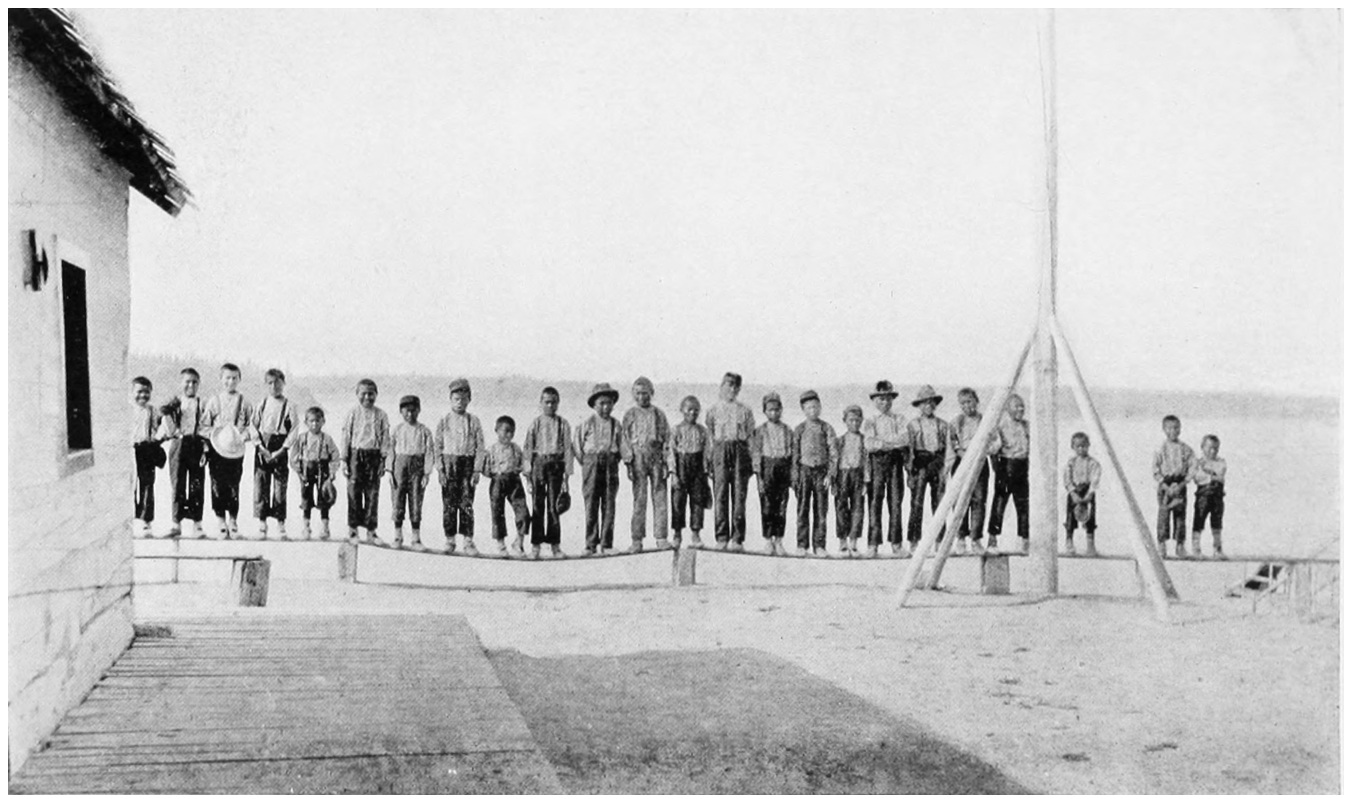
joyful occasion, while the Indian pupils in
their pretty costumes accompanied by their
teachers, the sisters of the Mission, lined
the bank to welcome the founder of the
school, Sister Ward, of Montreal, who had
accompanied us this far.
This devoted woman first went into the
country upwards of forty years ago, where
she became instrumental in organising this
and several other schools during a residence
there of more than thirty years. She was at
this time making a visit of inspection to
them, intending to return before the season
closed, to the home of her novitiate, the
Convent of the Grey Nuns of Montreal.
The banks of the river here are about thirty
feet high. The land is level and the soil a rich
clay loam, and this is the general character
of the soil along the whole of this great river.
In the Mission garden here were found at this
time peas fit for use, potatoes in blossom,
tomatoes, rhubarb, beets, cabbages, onions,
in fact about the same type of kitchen
garden as would be seen a thousand miles
farther south. Besides the vegetables, were
cultivated flowers and also fruit such as
red currants, gooseberries, strawberries,
raspberries and saskatoons, and more surprising
still, near by, was a small field of
wheat in the milk, the grain being fully
formed, the seed of which had been sown on
May 20. I was anxious to know whether
this grain would ripen, and was fortunate
enough to learn later from one of the
passengers, who, returning by the Wrigley,
visited this field again on July 28, that it
had been harvested before the latter date,
probably about two months after the sowing.
This seems almost incredible to those who
live in lower latitudes, but when we remember
that during this whole period the earth had
been subjected to almost constant sunlight
and heat, coupled with constant moisture
from the frozen ground beneath, the reason
for its rapid, hot house growth is obvious.
FORT PROVIDENCE ON THE MACKENZIE RIVER
Leaving Fort Providence at 10.40 A.M. we
soon entered “The Little Lake,” one of the
numerous expansions of the Upper Mackenzie,
and at 10 P.M. reached a point
known as “The End of the Line,” so named
from being the place where the boatmen
coming up the river could dispense with the
tracking line. As the river widens above
this point, the current decreases so that
boats and canoes can be propelled without
outside assistance, while below here till
the river widens again near its mouth, a
distance of over 800 miles, the current is
too strong for the general use of oar or
paddle, and the line is necessary for the
greater part of the distance. With no
interruption from rapids or delay from
darkness and assisted by the current, we
reached Fort Simpson on the following
morning at seven o’clock, the run from
Providence, 161 miles distant, having been
made in about twenty hours.
Fort Simpson is 1078 miles distant by
the route we had taken from Athabaska
Landing or 1175 miles from Edmonton. The
latitude is 61° 52´ N.; in other words it is
900 miles due north of the international
boundary. It is prettily situated on the
left bank of the Mackenzie just below the
mouth of the Liard. Evidently the waters
of the latter stream have no filtering basin
such as the Mackenzie has in Great Slave
Lake, for instead of the clear waters through
which we have passed so far on the Mackenzie,
we see this great tributary coming from the
west carrying down a segregated mixture
of water and yellow soil which perceptibly
changes the colour of the Mackenzie from
here all the way to its mouth. We saw no
more the clear sparkling waters of a greenish
blue, so similar to that of the ocean, that
had been before our eyes for the last 300
miles. The banks of the river at Fort
Simpson are about thirty feet high and the
stream here must be at least two miles wide.
Though the hour of our arrival was early,
the bank was lined with the men, women
and children of the village, all apparently
delighted to see again the return of the
Wrigley. Among others I noticed a well-dressed
white man hurrying down from the
Hudson Bay Company’s store, evidently
looking for some one among the passengers.
Though I had never seen him before, I at
once surmised that this was Charlie Christie,
whose wife was buried at Edmonton a few
days before our departure. During the
whole of our journey the thought of the
message we were carrying to the expectant
husband was ever with us, and the nearer
we approached his home, the sadder seemed
this message. How the information was
to be broken to him had been talked over
many times, but with his hurried steps up
the gang plank and eager inquiry if his wife
were aboard, evidently disappointed at not
seeing her among the passengers, all plans
were forgotten and the answer to his inquiry
was in a few words which, though uttered
in a sympathetic tone, went like a bullet to
the heart of the poor man who had waited
through the long months of the former
autumn, winter and spring for the return
of the mother of his children. Such is one
of the tragic phases of life in this wilderness.
I have mentioned that Fort Simpson is
about 900 miles in a due course north of the
international boundary, and I repeat it in
connection with the fact that the great staple
of our north-west possessions is grown
here, to a sufficient extent to show that we
may, in calculating the width of the wheat
zone, reckon it at least that width from
north to south. I do not of course mean
that all the land lying between the forty-ninth
parallel and this latitude should be
considered arable, but it is something to
know that the climatic conditions up to this
latitude are not too severe for the production
of this cereal.
The soil resembles that at Fort Providence
and the vegetable gardens are similar to
those seen there. The increased sunlight
of the summer months as we proceed north
counterbalances the disadvantages of the
higher latitude. This, however, does not
continue indefinitely. Even at points far
south of Simpson the frost never leaves the
ground at certain depths and this depth
decreases till it approaches so near the
surface in the far north as to prevent the
ripening of either cereals or vegetables.
Fort Simpson has been regarded for many
years as the most noted of the H.B.
Company’s posts in the north, and, though
it has now, I believe, lost some of its importance,
it is still a centre of trade for a
wide district of country.
It was here that the supplies were distributed,
not only to the outlying posts
farther down the river, but also to those up
the Liard and to numerous inland stations.
From here, too, the “Coureurs Du Bois”
or “Trippers” were sent out in winter to
the Indian hunting grounds, carrying with
them by dog trains, ammunition and blankets
and bringing back the furs of the country.
It is the last point visited on the journey
northward, containing the vestiges of
modern civilised life. The village, which
probably contains 300 or 400 inhabitants,
can boast of a system of electric lighting,
a needless luxury for a considerable part
of the year when there is scarcely any
darkness, but later when the sun declines
so low in the heavens as almost to refuse
to dispel the darkness even at noonday, it
serves to somewhat lessen the gloom of the
long winter night. It is perhaps unnecessary
to say that the plant was installed by “The
Company.” They have also established a
museum here, containing stuffed exhibits
of the animals and birds of the country.
That of the latter is well arranged, and I
presume gives a good representation of the
feathered tribe of this north region. Of the
former, scarcely as much can be said,
though I remember among them a black
bear that was very creditably set up. In
the “Big House,” in other words, the
Agent’s residence, we also found the unusual
luxury of a small billiard table, which
it must have cost a goodly sum to transport
so far.
The principal buildings in this sub-Arctic
“metropolis” are, of course, those of “The
Company,” and the second those connected
with the Anglican Mission. The latter consist
of a good dwelling, occupied by the
Rector of the parish, and which also serves
as a schoolroom, while near by is the chapel,
a very pretty edifice and creditable to the
enterprise of those who erected it in this
far away place.
The buildings of the village are of logs, the
better ones being sided up with lumber and
whitewashed. Much of this lumber I was
informed had been cut with a whip saw,
though a small mill was in operation for a
time. I saw at Simpson some of the finest
porcupine quill work that is made anywhere
in the country, the women of one tribe of
this region being famed as experts in this
work.
We found the timber, since crossing Great
Slave Lake, somewhat smaller in size,
though lumber cut here and used in the
buildings at Simpson is some twelve inches
wide, but this is exceptional. One cannot
but be struck with the vast quantities of
spruce along the route that is a little under
size for lumber, but which would make
excellent pulp wood. The drift wood coming
down the Liard is similar to that from the
Peace, and indicates timber of a larger size
farther up the stream than is found growing
at its mouth.
Since leaving Fort Smith, we had been
traversing territory beyond the north limit
of the Province of Alberta. The sixtieth
degree of latitude forms the north boundary
of that Province and it is supposed to pass
very near Fort Smith.
To wile away the weary hours, some one
conceived the idea of forming a provisional
government for this unorganised territory.
Mr. Thos. Anderson, the Company’s Superintendent
for this district who was with us,
was, by popular acclaim, made Lieutenant-Governor.
He immediately selected his
cabinet from among those on board the
Wrigley. The pilot, a very worthy Cree
Indian, was chosen as Minister of Marine,
while a countryman of his, who was of a
somewhat martial appearance, was made
Minister of War: the tall lank white man,
before referred to as the counterpart of
Abraham Lincoln in his rail-splitting days,
was called to the high office of Minister of
Justice. The latter had his blankets tied
up with a long rope and His Honour gave
as one reason for his selecting Mr. Leigh
(for such was his name) to be that he carried
with him the very article which has served
to enforce British justice the world over.
BISHOP REEVE, STEFANSSON AND RESIDENT CLERGYMAN AT SIMPSON
After subscribing to a declaration in which
allegiance to “The Company” (not the
King) was the principal article, a cabinet
council was held. Numerous grievances
under which this fair portion of Canada had
long suffered were discussed. All were of
one mind regarding the existence of these
disabilities, but there was a wide divergence
of opinion as to how they were to be
remedied. However, on one subject there
was entire unanimity.
Those who travelled in what were known
as the North-West Territories before the
Provinces of Saskatchewan and Alberta were
organised, will remember that intoxicating
beverages were prohibited by the laws of
the Dominion. This “tyrannical rule”
obtains even at the present day in this
Mackenzie District, and we soon realised
that even if the cabinet had not been
personally favourable to the free importation
of this essential article, it would have been
impossible for them to command the confidence
of the people unless they passed an
ordinance abolishing this legislation. This
was at once done, and received the immediate
assent of the Lieutenant-Governor.
This bit of pleasantry was continued for
some time, till it began to seem almost real,
and in some measure to resemble the initial
stages of the uprising many years before
of Riel on the banks of the Red River.
The Indian is not incapable of a kind of
dry humour, but, at the same time, he does not
always discern whether you are in earnest
or merely jesting, and the result was that
the Lieutenant-Governor, in the name of
the Company, dismissed all his Ministers
and resumed the intelligent autocratic control,
which he had long exercised over the
country.
After remaining about twenty-four hours
at Simpson, we resumed our journey at five
o’clock in the morning, and at nine caught
the first sight of the Rocky Mountains
(Nahanni Range) with their snow-capped
peaks, which attain a height of 5000 ft.
above sea level. This change of scenery
was welcomed after six weeks of travel
through a vast wilderness of comparatively
level land.
The weather had continued quite hot,
with only an exception of a day or two,
from our start, but whether from the effect
of the mountains or not, we experienced
a very decided change in the temperature
immediately we reached their vicinity, and
from this on we suffered no more from the
excessive heat, which had been as unpleasant
as it was unexpected. We had
counted on escaping the usual July heat,
but for the greater part it had really been
more oppressive and certainly more constant,
extending right through the long twenty-four-hour
day, than I had ever before
experienced.
It strikes the observer as extraordinary
that the Mackenzie in its way to the sea
from Great Slave Lake should bear off to
the west, so far as to necessitate its cutting
its way between two ranges of the Rocky
Mountains, where a much shorter course
and apparently one through a more level
country lay open to the east into Coronation
Gulf.
I do not know the opinion of geologists,
but it seems probable that the original
outlet of Great Slave Lake has been changed
from this course to the longer one now
followed, in the same way as the Niagara
has become the outlet of the waters of Lake
Huron instead of the Northern River of
past ages, which flowed directly across
country from the Georgian Bay to Lake
Ontario.
At the distance of 136 miles below Simpson,
we reach Fort Wrigley. This is a new post;
the old one of the same name twenty-five
miles above having been abandoned owing
to its unhealthy locality. The country
about Fort Wrigley is fairly well wooded.
I noticed a spruce log, cut in the vicinity
which measured twenty inches in diameter.
The Nahanni river, which is a considerable
stream, flows from the west and joins the
Mackenzie about halfway between Simpson
and Wrigley. Just north of it rises Mount
Camsell, a snow-clad peak 5000 ft. high.
Below Wrigley the river narrows to from
a half to three quarters of a mile in width.
This continues for some distance and then
widens out as we proceed down the stream.
Two noted mountain peaks, Mount Bompas
and Mount Wrigley, are seen between
Wrigley and Norman. About twenty miles
above Fort Norman and on the left side of
the river the clay banks assume a very red
appearance, and the people use the earth as
paint. This condition of the earth has been
produced by fire in the coal seams. For
several miles along the route the fire is now
apparently extinct, but as we reached a
point eight miles above Fort Norman, for
upwards of two miles along the right bank
of the river smoke was distinctly observed
from fires still burning far down in the seams
of coal. It is worthy of note that Sir
Alexander Mackenzie makes mention of
these fires in his narrative, as existing in
1789 when he explored and gave his name
to the river.
About sixty miles below Wrigley we
passed the mouth of Salt river which flows
from the east. It is so named from deposits
of salt that exist some miles above the
mouth. Rock salt is said to exist on the
Great Bear river above Norman, but the
salt in use in the country is from another
Salt River sixteen miles below Fort Smith.
At 7 P.M., July 18, we reached Fort
Norman at the mouth of the Great Bear
River which is the outlet of Great Bear
Lake. Fort Norman is distant from Fort
Wrigley 184 miles and 1398 miles from
Athabaska Landing. Its situation is very
picturesque. The mountain peaks stand up
in bold relief out of a vast level plain. Bear
Mountain on the north side of Great Bear
River and east of the Mackenzie is the most
conspicuous.
While the steamer lay at Fort Norman, I
started down the shore hoping to reach
Great Bear River, but I soon found it
dangerous to attempt to walk along the
water’s edge owing to the banks being in
some places too precipitous. I then tried
the land farther up from the shore but was
unable to find a trail and soon got into a
wet swamp and had, very much to my
regret, to give up the attempt. The width
of the river, I understand to be some 150
or 200 yards and the water clear. This
might be expected as it is the outlet of a
lake with an area nearly if not quite that
of Great Slave Lake.
At Fort Norman a fellow passenger in
the person of Rev. H. C. Winch, left us to
assume his duties here as a Missionary of
the Anglican Church. He had been my
room mate on the Wrigley, all the way from
Fort Smith.
In company with several of the passengers
I went up to the little house which was to be
his home and remained till about eleven
o’clock at night, and as we bade him good-bye
in the twilight the loneliness of the life
that was before him impressed itself on my
mind.
Fancy the weird situation here in this
wilderness with none but the native Indians
and a few half breeds for companions.
This during the few summer months when
the days were long and when the birds and
the wild geese had not left for the South
might not be altogether unpleasant, but
when the days would grow short, when the
canoeing on the river was over and the long
nights of winter approached, it certainly
would require a good deal of fortitude
to bear the part that he was to endure.
CHAPTER VII — A Sad Case
Leaving Fort Norman : A Sad Case : In Arctic
Regions : Arrival at Fort McPherson.
We left Fort Norman about midnight; had
a good run, and on rising the next morning
the 19th, were more than half way to Fort
Good Hope. At 2 P.M. and at a distance
of about six miles above Fort Good Hope
we noticed that all our fellow-passengers
who knew the river were on deck. This
meant something, and as we looked forward
and on each side it seemed as if we were in a
cul-de-sac. We knew the river must find
a passage somewhere but so far as one could
see it seemed impossible that there could
be an opening anywhere of sufficient size
to permit the escape of the waters of this
mighty stream. As we were watching and
wondering where the outlet could be the
steamer suddenly turned sharply to starboard
and before us lay a narrow strip of
shining water apparently only a few hundred
feet in width. Down this we glided at great
speed between cliffs of limestone on either
side of great heights. We had reached the
upper ramparts of the Mackenzie. These
walls of perpendicular sandstone resemble
huge fortifications, like another Gibraltar
but one which no enemy is likely to
approach.
For about four miles we were hurried down
this great gorge at almost railway speed, so it
was not long till the waters again expanded
to a width of a mile or more and revealed
on the right bank another picturesque whitewashed
village, Fort Good Hope. Its situation
on a level plateau is charming. The
banks are about thirty feet high and the
soil is similar to that all along the river,
being a rich deposit very much resembling
that of our great prairies. I saw potatoes
in blossom, cabbage, onions and other vegetables
in the gardens here, but this was the
last we saw going North. As we proceeded
farther the frost in the soil reached too
near the surface to permit their maturing.
Spruce timber of sufficient size for sawing
into lumber is obtained on an island in the
river.
Copyright Ernest Brown
THE RAMPARTS, MACKENZIE RIVER
Some time in April before leaving home
I received a letter from an old friend named
Slean. It had been written on Christmas
Day from Arctic Red River Post, some 300
miles beyond Fort Good Hope. The writer,
who had gone north the previous summer
from Edmonton was engaged with an independent
fur trading company, and being
a young man of good education was desirous
of having some diversion from the everlasting
talk of “Furs and Supplies,” to beguile his
lonely life and requested me to endeavour
to get the Government to establish a
Meteorological Office there, and to say that
if they would send him a few instruments
and the necessary forms he would be glad to
report as frequently as possible, adding a
most unusual proposition for an applicant
for a government position that he would not
expect any salary. This request I forwarded
on to my friend Mr. Stupart, Director of
the Meteorological Observatory, and on my
way down I had the satisfaction of seeing
these requisites en route.
I did not reply to the letter inasmuch as
I was going by the first transport and would
reach his post in person at the same time as
a letter would, and I looked forward with a
good deal of pleasure to surprising him in
his distant home.
Just as we were entering Great Slave Lake,
a week before reaching Good Hope, we passed
the scows owned by Slean’s Company, also
going North as far as Fort Good Hope,
which point we would reach some time before
they would. I was informed by the man in
charge that Slean would probably come up
to Good Hope to get the scow containing his
supplies which they pointed out to me as
“No. 11,” and that he would likely be there
on our arrival.
Our steamer had been expected at Fort
Good Hope for several days and her arrival
was anxiously looked for, so that when she
did appear at a convenient hour all the
village was on the bank to greet us. I looked
anxiously among the dusky faces to see the
fair complexion of my friend but he was
not present, so I inquired for the buildings
of his Company. A few whitewashed houses
were pointed out a little down the river to
which I at once repaired, and on inquiry
from a white man whom I met was informed
that my friend was in one of the houses,
but that he was very ill. On entering I
was told that he had reached Good Hope
two weeks previously from his own post after
a ten days’ journey up stream, but in such a
weak condition that he had to be helped up
the bank from his canoe. Since that time
he had continued to get worse and that there
was no hope of his recovery. I was informed
that he was sleeping in an adjoining
room. A few moments later he awoke
and I entered the room. It had little the
appearance of a sick room except that of the
occupant. We are so accustomed to associate
with the sick chamber clean linen,
comfortable bedding, with all the little
delicacies of nourishment and soothing cordials,
that the contrast in this case was
disheartening. Not that his two white
friends were not less attentive than a trained
nurse would have been. On the contrary
they were doing all that mortals could under
the circumstances. One of these men was
a Mr. Darrell, who had accompanied
Hanbury, on his trip around the shore of
the Arctic Sea a year or two before, and
whose excellent qualities are mentioned in
Hanbury’s narrative of that expedition, and
I know he refused a good offer for the season
rather than leave the sick man. The other
young man, Slater, who was also with him
I have no reason to think was less attentive,
but it was impossible to obtain, especially
before the arrival of the supplies which our
boat brought, food that would tempt the
palate of a white man even in good health.
He recognised me at once and commenced
his conversation by informing me in broken
accents that he had taken a little cold on his
way up the river but that he was all right
and would get up the next morning, take
a good cold bath and be around again;
but I saw at once that he was in a delirious
condition and that in all human probability
his wanderings would soon be over. I spent
an hour with him which I repeated before
our steamer left at midnight. His death
came even sooner than I expected, for I
afterwards learned that he passed away
the next day, and when our steamer called
on her return trip shortly after, the passengers
visited a lonely grave in the Catholic
Cemetery in which lay the remains of
William John Slean. This was another
reminder that the bright Arctic summer
days sometimes have their dark shadows.
It was a little after midnight of July 20,
when we left Good Hope and on rising next
morning I found we had passed the Arctic
Circle. The river is now widening, the
banks are getting lower and the timber is
growing smaller, all these indicate that we
are fast drifting down towards the Arctic
Sea. Some time in the evening we stopped
at Arctic Red River at the entrance of a
stream of the same name. It certainly was
the least desirable place for any civilised
man to choose for a home, that I had yet
seen in all this Northland. A few houses,
the church and the graveyard were all
crowded on the side of a hill rising abruptly
from the river. Perpetual frost was found
only a foot beneath the surface of the soil,
and we no longer beheld the emblems of
civilised life, the vegetable and flower
gardens, that go so far to make many of
those lonely posts seem somewhat cheerful.
I wandered up to the log shack which
poor Slean had occupied during the previous
winter and which he had left only a few weeks
before. A more dreary habitation it would
be difficult to imagine. I looked around the
room to see if there was any memento that
I might carry home to his friends, but the
only thing I could see was a little green
flag pinned to the wall, a touching tribute
of patriotic devotion to the far away island
which had given him birth. It seemed like
desecration to remove it, so I allowed it
to remain where he had placed it.
We only stopped an hour or two at this
dreary place and then started for our last
and the most northerly post in the country,
Fort McPherson. At 1.30 the next morning,
July 21, I rose as we were rounding
Point Separation, so named from the parting
here of Sir John Franklin and Dr. Richardson
in 1825, when they separated for their
perilous trips around the shores of the
frozen ocean, Franklin going west from the
mouth of the Mackenzie, and Richardson,
coasting easterly towards Coronation Gulf.
The sun was just skirting the northern
horizon and I endeavoured to get a photo of
it which I am sorry proved rather a failure.
Copyright Ernest Brown
THE MIDNIGHT SUN
Point Separation lies at the junction of
the Peel River with the Mackenzie, and is in
latitude about 67° 50´ N. Below this point
lies the delta of the Mackenzie which is
many miles in width, with numerous islands
between here and the sea about 100 miles
distant. At the point where Franklin and
Richardson camped two spruce trees were
pointed out marked as lobsticks which are
said to have been so marked by them in
commemoration of the event. Both are
still standing, though one is now dead.
The Indians have a tradition that a quantity
of spirits were cached somewhere in this
vicinity, which they say they have never
been able to discover. Personally, I have very
grave doubts of the accuracy of this report.
The Indian is a good hunter, and I know
of nothing that would excite him to greater
activity than the prospect of such a reward.
After rounding Point Separation we enter
the Peel River which at this point is over a
mile wide. We soon noticed that our speed
was much slower than heretofore and the
reason was obvious. For the first time in
our long journey of over 1800 miles we were
going against the current. Heretofore we
have been constantly sailing down the
Arctic slope. Shortly after entering the
Peel our steamer stopped to take on wood,
this reminded me of the frequent habit of
railway trains which, after running for
hundreds of miles on time stop all at once
just outside the station of their destination.
We were all anxious to see this far northern
village at the end of our long river journey
and anxiously waited for a final start.
After about two hours’ delay a start was
made, and soon after we beheld in the
distance on the high bank of the east side
of the Peel, the houses of Fort McPherson
with the white tents of the Esquimaux on
the beach below. These Esquimaux had
come over in their whale boats from Herschel
Island in the Arctic Sea to meet the Wrigley.
Their complexion is almost white with a
dash of ruddy colour that indicates health.
They are very cheerful and good natured,
are not at all diffident like so many of our
Indian tribes. On the contrary, they are
very inquisitive and disposed to make themselves
almost too familiar. They are of
fair stature and do not show any of the
marks of the struggle for existence that is so
observable in their neighbours, the Indians,
in this part of the country.
AT MCPHERSON: INDIANS, HALF-BREEDS AND ESQUIMAUX IN FOREGROUND
At Fort McPherson, as at all points
visited in the last 1300 miles of our journey,
no news from the outside world had been
received since the last winter mail in March.
For over four months the news passed on
from post to post was purely local, hunting
parties returning from their winter quarters,
whose accounts frequently were of hardships
endured, among which the phrase, “short
of meat,” were familiar words even in the
mouths of natives who knew very little
English. Another item would come from the
ice bound whalers out on the Arctic Sea.
We were the first to inform them of the
eruption of Mount Vesuvius and of the San
Francisco earthquake both of which had
happened months before. Another message
was one of sadness to all throughout the
Mackenzie and Yukon Valleys, namely, the
death of Bishop Bompas, truly named the
Apostle of the North, who was familiarly
known to every inhabitant and as universally
esteemed.
Fort McPherson is as stated the most
northerly of the Hudson Bay Company’s
Posts. Its latitude is 67° 25´ and it is truly
an Arctic Village. For six weeks in summer
the sun never sets and is constantly below
the horizon for the same time in winter.
The thermometer went as low as 68° below
zero (Fahrenheit) the winter before. The
inhabitants are in close touch with the
Esquimaux of the Arctic Sea and with the
whaling ships that annually visit these
waters. These whalers are mostly from San
Francisco, coming up through Behring
Strait in the early summer and returning
in the autumn. In the season of 1905 most
of them were trapped in the ice that blocked
the Straits and were compelled to remain
there till the next season. They went into
winter quarters at Herschel Island where
there is a detachment of the Royal North-West
Mounted Police. They were not sufficiently
supplied with provisions for this
emergency, and they, too, soon became
familiar with the common phrase, “short
of meat,” and had to rely largely on what
could be obtained in the country. They
engaged the Indians of the Mainland to
supply them with meat from the chase
with the result that the shipment of fur
from McPherson for that season was very
much smaller than usual.
CHAPTER VIII
Ice Conditions of the Summer of 1905.
The report by the whalers of the ice conditions
of the summer of 1905 is of interest
to Arctic navigators. They say that the
ice that drove into Behring’s sea from the
north-east and prevented their exit left that
part of the ocean almost free of ice, a very
unusual thing; and one of the captains is
reported to have said that he was strongly
tempted to set sail for the pole, as in his
experience of twenty or twenty-five years
he had never seen what seemed so good an
opportunity of winning fame by such a
venture. But on consideration he decided
to stick to his commission which was to
capture whales and not the Pole. That
these reports are correct is borne out by
the fact that Captain Amundsen, who has
since discovered the South Pole, was exploring
along the north-east coast, in 1905,
finding open water to the west set sail in
that direction, and to his surprise soon
found himself in the company of these
whalers near the mouth of the Mackenzie.
He was compelled to go into winter quarters,
and laid up with them at Herschel Island
till the summer of my visit when he succeeded
in getting out through Behring’s Strait,
being the first to make the entire north-west
passage. During the previous winter he
made an overland journey out to the Yukon
and returned again to his ship, the Gjoa.
The following season he succeeded along
with the whalers in navigating Behring’s
Strait into the Pacific and thence proceeded
around Cape Horn and back to Denmark.
Strange to say that after so many attempts
to make the north-west passage it was
accomplished at last quite unexpectedly.
Captain Amundsen’s Mission into these
Arctic waters was made for the purpose
of locating the position of the magnetic
pole. He succeeded in this and found it
where Ross had located it many years
before.
The arrival of the Wrigley was hailed
with great rejoicing by the people of the
village, but the arrival of the “Permits,”
accompanied also by the article permitted
rather demoralised the community during
my few days’ sojourn there, but I was informed
that the limited supply brought in
had been exhausted before I left, and that
for the next twelve months McPherson
would be a model prohibition town.
The Indian thinks not of the morrow and
certainly obeys the injunction not to lay
up treasures on earth whatever provisions
he may make for his future home.
The Wrigley was to remain only a couple
of days at this post and then start back on
her return trip, and the time had not arrived
when I had to decide whether I would return
with her or find my way back to civilisation
by a different route. I chose the latter,
fully realising that in one sense my journey
was only now commencing, and as I watched
her disappear from sight and walked alone
up the bank at midnight the weirdness of
the situation seemed all at once to dawn
vividly upon me. The sun just a few
degrees below the horizon cast its after-glow
all over the northern sky. The old familiar
polestar barely discernible hung high in the
Arctic heavens, while other stars unfamiliar
to me lay low along the northern horizon.
I was now here alone, and certainly in a
strange land. Turning to the south I could
not help reflecting on the vastness of the
wilderness, made up of mountains and plain,
of forest, lake and river that lay between this
lonely village and the settlements of this
Dominion 2000 miles away, occupying a
mere fringe along the southern border of
our possessions.
Copyright Ernest Brown
FORT MCPHERSON
CHAPTER IX — Game and Fish — An Indian Camp — A Visit to Rampart House
From Fort McPherson to Rampart House : Crossing
the Peel River : An Attempt at Intimidation : The
Summit of the Rocky Mountains : In Pacific Waters : The
Porcupine : John Quatlot Departs.
The following day I commenced to make
preparations for the next stage in my trip.
I had hoped to be able to proceed first
up Rat Creek to near the summit of the
Rocky Mountains where I would make
a portage of some ten miles over the summit
into the waters of the Bell River, a tributary
of the Porcupine, the latter a tributary of the
Yukon, all flowing to the Pacific, and I had
brought along a good Peterborough canoe
for the purpose.
There were a few Indians at McPherson
who had recently come over from near
Rampart House on the Alaskan boundary
and who were willing to engage in assisting
me on my way, but they said that owing to
the low state of the water it would take
us three weeks to get to Bell River via Rat
Creek with my canoe. They had come over
the long portage of eighty miles leaving
their birch bark canoes at Bell River, and
they advised me to allow them to carry my
outfit and supplies over this trail to their
landing place, and that as one of their
canoes was a large one I could have room in
it while making the journey down to Rampart
House. This seemed a wise course
and I arranged with them for the trip.
On Tuesday, July 24, at 3.30 P.M., we
crossed the Peel River to where the trail
starts. Here we made up our packs. Altogether
our party consisted of four Indians
and one squaw. The latter carried only a
small pack but took charge of our three
dogs, the latter also each carrying a pack
of about thirty pounds.
It was 5.30 P.M. when all was arranged
and we climbed up the steep bank of the
Peel and commenced our overland journey.
The weather was sultry and threatened rain
which finally overtook us. Our path was
for a few miles through a rather stunted
forest which to a certain extent protected
us, but as we got away from the river the
trees became smaller and more scattered
till finally at about ten o’clock we found
ahead of us a dreary Arctic swamp covered
only with a short growth of grass mixed with
low shrubbery. This was the tundra so
often mentioned by Arctic travellers. The
grass grows in hummocks known as tête de
femme (woman’s head). The trail is generally
covered with some water, and one is
often tempted to try to step from one to
another of these tufts of grass, but as the
somewhat larger head rests on a slender
neck you will soon prefer to wade along the
narrow path, after perhaps having a few
tumbles, which, to any one loaded with a
pack, is not a pleasant experience.
Before entering the open at about 10 P.M.
and seven miles from our starting-point, as
the rain was increasing, we determined to
camp for the night. This was accomplished
with some difficulty as the wind had great
strength as it blew uninterruptedly in from
the dreary waste stretching away to the north
and west of us. However, with the assistance
of Mr. Stefansson, who accompanied me
this far we finally succeeded in getting my
tent up and made fast in the swampy soil.
I have already referred to Mr. Stefansson,
as one who no doubt will be heard more of
in the future. It is now over five years
since we bade each other good-bye on that
dreary night, and ever since he has lived
almost constantly along the Arctic coast,
collecting information which it is hoped he
may return to publish. He is at present
somewhere in that barren region busily
studying the ethnological characteristics of
that strange race which probably at some
time in its past history was driven by its
enemies beyond the habitable land to seek
shelter on these islands and capes which
they have now grown to love so dearly that
they would not exchange them for any
other.
There seems no reason for this except the
sentiment that is enshrined in the word
“Home.” A sentiment that is world wide
and which every race on earth holds dear.
“The shuddering tenant of the frigid zone
Proclaims the happiest land his own,
The naked negro panting on the line
Boasts of his golden sands and palmy wine.”
It rained all night and during the early
morning, but cleared up about ten o’clock
when we prepared to resume our journey.
I had engaged the Indians to carry my
outfit across the portage, thence in their
canoes to Rampart House, for a certain
sum, and had paid them in advance at Fort
McPherson. In addition to the four Indians
and squaw whom I have mentioned, a young
man had joined the party on starting, and
assisted thus far on the journey.
While we were packing up in the morning
this individual in a rather defiant manner
approached me and in fair English informed
me that it would be impossible, without his
assistance, for the others to carry all that
I was bringing; at the same time asking me
what I proposed to pay him for helping them
across. I realised that I had to act firmly.
I would gladly have engaged him, but I felt
that it was, to use a common phrase, “a
hold up,” and that if I allowed him to intimidate
me at this early stage in the journey
there was no telling what he might attempt
next. My authority with the others would
be weakened and they would look on him
rather than myself as leader of the party.
I told him that all the loads had been
weighed before starting from the post, that
his people had been given all they asked for
the work, and that if they wanted his assistance
it rested with them to pay him. In a
somewhat angry tone he said “that was not
the way for a white man to talk, and that
if I did not pay him he would go ahead light
and make the journey in half the time we
would.” I then told him that he must provide
for himself, as I did not want him in our
party. With this he hurriedly gathered up
his blankets and a little dried meat he had,
and with his gun started ahead, and we saw
no more of him. I felt greatly relieved when
he left, and after this I heard not the slightest
complaint from any one of the party, though
they were heavily loaded; so much so that
I could not refrain from assisting them myself,
and the fact was that from this point
across I believe I bore my fair share with the
rest, according to my strength, though in real
weight I only took a small fraction of what
one of the men carried. This particular
Indian and his wife, who was with us, were
really fine specimens of their race. Both
were young, of splendid stature, and really
good looking, and though he must have
carried over 100 pounds across that eighty
miles, it was all done without any show of
irritability but with the utmost good nature,
while the wife also bore her share without
complaint.
We did not get started on this, our second
day on the trail, till 11 o’clock, but travelled
till 8.30 P.M. and camped on the bank of a
small stream flowing southerly and emptying
into a larger one flowing easterly into the
Peel. The latter is known as La Pierre or
“Stony Creek,” and our trail lay in the
valley of this stream all the way to the
“great divide.” The small stream where
we camped was at this time only two rods
wide and fifteen inches deep, but evidently is
one of considerable size at other seasons of
the year.
The weather was hot till late in the afternoon,
when it turned cooler. My Indians
informed me that on their trip across this
portage a few weeks before they had suffered
with the intense heat and lost some of their
dogs in consequence of it.
This was about the same time that we had
experienced the excessive heat on the Athabaska.
Perhaps the reader will recall the
extreme hot weather that I am informed was
general throughout what I may call Southern
Canada as well as the United States in the
early part of July 1906. It would seem that
this hot wave had extended from the Gulf
of Mexico to the Arctic Ocean.
During this second day’s journey the trail
was generally through what might be called
an Arctic swamp, but occasionally we would
ascend an eminence, and on each occasion I
cast a glance back where I could see Fort
McPherson, but each successive time it grew
more indistinct, till finally it was lost to view
and the last link with civilisation in that
direction was broken. It had seemed to
me up to this time that something might
happen which would prevent my getting
across the portage and cause me to return to
McPherson by the same route which I had
previously taken. But the return would
not have been by steamers, but in my canoe,
which was still at McPherson. From now
on, however, there was fortunately no looking
backward.
On July 26 we started at 9 A.M. and
travelled till 7 P.M., making about eighteen
miles, and crossing another small stream in
the afternoon. Our course still lay westerly
up the same valley, with Stony Creek far
below us to the left. The day was quite cool
and the night decidedly so. We were now
well up the mountains and some snow was
seen in the ravines. This was the most
fatiguing day of the trip. Though there was
really no mountain climbing in the usual
sense of the term, the continual gradual
ascent was most wearisome, and right glad
was I when the Indians threw off their packs
on the bank of another small creek.
We left camp at 8.30 A.M. on Friday the
27th, and at 1 P.M. reached “the summit”
of the Rocky Mountains at a height of
2600 feet above sea level in the pass, though
the mountains on each side are from two to
three thousand feet higher. Shortly after
this we crossed a stream which flowed into
one further south, similar in size to Stony
Creek, but, of course, flowing westerly with
its waters coursing on their way into the
Pacific Ocean.
Immediately after crossing the height of
land we found the travelling much easier, for
we were now on the descent and though to
the eye this was scarcely discernible, and the
swamp was just as wet as before, yet, when
we rested for the night I was by no means so
tired as on the previous night, though we had
travelled several miles farther. The weather
was cool and (blessed boon) there were no
mosquitoes. We passed over some snow on
the hill sides, but without the least difficulty,
as it was almost as hard as ice.
On Saturday the 28th we started at 8 A.M.
and immediately forded the stream by which
we had camped and in the valley of which
we had been travelling since crossing the
summit; it was of considerable size, but at
this season was easily forded. Four miles
further on we crossed the same stream
again. The mountain scenery here was very
beautiful, though the peaks are not so high
as further south, though they probably attain
an elevation of 5000 feet above sea level. No
large glaciers are to be seen in this region,
but considerable snow remains the year
round on some of the peaks. At noon a high
mountain lay directly in front of us to the
west with great valleys both north and
south of it. Following our trail as it bore off
to the north to avoid this mountain, we
finally came to the same stream again which
we now crossed for the last time, now flowing
to the north. It had evidently received a
tributary since our last crossing, for its
contents were much greater, and though its
depth was not over eighteen inches the
current was very rapid, and without the
assistance of one of the Indians I fear I
would have had trouble in making the ford.
We camped immediately after crossing.
So far we had experienced no rain after the
first night out, but this afternoon showed
symptoms of an approaching storm, which
I greatly feared, the swamps being bad
enough even in dry weather. As we were
wading through one of these the squaw asked
me if I would travel the next day (Sunday).
I did not wish to show them a bad example,
while at the same time I disliked halting a
whole day when the weather was threatening
and our supplies of food were growing short,
so I told her they could do as they chose in
the matter. She immediately replied that
Archdeacon Macdonald always told them it
was not wrong to walk on Sunday when they
were short of “grub.” I told her Archdeacon
Macdonald was a good man. She said “yes,”
and I knew then what they would do.
On the following morning old John Quatlot,
as faithful a man as I ever met, was up
at an unusually early hour and had breakfast
ready by about six o’clock. After this was
over and before starting, I walked down along
the stream a short distance, and, on my way
back heard an old familiar hymn, and on
approaching found all had joined in the
religious service for this particular day.
Each of them had his prayer and hymn book,
while one who was a lay reader had with him
Archdeacon Macdonald’s translation of a
portion of the scriptures. After the service
was concluded they shouldered their packs
and started again on the trail, and soon
entered one of the worst swamps we had encountered.
After this we made a slight
ascent and then commenced the descent of a
steep hill partially wooded, at the foot of
which flowed the Bell River. We had at
last, in less than five days, reached the end
of the portage, the length of which was, as
has been previously said, about eighty miles.
I have only one further word to say about
this trail, and it is to warn any one not to
attempt the journey without a guide, even
in summer, for there is very little travel over
it, and the marks made in the swamps one
year will be almost obliterated the next. In
many places the path is covered with water,
but there is no fear of miring anywhere, as
perpetual frost is found less than a foot below
the surface.
On the bank of the Bell we left the Indian,
Charlie Fox, and his wife with their dogs, he
having given us his canoe. After resting a
day or two he intended to build a raft on
which they would float down stream over
a hundred and fifty miles to his home, at the
junction of the Old Crow River with the
Porcupine.
It was a pleasant sight to behold the calm
waters of the Bell in front of us and to realise
that by our journey of less than five days
we had reached the waters flowing into the
Pacific Ocean, but this pleasure was soon
marred when I saw the canoes in which we
were about to embark.
I had been assured that one of the three
was a large craft capable of carrying two
men with a lot of “dunnage,” I had also
expected that this one would be constructed
on lines similar to those used in the east,
where my man would sit in the stern and
steer while I would have the pleasure of a
comfortable seat in the bow and be able to
assist with my paddle. But I soon realised
that this would be impossible, as this canoe
was built on the same lines as those I had
seen at McPherson and at other points along
the Mackenzie. They are very long and
narrow with the bow and stern decked over
similar to the Esquimaux kayak. In other
respects they resemble a single scull without
the sliding seat. The Captain, and the propeller
of the craft, took his seat near the
centre, and I was assigned one immediately
behind him, so near him as to make it impossible
for me to use a paddle. All I had to
do was to sit perfectly still while my man did
all the paddling and steering. The latter was
done by his making about four strokes on
one side and then changing his paddle to the
other side. However, before starting, at
my instance, they lashed the three canoes
together by cross pieces, making a sort of
catamaran, and we were soon gliding down
stream at the rate of about four miles an
hour, without any danger of capsizing, but
with some feelings for poor Charlie Fox and
his wife, who waved us good-bye until a turn
in the river hid them from view. But this
feeling of security did not last long. After a
couple of hours we went ashore for lunch,
and, to my dismay, on starting they insisted
on disengaging the canoes and by no manner
nor means could I induce them to desist
from this determination. Finally we compromised
on their agreeing to try how they
would go separately, and if not satisfactory
to again lash them together. With great reluctance
I took my place in the largest canoe,
weighed down in the centre to about three
inches of the water. In a steady craft this
would have been ample, but ours was about
the most cranky of its species. On starting
I thought it would be utterly impossible for
us to continue this, but, once under way, the
impetus made it a little steadier, and, as the
water this afternoon was perfectly calm, we
succeeded in making a landing in the evening
without any accident, but with the firm
determination on my part that we would
revert to our former plan the next morning.
In the evening we discussed the matter as best
we could, considering their limited knowledge
of English and my ignorance of their language.
They tried to persuade me that there was less
danger separately than when hitched together
if the water became rough, as in that case it
would splash up between the canoes and
swamp them, but I soon learned that the
real reason for their refusal was that they
could go much faster separately, and they
were in a great hurry to get to their homes
before the run of the salmon was over.
Heretofore the principal talk all down the
Mackenzie Valley has been of the bear, the
moose and the caribou but once the Pacific
waters are reached the salmon occupies the
same place with the natives that the wheat
crop does with the prairie settler. It forms
the great staple of the country and stands
between the inhabitants and starvation.
Sir Alexander Mackenzie tells us of how he
intimidated an Indian chief near the Pacific
by informing him that Great Britain owned
the ocean and that unless he treated him
properly he would inform his king, who
would stop the salmon from coming up the
rivers. His threat had the desired effect.
The day was cloudy with some rain, but
the men paddled hard and on till ten o’clock
at night, and when we went ashore we were
probably between twenty-five and thirty
miles from where we started with the canoes.
The next morning, finding it useless to try
to persuade them to connect their canoes,
and seeing that they were making such fast
time with them separated, I docilely took my
place again, but I can never forget the few
days during which I occupied this position.
I was aware that there was perhaps little
danger if I sat perfectly still, providing we
did not strike a rock or snag in the river,
but to sit perfectly still for about sixteen
hours out of the twenty-four was most trying.
If I made the slightest move my man would
look round and though he said nothing there
was an expression on his face which conveyed
at once a reproof and a warning. If
I could have had anything to do it would
have been a great relief, but to sit upright
without moving was exceedingly wearisome
and moreover, after the fatiguing trip across
the portage, once I was relieved of exercise,
the monotony of the river journey made it
almost impossible for me to resist falling
asleep. This I dared not do, for the chances
would be that once consciousness was gone I
would make a move that would upset our
frail craft. I have since read an account of
a canoe trip made across Great Slave Lake
over a hundred years ago, by one of the early
traders, in a craft of the same kind, which
graphically describes a similar experience,
and in which the difficulty of keeping awake
is emphasised.
Shortly after starting on the first day the
Indians killed three wild geese, which made
us an excellent meal, and, strange to say,
during the excitement of the shooting, notwithstanding
the greater risk, I forgot all
sense of danger that was otherwise constantly
with me.
We reached the mouth of the Bell and
entered the Porcupine about 10 o’clock of
the second day. The Bell at our start was
perhaps a hundred yards or less in width,
which increased as we approached its mouth,
while the Porcupine where we entered it
must have been three or four times as large.
The colour of the water in the Bell, too, is
darker than in the larger stream. Both
streams, following the character of many of
these northern rivers, have strong currents,
but very few rapids. So much is this the
case that even with our small canoes we had
not a single portage to make all the way from
our starting point down to Rampart House
on the Alaska boundary, a distance of not
less than 225 miles. Not only this, but
from Rampart House down to the Yukon, a
distance equally great, was made in a small
row boat without a single interruption.
A fringe of small timber, principally
spruce, lines the banks of both streams but
does not extend far back.
The day was cool and cloudy with occasional
light showers. The Indians, however,
cared not for these, but paddled very hard
all day, and till 9.30 at night, when we went
ashore and camped at the mouth of Driftwood
River, having made probably sixty miles.
The land along the route so far was clay and
gravel, but no matter what its quality the
climate forbids successful agriculture. At
less than a foot below the surface the ground
is constantly frozen, even during the hottest
summer months. The Indians killed several
wild geese with very little effort. Most of
them, notwithstanding the fact that they
were full size, were unable to fly, owing to
their wings not having yet attained sufficient
strength. They merely chased the fowls to the
shore and killed them when they attempted
to climb the steep banks of the river.
On Tuesday, July 31, we left camp at
7 A.M. and made another long journey about
the same distance as the day before, arriving
at Old Crow River at 7 P.M., and killing eight
or ten geese on the way; another twelve
wearisome and uneasy hours. A raw wind
with showers made travelling very uncomfortable
during the whole day, but the
Indians had set their hearts on reaching
their home that night and nothing would
stop them.
Both the Bell and Porcupine are very
crooked, so much so that the distance is
probably three times as great by following
the windings of the stream as it would be
in a straight line, and while the wind assisted
us on certain stretches, this was more than
counter-balanced by the delay it caused us on
others, and I was in almost constant fear that
our canoes would be swamped.
The high cut banks of the Porcupine when
seen at a distance through a haze or light
fog take on the most fantastic shapes,
frequently resembling great buildings of all
styles of architecture, and it is impossible for
me to adequately describe an illusion of this
kind that met our view as we approached the
Indian encampment at the mouth of the
Old Crow River.
It was a cloudy hazy evening with a stiff
wind from the north and, as we rounded a
point leading up to the encampment, a great
city apparently lay a few miles away, with
piers and vessels in front and buildings of
various kinds extending far back from the
shore. There was a church with its spire so
real in its appearance as almost to persuade
me that my Indians had been over modest in
not informing me of their skill in architecture.
It was a most bewildering sensation and
gave me some anxious thoughts. Could it
be that the strain that I had undergone,
especially during those last few days, produced
by fear and anxiety, was causing such
visions to appear, or was it the prelude of a
catastrophe that seemed any moment likely
to happen as our little canoe was at this very
time attempting to ride waves on this
stretch of the river which it seemed foolhardy
to attempt?
Altogether the situation was to me most
perplexing.
This illusion was kept up for fully half an
hour, though varying somewhat in appearance.
I watched the panorama till finally
through the haze one portion of the high bank
after another gave up its fancied appearance
and resumed its true character, when, instead
of the castellated city, which in this
vision I had pictured as the home of the
Indians, I saw only about forty half-starved
creatures out on the bank to welcome us,
while behind among the trees were a dozen
dilapidated tents; the entire surroundings
indicating want and starvation, sickness and
a struggle for existence known only to those
who are condemned to live in this Arctic land.
Before reaching the village one of my men
fired off his gun as a signal of our approach.
This was quickly answered, and shortly after
our three canoes landed and John Tizzard,
his son Jacob, and old John Quatlot, my
three companions, were welcomed by their
friends.
One old squaw, the wife of John Quatlot,
instead of exhibiting joy at their return
seemed overcome with grief and commenced
a fearful tale of woe, which led me to think
that some, if not all their family had died
during her husband’s absence. I soon perceived
that old John paid little attention
to what she said. I had not yet become
acquainted with the practice of these people
on meeting each other, which is first to
tell all the troubles they have had since
parting.
The first thing done was to make tea.
Then all partook of a meal, which under the
circumstances was a very scanty one indeed.
Then a hymn was sung and a thanksgiving
service offered up, which certainly seemed
very appropriate. After this there was so
much to relate that the short twilight had
given place to the dawning of another day
before they retired to rest.
So anxious were they all to hear the news
on our arrival that I had difficulty in getting
any assistance in putting up my tent.
Finally a young man came over and helped
me for a few moments and then hurried back,
evidently anxious not to miss any of the
news. Of course I understood but little
of what was said, but I heard over and over
again the names of Bishop Bompas and
Mary Christie, for they all knew the late beloved
Bishop and some of them were related
to the young wife whose death at Edmonton
I have already mentioned. My supplies were
nearly exhausted and dry bread and tea had
to suffice for my supper.
The Indian always expects a feast when a
white man visits him, and great was their
disappointment when I failed to gratify their
anticipations.
The weather cleared up during the night,
and when I awoke in the morning and
walked out from my tent with the sun shining
in all its Arctic splendour the view was more
than charming. Our camp was on a point
some forty feet above the river, and, below,
the calm waters glistened in the sunlight like
a sea of glass. What a change from the night
before; when the same waters, angered by
the north wind, threatened our little canoes
and caused me an hour of downright fear such
as I had never before experienced. For
miles and miles the river could be traced,
winding through the valley land, while far
beyond were the mountains with their snow
capped peaks, one beyond the other as far
as the eye could reach.
What a smiling morning! All nature was
so tranquil, that any forebodings for the
future were too pessimistic, and one could
scarcely even feel lonely or isolated. To add
to the picture the Indians were seen out on
the river in their little canoes, at home in
their favoured vocation—fishing for the salmon.
Altogether it was such a scene that
the contemplation of it even yet brings the
keenest enjoyment.
When the canoes came ashore they were
fairly well laden with the choicest of fish.
Owing to the state of my larder I was particularly
glad of their success. I bought a
few, giving them money and a little tea in
exchange and promised them that when I
got to Rampart House, where I expected to
get fresh supplies, I would send them a
present, especially of tea and tobacco. An
Indian camp is always in a starving condition
if it is out of these two articles. The
order of supplies are, first tea, next tobacco,
then meat and lastly flour.
In every Indian village along the whole
route it was disheartening to see so many
of the people sick and without any means
of getting medical treatment, but this encampment
was perhaps the worst of any in
this respect, and the appeals for medicine
were most urgent. They know nothing as
to what remedies should be taken for any
specific ailment, but think that any kind
of medicine should cure any disease in the
calendar. I remember an incident at Fort
Frances many years ago. A young Indian
who had a sprained wrist, insisted that by
taking painkiller inwardly he was greatly
relieved, saying that it went down his throat
and then right down to his wrist. Probably
the spirits in this remedy was what he liked
most, but I have known them to take other
remedies that certainly were not palatable,
where the effect was as remote from the
ailment as in the former case.
During our trip I heard much from John
Quatlot regarding his son Elias. The poor
old Indian seemed very proud of his boy, as
well as of his given name, which he took
pains to tell me was in the Bible. John
Tizzard seemed to regard this as a boast, and
on one occasion made the remark that the
name Jacob, by which his own son was
known, was also in the Bible.
Quatlot informed me, too, that his son had
other accomplishments. He was a good
hunter, a good Christian, and he could
talk to me in English. I was further informed
that he was an expert canoe man,
and of this I would have proof as he intended
having him take me in his big canoe from
Old Crow to Rampart House, the old man
explaining that he was tired and needed a
rest after his long journey.
My expectations, however, were doomed
to disappointment on several points. Elias
spoke sufficient English to ask me how
much I intended to give him for his proposed
services. I had already paid considerably
more than I had promised, and the agreement
was that they should take me to Rampart
House, so I told him that in this case he was
taking the place of his father, who needed
a rest; that I was not anxious that he
should come except to relieve his father;
and that it rested with himself to say whether
he wished to come or not. At this he seemed
very much displeased, and the old man himself
made ready to start. It was really painful
to see how chagrined he felt at his son’s
conduct; not so much for the work he was
compelled to do, as for the unfavourable
impression which he knew I had formed
regarding his boy. He said very little for
some time, but his affection for Elias was
stronger than his resentment, and in his
very broken English he at length tried to
make excuses for him, saying he was a good
boy but that he was not well enough to come.
About ten o’clock in the morning we
started. Our party now consisting of Jacob
in a single canoe and old John and I in
another, John Tizzard remaining with his
people at the Old Crow encampment. There
was no big canoe, however, and I took my
place behind the old man in the same one
that had carried me before, but as it was
not quite so heavily loaded I felt more
comfortable. The day continued fine throughout,
the water was without a ripple, the
current strong, and we glided down the
tortuous course of the stream at almost
steamboat speed. At night we reached a
point near the entrance of Blue Fish River,
a long distance from our start in the morning,
and camped on the beach. The Porcupine
is here about sixty rods wide, and
the water becomes clearer as the stream
descends. The night was clear and calm.
This was the first of August, over a month
beyond the summer solstice. Consequently
the period of perpetual daylight was passed
and the stars were faintly visible for an hour
or more before and after midnight.
I had a restful and refreshing sleep with
less forebodings of accident than I had enjoyed
since starting with the canoes. To-morrow
we should reach Rampart House if
all should go well. There is one point,
however, on this stretch of the river which
we were told at McPherson might prove
dangerous because of a partially submerged
rock in a short rapid. I talked this over as
best I could with my two men, but they
told me there would be no danger at the
existing depth of the water. This we afterwards
found to be the case.
On Thursday, August 2, another lovely
summer day, we left camp at 8.45 A.M. In
a few hours the river narrowed to less than
half its usual width, and the current correspondingly
increased, carrying us along at
great speed. We were now in the upper
ramparts of the Porcupine. Though not
to be compared in grandeur with those of
the Mackenzie, they nevertheless possess
characteristics that are entirely unique. The
stream winds around between sandstone
banks, and at every turn in the descent, new
scenes open up to view that are very tempting
to the photographer. At noon we saw
a tent on the beach, and as we approached
found it occupied by a white man, the first
we had seen since leaving McPherson. He
was engaged in fishing, laying up his winter
supply for himself and his dogs.
I soon learned that he was a member of a
distinguished family of Eastern Canada, the
son of a man to the foresight and energy of
whom the city and Port of Montreal are
greatly indebted. He had wandered far
from his old home and associates through this
northern wilderness, strangely infatuated with
the wild life and the charm which it possesses.
He informed me that he was expecting an
appointment as Customs officer from the
Dominion Government for Rampart House
on the Alaska boundary, and I told him that
I had seen what was undoubtedly his commission
with the forms appertaining to his
office many times on our way down to Fort
McPherson, as the mail bag was opened at
the different posts, and that it was then
awaiting him at the Fort on Peel River.
Whether he received these precious documents
or not I am unable to say. About
an hour after we beheld a few log buildings
on the right bank of the river, and were
greeted by the barking of dogs and a cordial
welcome from the inhabitants of this isolated
village, Rampart House. We had looked
anxiously forward to our arrival here for
two reasons: first because our supplies of
food were all but entirely exhausted, and
secondly it was here where I hoped to be
able to discard those cockle shells of canoes
for more comfortable craft.
The white man whom we met an hour
before, however, while holding out some
hopes of my getting a row boat from a half
breed, conveyed to me the unwelcome information
that the season’s provisions had
not yet reached the post, and that I would
probably have to be satisfied with obtaining
only a little dried meat; that they might
have a little tea and tobacco left also, but
that they were absolutely out of flour, the
very article I was needing most.
Just as we reached the landing I saw a
large row boat tied up at the shore, on which
were a few white men. They were bound for
the Upper Porcupine, where they intended
to spend the autumn and winter in trapping,
and also in exploring for mineral in that
region. I saw one of the men sitting in his
boat with an Indian at his side, busily obtaining
such information as he could get
of the geography of the upper river country,
with which he was a stranger. From the
instruction given him he was endeavouring
to construct a map, which I soon saw would be
of little service to him. It so happened I
had with me a lithographed map conveying
just the information he needed. Here was my
opportunity, and it was not long till we had
made a bargain. For a few pounds of flour I
handed over the map, which was of no further
use to me, but which I had little doubt would
be of great service to him; a good illustration
of the fact that barter between individuals
is frequently profitable to both parties.
Rampart House is in Canadian territory,
but the 141st meridian which divides our
territory from that of Alaska is only a few
hundred yards west of the post. In fact the
surveyed line between the two is within sight
of the village. It was formerly a post of the
Hudson Bay Company, but is now occupied
by Mr. Dan Cadzow, an independent trader.
He was at this time absent from his post,
having gone to Dawson City some time before
for his winter’s stock of supplies. He was
expected back any day, and his return was
eagerly looked for by the few people of the
post as well as by the Indian hunters of the
district, all of whom were dependent on him
for many of the necessaries of life.
A French Canadian, bearing the Hibernian
name of Healy, was the only white man at
the post during Cadzow’s absence and was in
charge of the store—if such it could be
called. Shortly after my arrival, on learning
that I was from Ottawa, he confidentially
informed me that he was expecting the appointment
of Customs officer and beseeched
me to urge his claims for the position. The
fact of there being two aspirants for an office
that certainly could not be a remunerative
one was a reminder that I was approaching
civilisation. Beyond the prestige that the
office might give to the holder among the Indians
and half breeds of the district, I could
not see why any one should wish to hold it.
Healy could not speak the Loucheaux
tongue, the language of the country himself,
but his better half, an Indian woman, known
by the “classic name” of Big Mary, possessed
as he said “Les Deux Langues,” and
was the interpreter for the post.
It was difficult for me to realise that within
the comparatively short period of nine
days I had travelled fully 300 miles through
a most inhospitable wilderness, and it was
a relief to know that from here on I would
probably have no longer to endure the
anxiety that had attended me from day
to day ever since leaving the Peel river at
McPherson.
RAMPART HOUSE ON THE PORCUPINE RIVER
Great news greeted us on our arrival here.
Some hunters had come in from the mountains
to the North bearing a report that the
caribou had arrived. They had already shot
eleven and could have had many more but
that they were short of ammunition. It was
pleasant to see how this information cheered
up the poor natives. Instead of the sad
and hopeless expression which had characterised
nearly every one we had heretofore
met, all now looked happy in anticipation of
what was to come. The words which we
had so often heard and which meant “short
of meat,” were now changed to “plenty
caribou,” the latter spoken in English.
Old John Quatlot spoke more English than
I ever thought him capable of, as he made
me understand that he was going to leave
his canoe here and that he and Jacob would
go back to their home over the mountains,
where they would be sure to meet the
caribou and lay in a winter’s supply of
meat.
Right glad was I to leave him in such a
cheerful mood. Surely, if there is anything
in the law of compensation, such a noble
disposition as his deserved some recompense.
I have long contended that there is just as
great a diversity of character in individuals
in savage as in civilised life, and this ignorant
Loucheaux Indian possessed qualities that
would adorn the life of the best in any
society. As I bade him good-bye he took
my hand in his and said that I would go
away off to my home in the south while he
would return to his at “Old Crow”; that
by-and-by he would die and I would die, and
that then we would make a long journey
through the air; that finally we would meet,
and the Great Spirit would join our hands
again. Such simple childlike faith, coupled
with such a warmth of feeling, was almost
sublime.
CHAPTER X
From Rampart House to Fort Yukon : In Alaska : With
Dan Cadzow’s Party.
Having rested two days at Rampart House
I hired a half breed with a row boat and
started down stream at noon on August 4
and immediately crossed the 141st meridian
and entered Alaska. We will now be under
the flag of the United States for several
hundred miles. It was a great relief to have
a boat in which I could move about freely
without any danger of upsetting it. Taking
a seat in the stern I steered, and paddled
also when I wished, while my man and a boy,
whom he engaged, did the rowing.
About 5 P.M., at a distance of some twenty-seven
miles, we passed the site of Old Rampart
House, now abandoned, and at ten miles
farther down we saw a tent on the beach,
which proved to belong to a party of United
States Geological Surveyors in charge of a
Mr. Kindle of Washington, D.C. We camped
here for the night and greatly enjoyed the
company of our American cousins. We at
once felt that, though still in this Arctic
wilderness we had left behind us the misery
and want as well as the dull monotony of
semi-civilised life.
Starting the next morning at nine o’clock
we soon left the Upper Ramparts of the
Porcupine, those walls of rock which had enclosed
the river for the last forty or fifty
miles. The current was strong, and, though
we camped earlier than usual on account of
rain, we must have gone at least forty miles
in eight hours’ time.
The next morning, August 6, we left camp
at seven o’clock and soon entered the Lower
Ramparts, which extended for only five
miles but were very beautiful. After this
the country becomes level, the banks get
lower, and the river widens considerably.
The timber, principally of spruce, improves,
resembling in size that growing along the Peel
at McPherson.
This was a fine day and we made about
sixty miles, camping at eleven o’clock, after
sixteen hours of almost constant rowing and
paddling. Notwithstanding this I felt much
less fatigued than on any one of those
anxious days of the week before, when my
part was to do absolutely nothing.
On Tuesday, August 7, we started at
6 A.M. It proved a windy day, which somewhat
retarded our speed. All appearances
seemed to indicate that we were approaching
a lake. The banks became low and the
country flat. Instead of the fringe of spruce
there was grass growing, often down to the
water’s edge, and, looking on either side, the
appearance was different from anything we
had seen for over 2000 miles. It resembled
very much the flat prairie of the Red River
below Selkirk but without the fertile soil.
Instead of a lake, however, we were really
approaching the Yukon Flats, but at the
same time I venture the opinion that
appearances were not very misleading, for
in no very remote period a lake evidently
had covered a large area in the neighbourhood
of the junction of the Porcupine and
Yukon.
There was during the forenoon a difference
of opinion between my two men regarding
our distance from Fort Yukon. One said
that we could not reach there for two days,
while the other, who had been twice over the
route, contended that we should be at the
mouth of the river that same night. My
experience had taught me not to underrate
distances, and I had about made up my
mind that we should do well if we saw the
Fort at any time the following day, but, to
my surprise and satisfaction, on rounding an
elbow in the stream, some well-known landmark
appeared, and both men agreed that
we were only a half day’s journey from our
objective point, so the oars were plied more
vigorously than ever.
At about six o’clock in the evening, as
we looked down the river and across the
level land bounding it, we observed a
sail in the distance, and an hour later
we were taking a meal with Dan Cadzow’s
party.
They had camped for the night on a point
in the river only a mile from its mouth, and
had a very large boat laden with the supplies
that had been so long looked for at Rampart
House. They had come from Dawson City,
nearly four hundred miles up the Yukon, but
thus far they had been going with the
current, whereas from now on for most of
the remaining distance of over two hundred
miles the towline would have to be used.
This necessitated Cadzow’s having with him
a party of about a dozen men. My men
were greatly pleased. Each day since we
started they had expected to meet this
party, and they certainly had luck with
them, for they at once engaged with Cadzow,
who would make a start up the river on the
following morning. Instead of having to
“track” their own boat back they would
hitch it behind the larger craft, and not
only earn wages on their home trip, but
what they valued even more, participate
in the food with which this outfit was well
supplied. It is difficult for the inexperienced
dweller in old settled parts to understand
the sense of satisfaction that these men felt
when they realised that instead of working
their own boat back with a little dried meat
as the principal food, and with only a blanket
apiece to cover them during the nights that
were now becoming cold, they would not only
be paid for their work, but also have an
abundance of food prepared by one whom
they said was the best cook in the country.
Besides, they were supplied with large tents
and an abundance of blankets, and added
to all was the company of their fellow men,
which these people enjoy equally with those
in other conditions of life. Their four days’
hard rowing had gained for them a good
reward.
After a good dinner we started again,
Cadzow having to return to Fort Yukon for
something he had forgotten there, accompanied
us. It only took a few minutes
to reach the mouth of the river, but as
Fort Yukon lies on the Yukon River about
two miles above the mouth of the Porcupine
we soon realised the difference in going up
instead of down stream.
It will have been noticed that in our whole
course hitherto from Athabaska Landing to
this point we had never once, with the
exception of about thirty miles on the Peel
river, had to contend with adverse river
currents, but immediately we entered the
Yukon conditions were entirely changed,
and it took us fully an hour and a half of
hard pulling and some tracking to make
these two miles.
YUKON RIVER AT FORT YUKON
We reached Fort Yukon near midnight,
just two weeks after leaving Fort McPherson,
and the reader can well imagine how
pleased I was that I had again arrived at a
point where steam navigation, with a short
rail trip, would make the remaining journey
less arduous.
CHAPTER XI
The Ramparts of the Porcupine : An Unoccupied
House : A Girl’s Unhappiness : Awaiting an Up-going
Steamer : From Fort Yukon to Dawson City.
A further reference to the ramparts of the
Porcupine may be permissible here. They
are very picturesque, often rising to heights
varying from fifty to two hundred feet.
Frequently the river narrows to from five
to eight hundred feet, in some cases much
less; and with frequent abrupt changes in
the direction of the stream, they often appear
when looking ahead, completely to block
the river, and with the sunlight glistening
on the rocks, and a haze rising from the
water they exhibit the peculiar appearances
already noticed.
The upper ramparts begin about ten or
twelve miles above the Alaska boundary and
extend down stream some forty or fifty miles.
The rock formation as we descend is for the
first twenty-five miles a hard sandstone and
quartzite, then changes to basalt for some
distance, and below this, limestone and
shale penetrate upwards through the basalt.
The lower ramparts begin some twenty or
twenty-five miles below the end of the upper
ramparts. The formation of the former is
principally magnesian limestone and shales,
the limestone being the predominant rock.
The banks of the river between the upper
and lower ramparts are composed of clay,
sand, and gravel.
When at Rampart House I had learned
something of what to expect in the way
of accommodation at Fort Yukon. Under
ordinary circumstances it would not have
been anything to look forward to with very
much pleasure, but compared with what I
had recently experienced it was quite reassuring.
Jim Healy was kind enough to
give me a key to an unoccupied road house
which he said he owned and where I could
sleep. He also informed me that I could
probably get my meals at the home of a
half breed who was a relative of his wife.
FORT YUKON IN ALASKA
On ascending the bank we were greeted
by the usual barking of dogs, and shortly
after a few Indians and one white man, the
latter a storekeeper, came down to the landing,
but it was growing dark, and I felt like
getting to rest for the night. I repaired to
the road house, unlocked the door, and
fortunately found an old coal oil lamp by the
light of which I explored the premises, then
unpacking my blankets and spreading them
on a cot in one of the rooms, I was soon
prepared for a much-needed sleep. It was
some time, however, before unconsciousness
came to me, but it was delightful and refreshing
to reflect that I had at last, after
just a fortnight’s hard work, succeeded in
reaching a point where all I had to do was
simply to wait for a steamer in order to continue
my journey. Finally I fell asleep and
did not waken till about eight o’clock the
next morning. The sun was shining in all
its Arctic brilliancy; the sky was without a
cloud and the great river in front flowed
swiftly on without a breeze to disturb its
glassy surface. I found my temporary home
was one of perhaps thirty log houses which,
with a few frame buildings, mostly all unoccupied,
comprised the village.
My first task was to look around for a
meal, and, naturally, I went for information
to the white storekeeper, thinking he might
be able to favour me, but it was the old story.
His supplies had not yet arrived, and he was
on short rations himself. I then informed
him that I had been recommended to apply
to a half breed family, but he advised me to
try at the other store farther down the river,
as the lady of this house was a white woman
whose cooking would probably be more to
my taste than what I could get at the other
place. I took his advice, and soon after
presented myself at the door of the house,
which, to my surprise, was opened by a good
looking and well dressed young lady, and on
telling her the object of my visit she said they
were also short of supplies, but that she
would be glad to accommodate me as best
she could during my short stay in the
village.
I was asked in and introduced to the Post
Office Inspector for Alaska—the ubiquitous
government official again. He was also
waiting for the first boat to Dawson City,
and in the meantime was occupying another
road house, but receiving his meals here also.
Though we had to do without meat, we had
canned salmon and fresh fish in abundance
with some vegetables such as peas, potatoes,
lettuce, beans, beets, &c. These were grown
in a little garden on the south side of the
building. This is worthy of mention, as
Fort Yukon is a few miles north of the Arctic
Circle and farther north than I had seen any
such growth east of the mountains.
We meet young men, enticed by the love
of adventure or of gold in nearly every
border settlement and in regions even more
remote than these, who, in their early years,
knew only the luxuries of city life, but who
now are enduring hardships undreamed of by
their parents at home. But to find a young
woman scarcely passed the period of girlhood
condemned to a life of exile such as my
hostess was enduring is rare indeed.
How came she here?
I can only give the story as told to me.
In one of the wholesale stores in New York
City on a certain day in midsummer, when
the heat was almost intolerable, a customer
presented himself; his object being to make
purchases for his establishment in far away
Alaska.
Instead of being in the garb of a frontiersman
he was faultlessly attired in the latest
fashions of the great metropolis. Instead of
the blanket coat and toque, he wore a frock
coat and silk hat and carried a cane, the
shaggy hair and long beard which had helped
to protect him from the Arctic winds of the
far north were carefully trimmed, and by
artificial means changed from their natural
colour becoming a man of over seventy years
to one of less than half that age. In short,
to use an expression common in the north-west,
he was “properly togged out for
business.”
After making some selection in other departments
he was introduced by the proprietor
to the young lady in charge of the
millinery branch. The first topic of conversation
was, of course, the weather and the
depressing heat of the city. This opened to
him a chance to boast of the “cool breezes”
for which his country is justly famed. He
then drew a romantic picture of his beautiful
home on the bank of the Yukon. All of
which had its desired effect, with the result
that within a fortnight a newly-married but
mismated couple were on their way to the
land of the midnight sun, but rumour had
it that the romance was ended long before
they reached the palatial residence of which
she had heard so much. It proved to be a
long shanty fairly well furnished for such a
locality, but without a single attractive
feature in the surroundings save the great
river, which flowed by the door, and reminded
her somewhat of her old home. His sons
and daughters by a former wife, who were
older than herself, failed to recognise her, and
through their influence even the half breeds
mistrusted her.
Such I understood was the state of affairs
at the time of my visit. Evidently this
could not last and I subsequently learned
that taking advantage of the absence of the
Lord of the Manor on a certain day, she
boarded a passing steamer for the outside
world, and she has probably ere this resumed
her former vocation either in her
native city or somewhere else, but far from
the land, the lure of which had captivated her
youthful fancy.
I have already stated that Fort Yukon is
a few miles north of the Arctic Circle. Its
longitude is also a little over 145 degrees
west of Greenwich, and the local time is
about four and a half hours slower than at
Ottawa. Perhaps many who are tolerably
familiar with the geography of Canada would
be surprised to learn that even Fort McPherson,
which lies east of the main chain of
the Rocky Mountains is much farther west
than any part of Vancouver Island, while
Fort Yukon is ten degrees farther west still.
Even in our journey to Fort McPherson
we changed time twice, about half an hour
each time, and notwithstanding this on our
arrival there we found the local time an hour
slower than that used in the most westerly
part of Canada. The reason is apparent.
Our general course down the Mackenzie had
been considerably west of north, and as we
ascend towards the pole the convergence of
the meridians so increases that a degree is
soon passed over.
I watched eagerly for the arrival of an upgoing
steamer, but three days passed without
anything appearing larger than a canoe;
then finally, a large steam craft appeared, and
I made preparations for leaving, but it was
soon revealed that she was only going a part
of the way to Dawson and it was useless to
take passage on her. After five days of
patient waiting, on a Saturday afternoon,
a whistle was heard, and at once the Lavelle
Young, from Tanana, a mining town down
the river, appeared in view. I was not long
in securing a passage and soon took leave of
this sleepy village.
The Yukon River for seventy-five miles
below Fort Yukon, and probably as far
above, is many miles in width, forming
what is known as the Yukon Flats. This
portion of the river is almost filled with
islands and partly submerged land, and it
would be unwise for any one unacquainted
with the proper courses to attempt its
ascent without a guide, as he would be
almost certain to get into wrong channels.
As before stated, these flats have evidently
once formed the basin of a large inland lake.
The Yukon is a swift flowing stream,
especially after leaving the flats, and as the
machinery of our steamer was partially disabled
we were five days in making the trip
to Dawson. The passengers were largely
made up of miners from down the river. I
secured a state room along with two other
men, who, however, left me as sole occupant
during each night, they being busily employed
at playing cards in the cabin, and I
understood one of them succeeded in ridding
himself of the greater part of the results of
his two years’ hard labour in the mines before
we arrived at our destination.
We crossed the international boundary on
the forenoon of August 17 and again entered
Canadian territory which I had left at
Rampart House twelve days before, and at
five o’clock of the same day arrived at the
most important place on the river, the far-famed
Dawson City.
CHAPTER XII
Dawson City: In Civilisation Once More: High
Prices: To Whitehorse on the Dawson: Gamblers’
Tricks.
Some one has defined enjoyment as the
reflex of successful effort, and another has
said that pleasure is largely a matter of
comparison. That there is much truth in
both remarks is unquestionable and the
five days I remained at Dawson were the
most serene and restful I had ever experienced.
To be sure there were many
stages where conditions had constantly improved
since that anxious and wearisome
time in the canoes; first the visit at
Rampart House, next the trip in the row
boat to Fort Yukon, then the rest in the
road house there, followed by the trip on the
Lavelle Young. The few days’ passage on
the latter should have been pleasant but
unfortunately this ship had seen her best
days, and very soon after starting it was
noticed that through the opening of some
old break the lower deck was half filled
with steam, and the farther we went the
worse it got. This not only lessened her
speed by one half but caused us considerable
uneasiness during nearly the whole passage.
It was not pleasant to contemplate that
after all, my trip might end up by a boiler
explosion.
But here at Dawson I had again reached
civilisation, where I received letters from
home, the first since leaving Edmonton
nearly three months previously. I also
availed myself of the telegraph and set at
rest any anxiety that my friends at home
may have felt for my safety.
DAWSON CITY
There were minor things that were necessary
to transform me from the bushman of
the north to a passable member of Dawson
society. First the barber devoted his attention
to me to the extent of a dollar and a
half. I suppose it was worth it. On returning
from the enjoyment of this civilising
process I noticed in a shop window some
newspapers presumably for sale, and it
dawned on me that something might have
occurred in the outside world during my
absence, so I bought a copy of a Toronto
Journal about two weeks old and one of
Vancouver of the week before, for which I
paid the moderate sum of fifty cents. This
reminded me that I was in a golden city.
It also reminded me of the early days in
Winnipeg before the copper coins were
introduced. It was during the boom of 1882,
when every one in Ontario thought himself
unfortunate if he were not the possessor of
some soil in the west. On a certain morning
a gentleman who had only arrived in Winnipeg
the night before stepped out from his
hotel and met a newsboy from whom he
took a copy of the Manitoba Free Press
handing the vendor a cent in payment.
The youngster looked at the coin and then
handed it back with the remark for him to
keep it as he might need it when he went
back to Ontario. In Dawson they look with
disdain on any currency of a smaller denomination
than “two bits”—twenty-five cents.
I remained five days at Dawson waiting for
a boat to Whitehorse, and, during that time
had an opportunity of visiting the mines in its
vicinity and of hearing the wonderful stories
of the fortunes made by the pioneers from
the sands of the Klondike and its tributaries.
But the day for the hand miner with his
rocker has passed and instead hydraulic
mining and dredging has taken its place.
The Guggenheims and others have purchased
most of the old claims and it is interesting
to witness the great streams of water tearing
down the earth of the hillsides and revealing
the old cribbing which the former proprietor
had erected when the Dawson camp
was the wonder of the continent.
The pioneers, as they deserved, got wonderful
returns of coarse gold and exhausted the
richest earth, but the men of capital still
find sufficient left to reward them liberally
for operations on a larger scale. The bed
rock along the streams and the bottom land
along each side is a soft mica schist easily
scooped out with dredges; this almost invariably
carries a fair percentage of gold,
quite sufficient to bring a good margin of
profit when so worked whereas it would not
pay expenses if worked under the old
system. What struck me very forcibly was
the way in which the timber had been
completely stripped from the hills, the larger
for building purposes, for mining props and
for fuel, and the brush for building embankments
to hold the tailings. Look in whatever
direction you would and scarcely a
green twig could be seen, and spruce wood
for fuel was selling when I was there for
thirteen dollars a cord.
The journey from Dawson City to Whitehorse,
some 460 miles, was comfortably
made on a well equipped steamer, the
Dawson. She left on Wednesday evening,
August 22, and we arrived at Whitehorse on
Sunday afternoon, August 26, and on the
following morning at 9.30 we took the train
for Skagway, arriving there at 4.30 P.M.
This road, which is 111 miles in length,
is a narrow gauge, but the road bed is good
and the cars comfortable. Along the route
as far as the south end of Lake Bennet
there is nothing specially worthy of note.
The soil is generally sandy. Jackpine and
spruce, of little value for lumber, are seen
along the track. After leaving Bennet, the
road winds up the mountain to the summit
of the pass, which is 2897 feet above the sea.
Here we pass again into United States
territory. The road descends twenty-one
miles with a very steep grade to Skagway,
at tidewater on an arm of the Lynn canal.
The trip between Bennet and Skagway
affords some exceedingly fine mountain
scenery. In many places we pass near the
snow line, and from Skagway a large glacier
is visible. The country is almost devoid of
timber. The rocks are granite, and in no
part have I seen a more desolate landscape.
Looking out of the car window as we glided
swiftly down grade following a little mountain
stream, we could see across the ravine
the old trail of 1897, clinging close to the
mountainside, while at short intervals were
the abandoned bunk houses where the weary
gold seeker sought shelter at night and
freely parted with his coin for the privilege
of spreading his blankets on a rough wooden
floor.
Along this trail passed men from every
country in Europe and America as well as a
number from Eastern Asia each speaking
a different tongue but all pressing forward
to the Mecca of their hope and all with the
one idea that of gaining riches from this
great Northern Eldorado. If those old buildings
could speak what tragedies they would
reveal. Many a young man, so the story
goes, seeing his purse so depleted when he
had reached Skagway that it would be impossible
for him to reach his destination,
soon beheld by the wayside a gambler’s
chance of escape from his difficulties. There
was always on hand an engaging young
man to sympathise with him and to relate
an experience similar to his own.
Then would come the interesting story of
his success at cards through having learned
the gamblers’ tricks. These he would impart
to his new found friend who would
introduce him to his comrades. There is no
use pursuing the story further. The poor
victim with an empty pocket book, and finding
his hopes and dreams of great wealth all
shattered, frequently the battle ended in
a tragedy. The stories of those days, as
sometimes related by the pioneers, are sad
indeed.
CHAPTER XIII
From Skagway to Vancouver : On the Princess May : Fort
Simpson : Prince Rupert : End of the Journey.
The ocean voyage between Skagway and
Vancouver is so well known that I need
only refer to it briefly. Nearly the whole
course is so sheltered on the one side by
the main land, and on the other by islands,
almost innumerable, that it was easier to
fancy that we were back on the Wrigley
threading the islands of the Mackenzie
rather than that we were on the waters of
the great Pacific.
The fine C.P.R. steamer Princess May
was waiting at the dock at Skagway when
we arrived, and at 8 P.M. on Monday,
August 27, we started for Vancouver. I
was sorry that the trip down the Lynn canal
was made at night, and a very dark one at
that, which prevented our having a view of
the glaciers that otherwise would have been
visible. Tuesday was a dull, rainy day
without anything of interest to record.
The steamer called at Fort Simpson early on
Wednesday morning, and passed Kaein
Island, the site of the future city Prince
Rupert, in the forenoon, but did not stop.
A little later we called at Port Essington but
the tide was out and our steamer was unable
to reach the dock. Further on we called at
Caxton where there is a very large cannery
and where we took on a quantity of canned
salmon. On Thursday, at 6 A.M., we called
at Bella Bella, and at 3 P.M. at Alert Bay
on Vancouver Island, to see the totem
poles of the Indian village there.
Fort Simpson deserves more than a passing
reference. It was for many years the chief
place on the west coast north of Victoria,
and it had for some time great hopes of being
the western terminus of the G.T.P. Railway.
This last aspiration has, however, been
blasted by the selection of Prince Rupert,
twenty-five miles farther south, but, as in
many other small places, the few residents
have an abiding faith that their town will
yet be a great city outrivalling any other
from San Francisco north, and they now
pin their faith on the Canadian Northern
Railway making this their northern ocean
port.
INDIAN CHILDREN AT FORT SIMPSON
Fort Simpson enjoys the distinction of
being the home of a band of Indians who
surpass any I have ever seen in the east in
general intelligence as well as in their advancement
in civilisation. Fully three
fourths of the inhabitants of the village are
native Indians of the Tsimpsian tribe. They
are not only industrious but also frugal;
live in good frame houses painted white
and all numbered. In front of the dwelling
usually stands a totem pole with its strange
hieroglyphics. These dwellings are for the
most part comfortably furnished. I had
not the privilege of seeing the interior of a
very fine looking house owned by the chief
of the band, but was informed that the
furniture cost several thousand dollars.
In addition to the village house most of
the families have a small plot of land outside
the town with a small house erected on it
where they spend part of the summer
cultivating vegetables for their use. The
community owns a saw mill that supplies
them with lumber. The affairs of the village
are managed by a council presided over by
their chief. I am unable to say whether
they manage their public affairs as well as
some of our municipalities do. They could
scarcely be managed worse than some are.
They can all speak English, but conversation
among themselves is usually in their
own tongue. They build and equip their
own fishing and sail boats, of sufficient size
to weather the heavy seas and tidal currents
of the coast.
In the early spring they move out to their
garden plot generally in a small valley
sloping down to the sea. Here they plant
their potatoes and other vegetables. Next
comes the fishing season and the canneries
rely largely on the catch made by these
people. When the run of the salmon is
plentiful, the money earned by a family
with a good boat and plenty of nets is quite
equal to the proceeds from an ordinary
farm. The fishing season over, they next
go south to the valleys of southern British
Columbia and Washington State where they
further increase their earnings by assisting
in the hop fields there.
Then they return home in time to store
their vegetables before the wet weather sets
in. Finally, the year is rounded off by the
winter hunt. The result is that scarcely a
family is without some ready money, while
many have considerable, either kept safely
at home or deposited in banks at Victoria
or Vancouver.
Thanks to the enterprise of the early
missionaries in establishing schools among
these people they are now fairly well
educated. The Anglican and Methodist
churches were early in the field and the
fruit of their labour is apparent.
Prince Rupert from its geographical
position might be called the Canadian Vladivostock.
Each city is the ocean terminus of
a great transcontinental railway. Each can
boast of a high northern latitude, and consequently
lessened distances between meridians.
Prince Rupert however, has a great
advantage over its vis-à-vis in one particular.
The Siberian Port is practically closed during
the whole of the winter season, while the
magnificent harbour at Prince Rupert, though
many degrees farther north, is open the year
round.
The Grand Trunk Pacific engineers
searched diligently along this northern coast
to find a harbour worthy of such a railway.
There were many places offering special
advantages of situation but which perhaps
lacked some essential qualification. Those
of first importance were a depth of water
covering a large area; shelter from the
ocean; ease of access both by rail and
water, and (on this coast, the most difficult
of all) a good shore line for wharves with
at least some adjacent land where a city
could be built. It was finally decided that
the north and east coast of Kaien Island
fulfilled the requirements more nearly than
any other point and the present site of
Prince Rupert was selected. There is no
question that few ports in the world offer
greater attraction to the mariner; the area
is large enough to accommodate the navies
of the world, the approach is easy, and with
few currents to trouble the navigator. The
shelter is secure; the water deep and the
wharves convenient. The approach by the
railway too in the vicinity of the port is for
miles along the sea almost on a level.
It has been said that the greater portion
of British Columbia “stands on end,” and
certainly to no portion of the Province does
this more aptly apply than to this northern
coast, and there, perhaps, was never a case
in the history of the world, a case where the
initial cost in the building of a city was as
great as it is there to-day. The land for
about a mile and a quarter back from the
shore is a succession of rock ridges with
swampy land intervening. At the present
time in order to make streets these rocks
are being levelled down to afford a passable
grade. In most cases this necessitates the
cutting down of the adjacent lots to get a
frontage on the street level. The amount
of explosives being used for this purpose
must be very great. Blasting is constantly
going on and the visitor can easily fancy
himself in a beseiged town.
On waking on Friday morning, August 31,
I found we were approaching Vancouver.
It was a delightful morning, and as we
entered the narrows and then passed around
Brockton Point and entered Burrard inlet,
we beheld that great modern city which,
in a few years has risen from a small village
to one of the foremost places in the Dominion.
I felt that at last I was practically home
again. The distance I had travelled from
Edmonton to this point was about 4250
miles, and had occupied a few days less than
three months.
I had now time to look over my diary and
to recall to memory many incidents which
had received little attention at the time.
In fact nothing counted for much then
that did not aid me in what I had undertaken.
My one idea was by some means to
make the trip to the Arctic and return
exactly as I had planned it, and in doing so
every day had brought its duties, and there
was little time to recall what was past.
The present and the future took all our
immediate attention. But now there was
time and with it the inclination, to retrace
every foot of the journey from start to finish.
What a panorama opened to view. There
was the wearisome journey on the Athabaska
ending at the “Lake of the Hills.” Then
opened to the mental vision the Slave River,
Slave Lake and the Mackenzie ending at
that strange but interesting Arctic village,
McPherson. Then those anxious days on
the trail over the mountains. Then the
canoe trip on the Bell and Porcupine with
three Indians. The encampment at Old
Crow and next the arrival at Rampart
House.
TOTUM POLES AT ALERT BAY ON VANCOUVER ISLAND
Then the somewhat pleasant trip still down
the Porcupine till Fort Yukon is reached.
The road house there. The slow trip up
the Yukon to Dawson and finally the journey
from Dawson to Vancouver. All these with
the numerous incidents on the way passed
before the vision. It was like the developing
of a picture without the aid of any camera
except that furnished by the human eye
and recorded in the mind of the observer.
And even yet, though several years have
elapsed, those impressions of places, of
people and of events frequently pass vividly
in review before my mental vision. These
impressions I have, with a feeble pen, attempted
to develop for any who have had
the patience to follow this review, but I am
painfully conscious of my failure to pass on
to my indulgent readers anything more than
the bare outlines of a picture which to my
own mind is not only vivid but intensely
fascinating.
PART II
FOREWORD
It may be well for me to add to the foregoing
narrative a few brief general observations
on certain characteristics and productions
of the country, such as the climate, the soil,
the minerals, the timber; of the animals, the
fish, the wild fowl, that migrate there and
breed during the summer months; and,
lastly, of the native inhabitants, as well as
the traders and missionaries who have for
the last century or more made their home
in the country.
SECTION I CLIMATE
I have already referred to the extreme heat
which we experienced along the Athabaska
River and at Fort Chippewyan, and that this
hot wave extended beyond the Arctic Circle
was testified to by Indians who suffered the
loss of some of their dogs from this cause,
on crossing the portage between the Bell
River and Fort McPherson. Of course this
was exceptional and lasted only a few days,
but nevertheless, there is no question that
for a couple of months in midsummer the
aggregate amount of heat which is imparted
by the sun’s rays interrupted only for a few
hours out of the twenty-four, and shining
through a wonderfully clear atmosphere
goes far to counter-balance what is lost by
their refraction owing to the obliquity of
their course in reaching the earth. The
law of compensation here makes heroic
efforts to assert its claim, and though it fails
in giving to those regions an equality of heat,
it does succeed to the last fraction in bestowing
on every portion of the globe an equality
of light, the great luminary gives to the
Esquimaux exactly as much sunlight during
the entire year as the dweller on the far off
Amazon or the Nile. There is as much
truth as poetry in the lines of the old song:
“For taking the year all round my dear,
There isn’t more night than day.”
We found it difficult when we got below
the last obstruction to navigation, and
began to make rapid progress to the north,
to accustom ourselves to the changed conditions
and to seek rest at the old accustomed
hours, and frequently while waiting for the
darkness, the midnight hour was passed and
the northern dawn was upon us before we
realised that the evening and morning twilight
were not separated by any perceptible
intervening darkness. The wonderful beauty
of the tropical dawn has been told by every
traveller in the equatorial regions, but in
these regions only a few minutes elapses
from the time it begins till the sun asserts
its supremacy and dispels the brilliant colouring.
In the sub-Arctic regions there is no
such haste. When the glittering rays no
longer reach us we can watch their reflection
in the clear ethereal spaces above during the
whole of that period we call night. But I
have dwelt, perhaps, too long and too frequently
on this subject, and my only apology
is that this portion of time was to me always
a recompense for any of the labours or
hardships of the previous day, and one is
apt to be garrulous over what has afforded
him pleasure.
Copyright Ernest Brown
ESQUIMAUX IN THEIR KAYAKS
It was difficult on those exceedingly hot
days of midsummer to realise that in a few
months’ time the ice king would reign
supreme over all the land. But this is a
country of extremes, and even in some of
the hottest days when the wind would
turn suddenly to the north and angry clouds
would arise from the horizon and spread
across the heavens obscuring the sun from
view, one could form a faint idea of what
would happen a few months later.
After entering the Mackenzie we noticed
the constant dropping of earth from the
banks causing a dull splash in the water.
This was caused by the melting of the frozen
earth along the shore of the stream. In
some cases the action of the water had worn
deep caverns into the perpendicular clay
banks. When these caverns had become
so large as to remove the support of the
superincumbent mass, an earth slide of
considerable magnitude would occur. In
the greater part of this whole country frost
is found at varying depths during the whole
year, and of course the distance below the
surface decreases as we go north. On our
journey across from McPherson to Bell
River we found it a little less than a foot to
perpetual frost.
Some one has suggested the building of a
line of railway between the Peel and Bell
Rivers. All I would say of this visionary
enterprise is that a solid ice foundation
for the roadbed will certainly be found
without much excavation. Bearing on this
subject a well authenticated story is told.
Some years ago an agent of the Hudson
Bay Company died at Fort McPherson,
and, being a man of some importance a deep
grave was excavated for his remains out of
the frozen earth. Some time after stories
were told of strange appearances around
this grave. As the years went by one after
another of the inhabitants of the place
imagined that he saw something uncanny
around the resting place of the former
master of the post. Finally, it became the
settled belief of the community, that the
lonely grave had frequent visits from unearthly
beings. This went so far as to
menace the existence of the post, and the
company at length concluded either to
move it to another locality or to remove
the cause of the trouble to another resting
place. It was finally decided that it would
be better to take the remains up to Fort
Simpson and inter them in the churchyard
there where no uncanny visitor would dare
to approach.
The winter season was chosen for the
removal. An escort of natives with a
team of dogs hitched to a toboggan was
engaged for the work. After considerable
difficulty the frozen earth was removed
and the rude coffin taken up when the
occupant was found just as he had been
when placed there some twenty years before,
in a perfect state of preservation. The
grave had been made below the perpetual
frost line and an eternity of years would
under such conditions have failed to render
literally applicable the words “Dust thou
art and to dust thou shalt return.”
The winter previous to my visit, viz.,
that of 1905–6 was a particularly cold one.
The thermometer went as low as sixty-eight
degrees below zero, Fahrenheit, and
added to this there was a great deal of wind,
but, not having had an opportunity of
experiencing a winter in those latitudes, I
shall leave to others the task of describing it.
In Captain McClintock’s narrative “The
Voyage of the Fox in Arctic Seas” there is
found incidentally a most graphic word
picture of an Arctic winter night. It will
be remembered that Captain McClintock
commanded the expedition sent out by Lady
Franklin in 1857, in search of her husband,
Sir John Franklin. The author makes no
attempt at anything more than giving the
occurrences as they took place from day
to day, as recorded in his diary, but one
paragraph headed “Burial in the Pack” is
given in words that paint the scene in
colours that remain in the mind of the
reader, and I shall quote a couple of extracts
which read as follows:
December 4, 1857.—“I have just returned
on board from the performance of the most
solemn duty a commander can be called
upon to fulfil. A funeral at sea is always
peculiarly impressive; but this evening as
we gathered around the sad remains of poor
Scott, reposing under a Union Jack, and
read the burial service by the light of
lanterns, the effect could not fail to awaken
serious emotions.
The greater part of the church service
was read on board, under shelter of the
housing; the body was then placed upon a
sledge, and drawn by the messmates of the
deceased to a distance from the ship, where
a hole through the ice had been cut; it
was then ‘committed to the deep,’ and
the service completed. What a scene it
was; I shall never forget it. The Lonely
Fox, almost buried in snow, completely
isolated from the habitable world, her colours
half-mast with the bell mournfully tolling;
our little procession slowly marching over
the rough surface of the frozen deep, guided
by lanterns and direction posts amid the
dreary darkness of an Arctic winter; the
deathlike stillness around, the intense cold,
and the threatening aspect of a murky overcast
sky; and all this heightened by one
of those strange lunar phenomena which
are but seldom seen even here, a complete
halo encircling the moon, through which
passed a horizontal band of pale light that
encompassed the heavens; above the moon
appeared the segments of two other halos,
and there were also mock moons or para-selenæ
to the number of six. The misty
atmosphere lent a very ghastly hue to this
singular display, which lasted for rather
more than an hour.
Scarcely had the burial service been
completed, when our poor dogs, discovering
that the ship was deserted, set up a most
dismal unearthly moaning, continuing it
until we returned on board. Coming to us
from a distance across the ice, at such a
solemn moment, this most strange and
mournful sound was both startling and
impressive.”
Again on the eleventh he says: “Position
74 degrees, 31 N 68·21 W. Calm, clear
weather, pleasant for exercise, but steadily
cold; thermometer varies between twenty
and thirty degrees below zero. At noon
the blush of dawn tints the southern horizon,
to the north the sky remains inky blue,
whilst overhead it is bright and clear, the
stars shining, and the pole star near the
zenith very distinct. Although there is a
light north wind, thin mackerel clouds are
passing from south to north and the temperature
has risen ten degrees.”
What a contrast to this a few months’
time will bring when the king of the universe
has again appeared in constant view, dispelling
all the darkness and bringing warmth
in his rays. Then the wild fowl will come
up in myriads from the south to build their
nests and rear their young in rivers, creeks
and pools in this boreal land. Then too, the
Esquimaux will lay aside the snow sled
for the kaiak. The tent will take the place
of the iglo and his period of real enjoyment
will have begun.
These are, no doubt, the conditions that
appeal to him as ideal and which no other
latitude could afford, and so it is that he
prefers his home to that of any other.
SECTION II SOIL
I have already made frequent reference to
the soil conditions as observed on my line
of travel. Of course I had little opportunity
of forming more than a general idea. Before
any accurate report can be given on this
subject it will be necessary for the Government
to have an exploration survey made
by men competent to give an authoritative
opinion. For many years I have been
impressed with the idea that Canada has
failed to realise what it is losing year after
year from its lack of information of its
unoccupied areas.
What would be thought of the settler
who built his house and commenced to
clear and till his land on the front of his
lot without ever taking the trouble to
examine the rest of his possessions? The
chances are that he would afterwards find
that much of his labour had been misdirected.
In many parts of the country
land has been surveyed and opened up for
settlement that was unfit for Agriculture,
and which should have been left for the
growth of timber for which it was well
suited. Frequently this land looked attractive
to the inexperienced, and in many
cases the settler spent years of hard labour
only to find at last that beneath the few
inches of humus there was nothing but
barren sand.
Our governments are wisely spending
much public money in bringing agricultural
immigrants into the country, and their
next step should be to direct them to
fields where their labour will receive its just
reward.
On the great plains of our north-west
this was perhaps not so necessary,
but in the country under consideration,
which is mostly wooded like our eastern
Provinces, such supervision should not be
neglected.
Extending from Lesser Slave Lake through
to the valley of the Peace River, and
throughout the whole course of that stream,
as well as down the Slave River and the
Mackenzie even to the delta of the latter,
the soil appears to be a rich alluvial deposit,
broken in some cases by rocky land and in
others by sandy ridges. East of this we
may expect to find more exposed rock, and
probably less land which would be attractive
to the agriculturist. I am well aware, however,
that north of the North Saskatchewan,
to east of the district I have named, and
in perhaps some instances extending well
up to the barren lands, may be many
valleys that will yet be inhabited, but it
remains for the Government to ascertain
where these lie in order to direct the
incoming settler aright. The life of the
tiller of the soil is arduous enough in any
case, and in a country such as ours there
is no reason why his labour need be in
vain.
Beyond the watershed of the North Saskatchewan
there are millions upon millions
of acres in the aggregate fully as suitable
for settlement as many parts of Northern
Europe which now afford homes for a
prosperous people. Of course this being a
wooded country and the climate more severe,
it does not offer the same attractions as
the rich prairies farther south, but after
these have been settled the emigrant from
Scandinavia and Russia will find here a new
home similar to the one he has left.
SECTION III MINERALS
Reference has already been made to the
tar sands along the Athabaska River which
evidence the presence of bitumen in great
abundance, to coal along the same river
and also on the banks of the Mackenzie
near Fort Norman; to salt at different points
on the Slave and Mackenzie Rivers, and to
copper on the Coppermine River near the
Arctic Sea. But these are probably only a
few out of many varieties that exist in that
vast unknown region.
The gold of the Yukon and of Alaska in
America and the various mineral products
of Siberia in Northern Europe and Asia
prove that neither the precious or baser
metals are confined to the lower latitudes,
and it is more than probable that sub-Arctic
Canada may yet be heard from as the
depository of what are now hidden treasures.
I have perhaps already wearied the reader
with reiterating the need of more exploration
work in Northern Canada. The work of
the geological survey is worthy of all praise,
but the annual appropriations for this department
are entirely inadequate to compass
so vast a field.
The output of gold in the neighbourhood
of Dawson City on the Yukon with the more
recent discoveries of silver at Cobalt, and
of gold at the Porcupine will lure the adventurous
explorer into far northern fields,
where much of his time will be spent in not
only acquiring a knowledge of the geology
of the country but also in tracing the
courses of unknown rivers and locating great
mountain ranges, which information will be
for the benefit of Canada as a whole, and
which she herself should supply in advance.
The press of the country is just now
publishing accounts of the preparation of a
vessel to be named the Princess Patricia,
which will sail shortly from Newfoundland
in quest of gold and coal in Northern Baffin
Land. This expedition is being undertaken
by a Canadian named A. W. Scott, usually
known as “Lucky Scott,” and is the result
of a report of Captain Robert S. Janes who
was second officer in command of the
Canadian Government steamer Arctic which
returned from northern waters in the summer
of 1911.
Captain Janes will be the guide of the
expedition and it is his discoveries which
will be examined. The following extracts
are from Captain Janes’ report:
“The Arctic wintered in the north and in
December 1910, Captain Janes was sent by
Captain Bernier the commander to North-East
Baffin Land with three Esquimaux, three
comatocks, and thirty Esquimaux dogs for
the purpose of exploring that section. During
the months of January and February little
work could be done owing to the Arctic
night being on, and the sun only came back
in February little by little, but the intense
frost and short days prevented anything
being done before April of 1911. From that
time till August, however, Captain Janes
was employed in exploring that section of
Northern Baffin Land.”
His report says, “We found in May a
coal field extending about thirty miles from
the coast and eight miles from navigable
waters. Along the strike of this outcrop
coal could be easily picked up anywhere
and I discovered and staked one coal seam
fifteen feet thick without a break. I burned
this coal in a cook stove and it gave forth a
tremendous heat with very little smoke
and very little ash. In June I found another
coal field 100 miles north-west. This coal
bed extends right to the water’s edge. I
pitched coal from it right into my boat
which was tied at the beach. I think it
would be perfectly feasible to transport the
coal by water to a point on the south-east
coast of Baffin Land at the entrance to the
Hudson Straits, where it could be used to
coal the grain-carrying fleet which will pass
there when the Hudson Bay Railway is
built.”
SECTION IV PLACER GOLD
Captain Janes also reports the discovery of
placer gold. He says that he found gold
quartz with gold in it on the bank of a
river and regarding this he writes as follows:
“I washed out the nuggets and small
particles of gold which I brought back with
me, from a dark sand mixed with fine
pebbles, found on the edge of this river.
Close to this I found specimens of block tin,
copper and iron. In other districts I also
discovered graphite in abundance. I also
discovered a very peculiar and heavy stone
or metal which resembled lead, in the same
district in which the coal was located. This
material when put on the coal fire threw off
an excessive amount of sulphur. This includes
only a small section of Baffin Land
that I had a chance to prospect. There is
a large area that I had not time to examine.”
Captain Janes further states: “Game of
all descriptions is in abundance and many
fur-bearing foxes, white and blue which the
natives trap in great numbers. There is
also plenty of bear, musk ox, walrus, seal
and narwhale, which latter is valuable for
its ivories.
“On June 1 the whole country becomes
alive. Birds of all descriptions including
ducks and geese immigrate from the south.
I killed several white bear myself and saw
many interesting bear fights.” He concludes
as follows:
“I have sailed for twenty years on my
own vessel as master on the coast of Newfoundland,
Labrador, and in northern waters
in the seal and fishing industry, and I am
expecting that this expedition will be a great
success.”
If Captain Janes’ report is verified it is
very probable that Canada’s hinterland will
soon furnish the unique spectacle of great
mining enterprises in operation, in regions
beyond the Arctic Circle.
SECTION V TIMBER
As we go north the varieties of trees
greatly decrease in number, and in the sub-Arctic
forest belt they are reduced to eight
species, namely, white spruce (picea Canadensis),
black spruce (picea Mariana), larch
or tamarac (larix Americana), jack or Banksian
pine (pinus banksiana), Canada Balsam
(abies balsamea), aspen or white poplar (populus
tremuloides), balsam poplar or balm of
Gilead (populus balsamea), and canoe birch
(betula Papyrifers).
The first five of these belong to the
coniferous family, while the last three,
namely the aspen, the balsam poplar, and
the canoe birch, are of the broad leaf variety.
In addition to these are various species
of willow, extending throughout the whole
region, but they are too small in size to be
classed as trees.
The larch or tamarac continues pretty
well north to prefer the swampy land, but
as we approach the Arctic regions it attains
its best growth on higher ground.
The black spruce also follows the example
of the tamarac in this respect, while the
white spruce thrives best on the higher and
drier land and throughout the whole of the
sub-Arctic watershed. The tamarac vies
with the white spruce in enduring the Arctic
climate, and is found almost to the limit of
tree growth.
The wood of the tamarac is harder and
better than the spruce for purposes where
strength and durability are required. It
is also the best, perhaps excepting the birch
of these northern species, for fuel. Though
widely distributed it is only found in little
quantities here and there in scattered patches,
whereas the spruces of different varieties are
found in almost every part of Canada from
the Atlantic to the Pacific, and from the
southern boundary of the Dominion to the
tundra and frozen land beyond the Arctic
Circle.
It would undoubtedly be misleading with
our limited knowledge of the greater part of
the country, to attempt to define the areas
that may, with the settlement of the country,
offer profitable fields to the lumberman. It
is true that there has been for many years a
good deal of travel through the country,
but the routes taken are mostly confined to
the great water courses. While in the country
I made diligent inquiries from those I met
who are engaged by the companies, and who
take the place of the old coureurs du bois, of
the early days in “tripping” in winter,
visiting the hunting lodges of the Indians to
get furs. Occasionally some of the information
obtained seemed valuable, but even these
routes or dog trails are always chosen where
there is the least timber to obstruct the
course, generally along the lakes and rivers,
or through level and sparsely timbered
muskegs. The Indians being interested in
the fish and game of the country, can give
reliable information concerning them, but
it would be unwise to make any calculations
from what information can be gained from
them regarding either the quantity or quality
of timber in the country.
So far as our present knowledge affords us
a means of judging, the whole of the Arctic
basin, except the barren lands of the far
north and certain limited areas in the watersheds
of the Athabaska and Peace Rivers,
which latter are prairie, may be correctly
described as forest land.
It must not be inferred that the whole of
the vast area is timbered in the same sense
that Ontario and Quebec were in their primeval
state. The timber is not as large, and by
no means as evenly distributed. Very frequently
after proceeding a mile or less from
one of the large rivers we will enter a muskeg
with only a few small scattered spruce and
tamarac here and there dotting the landscape.
This will probably continue till we approach
a small stream draining the muskeg,
and as we pass down such a stream we will
frequently find very good spruce, poplar and
birch along the banks and extending for
varying distances to the right and left.
From the information at hand I think it is
quite safe to assert that the largest extent of
timber in the Mackenzie basin as well as the
largest in size, is to be found along the
tributaries of the Mackenzie which flow from
the west, such as the Athabaska, Peace,
Laird, Nahanni and others. It must be
remembered that these are themselves great
rivers with many tributary streams and the
aggregate quantity of spruce suitable for
lumber which is the principal timber tree
in that region, must be very large; while
trees of the same variety large enough for
pulpwood are found in great quantities
throughout the whole of the Mackenzie
waters extending all the way down to the
delta of that river.
This spruce is of two varieties, namely,
the white and black spruce; the former is
the larger and more valuable. Both varieties
when accessible are now becoming very
valuable, as they furnish the best material
for the manufacture of pulp, and this district
contains a world’s supply of such timber of
sufficient size for that purpose. At present
there is no outlet for this supply, but if a
railway were built between Athabaska Lake
and Fort Churchill it would open a pulp
district extending from tide water to the
Rocky Mountains.
SECTION VI ANIMALS
One of the resources to which I have not
yet referred is the native wild animals that
find a home in the wilderness. Among them
are, the moose, the caribou, the bear, the
wood buffalo, and the musk ox, and the
experiments recently made in Alaska and on
the Labrador Coast by the introduction of
the Lapland reindeer indicate that the semi-barren
lands may yet furnish meat for export.
To these must be added the fur-bearing
animals for which the country is already
famous. The beaker, martin, fox and mink
are only a few of the varieties with which the
country abounds. It is unnecessary to say
that but for the fur that these produce it is
probable that the country would never have
been visited except by a few adventurous
explorers and missionaries. Attracted, however,
by the value of these furs, the North-West
Company and “The Honourable The
Hudson’s Bay Company,” were early in the
field, and to-day in addition to the latter
there are a large number of independent
traders whose agents traverse practically the
whole of the country, and if records of their
journeyings were collected, very interesting
information of great value would be obtained.
I might remark that at certain of the Hudson’s
Bay posts diaries written by the agents may
be seen which record the most interesting
events that have come under their notice
almost from the establishment of these
stations. Some of them convey graphic
descriptions of every day life in those regions.
Here is a virgin field for any adventurous
author who wishes to gather details at first
hand.
A MOOSE AND INDIAN TEPEE
As one observes on a winter’s day in our
cities and towns the great quantity of furs
that are worn practically by all classes of
our population, most of which come from this
north country, he cannot but be impressed
by the fact that we owe a debt of gratitude
to that country and to those who endure its
rigours for our comfort. Whether this supply
will diminish in the future is a question of
very great importance to us. Though I
have already stated that certain parts of
this region will probably in time be settled,
there is yet a vast proportion of it that will
remain probably for all time uninhabited, and
there seems no reason why in those parts the
productiveness of the valuable furs may not
only be maintained but greatly increased if
judicious supervision is established and proper
methods adopted. The forest reserves
should be utilised as game preserves and it
can be scarcely doubted, considering the
rapidly increasing value of the fur product,
that they could be made to yield a splendid
profit.
SECTION VII FISH
The fish found in those cool northern
waters are, as might be expected, for the
most part of excellent quality. They are
found in abundance in all the northern lakes
and rivers; the whitefish (coregonus) being
the most widely distributed. The pike
(lucius) is also common in most of the waters.
The fresh-water linge (lota) and the Arctic
trout, sometimes called Back’s trout, are
found in many of the lakes and streams.
The inconnu (stenodus) is peculiar to the
Mackenzie River. It was named Inconnu
(unknown) by Sir Alexander Mackenzie’s
exploring party, as it was to them an unfamiliar
fish. It is of excellent quality and
is also the largest of any of the species found
in the Arctic watershed.
The salmon is the great fish of the Pacific
waters, and of it there are a great many
species. Among them are the King salmon,
in Alaska and the Yukon; the spring salmon
and the sock eye or blue back, called
also the red fish of British Columbia. The
last named is the most valuable for canning
purposes, on account of its flavour and for
the deep red colour of its flesh. Another
species called the coho, or silver sides, is of
less importance than the sock eye on account
of the colour. It is generally frozen for use.
The dog salmon reaches a considerable size.
It is chiefly salted for the Japanese market.
The hump back is seldom over five or six
pounds in weight. It is chiefly used by the
Indians. One of the very best fish found on
the coast is the steel head. It is large,
weighing from twenty to forty pounds. It
is unlike in appearance any of the other salmon
of the west, and exactly resembles the
salmon of Eastern Canada and Europe. It is
very good for cooking and is pronounced one
of the most delicious of fish.
SECTION VIII WILD FOWL
The forest of America in the far north is
essentially a solitude. In winter the stillness
is deathlike and profound. In summer
a few birds may be seen in the woods bordering
on the great wilderness, but like man, they
do not penetrate beyond its outskirts. It is
true that the loon seeks out unfrequented
lakes and his doleful cry may be heard where
it is the only thing to indicate the existence
of animal life. The visitor from more
southern latitudes will certainly miss the
melodious bird songs with which he is
familiar.
However, in certain localities where marshes
are found and where feeding grounds exist,
these are visited by ducks and wild geese
in vast numbers during the summer months.
Here they build their nests and rear their
young. I have already referred to the
great area of drowned land and marsh lying
along the west shore of Athabaska Lake
and extending from the Athabaska River on
the south to the Peace River on the north.
This is one of the favourite resorts for both
ducks and wild geese and will yet be known
as the fowlers’ paradise.
This great lagoon resembles those on the
shore of the Gulf of Mexico south of Vera
Cruz, and it may be that these two localities
are the homes, in alternate seasons, of members
of this favoured division of the animal
creation.
It is a fortunate thing for the native to
have his home in a country where fish and
wild fowl abound, and without these it is
doubtful if the native Indian could have preserved
his existence. True it is that the
caribou comes somewhat irregularly up from
the barren lands and then there is abundance
of meat. The moose and the bear also at
times serve to keep starvation from the wigwam,
but frequently they all fail to appear,
but the wild fowl come as regularly as the
seasons, and the fish is a constant occupant of
the lakes and streams.
On our trip down the Porcupine we saw
very few duck but the wild goose was there
in great quantities. The young brood almost
full grown, but with wings not yet strong
enough to fly, were, as has been previously
described, chased to the shore and killed
in their attempt to climb the steep banks of
the stream, without the waste of the precious
ammunition. They were young and tender
and had no fishy taste, as one would expect,
at least I did not detect any. I have often
wondered since whether under different conditions
my taste would have been more
delicate. However, I will always remember
gratefully the manner in which they came
to our aid when our food supplies were
rapidly growing near to the vanishing point;
and ever since, when in the spring I see these
wonderful creatures wending their unerring
way in the upper air to their summer home
in the far north, I am not only impressed with
the thought of that marvellous instinct that
guides them in their flight, but also with the
knowledge that they are going to supply food
to some of those poor natives who depend on
them to supply them on their journeys
through the country.
Though, as I have stated, it was an easy
matter to capture all we required, here in
their summer home, it is a very different
matter to attempt to intercept them on their
journey either to or from the country. To
be sure they have certain resting places
where they can get a food supply. This is
obtained from the wild rice growing in shallow
water in the marshes, in the uncultivated
districts, and from the grain fields farther
south; here they are often shot in great
numbers, but to bring down a flock from a
high altitude when engaged in making their
long journey, one would perhaps think impossible.
However, I have seen this done.
The desire for companionship is a very wide
law in creation, and the Indian is an adept
in imitating the sounds made by the wild
animals with which he is familiar, as well
as those of the bird tribe; and these he
often employs to attract those he wishes to
capture. On one occasion I saw this gift
exercised with great success where I thought
at first the attempt was useless. It was on
the Little Slave River near the lake of the
same name.
We saw a flock of wild geese in the distance
at a very high altitude going south. At
once the Indians ran the boat into some
rushes along the shore, and we all lay flat and
motionless in the bottom, while one commenced
in a loud voice to imitate the cry of
the goose. The flock were ranged up in
their usual triangular manner with the
leader in front. Presently we saw that the
sound had reached them, their direction
was immediately changed and we could also
see that they were coming nearer the earth.
Our Indian kept on in the vernacular of the
goose, which was answered back by the latter.
It was most interesting to see that the leader
of the flock was unable to detect exactly from
what particular direction the sound came.
Two or three circles were made around us,
each one smaller than the other. Evidently
they were surprised at not finding the others
where the sound came from. Finally the
circle narrowed, and the altitude decreased
till it was brought within gunshot range,
when two of their number were shot and
went to furnish our evening meal.
After this their broken ranks were reformed,
and under the same leader they
resumed their flight.
SECTION IX INHABITANTS
Interesting as are the natural characteristics
of the country and its undeveloped resources,
the inhabitants who make their home there
should demand from us first consideration.
The Indian, the Esquimaux, the half
breed, the white trader and the missionary
constitute the different classes of the very
scattered population of that vast region
between the borders of civilisation on the
south and the Arctic sea on the north.
In the region traversed between Edmonton
and Fort Yukon we meet with several
tribes of Indians speaking as many different
tongues. The first of these as we go north
are the Wood Crees, the Knisteneaux, of
Mackenzie. Then as we reach Athabaska
Lake we have the Chippewyan; next the
Slaves, and lastly the Loucheaux or Squint
Eyes.
The Cree, the Chippewyan and the Slave
though differing somewhat in speech resemble
each other in character and in
appearance, but when we come to the
Loucheaux we seem to have reached a different
type and one more closely allied to the
eastern Asiatic than to the American Indian.
They inhabit the country of the lower
Mackenzie, the Porcupine and the lower
Yukon. They are of rather small stature
and dark colour; are very inquisitive and
much disposed to imitate the white man in
several particulars. In one characteristic,
however, that of cleanliness, perhaps from
lack of example on the part of our race,
they have made very little progress. They
are very devout in their religious observances,
most of them being members of the Anglican
Church, and, so far as I could judge, they lived
a life quite as consistent with its teachings
as their white brethren. In the following
reference to Indian character and characteristics
I wish it understood that I refer to
the other tribes not including the Loucheaux.
On account of my short acquaintance with
the latter it would be presumptuous for me
to say anything further.
Copyright Ernest Brown
COMING IN FROM THE NORTH
The ordinary Indian is usually considered
stoical and unsympathetic. In the first of
these qualities he certainly in some respects
deserves a place not second to his Greek
prototype. He will endure torture as a
matter of pride that would shock the
sensitive. His self-denial in some cases also
is almost heroic. To rob a cache, even
when he is enduring extreme hunger would
be to him an unworthy act if he knew
that the owner were depending on it for his
own use.
I wish also to qualify this by the statement
that I am speaking of the race as a whole
and not of every individual constituting it.
There is diversity of individual character
among the uncivilised equal to that found
in civilised society. It is incorrect also to
deny to the native Indian the possession of
any measure of human sympathy. It is
quite true that he may sometimes seem to
us cold and indifferent, but this is more
in appearance than in reality.
When fortune favours the hunter and he
brings home a moose to his wigwam, the
first thing he does is to send a piece of the
meat to his neighbours. These may be
many miles away. I remember on one
occasion in winter I engaged an Indian with
two teams of dogs and toboggans to bring
me from the northern boundary of Ontario
out to the main line of the Canadian Pacific
Railway. It had happened that just before
starting he had shot two moose. On the
route were a few wigwams at long distances
apart, and at every one of these a present of
fresh venison was made. In some cases no
one was in the wigwams at the hour of our
visit, but nevertheless, a portion of the meat
was always left; a pleasant surprise for the
occupant on his return.
Their affection for their kindred and for
their children is quite equal to that of the
ordinary white man. There is something
very morose in this affection. It was my
fortune to spend a winter on Rainy River
many years ago before the railway had
entered any part of Canada beyond Lake
Superior. There were several Indian settlements
along the stream. Wild game,
especially the caribou and moose, were
plentiful in the woods and fish abundant in
the river, so they were seldom in actual
want of food such as they were accustomed
to. Very little sickness among them was
then heard of, but years after I went up
the same river in a steamer and sad were the
stories told of the misfortunes that had
come upon these people. With the white
settlers came the contagious diseases such as
smallpox, measles, scarlet fever, and others
of even a worse nature with the result that
their settlements were practically wiped
out, and the graveyards, with their numerous
little wooden houses built over each grave,
showed where the stalwart braves with
their wives and children had gone.
We noticed one old man who had lost
all his family in one of those epidemics,
walking aimlessly among the graves, and
we were told that he spent most of his time
there, no doubt in fancied communication
with the spirits of the departed.
The grief of the Indian woman at the loss
of her child is very touching. On one
occasion I remember seeing at a distance two
Indians and a squaw pulling a little sleigh
up the bank of a river, and curiosity
prompted me to join them when I saw them
stop at a little open space where there was
a new made open grave. Then I noticed
on the sleigh the dead child which they
proceeded to bury. The mother was perfectly
quiet until the men commenced to cover
up the grave when she uttered a wild shriek
which revealed the depth of her maternal
feelings. She seemed to protest at what
the men were doing, and on inquiring from
them I learned that she belonged to a tribe
who buried their young children in trees.
This was done by cutting out a section of the
tree of sufficient size to receive the body
and then closing it up again, their belief
being that the child would in some way
enjoy the life of the tree. Their ideas of
these matters are vague and undefined, but
the grief of this poor mother at the thought
that her child was smothered in the earth
instead of in some way living another form
of life in conjunction with the tree, showed
that ages of struggle for existence in the
wilderness had failed to obliterate those
finer feelings of the soul.
On another occasion an Indian, residing
on one of the reserves on the Spanish
River in Northern Ontario was engaged on
a tug that towed scows on that stream
during the construction of the Algoma
branch of the C.P.R. His wife, living at
their home on the bank of the river, seeing
the boat with her barges coming down
stream hurriedly, gathered up her husband’s
laundry garments which she had ready,
and picking up her baby rushed down to her
birch bark canoe, placed the little infant
in its wooden cradle in the bottom of the
canoe and soon reached the barge, but as
she came in contract with it her canoe was
upset. The tug was stopped and a boat
quickly launched and the mother rescued and
taken ashore while the upset canoe went
floating down stream. Immediately she recovered
consciousness her first words were
“Where is my baby?” This was the first
the men knew that the baby had been with
her and they at once paddled out to the
canoe, and on turning it over found the little
one was there uninjured, between two cross
pieces in the canoe the baby in the wooden
cradle was supported. They, of course, lost
no time in bringing it to its mother who
received it with all the affection possible,
and during the whole of the afternoon she
would laugh and then burst out crying,
uttering words in her own tongue which
meant “I thought I lost my baby.”
Turning from the serious and sentimental
to the humorous or droll we will find that
the Indian is by no means lacking in his
sense of the ludicrous, neither is he slow
in imitating by word and action any individual
who excites his mirth. He is really
a born mimic and the rehearsals around the
camp fire are often as humorous as one would
find in any comic play. There comes now
to my mind a dirty little Indian boy who
could easily make his mark in any of our
theatres. He had the gift of portraying
the appearance, the actions and the walk
of others and of imitating the voice in a
manner which I have never seen surpassed.
He had attended a mission school for some
time, and one evening I overheard him at
their camp fire, intoning the English Church
service in a manner so like the Oxford
graduate that it was difficult to believe
that the beautifully modulated sentences
were uttered by this little ragamuffin.
Let no white man who has any peculiarities
of action or speech (and who has not), visit
an Indian settlement without expecting to
have these dramatised by the wit of the
band.
They have also the gift of inventing names
for individuals which aptly hit off their
character. For instance, during the long
period in office of the late Sir John A.
Macdonald he was frequently visited by
deputations of Indians, which, like most
deputations, asked for more than could be
conveniently given. Sir John was too astute
to make any definite promise that he knew
could not be fulfilled, and too wise to refuse
them point blank, so he usually told them
that he would consult the great Queen
Mother who was a good friend of the red man
and that they could go home trusting that
they would be well treated.
These visits were repeated frequently without
the desired result. As one of the
members expressed it, it was always to be
done to-morrow, till finally, Sir John was
given the name “Old To-morrow.”
Another individual who occupied a prominent
government position in the early
days, in the country west of Lake Superior
was the late Simon J. Dawson, the originator
of the Dawson route between Thunder Bay
and the Red River of the North. He was
known by every Indian between Fort William
and Fort Garry and from his official position
they regarded him practically as the government,
and in fact it was not uncommon for
them to call him “Government,” but he,
too, earned from them a derisive name.
Mr. Dawson was also a man of tact who
lived up to the maxim that a “soft answer
turneth away wrath.” The Indians were
not slow in detecting this characteristic,
and they humorously applied to him the
name of “Old Smoothbore,” and it would
have been impossible to choose a name that
fitted his character so well.
At one time I had in my employ on the
Saskatchewan River a number of men, some
of whom were Indians. One day on the
trail the Indians were conversing among
themselves in the Cree language, and the
word “Mooneas,” which really means greenhorn,
was frequently repeated. One of the
white men, a Canadian, could not restrain
his curiosity, and inquired from one of the
Indians who spoke English as to the meaning
of the word. The reply came quickly with
a chuckle “Canadian,” which was followed
by a shout of laughter.
They are also quick to detect anything
in an argument or discourse that to them
does not seem logical. On one occasion a
young clergyman arrived at Norway House,
north-east of Lake Winnipeg where he
became the guest of the agent of the post.
The Indians were asked on Sunday morning
to come into the big room for Divine service.
Obedient to the invitation the Chief
appeared with his people and listened attentively
to the sermon which was made
intelligible to them through an interpreter.
The minister took for his text “Lay not
up for yourselves treasures on earth.” After
the return to the post the agent made bold
to tell the young man that he thought his
text rather inapplicable to his audience;
that the hoarding up of treasures could
scarcely be called the besetting sin of the
native Indian, that in fact, his own efforts
and also those of the company, were constantly
exercised in urging them to provide
for the morrow. The young man replied
that this phase of the situation had not
presented itself to him but that he would
the following Sunday morning endeavour
to correct the evident mistake. So on the
next occasion before the same audience he
prefaced his remarks by a few observations
on his previous sermon by stating—that
what he had previously said was not to be
taken literally but figuratively; but when
this reached the ears of the Chief through
the interpreter it meant that what he had
said the former Sunday was not true. Immediately
this sermon was concluded the
chief gathered his men around him and told
them that this man told lies; that he had
just told them that what he had said before
was not true and that he did not want to
hear him any more.
On a Sunday morning in summer at Fort
Simpson, the Roman Catholic population of
the little village were assembled at early mass
in obedience to the call of the visiting priest
he would be with them the following Sunday,
and that he wished all his children to come
prepared to contribute liberally to a special
collection that would then be taken. On
the following Saturday an Indian, or
perhaps more properly a half breed, for
though practically an Indian he had inherited
sufficient French blood to entitle
him to the name of Antoine, visited the
priest and asked him to lend him two
dollars in hard money (silver), stating that
he would soon return it. The priest knowing
that Antoine always had a good account at
the Company’s store readily gave him the
money. Antoine accompanied by his sweetheart
was in attendance the next day at the
service and astonished the congregation by
ostentatiously drooping two dollars on the
collection plate. Some time passed without
Antoine offering to return the money.
Finally, one day as the priest was preparing
to leave on one of his periodical visits to
other members of his flock he accidentally
met Antoine and reminded him of the fact,
to which the latter replied that he had
already paid him in church. The priest
informed that this money was not for him
but for God. To this Antoine replied that
God did not need the money, that he was
rich, at the same time reminding the priest
of a recent sermon of his, in which he had
stated that where God lived all the streets
were made of gold, and ended by advising
the priest to keep the money and not be
foolish.
It is a very noted characteristic of the
Indian not to exhibit surprise under any
circumstance. Whether this is owing to
his indifference or whether it is an instance
of his restraint born of his stoical nature I
am unable to say.
I had a young man of the Ojibway tribe
in my employ for a whole winter on one
occasion. Fully fifteen years afterwards I
requested the agent at a post of a Hudson’s
Bay Company to engage an Indian with his
canoe for me for a few days. On the
following morning a middle-aged man
appeared. He spoke fair English and conversed
freely as we paddled around among
the islands in the Lake of the Woods till
noon when we went ashore and had lunch;
after which we resumed work and continued
till evening. On leaving for his camp he
inquired if I wished him for the following
day, to which I replied in the affirmative.
On the following day at the noon hour I
asked him his name. His reply was simply
“John.” I told him I knew that, but
asked for his full name to which his
reply was “John Begg.” I told him that I
had had a young man of that name many
years before who worked several months
for me on the Rainy River, and asked
him if he knew him. His reply was simply
“Was me.”
After this he talked very freely and recalled
to my memory many incidents of the
former period that I had almost forgotten,
but I have little doubt that though he
knew me from the start if I had not made
the advance he would have left me without
revealing his identity.
One other very similar case comes to my
mind. When I was a boy, my father used
to employ, at certain times of the year,
Indians living on a reserve near by. Among
these was a boy who spoke good English
and who was known by and answered to the
euphonious name of “Hickory Jackson.”
For several successive summers he was
almost a companion to my brother and
myself. As time went on my place of
residence was changed and probably twenty
years after on visiting my old home I was
taking a stroll along the banks of a very
familiar stream in the dusk of a summer
evening. The time and place served to call
up many incidents of my early days. When
absorbed in such reminiscences I barely
noticed in the twilight the figure of an
Indian with a boy walking behind him on
the opposite side of the road, who, in a dull
monotone uttered the words intended for
me, “where you going,” and without halting
passed on out of sight. This was “Hickory
Jackson” whom I had not seen since I was
a boy and never since. Though he manifested
this indifference I have little doubt
knowing his character that when he reached
his wigwam this incident would be related
to his family coupled with that of many
others of past years.
There is to my mind something very
fascinating in the contemplation of the
characteristics, of the impulses and modes
of thought, so to speak, of those members
of the human family who have not come
under the influence of civilised life where
the Divine spark has had only nature for
its tutor.
Sitting by the camp fire I have often
watched the immobile countenance of the
savage, (if such a name is applicable), and
refrained from making any suggestion as I
wondered what was passing through his
mind; whether his thoughts were simply
of the earth earthy, or whether there was
enjoyment in the contemplation of higher
things. Does nature, of which he is a child,
furnish him with her richer gifts? If so,
then he should seldom be without enjoyment,
for certainly his life is spent close to her
very heart.
Without pretending to answer these
questions I am not unwilling to reaffirm
what I have said before, that in the uncivilised
man we have just as great a
divergence of character as we have in
civilised society.
That some among them take pleasure in
and are appreciative of the beautiful in
nature is certain, and few there are who do
not enjoy melody, whether expressed in the
semi-religious chants or the more melodious
songs of the feathered creation.
I must refer to one other characteristic
which seems common to the North American
Indian irrespective of the tribe to which
he may belong, and that is his superiority
over most civilised nations in his good
humour. It is very rare indeed to find any
quarrelling among them, and rarer still is
such a thing as fighting among individuals
unless they are under the influence of spirits.
SECTION X HALF BREEDS
The term “Half breed” is applied throughout
Western Canada in a general and
indifferent way to the individual in whose
veins there is an admixture of Indian and
European blood. In some cases the proportion
may be very largely that of the
native race and in others quite the reverse;
but in each case the individual is quite
content to be classed under the general
name.
In the early days the country along the
Red River and the Assiniboine in the
Province of Manitoba was divided into
parishes, in some of which the inhabitants
were almost all Scotch in others English and
in others still French, and from each of
these races in alliance with the native red
men sprang the Scotch, English or French
half breeds all having certain similar characteristics
combined in their several cases
with others as different as the several
nationalities referred to.
The Frenchman coming principally from
the Province of Quebec, where his ancestors
had already during two centuries become
inured to forest life, more readily adopted
the life of the wigwam, and his children
became frequently Indians in many respects,
while the English and Scotch settler coming
direct from the old land made a somewhat
unsuccessful attempt to bring up the children
of his native wife as Scotchmen or Englishmen.
In nothing is this difference more
noticeable than in the speech of these
different inheritors of Indian blood. Even
to-day in the parish of Kildonan, below
Winnipeg, where there are many descendants
of the union of the Scotchman with native
Indian women you will hear a strange
dialect, but still with sufficient similarity
to that spoken in certain shires in old
Scotia to indicate its origin. The terms
“boy” and “whatever,” the latter peculiarly
characteristic of the Highlands of Scotland,
are here used with great freedom, no matter
what the age or station of the party so
addressed may be.
On one occasion the Bishop of Saskatchewan
who was somewhat irreverently-called
“Saskatchewan Jack” had in his
employ a half breed boy as his valet. I am
not aware that this individual ever dared,
at least in his Lordship’s presence, to use
the latter term, but in the most reverential
tone he invariably addressed him as “boy
My Lord.”
On one occasion I had in my employ one
of these Scottish half breeds whose constant
reiteration of the word “whatever” became
wearisome, and I asked him why he employed
it so frequently. To which he replied
“We use the word because we could not
express ourselves without it whatever.”
Then rather piqued at my criticism he asked
“Is it not a correct word, whatever?” I
said that it was correct in certain cases
but unnecessary in nine out of ten where
he used it. To this he replied that if it
was a correct word he could see no objection
to using it “whatever!” This ended the
conversation for the time.
The half breed whether of English, Scotch
or French descent has inherited from the
Indian side certain qualities peculiar to that
race. While he has in many cases lost to a
degree some of the higher qualities of his
untutored ancestor of the wilderness such
as absolute honesty, for which the latter
was once famous, he has retained the
quality of enduring the greatest privations
without complaint. He has also usually a
better physique than his native Indian
cousin, and in many instances is possessed
of great strength. The loads that men of
his type frequently carry for great distances
on rough trails, over hills and even mountains
is truly remarkable. On the other
hand they have little idea of the value of
time—and are never in a hurry. This they
inherit from the Indian whose boast is that
he has no need to be in a hurry; that he
owns all the time there is, and will tell you
that the white man acts as if there were no
to-morrow. This characteristic has also impressed
itself on the few white men whose
lot has been to pass their existence in the
lonely outposts. The dull monotony of life
at a trading post in unsettled Canada could
hardly fail to have this effect. Procrastination
is common enough everywhere, but
the complacent way in which these people,
whether Indian, half breed or white, will
allow the opportune moments to escape,
frequently results in far greater work for
them in the future, and is very trying if not
exasperating to the ambitious traveller, delayed
by their deliberate methods. As an
example of this I once had a journey to
make in a very rough country but where
there was a chain of lakes leading out to my
destination. With the lakes open, a pleasure
trip was possible, but winter was fast setting
in, and from the time the ice began to take
on the lakes, till it would be safe to travel
over it, weeks might elapse, and as there
were no trails overland this would be our
only alternative. I had arranged with some
Indians and half breeds who possessed bark
canoes to commence the trip on a certain
morning. We were up early and waiting
for them to arrive. The morning was passing
without their appearance and precious
time was being lost. We all longed to be
on our journey back to civilisation after
months in the woods. But there was no
sign of their arrival. Finally I took a small
canoe, only capable of carrying two persons,
and went in search of our Indians. On
arriving at a small lake we found them
having rare sport with some loons. The
latter would dive and after several minutes
come to the surface when the men would
try their luck with their rifles. In this way
they had spent a full half day at our expense.
What mattered to them if the lakes froze
over that night? They were at their home
and had indulged in a forenoon’s sport which
apparently had afforded them great enjoyment.
For days after they talked and
laughed like children over this adventure.
SECTION XI THE TRADERS
I have already referred to the two great
trading companies which a century ago held
undisputed sway over the whole north
country of what is now known as Canada.
After the union of these corporations
under the name of the Hudson’s Bay Company
many years elapsed before the merged
enterprises had much opposition. During
these years they established many posts
some of which were enclosed by a wall or
stockade and dignified by the name of fort.
The officers at the more important posts
were generally men brought out from the
Old Country largely from the North of
Scotland and the Orkney Islands. Most
of them reached the country by way of
Hudson’s Bay and had had no opportunity
of seeing the older Canadian Provinces.
Some of these men were of good families
at home and had received a fair education
before leaving. All were honest and their
loyalty to the Company even surpassed that
which they owed to their sovereign. It was
looked upon by them as treason almost
worthy of death for any employee of the
Company to traffic in furs except for the
Company, and the independent trader was
an Ishmael in the land.
These days have now changed. In
addition to the great French House of
“Revillon et Frères” which has recently
established posts at most of the important
points in the wild lands of Canada, there are
a number of other companies who have
their tugs and barges on the rivers and
lakes which transport their supplies to their
stores scattered here and there along the
route. Still the old Company with its
organised staff and well equipped service
does by far the largest business in the
peltries of the country. Whatever may be
said to the contrary the Hudson’s Bay
Company has much to its credit for its
honourable dealings with the Indians. As
a result of its policy the Indian grew to
respect the white man and in a measure
to acknowledge his authority so that when
the Canadian Government took over the
north-west in the early seventies the transition
of authority from the Company to
the latter was made without difficulty, and
the pioneer settler suffered little at the
hands of the red man. How different the
history of pioneer life in the Western States
where massacres of the white settlers constantly
occurred! This I think should be
largely attributed to the policy and conduct
of this pioneer Company.
Copyright Ernest Brown, Edmonton
TRADING WITH THE ESQUIMAUX
A post of this historic corporation is a
veritable house of refuge to the weary
traveller through the great wilderness. The
agent is proverbial for his hospitality and the
traveller from the outside world is royally
welcomed, especially if he comes accredited
by some one of authority belonging to the
“Company.” None but the traveller who
has been so favoured can appreciate the
comfort that he experiences on being welcomed
by a fellow white man at one of
these posts after perhaps weeks of travel;
over a rough trail in winter, or through
dangerous rapids in summer. This enjoyment
too, is not lessened by the consciousness
which he feels that his visit is welcome.
He can on his part afford some enjoyment to
his entertainers in the way of furnishing
news of what has recently occurred in the
outside world, for the agent and his family
have little to break the dull monotony of
their lives.
If you want to enjoy absolute quiet for a
season you can have it with a few days’
travel by visiting one of those posts just
outside the borders of Canadian civilisation.
No rumblings of carriages, no screeching
of whistles, no ringing of bells greet you in
the morning. You may perchance hear a
cow bell somewhere, but it is in perfect
keeping with the tranquil surroundings. In
summer if the post is on a lake or river as
it usually is you may amuse yourself by
paddling or fishing and shooting. But whatever
you do it will be in no haste. Even the
sun seems to move so slowly, and the days—especially
the afternoon—seem loathe to
give way to the evenings; and the evenings
never end till you have succumbed to
somnolent influences and have entered the
land of dreams. If I were a physician I
would send my over wrought and brain
racked patients to one of these posts, and
would guarantee a cure of all ordinary
mental troubles.
On the Lower Mackenzie the great event
of the year is the arrival of the Hudson’s
Bay Company’s steamer which makes but
one trip a year to Fort McPherson. This
steamer takes in the year’s supplies and
brings out the furs that have been gathered
during the past season from all the surrounding
country. In addition to this she brings
the “permits.” This term includes not
only permission for the individual named to
receive ardent spirits but also the article
itself which accompanies the permit.
The quantity allowed any one person is
supposed to be sufficient to last him till
the boat returns again a year hence, but
with the improvidence so characteristic of
the native, and which the half breed and
white trader seem to have copied, this
supply is usually consumed in a few days.
In some cases the agent at the post may
retain a little of the much prized article
to treat his brother officers on state occasions,
but even this is exceptional.
The story is told of a meeting of officials
at one of these posts on a certain occasion
after the annual supply had long since been
exhausted. During the preceding summer
the post had been visited by a party of
entomologists who, on leaving for home
had left a small jar containing a liquid
necessary for their work. After the ordinary
business had been attended to, the resident
agent expressed his regret at not having
the wherewithal properly to entertain his
guests. This important and rather unexpected
announcement caused a feeling of
sadness and disappointment to pass over
the visitors which was plainly visible as
well as painful to the host, when all at once
he remembered that the summer visitors
had left something that might in combination
with a liberal amount of water act as a
substitute for the “real stuff.” The jar was
at once sent for and minutely inspected,
but whether it would be even safe to taste
it, was a question. One of the party
expressed himself very strongly that it was
nothing “whatever” but deadly poison.
The host however, was very resourceful
and just at the psychological moment he saw
one of his men, a faithful Scotch half breed,
passing with a team of dogs. He at once
hailed him and asked him into the august
presence of the great men of the company.
Archie, with cap in hand, greatly surprised
at such conduct on the part of his master,
wondered at first what fearful act of insubordination
he had committed. To his
surprise, however, he was asked to help
himself to a decoction which the agent
prepared. Archie was then asked to sit
down and smoke his pipe before starting
out on his long journey with his dog team.
The assembly watched eagerly to see the
effects on him but none appeared, when the
agent filled his glass again making the
mixture stronger than before. Sufficient
time was then given to show that no evil
effects were to follow, when Archie was told
that his dogs would be getting cold and that
he could go. What happened after this
need not be stated!
SECTION XII MISSIONARIES
The different religious denominations have
left to the Roman Catholic and the Anglican
the vast field included in the Arctic slope
drained by the Mackenzie and its tributaries,
as well as that of the Porcupine country to
the west and the shores of the Arctic Sea
to the north.
At several points here and there over this
vast area these two bodies have established
missions and schools. Both bodies have
been represented by Bishops whose names
will not be forgotten by this or the succeeding
generation. Bompas of the Anglicans
and Grouard of the Roman Catholics well
deserve to rank among the greatest of
modern missioners. The former came out
from England many years ago, and at once
entered this far away field. He soon became
proficient in the different languages of the
country and lived a life of toil and privation
of which but little is known, for it is said
he seldom spoke of such things. He died at
Carcross on the Upper Yukon in 1906 a few
months before I was there. His life work
has been well portrayed in a recent publication
by one of his clergy to which I would
refer any one who wishes to be informed on
the life and work of this “Great Apostle of
the North.”
On our journey from Hay River to Fort
McPherson we had as a fellow passenger
Bishop Reeves who, for many years had
been a co-worker with Bishop Bompas, and
his many accounts of the self-sacrificing
devotion of the latter prevented our learning
much of his own experiences of which he
seemed too modest to speak, though it is
well known that his best days were spent
in the country from which he has recently
returned, and is now Coadjutor Bishop of
Toronto.
Bishop Grouard, though now well advanced
in years, continues a work very
similar to that of his great contemporary.
Both were familiar with all the great streams
of the north. Each had trodden over the
same trails, each knew as few others did
the natives for whose welfare they had both
in their early life relinquished pleasant
surroundings in the Old World, for both
belonged to influential if not noble families,
Bompas in England and Grouard in France.
I met Bishop Grouard only twice. First
en route on the Upper Athabaska on my
way back from Peace River, and a few
years later at Smith’s Landing on the Slave
River. At first he was far from his home,
visiting his scattered flock and superintending
the work of his clergy over a diocese
much larger than the whole of his native
country.
On the last occasion he was hurrying
back to his head-quarters before starting for
a journey to Rome where he expected to be
in about six weeks, but only for a short
time, for circumstances compelled him to
be back with his charge before the long
winter set in.
It is said that politics make strange bedfellows.
The same may be said of travelling
in the sparsely settled districts of the north.
More particularly in what might be called
the border land between the pioneer settlements
and the wilderness. When a journey
is to be made in the latter, one goes prepared
with his own tent and camp equipment
and in most cases he is much more comfortable
than when he is approaching civilisation
where there are certain houses of
accommodation called “sleeping places,”
but usually pronounced without the sound
of the final “g” in the first word.
Once I had the honour of occupying a
place on a wide bed made on the floor of one
of these road houses. Among the company
thus accommodated were Bishop Young of
Athabaska Landing, the late Bishop Holmes,
then Archdeacon of Lesser Slave Lake, a
Roman Catholic priest from Peace River
and several half breeds. Bishop Young and
I agreed to “double up” under the same
blankets while the Archdeacon and Père
Lazaret made the same arrangement.
After each of the men of Holy Orders
had offered up his evening devotions in his
own forms, the priest and the Archdeacon,
who were neighbours in the mission field,
commenced a conversation, not in the native
language of either the one or the other but
in the Cree tongue. There was no affectation
in this on the part of either. Father
Lazaret was of course familiar with French
his mother tongue but knew very little
English, while the Archdeacon, an Englishman
by birth, was not particularly fluent in la
langue Française; but a common ground of
communication was found in the tongue of
the Cree Indian in which both were equally
at home.
Father Lazaret was at this time fifty-four
years of age. Twenty-seven years before
he had come out from France as a young
missionary at once entering the field in the
neighbourhood of Peace River, and this was
the first time that he had ventured out even
as far as Edmonton. As we approached
this modern city in the evening with its
lighted streets and throngs of busy people
and he mentally compared it with the little
port of the lonely post twenty-seven years
before, his surprise at the change can well
be imagined. He was then on his way back
to visit his aged mother and to bid her a last
farewell; then to return again to end his
days on the banks of the Peace; for him at
least, so happily named.
Speaking of the use of different languages
reminds me of the case of a lay brother of
the Oblate Brotherhood whom we met at
the Roman Catholic mission at Fort Good
Hope near the Arctic Circle on the Mackenzie.
Forty years before he had left Ireland and
joined the members of his order in that
distant field. Most of the clergy were French
and it was seldom indeed that he heard his
mother tongue. The consequence was that
while he spoke French fluently, with a
Hibernian accent, and also the language of
the Indian tribes of the country he informed
me that it was with great difficulty that he
could remember how to express himself in
the tongue of his fathers. Thus do men of
the older civilisations sacrifice themselves
for the sake of the most lofty ideal the world
has ever known.
CONCLUSION AN APPEAL
I cannot close without calling public attention
to a matter that impressed me very
forcibly on my journey and which has ever
since been before my mind, and that is the
great need for the establishment of a hospital
somewhere in that vast region of the Mackenzie
watershed and its vicinity. Here is
a country sparsely populated to be sure,
but of vast extent compared with which
most European countries are insignificant.
Between Edmonton and the Arctic Sea we
pass over sixteen degrees of latitude, while
the distance by the travelled route is over
2000 miles. Again from the Rocky Mountains
on the west to the Hudson Bay on
the east the distance is almost equally as
great.
At Athabaska Landing and at Peace River
on the southern fringe of this great wilderness
a few physicians have now established
themselves but beyond these places the only
medical aid available is from an occasional
visit of the Government physician and what
the missionaries are able to furnish. At
practically every post and Indian village
on our way we were besieged for medicine
by the afflicted. In many cases they were
the victims of chronic diseases which would
undoubtedly yield to surgical treatment
provided proper means were afforded for
attendance and nursing.
A few of the missionaries have some
knowledge. One of them, perhaps the most
proficient in this respect, informed me that
appendicitis was quite as prevalent among
the Indians of those regions as it is in the
outside world, but that he felt incompetent
to attempt an operation, and, moreover,
even if such operations were properly performed,
the conditions of life in the wigwam
would afford poor chances for an ultimate
recovery.
If a small hospital properly equipped were
established say at Fort Simpson, at the
junction of the Laird and Mackenzie Rivers,
or at some point on Great Slave Lake, it
could be reached by canoes in summer from
points all along the Mackenzie even down
to the sea on the north as well as the country
to the south along the Athabaska and Great
Slave Lakes and their tributary streams.
By this means the poor people who are at
present compelled to live out a life of
suffering till death comes to their relief,
would have the benefits that modern science
affords to the afflicted in civilised life.
All know the splendid results that have
attended similar efforts on the Atlantic
Coast between Newfoundland and Hudson’s
Straits through the agency of Dr. Grenfell.
Here is a field even greater than that of the
Labrador but where no such a benefactor
has yet appeared, and my last words in this
connection must be an appeal to our people
on both sides of the Atlantic to unite in
what would really be a most beneficent work
for suffering humanity. I cannot but believe
that if this want were generally known it
would not be long till the charitably disposed
would come to the relief of those lonely and
helpless people.
I have now concluded an imperfect narrative
of a hasty trip through the country,
and I may as well confess that it is doubtful
if I would have sought the public ear
through this publication had I not thought
it my duty to call attention to this matter,
and if words of mine should aid in bringing
about an amelioration of the sufferings of
those dwelling in that lone wilderness, I
shall feel well rewarded for having attempted
an unfamiliar task in the preparation of this
narrative.
Department of the Interior
HONOURABLE ROBERT ROGERS. MINISTER
W. W. CORY. DEPUTY MINISTER
WESTERN CANADA Route followed in 1905 by Elihu Stewart, D.S.L.
Accompanying Report of Elihu Stewart, D.S.L.
Transcriber’s Notes
Punctuation, hyphenation, and spelling were made
consistent when a predominant preference was found
in the original book; otherwise they were not changed.
Simple typographical errors were corrected; unbalanced
quotation marks were remedied when the change was
obvious, and otherwise left unbalanced.
Illustrations in this eBook have been positioned
between paragraphs and outside quotations. In versions
of this eBook that support hyperlinks, the page
references in the List of Illustrations lead to the
corresponding illustrations.
Text uses “totem” but one illustration uses “totum”
in its caption and in the List of Illustrations.
Both spellings have been retained here.
Two duplicate pages between the Title page and
the Preface have been deleted by the Transcriber.
Page 70: “Donoueschingen” should be
“Donaueschingen.”