The voyage round the Big Bend, in spite of the
atrocious weather, had gone so well that I had just
about made up my mind to continue on down river
by the time we reached Revelstoke. A letter which
awaited me at the hotel there from Captain Armstrong,
stating that he would be free to join me for
my first week or ten days south from the foot of the
lakes, was all that was needed to bring me to a decision.
I wired him that I would pick him up in Nelson
as soon as I had cleaned up a pile of correspondence
which had pursued me in spite of all directions
to the contrary, and in the meantime for him to endeavour
to find a suitable boat. Nelson, as the metropolis
of western British Columbia, appeared to be
the only place where we would have a chance of finding
what was needed in the boat line on short notice.
While I wrote letters, Roos got his exposed film off
to Los Angeles, laid in a new stock, and received
additional instructions from Chester in connection
with the new picture—the one for which the opening
shots had already been made at Windermere, and
which we called “The Farmer Who Would See the
Sea.”
As there was no swift water whatever between Revelstoke
and Kootenay Rapids, I had no hesitation in
deciding to make the voyage down the Arrow Lakes
by steamer. Both on the score of water-stage and
weather, it was now a good month to six weeks later
than the most favourable time for a through down-river
voyage. Any time saved now, therefore, might
be the means of avoiding so many days of winter further
along. I was hoping that, with decreasing altitude
and a less humid region ahead, I would at least
be keeping ahead of the snows nearly if not quite all
the way to Portland. I may mention here that, all
in all, I played in very good luck on the score of
weather. There were to be, however, a few geesly
cold days on the river along about Wenatchee, and
two or three mighty blustery blows in the Cascades.
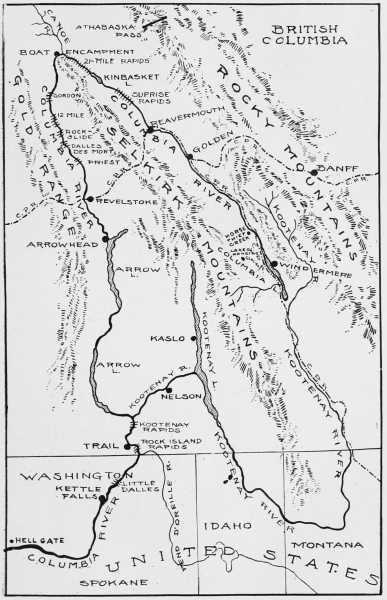
The Arrow Lakes are merely enlargements of the
Columbia, keeping throughout their lengths the same
general north-to-south direction of this part of the
river. The upper lake is thirty-three miles in length,
and has an average width of about three miles. Sixteen
miles of comparatively swift river runs from the
upper to the lower lake. The latter, which is forty-two
miles long and two and a half wide, is somewhat
less precipitously walled than the upper lake, and
there are considerable patches of cultivation here and
there along its banks—mostly apple orchards. There
is a steamer channel all the way up the Columbia to
Revelstoke, but the present service, maintained by
the Canadian Pacific at its usual high standard, starts
at the head of the upper lake and finishes at West
Robson, some miles down the Columbia from the foot
of the lower lake. This is one of the very finest lake
trips anywhere in the world; I found it an unending
source of delight, even after a fortnight of the superlative
scenery of the Big Bend.
There is a stock story they tell of the Arrow Lakes,
and which appears intended to convey to the simple
tourist a graphic idea of the precipitousness of their
rocky walls. The skipper of my steamer told it while
we were ploughing down the upper lake. Seeing a
man struggling in the water near the bank one day,
he ran some distance off his course to throw the chap
a line. Disdaining all aid, the fellow kept right on
swimming toward the shore. “Don’t worry about
me,” he shouted back; “this is only the third time
I’ve fallen off my ranch to-day.”
I told the Captain that the story sounded all right
to me except in one particular—that even my glass
failed to reveal any ranches for a man to fall off of.
“Oh, that’s all right,” was the unperturbed reply;
“there was one when that yarn was started, but I
guess it fell into the lake too. But mebbe I had ought
to keep it for the lower lake, though,” he added;
“there is still some un-slid ranches down there.”
Nelson is a fine little city that hangs to a rocky
mountainside right at the point where Kootenay Lake
spills over and discharges its surplus water into a
wild, white torrent that seems to be trying to atone
at the last for its long delay in making up its mind
to join the Columbia. Nelson was made by the rich
silver-lead mines of the Kootenay district, but it was
so well made that, even now with the first fine frenzy
of the mining excitement over, it is still able to carry
on strongly as a commercial distributing and fruit
shipping centre. It is peopled by the same fine, out-door
loving folk that one finds through all of western
Canada, and is especially noted for its aquatic sports.
I am only sorry that I was not able to see more of
both Nelson and its people.
As soon as I saw Captain Armstrong I made a
clean breast to him about my failure to unearth the
treasure at the Bend. He was a good sport and bore
up better than one would expect a man to under the
circumstances. “I wish that matter of K—— and
his D. T.’s had come up before you left,” was his only
comment.
“Why?” I asked. “I can’t see what difference that
would have made. We didn’t waste a lot of time
digging.”
“That’s just it,” said the Captain with a wry grin.
“Wouldn’t you have gone right on digging if you
had known that the spell of jim-jams that finished
K—— came from some stuff he got from a section-hand
at Beavermouth? Now I suppose I’ll have to
watch my chance and run down and salvage that keg
of old Scotch myself.” It shows the stuff that Armstrong
was made of when I say that, even after the
way I had betrayed the trust he had reposed in me,
he was still game to go on with the Columbia trip.
That’s the sort of man he was.
Boats of anywhere near the design we would need
for the river were scarce, the Captain reported, but
there was one which he thought might do. This
proved to be a sixteen-foot, clinker-built skiff that had
been constructed especially to carry an out-board
motor. She had ample beam, a fair freeboard and a
considerable sheer. The principal thing against her
was the square stern, and that was of less moment
running down river than if we had been working up.
It did seem just a bit like asking for trouble, tackling
the Columbia in a boat built entirely for lake use;
but Captain Armstrong’s approval of her was quite
good enough for me. Save for her amiable weakness
of yielding somewhat overreadily to the seductive embraces
of whirlpools—a trait common to all square-sterned
craft of inconsiderable length—she proved
more than equal to the task set for her. We paid
fifty-five dollars for her—about half what she had
cost—and there was a charge of ten dollars for expressing
her to West Robson, on the Columbia.
We left Nelson by train for Castlegar, on the Columbia
just below West Robson, the afternoon of
October nineteenth. The track runs in sight of the
Kootenay practically all of the way. There is a drop
of three hundred and fifty feet in the twenty-eight
miles of river between the outlet of the lake and the
Columbia, with no considerable stretch that it would
be safe to run with a boat. A large part of the drop
occurs in two fine cataracts called Bonnington Falls,
where there is an important hydro-electric plant, serving
Nelson and Trail with power; but most of the
rest of the way the river is one continuous series of
foam-white cascades with short quiet stretches between.
The last two or three miles to the river the
railway runs through the remarkable colony of Russian
Doukobours, with a station at Brilliant, where
their big co-operative jam factory and administrative
offices are located. We had a more intimate glimpse
of this interesting colony from the river the following
day.
We found the express car with the boat on the siding
at West Robson, and the three of us—Armstrong,
Roos and myself—had little difficulty in sliding
her down the quay and launching her in the Columbia.
Pulling a mile down the quiet current, we
tied her up for the night at the Castlegar Ferry.
Then we cut across the bend through the woods for a
look at Kootenay Rapids, the first stretch of fast
water we were to encounter. After the rough-and-rowdy
rapids of the Big Bend, this quarter-mile of
white riffle looked like comparatively easy running.
It was a very different sort of a craft we had now,
however, and Armstrong took the occasion to give the
channel a careful study. There were a lot of big black
rocks cropping up all the way across, but he thought
that, by keeping well in toward the right bank, we
could make it without much trouble.
On the way back to the hotel at Castlegar, the
Captain was hailed from the doorway of a cabin set
in the midst of a fresh bit of clearing. It turned out
to be a boatman who had accompanied him and Mr.
Forde, of the Canadian Department of Public
Works, on a part of their voyage down the Columbia
in 1915. They reminisced for half an hour in the
gathering twilight, talking mostly of the occasion
when a whirlpool had stood their Peterboro on end
in the Little Dalles. I found this just a bit disturbing,
for Armstrong had already confided to me that
he intended running the Little Dalles.
The boat trimmed well when we came to stow the
load the next morning, but when the three of us took
our places she was rather lower in the water than we
had expected she was going to be. She seemed very
small after Blackmore’s big thirty-footer, and the
water uncomfortably close at hand. She was buoyant
enough out in the current, however, and responded
very smartly to paddle and oars when Armstrong and
I tried a few practice manœuvres. The Captain sat
on his bedding roll in the stern, plying his long paddle,
and I pulled a pair of oars from the forward
thwart. Roos sat on the after thwart, facing Armstrong,
with his tripod, camera and most of the luggage
stowed between them. She was loaded to ride
high by the head, as it was white water rather than
whirlpools that was in immediate prospect. With a
small boat and a consequent comparatively small
margin of safety, one has to make his trim a sort of a
compromise. For rough, sloppy rapids it is well to
have the bows just about as high in the air as you can
get them. On the other hand, it is likely to be fatal
to get into a bad whirlpool with her too much down
by the stern. As the one succeeds the other as a general
rule, about the best you can do is to strike a comfortable
mean based on what you know of the water
ahead.
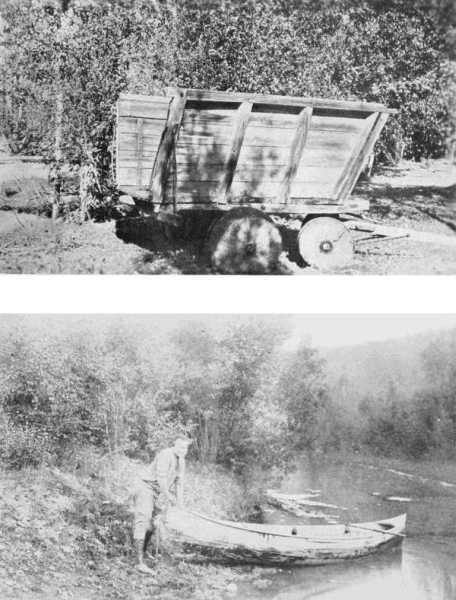
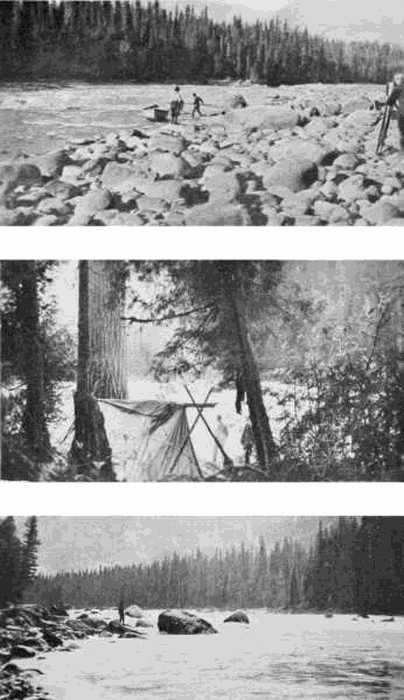
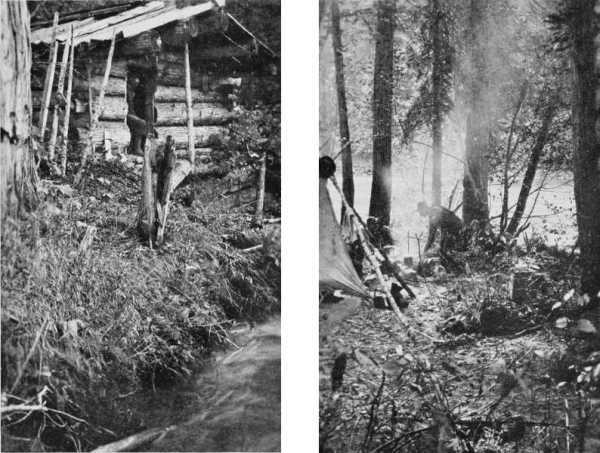
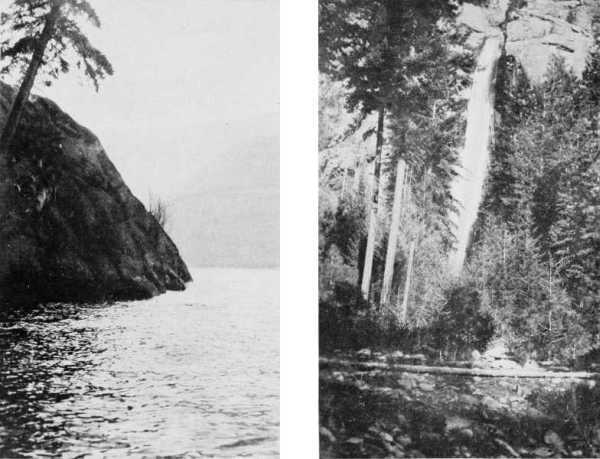
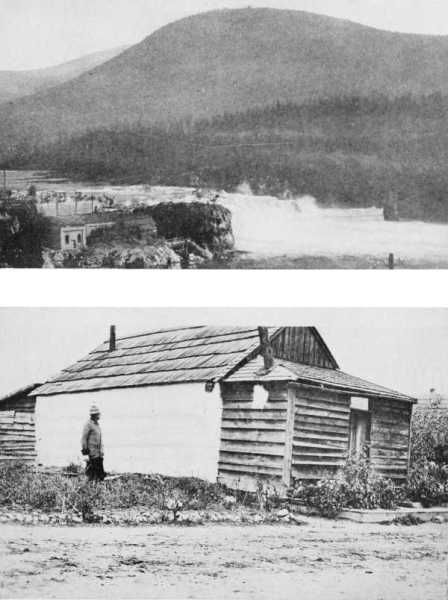 BONNINGTON FALLS OF THE KOOTENAY (above)
PLASTERED LOG CABIN IN THE DOUKHOBOR VILLAGE (below)
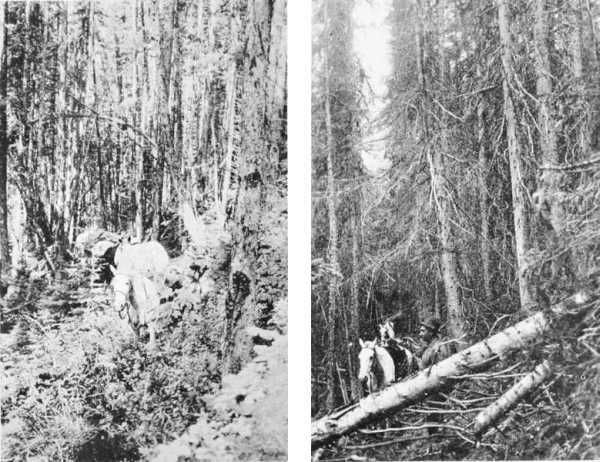
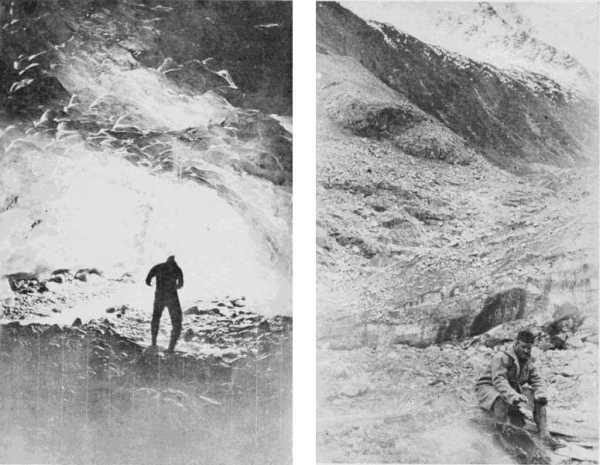
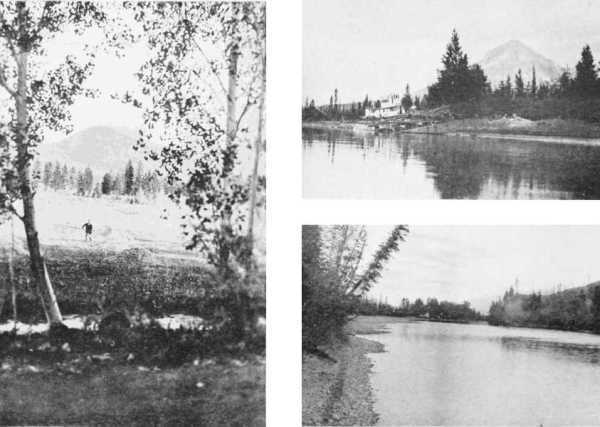
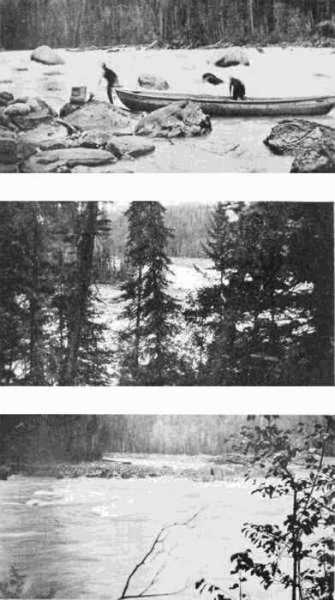
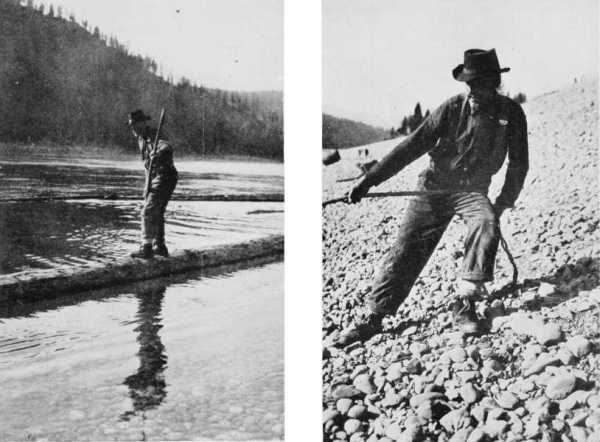
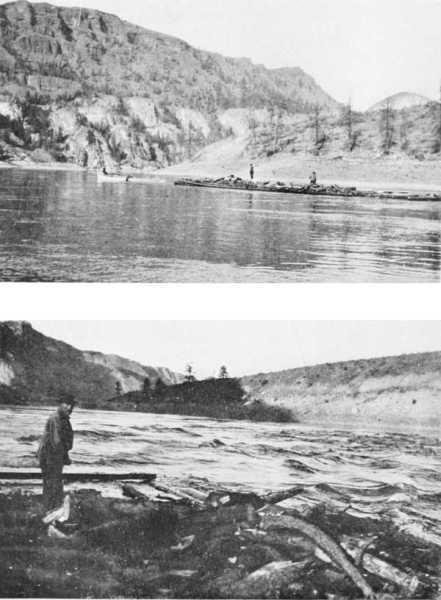
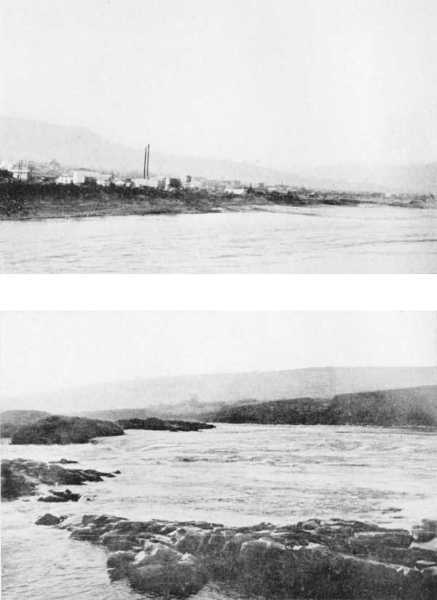
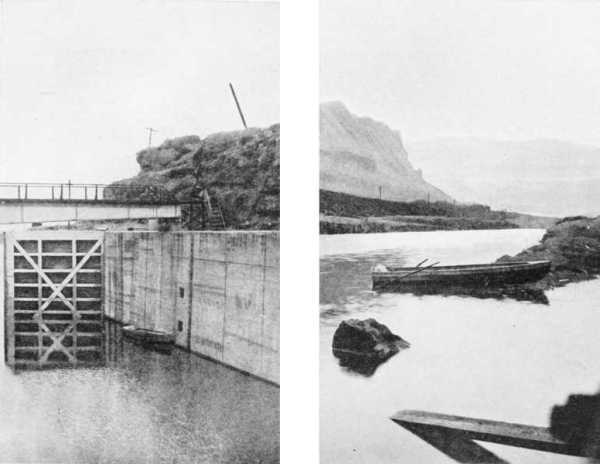
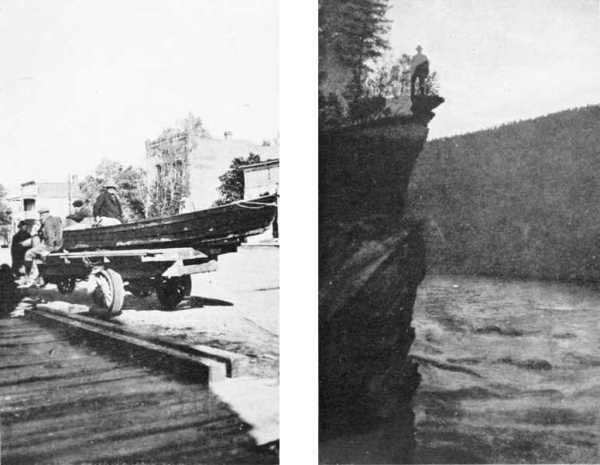 TRUCKING THE SKIFF THROUGH KETTLE FALLS (left)
TWILIGHT IN THE GORGE AT KETTLE FALLS (right)
I found it very awkward for a while pulling with
two oars after having worked for so long with one,
and this difficulty—especially in bad water—I never
quite overcame. In a really rough rapid one oar is
all a man can handle properly, and he does well if he
manages that. Your stroke is largely determined by
the sort of stuff the blade is going into, and—as on
the verge of an eddy—with the water to port running
in one direction, and that to starboard running
another, it is obviously impossible for a man handling
two oars to do full justice to the situation. He simply
has to do the best he can and leave the rest to the
man with the paddle in the stern. When the latter
is an expert with the experience of Captain Armstrong
there is little likelihood of serious trouble.
The matter of keeping a lookout is also much more
difficult in a small boat. In a craft with only a few
inches of freeboard it is obviously out of the question
for a steersman to keep his feet through a rapid, as
he may do without risk in a batteau or canoe large
enough to give him a chance to brace his knees against
the sides. Armstrong effected the best compromise
possible by standing and getting a good “look-see”
while he could, and then settling back into a securer
position when the boat struck the rough water. The
three or four feet less of vantage from which to con
the channel imposes a good deal of a handicap, but
there is no help for it.
We ran both pitches of Kootenay Rapids easily
and smartly. Her bows slapped down pretty hard
when she tumbled off the tops of some of the bigger
rollers, but into not the softest of the souse-holes
would she put her high-held head. We took in plenty
of spray, but nothing green—nothing that couldn’t
be bailed without stopping. It was a lot better performance
than one was entitled to expect of a lake
boat running her maiden rapid.
“She’ll do!” chuckled the Captain with a satisfied
grin, resting on his paddle as we slid easily out of the
final run of swirls; “you ought to take her right
through without a lot of trouble.” “Imshallah!” I
interjected piously, anxious not to offend the River
God with a display of overmuch confidence. I began
to call her “Imshallah” in my mind from that time on,
and “Imshallah”—“God willing”—she remained
until I tied her up for her well-earned rest in a Portland
boat-house. It was in the course of the next day
or two that I made a propitiatory offering to the
River God in the form of the remnants of the jodpurs
he had tried so hard to snatch from me at Rock Slide
Rapids. I’ve always had a sneaking feeling offerings
of that kind are “good medicine;” that the old Greeks
knew what they were doing when they squared things
with the Gods in advance on venturing forth into unknown
waters.
Big and Little Tin Cup Rapids, which are due to
the obstruction caused by boulders washed down by
the torrential Kootenay River, gave us little trouble.
There is a channel of good depth right down the middle
of both, and we splashed through this without
getting into much besides flying foam. Just below
we pulled up to the left bank and landed for a look at
one of the Doukobour villages.
The Doukobours are a strange Russian religious
sect, with beliefs and observances quite at variance
with those of the Greek Church. Indeed, it was the
persecutions of the Orthodox Russians that were responsible
for driving considerable numbers of them to
Canada. They are best known in America, not for
their indefatigable industry and many other good
traits, but for their highly original form of protesting
when they have fancied that certain of their rights
were being restricted by Canadian law. On repeated
occasions of this kind whole colonies of them—men,
women and children—have thrown aside their every
rag of clothing and started off marching about the
country. Perhaps it is not strange that more has
been written about these strange pilgrimages than of
the fact that the Doukobours have cleared and
brought to a high state of productivity many square
miles of land that, but for their unflagging energy,
would still be worthless. In spite of their somewhat
unconventional habits, these simple people have been
an incalculably valuable economic asset to western
Canada.
On the off chance that there might be an incipient
“protest” brewing, Roos took his movie outfit ashore
with him. He met with no luck. Indeed, we found
the women of the astonishingly clean little village of
plastered and whitewashed cabins extremely shy of
even our hand cameras. The Captain thought that
this was probably due to the fact that they had been
a good deal pestered by kodak fiends while Godivaing
round the country on some of their protest
marches. “The people were very indignant about it,”
he said; “but I never heard of any one pulling
down their blinds.” Coventry was really very “Victorian”
in its attitude toward Lady Godiva’s “protest.”
There was good swift water all the way from Castlegar
to Trail, and we averaged close to nine miles an
hour during the time we were on the river. At China
Bar the river was a good deal spread out, running in
channels between low gravel islands. Any one of
these was runnable for a small boat, and we did not
need to keep to the main channel that had once been
maintained for steamers. Sixteen miles below Castlegar,
and about half a mile below the mouth of Sullivan
Creek, there was a long black reef of basaltic
rock stretching a third of the way across the river.
We shot past it without difficulty by keeping near the
left bank. The sulphurous fumes of the big smelter
blotching the southern sky with saffron and coppery
red clouds indicated that we were nearing Trail. The
stacks, with the town below and beyond, came into
view just as we hit the head of a fast-running riffle.
We ran the last half mile at a swift clip, pulling up
into about the only place that looked like an eddy on
the Trail side of the river. That this proved to be the
slack water behind the crumbling city dump could not
be helped. He who rides the running road cannot be
too particular about his landing places.
We reached Trail before noon, and, so far as time
was concerned, could just as well have run right on
across the American line to Northport that afternoon.
However, October twenty-first turned out to be a
date of considerable importance to British Columbians,
for it was the day of the election to determine
whether that province should continue dry or, as the
proponents of wetness euphemized it, return to
“moderation.” As there was a special provision by
which voters absent from their place of registration
could cast their ballots wherever they chanced to be,
Captain Armstrong was anxious to stop over and do
his bit for “moderation.” Indeed, I was a bit worried
at first for fear, by way of compensating in a measure
for the injury we had done him in failing to come
through with the treasure from the Big Bend, he
would expect Roos and me to put in a few absentee
ballots for “moderation.” There was a rumour about
that a vote for “moderation” would be later redeemable—in
case “moderation” carried, of course—in the
voter’s weight of the old familiar juice. I never got
further than a pencilled computation on the “temperance”
bar of the Crown Point Hotel that two hundred
and thirty-five pounds (I was down to that by now)
would work out to something like one hundred seventeen
and a half quarts. This on the rule that “A
pint’s a pound, the world round.” That was as far
as I got, I say, for there seemed rather too much of a
chance of international complications sooner or later.
But I am still wondering just what is the law covering
the case of a man who sells his vote in a foreign
country—and for his weight in whisky that he would
probably never have delivered to him. I doubt very
much if there is any precedent to go by.
Between votes—or rather before Captain Armstrong
voted—we took the occasion to go over the
smelter of the Consolidated Mining and Smelting
Company. It is one of the most modern plants of its
kind in the world, and treats ore from all over western
Canada. We were greatly interested in the recently
installed zinc-leaching plant for the handling of an
especially refractory ore from the company’s own
mine in the Kootenays. This ore had resisted for
years every attempt to extract its zinc at a profit,
and the perfection of the intricate process through
which it is now put at Trail has made a mine, which
would otherwise have remained practically valueless,
worth untold millions. The two thousand and more
employés of the smelter are the main factor in the
prosperity of this live and by no means unattractive
little town.
We had two very emphatic warnings before leaving
Trail the next morning—one was on no account to
attempt to take any drinkables across the line by the
river, and the other was to keep a weather eye lifting
in running the rapids at the Rock Islands, two miles
below town. As we reached the latter before we did
the International Boundary Line, we started ’wareing
the rapids first. This was by no means as empty
a warning as many I was to have later. The islands
proved to be two enormous granite rocks, between
which the river rushed with great velocity. The Captain
headed the boat into the deep, swift channel to
the right, avoiding by a couple of yards a walloping
whale of a whirlpool that came spinning right past
the bow. I didn’t see it, of course, until it passed
astern; but it looked to me then as though its whirling
centre was depressed a good three feet below the
surface of the river, and with a black, bottomless funnel
opening out of that. I was just about to register
“nonchalance” by getting off my “all-day-sucker”
joke, when I suddenly felt the thwart beneath me
begin to push upwards like the floor of a jerkily-started
elevator, only with a rotary action. Fanning
empty air with both oars, I was saved from falling
backwards by the forty-five degree up-tilt of the boat.
Way beneath me—down below the surface of the river—Armstrong,
pop-eyed, was leaning sharply forward
to keep from being dumped out over the stern.
Roos, with a death-grip on either gunwale, was trying
to keep from falling into the Captain’s lap. Round
we went like a prancing horse, and just as the boat
had completed the hundred and eighty degrees that
headed her momentarily up-river, something seemed
to drop away beneath her bottom, and as she sunk
into the hole there came a great snorting “ku-whouf!”
and about a barrel of water came pouring its solid
green flood over the stern and, incidentally, the Captain.
A couple of seconds later the boat had completed
her round and settled back on a comparatively
even keel as hard-plied oars and paddle wrenched
her out of the grip of the Thing that had held her in
its clutch. I saw it plainly as it did its dervish dance
of disappointment as we drew away. It looked to
me not over half as large as that first one which the
Captain had so cleverly avoided.
“That was about the way we got caught in the
Little Dalles,” observed Armstrong when we were in
quieter water again. “Only it was a worse whirlpool
than that one that did it. This square stern gives the
water more of a grip than it can get on a canoe. We’ll
have to watch out for it.”
Save over a broad, shallow bar across the current at
the mouth of the Salmon, there was deep, swift water
all the way to Waneta, the Canadian Customs station.
Here we landed Roos to await the morning
train from Nelson to Spokane and go through to
Northport to arrange the American Customs formalities.
At a final conference we decided to heed the
warning about not attempting to carry any drinkables
openly into the United States. Stowing what little
there was left where not the most lynx-eyed or ferret-nosed
Customs Officer could ever get at it, we pushed
off.
There is a fairly fast current all the way to Northport,
but from the fact that we made the eleven miles
in about three-quarters of an hour, it seems likely
that, between paddle and oars, the boat was driven
somewhat faster than the Columbia. Just below
Waneta and immediately above the International
Boundary Line, the Pend d’Oreille or Clark’s Fork
flows, or rather falls into the Columbia. This really
magnificent stream comes tumbling down a sheer-walled
gorge in fall after fall, several of which can
be seen in narrowing perspective from the Columbia
itself. Its final leap is over a ten-feet-high ledge
which extends all the way across its two-hundred-feet-wide
mouth. Above this fine cataract it is the Pend
d’Oreille, below it, the Columbia. I know of no place
where two such rivers come together with such fine
spectacular effect, in a way so fitting to the character
of each.
The Pend d’Oreille is generally rated as the principal
tributary of the upper Columbia. Although the
Kootenay—because it flows through a region of considerably
greater annual rainfall—carries rather the
more water of the two, the Pend d’Oreille is longer
and drains a far more extensive watershed—that lying
between the main chain of the Rockies and the Bitter
Root and Cœur d’Alene ranges. Great as is the
combined discharge of these two fine rivers, their
effect on the Columbia is not apparent to the eye. If
anything, the latter looks a bigger stream where it
flows out of the lower Arrow Lake, above the Kootenay,
than it does where it crosses the American Line
below the Pend d’Oreille. As a matter of fact, its
flow must be nearly doubled at the latter point, but
the swifter current reduces its apparent volume.
Nothing but the most careful computations, based
on speed of current and area of cross-section, will give
anything approximating the real discharge of a river.
I was a good deal interested in the Pend d’Oreille,
because it was on one of its upper tributaries, the
Flathead in Montana, that I had made my first timid
effort at rapid-running a good many years previously.
It hadn’t been a brilliant success—for two logs tied
together with ropes hardly make the ideal of a raft;
but the glamour of the hare-brained stunt had survived
the wetting. I should dearly have loved to explore
that wonderful black-walled canyon, with its
unending succession of cataracts and cascades, but
lack of time forbade. The drizzling rain made it impossible
even to get a good photograph of the fine
frenzy of that final mad leap into the Columbia.
It was funny the way that rain acted. For something
like a month now there had been only two or
three days of reasonably fair weather, and for the last
fortnight the sun had hardly been glimpsed at all.
Pulling up to Waneta in a clammy drizzle, Captain
Armstrong remarked, as he drew the collar of his
waterproof closer to decrease the drainage down the
back of his neck, that he reckoned they wouldn’t stand
for weather of that kind over in “God’s Country.” As
there was nothing but sodden clouds to the southward,
I didn’t feel like giving him any definite assurance
on the point at the moment. However, when we
crossed the Line an hour later the rain had ceased. A
couple of miles farther down the clouds were breaking
up, and at Northport the sun was shining. I did
not have another rainy day, nor even one more than
slightly overcast, until I was almost at the Cascades.
I trust my good Canadian friend was as deeply impressed
as he claimed to be.
Beyond a sharp riffle between jagged rock islands
above Deadman’s Eddy, and one or two shallow boulder
bars where the channels were a bit obscure, it was
good open-and-above-board water all the way to
Northport. The “Eddy” is a whirling back-sweep
of water at a bend of the river, and is supposed to hold
up for inspection everything floatable that the Columbia
brings down from Canada. “Funny they never
thought of calling it ‘Customs Eddy,’” Armstrong
said. From the condition of its littered banks, it
looked to be almost as prolific of “pickings” as the
great drift pile of Kinbasket Lake. Being near a
town, however, it is doubtless much more thoroughly
gone over.
We tied up below the Ferry at Northport, which
was the rendezvous to which Roos was to bring the
Customs Inspector. The ferry-man, who had once
seen Captain Armstrong run the rapids of the upper
Kootenay with one of his steamers, was greatly elated
over having such a notable walking the quarterdeck
of his own humble craft. Armstrong, in turn, was
scarcely less excited over an automatic pumping contrivance
which the ferry-man had rigged up to keep
his pontoons dry. After waiting for an hour, we took
our bags and walked up to the hotel on the main
street at the top of the bluff. We found Roos in the
office reading a last year’s haberdashery catalogue.
He said he had not expected us for a couple of hours
yet, and that he had arranged for inspection at three
o’clock. That gave us time for a bath and lunch ourselves.
As our bags were now well beyond the tentacles
of the Customs, we did a little figuring on the
table-cloth between courses. By this we proved that,
had we had the nerve to disregard the warnings of
well-meaning friends in Trail and filled our hand-bags
with Scotch instead of personal effects, Armstrong
would now have had fourteen quarts up in his
room, and I eighteen quarts. Then the waitress gave
us current local quotations, and we started to figure
values. I shall never know whether or not there would
have been room on the corner of that gravy and egg
broidered napery for my stupendous total. Just as
I was beginning to run over the edge, the Inspector
came in and asked if we would mind letting him see
those two suit-cases we had brought to the hotel with
us! Many and various are the joys of virtue, but none
of the others comparable to that one which sets you
aglow as you say “Search me!” when, by the special
intervention of the providence which watches over
fools and drunks, you haven’t got goods.
The inspection, both at the hotel and at the ferry,
was fairly perfunctory, though I did notice that the
Customs man assumed a rather springy step when he
trod the light inner bottom of the skiff. Roos filmed
the operation as a part of the picture, I acting as
much as I could like I thought a farmer would act at
his first Customs inspection. Roos, complaining that
I didn’t “do it natural,” wanted to shoot over again.
The Customs man was willing, but Armstrong and I,
trudging purposefully off up the road, refused to
return. Roos followed us to the hotel in considerable
dudgeon. “Why wouldn’t you let me make that shot
over?” he asked. “It was an ‘oil-can’—rotten!” “Because,”
I replied evenly, looking him straight in the
eye, “I was afraid the Inspector might try that jig-a-jig
step of his on the false bottom in the bow if we put
him through the show a second time. I don’t believe
in tempting providence. We can get a street-car
conductor and make that Inspection shot again in
Portland. This isn’t....” “You’re right,” cut in
Roos, with a dawning grin of comprehension. “I beg
your pardon. You’re a deeper bird than I gave you
credit for. Or perhaps it was the Captain....”
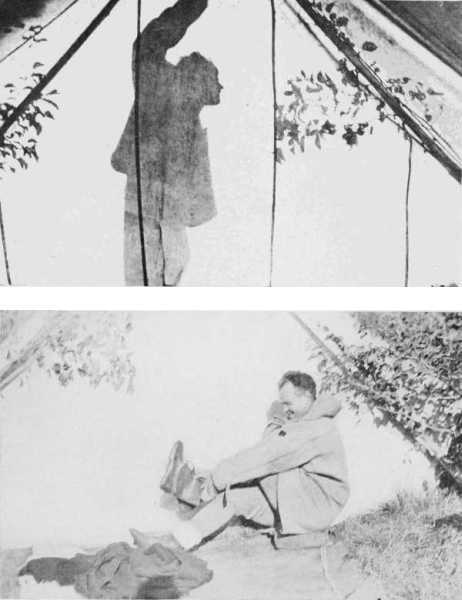
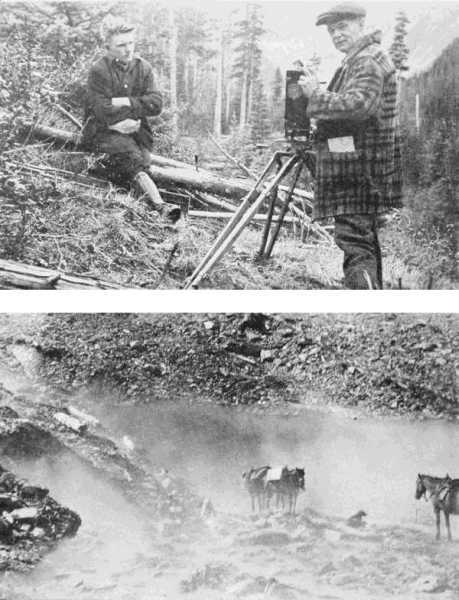
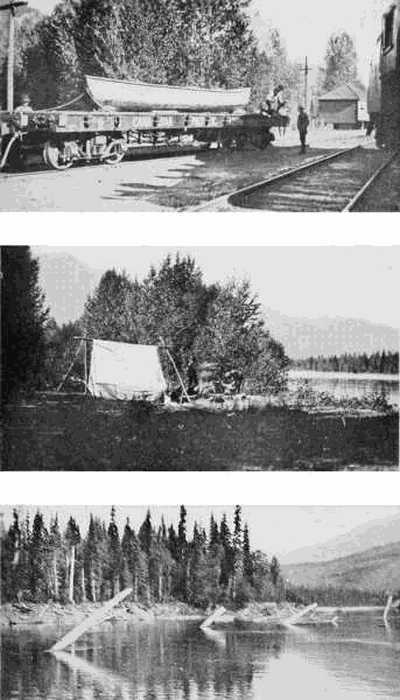
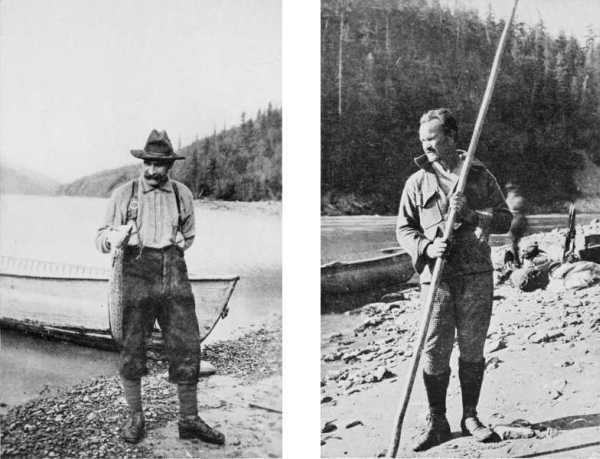
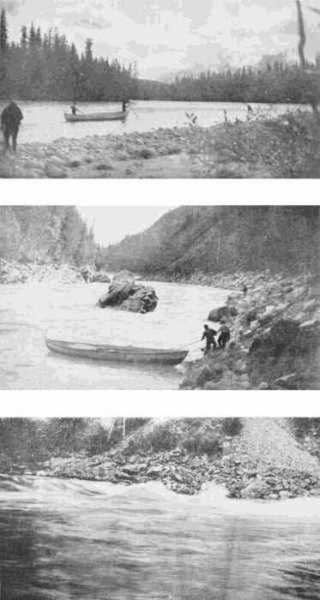
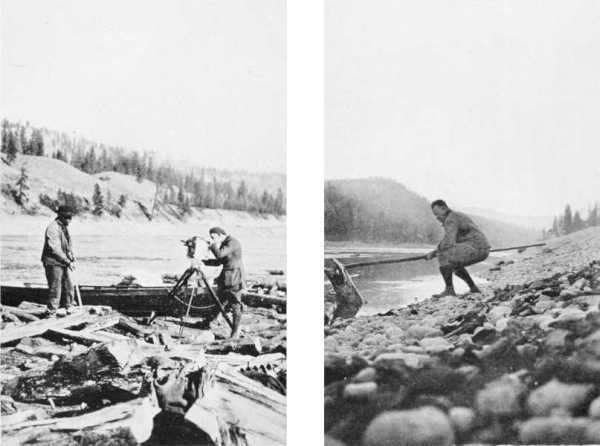
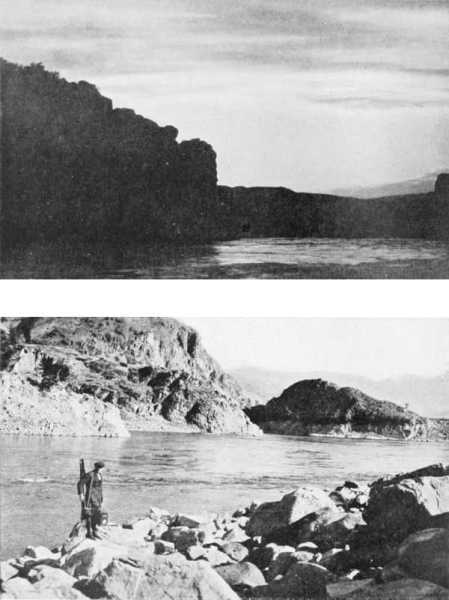
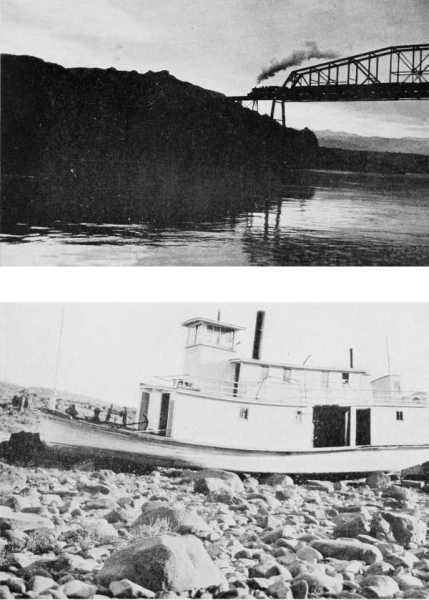
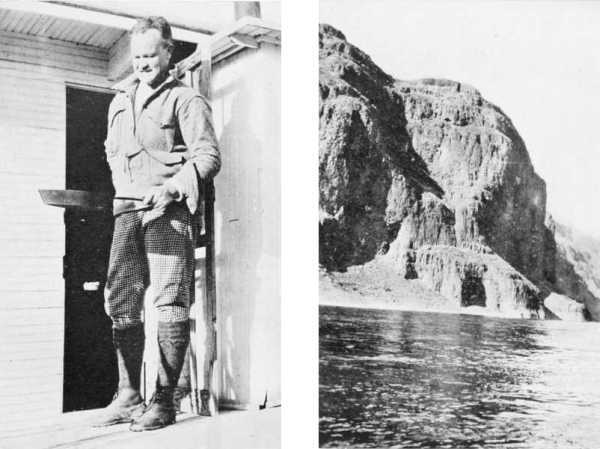
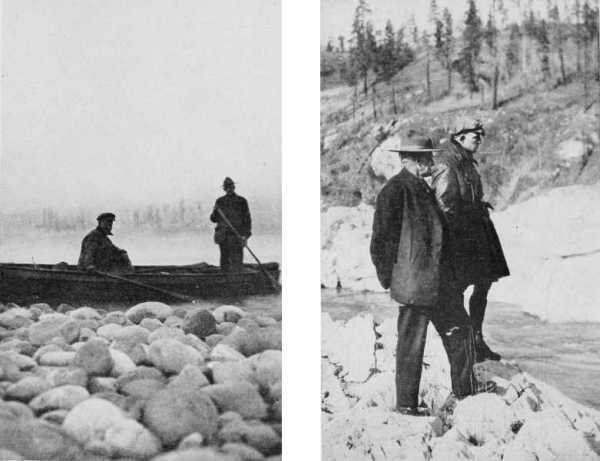 WAITING FOR THE FOG TO LIFT ABOVE BISHOP’S RAPID (left)
ROSS AND ARMSTRONG REGISTERING "GLOOM" (right)
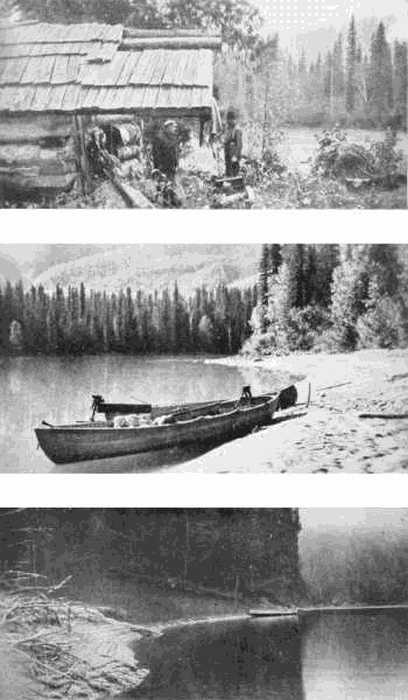
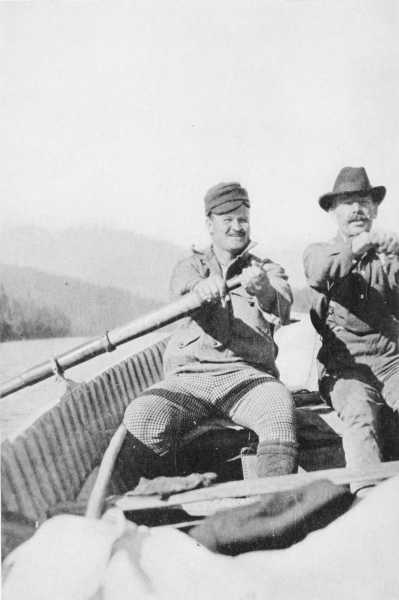
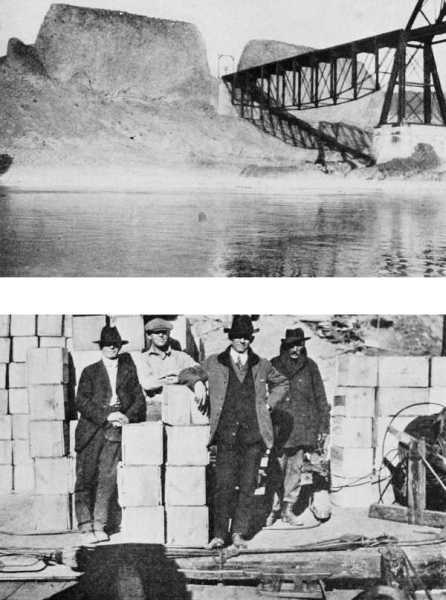
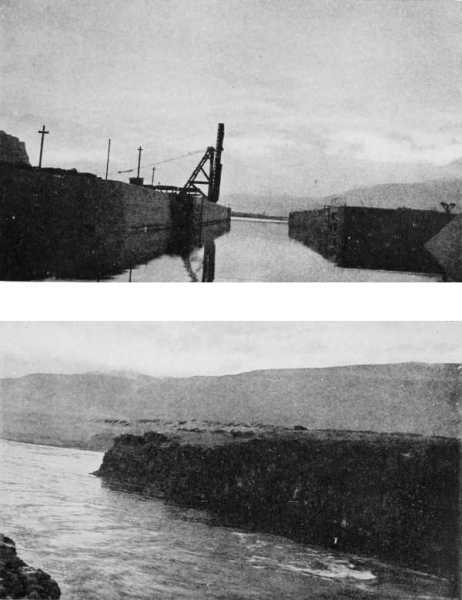
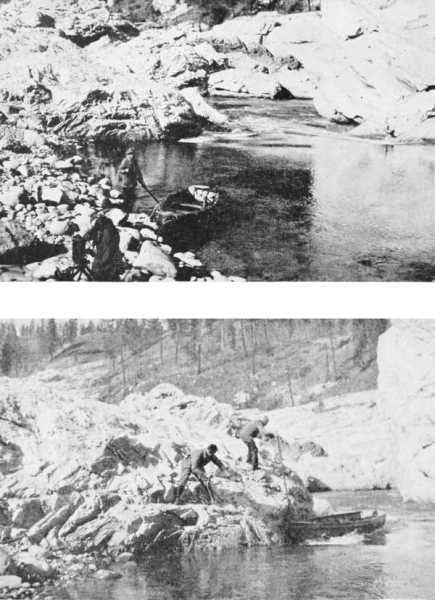 THE “INTAKE” AT THE LITTLE DALLES (above)
WHERE WE STARTED TO LINE THE LITTLE DALLES (below)
A heavy fog filled the river gorge from bank to
bank when we pushed off the following morning, and
we had to nose down carefully to avoid the piers of
the bridge of the Great Northern branch line to Rossland.
A quarter of a mile farther down the river
began shoaling over gravel bars, and out of the mist
ahead came the rumble of water tumbling over boulders.
This was an inconsiderable riffle called Bishop’s
Rapid, but the Captain was too old a river man to
care to go into it without light to choose his channel.
A half hour’s wait on a gravel bar in mid-stream
brought a lifting of the fog, and we ran through by
the right hand of the two shallow channels without
difficulty. In brilliant sunshine we pulled down a
broad stretch of deep and rapidly slackening water to
the gleaming white lime-stone barrier at the head of
the Little Dalles.
All of Northport had been a unit in warning us not
to attempt to run the Little Dalles. Nearly every
one, as far as I could judge, had lost some relative
there, and one man gave a very circumstantial description
of how he had seen a big batteau, with six
Swede lumbermen, sucked out of sight there, never
to reappear. On cross-questioning, he admitted that
this was at high water, and that there was nothing
like so much “suck” in the whirlpools at the present
stage. The Captain, however, having just received
telephonic word from Nelson that “moderation” had
carried in B. C. by a decisive majority, felt that nothing
short of running the Little Dalles would be adequate
celebration. He had managed to come through
right-side-up in a Peterboro once, and he thought our
skiff ought to be equal to the stunt. He held that
opinion just long enough for him to climb to the top
of the cliff that forms the left wall of river at the
gorge and take one good, long, comprehensive look
into the depths.
“Nothing doing,” he said, with a decisive shake of
his broad-brimmed Stetson. “The river’s four or five
feet higher than when we ran through here in ’fifteen,
and that makes all the difference. It was touch-and-go
for a minute then, and now it’s out of the question
for a small boat. If we can’t line, we’ll have to find
some way to portage.”
The Little Dalles are formed by a great reef of
lime-stone which, at one time, probably made a dam all
the way across the river. The narrow channel which
the Columbia has worn through the stone is less than
two hundred feet in width for a considerable distance,
and has lofty perpendicular walls. The river is divided
by a small rock island into two channels at the
head, the main one, to the right, being about two hundred
feet in width, and the narrow left-hand one not
over forty feet. The depth of the main channel is
very great—probably much greater than its narrowest
width; so that here, as also at Tumwater and “Five-Mile”
in the Great Dalles, it may be truly said that
the Columbia “has to turn on its side to wriggle
through.”
It is that little rock island at the head of the gorge,
extending, as it does, almost longitudinally across the
current that makes all the trouble. It starts one set
of whirlpools running down the right-hand channel
and another set down the left-hand. Every one of
the vortices in this dual series of spinning “suckers”
is more than one would care to take any liberties
with if it could be avoided; and either line of whirlpools,
taken alone, probably could be avoided. The
impassable barrage comes a hundred feet below the
point where the left-hand torrent precipitates itself
at right-angles into the current of the right-hand one,
and the two lines of whirlpools converge in a “V” and
form one big walloping sockdolager. Him there
would still be room to run by if he were “whouf-ing”
there alone; but his satellites won’t have it. Their
accursed team-work is such that the spreading “V”
above catches everything that comes down stream
and feeds it into the maw of the big whirlpool as into
a hopper. Logs, ties, shingle-bolts, fence-posts—all
the refuse of sawmills and the flotsam and jetsam of
farms and towns—are gulped with a “whouf!” and
when they reappear again, a mile or two down river,
they are all scoured smooth and round-cornered by
their passage through the monster’s alimentary canal.
“I’m sorry not to celebrate the victory of ‘moderation,’”
said the Captain finally, with another regretful
shake of his head; “but ‘moderation’ begins at
home. It would be immoderately foolish to put the
skiff into that line of whirlpools, the way they’re running
now.” Roos was the only one who was inclined
to dispute that decision, and as his part would have
been to stand out on the brink of the cliff and turn the
crank, it was only natural that he should take the
“artistic” rather than the “humanitarian” view.
As a last resort before portaging, we tried lining
down, starting at the head of the narrow left-hand
channel. We gave it up at the end of a hundred
feet. A monkey at one end of the line and a log of
wood at the other would have made the only combination
calculated to get by that way. It was no job
for a shaky-kneed man and a sinkable boat. There
was nothing to do but look up a team or truck. What
appeared to be the remains of the ancient portage
road ran down from an abandoned farm to the river,
and it seemed likely some kind of vehicle could be
brought over it.
As the highway ran along the bench, four or five
hundred feet above the river, I set off by the railroad
track, which was comparatively close at hand. At the
end of a couple of miles I reached a small station
called Marble, the shipping point for a large apple
orchard project financed by the J. G. White Company
of New York. Mr. Reed, the resident manager,
immediately ordered a powerful team and wagon
placed at my disposal, and with that I returned northward
over the highway. We had a rough time getting
down through brush and dead-falls to the river,
but finally made it without an upset. Roos having
finished what pictures he wanted—including one of
the Captain standing on the brink of the cliff and registering
“surprise-cum-disappointment-cum-disgust,”—we
loaded the skiff and our outfit onto the wagon
and started the long climb up to the top of the bench.
The discovery of an overgrown but still passable road
offered a better route than that followed in coming
down, and we made the highway, and on to the village,
in good time. Mr. Reed dangled the bait of a
French chef and rooms in the company’s hotel as an
inducement to spend the night with him, but we had
not the time to accept the kind invitation. His ready
courtesy was of the kind which I learned later I
could expect as a matter of course all along the river.
Never did I have trouble in getting help when I
needed it, and when it was charged for, it was almost
invariably an under rather than an over-charge. The
running road is the one place left where the people
have not been spoiled as have those on the highways
frequented by motor tourists.
Launching the boat from the Marble Ferry at four
o’clock, we pulled off in a good current in the hope
of reaching Bossburg before dark. Between the
windings of the river and several considerable
stretches of slack water, however, our progress was
less than anticipated. Shut in by high hills on both
sides, night descended early upon the river, and at
five-thirty I found myself pulling in Stygian blackness.
Knowing there was no really bad water ahead,
the Captain let her slide through a couple of easy
riffles, the white-topped waves barely guessed as they
flagged us with ghostly signals. But a deepening
growl, borne on the wings of the slight up-river night-breeze,
demanded more consideration. No one but a
lunatic goes into a strange rapid in a poor light, to
say nothing of complete darkness. Pulling into an
eddy by the left bank, we stopped and listened. The
roar, though distant, was unmistakable. Water was
tumbling among rocks at a fairly good rate, certainly
too fast to warrant going into it in the dark.
While we were debating what to do, a black figure
silhouetted itself against the star-gleams at the top
of the low bank. “Hello, there!” hailed the Captain.
“Can you tell us how far it is to Bossburg?” “This
is Bossburg,” was the surprising but gratifying response.
“You’re there—that is, you’re here.” It
proved to be the local ferry-man, and Columbia ferry-men
are always obliging and always intelligent, at
least in matters relating to the river. Tying up the
boat, we left our stuff in his nearby house and sought
the hotel with our hand-bags. It was not a promising
looking hotel when we found it, for Bossburg was that
saddest of living things, an all-but-extinguished
boom-town; but the very kindly old couple who lived
there and catered to the occasional wayfarer bustled
about and got us a corking good meal—fried chicken
and biscuits as light as the whipped cream we had on
the candied peaches—and our beds were clean and
comfortable.
As we were now but a few miles above Kettle Falls,
the most complete obstruction in the whole length of
the Columbia, I took the occasion to telephone ahead
for a truck with which to make the very considerable
portage. There would be two or three miles at the
falls in any case, Captain Armstrong said, and he was
also inclined to think it would be advisable to extend
the portage to the foot of Grand Rapids, and thus
save a day’s hard lining. It was arranged that the
truck should meet us at the ruins of the old Hudson
Bay post, on the east bank some distance above the
upper fall.
We pushed off from Bossburg at eight o’clock on
the morning of October twenty-third. The water was
slack for several hundred yards, which was found to
be due to a reef extending all of the way across the
river and forming the rapid which we had heard
growling in the dark. This was called “Six Mile,” and
while it would have been an uncomfortable place to
tangle up with in the night, it was simple running
with the light of day. “Five Mile,” a bit farther
down, was studded with big black rocks, but none of
them hard to avoid. As we were running rather
ahead of the time of our rendezvous with the truck,
we stretched our legs the length and back of the main
street of Marcus, a growing little town which is the
junction point for the Boundary Branch of the Great
Northern. We passed the mouth of the Kettle River
shortly after running under the railway bridge, and a
pull across a big eddy carried us to the lake-like
stretch of water backed up by the rocky obstructions
responsible for Kettle Falls. The roar of the latter
filled the air as we headed into a shallow, mud-bottomed
lagoon widening riverward from the mouth
of a small creek and beached the skiff under a yellowing
fringe of willows. The site of the historic post
was in an extremely aged apple orchard immediately
above. It was one of those “inevitable” spots, where
the voyageurs of all time passing up or down the river
must have begun or ended their portages. I was trying
to conjure up pictures of a few of these in my
mind, when the chug-chugging of an engine somewhere
among the pines of the distant hillside recalled
me to a realization of the fact that it was time to get
ready for my own portage. Before we had our stuff
out of the boat the truck had come to a throbbing
standstill beyond the fringe of the willows. It promised
to be an easier portage than some of our predecessors
had had, in any event.
To maintain his “continuity,” Roos filmed the skiff
being taken out of the water and loaded upon the
truck, the truck passing down the main street of the
town of Kettle Falls, and a final launching in the
river seven miles below. Half way into town we
passed an old Indian mission that must have been
about contemporaneous with Hudson Bay operations.
Although no nails had been used in its construction,
the ancient building, with its high-pitched roof, still
survived in a comparatively good state of preservation.
The town is some little distance below the Falls,
and quite out of sight of the river, which flows here
between very high banks. We stopped at the hotel
for lunch before completing the portage.
After talking the situation over with Captain Armstrong,
I decided to fall in with his suggestion to pass
Grand Rapids as well as Kettle Falls in the portage.
There were only about five miles of boatable water
between the foot of the latter and the head of the
former, and then an arduous three-quarters of a mile
of lining that would have entailed the loss of another
day. There is a drop of twelve feet in about twelve
hundred yards in Grand Rapids, with nothing approaching
a clear channel among the huge black basaltic
rocks that have been scattered about through
them as from a big pepper shaker. As far as I could
learn, there is no record of any kind of a man-propelled
craft of whatever size ever having run through
and survived, but a small stern-wheeler, the Shoshone,
was run down several years ago at high water.
She reached the foot a good deal of a hulk, but still
right side up. This is rated as one of the maddest
things ever done with a steamer on the Columbia, and
the fact that it did not end in complete disaster is
reckoned by old river men as having been due in about
equal parts to the inflexible nerve of her skipper and
the intervention of the special providence that makes
a point of watching over mortals who do things like
that. I met Captain McDermid a fortnight later in
Potaris. He told me then, what I hadn’t heard before,
that he took his wife and children with him.
“Nellie thought a lot of both me and the little old
Shoshone,” he said with a wistful smile, “and she
reckoned that, if we went, she wouldn’t exactly like
to be left here alone. And so—I never could refuse
Nellie anything—I took her along. And now she
and the Shoshone are both gone.” He was a wonderful
chap—McDermid. All old Columbia River
skippers are. They wouldn’t have survived if they
hadn’t been.
There was a low bench on the left bank, about a
mile below the foot of Grand Rapids, which could be
reached by a rough road, and from which the boat
could be slid down over the rocks to the river. Running
to this point with the truck, we left our heavier
outfit at a road camp and dropped the boat at the
water’s edge, ready for launching the following
morning. Returning to the town, we were driven
up to the Falls by Dr. Baldwin, a prominent
member of this live and attractive little community,
where Roos made a number of shots. The upper
or main fall has a vertical drop of fifteen feet at low
water, while the lower fall is really a rough tumbling
cascade with a drop of ten feet in a quarter of a mile.
The river is divided at the head of the Falls by an
arrow-shaped rock island, the main channel being the
one to the right. The left-hand channel loops in a
broad “V” around the island and, running between
precipitous walls, accomplishes in a beautiful rapid the
same drop that the main channel does by the upper
fall. A rocky peninsula, extending squarely across
the course of the left-hand channel, forces the rolling
current of the latter practically to turn a somersault
before accepting the dictum that it must double back
northward for five or six hundred feet before uniting
with the main river. It was the savage swirling of
water in that rock-walled elbow where the “somersault”
takes place that prompted the imaginative
French-Canadian voyageurs to apply the appropriately
descriptive name of Chaudière to the boiling
maelstrom.
Up to the present the development of the enormous
power running to waste over Kettle Falls has gone little
further than the dreams of the brave community
of optimists who have been attracted there in the
belief that a material asset of such incalculable value
cannot always be ignored in a growing country like
our own. And they are right, of course, but a few
years ahead of time. It is only the children and
grandchildren of the living pioneers of the Columbia
who will see more than the beginning of its untold
millions of horse-power broken to harness. And in
the meantime the optimists of Kettle Falls are turning
their attention to agriculture and horticulture. Never
have I seen finer apple orchards than those through
which we drove on the way to resume our down-river
voyage.
The point from which we pushed off at ten o’clock
on the morning of October twenty-fourth must have
been only a little below that at which Lieutenant
Symons launched the batteau for his historic voyage
to the mouth of the Snake in 1881. Forty years have
gone by since that memorable undertaking, yet Symons’
report is to-day not only the most accurate
description of an upper Columbia voyage that has
ever been written, but also the most readable. During
the time I was running the three hundred and fifty
miles of river surveyed by Lieutenant Symons, I
found his admirable report only less fascinating on
the human side than it was of material assistance on
the practical.
Of his preparations for the voyage Lieutenant
Symons writes:
“I was fortunate enough to procure from John Rickey,
a settler and trader, who lives at the Grand Rapids, a
strongly built batteau, and had his assistance in selecting a
crew of Indians for the journey. The batteau was about
thirty feet long, four feet wide at the gunwales, and two
feet deep, and is as small a boat as the voyage should ever
be attempted in, if it is contemplated to go through all the
rapids. My first lookout had been to secure the services of
‘Old Pierre Agare’ as steersman, and I had to carry on
negotiations with him for several days before he finally consented
to go. Old Pierre is the only one of the old Hudson
Bay voyageurs now left who knows the river thoroughly at
all stages of water, from Colville to its mouth.... The
old man is seventy years of age, and hale and hearty, although
his eyesight is somewhat defective.... The other
Indians engaged were Pen-waw, Big Pierre, Little Pierre, and
Joseph. They had never made the trip all the way down the
river, and their minds were full of the dangers and terrors of
the great rapids below, and it was a long time before we could
prevail upon them to go, by promising them a high price
and stipulating for their return by rail and stage. Old
Pierre and John Rickey laboured and talked with them long
and faithfully, to gain their consent, and I am sure that
they started off with as many misgivings about getting safely
through as we did who had to trust our lives to their skill,
confidence and obedience.”
Lieutenant Symons does not state whether any confusion
ever arose as a consequence of the fact that
three of his five Indians bore the inevitable French-Canadian
name of “Pierre.” Of the method of work
followed by himself and his topographical assistant,
Downing, throughout the voyage, he writes:
“Mr. Downing and myself worked independently in getting
as thorough knowledge of the river as possible, he taking the
courses with a prismatic compass, and estimating distances
by the eye, and sketching in the topographical features of
the surrounding country, while I estimated also the distances
to marked points, and paid particular attention to the
bed of the river, sounding wherever there were any indications
of shallowness. Each evening we compared notes as
to distances, and we found them to come out very well together,
the greatest difference being six and three-fourths
miles in a day’s run of sixty-four miles. Some days they
were identical. The total distance from our starting point
... to the mouth of the Snake River was estimated by
Mr. Downing to be three hundred and sixty-three miles, and
by myself to be three hundred and fifty. His distances were
obtained by estimating how far it was to some marked point
ahead, and correcting it when the point was reached; mine
by the time required to pass over the distances, in which the
elements considered were the swiftness of the current and
the labour of the oarsmen.”
I may state that it was only rarely that we found
the distances arrived at by Lieutenant Symons and
Mr. Downing to be greatly at variance with those
established by later surveys. In the matter of bars,
rapids, currents, channels and similar things, there
appeared to have been astonishingly little change in
the four decades that had elapsed since he had made
his observations. Where he advised, for instance,
taking the right-hand in preference to the middle or
left-hand channels, it was not often that we went far
wrong in heeding the direction. Bars of gravel, of
course, shift from season to season, but reefs and
projections of the native rock are rarely altered by
more than a negligible erosion. The prominent topographical
features—cliffs, headlands, coulees,
mountains—are immutable, and for mile after mile,
bend after bend, we picked them up just as Symons
reported them.
The river is broad and slow for a few miles below
Grand Rapids (they are called Rickey’s Rapids
locally), with steep-sided benches rising on either
hand, and the green of apple orchards showing in
bright fringes along their brinks. There had been
the usual warnings in Kettle Falls of a bad rapid to
be encountered “somewhere below,” but the data
available on this part of the river made us practically
certain that nothing worse than minor riffles existed
until the swift run of Spokane Rapids was reached.
Seven miles below Grand Rapids several islands of
black basalt contracted the river considerably, but
any one of two or three channels offered an easy way
through them. The highest of them had a driftwood
crown that was not less than fifty feet above the present
stage of the river, showing graphically the great
rise and fall at this point.
At the shallow San Poil bar we saw some Indians
from the Colville Reservation fishing for salmon—the
crooked-nosed “dogs” of the final run. If they
were of the tribe from which the bar must have been
named, civilization had brought them its blessing in
the form of hair-restorer. They were as hirsute a lot
of ruffians as one could expect to find out of Bolshevia—and
as dirty.
Turtle Rapid was the worst looking place we
found during the day, but the menace was more apparent
than real. The riffle took its name from a
number of turtle-backed outcroppings of bedrock
pushing up all the way across the river. The current
was swift and deep, making it just the sort of place
one would have expected to encounter bad swirls.
These were, indeed, making a good deal of a stir at
the foot of several of the narrow side runs, but by
the broader middle channel which we followed the
going was comparatively smooth. We finished an
easy day by tying up at four o’clock where the road
to the Colville Reservation comes down to the boulder-bordered
bank at Hunter’s Ferry.
Columbia River ferry-men are always kindly and
hospitable, and this one invited us to sleep on his
hay and cook our meals in his kitchen. He was an
amiable “cracker” from Kentucky, with a delectable
drawl, a tired-looking wife and a houseful of children.
Ferry-men’s wives always have many children.
This one was still pretty, though, and her droop—for
a few years yet—would be rather appealing than
otherwise. I couldn’t be quite sure—from a remark
she made—whether she had a sense of humor, or
whether she had not. Seeing her sitting by the kitchen
stove with a baby crooked into her left arm, a two-year-old
on her lap, and a three-year-old riding her
foot, the while she was trying to fry eggs, bake biscuit
and boil potatoes, I observed, by way of bringing
a brighter atmosphere with my presence, that it
was a pity that the human race hadn’t been crossed
with octopi, so that young mothers would have
enough arms to do their work with. She nodded approvingly
at first, brightening visibly at the emancipative
vision conjured up in her tired brain, but
after five minutes of serious cogitation relapsed into
gloom. “I reckon it wouldn’t be any use, mistah,”
she said finally; “them octupusses would only give the
young ’uns mo’ ahms to find troubl’ with.” Now
did she have a sense of humour, or did she not?
We had a distinctly bad night of it hitting the hay.
The mow was built with a horseshoe-shaped manger
running round three sides of it, into which the hay
was supposed to descend by gravity as the cows devoured
what was below. As a labour-saving device it
had a good deal to recommend it, but as a place to
sleep—well, it might not have been so bad if each of
the dozen cows had not been belled, and if the weight
of our tired bodies on the hay had not kept pressing
it into the manger all night, and so made a continuous
performance of feeding and that bovine bell-chorus.
I dozed off for a spell along toward morning,
awakening from a Chinese-gong nightmare to
find my bed tilted down at an angle of forty-five degrees
and a rough tongue lapping my face. With
most of my mattress eaten up, I was all but in the
manger myself. Turning out at daybreak, we
pushed off at an early hour.
A run of nine miles, made in about an hour, took
us to Gerome, where another ferry crossed to the
west or Colville Reservation bank. A couple of
swift, shallow rapids above and below Roger’s Bar
was the only rough water encountered. We were
looking for a point from which Spokane could be
reached by car, as Captain Armstrong, who had originally
planned to go with us only to Kettle Falls, was
now quite at the end of the time he was free to remain
away from Nelson and business. There were two
reasons for our making a temporary halt at Gerome
Ferry. One was the fact that Spokane could be
reached as readily from there as from any point lower
down, and the other was Ike Emerson. I shall have
so much to say of Ike a bit further along that I shall
no more than introduce him for the moment.
As much of the worst water on the American course
of the Columbia occurs in the two hundred and thirty
miles between the head of Spokane Rapids and the
foot of Priest Rapids,[2] I was considerably concerned
about finding a good river man to take Captain Armstrong’s
place and help me with the boat. Roos made
no pretensions to river usefulness, and I was reluctant
to go into some of the rapids that I knew were ahead
of us without a dependable man to handle the steering
paddle and to help with lining. Men of this kind
were scarce, it appeared—even more so than on the
Big Bend, in Canada, where there was a certain
amount of logging and trapping going on. Two or
three ferry-men had shaken their heads when I
brought the matter up. There was nothing they
would like better if they were free, they said, but,
as ferries couldn’t be expected to run by themselves,
that was out of the question on such short notice.
It was that genial “cracker” at Hunter’s Ferry
who was the first to mention Ike Emerson. Ike
would be just my man, he said, with that unmistakable
grin that a man grins when the person he speaks
of is some kind of a “character.” Or, leastways, Ike
would be just my man—if I could find him. “And
where shall I be likely to find him?” I asked. He
wasn’t quite sure about that, but probably “daun
rivah sumwhah.” There was no telling about Ike, it
appeared. Once he had been seen to sink when his
raft had gone to pieces in Hell Gate, and he had been
mourned as dead for a fortnight. At the end of that
time he had turned up in Kettle Falls, but quite unable—or
else unwilling—to tell why the river had
carried him eighty-five miles up stream instead of
down to the Pacific. A keg of moonshine which had
been Ike’s fellow passenger on the ill-fated raft may
have had something to do both with the wreck and
that long up-stream swim after the wreck. At any
rate, it had never been explained. However, Gerome
was Ike’s headquarters—if any place might be called
that for a man who lived on or in the river most of the
time—and that would be the place to inquire for him.
When I asked the ferry-man at Gerome if Ike
Emerson had been seen thereabouts recently, he
grinned the same sort of grin his colleague at Hunter’s
had grinned when the same subject was under
discussion. Yes, he had seen Ike only the night before.
He was a real old river rat; just the man I
wanted—if I could find him. He was as hard as a
flea to put your hand on when you did want him,
though. Well, it took us four hours to run our man
down, but luck was with us in the end. Every lumber-jack,
farmer and Indian that we asked about Ike,
grinned that same grin, dropped whatever he was
doing and joined in the search. There were a score of
us when the “View Halloo” was finally sounded, and
we looked more like a lynching party on vengeance
bent than anything else I can think of. Ike, who was
digging potatoes (of all the things in the world for a
river rat to be doing), glowered suspiciously as we
debouched from a coulee and streamed down toward
him, but his brow cleared instantly when I hastily
told him what we had come for.
You bet, he would go with us. But, wait a moment!
Why should we not go with him? He was
overdue with a raft of logs and cordwood he had contracted
to take down below Hell Gate, and was just
about to get to work building it. We could just
throw our boat aboard, and off we would go together.
If he could get enough help, he could have the raft
ready in two or three days, and, once started, it would
not be a lot slower than the skiff, especially if we took
a fast motor-boat he knew of for towing purposes
and to “put her into the rapids right.” It would make
a lot more of a show for the movies, and he had always
dreamed of having himself filmed on a big raft running
Hell Gate and Box Canyon. Just let us leave
it to him, and he would turn out something that would
be the real thing.
All of this sounded distinctly good to me, but I
turned to Roos and Captain Armstrong for confirmation
before venturing a decision. Roos said it would
be “the cat’s ears” (late slang meaning au fait, or
something like that, in English); that a raft would
photograph like a million dollars. Armstrong’s face
was beaming. “It will be the chance of a lifetime,”
he said warmly. “Go by all means. I’m only sorry
I can’t be with you.” So we gave Ike carte blanche
and told him to go ahead; we would arrange the financial
end when he knew more about what he would be
spending. I was glad of the wait for one reason; it
would give us a chance to speed the Captain on his
way as far as Spokane.
Running over a Spokane paper in the post office
and general store at Gerome, the program of the
Chamber of Commerce luncheon for the morrow, October
the twenty-sixth, recalled to me that I had a
conditional engagement to perform at that function.
Major Laird, the Publicity Secretary of the Chamber,
had phoned me before we left Nelson, asking if
I would run up to Spokane from some convenient
point on the river and give them a bit of a yarn about
our voyage at the next Tuesday luncheon. I had
replied that, as it was quite out of the question keeping
to any definite schedule in river travel, I could
give him no positive assurance of turning up in time,
but suggested that if he would sign up some one else
for pièce de résistance, he could be free to use me for
soup or nuts in the event I put in an appearance. As
it now appeared that we had arrived within a few
hours of Spokane, I phoned Major Laird, and he
said he would start a car off at once to take us there.
We spent the afternoon helping Roos patch up the
continuity of his “farmer” picture. Although Captain
Armstrong had appeared in all the scenes shot
since we started with the skiff, he had never made his
official entry into the picture. Properly, this should
have been done in one of the introductory scenes shot
at the source of the river, near Lake Windermere. It
will be remembered that, when I leaned on my hay-fork
and gazed pensively off toward the river, I was
supposed to see a prospector tinkering with his boat.
I had walked out of two scenes on my way to
join that prospector: the first time to ask if
he would take me with him, and the second time, with
a blanket-roll on my shoulder (the improvised one
with the two “nicht-goons” and other foreign knick-knacks
in it), to jump into the boat and push off.
Obviously, as we had neither prospector nor boat at
the time, these shots could not be made until later.
Now, with the “prospector” about to leave us, it was
imperative to continuity that we should get him into
the picture before we could go ahead getting him out
of it.
“Location” was our first care, and in this fortune
favoured us. The mouth of a small creek flowing in
just below Gerome furnished a “source of the Columbia”
background that would have defied an expert to
tell from an original. In fact, it looked more like the
popular idea of a “source” than did the real one; and
that is an important point with the movies. Here we
made the “tinkering” and the “first push-off” shots.
Of course, I had a different blanket-roll on my shoulder
this time, but I took great care to make it as close
an imitation as possible of the one I had so hastily
flung together out of “Jock’s” bedding. A close imitation
externally, I mean—there were no “frou-frous”
in it.
Now that we had the “prospector” properly into
the picture, we were ready for the “farewell” shot—the
getting him out of it. For this the Captain and I
were “picked up” on a picturesque rocky point, regarding
with interest something far off down-river.
Presently he registers “dawning comprehension,” and
tells me in fluent French-Canadian pantomime that it
is a raft—a whale of a big one. That will offer a way
for me to continue my voyage now that he has to leave
me. Then we go down to the boat, which he presents
to me with a comprehensive “it-is-all-yours” gesture,
before shouldering his sack of ore (one of our bags of
canned stuff answered very well for this) and climbing
off up the bank toward the “smelter.” (We had intended
to make a real smelter scene at Trail or Northport,
but the light was poor at both places.) Finally
I pushed off alone, pulling down and across the current
to throw in my fortunes with the “raft.” That
left the thread of “continuity” dangling free, to be
spliced up as soon as Ike had the raft completed.
That worthy was losing no time. All afternoon we
heard the rumble of logs rolling over boulders, and
every now and then a fan-shaped splash of spray
would flash up with a spangle of iridescence in the light
of the declining sun.
The car arrived for us at seven-thirty that evening.
It was driven by Commissioner Howard, of the Spokane
County Board, who had courteously volunteered
to come for us when it appeared there would be some
delay in getting a hired car off for the hundred and
sixty-mile round trip. He was accompanied by his
son, a high-school youngster. As they had eaten
lunch on the way, they announced themselves ready
to start on the return trip at once. The road turned
out to be a rough mountain track, and rather muddy.
Ten miles out from Gerome a suspicious clicking set
in somewhere under the rear seat, and at twenty miles
the differential had gone. Mr. Howard finally induced
an empty truck to take us in tow, and behind
that lumbering vehicle we did the last sixty miles.
The tow-chain parted on an average of once a mile
while we were still in the mountains, but did better
as the roads improved. The temperature fell as the
altitude increased, and it must have been well under
twenty before daylight—and a mean, marrow-searching
cold at that. Mr. Howard, refusing every
offer of relief, stuck it out at the wheel all the way in—a
remarkable example of nerve and endurance,
considering that he had only recently come out of a
hospital. Armstrong, as always, was indomitable,
singing French-Canadian boating songs of blood-stirring
tempo most of the way. I shall ever associate
his
“Rouli, roulant, ma boule roulant,
En roulant, ma boule roulant!”
rather with the chug-chugging of a motor truck than
with the creak of oars from which it derived its inspiration.
We struck the paved state highway at Davenport
about four o’clock, and in the very grey dawn of
the morning after came rumbling into Spokane.
Somewhere in the dim shadowy outskirts we stopped
rumbling. The truck driver reported he had run out
of gas. Assiduous milking of the Cole’s tank yielded
just enough to carry us on to the hotel. The Davenport
of Spokane is one of the very finest hotels in all
the world, but if it had been just a cabin with a stove,
it would still have seemed a rose-sweet paradise after
those last two nights we had put in—one on the hay
with belled cows eating up the beds beneath our backs,
and the other jerked over a frosty road in the wake of
a skidding truck. Soaking for an hour in a steaming
bath, I rolled in between soft sheets, leaving orders
not to be called until noon.
Spokane is one of the finest, cleanest and most beautiful
cities of the West, and I have never left it after
a visit without regret. This time, brief as our stay
had to be, was no exception. It was an unusually
keen looking lot of business and professional men that
turned out for the Chamber luncheon, among whom I
found not a few old college friends and others I had
not seen for a number of years. Notable of these
were Herbert Moore and Samuel Stern, with whom
I had spent six weeks on a commercial mission in
China in 1910. I was also greatly interested to meet
Mr. Turner, the field engineer of the great project
for reclaiming a million and three-quarters acres of
land in the Columbia Basin of eastern Washington
by diverting to it water from the Pend d’Oreille.
The incalculable possibilities, as well as the great need
of this daring project I was to see much of at firsthand
during that part of my voyage on which I was
about to embark.
Captain Armstrong left by train for Nelson the
evening of the 27th, and the following morning Major
Laird drove Roos and me back to Gerome. For a
considerable part of the distance we followed the
highly picturesque route along the Spokane River,
stopping for lunch at the hydro-electric plant of the
Washington Power Company at Long Lake. This
enterprising corporation has power installations
already in operation on the Spokane which must make
that stream pretty nearly the most completely harnessed
river of its size in America. The lofty concrete
barrier which backs up Long Lake has the distinction
of being the highest spillway dam in the world.
The “Spokane interval” proved a highly enjoyable
spell of relaxation before tackling the rough stretch
of river ahead. I knew I was going to miss greatly
the guiding hand and mind of Captain Armstrong,
but had high hopes of Ike Emerson. I was not to be
disappointed.
 Courtesy of Byron Harmon, Banff