We will only consider here the works signed by
Douris, and leave aside a considerable number of
anonymous vases attributed to him. We only
wish to argue from indisputable records. The
number consists of twenty-six drinking cups,
one kantharos, and one vase for cooling wine,
forming in all about eighty paintings, which
can be divided into three distinct groups:
1. Mythical and heroic subjects, adventures
of gods and heroes.
2. Martial subjects, scenes of arming and
battle.
3. Subjects of everyday life, banquets, conversations
and exercises in the palæstra.
It would, no doubt, be interesting to study
these subjects chronologically, and to follow
step by step the career of the artist; but we
could not place much confidence in a detailed
enumeration of dates. We will select the first
group as most clear and precise. This will not
prevent our examining the numerous and diverse
styles through which the talent of Douris passed.
On the whole, we may say there were two chief
periods in his style: the one, while he adhered
to ancient traditions, and his drawings remained
stiff and archaic; the other, when his brush
became flexible to a remarkable degree, and
when he began to create. It is the story of
many artists, both ancient and modern.
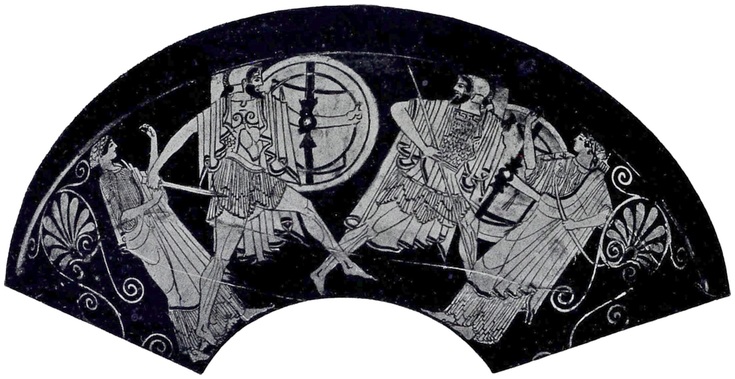
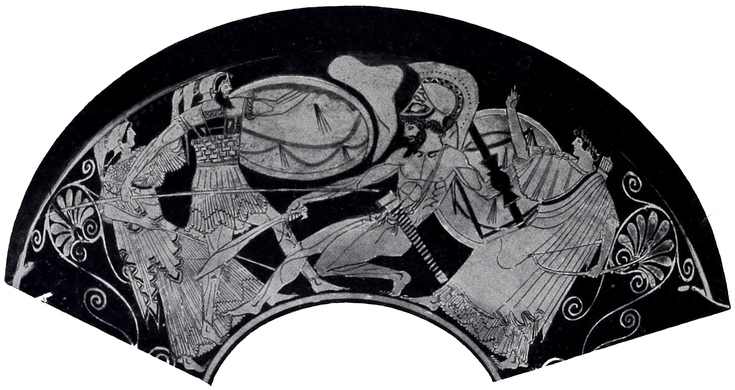
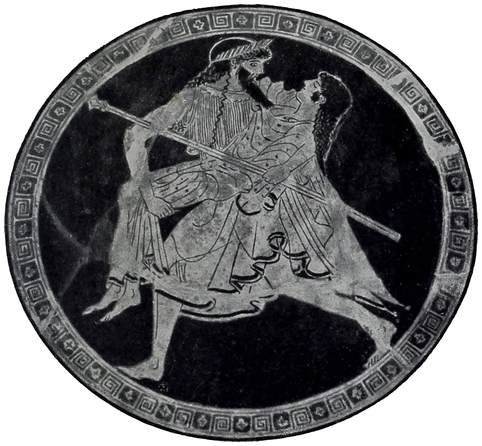
The kylix of Eos and Memnon (Figs. 8, 9,
10), well known to visitors of the Louvre, is
not only the oldest but the one which best illustrates
the first period of Douris, and deserves
the closest attention from lovers of art. It is
a masterpiece of Greek ceramic art, at a time
when the painting of red figures, while still
retaining the stiff, archaic forms, finds means
to move the feelings by purity of line and a
deep sense of life. The vase, by the potter
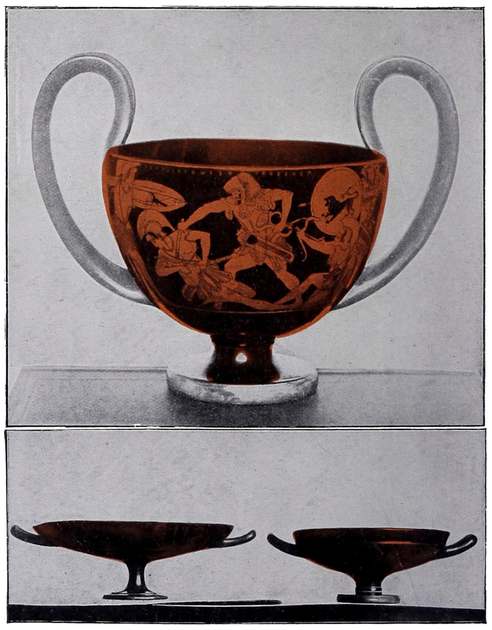
Kalliades, in itself reveals an old shape (Fig. 1
right) with the foot short and squat, the sides
heavy, a deep bowl and short handles, following
the models of Nikosthenes and Pamphaios of
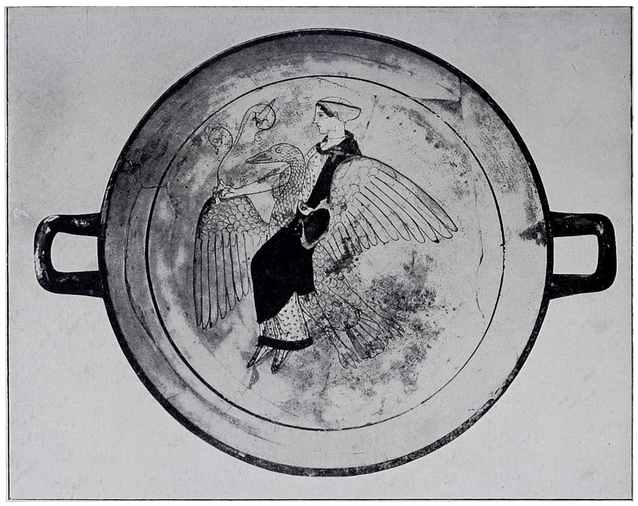
the sixth century. Later Douris made a kylix
of far more graceful outline, with a shallower
bowl, a higher stem made slender in the middle,
and lighter handles, such as one sees in the
workshops of Euphronios, Hieron and Brygos
(Fig. 1 left). On this kylix there are a great
number of inscriptions: nearly every person is
designated by name. Besides the signatures of
the potter and painter we can read the name of
the handsome Hermogenes (Fig. 8), and with
it a fragment of a phrase, the meaning of which
remains doubtful. Seventeen or eighteen words
in all are scattered in fine red letters over the
inner surface and the reverse of the cup. This
profusion of writing is in itself archaic; men
were communicative in early times, and delighted
in labelling their figures like our old illuminators
of the Middle Ages. More recent works of
Douris have lost this useless mode of expression.
Painting is its own interpreter, and has
no further need of this awkward assistance.
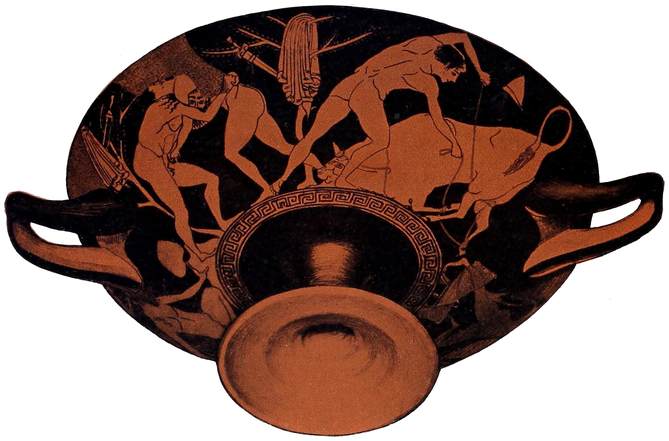
Fig. 12. THESEUS AND KERKYON,
AND
THE STRUGGLE WITH THE MARATHONIAN BULL.
Kylix by Euphronios. Louvre Museum.
The composition is synthetic. It contains
three events in the Trojan war. On the reverse
are the combats of Menelaos and Paris, Ajax
and Hector; on the inner side the Ethiopian
King Memnon lies dead in the arms of his
mother, the goddess Eos (the Dawn). Some
archæologists who have studied these paintings
have tried to find here a strong and learned
unity, a kind of drama in three acts, even at
the expense of the inscriptions. Brunn even
maintained that the latter were faulty, as he
conceived therein an Achilleid, celebrating three
different feats of the great hero. Others have
refused to see any reference to the Epics, and
have noted the differences which distinguished
the text of Homer from these paintings. For
instance, Douris has placed behind Menelaos
the goddess Aphrodite, protectress of Troy,
which seems inconsistent; behind Paris we see
Artemis carrying her bow; behind Ajax is the
goddess Athene. These divinities do not figure
in the Homeric account. As regards the death
of Memnon, it appears to belong to an epic
by another cyclic poet, Arktinos of Miletos.
It is the imagination of the poet that collected
at random, as it were, these scattered subjects,
and united them according to his fancy.
The opinion we hold amid these conflicting
views will be more easily understood by reference
to the chapters on the social and mental
conditions of the Athenian potters. To suppose
them to have conceived themes of deep meaning,
elaborated like an ode of Pindar or a
chorus of Sophocles with strophe, antistrophe
and epode, seems most unlikely; and if, in
order to gain good results, the inscriptions
must be changed, we do not hesitate to reject
such a procedure as contrary to all scientific
method. Who can believe that these profound
thinkers were so stupid as not to write correct
inscriptions? On the other hand, we know
enough of the art of the period, of the advance
made in design, to expect a certain unity in
the whole. It is the spirit of the entire school
to unite the different parts of the vase by
subjects closely connected, or at least related.
In the present case we believe the Trojan war
to be the great theme uniting the three paintings.
This was the most cherished subject, even
with the people. We must remember that a
painter of vases had nothing in common with
a modern designer who has a text to illustrate
before his eyes. It is hardly likely that manuscripts
of Homer or Arktinos were found on
the work-benches of the Kerameikos. For these
craftsmen, memory or the remembrance of some
recitation at the Panathenaic festivals had to
take the place of the book.
In consequence, the chief episode must have
made a decided impression on the mind,
without involving accuracy in minor details.
In re-reading the Iliad, Book III. (Menelaos
and Paris), and Book VII. (Ajax and Hector),
we gain the impression that the artist, whoever
he was (for the craftsman may have
copied a known work), has here reproduced
the essential elements of the drama. In adding
persons, as Athene behind Paris, or Aphrodite
behind Menelaos, the artist simply adhered
to the conditions of the composition of a
painting, which at this period scrupulously
obeyed the rules of symmetry. Aphrodite is
placed there to restrain the arm of Menelaos,
as the gesture of her right hand indicates.
Artemis, as a companion figure on the other
side, represents the protecting gods of Troy
(Fig. 9); two goddesses were not too much
to watch over the handsome Paris.
The other reverse (Fig. 10) similarly conforms
to, and diverges from, the Homeric text. As
in the poem, Hector struck by a rock thrown
by his adversary sinks to his knees and Apollo
advances to support him. (The irregularly
shaped object above indicates the stone.) In
Homer, Athene does not appear, but here,
placed as she is behind Ajax, whom she
appears to be pushing forward with a gesture,
she represents the protecting goddess of the
Greeks. The symmetry of the two sides is
essential. The decorative tradition requires it,
and the painter sets his professional duty
before his respect for a poetic text, in which
no one saw anything more than a general
theme for beautiful subjects and attitudes.
We are quite convinced that the great painters
took exactly the same liberties with the cyclic
poems they interpreted. The description of
the masterpiece of Polygnotos, The Taking
of Troy, bears witness to this. The artist
seems to have complied with the general
information given in the epic, but not to have
illustrated any given text.
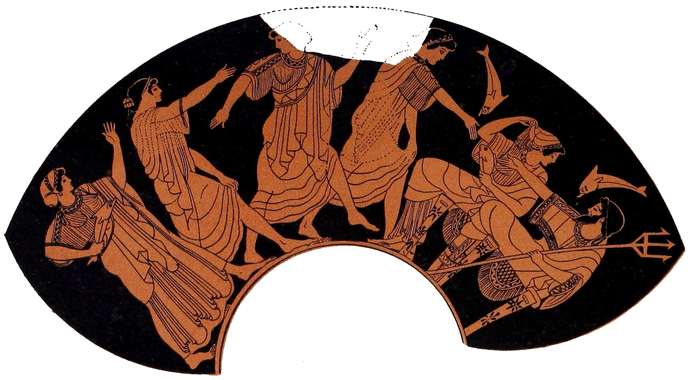
Fig. 13. NEREIDS APPEALING TO NEREUS AND DORIS.
By Douris. Louvre Museum.
In spite of the archaic stiffness, the execution
of the subjects delights us by the purity of
line and the great care in detail. The painting
is simply a drawing, hardly retouched
with a few red lines. It is like a dry point
engraving, in which all the lines are somewhat
prominent. The symmetrical and parallel folds
of the garments, details of the armour, the
imbrications, the chasing of the helmets and
cuirasses, the locks and curls of hair, are
marvels of patient and conscientious work.
The ornaments, as carefully finished as the
rest, have the same stiff and rather metallic
precision. Lastly, the black glaze, thick and
velvety, gives an extraordinary brilliancy to
the entire vase.
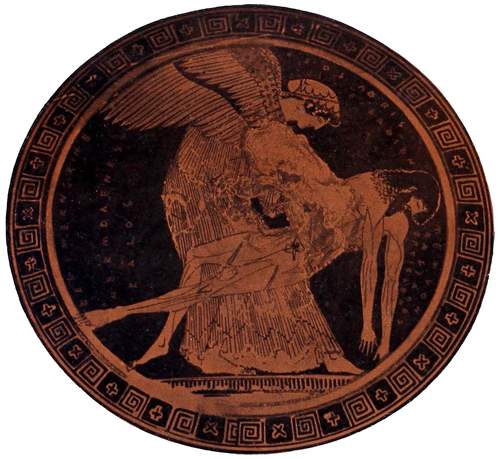
In considering the painting of the interior
(Fig. 8), we move upwards another step. In
its small compass, we consider it one of the
finest paintings handed down to us from
ancient times. It consoles us somewhat for
the loss of so many masterpieces, and we
cannot suppose that a potter, working alone
in his workshop, invented this first Mater
dolorosa, which is as touching as a Mantegna
or a Roger Van der Weyden. Nowhere is
a copy from a great painting more forcibly
evident. Every one must be impressed by the
striking resemblance of this Pagan and Greek
creation to the emblem that has moved
Christian souls for so many centuries. Eos,
standing with outstretched and beating wings,
bends toward the dead face of her son
Memnon, her strained arms supporting his
rigid body. The goddess, who represents the
radiant morning and the promises of Nature
awakening with the dawn, is here simply a
despairing mother imprinting on her mind with
one long look the beloved features she will
see no more; the contrast is profoundly sad,
and a creation worthy of a great poet. The
body of the powerful prince of the Ethiopians,
the ally of Priam, is entirely nude as it was
taken up on the battlefield where his adversary
Achilles had robbed him of his armour. The
stiff legs are stretched out, the left foot still
contracted with pain, the arms swing limply,
the head drops, while the dishevelled hair,
the delicate beard, and the closed eyes arouse
an irresistible memory of the dead Christ.
We have a true Pietà before our eyes.
What miracle in art, what unexpected chance
unites Pagan and Christian art to express the
same thought, in the same form? Is it not
a proof that across the centuries great artists
share the same thoughts, and to express the
emotions of life create a universal language?
Is it not this again which attracts us in
Homer, in those never to be forgotten scenes,
expressing so well the deep feelings of all
men at all times; the farewell of Hector and
Andromache, the return of Ulysses to Ithaca?
Art soars above time and space, more than
all else it embodies the solidarity of succeeding
generations without any knowledge of one
another.
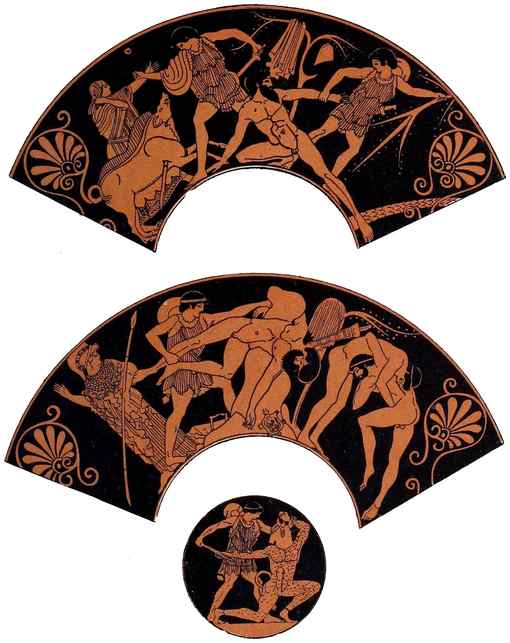
A kylix in the British Museum, with The
Adventures of Theseus (Fig. 11), of more recent
form and style, teaches us still better that
behind the vase painter may be concealed
other and greater personalities, who are the
true creators of the work of art. A famous
kylix from the workshop of Euphronios shows
us similar scenes glorifying the Athenian hero,
forming with the Eos and Memnon, by Douris,
and The Taking of Troy, by Brygos, a
glorious trio of ceramic masterpieces, of which
the Louvre is justly proud. In comparing the
works of Douris with those coming from the
workshops of Euphronios, the idea suggests
itself that they either copied one another or
borrowed from one common original. Both
suppositions are possible. As already mentioned,
no law or custom prohibited artistic
plagiarism. If Douris knew of the beautiful
work executed by his colleague, nothing prevented
him from adopting it for his own use.
But, on the other hand, the broad style of
Euphronios’ production and the peculiar
character of the adventure of Theseus recovering
the ring of Minos from the bottom of the
sea, a subject treated by Mikon, one of the
great painters of the fifth century, finally
the great number of works of art which at
this period celebrated the national hero’s glory,
lead us to believe that a potter had no need
to look over his neighbour’s shoulder to gain
suggestions for a theme of Theseus. He was
surrounded by models in painting, sculpture,
painted bas-reliefs, models, carved and engraved.
The supposition of a common model or
several models, from which a craftsman, in a way,
chose the desired subject, seems most probable.
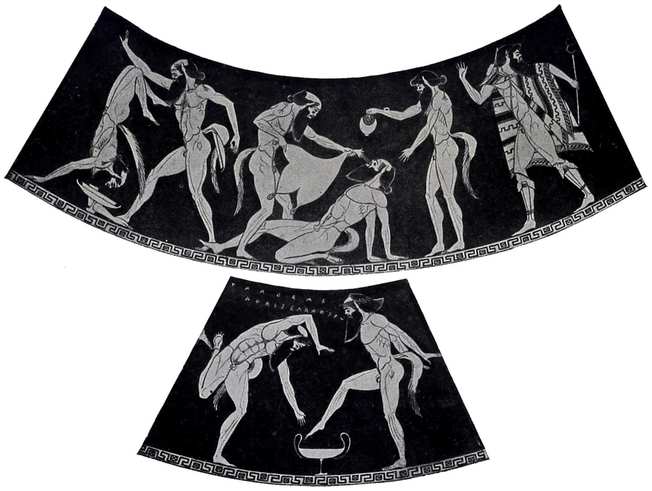
Fig. 14. SILENI PLAYING AND DANCING.
Vase by Douris. British Museum.
It is only in this sense and with such reservation
that these two cups can be compared. In
looking at the superb vase in the Louvre, no
one will hesitate to give the preference to the
workshop of Euphronios. In the interior is
The Visit of Amphitrite; in this painting the
author has retained all the seriousness of great
religious art with a touch of archaism in the
drawing and position of the characters, showing
thereby that he has copied an ancient fresco;
while, on the contrary, on the reverses, the
combats of Theseus with the robbers Skiron,
Prokrustes and Kerkyon, and the struggle
with the Marathonian bull, are treated as in
metopes, with bold, vigorous lines, giving rather
a feeling of the influence of sculpture (Fig. 12).
The composition of Douris (Fig. 11) is more
firmly knit, because it concentrates all the
attention on the adventures of the hero against
monsters and robbers. In the interior is the
fight with the Minotaur, an ancient and classic
theme from the sixth century; on the reverses,
the defeat of Kerkyon, of Skiron and Sinis, and
the hunt of the boar of Krommyon; two women
give some variety and animation to the whole,
the nymph Phaia who lived at Krommyon, and
the goddess Athene who protects her favourite
hero at his labours. Here again is a closely-knit
trilogy; but, we must confess, the execution is
far inferior to that of the cup of Euphronios.
It is accurate and a little commonplace. There
is, however, noticeable a desire to express landscape,
a care for external ornament, visible in
the palm tree and the small trees placed about,
and by a cloak thrown upon a tree trunk. It
is a rare mark among Greek painters, and
worthy of note.
We will look more rapidly at the paintings
of the kantharos at Brussels, the importance of
which, as being a vase moulded by Douris
himself, we have already mentioned (Fig. 1).
The figures represent “Herakles’ contest with
the Amazons,” an old type, nearly a century
old, but with the added beauty of a clear and
accurate style, and an admirably certain execution.
Nor are the subjects new which are
treated upon another kylix in the Louvre,
The Rape of Thetis by Peleus. But Douris
deserves the credit of having skilfully revived
an old subject known on Corinthian and Attic
vases of the sixth century. It is possible to
follow in the Louvre the same painting done
in turn by a Corinthian, then by an Attic
painter of black figures, and lastly by Douris.
It is of great interest to follow the development
of the composition and of the grouping of the
figures, of their attitudes, and of the drawing
itself. We perceive here the same differences
as in comparing a Madonna of Cimabue with
one of Lippi. Symmetry of figures, stiff and
angular outlines and severe features have given
place to life and tender touches of the brush.
At the same time, the close connection of
these successive works appears most striking—the
link with the past has never been severed;
the fundamental conception has always remained
the same; improvement has come from within,
and extends to every little detail.
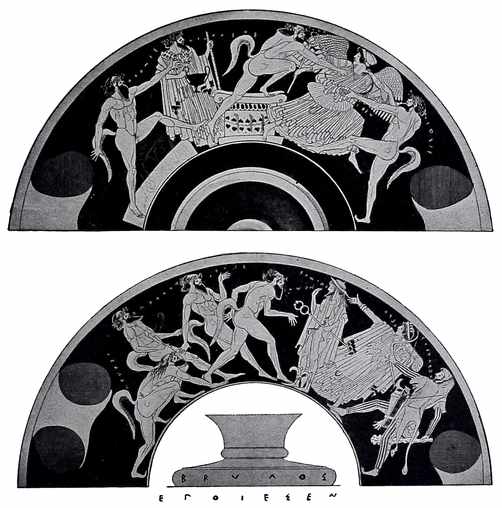
Fig. 15. HERA AND IRIS ATTACKED BY SILENI.
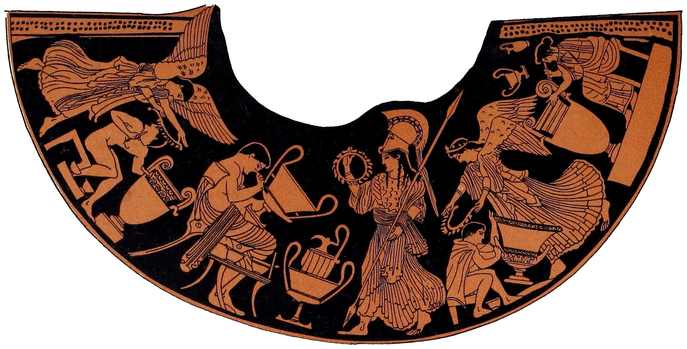
By Brygos. British Museum.
Douris has extended his composition and
united the two reverse sides of the kylix. On
one, the hero seizes the goddess, who struggles
in his grasp and has summoned to her aid the
magic art of transformations. These are given
with all the naïveté of primitive art: to tell
us that Thetis changes into a lion, and later
into a serpent, the artist has drawn on one
side a young lion seated on the shoulder of
the goddess, and tearing with his teeth the
arm of her ravisher; on the other a serpent
lifts its twisted coils and darts its threatening
jaws at him. The companions of Thetis, the
Nereids, frightened by so bold an attack, take
flight, and this gives the painter an opportunity
of showing us young girls running in many
graceful attitudes—the arms are tossed in
gestures that are still angular; the bare feet
and legs escape from the drapery, showing the
rather lean suppleness of these young maidens.
It is, at the same time, a skilful method of
uniting the whole; in fact, on the other
reverse we see other nymphs running, who
come to tell the god Nereus and his wife
Doris of the attempt. Both are seated on
ornamented thrones with the Olympian majesty
of a Jupiter and a Juno (Fig. 13). All the
beauty of the famous group in the Panathenaic
Frieze is already visible in their movements
and their attitude.
CONTEST OF AJAX AND ULYSSES.
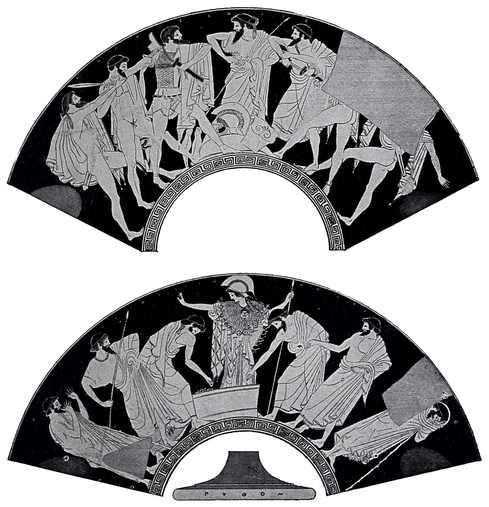
Fig. 16. THE VOTING OF THE GREEK CHIEFS.
By Douris. Vienna Museum.
Unfortunately the interior is defaced and
restored, but the artist has shown no less
ingenuity in its design. He has taken a theme
frequently used by painters of red figures,
and thus rendered rather commonplace—the
libation; but instead of showing us the well-known
scene of a soldier departing on a campaign
and receiving the full cup from a woman,
he has enlarged the subject, and shows us the
god Poseidon seated, receiving a libation cup
from the hands of a goddess, probably his
wife, Amphitrite. Again a synthetic trilogy
prevails in this composition: in the upper part
of the vase the god of the sea and his consort
are throned; in the lower part is enacted a
little drama which takes place on the seashore,
and has sea-gods as actors. Everywhere we
find the intelligent skill of the Greek, and
the easy art with which he beautifies all he
touches. Was all this the personal work of
Douris? or does the model he copies and
follows deserve much of the credit? It will
always remain an open question. As we possess
a kylix by the potter Hieron (it has even been
ascribed to Douris), another by the painter
Peithinos, and many anonymous vases which
repeat in similar form the details of The
Rape of Thetis, we again incline towards the
second hypothesis. How many sanctuaries in
Greece, dedicated to the gods of the sea, must
have contained paintings or reliefs of this kind!
It is the variety of models, in a word,
which best explains the variety of styles among
painters of vases. As we remarked above, no
vase painter is of greater interest in this
respect than Douris. If any one wishes to
estimate at a single glance his often puzzling
versatility, he need only look at the mythological
painting on a large receptacle for wine
in the British Museum (Fig. 14). The choice
of the subject, The Bacchic Thiasos, repeated
to satiety upon black-figured amphoræ of the
sixth century, leads us to expect only a
commonplace painting, but the artist instead
brings us face to face with one of the most
spirited sketches Greek art has left to us.
Douris shows himself daring, amusing, free
almost to indecency, and one asks how the
same brush which painted many little paintings,
rather stiff in their symmetry, could
become animated to the point of inventing
these funambulistic movements of wild beasts
let loose. These are Sileni playing and dancing.
Arranged in a row, like mountebanks upon
their stage, they abandon themselves to frantic
sports under the leadership of a herald costumed
as Hermes, on his head the petasos, and in his
hand the caduceus. One lowers his head to
drink from a cup placed on the floor; a second,
in a half-lying position, has the contents of a
goat skin and a wine jug poured together into
his mouth by two of his companions; others
toy in a ludicrous fashion with kantharoi, or
dance on one foot, and try by bending forward
to reach a full cup. Even expurgated, this
painting sufficiently shows the unbridled gaiety
and fun which the Greek designer allowed himself.
In that again he resembles the Japanese
draughtsman, in love with buffooneries and
acrobatic postures. Those who only like to
think of Greek art as serious and moralizing,
can take their own view. Greek art knew all
and dared all—works such as were placed upon
school walls to elevate thought, and such as
were hidden under a cloak. The same brush
drew the touching image of Eos and Memnon,
and this scene of a pagan, Kermesse.
In Athens this surprised no one. We have,
however, classified our artists, and confined
them to their specialities. We do not admit
that a “serious” artist could cause laughter,
and we have our professional caricaturists.
Leonardo da Vinci, it is true, did not disdain
to draw the grotesque. Neither ancient painting
nor sculpture feared the ugly or the comic;
but they gave to each a meaning. They did
not cause laughter for the sake of laughing.
They did not cause fear for the sake of
frightening. These important elements in real
life have a symbolic and allegoric meaning.
The head of Medusa appears as a survival of
vanished monsters, which terrified man when
he sought to establish his dominion on earth.
The Learnæan hydra is, on the most ancient
vases, a gigantic octopus gripping Herakles
and Iolaos, as the octopus clasps Gilliatt in
Les travailleurs de la mer. The grimacing
mask of the satyr is the inheritance of a
very early conception transformed by art. It
would not be difficult to prove, documents in
hand, that the large anthropoid apes met by
the Phœnicians in their explorations in Africa,
and drawn by them on their metal cups of
the seventh century, furnished the Ionian
artists, when combined with the Bes of the
Egyptians, with the prototype of the hairy
and shaggy Silenus, with the flat-nosed face,
that one sees on certain sarcophagi of Klazomenai.
This is what we admire in the Sileni
of Douris. The skilful, dry point of the artist
knew how to preserve, when he sketched them
on clay, all their simian agility, their droll,
gorilla-like features, the relaxed, sinewy and
flexible limbs, wherein we recognize the vigorous
beast in semblance of a man. We only
know of one other artist who has rendered
this bounding animal gait of the Sileni with
equal success—the painter of a kylix from the
workshop of the potter Brygos, which is undoubtedly
inspired by a satyric drama; here
the goddess Hera and her companion Iris are
in great distress through falling into the midst
of such a wild band. Fortunately Hermes with
fair words, and Herakles with his club, arrive
in time to restrain these rash and disrespectful
fellows (Fig. 15).
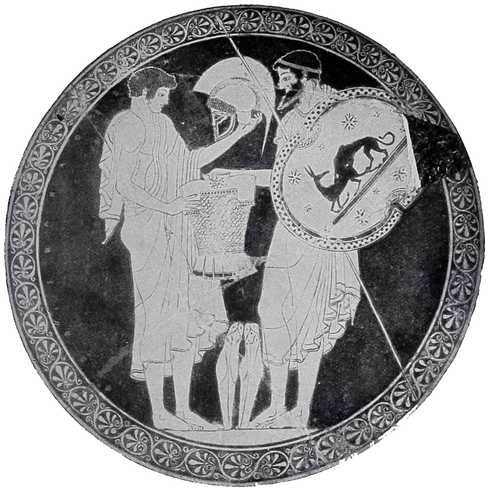
Fig. 17. ULYSSES RESTORING THE ARMS OF ACHILLES TO NEOPTOLEMOS.
Interior of preceding Cup.
Let us finish this review of the mythological
subjects with a kylix from the Museum in
Vienna on which we see The Contest over the
Arms of Achilles (Figs. 16 and 17). It will
give us an opportunity of studying dramatic
themes in the hands of Douris, drawn from
epic poetry, and adopted by the writers of
tragedy. We know how, later, Sophocles in
his Ajax with the Scourge, showed the fatal
result of the unexpected quarrel arising between
Ulysses and Ajax for the possession of the
divine weapons, which Thetis had given to her
son Achilles. This event was a favourite theme,
and had been treated in ceramic painting from
the sixth century onwards. In what work and
what kind of production did Douris seek his
inspiration? We shall always remain ignorant
of this. We only wish to show by this
example in how great a measure the Greek
theatre influenced composition and even the
style of painted vases.
Several black-figured vases, some of which
are in the Louvre, represent this Contest;
the two heroes have come to blows and are
falling upon each other fiercely, while Agamemnon
and other Greeks exert themselves to
separate them. This fundamental theme was
not lost on Douris, for he made use of it on
one of the reverses of his kylix (Fig. 16).
But, following his fancy or other models of
which we know nothing, he adds two other
episodes: (1) on the other reverse, The Voting
of the Greek Chiefs, who all bring their votes
in the shape of pebbles, and place them on an
altar in the presence of the goddess Athene,
thus awarding the victory to Ulysses (Fig. 16);
(2) in the interior, Ulysses and Neoptolemos,
a painting forming, as it were, the heroic
catastrophe of the drama, where the victor
renounces the glorious weapons and restores
them generously to the son of Achilles, so
that he in turn may wear them and accomplish
the ruin of the Trojans (Fig. 17). Here, again,
Douris’ favourite manner of composition results
in a trilogy. We have the three acts in a
tragedy, dominated by the memory of Achilles
and the epic of the Trojan war.
The fact will at once be recalled that to the
Greek theatre, as conceived by Æschylus and
his immediate predecessors, a similar arrangement
was not unknown. We find many such
examples of about the time of the Persian wars,
not only by Douris, but by his rivals as well.
To look here for an exact copy of some
contemporaneous work would undoubtedly be
absurd. We can hardly insist too strongly on
this point. The absence of the costumes and
accessories of the theatre, which were so
individual and expressive in their conventions,
is an indication that the painter did not try
to depict on clay the living spectacle he had
just witnessed. In a later age, the Greek vases
of southern Italy freely transferred scenes from
tragedies, but in this ancient period we have
no such examples. The composition is derived
from the theatre just as in the kylix of Eos
and Memnon, mentioned above, it depends on
Homer. It is a general impression that the
mind of the artist has absorbed, and it helps
him to arrange his subjects better.
Professor Carl Robert has very well
remarked that the vases of the sixth century
have the “epic” manner; they tell stories
and relate to us in detail like the ancient
singers. Those of the group of Douris have a
“dramatic” manner; they habitually appeal to
us by synthetic groupings, which we accurately
term in the language of the theatre tableaux,
and which sum up an entire scene. We would
further remark that in Douris and his contemporaries,
the figures assume attitudes which
one might call “scenic.”
On one side of the painting of the Voting
(Fig. 16), Ulysses, with uplifted hands, expresses
at once astonishment and delight to see how
the heap of little stones which represent the
votes in his favour is growing; while, on the
other side, in the right corner of the scene,
Ajax, alone and deserted and feeling defeat
inevitable, covers his head with his cloak to
hide his disgrace, a dramatic figure, suggesting
the often cited work of Timanthes—Agamemnon
hiding his face so as not to witness
the sacrifice of his daughter Iphigeneia. We
still could cite vases from the Louvre—beautiful
examples—showing Achilles returning sad and
in despair to his tent. What caused this
beautiful and tragic inspiration? Who created
these attitudes of mute eloquence if not the
Greek drama? Do we not know that one of
the great effects in the drama of Æschylus
was precisely his placing on the stage an
immovable Niobe, and a stern Achilles, who
answered the messages of Agamemnon simply
with unrelenting silence?
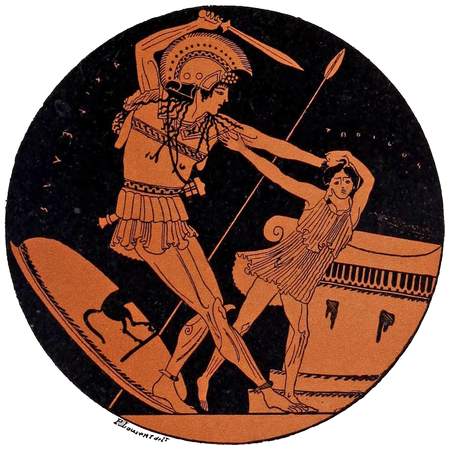
Fig. 18. ACHILLES KILLING TROÏLOS.
By Euphronios. Louvre Museum.
The poetry in the best compositions of Douris
is entirely derived from memories of the epic
and memories of the drama. It matters little
whether he invented them or whether they
were suggested to him; it is the very essence
of Greek painting disclosed before our eyes,
with its spirit of freedom and ready adaptation.
Everything is helpful and suggestive to an
artist. Whether derived from epic recitations,
from lyric strophes, or from the theatre, these
floating images all become fixed by his brush
and take definite shapes, which in turn will
haunt the imagination of other artists and
guide their hands. What a rich fertility of art,
which multiplied its creations on all hands, and
united all classes of the Athenian people into
a kind of brotherhood of labour!
Battle-scenes had for three centuries been
the classic subject of industrial design. As
with all primitive peoples, war had been at
first the chief occupation of the Greeks, and
in consequence one of the chief sources of art.
The Dipylon vases covered with warriors,
chariots, boats, dead and wounded, or with
pompous funeral scenes are contemporary with
the Iliad. From the seventh to the fifth
century the warrior subject was repeated to
satiety upon all ceramics with black figures.
How will Douris profit by this?
Seven drinking cups bearing twenty paintings
are devoted to this style. Most of them are
subject to the rules of symmetric composition,
which we observed on the Memnon kylix, in
the contests of Menelaos and Paris, and of
Ajax and Hector. Truth and tradition unite
in giving to this subject the appearance of a
simple duel, the secondary personages, as it
were, forming a frame. Sometimes a wounded
man placed between the two champions indicates
the cause of the encounter, and at the
same time forms the centre of the group.
This primitive scheme, much used by the
Corinthians, is found again in many of Douris’
paintings. It is evident that he did not give
himself great trouble to invent, and that he
only reproduces a well-known theme. One
may say as much of the battle, considered as
a hand-to-hand fight; five hoplites are engaged
in a struggle in a regular and prescribed
manner, where the combatants, ordinarily paired
two and two, display their strength in the
attitudes of well disciplined duellists. It is
only a variant of the preceding subject. These
works teach us nothing new with regard to
the art of Douris, and are only of value in so
far as the minute mastery of his brush is concerned.
We must look elsewhere for his
ingenious mind—in the scenes of arming and
the battles of Greeks and Persians.
Arming is only an episode of military life.
Instead of showing us the battle, the painter
allows us to be present at the preparations.
A strong effect has been produced on a kylix
made in the workshop of Euphronios: Achilles,
in ambush, surprises Troïlos, the youngest son
of Priam, who comes to draw water at a
fountain; he pursues him across the plain as
he flees in his chariot. The alarm is given,
and one sees the Trojans hastily arming and
running to the royal child’s assistance. But
they come too late. In another painting we
see the crime already accomplished; without
pity for the tender years or the cries of his
victim, the hero cuts off the boy’s head by
the altar of Apollo, where he has taken refuge
(Fig. 18).
The conceptions of Douris are not so
dramatic. The design of the kylix in Vienna,
which is a masterpiece of its kind, allows us
in a manner to penetrate into a Greek camp,
at the hour when all are preparing for the
manœuvres or the battle (Fig. 19). It is
mediocre, even a little commonplace, as regards
observation, but it is clever by the realism of
the small practical details. In the interior is
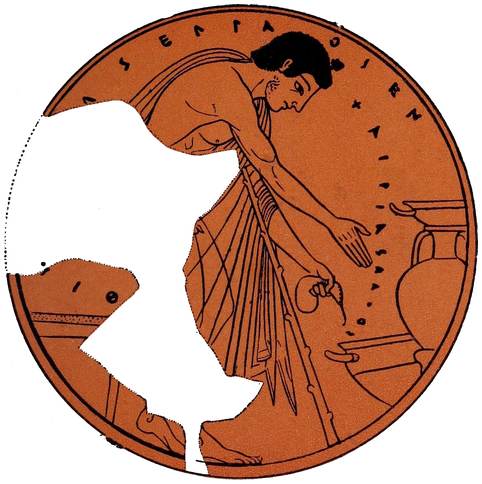
the classic scene of a libation, a soldier before
his departure praying to the gods; a woman
brings him wine which she pours into a
sacrificial cup. On the reverse, an encampment;
the alarm has sounded, every one seeks
his arms in haste, one his sword, another his
lance or helmet. The monotony of the subject
had to be varied. The painter has succeeded
in this by introducing some old and bearded
men who help and encourage the youths, and
a woman who brings a shield and a sword.
Nothing can be more animated than the faces
and gestures of these young men arming themselves.
One tries his sword and draws it partly
out of the scabbard, another binds the fillet
about his hair, so as to adjust his helmet more
firmly; his companion, with a finical gesture,
turns up his sleeve and the lower part of his
tunic. Elsewhere (Fig. 19), a hoplite already
helmeted places greaves on his legs, another
dons his corselet, a third hangs his sword at
his side and puts the shoulder belt over his
shoulder, a fourth makes a little gesture of
comic despair showing that he has forgotten
to place a crest on his helmet, while the last
raises and ties his long hair. These are sketches
drawn from life, and are almost like the sketch-book
of an artist who has accompanied soldiers
at their manœvres. What we term “military
painting,” in its familiar and picturesque form,
dates from the Greeks.
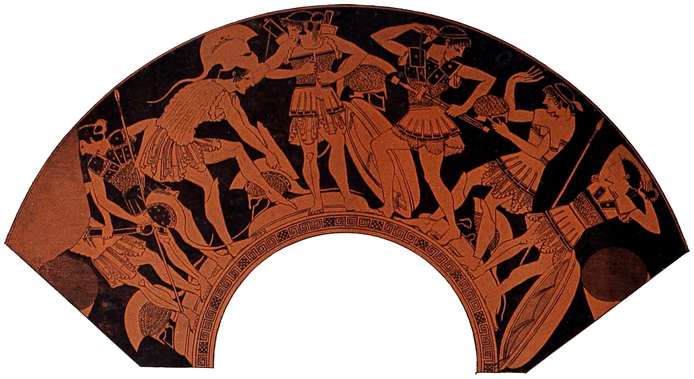
Fig. 19. SOLDIERS ARMING.
By Douris. Vienna Museum.
The style of this kylix is ancient, and it
dates from the earliest period in the career of
Douris. Although found at the same time
and in the same place as the other kylix at
Vienna (Fig. 16), representing The Contest
of Ajax and Ulysses, although signed by the
same painter and moulded by the same potter
Python, it represents an entirely different
manner. Here is a style still archaic, the
heads large, the bodies rather thickset, the
draperies with regular and symmetrical lines,
an extreme minuteness in all details. There,
the proportions are reversed, the bodies
lengthened, with small heads, the garments
with wavy folds, the entire execution freer
and with less care for detail. No one would
think of attributing the two vases to the
same master if they did not bear the name
of Douris. This comparison permits us to
appreciate the nature of the changes that took
place in a Greek potter’s career. He is not
a craftsman who is satisfied to remain in the
routine of a uniform method. He is an artist
who wishes to learn, who reflects and develops.
Herr Hartwig has well demonstrated that there
was a “first” as well as a “second” style in
Douris, as in our days in Corot or Fantin-Latour.
To introduce glorious memories of the Persian
invasion, only recently repulsed by the Greeks,
was another mode of rejuvenating the warrior
subjects. These direct allusions to the Persian
wars, are, to our great surprise, only rarely
found on the monuments. It is a characteristic
trait of the idealism in which the art of the
fifth century delights. Anything in the form
of anecdote or accident, all that forms the woof
of material facts, is only of slight interest to it.
It fears also to provoke the gods by extolling
the grandeur of Athens, and hence allegory and
symbol are used in preference. The Treasury
of the Athenians, raised at Delphi from a
tithe of the spoils of Marathon, glorified the
deeds of Herakles and Theseus. The pediments
of the Temple at Ægina, probably
made after Salamis, show the Trojans conquered
by Homeric heroes. To celebrate
Greece’s second victory over Asia, images of
the Trojan horse were placed on the Acropolis
and on the slopes of Delphi. Industrial
painting conforms to the same principles.
Warrior subjects were frequently represented
by battle-scenes between Greeks and Asiatics,
but appear only to contain allusions to
the Epic, or else to the battle of Herakles
with the Amazons (Fig. 1), which recalls the
great deeds of the Greeks’ ancestors against
barbarians.
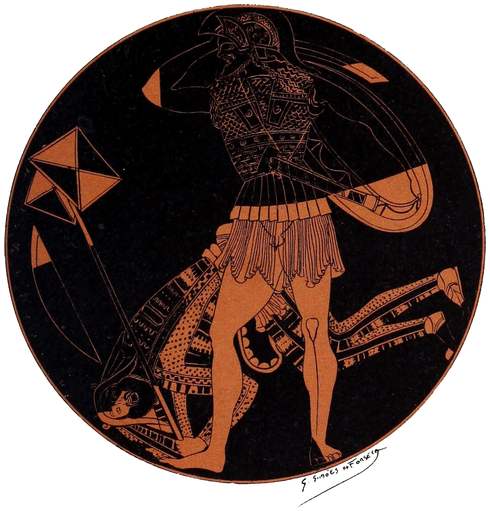
Fig. 20. GREEK HOPLITE AND PERSIAN STANDARD BEARER.
By Douris. Louvre Museum.
We may say that Douris gave proof of
originality by frankly dealing with modern
subjects. A kylix at the Louvre, unfortunately
damaged and restored, shows in the
interior an hoplite striking with his sword a
fallen barbarian soldier, who holds a standard
with two square-shaped flags (Fig. 20). This
typical accessory leaves no doubt as to the
meaning of the painting. A banner would
never be placed in the hands of a Trojan. It
is very probable that the victors of Marathon
picked up Persian standards on the battlefield
with the spoils, and that we have here
the reproduction of such a trophy. We look
upon this sketch of Douris as a precious record
of the army led by Datis and Artaphernes in
490. For the vase is not of a style to be dated
after 480, that is to say, after the second
invasion conducted by Xerxes in person.
Other vases attributed to the painter
Onesimos represent battles of Greeks against
Asiatics on horseback, very realistic in form.
Here one may again see copies from life.
Lastly, Greeks and Persians are fighting on
the sculptured frieze which adorns one side
of the small temple of Nike Apteros on the
Acropolis. These, however, are rare allusions
to the greatest military achievements of the
century. It is not difficult to imagine what
they would have produced in modern art.
We must, however, beware of crediting Douris
with an exaggerated initiative, and we must
not forget that among the lost works of Greek
art, a painting by Mandrocles is mentioned,
dating from Darius’ expedition into Scythia,
The Crossing of the Bosphorus, and at Athens
a Battle of Marathon, attributed to Panainos,
in which Miltiades and the chief Greek generals
were seen repulsing the Asiatic phalanxes.
Douris and Onesimos did not lack models to
guide them into this channel. The value of
their works is above all in the good fortune
which has preserved them to us, and gives
us, if not the letter, at least the spirit
of the painting dedicated to contemporary
history.
Here, again, it is convenient to divide the
work of Douris into two parts. At times,
like all the manufacturers, he made use of
old subjects with hardly any change; then,
again, he sought new ideas and popularized
unused themes. The latter, of course, will
chiefly occupy our attention.
A general statement should first be made:
the work of Douris, as we actually know it,
shows a distinct preference for living subjects.
Of his eighty paintings we can count seventeen
dedicated to mythical subjects, twenty-two to
military life, and forty-one to everyday scenes.
The proportion in favour of contemporary life is
more than three-fourths. Comparing these with
works signed in the workshops of Euphronios
(fifteen mythical subjects, two warrior subjects,
and eight everyday scenes), from the workshop
of Brygos (seventeen mythical, one warrior, and
six everyday scenes), we observe that the proportion
is reversed by the two most distinguished
rivals of Douris. We may, therefore, note this
characteristic in his work which he has in
common with another great designer, Hieron
(twenty-three mythical and thirty-one familiar
scenes). These two artists thus prepared the
way for the genre picture, which was to
dominate the second half of the fifth century,
and to make women and children the favourite
subjects of painters.
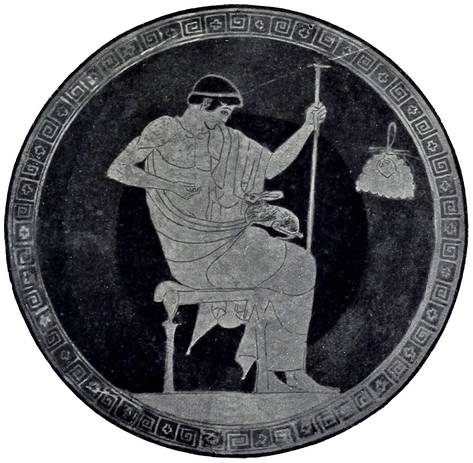
Fig. 21. SEATED YOUTH HOLDING A HARE.
By Douris. Louvre Museum.
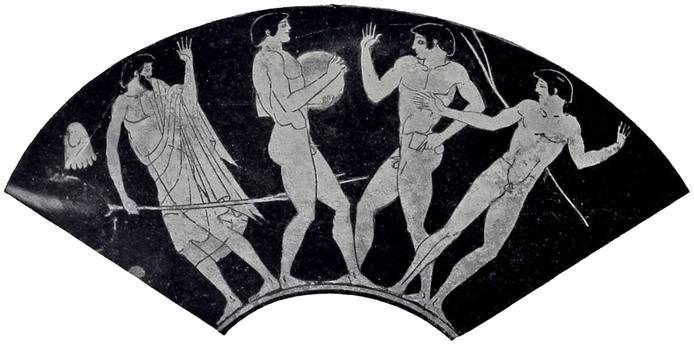
The most frequent themes are scenes from
the palæstra (Fig. 6). Youths are wrestling,
running, jumping, dumb-bells in hand, or
throwing the discus; the teachers of gymnastics
watch the sports, rod in hand, ready
to punish the lazy or check any brutality.
Sometimes a small column, or a basin intended
for ablutions, a pick-axe, or a javelin thrown
down, indicates where the scene takes place.
Only this much would a Greek draughtsman
permit himself as scenery. Man alone, action
or living forms, are the subjects of his study;
nor does he seek, as we do, to endow with
sentiment the objects in his environment.
Landscape, which moves us, leaves him quite
indifferent. But what knowledge of the human
form, what love of line and contour! His
short, skilful brush moves freely on the clay,
throwing out delicate outlines, simplifying the
muscles and giving only the most essential,
breaking or spreading out the long folds of the
drapery, emphasizing the flexible spine, drawing
sinewy hands and grave profiles with strong
chins and heavy lips. He attacks the difficulties
over which archaic art had not yet triumphed—foreshortening
and three-quarter poses.
Kimon of Kleonai, a great painter of the
sixth century, had proved how effective the
latter could be. In the structure of the eye
he attacks another difficult problem, trying
to modify the everlasting and awkward convention
of earlier times—a face in profile with
an eye full face. He tries many forms—round,
triangular, open on one side. One feels the
solution, which henceforth shall be that of all
draughtsmen, growing under his fingers. All
this is suggested by the study of his beautiful
paintings, in which Douris has not invented
much, for the school which preceded him, that
of Epiktetos, of Paidikos, of Chakrylion, offered
similar studies, but he unfolds a constant desire
for perfection of form.
In his work one may note the clever and
economical device of drawing many persons by
means of very few models. In his scenes of
the palæstra, consisting of ten or twelve persons,
he uses, in fact, only two models—a bearded
man and a youth, who are seen under different
aspects. Many of his contemporaries made use
of the same device. It may be inferred that
in these scenes the painter used living models
more frequently than elsewhere; it is a companion
or an apprentice who has posed and
has been turned about on every side. In
consequence, the composition is not so bold,
but more commonplace than in the mythic
paintings inspired by superior models.
Nowhere is this inability to group the figures
in familiar scenes more apparent than in a
kylix at the Louvre, in spite of an abundance
of humorous detail and pretty silhouettes.
What can be more graceful than the figure
of The Youth and the Hare (Fig. 21)? Seated
on a stool and leaning on a stick, he looks
with tenderness at the nimble little creature,
which the Athenians liked to tame, and which
prowled about their houses as cats do with us.
At the same time it was a love token, and
one frequently sees on ceramic paintings grave
persons advance holding by the ears this frisky
gift, which they offer to young boys. Plato’s
Banquet informs us on this well-known
custom of the Greeks. On the inner circle,
framing like a medallion The Youth and the
Hare, runs a band, repeating a design ten
times in almost the same form—a bearded
man rests on his stick, addressing friendly
words to a boy seated before him. One holds
a lyre; another a hare; others are wrapt, as
if chilly, in their cloaks. Similar themes
decorate the two reverse sides. In all one
can count thirty-three persons, but there are in
reality only two actors. It is as if a metope
with two figures were constantly repeated, with
some variety, upon all the free space of the vase.
Each detail of the group is executed with zest
and spirit, but composition does not exist.
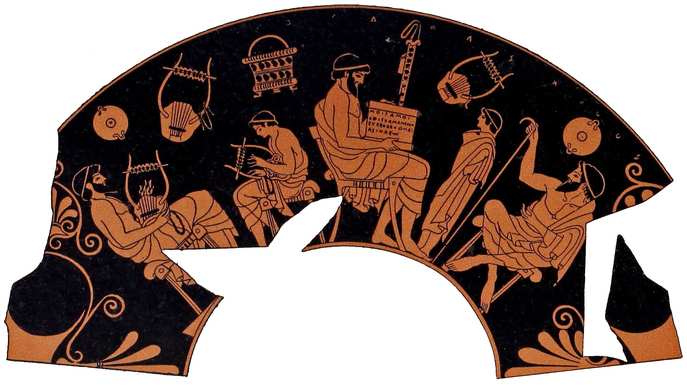
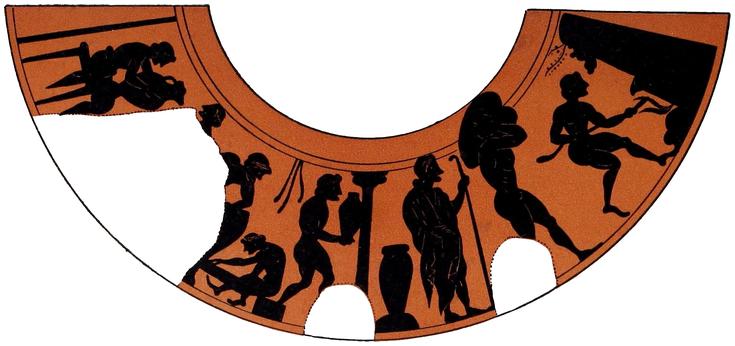
Fig. 22. INTERIOR OF A SCHOOL.
By Douris. Berlin Museum.
The kylix in the Berlin Museum, The
Interior of a School (Fig. 22), shows the same
fault, although it may be considered as Douris’
masterpiece in everyday scenes. But the
subject is of such interest to us, and throws
so much light on the life of Greek scholars,
that we think no longer of imperfections nor of
the systematic stiffness of the groups. Here,
again, Douris is seen as an original and fertile
initiator. He here abandons the palæstra and
the gymnastic exercises, repeated a hundred
times, and takes us into the school-room where
the music-master and the grammarian give
their lessons; on one reverse, lessons on the
lyre and recitations are given, on the other,
lessons in writing and flute-playing. In the
interior, a simple figure of a nude youth tying
his sandal, shows the boy, whose task is finished,
preparing to run and play. It is a charming
and sober painting, we should call it to-day,
“an instantaneous impression,” giving a glimpse
of life which particularly attracts us. How
were the youths of Athens educated? Upon
that theme bulky volumes have been written.
As M. Paul Girard has shown in his Education
Athénienne, this kylix of Douris teaches
us better than the texts. We see here the
importance the Greeks attached to musical
instruction. The word “music” expressed the
entire education; literary studies, instrumental
music and singing. Music walked hand in
hand with literature and gymnastic exercises.
Plato even went so far as to say that the art
of touching the soul with song inspired the
desire for virtue. He rejected, however, as
voluptuous and enervating, certain Ionian and
Lydian modes. We must remember that
music was intended chiefly, as represented on
the vase in Berlin, to accompany the song,
and that the words were more significant than
the melody. Prayers, invocations, war-songs,
moral maxims, all contributed to make music
a powerful instrument of education, and the
apparently paradoxical words of old Damon
may in this way be explained, when he said
that the rules of music could not be changed
without shaking the state itself.
The kylix of Douris corresponds closely with
these ideas. Literature is represented, on the
one hand, by a master of declamation holding
a written scroll, upon which we read the
beginning of an epic poem that a pupil is
about to recite (Fig. 22); on the other side,
a young master is tracing a page of writing,
while a pupil stands ready to copy it. Meanwhile
the tutors of the boys sit on stools,
waiting for the lessons to be finished to conduct
them home. No other ancient artist has
permitted us to enter so intimately into
Athenian life. What we term “genre painting”
has appeared. It is the last and perhaps
the most fertile inspiration that Douris derived
from great contemporary art. It permits us,
at the same time, to admire the flexibility of
a great talent, starting with religious and
heroic subjects in the severe style of Eos and
Memnon, and attaining to the graceful and
brilliant compositions of The Youth and the
Hare, and The Interior of a School.
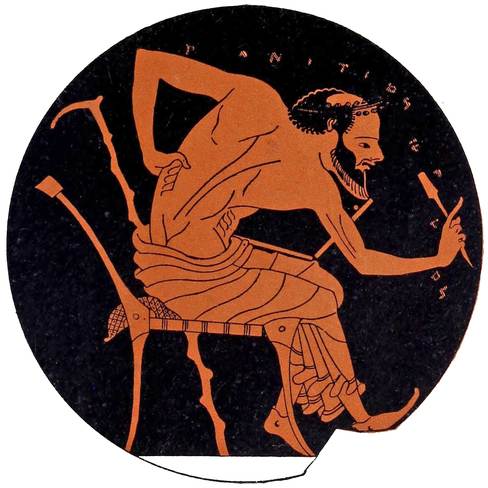
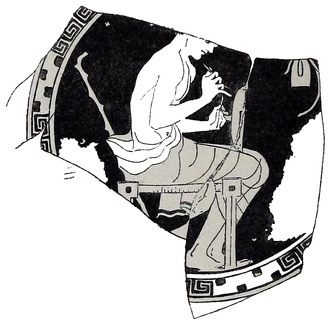
There is an amusing sketch from the workshop
of Euphronios, which may be placed by
the side of these paintings, showing a writing-teacher
bending forward in his chair, with
forefinger raised and threatening, as if he
were scolding the little fellows confided to his
care (Fig. 23).