It began to clear off about sunset time that
evening. To the westward, beyond Meeker’s
Marsh, beyond the distant rolling hills, a gleam of
crimson dispelled the gray for a brief moment.
Later, one by one, the stars came out, and a little
wind brushed the sky clear of clouds. It was a
cold, crisp evening, and Mr. McIntyre, looking out
for a moment before he drew the shades in his
study, felt the attractions of fresh air and exercise.
Getting into a heavy plaid ulster, settling his
funny round cloth hat on his head, and taking his
big Scotch oak walking stick in hand, Kilts turned
down his light and left the building.
He had been expecting some books by express
for several days, and now he would just walk down
to the station and see if they were there. He was
a good walker, and once clear of the school
grounds, he swung his stick and stepped out vigorously.
Overhead the millions of stars sparkled
whitely in a purple-black sky, shedding a faint
radiance over the snowy road and fields. Perhaps
memory brought recollections of just such tingling
nights at home in the lowlands of Scotland, for he
paused once for a long while at the edge of the
road and gazed off across the fields and sighed ere
he went on his way again.
At the station he found that his package had not
yet been received. As he turned to retrace his
steps a long whistle reached him through the
silence, and he paused at the corner of the station
to watch the train come in. He always enjoyed
that. He liked to see the glare sweep down the
track, listen to the mighty breath of the great iron
monster hurling itself out of the night, watch the
lighted windows as they flashed by, and wonder,
as folks will who are quite out of the world of
travel, who were beyond them and why. Even an
instructor of mathematics may have imagination.
But instead of thundering by, the train slackened
pace and came to a stop. Only a handful of
travelers alighted, and they were soon swallowed
up in the semi-darkness outside the radius of the
station lights.
But two of the alighting travelers interested
him. They were boys, and Kilts believed that he
recognized one of them. This one, the taller and
larger of the pair, passed not far from where
Kilts stood. He carried a suit-case into the station,
and presently emerged without it. Then he
joined his companion, who was awaiting him in the
shadow at the farther end of the platform, and
together they passed around to where the carriages
stood. Kilts, with no idea of spying, but
merely to satisfy a mild curiosity, went around the
station at the other end and walked down the
asphalt there until he was within a few yards of
the carriage into which the two boys were clambering.
He was right. The larger of the two was
Vinton. He wondered where that youth had been
to be returning to school so long after supper time.
He recollected, too, that Vinton had been absent
from his class that afternoon. It was quite likely,
however, that he had permission to leave school,
Kilts reflected. Then the incident of the bag presented
itself. Why had Vinton left his bag at the
station, since he had ridden up in a carriage?
That looked suspicious. Kilts wasn’t one to look
for trouble, but it seemed to him that here was
something that would bear investigation. He resolved
to stop at the Office on his way to his room
and see whether Vinton had received permission
to sign off.
Meanwhile the carriage containing the boys
was rattling along over the snowy, rutted road.
Dan seemed suddenly very silent, and Gerald,
who, ever since his capitulation, had been in the
highest spirits, wondered, and presently asked the
reason. After a moment’s hesitation Dan
answered:
“Kilts was down there at the station, Gerald,
and I’m pretty certain he recognized me.”
“Do you think he will tell?” asked Gerald
anxiously.
“I don’t know. He saw me take your bag into
the station. He was standing at the corner. I
didn’t notice him until I came out, and I wasn’t
certain then who he was. But he followed us
around to the carriage. I hope he didn’t see you
to know you.”
“So do I,” said Gerald. “He’s got it in for
me badly enough as it is. But I hope you won’t
get into trouble.”
“It won’t matter as long as he doesn’t find
out who you are,” Dan replied. Then he moved
forward and engaged the driver in conversation,
swearing that worthy to secrecy. They dismissed
the carriage at the foot of the hill and
walked up to school by way of the path. Their
precaution, however, proved unnecessary, for no
one was in sight as they made their way to Clarke.
Nor did they meet a single person on their way
up the stairs and through the hall. Dan heaved
a sigh of relief as he closed the room door behind
him. If Kilts didn’t prove troublesome
everything was all right.
“Jove!” he said as he took off his coat and
looked curiously around the room. “It seems
like two or three days since I was here last.
And I’ve only been away eight hours! Get your
things off, Gerald, and we’ll get to work. What’s
going to trouble you most to-morrow? You
missed all your recitations to-day, I suppose?”
“Yes,” Gerald answered, “but algebra is the
only thing I’m afraid of.”
“All right. Get your books together and sit
down. We’ll go over the lesson together. I suppose
you’ll have about five pages more to-morrow,
eh?” Dan brought his chair around beside
Gerald’s. “This doesn’t look awfully difficult.
I don’t believe you really get your mind
on it, Gerald. Here, try this one and see how
it goes. While you’re doing it I’ll glance through
my French.”
They were both studying very hard when, some
twenty minutes later, there came a knock at the
door.
“Come,” called Dan, darting an apprehensive
glance at his companion. The door opened and
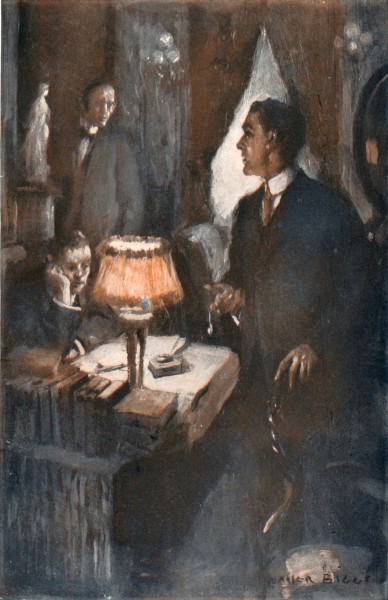
in walked Kilts. The boys jumped to their feet.
“Good evening,” said Dan. “Will you sit
down, sir?”
Kilts was tall and lean, his clean-shaven face
surmounted by an unruly shock of iron-gray
hair. His eyes—they might have been gray or
blue—were deeply set and sharp as two gimlets.
In age he was about fifty. He still wore his
queer old plaid ulster, without which he was
seldom seen abroad, no matter the season, and
carried his cloth hat and his stick in his hand.
He answered Dan’s greeting, bowed to Gerald and
took the chair offered, settling his stick across
his knees and laying his hat carefully atop. Then
with a glance about the room he smoothed one
lean cheek with his hand and fixed his gaze on
Dan.
“I’m not wanting to be here, Vinton,” he said
gravely but kindly. “But I’ve got a question to
ask you. I saw you at the station awhile ago,
eh?”
“Yes, sir,” replied Dan.
“You’d been away?”
“Yes, sir.”
“Without permission?”
“Yes, sir.”
Kilts’ gaze moved to Gerald, who, in his chair
at the desk, was looking intently at his book.
“There was a boy with you?”
Dan hesitated a moment. Then:
“Yes, sir,” he answered.
“Who was he?”
“I’d rather not say, Mr. McIntyre.”
“Hum,” grunted Kilts. There was a moment
of silence. Gerald took up a pencil and began
scrawling nervously on the margin of his book.
Kilts cleared his throat. “Well, I’m sorry.
I’ll have to report this, Vinton. You understand
that?”
“Yes, sir. And—I’m sorry, too.”
“Well, well, maybe ’twill not be so bad. If
you’re sorry, now, likely—”
“What I meant was,” said Dan with a smile,
“that I was sorry for you, sir.”
“Eh? Sorry for me?” Mr. McIntyre’s thick,
grizzled eyebrows snapped together.
“Why, yes, sir. I know you don’t like to have
to report fellows,” answered Dan.
“Hum! Well, no more I do, Vinton.” Kilts
frowned, glanced at Gerald and glanced away
again. “Maybe there were circumstances, Vinton,
that extenuate your action,” he said finally
with a hopeful note in his voice. “Maybe, now,
’twas illness in the family; maybe ’twas necessary
for you to leave school suddenly—”
“It was, sir, very necessary,” replied Dan, “but
it had nothing to do with my family.”
“Well, well, maybe if you’d be telling me about
it, now—”
“I’m afraid I can’t, sir,” said Dan regretfully.
“I wish I could. But it concerns someone else.”
“Then you’re afraid you might get him into
trouble?”
“Y-yes, sir.” He paused. Then he said
frankly; “The fact, sir, is that it was necessary
for me to go to New York on the noon train; I
can’t tell you why it was necessary; and I only
learned that I had to go just a few minutes before
the train left. The train was moving when
I got on it. So there was no time to get permission
and sign off. I knew it was against the
rules, sir, but I couldn’t very well do anything
else.”
“Well, well, it’s too bad,” said Kilts, “too bad!
But I’ll speak a good word for you. I would not
be surprised if we were lenient, Vinton. As for
the other boy, now—” Kilts very carefully refrained
from even a glance toward Gerald—“why,
I don’t know who he may be, and so I don’t feel
called on to mention him. But he must promise
not to do anything of the kind again. Do you
think he will promise that?”
“I’m sure of it,” replied Dan earnestly and
gratefully.
Kilts nodded.
“Good! Then I’ll say good-night. I fear I’ve
kept you from study too long already.” Mr.
McIntyre took up his stick and hat and prepared
to rise, but Dan interrupted.
“Mr. McIntyre, sir, just a moment, please,” he
begged. “I—I—there’s something else, sir.”
Kilts laid his stick back across his knees and
threw aside his ulster again.
“Well?” he asked. Dan was silent a moment,
formulating his thoughts. Then:
“This other boy, sir,” he said, “it’s about
him.” Kilts nodded and Gerald stirred uneasily
at the table. “You don’t know who he is, sir,
as you say, and so he—he isn’t likely to come into
the affair. But I’d like to tell you a little about
him, as it can’t do him any harm.”
“Well, let me hear it,” said Kilts.
“I’ll call him—Moore,” said Dan, “but that
isn’t his name. He—he hasn’t been here very
long. This is his first school. He has always
studied with tutors and there are some things he
hasn’t got on very well with. And one of them is
mathematics.”
Kilts nodded inscrutably and Gerald leaned
closer to his book.
“He’s in algebra now, sir,” Dan continued,
“and he’s making hard work of it. At first he
really tried hard to understand it and get along,
but he couldn’t seem to make a go of it. Then he
got discouraged and I’m afraid he didn’t try so
hard. You see, sir, there were other things that
were—were unpleasant. Moore’s father is a
very prominent man and a very wealthy one.
And when Moore came here a good many of the
fellows took a dislike to him on that account. I
suppose they thought that Moore was stuck-up, although
he really isn’t. But he isn’t the sort of
fellow that makes friends easily, sir; he’s a little
bit shy. Well, some of the fellows tried to make it
unpleasant for him; called him ‘Miss Nancy’ and
‘Young Money-bags’ and things like that. Well,
that wasn’t pleasant, sir; and then he didn’t have
any friends, only two or three who had known
him before he entered school, and he began to
think he was imposed on. Then there was the
algebra. He couldn’t seem to make a go at that;
he fancied that the instructor was a bit down on
him, too, and you know that always discourages a
fellow, sir.”
“Ay,” grunted Kilts.
“So one day, when he didn’t have his lesson,
the instructor lost patience with him and ragged
him in front of the class and Moore answered
back. He hasn’t any excuse for that, sir, and
he’s sorry now. Of course he was reported and
he was placed on probation. Well, he ought to
have kept his nerve and steadied down. But instead
he sort of went up in the air; thought everyone
was down on him, nobody liked him, and that
he was pretty badly treated. So he made up his
mind to—to cut it out—leave school, you know.”
“Hum,” muttered Kilts as Dan paused an
instant.
“The fact is, sir, he really thought that all he
had to do was to go home in order to leave school.
He didn’t understand that it was necessary for
his father to withdraw him. He believed that
when he left Wissining the Faculty had nothing
more to do with him. What I’m trying to show
you, sir, is that he didn’t mean to disobey rules,
but just quit altogether. Well, a friend of his
learned about it three hours after he had gone.
This friend knew that if the Faculty heard of it
they might expel him. So he—he took the first
train and went to the other fellow’s home and
found him and brought him back.”
“He was ready to come back?” asked Kilts.
“Yes. He wanted to come back, although he
pretended he didn’t. You see, sir, he—he had an
idea that this friend of his had—had grown tired
of him and didn’t care about him any more.
When he found that wasn’t so he was glad to
come back. If it would do any good he would go
to the Office and confess what he’d done, but it
might result in his being expelled. He doesn’t
need punishment, sir, for he’s had a pretty tough
time of it already, and he won’t ever do anything
of the kind again. I’ve already promised that for
him,” added Dan with a smile at the professor.
For a moment there was silence. Kilts, leaning
back in his chair, observed Dan steadily out
of his sharp eyes. Dan stood the ordeal without
a tremor. Then:
“And why have you told me this, Vinton?”
asked Kilts suddenly.
“Because Moore is back here now, sir, and he intends
to do the best he can in everything, especially
algebra. And I wanted you to know, sir,
that if he doesn’t get on very well it isn’t because
he isn’t trying. I’m going to help him all I can,
sir,” said Dan earnestly. “I was going over the
lesson with him when you—”
Gerald’s pencil rolled to the floor and Dan
brought himself up with a jerk. But the only
sign from Kilts was a momentary twinkle of the
deep-set eyes.
“And so he thinks the instructor is down on
him, eh?” asked Mr. McIntyre.
“He did think so, but I—but his friend made
him understand that he was wrong.”
“Really, and how did his friend do that? What
did he say now, Vinton?”
“He said,” replied Dan gravely, “that the instructor
was hard on fellows when he thought
they weren’t trying to get on; that he was a good
deal like anyone else, sir; had a temper—”
“Hum!” grunted Kilts.
“And lost it sometimes, like most folks. But
that he was square and just and would treat a
fellow white if the fellow showed that he was trying
to do his work.”
Kilts seemed for the moment at a loss for something
to say. Then he cleared his throat.
“Well, and what did he say?” asked Kilts, with
a nod toward Gerald.
“You mean what did Moore say?” asked Dan
politely.
“Yes, Moore; what did he say?”
“Well, he didn’t say much, sir; but he understood.”
“You think he did, eh? Think he believed
you—I mean this friend of his?”
“Yes, sir, I’m quite sure he did.”
Kilts was silent a moment. Finally:
“Then you tell him that that instructor will
give him fair-play. Tell him to do his best and
not be touchy when the instructor loses that bad
temper of his.”
“Thank you, sir, I will,” answered Dan gratefully.
Mr. McIntyre got up with a grunt that
might have meant most anything and began to
button his ulster about his gaunt form. In the
process his feet wandered toward the table.
Gerald kept his head over his book.
“Ah—hum—that your algebra, Pennimore?”
asked Kilts, pointing at the book.
“Yes, sir,” murmured Gerald without looking
up.
“Been—been looking it over, have you?”
“Yes, sir, a little.”
“Hm. I didn’t see you in class this morning,
did I?”
“Er—no, sir.”
“Thought so. Well, to-morrow we take—let
me see.” Kilts laid his stick and hat on the
table and leaned over the book. “Yes, we take
four pages and a half. To here. Mark it there.
That’s right. Had any trouble with it so far?”
Gerald shot a bewildered look across at Dan’s
smiling countenance and read reassurance.
“Yes, sir, I have. I—I don’t seem to understand
it, sir,” he added pathetically.
“Because you don’t try to!” said Kilts with
a trace of asperity. “You’ve just made up your
mind that algebra is something you don’t need
and that you’ll just fiddle through it the easiest
way; just learn enough to get your marks. I
know. Half you fellows think that. You don’t
any of you understand that mathematics is a
grand study. Why, you talk about romance, my
boy! Here it is, right here!” And he thumped
the open book with the back of one big hand.
“The Romance of Figures! Why, ’tis a wonderful,
marvelous thing, my lad, this mathematics.
’Tis as full of romance and beauty as a garden
of flowers! You don’t look beyond the surface;
you don’t think! An’ ye go at it right, laddie,
with open eyes and an open heart ye’ll love it!”
Kilts stopped and shook his head patiently.
“But ye won’t believe me. I know. You’re
like the rest. You think I’m just an old fool with
a hobby for figures, a dried-up old curmudgeon
with no feelings, and no manners—”
“Oh, please, sir!” begged Gerald miserably.
“There, there, laddie! ’Twas ill said! Think
no more of it!” Kilts patted the boy’s shoulder
and smiled down kindly at his distressed face.
“Now show me what you don’t understand.” He
looked around for a chair, and Dan, anticipating
his want, placed one for him. Kilts produced
his glasses from his pocket, unceremoniously
pushed the litter of books and papers away from
in front of him so that several would have fallen
to the floor had not Dan rescued them in time and
drew the algebra toward him. “What is it that’s
puzzling that young brain of yours, my boy?”
Dan went quietly to his chair across the table
and bent over his French. But he didn’t do much
studying. The voices of Kilts and Gerald broke
the silence at intervals, Gerald’s apologetic, inquiring,
Kilts’ patient, persuasive. Half an hour
went by. Then:
“What did I say?” exclaimed Mr. McIntyre
triumphantly. “Concentrate, concentrate, Pennimore!
Put your mind on what you’re doing.
There’s not an example in that whole book that
won’t come just as easy as that one has, if you
put your mind to it. Look now, laddie, that’s
not just a mess of little figures; ’tis a story, a
little romance waiting for you to translate it.
Remember that, lad, and maybe ’twill come
easier.”
“Thank you very much, sir,” said Gerald gratefully.
“I—I don’t think I’ll have so much
trouble after this, sir. Anyhow, I’m going to try
very hard, sir.”
“That’s right, that’s right,” answered Kilts,
patting him on the arm as he lifted his long length
out of the chair. “Put your mind on it; concentrate,
concentrate! You’ll do finely yet. Good-night,
good-night, boys.”
“Good-night, sir,” they echoed. Dan went to
the door with the instructor and held it open.
“I’ll report to the Office to-morrow, sir,” he
said.
“Eh? Well, well, I wouldn’t do that,” said
Kilts slowly. There was a twinkle in his eye.
“Wait ’till you hear, Vinton, wait ’till you hear.”
He lowered his voice. “Fact is, my boy, I’m getting
along and my memory isn’t what it used to
be. I might forget; there’s no telling. Yes, I
might forget.”
And Kilts went off down the corridor. Dan
thought that he heard a chuckle.