Footnotes have been collected at the end of the text, and are
linked for ease of reference.
Minor errors, attributable to the printer, have been corrected. Please
see the transcriber’s note at the end of this text
for details regarding the handling of any textual issues encountered
during its preparation.
Any corrections are indicated using an underline
highlight. Placing the cursor over the correction will produce the
original text in a small popup.
Any corrections are indicated as hyperlinks, which will navigate the
reader to the corresponding entry in the corrections table in the
note at the end of the text.
I
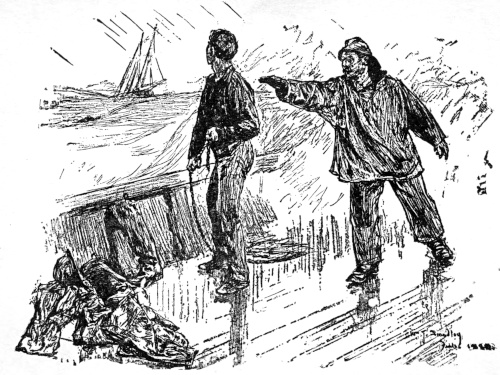
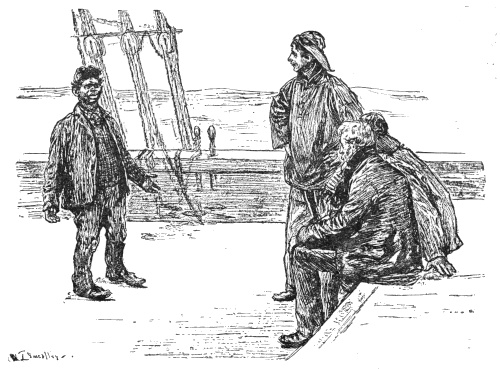
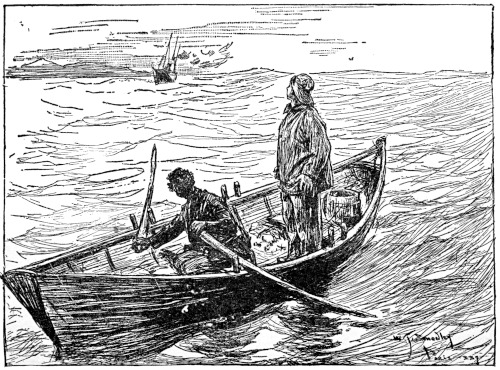
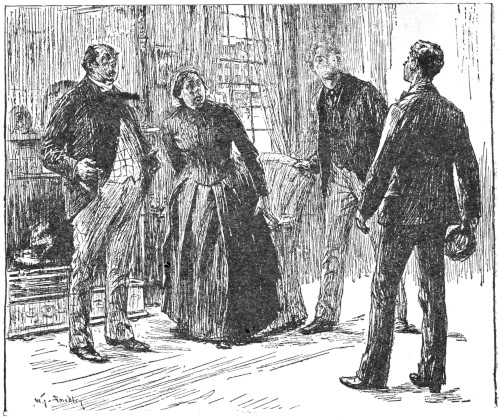
THE LITTLE FELLOW SMILED IN THE WEATHER-BEATEN FACE. [See page 15.
II
A TALE OF THE FISHING BANKS
By KIRK MUNROE
AUTHOR OF
“WAKULLA” “FLAMINGO FEATHER” “DERRICK STERLING” ETC.
The fog had lifted, and a few stars were to be seen
twinkling feebly; but the wind was very light, and
what there was of it was dead ahead. There was a
heavy swell rolling in from the eastward, but no sea
running. The Gloucester fishing schooner Sea Robin
was homeward bound from the Newfoundland Banks,
and as she slowly climbed each glassy incline of black
water, and then slid down into the windless hollow beyond,
she seemed to be making no progress whatever on
her course.
Although the Sea Robin had been out for more than
four months, and had seen vessel after vessel of the fleet
leave the Banks before she did and sail for home with
12full fares, not half the salt in her pens was used up, and
she was returning with the smallest catch of the season.
In spite of the fact that provisions were running low on
board the schooner, her captain, Almon McCloud, would
not have given up and left the Banks yet, had not a
recent gale swept away his dories, and caused the loss of
his new four-hundred-fathom cable.
Under these circumstances the crew of the schooner
were very low-spirited, and there was none of the larking
and fun among them that is usually to be noticed in
a homeward-bound Banker. The men wondered as to
the “Jonah” who had caused all their ill-luck. Finally
they whispered among themselves that it must be the
skipper. They now remembered that he had been unfortunate
in more than one undertaking during the past
year or two, and all were agreed that it would be wise
not to sail with him again. This decision had been
unanimously reached a few days before the one on which
this story opens; and when, shortly before daybreak,
there came a loud pounding on the cabin hatch, and
a request that the captain should come on deck, one of
the watch below turned restlessly in his bunk, and
growled out,
“I expect we are in for another bit of the skipper’s
tough luck.”
13Reaching the deck, Captain McCloud found the two
men on watch gazing earnestly at a dull red glow that
lighted the distant horizon behind them.
“Looks like there was suthin afire back there, skipper,”
said the man at the wheel.
The captain waited until the schooner rose on top of
a swell, and then, after a long look at the light, gave the
order to put her about and run for it.
There was some grumbling among the crew at this,
for they were tired and sick of the trip. They wanted
to get home and have it over with, and this running back
over the course they had just come seemed to promise a
long and vexatious delay. However, lucky or unlucky,
their skipper had proved himself to be the captain of his
vessel in every sense of the word more times than one,
and they dared not question his action loudly enough for
him to hear them.
For nearly an hour longer the light glowed steadily,
then it expanded into a sudden wonderful brightness, and
the next instant had disappeared entirely.
Three hours later, just as the sun was rising in all its
sea-born glory, the Sea Robin sailed slowly through a
mass of charred timbers and other floating remains of
what evidently had been a large vessel. There were no
boats to be seen, nor was anything discovered by which
14her name or character could be identified. For some time
the schooner cruised back and forth through the wreckage
in a fruitless search for survivors of the catastrophe.
As they were about to give it up, and Captain McCloud
had begun to issue the order to head her away again on
her course towards home, he all at once held up his
hand to command silence, and listened.
It was certainly the cry of an infant that came clear
and loud across the water. The crew looked at each
other in amazement, not unmixed with fear. There was
no boat to be seen, no sign of life; and yet there it came
again, louder and more distinct than before; the vigorous
cry of a healthy baby who has just waked up and is hungry.
The wind had died out entirely, the water was oily
in its unruffled smoothness, and only the long swell remained.
Once more the cry was heard, and now it seemed so
close at hand that several of the men trembled and
turned pale. There was still nothing to be seen, save on
the crest of the swell above them an apparently empty
cask maintaining an upright position in the water, and
showing a third of its length above it.
“That’s the life-boat!” shouted Captain McCloud.
“There’s where the music comes from, men. Oh for the
use of a dory for just five minutes!”
15Having no boat, they could only watch the cask as it
came slowly nearer and nearer, and several of the men
prepared to jump overboard and swim for it in case it
should drift past them. At last, when it was about
thirty feet away, the skipper, making a skilful cast, settled
the bight of a light line over the strange craft.
Then he carefully drew it towards the schooner, over the
low rail of which a couple of the crew were hanging,
waiting with out-stretched arms to grasp it.
A minute later the cask stood on the schooner’s deck,
and Captain McCloud was lifting tenderly from it a
sturdy, well-grown baby boy, apparently about two years
old. The little fellow smiled in the weather-beaten face,
and stretched out his arms eagerly as the rough fisherman
bent down towards him. At the same instant there came
a fluttering of sails overhead, with a rattling of blocks,
and one of the crew sang out as he sprang to the wheel,
“Here’s a breeze! and it’s fair for home!”
“The baby’s brought it!” shouted another. “Hurrah
for the baby!”
The shout was eagerly taken up by the crew; three
hearty cheers were given for the baby, and three more
for the breeze he had brought with him. Then, springing
to sheets and halyards with more enthusiasm than they
had shown before on the whole cruise, the active fellows
16quickly had the Sea Robin under a cloud of light canvas,
and humming merrily along towards Gloucester.
They now found time to look at their baby, who, held
in the skipper’s arms while he gave the necessary orders
for working the schooner, contentedly sucked his thumb
and gazed calmly about with the air of being perfectly
at home. He was a beautiful child, with great blue eyes
and yellow hair that curled in tiny ringlets all over his
head. He was plainly dressed; but all that he wore was
made of the finest material. Altogether he was so dainty
a little specimen of humanity that he seemed like a pink
and white rose-bud amid the rough men who surrounded
him. He gazed at them for a minute or two with a
smile, as though he would say that he was most happy to
make their acquaintance, and was not in the least embarrassed
by their stares. Then he turned to the skipper,
and began to cry in exactly the tone with which he had
announced his presence in the floating cask.
“Hello!” exclaimed the skipper, who, though married,
had no children of his own, and had never held a baby
before in his life, “what’s up now? Here, ‘doctor,’ you’ve
had some experience in this line, I believe; cast your
weather eye over this way and tell us the meaning of the
squall.”
The cook, or “doctor,” as he is almost always called on
17board the fishing schooners, and, in fact, on most vessels,
was a short, thick-set Portuguese, almost as dark as an
Indian, but the very picture of good-nature. He now
stepped up behind the skipper so as to have a good view
of the baby, whose face, which rested on the skipper’s
shoulder, was turned away from the crew, who stood looking
at him in a helplessly bewildered way.
At the “doctor’s” sudden appearance the baby stopped
crying, began again to suck his thumb, and, with great,
wide-open eyes, stared solemnly at the grinning figure to
whom it was thus introduced.
“Him hongry, skip,” announced the “doctor.” “Me fix
him, pret quicka, bimeby, right off. Got one lit tin cow
lef. You fetcha him down.”
The “doctor,” who was named Mateo, declared afterwards
that the moment he looked into the baby’s face the
little one had winked at him, as much as to say, “You
know what I want, old chap, now go ahead and get it.”
By his “lit tin cow” he meant a can of condensed milk,
and, as the only man on board who knew how to feed a
baby, he had suddenly become the most important person
among all the crew. Obeying his order, the skipper, with
the new arrival in his arms, followed him down into the
fore hold. The rest of the crew also attempted to crowd
down into the narrow space to witness the novel sight of
18a baby at breakfast, but old Mateo quickly ordered them
on deck, saying that the little stranger was big enough to
occupy all the room there was to spare.
Then he bustled around in a hurry. He got out and
opened the one remaining can of milk, and mixed a small
portion of its contents with some warm water in a cup.
The baby watched his every movement in silence, but
with such a wise look that both the men felt he knew exactly
what was going on. Now came the anxious moment--would
he take the milk? Had he learned how to
drink? The anxiety was quickly ended. He had learned
to drink, and quickly emptied the proffered cup of every
drop of its contents with an eagerness that showed how
hungry he was. A ship biscuit, broken into small bits
and soaked until soft in another cup of the warm milk,
proved equally acceptable. When the members of the
crew heard that the baby not only took kindly to the
tin cow’s milk, but had eaten hard-tack, they were highly
delighted. They declared that he was a natural born
sailor, and would make a fisherman yet.
After his breakfast the baby was laid in the skipper’s
own bunk in the cabin, where, warmly covered, and rocked
by the motion of the schooner, he quickly fell asleep.
On deck the men conversed in low tones for fear of disturbing
him. Their sole topic was the child’s miraculous
19preservation and rescue, first from the burning vessel and
then from the sea. The cask in which he had floated to
them was carefully examined and pronounced to be of
foreign make. It had evidently been prepared hastily to
serve the novel purpose of a life-boat, but the preparation
had been made with skill. In the bottom was a quantity
of scrap-iron, that had served as ballast and caused it to
float on end instead of on its side. On top of this were,
tightly wedged, two large empty tin cans, square, and
having screw tops; while above these was a pillow, in
which the baby, wrapped in a thick woollen shawl, had
been laid. There was nothing else. Here was the baby,
and here the cask in which he had been saved; there, far
behind them, was the charred wreckage, and on the sky
the night before had shone the red glow from the burning
vessel. Where she was from, and where bound,
whether or not others besides this helpless babe had been
spared her awful fate, what was her name and what her
nationality, were among the countless mysteries of the
ocean that might never be cleared up.
There was little satisfaction to be gained by the discussion
of these things; but the baby was a reality, and a
novelty such as none of them had ever before seen on
board a fishing schooner. Of him they talked incessantly
during the three days’ homeward run. What they should
20call him perplexed them sadly for a time. The names
suggested and rejected would have added several pages to
a city directory. Finally this most important question
was decided by the skipper, who said, “He brought a
fair breeze with him that’s held by us ever since, and is
giving us one of the quickest runs home ever made from
the Banks. He’s as bright and cheery and refreshing as
a breeze himself, and I propose that we call him ‘Breeze.’
It’s a name that might belong to almost any nationality,
and yet give offence to none. As to a second name, for
want of a better, and if he don’t discover the one he’s
rightly entitled to, why, I’ll give him mine. What’s
more, I’ll adopt him if his own folks don’t turn up; that
is, if my old woman is agreeable, and I ain’t much afraid
but what she will be.”
So the little waif of the sea became, and was known
from that day forth as, Breeze McCloud--a name that was
destined to become connected with as many exciting adventures
and hair-breadth escapes as any ever signed to
the shipping papers of a Gloucester fishing schooner.
The breeze that hurried the Sea Robin along was none
too fair nor too strong; for the supply of milk furnished
by the “doctor’s” tin cow was completely exhausted before
they reached home. If they had not got in just as
they did, the baby would have suffered from hunger, and
21the whole crew would have suffered with him. As it
was, they passed Thatcher’s Island while he was drinking
the last of the milk. Before he was again hungry, with
everything set and drawing, and decorated with every
flag and bit of bunting that could be found on board, the
saucy Sea Robin had rounded Eastern Point and was sailing
merrily up Gloucester harbor.
A crowd of people had assembled on the wharf to witness
her arrival, and learn the cause of her decorations.
As she neared it one of them called out,
“What is it, skipper? You’ve got your flags up as if
you thought you was High-line[A] of the fleet; but the
old Robin don’t look to be very deep. What have you
got?”
“We do claim to be High-line,” shouted back the skipper.
“And here’s what we’ve got to prove it.” With
this he held the baby high above his head so that all
might see it, and added, “If any Grand Banker has
brought in a better fare than that this season, I want to
see it; that’s all.”
So Breeze McCloud entered Gloucester harbor, and never
had any stranger been received with greater enthusiasm.
22The news of his arrival spread like wildfire, and it
seemed as though half the population of the city had
crowded down to the wharf to see him before Captain
McCloud could get ready to leave the schooner. Then,
with the baby in his arms, he stepped into the long seine-boat
that, pulled by half a dozen lusty fellows, was waiting
to take him across the harbor to the foot of the hill
upon which his modest cottage was perched.
After many days of anxiety--for the Sea Robin was
long overdue--the captain’s wife, who had watched his
schooner sail up the harbor with flags flying, now awaited
him in a fever of impatience. She had waited at home
because she could not bear to meet him before strangers,
so she had heard nothing of what he was bringing her.
When at last she saw him coming up the hill, accompanied
by an ever-increasing throng of men, women, and
children, she was greatly perplexed to know what to
make of the sight, and hurried down to the little front
gate, where she waited for an explanation.
“Why! whose child can the man have picked up?” she
said to herself, as her husband drew near enough for her
to see what it was he held in his arms.
“The old Robin’s High-line this season, Dolly,” cried
Captain McCloud as he reached the gate, “and I’ve
brought you my share of the catch.”
23“You don’t mean that baby, Almon!” exclaimed the
bewildered woman.
“Yes, I do mean this very blessed baby! He’s a waif
of the sea, without father, mother, or home, that anybody
knows of; and if you say the word, we’ll give him all
three.” With this he held the baby towards her.
She hesitated a moment, but the baby did not. With
a happy little crow he at once stretched out his arms to
her, and said, “Mamma!”
It was enough. All the mother-love within her responded
to this cry, and the next moment the little one
was hugged tightly to her bosom.
Turning to those who had accompanied him, Captain
McCloud said, “That settles it, neighbors! I hadn’t
much doubt of it before; now I know I am acting
rightly; and here, before you all, I solemnly adopt this
baby boy, Breeze McCloud, as my son, and promise, with
God’s help, to be a father to him in deed as well as in
name.”
On board the Sea Robin none of the rough nurses, not
even the baby-wise Mateo, had dared undress the little
one so strangely given into their charge, for fear they
would not be able to dress him again. Thus, when he
was delivered to Mrs. McCloud, it was evident that, next
to food, his greatest needs were a bath and some clean
24clothes. These last his adopted mother borrowed from a
neighbor who had children of all ages and sizes.
When the baby was undressed it was discovered that a
slender gold chain was clasped about his neck. Attached
to it was a golden ball covered with a tracery of unique
and elaborate engraving. It was apparently hollow; but
nobody was able to open it, nor could they discover any
joint on its surface, so skilful was the workmanship that
had created it. Finally, declaring that it was merely an
ornament and not meant to be opened, Mrs. McCloud put
it carefully away in a sandal-wood box, among her own
little hoard of treasures.
In that box the golden ball lay for years, almost unnoticed,
but ever guarding jealously the secret that some
day should exert such a wonderful influence over the
fortunes of the baby from whose neck it had been taken.
CHAPTER II. ON BOARD THE “CURLEW.”
25
Fifteen years seems a long time, and yet when they
are happy years how quickly they pass! They had
been happy to Breeze McCloud; happy and busy years.
No boy in Gloucester had a pleasanter home or more
loving parents than he, though he was but an adopted
son. He rarely thought of this, though, for Captain
McCloud had, from the very first, been a true father, and
the captain’s wife a loving mother to him. No other
children had come to them since they had taken him into
their hearts and home, and he was their pride and delight.
He had grown to be a tall, handsome fellow, interested in
his studies, and a bright scholar, but always impatient
for the time to come when he should go out into the
world and win from it his own livelihood.
Whenever Captain McCloud was at home the boy was
his constant companion, and from him Breeze eagerly
learned the rudiments of a sailor’s art. He delighted in
being called his father’s “dorymate,” and was very proud
26of being able to swim, and to row and sail his own dory,
before he was twelve years old.
Being so much in his father’s company, and listening to
the conversations between him and other men, gave
Breeze many ideas beyond the comprehension of most
boys of his age. He sometimes wore a grave and
thoughtful air, and often said wise things that sounded
oddly enough in one so young.
The boy’s curly head was a familiar sight on board
most of the fishing schooners that were constantly coming
into or going out of the port. Here he was perfectly
happy while listening to some tale of adventure on the
Banks or more distant fishing grounds, perhaps told by
its hero on the breezy deck or in the snug cabin of the
very craft on which it had all happened.
At last the time had come for him to set forth in quest
of similar adventures, and to do his share towards maintaining
the home that had been such a safe and pleasant
one to him. There was sorrow in it now, and there
might soon be want. The Sea Robin had been gone six
months, and no word had been received from her since
the day she sailed out beyond Eastern Point, and vanished
in the red glory of the rising sun.
Only in the hearts of his wife and adopted son did the
faintest hope remain that the Robin’s captain was still
27alive. To all others he was as dead, and a new breadwinner
was needed in his place.
“I must go now, mother,” said Breeze. “I’m large and
strong for my age, and if they’ll take me I am sure I can
do a man’s work and earn a man’s wages.”
“Oh, Breeze, my dear boy! my comfort! Is there not
something else you can do? A clerkship would pay just
as well, and there would be none of the horrible danger.”
“Don’t, mother! don’t urge it! It makes me heart-sick
to think of a desk, or of being shut up all day in a store.
I should never be good for anything, you know I wouldn’t,
mother dear, trying to do work that I had no heart in.”
“But, Breeze--”
“But, mother! Please don’t think any more about a
clerkship. Give me your consent and your blessing, and
let me follow father’s calling and gain a living from the
sea, as he has done. I came to you from the sea, you
know,” he continued, with a winning smile, and patting
her thin cheeks. “It was kind to me then, and it always
will be, I am sure.”
After many talks of this kind Breeze carried his point.
Then, one evening in March, there was no prouder boy in
town than he, when he was able to announce to his mother
that he had shipped for a mackerelling trip to the southward,
on the schooner Curlew.
28The vessel was already taking in her ice and stores, and
would haul out into the stream the next morning, ready
to start. Breeze was to go over to town the first thing
after breakfast, and buy the oil-skin suit, rubber boots, and
woollen cap that, besides the canvas bag of heavy clothing
he would take from home, would form his outfit. These
he would send aboard the schooner. Then he would
come home again and say good-by if there was time--but
perhaps there would not be, and so they had better
make the most of this evening.
They did make the most of it, and until after ten
o’clock, Breeze and his mother sat hand in hand, and
talked, she sadly and tearfully, he bravely and hopefully.
The next morning, just before he left, his mother called
him into her room, saying, “I have one more thing to
give you, Breeze. It is something that should be the
most precious thing in the world to you, and I want you
to wear it always.” With this she took from the sandalwood
box, that had kept it safely all these years, the
slender chain and golden ball that had hung around his
baby neck when she first held him in her arms.
Breeze was inclined to laugh at the idea of wearing a
gold chain and a locket around his neck; but his mother
was so in earnest in her desire that he should, that he
promised to do as she wished.
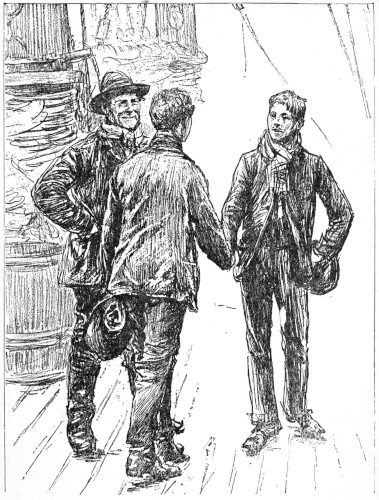
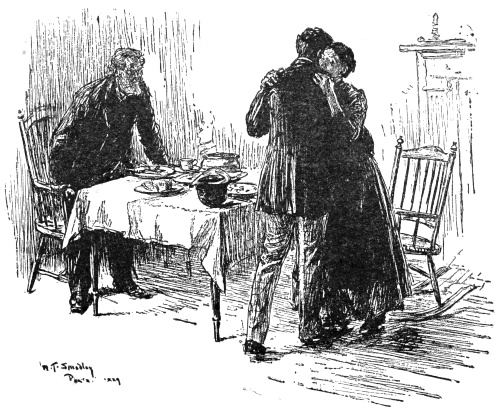
“I CAME TO YOU FROM THE SEA,” HE SAID, PATTING HER THIN CHEEKS.
29“It was, doubtless, your own mother first placed it there,
and I have a strong feeling that it will, somehow or other,
have much to do with your future safety and happiness,”
she said. “See, I have made a little pocket in the breast
of each of your flannel shirts to hold it,” she added, as
she clasped the chain about his neck and kissed him.
“Own mother, or not own mother, no boy ever had a
better, or sweeter, or dearer, or more loving mother than
you have been to me,” cried Breeze, throwing his arms
about her neck, “and I would not exchange you for any
other in the world, not even if she was a queen.”
Now that the time to go had really come, the boy
found it a very hard thing to part from his home. After
he had kissed his mother good-by, and started down the
hill, with his canvas bag on his shoulder, he dared not
look back, though he knew she was standing in front of
the little cottage watching him.
He had barely time in town to make his few purchases
before the Curlew should sail; for wind and tide were
both favorable, and her skipper was impatient to take advantage
of them and get started. His hurry was owing
to the fact that several other schooners were getting
ready for trips to the same waters. He was anxious to
be the first on the ground, and, if possible, carry the first
fresh mackerel of the season into New York.
30Although everybody has seen and eaten mackerel
either fresh or salted, and though they are caught in immense
numbers off the Atlantic coast of the United
States every year, there is but little really known about
them. Where they come from and where they go to
are still unsolved mysteries. Every spring, between the
middle of March and the middle of April, they appear in
great shoals in the waters just north of Cape Hatteras.
At this time they are very thin, and hardly fit for food;
but on the coast feeding-grounds they rapidly improve,
until in the early summer, when they have worked their
way northward to New England waters, they are in
prime condition. They generally run as far north as the
Gulf of St. Lawrence, from which, in the fall, they suddenly
disappear, to be seen no more until the following
spring.
All through the summer, but especially at the very
first of the season, those that are caught near a port are
packed in ice and carried in to the market fresh. The
greater part of the year’s catch is, however, salted in barrels
on board the schooners, and afterwards repacked on
shore, in kits or boxes, marked according to the size and
quality of the fish they contain, Nos. 1, 2, 3, or 4, and sent
all over the world.
The cruise on which Breeze McCloud was about to
31start was to be made in search of the very first mackerel
of the season, and the Curlew’s destination was therefore
the waters off the Delaware coast, or between there and
Cape Hatteras.
By ten o’clock everything was in readiness for the
start. The skipper had come on board, and all hands
were hard at work, making sail or breaking out and getting
up the heavy anchor. Then it was “up jib and
away.” As the lively craft slipped swiftly down the
harbor, Breeze found time for one long last look at his
home. At the cottage door he could just make out a
waving handkerchief, that told him he was being watched
and remembered.
Once outside, all hands were kept busy for a couple of
hours, setting light sails, coiling lines, stowing odds and
ends, and making everything snug. The course they
were heading would carry them just clear of Cape Cod;
and before a spanking breeze, under a press of canvas,
the Curlew tore along as though sailing an ocean race
that she was bound to win. Almost any fishing vessel
but a mackereller going out at this stormy season would
have left both top-masts and her jib-boom at home, being
content with the safest of working sails. To the early
mackerel catcher, however, every minute gained may mean
many extra dollars in pocket; so his craft sails in racing
32trim, and carries her canvas to the extreme of recklessness.
Like all fishing schooners, the Curlew had a forecastle,
in which several of the crew slept, and in which were also
the cook-stove and mess-table. Back of it was the pantry
and store-room, in which were ten fresh-water tanks.
Still farther aft was the hold, divided into pens by partitions
of rough boards. These were now filled with cakes
of ice, but later would be used for fish. Abaft the hold
was the cabin, in which the skipper and five of the crew
found sleeping accommodations. It was neatly finished
in ash, and running along three sides of it was a broad
transom that served as a seat or lounging-place. The
only furniture was a small coal-stove, securely fastened in
the middle of the floor. On the walls hung a clock,
a barometer, and a thermometer. A few charts were
stowed overhead in a rack, and, flung around in the
bunks or on the transom, were a number of paper-covered
novels.
The business of fishing is conducted upon the system
of shares. That is, half the value of the catch, after outfitting
expenses have been deducted, goes to the owners
of the vessel, and half to the crew. Although the skipper
and cook are not required to take part in the actual business
of fishing, each of them receives a full share. The
33skipper gets, in addition, four per cent. of the value of the
catch, and the cook has regular wages.
The living on board a fishing schooner is generally
superior to that on almost any other craft. It consists of
fresh meat, whenever it can be obtained, fresh fish, vegetables,
dried fruit, soft bread, cakes and pies, eggs, condensed
milk, and always tea and coffee, hot, strong, and
in abundance.
The Curlew was manned by a picked crew of twelve
men, including the skipper and cook. They were young,
strong, and active, and, except Breeze, all were skilful fishermen.
He had been considered very fortunate in obtaining
a berth at a time of year when there are so many
good men anxious to ship. That he had done so was
largely owing to the friendship existing between the skipper,
Captain Ezra Coffin, and his adopted father.
When he had consented to ship the boy for this trip,
the skipper said,
“It’s a hard life, Breeze, and one full of chances. Every
man aboard may have a hundred dollars to his credit before
the week is out, and then again we may cruise for a
month and not make enough to pay for our ice. You
are only a boy, but you will have to do a man’s work, and
hard work at that. There are perils of all kinds waiting
on every minute of the night and day, and they’ll come
34when you least expect them. I’d rather a boy of mine
would saw wood for a living on land than to try and
make it by fishing. Besides all this, as you are a green
hand, I can only offer you half a share for this trip. Still,
if you are bound to come, I’m glad to have you, both for
your own sake and for that of my old dorymate, Almon
McCloud. So bring along your dunnage, lad, and may
good-luck come with you!”
Breeze had answered, “I know it won’t be all plain sailing,
sir, and that I’ve got a lot to learn before I can be
called an A 1 hand. Still, hard and dangerous as you say
the business is, I’d rather try and make a living at it than
at anything else I know of, and I am much obliged to you
for giving me a chance.”
Soon after leaving port, the skipper called all hands aft
to draw for bunks and to “thumb the hat.” The bunks
had numbers chalked on them, and now the skipper held
in his hand as many small sticks as there were men in the
crew. Each stick had notches cut in it corresponding to
the numbers of the bunks, and one by one the crew
stepped up and drew them from the skipper’s hand.
Thus the sleeping quarters were distributed with perfect
fairness, and there was no chance for grumbling. Breeze
was lucky enough to draw one of the wide bunks in the
cabin, and at once hastened to stow his possessions in it.
35When all the berths had been thus distributed, the crew
again gathered aft, and each man placed a thumb on the
rim of an old straw hat that had been laid on top of the
cabin. The skipper turned his back to them, one of the
men named a number, and, without looking to see whose
it was, the skipper touched one of the thumbs. Then he
counted around until the number mentioned was reached.
The man at whose thumb he stopped was to stand first
watch and trick at the wheel, the next man on his right
the second, and so on. There would be two men on watch
in bad weather, but one is generally considered sufficient
when it is fine.
With the parting injunction to “mind, now, and remember
who you are to call,” the skipper went below. As
eight bells, or twelve o’clock, was struck, the man who
had first watch took the wheel, gave a glance at the compass,
another at the sails, and the regular routine of duty
was begun.
Now dinner was announced, and after the skipper was
seated, the half of the crew that reached the mess-table
and secured seats were entitled to eat at “first table”
during the trip. The others had to be content to eat at
“second table.” Breeze was not posted as to this, and
consequently was among those who got left when the
rush took place. Afterwards, this seemingly trifling circumstance
36proved to be of the most vital importance to
him, as we shall see.
The cruise thus fairly begun was continued without incident
until the Curlew reached the fishing grounds off
the Virginia capes. Then, under easy sail, she stood off
and on, with a man constantly at the mast-head, scanning
the surface of the water in the hope of seeing mackerel.
The great seine-boat was got overboard, and with the
seine in it, was towed behind the schooner, ready for instant
use.
At length, after four tedious days of this work, the impatient
crew were brought tumbling on deck in a hurry
one fine morning by the welcome cry of “There they
school; half a mile away, off the weather bow!”
CHAPTER III. THE HAULING OF THE SEINE.
37
In less than five minutes after the first cry announcing
the appearance of the eagerly expected fish, the great
thirty-foot, double-ended seine-boat, rowed by eight men,
had left the schooner and started in the direction of the
school. In its stern, with his hand on the long steering
oar, stood the seine-master, directing the course of the
boat and keeping a sharp lookout ahead. Pulling after
them as fast as he could was Breeze McCloud, in the single
dory that the Curlew carried. The schooner, left in
charge of the skipper and cook, was thrown up into the
wind, and was held as nearly stationary as possible until
it could be seen where she would be wanted.
“Come, stretch yourselves, lads! stretch yourselves!
Let’s see who’ll break the first oar! Those other fellows
are just humping themselves. It’s Yankee against Yankee
this time, and you’ve got a tough lot to beat,” shouted
the seine-master.
He would, of course, have been very sorry to have an oar
38broken, but he had such confidence that the men could do
no more than bend the tough ash blades, no matter how
hard they tugged, that he was perfectly willing they
should try. By the “other fellows” he meant the crew of
another fishing schooner, which daylight of that morning
had disclosed not far from them, and which had evidently
discovered mackerel about the same time they had. They,
too, were out in their seine-boat, and doubtless looked
forward with as great confidence as did the men from the
Curlew to taking the first fare of the season into New
York.
“Easy, lads, easy now!” ordered the seine-master, in a
tone of suppressed excitement; “here’s our school.” Now
he tossed overboard a small keg, or buoy, to which was
attached one end of the upper, or cork line of the great
net. Near this Breeze was to wait in his dory. Then,
bending to their oars, the boat’s crew began to pull, with
lusty strokes, in a great circle around the school of fish
that was rippling the water close beside them. Swimming
in a dense body close to the surface, often throwing
themselves clear of the water, with their steely blue sides
flashing in the morning light, the mackerel were darting
madly hither and thither. At one instant the whole
school, moved by some mysterious impulse, would make a
simultaneous dash in one direction, and the next it would
39as suddenly rush back again. In the cool dim depths beneath
them, dog-fish, sharks, and other hungry sea pirates
were breakfasting off the newly arrived strangers, and devouring
them by the score. In the air above them circled
and swooped great fishing hawks, anxious to make a meal
off of fresh mackerel. Now to these enemies was added
man, the most cruel and greatly to be dreaded of all. No
wonder the poor fish were frightened and undecided as to
the direction of their flight from so many imminent dangers.
Meantime the great net, a quarter of a mile long, had
been skilfully drawn completely around them. Breeze,
in his dory, obeying previously given instructions, carried
the buoy that had first been thrown overboard to
the seine-boat, in which the other end of the cork-line
was still held and made fast. The circle was now perfect,
and the fish were surrounded by a wall of fine but stout
twine. Their only chance of escape lay at the bottom of
the net, and in another minute this opening would also
be closed against them.
While the upper edge of the seine was floated by means
of numerous large corks attached to the rope that ran
along its entire length, its lower edge was sunk and
held straight down by an equal number of leaden rings.
Through these ran a second stout line, known as the
40“purse rope,” an end of which remained in the boat. By
pulling on this all the leaden rings could be drawn close
together, and as the net was now in the form of a circle,
its lower edge would form a purse in which there would
be no opening for escape.
Hauling on this rope and “pursing” the seine is the
hardest part of the entire job, and takes the united efforts
of the seine-boat’s crew. It is also a most exciting operation,
for if it is successfully accomplished the fish are
caught and an ample reward for all the previous toil is
almost certain. If, on the other hand, the fish take alarm
at the last moment and dart downward through the still
open bottom of the net, all the hard work goes for nothing
and must be done over again, perhaps many times before
a successful haul is made.
Such was the case in this instance. Success was almost
within reach of the Curlew’s crew, when suddenly the entire
school of fish, upon which they were building such
high hopes, dropped out of sight like so many leaden plummets,
and were gone. They had evidently decided that
there were more chances for life among the sharks and
dog-fish than within the power of their human enemies,
and had wisely seized their last chance of escape from
them.
It was a bitter disappointment, and it was made the
41keener by the sight of certain movements on board the
rival schooner that indicated a successful pursing of their
seine and a heavy catch of fish. Slowly, and with much
grumbling over their hard luck, the Curlew’s men gathered
in their net and empty seine. They piled it up carefully,
rings forward and corks aft, in the after-part of their boat,
ready for the next time. Then they listlessly pulled towards
their schooner, which was lying near by, and on board
which breakfast awaited them.
The Curlew sailed close to the other schooner in order
to learn her luck, and witness the lively scene about her.
The stranger’s seine had enclosed an enormous school of
fish, which was estimated at nearly, if not quite, five hundred
barrels. One end of it had been got on board the
schooner, and the dipping out of the fish was about to begin.
They were greatly frightened, and rushed from side
to side with such violence that many of them were crushed
to death. All at once they sank, and their weight was so
great as to draw one gunwale of the heavy seine-boat
under the water, although eight men were perched on the
opposite side to counterbalance it.
When a crew find a greater quantity of fish on their
hands than they can take care of, as was the case now, it
is customary, if there is another vessel within hail, to give
her the surplus rather than to throw it away. Having
42often done this himself, Captain Coffin did not hesitate, as
the two schooners drew close together, to hail the other
skipper and ask if he had any fish to give away.
“No, I haven’t,” was the surly answer. “If you want
fish go and catch ’em.”
“All right,” answered Captain Coffin, somewhat provoked,
but still good-naturedly; “we’re the lads can just
do that, and we’ll beat you into New York yet.”
“Looks like it now, doesn’t it?” shouted the other,
scornfully. “If you do, though, it won’t be because I
helped you. I’d rather lose every fish I’ve got alongside
here than to give you one of them.”
These words were hardly out of his mouth when the
captured fish darted violently towards the bottom of the
net, and the seine-boat was nearly capsized, as has been
related. Its crew hurriedly scrambled to the upper side.
Suddenly the boat righted, so quickly that the whole eight
men were flung overboard, and found themselves floundering
in the cold water.
The situation was startling as well as comical, though
the explanation of what had happened was very simple.
The frightened fish, in their downward rush, had torn a
great hole in the net, which was an old one, and through
it they had instantly darted to depths of safety. The
seine, being thus relieved of its burden, no longer pulled
43the boat down, and it at once yielded to the weight of the
men on its upper gunwale.
Under ordinary circumstances this mishap would have
excited the sympathy of those on board the Curlew. Now,
on account of the uncivil reply of the rival skipper to
their captain, they were inclined to rejoice at what had
happened, and they roared with laughter at the rueful
faces of the dripping men as they scrambled back into
their boat.
To Breeze the whole affair presented itself in such a
comical aspect that he laughed louder and longer than
any of the others, though in a perfectly good-humored
way, and without a trace of an unkind feeling towards
those who had been so unfortunate. His mirth was, however,
deemed peculiarly irritating by one of the rival crew,
a young man with an ugly face that bore unmistakable
traces of dissipation. He shook his fist at Breeze and
called out,
“Never you mind, young feller, I’ll not forget you!
And maybe I’ll find a chance to make you laugh out of
the other side of your mouth some day.”
This speech sobered Breeze at once, though at first he
looked around in a bewildered way, thinking it could not
possibly be meant for him. When he realized that it
was he shouted back,
44“Seems to me I wouldn’t feel so bad about it if I was
you. I wasn’t laughing at you, anyway. I was laughing
to think how surprised those mackerel must have been
when you went diving down after them, trying to catch
’em in your hands.”
This raised another shout of laughter from the Curlew
men, but the young man towards whom it was directed
only shook his fist again at Breeze, and turned away without
a word, going below to find some dry clothes.
Breeze saw that he had unwittingly made for himself
an enemy in this stranger, and for a time the knowledge
caused him real distress. He was a warm-hearted boy,
preferring friendships to enmities, and would at any time
sacrifice his own pleasure or comfort to win the former
and overcome the latter. At the same time, he was not
sorry that he had asserted his own independence and answered
back as he had. The incident soon passed from
his mind, however, in the rush of more stirring events,
and it was some time before he was again reminded
of it.
Captain Coffin was much puzzled to account for the
surliness of the rival skipper until the Curlew passed astern
of the other schooner, so that her name, Roxy B., and her
hailing port could be read. Then it flashed across him
that this was the Rockhaven craft that was thought to
45be so fast, but which he had beaten in a fair race on a
run into Boston the summer before.
“SEEMS TO ME I WOULDN’T FEEL SO BAD ABOUT IT IF I WAS YOU.”
To bear ill-will for such a cause certainly showed a
small and mean mind, and Captain Coffin said he was
very glad the other had refused to let him have any fish,
for he should hate to be under obligations to such a man.
The Curlew had not gone more than a mile from the
Roxy B. when the fish of which she was in search began
to rise to the surface on all sides of her. The seine-boat
was quickly sent out, while Breeze, in his dory, followed
it as before. This time a school was successfully surrounded,
and the net was pursed without a mishap. A
flag hoisted on an oar in the boat was the signal to the
schooner that they had made a large haul and needed her
assistance. She was soon brought alongside of the pursed
seine with its burden of glittering fish, and from it a long-handled
scoop-net, worked with a tackle, was dipping
them, a half-barrelful at a time, and transferring them to
her deck.
The catch was about one hundred and fifty barrels of
mackerel that were of a prime quality as to size, but so
thin that they would have been unfit to split and salt.
The afternoon was drawing to a close before they were
all got on board and the seine was properly stowed in its
boat; but there was no rest for the tired crew yet a while.
46Sail was made on the schooner, and she was headed for
Sandy Hook, nearly three hundred miles away. Then all
hands, except the cook and the man at the wheel, turned
to and began “gibbing” and packing the fish.
Mackerel are so delicate that they die almost as soon as
they touch a deck, and will quickly spoil if not cared for
at once. So there was no time to lose, and the whole
catch must be “gibbed,” or cleaned, and packed in ice
before sleep could be thought of.
In “gibbing” a mackerel the gills are plucked out, and
with them come the entrails. This operation was performed
with marvellous rapidity by the skilled workers
of the crew, the refuse matter was tossed into square
wooden boxes known as “gib-tubs,” and the cleaned fish
were thrown into bushel baskets.
Down in the hold the blocks of ice were removed from
a pen, and reduced to small bits by heavy sharp-pointed
“slicers.” A layer of this broken ice was shovelled over
the bottom of the empty pen, and above it was spread a
basket of fish. Then came another layer of ice, then
more fish, and so on until the pen was full, when another
was emptied and filled in the same manner. It was long
after midnight before the crew of the Curlew knocked off
work, with the last of their fish safely packed away; but,
tired as they were, they were also highly elated by their
47success, and by the prospect of being the first mackereller
of the season into New York.
The next day, spent in running up the coast with a brisk
westerly breeze, was one of the happiest that can come to
the in-shore fisherman. Everybody was in the best of
humor, from the knowledge that they had, stowed beneath
their hatches, a fair-sized catch of the very earliest mackerel
of the season. They knew these would bring an extra
price, and pay each of them at least twice as much as they
would make under more ordinary circumstances. There
was little to do except stand watch and clean ship; so
that most of the day was devoted to the spinning of yarns
in the forecastle, and the singing of songs to a banjo accompaniment
in the cabin. The cook made them a great
dish of Joe-floggers (peculiar pancakes stuffed with plums)
for breakfast, and a gorgeous plum-duff for dinner. Upon
the whole, Breeze enjoyed the day so thoroughly that he
wondered how anybody could complain of the hardships
of a fisherman’s life, or think it anything but fascinating.
They passed the double Highland lights, and rounding
Sandy Hook, stood up New York Bay some time during
the following night; the next morning, by daylight, they
were snugly moored in the Fulton Market slip, among
scores of other fishing vessels, none of which had on board
a single mackerel. Theirs was the first catch of the season,
48and before breakfast-time it had been sold in bulk
for three thousand dollars. Of this, after expenses were
deducted, each full share amounted to ninety-two dollars,
while the half share credited to Breeze was forty-six dollars.
This seemed to him a large sum of money to have
been earned in a week, only one day and night of which
had been devoted to real hard work. He at once wrote
to his mother telling her the good news, and as he did so
he felt that he had become, if not an important member
of society, at least a very wealthy one.
In the afternoon he took a short walk through the
lower part of the great city, but became so bewildered by
the noise, bustle, and crowds of people that he dared not
go very far for fear of getting lost. On one of the downtown
streets that he did visit he was attracted by the sight
of a jeweller’s window. This reminded him of what his
mother had said, that if anybody could open the golden
ball that hung from the chain around his neck it would
be a city jeweller.
Entering the store, he stepped up to an elderly gentleman
who stood behind a desk, and unclasping the chain,
handed it and the ball to him, saying, “I don’t know
whether this ball will open or not; can you tell me, sir?”
The jeweller examined the trinket carefully, and seemed
particularly interested in the unique tracery with which
49it was ornamented. For several minutes he did not
speak; then he asked, abruptly, “Where did you get
this?”
Breeze told him in a few words all that he knew of its
history as well as his own.
“H’m,” said the jeweller. “You wait here a moment,
while I show this to my partner.”
He was gone so long that Breeze began to grow uneasy,
and had just about made up his mind to go in search of
him, when he returned. He was accompanied by a low-browed,
swarthy individual, who, when Breeze was pointed
out, stepped up to him and said,
“This trinket, that you have brought in, is quite a novelty
in our line, and I should like to buy it of you. It is
a puzzle-charm of East Indian make. Unless one knows
the secret of its construction, it cannot possibly be opened
except by an accident that might not happen in ten thousand
times of trying. I learned my trade in Calcutta, and
am probably the only man in New York City to-day who
can open this little ball. You see that I can do it.”
Here he showed Breeze the ball open, but did not let
him see its contents. Then turning his back for an instant,
he again displayed it closed as before.
“What will you take for it?” he asked.
“It’s not for sale,” answered Breeze, “but I am willing
50to pay for learning the trick of how to open it, for I am
curious to know what it contains.”
“That information is not for sale either, nor will I tell
you what the ball contains,” said the jeweller. “Moreover,
if you will not sell it to me, or show me some proof
that you are its rightful owner, I shall keep it until I can
place it in the hands of the police, for it is my belief that
you have stolen it.”
CHAPTER IV. A SUDDEN DISASTER.
51
The jeweller’s accusation was so unexpected and
startling to Breeze that he flushed hotly, and for a
moment found no words to answer it. Then he demanded,
indignantly,
“How dare you say such a thing? Give me back my
property instantly, or I shall be the one to call in the
police!”
“Certainly, my young friend, certainly, when you produce
the proof that it is yours,” replied the man, dropping
the trinket into a drawer, of which he turned the lock.
There was no element of decision lacking in Breeze’s
character; he was quick to act in emergencies, and without
another word he stepped to the door. A small boy
was passing.
“Sonny,” said Breeze, “run quick and bring a policeman.
If he is here within five minutes I will give you
five cents.”
The boy, keenly alive to a situation that promised so
52much excitement as this, started off on a run. Breeze
remained standing where he could survey the whole interior
of the store, and could especially keep an eye on the
drawer in which lay his property.
The men inside watched him closely. They had seen
him despatch the boy on some errand, but had not overheard
what he said, and did not know what it was. Now
the one who had opened the ball approached him and
said,
“Why don’t you go for your proofs? You had better
hurry, as we shall close up soon, and then we could not
look at them until to-morrow.”
“I have sent for them,” answered Breeze, simply.
“Oh,” said the man, somewhat disconcerted. “Well,
of course, if they come in time, and are satisfactory, you
shall have your charm back, and an apology into the
bargain.”
“Here comes one of them now,” replied Breeze, as he
handed a five-cent piece to a breathless small boy, who
came running up just in front of a big policeman.
"THAT GENTLEMAN THERE REFUSES TO RETURN A GOLD BALL AND CHAIN THAT I HANDED HIM FOR EXAMINATION."
To this officer Breeze said, “That gentleman there,”
pointing to the dark-skinned jeweller, “refuses to return
a gold ball and chain that I handed him for examination.
He says he thinks I stole them, and he has locked them
up in a drawer. I think I can bring one of the best-known
53men in New York to vouch for my honesty; but
it may be some time before I can find him. Now, I want
to know if you will take this trinket, as the gentleman
calls it, and keep it for me until I return?”
“Why not just as well leave it where it is?” interrupted
the jeweller, eagerly. “It will be perfectly safe here, as
this officer knows.”
“No,” said Breeze, “that will not do. You must give
it to the officer at once, or else I shall go to the police-station,
and enter a complaint against you for stealing.”
The partners whispered together for a minute. Evidently
the bold stand taken by the lad, and his prompt
action, had made a decided impression upon them.
Before they could reach a decision as to what they
should do, the officer spoke up and said,
“The young man is right. If there is any stolen property
in the question, the proper place for it is in the station-house.
So, if you will just hand over this article,
whatever it is, I will take it there.”
There was no appeal from this decision. The locket
was reluctantly given up to the officer, who took both it
and Breeze to the station-house near by. Here the sergeant
in charge listened attentively to all that he had
to say, as well as to the story Breeze had to tell.
“Go with him,” he said, finally, to the officer, “down
54to the schooner, and see what sort of a character his captain
gives him. Then bring him back here.”
With this he placed the golden ball and chain in a
drawer of his own desk, and again turned to his writing.
Breeze and the officer found Captain Coffin talking to
the gentleman to whom he had sold his cargo of fish that
morning. He happened to be not only a prominent business
man, but an active local politician, and was the very
person whom Breeze had in his mind when he had offered
to bring a well-known citizen to establish his character.
Begging their pardon for the interruption, Breeze told
his story to Captain Coffin, and the politician also listened
to it.
When the story was finished, the latter, turning to the
captain, said, “Can you vouch for this lad’s honesty,
skipper?”
“Certainly I can, as I would for my own,” was the
answer. “I have known him from his babyhood, and,
moreover, I have often heard this golden ball spoken of
by his adopted father, though I have never seen it.”
“Then,” said the other, “supposing we step up to the
police-station, and have it returned to him. It is one of
the most curious cases I ever heard of, and I am interested
to see that the boy comes out of it all right.”
Within ten minutes the sergeant had been satisfied
55that Breeze was the rightful owner of the locket, had
returned it to him, and he had again clasped its chain
about his neck. He was very happy in thus regaining
possession of it, and very thankful to those who had so
promptly assisted him. When Captain Coffin proposed
that they should now go to the jeweller’s shop and get
him to again open the ball, Breeze begged him not to
think of such a thing. “I don’t want that man ever to
get it into his possession,” he said, “and I don’t believe
he’d open it for us anyway, now.”
“I guess the boy is about right,” remarked the politician,
thoughtfully. “That fellow has evidently some
strong reason for wishing to obtain the trinket, and if he
got hold of it again he might change it for another that
looked just like it, and we never be the wiser.”
This was just what Breeze had thought of when he had
refused to leave the jeweller’s shop and go in search of
proofs of his ownership of the locket, and he was greatly
pleased at this evidence that he had acted wisely.
That night the Curlew sailed out of New York Bay,
and was once more headed to the southward in search of
the early mackerel. The following day was clear and
bright, but very cold for that season of the year. There
were only a few clouds to be seen; but the sky was
coppery in color, and the wind, which was still off-shore,
56was fitful and baffling. At supper-time, about an hour
before sunset, the man at the wheel, who happened to be
one of those who ate at the first table, said,
“Here, McCloud, you belong to second mess; take the
wheel while I eat supper, will you?”
“Certainly I will,” answered Breeze, cheerfully.
“What’s the course?”
“South by west, half west, an open sea, a favoring
wind, and no odds asked or given,” was the laughing
response, as the man hurried forward.
Captain Coffin was impatient to get back among the
mackerel, and so the schooner was running under all the
sail she could carry, including a jib-topsail and a huge
main-staysail.
Somewhat to his surprise, Breeze now found himself
the sole occupant of the deck. The skipper and half the
crew were eating their supper in the forecastle, while the
others were in the cabin, sleeping, reading, and keeping
warm. On account of the cold, they had drawn the slide
over the companion-way.
It was the first time the young sailor had been left in
sole charge of the vessel, and he realized the responsibility
of his position. Still, owing to his father’s teachings and
careful training, he felt quite competent to manage her,
so long as no especial danger threatened. He also comforted
57himself with the thought that there was not the
slightest chance of anything happening in the short time
before he should be relieved.
While thus thinking, and at the same time keeping a
sharp watch of the sails, the compass, and the dog-vane
that, fluttering from the mainmast-head, denoted the direction
of the wind, he was startled by a curious humming
sound in the air above him. It was a weird, uncanny
sound, unlike anything he had ever before heard, and
it filled him with a strange fear. He was just about to
call the men in the cabin, when suddenly there came a
roar and a shriek above his head. Then the little circular
tornado, directly in whose track the unfortunate Curlew
happened to be, struck her such a terrible blow that she
was powerless to resist it. In an instant she was knocked
down and thrown on her beam ends. The white sails,
that had soared aloft so gracefully, and offered so tempting
a mark for the spinning whirlwind, now lay flat in
the water, heavily soaking and holding the schooner down.
Breeze had spun the wheel with all his might, and
thrown the helm hard down, in the hope of bringing her
up into the wind; but the blow had been too sudden and
too heavy. The rudder no longer controlled her, and she
lay as helpless as though waterlogged, held down by that
terrible dragging weight of top-hamper.
58As she went over, one man had struggled up from the
forecastle and been instantly buried in the sea beneath
the heavy canvas of the foresail. Breeze knew that the
reason no more came was that a torrent of water was
rushing with resistless force through the narrow opening.
Beneath him he could hear the smothered cries and struggles
of the prisoners in the cabin. In a few minutes more
the vessel would sink, and all within her would be miserably
drowned. Their only hope was in him. What could
he do? What could he do?
Standing on the weather side of the wheel when the
schooner was struck, he had saved himself from going
overboard by clinging to it. Now he scrambled to the
upper side of the house, and holding on to the weather-rail,
began to hack desperately at the lanyards of the
main rigging with his sheath-knife. If only the masts
would break off and relieve the vessel of that awful
weight of soaked canvas, she might right herself.
One after another the lanyards snap like strained harpstrings.
There! the rigging has gone and the mast
cracks. Now for the fore rigging! How he reached it
the boy never knew; in fact he afterwards had very little
recollection of what he did amid the terrible excitement
of those two minutes; but he did reach and cut it.
Then there came a rending of wood as the tough masts
59broke off. Then slowly, very slowly, the vessel righted
herself, and once more rode on an even keel, though half
full of water, and as sad a looking wreck as ever floated.
As she righted, the after companion-way was burst open
by the mighty effort of those beneath the slide, and they
rushed out gasping for breath and with glaring eyes.
They had been very nearly suffocated by steam and gas
generated by the water pouring down the funnel on the
glowing coals in the cabin stove.
From the forecastle also emerged, one by one, the half-drowned
figures of those who had been imprisoned in it.
But for the prompt action of the brave boy on deck, they
would never have left its flooded recesses. One of their
number was missing, and he was the man whose place
at the wheel Breeze had taken, and who had forced his
way out as the vessel capsized, only to be drowned beneath
the canvas of the foresail. He would be sincerely
mourned later, but there was no time to think of him
now. The others were still in too imminent peril of losing
their own lives.
As the stricken craft rolled like a log in the sea-way,
she pounded heavily against the masts and spars, which,
still attached to her by the lee rigging and head-stays,
floated close alongside. The danger that her planking
might thus be crushed in was so great that, in spite of his
60own wretched condition, Captain Coffin saw it the moment
he gained the deck. Calling upon the others to follow
his example, he drew his knife and began to cut
away the tangle of cordage that bound the vessel to this
new enemy.
When it was finally cleared, the seine-boat, which was
still dragging astern, was pulled up, and half the crew
went in it to tow the mass of spars and canvas clear of
the schooner, and save such of the sails as they could.
The rest began to labor at the pumps, and to rig a jury-mast
on which they might spread such sail as would
carry her into port. The main-mast had snapped off so
close to the deck as to leave nothing to which they might
fasten a jury-spar; but of the foremast a stump some six
feet high remained, and with this they hoped to accomplish
their purpose.
While the skipper, Breeze, and two others were thus
engaged, those at the pumps suddenly called out that the
water was gaining on them, and that the vessel was about
to founder.
It was only too true; the stanch little schooner had
evidently made her last voyage, and would never again
sail into Gloucester harbor. In fact, the water was gaining
so rapidly that it was within a foot or two of her
deck, and there was no time to lose in leaving her. Those
61in the seine-boat were fortunately within easy hail, and
dropping their work, they quickly had it alongside.
There was no need of seeking an explanation of the
rapid inflow of water. It was only too plain that gaping
seams had been opened by the great strain of her masts
and sails while the schooner lay on her beam ends. It
was more than probable, also, that butts had been started
here and there by the jagged ends of the heavy spars as
they lay in the water pounding and grinding against her
sides.
Nothing could be saved. There was barely time for
all hands to tumble into the seine-boat and pull it to a
safe distance from the fast-sinking vessel. Then they lay
on their oars and watched her. She seemed like some
live thing, aware of the fate about to overtake her, and
struggling pitifully against it. The swash of the water
in her cabin sounded like sobs, and the faces of the men
who watched her, usually so bright and merry, were as
sad as though they watched at the bedside of a dying
friend.
The sun was setting red and angry in a mass of black
clouds that came rolling up out of the west as she took
the final plunge, and diving bows first, disappeared forever,
leaving her crew silent, motionless, and awe-stricken
at the catastrophe that had thus overtaken them.
62The skipper was the first to break the silence, and in a
tone of forced cheerfulness he said, “Well, boys, the old
Curlew has gone where all good crafts go, sooner or later,
and we must be thankful she hasn’t taken us along with
her. I honestly believe we should all have shared her
fate, and that of poor Rod Mason, if it had not been for
this brave lad and the quick wit that taught him to do
exactly the right thing at the right moment. I have not
the slightest doubt that we owe our lives to Breeze
McCloud, and right here I want to thank him, and to
pay my respects to the memory of the brave man who
brought him up to act as a true sailor should in such an
emergency.”
These were grateful words to poor Breeze, who was
feeling the loss of his shipmate, and of the schooner, more
keenly than any of his companions, and fearing that perhaps
they would blame him for what had happened. He
had given Captain Coffin a hurried account of the disaster,
and of how he had cut away the masts; but the
skipper had found no time then to say what he thought
of the course the boy had pursued.
Now, one by one, the men reached forward to shake
hands with him, and had it not been for the thought of
the drowned man, he would, in spite of their miserable situation,
have felt as light-hearted as though already in port.
63There were neither water nor provisions in the boat,
they had no mast, sail, nor compass. Most of them were
wet through, and already chilled to the bone by the cold
wind, which was rising, and promised to freshen into a
gale before midnight. Breeze was the only one who was
dry and had his oil-skins on, and but for his hunger he
would have been comparatively comfortable.
They stopped near the floating wreckage of spars and
sails long enough to obtain the schooner’s main-topsail,
and the foregaff which they hoped to rig up as a mast in
the boat. They also cut away a small lot of the lighter
cordage. Then they headed their craft to the westward,
and started to pull for the distant land. The skipper said
they were not more than fifty miles from the coast, and
if the sea did not get too rough, they ought to make it by
noon of the next day.
They were divided into two watches, and while half of
them rowed, the rest huddled together as close as possible
in the bottom of the boat for warmth.
It was nearly midnight, the wind was blowing a gale
dead against them, and they seemed to be making no
progress whatever. Breeze, unable to sleep, was sitting
up gazing out into the blackness behind them. Suddenly,
as the boat rose on the crest of a great wave, he sprang
to his feet and cried, “A light! I see a light!”
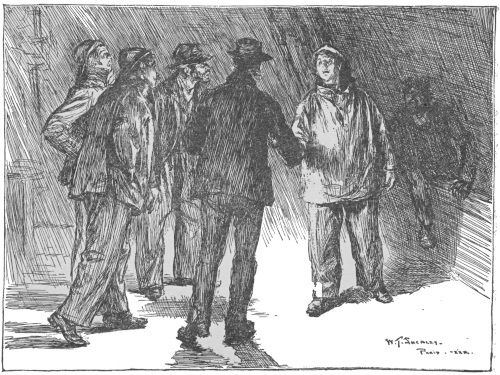
CHAPTER V. SAVED BY ELECTRICITY.
64
The joyful cry of a light at once put new life and
hope into the hearts of the hungry, drenched, and
shivering occupants of the seine-boat. Those who had
huddled together under the wet canvas of the top-sail in
the vain effort to keep warm, as well as those who were
pulling hopelessly and wearily at the oars, gazed eagerly
in the direction indicated by Breeze. Yes, there it was,
faint and yellow in the distance, apparently that of some
vessel approaching them from the southward. They
could see it as their boat rose on the crests of the great
billows, though it was lost again when they sank into the
black hollows between them.
Soon they were able to distinguish a second yellow
light, lower than the other, and by the position of these
they knew that the approaching vessel was a steamer,
and a large one at that. Then her red and green side-lights
came into view. They watched anxiously to see
which of these would disappear first, in order to determine
65on which side of them she was going to pass. If
the red light should be lost to view, then they would
know she was passing to windward of them. In that
case there would not be the slightest chance of any cries
they could utter reaching her, and she would go on her
way unconscious of their presence. If the green light
should disappear, it would be a sign that she was about
to pass to leeward. In that case there was a possibility
that their shouts, borne down the gale, might attract the
attention of the watch on her deck. Still, she might not
stop even then, and it was an almost unheard-of thing for
a boat to be picked up at sea in the darkness of midnight,
amid the noise and tumult of a gale. They fully understood
their position, but, slight as their chance was, they
watched for it hopefully.
All at once, as they were lifted from a deep, watery
hollow, and looked for the lights, they gave utterance to
exclamations of dismay. They could still see the green
light and the two yellow lights, but the red one was no
longer visible.
“’Tain’t no use. She’s going to windward of us;” muttered
one of the men, at once giving up all hope, and
again lying down in the bottom of the boat. “Luck’s
against us, and we might as well reckon on help from the
old Curlew as from that craft.”
66Most of the others evidently thought as he did, and
they turned their eyes resolutely away from the lights, as
though determined to be no longer tantalized by them.
But Breeze could not give up so easily, and he still
watched the lights whenever a lifting wave afforded him
an opportunity of seeing them.
What! Can it be? Or are his eyes deceiving him?
No. It certainly is the red light again, now much more
distinct than before. The steamer has altered her course
and is heading directly for them. The men are filled
with new life at the boy’s exultant cry announcing his
discovery. They spring up and gaze incredulously. It is
true, and both lights are now to be plainly seen, not more
than half a mile away and bearing directly towards them.
Now they fear that she may run them down, and begin
to pull to windward, so as to give her a clear berth. At
last she is close upon them, and the green light disappears,
while the red shows clear and steady.
“Now for a shout, men! All together as I give the
word. One! two! three!” commands the skipper.
It is a wild, desperate cry that startles the lookout on
the forward deck of the steamer from the half reverie
into which he has fallen.
Again it comes to his ears, and again, borne on the
wings of the gale across the angry waters; and now it is
67heard by the steamer’s captain, who has not left the pilot-house
that night.
A gong clangs down among the engines, and a hoarse
order is shouted to the engineer through the speaking-tube.
The great screw under the steamer’s stern stops
for a moment, and then churns the water violently as its
motion is reversed and it revolves rapidly backward.
“See if you can pick them up with the electric,” is the
captain’s order to the second officer, who has just appeared
on deck. At the same instant a dazzling flash of
white light darts forth from the steamer’s bow, and cuts
a gleaming path-way between two solid walls of blackness
above the raging waters.
The second officer seizes the handles at the back of the
great lamp, and the broad band of light is slowly swept
round to the direction from which the cries have come.
In another moment it flashes full in the white faces of
Breeze McCloud and his companions, sitting in their seine-boat
not more than a hundred yards away. The wonderful
eye of the search-light has discovered them, and they
cover theirs with their hands, or turn away from the unbearable
radiance.
“Pull under our lee,” shouts the captain of the steamer
through a speaking-trumpet, “and we’ll try and get you
aboard.”
68It was a difficult task, for the ship rolled so deeply that
it would have been unsafe to open her side-ports, and
they must be taken aboard over the rail. As the seine-boat
lay alongside, it was at one moment on a level with
the steamer’s deck, and the next so far below it that her
wet side rose like a black wall high above them. Nothing
could be done until she was turned, so as to lie head
to the wind. Then, one by one, the wrecked men caught
the ropes flung to them, fastened them under their arms,
and were hauled up to the steamer’s deck, where they
were received and pulled on board by the stout arms
eagerly out-stretched to aid them. Some of them were
buried beneath the huge waves that sprang after them
as though furious at being thus robbed of their expected
prey and still determined to clutch it. Others were
bruised by being swung violently against the iron side
of the steamer. At last all of them were safely rescued,
and, with the seine-boat towing by a long line astern, the
great steamer was again headed on her course.
Was there ever anything so delicious as the hot coffee
at once served to them, or so welcome as the plentiful
meal that awaited them in the steamer’s mess-room, after
they had got into the dry clothes furnished by her crew?
Breeze did not think there was. And when, soon afterwards,
he found himself in a comfortable bunk, under
69warm blankets, and dropping to sleep, he felt that he was
one of the most fortunate and marvellously cared for
boys in the world.
IN ANOTHER MOMENT IT FLASHES FULL IN THE WHITE FACES OF BREEZE McCLOUD AND HIS COMPANIONS.
The steamer that thus furnished the weary fishermen
with shelter, safety, and all the comforts of a sailor’s life
was one of a line plying between Boston and a southern
city, from which she was now bound. Her captain was
one of those noble sailors who are never so happy as
when rescuing other toilers of the sea from its perils. He
told Captain Coffin that, without any definite reason, he
had felt impelled to alter his ship’s course half a point to
the eastward shortly before their cries had been heard.
It was this change of direction that had brought the red
light once more into view.
Before morning the gale had so increased in fury that
it was not probable their light craft could have lived
through it had they not been picked up when they were.
As it was, the seine-boat, while towing behind the steamer,
was struck soon after daylight by a great sea that capsized
it. The next crushed it like an egg-shell, and the
broken wreck was cut adrift.
Twenty-four hours later they entered Boston harbor,
and the crew of the lost Curlew, after expressing their
heart-felt thanks to the captain, passengers, and crew of
the steamer, who had done everything in their power to
70make them comfortable, left her. They made their way
at once to the market slip devoted to the use of fishing
vessels, where they were sure of finding friends and fellow-townsmen.
While walking slowly along the wharf, and looking
wistfully over the many fishing vessels crowded into the
basin, in search of a familiar face, Breeze was slapped on
the shoulder, and a well-known voice exclaimed,
“Vy, Breeza, ma boy! how you vas? Vere you come
from, eh?”
Turning, he saw the smiling face of old Mateo, the
Portuguese cook who, on board the Sea Robin, had fed
him with milk from the “lit tin cow” when he was a
baby. The old cook had always retained a warm affection
for the boy whom he had thus cared for in his helplessness,
and had never returned to Gloucester without
visiting him and bringing him some present. Now to
see him seemed to Breeze almost like a glimpse of home.
Mateo, who, in spite of his years, was still hale and
hearty, and one of the best cooks to be found in the fishing
fleet, would listen to nothing where they stood. He
insisted upon dragging Breeze aboard a new and handsome
schooner named the Albatross, in which he had
shipped for a cruise to the George’s. She had left Gloucester
the day before, and run up to Boston, where her skipper
71had some business to attend to. Now she was to sail
again within an hour.
Pulling his young friend down into the forecastle, and
seating him before the mess-table, Mateo exclaimed, “Vell,
Breeza, you hongry, eh?”
To him eating was the most important business of life,
and until Breeze had assured him that he had just finished
one breakfast, and had no room for another mouthful, he
would listen to nothing else. His mind being set at rest
on this point, Mateo asked,
“Vell, you not hongry, ma boy, ver is ze C’loo?”
“Gone to the bottom,” answered Breeze, “and poor
Rod Mason has gone with her.”
“Vat you say? ze C’loo loss, and Rod Mason drowned?
Oh, ze holy feesh! an his bruzzer Bill here, on ze ’Batross!”
It was indeed so; the only brother of the drowned man
had shipped in the Albatross the day before. When he
heard the sad news brought by Breeze, he declared he
must return at once to Gloucester, and make arrangements
for the future of his brother’s family. He would
not even wait for the skipper’s return, but, collecting
his dunnage, hurried away to catch the first train for
home.
The rest of the crew, most of whom knew him, were
72intensely interested in what Breeze had to tell them of
the loss of the Curlew and the rescue of her crew. They
were still plying him with questions when the skipper of
the Albatross returned. He, like Mateo, had been one of
the Sea Robin’s crew upon the memorable occasion when
Breeze had come to her, and now he gave the lad a hearty
welcome. When he learned of William Mason’s desertion
he was somewhat annoyed, but in a moment his face
cleared and he said,
“Why won’t you come with us in his place, Breeze?
You shall go as an A1 hand, have a full share of the
catch, and we are not likely to be out more than a couple
of weeks anyhow. She’s a good vessel, and you are always
such a lucky chap that you’ll be more than welcome
aboard of her.”
“Yes, Breeza, come ’long,” urged the cook. “Ole Mateo
feeda you till you git fat like dog-feesh. Joe-flog, sea-pie,
hatch, plenty good t’ings.”
Breeze laughed at the earnestness of the old man and
the inducements he held out, but said, “If I only could go
home and see mother for a little while first, I’d go in a
minute. I’d have to get a new outfit too; the only thing
I saved from the Curlew is this oil suit.”
“We’ll wait an hour for you to write to your mother
and tell her just how things stand. That’ll give you time
73to get an outfit in, too. I guess you’d better come along,”
urged the skipper.
“Outfeet!” cried Mateo, eagerly. “Vat you want?
Peajack, boota, gole vatch an’ chain, eberyting vat you
vill hab me getta him.”
So it was finally settled, and an hour later, having written
a loving letter home, and been provided, through the
old cook’s generosity, with an outfit of clothes quite as
good as the one he had lost, Breeze found himself sailing
out of Boston harbor in the good schooner Albatross,
bound for the George’s Bank. Certainly, nothing had been
further from his mind than this, when he had entered the
same harbor a few hours before; but he was rapidly
learning that nothing is so likely to happen in this life as
those things we least expect.
St. George’s Bank, which furnishes the finest cod and halibut
found on the American coast, lies about ninety-five
miles due east from Highland light on Cape Cod. Its
waters are fished all through the year by a large fleet of
vessels from New England ports, but its supply continues
apparently undiminished. It lies in a dangerous part of
the ocean, for it is swept by the current of the Gulf
Stream, is subject to fearful storms and dense fogs, and is
crossed by all the transatlantic lines of steamers.
Although it is so near at hand, and though fishing was
74one of the earliest industries followed by the New England
settlers, it was not until about 1836 that trips to George’s
became a regular feature of the business. The bank was
known to exist, and fish were known to be plenty on it,
long before, but the fishermen were afraid of it. This
fear was owing to the belief among them that the current,
always sweeping across it, was strong enough to drag
under and sink any vessel that should anchor within its
influence.
The first three fishing vessels that visited the dreaded
bank kept close together, and their crews fished as they
drifted about. Finally, one of the skippers, who was regarded
as a perfect dare-devil for proposing such a thing,
said he was going to anchor and take his chances. Several
of his crew were so frightened that they begged to be
put aboard the other vessels, whose skippers were not so
venturesome. They were allowed to go, and volunteers
were called for from the other crews to aid this bold
skipper in his desperate venture. When enough brave
fellows had gone on board to be able to get the anchor
up quickly in case of trouble, it was let go, the cable
spun out, was checked, the anchor held, and the schooner
rode to it as easily and quietly as though in Gloucester
harbor.
Now occurred the most amusing part of this bold experiment.
75The swift current quickly bore the other two
vessels away from the anchored craft, but those on board
the latter imagined that they were moving and leaving
their friends behind. They began to heave desperately
on their cable, got their anchor up, and started back
in pursuit of their companions. When they were once
more united, all hands were fully satisfied with their exploit;
and though they had taken but a few quintals[B]
of fish they sailed back to Gloucester filled with pride
because one of their number had dared drop an anchor
on George’s.
In those days, and until 1846, fishing vessels did not
carry ice in which to pack their catch and bring it fresh
into market. In place of this, many of them were made
into what are known as “smacks” by having tight compartments
built in their hold amidships, and filled with
sea-water from auger-holes bored through the vessel’s
bottom.
The greatest depth of water on George’s is 212 fathoms,[C]
or 1272 feet, nearly a quarter of a mile. The average
depth for fishing is sixty fathoms, though halibut are often
taken in water two hundred fathoms deep. It is, of course,
tiresome work to drag these great fish to the surface from
76such great depths, and they are never sought for there if
they can be found in shoaler water.
It is no rare thing to find a hundred fishing vessels at
anchor at one time on George’s during any month of
the year, and it was to join this fleet that the Albatross
was now making her way swiftly around the point of
Cape Cod. She was fitted out as a hand-liner--that is,
her crew would fish with hand-lines over her sides--and
she had a quantity of frozen herring stowed with the ice
in her hold to be used as bait.
They reached the bank and caught sight of the anchored
fleet early the following morning after leaving Boston.
As they slipped along past one after another of
the vessels already at work, they could see their crews
hauling in their lines and tossing fish over the rail as fast
as their arms could move. It seemed curious to Breeze
that this busy work should always stop as soon as the
Albatross drifted near any of the others. He asked why
it was, and was told that they were afraid the new-comers
would notice their good luck and anchor near them,
which they did not wish to have them do.
As the Albatross moved slowly across the bank, soundings
were taken, and the skipper kept a baited hook down.
At last, in fifty fathoms of water he got a strong bite,
and at once ordered the anchor to be dropped, Then the
77sails were snugly furled and the riding-sail set. This is
a small triangular bit of canvas bent to the main-mast, and
is used to hold the vessel’s head to the wind.
Now baskets of bait were got up, lines were overhauled,
and soon every man on board had one or two over the
side. They were allowed to run out until their leaden
sinkers touched, when they were drawn up so that the
hooks, that hung a fathom below them, were raised a few
feet above the bottom.
There was an intense eagerness to bring up the first
fish, and each man kept an eye on his neighbor’s line as
well as on his own, to see if he were to be the lucky man.
At last a shout announced a bite, and all turned to see
Breeze McCloud tug away at something so tremendously
heavy that it seemed to him he must be lifting a large
piece of the bottom of the ocean.
CHAPTER VI. THE GALE ON GEORGE’S.
78
“Look out, Breeze! Let him run a bit!” shouted the
skipper. “Don’t try to snub him yet, or he’ll snap
your line like a thread.”
Whish-hiss-s-s goes the stout line as the fish at the
other end takes a downward plunge. Now he runs upward,
and the slack is hastily gathered in. “There, he is
off again! My, what a rush! There is evidently some
serious work on hand here,” said the skipper, as he went
to the young fisherman’s assistance. It took fifteen minutes
of steady, patient, and skilful work to tire the powerful
fish. During this time general attention was directed
to the struggle, and the men almost neglected their
own lines in their curiosity to see what sort of a creature
Breeze had hooked.
Finally the exhausted fish gave up the fight and allowed
itself to be drawn to the surface. Now was seen the
great white head of a halibut, that looked to Breeze, who
had never before caught a fish of this kind, large enough
79to be a whale. Two men with gaffs[D] in their hands
sprang to his assistance, but the fish was so huge that not
until two more had also got gaffs into him was he lifted
from the water and got on deck. Here he was despatched
by a few smart taps on the head from the “halibut killer,”
which is a short wooden club kept ready for this especial
purpose.
Breeze was wild with delight over his capture, while the
whole crew were more or less excited, as well they might
be, for no such fish had been taken from George’s by
any one else that season. It weighed three hundred and
twenty-six pounds, and though larger halibut than this
have been caught, they are few and far between. One of
the men said that he was worth at least twenty dollars,
and all admitted that he would create a sensation when
they took him into port.
“Put your mark on him, Breeze,” said the skipper, “so
that you will be able to pick him out when we get home.
He might get lost, you know, among the really big ones
that the rest of us are going to catch.”
The boy laughed, but felt very proud of his first fish,
as with his sharp sheath-knife he cut a rude B like this, ,
80in the thick skin on its head, and inscribed the same mark
near its tail.
Old Mateo was as delighted at the success of his protégé
as the boy himself, and in honor of the event
brought him a cup of hot coffee and an extra nice Joe-flogger
spread with butter and sugar.
“Me tell ’em so ven you lit babee, an’ eat ze harda tack.
Me tell ’em you catch ze feesh bimeby plentee, plentee!
Now zey find out, eh?” he exclaimed, in a tone of self-satisfied
pride. It was as much as to say that if they
would only bring all the babies to him, he could tell
whether they would make successful fishermen or not.
The men laughed at him, and made many jokes concerning
his wisdom; but he only laughed back good-naturedly,
and shook his head at them as he again disappeared in
the depths of his own domain.
For the rest of the day the fishing went on so merrily,
and halibut and cod were piled up on deck so rapidly,
that nobody found time to stop for dinner; but snatched
hurried mouthfuls of food as they tended their lines. It
was lively and exciting work; but when it was time to
knock off, and begin to clear and pack the day’s catch,
Breeze, for one, found himself aching in every joint, while
his hands were raw and water-soaked from handling the
hard, wet lines.
81He would have gladly turned in at once, but the fish
must be cleaned first, and after that it was his turn to
stand a two hours’ watch on deck. Thus it was late in
the evening before the exhausted lad tumbled into his
bunk, where he dreamed of monstrous fish with twenty-dollar
gold-pieces in their mouths, that turned into Joe-floggers
as he reached for them.
The fishing was good for three days longer, and all
hands were light-hearted and happy over their success.
Songs and jokes were heard on all sides, and the yarns
told at night in the cabin were all of big fares and quick
trips to the Banks. It had been a stormy winter, and
March had come in like an angry, roaring lion; but now
it seemed to be anxious to prove the truth of the old saying,
and to be about to go out like the meekest of lambs.
Three days more of such luck as they had had would pull
up their anchor and see them homeward bound. But
March is a fickle month.
The fourth day broke cloudy and threatening. The
sky was gray and the air was filled with a penetrating
chill. The schooner rode uneasily, straining and surging
at her cable in the heavy swell that rolled in from the
eastward. The previous day had been what old sailors
would call “a weather-breeder,” with the wind light and
puffy from the south-west. The mercury in the barometer
82had stood about 30.7, which indicated a change, and
something to be expected from off the sea.
As the day wore on there was a feeling of snow in the
atmosphere, and the barometer fell steadily. The fish
continued to bite eagerly, and every man did his best to
swell the sum total of his catch while he had the chance.
The luck of the Albatross had been noticed, and several
other vessels were anchored near her, both ahead and
astern.
By noon angry spurts of snow were driving in the faces
of her crew, the wind was moaning drearily through the
rigging, and an occasional dash of spray wet the deck.
About this time all hands were ordered to “knock off”
fishing, dress the morning’s catch, stow all light articles
below, and “snug ship.” Twenty more fathoms of cable
were paid out. The foresail was loosed and three reefs
were tied in it, so that it might be ready for instant use
in case the vessel broke adrift. Then it was again furled,
and securely tied.
The storm came on rapidly after that, until at four
o’clock, when supper was served, the schooner was pitching
furiously, and bringing up with vicious jerks on its
straining cable. It was already quite dark, and the snow
drove in horizontal lines, tingling against a bare face
like cuts from a whip-lash. The wind howled through
83the taut rigging, and the spray, torn from the crests of
the racing seas, was blown in blinding sheets above the
slippery decks.
Breeze had never experienced anything like this. To
him it was already a frightful gale, and, as he almost
pitched down the forward companion-ladder in answer
to the supper call, he was surprised to find how calmly
the men were taking it. In spite of the tumult on
deck, the creaking and groaning of the vessel’s timbers,
and her mad pitching, several of them were seated at
the mess-table eating as unconcernedly as though nothing
unusual were happening. Another lay in his bunk,
smoking and exchanging jokes with those who were
eating.
After the storm-swept deck, the forecastle seemed warm,
light, and cheerful. As Breeze sat down to the table,
from which, in spite of the storm-racks, the dishes were
every now and then flung to the floor, he wondered that
he had never before noticed what a cosey and comfortable
place it was.
“Vel, Breeza!” shouted old Mateo, whose entire energies
were devoted to keeping the coffee-pot from sliding
off the stove. “How you lak him? Pret good, eh?”
“I lak him very much better down here than I do on
deck,” answered the boy between his mouthfuls of hot
84coffee and biscuit. “But, I say, Mateo, don’t you call
this a pretty stiff sort of a gale?”
“No,” replied the old cook, scornfully; “zis only one-a
lit Georgy shake-up. For ze gale you mus’ go to ze Gran’
Bank. Ah, zat ze place!”
With this the others chimed in, and began to tell of
their experiences in real gales, to which this one was but
a March zephyr.
For all this, a little later, when the crew were gathered
in the cabin, where, around the little red-hot stove, wet
clothing and boots were sending up clouds of steam, the
skipper, after looking out of the companion-way, said,
“Boys, we are in for a regular ‘rip-snorter.’ I never
saw a nastier night. You’d better get a nap if you can
now, for after midnight there won’t be any chance for
sleep aboard this craft. I want the watch on deck to
keep the sharpest kind of a lookout, and to call me the
moment a light is seen in any direction.”
The great danger of the night lay either in getting
adrift, through the parting of their cable or the dragging
of their anchor, and rushing into collision with some
anchored vessel, or in being run down. In either case
the result would probably be the almost instant death of
all on board.
Following the skipper’s advice, Breeze crept into his
85bunk for a nap, but for a long time found it impossible
to sleep. The violence of the pitching and the roar of
the gale seemed to increase with each moment, and it was
only by the strongest effort of will that he could restrain
himself from springing up and rushing on deck. At last
he did sleep, but was only aware of it when a dash of icy
water in his face awakened him. Forgetting where he
was, he sprang up, and struck his head violently against
the low ceiling above him.
A great sea of solid water had broken over the schooner’s
bows, and swept aft in such a volume that it must
have flooded the cabin had not the skipper, who stood in
the companion-way, pulled the slide. As it was, about a
bucketful had made its way in, and a portion of it had
fallen on Breeze.
Scrambling from the bunk, he found his companions
clad in their oil-skins and prepared to hurry on deck at
the first notice that their presence was needed. Several
of them were picking themselves up from the floor, to
which they had been flung by the shock of the big wave,
and one was lamenting a broken pipe. They were much
more sober now than at supper-time, and their conversation,
which was entirely of wreck and disaster, was not
calculated to fill the boy with cheerful thoughts. Glancing
at the clock, he saw that it was past midnight, and
86the skipper’s warning that there would be no sleep for
them after that hour flashed into his mind.
Following the example of the others, he pulled on his
oil-skins, and sat down to wait, he knew not what for. A
few minutes later the summons came. It was an unintelligible
cry from the watch on deck, but its meaning
was clear to the practised ears of those below, and as the
skipper sprang up the steps, the others followed.
When Breeze reached the deck and felt the full force
of the blast, it seemed to drive the breath from his body.
The wind was shrieking through the strained rigging like
a hundred steam-whistles. The snow had turned into fine
particles of ice that pricked like needles. The billows
hissed and seethed as, with streaming manes of glistening
white, they galloped past the quivering vessel. Now she
was poised on the crest of a gigantic wave, and the next
instant buried in a yawning depth, beneath a smother of
broken waters that leaped high up on her masts.
By the rays of the riding-light, that still burned steadily
just abaft the foremast, Breeze could make out the several
members of the crew clinging to whatever seemed to
promise the greatest safety, the fife-rail, halyards, or rigging.
Away forward, beside the groaning windlass, was
a figure which he knew to be that of the skipper, crouching,
axe in hand, ready to cut the cable.
87All this had been taken in at one glance, the next revealed
the cause of the outcry from the watch on deck.
A light dead ahead was bearing swiftly down upon them.
It was that of a fishing schooner torn from her anchorage,
and being hurled by the storm giant, like a bolt of destruction,
through the helpless fleet.
During the fearful suspense of the next minute the boy
did not breathe, and his very heart seemed to cease its
beating. Twice the gleaming axe in the skipper’s hand
was raised to strike. Each time he thought of the vessels
anchored astern of the Albatross, upon which she must
drive in turn if cut adrift, and the blow was withheld.
Now the threatening light rose high above them, and
then it swooped down and rushed past so close that they
could almost have sprung aboard the drifting schooner.
They caught a momentary glimpse of white faces, heard
one wild cry, and felt the dragging of the broken cable
as it was drawn across their own. Then all was again
swallowed up in the furious blackness astern, and for
them that danger was past.
The night was bitterly cold, but the first sensation of
which Breeze was aware, when it was all over, was that
of the profuse perspiration in which he was bathed.
There being no longer any need of their presence on
deck, the members of the crew, after a fresh watch was
88set, again sought the shelter of the cabin. Here Breeze
was advised to try and get some more sleep, as it would
be his turn to go on watch at four o’clock. He lay down,
but felt as though he should never sleep again; for he
could not close his eyes without seeing, once more, the
drifting phantom of destruction that had just swept past
them. He started fearfully at each lurch of the reeling
vessel, and fancied that he heard cries in the shriek of the
blast overhead. Although he dreaded to go on deck, it
seemed as though he should prefer it to remaining in the
cabin, and it was a relief when he was called to go on
watch.
The lad’s watchmate was much older than he, a weather-beaten
sailor who had witnessed a hundred such gales,
and felt that so long as the cable held, there was not much
to fear. He helped Breeze up on the foregaff, where he
would escape the worst of the great seas that continually
broke over the schooner’s bows, sweeping her from stem
to stern, and bade him keep a sharp lookout from there.
At last, faint and uncertain, the prayed-for, long-deferred,
and anxiously awaited light of day began to creep
over the wild scene, and the white foam-crests stretched
away farther and farther. The snow ceased to fall, and
there was some promise of a cessation of the gale. One
of the first things they distinguished in the early light
89was the huge dim form of a square-rigged vessel that, under
bare poles, drove past them, less than a quarter of a
mile away, and vanished almost as soon as she was seen.
Nothing was said, for only a shout close to the ear could
be heard amid the tumult; but Breeze shuddered to think
how powerless their little schooner would have been to
resist that driving mass had they chanced to lie in its
course.
They next saw a schooner plunging at her anchor, a
short distance ahead of them, and noted how she had
dragged during the night, for they had seen her the day
before, but then much farther away. Her anchors had
only caught just in time to save both her and them, and
again Breeze realized the narrowness of their escape from
the night’s perils.
As the daylight revealed her sad plight, they turned
their attention to their own craft. The seas no longer
broke over her so furiously as they had, but crushed bulwarks,
and the deck swept clear of boat, gurry-kids, and
everything not absolutely built into it told of their awful
force.
All at once Breeze, from his slight elevation, noted a
commotion on the deck of the schooner ahead of them.
The men on watch seemed to be heaving lines at something
in the water. It was evidently drifting past them,
90and their lines plainly failed to reach it. They were motioning,
as though to attract his attention towards it, and
the thought flashed into his mind that perhaps they had
discovered a survivor of some wreck floating in the angry
waters, and had tried unsuccessfully to save him. He
told his companion of what he had seen, and they both
watched eagerly in the hope that if it was indeed a man
he might drift within their reach. They procured a couple
of long light lines, made one end fast, and coiled them
carefully, in readiness to be flung at a moment’s notice.
“I see him!” cried Breeze at length. “There, see! off
our port bow; but he is going to drift clear of us.”
It was the figure of a man, clad in oil-skins, the yellow
gleam of which had caught the boy’s eye as they showed
for a moment on the crest of a wave.
As he came near they saw that he was apparently clinging
to the bottom of an overturned dory. At the same
time it was evident that he was going to drift far beyond
their reach, and they doubted if their lines even could be
made to reach him. They shouted again and again, but
he gave no sign of hearing them.
Breeze began to tear off his oil-skins, then his jacket
and boots, and to knot the end of a line about his waist.
“What are you going to do?” shouted his companion.
“Not try and swim to him?”
91
“YOU’RE CRAZY, LAD! YOU CAN’T LIVE A MINUTE IN SUCH A SEA.”
“Yes, I am,” shouted Breeze, in reply. “It would be a
pity if the best swimmer in Gloucester should let a man
drown before his eyes for want of trying to save him.”
“But you’re crazy, lad! You can’t live a minute in
such a sea!” and the man took hold of the boy’s arm to
restrain him from the rash attempt.
With a single violent wrench Breeze freed himself from
the other’s grasp, and just as some of the crew, who had
been attracted by the shouts on deck, came up from the
cabin, he plunged headlong into the raging waters.
CHAPTER VII. A STRUGGLE FOR A LIFE.
92
For half a minute Breeze was lost to the view of those
who from the deck of the schooner watched anxiously
to see him emerge from his brave plunge. They
gave a shout as he reappeared. He had only time to draw
in a single breath of air before he was again buried beneath
a huge curling wave that, before it broke, towered
many feet above his head. His comrades were just about
to haul him back by means of the line they were paying
out, and the other end of which was knotted about his
waist, when his head was once more seen above the surface.
This time they were astonished to note what a distance
he had gained, for being many feet under water had not
prevented his swimming sturdily towards the object of
his efforts. Now how gallantly he dashed forward! with
what splendid overhand strokes he took advantage of the
few moments of surface-swimming granted him before he
was again swallowed up! He had won many a swimming-match
93in both smooth and storm-tossed waters about
Gloucester. He had taken many a header through green
walls of inrushing breakers, but never before had he swam
as now; never before had he struggled for the prize of a
human life.
When for the third time he emerged from the suffocating
waters, he saw the yellow-clad form, to gain which he
had fought so bravely, within a few feet of him. With
one more desperate effort, for the line about his waist was
now dragging him back almost irresistibly, he reached it,
and grasped the stern becket of the overturned dory.
Out-stretched upon its flat bottom, with both arms and
legs twined about the life-line,[E] lay the senseless form of
a young man, apparently but little older than the brave
swimmer who now tried to rouse him. It was impossible
to do so, and Breeze feared that he was dead. Without
casting loose the line from about his body, he gathered
a bight in it, and made this fast to the becket of the dory.
Then he waved his hand as a signal to those on board the
schooner to pull in.
The strain upon the light line was terrible, and in any
94other hands but those of expert fishermen it would have
parted a dozen times before its precious burden was
drawn as close as was safe under the stern of the schooner.
Then a second line was thrown to Breeze, who, nearly
exhausted as he was, still found strength to secure it about
the body of the senseless lad beside him. He could not,
however, undo the clutch of the rigid fingers from the
life-line, and for a moment began to despair, even within
reach of rescue, of saving him for whom he had risked so
much. But help was at hand, and it came as he least expected
it.
From the schooner’s deck old Mateo had watched the
brave struggles of his boy, as he called him, in an agony
of apprehension. Now, with senses quickened by affection,
he was the first to comprehend the difficulty. Just
as Breeze was about to relax his efforts, feeling that he
could do no more, the old cook’s heavy jack-knife, with the
end of a fishing-line attached to the ring in its horn handle,
came flying across the dory, and dropped into the
water beyond it.
Breeze secured it, opened it, and with a last effort cut
both ends of the dory’s life-line, as well as the becket to
which he had fastened himself. Then the knife dropped
from his nerveless fingers, and, as the dory drifted away,
two senseless figures were drawn through the wild waters
95to the plunging schooner. With a final effort for their
destruction, a huge billow hurled itself bodily upon them,
and the lines had to be slackened for a few moments, or
they would have parted. The limp forms were buried
deep beneath the green waters; but again they were
drawn to the surface, and this time they came within
reach of the eagerly out-stretched arms waiting to grasp
them.
The unknown lad was carried into the cabin; while
Breeze, claimed by Mateo, was tenderly taken into the
forecastle. There, while two men stripped and rubbed
him, the old cook heated blankets, and prepared hot stimulants,
wailing as he bustled about, “Oh, Breeza! ma
boy, ma boy! You no-a die; you must leeve!”
It was half an hour before their efforts were rewarded
by a faint sigh and a flush of returning color in the livid
cheeks. Then the boy opened his eyes, and gazed about
him wonderingly for an instant. A few minutes later,
wrapped in hot blankets, he fell asleep and was breathing
regularly.
Almost the same scene was taking place in the cabin,
only there it was so long before the patient showed the
least sign of life that some of those who worked over him
were several times ready to give up in despair. They
were only kept at it by the skipper, who exclaimed,
96“Great Scott, men! it will be a shame if we cannot
fetch him to, after that boy has nearly given his life to
save him. I, for one, shall work over him from now till
noon before I will give him up.”
At last he, too, was brought back to the life from
which he had so nearly departed, and by noon, when the
sun came out, both patients were doing finely. Neither
of them was allowed to leave his bunk until the next
morning; but they were kept warm, and encouraged to
sleep as much as possible. In their exhausted condition
this was easy to do. So with only one or two awakenings
to take the light nourishment that Mateo prepared
for them, by the aid of his never-failing “lit tin cow,”
they slept through the rest of the day and the whole of
the night.
The next morning they awoke, filled with the life and
energy that always wait upon youth and a sound constitution,
and almost inclined to believe their recent adventure
to be but a troubled dream. Only a few bruises, and
the marks about their bodies of the ropes by which they
had been drawn aboard the schooner, remained as traces
of what they had undergone.
The sea had gone down so rapidly the day before that
the crew of the Albatross had been able to resume their
fishing by noon, and had had remarkably good-luck until
97night. By a mutual agreement, suggested by the man
who had been watchmate with Breeze that morning, they
devoted half an hour to their brave young comrade, and
the entire catch of fish, made during that time, was credited
to him in the ship’s books.
The next morning when Breeze came on deck he saw
the skipper talking to a well-built young stranger, whose
naturally ruddy face had not yet wholly recovered its
color. For an instant he wondered who it could be, and
where he had come from. Then it flashed across him
that this was the person whom he had rescued from the
sea; and, not knowing exactly what to do or say, he
stood looking at him curiously.
The young stranger noticing him, said something to
the skipper, who turned quickly and exclaimed,
“Good-morning, Breeze! Why, you are looking as fresh
as a daisy. This is Mr. Wolfe Brady,” he added, indicating
the lad who stood beside him. “Although you two
have already been dorymates, he declares he has never
seen you before, and I am certain you have never been
introduced. Mr. Brady, Mr. McCloud.”
In assuming this jesting tone the skipper hoped to put
the young men at their ease, and relieve their first meeting
of the embarrassment they might naturally be expected
to feel under the circumstances.
98There was a long, firm hand-clasp between the two
who had so nearly met death together; but for a moment
neither of them spoke. Then Wolfe Brady said,
“They tell me you saved my life, and nearly lost your
own in doing it. I can’t thank you, because I haven’t
the gift; but if ever the time comes when you can use it,
I will offer my life to you as freely as you offered yours
for me.”
“Thank you,” answered Breeze, simply. “I am very
glad I succeeded in reaching you; but how did you happen
to be afloat on that dory?”
THERE WAS A LONG FIRM HAND-CLASP BETWEEN THEM.
“I hardly know myself. Yesterday morning I belonged
to the trawler Ibis of Boston. Just before daylight,
while half the crew, and I among them, were on
deck, we were run down by a large square-rigger scudding
under bare poles. It was so dark that we did not
see her until she was right on top of us, and then, though
we cut the cable, it was too late. She struck us before
those below could get on deck, and crushed the schooner
down as though she were a herring-box. Then I’ve no
knowledge of what happened to the others, or even to
myself. I only know that I was under water such a long
time that I wonder I did not stay there. When I came
up something was floating close beside me, and I got hold
of it. The rest is a blank. The next thing I knew, I was
99lying in a bunk and somebody was trying to pour something
down my throat. Your skipper was just telling
me what a splendid fight you made to get me, and how
near you came to losing the number of your mess, and
sending your vessel home with her flag at half-mast in
doing it. I’m awfully grateful, and I hope some time I
may be able to prove it; for I’ve been a pretty bad lot,
and was not ready to go up aloft yet.”
“No,” said Breeze, soberly, “I don’t suppose many of
us are.” Then he asked, “Are you an American?” The
other’s name, and a foreign accent to his speech, led to
the question.
“Not yet,” answered Wolfe, smiling, "but I hope to be
in two years more when I come of age. At present I am
an Irishman. That is, my father is Irish, my mother is
English, and I was born in England, but brought up in
Queenstown, Ireland, where my parents live, and from
which I ran away to sea about a year ago. Before they
were married, my father was butler and my mother lady’s-maid
in the household of Sir Wolfe Tresmont. That’s
where I got my first name. My father is now a linen-draper
in Queenstown, where his best customers are
Americans. I was sent to school in England for four
years, but I hated it, and from seeing and hearing so
much of Americans, I had a great desire to come to this
100country. Last year my father took me from school and
set me to work in his shop. I hated that worse than
school, and seeing a chance to run away and ship on
board a bark bound for Boston, I took it and came over
here.
“By the time I got on this side I had had enough of
merchant sailing; and, as I could not find anything else
to do, thought I would try fishing. Since then I have
made two trips, one of four months to the Newfoundland
Banks, and one to George’s before this one. Now here
I am, and you know more about me than I have told to
another living soul since leaving home.”
“Well,” said Breeze, “you know a good deal more
about yourself than I do about myself. I suppose I must
have had a real father and mother, but I never knew
them, for I was picked up at sea, floating in a cask, when
I was a baby. I am almost certain I must be an American,
though, for I know I could never love any other country
so well. I’m glad you are going to be one too, as
soon as you can. Don’t you think I look more like an
American than anything else?” he inquired, a little anxiously.
“I don’t know,” replied the other, regarding him attentively.
“Yes, on the whole I think perhaps you do.
Still, with light hair and blue eyes, you know, you might
101be a Scandinavian, or a Dutchman, or an Englishman, or
a Scotchman, or even an Irishman.”
They both laughed at this, and Breeze said,
“You might as well quote ‘Pinafore’ at once and be
done with it.”
So the conversation between the two, which had been
rather constrained at first, became more easy and confidential,
until they found themselves discussing each other’s
hopes and plans with the freedom of old friends.
Every now and then a shadow would sweep over
Wolfe’s face, and he would speak in a lower tone as he
thought of the probable fate of his recent shipmates.
Still, as grieving could do neither them nor him the
slightest good, he tried to keep cheerful, by remembering
how marvellously he himself had been spared. He confessed
to Breeze that he had caused his parents much
trouble and anxiety, by his manner of life, both in school
and at home, but declared that now he really meant to
turn over a new leaf.
“I’ll begin by writing to my mother as soon as ever
we reach port,” he said, “for it makes me feel ashamed of
myself to remember that I have not sent home a single
line since I left there. I do not suppose they have the
slightest idea what has become of me, or whether I am
alive or dead.”
102To Breeze, his mother was so near and dear, he had
thought of her and written to her so often even during
his short absence from home, that Wolfe’s account of his
own neglect was most surprising. Still, he did not feel at
liberty to express his feelings in the matter, and only
said, “I would, if I were you, by all means; she must be
feeling awfully at not hearing.”
The rest of the schooner’s crew had been hard at work
catching fish since daylight, and during their conversation
Breeze and Wolfe had also been busy with their lines.
Several other schooners were still in sight, though at long
distances from them. Most of the fleet had been scattered
far and wide by the gale, which, though short, had been
one of the severest of the season. After it was over many
of the fishing vessels returned to port to refit, while the
fate of others was told by the melancholy signs of wreck
and disaster that every now and then floated past the
Albatross. Her skipper knew that for a time fresh fish
would command an extra price in the Eastern market,
and so was anxious to carry in as large a fare as possible.
For this reason, in spite of the damaged condition of his
vessel, he remained on the bank two days longer before
getting up the anchors that had held her so well, and
heading for home.
In the mean time tidings of the gale and its destruction
103of lives and vessels had reached Gloucester, and had caused
the greatest anxiety there. As one after another of the
schooners that had escaped sailed into the harbor, their
crews were eagerly questioned for news of this one or that
one not yet heard from. At last one came in bringing
with her a dory that she had picked up, and on which was
stencilled the name “Albatross.” Her skipper reported that
on the night of the awful storm, during a slight lull, he
had caught a momentary glimpse of two lights. They
were so close together that the vessels bearing them must
have been in collision. They bore from him just as the
Albatross had when he last saw her. As he looked the
lights suddenly disappeared, either from the shutting in
again of the snow, or because they had gone to the bottom.
Soon afterwards his own craft had parted her cables, but
had managed to weather the gale, and on the following
day he had picked up this dory. That was all, but it
seemed to seal the fate of the schooner, whose return had
until then been watched for so hopefully and so anxiously.
Mrs. McCloud had made Captain Coffin, who was still
at home, promise to bring her the very first tidings, whether
good or bad, that should come. Now with a heavy
heart he walked slowly towards the little cottage, in
which sorrow was becoming so familiar a visitor.
104The moment he opened the door, and the anxious loving
mother caught sight of his face, she exclaimed, “He is
lost; my boy is lost! I know he is! I can see it in your
face!”
“You must not give up all hope yet,” said the captain,
soothingly, seeking to comfort her, though he felt that his
words would be in vain. “We do not yet know certainly
the fate of the Albatross, though we have every reason to
fear the worst.”
CHAPTER VIII. A FALSE FRIEND, AND AN OPEN ENEMY.
105
All night long the poor mother seemed to hear Captain
Coffin’s last words, “We have every reason to
fear the worst,” repeated over and over; but, as though
to comfort her, they were always followed by the thought,
“Nothing certain is yet known.” She always tried to find
a bright side to her troubles, and by looking steadily at it,
to forget that there was any dark side. This plan worked
so well now that by morning she had determined to still
hope for the best, instead of fearing the worst, until something
more definite should be known. This was certainly
the wisest thing to do, for more than half of all our
troubles are those we think may come, but which, after
all, never do come; and hoping steadily for the best goes
a long way towards bringing the best to us.
Though all this had nothing to do with bringing Breeze
McCloud home, he came nevertheless. While his mother
was busy, with almost her usual cheerfulness, preparing
breakfast, she heard a joyous shout in the little front
106yard, the door was burst open, and the next moment her
boy’s arms were thrown about her neck.
The Albatross had made a glorious run home, and passed
in by Eastern Point at sunrise that morning. The moment
she was made fast to her wharf Breeze had jumped
into a dory and pulled across the harbor, so as to be the
first to tell his mother of his own arrival. He could stay
to breakfast, but must get back to the schooner as quickly
as possible afterwards, and help discharge the fare of fish
she had brought in. One of the boy’s first questions was,
“Is there any news from father yet, mother?”
“Not yet,” was the answer; “but I feel certain there
will be soon, and that when it comes it will be good news.
How much we shall have to tell him when he does get
home, and how proud he will be of you!” she added,
fondly.
Her faith in her husband’s return was still as strong as
ever, and Breeze had always shared it.
While they were at breakfast there came another shout
in the front yard, the door again opened, and before he
got fairly inside, Captain Coffin exclaimed, “It’s all right,
Mrs. McCloud! The Albatross is in, and Breeze is--”
“Here, and mighty glad to see you, sir!” cried the lad,
jumping up from the table to greet the new-comer.
“Bless my soul!” exclaimed the astonished skipper,
107shaking Breeze heartily by the hand, and gazing at him
incredulously, “you have both out-footed and out-pointed
me this time. I didn’t suppose the Albatross was tied up
yet, and thought I had at least half an hour’s start of
you.”
The captain sat down to breakfast with them, and between
mouthfuls Breeze tried to give them an outline of
his recent adventures. They were all so excited, and Mrs.
McCloud had to jump up from the table so often to replenish
the plates, that she only received a confused impression
that her boy had saved somebody’s life and
caught the biggest fish that ever was seen. This, however,
satisfied her for the present; the details she could
learn afterwards.
As soon as breakfast was over, Breeze started back for
the schooner, and Captain Coffin went with him. While
they were rowing across the harbor the latter said,
“I’ve got a new schooner, Breeze, and a finer craft was
never built in Essex. Her name is the Fish-hawk, and
she is fitting out for a salt trip to Grand Bank. Don’t
you want to ship on her? I can offer you a full share
now.”
“I don’t know, sir. It seems as though I ought to stay
with mother a few days at any rate.”
“So you can; we sha’n’t get off for a week yet, but I
108thought I would speak about it now, so that if you decided
to go I could hold the place for you. Besides, you could
put your dunnage right aboard, which would save you the
trouble of carrying it home when the Albatross hauls out
for repairs.”
“All right, sir,” said Breeze; “I should like to go with
you better than with anybody else, and I guess, inside of
a week, I can persuade mother to let me start off again.
If you’ve got room for another, I’d like to speak for a
berth for a friend of mine too.”
“Do you mean the one you went dorymate with on
George’s the other day?” asked the captain, laughing.
“Yes, sir. His name is Wolfe Brady, and he has been
on one trawling trip to the Banks already, besides two to
George’s.”
“Well, I’ve got about all the men I want, except a cook,
and I don’t suppose he can fill that berth, but I’ll take a
look at him, and if we suit each other perhaps I can make
room for him.”
“If you want a cook,” said Breeze, eagerly, “why not
try and get old Mateo? He is the best cook sailing out
of Gloucester, and if the Albatross is going to be laid up
for some time, perhaps he will go with us.”
“I see that you were cut out for a regular shipping
agent,” laughed the captain, “but I’ll get Mateo if I can.”
109Everything went well that day. Captain Coffin took
a fancy to Wolfe and offered him a berth on the Fishhawk
almost as soon as he saw him. Wolfe, who was
willing to ship for any kind of a trip, was greatly pleased
at the prospect of going with Breeze, and at once accepted
the offer.
Old Mateo, too, who, now that his boy had become a
sailor, seemed to think it his duty to follow and watch
over him, was easily booked as cook of the new schooner.
The big halibut caught by Breeze sold for nearly
twenty dollars, and the boy was handed a check for
thirty-four dollars as the result of his eight days’ trip
to George’s. Wolfe was also made happy by receiving
twelve dollars as his share of the three days’ fishing after
he had been picked up.
After getting his check cashed, and repaying what old
Mateo had loaned him, Breeze carried the rest home to
his mother. This money, added to what he had made on
the mackerelling trip in the Curlew, amounted to sixty-five
dollars. It would be hard to tell whether he or his mother
was the prouder over this satisfactory result of the
boys’ first efforts as a bread-winner.
During the long, happy talk that they had after supper,
their one regret was that the father was not there to share
their joy, but they spoke hopefully of his coming, and the
110future looked brighter to them than it had for many a
day. Mrs. McCloud was greatly interested in what
Breeze had to tell her of his adventure with the New
York jeweller who had opened the golden ball. They
both examined it minutely, but could discover no joint
amid the delicate tracery of its surface. After it had
been again restored to its place, Mrs. McCloud cautioned
the boy to always guard it carefully, as she felt more than
ever certain that some day it would prove of great value
to him.
About eight o’clock Breeze started up, saying that he
must go back to the schooner after Wolfe Brady. He
had invited him to come home to supper and spend the
night, but Wolfe had begged for a little time in which to
purchase some very necessary additions to his scanty
wardrobe, and Breeze had promised to meet him on board
the Albatross soon after eight o’clock. Since then he had
told his mother all that he knew of the young stranger,
and so excited her interest in him that she now sent him
an invitation to stay with them as long as he should remain
in port.
Kissing his mother good-by, and promising to be back
very soon, Breeze left the house; and taking her sewing,
Mrs. McCloud sat down to await his return.
Neither Wolfe Brady nor anybody else was to be seen
111on the Albatross when Breeze reached her. Near by lay
the Fish-hawk, to which he had transferred his dunnage
that afternoon, but she too was deserted. On the opposite
side of the wharf lay a shabby-looking old schooner,
named Vixen, on which several men were still at work,
evidently getting her ready for sailing. Breeze asked
them if they had seen anybody answering Wolfe’s description
about there recently.
“Yes,” answered one of them, “I seen a young feller
like that hanging round here ’bout half an hour ago. He
came over here and got talking with Hank Hoffer, one of
our men, and they walked off uptown together. I expect
they’ll be back directly.”
“Did you hear them say where they were going?”
“No; seems to me, though, I did hear Hank say something
’bout Grimes’s. Shouldn’t wonder if they’d gone
up there to get a drink.”
Breeze started at the mention of Grimes’s, for he knew
it to be one of the lowest and very worst drinking-dens
in the town. Such places are not permitted by law to
exist in Gloucester, but occasionally they escape the vigilance
of the police for a short time, and in them many
a sturdy fisherman is tempted to squander the money
he has risked his life to earn.
Captain McCloud had seen so much of the pitiful misery
112and sorrow caused by drink that he had brought Breeze
up to regard it with horror. As soon as the boy was old
enough to realize what he was doing, he had promised his
father that, so long as he lived, he would never touch a
drop of any intoxicating liquor. He had never signed a
pledge, nor had his father asked him to; for although
Breeze was slow to make promises, he would as soon cut
off his hand as to break one that he had made, and his
father trusted him implicitly.
Now, although he was neither a prig nor a goody-goody
boy it distressed Breeze to think of any one whom he
called friend visiting Grimes’s. His one hope was that,
being a stranger in town, Wolfe did not know what sort
of a place it was, and that he would leave it and come
back as soon as he discovered its character.
In this hope he waited for half an hour longer, and
then, as Wolfe still failed to appear, he determined to go
in search of him. He knew pretty nearly where Grimes’s
was, and walked in that direction. Very soon he saw several
men come out from a dark passage-way and turn
down the street, talking and laughing loudly. He followed
them until satisfied that Wolfe was not among
them, and then returned and waited until another party
came out from the same passage-way. His friend did not
appear this time, and he felt that he must go in and either
113satisfy himself that Wolfe was not there, or persuade him
to come away if he was.
He walked back and forth several times before he
could make up his mind to go in. At last, feeling that
he was acting the part of a coward, he entered the passage,
and finding a closed door at its farther end, tried to
open it. The noise that he made was evidently heard
inside, for a slide in one of the upper panels of the door
was pushed back a few inches, and a bright light flashed
full in his face.
“Who are you?” asked a voice through the opening.
“No matter who I am,” replied Breeze. “I come to
look for a friend and I want to be let in.”
“Well, you can’t come in until you’ve told me your
name, and whether you are alone or not.”
“My name is Breeze McCloud, if you must have it, and
I am alone,” answered the boy.
“That’s all right; I recognize you now,” said the voice,
and the next moment the door was thrown open.
Just then two figures came through the dimly lighted
hall-way that the open door disclosed, and in the voice
of one of them Breeze recognized that of Wolfe Brady.
He waited until they got to where he was standing, and
then, taking hold of his friend’s arm, he said, “I’ve been looking
for you, Wolfe, and waiting to take you home with me.”
114“Hello, Breeze!” exclaimed the other, huskily; “glad
to see you, old boy. You’re just in time to go back and
have a drink with us.”
“No, thank you,” replied Breeze; “I never drink anything.
I only came here to find you, and now I want you
to go home with me.”
“Oh, come along in,” said Wolfe’s companion, in a
disagreeable tone. “You ain’t afraid, are you?”
“No,” said Breeze, “I’m not afraid; but now that I’ve
found my friend there’s no reason why I should go in,
and I don’t choose to do so.”
“Well, you needn’t put on any of your high and mighty
airs with me,” exclaimed the other, threateningly. “This
gentleman is as much my friend as he is yours, and I’m
going to prove it by taking him inside again. Come
back in, old pard,” he added, grasping Wolfe’s other
arm as he stood balancing himself unsteadily between
the two.
“No,” said Breeze, decidedly, “he sha’n’t go back;”
and with this he endeavored to pull Wolfe through the
still open door-way into the street.
Here the door-keeper, who had watched the scene impatiently,
interfered, and saying, “I can’t have any disturbance
here, gentlemen; you’ll have to settle this business
outside,” assisted Breeze to such purpose that the
115next moment all three were in the street, and the door
was closed behind them.
This excited Wolfe’s anger so that he began to kick
the door, at the same time screaming to be let in.
“Oh, come, this won’t do!” exclaimed Wolfe’s companion.
“This racket’ll bring the police down on us in
no time. You see now what a fix you’ve got us into,
don’t yer?” he asked, turning to Breeze.
“I see what a fix you’ve got this poor fellow into by
bringing him to such a place,” replied the latter, indignantly,
“and I hope you feel as ashamed of yourself as
you ought to be.”
“None of your preaching!” cried the other, fiercely,
“or you and I’ll have a bigger score to settle than we’ve
got now. Take hold of him, can’t you? and let’s get
away from here before we get nabbed.”
Together they succeeded in pulling Wolfe from the
door, and in directing his unsteady steps down the street
in the direction of the wharf.
While Breeze was wondering what on earth he should
do with his friend in this wretched condition, Wolfe’s
intoxication assumed a new form, and he began to yell
and sing at the top of his voice.
“Stop that noise, or I’ll take you all in,” shouted a
gruff voice behind them.
116“Shut up, can’t yer?” exclaimed Wolfe’s companion to
him, angrily. “Don’t you hear the police?”
But Wolfe only yelled the louder, and began to revile
the police, and dare them to come and get him.
“We must cut for it,” said Hank Hoffer, for this was
the name of Wolfe’s companion. “Grab him tight and
run him. We’re pretty near there.”
Almost carrying Wolfe between them, the others hurried
him along at such a pace as to quite take his breath
away and put a stop to any further outcries.
As they reached the wharf Hank said, “Quick, now!
let’s get him aboard this schooner. I belong here, and
it’ll be all right. We’ll get him below, and put him in a
bunk, where they’ll never notice him. Hurry, they’re
coming!”
In the excitement of the moment Breeze did not stop
to think whether this was a wise thing to do or not; and,
only anxious to shield his friend from the consequences
of his own folly, he blindly obeyed these instructions.
Wolfe stumbled on the deck of the schooner and fell,
striking his head against the wheel. When they got him
below he seemed stupid, and blood was flowing from a
gash on his forehead.
“QUICK, NOW! LET’S GET HIM ABOARD THIS SCHOONER.”
Pulling forward a bucket of water, and handing Breeze
a rag, Hank said, “You sponge him off, and keep him
117quiet while I go on deck and see whether the police have
followed us down here or not.”
Without waiting for an answer, he sprang up the companion-way
and pulled the slide over it. Then he went
forward, and began to talk in a low tone to the skipper of
the schooner, who, with several other men, was on deck.
The police had evidently given up the chase some time
before, for none were in sight on the wharf.
What Hank Hoffer said to the skipper was, “I’ve
brought you a couple of first-class hands, and they’re
both drunk down in the cabin; but they’ll be all right
to-morrow. They were making such a racket in the
streets that the police gave us a run for it. I’m afraid
they’ll come after us yet; so, as long as we’re all ready,
why don’t you cast off, drop out into the stream, and
make a start.”start.”
Now, this skipper was not much liked by those who
knew him, nor was his old schooner a popular boat; so
he had found it somewhat difficult to get a crew for the
trip she was about to make to the Newfoundland Banks.
He had, however, succeeded in shipping all but two of
the necessary number, and now that these two had come
aboard of their own free-will, he saw no reason why he
should not take Hank Hoffer’s advice and make a start.
The motion of the schooner was so gentle as she drifted
118away from the wharf that Breeze, busily bathing his
friend’s head, did not notice it. When, however, those
on deck began to hoist the sails, he recognized the sound
quickly enough, and springing up, tried to push back the
companion-way slide. It was locked. Then he began to
pound on it furiously, and to shout for somebody to come
and unfasten it; but no attention was paid to his outcries.
“It’s only those drunken fellows in the cabin,” explained
Hank Hoffer to the rest of the crew; “they’ll
quiet down directly.”
So Breeze McCloud and Wolfe Brady sailed away in
the old schooner Vixen for Grand Bank, while in the little
cottage on the eastern hill an anxious woman sat and
waited for their coming.
CHAPTER IX. KIDNAPPED.--THE PROMISE.
119
Finding that no notice was taken of his shouts to be
released from the cabin, Breeze finally sat down on
the transom beside the bunk in which Wolfe was now
sleeping heavily, and tried to puzzle out the meaning of
what had taken place. At first he thought it might be a
sort of a practical joke, and perhaps the Vixen was only
being carried out in the bay to get a good position for an
early start in the morning. In that case he did not doubt
but he would be allowed to return to the city when she
came to anchor. As time wore on, and the schooner still
continued to move rapidly through the water, even this
hope began to disappear. At last the motion of the vessel
convinced him that she had passed out of the bay, and
was now riding the long, regular swells of the open sea.
He now remembered that the Vixen had been fitting
for a trip to the Grand Bank, and realized that she had
really begun the long voyage that might last for months.
If he could only have bidden his mother good-by, and told
120her where he was going! Now the thought of her distress
at his unexplained absence completely overcame him.
Throwing himself at full length on the hard transom, he
buried his face in his hands and sobbed as though his
heart would break. Finally, tired out by his long, hard
day’s work, his recent excitement, and the strength of his
emotions, he fell into a troubled sleep.
Soon afterwards the companion-way slide was pushed
back, and the skipper, Hank Hoffer, and another man
entered the cabin and tumbled into their bunks, but without
waking the prisoners.
“Sleep sound enough, don’t they?” remarked the skipper.
“Yes,” answered Hank Hoffer. “Drunken men always
do.”
It was broad daylight when Breeze awoke, cramped
and stiff from lying so long on the bare boards of the
transom. As he sat up and looked about him, his
thoughts were in such confusion that he could not for a
moment recall where he was. Seeing Wolfe Brady asleep
in the bunk beside him brought back the events of the
preceding evening with a rush, and starting up, he went
on deck. There a single glance showed him that they
were out of sight of land and heading to the eastward.
A young man whose face looked somewhat familiar
121to him was at the wheel, though he could not recollect
where he had seen it.
“Hello!” exclaimed this individual. “Turned out, have
yer? Feel any better than you did last night?”
Breeze started at the sound of the voice. It was that
of Wolfe Brady’s companion of the night before, of whose
face he had not at any time obtained a good view, but
whom he now recognized. “What do you mean,” he
asked, stepping up to the young man, “by playing such a
trick on me? How dared you lock us into that cabin and
bring us off in this way?”
“Ho, ho!” laughed the other, “I dare do almost anything.
As for what I meant by it, I told you a while ago
that I’d get even with you for laughing at me when that
mackerel seine broke and pitched us all overboard. I’ve
only kept my word.”
Now it flashed across Breeze where he had seen the
face before. It was while on his trip in the Curlew, and
this young man had been one of the crew of the Rockhaven
schooner--the one who had shaken his fist and
threatened him for laughing at their ridiculous mishap.
“I laid up another grudge agin you yesterday,” continued
Hank Hoffer. “When I went to Captain Coffin and
asked for a chance on the Fish-hawk, he said he had just
engaged you and your mate, and didn’t want any more
122hands. So I had to ship on this old packet. When I
found your mate hanging around alone last evening, I
saw a chance to fix him, and thought I’d get even with
you that way. Then you had to come along, like the
greenhorn that you are, and walk right into the trap too.
I tell you what, young feller, you won’t never gain nothing
by running afoul the hawse of Hank Hoffer! So put
that in your pipe and smoke it, and see that you remember
it too.”
It was all plain enough to Breeze now, and he turned
away angry and heart-sick, to think that his own carelessness
should have led him into such a predicament. He
thought he could not feel any worse than he did, but a
minute later he found himself confronted by a new trouble,
beside which the other became insignificant.
As he re-entered the cabin he found the skipper awake,
and at once began to charge him with having kidnapped
them, and to threaten that if they were not set aboard
the first homeward-bound vessel they met, he would have
him arrested the moment they again reached Gloucester.
The skipper listened to all this in amazement, and when
Breeze had ended said,
“You’d better be careful in your choice of words, my
young friend, or you may get yourself into trouble. I
never kidnapped you or anybody else in my life, and I
123don’t know what you mean. You came aboard this vessel
of your own free-will just as she was about to start.
Your friend on deck there told me that you wanted to
ship with us for the pleasure of sailing in his company.
I took his word for it instead of talking with you, because
you were too drunk to--”
“I drunk!” interrupted Breeze, excitedly. “I never
drank a drop of liquor in my life, and anybody who says
I was drunk last night lies; that’s all.”
“Oh, come now,” said the skipper, beginning to get
angry in turn, “that’s too thin. Didn’t you come stumbling
aboard last night as no sober man would have done?
Didn’t you raise particular Cain down here in the cabin
for a while, and then fall into such a heavy sleep that nothing
could wake you from it? Don’t your eyes show that
you have been drinking? Wasn’t the smell of whiskey almost
strong enough to knock a man down when I came
into the cabin to turn in, and nobody’d been here but you
and your mate? Besides all this, didn’t I see you myself
hanging round Grimes’s not more than half an hour before
you came aboard? Don’t tell me again you wasn’t drunk.
There’s nothing I despise so much as a sneak that tries to
crawl out of a scrape by lying about it. Now wake up
that partner of yours and turn him out, or I’ll come down
here and do it for you with a bucket of salt-water.”
124With this the skipper went on deck, leaving Breeze bewildered
and stunned by the charge just made against
him, and the amount of apparent proof brought to sustain
it.
The worst of it all was that if the skipper had seen him
in the vicinity of Grimes’s, others might also have seen
him there, and would report the fact when inquiries began
to be made for him. Then, too, if the whole crew of the
Vixen believed as their captain evidently did, that he had
been drunk, would anybody ever believe his simple assertion
that he had not been so, against their statement
that he was? What would Captain Coffin think? What
would his mother think? Would not her heart be broken
by this horrid report coming on top of his mysterious and
unexplained disappearance? In his agony of mind the
poor boy groaned aloud. At this sound a voice behind
him exclaimed,
“Hello! What’s the matter, Breeze?”
Turning quickly, he saw Wolfe Brady awake, but still
lying in his bunk and regarding him with dull eyes.
“Matter enough,” he answered; “for if ever a fellow
was in a worse fix than I am I should like to know it.
You ought not to be the one to ask, anyhow,” he added,
bitterly.
“Why, what do you mean, old man?” inquired Wolfe,
125leaning upon his elbow and gazing about the dirty cabin
with a perplexed air. “Where are we, anyhow? What
craft is this? Somehow, it doesn’t seem like the Albatross.”
“Albatross!” exclaimed Breeze. “I should say not.
We are on board the Vixen, bound for the Grand Bank,
with only our shore clothes for an outfit, and nobody in
Gloucester knows what has become of us.”
“You don’t mean it!” cried Wolfe, now thoroughly
aroused. “How did it all happen?”
“Do you mean to tell me,” said Breeze, “that you do
not remember anything of what happened to us last
night?”
“Not a thing. ’Pon my honor. The last I remember
is that after waiting a while for you I fell in with a pleasant
fellow on the wharf who wanted me to stroll uptown
with him. He said we would not be gone more than fifteen
minutes. We stopped in at some kind of a place to
get a drink. He treated me, then of course I had to treat
him, and after that I don’t remember anything more.
What vile stuff it must have been! Ugh! my mouth
tastes like brass and my head feels as though it were
made of red-hot lead.”
“Well,” said Breeze, “that drink of yours has got us
into about as mean a scrape as I know of, and if it hasn’t
126completely ruined my reputation and broken my mother’s
heart, I shall be thankful.”
“My dear fellow, you don’t mean to tell me it is as bad
as all that!” exclaimed Wolfe, now sitting up, and with a
tone of deep concern. “It doesn’t seem possible. I wish
you would explain what you mean.”
“There isn’t time now,” answered Breeze; “the cook
called breakfast ten minutes ago, and we’ll have to hurry
if we want to get any. You’d better get on deck and
douse your head in a bucket of cold water. It will do
you good. After breakfast I’ll tell you the whole story,
and then we can make up our minds what to do.”
The men who sat at the breakfast-table with Breeze
and Wolfe regarded them curiously, winked slyly to one
another, and made a few jokes in low tones upon their
appearance, but nobody spoke to them.
After the meal was over, as no particular attention was
paid to them, they found a sheltered place forward, away
up in the eyes of the schooner. There Breeze related to
Wolfe all that had happened during the preceding night,
bringing his story down to that morning, and not omitting
the remarks the skipper had made to the effect that
he had been intoxicated.
Before he had finished, Wolfe was worked up into a
state of furious anger. “You miserable low-lived scoundrel!”
127he muttered through his clinched teeth, shaking
his fist in the direction of Hank Hoffer, whom he now
recognized as the one who had played him such a mean
trick the night before; “I’ll pay you off for this; see if I
don’t.”
“It was a mean trick, and I hope he’ll live to be sorry
for it,” said Breeze; “but don’t you think you were almost
as much to blame as he?”
“I!” exclaimed Wolfe, in surprise; “how do you mean?
By being so soft as to let that fellow get the best of me?”
“I mean by having anything to do with him when you
found out that he wanted you to drink with him.”
“Why, man! I thought he only wanted me to take a
glass with him in a friendly way.”
“And do you think it is right to take that kind of a
glass?”
“Certainly; where’s the harm?”
“Well, I expect you and I have been differently brought
up, then. My father thinks it is the very worst and most
dangerous habit a young man can get into. As for the
harm, seems to me it is plain enough in this case at any
rate. If it hadn’t been for that glass we wouldn’t be in
this fix now, and mother wouldn’t be breaking her heart
at home, as I’m sure she is at this minute, for not knowing
what has become of us.”
128“I hadn’t thought of it in that light,” said Wolfe, who
had never been taught as Breeze had, to regard drinking
as a sin.
“I wish I could get you to think of it in that light
now,” said Breeze. “Oh, Wolfe! if you would only promise,
this very minute, that you’d never touch another glass
of liquor as long as you live, I believe I should be glad
that all this had happened--will you?”
Wolfe looked at him for a moment without speaking,
then he said, “Would you rather I’d promise you that
than anything else, Breeze?”
“Yes, I would.”
“Then I’ll do it. Not long ago you risked your life to
save mine, and I told you that from that time on it was
at your service. This is the first thing you have asked of
me since, and I’m not the lad to go back on my word.
So now I promise you, and there’s my hand on it, that so
long as I live I’ll never taste another drop of strong drink
unless you ask me to.”
“Then you never will,” said Breeze, smiling; “and,
Wolfe, if you only knew how glad I am to have that
promise, it would make you very happy to think you had
given it to me.”
“It makes me happy already to see you smile again, for
I begin to see now how I have brought on all this trouble.”
129“Let’s not call it trouble any longer,” said Breeze, cheerily,
“but do as my mother does, and try to look on the
bright side of it. We were coming to the Banks, anyway,
in a week or so, and perhaps this trip will be luckier than
the one on the Fish-hawk would have been, who knows?”
Just then the skipper came up to where they were sitting,
and said, “Well, boys! how goes it now? Feeling
any better than you did?”
“Yes, very much,” answered Breeze, “but not so well
as we should if you’d only get rid of the idea that I was
drunk when we came aboard last night.”
“It’s true, skipper,” added Wolfe, earnestly, “I was a
little under the weather, I acknowledge, but Breeze, here,
never drinks, and was as sober as a halibut. I can vouch
for that. And I’m never going to get that way again
either. I’ve sworn off.”
“Oh, well,” answered the skipper, carelessly, “it’s all
right now. There isn’t a drop aboard this craft,[F] so I
ain’t afraid but that you’ll keep straight enough till the
end of the trip anyhow.”
“Now that you have got us off here,” said Wolfe,
“what are you going to do in the way of finding us something
130to wear, besides these store clothes?” Here he looked
ruefully at the new suit he had bought the day before,
which was already showing signs of hard usage.
“What!” exclaimed the skipper, “are those all you’ve
brought with you?”
“Of course they are; we have not a rag except what we
stand in.”
“Well, now, that’s bad; but perhaps some of the other
fellows can spare a few old things, and there are a couple
of extra oil suits aboard that you can have and I’ll charge
’em up to you. By-the-way, I suppose you two will go
dorymates?”
“Of course,” answered Breeze, promptly; “we’ve already
been dorymates on one trip, and we mean to be on every
other we ever take together.”
“You’ll use dory No. 6, then,” said the skipper, “and
you’d better get to work overhauling your trawls right
off. You want to have everything in order before we
get to the Banks, ’cause there won’t be any time to
waste then. When we once get to fishing I shall expect
every man on board the old packet to jump quick and
make every minute tell, or else he’ll have to reckon with
me for it.”
“That’s all right, skipper. We’ve made up our minds
to do our best so long as we are here and can’t help ourselves,”
said Breeze. “But we belong to the Fish-hawk,
131you know, and if we should happen to run across her at
any time while we are on the Banks, you must not be
surprised if we turn up missing some fine day.”
“We’ll see about that when the time comes,” replied
the skipper, grimly; “but mind you, if you leave the vessel
before the trip’s finished, you’ll lose all interest in
what has been caught up to that time, and can’t claim a
cent’s worth of it.”
Both sides having thus arrived at a fair understanding
with each other, the boys proceeded to make themselves
as comfortable as possible under the circumstances.
Though they declined to have anything to do with Hank
Hoffer, they soon established friendly relations with the
rest of the crew. They found the Vixen to be a dirty
old craft, and very uncomfortable in many respects. She
was, however, an able sailor and a good sea-boat, and
after weathering a pretty stiff gale she reached Grand
Bank, nearly nine hundred miles from Gloucester, during
the night of the sixth day out.
Although the boys had said nothing more about deserting
her, if they had a good chance they had fully made
up their minds to do so. Little did they imagine, however,
under what circumstances this leave-taking was to
be effected, or how they should long to once more set
foot on the well-worn deck of the old Vixen.
CHAPTER X. TRAWLS AND WHALES.
132
A trawler, such as the Vixen was, is fitted out
very differently from a seiner or a hand-liner, the
styles of craft on which Breeze had made his previous
fishing trips. Instead of a large seine-boat, she carries
from four to eight dories, and a crew sufficiently large to
allow two men to each dory, besides the skipper and cook.
The trawls are tarred cotton ropes the size of a lead-pencil,
that come in lengths of about fifty fathoms, or three
hundred feet each. To these are attached at distances of
a fathom apart for cod, and a fathom and a half apart for
halibut, short lines of from three to six feet long, to the
ends of which hooks are made fast. About six of these
lengths of trawl, or 1800 feet, are coiled in a tub, and
each dory will carry out and set from four to six tubs of
trawl in from twenty to two hundred fathoms of water.
The lines contained in the several tubs are made fast to
each other, and all are set in one straight line, from one
to two miles in length. The trawls are anchored at each
133end, and buoyed by small kegs, so that the hooks shall
hang just clear of the bottom.
As the Vixen was on a “salt trip,” the pens in the
hold, instead of being filled with ice, contained several
hundred bushels of coarse rock-salt. She had a crew of
fourteen men all told, and on her deck, fitting into each
other like nests of buckets, were six dories, three on each
side.
The next morning after reaching the Bank a fishing-ground
was chosen, and the anchor was dropped overboard.
Then the canvas was furled, the riding-sail was
bent on, top-masts were sent down, and everything was
made as snug as possible, and put in readiness for all sorts
of weather. Baskets of frozen herring were got up from
the hold, and cut into bait sizes with sharp knives on the
bait-boards. These are heavy planks laid on top of the
cabin. With this cut-up herring each dory crew baited
the thousand or more hooks of their own trawl, and
coiled the lines snugly away again in the tubs.
That afternoon the trawls were set, one astern of the
schooner, one ahead, one off each quarter, and one off each
bow, these positions having been drawn for by lot beforehand.
Thus the schooner formed the centre of a circle of
trawls, the outer ends of which were nearly two miles
from her. The position falling to Breeze and Wolfe was
134that directly ahead of the vessel. After going far enough
away to be sure of being well clear of her, in case she
should have swung round by morning, they began to set
their trawl. Breeze continued to row in a straight line
away from the schooner, while Wolfe, after dropping overboard
the light anchor and the buoy-line attached to its
floating keg, began to pay out the trawl with its baited
hooks. It required great care and considerable skill to
get them overboard without snarls or knots, so that each
hook would be certain to hang straight down by itself
and clear of all the others. After the job had been done
neatly and properly, the second anchor was dropped, and
a buoy, with a flag on it to mark the outer end of the
trawl, was flung overboard. Then their work was finished
for the present; for the line was to be left “set”
all night, and would not be visited until early in the
morning.
As they rowed back to the schooner Breeze said,
“Wolfe, I want always to carry out some fresh water
and some hard-tack in the dory after this. I’ve heard
my father say a great many times that if all fishermen
would only do this, half the lives that are now lost on the
Banks might be saved.”
“You’ll be well laughed at on board for a coward if
you do,” replied Wolfe.
135“I don’t care. I’d rather any time be laughed at than
to be lost out there somewhere in a fog, and perhaps drift
round for days without anything to eat or drink.”
“All right,” said Wolfe; “I guess I can stand it if you
can.”
That night Breeze hunted up a small keg, which he
filled with fresh water, and a box into which he put a
couple of dozen ship biscuit wrapped in paper and stuffed
into a sort of a water-proof bag that he made out of an
old oil-skin jacket.
When the whole crew was turned out at daylight the
next morning, they found dreary, shivering weather up on
the cold deck; but after the hot coffee and hearty breakfast
which the cook had ready for them, they felt better.
All were then soon off in their dories, going in the direction
of the several buoy-flags left at the outer ends of
their trawls the night before.
As Breeze stowed his fresh water and provisions in the
stern of dory No. 6, Hank Hoffer noticed what he was
doing, and sung out to know what he was afraid of, and if
he didn’t want to be tied to an apron-string for fear of
getting lost.
Wolfe’s hot Irish blood rushed to his face at these
taunts, and he would have answered back but for Breeze,
who said,
136“Let him alone, Wolfe. It makes him feel a great deal
worse not to be noticed at all. Nothing would please
him better than to get us into a muss, and to have the
skipper order us off about our business.”
“Well, I don’t know but what you are right, Breeze;
but what a queer fellow you are, anyhow. It seems to
me you must have been born with a wise head on your
shoulders. Here I am a year older than you, but most
any one hearing us talk would take you for the old boy
and me for the young one.”
They rowed steadily while they talked, and soon reached
the little canvas flag that marked the buoy at the outer
end of their trawl.
“I wonder what luck we’re going to have?” said Breeze.
“What I like best about fishing is the not knowing what
you are going to catch, and the thinking whenever you
have bad-luck you may have better next time.”
“I expect that is the most interesting part about most
things in this world,” said Wolfe; “but with all my luck
I can’t start this anchor. It’s got foul of something. I
expect we’ll have to rig up the hurdy-gurdy.”
This was a small iron winch that could be set up in
the bows of the dory, and which is often found necessary
in heaving up heavy trawls. With its aid the refractory
anchor was soon got aboard. The buoy had already been
137picked up, and at length the trawl began to appear. Now
came the exciting moment. What would it bring? Would
every hook have its fish, or would they be few and far
between? They would not even consider the possibility
of its being what fishermen describe as a “water haul,”
or one bringing them nothing but empty hooks. Wolfe
stood forward in the dory pulling in the line, while Breeze
stood a few feet behind him, ready to take off the fish
and stow the trawl in its tubs.
“Here he is!” cried Wolfe at last. “Number one a
cod, and a jolly big fellow at that. My eye! but he must
weigh fifty pounds at least. Our luck’s begun good at
any rate. Bear a hand here with the gaff, Breeze. Quick!
There, my hearty! lie still where you are put, and we’ll
soon give you plenty of company.”
After this came two or three bare hooks, and then a
small halibut. Then half a dozen more codfish, one close
after the other, and next only the skeleton of a fish with
its bones picked as clean as though there had never been
a particle of flesh on them. It astonished Breeze greatly,
and he said,
“Well! I never knew before that a fish’s skeleton
would take bait. How hungry it must have been! It
does look rather thin and gaunt, for a fact,” he added,
laughing.
138“He was something a good deal better than a skeleton
when he took that hook,” explained Wolfe, who had
hauled trawls before. “The sand-fleas have made a meal
off of him, and there must have been a pretty lot of them
to go through him so quickly and completely.”
“Sand-fleas?” repeated Breeze, inquiringly.
“Yes, just such chaps as you may see almost any time
hopping on a beach.”
A haddock bearing the teeth-marks of the halibut that
had tried to swallow him after he was caught came next.
Then followed cod, cod, cod, so fast that by the time the
trawl was half hauled, dory No. 6 was deep in the water
and her crew did not dare to put another fish into her.
They were in fine spirits over their good-luck, as they
buoyed the trawl and pulled back to the schooner to get
rid of their load before attempting to finish the haul. By
this time a stiff northerly breeze was blowing, and the
Vixen had swung with the change of wind, so that she
now lay stern to them. This made their pull much shorter
than it otherwise would have been. Owing to this they
had the satisfaction of pitching the first fish of that cruise
on the schooner’s deck. This greatly disappointed Hank
Hoffer, who came up a minute later in dory No. 5, and
who had fully expected to be able to claim the honor of
“first fish.”
139He began to make ugly remarks to the effect that if
they had waited to get a full load they would not have
been back so quickly. This time the skipper cut him
short with, “Look to your own load, Hank. If you’d ’a’
waited to make it as big as the one these lads have
brought in, you wouldn’t have come for half an hour
yet.”
As soon as the fish had been unloaded from dory No. 6,
and the two tubs of trawl already hauled had been lifted
out, the boys returned for the rest of their catch. They
had hardly got the buoy aboard, and were just beginning
to haul in the remainder of the trawl, when suddenly the
most surprising thing occurred.
The dory was at once, and without the slightest warning,
lifted bodily several feet into the air, and both its
occupants were flung down, Wolfe striking and breaking
a thwart in his fall. Immediately afterwards the dory
slid on its side, and apparently downhill, into the water.
It was only by scrambling hastily to the upper gunwale
that the boys kept it from capsizing. As it was, it was
half full of water before they succeeded in righting it.
At the same moment they heard a loud rushing sound
like escaping steam, a column of spray was thrown high
in the air, and they caught a glimpse of a huge black object
sinking out of sight but a short distance from them.
140As it disappeared, their boat was rocked violently on the
waves that surged over the place where it had been.
Both the boys were terribly startled, and for a moment
greatly frightened, by this mysterious occurrence. They
had instinctively begun bailing the water from the dory
almost as soon as they found that she still floated right
side up. Breeze was the first to recover the breath which
had been nearly driven from his body by the shock of his
overthrow, and now he gasped out,
“Do you think it was an earthquake, Wolfe?” Before
Wolfe could answer, a large whale, evidently the mate
of the one that had given them such a scare, rose to the
surface to blow, a hundred yards to one side of them, and
Breeze exclaimed, “So that’s what it was! Well, I’m
mighty glad he didn’t come along and hoist us on his
back while the dory was loaded down as she was half
an hour ago.”
“So am I,” began Wolfe, “but hello!” he cried, stopping
his bailing and starting up. “Whatever has got
into the old Vixen? She must have a steam-engine
aboard.”
A LARGE WHALE ROSE TO THE SURFACE TO BLOW
Breeze looked, and, to his astonishment, saw the schooner
moving away from them, and going through the water
at a speed of ten or twelve knots an hourknots an hour. Her sails were
still furled, and apparently her anchor was still down;
141but she was certainly moving, and that at a rapid rate.
The white water was foaming under her bows, and a
wake, like that of a steamer, was trailing and eddying
behind her.
“It’s one of those whales, and he’s caught a fluke of
her anchor in his blow-hole or in his jaws. Yes, sir, he’s
running away with her!” exclaimed Breeze, who had heard
his father describe a similar occurrence as having happened
to him once on the Banks.
“That’s what it must be,” said Wolfe. “But it beats
anything I ever heard of. My eye! isn’t she going,
though!”
“Well,” remarked Breeze, as they watched the rapidly
vanishing schooner, “I should say that fishing in these
waters was pretty exciting work. I know it beats mackerelling,
or life on George’s. Do you know whether it
is always as lively here as it seems to be this morning,
Wolfe?”
“This goes ahead of anything in my experience,” was
the reply. “I only hope the old man will cut his cable
before he loses sight of us, or that he has had sense
enough to take our bearings so that he can pick us up
again. Now that we have got a quiet spell, I suppose
we might as well finish bailing before the next performance
begins.”
142After they had rid the boat of all the water she had
shipped, they began once more to haul in on their trawl.
They reasoned that if the schooner came back they would
be so much ahead with their work, and if she did not,
they could pitch the fish overboard; while, in the mean
time, the occupation would keep them from worrying
over what might happen.
They had got nearly to the end of their trawl, and the
dory was again deeply laden with fish, when Breeze cried
out, joyfully, “Here she comes back!”
He was right. The white sails of the schooner could
be seen, though at a great distance from them, and they
knew that she had in some way got rid of her unwelcome
tow-boat, and was on her way back.
Two of the other dories that had been left behind now
approached them, and a man in one of them called out,
“I don’t suppose you fellows have got any fresh water
aboard, have you?”
“Yes, we have plenty of it,” shouted Wolfe. “I declare
I had forgotten it, though, and I’m awfully thirsty
myself,” he added to Breeze.
The latter had no reason to regret his thoughtfulness
when he saw how heartily they all enjoyed the water
and a lunch of biscuit that, but for him, they would have
gone without.
143So far had the schooner been towed before the whale
had managed to clear himself from his encumbrance that
she was nearly two hours in making her way back to
them. Her skipper had refused to cut the cable, for he
was a part owner in the vessel, and did not want to be
put to the expense of a new one. Thus he showed one
of the traits in his character that made him so unpopular.
He was always ready to sacrifice the comfort, and even
the safety, of his men, rather than run the risk of losing
money.
At last the schooner did return to the waiting dories,
and their loads of fish were transferred to her deck, after
which the trawls were rebaited and again set out. Then
came a busy time spent in “dressing down;” that is, cleaning
the fish, cutting off their heads, splitting and salting
them, and finally packing them in the hold. After this,
the trawls were again hauled and again set for the night.
Owing to the delay of the morning, the second catch had
to be “dressed down” by lantern-light, so that it was
nearly eleven o’clock before the tired crew were allowed
to throw themselves into their bunks for a few hours’
sleep.
The air during the day had been growing steadily colder,
and before dark the peculiar chill denoting the presence
of ice at no great distance had been noticed, and
144had occasioned some anxiety. The season was unusually
backward, and a recent succession of northerly gales had
driven the arctic ice almost to the edge of the Gulf
Stream. This had been reported before the Vixen left
Gloucester; but, as her crew had not yet met with any
ice, they hoped it had again gone north, and that they
were to escape it entirely.
While Hank Hoffer was on watch that night he busied
himself for some time with the contents of dory No. 6,
and any one standing close beside him might have heard
him mutter, “There, I hope those sneaks will enjoy the
drink I’ve fixed for them. I’ll teach ’em that we don’t
want any cowards aboard this craft.”
An hour later, or shortly before daylight, the tired
sleepers in cabin and forecastle were roused from their
dreams, and brought shivering out from their warm
bunks by the hoarse voice of the watch on deck shouting
down the companion-ways, “Hear the news below there!
Tumble out all hands! Lolly ice all around us, and a big
berg bearing down from dead ahead!”
CHAPTER XI. SURROUNDED BY ARCTIC ICE.
145
There is nothing more dreary or depressing in the
whole experience of a fisherman’s hard life than to
be awakened from a sound sleep and turned out from
snug quarters to fight against ice. In either form, as it
drifts down upon his vessel from arctic seas, or as it accumulates
in the form of frozen spray upon her bows, until,
to reduce the great weight that endangers her safety,
he must attack it with axes and iron bars, it is an enemy
to be dreaded and cordially hated. So, to the tired crew
of the Vixen, the unwelcome announcement made at the
close of the last chapter brought them on deck, grumbling
at their hard fate and shivering in the deadly chill of the
air.
There was no time to spare, for they could plainly distinguish,
looming from out the gloom on their starboard
bow, the vast form that threatened their destruction.
They could already feel its icy breath, colder even than
the chill of the night, and note that its motion, aided by
146converging currents of air and water, was such that within
a few minutes it must sweep over the very place they
were occupying.
As many as could man the bars sprang to the windlass
and began to get up the anchor. One hurriedly cast off
the stops from the furled foresail, while another loosed
the jib. Then the former was hoisted, and at the same
instant the cable was announced as “hove short;” but the
anchor obstinately refused to break out. Once, twice, and
again they heaved on it in vain.
The steady but silent advance of the monster now close
upon them was awful in its relentlessness, and finally,
given added strength by the terror of its nearness, the
straining crew at the windlass made one last effort that
tore the unwilling anchor from its hold just as the skipper
had raised his axe to cut the cable.
The big jib seemed to run up the stay of its own accord,
while powerful arms held its clew well over to windward.
Breeze, who had tugged and strained with the
others at the windlass until he was dripping with perspiration,
sprang aft to the wheel and rolled it hard over.
Then slowly, oh, so slowly! as it seemed to the breathless
crew, the schooner began to pay off, and then to forge
ahead. Even then they did not know but that they
were too late. Already the small drift-ice pushed ahead
147of the berg was grinding against the vessel’s sides, while
the towering mass was cutting off the wind from her sails
and leaving her becalmed to await its pleasure.
It revolved slowly as it drifted, and all at once this rotary
motion opened up to them a deep cleft in its formation,
through which whirled a sudden gust of wind. As
it struck the out-spread sails the schooner heeled over before
it and bounded forward, as though only then awakened
to the consciousness of her danger.
She just cleared it, and that was all. For her and her
crew, five little seconds and a cat’s-paw of wind spanned
the infinite gulf that separates safety from destruction,
life from death. For a moment they could hardly realize
they had escaped, and as the monster swept sullenly past
them, still revolving like a gigantic millstone seeking to
grind to powder all who dared oppose it, they gazed at it
in silence and with bloodless faces.
But the reaction came quickly. The men who fish on
the Newfoundland Banks learn to forget their perils almost
before they have passed. At the hoarse command
of “Ready about! Stand by the jib-sheets!” the crew of
the Vixen seemed to awaken as from a troubled dream.
Within fifteen minutes their vessel was again at anchor
in nearly the same place she had occupied before the berg
drove them from it. Her sails were furled, and all who
148could be accommodated at the little mess-table were eating,
with a relish, the breakfast that the cook had been
steadily preparing amid all the exciting scenes that had
just passed. He knew that, to live and to work, men
must eat, and that so long as the vessel held together and
floated, it was his duty to prepare food for them.
The berg that had caused all this trouble and anxiety
was a solitary rover that had left its frigid companions
in order to pursue its own erratic course. It was not
even accompanied by large floe-cakes, but only by quantities
of the small drift or “lolly” ice. This would not
interfere to any great extent with the handling of the
trawls, though it would render the work particularly cold
and disagreeable.
As the daylight strengthened, however, practised eyes
on board the Vixen detected a pale glimmer on the northern
horizon that indicated the presence of those vast ice-fields
that frequently sweep over the Newfoundland
Banks in the spring of the year. They often carry death
and destruction to the fishermen and their vessels, always
bring hard, dangerous work, and threaten a disastrous loss
of gear. Therefore, on the present occasion the skipper
hurried the men through their meal, and despatched them
as quickly as possible in the dories to haul their trawls.
They were ordered to cut the lines if necessary, and to
149return to the schooner with all speed the moment the
close approach of the ice should be indicated by the signal
of the ship’s flag displayed in the main rigging.
In the present position of the schooner the trawl belonging
to dory No. 6 was at some distance astern of her,
and our dorymates had a long pull before reaching its
outer buoy. They worked like beavers in getting the
trawl aboard; and as it was nearly bare of fish, the ice
having seemingly driven them away, they succeeded in
hauling the whole of it before the recall signal was
shown.
Just as he had got in the last anchor, Wolfe, casting a
glance in the direction of the schooner, observed the flag,
though there was not now wind enough to flutter it, and
exclaimed, “There it is, Breeze! the skipper’s giving us
the recall, and he is not the man to do it until the last
moment. You may count on the ice being close to her
now, as well as on the fact that we’ve got a stiff pull
ahead of us to get back in time.”
And it was a stiff pull. The strong young backs
straightened out splendidly with every stroke, the tough
oars bent and rattled sharply against their confining
thole-pins, and the white water sped away from the prow
of the old dory, as though she were a racing boat. But
they had been too heavily handicapped; the ice had been
150allowed too great a start, and they were still several hundred
feet from the schooner when a shout from her deck
caused them to look around.
What they saw made them heart-sick, and for a moment
their case seemed hopeless. They were already cut off
from the vessel by several great cakes of ice that were
grinding and crashing together angrily. Others were
rapidly drifting into, and narrowing, the open space that
still remained, and they could not see any chance of ever
being able to pass this moving, treacherous barrier. All
at once the loud cries and eager gestures of those on
board the schooner directed their attention to a buoy lying
on one of the cakes nearest to them. To their great
joy they saw that to it was attached a line that was being
paid out over the stern of the vessel. Somebody had
been thoughtful enough to make this use of the cake as it
drifted by.
Altering their direction slightly, the boys had, in a
minute more, snatched the buoy from its ice raft, and
Wolfe was making the line it had brought them fast to
the rope becket in the bow of the dory. At the same
moment a shout was heard from another direction. Looking
up they saw another dory still farther off than they
were, and evidently about to be cut off, not only from
the schooner but from them, by the cruel ice.
IN A MINUTE MORE THEY HAD SNATCHED THE BUOY FROM THE ICE-RAFT.
151As quick as thought, Breeze tossed one of their trawl
buoys, with its line still attached, to the cake of ice that
had brought help to them from the schooner, and which
was still within reach. It fell so close to the edge that
he had to pay out the line most carefully to prevent its
being dragged off. In a few minutes he had the satisfaction
of seeing the dory pulled alongside of the floating
cake, and one of her crew step carefully out upon it, and
walk towards the buoy.
His weight bore the ice down so that water began to
flow over its edge; and just as he stooped to pick up
the buoy, it floated and eluded his grasp. He made a
clutch and succeeded in seizing it; but at the same instant
his feet slipped from under him, and he plunged headlong
into the cold waters.
The cry with which the unfortunate man disappeared
from view was echoed from the dory he had just left. In
it Hank Hoffer was now as effectually cut off from the
schooner as though he were already miles away, instead
of almost within reach of her.
For the time being the crew of dory No. 6 paid but
little attention to him. All their energies were directed
towards saving the man in the water, who had now come
to the surface, still grasping the buoy. A great cake bore
down upon him, and threatened to crush him, or at least
152to force him under. Fortunately the line by which he
was held passed over it, and he was able to draw himself
on to its slippery surface. From it he again went into
the water, and thus, slipping, scrambling, jumping, and
swimming, but always clinging to the line, he finally
reached the dory, cut, bruised, and nearly exhausted.
Then the dorymates began to look after their own safety,
for they were still in great danger of going adrift. A
portion of the line that connected them with the schooner
was under the ice, and might at any moment be cut or
parted. There was also the danger that the sides of the
dory might be crushed in or cut through by the heavy
jagged cakes, some of which were fifty feet wide, and
from five to ten feet thick. By jumping out on the larger
cakes, and pulling the boat over them, pushing aside the
smaller ones, tugging, straining, and working with all
their might for half an hour, they finally got the line clear
and above the ice. All this time those on the schooner
had held it taut. Now it was a comparatively easy matter
to pull the boat, with its brave crew and the man
whom they had rescued, close under the stern of the
vessel, and to hoist her clear of the water by the davits.
Thankful enough were the dorymates to tread once
more the firm deck of the old Vixen, and hearty was the
welcome given them by her crew. All the other dories,
153except that which held Hank Hoffer, had been got safely
on board, some with all their trawls, and others with only
portions of them. The lost dory, with its solitary occupant,
had become but a dim speck against the white background
of ice that now covered the sea as far as their
sight could reach. The boys barely caught a glimpse of
it as it was pointed out to them from the deck of the
schooner before it vanished entirely. They both sprang
into the main rigging to get another sight of it; but,
though they climbed to the mast-head, they could not
again discover it. They did, however, see several icebergs
drifting in that direction, and it was with heavy hearts
and very sober faces that they descended to the deck and
reported the probable fate that had overtaken their shipmate.
He had proved himself their enemy, and even
among the rougher members of the crew he had made no
friends. Still he was a human being, who for more than
a week had formed one of their little community, and
been thrown into close companionship with them. Now
he was called upon to suffer terribly, and alone, a fate
that might have overtaken any one of them, and they
pitied him from the bottom of their hearts.
With the exception of a few puffy squalls, the morning
had been without moving air enough to lift the ensign
that still drooped listlessly from the main rigging, but
154about noon a breeze sprang up from the southward. With
the first sign of wind the Vixen’s anchor was hove up,
sail was made, and she began to beat slowly in the direction
taken by the missing dory, through a lead of clear
water that had opened through the floe. There was not
much chance that anything would ever again be seen of
it or its unfortunate occupant; but they could not give
him up without making an effort to save him, and so, for
several hours, the almost hopeless search was continued.
Navigation was extremely difficult, for the spaces of
open water were few and often very narrow. Sometimes
they led abruptly into ice so closely packed that no
headway could be made against it, and the schooner barely
held her own, as it ground and scraped along her sides
with a force that threatened to cut through even her stout
planking.
At length Breeze, who had climbed to the mast-head to
take a look through the skipper’s glass, reported that he
could see something black that looked like a man on one
of the icebergs they had noticed earlier in the day, and
which they were now approaching.
After the object had been pointed out to the skipper,
and he had looked at it long and carefully, he also expressed
the opinion that it was a man, and ordered the
schooner to be headed in that direction. Her progress
155was necessarily very slow, and the afternoon was well advanced
before she reached a broad space of open water,
beyond which rose the iceberg. It was now not more
than half a mile from them; but it was surrounded by an
apparently impassable barrier of floe ice. This, though in
motion, was so densely packed along its outer edge that
the vessel could not be forced into it. Again and again
was the attempt made, but it only resulted in failure, and
each successive shock threatened her with irreparable
damage.
At length these efforts were abandoned, and the schooner
began to cruise up and down along the barrier, seeking
for some opening through which she might pass. The
black object on the iceberg had remained in sight long
enough for them to be certain that it was a man, but then
it had disappeared. This disappearance greatly puzzled
the Vixen’s crew. Some of them said he must have
slipped off the ice into the water, and been drowned, or
else he would certainly have remained in sight to make
signals to them. Others thought perhaps the berg had
swung round so as to hide him from them, and that he
was unable to reach any point from which he could be
seen. Among the latter were Breeze and Wolfe, who, as
time wore on, became very impatient at the delay caused
by the icy barrier.
156“If we do not get to him soon,” said Breeze, “he will
certainly freeze to death. Wolfe, don’t you think we
could get our dory across the floe to that iceberg, if we
should try?”
“You don’t mean to say that you’d be willing to try it
for the sake of that fellow, do you?” exclaimed his companion
in amazement. “Why, man, the chances would
be ten to one, yes a hundred to one, against your ever
getting back to the schooner again.”
“That may all be,” replied Breeze, “but if they were a
thousand to one against it I’d rather take the one chance
than to go off and leave that poor fellow to die there
without even trying to save him. I believe it can be done,
and I’m going to ask the skipper to let me go.”
“Well,” said Wolfe, “you are the softest and the pluckiest
fellow I ever met. I don’t believe the skipper will
hear of your going, but if he should you sha’n’t go alone.”
“I was sure you’d say that!” cried Breeze, “and I’m
just as sure that we’ll succeed if we are only allowed to
try my plan.”
The skipper hesitated some time before giving his consent
to the scheme proposed by Breeze; but at length,
finding that no further headway could be made by the
schooner, he yielded reluctantly, and said they might make
the attempt.
157The rest of the crew tried to dissuade the boys from
such a foolhardy undertaking, “especially,” as one of them
said, “when the man doesn’t show up, and is probably
gone long before this.” When they found them determined
to go, however, they lent them every assistance
in their power.
Before starting, both the boys drank a cup of hot coffee
and ate a hasty luncheon. Into dory No. 6 they put a box
of provisions, two pairs of blankets, a coil of rope, and a
hatchet. Their water-keg was already full. The skipper
promised to remain within sight of that iceberg until they
returned, or until he knew what had become of them, and
as they started the crew gave them a hearty cheer.
They found it hard and tedious work to get their dory
over the first barrier of ice, which was about a hundred
yards wide. After that was passed they progressed more
rapidly, and discovered so many little lanes of open water
that they reached the berg much more easily than they
had expected to.
As they rowed alongside of it they discovered a small
level place, close to the water’s edge, upon which a landing
could be made. The ends of the berg rose into points
fifty or sixty feet high, but above this point was a depression
that did not rise more than twenty feet above
the water.
158When they reached this place Breeze said, “Let me land
here, Wolfe, and climb up to the top, where I can look
over, while you stay in the dory.”
So saying, and taking the hatchet with him, he stepped
out on the ice, and began slowly to make his way up the
gentle but slippery incline. As he reached the top he
stood there for a moment looking around, and then turned
as though about to call out to his friend. Suddenly he
seemed to slip, and to Wolfe’s dismay he threw up his
arms, uttered a loud cry, and disappeared.
CHAPTER XII. AN ICE CAVE AND ITS PRISONERS.
159
At first Wolfe hoped that Breeze had merely slipped
and fallen, and for a minute waited anxiously for
him to reappear. Then it occurred to him that his companion
might have slid into the water, and that possibly
he was even now drowning, or struggling in vain to regain
a footing upon the treacherous surface. Thus thinking,
he sprang to his oars, and pulling furiously, soon carried
the dory to the other side of the iceberg, which was not
a very large one. To his dismay he could discover no
trace of his friend even here, and he now began to be seriously
alarmed. He could see the whole side of the ice
island as it rose, glittering and sparkling above him, in
the light of the setting sun. It shone with all the colors
of the rainbow, and was coldly, awfully beautiful to look
upon, but nowhere did it offer to his view the faintest
trace of a human presence.
This side was rugged, and so precipitous that it would
be impossible for any one to gain a foothold upon it from
160a boat, much less from the water; all of which Wolfe noticed
with a feeling of despair. As he examined the frigid
mass above him more closely he noticed that, near its top,
there seemed to be several platforms or terraces, and he
determined to pull back to the landing-place and climb up
and examine them. Rowing slowly around the other end
of the berg, and scanning every foot of its surface in the
vague hope of discovering something, he finally came
again to the place where Breeze had left him. Here,
with a heavy heart, he made his preparations to follow
the course his friend had taken. Hauling the dory partially
out of the water, so that there would be less danger
of its being crushed by floating cakes, he jammed its
anchor into a crack of the ice and pulled the anchor rope
taut. Then, taking advantage of the occasional holes
Breeze had cut in the ice with his hatchet, he began to
climb towards the summit of the ridge.
When at last he reached it he dreaded to look around
him; for this was his last hope, and if he should see nothing
of his dorymate from here, he felt that he must indeed
give him up for lost. At length he forced himself
to gaze, slowly and carefully, in every direction about him.
There was only the ice, the water, the sunset sky, and,
sharply outlined against it, the Vixen, standing off and
on beyond the floe, waiting for them.
161Waiting for them, and he must return to her alone.
This thought broke him down completely, and he groaned
aloud in his distress. He knew now how strong a hold
his sunny-faced young dorymate had gained upon his affections,
and feeling that he had gone from his life forever,
the whole world seemed as lonely and dreary and
cold as the scene around him. In his misery he called
out, “Breeze! oh, Breeze! come back to me.”
“Well, I’m coming as fast as I can,” answered a muffled
voice so close to him that he started in affright, and
came very near rolling down the incline he had just ascended.
He trembled so that he could hardly speak; but
he finally managed to call out, “Is that really you, Breeze?
And where are you?” for, as yet, he could neither see his
friend nor locate the spot from which his voice had come.
“Of course it’s me,” answered the voice, “and I’m
down here in a hole with poor Hank. I wish you’d fetch
the rope and throw one end of it down to me, for it’s
mighty slow work cutting these steps, and I could get up
by it a good deal quicker. We’ll want it for Hank, anyhow,
because he’s hurt and can’t climb.”
The crest of the ridge on which Wolfe was seated--for
he had not dared stand up as Breeze had done--was quite
narrow, and sloped sharply down the opposite side from
that up which he had come. This side was wet and very
162slippery, for the afternoon sun had been warm enough to
melt the surface in places. A few feet below him the
slope appeared to end with a short upward incline, beyond
which the ice again fell away to the water.
In compliance with his friend’s request, Wolfe hurried
back to the dory for the rope, with his heart as full of
joyful emotions as a few minutes before it had been of
sorrowful ones. He could not yet imagine what had happened
to Breeze, nor in what sort of a place he was, and
he hardly cared; the mere fact that he was alive was sufficient
for the present.
He afterwards learned that the icy slope down the opposite
side of the ridge ended abruptly about two feet
above the short upward incline that, from his point of
view, it had appeared to join; while between the two was
a deep, narrow crevice, extending far down towards the
heart of the berg. This crevice had originally been filled
with snow, and in the angle between the two slopes there
had collected, while the iceberg was still a part of some
Greenland glacier, a bank of arctic sand. Attracting the
heat of what little sunshine fell upon it, this material had
gradually melted its way deep into the snow. Then water
had flowed into the depression thus made, and moving
the sand back and forth, had slowly enlarged the hole
until it had finally become a deep crevice, with smooth
163walls of glare ice and a sandy bottom. No trap could
have been better planned, and after waiting perhaps hundreds
of years for its victims, it had caught two in one
day. It would also have held on to them so long as the
iceberg continued to float if Breeze had not happened to
hold a hatchet in his hand when he nearly killed poor
Hank Hoffer, and frightened as much as he hurt him by
suddenly sliding down on top of him. He had done this
without giving the slightest warning of his coming, about
an hour after Hank had landed at the bottom of the crevice
with a sprained ankle and no hope of ever getting out
again.
After the first shock was over, and a few words of explanation
had been exchanged between the two prisoners,
Breeze had set to work to chop a series of footholds up
the sides of the crevice, and to gradually make his way
towards the top. Wolfe had heard the faint clicking
sound of the hatchet, but imagined it to be the beating of
small drift-ice against the base of the berg. When in his
despair he called out the name of Breeze, the latter had
nearly reached the top of the crevice, and was within
twenty feet of where his dorymate sat, though still effectually
concealed from his view.
When Wolfe again returned to the top of the ridge
with the rope, Breeze had worked his way up so that his
164head could be seen above the edge of the crevice, and the
friends gave each other a joyful greeting. After receiving
the assurance that the other was not hurt, Wolfe said,
“Did you say that Hank Hoffer was down there where
you have just come from?”
“Yes, indeed he is, and pretty badly hurt. He is stiff
with the cold too, and we must get him out as quick as
we can.”
“I don’t see how we are going to do it if he can’t help
himself,” said Wolfe. “Yes, I do too,” he added, after a
moment’s thought. “But we must work fast, for it will
soon be dark, and we don’t want to stay here all night.
You just wait two minutes longer.”
With this he again made his way to the dory, took the
anchor from the crack into which he had jammed it,
thrust the blade of an oar down in its place, and made
the dory fast to it. Then he carried the anchor to the
top of the ridge, got the hatchet from Breeze by means
of the rope which he let down to him, chopped a hole to
receive a fluke of the anchor on his own side of the ridge,
made the rope fast to it, and again tossed an end of the
line to his companion.
First testing the strength of the rope and anchor thoroughly,
he slid down to where Breeze was waiting, and the
dorymates exchanged as warm a hand-clasp as though
165they had been separated for months instead of minutes.
All this time poor Hank had been groaning at the bottom
of the crevice, and calling upon them to hurry. The
rope was fortunately long enough to reach him, and
Breeze, again descending to where he lay, knotted the
end of it under his arms. While he was doing this
Wolfe cut a few footholds on the face of the slope leading
to the top of the ridge. Then Breeze came up, and
the two athletic young fellows drew the almost helpless
form of their shipmate slowly but steadily to where they
stood. While Wolfe supported him there Breeze pulled
himself, by the aid of the rope, to the top of the ridge,
where he took in the slack of the line and fastened it
anew to the anchor. Hank being thus secured against
sliding back into the crevice, Wolfe left him, and joining
Breeze, they together drew the sufferer to the top of the
ridge. Slowly and carefully they helped him down the
opposite side, and at last had the satisfaction of placing
him safely in the bottom of the dory.
It was now quite dark, but they could still note the
position of the Vixen by the light of the “flare,” that was
kept constantly burning on board for their guidance.
They dreaded leaving their comparatively safe position
and attempting to force their frail craft through the
166masses of moving ice that lay between them and the
schooner. The thought of spending the night where they
were was, however, still worse, and they decided to try
and reach her.
As there was enough open water to row in for a while
Wolfe took the oars, and Breeze busied himself with the
rescued man. He rolled him in the blankets they had
brought, rubbed his hands and limbs briskly, and offered
him food. Hank declined this, but asked for water, saying
that he was dying of thirst.
“Why didn’t you get a drink on the iceberg?” asked
Breeze, in surprise. “I’m sure there was plenty of water
there; or you might have eaten a bit of ice.” At the
same time he got out their little keg of water and handed
it to the sufferer.
“I didn’t suppose an iceberg was made of fresh ice,”
replied Hank, eagerly seizing the keg and applying his
lips to the bung-hole for a long drink. The next instant
he dropped it, spat out the mouthful of water he had
taken, and sank down in the bottom of the boat with a
groan.
“What is the matter?” cried Breeze, picking up the
keg. As Hank made no answer, he lifted it to his own
lips and tasted of its contents. It was full of salt water.
AND THE TWO ATHLETIC YOUNG FELLOWS DREW THE ALMOST HELPLESS FORM OF THEIR SHIPMATE SLOWLY BUT STEADILY TO WHERE THEY STOOD.
There was no time then for questions or explanations,
167as the floes on either side of them began closing together
so rapidly that the dory was in danger of being crushed
between them. The boys sprang from the boat, and
managed to drag it out on the ice, just as the drifting
masses met with a shock that ground their edges to
powder and nearly threw Breeze and Wolfe from their
feet.
Then began a struggle similar to that which they had
gone through in the morning, only with the danger
increased a hundred-fold by the darkness. Now they
dragged the dory by main strength over some great cake
that lay squarely in their way, then, both in the boat,
they used the oars as poles and pushed it along from
piece to piece. Occasionally a submerged mass would
rise beneath the boat, and it was only by the greatest
activity that they prevented it from capsizing. Several
times one or the other of them slipped into the icy water;
but they always clung to the dory, and managed to pull
themselves out.
But for the flare, that continued to blaze brightly from
the schooner’s deck, they would have given over the
struggle a dozen times. Hank could lend them no assistance,
but lay, numbed and stupid, in the bottom of the
boat, a dead-weight.
At last, when after a harder struggle than usual, on
168account of their exhaustion, they had again dragged the
dory out on the ice, Breeze threw himself down in it exclaiming,
“I’m about done for, Wolfe; and I’m afraid we’ve
got to give it up.”
“I feel the same way myself,” said Wolfe, “I can’t pull
another pound.”
The frigid breath of the ice-fields, penetrating their
soaked garments, chilled them to the marrow, and they
shook as with the ague. A short time longer of such
exposure would have finished the story of these dorymates,
and one more tale of death would have been added
to the long list that saddens the history of the Banks
fisheries. But their situation was not yet utterly hopeless.
One brave spirit of that little group was not yet
wholly prepared to yield itself beaten by the terrors that
surrounded them.
After remaining a few minutes motionless and silent,
Breeze shook off the numbness that was stealing over
him, and endeavored to arouse his companions. Wolfe
responded readily to his efforts, but it was a difficult
matter to rouse Hank Hoffer. When at last he seemed
able to understand them, Breeze said,
“We mustn’t give up yet, fellows. The schooner isn’t
so very far off, and though we can’t drag the dory any
farther, perhaps if we give a shout all together they
169may hear it on board and do something for us. The
wind is blowing that way.”
Breeze remembered his experience in the seine-boat, off
the capes of Delaware, and how the combined voices of
its crew had saved them on that occasion.
The others were willing to try, and as Breeze gave
the word they raised a cry so wild and shrill that they
themselves were startled by it. Again and again they
shouted until their voices were spent; but no sound came
to them in reply. Still they sat shivering in the chill
wind, and feeling the awful numbness again creeping
over them, but with their eyes fixed upon the schooner’s
light, that seemed so near and yet so immeasurably far
from them.
All at once Wolfe started up, exclaiming, “There’s another
light! see it, Breeze? A little one, between us and
the flare. They’re coming for us! They’re coming for us!”
It was a faint wavering light, like that of a lantern,
and often, as they watched, it disappeared, but always to
appear again. Now it seemed to be going away from
them, and again finding their voices, they raised once
more the cry for help.
This time they fancied they heard an answer, and a
little later were sure of it. Half an hour of alternate
fear and hope passed, before, guided by their shouts, the
170rescuing party of four brave fellows from the schooner
reached them. They had made but slow progress, dragging
their dory over the broken ice, and not knowing but
that each step might plunge them into the water; but
never since hearing that first cry for help had they hesitated
for a moment, or thought of turning back.
The meeting between the rescued and the rescuers was
too joyful for description; but there was no time for
words. The new-comers had found an unbroken floe extending
from the schooner, which was made fast to the
outer edge of it; but there was no certainty that it would
remain unbroken from one moment to another, and they
could not hasten back too quickly.
New strength came to Breeze and Wolfe with renewed
hope, and they were able to aid in dragging the dories back.
In less than half an hour later they were once more
safe on board the Vixen, and the whole crew was striving
to see who could do the most for their comfort, and show
them how fully the brave deed they had accomplished
was appreciated.
They now learned that ever since darkness set in, those
who came to their rescue had held themselves in readiness
to set forth the moment they should find out in
what direction to go, and that their very first cries for
help were heard and answered.
171Breeze and Wolfe were readily thawed out by hot drinks
and blankets, so that they soon fell asleep, to awaken in the
morning feeling but little the worse for their hardships.
With Hank Hoffer the case was different. His hands and
feet were frost-bitten, and besides having a badly sprained
ankle, he was so prostrated by what he had suffered that
he was confined to his bunk for many days, and never
wholly recovered from his terrible experience.
He never could tell exactly how he escaped to the iceberg,
after his dory had been crushed between it and the
drifting cakes by which he was surrounded. He was
able, however, to describe in vivid and forcible language
his joy at sight of the schooner, his horror at losing his
foothold and falling into the deep crevice while trying to
signal her, and his fright when Breeze came sliding down
on top of him. Towards Breeze and Wolfe his gratitude
knew no bounds. He begged them to forgive him for
the cruel tricks he had played upon them, and was never
afterwards tired of sounding their praises.
In this taste of arctic trials and sufferings the dorymates
thought they had met with adventures as strange as any
they were likely to encounter. But their trip was by no
means ended, and the Banks still held startling experiences
in store for them, as they were to discover ere many
days had passed.
CHAPTER XIII. LOST IN THE FOG.
172
For several days after that on which Hank Hoffer
was rescued the wind blew steadily from the south,
driving the ice-fields far back towards their northern
home, but bringing in their place dense masses of the
almost equally dreaded fog. Fog is the ever-present terror
of the Banks, and hangs over them so constantly as to
cause the remark to be frequently made that in this latitude
three hundred and sixty-five days out of the year
are foggy. Of course this is an exaggeration; but it is
true that hardly a day passes that does not disclose a fog-bank
rising above the horizon in one or another direction.
This stealthy enemy is ever lying in wait for the fisherman,
and generally surprises him when he is least prepared
for its coming. It swoops down and envelops him
in its blinding folds when he is out in his dory, and when
it again lifts, as though to mock him, he finds himself
alone on the vast waters, with no vessel in sight. It
steals his gear, and sends his craft drifting aimlessly hither
173and thither. Above all, it leads swift-rushing steamers
to where the fishing schooners lie, and causes the great
ships to spring upon them and crush them down beneath
iron prows, never to rise again.
The fog is terrible; but whether it comes or whether it
goes, the fish must be caught, for wives and children must
be fed. So the dories go out from the vessels, and if they
never return there are others to take their places. So accustomed
does he become to its presence that the fisherman
hardly gives the fog a thought, until in his turn it
swallows him up, and he disappears forever.
The Vixen was now beset by a fog, sometimes so dense
that it settled down upon the water like a pall. Again it
would lift, so that her crew were able to set and haul
their trawls, with some hope of finding their vessel when
the task was finished. It was dull, dispiriting work, and
in the midst of it an amusing incident, of which Breeze
McCloud was the hero, was hailed with delight by his
shipmates.
One night they were lying at anchor. The fog had
lifted to such an extent that it was not thought necessary
to keep the fog-horn constantly blowing. About midnight
Breeze was turned out of his bunk to go on watch.
He had hardly reached the deck, and was still rubbing
his eyes, when suddenly he caught sight of a dim light.
174It rose from the mist at about the height of a steamer’s
mast-head light, and was apparently bearing directly
down upon them amidships. He made one spring for
the companion-way and another into the cabin, yelling
at the top of his voice,
“Turn out all hands! Steamer close aboard!” and
snatching up the fog-horn, he again rushed on deck, blowing
it furiously as he went, and followed by the startled
crew.
Breeze did not even glance at the dreaded light again,
so intent was he upon getting all the sound he could from
his fog-horn; but all at once such a roar of laughter burst
forth behind him that he dropped the horn and turned
indignantly to learn what it meant.
“Blow, sonny, blow!” cried one of the men between
his shouts of merriment. “You’ll have to do better than
that to make the man in the moon hear you.”
Then poor Breeze realized that what he had mistaken
for a steamer’s light was indeed the dim and watery
moon struggling to show itself through the upper edge
of a fog-bank. There was nothing for him to say or do,
except to bear as meekly as possible the jokes of his
companions and the bursts of laughter with which they
greeted him whenever they met him the next day.
“BLOW, SONNY, BLOW!” CRIED ONE OF THE MEN.
The trawls were set as usual the following evening,
175for in spite of the fog the work of fishing was continued
with considerable regularity, and the next morning dory
No. 6 went out with the others in quest of its fare. It was
customary in thick weather, while the dories were absent,
to keep the fog-horn constantly sounding on board the
schooner, so that they might be enabled to find her again.
On this occasion there was such a heavy sea running
that unusual care was necessary in the management of
the dory, and its crew were frequently obliged to swing
her head to it to prevent her from capsizing. After considerable
difficulty they discovered their buoy, and began
to haul the trawl. In spite of the violent pitching of the
boat they were conducting this operation successfully, and
had nearly completed their task when, unnoticed by them,
as their backs were turned to it, a larger wave than usual
came rushing towards them.
It seemed to spring at the deeply laden dory, and lifted
it so suddenly that Wolfe, who was leaning over the gunwale,
was pitched head-foremost into the water. At the
same instant Breeze, who had been standing up, was
thrown violently backward against the opposite side of
the boat, which was probably all that saved it from upsetting.
As it was, she shipped a quantity of water, and
this, in addition to the load of fish, sank her far below the
limit of safety.
176Her head, which had only been held to the wind by the
trawl, now swung off, and as Wolfe rose to the surface
and clutched the stern becket she had turned completely
around, and was beginning to drift.
Quickly recovering himself, Breeze went to his companion’s
assistance, and was endeavoring to help him into
the boat, when Wolfe gave a sharp cry of pain, exclaiming,
“I’m caught in the trawl! One of the hooks is in my
leg! It’s dragging me down! Oh, Breeze, help me!”
For an instant Breeze was horror-stricken; but his
quick wit enabled him to understand the situation at
once, and also suggested a remedy for it. Wolfe now
formed the connecting link between the dory and the
trawl, which alone prevented it from drifting off before
the wind. The strain on his arms was so great, and the
pain from the hook in his leg was so intense, that he could
not keep his hold on the becket more than a minute
longer. When he should once let go he would instantly
be dragged down beneath the dark waters.
While these thoughts were flashing through his mind
Breeze had picked up the buoy-line, cut it free from its
keg, and passing the end under Wolfe’s arms and around
his body, had made it fast to the after-thwart. He thus
effectually fastened his companion to the dory, and relieved,
in a measure, the strain on his arms.
177He next threw off his oil suit, his heavy outer clothes,
and his boots. Then, standing erect, with his sharp
sheath-knife held between his teeth, he sprang overboard
and disappeared, head-foremost, beneath the water, much
as his dorymate had done a few minutes before. In another
moment the trawl-line holding Wolfe was cut, and
the terrible strain upon his leg was instantly relieved.
If Breeze had not been the splendid swimmer that he
was, and brought up from his earliest boyhood to feel
almost as much at home in the water as on land, he could
not possibly have accomplished this feat. Neither would
he have been able to regain the dory, which, taking a send
of the sea, was at some distance from him when he again
rose to the surface. He only reached it after a hard swim,
and was breathless with his exertions by the time he had
managed to clamber in over the bow.
His first act was to lighten it, and cause it to ride
more buoyantly, by tossing overboard a quantity of the
fish with which it was laden. Then he helped Wolfe into
the boat; and though the poor fellow’s face was white
with the pain he was suffering, he gave no expression to
it, but at once began to bail out the water that still
caused them great anxiety.
While he was thus employed Breeze was hard at work
with the oars, pulling in what he supposed was the direction
178of the schooner, and keeping a sharp lookout for any
waves of unusual size.
At last, when Wolfe had nearly finished bailing, he
paused for a moment in his task and said, “Breeze, it was
splendid! I don’t believe there was ever a finer thing
done on the Banks.”
“Oh, pooh!” replied the other. “What would be the
use of learning how to dive and swim under water if you
couldn’t do it when it was necessary?”
“Yes, I know; it’s well enough to talk about doing
such things within reach of shore, but out here in the
middle of the ocean, with a sea like that running, makes
it a very different matter. I say it was splendid!”
“Wolfe, if you knew how like a coward it makes me
feel now to think of it, you wouldn’t speak of it again.
I thank God that he put it into my heart, and gave me
the strength to do what I did. Above all, I thank him
that you are now with me in this boat, instead of at the
bottom of the sea; but I don’t want to talk about it.”
“And I say ‘Amen’ to your thankfulness with all my
heart,” replied Wolfe.
“By-the-way,” said Breeze, anxious to change the subject,
“do you hear anything of the horn?”
“No, I do not, and I don’t think I have heard it since
we were hauling the trawl,” exclaimed Wolfe, with a
179startled air, while an anxious expression swept over his
face. “Let’s listen a minute.”
Breeze stopped rowing, and they listened until he was
again obliged to use the oars to head the dory towards
another big sea that he saw approaching; but they heard
no sound, save the moan of the wind and the rushing of
the waters on all sides of them.
It came upon them both like a shock, the terrible
thought that they were lost on that wild sea, and in a
fog so dense that they could not see fifty feet in any
direction. Each saw by the other’s face what he was
thinking, but neither of them had the heart to put the
thought into words.
“I don’t suppose," said Breeze, at length breaking the
silence, “that there’s any use in rowing so long as we
don’t know in which direction the schooner lies."
“No,” replied Wolfe, “I don’t suppose there is. WeWe
had better make a drogue and get it overboard, to hold
her to the wind and keep her from drifting as much as
possible. Then we’ll fix ourselves as comfortable as we
can, until the fog lifts and we can catch sight of the
schooner again.”
Neither of them would admit in words that they did
not expect the fog to lift shortly, and that the schooner
would still be in sight when this happened. They both
180knew, however, that it might enshroud them for days,
and that they had but a slight chance of ever seeing the
Vixen again.
They made a “drogue,” or drag, by fastening an end
of the buoy rope to the bow of the dory, and the other
to a couple of their trawl tubs, which they then dropped
overboard with the trawl anchor attached, to serve as
a weight. The tubs filled and sank until their upper
edges were on a level with the surface of the water. In
this position they acted as a floating anchor to the dory,
which tailed off from them at once and rode head on to
the wind and sea.
“Stow the oars snugly,” said Wolfe; “we must not lose
them whatever happens. Then, I suppose we might as
well toss the rest of these fish overboard, though it seems
a pity, doesn’t it?”
“Yes, and I’m afraid we’ll be sorry for it when we get
back to the schooner; but here goes,” and Breeze began
to toss the fish overboard vigorously.
When this job was finished, and the dory rode the seas
much more easily than she had done, Wolfe said,
“Now that you’ve made things snug and ship-shape,
old man, will you help me a bit with this beastly hook?
It’s hurting me more than a little.”
“Oh!” cried Breeze in a tone of pitying remorse.
181“Why didn’t you speak of it sooner? It was awful to
leave it in there all this time.”
“Had too much else on hand. It couldn’t get away,
and I knew we’d find it right there whenever we got
ready to attend to it,” said Wolfe, with an attempt to
relieve the anxiety of his friend by making light of his
own sufferings.
Each of these two brave young spirits was intent upon
presenting a cheerful front to the other, while hiding its
own anxiety and forebodings, but neither of them was
for a moment deceived as to the nature of their situation.
As carefully as possible, Breeze first cut away the small
portion of line that still remained attached to the shank
of the hook. Then, after cutting little slits in them and
clearing them from it, he drew off Wolfe’s wet lower garments.
The hook was fastened into the calf of the right
leg, and had torn the flesh cruelly. Now, while Breeze
could, if necessary, bear any amount of pain himself, it
made him faint to inflict it in cold blood upon others.
So, when Wolfe said, “It looks as if you’d have to cut the
beggar out, old man,” he replied, “I can’t do it, Wolfe!
I haven’t the nerve.”
“Then I must,” answered his companion; and without a
moment’s hesitation he reached down, and with one powerful
wrench tore the hook from his leg and flung it overboard.
182“That’s a good job quickly done,” he said,
laughing at the other’s pale face. “Now if I only had
something to bind it up with!”
For a moment they could think of nothing suitable,
for all their garments were woollen. Then Breeze remembered
his silken neck-handkerchief, and hastily pulled it
off. As he did so it caught on the slender chain that he
always wore clasped about his neck according to the
promise he had given his mother, and the golden ball attached
to it was brought into view.
Wolfe had never before seen it, and as he tightly bandaged
his wounded leg he asked Breeze what it was, and
why he wore it. In answer Breeze told him all that he
knew concerning the ball, not forgetting the encounter
with the New York jeweller who had opened it and then
closed it again without allowing him to look at its contents.
Wolfe was greatly interested in all this, and examined
the locket closely, in the hope of discovering its secret
fastening, but without success. For some time they occupied
their minds, and kept themselves from thinking of
their unhappy situation, by speculating as to what it contained.
They wondered who had first clasped the chain
around the boy’s baby neck, and Wolfe declared that
Breeze was undoubtedly a lost prince, who would some
183day come into his kingdom. He begged him not to forget
his old dorymate when that happy event occurred.
The word “dorymate” recalled them to their present
surroundings, and looking up, Wolfe said, “Well, there
doesn’t seem to be any prospect of the fog’s lifting yet
a while. I wish it would, though, in time to let us get
back to the schooner for dinner, for I’m awfully hungry.
Speaking of dinner, have we got a bite of anything to eat
besides the raw fish we threw overboard?”
At another time Breeze would have laughed heartily
at this Irish bull, but now he only answered by going
to the dory’s little stern locker and drawing from it
his oil-cloth provision-bag. A glance at its contents
assured him that they were all right, and he exclaimed,
joyfully,
“Here are two dozen large biscuit, and they’ve kept
dry!”
“How about water?”
“I looked after that this morning, and the keg’s full of
fresh water.”
“Then,” said Wolfe, “we’ve every reason to feel very
grateful that we’re so well off; and if we only had a compass
we would head for the coast of Newfoundland, and
row to it, too, barring bad weather and accidents, before
our provisions gave out.”
184“Yes,” said Breeze, “we’ve certainly got provisions
enough to do it with, for if each of us eats one biscuit a
day, they will last us twelve days.”
“Couldn’t we take two a day, and make it six days?”
suggested Wolfe.
“How would you like to eat three a day, one each for
breakfast, dinner, and supper, and call it a four days’ supply?”
asked Breeze.
“Faith! I believe I could eat a dozen of them now, and
then wish for the rest without trying, I’m so hungry.
But say, Breeze, how long would they last us if we took
three apiece the first day, two the second, one the third,
and then began and did it all over again?”
Thus talking, and in slowly eating two of their precious
biscuit, they managed to pass several hours, at the end of
which they were gladdened by a ray of sunlight. The
fog was lifting. Starting up, they eagerly scanned their
widening horizon, which now extended for some miles on
all sides of them. To their bitter disappointment, they
could see no sign that any other human beings had ever
floated on that dreary waste of waters.
Shortly before sunset the fog settled down again, thicker
than ever; and lying down in the bottom of their boat,
the dorymates very nearly abandoned themselves to despair.
Finally, huddling as closely together as possible,
185for the sake of what warmth they could thus obtain, they
both fell asleep.
In his sleep Breeze dreamed that he was sailing a boat
into Gloucester harbor, but that instead of looking out for
the familiar landmarks, he was steering her by compass.
He dreamed this same thing over and over, until at last
he awoke with it strongly impressed upon his mind.
It was night, and intensely dark, while the wind moaned
mournfully above the dashing waters. Breeze had no
idea of the time, nor how long it would be before daylight.
While he was wondering about this he became
conscious, to his great surprise, that in his hand he held
the golden chain and locket that had been about his neck.
His surprise was, moreover, quickly changed to amazement
when he felt that the ball was open.
CHAPTER XIV. THE SECRET OF THE GOLDEN BALL.
186
It seemed to Breeze as though daylight never would
come, as he lay there holding the open locket in his
hand and wondering about it. How had it come open?
and what did it contain? He was adrift in a fog, far out
at sea, in a frail open boat. He was wet, cold, and hungry.
His situation was about as uncomfortable as can well be
imagined; but all this was lost sight of and forgotten in
the thoughts aroused by that golden ball, which during
his sleep he must have taken from his neck, and which
had so unaccountably been opened. It was the visible
evidence of the great mystery of his life, that he so longed
to solve, and in his curiosity he wished for the daylight
only that he might see what it contained. He hoped
Wolfe would wake up, that he might talk of all this
with him; but he would not disturb him, and after a
while he, too, fell asleep again.
When Breeze next awoke it was early morning, and
daylight was sifting faintly through the fog. Wolfe had
187been aroused some time before by the pain of his leg. He
had just finished attending to the wound as well as he
was able, and was replacing the bandage.
The moment he noticed that Breeze had opened his
eyes, he exclaimed, “Good-morning, dorymate! We seem
to be in luck, as usual.”
“How?” asked Breeze, wonderingly.
“How! Why, don’t you notice that the wind has
gone down and the sea is getting smooth? We have had
a pretty comfortable night, and I shouldn’t wonder if the
sun drove away this beastly fog before long, and shone
out warm and pleasant. Then we must surely sight something,
out of all the vessels that are cruising on the Banks.”
“That’s so!” said Breeze, quite cheered by this hopeful
view of the situation. Then, bethinking himself of the
wonderful event of the preceding night, and anxious to
add his bit of pleasant intelligence, he continued, “And
best of all, Wolfe, the ball is open.”
“The what?” asked Wolfe, greatly puzzled for the
moment to know what his companion meant.
“The ball! The golden ball that I wear around my
neck, and that we were looking at yesterday.”
“You don’t mean it!” exclaimed the other, now greatly
interested. “How did you get it open? What’s in it?
Where is it?”
188“I don’t know how I got it open, and I don’t know
what is in it because it was too dark to see; but here it
is.”
With this Breeze withdrew the locket from the bosom
of his flannel shirt, into which he had instinctively thrust
it for safe-keeping when he found himself dropping off to
sleep, and they both bent over it eagerly.
One half had swung back from the other on a pivot, by
which the two sections were still held together. After a
single glance at it, Wolfe gave a shout.
“A compass, by all that’s wonderful!” he cried. “The
very thing we’ve been wanting, above all others! Well,
old man, any one who says we are not in luck now doesn’t
know what he’s talking about, that’s all!”
One side did indeed hold a small but perfect compass,
the daintiest that was ever seen. Its freely moving card
was a thin plate of gold upon which were enamelled the
four cardinal points and a coat of arms. The latter consisted
of a blue shield with a diamond, cut in the form of
a star, upon which the card was pivoted, in its centre.
On the shield, above the star, and in the lower corners
were three devices, which Breeze thought might be pyramids,
and which Wolfe called volcanoes. Above the shield
was a closed helmet, and beneath it, in letters of gold, the
motto, “Point True.”
189As Wolfe repeated this over to himself, his face wore a
puzzled look. “‘Point True,’” he said aloud; “I have
certainly heard that before, and I wonder where?” Finally
he satisfied himself that he must have read it in
some book, and gave the matter no further thought.
In the other half of the ball was a second golden plate
on which was enamelled the same coat of arms, with the
only difference that the central star in this case was formed
of a pearl. A spring, which they did not discover for
some time, slipped this plate aside, and in the cavity beneath
it the boys saw three tiny locks of hair, of which
one had evidently been cut from the head of an infant.
On the under side of the plate was engraved “Merab to
Tristram,” and Ruth’s answer to Naomi, “Whither thou
goest, I will go.”
Breeze could not help feeling somewhat disappointed
when he found that this was all. Although the ball had
yielded up its secret, it had in reality told him nothing.
It had merely given a new direction to his curiosity.
Who were Merab and Tristram? To whom had the locks
of hair belonged? The only satisfactory features of its
revelation were the coat of arms and the compass. The
former might at some future time be located, while the
latter could be immediately used.
This thought had also come to Wolfe, who had rejoiced
190at the very first sight of the little vibrating card, and
who now said,
“Let’s have breakfast right off, Breeze, and then start
for Nova Scotia. I’ve been thinking the situation over,
and though I believe we are somewhat farther away
from Nova Scotia than we are from Newfoundland, we’ll
stand a better chance of falling in with some sort of a
vessel by steering west than if we headed to the north.
So what do you say to laying a course due west, and
sticking to it, taking turns at the oars all day?”
“I don’t care much which way we go,” answered
Breeze; “but I think it will be much better for us to row
than to lie still, because it will at any rate occupy our
time and keep us warm.”
“All right, then, west it is; and I wish the cook would
hurry up breakfast so that we could make a start. I’m
not only awfully hungry, but I’m in a great hurry to get
to Nova Scotia.”
The cheerfulness and flow of spirits by which this Irish
lad managed to sustain both his own and his dorymate’s
courage were wonderful. They never flagged, and from
the first to the last of that memorable voyage his constant
effort was to make the best of everything, and turn
every trifling circumstance to account for the purpose of
provoking a smile or inspiring fresh hope.
191The two biscuit which, washed down with a swallow
of water from the little keg, formed their breakfast, were
quickly eaten. Then the drag to which they had been
lying was taken aboard, and seizing a pair of oars, Wolfe,
who had insisted upon keeping first watch, as he called it,
began pulling vigorously in the direction indicated by
Breeze. The latter made himself as comfortable as possible
in the stern of the dory, with his gaze fixed upon the
small compass that he held in his hand.
In addition to his own inclination to look upon the
bright side of things, Breeze was happily influenced by
his companion’s cheerful view of their situation, and now
he said, “So long as we have lost the Vixen and found a
compass, what a comfort the fog is!”
“Is it!” asked Wolfe, in surprise. “Well, I must confess
I had not quite taken that view of it. How do you
make it out?”
“Because it keeps us all the time hoping for something
to turn up. It would be awfully discouraging
to be able to see for miles, with nothing but water
to look at. Now we may come upon some vessel at
any minute.”
“That’s so. The skipper was telling the other night of
some fellows who were out four days in a fog without
food or water, and who had just given up in despair,
192when their dory was nearly capsized by drifting afoul of
the cable of an anchored schooner.”
“I remember a story my father used to tell,” said
Breeze, “about two men who were lost in a fog on this
very Bank. They had been out only about an hour when
the fog lifted, and they saw the flare their mates were
burning for them. They rowed for it as hard as they
could pull, but the schooner was under way, and kept
just about the same distance ahead of them all night.
The next day they could still see her, with her flag at
half-mast for them; but they couldn’t get near enough
for those on board to see them. After they lost sight of
her they were out two days longer, both of them bright
and clear. During that time they sighted and chased
five more vessels. Then the fog shut down again, and
an hour afterwards they were nearly run down by the
schooner that picked them up. Now, if they’d been in
the fog all the time they would have taken things a
great deal more easy, and probably got picked up just as
quick.”
“Yes,” admitted Wolfe, “that all may be very true;
but I’m afraid there’s another side to it. Hark! didn’t
you hear a whistle?” he exclaimed, resting on his oars
to listen.
The next moment it came to them plainly, the hoarse
193warning whistle of some great steamer. At first they
could not locate the sound; but as they heard it again,
and this time much nearer, they fixed it as coming from
the direction in which they were heading, and knew that
it proceeded from some transatlantic liner, bound eastward.
Then they became filled with a fever of apprehension,
of mingled hopes and fears. What if she should run
them down? What if she should pick them up? What
if she should pass without seeing or hearing them? These
were the questions they asked each other over and over
again during the few minutes that elapsed before the
vast, formless object rushed by them still concealed by
the fog, but so near that they could hear voices from her
decks. They had not been seen, nor were their frantic
shouts heeded, if they had been heard.
In deep, dejected silence they sat motionless, listening
to the sound of the whistle until it was lost in the
distance. Then Wolfe said, “That’s the other side to
it.”
“Yes,” replied Breeze, “and it’s a pretty dark side to
have to look at too. If the fog had only lifted, ever so
little, even for one minute, we might be on board that
steamer safe and comfortable now, on our way to--I
don’t knew where and I shouldn’t have cared. At any
rate, we wouldn’t be here, lost, starved, and drifting
194through a fog-bank.” The boy’s tone was very bitter,
and it showed the heaviness of his heart.
“Take a biscuit, old man,” said Wolfe, sympathetically,
“it’ll cheer you up.”
For a moment Breeze tried to look angry, at what he
considered an ill-timed levity on the part of his companion;
but the expression of the other’s face changed his
mood, and he laughed in spite of his unhappiness.
“That’s right!” exclaimed Wolfe. “Laughing’s a sight
more becoming to you than crying, and whenever you
‘Point True’ to yourself, it’s plenty of the first and little
of the last you’ll be indulging in.”
“But it is hard to bear such a disappointment. Just
think how near she came to us!”
“Faith! It might have gone harder with us if she’d
come nearer. For my part I’m just thankful she didn’t
run us down entirely. Those same steamers are the terrors
of the Banks. I mind well the last trip I was here
in the old Walpus. We were lying to an anchor in a fog
every bit as thick as this, and minding our own business,
when one of them came rushing down on us. They paid
no attention to our shouting, or to our horn, and turned
neither to port nor starboard; but just came on tooting
their old whistle for all other folks to get out of their
way. Well, sir, we were all in the act of piling over the
195stern into the dories when she drove past within a handshake
of the end of our jib-boom, and we could see the
scared faces of the people on her deck looking down at
us. She was that close that the patent log towing behind
her caught on our cable and parted its line. We
hauled it in the next day when we hove up our anchor.
No, sir! none of your steamers for me! They’re too
careless and overbearing-like, and I say we’ve just had a
mighty lucky escape, and should be thankful for it.
Come, now, stand your watch like a good fellow, and pull
for Nova Scotia, or for some decent, easy-going sailing-vessel
that’ll pick us up.”
So Breeze took a spell at the oars, and thus rowing by
turn, and telling each other yarns of their own experience,
or repeating what they had learned from others to divert
their thoughts, they passed the second day in the dory.
The fog had not lifted for a single moment since morning,
and when darkness again shut down upon them it
still infolded them in its clammy embrace. Although
the night was calm, they tossed their drag overboard lest
a wind should rise while they slept. Then, after eating
their scanty supper of a single biscuit each, they lay
down, hugging each other closely for warmth, and prepared
to pass the night in such comfort as their circumstances
would permit.
196Before they dropped asleep Breeze heard Wolfe say, as
though talking to himself, “We must have made something
over fifty miles to-day, and at the same rate we’ll
soon reach the Nova Scotia coast now.”
Breeze smiled at this too evident attempt to cheer him;
for he knew, as well as Wolfe, that they had not made
more than twenty or twenty-five miles at the most, and
that the coast towards which they were heading was still
several hundred miles from them. Three more days
would finish their biscuit at the rate they had been eating
them, and even now he was so hungry that he felt they
might as well starve at once as to try and economize them
any longer. Their fresh water was already half gone,
and altogether their prospect was a very gloomy one.
The night passed uneventfully, but before daylight
Wolfe was awakened by an exclamation of dismay from
his companion. “What is the trouble?” he inquired, sitting
up stiffly.
“The ball is closed,” answered Breeze.
“Closed?”
“Yes; it must have got pushed together somehow
while I was asleep, and I can’t get it open again.”
“And a good job, too,” said Wolfe. “Now we’ll have
no excuse for rowing this day, and I’m glad; for my
back’s broke thinking of it.”
197“But don’t you want to get to Nova Scotia?”
“Indeed, I do not! An out-of-the-way place like that?
I’d prefer to be picked up where we are by some craft
that’ll take us into New York, or Boston, or maybe
Gloucester itself.”
An hour later the sun rose, and under its cheerful influence
the last trace of fog disappeared, and a perfect
spring morning broke over the sparkling waters of the
Grand Bank. It was just such a morning as would cause
the New England birds to break forth in an ecstasy of
song, and Breeze almost expected to hear them as he sat
up in the dory and looked around.
His ears were not greeted by the songs of birds, but his
eyes were gladdened by a sight so welcome that his first
joyful exclamation was choked by his emotion.
Wolfe sprang up in alarm at the sound, only to see his
friend pointing with trembling finger to the southward.
There, not more than half a mile from them, he saw a
square-rigged, deeply laden vessel, rising and falling gracefully
on the long swells.
The next moment Breeze had cut the line that held
them to their drag with a blow from his sheath-knife,
and, under the impulse of two pairs of oars, dory No. 6
was surging over the calm waters as it had never before
been driven in all its storm-tossed career.
198The dorymates spoke no word to each other, nor looked
around, until they paused, breathless and panting, close
beside the vessel. Although there was not a breath of
wind, they had feared that somehow she might sail away
and leave them. Now that there was no danger of that,
they sat in their boat and gazed at her curiously. Her
bottom was covered with sea-grass and barnacles, and she
was weather-beaten to the last degree, though her spars
were all in place and she still looked stanch and seaworthy.
Not a human being was to be seen on board of
her, nor did their hail receive any answer.
The strangest feature of the brigantine, for such she
was, lay in her sails and rigging. Instead of showing a
cloud of light canvas, as would naturally be expected in
such weather, she was under a double-reefed main-sail,
single-reefed fore-topsail, and fore-staysail only. Her
fore-course was clewed up but not stowed, and the royal
was furled; but the topgallant-sail seemed to have been
blown away, judging from the few streamers of tattered
canvas that still hung from the yard. Her running rigging
was either hanging at loose ends, or tangled in the
greatest confusion. To crown all, a ragged American ensign
drooped at half-mast, and union down, from her main-peak.
NOT A HUMAN BEING WAS TO BE SEEN ON BOARD OF HER, NOR DID THEIR HAIL RECEIVE ANY ANSWER.
The boys pulled entirely around the vessel several
199times, wondering at her condition, but still unable by
their shouts to attract the attention of her crew. On her
stern they read her name, Esmeralda, of Baltimore.
Finally Breeze spied a rope hanging over her side near
the fore-chains, and proposed that they board her by it.
Having tested it and found it strong enough for their
purpose, they went up hand over hand. Breeze was the
first to clamber over the bulwarks and gain her deck. It
was absolutely deserted, and he walked aft while Wolfe
was making the dory fast.
There was something mysterious and awful about this
apparently deserted brig that caused Breeze to shiver and
gaze about him apprehensively. He walked as far aft as
the quarter-deck, and as he gained it a gaunt, pale-faced
man came slowly up the companion-way leading down
into the cabin, and stood looking at him. Breeze, too,
stared for a moment, and then sprang towards the trembling
figure.
CHAPTER XV. A WONDERFUL MEETING.
200
As Breeze came towards him, the white-faced man in
the companion-way, who was so weak and emaciated
that he seemed to have just arisen from a sick-bed, tried
feebly to wave him back. The effort was made in vain;
for the next moment the boy had sprung to where he
was standing, thrown his arms about his neck, and, half
laughing, half crying in his excitement, was exclaiming,
“Father! oh, father! We knew you weren’t dead.
We knew you’d come back to us--mother and I did!”
“Gently, lad, gently. I’m not quite steady on my pins
yet, and if you don’t have a care you’ll pitch me down
the steps,” answered Captain McCloud, trying to speak
calmly and to quiet the excited boy. But tears stood in
his eyes, and directly his weakness had mastered him.
He cried out, brokenly,
“God bless you, Breeze! God bless you, my boy! I’d
thought never to see you again, and in my heart I’d bidden
you good-by, mother and you. But I wasn’t reconciled
201to it. I couldn’t die without seeing you. You’d not
ask it, lad. You’ll not leave me again to the fever, will
you?”
Then, overcome by his emotion, the man who had been
so strong, but who was now so weak and wellnigh helpless,
bowed his head and sobbed like a child.
This pitiful sight, and the piteous appeal just made to
him, almost unnerved Breeze, but he controlled himself by
a strong effort, and led his father to a seat, at the same
time speaking soothing and loving words to him.
“No, father,” he said, “of course I’ll not leave you.
I’ve come to stay with you, and take care of you, and
carry you into port, where mother is waiting for us.
Only you must hurry and get well, for it would never do
to go back to her sick and looking like this, you know.
It would frighten her to see you so.”
Just then, walking stiffly on account of his wounded
leg, Wolfe came aft in search of Breeze, and was filled
with amazement at what he saw. For once his ready
tongue failed him, and he stood staring at the little group
in silence. He wondered what could have affected them
so deeply, and if they had ever met before, or whether he
were not witnessing the effects of a mild species of insanity,
as exhibited by the stranger.
“At any rate,” he said to himself, “I’ll not interfere
202with them, for Breeze seems to have a quieting way with
the old gentleman, and maybe hearing another strange
voice might send him off again.”
All at once his attention was attracted by the sudden
appearance of the most uncouth and altogether peculiar
human face he had ever seen. The head to which it belonged
had just been lifted cautiously above the cabin
companion-way, and the great eyes, which seemed to
Wolfe to be wholly white, were rolling wildly at the
sight of the strangers. The face was the color of black
ashes, the flat nose expanded into a pair of enormous nostrils,
while the lips were of unusual thickness, even for
a full-blooded negro. This strange face was set off, and
in a manner overshadowed, by a pair of most remarkable
ears. Not only were they large, but they projected almost
at right angles from the head, which gave them the
appearance of always being pricked forward with an air
of extreme attention or curiosity. Above and in front of
these the head was covered with a thick growth of kinky
hair, which had been for so long brushed, pulled, or otherwise
trained forward that it surrounded the face like a
sort of a furry hood. On account of it some wag in the
far-away country from which this odd-looking individual
came had called him “Nimbus,” and this name had clung
to him ever since. He was so short as to be almost a
203dwarf, but his body was thick-set, and powerful enough
to belong to a giant. The length of his arms was extraordinary,
and so was the size of his feet, but his legs were
so ridiculously short that he waddled rather than walked.
He was as strong as two ordinary strong men, and at the
same time he was tender-hearted, obliging, good-natured,
a fair sailor, and a capital cook. He was a Guinea negro,
from the west coast of Africa, but had passed the greater
part of his life in the galleys of sailing-vessels, and had
thus visited most of the principal ports of the world. He
was fond of occasionally returning to his own country,
which he managed to do about once in every two or three
years. Such was the individual who now appeared at the
top of the companion-ladder, and exclaimed,
"T’ank de good Lord, gemmen, you’s come at las’!
Me an’ de cap’n, we’se been habin’ a mons’rous hard time,
an’ we’se mos’ gib up. You mus’ scuse me, gemmen, fur
not bein’ on de deck to receib you proper an’ ship-shape,
but I ain’t had no sleep fur more’n a week, an’ I jus’
takin’ a nap. You see, fus’ de port watch on deck all
night, den de cook he busy waitin’ on de cap’n all night,
den de starbor’ watch he up all night, den de fus’ ossifer,
den de secon’ ossifer, dey don’ get no sleep all night, an’ I
is all ob um. Yes, sah, ole Nim he ebberyt’ing but cap’n
ob de Esmeral now. De res’ all dead an’ go oberboard.
204De feber catch um. Sometime one, sometime two, t’ree
togedder. De las’ one, he de fus’ mate, die more’n t’ree
day. De cap’n here, he mos’ die, but ole Nim pull um
troo; couldn’ be lef’ alone nohow. WhereWhere you’ ship, eh?"
As he asked this question Nimbus looked around with a
perplexed air, in search of the vessel from which he supposed
these strangers must have come.
Wolfe was delighted with this odd character, and now
glad of a chance to use his tongue, he told their story as
briefly as possible, and ended by saying that they were
awfully hungry.
Nothing pleased Nimbus more than a chance to cook
for strangers; and, with a broad grin on his hooded face,
he waddled away towards the galley, saying,
“Dreckly, gemmen! dreckly ole Nim get you mons’rous
fine breakfus.”
In the mean time Captain McCloud had recovered his
composure, and now, to Wolfe’s amazement, Breeze introduced
him as his father. At the same time he said,
“Wolfe Brady is my dorymate, father, and next to you
and mother, my dearest friend. We haven’t known each
other very long, but what we’ve been through with has
made us pretty well acquainted.”
“ME AN’ DE CAP’N, WE’S BEEN HABIN’ A MONS’ROUS HARD TIME.”
“Yes, sir,” said Wolfe, “we met only about three weeks
ago, but in that time your adopted son has twice saved
205my life at the risk of his own, and we have been in some
rather tight places together. I don’t mind saying, now
that it is all over with and we are standing on a good
solid deck once more, that drifting around in that dory,
through the fog of the last two days, was about the meanest
fix of them all, and I hadn’t much hope that we were
going to get out of it either. I’d go through with all its
suffering and anxiety again, though, for the sake of being
present at such a wonderful meeting as this. I never
heard of anything like it.”
“It is truly a wonderful meeting,” replied Captain
McCloud, “and there have got to be a great many explanations
made before we shall understand how it was
all brought about. Certainly we have been guided in marvellous
ways. You said your mother was well, Breeze?”
“Yes, sir, quite well,” answered Breeze, “and looking
for you to come in at any time.”
“So she hasn’t given me up yet! Bless the little woman!
Well, there’s a chance of getting there now. I
didn’t think there was any hope of it three days ago,
when the mate died, and left Nimbus and me alone on the
old brig, and I too weak to lift a rope’s end.”
“Do you mean to say, father,” exclaimed Breeze, who
had not comprehended the true state of affairs before
this, “that you two are the only ones left aboard?”
206“Yes,” replied the captain, sadly, “we have buried all
the rest, and are the only survivors of a crew of twelve
souls.”
“That’s the reason, then, you’re under such short sail.”
“Yes, she was got under this canvas in a blow, two
weeks ago, while the mate and two others of the crew
were alive, and still able to work. Since then there has
not been force enough on board to do anything with
them. Nimbus is as strong as an ox, and he can manage
the head-sails alone. I believe he got the course clewed
up too; but the poor fellow has had a hard time trying
to steer, cook, wait on me, keep a lookout, set the lights,
ring the fog-bell, bury the dead, and in fact do all the
work of twelve men. He fell asleep last night on the
cabin floor, utterly exhausted. This morning I was going
to try and shift for myself, and let him have his sleep
out. I was about to look for something to eat when you
came aboard. I’m feeling hungry for the first time in
weeks.”
“Faith, sir!” cried Wolfe, “it must be catching. I’m so
hungry myself that if starving’s any worse it would take
a wiser man than I am to point out the difference. And
to think, Breeze, of the elegant biscuit we left behind in
the dory! If we’d only eaten them yesterday, and had
the comfort of them! Never mind, we’ll have them up
207after a while for a dessert, like, for of all the sea-biscuit
ever I tasted those have the finest flavor. But here comes
breakfast now, praised be the cook!”
Nimbus was going to carry the breakfast down into the
cabin, but Captain McCloud said they had better eat on
deck, on account of the fever that had been in the cabin.
“I tried to warn you, Breeze, against coming too close to
me when I first saw you,” he added, “but you didn’t seem
to pay any attention.”
“As if I could have, father, when I was so surprised and
so happy!” replied Breeze, reproachfully.
Never had a meal tasted better, or been more thoroughly
enjoyed by the dorymates than this one, and it seemed
as though they could not stop eating. Even Captain
McCloud developed a wonderful appetite for a sick man.
He ate so heartily that Nimbus, who waddled around
them, his face beaming with pleasure, as he brought them
this thing or that, began to grow somewhat anxious and
exclaimed,
“Take care, cap’n; you’ ’tomach’s powerful weak yet,
an’ you mus’n’t s’prise um too much!”
“Which are you now, Nimbus, doctor or cook?” asked
Captain McCloud, smiling at the faithful fellow’s anxiety.
“I’se bofe, cap’n. De ship’s doctor and de ship’s cook
am de same. P’r’aps de cook tell you eat, an’ de doctor
208tell you not eat. You min’ um bofe, den you all right.
You min’ de cook, you eat too much. Berry bad! You
min’ de doctor, you eat too little. Berry bad too! You
min’ ole Nim, you all right. Berry good!”
Wolfe was immensely amused at all this, and the negro’s
comical appearance, together with his earnest manner,
caused the young Irishman to roar with laughter.
He declared that Nimbus had more sense in his woolly
head than half the white folks he knew, and that if he
were as good a doctor as he was a cook, he ought to be a
member of the Royal College of Surgeons.
“Don’ know nuffin ’bout no surgins, sah,” replied Nimbus,
showing the ivory of his teeth in a broad grin, and
highly flattered by this praise; “but if de young gemman’s
ready for anodder cup ob coffee, I’se got um a-bilin’
in de camboose.”[G]
“Will I have another cup of coffee? Of course I will!
It’s the best I ever tasted. I tell you what, Breeze, there’s
nothing like drifting around a few days without anything
to eat to make a fellow appreciate a meal like this.”
“We had the sea-biscuit,” said Breeze.
“Yes, sea-biscuit! But what did they amount to? Dry,
209tasteless things! I’d almost as soon eat so many chips,”
exclaimed Wolfe, in a scornful tone, as he finished the
last mouthful of a hot buttered roll.
“Then you are not going to have them up for a sort of
a dessert?”
“Dessert! I should say not. I hope I’ll never have to
see one, much less eat one again. They would always
remind me of drifting through a fog-bank in an open
dory.”
All of which goes to show how very differently a hungry
man and a well-fed man may view the same object.
The sea still remained unruffled by a breath, and after
breakfast Captain McCloud said, “So long as there’s nothing
we can do until we get some wind, we’ve a chance
for a yarn. If you’d like to hear about it I’ll tell you
how I happen to be aboard this brig, and how she got
into the sad condition you see her in now.”
As both Breeze and Wolfe expressed the strongest desire
to hear the captain’s story, he related it to them as
follows:
“You remember, Breeze, when I left home in the old
Sea Robin last October for the Banks I said that if all
went well I’d be back in time for Christmas?”
“Yes, sir, I remember.”
“Well, we made a fair trip, but did not fill up as fast as
210I had hoped we would, so that it got to be pretty near
Christmas-day before we saw our way clear to picking
up our anchor and heading for Gloucester. By-the-way,
have any of the Robin’s crew ever turned up?”
“No, sir; not one of them. You were reported as seen
on the 15th of December, but since then not a word has
come from you until this day.”
"Poor fellows! they’re long since gone, then. Well, as
I was saying, we were all ready to start for home the day
before Christmas, when there came on such a gale of wind
as I’ve rarely seen in these latitudes. By night it was a
hurricane, and such a sea was running that it seemed as
though each wave must swallow the schooner as it came
rushing-down on her. We were hove-to under a three-reefed
foresail, and the riding-sail with a bag-reef tied in
it. About nine o’clock in the evening, I’d been on deck
so long, and was so drenched and chilled, that I stepped
into the forecastle to get a cup of coffee. There was one
other man there, poor Dick Simonds--you remember him,
Breeze--and the cook. The rest were either on deck or
in the cabin.
"I had just braced myself between the foremast and
the edge of a bunk, and was reaching for the coffee, when
the vessel seemed to give a great leap in the air. When
she dropped it was on her beam ends, and I could feel
211her settling down. The cook got out someway, how I
don’t know; but Dick was met by the water pouring in
the companion-way. He pulled the slide to keep it out,
thinking she’d right in a minute if she didn’t fill first.
"At the first shock I was so braced that, lying on my
back as I was, I couldn’t move, and when I did get right
side up, there we were, Dick and I, shut up like two rats
in a trap, and the schooner was bottom side up.
"Dick stood it as long as he could, which I suppose was
some time the next day. By then it had got so quiet
overhead that we judged the storm had gone down. At
the same time we knew our air must be escaping, for we
could feel the water slowly but surely rising in the forecastle.
The rats were becoming troublesome, too, and
swarming over us. Though we couldn’t see them, we
managed to catch and drown quite a number of them.
"At last Dick said he couldn’t die but once anyhow,
and that he was going to make a try for one more breath
of fresh air and one more sight of God’s blessed daylight.
He succeeded in smashing off the companion-way slide,
and a faint light came in through the water, so we knew
it was day. I didn’t remember till afterwards that it was
Christmas-day, and I’m glad I didn’t.
"Dick’s plan was to dive through the opening with the
hope that he’d clear the rigging and sails underneath it
212some way or another. I tried to dissuade him from trying
it, and pointed out how slim his chance was; but he was
bound to go. He said it was better to drown at once and
have it over with than to stay in there and meet a slow
death along with the rats. He stripped off his clothes so
as to have a better chance of swimming, wrung my hand,
and said, ‘Good-by, skipper. If I get out, you’ll hear me
pounding. If you don’t hear anything you’ll know what’s
happened.’ Then he drew in a long breath, and made a
dive for the hole. He got through it, I know, for I saw
the ray of light darken and then come again; but I didn’t
hear a sound from him afterwards, though I listened for
more than an hour.
“But hello, boys! here comes a puff of wind and there’s
more behind it. If you and Nimbus can manage to get
some sail on the old craft we will make a start for home,
and I’ll spin you the rest of my yarn some other time.”
CHAPTER XVI. NAVIGATING THE BRIG.
213
The brigantine, on which our dorymates now found
themselves shipped as able seamen under the command
of Captain McCloud, had been almost left to herself
for nearly two weeks, during which time the current
of the Gulf Stream had carried her far to the northward
of her course. No observations had been taken on board
in all this time, and the dense fog, through which the vessel
had been drifting for the past four days, would have
effectually prevented this work even had Captain McCloud
been strong enough to perform it. He was therefore not
surprised to learn from the boys that he was now on the
Grand Bank, but he determined to try and take an observation
at noon that day, and discover their exact position.
The promise of wind that interrupted the captain’s
story was fulfilled by a steady breeze from the southward,
which, as their general course was westerly, was favorable
and satisfactory. While the captain took the wheel,
Nimbus and the boys hoisted the jib, got the foresail
214loosed and sheeted home, shook the reefs out of the fore-topsail,
swayed up the heavy yard by means of a winch,
and set the royal. They got one reef out of the main-sail
without much trouble, but when it came to the second
they found it so difficult to hoist the great folds of
heavy canvas and its weighty spar that the boys became
wholly exhausted with their efforts, and even the enormous
strength of Nimbus was exerted to its utmost.
After bracing the yards, trimming the sheets of the head-sails,
and even getting in a bit of the main-sheet, they set
to work overhauling the running rigging, and bringing
order out of its confused tangle.
At this last work Wolfe, having sailed before the mast
on a square-rigged vessel, was more at home than Breeze,
but the latter was quick to comprehend, and so learned
easily; for a ready comprehension is more than half of
learning. While the boys were thus employed Captain
McCloud called Breeze to take the wheel, as it was nearly
noon, and time to take his observation. Fortunately,
amid all the trouble and disaster that had overtaken the
brig, her chronometer had not been allowed to run down,
and with the sextant, and other instruments belonging to
her late captain, it was still in a serviceable condition.
Bringing the sextant on deck, Captain McCloud gazed
through it at the sun, as reflected in a small mirror, until
215it had reached its greatest altitude and stood exactly
above the meridian, or, in other words, until it was noon.
By looking at the chronometer, which was set to Greenwich
time, the difference between the noon where they
then were and Greenwich noon was found to be three
hours and twenty-six minutes, or two hundred and six
minutes. As the earth revolves from west to east at the
rate of one degree--which at the equator is sixty miles--every
four minutes, the whole number of minutes divided
by four gave fifty-one and a half, or 51° 30´, as the longitude
of the brig west from Greenwich.
The latitude of the place--its distance north or south
from the equator--was obtained by another observation
of the sun, taken with the sextant, for the purpose of
finding the angle between it and the zenith, or point directly
overhead. A glance at the Nautical Almanac
under the date of that day, and a minute’s figuring, gave
the required result. The latitude thus found was 43° 37´,
and of course, being north of the equator, it was north
latitude, or 43° 37´ north.
Having obtained these two figures, Captain McCloud
got out a chart of that portion of the Atlantic, and drawing
on it a fine north and south line through meridian of
longitude 51° 30´ west, and a delicate east and west line
to indicate parallel of latitude 43° 37´ north, he made a
216small cross at their point of intersection, and showed it to
Breeze as the position of the brig at that moment. It was
very near the southern point of the Grand Bank and almost
due east from Gloucester, but over eight hundred
miles from that port.
“There!” said Captain McCloud when he had finished
these operations, in all of which Breeze had been greatly
interested. “If we steer due west, and hold this wind, we
ought to sight Sable Island by day after to-morrow, and
run into port inside of three days more. How would that
suit you, my boy?”
“It seems as though I couldn’t wait for the time to
come, father. Won’t it be glorious to sail into Gloucester
harbor and take everybody by surprise? But, father,
while we are on this cruise I wish you would teach me
something of navigation. I never saw an observation
taken before. They don’t take them on board fishing
schooners, do they?”
“Not often. Most fishing skippers trust to their lead,
log, and compass. They can generally tell by the sort of
bottom the lead brings up where they are. You have
often, I dare say, noticed skippers examining the sand
and shells that stick to the tallow in the bottom of the
lead.”
Breeze said he had, but that he should think it would
217be pretty hard to remember what the whole bottom of
the ocean was made of.
“We don’t try to,” laughed his father, “we only remember
what sort of material forms a few of the principal
banks and reefs. For the rest we examine the charts,
where it is all laid down. Now I am going to show you
an old-fashioned-log, and how to use it. It is the only
one I can find aboard, though many vessels nowadays
use patent self-registering logs.”
“Of course I have often heard of heaving the log,”
said Breeze, casting an eye aloft at the sails, then glancing
at the compass, and giving the wheel a spoke or two to
keep the brig on her true westerly course, “but I never
knew exactly how it was done.”
Captain McCloud called upon Nimbus to bring him the
log and the glass, and made ready to use them. The log
was a triangular piece of thin board, having its base rounded
and weighted with lead. Three short lines extending
from the three corners fastened it to the log-line, much as
a kite is hung. The log-line was about a thousand feet
long, and had a number of red rags, or “knots,” tied to it,
at distances of fifty-one feet apart. Each of these long
spaces was divided into ten short spaces, called “fathoms,”
by bits of leather twisted into the line.
The glass, which was to mark the time of the log’s running,
218was shaped like an hour-glass, but was much smaller,
and the sand contained in it occupied only half a minute
in running from one end to the other. Now, half a minute
is the one hundred and twentieth part of an hour, and
fifty-one feet is the same portion of a nautical mile, which
is 6120 feet, or 840 feet longer than a geographical or land
mile. Thus, when we say that a vessel sails six knots (or
miles) an hour, we mean that six knots, or three hundred
and six feet, of the log-line ran out in half a minute. The
log-line is wound on a reel that turns very easily.
In the present instance Nimbus dropped the log into
the water over the lee quarter of the brig, and held the
reel in his hands. When the first fifty feet, which is called
the “stray-line,” and is sufficient to carry the log clear of
the vessel’s eddy, had run out, and Nimbus saw the first
red rag touch the water, he sang out, “Turn!” Captain
McCloud turned the half-minute glass, so that the sand in
it began to drop to the other end, and answered, “Done!”
The instant it stopped running he cried, “Stop!” and Nimbus
held the reel, so that no more line should run out.
“Seben knot, five fadom, sah,” he reported to the captain.
“Very good,” said the captain; “reel in.” Then to
Breeze and Wolfe he said, "That shows that we are running
at the rate of seven and a half knots, or miles, an
hour. By heaving the log every hour, and keeping note
219of all the courses steered, we shall not only know pretty
nearly the distance run, but can determine our position at
the end of each sea, or nautical, day, which is at noon.
This is called ‘dead-reckoning,’ and is useful as a check
on observations, and also when on account of cloudy
weather no observation can be taken. Of course, for such
reckoning we must have some fixed point to start from,
or ‘point of departure,’ as it is called. Ours in the present
case is the point, back here a few miles, that we established
by finding its latitude and longitude, and marking
it on the chart.
“There is one more thing to be thought of in our dead-reckoning,
and that is the leeway. This may be caused
by ocean currents, or by a beam wind, which not only
acts upon the sails, so as to force the vessel ahead, but to
a certain extent drives her sidewise. This must be allowed
for, and every captain must use his own judgment
to determine what leeway his vessel is making, and how
much her course should be altered to allow for it. Now
I am going to allow a couple of points for leeway, and instead
of keeping her due west, Breeze, you may make it
west-south-west.”
“Ay, ay, sir!” answered Breeze, promptly; “west-sou’west,”
and he altered the brig’s course slightly in obedience
to these instructions.
220“At the same time,” continued the captain, “we shall
mark the course on the chart, as though we were heading
due west.”
All this had been so interesting to the young sailors
that, though already quite hungry again, they were almost
sorry to hear Nimbus announce dinner just at this point.
After dinner, and after Captain McCloud had rested
for an hour in the cabin, the boys asked him to tell them
how he escaped from his awful position in the forecastle
of the capsized Sea Robin, and of his experiences, since
that time.
“Well,” he replied, “of course I will tell you the whole
story; but I hate so to think of that time that I shall
make my yarn as brief as possible.”
“You left off,” said Breeze, “just where poor Dick
Simonds had dived out of the forecastle, and you didn’t
hear anything more of him.”
"Yes, I remember. Well, as you can imagine, I felt badly
enough in that place, all alone, with the water steadily
gaining on me, and not the faintest hope of escaping. I
would have followed Dick Simonds in a moment, but that
I knew there was no chance of getting out that way. To
do so would simply have been to commit suicide, and that
has always seemed to me a pretty mean and cowardly
way of escaping trouble.
221"When we were first shut in there we could sit on the
edge of the lower bunks; but before Dick left the water
had risen so that we were sitting in it, and I soon had to
stand on the bunks to keep out of it. It must have been
night again, for no ray of light came in through the
broken hatch, when I found the water so deep that I was
obliged to climb up on the foremast, and sit there with
my head between two of the bunks on the upper side. I
knew this was the last move I could make, and I fully expected
to die there. I had no way of knowing how long
I sat there; but it seemed like many hours, and doubtless
was.
"All of a sudden, I seemed to hear faint, far-away
voices, then some heavy object struck the hull of the
schooner, and directly I heard footsteps, as though men
were walking upon the bottom above me. I nearly suffocated
in my efforts to shout; but somehow I couldn’t
utter a sound. I don’t know whether it was from excitement
or weakness, but my voice had left me. Then I
tried to make them hear by pounding with my fists on
the planking overhead; but though I kept it up until my
hands were bleeding and numb, the sound did not reach
them. At last I ceased to hear the footsteps, and imagined
that the men, having satisfied their curiosity, were going to
leave, which, as I afterwards found out, was the case.
222"At that moment I thought of my watch, which was
still in my pocket, and which, as you know, Breeze, had a
very heavy silver case. Pounding on the planking with
it, I succeeded in making a sound that attracted their attention
just as they were about to pull away. I never
stopped my pounding for a moment until somebody sung
out, ‘Hello in the schooner! Is anybody inside there?’
"I found voice then to answer that I was in there all
alone, that the water had nearly reached me, and to beg
them not to go away without trying to do something for me.
"‘All right, shipmate,’ came the answer; ‘we won’t
leave you as long as there’s a chance of saving you. You
may count on that. We are only going for some tools to
cut a hole with, and will be back in a few minutes. So
keep up a good heart.’
"I heard them go away and then return again; and
by rapping on the planking with my watch, I managed to
show them a place between two ribs where there was no
inside sheathing. Here they began to cut, after asking
me how thick the planking was. They did not break
through in any one place until they had cut very nearly
through all around, for fear of making holes out of which
the air would rush. In that case, you see, the schooner
would quickly sink, taking me with her.
“At last they sang out for me to keep from under, as
223they were ready to break in. Then came three or four
quick blows, a section about two feet square was crushed
in, and somehow I got out through the opening. I think
I must have been almost shot out by the confined air that
rushed out with a roar. At any rate, there was barely
time for the men to drag me into their boat and push
back a few yards from the wreck when she sank like a
stone. The boat was spun around and around like a straw
in the vortex that it made, and for a moment they were
afraid that it was going to be sucked under. I knew
nothing of this until afterwards, for I became unconscious
the moment I got into the fresh air and out of the foul
gases I had been breathing so long. When I recovered
I was lying in a berth in the Esmeralda’s cabin.”
“The Esmeralda’s cabin!” interrupted Breeze. “Was
it this very brig, father?”
"Yes; I was lying in the cabin of this very brig, which
was bound for the west coast of Africa, with a cargo of
salt fish from the Provinces. It seemed that, while lying
becalmed that morning, they had drifted close to the
wreck of the Sea Robin, and the mate, with a couple of
men, had boarded it out of curiosity. They had got into
their boat again to leave, without a suspicion that anybody
was in her, when they heard the noise I made
pounding with the old watch. The men said it was only
224rats, and wanted to go on; but the mate insisted on finding
out what it really was.
"All hands, from the captain down, did everything for
me; but it was a long time before I recovered from the
horror of those two days shut up with the rats in that
wreck. I was always on the lookout for some vessel on
which I might get a passage to the United States, but we
only spoke two on the whole voyage. One of these was
bound for South America and the other around the Horn,
so I stuck by the brig.
"We made a quick run out, discharged our cargo
promptly, and tried to take in our return cargo of palm-oil
quickly, so as to start back before the sickly season
set in. Somehow, though, everything seemed to work
against us. One delay followed another, until we had
spent three months on the coast cruising from the mouth
of one pestiferous river to another, picking up our cargo
in small lots here and there.
"At last the fever broke out among us, and the captain
was the first one to go. Then the cook died, and we got
Nimbus in his place. Fortunately for us, he was visiting
his old home at that time, and ever since he came aboard
he has proved one of the best all-round hands I ever had
on a vessel. The mate and crew begged me to act as
captain and take the brig home, which I finally consented
225to do. I got away from the coast as quickly as possible,
in hopes of saving the rest of them; but having once got
its hold, the fever would not let go, and they dropped off
one after another. I was taken down nearly a month
ago, and the first mate not until two weeks later; but the
fever made short work with him, poor fellow! When I
got about again I found that Nimbus and I were the only
ones left, and nothing but his constant care and good
nursing pulled me through. The vessel has been left to
drift for I don’t know how long; but, fortunately, we
have had no very severe weather, and with such help as
Nimbus could give her, she has taken care of herself.
“It’s a sad story, but it’s all past and done with now.
After this wonderful meeting with you, I think the hard
luck of the old brig must have left her, and within a few
days more we’ll carry her, safe and sound, into Gloucester
harbor.”
Captain McCloud and Wolfe Brady stood watch for the
first half of that night, and at midnight they turned in,
while Breeze and Nimbus came on deck.
Two hours later Nimbus, who was steering, lashed his
wheel, and said they must heave the log, as the wind had
freshened considerably. They got a lantern on deck, and
Breeze was to turn and watch the glass, while Nimbus
held the reel.
226The line had run about half out when it was suddenly
slacked by the rising of the brig on a heavy sea. The
slack caught on something, and Breeze leaned far over
the taffrail to clear it. As he did so the big sea that had
lifted her seemed to slide out from under the vessel, she
dropped into the hollow with a sharp lurch, and the boy
was flung far from her. Without a sound he disappeared,
and the blackness of the night closed over him as the brig
swept on her course.
CHAPTER XVII. OVERBOARD AND INBOARD.
227
Nimbus was of a peculiarly nervous temperament, and
very apt to do things in moments of excitement that
he regretted exceedingly as soon as he found time for reflection.
So, in the present instance, acting impulsively,
as he saw Breeze flung overboard in the darkness, he did
just the wrong thing, and what, half a minute later, he
would have given anything to undo. He should have
tossed overboard a life-preserver or other object that
would float, put the helm hard down, and thrown the brig
up into the wind, thereby checking her headway and putting
her into a position to sail back over the course she
had just come. At the same time he should have called
Captain McCloud and Wolfe. Above all, he should have
instantly cut loose dory No. 6, which was towing astern
by a short but stout line, so that Breeze might have a
chance of seeing and reaching it almost as soon as he
came to the surface after his plunge.
Instead of doing any of these things, the impulsive negro,
228who was still a young and active man though very
fond of calling himself “old,” slid down into the dory,
cut the line by which she was towing, and seized a pair of
oars. He had done all this as silently as Breeze had tumbled
overboard, and without making a single outcry to
alarm the two sleepers left on board the brig.
The instant he had cut the line and found himself
adrift he realized the folly of his act, and began to shout
at the top of his voice, in the hope that it was not yet too
late to arouse Captain McCloud and Wolfe. At the same
time he began to pull wildly after the swiftly moving
brig. He quickly realized that this was of no use, for she
was moving three feet to his one, nor did his shouts bring
any response from those on board. In spite of his excitement,
a certain instinct told him that, so long as he could
not catch the brig, the only thing remaining for him to
do was to face about and try to find Breeze.
His movements had been so quick that he was at no
great distance from where the boy had struck the water,
and was now swimming in the direction of the vanishing
brig. He, at least, heard the cries uttered by Nimbus,
and answered them. He had retained his presence of
mind wonderfully, and now realized that somebody was
searching for him. So he swam as easily as possible, but
continued to shout at regular intervals; and in about five
229minutes he had the satisfaction of seeing the dory loom
out of the darkness close beside him. In another minute
he had caught hold of its gunwale, and been drawn in,
dripping and chilled, but very thankful for this escape
from what had seemed a hopeless situation. His first
glance was towards the brig, but he could not see even a
shadow resembling her. She had disappeared in the
darkness as utterly as though she had never existed.
“They must have put her about and headed her this
way by this time,” he said to Nimbus. “I wonder that
we don’t see her.”
“No, sah; dey don’ put um ’bout. Dey sailin’ away,
an’ nebber know nuffin. Ole fool Nim nebber tell ’em
good-by. Come off an’ keep on sayin’ nuffin at all to
nobody.”
“You don’t mean to say, Nimbus, that you left without
giving any alarm! without waking my father or Wolfe!”
“Yes, sah,” answered the black man in a most crestfallen
tone. “Didn’t wake nobody. Didn’t t’ink ob
nuffin scusin’ how to sabe young cap’n. Jump quick in
boat, cut um ’drif, an’ come. Bimeby catch um, pull um
in. Here he is! Here we is!”
“Yes, that’s certain enough, ‘here we is,’ and how
we’re going to get out of this scrape it would puzzle a sea
lawyer to tell. I suppose you did the best thing you
230could think of. If you’d only given an alarm, though!
Now, with the wheel lashed, the brig may sail on for
hours, always getting farther and farther away from us,
before either of them wakes up. Well, we’re not dead
yet, and while there’s life there’s hope. I’m very grateful
to you, at any rate, for coming to me so quickly.
Now, perhaps you can do me another good turn by telling
me how to keep from freezing to death in these wet
clothes.”
Yes, indeed, Nimbus could do that, and in a minute
more Breeze had stripped off his soaked garments, slipped
into his oil-skin jacket and trousers, which had fortunately
been left in the dory, and was rapidly getting warm by
hard work at the oars. At the same time Nimbus, with
powerful hands, was wringing the wet clothing as dry as
though it were in a centrifugal steam-wringer. Of course
the things were still damp and cold when Breeze again
put them on; but, with his oil-skins drawn over them to
keep out the wind, and still keeping up his exercise with
the oars, he was soon in a glow.
As he rowed he instinctively kept the dory headed on
the same course the brig had taken, by holding her broadside
to the wind, which still blew steadily from the southward.
At last the day broke, gray and cheerless, but free from
231fog. Each time the boat was lifted on a wave its occupants
scanned the ever-widening horizon eagerly, in the
hope of sighting some vessel. At last the day had fully
come, and they knew the full extent of their disappointment.
Their frail craft was the only object floating on
the whole weary expanse of tumbling waters.
For a long time they sat in silence. Neither had any
words of comfort to offer the other. Finally Nimbus
said, mournfully,
“Who you s’pose cookin’ on de brig for de cap’n, now
ole Nim done gone?”
“I don’t know,” answered Breeze, rousing up from his
sorrowful reflections, and making a brave effort to throw
off the gloomy thoughts that were taking possession of
him, “but I guess they’ll manage to make out somehow.
I know I could in their place.”
“Dey habin’ all de grub, an’ no cook in de camboose.
We habin’ de cook, but no grub an’ no camboose,” continued
Nimbus, following up the train of thoughts suggested
by his hunger.
“No grub! Why, yes we have, right on board this very
blessed dory,” cried Breeze, to whose memory the black
man’s words recalled the ship-biscuit, a dozen of which
still remained in the little stern locker. The stock of provisions
which he thereupon produced seemed to restore
232both strength and hope to Nimbus, and he fairly laughed
when he saw it.
“Ole Nim all right,” he declared, “so long he teef keep
a-grindin’ an’ a-crunchin’.”
As they ate one apiece of the precious biscuit Breeze
thought of Wolfe’s praise and disdain of this same food
the day before, and wondered if he should ever again see
his light-hearted dorymate.
In the fresh-water keg so little of the precious fluid
remained that they allowed themselves only a single
swallow with which to wash down the dry biscuit. On
this account their simple meal was as prolonged as though
it had been quite a substantial feast.
After they had finished this very unsatisfactory breakfast,
and had resolutely put away the few biscuit that
remained, in spite of their longing to eat them all, Nimbus
said, “Well, young cap’n, wot we do now?”
“I’m sure I don’t know,” answered Breeze, “unless we
try and row to land.”
“Wot lan’? Ware he? How far?”
“Father said yesterday that Sable Island bore due west
365 miles from where we were then. We must have
come, let me see, seven and a half knots an hour for
fourteen hours would be 105 miles. From 365, that leaves
260, and we have rowed perhaps ten. It must be about
233250 miles away from us at this minute. Do you think
we could possibly row that distance, Nimbus?”
“Don’ know. Ole Mim row hard, row long way for
grub. But how you fin’ um? Got no compass. How
you steer um due wes’?”
“That’s so. I didn’t think of that. I don’t suppose
the wind will always blow from the southward. Perhaps
it has changed and is blowing from some other direction
even now, and we don’t know the difference. And to
think that I have got a compass here and can’t open it!
I suppose I might manage to force the ball open with my
knife, but that might break the compass.”
“Wot you say? You got um compass?” exclaimed
Nimbus, who had listened attentively, while his companion
thus thought aloud.
“Yes,” replied Breeze, drawing the golden ball from
its pocket and unclasping the chain. “There’s a compass
in this ball, but nobody knows how to open it.”
“Let ole Nim see um,” said the other, extending his
great black hand for the trinket.
He examined it with the closest attention for more
than a minute, and then said,
“Nim can open um.”
“You can open it?” exclaimed Breeze, in great astonishment.
234“I t’ink so. Seen plenty all de same like um in de Eas’
Injes.”
“Well, let me see you do it.”
After much fumbling in the thick mat of wool that
served him for hair, Nimbus drew from it a pin. With
this he began to trace out, carefully and very slowly, the
lines of the quaint pattern engraved on the surface of the
ball. He followed one of them around and around, in
and out, for several minutes, often stopping, going back,
and beginning all over again. He did not speak, and
Breeze, eagerly watching his movements, was also silent.
At last the movement of the pin was stopped, and on
the spot that it indicated the pressure of a thumb-nail
released a spring. The upper half of the ball swung on
its pivot, and once more its interior was displayed to
view.
“Well, if that don’t beat everything!” exclaimed Breeze.
“How on earth did you ever learn that trick, Nimbus?”
“Him a labyrim ball,” answered the black man.
“A what?”
“A labyrim. Same like you might get los’ in.”
“Oh, a labyrinth.”
“Yes, sah, a labyrim, an’ if you fin’ de p’int ob de
startin’, an foller to de end, den you open um.”
This was indeed the whole secret of the ball, and after
235it had been explained to Breeze he too could trace the
delicate line from its beginning, which was plainly to be
seen, to its end above the hidden spring. There was no
distinguishing mark to indicate this point, and it was
almost impossible to locate it, even after one had found it
many times, without first tracing out the labyrinth. The
accident by which Breeze had hit upon it and opened the
ball while asleep was so unlikely to occur that, knowing
the secret, he now wondered more than ever that it had
happened. Nimbus had learned the secret of similar puzzles
upon one of his many voyages to East Indian ports,
and was made proud and happy by this opportunity of
displaying his skill.
“Now,” he said, with a smile that exhibited two glistening
rows of ivory, “we got a compass, we go fur Saple
Islan’. Ole Nim row like steam-ingin’.”
And he did row like a steam-driven machine, with long,
powerful strokes, hour after hour, all through the day--never
faltering, never stopping, and never seeming to tire.
To Breeze, who watched him with ever-increasing astonishment,
he was a marvel of endurance. Breeze also rowed
with the second pair of oars the greater part of the day;
but he was several times obliged to stop and rest. With
such unflagging energy was the dory urged forward that
when night came he did not doubt they had made fifty
236miles since morning. He really began to hope that they
might possibly reach Sable Island, though he still admitted
that the chances were largely against their doing
so.
They had decided to eat but two biscuit apiece each
day, and thus make their scanty store last them three
days; after which they looked forward to two days of
starving before they could hope to sight the island. Even
when they should have covered the required distance, they
knew how little chance there was of their finding the long,
low sand-bank, which is all that Sable Island is. The
probabilities were that currents or winds might carry
them so far either to the north or south that they would
miss it entirely. They anticipated great suffering, and
nerved themselves to bear it; but, happily, they were not
to be called upon to undergo it.
Night had fallen, and as they could no longer see their
compass, and the sky still remained overcast, they had
ceased to row. Breeze, tired out with his day’s hard work,
had fallen into a doze, while Nimbus sat silently gazing
into the darkness. Breeze had slept for about an hour
when he was awakened by a touch, and the voice of the
black man saying, “Young cap’n, dere’s a light!”
The boy sprang up and gazed eagerly in the direction
indicated. For a while he could see nothing; then he
237caught a momentary glimpse of it, the red side-light of
some vessel sailing past them far to the southward. Nimbus
had already taken to the oars, and was pulling like a
madman in that direction. Watching the light closely,
Breeze soon saw that it was moving too fast for them
either to intercept or overtake it.
“It’s no use, Nimbus,” he said finally, “you are only
wasting your strength. We can never catch that fellow.
Oh for a match, though! If we could only make some
kind of a flare!”
“Match!” cried Nimbus. “Yes, sah; dreckly, sah!”
With this he began to fumble again in his thatch of
wool, which seemed almost as well supplied with articles
required by shipwrecked sailors as was the famous bag in
“The Swiss Family Robinson;” and in a moment he drew
a brimstone match from it.
Breeze was too busy cutting the oil-skin biscuit-bag into
strips to notice from what a curious safe the match was
produced; and when it was offered to him he only said,
“Light it quick! and I believe we’ll start a flare after
all.”
In another moment one of the strips of oiled muslin was
blazing finely; and, standing on a thwart, Breeze held it
as high as he could reach above his head.
Before it had burned out another was lighted, and then
238another, but still no answering signal was seen. The
boy’s heart had almost failed him as he lighted the last
strip and waved it to and fro. Suddenly a bright flame
darted out of the blackness from the direction in which
the red light had just disappeared, and with a great blinding
rush of joy he knew that their signal had been seen
and answered.
They still continued to row with all their might in that
direction, their hearts filled with the joyful emotions of
unexpected hope. Although they had no breath with
which to express it, the thought that it was the brig on
her way back to look for them had entered both their
minds. Breeze saw visions of his father and Wolfe and
home, with the mother who awaited him there; while Nimbus
revelled in thoughts of his beloved camboose, and of
all the good things he would cook and eat as soon as he
once more got into it.
A backward glance soon showed them both the sailing-lights
of the vessel, and told them that her course had
been altered so that she was headed in their direction.
Then they began to shout, and at last heard the welcome
answering hail. Finally the ghostly outline of sails and
spars became visible. It was a schooner.
“BLESS MY SOUL, IF IT ISN’T BREEZE McCLOUD!”
They could hardly believe it at first, so convinced had
they become that it must be the brig, but as she drew
239near they saw that she was indeed a schooner, and a regular
Gloucester Banker at that.
Five minutes later they stood on her deck, and as the
light of a lantern shone on his face, Breeze was seized by
the hand, and a well-known voice exclaimed, “Bless my
soul if it isn’t Breeze McCloud!”
CHAPTER XVIII. NEWS FROM HOME.
240
The voice that greeted Breeze so heartily was that of
Captain Ezra Coffin, and the schooner he had just
boarded was the Fish-hawk. The boy could hardly believe
his senses. Could it be that he had again fallen in
with friends on the high seas? Was this really the schooner
he had left in Gloucester more than a month before?
It did not seem possible, and yet here was Captain Coffin
shaking his hand, old Mateo dancing about and trying
for a chance to embrace him, and other familiar faces,
seen dimly by the lantern-light, crowding forward to
greet him.
Mateo, the cook, could not contain his joy, but danced
and shouted extravagantly, “We found ’em! we found
’em! Me tella you fader we finda you, Breeza. Where
zat rasca, Nimba, zat Guinea boy? You bringa him, eh,
Breeza?”
“Here I,” cried Nimbus, who had stood back unnoticed
as the crew crowded around Breeze. “Who callin’ me
rask? Wot he mean? Ware he?”
241At the sound of this voice old Mateo, who had just
succeeded in embracing Breeze, left him, made one bound
to where the black man stood, and seizing him by his
wonderful ears, began to shake his head violently, exclaiming,
“You no a raska, eh? you black pickaninny!
Ole Mateo teacha you! He pulla you ear many time!
you forgetta him, eh?”
Nimbus was at first bewildered and thrown off his
guard by this sudden attack, but recovering himself
quickly, he seized the little cook with his powerful hands,
and raising him clear of the deck, held him, kicking and
screaming, at arm’s-length above his head, while he executed
a waddling, uncouth sort of a war-dance. As he
did so he shouted, or rather chanted,
“Ah, you ole Mateo! Now I know um well! You ole
Portugee man! You pull Nimbo’s ears when he pickaninny!
You show um de cookin’ ob de duff an’ de
scouse! Now you gwine a-fishin’! You t’ink you catch
um one time mo’, but you is mistooken! He grown to be
a whale! He catch you, an’ he eat you! You ole rask
yo’se’f!”
All this was shouted out in a singsong tone, to which
the grotesque dancing-steps of the black man kept time.
The whole affair was so ludicrous that the members of
the crew screamed with laughter, and rolled on the deck
242in the excess of their merriment. Even Captain Coffin
and Breeze were compelled to join in the general mirth,
and the latter laughed until the tears rolled down his
cheeks. It was a great relief and pleasure to enjoy a
hearty laugh once more after the sadness and anxiety
of the days just past, and it did the boy more good than
anything that could have happened just then.
The comical actions of Mateo and Nimbus were their
peculiar modes of expressing great joy at again meeting
with each other. Years before, Mateo, while cooking on
board a vessel engaged in the African trade, had picked
up Nimbus, then a boy, and taken him as an assistant.
They had sailed together for several years, and had then
lost sight of each other. This curious encounter in mid-ocean
was their first meeting since that time.
When Nimbus set Mateo down, the old cook shook his
fist in the face of his former pupil. He said nothing to
him then, for he had just bethought himself of a neglected
duty, and stepping over to where Breeze and the captain
were standing, he uttered the famous expression that had
so often proved a welcome one to the boy:
“Vell, Breeza, you hongry, eh?”
NIMBUS, RAISING HIM CLEAR OF THE DECK, HELD HIM AT ARM’S-LENGTH ABOVE HIS HEAD.
“I should say I was hungry. I guess anybody would
be if he’d had only a couple of dry ship’s biscuit to eat in
more than twenty-four hours.”
243“Holy feesh!” exclaimed Mateo, “you got ze ship’s
cook an’ nottin’ do for eat? zat lazy Nimba! heem no
good!”
The two castaways certainly tried their best to lay in a
liberal supply of food for future use that evening, and it
was hard to tell which was the happier, old Mateo in seeing
them eat, or they in eating. Of course Nimbus found
fault with each dish, and would not acknowledge that
anything was as good as he could have prepared it, had
he been lord of the galley, and of course Mateo treated
his claims to be considered a cook with scorn. Thus was
begun the professional rivalry between these two curious
specimens of sea cooks, that offered infinite amusement
to the crew of the Fish-hawk, and made this voyage one
long to be remembered and laughed over.
When he had reached the stage at which he began to
think of ship-biscuit much as Wolfe had done after their
first meal on the brig, Breeze left the cooks to settle their
differences as best they might, and went on deck for a
talk with the skipper. From him he learned that the
Fish-hawk was only four days out from Gloucester, and
that when he last saw Mrs. McCloud she was well, though
worrying sadly over the unexplained disappearance of
her boy.boy.
“How did it all happen, Breeze?” asked the captain.
244“Wolfe Brady tried to tell me something about it, but I
hadn’t time to hear much.”
“Wolfe Brady!” exclaimed Breeze. “What do you
mean? Where have you seen Wolfe Brady?”
"Why, yesterday! Didn’t I tell you? How careless!
I thought I told you first thing after you came aboard
that we fell in with the Esmeralda yesterday; no, I mean
to-day, for it isn’t midnight yet, about noon, and seeing
her signal of distress I went aboard of her.
“I was never more surprised in my life than when I
found your father and Wolfe Brady on the vessel, and all
alone. You could have knocked me down with a rope
yarn. They were in terrible low spirits over losing you,
and didn’t know how to account for it. They had not
waked until daylight, and had no idea of how long you
had been gone or what had happened. Their only hope
was that so long as the black man and the dory had gone
too, you were both drifting round somewhere in it. They
would have put their brig about and started back to look
for you, but they hadn’t the strength to swing the yards.
Altogether they formed a melancholy ship’s company.”
“That accounts for Mateo’s asking if I had brought
Nimbus with me,” said Breeze. “I wondered how he
knew anything about it. Poor father and poor Wolfe!
Could you do anything to help them, captain?”
245“Oh yes; I put two men aboard to take the brig into
Gloucester, and promised to sail over the course they had
just come, and keep the sharpest kind of a lookout for
you. Wolfe Brady wanted to come with us, but felt that
his duty lay with your father. He said, though, he would
never go dorymates with anybody else if you shouldn’t
turn up again. Captain McCloud was very much broken
down over losing you under such circumstances, so soon
after your wonderful meeting with each other, and I was
afraid he was going to have a relapse of his fever. For
that reason I made him promise, before I left him, that he
would take the brig at once into port, and not attempt to
find you. I, of course, had no idea that you could be
found, and had not the slightest hope of ever seeing you
again. How did you manage to follow the brig’s course
so well without any compass and under a clouded sky?”
“We had a compass,” replied Breeze, smiling.
“Did you? They said on board the brig that there was
none in the dory, and that, provided you were in it, you
would probably be lying to a drag about where they left
you.”
Then Breeze told Captain Coffin the whole story of the
golden ball, and the important part it had played in directing
their movements.
When he had finished the captain said, “Well, it has
246certainly saved you this time by bringing you to this point;
for if I had kept the course I was steering all night, and
you had simply drifted before the wind, we might have
been anywhere from thirty to fifty miles apart by morning.
I don’t see now why you didn’t drift farther to the
northward with this southerly wind.”
“I guess it was because I made a pretty big allowance
for leeway,” replied Breeze.
“Oh yes; if you thought of that, I’ve no doubt it was.”
“By-the-way, captain, how does it happen that you are
only just now on your way to the Banks?” asked Breeze.
“I thought you were to start within a week after the
Vixen left Gloucester.”
“So we did,” replied the skipper, “and got as far as
Banquereau. There we lost our foremast in a gale, and
ran back after a new stick. While we were refitting I
heard such bad reports from the Banks that I determined
to try a new ground to me, and make a trip to the Iceland
coast after a load of fletched[H] halibut.”
“To Iceland!” cried Breeze, in dismay.
“Yes, lad, to Iceland. Sixteen hundred miles farther
247away from Gloucester than we are now. Twenty-four
hundred miles to go, and the same distance to return, is a
pretty long fishing trip, isn’t it? But it will soon be over,
and early next autumn we’ll land you safe and sound in
Gloucester again, in plenty of time to get ready for a winter’s
trip to George’s if you want to take one.”
The idea of going on such a long voyage, and having his
return home deferred for several months, was so startling
to Breeze that for a few moments he remained silent, not
knowing what to answer.
“Why, lad,” said the captain, “what else is there for you
to do? You know I can’t afford to put back to Gloucester
again simply to carry you there. It would cost a
thousand dollars to do that. Even if we should put about
now and try to find the brig again, it isn’t at all likely
we could do so. I am short-handed from having let two
men go back with her, and you and your black friend will
just give me a full crew again. Besides, your dunnage is
already aboard and waiting for you. I meant to have sent
it up to your house before sailing, but I forgot it. But,
I say, Breeze, you haven’t told me yet how you happened
to take French leave and come off to the Banks the way
you did. Your poor mother was almost distracted when
you didn’t come home that night, nor yet the next day.
She sat up all night long waiting for you, and was at
248my house by daylight to get me to go and look for
you.”
“Poor mother!” said Breeze, pityingly. “The worst of
being carried off so was the thought of her distress, and
now she’ll have a new cause for trouble when father and
Wolfe get home and can’t tell her whether I’m dead or
alive.”
“You were carried off, then?”
“Of course we were. You don’t suppose I would have
gone off in that way of my own accord, do you?”
“No, not exactly; but there were ugly stories around
town about your having been seen at Grimes’s, and been
chased by the police for creating a disturbance on the
streets. Of course your mother wouldn’t believe a word
of them, and I didn’t wholly either, for I know how such
things get exaggerated; but I was afraid you might have
got into some sort of a scrape.”
When Breeze had told Captain Coffin the whole story
of that night, the latter said, cordially,
“I believe every word you tell me, Breeze, and I think
you acted just right under the circumstances; in fact, I do
not see how you could have done anything else. Still, I
think your long absence on this voyage will prove a good
thing for you. It will give Wolfe Brady plenty of time
to deny all the false stories, and will also give people time
249to believe him. You know it always takes folks longer
to believe good than bad stories about a person.”
“Well, sir,” said Breeze, “under the circumstances, and
as the only other thing to do would be to get into dory
No. 6, and drift away again, I believe I’ll ship with you
for this Iceland trip.”
“Yes, I think you had better,” replied the skipper,
gravely.
Breeze was much pleased to find again the outfit of
clothing that he had transferred to the Fish-hawk from
the Albatross. After weeks of wearing old garments,
picked up here and there among his recent shipmates on
the Vixen, it was indeed a comfort to be able to dress
himself once more in a full suit of his own clothes.
The Fish-hawk was a much larger and more comfortable
schooner than any he had sailed in before; and only
the thought that there were sorrow and anxiety in the
little home cottage on his account prevented him from
thoroughly enjoying the prospect of a trip in her to far
distant seas. Even this cause of trouble was partially removed
two days later, when they sighted several fishing
schooners, and the skipper offered to run down to them,
and ask the first one that should be homeward bound to
take letters, and also to report Breeze McCloud as safe
and well.
250As they drew near, one of these anchored vessels seemed
strangely familiar to Breeze, who, after looking at her
through a glass, said, “I do believe it’s the old Vixen.”
He was right, and no men could have been more surprised
than were her crew, when, soon afterwards, he and Captain
Coffin rowed to her in dory No. 6. They welcomed
Breeze as one from the dead, and there was not
a man on board but shook him heartily by the hand and
gave him a cordial greeting. Of them all, none appeared
so glad to see him as poor Hank Hoffer, who, still suffering
greatly from the effects of his exposure in the ice,
had never ceased to mourn the loss of his brave young
rescuers.
They were intensely interested in the story he had to
tell them of his experiences since drifting away in the
fog, and all declared that they had never before heard of
any one person having such peculiar adventures during a
single trip to the Banks. The Vixen was to return to
Gloucester in two or three weeks more, and her skipper
promised to contradict any unpleasant rumors he might
hear concerning Breeze, and to tell the true story of his
mysterious departure. He also promised to deliver, immediately
upon his arrival, the letter Breeze had written
to his mother, telling of his safety and where he had gone.
Before they left the Vixen her skipper told Captain
251Coffin that his anchor was caught on an ocean telegraph
cable, and asked him whether he thought he ought to try
and haul it up, thus running the risk of breaking the telegraph,
or cut his own cable when he got ready to leave.
“Buoy your own cable and cut it, by all means,” replied
Captain Coffin, promptly. “The telegraph company will
pay you the full value of all that you lose, as soon as you
send in a statement of the case to them. I did the same
thing myself only about a year ago.”
After getting the suit of shore clothes he had left on
the Vixen, Breeze bade his old shipmates good-by, and
he and Captain Coffin returned to the Fish-hawk, one of
the Vixen men going with them to carry back dory No. 6.
Breeze could not help watching the departure of the old
dory with regret, as he thought of all he had gone
through with in it, and how often it had served him in
times of danger.
As they sailed away from the Vixen, the thought of
her being fast to a telegraph cable caused Breeze to ask
the skipper how many cables there were crossing the
Atlantic.
“I believe there are ten in all,” was the answer. “Two
of them run to Newfoundland, and eight cross the fishing
banks, and land either on the Nova Scotia or New England
coast.”
252“Is the very first one still working?” asked Breeze.
“No, the first one, which was laid in 1858, was only
able to transmit, very feebly, one or two messages, and
then it became silent, never to speak again. The first one
that was of any real service was laid in 1864, as I well
remember, for I saw the Great Eastern while she was
laying it; but I believe that also has been long since
abandoned.”
While they were thus talking they lost sight of the
Vixen, and were once more alone on the broad ocean.
Then Breeze, for the first time, fully realized that he was
really bound on a long voyage across the stormy Atlantic
to the distant coast of Iceland.
CHAPTER XIX. THE DEVIL-FISH OF FLEMISH CAP.
253
Captain Coffin was an unusually well-informed
man, and as Breeze was always on the lookout for
stray bits of information, he took advantage of the opportunity
afforded by this long voyage to ask the skipper a
great many questions. One day, soon after leaving the
Vixen, the lead, running out to a great depth, showed
them to have crossed the Grand Bank, and to be on the
deep waters of the North Atlantic. While they were
talking of this, Breeze asked the captain how he supposed
the Banks had been formed.
“My theory is,” answered the skipper, “that they were
formed, and are constantly being added to, by icebergs.
You see, every spring thousands of these big fellows come
sailing down through Davis Strait for their summer outing.
They bring with them tons and tons of gravel and
sand, collected while they formed part of slow-moving
arctic glaciers, or picked up off the bottom as they drifted
along the Greenland and Labrador coasts. Now, no matter
254how large an iceberg is above water, it is more than
twice as big below the surface--that is, we see less than
one-third of its whole bulk, while the rest is under water.
I saw one once aground in forty fathoms. Well, by-and-by
the part that is under water begins to feel the influence
of the Gulf Stream, and to melt much more rapidly
than that which is above. As the bergs drift about in
this melting condition, they lose, here and there, quantities
of the sand they have brought with them. After a
while they have melted away so much under water that
they become top-heavy and capsize with a tremendous
flurry, pitching overboard a great deal more of their cargo.
Finally they melt away entirely, and all the material
they have brought down from the north is swept up by
the Gulf Stream, and deposited along its northern edge on
what we call the Banks. To form them has been the
slow but unceasing work of unnumbered centuries.”
“But why doesn’t this great quantity of sand and
gravel pile itself up until it finally reaches the surface
and becomes an island or a lot of small islands?”
“Because of the fierce currents that are continually
sweeping over the Banks and scattering the material far
and wide. They are caused by the mighty flow of the
St. Lawrence River, by tides and winds, and very largely
by the Gulf Stream; for, with such a volume of warm
255water flowing north and east all the time, there must be
an equal quantity of cold water flowing south and west
to take its place.”
“That’s so;” said Breeze, “I might have thought of
that.”
“Many persons,” continued Captain Coffin, “imagine
the Banks to be islands of mud rising to within a few feet
of the surface, and even showing above it in places; and
I have been asked if navigation on them was not very
dangerous on account of the shoal water. I actually
had a man ask me once if we often went ashore on the
Banks.”
“Of course, I have always known better than that,”
said Breeze; “but I don’t know how near they do come
to the surface.”
“The shoalest waters of the Grand Bank,” answered
the skipper, “are three fathoms, on the Virgin Rocks, ninety
miles to the southward of Cape Race, and from that
the depth increases to two hundred fathoms; while to the
south-east of the Bank soundings of six miles have failed
to reach bottom.”
“Well, there isn’t much danger of running aground in
such waters,” laughed Breeze, “and I’m very much obliged
to you for this information; but who do you suppose first
found out that there were fish on the Banks?”
256“I don’t know; perhaps it was that old Iceland fellow,
Lief Erikson, who they say first discovered America. I
have been told by the French fishermen who come over
here every summer that their countrymen knew of these
grounds as early as 1504, and that less than twenty-five
years from the time that Columbus made his first voyage,
a fleet of more than a hundred French, Spanish, and Portuguese
fishing vessels were visiting them regularly every
summer.”
“I should think with such constant fishing the supply
would give out,” said Breeze.
“It would seem so, but it doesn’t; and I believe there
are just as many fish on the Banks now as there ever
were. Of course, there are more in some seasons than in
others. This, for instance, appears to be an off year, and
that is the reason I am going to see if they haven’t gone
to the other side of the ocean for the summer.”
Soon after this the Fish-hawk reached the small bank
known as Flemish Cap, about three hundred miles east of
Grand Bank, and the most distant of all the American
fishing grounds. This was just twelve hundred miles
from Gloucester, or half-way to Iceland, and Captain
Coffin determined to set a few trawls, and see if they
could not pick up some halibut here. As, under reduced
sail, the schooner moved slowly across the Bank, several
257of the crew got out hand-lines and dropped them over the
side. Among these was Nimbus, who, never having been
on a fishing vessel before, was delighted to have a chance
to try his luck at the new business, and very anxious to
catch a halibut.
Now, Breeze was possessed of the peculiar power of
ventriloquism, or the ability to so use his voice as to make
it seem to come from other places than that in which he
stood. He had only recently discovered this power, but
had practised continually while on board the Vixen, and
had become fairly skilful in performing the trick. In the
excitement of the past week he had not thought of it;
but now, as he saw Nimbus baiting a hook, and, under
Mateo’s direction, preparing to make his first attempt at
fishing, it flashed into his mind that here was a chance
for some fun. He stationed himself close beside the two
cooks, and waited patiently.
After a while there came a tug at the line, and Nimbus
began excitedly to haul in. As the fish approached the
surface old Mateo went in search of a gaff, with which
to get it on deck. Just as its nose showed out of the
water, and the black man was about to give a great shout
of joy over his success, a voice, coming apparently from
the halibut’s mouth, cried out,
“Let go, Nimbus, you hurt!”
258For a moment the negro stood petrified with amazement,
his mouth wide open as it had been in readiness for
his shout of triumph, and his eyeballs rolling wildly.
Once more the fish spoke. “Let go, I say!”
This was too much. With a yell of terror the negro
dropped his line, which went whizzing out over the rail,
and sprang backward. As he did so he encountered old
Mateo, just coming to his aid with the gaff. The force of
the collision sent the two cooks rolling on deck together.
Nimbus shouting, “Ow! ow! luff ole Nim alone; he nebber
catch um no mo’!” and Mateo clutching at the black
man’s ears, and spluttering out his wrath in Portuguese.
He was the first to scramble to his feet, and picking up
the gaff, began to belabor Nimbus over the head with its
handle. Just then Breeze, who, though choking with
laughter, had caught the line and pulled the halibut once
more to the surface, called to him for help in getting it
aboard.
As the little man, responding to this summons, reached
over the schooner’s side with the gaff, and prepared to
hook it into the great white fish, he nearly tumbled overboard
with the fright of hearing a voice directly beneath
him say,
“What do you want with me, old Mateo? I ain’t your
fish.”
259Mateo bounded from the deck as though he had received
an electric shock, and had not one of the crew who
stood near seized the gaff, it would have dropped into the
water as it fell from his hand.
The crew had by this time discovered the trick that
Breeze was playing; but they were trying to suppress
their laughter in order that the two victims of the joke
might not suspect it.
As the halibut was lifted from the water and laid flapping
on deck it seemed to say, “Well, this is what I call
a mean trick! We heard you fellows were bound for
Iceland, and--” There was no need to finish the remark,
for before this point was reached old Mateo, with a howl
of dismay, had darted forward and vanished in the forecastle,
while Nimbus, with a yell of affright, had rolled aft
and sought the safety of the cabin.
Then how those fishermen did roar with laughter, and
stamp on the deck with their heavy boots, and slap Breeze
on the back in token of their appreciation of his talent
and its successful application! From that time forward
he was obliged to exercise it frequently for the benefit of
his shipmates; but it was long before Nimbus thoroughly
understood it, or could be persuaded that the mysterious
voices that seemed to come from all parts of the schooner
were not produced by some invisible being.
260The readiness with which this first halibut had taken
the hook determined Captain Coffin to make at least one
set of the trawls at that point. It was to be a “set under
sail.” That is, instead of coming to an anchor, the
schooner, under easy sail, would drop one dory with its
trawl, then another, and so on until all were out, when it
would turn back, pick them up in the same order, and
stand off and on near the buoys until it was time to haul.
As each trawl was set at right angles to the course of the
schooner, and there were six of them placed at intervals
of half a mile, very nearly three square miles of bottom
were thus covered.
The rest of the crew had been paired off, and had chosen
their dories before Breeze and Nimbus came aboard, so
these two naturally became dorymates. This time Nimbus
was the green hand, and Breeze his instructor, in the
art of trawl-setting. Everything went smoothly with
them until they had partially hauled their trawl, when
such a fearful thing happened to them that to this day
Breeze cannot think of it without a shudder.
Nimbus was in the forward part of the dory hauling in
the line, while Breeze stood just behind him, coiling it
away. As they were thus engaged, the trawl seemed to
catch in some heavy body, and, in spite of his strength,
Nimbus was obliged to call upon Breeze for aid to move it.
261
MATEO, WITH A HOWL OF DISMAY, HAD DARTED FORWARD AND VANISHED IN THE FORECASTLE; WHILE NIMBUS, WITH A YELL OF AFFRIGHT, HAD ROLLED AFT.
“Mus’ hab um whale on de hook,” he panted, as he
tugged at the straining line.
Directly the strain was slackened, so suddenly that they
nearly tumbled over backward. The water surrounding
the boat became black as ink, and from it darted something
like a huge snake, that twined itself about the black
man’s body. He gave a cry of horror, and tried to tear
it loose, but at his first movement two more of the snake-like
arms shot out from the inky water and also seized
upon him. These twined about his legs and tripped him,
so that he fell in the bottom of the boat, very nearly upsetting
it. As it was, it was drawn so far over to one
side by the weight of the creature attacking them that
there was imminent danger of its filling, and leaving them
to struggle powerlessly in the water.
All this had happened so suddenly that Nimbus was
flat on his back before Breeze at all realized what was
taking place. A glance over the side showed him two of
the cruelest-looking eyes he had ever seen. They were
quite round, very large, and projected from the base of
the long writhing arms, or tentacles, that had seized upon
Nimbus. Snatching up an oar, and using it as a sort of
harpoon, Breeze aimed a furious blow at one of the protruding
eyes. Whether he struck it or not he could not
tell, for before he could recover the oar it was torn from
262his grasp and drawn under the water. At the same instant
another of the monster’s tentacles was thrust upward
and fastened upon him, pinning his left arm to his body.
In the first shock of his terror, Nimbus rolled, screaming
and helpless, among the slippery fish in the bottom of
the dory. Suddenly a cry from Breeze of “Help, Nimbus!
Help me! I’m being dragged overboard!” seemed
to restore his courage. He struggled to his knees, seized
upon one of the snake-like things that held him, and, with
a mighty wrench, literally tore it in two. This gave him
some freedom of motion, and he managed to reach over
to where Breeze was clinging to a gunwale, and drew the
boy’s sheath-knife from his belt.
Now the black man became the attacking party, and
with the keen-edged knife began to slash right and left at
the clinging tentacles, several more of which had by this
time risen from the water, and were endeavoring to seize
him. He fought so savagely, and with such effect, that
finally the monster, having lost five of his arms, sank sullenly
from their sight beneath the discolored waters.
For several minutes after their enemy had disappeared
they watched apprehensively for his return, dreading a
renewal of the attack. Much of their trawl had run out
during the struggle, and now, making a tub fast to it,
they tossed it overboard, and while Breeze held up an oar
263as a signal for the schooner to come to them, Nimbus began
to row towards her.
“What do you think it was, Nimbus?” Breeze asked, at
length.
“Don’ know. Nebber see’d notting like um in all my
sailin’. Mus’ be um debbil-fish.”
Although Nimbus had never heard of Victor Hugo, he
had applied to his late enemy the same name given it by
the great French writer, the “devil-fish,” which is so
wonderfully described in the “Toilers of the Sea.”
“Well, I think it was a sea-serpent,” said Breeze, “and
I’m not sure but what there were half a dozen of them,
too.”
When Captain Coffin heard their story, and saw the
portions of the monster that still remained in the dory,
he fully realized the peril they had been in, and congratulated
them upon their escape from the embrace of a giant
cuttle-fish. He measured the largest of the arms that
Nimbus had cut from the creature’s body. It was bloodless,
and composed entirely of gristle, and from its length
the skipper concluded the creature must have measured
twenty feet from tip to tip of two of its arms.
“But what kind of a beast was it?” asked Breeze. “It
had big eyes, and seemed to be swimming in ink, but I
could not see any tail or fins.”
264“No, it did not have any. Its body was simply a
round, leathery sack, about as big as a medium-sized
squash. It had a horny beak like a parrot’s, and could
have given you an ugly bite if it had got hold of you.
The ink that it threw out was the sepia of commerce,
from which India-ink is made. The creature was the
giant squid, or octopus. He had eight arms, and but for
your knife would undoubtedly have dragged you both to
the bottom of the ocean.”
“Do they often attack people?” asked Breeze.
“No; they rarely appear on the surface of the water,
and this fellow would not have done so if one of your
trawl-hooks had not caught him. He belongs to the same
family as the little squid we catch in such quantities on
the Banks for cod bait.”
“I’d hate to have to catch such a fellow as he was for
bait,” said Breeze, with a shudder.
“He’d make good whale bait,” replied the skipper.
“There’s nothing the sperm-whale likes better. I once
saw a piece of the arm of a cuttle-fish, thirty feet long,
taken from a dead whale’s mouth, and we calculated that
the creature to which it had belonged must have measured
one hundred and twenty feet from tip to tip.”
“I thought a whale’s throat was too small to swallow
a thing like that,” said Breeze.
265“Not the throat of a sperm-whale. That is large
enough to swallow ’most anything. You are thinking of
the right whale. He couldn’t swallow a mackerel, his
throat is so small.”
One afternoon, ten days after this incident, by which
time the crew of the Fish-hawk were heartily tired of the
cold, stormy weather of the North Atlantic, the cry of
“Land, ho!” rang through the schooner. The western
sun, breaking through a bank of clouds, shone clear and
full upon a distant snow-covered mountain-top. The
ocean had been crossed, and Iceland was in sight.
CHAPTER XX. ON THE COAST OF ICELAND.
266
This first glimpse of the great northern island so fascinated
Breeze that he could not take his eyes off
the distant spot of glistening whiteness. It seemed too
wonderful to be true, that he, a poor fisher-lad, should be
about to visit the mysterious land of fire and snow that
the majority of travellers consider to be far beyond their
limit of time and money. He thought over all that he
knew or had ever heard of Iceland, and found that it was
very little indeed. He knew that it was an island, that
it contained icy glaciers, smoking volcanoes, vast deserts
of broken lava, and was noted for its geysers, though he
had no clear idea of what a geyser was or even looked like.
He had heard that Mount Hecla was the principal volcano
of the island, and he wondered if the distant white object
at which he was gazing might not be it. This was about
all that Breeze could remember concerning this wonderful
country, and I do not believe that many of the readers of
this story know any more about it than he did. Do you?
267
THE FIRST VIEW OF ICELAND.
After gazing long through his glass at the snow-topped
mountain they were approaching, and carefully studying
his chart, Captain Coffin said it was not Mount Hecla, but
must be the Snäfell Jökull, or mountain, near the end
of the long narrow promontory of Snäfells (snow-hills).
This projects from the western coast of the island, and
separates the two great bays, or fiords, of Breda on the
north and Faxa on the south. Although the halibut
grounds, for which the Fish-hawk was bound, lie on the
northern side of the island, while Reykjavik (pronounced
Rike-ya-veek), the capital, is situated at the head of Faxa
Fiord, in the south-western corner, Captain Coffin determined
to run in there and have a look at the place before
beginning work. Besides having a desire to see something
of the capital city and the people of this out-of-the-way
corner of the world, the schooner’s supply of fresh
water was running short, and he was anxious to replenish
it.
While Breeze is still gazing at the Snäfell Jökull, and
Captain Coffin is altering his schooner’s course a point
more to the southward, so as to fetch the light-house on
Cape Reykjaines (smoking cape), let us take a sort of a
general look at the curious island, and see if we can find
out any more about it than these Yankee fishermen knew.
In the first place, everybody knows, or ought to know,
268that Iceland, as well as Greenland, belongs to Denmark, and
is ruled by a governor appointed by the Danish king.
Everybody, however, does not know that, while Iceland is
over six hundred miles from the nearest point of main-land
in Europe, it is only one hundred and forty miles from
Greenland, and is now generally regarded as being a part
of America. It is as large as Scotland and Wales taken
together, or as the American States of Maine and New
Hampshire. Two of its northern points just touch the
arctic circle, but owing to the influence of the warm ocean-currents
surrounding it, its average winter weather is no
more severe than that of New England, though its summers
are short, wet, and chilly.
The whole island is of volcanic origin, and though it
was thrown up from the sea thousands of years ago, it
still smokes and steams in many places, and displays every
evidence of containing some of the principal vents for the
everlasting fires that rage just below the earth’s crust.
There are now no trees in Iceland, other than stunted
willows and birches, eight or ten feet high; but it is said
to have been formerly covered with fine forests of fir-trees,
from which ships were built and furnished with
spars. Such of these forests as were not cut down were
destroyed by the awful volcanic eruptions of the last century,
which covered the whole country with lava, pumice-stone,
269sulphur, or ashes, killed nearly ten thousand human
beings, and immense numbers of horses, cattle, and sheep,
poisoned vast shoals of fish in the surrounding ocean, and
threatened the total destruction of everything living,
both animal and vegetable, on the unfortunate island.
Since that time the fortunes of Iceland have gone steadily
from bad to worse. Its climate is slowly but surely
growing colder. Its people are becoming poorer and
poorer, and are leaving it for more favored lands in ever-increasing
numbers. Each winter thousands of icebergs
and vast fields of floe-ice drift across from Greenland, and
pile themselves up on its western coast, clasping the island
in a deadly embrace, and threatening its very life with
their chill breath.
Only the coasts of the island are inhabited, while the
interior is a desolate, lifeless, and almost unexplored waste
of lava plains, bogs, volcanic mountains, and ice-filled valleys.
The people live in huts built of wrecked timbers,
picked up in the western fiords, or of blocks of lava roofed
with turf. They cultivate forlorn little patches of oats
and watery potatoes, raise flocks of lean, long-legged sheep,
herds of black cattle, and shaggy ponies about the size
of those that come from the Shetland Islands. They
gather and export sulphur, Iceland moss, and the downy
breast-feathers with which the eider-duck has lined her
270nest. Above all, they fish for cod, halibut, ling, haddock,
and herring. But for the fish with which its surrounding
ocean teems, the island would have long ago been abandoned
to its icebergs and volcanoes. To these northern
people fish is what bread and meat are to us. They eat
it from year’s end to year’s end, and exchange it for all
the other scanty necessities of their lives. They even feed
their ponies, cattle, and sheep on dried fish during severe
winters, after their meagre supply of coarse hay has given
out. Fish are everything to Iceland, and it seems to furnish
everything to them; for they swarm by millions in
its waters. After them up into those wild seas go the
fishing boats of England, France, Denmark, Norway, and
even far away Massachusetts in New England; and after
them had now come the good schooner Fish-hawk of
Gloucester, bringing Breeze McCloud in her crew.
In this far northern latitude the midsummer sun is only
out of sight, below the horizon, for about two hours, or
from eleven o’clock in the evening until one o’clock in the
morning; and at midnight, or the darkest hour, the twilight
is hardly to be distinguished from the high noon of
a cloudy day. As the time of the Fish-hawk’s reaching
Iceland was about the middle of June, she sailed in unbroken
daylight, and consequently the lamps were not
lighted in the only two light-houses of which the island
271can boast, one on Cape Reykjaines and the other at the
entrance to Reykjavik harbor.
About nine o’clock in the evening they passed the
Mealsack, which, rising from the sea about fifteen miles
from the Smoking Cape, is one of the most remarkable
rocks of the world. It is nearly round, about one hundred
and fifty feet in diameter, and its black, rugged sides
rise sheer and straight for two hundred feet above the
surface of the water. Its top is snowy white, from the
excrement of the innumerable sea-fowl that circle screaming
above it, and find rude resting-places in its crevices, or
on its spray-wet ledges. It is perhaps needless to say
that no human being has ever trod its summit, or even
effected a landing upon it.
After leaving it, the Fish-hawk skirted the coast of
Reykjaines, which presents as awful a scene of desolation,
and of terrific struggles between fire and water, as can be
imagined. The beetling cliffs of black lava are rent and
broken into every conceivable shape. Deep fissures, into
which the waves rush and roar with a mad fury only to
be churned into foam, draw back their stony lips, as
though grinning over the fate of the vessel that shall approach
them too closely. Dark caverns echo the hollow
booming of the waters that fill them. Peaks, pinnacles,
and spires rise sharp and forbidding above the chaotic
272masses piled about their feet. Everywhere through the
milk-white foam of the ceaselessly dashing breakers
jagged rocks show themselves, like the black fangs of
monstrous beasts cruelly eager for their prey. It was a
sight to sober even the merry face of Breeze McCloud;
while poor Nimbus, after a single glance at it, buried himself
in the forecastle and refused to come out so long as
they remained in the vicinity of such a “Debbil place,”
as he called it.
A few hours later, after carefully threading her way
through narrow channels, between numerous rocky islets
that rose boldly from the water, the Fish-hawk dropped
her anchor, and furled her sails in the harbor of Reykjavik.
There were two or three square-rigged vessels in
the port, and a number of fishing boats; but though it
was still broad daylight, there were no signs of life aboard
them, nor in the forlorn-looking little town in front of
them. A solemn stillness, broken only by the occasional
barking of dogs, brooded over the entire scene, and it was
hard to realize that this was the capital of one of the oldest
nations of the old world.
Breeze thought they must have made some mistake, and
got into the wrong place, and Captain Coffin would have
been inclined to agree with him if it had not been for the
evidence of his chart; but there was no room for doubt
273there. Probably no coasts on the globe have been more
accurately or thoroughly surveyed than those of Iceland,
and no one who has a knowledge of how they were made
ever disputes the maps issued by the Danish War Office.
“It’s all right, Breeze,” said the skipper. “This is the
place we’ve been hunting for, miserable as it appears.
We’d better turn in now for a few hours’ sleep, and perhaps
things will look better to us to-morrow.”
But they did not; for under the lowering skies, and
through the drizzling rain in which they next came on
deck, the scene looked, if possible, more dreary than it had
done the night before. About six o’clock the schooner
was boarded by a man wearing an official cap, a long-skirted
coat, and big boots, who was rowed off from the
town in a small boat carrying a green flag. He was very
polite, and talked a great deal of Danish, together with a
few words of English, some French, and another language,
which Breeze afterwards discovered to be Latin.
In spite of all this, he finally succeeded in giving them
to understand that he was the Health Officer of the port,
and wished to see the schooner’s papers. Being shown
into the cabin, he carefully inspected these, though he was
evidently unable to make anything from them, except that
the vessel came from the United States.
In return, he handed the captain a long printed paper,
274of which nobody on board could read a word, and gravely
selected a single silver coin from the handful that was
offered him in payment of the port charges and his services.
He satisfied himself by looking at them, that the
crew were all in good-health; and learning that the
schooner was in need of water, accepted one more dollar
as a water fee, and pointed out a place on shore where
they could take all they wanted. Then politely lifting
his cap, he stepped into his boat, and was pulled back to
the town.
“Well, boys,” said the skipper, when this official had
gone, “I suppose it’s all right now, and we are free of the
city, though I’m blamed if I can make out who that chap
was. He may have been the governor himself for all I
know. However, let’s get our water aboard, have a
look at the place, and get away again as soon as we
can, for we’ll all have the blues if we stay here many
hours.”
When Captain Coffin and Breeze went on shore, soon
afterwards, they found the city to consist of about a hundred
one-story houses, painted black, and containing two
or three rooms each, half a dozen stores in two-storied
buildings, a comfortable-looking governor’s residence, a
university, a forlorn-looking hotel, a stone church called
the cathedral, and a windmill. These were crowded together,
275without any attempt at regularity, on a narrow
strip of rocky land between the harbor and a lagoon.
Drawn up on the beach, in front of a row of rickety old
wooden warehouses, were scores of fishing boats, and the
whole place reeked with the smell of fish, fresh, dried, and
decaying. Everywhere were nets, oars, and piles of fish.
Brawny, hard-featured women trudged along the ill-paved
streets carrying great loads of fish on frames like stretchers;
while the men of the town lounged at the corners,
with pipes in their mouths, and watched them. A drove
of ponies fastened in a line, each to the tail of the one
ahead of him, bore immense packs of merchandise on their
backs; and between the houses prowled lean, villanous-looking
dogs in search of something to eat or a chance to
fight.
Inside of an hour Breeze and the captain had seen all
they wanted to see of the city, and began to retrace their
steps towards the landing. Just before they reached it
they heard a great noise of shouting and laughter, and
upon turning a corner they came upon a most comical
sight.
Surrounded by a crowd of men, women, children, ponies,
and dogs stood Nimbus, who was evidently the greatest
curiosity these Icelanders had seen in many a day. He
had stopped to examine one of the ridiculous little Iceland
276ponies that appear to be more than half mane and tail.
Its owner thought he wanted to buy it, and had tried to
tell the stranger what a splendid, strong animal it was.
Somehow Nimbus gathered an idea of what he was saying,
and, to show his utter contempt for such a specimen
of horse-flesh, he had suddenly thrown his great arms
about the little beast and lifted it from the ground, kicking,
squealing, and trying to bite. Other horse-traders
had hurried to the spot, dragging their ponies after them,
and a crowd had quickly collected to stare at the black
man who could carry a horse.
Finally Nimbus seized and lifted from the ground a pony
with a man on his back, at which feat the crowd roared
with delight. Suddenly the struggling pony screamed
out,
“Wow! wow! put me down, or I’ll kick you!”
Nimbus dropped him like a hot coal, the man on his
back tumbled off in affright, and the crowd scattered from
about the marvellous beast as though he had been a roaring
lion.
“Come, Nimbus, let’s get back to the schooner,” said
Captain Coffin, who had slipped up behind him; and, turning,
the black man now for the first time noticed Breeze,
and understood how the pony had been gifted with the
power of speech.
277They hurried away without explaining the wonder to
the bewildered natives, and probably to this day that pony
is regarded with awe and veneration as having once opened
his mouth and talked.
Three days after this, Reykjavik had been left far behind,
and the Fish-hawk was sailing over the stormy waters
that wash the desolate northern shore of the island.
This was where Captain Coffin had supposed the halibut,
or “spraka,” as the Icelanders call them, would be found,
but thus far there was no sign of them. In order to
search the ground thoroughly, he decided to drop dories
at intervals of about a mile apart, and give those in them
an opportunity to fish with hand-lines, by which means he
hoped some feeding-ground of the halibut might be discovered.
Near each dory was left an anchored buoy, bearing a
flag with a number painted on it, and each crew was instructed
to fish in a circle about its buoy, but on no account
to lose sight of it. As the schooner sailed away the
skipper carefully noted the bearing of each of these flags,
and the distance between it and the next one, so that there
might be no difficulty in returning to it.
Breeze and Nimbus were in the first dory thus left, and
the flag on their buoy was marked No. 1. In less than
three hours after they had been dropped, the Fish-hawk278returned to pick them up. All the other dories had been
sighted as she came back, and the crews of two of them
were catching fish hand over hand. The buoy bearing
flag No. 1 was easily found, but to the dismay and distress
of Captain Coffin and old Mateo, who were the only ones
left aboard the schooner, no trace of the dory to which it
belonged, nor of its occupants, was to be seen.
CHAPTER XXI. TEMPTED FROM DUTY.
279
For a whole day the Fish-hawk cruised back and
forth and in great circles in the vicinity of the
deserted buoy, with a man constantly at the mast-head
scanning the surface of the sea for some trace of the missing
dory. Then leaving the spot, she ran into the coast,
from which the buoy was about twenty miles distant, and
made inquiries at several of the tiny fishing villages that
nestle at the heads of the deep fiords. It was all in vain.
Nothing was seen, nothing had been heard, and the cause
of the dory’s sudden and complete disappearance could
not even be satisfactorily guessed at. The only bit of information
gained from the islanders was, that on the day
the dory was lost a steamer had been seen skirting the
coast, on her way to the southward, which was such an
unusual circumstance that it was something to be talked
about and wondered over.
Finally the crew of the Fish-hawk sailed sorrowfully
back to the halibut grounds, convinced that their well-loved
280young shipmate and his black dory mate had been
swallowed by the cold waters of that northern sea, and
that they should never again see them in this world.
Captain Coffin and old Mateo were especially distressed
over what had happened, for they had loved the boy as
an own son, and could not become reconciled to the fate
which they supposed had overtaken him. It was the
harder to bear because of its uncertainty. If they could
only be sure of what had happened to him, and that
he were not still drifting about, starving or perishing
from thirst on that cruel sea, or stranded on some rocky
islet of the inhospitable coast from which there was no
escape!
With all this, the cause of the dory’s disappearance was
a very simple one. Its occupants had merely been led
astray, as many another has been and will be, in the pursuit
of riches. They had hardly been left on their station,
and begun fishing, when the negro’s quick eye detected a
small lump of grayish matter floating on the water but a
short distance from them. At the sight he uttered an exclamation
of joy, and hastily hauling in his line, he seized
the oars and began to pull towards it.
“What is the matter?” cried Breeze, who had not noticed
the floating object, and would not have known what
it was if he had. “Where are you going?”
281“Ole Nim catch um dreckly, young cap’n, den you see.
Better’n fish! better’n gole! better’n ebberyting!”
What could he mean? And when Nimbus stopped rowing,
and, stretching out his arm, lifted the little gray lump,
about the size of a man’s fist, from the water, Breeze was
no wiser than before.
“What is it, Nimbus, and what is it good for?” he
asked, in perplexity.
“Amble grease! Good for sell! Heap money! P’r’aps
fin’ more!” answered the black man, smelling of his prize
and patting it with his great hands, while his eyes roved
over the water in search of another like it.
“Ambergris!” shouted Breeze, who had heard from old
fishermen stories of this precious substance, and of its fabulous
value, but had never before seen it. “You don’t
mean, Nimbus, that that dirty-looking stuff is ambergris!”
“Yes, sah. Him amble grease sure ’nough,” answered
the black man, who had more than once seen this most
valuable of all the products of the sea on his native African
coast.
“Well, if that’s ambergris, I believe there’s another bit
of it over there,” said Breeze, standing up and looking
eagerly in the direction from which the wind blew.
He was right; there was another bit, and beyond that
they found another, and still another, until they had gathered
282up a number of the small floating lumps that had
been strung out over several miles of water.
“What is ambergris, anyway?” asked Breeze, while
Nimbus was rowing towards one of these pieces.
“Don’ know,” was the answer. “Sick whale heave
um up.”
“Sick whale!” exclaimed Breeze, in a tone of disgust.
“I hope you don’t expect me to believe such a yarn as
that, Nimbus.”
In spite of the boy’s disbelief, the black man was right;
for ambergris has been found in the intestines of sperm-whales,
but only of such as were very thin and evidently
diseased. It has also been thrown up by such whales in
their death-struggles after being harpooned. It is valuable
on account of its delightful odor, and is used in the
manufacture of most of the delicious perfumes for the
handkerchief that chemists devote so much time and ingenuity
to preparing and naming.naming. Nothing has ever
been found to take its place, and it brings, according to
the state of the market, from twenty-five to thirty-five
dollars an ounce, or about five hundred dollars per pound.
Although Breeze and Nimbus had no distinct idea of
the value of what they were finding, they knew enough
about it to become intensely excited as they discovered
piece after piece, and the little pile in the bottom of the
283boat began to assume very respectable proportions. In
their eager search they forgot everything else, and paid
no attention to where they were going, nor how far they
had come. They even failed to notice the little squall of
rain and fog that came whirling past them, bringing with
it a change of wind. That they neglected to observe this
was because, just at that moment, they sighted the great
parent mass of gray stuff from which all the little pieces
they had been picking up had broken off and drifted
away.
If they were excited before, they were wild with excitement
now, and both of them very nearly pitched into the
water in their eagerness to secure their prize and get it
into the dory. They estimated its weight to be nearly, if
not quite, a hundred pounds; and its bulk was so great
that they had hard work to squeeze it into the boat.
When at last this had been safely accomplished, they
sat and gazed at it and at each other.
“I shouldn’t wonder if it was worth a thousand dollars,”
said Breeze, at length.
“Mo’ like a millium!” answered Nimbus, whose ideas
of the value of their prize were even more vague than
those of his young dorymate.
“Well,” said Breeze, “let’s head back for the schooner;
Captain Coffin will know pretty near what it is worth.
284I suppose we’ll have to share this find with the rest of
the crew, though;” and with the shadow of covetousness
creeping over his soul, the boy thought sadly of how much
pleasanter it would be to divide their prospective profits
between two than among fourteen.
The same thought was evidently weighing upon Nimbus,
as he slowly picked up his oars and made ready to
pull--where? Now for the first time since sighting the
first bit of the stuff that had lured them from their post
of duty they began to look for the buoy-flag, which they
had been warned not to lose sight of.
“There it is!” cried Breeze, pointing to a distant speck
on the water.
They pulled towards it; but, when they had approached
close enough to discover its real nature, they found it to
be but a bit of floating drift-wood, and though they did
not know it, they had gone another half-mile in the wrong
direction.
“Well,” said Breeze, “it can’t be very far off, and so
long as we pull with the wind we must get near enough
to it for the schooner to sight us. The ambergris drifted
with the wind, and we were pulling against it, you
know.”
Yes, Nimbus remembered that, and agreed that they
must now go with the wind in order to retrace their
285course. But neither of them knew that the wind had
changed.
So, for more than an hour they pulled, in what they
imagined to be the right direction, and every stroke carried
them farther away from the schooner.
At length they realized their true position. They were
once more adrift on the open sea in a frail dory, and this
time without food or water. This time, too, they had only
themselves to blame; for only their own carelessness and
direct disobedience of orders had brought them into this
miserable plight. There was but little chance of their
being picked up, for vessels were rare in these waters. As
for seeking to gain the horrible, rock-bound coast of the
island, the mere thought of what they had seen of it
caused them to dread it almost as much as the open sea.
Still, this seemed to be the only thing left for them to do,
and once more the tiny compass that had already proved
such a true friend to Breeze was brought into service.
Upon getting the ball open and looking at the card,
they were greatly puzzled to account for its movements,
and thought it must be out of order. One side of it was
so drawn down, and the other so lifted up, that the ball
had to be inclined at a sharp angle to get the card to move
at all. Neither of them had ever heard of the dip of the
magnetic needle, nor did they know that they were within
286about ten degrees of the magnetic north pole, or the point
at which a compass-needle, if allowed to move freely in
every direction, would incline directly downward. However,
where they were it still worked sufficiently well to
give them a course towards the land, of which they could
as yet see nothing, and with heavy hearts they began to
row in the direction thus indicated.
The mass of ambergris in the dory seriously interfered
with their movements, and left room for only one of them
to row at a time. At last, when they had rowed thus for
several hours--though in this region of perpetual daylight
they had no means of knowing what time it was--Breeze,
tired, hungry, and discouraged, pulled in his oars, and exclaimed,
“I’ve a great mind to heave that stuff overboard, and
I wish with all my heart that we’d never set eyes on it.
The idea of its getting us into such a scrape!”
In saying this, Breeze was only dropping into the fault,
so common to us all, of trying to lay the blame of his
own wrong action upon somebody or something else; but
Nimbus was wiser in this respect than his young companion.
“No, no!” he said. “De amble grease all right. He
don’ do nuffin. Now we got um, we keep um. Bimeby
be berry glad ob um. Now let ole Nim row.”
287“I don’t care,” replied Breeze, changing places with the
negro. “I’d give the whole of it this minute for a loaf of
bread. I don’t believe I ever was so hungry in my life.”
“Bimeby we get um bread,” said Nimbus, encouragingly,
as he took the oars, “an’ hab um amble grease too.”
For an hour or two longer the dory was urged forward
by the powerful, steady strokes of the black man, who
seemed never to tire or to grow impatient at their hard
fate.
At length Breeze exclaimed, “There’s land, Nimbus; I
see it!”
Nimbus, turning, saw it too--a long black line of coast;
and beyond it, rising dimly through the mist-laden atmosphere,
the huge forms of the snow Jökulls. An hour
later they were close enough to it to distinguish the features
of the forbidding-looking cliffs, pierced by deep fiords,
and to begin to consider which of these they should enter.
As they talked the matter over in low tones, awed by
the impressiveness of the scene, and the unbroken stillness
that brooded over it, Nimbus suddenly raised a warning
hand, and his great ears seemed to prick forward with the
intentness of listening. He leaned over the side of the
dory until one of his ears was close to the water, and when
he again raised his head he said, “You hear um steamboat?”
288“Hear a what?” exclaimed Breeze, for as yet he had
heard nothing.
“Steamboat! You no hear um steamboat coming?”
“No, I’m sure I don’t, nor you either. There aren’t
any steamboats in these waters. What you hear must be
the surf on the rocks.”
But Nimbus insisted that he did hear a steamboat, and
after a while Breeze began to think that he too heard it.
In a few minutes more there could be no doubt of it. It
was the regular, unmistakable throb of a screw propeller;
and though they could not for some time be certain from
which direction it came, it was surely approaching them,
and renewed hope sprang within their breasts as they listened
to it.
At length they saw a thick column of smoke rising beyond
a long promontory to the north of them, and soon
afterwards the low, black hull and raking masts of a
steam-yacht rounded the point and bore swiftly down
upon them.
THE YACHT CAME DIRECTLY TOWARDS THEM.
For fear they would not be noticed, Breeze stood up
and waved his hat. But there was no necessity for this.
The yacht came as directly towards them as though their
dory were the object for which it was steering, and it even
began to look as though they were going to be run down.
At last, when they could see the water jetting up like a
289fountain before her sharp prow, and could distinguish the
features of the seamen, who gazed curiously at them from
over her bows, she sheered a little to one side, as though
about to pass them.
“Stop! Hold on!” screamed Breeze. “Don’t go off
and leave us!”
“Well, by Jove! that’s odd,” said a young man who
stood on the yacht’s bridge to an older one who occupied
it with him, though of course those in the dory did not
hear him; “I thought those fellows were native fishermen,
and here they are hailing us in English.” As he
spoke, he gave a brass handle in front of him a quick
pull.
A gong clanged down in the engine-room, and almost
instantly the motion of the screw was stopped. The momentum
of the yacht was so great that she was shooting
past the dory, when two more strokes of the engine-room
gong set the screw to backing furiously. A single stroke
stopped it again, and the yacht lay motionless.
“What’s up, and what do you fellows want?” demanded
the young man, looking down into the dory from over
the canvas side of the bridge.
“We are lost from an American fishing schooner,” replied
Breeze, “and we are nearly starved, and we beg that
you won’t go off and leave us.”
290“Leave you!” exclaimed the warm-hearted young Englishman--for
such he was--“leave you here on this
beastly coast! Of course we won’t. Come right aboard,
both of you. Mr. Marlin, be so good as to have the side-ladder
lowered, and get those poor fellows on board.”
A minute later Breeze McCloud, once more rescued, in
an almost miraculous manner, from a position of great
peril, stood on the deck of the steel steam-yacht Saga, in
which her owner was making a summer’s cruise in those
far northern latitudes.
Breeze had hardly reached the deck, and was about to
speak to this gentleman, who was approaching him, when
the gong in the engine-room clanged, and the vessel began
once more to move ahead.
Just then came a most distressed cry from the side-ladder,
on the lower step of which Nimbus was still standing,
holding the painter of the dory in his hand:
“Oh, de amble grease! de amble grease!”
“What does the fellow say?” asked the gentleman, in a
perplexed tone, of Breeze.
“Oh, sir, won’t you have the yacht stopped again, before
she swamps our dory? It’s full of ambergris,” cried
Breeze, who had entirely forgotten the precious cargo of
the boat he had just left.
“What! ambergris? You don’t say so! Yes, of course.
291Mr. Marlin, stop her at once, and get that queer-looking
craft, with its cargo, on deck. Why, young man, if that
stuff you’ve got in there is truly ambergris, you are carrying
a small fortune about with you.”
Acting under the orders of Mr. Marlin, the sailing-master
of the yacht, half a dozen of her active, trimly dressed
crew sprang to one of her quarter-boats, unhooked it from
the davits, and took it in on deck. Then a couple of
lines were passed entirely around the dory, which beside
the dainty boats of the yacht looked to be a clumsy, ill-shaped
craft, and it was lifted clear of the water, and
swung up to the level of the rail.
“There,” said the gentleman; “your boat and its contents
will be safe enough for the present. What did you
say your name was?”
“I did not say,” replied Breeze, “but it is McCloud--Breeze
McCloud.”
“And mine,” said the other, “is Seabright.”
“Thank you,” said Breeze, “and I’m very grateful to
you for picking us up, Mr. Seabright.”
The boy could not imagine why Lord Seabright stared
at him for a moment, and then burst out laughing, at
hearing himself thus addressed, for the first time in his
life, as plain mister.
CHAPTER XXII. THE STEAM-YACHT “SAGA.”
292
There was something so gentlemanly in the appearance
of Breeze McCloud that Lord Seabright at once
noticed it; and, in spite of the boy’s rough clothes, and
declaration that he was one of the crew of an American
fishing schooner, could not regard nor treat him as an
ordinary fisher-lad. While Nimbus was sent forward, to
be cared for in the forecastle and at the mess-table of
the crew, Breeze was shown into the ward-room, or quarters
occupied by the sailing-master, mate, and chief engineer
of the yacht. Here the cabin steward was sent to
him, with orders to make him as comfortable as possible.
The first thing this individual noticed was that Breeze
was soaked to the skin, and shivering as though in a chill,
and he hurried away to find him some dry clothes. A
few minutes later he returned with an old but complete
yachting suit, belonging to Lord Seabright, which, as the
latter was but a few years older than Breeze, and of about
the same build, fitted the boy as though made for him.
BREEZE’S WELCOME TO THE “SAGA.”
While he was changing his clothes in the tiny stateroom
293which he was told he might occupy as long as he
remained on board the Saga, the steward spread a table
with the remains of the cabin dinner, which, as it was
now about half-past eight in the evening, had been just
finished when the dory was picked up.
As the steward announced that his dinner was ready,
and asked him if he were not hungry, Breeze was reminded
of old Mateo, and his cheery “Vell, Breeze, ma
boy, you hongry, eh?” It gave him a homesick feeling,
and he thought how gladly he would, if he could, exchange
his present luxurious surroundings, in the company
of strangers, for the forecastle of the Fish-hawk, and
its narrow mess-table surrounded by the faces of his
friends. There is nothing more true than that the humblest
abode in which are a person’s own people is a happier
place to him than a palace without them.
Having eaten nothing since very early that morning,
Breeze did not allow these thoughts to interfere in the
slightest with his enjoyment of the meal set before him.
To him it seemed one of the most sumptuous dinners he
had ever sat down to, though the cabin steward apologized
for it, saying that their cook had unfortunately
fallen overboard and been drowned while they were
cruising off Jan-Mayen, and since then they had been
obliged to get along as best they could.
294It was wonderful to note how differently this man
treated Breeze since he had appeared in Lord Seabright’s
clothes. He had been kind before, but now he was respectful.
All of which goes to show that, while clothes
do not make the man, they have a great deal to do with
the estimation in which he is held by strangers. Consequently
it is very important that everybody, boys as
well as men, should always dress as neatly and becomingly
as their circumstances will allow.
Lord Seabright always commanded his own yacht, in
which he took great pride, and which he was capable of
managing in every detail. Whatever this young man
undertook he performed thoroughly, and at present he
found his chief pleasure in yachting, a pursuit in which
his great wealth enabled him to indulge without a thought
of the expense attending it. This was the Saga’s first
cruise, and it had been extended as far northward as the
wild land of Jan-Mayen, which is about two hundred
miles nearer the north pole than Iceland. It is also a
volcanic bubble of the earth’s crust, though much smaller
and even more desolate than its neighbor on the south.
Since leaving these, and reaching the coast of Iceland,
the Saga had penetrated several of the deep northern
fiords, and Lord Seabright had visited a number of the
fire Jökulls, boiling sulphur springs, and other interesting
295objects and places of that part of the island. Now
the yacht was on her way to Reykjavik, from which
an inland expedition was to be made to the famous
geysers.
After Breeze had finished his dinner the steward informed
him that his lordship would like to have a few
words with him in the cabin.
The cabin, or main saloon, was located as nearly as possible
in the centre of the yacht, though forward of the
engines and boilers. As Breeze was ushered into it, he
was for a moment bewildered by its elegance and its luxurious
appointments, which far surpassed anything he had
ever dreamed of. Mirrors, carvings, silken curtains, rich
furniture, velvet carpets, a sideboard glistening with silver,
a small upright piano built into the oak wainscoting, an
open fireplace with a chimney-piece of carved oak above
it, a small library of choice books, and many other beautiful
things, of which he did not know the names or uses,
greeted the boy’s astonished gaze. Although it was still
daylight outside, the sky was so overcast that the saloon
would have been in comparative darkness had it not been
for the floods of light coming from four opaque globes
set into the ceiling and softening the electric flames that
flashed behind them.
As the saloon door was thrown open by the cabin steward,
296and Breeze was confronted by all this blaze of light
and color, he hesitated for a moment, and felt almost
afraid to enter. Then the Yankee independence to which
he had been educated asserted itself, and he stepped inside
the gorgeous apartment.
Lord Seabright did not at first recognize the handsome,
gentlemanly appearing fellow who, clad in a becoming
blue yachting suit, now stood before him, and for an instant
looked inquiringly at him. He had risen from the
easy-chair in which he had been seated, and the moment
he realized who the visitor was, he stepped forward, instinctively
held out his hand to Breeze, and bade him
welcome to the Saga. Then he introduced him to the
only other occupant of the saloon, a tired-looking young
man, who lay upon a lounge smoking.
"Without rising, this gentleman greeted Breeze with,
“Ah, pleased awfully! Have a weed?”
“No, I thank you,” replied Breeze, who could hardly
help laughing. “I have not learned to smoke yet.”
“Ah, good boy! Advise you not to. Beastly habit.
Rough on the constitution.”
“Oh, Whyte! Whyte!” laughed his friend. “If you
would only practise the half of what you preach, what a
fine fellow you would become!”
“Yes,” replied the other, “I fancy my theory is very
297nearly perfect, but it is really too much of a grind, don’t
you know, to put it into practice. I’d rather let some
other chap do that.”
This was a fair example of Mr. Whyte Whymper’s character.
He was good-natured, easy-going, blessed with most
excellent mental and physical qualities, but was too indolent
to improve either the one or the other. He was not
exactly the companion the owner of the Saga would have
chosen for this northern trip, but several other friends
had disappointed him at the last moment, and he was
obliged to make the best of the one who was at liberty,
and willing to accompany him.
“Well, McCloud,” said Lord Seabright, after a few moments’
pleasant chat that served to make the boy feel
quite at home, “sit down and tell us how you and your
black friend happened to get lost, and to be drifting about
on the open sea in that queer-looking craft of yours. It
strikes me that you were in a pretty nasty position, and
I’m curious to hear about it.”
Although Breeze confined his story to his experiences
while on the Fish-hawk, and after leaving her, his hearers
were much interested in what he had to tell them. They
seemed to consider it a very plucky thing for a small
schooner, such as he described, to cross the Atlantic for
the purpose of fishing in those stormy northern seas, and
298they asked him many questions in regard to the American
methods of fishing.
“What do you expect to do, now that you have lost
your schooner?” asked Lord Seabright, at length.
“I don’t know, sir,” replied Breeze. “If I knew of any
way to find her again I’d try it; but I can’t seem to
think of any.”
“Neither can I, and I don’t see that there is anything
for you to do but to come with us to Reykjavik and see
what offers when you get there. Perhaps there will be
some vessel in port bound for America, on which you can
engage a passage.”
“Well, sir,” said Breeze, “I suppose that will be the
best thing for us to do, and we’ll be very glad to work
our passage if you’ll let us. Nimbus is a good cook, and
as yours got drowned, perhaps you can make him useful
in that way. I am willing to do anything I can. At
any rate,” he added, brightening at the thought, “if you’d
take ambergris, we might pay for our passage in that.”
Both the gentlemen were highly amused at this suggestion,
and as soon as he could control his voice, Lord
Seabright said,
“My dear fellow, yachts are not allowed to receive payment
for carrying passengers. Even if they were, you
must not think so meanly of us as to fancy that we would
299consider the aiding of distressed mariners any less of a
pleasure than it is a duty. I shall be only too glad to
employ your black friend, and if he proves a good cook
will pay him liberal wages. As for yourself, it is a pleasure
to have your company, and I am especially glad to
have somebody on board who has been at least once into
Reykjavik harbor, and can give us some information as to
the channel and the place itself.”
“I shall be only too glad to do anything I can to earn
my passage, and will give you all the information I have,”
replied Breeze, “but I am afraid it won’t amount to very
much.”
“Whatever it is, I feel certain it will be worth the
having,” said the other, politely, “and now I move that
we all turn in, and prepare by a good sleep for our grand
entrance into the capital to-morrow.”
After Breeze had gone, Lord Seabright remarked to his
friend, “I like that fellow, Whyte. He seems to be an
uncommonly bright and manly sort of a chap.”
“Oh yes,” replied the other, indifferently. “He’s not
half bad for a Yankee.”
After satisfying himself that Nimbus was comfortably
provided for, and that the ambergris, upon which he was
now building many hopes and no longer wished to exchange
for a loaf of bread, was safe, the tired boy sought
300his bunk, feeling very grateful for the snug quarters in
which he found himself.
On the following day, Nimbus, to his own intense satisfaction,
was installed in the galley, and given charge of
more pots, pans, kettles, and other kitchen utensils than
he had ever dreamed could exist in one ship. He also
found that he had full authority to order about as he
pleased, a young lad who filled the position of scullion in
his department. With the gaining of this knowledge, he
assumed such an air of dignity as made him appear comical
enough to all eyes except those of the unfortunate
boy for whose especial benefit it was put on. The originality
of the black man’s appearance was further increased
by a white jacket, a large white apron, and a
cook’s white linen cap. When this cap was perched on
the back of his head it seemed to rest upon his immense
ears; while his grotesque thatch of wool projected several
inches in front of it. In spite of the absurdity of his appearance,
he proved to be a capital cook, and managed his
department in a manner thoroughly satisfactory to his
new employer. The good-natured fellow’s sole regret,
which he expressed to Breeze many times, was, that “Dat
ole rask Mateo” could not see him in his present exalted
station, “at de head ob a camboose fit fo’ de King ob
Africa hissef.”
301During this day, too, the grayish mass in the dory was
pronounced to be ambergris, beyond a doubt, was carefully
weighed, and stored in stout boxes made by the yacht’s
carpenter. Its weight was found to be a few ounces over
one hundred and twenty pounds, and Lord Seabright told
Breeze that its value in the London market would not be
far from fifty thousand dollars.
Quite dazzled by the magnitude of this sum, Breeze for
a while thought of himself as a young man of fortune, and
indulged in delightful dreams of what he would do with
the money as soon as it came into his possession. Suddenly
the remembrance of Nimbus came upon him like a
blow. Was not the black man, who had been his faithful
dorymate, entitled to an equal share in it? Of course he
was, though it was with reluctance that Breeze admitted
the fact to himself. Still, even such a division would
leave him twenty-five thousand dollars. It would be
enough to purchase several fishing vessels, and make him
a person of considerable prominence in Gloucester.
The thought of Gloucester brought another with it.
On what terms was the fishing business carried on there?
Was it not on the basis of one-half the catch to the vessel
and half to the crew? To be sure it was, and this ambergris
was one of the incidental profits of the Fish-hawk’s
voyage to Iceland. But, then, had not he and Nimbus
302found it all by themselves and risked their lives in obtaining
and saving it? It would be easy enough to sell it,
keep the money, and say nothing about it.
So, locked in his tiny state-room, the boy struggled with
the right and the wrong of this question for more than an
hour. Finally the right triumphed, and when he became
conscious of the fact, Breeze felt as light-hearted and happy
as though he had been crushed under the whole weight of
fifty thousand dollars in gold, and it had suddenly been
lifted from him.
When, soon afterwards, he was congratulated by Mr.
Whyte Whymper upon the amount of his fortune, he replied,
“Yes, sir, seventeen hundred dollars is a good deal
of money for a boy like me to have at once.”
“Seventeen hundred dollars!” exclaimed the other.
“Why, I thought it was ten thousand pounds?”
“So it is, sir, in all; but, according to Gloucester rule,
half of it goes to the schooner, and the other half must be
divided among her crew of twelve others besides Nimbus
and myself.”
When he made this statement of the case to his black
dorymate, he was put to shame by discovering that the
honest fellow had never taken any other view of it.
At the same time Mr. Whyte Whymper was saying to
Lord Seabright, “I have just discovered that our young
303Yankee friend is possessed of a degree of honesty that, to
me, would be worth all his other good qualities put together.”
About noon the yacht passed the Snäfells and entered
the waters of Faxa Fiord. As she approached Reykjavik,
and began to thread her way among the islands that enclose
its harbor, Breeze stood on the bridge with Lord Seabright
and Mr. Marlin. He had already pointed out on the
chart the course taken by the Fish-hawk a few days before,
and the same one was now held by the Saga. There
was one very narrow channel that Breeze bore in particular
remembrance on account of the huge, isolated mass
of lava that had risen from and partially leaned over one
side of it. Both he and Captain Coffin had wondered if
it might not some time topple over and block the passage.
Now he looked for it in vain. Could he be mistaken in
the place? Again he studied the chart intently. No, the
other landmarks were all right, but this one had disappeared.
The Saga was just about to enter the channel.
He was not absolutely sure that he was right, but he felt
impelled to call out, “Stop her, sir! Stop her, please, and
back her!”
“Why, what is the matter, McCloud?” exclaimed Lord
Seabright, as he complied with this request and rang the
engine-room bell.
304When Breeze had told them of his fears Mr. Marlin went
with a boat’s crew to sound the channel. Upon his return
he reported an ugly rock rising to within a few feet of the
surface, almost in the middle of it, with deep water on
both sides.
So the Saga, which was carefully worked through the
narrow place to one side of the danger, was saved from
almost certain wreck only by Breeze McCloud’s keen observation
and retentive memory. They afterwards learned
that the huge mass of rock had fallen into the sea with a
tremendous crash on that very day.
Although hospitably received and entertained by the
governor and other members of Reykjavik society, the
two English gentlemen were almost as much disappointed
in the Icelandic capital as Breeze had been on his former
visit to it. Lord Seabright, however, anticipated great
pleasure from the proposed trip to the geysers, and hurried
forward the preparations for it as rapidly as possible.
His friend was by no means so enthusiastic as he, and
finally decided that he would rather remain in comfortable
quarters on board the Saga than to undertake the tedious
journey to the geysers merely for the sake of seeing what
he termed a fountain of boiling water.
Nothing could alter this decision, and finally, declaring
him to be altogether too lazy to live, Lord Seabright
305turned to Breeze and said, “Will you go with me in his
place, McCloud? I know the invitation comes rather
late; but if you will overlook that, and accept it, I shall
be most happy to have your company on this trip to the
geysers.”
CHAPTER XXIII. PONIES AND GEYSERS.
306
As there were no vessels in the harbor of Reykjavik,
save one that was taking in a cargo of ponies for
Norway, besides the native fishing boats, and Breeze saw
no chance of returning to America at present, he gladly
accepted Lord Seabright’s invitation to accompany him
to the geysers.
Nimbus was to go, of course, to cook for the little expedition,
and he looked forward with considerable anxiety
to mounting and riding one of the shaggy little ponies
that he had treated with such contempt upon the occasion
of his former visit to the capital. He had never ridden
on horseback in his life; but it was certain he must
do so now if he expected to reach the geysers, for his own
short legs would never carry him that distance, and there
was not a wagon, cart, or carriage to be had in all Iceland.
So horseback it must be, or not go at all; and
during the several days of preparation for the trip, Nimbus
occasionally went on shore, and gazed in silence and
307sadness at the little shaggy monsters that were being collected
by the guide, evidently trying to determine upon
which one of them it would be safest to trust himself.
The guide was a grave, fresh-faced young Icelander
named Haik Gierssen, who had conducted tourists to the
geysers ever since he had been old enough to do so, and
whose father, Gier Zöega, had been a guide before him.
He had undertaken to buy the ponies for the expedition,
and in consequence was the most eagerly sought man in
the town. Everybody had ponies to sell; and though
the trip would probably occupy less than a week, it was
necessary to carry tents, provisions, blankets, and extra
clothing, even for that short time, and they must all be
carried on ponyback. Thus, for the party of four, including
the guide, twelve ponies were required, two apiece to
be alternately ridden and rested over the rough roads, and
four to carry the camp outfit. It is necessary to travel
thus in Iceland, because there are no hotels on the whole
island but the one at Reykjavik. The country-people
are very hospitable, and will gladly share with a stranger
the best they have; but they are also very poor, and most
of their huts are so small and filthy that one is not apt to
accept their kind offers of food and shelter more than once.
At last all was in readiness, and the morning set for the
departure arrived. It was dreary, wet, and chilly; but in
308spite of all that, an enthusiastic and curious crowd of
towns-people had assembled to see them start. They were
principally attracted by the sight of Nimbus, who had
become quite a celebrity among them, and whom they regarded
as by far the most important personage of the
party. Breeze had found it hard to persuade his black
dory mate to leave behind the white cap, jacket, and
apron, which were his robes of office. Nimbus had finally
yielded, and in their place now wore a fisherman’s sou’wester,
with ear-tabs to it, tied firmly on his head, a monkey-jacket
the sleeves of which were several inches too
short for his long arms, white duck trousers, and a pair of
the carpet slippers, run down at the heel, without which
no sea cook is happy.
The moment he found himself on the pony’s back, from
which his short legs stuck out almost at right angles,
Nimbus leaned down over the animal’s neck, twined both
hands into its shaggy mane, and resigned himself to his
fate. He could not be induced to hold the bridle, and
would not have known what to do with it if he had. All
the pack-ponies and spare animals were fastened, each to
the tail of the one in front, to keep them from straying.
As Nimbus was evidently incapable of steering his, it was
made fast to the tail of the last pack-pony, and thus the
unhappy cook brought up the rear of the procession.
309At last, with much cracking of his leathern whip and
shoutings of “Hur-r-r! hur-r-r!” and “Ga, ga!” (go on),
the guide succeeded in getting the long line of ponies
started. As Nimbus clung for dear life to his, the comical
workings of his face aroused the spectators to yells of
applause and shouts of laughter. It was more like a circus
than anything they had ever before seen. So amid
the cheers of the multitude, the barking of dogs, the cracking
of whips, and the squealing of the ponies, the party clattered
through the rough streets of the fishy, evil-smelling
town into the rougher roads of the black, desolate-looking
country beyond, and were fairly off for the geysers.
These are about sixty miles inland, and nearly due east
from Reykjavik. They are the largest and most famous
objects of their kind in the world, even surpassing in size
and the wildness of their surroundings those of our own
Yellowstone Park, or the valley of the Russian River in
California.
The road for the first day’s journey led over rugged
lava plains, up and down the foot-hills of the snow-capped
Jökulls, and most of the time through a country so barren
as to contain no trace of human occupation. It often
skirted dark lagoons and quaking bogs dotted with queer
head-like tussocks of grass. In one of these poor Nimbus
came to grief.
310For greater ease in travelling, the ponies had been unfastened
from each other when they had got some miles
out from Reykjavik, and were urged to proceed at full
gallop over the rough roads. This drew forth groans of
anguish from Nimbus, who felt that he would not be able
to retain his seat from one moment to another. He
tugged at the pony’s mane, dug his heels into its ribs,
and finally so worked upon its feelings that it laid back
its ears, and turned directly towards one of the black bottomless
bogs, of which there were several in that vicinity.
In vain did the unhappy rider shout “Whoa!” and in vain
did the others pursue the flying beast. It would not stop
until it began to feel the soft ground of the bog under its
feet, and then it drew up so suddenly that its rider was
flung far over its head, and landed at full length in the
treacherous mud.
Dismounting and tossing his bridle to Breeze to hold,
the guide, skipping from tussock to tussock, quickly made
his way to where Nimbus was wallowing, in imminent
danger of being suffocated. He got a rope under the
negro’s arms, and the others, catching hold of it, literally
dragged him ashore. Here he sputtered and choked and
rolled his eyes, and dripped mud from every point, and
presented such a woe-begone and ridiculous aspect that
even the grave Icelander laughed at the sight. As for
311Breeze, his excess of merriment caused the tears to roll
down his cheeks, and he had hardly strength enough to
help scrape the worst of the mud from the comical figure.
“YOU OUGHT TO HAVE WORN A DIVING SUIT, NIMBUS,” SAID BREEZE.
“You ought to have worn a diving suit, Nimbus,” he
exclaimed between his outbursts of laughter.
“Oh, g’way now, young cap’n. You oughter be
’shamed makin’ fun er ole Nim when he in a heap er
trouble. I tell you, sah, dis cruisin’ on dry lan’ ’s dangersome
work, an’ ef ebber ole Nim git back to salt-water
he stick to um.”
As a precaution against further mishaps of this nature,
they lashed him fast to his pony after the manner of a
pack, and once more the procession was got under way.
That afternoon they passed through a wonderful gorge
known as the Almannajau, with sides of shining black
lava rising as sheer and regular as though it had been
hewn out by giants. Beyond it lay the valley of Thingvalla,
showing scattered patches of fresh green grass upon
which sheep were grazing. In it stood a small church,
and the house, or rather cluster of huts, in which dwelt
the pastor of Thingvalla and his numerous family.
They camped for the night beside the church, though
the hospitable pastor begged them to consider his dwelling
as theirs for as long as they chose to use it, and urged
them at least to sleep in his Bädstove, or guest-chamber.
312One breath of the foul, suffocating air of the interior of
the house was enough for Lord Seabright, and to the
great relief of his young companion, he courteously declined
in very good Latin the proffered hospitality.
As fuel was one of the scarcest articles in that vicinity,
they accepted a pot of coffee from the pastor’s wife, and
made their dinner from it and what cold provisions they
had brought along. They tried to eat some of the bowl
of skeyer, or cheese curds, which the good man pressed
upon them; but it was so rank that they were unable to
swallow a single mouthful. It was thereupon turned over
to Gierssen, who found no difficulty in eating the whole
bowlful. In return for these favors, Lord Seabright presented
the pastor with several tins of meat, with which
he was greatly pleased, and for which he expressed thanks
in the choicest Latin.
The next morning, after poor Nimbus, stiff, aching in
every joint, and groaning at the hard fate that had dragged
him thus far away from the sea, had been lashed firmly
to his pony, an early start was made. For a few miles
the riding was comparatively smooth, and then the road
plunged into the most awful country ever traversed by men
and horses. It became an indistinct trail only marked by
occasional piles of stones, and the savage region through
which it led was torn and rent to pieces as though it had
313been the battle-ground of demons. It was inconceivably
blasted, scorched, and strewn with chaotic masses of lava.
It was traversed in every direction by deep chasms, between
which the trail, often but a few feet wide, wound
its perilous way, and into which a single misstep would
have hurled horse and rider, to be lost beyond recovery.
Numerous rushing torrents were forded, and in one foaming
river, the Bruara, a bottomless fissure cleft in the middle
of its channel was crossed on a bridge of planks that
were actually laid below the surface of the water and
were not seen until they were reached.
The frightful nature of this journey at first drew from
poor Nimbus groans, prayers, and entreaties to be left
where he was and not taken any farther into what he
termed “de home ob ole Satan hissef.” Finally he closed
his eyes, and passively allowed himself to be borne onward
to what he believed was certain destruction.
It was a tedious day’s ride; but after passing the
Bruara the country became somewhat better, and showed
occasional little green valleys, in one of which the travellers
rested for an hour and ate their luncheon. Here and
there lonely huts were passed, and some flocks and herds
were seen, as well as an occasional human being in the
distance. Finally they reached the world-famed valley
of the geysers, where, within a space of half a mile, some
314forty or fifty springs of all sizes and shapes boiled, bubbled,
and sent up clouds of steam and sulphurous vapors.
Of them all, the two best worth seeing are the Great
Geyser and the Strokhr, or churn. The latter can be
made to go off, but the former only displays his superb
fountains of boiling water when it pleases him to do so.
Often tourists have waited near him for days, and then
been compelled to leave without having seen an eruption.
A camping-place was selected on a plot of grass but a
short distance from the basin of the Great Geyser, the
tents were pitched, and Nimbus, with his spirits somewhat
restored by reaching the journey’s end, began to cook
dinner. He had no need to make a fire, and there was
nothing to make it with if he had wanted one. He simply
followed Haik Gierssen’s directions, and made coffee,
tea, and a delicious soup in a boiling caldron of beautifully
clear water that hissed and steamed on a rocky ledge a
few yards back of the tents. Nimbus would not believe
it was hot enough to cook meat, until he had made a test
by thrusting a finger into it. Then the howl of pain with
which he snatched back his hand convinced the others
that he was fully satisfied with his experiment.
While he was preparing dinner the others busied themselves
in cutting sods with which to make the Strokhr
“sick,” as Haik Gierssen said.
315Breeze did not understand what he meant; but he was
one of those rare boys who would rather wait a little for
information that he was sure would come to him, than
to try and force it by useless questions; so he held his
tongue, and busily cut sods with the others.
The Strokhr is a funnel-shaped hole in the rock, about
six feet across at the top, in which, some twenty feet below
the surface, water boils and tumbles uneasily. In its
depths are heard groans and rumblings, while occasional
jets of hissing steam and upward rushes of water indicate
its great uneasiness and desire to burst from its rocky
prison.
After a huge pile of sods had been cut and stacked on
its edge, Haik Gierssen said there was enough to make
him very sick, and pushed them all into the steaming
opening.
A terrible commotion followed, and peering over the
edge, they could see the sods swirling and dashing about
in the angry waters, while the rumblings and roarings
were louder than ever. Suddenly, almost without warning,
a vast column of ink-black water, flecked with foam
and dotted with sods, was belched forth and shot up nearly
a hundred feet into the air. It was a magnificent sight,
and looked like a hundred fountains joined in one, and
surrounded by clouds of steam and hissing spray.
316The spectators sprang back, and running for dear life,
were barely beyond reach of the boiling torrents as they
fell back, drenching the ground for fifty feet about the
mouth of this terrible churn. Again and again did the
vast column of water shoot upward, as though the Strokhr
had been made deadly sick by the sod pills administered
to it and was determined to get rid of them. It was a
fearful yet fascinating exhibition of the hidden forces of
nature, and Lord Seabright said that if he saw nothing
more of the geysers he should feel fully repaid for all the
hardships of the trip by this one display.
To Breeze it was so marvellous that he could find no
words to express his awe and delight at the wonderful
phenomenon.
The effect of the eruption upon poor Nimbus was such,
that after one glance at it he threw himself, face downward,
flat upon the ground, where he lay kicking and
screaming with fright long after it had subsided.
The eruptions were continued at intervals through the
night, and the sleep of the tired travellers was sadly
broken by the heavings and groanings of the monster
whom they had made so sick. Towards morning, in the
midst of these, a heavy booming sound, apparently far
down in the depths of the earth, was added to the other
weird noises of this uncanny place, and a shout from the
317guide warned them that something important was about
to happen. As they sprang from their tent there was a
tremendous report, as of a park of artillery, and before
them, sparkling in the red light of the newly risen sun,
towered the vast watery mass of the Great Geyser. It
was snowy white, in striking contrast to the blackness
of the Strokhr, and sprang upward in a series of great
domes. For ten minutes they stood fascinated by the
superb exhibition, then, with a few gurgling gasps, the
waters sank back into their underground boilers, and the
show was over.
There was nothing more to wait for. They had been so
unusually fortunate as to see both the Great Geyser and
the Strokhr within a few hours, and so long as they lived
the marvellous fountains would remain with them as vivid
mind-pictures. Now, to hasten back to the Saga, and
leave this dreary land of fire and snow, ice, and boiling
waters behind them as soon as possible was the one desire
both of Lord Seabright and Breeze.
The companionship and strange experiences of this trip
had drawn the English lord and the Yankee fisher-lad together
with a feeling that, had their stations in life been
more equal, would have been a warm friendship; and on
their way back to Reykjavik the one invited the other to
be his guest for a while longer.
318“Come to England with us, McCloud,” said Lord Seabright.
“There you can sell your ambergris, get the best
market price for it, and go home by steamer whenever you
choose. If you stay here you may have to wait in the
beastly place a year before finding a chance to go to
America.”
Of course this kind offer was gratefully accepted by
Breeze, who only asked that he might be set ashore at
Queenstown, in Ireland.
CHAPTER XXIV. A DORYMATE’S HOME.
319
Upon accepting Lord Seabright’s offer of a passage to
England in the Saga, Breeze had instantly thought of
Ireland, and of Queenstown, the home of his beloved dorymate,
Wolfe Brady. Amid all the strangeness of the Old
World, it was pleasant to think that there were at least
two people in it who, for the sake of their boy, would be
glad to see him. Then, too, they would have heard from
Wolfe by this time, and thus he would learn the home
news for which he so longed. So, just now, Queenstown
seemed the most desirable place in all Europe for him to
visit; and Breeze was made happy by Lord Seabright’s
answer, which was,
“Why, certainly; we can run into Queenstown if you
must go there. It will not be far out of our course to
Cowes. But whatever can you want to go there for?”
When Breeze explained that the only friends he had on
that side of the Atlantic lived there, he could see that the
320other was wondering what sort of people his friends could
be to live in Queenstown.
When, on the fifth day after leaving it, the little cavalcade
of tired men and weary ponies clattered back into
Reykjavik, the place really seemed quite like a town, as
compared with the wilderness they had just traversed,
and they wondered they had not noticed before how much
there was going on in it. Poor Nimbus feasted his eyes
on the sea, and drew in long breaths of the salt and fishy
air. The moment he was unlashed from his pony, although
he was almost too stiff and lame to walk, he waddled
off towards the landing.
While Lord Seabright was having a settlement of accounts
with Haik Gierssen, and Breeze was collecting the
articles that were to be returned on board the Saga, they
both heard strange rumors of a fire that had taken place
in the town the night before. Their informants told them
excitedly about a certain stranger who, at the peril of his
own life, had saved three of the inmates of the burning
building, and then mysteriously disappeared.
“He was a plucky fellow, whoever he was, and I wish
we had been here to help him,” was Lord Seabright’s
comment upon this story.
When all the business had been settled, and they returned
once more to the Saga, the yacht seemed to Breeze
321delightfully home-like and comfortable, and he was more
than ever glad that his cruise on her was to be extended.
Nimbus was already hard at work in the galley, from
which came a happy clatter of pots and pans, and the
tones of his voice as he told his awe-stricken young assistant
marvellous tales of his thrilling adventures and hairbreadth
escapes during the trip to the geysers.
“But where is Mr. Whymper?” asked Lord Seabright
of Mr. Marlin, who replied that the gentleman was turned
in, recovering from his recent exertions.
“Lazy dog!” exclaimed his friend; “I’ll soon stir him
up.” And after giving orders for the yacht to put to sea,
he went below. As he entered the saloon, Mr. Whyte
Whymper, who was lying on a lounge, threw down the
semi-monthly Reykjavik paper, which, as it was wholly
printed in Icelandic, he had been trying in vain to read,
and exclaimed,
“Awfully glad you’ve come back, old fellow! Haven’t
had a thing to do since you left except read this stoopid
paper. Went ashore once, but got mixed up in a beastly
row, and haven’t been off the ship since. Awfully glad,
’pon honor. What sort of a trip have you had? and how
did our young Yankee friend enjoy it?”
“What sort of a row did you get into?” inquired Lord
Seabright, without answering these questions, and gazing
322suspiciously at the bandages with which his friend’s head
and hands were swathed. “Was it in connection with a
fire?”
“Well, yes,” admitted the other, hesitatingly, “it was a
sort of a fire, and some children were left in rather an
uncomfortable position, because the beggars outside were
too stoopid to know what to do.”
“And you showed them?”
“Yes, I put them up to a wrinkle that I thought might
be useful to them at some future time.”
“Whyte, you are a splendid fellow!” exclaimed Lord
Seabright, enthusiastically. “You saved those children’s
lives at the risk of your own, and then hurried away to
avoid being thanked for it. After this I’d like to hear
anybody call you lazy and selfish again!” With this he
stepped forward to grasp his friend’s hand.
“Keep back! No demonstrations! Hands off!” cried
the other, apprehensively drawing back his bandaged
members. “My flippers are still a little tender.”
And no wonder; for the poor brave hands were so terribly
burned that they would be scarred and disfigured
for life.
“I tell you, it made me feel more than ever proud
of being an Englishman,” said Lord Seabright, in talking
of the affair to Breeze, “to see the pluck with which
323that fellow concealed his sufferings, and made light of
them.”
This incident taught Breeze that appearances are often
very deceitful, and first impressions are apt to be unjust
ones; also, that some of the noblest natures are only developed
by extraordinary circumstances.
After steaming out of the harbor, and rounding Cape
Reykjaines, the Saga skirted the wild southern coast of
Iceland, with Mount Hecla in sight, for nearly a day.
Then, turning due south, she was headed for the Färöe
Islands. This rocky group of thirty-five small islands, of
which about twenty are inhabited, belongs to Denmark,
and lies half-way between Iceland and Scotland. It was
intended that the Saga should stop here for a day or two,
and remain in the picturesque harbor of Thorshavn, on
Strömöe Island, the largest of the group, while her passengers
explored the surrounding waters and country.
Now, on account of the serious nature of Mr. Whyte
Whymper’s injuries, which demanded skilful medical attention,
this plan was abandoned, and the yacht was
urged with all possible speed towards England.
After the Färöes, the Shetland Islands were passed,
then the Orkneys, and a day later the Saga sailed through
the channel known as the Minch, between the Hebrides
and the main-land of Scotland. Then down, past the
324western islands, through the north channel between Scotland
and Ireland, across the Irish Sea, close to the Isle of
Man, and finally, five days after leaving Reykjavik, she
steamed into the mouth of the Mersey, and came to an
anchor off the Liverpool docks.
Here it was decided that the injured man must be at
once removed to London, and although he still made
light of his wounds, Lord Seabright insisted upon accompanying
him and seeing that he was properly cared for.
He ordered Mr. Marlin to take the yacht to Queenstown,
where he would try and rejoin him within a day or
two.
To Breeze he said, “Of course you will go to Queenstown
with the yacht, McCloud, and if you fail to find
your friends, you are to make yourself as comfortable as
you can aboard until I come. Then we shall run around
to Cowes, from which place it will be easy to send your
ambergris up to London and dispose of it.”
Breeze was very grateful for the great kindness shown
him by this young Englishman, and tried to tell him so,
but was checked by “Oh, nonsense, man! Don’t give it
a thought. It’s no more than you would do if you were
in my place, and I in yours, and no more than any true
sailor would do for another whom he found in trouble.
I should apologize to you for running off and leaving you
325in this way, but that you understand the necessity of the
case as well as I.”
By this kindness and politeness to one who was apparently
so greatly his inferior in social station, as well as
almost a stranger to him, Lord Seabright proved himself
a thorough gentleman by breeding as well as by birth;
for a true gentleman will treat with equal courtesy all
persons worthy of respect with whom he is thrown in
contact.
A few hours after she had entered the Mersey the
Saga sailed out again, and stood down the Irish Sea, with
Breeze McCloud as her only passenger. Had he been a
young prince he could not have travelled more luxuriously.
Sitting alone in the beautiful saloon, and surrounded by
all its luxury, it was with a curious sensation that he
traced the wonderful chain of events that had led him
from the forecastle of the old fishing schooner Vixen to
this exquisitely appointed yacht.
The following day the Saga steamed into the magnificent
harbor of Queenstown, ran up past the forts, and
dropped anchor near a huge American steamer, just in
from New York, that was sending ashore her mails and
a number of passengers. These, and those who remained
on board the great steamer, gazed with admiration at the
dainty yacht, and many of them cast envious glances at
326the young man standing on her bridge, whom they imagined
to be her owner.
Breeze waited until after dinner before leaving the
yacht. Then he was set ashore in the gig, which Mr.
Marlin said would be sent for him whenever he should
come down to the landing and blow the shrill little
silver whistle that he loaned him.
Breeze had no sooner stepped ashore than he was surrounded
by a clamorous throng of men, who wanted him
to ride in a jaunting-car, or take a carriage for the Queen’s
hotel, who would show him all the sights of the city, including
the new cathedral, for a shilling, or would serve
him in any way he chose to name.
Now, for the first time Breeze remembered that he had
not a cent of money in his pockets, and anxious to get rid
of his noisy persecutors, he pushed his way through the
crowd as quickly as possible, without paying any regard
to where he was going. He did not wholly escape the
attentions showered upon him, for one old woman succeeded
in thrusting a bit of shamrock into a button-hole
of his coat, and evidently expected to be paid for so doing.
Breeze thanked her politely, but did not succeed in getting
rid of her, until he had walked rapidly through several
short, steep, and remarkably dirty streets, when he
found himself in the main business street of the city.
327
THOSE ON BOARD THE GREAT STEAMER GAZED WITH ADMIRATION AT THE DAINTY YACHT.
Here he asked a man if he could tell him where Mr.
Brady’s store was.
“Is it Mike Brady the tinman, yer honor ’ll be wantin’
to find? or Pat that kapes the grane-grocery? or mayhap
’tis Tim the alderman who has no thrade at all, excipt for
the bit of law he do pick up?”
Breeze said he did not think it was any of these, for the
one he wanted to find sold linen.
“Thin ’tis Peter the Squire you’ll be manin’; and by
the same token, his is the shop f’ninst ye, across the way.”
Breeze afterwards learned that, having held some small
political office, Wolfe’s father had been dignified by his
fellow-townsmen with the title of “Squire.” He was very
proud of this, and always insisted upon being addressed
by it.
Now, looking in the direction indicated, the lad saw
the sign, “Peter Brady, Linen Draper,” staring him in the
face, and thanking the man, he hurried across the street.
An old porter, who was putting up the shutters, told him
that the squire had driven away in a carriage a few minutes
before with a stranger, and had left word that he
should not be back that night.
Where did he live! Why, about two miles from there,
away out on the edge of the city, but a cab would take
him there in no time.
328There were no cabs for Breeze that evening, and so he
walked, and inquired his way from one and another. At
last, after more than two hours’ persevering labor, he
found himself lifting the knocker of a small but neat-looking
house some distance outside of the town, in which
he had been told that Squire Brady lived.
The maid who answered the knock said the squire was
at home, and wouldn’t the gentleman step into the parlor.
When she asked what name she should announce, he told
her to say that it was a friend of the son who was in
America.
After she had gone, he could not help overhearing a
whispered consultation that took place in the hall. While
he was wondering about it, a quick footstep approached
the room, and the next moment the door was opened by
his old dorymate, Wolfe Brady.
It would be hard to tell which of the two boys was
the more astonished at this meeting. Perhaps Wolfe had
the better reason for amazement, at seeing the friend
from whom he had been parted thousands of miles from
there, under circumstances that led him to fear he was
dead.
“Breeze!”
“Wolfe!”
These were the only words the dorymates uttered for a
329full minute, as they stood holding each other’s hand, and
gazing into each other’s face.
“How do you happen to be here?” asked Breeze at
length.
“Oh, my coming is simple enough,” answered Wolfe.
“I got a thousand dollars salvage money for helping to
carry that brig into port, and thinking I would like to see
father and mother once more, I came. I only just got in
on the steamer from New York. But where in the name
of all that’s wonderful did you come from, and how?”
“I,” said Breeze, “have just got in from Iceland on the
steam-yacht Saga.” Then in a few words he gave his
friend the briefest possible outline of his adventures since
their parting.
“Well!” exclaimed Wolfe, when he had finished, “if it
doesn’t beat the ‘Arabian Nights,’ or ‘Robinson Crusoe,’
or anything else I ever heard of, then I’m a mackerel.
And to think that I should stand on that steamer’s deck
and watch you sail into the harbor only three hours since,
and not know it was you any more than Adam! But I
must tell father and mother. They’re nearly crazy already
from seeing me, and I only hope it won’t upset
them entirely when I tell them who you are.”
If it did not quite upset them, it certainly did greatly
agitate the stout, ruddy-cheeked Irishman, and his equally
330stout but pleasant-faced wife, whom Wolfe introduced as
his father and mother, to meet the person who had saved
their son’s life.
The latter started when she saw Breeze, and after shaking
hands with him, and thanking him profusely for all
that he had done for her boy, she sat down and gazed at
him keenly whenever he was not looking at her.
Her husband, too, appeared to be greatly interested in
the lad’s face, and although cordial and hospitable in the
extreme, he seemed uneasy in his presence. When he
learned that Breeze had come in on the Saga, he remarked
to his wife that she was Lord Seabright’s yacht.
“You know him?” asked Breeze, innocently.
“To be sure I do,” answered the other. “I’ve known
him since the day he was born. Sir Wolfe was his grandfather
on his mother’s side, and it’s likely our boy has told
you how intimately we were connected with Sir Wolfe’s
family.”
Breeze acknowledged that Wolfe had told him.
About this time the “squire” disappeared for a few
minutes, and when he returned he was followed by the
maid bearing a tray, on which were a plate of biscuit and
some bottles and glasses.
Filling the glasses with wine from one of the bottles,
the master of the house said, “I want to propose the
331health of the distinguished visitor from across the ocean,
who honors our humble home with his presence to-night.
I refer to Mr. Breeze McCloud.”
As Wolfe instinctively stretched out his hand towards
one of the glasses, Breeze said, in a low tone, “Point true,
Wolfe.”
Wolfe’s face flushed, as he quickly withdrew his hand,
saying, “Thank you, Breeze. I own I had almost forgotten.”
At the same time, both the squire and his wife set
down their untasted glasses, and the latter, turning to
Breeze, said, in a trembling voice, “May I ask you, sir,
where you heard them words?”
“I did not hear them,” answered Breeze, “but I saw
them; and if you are at all interested I can show them
to you; for, oh, Wolfe!” he added, turning to his dorymate,
“I have learned the secret of the golden ball.”
With this he unclasped the slender chain from about
his neck, opened the locket, and handed it to Wolfe’s
mother.
She cast one glance at it, uttered an exclamation of joy,
and very nearly fainted from the excess of her emotion.
CHAPTER XXV. STARTLING DISCOVERIES.
332
Breeze stared in amazement at Wolfe’s mother, and
wondered what could possibly have affected her so
greatly. Wolfe sprang to her side and helped her into a
chair; while the squire, who had caught the golden ball
as it was about to drop from his wife’s hand, now gazed
at it as intently as though it were some charm that fascinated
him.
“What is it, mother?” inquired Wolfe, anxiously.
“The Tresmont coat of arms,” she answered, faintly,
“and the very locket my young lady gave to Mr. Tristram
just after they were married. Oh, tell me, sir,” she
said, turning to Breeze, “how did it come into your keeping?
and what do you know of them it belonged to?”
“It has belonged to me,” answered Breeze, “since before
I knew anything; for it was clasped about my neck
when I was a baby, and picked up at sea floating in a
cask.”
BREEZE STARED IN AMAZEMENT AT WOLFE’S MOTHER.
“Then,” exclaimed Wolfe’s mother, standing up in her
333excitement, “you must be the son of our own Mr. Tristram,
and the heir to Tresmont! Don’t you see the likeness,
husband? He is the very image of Mr. Tristram.”
Yes, the squire saw it, and had noticed it the very
moment he set eyes on the young gentleman. Now it was
plainer than ever to him. There were the same blue eyes,
the same closely curling yellow hair, and the same tall
straight figure. There could not be the slightest doubt
of it.
Breeze was so bewildered by this wonderful turn of
events, and by the tumult of conflicting emotions aroused
by what he had just heard, that for a few moments he
was speechless, and appeared like one in a dream. Finally
finding his voice, he said to the squire,
“If you knew my real father and mother, sir, won’t you
please tell me something of them?”
“Of course I will, sir; but it will make a long story to
tell, even the little I knew of them. So we’d better seat
ourselves comfortable-like; and with my wife here to
help me where my memory fails, I think perhaps I may
come at the telling of it understandingly.”
Thus saying, the worthy man began, and in spite of
many interruptions from his wife and the questions asked
by both Breeze and Wolfe, he finally succeeded in relating
the following tale:
334"As you already know, sir, before we were married
both my wife and I lived in the family of Sir Wolfe
Tresmont, of Tresmont in Lincolnshire, England, she as
lady’s-maid and I as butler. When I first took service
there Mr. Tristram was a fine young gentleman of about
your own age, although the missis, having been brought
up in the family, had known him from his boyhood.
"After I had been in the family for five years, one of
which we had been married, Mr. Tristram got through
with his college, and was sent off on his travels around
the world. His mother died while he was gone, but his
father heard from him regular.
"At last there came a long letter, telling as how Mr.
Tristram had got married to an American young lady,
who was the daughter of a ship captain. She went with
her father to the East Indies, and somewhere out there
Mr. Tristram met them, and engaged passage to New
York on the same ship. They fell in love with each other
on the voyage, and were married as soon as the ship
reached port. Then he wrote to his father what he had
done, and asked if he might bring his wife home.
"Sir Wolfe was very angry at all this, for he had no
love for the Yankees, begging your pardon, sir, and he
could not bear the thought of his only son marrying one
of them. What he wrote to Mr. Tristram I never knew,
335but at any rate they did not come home for nearly two
years, when they brought their baby, which must have
been you, sir, with them. Mrs. Tristram, as we called her,
was one of the sweetest young ladies as ever I laid eyes
on; but Sir Wolfe would not see her, and they stayed with
Mr. Tristram’s elder sister, who was my Lady Seabright.
"While they were there, I met the nurse one day
wheeling the baby in his little carriage, and when I
stopped to look at him I took notice of this very identical
gold ball hanging around his neck. The nurse said it was
one of them puzzle-balls that Miss Merab--that was your
mother, sir--had got in the East Indies, and had had fixed
up as a present for Mr. Tristram. It was he himself fastened
it to a gold chain and hung it around the baby’s
neck. I never saw the inside of it, but my wife there did
many a time, for she was stopping with my Lady Seabright,
in place of her own maid, who was sick all the
time Mr. Tristram and his wife were there.
"Finally they decided to go back to America, and as
the doctor said a long sea voyage would be the very best
thing for Mrs. Tristram’s health, they took passage on a
sailing-ship, of which I mind the name well, it being such
a queer one. It was Señora, and from the day she left
Liverpool docks to this never a word has come from her,
good or bad.
336"Soon after that I left Sir Wolfe’s service, and he
helped me start the little business that I’ve followed ever
since here in Queenstown, with fairly good success, thanks
to the Americans. I never saw him again; but I heard
he was never the same man after the ship his son had
sailed in was given up for lost. He died about six months
ago, rest his soul, and at that time the newspapers all over
the world, but particular in America, had advertisements
in them asking for any information of Mr. Tristram, or
his wife, or their son, who would, if he was alive, be heir
to Tresmont. I saw some of the advertisements myself,
and heard of others from my American customers; but I
never knew of any answer coming to them, and I don’t
suppose there ever was one.
“And now, sir, I have no doubt in the world that you
are the son of Mr. Tristram and his sweet young American
wife, and the same little baby that I saw in its carriage.
If you are, you are heir to Tresmont, own cousin
to Lord Seabright, and your name is Tristram Coffin
Tresmont.”
“Why,” said Breeze, “was my mother’s name Coffin?”
“Yes, Merab Coffin; and her father came from a place
in America they call Nantucket, I believe.”
Wolfe was even more excited than Breeze over the tale
they had just heard; the facts of which, if proved, would
337make such a difference in the fortunes of his dorymate.
The glittering prospects of the future seemed to make but
little impression upon Breeze; but they instantly flashed
across Wolfe’s mind in all their brilliancy, and he asked his
parents many questions concerning Tresmont. From
them the boys learned that it was situated in the northern
part of Lincolnshire, and overlooked the Humber with its
broad fen-lands. They also learned that much of the
family property was invested in the fisheries of Grimsby,
which is the largest fishing port in the world.
“That alone would go a long way towards proving you
the son of the family, ‘Sir Breeze,’” laughed Wolfe, “for
you have taken as naturally to fishing as a dory to water.
I told you that you were a prince in disguise, and you
promised to remember me when you came into your kingdom.
Now I claim the captaincy of your largest smack.”
“You shall be admiral of the whole fleet!” answered
Breeze, with a smile. “You know, old man, that no matter
what might happen, I could never forget the dorymate
with whom I had drifted through the fogs of the
Newfoundland Banks. By-the-way, how did you manage
to get the brig into port after Nimbus and I left you in
such a hurry?”
Wolfe told him of the cruise, of their safe arrival in
Gloucester, of the meeting between Captain McCloud and
338the loving wife who had never given him up for lost, of
the sadness occasioned by their boy’s absence, and of how
his adopted mother still watched for him with a firm faith
that he would yet return to her, of the salvage money received,
and of so many other things, that more than an
hour was occupied in the telling of them all.
Then Breeze had to narrate his adventures after tumbling
overboard from the brig, and tell of being picked
up by the Fish-hawk, of the great cuttle-fish, of finding
the ambergris and losing the schooner, of Iceland and its
wonderful geysers, and, in fact, of all that had happened
to him since the dorymates had last seen each other on
the deck of the Esmeralda. “And to think, Wolfe,” he
said, “that this meeting is but the end of the cruise on
which we started together so long ago, against our will,
in the old Vixen!”
“It only goes to prove,” said Wolfe, “how very much
stranger truth is than fiction. If all your adventures were
written in a book, no one would ever believe they had
ever actually happened. Would they, father?”
“Well, no, my son,” replied the squire. “I can’t say
that they would, and I don’t know that anybody could be
blamed for the doubting of them. Sir Wolfe used frequent
to tell of the remarkable adventures of a gentleman
of the name of Polo; but to my mind, these here of
339Mr. Breeze--begging his pardon, I mean Sir Tristram--beats
them away out of sight.”
Thus talking, they all became hungry; and by the time
they had finished the nice little supper that Wolfe’s mother
prepared for them, and were ready to go to bed, it was
long past midnight.
Breeze had been told one thing that evening that troubled
him greatly, and it was that, in case he had not been
found, Lord Seabright, who was now the executor of Sir
Wolfe’s estate, would have inherited it. He could not
bear the thought of thus stepping in and claiming a property
that would otherwise belong to one who had shown
him such great kindness.
It was this thought that caused him to assent rather
reluctantly, when, after a late breakfast the next morning,
Wolfe proposed that they should go on board the
Saga, and see if her owner had rejoined her. At any
rate, he said, he would like exceedingly to visit the
yacht, and to renew his acquaintance with Nimbus.
When they reached the landing-place, the shrill sound
of the silver whistle that Breeze carried soon brought a
boat from the yacht to them; and as they were rowed off
Breeze was relieved to learn that Lord Seabright had not
arrived.
Wolfe was astonished, as well as delighted, with all that
340was shown him on board the beautiful craft; but nothing
pleased him so much as the meeting with Nimbus, to
whom he had taken a great fancy during their one day’s
acquaintance on board the Esmeralda.
Nimbus was just lifting down a pan of flour from a high
shelf as Wolfe appeared, unannounced, at the galley door.
The black man started so violently at the sudden sight of
one whom he supposed to be on the other side of the
ocean that the pan of flour was upset, and he was instantly
covered from head to foot as with a mantle of
snow. Quickly recovering his presence of mind, the good-natured
cook exclaimed,
“Golly! Misto Wolfe Brady. You scare um pore
brack man so he turn white! Where you leab um ole
Esmeral’ an’ de cap’n?”
Amid his shouts of laughter at the negro’s comical appearance,
Wolfe helped to brush him off, and at the same
time explained his own presence on board the Saga.
After a lunch, which Nimbus insisted upon getting for
them, the young men returned to the city. As they were
walking up the main business street, a carriage that was
driven rapidly towards them suddenly drew up, and a
cheery voice called out, “Hello, McCloud!”
It was Lord Seabright, who had just arrived, and was
on his way to the yacht. He asked Breeze if his companion
341were the friend whom he had expected to meet. When
Breeze answered that he was, and that his name was Wolfe
Brady, the other exclaimed, “What! not the son of the
Brady who used to be butler to Sir Wolfe Tresmont? I
believe he did come to Queenstown to open some kind of
a shop.”
Breeze said that was the very person, and, moreover,
that they were stopping in front of his shop at that very
moment. Upon this his lordship said he must step in and
speak to the old fellow, whom he remembered very well.
Squire Brady was greatly flustered by the sudden appearance
in his humble establishment of this titled visitor;
but, reassured by his cordial greeting, he gathered up his
wits, and saying that he had a communication of the greatest
importance to make to him, begged his lordship to step
into his private office for a moment.
Somewhat puzzled, and wondering what it could be, the
young man good-naturedly consented. After the door
had been carefully closed, and his visitor had refused an
offered chair, the worthy shopkeeper and ex-butler said,
mysteriously,
“My lord, I have every reason to believe that the heir
to Tresmont has appeared.”
“Yes, so have I.”
“And that he is a young man.”
342“Yes.”
“From America.”
“Yes, I know.”
“Who was picked up at sea when an infant.”
“Certainly; I know that. Anything else?”
“He is the own son of Mr. Tristram and his American
wife.”
“Of course he is.”
“And he’s got evidence to prove who he is.”
“I examined his evidence in London yesterday.”
“But he was not in London.”
“I saw him there, I tell you.”
“He spent last night in my house, your lordship.”
“Who on earth are you talking about, Brady?”
“The young gentleman who came on your lordship’s
yacht, and who calls himself Breeze McCloud, but who is
really your lordship’s own cousin, Sir Tristram Coffin Tresmont.”
“Come, come, Brady! you don’t know what you are
talking about,” said Lord Seabright, impatiently. “I left
Sir Tristram Coffin Tresmont in London yesterday, and
he is no more Breeze McCloud than I am. Whatever have
you got into your head?”
“But, your lordship,” persisted the shopkeeper, now considerably
excited, “this young gentleman wears the golden
343puzzle-ball fast to a chain around his neck that was give
to Mr. Tristram by his wife, which I saw it with my own
eyes on him when he was a blessed infant in his carriage.”
“So does the Sir Tristram Coffin Tresmont now in London
wear a golden chain from which hangs a golden
puzzle-ball, as you call it, that was fastened around his
baby neck by his father, to whom it was presented by his
wife. Is there anything more?”
“Well, I am beat!” gasped the astonished shopkeeper,
wiping the perspiration from his forehead.
“So am I,” said Lord Seabright. “It’s bad enough to
have to give up a fine property that I have for some time
considered my own; but to have two claimants to it appear
at once, and each of them producing the same proof
of his identity, is a little too much. Have you any other
reason for thinking this young friend of yours is what he
claims to be?”
For answer the shopkeeper opened the door, and calling
Breeze into the office, asked him to show his lordship
the locket he wore about his neck.
Breeze produced the ball, opened it, and offered it for
Lord Seabright’s inspection.
“Exactly the same,” said he, looking at it carefully.
Then Breeze touched the inside spring, and displayed
344the three tiny locks of hair, and the inscription on the
under side of the plate.
“Hello! This is something new,” exclaimed Lord Seabright.
“This proof goes away ahead of the other chap’s.
We must look into this matter more closely.”
CHAPTER XXVI. PROUD OF BEING A YANKEE.
345
To explain the curious state of affairs disclosed in the
last chapter, it is necessary to go a long way back in
our story, and recall the New York jeweller who had
shown Breeze that his locket could be opened, and had
then tried to obtain it from him. This man had seen the
advertisement asking for any information concerning Mr.
Tristram Tresmont, or his son, and it had made such an
impression upon him that he had studied it carefully. He
had even looked up the Tresmont coat of arms in a book
on heraldry, that contained colored plates of such things.
When Breeze brought the golden ball to him he was
at first interested in it as a puzzle, and then startled at
the sight of its contents. He hastily compared its coat
of arms with the one in his book, and noted the little
compass that it contained. So hurried was his examination,
however, that he did not discover the second spring,
and consequently knew nothing of the locks of hair or
the inscription.
346It had flashed across the mind of this bad man that if
he could obtain possession of the ball, he might receive a
reward for it, or perhaps use it in making a claim upon
the Tresmont estate; for it had been mentioned in the
advertisement as one of the proofs by which the missing
child might be known. He did not tell Breeze of what
he had discovered, for he hoped to make more out of his
information in another way.
Failing to buy the trinket, he had tried to have it left
with him at least overnight, that he might study it more
carefully; but this plan was spoiled by the lad’s prompt
action and the interference of the police. Then the jeweller
procured a second labyrinth ball, and aided by the
book on heraldry, fitted its interior with enamelled plates
of thin gold bearing the Tresmont coat of arms. While
doing this he planned a bold scheme, which he thought
might be safely carried out, for obtaining at least a share
of the Tresmont property.
This was nothing more nor less than the taking of his
own boy, who was about the same age as Breeze, to England,
and by means of the false locket persuading people
to believe him to be the son of Mr. Tristram Tresmont.
Having carefully worked out every detail of this wicked
plan, the jeweller finally appeared with his son, whom he
had trained to be as bad as himself, before the Tresmont
347family lawyer, and claimed to have discovered the true
heir to Sir Wolfe’s property.
The lawyer listened to all that he had to say, and became
almost convinced that he was telling the truth, but
declined to commit himself to one thing or another until
Lord Seabright, who was then in Iceland, should return.
The false locket was even shown to a number of old Tresmont
and Seabright family servants, who declared it to
be the very same that had been clasped by Mr. Tristram
about the neck of his infant son.
When Lord Seabright returned to London the whole
case was submitted to him; and although he disliked exceedingly
the appearance and manner of the young man
who claimed to be his cousin, he could not help admitting
that all the evidence seemed to be in his favor.
The wicked father had been recalled to America upon
urgent business about a week before Lord Seabright’s return
to the city; but his case seemed to be progressing
so favorably that he had not hesitated to leave it for a
short time in the hands of a lawyer whom he had engaged.
He never dreamed that the Yankee fisher-lad
would succeed in opening the ball; or that if he did he
would understand the meaning of its contents, or realize
their value.
Thus the case stood when Squire Brady introduced an
348entirely new feature into it by drawing Lord Seabright’s
attention to Breeze McCloud and the locket that had been
placed about his neck when he was a baby.
The young Englishman was as decided in his character
and as prompt in action as Breeze himself. Now he determined
to sift this matter to the very bottom, and to
make a personal investigation of all the facts regarding it
that could be discovered. Having rapidly thought out
his plan, he said to Breeze, as they left the linen-draper’s
shop together,
“Look here, McCloud, I like you a thousand times better
than I do that other chap, and should be pleased to
acknowledge you as a relative. I think, too, that your
story is a much more likely one than his; but I am not
yet wholly satisfied that you are my cousin Tristram.
Now, I have a plan to propose, which is this: If you will
stay quietly here in Queenstown with the Bradys for a
few days, until I can attend to some business affairs in
London, I will come back for you, and take you to
America in the Saga. There we will see what we can
discover in regard to your early history. In the mean
time Mr. Marlin can sell your ambergris for you in London.
What do you say?”
What could Breeze say to this generous offer except to
thank his kind friend for it, and to accept it gladly?
349Although expecting the return of the Saga from day to
day, and consequently not writing home, Breeze waited
two weeks in Queenstown before Lord Seabright’s business
would permit him to start for America.
When at last the yacht did arrive, Wolfe Brady, who
had been disconsolate at the idea of again losing his dorymate,
was made supremely happy by the offer of a mate’s
position on her.
At the same time Breeze was astonished to learn that
the ambergris he and Nimbus had picked up had been sold
for fifty-six thousand dollars, which, when divided, according
to Gloucester fishing law, among the crew of the
Fish-hawk, would give them two thousand dollars apiece.
Ten days after leaving Queenstown, the Saga, having
on board Lord Seabright, the dorymates Breeze McCloud
and Wolfe Brady, and their highly prized friend Nimbus
the cook, rounded Eastern Point, and steamed swiftly up
Gloucester harbor.
It was late in the afternoon, and as Breeze eagerly
turned his gaze towards the little white cottage on the
eastern heights--that was the only home he had ever
known--it was radiant with the glory of the setting sun,
and seemed to be smiling a welcome to him. How the
boy’s heart thrilled as he looked upon the familiar sights
of the harbor, and thought of all that had happened to
350him since he had left it, an unwilling prisoner on board
the Vixen. Why, there she lay now, at anchor in the
stream, the same shabby, disreputable-looking old craft.
And there, too, was the Albatross. What recollections
the sight of her aroused in the minds of the dorymates!
The yacht had hardly dropped anchor before Breeze
had been set ashore, and was climbing the hill towards
the little cottage. He was alone, for his friends would
not intrude upon his first meeting with those whom he
loved so dearly.
Captain and Mrs. McCloud had just sat down to supper,
when, without warning, the door was flung open, and
their boy, alive, well, and handsomer than ever, stood before
them.
So long as he lives Breeze will never forget his mother’s
cry of “My boy! my boy! my darling boy!” as she
sprang to him, clasped him in her arms, and sobbed out
her great joy upon his neck.
There were even glad tears on Captain McCloud’s weather-beaten
cheeks, as he held both the lad’s hands in his
sturdy grasp and exclaimed, “Thank God, my son, that
you have been brought in safety back to us.”
BREEZE’S WELCOME HOME.
The happy inmates of the cottage got but little sleep
that night, and the next day all Gloucester rang with the
joyful news that Breeze McCloud, who had long since
351been given up for lost, had come back safe and sound, and
bringing a fortune with him. Above all, it was whispered
that he had come as dorymate of a real, live English lord,
who had picked him up somewhere near the north pole,
and brought him home in the finest steam-yacht that ever
was seen.
Soon after breakfast that morning Lord Seabright and
Wolfe Brady appeared at the McCloud cottage, and were
warmly welcomed--the former for his great kindness to
Breeze, the latter for himself. The English gentleman
had asked both Breeze and Wolfe not to say anything at
present regarding his errand to America. After a while
he led the conversation to Breeze, the mystery surrounding
his parentage, and his rescue from the floating cask
when a baby.
Then Captain McCloud showed them the very cask that
had proved so truly a life-boat to the boy. He told them
the date of its discovery, and pointed out on its bottom a
partially erased stencil-mark, over which he said he had
often puzzled in vain. It was something like this, PE--IP--ÑORA,
and although Lord Seabright did not say so
at the time, he felt pretty sure that it had originally been
“PER SHIP SEÑORA.”
Next, Mrs. McCloud brought out the baby-clothes Breeze
had worn when first laid in her arms, and on one dainty
352little garment showed them the embroidered letters
“T. C. T.”
After a while they all went on board the Saga, where
her owner had invited them to luncheon. Here the unbounded
joy of Nimbus at again meeting with the “cap’n,”
in whose company he had suffered so much on board the
Esmeralda, was touching to witness.
After luncheon, as they stood on the deck of the yacht,
a weather-beaten fishing schooner, with her flag at half-mast,
came sailing slowly up the harbor.
“She is bringing sorrow to some poor souls,” said Mrs.
McCloud, as she noted the mournful sign.
“Why, mother, it’s the Fish-hawk!” shouted Breeze,
springing up in great excitement.
In a short time the vessel had approached so closely
that there could be no doubt of it. She was the very
schooner that he had left so long ago off the coast of Iceland.
At length she drew so near that they could distinguish
the features of those on her deck.
Suddenly one of them shaded his eyes with his hand,
and gazed earnestly at the yacht. Then, with a joyful
cry, he sprang to the signal-halyards, and in a moment
the schooner’s colors streamed out full and free
from her mast-head, while a wild cheer broke from her
crew.
353“Hurrah for Breeze McCloud! Hurrah for Nimbus!”
they shouted over and over again.
“The flag was at half-mast for us, mother,” said Breeze,
his voice choking with emotion. At the same moment
the deep-mouthed roar of the yacht’s cannon answered the
cheers of the Fish-hawk’s crew.
They, poor fellows, had had little enough cause for joy,
for their whole weary cruise had been nearly barren of
results, and they had come home poorer than when they
left. Their sadness was, however, exchanged for great
rejoicing, and their poverty for riches, when they heard
of the good-fortune of Breeze and Nimbus, and knew that,
owing to it, their schooner was “High-line” of the fleet
for that season, and that they were worth two thousand
dollars apiece.
As soon as his anchor was dropped, Captain Coffin
went on board the yacht to see Breeze, and to hear the
wonderful story he had to tell. Then Breeze went back
with him to the Fish-hawk, to be the bearer of his own
good news to her crew, who shouted themselves hoarse in
greeting him. Never was there a happier home-coming
to any schooner of the Gloucester fishing fleet.
Of all those men who had just sailed down from the
icy northern seas, none was so overjoyed at the sight of
Breeze as old Mateo. He regarded the lad as his boy,
354and had been inconsolable over his loss. Now his happiness
was so great that he could not control himself. He
sobbed and laughed in the same breath, as he exclaimed,
“Ah, Breeza, ma boy! ma boy! You is come back, an’ ole
Mateo could sing an’ dance an’ holler, he vas so hap.”
It was a day of joyful meetings, and one long to be remembered.
The skipper of the Vixen came to welcome
Breeze, and to tell him that a hundred dollars had been
placed to his credit, as his share of that schooner’s catch
on the Grand Bank. Hank Hoffer came; and many another,
who had felt a diffidence about venturing on board
the English lord’s yacht, rowed out to the Fish-hawk to
greet him there. Was it not worth all that he had gone
through to be thus welcomed home? Breeze thought it
was, and as much more.
The next day the Saga sailed away, leaving Breeze behind,
and it was a week before she returned. The first
notice the McClouds had of her coming back was the appearance
of Lord Seabright at their cottage late one
evening.
He greeted Mrs. McCloud and the captain, and then,
turning to Breeze with out-stretched hand, he said, “Cousin
Tristram, I am proud to welcome you as a relative, and
as master of Tresmont. How soon will you go back to
England with me?”
355Before Breeze could answer, Lord Seabright turned to
the others, and told them the whole story. He ended it
by stating that he had discovered the rascally jeweller
in New York, and compelled him to own up to his villany
and admit the falsity of his claim upon Tresmont.
“Now,” he said, “I want to take Cousin Tristram home
with me, and place him where he may become fitted to
take charge of the great English estate that will be his
as soon as he comes of age.”
“But I don’t want to become an Englishman!” exclaimed
Breeze, now finding a chance to speak. “I am
an American by birth, I have grown up as an American,
and an American I mean to be, just so long as I live.
Oh, sir! if you are truly my cousin, as you say you are, I
would a thousand times rather you would keep whatever
English property might be mine, and leave me here to
live with those whom I love and who love me.”
No entreaties nor inducements in the shape of the
brilliant career open to him in England could alter his
determination. He said that while he should be proud
to be an Englishman if he had been born in England,
having been born in Yankee land, he was more proud
than anything of being a Yankee, and that he would not
exchange that title for any other in the world.
Finally Lord Seabright, who had always been anxious
356to possess the Tresmont property, which adjoined his own,
said,
“Well, Cousin Tristram, I do not know but that you
are right. A man can have but one country, and the one
he will always love the most is the one in which he was
born and has passed the first twenty years of his life.
Such being my belief, I will make you this offer: I will
purchase Tresmont of you, if you are willing to sell it,
when you become of age, paying you its full money value.
Besides this, you will have a handsome income from the
invested property left by your grandfather. The only
conditions that I attach to my offer are that in the mean
time you will complete your education in the best American
university, and that you will spend every summer
vacation for the next three years with me in England.”
“It’s a bargain, sir,” cried Breeze, “provided I can
have money enough now to pay Wolfe Brady’s expenses
through college as well as my own.”
“My dear fellow,” replied Lord Seabright, “there is
money enough already held in trust for you from Tresmont
to pay the expenses of every boy in this town
through college, and you would be welcome to as much
more if you wanted it.”
Here, with a parting word, we must leave the manly
357young fellows whose adventures on the Fishing Banks
we have followed so closely. Breeze--or “Sir Breeze,”
as his college friends delight to call him--and Wolfe are
no longer dorymates, but classmates. The former means
to study law, and says that, though he had an English father,
his mother was an American, and as he was born in
America, he may some day be President of the United
States. Who knows?
Wolfe says that although, having been born an Irishman,
he can never be the head of the nation, he would
like to be Secretary of the Navy. He begs that his friend
will bear this in mind when he becomes President, and
Breeze gravely says he will.
Wolfe does not like to study, but Breeze keeps him up
to it, while he keeps Breeze from studying too hard.
With a portion of the wealth that is soon to become
his, Breeze expects to build a steam-yacht which shall be
the equal, in every respect, of the Saga. Her name is to
be Merab, and her private signal a blue flag bearing a
golden ball, while on her bows, in letters of gold, is to
be engraved the legend, “Point True.”
THE END.
Footnotes
A. High-line. The man who catches the most fish on a trip, or the vessel
that brings in the heaviest fare of the season.
D. Gaffs are iron hooks securely fastened to strong wooden handles
four or five feet long.
E. A fishing dory has a wooden plug in its bottom near the after end
that can be drawn so as to allow water to run out. To the lower end of
this, extending forward along the boat’s bottom to an iron ring, is often
fastened a life-line for use in case of a capsize.
F. As a rule, the Gloucester fishing skippers pride themselves upon
never allowing any liquor to be carried to sea aboard their vessels.
G. Camboose or caboose. Both are used in referring to a ship’s galley,
or place for cooking. Caboose is, however, the more common expression.
H. Fletch, a corruption of flench, or flense, meaning to strip off in layers.
A fletched halibut is one from which the meat is cut off in strips
and salted, to be afterwards smoked.
Transcriber’s Note
Errors deemed most likely to be the printer’s have been corrected, and
are noted here. The references are to the page and line in the original.
The following issues should be noted, along with the resolutions.

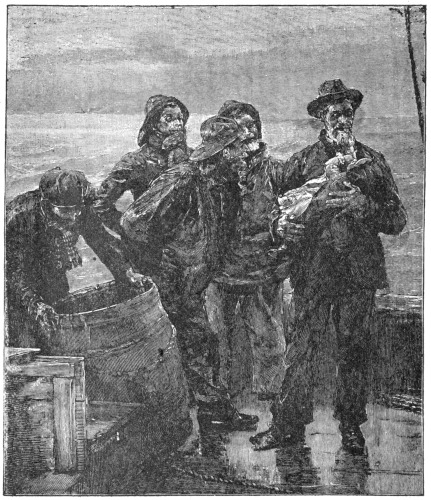
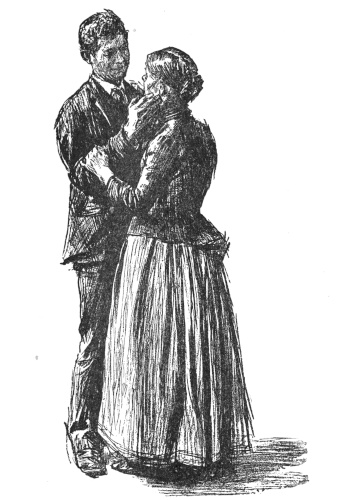

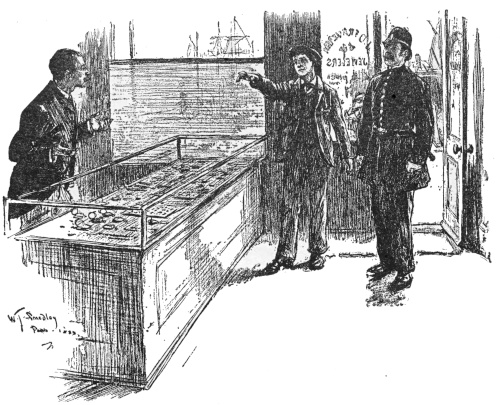

 ,