“Everything about the old Bugle office seems
so changed,” said Dorothy Dale slowly. “I feel
sort of——”
“Homesick?” giggled her chum, Tavia
Travers.
“Exactly,” retorted Dorothy. “That gorgeous
big printing press which has taken the place of
the one we used to have——”
“The old one-lunger Ralph had charge of?”
Tavia again interrupted airily. “It was funny,
wasn’t it?”
“I think it was a dear,” declared Dorothy
loyally. “It used to print the old Bugle in pretty
good shape, anyway.”
“Good gracious, Doro, any one would think
you were in mourning for the old Bugle office,”
cried Tavia, exasperated. “If you want the old
one-lunger back, I am sure you can get it, provided
it has not gone to adorn an ash heap somewhere.”
2Dorothy smiled, but her eyes were wistful.
The two girls had returned to Dalton and were
now staying at Tavia’s home. They had just
visited the offices of the Bugle, the paper formerly
owned by Major Dale and which, for a
number of years, had been the chief source of
income of the Dale family.
The girls were impressed by the great changes
that had taken place in the newspaper office. A
fine new printing press had been installed, the
offices renovated and modernized until all trace
of the rather dingy and shabby quarters of the
old Bugle had been lost.
Small wonder that Dorothy Dale, for whom
the paper had always held a peculiar fascination,
felt taken aback by the great change that had
taken place during her absence. It was like losing
an old and dear though shabby friend and
finding a prosperous but unfamiliar stranger in
his place.
“Do you remember that first assignment of my
journalistic career?” said Tavia, with a giggle.
“I thought I was cut out for a star reporter
that time, for sure.”
“That was the obituary assignment Ralph
Willoby gave you, wasn’t it?” returned Dorothy,
with a reminiscent chuckle. “My gracious, how
many ages off that time seems, Tavia!”
“Yes, we are growing old and gray,” agreed
3the flyaway sadly. “I wonder you haven’t taken
to cap and spectacles long ere this, Doro, my
dear. I am sure I can see white hairs gleaming
in the sunlight.”
“I hope not. I don’t think Garry likes white
hair,” said Dorothy demurely.
“Speaking of snowy locks, hasn’t Mr. Grant
a stunning head of them?” said the irrepressible
girl. “I simply adore that pepper and salt effect,
don’t you, Doro?”
“I guess so,” said Dorothy absently. Her
mind was still busy with the Bugle offices and the
changes made there.
“I wish the Major had not sold the Bugle,
Tavia,” she said wistfully. “I can’t forget how
I used to help get out the old paper and—I would
like to do it again.”
“Good gracious, hear the child!” cried Tavia,
making big eyes at her chum. “Not hungering
for a career at this late date, are you, Doro?
What do you suppose Garry would say to your
making a reporteress of yourself?”
Dorothy dimpled and her eyes began to shine
as they always did at mention of Garry Knapp.
“I suppose he wouldn’t approve,” she admitted.
“He is just old-fashioned enough to
think that the man ought to be the only moneymaker
in the family.”
“Well, why not, as long as he can make
4enough?” demanded Tavia airily. “That is really
the important thing.”
“Tavia, how you talk!” Dorothy rebuked her.
“You know very well you would marry Nat White
if he lost every cent he had in the world.”
“Just the same, I hope he doesn’t,” replied
Tavia, making a face at her more serious friend.
“I like him very well just the way he is. But
it will be nice when he gets white hair and whiskers
like Mr. Grant,” she added pensively.
Dorothy frowned, then laughed. There was
no use taking Tavia seriously, and, besides, she
very rarely meant any of the flippant things she
said.
The Mr. Grant whose hair and whiskers Tavia
so openly admired was the new owner of the
Bugle and a dignified old gentleman whom Major
Dale held in great esteem. To hear Tavia refer
to him so flippantly rather shocked Dorothy.
But then, Tavia was Tavia, and there was no
use trying to change her.
“I wish the Major had not sold the Bugle,”
Dorothy repeated, with a sigh. “It seems, somehow,
like turning against an old friend.”
The two girls walked on in silence through the
lovely spring sunshine, each busy with her own
thoughts. They were very happy thoughts, for
both Dorothy and Tavia had every reason to be
happy.
5During the past winter the chums had become
engaged to the “two dearest fellows in the
world.” Nat White, Dorothy’s cousin and
Tavia’s “bright particular star,” to use the latter’s
own phrase, was expected in Dalton that
afternoon. At the thought that Nat might even
reach her home before Dorothy and herself,
Tavia quickened her pace, eagerly urging the
thoughtful Dorothy along with her.
Garry Knapp, Dorothy’s wild and woolly
Westerner—again Tavia’s description—had returned
to his beloved West to cultivate his land
and raise the “best wheat crop anywhere near
Desert City.” Dorothy was fully in sympathy
with this ambition. The only part of it she did
not like was the long miles that separated her
from Garry and Garry from her. It was not
so very long since she had seen him, yet it seemed
to her like an interminable space of time.
“I bet I can guess what you are thinking about,”
said Tavia, reading Dorothy’s wistful expression.
“Are you on?”
“I never bet,” replied Dorothy primly, and
Tavia hugged her.
“You blessed Puritan! Just for that I’ll tell
you, anyway.”
“You needn’t bother,” said Dorothy hastily,
for she was sometimes afraid of her friend’s
intuitions.
6“Oh, but I will! You were wishing like all
possessed that you could be in my shoes for one
little hour.”
Dorothy flushed and took refuge in an admonishing:
“How you do put things, Octavia Travers!”
“You were thinking that if your darling Garry
were coming instead of Nat, you would be fox-trotting
madly along this road instead of pursuing
your course with every evidence of decorum,”
persisted the outrageous Tavia. “Now
’fess up. Ain’t I right?”
“Maybe—all except the fox-trot,” agreed
Dorothy, with a laugh. “I prefer the waltz
myself.”
“Um—dreamy stuff, lights low, soft music,”
drawled Tavia. “I imagine that would just suit
you, Doro dear. As for myself, give me jazz
every time!”
“When do you expect Nat?” asked Dorothy,
jolted out of her dreamy abstraction.
“Right now, any minute. We are liable to
bump into him at any corner,” replied Tavia
vigorously. “My goodness, Doro, my heart is
palpitating frightfully. I wonder if one ever
dies of such things.”
“You won’t, that one thing is sure,” said Dorothy,
looking with admiration at her chum’s
flushed face and dancing eyes. “Just now you
7look like nothing so much as an advertisement
for health food.”
“How unromantic,” Tavia reproached her.
“And just when I was pining gracefully for poor
Nat, too.”
“Here he comes now!” cried Dorothy, and
Tavia whirled around to see a tall figure coming
swiftly toward them. Nat waved his hat
boyishly and broke into a run. He reached them
just as they turned the corner of the street on
which Tavia lived.
“Hello there, coz!” he said, pinching Dorothy’s
pretty cheek, then turned to Tavia.
“Not here in the street, you silly boy,” Tavia
said, as the young man bent over her. “We are
almost home. Can’t you wait?”
“Not long!” returned Nat ardently. Then,
as they slowly approached Tavia’s house, he
turned to Dorothy, his manner serious.
“I am afraid I have bad news for you, Dot,”
he said, reluctantly adding, in response to Dorothy’s
startled glance: “It’s about Joe.”
CHAPTER II JOE DISAPPEARS
8
Dorothy’s face went white and she gripped
Nat fiercely by the arm.
“Tell me what it is!” she gasped. “Nat, don’t
try to keep anything from me!”
“I couldn’t if I wanted to, Dot, old girl,”
said her cousin gravely. “That’s why the Major
wanted me to break the news to you.”
“Oh, Nat,” wailed Dorothy, “don’t keep me
waiting! Tell me what you mean! What is the
matter with Joe?”
They reached Tavia’s house. Nat pulled the
two girls down beside him in the porch swing, an
arm about Tavia and his hand gripping Dorothy’s
reassuringly.
“He has disappeared, Dot,” said the young
fellow gravely. “But you mustn’t——”
“Disappeared!” cried Dorothy, interrupting
him. “How could he, Nat? Where would he
go?”
“Why, the whole thing is preposterous, Nat!”
cried Tavia. “A boy like Joe wouldn’t do such
9a thing—in earnest. He must just be playing a
prank.”
“A rather serious prank,” replied Nat soberly.
“And one I wouldn’t recommend any
youngster to try.”
Dorothy felt dazed. That Joe, her young and
mischievous though dearly beloved brother,
should disappear!
“Nat, did he—did he—run away, do you suppose?
Was there a quarrel or anything?”
“Not a thing, as far as I can find out,” returned
Nat. Then he paused, but finally added
slowly, as though he were reluctant to cause his
cousin any further pain: “But there was a rather
curious coincidence.”
“Nat, you are so provoking!” cried Tavia impatiently.
“Do come to the point! Can’t you
see Doro is ready to collapse with fright?”
“There has been a fire in Haskell’s store——”
“Good gracious, listen to the boy!” cried the
flyaway scathingly. “As though that could have
anything to do with Joe!”
“It may have a good deal to do with Joe;
or with his disappearance, at any rate,” said
Nat quietly. Once more Dorothy reached her
hand out pleadingly toward him.
“What has this to do with Joe?” she asked
faintly.
“We don’t know, Dot. And, of course, it may
10not have a thing to do with him. It seemed
rather an odd coincidence that Joe should disappear
on the very day that Haskell’s toy and
stationery store burned down.”
“It was the largest store of its kind in North
Birchlands,” murmured Dorothy, hardly knowing
what she said. “And you say Joe disappeared
at about the same time? Oh, Joe, foolish boy,
where are you now? What have you done?”
Dorothy buried her face in her hands and
Tavia rose from her place beside Nat and encircled
Dorothy in a strangling embrace.
“Never you mind, Doro Doodlekins,” she
cried stoutly. “We’ll find that young brother
of yours or know the reason why!”
But Dorothy was not to be so easily consoled.
For years, since the death of her mother, Dorothy
Dale, young as she was, had taken the place
of their mother to her two younger brothers,
Joe and Roger. The boys were good boys, but
mischievous, and Dorothy had spent many anxious
moments over them.
The adventures of Dorothy, Tavia and their
friends begin with the first volume of this series,
entitled “Dorothy Dale: A Girl of To-Day.” At
that time the Dale family lived in Dalton, a small
town in New York State. Major Dale owned
and edited The Dalton Bugle and upon the success
of this journal depended the welfare of his
11family. Stricken desperately ill in the midst of
a campaign to “clean up” Dalton, the existence of
the Bugle was threatened, as well as the efforts
of the better element in town to establish prohibition.
Dorothy, a mere girl at that time, came gallantly
to the rescue, getting out the paper when
her father was unable to do so, and in other
ways doing much toward saving the day.
Tavia Travers, her most intimate girl chum
and as different from Dorothy as night from
day, had helped and encouraged the latter in
her great undertaking. Since then the two girls
had been inseparable.
Later Major Dale had come into a considerable
fortune so that he was no longer compelled
to depend upon the Bugle for his livelihood. As
a result, the Dale family moved to The Cedars,
a handsome estate at North Birchlands, where
already lived the Major’s widowed sister and
her two sons, Ned and Nat White, both older
than Dorothy.
At Glenwood School Dorothy started on a
different life. Her school adventures were many
and interesting, and in these Dorothy and Tavia
never failed to take a leading part.
In the volume directly preceding this, entitled
“Dorothy Dale’s Engagement,” Dorothy met romance
in the person of handsome Garry Knapp,
12a young Westerner who dreamed of raising
wheat on his ranch near Desert City. True love
followed its proverbially rocky course with the
two young people, but the death of Garry’s Uncle
Terry and the legacy of a considerable fortune
left him by the old man magically smoothed the
path for them.
Now we find Dorothy again in Dalton with
Tavia, looking forward to her next meeting with
Garry Knapp and, despite all her common sense
and will power, missing him desperately in the
meantime.
And to her here had come Nat with this terrifying
news about Joe.
What was she going to do? How was she going
to find her brother?
She turned to Nat again pleadingly.
“Tell me all about it, Nat; every little thing.
Perhaps that will help me think what I should
do.”
“I’ve told you all I know about Joe——”
“But about the fire?” Dorothy interrupted
him impatiently. “How did it start? What
made it?”
“An explosion in the back room, I believe,”
returned Nat, his usually merry face clouded with
anxiety. “Nobody seems to know what made
it, but there is a general impression that there
was some sort of explosion. People in the neighborhood
13say they heard a loud noise and a few
moments later saw smoke coming out of the store
windows.”
“About time somebody sent in an alarm, I
should think,” began Tavia, but Nat silenced
her.
“You would think somebody sent in an alarm
if you could have glimpsed the number of engines
rushing to the rescue,” he retorted. “I
don’t think there was a firehouse in North Birchlands,
even the smallest and humblest that was
neglected.”
“Yet they failed to save the store,” murmured
Dorothy.
“It was a fierce fire and by the time the firemen
turned a working stream on it, the whole
place was gutted.”
“Was anybody hurt?” inquired Tavia, and
Dorothy turned startled eyes on Nat. It was
the first time she had thought of that possibility.
“Mr. Haskell was pretty badly burned,” replied
Nat reluctantly. “The old codger would
dodge back into the flames in a crazy attempt
to save his account books. They were burned
up, of course, and he came very near following
in their footsteps.”
“They haven’t got any, as you know very
well, Nat White,” said Tavia flippantly, but instantly
14her face sobered as she looked at Dorothy.
Her chum was white and there was a
strained expression about her mouth that made
her suddenly look years older.
“You shouldn’t have told her that about Mr.
Haskell,” Tavia reproached Nat. “It wasn’t
necessary to go into all the gruesome details.”
“She asked me,” Nat defended himself, adding
in a more cheerful tone: “Anyway, there
isn’t anything gruesome about it. Nobody was
seriously hurt, not even Mr. Haskell. They took
him to the hospital to dress his burns, and the
old fellow will probably be up and around as
chipper as ever in a few days.”
But Dorothy shook her head.
“If they took him to the hospital he must be
pretty seriously hurt,” she said, and Tavia gave
an impatient flounce in the swing.
“Good gracious, Doro Doodlekins, there’s no
use looking on the worst side of the thing!” she
cried. “Let’s presume that Mr. Haskell is all
right and that Joe will turn up, right side up
with care, in a few days.”
But Dorothy was not listening to her. She
turned her white face to Nat who was watching
her anxiously.
“Nat,” she said slowly, “you don’t suppose
Joe’s disappearance really has anything to do with
the fire, do you? I mean,” she said quickly as
15she saw the frown of quick denial on Nat’s brow,
“you don’t think that—by accident—he might
have—you know he always is getting into all
sorts of scrapes.”
“It is merely a coincidence, Dot,” repeated
Nat, hoping that the words sounded more reassuring
to his cousin than they did to him. He
knew that they had not when Dorothy caught
up his words, turning toward him with an angry
light in her eyes.
“Then it is a very unfortunate coincidence,”
she cried. “You know as well as I do, Nat, that
when a thing like this happens and then some one
runs away, his name is always connected——”
“Hush, Doro!” cautioned Tavia, for Dorothy
had unconsciously raised her voice. “A stranger
approaches on foot. Methinks he is a messenger
lad.”
The “messenger lad” handed Dorothy a yellow
envelope for which she signed tremulously.
“A telegram!” she whispered, looking from
Tavia to Nat. “I—oh, Tavia, I am almost afraid
to open it!”
CHAPTER III CALLED HOME
16
“Let me do it, Doro,” cried Tavia. “It won’t
do any good for you to sit there trembling like
a leaf!”
She held out her hand for the telegram, but
for answer Dorothy quickly tore open the envelope.
“It is from Ned,” she cried, as Tavia looked
over her shoulder. “He says Joe has not been
found and there has been no word from him.
Oh, I can’t bear it any longer,” she cried desperately.
“What shall I do?”
Tavia put an arm about her chum again, but, as
though the contact had galvanized her to action,
Dorothy rose swiftly to her feet.
“I must go home at once,” she cried, turning
toward the front door. “I will go in and pack
my bag if you will ’phone for a taxi, Nat.”
Tavia caught hold of her skirt, holding her
back.
“But what good will it do you to go to North
Birchlands, Doro?” pleaded the latter, unwilling
to have Dorothy’s visit so rudely interrupted.
17“You can keep in constant touch with North
Birchlands by telephone and telegraph.”
“But—don’t you see—I must be there, right
on the spot!” cried Dorothy, shaking off Tavia’s
detaining hand. “Please don’t stop me, Tavia.
I hate to go, but it isn’t my fault. Will you
tell that taxi man to hurry, Nat?”
Nat promised, and in a few minutes Dorothy,
hatted and cloaked and bag in hand, returned
to the porch, ready to go. What was her surprise
then, to find Tavia there before her. And
Tavia also carried a bag!
“Wh-where are you going?” stammered Dorothy,
and Tavia chuckled.
“With you, you ridiculous Doro,” she said.
“Do you suppose for a moment I would let you
go without me?”
“But your mother——”
“Oh, Ma will let me do anything I want to,”
retorted Tavia, with a careless shrug of her shoulders.
“She is lying down, so I didn’t even ask
her. Just left a note pinned to the pincushion.
When she sees that she will think for sure I
have eloped.”
Dorothy hesitated, a tiny frown on her forehead.
She could never become quite accustomed
to the queerness of the Travers household.
Everything in her own home had always been
so orderly and comfortable and normal.
18But with Tavia it was different, had always
been different, and probably always would be
different. For Tavia’s mother was extravagant,
lazy, and often actually untidy. Tavia, left to
the guidance of her mother, might have had a
hard time of it.
But Mr. Travers was different, and though
he had never made a great success of himself
financially, he was genial, good-tempered and lovable.
In fact, Dorothy had often, without wishing
to be unfair in the least, attributed Tavia’s
good traits to her father.
But now this action of Tavia’s leaving home
at a moment’s notice to return for an indefinite
stay at North Birchlands with only a scrawled
note pinned hastily to a pincushion to announce
her intention, seemed all wrong.
“But I want to say good-bye to your mother
and tell her how sorry I am that I have to cut
my visit short,” she protested.
Tavia shot her a laughing glance that was still
shrewd and far-seeing.
“She wouldn’t thank you for it, Doro, my
dear,” she said, with a hint of sadness underlying
the light words. “Ma never allows any
one to interrupt her afternoon siesta. Anyway,”
she added, dismissing the subject as a taxicab
rolled up to the door, “I left word about you
in the note—said you left regrets and all that
19sort of thing. Come on, Doro, make it snappy.”
Dorothy sighed as she handed her grip to Nat
and slowly followed the flyaway Tavia to the
cab. There were times when she wished Tavia
would not use so much slang and always be in
such a tremendous hurry. It wore on one’s
nerves occasionally.
Once in the cab Dorothy sank back in a corner
while Nat and Tavia conversed in low tones.
She was thinking of Joe and what must be her
first action upon reaching The Cedars.
She would go down town, of course, to inspect
Haskell’s store, or what remained of it.
She would talk to people in the neighborhood
and find out if any one had seen Joe in that vicinity
at the time of the fire.
But surely no one could have seen him! Joe
could have had nothing to do with that catastrophe!
Dorothy thrust the horrid thought from
her mind, only to have it return again with the
question: Then how explain Joe’s mysterious
disappearance, and just at that time, too?
Perhaps the boy had been hurt. Perhaps they
had taken him to a hospital where they had been
unable to identify him.
She spoke this thought aloud, and Nat immediately
put her fears to rest, on that score at
least.
“The first thing the Major did was to ’phone
20the North Birchlands Hospital and two or three
others in the vicinity,” he said. “They had
brought in no one remotely answering Joe’s description.”
“Then where is he?” cried Dorothy desperately.
It was just as well that they reached the station
at that moment and that they were forced
to run for the train. The hustle and excitement
served temporarily to divert Dorothy’s mind
from her trouble.
Tavia kept up a lively chatter for the major
part of the train trip to North Birchlands so
that Dorothy had little time to indulge her unhappy
thoughts.
It was only when they entered the living room
of The Cedars and faced the Major and Mrs.
White that Dorothy felt the full gravity of the
situation.
She kissed her Aunt Winnie on the cheek and
then went over to her father, kneeled down beside
him and took his hand between her own.
Tavia’s eyes softened as she took in the tableau,
and with a significant gesture she turned
to Nat. The two left the room and Mrs. White
softly followed them. Father and daughter were
left alone.
“You haven’t heard anything, Daddy?” asked
Dorothy, anxious eyes upon her father’s face.
21It seemed to her that the Major looked strangely
old and haggard.
Major Dale shook his head. He had brightened
at sight of his daughter, but at the mention
of Joe his face clouded heavily again.
“I don’t understand it, Dot,” he replied. “Joe
was always such a straightforward, dependable
lad, despite the little pranks he was always playing.
Wouldn’t be a boy if he didn’t have some
mischief in him. But a good boy at that—a
good boy——” His voice trailed off and his eyes
sought the window restlessly.
Dorothy became truly alarmed. Her father
was ill, she could see that—although the Major
would be the last man to admit such a thing.
His health had not been robust for some time
and now the shock of this thing had been too
much for him.
With an effort Dorothy pulled herself together
and spoke encouragingly.
“Of course he’s a good boy, the best in the
world,” she said. “Wherever he has gone, we
can be sure it isn’t very far. We will have him
back in a day or two. You just watch and see!”
The Major smiled and rested his hand for a
moment on Dorothy’s bright hair.
“I hope so, Dorothy,” he said, adding with
an unconscious wistfulness that touched Dorothy
deeply: “Everything seems more hopeful now
22that we have you back, my dear. I can’t seem
to do without my little daughter any more.”
“You won’t have to do without me ever, Daddy
dear,” said Dorothy, and there were tears in her
eyes and in her voice. Then, fearing that she
had betrayed her anxiety over his changed appearance,
she went on in her ordinary tone:
“Don’t you think you could snatch a little rest,
dear? I imagine you haven’t been sleeping very
well lately.”
Major Dale stirred impatiently and again his
restless glance sought the window.
“I don’t want to sleep,” he said on a querulous
note that Dorothy had never heard before. “I
won’t close my eyes again until we have found
that boy.”
With a heavy heart Dorothy left the room
and went in search of Roger, the youngest of the
family and Joe’s shadow. The two boys were
almost always together, for Roger worshiped his
older brother and followed unquestioningly
wherever he led.
Roger was in Joe’s abandoned room staring
moodily out the window, and when he saw Dorothy
he flung his arms about her neck and wept
wildly despite a manful effort to control his grief.
Dorothy patted his small shoulder and waited
until he shamefacedly wiped away the tears with
a grubby hand, leaving a track of dirt from the
23corner of one blue eye to the opposite corner of
his still-tremulous mouth.
Then she drew the lad down on Joe’s bed and
gently questioned him.
“Joe wouldn’t let me go downtown with him
that last day,” said the little lad, his lip trembling
as if with an old grievance. “He said he was
going to meet Jack Popella——”
“Jack Popella! That boy!” cried Dorothy,
springing to her feet. “Oh, Roger, are you
sure?”
CHAPTER IV ON THE TRAIL
24
Roger looked chagrined and more than a little
frightened. The fright was caused by his
sister’s vehemence, the chagrin because he had
unwittingly “told on” Joe. In the code of Roger
no crime was as bad as that of “telling tales”
on one’s mates. He had spoken before he thought.
It is so hard for a small boy not to speak before
he thinks!
But Dorothy was on her feet now, her cheeks
blazing, and he knew he would have to tell her
the truth, not keeping back any of the story.
Roger gave a resigned sigh and braced himself
to answer questions. But Dorothy asked only
one of him. That was a reiterated and breathless:
“Roger, are you sure?”
Roger nodded miserably, and to his surprise
Dorothy turned suddenly and left the room.
Roger stared after her wide-eyed. He was still
miserable, but he was intensely curious as well.
“I wouldn’t be in Joe’s shoes, not for anything!”
he assured himself, as he returned to the
25window. “And I suppose he’ll just about murder
me when he finds out I went and told on him. It
was his fault, anyway,” he added, in an effort
at self-justification. “I told him he oughtn’t to
go with that fresh Popella kid, and so did Dorothy.
My, but I—I wish Joe would come
back!”
Meantime Dorothy rushed upstairs. Meeting
Tavia outside the door of her room, she brushed
past her almost rudely. If it had not been so
late she would have gone downtown immediately.
The fact that Joe had been with Jack Popella
on the day of the fire augmented her fears immeasurably.
Popella was a young Italian lad
with a not very savory reputation, and Dorothy
had been alarmed when, on several occasions, she
had seen Joe with him.
She had tried reasoning with the boy, had
pointed out the fact that one is very often judged
by the company one keeps, but Joe had refused
to take her admonitions seriously.
“You talk as if I never went with anybody
else, Dot,” he had said on one of these occasions.
“And I never have anything to do with him
except just when I happen to meet him. I can’t
help saying hello when he talks to me.”
This argument had silenced Dorothy, and it
had also almost convinced her that she had nothing
to fear in that direction. Almost, but not
26quite, for Joe still was seen quite often in the company
of Jack Popella.
To see this lad and question him was Dorothy’s
one, all-absorbing desire just now. But to
do this she must wait till the next day, and the
hours stretched interminably between.
She flung herself into a chair, her chin cupped
in her hand, staring moodily at the floor. Tavia
came in and perched on the edge of the bed and
regarded her chum curiously.
“Yes, I am human,” she said at last, in a mechanical
tone. “I speak, I walk. If you were
to pinch me I might shriek.”
Dorothy looked up with a frown. It was the
first time she had noticed her chum’s presence
in the room.
“What are you raving about?” she asked.
“I was merely trying to call your attention to
the fact that I am human,” said Tavia patiently.
“By the way you brushed past me in the hall,
I assumed that you thought I was a chair, a
bedstead, or even a humble hatrack.”
“Never a hatrack, Tavia dear,” replied Dorothy,
smiling despite herself. “You are far too
plump and pretty.”
“I admit the latter but deny the former allegation,”
said Tavia calmly. “Why do you think
I follow the dictates of Lovely Lucy Larriper so
27faithfully if not for the purpose of keeping my
figure intact?”
Dorothy did not answer. She had lapsed into
her former mood and Tavia regarded her chum
thoughtfully. Then she deserted the foot of the
bed for the arm of Dorothy’s chair.
“Come on, Doro, snap out of it!” she urged.
“Nothing ever has been gained by surrendering
to the doleful dumps. Suppose Napoleon had
been discouraged!”
“Perhaps he was—at Waterloo,” returned
Dorothy. But she added quickly in response to
Tavia’s impatient gesture: “Now don’t you go
lecturing me, Tavia Travers. I will have the
doleful dumps or any other kind if I feel like
it.”
Tavia felt that her chum was keeping something
to herself, but though she questioned her
discreetly—and otherwise—she could gain no information
from her other than the fact that she
expected to go downtown early the following
morning.
“Well, buck up, anyway, Doro, and get ready
for dinner,” Tavia said finally, as Nat’s voice
was heard below calling to the two girls to “join
the family in the dining room.” “It won’t help
Joe any for you to starve yourself to death.”
“Listen!” cried Dorothy, suddenly jumping to
28her feet. “Isn’t that Ned talking to Nat?
Maybe he has news of Joe.”
Dorothy was out of the room and rushing down
the stairs before Tavia had time to more than
blink her eyes. She followed her chum in time to
see the latter pounce upon Ned with desperate
eagerness.
“It isn’t any use, Dot, I’m afraid,” she heard
Ned say reluctantly. “I have followed up every
possible clue—there were not very many, at that—and
none of them seems to lead to Joe. He
has disappeared as completely as though the earth
had opened and swallowed him up.”
They went in to dinner after that, but they
made very poor business of eating; all except
Tavia, that is, who never allowed anything to
interfere with her appetite.
Once, looking across at the Major, she did stop
long enough to say in an undertone to Nat:
“Major Dale looks dreadfully, doesn’t he,
Nat—like a ghost at a feast?”
“If you call this a feast,” Nat grumbled.
“Seems more like a funeral to me.”
After dinner Dorothy sought out her Aunt
Winnie and, drawing her into a corner, spoke
to her about her father. Mrs. White patted
the girl’s hand gently and sought to evade Dorothy’s
questions.
“Your father’s general health seems unimpaired
29my dear,” she said. “But of course he is
frightfully worried about Joe.”
“It is more than worry that makes him act
as he did at dinner,” persisted Dorothy. “He
hardly touched a thing. Aunt Winnie, he is on
the verge of a breakdown, and you know it as
well as I!”
“Perhaps I do, my dear,” sighed Mrs. White.
“But I don’t see what we can do about it.”
“Except find Joe,” replied Dorothy softly.
“We must find Joe!”
Early the next morning Dorothy dressed herself
in her street things and slipped out of the
house without awakening Tavia. What she had
to do she wanted to do alone, and she feared her
chum’s persistent curiosity. No one should know
that Joe had been with Jack Popella on the day
Haskell’s store burned down and the day when
Joe himself had disappeared if it was possible
for her to keep the knowledge to herself!
She did not even stop to have breakfast at
home, for fear her Aunt Winnie would question
her concerning her errand downtown.
Feeling absurdly guilty, she slipped into a small
restaurant in the downtown district in the vicinity
of Haskell’s store. She questioned the yawning
waitress as adroitly as she could about the fire,
but the woman could give her no particulars.
Mechanically Dorothy gulped down the overfried
30egg and underdone bacon, thinking longingly
of home as she did so. How different the morning
meal would be at The Cedars.
She had started on the second piece of bacon
when the door opened and—in walked Tavia
Travers!
Dorothy gasped and nearly upset the cup of
coffee at her elbow. She stared at though she
were seeing a ghost.
Tavia came straight up to her table, color
bright and eyes dancing.
“So you hoped to escape me, fair one?” she
said, sinking into a chair and motioning to the
waitress. “You should have known better by
this time, Doro, my dear. Were you not aware
that I always sleep with one eye open?”
“You must have had them both open wide if
you saw me leave The Cedars this morning,” replied
Dorothy crossly. “I didn’t want to have
even you with me this morning, Tavia.”
“Business of my becoming horribly offended
and leaving the place in a huff,” drawled Tavia,
as she ordered a ham omelet from the indifferent
waitress. “But I am going to disappoint you,
Doro darling, for the reason that you will be
very glad of my company before you get through.
I intend to befriend you at all costs, even at the
expense of my honest pride.”
“Oh, Tavia, you are too ridiculous!” sighed
31Dorothy. “I can’t be angry with you, no matter
how hard I try. Only, if you are coming with me
you will have to hurry with your breakfast.”
“Have a heart, Doro. The ravening wolves
have nothing on me!”
But under Dorothy’s insistence Tavia finished
her breakfast in a very short time, and after
Dorothy had paid the check the two girls left
the place and turned in the direction of Haskell’s
store.
Half way down the block it loomed before
them, a charred and gutted ruin. Dorothy uttered
an exclamation and grasped Tavia’s arm.
From the wrecked store a skulking figure
emerged, turned, and, at sight of Dorothy and
Tavia, darted down the street.
“Jack Popella!” gasped Dorothy. “What is
he doing here?”
CHAPTER V CAPTURED
32
“Gracious goodness, what ails the child!”
The exclamation was Tavia’s, for at sight of
the young Italian Dorothy had left her side with
startling abruptness. Now as Tavia gaped,
open-mouthed, she saw Dorothy overtake the boy
and put out a hand as though to stop him.
What was her surprise to see Jack Popella
make another of his quick dodges, evading Dorothy’s
outstretched hand and dart across the street.
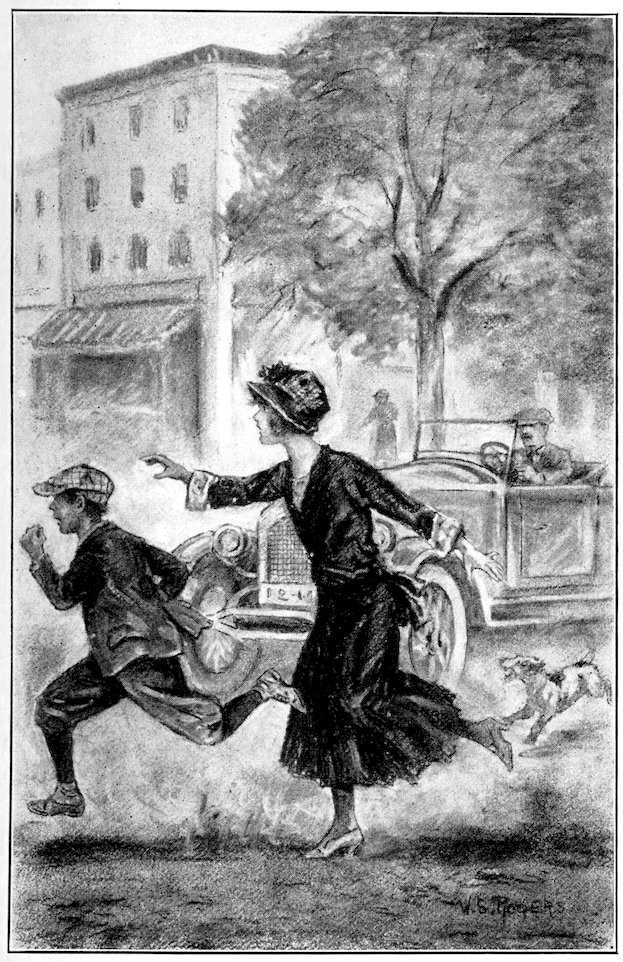
There were two automobiles approaching from
opposite directions, but this fact served to stop
neither Popella nor his pursuer. Tavia screamed,
for it looked as though both the reckless ones
would be instantly killed.
“Dorothy, stop! Come back! Have you lost
your mind?” she shrieked, and herself started
in pursuit.
The boy had dodged in front of the first automobile
with Dorothy close at his heels. It seemed
to the excited Tavia as though the car missed her
chum by a fraction of an inch and she was equally
33certain that the second car would not miss her
at all!
“Dorothy!” she shrieked again, and without
thinking of her own danger dashed out into the
street.
She fully expected to see Dorothy stretched
beneath the wheels of the second car. Instead
she beheld the amazing sight of her chum standing
in the middle of the road breathing heavily,
but triumphant, her hand gripping the collar of
the squirming Popella lad.
Tavia was not sure whether she wanted to
laugh at the spectacle or burst into tears of relief
and reaction. She did neither. Instead, she
took Dorothy by the arm and led her, still clutching
Popella, back to the safety of the sidewalk.
“Now maybe you will explain yourself, Dorothy
Dale,” she gasped. “Do you know you very
nearly gave me heart failure, flinging yourself
at those automobiles? Tried your best to get
killed, didn’t you?”
“Hush, Tavia! Let’s move on,” said Dorothy,
looking uneasily about her. “We don’t want
to attract attention.” And she started down the
street, dragging with her her unwilling prisoner.
“Does this go with us?” asked Tavia in a
stage whisper, indicating the young Italian. “If
you are so anxious not to attract attention, Doro
34darling, I might suggest that you set your prisoner
free.”
“Not until he answers a few questions!” returned
Dorothy. Her eyes were hard and bright
and her grip tightened on the young Italian’s
collar as he tried once more to wriggle free.
“Well, I suppose you know your own business
best,” sighed Tavia. “But I do wish you
wouldn’t be so mysterious about it.”
They had reached a side street and Dorothy
paused and addressed her scowling captive.
“If you promise not to run away before I have
a chance to talk with you, Jack, I’ll let you go,”
she said.
Popella muttered something she took for assent,
and Dorothy released her hold upon his
collar. The youngster hitched his coat up and
stood sullenly with his eyes upon the ground.
“A pleasant specimen of the male species,”
Tavia whispered, but her chum frowned and
motioned her to be quiet.
“Why did you run away when you saw us coming
this morning?” asked Dorothy quietly. “Why
should you think we would want to hurt you?”
Jack Popella glanced up quickly, then down
at the ground again. Evidently he was surprised
at her gentle tone and somewhat disarmed by it.
“I wasn’t scared. I just didn’t want to talk
to no one.”
35“Why?” Dorothy continued her inquisition,
and the boy shuffled uneasily.
“Aw, how does a guy know that?” he protested.
“I just didn’t, that’s all.”
“Now listen, Jack!” Dorothy’s voice altered
suddenly, became crisp and determined. “I have
a few questions I want to ask you and I want
you to answer them truthfully. If you don’t,
I may be able to get you into a great deal of
trouble.”
This kind of talk was more what Jack Popella
was used to, and he looked at Dorothy again,
a sullen, unpleasant light smoldering in his eyes.
Dorothy shuddered to think that her brother Joe
had ever come in contact with a lad like this.
“You ain’t got nothin’ on me,” growled the
Popella lad. “Go ahead and ask your questions.
I ain’t afraid of you.”
“Keep a civil tongue in your head, my lad,”
commanded Tavia sharply. “Or you may find
you have a good deal to be afraid of.”
Dorothy made another slight gesture as though
pleading for silence.
“You surely haven’t anything to be afraid of
if you tell me what I want to know,” she said
patiently, for she had come to the conclusion that
the best way to handle the sullen lad was by
kindness, not threats. “Jack, my brother Joe
36has disappeared and we have no idea where
to look for him. Can’t you help us?”
Tavia started and looked sharply at Dorothy.
So that was what her chum had been keeping
from her the night before! She had suspected
Popella and had not wanted her, Tavia, to know
that Popella was intimate enough with Joe to
come under suspicion. Poor Doro, she certainly
had her hands full of trouble!
As for the young Italian, at the mention of
Joe’s name his behavior became very strange indeed.
He squirmed and once more glanced up
and down the block as though contemplating
escape.
Dorothy took a step or two closer and he evidently
changed his mind. He shuffled to the other
foot and said, without raising his eyes:
“I don’t know nothin’ about Joe, honest I
don’t, Miss Dale. If he’s disappeared I’m sure
sorry, but I don’t know nothin’ about him.”
For a moment Dorothy was nonplused. The
Italian’s protestations seemed sincere enough, and
yet——
“Don’t believe him,” whispered Tavia in her
ear. “He has a shuffling foot and a shifty eye.
A wicked combination—take it from one who
knows!”
THE BOY DODGED IN FRONT OF THE AUTOMOBILE WITH DOROTHY AT HIS HEELS.
37Dorothy had an absurd desire to giggle, but
Tavia’s words had been enough to turn uncertainty
into active distrust. Still she held herself
in check, not speaking with the severity she
thought the unpleasant lad deserved.
“I have reason to know you were with Joe
on the morning that Haskell’s store burned
down,” she said, and Tavia gave a surprised
exclamation which, while instantly stifled, caused
the swift rush of color to Dorothy’s face.
“Aw, who tol’ you that? It ain’t so!” muttered
Popella.
With these words something seemed to snap
in Dorothy’s brain. Her horrible anxiety of the
past few hours fanned the indignation she felt
against this lad. She reached out and gripped
him fiercely by the shoulders.
“It is so, and you know it,” she said in a tone
that terrified the cowardly boy. “And if you
don’t tell me the truth now, Jack Popella, I will
turn you over to some one who will make you.
Maybe they will be able to find out then, who
really set Jud Haskell’s store on fire!”
It was a chance shot, but it went home. Popella
writhed and wriggled in Dorothy’s grip, sputtering
and protesting.
“I didn’t set his store on fire, I tell you!” he
cried. “It was Joe that did it!”
CHAPTER VI MORE TROUBLE
38
Dorothy started back as though Jack Popella
had struck her.
It was not true! It could not be true! Joe
never, never would do such a thing! Her face
turned very white and she trembled violently.
Even Jack Popella seemed alarmed at what he
had done and stood regarding her with a strange
mixture of bravado and sheepishness.
Tavia sprang forward, putting her arm about
Dorothy and fixing blazing eyes upon the young
Italian.
“How dare you say such a thing!” she gasped.
“You know it is a horrible, an awful——”
But Dorothy rallied and pressed a hand close
upon Tavia’s lips.
“Don’t, dear,” she pleaded faintly. “I am
not quite through with him yet. Jack Popella,”
she turned to the swarthy lad and her tone was
strangely quiet and subdued, “tell me all you
know. Won’t you, please?”
“I don’t know nothin’ much,” protested the
Italian, abashed and sullen again. “I know that
39Joe set fire to the store and when the explosion
came he got scared and run away. That’s all.”
“Enough to scare anybody, I should say,” murmured
Tavia, but Dorothy took no notice of
her.
“Why should Joe do a thing like that?” asked
Dorothy, still in that strangely gentle tone. “He
never was a bad boy, Jack. He must have had
some reason.”
Popella was silent, but again his glance darted
up and down the block as though seeking escape.
“Won’t you tell me what reason Joe had for
doing such a thing—if he did it?” Dorothy persisted,
repeating: “He must have had some
reason.”
“Aw, I dunno,” returned the lad uneasily. “He
had a fight with ole man Haskell, that’s all.”
“What about?” asked Dorothy patiently.
“You must know what it was about, Jack.”
“The ole man short-changed him, if you want
to know,” the lad burst out as though her persistence
irritated him past bearing. “We was
buyin’ some toys with a two-dollar bill Joe had
an’ the ole man wouldn’t give him the right
change. Joe tole him about it an’ the ole man
got mad. Then Joe got mad an’ they had a
reg’lar fight.”
“Must have been an unequal struggle,” murmured
40Tavia. “I imagine Joe got the worst of
it.”
“Aw, it wasn’t that kind of a scrap,” retorted
the Italian lad, favoring Tavia with a pitying
glance that caused her to choke and search frantically
for her handkerchief. “Joe knows better
than to pitch into a big feller like ole man Haskell.
They just yelled at each other, that’s all.”
“And Joe set fire to a store because of a little
thing like that!” said Dorothy, in a dazed tone,
as though she were repeating something she had
heard in a dream. “I don’t believe it!”
“Believe it or not, lady,” retorted Jack Popella,
with a return of his insolent air now that
suspicion had been shifted from him. “It’s the
trut’. So long!” And with another of his eel-like
movements he dodged past Dorothy and disappeared
around the corner.
Dorothy watched him go apathetically. What
did it matter to her what happened to Jack Popella
now?
“The slimy little toad!” cried Tavia, disgustedly.
“Ugh! I should think you would want
to wash your hands, Doro. They must feel
greasy.”
“They don’t feel at all,” admitted Dorothy
wearily. “Just now I don’t believe there is a bit
of sensation in any part of me, Tavia.”
“Poor little Doro!” said Tavia gently. “Having
41a pretty hard time of it, aren’t you, honey?
But of course you don’t believe a word that little
toad told you?”
Dorothy was silent and Tavia looked at her
sharply.
“You don’t, do you?” she repeated, with increased
emphasis.
“Oh, I am trying hard not to, Tavia,” cried
Dorothy desperately. “But there—there is the
circumstantial evidence.”
“Circumstantial evidence—pah!” cried Tavia
vehemently. “Any real criminal lawyer will tell
you it isn’t worth powder to blow it up with.
Proof, that’s the thing! And what proof have
you? Not a bit. Only the word of that slimy
little toad—who, by the way, will bear considerable
watching, if you will listen to me,” she
added significantly.
“But Jack Popella didn’t run away and Joe
did!” Dorothy pointed out to her miserably.
“Oh-ho, so that’s what’s worrying you! Well,
I wouldn’t let it, if I were you. Don’t you know
that the smartest criminals believe that the safest
place in the world for them is right in the vicinity
of their crime?”
“Good gracious, Tavia, I wish you wouldn’t
speak of criminals so much,” interrupted Dorothy
unhappily. “It makes me feel uncomfortable.”
Tavia wanted to laugh but, after a glance at
42Dorothy’s face, forbore. There were times when
the careless Tavia could be very tactful, especially
with the people she loved.
They returned to The Cedars to find Mrs.
White considerably worried over their unexplained
absence. But when Dorothy explained
where she had been and what she had found
out Mrs. White readily forgave her. She was
as alarmed and distressed as Dorothy over the
revelations of young Jack Popella and she agreed
with rather significant readiness that at present
nothing should be said to the Major concerning
this new turn in events.
“Where is Dad?” asked Dorothy, as she turned
to go upstairs. Mrs. White looked still further
distressed.
“You must not be alarmed, Dorothy dear,”
she said. “But your father preferred to stay
in bed this morning——”
“In bed!” Dorothy interrupted swiftly. “Then
he is ill!”
“He says he is just tired, dear. And, indeed,
he has not slept for several nights,” the Major’s
sister explained, adding, as Dorothy once more
turned to leave the room: “He has been asking
for you.”
“Asking for you, asking for you,” hammered
in Dorothy’s head as she ran up the stairs to
43see for herself why it was the Major had “preferred
to stay in bed.”
At the top of the stairs she ran into Ned, who
caught her arm and held on to it, laughingly.
“Whither away so fast, fair cousin?” he queried.
“You should never rush like that so soon
after breakfast. Any doctor’s book will tell you
as much.”
“Let me go, Ned,” Dorothy pleaded. “Dad
is ill.”
“Not ill—just tired,” corrected Ned, the while
Dorothy wondered at his denseness. “No wonder,”
he added grumblingly. “I would be tired
too, in his place. That young brother of yours
needs a sound thrashing, Dot.”
“Ned, how dare you say such a thing!” Dorothy
turned upon him with flashing eyes. “Poor
Joe needs his family just now—and that’s all
he needs.”
She was gone before her cousin could speak,
and Ned was left to whistle his surprise and admiration.
“Poor, loyal kid,” he muttered, as he went on
down the stairs. “Has a lot on her mind, too.
Guess Nat and I had better get busy if we don’t
want to lose our reputations as rivals of the great
detectives.”
Meantime Dorothy had rapped upon her
44father’s door and, receiving no answer, pushed
it gently open.
So still and quiet was the Major’s face upon
the pillow that she thought for a moment he was
asleep. But as she turned to creep silently away
he opened his eyes and called to her.
“I have been waiting to see you, daughter,”
he said, and again Dorothy detected that unusual
wistfulness in his tone. “Where have you been?”
Dorothy evaded the question, feeling miserable
as she did so. Never before had she refused
to answer any query put to her by the Major
and now it was almost impossible not to give him
a straightforward reply. Yet how could she
tell him, in his weakened condition, that Joe was
suspected of having set fire to Haskell’s store?
Instead, she gave some explanation of her absence
that seemed to satisfy him well enough.
When she came and knelt beside his bed he spoke
in his old cheerful vein of his indisposition, insisting
that it was sheer laziness on his part and
that he would surely be downstairs for luncheon.
But Dorothy, looking at his worn and weary
face, was not so optimistic. Although she succeeded
in hiding her anxiety beneath her usual
practical and cheerful manner, she was inwardly
deciding to call up the family physician as soon
as she left her father’s room.
45She knew that when the Major kept his bed
there was something seriously wrong with him.
A few moments later, carefully muffling her
voice so that her father might not hear her,
Dorothy called up the doctor and was told that
the physician would call at The Cedars as soon
as possible, probably about eleven o’clock.
She went down to the living room and found
Tavia and Nat quite evidently absorbed in each
other’s company. She was about to retreat and
leave them to themselves when Tavia spied her
and called out merrily.
“No reserved seats in here,” she told Dorothy
gravely, as the latter slowly returned and sank
down into one of the big, comfortable chairs.
“Everybody invited, free of charge. Why the
long face, Doro darling? Any new and dreadful
thing happened?”
“I have called Doctor Paugh to see Dad,”
returned Dorothy wearily. “He will be here soon,
I think.”
“Why, Doro, is it as bad as that?” asked
Tavia, with quick sympathy. “I had no idea
he was really ill.”
“Have you ever known the Major to stay in
bed when he didn’t have to?” retorted Dorothy,
and something in her tone and manner convinced
both Tavia and Nat that there was more to the
Major’s indisposition than they had imagined.
46They were silent for a few moments, then Nat
spoke softly to Dorothy.
“Tavia has just been telling me what you
found out from Jack Popella.”
Dorothy glanced up and Nat added quickly:
“You can’t put too much stock in what that
fellow tells you, Dot. His word would be the
last I’d trust.”
“I don’t know what to trust,” confessed Dorothy
miserably. “Or which way to turn——”
“Which reminds me,” interrupted Tavia with
apparent irrelevance, “that a letter came for you
from the wild and woolly West a few moments
ago, Doro. I have a sneaking notion it’s from
Garry.”
CHAPTER VII A LETTER FROM GARRY
47
“Good gracious, why didn’t you tell me that
hours ago?” cried Dorothy, rising with an alacrity
that made Tavia and Nat exchange amused and
sympathetic glances. “I haven’t had a letter from
Garry since——”
“Yesterday!” finished Tavia with fine irony,
and the corners of Dorothy’s mouth dimpled in
a brief smile.
“The day before!” she corrected demurely. “I
was beginning to worry.”
She fetched the letter, a bulky, satisfactory-looking
epistle from the table in the hall and
returned to the living room to read it in comfort.
“I needn’t ask you to excuse me while I examine
my mail,” she remarked to the absorbed
couple in the window seat. “You are only too
glad!”
“My, isn’t she the mean thing!” cried Tavia,
not in the least abashed. “Just wait till Garry
Knapp comes East again, Doro. Make believe
I won’t get even!”
48“When Garry comes East again you won’t
have any chance to get even with Dot, my dear
Tavia,” laughed Nat. “She won’t even know
that you and I exist.”
“She doesn’t know it now,” retorted Tavia,
with a meaning glance at her chum who was completely
absorbed in Garry’s letter.
“Well, can you blame her?” Nat’s voice had
softened until it reached only Tavia’s ears. “She’s
got what we have and—it’s a pretty good thing
to have, isn’t it, girl?”
“Nat, I never knew I was living before,” confessed
Tavia softly, and after that it was very
lucky for them that Dorothy was too absorbed
in her letter to notice them!
Garry was well. So much Dorothy learned
from the letter, written in his usually cheery
vein. But, though he actually said little about it
in words, Dorothy could read between the lines
well enough to see that something was worrying
him. He spoke lightly in one place of the “gang”
that was trying to “get fresh” with him and “put
a spoke in his wheel.”
Although he spoke lightly of the whole affair,
Dorothy sensed the fact that he was worried
and was correspondingly anxious. If she could
only see Garry for a few moments she would
worm the whole thing out of him—for she knew
how.
49If she could only see him for a few moments!
The thought and wish formed itself in her mind
and became a longing so acute that it was almost
pain.
To see Garry, just for a little while. To lean
upon his strength, to ask his advice and follow
it. She knew she could do that without question.
Garry’s advice was always sound.
To have him with her! And she could effect
this desired result by a mere gesture! There
was something thrilling in that thought. A telegram
to far-off Desert City and Garry would
be at her side as soon as trains could get him
there.
It was a tempting vision but, as she knew, a
selfish one.
Garry was having his hands full attending to
his own affairs. Why should she trouble him
with her worries?
And, besides, this mysterious “gang” of which
he spoke so lightly would undoubtedly take advantage
of his absence from the ranch to “get
fresh” in earnest.
No, she must not ask his aid—not just now.
At the thought she sighed and it was such a
deep and hearty sigh that the irrepressible Tavia
giggled.
Dorothy started and half rose from her chair
in dismay, so completely had she forgotten the
50presence of Tavia and Nat in the room. Meeting
the laughing gaze of the two in the window
seat she relaxed again, smiling a bit sheepishly,
and gathered up the various pages of her letter.
“Was it so dreadfully sad, Doro?” teased
Tavia. “Dare you to read me the last page?”
“That isn’t a fair dare and not a bit sporting
of you, Tavia Travers,” retorted Dorothy, with
mock primness. “Dare me something within the
bounds of possibility and I may take you up!”
“Is he coming on soon?” Tavia persisted, and
Dorothy slowly shook her head.
“He is very busy on the ranch,” she said, adding
with an unsteady little laugh: “I guess any
one who wants to see Garry in the near future
will have to go out West.”
How little did she know that these words,
spoken carelessly enough, were to prove prophetic!
The doctor came as he had promised at eleven
o’clock and, after a thorough examination of the
Major, talked gravely and seriously to Mrs.
White and Dorothy.
“His heart is not in as good condition as I
should like to see it,” he told them. “He has
not been in vigorous health for some time, as
you know. And now the best medicine I can recommend—besides
a tonic, for which I will leave
51you a prescription—is absolute rest and quiet and
a mind free from worry.”
He noticed the quick look that passed between
Dorothy and Mrs. White at these last words
and his eyes seemed to be boring into the former
as he asked quietly: “Has Major Dale been
subjected to a severe shock during the last two
or three days?”
As simply as possible Dorothy told him the
facts about Joe. The physician listened with
every evidence of sympathy and concern.
“Too bad, too bad!” he murmured at last.
“There is no way, I suppose, that word of his
father’s condition might be sent to the lad?”
“No, doctor,” answered Dorothy despairingly.
“We have not the slightest idea where
Joe is!”
The physician nodded soberly and rose to go,
leaving behind him a final admonition that, as
far as it was possible, the Major’s mind was to
be kept free of worry.
“And he might just as well ask us,” remarked
Dorothy, as from an upstairs window they
watched the doctor drive away, “to give him the
moon!”
Mrs. White came and put her arms about
Dorothy, and the girl put her head down on
her aunt’s shoulder and wept a little.
“It all seems so strange and upside down and
52tragic, Aunt Winnie,” she said, after a minute,
wiping her eyes on a small square of handkerchief.
“Always before when anything dreadful
like this happened, I have had some idea what
I ought to do, but now I am all at sea. Don’t
you think,” she added, holding her aunt off from
her and looking at her seriously, “that we ought
to notify the police, set a detective on his trail,
or something?”
Mrs. White looked thoughtful for a moment,
but she finally shook her head.
“That would be publishing to the world Joe’s
connection—if there is one—with the Haskell
store fire,” she said. “And, for Joe’s sake, that
is the last thing any of us wants to happen.”
“But meantime something dreadful may happen
to the boy—he is only a boy, after all, Aunt
Winnie,” wailed Dorothy. “He may be in danger——”
“He hasn’t met with any accident, we are sure
of that,” Mrs. White interrupted reassuringly.
“And if he has run away, thinking that he might
be connected in some way with the fire, he will
return when he thinks the alarm has died down.”
“But in the meantime he may be in danger,”
reiterated Dorothy. “It seems dreadful to have
a boy of Joe’s age roaming around the world
alone and unprotected. Aunt Winnie, we must
do something. We must!”
53“We are doing something, dear,” Mrs. White
reminded her soothingly. “Ned and Nat are
leaving no stone unturned to discover the whereabouts
of the lad and they are not going to stop
hunting until they find him. And now go back
to your father, my dear,” she added. “You
seem to be the only one who can content him
just now.”
“No one knows what may happen to Daddy if
we don’t find Joe soon!” muttered Dorothy, as
she turned to leave the room.
It seemed that Dorothy Dale had her full
share of trouble just then but, as it happened,
fate had still a little more in store for her. And,
indeed, it would probably have been the straw
too much if Tavia, with her native tact, had
not kept the worry from her.
For Roger, the youngest of the family, had
felt Joe’s disappearance more keenly perhaps than
any of the others, because he had less philosophy
to bear his sorrows.
And since his admission to Dorothy that his
brother had been in the company of Jack Popella
on the day of the fire, his conscience had troubled
him rather badly and his one thought was to get
Joe and beg his pardon for his perfidy before
some one else could tell him of it.
With this thought in mind, Roger started out
bravely and manfully to find his older brother.
54He left the house early in the afternoon, presumably
to play with some of the neighborhood
children, and his prolonged absence was not remarked
till nearly dinner time.
Then it was Tavia who, looking up the boy
for the purpose of herself asking him some question
concerning Joe, learned that he had been
absent for several hours.
“I may be an idiot to worry,” she said, taking
her suspicions to Nat, “but I do think that
we ought to set out on the trail of that youngster
and bring him back before Doro has a chance
to discover his absence. What do you think?”
“That you are right, as usual,” returned Nat,
with a fond glance at the pretty Tavia. “We’ll
be back in jig time with that young cousin of
mine by the collar.”
CHAPTER VIII THE SEARCH
55
Nat and Tavia got out the old Fire Bird machine
that had seen them through many adventures
in order to cover the ground with “full
speed ahead,” to use Nat’s own phrase.
“Something tells me our young wanderer may
have strayed far afield,” remarked Nat, as he
manipulated things in preparation for the start.
“We shall need all the gas and ingenuity we have
if we are to return the kidlet before Dot discovers
his absence.”
“He may only be playing in perfectly harmless
fashion with his mates,” remarked Tavia,
as she gloried in the sting of the wind against her
face. “I probably am just scaring up trouble.”
“I hope so!” said Nat dubiously, and Tavia
looked at him quickly.
“But you think not!” she said. “Am I right?”
“As always!” He smiled and then added
gravely: “Roger is an obedient lad, you know,
and he has been told always to be in the house by
five o’clock. The fact that it is now approaching
six and Roger still at large seems ominous to me.”
56“Nat, do you think—” began Tavia slowly,
“do you think that Roger may have gone to find
Joe?”
“That’s just what he would be apt to do, good
little sport that he is,” said Nat, troubled eyes on
the road ahead. “Poor Dot! I hate to think
how she will feel if we fail to bring back the
bacon, in the shape of my young cousin.”
“Where are you going, Nat dear?” asked Tavia,
after a moment of silence. “You seem to
have some definite objective.”
“I have,” declared Nat, as he slowed down
before an imposing white house. “I am going to
visit the home of every kid in the neighborhood
that Roger plays with. Then, if I fail to gain
a clue, I haven’t the faintest idea what to do next.”
“Never give up till you try,” urged Tavia.
“Hurry, Nat—do! I feel as though I were on
pins and needles.”
“Not very comfortable,” returned Nat, grinning,
as he swung his long legs over the car door
without bothering to open it.
Tavia watched him swing up the drive, ring
the bell of the imposing white house, and, a moment
later, hold converse with the owner of it.
She knew by the manner in which he came back to
her that the interview had been disappointing.
“Nothing doing,” he said in response to her
tacit question. “The lady of the house, backed
57by the kid in there, says they haven’t seen our
youngster to-day.”
“The plot thickens,” murmured Tavia. “Poor
Doro. What shall we tell her?”
“Hold your horses, young lady,” Nat advised
her. “We have several other places to visit before
we begin to give up hope. We’ll find him
yet.”
Although they made a thorough canvass of all
the homes in the neighborhood which contained
familiars, or possible familiars, of the missing
Roger, their quest was unsuccessful. No one
seemed to have seen the missing youngster that
day, and Nat and Tavia were forced to admit
that, so far, their mission had failed.
“You are not going to give up yet, Nat?” cried
Tavia quickly, as Nat started to turn the nose of
the Fire Bird toward home. “Why, we have not
even begun to look!”
Nat shut off the power and regarded his companion
in perplexity.
“It seems to me we have made not only a beginning,
but an ending, as well,” he protested. “I
can’t think of another place where the boy might
be, and I thought perhaps we had better go back
and see if they have heard anything at The
Cedars. If he is back there, safe and sound, we
are having all our trouble and worry for nothing.”
“Oh, please don’t go back yet,” begged Tavia.
58“I have an idea, Nat,” she added, with sudden
eagerness. “If Roger has the notion that Joe has
taken a train from the North Birchlands station,
what would be more natural than for him to head
stationwards himself?”
“Brilliant mind!” ejaculated Nat, manipulating
the car into another right-about-face. “We will
proceed to the station immediately.”
“But not by the main road, Nat,” urged Tavia.
“Through the woods, by that old wagon
road, don’t you remember?”
Nat regarded her as though he thought she
might have gone temporarily insane.
“But, my dear girl, why——” he began, but
Tavia impatiently interrupted him.
“Oh, you men are so stupid!” she cried. “You
never can think of anything without a map to
help you. Can’t you see that Roger, hoping to
escape attention, would take the path through the
woods, rather than go by the main thoroughfare?”
“Yes, I can,” replied Nat. “But I am very
doubtful as to whether we shall be able to guide
the old Fire Bird through that same path you
mention. The wagon road is almost entirely overgrown
with rank grass and weeds, you know. It
would be a clever trick to navigate it in the day
time, and now, as you can see for yourself, the
twilight approaches on rapid feet.”
59“Then we will park the car and walk,” said
Tavia imperiously. “Nat, won’t you do this much
for me?”
“My dear, I would do far more than that for
you,” Nat assured her, and Tavia’s bright eyes
softened at his tone.
They turned the Fire Bird in the direction of
the woods, found the old wagon road, and drove
along it as far as they were able.
Then Nat helped Tavia to the rough ground
and they started on a walk that was more nearly a
run. Having come this far, Tavia found herself
obsessed by the belief that there was urgent need
of haste.
She would have rushed blindly on through the
shadow-filled woods had not Nat, at her elbow,
gently restrained her, urging that she take her
time.
“Nothing will be gained if you stumble over a
root and break your leg,” he told her, and Tavia
replied indignantly that she had no intention of
being so foolish.
“I feel as though Roger were in danger of some
sort, Nat,” she said, during one of those pauses
when they had sent their combined voices echoing
and reechoing through the woods. “I feel as
though we ought to run every step of the way.”
“And probably Roger is at The Cedars, enjoying
his dinner by this time,” rejoined Nat, as
60they started on again. “Don’t let your imagination
run away with you, my dear.”
Her nerves already on edge, Tavia was about
to retort sharply but closed her lips just in time.
Nothing would be gained by quarreling with Nat.
They would only waste time.
They hurried on until they came out of the
woodland and found themselves almost upon the
North Birchlands station.
They inquired of the agent at the ticket office
whether a small boy had come that way and the
man replied in the negative.
Discouraged, they turned to go back the way
they had come. They walked on in troubled silence,
wondering how they could break this bad
news to Dorothy.
“He may have wandered off into the woods
and been unable to find his way out,” suggested
Tavia, and Ned agreed with her that he might.
“Although Joe and Roger know these woods
like a book,” he added. “Roger probably couldn’t
get lost in them if he tried.”
“Anyway, we had better look around a bit,”
Tavia insisted. “I am dreadfully worried, Nat.”
Nat took her hand, and, like two children, they
started into the denser part of the woodland,
calling as they went.
“It’s like hunting for a needle in a haystack,”
Nat said at last, as they paused to rest. “We
61might do this all night and still not be any nearer
finding Roger.”
“But, anyway, we can try, Nat,” Tavia persisted.
“I can’t bear to go back to Doro emptyhanded.
She will be crazy.”
So they went on again, calling as they went,
until the woods began to grow really dark and
even Tavia was almost ready to give up the search
for the time being.
“My one hope is that while we have been looking
for him he has found his way back to The
Cedars,” she said, as they started slowly back toward
the weed-choked wagon road. “If he isn’t
there I don’t know what we can do.”
“Listen! I thought I heard something!” Nat
checked her, a hand on her arm.
Tavia paused obediently and in the almost eerie
silence of the woodland she could hear her heart
throbbing.
“What do you mean?” she gasped. “I didn’t
hear anything.”
“There it is again—over this way,” cried Nat,
and began to run, pulling the girl with him.
CHAPTER IX IN THE TREE
62
In a moment Tavia too heard it—a boyish cry
in that vast, silent woodland.
“Roger!” she panted, almost sobbing. “Oh,
Nat, is it Roger?”
“Guess so,” said Nat grimly. “But I declare
I don’t know where the boy can be. Sounds as
if he were hanging in the air somewhere over our
heads.”
“Listen a moment,” suggested Tavia.
They paused, and again they heard the faint
cry. It was strangely like and yet unlike Roger’s
voice. It seemed, as Nat had said, to come from
the air above them. An eerie sensation at that
hour in the fast-darkening woods.
Tavia felt the hair beginning to creep on her
scalp, yet it was she urged Nat on again.
They knew they were coming nearer that voice,
for it sounded continually louder in their ears.
Yet they still could not locate it.
At last, when they were about ready to give up
in despair, Tavia was startled to hear the voice
again, and, this time, right over her head.
63“I’m up here,” it said quaveringly. “And I
can’t hold on much longer. If you don’t give me
a hand I’ll fall and break my neck!”
Tavia felt an hysterical desire to laugh. Roger
was up in a tree. Of course! How foolish of
them not to have thought of that sooner.
Nat, after one eager glance up into the shadowy
branches of the tree, had already begun to
scale its rough bark.
“Hold on for a minute, old man,” he shouted
to the disembodied voice aloft. “I’ll bring you
down in a jiffy.”
“But my hand’s slipping,” wailed the voice
again. “You’d better hurry, Nat. Oo-oo—I’m
gonna fall!”
Alarmed at this prohecy in spite of Nat’s rapid
progress toward the rescue, Tavia went close to
the tree, straining her eyes to catch a glimpse of
the small form hidden among the branches.
“I’m here, Roger darling! It’s Tavia,” she
called. “If you have to let go I’ll catch you! I
will if it kills us both!”
“He isn’t going to let go—he isn’t that kind
of bad sport,” said Nat’s voice above her head.
“I’ll grab you in a minute, kid. Can you slide
along that branch a bit. That’s the idea. Take
it easy, now.”
“I—I’ll try,” said Roger’s voice faintly, and
Tavia heard a rustle among the leaves that told
64her the boy was doing his best to aid his rescuer.
“Ow, I’m slipping!” he yelled suddenly. “Catch
me, Nat!”
Tavia felt a cold chill run up and down her
spine at that frantic cry, but the next moment she
was reassured.
“All right, old timer, I’ve got you,” said Nat’s
voice. “Just grab hold of me now and we’ll be
down on terra firma in a jiffy. That’s the kid!
Ready now?”
“Y-yes,” came Roger’s unsteady response, and
Tavia knew he was fighting off the tears of weariness
and fright. “We ain’t very far from the
ground, though, are we, Nat?”
“Not very far, old boy,” responded Nat jocularly.
“Not half as far as if we were twice as
far.”
Tavia heard Roger chuckle and blessed Nat for
his quick tact. He had saved the small boy the
humiliation of tears.
There was the sound of scrambling and sliding
and Tavia saw Nat, one arm about Roger,
hang from a sturdy lower branch, then drop to
the ground.
He set his small cousin gently on the ground
and carefully brushed the leaves and twigs from
his clothing.
“Now you’ll do, old man,” he announced, adding
suddenly: “Pretty near starved, aren’t you?”
65“I—I—guess so,” returned Roger quaveringly,
and Tavia longed to put her arms about him and
comfort him. She knew better, however, and
merely took his hand firmly in her own and led
the way back to the old wagon road and the waiting
Fire Bird.
“We’ve got the car and we will have you home
in a jiffy, Roger,” she said cheerfully. “I reckon
the folks there will be glad to see you.”
“Dorothy will be awful scared, I guess,” he
remarked hesitantly. “It must be awful late.”
“It is and she will,” Tavia retorted promptly,
and at the hint of reproach in her voice the small
boy seemed once more on the verge of tears.
“I couldn’t help it,” he cried, with a catch in
his voice that he could not control no matter how
hard he tried. “I—I just had to find Joe an’
tell him—something,” he finished weakly.
“Well, did you?” asked Nat, with good-natured
sarcasm.
“No,” admitted Roger dispiritedly. “I thought
I might maybe take the train because that must ’a’
been the way Joe went, but I just happened to
think that I didn’t have any money.”
“That is apt to be a slight drawback,” admitted
Nat gravely, and thereupon launched into a short
lecture on the wickedness of small boys who went
anywhere without first gaining the consent of
those at home.
66“But Joe did it,” Roger interrupted once, wonderingly.
“And Joe is not a bad boy.”
“He is at least unwise,” murmured Tavia, and
Nat was forced to explain that Joe, though not
in any sense wicked, had been foolish and thoughtless
to do the thing he had done.
“But I just had to go and find him,” Roger
persisted. “And how could I do it if I didn’t
take the train?”
At the prospect of having to begin his lecture
all over again, Nat gave up in despair and
changed the subject.
“Do you mind telling me, old lad,” he asked
gravely, “how you happened to be using that
tree for a parking place——”
“And a rather insecure one at that,” murmured
Tavia, with a chuckle.
“At an hour when, by all rights, you should
have been at home and in bed?” finished Nat.
Tavia felt the small boy’s hand tighten in hers
and knew that he was about to recall what had
been, to him, a rather dreadful experience.
“I was walking around in the woods, thinking
I might find Joe,” he explained, “when I saw
something funny and black coming through the
woods.”
“Oh,” shivered Tavia, in mock terror. “How
terrible! What was it?”
“It was only a dog, but I thought it was a
67bear.” By the disgust in his voice it was evident
his mistake had chagrined the boy deeply.
“And you climbed a tree to get away from the
bear?” suggested Nat. “Am I right?”
“It was as easy as pie getting up,” Roger
agreed.
“But when you tried to get down you found
you had bitten off more than you could chew, eh?”
asked Tavia.
Roger was offended.
“Ah, you fellers won’t let a kid tell his own
story!” he complained, and Tavia had all she
could do to keep from going off into fresh spasms
of laughter and thus offending the boy still more
deeply.
Tavia could hear Nat chuckle in the darkness,
though his voice was tremendously grave as he
apologized.
“Awfully sorry, old chap,” he said. “We will
try to do better from now on. What happened
next?”
“Nothing—nothing much, anyway,” responded
Roger, partially mollified. “When I saw it was
only a dog and he just sniffed and went away I
tried to get down again and I couldn’t. I had
got away out near the end of the branch, because
bears can climb trees, you know——”
“But this wasn’t a bear,” Tavia reminded him
gravely.
68“Well, I didn’t know that when I was climbing
out there, did I?” demanded Roger peevishly,
and Nat’s hand closed over Tavia’s with a warning
pressure.
“And when I tried to get back again,” Roger
continued, “I couldn’t. I tried and I tried and
then I tried yelling. But nobody must uv heard
me, because nobody came,” he concluded dolefully.
“Except us! Don’t forget your old Uncle Nat,
my boy,” Nat reminded him.
“Oh, you’re not my uncle; you’re just my cousin,”
Roger retorted, and Tavia giggled.
“How’s that for gratitude?” she crowed, and
Nat chuckled.
“Anyway, you have to admit—uncle or cousin—that
I turned the trick and got you down,” he
said to Roger.
“Yes,” the small boy admitted, adding reminiscently:
“But you did pinch my arm something
awful!”
While this was happening, Dorothy, all unconscious
of it, was having an exciting adventure
of her own.
Ned White had come to her soon after Tavia
and Nat had left The Cedars on their quest for
the missing Roger and revealed excitedly that he
thought he had “raked up” a clue that might
69throw light on the mysterious circumstances surrounding
Joe’s disappearance.
“I met a fellow who lives at Scranting,” he
said, mentioning a township some miles further
out than North Birchlands. “He says that he remembers
seeing a chap around the railroad station
there who might answer Joe’s description. It’s
only a chance, Dorothy—the boy probably was
not Joe at all—but it seems to me the clue is worth
following up.”
“Any clue is worth following up,” cried Dorothy,
instantly aquiver with hope. “Are you going
to Scranting now? Because if you are, I am going
with you.”
Ned hesitated.
“It is almost dinner time,” he reminded her,
but Dorothy broke in impatiently.
“Oh, what difference does that make? We can
snatch a bite in Scranting if we have to. Ned,
you mustn’t put me off.”
“But there’s another thing, Dot,” Ned demurred,
troubled. “I went to get out the Fire Bird
just now and she isn’t in the garage. Nat must
have beaten me to it. He and Tavia are among
the missing. Joy riding, probably.”
Dorothy’s brow clouded. If, as Ned suggested,
her chum and Nat were joy riding, such a procedure
seemed heartless to her, in view of all the
70trouble at The Cedars. Then, too, Tavia might
have guessed that they would need the car.
In the excitement of her father’s illness and this
new announcement of Ned’s, she had not yet remarked
the absence of Roger.
Now she turned to Ned decisively.
“We will go by train then. There is one that
leaves North Birchlands in half an hour. Can
we make it?”
CHAPTER X A CLUE
71
Ned opined that they could make the train and
he and Dorothy began immediately to get ready.
Dorothy stole one of the precious minutes to
tell Major Dale where they were going and why,
for she knew that hope, even if only temporary,
would benefit him.
“I hate to leave him,” she told Ned, as they
hurried down the stairs. “He seems so much
brighter when I am with him.”
“And no wonder!” said Ned gallantly. Then
as he stole a glance at Dorothy’s weary face, he
went on: “Poor little Dot! If she could only
divide herself in about six pieces every one would
be happy!”
“Except Dot, perhaps,” said Dorothy ruefully.
They made the train with time to spare and
settled back to endure the short trip to Scranting.
Their minds were so filled with hopes and fears
and questionings that they found little to say to
each other.
Ned was thinking for the most part of pretty
Jennie Haygood, to whom he had become engaged
72during her last visit to The Cedars, and wishing
that he might run down and “have a talk with
her.” But with all the trouble and worry at The
Cedars, he felt, and rightly, that his first duty
was to those at home. He would help Dorothy
to find Joe and then, he declared grimly to himself,
he would see Jennie every day for at least
three months!
Dorothy’s thoughts were of her father and of
Joe and—of Garry. If Garry were only here to
help her!
The train stopped at Scranting with a jolt and
Ned helped Dorothy to alight.
“This fellow I spoke of who thought he saw
Joe here works for the railroad,” he hurriedly explained,
as they started along the platform. “He
says the ticket agent here is an acquaintance of
his and may be able to give us valuable information.”
“Then let’s hurry,” urged Dorothy, soon adding
in a voice only a little above a whisper: “Oh,
Ned, I am frightened!”
“What about?” asked her cousin wonderingly.
“Oh, I am so afraid he may not be able to tell
us anything!”
They found the ticket agent an agreeable man,
and, as this was not the rush hour with him, he
obligingly came forth from the small room at the
back of the station to answer their questions.
73Ned explained to him about Geoffrey Hodgson,
the man who thought he had seen Joe in Scranting
and who had referred Ned for further information
to the railroad man.
“From your description I am very sure I saw
the lad,” the agent returned, and Dorothy leaned
forward scarcely breathing for fear of losing his
next words. “Perhaps it was his air of haste
that particularly impressed itself upon my mind.”
“Did this boy come here to board a train?”
asked Dorothy, and the words, the first she had
spoken, sounded strange to her.
The man nodded and in his eyes were both sympathy
and admiration. There was no doubt that
the young lady was extremely pretty and neither
was there any doubt that she was very much concerned
with the actions of this particular young
runaway scamp. He had a sudden and very sincere
desire to help Dorothy Dale in whatever
way he could.
“He took the four-fifteen for the West, Miss,”
he said. “It was a flyer, and I guess that suited
the young gentleman all right for he certainly
seemed in a tremendous hurry.”
“The West!” murmured Dorothy, and a bright
spot began to burn in each cheek. For Dorothy
was suddenly possessed of an idea.
“That reminds me, I have something to show
you,” said their obliging informant, rising suddenly
74to his feet. “If you will wait just a minute——”
and he returned hurriedly to his office.
Ned and Dorothy looked at each other and the
young man shook his head ruefully.
“Not much help,” he said. “Doesn’t do us
over much good to know that Joe took a train
for the West.”
Dorothy pursed her lips and looked mysterious.
“I am not so sure!” she said.
Ned stared, but before he could open his lips
to ask the question that trembled on them the
agent was back again, holding something in his
hand.
He sat down beside Dorothy and held something
out to her which she found on closer inspection
to be a cap.
She gave a little cry and caught it in her hands,
gazing at it with misted eyes. For it was not
just any cap. It was Joe’s cap!
“What’s the row?” asked Ned curiously.
“What’s that you’ve got?”
Dorothy could not speak, but in silence handed
the cap to him.
Ned gave a low whistle.
“Exhibit A,” he muttered. “There isn’t a doubt
in the world but what this is Joe’s head gear!
What do you make of that, Dot?”
Dorothy shook her head and turned to the
interested railroad man.
75“Do you mind telling me where you got that
cap?” she said unsteadily.
“The lad left it behind in his hurry,” he replied.
“I saw it lying on the bench and, thinking
the boy might return for it, put it away in the
office.”
“Oh, that was awfully good of you,” said Dorothy.
“You don’t know how very much this means
to me.”
The agent looked embarrassed, for he was one
of those kind-hearted men who cannot take thanks
gracefully and, as several people entered the
station at that moment, he excused himself and
took his place again at the window.
Seeing that they had all the information they
were likely to get from this source, Ned pocketed
the cap that Joe had left behind him and they
crossed the tracks to the opposite platform of the
station, there to take the return train to North
Birchlands.
On the way back Ned was excited and talkative
but Dorothy was very quiet.
“Why is it that every kid who wants to run
away immediately heads west?” asked Ned of
an inattentive and thoughtful Dorothy. “Sometimes
they make a break for the seacoast, but
more often it is the wild and woolly that tempts
the youthful imagination. Say, Dot,” he added,
struck by a sudden thought, “why in the world
76didn’t we ask that fellow how far west Joe was
going?”
“Because we are a couple of idiots, I guess,”
returned Dorothy. “However, we can still ask
him—by telephone.”
“How much money did the boy have?” asked
Ned, with apparent irrelevance.
“Not much,” replied Dorothy sadly. “He
couldn’t have got so very far, Ned.”
It seemed only a moment before the train
slowed to a stop at North Birchlands. Dorothy
and Ned walked rapidly homewards, eager to
share this new development with the family. But
when they reached The Cedars they found so
much worry and excitement rampant there that
they temporarily forgot their own adventures.
Roger was gone, had disappeared as completely,
it seemed, as Joe!
Dorothy sank down in a chair and covered her
eyes with her hand.
“This is too much,” she said. “I don’t believe
I can stand any more.”
Then she was on her feet in an instant again,
her eyes bright, cheeks hot.
“No one has told Dad this?” she asked, and
her Aunt Winnie replied quickly and soothingly
in the negative.
“We would not have told him in any case until
you returned, dear,” she said, soon adding, with
77attempted reassurance: “I really don’t think this
is serious.”
“Serious!” repeated Dorothy. “Not serious
that little Roger is lost, as well as Joe?” Then
she asked, looking about her as though she had
missed her chum for the first time: “Where is
Tavia?”
“She and Nat have not come in yet,” replied
Mrs. White, the worried lines deepening in her
forehead. “I can’t imagine what can be keeping
them.”
Then Dorothy remembered. Tavia and Nat
had gone out in the Fire Bird. Even her chum
had deserted her. She felt suddenly very helpless
and forlorn.
There came the sound of an automobile on the
drive without, the sharp tooting of a motor horn—undeniably
the Fire Bird.
They all dashed to the door and flung it open
just as Tavia’s glad cry rang through the darkness:
“Hello, everybody. We’ve got Roger!”
CHAPTER XI DOROTHY REACHES A DECISION
78
Tavia made a rush for Dorothy and caught
her in her arms, hugging her hard.
“Darling Doro, see what we’ve brought you,”
she cried, and drew forward into the circle of
light a sheepish and very much subdued Roger.
Dorothy sank to her knees before Roger and
hugged him to her until he grunted. This was
purely physical, however, for the returned prodigal
was willing for once that his big sister should
make as much fuss over him as she wished. It
was not much fun to be stuck up in a tree far
away from home and it was most awfully good to
be with his family again. Then, too, he had
feared a scolding and Dorothy’s greeting was a
welcome substitute.
It was some time before they were calm enough
to discuss the details of the rescue. But when
finally Nat and Tavia did describe the small boy’s
peril and rescue, Dorothy was ashamed to think
how she had misjudged her chum. She ought to
have known by this time how right Tavia’s heart
was where her friends were concerned.
79They had dinner then, a merry one in spite of
the shadow of worry and anxiety that still hung
heavy on their minds. Despite his famished state,
Roger was so exhausted by the strenuous and exciting
events of the past few hours that he almost
fell asleep in his chair and had to be helped to
bed before he had half finished his dinner.
Dorothy, looking down at his sleeping face, so
dear and innocent on the pillow, felt her eyes
smart with fresh tears. Kneeling down beside the
bed, she pressed her cheek to his soft one.
“Don’t ever do a thing like that again,” she
whispered. “What would Doro do if anything
happened to her Roger?”
One small arm twined about her neck and
Roger half opened his eyes, smiled sleepily.
“Roger—loves—Doro,” he murmured, and
fell asleep.
On the way downstairs Dorothy stopped in the
Major’s room to see how he fared and found him
also asleep. She would not disturb him now till
morning although she knew how eagerly he would
grasp at the one small item of news concerning
Joe that she had to tell him.
If Joe were only there too, beneath the familiar
roof, asleep—Dorothy sighed, closed the door
gently, and went on downstairs.
“Ned has just been telling us about Joe’s cap,
Doro,” said Tavia, as she entered the room. “Isn’t
80it marvelous? We have an honest-to-goodness
clue at last.”
“Although I can’t see where it leads us——”
“To the West, of course,” interrupted Tavia.
“How dull you are, Nat.”
Nat grinned good-naturedly.
“The West is a large place, young lady,” he
reminded her. “And one that it is possible for
a lad to get pretty completely lost in.”
“We will find to-morrow what town or city he
bought his ticket to,” said Dorothy. “And then
we can act accordingly.”
“That sounds as if the fair Dorothy were
about to get busy in earnest,” said Tavia, with a
shrewd glance at her chum. “Have you made any
plans yet, Doro?”
“Nothing definite,” Dorothy confessed. “I
want to talk with Dad first.”
It was Major Dale himself who asked for
Dorothy on the following morning, and father
and daughter were closeted together for the better
part of an hour.
When Dorothy at last emerged from the interview
her cheeks were flushed and her mouth determined.
Tavia, who had been eagerly awaiting an opportunity
to talk to her chum, was the first to
notice this change in her.
81“You look as though you were on the war path,
Doro. What’s up?”
Dorothy held a finger to her lips as Ned’s voice
at the telephone came up to them.
“He’s calling Scranting,” Dorothy explained in
a whisper. “Listen!”
They listened with breathless interest to Ned’s
disjointed monologue.
“This Mr. Dougherty, Scranting station? Mr.
Dougherty, Miss Dale and I forgot to ask you a
very important question last night—. Oh, you
thought of it too, did you?—Chicago! Where
did the kid get all that money?—Yes.—All right.
Many thanks for the information.—Yes, I will.—Thanks
again. Good-bye!”
“Chicago!” repeated Tavia, whistling softly.
“That city is a considerable distance from this
place, Doro. Why, what’s the matter?” She
broke off and stared at her chum wonderingly.
For, impossible as it seemed to her, Dorothy’s
lips had curved suddenly in such a smile as Tavia
had not seen for days.
“Oh, nothing!” said this amazing Doro. “I
was just thinking that intuition is a wonderful
thing sometimes!”
Even by persistent questioning Tavia was not
able to discover the reason for what she called
Dorothy’s “Mona Lisa smile,” but she did succeed
in extracting other valuable information.
82Dorothy was to follow the one clue they possessed,
though it was a slight one.
“But how on earth can you go out West all
alone, Doro?” cried Tavia, when her chum had
announced her decision to the rather startled and
excited family group.
“I didn’t intend to,” returned Dorothy with
assumed ingenuousness. “I thought perhaps one,
Tavia Travers, would like to go with me.”
“Good gracious, I was only scared to death for
fear you wouldn’t ask me,” Tavia confessed.
“When do we start, Doro?”
“Hold your horses a minute, will you?” cried
Nat. “You two girls aren’t going on a journey
like that all alone—not by a long shot!”
“O-ho! The cave man speaks!” gibed Tavia.
“Who says we are not, Mr. Smarty?”
“You really ought to stay here, Nat,” Dorothy
interposed swiftly. “We need both you and Ned
here on the spot, both to take care of Dad and
follow up any new clue that may turn up.”
“Well, I like that!” exclaimed Nat, chagrined.
“That’s being relegated to the rocking chair for
fair.”
“But you will do that for me, won’t you, Nat?”
begged Dorothy. “Can’t you see it’s the best
way?”
“Well, no, I can’t say that I can,” confessed
83Nat. “But if you want it that way, Dot, I can
but oblige.”
“What are you going to do after you reach
Chicago?” Mrs. White asked. “Have you
thought of that?”
“I suppose we shall have to leave our future
conduct to chance,” said Tavia flippantly, and
Dorothy slowly nodded acquiescence.
“We may come up against a dead wall,” Dorothy
admitted. “But there is just a chance that
we may pick up a clue there that will be useful.
Anyway, Dad thinks the chance is worth taking,
and I do too.”
So it was decided that the two girls were to
start for Chicago the following day, “traveling
light.”
After they had gone to their rooms that night
and Tavia was brushing her hair before the mirror,
Dorothy stole in to her and whispered:
“Tavia, if I tell you a secret will you promise
never to tell a soul?”
CHAPTER XII A GUESS
84
“Cross my heart and hope to die,” said Tavia.
“Tell me quickly ere I pass away with suspense.”
“Well, I have a very good suspicion which way
Joe headed.
“He headed West——”
“Exactly! And straight for the ranch of one
young Westerner called Garry Knapp.”
Tavia looked at her chum hard for a moment,
then waved the hair brush aloft in a jubilant gesture.
“I do believe you have struck it, Doro!” she
cried. “Of course that is the obvious thing for
him to do.”
“He always loved Garry——”
“Seems to run in the family,” interrupted
Tavia.
“And he would naturally go to him for help
and advice at this time.”
“He hasn’t reached his objective yet, if Garry’s
ranch is the objective,” Tavia pointed out. “If
he had, Garry would have telegraphed.”
“I’ve thought of that, of course,” admitted
85Dorothy. “But then, if he went directly he has
hardly had time yet. Anyway, there is no use
guessing any longer,” and she rose abruptly from
the bed and gave Tavia a good-night hug. “To-morrow
we begin to act.”
“For which, thanks be!” said Tavia fervently.
It was a very much disgruntled Nat who saw
them off the following morning. The waiting end
of a game was never a pleasant one to him. And,
it meant losing Tavia for an indefinite time!
However, Tavia managed to tear herself away
finally, and after Dorothy also had been hugged
and kissed the train moved off and the two girls
sank back in their seats with a feeling of relief
that at last their adventure was in motion.
Tavia brought forth the two-pound box of
candy that the boys had bestowed upon her and
her chum and began contentedly to untie the ribbon
that bound it.
“Have one, Doro?” The latter shook her
head. She was too full of anxiety for Joe and
the dear ones at home to think about anything
else.
The Major had seemed very frail that morning
when he had said good-bye, but there had been
an eager light in his eyes that she understood only
too well. He had been thinking that the next
time he saw his daughter, Joe might be with her.
And Joe would be with her! Dorothy’s chin
86went up and her eyes gleamed in a manner curiously
suggestive of the Major in the days when
the success of the Bugle meant everything to him.
“Good gracious, Doro, don’t look like that!”
cried Tavia, happening that moment to glance at
her chum. “You remind me of bulldogs and prize
fighters and other pugnacious animals.”
“How extremely complimentary you are,”
laughed Dorothy. “I’ll have you know that though
I can’t get over the fact that I’m an animal, I’m
not pugnacious.”
“Far be it from me to contradict a lady,” retorted
Tavia. “But if you could have seen yourself
at that moment, Doro, I am sure you wouldn’t
blame me.”
“Glad I didn’t then,” replied Dorothy a trifle
crossly. “It must be an awful bore to see yourselves
as others see you.”
“Well, take off your hat, anyway,” advised
Tavia irrelevantly. “We have quite a little ride
before us, you know.”
“As if I hadn’t lain awake all night thinking
of that!” cried Dorothy. “And every minute of
the journey will seem like an hour.”
“Now who is being uncomplimentary?” chuckled
Tavia. “You must expect to enjoy your
company.”
“I don’t expect to enjoy anything again until I
87get news of Joe,” answered Dorothy morosely,
and Tavia sighed gustily.
“Here’s where all my efforts at entertainment
fall upon barren ground,” she prophesied. “Like
casting pearls before swine, you know.”
“Are you, by any chance, calling me names?”
asked Dorothy, giggling in spite of herself.
“I wouldn’t do such a thing,” protested Tavia
virtuously. “I was thinking of that cute little pig
I just saw beside the road. Honestly, he was
awfully cute. His tail was all curled up and he
had the pinkest nose——”
“Goodness, Tavia, if you can’t be sensible I
am going out and sit on the observation platform
by myself. I don’t want to hear about pigs.”
“I don’t know but what your suggestion about
the observation platform is a good one, at that,”
remarked Tavia, unmoved. “Did you notice that
perfectly stunning man who passed through our
car a few minutes ago? He looked straight
at you and you looked straight through him.”
“Was he a ghost?” giggled Dorothy.
“Far from it!” returned Tavia, with a reproving
stare. “He was an extremely substantial looking
young man, and from the way he looked at
you I shouldn’t wonder but that your amazing
beauty had quite bowled him over, Doro, my
dear.”
“Well, I hope he stays bowled,” returned Dorothy
88unfeelingly. “Something tells me that’s where
he belongs.”
“Pearls before—” began Tavia, but this time
Dorothy rebelled.
“I won’t be called a pig again, Tavia Travers!”
“Such a cute little pig!”
Dorothy fumbled at the car window and looked
back at Tavia suggestively.
“Will you stop, or shall I jump?”
“Better wait till the train slows down a bit,”
replied Tavia calmly. “Going at this rate of
speed, you might skin your knuckles or something.”
Dorothy sank back in her seat with a sigh of
resignation.
“I think I shall go to the observation platform,
after all,” she said, but before she could rise
Tavia seized her arm and cried excitedly:
“He is coming back!”
Dorothy shook her arm free and frowned.
“Well, what of it?”
“And he has a companion,” added Tavia.
“Good gracious, if I ever saw a desperado, Dorothy
Dale, that man is it!”
Interested in spite of herself by Tavia’s description,
Dorothy turned her head and beheld
two men approaching down the car aisle, lurching
as the train lurched.
89One was the tall, dark, good-looking stranger
who Tavia had vulgarly declared was “bowled
over” by Dorothy’s beauty. His companion could
not have been more completely his opposite. A
short, squat fellow with a flat face and sharp
black eyes, he looked for all the world like a bird
of prey, ready to snatch at his victim.
Dorothy, as she shudderingly appraised the
man, was glad she was not to be his victim. The
next moment she was laughing at her melodramatic
thoughts.
“Probably a traveling salesman or something
equally innocuous,” she whispered, as the two
men passed close to them.
“He’s a desperado,” Tavia reiterated stubbornly.
“You mark my words—that fellow will
come to no good end—”
At that moment it seemed as if they all were
to come to a very bad end indeed.
There came a deafening crash and the car in
which Dorothy and Tavia sat seemed to rear up
in the middle, like a balky horse.
“Good gracious, hold on to me, Doro!”
shrieked Tavia. “It’s the end of the world!”
CHAPTER XIII DERAILED
90
There was shrieking and confusion from one
end of the train to the other as the car righted
itself again. With a horrid noise of scraping
brakes the cars ahead came to a jolting standstill.
Tavia was out of her seat bent on joining the
general stampede for the door, but Dorothy held
her back firmly.
“You will be hurt in that rush!” she cried.
“Wait a minute; do, Tavia.”
Tavia obeyed, and crouched down in the seat
and covered her eyes with her trembling hands.
“Oh, listen to those cries, Doro!” she wailed
presently. “Somebody must be horribly hurt.”
“Just hysterics, Miss.”
A man, one of those who had been the first to
jump from the train, returned and sank into a
seat opposite the two girls. “The car ahead of
us jumped the track, and it’s a mercy the whole
train wasn’t wrecked. As it is, they ain’t nothing
to worry about, except that we may be tied up
here for some considerable time.”
91Tavia uncovered her eyes and looked at him.
Dorothy had already done so and had risen from
her seat and started hastily for the door, because
this man who had undertaken to reassure them
was none other than the villainous looking companion
of the tall dark stranger!
At her sudden motion the man put out his hand
and made as though to rise.
“Better not go out there just now, Miss,” he
said, his beady black eyes resting upon her admiringly.
“The crowd is still mighty hysterical
and it’s possible you might get hurt.”
Dorothy might have retorted that she preferred
the hysterical crowd to the doubtful pleasure
of his company, but she held her tongue.
Instead she smiled noncommittally and held
out her hand to Tavia.
“Come along, dear,” she begged. “There may
be something we can do out there.”
“I tell you there ain’t nobody hurt,” again put
in the small, squat man in a faintly irritable voice.
“Better stay right here—”
But the two girls were already half way to the
door, Tavia accompanying her chum grumblingly.
“Every time anything interesting happens,
Doro, you have to come along and spoil everything.”
“If you call that fellow interesting, then I am
disappointed in your common sense,” retorted
92Dorothy tartly. “Sometimes, Tavia, I really think
you need a nurse.”
“Well, any time that I feel like engaging one,
I’ll tell you,” drawled Tavia, angered in her turn,
and there fell an uncomfortable silence between
the girls.
Mechanically they walked through the excited
crowd on the platform to the spot where the car
had jumped the track. There it stood, its wheels
on the gravel bed of the roadside, tilted crazily
and only held upright by the cars in front and at
the rear of it.
“The people in this car must have been jolted
up for fair. Thought it was an earthquake or
something,” murmured Tavia, interest getting
the better of her anger at Dorothy. “It’s a wonder
we didn’t have an honest-to-goodness wreck
out of this.”
“It was the quick wit of the engineer who saved
us, I guess,” said a musical voice behind her, and,
astonished, the two girls turned about to find behind
them the tall good-looking stranger who had
caught Tavia’s particular attention.
The eyes of the irrepressible girl sparkled as
she muttered in a tone audible only to Dorothy:
“We can’t run amiss of ’em, no matter how
hard we try.”
Dorothy flushed with annoyance and pretended
she had not heard the man’s observation. Not so
93Tavia! If for no other reason than to annoy
her chum she determined to see the adventure
through.
“We should get up a vote of thanks and send
it to the engineer,” she said in her sweetest tones.
“He really was quite heroic. Fancy saving the
lives of all the people on this train.”
“Just fancy!” mimicked Dorothy bitterly, but
the young man was not to be so easily discouraged.
He immediately ranged himself beside the two
girls and launched into a boringly detailed account
of the accident. In the middle of it Dorothy
excused herself and hurried back to the car.
Her cheeks were hot and she felt unreasonably
angry with Tavia. To her mind her chum had
always been far too easy-going and casual with
men, and this, Dorothy thought, was going a
little too far.
It was not that Tavia had responded to the
stranger—that might have been excusable under
the circumstances. It was the manner of her
response.
She wondered if the offensive, squat man would
still be occupying the seat opposite her when she
returned to the car. She was busy framing a
scathing speech as she ascended the car steps, but
was immensely relieved a moment later to find
that there was no need of delivering it.
The fellow had evidently been discouraged by
94her manner—sufficiently, that is, to slightly
dampen his enthusiasm.
Yet he still lingered uncomfortably near. Dorothy
was annoyed and more than a little alarmed
to find that he occupied a seat in the same car
with her and Tavia.
On the entire trip then, they would be forced
to suffer the annoyance of his presence, to ward
off his offensive attentions.
Dorothy could see that he often glanced at
her over the top of the paper he pretended to
be reading and knew that it needed only a word
or a glance from her to bring him instantly to
her side.
She wished more than ever that Garry were
with her. He would know how to deal with offensive
strangers who took advantage of the confusion
and excitement consequent upon a train
accident to become familiar.
She thought of Tavia, still, presumably, busy
fascinating the good-looking stranger. This was
always an interesting pastime with Tavia, and it
would probably be some time before she tired
of it.
If she had the audacity to bring that man into
their car—Dorothy gasped for, out of the corner
of her eye, she saw that was just what Tavia
was doing.
Her color high, she turned and looked steadily
95out of the window as Tavia and her latest conquest
approached. The latter seemed about to
take the seat his unpleasant friend had so recently
vacated but a glance at Dorothy’s averted profile
warned Tavia that, for the time, she had gone
far enough.
“Thank you so much!” she said sweetly, sinking
into the opposite seat and adroitly placing a
box of candy—the gift of her new friend—upon
the other half of the seat, so that there was no
room left for him. “You are in this car, too, and
going through to Chicago? How nice! Ah, yes,
thank you,” as the young man handed her a magazine
that had fallen to the floor.
The latter lingered, indulging in inanities—or
so Dorothy termed them—with Tavia, but evidently
interested in Dorothy’s stubbornly averted
profile.
At length, as his room was so patently desired
to his company, he reluctantly moved on, joining
his unpleasant friend.
Tavia looked at Dorothy with a sparkle in her
eye. Evidently she had been enjoying herself immensely
and was in a conciliatory mood.
“Don’t be mad with me, Doro, darling,” she
coaxed. “I know I’m a perfect simpleton. But I
was born that way, you know. I really can’t help
it.”
“You could help a good many things, Tavia,
96if you wanted to,” said Dorothy, turning away
from the window. “Sometimes I wonder how
you can be in love with Nat and still act the way
you do.”
“Well, I am in love with Nat and that’s all
that matters—to Nat and me,” retorted Tavia,
her voice suddenly hard and cold. “I think you
are too absurdly conventional for words, Dorothy
Dale. If you insist on being a spoil-sport, then
you can be one by yourself. I don’t intend to
help you!”
And so began the quarrel—the first real one
the girls had ever had, and one that lasted all
through that miserable journey to Chicago.
Tavia, through a perverse desire to torment
her chum, was almost constantly to be seen in the
company of the young man whose name, according
to him, was Stanley Blake.
Chicago came at last, and with it an immense
relief to Dorothy Dale. Her relief vanished
immediately, however, when she found that Stanley
Blake had taken the place of a porter and
was to carry their bags.
“He shan’t carry mine,” she said, in a sudden
fury, to Tavia. “If you want to go on being
an—an——”
“Idiot. You might as well say it,” Tavia finished
for her. “You can do as you please, Doro.
If you want to make a scene over such a foolish
97little thing—— Come on, be a sport,” she added,
suddenly conciliatory again. “What’s your awful
objection to saving a porter’s tip?”
Dorothy bit her lips to keep back a flood of
angry words. She could not very well make a
scene by refusing the attentions of this man when
Tavia so casually accepted them. She would, she
decided, put up with Tavia’s folly once more,
but, after that— She was fortified by the knowledge
that they were now at their journey’s end
and so would automatically dispense with the company
of Stanley Blake and his fox-eyed friend.
They were in their room in the Blenheim Hotel
at last. Tavia and she were alone.
“Thank goodness, we’re rid of them,” thought
Dorothy, as she removed her hat and sank wearily
upon the edge of the hard, hotel bed. “I hope
I never have to see either of them again.”
But she did, and that in a way that was not
only unpleasant but exceedingly startling.
Descending with Tavia to the hotel dining
room, Dorothy saw at a table near the door the
very two persons whom she had so recently and
fervently wished never to see again! Tavia had
not seen them yet, and Dorothy prayed fervently
that she might not.
The head waiter coming toward them and
beaming benignly seemed like a rescuing angel
to Dorothy. She must get Tavia seated somewhere,
98anywhere, before she became aware of
the presence of Blake and his friend. To have
again their company thrust upon her was unthinkable.
Even at that last moment she would have
turned away, urged Tavia to go with her to some
quiet, small restaurant outside. But it was too
late. The head waiter already was guiding them
toward a table.
The table was next to the one at which Blake
and his friend sat, at the side and a little to the
rear of it. Dorothy gasped, would have protested
could she have done so without rousing
the suspicion of her friend.
For Tavia was still blissfully unaware of anything
unusual in the atmosphere. And the head
waiter, with a beaming smile, had motioned one
of the waiters to take their order.
Well, it couldn’t be helped, thought Dorothy
resignedly. If Tavia saw them she would have
to. Lucky the two men were sitting with their
backs toward the table where the chums were
ensconced, and, by skillful maneuvering on Dorothy’s
part, Tavia also had her back turned to
them.
Dorothy turned sideways so that only her profile
would be exposed to view, if either of the
men chanced to glance over his shoulder.
Suddenly she stiffened, for, coming to her with
99a startling distinctness above the noise and chatter
all about her, she heard a familiar name.
It was a very familiar name. The two men
were talking about Garry Knapp!
“What is the matter, Doro?” asked Tavia,
looking at her curiously. “You resemble a storybook
detective on the eve of a startling discovery.”
Dorothy motioned her sharply to be still.
“They are talking of Garry,” she explained,
in a tense whisper.
“Who? When? Where?” cried Tavia, screwing
her head about most absurdly in a vain effort
to bring the entire dining room within her range
of vision at the same time. “What do you mean,
Doro?”
Dorothy gestured toward the two men at the
table next to them, at the same moment making an
imploring gesture pleading silence.
“Why, Stanley Blake and his dear little friend!”
exclaimed Tavia in a tone of pleased surprise.
“Always turning up like the proverbial bad penny,
aren’t they, Doro? Do you mind if I ask them
to join us?”
She half rose from the table as if about to
carry out her preposterous threat, but Dorothy
seized her fiercely by the arm and forced her
back into her seat.
“If you move or say a word, I never will speak
to you again!” she said, and at the vehemence
100of the usually gentle Dorothy, Tavia looked surprised.
However, she obeyed and remained curiously
quiet.
Dorothy had missed something of what the men
had said. She realized this with a sharp annoyance.
But the next moment a wave of rage and
fear swept over her, blotting out every other sensation.
They were not only speaking of Garry, these
two men, but they were threatening him as well.
She held her breath so that she might not miss
one word of what was to follow.
“He is a kind of simple guy, this Dimples
Knapp,” the beady-eyed man was saying with a
half-satisfied smirk. “Thinks this old world is
made up of goody-goody stiffs who believe in the
Golden Rule and go to church regular twice on
Sundays. A cute little lamb to fleece!”
“And a nice fat, succulent one,” added Stanley
Blake, in a voice neither of the girls recognized.
It had a cold, mean quality that made Dorothy
shiver, though the dining room was hot.
She glanced at Tavia and saw the look of bewilderment
and horror on her face. Tavia had
“caught on” at last. She was beginning to find
that Dorothy’s aversion to these two men had
been founded on something very much more real
than a whim.
“THEY ARE TALKING OF GARRY,” SHE EXPLAINED, IN A TENSE WHISPER.
101“What does it all mean, Doro?” she whispered,
but once more Dorothy held up her hand for
silence.
“Wait, and perhaps we shall hear,” she said
tensely.
“The fellow thinks he’s goin’ to have the best
l’il wheat ranch in the West,” went on Stanley’s
companion, pushing back his plate and lighting a
cigar. “He’s got the cash to do it and—I feel
forced out o’ the kindness of my heart to say it,
Cal—he’s got the brains. If it wasn’t for that
trustin’ little disposition of his—” he did not
finish the sentence, but ended with a chuckle, a
thin, mean alien sound in that convivial atmosphere.
Dorothy was the victim of a chill fear. The
man was like a snake, a mean, poisonous snake
that would lie treacherously still in a crevice of
rock awaiting the moment to strike at an unsuspecting
prey.
She thought of that horrible moment during her
first trip to Desert City, seemingly ages ago,
when she had flung the rock that had snuffed out
the life of the rattlesnake that had threatened
the life of her chum. She had acted then swiftly,
unerringly, not thinking of herself, but of Tavia’s
peril.
But this was another, a more venomous kind
of reptile, and something told her he would be
infinitely harder to deal with.
102Stanley Blake was speaking now, and both she
and Tavia listened breathlessly.
“You may think this fellow Dimples Knapp is
easy game, Gibbons, but I know better,” drawled
the hero of Tavia’s gay moments. “He may be
as trusting as you say he is, but I tell you he’s got
friends that were not born yesterday. And they
weren’t born blind, either.”
“I s’pose you mean that snoopin’ Lance Petterby
an’ his gang,” snarled the little man, and
the girls started nervously. “Well, I’m goin’ on
record now to the effect that if he tries any funny
business, it’ll be the last time, that’s all. You
hear me, Cal, it’ll be the last time!”
“Say, you poor little shrimp, will you cut out
calling me by my first name? This is the second
time you’ve done it in the last five minutes. Getting
childish or something, aren’t you?”
The man whose name quite obviously was not
Stanley Blake glanced hastily about the room as
he gave vent to these irritable remarks, and Dorothy
turned hastily aside lest he should recognize
her profile, and so put an end to his remarkable
discourse.
However, though the men continued talking
and, presumably, on the same subject, it did not
take Dorothy long to realize that she would hear
nothing further of importance that day.
The two men, evidently beset by an excess of
103caution, had lowered their voices so that it was
impossible to catch a word of their discourse.
Although the girls strained their ears, the conversation
at the next table became only a confused
mumbling and soon afterward the two men
rose and left the dining room.
Although she had scarcely tasted her lunch,
Dorothy rose too.
“Where are you going, Doro?” asked Tavia.
“To the office,” said Dorothy. “I must send
a telegram to Garry at once!”
CHAPTER XIV THE WARNING
104
It was characteristic of Dorothy Dale that she
did not once say to Tavia, “I told you so!” She
might so easily have done so, considering her own
distrust of these two men and Tavia’s acceptance
of them; of one of them, at least.
As for the latter, she was filled with chagrin
to find that her handsome stranger was nothing
but a cheap trickster after all—if indeed, he was
not worse—and longed fervently to punish “Cal,”
alias Stanley Blake.
“Oh, you just watch me snub him the next time
we meet,” she cried, with relish. “I will make
him feel about as little as the toy chameleon on
his watch fob. Did you ever notice that chameleon,
Dorothy? It was the most fascinating
thing I ever saw, fairly hypnotized me.”
“Something certainly did!” Dorothy retorted
dryly, which was as near as she ever came to
saying, “I told you so.”
“That’s mean, considering that I am so frightfully
penitent and all that,” Tavia reproached
her. “Can’t you let bygones be bygones?”
105“I am not worrying about what has already
happened,” Dorothy returned. “It’s the future
that troubles me.”
“Well, I wouldn’t worry about Garry, if I
were you,” advised her chum. “Our friend Gibbons
may think he is as innocent as a babe and
all that, but you and I know better. If there is
any funny business going on, you can bet Garry
isn’t blind to it.”
“But this fellow spoke as if there were others
plotting against him, too,” said Dorothy, adding
bitterly: “It isn’t fair, so many against one.”
“Garry has friends, too, you know,” Tavia
reminded her. “Even Stanley Blake admits that.
You can make sure Lance Petterby isn’t the only
one, either. Garry’s the kind that makes friends.
Imagine hearing Lance’s name here in the dining
room of the Blenheim Hotel!” she added with
a chuckle, as Dorothy’s thoughtful silence still
continued. “The world is certainly a small place.”
“As I believe countless thousands have remarked
before you,” sighed Dorothy. “Oh,
Tavia, I wish you could say something original—think
what we ought to do next.”
“Why, if you mean about Garry, it seems to me
you have already done about all you can do,”
returned Tavia. “That telegram will warn him
to be on his guard.”
“If only they had gone on talking for a little
106while longer,” sighed Dorothy. “I have a feeling
that they were about to reveal something that
might have been enlightening.”
“Well, no use crying about spilled milk,” said
Tavia, stretching herself out luxuriously on the
bed. “If you will excuse me, I think I will take
a wink or two of sleep. You would be wise to
do the same. We have had, as I need not tell
you, a long and tiresome journey.”
But Dorothy had no intention of taking her
friend’s advice. In the first place she was so excited
that she could not have slept had she tried.
In the second, there was the feeling that she
could not afford to waste a precious minute that
might bring her nearer to finding Joe or to the
discovery of just what danger it was that threatened
Garry.
So, while Tavia took her beauty sleep, Dorothy
brushed her hair, pulled her hat down tight over
the soft mass of it and sallied forth to do a little
sleuthing on her own account.
Joe had bought a ticket for Chicago. On such
slender information Dorothy undertook the great
task of finding him.
She went first to the railroad station and there
met her first big disappointment.
If her surmise that Joe had gone to Garry was
founded on fact, she realized that his first action
after reaching Chicago would be to buy a ticket
107for Dugonne, the railroad station nearest to
Garry’s ranch.
If she could find any of the ticket agents at
the station who remembered seeing a lad answering
Joe’s description—it was a slight enough
hope, but all she had—then she and Tavia might
carry on the search.
But after a weary round she decided that even
this one small hope must perish. No one had
noticed a lad of Joe’s description and one or two
were rather short about saying so, intimating that
they were far too busy to be troubled with trivial
things.
Turning away, weary and discouraged, deciding
to give up the search for that time at least, Dorothy
was startled by a touch upon her shoulder
and turned quickly to see a young Italian standing
beside her.
“Excuse me, Miss,” he said, with a boyish
eagerness that at once disarmed any annoyance
Dorothy might have felt at his presumption. “I
heard you talk to the man over there and maybe
I can tell you something—not much, but something.”
Dorothy’s weary face lit up and she regarded
the youth pleadingly. She did not speak, but her
very silence questioned him.
“I work over there, sell the magazines,” he explained,
making a graceful gesture toward the
108piled-up counter of periodicals near them. “Another
man work with me. He tell me one day
two, t’ree days ago he saw young feller like young
feller you speak about. But I don’ know no more
nor that.”
“Oh, where is he? Let me speak to him!”
begged Dorothy frantically, but the young Latin
made a gesture eloquent of resignation.
“That feller seeck,” he said. “No come to
work—must be seeck.”
“But tell me his address. I will go to him,”
cried Dorothy in a fever of impatience.
Again the Italian shrugged resignedly.
“No can do that either,” he answered regretfully.
“I don’ know where he live!”
CHAPTER XV DISAPPOINTMENT
109
Dorothy felt for a moment in the intensity of
her disappointment that she could have shaken
the smiling Italian. He could look so smug, so
resigned, in the face of her own awful anxiety!
This mood lasted for only a moment, however,
for she remembered that the lad had at least
tried to do her a favor. She even forced a smile
to her lips as she thanked him for his meager
information.
“Have you any idea when this friend of yours
will be back?” she heard herself asking in an
unnaturally calm tone.
Again the Italian shook his head helplessly,
shrugged.
“I don’ know—he don’ send no word. He be
back mos’ any day, though,” he continued, brightening.
“You stop around here again, eh? Maybe
get chance to see him then.”
Dorothy nodded and, after thanking him again,
continued wearily on her way.
She and Tavia must wait around then for days
perhaps until an unknown Italian recovered from
110some mysterious sickness—and this when every
moment was precious!
Even when this man returned to occupy his
place behind the news stand what guarantee had
she that the information he had to give was worth
anything?
Probably only another false clue, leading them
to a dead wall.
And meantime Joe was out in the great world
somewhere, miserable and forlorn, almost certainly
at the end of his resources financially.
She groaned and was conscious that one or two
passersby turned to look at her curiously. At this
she came to herself with a start and found that
she had been wandering aimlessly outside the station—was
in a section utterly strange to her.
She would have felt a trifle panicky had she
not remembered that taxicabs were plentiful and
that one of them could be counted upon to take
her safely to her destination.
She hailed a cab and gave the name of her
hotel. It was only a few minutes before she was
back there, had paid the taxicab driver and was
entering the crowded lobby.
She was crossing swiftly toward the elevator
when a familiar figure came within her line of
vision and she saw that it was Tavia. A very
much disgruntled Tavia, she saw at second glance.
“Well, where have you been, Dorothy Dale?”
111asked her chum, with asperity. “It seems that
every time I turn my back you take that chance
to run off and do something exciting.”
“There was nothing exciting about my excursion
this afternoon,” sighed Dorothy. “I spent a lot
of time and trouble and found out—nothing, absolutely
nothing.”
“Poor Doro,” sympathized Tavia, her manner
suddenly changing to a more gentle one. “You
do look done up. Let’s have some tea and you
can tell me all about it.”
“I should go and fix up a little,” protested
Dorothy. “I must look a fright.”
“You look as sweet as the proverbial summer
rose,” Tavia reassured her. “Besides, I refuse
to be cheated out of my tea. My gracious!” she
exclaimed, stopping suddenly before one of the
huge pillars in the lounge. “Look who’s here!”
On her face was a peculiar expression and
Dorothy followed with interest the direction of
her gaze. Then she stiffened suddenly and her
eyes began to blaze.
Stanley Blake and Gibbons were crossing the
lobby, and they were coming directly toward the
two girls.
“I don’t believe they have seen us,” whispered
Tavia, who, for once, could see the wisdom of
running away. “Can’t we slip off toward the elevators?”
112“No, stay where you are!” Dorothy’s hand
closed nervously on her arm. “They have seen
us. And—listen Tavia—we must try to be nice
to them.”
If her chum had gone suddenly mad Tavia
could not have looked any more startled. As a
matter of fact, she feared for the moment that
such was indeed the case.
Dorothy advocating that they “be nice” to a
couple of cheap tricksters who were even then
conspiring against the success of the man she
loved. Impossible! Incredible!
But, impossible and incredible though it seemed,
it was undoubtedly true. The two men had come
up and addressed the girls with their most ingratiating
smiles.
Dorothy, to Tavia’s intense wonder and disbelief,
coaxed an answering, and utterly adorable,
smile to the corners of her mouth.
She chatted with them for several minutes while
Tavia gasped inwardly and attempted to hide her
intense wonderment from the public gaze.
It was an incredulous, much mystified Tavia,
who faced her chum over the teacups a few minutes
later.
“For goodness’ sake, Doro,” she cried, no
longer to be restrained. “Have you taken complete
leave of your wits?”
“I hope not,” returned Dorothy, evidently enjoying
113her chum’s bewilderment as she poured
a cup of tea and sugared it liberally. “It even
seems that I might, with more justice, ask that
question of you.”
“Well, if that isn’t adding insult to injury I’d
like to know what is!” cried Tavia indignantly.
“For two cents I’d shake you soundly, Dorothy
Dale, even if this is a public place.”
“Don’t be foolish, Tavia.”
Dorothy Dale leaned forward suddenly, her
eyes intent upon her chum’s face.
“I should think it would be easy for you to
guess the reason of my apparent friendliness for
those two scoundrels.”
“Easy, old thing,” warned Tavia, looking about
uneasily at the crowded tables. “’Tisn’t quite
safe to call names in a crowded place. But go on
with your explanation,” she urged. “I begin to
see light!”
“I wish I did,” sighed Dorothy. The momentary
animation died out of her face and the old
expression of anxiety returned. “I am being decent
to those two men in the hope that I may
find out something that will be of use to Garry.
All’s fair in love and war, you see. And this
certainly looks like war for Garry.”
“Well, you are a great little conspirator!” cried
Tavia admiringly. “This promises to be better
than many mystery stories I have read. I can
114see where we don’t have a dull minute from
now on.”
“I wish I could share your optimism,” said
Dorothy, and the extreme weariness of her voice
prompted Tavia to ask again where she had been
and what she had done that afternoon.
Dorothy explained. Tavia was not in the least
inclined to take her chum’s gloomy view of the
situation.
“I should think you would be tickled to death
to have turned up any sort of clue, even a half
dead one,” she said. “Cheer up, Doro, we’ll find
out the truth at last. Unless,” she added, with a
ghost of a chuckle, “our friend of the news stand
dies of his mysterious ailment, when we may assume
that our poor little clue dies with him.”
“But meantime, while we are cooling our heels
and waiting around for this Italian to turn up,
what do you suppose will be happening to Joe?”
cried Joe’s sister, with anguish in her eyes and
voice. “I don’t think of it very much, for if
I did I’m afraid I couldn’t go on.”
“Well, you will go on to the end, Dorothy
Dale. You always do. And I’ll be with you,”
said Tavia cheerfully. “I will even go so far as
to be nice to that villainous looking Gibbons, if
you ask me to.”
“That would be a test of friendship,” protested
Dorothy, with a wan little smile. “I wouldn’t
115ask it of you, Tavia dear. Now, if you are
through, suppose we pay for this and go upstairs?
I am very tired.”
There was nothing more to do that day, but
early on the following morning, refreshed by a
delicious breakfast in the dining room, the two
girls started for the railroad station.
Dorothy had scant hope that her unknown informant
would be present, but she could afford
to overlook no possible chance.
She was terribly nervous and on edge and once
or twice Tavia scolded her sharply for it. A
person in Dorothy’s condition could not be handled
gently, Tavia knew, and again her treatment
proved a tonic for her friend.
Inside the station they hurried to the news
stand and Dorothy’s heart beat wildly as she saw
that her young Italian was not alone behind the
counter.
At that moment the boy saw Dorothy and
Tavia and his eyes brightened.
“I hope you come to-day,” he said to Dorothy.
“I have news for you, maybe.”
CHAPTER XVI DOROTHY HOPES AGAIN
116
Dorothy tried vainly to hold in check the
wild hope that leaped within her.
“What news?” she repeated as steadily as she
could. Then she turned pleadingly to the strange
man who stood behind the news stand. “Oh, if
you have anything to tell me about my brother,
please, please, do!” she cried.
The man looked puzzled till the young Italian
explained in his own tongue. Then his face
brightened.
“’Bout the boy you want to know, eh?” he
asked in broken English. “I tell you all I know—but
it is not very much.”
“Yes?” pleaded Dorothy in an agony of impatience.
She had yet to learn that the Italian
could not be hurried in his broken speech and
that interruption only impeded his naturally slow
progress.
“He seem strange to me, dat boy,” he continued,
squinting his eyes in a dreamy fashion.
“He did not act like a boy his age should act——”
117“What was he like—this boy?” interrupted
Dorothy again.
Her informant regarded her in pained surprise
and, after some difficulty and more interpretation
by his young countryman, he made out the meaning
of her question.
Then, in his maddeningly deliberate way, he
described the lad who had caught his interest—described
him down to the very suit of clothes
he had been wearing. Dorothy’s excitement and
impatience increased almost past bearing as she
realized that this lad could have been none other
than her beloved runaway brother.
“Don’t hurry him, Doro,” whispered Tavia in
her ear, as excited as Dorothy herself. “Can’t
you see it only confuses him? Let him tell it his
own way.”
Dorothy nodded and leaned eagerly across the
counter toward her informant.
“Did he—did you—speak to this boy?”
The face of the man lit up and he nodded
eagerly.
“I feel sorry for him,” he explained. “He look
so scared and—lonesome.”
A little sob broke from Dorothy but she immediately
checked it.
“Oh, go on, please go on!” she begged. “What
did you say to him?”
“I ask him if he is all alone,” the Italian
118responded, more readily than he had yet done.
“He say, yes, all alone an’ he want to go to
Desert City.”
The two girls started and stared at each other.
“What did I tell you?” cried Dorothy radiantly,
then immediately turned back to the man.
“What did he do then? Please tell me quickly,”
she begged.
“I tol’ him nearest station to Desert City,
Dugonne,” he paused and regarded the girls
beamingly as though proud of his knowledge, and
in spite of Tavia’s warning pressure on her arm
Dorothy could not stand the delay.
“Of course we know that,” she said. “Please
go on!”
“He say he no have money to buy ticket——”
Tavia gave a little exclamation of pity and
this time it was Dorothy who held up her hand
for silence.
“I say I lend him ten cents——”
“Ten cents!” repeated Tavia hysterically. “But
ten cents wouldn’t take him ten miles——”
“But he have all the rest himself,” explained
the Italian, with the air of one who has told
the answer to a clever riddle. “All he need more
than he got, ten cents. I give him.”
“It was more than kind of you,” cried Dorothy
gratefully. “I can give you the ten cents, but I
can never repay your kindness.”
119With the words she got out her purse and
from it took some money which she extended toward
Joe’s benefactor. He seemed reluctant at
first to take it, but, upon Dorothy’s insistence,
overcame his scruples.
They had turned away after repeated expressions
of thanks when suddenly Dorothy broke
away from Tavia and ran back again.
“There is just one more thing I should like to
ask you,” she said breathlessly. “Do you know
whether my brother actually bought a ticket to
Dugonne as he intended to?”
The Italian shook his head and shrugged his
shoulders in that exaggerated gesture of regret.
“I cannot tell, Miss. He went off in the crowd.
I never see him again.”
So Dorothy had to be content with the information
she had. As a matter of fact, she was
more than satisfied. She was jubilant.
Not only had her suspicions concerning Joe’s
intention proved correct, but now she had some
definite clue to work on. No more suspense, no
more delay. They would take the very next train
to Dugonne.
Dorothy’s heart bounded with relief—and another
feeling. For at Desert City she would see
Garry again. And it would be good to see Garry!
“Well, you have gone and done it this time,”
Tavia greeted her jubilantly. “I am here to tell
120the world you are some sleuth, Dorothy Dale.
You certainly have brought home the bacon.”
“Tavia, such slang!” cried Dorothy, but she
almost sang the words. “I wish you could sing
my praises in more ladylike terms.”
“You should worry as long as they get sung!”
retorted the light-hearted Tavia. “I suppose Dugonne
is our next stop,” she added, looking at
Dorothy with dancing eyes.
“The Blenheim,” corrected Dorothy, with a
shake of her head. “We must at least take time
to get our grips and pay the hotel bill.”
“Thus is adventure always spoiled by such sordid
things,” sighed Tavia. “But if we must we
must.”
Upon reaching the hotel they checked out immediately
and, by consulting a time-table, found
that they could get a train for Dugonne in half
an hour.
“Here’s luck,” said Tavia. “No painful waiting
around while you wonder what to do.”
“We do seem to be running in luck to-day,”
replied Dorothy. “I have an absurd desire to
knock wood every few minutes for fear it will
desert us,” she admitted.
“The wood?” giggled Tavia.
“The luck, you silly,” retorted Dorothy, adding
with a significant glance at Tavia’s head
121under the saucy small hat: “And I wouldn’t have
to look very far for the wood at that!”
“You can be cruel when you wish, Doro.
Though no one would guess it to look at you.”
The train started on time and they found to
their further joy that it was possible even at
this last moment to engage berths in the Pullman.
They found themselves comfortably settled,
their baggage stowed away, and the train on its
way in a miraculously short time.
“Thank goodness we managed to avoid saying
a fond farewell to your friend Stanley Blake and
his companion.”
“My friend, indeed!” Dorothy retorted indignantly.
“I’d like to know how you get that way,
Tavia Travers!”
“Who was it, I would like to know, who encouraged
those two, anyway—I mean at first?”
“Well, you ought to be grateful to me,” returned
Tavia, opening her big eyes. “If I hadn’t
encouraged them, as you call it, we might never
have found out their deep dark secret. Then
where would your precious Garry be, I’d like to
know?”
Dorothy threw up her hands and gave in.
“No use. You are absolutely hopeless,” she
cried, and Tavia grinned wickedly.
122“Have some candy?” she asked, extending the
box she had been thoughtful enough to buy at
the station, hoping thus to change the subject.
And she was successful, for who can find fault
with a person when benefiting by her generosity?
“I feel as though I should have sent a telegram
to Garry, warning him of Joe’s descent upon him,”
Dorothy said, after awhile. “It would be rather
a shock if Joe walked in on him unannounced.”
“But then if Joe doesn’t appear per schedule
Garry would be worried and so would you,”
Tavia pointed out. “No, Doro dear, I think you
have done wisely to let well enough alone. It
seems to me we have done all we can do for the
present.”
Almost before they knew it came the second
call for lunch, and the girls rose to go to the
dining car.
They had to pass through several cars to reach
the diner, and at the next to the last Tavia stopped
short, almost upsetting Dorothy, who followed
close behind her.
“Dorothy!” she said in a queer voice. “Do
you see what I see?”
CHAPTER XVII SOME RASCALS REAPPEAR
123
Dorothy’s eyes followed the direction of
Tavia’s momentarily petrified stare and she suddenly
and sharply drew in her breath. There
seated side by side with their heads close together
were Stanley Blake and the small black-eyed man
whom he had called Gibbons.
Dorothy felt extremely uncomfortable, but she
retained her presence of mind sufficiently to urge
Tavia to go on as quickly as possible.
Tavia was quick to take the hint and, pretending
they did not see the two men and hoping
that the latter would not notice them, they hurried
by. With relief they found themselves a moment
later safe and unrecognized in the dining car.
There was a short line of passengers awaiting
admission to the tables and Dorothy was greatly
relieved when she and Tavia were finally beckoned
to places at the front of the car.
Facing each other across the table, their eyes
spoke volumes but their tongues were tied by the
fact that they were not alone at the table, at
124which were already eating two men in loud,
checked suits and flashy neckties.
Dorothy, facing the door of the dining car,
watched it constantly in apprehension lest the
two men appear. Tavia, watching the direction
of her glance, understood her thought and spoke
reassuringly.
“I don’t imagine there is any danger of meeting
them here now, Doro,” she said. “You remember
they were always the first in the dining
car on the way out and probably their habits
haven’t changed much since then.”
Dorothy nodded.
“Lucky for us we waited until the second call,”
she said.
After that they spoke only of trivial things until
the two men at their table, traveling salesmen,
by their conversation, got up and lumbered fatly
off.
Tavia found herself wondering with an inward
chuckle why men who indulged a passion for
checked suits almost invariably were fat.
An anxious question from Dorothy brought her
back to consideration of the immediate problem
confronting them.
“Do you think they are going to Desert City?”
asked Dorothy in a voice so low it could hardly
be heard above the pounding of the train.
“I shouldn’t wonder if that were their destination,
125Doro mia,” agreed Tavia reluctantly.
“Having mentioned Garry’s ranch and being now
bound in the general direction of Colorado and
Desert City, it seems only fair to assume that their
destination is more or less identical with ours.”
“If I could only find out what they are up to!”
cried Dorothy, adding, as her pretty mouth set
itself firmly: “And I intend to find out, too, before
I get through with those rascals.”
“I have a shorter and uglier word for them,”
said Tavia. Then she leaned across the table
toward her chum and asked with interest: “This
begins to sound thrilling, Doro, do you mind
telling an old friend—if not a trusted one—when
and how you intend to start in the business of
mind reading?”
“I am sure I don’t know!” admitted Dorothy,
as she stared absently at her practically untouched
plate. “It is one thing to determine on an action
and quite another to carry it out.”
“There speaks great wisdom,” gibed Tavia, in
good-natured raillery, adding with genuine concern
as her eyes also focused upon Dorothy’s
plate of untouched food: “But why don’t you
eat, Doro? One must, you know, to live——”
Quite suddenly Dorothy’s eyes filled with tears
and her lip quivered. Tavia looked astonished
and alarmed.
126“Now what have I done?” she cried. “If I
said anything——”
“Oh, it isn’t you,” Dorothy interrupted. “I
was thinking of Joe.” She stared across at her
chum with tragic eyes. “Tavia, have you stopped
to think how Joe is going to—to—eat?”
“Why, with his mouth I—” Tavia began in
her usual flippant tone, then stopped short, staring
at her chum.
“One doesn’t eat these days unless he pays for
what he gets,” said Dorothy bitterly.
“And Joe spent his last cent for railroad fare,”
Tavia said, in a small voice.
“Exactly,” retorted Dorothy. She gave a comprehensive
sweep of her hand toward the tempting
contents of her plate. “Then with that
thought in mind, do you wonder that food chokes
me?”
“Poor Doro!” said Tavia softly. “You surely
have more than your share of trouble just now.
But you had better eat, dear,” she added very
gently. “It won’t do Joe any good for you to
starve yourself, you know. You are going to need
all your strength for the business of finding the
poor foolish lad.”
Dorothy, practical and sensible as always, saw
the wisdom of this and forced down about half
of her lunch and hastily swallowed a glass of
milk.
127“I hate to go through that car again,” she confided
to her chum, when there was no further
excuse for lingering.
“So do I,” confessed Tavia. “However, I
think the waiter is of a mercenary turn of mind.
He hovereth over the check like a hungry hawk.”
“Your description is picturesque, if a trifle
strained,” murmured Dorothy, as she motioned to
the waiter and took out her pocketbook. “Your
imagination does terrible things to you, Tavia.”
But in her heart she was mutely grateful that
Tavia had been created as she was with an unquenchable
sense of humor and scant reverence
for solemn things. To her, trouble was merely a
cloud before the sun that would presently pass
and leave the day brighter than ever. And one
had the feeling that if the sun did not come out
quickly enough to suit her, Tavia would find a
way to hurry it!
On the way through their car Tavia was quick
to notice that Dorothy made no attempt to avoid
the gaze of the two men; in fact, seemed rather
to court it. Tavia had a moment of intense admiration
for her chum’s ability as an actress.
She would never have suspected it of Dorothy,
the sensible, practical and straightforward.
The handsome eyes of Stanley Blake discovered
them immediately and he rose with what should
have been flattering alacrity.
128Tavia noticed that his pleasure was for Dorothy
and knew what she had suspected from the
beginning, that her chum had been the real object
of his admiration.
Gibbons did not seem quite so pleased to see
them. Tavia noticed that his eyes had narrowed
in a surly and suspicious manner.
Dorothy answered quite sweetly and pleasantly
Blake’s interested questions concerning the
number of their reservation, and after a moment
of light and amiable conversation, the two girls
passed on, leaving the men to stare after them,
one with admiration, the other with suspicion.
“Well, now you’ve gone and done it,” said
Tavia, looking at her chum with dancing eyes
when they regained their seat. “You couldn’t
possibly snub our gay fellow travelers after that
lusciously friendly greeting.”
“I don’t want to—just yet,” returned Dorothy
significantly.
At the next station the train stopped for a few
minutes to take on coal and water and Dorothy
took this opportunity to send a second telegram
to Garry.
In this she told him of the presence of the
two men on the same train with her and Tavia
and their probable destination.
She told him also of her anxiety concerning
Joe and begged him to watch out for the lad,
129saying that he had undoubtedly gone out to join
him, Garry, at Desert City by way of Dugonne.
Somehow, after sending this telegram, she felt
easier in her mind concerning Joe. Provided that
the lad reached Dugonne in safety Garry could
be depended upon to keep him in safety until she
could get to him.
As the train moved on again, Tavia settled
back in her seat contentedly and regarded the
flying landscape with dreamy anticipation.
In her own mind Tavia had decided that Joe
was either already safe with Garry or soon would
be, and she was preparing to enjoy the rest of
the trip.
“It will be great to see Desert City and a
ranch again,” she said, putting some of her
thoughts into words for Dorothy’s benefit. “I
wonder if it will all look the same as it did when
we left it, Doro.”
“A great deal better, probably,” said Dorothy,
rousing herself from a troubled reverie. “With
Lost River to solve the irrigation problem all the
ranchland in the vicinity of our ranch and Garry’s
should have benefited a great deal. I shouldn’t
wonder if we should see some wonderful changes,
Tavia.”
“I reckon that mining gang were sore when
they couldn’t get Lost River for their own
130schemes,” chuckled Tavia. “Do you remember
Philo Marsh?”
“Do I remember him!” repeated Dorothy, with
a shiver. “You might better ask me if I can ever
forget him!”
“Oh, well, he wasn’t so bad,” said Tavia, still
chuckling. “He certainly kept our vacation from
being a dull one.”
The girls were recalling incidents of their first
memorable trip to Desert City and the Hardin
ranch. The ranch had been willed jointly to
Major Dale and Dorothy’s Aunt Winnie White
by Colonel Hardin, an old friend of the Major’s.
It had been Colonel Hardin’s wish that Lost
River, a stream which had its origin on the Hardin
ranch and which, after flowing for a short distance
above ground, disappeared abruptly into
the earth and continued for some distance underground,
be diverted for the good of the farm- and
ranchlands in the vicinity.
An influential group of miners represented
secretly by a lawyer of shady reputation, the Philo
Marsh spoken of by Tavia, had nursed quite
different plans in connection with Lost River.
They needed the stream in their mining operations
and were determined to get it.
The Major and Mrs. White, however, were
quite as determined to act according to the wishes
of Colonel Hardin. They successfully combated
131more than one attempt by the mine owners to
get possession of the river, but it remained for
the young folks, Dorothy, Tavia and the two
White boys and a young Mexican girl on the
ranch, to outwit the final plot of the unscrupulous
men.
Lost River had consequently gone to the ranchlands
in the vicinity as Colonel Hardin had wished
and there had followed a period of rare contentment
and prosperity for the farmers.
Garry Knapp’s land adjoined the Hardin estate
and had been left to the young Westerner by the
will of his uncle, Terry Knapp.
The latter was an irascible, though kind-hearted,
old fellow who had quarreled with his
nephew on a point of ethics and had promptly
disinherited him. Consequently, Garry was very
much surprised and affected to find that his Uncle
Terry had repented of his harshness and on his
death bed had left the old Knapp ranch to him.
Naturally, Garry had benefited, as had his
neighbors, by the diversion of Lost River and
there had seemed until lately nothing in the path
of his ambition to raise the finest wheat crop in
all that productive country.
Of course Garry had had enemies, Dorothy
knew that. There were those who envied him his
good fortune and who would willingly have taken
the Knapp ranch away from him.
132With the help of Bob Douglas, Terry’s foreman
while he lived and now as devotedly Garry’s,
the young ranchman had been able to laugh at
these attempts.
But now it looked to Dorothy as though something
more serious than ever was afoot to rob
Garry of the fruits of victory, and she was
anxious.
“Wake up, Doro darling,” she heard Tavia
hiss excitedly. “The villains approach. Now is
your opportunity to prove yourself a great melodramatic
actress if not worse.”
CHAPTER XVIII PLAYING A PART
133
Dorothy braced up mentally and prepared for
the encounter.
Stanley Blake was coming toward them down
the aisle with Gibbons following close at his heels
like a squat little tug in the wake of a graceful
steamboat.
Tavia’s eyes danced as she watched them. She
was evidently prepared to enjoy herself thoroughly.
To see her outspoken Dorothy Dale
play a part was a novelty and a most amusing
one.
“Like going to a play, only lots better,” was
her unspoken thought. “For this, Tavia Travers,
is real drama. True to life, if not truer.”
But Dorothy was in quite a different mood. It
was hard for her to act a part and she hated it.
If she were forced to do such a thing for any
one but Garry——
She closed here eyes for a moment and thought
hard of Garry. When she opened them she
looked straight into the handsome eyes of “Cal,”
alias Stanley Blake, and smiled sweetly.
134The latter was armed with two huge candy
boxes and Dorothy accepted one of these while
she longed to throw it to the floor. She decided
hastily that she would get rid of it as soon as the
men had returned to their own car.
It was easy to see that Tavia had no such
scruples. She had already untied the violet ribbon
that surrounded a box of an equally violet—Tavia
afterwards pronounced it “violent”—hue,
and, with smiling hospitality, was passing it
around.
They talked for a while about impersonal
things until Dorothy managed deftly and with
apparent inadvertence to insert the information
that she and her chum were bound for Desert
City.
Stanley Blake immediately showed great pleasure,
imparting the information that, by a strange
coincidence, his destination also was Desert City.
It was the unpleasant-faced Gibbons that inquired
with apparent guilelessness whether they
had friends at Desert City, and it was here also
that Dorothy displayed tact and discretion.
She responded with the truth about her pursuit
of Joe and went into details with such candor—as,
indeed, why should she not, seeing that she
was telling the truth, even if it was not all the
truth?—that even the inclined-to-be-skeptical
Gibbons seemed impressed.
135It ended in their assuring her of their personal
aid in the search for her lost brother. Dorothy
thanked them and in a few minutes they took their
leave, Blake being fairly dragged along by the
insistent Gibbons.
Tavia guessed that the mind of the last-named
gentleman was concentrated upon the dining car
from which could momentarily be expected the
first call to dinner, and in this guess she came
very near the truth.
“Well done, Doro!” Tavia exclaimed as her
chum leaned back wearily in a corner of her seat.
“You pulled the wool over their eyes with rare
skill. The next thing you know our handsome
Cal will be baring his secret thoughts to you.”
“Not while that other fellow, Gibbons, is
around,” said Dorothy ruefully. “He hasn’t much
brains, but he has more than Stanley Blake, or
whatever his real name is. Didn’t you notice
once or twice how Gibbons caught Blake up when
he was about to divulge some secret?”
“Did I notice?” repeated Tavia reproachfully.
“My dear, do you think I was born yesterday?
And now,” she added gleefully, “you have given
me an inkling why I was thrust into this cruel
world, Doro Dale. I believe I was born for this
moment!”
“Don’t be ridiculous!”
“Impossible to avoid it, my dear,” retorted
136Tavia. “Now listen while I unfold to you my
part in this drama.”
And so it came to pass that an ugly-faced individual
named Gibbons came to the conclusion
that he was irresistible to the fair sex, or at least
to one representative member of it named Tavia
Travers.
He was bewildered and fascinated, albeit still
faintly suspicious. But his vanity was touched,
and that is fatal to a man—especially to a man
of the Gibbons stamp. Before they arrived at
Dugonne the next day he was completely enslaved
and suspicion had been almost completely lulled
to rest.
As Tavia herself later confided to Dorothy,
she had seldom, if ever, worked so hard in her
life, for Gibbons was not the type of man a girl
naturally takes to, especially a girl of discrimination
like Tavia.
“Now, your part was the easy one,” she added,
at which Dorothy looked at her pityingly.
“If you think so, you should have tried it!”
was all she said. However, the fact remains that,
in spite of all their efforts, the girls found out
very little concerning the plot involving Garry
at which in the hotel dining room these men had
hinted.
Dorothy, though spending many hours in the
society of Stanley Blake, never dared to lead
137directly up to the subject and the man avoided all
reference to his present business in Desert City
with a skill that was baffling.
Only once under the stimulus of a good meal
and Dorothy’s smiles did he become talkative.
“There are some young fellows out here in
the West who expect to make a fortune when they
really haven’t got the least idea how to go about
it,” he began, and paused, looking over at
Dorothy.
The girl said nothing, but evidently he found
her silence encouraging for his mood became more
expansive as he warmed up to his discourse.
“They expect to strike gold the first thing, or
raise a spanking crop of wheat without having,
you might say, a bit of experience. Serves their
conceit right when some of them get left.”
“Do many of them get left?” asked Dorothy
softly, hoping that her face expressed the right
degree of indifference.
“A right smart lot of them do, I reckon,” he
responded, with a chuckle. “I know one young
fellow right now who’s due for a large, hard fall
if he don’t keep his eyes pretty spry about him.”
Dorothy started nervously and covered her
slip by reaching for a chocolate from Tavia’s
candy box. Tavia, by the way, was at that
moment sparkling for the benefit of a bewildered
138but appreciative Gibbons on the observation
platform.
Dorothy hoped Tavia would continue to
sparkle for a few moments more. She felt that
she was on the verge of a real discovery.
So she asked, disguising her eagerness behind
a yawn of apparently complete boredom:
“Is this young fellow you speak of a miner or
is he trying to get rich raising wheat?”
“Trying! Trying is right!” snorted the other,
and Dorothy surprised an extremely ugly look in
his eyes. “Why, he isn’t sure he even owns the
land for his wheat to grow on!”
“The title not clear?” asked the girl, in a quiet
voice.
“Sometimes titles have flaws in ’em, sometimes
it’s old men’s wills that are not clear,” answered
the fellow absently.
Dorothy uttered a startled exclamation and
the man glanced at her swiftly. Perhaps it was
the look in her eyes or some latent stirrings of
caution, but at any rate he changed the subject,
speaking aimlessly of the weather.
“Looks like we are running into a rain storm,”
he remarked, adding, idly: “Good thing for
wheat, anyway.”
Dorothy knew that there was no chance of
learning anything further concerning Garry and,
139as they were rapidly reaching Dugonne, the nearest
station to the Hardin ranch, she felt that her
opportunity was almost at an end.
At any rate, she had found out one thing.
“I wonder,” she thought wearily as Blake left
her and sauntered in the direction of the smoking
car, “if there can be any truth in what he hinted.
But of course there can’t be. Garry ought to
know whether he owns his ranch or not. Oh,
how I hate that Stanley Blake!”
CHAPTER XIX AN OLD FRIEND
140
Later Dorothy related the details of this
conversation to Tavia, and even that sanguine
one could find little of use in it.
“It seems to leave us just about where we were
before,” she commented. “Never mind, honey,
we shall soon be in Desert City, and, once on the
ground, I reckon we’ll find ourselves in possession
of more unpleasant facts than we need or want.”
“How comforting you are,” complained Dorothy,
as she turned restlessly in the velvet-covered
seat. “I am horribly nervous, Tavia. Suppose
Joe hasn’t reached Desert City! Suppose he took
the wrong train or something! So many things
may happen to a boy traveling all alone. Remember,
he didn’t even have money to buy himself
food!”
“Now you stop worrying, Doro Doodlekins.”
Tavia’s arms had circled her chum in a comforting
embrace. “If that telegram has reached
Garry, as of course it has, I’ll guarantee he has
Joe as safe as a bug in a rug by this time.”
A little sound broke from Dorothy that was
141more sob than laugh, but she tried to turn it
into a laugh as she answered Tavia’s reassurance
with a wistful:
“That does sound wonderful, Tavia. If it is
only true!”
“Of course it’s true. Did you ever know me to
tell a fib?” retorted Tavia, and wished in her
heart that she was as certain as her words sounded.
Then came their arrival at Dugonne and the
embarrassment and indecision of the two girls as
to just how they were to get rid of their two
acquaintances now that they had reached their
destination.
“I imagine we won’t have to worry about it
much,” Dorothy remarked shrewdly. “When
they find that our destination is the Hardin ranch
and that I am engaged to Garry Knapp whose
property adjoins the Hardin ranch, they probably
will keep their distance from us.”
“That’s all right after they learn,” assented
Tavia. “What I was worrying about was the
meantime.”
As it happened, they were spared the embarrassment
of sending Blake and Gibbons about
their business by the sudden and unexpected appearance
at the station of an old friend of theirs,
or rather, of Tavia’s.
The girls had descended to the platform hoping
that, since Blake and Gibbons were almost at
142the other end of the train, they would be able to
get away before the men came up to them.
Dorothy searched with eager eyes the faces of
those who had gathered to meet the train, expecting
confidently to see Garry.
Had she not wired him of her impending
arrival and of the very time of her arrival? And
of course Garry would be there, eagerly looking
for her, as she was for him.
But Garry was not there. Dorothy realized
this with incredulity. Garry was not there!
Then suddenly her incredulity was engulfed by
a terrible apprehension. If Garry was not there,
there could be only one reason. Garry could not
come! Something had happened to him!
“Well, that young Knapp fellow seems to be
conspicuous by his absence,” Tavia observed flippantly.
“Guess we’d better get a bus, Doro, and
ride up to the Hardin ranch in style. Horrors,
here come those awful men!”
Dorothy gave a quick glance up the platform
and saw that Blake and Gibbons were bearing
rapidly down upon them. Something must be
done right away. They couldn’t stand there gaping
like Eastern “tenderfoots.”
It was at this critical moment that Tavia discovered
her old friend.
“Lance! Lance Petterby!” she called, literally
dragging Dorothy along by the hand to the far
143end of the station where stood a dilapidated Ford
car. “Well, if this isn’t the greatest luck ever!”
The broad-hatted young fellow behind the
wheel of the battered car looked bewildered for a
moment. Then he smiled broadly and, with a
sweeping gesture, removed his sombrero.
The next moment he had leaped to the ground,
his tanned, good-looking face alight with smiles.
“Well, if it ain’t Miss Tavia and Miss Dorothy!”
he cried. “Jerusha Juniper, but it’s good
to see you both!”
The familiar exclamation brought a smile from
both the girls, for it was the phrase with which
Lance greeted every emergency of his life.
“What can I do for you?” asked Lance, as he
looked about at the fast-diminishing throng
around the station. “No one to meet you, eh?”
He was surprised, for he had heard of Garry
Knapp’s engagement to Dorothy.
“Not a soul,” agreed Tavia. Lance stepped
aside and she saw with embarrassment that he
was not alone in his ancient equipage. “Oh,” she
cried, “we didn’t know you had any one with you.”
“’Tain’t no one, only my wife,” said Lance,
with a fond possessive smile. “Ladies, meet Mrs.
Petterby, and a finer, prettier wife you wouldn’t
meet nowheres.”
The plump young person thus described smiled
genially and the girls saw that she was very pretty
144indeed and of the type generally described as
“wholesome.”
“Lance is always ridiculous, but most so when
describin’ me,” she said, in a pleasant drawl. “Do
be still, Octavia Susan!”
Tavia started, and was very much taken aback
until she saw that this remark was not addressed
to her but to the small infant in the arms of Susan
Petterby.
Lance immediately captured the infant, bringing
it forward for closer inspection by the laughing
girls.
Octavia Susan Petterby was a pretty little
thing, resembling closely her blue-eyed, rosy-cheeked
mother.
“My godchild!” exclaimed Tavia dramatically.
She stretched out her arms, intending to clasp the
baby in a warm embrace, that seeming the right
and proper thing to do with one’s godchild. But
she got no further than the gesture, for Octavia
Susan suddenly shut her eyes and opened her
mouth and let out a wail that would have daunted
a more phlegmatic person than Tavia.
Even Lance seemed to be slightly apprehensive,
for he restored the infant to its mother’s arms
with marked alacrity.
“She doesn’t like me!” cried Tavia, in mock
chagrin, adding, with a chuckle: “I don’t believe
she even knows I’m her godmother.”
145“There’s a heap she’s got to learn yet, Miss
Tavia,” Lance agreed, with a grin. “And probably
that’s one of them. But say, Miss Dale,”
he added, turning to Dorothy, “I suppose you are
hankerin’ to get out to the Hardin ranch. If
you don’t mind hittin’ the high spots in the old
flivver, me and the wife will have you out there in
a jiffy. Funny nobody came to meet you,” he
added, as the girls accepted with thanks and
climbed into the tonneau of the car.
The reiteration irritated Dorothy and she was
about to reply rather sharply when she thought
suddenly of the two men, Blake and Gibbons,
who had been hurrying to meet them when Tavia
spied Lance Petterby and his car.
Her quick glance scanned the platform, but
she saw they had gone. Seeing her and Tavia
with Lance, they had probably thought it advisable
to go away quickly.
“By the way, Miss Dale,” Lance asked in his
drawling tones, “I meant to ask you when I first
saw you. Was you lookin’ for your brother Joe?”
CHAPTER XX REAL NEWS AT LAST
146
“Was you lookin’ for your brother Joe?”
For the moment the casualness of that question
robbed Dorothy of her power of speech. It was
Tavia who answered for her.
“Looking for him!” she repeated. “I should
say we were! Half across the continent, and no
luck yet.”
“Have you seen him, Lance?” Dorothy’s voice
was breathless and pleading and Lance had turned
in his seat to look at her as he drove the Ford
over the bumpy road.
“I certainly did! And he wasn’t keepin’ no
good company, either.” There was hearty disapproval
in the last part of this observation, but
Dorothy was too interested in the first part to
notice.
“Did he look well, Lance?” she cried.
“Well, as to that, I can’t hardly say,” returned
the cowboy, with maddening deliberation. “Seein’
as I didn’t see him ’cept in passin’, as you might
say.”
“Where was he going?” cried Dorothy, almost
147frantic with suspense. “At least you can tell me
that, can’t you?”
“Don’t be so slow and palaverin’,” Susan Petterby
adjured her husband. “You can be the most
aggravatin’ person when you wants to, Lance
Petterby. Takin’ so long to think and puttin’ a
body off so. Can’t you see the young lady is
worried nigh to death?”
“Guess that’s so, though you’re always the one
for seein’ things, Sue,” said Lance penitently.
“Your brother Joe was going to Garry Knapp’s
ranch when I saw him, Miss Dale.”
“Oh, then everything is all right,” cried Dorothy,
with a great sigh of relief. “Once he gets
to Garry all my worries will be over.”
“Yes, if we was only sure he got where he was
goin’,” said Lance gloomily, adding hastily in
response to his wife’s sharp nudge in the ribs:
“Though it’s more than likely he got there all
right, anyway.”
In spite of his clumsy attempt to cover a slip
of the tongue, the mischief had been done. Fear
leaped into Dorothy’s heart again as she said
quietly:
“Please tell me what you meant by that, Lance.
Please don’t try to keep anything from me.”
“Well,” complied Lance reluctantly, always
keeping an eye on his plump and pretty wife, “I
sure don’t mean to scare you, Miss Dorothy, because,
148as I said before, everything is probably all
right. But the lad was in company with a fellow
that ain’t no friend of Garry’s, nor yet of any
decent man’s in these parts. You may be sure I
didn’t trust him, and when I heard who the lad
was I did my best to get him to go with me.”
“And he wouldn’t?” interposed Dorothy
swiftly and in surprise.
Lance shook his head.
“Larrimer—that’s the man he was with—didn’t
give him much chance. Whisked him off
almost before I had finished speakin’. Ain’t got
no manners, that guy ain’t.” He chuckled reminiscently,
but Dorothy was very far from seeing
any joke in what he had said.
“But I don’t understand, Lance,” she said,
bewildered. “Why was my brother—why was
Joe in the company of this man?”
“Picked him up, probably, Miss Dale,” returned
Lance, his voice softening to a tone of
sympathy. “The boy was probably hungry——”
“Probably he was!” Dorothy interrupted, with
a half sob.
“When I first saw them they was comin’ out of
Hicks’ chop house and the lad was wipin’ his
mouth on his handkerchief. After that your
brother Joe probably thought Larrimer was a
mighty slick feller—which he is,” the cowboy
added, with another of his slow chuckles.
149“Who is Larrimer, if you don’t mind relieving
our curiosity?” asked Tavia who, up to this time,
had been too interested in the conversation to
join it. “You needn’t keep all your jokes to yourself,
Lance.”
“He ain’t no joke, Larrimer ain’t,” retorted
Lance, suddenly grim. “He’s the meanest guy
that ever busted an honest broncho. Yes, ma’am,
Larrimer is worse than the plague, him and his
swell pals, Stiffbold and Lightly.”
“Stiffbold and Lightly,” repeated Dorothy
thoughtfully, then added, with another swift rush
of apprehension. “Oh, those are the two men
who have been making so much trouble for Garry.
After his land—and everything.”
“You said it, Miss Dale. His land and everything,”
returned Lance, his tone still grim. “First
they was all for tryin’ to prove that Garry ain’t
got no land—which was about the same as tellin’
Garry he ain’t been born. Then, when all the
law sharpers they got on their string couldn’t
prove nothin’ to nobody’s satisfaction—’ceptin’
maybe Larrimer’s—they tried drivin’ Garry to
sell.”
“Oh!” gasped Dorothy. “As if he would!”
“That’s just it, Miss Dale,” agreed Lance
Petterby approvingly. “Garry would just as
likely sell his right arm off’n him as to part with
any of his land. And after that they tried different
150tactics, and I must say for them that they’ve
been pretty thorough—haven’t left one little
stone unturned, as you might say.”
Susan Petterby again nudged her husband as
though to tell him he had gone far enough. But
Dorothy’s insistence was not to be denied.
“What did they do, Lance? Please tell me.
I will find out from Garry, anyway, when I see
him. So you might as well.”
“Well, I ain’t no diplomat,” said Lance ruefully.
“What with Sue here cavin’ in my ribs
every time I open my mouth and with Miss Dale
clamorin’ for information——”
“Please let him tell me, Mrs. Petterby,” coaxed
Dorothy, while Tavia giggled delightedly. “I’ve
known all along that Garry was having a good
deal of trouble—he told me that himself. So
really, you see, Lance is only filling in the details.”
“Well, when he gets to talkin’ there generally
ain’t no stoppin’ him,” the young wife warned
amiably. “But as long as you don’t mind——”
Lance took advantage of this permission to
launch immediately into a rambling account of
the unremitting persecution Garry Knapp had
suffered ever since he came into possession of his
Uncle Terry Knapp’s property.
When he had finished Dorothy’s cheeks were
hot and in her heart was a tremendous indignation.
151And the thought of Joe in company with
the despicable Larrimer was maddening.
“How did you know Joe was going to Garry’s
ranch when you met him with Larrimer?” she
asked suddenly.
“The lad told me himself,” said Lance. “And
when he did, Larrimer gave him a look that
was as full of p’ison as a rattlesnake’s bite. Only
he took great care the boy didn’t see it.”
“But if you knew Joe was in danger, why didn’t
you take him away—why didn’t you make that
horrible man give him up?” cried Dorothy, half
wild with anxiety. “Then you could have taken
him to Garry yourself.”
“I didn’t know he was in danger, Miss Dale.
I was only guessin’,” the Westerner reminded her
gently. “And probably my guess was dead wrong
at that. Probably Larrimer didn’t have no intention
to do nothin’ but what he said. It’s dollars
to doughnuts your brother Joe is safe and snug
at the Knapp ranch this minute.”
“And that’s the reason I didn’t want you to go
fillin’ her head with unpleasant thoughts, Lance
Petterby,” said Sue, with a vehemence that was
rather startling coming from so placid and amiable
a person. “I do believe you like to be scarin’
people.”
“Now, you ain’t got no call to talk thataway,
little hon,” Lance complained gently. “I ain’t
152never scared you none, have I? Always been
kind and gentle, ain’t I?”
“That all depends on what you call kind and
gentle,” retorted young Mrs. Petterby, but the
girls saw that her eyes were very soft as she
looked at Lance.
Tavia’s young namesake chose that moment to
let out a pathetic wail and Tavia reached out her
arms impulsively.
“Do let me take her,” she begged. “You
must be tired carrying her so far, and I really
don’t believe she will hate me so much if she takes
a longer look.”
The young woman surrendered her burden with
obvious relief.
“She’s a right bouncin’ young un,” she sighed,
but there was a world of pride beneath the complaint.
“You would think she was nigh on a year
old instead of only a few months.”
The infant almost immediately surrendered to
her godmother’s blandishments and in no time
at all the two were the best of chums.
Dorothy tried to take an interest in the baby,
but she could not keep her anxious thoughts from
Garry and Joe.
Had Joe reached the Knapp ranch in safety?
Why had not Garry come to meet the train?
What influence had that man Larrimer over Joe?
“Lance,” she said, suddenly, “did you see those
153two men at the station—the two who got off the
train at the same time Tavia and I did?”
“The tall guy and the little feller?” queried
Lance. “You just better believe I did. Those
two was what me and Sue was lookin’ for. We
had advance information that they was due on
this train, but we had a hankerin’ to make sure.”
“Who are they?” asked Dorothy, while Tavia
stopped playing with Octavia Susan to listen.
CHAPTER XXI TWO SCOUNDRELS
154
“Who? Them?” asked Lance, in apparent
surprise at the question. “Why, the names of
those two rogues is mighty unpopular words
round this section. Reckoned you knew who they
was. They was the two I been tellin’ you about—pals
of Larrimer’s.”
“Not——” began Dorothy.
Lance nodded, jerking the little car to the
middle of the road as they bounced over a particularly
uneven spot in the trail that threatened
to send them into a ditch by the roadside.
“Stiffbold and Lightly. You got them right
the first time, ma’am.”
“Oh, isn’t this perfectly thrilling?” cried Tavia
delightedly. “At every turn in the road the plot
thickens!”
“But they told us their names were Blake and
Gibbons!” cried Dorothy, leaning forward in
her seat while Lance, crouched behind the wheel,
turned half-way around the better to hear her.
This position undoubtedly imperiled the safety
of the car and its passengers. It also greatly
155alarmed the plump and rosy Mrs. Petterby, who
had not yet outgrown her fear of the car nor
developed the absolute faith in her husband’s
ability to “drive with one hand and the other tied
behind him” that Lance declared he deserved.
However, she kept silent, merely gripping the
edge of the seat with two plump hands and praying
for the best.
“Very likely they did, Miss Dorothy,” returned
Lance, in response to Dorothy’s declaration that,
aboard the train, the names of her traveling companions
had been given as Blake and Gibbons.
“Reckon they have a different set of names for
every town they stay in. I imagine their moves
are many and devious and they are not always
keen on havin’ them followed up.”
“I wonder what they were doing in Chicago,”
said Dorothy, speaking her thought aloud. At
her words Lance immediately, as Tavia described
it, “pricked up his ears.”
“Oh, then they was in Chicago?” he said, whistling
softly. “Kind of glad to know that, all
things considered. Ain’t no other information
you’d like to give me, is there, ma’am?”
Whereupon Dorothy immediately launched
into a detailed account of their meeting with the
two men and of the startling, though unsatisfactory,
conversation which she and Tavia had accidentally
156overheard in the dining room of the
Chicago hotel.
Lance evinced great interest, especially in the
fact that Garry’s name had been mentioned.
“Why should these scoundrels especially pick
on Garry?” asked Tavia suddenly. “Isn’t there
anybody besides Garry around here that has something
they want?”
“There ain’t nobody around here that has
something that they don’t want to get it away
from them, Miss Tavia,” rejoined Lance, with
his grim chuckle.
“Then why must they pick on Garry? More
than the rest, I mean?” persisted Tavia.
Lance shrugged his shoulders eloquently.
“Because Garry Knapp happens to have the
largest and most succulent wheat land anywhere
around here,” he said. “Lightly and Stiffbold and
those fellers believe in hookin’ the big fish first.
Then they can come after us little ones.”
“Do you think Garry is in any real danger?”
asked Dorothy slowly. “Any personal danger, I
mean?”
Lance shook his head emphatically.
“Now don’t you go worryin’ about that, at all,
Miss Dorothy,” he said. “These fellers are
sneakin’ and mean. But that’s just it—they ain’t
out-an’-outers. They always tries to play just
within the law, or as near to the edge of it as
157they can. That’s why they haven’t been caught
long ago and sent to jail like they deserve. There
ain’t never been anything that you could really
hang on them—any proof, if you get what I mean.
“No, they wouldn’t dare do nothin’ to Garry
except pester the life out of the lad in hopes he’ll
be glad to sell. If they try any dirty work—well,
Garry Knapp has plenty of friends to punish
the offenders!”
“I know that,” said Dorothy softly. Then
she added, in a sudden rush of feeling for this
crude and ingenuous young ranchman with the
big heart and devoted attachment to Garry: “And
Garry—and I—Lance, appreciate your friendship.”
“Oh, I ain’t the only friend he’s got, not by
a long shot,” protested the young fellow, embarrassed,
as always in the presence of any genuine
emotion. “We’re watching those sharpers, you
can bet.”
“With the eyes of a hawk,” murmured Tavia,
and Lance Petterby grinned.
“You always was great at expressin’ things,
Miss Tavia,” he said.
“But what I can’t understand,” said Dorothy,
as though thinking her thoughts aloud, “is why
Garry did not come to the station.”
She caught the quick glance that Lance flung
at her over his shoulder and could have bitten her
158tongue out for the admission. Only then did she
realize the extent of the hurt Garry had inflicted
by his neglect.
“I was wonderin’ that same thing myself,
ma’am,” Lance remarked in his gentle drawl.
“Reckoned you might have forgot to let Garry
know which train you was comin’ on.”
“Maybe he didn’t get your telegram, Doro,”
Tavia suggested, shifting the burden of Miss
Octavia Susan Petterby to the other arm. “They
do sometimes do that, you know, in spite of all
beliefs to the contrary. Look at this darling
child, Doro,” drawing the white knitted coverlet
down from the dimpled chin of Octavia Susan.
“Did you ever see anything so adorable in your
life? She loves her Aunt Tavia, so she do!” she
crooned in baby talk improvised to suit the occasion.
“Went to sleep just like a kitty cat, all
curled up in a cunnin’ little ball. Oh, look, Doro,
she’s smiling in her sleep!”
“That means she has the stomach ache,” said
the baby’s mother prosaically. “I’ll have to give
her some hot water when I get her home.”
Tavia giggled.
“And I thought she was talking to the angels!”
she mourned.
“She won’t talk to no one, let alone angels,
for some time to come,” retorted the severely
practical Sue. “And I’d just as lief she wouldn’t,
159anyways. Because Ma Petterby says as soon as
they begin talkin’ they begin getting into mischief,
too.”
“Oh, how is your mother, Lance?” asked Dorothy,
suddenly remembering. “I have meant to
ask you all along but there has been so much to
talk about.”
“She’s fine, thank you, ma’am,” responded
Lance, his eyes lighting up as he spoke of his little
old mother. “Ma thinks there ain’t no place like
Colorado now, and she thinks they ain’t no gal
like Sue here. Ma just dotes on Sue.”
“Go long with you,” protested Sue, blushing
beneath the fond regard of her young husband.
“You don’t have to tell all the family secrets, do
you?”
“As long as they’s happy ones I don’t see where
we got any call to hide ’em,” replied Lance mildly.
“Anyways, my two women folks sure do get along
fine.”
“Two women folks,” echoed Tavia, adding,
with a wicked glance at Dorothy: “But how about
the third, Lance? I am surprised you haven’t
mentioned her.”
The simple Lance looked mystified.
“Third?” he repeated. “I don’t seem to catch
your drift, Miss Tavia.”
“Why, Ophelia. You don’t mean to say you
160have forgotten Ophelia?” cried Tavia, and her
voice was quite properly shocked.
“Sure enough, I nearly did forget to mention
Ophelia,” he drawled. “She is well and lively,
thank you, ma’am, and I know she will be downright
pleased when I tell her you asked about
her.”
“I am sure she will,” returned Tavia, her face
still grave. “I suppose she has a place of honor
in the Petterby household, and a high chair at
the table?”
“Oh, Tavia, hush,” cried Dorothy in an undertone,
thinking that the flyaway had gone far
enough. But both Lance and Sue took the joking
in good part, Sue even objecting energetically that
Ma had that little hen clear spoilt to death; that
it would be allowed to sit on the parlor sofa if it
didn’t like best to stay in the barnyard with the
other chickens.
For Ophelia, despite her high-sounding name,
was merely a humble fowl which Ma Petterby
had brought up from a motherless chick and had
carried with her from New York to Colorado
in a basket made particularly for the purpose
when she had come seeking her “baby,” Lance
Petterby.
“Ma would be plumb tickled out of her wits to
see you,” said Lance as the little car bounced into
the last stretch of road that separated them from
161the Hardin ranch. “Couldn’t we go on a little
ways further now we’re about it and give the little
old lady the surprise of her life?”
Although Susan Petterby added her hospitable
invitation to his, Dorothy reluctantly refused,
urging as a reason that she dared not delay her
search for her brother.
“Now, don’t you worry, ma’am,” Lance urged
as, a few minutes later, the light car came to a
sputtering standstill before the rambling old structure
that had once belonged to Colonel Hardin.
“You will find the lad all right,” he added diffidently,
opening the car door for them. “I could
take a canter over to Garry Knapp’s ranch and
see if everything’s all right.”
Dorothy assented gratefully and Tavia reluctantly
handed the little warm bundle that was
Octavia Susan over to her mother.
“I’m crazy about her and I am going to see
her often,” said Tavia to the parents of her namesake.
“That is,” she added, with the bright smile
that seldom failed to get her what she wanted,
“if you won’t mind having me hanging around a
lot.”
The answer of Lance Petterby was prompt and
flattering and that of Sue was hardly less so. For
the heart of a mother is very tender where her
offspring are concerned and Tavia had shown a
gratifying interest in Octavia Susan.
162“Ma will be tickled to see you,” Lance repeated
as he drove off in the rattly car. “Come over as
soon as you can.”
Lance Petterby’s car had hardly disappeared
around a turn in the road when a large, handsome
woman appeared at the kitchen door of the house
and, after one hasty glance at the newcomers,
wiped her hands on a kitchen apron and bore
down upon them.
“Land sakes!” she cried. “Miss Dorothy Dale
and Miss Tavia! You did give me the surprise
of my life, but I’m that glad to see you. Where
is Major Dale, Miss Dorothy?”
CHAPTER XXII A SURPRISE
163
Dorothy had great difficulty in explaining to
the kindly woman that her father not only had
not accompanied her and Tavia to Desert City,
but had no intention of doing so.
“But two young girls like you havin’ the courage
to travel all this ways alone!” the woman ejaculated,
staring at them as though, in Tavia’s
words, they were “twin animals out of the zoo.”
“If that don’t beat all!”
On the way to the house, and as briefly as possible,
Dorothy explained to the woman—who was
Mrs. Hank Ledger, wife of the foreman of the
Hardin ranch—what had brought her to Colorado
so unexpectedly.
The woman listened, her handsome head cocked
to one side, and occasionally put in a pertinent
question.
“Land sakes! I declare, that’s too bad,” she
said, at the conclusion of Dorothy’s brief recital.
“I can’t think what could have possessed the boy
to have done such a thing. But there, that isn’t
164my business, I guess. Guess I’d better stir you
up a bite to eat. Near starved, ain’t you?”
The girls were grateful for her good-hearted
tact that spared them the embarrassment of further
questioning.
They saw nothing of the little Mexican girl
who had formerly helped the foreman’s wife
around the ranch house. In her stead was a
rather stolid country girl who responded to the
name of Merry.
“I wonder where Flores is,” said Tavia, when
they were in their room for a quick wash and a
change into their riding clothes which they had
very thoughtfully packed in their grips. “It
doesn’t seem like the same old ranch with her
missing.”
“We must ask Mrs. Ledger about her when
we go down,” said Dorothy absently, and Tavia,
noting her tone, turned thoughtful eyes in her
direction.
“Worrying about Joe, Doro?”
“Do I ever do anything else lately?” retorted
Dorothy, with a sigh. “But I am dreadfully
worried about Garry too, Tavia. What Lance
told us about this gang that is out to ‘get him’ is
anything but comforting.”
“Suppose you will be stepping over to Garry’s
ranch as soon as we get a bite to eat,” suggested
Tavia, and Dorothy nodded.
165“If we can be said to step on horseback,” she
added.
“Well, the horse steps, doesn’t it?” retorted
Tavia, but Dorothy was again so absorbed in
her unhappy thoughts that she did not hear this
weak attempt at humor.
“Tavia,” she cried, at last facing her chum,
“why do you suppose Garry didn’t come to meet
the train to-day? I don’t know whether to be
dreadfully angry at him or terribly frightened
for him.”
“I don’t believe I would be either until we find
out more about him than we know at present,
Doro,” said Tavia gravely. “One thing is certain,
we know Garry well enough to be sure he
had a good reason for what he did.”
“The kind of reason we won’t enjoy finding
out, maybe,” muttered Dorothy so softly that
Tavia asked for a repetition.
But instead of answering, Dorothy turned
toward the door and opened it.
“I am going downstairs and get a piece of
bread and butter if there is nothing else,” she
cried. “I can’t stand the suspense any longer.
I must know what has happened to Garry and
Joe.”
She was out of the room and down the stairs
before Tavia had finished brushing her hair.
The latter, following more slowly, found her
166chum seated before a repast of cold sliced chicken,
current jelly, apple pie and milk.
“Make believe this doesn’t look good to me,”
said Tavia, and she, too, sat down to prove her
appreciation. Long before she had finished
Dorothy rose and ran outside, calling to one of
the Mexican boys to saddle two fast ponies.
She saw Hank Ledger, who shook hands with
her formally, and hastily told him the story she
had told his wife.
When she questioned him eagerly, asking him
if he had seen Joe in the vicinity, he answered
in the negative.
“Wherever he’s been, he ain’t come here,” he
assured her. “Hurry up with them ponies, lad,”
he called to the swarthy, grinning Mexican boy.
“These here ladies are in a hurry.”
Like his wife, Hank Ledger evidently believed
in showing his sympathy in action rather than in
words, and again Dorothy was grateful.
The Mexican appeared presently, leading two
splendid ponies from the corrals which he presented
to Dorothy with a white-toothed, cheerful
grin.
“Fastest ponies we got,” he assured her, and
Dorothy recognized him as one of the lads who
had been on the ranch during the eventful vacation
she and her chum had spent there. “Nice
ones, too. No bite, no kick. Gentle like kittens.”
167Dorothy thanked him with a smile and swung
herself to the back of the little mustang, leading
the other toward the house.
“I can send some of the boys over to the Knapp
ranch with you, if you say so, Miss Dale,” Hank
Ledger called after her. In surprise Dorothy
checked the pony and looked around at him. His
voice had sounded anxious and his face, now that
she saw it, matched his voice.
But anxious about what?
She asked this question aloud, and Hank Ledger’s
frown relaxed into a sheepish grin.
“Folks say that those as look for trouble generally
git it,” he answered enigmatically. “There
ain’t no reason for me orderin’ a bodyguard for
you, Miss Dale. Only I’d be mighty glad if you
would let one of the boys go along with you.
Your father not bein’ here, I feel sort of responsible-like.”
Still puzzled, Dorothy thanked him, but refused
the bodyguard.
She wondered still more as she approached the
house why the phlegmatic foreman had thought
it necessary even to suggest such a thing.
Surely, bandits did not roam the roads in broad
daylight!
Was it Stiffbold and Lightly and Larrimer he
feared? But what danger was there to her and
Tavia from any of these men?
168She thought of Stanley Blake and the little
man, Gibbons, who were in reality Stiffbold and
Lightly. They would know soon—probably did
already, for they had seen her and Tavia in conversation
with Lance Petterby—that she and her
chum had other interests in Desert City than the
pursuit of a runaway boy.
Stiffbold had even confided in her to some
extent concerning his plans. Would it not be
natural then, when he learned, as he must, that
she was engaged to Garry Knapp, for him to
include her in any villainous schemes he might be
hatching?
Dorothy felt a thrill of foreboding. She had
been so busy worrying about others that she had
never given a thought to her own safety.
But what did it matter? As long as she could
feel that Garry and Joe were safe she would not
very much care what happened to herself.
But she must get to Garry. In spite of all the
Stiffbolds and Lightlys, she must get to Garry!
She saw Tavia coming from the house and
beckoned to her impatiently.
“You never give a fellow half a chance to eat,
Dorothy Dale,” grumbled Tavia, as she came up
to her. “I wanted another piece of apple pie and
I went without it for your sweet sake. You ought
to appreciate it—you really ought.”
“Which I don’t in the least,” snapped Dorothy,
169at the limit of her patience. “Are you going to
get on this pony’s back or must I go to the Knapp
ranch alone?”
“Well, if I must,” sighed Tavia, and threw her
leg over the pony’s shining back.
Something must have frightened the animal at
that particular moment, for in a flash he flung
up his head and dashed off across the fields in the
direction of the corrals, with Tavia clinging wildly
to his mane.
Dorothy gasped, touched her pony with her
spur, and was off like a flash in pursuit.
Anything might have happened, but fortunately
nothing very serious did.
The young Mexican who had saddled the animals
saw the pony coming, swung to the back of
another, and caught the bridle of the running
pony as it passed, dragging it to a quivering standstill.
Tavia shifted to a more secure position in the
saddle, felt her hair to see how greatly it had been
disarranged, and, when Dorothy came up, was
smiling winningly at the Mexican.
The latter whispered something in the runaway’s
ear, slapped it chidingly on the flank and
turned it gently about till it was headed toward
the roadway once more.
The pony seemed entirely tractable after that,
and the two girls cantered slowly toward the road.
170Suddenly Dorothy checked her mount and
looked ahead with eager eyes.
“Look Tavia!” she cried. “Some one is coming!”
The rider proved to be Lance Petterby.
He drew up at sight of the two girls and waved
his big sombrero at them.
“Been up to Garry’s,” he shouted, as the girls
spurred up to him. “Been away all day. With
most of his boys, too. Only an old, fat, half-deaf
feller in charge, and he says Garry don’t aim to
be back much before nightfall.”
The two girls exchanged glances and Dorothy’s
face fell.
“You didn’t see anything of my brother Joe
about the place, did you, Lance?” she asked, and
the cowboy reluctantly shook his head.
“He warn’t nowheres where I could get a sight
of him, Miss Dorothy,” he said, adding with an
obvious attempt at reassurance: “But most likely
if Garry aimed to be away all day he has took the
lad with him for safe keeping.”
“Then, I suppose, there is no use going to
Garry’s ranch if no one is at home,” sighed Dorothy.
“I don’t understand it at all. Oh, Lance,
what would you do if you were in my place?”
“I tell you what I’d do, ma’am,” replied Lance
Petterby cheerfully. “I’d come right along home
with me, you and Miss Tavia, and see Ma. She’s
171mighty much offended that you ain’t looked her
up already. It might sort o’ take your mind off
things till Garry gets back.”
“Oh, Dorothy, let’s!” cried Tavia gleefully.
“I do so want to see my namesake, my darling
Octavia Susan, again. She is such a perfect pet
and she loves her auntie, so she do.”
Lance grinned and Dorothy’s anxious expression
relaxed into a smile.
“Very well,” she said. “Only we must not stay
very long, Lance. Garry may get back sooner
than he expects.”
“You can fix that just to suit you, ma’am,”
answered Lance obligingly. “I know how you
feel, but I can tell you that if your brother Joe
is with Garry Knapp his troubles and your’n are
pretty nigh over.”
“Yes, if he only is with Garry,” Dorothy agreed
wistfully.
They started down the dusty road away from
the Knapp ranch and Desert City beyond, heading
in the general direction of Dugonne.
They had only gone a short way, however,
when Lance turned away from the road and led
them down a trail that wound through the deepest
part of the woodland.
“Talk about the primeval forest!” cried Tavia,
in glee. “If this isn’t it I am a dumbbell. Oh,
forgive me, Doro darling. I really didn’t mean
172to say that dreadful word. I am about to join
the nation-wide movement for a purer, better
English—”
“I feel sorry for the movement then,” said
Dorothy wickedly, and Tavia went through the
motions of turning up the collar of her riding
coat.
“That was unnecessarily cruel,” complained
Tavia. “Before Lance, here, too! Never mind,
I am quite sure he enjoys my slang; don’t you,
Lance?”
“You bet I do, Miss Tavia,” agreed Lance,
his grin broader than ever. “I never see you
but what I add a few words to my vocabulary.
Not that it needs it none,” he added, with a
chuckle.
They rode for a considerable distance through
the woods, the ponies doing excellent work over
the rough trail, and presently came to a small
clearing in the center of which sat a tiny cabin
that had “home” written in every line and angle
of it.
Lance gave a peculiar whistle that brought both
his “women folks” running to the door.
Yes, Ma Petterby ran, too, in spite of the fact
that she was no longer young and that her old
joints were crippled with rheumatism.
She received the girls with literally opened arms
and seemed so genuinely overjoyed to see them
173that Dorothy was glad she had yielded to Lance’s
suggestion.
The little house was as homelike inside as out,
and the girls were shown through it all by the
proud Sue, who had herself brightened and enriched
the unpretentious rooms with pretty needlework
and bright cretonnes.
They came back at last to the living room and
Octavia Susan, rescued from a perilous position
in her crib, was placed, cooing and gurgling, in
the delighted Tavia’s arms.
Ma Petterby regaled them with all the gossip
of the countryside. Then, when questioned concerning
Ophelia, the hen, she told the story of the
little hen’s entry into farmyard society with so
much dry humor that the girls were thrown into
gales of merriment.
It was Dorothy who finally suggested that they
should be on their way back to the Hardin ranch.
Lance, who had disappeared to give the
“women folks a chance to git real well acquainted,”
was nowhere to be found when the
girls were ready to go, and both Ma Petterby and
Sue urged the girls to “set and wait” till Lance
got back.
But Dorothy, driven always by her anxiety concerning
Joe, felt that she could not wait any
longer. Garry would almost surely be back by
174this time and she must get to him at the first
possible moment!
Neither of the girls was the least afraid to go
back alone. The trail, though narrow, was clearly
marked and they knew that it would be very easy
to return the way they had come.
“But it isn’t safe for two young girls to wander
around these woods alone,” Ma Petterby protested.
“Lance would be terrible put out if he
was to think I’d permit it. He’ll most likely be
back before you get around that curve yonder.”
“What did you mean when you said it wasn’t
safe in the woods?” asked Tavia, in her eyes the
joyful gleam that the prospect of danger and
excitement always brought to them. “Any lions
or ‘tagers’ or such-like beasts loose, do you suppose?”
But Ma Petterby did not return Tavia’s smile.
She remained unusually grave and the face of
Sue reflected that gravity.
“No lions or tigers that I knows on,” she
replied. “But they’s been a panther hauntin’
these woods of late.”
“A panther! How gorgeous!” cried the irrepressible.
“I have always wanted to meet one,
Mrs. Petterby.”
“Panthers aren’t likely to attack without provocation,
are they?” asked Dorothy, and this time
it was Sue who answered.
175“Most animals—wild animals, that is—would
rather slink off without making a fuss unless
they’re cornered and have to fight,” she said.
But after a momentary pause she went on with a
grim tightening of her mouth that made her suddenly
look like a man: “But there are some of
’em that are just naturally mean an’ that likes to
kill for the sake o’ killin’. This panther’s one o’
that kind.”
“Better wait inside for Lance,” urged Ma
Petterby again. “Under the circumstances, he
wouldn’t like for us to let you go.”
But the girls persisted, pointing out that it was
better for them to go then than to wait until
evening should fill the woods with shadowy lurking
places.
For once Tavia agreed with Dorothy and seconded
her. Not that she was particularly anxious
concerning Joe, for she had long since decided in
her own mind that he was safe with Garry, but
that mention of the panther had roused her curiosity
and interest and made her doubly eager to
start on the trail again.
The two girls turned to wave to Susan Petterby
with little Octavia Susan in her arms and to Ma
Petterby just before a sharp bend in the trail hid
the small cabin from view.
“Cute little place they have,” remarked Tavia,
as she played idly with her pony’s mane. “How
176happy they are and how comfortable, and how
simple that sort of life is, Doro. Just think, no
bother about money, no worry about what you
are going to eat for the next meal—just go out
and kill a chicken if you are hungry——”
“Not Ophelia!” said Dorothy.
“Not Ophelia, of course,” returned Tavia
gravely. “That would never do. But, honestly,
I think it must be fun to live that way.”
Dorothy gave her a curious glance.
“Yes, you do!” she gibed. “I can see you living
in that atmosphere just about one week, Tavia
Travers, before you’d die from boredom. Excitement
is your meat, my dear. Without it, you
must starve.”
“How well you have read my nature,” said
Tavia, with a sigh. “However, there is apt to be
excitement enough if you can believe Ma Petterby
and Sue,” she added, with a giggle. “How about
that man-eating panther they were telling about?”
“That may not be so much of a joke as you
seem to think it,” retorted Dorothy, with a nervous
glance over her shoulder. “I’ve heard Garry
say that panthers are often seen in this part of
the world.”
“Maybe; but I bet I’d never have the luck to
see one,” retorted Tavia dubiously, and Dorothy
added a fervent:
“I certainly hope not!”
177They had gone some distance along the trail
when Tavia announced that she was a little stiff
from riding and would rest herself by walking and
leading her pony a little way.
“Good idea!” returned Dorothy, also dismounting
with relief. “It takes a little time to become
accustomed to horseback after you’ve been out
of the saddle for a while. Whoa, now! What’s
the matter?”
This last remark was addressed to the horse,
who had snorted and reared suddenly. His ears
lay flat against his head and his eyes were distended
with some nameless terror.
At the same moment Tavia’s pony showed
symptoms of fright and danced nervously off the
trail, being brought back to it only by persistent
persuasion on Tavia’s part.
“Now, what on earth ails the beasts?” said
Tavia, in exasperation. “Stand still there, will
you? Do you want me to think you have St.
Vitus’ dance?”
“Something scared them—” began Dorothy.
“Oh, you don’t say!” Tavia’s retort was sharp
and sarcastic, for the action of the ponies had
alarmed her more than she cared to admit. “I
could almost believe that without being told.”
Dorothy took no notice of the acid in Tavia’s
tone, but continued to soothe her frightened pony.
After a moment of petting and coaxing he consented
178to go on again, but his ears moved nervously
and he walked daintily as though the rough
ground of the trail were a carpet of eggs.
Tavia conquered her pony also, but as they
went on again she was conscious of a nameless
dread creeping over her.
Had she really heard something back there
in the shadows of the woodland or had it been
only an oversensitive imagination?
It was ridiculous to connect Ma Petterby’s story
of the panther with this suspicion. That miserable
little pony had given her nerves a jolt, that
was all.
She glanced at Dorothy to see if she shared her
uneasiness, but aside from a frown of concentration
Dorothy displayed no anxiety. She was still
talking to her pony and stroking his shining coat.
“I won’t look back into those woods. I won’t!”
declared Tavia, and immediately did that very
thing.
She shivered and started violently. Something
had slunk behind the trees—something that
padded on stealthy feet!
Tavia had caught but a glimpse of that shadowy
bulk, but it had been enough to crystallize her
fears. She wanted to cry out to Dorothy, to
shout her a warning of the danger that threatened
them. But she was afraid to raise her voice
179above a whisper, fearing that any sudden noise
might precipitate a tragedy.
Dorothy, leading her pony gingerly a few steps
behind Tavia, was blissfully unaware of any
danger. And the worst of it was that Tavia herself
could not be sure.
What was it that she had sensed slinking among
the trees? She had seen something, but whether
it was man or beast it was almost impossible to
say.
The panther? That prowling, sinister beast?
But it could not be! Panthers did not stalk their
prey so long and patiently.
Again, against her will, she stole another
glance into the shadows of the woods and glimpsed
again that lurking form keeping always within
the shelter of the trees.
There could be no doubt this time! This was
no human being that followed them, but some
great beast of the forest.
Perhaps it was not stalking them with the
desire to attack. Perhaps, as she had read often
of the wild inhabitants of the forest, it was following
them out of curiosity. Sometimes, she
recollected, trappers and hunters had been forced
to endure this sinister, silent companionship for
considerable distances until the beast tired and
left them for more interesting company.
But she shuddered at the thought that the
180animal, with the instinct of its kind, might soon
realize that they were unprotected—had not even
a gun between them. Then——
If she had only dared to pause long enough to
mount her pony—to urge Dorothy to do so—they
might still have a chance of escape. The ponies
were swift and used to the broken trail. They
might outstrip their pursuer or baffle it perhaps
by the noise and confusion of their flight.
But she dared not pause, even for an instant.
Dared call no warning to Dorothy which would
almost certainly precipitate an attack by that lurking
antagonist.
She cast another glance over her shoulder and
felt her heart jump sickeningly as she saw the
panther had gained upon them.
It was a panther. She could see the long slim
body, not so bulky as the lion or tiger but almost
as large, weaving its way, snake-like, through the
dense foliage, jewel-like eyes greedily sinister, tail
fairly touching the ground.
Dorothy intercepted that look of horror and
cried out in fright.
“What is it, Tavia? Did you see something?
Did you—” her voice trailed off into silence, for
she also had seen.
The face she turned back to the watching Tavia
was drawn and white with terror. She said nothing,
but quickened her pace by slow degrees until
181she was close behind Tavia on the narrow trail.
The ponies now were dancing in terror, trying to
break away.
“What are we going to do?”
Tavia asked the question more by the motion of
her lips than in spoken words, for she, like Dorothy,
felt it almost impossible to break that intense,
waiting stillness.
Dorothy made a gesture pleading for silence,
at the same time it urged Tavia to a little faster
pace. It was plain that Dorothy, like her chum,
had decided that their one chance lay in their
ability to ignore the beast. By pretending not
to notice him, they might gain time, might baffle
him temporarily. The road could not be far
distant!
There was a sound, slight in itself, but breaking
upon that silence with a horrible significance,
the sound of a cracking twig.
The creature was becoming bolder, was creeping
up upon them!
The girls longed to cry out, to scream for help,
yet could not utter a sound.
It was like a nightmare, this steady approach of
the implacable beast. Their limbs felt suddenly
paralyzed. They had a horrible sensation that
they could not have run had they wanted to.
They were going faster, however. Without
realizing it they had increased their pace till they
182were almost running. Probably it was that that
gave the stalking beast confidence. His victims
were afraid! The two ponies resisted the efforts
of the girls to hold them and broke away, bolting
down the trail.
A swift, terrified glance behind her told Dorothy
that the panther had advanced to within
twenty paces of them. In another moment he
would be crouching for the spring.
Dorothy called suddenly to her chum in a queer,
high voice.
“Stop, Tavia! Stay where you are. I—I’m
going to sing!”
“Sing!” For a moment Tavia could only stare
in a paralysis of fright and consternation. Dorothy
must have gone mad! Terror had turned
her mind!
Dorothy had taken a stand, had faced the
crouching beast. She opened her mouth and began
to sing, tremulously, quaveringly, at first, in a
cracked, thin voice that chilled the very marrow
of Tavia’s bones.
But the beast had halted, uncertain, baffled, had
crouched close to the ground, baleful eyes fixed
suspiciously upon Dorothy, tail angrily switching
the ground.
Emboldened, Dorothy sang on, her voice gaining
strength and confidence as she saw the effect
183of her ruse. Tavia, standing still in the trail,
mouth agape, watched as though hypnotized.
But it was the panther that was really hypnotized.
Here was something he could not understand
and which, consequently, disturbed and
baffled him. No one had ever sung to him before,
and he was instinctively afraid of the thing of
which he had had no experience.
Gradually Dorothy and Tavia came to realize
that the panther would not attack while Dorothy
continued to sing. But how long could she keep
it up? That was the question.
The cords of her throat were already aching
with the strain, her voice was becoming thin and
weak. She could not sing on forever. And when
she stopped—what then?
Her voice broke, died away for a moment.
The great beast so close to them stirred, glared
ferociously, moved toward them.
Dorothy began to sing again, and Tavia, suddenly
ashamed of her silent part in the drama,
began to sing too.
Her voice sounded queer to her and she had
to labor over each note, but with relief they noticed
that the beast relaxed again, ceased the nervous
switching of its tail.
The two girls kept up the singing for what
seemed to their overwrought nerves an eternity
184of terror, and gradually they came to the realization
that their voices were failing.
The great beast realized it, too. He was becoming
nervous, uneasy, lustful. Inch by inch he
was creeping forward, inch by inch!
Suddenly Tavia’s voice faltered—stopped.
“I can’t go on, Doro!” she whispered, hysterically.
“I can’t—I can’t——”
With a snarl the great beast sprang forward,
ears flat to his head, great paws extended!
A shot rang out and the panther fell, clawed
desperately at the air in a curiously impotent gesture,
lay still!
The two girls, clinging to each other, saw Lance
Petterby come out of the shadows, smoking gun
in hand.
CHAPTER XXIII GONE AGAIN
185
It was decided by the girls and Lance Petterby
that they would tell no one of their perilous adventure.
Dorothy and Tavia were deeply grateful
to Lance, who had followed them as soon
as he had learned that they had left his cabin,
and had, by so doing, undoubtedly saved their
lives. At the same time, they were very anxious
that no one outside of their little trio should know
of the incident.
Lance, after catching and bringing back to them
the two frightened ponies, escaped bashfully from
the repeated expressions of gratitude of the girls,
left them at the Hardin ranch with the declaration
that he would ride straight to Garry’s “diggings”
and, provided that he had returned, would
send him directly to them.
It was only a short time after that that Dorothy,
still astride her little Mexican pony, espied
a rider in the distance.
“Seems to be in a big hurry, too,” said Tavia,
186as her eyes followed the direction of Dorothy’s
pointing finger. “I wonder where the fire is.”
“Tavia!” Dorothy’s tone was sharp with
excitement. “I think it is—why, I believe it is
Garry!”
“Looks like a cloud of dust to me,” scoffed
Tavia. “In your case, I think, the wish is father
to the thought, Doro mia.”
“Well, let’s wait here and see who it is, anyway,”
urged Dorothy. She noted the fact that
Tavia looked at her curiously. “At the rate he
is going I would hate to get in his way,” she
added. Dorothy was of no mind to tell her chum
of Hank Ledger’s mysterious behavior or of her
own apprehension in regard to Stiffbold and
Lightly.
They waited at the edge of the road for the
horseman to come up. As the dust cloud cleared
away and they could see him more plainly, Dorothy
cried out with joy and urged her pony forward.
Tavia stared for a moment and then followed
at a slow canter.
By the time she reached them, Garry’s gray,
dust-covered mare and Dorothy’s little pony were
close together. As for the riders, Tavia could
not immediately tell which was which!
“Don’t mind me!” she laughed. “If I am too
187entirely out of the picture, just let me know and
I will take myself hence.”
Dorothy put aside the iron grip of Garry’s
arms and her pony reared uneasily. Garry caught
its bridle, drew the little mustang up against his
gray mare, and looked at Dorothy as though he
were ready to begin all over again.
“Garry—don’t!” she gasped. “Don’t you—can’t
you—see that Tavia is here?”
“He doesn’t,” sighed Tavia. “But I forgive
him even that.”
Garry laughed and urged the gray mare across
the road. He held out his hand and Tavia
grasped it forgivingly.
“Sorry I didn’t see you right away,” apologized
Garry. “You see,” with an ardent glance in
Dorothy’s direction, “my vision was momentarily
obscured.”
“Not momentarily—perpetually when Dorothy
is around, Garry, my lad,” scoffed Tavia. “I’ve
watched you when you weren’t looking.”
“Horrors! What spying wench is this?” cried
Garry and, looking at Dorothy, saw that her face
had suddenly become grave.
“Garry,” she asked, “why weren’t you at the
train to meet us?”
“Well, listen to that!” cried Garry looking at
his fiancée helplessly. “How could I meet a train
188when I hadn’t the remotest idea you had taken
one!”
“Then you didn’t know we were coming?” cried
Dorothy. “You never got my telegram saying
when I was coming?”
“Of course not, dear girl,” said Garry gravely,
as he took her pony’s bridle and led it gently from
the road and back up the graveled drive that led
to the Hardin ranch house. “Do you suppose
for a minute that if I had known you were coming
out here I wouldn’t have been cooling my heels
at the station an hour ahead of time?”
“Of course, I supposed that,” admitted Dorothy,
turning her eyes away from the look in
Garry’s. “But I can’t understand why my telegram
didn’t reach you.”
“I got one telegram from you,” said Garry.
He looked around as though to make sure that
no one was near them and said in an instinctively
lowered tone: “You said something about overhearing
some plot or other in which the conspirators
hoped to land me one with a good large brick.
Such plots as those are no novelty in my young
life,” he added grimly. “But I appreciate the
warning, coming from a little brick.”
“But, Garry,” Dorothy’s voice was tremulous
and in her eyes was a haunting fear, “there is
one thing I want to ask you. I’ve been hoping
you would tell, because I didn’t want to ask you.
189I was afraid to ask you. Garry, have you seen
Joe?”
Garry’s face darkened and he pulled his horse
to a standstill before the ranch house. Dorothy
drew in her rein also and sat tensely watching
him.
“I have seen Joe—yes,” replied Garry slowly,
showing a sudden burst of emotion. “And I
wish to heaven I could let the story rest there!”
Dorothy grasped his arm wildly, imploring
him.
“What do you mean, Garry? Tell me what
do you mean! Oh, don’t you see I’ve got to
know?”
“There is so little I can tell you, dear girl,”
said Garry gravely. “I saw him. He came to
me, half-starved and wild-eyed with an incoherent
story about breaking away from a man who was
trying to take him off into the mountains——”
“Larrimer!” gasped Dorothy, white-faced.
Garry nodded.
“Certainly Larrimer, judging from Joe’s description
and Lance Petterby’s story of having
seen the lad in the company of that villain.”
“But, Garry—what next?” Dorothy was conscious
that Garry was holding her hand in a tight
grip and she clung to him desperately. “There
is something else!”
190“Yes,” said Garry simply. “This morning Joe
disappeared.”
He put his arm about Dorothy, for she had
reeled in her saddle and her face was so white it
frightened him.
“Let me take you into the house, Dorothy,”
he urged. “Mrs. Ledger will fix you up.”
But at the suggestion Dorothy seemed to gain
strength.
“No, no!” she cried. “I am all right. Let me
do what I must. Please, please, Garry.”
“What is it you want to do, dear?” asked Garry
gently.
“Go after Joe—now—this minute! He cannot
have got far away if he only disappeared this
morning, Garry!” She paused and regarded him
intently. “Do you think it is possible Joe might
have run away again of his own accord?”
“I certainly do not,” returned Garry vehemently.
“And if you had seen the poor lad when
he stumbled on to my preserves, you wouldn’t
even have to ask that question. Why, he was
almost tearful in his gratitude at being safe again,
and I am quite sure nothing could have made him
leave the place of his own accord. He had no
reason to fear me.”
“Then you think he was taken—kidnapped?”
asked Dorothy slowly.
Garry nodded, his pitying eyes on her face.
191“I wish I could have spared you all this, my
dear,” he said. “My men and I have been out
scouring the hills ever since we discovered the
lad’s disappearance. I had just come back to
the ranch to see if there had been any developments
there when Lance Petterby came along and
told me you girls were here on the ranch. Of
course I then spurred right on here.”
“But who would do such a thing?” cried Dorothy
pitifully. “What motive could any one possibly
have in tormenting my poor Joe?”
“I don’t know,” replied the young Westerner
grimly, “unless it was some of Larrimer’s crowd
hoping through him to get at me. If that’s their
scheme I will pretty quickly show them where they
get off! Caught Philo Marsh hanging around
the place, and I pretty near kicked him over the
fence.”
“Philo Marsh!” cried Tavia, who had listened
in silent sympathy to Garry’s revelations concerning
Joe. “Is he still around here?”
“He is!” said Garry shortly. “Wherever the
smoke is thickest and the trouble hottest, there
you may expect to find Mr. Philo Marsh.”
“Same evil, old bird of prey, too, no doubt!”
exclaimed Tavia.
“Do you think he was the one who kidnapped
Joe?” asked Dorothy. She was strangely quiet
now. But in her burned a determination that
192grew stronger with each moment. “Have you
any reason to suspect him more than the others?”
“None whatever except that I happened to see
him just before Joe disappeared. Philo Marsh
is pretty closely connected with Larrimer and
those other arch-knaves, Stiffbold and Lightly,
just now; but of course it might have been any
of the others.”
“What did you mean just now by saying that
they might hope to strike at you through Joe?”
asked Dorothy slowly, as though she were painstakingly
trying to reason things out for herself.
“I didn’t quite understand you, Garry.”
“That is only because you do not know my
enemies, dear,” returned Garry. “Those fellows
have done everything in their power to run me off
my land. The longer I thwart them, the more
determined they get. They are trying to force
me to sell out for a song, sign my lands over to
them.”
“But you won’t?” cried Dorothy.
“I guess not!” Garry’s eyes kindled and his fist
clenched. “But it is possible that in this move—this
kidnapping of the boy—they may hope to
force me to something that they never could
otherwise.”
“You mean,” said Dorothy slowly, “that if
you agree to sign over your land to them at a
ridiculous price they will release Joe?”
193Garry nodded.
“And if you don’t agree?”
Garry’s face paled. Then he turned to Dorothy,
caught her hands in his, gripping them
fiercely.
“I promise you, Dorothy, that they shall never
hurt Joe!”
CHAPTER XXIV A WASTED BULLET
194
Then Dorothy did an astonishing thing—for
her. She leaned over and kissed Garry with such
an air of faith and trust that Tavia turned away.
She had a horrible suspicion that she was going
to cry.
But the sudden appearance of Hank Ledger
and others of the ranch hands saved Tavia from
that fate.
After one long look at Dorothy, in which she
could read many things, Garry turned to the newcomers.
He rapidly went over the details of
Joe’s disappearance and enlisted their aid in carrying
out a more thorough search than had yet
been made.
Dorothy thrilled when she saw how ready they
all were to back him up. But Garry knew that
it was not only for him or for Dorothy or for
Joe that they so readily promised their help,
although he had reason to believe that they were
all friends of his, but because they one and all
hated Larrimer and his gang with a deadly hatred
195and welcomed the chance to even up some old
scores.
There was one young “broncho buster,” a
strapping lad in his early twenties, who testified
to having seen a boy and two men riding toward
the mountains.
Garry whirled on him swiftly.
“Who were these two men?” he demanded.
The young fellow shook his head sadly.
“I sure would give a barrel of money to be
able to honestly tell you that, boss,” he answered.
“I tried to get up to them, but they was goin’
all-fired fast and when they saw me they continued
on the way they was goin’, only about three times
as fast.”
“Why didn’t you all try a bullet on him, Steve?”
drawled one of his mates as he slouched in the
saddle, hat drawn low over a pair of fiery blue
eyes. “That there might have added an element
of persuasion, so to speak.”
“Yes, that there’s just what I did,” the youngster
responded sadly. “And wasted a good bullet
on a couple o’ rattlesnakes. Even at that distance
I was middlin’ sure I recognized ’em.”
“Well, speak out, man,” commanded Garry
sharply. “We’re in a hurry. Who were they, to
your thinking?”
“Near’s I could make out they was Philo Marsh
and Stiffbold, boss,” returned the lad, and a
196muttering like the rumble of thunder in the distance
came from the little knot of men. “Philo
tries to ride his horse’s head and bounces in the
saddle like a tenderfoot. I couldn’t be so sure
about Stiffbold, but I was sure enough to waste
a good bullet on him.”
“Well, let’s go!” cried Garry, wheeling his
horse so suddenly that it reared and bucked alarmingly.
“With the information you have been able
to give us, Steve, we ought to be able to find
these fellows without much difficulty. We will
be back before long, Dorothy, and the next time
you see us we will have Joe along. Promise not
to worry!”
Dorothy looked at him in swift alarm.
“You don’t mean that you intend to go without
me and Tavia!” she cried, still incredulous,
though he nodded decisively in answer. “Why,
Garry, you can’t! We can’t stay here alone,
thinking, wondering!”
“But this is a man’s job, Dorothy,” Garry explained
gently. “You would only hamper us and
hold us back in the search for Joe. You don’t
want to do that, do you?”
Dorothy turned away, her lip quivering. Garry
took her hand and gripped it fiercely for a moment.
Then turned to his men and nodded.
“Let’s go!” he called again, and there was an
answering shout, triumphant and fierce, as the
197others closed in after him and galloped down
the road in a cloud of dust.
The two girls remained quiet until the clatter
of hoofs had died away in the distance, Dorothy,
trying to fight the bitter disappointment that
burned within her, Tavia staring thoughtfully after
the cavalcade.
The latter finally looked at Dorothy, a quizzical
and sympathetic smile playing about the
corners of her mouth.
“Come on, Doro, don’t take it so much to
heart,” she urged, adding judicially: “Of course
you know Garry is right—really—although it
isn’t very pleasant to be told that you will be
in the way.”
“I shouldn’t be in the way. He doesn’t know
me yet,” said Dorothy, in a stifled voice. “And
I wanted to go with him, to look for Joe.”
“Of course you did, you poor dear,” said Tavia
sympathetically. Then she added, as a daring
gleam crept into her pretty eyes: “And I don’t
know that Garry ought to have everything to
say about it, at that!”
Dorothy turned quickly toward her. A hot
flush rose to her face.
“What do you mean?” she demanded.
“Oh, Doro, you know well enough what I
mean. Why pretend you don’t?” By this time
Tavia’s eyes were frankly dancing. “Since when,
198I ask you, have we come to the point where we
may be ordered about by any man?”
“You mean,” cried Dorothy breathlessly, “that
you suggest that we organize a search party of
two?”
“Who said I was suggesting anything?” protested
Tavia impishly. “I can’t open my mouth
but what my words are misconstrued.”
“Misconstrued, your grandmother!” retorted
Dorothy rudely, at which Tavia chuckled in great
delight. “I haven’t lived with you all my life,
Tavia—more or less—without being pretty sure
what you mean, as a rule. Are you coming or
must I go alone?”
“Well, of all the nerve!” crowed Tavia in
huge delight, as she spurred her mount down the
road in the wake of Dorothy’s mettlesome pony.
“I’ll say there is nothing slow about Dorothy
these days—or Garry either. This promises to
be a real interesting party.”
“I say, Dorothy,” she called, as she urged her
pony neck and neck with Dorothy’s galloping
mount, “we ought to work out some plan of
attack, you know. We really ought. We’ll probably
just be rushing into trouble this way.”
With difficulty Dorothy drew her pony to a
walk and regarded her chum thoughtfully.
“I don’t know how we can make any plans
199when we haven’t the slightest idea what we are
going to do next,” she said.
“We know just as much as Garry,” Tavia
retorted. “That good-looking cowboy—Steve,
did Garry call him—said that the two men and
the boy disappeared in that direction,” and she
swept an arm toward the mountains rising majestically
before them. “Look!” she cried suddenly,
leaning from the saddle and gripping Dorothy’s
arm. “Do you see those two tall peaks with the
smaller one between? If we keep our eye on
that formation we can’t go far wrong.”
“But we shall lose sight of your church spires
as soon as we enter the woods,” objected Dorothy,
and Tavia’s face fell.
“That’s right,” she admitted. “You’re a better
man than I am, Dorothy Dale. Oh, but I’ll tell
you what,” she added, on the crest of another
illumining thought. “There’s a trail—the one we
used to follow when we were here before, don’t
you remember? I am very sure that winds
through the woods in the general direction Steve
pointed out. It probably is the very one the
kidnappers used when they spirited Joe away,”
she added triumphantly.
“I wish you wouldn’t call them kidnappers,
Tavia,” Dorothy objected nervously. “It sounds
so horrid.”
“Well, I could think of a good many worse
200things to call Philo Marsh and your gallant
friend, Stiffbold,” retorted Tavia. “Doro—I do
believe—why, yes, here is the trail right here!”
Tavia had checked her horse at the edge of the
wood and Dorothy turned her own pony, riding
back to her.
“Looks like a pretty dark and gloomy one to
me,” she said, eyeing the narrow, rocky path
through the woods with marked disfavor. “But
if it’s the best you can do, I suppose we might
try it.”
“Such is gratitude!” sighed Tavia. “I ought
never to expect it.”
“Tavia!” Dorothy was ahead, leading her horse
carefully up the narrow trail that rose steeply
as it followed the rise of the mountain. Her
voice, muffled, came back eerily to Tavia as she
followed. “I suppose Aunt Winnie would think
we were crazy to do a thing like this.”
“We are,” retorted Tavia, adding with a
chuckle: “But as soon as I cease to be crazy
I shall want to die!”
“The Major would understand though,” said
Dorothy, still as though talking to herself. “He
would know that I couldn’t stand back and just
wait when Joe was in danger.”
“You bet he would, honey,” said Tavia reassuringly.
“You could count on the Major to
understand every time.”
201“Do you think we are following the right
trail?” Dorothy asked, some time later.
They had reached a level spot and paused to
rest their ponies, and were looking back the way
they had come.
“I don’t know,” returned Tavia, with a
thoughtful shake of her head. “All we can do is
to follow the trail as far as it goes, Doro, and
hope for the best. Hark! What’s that?”
CHAPTER XXV THE STORM
202
There came to the girls’ ears the grumbling
of thunder, faint at first but growing louder as
it flung itself against the lofty mountains. A flash
of lightning illumined the semi-dusk of the woods.
The ponies pricked up their ears nervously and
danced a little, threatening to unseat their riders.
But the girls spoke to them gently and soothingly
and in a moment had them under control again.
“I suppose we ought to go back,” said Dorothy.
“You know what storms are up here. And the
ponies don’t like the thunder.”
“So it seems,” said Tavia dryly, adding, as
she turned her pony so that its nose was pointing
toward the trail again: “You may go back, if you
like, Dorothy Dale, but I am going on. You are
not afraid of a little storm, are you?”
“Only this doesn’t promise to be a little one,”
replied Dorothy shortly. “But come on. If we
keep the ponies on the trail——”
“All may yet be well,” finished Tavia. “Whew—that
was a bad one!” she added, as a terrific
203crash of thunder flung itself against the mountainside
and retreated, grumbling ominously.
The ponies attempted to stand on their hind
legs again but the girls only urged them on the
faster.
The storm was waxing fast and furious now.
The wind tore down upon them in titanic gusts,
catching at their breath, whipping twigs and
branches across their faces, fairly blinding them.
Another terrific crash of thunder came, a
vicious streak of lightning, and then the rain!
It did not come slowly in gentle little drops,
but burst upon them in full fury, soaked them
to the skin in its first onslaught, enveloped them
in a solid sheet of water.
They struggled on, urging their reluctant ponies
up the rocky trail—up and up, while the trail
grew ever steeper, the ground more thickly strewn
with rocks and tree stumps, more impassable.
It seemed to the girls that they were like flies,
clinging to the walls of a precipice.
A hideous crash of thunder, more terrific than
any that had preceded it, broke shatteringly above
them and seemed to cause the very ground beneath
their feet to tremble.
Dorothy’s pony, scrambling over a huge boulder
in the trail, slipped, stumbled, caught itself,
and then, in fright, reared suddenly backward.
Caught unawares, Dorothy shot from her
204saddle like a bullet from a gun and rolled down
the steep incline directly beneath the feet of Tavia’s
prancing pony.
The whole thing was so sudden, so horrible,
that Tavia could only gasp in sickening fear.
But it was the gallant beast she rode that saved
the life of her chum, helpless beneath the death-dealing
hoofs.
The pony reared, balanced with his forefeet in
the air for a moment while Dorothy’s life hung
in the balance. Then, with a terrific effort and
almost human intelligence, he flung himself backward
and to one side.
Even then his forefeet came to earth gently,
tentatively, making sure that they touched only
earth and stone. Then he stood quite still, shivering.
Dorothy lay beneath his body, her arm flung
out, her face turned upward to the sky. She was
as still as death and a sinister red spot grew upon
her forehead—grew and widened while two tiny
rivulets of blood ran down her cheek.
For a moment Tavia stared down at her chum
as though paralyzed. She dared not move for
fear her action might excite the shivering pony
and cause him to move only the fraction of an
inch.
“But I must get down,” she told herself dully,
as though in a terrible dream. “Any minute the
205pony may move. Anyway—oh, Dorothy! Dorothy!”
Slowly and with infinite care she let herself
down from the saddle on the opposite side from
her chum, speaking gently to the pony, patting his
neck, urging him to stand quietly.
But the gallant little beast needed no urging.
He knew as well as Tavia that a human life
depended on his ability to remain absolutely still.
Except for the nervous quivering of his muscles
he stood like a horse carved out of rock as Tavia
lifted her chum from her perilous position and
laid her gently on the grass beside the trail.
The thunder was more frequent, more deafening
in its increasing nearness. The rain continued
to pour down in a great torrential flood.
Tavia’s hair had come down and was clinging
soddenly to her face and neck. She had to push
it back before she could look at Dorothy, shake
her, wildly call her by name, beg her sobbingly
to open her eyes and look at her.
The blood was still coming from the cut in
Dorothy’s forehead, but aside from that vivid
blotch of color, her face was deadly pale.
Tavia sought for and found a clean handkerchief
in the pocket of her riding coat. With this
she sought to staunch the wound. The handkerchief
became red and sodden and still the wound
bled freely, sickeningly.
206Tavia stumbled to her feet and, with a hand
before her eyes to ward off the twigs and branches
that lashed at her face, fought her way back
along the trail toward a spot where they had
passed a mountain brook.
She knelt beside the stream, saturated the handkerchief
with the almost ice-cold water, and returned
to Dorothy. Several times she made the
trip, until she was bruised and torn and panting.
Finally she had her reward. The blood ceased
to flow and, washing away the last traces of it,
Tavia was able to inspect the wound more closely.
To her surprise and intense relief she found
that, instead of being on her forehead, the cut
began farther up, on the scalp, just reaching past
the line of the hair.
That then, was the reason it had bled so profusely.
A scalp wound is in appearance usually
worse than in reality, sending out wild signals of
distress when there is really very little to be
distressed about.
Dorothy had evidently in falling struck upon
a pointed stone, gashing the scalp jaggedly and
in such a way that it seemed an ugly wound.
“Might have killed her,” muttered Tavia. “If
she would only open her eyes! Perhaps some
water—” But the irony of that suggestion curved
her lips in a wry smile. Foolish to talk of water
207when nature was supplying it in bucketfuls, free of
charge!
At that moment Dorothy stirred, lifted her
hand in an aimless gesture and made as though
to rise.
Tavia put a hand beneath her chum’s head,
lifting her a little.
“Take it easy, Doro honey,” she advised gently.
“You have had a pretty hard knock, and it may
take a little while for you to remember what
happened. Oh, keep still, will you!” she cried
to the elements in senseless fury as a crash of
thunder shook the earth, drowning out her last
words. “Don’t you know it isn’t polite to interrupt
a person while she’s talking? Doro darling,”
as Dorothy once more made an effort to
rise, “how are you feeling?”
“All right—I guess,” said Dorothy unsteadily.
“I seem a little—dizzy.”
Tavia tried to laugh and made a rather dismal
failure of it.
“I should think you might,” she said. “After
a fall like that!”
“What happened?” asked Dorothy, sitting up,
her hand feeling instinctively for the painful cut
in her head. “I fainted, didn’t I?”
“You surely did, Doro, my love!” responded
Tavia, once more herself now that Dorothy was
out of danger. “You fainted good and plenty,
208and I don’t mind telling you you gave me the
scare of my life.”
“Sorry—but I guess we had better get away
from here,” said Dorothy, still faintly, looking
uneasily about her. She clapped her hands to her
ears nervously as another thunder clap broke
above their heads. “Help me, Tavia, please—I
feel a little—weak.”
She tried to stumble to her feet, but sank down
again with a cry of alarm.
“Not so fast!” Tavia scolded her. “You lost
quite a good deal of blood, my dear, if you did
but know it, and naturally you feel pretty faint.”
“Blood!” echoed Dorothy alarmed. “I had no
idea——”
“Only a scalp wound,” Tavia said quickly. “But
it bled like sixty. Now, let’s try it again. That’s
the idea. Feel better?”
Dorothy stood, swaying a little on her feet,
Tavia’s supporting arm about her shoulders.
“I guess I don’t remember just what happened,
but I guess I must owe my life to you, Tavia.”
“No, you don’t,” denied Tavia quickly, adding,
as she pointed to the pony standing quietly enough
now where she had left it. “There’s the fellow
you ought to thank!”
CHAPTER XXVI A GENTLEMAN
209
Dorothy looked bewildered. Swiftly and with
a return of the emotion she had felt at that time
of her chum’s great peril, lending eloquence to
her words, Tavia told Dorothy what had happened.
“That blessed pony knew you were lying there,
helpless under his feet,” she said, “and, like the
gentleman and thoroughbred he is, he wasn’t going
to hurt a lady if he could help it. You should
have seen him, Doro, pawing the air to make
sure he wasn’t touching you.
“And then when I pulled you out from under
him he stood so still you would have thought he
was holding his breath for fear he would move.
I never saw an animal act like that. He was
human, Doro!”
Dorothy took an uncertain step toward the little
pony, hands outstretched, and Tavia regarded her
curiously.
“What are you going to do?” she asked.
There was a curious catch in her voice as Dorothy
answered softly:
210“I am going to thank—a gentleman.”
She put an arm about the pony’s neck and with
her other hand gently stroked his soft muzzle.
And as though he understood what she was trying
to say to him, the little horse nuzzled against
her shoulder and whinnied gently.
Suddenly Tavia thought of the other pony, the
one that had so nearly precipitated Dorothy to
her death.
She found him standing on the ledge above
them, tossing his head nervously now and then
at some particularly harsh rumble of thunder or
flash of lightning, but making no attempt to stray
away.
“Lucky for us they gave us a couple of gentle,
domesticated ponies,” remarked Tavia, as she
climbed the trail to bring the pony back to the
spot where Dorothy was standing, her arm still
about the neck of the little horse. “One with a
wilder strain in him would have shown us his
heels long since and one of us would have been
obliged to walk back.”
Returning with the captured pony slipping and
sliding down the trail behind her, Tavia looked
anxiously at her chum.
“Do you think you are strong enough to sit
in a saddle, Doro? Because if you’re not——”
“Oh, I am,” protested Dorothy quickly. “I
feel strong enough to do anything except stay
211in this awful place, Tavia. Listen to that
thunder!”
“Quite a pretty storm!” Tavia admitted.
“Now, Doro dear, if you will let me help you
into the saddle, perhaps we had better start.”
“We are going back though,” asserted Dorothy
almost defiantly, and was relieved when Tavia
agreed with her.
It was obvious that with Dorothy in her present
condition, they could gain nothing by going
on. The only sensible thing, under the circumstances,
was to return to the safety and comfort
of the ranch. Mrs. Hank Ledger’s kitchen seemed
particularly alluring to them just then!
Tavia helped Dorothy into the saddle—almost
lifted her, in fact—and was more than ever
alarmed to see how much the accident had weakened
her chum.
Dorothy was game—game as they come—she
told herself loyally. But nothing could hide the
trembling hands and the fact that it required
all Dorothy’s will power, even with Tavia’s help,
to climb into the saddle.
It had been tacitly decided that Dorothy should
ride Hero—for so she had dubbed the little horse
in appreciation of what he had done—on the
return journey.
But as she turned the pony’s head and looked
212back over the sharply-sloping trail up which they
had clambered, Dorothy’s heart misgave her.
The descent would be infinitely more difficult
than the ascent had been. The ponies, though
sure-footed and used to the rough mountain trails,
would be in constant danger of slipping on the
wet rocks and moss.
Guessing her thoughts, Tavia urged her own
pony close to her chum and stood for a moment
beside her, staring down the steep descent.
“Looks pretty bad, doesn’t it?” she said soberly,
after a moment. “But I guess we will have
to risk it, Doro. We can’t very well stay where
we are.”
“No, we can’t stay where we are,” repeated
Dorothy automatically, adding, as she pressed her
hand, palm out, against her forehead: “But I am
so dizzy, Tavia. When I look down it seems
as if the earth rose up to meet me.”
“Then don’t look down!” cried Tavia sharply,
noting with an access of alarm that Dorothy
reeled in the saddle as she spoke. “Look up as
much as you can, Doro, and hold on tight to the
pony’s mane if you feel yourself slipping. Oh, I
wish Garry were here!”
Perhaps she had revealed more of her alarm
than she had meant to in that exclamation.
At any rate, Dorothy looked at her queerly,
213and, with a huge effort of will, jerked herself
upright in the saddle.
“I’m all right, Tavia,” she said courageously.
“I’ll keep hold of the pony’s mane as you said.
But, Tavia—you go first!”
Her heart full of misgivings, Tavia urged her
pony forward and began the steep and slippery
descent to the road far below.
It seemed for a little while that the elements,
having given them a taste of what they could
really do if put to it, had decided to take mercy
on them.
There was a lull in the storm. The rain continued
to fall, but more gently, and the thunder
seemed to have spent its fury, retiring into the
distance with muttered and ever decreasing rumblings.
But just as the girls, making slow progress of it
and stopping every now and then to rest and give
Dorothy a chance to rally her forces, had begun
to hope that the storm was almost over, it burst
upon them again, more furiously than ever.
Came the rain again and then the wind, bending
trees backward before its onslaught, driving the
rain relentlessly into their faces, forcing them to
halt every few paces to pass a hand across their
blinded eyes and peer anxiously along the trail.
“We shall be lost if we don’t look out,” Dorothy
panted, during one of these pauses.
214“Look out!” repeated Tavia, with a brief
laugh. “Fine chance we have to look out when
we can’t see more than a few feet before our
faces. How are you feeling, Doro—any stronger?”
“Oh, I’m all right,” Dorothy responded. But
in spite of the brave assertion, Tavia knew that
she was not all right, that she was fighting every
inch of the way to keep herself erect in the saddle.
Despite her effort to hide it, Tavia saw that she
was trembling all over.
“Cold?” she asked, and again Dorothy shook
her head, this time almost impatiently.
“Let’s go on,” she cried. “We must be very
near the road by this time.”
But Tavia knew that they were not near the
road. In fact, it was not very long before Tavia
made a discovery that startled her. In the sudden
fright that caught at her throat she must have
made some sort of an ejaculation, for Dorothy,
reining up beside her, called above the noise of the
storm:
“Did you say anything, Tavia?”
“Nothing, except that we are not on the trail,”
retorted Tavia calmly. “Dorothy, I am very
much afraid that we are lost!”
CHAPTER XXVII WHAT WAS THAT?
215
Dorothy stood very quiet for a moment, saying
nothing, just staring at her chum.
Then suddenly she began to laugh—a wild sort
of laughter that had tears in it.
Tavia looked at her sharply, then reached out
a hand and gripped her hard.
“Dorothy, you’ve got to stop that!” she cried.
“There isn’t anything to laugh about—really, you
know.”
“That’s why I’m laughing, I guess!” retorted
Dorothy.
But she had stopped her untimely mirth and
was gazing moodily enough at the sodden, dreary
forest about them.
“We shouldn’t be standing under a tree in a
thunder and lightning storm,” she said absently.
“It’s dangerous.”
It was Tavia’s turn to laugh.
“So I’ve heard,” she said. “And if you can tell
me any way that we can avoid it, I’ll be very
grateful. Oh, Doro, what’s the use? We are
just stuck, that’s all.”
216That fact was so obvious that Dorothy did not
take the trouble to answer it.
“It’s all my fault,” said Tavia after a moment,
her voice sounding queer and remote above the
clamor of the storm. “I ought to have looked
where I was going.”
“It isn’t your fault any more than mine,” Dorothy
declared. “Anyway, nobody could look where
she was going in this storm.”
“Well, I suppose we might as well go on,” said
Tavia, slapping the reins upon the pony’s sleek
and steaming back. “If we have luck we may
stumble on the path.”
“Stumble is right,” said Dorothy wearily, as
she urged her reluctant pony onward. “Oh, if I
could only lie down somewhere,” she added, in
a tone that she made sure would not reach Tavia.
Then the absurdity of her wish appealed to her
and in spite of the misery and danger of their
predicament, she was forced to laugh at herself.
“So many nice comfortable places around here
to lie down in,” she told herself, sweeping a hand
about at the sodden landscape. “Although it
would be hard to be more wet and miserable
than we are just now,” she added.
They wandered on for a long time—they had
no conception of just how long. Finally, because
the chill was creeping into their bones and they
felt stiff and cramped in their saddles, they dismounted
217and stumbled along on foot, leading their
ponies.
At least they would get some exercise and keep
the blood stirring in their veins.
Then at last relief came, or partial relief. The
storm at last blew itself away and the sun—a
faltering and late-afternoon sun, but the sun nevertheless—broke
through the heavy clouds.
Tavia was inclined to greet him with loud exclamations
of joy, but Dorothy was too bruised
and anxious and miserable of mind and body to
care very much whether the sun shone or not.
They sat down after a while on a couple of
rocks that seemed not quite so wet as the surrounding
country to talk things over.
“Garry and the rest of the handsome cowboys
must be somewhere in the neighborhood,” said
Tavia, determined to take a cheerful view. “And
if one of them doesn’t stumble upon us Garry is
sure to send out a searching party as soon as he
finds we are gone.”
“But he won’t know we are gone till he gets
back to the ranch, and that may be late to-night,”
Dorothy pointed out to her, adding with a little
moan: “What will he think of me when he finds
what I have done!”
“What we have done,” corrected Tavia. “Anyway,
he will be far too glad to get you back again
to scold. You can be sure of that.”
218“And Joe! We have done a lot toward finding
Joe!” went on Dorothy bitterly. “Those men
could have done anything they liked to him as far
as we are concerned. As trailers we are a brilliant
success!”
“We haven’t set the world on fire yet,” Tavia
admitted, as she jumped briskly to her feet. “But
there is no use giving up the old ship so soon.
As long as we can’t find our way out of the trackless
forest we might as well make good use of our
time and keep on hunting for Joe.”
Dorothy stared at her chum for an instant.
Then she also got to her feet, though stiffly and
wearily. She was beginning to be achingly conscious
of numerous bruises she had not known she
possessed, of sharp twinges in her back and arms
that made her want to cry aloud with the stabbing
pain.
But if anything could be done, if there was the
slightest chance of finding Joe—though this she
doubted—she would not give up.
“You are a confirmed optimist, Tavia honey,”
she said. “But I’m glad you are. You make a
mighty-much cheerfuller companion, that way.”
“You said it!” Tavia replied, as they started
on slowly, leading the horses. “Although I must
confess that, internally, I am not as cheerful as
I have sometimes been. Something whispers that
219it has been a long, long time since I gratified
my craving for sustenance.”
“Oh, I don’t believe I can ever eat again!”
cried Dorothy.
“You just wait till somebody tries you on a
good hot plate of stew or some good hot vegetable
soup,” advised Tavia sagely. “My, what
would I give for a sniff of Mrs. Hank Ledger’s
kitchen just now!”
“Oh, don’t! What is the use!” cried Dorothy,
and to Tavia’s complete surprise and dismay she
began to cry, not violently, but softly and pathetically
as if she could no longer check the tears.
“Doro darling!” cried Tavia, putting an arm
about her chum in instant sympathy and alarm.
“What is the matter? You? Why, you never
did this before!”
“I know it,” replied Dorothy, dabbing at her
eyes with a sodden handkerchief. “But I ache
so, Tavia, and I am so frightened about Joe, and
I wish Garry were here. Then, when you spoke
of the ranch kitchen, it was just about the last
straw!”
“You might know I would go and put my foot
in it!” cried Tavia penitently and quite at a loss
what to do next. “You poor girl. You got horribly
banged up with that fall. If you weren’t the
best sport ever you wouldn’t go on at all. But
honestly, Doro, I don’t know what to do.”
220“Of course you don’t,” cried Dorothy, trying
to smile and succeeding pretty well, considering.
“And I am a goose to act this way——”
She stopped short, a curious expression leaping
to her eyes.
What was that she had heard?
Had it been a wail—a cry for help?
Nonsense! In this wilderness?
Again it came, and this time unmistakable.
She clung to Tavia, her face terrible to see in
its agony of doubt, of sudden hope.
“Some one is in trouble!”
Tavia whispered the words as though loth to
break the tense silence between them.
But suddenly Dorothy broke from her, running
wildly, blindly through the woods.
“It’s all right, Joe darling! I’m coming! Dorothy’s
coming!”
CHAPTER XXVIII A VOICE IN THE MOUNTAIN
221
Tavia overtook Dorothy, grasped her fiercely
by the arm and clapped a frantic hand upon her
mouth.
“Hush, Doro! Are you mad?” she whispered
fiercely. “There is something queer going on
here. You must not let any one hear you.”
“But it was Joe!” cried Dorothy, struggling
frantically to be free. “Didn’t you hear? It was
Joe’s voice! Let me go, Tavia! Let me go!”
“Not until you can listen to reason,” cried
Tavia, and Dorothy suddenly became quiet, staring
at her tensely.
“Oh, you are right—of course you are right,”
she said, making a terrible effort to calm herself.
“I was a little mad, I guess. Joe calling for help.
Tavia, we must go to him quickly!”
“Of course we must,” agreed Tavia soothingly.
“But it won’t do us any good to rush in when
we don’t know what we may be rushing into.
Besides, how can you be sure that was Joe’s
voice?”
222“Oh, Tavia, I know! Don’t you suppose I
would know his voice anywhere?”
Tavia nodded and scanned the mountain side
with puzzled eyes.
“Where do you suppose it came from?” asked
Dorothy, her voice lowered to a whisper. She
was beginning to tremble and her teeth chattered
uncontrollably. “It sounded as if——”
“It came from the side of the mountain,” Tavia
replied. “I can’t understand it, but if we go
cautiously we probably can solve the mystery.”
But to “go cautiously” was the last thing Dorothy
wanted to do just then. Usually the cautious
one, accustomed to restraining the impetuous
Tavia, now the tables were reversed. Dorothy
was the one who could brook no delay, Tavia the
one who counseled caution.
But though Dorothy’s heart urged her to fly
to Joe, knowing that he was in peril, her head
whispered that Tavia’s advice was sound—that
they must proceed with infinite caution if they
meant to help her brother.
When Tavia said that the sound seemed to
come from the side of the mountain she had
meant to be taken literally.
Through the woods and directly in front of
them they could see the mountain where it rose
abruptly upward. There was no trail at this point,
for here the mountain was practically unclimbable.
223The trail, the one they had lost, zigzagged
tortuously this way and that seeking those sections
of the mountain where it was possible for
men to force a pathway.
“We had better tether our ponies here,” Dorothy
suggested softly. “If we take them much
farther they are apt to whinny.”
“Excellent idea!” said Tavia, suiting the action
to the word. “Now, we’ll see what is funny about
that mountain.”
Silently they crept through the woods, careful
to avoid twigs that might crack under their feet.
Once when Tavia caught her toe in the gnarled
root of a tree and fell full length upon the ground,
she lay there for several seconds, afraid to move
while Dorothy stood motionless, her hand touching
the trunk of a tree to steady herself.
Nothing happened, no sound broke the murmurous
silence of the woods, and finally they
gained courage to start again.
They had gained some distance when Dorothy
stopped, bewildered, and reached out a hand to
Tavia.
“It’s queer we don’t hear any further sound
from him,” she said, her lips close to Tavia’s
ear. “I can’t tell which way to go, can you?”
Tavia shook her head and was about to speak
when Dorothy raised her hand imploringly.
224She had heard another sound, and they were
startlingly close to it.
A man was speaking and although they could
not hear the words they could tell by his tone
that they were angry and threatening. And again
the voice seemed to come from the heart of the
mountain itself.
“Where in the world does that voice come
from?” whispered Tavia. “I don’t mind telling
you, Doro, that it has me scared.”
Dorothy held up her hand again, gesturing for
silence. Then, before Tavia knew what she was
up to, Dorothy flung herself face down upon the
ground and with infinite caution made her way,
eel-like, toward a huge rock that jutted out from
the mountainside.
Wondering, Tavia followed her example.
Dorothy did not increase her speed even when
a sharp cry rang out, shattering the silence with
breath-taking abruptness.
“I won’t do it—you—you—” came a boy’s
voice, broken and furious. “You wouldn’t try
to make me do a thing like that if you weren’t a
lot of cowards! You wait till I tell Garry! You
just wait!”
“Oh, we’ll wait all right, kid.”
The girls were near enough now to hear the
sneering words, although the tone was still carefully
lowered.
225The boy tried to answer, but a heavy hand
across his mouth strangled the defiance.
Dorothy had reached the jutting, out-flung
rock and had solved the mystery of the mountain.
For the rock served as a gigantic door, almost
blocking up the entrance of a cave that seemed to
extend far into the mountain. From where she
and Tavia had stood when Joe’s desperate cry
first reached their ears, the rock entirely concealed
the entrance to the cave.
A most excellent retreat and one admirably
adapted to the needs of Larrimer and his gang!
Tavia crowded close to her side and Dorothy
saw that she also had discovered the answer to
the riddle.
With infinite caution Dorothy crept still closer
to the entrance of the cave, peering around the
edge of the rock.
The cave was so dark that at first she could
see nothing.
Then, as her eyes became accustomed to the
gloom, she made out the figure of a man squatting
upon something that looked like an overturned
keg or small barrel. His back was turned squarely
to her so that she could not catch even a profile
glimpse of his face.
Then, her eyes searching feverishly, they fell
upon an object that very nearly caused her to
forget the need of caution.
226Lying huddled upon the floor of the cave,
pushed a little further into the darkness than the
man’s figure, was something that appeared to be a
bunch of old clothes. It moved, cried out in
misery, and Dorothy knew that it was Joe.
Every instinct in her prompted her to fly to him,
to take him in her arms and loose the cruel bonds
that bound him.
She half rose to her feet. A sound that seemed
loud to Tavia, crouching at her side, but was, in
reality, only the shadow of a sound, escaped her
lips.
Tavia immediately drew her down, pressed a
warning hand against her lips.
“Don’t spoil it all now!” she hissed. “Lie still
and wait.”
Dorothy nodded mutely and peered round the
rock again.
Suddenly she pressed back, pushing Tavia with
her behind the shelter of its huge bulk.
For the man had risen and was moving toward
the entrance of the cave.
“So you think you won’t, my hearty,” they
heard him say in his heavy, jeering tone. “Well,
I am goin’ to give you just one more chance before
we really begin to put the screws on. This here
little letter we want you to write, my lad, ain’t
goin’ to hurt Garry Knapp none.” The scoundrel
227condescended to an argumentative tone and Dorothy
clinched her hands fiercely.
“All you have to do is to write him a letter,”
the heavy voice went on, “tellin’ him you will be
as free as air as soon as he agrees to sell us his
land—at a fair figure, mind, a very fair figure.
You would be doin’ him a favor, really. Think
of all that cash right in his hand to-morrow, say,
or the next day at the outside. You would be
doin’ him a favor and savin’ your own skin at
the same time. Come now, how about it? Let’s
be sensible.”
Dorothy listened breathlessly for her brother’s
answer. She did not realize how much that answer
meant to her till later when she found the
imprint of her fingernails in the palms of her two
hands.
“Say, I can’t tell you what I think of you—I
don’t know words that are bad enough!” cried
Joe furiously. “But I know you’re a—a—bum—and
I’ll get even with you for this some day.”
“Some day—mebbe,” the man sneered. “But
in the meantime this place ain’t goin’ to be any
bed of roses for you, my lad. You gotta think
of that, you know.”
“I don’t care, as long as I play fair with Garry,”
muttered the boy. “I—I—don’t care what—what
you do with me.”
But Dorothy knew that, despite all his bravado,
228Joe was only a boy and he did care. And even
while her heart ached with pity, it thrilled with
pride at the thought that he had stood the test,
had proved himself a thoroughbred. He would
“play fair” with Garry, no matter what happened.
She shrank back suddenly as Joe’s tormentor
brushed the rock that guarded the entrance of
the cave and disappeared into the woods.
“Now, Tavia!” she whispered tensely. “Now!”
CHAPTER XXIX THE DASTARDLY PLOT
229
The two girls waited to make sure there was
no one else in the cave besides Joe, listened until
the sounds made by his captor crashing through
the underbrush had died away.
Then Dorothy ran to him, sank to her knees
beside him, laughed and cried over him as she
lifted his head and held it tight against her.
“Joe, Joe! why did you run away? We’ve been
nearly crazy, dear! No, no, don’t cry, Joe darling!
It’s all right. Your Dorothy is here.
Nothing, nothing will ever hurt you again.”
Her arms tightened about him fiercely and the
boy sobbed, great, tearing sobs that he was
ashamed of but could not control.
The storm lasted only a minute, and then he
said gruffly, big-boy fashion, to hide his weakness:
“I—you oughtn’t to come near me, Dot. I—I’ve
done an awful thing and got myself into a
heap of trouble!”
“Never mind about that now, dear,” cried
Dorothy, suddenly recalled to the peril of their
230situation. “We’ve got to get you away before
that dreadful man comes back.”
“He went off to fetch the others,” said Joe,
growing suddenly eager and hopeful now that
rescue seemed near. “They are going to do something
awful to me because I wouldn’t——”
“Yes, yes, Joe, I know. But now be quiet,”
cried Dorothy, as she propped him up against
the wall and began to work feverishly at the
knots of the heavy cord that bound his feet and
hands. “Some one might hear you and—oh, we
must get away from here before they come back!”
“Here, I have something better than that,”
cried Tavia, who had been watching Dorothy’s
clumsy efforts to unloose Joe’s bonds.
She fished frantically in the pockets of her
jacket and brought forth a rather grimy ball of
cord and a penknife. This she held up triumphantly.
“A good sight better than your fingers!”
“Oh, give it to me, quickly,” cried Dorothy,
reaching for the knife in an agony of apprehension.
“Oh, it won’t open! Yes, I have it!”
With the sharp blade she sawed feverishly at
the cords.
They gave way one after another and she
flung them on to the floor of the cave.
Joe tried to get to his feet, but stumbled and
fell.
231“Feel funny and numb, kind of,” he muttered.
“Been tied up too long, I guess.”
“But, Joe, you must stand up—you must!”
cried Dorothy frantically. “Come, try again.
I’ll hold you. You must try, Joe. They will be
back in a minute! Never mind how much it hurts,
stand up!”
With Dorothy’s aid Joe got to his feet again
slowly and painfully and stood there, swaying, an
arm about his sister’s shoulders, the other hand
clenched tight against the damp, rocky wall of the
cave.
The pain was so intense as the blood flowed
back into his tortured feet that his face went white
and he clenched his teeth to keep from crying out.
“Do you think you can walk at all, dear?”
asked Dorothy, her own face white with the
reflection of his misery. “If you could manage to
walk a little way! We have horses in the woods
and it would be harder for them to find us there.
Try, Joe dear! Try!”
“I guess I can make it now, Sis,” said Joe
from between his clenched teeth. “If Tavia will
help a little too—on the other side.”
“I guess so!” cried Tavia with alacrity, as she
put Joe’s other arm about her shoulders and gave
his hand a reassuring squeeze. “Now something
tells me that the sooner we leave this place behind
the healthier it will be for all of us.”
232“Hush! What’s that?” cried Dorothy, and
they stood motionless for a moment, listening.
“I didn’t hear anything, Doro,” whispered
Tavia. “It was just nerves, I guess.”
They took a step toward the entrance of the
cave, Joe still leaning heavily upon the two
girls.
A horse whinnied sharply and as they paused
again, startled, a sinister shadow fell across the
narrow entrance to the cave. They shrank back
as substance followed shadow and a man wedged
his way into the cave.
He straightened up and winked his eyes at the
unexpected sight that met them.
Dorothy stifled a startled exclamation as she
recognized him. It was the small, black-eyed
man, Gibbons, known to Desert City as George
Lightly, who stood blinking at them.
Suddenly he laughed, a short, sharp laugh, and
turned back toward the mouth of the cave.
“Come on in, fellows!” he called cautiously.
“Just see what I found!”
Joe’s face, through the grime and dirt that
covered it, had grown fiery red and he struggled
to get free of Dorothy and Tavia.
“Just you let me get my hands on him!” he
muttered. “I’ll show him! I’ll——”
“You keep out of this, Joe,” Dorothy whispered
fiercely. “Let me do the talking.”
233Three other men squeezed through the narrow
opening and stood blinking in the semi-darkness
of the cave.
One of them Dorothy recognized as Joe’s former
captor, a big, burly man with shifty eyes and
a loose-lipped mouth, another was Philo Marsh,
more smug and self-sufficient than she remembered
him, and the third was Cal Stiffbold, her
handsome cavalier of the train ride, who had
called himself Stanley Blake.
It took the girls, crouched against the wall of
the cave, only a moment to see all this, and the
men were no slower in reading the meaning of
the situation.
Stiffbold’s face was suffused with fury as he
recognized Dorothy and Tavia, and he took a
threatening step forward. Philo Marsh reached
out a hand and drew him back, saying in mild
tones:
“Easy there, Stiffbold. Don’t do anything you
are likely to regret.”
“So, ladies to the rescue, eh?” sneered Lightly,
thrusting his hands into his pockets and regarding
the girls with an insulting leer. “Regular little
heroines and all, ain’t you? Well, now, I’ll be
blowed!”
“Young ladies, this isn’t the place for you, you
know.” Philo Marsh took a step forward, reaching
out his hand toward Joe. “You’re interfering,
234you know, and you’re likely to get yourselves in
a heap o’ trouble. But if you’ll go away and stay
away and keep your mouths closed——”
“And leave my brother here with you scoundrels,
I suppose?” suggested Dorothy.
The hypocritical expression upon the face of
Philo Marsh changed suddenly to fury at her
short, scornful laugh.
“Scoundrels, is it?” he sneered. “Well, my
young lady, maybe you’ll know better than to
call honest people names before you leave this
place.”
“Honest people! You?” cried Dorothy, no
longer able to contain her furious indignation.
“That sounds startling coming from you, Philo
Marsh, and your—honest friends!
“Do you call it honest,” she took a step forward
and the men retreated momentarily, abashed
before her fury, “to take a poor boy away from
his people, to hide him here in a place like this, to
torture him physically and mentally, to attempt
to make him false to all his standards of
right——”
“See here, this won’t do!” Lightly blustered,
but Dorothy turned upon him like a tigress.
“You will listen to me till I have said what I
am going to say,” she flung at him. “You do all
this—you honest men,” she turned to the others,
searing them with her scorn. “And why? So
235that you can force Garry Knapp, who has the
best farmlands anywhere around here—and who
will make more than good some day, in spite of
you, yes, in spite of you, I say—to turn over his
lands to you for a song, an amount of money that
would hardly pay him for the loss of one little
corner of it——”
“Say, are we goin’ to stand here and take this?”
“Yes, you are—Stanley Blake!” Dorothy
flamed at him, and the man retreated before her
fury. “And then, when this boy defies you, what
do you do? Act like honest men? Of course you
do! You threaten to ‘put the screws on’ until
he is too weak to defy you, a boy against four—honest—men!
If that is honesty, if that is
bravery, then I would rather be like that slimy
toad out in the woods who knows nothing of such
things!”
“Hold on there, you!” George Lightly started
forward, his hand uplifted threateningly. “You
call us any more of those pretty names and
I’ll——”
“What will you do?” Dorothy defied him
gloriously, her eyes blazing. “You dare to lay a
hand upon me or my friend or my brother,”
instinctively her arm tightened about Joe, “and
Garry Knapp will hound you to the ends of the
earth. Hark! What’s that?” She paused, head
uplifted, listening.
236They all listened in a breathless silence while
the distant clatter of horses’ hoofs breaking a way
through the woodland came closer—ever closer!
“Garry!” Dorothy lifted her head and sent
her cry ringing through the woodland. “We are
over this way, Garry, over this way! Come
qui——”
A HORSEMAN BROKE THROUGH THE UNDERBRUSH. IT WAS GARRY.
A rough hand closed over Dorothy’s mouth,
shutting off her breath, strangling her. In an
instant Tavia and Joe were similarly gagged and
helpless.
There was a silence during which their captors
waited breathlessly, hoping that the horseman
had not heard the cry, would pass the cave by.
For a moment, remembering how well the spot
was concealed, Dorothy was horribly afraid that
this might actually happen. If it was really Garry
coming! If he had heard her!
But the clattering hoofs still came on. She
could hear the shouts of the riders, Garry’s voice,
calling her name!
She felt herself released with a suddenness and
violence that sent her reeling toward the rear of
the cave. The men were making for the entrance,
jostling one another and snarling in their efforts
to escape.
The men out of sight beyond the huge rock,
Dorothy and Tavia rushed to the cave mouth,
leaving poor Joe to limp painfully after them,
238just in time to see the knaves disappear among
the trees.
The next moment a horseman broke through
the underbrush, charging straight for them. It
was Garry!
At sight of Dorothy he pulled his horse to its
haunches, drawing in his breath in a sharp exclamation.
“Dorothy! Thank heaven! I thought——”
“Never mind about us, Garry. They went over
that way—the men you are after!”
She pointed in the direction the men had disappeared
and Garry nodded. The next moment
he had spurred his pony in pursuit, followed by
several other horsemen who had come up behind
him.
The girls watched them go, and Joe, coming up
behind them, laid a dirty hand upon his sister’s
shoulder.
“You—you were great, Sis, to those men!” he
said awkwardly. “I was awfully proud of you.”
Dorothy smiled through tears and, taking Joe’s
grimy hand, pressed it against her cheek.
“It is so wonderful to have you again, dear!”
she said huskily.
They were back again in a moment, Garry and
his men, bringing with them two captives—the
big-framed, loose-lipped fellow who had first
taunted Joe in the cave, and George Lightly.
239By Garry’s face it was easy to see he was in
no mood to deal gently with his prisoners.
He dismounted, threw the bridle to one of the
men, and approached the big fellow whom he
knew to be a tool of the Larrimer gang.
The fellow was sullen and glowering, but Garry
was a good enough judge to guess that beneath
this exterior the fellow was ready to break.
“Now then,” Garry said coolly, as he pressed
the muzzle of his revolver in uncomfortable proximity
to the ribs of his prisoner, “you tell us what
you were doing in that cave over there and you’ll
go scot free. Otherwise, it’s jail for you—if not
worse. My men,” he added, in a gentle drawl,
“are just hankering to take part in a lynching
party. It’s a right smart time since they have
been treated to that sort of entertainment, and
they are just ripe for a little excitement. How
about it, boys, am I right?”
There came an ominous murmur from the
“boys” that caused the prisoner to look up at them
quickly and then down again at his shuffling feet.
Lightly tried to interfere, but Garry silenced
him sharply.
“You hankering to be in this lynching party,
too?” he inquired, adding gratingly: “Because if
you are not, I’d advise you to keep your mouth
tight shut!”
It was not long before the captive yielded to
240the insistence of that revolver muzzle pressed beneath
his fifth rib and made a clean breast of the
whole ugly business. Possibly the invitation to
the lynching party had something to do with
his surrender.
As he stutteringly and sullenly revealed the plot
which would have forced Garry to the sale of
his lands to insure the safety of his fiancée’s
brother, Garry jotted down the complete confession
in his notebook and at the conclusion forced
both his prisoners at the point of his revolver to
sign the document.
Then Garry turned to two of the cowboys, who
had been looking on with appreciative grins.
“Here, Steve, and you, Gay, take these two
worms to town and see that they are put where
they belong,” he ordered, and the two boys leaped
to the task eagerly. “You others go help the
boys round up the rest of the gentlemen mentioned
in this valuable document,” and he tapped the
confession with a cheerful grin. “So long, you
fellows!”
They waved their hats at him, wheeled their
ponies joyfully, and were off to do his bidding.
Then it was that Garry came toward Dorothy,
his arms outstretched. It is doubtful if at that
moment he even saw Joe and Tavia standing
there.
Dorothy took a step toward him and suddenly
241the whole world seemed to rock and whirl about
her. She flung out her hand and grasped nothing
but air. Then down, down into fathomless space
and nothingness!
Dorothy opened her eyes again to find herself
in a bed whose softness and cleanliness meant
untold luxury to her. Her body ached all over,
horribly, and her head ached too.
She closed her eyes, but there was a movement
beside the bed that made her open them again
swiftly. Somebody had coughed, and it had
sounded like Joe.
She turned over slowly, discovering new aches
and pains as she did so, and saw that it was indeed
Joe sitting there, his eyes fixed hungrily upon her.
She opened her arms and he ran to her and
knelt beside the bed.
“Aw, now, don’t go to crying, Sis,” he said,
patting her shoulder awkwardly. “They said if
I bothered you they wouldn’t let me stay.”
“I’d like to see them get you away,” cried
Dorothy. “Joe, sit back a little bit and let me
look at you. I can’t believe it’s you!”
“But I did an awful thing, Dot,” he said, hanging
his head. “You’d better let me tell you about
it before you get too glad I’m back.”
“Tell me about it then, dear,” said Dorothy
242quietly. “I’ve been wanting to know just why
you ran away.”
“It was all because of the fire at Haskell’s toy
store,” said Joe, speaking swiftly, as though he
would be glad to get the explanation over. “Jack
Popella said the explosion was all my fault and
he told me I would be put in prison——”
“But just what did you do?” Dorothy insisted.
“Well, it was like this.” Joe took a long
breath, glanced up at her, then turned his eyes
away again. “Jack had a fight with Mr. Haskell
over some money he picked up in the road. Mr.
Haskell said he stole it from his cash drawer, but
Jack kept on saying he found it in the road. I
shouldn’t wonder if he did steal it though, at
that,” Joe went on, thoughtfully, and for the first
time Dorothy looked at him accusingly.
“You know I begged you not to have anything
to do with Jack Popella, Joe.”
The lad hung his head and flushed scarlet.
“I know you did. I won’t ever, any more.”
“All right, dear. Tell me what happened then.”
“Jack was so mad at Mr. Haskell he said he
would like to knock down all the boxes in the
room back of his store just to get even. He asked
me to help him and—just for fun—I said sure I
would. Then he told me to go on in and get
started and he would come in a minute.
“I knocked down a couple of boxes,” Joe continued,
243after a strained silence. “And then—the
explosion came. Jack said I was to blame and—the—the
cops were after me. I wasn’t going
to let them send me to prison,” he lifted his head
with a sort of bravado and met Dorothy’s gaze
steadily. “So—so I came out West to Garry.”
“And you are going back again with me, Joe,”
said his sister firmly. “It was cowardly to run
away. Now you will have to face the music!”
Joe hung his head for a moment, then squared
his shoulders and looked bravely at Dorothy.
“All right, Dot. I guess it was kind of sneaking
to run away. I—I’m awful sorry.”
The door opened softly behind them and Tavia
poked her head in.
“My goodness gracious, Doro Doodlekins,”
she cried, “you look as bright as a button. First
thing you know I’ll be minus a patient.”
Dorothy propped herself up on her elbow and
stared at her chum.
“Tavia, we must send a telegram immediately,”
she cried. “The Major must know that Joe is
safe.”
Tavia came over and smoothed her pillow
fondly.
“Foolish child, did you think no one but you
would think of that?” she chided. “Garry sent
one of the boys to Dugonne with orders to send
a night letter to The Cedars telling everything
244that happened. That was after you fainted, you
know, and we brought you here.”
“Such a foolish thing to do,” sighed Dorothy,
sinking back on her pillow. “What must Garry
think of me?”
“Suppose I let him answer that for himself,”
suggested the flyaway, and before Dorothy could
protest she had seized Joe by the arm and escorted
him gently from the room. A moment later
Dorothy could hear Tavia calling to Garry that
he was “needed very much upstairs.”
Dorothy closed her eyes and opened them the
next minute to find Garry standing beside the bed,
looking down at her. She reached out a hand to
him and he took it very gently, kneeling down
beside her.
“Joe and Tavia have been telling me how you
stood up to those men in the cave, little girl. I
only wish I had been there to see you do it. We’ve
got them all, by the way, and Stiffbold and Lightly
and the rest of them are where they won’t hatch
any more schemes in a hurry—thanks to you.”
“Thanks to me?” repeated Dorothy, wondering.
“Garry, why?”
“I never would have discovered that cave if
I hadn’t heard you call out,” Garry explained.
“That hole in the mountainside was the coziest
little retreat I ever saw.”
“Well, I’m glad if I helped a little,” sighed
245Dorothy. “I was afraid you might be going to
scold me.”
“Scold you?” repeated Garry tenderly. “You
foolish, little brick!”
It was a long time before Garry remembered
something that had once seemed important to
him. With an exclamation of dismay he stuck his
hand in his pocket and drew forth a yellow envelope.
“Here’s a telegram from The Cedars, and I
clean forgot all about it,” he said penitently.
“One of the boys brought it from Dugonne where
he went to send the telegram to Major Dale. I
didn’t mean to keep it, honest I didn’t!”
“Under the circumstances, I don’t blame you in
the least,” said Dorothy demurely, as she hastily
tore open the telegram.
She read it through, then turned to Garry with
shining eyes.
“This is the one thing I needed to make me
perfectly happy, Garry,” she said. “Nat says
that Jack Popella has been arrested for setting
Haskell’s store on fire. That automatically clears
Joe of suspicion!”
“That’s great. The poor kid has had more
than his share of worry lately. Just wait till he
reads that telegram.” And to Tavia, passing the
door at that moment, he gave the yellow sheet
246with the request that she convey it to Joe with all
possible speed.
“Just to be comfortable and safe and happy
once more,” murmured Dorothy, as Garry came
back to her. “It seems very wonderful, Garry.”
“And my job,” said Garry softly, “will be to
keep you safe and comfortable and happy for the
rest of your life!”
THE END
THE DOROTHY DALE SERIES
By MARGARET PENROSE
Author of “The Motor Girls Series,” “Radio Girls Series,” &c.
12 mo.Illustrated
Price per volume, $1.00, postpaid
Dorothy Dale is the daughter of an old Civil
War veteran who is running a weekly newspaper
in a small Eastern town. Her sunny
disposition, her fun-loving ways and her trials
and triumphs make clean, interesting and fascinating
reading. The Dorothy Dale Series is
one of the most popular series of books for girls
ever published.
DOROTHY DALE: A GIRL OF TO-DAY
DOROTHY DALE AT GLENWOOD SCHOOL
DOROTHY DALE’S GREAT SECRET
DOROTHY DALE AND HER CHUMS
DOROTHY DALE’S QUEER HOLIDAYS
DOROTHY DALE’S CAMPING DAYS
DOROTHY DALE’S SCHOOL RIVALS
DOROTHY DALE IN THE CITY
DOROTHY DALE’S PROMISE
DOROTHY DALE IN THE WEST
DOROTHY DALE’S STRANGE DISCOVERY
DOROTHY DALE’S ENGAGEMENT
DOROTHY DALE TO THE RESCUE
The Motor Girls Series
By MARGARET PENROSE
Author of the highly successful “Dorothy Dale Series”
12mo. Illustrated. Price per volume, $1.00 postpaid.
Since the enormous success of our “Motor
Boys Series,” by Clarence Young, we have
been asked to get out a similar series for
girls. No one is better equipped to furnish
these tales than Mrs. Penrose, who, besides
being an able writer, is an expert automobilist.
The Motor Girls
or A Mystery of the Road
The Motor Girls on a Tour
or Keeping a Strange Promise
The Motor Girls at Lookout Beach
or In Quest of the Runaways
The Motor Girls Through New England
or Held by the Gypsies
The Motor Girls on Cedar Lake
or The Hermit of Fern Island
The Motor Girls on the Coast
or The Waif from the Sea
The Motor Girls on Crystal Bay
or The Secret of the Red Oar
The Motor Girls on Waters Blue
or The Strange Cruise of the Tartar
The Motor Girls at Camp Surprise
or The Cave in the Mountain
The Motor Girls in the Mountains
or The Gypsy Girl’s Secret
THE LINGER-NOT SERIES
By AGNES MILLER
12mo.Cloth.Illustrated.Jacket in full colors
Price per volume, 65 cents, postpaid
This new series of girls’ books is in a new
style of story writing. The interest is in knowing
the girls and seeing them solve the problems
that develop their character. Incidentally, a
great deal of historical information is imparted,
and a fine atmosphere of responsibility is made
pleasing and useful to the reader.
1. THE LINGER-NOTS AND THE MYSTERY HOUSE
or The Story of Nine Adventurous Girls
How the Linger-Not girls met and formed their club seems commonplace,
but this writer makes it fascinating, and how they made
their club serve a great purpose continues the interest to the end, and
introduces a new type of girlhood.
2. THE LINGER-NOTS AND THE VALLEY FEUD
or The Great West Point Chain
The Linger-Not girls had no thought of becoming mixed up with
feuds or mysteries, but their habit of being useful soon entangled
them in some surprising adventures that turned out happily for all,
and made the valley better because of their visit.
3. THE LINGER-NOTS AND THEIR GOLDEN QUEST
or The Log of the Ocean Monarch
For a club of girls to become involved in a mystery leading back
into the times of the California gold-rush, seems unnatural until the
reader sees how it happened, and how the girls helped one of their
friends to come into her rightful name and inheritance, forms a fine
story.
THE RADIO GIRLS SERIES
By MARGARET PENROSE
12mo.Cloth.Illustrated.Jacket in full colors
Price per volume, 65 cents, postpaid
A new and up-to-date series, taking in the
activities of several bright girls who become
interested in radio. The stories tell of thrilling
exploits, out-door life and the great part the
Radio plays in the adventures of the girls and
in solving their mysteries. Fascinating books
that girls of all ages will want to read.
1. THE RADIO GIRLS OF ROSELAWN
or A Strange Message from the Air
Showing how Jessie Norwood and her
chums became interested in radiophoning,
how they gave a concert for a worthy local
charity, and how they received a sudden and
unexpected call for help out of the air. A girl wanted as witness in a
celebrated law case disappears, and the radio girls go to the rescue.
2. THE RADIO GIRLS ON THE PROGRAM
or Singing and Reciting at the Sending Station
When listening in on a thrilling recitation or a superb concert
number who of us has not longed to “look behind the scenes” to see
how it was done? The girls had made the acquaintance of a sending
station manager and in this volume are permitted to get on the program,
much to their delight. A tale full of action and fun.
3. THE RADIO GIRLS ON STATION ISLAND
or The Wireless from the Steam Yacht
In this volume the girls travel to the seashore and put in a vacation
on an island where is located a big radio sending station. The big
brother of one of the girls owns a steam yacht and while out with a
pleasure party those on the island receive word by radio that the
yacht is on fire. A tale thrilling to the last page.
4. THE RADIO GIRLS AT FOREST LODGE
or The Strange Hut in the Swamp
The Radio Girls spend several weeks on the shores of a beautiful
lake and with their radio get news of a great forest fire. It also aids
them in rounding up some undesirable folks who occupy the strange
hut in the swamp.
THE BETTY GORDON SERIES
By ALICE B. EMERSON
Author of the Famous “Ruth Fielding” Series
12mo.Cloth.Illustrated.Jacket in full colors
Price per volume, 65 cents, postpaid
A series of stories by Alice B. Emerson which
are bound to make this writer more popular
than ever with her host of girl readers.
1. BETTY GORDON AT BRAMBLE FARM
or The Mystery of a Nobody
At the age of twelve Betty is left an orphan.
2. BETTY GORDON IN WASHINGTON
or Strange Adventures in a Great City
In this volume Betty goes to the National Capitol to find her
uncle and has several unusual adventures.
3. BETTY GORDON IN THE LAND OF OIL
or The Farm That Was Worth a Fortune
From Washington the scene is shifted to the great oil fields of
our country. A splendid picture of the oil field operations of to-day.
4. BETTY GORDON AT BOARDING SCHOOL
or The Treasure of Indian Chasm
Seeking the treasure of Indian Chasm makes an exceedingly interesting
incident.
5. BETTY GORDON AT MOUNTAIN CAMP
or The Mystery of Ida Bellethorne
At Mountain Camp Betty found herself in the midst of a mystery
involving a girl whom she had previously met in Washington.
6. BETTY GORDON AT OCEAN PARK
or School Chums on the Boardwalk
A glorious outing that Betty and her chums never forgot.
7. BETTY GORDON AND HER SCHOOL CHUMS
or Bringing the Rebels to Terms
Rebellious students, disliked teachers and mysterious robberies
make a fascinating story.
THE RUTH FIELDING SERIES
By ALICE B. EMERSON
12mo.Illustrated.Price per volume, 65 cents, postpaid
Ruth Fielding will live in juvenile Fiction.
RUTH FIELDING OF THE RED MILL
or Jasper Parloe’s Secret
RUTH FIELDING AT BRIARWOOD HALL
or Solving the Campus Mystery
RUTH FIELDING AT SNOW CAMP
or Lost in the Backwoods
RUTH FIELDING AT LIGHTHOUSE POINT
or Nita, the Girl Castaway
RUTH FIELDING AT SILVER RANCH
or Schoolgirls Among the Cowboys
RUTH FIELDING ON CLIFF ISLAND
or The Old Hunter’s Treasure Box
RUTH FIELDING AT SUNRISE FARM
or What Became of the Raby Orphans
RUTH FIELDING AND THE GYPSIES
or The Missing Pearl Necklace
RUTH FIELDING IN MOVING PICTURES
or Helping the Dormitory Fund
RUTH FIELDING DOWN IN DIXIE
or Great Days in the Land of Cotton
RUTH FIELDING AT COLLEGE
or The Missing Examination Papers
RUTH FIELDING IN THE SADDLE
or College Girls in the Land of Gold
RUTH FIELDING IN THE RED CROSS
or Doing Her Bit for Uncle Sam
RUTH FIELDING AT THE WAR FRONT
or The Hunt for a Lost Soldier
RUTH FIELDING HOMEWARD BOUND
or A Red Cross Worker’s Ocean Perils
RUTH FIELDING DOWN EAST
or The Hermit of Beach Plum Point
RUTH FIELDING IN THE GREAT NORTHWEST
or The Indian Girl Star of the Movies
RUTH FIELDING ON THE ST. LAWRENCE
or The Queer Old Man of the Thousand Islands
RUTH FIELDING TREASURE HUNTING
or A Moving Picture that Became Real
CUPPLES & LEON COMPANY, Publishers New York
TRANSCRIBER’S NOTES
Silently corrected obvious typographical errors and variations in spelling.
Retained archaic, non-standard, and uncertain spellings as printed.