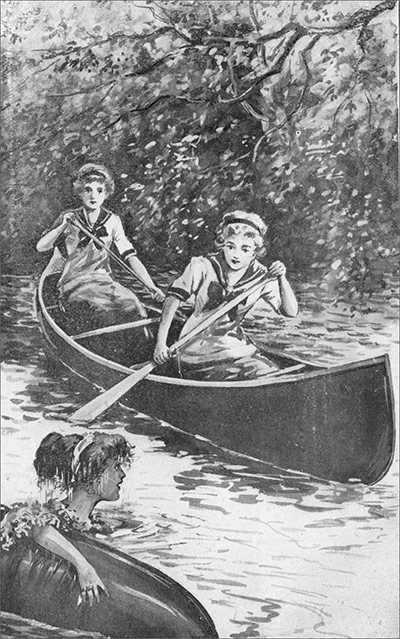
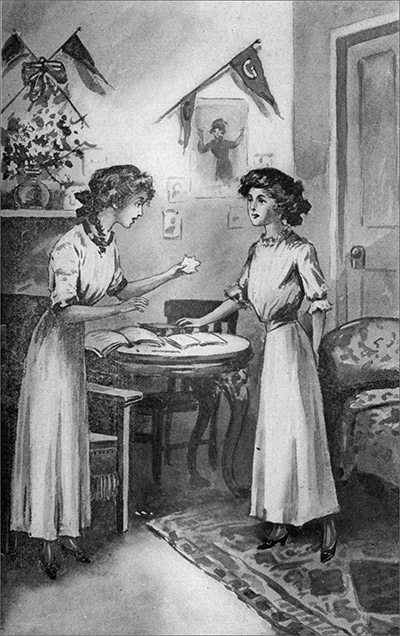
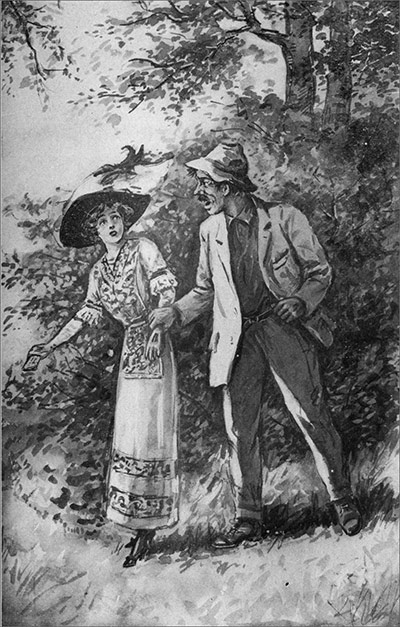
“DON’T BE AFRAID,” TAVIA CALLED TO THE ONE IN THE
WATER. “IT CAN’T SINK.” Dorothy Dale’s School Rivals Page79
DOROTHY DALE’S
SCHOOL RIVALS
BY MARGARET PENROSE
AUTHOR OF “DOROTHY DALE: A GIRL OF TO-DAY,” “DOROTHY
DALE’S GREAT SECRET,” “DOROTHY DALE’S CAMPING
DAYS,” “THE MOTOR GIRLS,” “THE MOTOR
GIRLS AT LOOKOUT BEACH,” “THE
MOTOR GIRLS THROUGH NEW
ENGLAND,” ETC.
ILLUSTRATED
NEW YORK
CUPPLES & LEON COMPANY
BOOKS BY MARGARET PENROSE
THE DOROTHY DALE SERIES
Cloth. Illustrated.
DOROTHY DALE: A GIRL OF TO-DAY
DOROTHY DALE AT GLENWOOD SCHOOL
DOROTHY DALE’S GREAT SECRET
DOROTHY DALE AND HER CHUMS
DOROTHY DALE’S QUEER HOLIDAYS
DOROTHY DALE’S CAMPING DAYS
DOROTHY DALE’S SCHOOL RIVALS
THE MOTOR GIRLS SERIES
Cloth. Illustrated.
THE MOTOR GIRLS Or A Mystery of the Road
THE MOTOR GIRLS ON A TOUR Or Keeping a Strange Promise
THE MOTOR GIRLS AT LOOKOUT BEACH Or In Quest of the Runaways
THE MOTOR GIRLS THROUGH NEW ENGLAND Or Held by the Gypsies
THE MOTOR GIRLS ON CEDAR LAKE Or The Hermit of the Fern Island
Dorothy’s blue eyes looked out of the car
window, but she saw nothing. All her faculties
were bent upon thinking—thinking of something
that evidently was not pleasant. Tavia fussed
around in the next seat, scattering books, candy
boxes, wraps, gloves and such “trifles.” She finally
left the things to their fate and climbed in
with Dorothy.
“We’ll soon be back to the old Glen, Doro,”
she said, “and I know you’ll be glad. As for me,
I count this my last hour of freedom, and feel
as if I were going to——”
“Now, Tavia, you know perfectly well that
you are just as fond of Glenwood as I am,” replied
Dorothy, with something akin to a smile.
“But of course, you have to get your fun out of
growling. Really, I think this time you won’t
be able to get it out of me. I am—glum!”
“That will be the best fun ever. To have you
glum! Have you been to a fortune teller, or
anything like that, Doro?”
Dorothy looked harder than ever out of the
window, and did not bother to reply.
“Because, Doro,” went on Tavia, “if she told
you a friend is going to be married it’s me. If she
said you would get a letter, asking for money,
that’s from me. If she said a very dear friend
was going to get in some new kind of trouble, that
will also be me, and last, if she said you were
going to cross water, it will be on account of my
health. I love fortune tellers, they pick out such
good news,” and Tavia glanced across the aisle
at a rather good-looking young man, who was
reading a theatrical paper.
Dorothy touched Tavia’s hand. “There,” she
said, “I am not going to have any more blues. I
can’t manage well with them, and I have to
manage you, Tavia.”
“Now, have you only just discovered that?
Well, all I can say is that I am glad the other girls
did not get these seats. They are—ahem—so
convenient!”
“But there is one vacant place just back of the
young man whom you are watching,” said Dorothy,
teasingly.
“And there comes one of our girls,” exclaimed
Tavia. “I wager she flops into it.”
The prediction was correct. A new girl, with
very up-to-date apparel, and very flashy jewelry,
had taken the vacant seat. The book she carried
showed its title plainly, and was, of course, one
of “the best sellers.”
“Next she’ll drop the book under his seat,
and he’ll have to speak to her in returning it,” said
Tavia. “Now, why didn’t I think of trying that?
Such a chance!”
Dorothy was interested in the new girl and paid
little attention to the talk that Tavia was making
for her benefit, for, though Tavia always loved
to do absurd things, she would not have spoken
to the stranger.
“She is the young lady we were introduced to
on the depot platform,” Dorothy remarked.
“Her name is Jean Faval.”
“Ought to be Bean Flavor,” said Tavia, trying
to pun on the name. “She looks sort
of—canned.”
“I think her very stylish, but that skirt is
tight. I wouldn’t wear one like it myself,”
Dorothy replied.
“And a Dutch neck on the train,” continued
Tavia, looking at the very white neck of
the new girl, who wore no collar. “I believe she
wears slippers, and the very thinnest silk hose.”
“It’s warm enough for both, and I shouldn’t
mind having forgotten my heavy walking shoes,”
Dorothy said.
Just then the book dropped. Tavia almost
jumped out of her seat. She actually gasped.
The young lady across moved her foot, and the
book came out in the aisle.
In an instant Tavia had it in her hands, and
was passing it back.
“Oh, thank you so much!” spoke the owner,
in a suspicious tone. “I could have gotten it.”
“It was not the least bit of trouble,” and Tavia
uttered a false note that caused the young man
to turn and observe her.
“Anything I can do?” he asked, politely.
“Have you lost anything?”
Both girls answered in the same words.
“Oh, no; thank you.”
He glanced over at Dorothy, then resumed his
paper. Miss Faval found her place in her book,
and Tavia turned to her chum.
“Didn’t I tell you? Am I not a prophet? But
I spoiled it, and I am dying laughing from head
to foot.”
“She will think you rude,” cautioned Dorothy.
“I hope she thinks me the entire conjugation,
and the worse ones on the last page. I can see
some fun with her at Glen.”
“Please, Tavia,” begged Dorothy, “don’t try
to get into trouble before we arrive there. You
have plenty of time during the term,” and she
looked bored—quite unlike the real Dorothy.
“Say, Doro,” exclaimed Tavia, “I actually believe
you want to get rid of me. I’ll run off
and leave you to your dismals. I know Dick and
Ned have a brand of chocolates I am particularly
fond of, and your own Cologne always tips the
porter for ice water. So be good, and,” she
added in a whisper, “don’t miss any of the circus,”
nodding her head toward the other side of the
aisle. “Be sure to render me a satisfactory and
full report.”
Tavia flaunted off, and Dorothy again pressed
her pale face to the window pane. The hills and
vales were rolling away, and of course the fast
train seemed to be standing still. The wonderful
changes of scenery, that had never failed before
to interest her, she now scarcely saw.
In the rear of the car were a number of her
companions, but she was really glad to be alone.
There was Rose-Mary Markin, known as
Cologne; Edna Black, called Ned Ebony; Molly
Richards, titled just Dick, and others picked up
along the route to Glenwood School, in the mountains
of New England.
Dorothy was not sick. She was gloomy, and
whatever caused this gloom had occurred just before
the girls left for school, for up to that time
she had been the same vivacious, sprightly girl
who had ever been a favorite with her acquaintances
and companions. The change in her manner
was, therefore, so marked that even the reckless
Tavia noticed it instantly, as did the other
girls, who were wise enough (on advice of
Cologne, Dorothy’s most intimate friend after
Tavia) to let Dorothy alone, and not bother her.
The sun was fading into shadows, and soon the
train would pull into the familiar little Glenwood
station. Then what a time there would be!
Dorothy thought of it, and again determined to
be cheerful. Tavia would be, as Tavia herself
had declared, “on top of the heap,” for while
there was no hazing allowed, something that made
a splendid imitation was ever practiced on the
first night, the “fun” not being confined to new
scholars, either.
The car attendant came through the train, and
turned on the lights. The strange gentleman with
the paper across the aisle asked him if they would
get in on schedule and he replied they had lost a
little time, but were making it up now.
“Thought you had an extra clip on,” commented
the stranger.
Scarcely were the words uttered than Dorothy
and everyone else was thrown from their seats,
and then there was a terrific crash.
Instantly there followed screams and commotion.
The lights went out, and many passengers
rushed for the doors. Dorothy realized she was
not hurt. Next, the other girls from the rear
of the car were hanging around her, displaying
very little of the common sense that had been
drilled into them at Glenwood.
“Oh, Dorothy, what is it?”
“Oh, Dorothy, my arm is broken!”
“Oh, Dorothy, I am sure we will all be
killed!”
“Doro, are you all right?”
This last was from Tavia, while the other gasps
came from various girls, too intermixed to separate.
It seemed a long time, but was, in reality, only
a few seconds, until the conductor and porter
made their way to the girls’ car, and assured them
that nothing at all had happened, more than the
rather too sudden stopping of the train, made
necessary by a special and unexpected signal. The
lights were again turned on, and everyone might
see that there really had been no accident. The
seats were as straight and as smooth as ever, and
most of the frightened passengers were gathering
up their trinkets from the floor, and replacing
them in the holders and seats.
Edna Black was rubbing her arm, and wincing.
“Is your hand hurt?” Dorothy asked.
“I’m afraid it is. I got quite a jolt against the
seat arm. But I guess it isn’t much,” Edna replied.
Tavia gazed across the aisle. The young man
was looking at Edna. The new girl was groaning
dramatically. She was also trying to get back
into her skirt, that had, in the excitement sprung
up like a deep girdle around her waist.
“Can’t flop nicely in a skirt tight as that!”
Tavia whispered to Molly Richards. “I wish it
had all ripped to pieces. Wouldn’t it be sport for
her to have to get out in a buttoned raincoat?”
“She’s pretty,” Mollie said, simply.
“That’s why I hate her,” replied Tavia. “I
always hate what I can’t have—even beauty.”
“Strange you get along so well with—well,
with some people,” answered Molly, casting an
appreciative glance at Tavia, with the hazel
eyes, and the shade of hair every one loves—no
color in particular but all combined in one glow.
“Every one envies you, Tavia.”
Dorothy was examining Edna’s wrist.
Meanwhile the new girl kept exclaiming, “Oh,
my!” Finally the young man turned to her.
“Are you hurt?” he asked kindly.
Tavia gripped Molly’s arm.
“Oh, I don’t know,” whimpered Miss Faval,
“but I am so—nervous.”
It was the greatest wonder in the world that
Tavia did not shout “hurrah” or something
equally absurd.
“You are shaken up,” said the stranger, “but
nerves soon adjust themselves, when there is not
any real injury. I see some one else has trouble.”
He crossed to Dorothy and Edna. “Can I help
you?” he asked. “I know something of medicine.”
“And he was reading a theatrical paper!”
Tavia managed to get in line with Molly’s ear.
“I’ll wager he turns out to be a baseball player.”
“My friend has hurt her arm,” Dorothy told
the young man, who had already taken the trembling
hand of Edna in his own firm grasp. “She
fell against the arm of the seat.”
All eyes were upon them. Of course Tavia was
whispering: “Wouldn’t be my luck! Just like
Ned! Do you suppose he will need help to set
it? I’ll get a glass of water—that’s safe,” and
off she raced, making jolly remarks to the frightened
ones, as she made her way to the water
cooler.
“I’m afraid it is sprained,” said the man, holding
Edna’s hand, “but I have some bandages in
my grip.”
Tavia had returned with the glass of water
before he found the bandages.
“I’m so sorry, Ned dear,” said Tavia truthfully.
“I’m so sorry it is not my arm. Isn’t he
handsome!”
Edna smiled, and Dorothy held the water to
her lips. As the young man with the antiseptic
cloth crossed the aisle Dorothy motioned Tavia
to stand back and make room for the work to be
done. Tavia stepped back, and just then the train
gave one, single jerk.
The contents of Tavia’s glass of water went
over the “Dutch neck” of Jean Faval.
“Oh, mercy!” screamed the girl.
Tavia recovered herself from the jerk and was
just about to apologize when Amy Brooks rushed
up to them.
“Whatever do you think, girls?” she blurted
out. “The railroad bridge is down, and we can’t
leave this spot to-night!”
CHAPTER II AT STRATHAWAY BRIDGE
“Not leave this spot to-night!”
The exclamation came in chorus from every
Glenwood girl, and there was a low, moaning
sort of echo-encore from the young man with the
medicine case.
What should they do? They could not swim,
that was certain, so they would have to wait.
To break the monotony of this wait we will tell
our readers something of the other books of this
series, and thus enable them to get a keener insight
into the characters we are now following,
as well as making a little bow of introduction to
those we are meeting for the first time.
In the first book, entitled “Dorothy Dale; A
Girl of To-Day,” we find the Dale family; the
Major, an ideal, dear, kindly father; the two
sons, Joe and little Roger, and Dorothy, the
daughter. Tavia Travers, a girl of opposite temperament
to that of Dorothy’s, is a great friend
of the prettiest girl in Dalton, Dorothy Dale.
Tavia is fearless and fearful; Dorothy is clear-minded,
well balanced and capable. In this story
is related how Dorothy gets a clew to the unlawful
detention of a poor little girl, and in the parlance
of those who use “quick” English—Tavia
for instance—Dorothy “rounds up” the culprit
and takes little Nellie away from a home of
misery and poverty.
Our second volume was “Dorothy Dale at
Glenwood School.” Glenwood School is situated
in the mountains of New England, and the pupils
there come from many parts of the country, even
the South being represented. “Glen School” is
not an asylum for the refuge of young girls whose
mothers are “too busy” to bring them up.
Neither are the girls there of the type who believe
that boarding school life is a lark, with original
slang at each end; and an attractive centre piece
about mid-way, devoted to the composition of verbal
putty-blowers, constructed to “get even” with
teachers; nothing of the sort. But there is time
for fun, as well as for work and for adventure,
and a time for girlhood walks, and talks in the
shady ways of the pretty school.
This second story deals with the peculiar complications
that so readily arise when girls and
boys get on well together, in the wholesome sports
of youth, until that other element, “Jealousy”
makes its grim appearance. Then the innocent
nonsense of Tavia, and the deliberate, open-hearted
ventures and adventures of Dorothy, are
turned about so as to become almost a tragedy at
Glenwood.
In “Dorothy Dale’s Great Secret,” our third
volume, there is a real secret. Not a little kindergarten
whisper, but a matter which so closely
affects Tavia’s career that Dorothy takes all sorts
of risks to hold that secret from others, until the
opportune time for explanation arrives.
“Dorothy Dale and Her Chums,” is the title of
the fourth book. This is a real story—a plot that
deals in mystery and adventure, of a gypsy girl
in a cave, stolen goods, and so many thrilling
mysteries that Dorothy was kept busy solving
them.
Then “Dorothy Dale’s Queer Holidays,”
shows how very queer some holidays may be, indeed,
when girls and boys unite to discover the
mystery of an old castle, where they eventually
find and rescue an aged and demented man.
But this is not accomplished without stirring adventures,
not the smallest of which was the night
spent in the old mansion, when the young folks
had been overtaken by so heavy a snowstorm that
their automobile could not make its way back to
North Birchland. The two cousins of Dorothy,
Nat and Ned, with other boy friends, protected
the frightened girls until rescue finally came at
almost daybreak.
The story of a mistaken identity is told of in
the sixth volume of the series, “Dorothy Dale’s
Camping Days.” To be mistaken for a demented
girl, captured and held in the hot, blistering attic
of a farmhouse, then taken to a sanitarium, where
Dorothy is really believed to be the girl who escaped
from that institution, was surely an ordeal
for Dorothy. But not less is the latter part of
that story, where the real sick girl is found by
our friends, Dorothy and Tavia, and the joyous
conclusion of her complete recovery, and the
opening of a new life to this girl, so dear to her
mother’s heart, and so loved by her friends,
make up for all the suffering.
So Dorothy Dale has had some experience, and
we hope, in the present volume, she will sustain
her reputation, as that of the up-to-date girl, with
will power and ambition, “tied with a little blue
bow of sentiment.”
We left them at Strathaway Bridge, and night is
coming, as it always does come, just when there
are so many daylight things to be done.
In the excitement that followed the announcement
that the bridge was down, and the train
could not cross the river until morning, all the
water that Tavia had inadvertently poured down
Jean Faval’s neck was dried up in the heat of
gulped exclamations. Even Jean left her seat and
joined the conversation on ways and means that
were being held in the seats on the opposite side
of the car. There were so many suggestions—some
wanted to bribe the porter for sleeping quarters,
as the trip to Glenwood did not originally
require such a luxury; Rose-Mary wanted to get
permission to “run” one car for the “Glens,”
and camp out in it; Tavia wanted to get up a committee
on food-quest, with time-table drinking
cups apiece. Dorothy thought it might be a good
idea to consult the conductor and have an official
statement. The gentleman (“King” they called
him now) excused himself, and left the girls so
forlorn, all alone there, in a heaped-up convention,
that Tavia declared he was a card sharp, and
that Ned would get blood poison from the bandages
he had put on her wrist. Moreover, Tavia
also declared that he had gone forth to “trim”
the scared car people at that minute. “For,”
she said, her bronze hair fairly showing electrical
sparks, “any one would do anything in a case
like this. No place to sleep, nothing to eat, just
a bunch of loony girls, and—me,” and she wound
up with coming down on Ned’s box of butter cups
(the candy kind), that happened to be under the
lame arm.
It was strange how much that one man had
been to the Glenwood contingent. They had fairly
stopped talking since his departure. A night
on that train now seemed impossible. Tavia went
to the last seat in the car, and dared any one to
follow her until she had thought it out. This did
not take long, for “out” must have been very
near the surface.
“I have it!” she shouted, going back to seat
seven.
“Where?” asked Dorothy.
“What?” demanded Dick.
“Havies!” begged Ned.
“Corkies!” joked Cologne.
“We may go!” announced Tavia, now standing
on Jean’s pretty dress that happened to spread
itself over the seat from which she decided to
orate. “We may go. We may walk. It is only
three miles over the cove bridge and I pity Glen
to-night when jelly-round comes. We’ll lick the
plates!”
“Whatever do you mean, Tavia?” asked
Dorothy. “The bridge cannot be repaired to-night.”
“The bridge may sink or swim, but there won’t
be one of us ‘waiting at the bridge,’” and she
hummed a tune gaily.
“But what shall we do?” asked little Amy
Brooks. “We can’t fly?”
“More’s the pity,” answered Tavia. “Next
time I take this trip I’ll carry a box kite over the
green flag. No, but this is what you can do, my
dears. Take up your things—every mussed paper
bag of them, and hurry with me across the
meadow. The road comes out just at the Green
Edge trolley line, and that line is wound around
Glenwood tower! It crosses Strathaway River on
a small bridge below this railroad one. Come
on!”
Everyone gasped. That Tavia should have
thought of this!
“But, Tavia,” objected Dorothy, “how are we
to know that we can cross the meadow? It is
almost dark!”
“More reason why we should hurry to find
out,” answered the daring one. “Come on, or
I’m gone.”
“But our tickets, and the conductor, and all
that?” inquired Nita Brant, with ambiguous precision.
“We will all make over a total assignment to
you—you may stay with the ship, Nita, but we
run!”
It was funny to see how those girls did scamper
from the last car of that train. The dainty travelling
bags, gifts of “friends on departing,” were
now all tangled up in the scant skirts, that did
double service of being a part of wearing apparel—small
part—and also answering for a carryall
of the old time conception. It was the quickest
way, and that was what counted. Jean Faval did
drop her gold purse just as she was alighting (she
did not “get off”) but Tavia was so anxious that
all should escape that she crawled under the oily
wheels and dragged out the golden trinket. The
new girl thanked her, and, for the time, an armistice
was established.
“Are we all here?” called Dorothy, who was
assisting Edna because of the lame arm.
“All but King, and he is cleaning out the other
cars,” replied Tavia. “There, look out, Dick!
Land sakes alive! We won’t have thread and
needles enough in the tower to sew our tears, if
this keeps up. Dick, you have ruined your flounce
on that brake.”
Molly Richards (otherwise Dick) looked hopelessly
at the torn needlework skirt. “Oh, well,”
she said, making the ground, “I never liked that
anyway. The pattern was true-lover’s-knot, and
I’m just glad I——”
“Broke the knot,” put in Dorothy. “Tavia,
wherever are you leading us to? This must be
a turf bog!”
“Leadin’ on to vict’ry,” replied the girl who
was almost running ahead. “I have been over
this bog before.”
“But not at this season, when the water comes
in,” cautioned Dorothy. “However, girls, I am
willing to take the same risk that you all take—sink
or swim,” and she ran along after Tavia,
while the others followed, like American soldiers
taking their initial trip through a rice field.
Every step was uncertain—every foot was put
in the bog with a shudder or groan, and pulled out
with a shout.
“I can’t do it,” declared Nita Brant. “These
are my best silk hose.”
“Hose,” yelled back Tavia, “we’ll take up a
collection on repairs when we get to Glen.”
“And my—velvet—ties!” exclaimed Jean
Faval. “They feel like wooden shoes!”
“We’ll put them up at auction,” suggested
Dorothy, good humoredly. “The only thing that
really worries me is Edna’s sprained arm.”
“Why didn’t you fetch the doc then?” asked
Tavia, but before an answer could be ventured
there was a scream, and even the happy girls of
Glenwood stopped.
What had happened?
CHAPTER III THE GET-AWAY
Amy Brooks had sunk in the bog!
The weight of the soggy earth had dragged her
down, until she lay helpless, clinging to some underbrush!
And how dark it was now!
“Quick! Quick!” called Dorothy. “This
may be a bog hole!”
“Team play! Team play!” shouted Tavia,
and instantly every girl, whether leading or following,
was making for the spot from which
Amy’s cries came.
The girl was imbedded in the black, wet bog
as if she had been cemented there!
Even Tavia had no suggestion to offer, but
stood gazing in hopeless amazement.
Dorothy was running about, trying to find a
firm footing from which to reach out to the imperilled
girl.
Although it was September, the late afternoons
were damp and chilly, and as the girls, almost
feverish from the over-excitement, ran this way
and that, in hope of finding some sort of board or
plank to make a way to Amy, their shouts of
fright and cries for help, rent the air, and turned
the scene, so lately one of merriment, into terror
and danger for everyone of them.
“Oh, it’s all my fault!” wailed Tavia. “I
should not have risked it so near dark.”
“It’s nobody’s fault,” replied Dorothy, “but
this is the time to act. Come Tavia, we may get
a fence rail. I see some old black stuff, like wood,
over there,” and she did her best to hurry over
the wet ground, that threatened to hold her fast
at every step.
In the meantime the other girls were trying to
get Amy out. Molly Richards was the oldest and
strongest, and she ventured near the spring until
the others called to her that she would presently
be worse off than Amy. A pile of light travelling
coats were tossed over to Amy and she kept
herself from going deeper in the bog by making
these fast to the brushwood near her.
“Here we are!” called Dorothy, and with
one end of the old moss-covered fence rail on her
shoulder, and the other end upon Tavia’s, the
two girls made their way to the brink of the bog
hole.
It took but a few minutes to get the rail over
the swamp-like pit, where a spring sluggishly
bubbled.
“There,” called Dorothy, “now see if it will
hold you, Amy.”
But there was no need to direct Amy. Her
rescue was too welcome to wait for orders.
Throwing her arms firmly over the rail she
dragged herself out of the mud until she was
sitting on the long piece of wood.
“Be careful,” called Tavia. “Hold tight, and
we will all pull the rail over to this side.”
In spite of the peril the situation was almost
comical, and the girls lost no opportunity of
cheering and otherwise dispelling the fast settling
gloam.
“We ought to carry you to the road this way,”
suggested Nita Brant, “you are so soaking wet,
and horribly muddy——”
“Thank you, but I am too anxious to walk. I
doubt if I shall get the use of my ankles for a
month,” replied Amy. “My! but that was awful!
I was saying my prayers, I tell you.”
“But what shall we do now?” inquired Ned,
who, on account of her injured arm, could not
help in the rail ride.
“Go directly back to the train,” said Dorothy.
“Listen! That was a train whistle! Oh, if it
should start——”
“A train sure enough!” declared Jean, who
had held back. “That’s what we get for following—a
leader.”
Her tone was full of contempt, and everyone
noticed it.
“Too bad you came,” replied Tavia, who
never cared for good manners, when there was
a chance for sarcasm, “for that is the wrecking
train, I think, and they might have taken you on
the hand car. Wouldn’t it have been fun?”
The idea of that fashionably dressed girl riding
on a hand car with train men!
“Now let me down,” insisted Amy. “I’m going
to run after that whistle even if it proves to
be a fog horn!”
“Oh, don’t—go near—the water!” shouted
Tavia, and, as she spoke, a big touring automobile
dashed by.
“Another life-saver lost!” declared Dorothy.
“If only we could have made them see us!”
“Oh, mercy!” gasped Nita, “There come
two men with guns on their shoulders!”
“Just snipe hunters, likely,” said Dorothy, but
she was noticed to hurry toward the road.
It was not a great distance back to the standing
train, and, as the girls came within hearing
of some passengers on the rear platform, someone
called:
“Oh you Glenwood girls! You have missed
it. The touring car came from your school to
get you, and is now driving all over the country
looking for strayed, lost or stolen girls.”
“The Glenwood machine! Oh, do let me
cry!” begged Tavia. “If I don’t cry within the
next three minutes, I’ll die of internal deluge.”
She stepped to the platform. Dorothy was the
next to mount, but she paused to help Edna.
“Back safely?” asked the man who had bandaged
the strained arm. “We were greatly worried.
I could scarcely keep mother from going
after you,” and the handsome elderly lady who
had been standing aside with him, came forward
and extended her hand to Dorothy.
“My baseball player!” groaned Tavia into
Molly’s ear. “Lost again, but I think he’s an artist.
I’ll get him to paint me.”
By this time the young ladies were passing into
the car. When the other passengers heard of the
accident, and beheld Amy’s almost solidly bog-cemented
garments, there was no end to the excitement.
“I think,” said the young man, “that I can arrange
to get this car, or half of it, for you young
ladies for the night. As there are no chairs nor
sleepers to be had it may be well to make sure of
something.”
“Oh, thank you so much,” said Dorothy, who
was still acting as leader, although she hardly
knew what to do or say. “This is awful! And
to think that we missed the car! The school principal,
Mrs. Pangborn, will be ill of anxiety.”
“There is no possible way of getting a message
away from here,” replied the other. “But at
least they know the train is safe.”
“But they also know that we were not in it,”
objected Dorothy. “Mrs. Pangborn probably
heard of the delay caused by the broken bridge,
and sent for us.”
“There’s just one way, and perhaps I can make
it. May I leave mother with you?” and the young
man quickly picked up his cap, leaving the car before
anyone had time to know what he was going
to do.
“I’ll be back in about an hour,” he called, and
then the girls were once more conscious of the
loneliness of being “just girls.” Men know so
much better what ought to be done in emergencies.
CHAPTER IV RIVAL RUNS
“Now young ladies,” began the elderly woman
with the wonderful snowy hair. “Of course you
know I am David’s mother. I am Mrs. Armstrong,
and David is my only child. I wanted to
come out here to a convention and he insisted on
accompanying me. Though it did take him from
his business.”
“His business?” Tavia repeated as nicely as
she could, handing to Mrs. Armstrong the little
lace cape that had just fallen from her shoulders.
“Oh, yes indeed, his business,” repeated the
lady, while Dorothy and Edna smiled wisely at
Tavia, who had not even yet found out what that
young man’s “business” might be. “And,” said
the lady, “I never depend upon dining cars when
I travel, so if you can manage to put up some sort
of table here between the seats, we may have a
little meal, for my bag is pretty well stocked, I
can well guess. Mabel put it up for me.”
“Splendid!” exclaimed Molly, not realizing
that her remark was prompt to greediness.
“I am sure you must all be starved, for it is past
tea-time,” said Mrs. Armstrong, getting from under
the seat a good sized, matting traveling bag.
“We use this when we go auto riding, it opens up
so nicely.”
Again Tavia nudged the girl nearest her, for
the lady with the bag of refreshments was becoming
more interesting at every new remark she
made.
“Do you suppose your son will be back in time
to eat with us?” asked Dorothy, as the girls were
spreading out newspapers on the seats, and arranging
a sort of place to eat.
“I don’t know,” and the elderly lady looked
very thoughtful for a moment. Then she removed
her glasses, put them on again and whispered
to Dorothy. “My son is always doing
queer things—that is they are queer from my view
point. Where did he say he was going?”
“He did not say, as I understood. But it
seemed as if it was something about getting a message
to town,” replied Dorothy.
The lady shook her head. “Now here are the
refreshments,” she told the girls. Tavia had
procured water in an old earthen pitcher, that she
declared was perfectly clean, and that for the use
of it she was personally indebted to the brakeman,
who turned on the lights. Molly had “raided”
a store-room somewhere, and from it had actually
gotten out such a splendid piece of white cardboard
that with the aid of Edna’s case knife
square “dishes” were cut and served nicely for
the chicken sandwiches. Then the pickles!
“We call them School Girls’ Delight,” explained
Mrs. Armstrong, “although I had no idea
I was going to fall in with such a happy crowd of
young ladies.”
“We are the ones to be grateful,” declared
Dorothy. “But where is Miss Faval!”
“Where is she?” asked more than one girl,
jumping up, and glancing about the car.
“She certainly got on the train with us,” declared
Edna.
“She should have remained with us,” said Dorothy,
showing some anxiety. “That was the rule—always
when we traveled this way.”
“And there are so many people about, with
nothing to do,” Mrs. Armstrong remarked. “It
is not like regular traveling, when everybody and
everything is in place. We had better inquire at
once.”
Dorothy had finished her sandwich, but objected
to Mrs. Armstrong leaving her lunch untouched.
“It doesn’t make a bit of difference, child,”
said that lady. “David will likely come back
with more things to eat than would provide a
dinner.” She brushed the crumbs from her skirt.
“I am for finding the lost sheep.”
It must be said that those who remained to
finish the feast did not look a bit worried about
Jean Faval; in fact there was something of a
scramble directly Dorothy and Mrs. Armstrong
were safely out of sight.
“Where do you suppose——” began Molly.
“Don’t suppose,” interrupted Edna. “I don’t
like that girl, and I hope she got on a train that—backed
up.”
“Hope she tried to walk the bridge,” put in
Tavia, between a pickle and a lady finger.
“You’re mean,” spoke Nita Brant. “She’s got
lots of money, and will be splendid at school. She
even has a check book of her own.”
“We prefer cash,” said Molly, “it’s lots
handier.”
“What would we have done if it had not been
for what ‘Mabel’ put in the bag?” asked Cologne,
who was in a seat back of the four girls, who were
just now threatening to eat the crumbs from the
cracks in the newspaper table-cloth. “This meal
has been my salvation.”
“But where do you suppose David has gone?”
inquired Tavia. “I am worried about him. I
like David!”
“Here come Dorothy and Mrs. Armstrong.
They evidently have not found Lady Jean.” It
was Edna who spoke.
Dorothy was very pale. Even in the uncertain
light that flickered from the gas lamp in the car
center, it was plain to everyone looking at her
that Dorothy had received a shock.
“Such a girl!” said Mrs. Armstrong. “Actually
refused to come with us. Sitting in a car
talking to—well, of course, I couldn’t just say who
they might be, but they looked like a small part of
a big circus.”
Her eyes flashed, and she fanned herself nervously.
Dorothy quietly sat down beside Cologne.
“What has happened, Doro?” asked her friend—for
next to Tavia, Cologne ranked first in favor
with the little leader.
“Nothing much. But I was so surprised. I
suppose I should not have shown how I felt,”
replied Dorothy, biting her lip.
“She was positively rude,” went on Mrs. Armstrong,
“and if I get a chance to find your Glenwood
school I shall report her conduct.”
“What did she say?” demanded Tavia.
“She said—that she would not tag around
with a parcel of kindergarten babies,” responded
the indignant lady, “and I felt that it was I who
had exposed Miss Dale to that insult.”
“Oh, she was not insulting,” interposed Dorothy.
“Of course, I was surprised, because I usually
have——”
“Been our policeman,” finished Tavia. “Well
don’t you worry. I’ll be a whole police force
when I get there—meaning to Glen.” She swung
around to Dorothy. “What is it, dear?” she demanded.
“You have that same worried look you
wore when we left home. Can’t I help you?”
“Perhaps you can, Tavia,” replied Dorothy,
“and I promise to tell you all about it when we
get to school. It was really not what the girl
said to me that—made me feel so. It was what
I overheard her saying to someone else. There,
don’t let them see us talking. I thought I
heard——”
“Why, David!” exclaimed Mrs. Armstrong,
“Wherever have you been?”
David had just entered the car, with all the bags
and bundles that his mother had promised he
would fetch.
“Had the time of my life,” he exclaimed quite
breathlessly, “riding on a hand car into town.
But I came back de luxe a la auto. I got the message
to Glenwood School, and the big car is here
again.”
“Oh, glorious!” declared Tavia, but she was
interrupted in her effusion by the conductor’s cry:
“Special car for Glenwood School!”
Then the grand scramble commenced.
CHAPTER V SCHOOL AT LAST
“We just should have left her there,”
growled Edna. “I can’t understand why any girl
would prefer staying up all night in a stuffy car,
to getting this grand ride, and a night’s sleep in
bed to boot. Dorothy is too—conscientious.”
“That’s just what I say,” chimed in Tavia,
who was next to Edna in the rear of the big three-seated
closed touring car, that flaunted the Glenwood
flag. “And that she would deliberately refuse
to come until the conductor read the list;
like a funeral!”
“I was so sorry Mrs. Armstrong couldn’t
come with us,” continued Edna. “But her son
had the little runabout for her, of course.”
“I should not have minded so much if the son
could have come,” teased Tavia. “This is a
lovely ride, but fancy talking to Jacob! He’s
been the Glenwood runner ever since cars came
in, and he thinks he just knows all there is about
machines.”
“Glad he does, for it’s some dark,” reflected
Molly. “I suppose that Jean girl took the outside
seat, thinking she could make Jake talk.”
“Or that she would avoid talking to us,” Edna
moved her injured arm carefully. “Well, I can
see that Nita and Lena, and some of the others
are talking to Jean. We’ll have some trouble
keeping our club up even. But Tavia, what is the
matter with Dorothy? She is not a bit like herself.”
“No, she isn’t. But I think her father is not
well, and he is getting old—prematurely old, for
his hair is white as snow. You see, it must worry
Dorothy to leave him and the two boys alone.
Seems to me that veterans always get old—young,”
said Tavia evasively.
“Do you really think that is all that is the
matter with her?” went on Edna. “It seems to
me that it is something more serious.”
“Well, maybe it is,” replied Tavia. “But I’m
sure I hope not. Dear Doro does so much for
every one else that it would be almost a shame to
have her have troubles.”
“It surely would,” came from the other. “Do
you suppose she would mind if I asked her?” and
Edna looked back to where Dorothy was talking
to Cologne. “Or perhaps you had better do it,
Tavia. You know her so much better than the
rest of us, and she won’t mind it—coming from
you.”
“That’s right!” cried Tavia with a little laugh.
“Blame it all on me! No one minds what I do.
I’m the goat, of course. If there’s something unpleasant
to be done, let Tavia do it.”
“Oh, I didn’t mean it that way at all!” exclaimed
Edna. “You took me up so short——”
“Better be short than long!” went on Tavia,
laughing. They could talk rather louder now, as
the machine, chugging along, made so much noise
that there was no danger of Dorothy hearing.
“No, but seriously,” proceeded Edna. “I do
think Doro has some secret trouble. She isn’t at
all like her jolly self, and though she has been just
as nice as she could be in this trouble, still——”
“Still waters run deep!” interrupted Tavia.
“I’m sure I can’t say what it is.”
“Then why don’t you ask?”
“Simply because if Dorothy wanted me to
know she’d tell me.”
“She might not. She might be too sensitive.
It would be just like her to hold back and not
want to tell anyone. Oh, Tavia, I’m almost going
to ask her myself if you won’t.”
“Well, I won’t, that’s all there is to it. Let’s
start a song. I’m getting dry and lonesome.”
“Oh, Tavia, there’s no use trying to do anything
with you,” sighed her companion. “Why
can’t you be serious for once?”
“I just can’t—that’s all. It isn’t in me. I’m a
hopeless case, I’m afraid. But don’t worry so
much. Let Doro alone and if she wants help
she’ll ask for it. Then we’ll all pitch in, and do
all we can for her.”
“Indeed yes,” agreed Edna heartily. “Dear
Doro does so much for others that it would be a
pity if we could not aid her in some way. Oh
dear!”
“What is it now?” asked Tavia, glancing out
into the gathering darkness. “Something hurt
you? Is it the arm?”
“Yes, a little. I wish Jake wouldn’t drive so
fast. It makes me nervous. I’m all unstrung,
anyhow, I guess, over what has happened. He
seems quite reckless, I think.”
“Nonsense,” retorted Tavia. “This is great,
I say! I like to go fast. The faster the better.”
“You always did,” commented Edna, “but I
think——”
She did not finish the sentence, for the auto
gave a sudden jolt, and came to a quick stop, while
Jake, the driver, uttered an exclamation of annoyance.
“What is it?” called out Dorothy. “Has anything
happened?”
“Something surely has,” voiced Tavia. “This
trip is a hoodoo from the start.”
There were a few half-suppressed screams,
many alarmed inquiries, and any numbers of
“Ohs!”
“What is it, Jake?” asked Dorothy again.
“Tire’s gone back on me,” replied the driver
with characteristic brevity. “I was afraid it
would play out, and I wanted to stop and put on a
new one, but Mrs. Pangborn told me to hurry,
and I did. Now I’ve got to go slow. Hum!
No fun, either, putting on one of these tires.”
“More haste the less speed,” commented Tavia.
“Pile out, girls, and we’ll walk in the woods
while Jake puts a new rubber shoe on this duck of
an auto. It can’t go out without rubbers you
know, or it might catch cold in its gasolene tank!”
“What talk!” cried Molly Richards, with pretended
horror to Dorothy.
“Yes, I’m afraid she’ll never get over it,”
agreed our heroine. “Still, it’s like most of what
Tavia does—harmless, for she really has a kind
heart.”
“Which is more than a coronet or even a violin,”
commented Molly with a laugh. “But she
is getting out.”
“Come on!” cried Tavia again. “No use
sitting still and waiting for Jake. Besides, we’ll
make the machine lighter if we get out; won’t we
Jake?”
“Oh, well, I’ve got to jack the wheel up anyhow,”
spoke the driver, “and one or more young
ladies like you, Miss Travers, won’t make much
difference. Stay in if you like.”
“Thank you! Glad to know I’m light!” cried
the irrepressible Tavia. “Hope it wasn’t my
head you referred to.”
“No—er—not exactly—that is—Oh, well, get
out if you like, miss,” said the puzzled Jake, who
did not exactly understand Tavia’s chattering.
“I’m going to,” she retorted, “come on, girls.”
“In those dark woods, with horrid, creepy,
crawling things!” cried Edna. “Never. I can
almost see a snake now! Oh!”
“Silly!” snapped Tavia, as she made her way
out of the car. She stood watching Jake make his
preparations for replacing the damaged tire, and
even offered to help him work the lifting jack.
“I wonder why she likes to do that?” asked
Nita of Dorothy.
“I don’t know, I’m sure,” was the answer,
while Tavia actually did work the handle of the
implement that raised the auto wheel clear from
the ground.
“I guess it’s because ‘Jake’ is a boy’s name,
and Tavia is so fond of the boys—in a nice way,
of course,” Nita made haste to add. “You know
what I mean, Doro.”
“Yes, of course,” laughed Dorothy. “You
needn’t have explained. Tavia is such a—problem.”
“I fancy we all are—in different ways,” came
the remark. “I know my people say I am. But
Tavia!”
“There is only one!” laughed Dorothy softly.
“And a good thing there are no more,” spoke
Nita, as she looked closely at her chum, wondering,
as others had done that day, what was troubling
Dorothy.
For that something was troubling our heroine
was evident. It plainly showed on her face,
though she tried to hide it and be her usually jolly
self—jolly, however, in a way different from
Tavia.
“Want me to hold the jack?” came from
Tavia, in business-like tones, as she watched Jake
deftly go about the work.
“No, thank you, miss. It’s a self-regulating
one,” he replied. “It’ll hold itself. But you
might hold one of the oil lanterns so I can see to
unscrew these lugs.”
“I knew there was something queer about this
auto,” came from Tavia with a laugh. “It’s
been putting on ‘lugs,’ as the boys say. It got too
gay, and had a puncture. Isn’t that it, Jake?”
“Yes, miss, I guess so, but if you wouldn’t
mind, please, holding that light a little more over
this way, I could see better.”
“That’s the time Tavia got a ‘call-down,’ to
use some of her own slang,” commented Molly.
“But, Doro, what are ‘lugs,’ pray tell?”
“I guess Tavia used it meaning ‘airs,’ or something
like that,” was the reply. “Will you be
much longer, Jake?”
“No, I’ll soon have it on,” the man said, and
he was as good as his word. Then Tavia scrambled
up to her seat, after insisting on helping Jake
to put away his tools, and the car started off again,
amid heart-felt murmurs of thanks from the
rather tired young ladies.
The machine was gliding over the hills through
the moonlight, and soon the towers of Glenwood
would be seen. The “Light House,” the girls
always called the big light in the tower that
gleamed until the village bell struck midnight.
Cologne was in the rear seat with Dorothy.
Molly Richards made the trio, while next came
Nita, Lena, and a little frightened girl, all the
way from Georgia. It was her first term, and
all the escapades did not help to make her impression
of school life in the North any the less
mystifying.
“What’s up now?” asked Molly, as the big
machine came to another sudden stop.
“Jake sees something,” replied Dorothy. “He
has the queerest habit of seeing things that no one
else can see.”
“Yes, there he is getting out. A chicken
likely,” put in Nita.
For a few moments the girls waited rather anxiously.
Then the chauffeur came back to the car.
“What is it?” called a chorus.
“Can’t just say yet,” answered Jacob, “but I
think it’s one of them velvet poodles that someone
has dropped out of a car.”
“Oh, do let me have it,” begged Jean, who,
being with Jake naturally felt the best right to
his find.
“I’ve got to look him over, and see as he isn’t
hurt,” replied the driver. “A little fluff of a
thing like this doesn’t lie in the road, when he’s
got the use of his legs.”
“Let us see him, Jake,” implored Tavia. “You
know I always take good care of the Glen dogs—when
there are any.”
“So you do—so you do. Well, here it is, as I
must be getting on. But be careful he doesn’t
snap. Can’t tell about toy dogs. They’re not
hounds, you know,” and he handed first to Dorothy
and she in turn handed back to Tavia, the
little, silken animal that Jake had picked up on
the lonely road.
Jean was piqued. She intended to conquer even
Jake, and she really did like a white toy dog.
First she had been obliged to go to Glenwood in
the motor, when she had been all settled for the
night, and wanted to wait for the morning train.
Next, she sat outside with the driver and he refused
her simplest request.
“It’s all because of that Dale girl,” she muttered
to herself, while she smiled at Jake. “Won’t
you let me drive the car a little way, please?” she
asked. “I am used to motors, and I love to drive
on these hard clean roads.”
Jake looked at her keenly. “I’ve no doubt but
you can drive,” he replied, “but you see I’m responsible
to Mrs. Pangborn, and it would be a
queer story for me to tell, if anything happened,
that I had let a school-girl run the big car at
this hour of the night.”
Of course the front windows being down, and
Jake speaking with unmistakable distinctness,
everyone in the car heard the reply to Jean.
Tavia was too busy with the poor little white
dog to notice. She had made a bed for him, and
indeed the little thing unmistakably needed rest.
He sighed and panted, then he licked the girl’s
hands.
“Poor, little thing,” said Edna, “do you suppose
some chauffeur dropped him, and never
missed him?”
“They go so fast, over country roads at
night that there is no telling what happens,” replied
Tavia. “But he’s mine, or Doro’s. She
has a dog so much like him at home that he may
help to cheer her.”
“But won’t Jake want him?” whispered Edna.
“Jake would eat out of Doro’s hands,” answered
Tavia in low tones. “Don’t you remember,
last Winter, how she saved his children from
that fire in the auto house? How she went up the
ladder——”
“Oh, of course, but we all helped,” objected
Edna.
“We helped when Dorothy showed us how.
Now look here Edna. I don’t want you to think
that I believe Dorothy Dale to be perfect, but the
fact is—I have my first flaw to discover.”
“Hurrah! Hurray! Horroo!” Edna said
quietly. “Tavia, you have, after all, something
tangible. It’s love!”
“If you wake my dog it will not be love for
you,” threatened the other.
“Say, look at Jean! I think she’s asleep on
Jake’s shoulder. Won’t that be a leader for our—hazing!”
“There’s the lights!” called a quartette, for
indeed the tower light of Glenwood shone brightly
at the next turn.
Suddenly all the balcony lights were flashed on!
Then such cheers! Jake clung to the wheel as
if the car might shy at the noise.
“Glenwood! Glenwood! Rah! Rah! Rah!
Back again, back again, Margery Daw!
Left the boys behind us! Hah! Hah! Hah!”
It was a school cry.
“Careful, careful!” cautioned Jake. But Mrs.
Pangborn was there to welcome one and all.
CHAPTER VI CHOCOLATES AND SANDWICHES
It was past nine o’clock when the Glenwood
girls reached the hall, and was, therefore, too late
to go in for any of the pranks usually indulged in
on the first night. To be sure there was some
fun. Cologne managed to lay hold of some small
boxes, that looked surprisingly like confections.
They were placed on a table, waiting to be
claimed, and it seemed no harm for her to claim
them. Dorothy refused to take part in the
“raid,” but Tavia and Edna did not have to be
coaxed.
“They’re Jean’s, I’ll wager,” whispered Tavia,
“but the wrapper is off, and we can easily prove
an alibi. Let’s see where they’re from, any way.”
“Oh, there’s a note,” declared Cologne. “I’m
going to put them back. I’ll have nothing to do
with robbing the mails.”
A piece of paper fell from between two
of the boxes, as Tavia cut a pink cord that held
them together.
“All the more fun,” said Tavia hiding the ill-gotten
goods in the fold of her blouse as a teacher
passed, and said good-night.
“Better get it hid in some place,” suggested
Edna. “If Dick comes along she’ll smell the
stuff.”
“Put it back! Put it back,” begged Cologne.
“Somehow I feel we had better not try to have
fun on Jean’s account. She might make trouble
for us.”
“Who cares about her trouble,” snapped Tavia.
“Besides, we don’t know to whom the stuff belongs.
There, I’ll put the note on the table, I
guess that’ll be sweet enough for her.”
Scarcely had this speech been finished when
a gliding figure, in a gorgeous red kimono, turned
into the corridor where the three girls stood. It
was Jean Faval. She came directly up to the
table, smiled pleasantly, said something about being
tired, picked up the note and turned away, with
a most surprisingly pleasant and affable good
night.
The girls were speechless!
“What do you think of that?” exclaimed
Edna, as soon as she could command her tongue.
Tavia carefully took the boxes out of her
blouse, and very gingerly set them down again
on the table.
“There,” she said, “Miss Jean Faval there’s
your candy! I believe it’s poisoned!”
“Why Tavia——”
“Yes, I wouldn’t be a bit surprised if she had
fixed up those boxes herself, with the idea that we,
or my little dog might bite. But we won’t. Let
them stay there,” and the three sauntered off to
room nineteen—the one occupied by Dorothy and
Tavia.
They found Dorothy ready for bed, but Tavia
insisted on telling the story of the “poisoned
candy.”
“What utter nonsense!” declared Dorothy.
“Perhaps it did not belong to Jean Faval at all.”
“But the note,” insisted Cologne. “That
seemed to belong to her, and it was in the boxes.”
“At any rate,” spoke Dorothy, “I want to go
to bed, and I’ll be glad to excuse the invaders.
Tavia, if you so much as drop a handkerchief, I
shall report you, for I am not only tired, but have
a headache.”
Edna and Cologne got up from the rug they
had been sitting on. Cologne had allowed her
heavy brown hair to fall to her waist, and Edna
had likewise made that same preparation for retiring.
Tavia stifled a yawn. “I’m not a bit sleepy,”
she declared. “And I think, after all, I’ll just
take a chance at those chocolates. I’m starved
for sweets.”
“Oh, Tavia! Don’t!” implored Edna. “I
think we got off well enough to leave well enough
alone.”
But Tavia was already poking her head out of
the door.
“There she goes,” she whispered, “I just
caught a flash of that fire-alarm kimono. Now wait
till we hear her shut her door, and then for the
sweets.”
Cologne made a move to grasp Tavia’s skirt but
failed. Dorothy sat up and shook her head helplessly.
“I may as well give up sleep until that
girl knows all about those plagued chocolates,”
she said with a sigh. “I can’t see why she is so
interested.”
Tavia was back almost instantly.
“They’re gone!” she gasped. “They’re
haunted I think—unless the Jean changed her
mind and is now howling in throes of suicide.
There I heard a howl. You two better not be
caught in the corridors, or you may be implicated,”
and with this, she, in her careless way, almost
brushed the two girls out and locked the door.
But over in her own corner, under her own
lamp, Tavia read a name on a slip of paper.
Then she put it in her letter box, and turned out
the lights.
Two more days and school would formally
open. That which followed the arrival of some
belated girls from the West dawned as perfect as
a September day could blaze, and Dorothy was at
her window, looking over the hills before Tavia
had so much as given a first yawning signal of
waking.
A soft, misty atmosphere made the world wonderful
under the iridescent blades of light that
fell from the sunrise.
“It seems a shame to stay indoors,” reflected
Dorothy, “and it will be two hours before breakfast.
I’ll just slip into a gingham, and take a
walk over to the barns. Jacob will be out with
the horses and dogs.”
Few of the girls were awake as she passed
lightly through the halls. Maids were already
busy with sweepers and brushes.
Dorothy knew many of the help, and bade
them a pleasant good morning. From the broad
veranda she stopped to look at the growing day.
“I think I won’t go to the stables,” she decided.
“I’ll go out and get a bunch of late
flowers. Mrs. Pangborn is so fond of them.”
Down the roadway she ran. The whistle of
an engine attracted her attention.
“Why,” she mused, “there is the new station,
and a train stopping! What an innovation for
Glenwood! I must go over and see what the station
looks like.”
A narrow path led through the elders and
birches. Bluejays were out-doing one another
with their screeching, while birds that could sing
kept a scornful silence. Everything was so heavy
with nature. Dorothy almost forgot that it was
to-day she had promised to tell Tavia of her
troubles!
Passing through the lane brought her out into
an open roadway, newly made. A pretty little
stone station, the rural and artistic kind, filled in
the space beyond, and a high terrace, unfinished,
showed that Glenwood station was to be carefully
kept.
The train that Dorothy had heard whistling
was just coming in. The new station was not yet
opened, but a short distance from it was an improvised
lunch room, a sort of shack made of
unpainted boards, and thin awnings. The train
stopped, and the conductor hurried to the little
lunch room. Dorothy saw that a girl, alone,
stood behind the queer, long, board table, and
that beside her was a telegraph instrument. Seeing
Dorothy she called to her.
“Could you come here for a few minutes?”
she asked. “I have an important train message
and no one to leave the shop to.”
“Of course,” replied Dorothy, not comprehending
just what was wanted, but hurrying
across the tracks to the shanty.
“You see,” began the girl, “father is sick, but
we have to keep our contract with the road, or
lose the privilege in the new station. We have to
have a lunch room, and a newspaper stand and
also attend to messages. This I just received. I
will have to deliver it on my bicycle. I am so glad
you came along. No one is apt to be out so early.
If any one wants coffee could you serve it?”
Dorothy was taken by surprise. To be left
in charge of a country railroad lunch counter!
“I’ll do the best I can,” she answered, noticing
that the black-haired girl had a deep line
across her brow. “But I’m afraid——”
“Oh, don’t be afraid of anything,” interrupted
the girl, who was already mounting her wheel,
and handing a bunch of keys to Dorothy.
“There’s another train due soon, but I’ll try to be
back. In the shed, at the rear, is our dog. He will
know you all right when he sees you behind the
counter, but he won’t let any one else in. Good-bye
for a few minutes, and I can’t tell
you how glad I am you came along. I just feel
that you have saved the depot for us,” and with
one strong stroke her wheel glided down the hill,
and a bit of yellow paper, the train message,
showed in the small pocket of her red jacket.
The first train had already pulled out.
Then Dorothy was alone in the lunch house at
6:15 A. M.
CHAPTER VII RUNNING A LUNCH COUNTER
For some minutes the absurdity of the situation
scarcely dawned upon Dorothy. But the screeching
of an approaching train promptly reminded her
of her newly-acquired duties.
“Suppose the passengers should want papers,”
she thought. “I had better look at the bundles.”
An old man thrust his face in under the wooden
flap that was up in the day time, and put down
at night.
“A good cup of coffee, and quick there!” he
demanded. “I have got to get away ahead of
that train.”
Dorothy turned to the big coffee urn, and for
the first time noticed that there was a fire under it.
The next thing Dorothy did was to look at the
man who had given her the first order at the improvised
restaurant. He was smiling at her—a
frank, pleasant smile, that had in it not the least
suggestion of familiarity.
“Well?” he asked questioningly. “Did I
startle you?”
“Not exactly,” was her answer. “That is—well,
I’m not really used to this sort of work,
and——”
“You don’t know how to run that machine—isn’t
that it?” he asked, nodding brightly. “Confess
now, that you don’t know how to get coffee
out of it.”
“That’s it,” said Dorothy with an air of relief
that he had divined her trouble. “There are so
many attachments to it that I really don’t know
which one to turn to get the coffee out.”
“In the first place,” spoke the man, “is there
coffee in it?”
“I think so.”
“I mean coffee with water on it—coffee to
drink?”
“Yes, the young lady who runs it, and who had
to get off in a hurry to deliver a message, said
so.”
“Good! That’s one point solved. Now then,
there is no question but what the coffee is hot. I
can see the alcohol flame under it. The next
thing is how to get it out.”
“I believe so,” agreed Dorothy with a smile.
“Suppose I turn this faucet.”
“No, don’t!” cried the man suddenly. “It
may not be the right one, and you might scald
yourself. Let me come in and maybe I can find
the right thing to twist.”
“No! Don’t!” exclaimed Dorothy.
“Why not? ’Fraid I might get burned? I
don’t mind.”
“No, it isn’t that,” and she was conscious of a
movement under the counter.
“Well, then, is it because you think I don’t
know how to run that machine? I confess that
I haven’t a working knowledge of it. A planing
mill is more in my line. Now if you were to ask
me to get you out so many feet of inch pine,
tongue and groove, or something like that, I could
do it in no time, but I will admit that getting coffee
out of a contraption like that is a little beyond
me. An old fashioned pot is simpler. Still, if I
came behind, I might help you.”
He made a motion as if he were coming in.
“Don’t!” cried Dorothy again, and the dog
growled.
“Oh, I see,” said the man. “He doesn’t like
strangers. Well, maybe I can help you from outside
here. I’ve no desire to be made into mincemeat
so early in the morning.”
“What shall I do?” asked Dorothy, rather
helplessly.
“About the dog?”
“No, about this coffee urn. What shall I turn
first?”
“Try that faucet there,” suggested the man,
pointing to the largest one, of a number that
adorned the shining bit of machinery.
Dorothy did so, forgetting to hold a cup under
it. A stream of cold water spurted out.
“Wrong guess!” exclaimed the man. “I
might have known, too. There’s a glass gage
there, and I can see water in it now. I should
have looked at that first. You might have been
wet.”
“I’m not salt,” returned Dorothy, laughingly.
“More like sugar, I should say,” spoke the
man. “Tut! Tut!” he exclaimed, as he saw a
frown pass over Dorothy’s face. “No harm intended.
Besides, I’m nearly old enough to be
your father. Now about the coffee. I really need
some and I haven’t much time to spare.”
“Suppose I try this faucet?” suggested Dorothy,
and she put her hand on a second shining
handle.
“Do,” begged the hungry man.
With a menacing hiss some hot water spurted
out.
“Look out!” the hungry one called. “You’ll
be burned!”
Dorothy got back out of the way just in time.
“There’s the right one!” the first customer
exclaimed, as he pointed to the lowest faucet of
all. “If I had kept my wits about me I’d have
seen. The coffee shows in the gage glass. Besides,
it’s the lowest one down, and, naturally, the
coffee goes to the bottom of the urn. Try that
one.”
Dorothy did, but there was no welcoming
stream of the juice of the aromatic berry. She
was beginning to get nervous.
“The other way,” directed the man. “It’s
one of those patent faucets, I guess. Turn it the
other way.”
She did so, and a brown stream, hot and fragrant,
trickled out. It splashed on the board
counter.
“I guess you’d better take a cup,” said the man
with a smile. “We’ve found the right place this
time, and there’s no use wasting the coffee. Sorry
I’ve been such a bother, but I really would use a
cup.” Dorothy laughed frankly. Her nervousness
was passing away.
On a side shelf of the queer little restaurant she
saw that the iron-china cups were piled up. She
reached for one, filled it with the smoking coffee,
and handed it to the man outside the flap.
“Sandwich!” he demanded. “This coffee
makes a fellow want to eat, instead of quenching
his appetite.”
Dorothy looked around and smelled ham.
The bread was in a box, and almost fell at her
feet as she searched for it.
“Plenty of mustard,” demanded the customer,
and this time the strange waitress began to think
she would fail to fill the order.
“I can’t seem to find the mustard,” she said
lamely.
“You’re a stranger here then? I thought the
other one had a different head on her,” replied
the man, who was now helping himself to the loaf
of bread that Dorothy had laid down preparing
to cut it. “Well, I think I can find that mustard,”
and he turned to the little side door. As he did
so the big black dog growled again and barred his
way inside the shanty.
“He’s tied,” said Dorothy, “but I think it will
be best for me to look on the shelf there, where
the canned goods are. Yes, it’s here,” and she
brought down a big yellow bottle of sandwich-flavoring
stuff.
“Here, I’ll cut the ham. I’ve got to get away.
I’m late now,” and he proceeded to “cut the
ham” after the manner in which he had attacked
the bread. Dorothy was afraid she had made a
great mistake. There would be nothing left for
the train people if he kept on.
Finally he managed to get another cup of coffee,
he poured the condensed milk into it thick
and fast, then he asked;
“How much?”
“I really don’t know,” Dorothy replied, “but
if you have been in the habit of eating here just
whatever you always pay will do.”
“Guess you had better charge it then,” he
said, and before she had time to reply he was
off down the track, wiping his mouth with his
red handkerchief as he went.
“This is not just my sort of position,” mused
Dorothy, cleaning up the refuse left on the
counter. “I hope I won’t have to pay the
damages.”
The incoming train left her no further time
for reflection, for, as it pulled in and stopped at
the station, a crowd of men, evidently night
workers, scrambled for the lunch counter.
“Coffee and rolls!”
“Coffee and cheese cake!”
“Coffee and franks for me!”
“Coffee! coffee! coffee!”
Dorothy was actually frightened. These men
wanted breakfast, and had only a few minutes in
which to get it. How could she wait on them?
Long arms were reached inside the open window,
and cups and saucers brought down to wait
for the coffee.
“I’m not the girl who—who—runs this place,”
Dorothy said, timidly, as one very rough-looking
man shouted again his order. “I only stepped in
to—watch the place, until the other girl gets back.
I do wish she would come,” and, filling a big
pitcher with the coffee from the urn she placed it
before the hungry men.
“But we can’t eat again until noon,” declared
a big fellow, who spoke with the unmistakable
Maine tang, “and this joint is run special for car
men. I’ll have them folks reported,” and he
brought his hand down on the counter so that
the heavy cups danced.
“Oh, please don’t do that!” begged Dorothy,
“for the young lady said her father was ill, and I
am sure something important has detained her. I
will do the very best I can.”
The train blew a warning whistle. Dorothy
put everything she could find on the counter. “I’ll
pay for it if I have to,” she was thinking. “Certainly
I must avoid—a panic.”
A young man, well dressed, was coming along
now. Her heart gave a great bound. What
would he want?
She turned to put more water in the coffee urn.
“Have you the morning papers?” asked the
newcomer.
His voice made her start. She turned and
faced—Mr. Armstrong!
“I’m afraid I won’t be able to unwrap the
papers,” she said, blushing furiously. “Isn’t this
dreadful, Mr. Armstrong?”
“Surprising, I’m sure,” he replied, smiling.
“You have more than your hands full.”
Dorothy tried to explain, but her confusion
was now more than excitement—it was akin to
collapse.
“Perhaps I could help you,” suggested her
friend of the bridge-bound train. “I am not in
a hurry. Mother is on ahead, and I can wait for
the next accommodation.”
“Oh, if you only would! I cannot find anything
more to eat,” and she brushed back her hair,
in lieu of rolling up her sleeves.
“You can’t go in there,” growled one of the
train men. “There’s a dog that don’t like
dudes.”
Another toot, and the men rushed off, half
emptied cups in hand, sandwiches in pocket, and
the rack of pastry left empty, inside the counter,
where it had fallen as the last pie was grabbed
from its wires.
“The cups,” called Dorothy. “They are taking
them away!”
“Don’t worry about that,” Mr. Armstrong
told her. “Likely they will toss them out the car
windows. They’re that sort that never breaks.
But I’m glad they’re gone. You look quite done
out.”
“And just think! I have been away from the
hall for the past hour. They will think I’m
drowned, or lost or——”
“Eloped,” finished the young man. “Well,
I’m sure you did this to help someone, and if
your success as a lunch counter manager is doubtful,
no one could criticise your courage. Now,
you had better shut this place up, before another
avalanche swoops down, and, if you don’t mind,
I’ll walk along with you. I can get the seven-ten
easily, and have the pleasure of an early walk.
To be honest, travelling on that train was not altogether
pleasant.”
“I certainly must get back,” Dorothy replied.
“But how am I to lock this place up? I do wish
that girl would come back.”
She looked anxiously over the hills. There
was a wheel coming. Yes, and that was the girl,
with the blue suit.
“Oh, there she comes!” went on Dorothy.
“Whatever will she think of this wreck and
ruin?”
“From remarks I heard among the trainmen
she may be glad they got coffee,” said Mr. Armstrong.
The bicycle had stopped now. The girl jumped
off, and hurried to Dorothy.
“Oh,” she sighed, “I am so sorry I kept you
so long, but father is so ill!” and they noticed
that, in spite of the exertion of riding, she was
very pale.
“I’m afraid I didn’t do very well,” ventured
Dorothy.
“That train was the track foreman’s. It was
all right; no matter what you did as long as you
kept the window open,” said the girl gratefully.
“But I am afraid I have gotten you into trouble.
Do you go to Glenwood?”
“Yes,” replied Dorothy.
“I thought so. Well, the young ladies are
looking for you. I heard one say——”
She stopped suddenly, looking at Mr. Armstrong.
“What?” asked Dorothy, but no direct answer
was given, for school girls were seen coming
over the hill, and it was Jean Faval who was
first to hail the finding of Dorothy, and she, also,
who first reported that she was in the company of
a young man!
CHAPTER VIII DOROTHY’S WORRIES
It did look strange. Dorothy had gone out before
any of her companions were about, and now,
after being away two hours she was found returning
in the company of a young man.
It might have been different if Tavia, and the
girls who had met Mr. Armstrong on the train,
had chosen to go toward the depot instead of
seeking Dorothy in the opposite direction; but
when Jean Faval met her, there were with Jean
three of the new girls, and of course, they neither
knew Dorothy nor her companion.
Small things grow quickly when they have
plenty of room, and Dorothy’s escapade, being
the one thing worth talking of at Glenwood, soon
amounted to a sensational story, fanned by the
gossips and nurtured by her rival in the school.
What girl has gone through school without
some such similar experience? And does it not
always occur at the most unexpected times?
Are there always, and everywhere, “school
rivals?”
Mr. Armstrong said good-bye to Dorothy at
the tanbark path that led to Glenwood Hall. Excited
over her strange experience, Dorothy had
no thought of what others might wonder! Where
had she been? Why did she leave the grounds so
early? What was Dorothy worrying about?
“See here, Doro,” Tavia confronted her, as
together they prepared for breakfast—late at
that. “What ails you? You promised to tell
me to-day.”
“What ailed me, Tavia, does not exactly ail
me now. I have just learned how some girls
have to make a living.”
Saying this Dorothy sank back, rather unlike
herself, for the morning had been warm, and her
duties anything but refreshing.
“Dorothy, tell me, what is it?” demanded
Tavia.
“You look at me as if I were a criminal,” replied
the blonde Dalton girl. “I can never be
coerced,” she finished.
“Dorothy, you are so unlike yourself. And
you have no idea how much trouble that Jean
Faval can make,” insisted Tavia, with more
spirit than she usually showed.
Dorothy stopped in her hair-fixing. “Tavia,”
she said, emphatically, “I have friends enough
here,” and she glanced at the school-girl picture-lined
wall, “and I am not afraid of Jean Faval.”
Dorothy was always pretty, sometimes splendid,
and again tragic—Tavia decided she was one
in all at that moment.
“Good!” declared her champion. “Don’t
worry, Dorothy, but if you could just tell me——”
Dorothy stopped and looked into the glass without
seeing anything.
She was worried, but since she had tried to
run a lunch room, and had discovered how hard
some girls, as young as herself, had to work, the
thought that some day she too, might have to do
something to earn money, did not seem so appalling.
Should she tell Tavia?
“I am waiting, Doro,” Tavia said. “Now
confess.”
“It’s really nothing so very serious, dear,” she
replied, “but you know father is getting old
and—he has put all his money into the Marsall
Investment Company, of New York. Just before
I left home father heard—that the money
may be—lost!”
“All your money?”
“Yes, isn’t that dreadful? Of course, if it is
lost we could never live with Aunt Winnie. We
would be too proud, although she and the boys
have always been so lovely to us. Yet to have no
home makes it different.”
“But, Dorothy, I can’t believe that will happen.
Your father has always been so wise,” and Tavia
smoothed the ribbon on Dorothy’s light hair.
“If it should happen——”
“If it should, I would certainly go to work,”
Dorothy declared, firmly. “I should never let
Joe leave school, and stay on here myself. Besides,
Joe could not do very much,” she sighed.
“I am so afraid for father—afraid the crash
would——”
“Now, Doro, it is not like you to plan trouble,”
Tavia interrupted, “so let us forget it. I am
afraid you will have some queer eyes made at
you when you go down to breakfast,” Tavia
finished.
“It certainly was rather an unfortunate start
for the first morning,” Dorothy agreed. “But,
Tavia, I wish you could have seen me. If Mr.
Armstrong had not just come along then, I would
have run away, and left the whole place to those
greedy men. I could not have stood it five minutes
longer.”
“It must have been funny. I’ll have to take
my lunch down there some early morning. Maybe
another nice Mr. Armstrong might come along.
But say, Doro, did you hear about the hall table
candy?”
“No; what happened to it?”
“It seems that Jean got it mixed up in her
satchel with some hair tonic that leaked from a
bottle. She says she left it on the table, because
there was no scrap basket there—in the hall, and
she didn’t know where to put it. When I took
the hair tonic-soaked candy away Jean declares
she thought one of the maids had thrown it out,
as you could easily smell the hair tonic. I didn’t
smell it, neither did Ned, but there was quite a
time about it, as Jean got worried when she
thought it over. That was why she came out the
second time. But then they were gone—perhaps
some of the girls took them. You never heard
so much talk over a little spill of hair tonic.”
“Did Jean ask Mrs. Pangborn about it?”
“Of course, and Mrs. Pangborn was more
frightened than Jean, for she said the stuff might
have a poison in it. Now everyone is waiting to
see who will drop dead,” and Tavia laughed as
if such an occurrence would be very funny.
“Let’s hurry. We will get the second table
now, and it’s such a beautiful day to be out,”
Dorothy said. “I feel better, really, for having
told you about my worries. Perhaps I will get a
letter with good news.”
“I hope so. But let me tell you something.
If we really need money I’ll advertise the little
dog. Jake says he’s a thoroughbred.”
“He may be some child’s pet, and you ought
to advertise him, anyhow,” Dorothy said. “There
are Cologne and Edna. They have finished.”
They stopped at the door of the breakfast
room.
“Oh you little runaway!” exclaimed Cologne
to Dorothy. “We thought you were on your
honeymoon by this time.”
“That was a neat trick,” Edna added jokingly,
“to go out before daylight, and come back with
such a yarn! You ought to hear what the girls
are saying about you!”
“Let’s eat, at any rate,” Tavia suggested.
“I’m starved!”
“Didn’t happen to see anyone taken sick yet;
did you?” asked Edna. “I hope the medicine
fell into the other camp. You know Jean is already
organizing.”
As Tavia and Dorothy entered the room Jean
Faval and several girls passed out. Some of
them said good morning, and some of them did
not. But Jean was heard to remark something
about “cooks and classes.”
“She means the lunch wagon,” Dorothy whispered
to Tavia.
“She’s mean enough to mean anything,” replied
Tavia. “I can’t see why she has such a grudge
against you, Doro.”
“Never mind. We can get our club together
and then our rivals may club by themselves,”
said Dorothy.
As they finished breakfast, a waitress handed
Dorothy a note.
“Mrs. Pangborn wants to see me,” said Dorothy,
rising.
Then Tavia’s hope, that the morning’s gossip
had escaped the ears of the school principal,
vanished.
“Don’t mind if she asks queer questions,”
Tavia remarked, as Dorothy left. “You know
those new girls have to be kept busy.”
CHAPTER IX THE INTERVIEW
Mrs. Pangborn was sitting in her pretty little
office when Dorothy entered. On her desk were
some late, purple daisies, or iron-weed, and their
purple seemed to make the white-haired lady look
regal, Dorothy thought.
After exchanging greetings the principal began
with her rather painful discourse.
“I have sent for you, Dorothy,” she said, “on
account of some rather surprising stories that
have come to my ears. I can scarcely credit them.
At the same time I must make sure that these
rumors are groundless. Did you—take charge of
that lunch counter at the new depot, this morning?”
“Why, yes; I did,” replied Dorothy, coloring
to the eyes, “but I only did so to help the young
girl who has charge of it. She had to leave, and
called to me to go over there for a few minutes.”
“It seems incredible that a Glenwood young
lady should do such a thing,” Mrs. Pangborn
said. “But I have no doubt your motive was innocent
enough. Then about the young gentleman
with whom you were seen walking?”
Dorothy felt like crying. Who could have
tattled these stories? And what a construction
to put on her actions!
“He merely walked this way because——”
She hesitated. What was his reason? And
how would it sound?
“Was he a personal acquaintance?” asked the
inquisitor.
Again Dorothy hesitated. “I know his
mother,” she said finally, “and he has been very
kind. It was he who sent you the message from
the train when we could not get here.”
“Oh, the young man who ’phoned from the
station for our car? He certainly was kind, and
I can’t see——”
It was then Mrs. Pangborn’s time to hesitate.
She had no idea of letting Dorothy know that
some one had notified her that Dorothy Dale
was out walking with a young man whom she had
met on the train—a perfect stranger!
“It is a pity,” the principal went on, “that these
first days must be marred with such tattle, but
you can readily understand that I am responsible,
not only for the reputation of my pupils, but also
for my school. I must warn you against doing
rash things. One’s motives will not always excuse
public criticism.”
Dorothy was too choked to make an answer.
She turned to the door.
“One word more,” spoke Mrs. Pangborn,
“you know we have a number of new girls this
term, and I would ask you and your friends, as you
are so well acquainted with Glenwood, to do all
you can to make them happy and contented. I
don’t like seeing the strangers gathered in little
knots alone. It is not friendly, to say the least.”
“But, Mrs. Pangborn, those girls seem to want
to keep by themselves. They have refused every
effort we have made to be friendly,” Dorothy
answered.
“They may be shy. That little one from the
South is the daughter of a friend of mine. Her
name is Zada Hillis, and I am most anxious that
she shall not get homesick,” insisted Mrs. Pangborn.
“I will do all I can to make her contented,”
Dorothy replied, “but she seems on such friendly
terms with some of the other girls—in fact Jean
Faval has taken her up quite exclusively, and
Jean refuses to be friends with me.”
Dorothy was glad she had said that much,
for, somehow, she traced her unpleasant interview
to the sly work of Jean and her chums.
Mrs. Pangborn turned to her books, indicating
that was all she wished to say, and Dorothy
left the room.
Tavia was outside waiting for her.
“All right, sis?” she asked, noting that Dorothy
was trembling with suppressed emotion.
Dorothy merely pressed Tavia’s arm. She
could not just then trust herself to speak.
“Come on,” Tavia said. “We’ll go back to
our room. Perhaps I can make you feel better
by telling how that thing happened.”
The other girls all seemed to be out of doors—the
morning was too delightful to spend time unpacking
and hanging up clothes.
Once in her room Dorothy buried her face in
the couch cushions. The previous excitement had
been enough—this new phase of the trouble was
too much.
“Now see here,” began Tavia, “don’t you
mind one thing which that crowd says or does.
Jean Faval, of course, is at the bottom of the
whole thing, and she has organized a club they
call the ‘T’s.’ It’s secret, of course, and no one
knows what the ‘T’ is for, except the members.
She met you this morning with Mr. Armstrong,
and that was just pie for her. They’re out under
the buttonball tree now, planning and plotting.
I’ll wager they are after my scalp,” and she shook
her head of bronze hair significantly. “Failing
with the hair tonic, they want the whole head.”
“But to be accused of—why, Tavia! I cannot
see how the little incident could be made into such
a story,” sobbed Dorothy.
“Little incident! You running a lunch cart!
Why it’s the very biggest thing that ever happened
in Glen. I am going to apply for the position
permanently.”
Tavia went over to her dresser, and “slicked”
things up some. She missed something, but did
not at once speak of it, thinking it had been mislaid.
“I feel as if my reputation had been run over
with a big six cylinder car,” Dorothy said, trying
to cheer up. “It hurts all over.”
“Say,” Tavia broke out, “did you take your
picture from here? Now own up. Did you give
it to David Armstrong?”
“Tavia, don’t be a goose,” Dorothy said.
“What would I want with my own picture, after
I had given it to you?”
“Well, it’s gone, and I could have sworn I
put it right here,” indicating a spot on the dresser.
“If I don’t find it——”
Tavia made a more frantic search among the
things on the dresser. She opened and shut
drawers rapidly. Dorothy watched her chum
curiously.
Suddenly, as Tavia paused, rather disheveled
and warm, there sounded a footstep out in the
corridor. It seemed to pause at the door.
“Listen!” whispered Dorothy.
Tavia tiptoed to the portal.
CHAPTER X AN UPSET CANOE
After a moment of silence—a tense moment—the
footsteps passed on again. The two chums
looked at each other.
“Who could it have been?” whispered
Dorothy.
“Give it up,” replied Tavia, recklessly. “None
of our friends, or they would have come in.”
Softly she opened the door and peered out.
“Whoever it was, they’re out of sight, and I
don’t mean that for slang, either,” she announced.
“But say, Doro, dear, I don’t see why I can’t find
that picture. It’s disappeared most mysteriously.
I don’t like it.”
“But you will find it. Perhaps it blew out of
the window,” Dorothy suggested.
“Maybe,” Tavia replied, “but I have lost
something else.”
“What?”
“A slip of paper I took out of the candy box.
It had an address on it, and I wanted it.”
“But it was not yours, if you took it from
Jean’s box.”
“That’s the very reason I wanted it. Well,
never mind. Wash up and we’ll go out in the
woods. Maybe we’ll dig up some more lunch
carts.”
“I don’t believe I care to,” Dorothy answered.
“I want to wait for the mail. Besides, my eyes
would betray me,” and she glanced in the mirror
to confirm her suspicion.
“All right. I’ll go out, hunt up the news,
and fetch it back to you. In the meantime you
might be hunting up your photo for me. I feel
lonely without it,” and Tavia, without making
any other preparation than picking up a parasol,
was gone.
Dorothy did not sit down and cry, although
she felt gloomy indeed, but, as her trunk had arrived,
she buried her “blues” in the work of getting
things in order.
Tavia met her “cronies” in the cedar clump.
They were planning for the “rumpus,” and as
the two factions were rivals, each would, of
course, try to “perpetrate” the greatest surprise.
Cologne and Ned asked about Dorothy, but
Tavia managed to reply without really answering.
“The rumpus this year must be classic,” declared
Molly Richards. “We are growing up,
and Mrs. Pangborn won’t allow any tom-boying.”
“Then count me out,” announced Tavia, “for
I couldn’t have a smitch of fun classicing.”
“You don’t know how much fun it is to try
to look in a pool like Psyche, and have a real
frog jump out at you. However, if you have no
suggestions to make there is no use in telling all
ours,” and Molly, or Dick, as they called her,
put up her note book.
“I suggest refreshments,” Tavia volunteered,
“but I will have to calendar my fee. I am, as
usual, penniless.”
“And we are to re-name our club,” said Edna.
“What do you think of the Tarts—meaning tarters,
of course.”
“I’ll just wager that’s what the ‘T’s’ stand
for! Fancy us hitting the same name. Wouldn’t
it be a joke,” and, in anticipation, Tavia tossed a
ball of grass in Nita Brant’s ear.
“I wouldn’t have that,” declared Ned. “They
would call us copy cats!”
“There’s nothing better than the Glens,”
Cologne proclaimed. “And, since we are the
seniors, I believe we ought to keep to that.”
“Let’s vote then,” Nita suggested. “We are
sure to be satisfied if we all have our say.”
“Being chairman of the executive committee,”
said Cologne, “I call for a vote.”
“Make it a straw vote,” Tavia said. “I’ll get
the straws. Long will be for, and short against.”
When the straws were counted the decision was
for Glens; and so that matter was disposed of.
It took a full hour to make all the plans, and
Dorothy’s ready originality was greatly missed.
It was the first time in her days at Glenwood that
she had not helped plan the “rumpus.”
Finally the group scattered, most of the girls
taking to the pretty lake for either canoeing or
rowing. Ned and Tavia went in the canoe with
the closed ends, or air compartments, while Dick
took a party of the newcomers out in the big,
red rowboat, with the golden “G’s” on either
side.
In the narrows, a part of the stream so called
because the trees leaned over there, Tavia’s canoe
passed Jean Faval’s.
“She ought to learn to paddle,” Tavia remarked.
“See how she digs.”
“But she looks pretty—I guess that’s the main
point—with Jean,” replied Ned.
“She’s going to turn,” Tavia said. Scarcely
were the words uttered than Jean did turn—right
out of her canoe into the waters of Sunshine Lake.
“Oh, it’s deep there!” called Ned. “Let’s
get to her.”
Tavia paddled quickly, and soon reached the
spot where Jean was holding on to the upturned
canoe.
“Don’t be afraid,” Tavia called to the one in
the water. “It can’t sink.”
“But I can,” came the frightened reply. “Oh,
do help me in!”
“We couldn’t get the water out of it,” answered
Tavia. “It isn’t far to shore. Can you swim
any?”
“A little!” gasped Jean.
“Then just get a hold of our canoe and keep
exactly in line with us. In that way we can tow
you to shore.”
Frightened as Jean was, she was still more
afraid to be trailed through the water. But
when both girls assured her that there was no
other way, as she could not get her canoe righted,
neither could she get in with them, she finally
consented to the plan.
It took some skill to guide the canoe just right,
but Ned balanced the craft while Tavia paddled
straight and directly for shore.
Indeed, the proud girl was a sorry sight when
she was landed, and scarcely thanking the rescuers,
she dashed across the fields for her room in Glenwood
Hall.
CHAPTER XI THINGS THAT HAPPENED
“Rumpus night” came at last. Little time
was taken for the dining room ceremonies, for
everyone had her share to get ready for the initiation
of new members of the school, and for
merry-making for those who had gone through the
same ordeals, two or three years before.
The corridors seemed alive with whispers, the
rooms fairly quaked with secrets, and if there was
one girl not on a committee, she must have been
the manager of one.
The “T’s” were all new members, and Jean
Faval was their leader. The “Glens” depended
upon Cologne, or more properly speaking for this
important occasion, she was Miss Rose-Mary
Markin.
Dorothy had overcome her embarrassment and
was, as usual, helping Tavia, who, instead of remaining
in during the afternoon, to arrange her
things, had found more pleasure and mischief in
training for the boat race in her canoe.
At seven o’clock the big gong sounded in the
hall, and the lights were turned on in the recreation
room. Everybody got in there, although just
how, it would have been hard to tell, for there
seemed to be no confusion, nor excitement.
Mrs. Pangborn opened the ceremonies with a
greeting to her pupils, and her kindest wishes for
a happy and successful term at Glenwood.
Then came the school chorus. Somewhere
there were mandolins, banjos, and other stringed
instruments, and their chords came sweetly from
various corners and nooks, while the girls sang
the tribute to their school. After that two new
teachers were introduced, Miss Cummings and
Miss Denton.
“Now, young ladies,” said Mrs. Pangborn,
“we leave you to your merry-making, and we
trust you will be as discreet and thoughtful to one
another’s feelings as you have always been. Remember,
we have some young strangers with us,
and there may be a great difference in their ideas
of fun, and ours.”
When the applause died out the lights went
with it. Only a flickering gas jet over the
“throne” gave the location of the room, so that
while figures moved around, and voices buzzed,
the programme could not be guessed at.
Five minutes of suspense passed, then the lights
were flashed on again.
The “throne,” a big couch covered with umbrellas
and parasols supporting all sorts of colored
divan covers, gave the effect of an ancient
chair of state, or royal seat.
Cologne reclined there as if she had been
wafted from Greece, all the way through these
common centuries. She seemed made to be a
queen. Her costume was as wonderful as it was
gorgeous, the most prominent feature being the
beaded portiers from Edna’s room, and they fell
so gracefully over the robe of cheese cloth, donated
by Molly Richards. Her crown was golden,
real, good paper-of-gold, and this was studded
with as many gem hatpins as could be purloined,
or borrowed.
It was at once suspected that the very dark
“slave,” who waved a feather duster over the
queen’s head was Tavia, because there were no
sleeves in her wrappings, and she wore on her
feet a pair of grass slippers, taken from the wall
of a stranger. This costume, indicating comfort,
betrayed Tavia, while, on the other side of the
royal seat, Ned could be discerned, because her
brown grease paint, or salve, was carelessly left
off over one eye.
The chief slave was tall and masterful. In
“his” hands he held the numbers of the “victims,”
written on slips of paper, ready to call
them off to the queen. “His” costume was another
of those draperies, the absence of which
from windows and doors, left rooms drafty that
night, and “his” helmet was a rubber hat, of the
rain order, that went down under the chin, and
covered the ears and which, incidentally, belonged
to the bell boy.
To describe all the “get-ups” and “make-ups”
would bring the affairs far into the night,
whereas the fun should be over by ten sharp, according
to school rules, so we proceed.
“Enter!” called the slave, and then the vestal
virgins trouped in, doing their best not to trip
up in the bed sheets they trailed.
The waving feather dusters rested. The queen
lolled effectively.
A “classic” speech was made that didn’t mean
anything, then “number one” was called. The
first vestal stepped up to the throne.
“Prostrate thyself!” ordered she, who did not
dare to turn, lest the beaded portiers should
scatter.
The aspirant did as she was commanded, but
alas! she was heard to giggle.
This was a real offense, and it is a wonder she
did not at once turn into a cyclops, or a goat, for
the queen was really displeased.
“Take thyself to the rocks, and join the maids
there who sing forever. See that thy song shall
bring riches to my kingdom or——”
The queen paused, but was taken up by one of
the feather duster girls. “Make it crabs,” she
said. “Crabs are getting scarce, and the other
fishermen wear smelly clothes. Our Lorelei always
go for the crabbers, or lobster men.”
The absurd comparison brought forth applause.
But the stage folks did not smile.
The next called was plainly little Zada Hillis,
for even the long trailing sheet could not disguise
her. She was nervous, and tripped as she
stepped on the platform.
“Child of the sea,” spoke the queen, “we shall
show you the wonders of our land-home. Tell me
what lights the depths?”
Zada hesitated. Then she ventured. “The
gleam of our mermaids’ eyes—the light of purity,
and the glow cleanliness.”
This was applauded, for indeed it was not a
bad speech for a frightened novice.
“Thou shalt sit near my throne,” spoke the
queen, “and thou shalt be my handmaid!”
This was an honor, and was interpreted to
mean that the little stranger would be taken into
the “Glens” with open arms. Some of the others
awaiting their sentence moved uneasily, but one
slave (Tavia of course) asked if the handmaid
knew where the spring was, as she would like a
good drink of real water.
Truly the brown coffee on her face was running
down, looking for cups, and sugar, and the evening
was not so cool but that the hangings over the
throne caused air congestion.
There was no mistaking the next number called.
Only Jean Faval walked that way—with the fashionable
stride—and only Jean held her head so
high.
“Circe,” called the queen, “mix thy cup.”
The slave fetched a bowl, with a whole bunch
of lighted Chinese “punks” smoldering into incense.
Jean looked at it disdainfully. Evidently she
did not enjoy this form of initiation, and made no
move to comply. Her manner caused surprise, as
the “haze” was most innocent, and in no way
stronger than that given the others.
“Dost not comply?” called the queen.
Jean put a whistle to her lips and blew it. Immediately
all her club, some ten or twelve, rushed
to the throne, tore down the hangings, and paraded
off with the paraphernalia, singing something
about “T’s and turn-outs, the real Glenwood
scouts!”
For some moments a panic threatened. The
senior “Glens,” who by rule and right, had always
conducted this little affair, were indignant to
the point of battle.
A teacher on guard in the outer hall heard the
confusion and entered. She called to the “mutineers”
to stop, but they sang and yelled, as if
it were a victory to break up the night’s entertainment.
Suddenly one of the raised paper parasols
touched an open gas light. It was carried by a
stranger, named Cecilia Reynolds.
Seeing it blaze she frantically tossed it away,
and it fell on the prompter’s chair where Dorothy
still sat waiting for the trouble to be over.
Everyone screamed! Dorothy jumped up, and
grasping the blazing thing, threw it out of an open
window.
In her costume, of prompter, Dorothy affected
the pure white robes of Clio, and in her hand she
held the scroll of history. It was this open paper
that caught a spark, and in stamping it out Dorothy
knew the risk to her thin white dress.
Tavia and Edna, besides the teacher and
Cologne, rushed to her, while the others, filled
with terror at the thought of fire, fled from the
room.
It all happened so quickly—Dorothy’s skirt
was torn from her and that, with the piece of
parchment, were soon on the ground below the
open window, where the burning paper umbrella
still smoldered.
“Are you burned, Dorothy?” Tavia asked,
anxiously.
“Oh, no. I don’t think so, but my head—feels
queer. I guess I was—frightened,” Dorothy
said, haltingly.
“You must go to your room at once,” advised
the teacher, who happened to be Miss Cummings.
“If you keep very quiet you may not feel the
shock so much. It was most unfortunate,” and
she, in leading Dorothy away, motioned to her
companions that they were not to follow.
CHAPTER XII TROUBLE UPON TROUBLE
Nine days had passed since our friends arrived
at Glenwood Hall, and the first week of school
days had been covered.
Dorothy’s troubles seemed most unusual, even
for an active girl, who is sure to find more worries
than her friends from the reason that her
interests, being more widely scattered, cause more
dangers and more gossip.
For a whole day after the initiation night she
had been obliged to stay in her room, the shock
affecting her nerves, and the slight scorching of
her hands requiring bandages.
Tavia brought her all the news of the investigation,
punctuating it appropriately with
“slings” at Jean Faval. Warning had been given
by Mrs. Pangborn that the next mistake would not
be so easily condoned, but Tavia put it that the
next time Jean Faval made any trouble for
Dorothy she would be dipped in the lake, and held
down for a while to “cool her off.” Tavia even
expressed regret that she had not allowed the
black eyed Jean to stay in the lake, when the
chance was so handy to punish her, and when, out
of sheer good will, she and Ned had dragged her
out.
It was Saturday morning, and Dorothy was
going out, with a half dozen girls, to take a long
walk into town to buy such little articles as were
always needed during the first week of school.
“I have simply got to get some letter paper,”
Tavia remarked. “You know, Doro, I never
write to Nat on anything but nice paper.”
Nat White was one of Dorothy’s two splendid
boy cousins, and was a firm friend of Tavia’s. It
was at their home, that of Mrs. White, Dorothy’s
Aunt Winnie, that both girls had passed such delightful
vacations, and spent such jolly holidays.
“Well, I must write to Ned to-night,” Dorothy
said, following Tavia’s remark. “He has
promised to let me know about father’s troubles.”
The other girls were somewhat in advance of
Tavia and Dorothy, so that their remarks could
not be overheard.
“Haven’t you had any good news yet?” asked
Tavia.
“They say no news is good news, and I have
had but one letter since I came away. That was
from Joe, and of course he did not mention the
matter. But I am sure father is very busy, and
that is why I have not heard from him directly.
Here is our stationery store,” finished Dorothy.
Inside the store some of the girls had already
made purchases. Tavia and Dorothy joined in
their conversation, and agreed upon the “long
monogram” letter paper as being the most dainty.
Zada Hillis wanted to buy some pretty birthday
cards to send to her home in the South, and in
the selection Dorothy took pleasure in getting the
cards that showed the Glenwood School, and the
pretty lake at the foot of the highest hill.
“Mother will be delighted to really see a picture
of the hall,” Zada told Dorothy, “and the
verses are descriptive, too.”
It took Tavia quite a while to get just what
she wanted, and before they had left the store
Jean Faval came in with the Glenwood Gleaner in
her hand—the little weekly paper that gave the
news of the town, and a lot of other reading matter
that had no particular bearing on any particular
place.
With Jean were Cecilia Reynolds, Maude
Townley and Grace Fowler. They were all very
much engaged in reading something in the
Gleaner, so much so that they scarcely noticed the
other Glenwood girls at the card counter.
“Isn’t that awful!” exclaimed Grace.
“Serves one right for liking notoriety,” replied
Jean.
“What will ever happen when the faculty see
it?” put in Cecilia.
“Mrs. Pangborn will be furious,” declared
Grace.
Then they saw Dorothy and Tavia. Quickly
the paper was thrust into the pocket of Jean’s
jacket, and with a rather doubtful “good morning,”
the different factions passed in and out, as
those who had finished buying, and those who had
not yet begun.
On her way out Tavia got near enough to
Cologne to speak to her privately.
“Say,” she began, “did you see that paper that
Jean had?”
“Yes,” replied Cologne, in the same important
tone.
“Well, I think there was something in that
about—school matters.”
“Yes, I heard one of the remarks about Mrs.
Pangborn.”
“We must get a paper on our way, but let
us be careful not to have Dorothy see it. It—might—concern
her.”
“Why?” asked Cologne, in surprise.
“Oh, I don’t exactly know, but I do know that
those girls are bitter rivals of hers, lands knows
one could never guess why.”
“Jealous I guess,” replied Cologne. “But I
do hope Dorothy will not be pestered any more—for
a while at least. She has had her share of
trouble lately.”
“Her share and then some of the others’,” replied
Tavia. “I have made trouble for Dorothy
myself, but I never meant to do so. And just
now when——”
She checked herself. The fact that Dorothy
came up made an excuse for the halt in her conversation.
“What are you two plotting now?” asked
Dorothy pleasantly.
“A little roller skating bout,” replied Tavia
lightly. “Want to join? It’s just the weather
for the boulevard.”
“It would be pleasant after lunch,” Dorothy
agreed. “But about our walk?”
“We can turn it into a skate,” insisted Cologne.
“I think we get enough walking, anyhow.”
“All right,” returned Dorothy, “but, Tavia,
please see that your skates are all right, and that
you won’t have to stop every one you meet to
fix a clamp or a strap.”
They were nearing the paper stand, and
Cologne was giving a signal to Tavia. Tavia
shook her head. They would not risk getting a
paper much as they wanted to see it, if there was
any chance of it upsetting Dorothy. Tavia was
deciding she could run out again, directly after
lunch, while the skating club was getting ready for
their “bout.”
“We ought to get a paper,” said Dorothy, unexpectedly.
“The girls in the book store seemed
to find something very interesting in it.”
“The Sunday School convention programme,”
replied Tavia, with a smile. “I beg of you, Dorothy,
not to get it, for it gives me what they call
qualms of conscience, and any dictionary will tell
you that the disease is sometimes fatal. Please,
Doro, for my sake, forego that sheet,” and twining
her arms about Dorothy, she and Cologne had
the unsuspecting one past the stand before she
had time to think the attack intentional.
But things always will turn awry when it’s just
girls. Somehow boys have a way of diverting
trouble, but according to the Glens, girls are sticklers
for disturbances.
Before the trio had entered the Glenwood gate,
another bevy of girls ran along, Gleaner in hand,
almost flaunting it under Dorothy’s nose.
Tavia saw it, and recognized something else.
Quick as a flash she grasped the sheet, tossed it
high in the air and it landed in the lake.
Then it was lunch time.
All during the meal Dorothy was conscious of
some unpleasant attention for which she could
not account. At her table were her friends, Tavia,
Cologne and the others, and, as they tried to
divert her, she became more and more suspicious.
That weekly paper was also in evidence, although
the girls, who were trying to get a glimpse
at it, had to do so covertly. Finally the meal
was ended, and the roller skating match arranged.
The rival teams, of course, picked their best
skaters for leaders, and the run was to be two
miles in length. Molly Richards was to “make
the pace” for the Glens, while Cecilia Reynolds
qualified for the “T’s.”
It was a delightful afternoon, just cool enough
to make the sport enjoyable, and the fine stretch
of firm macadam road from Glenwood to Little
Valley could not be better had it been city asphalt.
There were ten girls in each team, while as
many others as cared to skate, and watch the
match, were allowed to do so. They all wore
the Glenwood costume, the uniform of garnet
and black, and as they started off they made a
pretty sight—something like what one might expect
to see in Holland—with ice, instead of road,
and coats instead of sweaters.
Zada Hillis was timid, and confessed to being
a novice at the sport, but Tavia guaranteed to
protect her, and she finally consented to risk
going.
Finally, when Mrs. Pangborn had cautioned
every one to be careful, and to be back at the hall
at five o’clock, the merry party started off, three
in line.
But the line was soon broken, for this one and
that one would dash ahead, out-pacing those who
were expected to do the best skating. When
Tavia got the lead she made such a fuss over it,
that, in raising her arms triumphantly in the air,
she just gave one of her opponents the chance to
pass her.
Dorothy did not care to try for the finals, and
only rolled along in an easy way, allowing herself
a chance to talk with Zada, whom Tavia had deserted
as soon as she saw an opportunity to break
the line.
On the outgoing run there was practically no
mishaps, beyond a couple of “spills” that were
quickly picked up, without damage, other than the
loss of some gorgeous red hair ribbons, that were
left in the dust.
Then at the bridge, the entrance to Little Valley,
a rest of half an hour was taken, but there
was not much rest involved, for not a girl in all
the party but found something to do with skates
and straps.
Dorothy could not cheer up. That suspicious
whispering at lunch time kept her mind occupied,
and although her friends did all they could to
make her take a more active part in the race, she
declined.
“Tavia,” she whispered, when she had an opportunity,
“won’t you tell me what it is all
about? You know perfectly well there is something
on that concerns me, and I am being kept
in ignorance of it.”
“Doro, there is always so much going on about
you that if I should tell you it would turn your
buttercup head away. You know the strangers,
and also our rivals of other years, lie awake at
night plotting our destruction.”
“But this particular instance? It is certainly
aimed at me,” she insisted.
“Then their aim is not true,” said Tavia, “for
I haven’t heard as much as a buzz come your
way. There, they are going back. My! I won’t
be able to kick for a week, I’m that lame now.”
Going back was not as uneventful as the run
out. Feet not used to skating, were tired and sore,
girls who laughed loudest were now bent on making
the line first, and altogether it had by this
time developed into a real, lively race.
Molly Richards and Edna Black were first for
the Glens, and they stuck the run out faithfully.
Cecilia Reynolds gave way to Jean Faval, who on
the out-run had gained first place, which entitled
her to the lead for final.
Suddenly Molly’s ankle turned, and she called
to Tavia to take her place. Tavia said she
couldn’t win that race if her future happiness depended
upon it. At this Dorothy forgot every
thing but the glory of her team, and she dashed
ahead in line with Jean.
For some time they raced like human greyhounds,
then suddenly something happened and
Jean lay in a heap in the dust.
“You tripped me,” she shouted angrily at Dorothy,
“and the race is ours. It’s a foul!”
“I never went near you,” declared Dorothy,
hotly, “why there are my tracks. Any one can
see them.”
But the “T’s” of course sided with their leader,
and there was more than a mere discussion there
in the road.
No one could doubt, in justice that, whatever
had happened to Jean, it was purely accidental,
and that, as Dorothy said, the traces of her skates
could plainly be seen far away from the spot
where the girl had fallen.
At last the race was abandoned, but, as Jean
left, and went ahead with her contingent, she
slurred back at Dorothy:
“Perhaps when you look over the Glenwood
Gleaner you won’t carry your head so high!”
Then she hurried on with her particular chums.
CHAPTER XIII NEWS AND A NEWSPAPER
“Tavia!” gasped Dorothy, “I knew it! We
must get a paper.”
“We shall,” assented Tavia. “I must see one,
myself. But please, Dorothy, do not distress
yourself so. It may only be some idle gossip,
among the school notes.”
“Did you see the reporter, when he came up
for the opening notices?” asked Dorothy.
“No,” was the slow reply, “I guess we were
out. We can stop at the paper store now. The
others are on ahead.”
Tavia and Dorothy were skating slowly back
to Glenwood. Jean Faval’s cutting remark had
exactly the effect she intended it should—it had
shocked Dorothy.
Her first thought was of her father. Had he
lost all? Would she have to leave Glenwood, and
go to work?
But Tavia’s suspicions were of a different character.
She feared some blow had been aimed at
Dorothy, directly through the public prints.
“Here’s the stand,” Tavia said, “but it’s
closed!”
“Is there no other place?” asked Dorothy in
distress.
“The one at the depot, but that, too, may be
closed between trains,” replied Tavia. “Had we
better try it?”
“Oh, yes; we must. I can never go in the
school building, until I know what it all means.”
“We cannot skate over there. Let us call to
Ned that we will be back presently. Better not
excite any more suspicion.”
Tavia funnelled her hands to her lips, and gave
the message to those on ahead, and, with the
order to “fetch them some good things” the
ways parted.
Skates over their arms the two girls hurried
along. Neither spoke for some moments. Then
Dorothy broke the silence.
“Of course you have not heard yet from Nat,
Tavia?”
“Only that first letter that I showed you. Surely
if anything were wrong he wouldn’t have written
in that monkey-strain.”
“And I have not heard from father. Well, if
it is only money, it cannot be such a great disgrace,”
and Dorothy’s sigh belied her words.
They were within sight of the depot newsstand
now.
“Closed!” exclaimed Dorothy. “The shutter
is down!”
“Well, then,” said Tavia desperately; “I’ll get
a Gleaner from Cecilia Reynolds. I saw her have
one at lunch.”
Dorothy was getting more and more nervous
as they neared the hall. She slipped her arm in
Tavia’s, and the latter gave her a reassuring
press. Truly these two, who all their girlhood
days had shared each others’ joys, and sorrows,
were best fitted now to face the new trouble together,
whatever it might be.
The afternoon was shading, but the air was delightful
and the red maples were already losing
their leaves.
“Suppose you sit here on the bench, Doro,”
suggested Tavia, “while I go get the paper.”
Only too glad Dorothy assented, and Tavia ran
off.
The time seemed hours to Dorothy before
Tavia returned, and, when she did so, the color,
that very rarely left her healthy cheeks, was
missing.
“What is it?” asked Dorothy.
“A meeting of the entire school has been called—suddenly,”
replied Tavia, “and I have been
asked to have you come up at once. There is nothing
but excitement. Even the new teachers are in
the assembly room. I could not get a word from
anyone, but was met at the door with the order
to go and get you. We had better go.”
Then as Tavia’s color faded Dorothy’s rushed
to her cheeks. There must be something very
serious, indeed, when a school meeting was called
for that hour in the afternoon.
In the assembly room Mrs. Pangborn sat at her
desk, and, as Tavia and Dorothy entered, there
was a subdued murmur of surprise.
“Be seated,” said the principal, “and Miss
Cummings will please read that—article.”
It was the Glenwood Gleaner!
The teacher began. The heading was enough:
“PLUCKY GLENWOOD GIRL SAVES THE
DAY FOR TRAINMEN.”
Dorothy shrank as if she had been struck!
Then the teacher continued:
“RUSH AT THE LUNCH WAGON, DUE
TO PRETTY GIRL’S ATTRACTIONS—DO
YOU BLAME THEM—SEE
HER PICTURE.”
“Picture!” exclaimed Tavia without waiting
to ask permission to speak. “That is my picture
of Dorothy! It was stolen from my dresser!”
“Be silent,” commanded the principal. “Miss
Dale, if this ordeal is too much for you—you may
leave the room!”
Dorothy was shaking and sobbing. Even permission
to leave the room sounded to her like her
expulsion in disgrace from Glenwood.
Miss Higley, one of the teachers, saw Dorothy’s
plight, and took her arm as she left the
room. Then the investigation was continued.
The article was read through, and at each new
paragraph Tavia gasped audibly. Who could have
written, or said such things about dear, quiet, kind
Dorothy? The article fairly reeked with flashy
insinuations.
When the teacher finished Mrs. Pangborn arose
from her chair. Her face was paler than ever.
“I feel,” she began, “that the honor of Glenwood
has been besmirched, and I demand to
know at once who is responsible in any way for
the publication of such libelous nonsense!”
There was no answer made to the peremptory
order.
“Octavia Travers, as you are Dorothy’s most
intimate friend, I will call upon you first to ask
if you know anything of this?”
“All I know,” replied Tavia in a trembling
voice, “is that when I unpacked, I had a picture
of Dorothy. I placed it directly back of a cushion
on my bureau. When I went out of the room it
was there; when I came back half an hour later
it was gone.”
“And you think this,” showing Tavia the likeness
in the paper, “is taken from that?” asked
Mrs. Pangborn.
“I am sure of it, for it is the only picture in
that pose that Dorothy had. She had three taken
and two were sent to relatives at a distance.”
“You heard no one ask questions about it that
morning at the station?”
“No, Mrs. Pangborn,” said Tavia bravely.
“Had I any suspicion that such a thing as this
could have happened I should have gone to you
at once, both to save my best friend, who is now
all but prostrate, and to save you this great annoyance.”
The ring in her voice was unmistakable. Not
one who heard her doubted the sincerity of her
remarks.
“Thank you,” said Mrs. Pangborn, thus dismissing
her questions.
“Now I must call upon those who are known
to oppose the club known as the Glens,” she said
further. “I believe Miss Faval is their leader?”
Jean Faval stood up.
“I know nothing about it,” she declared, “and
the first time I ever saw a picture of Miss Dale
was in the paper you have there. I can prove to
anyone that the morning Miss Travers claimed
that picture was taken from her room I was not in
the hall from dressing time until luncheon.”
There was a murmur as she sat down. Evidently
something else was expected when the rival
leader underwent her questioning.
“This need go no further,” said Mrs. Pangborn,
“unless anyone will volunteer information.”
She waited, but no one spoke.
“The meeting is dismissed,” she said wearily,
and in five minutes the big room was emptied.
CHAPTER XIV A TURN IN THE TIDE
For two weeks after this excitement, things ran
rather steadily at Glenwood. The pupils had been
given their work to do, and after vacation it was
not so easy to get minds back to study and to
discipline.
The Glenwood Gleaner apologized in its next
issue for the trashy report of Dorothy’s lunch-counter
experience, and attributed the error to a
new reporter, who had gotten in conversation with
some of the “new pupils,” the combination resulting
in what seemed to the reporter to be a “good
story.” But he was not acquainted with the exclusiveness
of the territory where the paper circulated.
One matter remained unexplained. How did
the paper get Dorothy’s picture off Tavia’s dresser?
On this question the paper and its editor had
nothing to say.
In spite of the shock that the reading of the article
caused Dorothy, when she recovered her
poise she was almost relieved that it was all about
herself, and had nothing to do with her father’s
business. It was this last which caused her the
most severe anxiety.
But now two letters had come from home. Each
was from Major Dale, Dorothy’s father, and
each was in a cheerful strain, one even inclosing
a five dollar note for “some extras she might
need.” So that Dorothy was now comparatively
happy. Her old-time smile had come back to
her, and she was willing, and ready, to take part
in all the school affairs, whether in the regular,
or improvised course.
To-day there was only half the usual amount of
study to be finished, and, of course, in the other
part of the day, there were to be so many things
done that each girl planned about what would
normally fit into a week’s time. Tavia, Cologne
and Ned had much whispering to do, and they
did not seem to want Dorothy to guess its purport.
The village post-office was not far from the
school, but, as the mail was always delivered at
the hall, the girls only went over there for recreation
and post cards. On this half-holiday, however,
it seemed that Tavia had much business at
the post-office. She had been down twice, once
for each mail, and besides this she made a trip
somewhere else to parts unknown to Dorothy.
“I got it,” Dorothy heard her tell Ned. “Now
if we can manage the rest.”
After that the two girls disappeared in the direction
of the stables, where Jacob was busy with
the bus and horses.
Dorothy felt very much like following them,
for she knew, of old, Tavia’s proclivities for mischief,
but the way Ned looked at her as they said:
“We’ll be back directly, Dorothy,” debarred that
attempt.
Perhaps an hour passed, and the girls did not
return. Then Dorothy walked to the stable.
“Good afternoon, Jacob,” she said pleasantly,
to the man who was polishing harness. “I thought
some of the girls came up this way.”
“They did, miss, but it was them two that I
can’t watch, so I told them I was busy in a way
that meant they were not welcome,” replied Jacob.
“Them two are always up to some mischief. Not
but they’re jolly enough, and good company, but
sometimes I’m afraid they’ll steal out after dark
and hitch up a team. I believe they would!”
“Oh hardly that,” said Dorothy, laughing,
“but I can’t imagine where they have gone, for I
have been at the other path, and they could not
have gotten out through the big gate.”
“Likely they would find a hole in the fence
somewhere,” he said. “But that they are gone
is all I care about. Would you like to see the
little white dog? The one we picked up on the
road? I call him Ravelings, for he is just like a
spool of white silk unraveled.”
“Yes, I would like to see him,” Dorothy replied.
“I suppose you are so careful of him you don’t
let him run too far from your sight.”
“I don’t dare to, for he’s a valuable dog. I
may get him in at the show in November,” and the
man led the way to the corner that was fixed up
for Ravelings.
There was a box, with the side cut down, and
in this was a bed of perfectly fresh straw. Then,
beside the bed, was a white dish of milk, and some
crackers; in fact the dog had quite a little home
of his own in Jake’s stable.
“He’s in hiding, I suppose,” said Jacob, searching
about under the straw. “But he’s a rascal—I
ought to call him Rascal, instead of Ravelings, I
guess.”
He whistled, pulled all the straw out, looked in
every corner, but no little white dog appeared. A
sudden fear overcame Dorothy. What if the girls
had taken the dog?
“Do you ever let anyone take him out?” she
asked timidly.
“Never, but once I let that Tavia girl. Of
course, I did sort of half give him to her, but I
claim him now, as I’ve brought him up, and no
little time I had curing the lame leg that some car
went over, too.”
“He does not seem to be here,” Dorothy said
finally. “It might be that Tavia and Edna took
him out just for fun. I am sure if they did, however,
they will bring him back all right.”
Jacob shook his head, and refused to talk. His
pet, his chum, really, was gone. “Could he have
been stolen?” he was thinking.
“The grain man was in here to-day,” he said
finally, “but I’ve known him for years.”
“I’ll just run along, and see if I can find the
girls,” Dorothy offered. “If I find Ravelings I’ll
let you know at once, Jacob.”
The hostler shook his head. Evidently he
feared he had lost his pet.
Dorothy turned to the roadway. She must
find Edna and Tavia, and learn if they had taken
that little dog.
Along the leaf-strewn roads she met numbers of
the other students. She feared to ask them if they
had seen Tavia, for it was now not easy to tell
friend from foe, and the least hint of suspicion
might lead to unpleasant gossip.
Once she stopped and called, for she was almost
sure she had heard Edna’s bubbling laugh,
but no answer was sent back. On towards the village
she hurried. Yes, there they were, coming
along, heads very close together, but there was no
Ravelings in sight.
Dorothy drew a breath of relief. She was glad
they had played no trick on poor Jacob, for he
was a good friend to the girls, and always willing
to take a message to town, or to do any little service
that often meant much to them.
“Where have you been?” Dorothy confronted
Tavia and Edna.
“To the post-office,” replied Tavia innocently.
Edna was laughing. This made Dorothy suspicious.
“One would think it was Valentine’s day,” she
said. “Whose birthday is it, Tavia?”
“Nobody’s. But you know, Doro, I did owe
a lot of letters, and I’ve now gotten them off my
mind—my poor, over-burdened mind!” she
sighed, mockingly.
“Do you girls know anything about the little
white dog?” Dorothy asked bluntly.
“Not a thing,” replied Tavia, before Edna
could speak.
“Well, did you know anything about him an
hour ago?” persisted Dorothy, realizing that
Tavia might be “hanging” on what she termed a
technical truth.
“Oh, that’s different. Yes, we did see him
about that time,” replied Tavia calmly.
“Now Tavia,” said Dorothy severely, “if you
have done anything with that little dog there will
be trouble. You know how much Jacob thought
of him.”
“Dost not remember, Dorothy Dale, that thou
didst suggest that I advertise that ‘dorg,’ and find
the weeping and wailing kid who dropped him out
of the auto?” and Tavia stepped up on a big stone
to make her remarks more impressive. “Well,
I have done so, and behold the chink!”
She held in her hand a five dollar bill!
“Tavia! Is it possible?”
“Not only, but probable. I asked Jake if I
could do so and he absolutely refused. Now that
dog was mine temporarily, and the owner’s permanently.
He’s off our hands now and if you
give us away to Jake, Doro, woe unto you!”
“Tavia, I cannot believe it! And you helped
her, Edna?”
“We found the real owner, and I do not see
why she shouldn’t have her dog,” replied Edna,
without raising her eyes.
“How do you know she was the real owner?”
continued Dorothy.
“You should have seen the dog fly to her,” replied
Tavia. “Say, Doro, if you are worried I’ll
buy Jake a new pipe, and give it to him for conscience
money. But he must never know about
Ravelings. What do you suppose his mistress
called him? ‘Cyrus,’ because, she told us, he was
the sun of her life. Likely she would have died
without the sun if I had not restored him to her.”
Dorothy looked troubled. She fully realized
what a time there would be when it was found out
that the dog was gone.
“Did you advertise it?” she asked, as they now
walked back toward the school.
“It’s such a pretty story, Doro, that I want
to give it to you whole. Besides,” and Tavia
lowered her voice, “echoes have ears.”
CHAPTER XV THE STORY OF RAVELINGS
“This was how it was,” began Tavia, when, as
she said, she and Dorothy were behind closed
doors that were locked. “I heard a little lady
with glasses on a stick, ask the postman if he had
ever heard of a dog. I knew at once it was our
dog, because she said she had come all the way
from some place, because she fancied her pet had
been lost out of her car, in a place on the road
near here somewhere. Then I knew the whole
story, and I waited until I got her outside. I told
her I might be able to find the pup, but the person
who had him loved him dearly. Then she fell on
my neck, and it was all over. Of course I had to
take Ned in on the kidnapping part, to help decide
where the money would be left, and where and
how the lady would get her Cyrus back. That’s
how Ned happened. It all has gone off so splendidly,
I feel quite qualified to go into the dog-snatching
business,” and Tavia helped herself to
one of Dorothy’s wafers.
“But Jake will surely find it out,” Dorothy insisted,
“besides, it seems a shame to have him
posting notices all over, when——”
“The best thing that ever happened to Jake,”
interrupted Tavia. “I have heard it is the first
time in ten years that he tried to write his name.”
“Tavia, you know poor Jake has always been
kind to us, and I feel this is a shame.”
“Then I’ll write him an anonymous letter, and
tell him his dog has gone home, and is much
obliged for his attention, etc,” Tavia went on.
“You should have done it openly—told the lady
where her dog was, and let her come and claim
him——”
“And lose the five? Dorothy, you have no
more business tact than a kitten. Now do let us
change the subject. Be assured if I am hauled
up for dog-kidnapping I’ll get out of it as gracefully
as I got into it. Will you help me select
Jake’s pipe? He’s quite particular I know, for
he left his on the fence one night, and I heard—of
course I cannot be sure of it—but I just heard,
that he put a cross of red paint on the fence, to
mark the spot where he found it.”
A knock at the door interrupted them. Dorothy
opened the portal and faced one of the maids.
“Miss Dale,” she said timidly, “Jake’s outside,
and wants to speak with you. He would not
ask at the office, but got me to come in for him.”
“All right, Ellen, and thank you,” Dorothy
said. “I’ll be out directly.”
“He’s on the west porch,” went on the maid.
“Jake’s not himself since he lost that dog,” and
with that remark echoing she went down the red
carpeted halls.
“Now, Tavia,” demanded Dorothy, “I know
it’s about the dog, and I feel I should tell him the
truth.”
“You dare!” snapped Tavia. “Doro, let me
tell him the truth,” she added, in a pleasanter
tone.
“Oh, will you? Then do come along with me!
You can wait off a little way, and I’ll let you
know if you can help any. Really, of all our difficulties,
I feel worse about this. It is so hard to
deceive a good, honest man,” and Dorothy went
out after the maid.
“Thanks,” said Tavia following. “I suppose
it’s fun to fool foolish girls. Now let me show
you the difference. I choose the good, honest
men.”
It was plain that the girls would not agree.
Tavia stopped in the wisteria corner, and Dorothy
went on to the man standing near the steps.
“What is it, Jake?” she asked kindly.
He lifted his cap, and ran his fingers through
his hair.
“I don’t know as I should trouble you, miss,”
he said hesitatingly, “but I do feel that them girls
know about my dog, and I’ve come to ask you if
you—if you couldn’t get them to tell.”
This was a difficult situation for Dorothy. Why
did those girls do the absurd thing?
“Jacob,” she began seriously, “if you knew that
the real owner of the dog had him, would you be
satisfied?”
He did not answer. His long brown fingers
went over the balcony rail nervously.
“If I saw the owner have him, I would,” he said
with a choke. “But there’s owners, and—thieves.”
“I am quite sure he was not stolen,” Dorothy
ventured. “And I do feel that he is with his real
owner. Here comes one of the teachers. If you
like I’ll run over to the stable to-morrow morning,
and see what I can find out in the mean time.”
With a bow of his head he went off, knowing
that the teacher approaching would criticize his
presence there.
Tavia was laughing when Dorothy joined her.
“Well, he didn’t eat you did he, dear?” she asked.
“I rather thought he enjoyed talking to you”;
this with a teasing toss of her head.
“Now Tavia, Jake has simply got to know
that story. I cannot see how we are to go about
it, and save the—honor of—our clan, but we have
got to think it up. We have got until to-morrow
morning, and you and Ned must help. Personally
I am ashamed of the whole proceedings.”
Dorothy went inside without waiting for her
companion. She was in no mood for laughing
over the matter, and it seemed impossible to get
Tavia to realize how serious it had turned out
to be. If Jacob went to Mrs. Pangborn with the
story, after all the other annoyances that had
occurred, in so short a time of the school term,
Dorothy feared that even that mild and sweet-tempered
lady might find the girls from Dalton
too troublesome.
Tavia hurried to look for Edna. She found her
with Molly Richards and Nita Brant, trying to
solve the problem of making a slipper bag out of
a raffia hat.
“See here, Ned,” began Tavia, “I have got to
speak to you alone at once.”
“The sheriff this time?” asked Molly, laughing,
and pricking her finger with the long needle
she was trying to use.
“Worse, I’m afraid it will be the undertaker,
if we are not miraculously careful and clever.
Come along, Ned,” dragging her from her chair,
“you are in on this autopsy.”
But the clever plans hoped for did not develop.
All Edna did was to blame Tavia for getting into
the scrape, and Tavia’s arguments ran along the
same line. After study hour Dorothy called the
girls to her room.
“Well,” she said, “what are you going to tell
Jake? Don’t you think it will be best to tell it
all, and have it over? If you don’t you will be in
constant dread of it popping out, and spoiling
something better than can be hurt just now.”
“Well, we have been in so much trouble,”
sighed Ned, “it does not seem that another stroke
would be much worse. All I care about is that we
took the money.”
“Why not hand that over to Jake?” suggested
the wise little Dorothy, who was really assuming
more sense than she felt she rightfully knew
how to handle. The other girls were so devoid
of anything like sense that she appeared almost
like the proverbial Minerva, and her aviary, besides
Tavia and Edna.
“Oh, I never could stand Jake’s scorn on that,”
declared Tavia. “It would be worse than owning
up to dog-snatching.”
“Did you find out where the lady lives? She
who claimed the dog?” Dorothy questioned.
“Nope,” said Tavia, “I was so scared when I
took the five dollars that I almost ran. Ned stood
just twenty feet away. She feared the usual
bomb.”
“Then all we can do is to go to bed early, and
think it over,” decided Dorothy. “Sometimes an
inspiration comes in the dark you know.”
“Yes, that’s how I got the inspiration to get
Ravelings out through a hole in the fence back of
the stables,” said Tavia. “And I think the ghost
that got me into the trouble can do no less than
help me out. Besides I’m that tired,” and she
yawned. “I feel if I do not soon get sleep I shall
turn somnambulist.”
“And that’s how you are going to think it
out,” finished Dorothy. “Well, I am going to see
Jake early in the morning. See that you are
ready to go with me.”
“I’ll do all I can,” volunteered Edna. “But
I never imagined it would be as bad as this.
Mercy, dog-snatching!” and she went off with the
words sissing on her lips.
“Say, Doro,” said Tavia between yawns, “I
got your picture back to-day.”
“You did!”
“Yep, it came by mail, and was in the envelope
of the Gleaner. I’ve got that to clear up, and I
like it better than Jake’s little fuzzy dog.”
CHAPTER XVI THE RESCUE
“Tavia, get up! It’s seven o’clock, and I must
go up to the stables!”
So Dorothy called the next morning, but
whether Tavia was too much awake to do anything
so “foolish” as to get up, and interview
Jake, or whether she was still sleeping, Dorothy
took no further time to inquire, for if she did so
her own time would go with the effort. Instead,
she dressed hastily, and, slipping a coat on, for
the morning was heavy with dew, she quietly went
up the gravel path toward the stable. There was
a wind and a turn in the road, and from this spot,
where big white stone marked “danger” for auto
or carriage, the public road opened in a short,
sharp “V.”
On either side was heavy shrubbery, the pride
of the gardener, and the pleasure of the girls who
loved late or early blossoms, for the hedge was
composed of such shrubs as sent forth both.
The soft, lavender, feather-blossom was plentiful
now, and as Dorothy passed along she
stopped to gather a spray. As she did so she
heard something like a whine.
She listened! It could not be a cat. There was
Jake waiting at the stable door. What should
she say to him? She did not hurry off, for that
cry certainly came from the bush.
Carefully she pushed back the brambles. Then
she called softly, as to some animal.
The answer came. It was a faint bark! A
dog surely. She glanced up to the stable, to see
if Jake was still there so that she might call him;
but he had gone.
Then she whistled the call for a dog, but could
see nothing but a movement of the briars.
“He must be in there,” she told herself, “and
I will have to crawl in and get him. Something
must have him fast.”
Tucking her skirts about her as best she could,
she raised bush after bush, until she was well
within the hedge. Then she could see where the
sound came from.
It was under a hawthorn!
She raised that, and there beheld little Ravelings!
“Oh, you poor little thing!” she said aloud.
“How ever did you get there?”
In spite of her anxiety that the precious animal
might be injured, it must be admitted that Dorothy
was glad to see him.
Now she would have to tell nothing to Jacob.
She would just hand him his dog.
“Come, Ravelings,” she coaxed, and the white
fuzzy head moved but the legs refused to do so.
“Not a trap, I hope,” she murmured.
One more perilous forward motion, for at
every move she was being scratched and torn with
the briars, then she had her hand on Ravelings.
His long shaggy fur was completely wound up
in a wiry bramble, and the little creature could
no more move than if he had been in a trap.
My, how dirty and bedraggled he was! However
could he have gotten back to Glenwood?
“Wait,” she said as if he might understand,
“I’ll get you out without hurting you.”
Making her way clear of the shrubs, through
the path she had made crawling in, Dorothy ran
back to the hall, and up the outside stairs to her
room.
“Tavia! Quick!” she called. “Give me the
scissors!”
“Mercy sakes! What’s this? Suicide!” exclaimed
the lazy one, not yet dressing. “Wait.
I’ll get you something easier.”
Too impatient to talk with her, Dorothy got to
her own work basket and procured the scissors.
Then back she went to the damp nest where Ravelings
waited.
“It’s a shame to cut your pretty fur so,” she
talked as she snipped and snipped each knot of
curly silk—the pride of Jake. “But you have
got to get out. I just hope it is only your fur, and
that there are no bones broken.”
It took some time to get him entirely free, but as
Dorothy worked the grateful animal licked her
hand and tried to “kiss” her, so that she felt
quite as happy to release him as he must have been
to be free. At last she had him in her arms.
She must not let him run, and it was not easy to
hold him, and get out herself.
“There,” she exclaimed, when on the path,
“now we will go to Jake.”
She could scarcely hold him when he saw the
barn. And what a big, muddy blue bow of ribbon
was around his neck! Wait until she told the
girls! They would be afraid to go up to the
stable to make certain, and they would surely not
believe her.
Dorothy was flushed with pleasure and excitement.
“Jake!” she called at the barn door.
The man came out.
“Here he is! Here is Ravelings!”
“Where on earth——”
But the dog had leaped from her, and was
“kissing” Jake so eagerly that he could not say
another word.
CHAPTER XVII DEEPENING GLOOM
After the rescue of Ravelings, Dorothy hurried
back to the hall. As she was met at the door
by Tavia and Edna she was too excited and exhausted
to proffer any information. In fact she
considered it was due the girls that they look
around, and hunt up things on their own account.
Why should she be their mediator? They should
learn a lesson, and it might be just as well to learn
it at this time.
“Where on earth have you been? Crawling
through a knot hole?” asked Tavia, noting Dorothy’s
disheveled appearance.
“No, I crawled under a knot hole,” she replied,
going toward the door.
“But what did you tell Jake? You are not
going away that way—leaving us in suspense; are
you?” asked Edna.
“Oh, if you want to see the dog you can just go
up to the stables,” replied Dorothy easily. “Jake
is giving him his bath.”
“What? Dorothy Dale! You to tell such a
fib!” exclaimed Tavia.
“No, I am telling no fib. I have just left Ravelings
in Jake’s arms!”
The two girls were dumbfounded. Dorothy
really meant what she was saying, and however
could that dog have been found? Edna looked
at Tavia, and Tavia glared at Edna.
“And,” gasped Tavia, “the five dollars are all
spent! Do you suppose the lady with the sticked-glasses
will come up to the hall? Ned, we had
better flee!”
“I can’t believe it, and I’m afraid to go up to
find out,” said Edna. “Dorothy, please tell us
about it, or we shall die of—a new disease. We
might call it rabies junior.”
“I can’t tell you anything more,” insisted Dorothy,
“but I am sure Jake would be glad to tell
you all about it,” this last with a meaning not to
be misunderstood.
So Dorothy left them, and proceeded to get
ready for her school day.
“What!” asked Edna, all but speechless.
“Which?” gasped Tavia, the one word taking
all her breath.
“Could we go up, and peek through the hole
in the fence?”
“We could, but it would be very unwise from
my view point,” answered the other. “A better
way would be to crawl around when Jake goes out
for the train stuff. He won’t likely take Ravelings
with him now. Might lose him again.”
“I don’t feel as if I could live all day, and not
know,” Edna insisted. “Couldn’t we bribe someone
else to go up? Dick is safe.”
“No one is safe with such a secret,” objected
Tavia, “though Dick is nearest to it, she loves
news, and just fancy that story getting out. Talk
about a Gleaner story! This would get in the big
city papers. But, though I am a good guesser, I
cannot guess how the dog got back. Of course
Dorothy had to do with it. I shouldn’t wonder
if she went down to the post-office, laid in wait
for our benefactress, and told her Jake was dying,
and wanted to see the animal just once more.
Something like that, you will find.”
“Well, we have got to get to business,” said
Edna with a sigh. “Jean beat me in algebra yesterday,
and I can’t let it happen again. By the
way, I wonder where she gets all her money?”
“A rich uncle. I heard her tell of him. I
don’t believe her own folks are any better off
than mine, and land knows where we would have
been, if my foreign grandmother did not die, and
make it a point to find out where we were before
doing so. I cannot never thank her enough,” and
Tavia looked heavenward.
“Jean is certainly well off with small change,”
went on Edna. “I am afraid if some one does
not check her, she will turn chocolate color. She
just wallows in them.”
“And doesn’t she hate Dorothy? I can’t see
why, unless it is she sees herself in the mirror of
Dorothy’s goodness. There! Wasn’t that lovely?
And from me! I hate to see Jean toting that
baby Zada around. She is so innocent she would
do anything Jean might suggest—when Jean
would be too cute to do it herself. She keeps fixing
her up with sweets all the time, and Zada
thinks she loves her.”
“And Cecilia Reynolds is another who would
not cry if anything unpleasant should happen to
Dorothy. Well, we have got to keep our team
close, and stick together,” declared Edna, “and
I do hope this dog business will not spoil us
again.”
“‘Let sleeping dogs lie,’” quoted Tavia. “And,
speaking of dogs, there come the Jean set now.
They have been to the woods, ostensibly, but
really have been down to the lunch cart. Jean
never could get along till noon on a Glen breakfast.”
“Did you see her white tennis suit?” asked
Edna. “Isn’t it a startler? She’s going to wear
it at the match. That’s like her. I suppose she
will not even have a ‘G’ on her arm. Well,
white or black, we can beat them. Did you see
how Dick played yesterday?”
“Oh, we’re not afraid of them at tennis,” replied
Tavia. “They might do us at the lunch
cart, but tennis? Never!”
A few hours later even the returned dog was
forgotten in the depths of school work. Dorothy
kept her eyes on her books more intently than
was necessary, for in doing so she avoided the
glances that Tavia was covertly turning on her.
She was determined that the two culprits should
make their own discoveries, and she was quite
correct in her ideas of what Jake would say if they
(the girls) happened around the stable again
while he was on duty.
The morning went quickly, and at lunch hour
Cologne tried to rally the Glen forces to prepare
for the tennis match. There would be visitors,
and as it was the first big match of the season
every one was interested. Some of the new
girls proved excellent players, and there was considerable
rivalry in the “pick.”
The short session of afternoon study was hardly
given the attention that the teachers wanted, for
the girls were anxious to get out to practice.
But Dorothy did not seem inclined to take her
place. Tavia, always anxious to know her friend’s
troubles, asked if there had been any news from
home.
“Yes,” replied Dorothy slowly, “and if you
don’t mind walking to the post-office with me, I
would like to mail a reply at once.”
“No sickness? Nothing really serious?” again
questioned Tavia.
“Serious it may be, but fortunately not sickness.
The girls will have such a time to-day at
the practice, making arrangements (most of
which will be the others made over), I thought we
could get off. You know I don’t like to walk
through the woods alone.”
“But the trouble?”
“Joe—has gone to work,” replied Dorothy
choking.
“Perhaps he wanted to?”
“Oh, no; I know it is that trouble,” and she
sighed deeply. “I have written to say that I—shall——”
“You shall not. It is much easier for a boy to
go in an office, even in an emergency, than for you
to leave this year,” declared Tavia. “Could I
see your letter?”
“Of course,” and Dorothy took a slip of paper
from her pocket. “Of course you know dad. He
would not tell me more than he had to.”
Tavia glanced over the note. “Why,” she exclaimed,
“that’s nothing. Joe had a good chance
to get in the bank, and he wanted to try it. I
can’t see the need of you taking that so seriously.”
“Oh, I know I may be too anxious, but, at the
same time, I feel, being the oldest, that I should
be there to help in some way,” finished Dorothy
dolefully.
“Yes, you might pose as a beauty. I believe
there is a great demand for the sylph,” Tavia said
facetiously.
Dorothy did not reply. She stood there in her
pretty white linen dress, with her unruly hair getting
into ringlets in spite of the braids that tried
to restrain it.
“Don’t mail your letter,” begged Tavia.
“Come over to the court. I expect trouble between
Cologne and Cecilia, and if there is anyone
in a scrap, I would hate to miss it.”
“All right, you run along. I’ll join you later,”
Dorothy conceded, and Tavia left her.
“She may be right,” thought Dorothy, “but I
must tell the folks that I am willing to do all I
can. I have to mail the letter.”
The girls on the tennis court were all too busy
to notice her as she walked out of the grounds,
and made her way to the post-office. Through the
woods, she was so occupied with the thoughts of
home, that she reached the office before she realized
the lonely part of her walk had been covered.
At the window, waiting for stamps were a number
of persons, and taking her place Dorothy
looked about at the written notices, such as usually
decorate the walls of a country post-office.
One, written differently from the others, attracted
her. It was this:
“Reward. One hundred dollars, for the return
of a small, white dog, answers to the name
of Cyrus. Lost from an automobile on the main
road, some time yesterday. The dog is a
thoroughbred St. Charles, and the only companion
of a lonely woman. When he left the car he
wore a bow of Paris blue ribbon. Leave word
with postmaster.”
Dorothy read in wonderment! That was surely
Ravelings! And Jake would get that reward!
She dropped her letter in the box, and hurried
away never stopping to speak to the girls, who
were now well on in their tennis game, but going
straight up to the stables to tell Jake.
“One hundred dollars!” he gasped. “If I
get that miss, I’ll go halves with you, for it was
you who found him.”
“Oh, I don’t want any share,” said Dorothy.
“But you had better take the dog right down to
the post-office, for as soon as people read of
that reward they will fetch all sorts of dogs to
make claims. Likely the woman will come to
enquire just about mail time.”
Jake was a man of few words, and he turned
with a pull at his cap as a salute to Dorothy, and
was soon getting himself and the dog ready for
the trip to the post-office.
Dorothy called “good luck,” as she left him,
and said she hoped her news would not be disappointing.
But even the excitement of this did
not cause her to forget her worries of home, and
when Tavia came in from the tennis court, she
found Dorothy sitting dejectedly in her room.
“I knew there would be trouble,” cried Tavia.
“Dick and Cecilia almost came to blows. Sissy
declared the ball had not bounded, and every one
could see that it had, and it was our score——”
She stopped suddenly. Edna was calling her.
“I have to go I suppose,” she said finally. “Dear
me. I am all ashake,” and without any further explanation
she ran off again.
A half hour later she returned, with a very
broad smile on her flushed face.
“Dorothy Dale!” she exclaimed. “How ever
could you have played such a trick on us. There
is no more white dog in the barn than there is in
this room!”
“Isn’t there?” asked Dorothy, realizing that
Jake had taken Ravelings off before the girls had
a chance to see him. “Then he must have been
spirited away. That dog has had a great time
of it.”
“Spirited away, indeed!” said Tavia indignantly.
“I have almost gone gray over the thing,
and it was all a——”
“Mistake,” finished Dorothy for her. “Well,
then you feel better I suppose,” and she determined
not to tell the story of the dog’s second
return to its owner. It was too good a joke
to spoil now.
“Well, at any rate, I’ll sleep to-night,” Tavia
went on. “I have been expecting to go to jail for
that five dollars.”
“And you won’t be afraid to go to the post-office?”
Dorothy asked. “I am glad of that, for
I hate to go alone.”
“And I’m going to the Gleaner office first
chance I get, and see if I can’t clear up the picture
mystery. I have a faint suspicion, now, how that
got off my dresser. But don’t ask me about it,
for it is the very merest suspicion.”
“Just as you like, but I would love to know,”
Dorothy said. “If I go away——”
“You are not going away! I’d do the whole of
Glenwood darning to save you that.”
“Thank you, my dear,” Dorothy said, “but I
am afraid I will have to do your darning. I
noticed quite a bunch of something very like stockings
in your bag.”
“Say, Doro, you have got to cheer up. Really,
everything in the club is going to pieces, and Cologne
says she will resign if someone does not help
her keep the place,” Tavia declared.
“Oh, I’ll do all I can,” Dorothy agreed, “but
don’t ask me just yet.”
“And Jean Faval is flaunting around, as if she
owned the earth and Mars. Even some of her
own friends are getting too much of it. Zada
won’t look at her.”
“Poor little Zada! She is such a baby. I
have noticed her eyes very red, lately,” Dorothy
remarked.
“Yes, but I don’t believe it’s homesickness altogether,”
Tavia said. “I think it’s something
on her mind.”
“What could she be worrying about?” Dorothy
questioned.
“Why don’t you ask her? She thinks a lot of
you,” suggested Tavia.
“I will,” replied the other, “the first chance I
get. Mrs. Pangborn wants her to be happy.
She’s a friend of her family’s, you know.”
Tavia pulled out her dresser drawer in search
of something, and there dropped to the floor a
torn envelope. She picked it up quickly.
“There!” she exclaimed, “that’s the piece of
paper I lost the day my picture went. Do you
want to see it?” handing it to Dorothy.
“The Marsall Investment Company!” Dorothy
gasped. “Where ever did that come
from?”
“That’s the company your father has his money
in; isn’t it?” Tavia questioned.
“Yes,” Dorothy replied, her eyes still on the
envelope.
“Well, my dear I found that in the memorable
box of poisoned chocolates, that Jean Faval
wasted her hair tonic on the day we arrived,”
Tavia said.
CHAPTER XVIII LETTERS
What could Jean Faval have to do with that
investment company?
Dorothy wondered, bewildered at the sudden
discovery. Perhaps this was why Jean showed
such hatred for her. Perhaps—but Major Dale
could never do anything to defraud one—he could
have nothing to do with the possibility of a Faval’s
loss, if the family did lose.
Tavia bounded around the room as if in high
glee. “Now Doro, we’ve got it,” she declared.
“Jean knows about the company, and, my word
for it if there is anything wrong it’s among her
folks, not with your father. Makes me feel more
positive than ever that it will come right for the
Major, for they have got to come to light. I am
just waiting for Jean to be lighted up here.
Wait!” and Tavia gave Dorothy a hug, “wait
until her uncle stops sending money. Then we
will see where the haughty Jean will be!”
But Dorothy was stunned. “She knows my position,”
she said dolefully. “Perhaps she has
already begun to shun me as one too poor to be
in her set.”
“Doro!” Tavia was determined to turn the
matter into hope instead of anxiety. “You know
perfectly well that she never had a set. Also you
know that she—couldn’t even use the single letter
‘D’ that belongs to a Dale.”
Dorothy smiled. “You are improving, Tavia.
By essay day you will be able to do something
surprising. But I cannot sit moping. There’s
study to do.”
Turning to her little table, Dorothy got out
her books and note book. Her head was not
very clear for her work, but it would work when
she wanted it to, and she set about her task willingly.
Not so with Tavia. Anything but to do
a thing on time. Always that just one minute
more, for Tavia.
“I’ll run out for a few minutes,” she said.
“I am afraid Ned has gone into joyful hysterics
over the doggie.”
Closing the door, Tavia noticed a bit of paper
in plain sight on the floor outside. She never
could resist reading another person’s letters.
Picking it up she saw it was a torn envelope addressed
to Jean Faval.
“Whew!” she breathed. “More news!” and
she crushed it in her hand.
In a safe spot she looked at the contents of
the torn envelope. What she read caused her to
gasp.
There was no beginning, neither was there an
end, for the superscription as well as the signature
had been torn off.
But the few sentences were legible!
She read.
“Everything’s gone, but we’ll have Dale——”
Then there was a break, and another bit could be
read.
“In court within a few days!”
“In court! Major Dale!” gasped Tavia.
“It’s an outrage!” and she breathed hard, as if
to control the emotion she felt.
“I won’t tell Dorothy,” she concluded. “Talk
about school rivals! Ugh! That Jean!”
Dorothy had helped Tavia through many a
hard problem in her life. In fact whatever was
reasonable in the girl had been developed through
Dorothy’s efforts, or Tavia’s love for Dorothy,
since it is said nothing new can be put into a character,
but the good or bad there simply developed.
Now it was Tavia’s turn. She knew exactly
what Dorothy would do had she been in
the other’s place.
“I’ll look this up,” decided Tavia, in true detective
fashion. “That Jean might be writing
letters to herself.”
Then it occurred to her that Dorothy’s mail
might bring the same news. Could she intercept
that?
Quick as a flash she thought of the evening
post. She could get Ned to go with her, and reach
the office before the carrier started out. Ned
would have to go, or Tavia would tell all about
the dog. Tavia didn’t care, but Ned did.
Without any explanation, she physically
dragged the other girl from the porch and
started her along the path.
“Come on! You have got to go. Why? Because
you must!” was the way she accomplished
the feat, all but the dragging. That she did with
a strong and determined arm.
“What on earth——” began Edna, as soon
as they were out of hearing distance of the others.
“No, it isn’t the dog. He’s gone, and good
riddance! But it’s Jean. She is not gone, and
bad riddance,” said Tavia. “I’m not afraid to
go to the post-office now for I know the woman
won’t be there with the sheriff. All the same,
Ned,” and she lowered her voice appropriately,
“I do think there is some mystery in that miniature
hound. Dorothy never jokes that far.”
“No,” said Ned, in her economical way.
“I’d love to tell you, Neddie,” said Tavia
excitedly, “but you are such a dunce.”
“Thanks,” said Ned. “I’m a dunce, surely,
for getting into your scrapes. Now I’m going
back. I know it’s another hold-up, or kidnapping,
and I refuse——”
“Oh, Ned dear, you know I did not mean that.
But one does get so tired of using good language
in school, that’s it’s a positive comfort to ‘slang’
once in a while, and nobody appreciates my mental
efforts in that direction as you do.” She slipped
her hand into that of Edna with a meaning pressure.
“All right Tave, but mind you keep your word!
My folks would never go my bail. That is a
family motto. ‘Right for right and——’”
“‘Bad for bad,’” finished the facetious one.
“What would have happened to me if that had
been our coat of arms? But here we are. Just
peek, so as we don’t run into the woman of the
doggie!”
In spite of her protests, Edna was sure to do
exactly as Tavia asked her to, and she did peek
through the dingy window of the post-office.
“Clear coast,” she announced, and, lest anything
should obstruct the coast, Tavia instantly
darted in. The Glenwood box was private, of
course, and Tavia did not have the key. The
old post-master looked at her keenly before he
handed her one letter for herself, and two for
Dorothy.
Neither of Dorothy’s was from home, and as
Tavia saw this she gave a skip of relief. It may
be noticed that when a school girl is happy she
gives a little skip—that was Tavia’s way.
“What was so important?” demanded Edna.
“I hope you got it, Tavia.”
“I did. This is an invitation, I am sure,” and
she opened her mail. “No, it’s a bill. Well, it
will have to wait a day or two.”
“Tell me, what did you expect?” asked Edna.
“Dragging me off this way, and then keeping all
the news to yourself,” and she pouted prettily.
“Hush! There’s Jake. Let’s wait till he is
past. I’m afraid of him. Aren’t you?”
“A little,” admitted Edna. “But see. He is
coming right for us.”
“Say there,” Jake called, almost forgetting he
was addressing two Glenwood young ladies.
“Wait a minute! I have something to say to
you.”
Tavia wanted to run, and so did Edna, but
there was no escape.
“Well, what is it?” asked the latter.
“Did you take that little dog?” he asked.
Neither girl answered.
“If you did, don’t be afraid to own up, for it’s
all right now. Look at that.”
The man held out a slip of paper. It was the
check he had just received in reward for the return
of Ravelings!
“One hundred dollars!” exclaimed both girls.
“Yes, and never was it more needed. The
woman who owned the dog told me all about his
pranks. It seems he always wants to jump out of
the automobile, and this is his third try at it. She
says he jumped when he got on the hill.”
“And that was the secret!” Tavia exclaimed.
“Dorothy didn’t tell us!”
“It was she who fetched him back though. I
never knew what happened to the creature, but I
suspected you two,” and he shook his head.
“Then, when I saw her come up to the stable,
with him in her arms——”
“And now we have a joke on her,” Edna put
in. “We know about the reward, and she
doesn’t.”
“She doesn’t? Why she saw the sign in the
post-office, and told me about it. This is a great
tangle anyway,” and Jake laughed heartily.
“I should say it was,” Tavia remarked. “But
since it ended so well, we won’t complain.”
“Not me,” finished Jake, just as they entered
the school grounds. “But it seems to me your
friend Dorothy does not look as she did. Is she
sick?”
“No,” Tavia replied, “just too busy with
books, I guess.”
The thought of Jean’s letter, that one found
at Dorothy’s door, took the smile from Tavia’s
face.
“Seems as if all the girls are losing interest in
sports just now,” said Edna. “Even our tennis
game ended in a frizzle.”
“It’ll all come back to you,” Jake assured
them. “Young girls don’t hold to troubles long.
Tell Miss Dorothy to run up to see me when she
can. I want to show her this check before it gets
soiled.”
“Oh, we’ll tell her,” Tavia answered, glad to
think that she would really have the good news
for her.
“But I don’t think we should,” said Edna.
“She wouldn’t tell us.”
Tavia wondered how she could find out the
truth about the torn letter. Could it be possible
that Major Dale was really in danger of being
arrested? If so perhaps she ought to tell Dorothy.
But, somehow, it did seem like a trick—to find
the letter directly at their door.
“I’ll wait, at any rate,” she concluded, and
then she left Edna to give Dorothy the mail
that she hoped would bring her chum cheering
news.
CHAPTER XIX ZADA
When Tavia reached Dorothy in her room she
found her chum in a state of excitement.
“Whatever is the matter?” Tavia asked in
surprise.
“Why, Zada has been in here, and you never
saw such a time,” replied Dorothy. “I cannot
imagine what ails the child. She came to the
door, looked in, and finally came in. Then she
burst into tears, and declared she had done something
dreadfully wrong. As if that baby could
do wrong,” and Dorothy closed her books that
had been lying on her table evidently not much
used within this study hour.
“Why didn’t you ask her what was the matter?”
Tavia inquired. “I know that something
has been worrying her, and she thinks so much of
you she surely would have told you.”
“She wanted to do so. Then, when I saw how
much it was going to cost her, I determined to
quiet her nerves by showing her I did not believe
she had done anything wrong. She said if she
did tell me she would leave school, and I am sure
I don’t want her to do that.”
“Perhaps you are right,” Tavia answered.
“Here is your mail. I was at the office and brought
it up.”
Dorothy glanced over the two missives. “One
is from Nellie Burke, in Dalton, and the other
is from Aunt Winnie. I did hope to hear from
father,” she said. “Aunt Winnie says all are
well, and the boys send regards to you. Strange
she does not mention the financial trouble,” Dorothy
said folding up the papers.
“‘No news is good news,’” quoted Tavia. “I
got a bill from the paper store for that old crepe
paper we used on ‘rumpus night’. I had almost
forgotten it.”
The crumpled piece of paper that held tidings
of Dorothy’s trouble Tavia thrust deeper into her
pocket. Surely, she concluded, if Dorothy’s own
aunt, the Major’s sister, did not wish to tell her
about the investment company Tavia would not
do so. At least not just then.
“Let’s go hunt up some of the girls,” Tavia
suggested. “Cologne says you have almost given
her up, and Dick is so hurt about our neglect of
the Glens, that she refused my fudge this noon.
That dog business—Oh, my Dorothy Dale!” she
broke in suddenly, “sit right down there, and tell
me that dog story. Jake got the reward!”
“I’m glad of it——”
“And I only had five dollars!”
“But I warned you to do that openly, and not
steal the little thing, as you did. I think five dollars
was quite a good sum for that sort of thing.”
“But if you had only told me I might have
shared the big one hundred,” persisted Tavia.
“Tavia,” said Dorothy quite severely, “when
you do things that seriously concern people, as
that did Jake, I can’t see why you expect anything
but trouble to come from it. I tell you, it gave
me a lot of worry. Suppose Jean, or Cecilia, or
some of the other girls, heard about it? You
know what they would do, and say.”
“Oh, yes. I would surely have my picture in
the Gleaner,” Tavia admitted. “Well, Doro,
you got Ned and me out of the scrape, and I
thank you for it. I never want to see a small,
white silky dog again as long as I live. But will
you come over to room ten, and break in? I
know Cologne and Annette are conspiring. Jean
has her crowd in the music room, no less. She
has an idea she can play the banjo. But it sounds
to me like one of the things you might hear in a
laundry—I mean the tink—tink—tink that the
chink—chink—chink plays.”
“Well, they are determined to do something at
any rate, and it occurs to me that you might pick
up your piano work a little closer. We have to
take part in the musicale as well as they.”
“No, indeed,” Tavia answered, shaking her
already tossed head. “I read the other day that
more children become deaf from piano work than
from any other cause, and I’ll take no chance.
Besides that, I knew a man in Dalton who was
almost stone deaf from working in a boiler factory,
and if that music room isn’t worse than a
boiler factory I’d like to know it. Well, if you
won’t go, I must. I know I’m missing something
now,” and she flitted off as if there was but one
thing for a girl to do, and that was to enjoy herself.
When there was no danger of her being discovered
Dorothy made her way to Zada’s room,
and listened at the door. Yes, she was still sobbing
bitterly, and with a whisper, and a slight
knock, Dorothy asked to be admitted.
There was the little one—the smallest girl in
the school—packing up her things!
“What are you doing, Zada?” asked Dorothy
in surprise. “You must not think of leaving
school!”
“But I can’t stay,” she sobbed. “I am going
to write a letter to Mrs. Pangborn and—I—am
going—to run away!”
“Zada! Run away!”
“Yes. I know how to get home if it is away
down South. And I never would have believed,”
she rubbed her eyes, “that there could be such
treacherous school girls! If only I had known
you better, first.”
It flashed before Dorothy’s mind that the Jean
Faval club had perhaps made a tool of this child.
But how to remedy it now? How to convince her
that even at Glenwood all things might be made
right? Had not Dorothy studied to save Tavia
from serious trouble through a number of terms?
Now Tavia was able, or ought to be able, to take
care of herself, and here was poor little Zada
rubbing her eyes out!
“I’ll tell you, dear,” Dorothy began, “I have
found that some girls cannot get along away from
home without keeping up trouble for other girls.
They do not mean to have things go so wrong.
It’s almost a habit—this plotting and scheming
against those of the other sets. Do be sensible,
and just rest your head down there, while I hang
up your things again. You will feel entirely different
in the morning.”
The small, dark head did fall back on the
pillow, and Dorothy talked cheerily as she put
the things in the closet, and closed the trunk.
“Perhaps if I told you,” began Zada, starting
to sob again.
“No, you are not to tell me,” insisted Dorothy.
“You have worried enough. If necessary
I will ask to have you excused from class to-morrow,
so don’t think about your lessons.”
“WHAT ARE YOU DOING, ZADA?” ASKED DOROTHY
IN SURPRISE. Dorothy Dale’s School Rivals Page147
There was something so comforting about
Dorothy. Perhaps a great deal of charm came
from her pretty personality, for Dorothy was not
the sort of girl to “peach,” in the usual sense of
the word, and, in spite of that, she did help so
much.
“Oh, I do feel better,” admitted Zada. “I
guess I was lonely. I can’t bear to go with the
other girls, and since I started in with them, I feel
I have no right to be with the Glens.”
“Indeed you have, and I am going to see that
you join at the very next meeting. The Glens are
the originals—the others ‘break out’ every year,
as Tavia would say.”
The eyes that were red from tears now looked
weary, and Dorothy knew that in a little while
perhaps even dreams of her trouble would not
disturb Zada. She waited until the Southern girl
was ready to retire, and then left her, wondering
what could be the worry that would work such
havoc in her friend’s mind.
CHAPTER XX A SCHEME THAT FAILED
A whole week had passed, when, one evening,
there was noticeably a great hurry among the girls
to finish supper. Whispering was more popular
than dessert, and glances were being shot like hot
fire from one to another of those near enough to
interpret them.
“Oh, she won’t go,” Tavia told Ned. “Better
not tell her anything about it, or we won’t get
there either.”
“But she has been so blue——”
“Ned,” interrupted Tavia, “if you are going
to be on my staff do not argue. I cannot stand
insubordination.”
“That means that you are going to get me into
more trouble, Tavia,” Edna got a chance to say.
“Really I don’t like the thing at all.”
“Miss it then,” replied Tavia tersely. “But
it’s a chance of a lifetime.”
“And Dorothy not to know——”
“I tell you that would spoil it all. You know
Dorothy’s idea of a thing like that. Now I’m
going upstairs. The ‘T’s’ are making eyes at
one another, until there is danger of eye-lock and
that’s as bad as lock-jaw. Be sure to leave as soon
as you seen Jean look at her watch. I’ll be there.”
It was almost dark, and against the rules for
the girls to leave the grounds at that time, but, in
spite of that, a shuffling of feet down the outside
stairway told of a venture unusual.
Not a word was spoken until some of the girls
had safely passed outside the gate.
“Oh, I’m just scared to death,” breathed one.
“Nothing to be afraid of,” came in Jean’s
voice. “If you don’t want the fun you may go
back.”
“Oh! what was that?” exclaimed another. “I
saw something dart across the street!”
“Rabbits,” replied the girl in the raincoat.
“Don’t you suppose she will ever tell?” asked
Cecilia Reynolds.
“And lose her trade? It isn’t likely,” and they
scurried along.
“How do you know she’s good?” asked one
as she stumbled over a string of bushes.
“She has a crystal ball,” said Jean. “They
are all good!”
“We’ll be good if we get back before study
hour is over. It’s all right though, when Dorothy
Dale did not get to hear of it. I’m just crazy to
know something.”
“We all are—you goose. That’s why we are
risking our reports.”
A few minutes later the girls were crowded
into a dingy little room where Madame Shebad
had arranged to tell their fortunes.
It was, of course, Jean’s idea, for Glenwood
was rather dull for a girl who had been accustomed
to the city life that Jean Faval left to “finish
up” at a fashionable school. Only a musty
curtain divided the parts of the fortune teller’s
cabin, and, one at a time of course, the girls were
to go behind this and get dizzy, gazing into the
big, glass ball, made in an Ohio glass factory, but
supposed to come from some other mysterious
place, not on the maps of this good government.
“You go first,” begged a girl who was really
first in line.
“Come in proper turns, please,” said a voice
from inside the curtain, and the timid one started.
“Let me have your hand,” commanded the
same, lazy voice.
The hand trembled visibly, and the fortune
teller was clever enough to say that the girl had a
very nervous temperament!
“But you are talented,” she added shrewdly,
“and you will get on in life. I see you on a ship—you
are going on a long journey, and when you
return you will be strong and well.”
So she went on, while Tillie (for it was she)
shook more every moment, not alone because of
the strained position she sat in, with her hand in
that of the woman’s, and her eyes glued to the
ball, but because she was worrying about getting
back to school.
Several other girls went through the same sing-song
fortune telling with the slight variations of
letters coming, and light and dark friends of
different grades and different shades.
Then it was Cecilia Reynolds’ turn.
“You are a leader,” the fortune teller told
Cissy, noting that she carried a small purse, “but
beware of a very light and pretty girl (Dorothy,
of course). She has a way of making people
think she is fond of them, but this is all for her
own ends. I see——” and she paused significantly,
“a child—a little dark girl. She cries!
What is the matter with her? What has she
done?”
Zada! Those who listened back of the curtains
were dumbfounded.
“She has done something she regrets very
much, and she wants to tell this light girl. Her
home is far away, and she will soon return to it.
Who told her to do that thing?”
The woman gave this chance to take effect, and,
while doing so, took a fresh stick of gum. Cecilia
looked on the glass. The woman came back to it,
and almost kissed it, as she pretended to look
deeper into its depths.
“Yes, and there is trouble,” she rumbled,
“much trouble. But it isn’t well to foresee
trouble,” and she sighed as if that “trouble”
would break her own heart.
Cecilia was very restless. It would get late in
spite of all calculations.
It was now Jean Faval’s turn. She walked in
as if used to such scenes, had her glove off in advance,
and handed out her hand as mechanically
as if offering it to a manicurist.
The woman looked at her very sharply, and
it was some moments before she spoke.
“The lines are crossed,” she said finally, “and
so is your life to be. You have a great will, but
you do not allow it to have its proper control.
Your ambition is—money, and what about a letter?
Who wrote the torn letter?”
She looked from the glass ball straight into
Jean’s eyes, but the latter never flinched.
“Have you any questions to ask?” the woman
inquired.
Jean hesitated. Then she said: “When will I
get my answer to that letter? Is there anything
in it?”
“No,” said the teller sharply. “The answer
will surprise you very much. Don’t be too sure
(common advice). But this very night you will
dream. That dream is the answer to your letter.”
There was a perceptible titter from some place.
Then the seance was over!
Such a prattle, and such confusion as reigned
among that party of girls as they hurried back to
Glenwood!
Jean alone was silent. How did that woman
guess about her letter? And she had warned her
to be careful. Well, she would wait for a time
at least. She would say nothing at school about
Major Dale!
CHAPTER XXI A MISHAP
“For once we did something without being
found out,” one of the “T’s” remarked, trying to
get her breath as they reached the hall.
“Humph!” sniffed Jean. “It’s easy enough to
have a little fun once in a while. Boys always
manage it.”
“And to think that not one of the Glens knew
about it! That’s what makes me feel good,”
said Tillie.
“They don’t know everything,” again retorted
Jean. “If they did——” she stopped short. The
words on her lips she felt she should not speak.
The influence of the crafty fortune teller was too
strong for her.
Recreation hour, as well as study hour, had
passed, and some of the more timid truants began
to fear for the next day’s work. What happened
when they reached their own rooms was that
lights were kept burning very late, and the fun of
running away began to dwindle.
Dorothy had been writing letters when suddenly
Edna almost burst into her room.
“Oh, Dorothy!” she gasped, “the awfulest
thing has happened. Tavia is hurt!”
“Hurt! How? Where?” and Dorothy
turned pale.
“She is out on the road and I cannot get her
in. If we are found to have been off the grounds,
and it’s so dark now——”
She stopped, panting and frightened.
“Why were you off the grounds?” demanded
Dorothy, while she hastily got into a sweater to
go to the rescue of Tavia.
“Oh, I can’t tell you! It’s a real secret, not
a foolish one. If only we could get Jake to carry
her in! But I couldn’t go to the barn alone.”
“Come and show me where she is,” commanded
Dorothy, “and I do hope you girls will
get a little sense soon,” she added. There was
no anger in her voice, but it shook with apprehension.
It was not easy to get through the hall unnoticed,
and, when at last the grounds were
reached, both girls drew a breath of relief.
“What happened?” Dorothy asked.
“We were hurrying back, and she tripped over
something. Maybe she only turned her ankle,
but she cannot move.”
It was just outside the gate that they found
the suffering girl. She seemed to be in great pain,
and begged to be taken to her room quickly, “even
if she had to be expelled for going out.”
“If you will stay two minutes here with Edna,”
said Dorothy, “I’ll get Jake. I saw a light in the
stable a moment ago.”
“But you won’t go up that path alone!” cried
Edna. “Through all those bushes!”
“I’m not afraid of bushes,” replied Dorothy.
“I am only afraid that you will both be found
out. There’s a faculty meeting to-night. That’s
one blessing.”
Edna took Tavia’s hand in hers, and tried to
soothe her while Dorothy was away. Presently
the latter returned with Jake.
“You won’t tell on us, Jake, will you?”
Dorothy asked before the man had a chance to
see what he could do for Tavia.
“Tell on you? No, young ones must have a
lark once in a while, and as long as you were not
stealing any more dogs——”
“Can you carry her?” Dorothy interrupted,
more practically.
“As easy as a bundle of hay,” replied he.
“Only show me what’s hurt, so I can keep away
from it.”
“It’s my ankle,” groaned Tavia. “Oh my,
what luck! And just when I wanted to be spry!”
Why she wanted to be spry was not apparent,
but it was taken for granted that Tavia always
wanted to be that way. Jake picked her up in the
dark, for a lantern was out of the question in
keeping secrecy.
Dorothy and Edna led the way, and kept watch
that no one appeared along the path. Finally they
got safely to the side stairway. As Dorothy said,
the teachers were at a meeting, and Edna knew,
but did not tell, that the girls to be feared were
too busy making up lost time to be outside.
“Here we are,” Dorothy whispered, as, at
last, Room Nineteen was reached.
Jake laid Tavia down carefully on the couch,
and with his finger on his lips to indicate the
good-night he feared to express, he took himself
off.
Tavia suppressed her groans with difficulty.
That foot did hurt!
“Let me see,” said Dorothy. “Edna, get out
the witch-hazel. And you will find a bandage in
the little box at the side of the closet.”
Edna obeyed, while Dorothy undertook to
make the necessary examination.
“I think you just turned on it,” she said, “but
that’s bad enough. I’ll bind it up tight, and perhaps
it will be all right, or nearly so, in the morning.
But what took you out? I heard a lot of
the girls coming in late.”
“That was what took us out,” answered Tavia
evasively. “We didn’t care to be in all alone.”
She might have winked at Edna, but Dorothy
had just turned to get the bandage and so the
wink was safe if it was there.
“Ned, you had better clear out,” Tavia suggested,
as the ankle was done up like a bobbin.
“We might be discovered yet. I heard Cummings
cough, and that always means trouble.”
“All right. I’m glad enough to do so,” said
Edna, “I may have nervous prostration as a result
of this, but that’s more respectable than an ankle
hurt, and does not have to be hidden,” and with
a word to Dorothy, to call her if Tavia went into
any more trouble, Edna was stepping through the
hall as lightly as a professional nurse.
“You seem to have a great many secrets
lately,” Dorothy said to Tavia when they were
alone. “Is Edna so much more than I?”
“Now, Doro,” and Tavia turned her brown
eyes full upon the blue ones. “You know better.
But Ned is a sport, and you are too careful. I
just have to watch the ‘T’s’ or they would swoop
down on us in the night, and at least carry you
off.”
“If I do not hear from father in the morning,”
said Dorothy, turning the subject abruptly, “I am
going to telegraph. I can’t rest thinking what
may be happening. And little Joe in an office!”
“Am I not trouble enough for to-night?” asked
Tavia. “Surely you can let the Investment company
go, in the sight of my agony. But wasn’t
Jake good, after all the dog business?”
“Yes, Jake is good, and I tell you he saved
you a lot of trouble. Only to-day Mrs. Pangborn
had new notices put up in the hall warning
the girls not to leave the grounds after dark, as
there are many strangers in the village. But I suppose
you never took the trouble to notice them.”
“I know better than to do so. If I read the
rules I’d be gray. They are purely ornamental
to me.”
“And you won’t tell me where you went? This
may come up, you know,” Dorothy cautioned,
“and, like a lawyer, if you expect help from me,
I have to understand the case.”
“I’ll tell you some day—not far off Doro,”
replied the other, “but I don’t mind saying I never
had a better hour’s fun in my life.”
“Glad you enjoyed yourself,” Dorothy retorted.
“I had to write to the Dalton folks, and,
of course, make my letter both yours and mine.
I can’t bear them to think that you never remember
them.”
“But I do! I am worried to death about answering
their letters. Did you tell them to cease
corresponding with me?”
“Not in so many words,” said Dorothy, “but
I did say you were awfully busy trying to have a
good time, getting into mischief. Well, if you
want me to pour some more witch-hazel on that
ankle I will do so. Then I would like to go to
bed.”
“Pour away; only be careful not to have it go
through the mattress. I hid a red box under it
and the color might rub off.”
“A red box?”
“Yes, I just took it from Cologne because she
wouldn’t share. I’m going to give it back in the
morning, so you needn’t look so shocked. It was
almost empty, and I guess she wanted the box.
I took the few scraps of mints that were in it,”
and Tavia pulled off her hair ribbon, which sign
meant she intended to go to sleep.
Tavia was soon sleeping, and Dorothy gently
took the box from under the mattress, and opening
it she found a note, with the name “Madam
Shebad” scrawled across the corner.
Dorothy was perplexed, but carefully returned
the box to its hiding place, sorry she had touched
it.
The witch-hazel would not go through—and
she had supposed the box empty as Tavia had
said.
CHAPTER XXII THE THREAT OF THE “T’S”
A very early morning caller at Room Nineteen
was Cologne, the president of the Glens. She
carried a note for Dorothy to read. It was from
the “T’s.”
Cologne was surprised at seeing Tavia not able
to be up, for the hope of recovery was not fulfilled.
“Why!” she exclaimed, “whatever is the matter,
Tavia?” Tavia stuck out the bandaged foot.
“How did it happen?”
“It occurred,” said Tavia, “and you are never
to think of it again. The trouble is limited to me,
and I am bound to see it through without worrying
others.”
“Noble sentiments,” said Cologne, “but involved.
If that foot could but speak——”
“I would choke it,” said Tavia. “I do the
talking for this concern. But what is your note
about? The letter?”
“Yes. It was slipped under my door, sometime
between night and morning,” said Cologne. “Let
me read it.”
Dorothy sat down to listen. She had been busy
tidying up—doing the “upstairs work” as Tavia
said.
“It is signed like a threat,” began Cologne,
“for there is some sort of foolish mark, with a
lot of others tagged on. It says:
“You are hereby warned to make no reports
to the teachers about the members of the ‘T’s.’
We have in our possession such knowledge as
would send the pet of the Glens home sick, but
are willing to withhold it if you will promise us
immunity.”
“Now what do you think of that?” burst out
Tavia. “Immunity! Aren’t they deep-dyed!”
“But send—the pet home——” and Dorothy
turned pale. “They call me that in sarcasm!”
“As if they could know anything against you,”
said Cologne loyally. “I will answer that, and
tell them we will promise them nothing, but will
add the threat to our report if they make any further
insinuations.”
Dorothy looked very serious. She said—thinking
of Jean Faval’s letter in a Marsall Investment
Company envelope: “Perhaps it would be best
not to antagonize them. It won’t cost us anything
to wait.”
“It costs us this slur at you,” said Cologne defiantly.
“And not one of the committee will have
it so.”
“If you say I wish it?” pleaded Dorothy. And
something in her voice told Cologne that all was
not right.
“Why, Dorothy, is there really anything
wrong? Tell me?” she begged, and she took up
the trembling hand that lay on the chair arm.
“Not wrong?” she answered, “but we—have
some financial dangers at home. Here, it seems,
that—is wrong!”
Tavia was winking and blinking at Cologne,
but could not get her attention. Finally, under
pretense of stretching her well foot, she managed
to reach Cologne with it.
“Let them alone, and they’ll come home,” she
whispered. “They have troubles enough, poor
lambs. But what’s to be done about this hoof?
I can’t get to class?”
Dorothy seemed to have lost interest in the sore
ankle. She was looking blankly at the rug.
“Why, you have a good excuse,” Cologne said
to Tavia. “You can’t get to class.”
“If you know of a good excuse, will you please
produce it? Remember I am a member of the
Glens in good standing,” said Tavia.
“Your foot,” replied Cologne.
“But what happened to my foot?” went on
Tavia.
“Oh, I see. Something happened that did not
happen. Well, there’s a hole in the rug just at
your door. How’s that?”
“The cream!” exclaimed Tavia, “if you will
pardon the slang. Dorothy, I did trip in that
hole, when I went out.”
“Send your own excuse,” replied Dorothy. “I
am busy with my personal worries to-day.”
This was very unlike Dorothy, but Tavia understood
it.
“Well, I must go,” said Cologne. “And I am
sorry, Doro, that you refuse to sanction our terms
of war. Cecilia Reynolds has been simply unbearable
these last few days, and Jean Faval is
getting wrinkled from spite. However, I’ll report,
and let you know. By the way, will you
fetch Zada to-night? She has been nominated?”
“If I go,” said Dorothy, “but I—may not.
It depends.”
“And Cologne,” said Tavia, “will you send
Ned to me at noon? I have some instructions
for her.”
“Of course,” said the president of the Glens.
“But don’t be too hard on Ned. She is not as
reckless as you,” with a sharp glance at the girl
on the bed.
When she had gone Dorothy turned to Tavia.
“I am sure,” she said, “that threat from the
‘T’s’ means father’s trouble. I will have to leave
you to take care of yourself, while I go to the
station. I must know.”
“Why don’t you wait for the mail?” suggested
Tavia. “You may get word that everything is all
right.”
“I have been waiting for mail after mail, and
I feel now that Jean Faval knows more of the
affair than I do. I cannot stand this suspense
longer.”
“Well, if you run across Ned, be sure to send
her to me. I am scared to death that Cummings
will come in and find me. I have got to get my
excuse ready, and you know what a beauty I am
at fixing a clear story. I am going to make Ned
do it for me, since you won’t.”
“If you told me how it happened, I might be
able to do so, but, since you and Edna wish to
keep the secret, of course I won’t interfere,” said
Dorothy.
“Just as you like, but——”
Tavia was interrupted by a slight knock at the
door, and the next moment Edna was in the room.
“Oh, there is a dreadful time downstairs!”
she began, without a good morning. “An investigation!
Every girl who left the grounds last
night has been called to the court room!”
“I knew something was going on last night,”
Dorothy said. “I do hope none of our girls are
to blame.”
“They are not,” said Tavia, in a most positive
way, “and I hope the ‘T’s’ get all that’s coming
to them.”
“But you were out,” said Dorothy.
“We can prove an alibi,” went on Tavia. “I
hurt my foot in the hall—that hole that Cologne
spoke of.”
“Tavia!” Dorothy reproved.
“Oh, if it will make you feel better, Ned will
drag me to the hole and I will fall over it now,
but really I cannot see the necessity. Do they miss
me, Ned?”
“If you would give me a chance to speak I’d
be glad to tell you that Mrs. Pangborn sent me
up here to summon you at once with the others.
She does seem to suspect us, somehow.”
“That’s her wicked mind,” said Tavia jokingly.
“But, Ned, you have got to go and tell her about
my accident. Dorothy refuses.”
“Tavia, I have told you I would do all I could
for you, if I really understood what to do.”
“Then listen. This is the real truth. Edna—note
I only say Edna when I am deadly in earnest—she
and I went off the grounds last night, on an
errand of mercy. Honest, Dorothy, we were not
with the others, and we went out to help a girl
who needed our help. Now will you make my
excuse?”
“I believe you, girls, complicated as the matter
is,” declared Dorothy. “And I will go to Mrs.
Pangborn. But I insist on telling her how your
foot was hurt. If she wants to know more of it
you will have to tell it all, I suppose,” she finished
desperately.
Edna sat there trembling with excitement. She
would be all right if only Tavia were able to lead
her, but alone, Edna was very timid.
“Oh, I can trust you to fix it, Doro,” Tavia
said, with relief in her voice, “Ned would be
sure to spoil it.”
“Thanks,” said Edna, “and I have to get
back. What shall I say?”
“Don’t say a word until you are quizzed,”
Tavia advised. “They might get tired, or sick,
or something, before they get to you.”
With the new perplexities Dorothy again felt
obliged to put off the message to her father.
“Perhaps,” she thought, “it is as well. I might
only alarm them. But that threat to our club——”
Edna went with her to the office, where the investigation
was to be conducted.
“Isn’t it awful!” she said. “But really, Dorothy,
we are not in the scrape with the others, although
we seem to be in a scrape of our own!”
CHAPTER XXIII THE INVESTIGATION
Mrs. Pangborn, stately and handsome, occupied
the chair at her desk in front of which were
assembled her pupils. Her secretary was with
her, as were the teachers of the higher grades.
Everyone felt the solemn moment when Miss
Eastbrook was asked to call the roll.
Of the two higher grades every girl responded
to her name except Tavia.
Then the principal said:
“I have been notified that a number of you
young ladles visited a fortune teller last evening
for the purpose of having your fortunes told.
Now, let everyone who was off these grounds
after tea time stand up.”
Poor Edna was with the “standers.”
“Please, Miss Eastbrook, mark these names
as I put the question,” said Mrs. Pangborn.
Then came the examination. Ten of the girls
answered to the question: “Did you go to that
place to have your fortune told?”
When this query was put to Edna, of course,
she answered in the negative. Dorothy was
greatly relieved, for, in spite of Tavia’s affirmation,
she feared the girls had been up to some
trick.
The affair was one of the most serious of escapades
that had ever occurred at Glenwood,
and, when Jean Faval and her crowd owned to the
offence, the face of Mrs. Pangborn might easily
be read as suppressing deep indignation.
“The young ladies will go to their rooms,”
she said, “and positively remain there until this
matter is settled.”
That of course meant the culprits—all others
were exonerated.
It took but a short time for the girls to leave,
and when the room was practically cleared Dorothy
approached the much-troubled principal.
“I must speak for Tavia Travers, Mrs. Pangborn,”
she said. “She was off the grounds, too,
but did not have her fortune told. She turned
her ankle, and is not able to stand on it. The
accident kept her from getting in on time.”
“Very well, Dorothy,” replied the lady. “I
am really glad that none of the older pupils—those
who have been here longest—have been so
unruly. Tell Tavia she may have a doctor if she
needs one, and I will send a teacher to attend to
her, as soon as it is possible for me to collect my
thoughts. I cannot tolerate such an unruly element.
And only yesterday I had special notices
posted in the corridors,” and the principal pressed
her hand to her head.
“I am very sorry,” Dorothy said, “but perhaps
these new girls did not realize the discipline
of our school.”
“That is the difficulty—to make them realize
it. By the way, how is my little friend, Zada?
I have not had a chance to talk with her lately.”
Dorothy hesitated. Then she said: “Zada is
happier now than she has been for some time.
She is so sensitive—and the new girls seemed to
claim her.”
“Well, dear,” Mrs. Pangborn replied, “I
would rather she would associate with those who
know the school better. But if she is happy I am
satisfied. Her mother is very ill, and it is important
that Zada shall be away from home for
a while.”
It was quite like the old days for Dorothy to
be alone, talking with Mrs. Pangborn, for many
a time she had before approached her in some
one’s behalf. For the moment Dorothy’s fears of
leaving Glenwood were forgotten. The school
was a second home to her, and to finish its course
one of the hopes of her young life.
“Tell Tavia not to worry,” said the principal
in finishing the interview. “Also say to her, that
I am glad she was not with those silly girls who
went to have their fortunes told,” this last with
a scornful smile at the idea of “fortune telling.”
Dorothy went back to Tavia, and found Edna
with her. The two were so happy over their
escape, and likely a little happy that the others
did not escape, that Tavia had ventured to stand
on the strained foot, and make her way to the box
where the sweets were kept.
“Doro, you are a brick,” she said with more
meaning than English. “I never could have gotten
out of it. You ought to take up law. You
are a born Portia.”
“Thank you,” said Dorothy quietly. “Mrs.
Pangborn said she will send up some one to see
how much you are hurt. She also said——”
“Back to bed,” Tavia interrupted quickly. “I
am so ill I shall not be able to go to class for days.
And that will cover the first exam nicely. Now,
Ned, why didn’t you break your neck, so you
could be laid up?”
“What do you suppose will happen to the
others?” asked Edna, not noticing Tavia’s remark.
“Do you suppose they will be suspended?”
“I am sure I don’t know,” Dorothy said, “but
Mrs. Pangborn feels dreadfully. That fortune
teller is a woman of very low character.”
“She certainly is,” said Tavia, with a pronounced
wink at Edna. “I would not let her tell
my fortune.”
“And the girls are all so excited over the things
she did tell them,” Dorothy continued. “Why,
some of them say she told the positive truth.”
“Good for her!” exclaimed Tavia. “She
really ought to tell the truth, once in a while. I
find it that way myself. But I wish I could have
seen Jean, when the court-martial was in progress.
I shouldn’t wonder but she will suggest that the
girls jump out of their windows. She can’t stand
Glenwood. I wonder where she was brought up,
anyhow? I can’t say anything about woods, but
our woods were—green, I fancy she used to ride
a bronco in Arizona. Not that I wouldn’t like
that, either.”
“There’s the mail,” said Dorothy anxiously,
“I hope I have a letter.”
“Oh, you will—you always do. I am the one
neglected,” Tavia said as Dorothy left the room.
“Now, Ned, be careful. Doro is not to know.
Didn’t fate favor us? That’s because, I suppose,
that for once we were on the right side. And
the others in chains! And me with a limp! Ned,
couldn’t you pour some of that stuff on my foot?
It gets very hot when I get gay.”
“You will have to have the doctor,” Edna declared,
“and I shouldn’t be surprised if a committee
of the Glens came to wait on you at recess.
They simply cannot get over the fact that you and
I were not in the scrape.”
“Don’t blame them, but we were not. Where
we were is not for them to know. Can I trust
you, Ned, when I am not along?”
“Indeed I am only too glad to get off this far,
but I keep thinking it will all come out. If it
does——”
“We’ll load it on poor Doro. She’ll get us
out of it, as she always does. With my brain, if I
only had a trace of Doro’s character, I would
make the world stand up and ignore the sun,”
said Tavia.
By this time Dorothy had returned with her
mail. Her pretty face was clouded, and she
avoided the gaze of Tavia and Edna.
“What’s the news?” asked Tavia.
“Nothing very special,” she replied, putting
her letter away. “There’s the bell. Edna, you
and I, and the other good ones, are expected to
answer questions as usual,” she said, whereat Edna
jumped up and left the room.
“Father wrote,” said Dorothy to Tavia, when
they were alone, “that I was not to worry, that
things would surely straighten themselves out.
Now is that not the very thing to make one
worry?”
“It would put me fast to sleep,” declared
Tavia, “but of course, I have not your fine instinct
to scent danger. You ought to go stealing
dogs with me, or breaking your ankles. That’s
the sort of thing that knocks nerves out of joint.
Doro, I am sure I hear Jean jumping out of the
window!”
“Don’t be absurd,” Dorothy said. “I guess
Jean has better sense than to get further into
trouble. Well, I must go to class. Be sure, whoever
comes to look after you, that you are at
least civil.”
“That depends,” sauced Tavia. “If Higley
comes I’ll plead smallpox to scare her off. She
would sprain my other ankle.”
Dorothy went down the hall, and, as she passed
Room Ten, Cologne was just coming out of her
door.
“What do you think?” exclaimed the latter.
“That Jean Faval blames us for telling about last
night! Why, we never even knew about it, Dorothy!
Can’t we do something to squelch her?
She is ringleader of a crowd of insurgents, and
they are all against us.”
“Or against me,” said Dorothy with a mock
smile. “I think, Cologne, if we let them go for
a while, it will be better for me at least.”
And her friends wondered what could have
come over Dorothy Dale.
CHAPTER XXIV JEAN AGAIN
A week passed, and Dorothy heard nothing
further about her father’s business troubles. Tavia’s
ankle mended, and she declared that she had
never missed a foot so much in all her life.
The disgrace of Jean and her friends, in having
been disciplined for their escapade, also vanished,
and the ringleader was now as fearless as ever.
Occasionally Tavia would pat herself on her
back, and say to Dorothy:
“You can’t imagine our luck! I will never get
over it.”
But Dorothy knew no more than before what
Tavia referred to, although she did suggest that
Tavia might go up to the stable, and thank Jake
for his part in her escape.
It was one rainy morning, when the girls would
not reasonably think of venturing out of doors,
that Jean fixed herself for the storm and started
for the post-office. This meant that she had mail
which she did not wish to go in with that of the
school.
She rushed along and in the gully, as she took
the shortest cut across the woods, she saw approaching
her a woman—the fortune teller!
In spite of Jean’s hurry the woman overtook
her, and, slouching up to the narrow path, demanded
Jean to stop.
“I can’t,” Jean replied, “I have only a few
minutes in which to get to the post-office.”
“But my business is more important than mailing
a letter,” said the woman. “I know you—I
know all about you, and if you do not pay me
well with the money which you spend so easily on
candy, I will expose you at your school!”
For a moment Jean was startled, then, recovering
her presence of mind, she said:
“There is nothing that anyone can know of me
that would injure my reputation. Let me pass!”
“No, my fine young lady; I will not let you pass
until you give me a dollar out of that shiny purse,”
sneered the woman. “Do you suppose I do not
know enough to have you expelled from Glenwood?”
“I don’t care what you know,” exclaimed Jean
with ill temper. “But if you detain me longer I
will let the town officer know what sort of place
you conduct. How did you know about me and
my letter? How did you tell my fortune?”
“From my ball, of course,” said the woman.
“How else could I tell? And I remember it.
You are to be careful about the girl you hate. If
you say one word against her, you will be the one
who will suffer. Give me my dollar.”
Jean was now perplexed. Plainly if she did
not humor the woman she would be late for class,
and she could not well risk a second offence after
that which had caused her so much indignity.
“Will you promise to tell me how you knew
about that letter if I give you a dollar?” she
asked.
“Yes, indeed, I will,” the woman answered.
Jean opened her purse, and handed out a dollar
bill.
“Now tell me,” she demanded.
The fortune teller fingered the dollar greedily.
“I knew about it—because I saw it in my ball.
Tell the other girls that and Shebad’s luck will
turn.”
Jean scowled at her, but did not deign to answer.
She ran on quickly to the post-office, but
her mind went faster than her steps. Somehow,
the woman held an influence over her. She could
tell nothing of Dorothy Dale’s father’s business!
What could it matter? What could happen if she
did? Yet she feared to do so.
At the post-office she found, as she expected,
a registered letter awaiting her. She signed the
book nervously, and without opening the missive,
raced back through the woods.
If only she could find out where Edna and
Tavia were on the night of the fortune telling!
And how had Tavia hurt her foot? Perhaps the
fortune teller knew!
There she was—across the marsh. Jean would
just run over and ask her. She glanced at her
watch. Yes, she had fifteen minutes. Picking
her steps through the damp woods Jean hurried
to the woman who was sitting down, evidently
nursing that dollar.
The old fortune teller glanced up, as she saw
the girl coming.
“What now?” she asked indifferently.
“I want to ask you a question,” replied Jean
nervously.
“I have not my ball,” demurred the woman.
“But it is not about myself,” said Jean. “I
want to know can you tell me, how a girl—a
brown-haired and brown-eyed girl—hurt her foot
on the night that we—came to your place?”
This was news to Madam Shebad—news that
she might turn into money!
“What are her initials?” she asked.
“T. T.,” replied Jean.
The woman looked serious. “Let me see your
hand,” she said.
“But it has nothing to do with me,” insisted
Jean. “And I have to hurry back, or I shall be
late.”
“Can’t you induce the girl to come to me?”
the pretender asked.
“I am afraid not,” said Jean. “She is not a
friend of mine.”
“Then I will tell you this. If you come to me
any time before nightfall I will look into my ball,
and find out what you want to know. It never
fails.”
Jean ran off without replying. If she should
be late!
So many things seemed to detain her. There
was that cripple paper-boy. She had to take his
paper, and wait for change. Then, at the little
bridge, there was the cowboy with his cows, and
they were so slow in crossing. After all it was a
very nervous thing to do, to disobey rules. She
would not risk it again.
The bell rang as she turned into the gate. She
was breathless, and could not hide her confusion.
Cologne had been out getting some berries. She
saw Jean, and, Jean thought, looked at her rather
suspiciously. That is the price of wrong-doing—always
suspecting others.
“Hello! there!” called out Cologne defiantly.
“Been out doing nature-work?”
It was cruel of Cologne, but she could not
resist.
“Yes, human nature,” replied Jean sarcastically.
“And I found a fine specimen.”
“Good,” said Cologne. “Be sure to produce
it at class for we have gone stone dry.”
Jean was getting desperate. Everything went
wrong with her, and all her plans to make a great
“splurge” at school were falling flat. Her secret
club could not be depended upon—she suspected
everyone. While never the brightest of scholars,
she had lately been so distracted that her lessons
were not only neglected, but seemed to be too
much for her tortured mind.
One thing only she never failed in, and that was
in the matter of dress. Her pride in her personal
appearance was a part of her very nature, but
Jean, to-day, wished heartily that she could go
home!
Home! She rarely thought of that. Her
mother—Jean sighed heavily when the thought
pressed itself upon her. Somehow, that fortune
teller always made her gloomy. She would never
see her again. With such a confusion of thoughts
she entered the classroom.
Tavia had gotten back, and could not resist
giving her a sharp glance. Dorothy was busy
with her books—she was pale, but the sun shone
through her hair, and cast a beautiful glow about
her.
Little Zada was so bent over that she seemed
a part of her desk. She had to work hard now to
make up for the time lost in worry.
All the girls were in their seats when Jean entered
the room. Why did they all seem to question
her with looks?
“Miss Faval,” said Miss Cummings, the English
teacher, “you are ten minutes late. This is
a day for hard work, and we cannot afford to
lose a moment. Please get to your lesson at
once.”
Jean looked obediently at the teacher’s desk.
Yes, she would get to work at once.
But somehow her head did not feel just right.
She took out her books, and bravely tried to conquer
her stupid feelings.
Suddenly the floor moved—her desk moved—and
then—Jean Faval fell in a dead faint!
CHAPTER XXV TEACHERS
Mrs. Pangborn was not a woman to allow her
pupils too much liberty—she felt the very responsibility
of a mother, and, following Jean’s
break-down, she at once started a personal investigation
of the girl’s doings on the morning when
she came late into the classroom.
She found out that Jean had gone to the post-office.
One of the gardeners had seen her cross
to where the fortune teller sat in the woods.
Then, someone else remembered that she had
seen her run all the way up the path. Mrs. Pangborn
determined that this fortune teller should
be put out of the place, as she was plainly an evil
influence.
Taking the simplest and most reasonable course
first, the principal of Glenwood found her way to
the cabin of the alleged fortune teller.
Her dignity seemed offended, as she stepped
into the ill-smelling room. Madam Shebad was
not so stupid as to think that she had, in the white-haired
woman, a customer, but, nevertheless, she
was equal to the occasion.
“I have come to complain,” began Mrs. Pangborn
without preliminaries, “about your receiving
my pupils here for the purpose of telling fortunes.
Those young ladies are in my charge. I am responsible
for them to their parents, and if you
again allow them to come here I shall have to
make known your business to the proper officials.
I suppose you know it is against the law.”
“I never told any fortunes to your girls,” said
the woman. “I told them the truth. If they
would tell you the truth, they would bear me out.”
“I did not come to discuss your methods,” said
the principal, “but just to say to you that I will not
allow my girls to visit this place——”
“But I would like to tell you,” interrupted the
woman, “that I only told those girls what I really
knew. I did not tell any fortunes.”
Mrs. Pangborn stopped to realize what the
woman meant. How could she know, this
stranger, such things as she had told those girls,
for, since the happening, bit by bit, information
was coming to the principal that aroused her suspicion.
She had heard, for instance, that the torn
letter was mentioned to Jean Faval. Mrs. Pangborn
had handled that letter when it came to Jean,
in the regular mail. A maid had reported that she
had seen a letter at Dorothy’s door, but, believing
it to be left there for some one, she had not
carried it off in her cleaning. That was how
Tavia came to get it.
“Will you tell me who informed you of my
pupils’ affairs?” Mrs. Pangborn asked.
“No, I cannot do that,” replied the woman,
“but you may know that some one did tell me of
them.”
Here was a new problem—some one had come
to this woman, and told her what to tell the girls!
Who could it be, and what could have been their
motive in doing so?
“You see,” said the woman, “you have no
charge against me. I did not tell any fortunes!”
As she understood that this was why the woman
had argued simply to clear herself, Mrs. Pangborn
left the place.
It would not be well, she decided, to make any
inquiry just then, as the girls had been through
so many little troubles in the short term. But
she, of course, would have to have them guarded—especially
Jean, Zada and Tavia. She had no
fear that Dorothy would do anything dishonorable.
Entering the classroom, the greatly respected
principal looked about her. She saw Dorothy
busy at her work, she saw Tavia bent over her
books, with one eye on them and the other roaming
about.
The visit of the principal was always regarded
as a matter of importance. Now every pupil sat
up straight, and took that opportunity of resting
her eyes from letters.
“I just want to say, young ladies,” began Mrs.
Pangborn, “that I have been surprised at the
liberty some of you have taken, from this school.
I have never felt it necessary before to give out
such positive orders. I do not know who may be
to blame, but I will not again excuse any girl for
such lax order and discipline, as might seem to her
a fitting reason for her to visit a common fortune
teller!
“You must all know that there is no such thing
as the possibility of any human being telling of
future events. If such a thing were possible do
you not see what a wonderful advantage it would
be in the world’s greatest happenings? I do not
think I need go further into this subject, other
than to say that I positively forbid any member
of Glenwood Hall from going to any fortune
teller. If I find that any girl has disobeyed this
rule I shall be obliged to dismiss her.”
A dead silence followed these few words.
Tavia’s eyes only might be seen to show a glow of
satisfaction. And yet Tavia had under her mattress
a letter with this Madam Shebad’s name on
the corner!
And no one had yet found out where Tavia and
Edna had been when Tavia sprained her ankle.
Dorothy’s eyes glowed nervously. Zada looked
directly out of the window, and, as she bit her
lips, Mrs. Pangborn wondered why she should
seem so strained. Edna settled all her movements
on Tavia, and if the teachers had called a fire drill,
likely Edna would have asked Tavia what to do
before she did anything.
Jean was still suffering from her collapse, and
was not in the classroom.
It was a beautiful autumn day, and when she
had given her positive instructions, Mrs. Pangborn
thought it might be as well for her classes to go
out into the woods, for the last of the season’s
nature work, as to remain in the room struggling
with technicalities.
Miss Cummings, Miss Hays and Miss Boylan
were told to take the classes to the woods. They
were to bring back specimens of the dogwood, the
late flowers of the underbrush, and such varieties
of outdoor life as make the Autumn famous.
Dorothy was with Zada, Tavia of course was
with Edna, and Cologne was so close to Molly
Richards that one could scarcely tell whose sleeves
were blue or whose white.
“Does any young lady know where to find
iron-weed?” asked Miss Cummings, who was
leading the party.
Iron-weed was as common in Glenwood as the
grass itself, and therefore every girl wanted to go
for it in a different direction. Finally it was
agreed that the swamp, near the station, might
furnish the best specimens.
Cecilia Reynolds and Hazel Mason rushed on
ahead, without any regard to the teacher’s talk,
as she tried to instruct the class on varieties of
vegetation, and its relation to humanity.
Reaching the swamp, all sorts of nature
“weeds” were discovered. The girls, glad to be
entirely free from the schoolroom for that beautiful
day, set to digging up roots and bulbs, hunting
out frogs and snails, and doing all the absurd
things that students usually do when allowed a day
in the woods.
“Isn’t it too bad Jean could not be with us,”
said Cecilia to Hazel.
“Yes,” replied Hazel rather doubtfully. “But
what makes Jean so bitter toward the Glens? I
think the best girls are in the older club.”
“Then why don’t you go with them,” replied
Cecilia sarcastically.
“I would if I were eligible. I think Rose,—Mary
and Dorothy the very nicest girls in the
school,” said Hazel, just as Molly Richards found
a little red lizard, not more than an inch long,
and just cute enough for a stick pin.
The lizard was placed upon a flat stone and
was, for the time being, the centre of all attraction.
So beautifully red, so small, so perfect, and
just like a pattern for an alligator!
“It must not be killed,” said Miss Cummings.
“We will put it in our aquarium.”
“I’ll take it,” offered Tavia, for whom a bug,
that could crawl, creep or fly, had no terrors.
“Thank you,” said Miss Cummings frigidly,
“but I prefer to take care of it myself.”
With this she took the tiny terra-cotta crawler
on a bit of paper, and carefully placed it in her
handbag.
Fearful that the insect might die the teacher
did not close the bag.
Have you ever seen a lizard in the woods in
Autumn? Do you think you could keep one in
an open handbag?
The woods were explored to the satisfaction of
the teachers, and the delight of their pupils. Then
they all started for the Hall.
At a little spring house, a shed built over a
crystal spring, they stopped for a drink. Tavia,
of course dipped her very nose in the water; and
those who did not intend to do likewise did so
without intending.
But how beautiful that little strip of woodland
road was! No wonder teachers and pupils
lingered.
Just at the old water-wheel, every one stopped
again. Falling leaves made the spot a painting,
and Miss Cummings undertook to explain what
the wheel had been, and what its ruins meant.
Suddenly she squirmed. Dorothy was nearest
her and asked if she could help her.
“It’s the lizard!” the instructor declared. “He
has gotten out of my bag and is just now crawling
up my arm, inside my sleeve to my collar bone!”
“Mercy!” exclaimed Dorothy instinctively!
“Do you suppose we can catch him?”
“If you do not,” said Miss Cummings, “I shall
have a spasm of nerves. I have heard of fleas,
but a lizard——!”
Her remarks were cut short by the necessity
for tracing the progress of the reptile. He was
just under her left arm now.
“We will have to take your waist off,” said
Tavia, overjoyed at the prospect.
“Do it quickly,” begged the teacher. “The
thing is eating my cuticle.”
“Which part is that?” asked Tavia, as if she
didn’t know.
They sat the teacher on a tree stump, and it did
seem as if more girls wanted to help get that lizard
than could possibly handle just one woman.
“Here it is!” shouted Cologne, grabbing something
small and soft.
Miss Cummings was now almost hysterical.
“It’s worse than a mouse,” muttered Zada.
“Much worse,” sobbed the afflicted one.
“Did you get it, Cologne?” asked Dorothy.
“No, that was a sachet bag. I thought I had
it though,” Cologne answered.
“Here!” yelled Tavia, as she held out, on the
palm of her hand, the pretty little red lizard.
“You may bring it back to the aquarium,”
said Miss Cummings calmly, as the three girls tried
to hook up her waist.
CHAPTER XXVI A SCRAP OF PAPER
“Tavia!” pleaded Dorothy, “Do tell me about
that letter father has written—” she hesitated,
“there is grave danger of a great loss to him.
Tell me all you know about it.”
“All I know about it? Why, Dorothy!”
“Yes. You did find a letter! It was written
to Jean. Tell me Tavia. I will not wait to know
that I must leave school—I am going to-morrow!”
“Going to-morrow! Then I will go with you,”
declared Tavia. “I would never have seen Glenwood
if it had not been for you.”
The girls were looking over their lessons for
the day. Dorothy had just received a letter from
home. Brave as she wished to be, and fearful as
she had been, of that investment company, when
her father wrote, in his careful way, that there
might be trouble, Dorothy at once prepared to go
to him, and to her two small brothers.
“Dorothy, I would have told you but really I
felt it was a trick.”
“A trick! On such a serious matter?”
“You believe every one to be as noble as yourself,”
said Tavia, “but there are people in this
world born without the sense of kindness, or the
instinct of charity. We seem to have a few such
girls around here.”
Dorothy looked fondly at her friend. There
was no use trying to use logic on the subject on
which her head and heart were now centered.
“Tavia, tell me what was in the letter you
found at my door! Or I shall go to Jean, and
demand to know.”
“Never,” said Tavia. “I’ll give you the old
letter. It isn’t worth looking at, and I am sure
the writer is a—cheerful—well you would not let
me say fabricator; would you?”
Tavia went to her desk and soon found the
torn script that had so disturbed her, until she
made herself believe that it was some sort of a
forgery.
“There,” she said, “if Jean did not write that
to herself she got someone else to write it.”
Dorothy took the paper with trembling hands.
Unfortunately Tavia did not think to cross out
the words concerning Major Dale, and the possibility
of his arrest.
Nerving herself to know all she should know,
Dorothy sat down to decipher the note. Suddenly
her eyes fell upon these words:
“We may have the proud Major in the toils
within a short time.”
Dorothy glanced for a moment at Tavia, and
then fled from the room, her head held high,
and her eyes flashing.
“Goodness!” exclaimed Tavia, “I wonder
what she is going to do? I have always heard
that a quiet girl ‘riled’ is worse than I am. But
I don’t believe I will follow her. Dear Doro!”
and the frivolous one’s eyes filled. “I would give
anything to save her from all of this.”
Dorothy, leaving her room, had gone straight
to the office of the principal. Delicate girl that
she was, when a question of family honor arose,
she had more courage than some who might boast
of power.
She found Mrs. Pangborn looking over papers.
“Good morning, Dorothy,” she was kindly
greeted. “What’s the trouble now? For I see
trouble in your face.”
“Yes, Mrs. Pangborn, this is trouble. I fear
I shall have to leave Glenwood.”
“Leave Glenwood!” exclaimed Mrs. Pangborn.
“Why?”
Then Dorothy told what she could of the
tangled affair. Told how the Major had written
that it was now a serious financial question, but
for her to keep up her courage.
DOROTHY TOOK THE PAPER WITH TREMBLING HANDS. Dorothy Dale’s School Rivals Page195
“It cannot be possible that my old friend Major
Dale would do anything unwise,” said the teacher.
“You must have patience child, and not think of
such a thing as leaving school. Why, you are
just getting to be one of our best pupils.”
In spite of herself Dorothy’s eyes filled.
“Yes, and I love it here, but I feel it is my
duty to be ready to help father, and I have no
idea what I should be able to do in business,” she
replied.
“Go to business! Your Aunt Winnie would
never allow it,” declared the other.
“But Aunt Winnie has had a great deal to do
lately. She has had to make a long trip abroad,
and then the boys have not finished college yet.
I would insist upon doing my part,” answered the
girl very seriously.
“But if that is all the information you have—that
in your father’s letter——”
“It is not,” Dorothy admitted. “A letter was
found at my door. It was evidently intended that
I should find it. This letter said—father was—threatened
with—arrest!”
“Arrest! Impossible! What could he have
done to deserve such an indignity?”
Dorothy drew her hand across her eyes, but
did not reply.
“To whom was the letter addressed?” asked
Mrs. Pangborn.
“To Miss Faval,” replied Dorothy, “and I
should not have looked at it except—I overheard—a
remark. Then I knew it contained some serious
news.”
“Who has that letter now?”
“I have it. I could not return it to her. I
could not risk having it shown to anyone else.”
“Will you go and bring it to me? I must see
about this. What could Miss Faval know of your
family affairs?”
“I cannot tell,” replied Dorothy. “But she
seems to know a great deal. Tavia first found an
envelope with the name of father’s company on
the corner. Then—this comes.”
“Well, get me the letter, dear. I shall do all
I can, both to help you, and to help Major Dale.
This is certainly a remarkable affair.”
Dorothy went to her room, and soon returned
with the scrap of paper. She left it with Mrs.
Pangborn without further conversation, except
that the principal assured her that there was no
need to worry, as Dorothy had been doing.
But that word “arrest” would neither leave the
heart, head, nor eyes of the discouraged girl.
Tavia did all she could to reassure her, but the
facts were now too apparent to hide, and Dorothy
was determined to be prepared for the worst.
It took some time for her to feel that she could
enter the classroom. As she took her place, her
eyes met those of Jean Faval, and in the latter’s
was a glance so scornful, and so full of meaning
that a shiver ran through Dorothy.
Little Zada tugged at Dorothy’s skirt, and, with
eyes almost pleading, whispered:
“I want to see you at recess. Come out by the
lake.”
Cologne and Molly Richards were late, and
entered with flushed faces. They had evidently
been running.
“Young ladies, you must be punctual,” warned
the English teacher. “There is no excuse for this
tardiness.”
Tavia pulled a wry face for the girls to see,
but not intended for the teacher. Miss Cummings,
however, noticed it, and asked Tavia to
report to her at recess.
That almost settled Tavia’s work for the morning,
as she, with a number of others, had planned
how they were going to spend the hour of this
beautiful day, when the frost was already in the
air, and the leaves almost all off the trees.
And there were Tavia, Molly and Cologne to
remain in, at least for a “lecture” which meant
that the hour would be passed listening to their
“sins,” as Tavia would have put it.
Whenever any of the original Glens were under
the ban the “T’s” were jubilant, and Jean
could now scarcely repress her smiles.
The morning had almost passed, when there
came a summons for Jean to report to the office!
Then the tables were turned.
CHAPTER XXVII WHO STOLE THE PICTURE?
As Dorothy had promised, she met Zada at
the lakeside, when the class was dismissed.
The Southern girl seemed so nervous, and so
frightened, that Dorothy took her to the little
nook that was sheltered by a rustic, summer
house.
“The others will not see us here,” Dorothy
said, “and I, too, feel as if I want to get away
from all eyes.”
“You!” repeated Zada, “you have no reason
to want to—hide. Oh, Dorothy, I don’t know
how to tell you, but I must do so.”
“Now, Zada, you are just nervous, and I know
perfectly well it is that old matter that you wanted
to tell me of some time ago. Whatever it is I do
not want you to distress yourself about it. It is
all past and gone, I am sure.”
“No,” sobbed Zada, “it will never be passed
while it is on my mind. It is like a terrible nightmare,
and it just haunts me.” Tears began to roll
down her cheeks.
“There now, if you go on so you will have a
nervous breakdown,” cautioned Dorothy. “I am
sure you are over-rating it.” Dorothy took the
little, trembling hand in hers. “If you had my
troubles,” she suggested, and paused.
“Your troubles must be honorable,” replied the
other, between her sobs, and the thought of that
word “arrest” gave Dorothy a start. “But,”
continued Zada, “mother always told me one can
stand anything better than—disgrace.”
“Disgrace!” exclaimed Dorothy. “Why do
you speak that way? You could do nothing to disgrace
yourself!”
“I shouldn’t, but I did. But I didn’t know it
was so wrong!”
“There, that entirely alters the case. It could
not have been so wrong, if you did not think so,”
declared Dorothy.
Two of the girls on the path, hearing even the
whispering voices, at that moment stood before
the entrance to the little summer house. They
were Dick and Ned.
“Land sakes!” exclaimed Dick, “are you two
thinking of jumping into the lake? Did one ever
see such faces!”
Zada turned her head to avoid their eyes.
Dorothy did not know what to answer.
“Whatever is the matter?” demanded Edna.
“I will go and fetch Tavia, and we will appoint
a board of inquiry. This looks serious.”
“Don’t joke,” Dorothy finally said. “Sometimes
jokes are painful.”
“Oh, my dear! I beg your pardon. I did not
mean to annoy you,” apologized Edna, sincerely.
“I know you did not, Edna,” said Dorothy,
“but we seem to have trouble, in spite of our
very good friends.” She sighed, and glanced at
Zada. The latter had almost dried her eyes.
“Zada, I am afraid, is homesick, and I am trying
to cure her——”
“Homesick!” interrupted Dick. “I had that
so bad the first year, that I broke out in shingles.
But even that did not get me free. I had to stay,
and I am glad of it. Don’t you worry, Zada.
There are worse places than Glenwood,” she
finished cheeringly.
“Oh, I know that,” said Zada sniffling, “but it
is very different here than at home.”
“Of course it is. That’s why we are here. If
home were like this my mother would go crazy,”
said the girl laughing. “Just imagine us tearing
around as we do here! Why, my father would be
so shocked he would put me in close confinement.
At the same time, here we think we are very nice
and proper. Well, there goes the bell, and we
haven’t had a bit of fun. I wonder what happened
to Jean? She did not come out at all.”
“And where is Tavia?” asked Dorothy, rising
in answer to the bell, and pressing Zada’s hand
kindly. “She must have had to do her work
over.”
“Oh, worse than that. She had to apologize.
Poor Tavia! She never makes a face but she is
caught at it, I guess. Cummings does not love
her as a sister,” said Molly Richards.
“Well, we had better hurry, or we will be
tardy,” suggested Dorothy. “I have a lot to do—I
did not study much last night.”
As they walked along Dorothy fell in step with
Zada.
“Now don’t worry, dear,” she insisted. “I am
sure everything will be all right.”
“But I must see you this afternoon,” said
Zada. “I have made up my mind not to go to
bed to-night until I have——”
“Hush,” cautioned Dorothy, for the others
had turned around. Then they all reluctantly went
back to the classroom.
Jean was sitting at her desk as they entered.
She kept her head well bent over her books, but
it could be seen that her face was flushed.
Tavia sat back defiantly, as if to say “she
couldn’t scare me.” Meaning, of course, that
Miss Cummings’ remarks had little, if any, effect
upon her. She had missed her entire recreation,
because she refused to “apologize politely.”
Altogether the class was rather upset. An
atmosphere of disquiet pervaded the room, and
when the teachers changed classes, Miss Cummings
left the room with a sigh of relief.
Miss Higley, the teacher of mathematics, was
not one to be trifled with. She was one of the
oldest of the faculty both in years, and in point
of service, and when she came in every one sat up
straight.
But the day wore on, and finally the work was
over. Dorothy was wondering what could have
happened, as the result of Mrs. Pangborn’s talk
with Jean—wondering if the report about her
father could be false. But no look, or word
told her.
By a strange coincidence, however, Mrs. Pangborn
asked Zada to ride to the village with her,
and this again separated Zada from Dorothy. Of
course the teacher had noticed the girl’s nervous
manner, and “took her out,” hoping the ride
would improve her spirits. But Zada would much
rather not have gone. In fact every time Mrs.
Pangborn asked her a question she shook—shook
lest the question might be a dreaded one.
So that it was after tea before Zada sought
Dorothy again, with the avowed intention of
“confessing the terrible thing that was on her
mind.”
She was indeed tired out, and when Dorothy
insisted that she take the best chair, and rest back,
Zada sighed and did as she had been invited to do.
“Dorothy,” began Zada, “when I did it, I
never knew what trouble it meant, but I stole your
picture!”
“Stole my picture! The one that was in the
paper?”
“Yes,” and Zada gasped in relief, as if a terrible
thing, indeed, had been lifted off her mind.
“I was asked to do it. It was part of our club
plan—the old club,” and she bit her lips at the
memory. “I promised never to tell who asked
me, or how I was asked, and I don’t feel yet I
should tell. But when I found out all the trouble
it made for you——”
She stopped, and Dorothy looked horrified.
That this little harmless child could have been the
one to steal into her room, and get that picture
from Tavia’s dresser!
“Can you ever forgive me, Dorothy?” pleaded
the girl.
“I am sure,” said Dorothy with hesitation,
“you could never have realized what it would
mean.”
“I thought it was one of the club jokes. I
never had an idea it was to go to that horrible
paper. Oh dear! What I have suffered! I wanted
to tell Mrs. Pangborn, but she is such a friend to
mamma——” and the girl sobbed beyond words.
“She need not know it,” said Dorothy.
“Neither need anyone else. It was I who was
affected, and now I am willing to let it rest, as it
has rested.”
“Oh, you dear, noble girl!” exclaimed Zada,
putting her arms around Dorothy’s neck. “I
knew if I told you it would be all right, and I
wanted to tell you before, but you would not let
me. Now, I can rest,” and she breathed a sigh
of relief. “But I must try to forgive the others,
as you have been so good to me, I suppose.”
“I never knew I had such enemies,” said Dorothy.
“Or perhaps they, too, thought it would
be only a joke,” and Dorothy Dale endeavored,
for her own peace of mind, and for the hope that
her rivals might be friends—she tried to think it
was intended for—a joke.
CHAPTER XXVIII THE ROADSIDE ROBBERY
Two whole weeks passed and Dorothy heard
nothing but indefinite news from her father. The
legal “hearing” had been postponed, he wrote,
on account of some of the stockholders being
away from the city. Just what “hearing” meant
Dorothy did not know, but she did know that at
least her father had not been deprived of his
liberty.
Meanwhile Jean Faval became morose. All
her defiance seemed to have turned into sulkiness,
and except for Cecilia Reynolds, who was her
very close friend, she scarcely noticed any of the
girls.
Tavia she absolutely refused to speak to, much
to the delight of the Dalton pupil, who said that
was a positive evidence of guilt.
One afternoon, when Winter first showed its
power, Jean again made her way to the post-office.
She was thinking of what Mrs. Pangborn
had said about the contents of the torn letter.
She was thinking that, after all, it might have
been as well for her to have paid no attention to
that fortune teller, and to have told what she
knew about the troubles of the Dales.
But the threat hung about her. She was somewhat
superstitious, and, although she had only
told it to Cecilia (who was so much a part of herself,
that Jean denied to Mrs. Pangborn that she
had told “anyone”), still now, that she had been
blamed, and realizing that Dorothy still held her
high place, a spirit of jealousy again made itself
felt within Jean’s heart.
“If I could only find out how that old witch
knew all she told me—if I could only induce her
to tell,” Jean was thinking.
As was her custom, the fortune teller did not
miss sight of anyone going to or from the post-office,
and when she espied Jean she smiled sardonically.
“Now,” she muttered, “we will look for
trade.”
Jean did not see her, as the fortune teller
pulled her scarf over her head, and got into a
position in the roadway where she might startle the
girl as she passed along.
Two letters were in Jean’s hand—one of which
she was reading with wrapt attention.
As she reached the white rock, the woman
spoke, and as she expected, Jean gave a start.
“My dear,” began the imposter, “I have news
for you. I have been waiting to see you for a
whole week.”
“News for me?” repeated Jean.
“Yes. The other night, at the full of the moon,
I took my crystal out, and asked the moon to tell
who your enemies were. A flash came from the
sky, and almost blinded me.” Here she stopped
for effect. “But I can not give in to the planets.
So I again asked.”
“What answer did you get?” inquired Jean.
“I saw the letters ‘T. T.,’” replied the woman.
“Tavia Travers!” exclaimed the foolish Jean
aloud.
“And she is rather dark, roguish, full of mischief,
but a dangerous enemy!” This last was
said in the most dramatic way, and had the desired
effect upon Jean.
“How could she do me harm?” asked the
startled girl.
“In many ways. Already she has done you
harm by——”
“By what?”
“I cannot tell you all this for nothing. Shebad
has to live.”
So interested was the girl that she took out her
purse, and handed the woman a silver quarter.
The latter fingered it gleefully, and then looked
deep into the girl’s dark eyes.
“You are anxious about something.” What
news that is to any mortal! “But do not worry.
Shebad will watch the ball, and when a danger
comes she will let you know in time. The other
girl—your best friend—she has short, thick
hair” (this was Cecilia). “Why does she not
come?”
“We are not allowed to visit your place,” replied
Jean. “We would be expelled from school.”
“Bah!” sneered the woman. “That’s all because
the white-haired woman wants all your
money. She does not want an honest truth-seeker
to live. For years she has threatened her girls.
But they come, for they know Shebad tells the
truth.”
“I must go,” exclaimed Jean, realizing that the
time was not waiting for fortunes. “I thank you,
and will remember your kindness.”
“You are a good girl—one who will be famous
some day,” and, with these flattering words, the
fortune teller bowed as Jean hurried off.
“So my enemy was Tavia,” thought Jean.
“Well, I have always known that Tavia spilled
that glass of water down my neck purposely. I’ll
show her, however, that I’m no coward, and
won’t be interfered with by a giggling country
girl.”
So deep in thought was Jean that she did not
notice, in the thicket that lined the path, a villainous
looking man. As she reached him he stepped
out in front of her.
“Oh!” she screamed. “What do you want?”
“Your purse,” he replied calmly, placing a dirty
hand on her arm.
“My purse? There is nothing in it! I have
no money!”
“Gave it all to the old woman?” he sneered.
“Well, I’ll be satisfied with the purse, and the
money order you have in that letter. I need it
all.”
“You cannot have it,” cried the girl. “Let
me go or——”
“Take it easy,” he said in that mocking way.
“I might tell your fortune too. You—you won’t
always get checks from—the investment company!”
At this Jean shrank back. Did every one know
about that? As he tightened his hold on her she
pulled the purse from her belt, and held it out to
him.
“Here, take it,” she said. “It is solid gold,
and worth a lot of money.”
“Then that check?” he demanded.
“What check?”
“The one you took out of the yellow envelope.
Can’t let that go. It’s too handy,” and he attempted
to snatch the letter from her free hand.
“OH!” SHE SCREAMED. “WHAT DO YOU WANT?” Dorothy Dale’s School Rivals Page212
With a scream the girl flung the letter into
the roadway, and, as she did so, the man, still
sneering, allowed her to go free.
Almost too frightened to move, Jean forced
herself to run, but when she reached the hill—Glenwood
hill, she could go no farther. Feeling
a sudden faintness, she managed to reach a spot
where a roadside bench was constructed. Here
she threw herself down, moaning and sobbing.
“Oh, my letter,” she cried, “he has all—my
letter!”
How long she lay there seemed of no importance
to one so weak. At that moment she did not
care whether she lived or died. She hated Glenwood!
She hated the girls! She hated everything
as she sobbed hysterically.
Jake came out to gather up some leaves. He
saw the girl lying there. At first he thought it
was only some prank, but, as he looked into her
face, he knew something was wrong.
“What is it, miss?” he asked kindly.
“I have been robbed—robbed of my purse, of
my check, of my letter!” she moaned.
“And who did it?” inquired the man in astonishment.
“A ruffian in the woods. Oh, this horrible
place!” and again she burst into tears.
“’Taint horrible at all,” objected Jake. “The
young ladies have been going that path for years,
and have never even been spoken to. Could it
be any one who knew—you had money?”
“How would any one know?” Jean asked, and
now she sat up. “Can’t you go and catch him?
He’s in a thicket by the elm. Oh, I shall die!”
“Just you come right up to the hall with me,
miss, and they’ll attend to you. Then, I look
after the fellow. No tramps around here. Never
saw one yet, but never mind. Come,” and he got
her on her feet.
Staggering and leaning on Jake’s arm she managed
to reach the school—a very much frightened
girl.
Jake had his suspicions as to who her assailant
might be, but he was too cautious to make them
known just yet.
CHAPTER XXIX TEACHERS AND PUPILS
The excitement following Jean’s encounter
brought up no end of surmises for the girls at
school. Some said she made up the story, others
declared she knew who took her purse, and check,
while her friends, of course, were in deepest sympathy.
For the shock really took the color from
her cheeks, took all her courage, and it was difficult
even for Mrs. Pangborn to interest her in
anything.
Dorothy tried to show Jean that she bore her
no ill feelings, and even brought some books to her
room, when she was unable to attend class, but
Jean would never make friends with Dorothy.
Then it became noised about that some one
had seen Jean leave the post-office, had later seen
her talking to the Shebad woman, and to this last
fact was finally attributed, in some way, the robbery.
It was one week later, that Jake was at the
general store, at Stone Bridge, when a man came
in and asked the proprietor to cash a check for
him.
Jake knew that checks were scarce among men
of this type—for the man was none other than
the husband of Madam Shebad—so he stepped
close to the little office window, and watched
while he listened.
“Fine day,” said Jake carelessly.
“Yep,” growled the other, turning his back
directly on the Glenwood man.
“Been speculating?” persisted Jake.
“Old woman fell into luck,” replied the other
sullenly.
Meanwhile the girl at the desk was scrutinizing
the check which was made out to “Cash” so that
any one could endorse it.
“You had better wait until Mr. Johnson comes
in,” said the young bookkeeper cautiously. “He
does not like to cash strange checks.”
“That check’s all right,” insisted the man uneasily.
“Wish I had more like it.”
“Let’s see it?” asked Jake, as if to verify the
man’s statement that it was all right.
“Oh, I guess I’ll wait,” said the man, folding
up the blue slip, and preparing to leave the place.
Jake was disappointed. He wanted to see who
had made out that check.
“Here’s Mr. Johnson now,” called the bookkeeper
before the slouching figure had reached the
door.
Jake stepped back and pretended to be in no
way interested.
Mr. Johnson, the proprietor of the store,
rubbed his glasses on the end of his coat, and
took the check as it was offered. He scrutinized
the signature.
“The—what’s that?” he asked. “The Marsall
Investment Company? What in thunder is
that?”
Then Jake almost jumped to the counter where
the other man stood.
“Here!” he shouted. “That’s a stolen check!
That was stolen from a girl at our school! Johnson,
you’re a constable, arrest this man!” and
Jake did not wait for anything as slow as the constable
to make sure of the prisoner, but, with all
his splendid, muscular power he grabbed him, and
held him securely as any regular police officer
might do.
By this time the other men, who were lounging
about the store, realized that something interesting
was happening, and they, too, “gave a hand.”
Binns, for that was the name by which the
husband of the fortune teller was known, was too
ugly to know how to help himself. He growled
and squirmed and demanded his freedom, but
shuffling of feet, and the use of strong words will
never help a person in captivity to free himself,
and the consequence was that he was taken off to
the town lock-up, while Jake, claiming the check,
actually took it from Mr. Johnson, and hurried
back to Glenwood.
“I did it,” he explained to Mrs. Pangborn,
when he had turned the paper over to her—“to
save the girl from any of their nonsense about
legal stuff. They’ll let the fellow off, but I’ll try
to find out about the purse first. He’s got that,
somewhere.”
Mrs. Pangborn knew of this man Binns, but
had never heard of him attempting robbery before,
and it now occurred to her that there was
some mystery about the whole affair.
“How could he have known that there was a
check in the letter he demanded of Jean?” she
thought.
She thanked Jake heartily, but he only laughed,
and said it was a pleasure to do anything for the
“honor of Glenwood.”
“But,” he cautioned, “I would suggest that you
say nothing to the young lady about it, just yet.
Wait ’till we find out about that purse.”
Mrs. Pangborn willingly agreed, and, glancing
at the check, she instantly thought of Dorothy’s
story of the failure of the Marsall firm. How
then could they be sending out checks? Why
should Jean be profiting when Dorothy was evidently
losing?
Mrs. Pangborn had already written a letter of
sympathy to Major Dale, and expressed the hope
that everything would come out well, finally.
In his reply, the Major stated his grave fears—fears
that he would not have Dorothy know of.
It seemed strange, indeed, that a purely business
matter should so affect two of her pupils, but in
her hand was the check stolen from Jean, made
out by the company, and Dorothy’s fate, as to her
very standing in the world seemed in the balance,
held there by the same firm!
No wonder Dorothy could not hide her suspense!
Then, if Major Dale should really be arrested,
accused of fraud——
The principal put the blue slip away carefully,
but not without a sigh.
“If we all did not have to be so dependent
upon mere money,” she thought. “But perhaps
it is well we have to struggle for something.”
A light tap at her door interrupted these
thoughts. It was Miss Cummings.
“Mrs. Pangborn,” she began, “I feel it my
duty to inform you that there is an element of discord
among certain cliques in your school. I made
up a skating party yesterday, and in a race there
was the grossest violation of rules. Simply a
defiance of principles.”
“Who are the offenders?” asked the head of
Glenwood calmly.
“There is a club they call the ‘T’s’.”
“The ‘T’s,’” repeated Mrs. Pangborn.
“Yes, and I am told that the letters stands for
Tarters!”
“Tarters!” again repeated the principal.
“Yes. Such a choice of name might easily
signify the character of the members,” said Miss
Cummings frigidly.
“How long has this been going on?” asked
the other.
“It seems the club was formed at the opening
of the term, but when the regular sports of the
classes came in vogue, the animosity between the
different sets became serious. I hesitated to tell
you before—I really thought the young ladies
would find out their own error—but it seems they
intend to carry things on to suit themselves,”
added Miss Cummings.
“I cannot see how such an element got into
Glenwood,” demurred Mrs. Pangborn, with a
sigh, “but, of course, it is our business to curb it.
We shall be obliged to stop all private meetings
of the clubs, however innocent, they may be.
Then we must endeavor to discover the one who
instigates these enmities.”
“One young lady—Miss Travers is very mischievous,”
went on Miss Cummings, “but I really
have not discovered her in any particular wrong,
or direct infringement of the rules.”
“I am glad to hear that,” replied Mrs. Pangborn,
“for in her first season here she was too
reckless. But her associations with some of our
best pupils have, of course, helped her greatly.”
Following this conversation Mrs. Pangborn
sent for Cecilia Reynolds. She knew her to be one
of the most bitter opponents of the original Glenwood
club, and she determined to question her.
Cecilia entered the office with a nervous look
on her round, and rather pretty, face. Her eyes
did not directly seek those of her superior, but,
instead, looked at the Persian rug upon the polished
floor.
“Cecilia,” began the principal, “I have sent
for you to ask you about the club you call the
‘T’s’! I understand there have been some infringements
of our rules—in fact that there have
been some happenings, lately, not to be expected
from polite young ladies. Now, will you tell me
what your club stands for? That letter T, I
mean.”
“Tarters,” replied Cecilia quietly.
“And why should young ladies choose such a
name for a seminary club?”
“We thought it would show—it might stand
for—our courage,” she replied again.
“Well, there can be no harm in a name,” said
Mrs. Pangborn, “however ill-chosen it may be.
But I should like to see a copy of your rules, if
you have any.”
“I have none,” replied the girl, now nervous
to the point of tears. “We would not have gone
against the others, if they had not opposed us
first.”
“In what way?”
“Even on the train coming here,” almost
snapped Cecilia. “Tavia Travers and Dorothy
Dale’s set showed they hated us!”
“Hush!” demanded the teacher. “That is
no language for a pupil of mine to use. Why
should they dislike almost perfect strangers? I
have heard of the doings of some of you in the
train. How Miss Faval refused to go with her
companions and—other improper conduct. But
I have not heard anything against the girls you
mention.”
“Then ask Tavia Travers how she sprained
her foot the night—the night we were out,”
Cecilia stammered. “We were blamed for going
to the fortune teller, and she and Edna Black got
off free. No one knows where they went that
night.”
It was a bold stroke, but Cecilia took courage
quickly when she heard her friends blamed, and
her enemies praised.
“I am quite satisfied with an explanation I have
had of that occurrence, but it is useless for me to
discuss matters with a pupil who argues. You
may go,” and Mrs. Pangborn showed she meant
dismissal.
Cecilia turned, glad to get away.
Immediately she sought Jean. This last humiliation
was too much for the new girls, and they
now determined to “strike,” as they termed it.
CHAPTER XXX A CLIMAX
In order to carry out their plans to “strike,”
the dissatisfied ones decided they would tell all
they knew about those who were held in high
favor with the teachers. But in this they were
forestalled by events unexpected.
Jean received a letter that seemed to crush her
to the very earth. She would take no part in
anything, but simply went through her routine
work like one in a dream.
It was on this same day, very close to the
closing exercises for the holiday term, that Tavia
and Dorothy (the latter more despondent than
ever about her father’s business), also received
news that changed their despondency into gladness.
It was Dorothy’s letter from home. As she
finished reading it she exclaimed:
“Tavia! whatever do you think? Mr. Armstrong—our
Mr. Armstrong—is father’s lawyer!”
“Our Mr. Armstrong,” repeated Tavia, “you
mean your Mr. Armstrong,” Tavia finished teasingly.
“Well, father says this case has taken a new
turn. That Mr. Armstrong has discovered some
flaws somewhere in the case of the other side.
I could not understand just what they are, but, at
any rate, it makes things look much brighter for
father.”
“Good! May his brightness increase with the
days,” replied Tavia. “Of course I knew it
would come all right——”
“But it is not all right yet. It is only brightening
up. But a ray of hope is a great thing, when
one is really blue,” admitted Dorothy.
“Then Zada must have had several rays, for I
never saw such a changed girl. She actually went
skating with us yesterday. That child was creepy
last Fall,” said Tavia.
Dorothy smiled when she thought of the reason
for Zada’s improvement, but much as Tavia
wanted to know the story of the lost picture,
Dorothy could not dream of telling her of Zada’s
confession.
“Father knows that we met Mr. Armstrong,
and says he wishes to be remembered to us,”
added Dorothy.
“He shall never be forgotten,” said Tavia.
“If I really ever felt foolish enough to marry,
I would advertise for a man like him. He is so
real. And how he rode on the hand car! I call
that inspiring!”
Dorothy smiled. The relation between riding
on a hand car and inspiration seemed remote.
“Did they find out who took Jean’s purse?”
asked Tavia. “I believe Jake said he would do
so, and Jake usually does what he says.”
“Haven’t you heard? Is it possible I have any
news that you have been deprived of?” said
Dorothy. “Why, it was the husband of that fortune
teller!”
“Whew!” whistled Tavia. “Bad as that!
Jean had better be careful or they will get her
inside that crystal ball.”
“But I do wonder how that woman ever told
her the things she did? I know she told her
about the torn letter,” said Dorothy.
Tavia laughed merrily. “Don’t you ever wonder
how I strained my foot?” she questioned in
answer.
“Well, yes, of course, but then you did not
want to tell me,” Dorothy replied.
“I will, some day, but just now I want to tell
you I had the best time I ever had in my life that
night. But about your father. Dear Major
Dale! How kind he always was to me, and I
was such a problem to be kind to,” said Tavia
gratefully.
“We always liked you, Tavia,” added Dorothy
equally moved. “But about father. He says
that Mr. Armstrong is a wonderful young lawyer.”
“All things come to her who waits,” put in
Tavia. “Now I know what that chap’s business
is. It was really worth while for the investment
company to fail, to get me that news.”
“Don’t joke about so serious a matter,” objected
Dorothy. “But you have no idea how
much better I feel. I could sing and dance.”
“That’s Mr. Armstrong,” again teased Tavia.
“He made me feel like that first—before I saw
how you made him feel——”
“Now stop, Tavia,” begged Dorothy, blushing.
“Mr. Armstrong has really proven himself a
good friend. First he helped us so much the night
we were traveling; then he came to my assistance
at the lunch counter, and now he is assisting
father.”
“You have overlooked the fact that he bound
up the sprained arm—whose was it?”
“I wonder how he came to have a medicine
case along?” reflected Dorothy.
“Likely feeling he would need it,” suggested
Tavia. “That would be right in line with his
other saintly characteristics.”
“No, I believe he was carrying it for some
friend. However, we have our tests to-day. Oh,
I am so glad this term is nearly finished. Not
that I dislike the work so much, but everything
has been so upset.”
“I am glad, too,” agreed Tavia. “I suppose
you are going to North Birchland for the holidays?”
“Aunt Winnie may not be home, but, of course,
the boys will be, and we always have Christmas
together,” replied Dorothy.
Tavia fell to thinking. It was rarely she ever
looked quite so serious. “I will stay on here,”
she said. “I can’t afford to go to Dalton. And
besides, home is so changed——”
“You will do nothing of the sort,” exclaimed
Dorothy. “You can depend upon it if I can afford
to travel, something will turn up to give you the
same privilege. And here I am talking—how do
I know but that failure may come yet? Then I
would have to go—and stay!”
“You are forgetting about David Armstrong,”
Tavia said quickly, to dispel the little blot of
gloom. “‘Dave’ will surely win out.”
There was not more time for talking, for, as
Dorothy said some of the mid-year tests were to
be prepared for that very day.
Tavia, never fond of study, but doing better
than she had expected to do, worked uneasily over
her geometry. Dorothy was making an outline
for a thesis. The morning was dark, and it was
plain that the upper world was burdened with
snow.
One more week and Glenwood would be in an
uproar, with girls leaving for home for the Christmas
holidays. Everyone seemed happy that morning,
when the classes were called—everyone except
Jean. Dorothy pitied her in her heart, for,
though she might have made some mistakes, still,
thought Dorothy, “we all make mistakes in different
ways.”
When the day’s work was done and the papers
had been examined Dorothy’s thesis was pronounced
the most perfect, and for it she would
receive the usual holiday prize, a gold pin, the
gift of the faculty. This was one of the most
desirable tributes that could be bestowed upon a
pupil of Glenwood. It was enamelled with the
Glenwood flag and the school motto.
The next evening, with some pleasant exercises,
it was presented, and every girl, even the “T’s”
cheered, for no one could honestly dispute Dorothy’s
right to popularity. Little Zada stole up to
her, as they were leaving the assembly room, and
reaching high, put her arms about Dorothy’s neck,
and kissed her affectionately.
Then the Glens held a meeting, and gave her
a “shower.” What was not in that shower could
hardly be imagined. Cologne, of course, gave her
a box of perfume, Edna, a silk flag, Tavia, a shoe
bag with a little white dog “Ravelings” painted
on. (Tavia did not paint it but that was of no account.)
Other trifles and pretty trinkets came
in a real shower, so that the evening, so close to
the end of the mid-year term, ended most happily.
As there was still some school work to be done
this part of the program had to be “inserted” so
to speak, early.
First, because as the holidays drew nearer, the
excitement of going home obscured every other
occurrence, and second, because the records to be
made by the teachers for the beginning of the next
term occupied all their time.
“Where is Jean?” asked Dorothy thoughtfully,
when, after all the confusion, she was alone in her
room with Tavia.
“I don’t know. No one has seen her to-day.
What could have happened, I wonder? She
came out well, and would have received a certificate.”
“I heard Cecilia say she was not well. I wonder
should we go over and see if she is all right?
We are her nearest neighbors,” proposed Dorothy.
“Well, we couldn’t go to-night,” replied
Tavia. “But honestly, Doro, I do feel sorry for
her. She seems to have had nothing but scrapes
since she came here. I don’t usually feel that way
for a rebel, but maybe Jean was born that way.”
“It is an unhappy thing to have such a disposition,”
said Dorothy, “and as you say it may be
lack of home making—or training. She appears
like a girl who sprang up suddenly.”
“I can sympathize with her in that,” replied
Tavia with a sigh. “See all the trouble I have
had! Just because I got to be someone else. I
mean that I had to be made over.”
“Oh, nonsense, Tavia. You were always the
best girl in the world. We were not speaking of
polish, but disposition,” insisted Dorothy.
“Well, we will see about Jean in the morning.
It appears to be our duty, since you and I have
given her the most cause to be mean,” decided
Tavia, in her queer way of reasoning.
Dorothy smiled as she looked fondly again at
the riot of pretty things about her dresser. “I
think it was too much for the girls to give me all
these things,” she remarked. “I wonder how they
could spare them from their home presents?”
“Oh, they were the things they could not get
in their boxes,” said Tavia, plaguing her companion.
“But say, let’s snooze. Ned and I
walked all the way to town to-day and I am almost
dead.”
“What did you go away in there for?”
“To ask the Gleaner man who gave him your
picture.”
“Did he tell you?”
“He said it came by mail, anonymously.”
Then Dorothy smiled as she touched the button
that extinguished the light.
CHAPTER XXXI A MEETING OF THE BOARD
“Jean is gone!”
It was Dorothy who gave this news to Tavia.
“Gone where?”
“Gone home!”
“So early?”
“Gone, not to come back? Poor Jean!”
“Don’t cry over it. Likely she was glad to
get away from the work,” said Tavia, although
she knew that something unexpected must have
happened.
“She left a note for me and said I might read
it to you,” Dorothy continued. “In fact she said
she would be glad if I would tell all the girls that
she—had done—foolish things—through jealousy.
But, of course, I won’t. She seems to be
heartbroken.”
A messenger appeared at the open door. It
was the boy from the post-office, and he held in his
hand a special delivery letter for Dorothy. This
interrupted the story of Jean.
Dorothy opened it nervously. She had been
hoping for good news that might come before
the courts closed for the holidays.
Tavia watched her closely as she read. Then
she saw the change in her expression, and there
was scarcely need to tell her that the good news
had come.
“Oh Tavia! It is all right! Father has recovered
all his money! And—what do you think?
It was Jean’s uncle who was at fault! He had
committed a forgery, and was keeping the funds
for his own use! That is why Jean left!”
Both girls were speechless with excitement after
this startling information was realized. It was
Dorothy who spoke first.
“I am so sorry for her,” she said. “Think, if
it had been father who lost all!”
“But your father would not commit a forgery,”
said Tavia, in her own way.
“Yes, but neither did Jean,” objected Dorothy.
“Well, at any rate, let us be glad,” insisted
Tavia. “Here is the first act,” and she tried to
do a tom-boyish somersault over Dorothy’s hat
box.
Then there was a rush through the hall. It
meant that the girls were coming to Room Nineteen.
The rush continued until Dorothy was
placed on the floor, and Cologne occupied her
chair while Tavia had been, not too carefully,
lifted to the top of the chiffonier, from which all
things had previously been removed.
The “T’s” were there as well as the Glens, but
Cologne was “spokesman.”
“We have come——” she began.
“You don’t say,” interrupted Tavia.
“For that you shall be gagged—if you do it
again,” threatened Cologne.
Molly Richards, or Dick as we know her, fell
off the upturned jardiniere upon which she had
been vainly trying to balance herself.
“This is awful,” said the chairman, “and I may
have to postpone——”
“Never!” came a shout. “We came for a full
meeting of the board, and we demand it.”
“Then let the Tarters elsewhere speak first. They are
our—visitors,” decided Cologne.
Cecilia Reynolds was not as merry as the
others, but she had come to do her part, and was
determined not to flinch.
“Well,” she began, “we feel we made a mistake
in having a club opposed to the Glens.”
“Splendid feeling,” put in Tavia again.
“Hurray!”
“And we did—some things—that now we see
were not as funny—as we thought they might be,”
went on Cecilia, with an effort. “We voted, at
a meeting, to have Dorothy’s story of the lunch
wagon published. We did not think it would
amount to so much, and we decided that the smallest
member—the one least to be suspected,
should take the picture off Tavia’s bureau. Zada
was the smallest.”
Tavia could not stand this. She jumped up,
and although she was only joking now, since all
things had turned out so well, she did throw a
scrap basket at Cecilia. It hit another member
of the Tarters, Nell Dean, and when the latter
tossed it back it landed nicely over Tavia’s head,
and extinguished her, for which all were thankful.
“Then Jean,” went on Cecilia, “thought we
could get ahead of the older members, and we
tried all sorts of tricks to do so.”
“We will not talk of those absent,” said
Cologne, kindly. “Let us hear from the Glens.
Tavia and Ned, where were you the night of the
fortune telling racket?”
Tavia stretched out her hands in mock entreaty.
“Oh spare me!” she gasped. “Spare me the
shame of my bare foot.”
“Tell us,” demanded Cologne.
“Help, Ned!” begged Tavia.
“No, we have questioned you,” insisted the
chairman.
“Well, then, I will tell the story of the mystery
of the crystal ball,” said Tavia, making her way
to the center of the group, and knocking over a
few girls who were squatted on the floor in doing
so. “That night we, Ned and I, heard of the
fortune-telling scheme. So we made up our
minds we would have her tell the truth for once.
We hurried off, and gave the old lady a dollar.
Ned chipped in, though I had to take it from
her, and we gave her all the information she
needed. We had the girls marked so she could
easily tell them apart, and we, Ned and I, had the
delightful, pleasurable excitement, of listening at
the broken window, while the old lady fulfilled
her contract. Then, when we were scurrying
home, I slipped——”
The uproar that followed this confession could
only be described as a human earthquake. Dorothy
was supposed to have known of the fraud,
although she did not, and she was not spared in
the efforts of the fooled ones, those who had paid
money to have their fortunes told—by Tavia!
“But we had a good time,” said Ned, timidly,
when some of the excitement had subsided.
“Anything else?” asked Cologne. “Remember
we are consolidating now—no more secrets?”
“Yes. I know how that man knew about Jean
having her check,” said Nita Brant. “The old
fortune teller used to wait for Jean and that day
she had seen her go to the post-office, and get the
letter. She kept Jean talking on her way back
until the man got farther up in the woods, to wait
for her. Jake got her purse back yesterday from
a place where the Shebad woman had pawned it.
And we learned, too, that Jean purposely dropped
that scrap of paper near Dorothy’s door to worry
her.”
This was nothing to laugh at. And the bright
faces turned serious.
“Now, Dorothy,” and Cologne looked into the
blue eyes of her friend, “you have a letter to read
to us.”
Dorothy had not yet read Jean’s note, and she
objected to doing so first in public.
“But Jean left a note to me saying she insisted
on her letter being read,” went on Cologne.
Then Dorothy was compelled to yield.
Everyone sat up quietly while the message
from Jean, like a sad note from another world,
was read.
Dorothy began:
“My Dear Companions:
“I am going away. I can no longer be a pupil
of any boarding school, and I deeply regret that
I made such poor use of my time while I had the
chance to do better. While I had plenty of money
I felt no responsibility, but since my uncle’s failure,
and the showing to me of his true character, I feel
more like a woman than a girl. I want to apologize
for any disturbance I made at Glenwood,
particularly to Dorothy Dale, whom I thought it
was sport to distress. It is I, and not Dorothy,
who will now have to go out into the world to
work. But perhaps in that I may be able to give
up the nonsense I have been lately plunged into,
and in which, my own dear mother never took
part. I could say much more but take this message
and—good-bye.
“Jean.”
There was not a dry eye when Dorothy ceased.
The coming of Mrs. Pangborn saved them from
actual weeping.
“Young ladies,” she said, “I have a surprise
for you. I guessed in which room I would find
you. I have received a letter from Major Dale,
Dorothy’s father, sending me a check with which
to give you all a merry time before parting. As
the snow is so beautiful to-day I thought you
might like a full, school sleigh ride. So I have
hired some vehicles, and——”
“Hurrah! Hurra! Hurroo!” shouted the
girls, forgetting all dignity in face of such a treat.
And on the hills of Glenwood, in three big
sleighs, with Jake leading in the Glenwood, its
plumes flying, let us leave our friends, to meet
them again, in another volume, to be called, “Dorothy
Dale in the City.”
“Well, ‘all is well that ends well,’” murmured
Tavia, as they flew along the snowy road, the
sleighbells jingling merrily.
“Yes, and I am glad of it,” answered Dorothy.
“But poor Jean, I am so sorry for her!”
“We all are,” came from Edna.
Then came a burst of song from the sleigh
ahead. And with that song we will say good-bye.
THE END
THE DOROTHY DALE SERIES
By MARGARET PENROSE
Author of “The Motor Girls Series,” “Radio Girls Series,” &c.
12mo. Illustrated
Price per volume, $1.00, postpaid
Dorothy Dale is the daughter of an old Civil
War veteran who is running a weekly newspaper
in a small Eastern town. Her sunny
disposition, her fun-loving ways and her trials
and triumphs make clean, interesting and fascinating
reading. The Dorothy Dale Series is
one of the most popular series of books for girls
ever published.
DOROTHY DALE: A GIRL OF TO-DAY
DOROTHY DALE AT GLENWOOD SCHOOL
DOROTHY DALE’S GREAT SECRET
DOROTHY DALE AND HER CHUMS
DOROTHY DALE’S QUEER HOLIDAYS
DOROTHY DALE’S CAMPING DAYS
DOROTHY DALE’S SCHOOL RIVALS
DOROTHY DALE IN THE CITY
DOROTHY DALE’S PROMISE
DOROTHY DALE IN THE WEST
DOROTHY DALE’S STRANGE DISCOVERY
DOROTHY DALE’S ENGAGEMENT
DOROTHY DALE TO THE RESCUE
Send For Our Free Illustrated Catalogue
CUPPLES & LEON COMPANY, Publishers New
York
The Motor Girls Series
By MARGARET PENROSE
Author of the highly successful “Dorothy Dale Series”
12mo. Illustrated. Price per volume, $1.00 postpaid.
Since the enormous success of our “Motor
Boys Series,” by Clarence Young, we have
been asked to get out a similar series for
girls. No one is better equipped to furnish
these tales than Mrs. Penrose, who, besides
being an able writer, is an expert automobilist.
The Motor Girls or A Mystery of the Road
The Motor Girls on a Tour or Keeping a Strange Promise
The Motor Girls at Lookout Beach or In Quest of the Runaways
The Motor Girls Through New England or Held by the Gypsies
The Motor Girls on Cedar Lake or The Hermit of Fern Island
The Motor Girls on the Coast or The Waif from the Sea
The Motor Girls on Crystal Bay or The Secret of the Red Oar
The Motor Girls on Waters Blue or The Strange Cruise of the Tartar
The Motor Girls at Camp Surprise or The Cave in the Mountain
The Motor Girls in the Mountains or The Gypsy Girl’s Secret
CUPPLES & LEON CO., Publishers, NEW
YORK
THE RUTH FIELDING SERIES
By ALICE B. EMERSON
12mo. Illustrated. Jacket in full colors
Price per volume, 65 cents, postpaid
Ruth Fielding was an orphan and came to
live with her miserly uncle. Her adventures
and travels make stories that will hold the interest
of every reader.
Ruth Fielding is a character that will live
in juvenile fiction.
1. RUTH FIELDING OF THE RED MILL
2. RUTH FIELDING AT BRIARWOOD HALL
3. RUTH FIELDING AT SNOW CAMP
4. RUTH FIELDING AT LIGHTHOUSE POINT
5. RUTH FIELDING AT SILVER RANCH
6. RUTH FIELDING ON CLIFF ISLAND
7. RUTH FIELDING AT SUNRISE FARM
8. RUTH FIELDING AND THE GYPSIES
9. RUTH FIELDING IN MOVING PICTURES
10. RUTH FIELDING DOWN IN DIXIE
11. RUTH FIELDING AT COLLEGE
12. RUTH FIELDING IN THE SADDLE
13. RUTH FIELDING IN THE RED CROSS
14. RUTH FIELDING AT THE WAR FRONT
15. RUTH FIELDING HOMEWARD BOUND
16. RUTH FIELDING DOWN EAST
17. RUTH FIELDING IN THE GREAT NORTHWEST
18. RUTH FIELDING ON THE ST. LAWRENCE
19. RUTH FIELDING TREASURE HUNTING
20. RUTH FIELDING IN THE FAR NORTH
21. RUTH FIELDING AT GOLDEN PASS
22. RUTH FIELDING IN ALASKA
23. RUTH FIELDING AND HER GREAT SCENARIO
CUPPLES & LEON COMPANY, Publishers New
York
THE BETTY GORDON SERIES
By ALICE B. EMERSON
12mo. Cloth. Illustrated. Jacket in full colors
Price per volume, 65 cents, postpaid
1. BETTY GORDON AT BRAMBLE FARM or The Mystery of a Nobody
At twelve Betty is left an orphan.
2. BETTY GORDON IN WASHINGTON or Strange Adventures in a Great City
Betty goes to the National Capitol to find
her uncle and has several unusual adventures.
3. BETTY GORDON IN THE LAND OF OIL or The Farm That Was Worth a Fortune
From Washington the scene is shifted to the great oil fields of
our country. A splendid picture of the oil field operations of today.
4. BETTY GORDON AT BOARDING SCHOOL or The Treasure of Indian Chasm
Seeking treasures of Indian Chasm makes interesting reading.
5. BETTY GORDON AT MOUNTAIN CAMP or The Mystery of Ida Bellethorne
At Mountain Camp Betty found herself in the midst of a mystery
involving a girl whom she had previously met in Washington.
6. BETTY GORDON AT OCEAN PARK or School Chums on the Boardwalk
A glorious outing that Betty and her chums never forgot.
7. BETTY GORDON AND HER SCHOOL CHUMS or Bringing the Rebels to Terms
Rebellious students, disliked teachers and mysterious robberies
make a fascinating story.
8. BETTY GORDON AT RAINBOW RANCH or Cowboy Joe’s Secret
Betty and her chums have a grand time in the saddle.
9. BETTY GORDON IN MEXICAN WILDS or The Secret of the Mountains
Betty receives a fake telegram and finds both Bob and herself held
for ransom in a mountain cave.
10. BETTY GORDON AND THE LOST PEARL or A Mystery of the Seaside
Betty and her chums go to the ocean shore for a vacation and
there Betty becomes involved in the disappearance of a string of
pearls worth a fortune.
Send For Our Free Illustrated Catalogue
CUPPLES & LEON COMPANY, Publishers New
York
THE BARTON BOOKS FOR GIRLS
By MAY HOLLIS BARTON
12mo. Cloth. Illustrated. With colored jacket
Price per volume, 65 cents, postpaid
May Hollis Barton is a new writer for girls
who is bound to win instant popularity. Her
style is somewhat of a mixture of that of
Louise M. Alcott and Mrs. L. T. Meade, but
thoroughly up-to-date in plot and action.
Clean tales that all girls will enjoy reading.
1. THE GIRL FROM THE COUNTRY or Laura Mayford’s City Experiences
Laura was the oldest of five children and when daddy got sick she
felt she must do something. She had a chance to try her luck in New
York, and there the country girl fell in with many unusual experiences.
2. THREE GIRL CHUMS AT LAUREL HALL or The Mystery of the School by the Lake
When the three chums arrived at the boarding school they found
the other students in the grip of a most perplexing mystery. How
this mystery was solved, and what good times the girls had, both in
school and on the lake, go to make a story no girl would care to miss.
3. NELL GRAYSON’S RANCHING DAYS or A City Girl in the Great West
Showing how Nell, when she had a ranch girl visit her in Boston,
thought her chum very green, but when Nell visited the ranch in the
great West she found herself confronting many conditions of which
she was totally ignorant. A stirring outdoor story.
4. FOUR LITTLE WOMEN OF ROXBY or The Queer Old Lady Who Lost Her Way
Four sisters are keeping house and having trouble to make both
ends meet. One day there wanders in from a stalled express train an
old lady who cannot remember her identity. The girls take the old
lady in, and, later, are much astonished to learn who she really is.
5. PLAIN JANE AND PRETTY BETTY or The Girl Who Won Out
The tale of two girls, one plain but sensible, the other pretty but
vain. Unexpectedly both find they have to make their way in the
world. Both have many trials and tribulations. A story of a country
town and then a city.
Send For Our Free Illustrated Catalogue
CUPPLES & LEON COMPANY, Publishers New
York
BILLIE BRADLEY SERIES
By JANET D. WHEELER
12mo. Cloth. Illustrated. Jacket in full colors
Price per volume, 65 cents, postpaid
1. BILLIE BRADLEY AND HER INHERITANCE or The Queer Homestead at Cherry Corners
Billie Bradley fell heir to an old homestead
that was unoccupied and located far away in
a lonely section of the country. How Billie
went there, accompanied by some of her
chums, and what queer things happened, go
to make up a story no girl will want to miss.
2. BILLIE BRADLEY AT THREE-TOWERS HALL or Leading a Needed Rebellion
Three-Towers Hall was a boarding school for girls. For a short
time after Billie arrived there all went well. But then the head of
the school had to go on a long journey and she left the girls in charge
of two teachers, sisters, who believed in severe discipline and in very,
very plain food and little of it—and then there was a row! The girls
wired for the head to come back—and all ended happily.
3. BILLIE BRADLEY ON LIGHTHOUSE ISLAND or The Mystery of the Wreck
One of Billie’s friends owned a summer bungalow on Lighthouse
Island, near the coast. The school girls made up a party and visited
the Island. There was a storm and a wreck, and three little children
were washed ashore. They could tell nothing of themselves, and
Billie and her chums set to work to solve the mystery of their
identity.
4. BILLIE BRADLEY AND HER CLASSMATES or The Secret of the Locked Tower
Billie and her chums come to the rescue of several little children
who have broken through the ice. There is the mystery of a lost
invention, and also the dreaded mystery of the locked school tower.
5. BILLIE BRADLEY AT TWIN LAKES or Jolly Schoolgirls Afloat and Ashore
A tale of outdoor adventure in which Billie and her chums have a
great variety of adventures. They visit an artists’ colony and there
fall in with a strange girl living with an old boatman who abuses her
constantly. Billie befriended Hulda and the mystery surrounding
the girl was finally cleared up.
Send For Our Free Illustrated Catalogue
CUPPLES & LEON COMPANY, Publishers New
York
THE LINGER-NOT SERIES
By AGNES MILLER
12mo. Cloth. Illustrated. Jacket in full colors
Price per volume, 65 cents, postpaid
This new series of girls’ books is in a new
style of story writing. The interest is in knowing
the girls and seeing them solve the problems
that develop their character. Incidentally, a
great deal of historical information is imparted.
1. THE LINGER-NOTS AND THE MYSTERY HOUSE or The Story of Nine Adventurous Girls
How the Linger-Not girls met and formed
their club seems commonplace, but this
writer makes it fascinating, and how they
made their club serve a great purpose continues
the interest to the end, and introduces
a new type of girlhood.
2. THE LINGER-NOTS AND THE VALLEY FEUD or The Great West Point Chain
The Linger-Not girls had no thought of becoming mixed up with
feuds or mysteries, but their habit of being useful soon entangled
them in some surprising adventures that turned out happily for all,
and made the valley better because of their visit.
3. THE LINGER-NOTS AND THEIR GOLDEN QUEST or The Log of the Ocean Monarch
For a club of girls to become involved in a mystery leading back
into the times of the California gold-rush, seems unnatural until the
reader sees how it happened, and how the girls helped one of their
friends to come into her rightful name and inheritance, forms a fine
story.
4. THE LINGER-NOTS AND THE WHISPERING CHARMS or The Secret from Old Alaska
Whether engrossed in thrilling adventures in the Far North or
occupied with quiet home duties, the Linger-Not girls could work
unitedly to solve a colorful mystery in a way that interpreted
American freedom to a sad young stranger, and brought happiness
to her and to themselves.
Send For Our Free Illustrated Catalogue
CUPPLES & LEON COMPANY, Publishers New
York
THE GIRL SCOUT SERIES
By LILIAN GARIS
12mo. Cloth. Illustrated. Jacket in full colors
Price per volume, 65 cents, postpaid
The highest ideals of girlhood as advocated
by the foremost organizations of America
form the background for these stories and while
unobtrusive there is a message in every volume.
1. THE GIRL SCOUT PIONEERS or Winning the First B. C.
A story of the True Tred Troop in a Pennsylvania
town. Two runaway girls, who
want to see the city, are reclaimed through
troop influence. The story is correct in scout
detail.
2. THE GIRL SCOUTS AT BELLAIRE or Maid Mary’s Awakening
The story of a timid little maid who is afraid to take part in
other girls’ activities, while working nobly alone for high ideals.
How she was discovered by the Bellaire Troop and came into her
own as “Maid Mary” makes a fascinating story.
3. THE GIRL SCOUTS AT SEA CREST or The Wig Wag Rescue
Luna Land, a little island by the sea, is wrapt in a mysterious
seclusion, and Kitty Scuttle, a grotesque figure, succeeds in keeping
all others at bay until the Girl Scouts come.
4. THE GIRL SCOUTS AT CAMP COMALONG or Peg of Tamarack Hills
The girls of Bobolink Troop spend their summer on the shores of
Lake Hocomo. Their discovery of Peg, the mysterious rider, and
the clearing up of her remarkable adventures afford a vigorous plot.
5. THE GIRL SCOUTS AT ROCKY LEDGE or Nora’s Real Vacation
Nora Blair is the pampered daughter of a frivolous mother. Her
dislike for the rugged life of Girl Scouts is eventually changed to
appreciation, when the rescue of little Lucia, a woodland waif,
becomes a problem for the girls to solve.
Send For Our Free Illustrated Catalogue
CUPPLES & LEON COMPANY, Publishers New
York
THE JANE ALLEN COLLEGE
SERIES
By EDITH BANCROFT
12mo. Illustrated. With cover inlay and jacket in colors
Price per volume, $1.00
This series is a decided departure from
the stories usually written of life in the
modern college for young women. An
authoritative account of the life of the college
girl as it is lived today.
1. JANE ALLEN OF THE SUB TEAM
When Jane Allen left her home in Montana,
to go East to Wellington College,
she was sure that she could never learn to
endure the restrictions of college life.
2. JANE ALLEN: RIGHT GUARD
Jane Allen becomes a sophomore at Wellington College, but
she has to face a severe trial that requires all her courage and character.
The result is a triumph for being faithful to an ideal.
3. JANE ALLEN: CENTER
Lovable Jane Allen as Junior experiences delightful days of work
and play. Jane, and her chum, Judith, win leadership in class
office, social and athletic circles of Sophs and Juniors.
4. JANE ALLEN: JUNIOR
Jane Allen’s college experiences, as continued in “Jane Allen,
Junior,” afford the chance for a brilliant story. A rude, country
girl forces her way into Wellington under false pretenses.
5. JANE ALLEN: SENIOR
Jane and Judith undertake Social Service, wherein they find
actual problems more thrilling than were those of the “indoor
sports.”
Send For Our Free Illustrated Catalogue
CUPPLES & LEON COMPANY, Publishers New
York
THE PATSY CARROLL SERIES
By GRACE GORDON
12mo. Illustrated. With cover inlay and jacket in colors
Price per volume, $1.00
This fascinating series is permeated with
the vibrant atmosphere of the great out-doors.
The vacations spent by Patsy Carroll
and her chums, the girl Wayfarers, in
the north, east, south and west of the wonderland
of our country, comprise a succession
of tales unsurpassed in plot and action.
PATSY CARROLL AT WILDERNESS LODGE
Patsy Carroll succeeds in coaxing her father to lease one of the
luxurious camps at Lake Placid, for the summer. Established at
Wilderness Lodge, the Wayfarers, as they call themselves, find they
are the center of a mystery which revolves about a missing will.
How the girls solve the mystery makes a splendid story.
PATSY CARROLL UNDER SOUTHERN SKIES
Patsy Carroll and her three chums spend their Easter vacation
in an old mansion in Florida. An exciting mystery develops. It is
solved by a curious acrostic found by Patsy. This leads to very
exciting and satisfactory results, making a capital story.
PATSY CARROLL IN THE GOLDEN WEST
The Wayfarers journey to the dream city of the Movie World
in the Golden West, and there become a part of a famous film
drama.
PATSY CARROLL IN OLD NEW ENGLAND
Set in the background of the Tercentenary of the landing of the
Pilgrims, celebrated in the year 1920, the story of Patsy Carroll in
Old New England offers a correct word picture of this historical
event and into it is woven a fascinating tale of the adventures of
the Wayfarers.
Send For Our Free Illustrated Catalogue
CUPPLES & LEON COMPANY, Publishers New
York
THE RADIO GIRLS SERIES
By MARGARET PENROSE
12mo. Cloth. Illustrated. Jacket in full colors
Price per volume, 65 cents, postpaid
A new and up-to-date series, taking in the
activities of several bright girls who become
interested in radio. The stories tell of thrilling
exploits, out-door life and the great part the
Radio plays in the adventures of the girls and
in solving their mysteries. Fascinating books
that girls of all ages will want to read.
1. THE RADIO GIRLS OF ROSELAWN or A Strange Message from the Air
Showing how Jessie Norwood and her
chums became interested in radiophoning,
how they gave a concert for a worthy local
charity, and how they received a sudden and
unexpected call for help out of the air. A girl wanted as witness in a
celebrated law case disappears, and the radio girls go to the rescue.
2. THE RADIO GIRLS ON THE PROGRAM or Singing and Reciting at the Sending Station
When listening in on a thrilling recitation or a superb concert
number who of us has not longed to “look behind the scenes” to see
how it was done? The girls had made the acquaintance of a sending
station manager and in this volume are permitted to get on the program,
much to their delight. A tale full of action and fun.
3. THE RADIO GIRLS ON STATION ISLAND or The Wireless from the Steam Yacht
In this volume the girls travel to the seashore and put in a vacation
on an island where is located a big radio sending station. The big
brother of one of the girls owns a steam yacht and while out with a
pleasure party those on the island receive word by radio that the
yacht is on fire. A tale thrilling to the last page.
4. THE RADIO GIRLS AT FOREST LODGE or The Strange Hut in the Swamp
The Radio Girls spend several weeks on the shores of a beautiful
lake and with their radio get news of a great forest fire. It also aids
them in rounding up some undesirable folks who occupy the strange
hut in the swamp.
Send For Our Free Illustrated Catalogue
CUPPLES & LEON COMPANY, Publishers New
York
THE CURLYTOPS SERIES
By HOWARD R. GARIS
Author of the famous “Bedtime Animal Stories”
12mo. Cloth. Illustrated. Jacket in full colors
Price per volume, 65 cents, postpaid
1. THE CURLYTOPS AT CHERRY FARM or Vacation Days in the Country
A tale of happy vacation days on a farm.
2. THE CURLYTOPS ON STAR ISLAND
or Camping out with Grandpa
The Curlytops camp on Star Island.
3. THE CURLYTOPS SNOWED IN or Grand Fun with Skates and Sleds
The Curlytops on lakes and hills.
4. THE CURLYTOPS AT UNCLE FRANK’S RANCH or Little Folks on Ponyback
Out West on their uncle’s ranch they have a wonderful time.
5. THE CURLYTOPS AT SILVER LAKE or On the Water with Uncle Ben
The Curlytops camp out on the shores of a beautiful lake.
6. THE CURLYTOPS AND THEIR PETS or Uncle Toby’s Strange Collection
An old uncle leaves them to care for his collection of pets.
7. THE CURLYTOPS AND THEIR PLAYMATES or Jolly Times Through the Holidays
They have great times with their uncle’s collection of animals.
8. THE CURLYTOPS IN THE WOODS or Fun at the Lumber Camp
Exciting times in the forest for Curlytops.
9. THE CURLYTOPS AT SUNSET BEACH or What Was Found in the Sand
The Curlytops have a fine time at the seashore.
10. THE CURLYTOPS TOURING AROUND or The Missing Photograph Albums
The Curlytops get in some moving pictures.
11. THE CURLYTOPS IN A SUMMER CAMP or Animal Joe’s Menagerie
There is great excitement as some mischievous monkeys break
out of Animal Joe’s Menagerie.
Send For Our Free Illustrated Catalogue
CUPPLES & LEON COMPANY, Publishers New
York
TO PARENTS
Our Name is a Reliable Guide
to Good Books
YOU want to be sure of
the character of the
books read by your boys
and girls. When you see
our name, Cupples &
Leon Company, printed
on a book, you can rest
assured that it is a fit
book for them in every
way, that the reading matter
is clean, interesting,
inspiring and educational.
Send for our complete
free illustrated Catalogue
CUPPLES & LEON COMPANY
Publishers :: :: :: New York
[See Inner Side of this Wrapper]
TO OUR READERS
After you have read
this book look over
the different lists of our
books on this jacket or
wrapper, and see what
other of these books you
would like to read. We
are sure you will like and
enjoy every one as well as
you have liked this one.
Send for our complete
free illustrated Catalogue
CUPPLES & LEON COMPANY
Publishers :: :: :: New York
[See Inner Side of this Wrapper]
Live up-to-date stories for wide-awake boys and girls.
Well printed on good quality of paper, illustrated.
$1.00 BOOKS—FOR BOYS
MOTOR BOYS SERIES
By CLARENCE YOUNG
The Motor Boys
The Motor Boys Overland
The Motor Boys In Mexico
The Motor Boys Across the Plains
The Motor Boys Afloat
The Motor Boys On the Atlantic
The Motor Boys In Strange Waters
The Motor Boys On the Pacific
The Motor Boys In the Clouds
The Motor Boys Over the Rockies
The Motor Boys Over the Ocean
The Motor Boys On the Wing
The Motor Boys After a Fortune
The Motor Boys On the Border
The Motor Boys Under the Sea
The Motor Boys On Road and River
The Motor Boys At Boxwood Hall
The Motor Boys On a Ranch
The Motor Boys In the Army
The Motor Boys On the Firing Line
The Motor Boys Bound for Home
The Motor Boys On Thunder Mountain
JACK RANGER SERIES
By CLARENCE YOUNG
Jack Ranger’s School Days
Jack Ranger’s Western Trip
Jack Ranger’s School Victories
Jack Ranger’s Ocean Cruise
Jack Ranger’s Gun Club
Jack Ranger’s Treasure Box
BASEBALL JOE SERIES
By LESTER CHADWICK
Baseball Joe of the Silver Stars
Baseball Joe on the School Nine
Baseball Joe at Yale
Baseball Joe in the Central League
Baseball Joe in the Big League
Baseball Joe on the Giants
Baseball Joe in the World Series
Baseball Joe around the World
Baseball Joe: Home Run King
Baseball Joe Saving the League
Baseball Joe: Captain of the Team
COLLEGE SPORTS SERIES
By LESTER CHADWICK
The Rival Pitchers
A Quarterbacks Pluck
Batting to Win
The Winning Touchdown
For the Honor of Randall
The Eight-Oared Victors
GREAT MARVEL SERIES
By ROY ROCKWOOD
Through the Air to the North Pole
Under the Ocean to the South Pole
Five Thousand Miles Underground
Through Space to Mars
Lost on the Moon
On a Torn-Away World
BOY HUNTERS SERIES
By CAPT. RALPH BONEHILL
Four Boy Hunters
Guns and Snowshoes
Young Hunters of the Lake
Out With Gun and Camera
$1.00 BOOKS—FOR GIRLS
DOROTHY DALE SERIES
By MARGARET PENROSE
Dorothy Dale: A Girl of To-Day
Dorothy Dale at Glenwood School
Dorothy Dale’s Great Secret
Dorothy Dale and Her Chums
Dorothy Dale’s Queer Holidays
Dorothy Dale’s Camping Days
Dorothy Dale’s School Rivals
Dorothy Dale in the City
Dorothy Dale’s Promise
Dorothy Dale in the West
Dorothy Dale’s Strange Discovery
Dorothy Dale’s Engagement
Dorothy Dale To the Rescue
MOTOR GIRLS SERIES
By MARGARET PENROSE
The Motor Girls
The Motor Girls on a Tour
The Motor Girls at Lookout Beach
The Motor Girls through New England
The Motor Girls on Cedar Lake
The Motor Girls on the Coast
The Motor Girls on Crystal Bay
The Motor Girls on Waters Blue
The Motor Girls at Camp Surprise
The Motor Girls in the Mountains
The Best Books For Boys and Girls
12mo, nicely bound in cloth, stamped in colors.
Each book has an attractive jacket in colors.
65 CENT BOOKS—FOR BOYS
WEBSTER SERIES
By FRANK V. WEBSTER
Airship Andy
Pen Hardy’s Flying Machine
Bob Chester’s Grit
Bob the Castaway
Boy from the Ranch
Boy Pilot of the Lakes
Boy Scouts of Lenox
Boys of Bellwood School
Boys of the Wireless
Comrades of the Saddle
Cowboy Dave
Darry the Life Saver
Dick the Bank Boy
Harry Watson’s High School Days
High School Rivals
Jack of the Pony Express
Jack the Runaway
Newsboy Partners
Only a Farm Boy
Tom Taylor at West Point
Tom the Telephone Boy
Two Boy Gold Miners
Two Boys of the Battleship
Young Firemen of Lakeville
Young Treasure Hunter
FRED FENTON SERIES
By ALLEN CHAPMAN
Fred Fenton the Pitcher
Fred Fenton in the Line
Fred Benton on the Crew
Fred Fenton on the Track
Fred Fenton: Marathon Runner
DAVE DASHAWAY SERIES
By ROY ROCKWOOD
Dave Dashaway: the Young Aviator
Dave Dashaway and His Hydroplane
Dave Dashaway and His Giant Air Ship
Dave Dashaway Around the World
Dave Dashaway: Air Champion
BOY RANCHER SERIES
By Willard F Baker
The Boy Ranchers
The Boy Ranchers in Camp
The Boy Ranchers on the Trail
The Boy Ranchers Among the Indians
The Boy Ranchers at Spur Creek
The Boy Ranchers in the Desert
SPEEDWELL BOYS SERIES
By ROY ROCKWOOD
The Speedwell Boys on Motorcycles
The Speedwell Boys and Their Racing Auto
The Speedwell Boys and Their Power Launch
The Speedwell Boys in a Submarine
The Speedwell Boys and Their Ice Racer
SADDLE BOYS SERIES
By CAPTAIN JAMES CARSON
The Saddle Boys of the Rockies
The Saddle Boys in the Grand Canyon
The Saddle Boys on the Plains
The Saddle Boys at Circle Ranch
The Saddle Boys on Mexican Trails
TOM FAIRFIELD SERIES
By ALLEN CHAPMAN
Tom Fairfield’s School Days
Tom Fairfield at Sea
Tom Fairfield in Camp
Tom Fairfield’s Pluck and Luck
Tom Fairfield’s Hunting Trip
65 CENT BOOKS—FOR GIRLS
RUTH FIELDING SERIES
By ALICE B. EMERSON
Ruth Fielding of the Red Mill
Ruth Fielding at Briarwood Hall
Ruth Fielding at Snow Camp
Ruth Fielding at Lighthouse Point
Ruth Fielding at Silver Ranch
Ruth Fielding on Cliff Island
Ruth Fielding at Sunrise Farm
Ruth Fielding and the Gypsies
Ruth Fielding in Moving Pictures
Ruth Fielding Down in Dixie
Ruth Fielding at College
Ruth Fielding in the Saddle
Ruth Fielding in the Red Cross
Ruth Fielding at the War Front
Ruth Fielding Homeward Bound
Ruth Fielding Down East
Ruth Fielding in the Great Northwest
Ruth Fielding on the St. Lawrence
Ruth Fielding Treasure Hunting
Ruth Fielding in the Far North
BETTY GORDON SERIES
By ALICE B. EMERSON
Betty Gordon at Bramble Farm
Betty Gordon in Washington
Betty Gordon in the Land of Oil
Betty Gordon at Boarding School
Betty Gordon at Mountain Camp
Betty Gordon at Ocean Park
Betty Gordon and Her School Chums
GIRL SCOUT SERIES
By LILIAN GARIS
The Girl Scout Pioneers
The Girl Scouts at Bellaire
The Girl Scouts at Sea-Crest
The Girl Scouts at Camp Comalong
The Girl Scouts at Rocky Ledge
THE LINGER-NOTS SERIES
By AGNES MILLER
The Linger-Nots and the Mystery House
The Linger-Nots and the Valley Feud
The Linger-Nots and their Golden Quest
THE RADIO GIRLS SERIES
By MARGARET PENROSE
The Radio Girls of Roselawn
The Radio Girls on the Program
The Radio Girls on Station Island
The Radio Girls at Forest Lodge
65c. BOOKS—FOR CHILDREN
CURLYTOPS SERIES
By HOWARD R. GARIS
The Curlytops at Cherry Farm
The Curlytops on Star Island
The Curlytops Snowed In
The Curlytops at Uncle Frank’s Ranch
The Curlytops at Silver Lake
The Curlytops and Their Pets
The Curlytops and Their Playmates
The Curlytops in the Woods
The Curlytops at Sunset Beach
RUBY AND RUTHY SERIES
By MINNIE E. PAULL
Ruby and Ruthy
Ruby’s Ups and Downs
Ruby at School
Ruby’s Vacation
35c. BOOKS—FOR CHILDREN
BROTHER AND SISTER SERIES
By JOSEPHINE LAWRENCE
Brother and Sister
Brother and Sister’s Schooldays
Brother and Sister’s Holidays
Brother and Sister’s Vacation
BILLY BUNNY BOOKS
By DAVID CORY
Billy Bunny and the Friendly Elephant
Billy Bunny and Daddy Fox
Billy Bunny and Uncle Bull Frog
Billy Bunny and Uncle Lucky
Billy Bunny and Robbie Redbreast
Billy Bunny and Timmie Chipmunk
LITTLE PRUDY SERIES
By SOPHIE MAY
Little Prudy
Little Prudy’s Sister Susy
Little Prudy’s Captain Horace
Little Prudy’s Cousin Grace
Little Prudy’s Story Book
Little Prudy’s Dotty Dimple
Our books are for sale by all booksellers
or will be sent postpaid on receipt of price by
CUPPLES & LEON COMPANY, 470 Fourth Avenue, New York.
Send for our complete free illustrated catalog.
Transcriber’s Note:
Variations in hyphenated words have been
retained as they appear in the original publication. Punctuation has been standardised.
Other changes to the original publication are as follows:
Page 3
I would’t wear one like it changed to
I wouldn’t wear one like it
and the very thinest silk changed to
and the very thinnest silk
Page 6
favorite with her acquaintences changed to
favorite with her acquaintances
Page 14
Tavia had inadvertantly poured changed to
Tavia had inadvertently poured
Page 21
be worse off that Amy changed to
be worse off than Amy
Page 45
in a gorgeous red kimona changed to
in a gorgeous red kimono
Page 47
flash of that fire-alarm kimona changed to
flash of that fire-alarm kimono
Page 48
under the irridescent blades of light changed to
under the iridescent blades of light
Page 55
Dorothy lauged frankly changed to
Dorothy laughed frankly