DOROTHY DALE IN THE CITY — BOOKS BY MARGARET PENROSE
BY MARGARET PENROSE
AUTHOR OF “DOROTHY DALE: A GIRL OF TO-DAY,” “DOROTHY DALE AND
HER CHUMS,” “DOROTHY DALE’S CAMPING DAYS,” “THE MOTOR GIRLS,”
“THE MOTOR GIRLS THROUGH NEW ENGLAND,” ETC.
ILLUSTRATED
NEW YORK CUPPLES & LEON COMPANY
THE DOROTHY DALE SERIES
12mo. Illustrated. Price, per volume, 60 Cents, postpaid
DOROTHY DALE: A GIRL OF TO-DAY
DOROTHY DALE AT GLENWOOD SCHOOL
DOROTHY DALE’S GREAT SECRET
DOROTHY DALE AND HER CHUMS
DOROTHY DALE’S QUEER HOLIDAYS
DOROTHY DALE’S CAMPING DAYS
DOROTHY DALE’S SCHOOL RIVALS
DOROTHY DALE IN THE CITY
THE MOTOR GIRLS SERIES
12mo. Illustrated. Price, per volume, 60 Cents, postpaid
THE MOTOR GIRLS
THE MOTOR GIRLS ON A TOUR
THE MOTOR GIRLS AT LOOKOUT BEACH
THE MOTOR GIRLS THROUGH NEW ENGLAND
THE MOTOR GIRLS ON CEDAR LAKE
THE MOTOR GIRLS ON THE COAST
Neither books, papers nor pencils were to be
seen in the confused mass of articles, piled high,
if not dry, in the rooms of the pupils of Glenwood
Hall, who were now packing up to leave the boarding
school for the Christmas holidays.
“Going home is so very different from leaving
home,” remarked Dorothy Dale, as she plunged a
knot of unfolded ribbons into the tray of her
trunk. “I’m always ashamed to face my things
when I unpack.”
“Don’t,” advised Tavia. “I never look at
mine until they have been scattered on the floor
for a few days. Then they all look like a fire
sale,” and she wound her tennis shoes inside a perfectly
helpless lingerie waist.
[2]
“I don’t see why we bring parasols in September
to take them back in Christmas snows,” went
on Dorothy. “I have a mind to give this to
Betty,” and she raised the flowery canopy over her
head.
“Oh, don’t!” begged Tavia. “Listen! That’s
bad luck!”
“Which?” asked Dorothy, “the parasol or
Betty?”
“Neither,” replied Tavia. “But the fact that
I hear Ned’s voice. Also the clatter of Cologne’s
heavy feet. That means the plunge—our very
last racket.”
“I hope you take the racket out of this room,”
said Dorothy, “for I have some Christmas cards
to get off.”
“Let us in!” called a voice on the outer side
of the door. “We’ve got good news.”
“Only news?” asked Tavia. “We have lots
of that ourselves. Make it something more substantial.”
“Hurry!” begged the voice of Edna Black,
otherwise known as Ned Ebony. “We’ll be
caught!”
Tavia brought herself to her feet from the Turkish
mat as if she were on springs. Then she
opened the door cautiously.
“What is it?” she demanded. “Is it alive?”
“It was once,” replied Edna, “but it isn’t now.”
The giggling at the door was punctuated with a
struggle.
[3]
“Oh, let us in!” insisted Cologne, and pushed
past Tavia.
“Mercy!” exclaimed Dorothy. “Whatever is
this?”
The two newcomers were now in a heap on the
floor, or rather were in a heap on a feather bed
they had dragged into the room with them. Quick
to scent fun, Tavia turned the key in the door.
“The old darling!” she murmured. “Where
did the naughty girls get you?” and she attempted
to caress the feather tick in which Edna and Cologne
nestled.
“That’s Miss Mingle’s feather bed!” declared
Dorothy. “Wherever did you get it?”
“Mingling with other things getting packed!”
replied Edna, “and I haven’t seen a little bundle
of the really fluffy-duffy kind since they sent me to
grandma’s when I had the measles. Isn’t it
lovely?”
“No wonder she sleeps well,” remarked Tavia,
trying to push Cologne off the heap. “I could
take an eternal rest on this.”
“But why was it out in the hall?” questioned
Dorothy. “I know Miss Mingle has a weak hip
and has to sleep on a soft bed, always.”
“Her room was being made over, and she wanted
to see it all alone before she left. She is going
to-morrow,” said Edna.
“And to-night?” asked Dorothy.
[4]
“She must have a change,” declared Edna, innocently,
“and we thought an ordinary mattress
would be—more sanitary.”
“You cannot hide her bed in here,” objected
Dorothy. “You must take it back.”
“Take back the bed that thou gavest!” sang
Tavia, gaily. “How could I part with thee so
soon!”
“We did not intend to hide it here, Doro,” said
Cologne. “We had no idea of incriminating you.
There is a closet in the hall. But just now there
are also tittle-tattles in the hall. We are only
biding a-wee.”
“Oh, it’s leaking!” exclaimed Edna, as she
blew a bunch of feathery down at Dorothy.
“What shall we do?”
“Get it back as soon as you can,” advised Dorothy.
“Let me peek out!”
Silence fell as Dorothy cautiously put her head
out of the door. “No one in sight,” she whispered.
“Now is your time.”
Quietly the girls gathered themselves up. Tavia
took the end of the bed where the “leak” was.
Out in the hall they paused.
“The old feather be—ed!
The de—ar feather be—ed!
The rust-covered be—ed that hung in the hall!”
[5]
It was Tavia who sang. Then with one jerk
she pushed the bed over the banister!
“Oh!” gasped Edna and Cologne, simultaneously.
“Mercy!” came a cry from below. “Whatever
is——”
They heard no more. Inside the room again
the girls scampered.
“Right on the very head of Miss Mingle!”
whispered Edna, horror-stricken. “Now we are
in for it!”
“But she needed it,” said Tavia, in her absurd
way of turning a joke into kindness. “I was afraid
she wouldn’t find it.”
“Better be afraid she does not find you,” said
Dorothy. “Miss Mingle is a dear, but she won’t
like leaky feather beds dropped on her.”
“Well, I suppose we will all have to stand for
it,” sighed Edna, “though land knows we never
intended to decapitate the little music teacher.
And she has a weak spine! Tavia Travers, how
could you?”
“You saw how simple it was,” replied Tavia,
purposely misunderstanding the other. “But do
you suppose we have killed her? I don’t hear a
sound!”
“Sounds are always smothered in feathers,”
said Cologne. “Dorothy, can’t you get the story
ready? How did the accident happen?”
[6]
“Too busy,” answered Dorothy. “Besides, I
warned you.”
“Now, Doro! And this the last day!”
“Oh, please!” chimed in the others.
“I absolutely refuse to fix it up,” declared Dorothy.
“I begged you to relent, and now——”
“Hush! It came to! I hear it coming further
to!” exclaimed Cologne. “Doro, hide me!”
A rush in the outer hall described the approach
of more than one girl. In fact there must have
been at least five in the dash that banged the door
of Number Nineteen.
“Come on!”
“Hide!”
“Face it!”
“Feathers!”
“Mingle!”
Some of the words were evidently intended to
mean more. Snow was scattered about from out of
door things, rubbers were thrust off hastily, and
the girls, delighted with the prospect of a real
row, were radiant with a mental steam that threatened
every human safety valve.
“Girls, do be quiet!” begged Dorothy, “and
tell us what happened to that feather bed.”
“Nothing,” replied Nita, “it happened to Mingle.
She is just now busy trying to get the quills
out of her throat with a bottle brush. Betty suggested
the brush.”
[7]
“And the hall looks like a feather foundry,”
imparted Genevieve. “Mrs. Pangborn is looking
for someone’s scalp.”
“There! I hear the court martial summons!”
exclaimed Edna. “Tavia! You did it.”
The footfall in the hall this time was decided
and not clattery. It betokened the coming of a
teacher.
A tap at the door came next. Dorothy scrambled
over the excited girls, and finally reached the
portal.
“The principal would like to have the young
ladies from this room report in the office at once,”
said the strident voice of Miss Higley, the English
teacher. “She is very much annoyed at the
misconduct that appeared to come from Room
Nineteen.”
“Yes,” faltered Dorothy, for no one else
seemed to know how to find her tongue. “There
was—an accident. The girls will go to the office.”
After the teacher left the girls gave full vent to
their choking sensations. Tavia rolled off the
couch, Edna covered her own head in Dorothy’s
best sofa cushion, Cologne drank a glass of water
that Tavia intended to drink, and altogether things
were brisk in Number Nineteen.
“We might as well have it over with,” Edna
said, patting the sofa cushion into shape. “I’ll
confess to the finding of the plaguey thing.”
[8]
“Come on then,” ordered Dorothy, and the
others meekly followed her into the hall.
They were but one flight up, and as they looked
over the banister they saw below Miss Mingle,
Mrs. Pangborn and several others.
“Oh!” gasped Tavia, “they are sprouting pin
feathers!”
“Young ladies!” cried Mrs. Pangborn. “What
does this mean?”
They trooped down. But before they reached
the actual scene of the befeathered hall, a messenger
was standing beside Miss Mingle, and the
music teacher was reading a telegram.
“I must leave at once!” she said. “Please,
Mrs. Pangborn, excuse the young ladies! Come
with me to the office! I must arrange everything
at once! I have to get the evening train!”
“You must go at once?” queried the head of
the school, in some surprise.
“Yes! yes! instantly! Oh, this is awful!”
groaned the music teacher. “Come, please do!”
And she hurried off, and Mrs. Pangborn went
after her.
“Just luck!” whispered Tavia, as she scampered
after the others, who quickly hurried to
more comfortable quarters. “But what do you
suppose ails Mingle?”
“Maybe someone proposed to her,” suggested
Edna, “and she was afraid he might relent.”
[9]
But little did Dorothy and her chums think how
important the message to the teacher would prove
to be to themselves, before the close of the Christmas
holidays.
[10]
CHAPTER II GOING HOME
“Did you ever see anything so dandy?” asked
Tavia. “I think we girls should subscribe to the
telegraph company. There is nothing like a
quick call to get us out of a scrape.”
“Don’t boast, we are not away yet,” returned
Dorothy.
“But I would like to see anything stop me now,”
argued Tavia. “There’s the trunk and there’s the
grip. Now a railroad ticket to Dalton—dear old
Dalton! Doro, I wish you were coming to see the
snow on Lenty Lane. It makes the place look
grand.”
“Lenty Lane was always pretty,” corrected
Dorothy. “I have very pleasant remembrances of
the place.”
The girls were at the railroad station, waiting
for the train that was to take them away from
school for the holidays. There were laughter and
merry shouts, promises to write, to send cards,
and to do no end of “remembering.”
[11]
And, while this is going on, and while the girls
are so occupied in this that they are not likely
to do anything else, I will take just a few moments
to tell my new readers something about the characters
in this story.
The first book of this series was called “Dorothy
Dale; A Girl of To-Day,” and in that, Dorothy, of
course, made her bow. She was the daughter of
Major Dale, of Dalton, and, though without a
mother, she had two loving brothers, Joe and
Roger. Besides these she had a very dear friend
in Tavia Travers, and Tavia, when she was not
doing or saying one thing, was doing or saying
another—in brief, Tavia was a character.
In the tale is told how Dorothy learned of the
unlawful detention of a poor little girl, and how
she and Tavia took Nellie away from a life of
misery.
“Dorothy Dale at Glenwood School,” my
second volume, told how our heroine made her
appearance at boarding school, where she spent so
many happy days, and where she still is when the
present story opens. And as for Tavia, she went,
too, thanks to the good offices of some of her
chum’s friends.
Glenwood School was a peculiar place in many
ways, and for a time Dorothy was not happy there,
owing to the many cliques and mutual jealousies.
But the good sense of Dorothy, and some of the
madcap pranks of Tavia, worked out to a good
end.
[12]
There is really a mystery in my third volume—that
entitled “Dorothy Dale’s Great Secret.” It
was almost more than Dorothy could bear, at first,
especially as it concerned her friend Tavia. For
Tavia acted very rashly, to say the least. But
Dorothy did not desert her, and how she saved
Tavia from herself is fully related.
When Dorothy got on the trail of the gypsies,
in the fourth book of the series, called “Dorothy
Dale and Her Chums,” she little dreamed where
the matter would end. Startling, and almost weird,
were her experiences when she met the strange
“Queen,” who seemed so sad, and yet who held
such power over her wandering people. Here
again Dorothy’s good sense came to her aid, and
she was able to find a way out of her trouble.
One naturally imagined holidays are times of
gladness and joy, but in “Dorothy Dale’s Queer
Holidays,” which is the fifth book of this line, her
vacation was “queer” indeed. How she and her
friends, the boys as well as the girls, solved the
mystery of the old “castle”, and how they saved
an unfortunate man from danger and despair, is
fully set forth. And, as a matter of fact, before
the adventure in the “castle” came to an end,
Dorothy and her friends themselves were very
glad to be rescued.
[13]
Mistaken identity is the main theme of the
sixth volume, called “Dorothy Dale’s Camping
Days.” To be taken for a demented girl, forced
to go to a sanitarium, to escape, and to find the
same girl for whom she was mistaken, was part of
what Dorothy endured.
And yet, with all her troubles, which were not
small, Dorothy did not regret them at the end,
for they were the means of bringing good to many
people. The joyous conclusion, when the girl recovered
her reason, more than made up for all
Dorothy suffered.
Certainly, after all she had gone through,
our heroine might be expected to be entitled to
some rest. But events crowded thick and fast on
Dorothy. On her return to Glenwood, after a
vacation, she found two factions in the school.
Just who was on each side, and the part Dorothy
played, may be learned by reading the seventh
book of this series, called “Dorothy Dale’s School
Rivals.” There was rivalry, none the less bitter
because “sweet girl graduates” were the personages
involved. But, in the end, all came out well,
though at one time it looked as though there would
be serious difficulties.
[14]
Of course many more characters than Dorothy
and Tavia played their parts in the stories. There
were Ned and Nat, the sons of Mrs. White, Dorothy’s
aunt, with whom, after some years spent
in Dalton, Dorothy and her father and brothers
went to live, in North Birchlands. Tavia was a
frequent visitor there, and Tavia and the good-looking
boy cousins—well, perhaps you had better
find out that part for yourself.
Dorothy was always making friends, and, once
she had made them she never lost them. Not that
Tavia did not do the same, but she was a girl so
fond of doing the unexpected, so ready to cause a
laugh, even if at herself, that many persons did not
quite know how to take her.
With Dorothy it was different. Her sweet winsomeness
was a charm never absent. Yet she could
strike fire, too, when the occasion called for it.
And so now, in beginning this new book, we find
our friends ready to leave the “Glen”, as they
called it; leave the school and the teachers under
whose charge they had been for some time.
Leaving Glenwood was, as Dorothy said, very
different from going there. One week before
Christmas the place was placed in the hands of the
house-cleaners, and the pupils were scattered about
over the earth.
Dorothy and Tavia were together in the chair
car of the train; and Dorothy, having gathered up
her mail without opening it as she left the hall,
now used her nail file to cut the envelopes, and then
proceeded to see what was the news.
[15]
“Oh, Tavia!” she exclaimed, as she looked at
the lavender paper that indicated a note from her
Aunt Winnie, otherwise Mrs. White. “Listen to
this. Aunt Winnie has taken a city house. Of
course it will be an apartment——” she looked
keenly at the missive, “and it will be on Riverside
Drive.”
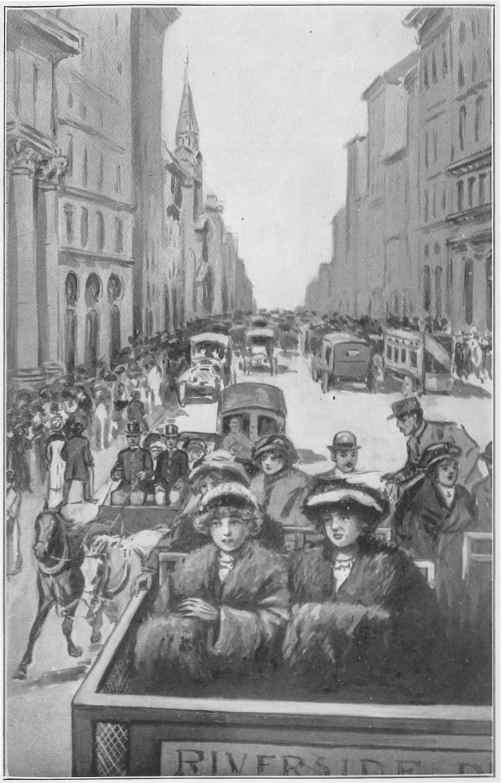
“Oh, the double-deckers!” exclaimed Tavia.
“I can feel the air smart my cheeks,” and she
shifted about expectantly. “Let’s take the auto
bus—I always did love that word bus. It seems
to mean a London night in a fog.”
“Well, I am sure it will mean good times, and
I assure you, Tavia, Aunt Winnie has not forgotten
you. You are to come.”
“There is only one Aunt Winnie in the world,”
declared Tavia, “and she is the Aunty Winnie of
Dorothy Dale.” Tavia was never demonstrative,
but just now she squeezed Dorothy’s hand almost
white. “How can I manage to get through with
Dalton? I have to give home at least three snowstorms.”
“We are getting them right now,” said Dorothy.
“I am afraid we will be snowbound when we
reach the next stop.”
Wheeling about in her chair, Tavia flattened her
face against the window as the train smoke tried
to hide the snowflakes from her gaze. Dorothy
was still occupied with her mail.
[16]
“It does come down,” admitted Tavia, “but
that will mean a ride for me in old Daddy Brennen’s
sleigh. He calls it a sleigh, but you remember,
Doro, it is nothing more than the fence rails
he took from Brady’s, buckled on the runners he
got from Tim, the ragman. And you cannot have
forgotten the rubber boot he once used for a
spring.”
“It was a funny rig, sure enough,” answered
Dorothy, “but Daddy Brennen has a famous
reputation for economy.”
“I hope he does not take it into his head to
economize on my spinal cord by going over Evergreen
Hill,” replied Tavia. “I tried that once in
his rattletrap, and we had to walk over to Jordan,
and from there I rode home on a pair of milk
cans. But Doro,” she continued, “I cannot get
over the sudden taking away of Mingle Dingle.
Surely the gods sent that telegram to save me.”
“I hope nothing serious has happened at her
home,” Dorothy mused. “I never heard anything
about her family.”
“You don’t suppose a little mouse of a thing,
like that born music teacher, has any family,” replied
Tavia irreverently. “I shall ever after this
have a respect for the proverbial feather bed.”
“Here is Stony Junction,” Dorothy remarked,
as the trainman let in a gust of wind from the
vestibuled door to shout out the name of that
station. “Madeline Maher gets off here. There,
she is waving to us! We should have spoken to
her.”
[17]
“Never too late,” declared Tavia, and she actually
shouted a good-bye and a merry Christmas
almost the full length of the car. Dorothy waved
her hand and “blew” a kiss, to which the pretty
girl who, with the porter close at her heels, was
leaving the train for her home, responded. Chairs
swung around simultaneously to allow their occupants
a glimpse of the girl who had startled them
with her shout. Some of the passengers smiled—especially
did one young man, whose bag showed
the wear usually given in college sports. He
dropped his paper, and, not too rudely, smiled
straight at Tavia.
“There!” exclaimed she. “See what a good
turn does. Just for wishing Maddie a hilarious
time I got that smile.”
“Don’t,” cautioned Dorothy, to whom Tavia’s
recklessness was ever a source of anxiety. “We
have many miles to go yet.”
“‘So much the better,’ as the old Wolfie, in
Little Red Riding Hood, said,” Tavia retorted.
“I think I shall require a drink of water directly,”
and she straightened up as if to make her way to
the end of the car, in order to pass the chair of
the young man with the scratched-up suitcase.
[18]
Dorothy sighed, but at the same time she smiled.
Tavia could not be repressed, and Dorothy had
given up hope of keeping her subdued.
“Come to think of it,” reflected Tavia, “I never
had any permanent luck with the drinking water
trick. He looks so nice—I might try being sweet
and refined,” and she turned away, making the
most absurd effort to look the part.
“Getting sense,” commented Dorothy. “We
may now expect a snowslide.”
“And have my hero dig me out,” added the irrepressible
one. “Wouldn’t that be delicious!
There! Look at that! It is coming down in snowballs!”
“My!” exclaimed Dorothy, “it is awful! I
hope the boys do not fail to meet me.”
“Oh, if they didn’t, you would be all right,”
said Tavia. “They serve coffee and rolls at North
Birchland Station on stormy nights.”
“I declare!” exclaimed Dorothy, “that young
man is a friend of Ned’s! I met him last Summer,
now I remember.”
“I knew I would have good luck when I played
the sweet-girl part,” said Tavia, with unhidden
delight. “Go right over and claim him.”
“Nonsense,” replied Dorothy, while a slight
blush crept up her forehead into her hair. “We
must be more careful than ever. Boys may pretend
to like girls who want a good time, but my
cousins would never tolerate anything like forwardness.”
[19]
“Only where they are the forwarders,” persisted
Tavia. “Did not the selfsame Nat, brother
to the aforesaid Ned——”
As if the young man in front had at the same
time remembered Dorothy, he left his seat and
crossed the aisle to where the girls sat. His head
was uncovered, of course, but his very polite manner
and bow amply made up for the usual hat
raising.
“Is not this Miss Dale?” he began, simply.
“Yes,” answered Dorothy, “and this Mr.
Niles?”
“Same chap,” he admitted, while Tavia was
wondering why he had not looked at her. “Perhaps,”
she thought, “he will prove too nice.”
“I was just saying to my friend,” faltered Dorothy,
“that I hope nothing will prevent Ned and
Nat from meeting me. This is quite a storm.”
“But it makes Christmas pretty,” he replied,
and now he did deign to look at Tavia. Dorothy,
quick to realize his friendliness, immediately introduced
the two.
It was Tavia’s turn to blush—a failing she very
rarely gave in to. Perhaps some generous impulse
prompted the gentleman who occupied the chair
ahead to leave it and make his way toward the
smoking room. This gave Mr. Niles a chance to
sit near the girls.
[20]
“We expect a big time at Birchland this holiday,”
he said. “Your cousins mentioned you
would be with us.”
“Yes, they cannot get rid of me,” Dorothy replied,
in that peculiar way girls have of saying
meaningless things. “I am always anxious to get
to the Cedars—to see father and our boys, and
Aunt Winnie, of course. I only wish Tavia were
coming along,” and she made a desperate attempt
to get Tavia into the conversation.
“Home is one of the Christmas tyrannies,” the
young man said. “If it were not Christmas some
of us might forget all about home.”
Still Tavia said not a single word. She now
felt hurt. He need not have imagined she cared
for his preaching, she thought. And besides, his
tie needed pressing, and his vest lacked the top
button. Perhaps he had good reasons for wanting
to get home to his “Ma,” she was secretly
arguing.
“You live in Wildwind—not far from the
Cedars; do you not?” Dorothy asked.
“I did live there until last Fall,” he replied.
“But mother lost her health, and has gone out in
the country, away from the lake. We are stopping
near Dalton.”
Tavia fairly gasped at the word “Dalton.”
[21]
“Then why don’t you go home for Christmas?”
she blurted out.
“I am going to mother’s place to get her first,”
he said. “Then, if she feels well enough, we will
come back to the Birchlands.”
“My friend lives at Dalton,” Dorothy exclaimed,
casting a look of admiration at the flushing
Tavia.
“Indeed?” he replied. “That’s my station. I
ride back from there. I am glad to have met
someone who knows the place. I was fearful of
being snowbound or station-bound, as I scarcely
know the locality.”
“I expect to ride in Daddy Brennen’s sleigh,”
said Tavia, with an effort. “He is the only one
to know on a snowy night at Dalton.”
“Then perhaps you will take pity on a stranger,
and introduce him to Daddy and his sleigh,” the
youth replied. “Even a bad snowstorm may have
its compensations.”
Tavia hated herself for thinking he really was
nice. She was not accustomed to being ignored,
and did not intend to forget that he had slighted
her.
“I almost envy you both,” said Dorothy, good
humoredly. “Just see it snow! I can see you
under Daddy’s horse blanket.”
“It’s surely a horse blanket,” replied Tavia.
“We cannot count on his having a steamer rug.”
[22]
“I suppose,” said Mr. Niles, “the sleigh answers
all stage-coach purposes out that way?”
“As well as freight and express,” returned
Dorothy. “Dear old Dalton! I have had some
good times out there!”
“Why don’t you come out now, Doro?” asked
Tavia, mischievously. “There may be some good
times left.”
The gentleman who had vacated the seat taken
by Mr. Niles was now coming back. This, of
course, was the signal for the latter to leave.
“We are almost at the Birchlands!” he said,
“I hope, Miss Dale, that those boy cousins of
yours do not get buried in the snow, and leave you
in distress. I remember that auto of theirs had
a faculty for doing wild things.”
“Oh, yes. We had more than one adventure
with the Fire Bird. But I do not anticipate any
trouble to-night,” said Dorothy. “I heard from
Aunt Winnie this morning.”
With a word about seeing them before the end
of their journey, he took his chair, while Tavia
sat perfectly still and silent, for, it seemed to
Dorothy, the first time in her life.
“What is it?” she asked. “Don’t you feel
well, Tavia?”
“I feel like bolting. I have a mind to get off
at Bridgeton. Fancy me riding with that angel!”
[23]
“I’m sure he is very nice,” Dorothy said, in a
tone of reproof. “I should think you would be
glad to have such pleasant company.”
“Tickled to death!” replied Tavia, mockingly.
“I’m sure you will have some adventure,” declared
Dorothy. “They always begin that way.”
“Do they? Well, if I fall in love with him,
Doro, I’ll telegraph to you,” and Tavia helped her
friend on with hat and coat, for the Birchlands
had already been announced.
[24]
CHAPTER III “GET A HORSE!”
“Hello there, Coz!” shouted Nat White, as
Dorothy stepped from the train. “And there’s
Tavia—and well! If it isn’t Bob Niles!”
“Yes,” said Dorothy, postponing further greetings
until the train should pull out, and Tavia’s
last hand-wave be returned. “We met him coming
up, and he goes to Dalton.”
“Well I’ll be jiggered! And he has Tavia for
company!” exclaimed the young man, who for
years had regarded Tavia as his particular property,
as far as solid friendship was concerned.
“And Tavia has already vowed to be mean to
him,” said Dorothy, as she now pressed her warm
cheek against that of her cousin, the latter’s
being briskly red from the snowy air. “She
would scarcely speak to him on the train.”
“A bad sign,” said Nat, as he helped Dorothy
with her bag. “There are the Blakes. May as
well ask them up; their machine does not seem to
be around.”
[25]
The pretty little country station was gay with
holiday arrivals, and among them were many
known to Dorothy and her popular cousin. The
Blakes gladly accepted the invitation to ride over
in the Fire Bird, their auto having somehow missed
them.
“Doesn’t she?” chimed in Mabel’s brother, at
which Dorothy buried her face deeper in her furs.
Nat cranked up; and soon the Fire Bird was on its
way toward the Cedars, the country home of Mrs.
Nathaniel White, and her two sons, Nat and Ned.
Mrs. White was the only sister of Major Dale,
Dorothy’s father, and the Dale family, Dorothy
and her brothers, Joe and little Roger, had lately
made their home with her.
It lacked but a few days of Christmas, and the
snowstorm added much to the beauty of the scene,
while the cold was not so severe as to make the
weather unpleasant. All sorts of happy remembrances
were recalled between the occupants of the
automobile, as it bravely made its way through
drifts and small banks.
“Oh, there’s old Peter!” exclaimed Dorothy,
as a man, his stooped shoulders hidden under a
load of evergreens, trudged along.
“And such a heavy burden,” added Mabel.
“Couldn’t we give him a lift?”
[26]
Nat slowed up a little to give the old man more
room in the roadway. “Those Christmas trees
are poor company in a machine,” he said. “I
have tried them before.”
“But it is so hard for him to travel all the way
to the village?” pleaded Dorothy. “We could
put his trees on back, and he could——”
“Sit with you and Mabel?” and Ted Blake
laughed at the idea.
“No, you could do that?” retorted Dorothy,
“and Peter could ride with Nat. Please, Nat——”
“Oh, all right, Coz, if it will make you happy.
I wish, sometimes, I were lame, halt and old
enough—to know.” Whereat he stopped the
machine and insisted on old Peter doing as the
girls had suggested.
It was no easy matter to get the trees, and the
bunches of greens, securely fastened to the back
of the auto, but it was finally accomplished. Peter
was profuse in his thanks, for the greens had been
specially ordered, he said, and he was already late
in delivering them.
“Which way do you go?” asked Nat.
“Out to the Squire’s,” replied Peter. “But
that road is soft, I wouldn’t ask you take it.”
“Oh, I guess we can make it,” proposed Nat.
“The Fire Bird is not quite a locomotive.”
“She goes like a bird, sure enough,” affirmed
Peter. “But that road is full of ditches.”
[27]
“We will try them, at any rate,” insisted Nat,
as he turned from the main road to a narrow
stretch of white track that cut through woods and
farm lands.
“If we are fortunate enough not to meet anything,”
said Dorothy. “But I have always been
afraid of a single road, bound with ditches.”
“Of course,” growled Nat, “there comes Terry
with his confounded cows.”
Plowing along, his head down and his whip in
hand came Terry, the half-witted boy who, Winter
and Summer, drove the cows from their field or
barn to the slaughter house. He never raised his
head as Nat tooted the horn, and by the time the
machine was abreast of the drove of cattle, Nat
was obliged to make a quick swerve to avoid striking
the animals.
“Oh!” gasped both Dorothy and Mabel. The
car lunged, then came to a sudden stop, while the
engine still pounded to get ahead.
“Hang the luck!” groaned Nat, vainly trying
to start the car, which was plainly stalled.
“I told you,” commented Peter, inappropriately.
“This here road——”
“Oh, hang the road!” interrupted Nat. “It
was that loon—Terry.”
As the young man spoke Terry passed along as
mutely as if nothing had happened.
[28]
“I’d like to try that whip on him, to see if I
could wake him up,” said Ted, as he leaped out
after Nat to see what could be done to get the car
back on the road.
But it was an impossible task. Pushing, pulling,
prying with fence rails—all efforts left the
big, red car stuck just where it had floundered.
“I know,” spoke Peter, suddenly. “I’ll get
Sanders’s horse.”
“Sanders wouldn’t lend his horse to pull a man
out of a ditch,” said Nat. “I’ve asked him before.”
“That’s where you made a mistake,” replied
Peter. “I won’t ask him,” and he awkwardly
managed to get out of the car, and was soon out
on the road and making his way across the snow-covered
fields.
“We may be tried for horse-stealing next,” remarked
Ted, grimly. “Girls, are you perishing?”
“Not a bit of it,” declared Dorothy. “This
snow is warm rather than cold.”
“My face is burning,” insisted Mabel. “But
I do hope old Sanders does not set his dogs on us.”
“He’s as deaf as a post,” Ted said. “That’s
a blessing—this time, at least.”
“There goes Peter in the barn,” Dorothy remarked.
“He has got that far safely, at any
rate.”
[29]
A strained silence followed this announcement.
Yes, Peter had gone into the barn. It seemed
night would come before he could possibly secure
the old horse, and get to the roadway to give the
necessary pull to the stalled Fire Bird. They
waited, eagerly watching the barn door. Finally
it opened. Yes, Peter was coming, leading the
horse.
“Now!” said Peter, standing with an emergency
rope ready, “if only he gets past the
house——”
He stopped. The door of the snow-covered
cottage opened, and there stood the unapproachable
Sanders.
“Oh!” gasped Mabel. “Now we are in for
it!”
“Then,” said Dorothy, “let us be ready for it.
I’ll prepare the defence,” and before they realized
what she was about to do she had selected one of
the very choicest Christmas trees, and with it on
her fur-covered shoulder, actually started up the
box-wood lined walk to where the much-dreaded
Sanders was standing, ready to mete out vengeance
on the man who had dared to enter his barn, and
take from it his horse.
“Oh Mr. Sanders!” called Dorothy. “Have
you that dear little grand-daughter with you?
The pretty one we had at the church affair last
year?”
“You mean Emily?” he drawled. “Yep, she’s
here, but——”
[30]
“Then, you wonder why we have taken your
horse? And why we were stalled here?” The
others could hear her from the roadway. They
could see, also, that Sanders had stopped to listen.
“Now we want Emily to have a Christmas tree,
all her own,” went on Dorothy, “and Peter is
good enough to donate it. But our machine—those
cars are not like horses,” she almost shouted,
as Sanders being deaf, and watching the inexorable
Peter leading his horse away, had cause to
be aroused from his natural surprise. “After all,”
persisted Dorothy, “a horse is the best.”
By this time Peter was outside the big gate.
Sanders made a move as if to follow, when Dorothy
almost dropped the clumsy tree.
“Oh, please take it!” she begged. “I want to
see Emily while they are towing the machine out.
It’s a lucky thing it happened just here, and that
you are kind enough to let us have your horse.”
“Well what do you think of that!” exclaimed
Ted, in a voice loud enough for those near him to
hear. “Of all the clever tricks!”
“Oh, depend on Doro for cleverness,” replied
Nat, proudly. “You just do your part, Ted, and
make this rope fast.”
[31]
Mabel stood looking on in speechless surprise.
She saw now that Dorothy and old Sanders were
entering the cottage. Dorothy was first, and the
man, with the Christmas tree, followed close behind
her. The boys with Peter were busy with
rope, horse and auto. Soon they had the necessary
connection made, with Nat at the wheel, and
all were tugging with might and main to get the
Fire Bird free from the ditch.
If there is anything more nerve-racking than
such an attempt, it must be some other attempt at
a balking auto. Would it move, or would it sink
deeper into the mud that lay hidden beneath the
newly-fallen snow?
Nat turned the wheel first this way and then
that. Ted had his weight pressed against the rear
wheel of the machine, while Peter coaxed and led
the horse. Suddenly the old horse, as if desperate,
gave a jerk and pulled the Fire Bird clear out into
the roadway!
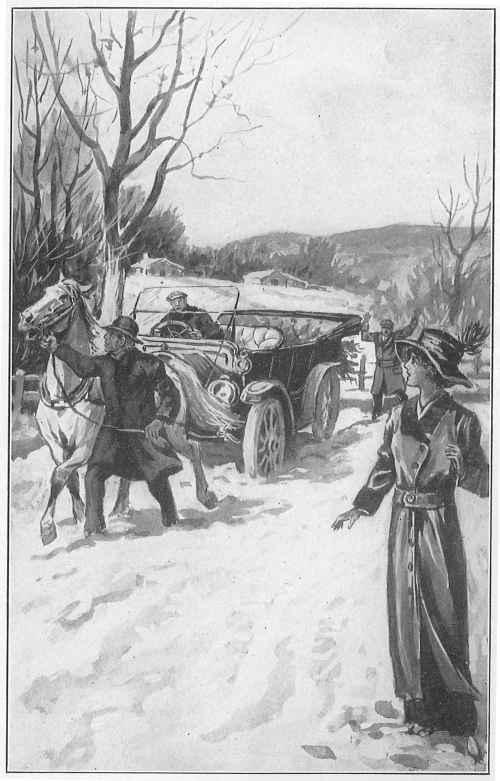
SUDDENLY THE OLD HORSE, AS IF DESPERATE, GAVE A JERK AND PULLED THE FIRE BIRD CLEAR.
“Hurrah!” yelled Ted, bounding through the
snow.
“Great stunt!” corroborated Nat. “Peter,
you are all right!”
“Peter did some,” replied the old man, freeing
the horse from the rope that held him to the machine;
“but that young lady—if she hadn’t kept
Sanders busy—we might all have been arrested
for horse-stealing.”
“She knew his weak spot,” agreed Nat. “That
little Emily seems to be the one weak and soft spot
in old Sanders’s life.”
[32]
“I had better go up and see what’s going on,”
suggested Mabel, as everything seemed about in
readiness to start off again.
“Good idea,” assented her brother, “he might
be eating her up.”
Mabel rather timidly found her way up to the
cottage. It was already dusk, but the light of a
dim lamp showed her the way, as it gleamed
through a gloomy window, onto the glistening
snow.
“Won’t it be perfectly lovely, Emily?” she
heard Doro saying, as she saw her with her arms
about a little red-haired girl, both sitting on a sofa,
while Sanders attempted to prop the Christmas
tree up in a corner, bracing it with a wooden chair.
Mabel raised the latch without going through the
formality of knocking. As she entered the room,
all but Dorothy started in surprise.
“This is my friend,” Dorothy hurried to explain,
“it is she who is going to help me trim the
tree up for Emily. We will come to-morrow,”
and she rose to leave. “Mabel will fetch the doll,
Emily. That is, of course, if we can persuade
Santa Claus to give us just the kind we want,”
she tried to correct.
“A baby dolly—with long hair and a white
dress,” Emily ordered. “And I want eyelashes.”
[33]
“Perticular,” said Sanders, with a proud look
at the child, who, as the boys had said, made up
the one tender spot in his life. “If her ma’s cold
is better, she is coming up herself.”
“Is she sick?” Emily ventured, glad to be able
to say something intelligent.
“Yep,” replied the old man, sadly. “She’s
been sick a long time. I fetched Emily over this
afternoon in the sleigh.”
“Well, we are so much obliged,” remarked
Dorothy. “And good-bye, Emily. You’ll have
everything ready for Santa Claus; won’t you?”
“I’ve got my parlor set from last year,” said
the child, “and mamma says Santa Claus always
likes to see the other things, to know we took care
of them.”
“Thanks, Sanders,” called Peter, at the window.
“The horse is as good as ever. Don’t sell
him without giving me a chance. I could do something
if I owned a mare like that.”
“All right,” called back Sanders, whose pride
was being played upon. “He might be worse.
Did you put her in the far stall?”
“Just where I got her. And I tell you, Sanders,
even a horse can play at Christmas. Only
for him I never could get those trees to town.”
“And only for Peter,” put in Dorothy, “we
could not have gotten Emily her tree. Now that’s
how a horse can turn Santa Claus. Good-bye, Mr.
Sanders, you may expect us before Christmas.”
[34]
And then the two girls followed the chuckling
Peter back to the Fire Bird, where the boys impatiently
awaited them, to complete the delayed
party bound for home, and for the Christmas holidays.
[35]
CHAPTER IV A REAL BEAUTY BATH
“This is some,” remarked Bob Niles, before
he knew what he was talking about. They had
just been ensconsed in Daddy Brennen’s sleigh.
Tavia was beside him—that is, she was as close
beside him as she was beside Daddy Brennen, but
the real fact was, that in this sleigh, no one could
be beside anyone else—it was ever a game of toss
and catch. But that was not Daddy’s fault. He
never stopped calling to his horse, or pulling at
the reins. It must have been the roads, yet everyone
paid taxes in Dalton Township.
“Don’t boast,” Tavia answered, adjusting herself
anew to the last jolt, “this never was a sleigh
to boast of, and it seems to be worse than ever
now. There!” she gasped, as she almost fell
over the low board that outlined the edge, “one
more like that, and I will be mixed up with the
gutter.”
“Perhaps this is a safer place,” Bob ventured.
“I seem to stay put pretty well. Won’t you change
with me?”
[36]
“No, thanks,” Tavia answered, good-humoredly.
“When Daddy assigns one to a seat one
must keep it.”
“Nice clean storm,” Daddy called back from
the front. “I always like a white Christmas.”
“Yes,” Tavia said, “looks as if this is going
to be white enough. But what are you turning
into the lane for, Daddy?”
“Promised Neil Blair I’d take his milk in for
him. He can’t get out much in storms—rheumatism.”
“Oh,” Tavia ejaculated. Then to Bob: “How
we are going to ride with milk cans is more than I
can see.”
“The more the merrier,” Bob replied, laughing.
“I never had a better time in my life. This
beats a straw ride.”
“Oh, we have had them too, with Daddy,” she
told him. “Doro and our crowd used to have
good times when she lived in Dalton.”
“No doubt. This is the farmhouse, I guess,”
Bob added, as the sleigh pulled up to a hill.
“Yes, this is Neil’s place,” Tavia said. “And
there comes Mrs. Blair with a heavy milk can.”
“Oh, I must help her with that,” offered the
young man. “I suppose our driver has to take
care of his speedy horse.”
[37]
Disentangling himself from the heavy blankets,
Bob managed to alight in time to take the milk
can from the woman, who stood with it at the top
of the hill.
“Oh, thank you, sir!” she panted. “The cans
seem to get heavier, else I am getting lazy. But
Neil had such a twinge, from this storm, that I
wouldn’t let him out.”
“And did you do all the milking?” Tavia
asked, as Bob managed to place the can in the
spot seemingly made for it, beside Daddy.
“Certainly. Oh, how do you do, Tavia? How
fine you look; I’m glad to see you home for Christmas,”
Mrs. Blair assured the girl.
“Thank you. I’m glad to get home.”
“Fetchin’ company?” with a glance at young
Niles.
“No, he’s going farther on,” and Tavia wondered
why it was so difficult for her to make such
a trifling remark.
“Well, I’m glad he came this way, at any rate,”
the woman continued. “But Daddy will be goin’
without the other can,” and she turned off again
in the direction of the barn.
“Are there more?” Bob asked Tavia, cautiously.
“I’m afraid so,” she replied. “But I guess she
can manage them.”
“My mother would disown me if she knew I
let her,” Bob asserted, bravely. “This is an experience
not in the itinerary,” and he scampered
up the hill, and made for the barn after Mrs.
Blair.
[38]
Tavia could not help but admire him. After
all, she thought, a good-looking lad could be useful,
if only for carrying milk cans.
“And has that young gent gone after the can?”
asked Daddy, as if just awaking from some dream.
“Yes,” Tavia replied, rather sharply. “He
wouldn’t let Mrs. Blair carry such a heavy thing.”
“Well, she’s used to it,” Daddy declared. At
the same time he did disturb himself sufficiently to
get out and prepare to put the second can in its
place.
A college boy, in a travelling suit, carrying a huge
milk can through the snow, Tavia thought rather
a novel sight, but Bob showed his training, and
managed it admirably.
“I’ll put her in,” offered Daddy, “I didn’t know
you went after it.”
“So kind of him,” remarked Mrs. Blair, “but
he would have it. Thank you, Daddy, for stopping.
Neil’ll make it all right with you.”
Daddy was standing up in the sleigh, the can in
his hands, “I think,” he faltered, “I’ll have to set
this down by you, Miss Travers,” he decided.
“All right,” Tavia agreed, making room at her
feet.
[39]
He lifted the can high enough to get it over
the back of the seat. It was heavy, and awkward,
and he leaned on the rickety seat trying to support
himself. The weight was too much for the
board, and before Bob could get in to help him,
and before Tavia could get herself out of the
way, the can tilted and the milk poured from it in
a torrent over the head, neck and shoulders of
Tavia!
“Oh, mercy!” she yelled. “My new furs!”
“Save the milk,” growled Daddy.
“Jump up!” Bob commanded Tavia. “Let it
run off if it will.”
But Tavia was either too disgusted, or too surprised,
to “jump up.” Instead she sat there, fixing
a frozen look at the unfortunate Daddy.
“My milk!” screamed Mrs. Blair. “A whole
can full!”
“Was it ordered?” Bob asked, who by this
time had gotten Tavia from under the shower.
“No,” she said hesitatingly, “but someone
would have took it for Christmas bakin’.”
“Then let us have it,” offered Bob, generously.
“If I had kept my seat perhaps it would not have
happened.”
“Nonsense,” objected Tavia, “it was entirely
Daddy’s fault.”
But Daddy did not hear—he was busy trying
to save the dregs in the milk can.
“What’s it worth?” persisted Bob.
“Two dollars,” replied Mrs. Blair, promptly.
[40]
Bob put his hand in his pocket and took out two
bills. He handed them to the woman.
“There,” he said, “it will be partly a Christmas
present. I only hope my—friend’s furs will
not be ruined.”
“Milk don’t hurt,” Mrs. Blair said, without reason.
“Thank you, sir,” she added to Bob. “This
is better than ten that’s comin’. And land knows
we needed it to-night.”
“I’ve lost time enough,” growled Daddy. “And
that robe is spoiled. Next time I carry milk cans
I’ll get a freight car.”
“And the next time I take a milk beauty bath,”
said Tavia, “I’ll wear old clothes.” But as Bob
climbed in again, and Tavia assured him her furs
were not injured, she thought of Dorothy’s prediction
that she, Tavia, was about to have an adventure
when she met Bob Niles.
“I’ll have something to tell Dorothy,” she remarked
aloud.
“And I’ll have news for Nat,” slily said Bob.
[41]
CHAPTER V DOROTHY’S PROTEGE
“Well, what do you think of that!”
“Well, what do you think of this!”
It was Nat who spoke first, and Dorothy who
echoed. They were both looking at letters—from
Tavia and from Bob.
“I knew Bob would find her interesting,” said
Nat, with some irony in his tone.
“And I knew she would finally like him,” said
Dorothy, significantly.
“Bob has a way with girls,” went on Nat, “he
always takes them slowly—it’s the surest way.”
“But don’t you think Tavia is very pretty?
Everyone at school raves about her,” Dorothy
declared with unstinted pride, for Tavia’s golden
brown hair, and matchless complexion, were ever
a source of pride to her chum.
“Of course she’s pretty,” Nat agreed. “Wasn’t
it I who discovered her?”
[42]
Dorothy laughed, and gave a lock of her
cousin’s own brown hair a twist. She, as well as
all their mutual friends, knew that Nat and Tavia
were the sort of chums who grow up together and
cement their friendship with the test of time.
“Come to think of it,” she replied, “you always
did like red-headed girls.”
“Now there’s Mabel,” he digressed, “Mabel
has hair that seems a misfit—she has blue eyes
and black hair. Isn’t that an error?”
“Indeed,” replied Dorothy, “that is considered
one of the very best combinations. Rare beauty,
in fact.”
“Well, I hope she is on time for the Christmas-tree
affair out at Sanders’s, whatever shade her
hair. I don’t see, Doro, why you insist on going
away out there to put things on that tree. Why
not ask the Sunday School people to trim it? We
gave the tree.”
“Because I promised, Nat,” replied Dorothy,
firmly, “and because I just like to do it for little
Emily. I got the very doll she ordered, and Aunt
Winnie got me a lot of pretty things this morning.”
“Wish momsey would devote her charity to her
poor little son,” said the young man, drily. “He
is the one who needs it most!”
“Never mind, dear,” and Dorothy put her arms
around him, “you shall have a dolly, too.”
“Here’s Ned,” he interrupted, “I wonder if he
got my skates sharpened? I asked him, but I’ll
wager he forgot.”
[43]
The other brother, a few years Nat’s senior,
pulled off his furlined coat, and entered the library,
where the cousins were chatting.
“Getting colder every minute,” he declared.
“We had better take the cutter out to Sanders’s—that
is, if Doro insists upon going.”
“Of course I do,” Dorothy cried. “I wouldn’t
disappoint little Emily for anything. Funny how
you boys have suddenly taken a dislike to going
out there.”
“Now don’t get peevish,” teased Ned. “We
will take you, Coz, if we freeze by the wayside.”
“Did you get my skates?” Nat asked.
“Not done,” the brother replied. “Old Tom
is busy enough for ten grinders. Expect we will
have a fine race.”
“And I can’t get in shape. Well, I wish I had
taken them out to Wakefield’s. He would have
had them done days ago. But if we are going to
Sanders’s, better get started. I’ll call William to
put the cutter up.”
“Here come Ted and Mabel now. They’re
sleighing, too,” exclaimed Dorothy. “Won’t we
have a jolly party!”
“That’s a neat little cutter,” remarked Ned,
glancing out of the window. “And Mabel does
look pretty in a red—what do you call that Scotch
cap?”
[44]
“Tam o’Shanter,” Dorothy helped out. “Yes,
it is very becoming. But Neddie, dear?” and her
voice questioned.
“Oh, I don’t know,” he replied indifferently.
“Mabel was always kind of—witchy. I like that
type.”
“And Ted is—so considerate,” Dorothy added
with a mock sigh. “I do wonder how Bob and
Tavia are getting along?”
“Probably planning suicide by this time—I say
planning, you know, not executing. It would be
so nice for a boy as good as Bob to be coerced into
some wild prank by the wily Tavia.”
“She did not happen, however, to lead you into
any,” retorted Dorothy, “and I take it you are a
‘good boy’.”
“Oh, but how hard she tried,” and he feigned
regret. “Tavia would have taught me to feed out
of her hand, had I not been—so well brought up.”
This bantering occupied the moments between
the time Ted’s sleigh glided into view, and its
arrival at the door of the Cedars.
“’Lo, ’lo!” exclaimed Mabel, her cheeks matching
the scarlet of her Tam o’Shanter.
“Low, low! Sweet and Low!” responded Nat.
“Also so low!”
“No—but Milo!” said Ned, with a complimentary
look at Mabel. “The Venus mended.”
[45]
“‘High low,’” went on Ted. “That’s what it
is. A high—low and the game! To go out there
to-night in this freeze!”
“Strange thing,” Dorothy murmured, “how
young men freeze up—sort of antagonistic convulsion.”
“Oh, come on,” drawled Ned, “when a girl
wills, she will—and there’s an end on it.”
It did not take the girls long to comply—Dorothy
was out with Ted, Mabel, Nat and Ned before
the boys had a chance to relent.
“Those bundles?” questioned Ted, as Dorothy
surrounded herself with the things for Emily.
“Now did you ever!” exclaimed Dorothy.
“It seems to me everything is displeasing to-day.”
“No offence, I’m sure,” Ted hastened to correct,
“but the fact is—we boys had a sort of good
time framed up for this afternoon. Not but what
we are delighted to be of service——”
“Why didn’t you say so?” Dorothy asked.
It seemed for the moment that the girls and
boys were not to get along in their usual pleasant
manner. But the wonderful sleighing, and the delightful
afternoon, soon obliterated the threatening
difficulties, and a happy, laughing party in each
cutter glided over the road, now evenly packed
with mid-winter snow.
[46]
The small boys along the way occasionally stole
a ride on the back runners of the sleighs, or “got
a hitch” with sled or bob, thus saving the walk up
hill or the jaunt to the ice pond.
“Oh, there’s Dr. Gray!” Dorothy exclaimed
suddenly as a gentleman in fur coat and cap was
seen hurrying along. “I wonder why he is walking?”
“For his health, likely,” Ted answered. “Doctors
know the sort of medicine to take for their
own constitutions.”
By this time they were abreast of the physician.
Dorothy called out to him:
“Where’s your horse, Doctor?”
“Laid up,” replied the medical man, with a
polite greeting. “He slipped yesterday——”
“Going far?” Ted interrupted, drawing his
horse up.
“Out to Sanders’s,” replied the doctor.
“Sanders’s!” repeated Dorothy. “That’s
where we’re going. Who’s sick?”
“The baby,” replied the doctor, “and they
asked me to hurry.”
“Get in with us,” Ted invited, while Dorothy
almost gasped. Little Emily sick! She could
scarcely believe it.
Dr. Gray gladly accepted the invitation to ride,
and the next cutter with Ned, Nat and Mabel,
pulled up along side of Ted’s.
[47]
“You may as well turn back,” Dorothy told
them. Then she explained that little Emily was
sick, and likely would not want her Christmas tree
trimmed.
“But I’ll go along,” she said, “I may be able to
help, for her mother is sick, even if she is with
her.”
After all her preparations, it was a great disappointment
to think the child could not enjoy the
gifts. Dr. Gray told her, however, that Emily was
subject to croup, and that perhaps the spell would
not last.
At the house they found everything in confusion.
Emily’s sick mother coughed harder at
every attempt she made to help the little one, while
Mr. Sanders, the child’s grandfather, tried vainly
to get water hot on a lukewarm stove.
“Pretty bad, Doc,” he said with a groan,
“thought she’d choke to death last night.”
Without waiting to be directed, Dorothy threw
aside her heavy coat, drew off her gloves, and was
breaking bits of wood in her hands, to hurry the
kettle that, being watched, had absolutely refused
to boil.
“You can just put that oil on to heat, Miss
Dale,” Dr. Gray said, he having bidden the sick
woman to keep away from Emily. “We’ll rub
her up well with warm oil, and see if we can loosen
up that congestion.”
Emily lay on the uneven sofa, her cheeks burning,
and her breath jerking in struggles and coughs.
[48]
Dorothy found a pan and had the oil hot before
the doctor was ready to use it.
“Quite a nurse,” he said, in that pleasant way
the country doctor is accustomed to use. “Glad
I happened to meet you.”
“I’m glad, too,” Dorothy replied sincerely.
“Never mind, Emily, you will have your Christmas
tree, as soon as we get the naughty cold
cured,” she told the child.
Emily’s eyes brightened a little. The tree still
stood in a corner of the room. Outside, Ted was
driving up and down the road in evident impatience,
but Dorothy was too busy to notice him.
Soon the hot applications took effect, and Emily
breathed more freely and regularly. Then the
doctor attended to the other patient—the mother.
It was a sad Christmas time, and had a depressing
effect even on the young spirits of Dorothy. She
tried to speak to Emily, but her eyes wandered
around at the almost bare room, and noted its
untidy appearance. Dishes were piled up on the
table, pans stood upon the floor, papers were littered
about. How could people live that way?
she wondered.
Mrs. Tripp, Emily’s mother, must be a widow,
Dorothy thought, and she knew old Mrs. Sanders
had died the Winter before.
[49]
The doctor had finished with Mrs. Tripp. He
glanced anxiously about him. To whom would he
give instructions? Mr. Sanders seemed scarcely
capable of giving the sick ones the proper care.
Dorothy saw the look of concern on the doctor’s
face and she rightly interpreted it.
“If we only could take them to some other
place,” she whispered to him. Then she stopped,
as a sudden thought seized her.
“Doesn’t Mr. Wolters always make a Christmas
gift to the sanitarium?” she asked Dr. Gray.
“Always,” replied the doctor.
“Then why can’t we ask him to have little
Emily and her mother taken to the sanitarium?
They surely need just such care,” she said quickly.
The doctor slapped one hand on the other, showing
that the suggestion had solved the problem.
Then he motioned Dorothy out into the room
across the small hall. She shivered as she entered
it, for it was without stove, or other means of
heating.
“If I only had my horse,” he said, “I would go
right over to Wolters’s. He would do a great
deal for me, and I want that child cared for to-night.”
“I’ll ask Ted to let us take his sleigh,” Dorothy
offered, promptly. “He could go with us to
the Corners, and then you could drive.”
“And take you?” asked Dr. Gray. “I am sure
you young folks have a lot to do this afternoon.”
[50]
“No matter about that,” persisted Dorothy.
“If I can help, I am only too glad to do it. And
Mr. Wolters is on Aunt Winnie’s executive board.
He might listen to my appeal.”
There was neither time nor opportunity for further
conversation, so Dorothy hastily got into her
things, and soon she was in Ted’s sleigh again,
huddled close to Dr. Gray in his big, fur coat.
The plan was unfolded to Ted, and he, anxious
to get back to his friends, willingly agreed to walk
from the Corners, and there turn the cutter over
to the charity workers.
“But Dorothy,” he objected, “I know they will
all claim I should have insisted on your coming
back with me. They will say you will kill yourself
with charity, and all that sort of thing.”
“Then say I will be home within an hour,”
Dorothy directed, as Ted jumped on the bob that
a number of boys were dragging up the hill.
“Good-bye, and thank you for the rig.”
“One hour, mind,” Ted called back. “You can
drive Bess, I know.”
“Of course,” Dorothy shouted. Then Bess was
headed for The Briars, the country home of the
millionaire Wolters.
“Suppose he has already made his gift,” Dorothy
demurred, as she wrapped the fur robe closely
about her feet, “and says he can’t guarantee any
more.”
[51]
“Then I guess he will have to make another,”
said the doctor. “I would not be responsible for
the life of that child out there in that shack.”
“If he agrees, how will you get Mrs. Tripp
and Emily out to the sanitarium?” Dorothy asked.
“Have to ’phone to Lakeside, and see if we can
get the ambulance,” he replied. “That’s the only
way to move them safely.”
It seemed to Dorothy that her plan was more
complicated than she had imagined it would be,
but it was Christmas time, and doing good for
others was in the very atmosphere.
“It will be a new kind of Christmas tree,” observed
the doctor. “But she’s a cunning little one—she
deserves to be kept alive.”
“Indeed she does,” Dorothy said, “and I’m
glad if I can help any.”
“Why I never would have thought of the plan,”
said the doctor. “I had been thinking all the
time we ought to do something, but Wolters’s
Christmas gift never crossed my mind. Here we
are. My, but this is a great place!” he finished.
And the next moment Dorothy had jumped out of
the cutter and was at the door of Mr. Ferdinand
Wolters.
[52]
CHAPTER VI THE NIGHT BEFORE CHRISTMAS
Dorothy was scolded. There her own family—father,
Joe and Roger, to say nothing of dear
Aunt Winnie, and the cousins Ned and Nat—were
waiting for her important advice about a lot of
Christmas things, and she had ridden off with Dr.
Gray, attending to the gloomy task of having a
sick child and her mother placed in a sanitarium.
But she succeeded, and when on the following
day she visited Emily and her mother, she found
the nurses busy in an outer hall, fixing up the
Christmas tree that Mr. Sanders had insisted upon
bringing all the way from the farmhouse where
Dorothy had left it for little Emily.
The very gifts that Dorothy left unopened out
there, when she found the child sick, the nurses
were placing on the tree, waiting to surprise Emily
when she would open her eyes on the real Christmas
day.
[53]
And there had been added to these a big surprise
indeed, for Mr. Wolters was so pleased with
the result of his charity, that he added to the hospital
donation a personal check for Mrs. Tripp
and her daughter. The check was placed in a tiny
feed bag, from which a miniature horse (Emily’s
pet variety of toy) was to eat his breakfast on
Christmas morning.
Major Dale did not often interfere with his
daughter’s affairs, but this time his sister, Mrs.
White, had importuned him, declaring that Dorothy
would take up charity work altogether if they
did not insist upon her taking her proper position
in the social world. It must be admitted that the
kind old major believed that more pleasure could
be gotten out of Dorothy’s choice than that of his
well-meaning, and fashionable, sister. But Winnie,
he reflected, had been a mother to Dorothy
for a number of years, and women, after all, knew
best about such things.
It was only when Dorothy found the major
alone in his little den off his sleeping rooms that
the loving daughter stole up to the footstool, and,
in her own childish way, told him all about it. He
listened with pardonable pride, and then told Dorothy
that too much charity is bad for the health
of growing girls. The reprimand was so absurd
that Dorothy hugged his neck until he reminded
her that even the breath of a war veteran has its
limitations.
[54]
So Emily was left to her surprises, and now,
on the afternoon of the night before Christmas,
we find Dorothy and Mabel, with Ned, Nat and
Ted, busy with the decorations of the Cedars.
Step ladders knocked each other down, as the enthusiastic
boys tried to shift more than one to
exactly the same spot in the long library. Kitchen
chairs toppled over just as Dorothy or Mabel
jumped to save their slippered feet, and the long
strings of evergreens, with which all hands were
struggling, made the room a thing of terror for
Mrs. White and Major Dale.
The scheme was to run the greens in a perfect
network across the beamed ceiling, not in the usual
“chandelier-corner” fashion, but latticed after the
style of the Spanish serenade legend.
At intervals little red paper bells dangled, and
a prettier idea for decoration could scarcely be
conceived. To say that Dorothy had invented it
would not do justice to Mabel, but however that
may be, all credit, except stepladder episodes, was
accorded the girls.
“Let me hang the big bell,” begged Ted, “if
there is one thing I have longed for all my life it
was that—to hang a big ‘belle’.”
He aimed his stepladder for the middle of the
room, but Nat held the bell.
“She’s my belle,” insisted Nat, “and she’s not
going to be hanged—she’ll be hung first,” and he
caressed the paper ornament.
[55]
“If you boys do not hurry we will never get
done,” Dorothy reminded them. “It’s almost
dark now.”
“Almost, but not quite,” teased Ted. “Dorothy,
between this and dark, there are more things
to happen than would fill a hundred stockings. By
the way, where do we hang the hose?”
“We don’t,” she replied. “Stockings are picturesque
in a kitchen, but absurd in such a bower
as this.”
“Right, Coz,” agreed Ned, deliberately sitting
down with a wreath of greens about his neck.
“Cut out the laundry, ma would not pay my little
red chop-suey menu last week, and I may have to
wear a kerchief on Yule day.”
“Oh, don’t you think that—sweet!” exulted
Mabel, making a true lover’s knot of the end of
her long rope of green that Nat had succeeded in
intertwining with Dorothy’s ‘cross town line’.
“Delicious,” declared Ned, jumping up and
placing his arms about her neck.
“Stop,” she cried. “I meant the bow.”
“Who’s running this show, any way?” asked
Ted. “Do you see the time, Frats?”
The mantle clock chimed six. Ned and Nat
jumped up, and shook themselves loose from the
stickery holly leaves as if they had been so many
feathers.
[56]
“We must eat,” declared Ned, dramatically,
“for to-morrow we die!”
“We cannot have tea until everything is finished,”
Dorothy objected. “Do you think we
girls can clean up this room?”
“Call the maids in,” Ned advised, foolishly,
for the housemaids at the Cedars were not expected
to clean up after the “festooners.”
Dorothy frowned her reply, and continued to
gather up the ends of everything. Mabel did not
desert either, but before the girls realized it, the
boys had run off—to the dining room where a hasty
meal, none the less enjoyable, was ready to be
eaten.
“What do you suppose they are up to?” Mabel
asked.
“There is something going on when they are
in such a hurry. What do you say if we follow
them? It is not dark, and they can’t be going
far,” answered Dorothy.
Mabel gladly agreed, and, a half hour later, the
two girls cautiously made their way along the
white road, almost in the shadow of three jolly
youths. Occasionally they could hear the remarks
that the boys made.
“They are going to the wedding!” Dorothy exclaimed.
“The seven o’clock wedding at
Winter’s!”
[57]
Mabel did not reply. The boys had turned
around, and she clutched Dorothy’s arm nervously.
Instinctively both girls slowed their pace.
“They did not see us,” Dorothy whispered,
presently. “But they are turning into Sodden’s!”
Sodden’s was the home of one of the boys’
chums—Gus Sodden by name. He was younger
than the others, and had the reputation of being
the most reckless chap in North Birchland.
“But,” mused Mabel, “the wedding is to be at
the haunted house! I should be afraid——”
“Mabel!” Dorothy exclaimed, “you do not
mean to say that you believe in ghosts!”
“Oh—no,” breathed Mabel, “but you know
the idea is so creepy.”
“That is why,” Dorothy said with a light
laugh, “we have to creep along now. Look at
Ned. He must feel our presence near.”
The boys now were well along the path to the
Sodden home. It was situated far down in a
grove, to which led a path through the hemlock
trees. These trees were heavy with the snow that
they seemed to love, for other sorts of foliage
had days before shed the fall that had so gently
stolen upon them—like a caress from a white
world of love.
“My, it is dark!” demurred Mabel, again.
“Mabel Blake!” accused Dorothy. “I do
believe you are a coward!”
[58]
It was lonely along the way. Everyone being
busy with Christmas at home, left the roads deserted.
“What do you suppose they are going in there
for?” Mabel finally whispered.
“We will have to wait and find out,” replied
Dorothy. “When one starts out spying on boys
she must be prepared for all sorts of surprises.”
“Oh, there comes Gus! Look!” Mabel pointed
to a figure making tracks through the snow along
the path.
“And—there are the others. It did not take
them long to make up. They are—Christmas—Imps.
Such make-ups!” Dorothy finished, as she
beheld the boys, in something that might have
been taken, or mistaken, for stray circus baggage.
Even in their disguise it was easy to recognize
the boys. Ned wore a kimono—bright red. On
his head was the tall sort of cap that clowns and
the old-fashioned school dunce wore. Nat was
“cute” in somebody’s short skirt and a shorter
jacket. He wore also a worsted cap that was
really, in the dim light, almost becoming. Ted
matched up Nat, the inference being that they were
to be Christmas attendants on Santa Claus.
The girls stepped safely behind the hedge as
the procession passed. The boys seemed too involved
in their purpose to talk.
“Now,” said Dorothy, “we may follow. I
knew they were up to something big.”
[59]
“Aren’t they too funny!” said Mabel, who had
almost giggled disastrously as the boys passed.
“I thought I would die!”
There was no time to spare now, for the boys
were walking very quickly, and it was not so easy
for the girls to keep up with them and at the same
time to keep away from them.
Straight they went for what was locally called
the “haunted” house. This was a fine old mansion,
with big rooms and broad chimneys, which had
once been the home of a family of wealth. But
there had been a sad tragedy there, and after that
it had been said that ghosts held sway at the place.
It had been deserted for two years, but now, with
the former owner dead, a niece of the family,
fresh from college, had insisted upon being married
there, and the house had been accordingly put
into shape for the ceremony.
It was to be a fashionable wedding, at the hour
of six, and people had kept the station agent busy
all day inquiring how to reach the scene of the
wedding.
Lights already burned brightly in the rooms,
that could be seen to be decorated in holiday
style. People fluttered around and through the
long French windows; the young folks, boys and
girls, being hidden in different quarters, could
alike see something of what was going on in the
haunted house.
[60]
“They’re coming!” Dorothy heard Nat exclaim,
just as he ducked in by the big outside
chimney. The broad flue was at the extreme end
of the house, forming the southern part of the
library, just off the wide hall that ran through
the middle of the place. Dorothy and Mabel
had taken refuge in one of the many odd corners
of the big, old fashioned porch, which partly encircled
this wing, and commanding a wonderful
view of the interior of the house, the halls and
library, and long, narrow drawing room.
There was a smothered laugh at the corner of
the porch where the boys had ducked, and the
girls watched in wonder. The latter saw Nat
boost Ned up the side of the porch column, and
Ted followed nimbly. In tense silence the girls
listened to their footsteps cross the porch roof,
then as scraping and slipping and much suppressed
mirth floated down.
“They’re going down the chimney!” declared
Dorothy, in astonishment.
“They surely are!” affirmed Mabel, leaning
far over the porch rail.
“But, Doro, what of the fire?”
“They don’t use that chimney. They use the
one on the other side of the house, and the one
in the kitchen.”
[61]
CHAPTER VII REAL GHOSTS
“That explains the basket!” exclaimed Dorothy,
suddenly.
“How can they do it!” Mabel giggled excitedly.
“They can’t,” Dorothy replied, calmly, “they’ll
simply get in a mess—soot and things, you know.”
“Let’s run. I’m too excited to breathe! I
know something dreadful is bound to happen!”
And Mabel clutched Dorothy’s arm.
“And leave the boys to their fate? No, indeed,
we’ll see the prank through, since we walked into
it,” Dorothy said, determinedly.
Mabel laughed nervously, and looked at Dorothy
in puzzled impatience. “I always believe in
running while there’s time,” she explained.
Music, sweet and low, floated out on the still,
cold air of the night, and the wedding guests, in
trailing gowns of silver and lace and soft satins,
stood in laughing groups, all eyes turned toward
the broad staircase.
[62]
“How quiet it’s become; everyone has stopped
talking,” whispered Mabel, in Dorothy’s ear.
“How peculiarly they are all staring! But of
course it must be exciting just before the bride
appears,” murmured Dorothy, in answer.
“Oh, there comes the bride!” cried Mabel.
“Isn’t she sweet!”
“It’s a stunt to trail downstairs that way—like
a summer breeze. How beautifully gauzy she
looks!” sighed Dorothy.
The eyes of the guests were turned half in wonder
toward the old chimney place, and half smilingly
toward the bride. On came the bride, tall
and slender and leaning gracefully on her father’s
arm, straight toward the tall mantel in the chimney
place, which was lavishly banked with palms and
flowers, and the minister began reading the ceremony.
“Hey! Let go there!” Ned’s muffled voice
floated above the heads of the wedding guests,
who stood aghast.
“You’re stuck all right, old chap,” came the consoling
voice of Nat in a ghostly whisper.
Sounds of half-smothered, weird laughter—or
so the laughter seemed to the guests—filled the air.
The bridegroom flushed and looked quickly at his
bride, who clung to her father’s arm, pale with
fright. The minister alone was calm.
[63]
As the bridegroom’s clear answer: “I will”
came to the ears of Dorothy and Mabel out on
the porch, a creepy sound issued from the great
fireplace. The newly-made husband kissed his
bride, and the guests moved back.
Dorothy leaned eagerly forward to catch a
glimpse of the radiantly smiling bride. Just then
a tall palm wavered, fell to the floor with a crash,
and in falling, carried vases and jars of flowers
with it, and the ghostly laughter could be plainly
heard by all.
All the tales that had been told of the haunted
house came vividly before each guest. There were
feminine screams, a confused rush for the hallway,
and in two seconds the wedding festivities
were in an uproar. The bride sank to the floor,
and with white, upturned face, lay unconscious.
The men of the party with one thought jumped
to the fireplace, and Ned was dragged, by way of
the chimney, into the room. Completely dazed,
utterly chagrined, and looking altogether foolish,
he sat in a round, high basket, his knees crushed
under his chin, the clown’s cap rakishly hanging
over one ear, his face unrecognizable in its thick
coating of cobwebs and soot.
“Oh, we’re so sorry,” Dorothy’s eager young
voice broke upon the hushed crowd, as she ran into
the room, with Mabel behind her.
[64]
Ned stared open-mouthed at the gaily-dressed
people. It had happened so suddenly, and was so
far from what he had planned, that he could not
get himself in hand.
“Good gracious!” exclaimed the bride’s father,
pacing up and down, “can’t someone get order
out of this chaos?”
The bridegroom was chafing the small white
hands of his bride, and the guests stepped away to
give her air. The wedding finery lay limp and
draggled. Dorothy stifled a moan as she looked.
Quickly jumping out of the crowd she left the
room. Mabel stood still, uncertain as to what to
do. At the long French windows appeared Nat,
Ted and Gus, grotesque in their make-ups and
trying in vain to appear as serious as the situation
demanded.
“Step in here!” commanded the father, and
the boys meekly stepped in. A brother of the bride
held Ned firmly by the arm. “Now, young scallywags,
explain yourselves!”
It was an easy thing for the irate father to demand,
but it completely upset the boys. They
couldn’t explain themselves.
In an awed whisper, Ned ventured an explanation:
“We only wanted to keep up the reputation
of the house.”
“And the basket stuck,” eagerly helped out Ted.
“We just thought we would whisper mysteriously
and—and cough—or something,” and Ned tried
to free himself from the grip on his arm.
[65]
“It was wider than we thought and the basket
kept going down——” Nat’s voice was hoarse, but
he couldn’t control his mirth.
“The rope slipped some—and the basket stuck——”
Ted’s voice was brimming over with apologies.
“Naturally, we would have entered by the front
door,” politely explained Gus, “had we foreseen
this.”
“You see it stuck,” persisted Ted, apparently
unable to remember anything but that awful fact.
“Then it really wasn’t spooks,” asked a tall,
dark-haired girl, as she joined the group.
One by one the guests gingerly returned to the
room and stood about, staring in amusement at
the boys. The cool, though severe stares of the
ladies were harder to bear than any rough treatment
that might be accorded them by the men.
Against the latter they could defend themselves,
but, as Ned suddenly realized, there is no defence
for mere man against the amused stare of a lady.
“It certainly could be slated at police headquarters
as ‘entering’,” calmly said a stout man,
taking in every detail of the boys’ costumes. “Disturbing
the peace and several other things.”
“With intent to do malicious mischief,” the
man who spoke balanced himself on his heels and
swung a chrysanthemum to and fro by the stem.
[66]
The minister was walking uneasily about. The
bride was on a sofa where she had been lifted to
come out of her faint.
In a burst of impatience Ted whispered to Mabel,
whom, for some reason, he did not appear at
all surprised to see there: “Where’s Dorothy?”
Mabel, scared and perplexed, shook her head
solemnly. But, as if in answer to the question,
Dorothy rushed into the room, her cheeks aglow,
her hair flying wildly about, and behind her walked
Dr. Gray.
Dr. Gray’s kindly smile beamed on the little
bride, and he soon brought her around. Sitting up,
she burst into a peal of merry laughter.
“What, pray tell me, are they?” she demanded,
pointing at the boys. She was still white, but her
eyes danced, and her small white teeth gleamed
between red lips.
“My cousins,” bravely answered Dorothy.
Everyone laughed, and the boys, in evident relief,
shouted.
“You’ve come to my wedding!” exclaimed the
bride.
“Kind of ’em; wasn’t it?” said the bridegroom,
sneeringly.
“But we’re going now,” quickly replied Dorothy,
with great dignity.
“Why?” asked the bride with wide open eyes.
“Since you are not really spooky creatures, stay
for the dancing.”
[67]
“We’re terribly thankful you are not ghosts,”
chirped a fluffy bridesmaid.
“You see if you had really been spooks,”
laughed the bride, “everyone would have shrieked
at me that horrible phrase, ‘I told you so,’ because
you know I insisted upon being married in this
house, just to defy superstition.”
“Just think what you’ve saved us!” said the
tall, dark-haired girl.
“Of course if it will be any accommodation,”
awkwardly put in Ned, “we’ll dance.” He
thought he had said the perfectly polite thing.
“He’s going to dance for us!” cried the tall
girl, to the others in the hall, and everyone crowded
in.
An hour later, trudging home in the bright
moonlight, Dorothy sighed: “Weren’t they wonderful!”
“It was decent of them to let us stay and have
such fun,” commented Ned.
“And such eats!” mused Nat. And Nat and
Ned, with a strangle hold on each other, waltzed
down the road.
Happy, but completely tired, the boys and girls
plowed through the snow, homeward bound.
[68]
CHAPTER VIII THE AFTERMATH
Christmas day, at dusk, the boys were stretched
lazily before the huge fire in the grate, when Dorothy
jumped up excitedly:
“Boys, here’s Tavia! And I declare, Bob Niles
is with her!”
“Good for Bob!” sang out Ned.
“’Rah! ’Rah!” whooped Ted, and all rushed
for the door.
Gaily Tavia hugged them all. Bob stood discreetly
aside.
“Father was called away, and it was so dreary—I
just ran over to see everyone,” gushed Tavia.
“Well, we’re glad to see you,” welcomed Aunt
Winnie.
“Oh, Tavia,” whispered Dorothy, “how did
you manage to get Bob?”
[69]
“Get whom?” Tavia tried to look blank. Dorothy
spoiled the blankness by stuffing a large chocolate
cream right into Tavia’s mouth before her
chum could close it.
“Thought you’d find Tavia interesting,” grinned
Ned, helping Bob take off his great ulster, at which
words the lad addressed flushed to his temples.
“Say, fellows, that yarn about the hose——”
began Nat.
“Nat no longer believes in Santa and the stockings,”
chimed in Ned, “he hung up all his socks
last night and——”
Nat glared at Ned, then calmly proceeded:
“About the hose, as I was saying, is nonsense! I
own some pretty decent-looking socks, as you’ve
noticed—I hung ’em all up and nary a sock remained
on the line this morning. Santa stole
them!”
“It’s the funniest thing about Nat’s socks,” explained
Dorothy, hastily, “he thought one pair
would not hold enough, and so strung them all
over the fireplace, and this morning they were
gone!”
Ted hummed a dreamy tune, and stared at the
beamed ceiling, with a faraway look in his eyes.
Nat, with sudden suspicion, grabbed Ted’s leg, and
there, sure enough, was one pair of his highly-prized,
and highly-colored, socks, snugly covering
Ted’s ankles.
[70]
A rough and tumble fight followed, and Tavia,
with high glee, jumped into it. Finally, breathless
and panting, they stopped, and demurely Tavia,
for all the world like a prim little girl in Sunday
School, sank to a low stool, with Bob at her feet.
Nothing could be quieter than Tavia, when Tavia
decided on quietness.
“We came over in the biggest sleigh we could
find,” said Bob, “so that all could take a drive—Mrs.
White and Major Dale too, you know.”
“Oh, no, the young folks don’t want an old
fellow like me,” protested Major Dale.
“We just do!” Dorothy replied, resting her
head against her father’s arm affectionately. “We
simply won’t go unless you and Aunt Winnie
come.”
“Why, of course, dear, we’ll go,” answered
Aunt Winnie, who was never known to stay at
home when she could go on a trip. As she spoke
she sniffed the air. “What is that smell, boys?”
“Something’s burning,” yawned Ted, indifferently,
just as if things burning in one’s home was
a commonplace diversion from the daily routine.
Noses tilted, the boys and girls sniffed the air.
[71]
Suddenly Bob and Nat sprang to Tavia’s side
and quickly beat out, with their fists, a tiny flame
that was slowly licking its way along the hem of
her woollen dress. With her reckless disregard
of consequences, Tavia had joined in the rough
and tumble fight with the boys, and, exhausted, had
rested too near the grate. A flying spark had ignited
the dress, which smouldered, and only the
quick work of the boys saved Tavia from possible
burns. For once she was subdued. Mrs. White
soothed her with motherly compassion. She was
always in dread lest Tavia’s reckless spirit would
cause the girl needless suffering.
“You see,” said Bob, smiling at Tavia, as they
piled into the sleigh and he carefully tucked blankets
about the girls, “you can’t entirely take care
of yourself—some time you’ll rush into the fire,
as you did just now.”
For an instant Tavia’s cheeks flamed. He was
so masterful! She yearned to slap him, but considering
the fire escapade, she couldn’t, quite.
The major was driving, with Dorothy snuggled
closely to his side, and Ted curled up on the floor.
Nat took care of Aunt Winnie on the next seat and
Bob and Tavia were in the rear.
On they sped over snow and ice, the bitter wind
sharply cutting their faces, until all glowed and
sparkled at the touch of it.
“Did you hear from the girls?” asked Dorothy,
turning to Tavia.
“Just got Christmas cards,” answered Tavia.
“I fared better than that. Cologne wrote a
fourteen page letter——”
“All the news that’s worth printing, as it were,”
laughed Tavia.
[72]
“Underlined, Cologne asked whether I had
heard the news about Mingle, and provokingly
ended the letter there. I’m still wondering. Her
departure at such an opportune moment was a
blessing, but we never stopped to think what might
have caused it,” said Dorothy, thoughtfully.
“Well, whatever it was, it saved us,” contentedly
responded Tavia. “By the way, Maddie sent
me the cutest card—painted it herself!”
“Who wants to ride across the lake?” demanded
Major Dale, slowing up the horses, “that will
save us climbing the hill, you know, and the ice is
plenty thick enough; don’t you think so, Winnie?”
“Yes, indeed,” Aunt Winnie answered, ready
for anything that meant adventure, and as they all
chorused their assent joyfully, away they drove
over the snow-covered ice.
The horses galloped straight across the lake, up
the bank, and then came a smash! The steeds
ran into a drift, dumped over the sleigh; and a
shivering, laughing mass of humanity lay on the
new, white snow.
“Such luck!” cried Tavia, “out of the fire into
the snow!”
While Major Dale and the boys righted the
overturned sleigh, Bob took care of the ladies.
“You and the girls leave for New York to-morrow,
Tavia tells me,” said Bob.
“Yes,” replied Aunt Winnie, with a sigh, “a
little pleasure trip, and some business.”
[73]
“Business?” cried Dorothy, closely scrutinizing
her aunt’s worried face.
Quick to scent something that sounded very
much like “family matters,” Tavia turned with
Bob, and deliberately started pelting with snow the
hard-working youths at the sleigh.
“Aw! Quit!” scolded Ted.
“There, you’ve done it! That one landed in
my ear! Now, quit it!” Nat stopped working
long enough to wipe the wet snow from his face.
But Tavia’s young spirits were not to be
squelched by mere words; Bob made the snow balls
for Tavia to throw, which she continued to do
with unceasing ardor.
“Why, yes, Dorothy,” Aunt Winnie replied,
watching Tavia. “I’m afraid there will be quite
a bit of business mixed with our New York trip.
I’m having some trouble. It’s the agent who has
charge of the apartment house I am interested in—you
remember, the man whom I did not like.”
“The apartment you’ve taken for the Winter?”
questioned Dorothy, shivering.
“You’re cold, dear.” Aunt Winnie, too, shivered.
“Run over with Tavia and jump around, it’s
too chilly to stand still like this. How unfortunate
we are! The sun will soon dip behind those hilltops,
and the air be almost too frosty for comfort.”
[74]
“Tell me,” persisted Dorothy, “what is it that’s
worrying you, Aunt Winnie? I’ve noticed it since
I came home. I want to be all the assistance I can,
you know.”
“You couldn’t help me, Dorothy, in fact, I do
not even know that I am right about the matter.
I do not trust the agent, but he had the rent collecting
before I took the place, so I allowed him to
continue under me. I can only say, Dorothy, that
something evidently is wrong. My income is not
what it should be.”
“Oh, I’m so sorry! But, I’m glad you told me.
Wait until we reach New York—we’ll solve it,”
and Dorothy pressed her lips together firmly.
Aunt Winnie laughed. “Don’t talk foolishly,
dear. It takes a man of wide experience and cunning
to deal with any real estate person, I guess;
and most of all a New York agent. My dear, let
us forget the matter. There, the sleigh seems to
be right side up once more.”
“Tavia,” whispered Dorothy, as she held her
friend back, “we’re in for it! Aunt Winnie has a
mystery on her hands! In New York City! Let
us see if you and I and the boys can solve it!”
“Good! We’ll certainly do it, if you think it
can be done,” said Tavia. “Oh, good old New
York town! It makes me dizzy just to think of
the whirling mass of rushing people and the autos
and ’buses, and shops and tea-rooms! Doro, you
must promise that you won’t drag me into more
than ten tea-rooms in one afternoon!”
[75]
“I solemnly promise,” returned Dorothy, “if
you’ll promise me to keep out of shops one whole
half-hour in each day!”
[76]
CHAPTER IX JUST DALES
It was three days after Christmas, and what
was left of the white crystals was fast becoming
brown mud, and the puddles and rivulets of melted
snow, very tempting to the small boy, made
walking almost impossible for the small boy’s
elders. The air was soft, and as balmy as the first
days of Spring. One almost expected to hear the
twittering of a bluebird and the chirp of the robins,
but nevertheless a grate fire burned brightly in
Dorothy’s room, with the windows thrown open
admitting the crisp air and sunlight.
“Shall I take my messaline dress, Tavia?”
Dorothy asked, holding the garment in mid-air.
“If we go to the opera you’ll want it; I packed
my only evening gown, that ancient affair in pink,”
said Tavia, laughing a bit wistfully.
“You’re simply stunning in that dress, Tavia,”
said Dorothy. “Isn’t she, Nat?” she appealed to
her cousin.
“That flowery, pinkish one, with the sash?”
asked the boy.
[77]
“Yes,” said Tavia, “the one that I’ve been
wearing so long that if I put it out on the front
steps some evening, it would walk off alone to any
party or dance in Dalton.”
“You know,” said Nat, looking at Tavia with
pride, “when you have that dress on you look like
a—er—a well, like pictures I’ve seen of—red-haired
girls,” the color mounted Nat’s brow and
he looked confused. Dorothy smiled as she turned
her back and folded the messaline dress, placing it
carefully in her trunk. Nat was so clumsy at compliments!
But Tavia did not seem to notice the
clumsiness, a lovely light leaped to her clear brown
eyes, and the wistfulness of a moment before vanished
as she laughed.
“I was warned by everyone in school not to buy
pink!” declared Tavia.
“So, of course,” said Dorothy laughing, “you
straightway decided on a pink dress. But, seriously,
Tavia, pink is your color, the old idea of auburn
locks and greens and browns is completely
smashed to nothingness, when you wear pink! Oh
dear,” continued Dorothy, perplexed, “where shall
I pack this wrap? Not another thing will go into
my trunk.”
“Are you taking two evening wraps?” asked
Tavia.
[78]
“Surely, one for you and the other for me. You
see this is pink too,” Dorothy held up a soft, silk-lined
cape, with a collar of fur. Quick tears
sprang to Tavia’s eyes, and impulsively she threw
her arms about Dorothy.
“Don’t strangle Dorothy,” objected Nat.
“You always make me so happy, Doro,” said
Tavia, releasing her chum, who looked happier
even than Tavia, her fair face flushed. The hugging
Tavia had given had loosened Dorothy’s
stray wisps of golden hair, that fell about her
eyes and ears in a most bewitching way.
“Girls,” called Aunt Winnie, from below stairs,
“aren’t you nearly finished?”
“All finished but Nat’s part,” answered Dorothy.
Then to Nat she said: “Now, cousin, sit
hard on this trunk, and perhaps we’ll be able to
close it.”
Nat solemnly perched on the lid of the trunk,
but it would not close.
“Something will have to come out,” he declared.
“There is nothing, absolutely nothing, in my
trunk that I can leave behind,” said Dorothy.
“My trunk closed very easily,” said Tavia,
“I’ll get it up from the station and we’ll pack the
surplus gowns in it,” she turned triumphantly to
Dorothy. “Too bad I sent it on so early. But
we can get it.”
“The very thing!” Dorothy laughed. “Run,
Nat, and fetch Tavia’s trunk from the station.”
[79]
“Dorothy,” called Aunt Winnie again, “we
only have a few hours before train time. Your
trunk should be ready for the expressman now,
dear.”
“Hurry, Nat,” begged Dorothy, “you must get
Tavia’s trunk here in two minutes. Coming,” she
called down to Aunt Winnie, as she and Tavia
rushed down the stairs.
“The trunk won’t close because the gowns won’t
fit,” dramatically cried Tavia.
“So the boys have gone for Tavia’s, and we’ll
pack things in it,” hurriedly explained Dorothy.
“What is all this about gowns?” asked Major
Dale, drawing Dorothy to the arm of the great
chair in which he was sitting.
“I’m packing, father, we’re going to leave you
for a while,” said Dorothy, nestling close to his
broad shoulders.
“But not for very long,” Aunt Winnie said.
“You and the boys must arrange so that you can
follow in at least one week.”
“Well, it all depends on my rheumatism,” answered
the major. “You won’t want an old
limpy soldier trying to keep pace with you in New
York City. Mrs. Martin, the tried and true, will
take fine care of us while you are gone.”
“No, that won’t do,” declared Dorothy, “we
know how well cared for you will be under Mrs.
Martin’s wing, but we want you with us. In fact,”
she glanced hastily at Aunt Winnie, “we may even
need you.”
[80]
“Perhaps the best way,” said Aunt Winnie,
thoughtfully, “would be to send you a telegram
when to come, and by that time, you will no doubt
be all over this attack of rheumatism.”
“Ned and Nat are as anxious as are you girlies
to get there,” replied Major Dale, “so I’ll make
a good fight to arrive in New York City.”
“Who is going to tell me stories at bed-time,
when Dorothy’s gone?” asked little Roger. “I
don’t want Doro to go away, ’cause she’s the best
sister that any feller ever had.”
Roger was leaning against the Major’s knee,
and Dorothy drew him close to her.
“Sister will have to send you a story in a letter
every day. How will that do?” she asked, as
she pressed her cheek against his soft hair.
“Aw, no,” pouted Roger, “tell them all to me
now, before you go away.”
“I’ll tell you one and then father will tell one;
father will tell one about the soldier boys,” murmured
Dorothy in Roger’s ear.
“Oh, goody,” Roger clapped his hands; “and
Aunt Winnie and Tavia and Ned and Nat and
everybody can tell me one story to-night and that
will fill up for all the nights while you are away!”
[81]
“Dorothy!” screamed Tavia, bursting into the
room in wild excitement, “the boys have gone
without my trunk check! They can’t get it!”
“And the gowns will have to be left behind!”
“Never!” laughed Tavia, “I’ll run all the way
to the station and catch them!”
“They’ve taken the Fire Bird, maybe you’ll
meet them coming back.”
Tavia dashed, hatless, from the house. They
watched her as she fairly flew along the road, in a
short walking skirt, heavy sweater pulled high
around her throat, and her red hair gleaming in
the sun.
Major Dale had always greatly admired Tavia;
he liked her fearless honesty and the sincerity of
her affections. Aunt Winnie, too, loved her almost
as much as she loved Dorothy.
“I’ve wondered so much,” said Dorothy, “what
trouble Miss Mingle is in. She left school so suddenly
that last day, and Cologne was so provoking
in her letter.”
“An illness, probably,” said Aunt Winnie,
kindly.
“It can’t be anything so commonplace as illness,”
said Dorothy. “Cologne would have gone
into details about illness. The telegram, and her
departure, were almost tragic in their suddenness.
I feel so selfish when I think of our treatment of
that meek little woman. No one ever was interested
in her, that I remember. Her great fault
was a too-meek spirit. She literally erased herself
and her name from the minds of everyone.”
[82]
Major Dale and Aunt Winnie listened without
much enthusiasm. Aunt Winnie was worried
about Dorothy, who showed so little inclination
to enter the whirl of society in North Birchland.
She had looked forward with much pleasure to
presenting her niece to her social world.
But Dorothy had little love for the society life
of North Birchland. She loved her cousins and
her small brothers, and seemed perfectly happy
and contented in her home life, and attending to
the small charities connected with the town. She
seemed to prefer a hospital to a house party, a
romp with the boys to a fashionable dance, and she
bubbled with glee in the company of Tavia, ignoring
the girls of the first families in her neighborhood.
“Your trip to New York, daughter,” began
Major Dale, slily smiling at Aunt Winnie, “will
be your debut, so to speak, in the world.”
Dorothy answered nothing, but continued to
smooth away the hair from Roger’s brow.
“What are you thinking of?” her father asked
musingly, not having received an answer to his
first remark.
[83]
“Oh, nothing in particular,” sighed Dorothy,
“except that I don’t see why I should make a debut
anywhere. I don’t want to meet the world,—that
is, socially. I want to know people for themselves,
not for what they’re worth financially or
because of the entertaining they do. I just like
to know people—and poorer people best of all.
They are interesting and real.”
“As are persons of wealth and social position,”
answered Aunt Winnie, gently.
“I’m going to be a soldier, like father,” said
Joe, “and Dorothy can nurse me when I fall in
battle.”
“Me, too,” chirped little Roger, “I want to be
a soldier and limp like father!”
“Oh, boys!” cried Dorothy, in horror, “you’ll
never, never be trained for war.”
“What’s that?” asked Major Dale. “Don’t
you want the boys to receive honor and glory in
the army?”
“No,” said Dorothy decidedly, “I’ll never permit
it. Of course,” she hastened to add, “if Joe
must wear a uniform, he might go to a military
school, if that will please him.”
The major scoffed at the idea. Joe straightened
his shoulders, and marched about the room,
little Roger following in his wake, while the major
whistled “Yankee Doodle.”
The sound of the Fire Bird was heard coming
up the driveway, and in another second Nat, Ned
and Ted rushed into the room.
[84]
“We can’t have the trunk without the check,”
explained Nat, breathlessly, “where is it?”
“Tavia discovered the check after you left, and
she followed you down to the station,” explained
Aunt Winnie.
“We took a short cut back and missed her, of
course,” said Nat, dejectedly.
“We won’t have any time to spare,” declared
Aunt Winnie, walking to the window, “the train
leaves at seven-thirty, and it is after six now,”
Dorothy followed her to the window. They both
stood still in astonishment.
“Boys!” cried Dorothy, “come quick!”
The boys scrambled to the window. There was
Tavia, coming up the drive, serenely seated on
top of her trunk, in the back part of a small buggy,
enjoying immensely the wind that brushed her hair
wildly about her face, while the driver, the stoutest
man in North Birchland, occupied the entire
front seat.
“I found it,” she cried lightly jumping to the
ground, “and this was the only available rig!”
“Never mind,” said Dorothy, “nothing counts
but a place to pack the gowns!”
“And catch the train for New York City,” cried
Tavia, from the top landing of the first flight of
stairs. “Everybody hurry! We have just time
enough to catch the train!”
[85]
CHAPTER X SIXTY MILES AN HOUR
The station at North Birchland was just a
brown stone building, and a small platform, surrounded
by a garden, like all country town stations.
But a more animated crowd of young people had
rarely gathered anywhere. Dorothy, Tavia and
Aunt Winnie were noticeable among the crowd,
their smart travelling suits and happy smiling faces
being good to look upon. Ned, who was to accompany
his mother, stood guard over the bags, while
they were being checked by the station master.
Nat, Ted and Bob, who had come to see them off,
pranced about, impatient for the train, and altogether
they were making such a racket that an
elderly lady picked up her bag and shawls, and
quickly searched for a quieter part of the station.
It was such a long time since the elderly lady had
been young and going on a journey, that she completely
forgot all about the way it feels, and how
necessary it is to laugh and chatter noisily on such
occasions.
[86]
Nat looked in Tavia’s direction constantly, and
at last succeeded in attracting her attention. He
appeared so utterly miserable that instinctively
Tavia slipped away from the others, and walked
with him toward the end of the station. But this
did not make Bob any happier. He devoted himself
to Dorothy and Aunt Winnie, casting longing
glances at Nat and Tavia. Dorothy was
charming in a travelling coat of blue, and a small
blue hat and veil gracefully tilted on her bright
blond hair, a coquettish quill encircling her hat and
peeping over her ear. Tavia was dressed in a
brown tailored suit, and a lacy dotted brown veil
accentuated the pink in her cheeks and the brightness
of her eyes.
A light far down the track told of the approaching
train. Joe and Roger were having an
argument as to who saw the gleam first and Major
Dale had to come to the rescue and be umpire.
As the rumble and roar grew nearer, and the light
became bigger, the excitement of the little group
became intense. With a great, loud roar and hissing,
the train stopped and the coach on which they
had engaged berths was just in front of them.
“The Yellow Flyer,” read Joe, carefully, “is
that where you will sleep?” he asked, looking in
wonder at the car.
[87]
“Yes, indeed, Joey,” said Dorothy, kissing him
good-bye, “in cunning little beds, hanging from
the sides of the coach.”
Dorothy held out her hand to Bob. “Good-bye,”
she said. Tavia, just behind Dorothy, glancing
quickly up at Bob, blushed as she placed her
slim hand in his large brown one.
“You’re coming to New York, too, with the
boys?” she asked, demurely.
Bob held her hand in his strong grip and it hurt
her, as he said very stiffly: “I don’t know that I
shall.” With a toss of her head, Tavia started up
the steps of the coach, but Bob following, still held
her hand tightly, and she stopped. All the others
were on the train. She looked straight into his
eyes and said: “We’re going to have no end of
fun, you know.” Bob released her hand. Standing
in the vestibule, Tavia turned once more:
“Please come,” she called to him, then rushed
into the train and joined the others.
When the cars pulled out, the last thing Tavia
saw was Bob’s uncovered head and Nat’s waving
handkerchief, and she smiled at both very sweetly.
Then they waved their handkerchiefs until darkness
swallowed up the little station.
[88]
The girls looked about them. A sleeping car!
Tavia thrilled with pleasant anticipation. It was
all so very luxurious! Aunt Winnie almost immediately
discovered an old acquaintance sitting
directly opposite. The lady, very foreign in manner
and attire, held a tiny white basket under her
huge sable muff. She gushed prettily at the unexpected
pleasure of having Aunt Winnie for a travelling
companion. Tavia thought she must be the
most beautiful lady in all the world, and both she
and Dorothy found it most disconcerting to be
ushered into a sleeping car filled with staring people,
and be introduced to so lovely a creature as
Aunt Winnie’s friend. The beautiful lady whispered
mysteriously to Aunt Winnie, and pointed
to the hidden basket and instantly a saucy growl
came from it.
“A dog,” gasped Dorothy, “why, they don’t
permit dogs on a Pullman!”
“Let’s get a peep at him,” said Tavia, “the little
darling, to go travelling just like real people!”
Immediately following the growl, the lady and
Aunt Winnie sat in dignified silence, and stared
blankly at the entire car.
“They’re making believe,” whispered Tavia,
“pretending there isn’t any dog, and that no one
heard a growl!”
“I’m simply dying to see the little fellow!”
said Dorothy, unaware that the future held an opportunity
to see the dog that now reposed in the
basket.
[89]
“Well, Dorothy,” said Tavia, “according to
the looks across the aisle ‘there ain’t no dog,’”
Tavia loved an expressive phrase, regardless of
grammatical rules.
“Did Ned get on?” suddenly asked Dorothy.
“I don’t see him.”
“He’s on,” answered Tavia, disdainfully, “in
the smoker. Didn’t you hear him beg our permission?”
After an hour had passed Aunt Winnie came
toward them and said:
“Don’t you think it best to retire now, girls?
You have a strenuous week before you.”
Dorothy and Tavia readily agreed, as neither
had found much to keep them awake. Many of
the passengers had already retired, some of them
immediately after the last stop was made. Tavia
could not remain quiet, and happy too, where
there was no excitement. She preferred to sleep
peacefully—and strangely, the Pullman sleeper
offered no fun even to an inventive mind like
Tavia’s.
“Ned might have stayed with us,” sighed
Dorothy. “Boys are so selfish.”
“Wouldn’t you like to go into the smoker
too?” suggested Tavia.
“What! Tavia Travers, you’re simply too
awful!” cried Dorothy.
[90]
“Oh, just to keep awake. After all, I find I
have a yearning to stay up. All in favor of the
smoker say ‘Aye.’” And a lone “Aye” came from
Tavia.
“Besides,” said Dorothy, “the porter wouldn’t
permit it.”
“Unless we carried something in our hands
that looked like a pipe,” mused Tavia.
“We might take Ned some matches,” rejoined
Dorothy, seeing that the subject offered a little
variety.
“When the porter takes down our berths, we’ll
quietly suggest it, and see how it takes,” said Tavia.
“Along with feeling like storming the smoker,
I’m simply dying for a weeny bit of ice-cream.”
“Tavia,” said Dorothy, trying to speak severely,
“I think you must be having a nightmare, such
unreasonable desires!”
“So,” yawned Tavia, “I’ll have to go to bed
hungry, I suppose.”
“Do you really want ice-cream as badly as
that?”
“I never yearned so much for anything.”
Dorothy was rather yearning for ice-cream herself,
since it had been suggested, but she knew it
was an utter impossibility. The dining car was
closed, and how to secure it, Dorothy could not
think. However, she called the porter, and, while
he was taking down their berths, she and Tavia
went over to say good-night to Aunt Winnie and
her friend.
[91]
“I’ll try not to awaken you, girls, when I retire,”
said Aunt Winnie. “Ned’s berth, by a strange
coincidence, is the upper one in Mrs. Sanderson’s
section. Years ago, Mrs. Sanderson and myself
occupied the same section in a Pullman for an entire
week, and it was the beginning of a delightful
friendship.”
Mrs. Sanderson told the girls about her present
trip, but Tavia was so hungry for the ice-cream,
and Dorothy so busy trying to devise some means
to procure it, that they missed a very interesting
story from the beautiful lady.
Then, returning to their berths, Tavia climbed
the ladder, and everything was quiet.
“Dorothy,” she whispered, her head dangling
over the side of the berth, “peep out and find the
porter. I must have ice-cream.”
“Why, Tavia?” asked Dorothy.
“Just because,” answered Tavia in the most
positive way.
Dorothy and Tavia both looked out from behind
their curtains. Every other one was drawn
tightly, save two, for Aunt Winnie and her friend
and Ned, who had come back, were the only passengers
still out of their berths. Ned winked at the
girls when their heads appeared.
[92]
Holding up a warning finger at Ned, who faced
them, the girls stole out of their section and crept
silently toward the porter. In hurried whispers
they consulted him, but the porter stood firm and
unyielding. They could not be served with anything
after the dining car closed.
So they then descended to coaxing. Just one
girl pleading for ice-cream might have been resisted,
but when two sleep-eyed young creatures,
begged so pitifully to be served with it at once, the
porter threw up his hands and said:
“Ah’ll see if it can be got, but Ah ain’t got no
right fo’ to git it tho!”
Soon he reappeared with two plates of ice-cream.
Tavia took one plate in both hands hungrily,
and Dorothy took the other. When they
looked at Aunt Winnie’s back, Ned stared, but
Aunt Winnie was too deeply interested in her old
friend to care what Ned was staring at.
“Duck!” cautioned Tavia, who was ahead of
Dorothy, as she saw Aunt Winnie suddenly turn
her head. They slipped into the folds of a nearby
curtain, but sprang instantly back into the centre
of the aisle. Snoring, deep and musical, sounded
directly into their ears from behind the curtain,
and even Tavia’s love of adventure quailed at the
awful nearness of the sound. One little lurch and
they would have landed in the arms of the snoring
one!
[93]
Just to make the ice-cream taste better, Aunt
Winnie again turned partly. Dorothy and Tavia
stood still, unable to decide whether it was wise to
retreat or advance, Ned solved it for them by
rising and waiting for the girls. Aunt Winnie, of
course, turned all the way around and discovered
the two girls hugging each other, in silent mirth.
“Tavia would have cream,” explained Dorothy.
“But it would have tasted so much better had
we eaten it without being found out,” said Tavia,
woefully.
“Just look at this,” said Ned, “and maybe the
flavor of the cream will be good enough,” and he
handed the girls a check marked in neat, small
print, which the porter had handed him: “Two
plates of ice-cream, at 75 cents each, $1.50.”
“How outrageous!” cried Dorothy.
“We’ll return it immediately,” said Tavia, indignantly.
“I paid it,” explained Ned, drily. “You wanted
something outside of meal hours, and you
might have expected to have the price raised.”
“At that cost each spoonful will taste abominable,”
moaned Tavia.
Said Dorothy sagely: “It won’t taste at all if
we don’t eat it instantly. It’s all but melted now.”
“Yes, pray eat it,” said the gruff voice of a man
behind closed curtains, “so the rest of us can get
to sleep.”
[94]
Another voice, with a faint suggestion of stifling
laughter, said: “I’m in no hurry to sleep, understand;
still I engaged the berth for that purpose——”
But Dorothy and Tavia had fled, and heard no
more comments. Aunt Winnie followed.
“How ridiculous to want ice-cream at such an
hour, and in such a place!” she said.
“Old melted stuff,” complained Tavia, “it
tastes like the nearest thing to nothing I’ve ever
attempted to eat!”
“And, Auntie,” giggled Dorothy, “we paid
seventy-five cents per plate! I’m drinking mine;
it’s nothing but milk!”
Soon the soft breathing of Aunt Winnie denoted
the fact that she had slipped silently into the
land of dreams. Dorothy, too, was asleep, and
Tavia alone remained wide-awake, listening to
the noise of the cars as the train sped over the
country. Tavia sighed. She had so much to be
thankful for, she was so much happier than she
deserved to be, she thought. One fact stood out
clearly in her mind. Sometime, somehow, she
would show Dorothy how deeply she loved and
admired her, above everyone else in the world.
After all, a sincere, unselfish love is the best one
can give in return for unselfish kindness.
[95]
The next thing Tavia knew, although it seemed
as if she had only just finished thinking how much
she loved Dorothy, a tiny streak of sunlight shone
across her face. She sat bolt upright, confused
and mystified, in her narrow bed so near the roof.
The sleepy mist left her eyes, and with a bound she
landed on the edge of her berth, her feet dangling
down over the side of it. The train was not moving,
and peeping out of the ventilator, she saw that
they were in a station, and an endless row of other
trains met her gaze.
“Good morning!” she sang out to Dorothy,
but the only answer was the echo of her own voice.
Some few seconds passed, and Tavia was musing
on what hour of the morning it might be, when a
perfectly modulated voice said: “Anything yo’-all
wants, Miss?”
“Gracious, no! Oh, yes I do. What time is
it?” she asked.
“Near on to seven o’clock,” said the porter.
“Thank you,” demurely answered Tavia, and
started to dress. All went well until she climbed
down the ladder for her shoes and picked up a
beautifully-polished, but enormous number eleven!
She looked again, Aunt Winnie’s very French
heeled kid shoes and Dorothy’s stout walking
boots and one of her own shoes were there, but
her right shoe was gone!
[96]
She held up the number eleven boot and contemplated
it severely. To be sure both her feet
would have fitted snugly into the one big shoe, but
that wasn’t the way Tavia had intended making
her debut in New York City. She looked down
the aisle and saw shoes peeping from under every
curtain, and some stood boldly in the aisle. The
porter at the end of the car dozed again, and Tavia,
the number eleven in hand, started on a still
hunt for her own shoe.
She passed several pairs of shoes, but none were
hers. At the end of the car, she jumped joyfully
on a pair, only to lay them down in disappointment.
They were exactly like hers, but her feet had
developed somewhat since her baby days, whereas
the owner of these shoes still retained her baby
feet, little tiny number one shoes! On she went,
bending low over each pair. At last! Tavia
dropped the shoe she was carrying beside its mate!
At least that was some relief, she would not now
have to face the owner in her shoeless condition
and return to his outstretched hand his number
eleven.
Tavia thought anyone with such a foot would
naturally feel embarrassed to be found out. Now
for her own. She stooped cautiously, deeply interested
in her mission, under the curtain and a heavy
hand was laid on her shoulder. She looked up in
dazed astonishment into the dark face of the porter.
Mercy! did he think she was trying to enter
the berth? She realized, instantly, how suspicious
her actions must have appeared.
“Please find my shoe!” she commanded,
haughtily, “it is not in my berth.”
[97]
The porter released her. “Yo’ done leave ’em
fo’ me to be polished?” he inquired, respectfully.
“No, indeed,” replied Tavia, trying to maintain
her haughty air, “it has simply disappeared,
and I must have two shoes, you know.”
“O’ course,” solemnly answered the porter.
“Tavia,” called Dorothy’s voice, “what is the
trouble?”
“Nothing at all,” calmly answered Tavia,
“I’ve lost a shoe; a mere nothing, dear.”
One by one the curtains moved, indicating persons
of bulk on the other side, trying to dress within
the narrow limits, and the murmur of voices
rose higher. Shoes were drawn within the curtains
and soon there were none left, and Tavia
stood in dismay. Aunt Winnie, Dorothy and Ned
and lovely Mrs. Sanderson joined Tavia, others
stood attentively and sympathetically looking on
while they searched all over the car, dodging under
seats, pulling out suit-cases and poking into the
most impossible places, in an endeavor to locate
Tavia’s lost shoe.
A sharp, sudden bark and Mrs. Sanderson returned
in confusion to her section and smothered
the protests of her dog. She called Ned to help
her put him into his little white basket, at which
doggie loudly rebelled. He had had his freedom
for an entire night, running up and down the aisle,
playing with the good-natured porter.
[98]
Doggie played hide-and-seek under the berths
and dragged various peculiar-looking black things
back and forth in his playful scampering and he
did not intend to return to any silk-lined basket
after such a wild night of fun! So he barked
again, saucy, snappy barks, then he growled fiercely
at everyone who came near him. In fact, one of
the peculiar-looking black things at that very moment
was lying in wait for him, expecting him
back to play with it, and just as soon as he could
dodge his mistress, doggie expected to rejoin it,
reposing in a dark corner of the car. At last he
saw his opportunity, and with a mad dash, the terrier
ran down the aisle, determination marking
every feature, as pretty Mrs. Sanderson started
after him, and Ned followed. Tavia sat disconsolately
in her seat, wondering what anyone, even
the most resourceful, could do with but one shoe!
A sudden howl of mirth from Ned, and an
amused, light laugh from Mrs. Sanderson, and,
back they came, Ned gingerly holding the little
terrier and Mrs. Sanderson triumphantly holding
forth Tavia’s shoe. By this time every passenger
had left the car, and the cleaning corps stood waiting
for Aunt Winnie’s party to vacate the vehicle.
Tavia put on the shoe, but first she shook the
terrier and scolded him. He barked and danced
up and down, as though he were the hero of the
hour.
[99]
“We must get out of here, double-quick,” said
Ned.
“Oh, dear me!” exclaimed Dorothy, “where
is everything! I never can grab my belongings together
in time to get off a train.”
“I’m not half dressed,” chirped Tavia, cheerfully,
“and they will simply have to stand there
with the mops and brooms, until I’m ready.”
Aunt Winnie sat patiently waiting. “Do you
want to go uptown in the subway or the ’bus,” she
asked.
“Both!” promptly answered the young people.
[100]
CHAPTER XI A HOLD-ON IN NEW YORK
“My! Isn’t it hard to hang on!” breathed
Tavia, clinging to Dorothy, as the subway train
swung rapidly around the curves. As usual the
morning express was crowded to overflowing, and
the “overflowers” were squeezed tightly together
on the platforms. Ned held Aunt Winnie by the
arm and looked daggers at the complacent New
Yorkers who sat behind the morning papers, unable
to see any persons who might want their seats.
“Such unbearable air! It always makes me
faint,” said Aunt Winnie, weakly.
“Let’s get out as quickly as possible,” said Dorothy,
“the top of a ’bus for mine!”
“So this is a subway train,” exclaimed Tavia, as
she was lurched with much force against an athletic
youth, who simply braced himself on his feet,
and saved Tavia from falling.
[101]
“The agony will be over in a second,” exclaimed
Ned, as the guard yelled in a most bewildering
way, “next stop umphgetoughly!” and another in
the middle of the train, screamed in a perfectly
unintelligent manner, “next stop fothburgedinskt!”
“What did he say?” said Tavia, wonderingly.
“He must have said Forty-second Street,” said
Aunt Winnie, “that I know is the next stop.”
“I would have to ride on indefinitely,” said
Tavia, “I could never understand such eloquence.”
“There,” said Dorothy, readjusting herself, “I
expected to be hurled into someone’s lap sooner
or later, but I didn’t expect it so soon.”
“You surely landed in his lap,” laughed Tavia,
“see how he’s blushing. Why don’t you hang
onto Ned, as we are doing.”
“Poor Ned,” said Dorothy, but she, too,
grasped a portion of his arm, and like grim death
the three women clung to Ned for protection
against the merciless swaying of the subway train.
Reaching Forty-second Street, up the steps they
dashed with the rest of the madly rushing crowd
of people and out into the open street. Tavia
tried to keep her mouth closed, because all the cartoons
she had ever seen of a country person’s first
glimpse of New York pictured them open-mouthed,
and staring. She clung to Dorothy and
Dorothy hung on Aunt Winnie, who had Ned’s
arm in a firm grip.
[102]
Such crowds of human beings! Neither Dorothy
nor Tavia had ever before seen so many people
at one glance! So many people were not in Dalton
in an entire year.
“This isn’t anything,” said Ned, out of his
superior knowledge of a previous trip to New
York. “This is only a handful—the business
crowd.”
“Oh, let’s stay in front of the Grand Central
Terminal,” said Dorothy, “I want to finish
counting the taxicabs, I was only up to thirty.”
“I only had time to count five stories in that big
hotel building,” cried Tavia, “and I want to count
’em right up into the clouds.”
“They’re not tall buildings,” said Ned, just
bursting with information. “Wait until you see
the downtown skyscrapers!”
“Ned throws cold water on all our little enthusiasms,”
pouted Dorothy.
“Never mind,” said Aunt Winnie, “you and
Tavia can come down town to-morrow and spend
the day counting people and things.”
Arriving at the corner of Fifth Avenue, and successfully
dodging many vehicles, they got safely
on the opposite corner just in time to catch a
speeding auto ’bus. Up to the roof they climbed.
“Isn’t it too delightful!” sighed Tavia, blissfully.
“We’ll come down town on a ’bus every day,”
declared Dorothy.
[103]
They passed all the millionaires’ palatial residences
in blissful ignorance of whom the palaces
sheltered. They didn’t care which rich man occupied
one mansion or another, they were happy
enough riding on top of a ’bus.
Tavia simply gushed when they reached the
Drive and a cutting sharp breeze blew across the
Hudson river.
“I never imagined New York City had anything
so lovely as this; I thought it was all tall
buildings and smoky atmosphere and—lights!”
declared Tavia.
Along the river all was quiet and luxurious and
wonderful. The auto ’bus stopped before a small
apartment house—that is, it was small comparatively.
The front was entirely latticed glass and
white marble. A bell boy rushed forward to relieve
them of their bags, another took their wraps
and a third respectfully held open the reception
hall door. Down this hall, lined on two sides
with growing plants, Aunt Winnie’s party marched
in haughty silence. They were afraid to utter
an unseemly word. Tavia’s little chin went up
into the air—the bell boys were very appalling—but
they shouldn’t know of the visitors’ suburban
origin if Tavia could help it. They were assisted
on the elevator by a dignified liveried man, and
up into the air they shot, landing, breathless, in
a perfectly equipped tiny hall. At home, of course,
one would call it a tiny hall, but in a New York
apartment house it was spacious and roomy.
[104]
Still another person, this time a woman, in spotless
white, opened the door and into the door
Aunt Winnie disappeared, and the others followed,
although they were not at all sure it was
the proper thing to do.
Then Tavia gasped. In her loveliest dreams of
a home, she had never dreamed of anything as
perfectly beautiful as this. Little bowers of pink
and white, melted into other little rooms of gold
and green and blue, and then a velvety stretch of
something, which Tavia afterward discovered was
a hall, led them into a kitchenette.
“Do people eat here?” said the dazed Tavia.
“One must eat, be the furnishings ever so
luxurious,” sang Ned.
Dorothy rushed immediately to the tiny cupboard,
and examined the Mother Goose pattern
breakfast dishes, while Tavia gazed critically at
the numerous mysterious doors leading hither and
thither through the apartment.
They gathered together, finally, in the living
room, which faced the river. The heavy draperies
subdued the strong sunlight.
[105]
Mrs. White sighed the happy sigh that betokens
rest, as she sank into a Turkish chair. Dorothy
and Tavia were not ready to sit down yet—there
was too much to explore. From their high place,
there above the crowds, and seemingly in the
clouds, they could see something akin to human
beings moving about everywhere, even, it seemed,
out along the river drive. For a brief time no
one spoke; then Ned “proverbially” broke the
silence.
“Well, Mom,” he emitted, “what is it all
about? Did you just come into upholstered storage
to have new looking glasses? Or is there a
system in this insanity?”
Mrs. White smiled indulgently. Ned was beginning
to take an interest in things. He must
surmise that her trip to New York was not one of
mere pleasure.
The girls, unconsciously discreet, had left the
room.
“My dear son,” said the lady, now in a soft
robe, just rescued from her suit-case, “I am glad
to see that you are trying to help me. You know
the Court Apartments, the one I hold purposely for
you and Nat?” He nodded. “Well, the agent
has been acting queerly. In fact, I have reason
to question his honesty. He is constantly refusing
to make reports. Says that rents have come down,
when everyone else says they have gone up. He
also declares some of the tenants are in arrears.
Now, if we are to have so much trouble with the
investment, we shall have to get rid of it.”
[106]
The remark was in the note of query. Nat
brushed his fingers through his heavy hair.
“Well, Mom,” he said impressively, “we must
look it over carefully, but I have always heard that
New York real estate men—of a certain type—observe
the certain and remember the type—are
not always to be trusted. I wouldn’t ask better
sport than going in for detective work on the half-shell.
But say, this is some apartment! I suppose
I may have it some evening for a little round-up
of my New York friends? You know so many
of the fellows seem to blow this way.”
“Of course you may, Ned. I shall be glad to
help you.”
“Oh, you couldn’t possibly do that, mother,”
he objected. “There is only one way to let boys
have a good time and that is to let them have it.
If one interferes it’s ‘good-night’,” and he paused
to let the pardonable slang take effect.
“Just as you like, of course,” said the mother,
without the least hint of offence. “I know I can
depend upon you not to—eat the rugs or chairs.
They are only hired, you know.”
“Never cared for that sort of food. In fact I
don’t even like the feel of some of these,” and he
rubbed his hand over the side of a plush chair.
“Nothing like the home stuffs, Mom.”
“You are not disappointed?”
[107]
“Oh, no, not that. Only trying to remember
what home is like. It kind of upsets one’s memory
to take a trip and get here. I wonder what the
girls are up to? You stay here while I inspect.”
Mrs. White was not sorry of the respite. She
looked out over the broad drive. It was some
years since her husband had taken her to a pretty
little apartment in this city. The thought was
absorbing. But it was splendid that she had two
such fine boys. Yes, she must not complain, for
both boys were in many ways like their father,
upright to the point of peril, daring to the point
of personal risk.
The maid, she who had come in advance from
North Birchland, stepped in with the soft tread of
the professional nurse to close the doors. Something
must be going on in the kitchenette. Well,
let the children play, thought Mrs. White.
Suddenly she heard something like a shriek!
Even then she did not move. If there were danger
to any one in the apartment she would soon know
it—the old reliable adage—no news is good news,
when someone shrieks.
[108]
CHAPTER XII HUMAN FREIGHT ON THE DUMMY
Tavia almost fell over Ned. Dorothy grasped
the door. The maid ruffled up her nice white
apron!
They all scrambled into the living room and
there was more, for with them, in fact, in Ned’s
strong arms, was a child, a boy with blazing cheeks
and defiant eyes.
“Look, mother! He came up on the dumb
waiter!” said Ned, as soon as he could speak.
“Yes, and I nearly killed him,” blurted Tavia.
“I thought the place was haunted!”
“On the dumb waiter?” repeated Dorothy.
The maid nodded her head decidedly.
“Why!” ejaculated Mrs. White, sitting up very
straight.
“I didn’t mean anything,” said the boy, reflecting
good breeding in choice of language, if
not in manner of transportation. “I was just coming
up to fly kites.”
“But on the dummy!” queried Ned.
[109]
“Well, we wouldn’t dare come up any other way.
This apartment was not rented before and we had
to sneak in on the janitor. This is the best lobby
for kites,” and his eyes danced at the thought.
“But where’s the kite?” questioned Ned.
“Talent’s got it.”
“Talent?” repeated Dorothy.
“Yes, he’s the other fellow—the smartest fellow
around. His real name—” he paused to
laugh.
“Is what?” begged Tavia, coming over to the
little fellow, with no hidden show of admiration.
“It’s too silly, but he didn’t choose it,” apologized
the boy. “It’s C-l-a-u-d!”
“That’s a pretty name,” interposed Mrs.
White, feeling obliged to say something agreeable.
“But he can’t bear it,” declared the boy. “My
name is worse. Mother brought it from Rome.”
“Catacombs?” suggested Tavia, foolishly.
“No,” the lad lowered his voice in disgust.
“But it’s Raphael.”
“That was the name of a great painter,” said
Mrs. White, again feeling how difficult it was to
talk to a small and enterprising New York boy.
“Maybe,” admitted the little one, “but I have
Raffle from the boys, and that’s all right. Means
going off all the time.”
Everyone laughed. Raffle looked uneasily at
the door.
[110]
“But where’s that kite?” questioned Ned.
“Talent was waiting until I got up. Then I was
to pull him up. He has the kites.”
“As long as I didn’t kill you, Raffle,” said
Tavia, “I guess we won’t have to have you arrested
for false entering.”
“Dorothy caught the rope just in time,” Ned
explained, in answer to his mother’s look of inquiry.
“Tavia was so scared she was going to let
it drop.”
“We had ordered things,” Tavia explained
further, “and thought they were coming up. I
was just crazy to have something to do with all
the machines in the place, so went to get the
things. Imagine me seeing something squirm in
the dark!”
“But you weren’t afraid,” said Raffle to Dorothy.
“You just hauled me out.”
“Your coat got torn,” Dorothy remarked to
divert attention. “What will your mother say?”
“She will never see it,” declared the little fellow.
“She goes to rehearsal all day and sings all
night. Tillie—she’s the girl—she likes me. She
won’t mind mending it,” and he bunched together
in his small hand the hole in the short coat.
“I’ll tell you,” interposed Ned, “they say dark
haired people fetch good luck, and you are our
first caller. Suppose we get Talent, and bring
him up properly, kites and all. Then perhaps,
when I get something to eat, you may show me
how to fly a kite over the Hudson.”
[111]
“Bully!” exclaimed Raffle. “I’ll get him right
away. If John—the janitor—catches him waiting
with the kites—”
But he was gone with the rest of the sentence.
Ned slapped his knees in glee. Tavia stretched
out full length, shoes and all, on the rose-colored
divan, Dorothy shook with merry laughter, but
Martha, the maid with the ruffled-up apron,
turned to the kitchenette to hide her emotion.
“New York is certainly a busy place,” said
Ned, finally. “We may get a wireless from home
on the clothes line. Tavia, I warn you not to
hang handkerchiefs on the roof. It’s tabooed,
for—country girls.”
Tavia groaned in disagreement. The fact was
she had made her way to the roof before she had
explored her own and Dorothy’s rooms, and even
Ned did not relish the idea of her sight-seeing
from that dangerous height. But New York was
actually fascinating Tavia. She would likely be
looking for “bulls and bears” on Wall Street
next, thought Ned.
“Aunty, we are going to have the nicest lunch,”
interrupted Dorothy. “We all helped Martha; it
was hard to find things, and get the right dishes,
you know. I guess the last folks who had this
apartment must have had a Chinese cook, for
everything is put away backwards.”
[112]
“Yes, the pans were on the top shelves and the
cups on the bottom,” Tavia agreed. “I took to
the pans—I love to climb on those queer ladders
that roll along!”
“Like silvery moonlight,” Ned helped out,
“only the clouds won’t develop.”
“Wouldn’t I give a lot to have had all the
boys share this fun,” said Dorothy. Then, realizing
the looks that followed the word “boys,” she
blushed peach-blow.
A Japanese gong sounded gently in the place
called hall.
“There’s the lunch bell,” declared Dorothy.
“And isn’t that little Aeolian harp on the sitting
room door too sweet!”
“The sitting room is a private room in an
apartment,” explained Ned, mischievously, “and
it’s a great idea to have an alarm clock on the
door.”
“There comes the boy with the kite,” Tavia
exclaimed. “I don’t believe I care for lunch.”
“Oh, yes you do, my dear,” objected Mrs.
White. “There are two boys and we will have
to trust them on the balcony with their kites. The
rail is quite high, and they look rather well able
to take care of themselves.”
[113]
Tavia looked longingly at the boys, who now
were making their way to what Dorothy had
termed the Dove Cote. Ned insisted upon postponing
his lunch until they got their strings both untied
and tied again—first from the stick then to the
rail. Martha said things would be cold, but Ned
was obdurate.
At last Mrs. White and her guests were seated
at the polished table in the green and white
room. She glanced about approvingly, while
Martha brought in the dishes.
“I made the pudding,” Dorothy confessed. “I
remember our old housekeeper used to make that
Brown Betty out of stale cake, and as Martha
could get no other kind of cake handy I thought
it would do.”
“A cross between pudding, cake and pie,” remarked
Tavia, “but mostly sweet gravy. It smells
good, however. And I—cleaned the lettuce. If
you get any little black bugs—lizards or snails—”
“Oh, Tavia, don’t!” protested Dorothy, who at
that moment was in the act of putting a lettuce
leaf between her lips.
“But I was only going to say that these reptiles
had been properly bathed and are perfectly wholesome.
In fact they have been sterilized,” Tavia
said, calmly.
[114]
“At any rate,” put in Mrs. White, “you all
have succeeded in getting a very nice luncheon together.
I had no idea you and Dorothy could be
so useful. We might have gotten along with one
more maid to help Martha. Then we would have
had more house room.”
“I should think you could get the janitor to do
odd jobs,” suggested Tavia, over a mouthful of
broiled steak.
“Janitor!” exclaimed Mrs. White. “My dear,
you do not know New York janitors! They are
a set of aristocrats all by themselves. We will
have to look out that we please the janitor, or we
may go without service a day or two just for
punishment.”
“Then I will have to be awfully nice to ours,”
went on Tavia, in the way she had of always
inviting trouble of one kind if not exactly the kind
under discussion. “I saw him. He has the
loveliest red cheeks. Looks like a Baldwin apple
left over from last year.”
A rush through the apartment revealed Ned
and the two kite boys.
“Anything left?” asked Ned. “These two
youngsters have to wait until two o’clock for a
bite to eat, and I thought—”
“Of course,” interrupted his mother, pleasantly,
as she touched the bell for Martha. “We
will set plates for them at once. Glad to have
our neighbors so friendly.”
[115]
The little fellows did not look one bit abashed—another
sign of New York, Dorothy noted
mentally. Talent, or Tal, as they called him, managed
to get on the same chair with Raffle, as they
waited for the extra places to be made at the
table.
Tavia gazed at them with eyes that showed no
wonder. She expected so many things of New
York that each surprise seemed to have its own
niche in her delighted sentiments.
“You see,” said Raffle, “Tillie goes out for
a walk about noon time, then mother gets in sometimes
at two, and sometimes later. A feller always
has to wait for someone.”
“Does Tillie take—a baby out?” ventured
Dorothy.
“Baby!” repeated the boy. “I’m the baby.
She never takes me out,” at which assertion the
two boys laughed merrily.
“She just takes a complexion walk,” Ned
helped out.
Martha did not smile very sweetly when told
to make two more places at the table, but she did
not frown either. In a short time Ned, Raffle and
Talent, with Tavia for company, and Dorothy
assisting Martha, were left by Mrs. White to their
own pleasure, while she excused herself and went
off to write some notes. She remembered even
then what Ned had said about boys liking to have
things to themselves, and was not sorry of the
excuse.
[116]
But Tavia held to her chair. She knew the
strangers would say something interesting, and her
“bump” of curiosity was not yet reduced.
“My big brother goes to the university,” Raffle
said. “But he eats at the Grill. He never has
to wait.”
“Your brother?” repeated Tavia, as if that was
the very remark she had been waiting for.
“Now Tavia,” cautioned Ned.
“Now Ned,” said Tavia, in a tone of defiance.
“I only wanted to say,” continued Ned, “that
this big brother is probably studying law, and he
may know a lot about—well, the number of persons
in whom one person may be legitimately interested.”
The small boys were too much absorbed in their
meal to pay attention to such a technical discussion.
Tavia only turned her eyes up, then rolled them
down quickly, in a sort of scorn, for answer to
Ned.
“Now for your pudding,” announced Dorothy,
who came from the kitchenette with three large
dishes of the Brown Betty on a small tray.
“Um-m-m!” breathed the boys, drawing deep
breaths so as to fully inhale the delicious aroma.
“What’s that?” asked Ned, as the outside door
bell rang vigorously.
[117]
In reply Martha announced that the janitor
wanted to know if anyone had tied a kite to the
lobby rail.
“The janitor!” exclaimed both small boys in
one breath. Then, without further warning, they
simultaneously ducked under the table.
[118]
CHAPTER XIII THE SHOPPING TOUR
“I guess I’ll wear my skating cap, the wind
blows so on top of those ’buses,” remarked Tavia,
as she and Dorothy prepared to go downtown to
see the shops. It was their second day in New
York.
“And I’ll wear my fur cap,” Dorothy announced,
“as that sticks on so well. It is windy to-day.”
“Wasn’t it too funny about the little boys? I
do believe if that janitor had caught them he would
have punished them somehow. The idea of their
kite dropping around the neck of the old gentleman
on the next floor! I should have given anything
to see the fun,” and Tavia laughed at the
thought.
“The poor old gentleman,” Dorothy reflected.
“To think he was not safe taking the air on his
own balcony. I was afraid that Ned would be
blamed. Then our apartment would be marked as
something dangerous. But Aunt Winnie fixed it
all right. Janitors love small change.”
[119]
“Most people do,” Tavia agreed. “I hope we
find things cheap in New York. I do want so
many odds and ends.”
“It will be quite an experience for us to go all
alone,” Dorothy said. “We will have to be careful
not to—break any laws.”
“Or any bric-a-brac,” added Tavia. “Some of
those men we saw coming up looked to me like
statues. I wonder anyone could enjoy life and be
so stiff and statuesque.”
“We will see some strange things, I am sure,”
Dorothy said. “I’m ready. Wait. I guess I’ll
take my handbag. We may want to carry some
little things home.”
“And I’ll take your silk bag if you don’t mind,”
Tavia spoke. “I did not bring any along.”
So, after accepting all sorts of warnings from
Ned and Mrs. White, each declaring that young
girls had to be very well behaved, and very careful
in such a large city, the two companions started
off for their first day’s shopping.
Climbing up the little winding steps to the top
of the Fifth Avenue ’bus Tavia dropped her muff.
Of course a young fellow, with a fuzzy-wuzzy
sort of a hat, caught it—on the hat. Tavia was
plainly embarrassed, and Dorothy blushed. But
it must be said that the young man with the velvet
hat only looked at Tavia once and that was when
he handed her muff up to her.
[120]
On top of the ’bus, away from the crowd (for
they were alone up there), Dorothy and Tavia
gave in to the laughter that was stifling them.
They knew something would happen and it had,
promptly.
“Perhaps that is why they wear such broad-brimmed
hats,” Dorothy remarked, “to catch
things.”
Soon an elderly woman puffed up the steps.
She was so done up in furs she could not get her
breath outside of them. Tavia and Dorothy took
a double seat nearer the front, to allow the lady
room near the steps.
“Oh, my! Thank you,” gasped the lady who
had a little dog in her muff. “It does do one up so
to climb steps!”
The country girls conversed in glances. They
had read about dogs on strings, but had never
heard of dogs in muffs.
“Lucky that muff did not drop,” Dorothy said,
in a whisper. “I fancy the little dog would not
like it.”
“I wish it had,” Tavia confessed. “The idea
of a woman, who fairly has to crawl, carrying a
dog with her.”
[121]
Once settled, the woman and the dog no longer
interested our young friends. There were the boys
on the street corners with their trays of violets;
there were the wonderful mansions with so many
sets of curtains that one might wonder how daylight
ever penetrated; there were the taxicabs
floating along like a new species of big bird; then
the private auto conveyances—with orchids in
hanging glasses! No wonder that Dorothy and
Tavia scarcely spoke a word as they rode along.
There is only one New York. And perhaps
the most interesting part of it is that which shows
how real people live there.
“I wonder who’s cooking there now,” misquoted
Tavia, as she got a peek into an open door
that seemed to lead to nowhere in particular.
“Can you imagine people living in such closed-in
quarters?” Dorothy remarked, “I should think
they would become—canned.”
“They don’t live there,—they only sleep there,”
Tavia disclosed, with a show of pride. “I do not
believe a single person along here ever eats a meal
in his or her house. They all go out to hotels.”
“But they can’t take the babies,” said Dorothy.
“I often wonder what becomes of the babies after
dark, when the parks are not so attractive.”
“Do you really suppose that people do live in
those vaults?” musingly asked Tavia. “I should
think they would smother.”
“We can’t see the back yards,” Dorothy suggested.
“Perhaps New York is like ancient Rome—all
walls and back yards.”
[122]
“But the fountains,” exclaimed Tavia, “where
are they?”
“There are sunken gardens behind those walls,
I imagine,” explained Dorothy, “and they must be
there.”
For some moments neither spoke further. The
’bus rattled along and as they neared Thirty-fourth
Street stops were made more frequently.
THE ’BUS RATTLED ALONG AS THEY NEARED THIRTY-FOURTH STREET.
“We will get off at the next corner,” Dorothy
told Tavia, “I know of one big store up here.”
They climbed down the narrow, winding stairs
and with a bound were in the midst of the Fifth
Avenue shopping crowd.
Dorothy shivered under her furs. “Where,”
she asked, “do all the flowers come from? No one
in the country ever sees flowers in the winter, and
here they are blooming like spring time.”
“Do you feel peculiar?” demanded Tavia, stopping
suddenly.
“Why, no,” answered Dorothy innocently; “do
you?”
“I feel just as if I needed a—nosegay,” said
Tavia, laughing slily. “We’re not at all as dashing
as we might be!”
They purchased from a thinly-clad little boy
two bunches of violets, sweetly scented, daintily
tasseled—but made of silk!
[123]
“The silkiness accounts for the always fresh
and blooming violets,” Dorothy said ruefully.
“Now, we look just like real New Yorkers.”
“Now where is that store?” said Dorothy,
looking about with a puzzled air. “I’m sure it was
right over there.”
“Isn’t that a store,” said Tavia, “where all
those autos and carriages are?”
“Where?” asked Dorothy, still bewildered.
“Where the brown-liveried man is helping ladies
out of carriages and things,” Tavia answered.
“Oh,” said Dorothy meekly, “I thought that
was a hotel!”
If there was anything in the world more subduedly
rich, or more quietly lavish, than the shop
that Dorothy and Tavia entered, the girls from the
country could not imagine it. The richest and
most costly of all things for which the feminine
heart yearns, were displayed here. For the first
few moments the girls did not talk. They were
silent with the wonder of the costliness on every
side. Then Tavia said timidly: “Nothing has
a price mark on!”
“Hush!” whispered Dorothy, “they don’t have
vulgar prices here. They only sell to persons who
never ask prices.”
“Oh!” said Tavia, with quick understanding,
“however, dare me to ask that wonderful creature
with the coiffure, the price of those finger bowls,”
murmured Tavia, a yearning entering her soul to
possess a priceless article.
[124]
“What do you want with finger bowls?” asked
Dorothy, mystified.
“How do I know? I may yet need a finger
bowl,” enigmatically responded Tavia, “maybe to
plant a little fern in.” She handled the finger bowl
tenderly. Dorothy, too, picked up a tiny brass
horse, hammered in exquisite lines. “Isn’t this
lovely!” she exclaimed.
“It’s a wonderful piece of work,” admired
Tavia, while she clung with intense yearning to the
finger bowl.
“How much are these, please?” Dorothy asked
the saleswoman.
The saleswoman carefully brushed back two
stray locks that had escaped from their net, and
gazing into space said: “Five dollars and Six
dollars and ninety-seven cents.” Her attitude was
slightly scornful at being asked the very common
“how much.”
The scorn was too much for Tavia’s spirit. She
lifted her chin: “I’ll take two of each kind, if
you please, send them C.O.D.,” and, giving her
Riverside Drive address, Tavia, followed by Dorothy,
turned and gracefully swayed from the counter,
in grand imitation of an elegantly gowned young
girl who had just purchased some brass, and had
it charged.
[125]
“Tavia, how awful!” gasped Dorothy. “Whatever
will you do with those things!”
“Send them back,” answered Tavia, with great
recklessness, her chin still held high.
Dorothy admitted that of course it wasn’t at all
possible to back away from such a saleswoman, but
she felt quite guilty about something. “We
shouldn’t have yielded to our feelings,” she said
gently, “it would, at best, have been only momentary
humiliation.”
“We’re in the wrong store,” said Tavia, decidedly,
“I must see price signs that can be read a
block away. This place is too exquisite!”
“Isn’t this the dearest!” Dorothy darted to
the handkerchief counter, and picked up a dainty
bit of lace.
Tavia gazed at the small lacy thing with rapt attention,
cautiously trying to see some hidden mark
to indicate the cost, but there was none.
“Something finer than this, please,” queried
Tavia, of the saleswoman, “it’s exquisite, Dorothy,
but not just what I like, you see.”
Dorothy kept a frightened pair of eyes downcast,
as the saleswoman handed Tavia another lace
handkerchief saying, with a genial smile: “Eighteen
dollars.” Tavia held up the handkerchief
critically: “And this one?” she asked, pointing to
another.
[126]
“Twelve dollars,” replied the saleswoman, all
attention.
“We must hurry on,” interposed Dorothy,
grasping Tavia’s arm in sheer desperation, “there
are so many other things, suppose we leave the
handkerchiefs until last?”
Critically Tavia fingered the costly bits of lace,
as if unable to decide. Then she smiled artlessly
at the saleswoman. “It’s hard to say, of course,
we’re so rushed for time, but we’ll look at them
again.” Together the girls hurried for the street
door.
“That was really New York style; wasn’t it?”
triumphantly declared Tavia. “Never again will
I submit to superior airs when I want to know the
price.”
“Hadn’t we better ask someone where stores
are that sell goods with price marks on them?”
laughingly asked Dorothy.
They followed the crowd toward Broadway
and Sixth Avenue. Gaily Tavia tripped along. She
never had been happier in all her life. She loved
the whirl and the people, and the never-ending air
of gaiety. Dorothy liked it all, but it made her a
bit weary; the festal air of the crowd did seem so
meaningless.
[127]
When they reached Sixth Avenue it took but an
instant for both girls to pick out the most enticing
shop and thither they hurried. It was brilliantly
lighted, the gorgeous splendor was Oriental in its
beauty, there was no quiet hidden loveliness about
this store, it dazzled and charmed and it had price
signs! Just nice little white signs, with dull red
figures, not at all “screeching” at customers, but
most useful to persons of limited means. One could
tell with the merest glance just what counter to
keep away from.
A struggling mass of humanity, mostly women,
were packed in tightly about one counter. The
girls could not get closer than five feet, but patiently
they stood waiting their turn to see what
wonderful thing was on sale. It was Tavia’s first
bargain rush, and for every elbow that was
jammed into her ribs, she stepped on someone’s
foot. Dorothy held her head high above the
crowd to breathe. At last they reached the counter,
and the bargains that all were frantically aiming
to reach were saucepans at ten cents each.
“After that struggle, we must get one, just for a
memento of the bargain rush,” exclaimed Dorothy,
crowding her muff under her arm. Something fell
to the floor with a crash at the movement of Dorothy’s
arm. Immediately there was great confusion,
because, a little woman, flushed and greatly
excited had cried out, “My purse! I beg your pardon
madam, that is my purse you have!”
[128]
The small, excited woman was clinging desperately
to the arm of another woman, who towered
above the crowd.
“Why, that’s Miss Mingle!” cried Tavia to
Dorothy.
“Oh, Miss Mingle!” called out Dorothy.
“Girls,” cried the little Glenwood teacher, excitedly,
“this woman snatched my purse!”
They were all too excited at the moment to find
anything strange in thus meeting with one another.
The big woman calmly surveyed the girls:
“She, the blond one, knocked your purse down
with her muff, I was goin’ to pick it up, that’s all.
It’s under your feet now.”
The woman slowly backed into the crowd.
Dorothy’s eyes opened wide with wonder! The
thing that had fallen had certainly made a crash!
and the leather end sticking from the cuff of the
woman’s fur coat sleeve surely looked like a
purse! Dorothy gasped at the horror of it!
What could she do? The woman was moving
slowly farther and farther away.
Miss Mingle stooped to the floor in search of
the purse. As quick as a flash the woman slipped
out of the crowd, as Miss Mingle loosened her
hold. Amazed and horrified at the boldness of
the theft, Dorothy for one instant stood undecided,
then she sprang after the woman and faced
her unflinchingly:
[129]
“Give me that purse! It’s in the cuff of your
coat sleeve!”
The woman drew herself up indignantly, glared
at Dorothy, and would have made an effort to get
away, scornfully ignoring the girl who barred her
path, when a store detective arrived on the spot.
She, too, was a girl, modestly garbed in black.
In a perfectly quiet voice she spoke to the woman.
“These matters can always be settled at our
office, madam. Come with me.”
“The idea!” screamed the woman. “I never
was insulted like this before! How dare you!”
“There is nothing to scream about,” said the
young detective, in her soft voice, “I’ve merely
asked you to come to the office and talk it over.
Isn’t that fair?”
“Indeed, I’ll submit to nothing of the sort! A
hard-working, honest woman like I am!” She
made another effort to elude her accusers by a
quick movement, but Dorothy kept close to one
side and the store detective followed at the other.
The woman stared stubbornly at the detective.
Disgusted with the performance, Dorothy quietly
reached for the protruding purse and held it up.
“Is this yours?” she asked, of Miss Mingle.
“Yes, yes, my dear!” cried Miss Mingle,
gratefully accepting the purse, “I’m so thankful!
I caught her hand as she slipped the purse away
from my arm. How can I thank you, Miss
Dale?”
[130]
Tavia led the way out of the crowd, and the
store detective took charge of the woman, who
was an old offender and well known.
“Dorothy Dale and Tavia Travers!” joyfully
exclaimed Miss Mingle, when the excitement was
over. “Where did you come from, and at such
an opportune moment?”
“We are as surprised as you,” exclaimed Dorothy,
“and so glad to have been able to be of assistance!”
“We’ll hang the saucepan in the main hall at
Glenwood in honor of the bargain rush,” said
Tavia, waving the parcel above her head.
“Girls, I’m still picking feathers out of my
hair!” said Miss Mingle, laughing gaily.
“Don’t you love New York?” burst from Tavia’s
lips. “I’m dreading the very thought of returning
to Glenwood and school again!”
But Miss Mingle sighed. “I’m counting the
days until my return to Glenwood, my dears.
But, you don’t want to hear anything about that,
you’re young and happy, and without care. Come
and see us—I’m with my sister, and I would just
love to have you.” At mention of her sister, Miss
Mingle’s lips involuntarily quivered and she partly
turned away. “Do come, girls, this is my address.
I’m glad you’re enjoying New York; I wish I could
say as much.”
[131]
As she said good-bye, Dorothy noticed how
much more than ever the thin, haggard face was
drawn and lined with anxiety, and the timid dread
in her eyes enhanced by the bright red spots that
burned in the hollows of her cheeks.
“We must call,” said Dorothy, when Miss
Mingle had disappeared. “There is some secret
burden wearing that little woman to a shred.”
“Her eyes have the look of a haunted creature,”
said Tavia, seriously. “We can’t call to-morrow;
we have the matinee, you know.”
“Yes, that’s always the way, one must do the
pleasant things, and let misery and sorrow take
care of themselves,” sighed Dorothy. “Well,
we can the following day.”
[132]
CHAPTER XIV THE DRESS PARADE
“Oh dear,” sighed Dorothy, falling limply into
a handsomely upholstered rocker in the comfortable
resting-room of the shop, half an hour after
they had left Miss Mingle, “I’m completely exhausted!”
She carried several parcels, which she
dropped listlessly on a nearby couch, on which
Tavia was resting.
“How mildly you express it!” cried Tavia,
“I’m just simply dead! Don’t the crowds and
the lights and confusion tire one, though! I’ll
own up, that for just one wee moment to-day, I
thought of Dalton, and its peaceful quiet and the
blue sky and—those things, you know,” she hastily
ended, always afraid of being sentimental.
“I shouldn’t want to think that all my days
were destined to be spent in New York. It makes
a lovely holiday place, but I like the country,” said
Dorothy, as she watched a young girl, shabbily
dressed, eating some fruit from a bag.
[133]
Tavia watched her too. “At least, the monotony
of the country can always be overcome by
simple pleasures, but here there is no escape to
the peaceful—the temptations are too many. For
instance,” Tavia jumped from her restful position,
and sat before a writing table, and the shabby
young girl who was eating an orange, stopped eating
to stare at the schoolgirl. “Who wouldn’t
just write to one’s worst enemy, if there was no
one else, just to use these darling little desks!”
“And the paper is monogramed,” exclaimed
Dorothy, regaining an interest in things. “What
stunning paper!” She, too, drew up a chair to
the dainty mahogany table and grasping a pen
said: “We simply must write to someone. This
is too alluring to pass by.”
“Here goes one to Ned Ebony,” and Tavia
dipped the pen into the ink and wrote rapidly in
a large scrawling hand.
“Mine will be to—Aunt Winnie,” said Dorothy,
laughing.
The shabby girl finished her orange, and picking
up a small bundle, took one lingering look at
the happy young girls at the writing desks and left
the resting room.
“Aren’t we the frivolous things,” said Tavia,
“writing the most perfect nonsense to our friends
merely because we found a dainty writing table!”
[134]
“With the most generous supply of writing
paper!” said Dorothy. “But the couches and
chairs in this room are too tempting to keep me at
the writing desk.” Dorothy sealed her letter and
again curled up in the spacious rocking chair.
“And while we are resting, we can study art,”
exclaimed Tavia, gazing at the oil paintings and
tapestry that adorned the walls.
A woman, with a grand assortment of large
bundles and small children, tried to get them all
into her arms at once, preparatory to leaving the
resting room, but found it so difficult that she sat
down once more and laughed good-naturedly,
while the children scrambled about the place,
loath to leave such comfortable quarters. Dorothy
watched with interest, and wondered how any
woman could ever venture out with so many small
children clinging to her for protection, to do a
day’s shopping. Tavia was more interested in
art at that moment.
“Why go to the art museums?” she asked,
“we can do that part on our trip right here and
now; we only lack catalogues.”
“And we can do nicely without them,” said
Dorothy, dragging her wandering attention back
to Tavia. “I can enjoy all these pictures without
knowing who painted them. We can have just
five minutes more in this palatial room, and then
we simply must go on.”
[135]
And five minutes after the hour, Dorothy persuaded
Tavia to leave the ideal spot, and, entering
the elevator, they were whirled upward to
the dress parade.
Roped off from the velvet, carpeted sales floors,
numerous statuesque girls paraded about, dressed
in garments to charm the eye of all beholders—to
lure the very short and stout person into purchasing
a garment that looked divine on a willowy
six-foot model; or, a wee bit of a lady into thinking
that she can no longer exist, unless robed in
a cloak of sable. But neither Dorothy nor Tavia
cared much for the lure of the gorgeous garments,
they were too awed at the moment to yearn for
anything. A frail, ethereal creature, with a face
of such delicacy and wistfulness, so dainty and
graceful, with a little dimpled smile about her
lips, passed the country girls and after that the
girls could see nothing else in the room. They
sat down and just watched her. A trailing robe
of black velvet seemed almost too heavy for her
slender white shoulders, and a large hat with
snow white plume curling over the rim of the hat
and encircling her bare throat, like a serpent,
framed her flushed face.
“There,” breathed Tavia, “is the prettiest face
I’ve ever dreamed of seeing.”
“She’s more than pretty, she has a soul,” said
Dorothy, reverently. “There is something so
wistful about her smile and the tired droop of her
shoulders. I feel that I could love her!”
[136]
“She has put on an ermine wrap over the velvet
gown,” said Tavia. Shrinking behind Dorothy
she said impulsively: “Dare we speak to her?
It must be the most wonderful thing in the world
to have a face like that! And to spend all her
days just wearing beautiful gowns!”
“She wears them so differently from the others
here,” declared Dorothy. “She’s strikingly cool,
so far beyond her immediate surroundings.”
“I think she must be a princess,” said Tavia,
in a solemn voice, “no one else could look like
that and stroll about with such an air!”
“I think she is someone who has been wealthy
and is now very poor,” said Dorothy, tenderly.
“How she must detest being stared at all day
long! This work, no doubt, is all she is fitted for,
having been reared to do nothing but wear clothes
charmingly.”
“She’s changing her hat now,” said Tavia,
watching the model as she was arrayed in a different
hat. “We might just walk past and smile.
I shall always feel unsatisfied if we cannot hear
her voice.”
Together they timidly stepped near the wistful-eyed
girl with the flushed face.
“You must grow so very tired,” said Dorothy,
sympathetically.
A cool stare was the only reply.
[137]
“Hurry with the boa, you poky thing,” came
from the red, pouting lips of the wistful-eyed girl,
ignoring Dorothy and Tavia as though they were
part of the building’s masonry. “I ain’t got all
day to wait! Gotta show ten more hats before
closing. Hurry up there, you girls, you make me
mad! Now you hurry, or I’ll report you!” and
turning gracefully, she tilted her chin to just the
right angle, the shrinking, wistful smile appeared
on her lips, the tired droop slipped to her shoulders,
all the air of charm covered her like a mantle,
and again she started down the strip of carpet,
leaving behind her two sadly disillusioned young
girls.
“Let us go right straight home,” said Dorothy.
“One never knows what to believe is real in this
hub-bub place.”
“We might have forgiven her anything,” said
Tavia, “if she had been wistfully angry, or
charmingly bossy; but to think that ethereal
creature could turn into just a plain, everyday
mortal!”
“The flowers were mostly artificial, the bargain
counters mere stopping places for pickpockets,
and the most beautiful girl was rude!” cried
Dorothy.
“We must be tired; all things can’t be wrong,”
said Tavia, philosophically.
“We’ll take a taxi home,” said Dorothy,
“Come on.”
[138]
CHAPTER XV TEA IN A STABLE
“Tavia!” exclaimed Dorothy, the next afternoon,
as they prepared to go to a matinee, “this
address is Aunt Winnie’s apartment house—the
one she invested so much money in.” She
handed Tavia Miss Mingle’s card.
“How strange that the teacher should be Aunt
Winnie’s tenant, and you never knew it,” cried
Tavia, as she arranged a bunch of orchids, real
hot-house orchids, that Ned had sent.
“Won’t Aunt Winnie be surprised when she
learns that our little Miss Mingle is one of her
tenants?” Dorothy said. She was pinning on a
huge bunch of roses. Ned had laughed at the
girls’ tale of finding everything on the shopping
tour to be false, and to prove that there were
real things in New York City, had sent them these
beautiful flowers to wear to the matinee.
[139]
“Indeed,” continued Dorothy, “I’m mighty
glad we met Miss Mingle. Aunt Winnie has had
just about enough worry over that old apartment
house! Miss Mingle, no doubt, will relieve that
anxiety to some extent. I do so hope that everything
will come out right. But come, dear, don’t
look so grave, we must be gay for the show!”
Ned ran into the room. “Hurry, girls,” he
said, bowing low, “the motor is at the door.”
“The car!” screamed the girls in delight,
“where did the car come from?”
“Oh, just the magic of New York,” said Ned,
with a smile.
“Not the Fire Bird?” asked Dorothy, hat pin
suspended in mid-air.
“Oh, no, just a car. Maybe you girls like being
bumped along on top of the ’bus, but little
Neddie likes to have his hand on the wheel himself,”
said Ned.
“Running a car in New York,” said Tavia, “is
not North Birchland, you know. Maybe we’ll
get a worse bump in it than we ever dreamed of
on top of the ’bus.”
“Oh, I know something about it,” said Ned
confidently, “been downtown twice to-day in the
thickest part of the traffic, and I’m back, as you’ll
see, if you’ll stop fooling with those flowers long
enough to look at me.”
Tavia turned and looked lingeringly at Ned.
“To-be-sure,” she drawled, “there’s Ned, Dorothy.”
[140]
“I’m really afraid, Ned,” said Dorothy, “the
traffic is so awful, you know you aren’t accustomed
to driving through such crowds.”
“If you stand there arguing all afternoon, there
won’t be any trouble about getting through the
crowd, of course,” gently reminded Ned. “It’s a
limousine and a dandy! Bigger than the Fire Bird
and a beautiful yellow!”
“Yellow!” cried Tavia in horror. “With my
complexion! Couldn’t you engage a car to match
my hair?”
“And my feathers are green!” exclaimed Dorothy.
“Just like a man, engage a car and never
ask what shade we prefer!”
Tavia sat down in mock dismay. “Our afternoon
is spoiled! No self-respecting person in this
town ever rides in a car that doesn’t match!”
“Oh, tommyrot,” said Ned in deep disgust,
listening in all seriousness to the girls’ banter.
“Who is going to look at us? Never heard of
such foolishness!” And he dug his hands into his
pockets, and walked gloomily about the room.
“Ned, dear, you’re a darling,” enthused Dorothy,
“you don’t really believe we are so imbued
with the spirit of New York as to demand that?”
“Ned really has paid us the greatest compliment,”
said Tavia, complacently, “he believed it
was all true, and only geniuses can produce that
effect.”
[141]
Fifteen minutes later, after several near-collisions,
Ned drove the yellow car up to the entrance
of the theatre, and while he was getting his check
from the lobby usher, the girls tripped into the
playhouse.
They had box seats. With intense interest the
girls watched the continuous throng pouring into
their places. Few of the passing crowd, however,
returned the lavish interest that was centered
on them from the first floor box; no one in the
vast audience knew or cared that two country girls
were having their first glimpse of a New York
theatre audience. They saw nothing unusual in
the eager, smiling young faces, and as Dorothy
said to Tavia, only the striking, unique and frightfully
unusual would get more than a passing glance
from those that journey through New York town.
But Dorothy and Tavia did not look at the
crowd long. It was something to be in a metropolitan
theatre, witnessing one of the great successes
of the season.
Soon the curtain rolled up on the first act, a
beautiful parlor scene, and Tavia gave a gasp.
“Say, it beats when I went on the stage,” she
whispered to Dorothy, referring to a time already
related in detail in “Dorothy Dale’s Great
Secret.”
“Do you wish to go back?” asked Dorothy.
“Never!”
[142]
The play went on, and as it was something
really worth while, the girls enjoyed it greatly.
“Isn’t he handsome?” whispered Tavia, referring
to the leading man.
“Look out, or you’ll fall in love with him,”
returned Ned, with a grin. “He’s one of the
girls’ matinee idols, you know.”
Between the acts Ned slipped out for a few
minutes. He returned with a box of bonbons and
chocolates.
“Oh, how nice!” murmured Dorothy and
Tavia.
Then came the great scene of the play, and the
young folks were all but spellbound. When Vice
was exposed and Virtue triumphed Dorothy felt
like clapping her hands, and so did the others, and
all applauded eagerly.
There was a short, final act. Just before the
curtain arose a step sounded in the box and to
the girls’ astonishment there stood Cologne.
“I’ve been trying to attract your attention for
ever so long,” she cried, after embracing and kissing
her friends enthusiastically. “I’m spending
the day with a chum. It’s such a joy to meet you
like this!”
“And yesterday we met Miss Mingle,” laughed
Dorothy. They drew their chairs up close, and
told Cologne about the attempted theft.
[143]
“I’m so sorry for Miss Mingle,” Cologne said,
rather guardedly, “it seems a pity that we never
tried to know her better. She must have needed
our sympathy and friendship so much.”
“All the time, she has been one of Aunt Winnie’s
tenants,” explained Dorothy. “But of course
I did not know that.”
“Then she must have told you about it,” said
Cologne.
“We’ve heard nothing,” said Dorothy, “but
we expect to call there to-morrow.”
“Then,” said Cologne discreetly, “I can say
no more.”
Soon the last act was over, the orchestra struck
up a popular tune, the applause was deafening,
and the audience rose to leave the theatre.
“It’s all over,” said Ned, and then he greeted
Cologne and her friend, Helen Roycroft.
“Didn’t you like it?” exclaimed Cologne’s
friend, who was a New York girl. “The critics
just rave over it! Everyone must see it before
anything else! But I’m hungry; aren’t you?” she
asked, including all three.
Ned slipped back, but Tavia grasped his arm.
“There’s the most wonderful little tea-room
just off Fifth Avenue,” said Helen Roycroft, with
perfect self-possession and calm, “and I should so
love to have you enjoy a cup of tea with me.”
Tavia murmured in Ned’s ear: “Of course
you’re crazy for a cup of tea.”
[144]
Ned looked helplessly at Dorothy, and calculated
the money in his pockets. Four girls and all
hungry! Helen Roycroft, meeting a new man,
lost little time in impressing him with the wonderful
importance of herself, and together she and
Ned led the little party over Thirty-eighth Street
to Fifth Avenue, while good-natured Cologne,
with Dorothy and Tavia, followed behind.
The tea-room they entered, as Helen explained,
was the most popular place in town for people of
fashion, for artistic souls, and the moneyed, leisure
class.
“Everyone likes to come here,” continued
Helen, in a manner that plainly suggested that she
loved to show off her city, “mostly because the
place was once the stable of a member of the
particular four hundred, and as this is as near as
most of its patrons will ever come to the four
hundred, they make it a rendezvous at this particular
hour every afternoon.”
The “stable” still retained its original architecture,
beamed ceiling and quaint stalls, painted a
modest gray and white, in which were placed little
tables to accommodate six persons, lighted with
shaded candles. Cushioned benches were built to
the sides of the stalls for seats; dainty waitresses,
dressed also in demure gray and white, dispensed
tea, and crackers and salads.
[145]
Hidden somewhere in the dim distance, musicians
played soft, low music and the whole effect
was so charming that even Ned held his breath
and looked around him in wonder. This tea-room
was something akin to a woman’s club, where they
could entertain their men friends with afternoon
tea, in seclusion within the stalls.
Helen Roycroft mentioned the name of a well-known
actress and, trying hard to keep her enthusiasm
within bounds, pointed her out to the
party. The actress was seated alone in a stall,
dreaming apparently, over a cup of tea. The waitress
stood expectantly waiting for the young people
to select their stall. When Tavia saw the actress,
with whose picture they were all very familiar,
she pinched Dorothy hard.
“Surely we never can have such luck as to sit
at the same tea table with her,” indicating the matronly
actress.
“Should you like to?” asked the New York
girl.
And forthwith they were led to the stall. The
matronly-looking woman languidly raised blue,
heavy-lashed eyes to the gushing young girls who
invaded her domain, then put one more lump of
sugar in her tea and drank it, and Tavia breathlessly
watched!
[146]
She was an actress of note, one of the finest in
the world, and her pictures had always shown her
as tall and slender and beautifully young! The
woman Tavia gazed at had the face of the magazine
pictures, but she was decidedly matronly;
there was neither romance nor tragedy written on
the smooth lines of her brow. She was so like,
and yet so unlike her pictures, that Tavia fell to
studying wherein lay the difference. It was rude,
perhaps, but the lady in question, understood the
eager brown eyes turned on her, and she smiled.
And that smile made everyone begin to talk.
It was quite like a family party. Ned, as the
only man present, came in for the lion’s share of
attention and it pleased him much. Just a whim
of the noted actress perhaps, made her join gaily
in the tea-party, or mayhap, it was a privilege she
rarely enjoyed, this love of genuine laughter, and
bright, merry talk of the fresh young school girls.
And it was a moment in the lives of the girls that
was never forgotten.
The voices in the tea-room scarcely rose above
a murmur; the music played not a note above a
dreamy, floating ripple; and the essence of the
freshly-made tea pervaded the air.
At times Tavia could see the actress of the magazines,
and again she was just somebody’s mother,
tired out and drinking tea, like every mother Tavia
had ever met. But the most thrilling moment
of all was when she said good-bye and asked the
girls to call. And best of all, she meant it—Dorothy
knew that! There was no mistaking the sincerity
of the voice, the kindly light of her eyes,
nor the simple words of the invitation to call.
[147]
“I must hurry now,” she had said, “I’m due
at the theatre in another hour; but I want to see
you again. I want you to tell me more of your
impressions of this great city. I’ve really enjoyed
this cup of tea more than you know, my dears,”
and she smiled at Tavia and Dorothy.
Tavia and Dorothy had really talked so much
that Helen Roycroft had little chance to display
her fine knowledge of city life. Cologne was well
content to sit and listen.
When the actress was gone, Tavia said to
Dorothy: “Must we really go? I could stay here
drinking tea for a week.”
“I never want to see a cup of tea again,” declared
Ned. “And say,” he continued, “next time
I’m dragged into a ladies’ tea-room, I want an
end seat! These stalls were never meant for fellows
with knees where mine come!” And he painfully
unwound himself from a cramped position.
“Ned does have so much trouble with those
knees,” explained Dorothy. “He never can have
any but an end seat or box-seat at the theatre, because
there is no room for his knees elsewhere.
Poor boy! How uncomfortable will be your memory
of this tea-room!”
[148]
“It will be the loveliest memory of my trip,”
Tavia declared. “We found something real and
true!”
“I’d give the whole world to be able to stay
over,” said Cologne, plaintively.
“Just one more cup of tea!” cried Dorothy,
“then we’ll start for home in the yellow car.”
“I’m glad it’s dark,” said Tavia, mischievously
glancing at Ned, “the color combination is such
wretched taste!”
“I’m sorry, Cologne,” said Dorothy, “that you
can’t stay and come with us to-morrow to call on Miss
Mingle.”
Ned was cranking up the car, and the girls for
a moment were just a confused mass of muffs and
feathers and kisses, then they jumped in, and
drove home to the Riverside apartment.
[149]
CHAPTER XVI A STARTLING DISCOVERY
“How funny!” exclaimed Tavia, as she and
Dorothy began to ascend the stairs in the deep,
dark hallway of the apartment house that Aunt
Winnie owned, and in which Miss Mingle and her
sister lived. It was six stories high and had two
apartments on each floor. A porter, with the unconcern
of long habit, carelessly carried a rosy,
cooing baby on his shoulder up the long flights of
stairs, his destination being an apartment on the
sixth floor. The mother of the child climbed up
after him deep in thought, probably as to what
to have for dinner that day.
“No, there are no elevators,” explained Dorothy.
“This house is one of the early apartments,
built before the people knew the necessity for such
luxuries as elevators.”
“Luxuries!” said Tavia, stopping to catch her
breath, “if elevators are luxuries in a six-story
house, I’ll vote for luxuries!”
[150]
“Just one more flight,” said Dorothy, “it’s the
fifth floor, the left apartment, I believe,” she consulted
a card as they paused on a landing.
“I don’t wonder now at Miss Mingle looking
haggard,” said Tavia, “if she must face this climb
every time she comes back. Imagine doing this
several times a day!”
“At least, one would get all the necessary exercising,
and in wet, cold weather, could have both
amusement and exercise, sliding down the banisters
and climbing back,” Dorothy said, determined
to see the bright side of it.
Tavia slipped in a heap on a step and gasped:
“Yes, indeed, I’ll admit there may be advantages
in the way of exercise.”
“Courage,” said Dorothy laughing, “we have
only ten steps more!”
While Dorothy resolutely dragged Tavia up
the last ten steps, Miss Mingle appeared in the
hall.
“I heard your cheerful laughter,” she said with
a smile, “and I said to sister, prepare the pillows
for the girls to fall on, after their awful climb.
But I didn’t say,” she added, playfully, “feather
pillows to fall on the girls!”
“We really enjoyed the climb,” said Dorothy.
“It was lots of fun,” agreed Tavia.
[151]
They entered a room which at first glance
seemed a confused jumble of beautiful furniture,
magazines, newspapers and books, grocer and
butcher and gas bills, and a gentle-faced woman
reclining languidly in an easy chair. Her smooth
black hair fell gracefully over her ears; she had
large gray eyes, whose sweet patience was the
most marked characteristic of her face.
“My sister, Mrs. Bergham, has been quite ill,”
explained Miss Mingle, as she rushed about trying
to clear off two chairs for the girls to sit on.
Every chair in the room seemed to be littered with
what Dorothy thought was a unique collection of
various sorts of jars, tea pots, and cups; and last
week’s laundry seemed to cover the radiators and
tables. The room, however, for all the confusion,
was quaint and artistic, and had odd little corners
fixed up here and there.
“MY SISTER, MRS. BERGHAM, HAS BEEN QUITE ILL,” EXPLAINED MISS MINGLE.
“I’m so ill and I’m afraid I’ve been quite selfish,
demanding so much of sister’s time!” Mrs. Bergham
said, extending a long white hand to the girls,
and with her other removing a scarf from her
shoulders, allowing it to drop to the floor. Miss
Mingle immediately picked it up, folded it neatly,
and laid it on the window seat.
“I’ve had rather a sad Christmas,” she went
on. “Sister, it’s getting too warm in this room,”
and, removing a pillow from under her head, she
permitted that also to drop to the floor. Miss
Mingle stooped and picked it up.
[152]
“There, there, dear,” said the latter, “I can’t
let you talk about it. The girls will tell you all
about their trip and you’ll forget the miserable
aches and pains.” She puffed and patted the pillows
on which her sister was resting.
Mrs. Bergham smiled languidly. “It’s so fine
to be young and strong,” she said. “I have two
small sons, and it made my Christmas so hard not
to have them with me. But I couldn’t take care of
them. They are such robust little fellows! Sister
decided, and I suppose she’s right—she always is—that
it would be best for me not to have the care
of them while I am so ill.” She sighed and smiled
patiently at Miss Mingle. “So we sent them away
to school. I did so count on having them with me
this holiday, but sister thought it would only be
a worry; didn’t you, dear?”
Miss Mingle hesitated just the fraction of a
second, then she answered cheerfully: “Mrs.
Bergham is so nervous, and the boys are such lively
little crickets, we didn’t have them home for
Christmas.”
“Children are sometimes such perfect cares,”
declared Tavia, feeling that something should be
said.
[153]
“Then, too,” continued Mrs. Bergham, evidently
greatly enjoying the opportunity to talk about
herself to the helpless callers, “I’ve tried hard to
add a little to our income. I paint,” she arched
her straight, black eyebrows slightly. “Everything
was going along so beautifully, although it
is an expensive apartment to keep up, and I cared
nothing for myself, I like to keep a home for my
sister, and I worked and worked, and was so worried.
Don’t you like this apartment? I’ve grown
very fond of it.” She talked in a rambling way,
but her voice was pleasing and her manner quite
tranquil, so that Dorothy wondered how she said
so much with apparently little exertion.
“The night the telegram came,” said Miss Mingle,
“I thought she was dying, and I must say,”
she laughed, “that that alone saved you naughty
girls from receiving some horrible punishment.”
They all laughed at the remembrance of that last
night at Glenwood. “But when I got here,” continued
Miss Mingle, “my sister was much better, and
I was so relieved to find her just like her own dear
self, when I had expected to find her—very ill—that
I forgot everything, even having the boys
home, so that sister’s fatherless sons had no Santa
Claus this year.”
Tavia was curious. The furnishings of the
room were good, almost elaborate, but the carelessness
of it all at first hid the good points. Surely
Mrs. Bergham did not keep it up on her painting.
Tavia judged that, by the long, slender, almost
helpless hand and the whole poise of the woman.
And the two little boys at school! Could it be
possible, she thought, that Miss Mingle supported
the family?
[154]
“I’m sorry I am not well enough to arrange to
have you meet some of my young friends,” said
Mrs. Bergham. “We entertain a little, sister and
I. I know so many interesting young people. Bohemians,
sister calls them!”
Miss Mingle was arranging the books on top
of a bookcase and they fell with a clatter. If she
made any answer, it was lost in the noise.
At the name of “Bohemians” Dorothy brightened.
“I’ve never seen a real, live Bohemian!”
she exclaimed, clasping her hands together with
ecstasy.
“But we met an actress yesterday,” Tavia said,
hesitatingly.
Mrs. Bergham waved her hand in space. “I
mean real artists, people who have genius, who are
doing wonderful things for the world! We count
those among our friends,” she said.
“My!” thought Dorothy, “did Miss Mingle
belong to that society? Did she know the geniuses
of the world, and yet had never mentioned it to
the girls at school?” But Miss Mingle had little
to say. She finished arranging the books, and moving
swiftly, nervously about, she tried to bring
some kind of order out of the confusion in the
room.
“Do sit down, sister, this can all wait. I’m sure
the girls don’t mind if we are not in perfect
order,” said Mrs. Bergham.
[155]
Dorothy and Tavia, in one breath, assured the
ladies that they didn’t mind a bit, and Tavia even
added, with the intention of making Miss Mingle
feel at ease, that it was “more home-like.”
“I never could sit up perfectly straight nor stay
comfortably near anything that was just where it
should be,” explained Mrs. Bergham. “My husband
loved that streak of disorder that was part
of my nature, but sister was always the most precise
and careful little creature.” She looked at
Miss Mingle with limpid, loving eyes. “Sister
was always the greatest girl for taking all the responsibility,
she was so hopelessly in love with
work in her girlhood! What a lovely time our
girlhood was! Isn’t it time for my broth?” she
asked, as she glanced at a small watch on her
wrist.
“Forgive me, dear,” said Miss Mingle, “I forgot.
I’ll prepare it immediately,” and she dropped
what she was doing and hurried to the kitchen.
Mrs. Bergham arose and walked to the window
seat, resting her elbows on some pillows. She
wore a light blue dressing gown, made on simple
lines, but so perfectly pretty that Dorothy and
Tavia decided at once to make one like it immediately,
on reaching home. The light blue shade
brought out the clear blue-grey of her eyes, and
her heavy dark lashes shaded the soft, white skin.
She sighed, and asked the girls to sit with her in
the window seat. In her presence Tavia felt very
awkward, young and inexperienced, and she sat
rather rigidly. Dorothy was more at ease and,
too, more critical of their hostess. She listened
to the quick, nervous steps of Miss Mingle as she
hurried about the kitchen, preparing nourishment
for her languid sister.
[156]
“There isn’t much view from this window,”
said Tavia bluntly, more because she felt ill at
ease than because she had expected to see something
besides the tall, brown buildings across the
street. The buildings were high, no sky could
be seen from the window, and the sun did not
seem to penetrate the long line of stone buildings
across the way.
“Oh, there are disadvantages here, I know, but
I’m so fond of just this one room. The house is
in that part of the city most convenient to everything—that
is, everything worth while, of course.
So, sister decided it was best to stay here. However,
the rent is enormous. It was that mostly
which caused my breakdown. In six months time
our rent has been doubled by the landlord. I got
ill thinking about it, and I just had to send for
sister. Sister’s salary isn’t so large, and the constant
increase in our rent is a burden too great to
bear.”
“I’d move,” said Tavia, promptly.
[157]
“But where would we find another place that
meets all the requirements as this place does? If
sister were always with me, we might come across
something suitable some time, but alone, I am of
little use in a business manner. Sister is so clever!
She can do everything so much better than I. My
illness is keeping me at home at present, and as my
sister will return to school directly, there is really
no time to look about for other quarters.” The
sufferer said this quite decidedly.
“Who raises the rents?” Dorothy tried to ask
the question naturally, but a lump seized her
throat, and she felt the blood rushing to her
cheeks.
“Oh, some agent. Several dozens of persons
have bought and sold this house, according to Mr.
Akerson, since we moved in.” The subject was evidently
beginning to bore Mrs. Bergham, for she
yawned. “What pretty hair you have, Miss
Dale,” she exclaimed, “so much like the gold the
poets sing about.”
Dorothy brushed back the tiny locks that persisted
in hanging about her ears, and she smiled
shyly.
“Can’t you refuse to pay the increases in the
rent?” asked Dorothy.
“Oh, these is always some good reason for the
increases,” answered Mrs. Bergham. “Some new
improvements, or some big expense attached to
maintaining a studio apartment, in fact, according
to Mr. Akerson, the reasons for raising our rent
are endless.”
[158]
Dorothy’s eyes met Tavia’s in a quick flash, as
she noted the name of the agent.
Then Miss Mingle came into the room with a
neatly-arranged tray for her sister. Mrs. Bergham
thanked her and waited patiently while little
Miss Mingle drew up a table to the window seat
and placed the things on it.
Mrs. Bergham held up a napkin. “I don’t want
to trouble, dear, but really I’ve used this napkin
several times. Just hand me any kind; I know
things haven’t been ironed or cared for as they
should be, but I don’t mind. There, that one is
all right. I’m an awful care; am I not?”
Miss Mingle squeezed her hand. “Just get
well and be your old, happy self again, that’s all
I ask.” She turned to the girls. “My sister and
her boys are all I have in the world to work and
live for,” she finished.
“I’m really so sorry, sister, that you did not
speak about the girls spending their holiday in
town. We could have a nice little dinner before
you all return to Glenwood,” suggested Mrs. Bergham.
[159]
“Don’t think of it,” said Dorothy, shocked at
the idea of little Miss Mingle being burdened with
the additional care of trying to give a dinner for
Tavia and herself. Indeed, it would have been
more to Dorothy’s mind to have taken Miss
Mingle with her, and have her sit in Aunt
Winnie’s luxurious apartment, and be waited on
for just one day, as the little teacher was waiting
on her languid sister.
Tavia, too, thought, since the idea of increasing
any of Miss Mingle’s responsibilities was apt to
be brought up, it was the right moment to depart.
Dorothy held Miss Mingle’s hand as they were
leaving and said: “Mrs. Bergham told us of your
difficulty about the rent. I’m so sorry.”
“We are absolutely helpless,” said Miss
Mingle. “We are paying three times what the
apartment was originally rented for and there is
no logical reason why it should be so. The agent
says it’s the landlord’s commands, and if we don’t
like it we can move. It seems that this particular
landlord is money mad!”
“Oh,” cried Dorothy, “something must be
done!”
“The only thing that I can think of,” said Mrs.
Bergham, wiping two tears from her eyes, “is to
forget the whole tiresome business. It was horrid
of me to say anything at all, but it’s so much on
our minds that I cannot help talking about it.”
“I’m very glad indeed,” said Dorothy, “that
you did.”
[160]
“We were not bored by that story,” Tavia said,
“and we surely are very pleased to have had this
pleasure of becoming acquainted with Miss
Mingle’s sister.”
In another moment the girls began the weary
climb down the four flights of stairs.
Reaching the street Dorothy started off at a
mad pace.
“I’m so thoroughly provoked,” she said to
Tavia, who was a yard behind, “that I must walk
quickly or I’ll explode.”
“Well, I’m disgusted too, Dorothy, but I’ll take
a chance on exploding, I’m not used to six-day
walking races, however much you may be. And
incidentally, I must say I should have liked very
much to have shaken a certain person until all the
languidness was shaken out of her bones!”
“Shaken her!” cried Dorothy, “I should have
liked to spank her!”
“If that is an artistic temperament,” said Tavia,
“I never wish to meet another. Of all the lackadaisical
clinging vines; of all the sentimental, selfish
people that ever existed!”
“To think of that poor little woman teaching
school, and going without ordinary comforts, to
help support her sister in ease and relieve her of
the responsibility of bringing up her two children!”
Dorothy had slackened her pace and the
girls walked together, although still swinging
along rapidly.
[161]
“A person without a temperament would have
moved instantly, but that creature stayed on and
on, paying every increase, getting the extra money
of course from Miss Mingle, just because she was
so fond of that one room!” Tavia mimicked
Mrs. Bergham’s voice and manner.
“Too languid to look for another,” said Dorothy,
her eyes aglow with indignation. “But,
Tavia, there is one thing certain. Dear Aunt
Winnie shall now know where the leak in her income
is,” said Dorothy.
Tavia did not reply, because a sudden idea had
leaped to her brain. She listened quietly while
Dorothy talked about Aunt Winnie’s business affairs,
her brain awhirl with the excitement of this
thing that had suddenly come to her; come as a
means of repaying Dorothy and Aunt Winnie for
all their loving kindness to her. To keep the idea
tucked away in the innermost regions of her mind,
she bit her tongue, so afraid was she that once
her lips opened the idea would burst forth. So
Dorothy talked on and on and Tavia only listened.
[162]
CHAPTER XVII TAVIA’S RESOLVE
Tavia was preoccupied at breakfast. Ned
slily guessed that she was yearning for a certain
someone left behind in Dalton, but Tavia just
smiled, and insisted that she was paying strict attention
to other matters.
“Then why,” demanded Ned, “have you
poured maple syrup into your coffee?”
“I didn’t!” declared Tavia, but there was little
use denying it when she carefully stirred her cup.
Dorothy shook her forefinger at Tavia. “This
morning you had your ribbons in your hair, and
yet you asked me to find them for you; and then
you said you were a ‘stupid’ when I located them
for you—on top of your head.”
“But I still deny that I am preoccupied, or
dreaming,” declared Tavia. “In fact, I’m too
wideawake. It hurts to be as fully awake as I
am!”
“Look out!” warned Ned, “there, you almost
put sugar in your egg cup!”
[163]
“Please stop noticing me,” said poor Tavia,
chagrined at last into pleading with her teasers.
“Suppose I admit that I am deeply absorbed?”
“Don’t do anything of the sort,” said Aunt
Winnie, “just put all the maple syrup in your
coffee that you wish; you may like coffee that
way, if Ned does not.”
It was noticeable to all that Tavia’s attention
was not given to her immediate surroundings, and
while the others were still at breakfast, the girl
stole noiselessly to her room, dressed for the
street, and quietly opened the door leading into
their private hall. She listened, and caught the
sound of merry voices from the breakfast room.
She tiptoed down the hall, opened the outer door,
and reached the elevator in safety. She rang,
and it seemed almost an hour before the car came
up. Elevators are such slow things when one is on
an errand that must be done in haste!
Tavia watched Mrs. White’s door, afraid every
moment that Dorothy or Aunt Winnie would pop
out. But the elevator did finally arrive, and bidding
the boy “good morning” Tavia at last felt safe.
To what they would say when they discovered that
she had gone out alone through the streets of New
York city, Tavia gave only a momentary thought.
It could all be explained so nicely when she returned.
[164]
She hastened to a corner drug-store, asked permission
to use the pay telephone, and entered the
booth. Not until then did Tavia know fear!
How to telephone, what to say—she couldn’t
think connectedly. After finding the number, she
took off the receiver with more confidence than
she really felt. Her heart beat so fast that she
thought the girl at the central office would ask
what that thumping noise was on the wire!
“Hello!” she called, timidly.
A boy’s voice at the other end of the line
answered.
“I would like to speak with Mr. Akerson, if
you please,” said Tavia, and felt braver now that
she had really started on her adventure.
“Is this Mr. Akerson? No?” Someone had
answered, but evidently it was not the right man.
After a long wait another voice floated into
Tavia’s ear—a woman’s voice. Tavia said, becoming
impatient: “I simply want to talk with
Mr. Akerson. Is that impossible?”
She was assured by the voice at the other end
that it was not, but Mr. Akerson was always busy,
and must have the name of the party. This was
not what Tavia had expected, and for a moment
she was confused and felt like hanging up the
receiver and running away.
“Well?” asked the young lady.
“Tell him—oh, just tell him, a young lady; he
doesn’t know me.”
[165]
“I must have your name, or I cannot call him
to the ’phone.”
“How aggravating!” exclaimed Tavia to the
empty air, “I didn’t expect I would have to publish
my name broadcast.” Then she spoke into
the receiver:
“I want to see Mr. Akerson on very special,
important business that only concerns myself;
kindly tell him that, please,” she said, with great
dignity.
Not a sound came from the other end and Tavia
began to wonder whether this would end her mission,
when a loud, hearty voice yelled right in
her ear:
“Hello-o-o!”
It only startled Tavia. At that moment she
couldn’t have remembered her own name.
“Hello-o!” called the impatient voice again.
“Might I have an interview with you this morning?”
Tavia at last managed to gasp.
“Who is this?” asked the voice in a more
gentle tone.
“I’m a young lady who wants a private interview
with you,” she answered, trying to be very
impressive.
“Why certainly,” said the man’s voice. “When
do you wish to see me?” Tavia caught a hint of
amusement in the tone, so she answered quickly,
trying to throw into her accent the commanding
tones of grown-up women: “I must see you immediately,
and just as soon as I can get down to
your office.”
[166]
“Very well,” said the voice, “but won’t you
tell me your name?”
“Not now,” answered Tavia, still maintaining
great dignity of voice, “and please, will you tell
me just how to reach your office—and—and, oh,
all about getting there. You see, I really don’t
know where Nassau Street is.”
The man laughed, and Tavia quickly jotted
down the directions and left the telephone a bit
perplexed. How amused the man had been! Perhaps
it wasn’t customary for young girls to make
appointments thus. Tavia quailed, she did so
detest doing anything that a born and bred New
York girl would not do.
The mere matter of taking a surface car and
reaching lower Broadway was a bit nerve-racking,
but simple in the extreme. Tavia felt that, for a
country girl, she could travel through the city like
a veteran. Mr. Akerson had specifically told her
not to take the subway, as it might be puzzling,
but, finding the office building was not as simple as
finding the proper car to get there had been.
There were numerous large buildings on the block,
and such crowds of heedless men rushing passed
her! There were as many people in the middle of
the street as there were on the walks. Everyone
was in a tremendous hurry, and could not wait for
his neighbor.
[167]
Lower New York presented to Tavia the most
bewildering, impossible place she had ever imagined!
In the shopping districts, New York is enchanting,
but this section, with its forbidding-looking,
sunless, narrow streets, and the wind blowing
constantly, piercing and sharp, made Tavia shiver
under her furs. Each building seemed equipped
with whirling doors that were perpetually in motion,
and to enter one of these doors caused Tavia
to shrink back and wish heartily that Dorothy or
Ned was with her.
She stood waiting an opportune moment to slip
into the rapidly-swinging doors, and should have
turned away in despair of ever entering, when a
young man stopped, and holding the circular portal
still, with one strong arm, he bowed to Tavia
to pass through. She plunged into the compartment
and was whirled into a white marble hall
directly in front of a row of elevators. Again she
read the address of Mr. Akerson. “Room 1409.”
Entering an elevator she wondered in a misty,
dizzy way how one knew where to get off to find
room Number 1409.
[168]
“Eighteenth floor!” yelled the elevator operator,
looking askance at Tavia. Then before Tavia
could think, he called, “Going down!” and the
elevator filled up for the downward trip. Tavia
gasped. How stupid she had been! How she
wished Dorothy was with her! Then she left the
elevator on the ground floor and pulling together
all her courage, she asked an important looking
man in uniform, how she could reach Room 1409.
“Fourteenth floor, to your right,” explained
the man, taking the bewildered Tavia by the arm
and putting her on an elevator.
“So that’s the system,” thought Tavia, and she
could have laughed aloud. And marveling at the
perfect simplicity of so many things that at first
glance seemed complicated, Tavia found herself
at the fourteen floor.
“Room Fourteen Hundred and Nine to your
right,” said the elevator boy, without Tavia having
asked him anything about it.
“To your right,” sounded simple, but as Tavia
surveyed the various halls, running in numerous
directions, she grew weary of her first business
trip and so tired that she almost lost sight of the
reason for the journey. Under the guidance of a
flippant young person, Tavia finally located “to
the right.”
She opened the door and entered. She fairly
rushed into the office because she felt that Mr.
Akerson must be tired waiting for her arrival. A
small boy sat at a telephone switchboard.
“Who d’yer wanta see?” asked the boy, with
utter indifference.
[169]
“Mr. Akerson,” said Tavia.
The boy telephoned to somewhere, and presently
a young girl appeared, and without a word, conducted
Tavia through a long suite of offices, with
crowds of clerks, desks and bookcases in every
conceivable corner. The young miss poked her
head into a door and called out:
“Mr. A.”
“A’s not in,” called back another young voice.
“Back in half an hour.”
Tavia sat down and looked about her. So this
was the way business men kept important appointments!
Back in half an hour! It seemed ages
since Tavia left Mrs. White’s breakfast room, but
the ticking clock on the wall announced that it was
just ten-thirty. She must return for lunch, or the
family would be frightened. She quietly looked
about her, and in one quick glance decided that
after all, the various eyes that were looking her
way, might be kindly eyes, and with a great deal
of courage, for it really takes courage to face a
long line of clerks in a business office, Tavia
smiled at the entire force. Soon she became interested
in the clicking typewriting machines, and
the adding apparatus, and forgot all about herself,
which seemed the best thing in the world to do.
The most comfortable and happy people of all
are those who can become so interested in others
that they forget themselves.
[170]
CHAPTER XVIII DANGEROUS GROUND
“Miss——,” began a man with a ruddy face
and heavy gray hair, as he stood in front of Tavia,
almost an hour later, while a small boy relieved
him of his great fur coat and cane. “I don’t believe
I have your name. I’m Mr. Akerson.”
“I’m Octavia Travers,” answered Tavia, looking
straight into the brown eyes of Mr. Akerson.
“Oh, yes, you are the lady who ’phoned me?
Want to see me about something very important;
don’t you?” he asked, looking at Tavia’s fresh
young face with open admiration. Instinctively
Tavia did not like Mr. Akerson. His brown eyes
were large and bold, and his manners too free and
easy. As she gazed straight at him she wondered
how she, alone, could deal with such a man. But
she followed him, nevertheless, into an office
marked “Private” and the door closed behind
them.
[171]
“Wonderful weather; is it not?” he asked,
pleasantly. “Such bracing air as this makes us
old fellows young,” he rubbed his large hands
together as he talked. “I suppose you’ve been
skating in the Park, and enjoying the Winter pleasures,
as girls do!”
“No, indeed,” answered Tavia sedately, “we
haven’t been skating yet, but we’re going to the
Park to-morrow.” Then she could have bitten
off her tongue for saying anything so foolish—for
telling this stranger anything about her engagements.
The man did not seem in a hurry to find out her
business. She drew herself up and raising her
chin, which was always a sign that Tavia was becoming
determined, she said:
“I wish to inquire about one of your apartments.”
“I understood you to say that it was special
business with me,” he laughed, and looked keenly
at Tavia. “You could have asked any of the
clerks about that.”
“I thought that I would have to see you personally,
of course.”
“Oh, no, that was not necessary. My clerks
are conversant with the renting of all our places.”
Tavia was puzzled. She would not talk to the
clerks, she wanted to find out from Mr. Akerson
himself. She smiled sweetly.
“I was told,” she said, “that in regard to this
particular apartment, the Court Apartments, that
I could only rent from you.”
[172]
The man glanced up quickly, and closing his
eyes shrewdly, asked Tavia, lowering his voice:
“Who sent you to me?”
“A friend of mine lives there and she mentioned
your name as being renting agent, and not the
company you represent.”
Mr. Akerson sat back, evidently very much relieved.
He toyed with a letter opener.
“No,” he said slowly, “the Court Apartments
do not belong to the company, and the clerks could
not have given you the information about renting.
We do not carry that place on the lists.”
For one wild moment Tavia wanted to laugh.
This shrewd man, of whom she had felt so much
in awe, was calmly telling her just what she wanted
to know!
“I wish,” said Tavia, “to see about renting an
apartment there.”
“An apartment just for yourself?” he asked,
and he looked so queerly at Tavia that she hesitated.
“No,” hastily corrected Tavia, “that is, not
alone. I expect to have—someone with me.”
Which, as Tavia said to herself, was perfectly
true, though she hesitated over it.
“Lucky young chap!” murmured the man, and
Tavia flushed hotly.
“The rent, please,” demanded Tavia, trying to
show the man how much he displeased her.
[173]
“What can you afford to pay?” he asked. “The
rents differ. But, I have no doubt, I could give
you an apartment on very reasonable terms.”
“I couldn’t afford to pay over fifty dollars per
month,” answered Tavia smoothly, which was the
price at which the apartments were supposed to be
rented.
“I’m willing to shave off a bit,” said Mr. Akerson,
very generously. “Some of my tenants there
are paying one hundred dollars for the same
rooms that I’ll let you have for eighty dollars per
month.”
“Eighty dollars!” exclaimed Tavia, “I understood
that the rents were only forty and fifty dollars!”
“My dear young lady,” said the man soothingly,
“in that section! And such beautifully arranged
rooms! I ask eighty and one hundred
dollars for those apartments, and I get it. But,
as I said, if there are any particular rooms that
you fancy,” the man smiled familiarly at Tavia,
“maybe I could come to terms with you.”
“I’m sure I am right about the rents being
forty and fifty dollars,” Tavia insisted.
“Oh, they were that a long time ago; in fact,
the last time the apartment changed hands they
could be rented for thirty-five dollars. But I built
the place up, improved it, made it worth the price,
and I can get that amount. Only, if you’ve set
your little heart——”
[174]
Tavia jumped up. The man had leaned so far
over toward her, that she resented the familiarity
implied. She drew herself up to her full height
and said coldly:
“I do not care to pay more than the regular
renting price for the Court Apartments. If you
will lease an apartment at fifty dollars, you shall
hear from me again.”
“Done!” said the man, “but I can’t promise
that the rent will go on indefinitely at that figure.
You can have it at that rental for three months,
but understand, the woman across the hall from
you and the family above, are paying one hundred
dollars per month.”
“I’m sure you’re very kind,” said Tavia, arranging
her fur neck piece, and pulling on her
gloves, “I appreciate it very much.”
“Don’t mention it,” said Mr. Akerson, grandly
expanding his broad chest, “I always aim to give
a lady whatever she wants,” and he came nearer
to Tavia.
With cool dignity she backed slowly to the door,
ignoring Mr. Akerson’s outstretched hand.
A quick flush mounted the man’s brow, and he
bowed Tavia out of his private office.
Once again in the open, she breathed freely.
[175]
“What a perfectly horrid man,” she murmured.
“To think that Mrs. White receives but thirty-five
dollars from each apartment and he actually gets
eighty and one hundred dollars! Poor Miss
Mingle! It must take every penny she earns just
to pay the rent! And it takes all Aunt Winnie receives
to pay the expenses and taxes of the place!
And with the difference Mr. Akerson buys fur
coats and things.” Tavia’s indignation knew no
bounds.
On the trip home she thought quickly and
clearly.
Arriving there, she was met by an excited family.
“Wherever have you been?” cried Dorothy.
“My dear,” gasped Aunt Winnie, “you’ve
given us an awful fright!”
“I was just down to start out on a trip through
the hospitals and police stations,” said Ned.
“And I’ve now spoiled the beautiful trip,” said
Tavia, with a laugh. “It’s just delightful to stay
away long enough to be missed.”
“Yes, I know it is,” said Dorothy. “But where
have you been?”
“Out,” was Tavia’s laconic answer.
“Really!” said Ned, with broad sarcasm.
Aunt Winnie smiled. “Don’t tell them your
secret, Tavia; they only want to find out so that
they can tease you about it.”
[176]
“Anyone who insists on hearing my secret,”
said Tavia, striking a tragic pose, “does so at his
peril!”
Ned decided that it was worth the risk, and
rushed at Tavia to wrench the secret bare, but she
eluded him skillfully, leaping directly over a couch.
Ned was close at her heels, and out into the hall
she ran, shutting the door after her, keeping Ned
on the other side. In a moment it was opened.
Desperate, Tavia sprang to the entrance into the
main hall, and Ned followed so closely that they
reached the divan in the hall at the same moment,
Tavia sinking exhausted into its depths. She had
won, because Ned could do nothing now except
stand gallantly by—he could not smother Tavia in
pillows in the public hall, and still maintain his
dignity—so Tavia’s secret remained her own.
Dorothy appeared in the doorway.
“Such perfectly foolish young people!” she
scolded. “Come inside this instant! It’s a good
thing that father will arrive to-night, to balance
this frivolous family!”
Tavia sat up astonished. “Major Dale coming
to-night? I’m so glad. And Nat and Joe and
Roger! Won’t that be fine for the skating party?”
Dorothy, too, sank into the comfortable divan.
“Father’s rheumatism is all well again, and they
will arrive in time for dinner to-night,” she said.
“The telegram came directly after breakfast.”
[177]
“Dorothy told me about your visit to Miss
Mingle in the apartment house,” said Ned, suddenly
becoming serious. But Tavia did not want
to discuss apartment houses just then, and she
jumped lightly to her feet, just as Aunt Winnie
opened the door.
“There’s someone on the ’phone asking for
Miss Travers!” she said.
Certainly mysterious things were happening
to Tavia that day, thought Dorothy, as she and
Ned stood, frankly curious, while Tavia clung to
the receiver.
“Hello!” she said, in a trembling voice.
“Yes, this is Miss Travers!”
“No, I do not know your voice.”
“Really, I never heard your voice before!”
“Yes, this is Mrs. White’s apartment.”
“I’m from Dalton, yes, and my name is Travers,
but I don’t know you.”
“Ned? He’s here. You want to speak to
him?”
She stepped from the telephone and handed the
receiver to Ned: “It’s a man’s voice and he kept
laughing, but I’m sure I never met him, and he
finally asked for you,” she explained.
“How are you, old chum?” sang out Ned, heartily.
“Yes, certainly, come right upstairs. Get off
at the third floor. The girls will be wild with
joy!”
[178]
“Who is it?” demanded Dorothy and Tavia, in
one voice.
“He’ll be in the room in a minute,” answered
Ned, mysteriously.
[179]
CHAPTER XIX THICK ICE AND THIN
The owner of the voice on the telephone had
appeared in less than a minute in the person of
Bob, and before greetings were over the Major,
with Nat, Roger and Joe, appeared, and there
was a grand reunion.
When the boys took Bob off to see New York,
the girls retired.
“Does it really seem possible that a few days ago
we were country school girls?” mused Dorothy,
as she and Tavia lay wide awake the next morning,
waiting for the breakfast bell to ring. Tavia had
succeeded in convincing Dorothy that on a holiday
trip, one should never get up until two minutes before
breakfast was served, and then to scramble
madly to reach the table in time. This, Tavia,
contended, was the only real way of knowing it
was a holiday.
“I feel as much a part of New York City as
any of the natives might,” answered Tavia. “And
there are such stacks of places we must yet explore.”
[180]
“How different we will make Miss Mingle’s
days, after we all return to the Glen,” Dorothy
said. “We’ll elect her one of our club, the noble
little thing!”
“I feel like the most selfish of mortals in comparison,”
replied Tavia. “Such goodness as hers
is not common, I’m sure.”
A jingling of musical bells announced breakfast,
and to further impress the fact upon the family,
every young person banged on the other one’s bedroom
door, and the noise for a few minutes was
deafening.
“Now, Tavia, please,” pleaded Dorothy, as she
hurriedly dressed, “don’t act so to Bob! You
were so contrary last evening!”
“Can’t help it,” declared Tavia. “He inspires
contrariness! He’s so easy to tease!”
During the meal Tavia kept perfectly quiet, her
eyes modestly downcast, and Dorothy watched her
with great misgivings. Tavia was beginning the
day entirely too modestly.
Another hour found the whole party on the
banks of the lake in Central Park. The ice was
in fine condition, and the lake as crowded as every
spot in New York always seemed to be.
“Oh, I haven’t forgotten the figure eight,” said
Major Dale, with a laugh, as he struck out. Aunt
Winnie watched him anxiously because she had less
confidence in his recovery than did the major. It
was great fun for Roger and Joe to skate with
their father.
[181]
“Girls,” said Aunt Winnie, as she tried bravely
to balance herself, “I’m really not as young as I
think I am! I believe I’ll return to the car, bundle
up in the fur robes and just watch.”
The girls begged her to remain. Nat and Bob,
after a long run to the end of the lake, had returned,
and Nat grasped Aunt Winnie suddenly.
Together they started up the lake, Aunt Winnie
skating as gracefully as any of the young girls.
Ned was tightening Dorothy’s skates as Bob approached
Tavia.
“Weren’t you surprised to see me yesterday?”
Bob wanted to know. “You didn’t think I would
come; did you?”
“I’ve been so busy, I don’t know what I really
have been thinking,” was Tavia’s non-committal
answer.
“But did you?” persisted Bob, anxious to know
whether Tavia had thought of him during her holiday.
Tavia knew that he was anxious.
“I hardly think I’ve thought much,” she answered,
as she did some fancy skating, just eluding
Bob and Nat as they tried to catch her.
Dorothy complained to Tavia: “Isn’t it horrid
the way people gather around just because two
country girls can do a few fancy strokes on the
ice!”
[182]
“It’s embarrassing to say the least,” replied
Tavia, still dizzily whirling about. “I’m glad,
aren’t you, that the rules for city park lakes forbid
small gatherings on the ice? The guard has broken
up each little group that has threatened to intrude
on our privacy.”
“Let them watch!” said Ned. “We’ll give the
city chaps some fine points on how to get over the
ice!”
“Most of the girls seem to enjoy just standing
still in the cold,” said Bob, with a laugh.
“I know that girl with the bright red skating
cap just bought skates because she had a skating
cap; she can’t move on the ice,” said Dorothy.
A tall man, with heavy gray hair and a fur overcoat,
was skating near by, and he watched Tavia
constantly. Dorothy noticed him and wondered
at his persistence in keeping near their party.
Tavia, however, was too deeply enraptured with
her own antics on the ice, to pay attention to the
mere onlookers.
Nat and Dorothy challenged Bob and Tavia to
a race to the end and back in a given time, and a
strong breeze carried them swiftly down the lake.
As they disappeared from sight, the tall stranger
in the fur coat plainly noticed Mrs. White and the
major, who stood watching the young people sail
away down the lake.
It was Mr. Akerson.
[183]
“For once in my career I’ve made some kind
of a mistake,” he muttered to himself. “It was
an inspiration to try to meet that pretty red-haired
girl again, and by Jove! the knowledge gained was
worth the effort! Now which one is she; the niece
or the niece’s chum?” he mused as his car sped
through the park, for he had soon tired of the
ice.
“Well,” he said, with a laugh, “the little red-haired
lass is not yet through with Mr. Akerson.”
Before his car had reached the park entrance,
another car passed him, containing Mrs. White
and Major Dale homeward bound, the young
people having decided to remain on the ice until
lunch.
Tavia had kept Bob just dancing whither her
will o’ the wisp mood might lead. Finally it led
the whole party up to the man who sold hot coffee
and sandwiches.
“This is the first really sensible move Tavia’s
made to-day,” commented Nat, as his teeth sank
into a sandwich. The steaming coffee trickled
down the throats of the party accompanied by various
comments, but no one, except Dorothy, noticed
a little lad, followed by a yellow dog, who stood
hungrily watching the steaming cups. He was the
typical urchin of the streets of New York City,
who had wandered from goodness knows where
among the East side tenements, to bask in the sunlight
of Central Park. His hands were dug deep
into his ragged trousers, and his dirty little face
sank into the collar of a very large coat.
[184]
“Is dat orful hot?” he asked with interest, as
Dorothy daintily drained her coffee cup.
“Are you cold?” she asked, kindly.
“Naw,” he answered, in great disgust, “I ain’t
never cold, but the dawg is. Say, lady, could yer
guv the dawg a hot drink o’ dat stuff?”
“Dogs can’t drink coffee,” said Dorothy with
a smile, “but you must have some.”
The boy slipped behind the dog and smiled wistfully
at the coffee urns.
“Naw,” he said, “I don’t want none.” But the
hunger in his eyes was not to be denied by his
brave little lips, and while Tavia and the boys
made merry at the lunch counter, Dorothy quietly
ordered coffee and sandwiches for the thin little
boy. And he drank, and ate, every bit, insisting
on sharing many mouthfuls with the yellow dog.
He stayed with the party, wandering up and
down the banks of the lake, until they were ready
to depart, and then he followed at a respectful
distance as they walked across town to Riverside
Drive. He had nothing else to do, and the lady
with the fluffy hair was kind and good to look at,
and as his whole life was spent on the streets, he
carelessly followed along until they reached home.
Turning, Dorothy saw him, and something in the
little face went straight to her heart. He did not
look at all like her own little brothers, there was
only the small boy manliness about him that, somehow,
reminded her of Joe, and smiling encouragement
for him to follow, he did so, until the porter
stopped him in the apartment hall.
[185]
“It’s all right,” said Dorothy, in a low voice,
“he’s with us.”
“What are you going to do with him?” asked
Tavia, as they piled on the elevator.
“Feed him all the things his little stomach has
ever yearned for,” declared Dorothy. “I’ve seen
so many of him about the streets, and now I’m
going to try and make one happy, for just a day!”
The little thin boy being enthroned in the kitchenette
with the yellow dog sprawled out on the
floor, Dorothy returned to Tavia and the boys.
“Why did not I see that little boy?” asked
Tavia, soberly.
“Because,” said Bob gently, “you were ministering
to the enjoyment and success of the skating
party.”
“Huh!” said Tavia, in disdain. “Dorothy is
the most perfect darling! Who else would have
looked about for someone to bestow kindnesses
upon? I’m going right out to the little boy and—and
help entertain him.” And in deep repentance
Tavia strode out to the kitchenette, to make up to
the thin boy whom she would have passed by if
Dorothy had not been kind to him.
[186]
Soon the boys stood outside the door listening
to Tavia patiently trying to say the very nicest
things!
At Ned’s suggestion, that a little practice on
Tavia’s part, in saying nice things, should by no
means be interrupted, they rushed to the drawing
room, and Dorothy played the piano while the
boys sang. Dorothy finally jumped up, with her
fingers in her ears, and declared she was becoming
deaf, so Nat immediately sat down on the piano
stool, and the singing continued.
Aunt Winnie looked in for a moment and
begged the bass to try to sing tenor! And even
the very boyish major closed his door to shut out
the hideous sounds. But nothing disturbed Tavia,
who was bent on making up to little Tommy.
[187]
CHAPTER XX A THICKENED PLOT
“This is becoming a habit,” said Dorothy to
Tavia, as they climbed the steps of the Fifth
Avenue ’bus, homeward bound after a few morning
hours spent in the shopping district, the day
after the skating party.
“Everybody seems to have the habit too,” commented
Tavia. “We can shop steadily for two
hours, and still not purchase anything. That’s
what I find so fascinating!”
“To me the charm of shopping lies in being
able to buy anything that inspires one at the moment,
and then calmly return it the next day. In
that way, we can really possess for a few hours
almost anything we set our hearts on,” said Dorothy
gleefully.
“Like returning the brass horses and finger
bowls!” said Tavia.
“Not to mention the rows of books and boxes
of handkerchiefs,” Dorothy opened a box of chocolates
as she spoke, and the candy occupied their
attention for several minutes.
[188]
The ’bus stopped for a man who had hastily
crossed the street in front of it. He climbed the
steps and sat directly opposite the girls from the
country. Tavia was busy with her thoughts and
did not see him. Dorothy, however, noticed him,
but said nothing to Tavia, because, for one frightened
moment, she remembered him as the stranger
who had so closely watched Tavia on the lake the
morning before. To divert attention she began
to talk rapidly.
“I’m so sorry Bob cannot stay after to-morrow
morning,” she said. At mention of Bob’s name
Tavia turned her head toward the sidewalk, and
away from the stranger. “Do you recall the first
time we met him, Tavia?”
“I don’t recall much about Bob,” said Tavia,
diffidently, “I think he is too domineering. He is
always preaching to me!”
“He takes a brotherly interest in your welfare,”
teased Dorothy, for Bob was the one subject on
which Tavia could really be teased. “Ned seems
to have lost his place of big brother to Tavia,” she
continued, meanwhile casting sidewise glances at
the man opposite. He sat staring deliberately at
Tavia, and Dorothy was just about to suggest that
they leave the ’bus and rid themselves of the man’s
distasteful glances, when Tavia glanced across the
aisle and recognized the real estate agent!
[189]
For some reason that Tavia could not then
fathom, she trembled, and quickly jumped up, saying
to Dorothy:
“Let’s get off here! I’d rather walk the rest of
the way; wouldn’t you?”
As Dorothy had been about to suggest that very
thing, she looked in surprise from the man to
Tavia and saw him raise his hat.
“This is a very fortunate meeting,” said Mr.
Akerson to Tavia, “I couldn’t have asked for anything
more timely. Mrs. White, your aunt, expects
to be at my office in twenty minutes and she
expressed a desire, over the telephone, to have you
girls meet her there. How strangely things happen!
I am so fortunate as to be able to deliver
the message, and you will get there almost as soon
as she will.” He spoke easily, and with a slight
smile about his lips.
“My aunt?” repeated Tavia, mystified, “I
haven’t an aunt!”
“Isn’t Mrs. White your aunt,” he asked.
“Mrs. White is my aunt,” interrupted Dorothy.
“Who are you please?”
“Mr. Akerson, Mrs. White’s real estate manager.
Have I the pleasure of addressing her
niece?”
Dorothy assented with a quick nod of her head.
“But we were not informed of her visit to your
office,” she said quickly.
[190]
“Do just as you like,” said Mr. Akerson, coolly,
“I get off here. I only thought it lucky to have
had the pleasure of carrying out Mrs. White’s
wishes. Don’t misunderstand me,” he added, “I
did not start out to hunt through the New York
shops for you, it was merely a happy coincidence
that we met. Mrs. White ’phoned me after you
left and merely mentioned that as she was coming
down town she wished she could meet you. Well,
I’ve an engagement on this block for five minutes,
and then I return to meet Mrs. White in my
office.”
He left the ’bus and the girls just stared!
“How did that man know us?” cried Dorothy,
too astounded to think of any answer to her own
question.
“I know how he knew me,” said Tavia, grimly.
“But how did he know I knew? Oh, dear me, it’s
all knows and knews; what am I trying to say?”
“Can people in New York sense relationship
as folk pass by on top of ’buses?” questioned
Dorothy, of the dazzling sunlight.
“Why,” queried Tavia, “should Aunt Winnie
tell him that she wanted us to meet her at his
office?”
“Or how,” demanded Dorothy, “did he happen
to be in just this section of the city and jump
on our very ’bus?”
[191]
“But Mrs. White may even now be waiting for
us, anxiously hoping for our arrival,” exclaimed
Tavia; “though of course she couldn’t guess he
would meet us. It must be a strange chance, as
he says.”
“Of course we start down town immediately,”
declared Dorothy, “I know the address.”
“Well Dorothy,” said Tavia, mysteriously,
“Mr. Akerson may be a shrewd business man, and
be playing a skillful game, but I am not one whit
afraid to go directly to his office, and see the whole
thing through to the end!”
“It’s exactly what I intend to do,” said Dorothy,
decidedly. “This, I rather feel, may be our
unexpected opportunity to quickly squelch the well-laid
plans of this man. But, Tavia, aren’t you
just a little bit dubious about going alone? Hadn’t
we better return home first?”
“No, we’ll take the next car downtown, and we
must work together to lay bare the real facts!”
declared Tavia as they ran for a downtown Broadway
car.
[192]
CHAPTER XXI FRIGHT AND COURAGE
With unhesitating steps, Tavia led Dorothy,
without any of the confusion of her own first visit,
directly to Mr. Akerson’s offices.
The same switchboard operator sat sleepy-eyed
at the telephone, and the same young person conducted
the girls through the office suite, the only
difference was that the hour was near twelve, and
most of the desks were empty, as the clerks had
left the building for lunch.
The offices seemed strangely quiet, as the girls
sat, with their hearts beating wildly, waiting for
the door marked “Private” to open. When it did,
Mr. Akerson came forth with a genial smile.
“I arrived a little ahead of you,” said he, and he
led the girls into his private office.
“But where is Mrs. White?” demanded Dorothy.
“Evidently delayed in reaching here,” answered
Mr. Akerson, pulling his watch from his pocket.
“No doubt she’ll be here directly.”
[193]
With this the girls had to be content. Dorothy
watched the door, expecting to see Aunt Winnie
enter at every sound.
“Well,” said the man, balancing himself on his
heels, “and what is the decision in regard to the
apartment you wanted?”
Tavia shot a meaning glance in Dorothy’s direction
and Dorothy quickly suppressed a start
of surprise at the man’s words. She decided instantly
that she must watch Tavia’s every glance,
if she were to follow the hidden meaning.
“Are you sure it was an apartment you wanted,
or”—the man wheeled about his desk chair and
arranged himself comfortably before continuing—“was
it just a woman’s curiosity?” He smiled
broadly at the girls; his look was that of a very
kindly disposed gentleman.
“My reasons were just as I stated—I may want
an apartment—I liked the arrangement of the
Court Apartments, and was seeking information
for my own future use,” defiantly replied Tavia.
“Of course, of course,” Mr. Akerson replied.
“But why come to me? Couldn’t—er—your
friend here have secured the information from—well
say, from Mrs. White?”
[194]
“Mrs. White, I regret to say, Mr. Akerson,”
responded Dorothy, “seems to be ill-informed
about her own property.”
“Mrs. White has access to my books,” he replied
coldly, “whenever she chooses to look them
over. Everything is there in black and white.”
“Except your verbal statements to me,” said
Tavia, standing up and facing Mr. Akerson.
“Your statement that rents used to be thirty-five
dollars, and are now one hundred dollars.”
Dorothy guessed instantly whither Tavia was
leading.
“And the difference between the thirty-five dollars
and the one hundred dollars,” she asked,
“goes to whom? Some charitable institution perhaps?”
“Ha! Ha!” laughed Mr. Akerson, “that’s
rich! So you,” he turned to Tavia, “took all my
nonsense so seriously that you’re convinced I’m a
scoundrel.” His teeth gleamed wickedly through
his stubby mustache, and Dorothy wished that
Aunt Winnie would hurry. She did not like this
man.
“By your own statements you’ve convicted yourself,”
declared Tavia. “The morning I interviewed
you, you did not know me, and told me
your prices.”
[195]
“You’re wrong; I did know you,” declared the
man bluntly. “I knew you to be a friend of Mrs.
Bergham’s, that you had listened to a rambling
tale of that feeble-minded woman, and came to me
expecting to have it confirmed—and, as you know,
I fully confirmed it. By the way, Mrs. Bergham
moves to-day, but I suppose you are thoroughly
conversant with her affairs.”
Like a shot the thought came to Dorothy and
Tavia, as they exchanged glances, could Mrs.
Bergham, who certainly did not seem dependable,
misrepresent matters to gain sympathy for herself?
But as quickly came the picture of patient
Miss Mingle, and all doubt vanished at once.
“That’s true,” confessed Tavia, “the first inkling
of absolute wrong-doing came quite unexpectedly
through Mrs. Bergham. I’m sorry, though,
that she has been ordered to move on account of
it.”
“Mrs. Bergham will not move,” said Dorothy,
quietly. “We have sufficient evidence, I should
say, Mr. Akerson, to convince even you that your
wrong-doings have at last been found out.”
Mr. Akerson jumped to his feet, a sudden rage
seeming to possess him.
He sprang to the door and locked it and turned
on the girls. Tavia slipped instinctively behind a
chair, but Dorothy stood her ground, facing the
enraged man with courage and aloofness.
“You can’t frighten me, Mr. Akerson,” she
said to him. White with rage the man approached
nearer and nearer to Dorothy.
[196]
“Just what do you mean?” he asked, and there
was that in the cool, and incisive quality of his
tones that made both girls feel, if they had not
before, that they had rather undertaken too much
in coming to the office.
There was silence for a moment in the office, a
silence that seemed yet to echo to the rasping of
the lock in the door, a sound that had a sinister
meaning. And yet it seemed to flash to Dorothy
that, at the worst, the man could only frighten
them—force them, perhaps, to some admission
that would make his own case stand out in a better
light, if it came to law procedings.
Too late, Dorothy realized, as perhaps did Tavia,
that they had been indiscreet, from a legal
standpoint, in thus coming into the camp of an
enemy, unprotected by a lawyer’s advice.
All sorts of complications might ensue from
this hasty proceeding. Yet Dorothy, even in
that moment of trouble, realized that she must
keep her brain clear for whatever might transpire.
Tavia, she felt, might do something reckless—well
meant, no doubt, but none the less something that
might put a weapon in the hands of the man
against whom they hoped to proceed for the sake
of Aunt Winnie.
“Just what do you mean?” snapped the man
again, and he seemed master of the situation, even
though Dorothy thought she detected a gleam of—was
it fear? in his eyes. “I am not in the habit
of being spoken to in that manner,” he went on.
[197]
“I am afraid I shall have to ask you to explain
yourself. It is the first time I have ever been accused
of wrongdoing.”
“I guess it isn’t the first time it has happened,
though,” murmured Tavia.
“What’s that?” demanded the man, quickly
turning toward her. Even bold Tavia quailed, so
menacing did his action seem.
“There always has to be a first time,” she substituted
in louder tones.
“I don’t know whether you are aware of it, or
not, young ladies,” the agent proceeded, “but it is
rather a dangerous proceeding to make indiscriminate
accusations, as you have just done to me.”
“Danger—dangerous?” faltered Dorothy.
“Exactly!” and the sleek fellow smiled in unctuous
fashion. “There is such a thing as criminal
libel, you know.”
“But we haven’t published anything!” retorted
Tavia. “I—I thought a libel had to be published.”
“The publishing of a libel is not necessarily in
a newspaper,” retorted Mr. Akerson. “It may
be done by word of mouth, as our courts have held
in several cases. I warn you to be careful of what
you say.”
[198]
“He seems to be well up on court matters,”
thought Tavia, taking heart. “I guess he isn’t so
innocent as he would like to appear.”
“I would like to know what you young ladies
want here?” the agent blurted out.
“Information,” said Tavia, sharply.
“What for?”
“What is information generally for?” asked
Tavia, verbally fencing with the man. “We want
to know where we stand.”
“Do you mean you want to find out what sort
of apartments they are—whether they are of high
class?”
He was assuming a more and more defiant attitude,
as he plainly saw that the girls, as he
thought, were weakening.
“Something of that sort—yes,” answered Tavia.
“You know we want to start right. But then,
of course,” and she actually smiled, “we would like
to know all the ins and outs. We are not at all
business-like—I admit that—and we certainly did
not mean to libel you.” Crafty Tavia! Thus, she
thought she might minimize any unintentional indiscretion
she had committed.
“Mrs. White doesn’t know much about business,
either,” she went on. “She would like to,
though, wouldn’t she, Dorothy?”
[199]
“Oh, yes—yes,” breathed Dorothy, scarcely
knowing what she said. She was trying to think
of a way out of the dilemma in which she and
Tavia found themselves.
“I will give Mrs. White any information she
may need,” said Mr. Akerson, coldly.
“But about the apartments themselves,” said
Tavia. “She wants to know what income they
bring in—about the new improvements—the class
of tenants—Oh, the thousand and one things that
a woman ought to know about her own property.”
“Rather indefinite,” sneered the man.
“I don’t mean to be so,” flashed Tavia. “I
want to be very definite—as very definite as it is
possible for you to be,” and she looked meaningly
at the agent. “We want to know all you can tell
us,” she went on, and, growing bolder, added:
“We want to know why there is not more money
coming from those apartments; don’t we, Dorothy?”
and she moved over nearer to her chum.
“Yes—yes, of course,” murmured Dorothy,
hardly knowing what she was saying, and hoping
Tavia was not going too far.
“More money?” the agent cried.
“Yes,” retorted Tavia. “What have you done
that you should be entitled to more than the legal
rate?”
[200]
“I brought those apartments up to their present
fitness,” he snarled, “and whatever I get over
and above the regular rentals, is mine; do you
understand that? What do you know about real
estate laws? I’ll keep you both locked in this
office, until I grind out of your heads the silliness
that led you to try and trap me. I’ll keep you
here until——”
“You will not,” said Dorothy.
“Where did she go?” He suddenly missed
Tavia, and Dorothy, turning, saw too that Tavia
had disappeared.
“This is nothing but a scheme to get us down
here,” cried Dorothy, after several moments of
anxiety, “Aunt Winnie was never expected, and
now Tavia has gone!”
“Oh, no I haven’t,” cried Tavia, as she stepped
from a sound-proof private telephone booth. “I’ve
just been looking about the office. It’s an interesting
place, and the melodrama of Mr. Akerson I
found quite wearisome.”
“Also that my private ’phone isn’t connected;
didn’t you?” he said. Suddenly dropping the pose
of the villain in a cheap melodrama, he smiled
again and rubbing his hands together said, as
though there never had been a disagreeable word
uttered:
“Seriously, girls, that Bergham woman is out
of her head, that’s a fact. You must know there
is something queer about her.”
[201]
On that point he certainly had Dorothy and
Tavia puzzled. Mrs. Bergham surely was not the
kind of a person either Tavia or Dorothy would
have selected as a friend, and they looked at the
man with hesitation. He followed up the advantage
he had gained quickly.
“Here’s something you young ladies knew nothing
about—that woman has hallucinations! It has
nearly driven her poor little sister, Miss Mingle,
distracted. Why, girls, she tells Miss Mingle such
yarns, and the poor little woman believes them and
blames me.” He looked terribly hurt and misunderstood.
“To show your good faith,” demanded Dorothy,
“unlock the door. Then we will listen to all
you have to say. But, first, I must command you
to talk to us with the doors wide open!”
“With pleasure, it was stupid to have locked it
at all,” he agreed affably. “Now if you’ll just
come with me to the bookkeeper’s department I’ll
prove everything to your entire satisfaction, and
since Mrs. White has not seen fit to keep her appointment,
you may convey the intelligence to her,
just where you stand in this matter.”
“About the apartment we might wish to rent,”
said Tavia, serenely, “have you the floor plan, that
we might look over it?”
Tavia was just behind Mr. Akerson, and Dorothy
brought up the rear.
“I’m not as much interested in the books as in
the floor plan,” explained Tavia.
[202]
“The only one I have is hanging on the wall of
my private office,” he said slowly, looking Tavia
over from head to foot.
“If you’ll show me the books, so that I can explain
matters to my aunt, while Miss Travers is
looking over the plan of the apartment she may
wish to take,” said Dorothy seriously, “we can
bring this rather unpleasant call to an end.”
“I’m sure I am sorry for any unpleasantness,”
said Mr. Akerson, “but you’ll admit your manner
of talking business is just a little crude. No man
wants to be almost called a scoundrel and a cheat.”
“The books, I hope,” Dorothy answered bringing
out her words slowly and clearly, “will show
where the error lies. By the way, do you collect
these rents in person, or do you employ a sub-agent?”
“This, you understand, is not a company matter.
It’s a little investment of my own, and I take
such pride in that house, that I allow no one to
interfere with it. Yes, I collect the rents and give
my personal attention to all repairing. If I do
say it myself, it is the best-cared-for apartments in
this city to-day. And I’ll tell you this confidently,
Miss Dale, five per cent. for collecting doesn’t pay
me for my time. But I’m interested in the up-building
of that house, you understand.”
[203]
Tavia strolled leisurely back to the private office,
while Mr. Akerson went into a smaller office just
off the private one, and while he was bending over
the combination of the safe, quick as a flash, Dorothy
took off the receiver of the desk telephone
from the hook, and, in almost a whisper, asked
central for their Riverside home number.
“Ned,” she gasped, when she heard his voice,
“quick, don’t waste a moment! This is Dorothy.
We are in Akerson’s office and are frightened!
Come downtown at once! I’m afraid we won’t
be able to hold out much longer! Quick, quick,
Ned!” Then she softly put the receiver back and
turned just in time to see Mr. Akerson rising from
before the safe with a bundle of books in his arms.
Dorothy to hide her confusion bent over a blue
print that had been hanging on the walls, but all
she saw was a confused bunch of white lines drawn
on a blue background, and from the outer room
came the sound of Tavia’s voice, as she and Mr.
Akerson went over the pages of the ledger, the
alert girl seizing the opportunity to dip into the
books as well as look at the floor plans in order to
gain more time.
[204]
CHAPTER XXII CAPTURED BY TWO GIRLS
Dorothy pored over the blue print for a long
time. She was growing so nervous that all the
little white lines on the paper began dancing about
and grinning at her, and Mr. Akerson’s voice and
Tavia’s in the other room became louder and louder.
Every footstep as the clerks returned, one by
one, from lunch, set her heart palpitating, and she
clenched her hands nervously. She feared that
Mr. Akerson would in some way evade them, disappear
before Ned and the boys could arrive!
Tavia seemed so calm and self-possessed and examined
the books so critically that Dorothy marveled
at her! Surely Tavia could not understand
so complicated a thing as a ledger! Off in the distance,
at the end of the suite, Dorothy suddenly
saw a familiar brown head, and behind a shaggy
white head, and then a pair of great, braid shoulders,
and in back of them a modish bonnet framing
the dignified face of Aunt Winnie!
[205]
“Dorothy,” she called, running forward.
“Here they are!”
Dorothy’s interest in the prints ceased instantly,
and she sprang after Tavia.
Mr. Akerson’s face blanched and he withdrew
to his private office.
All the clerks returned discreetly to their
work, typewriters clicking merrily, as the family
filed down through the offices and into Mr. Akerson’s
private room. He faced them all until he
met the clear eyes of Mrs. White, then he shifted
uneasily and requested Bob, who came in last, to
close the door.
“What’s it all about, Dorothy?” asked Bob
in clear, cool tones, as he looked with rather a contemptuous
glance at the agent. “Has someone
been annoying you?” and he seemed to swell up
his splendid muscles under his coat-sleeves—muscles
that had been hardened by a healthy, active
out-of-door life in camp.
“If there has,” continued Bob, as he looked for
a place in the paper-littered office to place his hat,
“if there has, I’d just like to have a little talk with
them—outside,” and the lad nodded significantly
toward the hall.
“Oh, Bob!” began Dorothy. “You mustn’t—that
is—Oh, I’m sure it’s all a mistake,” she said,
hastily.
[206]
“That’s more like it,” said Mr. Akerson, and
he seemed to smile in relief. Somehow he looked
rather apprehensively at Bob, Tavia thought. She,
herself, was admiring the lad’s manliness.
“But you telephoned,” Bob continued. “We
were quite alarmed over it. You said——”
“Young ladies aren’t always responsible for
what they say over the ’phone,” put in Mr. Akerson,
with what he meant to be a genial smile at
Bob. “I fancy—er—we men of the world realize
that. If Miss Dale has any complaint to make——”
he paused suggestively.
“Oh, I don’t know what to do!” cried Dorothy.
“There certainly seems to be some need of a complaint,
and yet——”
“Doro, dear, have you been trying to straighten
out my business for me?” demanded Mrs. White,
with a gracious smile.
“We’re trying the straightening-out process,”
put in Tavia. “We had just started after being
locked——”
“Careful!” warned the agent. “I cautioned
you about libel, you remember, and that snapping
shut of the lock on the door was an error, I tell
you.”
[207]
“Never mind about that part,” broke in Tavia.
“Tell us about the business end of it. About the
rents, why they have fallen off, and all the rest.”
“Have you really been going over the books
with him, Dorothy?” asked Mrs. White, in wonder.
“Allow me to tell about matters,” interrupted
Akerson. “I think I understand it better.”
“You ought to,” murmured Tavia.
“I will listen to you, Mr. Akerson,” said Mrs.
White, gravely. “You may proceed.”
“As I have just been saying to Miss Dale,” he
went on, pointing to the ledgers on his desks, “this
matter can be explained in two minutes, if you will
just glance over these entries.”
He pushed the books toward Aunt Winnie.
“Don’t look at them, Aunt Winnie,” cried
Dorothy. “The entries are false! We have his
own words to prove his wrong-doing! His statements
to Tavia and Miss Mingle’s word to us are
different.”
“DON’T LOOK AT THEM, AUNT WINNIE,” CRIED DOROTHY. “THE ENTRIES ARE FALSE!”
And by a peculiar net of circumstances, which
invariably occur when one thread tightens about a
guilty man, Miss Mingle at that moment walked
into the room! She had come to demand justice
from the man who had served removal notice upon
herself and her sister, Mrs. Bergham. She held
the notice in her hand. Major Dale took it, and
tearing it in small pieces, placed it in a waste paper
basket.
[208]
“He admitted to me, quite freely,” protested
Tavia, “that every tenant in the house paid eighty
or one hundred dollars for his or her apartment!”
Miss Mingle at first could not grasp the meaning
of it, but as Dorothy quickly explained that
her aunt was the owner of the apartment, it
dawned on Miss Mingle just how, after all, the
guilty are punished, even though the road to justice
be a long and crooked one.
“You never spent a penny on that place,”
growled Mr. Akerson, “I spent a good pile of
my own money, just to fix it up after my own ideas
of a studio apartment.”
“I spent more than half of my income of thirty-five
dollars per month from each apartment, for
constant repairs, and when I discussed with you,
as you well know, the advisability of advancing
the rents a few dollars to cover the outlay, you
discouraged it, said it was impossible in that section
of the city to ask more than thirty-five dollars,”
said Mrs. White sternly.
“What these books really show,” said Dorothy,
“is the enormous amount that is due Aunt
Winnie from Mr. Akerson!”
“The tenants are so dissatisfied,” explained
Miss Mingle, “the constant increases in the rent
were so unreasonable! The porter in the house,
so we have found, was in league with Mr. Akerson,
and kept him informed of everything that
happened.”
[209]
“That’s how,” said Tavia, with a hysterical
laugh, “he knew whom it was we called on at the
Court Apartments!”
“Easy there,” said Bob to Tavia, “don’t start
laughing that way, or you’ll break down, and I’ll
have to take care of you.”
“It’s been so awful, Bob,” said Tavia, his name
slipping naturally from her lips. “We tried to
carry it through all alone!”
“Just as soon as you’re left to yourselves,” he
said with a smile, “you begin to get into all sorts
of trouble!”
“There is only one thing to say,” declared Major
Dale, advancing toward Mr. Akerson. “Nat
will figure up what you owe to Mrs. White, you
will sit down and write out a check for the amount,
and that will close further transactions with you!”
Mr. Akerson fingered his check book, and made
one last effort to explain:
“Miss Mingle is influenced by her sister, who
has hallucinations,” but he could say no more, for
Major Dale and Bob came toward him threateningly.
“Miss Mingle teaches my daughter in school,
and we will hear nothing from you about her family,”
said Major Dale, decidedly.
[210]
“I demand justice!” cried Mr. Akerson, jumping
from his seat.
“I call this justice,” calmly answered the major.
“I shall not be coerced into signing a check and
handing it to Mrs. White. I’ll take this matter
to the proper authorities,” the agent fumed, as he
walked rapidly to and fro. “It’s an injustice.
I tell you I’m innocent.”
“Then prove your innocence!” answered Major
Dale.
The ladies were beginning to show signs of the
nervous strain. Miss Mingle and Tavia were almost
in hysterics, while Dorothy clung to Mrs.
White’s arm.
“You do not understand the laws in this State,”
declared Mr. Akerson. “There is no charge
against me. I defy you to prove one!”
“Very well, we will summon one who understands
the laws, and decide the matter at once,”
said Major Dale; “meanwhile, you ladies leave
these disagreeable surroundings.”
“After all,” said Miss Mingle, as they left the
office building, “we won’t have the awful bother
of moving; will we, dear Mrs. White?” Her
voice was full of pleading.
“No, indeed, and as soon as everything is settled,
we must try to find an honest agent to care
for the place. I am convinced that Mr. Akerson
is not honest, in spite of all he said,” said Mrs.
White.
[211]
“My poor sister!” sighed Miss Mingle. “She
almost collapsed at the mere thought of having to
leave that apartment.”
“Never mind,” consoled Mrs. White, “everything
will be all right now. And you dear girls,
how you ever had the courage to face that situation
all alone, I cannot understand!”
“Oh, it was nothing!” said Tavia, really believing,
since the worst part of it was over, that it
had been nothing at all.
“I almost imagine we enjoyed it!” Dorothy exclaimed.
“Oh, nonsense,” said Mrs. White, “you are
both so nervous, you look as though another week’s
rest would be needed. You are pale, both of you.”
“Well, I don’t feel one bit pale,” said Tavia,
“Still I think I’ll lie down, when we get home.”
“So will I, but I’m not tired,” declared Dorothy.
“They are too young; too high spirited,” said
Mrs. White to Miss Mingle, as they parted; “they
won’t admit the awful strain they have been under
all day.”
An hour later, when the boys and Major Dale
returned to the apartment, all was quiet, and they
tiptoed about for fear of awakening the girls.
Aunt Winnie was waiting for them.
[212]
“It’s all settled,” whispered Major Dale. “We
have Akerson under bonds to appear in three days
to pay back all money due you.”
“And to think that Dorothy and Tavia unraveled
the mystery!” sighed Aunt Winnie.
“Hurrah!” said the boys, in a whisper. “Hurrah
for the girls!”
Which brought the girls into the room.
[213]
CHAPTER XXIII PATHOS AND POVERTY
Dorothy roused the next morning with a
sense of great relief after the strenuous
hours of the previous day. At last they were
beginning to accomplish something in the way of
straightening out Aunt Winnie’s complicated money
matters. It was a decided rest to turn her
thoughts to the poor boy who had spent a little
time in their kitchenette—the boy who just ate
what was offered him, and grinned good-naturedly
at the family.
He had evidently considered them all a part
of the day’s routine, and accepted the food, and
the warmth, and kindness with a hardened indifference
that made Dorothy curious. He had
grudgingly given Dorothy his street and house
number. He was so flint-like, and skeptical about
rich people helping poor people, his young life
had had such varied experience with the settlement
workers, that he plainly did not wish to see
more of his hostess.
[214]
It was an easy matter for Dorothy to just smile
and declare she was “going out.” Tavia was
curled up in numerous pillows, surrounded by
magazines and boxes of candy, and the boys were
going skating. City ice did not “keep” as did the
ice in the country, and the only way to enjoy it
while it lasted, as Ned explained, was to spend
every moment skating madly.
Dorothy read the address, Rivington Street,
and wondered as she started forth what this, her
first real glimpse into the life of New York City’s
poor, would reveal. She was a bit tremulous, and
anxious to reach the place.
“Where is this number, little boy?” she inquired,
of a street urchin.
“Over there,” responded a voice buried in the
depths of a turned-up collar. “I know you,” it
said impudently. One glance into the large,
heavily-lashed eyes made Dorothy smiled. Here
was the very same thin boy upon whom she was
going to call.
“Is your mother at home?” she asked.
“Sure,” he replied, “so’s father.” Then he
laughed impishly.
“And have you brothers and sisters, too?”
said Dorothy.
“Sure.” He looked Dorothy over carefully,
decided she could keep a secret, and coming close
to her he whispered: “We got the mostest big
family in de street; nobody’s got as many childrens
as we got!” Then he stood back proudly.
[215]
“I want to see them all,” coaxed Dorothy.
She hesitated about entering the tenement to which
the thin boy led her. It was tall and dirty and a
series of odors, unknown to Dorothy’s well-brought-up
nose, rushed to meet them as the hall
door was pushed open. The fire escapes covering
the front of the house were used for back yards—ash
heaps and garbage, bedding and washes, all
hung suspended, threatening to topple over on the
heads of the passersby, and the long, dark hall
they entered was also littered with garbage cans,
and an accumulation of dirty rags and papers and
children.
Such frowsy-headed, unkempt, ragged little
babies! Dorothy’s heart went out to them all—she
wanted to take each one and wash the little
face, and smooth the suspicious, sullen brows.
The advent of a well-dressed visitor into the
main hall meant the opening of many doors
and a wonderfully frank assortment of remarks
as to whom the visitor might be. Little Tommy,
the thin boy, glad of the opportunity to “show
off” grandly led Dorothy up the stairs, making
the most of the trip.
[216]
“The other day when I was skatin’ with you in
Central Park,” flippantly fell from Tommy’s lips,
loud enough for the words to enter bombastically
through the open doors, “I come home and said
to the family, I sez,—” but what Tommy had
said to the family never was known, because the
remainder of Tommy’s family having heard in
advance of Tommy’s coming, rushed pell-mell to
meet them, and with various smudgy fingers stuck
into all sizes of mouths, they stared, some through
the railings, some over the railing, more from the
top step—the “mostest biggest family” exhibited
no tendency to hang back.
“Come in out of that, you little ones,” said a
soft, motherly voice, that sounded clear and sweet
in the midst of the tumult of the tenement house,
and Dorothy looked quickly in the direction from
whence it came and beheld Tommy’s mother. She
was small and dark, and in garments of fashion
would have been dainty. She seemed little older
than Tommy, who was nine, and life in the poorest
section of the city, trying to bring up a large family
in three rooms, had left no tragic marks on her
smooth brow, and when she smiled, she dimpled.
Dorothy smiled back instantly, the revelation of
this mother was so unexpectedly different from
anything Dorothy had imagined.
[217]
“They will run out in the hall,” the mother explained,
apologetically, “and they’re only half-dressed,
and it’s so cold that they’ll all be down with
sore throats, if they don’t mind me. Now come inside,
every one of you!” But not one of the children
moved an inch until Dorothy reached the top
landing, then they all backed into the room, which
at a glance Dorothy was unable at first to name.
There was a cot in one corner, a stove, a large
table, and sink in another, and one grand easy
chair near a window. Regular chairs there
were none, but boxes aplenty, and opening from
this kitchen-bedroom-living-room was an uncarpeted,
evil-looking room, and in the doorway a
giant of a man stood, looking in bleary-eyed bewilderment
at Dorothy.
“You’ll get your rent when I get my pay,” he
said, with an ill-natured leer. “So he’s sending
you around now? Afraid to come himself after
the scare I gave him the last time? D’ye remember
the scare I gave him Nellie?” he turned to the
little woman.
With a curious love and pride in this great, helpless
giant, his wife straightened his necktie, that
hung limply about the neck of his blue flannel
shirt, and patting his hand said, caressingly:
“Now stop your foolin’, she’s not from the
rent-man, she’s a friend of our Tommy’s,—the
lady that went skatin’ with Tommy in the Park;
don’t you know, James?”
James straightened himself against the panels
of the door, and stared down at Dorothy, but his
first idea that she was after his week’s pay was
evident in his manner.
[218]
“You wouldn’t of got it if you did come for it,”
he declared, proudly, “’cause it ain’t so far behind
that you could make me pay it.”
“It’s only when he’s gettin’ over a sleepless
night,” explained Tommy’s mother, pathetically,
“that he worries so. When he’s well,” she whispered
to Dorothy, “he don’t worry about nothin’;
but when his money’s all gone and he ain’t well, the
way he frets about me and the children is somethin’
awful!” She looked at her husband with
wonderful pride and pleasure in possessing so complicated
a man.
Dorothy wondered, in a dazed way, what happened
when the entire family wished to sit down
at the same time. She could count just four suitable
seating places, and there were nine members
of the family. The smallest member, a wan, blue-lipped
baby in arms, had a look on its face of a
wise old man.
How and where to begin to help, Dorothy
could not think. That the baby was almost
starved for proper nourishment and should at
once be taken care of, Dorothy realized. Yet
such an air of cheerfulness pervaded the whole
family, it was hard to believe that any of them
was starving. The cheerful poor! Dorothy’s
heart beat high with hope.
[219]
The head of the family made his way to the
door opening into the main hall, and taking his
hat from a hook, pulled it over his eyes and put
his hand on the door knob. The little wife, forgetting
all else—that Dorothy was looking on,
that her baby was crying, and that something was
boiling over on the stove—threw herself into the
giant’s arms.
“Don’t go out, James!” she cried, pitifully,
“don’t go away in the cold. You won’t, dearie; I
know you won’t! Take off your hat, there’s a
good man. Don’t go, there’s no work now.” As
the man opened the door, “don’t you know how
we love you, James? Stay home to-night, dearie,
and rest for to-morrow.”
“I’m just goin’ down to the steps,” replied the
man, releasing the woman’s arms from about his
neck, “I’ll be up in a jiffy. I didn’t say I was
goin’ out. Who heard me say a word about goin’
out?” he appealed to the numerous children playing
about.
“You don’t have to,” said Tommy, bravely trying
to keep his lips from quivering, “you put on
a hat; didn’t you? And you opened the door;
didn’t you?” and with such proof positive Tommy
stood facing his father, but his lips would quiver
in spite of biting them hard with his teeth.
[220]
“I’m just goin’ down for a breath of air,” he
explained, as his wife clung desperately to his
arm, “just to get the sleep out o’ me eyes, and I’ll
run into the grocer’s, and come back with—cakes!”
he ended, triumphantly.
Dorothy felt awkward and intrusive. This was
a family scene that had grown wearisome to the
children, who took little interest in it, and the
mother of the brood at last fell away, and allowed
the man to leave the room. Then Dorothy saw
the tragedy of the little woman’s life! Glistening
tears fell thick and fast, and she hugged her baby
tightly to her breast, murmuring softly in its little
ears, oblivious to her surroundings.
“I’ll buy you food,” said Dorothy, the weary
voice of the woman bringing tears to her eyes.
“Tommy will come with me and we’ll buy everything
you need.”
Tommy rushed for his hat, and together they
started down the stairs. Reaching the steps, Dorothy
looked about for some sign of Tommy’s
father, but he must have been seated on another
porch for the breath of air he was after; the only
thing on the front steps was Tommy’s yellow dog.
“Did you see my father?” said the boy to the
dog. The dog jumped about madly, licking
Tommy’s face and hands and barking short, joyful
doggie greetings. “He’s seen him, all right,” said
Tommy.
[221]
“Did he go to the grocer’s?” he asked of the
dog. In answer the dog’s ears and tail drooped
sadly, and he licked Tommy’s hand with less joyfulness.
“No,” said little Tommy, “he ain’t gone to the
grocer’s, he’s always looking for work now, he
says.”
“I’ll see if I can bring him back,” volunteered
Dorothy.
The evening crowd on Rivington Street was
pouring out of the doorways, bitter cold did not
seem to prevent social gatherings on the corners,
and the small shops were filled to overflowing with
loungers. A mission meeting was in progress on
one of the corners, as Dorothy hurried on, and a
sweet, girlish voice was exhorting the shivering
crowd to repent and mend their ways.
[222]
CHAPTER XXIV A YOUNG REFORMER
Close in the wake of Tommy’s father, now returning,
came Dorothy. A large automobile stood
before one of the rickety buildings, and Dorothy
just caught sight of a great fur coat and gray hair,
as the owner of the car came from the building.
It was Mr. Akerson! His chauffeur opened the
door of the car, touched his cap, and the auto
made its way slowly through the street.
“There’s the rent collector,” she heard a small
girl say, as she watched the automobile out of
sight. “Ain’t he grand!”
Dorothy wondered, with a shudder, how any
one could come among these people and take their
money from them, for housing them in such quarters!
[223]
Tommy’s father turned off Rivington Street
into a narrow lane, little more than an alley, but
it contained tall buildings nevertheless, with the inevitable
fire escape decorating the fronts. He
paused in front of a pawnbroker’s shop, which
was some feet below the level of the sidewalk.
Dorothy, too, paused, leaning on the iron fence.
The man was smiling an irresponsible, foolish
smile as he descended the steps to the pawnshop.
Dorothy peered down into the badly-lighted shop,
and saw Tommy’s father lay an ancient watch
chain, the last remaining article of the glory of
his young manhood, on the counter.
The clerk behind the counter threw it back in
disgust. Again Tommy’s father offered it, but the
pawnbroker would not take it, for it was evidently
not worth space in his cases. The man stumbled
up the steps, and Dorothy met him face to face
on the top one.
“I need a watch chain,” she heard herself saying
in desperation, “I’ll buy it, please.”
“You’re the woman as was collecting the rent;
eh?” he said.
“Oh, no,” said Dorothy, smiling brightly, “I
came to see Tommy’s mother, and his father. I
wanted to know Tommy’s family.”
“You wanted to help the boy, maybe?” he
asked, his attention at last arrested.
“Yes,” replied Dorothy, eagerly, “I want to
do something. I have money with me now, and
I’ll buy the chain.”
[224]
The man suddenly turned and went on ahead.
He wasn’t a really desperate man, but Dorothy
did not know just what state it could be called, he
simply seemed unable to think quite clearly, and
after walking one block, Dorothy decided he had
forgotten her entirely.
“I want to buy the groceries,” she said, stepping
close to his elbow, “but there will be so many,
you’ll have to help carry them home to your wife
and Tommy.”
He stared at her sullenly. “Who told you to
buy groceries?” he demanded.
“Your wife said there was nothing to eat in the
house,” she answered, “and I would love to buy
everything you need, just for this once.”
“I was just goin’ to get ’em, but there was no
money. How’s a man goin’ to help his family,
when they takes his money right outer his pockets;
tell me that, will you?” he demanded of
Dorothy. She shrank as the huge form towered
over her, but she answered steadily:
“The children are at home, hungry, waiting for
something to eat—the cakes you promised them,
you know,” she said with a brave smile.
“Well, come along; what are you standin’ here
for wastin’ time when the children are hungry?”
he said finally.
Dorothy laughed quietly, and went along at his
elbow. Such unreasonable sort of humanity! At
least, one thing was certain, he would not escape
from her now, since she was convinced that he
had really been trying to secure money enough to
buy food; if she had to call on the rough-looking
element on the street to come to her aid she would
help him.
[225]
In the grocer’s Dorothy found great delight in
ordering food for a family, and they left the shop,
loaded down with parcels. The grocer’s clock
chimed out the hour of seven as they left the store.
“Aunt Winnie,” thought Dorothy suddenly,
“she’ll be worried ill! I had almost forgotten I
had a family of my own to be anxious about. But
they’ll have to wait,” she decided, “they, at least,
aren’t hungry. They are only worried, and I know
I’m safe,” she ended, philosophically.
The yellow dog was in the hall, so were all the
evil odors, even some of the babies still played
about, evidently knowing no bedtime, until with
utter weariness their small limbs refused to move
another step. And the dog being there meant
that Tommy had gone ahead and was safe at
home.
The upper halls were noisy. The hours after
supper were being turned into the festive part of
the day. At Tommy’s door there were no loud
sounds of mirth, and, opening it quietly, Dorothy
entered, the man behind. A dim light burned in
the room, the mother sat asleep in the old velvet
chair, the smaller children curled up in her lap,
and she was holding the baby in her arms. Several
of the children were stretched crosswise on the
kitchen cot, and Dorothy decided the remainder
of the family were in the dark room just off the
kitchen, and later she discovered that the surplus
room of the three-room home was rented out,
to help pay the rent.
[226]
The children quickly scrambled from the cot
and from the mother’s lap, with wild haste to unwrap
the paper parcels. There was little use trying
judiciously to serve the eatables to such hungry
children. It mattered not to Tommy that
jelly and condensed milk and butter and cheese
were not all supposed to be eaten on one slice of
bread. Tommy never before saw these things all
at one time, and, as far as Tommy knew, he might
never again have the chance to put so many different
things on one slice. Oranges and bananas
were unknown luxuries in that family, and the
little boys eyed them suspiciously, but brave
Tommy sampling them first, they picked up courage,
and soon there were neither oranges nor
bananas, only messy little heaps of peeling.
Dorothy was busy instructing the mother how
to prepare beef broth, and a nourishing food for
the baby, when the clock struck eight.
“Tommy,” said Dorothy, as she busily stirred
the baby’s food, “do you know where there is a
telephone? I must send a message to Aunt Winnie.”
[227]
“Sure,” said the confident Tommy, “I know
all about them things. I often seen people ‘telphoning,’”
thus Tommy called it.
Soon it was agreed that Tommy and his father
would go and inform Dorothy’s aunt of her whereabouts,
over the wire.
It was an anxious fifteen minutes waiting for
their return. The mother let the steak broil to a
crisp in her anxiety lest the father slip away from
Tommy’s grasp, and Dorothy, listening for the
returning footsteps, had visions of again running
after Tommy’s father to bring him back to the
bosom of his family, and allowed the oatmeal to
boil over. But all was serene when the man returned
safely with the information that: “some
old feller on the wire got excited, and a lot of
people all talked at once,” and the only thing he
was sure of was that they demanded the address
of his home, which he had given them, not being
ashamed, as he proudly bragged, for anyone to
know where he lived.
“That was father!” said Dorothy. “What
else did he say?”
“Nothin’,” replied the man, “but the old feller
was maddern a wet hen!”
[228]
“Poor father!” thought Dorothy, as she
handed an apple to one of the small boys. “No
doubt I’m very foolish to have done this thing.
Father will never forgive me for running away
and staying until this late hour. I really didn’t
think about anything, though. It did seem so important
to bring home the things. I can’t bear to
think that to-morrow night and the next night and
the next, Tommy and his mother will be here,
worrying and cold and hungry.”
She served each of the children a steaming dish
of oatmeal, floating in milk, and was surprised to
find how hungry she was herself. She looked
critically at the messy table, the cracked bowls,
and tin spoons, and democratic as she knew herself
to be, she couldn’t—simply couldn’t—eat on
that kitchen-bedroom-living-room table.
The creaking of the steps and a heavy footfall
pausing before the door, caused a moment’s hush.
A knock on the portal and Tommy flew to open
it. On the threshold stood Major Dale, very
soldierly and dignified, and he stared into the
room through the dim light until he discovered
Dorothy. She ran to him and threw her arms
about his neck before he could utter a word.
“Dear daddy!” she murmured, so glad to see
one of her own people, and she realized in that
instant a sense of comfort and ease to know she
was well cared for, and had a dear, old dignified
father.
“I forgot,” she said, repentantly, “I should
have been home hours ago, I know, but you must
hear the whole story, before you scold me.”
[229]
For Major Dale to ever scold Dorothy was
among the impossible things, and to have scolded
her in this instance, the furthest thing from his
mind. The children stood about gazing at Major
Dale in awed silence.
“There are so many, father,” said Dorothy,
“to have to live in these close quarters. If they
could just be transported to a farm, or some place
out in the open!”
“Perhaps they could be,” answered Major
Dale, “but first, I must take you home. We’ll
discuss the future of Tommy and his family, after
you are safely back with Aunt Winnie.”
“Couldn’t James be placed somewhere in the
country? I want to know now, before I leave
them, perhaps never to see them again,” pleaded
Dorothy to her father. “Say that you know some
place for James to work that will take the family
away from this awful city.”
“We’ll see, daughter,” said the major kindly.
“I guess there is some place for him and the
little ones.”
“He’s so willin’ to work for us,” explained the
mother, “and we’d love to be in the country. We
both grew up in a country town, and I’ll go back
to-morrow morning. It’s nothin’ but struggling
here from one year’s end to the other, and we
grow poorer each year.”
[230]
“Many a hard day’s work I’ve done on the
farm,” said the six-feet-four-husband, “and I’m
good for many more. I’ll work at anything that’s
steady, and that’ll help me keep a roof over the
family.”
“I’m so glad to hear you say so!” cried Dorothy,
in delight. “I’m sure we will find some work
in the country for you, and before many weeks
you can leave this place, and find happiness in a
busy, country life.”
On the trip uptown, Dorothy asked about the
family at home, feeling very much as though she
had been away on a long trip and anxious to see
them all once again.
“We began to grow worried about an hour before
the telephone message came,” her father said,
“Aunt Winnie had callers, and the arrangements
were to have them all for dinner and we, of course,
waited dinner for Dorothy.” He smiled at his
daughter fondly. “When you did not appear, the
anxiety became intense, and the callers are still at
the apartment anxiously awaiting the return of
the wanderer.”
“Who are the callers,” queried Dorothy; “do
I know them?”
“No, just Aunt Winnie’s friends, but they are
waiting to meet you,” said Major Dale.
“Won’t I be glad to get home!” exclaimed
Dorothy, clinging to her father’s arm as they left
the subway.
[231]
“Daughter,” said Major Dale, sternly, “have
you really forgotten?”
“Forgotten what, father?” asked Dorothy in
surprise.
“Forgotten the dinner and dance that is to be
given in your honor this evening?” Major Dale
could just suppress a smile as he tried to ask the
question with great severity.
“Oh, my dear!” cried Dorothy, “I forgot it
completely!”
“Well,” he said, “you’ll be late for the dinner,
but they are waiting for you to start the dance.”
“You see, father,” exclaimed Dorothy, desperately,
“I am not a girl for society! To think I
could have forgotten the most important event of
our whole holiday! But tell me now, daddy, don’t
you think big James and his family would do nicely
for old Mr. Hill’s Summer home—they could
care for it in the Winter, and take charge of the
farm in the Summer?”
“That is just what I thought, but said nothing,
because I did not care to raise false hopes in
the breast of such a pathetic little woman as
Tommy’s mother.”
“Then, before I join the dancers, I can rest
easily in my thoughts, that you will take care of
Tommy’s future, daddy?” Dorothy asked.
[232]
“My daughter can join the party, and cease
thinking of little Tommy and the others, because
I’ll take entire charge of them just as soon as we
return to North Birchland.”
“I knew it, dear,” said Dorothy, as they entered
the apartment, and she hugged her father
closely. “You’d rather be down on Rivington
Street at this moment, seeing the other side of the
world, just as I would; wouldn’t you, father?”
But her father just pinched her pink cheeks and
told her to run along and be a giddy, charming
debutante.
[233]
CHAPTER XXV THE LOVING CUP
“Hurry, hurry!” cried Tavia, hugging Dorothy.
“You awful girl! I’ve been doing everything
under the skies to help Aunt Winnie get
through the dinner, but I absolutely refuse to carry
along the dance! How could you place us all in
such a predicament, you angel of mercy! And to
leave me to manage those boys in their evening
dress! They’re too funny for words! Nat positively
looks weird in his; he insists on pulling down
the tails, he’s afraid they don’t hang gracefully!
And Ned is as stiff and awkward as a small boy
at his first party!”
“And Bob?” asked Dorothy, as she arranged
a band of gold around her hair.
[234]
“Well,” said Tavia meditatively, “there might
be a more uncomfortable-looking person than Bob
is at this moment, but I never hope to see one.
Dorothy, I simply can’t look his way! He’s
pathetic, he’s all hands, and he’s trying to hide the
fact, and you never saw anyone having so much
trouble! In short, I’ve been scrupulously evading
those very much dressed-up youths. They’ve been
depending entirely on me to push them forward;
just at present, with other awkward youths, they
are holding up the fireplace in the little side room,
casting fugitive glances toward the drawing room,
where we’re having the dance!” Tavia laughed
and pranced about as she talked.
“Why will our boys always act so silly in the
evening? I really believe if dances were given in
the morning, directly after breakfast, the girls
would be dull and listless and the men enchanting,”
said Dorothy with a laugh, as she stood forth, resplendent
in her evening gown of pale blue, ready
to make a tardy appearance.
The late arrival of the girl whom all these
guests were invited to meet, caused a stir of merriment,
which Dorothy met with a certain charm and
grace, that was her direct inheritance from Aunt
Winnie.
[235]
The boys emerged from the side room and
looked around the dancing room, sheepishly. Now,
in North Birchland and in Dalton, Ned and Nat
enjoyed a dance, or a party, even if they did show
a decided tendency to hide behind Dorothy and
Aunt Winnie. But here in New York they were
not gallant enough to hide their misery, and the
comfortable back of Aunt Winnie was not at all
at their disposal, and Tavia’s back they had given
up some hours since as hopeless, which left Dorothy
as the last thin straw! And Dorothy was too
much of a wisp of straw to hide such broad shoulders
as Bob’s and Ned’s and entirely too short to
hide tall Nat! So they clung together in a corner
until Tavia separated them, giving each young
man a charming girl to pilot over the slippery
floor through the maze of a two-step.
Tavia was bubbling over with mirth. All this
was as much to her liking—the lovely gowns and
the laughter, the easy wit and light chatter.
“Did you notice that big suit-case in the hall?”
whispered Tavia, mysteriously to Dorothy.
“Yes, indeed,” replied Dorothy. “Are some
of these people staying over the week-end?”
“Sh-h-h!” warned Tavia, leading Dorothy to
a secluded corner behind a tall palm, “I’m really
afraid to say it out loud!”
“This isn’t a dark mystery, I hope. Tavia, I’m
weary of sudden surprises—tell me at once,” demanded
Dorothy, laughing at Tavia’s very dramatic
manner of being securely hidden from view.
With one slender finger, Tavia pointed between
the leaves of the palm to the dancing floor.
“Do you see that very picturesque creature in
green?” she whispered.
“Yes,” said Dorothy breathlessly.
“Well,” said Tavia relaxing, “that’s her suit-case.”
[236]
“Who is she?” asked Dorothy, “and why bring
her bag here?”
“She’s a society girl,” replied Tavia, peering
out between the palm leaves, “and she arrived at
four o’clock this afternoon with a maid and a suit-case.”
“Auntie said nothing about week-end guests,”
said Dorothy.
“Of course she didn’t, and this isn’t a week-end
guest, this is a society girl! She couldn’t play
cards at four, and have dinner at seven, and a
dance at eight-thirty, without a suit-case and a
maid; could she? How unreasonable you are,
Dorothy,” exclaimed Tavia, with scorn.
“Did she wear something different for each occasion?”
whispered Dorothy.
“Yes,” replied Tavia. “Dorothy, doesn’t it
make you dizzy to think of keeping up an appearance
in that way—packing one’s suit-case every
morning to attend an evening function!”
“And she doesn’t seem to be having an awfully
good time either,” commented Dorothy.
“Everyone is afraid of her—she’s too wonderful!”
laughed Tavia.
“How perfectly ridiculous!” murmured Dorothy,
thinking at that moment of Tommy’s mother,
dressed in a faded, worn wrapper every hour of
each day throughout all the months of the year.
[237]
“And that isn’t all,” declared Tavia. “See that
perfectly honest-looking person in purple?”
“Very broad and stout and homely?” asked
Dorothy.
“Yes. Well, she appropriated one of our
cups!”
“You’re just making these things up!” declared
Dorothy, rising to leave the secluded corner.
“Really I’m not,” said Tavia earnestly, “the
purple person took a cup!”
“But why should she do so?” Dorothy asked,
not quite believing such a thing possible.
“That’s what we don’t know, but Aunt Winnie
says it’s possibly just a fad, or a hobby, and not
to notice it—but, I’m going to find out.”
“There is so much that is not real, perhaps her
royal purple velvet gown is no clue to her wealth,”
said Dorothy.
“No, I don’t think her dress is. I’ve decided
that she needs the cup for breakfast to-morrow
morning. Anyhow, her maid is in the small bedroom,
that we’re using for the wraps, and we must
question her,” declared Tavia.
“It’s too perfectly horrid to even think such a
thing of one of our guests. We must forget the
matter,” Dorothy said rather sternly.
“And you who are so anxious to help the poor
and needy, forget your own home!” said Tavia
reproachfully. “Suppose that poor lady has no
cup for her coffee? Won’t it be an act of human
kindness to ascertain that?”
[238]
“Well, I don’t understand why it should happen,”
said Dorothy, perplexed, “but I feel, Tavia,
that you are not in earnest.”
Coming out from behind the palm, the girls
were just in time to catch a glimpse of Nat, bowing
and sliding gracefully away from his partner.
Ned had successfully gotten over the slippery floor
and stood aimlessly staring into space; and his
aimless stare touched Dorothy more than his tears
would have done. Bob met Tavia in the slipperiest
part of the floor and Tavia, for once in her acquaintance
with Bob, did not feel disdainful of his
masterly physical strength, for Bob couldn’t manage
to cross a waxed floor with as much dexterity
as could Tavia and actually touched her elbow
for assistance in guiding him wall-ward.
“How much longer does this gaiety continue?”
asked Bob.
“I fear you’re a sad failure, Bob,” cried Tavia,
as she led him through the hall to the small room
at the end of the hall. “You can’t dance, and you
won’t sing, and you’re perfectly miserable dressed
in civilized, evening clothes. You’re just hopeless,
I’m afraid,” Tavia sighed.
[239]
Their sudden entrance into the cloakroom surprised
the various maids who were yawning and
sleepy-eyed. The French maid was the only one
who seemed alert, and she was bending attentively
over something, with her back toward the others.
Tavia whispered to Bob:
“Saunter carelessly past that maid, and tell me
what she’s doing,” Tavia meanwhile diligently
looking through a pile of furs and wraps.
“She seems to be fingering a cup,” reported
Bob, as he looked at Tavia, questioningly.
“Walk past her again and find out more,” commanded
Tavia. To herself she murmured: “Men
are so slow, I’d know in an instant what she’s doing
with that cup, were it possible for me to peer
about; which it isn’t.”
“Haven’t an idea what she’s doing,” reported
Bob again, “she’s just holding the cup in her
hand.”
“Nonsense,” declared Tavia, “she must be doing
something. Go right straight back and stand
around until you find out. I can’t pull these furs
and wraps about much longer, they’re too heavy!”
When Bob returned again he whispered to
Tavia, and Tavia’s straight eyebrows flew up toward
her hair with a decidedly “Ah! I told you!”
expression.
She rushed to Aunt Winnie and informed her.
“You know,” explained Aunt Winnie, “the cup
is the one Miss Mingle’s sister painted and sent to
Dorothy the other day. It was such an odd, exquisite
pattern I valued it above all my antiques
and my pottery!”
[240]
“Well, that’s just what’s she doing,” declared
Tavia, “she’s copying the pattern or borrowing it.”
“It must indeed be unique when one of our
guests is driven to such extremes to get a copy of
it,” said Aunt Winnie.
The dancers were becoming weary, even the
lights and decorations began to show signs of wishing
to go out, and most of the guests had bidden
the hostesses adieu when the stout person in royal
purple calmly approached Aunt Winnie and Dorothy,
holding a cup in her hand:
“You’ll pardon the impudence of my maid, I
know, she has a mania for peculiar patterns on
china, and she copied one on this cup. You don’t
mind at all?” she asked sweetly.
“It was painted for my niece by a very feeble
lady,” explained Mrs. White. “We value it
highly.”
“You should value it highly,” purred the stout
person. “So far as I know there are only three
cups of that pattern in the world to-day. One is
in an English museum, and the other two have
been lost. Those two cups would be worth a fortune
to the holder, the collectors would pay almost
any price for them.” She was plainly an enthusiast
on the subject of old china. “But your cup is not
original, it is merely a copy, but we knew it instantly.
You’ll forgive me, won’t you?” she asked,
sweetly.
[241]
“Miss Mingle’s sister is the owner of the other
two cups, Auntie,” gasped Dorothy, as the stout
person in purple departed. “Mrs. Bergham’s husband
was an artist and collector, and he left Mrs.
Bergham all his pictures and art treasures. I just
raved with delight over those two cups, the day
we called, and she very amiably sent me an exact
duplicate.”
“Then there may be a fortune awaiting little
Miss Mingle,” exclaimed Tavia. “I thought
her home was terribly crowded with artistic-looking
objects and unusual adornments for folk in
moderate circumstances.”
“Doubtlessly, the sentimental nature of Mrs.
Bergham would not entertain such an idea as disposing
of her treasures for mere lucre,” said Mrs.
White, laughingly.
“Perhaps they do not know their value,” reasoned
Dorothy, as the guests prepared to leave.
“We’ll find out more from the stout person, and
bring an art collector to call upon Mrs. Bergham,
and thus give those two struggling women some
chance to enjoy a little comfort,” said Major
Dale.
[242]
CHAPTER XXVI A NEW COLLECTOR — The Motor Girls Series — Ruth Fielding Series — Alive, Patriotic, Elevating The Banner Boy Scouts Series — The College Sports Series — A New Line By the Author of the Ever-Popular “Motor Boys Series” The Racer Boys Series — Up-to-Date Baseball Stories Baseball Joe Series — Transcriber’s Notes
“My poor, dear husband,” sighed Mrs. Bergham,
“he told me to never part with those two
cups, in fact, never to sell anything of his unless I
could get his catalogue price. But it was a hard
struggle, and I did love everything so much, that—well,
I simply did not bother about selling.”
“I can hardly believe those old cups can be so
valuable,” Miss Mingle exclaimed, as she handled
them.
“Well,” said Dorothy, as she and Mrs. White
and Tavia prepared to leave after their short call,
“we will have a collector call to place a value on
all your antiques, if you wish. Of course, it will
be hard to part with them, but when the financial
end is considered——”
“My dear,” said Mrs. Bergham, with more animation
than she had yet shown, “you don’t know
what it will mean to us to have enough money to go
’round! And to have my little boys with me again,
and sister relieved of the awful strain!”
[243]
“Wasn’t it lovely for the stout guest in purple
to kindly borrow the cup!” exclaimed Tavia.
“And for you to follow up the clue,” said Mrs.
White, “when Dorothy and I were too embarrassed
to know what to do!”
“Oh, by the way,” continued Mrs. White,
“about an agent for this house, I thought—don’t
be offended dear Mrs. Bergham—but I thought
you might like to take charge of this property, with
plenty of assistants of course, and to have your
commission, the same as paying a real estate agent.
Don’t say you won’t help me! I really need someone
right on the premises.”
“Certainly,” promptly replied Miss Mingle,
“sister could take care of it. You see, sister has
lost all confidence in herself and her ability—we
have had such troublous times for five years past!”
“This matter was even more serious than I
dared say,” exclaimed Mrs. White, referring to
the apartment-house trouble. “You know the
house originally belonged to my husband’s ancestors,
it was one of the old Dutch mansions here in
New York, and as the years passed, it was remodeled
several times, finally coming to me, with
the proviso that it be again remodeled into a good
paying apartment house, as an investment for the
boys when they are of age. The income, as you
know, has barely kept the expenses covered, and I
began to fear that my boys would come of age
without the money they should have.”
[244]
“I did not know that,” exclaimed Dorothy. “So
we really saved Nat and Ned from financial disasters;
didn’t we?”
“Well, we don’t know yet, whether we will ever
receive the money Mr. Akerson took,” said Mrs.
White, gravely. “But we will know just as soon
as we return home. At any rate, a future is assured
the boys, now that we have taken the collecting
away from Mr. Akerson.”
Arriving home, the girls found Major Dale
and the boys anxiously waiting for them.
“Well, we’re safe at last,” cried Ned, “thanks
to the courageous efforts of two little girls!”
“We bow before two small thoughtful heads,”
said Major Dale, with a laugh, “while we men
were trying to think out a way, the girls rushed
ahead and beat us!”
“So it’s settled?” said Aunt Winnie, anxiously.
“Every penny,” exclaimed Major Dale.
“When we are of age,” declared Ned, “the
girls shall have all their hearts desire; eh, Nat?”
“Yes, because without Dorothy’s and Tavia’s
courage and thoughtfulness and quick wits, we
boys would have had little to begin life with, in all
probability.”
[245]
“And girls,” said Aunt Winnie, “the sweetest
memories of your trip to New York City will be
that you not only had a lovely good time, but
helped wherever you saw that help was needed.”
“So that,” cried Major Dale, “Dorothy in the
city was as happy as everywhere else!”
“Happier, Daddy,” cried his daughter, with
her arms around his neck. “Much happier, for I
helped someone.”
“As you always do,” murmured Tavia. “I
wonder whom you will help next; or what you will
do? Dorothy Dale! If only I could have the
faculty of falling into things, straightening them
out, and making everybody live happier ever after,
as you do, I’m sure I would be the happiest person
alive.”
“But you do help,” said Dorothy, with a sly
look at Bob.
“Indeed she——” began that well-built young
man.
“Let’s tell ghost stories!” proposed Tavia suddenly,
with an obvious desire to change the topic.
“It’s nice of you to say that, Doro,” she went on,
“but you know I do make a horrible mess of everything
I touch. But I do wonder what you’ll do
next?”
And what Dorothy did may be learned by reading
the next volume of this series to be called,
“Dorothy Dale’s Promise.” In that we will
meet her again, and Tavia also, for the two were
too close friends now to let ordinary matters separate
them.
[246]
“Come on, girls!” proposed Bob, a few days
later, as he, with the other boys, called at the
apartment “We’ve got the best scheme ever!”
“What is it?” asked Tavia suspiciously.
“A sleighing party—a good old-fashioned one,
like in the country. We’ll go up to the Bronx,
somewhere, have a supper and a dance, and——”
“We really ought to be packing to go home,”
said Dorothy, but not as if she half meant it.
“Fudge!” cried Nat. “You can pack in half
an hour.”
“Much you know about it,” declared Tavia.
But the boys prevailed, and that night, with
Mrs. White and the major, a merry little party
dashed over the white snow, to the accompaniment
of jingling bells, and under a silvery moon. And
now, for a time, we will take leave of Dorothy
Dale.
THE END.
By Margaret Penrose Author of the highly successful “Dorothy Dale Series” Cloth. 12mo. Illustrated. Price per volume, 60 cents, postpaid.
The Motor Girls or A Mystery of the Road
When Cora Kimball got her touring car she
did not imagine so many adventures were in
store for her. A fine tale that all wide awake
girls will appreciate.
The Motor Girls on a Tour or Keeping a Strange Promise
A great many things happen in this volume, starting with the running
over of a hamper of good things lying in the road. A precious heirloom
is missing, and how it was traced up is told with absorbing interest.
The Motor Girls at Lookout Beach or In Quest of the Runaways
There was great excitement when the Motor Girls decided to go to
Lookout Beach for the summer.
The Motor Girls Through New England or Held by the Gypsies
A strong story and one which will make this series more popular than
ever. The girls go on a motoring trip through New England.
The Motor Girls on Cedar Lake or The Hermit of Fern Island
How Cora and her chums went camping on the lake shore, how they
took trips in their motor boat, are told with a vim and vigor all girls
will enjoy.
The Motor Girls on the Coast or The Waif from the Sea
From a lake the scene is shifted to the sea coast where the girls pay
a visit. They have their motor boat with them and go out for many
good times.
CUPPLES & LEON CO., Publishers, NEW YORK
By Alice B. Emerson 12mo. Cloth. Illustrated. Price per volume, 40 Cents, Postpaid
Ruth Fielding is a character that will live in juvenile fiction.
Ruth Fielding of The Red Mill Or Jaspar Parloe’s Secret
Telling how Ruth, an orphan girl, came
to live with her miserly uncle, and how
the girl’s sunny disposition melted the
old miller’s heart. A great flood, and the
disappearance of the miser’s treasure
box, add to the interest of the volume.
Ruth Fielding at Briarwood Hall or Solving the Campus Mystery
Ruth was sent by her uncle to boarding school to get an
education. She made many friends and also one enemy,
and the latter made much trouble for her. The mystery
of the school campus is a most unusual one.
Ruth Fielding at Snow Camp or Lost in the Backwoods
A thrilling tale of adventures in the backwoods in winter.
How Ruth went to the camp, and how she fell in with
some very strange people, is told in a manner to interest
every girl.
Ruth Fielding at Lighthouse Point or Nita, the Girl Runaway
From boarding school the scene is shifted to the Atlantic
Coast, where Ruth goes for a summer vacation with some
chums. There is a storm and a wreck, and Ruth aids in
rescuing a girl from the sea.
Ruth Fielding at Silver Ranch or Schoolgirls Among the Cowboys
A story with a western flavor—but one which is up-to-date
and free from mere sensationalism. How the girls came
to the rescue of Bashful Ike, the cowboy, and aided him
and Sally, his “gal,” is told in a way that is most
absorbing.
CUPPLES & LEON CO., Publishers, NEW YORK
By George A. Warren Author of the Revolutionary Series, “The Musket Boys Series” Handsomely bound in Cloth. Illustrated. Price per volume. $1.00 postpaid.
The Boys Scouts movement has swept over
our country like wildfire, and is endorsed by many
of our greatest men and leading educators.
No author is better qualified to write such a
series as this than Professor Warren, who has
watched the movement closely since its inception
in England some years ago.
The Banner Boy Scouts or The Struggle for Leadership
This initial volume tells how the news of the scout movement reached
the boys and how they determined to act on it. They organized the
Fox Patrol, and some rivals organized another patrol. More patrols
were formed in neighboring towns and a prize was put up for the
patrol scoring the most points in a many-sided contest.
The Banner Boy Scouts a Tour or The Mystery of Rattlesnake Mountain
This story begins with a mystery that is most unusual. There is a
good deal of fun and adventure, camping, fishing, and swimming, and
the young heroes more than once prove their worth.
The Banner Boy Scouts Afloat or The Secret of Cedar Island
Here is another tale of life in the open, of jolly times on river and
lake and around the camp fire, told by one who has camped out for
many years.
CUPPLES & LEON CO., Publishers, NEW YORK
By Lester Chadwick
Cloth. 12mo. Handsomely illustrated and beautifully bound in decorated cover, stamped in gold and several colors.
Price per volume, $1.00, postpaid.
The Rival Pitchers A Story of College Baseball
A faithful picture of college life of to-day,
with its hazings, its grinds, its pretty girls
and all.
A Quarter-back’s Pluck A Story of College Football
Of all college sports, football is undoubtedly king, and in this tale
Mr. Chadwick has risen to the occasion by giving us something that
is bound to grip the reader from start to finish.
Batting to Win A Story of College Baseball
As before, Tom, Phil and Sid are to the front. Sid, in particular,
has developed into a heavy hitter, and the nine depend upon him to
bring in the needed runs.
The Winning Touchdown A Story of College Football
There had been the loss of several old players at Randall, and then,
almost at the last moment, another good player had to be dropped.
How, in the end, they made that glorious touchdown that won the big
game, is told in a way that must be read to be appreciated.
For the Honor of Randall A Story of College Athletics
The readers of this series will welcome this volume for it covers a
new field in Mr. Chadwick’s best manner. A splendid story of college
track athletics with mystery and adventure in plenty.
The Eight-Oared Victors A Story of College Water Sports
Once more we meet the lads of Randall College. This time the
scene is shifted to boating and the rivalry on the river is intense.
CUPPLES & LEON CO., Publishers, NEW YORK
by CLARENCE YOUNG Author of “The Motor Boys Series”, “Jack Ranger Series”, etc. etc. Fine cloth binding. Illustrated. Price per vol. 60 cts. postpaid.
The announcement of a new series of stories by
Mr. Clarence Young is always hailed with delight
by boys and girls throughout the country, and we
predict an even greater success for these new books,
than that now enjoyed by the “Motor Boys Series.”
The Racer Boys or The Mystery of the Wreck
This, the first volume of the new series, tells who
the Racer Boys were and how they chanced to be
out on the ocean in a great storm. Adventures follow each other in
rapid succession in a manner that only our author, Mr. Young, can
describe.
The Racer Boys At Boarding School or Striving for the Championship
When the Racer Boys arrived at the school they found everything at
a stand-still. The school was going down rapidly and the students
lacked ambition and leadership. The Racers took hold with a will,
and got their father to aid the head of the school financially, and then
reorganized the football team.
The Racer Boys To The Rescue or Stirring Days in a Winter Camp
Here is a story filled with the spirit of good times in winter—skating,
ice-boating and hunting.
The Racer Boys On The Prairies or The Treasure of Golden Peak
From their boarding school the Racer Boys accept an invitation to
visit a ranch in the West.
The Racer Boys on Guard or The Rebellion of Riverview Hall
Once more the boys are back at boarding school, where they have
many frolics, and enter more than one athletic contest.
CUPPLES & LEON CO., Publishers, NEW YORK
By Lester Chadwick Author of “The College Sports Series” Cloth. 12mo. Illustrated. Price per volume, 60 cents, postpaid.
Ever since the success of Mr. Chadwick’s
“College Sports Series” we have been urged
to get him to write a series dealing exclusively
with baseball, a subject in which he is unexcelled
by any living American author or
coach.
Baseball Joe of the Silver Stars or The Rivals of Riverside
In this volume, the first of the series, Joe is introduced as an everyday
country boy who loves to play baseball and is particularly anxious to
make his mark as a pitcher. He finds it almost impossible to get on
the local nine, but, after a struggle, he succeeds, although much
frowned upon by the star pitcher of the club. A splendid picture of
the great national game in the smaller towns of our country.
Baseball Joe on the School Nine or Pitching for the Blue Banner
Joe’s great ambition was to go to boarding school and play on the
school team. He got to boarding school but found it harder making
the team there than it was getting on the nine at home. He fought
his way along, however, and at last saw his chance and took it, and
made good.
Baseball Joe at Yale or Pitching for the College Championship
From a preparatory school Baseball Joe goes to Yale University.
He makes the freshman nine and in his second year becomes a varsity
pitcher and pitches in several big games.
CUPPLES & LEON CO., Publishers, NEW YORK
Illustrations, originally on unnumbered pages at random locations, were relocated to relevant paragraphs.
A few palpable typos were corrected silently. Possibly intentional inconsistent or nonstandard spellings were not changed.