‘The living record of your memory.’
Miss Beale enjoyed both receiving and writing letters.
She kept a very large number, especially of those from
old pupils. A letter which told of help or inspiration
gained through the life at College would be put away,
labelled in her own peculiar and favourite abbreviated
way: ‘Sent 2 chēr me.’ She was a very ready and at
times a very voluminous correspondent. She attended
to all her letters herself, and answered all to which she
intended to reply, not merely by return of post, but
often the moment she received them. If her answer
was of some importance she would keep it by her for
a time, and often rewrite it before finally sending it.
Her papers include a very large number of drafts and
copies of letters which she sent. The chief part of her
correspondence was done before the school hours began
each morning, and she generally came to her place at
9 A.M. with her morning letters already answered.
Where she found she could help by means of letters
she would spare no pains nor time over them.
Perhaps Mrs. Charles Robinson received more than
any one else. In 1878 Mrs. Robinson, then Miss
Arnold, left Cheltenham to become a teacher at the
Dulwich High School. She was at that time in a state
of great religious perplexity; dissatisfied with the teaching
of the Plymouth Brethren, among whom she had been
brought up, unable to accept that of the Church, she
would not attend the services of either. During this
time of gloom Miss Beale wrote every week to Miss
Arnold a letter she might receive on Sunday morning,
and all her life remained a constant correspondent. It
is fitting that this chapter of letters should begin with
some of those written to the ‘best-beloved child.’[104]
To Miss Arnold:—
‘July 1880.
‘It seems to me you have failed in trying to keep the
first commandment, and so of course in the others. “Thou
shalt worship the Lord Thy God and Him only shalt Thou
serve.” You see it is not when we feel inclined; when we can
realise His presence, when we have plenty of spare time.
‘Then in your life and work has it not been that you have
thought more of pleasing others, of doing work, of being so
laborious, so useful, etc. etc., instead of serving Him, too
much of being well thought of yourself. This often leads to
greed of work: we do not say: “Lord, what wouldst Thou
have me to do?” but, “I want to do this or that.”
‘Then as regards your public worship. Do not you think, if
you told your father that you felt Church services more helpful,
he would be less grieved that you should go to Church than
go in deadness. He chose the Brethren because he felt his
religious life quickened with them; would he not wish you
to act in the same spirit? Could you not frankly talk it over
with him?’
In 1881 Miss Beale wrote to urge Miss Arnold to
attend some addresses Mr. Wilkinson was about to
give:—
‘You will make some effort and some sacrifices, if necessary,
to come, will you not, my dear child? Even the love of
Miss —— for which you should give thanks, is a danger too,
lest you should learn to look at yourself with the indulgence
that we give to those we love, and do not see clearly the faults
and failings. Mr. Wilkinson does help to show how much
ground there is for humility.’
To the same:—
‘1882.
‘Your letter grieves me very much, just as the painful illness
of one I love would; because you have to go through it;
but it is right, if you go through it rightly, seeking the
truth. Only one cannot in a letter, nor in a little while, nor
off-hand deal with these difficulties. As in every science,
thought, and earnest labour, and aspiration, and desire are
necessary if we would find truth; so in religion, the knowledge
of absolute wisdom and goodness, which transcends all we can
know, there must be a deep devotion to truth, which spares
no pains in the search.
‘Will you begin with a simple and clear book first,—I noticed
it in the last Magazine,—by Godet. It is translated by Canon
Lyttelton. I think it shows conclusively the fact of our Lord’s
resurrection, and with that goes the testimony of miracles, not
as wonders but as signs. When you have got thus far, you
will find, I trust, the repulsion to the supernatural element
diminished, if it exists in you. Don’t ever let yourself say,
“We can’t know.” We can know enough to believe and trust
in God’s goodness, and one must go on seeking by prayer,
thought, obedience, very, very patiently, and then through eternity
one will draw nearer and nearer.
‘As regards your conception of inspiration, I think it requires
correction; claims have been made for the Bible which it never
made for itself. Holy men spake as they were moved by the
Holy Spirit; but the literal dictation of every word we are not
taught.
‘But I cannot attempt to answer piecemeal. I have gone
through all these questionings, but I think my faith strengthens
from year to year,—if I dare say so. So that it seems to me
marvellous that any one can fail to feel the divine, underlying
all the superficial, the phenomenal which men verily call
realities. Do you remember how Browning makes Lazarus
feel “marvel that they too see not with his opened eyes!”
That objection to the Israelites destroying the Canaanites seems
to me so frightfully superficial. Are there not evils far worse
than death? Would it not be enormously preferable to die
than to live as many do? What should we say if we could see
beyond the grave? We judge knowing only one side of the
grave. And if God saw well that these people should die at
once, would it not be part perhaps of the education of a nation
chosen to do a particular work, that God should make them
burn with indignation against the detestable, unspeakable, moral
evils, and make them the executioners of His justice? It would
not degrade them to do this, if they did it as a judge condemns
the guilty, with no personal hatred. We cannot sit in judgment
thus. In the world’s history we see God ever employing
men to do the work He has to do. There may be necessities
for this, of which we know nothing; I mean in the nature of
things: certainly there is good as regards the moral training
of men.
‘Go on wishing and praying and seeking all your life, never
saying anything which you do not believe, and then the God
of truth will hear you as you say, “Open Thou mine eyes, that
I may see the wondrous things of Thy law.” “Lighten our
darkness, we beseech Thee!” Feeling must come in, as the
Brethren rightly say. We must love, and desire, and know
Him to be our Father; we must trust Him. We can’t understand
even an earthly friend without trust, but we must use the
powers He has given us, we dare not bury them. We shall
have to wait for the solution of much hereafter; but we shall
grow in grace and in the knowledge of our Lord and Saviour.
‘My poor child, would I could help you more, but God
will help you. “Though He tarry, wait.” Use the means
natural and supernatural. Tell me from time to time how you
are getting on, and I will try to put you on a course of reading.’
To the same:—
‘1882.
‘My poor child, I do indeed feel for you in your loneliness,
but remember him whose eyes were opened spiritually and he
was therefore cast out of the synagogue,—but Jesus found him.
Do not fear that because the disciples call down fire that the
Lord will [send it]. “Come unto Me all that are heavy-laden,”
He says to us now as then. To those who are “without guile,”
i.e. sincerely seeking truth, He still promises that they shall see
greater things than they have ever done.... No; we cannot
and we would not believe that He who is infinitely wiser than
man can be less good. He is not a Pharaoh to bid us make
bricks without straw. He does not tell us to do what we
cannot and then punish us for not doing it. “She hath done
what she could” was the sentence of the Lord when others
found fault. God is love, and if we pity and long to draw to
our hands any suffering child of earth, must not He? If we
pity those who suffer in a less degree, must not He those who
are suffering the sorrow greatest of all, the loss in any degree
of His presence, of that faith which makes all things possible?
Go on, my poor child, looking up to Him, and trusting in His
utter love who will not leave us, not when we cry, “Depart
from me, for I am a sinful man, O Lord.” It is hard sometimes
to believe we are not wrong, when we see the disciples, those
who really want to do right, acting so differently from the way
in which He acted. But we know that in all ages some of the
most unchristian things have been done by those who thought
they were doing God’s will.
‘I do not think from what you tell me that you can go
on at the Meeting. If your father wishes it you might for
a while abstain from going to church; but if so, let the time
you would have spent in public worship be passed in private
prayer and studying; just looking up with childlike spirit to
the Father, feeling His presence, His love.
‘I do not think you should, however, absent yourself long
from communion with some body of believers. All Scripture
and our spiritual experience is against this. If you decide for
St. Peter’s, I think I can tell you of a friend’s house where you
would be welcome most Sundays; and we must have you among
us for the Quiet Days at Christmas.
‘You know I do not want to proselytise; if with the
Brethren you had found spiritual nourishment, I would have
had you rest there; but now you are starving it is different,
like that poor dove who found no rest for the sole of her feet,
you need to be taken into an ark.
‘I do not want you to be dependent on man, but it is the
order of God’s providence that He sends disciples to lead others
to Him, and so we are to help one another. And you have
a period of trouble before you, outward and inward, until you
are able to stand upon the rock once more. Trust God if you
should have to walk through that dark valley where you cannot
see Him. Each trial will one day result in joy,—the joy of
being able to help other troubled souls especially. He descended
into Hades, He rose again! I shall remember you in prayer,
and I shall ask prayers for you at St. Peter’s, of course without
their knowing the least who you are, but that you are suffering
and in darkness. Be patient and I think your father’s heart
will come back.’
To the same:—
‘1882.
‘Now, my dear child, do not fret about this trial. Just
try to look up and wait. I believe your father’s heart will
come back. You see he has obeyed his opinions before, and
truth is like the sun which ever rises higher upon our earthly
day, and does not sink as the natural sun. We need sometimes
to remember the words, “Call no man your father upon earth.”
I mean that there is the all-embracing Fatherhood, in which we
see all earthly relations: we do not, must not, cast those off,
but they must be swallowed up in the greater. Write to me
whenever you feel it would comfort you, I will try to help you,
until you feel again that you need not outward help.... One
feels more and more how slowly one learns and how infinite
is God’s truth; how one need’s patience and deep humility, and
utter faith in Him who is the Light.’
To the same:—
‘January 1883.
‘My poor child, you must not grieve thus. Since God loves
your father, He is giving to him only that discipline, whatever
it be that is necessary. Yes, believe this, even though the
suffering has come through you, for we must believe it universally.
I do not say you will not suffer for it, or that there may
not have been some wrong in it on your part. But if, as you
know, he does wish you to know and serve God more perfectly,
then through this God is leading him on to know and serve
Him better, and you must trust God to know what He is about.
You must go on for your own sake (and for the sake of the
children God has given you), seeking for light.’
To the same:—
‘January 1883.
‘I always feel as if I must write by return. Your letters
draw out my heart to you so. I am glad you went and felt
the love shining in on you.
‘Now, as regards the a priori argument; it is just the
fundamental thing. Did you read my Browning paper? See,
it is just the thought that comes out in “Saul.” We, if we love
ourselves, we must believe in God’s love. He must be better
if He is greater in every other way; it cannot be that we excel
Him in the power of love, which is the highest gift of all. We
can’t think that He does not care for His children, that He
has left them orphans.
‘I think one can see too that He in whom dwelt the Divine
Spirit without measure, yet who was truly man, and who
therefore grew as man in insight as we do, felt that utter faith
grow, tower up, as that intense love, that utter self-devotion
which He felt within, told Him of His oneness with God; as
He prayed that we might be one, even as He was one with the
Father.
‘And He, trusting the Father, knew He could not be deceived
by that Father; and we knowing Him, know He could
not deceive us.... So I come a priori to belief in the story of
that Life, and when I get to it by inward reasons, I am able first
to look at the outward [reasons], which to many are enough
without the inward, but are not to me. It was in this way too
Kant got back to belief in Christianity. I read it was the
moral law within which taught him, and all St. John’s teaching
seems to me to be that we must feel the Spirit within ere we
can recognise the Christ without. But then He does give
freely of His Spirit,—if we seek, we shall find. He knocks
at the door of man’s heart, “If any one will hear He will
come in.”
‘My child, do remember those comforting words, “If ye
were blind ye should have no sin, but now ye say, we see;
therefore your sin remaineth.” So blindness is no sin in itself,
if is lazy, conceited ignorance that is sin.
‘I wish you could be in the House of Rest from Friday to
Monday, and have all Saturday of the Quiet Days. I wish you
could have one talk with Mr. Wilkinson before he leaves.’
To the same:—
‘January 1883.
‘It does seem to me such a strange idea that our service
should be acceptable to God in proportion to its difficulty. It
is really at bottom the same thing that makes people torture
themselves. It lies at the root of that idea regarding the
Sabbath, which our Lord condemned so strongly. He came
to make us know better the Father’s heart. Surely He loves
to make it easy to His children to draw near. “I will allure
her into the wilderness and will speak comfortably unto her.”
Under the old dispensation He appointed a solemn ritual, and
why did St. Paul exhort us to use psalms and hymns but that
by the joy of music our hearts may be loosened from their
deadness, and then we can trust them whither we will. It
seems to me of course that our service is much more in conformity
with the apostolic model handed down, and with
allusions in the Bible. But I do not want to dispute about
that. God has left us free. If your father says, “I wish you
to go to the meeting,” you should, supposing you think it not
wrong, obey. But I don’t believe he would, if you told him
you went merely in obedience to his wishes; that you felt it
did not help your spiritual life.
‘If it is finally decided that you go to St. Peter’s, I should
like to ask Mr. Wilkinson to see you, and I would tell him
some of your difficulties; he is so wise.
‘I have been thinking much these holidays about the many
who like yourself are full of difficulties and questions. One
thing some of us are going to do, and I want you to join: make
each week special prayers for the teachers in Colleges and High
Schools,—(you will specially remember me), and ask that some
means may be found of helping them....
‘Need you dwell upon that question of eternal death? Could
you not say, “Father, I see not yet what Thou doest, but I
trust Thee?” If the death of any of His creatures whom He
loves is inevitable, then it does not make us believe Him unloving,
we know how He yearns to serve us.’
To the same:—
‘March 1883.
‘I do not mean either to say that the carelessness of a time in
which you did see and were able to realise divine things was
nothing to do with the present trial. Who can judge another?
I begged him not to be unhappy if your religious life took
another form....
‘Yes, I was so glad to see your father. I feel I know him
much better, and perhaps he knows me better.
‘I quite understand his strong language about the Church,
only those evils are not inherent in it, but in our sinful nature,
and similar ones appear even among the Brethren. The
unreality does not depend upon the amount of ritual....’
To the same:—
‘April 1883.
‘I have very much enjoyed Professor Edward Caird’s Hegel.
It is 3s. 6d., published by Blackwood. I am not quite sure it
would help you, but think it would. I want you to get deeper,
and to be very patient until God shows you more light.
He is showing it to you, only until you and I are able to
see more clearly He must wait. You have not suffered so
much for nothing, but I trust you may one day help others.
If you get Westcott on the Resurrection, read the end first on
Positivism, there is much in it that is so Christian, and much in
what is called Christianity which St. Paul would have called
carnal. All that about the Lord’s glorified Body in St. John
and St. Paul speak to us of a spirit glorified and no longer bound
in any space, but a life-giving power, real, substantial....
‘Poor George Eliot. She had a passionate nature, and she
came into circumstances so sad. Her life is a great sorrow to
those who feel that her teaching was in some way noble, though
in others it was really weakening. He who knows all will
judge her: “Whose mercy endureth for ever.” She was a long
way above Lewes. If you come across Hutton’s Essays you
ought to read them. I always get a good bit of reading in the
holidays that demands thought....’
To the same:—
‘May 1883.
‘I am glad you find the work comforting again, and that
God has sent you help through some one else. Don’t fret and
look forward to next holidays, you don’t know yet how full of
blessing they may be. Just remember it is a command, “Be
not anxious for to-morrow,” and so we can obey. I remember
once that thought that I must stay seemed the only thing to
save me from breaking down, and so failing to do as I ought the
work God had given me. See that it is a sin to fret and be
anxious about your father’s health, or your future relations to
home, or anything. We have to do our best, and then trust to
Him “who ordereth all things according to the counsel of His
Will.”
‘Then as regards past sins. It seems to me that it enervates
you to dwell upon them as you are doing. I may be wrong,
but it seems to me that the sense of guiltiness in the past makes
you afraid of God, as you ought not to be. If a child were ever
so naughty to you, did ever so many wrong things to you, would
it shut her out from your love? You know it would not; you
would sorrow over her, and seek to do her good. Only her
continuing naughty, continuing to hate and distrust you, could
prevent your doing her good. “Ye are not straitened in God,
but in your own heart.” “If we confess our sins, He is faithful
and just to forgive us our sins, and to cleanse us.” We can’t
think of Him not forgiving us, without thinking of Him as less
good than He is, and He is infinitely good. Of course this does
not mean that He will not give us due discipline for our past
failures, in order that we may be healed of the sins which caused
them; but then we are glad of this, it is only a sign of His love
for us.
‘We should confess to Him because He is judge, i.e. He
separates and enables us to discern, distinguish the good from
the evil in us, and separate. One whom I have often quoted to
you said, “I forbid you to look at your sins except at the foot
of the Cross.” Do you do this sometimes? The consciousness
of guilt would be hardening without the consciousness of the
abounding love. This purifies. I wonder if I have met your
thought....’
To the same:—
‘May 1883.
‘You say you don’t know what to pray for. I think, perhaps,
you are praying too exclusively for yourself. Ask for God’s
grace, and power to respond. Intercede much for your children,
your relations, your father, teachers and friends, and any one
whom God gives you the means of helping. Especially at Holy
Communion pray for the Church and all who are separated by
darkness from one another, and put yourself quietly in God’s
Hands. Some of our collects help me; one Mr. Wilkinson was
so fond of: “Who knowest our necessities before we ask,” etc.
etc.: do you know it? I think of Him then as coming to us all
in Holy Communion, and from His own Hands giving us the
pledges of His love, to make us know He is giving us His own
glorified Life; the Life of God in such a way that we can
receive it,—emptying Himself in Christ of that glory which we
can’t know: the Absolute Being, the Infinite we cannot
conceive. We must trust His word ... and this faith makes
us strong, saves us from sickness, delivers us from the power of
sin; yes, though we fall again and again, enables us to arise.
‘I so want you not to have that crushing fear, which, I may
be wrong, but I think, you sometimes feel of God. He must be
so sorry, if we don’t understand Him and feel like that....
“I fell at His feet as dead, and He laid His hand on me, saying,
Fear not.” Think of this and of the parting words, “Peace be
unto you.”’
To the same:—
‘July 1883.
‘ ... You will have heard of our great loss, and yet I ought
not to call it so,—in dear Mrs. Owen. It is good to have
known her, and one feels what it is to live and work in the
hearts of others, seeing such a life and death. I will tell you
more of what she has taught [me] when you come.’
To the same:—
‘July 1883.
‘My dear child, I will certainly ask for both of you to come.
Yes, it is a naughty letter. You must love not only with pity,
but with a stretching forth to sympathise. What if we feel
ourselves better than another, because the Spirit has stirred the
once cold depths of our soul, and so there is some light. Is it
not because there has been so little that souls near us have
remained cold? Can we ever glance at their faults without
shame in thinking we are responsible for so much? How we
shall long to make them some amends, how gladly we shall bear
any punishment, or even harshness, if we can through this show
our yearning love, alleviate our self-reproval! We cannot feel
we are better. Our Church service does at least try to keep us
humble by our repeated confessions, especially at Holy Communion.’
To the same:—
‘So very glad you have had a happy time. God is good in
giving us playgrounds as well as workrooms; we want both,
and in both He shines on us, and is glad in our gladness as well
as afflicted in our afflictions....’
To the same:—
‘October 1885.
‘I object to your sentence, that you would rather your father
thought what was not true, than that he should think what is
certainly the truth, viz. that he has been in some way to blame.
Also to that “I cannot bear this sorrow to fall on him.” We
have simply to do the right, and believe that God knows what
He is about, when He lets pain come upon us for our mistakes;
pains us, yes, “shatters us,” that we may know the truth better.
How many a parent or teacher tries to spare a child pain, and
wrongly. You will not, of course, willingly pain any, much less
the father whom you love so much, but you have both of you
simply to speak the truth and do what conscience bids you....
Say frankly and firmly what you feel you must do, and then drop
the subject.... You remind me of those good Christians who
beg us not to hang a man, “lest he should fall into the hands of
God.” God can care for people whether alive or dead, but I
believe your father would really suffer less, and be worried less,
by a simple straightforward course of conduct. You are thinking
of self too much, thinking yourself of too much importance
when you say, “I am only thinking of the sorrow that threatens
him and how I can bear it.” Perhaps God is leading him to
truer views of the Father.’
The following letter, written in August 1888, refers
to Miss Arnold’s appointment as Head-mistress of the
Truro High School:—
To the same:—
‘August 1888.
‘Do not trouble yourself about whatever you ought to have
done now. It is done, and you thought it right, so it was right.
I think of your Bishop saying in his quiet way, “I do the best I
can, and then I just leave it.” I dare say the Lakes will refresh you.
It is “heart-rending,” I doubt not. I wept all the day that I
left Queen’s, but it was well. We are having a delightful time....
‘Now I must stop my 15th letter. I had to get up at 5 A.M.,
the days are so full.’
To the same:—
‘September 1888.
‘I think you are beginning to-day, at least you are a good deal
in my thoughts, and you will want a lot of wisdom. It is a comfort
to remember, “If any man lack wisdom let him ask of God,
who giveth to all men liberally.” I am so glad you have Miss ——.
It is a great thing to have a few who work for love only....
‘Don’t be hasty in making changes, and don’t take to caps!’
To the same:—
‘Be sure the rooms will brighten when you have prayed some
sunshine into them. It is terrible to have such a lot of servants!
‘Miss Buss gets her girls to help adorn.
‘I am glad we open on St. Matthew’s Day.’
To the same:—
‘August 1888.
‘Miss H. and Miss E. wanted me to advise your going out
socially a little. I said I thought there were as yet difficulties,
as a Head-mistress cannot choose; that I thought for the first
term it might be best to abstain; then you can look round you
and judge better. They did not think there were many who
would ask you, that those who would were nice, and it would be
better for you not to be quite shut up. What do you think of
saying you will go out not more than once a week? You have
had so active a life; and intercourse with other people, and
varied interests are good for school teachers. Also they think
for the school it is good. I merely tell you this, I said I could
not judge for you.
‘I hope you will not be led by anything I said to speak, if
you do not think it is quite best, or indeed to do anything. I
cannot judge, and if I could, the responsibility is yours, and I
should grieve if I misled you.
‘I am so glad you feel refreshed. It is our general meeting;
I shall be glad when it is over.
‘All best wishes, dear child, for you and yours, the children
whom God has given you.’
To the same:—
‘October 1888.
‘“Be wise as serpents, and harmless as doves.” I should not
answer people who lay snares, we have a good example of this to
guide us.
‘It is so absurd of people to expect one to make up one’s
mind on all subjects. We can no more judge of many questions
of foreign or domestic policy than we can about the steering of
a ship. But we can of questions of morality and cruelty.
‘Mrs. Grey’s new book, Last Words to Girls, is so grand. I
hope it will be useful.’
To the same:—
‘October 1888.
‘We must put things in the ideal way. Religiosity is the
death of religion, the grave-clothes which keep the living soul
bound in the sepulchre; which you have to help to loosen that
it may come forth at Christ’s word.
‘No, I don’t know the Bishop at all personally. I think if
he will let you consult him, you will find his judgment a great
help, but after all the responsibility rests on you, you can’t put
it on any one.’
To the same:—
‘July 1889.
‘We have, I should think, quite full numbers now. I have
not got the lists, but we have at least seventy new pupils; it is
strange.
‘I am better, have managed to be in College every day, by
means of spending the end in bed. I hope I shall pick up, for
work is a tonic.’
To the same:—
‘February 1889.
‘I am so thankful God gives me any words to help you, my
dear child. I think, however, it was that passage I sent you
from Canon Body’s notes, was it not, that really helped you, not
what I said myself?’
To the same:—
‘January 1890.
‘It was nice to see you. Be sure that nothing would be
worse for you than to have no worries, to have all speak well of
you. Besides the more you need wisdom the more you will ask
and seek it, and the more it will come for your needs.
‘And it is only by patience under our trials that you can bear
witness to her and others of the spirit that is in you.’
To the same:—
‘August 1890.
‘I shall not, I expect, see you. I do not go to Oxford till
Saturday, and leave on Monday. I hope you will not be made
ill at Ammergau; I mean to keep as quiet as I can. I have already
begun a good read; all Lotze’s book on Religion, The Children
of Gibeon, part of Stanley, a good deal of Green’s philosophical
works, and Lux Mundi, and endless magazines.’
To the same:—
‘August 1890.
‘Thanks for your very interesting letter. I think I should
have felt as you did. I once went to something of the kind in
Switzerland, and liked some of the early scenes, but after the
Agony in the Garden I felt I could see no more, and came
out....
‘I have had such cheering letters lately. One from a girl
whom I thought the most tiresome I ever knew, about thirty-four
years ago. She has been writing and saying how sorry she
is, and wants to send her niece to be under me: “after many
days thou shalt find it.”’
To the same:—
‘November 1890.
‘All good wishes for “more life and fuller.” Don’t trouble
about not feeling. Remember the Lord’s words to those unfeeling
disciples who went to sleep during His agony: “The
spirit is willing, but the flesh is weak.” There is winter as
well as spring or summer in our spiritual life. “Die Blume
verblüht, die Frucht muss treiben.” You complain of the outward
excitement of others, yet you want inward excitement.
See how in the Imitatio one finds the same sort of feeling. I
foresaw some reaction; there have been times during the last
few years, during which you have been overstrained, and now
you want a period of hybernation, I believe. You will, of
course, go on doing just the same, as if you felt and saw, and
you will believe in the Presence, and do your best.’
To the same:—
‘June 1891.
‘Don’t fret about what “they say,” not even listen, except
to learn. I dare say they are right, and have sides of truth
that we have not. In Tara there are beggars who go about
saying: “What God gives, I will take”; each of us can only
do that.
‘I am glad you have got advice; you have been too careless
with this marvellous body, so complicated and needing to be
well-treated. You have driven it on, like some poor ass, with
sticks! Now you must be a little kind to it or it will stand
still and kick.’
To the same:—
‘February 1892.
‘Your Bishop came last Wednesday, and I spoke to him for
the first time in my life, after having known him for so many
years. He seemed so bright, and I hope the removal of the
load of responsibility will restore him, and he will be able to
take up some less heavy work. He cannot but do good where-ever
he is: it is wonderful what a spiritual power he is felt to
be. He did just manage to see us before we broke up, but only
in a hurried way; then he lunched with me, and when all were
gone he gave me his blessing, which made me feel worse and
better. Do you understand?
‘I am so glad you are feeling cheered about the school.
Don’t you think it is right to be content with prosperity as
well as with adversity?...
‘Yes, I read The Wages of Sin when it was coming out, a
thing I seldom do, but I was much struck with its power.
The author is a daughter of Kingsley. I don’t feel inclined to
read Mrs. Ward’s new book.’
To the same:—
‘June 1892.
‘ ... I am enjoying my work. I was on the top of Battledown
before 7 A.M. to-day. It is the best time for a walk....’
To the same:—
‘July 1892.
‘Our new building is to begin, and I am miserable at having
to turn out of my house, which is to be pulled down.’
To the same:—
‘August 1892.
‘I think this state is partly reaction; do not bustle about it,
but take rest. The excitement of last year is, I fancy, likely to
lead to this; our spiritual faculties need rest after overfatigue,
so seek repose, “O rest in the Lord.” Read, too, some lighter
literature. Farrer’s story of Nero’s time I should like you to
read. It shows what Christianity has done. I had a restful
time at our Sanatorium after I had got out of my house, and now
I have had a very pleasant week with my sisters at Woodchester.
I really think it would be good for you one day to make your
headquarters at Leckhampton. The country is so lovely, the
air bracing, and there are all sorts of nice excursions by train
and omnibus, to most lovely places, and there is such variety....
‘Be not anxious. Let me recommend you, as a diversion, to
learn shorthand. I find it very good. Script phonography,
it is an easy system, you could teach yourself. I am taking
lessons; it is much liked.’
To the same:—
‘January 1893.
‘ ... We began to-day. I dare say I shall feel better when
we are once more immersed. We are about the same in
numbers, but there is a great deal of illness about, and we are
half thinking of having a whooping-cough class, under a separate
teacher, for Division III.’
To the same:—
‘June 1893.
‘I have had a great pleasure lately. Mrs. Russell Gurney
has been spending six weeks here. You must get her Dante’s
Pilgrim’s Progress, just brought out, you will enjoy it; I have
given a copy to Mrs. Rix. Mr. Alfred Gurney came to stay
with her, and he has sent me his Parsifal, a little book of about
eighty pages; it is beautiful too.
‘I should like you to read (in part) Mrs. Booth’s Life. It is
very interesting, and I am quite surprised at the clearness and
truth of her teaching. She seems never to have joined a party,
but always looked for truth, and hates the God of Calvin and
the doctrine “of assurance,” and the idea that Christ could be
good for us and we need not be good. Her utter devotion is
beautiful. I have not finished it, and I can’t see how the work
was carried on after the person “was saved.”’
To the same:—
‘August 1894.
‘I am so glad you are feeling somewhat refreshed. You
really must forget “the things that are behind”—the bad things
as well as the good, or the heart “would fail in looking back.”
And if no other way opens, and you are both called to go back
to Truro, you will be able. “I can do all things,” and the
sorrows for both of you will be like the mist which, though it
came up from the face of the ground, yet watered Paradise and
made it fruitful. Does not all consciousness of sin and failure
bring us nearer not only to Him in Whom alone is strength,
but to our brothers and sisters in sympathy and compassion.
We are touched with the feeling of their infirmities.
‘So, my dear child (I feel inclined to say children, for this has
made me feel nearer to your friend), “lift up the hands that
hang down and the feeble knees, lest that which is weak be
turned out of the way, but let it rather be healed” by your
sorrows—your wounds too.
‘I have had a very pleasant but exhausting time since we
met. I spent a fortnight at Oxford, attending both Oxford
Extension and British Association. We heard a good deal
about social and economic problems. Mr. Sydney Webb and
Dr. Rein of Jena, who trains men as teachers, gave some nice
lectures. Miss Louch is come back, having had a delightful
time at the Educational Congress at the Clarke University,
under the Presidency of Dr. Stanley Hall. She says she has
learned a great deal.... I think our Training Department has
as many if not more than any College there is, in spite of not
having received any of the thousands that have been given to
them—or, shall I say, because of it? I am sure it is good to
have to pay one’s way. I believe our Universities would do
better work if they had nothing. “Then welcome each rebuff.”
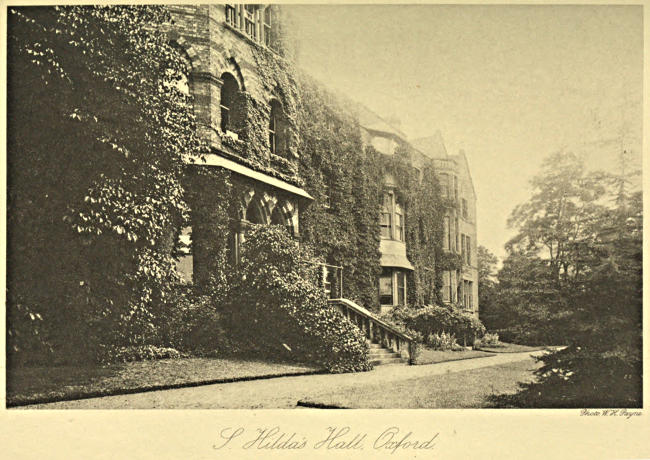
‘We had many parties at St. Hilda’s, and everybody admired
the house. The girls enjoy the boat very much; I hope there
will be no accidents. It is a very safe one, but one is always
nervous about the water....
‘I am pleased with the Higher Cambridge List ... and I am
glad that we manage to keep up our lists, because we do not buy
up our neighbours’ girls, and try not to make examinations the
end. Glad your girl has done so well.
‘I am working hard at the Magazine and my Reports to the
Council, and trying to rest a little after my Oxford labours.
On Tuesday I hope to go to the hills near Stroud.
‘I must lend you some day Streets and Lanes, by the late Miss
Benson. The Archbishop has sent me a copy.
‘May God bless and comfort your hearts, my dear children, and
make this light affliction, which is but for a moment, work out
an eternal good.’
To the same:—
‘Ambleside, May 1895.
‘ ... The lakes are more beautiful and lovable than I had
imagined. There is a singular charm in the hills round Ambleside,
they ripple like the sea.
‘You must not “feel” while you are so weak, just lie, as it
were, in the sepulchre, and then come out as Browning’s
Lazarus.’
To the same:—
‘July 1897.
‘I got home from London late last night, and it troubled me,
and you were much in my mind when I went to church; and
in the service it seemed to me that it must be your energies
were to be used to the full, and yet your married life, to which
you have now been called, does in some degree restrain you.
Hitherto I have thought you wanted, like an electric eel, to
recuperate; you have gone through too much lately. To-day,
it seemed to me as if you should still speak, but in writing; you
have the power of writing well. I think I speak better than
I write; I don’t know how you speak, but you can write.
Now see if speaking is not to be your work whether writing is.
How I feel I need solitude, and can’t write for want of it;
but you have solitude enough to enable you to write. A
little later, as I waited for a message, which sometimes comes at
the quiet times, the words came: “I became dumb, and opened
not my mouth, for it was Thy doing.” I thought it was to be
sent on to you, so there it is; not with your mouth, but with
your hand, and perhaps to a larger audience. I think the
solitude of the cycle will help you too....’
There was one friend and old pupil, a writer for
whose philosophical and poetical work in particular
Miss Beale had a great admiration, who received many
letters from her. A few extracts from these are given.
To Miss ——:—
‘December 1886.
‘I don’t think you will get any food in Spinoza. You say,
may we not adopt Agnosticism and say of these problems
honestly, “I will give it up”? But you cannot. We may try
to, but it is not human to be content to be caged in by this little
world of time and space. That restless discontent reaching out
to wider knowledge, to the infinite, is surely its own witness.
If not, Man, the crown of all things on earth, is the only
irrational creature upon it. You will not be able to give up
philosophy.
‘I quite agree that we are not to be allowed here so to
“make up our minds.” That spirit ever open to receive more
light, is what our Master spoke of as the childlike spirit.
‘Have you seen a little sixpenny book by Armstrong of
Leeds? He is a Unitarian, so I do not agree with the end;
but all the early chapters on the Belief in God are very good,
and I think you would like it. There are also some very
satisfactory sermons by Professor Momerie on the existence of
the soul. I read a great deal of philosophy when I get time.
Have you read Martineau’s Types of Ethical History? If not,
do. Also Green’s Prolegomena to Ethics. Last summer I read
Lotze’s Microcosmus, but I should recommend the two others
rather.
‘I wish you entered more than I think you do into Browning’s
thoughts. He has, it seems to me, so clearly set forth the
main basis of Faith, not systematically, but recurrently.
‘We must work out these matters for ourselves; but rest we
cannot. You cannot in the presence of your brother’s suffering—you
cannot in the presence of death say: “I care not to lift
the veil, or ever to know whether there is a curtain behind
which we pass or a dark abyss.”
‘Indeed, dear child, I do feel for you. When you are freer,
you must come and see me, and we will talk over things.
I shall not think you wicked, but believe that you do want
to know God, and that He is sorry for you, because you do
care, but cannot see.... It is only the contemptuous, what I
may call the omniscient Agnostic, that I do not want to have
anything to do with; those who sneer at the most pathetic
aspirations and hopes. The reverent and yet sorrowful doubt
which yet longs for dawn, shall one day be blest by the sunrise,
here or hereafter.’
To the same:—
‘January 5, 1887.
‘My dear Child,—No; I don’t mind your saying anything
that is in your heart.
‘As regards knowledge. We use this word, it seems, in
different senses. It is not at all identical with “to form a conception
of”: e.g. I cannot form a conception of what gravitation
or electricity is, but I know each in a sense. These are names
for something without which the kosmos as it is could not be.
Or I might perhaps illustrate better by saying I can form no
conception of the Universe, no complete conception, and yet from
my isolated spot I look up and say, it is. Of what can we form
a complete conception? Not of the “flower in the crannied
wall.”
‘Any other explanation of the facts of the Universe seems to
me incredible, except one, viz., that it is the utterance of
supreme Wisdom and Love, and that it is adapted to the
intelligence of finite beings. The Unity of law tells us there
is one God, the Creator and Ruler. As regards the hypothesis
of order coming out of chance atoms—the myth of a primæval
chaos—can any one entertain it? Ex nihil nihil; the order we
see in evolution must have existed with the original atoms, if
such were the basis of created life.
‘No, I do not think it your fault, but the fault of Spinoza’s
system that it cannot give you satisfaction. It is a revival, only
in another form, too, of the old Greek thought of Zeus, over
whom there was another God, Fate. So Spinoza’s and the
Greek Supreme were not Supreme.
‘Of course I can do nothing in a letter but suggest lines of
thought and lines of reading. After Armstrong, I should most
like you to take either Green’s Prolegomena or Martineau’s Types,
and read both several times. Green will help you to see the
unity underlying all possibility of knowledge.
‘It is perhaps more than anything the harmony of the Threefold
Unity which helps me to realise the conception of the
divine which Jesus uttered most clearly.
‘One sees the absolute physical unity, each atom forming
part of the complete whole, and standing in vital relation to the
whole.
‘One sees all knowledge as real, only when it takes its place
as in (can I say part of?) the Universal thought. One can see
things only when one sees all in God. But one sees that this
which we have separated off as physical nature, is yet the means
and the condition of the intellectual too; for Light, which is
necessary to vital processes, is the means by which the Universal
thought is revealed to our intelligence, by which God touches,
as it were, from without and awakens, and causes truly to live,
our intellectual being.
‘Thirdly, each—the physical, the intellectual—are felt by us
to be the means to the highest of all, the perfection of the moral
nature. Without this, goodness, power, and intellect would be
worthless or horrible; and as the material can only be translated
into the conception by the intellectual, so we feel that the moral
alone can interpret the intellectual.
‘That the full solution is not ours must seem natural to us,
who know ourselves to be shut in by space and time. But I am
sure that men will not long remain blind to other facts, as they
have been to some extent in this generation, owing to the
scientific sudden growth of our day.
‘The facts of conscience are to me quite inexplicable on any
other hypothesis than that of One who is supremely good
speaking to His children, not through “eye or ear,” but directly.
There is the unity of consciousness which makes memory possible,
and moral judgment possible; and yet there is a secondary
consciousness, the “categorical imperative,” the ideal goodness,
ever revealing to man a higher and better. What if the conscience
has never—I should say Except in One—received the
perfect vision of goodness? This is only to say that the receiver
is limited and imperfect, not that the perfect spiritual sun is not,
or rather I should say the universal light, for the sun is a localisation
of that which is invisible; is saturating through infinite
space. Words ever fail.
‘I know that endless questions are still unanswered, but this
seems to me to be a real knowledge, which is consistent and
which gives peace, that all other theories are inconsistent, and
that the highest, the moral being is starved upon them.’
To the same:—
‘January 27, 1892.
‘ ... The Bishop of Gloucester was here to-day, and began
talking about your Goethe, which he praised; he is a good
judge. I thought you would like to know. Would you send
him the book, and say I have asked you; he will tell people
about it. He reads philosophy too, and specially advises
Lotze.’
To the same:—
‘Written from Sudeley Castle, (probably) December 1893.
‘I fetched your Magazine from the Post Office about
five o’clock, and I have just read it through. I must express
to you how delighted I am with it. It is so clear, so well
written, it gets to the centre of things. I have seen nothing
you have done at all to compare with it. I must get the
number. I think I shall take in the Magazine, it looks good
throughout. A friend takes the philosophical review and lends
it to me. I might take this and lend it to her. I have a paper
in hand against an article in that, but I fear I shall not be able
to polish it off. You must have had days, weeks, of quiet
thought to write this. This makes me want you still more to
go to Oxford, and get to know Caird. Did I tell you I lunched
with Jowett tête-à-tête not long before his death?
‘You must come and see me if I can’t come to you....’
‘PS.—If you lend it to other friends, ascertain about the
postage.’
To the same:—
‘November 1895.
‘ ... I am sending you a little book on Psychology by a
young teacher and writer. I wish she had shown me the MS.
or the proof. If you feel inclined to look at it, and give her a
few written criticisms I should be glad. We want so much
common language in all these subjects, words are used so differently;
e.g. “conception” is not generally used as she does.
Intuition is another which we must fix the meaning of, for each
book one reads. Real, reason, etc., want defining. A dictionary
of philosophical terms should be made by some people authorised
to establish an Eirenicon.’
To the same:—
‘? 1896.
‘No; I am sure you ought not to give anything. I am sorry
even that the notice was sent you. Perhaps, however, you may
know some one or ones who may have money that they want
to put out in some way for the Master’s service, and might
think this a right way. We shall not get on if the Guild has
to produce funds unasked. I don’t want any one to be asked, but
they might be shown a paper.’
To the same:—
‘January 1897.
‘ ... I find I read Not made in Germany without knowing it
was yours. It is prettily written, but I don’t consider such
things worthy of you, and the variations on that one tune are
so very numerous. I wish we, like the Greeks, had things
written which turned on other problems. These things are
very well as a diversion. I wonder what is the subject of the
novel.
‘One of our teachers has been translating a book of Herbart’s.
I have sent for his introduction to philosophy. I will tell you
if I think it would do for what I want; something giving the
fundamental questions which come before beginners. Herbart
is much read now, but he is difficult to translate, and the people
who have tried have not been very successful; I wonder if you
have read any of him.
‘I send a letter of introduction to Miss Swanwick, I suppose
you know her translations and writings. I think she is only
second to Mrs. Browning, and she is charming, and young still.
When I last saw her, the friend of so many distinguished people,
her memory was wonderful. Tennyson had one of her books
open upon his table during the last days.’
To the same:—
‘(Date uncertain.)
‘ ... Herbart is a power. I have not got the book yet.
You really must not let yourself be diverted altogether from
philosophy. You have not thought and suffered so much for
nothing, and though your philosophy will come out in most
things, even in stories, you must give it us sometimes “neat.”
You remind me of Darwin’s earth-worms; you have had to
burrow and work underground, and you have turned up some
fruitful soil. Well, the Spirit which led you into the wilderness
will bring you out of it, and anoint you to tell some good
tidings.’
To the same:—
‘July 4, 1898.
‘ ... I am glad to hear you have come to a satisfactory agreement
with Blackwood. It is an advantage to have a leading
publisher. Now as regards the sonnet. I don’t feel as if anything
could make the Eros of later Greek religion pure. He
and Aphrodite have fallen from heaven, and I cannot think of
them at the same time with the Sufferer on Calvary—so it
rather jars on my feelings.
‘I know there is behind the myth the thought of love, of
one who is the offspring of truth and purity, of perfect beauty.
But love, associated with Eros as we know him, is not
love....
‘I am feeling wonderfully well; the body responds to the
spirit, and is refreshed too by the sympathy of my dear
children.’
Miss Beale’s correspondence with her ‘children’ frequently
concerned spiritual and mental difficulties of
various kinds. One or two of the letters she wrote on
such questions follow.
To one in religious doubt:—
‘(Undated.)
‘ ... How I wish some one abler and better than I could
help you now, but as God has given you to me, and something
of a mother’s heart with my children, I must try.
‘First: I would resolve to take some fixed time each day,
say ten minutes on first rising, just to plume one’s feathers for
some short flights above the earth.
‘Secondly: I would think of some of the blessings and thank
God for them.
‘Thirdly: Then I would plead for light; “Show me Thy
glory; but I would ask in humility, being content to wait till
the third or even the fourth watch.” I would ask, “Show me
the Father and it sufficeth; let me know Thy love, if I cannot
bear Thy glory.” And I would utter the prayer not only in
aspiration in spoken words, or only in feeling (which is the
music of prayer), but I would utter it in act, by reading in a
childlike spirit some Scripture—climbing as it were the Delectable
Mountains with the shepherds, and trying to make out
something through their glasses. Ask that same Spirit, which
has taught the spirit of man, and which I believe taught you
specially,—not for your own, but for the Church’s sake, to show
to you spiritual truths.
‘Fourthly: Then I would see if there was some selfishness,
some “Evil Eye” preventing my seeing, and ask deliverance
from any besetting sin.
‘Fifthly: I would ask God to let me offer some sacrifice,
permit me to join with Him, to hold communion with Him in
blessing another, and try to look for some to whom I might
give some cup of refreshment, some way of entering into His
joy, and of crucifying self.
‘Sixthly: I would place myself under such influences as have
lifted the souls of others. I would join in common worship as
much as possible in our prayers here and at Church.
‘Seventhly: I would receive the teaching of Jesus, and
through the bread and wine of earth ask God to feed me with
the Heavenly Manna.
‘Will you, my child, try some of these ways, and not be soon
weary? In due season you will reap, if you faint not.
‘Perhaps you will soon find some ways more suited to yourself
than some of those I have suggested; but you asked me.
I will try to get a beautiful prayer I have heard asking for light.
It may be that the answer will be a baptism of fire;—a heaping
coals of fire on our heads, and thus purifying us from evil. I
would say earnestly, compel yourself (though often unwillingly),
to look up to the Father, as the noblest souls have done in all
ages, whether Christian or not. You must catch some beams
of heavenly light, and see, as St. Stephen did, that man may be
glorified to stand at the Right Hand of God, and to share with
Him in carrying out His purposes of love. I think you will
be led on to see the Father revealed in the Son; to me He is
the Way, and it seems His words are true for us now: “No
man cometh unto the Father (cometh near so as to see and know
Him) but by Me.”
‘May the Good Shepherd lead you to green pastures and the
still waters of comfort.’
To one who found danger and unreality in forms and
ceremonies, and who wrote: ‘I feel I am cutting
myself off from you in writing like this.’ She
replied:—
‘PS.—Nothing will cut you off from me. I thought I had
given no rules, only such suggestions as a heathen philosopher
might have followed. I wrote my letter hastily; I should like
to see what I said.
‘Your letter gave me pain, which was partly selfish, to find
I was too ignorant to help you. We must have a little talk
some day.’
To one who had written that she had to fight hard
against pessimism caused by much unaccountable and
apparently needless suffering. She answered:—
‘November 10, 1895.
‘I think our faith in God, as in any person, rests more on
what He is than what He does....
‘Now I come to the conclusion:—
‘(1) That in Nature is revealed an intelligence whose limits
we cannot see; One, i.e. infinitely wise and mighty. (2) In
good men we see benevolence, the earnest desire to bless up to
the limits of their power. In the Christ we see this without
any limit of selfishness, and we say, If Man, the Son, is thus
loving, then the Father is love. “No man knoweth the Father,
but the Son.” We can approach God, so as to know the character
of God, only thus, it seems to me. You have here the
argument of Saul (Browning). Then when you allege against
the witness of the heart, the facts of Nature, I answer that
however inexplicable by us these facts are, this witness for God,
which comes from within, cannot be overthrown.
‘Nor, indeed, does that fact of animals preying on one another
trouble me much. Death to them, i.e. the stopping of the
activities of life suddenly, whilst they are in full vigour, seems
better than the gradual decay of sickness. There is with them
no anticipation and no joy in cruelty.
‘The facts of moral evil, those are what seem to overwhelm
one at times. There are children born into such terrible surroundings,
we say. There again we can see a little way up into
the darkness, and trust. We do see that the redemption of the
lost is often effected by the knowledge that others suffer through
their sin....
‘Do we not know enough of our interests and God’s infinite
wisdom to make us trust God for the universal good? Men
must be left to work out the consequences of evil, to bear them,
and learn it is God’s purpose for them to rise out of the darkness
into increasing love of His holy will. At length regenerated
humanity will so enter into sympathy with the Spirit of
God mediated through the indwelling Christ, that things in
Heaven and earth will be recapitulated in Him the Head, and
will become intelligently and lovingly obedient to that will.
The cost of suffering is as nothing compared with the infinite
good. I can only sketch the outline of my faith.’
The letter which follows was written to a pupil who,
while she was at school, did not personally know Miss
Beale very well. A talk at a Guild meeting eleven years
after she left revealed to Miss Beale’s penetrating eye
some distress caused by disillusionment and disappointment.
A fortnight afterwards she wrote:—
‘July 1898.
‘I have so often thought of our interrupted conversation,
and must take a bit of my first Saturday evening to write
a line.
‘You were feeling, I judge, somewhat as Wordsworth did
when he wrote the Ode on Immortality. This is, I think, how
the matter stands. When we are young, we think that perfection,
i.e. the ideal, can be found on earth—we set up,
perhaps, some earthly idol, and endow it with every excellence.
Then we find that we have been in a measure mistaken. What
shall we do? Doubtless there does then come upon us the
shadow of a great darkness, as we find how much evil there is,
and we are tempted to believe the lying word of Satan, that the
kingdoms of the world are his. Shall we then lower our ideal,
say we will conform to that which is, or believe the heavenly
proclamation—“the kingdoms of this world are become the
kingdoms of our Lord and of His Christ”—and work on to
make this as true as we can for our own souls, and for those
near us? We see that the ideals cannot be realised on earth,
because this is a place of discipline. Many make a worldly
marriage because they give up their ideal, and conform to what
is, instead of ever striving to bring about what ought to be—nothing
can make that right. But on the other hand we must
be content to be the companions of those who, like ourselves,
are “compassed about with infirmities,” to arm them for the
fight with evil, and to love those who are not perfect, as
Britomart did the Red Cross Knight. What I want you all to
keep before you is that one day the ideal will be realised, as the
Bible and our own hearts assure us, and to join the army of
light and go right on, confident of eventual victory. You have,
my dear child, a somewhat heavy burden of responsibility for
your age, and you miss the sustaining hand, but you must not
look down, but up! Take our first Cambridge Room motto:
“As the soar falcon, so I strive to fly,
In contemplation of the immortal sky.”
There we may look for the realisation of our earthly
endeavours, as Abt Vogler teaches. I wonder if you read
Browning. I wish you had a Browning Society.—With much
sympathy, ...’
To one who had written of the ‘Intolerance of Church
people’:—
‘July 1884.
‘ ... But it does seem to me quite impossible in education
to leave religion an open question, i.e., to teach without hypothesis.
How could we unite into one coherent whole the teaching
of optics, unless we presuppose the undulatory theory? Or the
facts of astronomy without the theory of gravitation? Yet
both may be, and are questioned. For some philosophical
theory must underlie all things, and no one can, it seems to me,
teach history, or geography, or science without it. We who
believe in Christian philosophy, and feel that it alone makes the
universe intelligible, and life worth living for ourselves or others;
who think that it is the power needed to give life to the world,
and to deliver us from evil and all the misery which oppresses
us, naturally desire with all the energy of our being to teach
it, and we most of us would not let little differences hinder our
working with those who acknowledge the immeasurable blessings
of Christ’s teaching. Here I found dissenters wishing
that the teaching of our College should be Church; because
they said there must be some basis; that they would rather let
their children hear sometimes what they disagreed with, and
judge for themselves, than that there should be no definite
teaching. They thought our Church was on the whole the
most liberal.
‘I am so grieved, dear friend, that any of us should bring
disgrace on our Teacher by our faults, but when we do what our
Master, the Truth, disapproved, the blame should not rest on
Him. It would not be just to you if we called a child who was
in your class and loved you, by your name when she told a lie.
Nor should you say, “See what Christians do,” when they sin
against Christ. In so far as they are untruthful they are un-Christian.
‘Then, had you not, even as you admit, condemned utterly
those whose conduct admitted of a more favourable interpretation?
We are not utterly truthful, unless we do more than
act up to our convictions, unless we do our utmost to make
those convictions as near the truth as we are able. And do you
know I felt so disappointed after talking to you the other day,
because it seemed to me as if you had not cared to search into
the depths of things, as if you were content to float about
instead of searching for the rock beneath the flood. Our
apprehension of the truth regarding the goodness of God, and
His purpose for us, and our duty to our Father and to one
another, seems to me the priceless pearl. I found you had not
read what I thought you would have read, the works in which the
ages have indeed drawn for us pictures of those who wrestled
with God in the darkness and cried—“Tell me Thy Name.”
And now you disappoint me again, as some other of my dear
Agnostic friends. They seem wanting in the tenderness of
those who ever look up to Jesus Christ, and therefore learn to
feel in the light of His example. This our miserable failure,
the habitual self-examination and definite confession of sin, helps
us to. There, I have told you what is in my heart. The
former on thinking over our conversation I meant to say,
because I love you. The latter, (the want of sympathy,) I did
not know of. I wonder if you will misunderstand me now,—perhaps,—but
I have felt you did not before.’
The following was written to a former student, who
after a time of great religious privilege had been assailed
by special temptation:—
‘August 1888.
‘My dear Friend,—I am grieved that you have suffered so
much, and yet it was not sent you in vain. It was to correct
faults in yourself, and to help you in your vocation to correct
those in others. You did not, I feel sure, yield to the wrong,
but fought against it, and temptation is not sin.
‘I have been thinking what you could read. Do you know
Froebel’s own works? I think some of these (which are not
light reading) would be nice for you on your travels. I like
always a book that is suitable for a little reading and much
thinking. He is so bathed in the spirit of love, so deeply Christian
and so full of the spirit of liberty. When you come home
you must come and pay us a visit,—that and Rosmini I should
like you to read. I have asked Miss Gore to send you one of
my photos, in case you care to have it, when we go home.—With
deep sympathy, yours most sincerely,
D. Beale.’
Among the letters are many to old pupils on the
deaths of relations or friends. The next was written
to Miss Alice Owen, now Mrs. Mark Collet, on the
anniversary of her mother’s death:—
‘June 1891.
‘This was a birthday eight years ago into a world of larger
scope than this, and I feel as if her spirit were still watching
over those she loved on earth....
‘Surely the tides of eternal love, flowing in upon our narrow
lives, will make us all of one spirit, sorrowing and rejoicing
with one another, instead of judging, because we feel, as she
taught in that beautiful parable, that we are one.
‘May our Lord give you an ever larger measure of His own
love.’
The next letter refers to the death of Mrs. Russell
Gurney:—
‘October 1896.
‘I got a letter from Orme Square this morning. Our beloved
friend entered into rest yesterday. I think of the glad meeting
of those who were kindred souls on earth. I had also a note
from Addington saying how thankful Mrs. Benson is, and
happy in spite of her loss.’
Several other letters of a kindred nature follow.
To Miss Giles, on the death of her father:—
‘April 1871.
‘Still in one way we who are old suffer less from parting. To
us the time seems so short, ere we may hope to meet once more
where are no more partings or tears.’
To Miss Susan Wood, on the death of her mother:—
‘May 1880.
‘I need not tell you I have felt much for you. One could
not have wished the suffering prolonged, and yet one does not
feel the loss less. Happily, one seems generally to forget, when
all is over, the last painful incidents of the sickness, and to remember
the past years. Few have had a more devoted mother.
How proud she was of your successes! How old it makes us
feel when we take our place in the front rank of the army of
life; may we be able to say, when we too are struck down, “I
have fought a good fight.” May God bless your work, my dear
child, to the everlasting weal of those whom He has given you.’
To Miss Frances Crawley, afterwards Mrs. Wells:—
‘July 1881.
‘I must write you one line of sympathy in this great
sorrow. I know how much you loved your dear father, and
had longed for this visit, and now there will be a great blank.
You will not think now “How glad he will be if I do well.”
But on the other hand, my dear child, you will feel you must be
more than ever to your mother. You children will be all to her
now. Besides, God never takes but He also gives—only we
often miss the gift because we don’t look for it. He will help
you to know Him better as your Father, partly because you will
think of your own father as near Him, for where our treasure is,
there our hearts are also. You will think more of pleasing
Him, and so preparing to meet those who have loved you and
loved God, where there will be no more death for ever.’
To an old pupil, on the death of her father:—
‘November 9, 1896.
‘My dear Child,—This is indeed a blessed death for one
so good as your father; you must give thanks for him.
‘There is no service I think so strengthening as the burial;
may you be comforted and strengthened for the battle of life
by a clearer vision of that unseen host which is ever near, though
“our eyes are holden that we see them not” through want of
faith. Soon must we join their ranks. Shall we join in their
psalms of thanksgiving?’
To Miss Strong, on the death of Miss Margaret
Clarke:—
‘February 3, 1897.
‘Indeed I am grieved; she has been a power for good, and
has sent out some grand workers, and I shall miss her greatly.
I am thankful I was with her at Christmas.
‘One feels sure “her works will follow her,” and He who
gave her power will raise up others. It is, so far as one can see,
too heavy a burden for Kate alone. Her memory will be a
power, her life was so wonderfully guided, and one feels sure she
has work to do beyond, for which the training of earth will have
prepared her.’
To Miss Rowand, on the death of her mother:—
‘June 1901.
‘It is grievous for you and those who loved that dear and
noble, simple-minded woman, for her goodness gave unity to
her life. Now the alabaster box is broken, only the fragrance
of the life remains. She has been spared the living death such
as I have seen, when the soul finds in the body a tomb. She
is released and doubtless carries on ministries of love with your
noble father and beloved brother.
‘I have just seen Fräulein, whose only sister has just passed
away.
‘How little the sorrows of earth will seem to us as we look
back, I think; even as many which even here issue in blessing.
We realise that all things do indeed “work together for good to
them that love God,” and I know that through this fresh sorrow
the fire will burn up more and more of the earthly, so that the
spirit may shine forth more brightly “to give light to all that
are in the house.”—Yours with deep sympathy and affection.’
To Miss Caines, just before her death:—
‘March 1901.
‘My very dear Friend,—We can only pray now that if it
be God’s will you may be spared to the many who love you, and
to whom you have been a blessing during these many years of
faithful service. But if the Master should come and call for you,
then He will go with you through the Valley of the Shadow of
Death. His Rod and Staff which stay your tottering steps will
comfort you, and He will bring you forth to the light.
‘We must say for you and for ourselves;—“Jesus, I trust
Thee.” We do believe that what the world calls Death is
birth into a brighter world.
‘May we all meet again where sorrow and sighing are no
more.—With much love, your very affectionate.’
To a friend, on the death of Miss Caines:—
‘This morning my dear friend passed away, full of peace and
content to go. The children have been all that we could wish,
full of sympathy, but quietly impressed and very sorrowful. We
do not wish them to leave, but to learn to look calmly on death,
and hopefully up to Him Who has taught His servants to
triumph over death....
‘The loss to me is more than I can say. God’s will be done.’
The next letter is to Mrs. Cooper,[105] a much-loved old
pupil, who in 1902 lost a son, a promising young artist,
and seven months later her husband through death:—
‘June 1903.
‘I am sending you such a nice sermon by our good bishop, which
I think you will like. I quite agree with you that one ought
not to seek intercourse through mediums. I would never join
the Psychical Society. It was right to enquire as these scientific
men have done, but the inexperienced are almost sure to be taken
in by such, and it seems to me that we ought not to try to draw
aside the veil but wait until God’s herald bids us enter.
‘I think you must expect to feel the sense of loss becoming
greater, but then you will get to feel how short is the time of
mourning on earth, and to ascend in heart and mind—and so to
be above the storms and clouds of earth—even as the lark—and
yet with him to hover over the earthly home, “that nest which
you can drop into at will,—Those quivering limbs comprest.”
You will want to speak to and help others with the comfort
wherewith you are comforted of God....
‘It is nice to look back on that time forty years ago. I remember
your confessions to me then. Well, you have not been
forsaken, nor left to beg your bread.’
To the same:—
‘October 1903.
‘I have just heard of this fresh trouble. Surely you must be
intended to do some work for others specially needing heart’s
blood.—This paper was put into my hands just as I heard of your
fresh disappointment and anxiety.’
To the Misses Hibbert Ware, on the death of their
sister:—
‘March 1905.
‘Indeed one ought only to give thanks for her. I think of
her looking down on us all at peace having escaped from the
long enduring pain associated with this earthly body, and springing
up like the lark into the larger heaven.
‘Well, we must wait to understand these things which it has
not entered into the heart of man to conceive in all their joyful
reality, though in some measure they are revealed here to saintly
souls which have been made partakers of Christ’s sufferings.’
To Mrs. Mace, on the death of her husband:—
‘May 1906.
‘Only to-day did I hear of the death of Mr. Mace.... It
did seem grievous after his suffering with so much courage and
hope the operation. One can only give thanks now that the
soul has escaped from “the body of humiliation,” through which
it has risen to the spiritual life. I don’t like the word resurrection,
ἀνάστασις does not suggest that the soul has put on its
old clothing, after being delivered from the body of corruption.
You must be glad that he is free.’
Miss Beale wrote several letters, from which extracts
are given, to Miss Belcher during her last illness.
The following was written after the Head-mistresses’
Conference on October 8 and 9 at Oxford
in 1898:—
‘October 1898.
‘My dear Friend,—I got home last night. Everybody was
asking and thinking about you and missing you so much. I
hoped for a line this morning; Susan will doubtless write to-day.
I brought back Agnes Body for the Sunday here. The
text in my birthday book for to-day is: “I have prayed for thee
that thy faith fail not.” I know this prayer is fulfilled for you.
How I long to have some real talk with you now; but I think
even in the body there is communion, and still more out of the
body. It seems to me as if Miss Carter must be with you.
Your love and care for her was returned in blessings on your
own life, and through you on others. Miss Strong looks ill. She
has been staying with her Bishop; that will strengthen her.
That good Miss Day of Westminster was there, and sweet Mrs.
Woodhouse of Sheffield.
‘I feel sure the Conference will do good, there were so many
good women there;—only we missed one.’
A day or two later she wrote:—
‘My very dear Friend,—I feel somewhat cheered by Susan’s
letter to-night. Each morning I have so many enquiries, “Have
you heard?” Susan is good in writing. Here are three letters
from some staying at St. Hilda’s, where we were always thinking
of you....
‘Just two years on the 11th, since the Archbishop fell asleep.
I wonder if he looks down at the school, and its first Head-mistress
too. Shall we see and be able in some measure to
“succour” those on earth? May the peace of God which
passeth all understanding be with you.’
The next alludes to a proposed visit of Miss Beale to
Miss Belcher:—
‘St. Luke’s Day.
‘Dear Friend,—I am so looking forward to Friday. I
thought of you so much on this the Physician’s day, as we sang
that beautiful hymn and Psalm xxx.; and our window told of
the raising of the daughter by the Healer. My own life seems
to me almost a resurrection, I must hope that you too may be
raised up to do work on earth, ere you go to a higher sphere.’
After this visit Miss Belcher wrote:—
‘My dear Friend,—The strength and comfort of your
visit has been with me ever since, and far from its doing me any
harm it has done me untold good. May God bless you for
having imparted to me so richly of the “comfort wherewith you
yourself have been comforted of God.” I do so trust you were
not over-tired; hope to hear from some one to-morrow.
‘Will you call me Marian in our private letters? I have
never liked being only Miss Belcher, and since the close communion
and rich gift of yesterday, I feel I should like it.’
Miss Beale’s reply was:—
‘October 23, 1898.
‘Dearest Marian,—It is good to hear that you were none
the worse for my visit, and that our Lord put into my mouth
some words of comfort. I shall hope to hear about Dr. Broadbent.
I had a nice note from Susan. All here were so glad
to get news of you direct....
‘I wonder if you know Fechner’s little book; there is one
chapter I like much, from which I am sending you some
extracts.’
The next letter was written after an operation Miss
Belcher had undergone:—
‘ ... I lingered this morning, and the postman brought me
Susan’s cheerful letter, just as I was starting, and I was able to
make the service specially a Eucharist on your account. What
a wonderful epistle; it is one to feed on. It tells how suffering
strengthens the inner man, and enlarges one’s sympathies and
makes us know the love of God. And the Gospel tells of
renewed life after going down nearly to the grave. You and I
can give thanks for both; may St. Paul’s wish be accomplished
in us.’
Miss Belcher replied:—
‘Sunday Evening.
‘My dear Miss Beale,—My first few lines written by myself
must be to you. All through last week the Epistle and your
words about it have been such a help. It was just like one of
your Scripture lessons every day all to myself. I am still going
on so well, but of course it must take time, and I am not out of
the wood. Still, as you said, all is well and will be well. Thank
you so much for Lilla’s letter. I am so sorry she is not well,
and Lucy Soulsby too. I am so rejoiced to hear you are so
well and vigorous, and that College is overflowing. How wonderful
it all is, and so inspiring.
‘I had begun Archbishop Benson’s St. Cyprian and your book
before the operation, but have been too weak to read since. I
hope to begin to-morrow. If you have read anything lately you
think I should like, will you tell me the names? It must not
be philosophy. I hope to have the best papers of the Church
Congress read to me....’
Shortly after this Miss Belcher wrote herself on an
anticipated visit from another physician:—
‘My very dear Friend,— ... Dr. Robson of Leeds comes
to-morrow. I know you will pray that the “right judgment”
will be given. It is thought he will operate, but not certain.
Please let Eliza and Susan Draper know. I cannot forget all I
owe to you, my friend and guide, of so many years. We have
a private celebration to-morrow at eight, but you will not get this
in time to think of us.—Ever your loving and grateful friend,
‘M. Belcher.
‘You shall hear as soon as possible.’
‘Dearest Marian,—I have heard from Susan.... Of
course we can’t understand, and we only know that all is well.
I thought of you so much at prayers this morning. I read the
Lesson instead of the Epistle. “The souls of the righteous are
in the hands of God, and there shall no torment touch them.”
We missed your accustomed visit on the term holiday yesterday.’
‘First Sunday in Advent, 1898.
‘My very dear Marian,—We were all so full of hope at
first, and are much disappointed that relief has not come, but that
you are still stretched upon the cross. “No chastening for the
present seemeth to be joyous but grievous, yet at such times one can
just think of the ‘Mystery of Pain,’ and realise that each sufferer
does in uniting his will with God’s in some measure, ‘fill up
that which is behind of the afflictions of Christ ... for His
body’s sake.’” I think perhaps you may be suffering specially
for one, that her faith may be once more awakened. Every
sufferer thus “lifted up” does in a measure draw the hearts of
others to Him through whom we are able to reveal the power
of faith.... I said to Miss Drummond, “I dare say you would
not have been spared any of the suffering”; she answered so
heartily, “not one half-hour.” We see now what a wonderful
work she did among the College boys, and it must be that your
suffering is a part of the work God has given you to do for the
school, and that you, too, will be enabled to say “not one half-hour,”
when the darkness passes away, and the true light shines
into the things of earth, and we know as we are known. I
know that suffering so claims the attention, but one can only
know and believe, not feel it; but it is much to live by faith. Faith
is the illuminating power through which alone we truly know.
Was not Miss Carter’s suffering felt by you to be mediatorial
too, and you are her successor. I shall try to spend a few days
with Miss Martin at Christmas.
‘To-day the Jairus window comes before me; the thought of
the Lord sending away all those who pressed round the maiden,
that she might know the advent of Him who is the Lord and
Giver of life.’
The following is the last letter Miss Beale wrote
to Miss Belcher:—
‘December 5, 1898.
‘My very dear Friend,—I have tried to write several
times, but tore up what I wrote. Susan is good in telling me
about you, and at times my heart sinks, when I think of all you
are suffering, though there do seem to me to be some hopeful
signs.... Well, we ought not, I suppose, to wish, we are so
sure that “in all our afflictions He is afflicted,” and “the angel
of His presence saves us,” and makes our souls strong to bear
and our “light affliction is but for a moment.”
‘I dare say this term has seemed to you unending. I think
when the strain of thinking about school is taken off, you will
feel stronger. I hope to go to Kilburn from January 5 to the
9th; there we shall think much about you. I am just writing
about St. Hilda’s East.... Things seem going on well, I
think I shall stay there after the Retreat, and try to get more
into touch.’
Enclosed in this letter were some verses from Ken’s
‘Midnight Hymn,’ with the words, ‘I thought you
might like this if awake at night.’
After Miss Belcher’s death on December 15, 1898,
Miss Beale wrote to Miss Strong: ‘Three of my noble-hearted
friends gone so lately—Miss Buss, Miss Clarke,
and Marian Belcher. The road to the Dark Tower gets
lonely, but we look beyond.’
A few letters on general subjects are given. The first
of these was written to Miss Susan Wood, in 1897, in
reply to an inquiry about women teachers:—
‘I should not like to say I would have none but women
teachers. I consider a combination good, better than either
men or women only. Still, if a woman is equal in knowledge
and ability, I consider she generally teaches better than a man.
If all women are ultimately forced to go to the University, the
higher teaching will be taken out of their hands, or else women
will teach there.’
The following extract, from a letter to Miss Sturge
in October 1902, deals with the developments of the
College:—
‘The numbers enable us to have an aggregate of schools and
to have virtually about seven who might have and ought—Headships
elsewhere, had they not an independent sphere of their
own.
‘Lastly, are you right in saying that an inspiring personality
can be taken away? The inspiration is not from any person
who can pass away; we are but the earthen vessels; the light
persists and is given just so long as it is needed, to any one
who has to give light. The inspiration for the Headship will be
given to my successor in turn....
‘I do hope God may allow me to go on longer, and it is
a comfort to feel that you are glad I should.
‘As regards the growing size of the College. I may add
in addition to what I have said, that I have never wished
independently to add to the size merely, and that in each
development I have felt I was obliged to go on, though
often I dreaded it; e.g. the training of teachers could not
be refused when Miss Newman offered. Then the Kindergarten
grew up, and the elementary teachers was really forced
on one. It is unprofitable in money (the Elementary School
Department), and a great strain on me, but I feel we have to do
this special work. In fact, it is not our work, but we are set
here by the great Captain, and I trust we are taking our share
in advancing somewhat the kingdom of truth and righteousness.
I cannot see that in this erection of buildings, or in any other
way, we are acting from self, but under direction. I have not
yet read the comments on the buildings, but wanted to reply to
the letter at once.’
The following was written to Bishop Fraser of Manchester,
who had publicly referred with approbation to
the saying of Thucydides, that ‘that woman was most
to be admired who was least spoken of whether for
good or evil’:—
‘December 1878.
‘My Lord,—We owe to you so much for education work
that I cannot but feel sorry you should by your recent quotation
from Thucydides place before women a standard lower than the
highest. I felt bound to protest against it, when a few days
later I read a paper before the Social Science Congress in
my own schoolroom.
‘Will the excuse be received from us: “I was afraid of being
spoken of for good, and so I hid my talent in a napkin?”
Must we not expect that our work will be measured, as was that
of another woman by the words, “She hath done what she
could?” I venture to enclose a few lines from an article
of mine, signed “A Utopian,” in a Fraser[106] of 1866. It was
provoked by the same quotation from Thucydides in a Quarterly
of that year.—I am, my Lord, yours with sincere respect and
esteem,
D. Beale.’
To Mrs. Ashley Smith, at that date Miss Lucy Hall,
a relation of Bishop Fraser’s, on the same subject:—
‘December 12, 1878.
‘Dear Lucy,—I was glad to hear you thought you could be
of use in the Board School. Could you not teach the boys some
mathematics? If you could, I will send you an amusing book
about Euclid.
‘I have asked Miss Gore to send you a copy of what I wrote
to the Bishop. I think he should have got his secretary just to
send me a line. I did not do it in a perky spirit, but I felt bound
to protest, and having protested, I thought I should rather say
to him, why. Many women do leave undone the things they
ought to do, because they shrink from coming forward. I have
done so myself. If he would preach that we should do what we
ought in God’s sight, and never trouble our heads about what
people say, when our conscience speaks, it would be better.
Perhaps he will think twice before he again quotes that, and if
so, I shall be satisfied. I would not care, if he were not so good
and clever that people listen to what he says. He is, too, not
conventional, yet he says what may promote a wrong kind
of conventionality. I have since seen such a nice bit of a sermon
about the idle lives that women lead; so if you do see him,
I should like you to ask him about this too.
‘You must let me know when you really get to work as
manager.’
To Miss Laurie, after reading Pasteur’s Life:—
‘1902.
‘I want to have a general conference about organising our
Science work better; we are using razors for stone-cutting.
I should like a great deal of the correcting taken from the
“Professoriate,” and young specialists entrusted with work
under superintendence. Talk with M. Reid and A. Johnson.
We ought to let our superior minds “expatiate,” and let me
have a few notes, as I can’t talk much now. We might bring
up a body of inspirers as well as workers. Pasteur’s life has
specially excited me to ask what more we could do. The
teachers ought to read more of the lives of discoverers, e.g.
Lodge (though that is too slight, History of Matter, etc. etc.).
‘If there are disadvantages in the London changes, at least I
hope we shall get more liberty; let us try to find “a soul of
goodness in things evil.”
‘What a beautiful character is Pasteur’s. I find it quite
a Sunday book.’
To Miss Nixon, on Henry George’s Progress and
Poverty:—
‘April 1884.
‘I am sorry to have given you pain, but I do hope you will
read the writings of those who understand political economy
better than we do. I think if you had read about the evils
which preceded the abolition of the old Poor Law, you would
have seen why I cannot approve Mr. George’s plans, and not
thought that I desire less than you do that these miseries of
the people should be lessened. It is so important for us teachers
to try to get right views about history; to pray by our acts that
we may have “a right judgment in all things.”
‘It is more pathetic than anything to see people led by false
hopes to follow wandering fires to their destruction; and such,
I am sure, are some of the new lights. The history of the
Crusades and the French Revolution ought not to have been
written in vain for us. There are three articles that I think you
ought to read,—the Duke of Argyle’s, Mr. Herbert Spencer’s,
and Mr. Brodrick’s, in the last Nineteenth Century and Contemporary.
‘Reforms I earnestly desire on laws of succession, land transfer,
etc. etc., but I am sure that no external bettering of conditions
can do good without this is the outcome of right principles, and
that people can be raised only by raising the moral standard
of all. Perhaps we may have time to talk some day.
To Mr. Coates after a lecture he had given at
Cheltenham:—
‘July 1888.
‘Dear Mr. Coates,— ... What I especially regretted was
that the lecture raised a number of questions to which it
furnished no answers, but seemed to me to suggest erroneous
ones; words were used which were not defined.
‘(1) Persecution; (2) Official dignity; (3) Rights of the
individual in relation to the community.
‘(1) Now as regards persecution, you said people could not, if
they were in earnest, help persecuting. That was equivalent to
the assertion that persecution was right; but you did not say
what you understood by persecution. Everything depends on
that to girls accustomed to associate persecution with bodily
torture. I think what you said would suggest wrong ideas. I
can’t agree with your general proposition, but of course I may
be wrong.
‘(2) “A Dog in Office” is to me a different being from one
who has not been appointed to the charge. He feels it, and
I feel it. He respects himself more, and by his “investiture,”
though it be only by a costermonger, he becomes capable of acts
of which he would otherwise have been incapable, and his bearing,
in combination with his legitimate title derived from the owner
of the barrow, obtains recognition from all the street curs.
‘I may, of course, be superstitious, but I do regard a consecrated
king, a President elected deliberately by a great nation,
a man solemnly set apart to serve a church, as in some sense
different from others. It seems to me that this is a matter of
some importance in these days, when the sacredness of human
relationships is called in question. I think we teachers cannot
feel too strongly the duty of doing for thought what the feudal
lords did for material forces in erecting bulwarks or breakwaters
against the floods of undisciplined opinions in question, passion
clothed in rags of thought. We want, like the old alchemists,
to make the indeterminate clouds of smoke like actual forms.
‘I do not think you and I really differ, but I suppose the fact
of my having a little kingdom has aggravated my sense of
responsibility, and I can’t help always regarding teaching as
purposeful. I hold in abhorrence the maxim “Art for Art’s
sake.” I always want it to have a purifying influence on the
character. I believe you do the same, only you are afraid of
“preaching.”
‘You will be saying, “I wish some one else shared my aversion,”
so I will spare you No. 3. I hope you will not misunderstand
me.’
To Mrs. Rix:—
‘January 1891.
‘It is always an anxious thing when people of different nations
marry....
‘I hope your good husband will not desert his post. I feel
sure these scientific things were given us to prevent our feeling
crushed by the weight of the “unintelligible world” of philosophy,
and the atonement of science and philosophy is the work
of our age—through nature we have to go to find the spiritual
Christ. Poor Mr. Lant Carpenter. I wonder if it was the
Sphinx who killed him.’
To Sir Joshua Fitch, after the death of Miss Buss:—
‘July (?) 1897.
‘I have been thinking what I could write to you about Miss
Buss. I don’t think I could send you anything that would help
in an article, or say much more than I have in the Guardian.
I am spoken of as her life-long friend, but I did not know her
until long after I came to Cheltenham, a little before you joined
our Council. It is said in many papers that I attended with her
the evening classes at Queen’s College. I never did. She
assisted at the evolution which transformed our governing body
from a local Committee to what it is now, and by getting an
enlarged Council we were saved from dying of atrophy....
‘From that time we were intimately associated in educational
movements, and I ever felt that she was utterly to be trusted
never to think,—much less to do anything but what was true,
straightforward, unselfish. She was deeply, unostentatiously
religious, lived in the spirit of prayer, and had the love of God
in its twofold sense ever guiding her thought and actions.
Often have we knelt together, at her request, the last thing at
night and said together the Veni Creator.
‘If I spoke the other day of troubles with the governing bodies—it
was not from anything definite that she said to me; but
she has often, to allay my impatience, repeated what one of her
Governors said: “Do you think we come here to register your
decrees?” She received it as a deserved reproof, though, of
course, she must have known what was best for the school, and
never desired her selfish good,—only that of the School.
‘The large view she took of the general outlook for the
growing up teachers struck me much. The provision for the
future, the opening of new occupations, the health and bodily
development. Her gymnasium, I think, she herself built and
gave to the school.... She had a lady doctor to examine the
girls, weigh them, etc., etc.
‘The formation of the Head-mistresses’ Association was
entirely due to her. The first meeting, and, I think, the second
was held at Myra Lodge. She was very anxious about the
“Teachers’ Guild.”
‘I sat with her on the Council of the Church Schools’ Company,
and was surprised at the amount of time and thought she
gave to it. With such solicitude she used to say, “My dear,
we must help these young Head-mistresses.” Whenever any
school-mistress got into difficulties she was of such sympathy
and help.
‘Then she tried so much to help her old girls, to promote
the love of reading in her staff, to call out their helpfulness in
many ways. That exhibition of things made that cost nothing,
was a very original idea, and taught economy by an object
lesson....
‘The ways in which she used to help poor girls were hardly
known to any one; clothes she used to get sent to them, and
she had friends to whom she could mention cases where money
help was needed and get it. Then she was not one to give up
because she could not influence people by what were for her the
highest motives; but appealed to the best in them, would give
ethics when she could not give religion, and when she spoke of
wrong, it was with a sorrow which covered the indignation.
‘There was a real solicitude, in spite of her many occupations,
to help all teachers. She would get books to send round to
other schools to help them, and never seemed to think of any
being rivals, but rather fellow-workers.
‘But you must know most of what I am saying, for you knew
her well, and she specially loved your wife. I am only writing
what comes to my mind to do what I can; but you see I have
so few definite facts, and I knew her only when she was full-grown
in character and her work established.
‘I think, having a Boarding House as well as a School was a
mistake, and she felt it so at last. It was impossible for her to
attend to it much herself; and I think she should not have
rushed off on foreign tours at Christmas.
‘Finally, perhaps, I may say that she was, it seemed to me,
always pained and surprised at wrong in others, and expectant
of good, and able to see the latent good underlying the apparent
evil. She had the charity that hopeth all things.
‘Her generosity in money matters was very great, especially
to her family. She used to speak with such joy and pride of the
battles her brother fought in Shoreditch, and her brave sister-in-law,
and great was her affection for her nephew.
‘Forgive my incoherence please, and take the will for the
deed.’
Miss Beale wrote but little about herself, but in her
correspondence with an intimate friend, she would
give glimpses of her own personal life, even of her doings,
as well as of her thought and reading. Her letters to
Miss Amy Giles are the most interesting from this point
of view, covering as they do the last period of her life.
Some extracts from these are given:—
‘July 6, 1897.
‘Dear Amy,—I wonder what you will do now that you have
quite lost your beloved mother. I was talking with Miss
Sewell about you, and said I wished you could come and spend a
week here.... If you came the week after next, perhaps you
would like to stay for our Quiet Days at the end.’
To the same:—
‘August 15, 1897.
‘I have kept your letter so long, hoping I might see my way
to pay you a visit, which I should so very much like to do, but
I am afraid the prospect is a diminishing one. It was a great
pleasure to renew my acquaintance with one whom I had loved
as a pupil, and to find we had grown even nearer during the
intervening years. It would, too, be a pleasure to see Miss
Sewell, for whom I have so great an admiration. I will not
altogether give up hopes, but I am much afraid it will be impossible.
The work for Longmans is to fill two hundred pages. I
get ordinarily a hundred and fifty letters a week on College
business, and now that we are beginning this Elementary work,
there is a Head to be found, prospectuses to be drawn up, the
Education Office to be consulted, etc., and also the Magazine
to be edited, and some few people I must see....
‘There are many things one has to deny one’s self “for the
work’s sake,” but it is worth while. I cannot be too thankful
for being allowed to do it.’
To the same:—
‘August 25, 1898.
‘My sister has come home on purpose, and I am spending a
week with her on the hills; my niece helping to copy the MS.’
In the summer holidays of 1898 Miss Beale stayed
with Miss Giles at Bonchurch. They afterwards visited
Marlborough College and Savernake Forest together,
parting at Marlborough station. Miss Beale wrote after
this to Miss Giles:—
‘August 28, 1898.
‘I will own that after you were gone all things seemed
colder.... The doctor thought me wonderfully well, and my
ears much better than usual after so long an absence. He says
I can go to-morrow, and highly approves of cycling if I can do
it.... May the spiritual sun ever rise for you, my dear child,
more and more until the perfect day.’
To the same:—
‘September 7, 1898.
‘I had some bicycle lessons at Woodchester, but all united in
recommending tricycling instead for me.’
To the same:—
‘October 1898.
‘That cycling is wonderful, I am so much better.’
To the same:—
‘November 13, 1898.
‘Miss Belcher is still very ill, but yesterday brought me a
gleam of hope. Thanks to you I am wonderfully well. I have
cycled two mornings as far as our Sanatorium, and got back
about 8 A.M. ... I think this renewed life must mean that
there is some more work for me to do, or that I want strength
to bear some coming trials....
‘We have been getting some lectures from Mr. de Sélincourt,
also a son-in-law. We like him very much.... Next Saturday
I have to attend six meetings. I had to go to London
lately, and spent a night at St. Hilda’s East; it looks so nice,
and seems going on so well.’
To the same:—
‘November 29, 1898.
‘I am glad you have seen the Chapel of the Ascension. Mr.
Shields is far the best interpreter I have ever seen of Bible
thoughts in pictures.... Thanks to you I am wonderfully
strong this term.... I have joined the Aristotelian Society.
I shall almost never, perhaps never be able to attend the meetings,
but I shall get papers.... Miss Belcher is still battling with
the disease. Sometimes we hope, and then we fear we may lose
her, but to gain time is much.’
To the same. Written when there was some idea of
Miss Giles living abroad:—
‘May 14, 1899.
‘I don’t like the idea of your being uprooted from England....
It is different to go for a time, but it seems to me that
most English people who live abroad have their lives comparatively
wasted.’
To the same. After alluding to the death of Mrs.
Moyle:—
‘July 16, 1899.
‘It seems so wonderful that I should be alive, and see so many
dear children pass away.’
To the same. Speaking of the South African War:—
‘December 26, 1899.
‘It is indeed a sad time, and I don’t see how it is to end;
surely we as a nation have to pass through the fire.... I think
all the advantages we women have had this last half century
were to prepare us for some terrible trials. Shall we be able to
look up and lift up our heads above this earth, and know that
salvation draweth nigh? I think you will understand me.’
To the same. Also about the South African War:—
‘February 10, 1900.
‘It is difficult to keep up one’s active powers with this nightmare:
one is so sure that all suffering is intended to be purifying,
and so we must glorify God in the fires. War does seem to be
waged in a more humane spirit than ever before, that is one
comfort, and there are many others.’
To the same. Miss Giles had sent a paper for the
Magazine:—
‘September 1900.
‘I feel sure I shall not accept Guinevere as a subject for our
magazine. I am not fond of the Idylls.’
To the same. On recovering from bronchitis:—
‘1903.
‘Thanks for your kind offer, but I must not ask any one to
stay this term; I must reserve every bit of strength for the
work.’
To the same. Towards the end of the Easter holidays,
when she had been confined to her room with a bronchial
attack:—
‘I have been reading a very pretty book, The House of Quiet.
Now I have Herbert Spencer’s Autobiography, which I am
not reading, but a friend picks out bits for me. I have
been going over again some old friends, Dr. Jekyl, Cecilia de
Noel, etc.’
To the same:—
‘June 1905.
‘I had a very enjoyable visit to Winchester to the annual
meeting of head-mistresses, and last week I dined at the Clothworkers’,
my first experience of a City company’s dinner. There
were many interesting people.’
In the summer holidays of 1905 Miss Giles accompanied
Miss Beale to Oeynhausen. The two following
letters concern the preparation made for this visit to the
German baths.
‘July 1905.
‘Have you quite made up your mind not to come to the
Quiet Days?... remember you will have a period of spiritual
starvation as regards church-going....
‘I mean to take as little as possible ... we do no visiting
... a few books I must have. If you come, you could write
out your notes of addresses and read them to me, as I am not
likely to hear them.... We have had twelve concerts, and I
was present at most of them. I have not yet signed a report,
and have taken leave of only some of the about one hundred and
twenty who will leave.
‘I thought of taking Illingworth’s Personality,—and perhaps
Lux Mundi, if you do not know it well; also some Hamlet
books: but I shall take chiefly light books, in a material sense.’
On returning from Germany Miss Beale went to
Hyde Court for her niece’s wedding, and wrote on
arrival to Miss Giles.
‘September 1905.
‘Lena looks lovely!’
A letter followed describing the wedding, and concluding
thus:—
‘The country is looking lovely—even in the rain; but the
swallows are flying about in great excitement. I think they
must be departing at once. I wonder how long I shall be
privileged to go on working before I too migrate. I do hope I
may be able to work on to the end....’
To the same:—
‘September 1905.
‘I had nightmare last night about war in India. Russia is
quite ready to turn her armies into Afghanistan, and she is
allowed to keep all ready in Manchuria. Well, one can only
hope that still out of the strife will come soul evolution.’
In September 1905 Miss Beale’s letters speak of
exhaustion, but others wrote of her that she was busy,
full of energy, and ‘does not seem to tire.’
To the same. Speaking of her visit to London in the
Christmas holidays:—
‘January 15, 1906.
‘One afternoon I spent with Mrs. Benson, and Miss Benson
lent me the book recounting her digging up of the Temple of
Mut. Arthur Benson too was there, and Miss Tait and Mrs.
Henry Sidgwick.
‘What a revolution we have! If we had stood still things
might have been as they are in Russia. One could not be satisfied
with the late government, but one dreads violent changes;
it is well there are a few strong men in the Ministry. Mr.
Balfour deserves his fate for not bringing in a re-distribution
Bill, and for tyrannising—but one feels sorry for him too.
‘PS.—Think of us on Tuesday’ (the opening day of term),
‘I feel so weak.’
The weakness to which Miss Beale alluded was destined
to continue, but amid the decay of natural health
long-rooted hopes grew strong and blossomed afresh.
But a few weeks before her own death she wrote to a
friend who had recently lost her mother:—
‘You will miss your beloved mother, but it is well. I suppose
none of us desire to live after our faculties fail.... I am feeling
old age is creeping on.... Well, we shall soon all meet—Behind
the veil, behind the veil!’