Minor errors, attributable to the printer, have been corrected. Please
see the transcriber’s note at the end of this text
for details regarding the handling of any textual issues encountered
during its preparation.
The cover image has been modified to include the title, author and
publication date, and is, so modified, added to the public domain.
ROD AND GUN SERIES.
DON GORDON’S
SHOOTING-BOX.
BY
HARRY CASTLEMON,
AUTHOR OF “THE GUNBOAT SERIES,” “BOY TRAPPER SERIES,”
“That is a very mild term to be applied to it.
I call it an outrage. The Professor has deliberately
gone to work to disgrace the school and every
student in it.”
“That’s my opinion. I shall give my father a
full history of the case in the next letter I write
to him; and I incline to the belief that he will
order me to pack my trunk and start for home.”
“I know that is what my father will do. Why,
fellows, just think of it for a moment! What if
this street gamin, who has been brought here as
the Professor’s pet, should accidentally win a warrant
at the next examination?”
6“Or a commission! That would be worse yet.
Wouldn’t a gentleman’s son look nice obeying his
orders—the orders of a bootblack?”
“I’ll never do that. I’ll stay in the guard-house
until I am gray-headed first.”
“Well, I won’t. I’ll go home first.”
This conversation took place one cold, frosty
morning in the latter part of January, 18—, among
the members of a little party of boys who were
walking up the path that led to the door of the
Bridgeport Military Academy. There were a dozen
of them in all, and their ages varied from thirteen
to sixteen years. They looked like young soldiers,
dressed as they were in their neat, well-fitting
uniforms of cadet gray, set off by light blue trimmings;
but it seems that they were anything but
good soldiers just then, for their words indicated a
determination on their part to rebel against lawful
authority.
The Bridgeport Military School was a time-honored,
wealthy, and aristocratic institution. It
was modeled after the school at “the Point,” and
although its course of study differed materially
from that pursued at the national academy, its
rules of discipline were almost the same. It was
7intended to fit boys for college, for business, for
civil or mining engineering, or for West Point, if
they wanted to go there and could command influence
enough to secure the appointment; and in
order that they might begin early in life to realize
the majesty and dignity of law, and to see the
necessity of submitting to it as becomes good citizens
of the republic, they were put through a
course of military drill as strict as that to which
they would have been subjected if they had been
private soldiers in the regular army.
The majority of the students—there were nearly
three hundred of them in all--were deeply in love
with the school, and with every body and every
thing connected with it. Although they were
obliged to study hard for seven months in the year
to avoid being dropped from their classes, and to
watch themselves closely in order to keep within
the rules, they were allowed two seasons of rest
and recreation during the year; a faithful student
could always obtain a pass for an evening, provided
his standing as a soldier was what it should
be, and warrants and commissions were to be obtained
by anybody who was willing to work for
them. More than that, the institution was endeared
8to them by a thousand old-time associations.
The fathers of some of the present students
had sat in those same seats, pronounced their
orations from that very rostrum, handled those
same muskets and swords, and been drilled at the
identical guns that still composed the battery, and
their sons had heard them speak in the highest
terms of the benefits derived from the instructions
they had there received during the days of their
boyhood. Under these circumstances it was no
wonder that the students took pride in their school,
and that the most of them had come there with
the determination that no act of theirs should in
any way detract from its high and long-established
reputation.
But if these were the sentiments of some of the
boys, there was a small but busy minority who
cherished feelings that were exactly the reverse—boys
who had been sent there because they could
not be controlled at home, who were restive under
the restraints that were imposed upon them, and
whose sole object was to complete the course and
get away from the school with as little trouble to
themselves as possible. These were the fellows
who were always in trouble. They did not mind
9their hard lessons so much as they did the fatiguing
drills with muskets and broadswords. They
envied the officers in their class on account of the
authority they possessed, the extra privileges that
fell to their lot, and the respect they demanded
from the rest of the students; but they were not
willing to work for a commission themselves, and
they did not like those who were. They ran the
guard at every opportunity to eat pancakes with
Cony Ryan, who was quite as important a personage
at Bridgeport as Benny Havens is, or used to
be, at West Point, and did penance for it the next
Saturday by performing extra duty as sentries
with bricks in their knapsacks. When they
saluted a member of the class above them, as the
law required them to do, they did it in a very sullen
and ungracious manner; but if a member of
the class below them neglected his duty in this
respect, they were prompt to take him to task for it.
The two meanest boys in school were Tom
Fisher and Clarence Duncan, who, at the time
our story opens, had been members of the academy
just two years. They were smart enough at their
books and stood well in their classes when they
felt in the humor to apply themselves; but their
10record as soldiers was something of which they
ought to have been ashamed. Tom, to put it in
plain English, was a sneak, and Clarence was a
bully, who boasted of his ability to whip any boy
in school. These boys had a good many adherents
among the students, and if there were any mischief
done about the village it was pretty certain
to be traced home to them.
The two seasons of rest and recreation of which
we have spoken were the camping-out frolic, that
came off in August, and the vacation, which began
on the 15th of September and continued until the
15th of January. Then the boys went home to
spend the holidays and show their uniforms.
When the time came to go into camp no one was
excused except upon the surgeon’s certificate of
disability. In fact there were very few among
them who ever asked to be excused. Even the
most studious had grown tired of their books by
this time, and were anxious to get out among the
hills where they could breathe invigorating air, go
trout-fishing and botanizing, and in various other
ways brace up their nerves in readiness for the
searching examination that was to be held immediately
on their return to the academy.
11This camp was intended as a school of review.
Theory was reduced to practice, and those of the
students who kept their eyes and ears open, and
tried to profit by the instructions there received,
were almost sure to pass the examination with
flying colors. The civil engineers surveyed the bar
in the river, just as their fathers had done before
them; staked out the best route for a canal
around the falls, and laid out a railroad and got
everything in readiness for tunneling the hills to
let it through. The military engineers, under
cover of a hot fire of blank cartridges from the
battery, threw pontoon bridges over the creek, and
when they were finished, the infantry, which had
been concealed in a ravine close by, charged across
them and swarmed up the opposite heights to dislodge
an enemy that was supposed to be intrenched
there. They fortified the hills to prevent the approach
of an invading army, sent out scouts to
scour the surrounding country, held drumhead
courts-martial, and tried everybody who was reported
for any misdemeanor; in fact, they did
everything that soldiers do when they are in the
field.
Perhaps two or three days would be spent in
12this way, and then there would come two or three
days of rest, during which the young soldiers would
roam about the woods and fields, going wherever
their fancy led them. When the examination
came off, the graduates were presented with their
diplomas and the degrees that the institution was
empowered to confer, new officers were appointed
from among the students, the classes were reorganized,
new applicants were received, and everything
was made ready for work at the beginning
of the new school year.
At the time of which we write the school had
been in session about two weeks. Two hundred
and fifty of the old students had returned, and
the places of the large number who were graduated
at the close of the last term were filled by
the second class, which became the first; the third
became the second, the fourth became the third,
and the new fourth was made up of the “Plebes”
who had signed the muster-roll. Why the new-comers
were called “Plebes,” which is short for
“plebeians,” it is hard to tell. Perhaps it was
because their fathers, in the days of their boyhood,
had given that name to all new scholars, or it may
have been for the reason that everybody was down
13on them. They certainly looked out of place there.
They still wore their citizens’ clothes, the uniforms
for which they had been measured when they first
arrived not having yet been received. They were
not allowed to go on dress-parade because they
could not handle a musket; and as they had not
yet been “broken in,” they were a little too independent
in their conduct to suit the old students,
who exacted the greatest show of respect from
those who were below them.
Among these “Plebes” was one whose advent
created the profoundest astonishment among some
of the students. The boys we have already introduced
to the reader were talking about him as
they came up the path. They were Tom Fisher
and his crowd. Having drawn the capes of their
overcoats over their heads, they were strolling
leisurely along, paying no heed to the cutting
wind that swept across the snow-covered parade-ground;
but the thinly clad young fellow who
came up the path behind them was shivering violently
under its influence. His hands and face
were blue with cold, and his feet were so poorly
protected that he was obliged to stop now and
then and stamp them on the ground to get them
14warm. The noise he made attracted the attention
of Tom Fisher and his companions, who turned to
see what had occasioned it.
“Here he comes now,” exclaimed Dick Henderson,
a fair-haired, sunny-faced little fellow, whose
mother would have been ashamed of him if she
had known what sort of company he was keeping
at the academy. “Say, you fellow, where are
your manners?”
Only one short year ago Dick was a “Plebe”
himself; but now he was a third class boy, and
he was resolved that everybody should know it
and treat him accordingly.
“Let him go, Dick,” said Tom Fisher, in a
tone of disgust. “You would be highly honored
by a salute from a bootblack, wouldn’t you,
now?”
“Who are these?” said Clarence Duncan, in a
low tone.
Tom and his crowd looked down the path and
saw two other new-comers approaching. In appearance
they were very unlike the shivering, half-frozen
boy who had just gone along the path.
They were warmly clad, wore sealskin caps and
gloves, and there was something in their air and
15bearing that proclaimed them to be boys who respected
themselves, and who intended that others
should respect them. One of them was tall and
broad-shouldered, and carried himself as though
he had never been in the habit of submitting to
any nonsense, and the other was small, slender,
and apparently delicate.
“Why, they are the Planter and his brother,”
said one of the students, all of whom had had
opportunity to learn more or less of the history
of the boys who composed the fourth class.
“They’re from Mississippi. Their father is worth
no end of money, and they say he gives his boys
a very liberal allowance.”
“Then they’ll be good fellows to foot the bills
at Cony Ryan’s, will they not?” said Fisher.
“They say that the little one is a saint,” chimed
in Dick Henderson. “He never does anything
wrong; but his brother must be a brick, for he
was expelled from the last school he attended on
account of some violation of the rules.”
“Then he’s the fellow for us,” said Tom Fisher.
“We must make it a point to see him after taps.”
The near approach of the new-comers cut short
the conversation. Tom and his crowd strolled
16leisurely on, filling up the path so completely that
it was impossible for any one to pass them without
stepping out into the deep snow that had been
thrown up on each side. This the new scholars
did not seem inclined to do. The smaller one
came up behind Dick Henderson, and placing the
back of his hand against his arm, said pleasantly:
“Will you be good enough to give us a little
room?”
Tom and his friends faced about at once, and
the former stepped up to the speaker and laid his
hand rather heavily on his shoulder.
“Look here, Plebe,” said he, in an insolent
tone. “‘Subordination is of discipline the root;
when you address an old cadet, forget not to salute.’
Mind that in future.”
“Take your hand off that boy, or I will salute
you with a blow in the face that will bury you
out of sight in that snowdrift,” said he who had
been called the “Planter.”
“Who are you?” demanded Fisher.
“Take a good look at me so that you will
remember me,” was the reply.
The boy drew off his gloves and pulled down
his muffler, revealing the familiar features of our
17old friend, Don Gordon. Just then the clear
notes of a bugle rang out on the frosty air. It
was the “study call,” and all the students within
hearing made haste to respond to it.
CHAPTER II. DON AND BERT AT SCHOOL.
18
Don Gordon and his brother Hubert were
two of the heroes of the Boy Trapper series.
Those who have met them before will not need to
be told what sort of boys they were; and strangers
we will leave to do as the boys of the Bridgeport
Academy did—become acquainted with them by
degrees. They lived near the little town of Rochdale,
in the State of Mississippi, where their
father owned an extensive cotton plantation.
That was the reason why the students, who had
a new name for every new-comer, called Don the
Planter. The last time we spoke of him and
Hubert was in connection with the building of a
Shooting-Box on the site of the one that had been
burned by Bob Owens and Lester Brigham. We
then informed the reader that the new structure
was much better than the old one, and that is all
we shall say about it until such time as the owners
get ready to take possession of it.
After Bob Owens ran away from home to become
19a hunter, and Godfrey Evans and his son
Dan went to work to earn an honest living, and
David Evans became mail carrier, and Lester
Brigham withdrew himself from the society of the
boys in the neighborhood, the inhabitants of Rochdale
and the surrounding country settled back
into their old ways, and waited for something to
happen that would create an excitement. They
marveled greatly at the sudden change that had
taken place in Godfrey and Dan, talked of the
indomitable courage Bob Owens had displayed on
the night the steamer Sam Kendall was burned,
and cast jealous eyes upon David Evans, who,
they thought, was making money a little too rapidly,
and throwing on a few more airs than were
becoming in a boy who had a woodchopper, and a
lazy and worthless one at that, for a father.
Rochdale was like some other country towns
that you may have heard of. The people, most
of whom had been impoverished by the war, were
envious of one another, though outwardly they
were friendly, and all one had to do to gain enemies
was to be successful. If he made money one
year by planting potatoes, when the next season
came around everybody planted potatoes. If he
20set up a blacksmith shop or opened a store, and
seemed to be prospering, some one was sure to
start opposition to him. When David Evans
began riding the mail route for Don Gordon’s
father, who had the contract, and exchanged his
rags for warm and durable clothing, and purchased
a fine horse for himself, there were a good many
who thought that he was getting on in the world
altogether too fast. His most bitter enemy was
Mr. Owens, who had tried so hard to secure the
contract for his son Bob, the runaway. He generally
rode a very dilapidated specimen of horse-flesh,
and whenever David passed him on the
road, mounted on his high-stepping colt, Mr.
Owens always felt as though he wanted to knock
him out of his saddle.
“Just look at that beggar on horseback!” he
would say to himself. “Things have come to a
pretty pass when white trash like that can hold
their heads so high in the air. If it hadn’t been
for him and that meddlesome Gordon, Bob might
have been riding that route now instead of roaming
about the world, nobody knows where. If the
opportunity ever presents itself I’ll get even with
both of them for that piece of business.”
21As for Don and Bert, they hardly knew what
to do with themselves. Their private tutor left
them—being a Northern man he could not stand
the climate—and then they were as uneasy as
fish out of their native element. They galloped
their ponies about the country in search of adventure,
paddled around the lake in their canoe,
roamed listlessly through the woods with their
guns in their hands; in short, to quote from Don,
“they“they became as shiftless and of as little use in the
world as ever Godfrey Evans had been.”
“I don’t at all like this thing,” the general one
day said to his wife, “and there must be a stop
put to it. The boys will grow up as ignorant
as the negroes. I shall pack them both off to
school.”
Mrs. Gordon thought of the way in which Don
had conducted himself at the last school he attended
(he had been expelled from it on account
of the “scrapes” that his inordinate love of mischief
brought him into), and made no reply.
“I have not forgotten that unfortunate occurrence,”
said the general, who well knew what was
passing in his wife’s mind. “But I think it was
a lesson to Don, and one that will never fade from
22his memory. Being blessed with wonderful health
and strength, he is fairly overflowing with animal
spirits, and some of his surplus energy must be
worked off in some way. I’ll put him where he
will be held with his nose close to the grindstone.
I’ll send him to Bridgeport.”
“Do you think he can endure the discipline?”
asked the anxious mother, who knew how easily
Don could be governed by kindness, and how
obstinate he was under harsh treatment.
“He’ll have to; it is just what he needs. After
he has spent six hours in racking his brain over
the hardest kind of problems in mathematics, and
two hours and a half more in handling muskets
and broadswords under the eye of a strict drillmaster,
he will feel more like going to bed than
he will like running the guard to eat Cony Ryan’s
pancakes and drink his sour buttermilk. I know,
for I have been right there.”
When General Gordon once made up his mind
to a course of action he lost no time in carrying it
into effect. Before the week was passed he and
his two boys were on their way to Bridgeport,
where they arrived in time to learn something
of the life the students led while they were in
23camp. The veteran superintendent welcomed the
general as an old friend and pupil, received him
and his boys into his marquee, and took pains to
see that the latter made some agreeable acquaintances
among the members of the first class, who
showed them every thing there was to be seen.
Bert did not have much to say, but Don was all
enthusiasm.
“That’s the school for me,” said he to his
father when they were on their way to Rochdale,
after Don and Bert had passed their examination
and been admitted as members of the academy.
“How nicely those fellows were drilled, and what
good-natured gentlemen all the instructors are!
We shall have easy times during the first year.
It will seem like play for me to go back to the
beginning of algebra again.”
The general smiled, but said nothing until they
reached home and the boys began to get ready to
go back to the academy at the beginning of the
school year. Then he tried to make them understand
that “easy times” were entirely unknown
in Bridgeport; that the instructors, although
they were “good-natured” enough to the guests
they met while in camp, were the sternest and
24most inflexible of disciplinarians in the barracks;
and that there was as wide a gulf between them
and the students as there was between the officers
and privates in the army. Somehow Don could
not bring himself to believe it, but before many
months more had passed over his head he found
out that his father knew what he was talking
about. He made his mother the most solemn
promises in regard to his behavior, assuring her
that he had been in “scrapes” enough, and that
henceforth he would give her and his teachers
no trouble; and when he made those promises
he was fully resolved to live up to them. He was
then entirely unacquainted with the temptations
that fell to the lot of a Bridgeport student.
Cony Ryan’s pancakes and surreptitious sleigh-rides
had no charms for him, neither had the
guard-house and extra duty any terrors, because
he did not know that there were any such things.
But they were soon brought to his notice, and
perhaps we shall see how he kept his promises
after that.
The night of the 15th of January found Don
and Bert installed in their room in the academy.
It was large enough to accommodate two single
25beds, a steam-heater, a washstand, a table, and
two chairs. At the foot of each bed was a small
cupboard, in which they were to keep their uniforms,
after they got them, and also their officers’
swords, if they were fortunate enough to win them
at the next examination. Bert was poring over
his French lesson, while Don, who was more than
a year ahead of his class in all his studies, was reading
the “Rules and Regulations” that hung upon
the wall. There were fifty rooms on that floor,
all occupied by boys who were supposed to be
studying their lessons for the morrow. The only
sound that broke the stillness was a steady tramping
in the hall.
“I wish that fellow, whoever he is, would go
into his room and keep still,” said Bert, after
he had waited a long time for the tramping to
cease.
“He’ll not go away until he is relieved,” replied
Don. “He is a sentry. I have just been
reading about him. He has charge of all the
rooms on this floor, and it is his duty to suppress
all loud talking or laughing, and to inspect the
rooms occasionally to see that the occupants have
not slipped out.”
26“Where would they go if they did slip out?”
asked Bert.
“I am sure I don’t know,” replied Don, as he
walked up to the heater and held his hands over
it. “Neither do I see why one should want to
leave a comfortable room like this to parade
around in the deep snow, even if there were a
place to go to pass the evening. It’s fearful cold
up here in this country, isn’t it?”
When Don and Bert left their Southern home
the air was balmy, the birds were singing, a few
early flowers were beginning to bud under the
genial influence of the sun, and they earned their
overcoats done up in shawl-straps; but long
before they reached their journey’s end they had
put on all their heaviest clothing, and when the
train brought them into Bridgeport they found
the streets blocked with snow, and the river covered
with a sheet of ice that was fourteen inches
in thickness. The dreary winter scene that met
their gaze every time they looked out of the
academy windows made them shiver involuntarily,
and it was no wonder that they wanted to hug
the fire.
“Suppose that sentry should find a room
27empty when he looked into it?” said Bert, without
replying to his brother’s question. “What
then?”
“It would be his duty to report the owners,”
said Don.
“That looks almost too much like tale-bearing,”
answered Bert. “I don’t like the idea; do you?”
“No, I don’t; but what is a fellow to do about
it? If it ever comes our turn to stand sentry
during study hours, we can take our choice between
doing our full duty, without fear or favor,
and being reported and punished ourselves for
negligence. I know what my choice will be. If
the boys don’t want me to report them, they must
live up to the regulations.”
When Don said this he meant every word of
it; but after he had been at the academy a
few weeks, Bert noticed that he never gave
expression to such ideas as these. He learned
how to keep his back turned toward a room when
he had reason to believe that the owners desired
to “take French” for the evening; and when he
was certain that they were out of harm’s way, he
could open the door of that very room, and without
much stretching of his imagination convert the
28“dummies” that occupied the beds into living,
breathing students. It soon became known to a
certain class of boys that the Planter was a
“brick,” who would rather get into trouble himself
than report any of his schoolmates; and they
were not slow to take advantage of his good-nature.
That was the term the students applied
to his neglect of duty; but the superintendent
called it disobedience of orders, and Don was
punished accordingly.
“What was that noise?” exclaimed Bert, suddenly.
“It sounded like a drum,” answered Don.
And that was just what it was. A couple of
drummers were walking around the building, every
now and then giving their instruments a single
tap.
“It certainly means something,” said Bert,
with no little anxiety in his tone; “but I am all
in the dark.”
So was Don. He was about to propose that
they should step out into the hall and ask the
sentry to enlighten them, when the door suddenly
opened and that dreaded functionary thrust his
head into the room.
29“I say, Plebe,” he exclaimed, nodding to Don,
“give us your name, will you?”
Don wonderingly complied, and the sentry drew
a note-book from his pocket and wrote something
in it.
“Very unpleasant piece of business,” said he,
“but it can’t be helped. Orders are orders, as
you will find before you have been here a great
while. Next time keep your ears open.”
“Why, what’s the matter?” inquired Don.
“Have we done anything wrong?”
“I should say so. Why didn’t you douse your
glim? Did you not hear the signal?”
“We heard a drum, if that’s what you mean,”
said Bert.
“That was ‘taps,’ and it meant ‘lights out.’
Put that lamp out at once.”
“We’ll do it just as soon as we get ready for
bed,” replied Bert, jumping up and pulling off his
coat.
“Put it out, I tell you,” exclaimed the sentry.
“Put it out now, and undress in the dark, as the
rest of the fellows do. You had better take my
advice and slumber lightly, for after the morning
gun is fired you will have just six minutes in
30which to get into your clothes and fall in for roll-call.
Pleasant dreams.”
“Humph!” said Bert, as the sentry closed the
door and went out into the hall to inspect the
other rooms. “How can a fellow’s dreams be
pleasant when he knows that he is going to be
reported in the morning? This is a bad beginning,
Don. Although we have not been here
twenty-four hours, we have got ourselvesourselves into
trouble already.”
This reflection worried Bert, who always tried
hard to obey the rules of the school he attended,
and considered himself disgraced if he were taken
to task for violating any of them; but it had no
more effect upon Don than water has on a duck’s
back. He tumbled into bed and slept soundly,
while Bert, who was very much afraid that he
might not hear the morning gun, lay awake
during the greater part of the night. Toward
morning he sank into a troubled slumber, from
which the solemn booming of the field-piece
aroused him.
He and Don were out on the floor and putting
on their clothes before the deep-toned reverberations
that came from the hills on the other side
31of the river had fairly died away. There was no
time lost in stretching and yawning—not a second
wasted in waking up. The drums were beating
in the drill-room, and the fifes were shrilly piping
forth the first strains of the three tunes that
constituted the morning call. Before the second
tune was finished, Don and Bert, following the
lead of the crowd of students they found in the
hall, ran into the drill-room and took their places
in line.
There were four companies in all, each one
numbering, when the school was full, seventy-five
members. They were all officered by boys, the
highest in rank being the lieutenant-colonel, while
the superintendent of the academy, or one of the
instructors, acted as commandant of the battalion.
The companies were drawn up on the four sides
of the spacious drill-room, in which all the battalion
and company exercises and ceremonies were
held during bad weather, the members standing
at “parade rest.” In front of each company
stood the upright, soldierly figure of the first
sergeant, note-book in hand. Behind him stood
his boy captain, while the officer of the day, his
arms folded across his breast, critically surveyed
32the scene from his post near the door. The instant
the last notes of the reveille died away
business commenced.
“Attention, company!” shouted all the first
sergeants in a breath; whereupon the students
brought their heels in line, dropped their hands
by their side, turned their eyes to the front, and
assumed the position of a soldier.
The roll was called in less than two minutes,
and after the first sergeants had reported to their
captains, and the captains had reported to the
adjutant, and the adjutant had reported to the
officer of the day, whose duty it was to report
the absentees to the superintendent, the guards
for the day were detailed, the ranks were broken,
and the students hurried away to wash their hands
and faces, comb their hair, and put their rooms in
order for morning inspection. After that came
two hours of hard study. Then the sick-call was
sounded, followed shortly afterward by the enlivening
strains of “Peas upon the Trencher,”
which was the summons to breakfast. The different
companies were marched to and from the
dining-hall by their quartermaster-sergeants, and
when the ranks were broken the students were
33allowed an hour to “brush up” on their lessons for
the day, or to stroll about the grounds and watch
guard-mount. At nine o’clock the bugle called
them to their respective recitation-rooms, and
from that time until one they were kept at work
at their books. After dinner an hour was allowed
for rest and recreation. From two until half-past
three there were more recitations, followed by a
long and fatiguing drill, and then liberty until
sunset. Then came the dress-parade of the battalion;
and when that was ended the day’s work
was over with everybody except the guards and
those who were behind with their lessons for the
next day. After supper and another hour of recreation,
the bugle called “to quarters,” and that
was a sound that nobody liked to hear. It meant
that all the fun was over for that day, that every
boy must go to his room at once and keep quiet
after he got there, under penalty of being reported
by the sentry who had charge of that floor.
After this description of the routine of study
and drill that was pursued at the academy, the
reader will understand how Don Gordon passed
the most of his school-days during the next four
years. How he passed his vacations it is the purpose
34of this series of books to relate. It will be
seen also that he was allowed very little time in
which to study up plans for mischief. In fact he
did not think of such a thing yet, for he had come
there firmly resolved to do his best, and to win a
record for himself that his father should be proud
of; but still he did feel very revengeful while he
and his brother were standing in front of the
superintendent’s desk, listening to the sharp reprimand
that was administered to them for neglecting
to extinguish their light at taps. This was
the same “good-natured gentleman” who had
greeted them and their father so cordially when
they visited his camp during the previous summer,
but he did not talk as he did then. He used cutting
words, and laid down the law in tones that
had made more than one culprit tremble. Don
did not mind it in the least, for he was used to
being scolded by his teachers; but when he saw
how Bert took it to heart, he became so angry
that he could hardly hold his peace.
“That’s just the kind of a man that I like to
get the advantage of,” said he to himself; “and if
I had a few good fellows to help me, I would set
him and his rules at defiance. I just know I could
35slip out of my room and get off the grounds at
night; and if I had any place to go to spend the
evening, I would try it and see what he would do
about it.”
Don made this up all out of his own head. He
had never heard of such a thing as running the
guard, and he thought of it now simply as a
daring exploit, and one that he would undertake
without a moment’s hesitation if there were anything
to be gained by it. He was in just the
right humor to be manipulated by such fellows as
Fisher and Duncan; and into their hands he fell
before he had worn the academy uniform forty-eight
hours. They took him up because they
hated him and wanted to get him into trouble,
and it was only by an unexpected stroke of good fortune
that he escaped from their clutches. What
he did to arouse their animosity shall be told further
on.
CHAPTER III. HAZING A “PLEBE.”
36
“We’ll settle with you at some future time
my fine gentleman,” said Tom Fisher, as
he and his companions ran toward the academy in
obedience to the call of the bugle. They had
spent the hour after breakfast in strolling about
the grounds, discussing the history of one of the
new students, as we have related in the first
chapter.
“All right,” replied Don Gordon, winking at
his brother, who laid his finger on his lips and
shook his head warningly. “Whenever you want
to see me just send me word, and I will be on
hand.”
“You may get some of that independence
whipped out of you before you have been here
many more days,” chimed in Clarence Duncan.
“Who’ll do it?” asked Don, cheerfully.
“I will,” replied Duncan, in savage tones.
“O, you can’t. It’s bred in the bone. But I’ll
37tell you one thing—you and your partner there,”
added Don, nodding his head toward Tom Fisher.
“You want to keep your hands off my brother, or
I’ll make spread-eagles of the pair of you.”
“Well, that beats anything I ever heard of!”
exclaimed Dick Henderson, opening his eyes in
surprise. “You have good cheek to talk of making
‘spread-eagles’ of such fellows as Fisher and
Duncan, haven’t you, now?”
“Do you think so, little one?” asked Don. As
he said this he patted Dick on the head in a most
patronizing way—an action on his part that
caused Dick to jump aside and bristle up like a
bantam that had been poked with a stick.
“Well, you hang around and you will see it
done, unless they take my advice and mind their
own business,” added Don.
Fisher and Duncan did not have an opportunity
to reply to this threat, for just then they
reached the door and found one of the teachers
standing there. They were somewhat behind
time, and they were obliged to hasten to their
dormitories and take off their caps and overcoats
so that they could march to their recitation-rooms
with their classes. They looked daggers at
38Don as they went up the stairs, but he smiled
back at them in the most unconcerned manner
possible.
“I knew he was a tough one the moment I put
my eyes on him,” said Fisher that night after drill
hours, when he and about fifty other students
were exercising their muscles in the gymnasium.
“There isn’t another fellow in school who can
do that.”
The subject of these remarks was Don Gordon,
who had just come out dressed in neat dark-blue
trunks and flesh-colored tights. His arms were
bare to the shoulder, revealing muscles at which
the boys around him gazed in admiration. His
first act was to walk up to the nearest swing, take
hold of one of the rings and draw himself up to
his chin twice in succession with one hand.
“I tell you, Duncan, you had better let him
alone,” continued Fisher, still watching Don, who
was now going hand over hand up a rope toward
the lofty ceiling.
“And swallow everything he said to me this
morning?” exclaimed the bully.
“No, I didn’t mean that,” Fisher hastened to
reply. “Those insulting remarks must of course
39be taken back and apologized for; but you can’t
make him do it alone.”
“Just give me the chance, and I’ll show you
whether I can or not,” answered Duncan, who
was always angry whenever there was any imputation
cast upon his prowess. “He has come
here intending to set at naught all the old-time
customs of the institution—haven’t you noticed
how persistently he refuses to salute everybody but
an officer?—and if we are willing to stand by and
let him do it, I say we are a pack of cowards. He
must be made to come down from his high horse.”
“And he shall be,” said Fisher, encouragingly.
“We will attend to that bootblack’s case to-night,
and the first good chance we get we’ll take
Mr. Gordon in hand. By the way, Duncan——”
The two boys drew off on one side and entered
into a whispered consultation, now and then beckoning
to one or another of their friends, until
there were a dozen or more students gathered
about them. They conversed earnestly together
for a few minutes, and then put on their clothes
and left the gymnasium. Don and Bert Gordon
followed them soon after, and on giving their
names to the orderly in the hall, were admitted to
40the presence of the superintendent. After they
had both saluted him, Don said:
“Colonel, we have brought with us a letter of
introduction from our father, addressed to Mr.
Packard, who is a relative of one of our nearest
neighbors, and if you have no objections we should
like permission to present it to-night.”
“Certainly,” said the superintendent, as he
picked up a pen and pulled a sheet of paper
toward him. “You can go immediately after
supper, and I will write you a pass. You ought
to have presented it when you first came. Why
did you put it off so long?”
“Why—I—you know, sir, that we received a
reprimand on the morning following our arrival
here for not putting out our light at ten o’clock,”
faltered Don, “and I was afraid you would think
we ought to stay inside the grounds until we had
learned to obey the rules.”
“Ah, yes,” said the superintendent with a
smile. “I believe I remember something about
that. Well, it did you good, did it not? You
haven’t been reported since. I hope your record
at the end of your course will be as good as that
of your father, who, I must say, was a very
41exemplary student. It is true that he did run
the guard now and then, the temptations at Cony
Ryan’s proving rather too strong for him; and
when he was here with you last August, I think
he told me that while he was a member of my
school he spent forty-three Saturdays in walking
extras; but, for all that, he was a good boy—a
very good boy. Here’s your pass.”
Don expressed his thanks for the favor, and he
and Bert saluted and retired, lost in wonder.
“Running the guard!” repeated the former, in
a loud tone. “What does that mean?”
“What’s walking an extra?” said Bert, in the
same low voice; “and who is Cony Ryan?”
“Here comes Egan; we’ll ask him,” said Don.
The individual referred to was a first-class boy,
and the first sergeant of Don’s company. When
he was on duty he was a soldier all over; but
during the hours of recreation he was as jovial
and friendly a fellow as there was to be found
about the academy.
“Say, sergeant,” said Don, not forgetting to
salute, “what does a cadet do when he runs the
guard?”
“What does he do?” repeated the sergeant.
42“Why, he spends a good portion of the next
Saturday afternoon in walking an extra to pay for
it.”
“I mean, how does he run the guard?” explained
Don.
“Now, Gordon, isn’t that just the least bit—you
know,” said the sergeant, laying his finger by
the side of his nose and looking very wise. “You
surely don’t expect me to tell you how it is done,
do you? You had better ask Fisher or Duncan,
or some of that crowd. They have had considerable
experience in it.”
“We want to know what the meaning of the
expression is,” said Bert.
“O, that’s it! Well, when a fellow slips out
of his room, gets off the grounds without being
caught, and comes back in the morning in time to
fall in and answer to roll-call, we call that running
the guard. By walking an extra we mean
doing additional guard duty. The reason that
Saturday is selected as a day of punishment is
because the afternoon is given over almost entirely
to recreation; but those who have been arrested
while attempting to run the guard, or who have
been caught in other acts of disobedience, are not
43allowed to take advantage of those hours of recreation,
because they have already had their fun.
Understand?”
Don said he did; and then he inquired who
Cony Ryan was, and what he did to tempt the
boys.
“Cony Ryan!” repeated the sergeant, his eyes
growing brighter and a smile overspreading his
face, as the memory of old times came back to
him. “Why, he is a part of the academy, and I
have seen the day when I thought we could not
possibly get along without him. He keeps a neat
little house down by the big pond, where he serves
up the best pancakes I ever ate. His mince and
pumpkin pies top the heap; and as for his maple
molasses—ah!”
The sergeant walked off, smacking his lips, and
Don and Bert kept on up the stairs.
“I rather think Egan has been there,” observed
the latter.
“I know he has,” replied Don, “and the taste
of that maple syrup clings to his palate yet.”
On entering their room Don threw himself into
a chair, stretched his legs out before him, buried
his hands in his pockets, and gazed down at the
44floor in a brown study; while Bert leaned his
elbows on the table, rested his chin on his hands,
and looked at him. Presently Don threw back
his head and laughed so loudly and heartily that
his brother was obliged to laugh too.
“I never dreamed of such a thing,” said Bert,
who knew what was passing in Don’s mind.
“No more did I. Just think how that dignified
father of ours must have looked running the
guard and standing punishment for it afterward!
He took good care not to say a word to us about
it, didn’t he? I say, Bert,” exclaimed Don, suddenly,
and then he as suddenly paused.
“Don’t you do it,” said Bert, earnestly. “You
will be certain to get yourself into trouble by it.”
“If I did, I should be perfectly willing to take
the consequences. But father couldn’t haul me
over the coals for it, could he?”
“If father were here now, he wouldn’t think of
doing such things.”
“Neither would I if I were a man.”
“But you won’t go to Cony Ryan’s, will you?”
pleaded Bert.
“Of course not. Don’t borrow any trouble on
that score. I promised mother that I would
45behave myself, and I am going to do it. But I
should like to taste those pies and pancakes, all
the same,” added Don, to himself.
That evening, after supper, Don and Bert
showed their pass to the sentry at the gate, and
set out to pay their long deferred visit to Mr.
Packard. Why was it that they did not think to
read that pass when it was given to them? If
they had, they might have saved themselves from
something disagreeable that afterward happened.
They passed a very pleasant evening at Mr. Packard’s
house, and at half-past ten they took leave
of their new friends and started for the academy.
As they were walking briskly along the road
that ran around one end of the big pond, they
heard an indistinct murmur of voices, and presently
saw a crowd of boys, who were walking in a
compact body, pass across the road in front of
them, and direct their course toward the middle
of the pond. They thought at first that it was
a skating party; but as they did not stop to put
on their skates, Don and Bert became interested in
their movements and halted to observe them.
Just then a voice, speaking in pleading accents,
came to their ears.
46“Don’t do it, boys—please don’t,” it said, in piteous
tones. “I wouldn’t mind it so much if I could
stand it, but I solemnly assure you that I can’t.
I have had one attack of pneumonia this winter
that was brought on by exposure, and ducking me
in this icy water will surely give me another.”
“No it won’t,” replied another voice that Don
knew belonged to Tom Fisher. “This is a time-honored
custom, and we are not going to give it
up; are we, boys?”
“Not much,” answered the others, in concert.
“Our fathers were hazed when they went to
this school; they, in turn, hazed others, and we
couldn’t think of disgracing them by refusing
to follow in their footsteps,” continued Tom.
“Everyone of the fellows you see around you—myself
among the rest—has been hazed in one
way or another; and are you, a New York boot-black,
any better than we are?”
“Hurry him on and pitch him in,” said Clarence
Duncan, in his deep base tones. “Wash
some of the black out of him.”
“Yes, in with him,” piped little Dick Henderson.
“Well, boys, if you must do it to preserve your
47honor, let me take my clothes off first,” said the
pleading voice. “This is the only suit I have in
the world, and if I get it wet I shall freeze to
death, for I have no fire in my room to dry it by.”
“Then go to bed,” was the rough rejoinder.
“Why, what in the world are those fellows
going to do?” said Bert, who had listened in
great amazement to this conversation, every word
of which came distinctly to the ears of himself
and his brother. “I am afraid they are going to
do something to somebody.”
“Have you just found it out?” exclaimed Don,
who now discovered that the boys were making
their way toward a hole that had been previously
cut in the ice. “A party of students, led by
Fisher and Duncan, are going to haze a Plebe by
ducking him in the pond. Now I shall have a
word or two to say about that. They are the
same fellows who blocked up our path this morning
and wouldn’t let us go by. You know they
promised to settle with me some day for showing
so much ‘independence,’ as they called it, and
they might as well do it now as any other time.”
“O Don, mind what you are about,” cried
Bert.
48“I will. I’ll black the eyes of some of them
before they shall stick that boy through the ice.
Why, Bert, what would father say to me if he
should hear that I stood by and witnessed such a
proceeding without lifting a hand to prevent it?
He would tell me I wasn’t worthy of the name I
bear.”
No one who knew the temper of the academy
boys, and the tenacity with which they clung to
the “time-honored customs” of the institution to
which they belonged, would have thought Don
Gordon a coward if he had taken to his heels and
made the best of his way to his room. He knew
very well that if he attempted to interfere with
Tom and his crowd, he stood a good chance of being
ducked himself; but the knowledge of this fact
did not deter him from promptly carrying out the
plans he had resolved upon. It would have been
bad enough, he told himself, if the students had
selected as a victim a boy who had an extra suit
of clothes, a change of linen to put on, and a fire
to warm himself by after his cold bath; but to
pitch upon one who had none of these comforts,
and who ran the risk of being thrown into a dangerous
illness by the folly of his tormentors, was,
49in his estimation, a most cowardly act, and one
that could not be too severely punished.
“Bert, you had better stay here where you will
be safe,” said Don.
“I’ll not do it,” was the prompt reply. “If
you are going into danger, I am going in too.”
Don, knowing that it would be of no use to
argue the matter, ran out on the ice, and when he
came up with the crowd his coats were off, and he
was in his shirt-sleeves. Fisher and his companions
stopped when they heard the sound of his
approaching footsteps, and some of them acted as
if they wanted to run away; but when they discovered
that Don and Bert were alone, they
waited for them to come nearer, thinking that
perhaps they were a couple of the members of
their own class who wanted to join in the sport.
When they saw Don pull off his overcoat, however,
their eyes were opened.
“Here comes an intruder, boys,” exclaimed one
of the students, “and judging by the way he acts,
he is getting ready for a rumpus.”
“Let him get ready,” said Fisher. “There are
a dozen of us. If he turns out to be a Plebe,
we’ll stick him in too. The more the merrier, you
50know. Who comes there?” he added, raising his
voice.
“A peace-maker,” replied Don, throwing his
coats on the ice.
“Yes, you look like it,” sneered Clarence Duncan.
“If that is so, what did you pull your duds
off for?”
“Because I did not know how you would receive
my overtures, and I thought it the part of
wisdom to be prepared for any emergency,” answered
Don.
So saying, he walked boldly into the crowd,
which gave way right and left as he advanced,
and took his stand by the side of the prisoner,
who was firmly held by two of the largest and
strongest students, while two others stood close
behind him, in readiness to lend their assistance
in case he made any attempt at escape. Although
Don had never exchanged a word with the boy,
he knew him at once, for they belonged to the
same company. It was the new student whose
presence, if we are to believe Fisher and his
friends, was a disgrace to the academy and everybody
belonging to it. He wore the same thin
clothes in which he had shivered as he walked up
51the path that morning, and the keen wind that
swept across the icy surface of the big pond must
have chilled him to the very marrow. He had no
muffler about his face nor any gloves on his hands,
which he held clasped one within the other, as
if they were very cold. Don looked at him
and then at the comfortably clad boys who
were standing around, and his blood, which was
none of the coolest at any time, boiled with indignation.
“You are a pack of contemptible cowards,”
said he, pulling off his gloves and slamming them
down on the ice.
“Why, bless our royal heart, it’s the Planter!”
exclaimed Tom Fisher, who now, for the first
time, recognized the intruder. “Here’s luck,
boys. Grab hold of him, some of you, and we’ll
wash him too.”
“If that’s the Planter, this must be his
brother,” said Dick Henderson.
“Why, so it is,” said Fisher, after he had
taken a sharp look into Bert’s face. “Here’s
more luck. Take hold of him too, boys; and
since they have had the assurance to push themselves
in among us without being asked, we will
52give them the post of honor. We’ll duck them
first.”first.”
In obedience to these orders three or four pairs
of hands were laid upon Bert’s arms; but when
the rest of the crowd moved forward to lay hold
of Don, Duncan stepped up and stopped them.
“Stand back, all of you,” said he. “I want to
have a little talk with this fellow before he is put
into that air-hole. Gordon, you insulted me this
morning in the presence of my friends, and I want
you to apologize for it at once. If you don’t do
it, I will give you a thrashing right here on this
ice that you won’t get over for a month.”
“How did I insult you?” asked Don, and the
bully was somewhat surprised to see that he did
not appear to be at all alarmed.
“You said you would make a spread-eagle of me.
Now, which will you do, apologize or fight?”
“Well, if it’s all the same to you, I’ll fight.”
Duncan was fairly staggered by this reply.
Remembering the exhibition of strength he had
witnessed in the gymnasium that afternoon, he
had no desire to come to blows with the stalwart
youth who stood before him. He had hoped to
frighten an apology from Don, and when he found
53that he could not do it, he wished he had not
been in such haste to make overtures of battle to
him. But it was too late to think of that now,
for his reputation was at stake. Besides he did
not believe that his friend Fisher would stand by
and see him worsted.
“You need have no fear of these fellows who
are standing around,” said Duncan, who wanted
to put off the critical moment as long as he
could. “They will not double-team on you.”
“If they do they will take the consequences,”
said Don, confidently. “I think myself that they
had better keep their distance.”distance.”
These bold words astonished everybody.
“Why I believe he thinks he can whip the
whole crowd,” said Henderson, who was one of
the four who were holding fast to Bert’s arms.
Bert was a little fellow, like himself, and consequently
Dick was not very much afraid of him.
“Come on,” said Don, impatiently. “I am
getting cold standing here in my shirt-sleeves.
Give me a little exercise to warm me up. Remember
I wasn’t born as near the Arctic Circle as
you fellows were, and for that reason I can’t
stand the cold as well. Hurry up, somebody—anybody54who thinks he was insulted by the words
I uttered this morning.”
Driven almost to desperation by this challenge,
which he knew was addressed to himself, and
which seemed to imply that his prospective
antagonist placed a very low estimate upon his
powers, Duncan pulled off both his coats,
assumed a threatening attitude and advanced toward
Don, who extended his hand in the most
friendly manner. The bully, believing that Don
wanted to parley with him, took the proffered
hand in his own, and in a second more arose in
the air as if an exceedingly strong spring had
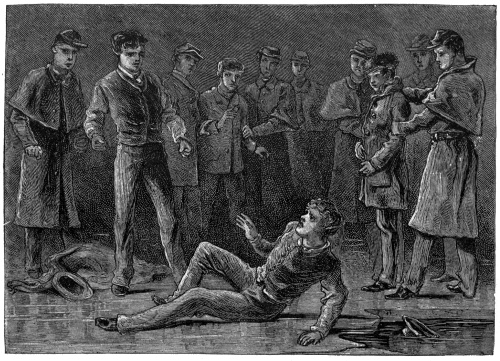
suddenly uncoiled itself under his feet. When he
came down again he measured his full length on
the ice, landing in such dangerous proximity to
the hole that had been cut for the poor student’s
benefit, that his uniform cap fell into it.
Everybody was struck motionless and dumb
with amazement. The bully was so bewildered
that he did not get upon his feet again immediately,
and the poor student forgot to shiver.
Duncan’s Unexpected Overthrow.
CHAPTER IV. THE NEW YORK BOOT-BLACK.
55
“Take your hands off those boys,” said
Don, who was in just the right humor to
make a scattering among Fisher’s crowd of
friends. “Release them both and do it at once,
or I will pitch the last one of you into that hole
before you can say ‘General Jackson’ with your
mouths open. Come over here, Bert.”
He stepped up and took the prisoner by the
arm, and his four guards surrendered him without
a word of protest. The magical manner in which
Don had floored the biggest bully in school,
before whom no boy in Bridgeport had ever been
able to stand for a minute, either with boxing-gloves
or bare fists, and the ease with which he
had done it, astounded them. They had never
seen anything like it before, and there was something
very mysterious in it. Did not this backwoodsman
have other equally bewildering tactics
at his command which he could bring into play if
56he were crowded upon? Probably he had, and
so the best thing they could do was to let him
alone.
“Your name is Sam Arkwright, is it not?”
said Don, taking one of the boy’s blue-cold hands
in both his own warm ones. “I thought I had
heard you answer to that name at roll-call. I am
a plebe too, and so we’ll stand together. Put on
these gloves and come with me. You will freeze
if you stay here any longer. As for you,” he
added, waving his hand toward the students to
show that he included them all in the remarks he
was about to make, “you are a pack of cowards,
and I can whip the best man among you right
here and now. Pick him out and let me take a
look at him.”
“I am good for the best of them if they will
come one at a time,” said Sam. “But I give in
to a dozen when they all jump on me at once.”
“I will leave that challenge open,” said Don, as
he led Sam away. “You know where my room
is, and any little notes you may choose to shove
under my door will receive prompt attention.”
Tom and his crowd did not speak; they had
not yet recovered from their amazement. They
57stood gazing after the rescued boy and his
champion until they disappeared in the darkness,
and then they turned and looked at one another.
“I declare, Duncan,” exclaimed Tom Fisher,
who was the first to speak. “You’ve met your
master at last, have you not?”
The defeated bully growled out something in
reply, but his friends could not understand what
it was. Like every boy who prides himself upon
his strength and skill, he did not like to acknowledge
that he had been beaten.
“Did he hurt you?” asked one of the
students. “I noticed that you didn’t get up
right away.”
“How in the name of all that’s wonderful did
he do it?” inquired another. “I didn’t see him
clinch or strike you.”
“He did neither,” replied Duncan, “and
that’s just what bangs me. I am willing to
swear that he did not touch me anywhere except
on the hand, and he took hold of that just as
though he wanted to give it a friendly shake.
It’s a trick of some kind—a boss one, too—and I
will give him my next quarter’s spending money
if he will teach it to me.”
58“Humph!” exclaimed Tom Fisher. “You
needn’t expect to him to do that. He doesn’t
look to me to be such a fool. You and he may
come together in earnest some day—if you don’t,
he will be about the only boy you haven’t had
a fight with since you have been a student at
this academy—and then you will probably find
out what his tricks are.”
“He didn’t hurt me at all,” continued
Clarence; “but he could if he had been so
disposed. If he had used a little more exertion
he could have thrown me into that air-hole;
and if I had happened to come up under the
ice—ugh!” exclaimed Clarence, shivering all over
as he looked down into the dark water.
“Is there no way in which we can get even
with him?” asked Fisher.
“Is there!” replied Clarence, angrily. “Do
you suppose that I am going to submit tamely
to an insult like that? We’ll make a way to
get even with him. Things have come to a
pretty pass if a plebe is going to be allowed to
come here and run this school to suit himself.”
The mere reference to such an unheard-of
thing was enough to raise the ire of Tom Fisher
59and all his companions, who with one voice
declared that the Planter, having presumed to
lay violent hands on an upper-class boy, and
to set at defiance one of the old-established customs
of the academy, must be made to suffer
the consequences. They held a long and earnest
consultation there on the ice, and Fisher and
Duncan, who were fruitful in expedients, soon
hit upon a plan which promised, if skillfully
managed, to bring Sam Arkwright’s champion
into serious trouble. It was a most dangerous
plan, because it was to be carried out under
the guise of friendship.
“That’s the only way to do it, fellows, you
may depend upon it,” said Duncan, after their
scheme had been thoroughly discussed. “We
must bring him into trouble with the faculty,
and let them do the hazing, for we couldn’t
do it if we wanted to. I was nothing but a
child in his grasp, and, to tell the honest truth,
I have no desire to face him again.”
“I hope we shall succeed,” said Fisher. “But
if the Planter turns out to be one of those
good little boys who never do anything wrong,
then what?”
60If Tom had only known it, he need not have
bothered his head on this point. Unfortunately
for Don, something happened that very night
which made it comparatively easy for the conspirators
to carry out the plans they had formed
regarding him.
Meanwhile Don and Bert were walking briskly
toward the academy in company with the rescued
boy, who was somewhat protected from
the keen wind by Bert’s muffler, which the
latter had wrapped about his neck, and by
Don’s gloves which he wore upon his hands.
He was lost in admiration of his new friend’s
prowess, and complimented him in the best
language he could command.
“Are you an Irishman, sir?” Sam asked, at
length.
“Look here,” answered Don, “my name is
Gordon—there’s no ‘sir’ about it. No, I am
not an Irishman. I am an American, I am
proud to say; but I understand the Irish ‘hand
and foot’ well enough to give it to such fellows
as that Clarence Duncan. I can throw a
man weighing two hundred pounds in that way
if he will let me take hold of his hand.”
61“It was well done,” said Sam. “I never
saw it done better.”
“I learned it of one of my father’s hired
men—a discharged Union soldier who came to
our plantation penniless and hungry, and asked
for work,” said Don. “I always make it a point
to pick up any little thing of that kind that
happens to fall in my way. It may come handy
some day, you know.”
Perhaps you will now understand how Don
had managed to throw the bully of the school
so easily; but if you do not, we can only say
that it cannot be described on paper so that
you can gain even a faint idea of it. If you
want to know just how it was done, the easiest
way to learn is to ask some Irishman—the
fresher he is from the old sod the better—to
give you a practical illustration of the “hand
and foot.” Simply give him your hand, and if
his feelings toward you are friendly, he will
send you flying through the air without hurting
you in the least; but if he is not friendly,
we would not advise you to go to him for
information, for he can turn you heels up in
an instant, and land you on your head with force
62enough to knock all your brains into your boots.
Don had become so expert in this novel way
of wrestling, and so prone to put it into practice
at every opportunity, that none of the boys about
Rochdale could be induced to shake hands with
him.
“How did you ever happen to find your way
to this school!” inquired Don, after Sam had
exhausted his vocabulary in praising his new
friend’s skill as a wrestler. “Were you really
a New York boot-black?”
“Yes, I was,” answered Sam, hesitatingly.
“It is nothing to be ashamed of,” said Bert,
who thought from the way Sam spoke that he did
not like to confess that he had once occupied so
lowly a position in the world.
“Of course not,” Don hastened to add. “Any
honest work is honorable. Your presence here
proves that you didn’t want to remain a boot-black
all your days.”
“No, I didn’t. I was ambitious to be something
better,” said Sam, who then went on to
give Don and his brother a short history of
his life. He said that his father, who followed
the sea for a livelihood, had gone down with
63his vessel during a terrific storm off Cape Hatteras;
that his mother had survived him but a
few months; and that after her death a grasping
landlord had seized all the household furniture
as security for the rent that was due and
unpaid, turning him (Sam) into the streets to
shift for himself. He spent the days in roaming
about the city, looking in vain for work, and
his nights in a lumber-yard to which he had been
invited by a friendly boot-black, who found free
lodgings there every night, and who, seeing Sam’s
forlorn condition, gave him a plate of soup to
eat and furnished him with a plank to sleep
on. Finding that work was not to be had, Sam
at last ran in debt for a boot-black’s “kit,”
which he procured from one of the fraternity who
had saved money enough to open a corner peanut
stand, and after a score or more of battles
with boys whose “claims” he unwittingly
“jumped,” he succeeded in establishing himself
in front of a popular hotel in the city, where
he was to be found early and late. It was there
he met the Superintendent of the Bridgeport
Military Academy, who patronized him twice
every day, never failing to give him a quarter
64for each “shine,” or to spend a few minutes in
conversation, with him after the boy’s work was
completed.
From the day he was six years old up to
the time his father was lost at sea, Sam attended
the district school regularly; and as he
was a very faithful student, and tried hard to
learn, he knew more about books than boys of
his age generally do. He felt that he was out
of place among the ragged, ignorant little
gamins with whom he was daily and hourly
thrown in contact, and they, realizing that he
was not one of them, and that he believed
himself to be fitted for something better than
the life of a boot-black, tormented him in
every conceivable way. He was so often called
upon to protect his brush and his box of
blacking from the young rowdies who would
have despoiled him of them, that he became an
adept at fighting, and it is probable that he
would have opened the eyes of Tom Fisher and
his crowd, had they not pounced upon him
while he was asleep, and overpowered him before
he could raise a hand to defend himself.
“I am sure I don’t know what it was that
65made the Professor take a liking to me,” said
Sam in conclusion, “but it was something; and
when he asked me if I wouldn’t like to quit that
miserable business and go to school and learn to
be a civil or a mining engineer, I tell you it
almost took my breath away. I jumped at the
chance. I gave my kit to a boy who was too
poor to buy one, and came out here; and I am
very sorry for it. The fellows don’t want me
here, and they didn’t want me in New York,
either. I hope I shall some day find a place
where I shall not be in everybody’s way.”
“Don’t get down-hearted,” said Don, taking one
of his hands out of his pocket long enough to
give Sam an encouraging slap on the back. “Of
course your tuition is free?”
“Yes, everything is furnished me. If it wasn’t
I couldn’t stay here, for I have no money to speak
of. The boys in New York badgered me so, and
ran such heavy opposition to me that I couldn’t
earn enough to buy a warm suit of clothes.”
“You will have an abundance of them in a day
or two,” said Don, “for our uniforms will be along
by that time. You couldn’t get an education on
better terms than the Professor offers it to you,
66could you? And so long as he is willing that
you should stay here, you can well afford to
let the fellows grumble to their hearts’ content.
Show the Professor that you appreciate
his kindness by doing your duty like a man, and
look to me for help whenever you get into trouble.
Now the next thing is something else,” added
Don, as he and his companions came to a halt in
front of the high picket-fence which inclosed the
academy grounds. “Where’s your room, Sam?”
“I haven’t any yet. I sleep in the attic.
The rooms on the floor occupied by our class
are all taken except one. That has been used
as a store-room, and as soon as it is cleared out
I am to have it for my own.”
“Well, do you want the teachers to know anything
about this night’s work?”
“Of course not,” returned Sam, who had all a
decent boy’s horror of tale-bearing.
“Because, if you do,” continued Don, “you
can walk up to one of the guards, let him report
you for being outside the grounds without
a pass, and when you are hauled over the coals
for it, you can say that you were taken out
against your will.”
67“But I don’t want to say that,” answered Sam,
quickly. “It would bring Tom and the rest into
trouble. I have nothing against them, and I
should be glad to be friends with them if they
would only let me.”
“You’ll do to tie to,” said Don, approvingly.
“Bert and I have a pass that will see us through
all right; but what are you going to do? Do
you think you can make your way to the attic
without being seen by any of the sentries or
floor guards?”
“Tom and his crowd brought me out without
attracting the attention of any of them, and I
don’t see why I can’t get back without being
caught. At any rate I shall try my best. Good-night.
I hope that neither of you will ever stand
in need of such aid as you have rendered me
to-night; but if you do, you may count on me
every time.”
So saying Sam moved away in one direction,
closely examining all the pickets on the fence as
he went, and Don and Bert walked off in the
other. When the latter arrived within sight of
the main gate they were somewhat surprised to
see that it was closed. The sound of their footsteps
68on the frosty snow quickly attracted the
attention of the alert sentry, who came out of his
box and demanded to know who they were and
what they were doing there at that time of night.
“We belong to this academy,” replied Don,
“and have a pass from the superintendent.”
“Corporal of the guard No. 4,” yelled the
sentry; and the call was caught up and repeated
by another sentinel who stood at the farther end
of the academy, and finally reached the ears of the
corporal, who was toasting his shins in front of a
warm fire in the guard-room.
“What do you want the corporal for? Here’s
our pass,” said Don; and taking the paper in
question from his pocket he thrust it between
the bars of the gate.
Still the sentry made no reply, nor did he seem
to know that Don had spoken to him. He brought
his musket to a “support,” and paced back and
forth on the other side of the gate with slow and
dignified steps. Don muttered something under
his breath, and Bert believing that he was
grumbling at the sentry for being so uncivil, laid
his hand on his brother’s arm and said, in a low
tone—
69“Don’t be angry with him. Perhaps he is not
allowed to talk while he is on duty.”
Don said nothing. He began to believe that he
and Bert had unwittingly got themselves into
trouble again, and when the corporal came up, he
found that he had not been mistaken.
“What’s the matter here?” demanded the
officer.
“There are a couple of plebes out there who
want to come in,” was the sentry’s reply.
“Who are you?” said the corporal, peering
through the pickets at the two brothers.
Don gave him their names; whereupon the
corporal took a key down from a nail in the
sentry’s box, and after unlocking the gate told the
boys to come in. They obeyed, and the officer
having returned the key to its place drew a note-book
from his pocket and wrote something in it.
“That’s all right,” said he, as he closed the book
and put it back in his pocket.
“Have we done anything wrong?” inquired
Bert, in anxious tones.
“You will find that out to-morrow,” was the
corporal’s very unsatisfactory answer.
“Why can’t you give a civil reply to a civil
70question?” demanded Don, impatiently. “We
had liberty to go outside the grounds for the
evening, and here’s the pass that says so.”
“I don’t want to see it,” said the corporal, as
he buttoned his overcoat and drew the cape over
his head. “I know just how it reads. Come
on.”
“Where are you going to take us?” asked
Bert, while visions of the gloomy guard-house
danced before his eyes.
“To the officer of the day, of course.”
“And what will he do with us?”
“That’s for him to tell. Come on. It’s too
cold to stand here any longer.”
Don and Bert fell in behind the corporal, who
led the way to the guard-room, and ushered them
into a little office where the officer of the day—a
stern old Prussian soldier who wore a medal he
had won by his gallantry on the field of battle
while serving under Prince Frederick Charles—sat
reading a newspaper. When the non-commissioned
officer entered with his prisoners he
laid the paper down and took off his spectacles.
“Vel, gorporal,” said he, in a pompous tone,
“vat ish the drouble mit dem gadets?”
71“They have overstayed their time, sir,” said
the corporal.
“Vot for you do dot?” demanded the officer
of the day, turning fiercely upon the culprits.
“Vot for you not come in, ha?”
“We were not aware that we had overstayed
our time, sir,” answered Don. “If we had
known that we were expected to return at a
certain hour, we should have been here. We
had a pass for the evening, and there it is.”
“Dot’s no good after daps,” said the officer of
the day, turning away his head and waving his
hand in the air to indicate that he did not care
to look at the paper which Don presented for his
inspection.
“I assure you, sir, that it was a mistake on
our part,” said Bert.
But the officer of the day declared, in his
broken English and with many gesticulations,
that such things as mistakes were not recognized
in that academy—that Don and his brother had
violated the regulations and might make up their
minds to be punished accordingly. Then he
ordered them to their quarters, while the corporal
went back to his seat by the stove.
72“He didn’t say that we were in arrest, did
he?” said Don, as he and Bert ascended the
stairs, at the top of which they met the sentry
who had charge of that floor, standing with his
note-book in his hand.
“Your names, please,” said he, pleasantly.
“The corporal of the guard has them, and
so has the officer of the day,” answered Don.
“And I must have them, too,” returned the
sentry, holding his pencil poised, in the air.
Don gave the required information in rather a
sullen tone, and closed the door of his dormitory
behind him with no gentle hand. As soon as
Bert had struck a light he drew the pass from his
pocket and read as follows:
“Guards and patrols will pass privates Donald
and Hubert Gordon until half-past nine o’clock
this evening.”
Then he looked at his watch and saw that it
lacked only a quarter of eleven. Allowing fifteen
minutes for their interviews with the corporal and
the officer of the day, they had overstayed their
time just an hour. Bert was very penitent, but
Don was inclined to be rebellious.
CHAPTER V. DON AND BERT HAVE VISITORS.
73
“I wonder if a fellow can make a move in
any direction without breaking some of the
numerous rules of this school and being reported
for it,” said Don, throwing his overcoat and cap
spitefully down upon the bed. “I declare,
Bert——”
Just then the door opened and the sentry thrust
his head into the room. “Put out that light,
Plebe,” said he. “Two reports in one night make
a tolerably bad showing, the first thing you
know.”
“Catch hold of that gas-fixture and jerk it out
of the wall,” exclaimed Don, as Bert hastened
to obey the sentry’s order. “That makes twice it
has got us into trouble.”
“Oh, I wouldn’t do that,” said the sentry, with
a laugh. “You“You had better read the rules and regulations
until you have them firmly fixed in your
mind, and then, if you see fit to obey them to the
very letter, you will have plain sailing.”
74Don undressed in the dark and tumbled into
bed, telling himself the while that he didn’t care
a snap of his finger for the rules and regulations.
He had not purposely violated any of them, and
yet he had been severely reprimanded, and was
yet to be punished as though he had been willfully
disobedient.
“When the leopard can change his spots and
the Ethiopian his skin, I shall believe that there
is some hope for me,” said Don to himself, as he
arranged his pillow and prepared to go to sleep.
“But there doesn’t seem to be much now, for the
harder I try to be good the more rows I get into.
I would give something to know how Tom Fisher
and his crowd came out, and whether or not Sam
succeeded in getting back to his attic without
being seen by the guards.”
Bert arose the next morning, after an almost
sleepless night, full of apprehension and trembling
for fear of the punishment that was to be visited
upon him, while Don’s face wore a defiant expression.
He had slept the sleep of the healthy, and
awoke refreshed and fully prepared to meet anything
that might be in store for him. Greatly to
his surprise and Bert’s, nothing was said to them
75regarding what had taken place the night before.
They found opportunity to exchange a few words
with Sam Arkwright, who gleefully informed them
that everything was all right, and that no one
was the wiser for the assault that had been made
upon him by the third-class boys, and caught a
momentary glimpse of Fisher and Duncan, both
of whom smiled and saluted in the most courteous
manner. Don did not know what this meant, but
it was not long before he found out.
That afternoon all the members of the fourth
class were ordered to the drill-room, where they
found a quartermaster-sergeant, the captain of
their company, and one of the teachers, who
served out to them their new uniforms, which they
were told to put on at once. When ranks were
broken, Don and Bert hastened to their dormitory,
and had just completed the work of exchanging
their citizen’s clothes for their natty suits of cadet
gray, when there came a knock at the door. Bert’s
heart seemed to stop beating.
“That must be the orderly,” said he, in an
excited whisper.“ If it is, we shall soon know
what is going to become of us.”
“Well, we might as well know one time as
76another,” said Don, doggedly. “I hope it is the
orderly, for I have been kept in suspense long
enough.”
Bert opened the door, when who should appear
on the threshold but Tom Fisher and Clarence
Duncan. The former extended his hand to Bert,
who took it after a little hesitation, while Clarence
entered the room and greeted Don in the same
friendly way.
“Gordon,” said Clarence, as Don’s sinewy
fingers closed about his own, “you’re a brick.
We came here to tell you and your brother that
we and the rest of the fellows are sorry for what
happened last night, and that we want to be
friends with you.”
“Nothing would suit me better,” answered
Don.
“We have had time to consider the matter,”
said Fisher, seating himself on Bert’s bed and
depositing his cap on the table, “and we are all
very glad that you didn’t let us duck that Plebe.
It would have been a mean piece of business to
haze him in that way, seeing that he didn’t have
a suit of dry clothes to put on.”
“Or a fire to warm himself by,” chimed in
77Bert, with some indignation in his tones. “Why,
I never heard of such a thing. It would have
been the death of him.”
“It was cold, wasn’t it?” said Clarence.
“Well, we didn’t haze him, and, as Tom says,
we are all glad of it. But, I say, you make
nobby-looking soldiers, you two. Did you get
in last night all right?”
“We got in twice,” answered Don, ruefully.
“We got inside the grounds, and we got into
trouble.”
“How was that? Didn’t you have a pass?”
“Yes; but it was only good until half-past
nine, and we stayed out until half-past ten.”
“Oh! ah. Well, that’s nothing when you
get used to it, is it, Fisher?” said Clarence.
“Nothing at all,” replied Tom. “It has been
a very common thing with me, and now I never
think of asking for a pass. I go when I please
and come back when I feel like it.”
“What do you suppose they will do with
us?” asked Bert, who was anxious to have
that point settled as soon as possible.
“Let me see,” said Clarence, thoughtfully.
“Who was officer of the day yesterday?”
78“I don’t know his name,” answered Don,
“but he was the same one who instructs our
class in mathematics, an old gentleman with
gold spectacles, and a medal of some kind on
his breast.”
“Oh, that was Dutchy,” said Fisher, in a
tone of contempt. “He’s our fencing-master
also. Well, he will make the case against you
as black as he can, and if he were the one
to say how you should be punished, I tell you
you would have a lively time of it, for he is
a regular martinet. The President is a very
strict disciplinarian, but he hasn’t yet forgotten
that he was once a boy himself, and he will
probably be easy with you.”
“But what will he do?” insisted Bert.
“That’s what Don and I want to know. And
if he is going to punish us at all, why doesn’t he
say so?”
“Because the proper time has not yet arrived.
Wait until dress-parade comes off to-night, and
then you will find out all about it, for it will
be published in general orders.”
“Before the whole school?” cried Bert.
“Of course,” answered Clarence.
79Bert grew very red in the face, and looked at
Don, who, in turn, stared hard at Bert.
“It is nothing to worry over,” said Fisher.
“Some of the best fellows in school have been
gated and made to walk extras on Saturday
afternoons with packed knapsacks, and that is all
the punishment you will receive.”
“What do you mean by ‘gated’?” asked
Don.
“What is a ‘packed knapsack?” inquired
Bert.
“Why, when a fellow is gated he is confined
inside the grounds, and not allowed to go out
under any circumstances,” replied Clarence.
“But he can go out all the same if he feels
like it,” said Fisher, with a laugh. “I never
knew a fellow to stay inside the grounds simply
because he was gated, unless he was one of those
milk and water boys who hadn’t spirit enough
to say that his soul was his own.”
“How can he get out?” asked Don.
“He can run the guards. Clarence and I
have done it many a time.”
“Were you never caught at it?” inquired
Bert.
80“Once or twice, but that was owing to our own
carelessness. It is an easy thing to do when the
right kind of fellows are on duty, and really exciting
when the posts are held by such boys as
Blake and Walker, and others of that sort.
They’re a mean set. They are always on the
watch for a chance to report somebody, because
they believe that that is the way to gain the
good-will of the teachers.”
“And a packed knapsack,” continued Clarence,
“is one with something heavy in it, such as
bricks or paving-stones. When you are called
upon to walk an extra, you have to pace up and
down your beat for four hours with that knapsack
on your back and a musket on your shoulder.”
“That can’t be very pleasant,” observed Don.
“Well, I am free to confess that it isn’t,” returned
Clarence, “and it is all owing to the
way the thing is managed. If they would let
us perform the extra duty while the rest of
the boys were drilling, or while the class in
geometry was reciting, I should not mind it in
the least. But you see they won’t do that.
We have to work hard all the week, and walk
81our extras on Saturday afternoons during the
hours that are given to the good little boys for
cricket, ball-playing, fishing, target-shooting and
recreations of that sort.”
“But overstaying our time was not the only
offence of which we were guilty last night,”
said Don, after a moment’s pause. “When we
reached our room we struck a light, and I suppose
we shall be reported for that.”
“Of course you will,” said Fisher. “You
had no business to have a light in your room
after taps.”
“But we didn’t think,” said Bert. “And,
besides, we wanted to read our pass, so that we
might know just what we had done that was
wrong.”
“No odds,” exclaimed Clarence. “No excuse
will be accepted. You will probably be gated
for a month.”
“But you need not submit to the restriction of
your liberty unless you feel like it,” chimed in
Fisher. “Do as all the best fellows in school do—run
the guard, and have a good time in spite
of the teachers.”teachers.”
“Oh, we’ll never do that,” said Bert, quickly.
82“Will we, Don? That would only make a
bad matter worse.”
Don looked down at the floor, but said nothing.
He always grew restive under restraint, and
having been allowed when at home to go and
come as he pleased, he could not bear the thought
of being confined within bounds. If Fisher and
Duncan had known what he was thinking about
just then, they would have said that the success
of the plans they had formed the night before
was a foregone conclusion.
“Well, Gordon,” said Tom, at length, “everything
is all square between us, I hope.”
“Certainly it is, so far as I am concerned,”
answered Don. “And I know that Arkwright
does not bear you any ill-will, for he said so.
You fellows ought to make matters straight with
him, for he is true blue. He took a good deal
of pains to work his way back to the attic without
being seen, for he didn’t want the teachers to
know what you had done.”
“We’ll see him and have a talk with him,”
said Tom, as he arose from the bed and picked up
his cap. “Perhaps we had better go, Clarence.
You know what will happen to us if we fail in our
83logic to-morrow. What do you think of the
prospect?” he added, as soon as he and his crony
had reached their own dormitory and closed the
door behind them. “Will he bite?”
“I am sure of it,” was Duncan’s confident
reply. “He is a fellow who doesn’t like to be
held with too tight a rein—I can see that plainly
enough; but Bert is a different sort of boy.”
“What do we care for Bert?” exclaimed Tom.
“Don is the one we are after.”
“I know that, and I know, too, that we could
get him very easily if his brother were out of the
way. These little spooneys sometimes exert a
good deal of influence over their big brothers, and
if he sets his face against us and our plans, our
cake will be turned into dough in short order.”
“We must see to it that Don doesn’t listen
to him,” said Tom. “We have done all we can
do to-day. We have given him an idea, and now
we will let him chew on it for a while. We
mustn’t appear to be too eager, you know, for if
we give him the least reason to suspect that we
are putting up a job on him, it is my opinion that
he will prove an unpleasant fellow to have
around.”
84As Fisher said this he picked up his logic, in
which both he and Duncan had failed miserably
that day, and read in a listless, indifferent tone—
“What is true with limitations is frequently
assumed to be true absolutely. Thus—‘Deleterious
drugs are always to be rejected; opium is
a deleterious drug; therefore opium is always to
be rejected.’ What’s wrong with that reasoning,
Clarence?”
“I don’t know and I don’t care,” answered the
latter, snatching the book from his friend’s hand
and slamming it down upon the table. “Let it
go until this evening, and then we will study it
together. Let’s have a game of checkers now,
and see if you can beat me as badly as you did
the last time we played.”
“I don’t much like those fellows, Don,” said
Bert, when Fisher and Duncan had taken their
leave.
“I can’t see what there is wrong about them,”
replied Don, who knew in a moment what his
brother meant. “I am sure they acted very
honorably in coming here to make things right
with us.”
“I have nothing to say against that,” Bert
85hastened to answer. “But I don’t like to hear
them talk so glibly about disobeying the rules.”
“I don’t know that that is any business of
yours or mine either,” said Don, rather impatiently.
“If they are willing to take the risk,
and abide the consequences if they are detected,
that is their own affair. You needn’t do it.”
“I!” exclaimed Bert, in great amazement.
“You maybe sure that I have no intention of
doing anything of the kind, and I hope you
haven’t, either.”
“You need not waste any valuable time in
worrying about me. I am able to look out for
myself. But I’ll tell you what’s a fact, Bert: I
don’t think as much of this military business as
I did a few weeks ago. If I were only back home
with my pony, dogs and guns, I tell you I would
stay there. I feel more like going out in the
woods and knocking over a wild turkey than I do
like sitting here in this gloomy room preparing
for to-morrow’s recitations.”
Don opened one of the books that lay upon the
table, but the page on which he fastened his eyes
might have been blank for all he saw there. His
mind was not upon the work that demanded his
86attention. He was thinking over his recent interview
with Fisher and Duncan.
“I wonder if they pass their evenings at Cony
Ryan’s when they run the guards?” said Don
to himself. “I wonder, too, if Cony’s hotel, or
whatever he calls it, was in existence when my
father attended this school, and if he went there
to eat pancakes. If he did, I don’t see how he
can find any fault with me if I go there. Tom
and Clarence don’t seem to be such a bad lot, and
it is nothing more than fair that I should meet
their advances half way.”
When the hour for recreation came, Don did
something he had never done before in his life.
Watching his opportunity he slipped away from
Bert and set out to hunt up Fisher and Duncan.
He did not have much trouble in finding them,
for they also were looking for him. After returning
his salute they slipped their arms through his
and led him toward the gymnasium.
“You are a stranger here,” said Clarence,
“and as we know you must be lonely we will
introduce you to the boys in our set, if you would
like to know them.”
“You will find them all tip-top fellows,” added
87Tom. “You see, there is a little crowd of us who
run together, and somehow we manage to have
good times. There are some boys here, however,
with whom we never have anything to do. We
will point them out to you as fast as we can, so
that you can steer clear of them.”
“They are high-toned lads,” said Clarence,
“and won’t associate with any but the members
of their own class. Some of them are preparing
for West Point. They pride themselves on being
soldiers all over; and if they can’t prove their
soldierly qualities in any other way, they will
report somebody.”
“Where’s your brother?” asked Tom, suddenly.
Don replied that he didn’t know where he
was.
“I rather fancied that he didn’t exactly like
what we said about running the guard a while
ago,” continued Tom. “Did he?”
“No, he didn’t. He wouldn’t think of doing
such a thing.”
“Well, then, he can make up his mind to be
gated on an average of once a month as long as
he stays here; for no matter how hard he tries, he
88can’t help breaking some of the rules. If he has
a mind to submit to confinement—why, that’s his
business and not mine.”
“I haven’t done it since I have been here,”
said Fisher, emphatically; “and, what’s more, I
won’t.”
“Where do you go when you run the guard?”
“Anywhere we please. Sometimes we spend
an hour or two in skating or sleigh-riding, and
when we get tired of that, we go down to Cony
Ryan’s after pancakes and mince-pies.”
“I don’t, for the life of me, see how you can
get out,” said Don. “There are sentries all
around the grounds.”
“It does require some skill and cunning, that’s
a fact, especially when fellows who don’t like you
happen to be on duty. But if the members of
your own set are on post, it is easy enough. All
you have to do is to give them notice of your coming,
and they will turn their backs until you can
creep by them.”
“Go with us to-night, and we will show you
how it is done,” said Fisher.
“That’s so!” exclaimed Clarence, as if the
idea had just been suggested to him. “It will
89be a good time; another like it may not occur
for a month. Will you do it, Gordon? I dare
you.”
“It is a common saying in my country that a
man who will take a dare will steal sheep,” said
Don.
“Of course he will,” answered Clarence. “I
knew we had not been mistaken in you.”
“We haven’t had any of Cony’s pies and pancakes
this winter,” continued Tom, “and we are
getting hungry for some. I have taken particular
pains to find out who the sentries are, and I know
that some of them are good men and true. There
are some of our boys now. Come on, Gordon, and
we will make you acquainted with them.”
They had by this time entered the gymnasium,—a
large building which stood a little apart from
the academy, and was fitted up with all the
appliances that are supposed to be necessary or
useful in such institutions. It was filled with
students who were exercising their muscles in
various ways, and among them Don recognized
some of the boys who had composed the hazing
party. Don was introduced to them one after
another, and was welcomed by them in the most
90cordial manner. They spent a few minutes in
talking and laughing over the incidents of the
previous night; and then, at a sign from Fisher,
they drew off on one side so that they could carry
on their conversation without danger of being
overheard by those who did not belong to their
“set.”
“Fellows, Gordon is one of us; Duncan and I
vouch for him; so you need not hesitate to speak
freely in his presence,” said Tom, again taking up
the subject that just then was nearest his heart.
“Do we go to Cony Ryan’s to-night or not?”
“Of course,” replied all the boys, in chorus.
“Then that much is settled. I know who the
guards are,” he added, turning to Don, “and I
will see you safely out and back. As soon as we
are out of the building——”
“But how am I going to get out?” interrupted
Don. “You forget the sentry who has charge of
our floor.”
“No, I don’t. Here he is,” said Tom, taking
by the arm a boy who had been introduced as
Charley Porter. “You won’t stop him, will you,
Charley?”
“I shall not know when he goes out,” was the
91ready answer. “I can be both blind and deaf
when circumstances require that I should be so.”
“You see what kind of fellows we are,” said
Tom. “You will never be reported for having a
light after taps, or for any other offence, by one
of us.”
Tom then went on to tell Don just what he
must do in order to make his undertaking successful,
and, aided by his friends, who put in a word
now and then, succeeded in making him believe
that Cony Ryan’s was but little short of a paradise,
and that he (Tom) and his “set” had done
him a great favor in bringing the house and its
proprietor to his notice. He promised to be on
hand at the hour appointed, and then he and
Tom went into the dressing-room to put on their
gymnastic suits, while Duncan hurried away to
carry out an idea of his own that had suddenly
suggested itself to him.
CHAPTER VI. CONY RYAN’S PANCAKES.
92
“He did bite, didn’t he?” said Duncan to
himself, as he hurried about the grounds and
through the academy building looking everywhere
for Dick Henderson. “He jumped at the bait
quicker than I thought he would; but he never
would have done it if he had not got himself
into trouble last night. That made him mad,
and now he don’t much care what he does.
We’ll fix him. A court-martial and extra lessons
and guard duty and drills for a whole
month will so disgust him with this school that
he will clear out, and we shall be well rid of
him.”
Duncan soon found the boy of whom he was
in search, and the following is a part of the conversation
that took place between them:
“You are on post No. 5, down there at the
north side of the grounds to-night, are you
not?” said Duncan.
93Dick replied that he was, that he went on at
midnight.
“Well, you know that the boys are going down
to Cony Ryan’s to-night, don’t you?” continued
Clarence.
Yes, Dick knew all about it, and stood ready
to help them in every way he could, without getting
himself into trouble.
“Well,” said Duncan, again, “Don Gordon is
going with us.”
Dick seemed delighted to hear it.
“We roped him in just as easy as falling
off a log,” Clarence went on. “He has been
introduced to some of the fellows, and Fisher
and I have worked things so nicely that he
doesn’t suspect anything. Now you must be
on the alert to catch him when we come back,
which will be some time between one and four
o’clock.”
“How shall I know him from the rest of
you?”
“By the signal, of course. Have you forgotten
that?” Here Duncan coughed slightly, and in
a peculiar manner.
“No, I haven’t forgotten it. I only want to
94know just how things are going to be managed,
so that I shall not make any mistakes. It
would be awkward, you know, if I should call
the corporal of the guard to arrest the wrong
fellow.”
“You musn’t do that,” said Duncan, quickly.
“It would be much better to let Gordon pass
unchallenged with the rest of us. You know
we boys got ourselves into lots of trouble last
term, and if we don’t keep our names off the
black-list from this time on, we stand a good
chance of being sent down.”
(By being “sent down” Duncan meant “expelled.”)
“All right,” said Dick. “I know just what
you want of me. Do everything just as it was
done last term, and I will see that our boys
get safely through, and that Don Gordon comes
in for a court-martial.”
When the hour for dress-parade arrived the
classes were marched to the drill-room by their
respective captains, three of them being drawn
up in line, while the Plebes were stationed at
one end of the room so that they could watch the
movements of their comrades, and learn something
95of the duties that would be required of
them when they were well enough drilled in the
manual of arms and school of the company to
go on parade themselves. There were two of
them who did not pay much attention to the
proceedings, although they appeared to watch
them closely, and they were Don and Bert
Gordon. They noticed that the adjutant carried
some papers in his belt, and they knew instinctively
that one of them contained something that
would prove to be of interest to them.
In obedience to the adjutant’s order, the captains
brought their companies to “parade rest,”
the band “sounded off,” a few exercises in the
manual of arms were gone through with, and then
came the command: “Attention to orders.” Don
listened, and heard his name and Bert’s read off
in connection with those of three or four other
culprits, who were ordered to be punished according
to their deserts. It was ordered that privates
Donald and Hubert Gordon, for overstaying their
time, and having a light burning in their quarters
after taps (this being their second offence),
be deprived of liberty for thirty days, and required
to stand guard for four hours on the
96ensuing Saturday afternoon with packed knapsacks.
Then the parade was dismissed, the band
struck up a lively tune, the officers advanced
to salute the commander of the battalion, and
the first sergeants marched their companies to
the armory, where ranks were broken.
“Didn’t I tell you just how it would be?”
whispered Fisher, who happened to overtake
Don while the latter was on his way to his
room. “It’s no trouble at all to stand an extra,
for it is over with in four hours; and as for
depriving you of your liberty—that’s all in my
one eye. You can see much more fun without
a pass than you can with one, for you are
not obliged to return at any specified time.”
“I don’t mind the punishment as much as I
do the disgrace,” said Don.
“Disgrace!” echoed Fisher. “Nonsense. This
has been a military school for half a century or
more, and of the thousands of students who have
been graduated here, there are not a hundred who
did not, at some time or another, break some
rule, and get punished for it. Why, my own
father used to run the guard.”
“So did mine,” said Don.
97“Your father!” exclaimed Tom, in great surprise.
“Did he ever attend this school?”
“Yes; he received a military education and
prepared for college here.”
“I am surprised to hear it. Well, he didn’t
get through the whole course without being
hauled up occasionally, did he? I just know he
didn’t, if he was a boy who had any spirit in
him. Now, as I may not see you again until
the time for action arrives, I want to know if
you understand just what you have to do.”
Don answered that he was sure he did, and
then went on to repeat the instructions he had
received in the gymnasium. When he had finished,
Fisher gave him an approving wink and
nod, and left him.
During the evening Don and Bert did very little
studying. The latter took his punishment very
much to heart; and asked himself over and over
what his mother would think when she heard of
it; while Don was so busy thinking of the festivities
that were to come off at Cony Ryan’s, that
he could not have concentrated his mind on his
books if he had tried. When taps were sounded
the light went out instanter.
98“I shall never get into trouble for that again,”
said Don, as he tumbled into bed, after bidding
his brother good-night. “The next time I am
reported, it will be for something that is worth
reporting.”
Don began to be excited now. He had been
instructed to wait twenty minutes, as near as he
could guess at it, in order to give the officer of the
day time to make his rounds, which he did as
often as the huge bell in the cupola tolled the
hours. He knew when the officer ascended the
stairs, heard him talking with the sentry who had
charge of that floor, and breathed easier when he
went down again—but only for a moment, for
now something that appeared to be an insurmountable
obstacle arose before him all on a
sudden. The sensitive Bert was sadly troubled,
and when he got that way, it was almost impossible
for him to go to sleep. In case he remained
awake until the expiration of the twenty minutes,
what could Don do?
“I never thought of that,” soliloquized the
latter, his ears telling him the while that Bert
was tossing restlessly about on his bed. “It
would be simply impossible for me to get up
99and dress and slip out of the room without his
knowledge. Of course I might go out openly and
above board, for I know that he would never blow
on me; but if I do that, he will improve every opportunity
to lecture me, and I would rather spend
every Saturday afternoon in walking extras than
listen to him. I ought to have told the fellows
to allow me at least an hour.”
While Don was busy with such reflections as
these, and trying in vain to conjure up some plan
for leaving the room without attracting his
brother’s attention, he was electrified by a gentle
snore which came from the direction of Bert’s bed.
Don thought it was a pleasant sound to hear just
then, for it told him that the way was clear. In
an instant he was out on the floor, and in five
minutes more he was dressed. After wrapping
one of his pillows up in the quilts and arranging
them as well as he could in the dark, so that they
would bear some resemblance to a human figure,
he walked across the room with noiseless steps
and cautiously opened the door. The hall was
lighted up by a single gas-burner, under which
the sentry, Charley Porter, sat reading a book.
He looked up when he heard Don’s door grating
100on its hinges; but he did not look Don’s way. He
turned his eyes in the other direction. Then he
laid down his book, got upon his feet, and walking
leisurely along the hall with his hands behind
his back, took his stand in front of a window, and
looked out into the darkness. His back was
turned toward Don, who closed the door of his
room behind him, moved along the hall on tip-toe,
and dodging around an angle in the wall, was
quickly out of sight. A few hurried steps brought
him to another door, which yielded to his touch,
and then Don found himself in utter darkness.
This door gave access to the back stairs, which
ran from the ground floor to the upper story of
the building, and were intended to be used only
as a fire-escape. The doors that opened into it—there
was one on each floor—were kept locked,
and all the keys that rightfully belonged to them
were hung up on a nail in the superintendent’s
room, where they could be readily found by the
teachers in case circumstances required that they
should be brought into use. The superintendent
was happy in the belief that by placing a sentry
in charge of the dormitories on each floor, and
keeping the keys of these doors under his eye all
101the time, he had put it out of the power of any
student to leave the building during the night;
but he had not taken into consideration the fact
that sentries may sometimes prove false to their
duty, and that an old rusty key, picked up in the
yard, can, by the aid of a file and a little ingenuity,
be made to fit almost any lock. Tom Fisher
and his friends all had keys that would open these
doors, and Don had resolved that he would have
one too.
“B-l-e-r-s,” whispered Don, as he stepped out
into the fire-escape.
“R-a-m,” came the response, in the same low
whisper.
The pass-word of the band of worthies to which
Don now belonged was “Ramblers.” Of course
it was used only in the dark, or when the members
could not see each other. If a boy desired
to know whether or not a student whom he suddenly
encountered in some out-of-the-way place
was a friend, all he had to do was to spell the last
syllable of the pass-word, as Don had done; and
if he received the same answer that Don did, he
knew at once that he had found some one who
could be depended on. At least that was what
102Fisher and Duncan told Don; but the reader
already knows that they did not tell him the
truth.
“Who is it?” whispered Don.
“Fisher,” replied the owner of that name;
and as he spoke he stepped forward to lock the
door.
“Hadn’t you better leave it unfastened?”
asked Don.
“Not by a great sight,” answered Fisher, quickly.
“The officer of the day and the corporal on duty
try all these doors every time they make their
rounds, and if they should happen to find one of
them unlocked, good-by to all our hopes of eating
pies and pancakes at Cony Ryan’s again this winter.”
“Then how can I get back to my room?”
“Why, I shall be here to open the door for
you.”
“But we might get separated, you know.”
“Oh, no we won’t,” answered Tom, confidently.
“Don’t you be at all uneasy on that score.
Duncan and I will stand by you. Come on, now;
the boys are all ready and waiting.”
“How fearful dark it is,” said Don. “I can’t
see my hand before me.”
103“Neither can I; but I have been through here
so often that I know every step of the way. Give
me your hand.”
Fisher took Don in tow and succeeded in conducting
him safely down two flights of stairs—it
afterward proved to be a fortunate thing for Don
that he remembered that—and out into the yard
where Duncan and the rest were waiting for them.
After greeting Don in the most cordial manner
they moved off in a body toward the north corner
of the grounds—all except Tom Fisher, who went
on ahead to notify the sentry of their approach.
This he did in some mysterious way, and without
alarming any of the guards on the neighboring
posts; and the boy, who ought to have called the
corporal of the guard at once, went into his box
and stayed there until Tom and his companions
had crossed his beat and were out of sight. They
easily found the place where two of the tall fence
pickets had been loosened at the bottom, and
pushing these aside they crept through the
opening into the road.
“Well, Gordon, that wasn’t such a very hard
thing to do, was it?” said Duncan, as he took
off his overcoat and shook the snow out of it.
104“No,” answered Don, “and I don’t see much
fun in it, either. It is not a very smart thing to
crawl by a sentry who is accommodating enough
to keep out of sight until you have had time to
get out of harm’s way. There’s no excitement in
it—anybody could do it. If that guard had been
faithful to his trust, I should think we had done
something worth bragging about.”
“O, you want excitement, do you?” exclaimed
Duncan. “You want a chance to run by some
spooney who would be only too glad to report you
and get you into a row, don’t you? All right.
We’ll see that you get the chance, and very
shortly, too; won’t we, boys?”
“Yes,” replied all the boys, in concert.
“And, unless I am very badly mistaken, you
will see quite as much excitement as you want
to-night,” added Duncan, to himself. “If Dick
Henderson does his duty, you will be under arrest
and a candidate for a court-martial before you see
the inside of your dormitory again.”
During the walk to the big pond, near which
Cony Ryan’s house stood, Don’s new friends entertained
him with many thrilling stories of the deeds
of daring that had been performed by themselves
105and former students, such as running the guard
when all the posts were occupied by those who
were not friendly to them; stealing the bell-rope
when the cupola was guarded by some of the best
soldiers in the academy; turning the bell upside
down on a cold night, filling it with water and
allowing it to freeze solid; and spiking the gun
whose unwelcome booming aroused them at so
early an hour every morning. As Don listened he
began to grow excited; and when there was a
little lull in the conversation, he proposed one or
two daring schemes of his own that had suddenly
occurred to him, and which were so far ahead of
any his auditors had ever engaged in, that they
could hardly believe he was in earnest.
“Gordon, you see around you a lot of fellows
who never have and never will back down from
any reasonable undertaking,” said Tom Fisher.
“But the idea of stealing a cow, taking her into
the grounds and hoisting her up to the top of the
belfry, overpowering and binding every sentry
who stands in our way—Great Cæsar’s ghost!
Gordon, you must be taking leave of your senses.”
“And as for taking the butcher’s big bull-dog
up to the top story of the building, tying a tin can
106to his tail, and starting him on a run down four
pairs of stairs and through the halls—that’s
another thing I don’t approve of,” said Duncan.
“I guess not,” said another of the fellows.
“I wouldn’t touch that dog for a million dollars.
We are in for anything new that promises to be
either interesting or exciting, but, as Tom says, it
must be something reasonable. Think up some
other plans.”
The boys had by this time reached Cony Ryan’s
house. Led by Tom Fisher they mounted the
steps, and passing through a narrow hall entered
a neatly furnished little parlor whose walls, could
they have found tongues, would have told some
strange and amusing stories of the scenes that
had been enacted there. It was brilliantly
lighted, and a cheerful fire burned in the grate.
“This looks as though Cony was expecting us,
doesn’t it?” said Tom, gazing about the room
with a smile of satisfaction. “Take off your
overcoat, Gordon, and sit down. Make yourself
at home.”
“Do you know,” added Duncan, “that this
house was built and furnished with the money
that the academy boys have put into Cony’s
107pocket? Years ago, when he was nothing but a
poor fisherman and lived down there on the bank
of the river in a little shanty about half the size
of this room, it occurred to him that he might
turn an honest penny by supplying the students
with milk and pies. He drove a thriving trade
until some of the teachers began to suspect that
he was putting something stronger than water in
his milk, and then they shut down on him and he
was forbidden to enter the grounds. But that
didn’t trouble him any. The boys had got in the
habit of spending their extra dimes with him, and
since he couldn’t come to them any more, they
fell into the way of going to him. Why, Gordon,
if you could look over some of his old registers,
you would find in them the names of men who
are known all over the land.”
Just then a side door opened, admitting a
portly, white-bearded old fellow, dressed in a
modest suit of black, who was greeted by the
students in the most uproarious manner. They
crowded around him, all trying to shake his
hands at the same time, while Cony, for it was
he, beamed benevolently upon them over his
spectacles. This was the first time he had
108seen any of them since the close of the last school
term.
“You see we are all on hand again, Cony,” said
Duncan, when the greetings were over. “And if
you will trot out a few plates of your pancakes,
you will find that we are as hungry as ever. By
the way, did you know a boy of the name of Gordon
who used to attend this academy?”
“Gordon of Mississippi?” exclaimed Cony,
who, having a retentive memory, never forgot
the names of any of his patrons. “I should
say so. He has spent many a pleasant evening
in this room.”
“Well, here is one of his boys,” continued
Duncan. “Mr. Ryan, Mr. Donald Gordon.”
The old fellow was very much surprised.
“It doesn’t seem possible,” said he, as he
shook Don’s hand and gave him a good looking
over. “He is the very image of his father, who
was one of the finest-looking young soldiers I
ever put my eyes on. Mercy on us, how time
does fly!”
“Say, Cony,” said Tom Fisher, coaxingly,
“can’t we have just one game of ‘sell out,’ to-night?”
109“No, sir,” was the emphatic reply. “You can
have all the pancakes you want, and as much
sweet milk or buttermilk as you can hold, but
you don’t turn a card in this house. It is bad
enough for you to run the guard, and if I did
my duty, I should report the last one of you in
the morning.”
“Suppose you trot out the pancakes and
milk, and let somebody else report us,” suggested
Don.
“Yes; that’s the idea,” cried the others, with
one voice.
Don thought he enjoyed himself that night,
and his companions thought so, too, for he
sang as many songs, told as many stories, and
laughed as heartily as any of them. He
listened with much interest while Cony told of
the exploits of the students he had known in the
years gone by, and who had since made themselves
famous as lawyers, legislators and soldiers,
and was greatly astonished when Tom Fisher
jumped to his feet with his watch in his hand
and a look of alarm on his face.
“Fellows,” said he, “where has the night
gone? It is half-past three, and we have just
110half an hour in which to crawl by Dick Henderson’s
post and get into bed. If we are two
minutes behind time we are a gone community.”
This startling announcement broke up the party
at once. The boys made a simultaneous rush for
their overcoats and caps, and after Don had settled
their bill—a proceeding on his part that raised
him to a high place in the estimation of some
of the students whose parents did not think it
best to give them a very liberal allowance of
spending money—they dashed out of the house
and started for the academy on a dead run,
Duncan and Don Gordon bringing up the rear.
If the latter had known what the boy who kept
so close to his elbow was thinking about, he
would have thrown him headlong into the nearest
snow-drift.
CHAPTER VII. RUNNING THE GUARD.
111
“Now, boys,” said Tom Fisher, “one at a
time, but remember lively is the word.
Gordon, you had better stay back and watch the
rest of us, and then you will know how to proceed
when your turn comes. We are not afraid
of Henderson, but still we don’t want to show
ourselves to him too plainly, for fear that the
corporal of the guard or the officer of the day
may be loafing around somewhere within sight
of his post.”
They had now reached the academy grounds,
and half the time at their disposal had already
been consumed. They had barely fifteen minutes
left, and haste was necessary. As matters stood,
all the floors and one of the outside beats were
in charge of boys who had been duly posted,
and would permit them to pass unchallenged;
but these accommodating guards would very soon
be relieved, and their places taken by those who
112would report them the first thing in the morning.
As Fisher spoke he pushed aside the loosened
fence-pickets, squeezed himself through the opening,
and, with his body half bent, made his way
toward Dick Henderson’s post. Presently he
threw himself upon his hands and knees, and in a
few seconds more was out of sight. Another and
another followed him, and finally Duncan took his
turn, and Don was left alone.
“Don’t be in too great a hurry,” were the
latter’s parting words. “Let me get out of
your sight before you start.”
During the last hour and a half Dick Henderson
had been walking his beat in no very pleasant
frame of mind. Tom had told him that he and his
friends would return some time between the hours
of two and four; but at three o’clock Dick had
seen no signs of them.
“I wonder if they went in at some other part
of the grounds,” Dick often said to himself. “I
can’t believe they did, for I think I am the only
fellow in our crowd who holds an outside post to-night.
Besides, Duncan said they would come in
here, so that I could halt Don Gordon. They’ll
113have to hurry up if they want me to do anything
for them.”
As the minutes wore away Dick’s anxiety increased,
and finally he became really alarmed.
The bell had struck three long ago, and Dick was
beginning to look for his relief, when, to his great
joy, he saw somebody creeping toward him
through the deep snow. As soon as he caught
sight of him he moved back to his box and stood
behind it, leaning on his musket. The boy, Tom
Fisher, crossed Dick’s beat in plain view of him,
uttering a peculiar cough as he passed, and disappeared
behind the high piles of snow that had
been thrown out of the path leading to the
academy.
“That’s one,” thought Dick, “and Duncan said
there were to be nine in the party. I am to allow
eight of them to go in peace, and the ninth man,
who will be Don Gordon, is to be halted and turned
over to the tender mercies of the officer of the day.
That is two,” he added, as another boy crept by,
giving the “signal” as he went.
When the eighth man was safely out of sight
Dick shouldered his musket and stepping out from
behind his box, prepared for action. As he came
114into view, a boy who was moving rapidly toward
him, in a crouching attitude, suddenly stopped,
and then as suddenly plunged into the nearest
snowdrift, burying himself in it head and
ears.
“That fellow is like an ostrich,” soliloquized
Dick, as he walked quickly along his beat. “He
thinks that because his head is out of sight, his
whole body is concealed.”
Having taken up a position between the recumbent
figure and the path that led from his beat to
the academy, Dick brought his musket to “arms
port” and sung out, in his loudest tones: “Who
comes there?” immediately following up his
challenge with lusty calls for the corporal of the
guard No. 5. The last words had hardly left his
lips when the prostrate boy sprang to his feet,
and coughing up the snow which had filled his
mouth and got into his throat when he made his
sudden plunge into the drift, ran toward the
academy with surprising swiftness. Dick heard
that cough, and it affected him very strangely.
He stood with open mouth and eyes, gazing in
the direction in which the boy had disappeared,
while his musket trembled in his grasp, and his
115face grew almost as white as the snow around
him.
“Now I’ve done it,” he said to himself, with no
little alarm. “I’ve gone and called the corporal
for one of our own boys. What in the world
shall I do? Tom and Clarence will read me out
of their good books, and I shall have no one to
be friends with, for those high-toned lads in the
upper classes won’t look at me. Well, if trouble
comes of it, they can just blame Duncan. He
told me to stop the ninth boy, and I know I didn’t
make any mistake in counting them. But what
shall I say to the corporal? That’s what bothers
me.”
Dick was obliged to come to a decision on this
point very speedily, for just then the door of the
guard-room was thrown open, and the corporal
came out and hurried toward him.
“What’s the matter, sentry?” he asked, as soon
as he had approached within speaking distance.
“Some fellow has just run by me,” was Dick’s
reply.
“Whew!” whistled the corporal. “Running
the guard has begun rather early in the term,
hasn’t it? Who was he?”
116“I don’t know,” answered Dick, and he told
the truth.
“Whom did he look like?”
“I don’t know that, either. You can’t tell one
student from another in the dark, when they are
all dressed alike.”
“Then why didn’t you catch him and find out
who he was?”
“Catch him!” repeated Dick. “Cony Ryan’s
grayhound couldn’t have caught him. He ran
like a deer.”
“Well, he’ll be stopped when he tries to get
into his dormitory,” said the corporal, indifferently.
“I’ll go and see what the officer of the
day thinks about it. You’re sure this fellow, whoever
he was, didn’t go out since you have been on
post?”
“Of course he didn’t,” said Dick, indignantly.
“Then Patchen” (that was the name of the
sentry who held post No. 5 when Fisher and his
companions left the grounds), “will have to answer
to the superintendent for neglect of duty,” said
the corporal, as he turned on his heel and walked
back toward the guard-room.
“And just as likely as not he will punch my
117head for getting him into trouble,” thought Dick,
trembling again. “But I didn’t mean to do it.
It’s all that Clarence Duncan’s fault, for he ought
to have told me that he was going to add more
boys to his party. Don Gordon must be outside
the grounds yet, and perhaps some of our boys are
with him.”
Meanwhile Tom Fisher, having gained the
academy building in safety, opened the back
door, climbed two pairs of stairs, and felt his way
along the hall to the door that gave entrance to
the floor on which Don Gordon’s dormitory was
situated. This door he unlocked and opened, and
stepping into the next hall saw the sentry who
had relieved Charley Porter at midnight sitting
under the light reading a book.
“Ahem!” said Tom; whereupon the sentry
laid down his book and walked toward him.
“Well, you fellows have made a night of it,
haven’t you?” said he, in a cautious whisper.
“I should think so,” answered Tom. “Had a
splendid time, too. The pancakes were just as
good as they used to be, and Gordon settled the
bill like a prince.”
“You had better go to bed, and be in a
118hurry about it, too,” said the sentry. “It is
almost time for me to be relieved.”
“I know it; but I promised to wait at this
door and let Gordon in. He has no key of his
own.”
“If he doesn’t come along pretty soon he’ll
not get in this morning without being reported,
for Gulick comes after me.”
“Is that so?so? Then he’d better hurry, that’s
a fact. I can’t wait much longer for him without
bringing myself into trouble.”
The sentry, who did not dare remain longer in
conversation with Tom for fear that the officer
of the day or the corporal of the guard might
come quietly up the stairs and catch him at it,
walked away toward the other end of the
hall, while Tom closed the door and stood there
in the dark, impatiently awaiting the arrival of
Don Gordon. He heard his friends as they
crossed the landing one after another, and went
on up to their dormitories, but the boy he wanted
to see did not make his appearance. Presently
some one jerked open the back door,
slammed it behind him, and came up the stairs
in great haste.
119“Who is that idiot, I wonder? He makes
noise enough to arouse the whole school.
B-l-e-r-s,” whispered Tom, as the boy sprang
upon the landing.
“R-a-m,” came the prompt response.
“Who is it?” continued Tom.
“Brown.”
“Well you are making a fearful racket, the
first thing you know,” said Tom, angrily.
“I am in a hurry,” panted the boy. “Here’s
the very mischief to pay. That fool Henderson
has gone and challenged one of our fellows.”
“No,” gasped Tom, who was greatly alarmed.
“But I say he has, for I heard him. Come on.
We musn’t stay here another moment.”
“But I promised to let Gordon in,” said Tom.
“What do you care for Gordon? Let him
go and take care of yourself. That’s what I
am going to do.”
So saying the boy went on up the stairs, leaving
Tom to himself. The latter could not make
up his mind what to do. He knew that he was
in danger, but still he did not like to desert
Don in his extremity. Don, speaking in school-boy
parlance, had shown himself to be a thoroughbred.
120He could sing a good song, tell an interesting
story, and, better than all, he was provided
with a liberal supply of pocket-money, which he
spent with a lavish hand. This was enough to
raise him to a high place in the estimation of
Tom Fisher, whose own supply of dimes was
limited.
“I have it?” soliloquized Tom, at length,
“I’ll leave the key in the lock, and if he succeeds
in getting by the guard he can let himself
in. Of course he will have sense enough
to fasten the door after him, and put the key
in his pocket. Henderson will have to explain
his conduct in the morning. He had no business
to halt any of our fellows unless he did
it to protect himself.”
Tom hurriedly ascended the next flight of
stairs, but scarcely had he reached the top when
the back door was thrown open again and another
boy came bounding up the steps. It was
Clarence Duncan, who was congratulating himself
on the complete success of his plans. He lingered
a moment or two in the hall where Fisher had
stood waiting for Don Gordon, and then went on
to his own dormitory. The floor-guard was so
121very deeply interested in a dime novel that he did
not appear to see or hear him as he passed, and in
a few seconds more Clarence was safe in bed. He
was just in time. He had not been between the
sheets two minutes before he heard the gruff tones
of the officer of the day, who was questioning the
floor-guard. Clarence could not hear what they
said, but he knew what they were talking about.
Presently he heard doors softly opened and closed.
The sounds came nearer, and at last the door of
his own room was opened, and the officer of the
day, attended by the corporal of the guard, who
carried a lantern in his hand, stepped across the
threshold. The officer saw Duncan and Fisher
lying with their faces to the wall, apparently fast
asleep, took note of the fact that their clothes
were deposited in orderly array upon the chairs at
the side of their beds, and departed satisfied
with his investigations. In a few minutes the
relief came up, and Clarence began to breathe
easier.
“Say, Fisher,” he whispered, “are you asleep?”
“No,” was the reply. “And what’s more, I
don’t want to go to sleep. If I do, I am afraid
I shall miss roll-call, and then the superintendent
122would know where to look to find at least
one fellow who ran the guards.”
“I think myself that it would be a good
plan for us to keep awake. Say, Fisher,”
whispered Clarence, again, “Gordon’s goose is
cooked.”
“What do you mean by that?”
“I mean just what I say. I shall be amply
revenged on him for the insults he has heaped
upon us. When we came through the fence I
managed to keep him until the last, and Henderson
halted him. I didn’t know but he might
succeed in getting by in spite of Dick’s efforts
to stop him, so, in order to make assurance
doubly sure, I took the pains to examine the
door in the second hall, and in it I found a
key that some kind friend had left there for
his benefit. But I just took the key out of
that lock, and put it into my pocket. Don
can’t possibly get in without being reported by
the floor-guard, and he can take his choice between
freezing outside and giving himself up to
the corporal.”
“Did you tell Henderson to halt him?”
demanded Fisher, who had listened with the
123greatest amazement to this astounding revelation.
“Yes, sir, I did,” chuckled Duncan, who
seemed to be highly elated. “I posted Dick
yesterday afternoon, and he carried out my idea
to a dot. I didn’t expect to get even with
Gordon so soon, did you?”
“Well, of all the blunder-heads I ever saw you
are the greatest,” said Tom, in deep disgust.
“Why, what’s the matter?” demanded
Duncan, who was now surprised in his turn.
“What are you going to do?” he added,
as Tom got out of his bed and moved toward
the door.
“I am going to see if there is any chance for me
to undo your miserable work,” replied Tom, who
was so enraged that he could scarcely speak.
“You have made a nice mess by your meddling.
Why didn’t you ask the advice of the rest of us
before issuing any orders on your own responsibility?
You’re just a trifle too smart to be of
any use to me hereafter.”
Opening the door Tom looked out into the hall,
and saw at a glance that he could do nothing to
help the unlucky Don. He had intended, if it
124were possible, to go down to the lower floor and
put the key back in the lock so that Don could
use it in case he succeeded by any chance in
getting past the sentry; but he could not carry
this plan into execution now, because the floor-guard
who had permitted himself and Duncan
and all the other boys who belonged on that floor
to pass unnoticed, had been relieved, and his
chair was occupied by a boy who could not be
fooled with.
“Anything wanting, Fisher?” asked the
sentry, looking up from his book.
“I thought somebody came into my room a
few minutes ago,” said Tom, in reply.
“So there did. It was the officer of the day.”
“What did he want?”
“Not much of anything, only to make sure
that you were in bed where you belong.”
“What’s up?”
“Somebody has been running the guard;
that’s all.”
“Did they catch him?”
“No; and neither did Henderson recognize
him. There’s something mysterious about it.
As far as I can learn there is no one missing, and
125the floor-guards are all willing to swear that
nobody has passed in or out of the academy since
taps. Good-morning.”
As this was a hint that the sentry did not want
to talk any longer, Tom drew in his head and
closed the door.
“Now I am beat,” said he, aloud; and so was
Duncan who had sat up in bed and heard every
word that passed between his room-mate and the
sentry. “Gordon was stopped by Dick Henderson,
locked out in the cold through your lack of
sense, and yet the officer of the day finds him in
his room! How does that come? I can’t understand
it.”
“Neither can I,” said Duncan. “But, Tom,
what made you get so angry at me?”
“I had two reasons for it. In the first place
you had no right to tell Henderson to stop Don
until you found out what the rest of us thought
about it. You took altogether too much upon
yourself when you presumed to act for a dozen or
more fellows in the way you did.”
“Have you forgotten that Gordon has repeatedly
neglected to salute us, and that he threatened
to make spread-eagles of the pair of us?”
126demanded Clarence. “I wanted to get even with
him for that.”
“That’s no excuse. I want to get even with
him too, and, what is more, I intend to do it;
but I never would have given my consent to your
idea, as you call it. While we were coming from
Cony’s I made up my mind that I would propose
to the boys to take Gordon into full fellowship
with us and stand by him through thick and thin
until near the close of the term; and when we
had enjoyed all the treats we could squeeze out of
him, then we’d go for him. He’s got a lot of
money, and, what’s more to the point, he is perfectly
willing to spend it.”
“That’s so,” said Duncan, thoughtfully.
“Your idea is better than mine. Why didn’t
you speak of it before?”
“I should have thought your own good sense,
if you had any, would have suggested it to you,”
answered Tom. “I have been thinking about it
ever since we left Cony’s. Your governor and
mine have curtailed our allowance, and unless
somebody foots the bills for us, how are we going
to get any pancakes this term? Besides, we may
want to borrow a dollar occasionally, and I know
127Gordon will give it to us if we only handle him
right.”
“That’s so,” said Duncan, again. “I wish I
had kept away from Henderson.”
“So do I. We may see trouble over that
thing yet. I wish it was morning. I shall be on
nettles until I see Don in the ranks. I hope he
will get in all right, but somehow I can’t bring
myself to believe that he will.”
The two boys did not sleep a wink that night—or
morning, rather. They rolled and tossed
about on their beds, waiting impatiently for the
report of the morning gun which finally rang out
on the frosty air, being followed almost immediately
by the rattle of drums and the shrieking
of fifes in the drill-room. They marched down
with their company, and while the roll was being
called they ran their eyes over the Plebes who
were drawn up at the farther end of the room.
There was Don Gordon in the front rank, looking
as fresh as a daisy and as innocent as though he
had never violated a rule in his life.
“He did get in, didn’t he?” said Duncan,
while he and Fisher were clearing up their room
in readiness for inspection. “He didn’t seem any
128the worse for his night’s experience, either; but
did you notice Dick Henderson? His face was
as long as your arm.”
Having received positive proof that Don had
succeeded in reaching his room in spite of the
fact that the hall-door had been locked against
him, Tom and his companion, their friendly relations
having been fully restored by the unexpected
and mysterious failure of Duncan’s “idea,”
became anxious to know how he had done it.
During the two hours of study that came after the
inspection of their rooms, they did not look at
their books.
As soon as breakfast was over and the ranks
were broken, they put on their overcoats and went
out in search of Don. They found him in a very
few minutes, for he was also looking for them. He
was just as anxious to know why he had been challenged
while the other members of the party were
allowed to pass, as they were to ascertain how he
had got back to his room. Before any of the three
could speak, Dick Henderson came rushing up.
“O, boys!” he began.
“That will do for the present, Bub,” interrupted
Duncan.
129“Run away now, like a good little boy.”
“But I say, fellows,” exclaimed Dick.
“Well, say it some other time. We are busy
just now.”
“Let him speak,” said Don. “I want him to
tell why he stopped me this morning.”
“I didn’t stop you,” replied Dick.
“That’s a fact, you didn’t. But you tried to
all the same, and I want to know what you meant
by it.”
“Why, Gordon, it can’t be possible that you
were—eh?”
Dick was about to ask Don if he was the boy
who tried to bury himself out of sight in a snowdrift,
and who jumped up and ran toward the
academy when the corporal of the guard was
summoned; but he was interrupted by a look
from Duncan. Then the latter pointed with his
thumb over his shoulder, and Dick, who understood
the motion, beat a hasty retreat, looking
crestfallen as well as bewildered.
“He committed a most inexcusable blunder,
and came very near getting the whole of us into
hot water,” said Fisher, who knew that he must
offer something in the way of explanation. “We
130will give him a good talking to, and make him
promise to be more careful in future. Now, Gordon,
how in the world did you get in?”
“Easy enough,” answered Don. “I say, boys,
there’s lots of fun in running the guard, and some
little excitement too. I am ready to try it again
any night. Come on, and I will tell you all about
it.”
The three boys linked their arms together and
walked toward an unfrequented part of the
grounds, so that Don could give the details of his
exploit without danger of being overheard. We
will tell the story in our own way.
CHAPTER VIII. HOW DON GOT IN.
131
“Don’t be in too great a hurry. Let me get
out of your sight,” said Clarence Duncan,
as he crept through the fence; and Don, whose
suspicions had not been aroused, was careful to
obey. When he thought that Clarence had been
allowed time to reach the academy, he passed
through the opening and moved toward Dick
Henderson’s post. He saw the latter when he
came out from behind his box and walked along
his beat, and remembering Tom Fisher’s words
of caution—that it would not be safe to approach
Dick’s post openly for fear that the officer of the
day or the corporal might be somewhere within
sight—Don sought concealment by throwing himself
at full length in the snow. He expected to
see Dick turn about and go behind his box again;
and consequently he was not a little amazed when
the sentry took up a position directly in front of
him, and called for the corporal of the guard.
132Don did not know what to make of it; but he
did know that if he stayed where he was, detection
and punishment were inevitable. He still had one
chance for escape, and he lost no time in improving
it. He jumped up and took to his heels,
trusting to the darkness and to his uniform to
conceal his identity. He was very light of foot,
and by doing some of his best running, he succeeded
in dodging around the corner of the academy
building just as the corporal threw open the
door of the guard-room. The signal, which had
produced such an effect upon Dick Henderson, he
had given by the merest accident. It was one
that Fisher, by some oversight, had neglected to
teach him, although he had let him into the secret
of all the other signs and pass-words.
“A miss is as good as a mile, but still that
was a pretty close shave,” said Don to himself, as
he opened the back door and felt his way up the
stairs. “I can’t understand why Dick challenged
me, unless it was because my approach was discovered
by somebody else who would have reported
him if he hadn’t tried to stop me.”
On reaching the second landing Don moved
cautiously along the hall, spelling the last syllable
133of the pass-word as he went. Greatly to his
surprise, he met with no response. When his
hands came in contact with the door, he began
searching for the knob; but when he turned it,
the door did not open for him. It was locked.
“Now here’s a go,” thought Don, who did not
know whether to laugh or get angry over the predicament
in which he so unexpectedly found
himself. “Where’s Fisher? He knew very
well that I couldn’t get to my room without
assistance, and yet he has deserted me. If that
is the sort of fellow he is, he’ll not eat any more
pancakes this winter at my expense.”
Having satisfied himself that Tom was not on
hand, as he had promised to be, Don placed his
ear close to the key-hole, and found that he could
distinctly hear the footsteps of the floor-guard, as
he paced up and down the hall on the other side
of the door. There was a fellow who could and
would help him if he could only attract his attention.
Waiting, with all the patience he could
command, until the sentry came down to that end
of the hall again, Don rapped softly upon the
door, and in a peculiar manner. The footsteps
ceased on the instant; the sentry was listening.
134Again Don gave the mystic signal—one quick
rap; then, after a little pause, three more raps,
delivered in rapid succession, and presently a voice
came through the key-hole.
“B-l-e-r-s!” it whispered.
“R-a-m!” whispered Don, in reply.
“Who is it?”
“Gordon.”
A moment later a key rattled in the lock, the
door swung open, and Don stood face to face with
the sentry.
“Where’s Fisher?” demanded the latter.
“That’s just what I should like to know,”
answered Don. “He said he would be here to
let me in, but I haven’t seen anything of him.”
“He’s a pretty fellow,” exclaimed the sentry.
“I don’t know whether you can reach your room
or not. The guards have been aroused, and I
am expecting the officer of the day every
minute. But I’ll do the best I can for you.
Stay here till I come back.”
The sentry was not gone more than a quarter
of a minute. He went as far as the head of the
stairs that led to the floor below, and then he
turned and ran back on tip-toe. “You’re too
135late,” said he. “The officer of the day is down
stairs, and he’ll be up here in a second. You
might as well come out and give yourself up,
for the boy who comes after me will not pass
you.”
“I can’t help that,” replied Don, “I’ll not
give myself up. That isn’t my style.”
The sentry had seen many a boy in a tight
corner, but he had never before seen one who
took matters as coolly as Don did. All the
other students of his acquaintance would have
been frightened when they found that every
avenue of escape was closed against them; but
Don was as serene as a summer’s morning.
“You’re a plucky one,” said the sentry, “and
I am sorry that I can not help you. If my relief—Get
out of sight, quick! quick!” he added,
as a heavy step sounded on the stairs. “That’s
the officer of the day; and if he finds this door
unlocked, I shall be in as bad a box as you
are.”
Don went back into the hall, his movements
being quickened by a gentle push from the
sentry, who, having closed and locked the door,
succeeded in reaching his own hall just a second
136before the officer of the day appeared at the
head of the stairs. Close at his heels came the
corporal of the guard, who carried a lighted
lantern in his hand.
“Sentry,” said the officer, “have any of your
men left their rooms to-night?”
“Not since I have been on post, sir,” replied
the sentry. “The beds were all occupied half
an hour ago.”
“We will look into this matter, corporal,”
said the officer; and as he spoke he led the way
to the farther end of the hall to begin an examination
of the rooms. The sentry knew that
he would do this, and he awaited the issue of
events with no little uneasiness.
“Somebody is in for a regular overhauling,”
said he to himself. “Of course they will see
that Gordon’s bed is empty, and the next question
to be decided will be: Who let him out,
Porter or I? I know I didn’t do it; Porter
will be sure to deny it—he can keep a smooth
face and tell a lie easier than any boy I ever
saw—and unless I can prevail upon Gordon to
back up my statement, I shall be in a bad fix.”
This was the sentry’s only chance for escape,
137and it looked like a very slim one. He was
not at all acquainted with Don Gordon; in
fact he had never exchanged a word with him
until that night, and consequently he had no idea
what Don would do when he was taken before
the superintendent and ordered to give the
names of the floor-guard and of the outside
sentry who had permitted him to pass unchallenged.
Would he refuse to obey the order,
as an honorable boy ought to do, or would he
seek to screen himself by making a clean breast
of everything? While the sentry was turning
these matters over in his mind, the officer of
the day opened the door of Don’s dormitory.
“It’s all over now,” thought he, “and the
next thing is the investigation. I don’t believe
I shall have another opportunity to speak to
Gordon to-night, for my relief ought to be along
now; but I must see him the first thing in the
morning and find out what sort of a story he
intends to tell when he is hauled up. If he
has nerve enough to keep a still tongue in his
head——”
The sentry brought his soliloquy to a close,
and stood looking the very picture of astonishment.
138Just then the officer of the day and
his attendant came out of Don’s room, and
there was nothing in their faces to indicate
that they had made any discovery there. They
looked into all the other dormitories, and then
came back to the lower end of the hall and
tried the door that led to the fire-escape. It
was locked, and everything seemed to be all
right.
“Sentry,” said the officer of the day, in stern
tones. “Are you sure you are telling me the
truth when you say that no one has passed you
to-night?”
“Yes, sir, I am,” answered the boy, looking
his questioner squarely in the eye. “No one
has passed across this floor since I came on
post.”
“When this matter has been sifted to the
bottom, as it certainly will be, a fine reckoning
awaits somebody,” said the officer. “Corporal,
we will go to the next floor.”
When the two had disappeared, and the sentry’s
ears told him that they were making the round of
the dormitories above, he pulled his key from his
pocket and quickly opened the door behind which
139Don Gordon stood trying to make up his mind
to something. He did not expect to get into his
room that morning, and the question he was trying
to decide, was: Should he stay there in the
cold and take his chances of falling-in with the
rest of the Plebes when they were marched down
to the drill-room to answer to roll-call, or should
he give himself up and ask permission to sit
by the guard-room stove until he was thawed
out? He was very much surprised when the door
opened, and he saw the sentry beckoning to him.
“Gordon,” said the latter, in a hurried
whisper. “You’re safe. Did you put a dummy
in your bed before you came out?”
Don replied that he did.
“Well, it must be a perfect one, for the officer
of the day went in there with a light and never
saw anything to excite his suspicions. It’s the
greatest wonder in the world to me that he didn’t
miss your clothes.”
“My clothes were there,” answered Don,
calmly. “I took my dress suit out of the closet
and put it on a chair by the side of my bed,
turning the coat inside out and doubling up the
skirts of it so that it would look like a fatigue
140coat. What did the old fellow have to say about
it, anyhow?”
The sentry could not waste much time in conversation,
for every moment was precious; but
he said enough to give Don an idea of what had
passed between himself and the officer of the day,
and to enable him to give Fisher and Duncan a
very accurate account of it.
“You have got Porter and me and all the rest
of us out of a bad scrape,” said the sentry, in
conclusion. “Now keep mum, or if you speak at
all deny everything, and this night’s work will
prove to be the most bewildering piece of business
in the way of guard-running that has ever been
done at this academy. Go to your room while the
way is open to you, and be quick about it.”
Don, whose teeth were chattering with the
cold, lost no time in acting upon this suggestion.
His first act was to hang his dress-suit in the
closet, and his next to deposit in its place on the
chair the suit he had on and which he proceeded
to pull off with all possible haste. Then he
tumbled into bed and turned his face to the wall
just as the floor-guard’s relief came up the stairs.
“That was another close shave,” thought Don,
141“and now comes something else. I hope the
investigation will not be a very searching one, for
if it is, the whole thing is bound to come out. I
am always in for a good time when I can have it
without getting anybody into difficulty; but
when it comes to telling a deliberate lie about it—that’s
a huckleberry beyond my persimmon.”
“I say Don!” whispered Bert, from his bed.
“Great Moses!” was the culprit’s mental
ejaculation. “Was he awake when I came in?
If he was, I am in for lectures by the mile.”
“I say, Don!” whispered Bert, in a louder
tone.
“M!” said Don, drowsily.
“I thought I heard some one come in just
now.”
“Very likely you did. The officer of the day
has been in here.”
“The officer of the day!” repeated Bert, who
had learned to dread that official as much as some
of the other boys disliked him. “What did he
want? Is there anything wrong?”
“He wanted to make sure that we were both
safely stowed away in our little beds. Wake me
when you hear the morning gun.”
142This was the substance of the story that Don
told his two companions as they strolled about the
grounds arm in arm. They listened in amazement,
and complimented Don’s presence of mind
in no measured terms. Don said he didn’t look
upon it as much of an exploit—that almost any
boy could have done the same thing under the
same circumstances, adding—
“But there are two or three matters that I
want cleared up, and at least one on which I wish
to come to the plainest kind of an understanding
with you. What made Henderson halt me?”
“I don’t know, I am sure,” replied Duncan.
“He made the biggest kind of a blunder, didn’t
he?”
“I’ll tell you what I think about it,” said
Tom. “Dick probably knew that there was
somebody else watching you, and that if he didn’t
challenge you, he would be reported for neglect of
duty.”
“That was the construction I put upon his
conduct,” said Don.
“We can’t expect a fellow to get himself into
trouble for the sake of keeping another out of it,
you know,” chimed in Clarence Duncan.
143“Of course not. Now, Fisher, what was the
reason you were not there at that door to let me
in?”
“I was to blame for that,” said Clarence. He
knew Don would be sure to ask that question,
and while the latter was telling his story he had
leisure to make up his mind how he would
answer it. “When I was running toward the
academy I heard footsteps in the guard-room, and
believing that the relief was being called, I
dodged behind the building to wait until they
began the round of the posts. Just then
Henderson challenged, and shortly afterward
some one ran by me and went into the academy
through the back door. I supposed it was you;
and believing that I was the last one to go in, I
took pains to examine the doors leading out of
the fire-escape, knowing that they would all be
tried by the officer of the day when he came up
to look into the rooms. In the door opening
on to your floor I found a key of which I took
possession, supposing, of course, that you had
used it to let yourself in and forgotten to take it
away with you.”
“That was perfectly right, Gordon,” said Tom
144Fisher. “If the officer of the day had found that
key in the door, it would have knocked our night
excursions into a cocked hat. The teachers don’t
even suspect that we make use of the doors
leading to the back stairs, and if they ever find it
out——”
“Then good-by to Cony Ryan’s pancakes,”
said Duncan, finishing the sentence for his companion.
“What is that point on which you wish
to come to the plainest kind of an understanding
with us?” he added, in the hope of turning the
conversation into another channel. He was afraid
that Don might begin a vigorous cross-questioning,
and find a flaw or two in the story he had
told him regarding that key.
“It is this,” replied Don: “When that floor-guard,
whatever his name is, let me in, he told
me to keep mum; or, if I opened my lips at all,
to deny everything. Now, that is something I’ll
not do to please or screen anybody.”
Don’s companions were utterly astounded.
They withdrew their arms from his, and stood off
and looked at him.
“I didn’t think you were that sort of a chap,”
said Fisher.
145“Neither did I,” exclaimed Duncan. “We
have been deceived in you.”
“You certainly have, if you picked me up for
that kind of a fellow,” answered Don, boldly,
“and you had better drop me like a hot potato.
All the secrets you have intrusted to my keeping
are perfectly safe with me; but I want you to
understand that I will not tell a barefaced lie,
if I should chance to be hauled up, to keep you
or any one else out of trouble.”
“Do you mean to say that you will confess if
you are hauled up?” demanded Duncan.
“If the superintendent asks me if I ran the
guard last night, I shall tell him the truth.
That’s what I mean.”
“And give the rest of us away too?” exclaimed
Fisher.
“By no means,” answered Don, quickly. “I
didn’t say that. If he asks me any questions I
don’t want to answer, I can keep my mouth shut,
can’t I?”
“But will you? That’s the point.”
“If you think I can’t be trusted, you had
better drop me,” was Don’s reply.
It was plain that Tom and Clarence were very
146much disappointed in Don, and that they did
not know what to make of him. He had shown
himself perfectly willing to break the rules of
the school, but his sense of honor would not
permit him to lie about it in order to escape punishment.
They had never before met a boy like
him.
“I don’t believe such a fellow ever lived since
the days of George Washington,” thought Duncan;
“and neither do I believe he means what he
says. If he is questioned, he will blow the whole
thing, and some of us will be sent down as sure
as the world. Gordon won’t do to tie to—I can
see that with half an eye. If you will excuse
me, fellows,” he added, aloud, “I will go and ask
Dick Henderson to give an account of himself.”
Tom would have been glad to go with Duncan,
for he wanted an opportunity to ask him what he
thought of this boy who would not tell a lie
when circumstances seemed to demand it; but as
he could think up no good excuse for leaving Don
just then, he remained with him, and Duncan
went off alone. Dick was easily found, for he
was loitering about waiting for a chance to speak
to Duncan or Fisher. He expected that there
147was trouble ahead, and he wanted it distinctly
understood that if it came, Duncan was the boy
who was to blame for it.
“You’re a wise one, you are,” said he, when
Clarence came up to him. “If it hadn’t been for
some hocus-pocus that I don’t begin to understand,
you would have got us all into a nice mess by
your blundering. You told me to halt the ninth
man, but it turned out to be somebody besides
Don Gordon.”
“There’s where you are mistaken,” said Clarence.
“It was Gordon and nobody else.”
“But he gave the signal all fair and square,”
replied Dick, “and I’d like to know where he got
it.”
“I am sure I don’t know. Fisher didn’t give
it to him in my hearing, and I didn’t suppose he
had it. I don’t know whether to be glad or sorry
that you didn’t succeed in stopping him. He’s
got a pocketful of money, and paid our bill at
Cony’s last night like a gentleman; but he’s no
good, and when the boys hear what he said to
Tom and me just a few minutes ago, I don’t think
they will go on any more excursions with him.
He says that he will not blow on any of us, but
148if he is accused of running the guard, he will
acknowledge it, because he can’t tell a lie.”
“Humph!” exclaimed Dick, contemptuously.
“Somebody ought to make him the hero of a
Sunday-school book. We don’t want anything
more to do with him.”
“That’s what I say. Now be on your guard,
and be careful how you talk to him.”
“But what shall I say to him if he insists on
knowing why I challenged him?”
“Tell him as Fisher did, that you had to do it
in order to protect yourself; that the officer of the
day was talking with post No. 4, or something of
that sort.”
Greatly to the relief and surprise of Tom Fisher
and his party, no trouble grew out of that night’s
work. The investigation came off that forenoon,
but the matter was not sifted to the bottom, as the
officer of the day had declared it should be, for the
simple reason that it could not be done. All the
floor-guards and sentries who had been on duty between
the hours of ten in the evening and four in
the morning were subjected to a thorough examination;
but nothing was drawn from them. The
innocent had nothing to tell, and the guilty ones
149were such adepts at lying that they succeeded in
escaping punishment, even if they did not succeed
in escaping suspicion. Dick Henderson said he
had tried to stop somebody who ran past him; but
he was quite positive that he did not know who he
was. The officer of the day and the corporal of
the guard were certain that they had looked into
every room on all the floors, and that every bed
was occupied. The only conclusion the superintendent
could come to was, that somebody had
been outside the grounds after taps; but who he
was, and how he got out, were other and deeper
questions. He held a council of war with the
teachers after completing the examination of the
sentries, and with them discussed various plans
for preventing such excursions in future, or, at
least, making them more difficult of accomplishment.
One suggestion which he decided to adopt
was carried out that very afternoon.
Of course Don and his guilty comrades were
very anxious to learn the result of the investigation;
and when the hour of recreation came, they
sent out some of their number to interview the
sentries and floor-guards. The reports these
faithful scouts brought back were very encouraging.
150The general impression among the sentries
who had faithfully performed their duty the night
before seemed to be that, although the teachers
had their suspicions, they would not proceed any
further in the matter for the simple reason that
nothing could be proved against anybody. They
were also united in the belief that in future the
buildings and grounds would be more closely
guarded.
“Well, as soon as we find out what new precautions
are to be taken, we can lay our plans
accordingly,”accordingly,” said Fisher to his friend Duncan.
“What is it, Bub?” he added, turning to Dick
Henderson, who just then hurried up with a face
full of news.
“Come with me and see for yourselves,”
answered Dick. “Last night’s work was an unlucky
thing for us, but I am not to blame for it.”
Dick led the way around the academy building
and stopped in front of the back door. It was
open, and in the lower hall stood a carpenter
who was bending over a box of tools. Fisher
and Duncan looked at Dick, but he only shrugged
his shoulders and waved his hand toward the
man, as if to say that if they wanted any information
151they could ask it of him. Taking the
hint, Tom inquired:
“What are you doing in there?—Anything
broken?”
“Not that I know of,” replied the man, looking
up to see who it was that addressed him. “I am
putting some new fastenings on these doors so
that you boys can’t slip out so easily of nights.
I am afraid you are getting to be a bad lot—a
very bad lot,” he added, with a grin, as he picked
up three or four strong bolts and made his way
up the stairs.
Clarence was thunderstruck, while Tom was so
highly enraged that for a minute or two he
could not trust himself to speak.
CHAPTER IX. DON’S YANKEE INVENTION.
152
“I am not to blame for it, fellows,” repeated
Dick. “I did just as I was told to do, as
nearly as I could. I know I did not succeed in
stopping Don Gordon, and I don’t believe there
is a boy in school who could have stopped him;
but I did my best.”
“I hope you see now what you have done by
your meddling,” exclaimed Tom, turning fiercely
upon Duncan. “You are not at all to blame,
Dick; only another time don’t take any private
orders from anybody. We all run the same risk,
and we ought all to have a word to say in regard
to the manner in which things shall be
conducted.”
“If Dick had stopped Gordon, as I told him
to do, this thing never would have happened,”
said Duncan, as soon as he had had time to
collect his wits.
“There’s where I differ with you,” answered
153Tom. “The fact that Gordon wasn’t stopped
does not in the least alter the case, so far as
these bolts are concerned. If Don had been
caught, the bolts would have been put on all
the same, and, furthermore, you and I and
all the rest of us would have had to stand a
court-martial, for Don would have gone back on
us as sure as you are a foot high. Dick ought
to have let him pass.”
“And I would, too, if Clarence hadn’t told
me to halt him,” exclaimed Dick.
“I know it. Duncan is the one we have to
thank for the loss of many pleasant evenings
we might have had this winter. We may as
well throw away our keys, for they will be of
no further use to us, now that the doors are to
be bolted on the inside.”
“I don’t know why you should take on so
about those bolts,” exclaimed Duncan, who began
to think he had been scolded quite enough.
“If we wanted to go to Cony’s to-night, what
is there to hinder one of us from slipping up
the stairs as soon as this man goes away, and
drawing the bolts? Don’t throw away your
key yet, Tom. It may come handy to you.”
154Fisher, who was too angry to reply, turned on
his heel and walked away. Before many hours
had passed all the boys belonging to the “set”
had heard about the bolts, and listened with no
little indignation to the story of Clarence Duncan’s
“meddling”—all except Don Gordon, who
did not know that he was the victim of misplaced
confidence. The fellows were careful to
keep that from his ears for fear that he and
Clarence would come to blows over it. Some
of them, would have looked upon a fight between
these two as an interesting spectacle;
but they knew that it would be followed by
a court of inquiry, during which some things
they wanted to keep concealed would probably
be brought to light. They had learned that it
was not quite safe to trust their friend Duncan
too far; and as for Don, he was a stranger,
and there was no telling how he would act or
what he would say when he was told that
he could take his choice between answering
such questions as were propounded to him, and
being punished by expulsion from the school.
“That would bring him to his senses,” said
Tom to some of his cronies who had gathered
155about him to talk over the situation. “He
says he wouldn’t blow on us, but I don’t believe
a word of it. There isn’t a boy in school
who can stand defiant in the presence of the
superintendent when he draws down those gray
eyebrows of his and looks at a fellow as if
he meant to pierce him through. Hallo! here
comes Henderson with more news. He’s a bully
little scout, even if he did come near getting us
all into trouble by halting Don Gordon. What
is it this time, Dick?”
“We may as well follow your advice and
throw away our keys, for they are of no use
to us now,” was Dick’s reply. “The officer of
the day goes up and tries those doors and examines
the new fastenings as regularly as he
makes his rounds.”
“There!” exclaimed Tom, in great disgust.
“You see what Duncan has brought us to by
being so smart. No more pancakes for us.”
During the next few weeks nothing happened
at the academy that is worthy of record. Duncan
and Don Gordon had rather a lonely time of it,
for the members of the “set” were not as cordial
toward them as they used to be. They did
156not cut them entirely, for they did not think
that would be quite safe; but they did not
seek them out and associate with them as
freely as they would if they had been on friendly
terms. Duncan took it very much to heart,
but Don did not seem to care. He studied
and drilled with the rest, and having served
the sentence that had been passed upon him
for overstaying the time for which his leave of
absence was granted, he began to feel and act
more like himself. So did Bert, who soon began
to count his friends by the score. They
were true friends, too, and very unlike the boys
who belonged to Tom Fisher’s crowd.
It was not long before the Plebes began to
show the result of their regular and fatiguing
drills. They became handy with their muskets,
very proficient in company and battalion evolutions,
and, finally, they were ordered to go on
dress parade. This honor brought with it a
duty from which they had thus far been exempt,
that of standing guard.
Up to this time Cony Ryan had been deserted
by all except a very few of his old patrons who
sometimes passed an hour or two there of a
157Saturday afternoon; but they never came away
without telling one another that they had not
enjoyed themselves in the least—that their visits
now were not at all like the jolly times they used
to have when they crowded into his little parlor
after creeping by the sentries. There had
been none of that sort of work of late. The
sight of the bolts the carpenter had put on the
doors, and the increased vigilance of the officer
of the day, had taken all the courage out of
the bravest of them; at least so it seemed,
for no one ever thought of running the guard
now. Tom Fisher had almost forgotten that he
had ever done such a thing, when one day he
was approached by Don Gordon, who beckoned
him off on one side.
“Look here, old fellow,” said Don, “you’ll dry
up and blow away if you don’t have some excitement
to put your blood in circulation. If you
want to go down to Cony’s again, to-night is
your time.”
“But the bolts!” exclaimed Tom, greatly
surprised.
“The bolts won’t delay you five minutes,”
replied Don, confidently. “I haven’t been idle
158during the last few days, and I have found a
way to draw those bolts.”
“I could do it myself by going up the back
stairs,” said Tom; “but the officer of the day
would find it out the first time he made his
round. Besides, we want to get in after we have
gone out, and how would we throw those bolts
back to their place when the door was closed
behind us? Have you thought of that?”
“I have; but I can show you how it can be
done easier than I can explain it to you. We
can’t go up to my floor to operate, for Bert is
standing guard there. Who’s on your floor?”
“Clarence Duncan.”
“Are you willing to trust him? I notice that
you and he are not quite as thick as you used to
be.”
“I’ve got to trust him whether I am willing or
not. If I should go back on him entirely he
would find a way to get me into a row that would
send me down.”
“I don’t see how he could make anything by
that. He is as deep in the mud as you are, and
he would probably be sent down himself.”
“He wouldn’t care for that. He’ll go any
159lengths to injure a boy he hates. That’s his
style. I have managed to keep up a show of
friendship with him, and I know he will let you
do anything you like on his floor. Come on.”
Clarence, who was seated in his chair reading
a sensational story paper that one of the students
had smuggled into the academy, nodded to Tom,
returned Don’s salute, and would probably have
paid no further attention to them had he not seen
them turn into the hall that led to the fire-escape.
This excited his curiosity and he arose and followed
them.
“What are you going to do here?” he
demanded.
“Gordon has discovered a way to open these
doors,” replied Tom.
“Not from this side,” exclaimed Duncan.
“Yes, from this side,” said Don. “I have
done it once, and I know I can do it again.”
Duncan, who believed that the feat could not
possibly be accomplished, was unable to find
words with which to express his surprise. He
could only look bewildered. He took up a position
in the main hall so that he could watch the
stairs and guard against intrusion, and occasionally
160turned his eyes toward Don, whose proceedings
he watched with the greatest interest.
Don’s first act was to produce his pocket-knife,
with which he removed from the lower left-hand
corner of the panel above the lock a round plug
of wood, which fitted into a hole about half an
inch in diameter. The top of the plug was
painted white, like the door, and it filled the
opening so accurately that the different officers
of the day, who had probably looked at it a
hundred times since it had been placed there, had
never seen it. Don then pulled out of his pocket
a short, crooked wire, one end of which was bent
into the form of a hook and the other made into
the shape of a ring. The hook he inserted into
the hole in the panel, and a moment later the bolt
was heard to slide from its socket.
“There you are,” said he, turning to Tom.
“Now, take out your key and open the door.”
Tom obeyed, lost in wonder, and then he and
Duncan stepped forward to see how Don’s invention
worked. Simple as it was, it was admirably
adapted to the purpose for which it was intended.
“The only difficult thing about it,” said Don, in
explanation, “is to get the hook around the knob
161of the bolt. That done, a simple turn of the wrist
does the rest.”
“Gordon, you’re a good one,” exclaimed Tom.
“You ought to be a Yankee.”
“This is a Yankee invention—at least a New
England carpenter was the one who brought it to
my notice,” answered Don, as Fisher closed and
locked the door. “While he was doing some
work on our plantation, our smoke-house and
corn-cribs were robbed more than a dozen times.
It seemed impossible for father to get locks that
could not be picked or broken. The carpenter
said he could put a stop to that business, and he
did it by making some heavy wooden bolts,
working on the same principle that this one does,
only there were three or four knobs in them
instead of one. Then he made a key, in shape
something like this one of mine, and when we
wanted to shut up for the night, all we had to do
was to throw the bolts to their places, take out
the wire, and the doors were fast. There was but
one way to pass them, and that was to break
them down; and if anybody had tried that he
would have got himself into business directly, for I
own some dogs that won’t permit any such doings.”
162“Well, I’ve locked the door,” said Tom, when
Don ceased speaking, “and now I’d like to see
you throw that bolt back again. That’s important,
you know.”
Don said he knew it. He thrust his wire
through the opening again, and in a second more
the bolt was shot into its socket. In order to
make sure of it, Tom unlocked the door again and
tried to open it; but the bolt held it fast. Don’s
plan would work to perfection—Fisher and Duncan
were sure of it.
“When did you find opportunity to do all this
work?” asked the former.
“O, I did it at odd times when I thought
there was the least danger of being caught;
but, I tell you, I had a narrow escape once. I
was working on this very door, and Tom, you
were floor-guard at the time. You see there were a
good many days when I couldn’t do anything at
all on account of the guards, who I knew were not
to be trusted. Well, I was working there in the
dark and had just put the plug into the hole,
when the bell rang. I had been obliged to do
some whittling in order to make the plug fit to
suit me, but I had been careful to put all the
163shavings on a piece of paper. If I had left them
on the floor, and anybody had come in there with a
lantern, he would have seen them, of course, and
I should have had my work for nothing. When
I heard the bell ring, I grabbed up that piece of
paper and started for the stairs; but just then
the back door opened, and who should come in
but the officer of the day.”
Don’s auditors, who were listening with almost
breathless interest, uttered ejaculations indicative
of the greatest surprise and sympathy.
“I thought I was fairly cornered,” continued
Don, “and at first I did not know what to do. I
listened until I heard the officer go into the hall
on the lower floor, and then I jerked off my boots
and went up the next two flights of stairs, and up
the ladder that leads to the scuttle; and there I
sat on one of the topmost rounds until he tried
all the doors and went down again.”
“Don, you’re a good one,” said Fisher, again.
“But why didn’t you let us know what you were
doing? Some of us might have helped you.”
“Well, you see, I expected to be caught, and I
wanted to be able to say that I had received no
assistance, and that nobody knew what I was up
164to. I couldn’t have told that story if I had taken
you into my confidence; and I wouldn’t, either.”
We confess to a great liking for Don Gordon,
and to a positive admiration of his moral as well
as physical courage; but we are not blind to his
failings. We have no patience with the way he
acted at school after the solemn promises he had
made his mother—they were all forgotten now—nor
do we like the way he reasoned with himself.
In his opinion there were different grades of lies.
For example: If the superintendent had asked
him if it were he who had been halted by Dick
Henderson on a certain morning, he would have
promptly replied that it was—the fear of punishment
would not have made him deny it; and yet
when he reached his room he told Bert a lie,
although every word he uttered was the truth.
By the answers he gave to Bert’s questions he led
the latter to infer that the officer of the day was
the only one who had come into that room, and
we know that such was not the case. Don was
not altogether consistent.
“Are all the doors that lead into the fire-escape
fixed in this way?” asked Tom.
“No; only yours and mine. There was no need
165of bothering with the other two doors, for the
boys in the first and second classes don’t run with
our crowd.”
“That’s so,” said Duncan; “but I know that
some of them go to Cony Ryan’s as regularly as
we do.”
“They used to,” said Tom; “but I don’t
think they have been there since these new fastenings
were put on. What shall I do with
this?” he added, as Don passed the wire over to
him.
“Why, take it and use it.”
“Then what will you do?”
“I have another, but I shall not need it to-night.”
“Are you not going down to Cony’s with us?”
“I can’t. I am to relieve Henderson on post
No. 8 at midnight; so you’ll have to go out and
come in by Dick and me.”
That night everything passed off smoothly.
The guards who held the floor when Tom and a
chosen few went out and in, were accommodating;
the bolt was easily worked by the aid of the wire
Don had fashioned; the sentries on post No. 8
kept themselves out of sight; the pancakes and
166syrup were excellent; the night was passed in a
most agreeable manner; and at three o’clock in the
morning the guard-runners were all sleeping soundly
in their beds, and no one was the wiser for what
they had done. They missed Don (especially Tom
Fisher, who had to pay his share of the bill from
a very slender purse), whom they as well as Cony
Ryan declared to be an honor to his class.
“It begins to look as though the old times were
coming back again,” said Cony, as he sat by and
saw his pancakes disappear before the attacks of
his visitors, who ate as though they never had
anything good served up to them at the academy.
“I tell you the boys who went to school here
years ago, some of whom are now men with boys
of their own to look after, were a sharp lot. You
couldn’t keep them in if they didn’t want to stay,
and there was no use in trying. Of late you fellows
haven’t done anything to be proud of; but perhaps
this young Gordon will put some life into
you.”
And he certainly did. Guard-running, in which
Don took an active part, became of common occurrence,
although the teachers never suspected
it; and Cony Ryan slapped his well-lined pockets
167and blessed the day that brought Don Gordon to
the Bridgeport academy. But the reckoning came
at last, though long delayed, and Don, aided by
an unexpected proceeding on the part of Tom
Fisher, did something that raised him to a high
place in the estimation of all the students, and
knocked the “set” so high that it never came
down again; at least it was never heard of afterward.
It came about in this way:
Winter had passed, the snow had disappeared,
the ice was all out of the river, the buds were starting
on the maple trees, and those of the students
who were ambitious to be something better than
privates in their companies, were studying night
and day to prepare themselves for the approaching
examination. These found rest and recreation by
whipping the neighboring brooks for trout on
Saturday afternoon (you know it is time to begin
trout-fishing when the maple buds start), while
Tom Fisher and his followers diverted themselves
by running the guard as often as the opportunity
was presented.
On a certain night one of Tom’s friends who
held one of the outside posts from eight o’clock
until midnight, was taken suddenly ill, and was
168relieved by the corporal, his beat being taken by
a boy who did not belong to the “set.” Tom had
made arrangements for visiting Cony Ryan’s, and
Don Gordon had charge of his floor. When taps
had sounded, and the officer of the day had made
his rounds, the guard-runners left their dormitories,
one by one, Don turning his back so that he
did not see them as they passed. They left the
building without being discovered, but when they
attempted to pass the sentry, their troubles began.
They were halted, and by a voice that did not
belong to the friend they had expected to find on
that post. Amazed and disconcerted, they huddled
together for a moment like a flock of sheep
that had been suddenly frightened, and then,
knowing that there was but one thing they could
do, they turned and started for the academy on a
dead run, the vigilant sentry all the while rending
the air with his lusty calls for the corporal of the
guard. They tumbled up the stairs, gained access
to the floor on which their dormitories were situated,
pulled off their uniforms without loss of
time and went to bed, as miserable and frightened
a lot of boys as the walls of that academy had ever
inclosed.
169“Did you ever hear of anything so very unfortunate?”
whispered Fisher to his friend Duncan.
“If there was any one of our fellows
except Gordon in charge of this floor, we should
be all right, for it is as dark as a pocket out
of doors, and I know that that sentry could not
have recognized us.”
“We ought never to have had anything to
do with Gordon in the first place,” whispered
Duncan, in reply.
“That’s what I have thought for a long time;
but it is too late to mend the matter now. There
they are,” he added, as the sound of footsteps on
the stairs came to their ears. “It is all over with
us now.”
So thought Don Gordon, only he used the word
“me” instead of “us.” “I am in for it,” he
soliloquized, “and I would give something to
know what they will do with me. I’ll not go
back on the boys, and that’s flat. The superintendent
will give me a lively shake-up, of course;
and then what will Bert say? What will mother
think?”
When the officer of the day, attended as usual
by the corporal, came up the stairs, he found Don
170pacing slowly along the hall with his hands behind
his back. They returned his salute, but
did not speak to him. They went to the upper
end of the hall and began a thorough examination
of all the rooms, the officer of the day arousing
the occupant of every bed, while the corporal held
his lantern aloft so that the face of each one could
be plainly seen. Don’s dummy would not have
saved him this time. When they had satisfied
themselves that no one on that floor was missing,
and had tried the door opening into the hall
that led to the fire-escape, they went up the stairs
to look into the dormitories on the floors above.
In a quarter of an hour they went back to the
guard-room, and Don was left alone. Scarcely
had the sound of their footsteps died away in
the lower hall when a dozen doors were softly
opened, and almost twice as many heads were
thrust cautiously out. “What’s the row, Gordon?”
was the whispered chorus that saluted
Don’s ears. “What did the officer of the day
wake us up for? Anybody out?”
“There’s no one out who belongs on this floor,”
replied Don. “And if there has been anything
going on up stairs, I don’t know it.”
The students were all surprised to hear this,
and there were some among them who were
frightened as well. After a few more questions,
which brought no information from Don for the
simple reason that he had none to impart, the
students all went back to bed except Fisher and
Duncan, who lingered to have a word with Don
in private. They were ill at ease, and told themselves
that when the new fastenings were put on
the doors, some new routine had been adopted of
which they had not yet heard.
“Didn’t he ask you any questions at all—not
a single one?” whispered Fisher.
“He didn’t open his lips,” answered Don.
“Didn’t say anything to you about reporting
to him as soon as you were relieved, did he?”
put in Duncan, who thought Don must surely be
mistaken.
“How could he, when he didn’t open his lips?”
asked Don, in reply.
“This is an unusual way of doing business,”
said Tom, reflectively, “and there’s something
about it that doesn’t look just right to me. Now,
172mark my words, fellows: they’re going to spring
something new on us, and they will do it so suddenly,
that it will knock us flatter than one of
Cony Ryan’s pancakes. You’ll see.”
And sure enough they did.
CHAPTER X. BREAKING UP THE “SET.”
173
It was an eager and anxious lot of boys
who answered to roll-call the next morning.
Of course they knew that a party of their fellows
had been challenged while they were attempting
to run the guard, and they were
impatient to learn who they were, and what
the superintendent was going to do about it.
Two things astonished and bewildered them:
They could not imagine how the culprits had
managed to leave the building and get back again
so easily, and neither could they understand
why the officer of the day had neglected to
question the floor-guards. They believed, with
Tom Fisher, that something new was to be
“sprung” on them; and as soon as breakfast
was over, they found out what it was. On
ordinary occasions the quartermaster-sergeants
marched their respective companies to and from
the dining-hall; but on this particular morning
the captains took command and led them to
174the drill-room, where they were drawn up in
line as they were when preparing for dress-parade.
The teachers were all there, and many
a sly and inquiring glance was cast toward them;
but their countenances revealed nothing.
“Right dress!—Front!” commanded the
captains, as the companies came into line; and
when these orders had been obeyed, the superintendent,
who stood in the place that is occupied
by the battalion commander during dress-parade,
thus addressed them:
“Young gentlemen,” said he, and his tones
were not near as stern and severe as the boys
expected they would be, “I am sorry to hear
that some of you attempted to run the guard
last night. Heretofore, when such offences have
been committed, it has been our rule to examine
the floor-guards and sentries who were on duty
at the time, but we have seldom succeeded in
drawing from them any information that would
lead to the detection of the guilty parties. A
student who will prove false to his duty, and
violate the confidence reposed in him, will not
scruple to tell any number of falsehoods to conceal
his wrong-doing. Now I intend, before these
175ranks are broken, to learn the names of all
those who tried to run by post No. 8 last
night, as well as the name of the floor-guard
who permitted them to pass. The first sergeants
will now call the roll, and you can
answer ‘guilty,’ or ‘not guilty,’ just as your
sense of honor may seem to dictate. If innocent,
simply answer ‘here’ and keep your place in
the ranks; if you are guilty, step three paces
to the front. I put you all upon your honor.”
When the superintendent ceased speaking, the
first sergeants moved to the front and centre of
their respective companies, and the roll-call began.
As it proceeded, more than one boy standing
in the ranks of the third company tried
to twist himself around so that he could catch
a glimpse of Don Gordon’s face, hoping to see
something there that would give him a hint of
the course Don intended to pursue when his
turn came to answer to his name.
“He certainly will not—he dare not—confess,”
were the thoughts that passed through their
minds. “If he does, he will be sent down, sure.
If some one could only get a chance to whisper
a word or two in his ear, we would come
176out all right yet, in spite of this honor business.”
The anxiety and alarm experienced by these
boys showed very plainly in their countenances,
and before the roll-call had been going on for
two minutes, the superintendent could have
stepped forward and picked out every one of the
guard-runners.
The names of the boys belonging to the first
and second companies were called in quick succession,
and as yet nobody had stepped to the
front. The culprits, in this instance, all belonged
to the third class, with the single exception of
Don Gordon, who, having long ago made up his
mind what he would do, waited with some impatience
to see how his companions in guilt would
stand the test. The result was just what he
might have expected.
“Clarence Duncan,” said the third company
sergeant.
“Here,” answered the owner of that name,
making a desperate but unsuccessful effort to
appear at his ease.
“George W. Brown.”
“Here.”
177“Richard Henderson.”
“Here.”
“Thomas Fisher.”
“Here.”
“They’re a pack of cowards,” was Don’s mental
comment. “Such fellows always are, and I ought
to have known better than to take up with them.
My last act in this school will be to show them
and everybody else that I am just as willing to
pay the fiddler as I am to dance.”
At last the sergeant of the fourth company
began, and near the top of his list was the name—“Donald
Gordon.”
There was no response to it; but to the intense
amazement of everybody present, and the almost
overwhelming consternation of some, Don stepped
quickly and firmly to the front. No one outside
the “set” would have thought of picking him
out as a guard-runner. The sergeant hesitated
and stammered over the next name, and there
was a perceptible flutter among all except the
first-class boys. They showed their three years’
drill and discipline by standing as stiff as so many
posts and holding their eyes straight to the front;
but they could not control their countenances, and
178surprise and sorrow were depicted upon every one
of them. When the roll-call was ended the
sergeants went back to their places, and Don was
left standing alone. He had passed through one
ordeal, and now came another.
“Gordon,” said the superintendent, “I am
glad to see that you have too much manhood to
take refuge behind a lie. I should have been
very much surprised and grieved if you had
showed me that I had formed a wrong opinion
of you.”
These words made some of the guilty ones in
the third class open their eyes. Duncan’s face
grew whiter than ever, while Tom Fisher said
to himself:
“I really believe the old fellow knows right
where to look to find every boy who was outside
the building last night after taps. If I had had
the faintest suspicion that Don intended to confess,
I should have been ahead of him. He’ll
get off easy by giving the names of the rest of us,
and Duncan and I and a few others, who kicked
up such a row last term, will be sent down.”
“You had charge of the third floor between
the hours of eight and twelve last evening,”
179continued the superintendent, addressing himself
to Don.
“Yes, sir,” was the reply.
“And while you were on duty several boys,
who you knew intended to run the guard, left
their dormitories, and you permitted them to
pass out of the building?”
“Yes, sir,” said Don, again.
“Give me the names of those boys,” said the
superintendent, nodding to the adjutant, who
pulled out his note-book and pencil; but he
did not use them—at least just then. While
he held his pencil in the air and looked at
Don, and the culprits were trembling with apprehension,
and the others were listening with
all their ears to catch the first name that fell
from Don’s lips, the answer came clear and
distinct:
“I hope you will not insist upon that, sir,
for it is something I do not like to do.”
The superintendent stared, the teachers looked
astonished, and another flutter of excitement ran
along the line. This time it did not even miss
the first-class boys, some of whom so far forgot
themselves as to turn their heads and look at
180the boy who dared stand in the presence of the
head of the school and say that he did not
like to obey an order that had been given
him point-blank. Such a thing had never
happened before in the Bridgeport academy.
Don’s companions in guilt began to breathe
easier.
“If he will only stick to that I am all right;
but he will have to go down,” soliloquized
Clarence Duncan, whose every thought was a
selfish one, and who did not care the snap of his
finger what became of Don or anybody else, so
long as he escaped punishment himself.
“That bangs me,” thought Tom Fisher, who
was not altogether bad at heart, even though he
did have faults almost without number. He
knew a brave boy when he saw one, and Don’s
conduct excited his unbounded admiration.
“He’s the pluckiest fellow I ever saw, and he
shall not be sent down if I can help it.”
“Do you refuse to give me the names of those
boys?” asked the superintendent, as soon as he
had somewhat recovered from his surprise.
“I would rather not, sir,” replied Don. He
did not like to use so strong a word as “refuse,”
181but still his answer was given in a tone which
showed that he had no intention of wavering.
“You know the alternative?” said the superintendent,
quietly but firmly.
“Yes, sir.”
“And you are willing to submit to it?”
“Yes, sir”
“But I am not willing that he should, sir,”
exclaimed Tom Fisher, stepping three paces to
the front and raising his hand to his cap. “If
he won’t tell who the guard-runners are, I will.”
“Attention!” shouted the superintendent,
who was utterly confounded by this breach of
discipline; but Tom, having made a resolution,
was determined to stick to it, regardless of the
consequences.
“No boy in this academy shall ever again suffer
for my misdeeds if I can help it,” said he, speaking
as rapidly as he could in order that he might
get everything off his mind before he was interrupted.
“I was one of the guard-runners, and if
the others have the least particle of pluck in
them——”
“Attention!” shouted the superintendent
again. “Captain Morgan” he added, addressing
182the commander of the first company, “detail a
corporal’s guard to take private Fisher to his
room under arrest.”
“I don’t care,” thought Tom, as he was
marched off by the guard that was quickly
detailed to take charge of him. “I did my best
to save Don, and I shall go down with something
like a clear conscience. But I really wish the
superintendent would give me another chance. I
would make an honest and earnest effort to do
better.”
This was the unexpected act on the part of
Tom Fisher to which we referred a short time
ago, and which, taken in connection with Don’s
bold acknowledgment of his guilt, did more to
break up guard-running at that academy than all
the locks and bolts that could have been put
upon the doors. These two incidents upset
everybody, teachers included; but the latter were
quick to see how to take advantage of it.
“Sergeant Clayton, call the roll of your company
again,” said the superintendent.
The sergeant obeyed, and this time all the
guard-runners stepped to the front with the
exception of Clarence Duncan. He had good
183reasons for fearing exposure, as we shall presently
see, and believing that his companions would follow
Don Gordon’s example and refuse to bear
witness against him, he was resolved to keep up a
bold front, and to deny his guilt to the very last.
“It is a pity that some of these weak-kneed
fellows didn’t come to the same determination,”
said he to himself. “There was not a scrap of
evidence against any of us, and if they had only
stood by me——”
“Sergeant, call private Duncan’s name again,”
said the superintendent, breaking in upon his
soliloquy.
“Clarence Duncan,” said the sergeant.
“Here,” came the response.
“Clarence Duncan!” repeated Clayton.
“Here!” replied the culprit; adding to himself,
“You can’t make me own up, and you might
as well give up trying.”
“Private Duncan, three paces to the front,”
commanded the superintendent. “Break ranks.”
Duncan was taken to his room under guard,
and when he got there he found an armed sentry
pacing back and forth in front of the door. Tom
Fisher was seated at the table with an open book
184before him, but he was not studying. He was
thinking over the incidents that had just
transpired.
“Well, Clarence,” said he, cheerfully, “we’re
in for it.”
“Yes,” replied Clarence, angrily. “Thanks to
you and Don Gordon, we are in for it. I never
knew before that you were such a coward. What
made you side with Gordon?”
“Well, I had two reasons for it: In the first
place, he showed himself to be a good fellow, and
as true as steel; and I couldn’t stand by and see
him punished. If I hadn’t spoken up, he would
have been sent down for refusing to give our
names.”
“That’s just what ought to have been done
with him,” said Clarence.
“As the case now stands,” continued Tom,
“he will, most likely, be let off easy, this being
the first time that anything serious has been
charged against him.”
“And what is to become of you and me?”
“You know what they told us the last time we
were court-martialed, don’t you?”
“I should think I ought, for I have been
185reminded of it often enough. Don’t you know
that by befriending Don you have got me into a
terrible scrape? Don’t you remember that my
father told me that he would put me on board the
school-ship if I were sent down?”
It would have been strange if Tom had forgotten
it, for Duncan had such a horror of that
same school-ship that he talked about it every
day. He had seen and conversed with boys who
had been sent there because they would not
behave themselves at home, and he had noticed
that they all agreed on these two points—that the
officers were very stern and severe, and that the
life of a hod-carrier was easier and more respectable
than that of a foremast hand. Clarence had
a deep-rooted horror of the sea and every thing
connected with it, and he looked forward to five
years on the school-ship with feelings very near
akin to those with which he would have looked
forward to a term in the penitentiary.
“You went back on me, an old-time friend, for
the sake of a boy you never saw or heard of until
last winter,” continued Clarence. “I didn’t act the
craven, I tell you. I stuck it out as long as I could.”
“Did they find you out?” asked Tom.
186“I am under arrest, the same as you are; but
they can’t prove anything against me.”
“Then how does it come that you are in
arrest?”
“That’s just what beats me. They called the
roll of our company again after you were sent off
under guard, and, to my intense disgust, every fellow
who was with us last night stepped to the
front. They tried to bully a confession out of me,
but I didn’t leave the ranks until I was ordered to
do so.”
“That brings me to the second reason I had for
doing as I did,” said Tom. “They’ve got evidence
against every one of us.”
“I don’t see where they got it.”
If Clarence had taken the trouble to look in
the mirror he would have seen at a glance where
the evidence that convicted him came from. He
carried it in his face.
We need not dwell upon the incidents that
happened during the next few days, for they have
nothing to do with our story, and no one except
the boys who attended the Bridgeport academy at
this particular time would be interested in them.
It will be enough to say that the culprits were
187confined to their rooms and given ample leisure in
which to think over their folly and make good
resolutions for the future. The repentant ones
devoted the most of their time to their books;
but there were some among them who did nothing
but bemoan their hard luck and rail at Don Gordon
for being such a “fluke.”
The court-martial came off in due time, and
Clarence Duncan, who denied his guilt to the
very last, and even denounced the others for bearing
false witness against him, was sent down; and
it was not long before reports came to the academy
that he had been placed on board the school-ship.
Tom Fisher was given a new lease of life.
He evidently knew just what he was doing when
he took sides with Don, for that one act was all
that saved him from going home too. Next to
Duncan he and Don received the heaviest sentences,
both being gated for two months, during
which time they were required to walk eight
extras with packed knapsacks on their backs.
The others were punished in nearly the same way,
only they were not gated for so long a period, nor
were they called upon to perform as much extra
duty. Strange as it may appear, no one suspected
188that the guard-runners had made use of the fire-escape.
All the blame was laid upon the floor-guard,
who suffered accordingly.
These stirring events, as we said before, broke
up the “set” completely, and made fast friends
of Don Gordon and Tom Fisher, who, holding
firmly to their determination to do better, gradually
broke off their intimate relations with the
lazy, mischievous, and discontented members of
their classes, and began to have more to do with
fellows who were worth knowing. The manly
stand they had taken during the investigation (it
was a manly act on Don’s part, but largely prudential
on the part of Tom Fisher) excited the
wonder and admiration of all the students, and
the boys in the upper classes, who had never taken
any notice of them except to return their salutes,
now sought them out and became intimate with
them. It was certainly a great relief to Don to
associate with fellows who were not all the while
grumbling about something or discussing plans
for getting by the guard. One day he was surprised
by a visit from Egan, the first sergeant of
his company, who entered his room holding an
open letter in his hand.
189“Say, Gordon,” he exclaimed, taking no notice
of Don’s salute, “why didn’t you let the fellows
know that your father used to go to this school?”
“Some of them do know it,” replied Don.
“Well, I didn’t know it until I received this
letter,” said the sergeant, helping himself to a
chair and throwing his cap on Bert’s bed. “I
spoke of you in a letter I wrote home a short time
ago, and am surprised to learn that your father
and mine used to be room-mates and chums when
they belonged to this academy. Let’s shake.”
Don took the sergeant’s proffered hand, and
this was the beginning of another friendship that
has never been broken. The sergeant was just
the kind of associate that Don needed. He was a
faithful soldier, a close student, a favorite with
both teachers and scholars, and his example and
influence did wonders for Don Gordon. It is true
that during his first year at the academy he had
been rather restive under the strict discipline to
which he was subjected. He had even run the
guard—if he hadn’t he would not have known as
much as he did about Cony Ryan’s pancakes and
maple syrup—and he had paid for his fun by
walking extras and being gated; but that was all
190over now, and he was one of the last boys in school
who would have been suspected of any violation
of the rules.
Egan introduced his new friend to the fellows
in the first class, and first-class fellows Don found
them to be. Some of them were fond of shooting
and fishing, knew a good dog and gun when they
saw them, and could tell hunting stories without
number. Others among them—and they were
Southern boys, like Don—thought more of their
horses than they did of almost anything else.
They were at home in the saddle, and delighted
to talk of the fine times they had enjoyed while
riding to the hounds. Courtland Hopkins, who
was the Falstaff of the academy, always grew
enthusiastic when the subject of fox-hunting was
introduced.
“Ah! Gordon,” he said one day, “that is the
sport par excellence. Come down into Maryland
with me next vacation, and I’ll show you some
fun. A lot of the fellows have been promising to
go for a long time, but that’s all it has amounted
to.”
“I’d like to see you in the saddle, Hop,” said
Egan, taking his friend by the arm and turning
191him around so that he could give him a good
looking over. “You’ve almost too much avoirdupois
for a rider, according to my way of thinking.
In other words, you’re a great deal too
fat.”
“Just give me a good horse, and see if I
can’t take a ten-rail fence as cleverly as anybody,”
returned Hopkins, quickly. “I am good
for a plate of soup at the International if there
is a colt in Bridgeport that can throw me.”
“If you will all go home with me, I will give
you some of the best duck-shooting you ever
saw,” said Don.
“Yes; but that would require a scatter-gun,
and that is something I never did like,” said
Walter Curtis. “If you want to see fun, combined
with skill, take a Thanksgiving dinner
with me, and watch the members of our club
break glass balls with rifles.”
These words were spoken carelessly, but they
were not forgotten. If they had been, this series
of books would never have been written.
CHAPTER XI. THE STUDENTS IN CAMP.
192
Time flew on, the school term drew to a close,
and at last the “day of all days”—the day
to which all the students in the Bridgeport
Military Academy looked forward with the liveliest
anticipations of pleasure—arrived. Of late
there had been a perceptible bustle among the
boys. Those of their number who had hitherto
thought of nothing but mischief, and whose
highest ambition was to shirk their duty in
every way they could, began to show some
interest in the daily school routine, and tried
by the hardest kind of study and strict attention
to business, to make up for the time
they had lost. There was no idleness, and
consequently no rules were broken, and there
was no extra duty to be done. There was less
time wasted in loitering about the grounds, the
hours of recreation being devoted to the discussion
of various plans for amusement, and
193to the overhauling of fly-books and trolling-lines.
Their studies were soon to be thrown
aside for a whole month; their pleasant dormitories
were to be exchanged for shelter-tents;
fly-rods, oars, and geologists’ hammers were to
take the place of the pens, pencils, and mathematical
instruments that had so long been their
daily companions; and their tiresome drills were
to give way to moonlight boat-rides and to—well,
to some other sports that would not have
been permitted while the students were living
at the academy, but which were winked at
during the time they were in camp. What
these sports were shall be told presently.
As the eventful day drew near, the excitement
and impatience, and, we may add, anxiety, of
the students increased to such a degree that
it was all they could do to study. The reason
for this state of affairs was found in the
fact that it had somehow leaked out—through
what source no one seemed able to tell—that
an event of unusual interest was to take place
during this particular encampment; something
that had never occurred before, and might never
occur again. Some of the first-class boys who
194were in the secret, had said just enough to put
their companions on nettles, but not enough
to give them even the faintest idea of what
they might expect.
“I know that boat-riding, and trolling for
pickerel, and spearing eels by torch-light, are fine
sports,” Egan said to Don, one day, “and they
are exciting, too, when you have no better way
of passing the time; but you very soon forget
all about the pleasure you have in that way,
don’t you? Well, there’s something going to
happen very shortly that you’ll not forget so
easily, I tell you. You will remember it as long
as you live.”
“Now, sergeant, what is it?” exclaimed Don,
after Egan had talked to him a few times in this
way. “Can’t you give me a hint?”
“No. Couldn’t possibly think of it.”
“Well, then, if you were told to keep it to
yourself, why don’t you do it? What’s the use
of aggravating a fellow in this way?”
“I assure you, my dear boy, that no aggravation
is intended,” replied Egan, in his blandest
tones. “I only meant to prepare you for something
you never dreamed of. If your eyes don’t
195open and your hair stand on end, I—whew! I
can’t think of it without a little thrill of excitement.”
Meanwhile the question as to where and how
the coming vacation should be spent, had been
repeatedly referred to and talked over by Don and
his three friends in the first class—Egan, Hopkins
and Curtis. The latter was anxious to go
home and join his friends in the club-shoot that
always came off on Thanksgiving day; Hopkins
wanted Don to see him add another “brush” to
the numerous trophies of the chase that adorned
the walls of his room; and Don held out strongly
in favor of his own shooting-grounds about Diamond
Lake. The matter was finally settled by
the assistance of General Gordon, who sent each
of the boys a cordial invitation to spend at least
a small portion of their next vacation at Don’s
shooting-box, and made sure of its acceptance
by communicating with the fathers of these
students, all of whom he had known in the
days of his boyhood. This point having been
decided to his entire satisfaction, Don could
have settled down to good hard work, had it
not been for the fact that he was continually
196looking forward to that “unusual and interesting
event” that was to transpire when the boys
went into camp. His curiosity had been aroused
to the highest pitch, and he could scarcely think
about anything else.
The sun rose clear and cloudless on the morning
of the first day of August, and before the
echoes awakened by the roar of the field-piece
had fairly died away, the boys were crowding
into the drill-room. Breakfast was served immediately
after roll-call, and two hours later
three hundred students, led by the band and
marching with the precision of veteran soldiers,
moved through the wide gateway, and down the
principal street of the village toward their camping-ground.
Everybody turned out to see them.
Flags and handkerchiefs were waved all along
their line of march, flowers were showered into
their ranks, and when, in obedience to the command:
“Platoons, right front into line, double
time, march!” they broke from column of fours
into column of platoons, the cheers that greeted
their prompt and soldier-like execution of the
manœuvre, which is always an awkward one
unless it is well done, were always deafening.
197The camp was always pitched upon a little rise
of ground about three miles from the village.
In front of it was the river, on its left arose a
range of hills which were almost high enough to
be called mountains, and among these hills were
located the streams and ponds in which the
speckled trout, pickerel, sunfish and bass abounded.
Here too, were found the thieving raccoons that
ravaged the farmers’ corn-fields, the hawks that
caught their chickens, and the black and gray
squirrels which afforded the boys many an exciting
hunt and excellent dinner. Between these
hills and the camp ran a wide and deep creek,
whose rapid current often baffled the skill of the
young engineers who tried to throw a pontoon-bridge
across it.
On reaching the camping ground the arms were
stacked, and the tents, which had already arrived,
were distributed among the different companies
and pitched at the tap of the drum. Then
working-parties were detailed to grade and ditch
the streets, provide fire-wood for the kitchens and
to perform various other duties, and when they
were relieved at four o’clock in the afternoon, the
little camp presented a scene of neatness and
198order with which the most exacting officer could
not have found a word of fault.
There were several orders read that night on
dress-parade, and among them was one that
expressly prohibited “foraging.” Don could not
see the necessity for such an order, so he waited
for an opportunity to speak to Egan about it.
“It means,” said the latter, in response to
Don’s inquiries, “that we mustn’t steal anything
from the farmers hereabouts.”
“So I supposed. But who is there among us
who would be mean enough to do such a thing?”
“I don’t know about it’s being mean,” replied
the sergeant, in a tone of voice that made Don
open his eyes. “We want something good to
eat, don’t we?”
“Of course we do; but why can’t we buy what
we want? We’ve all got a little pocket-money.”
“That’s very likely; but it is cheaper to
forage.”
“But suppose you are caught at it?”
“That’s your lookout. You must be sharp
enough to get away with your plunder after you
have secured it.”
“I’ll not try it,” said Don, decidedly. “I’ve
199had trouble enough this term, and I am not going
to have any more black marks placed against my
name if I can help it. Besides, I don’t see what
there is to steal.”
“O, there are lots of things. The farmers
hardly ever lock their spring-houses, and it’s the
easiest thing in the world to slip into one of them
and take a good swig out of a pan of milk that has
cream on it an inch thick. Ah!” said the
sergeant, smacking his lips. “That’s the way
Hop got himself into a snarl last camp.”
“Not Court Hopkins!” exclaimed Don.
“Yes, Courtland Hopkins. He and a party of
fellows went down to Hudson’s one day after some
eggs and butter—by the way, that same farmer
Hudson always has a splendid melon patch, and
the melons will begin to ripen pretty soon—and
while some of the boys were occupying the attention
of the farmer’s wife, Hop slipped around to the
spring-house, and there he found a five-gallon jar
full of fresh buttermilk. That was too much for
Hop, who can make way with more buttermilk
than any boy I ever saw. He grabbed the jar and
made off with it; but just as he was leaving the
spring-house, Hudson, who was at work in a field
200close by, caught sight of him and started in pursuit.
Hop heard him coming, and knowing that
he could not escape with his burden, he put it
down, never spilling a drop of the milk, and took
to his heels. Fat as he is, he led Hudson a good
long chase, but he was collared at last and taken
to camp.”
Don was utterly amazed. Here was Hopkins,
who was looked upon by all his companions as a
model of perfection, and yet he had been caught
in the act of stealing; and here was Egan,
another good scholar and a non-commissioned
officer besides, who told the story of his friend’s
guilt as though it were something well worth
relating. Don could not understand it.
“What did they do with him?” he asked, as
soon as he had somewhat recovered from his
surprise.
“Well, the superintendent thought that that
was carrying matters a little too far, and so he
refused Hop a pass for a week,” was the sergeant’s
reply. “But he didn’t gain any black marks by
it.”
“How was that?” inquired Don.
“Why, you see, your record for the term is all
201made up, and the hooks are closed; and any
mischief you may do here in camp will not count
against you in the examination. We come out
here to have fun, and the teachers are willing we
should have it, so long as we keep within bounds.
The farmers around here make lots of money out
of us every year, and if we want to go into their
orchards and melon-patches and help ourselves to
what we find there, we are welcome to do it, if
we go about it openly and above board; but if
we try to forage on them, they enter into the
spirit of the matter as fully as we do, and make
every effort to capture us. If they succeed, they
march us to camp, and all the boys laugh at us,
and we have to fork over money enough to pay for
the articles we took, whatever they are. But
after all one don’t lose anything by it, for very
likely that same farmer will meet you the next
day and give you a peck of peaches, or an armful
of green-corn or a water-melon as big as you can
carry.”
Don began to understand the matter now, and
to see why it was that the students looked forward
to their month in camp with so much eagerness
and impatience. Here were opportunities
202for him to work off a little of his superabundant
energy without violating any rules or doing harm
to anybody, and those who are acquainted with
him will know that he was not long in making
up his mind to improve them.
“But there is one thing we have to keep constantly
before us,” continued the sergeant, who
did not fail to notice and to rightly interpret the
look he saw in Don’s eye. “The teachers do not
object to innocent fun, but anything that savors
of meanness won’t go down. If a boy oversteps
the mark, he goes back to the academy and stays
there under guard. Duncan went back last camp
for trying to rob a hen-roost. The farmer who
owned the fowls laughed and said it was all right,
but the teachers didn’t think so. I never foraged
so much as an ear of corn; but I am a number
one deserter.”
“Deserter!” echoed Don, growing more and
more interested.
“Yes. You see, we want to do things here just
as they are done in a regular camp, and there is
much more fun in working up a case against a real
culprit, who will try by every means in his power
to hide his guilt, than there is in trumping up a
203charge against some innocent boy. I have deserted
every time I have been in camp.”
“What did they do with you?”
“Nothing, for I got back before I was caught.
If I had been captured by any of the scouting
parties that were sent out in pursuit of me, I
should have been court-martialed, and ordered to
the guard-tent to await sentence. That’s the
way they did with Hop, who was sentenced to be
shot. But then he deserted when the camp was
supposed to be surrounded by the enemy. Hop
always was unlucky. He can’t do any mischief
without being caught at it.”
“How did they carry out the sentence?” asked
Don.
“They didn’t carry it out. They simply put
him in the guard-tent, and about midnight the
officer of the day came along and let him out;
and that was the last of it. When the members
of the Grand Army of the Republic hold their
encampments, and capture a deserter or a spy,
they go through all the forms—seating the prisoner
blindfolded on a coffin and shooting at him
with blank cartridges. But we don’t believe in
that. It is almost too much like the reality. By
204the way, Gordon, that great European seven-elephant
railroad show is advertised to pitch its
tent in Bridgeport very shortly, and I should
really like to see the man who turns a double
somerset over three elephants and four camels;
wouldn’t you?”
“Of course I would, and I’ll go if you will.
Shall we ask for a pass?”
“Certainly not, because we don’t intend to
come back until we get ready. The boys all
want to get out of the lines for exercise, and
nothing would suit them better than tramping
about the country in search of us.”
Just then the officer of the day appeared at
the door of his tent and beckoned to the sergeant,
who hurried away, leaving Don to himself. The
latter wished most heartily that that great European
seven-elephant railroad show had been billed
to appear at Bridgeport that very night, for he
was in just the right humor for an adventure.
Like Egan, he had no taste for foraging. It is
true that he had joined in raids upon melon-patches
when they were closely guarded, and when
he knew that speedy punishment would be visited
upon him if he were discovered and captured, and
205he might, without a great deal of urging, have
been induced to do the same thing over again,
if there were any risk to be run; but the thought
of plundering a good-natured farmer who would
freely have given him all the melons he wanted,
was not to be entertained for a moment. Desertion,
as proposed by Egan, was, according to
Don’s way of thinking, a more high-toned proceeding.
Creeping unobserved past the sentries;
visiting an entertainment that would doubtless be
witnessed by a majority of the teachers, and fifty
or perhaps a hundred of their school-fellows, all
of whom would be glad to report them “just for
the fun of the thing;” roaming about the country
wherever their fancy led them; dodging the
scouting parties that were sent in pursuit, and at
last, when weary of their freedom, making their
way back to camp and into their tents without
being caught—there was something interesting
and exciting in all this, and the longer Don
thought of it the more he wished that the show
would hasten its coming.
During the first two weeks the students were
kept at work at something nearly all the time,
and there were but few passes granted. Don and
206Egan were among those who were lucky enough to
get out of the lines for an afternoon, and before
they came back they had made arrangements for
procuring citizen’s clothes in which to visit the
show when it arrived. After that Don became
more impatient and uneasy than ever, and proposed
to his friend Egan that they should desert
at once, and stay out until the show left town.
“Oh, that would never do,” was the sergeant’s
reply. “We want to absent ourselves only on
our ‘off’ days—that is, on days when there is no
work to be done in surveying, or in artillery and
rifle-practice. You know I am to complete the
course this year, and as I want to pass a good
examination, I must be on hand to receive all the
practical instruction I can. I wouldn’t like to
miss that.”
“But we don’t seem to have any ‘off’ days,”
answered Don. “We are kept busy all the time.
What’s the use of surrounding the camp with
these rifle-pits?”
“There are two reasons for it. In the first
place, the enemy may be hovering around watching
for a chance to make an attack upon us.”
Don laughed outright.
207“And in the next place, you want to learn just
how to go to work to fortify a camp in case you
should ever have command of one.”
“Which is not at all likely,” interrupted Don.
“Why can’t the engineers stake out the works so
that we could see the shape of them, and stop at
that? I didn’t come here to handle picks and
shovels for so many hours every day, and I don’t
see any sense in it.”
Almost the first thing the superintendent did
after the students were fairly settled in their new
quarters, was to put the engineers at work laying
out a very elaborate system of fortifications with
which the entire camp was surrounded. The boys
would have made no complaint if he had been
satisfied with that; but he wasn’t. When the
fortifications had been laid out, he detailed
working-parties to build them, just as he would
have done if the camp had been located in an
enemy’s country. Such a thing had never been
done before, and Don Gordon was not the only
one who could not see any sense in it. At first
the boys laughed at their sergeants and corporals,
who urged them to greater exertions with their
picks and shovels, assuring them at the same
208time that an attack might be expected at any
moment, and finally they began to get angry with
them; but the attack was made all the same.
But these days of toil were ended at last,
and when the old soldiers who lived in Bridgeport
came out and inspected the works, and declared
with one voice that, in everything except
extent, they were equal to any with which the
Confederates had surrounded Vicksburg and
Richmond, the boys felt that they were in some
measure repaid for their labor. They made the
most of the days of recreation that followed.
Passes were freely granted, and every boy who
went outside the lines made it a point to bring
back something for his mess-table.
One day, while Don was lounging in his tent,
Egan appeared at the door and beckoned him to
come out. In one hand he carried a huge yellow
poster, which he passed over to Don, with
the request that the latter would read it at his
leisure, and at the same time he held up the
forefinger of the other hand as if he were
listening to something. Don listened also, and
presently the breeze bore to his ear the enlivening
strains of martial music.
209“They’ve come,” said Egan, “and they are now
making their street parade. Are you ready?”
“I am,” answered Don.
“Well, say one o’clock, then. I shall be busy
with my reports until——”
“Why, man alive,” interrupted Don, “are we
going to run the guard in broad daylight?”
“How in the world are we going to help it?”
demanded Egan, in reply.reply.
“We ought to have gone out last night when
we would have had the darkness to aid us,” said
Don, who began to think that his chances for
seeing that wonderful leaper were very slim indeed.
“I couldn’t have gone last night, for I was
busy; and, as I told you, I don’t want to be out
of camp when my class is under instruction. I
shall be busy until about one o’clock; but after
my work is done, I am going to that show. Are
you going with me?”
Don answered, very decidedly, that he was.
“I don’t deny that we shall have a tight
squeak for it,” continued the sergeant, pulling
off his cap and scratching his head in deep
perplexity. “You see, there used to be a little
210ridge out there in the upper end of the camp,
that ran close by the side of post No. 2. It
was thickly lined with bushes, under cover of
which a fellow who was at all cautious in his
movements, could creep by the sentry very easily;
but when these earth-works were built that ridge
was cut away, and I haven’t yet been able to
decide how we are going to get out, although I
have reconnoitered every part of the camp more
than a dozen times.”
“Look here,” said Don. “Perhaps one of the
sentries could be prevailed upon to keep his back
turned when——”
“No, he couldn’t,” interrupted Egan, who
knew very well what Don was about to say.
“There isn’t a boy in camp who wouldn’t report
his best friend, if he had the chance, just for
the sake of getting a joke on him.”
Just then Hopkins and Curtis came hurrying
by. Their faces wore a pleased expression, and
each held in his hand a piece of paper which he
flourished exultantly over his head.
“We’re going to see the elephants, and the
lions, and tigers, and all the other things,” said
Curtis. “I say, boys, if you want passes you’d
211better not be standing here. The fellows are
packed around the superintendent’s marquée as
closely as sardines in a box.”
Don and Egan replied that they had concluded
not to ask for passes on that particular day, and
Hopkins and his friend hurried on to their tents
to exchange their fatigue suits for their dress
uniforms.
“I haven’t yet been able to decide how we
are going to get out,” repeated the sergeant,
when he and Don were left alone, “but don’t
you worry about that. I’ll hit upon something
before the time for action arrives.”
“All right,” replied Don. “I’ll be ready
when you want me.”
Egan turned toward his tent, and Don went
back into his. He spent the time until dinner in
reading the poster the sergeant had given him,
hundreds of which had that morning been distributed
about the camp by village boys who were
hired for that purpose, and then he made his
toilet and waited for the hands on his watch to
travel around to one o’clock. They had scarcely
got there before Sergeant Egan put in an appearance,
carrying in his hand a small tin pail.
212He seemed somewhat disconcerted when he looked
into Don’s tent, for it was full of boys.
“Come in, sergeant,” said Bert, pleasantly.
“Where are you going?” inquired Don. “To
the spring after some fresh water, I suppose.
Hold on till I get a bucket, and I will go with
you.”
“So will I,” said Bert.
That wouldn’t do at all. The sergeant
looked perplexed, but Don was equal to the
emergency.
“Bert,” said he, “you stay here till I
come back, and I will have something to tell
you.”
The confiding Bert was good-natured enough
to submit without any argument, and Don, having
secured a bucket, walked off with the sergeant.
To his great surprise Egan led the way directly
to the principal gate, and the sentry who was on
duty there allowed them to pass without a word
of protest. He had no business to do it, and if
they had exhibited the least timidity, or been at
all uncertain in their movements, they would
have been halted on the instant; but, as it
was, their audacity carried them safely through.
213If Don had been alone he would have been
stopped beyond a doubt; but the fact that
he was in the company of a non-commissioned
officer, who, however, had no more right to go
outside the lines than a private had, disarmed the
sentry of all suspicion.
Running the Guard.
The two deserters, astonished and delighted at
the ease with which their escape had been effected,
but showing no outward signs of exultation,
walked slowly toward the spring, which bubbled
up among the rocks about fifty yards from the
gate, their every movement being closely watched
by the sentry, who began to wonder if he had done
just right in permitting them to pass. They made
a great show of washing out their pails, stopping
now and then to point out to each other objects of
interest on the opposite side of the creek, all of
which they had seen a hundred times before; and
at last, pretending to discover something at a little
distance that they considered to be worthy of close
examination, they set down their buckets and
moved down the bank of the stream. That
movement aroused the sentry, who now began to
see through the little game that had been so
neatly played upon him.
214“Halt!” he shouted, bringing his musket to
“arms port.”
“Now for it, Gordon,” said Egan, in an
excited whisper. “Leg bail is all that will save
us.”
Suiting the action to the word, the sergeant
pulled his fatigue cap down over his ears and
darted through the bushes like a frightened hare,
Don following close at his heels.
CHAPTER XII. THE DESERTERS AT THE SHOW.
215
“Halt!” shouted the sentry. “Corporal of
the guard No. 1.”
“This is a regular game of ‘follow the leader,’
Gordon,” said Egan, looking back over his
shoulder. “Are you good at that?”
“I used to be,” answered Don.
“They’ll be after us in less than no time,” continued
the sergeant; “and as there are some
splendid runners among the fellows, who will give
us more than we want to do if they come up with
us, our game must be to keep out of sight. We
can’t run much further in this direction, for the
river will stop us; so that the best thing we can
do is——”
Here Egan turned like a flash and jumped as
far as he could toward the middle of the creek.
The water was deep enough to let him down out
of sight, but he arose to the surface almost immediately,
216and struck out for the opposite shore.
Don was astonished, but he did not hesitate an
instant to “follow his leader.” Settling his cap
firmly on his head, he dove from the bank, and
swimming rapidly under the water, passed Egan,
much to that young gentleman’s surprise, and
came up a long way ahead of him. A few long,
steady strokes carried them across the stream, and
while they were climbing out by the aid of the
bushes that hung over the water, voices and footsteps
sounded from the bank they had just left,
and presently ejaculations indicative of the greatest
amazement came to their ears, followed by ringing
peals of laughter.
“Ha! ha! ha! I say, you, Egan—ha! ha!
ha! and Gordon—O, dear, O, dear! This will
be the death of me, I just know—ha! ha!
Halt!” was the command that was shouted at
them from the other side of the creek; and looking
over their shoulders they saw on the bank a
party of their pursuers, some of whom stamped
about and flourished their arms over their heads
as if they were fighting off a swarm of bumble-bees,
while the others rolled on the ground or
stood in a crouching attitude, holding their hands
217firmly against their sides. They were all convulsed
with laughter, and the corporal who commanded
the squad, and who thought he had never
before seen so ludicrous a sight as the deserters
presented in their dripping uniforms, was so completely
overcome with merriment that he could
not speak again. He stood there on the bank
shaking his head and slapping his knees until
Egan and his companion disappeared in the
woods.
“Well, Gordon, what do you think of the situation?”
asked the sergeant, throwing himself
flat on his back and holding his feet aloft so that
the water could run out of his boots.
“I’m seeing lots of fun,” answered Don, wiping
the tears from his eyes; for he had laughed as
heartily as any of the corporal’s men. “But do
you think we can get through?”
“We must get through,” replied the sergeant,
earnestly. “If we should be caught and taken
back after what we have done, the boys never
would quit joking us. That corporal is a good
fellow to keep out of the way of. He’s as sharp
as any detective, as fleet as an antelope, and if he
once gets a grip on a deserter’s collar, he don’t let
218up. He’s a bad one, and if he isn’t recalled, he
will follow us all over the country.”
“If he is as persevering as that, what’s the
reason he did not swim the creek in pursuit of
us?” asked Don.
“He wouldn’t have made anything by it,”
answered the sergeant, “and, besides, he wouldn’t
care to go tramping about the country in his wet
clothes. He will follow a better plan than that.
He will cross at the bridge and go over to the
main road and try to ambush us. You see if he
don’t.”
Having wrung a little of the water out of their
clothes, Don and his companion continued their
flight, threading their way rapidly but cautiously
through the thick woods; but before they had
gone two hundred yards, the sergeant, who was
acting as guide, stopped all on a sudden and pointed
silently before him. Don looked and saw that
they had barely escaped running into an ambuscade
that had been prepared for them. Having
crossed the creek at the bridge, CorporalCorporal Mack
and his men had made the best of their way to
the main road and were now hidden in the bushes
on each side of it, awaiting the approach of the
219deserters. Don could see their uniform caps, and
he counted a dozen of them in all.
“Mack knows that we are going to the show,
and he will exert himself to the utmost to prevent
it,” said the sergeant, after he and Don had made
a wide detour and safely passed the ambuscade.
“We must hurry on now, for we are not safe so
long as we wear these uniforms.”
It would have been much easier walking in the
main road, which was in plain sight of them, but the
sergeant dared not follow it, for he and Don were
in no condition, weighed down as they were by
their wet clothing, to engage in a foot-race with
the fleet and persevering corporal, who would be
sure to see them the moment they came out of
their concealment. So they kept to the bushes,
and at the end of a quarter of an hour came to
a halt in the rear of a snug little farm-house,
which was the home of one Asa Peters, who had
agreed, for a suitable consideration, to furnish
them with disguises whenever they might stand
in need of them. Asa was chopping wood in the
back yard, and Egan had no difficulty in attracting
his attention. Hearing his name pronounced
in a cautious tone, Asa threw down his axe, and
220after looking all around to make sure that his
movements were not observed, he climbed the
fence and joined the deserters behind the smoke-house,
where they had stopped for concealment.
He was a stalwart young rustic with a red head,
a peaked nose, and a freckled face—very homely,
in short, but with a most exalted opinion of his
personal appearance.
“I say, Asa,” said Egan, hurriedly. “We
want those clothes now. Is there any way for us
to get into the house without being seen?”
Asa leaned against the smoke-house and twirled
his thumbs, but said nothing.
“What’s the matter?” asked Egan, in some
alarm. “You are not going back from your
word, are you? You agreed to furnish each of
us with a suit of your clothes for a dollar apiece,
and we expect you to live up to your bargain.”
“Wal,” drawled Asa.“ You see—Sally,
she——”
He blushed and hesitated.
“Well, go on; what about Sally?” asked
Don, impatiently. “She doesn’t want to borrow
your clothes, does she?”
“Eh? No,” said Asa, indignantly. “But she
221wants to go to the show, an’ how am I goin’ to
take her when I aint got no duds to go in?
That’s what’s been a botherin’ me. An’, you see,
if I don’t take her, ’Bijah Sawin will.”
“Well, let ’Bijah have her,” said Don.
“Not by a long shot.”
Asa glared savagely at Don as he said this, and
brought his fist down into his open palm with a
sounding whack. The idea of allowing a rival to
walk off with his sweetheart was not to be entertained
for a moment. Don looked blank; but
Egan, who had had dealings with Asa before,
thought he knew a sure road to his heart.
“Now, Asa,” said he, coaxingly, “listen to me
for a moment. I know that Sally is a beauty
(Egan had never seen the girl in his life), but
there are plenty of others in the world who are
just as handsome, and a dashing, good-looking
young fellow like yourself can always take his
pick.”
Asa stroked the yellow down on his chin and
grinned complacently.
“Besides, we’ll make it worth your while to
stick to your bargain,” continued Egan, closely
watching the effect of his words. “We will
222give you a dollar extra for the use of your
clothes.”
Asa opened his eyes and looked interested.
“We mean by that, a dollar extra for the use
of each suit,” put in Don. “And if you want it,
we will pay you half the money in advance.”
It was evident from the expression on the face
of Asa Peters that there was a severe conflict
going on in his mind—a conflict between his love
of money and his deep-rooted affection for Sally;
but avarice conquered at last, and without saying
a word Asa climbed the fence and led the way toward
the house, followed by the deserters, who
exchanged many a wink, and laughed silently at
the boy who was willing to give up his sweetheart
for two dollars.
Asa led the deserters up the back stairs and
into his room, whose front window, which was
open, looked out upon the road. While he was
taking from his trunk his cherished wearing
apparel, the judicious selection of which had
occasioned him infinite trouble and perplexity,
Don glanced out at the window and saw Corporal
Mack and his men approaching.
“I declare, Egan,” said he, “we’re cornered.”
223“O, no,” said the latter, who was making all
haste to get out of his wet uniform. “Mack
doesn’t know that we are here, and even if he
suspected it, he has no right to search the house.”
Having placed his best suits of clothes in
orderly array upon the bed (the deep sighs he
uttered while he was thus engaged proved that Sally
was not yet wholly forgotten), Asa seated himself
on his trunk and looked out of the window, while
Don and his companion proceeded to put on their
disguises. And disguises they proved to be in
every sense of the word. It is doubtful if even
the sharp eyes of Corporal Mack could have
penetrated them. The boys looked for all the
world like a couple of green country fellows who
were out for a holiday; and when Don, after disarranging
his hair, and assuming an expression of
countenance that would have done credit to Mark
Twain’s “Inspired Idiot,” walked across the floor
after the manner of a plantation darkey, Egan,
who never could control himself when he wanted
to laugh, rolled on the bed convulsed with merriment.
Nothing but the near approach of Corporal
Mack and his men kept him from shouting
at the top of his voice.
224“Look here, Gordon,” said he, as soon as he
could speak. “No more of that. You will give
us away, sure. Mack is a Southern boy, and he
knows the negro style of progression as well as
you do. So mind what you are about.”
Just then the clear tones of Corporal Mack
sounded under the window. “Hallo, Asa,”
said he. “Seen any of our boys around here
lately?”
“Wal, yes,” drawled Asa, in reply. “I seed
a power of ’em yesterday.”
“Have you seen any of them to-day?”
“Wal, yes; but I seed a right smart sprinklin’
of ’em yesterday.”
“Don’t say that again, Asa,” whispered Egan,
excitedly. “If you do you will let the cat out
of the bag, sure. That boy is sharper than a
steel trap, and you must be careful how you talk
to him.him.”
“You say you have seen some of our boys
to-day,” continued the corporal. “Were their
names Egan and Gordon? I thought so.
Well, where are they now?”
“I don’t rightly know jest where they be,”
answered Asa; and he didn’t either, for his
225back was turned toward the two boys in question.
“I see very plainly that there is nothing to
be gained by questioning you,” said the corporal,
whose suspicions had been aroused. “You know
where those two fellows are, and when you see
them again you may tell them that we are going
to the show, too.”
Asa said he would, and the corporal and his
squad moved off.
“What did I tell you?” exclaimed Egan.
“Didn’t I say that if he wasn’t recalled, he
would follow us all over the country? Now,
let’s be moving. We’ll keep out of sight as
much as possible until we reach the village,
and after we have got into the crowd, we shall
be comparatively safe. But remember this: If
you are separated from me by any mischance,
dodge every fellow in uniform you see, no matter
whether he wears a bayonet by his side or not.
Even Hop and Curtis would report us to the
corporal if they should see and recognize us.”
Don had never engaged in an undertaking that
was more to his liking. It was one that required
the exercise of all the skill and cunning he
226possessed, and he had the satisfaction of knowing
that while he was working to the utmost to
accomplish his object, he was violating no rule,
and was in no danger of being taken to task when
he returned to camp.
Having paid Asa a portion of the money they
had agreed to give him for the use of his clothes,
Don and his companion made the best of their
way toward Bridgeport, which was filled to overflowing
with people from the surrounding country
who had flocked in to see the sights. They
mingled with the crowd and acted their parts as
rustics to perfection. They gazed with open
mouth and eyes at every thing they saw, munched
apples and gingerbread as they walked along,
and tried to beat down the price of candy as often
as they stopped to purchase. They went into all
the side-shows to see the curiosities on exhibition,
and manfully bore their part in the crush and
jam that took place when the ticket-wagon was
opened.
Up to this time they had succeeded in keeping
out of the way of their fellow-students, all of
whom, having been warned by the corporal, were
keeping a sharp look-out for them; but now they
227ran against some of them almost before they
knew it. Having secured their tickets after a
terrific struggle, they moved with the crowd
toward the entrance to the “grand pavilion,”
and all on a sudden found themselves face to
face with four of the corporal’s men. Don and
his friend knew that they belonged to Mack’s
squad, for they wore bayonets by their sides to
show that they were on duty. They stood two
on each side of the entrance, and looked closely
at everybody who went in. The situation was
growing interesting; and it grew still more interesting
before the afternoon was over, and
some of the village people afterward declared that
Don and Corporal Mack furnished the best part
of the entertainment.
“Now for it, Gordon,” said Egan, in an excited
whisper. “See how they stare at everybodyeverybody.
That proves that they either know or suspect that
we are disguised. It would be a pity if we were
to be gobbled right here in the presence of all
these people. How everybody would laugh at
us!”
But both the boys were equal to the emergency.
Egan, trusting entirely to his disguise,
228kept straight ahead without looking at the sentries,
while Don, throwing all the stupidity he
could into an unusually intelligent countenance,
gazed about him with a frightened air, and clung
to his friend’s coat-tails as if he were afraid of
being lost. That move came very near being
fatal to them. Egan laughed audibly, in spite of
himself, and hurried on, dragging Don after him;
while the four guards exchanged significant
glances, and one of them hurried out to find
Corporal Mack. The deserters did not know
it, but from that moment they were under surveillance.
Having taken a look at the animals they went
into the second tent, picked out a good seat,
invested a portion of their pocket-money in peanuts,
and waited patiently for the performance
to begin. They did not pay much attention to
the stale jokes of the clowns, but they were really
interested in the riding and leaping—so much so
that they did not notice that Corporal Mack was
improving the opportunity to station his men so
that they could not escape. Finally the trick
mule was brought in, and after he had gone
through with his antics and thrown the darkey
229who tried to ride him, some of the spectators
went out, while those who had purchased tickets
for the musical entertainment, moved over to the
other side of the tent. Among the latter were
Don and Egan.
By this time Don had the satisfaction of knowing
that he had made himself an object of interest
to the people about him, who told one another
that he was the greenest specimen of a country
boy they had ever seen. When he moved with
the rest over to the opposite side of the tent, he
could not resist the temptation to give a specimen
of old Jordan’s style of locomotion; and he did
it so perfectly that he excited the laughter of
some and the sincere pity of others, who believed
that that was his usual way of walking. There
was one, however, who was keeping a sharp eye
on all his movements, and who was not deceived—a
spruce young soldier, who elbowed his way
through the crowd, and, to the surprise of everybody,
laid hold of the young countryman’s collar.
“That’s most too attenuated,” said he, with a
laugh. “No white fellow ever had so outlandish
a gait. Gordon, I know you, and I have come for
you, too.”
230Corporal Mack had never yet failed to capture
the deserter of whom he had been sent in pursuit.
He was noted for his grip, he had confidence in it,
and when he placed his hand on Don’s collar he
thought he had him, sure; but, as it happened,
he didn’t know the boy he was trying to arrest.
Don wheeled as quick as thought, tore himself
lose from the detaining hand and took to his
heels, darting like a flash through the crowd of
spectators who, astonished beyond measure to see
the awkward clown, who had moved so slowly
and painfully over the ground, suddenly transformed
into a fleet-footed runner, parted right
and left to give him room, and cheered him
lustily as he passed through their ranks. Corporal
Mack started in hot pursuit. His men, who
had been stationed around the outside of the tent,
drew in upon the fugitive from all sides; while
Egan, seeing that no attention was paid to himself,
crawled through between the seats, raised
the canvas and took himself safely off.
It was an amusing as well as an exciting race
that came off in that tent that afternoon, and the
shouts of laughter and yells of encouragement
that arose on all sides were almost deafening.
231Don, in his ill-fitting clothes and big cowhide
boots, looked clumsy enough, but he got over the
ground at an astonishing rate. Seeing that every
way of escape, except one, was closed against him,
he dashed straight across the ring toward the
seats that had just been vacated. He ascended to
the topmost one in half a dozen jumps, and diving
through the opening between the top of the tent
and the side, he dropped lightly to the ground and
continued his flight, the cheers and laughter of the
amused spectators ringing in his ears as he went.
There were two long freight trains standing on
the railroad track, which was close at hand. Toward
these Don bent his steps, intent on getting
out of sight as soon as possible; and without
pausing to consider the risk he ran in so doing, he
crawled under one of the cars to the opposite
side of the track. Corporal Mack followed him
without loss of time; but when he arose to
an upright position, after crawling under the
car, Don was not to be seen. He was dodging
about among the freight-houses; and after a
twenty minutes’ run, having, as he believed,
placed a safe distance between himself and his
pursuers, he sat down on the edge of the sidewalk
232to take a rest. Pulling Asa’s big red handkerchief
from his pocket and mopping his dripping
forehead vigorously, he broke out into a cheery
laugh, and was surprised as well as startled to
hear it echoed close by.
“Well, my young friend, you seem to be in
good humor,” said a pleasant voice.
Don looked up and saw before him an old
gentleman leaning on his cane and beaming at
him over his gold spectacles.
“Yes, sir,” said he, respectfully, at the same
time imitating Asa’s drawl. “I’ve been to the
show.”
“Ah! indeed. And you saw the clowns, I
suppose?”
“Yes, sir, but I didn’t care for them. I seen
the tigers and the elephants and the boy-constructors
and all them things; and I seen that
there mu-el throw that there nigger——”
Here Don went off into another paroxysm of
laughter. The old gentleman laughed too and
passed on, marveling greatly at the boy’s innocence,
and wondering where in the world he came
from.
After taking time to cool off a little and to
233recover his breath, Don got upon his feet and
walked away. All the fun was over now so far as
the show was concerned. His disguise being
known, it would be dangerous for him to stay
about the village, and the only thing he could do
was to go back to the home of Asa Peters, where
he hoped to find his friend Egan.
“I hope he wasn’t captured,” thought Don,
“for I should find it very lonely roaming about
the woods all by myself. Besides, I don’t know
where those trout-streams are that he said would
afford us so much sport. There’s one thing about
it: I am out, and I shall not go back until I get
ready.”
Don would doubtless have been very much
surprised if any one had told him that when he
got ready to go back to camp he would not be
allowed to do so; but such was the case, as he
found when he made the attempt.
Just before dark Don came within sight of
Asa’s home. As he was hurrying along the road,
not dreaming of danger, he heard a familiar voice
calling to him; and looking in the direction from
which it came, he saw his missing friend Egan
snugly hidden away among the bushes in a fence-corner.
234When he saw that he had attracted
Don’s attention he broke out into a hearty peal of
laughter.
“You’re a good one, Gordon,” said he, “and I
would give something to know how Corporal
Mack feels over his failure to make a prisoner of
you. I never knew a boy to get away before
when once Mack got a good grip on his collar,
and neither did I ever see No. 10 cowhide boots
climb over the ground so rapidly. You have
done something worth boasting of.”
“What are you doing there?” asked Don.
“Waiting for you. Come over here. I struck
out for this place as soon as I could get out of the
tent,” said the sergeant, as Don climbed the
fence, “hoping to secure possession of our uniforms
before the corporal could get here; but he
and his men hired a wagon and a span of horses
and got ahead of me.”
“Do you mean to say that they are guarding
the house now?” exclaimed Don.
“Certainly I do, and you would have run right
into their clutches if I hadn’t been here to warn
you. They’ll get supper and sleep there to-night,
and we must look elsewhere for grub and lodging.
235Asa will be in a fearful way about his good
clothes, but we can’t help that. We can’t get
our uniforms while Mack is prowling around.”
Egan, who was well acquainted in the neighborhood,
had no difficulty in finding food and
shelter for himself and his companion. Another
farm-house opened its hospitable doors to them,
and there they passed the night, setting out
bright and early the next morning to try one of
the trout-streams of which Egan had spoken.
Late in the afternoon they secured an interview
with Asa, who, after telling them that Corporal
Mack had been recalled that morning, growled
lustily at them for keeping his clothes so long.
In order to silence him and make sure of other
disguises in future, in case they should need them,
they gave him an extra dollar, and paid his
mother the same amount for drying and pressing
out their uniforms.
During the next two days the deserters
thoroughly enjoyed themselves, living on the fat
of the land, and catching as many fish as they
could dispose of. On the afternoon of the third
day they began to talk of returning to camp.
They took supper with Asa that night, and as
236soon as darkness came to conceal their movements
they set out for the works, hoping to creep by the
sentries and reach the shelter of their tents without
arousing anybody, thus winding up their
exploits in the most approved style; but they did
not get into the camp as easily as they thought
they would. While they were passing through
a piece of thick woods on their way to the bridge,
they were suddenly surrounded by a multitude of
dark forms which seemed to rise out of the ground
on all sides of them, and before they could resist
or cry out, they were seized by strong hands and
hurried away through the darkness.
CHAPTER XIII. A NIGHT ATTACK.
237
“Squad, halt! No. 4.”
It was Thursday afternoon, and the relief
was going its rounds. When his number was
called Bert Gordon stepped forward, and holding
his musket at “arms port,” prepared to receive
the orders which the sentry whom he was about
to relieve had to pass, while the two corporals
stood by and listened.
“My instructions are to stop anybody who may
attempt to go out of the lines without a pass, and
to keep a good lookout for prowlers,” said the
sentry.
“For prowlers!” echoed Bert. “What is the
meaning of that order?”
“I give it up,” replied the sentry. “I pass the
command to you just as it was given to me. If
you see anybody prowling about on the other side
of the creek, call the corporal.”
The sentry fell into place in the rear of the
238squad, and the relief passed on, leaving Bert
alone on his post.
“Prowlers,” he repeated, over and over again.
“I don’t understand it. Why should there be
any more danger from prowlers now than at any
other time? O!” he added, an idea suddenly
occurring to him. “Perhaps they think that Don
and Egan will try to work their way back to camp
this afternoon. Well, if they do, they’ll not get
by me.”
So saying, Bert settled his musket firmly on
his shoulder and began pacing his beat, casting
suspicious and searching glances now and then
toward the bushes on the opposite side of the
creek.
When Bert first learned that his brother and
Egan had deserted the camp he was almost overwhelmed
with surprise and mortification. He
supposed they had committed a serious offence,
one that would be sure to bring disgrace and
punishment upon them, and took it so much to
heart that the boys were obliged to explain matters
to him. They assured him that the deserters
had not lowered their standing or forfeited the
good-will of the teachers, and that all they had
239to do to make heroes of themselves was to outrun
or outwit the parties that were sent in pursuit of
them, and make their way back to camp without
being caught.
“They are heroes already,” said one of the
students, with great enthusiasm, “for didn’t they
swim the creek during their flight? That’s something
that none of the fellows ever did before. I
wish they might get back all right, but the superintendent
has sent Mack after them, and he’s a
bad one. He’s bound to catch them.”
This seemed to be the opinion of all the students;
and consequently when Corporal Mack
returned to camp and reported that he had found
Don Gordon at the show disguised as a country
boy, and had actually had his hand on his collar,
and Don had broken away and beaten him in a
fair race, notwithstanding the fact that he was
incumbered by heavy boots that were many sizes
too large for him—when the corporal reported all
this, the boys were not a little surprised.
“It would have made you laugh to see him,”
said the corporal, who had the greatest respect
for the boy who had so neatly outwitted him.
“He looked and acted so much like a born simpleton
240that I couldn’t make up my mind that it
was Don Gordon until he revealed his identity by
walking like a field-negro. Then I knew in a
moment that he was the fellow I wanted, and I—well,
I didn’t get him, but I would have got him
if I hadn’t been recalled. He had a suit of Asa
Peter’s clothes on, and I had Asa’s house guarded
so that he couldn’t get his uniform.”
Why he had been recalled so soon, and at a
time too when he had the deserters “just where
he wanted them,” the corporal could not imagine;
and neither could the rest of the students understand
why their liberty had been stopped so suddenly.
On the day following that on which the
seven-elephant railroad show had pitched its tent
in Bridgeport all passes had been refused, and
since that time no one had been outside the gates
except the mess-cooks. They were permitted to
go to the spring three times every day, and they
always went under guard too. Such a regulation
had never been established before, and the students
were at a loss to know the meaning of it.
“It’s all Gordon’s fault and Egan’s,” said one
of the boys. “They have shown that a fellow
can desert under the eye of a sentry, if he sees fit
241to do so, and the superintendent is afraid that
some of us will follow their example. That’s the
reason he sends a guard with the mess-cooks when
they go to the spring after water.”
“There’s where you are mistaken,” said one of
the first-class sergeants, in reply. “We are in
the enemy’s country——”
The boys who were standing around laughed
uproariously, and turning on their heels, walked
away. They had heard quite enough of such talk
as that, and wanted to know some good reason for
the stopping of their liberty.
While Bert Gordon paced his beat on this particular
afternoon, he kept one eye directed toward
the bushes on the opposite side of the creek, and
the other turned toward the camp. The huge
tent that had been erected the day before for the
accommodation of visitors, was already pretty well
filled; and from his lofty perch on the embankment
Bert could see his school-fellows strolling
aboutabout in company with their parents, or with
their brothers and sisters, who had come hundreds
of miles to see the students in their summer
quarters. Every now and then one of the village
hacks would drive in at the south gate and deposit
242a load of ladies and gentlemen before the door of
the superintendent’s marquee. Every train that
steamed up to the station brought a fresh influx
of visitors, and finally the camp began to present
quite a holiday appearance.
“Don’t I wish that my father and mother were
among them!” thought Bert, who began to feel
lonely when he saw that almost every boy who
was off duty had hastened to the tent to receive
some relative or friend who had come there to see
him. “If they didn’t live so far away they would
certainly be here; but, as it is——”
Bert suddenly stopped, and shading his eyes
with his hand, looked intently at something on the
other side of the creek. He was certain that the
bushes toward which he directed his gaze, were
suddenly and violently agitated, as if some heavy
body were working its way through them. A
moment later something that looked like a
head crowned with feathers was thrust cautiously
into view; then a dark brown face appeared
and a pair of glittering eyes looked
straight at him.
“What in the world is that?” muttered Bert,
after he had winked hard and looked again to
243make sure that he had not been deceived. “It
can’t be a head, and yet—it is a head and
nothing else. Corporal of the guard No. 4!”
The head, or whatever it was, bobbed down
out of sight in an instant, and presently the
corporal came hurrying up.
“There’s something or other over there in
the bushes,” began Bert, in response to the
non-commissioned officer’s inquiries.
“And it looked like a head with feathers on
it, I suppose,” interrupted the corporal, with
some impatience in his tones. “I don’t see
what is the matter with everybody this afternoon.
You are the third one who has called
me out for nothing.”
“But I didn’t call you out for nothing,”
protested Bert. “My eyes never went back on
me yet, and I know that there is somebody
over there in the bushes.”
“I don’t dispute that. It is probably your
brother or Egan who is watching for a chance
to creep by some of you sentries.”
“But they wouldn’t have feathers on their
heads, would they?” demanded Bert.
“O, get out!” exclaimed the corporal. “You
244didn’t see any feathers. You only dreamed
it.”
“Do you suppose that I have been asleep?”
cried Bert.
“It looks like it, for I declare I don’t see
how any boy who is wide awake—Well, well, have
it your own way,” said the corporal, who noticed
that Bert’s cheek began to flush and his eye to
sparkle as if he were growing indignant. “Just
keep your eye on him and see that he doesn’t
get into camp; that’s all you’ve got to do.
But I say, Gordon, we are in for a good time
to-night, are we not? Did you ever see so
many visitors before?”
“I never did,” answered Bert. “This is my
first camp, you know.”
“Well, fellows who have been here during four
camps say that they never saw such a crowd
at this stage of the proceedings,” continued the
corporal. “Our friends generally put in an
appearance a day or two before we break camp,
and stay with us during the examination and
over commencement; and what it was that
brought them here so early in the day this year,
I can’t imagine. But we are glad to see them
245all the same, and we’re going to have a smashing
hop to-night. Some of the fellows have sent
to town for the music.”
“You didn’t hear anybody inquiring for me,
did you?” asked Bert, with some hesitation.
“I did not. In fact, I didn’t hear anybody
asked for. I took time to kiss my mother and
say ‘hallo’ to my big brother, and that’s all
the visiting I can do until I go off duty. Good-by,
but don’t call me out to look at any more
feathers unless you can show them to me.”
“I saw them, I know I did,” said Bert, to
himself, as the sentry walked away. “No one
can make me believe that I could be so badly
fooled in broad daylight. I wish I could have
another look at them.”
Once more Bert turned his eyes toward the
opposite bank of the stream; but the head
with the crown of feathers did not again show
itself, and he finally resumed his walk, feeling
very lonely and homesick. Almost every boy
in camp had company—in fact he could not
see a single student wandering about alone—but
no one had been heard to ask for him.
He would have been glad to see anybody from
246Rochdale. Even the sight of Dan Evans’s
tan-colored face would have been most welcome.
Bert stood his time out without seeing anything
more of the feathers, and finally the relief
came around. Having stacked their muskets in
the guard-tent the sentries, some of whom had
received notice of the arrival of their friends,
scattered in all directions, leaving Bert alone.
He strolled slowly along the street, lifting his
cap whenever he met a fellow-student accompanied
by his mother or sister, and finally
reached the door of his own tent, which was
crowded with the relatives and friends of his
mess-mates. He was about to pass on with a
word of apology, when a lady, whom he did
not see until that moment, arose from the
camp-chair in which she was sitting, and a
second later Bert was clasped in the arms of
his mother. General Gordon was there, too.
He had been visiting with his old friend and
preceptor, the superintendent, and was now
looking over the fortifications in company with
Mr. Egan, Mr. Hopkins, and Mr. Curtis, all of
whom were veteran soldiers. He came into the
247tent in a few minutes, and when he had greeted
Bert warmly, he asked for Don.
“I’m sorry to say that I don’t know where he
is,” replied Bert, who then went on to give a
hurried history of Don’s exploits at the show,
as reported by Corporal Mack. Mrs. Gordon
listened with a shade of anxiety on her face,
but the general laughed heartily.
“Boys will be boys,” said he. “And so long
as Don doesn’t break any of the rules of
the school, or carry his fun too far, where is
the harm? The superintendent thinks that he
and Egan have played their parts as deserters
very well, and I think so, too. I should like
very much to see him, but I suppose I shall
have to wait until he gets ready to come in.”
“You will not go home until you do see
him, will you?” said Bert.
“O, no. We shall not return to Mississippi
until you and Don can go with us, and then
we shall have company. Young Egan, Hopkins,
and Curtis are to spend a month at our
house. I have just been talking with their
fathers about it.”
Bert was delighted to hear that this matter
248had been definitely settled, and he wished that
Don had been there to hear it too. He little
dreamed that his brother and Egan, who were
at that very moment laying their plans for
getting into camp, were destined to be waylaid
and taken captive by those who had every
reason for holding fast to them; but such was
the fact.
As Bert was to be off duty until midnight
he had ample opportunity to visit with his
father and mother. He walked about the fortifications
with them, told them amusing and
interesting stories of his life at the academy,
and ate supper with them in the big tent.
When all had satisfied their appetites with
the good things that had been provided for
them, the tables were taken out, the Chinese
lanterns that hung suspended from the wires
overhead were lighted, the music struck up and
the dancing began. Everybody, young and
old, seemed bent on having a good time, and
the fun grew fast and furious. For an hour
everything passed off smoothly, and then there
came a most unexpected and alarming interruption—the
ringing report of a musket, followedfollowed249it made the cold chills creep over every one who
heard it. The music ceased, and the dancers
stood still in their places and looked at one
another. There was a moment’s hush, and then
a whole chorus of blood-curdling yells, such as
no one in that company had ever heard before,
rang out on the still air. They seemed to come
from all sides of the camp, and their effect was
most startling. The ladies screamed and ran to
their husbands for protection; the gentlemen
stood irresolute, each one gazing inquiringly
into the face of his neighbor, and the students
were thrown into a stupor from which they
were quickly aroused by the roll of the drum,
and loud cries of “Fall in! Fall in!”
“O, my boy, you mustn’t go out there,” exclaimed
Mrs. Gordon, as Bert dashed forward
to obey the order. Her face was very white,
and she clung to her husband for support.
“Let him go,” said the general. “If he has
any pluck at all, now is the time for him to
show it.”
He did not know what the matter was—there
were few in that camp who did—but he
250was a soldier. When he was in the service
he had yielded prompt and willing obedience
to every order given him by his superiors, no
matter how great the danger he might incur
by so doing, and he wanted his boys to do
the same thing. Bert proved that he had inherited
a goodly share of his father’s courage,
for, although he was badly frightened, he lost
not a moment in obeying the order to fall in.
He ran into the guard-tent and seized his
musket; but, to his great surprise, he found that
the bayonet that belonged to it was gone. In
fact the bayonets were all gone, and the
pieces were stacked by the ramrods. Utterly
at a loss how to account for this, Bert caught up
the weapon and ran to join his company, which
was forming on the street in front of its own
tents.
“Fall in!” commanded the boy captain.
“Right dress!—Front! Order arms!—Fix
bayonets!”
These orders were promptly obeyed—all except
the last. When the young soldiers came
to feel for their bayonets, they discovered that
their scabbards were empty. Before anybody
251could ask the meaning of this, an orderly
hurried up with instructions for the captain
to move his company by the left flank, and
take up a position in reserve, so as to protect
the big tent and its occupants.
All this while those hideous yells had been
arising on all sides, and now they were accompanied
by the discharge of fire-arms. These
discharges rapidly increased in number and frequency,
until it seemed as if the camp were surrounded
by a wall of flame; and still nobody
knew what was the matter. As Bert’s company
wheeled into position the first company went by,
moving at double time, and disappeared in the
darkness; and a few moments later, rapid platoon
firing sounded in the direction of the bridge.
Then the students began to understand the matter.
“It’s a sham fight,” said the boy who stood at
Bert’s elbow.
“But who are our assailants?” asked the latter,
who was greatly relieved.
That was a question the boy could not answer,
but Bert was able to answer it for himself a few
minutes later. The fight at the bridge increased
252in fury, and the first company, finding its position
there untenable, was ordered to fall back so that
the artillery could have a chance to come into
play. Encouraged by this retrograde movement
the enemy rushed across the bridge in overwhelming
numbers, pressing the young soldiers so closely
that the retreat, which was begun in good order,
very speedily became a rout. The old German
professor, highly excited, ran up, sword in hand,
and made frantic appeals to them to stand their
ground and defend the gate; but the ranks were
hopelessly broken. They came pell-mell through
the tents and took refuge behind Bert’s company,
the members of which were thunderstruck. What
kind of an enemy was it anyhow, they asked
themselves, that could throw the well-drilled boys
of the first class into such confusion as this?
“Young shentlemens,” exclaimed the professor,
flourishing his sword angrily over his head, “I
been ashamed of you. Such fighting is von grand
disgrace to the Pridgebort Military Academy.
Captain Bumroy,” he added, turning to the
commander of Bert’s company, “go ahead and
sweep the enemy from the face of the earth.
Make good piziness now.”
253Captain Pomeroy and his men went about this
work as if they were in earnest. Holding their
muskets at “arms port” they advanced in good
order, and when they reached the end of their
company street, they found out who the enemy
were. They were Indians—veritable Indians,
hideously painted and dressed in all sorts of odd
costumes. They had gained a footing inside the
works, and were engaged in pulling down the
tents preparatory to carrying them off. Excited
as Bert was, he could nevertheless calmly recall
some of the incidents of the afternoon.
“Now I know the meaning of that order regarding
prowlers,” said he to himself. “I did
see somebody in the bushes with feathers on his
head, and it was one of these Indians who was
reconnoitering our position.”
Being interrupted in the work of stealing the
tents, the Indians advanced in a body, brandishing
their weapons and yelling with all the power
of their lungs. They hoped, no doubt, to frighten
Captain Pomeroy and his men, create a panic
among them, and, having scattered them, to
take some of them prisoners; but in this they
failed. The boys were so very much in earnest,
254and so fully determined to save their tents, that
they came very near changing the sham fight
into a real fight. Now Captain Pomeroy saw
why it was that the teachers had taken the precaution
to remove the bayonets. If his men had
been provided with those dangerous weapons,
he would have charged the Indians without
an instant’s hesitation, and there was no telling
what the young soldiers might have done in
their excitement.
“Steady!” commanded the boy captain.
“Butts to the front! Strike!”
The order was obeyed with the greatest alacrity.
Raising a yell, the boys rushed upon the
Indians, and if the latter had stood their ground,
there would have been a fight, sure. But fortunately
they broke and ran. The captain followed
them as far as the gate, and then drawing his
men up in platoon front, opened a hot fire of
blank cartridges on the bridge.
“Vell done, Captain Bumroy,” said the German
professor, who had kept a sharp eye on the
whole proceeding. “Vell done. Ven you been in
my good Brussia and fights like dot in a true
pattle, you gets a decoration from the Emperor.
255Aha! Now stay here, and don’t let them red
fellows come in some more.”
Meanwhile the rest of the battalion had not
been idle. The battery had been in almost constant
use; the first platoon of the second company
had successfully defended the south gate;
and the second platoon, assisted by the third
company, had held the rest of the works, repulsing
every charge that had been made upon them.
The artillery roared, small arms popped, the
threatening war-whoops of the Indians were answered
by yells of defiance from the boy soldiers—in
short, there was nothing wanting to make a
real fight of it except bullets and bayonets. This
state of affairs continued for half an hour, during
which the different companies were handled just
as they would have been in action, and then the
firing ceased as suddenly as it had begun. The
battle was over. Just then an orderly from headquarters
stepped up and saluted Captain Pomeroy.
“The superintendent presents his compliments
and requests that you will keep a lookout for a
delegation from the Indian camp,” said he.
“Should any appear, you will receive it and send
it to the big tent under guard.”
256The young captain at once detailed a corporal’s
guard to wait at the bridge and escort the expected
delegation inside the lines; and scarcely
had the squad disappeared before it came in
again, accompanied by half a dozen stately Indians,
who were closely wrapped up in their
blankets. They were fine-looking fellows, in spite
of their feathers and paint, and if they had been
entering a hostile camp they could not have
behaved with more dignity and seriousness.
“What do you want?” demanded Captain
Pomeroy.
“Want to see big chief,” grunted one of the
Indians, in reply.
“Have you any weapons about you?” inquired
the captain, recalling the stratagem to which Pontiac
resorted when he tried to capture Detroit.
The Indians shook their heads, but the captain,
as in duty bound, ordered them to be searched;
after which he told his first lieutenant to take
command of the squad, and to conduct the visitors
to the big tent. Then, as there was no danger to
be apprehended so long as the delegation was in
camp, he placed a guard at the gate, and allowed
the rest of his men to stack arms and sit down on
257the grass. At the end of half an hour, two of the
Indians came back, guarded by the lieutenant and
his squad, and accompanied by the officer of the
day.
“Captain Pomeroy,” said the latter, “pass
these two chiefs, and stand ready to receive them
when they return.”
“Very good, sir,” replied the captain. “What
did they do in the big tent, Perkins?” he asked
of his lieutenant, as soon as the officer of the day
had retired; “and who are they, any way?”
“Why, they are Mount Pleasant Indians,” answered
the lieutenant, who, during his absence,
had had opportunity to talk with some of the
boys in the first class who knew all about the
matter. “They are principally farmers and mechanics;
but there are one or two professional men
among them—school teachers and the like.”
“Well, I declare!” exclaimed the captain.
“They haven’t forgotten how to give the war-whoop
if they are civilized, have they? Of course
this night’s work was a put-up job?”
“Certainly it was. The superintendent wanted
to do something to amuse us, so he went out to
their reservation, which is about twenty miles from
258here, and easily induced the head-chief to promise
to bring in three hundred of his young men on a
certain night and make an attack on us. Then he
wrote to our parents; and that’s what brought
this crowd here to-day.”
“Ah! That explains it. But they didn’t
know anything about it, for I noticed that some
of them were as frightened as we were. Didn’t
you hear the women scream? I thought the
girl I was dancing with was going to faint, she
turned so white. What did they do in the big
tent?”
“O, they held a pow-wow there in the presence
of all our guests, smoking a pipe and going
through all the motions of a regular Indian peace
commission. The chief made a speech (I tell
you it was a good one and astonished everybody),
during which he said that his young men had
taken some prisoners whom he would be happy to
surrender——”
“Prisoners!” repeated the captain, incredulously.
“Yes. Eight of the first-class boys are missing.
You see this company was thrown into confusion
when they fell back from the bridge, and
259as soon as they became separated, the Indians
jumped in and dragged some of them off.”
“Well, they didn’t serve me that way,” said
Captain Pomeroy, with an air of triumph. “They
had the impudence to try to steal my boys’ tents;
but when we turned butts to the front, didn’t they
dig out in a hurry?”
Lieutenant Perkins, who had borne his full
part in that gallant charge, said he thought they
did.
CHAPTER XIV. DON GORDON’S SHOOTING-BOX.
260
“Well, what did the chief say about the
prisoners?” asked Captain Pomeroy, after
a moment’s pause.
“O, he went through the usual formula,”
answered Lieutenant Perkins. “He said he
would be happy to surrender his captives if the
white chief would give him and his warriors
presents enough to make it an object for him to
do so. The superintendent said he wouldn’t do
that, but if the chief would give up the prisoners
and come into camp to-morrow afternoon and
dance for us, he would furnish him and his
warriors with all the grub they could eat. The
chief finally accepted the offer, and those two
Indians who went out a little while ago are to
bring in the captives.”
“Who comes there?” shouted the sentry at
the bridge.
261“There they are now,” exclaimed the lieutenant.
“Corporal, go out there.”
The corporal went, and presently returned
accompanied by the two Indians and ten prisoners
instead of eight. Bert and his companions moved
up close to the gate to see who the prisoners were,
and the former was astonished beyond measure to
find that his brother and Sergeant Egan were marching
with the squad. The boys wanted to laugh
at them, but they were on duty, and they knew
that such a breach of discipline would not be
allowed. Led by Lieutenant Perkins and his
squad, they were marched to the big tent, where
the ceremony of surrendering them was gone
through with; after which the Indian delegation
was escorted out of the camp, Captain Pomeroy
and his men were ordered to their quarters, the
sentries were posted, the ranks broken, and all the
young soldiers who were off duty flocked into the
big tent to talk over the incidents of the fight
with their guests. Bert quickly found his way to
a merry group consisting of his father, mother
and brother, and Egan, Hopkins and Curtis, with
their fathers and mothers, all of whom were
listening with interest to what the deserters had
262to say regarding their experience among the
Indians. When they had finished their story
General Gordon said:—
“You missed it, boys. The members of your
company covered themselves with glory and you
have no share in it. The first company was so
badly demoralized by the very first charge the
Indians made that they couldn’t be rallied; while
Pomeroy, with his raw recruits, as you might call
them, drove the enemy from the field and saved
the tents from capture.”
“It was really thrilling, Mr. Gordon,” said
Egan’s pretty sister, to whom Don had just been
introduced, “and I never before was so badly
frightened. We were not expecting anything of
the kind, you know, and I could not imagine
what the matter was.”
“I wouldn’t have had those Indians get their
hands on us for anything,” exclaimed Egan, who
seemed to take the matter very much to heart.
“I knew the fight was coming, and I wanted very
much to take part in it. Well, it serves me right
for deserting when I ought to have stayed in
camp.”
It was growing late now—so late that the
263dancing was not resumed. The carriages, which
had been ordered for eleven o’clock, began to
arrive and the guests to take their departure
for Bridgeport, whose two hotels and numerous
boarding-houses were taxed to the utmost to find
room for them.
The next morning passes were granted by
wholesale, and every boy who was able to secure
one started at once for the Indian camp, which
was located in a deep ravine about a mile away.
The young braves drove a thriving trade in bows
and arrows, and earned a snug sum of pocket
money by shooting dimes and quarters out of split
sticks; while the squaws sold moccasins, beaded
purses and miniature birch-bark canoes by the
bushel. At one o’clock the big tent was again
crowded with guests, and an hour later the Indian
warriors, who were all armed and freshly painted,
filed silently into the works. The entertainment
that followed, and which was much better than
some the boys had paid twenty-five cents to witness,
included the corn-dance, hunting-dance,
war-dance and a scalping scene. By the time it
was ended dinner had been served in the big tent.
After the dancers had done full justice to it, and
264had exchanged courtesies with their late antagonists
by giving an ear-splitting war-whoop in
return for their three cheers and a tiger, they filed
out of the works as silently as they had come into
them, and the students once more settled down to
business.
There were no more desertions after that.
Some of their friends came to see them every day,
and as there were many veterans among them
who watched their movements with a critical eye,
of course the boys were careful to perform all
their duties in a prompt and soldier-like manner.
In due time the camp was broken and the students
marched back to the academy, which during
their absence had been thoroughly renovated.
The examination was held, the members of the
first class received their degrees and new officers
were appointed for the coming year. Among the
latter were Bert Gordon and Sam Arkwright—the
former being made first sergeant of the fourth
company, which was yet to be organized, and the
other receiving a warrant as second corporal.
Don Gordon stood head and shoulders above
everybody in his class, and the only thing that
prevented him from being commissioned lieutenant
265of the new company was his record as a
soldier, which, as we know, was by no means
perfect.
Contrary to Dick Henderson’s prediction, the
school had not been disgraced by the presence
of the New York boot-black. Its popularity
seemed to be increasing, for the number of those
who applied for admission was greater than it had
ever been before; and when the examination was
over, Bert found that he had a hundred and ten
names on his company roster. Dick would not
have made such a prediction now, for he was different
in every way from the boy we introduced
to the reader at the beginning of this story.
Having got out from under Clarence Duncan’s
baneful influence, and having Don Gordon’s
example and Tom Fisher’s to encourage him,
he was in a fair way to make a man of himself.
At length the exercises were all ended, and one
bright morning Hopkins, Egan and Curtis took
leave of their friends, and in company with Don
and Bert Gordon and their parents, set out for
Rochdale. They went fully prepared to enjoy
themselves. As soon as it was settled that they
266were to go home with the Gordons, they had
written for their hunting rigs, which were duly
forwarded to them. Walter Curtis’s favorite, in
fact his only, weapon, was a light Stevens rifle,
with which he had broken twenty-three out of
twenty-five feather-filled glass balls thrown from
a revolving trap. Hopkins took pride in a short
double-barrel shotgun, of large calibre, that he had
often used on horseback while following deer and
foxes to the music of the hounds; while Egan,
who lived on the Eastern Shore of Maryland,
where canvas-backs and red-heads abound, put all
his faith in a ponderous ten-gauge Parker, which
was so heavy that Don Gordon, strong and enduring
as he was, declared that he wouldn’t carry it
all day through the woods if his friend Egan
would make him a present of it.
“Neither would I,” chimed in Hopkins.
“You!” exclaimed Egan, standing off and
looking at the speaker’s rotund figure. “You’d
look nice starting out for an all-day tramp, you
would. Your legs are too short, and you carry
too much weight around with you. You would
get out of breath before you had gone half a mile.
But as I am not going to Mississippi after squirrels,
267I don’t intend to tramp about the woods.
Gordon promised me some duck-shooting.”
“As for myself,” Curtis remarked, “I always
did despise a scatter-gun. A blind man ought to
be able to hit a duck by sending a pound or two
of shot at him——”
“Well, it’s not so easy, either,” interrupted
Egan. “A duck, when flying down wind, moves
at the rate of ninety miles an hour, old fellow, and
it takes the best kind of a marksman to make a
good bag.”
“A true sportsman never prides himself upon
the number of birds he kills, but upon the superiority
of his shots,” said Curtis. “When you
can strike a rapidly moving object with a single
ball from a rifle, then you can boast of your skill.”
During the journey down the Mississippi the
boys were on deck almost all the time, listening
to Don, who pointed out the various places of interest
along the route, adding some entertaining
scraps of the history of each. Over there, on the
right bank, he said, was the battle-field of Belmont;
and on the opposite shore was Columbus,
from which came the Confederate reinforcements
that had turned the Union victory into defeat.
268This was Island No. 10, where the gunboat Cincinnati
distinguished herself by running the batteries,
and a young master’s mate, afterward the
brave commander of the Champion, won his
shoulder-straps by going ashore with a boat’s
crew, spiking some of the guns, and bringing off
the wipers and spongers that belonged to them.
Over there on the bluff was Fort Pillow, where
that terrible massacre took place under Forrest;
and this was Memphis, the scene of the fight
between the Union and Confederate fleets, which
resulted in the utter defeat of the latter, and in
the capture of the Bragg, Price, and Little Rebel.
This was Yazoo river. It was here that the Confederate
ram Arkansas, after eluding the Cincinnati
and whipping the Tyler, ran the fire of the
whole Union fleet and took refuge under the guns
of Vicksburg. Having been repaired she started
down the river to raise the siege of Port Hudson,
but was met and destroyed by a single Union
gunboat, the Essex, under command of Captain
Porter. And here was Rochdale at last. It had
a history too, Don said, and he promised that he
would relate it when they reached the shooting-box.
269Egan and Hopkins were Southern boys, and
consequently life on a plantation was not new to
them; but Curtis, who was from New England,
found much to interest him, and showed himself
to be a true Yankee by asking a thousand and
one questions about everything he saw. Hopkins’s
first exploit was riding a kicking mule that Fred
and Joe Packard brought out for him to try his
skill upon. To the surprise of everybody Hopkins
mounted in regular Texas style, placing his left
hand on the mule’s shoulder and throwing his
right leg over his back. The moment he was
firmly settled, his appearance changed as if by
magic. His seat was easy and graceful, and he
kept his place on that mule’s back with as little
trouble as he would have kept his place in a rocking
chair. The animal could not move him an
inch with all his kicking and plunging. The performance
effectually silenced Egan, who was himself
a fine horseman, and he never had anything
to say about Hopkins’s riding after that.
The ducks, geese, swans, and brant were already
beginning to come into the lake, and on the morning
of the third day following their arrival at the
plantation, the young hunters, Fred and Joe
270Packard being included among the number, made
ready to take up their abode at the shooting-box.
The canoe and sail-boat, both of which had been
securely housed during the absence of their
owners, were put into the water and loaded to
their utmost capacity with bedding, provisions,
and camp furniture. There was just room enough
left in the canoe to accommodate old Cuff, the
negro who was to act as cook and camp-keeper
during their sojourn at the shooting-box; and
when all the boys and Don’s two pointers had
crowded into the sail-boat, the little craft seemed
on the point of sinking. As an Irishman would
have remarked, if the water in the lake had been
two inches higher, she would have gone to the
bottom beyond a doubt.
“We’ve got about three hundred pounds too
much cargo aboard,” said Curtis, in his quiet way.
“Hop, suppose you get out and go afoot; there’s
a good fellow.”
“Make Egan throw his artillery overboard and
we shall get on well enough,” retorted Hopkins.
“That’s what makes the boat sink so deep in the
water.”
With much fun and chaffing the boys pulled
271toward the point on which the shooting-box was
located, and by handling their heavily loaded craft
in the most careful manner, they succeeded in
beaching her in safety. As her bow touched the
shore, old Cuff, who landed at the same moment,
uttered an exclamation indicative of the greatest
astonishment. Don looked up and saw that the
shooting-box was already occupied. A smoke was
curling out of the stove-pipe that served for a
chimney, and a rough-looking man, dressed in a
tattered suit of brown jeans, stood in front of the
open door, leaning on his axe. From the cabin
there came the sound of voices mingled with another
sound that made old Cuff almost ready to
boil over with indignation.
“’Fore Moses, Mr. Don,” he exclaimed.
“Somebody in dar crackin’ all de nuts dat I done
pick up for you an’ your frien’s.”
“We’ll soon put a stop to that,” answered
Don. “Those people, whoever they are, have no
business in there, and they must get out at once.”
“Did you ever hear of such impudence?”
exclaimed Bert, angrily. “Where did they come
from, anyhow? They don’t belong in this part
of the country.”
272The man with the axe seemed as much surprised
to see Don and his party as the latter were
to see him. He too uttered an exclamation which
brought to the door the other occupants of the
cabin, seven of them in all, including two more
men and three women; and very disreputable
looking persons the most of them were. The
other two, one of whom seemed to be entirely out
of place there, did not show themselves at the
door as openly as their companions did, and consequently
Don and Bert did not see them. They
thrust their heads out very cautiously, and as
soon as they saw who the new-comers were, they
drew back and made all haste to effect their
escape through the window on the other side of
the cabin. By keeping the building between
themselves and the beach they managed to reach
the cover of the woods without being observed,
Don and Bert would have been very much surprised
if they had seen them, for they were our
old acquaintances Lester Brigham and Dan
Evans. They were now almost constant companions;
and how they came to be so shall be told
further on.
Squatter Sovereignty.
“What do you want here?” demanded the
273man with the axe, as Don walked up the bank
followed by his companions.
“I think that is a proper question for me to
ask you,” replied Don, who did not at all like the
surly tone in which he had been addressed.
“This house belongs to my brother and myself,
and we would thank you to vacate it without
the loss of a moment.”
“Wal, I reckon we shall do as we please about
that,” drawled one of the men who stood in the
door.
“Well, I reckon you won’t. You’ll do as I
please about it. I want possession here, and I
want it now. I see you broke the lock in order
to gain admittance, and you had no business to
do that.”
“Do you live here?” asked the man with the
axe.
“I’m going to live here.”
“Wal, thar’s two rooms in the shantee, an’
why can’t you-uns take one of ’em an’ let
we-uns——”
“We don’t want company,” exclaimed Don,
who was fairly staggered by the proposition.
“We want you to clear out bag and baggage,
274and to be quick about it, too. My father is a
magistrate, and this shooting-box is on his land.”
The word “magistrate” had a magical effect
upon the members of the dirty group in the door-way.
It put life into them, and at the same time
set the women’s tongues in motion. They began
packing up their scanty belongings, declaring,
with much vociferation, that it was a sin and a
shame that they should be turned out of such
snug quarters just to accommodate the whims of
a party of young aristocrats who wanted to come
there and shoot a few ducks. Why couldn’t they
go elsewhere for their ducks and leave honest
people alone? That was always the way with
rich folks. They didn’t care how others suffered
so long as they had their own pleasure. But it
was a great comfort to know that it wouldn’t
always be so. There was a time coming, and it
wasn’t so very far distant either, when rich folks
would be required to give up some of their ill-gotten
gains.
“That sounds like communism, doesn’t it?”
said Curtis.
“Yes; and that sounds very much like incendiarism,”
answered Hopkins; and so it did, for
275just then one of the men in the cabin was heard
to say:—
“Never mind, Luke. The old shantee is dry
an’ fire’ll burn it.”
“Let them burn it if they dare,” said Bert, his
slight form swelling with indignation. “I
wouldn’t give a picayune for the life of the person
who attempts it. Cuff,” he added, turning to the
negro, “as soon as we get things straightened
up here, I want you to go back to the plantation
after Don’s hounds. It looks now as though we
should need them.”
The tramps, if such they were, seemed to be
in no hurry to leave the shooting-box. They
bundled up their goods with great deliberation,
abusing the boys roundly all the while, and
finally came out and turned their faces toward
the river. As soon as they were out of sight
Don and Bert began an investigation of the
premises. The cabin looked as though it had
been occupied for a long time. The wood which
they had provided for their own use was all gone,
the stove had been copiously bedewed with
tobacco juice, the floor was littered with nut-shells,
and everything was dingy and smoky.
276“We can’t live in any such looking hole as
this,” said Don, in deep disgust. “Cuff, build
up a good fire, put on the kettle and scrub out.
Let’s have things neat and clean, as they used to
be. Bert, suppose you take somebody with you
and watch those people and see where they go”go”
Bert at once started off with Hopkins for a
companion, and while they were gone the others
employed themselves in setting things to rights.
The bones, squirrel skins and turkey feathers that
were scattered about in front of the door were
raked into a pile and set on fire; a fresh supply
of stove-wood was cut; and the boats were
unloaded and their cargoes piled up outside of
the cabin in readiness to be transferred to the
interior as soon as the purifying process had been
completed. By the time this work was done Bert
and Hopkins came back.
“They’re n. g. on the books—no good,” said
the former. “They have a little house-boat in
the river——”
“That’s all we want to know,” interrupted
Don. “They are thieves and vagabonds of the
first water.”
“What makes you say that?” asked Curtis.
277“What’s a house-boat?” inquired Egan.
“I will answer the last question first,” said
Don. “A house-boat is simply a scow twenty-five
or thirty feet long and six or eight feet wide
with a cabin amidships. This cabin takes up the
whole of the boat with the exception of two or
three feet at each end, where the crew stand when
they are handling the lines and the steering oar.
These boats are generally the property of fishermen
and hunters, who float about looking for a
suitable place to ply their occupation. For
example, there is a house-boat in the bayou above
Mound City—that’s in Illinois, you know—which
has been there four or five years, its solitary
occupant making a good living by trapping minks
and raccoons in the winter, and catching buffalo
and catfish the rest of the year.”
“Buffalo!” repeated Egan.
“Yes. I didn’t say bison.”
“What’s the difference?” asked Hopkins, who,
although he was a splendid fox-hunter, was not
very well posted in natural history.history.
“There’s a good deal of difference, the first
thing you know. A buffalo is a fish, somewhat
resembling a black-bass in shape, but possessing
278none of his game qualities, while a bison is an
animal.”
“But there are such animals as buffaloes,” said
Egan.
“Yes, in Africa and Asia, but not in this country.
There are no partridges, pheasants, or wild
rabbits here, either. As I was going on to say,
this man will probably stay at Mound City until
the fish and game begin to grow scarce, and then
he will paddle his boat out into the current and
float down the river until he finds another place
that suits him. If he gets hard up for grub, he
will not hesitate to visit anybody’s corn-field,
potato-patch, or hen-roost.”
“No honest, industrious man ever lives in that
way,” said Bert. “The planters along the river
are suspicious of these house-boats, and when they
find one tied up on their premises, they always
order it off.”
“If these people had a shelter of their own,
why did they take possession of your shooting-box?”
asked Egan.
“O, for the sake of variety, probably,” answered
Don. “Perhaps their house was too small for
them; or it may be that the roof leaked, or that
279the scow was full of water. They always like to
live ashore when they have the chance.”
There was much to be done about the shooting-box,
and the boys were kept busy all the forenoon.
Old Cuff grumbled lustily while he scrubbed,
declaring over and over again that Don ought to
set fire to the cabin and destroy it, for it never
could be made fit for white folks to live in again.
After eating a substantial lunch, which was served
under the trees, Egan, Hopkins, and Curtis took
their guns, and, accompanied by Bert and Fred
Packard, strolled along the shore of the lake to
see if they could find anything for supper, while
Don and Joe remained behind to assist Cuff at
his work. When Egan and Curtis returned at
dark, they declared that they were more than satisfied
with their prospects for sport. The lower
end of the lake was full of ducks, they said, and
Egan had astonished his companions by bringing
fourteen of them down with a single discharge of
his heavy double-barrel, while Curtis had showed
his skill with the rifle by shooting four ducks on
the wing, and killing a swan at the distance of
more than two hundred yards. They were tired
as well as hungry, and glad to see the inside of
280the shooting-box, which did not look now as it
did when they first came there in the morning. A
cheerful fire was burning in the stove, which had
been blacked and polished until one could almost
see his face in it; the room was brilliantly lighted
by two lamps that were suspended from the ceiling;
the floor was covered with rugs; pictures
of hunting and fishing scenes adorned the walls,
and camp chairs and stools were scattered about.
In the next apartment, which was used principally
as a sleeping and sitting-room, the same
scene of neatness and order was presented. The
wide fire-place, which occupied nearly the whole
of one end of it, was piled high with blazing logs,
and comfortable beds were made up in the bunks.
There were pictures on the walls of this room
also, rugs on the floor (some of these rugs at once
attracted the attention of Egan and his friends,
for they were made of the skins of bears and deer
that had fallen to Don’s rifle), and there were
camp-chairs enough to accommodate all the boys
that could crowd about the fire-place. The room
looked cosey and comfortable, and the visitors no
longer wondered why it was that Don thought so
much of his shooting-box.
281“I am going to have one of my own,” said
Curtis, “and it shall be modeled after this one.
I shall build it this fall, so as to have it in readiness
to receive you fellows when you go home with
me next vacation. Now, then, where are those
quails that Hop brought in? Can your darkey
serve them up on toast in good shape?”
“Of course he can,” answered Don. “No one
can do it better; but Hop hasn’t brought in any
quails yet. Where did you leave him? I wondered
why he didn’t come home with you.”
“Hasn’t he returned?” exclaimed Egan. “Then“Then
he’s lost. We haven’t seen him since two o’clock,
when he coaxed your pointers away from us—we
owe him a grudge for that, for we wanted the
dogs to stay by us and retrieve the ducks we shot—and
went over into a field after a flock of quails
he had marked down there. We heard him shoot
several times after that, and as he is a good
marksman, we made up our minds that we were
to have quails for supper. There he is now,”
added Egan, as an impatient yelp sounded at the
door.
“I am afraid you are mistaken,” replied Don,
and the sequel proved that he was; for just then
282the door was thrown open, and Don’s hounds,
which Cuff, in obedience to Bert’s orders, had
brought up to guard the shooting-box, came
bounding in. There were six of them, and the
one which held the foremost place in Don’s estimation
was Carlo, the dog that had been the first
to respond to his whistle when he was tied up in
Godfrey Evans’s potato-hole. He was an immense
brute, as well as a savage one, and when he raised
himself on his hind feet and placed his paws on
Don’s shoulders, his head was higher than his
master’s.
“We will keep them in here with us until Hop
comes; for as they are not very well acquainted
with him, they might object to his coming to the
house,” said Bert. “Now, Cuff, dish up a couple
of those ducks in your very best style. Be in a
hurry, for we are hungry.”
Curtis and Egan, having exchanged their high-top
boots for easy-fitting shoes, and their heavy
shooting-coats for others of lighter material, set
to work to clean their guns, while the rest of the
boys drew their chairs up in front of the fire, and
asked one another what it was that was detaining
Hopkins. He couldn’t get lost; they were sure
283of that, for all he had to do when he wanted to
come home, was to follow the shore of the lake,
and he would find the shooting-box without the
least trouble.
“Do you suppose he would be in any danger
from those vagabond friends of ours, if he should
chance to stumble upon them in the woods?”
said Curtis, as he pointed his breech-loader toward
the lamp and looked through the barrel to
make sure that it was perfectly clean. “I must
confess that I didn’t quite like the looks of
them.”
“I never thought of them,” said Don, jumping
up and taking his double-barrel down from the
antlers on which it rested. “I believe he would
be in danger if he should meet one of those
fellows in the woods, for he wears a splendid gold
watch and chain, and I noticed that the man who
was chopping wood when we came here this
morning, looked at the chain very frequently. I
think it would be a good plan to signal to him.”
“Better let me do it,” said Egan. “He can
hear my gun farther than he can yours.”
Accompanied by all the boys Egan went out on
the shore of the lake and fired both barrels of his
284heavy piece in quick succession; but there was
no response. Again and again the duck-gun
roared, awaking a thousand echoes along the
shore, but still the missing boy did not reply.
When Egan had fired away all the cartridges he
had brought out with him, the boys went back
into the cabin and sat down and looked at one
another. They began to fear that their friend’s
ill-luck had followed him from Bridgeport to
Rochdale, and that he had got himself into some
kind of a scrape.
CHAPTER XV. LESTER BRIGHAM MAKES NEW FRIENDS.
285
We said in the second chapter that after Bob
Owens ran away from home to become a
hunter, and Godfrey Evans and his son Dan went
to work to earn an honest living, and David Evans
became mail carrier, and Lester Brigham withdrew
himself from the society of the boys in the
neighborhood, the inhabitants of Rochdale and
the surrounding country settled back into their
old ways, and waited for something to happen
that would create an excitement. Unfortunately
they were not obliged to wait long.
After one has spent years of his life in idleness,
he finds it an exceedingly difficult task to turn
over a new leaf and make a radical and permanent
change in his whole course of conduct, and Godfrey
and Dan were no exceptions to this rule. So
long as they worked for General Gordon, who
took pains to keep a close watch over them, and
to encourage them by every means in his power,
286there was no fault to be found with them. They
labored early and late; Godfrey, as we know,
saving enough from his hard earnings to refund
the money of which he had robbed Clarence
Gordon on the highway, the old cabin in which
they lived was repaired and refurnished, and
everything seemed to be well with them; but
when they had cut all the wood the general could
use that year, and the latter went away on business
leaving them to take care of themselves, the
trouble began. They made a few feeble attempts
to find more work, and in their efforts to do so
they came in contact with the professional loafers
about the landing, whose influence over them was
anything but beneficial. The majority of them
spent their time in watching the steamboats,
taking part in shooting-matches and making a
pretense of hunting and trapping for a livelihood;
while those who had work, and were able to pay
for having it done, did not want Godfrey and
Dan to do it. Mr. Owens, Bob’s father, was
mainly responsible for this state of affairs. He
had not yet got over being angry at General
Gordon for putting in a bid for the mail-route
when he wanted it himself, and he never allowed
287an opportunity to abuse him to pass unimproved.
“Gordon seems to have taken Godfrey and his
family under his protecting wing, and now he can
provide for them and welcome,” Mr. Owens often
said. “I want some wood cut the worst way,
but I’ll see Godfrey and Dan in Jerusalem before
they shall have the job. If it hadn’t been for
Gordon I might have had my boy at home with
me now.”
“Yes, and my boy would not have been obliged
to make a hermit of himself,” Mr. Brigham
would always remark when he heard Mr. Owens
talking in this way. These two men had been
rather distant toward each other after Mr. Brigham’s
refusal to go on Bob’s bond, but they were
firm friends now. They both hated General
Gordon, and for nearly the same reason. Mr.
Brigham had come to Rochdale with the idea
that his money would at once make him the head
man of the county; but in this he was most
sadly disappointed. He found that the general
was worth just as much, if not more than he was;
that he was everybody’s friend and adviser, a
member of the legislature and a candidate for
288governor, and that it would be of no use for anybody
to try to usurp his place. That was the
reason he didn’t want the general to have the
contract for carrying the mail; and when he
learned that the latter had influence enough to
secure it without any of his help, he was greatly
enraged, and felt quite as bitter toward his rich
neighbor as Bob’s father did.
“Never mind,” said Mr. Owens. “It is a long
lane that has no turning, and we shall some day
be able to get square with Gordon for that piece
of business. Mark my words: David Evans will
sooner or later prove himself to be utterly
unworthy the confidence that is placed in him.
It can’t be otherwise, for he is——”
Mr. Owens was about to add that David was
the son of a thief as well as the brother of one;
but he didn’t say it, for he recollected in time
that his own son was not above reproach—that he
had left Rochdale having in his possession more
than a hundred and sixty dollars that did not
belong to him.
“Where have you fellows kept yourselves so
long?” asked one of the loafers, when Godfrey
and Dan once more made their appearance at the
289landing, carrying their rifles on their shoulders as
in the days gone by. “Been spendin’ some of
Dave’s money in a tower to Europe? O, been
cuttin’ wood for Gordon, eh? Well, that’s what
I call nigger’s work, and I wouldn’t do it for no
’ristocrat. It’s right smart easier to hunt and
trap. There’s going to be a power of deer and
turkey this fall, and Silas Jones has agreed to pay
cash for all I can bring him. He’d be willing to
make the same bargain with you, I know, for he
wants all he can get to ship to some commission
merchant in St. Louis. He gives eight cents a
pound for the deer, and sixty cents apiece for the
turkeys.”
“I’ll just tell ye what’s the gospel truth, Dannie,”
said Godfrey, after some of his old friends
had talked to him in this way a few times. “I’ve
got just as much right to hire somebody to chop
my wood as Gordon has, an’ I ain’t goin’ to cut no
more fur him nor no other ’ristocrat. I’m goin’
huntin’.”
“So be I,” said Dan, who was delighted at the
prospect of going back to his old way of living.
“So ye shall, Dannie. We’ve done niggers’
work long enough, an’ now we’ll be gentlemen
290agin, like we used to be. Thar ain’t no call fur
you an’ me to work so hard every day, when
everybody else takes it so easy down thar at the
landin’; an’ we won’t do it, neither. Here’s
Dave makin’ a power of money, and as he ain’t
of age yet, every cent he ’arns ought to go into
my own pocket. It shall go thar too, or I’ll make
a bigger furse here in the settlement nor I did
afore. Gordon needn’t go to pokin’ his nose into
the matter, either, for he won’t scare me as easy
as he did the last time.”
“How much would a deer be worth at eight
cents a pound, pap?” inquired Dan.
“Wal, that depends. If he weighed a hundred
an’ twenty pounds, he’d bring as much as five or
six dollars, I reckon; an’ if he weighed two hundred
an’ fifty pounds, like the one I killed
three winters ago, he’d be worth fifteen, an’
mebbe twenty-five dollars,” answered Godfrey,
who was no quicker at figures than he used to
be.
“That’s a heap more nor I could make chopping
wood,” said Dan.
“Course it is. A smart hunter like yourself
oughter be able to get a deer every day, to say
291nothin’ of the turkeys ye might trap an’ shoot.
’Sides ye’d be doin’ a gentleman’s work an’ not
a nigger’s.”
This conversation took place between Dan and
his father one bright summer’s day when they
were returning home from the landing, whither
they had gone under pretense of looking for
work. Mrs. Evans knew there was something
wrong the moment they appeared at the door, and
she was not long in finding out what it was.
Godfrey and Dan had worked faithfully during
the whole of the winter and spring, and Mrs.
Evans, although she did not see a cent of the
money they earned, David being expected to look
out for her comfort, began to believe that their
reformation was complete, and that it would
prove to be lasting; but now she learned, to her
great sorrow, that she had been too hasty in coming
to these conclusions. When she saw that the
axes were thrown aside, and that the rifles, which
had so long been idle, were daily taken down from
their hooks, she knew that bad times were coming
again. And they came apace, too. Godfrey and
Dan seemed to have lost all their skill as hunters,
for the game they brought to the landing did not
292amount to much. It is true that they made some
money, but it all slipped through their fingers
without doing them any good, and by the time
cold weather came they were as ragged and lazy
as they had ever been, and just as ready to engage
in any scheme that would bring them money
without work.
Meanwhile Lester Brigham mustered up courage
enough to come out of his retirement, and
was somewhat surprised as well as vexed to learn
that he might have done so long ago if he had
felt so disposed, and that his voluntary banishment
was entirely needless. Nobody paid much
attention to him. Fred and Joe Packard, and all
the other decent boys who lived in the neighborhood,
greeted him pleasantly whenever they
passed him on the road, and no one except the
loafers at the landing had anything to say to him
concerning his past conduct. These gentlemen of
leisure could not resist the temptation to question
him regarding that terrible bear-fight on Bruin’s
Island, in which he and the absent Bob had won
so much renown, and now and then they reminded
him that he had assisted in burning Don
Gordon’s shooting-box; but they did it all so
293good-naturedly that Lester could not get angry at
them.
“Don’s got another shantee over there on the
point, and I shouldn’t be sorry to see that go up
in smoke like the old one did,” a man of the
Godfrey Evans stamp said to Lester one day.
“’Tain’t no use to him and Bert, and by building
it there they have taken the bread out of the
mouths of a good many folks who live about here.
As soon as school is out they’ll come home, get a
party of their friends together, and kick up such
a rumpus there on the lake that all the birds will
be driven out of the country; and when a poor
man gets out of bacon he can’t have a duck or
goose for dinner, for there won’t be any for him to
shoot.”
Every time Lester Brigham rode away from the
landing—he very soon fell into the habit of going
there as regularly as Godfrey and Dan did—he
carried with him the impression that the Gordons
were not held in very high esteem, and that he
and Bob Owens had the sympathy of all the best
people in the settlement. Encouraged by this
belief, he began making efforts to work his way
into the good graces of the Packard boys, but he
294failed utterly. Fred and Joe were warm friends
of the Gordons, and they met his advances in so
freezing a manner that Lester was highly enraged,
and straightway set his wits at work to conjure
up some plan for getting even with them. He
wished for Bob Owens more than he had ever
wished for him before (if Bob had been there he
would not have joined him in any plan for mischief
or revenge, for he was not that kind of a
boy now); but as the only friend he had ever had
since he had been in the settlement was many
miles away, and Lester could no longer bear to
live alone, he was forced to look for another associate—one
who had plenty of time at his disposal,
and who would accompany him on all his hunting
and fishing excursions. He found him at last in
the person of Dan Evans, who lost no time in
turning their intimacy to account.
Lester, as we know, was provided with all the
implements that any sportsman could possibly
find use for, but he was a very poor shot, and he
knew nothing whatever about hunting. He had,
however, a larger amount of pocket money than
he could spend in Rochdale, and whenever Dan
Evans made a good bag, Lester would select from
295it such birds or animals as he fancied, pay the
cash for them, and carry them home to show as
trophies of his own skill. Of course Dan was
not just such a companion as he would like to
have had, but he was better than no friend at
all, and in his presence Lester could brag to his
heart’s content. No matter how unreasonable the
story he told, Dan never disputed it or even looked
incredulous. He was much too cunning for that.
“If I had the money that your brother brought
my father last night, I wouldn’t be here to-morrow
at this time,” Lester said to Dan one
day. He had of late grown very tired of life in
Mississippi, and was almost constantly urging his
father to let him go somewhere, he didn’t much
care where, so long as he could find ample opportunity
for recreation, and would not be required
to work or study. Mr. Brigham had threatened
to send him away to school if he did not leave off
bothering him, and Lester was so very much afraid
he would carry his threat into execution, that he
began to think seriously of leaving home as his
friend, Bob Owens, had done. The only thing
that stood in his way was the want of money.
“When the mail was distributed last night my
296father got a letter with five thousand dollars in
it,” continued Lester. “He gets that much on
the fifteenth day of every month from his agent
who is selling off our property in the North.”
Dan opened his eyes in great surprise. Five
thousand dollars was not so large an amount as
he and his father had hoped to make by digging
up the barrel of gold and silver that was supposed
to be buried in General Gordon’s potato-patch,
but still it was a lot of money—a much greater
sum than Dan ever expected to earn by honest
labor.
“I don’t want you to say anything about it,”
continued Lester, “for it is my opinion that there
are a good many men about here who would not
be any too good to waylay Dave and rob him if
they knew that he was entrusted with the care of
so much money.”
Dan protested that he wouldn’t think of such
a thing; but still the information he had
received seemed to make an impression upon him,
for he became very silent and thoughtful after
that, and Lester could hardly get a word out of
him. He seemed to have suddenly lost all
interest in hunting, for he missed several fair
297shots, and finally declaring that he did not feel in
the humor for sport, he abruptly abandoned his
companion, leaving him to continue the hunt
alone or to go home, just as he pleased. An idea
had suggested itself to Dan, and he wanted to get
off by himself so that he could turn it over in his
mind and see what he could make of it.
“Five thousand dollars,” said Dan to himself,
as he hurried through the woods. “That’s a
right smart chance of money, the first thing you
know. And to think that our leetle Dave should
have the handlin’ of it! Dave makes stacks of
greenbacks by ridin’ around the country doin’
nothin’, he wears good clothes all the time, and
here’s me—Dog-gone my buttons, I’ve got just as
good a right to have five thousand dollars as
Mr. Brigham has. I wish I was mail-carrier.
I wouldn’t ask to go more’n one trip, an’ after
that nobody in this country wouldn’t ever set eyes
onto me again.”
Dan seemed to know where he was going and
what he intended to do when he got there, for he
kept straight ahead without once slackening his
pace, paying no heed to the squirrels which
barked at him as he hurried along, and making
298his way around the foot of Diamond lake, he
finally reached the levee that ran along the bank
of the river. Here he found a dilapidated house-boat
which had been tied up to the bank for a
month or more—long enough, at any rate, for
Dan to become very well acquainted with the
men who owned it. He had met them while
hunting in the woods, had showed them the best
places to set their traps for minks and ’coons, had
taken part with them in shooting-matches at the
landing, and had given them information which
rendered it comparatively easy for them to forage
upon the hen-roosts and smoke-houses of the
planters who lived in the neighborhood. They
had drawn a good many secrets from the boy—one
especially that they intended to use for their
own benefit as soon as the opportunity was
presented.
Dan walked up the plank that ran from the
shore to the bow of the house-boat, and entered
the cabin without ceremony. It was as dismal a
hole as he had ever looked into, and Dan, accustomed
as he was to gloomy surroundings, wondered
how anybody could live there. It contained
but one apartment, and that was used as a
299kitchen, sitting-room, dining-room and bed-room.
The men were lounging in their bunks, while
their wives were gathered about the rusty stove
puffing vigorously at their well-blackened cob-pipes.
When the boat careened under Dan’s weight, one
of the men sprang from his bunk and made an
effort to conceal a couple of chickens he had just
been picking; but as soon as he saw who the
visitor was, he laid them down again, for he
knew he had nothing to fear.
“Mornin’. I reckon I skeered ye jest a trifle,
didn’t I? How wet ye be in here,” said Dan,
glancing at the little pools of water that
filled every depression in the rough, uneven
floor.
“Come in an’ take a cheer, Dannie,” said the
man who had tried to hide the chickens, while
the other two sat up in their bunks and nodded
to him.him. “It is damp, that’s a fact; but, you
see, it rained powerful yesterday, the roof aint by
no means as tight as it might be, an’ the ole scow
leaks water awful. We can’t hardly keep her
pumped out.”
“Then what makes ye stay here?” asked Dan.
“I know a nice, tight leetle house over thar on
300the shore of the lake, with two big rooms into it,
an’ thar aint nobody lives thar.”
“We’ve seen it; but it’s locked up.”
“What’s the odds? Take something an’ pull
one of the steeples out, an’ ye kin get in as easy
as fallin’ off a log.”
“We don’t want to get into no trouble. Who
owns it?”
“Don Gordon; but he’s off somewhere goin’ to
school, an’ thar’s no tellin’ when he will be
to hum.”
“Does he live thar when he’s to home?”
“No. He jest stays there a leetle while an’
shoots ducks an’ geese. That’s what he built it
fur.”
“Rich folks always has nice things,” said one
of the men who had not spoken before, “but we
poor folks has to take what we can get. We’re
just as good as Gen’ral Gordon too, every day in
the week.”
“So be I,” said Dan, “an’ I wouldn’t stand
back if I wanted to go thar. Thar aint no sense
in Don’s livin’ in that shantee when his father’s
got a big house with carpets an’ a pianner into it,
an’ chiny an’ silver to set the table with.”
301“No, thar ain’t,” said the man who had done
the most of the talking and who answered to the
name of Barlow. “We’ll move our duds over
thar, if we can get in, an’ stay thar until we can
fix our boat up a little. If everything works right,
we’ll have a better one before long.”
He got upon his feet as he spoke and drew from
under his bunk a short bar of iron, which had
more than once come into play when Barlow
wanted to force an entrance into somebody’s
smoke-house. Carrying this in his hand, he went
ashore with Dan, who led the way through the
woods toward Don Gordon’s shooting-box. It
was the work of scarcely a moment to pull out
one of the staples, and when that had been done,
the door swung open, and Dan and his companion
went in to take a survey of the interior. It was
dry and comfortable, as clean as it could possibly
be, and Barlow at once decided that he would live
there as long as he remained in that neighborhood.
“It’s nice to be rich,” said he, seating himself in
one of the empty bunks, after touching a match
to the pile of light wood which the lawful owner
of the shooting-box had left in the fire-place.
302“It’s nice to have horses an’ hounds an’ niggers to
work for you, while you have nothing to do but
ride around the country an’ enjoy yourself. That’s
the way I’d live if I had the chance to make
money that your brother’s got.”
“Yes, Dave makes right smart,” said Dan,
with some pride in his tones, “an’ he don’t do no
work, nuther. But he’s scandalous mean with
what he ’arns. He gives it all to mam, an’ me
an’ pap never have none of it. He’s gettin’
mighty tired of Dave’s way of doin’, pap is, an’
t’other night he told Dave that he could jest fork
over every cent of his ’arnin’s, an’ let pap have
the handlin’ of ’em. Dave, he said he wouldn’t
do it, an’ I’m looking for the biggest kind of a
furse up to our house when next pay-day comes.”
“Your pap has got the right to every cent
Dave makes till he is twenty-one years old, an’
Dave can’t hender him from takin’ it,” said Barlow.
“I ’spose he carries a heap of money between
the landin’ an’ the county-seat in that mail-bag
of his’n.”
“I should say he did!” exclaimed Dan. “Only
last night he brought in five thousand dollars for
Mr. Brigham—the father of that boy who was
303down here with me t’other day. Lester said so
this mornin’. He told me too that Dave brings
in just that much on the fifteenth day of every
month.”
Barlow started and looked hard at Dan, and
then he looked down at the floor. “Wal, if I was
Dave,” said he, after a moment’s pause, “I’d bring
in jest one more of them letters, an’ then I’d skip.”
“So would I,” said Dan. “What does Brigham
want with that money? He’s got more’n he
can use already. Lester said so.”
“That’s always the way with rich folks, Dannie.
The more they get the more they want; an’
me an’ you an’ everybody like us could starve for
all they care. We’re jest as good as they be too.
It’s a wonder to me that somebody don’t go for
Dave an’ take some of them letters away from
him.”
“I don’t care if they do,” answered Dan. “If
I should see ’em doin’ it, I wouldn’t lift a hand
to hender ’em. That would bring Dave down
from his high hoss, fur Gen’ral Gordon wouldn’t
never hire him to tote the mail agin; an’ then
he’d have to scratch for a livin’ the way me an’
pap does.”
304“It would serve him right, for bein’ so stingy,”
said Barlow.
“But the feller that goes for him had better
watch out,” continued Dan, “fur Dave, he carries
a double-barrel dissolver in his pocket. It shoots
six times, an’ he knows how to use it.”
“I don’t reckon that would stand in the way
of anybody who wanted them letters,” said Barlow,
with a laugh. “If Dave should see a couple
of loaded rifles lookin’ him square in the face, he
wouldn’t think of his six-shooter.”
“Mebbe he wouldn’t,” said Dan. “But if
I could ride that mail-route the next time Brigham’s
money-letter comes in—if Dave could be
tuk sick, or get lost in the woods, or something
so’t I could take his place—the fellow that wanted
them five thousand wouldn’t have no trouble, for
I shouldn’t have no dissolver with me. But he’d
have to give me half.”
This was the idea that had so suddenly suggested
itself to Dan Evans—to get David out of
the way for one day so that he could carry the
mail, and give Barlow and his two friends a chance
to secure a portion of Mr. Brigham’s money. If
Barlow had jumped at the bait thus adroitly
305thrown out, Dan would have proposed that, after
the robbery had been accomplished, they should
all take to the flat-boat, push it out into the river,
and let the current take it to New Orleans, where
they would divide the money and separate, Dan
going his way and Barlow and his companions
going theirs. Dan thought it was a splendid idea,
but Barlow knocked it into a cocked hat by the
very next words he uttered.
“You couldn’t take your brother’s place even
for a single day,” said he.
“What fur?” demanded Dan, who was greatly
surprised. “Can’t I ride that thar colt of his’n as
well as he kin?”
“I ’spose you can; but that ain’t the pint.
You’ve never been swore in fur a mail-carrier, an’
so you would have no right to tech that mail-bag.
If Dave should be tuk sick or get lost in the
woods, Gen’ral Gordon would have to carry the
mail himself.”
“Whoop!” yelled Dan, jumping up and knocking
his heels together. “He’d be a wusser man
to fool with nor Dave, fur he’s an old soldier.”
Barlow made no reply. The boy had given him
something to think about, and he was as anxious
306to be rid of his presence as Dan was to get rid of
his friend Lester Brigham. He left him without
taking the trouble to assign any reason for his
hurried departure, and went back to his boat. In
the course of the day he and his friends transferred
their luggage to the shooting-box, and there they
lived until they were ordered out by its indignant
owner. As their time was not fully occupied they
had leisure to talk about the mail-carrier and Mr.
Brigham’s money; and we shall presently see how
their numerous consultations resulted.
CHAPTER XVI. THE MAIL-CARRIER IN TROUBLE.
307
“Here, Dandy! Here Punch! To heel,”
said Bert, as he and his four companions
started down the shore of the lake in search of
their supper.
“Why do you make the dogs go behind?”
demanded Hopkins. “Why don’t you hie them
on, and perhaps they will stand something for us.
I should think this ought to be good quail
ground.”
“So it is,” answered Bert. “And if you want
a chance at some, we’ll——”
“No we won’t,” interrupted Egan. “If little
birds are the height of Hop’s ambition, let him
take the pointers some day and go off by himself.
We are after ducks now, and we want the dogs to
stay with us, and bring our game ashore when we
kill it.”
Hopkins made no reply. Like all enthusiastic
sportsmen, he had his own ideas of shooting, and
308he was much more successful with some kinds of
game than he was with others. There was no boy
who could beat him in getting over a rough country
on horseback, when the hounds were in pursuit
of a deer or fox; he was almost certain to kill
every snipe, quail, or grouse that got up before
him; but a wild duck, going down wind with
the speed of a lightning express train, bothered
him. With all his practice, he had never been
able to make a respectable bag of water-fowl; so
he stood around, holding his gun in the hollow of
his arm, and watched Egan, who cut down every
duck that passed anywhere within seventy-five
yards of him. The pointers brought them out as
fast as they fell into the lake, and it was not
long before Bert and Fred Packard, who were
polite enough to allow their guests to do all
the shooting, had about as many ducks slung
over their shoulders as they wanted to carry.
“This is like the handle of a jug—all on
one side,” said Hopkins, at length. “I must
find something to shoot at, for I can’t carry these
loads back home with me.”
He gradually drew away from his companions
as he spoke, but he had no intention of going
309off alone. He kept his eyes on the dogs, and
when he saw them looking at him, he waved his
hand toward the bushes. The intelligent and
well-trained animals understood him, and, believing
no doubt that hunting upland birds was easier
and pleasanter work than retrieving ducks from the
cold waters of the lake, they were prompt to obey
the order thus silently conveyed to them. Egan
and the rest did not see the dogs when they
went away, for their attention was fully occupied
with a fine flock of mallards, some of which
were coming across the lake, holding a course
which promised to bring them within easy range
of Egan’s double-barrel. The latter, who was
snugly hidden in a thicket of bushes, had
cocked both barrels of his gun, and was waiting
for the ducks to come a little nearer to his
place of concealment, when all on a sudden they
took wing and disappeared up the lake. Egan
and his companions looked all around to see
what had frightened them, and discovered Hopkins
and the pointers in the act of crossing a
fence that ran between the woods and a brier-patch.
“Now, Hop, that will never do,” cried Egan.
310“How are we going to get our ducks ashore if you
take the dogs away?”
“Throw chunks on the other side of them and
let the waves wash them ashore,” was the reply.
“I saw a flock of quails over here, and as soon as
I get some of them, I will bring the dogs back.”
“You’re not much of a sportsman, Hop,” said
Curtis. “There is no such thing as a flock of
quails. Covey is the proper word.”
“Aw!” said Hopkins. “Well, I don’t care
what you call them, so long as you will let me
have the dogs long enough to shoot some of them.
I’ll be back in a few minutes.”
The duck hunters were obliged to be satisfied
with this promise, and when Hopkins made it he
fully intended to keep it; but in the ardor of the
chase he forgot all about it. The pointers very
soon found the covey, which Hopkins had marked
down very accurately, and when it took wing at his
approach, he brought down five members of it very
handsomely. Punch and Dandy dropped to shot—that
is, when the gun was fired, they laid down
and waited for the hunter to reload—and when
they were ordered to seek dead, they executed a
manœuvre which some of our best artists, who
311love a dog and gun, have often reproduced on
canvas.
The reason why dogs are taught to drop to shot
is this: The members of the covey do not all fly
away at the same time, but some generally remain
behind, preferring to trust to concealment
rather than to flight. If the dogs were permitted
to rush in at once to secure the dead birds,
they would flush these laggards, which would get
off scot free; for of course the sportsman could
not shoot at them while he held an empty gun in
his hands.
“Seek dead,” commanded Hopkins, as soon as
he had reloaded his gun; whereupon the dogs
jumped up, and, after running about among the
bushes for a few minutes, stopped and came to
a point.
“Fetch!” said the hunter; and in obedience
to the order each dog seized a bird. They were
coming in with them, when Dandy stopped as
if he had suddenly been deprived of all power
of action, and came to another point. He was
standing a live bird while he held a dead one in
his mouth. Punch backed him splendidly—that
is, he stopped and pointed also, although he did
312not see or smell the bird—and the two presented
a picture that Hopkins, had he been handy with
the brush or pencil, would have been glad to preserve.
He stood and looked at it for at least five
minutes, the dogs holding their point stanchly
all the while, and then he flushed the bird and
brought it down.
“Well done, boys,” said Hopkins, after he
had reloaded his gun, and placed the two quails
carefully away in the capacious pockets of his
shooting-coat; “you have been educated by
somebody who understands his business. Seek
dead.”
Hopkins had kept his eyes on the surviving
members of the covey, and marked them down
(by that we mean that he had noted the exact
spot on which they alighted); but he did not
intend to pay any further attention to them just
then. He knew that every minute he spent in
hunting them up would be just so much time
wasted. He had learned by experience that after
a covey has once been flushed, it is almost impossible
for the best dogs to find it again. A large
number of quails have been seen to settle down in
a clump of bushes not more than ten feet in circumference,
313and the dogs have run through their
place of concealment in every direction without
seeing or scenting a single bird. Every sportsman
has noticed this, and some of the best of them
affirm that the birds are endowed with the power
of retaining their scent; but whether that is so
or not—and nobody has ever been able to refute
it—the fact that they are hard to find when once
they have become scattered, remains the same.
“I will attend to you in half an hour,” soliloquized
Hopkins, when all the dead birds had been
brought in. “By that time you will begin to run
around, and the dogs will be able to scent you.
Hie on, boys! Hunt up another flock.”
Hopkins had never seen so many quails as he
saw that afternoon, not even in Maryland, where
they are found in such numbers that they attract
sportsmen from distant States. He found so many
fresh coveys that he forgot all about the one he
had left in the brier-patch. The pointers led
him on and on, and Hopkins never stopped to
take his bearings, until he had filled the pockets
of his shooting-coat so full of birds that they
would not hold another one. Then he sat down
on a log to rest, and to listen for the roar of
314Egan’s gun. But he did not hear it, for Egan
and his party were on their way to the shooting-box,
having secured all the birds they wanted.
“I declare, it is growing dark,” said Hopkins;
“and if I don’t reach the cabin pretty soon, I
shall have to stay in the woods all night. That
would not be pleasant, for the fellows never would
leave off poking fun at me. Come on, boys. I
think the lake lies in this direction.”
But Hopkins was not the only hunter who has
been “completely turned around” in the woods,
and instead of going toward the lake, he followed
a course that lay parallel with the shore, and
about a mile and a half from it. He walked
rapidly, passing through Godfrey Evans’s old cotton
field—now grown up to briers—and within less
than two hundred yards of his cabin, and finally
found himself sitting on the top rail of a fence
which ran along by the side of a smooth, well-beaten
road. He did not remember that he had
ever seen that road before. He believed that it
ran from the river back into the country; but
which was the river-end of it and which the
country-end, he could not tell. The pointers did
not seem disposed to help him out of his quandary,
315for when he stopped on the top rail of the
fence to rest, they laid themselves contentedly
down by the side of the road to wait until he was
ready to go on.
“I am out of my reckoning as sure as the
world,” said Hopkins to himself, “and there’s no
house in sight. Ah! Here comes somebody.
I’ll ask him if he will tell me which way I must
go to find the river—that is, if I can stop him.”
Just then Hopkins heard the clatter of a horse’s
hoofs on the hard road. He knew that the animal
was approaching at the top of his speed, but he
could not see him, for the thick bushes shut out
his view. He jumped off the fence and hurried to
the road to intercept the horseman, and just then
a riderless nag dashed by, running with the speed
of the wind. Hopkins knew him the moment he
caught sight of him, for he had seen him before.
“There, sir!” he exclaimed, “I knew that colt
would do some damage if he ever got the chance.
When you see a horse with a narrow forehead
and peaked ears that almost touch at the tips,
you want to look out for him. He’s gone and
tumbled Dave Evans and his mail bag off into the
316ditch, and who knows but he may have broken
his neck?”
As this thought passed through the boy’s mind
he shouldered his gun, and set off up the road in
the direction from which the horse came. He
moved along at a rapid trot, looking everywhere
for the dismounted mail-carrier, but he would
certainly have passed him if he had been alone.
The dogs were the first to discover him. After
Hopkins had run about half a mile, Dandy and
Punch, who were fifty yards in advance of him,
suddenly stopped and began barking at something
in the fence-corner—the boy could not see what it
was, for the bushes concealed it from his view.
Believing from the actions of the dogs that they
had found a wild animal of some kind, Hopkins
cocked both barrels of his gun and walked slowly
along the road until he came opposite the fence
corner, but still he could see nothing. He tried
to send the dogs into the bushes, but they positively
refused to go. They barked loudly and
looked very savage, but kept close to Hopkins for
protection.
“I don’t much like the idea of going in there
myself,” thought the young hunter, “for there
317are such, things as bears, panthers and wild-cats
in this country; and neither do I like to go
on without having a shot at that varmint, whatever
it may be. I won’t, either. I am going to
see what it is.”
His gun was loaded with heavy shot, and
Hopkins had the utmost confidence in his skill as
a marksman. Having fully made up his mind
that he would not be driven from the field by an
invisible enemy, he walked cautiously toward the
bushes, stooping down now and then to peer into
them. The pointers kept pace with him, and
finally Dandy, who must have discovered something
that set his fears at rest, made a sudden
bound and disappeared in the thicket. No sooner
was he out of sight than his barking ceased, and
when Hopkins parted the bushes with one hand,
holding his gun in the other in readiness for
a shot, he saw the pointer licking the face of the
mail-carrier, who was lying on the ground so
effectually gagged with a stick that he could not
speak, and so tightly wrapped up in ropes that he
could move neither hand nor foot. Hopkins was
horrified, as almost any boy would have been
under the same circumstances. Although the
318thicket was pretty dark the hunter recognized
David as readily as he had recognized his horse,
and he thought at first that he was dead; but
when his optics became somewhat accustomed to
the obscurity, he saw that David’s eyes were wide
open, and that they were turned toward him with
a most appealing expression.
“Well, this is a little ahead of any thing I
ever heard of,” said Hopkins, who was profoundly
astonished. “What are you doing
there?”
David made an effort to reply, but the stick
that was tied between his teeth checked his utterance.
Then it appeared to dawn upon Hopkins
that possibly the captive mail-carrier would be
grateful for a little assistance, and he proceeded
to give it without further loss of time. Letting
down the hammers of his gun he laid the weapon
on the ground, pulled his knife from his pocket,
and in less time than it takes to write it, David
was relieved of both gag and bonds and placed
upon his feet.
“I have been robbed!” he gasped, as soon as
he could speak.
“I suspected as much,” replied Hopkins,
319calmly. “It could not have happened so very
long ago.”
“No, I suppose not. The men have not been
gone more than ten minutes, probably, but it
seems as though I had been a prisoner here for an
hour.”
“Very likely. Did you recognize the robbers?”
“I did not. I am quite sure I never saw
them before. They had made an attempt to
disguise themselves as negroes, but I could see
their white skins through the black on their faces
very plainly.”
“Well, come on,” said Hopkins. “There’s no
use in standing here and allowing them to get
away with their plunder. Tell me all about it as
we go along.”
“There’s not much to tell,” answered David,
after he and Hopkins had worked their way out of
the bushes to the road. “I was jogging along at
a lively pace, never dreaming of danger, when the
first thing I knew, three men jumped out of the
bushes and halted me. One pointed a cocked
rifle straight at my head, another seized my horse
by the bits, while the third pulled me and the
320mail-bag to the ground. Then the man who was
holding my horse let him go——”
“I saw him,” said Hopkins, “and that was a
very lucky thing for you. I lost my way, and
while I was sitting on the fence, trying to make
up my mind which end of this road I ought to
take in order to reach the landing, your horse
went by. I supposed he had thrown you, and so
I came on to see if I could do anything for you.”
“And very grateful I am to you for it,” said
David, warmly.
“Of course; that’s all understood; but the
credit belongs to your horse and to Don Gordon’s
pointers. If I hadn’t seen the horse, I should not
have known that anything had happened to you;
and if Punch and Dandy had not been with me,
I should have gone right by that thicket of
bushes without once suspecting that there was
anybody hidden there. Well, proceed. The man
let your horse go—then what?”
“Then they all jumped on me, and before I
fully comprehended the situation, I was helpless
and speechless. They turned my pockets inside
out, but the only thing they found in them that
was worth stealing, was my revolver. One of
321them grabbed that and the mail-bag and made
off with them, while the other two carried me into
the bushes and left me there.”
“Did they make much of a haul?” asked
Hopkins.
“I can’t answer that question, for I don’t
know what there was in the mail-bag. If they
had robbed me a few days ago, that is, on the
fifteenth, they would have got something to pay
them for their trouble, for I had in my pocket
seven hundred dollars of Silas Jones’s money that
I brought from the county seat for him.”
They would have secured something else, also,
and that was a check that was worth five
thousand dollars to Mr. Brigham, but which
would have been of no more value to the robbers
than so much waste paper. The mail-carrier,
however, was not aware of that fact, and if Lester
Brigham had only been wise enough to keep his
own counsel, no one in the settlement, except
those interested, would have known that David
was ever intrusted with money or its equivalent.
“I’ll never carry any more funds for anybody,”
said David, choking back a sob. “Indeed, I
don’t suppose I shall ever have another chance.”
322“Why not?” asked Hopkins. “You are in
no way to blame for the-loss of your mail-bag.”
“I know it; and I am very glad indeed that I
was not found and released by any one who lives
in the settlement. As you are a stranger here
you are, of course, neither a friend nor an enemy
to me, and consequently you can have no object
in defending or condemning me.”
“What do you mean by that?”
“I mean just this: There is no one in the
neighborhood who has warmer friends and more
bitter enemies than I have. I know that my
friends will stand by me in my trouble, but there
are a good many in the settlement who will say
that I wasn’t robbed at all—that I stole the mail
and made up a story to cover my guilt. I am
neither blind nor deaf, and I can put my hand on
a dozen men and boys who are watching for a
chance to throw me out of my position so that
they can apply for it themselves. No one ever
thought the mail-carrier’s berth was worth anything
until I got it, and now everybody wants
it.”
“Let ’em want,” said Hopkins, encouragingly.
“You have nothing to fear so long as you retain
323the confidence of Don’s father. We’ll go and see
him the first thing. Being a magistrate, he will,
of course, know just how to go to work to find
and arrest those fellows.”
The boy’s confidence in General Gordon was
not misplaced, but it is doubtful if that gentleman,
with all his shrewdness, could have effected
the capture of the robbers as easily as he did, had
it not been for the fact that the quick-witted Don
obtained a clue for him from a most unexpected
quarter.
We left Don and his friends sitting in their
cosy room at the shooting-box waiting for supper,
which was served in due time. Curtis and Egan
were astonished at the quantity and variety of the
viands which old Cuff spread before them, and
paid the highest possible compliment to his skill
as a cook and caterer by eating until they could
find room for no more. When he pushed his
chair away from the table, after trying in vain to
dispose of the last piece of roast duck that Cuff
had placed before him, Egan declared that he
never could go to bed after such a supper as that,
and proposed that they should make another
effort to find out where Hopkins was. Don said
324he thought it would be a good plan; so Egan took
down his double-barrel, filled one of his pockets
with cartridges and started for the door. Just as
he opened it the report of a gun, fired twice in
rapid succession, came echoing across the lake.
It sounded from the direction of Godfrey Evans’s
cabin.
“There he is now,” said Bert.
In order to make sure of it Curtis set up a very
fair imitation of a war-whoop (he and the rest of
the academy boys had been practicing on it ever
since the Indians made the attack on their camp)
and before the echoes it awakened had wholly
died away, an answering whoop came from the
other side of the water.
“It is Hop,” said Don, as he ran into the
cabin after his cap. “Shove off the sail-boat,
fellows, and pile in.”
In less than a quarter of an hour the sail-boat
had been launched and pulled across to the
opposite side of the lake. Hopkins was not at
the landing to meet them, so the boat’s painter
was made fast to a tree, and Don and the rest
started toward Godfrey’s cabin. By the aid of
the light which streamed through the open door,
325Don could see that his friend was standing in the
yard, that David and his mother were with him,
and that all three appeared to be conversing
earnestly with a horseman who had just stopped
there. When the latter saw Don and his party
approaching, he put spurs to his nag and galloped
away.
“What did I tell you, Mr. Hopkins?” said
David, bitterly. “There are twenty men and
more in this settlement who believe just as Mr.
Owens does.”
“What’s the trouble here?” inquired Don,
“and what does Mr. Owens believe?”
“O, Mr. Don, it’s dreadful,” cried Mrs. Evans,
covering her face with her hands and sinking
down upon the bench beside the door. “To
think that my David should ever be accused of
such a crime!”
“The trouble is, that the mail has been stolen,”
said Hopkins, “and Mr. Owens, who was ordered
out by the constable to assist in raising a ‘hue
and cry’ after the robbers, has just been down
here to comfort David with the assurance that he
doesn’t believe a word of his story.”
“He had the impudence to tell me, to my face,
326that I was the thief,” exclaimed David, hotly.
“He said that when I first began to ride the
route he told several people about here that that
mail would get into trouble through me sooner or
later, and he seems delighted to find that his
prediction has been fulfilled.”
“Why—I—I. Eh?” cried Don, who was
utterly astounded; while the rest of the party,
no less astonished and bewildered, crowded up
closer to the speaker in order to catch every
word.
“I don’t wonder that you are surprised,” said
Hopkins. “So was I, when I found him back
there in the country, bound and gagged, and laid
away in a fence corner. Mr. Owens declares that
David tied himself, but I know better.”
“What are you trying to get at, anyhow?”
exclaimed Bert.
“That’s what I’d like to know,” chimed in
Don. “Now, Dave, begin at the beginning and
tell your story so that we can understand it.”
David complied, and for a few minutes held his
auditors spell-bound. After he had described
how the robbers had tied his hands and feet and
concealed him in the bushes, Hopkins took up the
327narrative and told his part of it, adding that he
and David had gone straight to the general, who,
after listening to their story, took immediate steps
to effect the capture of the robbers.
“But I am very much afraid that he will never
find them,” said Hopkins. “He acknowledged
that he didn’t suspect anybody, and David says
he never saw the men before. Besides, they were
disguised as negroes.”
“I don’t care for that,” said Don. “I know
who did it, and so do you. Stay here, everybody.”
To the surprise of all his companions, Don
walked with a firm and rapid step straight into the
cabin and closed the door behind him. A moment
later a frightened scream came from the inside,
followed by the words—
“Go way, Mr. Don! Go way, I tell ye. I
didn’t tuk it—I sw’ar I didn’t; an’ if you lay an
ugly hand onto me I’ll make daylight shine
through you as sure—whoop!”
Just then a rifle cracked, and the cabin shook
all over as some heavy body fell violently to the
floor. These alarming sounds seemed to freeze
the blood in the veins of those who listened to
328them. The boys were struck dumb and motionless
with horror, while Mrs. Evans wrung her
hands silently for a moment and then fell off the
bench in a dead faint. They knew instinctively
what had happened inside the cabin. Bert was
the first to recover his power of action. He ran for
the door, but it would not open for him. When
Don closed it he had pulled in the latch-string so
that his companions could not follow him.
“Stand out of the way, Bert,” cried Hopkins,
“and give me a chance at it.”
So saying, Hopkins backed off a few paces and
launched his hundred and eighty pounds against
the door with all the force he could command.
The weak wooden hinges gave way beneath his
weight, and the door landed in the middle of the
cabin with Hopkins on top of it. Bert and the
rest crowded in as soon as the way was opened
for them, and although their fears were instantly
allayed by the scene that was presented to their
gaze, their wonder was greatly increased. Dan
Evans was lying flat upon his back, and Don
Gordon was holding him down with the greatest
ease, in spite of Dan’s frantic efforts to get up.
“O, Don!” cried Bert. “Did he hit you?”
329“No,” was the encouraging reply. “I am all
right. You fellows go out, please, and leave us
alone. I want to ask Dan a few questions.”
The boys mechanically obeyed, looking inquiringly
at one another and shaking their heads as if
to say that all attempts at explanation would be
useless. The whole proceeding was a deep
mystery, and so it would remain until Don was
ready to clear it up.
CHAPTER XVII. CONCLUSION.
330
While Don was listening to the story of the
robbery as related by David and Hopkins,
he stood in such a position that he could look
through the open door of the cabin and command
a view of the interior. There was no one in there
except Dan Evans, who, instead of coming out to
hear the story, as almost any boy would have
done, kept his seat by the fireplace. The light
shone full upon him, and Don could see that he
was ill at ease. He cast furtive glances toward
the excited group in front of the door, twisted
nervously about on his chair, and acted altogether
as if he felt very miserable. Don was surprised
at first, and finally he became suspicious.
“That fellow knows more about this afternoon’s
work than any of us,” said he to himself.
“He doesn’t act that way without some good
reason. I believe it will pay to ask him a few
questions.”
The sequel proved that our hero had struck a
331warm trail the very first time trying. When Dan
found himself shut up in the cabin, and Don
Gordon standing between him and the door and
cutting off his only way of escape, he became
terribly alarmed, and confessed his guilt without
waiting to be questioned. Scarcely realizing what
he was doing, he broke out into loud protestations
of innocence, and seizing his rifle, which stood in
the corner behind him, declared that he would
shoot the intruder if the latter laid a hand upon
him. The threat was by no means an idle one.
Dan fully intended to carry it out, but fortunately
for him and all concerned, he had to deal with
one who always kept a level head upon his
shoulders. Before Dan had fairly ceased speaking,
Don sprang clear across the cabin with one cat-like
bound, seized the threatening rifle with one
hand, laid hold of Dan’s collar with the other,
and, bringing all his strength and skill into play,
threw him to the floor with the greatest violence.
In the struggle the rifle was discharged, but the
bullet passed harmlessly through the roof. A few
seconds later some heavy body came against the
door, which was broken from its hinges, and
Don’s companions came hurrying in, expecting
332to find him wounded or dead. They did not see
how it could be otherwise, for there was not a
better rifle-shot in the settlement than Dan
Evans. Don quickly set their fears at rest by
assuring them that he was “all right,” and at his
request the boys went out again, leaving him
alone with his captive.
“Now, Dan, what do you know about this
miserable business?” said Don, as soon as his
friends had left the cabin. “Believe me when I
tell you that it will be better for you if you tell
the truth. Dave is backed up by the whole
United States government, and the fellows who
waylaid him are bound to be captured. They
cannot possibly escape.”
“I’m a hoss in the cane an’ hard to curry,”
replied Dan; by which he meant that he was one
who could not be easily conquered. In order to
prove the truth of his assertion, he began struggling
desperately; but Don seized him by both
wrists, and crossing his arms upon his breast
held him as if he had been screwed up in a
vise.
“Answer my questions and then you can get
up,” said Don, calmly. “Refuse, and I will
333take you before my father, who will put you
in the calaboose as an accomplice in this robbery.”
“Don,” said Bert, thrusting his head in at the
door, “Mrs. Evans says that Dan has been at
home all the afternoon; so, of course, he could
have had no hand in stealing the mail.”
“No, I didn’t, Mr. Don. I sw’ar I didn’t,”
exclaimed Dan, who, finding that resistance was
useless, began to shed tears copiously. “I didn’t
tech that thar mail-bag.”
“I haven’t said that you did,” answered Don.
“But you know who did touch it, and I want
you to tell me all about it. Now be quick:
who’s got it?”
“I reckon it must be Barlow,” whined Dan.
“Who’s Barlow?”
“He’s one of the fellers who was in your
shootin’-box when you come thar this mornin’.
He lives in that thar flat-boat that’s tied up to
the river bank.”
“I thought so from the first,” said Don to himself.
“I knew those vagabonds would raise some
kind of a row before they left.” Then aloud, he
added: “How do you know that they were in
334the shooting-box when I went there this morning?”
“Kase I was thar—me an’ Lester Brigham.”
“Lester Brigham!” repeated Don.
“Yes. Me an’ him goes huntin’ a’most every
day.”
Don was profoundly astonished. He told himself
that Lester must be getting very low down
in the world if he were willing to make a daily
companion of so worthless a fellow as Dan Evans.
“Well, this thing was all cut and dried, wasn’t
it?” said he. “You planned the robbery, and
Barlow and his two friends did the work. Was
that the way of it?”
“I didn’t plan nothin’,” protested Dan. “Don’t
hold me so tight, Mr. Don, an’ I’ll tell ye what’s
the gospel truth. Lester, he told me that Dave
was bringin’ in right smart of money for his pap
every month, an’ I told Barlow of it, an’ Barlow
he said he’d like to have some of it so’t he could
live like rich folks do. That’s all I done, Mr.
Don, sure’s yer born—honor bright, an’ hope to
die if it aint.”
“You didn’t say anything to Barlow about
going halvers with you?”
Don didn’t believe this, for Dan was almost too
earnest in his denial. But he had obtained a
clue, and that was what he wanted.
“Dan,” said he, throwing all the emphasis he
could into his words, “you had better take my
advice and stay right here at home and mind your
own business until this thing is settled. You will
get yourself into trouble if you don’t. Now do as
you please.”
So saying he helped Dan to his feet and joined
his friends in front of the cabin. He spoke encouragingly
to Mrs. Evans who was sobbing
violently, assured David that there was no reason
why he should be so down-hearted, and started
for his sail-boat, followed by his companions.
Of course the latter were full of questions. They
had heard all that passed in the cabin, and knew
that Dan Evans and Lester Brigham were in a
measure responsible for the robbery; but what
had put it into Don’s head to accuse Dan?
That was something they could not understand.
“Dan gave himself away by his actions,” said
Don, in explanation. “That’s the whole secret
of the matter. But I don’t know what is to become
336of those two boys. Lester can’t get much
lower by land, and as for Dan—he’ll end his days
in the penitentiary if he keeps on. He meant to
shoot me to-night; I could see it in his eye.
Now we’ll go home and tell father all about it.”
Propelled by four oars the sail-boat moved
swiftly through the water, and at the end of
twenty minutes she was made fast to the jetty,
and the boys were on their way to the house.
When they reached the back porch they found
three horses hitched there, and General Gordon
in conversation with the constable and Godfrey
Evans. The latter was stamping about in a great
rage, flourishing his arms over his head, and acting
like one demented.
“Why, what brings you boys here?” asked
the general.
“We have news for you,” replied Don, who
then went on to give a circumstantial account of
the incidents that had just transpired at Godfrey’s
cabin. Godfrey could hardly believe his ears.
When he learned that Dan was one of the indirect
causes of the robbery, he jumped up, knocked his
heels together and uttered a yell that could have
been heard a mile away.
337“Gen’ral,” said he, picking up his rifle which
he had laid upon the porch, “I’ll go hum an’ take
the cowhide an’ I’ll larrup that thar boy——”
“Calm yourself, Godfrey,” interrupted the
general. “You will only make matters worse if
you do that. What do you advise, Mr. Ross?”
he added, turning to the constable.
“Is there any way to get Don’s sail-boat out
of the lake into the river?” asked the officer.
“Of course there is,” answered Don. “We
can row her up the pass and drag her over
the levee. She’s heavy, but we have the force
here to do it.”
“Then my advice is, that we find and
search that house-boat at once,” said the constable.
“Mr. Don, you would make a first-rate
detective.”
The general went into the house to make out
a search-warrant, and the boys hurried back to
the jetty to put the sail-boat in readiness for her
trip down the river. As the mast had been
stepped that morning, the bowsprit put in, the
sails bent on and the running rigging rove, all
they had to do was to loosen the canvas and
select those who were to pull the oars.
338“There’s a splendid breeze on,” said Don, who
had never been able to make up his mind which
he liked best—sailing, horse-back riding, or shooting.
“It blows right down the river, too.
We can’t sail out because the pass is so narrow;
but when we get out into the Mississippi,
will go flying. Now, then, why doesn’t
father come?”
The general was making out a warrant empowering
the constable to search the house-boat
when they found it, and then he lingered to unsaddle
the horses which he had brought out for
his own use and Godfrey’s. When these duties
had been performed, he and Godfrey and the
constable came down to the jetty and took their
seats in the sail-boat, which was promptly pushed
off and headed up the pass. Half an hour
sufficed for the oarsmen to bring her to the
levee, over which she was hauled without the
least trouble. Then came another short stretch
through which she was propelled by the oars;
and as soon as she was fairly out of the pass and
began to feel the force of the wind and the current,
the oars were drawn in, Don seated himself at the
helm, Bert, with Fred and Joe Packard’s assistance,
339hoisted the sails, the sheets were let out and
the pursuit was begun.
“Keep as close in to shore as you can, Don,”
said Bert. “It’s pretty dark, and we may pass
her before we know it.”
“You don’t expect to see that house-boat
where you found her this morning, do you?”
said Don. “It’s eleven o’clock, isn’t it? Well,
she is twenty miles down the river by this time.
Keep a bright look-out for lights, everybody.
We don’t want to let some steamboat run us
down before we know it.”
Although he knew he was wasting time in
doing it, Don kept the boat as close to the bank
as he could with safety, but nothing was to be
seen of the piratical craft of which they were in
search. When Bert announced that they had
passed the place where she had been moored in
the morning, Don drew in the sheets a little, and
held the boat’s head diagonally across the river in
order to strike the stronger current of the channel.
Then the sail-boat began to show the speed of
which she was capable; and then, too, the
general enjoined silence upon all her occupants.
“The night is comparatively quiet,” said he,
340“and the rattling of an oar, or a word spoken in a
loud tone of voice, can be heard a long distance.
We have one advantage over the crew of that flat-boat:
we can get out of the way of a steamboat
and they can’t; so they will have to carry lights
for their protection.”
Under Don’s skillful management the little
boat flew swiftly along, keeping in the channel
when her course was clear, and making all haste
to get out of it as often as the vigilant look-out announced
that there were lights ahead. Two hours
passed, and nothing had been seen of the flat-boat.
“I reckon we’ve missed her,” said the constable.
“She has tied up to the bank somewhere, and we
have run by her in the dark.”
“If that is the case, there is only one thing we
can do,” said Don. “We’ll keep on down the
river until day-light, and then we’ll come about
and beat back again, making a close examination
of each shore. She can’t escape us, unless
she hauls into one of these little bayous and gets
out of sight among the bushes.”
“And if her crew know the river and are at
all sharp, that is just what they will do,” said
the constable.
341Just then a deep-toned whistle sounded in the
bend below them, and instantly the conversation
ceased and everybody was on the alert, and listening
with all his ears to catch the reply. It came at
length, but it was not a whistle; it was a prolonged
blast from a tin horn. There was a commotion
among the boys, and their excitement
arose to fever heat.
“There she is,” said Bert, confidently.
“Don’t be too hasty in jumping at conclusions,”
said his father, in a quiet tone.
“There’s a flat-boat in the bend below us, and
I am sure of it,” answered Bert.
“So am I; but still it may not be the one we
want to find. There is more than one flat-boat on
this river, you know.”
Don brought his boat close to the wind, and
went scudding across the river to get out of the
steamer’s way. He held well over toward the
eastern shore, and when he stood off on the other
tack the steamer had passed, and Bert announced,
in a low tone, that there were lights straight
ahead. They were close to the water, and the
sail-boat’s crew had but one opinion concerning
them. They belonged to a flat-boat, but whether
342or not it was the one of which they were in
pursuit, was a question that only time could
solve.
“Lay us aboard of her without any ceremony,”
said the general. “Bert, stand by with the boat-hook.
We must move quickly, and give them no
chance to throw the mail overboard, if they have
got it.”
Don kept the bow of his little craft pointed
toward the flat-boat, and so silently did she move
through the water that the man who stood at the
steering-oar, keeping a sharp look-out in front of
him, but never thinking to look behind, was
entirely unconscious of her approach. Presently
Bert reached for the boat-hook, at the same time
giving a nod that everybody understood. A few
minutes more would decide whether they were on
the right track or not. Bert stood up in his place;
Don, at a sign from his father, paid out the main-sheet
rapidly, thus bringing his craft broadside to
the house-boat, and just then the man at the
steering-oar awoke from his reverie and turned
quickly about.
“Keep away, there!” he shouted, in great
alarm. “Keep away, or you’ll sink us.”
343Don did not want to sink the house-boat, but
he wanted to come alongside of her, and he did it
a moment later in a very creditable manner. The
instant the two boats touched, General Gordon
and his party sprang over the side and ran into
the cabin, some going in at the back door and the
others at the front, leaving Don and Bert to act
as grappling-irons, and to keep the boats from
drifting apart. The man at the steering-oar was
captured by Egan, who stood guard over him
with his double-barrel, and Barlow and his
companion, who were busy in the cabin, were
covered by the constable’s revolver and Godfrey
Evans’s rifle before they had time to think of
their weapons.
“This looks like business,” said the officer,
handing his six-shooter to Fred Packard, and
drawing three pairs of handcuffs from his pocket.
The others thought so too. David’s mail-bag
lay upon the table—he would never carry it
again, for it had been ruined by being cut open
with a knife—and its contents were scattered
about over the floor and in the bunks. The most
of the letters had been torn open, and the robbers
had reaped a very fair reward for their trouble,
344having secured about forty dollars in greenbacks,
and a check for three hundred dollars, drawn by a
country merchant in favor of his creditors in
Memphis. The general took charge of the bills
and the check, while the constable lost no time in
putting the irons on Barlow and his confederate.
“Where’s the other?” said he. “There
ought to be three of them.”
“Here he is,” said Egan, who marched his
prisoner into the cabin and turned him over to
the officer, at the same time making a sergeant’s
salute, as he would if he had been at the
academy.
“I told you jest how it would be,” said the
steersman, glaring savagely at Barlow as he felt
the cold handcuffs clasped about his wrists.
“Why didn’t you hide, as I wanted you to do,
instead of trying to run?”
“You would have showed a little more sense
if you had done that,” said the constable, “but
on the whole, we are very well satisfied. Now
keep still, all of you,” he added, shaking his
finger at the women, who, having checked their
loud lamentations, now showed a disposition to
become abusive. “Godfrey, keep your eye on
345these men until they are safe under lock and
key.”
Godfrey was just the one for this business.
There was only one thing that would have suited
him better, and that was an order to punch the
prisoners’ heads. For the first time his eyes were
opened to the fact that David was a great help
to the family, and that the loss of his position as
mail-carrier would be a serious blow to all of
them.
“If me an’ Dan would only wake up an’ stay
woke up, we’d get along well enough,” he said
to himself, as he leaned on his long rifle and
looked thoughtfully at the floor. “Dave’s doin’
his shar’, an’ me an’ that lazy, good-for-nothin’
Dan has got to do our’n from this day on; an’
that’s just all thar is about it. Dan never would
a thought of puttin’ anybody up to robbin’ Dave
if he had been to work, an’ I’ll see that he has
plenty to do in futur’, I bet ye.”
While General Gordon and the constable were
gathering up the mail and putting it into the
bag, they had much to talk about. They had
secured the robbers, and the next thing was to
get them back to Rochdale. They had about
346decided that they would tie the house-boat to the
bank and take the prisoners up the river in the
sail-boat, when Curtis came in to say that there
were lights below them; whereupon the general
picked up Barlow’s horn and went out to answer
the steamer’s signals. This having been done, he
waited for her to come abreast of the flat-boat.
She proved to be a large stem-wheeler with a tow
of empty coal barges.
“Steamer, ahoy!” shouted the general.
“Hallo!” responded a man who was standing
on the hurricane-deck near the bell.
“What steamer is that?”
“The ‘B No. 2’ of Pittsburg.”
“Is that you, Captain Pratt?”
“Yes; but that can’t be you, Gordon.”
The general replied that it was he; and
upon receiving this reply the captain raised
his hand, the pilot rang the stopping-bell,
and the steamer’s wheel hung motionless in
the water.
“Why, Gordon, what in the world are you
doing here at this hour in the morning?”
demanded the captain.
“Can’t stop to explain now,” answered the
347general.“ Will you give us a lift as far as
Rochdale?”
“Of course I will. Can you bring that tub of
yours alongside?”
They could and they did. The sails were hauled
down instantly, the oars were manned and the
flat-boat was hauled over and made fast to the
stern of the steamer’s tow. Then the general
went on board the steamer to explain matters to
Captain Pratt, while the boys lingered to look
after the safety of the sail-boat. Having tied her
to one of the barges so that she would ride easily,
they followed the general on board the “B,” and
seated themselves on the quarter-deck to talk over
the exciting events of the night. Every one of
them gave Don Gordon great credit for what he
had done. If he had not been sharp enough to
see guilt in Dan Evans’s face and actions, there
was no knowing when the robbers would have
been captured.
“Young gemmen,” said the negro steward,
“won’t you step into de cabin an’ hab a bite
of lunch? You mus’ be hungry after your long,
cold ride.”
The boys were hungry and cold, too, although
348they did not know it until that moment. They
did ample justice to the steward’s lunch, and also
to his breakfast which was served at seven o’clock.
At eight they passed Rochdale, and half an hour
later they cast loose from the tow and began
the work of pulling their clumsy prize and its
occupants to the landing.
The “hue and cry” which the constable had
raised the night before had brought the loafers
and the neighboring planters out in full force,
and there was a large crowd to welcome them as
they went ashore with their prisoners. As there
was no place in Rochdale in which the robbers
could be confined, the preliminary examination
was held at once, the women being tried as accessories.
They all pleaded guilty—(as there
were ten witnesses present who could testify that
the stolen mail was found in their possession, and
David Evans easily identified them by their clothing,
they could not do otherwise)—and half an
hour later they were on their way to the county-seat,
where they were to be kept in jail until their
trial came off. When they and their guards
were out of sight, General Gordon and his
party, which included David Evans and his
349father, got into the sail-boat and started for the
lake.
“I didn’t see Lester and Dan anywhere,” said
Bert, when the sail-boat had been made fast to
the jetty, and David and Godfrey had started for
home. “I wonder if they have taken to the
woods.”
“I should think they would want to go there
or somewhere else,” replied Don. “But if Judge
Packard thinks their presence necessary when the
trial comes off, he can easily find means to make
them show themselves. Godfrey won’t sleep
soundly until he gets his hand on Dan’s collar.
That boy will have to work hard now to make
amends for what he has done.”
The boys spent an hour or two in the house,
giving Mrs. Gordon and her daughters a graphic
account of their night’s experience, and then set
out for the shooting-box, where a cordial welcome
and a hot dinner awaited them. Old Cuff had
passed the night in a fever of suspense; but, like
the faithful fellow he was, he stuck to his post,
and held himself in readiness to defend the cabin
with the aid of the hounds and a big club. If
Barlow and his friends had tried to burn it, as
350one of them had threatened to do, they would
have got themselves into business.
The incidents we have just described were by
no means the only interesting or exciting ones
that happened while Egan, Curtis and Hopkins
remained at the shooting-box. The boys shot
water-fowl until they were tired of the sport,
and frequently entertained their friends, both
male and female, who came over to see how they
were getting on. They drove the ridges for deer,
hunted wild turkeys and ate many a dinner of
quails that Hopkins shot for them over Don
Gordon’s pointers. It was a fortunate thing for
David Evans that Hopkins got lost the first time
he went quail hunting, for the story he told and
the results that came of it, effectually silenced
those who had hoped to prove that David stole
the mail himself.
The days flew on, and in a short time—it
seemed a very short time to all of them—Don’s
guests began to talk of going home. They all
dreaded the separation, for they had become very
much attached to one another. “But it won’t be
for any great length of time, fellows,” said Curtis.
“The members of our happy family will all come
351together again on the fifteenth of January—all
except Fred and Joe, and I really wish they were
coming too—and the next time we go hunting it
will be in the wilds of Maine. I can’t promise that
we shall have a chase after mail-robbers, but I
may be able to show you a moose, and you
Southerners will have a chance to try your hands
at something that will be entirely new to you—I
mean fly-fishing. We shall have just enough of
that to let you see what a five or six-pound trout
can do when he makes up his mind to fight.
I assure you that I shall try by every means
in my power to make your sojourn with me
as pleasant as you have made my visit here.”
The parting time came at last, and the Gray
Eagle took Don’s guests up the river. The four
boys they left behind them were very lonely after
that. Don’s first care was to strip the shooting-box
and lock it. He did not want to go there
any more, for there were too many things in it
that reminded him of his absent friends. The
antlers which had been given up to Egan for the
exclusive use of his “blunderbuss,” the clock-bracket
and wall-pocket that Curtis had fashioned
with his knife, the camp-chair which had given
352away with a great crash and let Hopkins down
upon the floor—all these spoke eloquently of the
days that were gone, and Don could hardly endure
the sight of them. Of course this feeling of loneliness
wore away after a while, and the brothers
enjoyed themselves during the holidays as they
always did; but when the time came for them to
return to Bridgeport, they were ready and waiting.
Their second year at the academy proved to be
an eventful one. Some things happened which,
like the night attack of the Mount Pleasant
Indians, were not down on the programme; and
what they were, and how Don and Bert behaved
themselves at school, what they saw and what
they did for amusement when they went home
with Curtis at the close of the term, shall be told
in “The Rod and Gun Club.”
THE END.
Transcriber’s Note
Hyphenation of compound words can be variable. Where it occurs on a line
break, the most commonly used form is assumed.
Errors deemed most likely to be the printer’s have been corrected, and
are noted here, with their resolutions. The references are to the page
and line in the original text.