The progress, from the status of a younger son in England, to that of a
landed proprietor in Virginia, is illustrated in the typical case of
Christopher Calthrope, third son of Christopher Calthrope Esq. of
Blakeney, Norfolk, England. The seniority of two brothers was a
limitation upon opportunity for him in England. As a youth of sixteen
years of age he was sent to Virginia, in 1622, in company with
Lieutenant Thomas Purefoy, the latter named later Commander of Elizabeth
City Corporation.
Young Calthrope had been well supplied by his family before leaving
England, even bringing with him a quantity of "good liquor" which, while
it lasted, added considerably to his popularity. In the name of the
family attorney, the young man shortly was assigned land on Waters
Creek, in the area now the site of the Mariners Museum of Warwick. In
1628, he also owned land in a choice area near Fort Henry and adjacent
to Lieutenant Purefoy in Elizabeth City.
These tracts, however, provided but small plantations, and so when the
area along the York River was opened for settlement in 1630, Christopher
Calthrope sought land available in large tracts in the adjacent
territory, patenting some 1200 acres on the New Poquoson (now Poquoson)
River, which flows into the Chesapeake Bay just beyond the mouth of the
York. He called his new plantation "Thropland" after the family estate
in England. By 1635, a church had been built on his land and New
Poquoson Parish (later Charles Parish) was established, the records of
which are the earliest extant Parish records in Virginia. As the Parish
then embraced the areas on the west side of the river, the Chismans and
other families who had settled on Chisman's Creek, sailed over in their
sloops or came in their shallops, to worship there on Sundays.
Captain Christopher Calthrope, the Virginia planter, served both York
and Elizabeth City in the House of Burgesses during the period,
1644-1660, and also was one of the Commissioners for York County. He was
replaced in the latter office, 1661, since he had gone Southward, the
designation then for the area, which lay on the southern border of
Virginia and the northern boundary of the present state of North
Carolina. Vast tracts of land were available there, and Calthrope, still
land hungry, acquired acreage in the Nottoway region, on which his great
grandson was living in 1756.
Shortly after Calthrope's demise, his widow Anne petitioned the York
County Court to grant her administration of his estate, and on 24 April,
1662, she gave bond with very good security in return for her
appointment. Six months later the inventory estimated the estate, with
several items not then accounted for, at "30,480 pounds of tobacco and
casks." The widow, a son and three daughters shared in the estate, which
not only included land in York and at the Southward, but possessions
in a considerable number.
Both tobacco and corn were raised on the Calthrope land, hives of bees
were kept, and a dairy was in operation. To aid the family enterprise
there were nine indentured servants, one of whom, Thomas Ragg, later
became the husband of Elinor Calthrope.
Four draught oxen did the hauling on the low-lying plantation. Also
there were six steers, thirteen milch cows, five heifers, four yearlings
and seven calves, the cows obviously supplying the dairy equipped with
ten milk trays, a tub and earthenware pan. Three sows, two barrows and
four shoats completed the list of livestock.
All other possessions are listed in the "outer room, the chamber and
the shedd." These three areas constituted the Calthrope home. In the
chamber where the family apparently lived and slept, there were two
feather beds, with the usual appurtenances of bolsters, sheets,
blankets, valances and curtains, and also a couch bed and a couch. In
the outer room, apparently a storeroom, there was, in accordance with
the practice of planters to keep a supply of materials on hand, a
quantity of piece-goods in dowlas, lockram, dimity, coarse Holland, fine
Holland and tufted Holland, osnaburg and kersey, and seventeen ells (45
inches in English measure and 27 inches in Dutch measure) of sheeting,
as well as yarn stockings. A limited supply of colored calico, East
Indian stuff and Norway stuff are evidence that the English merchantmen,
tramping to all parts of the world, brought some of their cargoes from
remote areas to Virginia.
Cooking was carried on in the shed, probably a thinly enclosed area,
equipped with a large fireplace and attached to the house. Here, there
were andirons, racks, a spit, hooks and bellows. Utensils for preparing
food included an iron pot, a gridiron, frying-pan, dripping-pan, two
brass kettles, a skimmer, a mortar and pestle, and a grater. Pewter-ware
and a supply of three dozen napkins and six tablecloths made meals
something of an occasion for the family.
Evidently, the Calthrope family had little fear of enemies in their
area, from which the Indians had previously been driven away, for they
owned but one gun and that was "unfixt," that is, not equipped with a
firing mechanism.
James Calthrope, only son of Christopher, inherited his father's
plantation, served as Justice of York County and, in his will, proved
1690, bequeathed land to New Poquoson Parish, which evidently was that
upon which the church had originally been erected.
The fourth generation of Calthropes in Virginia maintained title to a
portion of the York County grant, more than a century and a quarter,
after the progenitor of the family came to the colonies. Thus, did the
Englishmen reach out across the seas, and plant branches of their
families to carry on in the English tradition in the new world.
By 1644, conditions in England had become difficult because of the Civil
Wars. In a correspondence with Daniel Llewellyn of Charles City, William
Hallom of England wrote: "if these times hold long amongst us we must
all faine come to Virginia."
The message sent by Hallom was prophetic, for by 1650, many well-to-do
Englishmen, loyal to the Crown, fled to Virginia to escape the wrath of
Cromwell's men. Some were so deeply involved politically that they
assumed aliases. This was the case of Captain Francis Dade, who, until
the Restoration, was known in Virginia as Major John Smith. Many, who
came to Virginia during this period, remained. Mrs. Anne Gorsuch, whose
husband, a Royalist, was pursued and killed in England, brought seven of
her children to Virginia, but on returning to see to her affairs there,
died. The children remained and established families in Virginia and
Maryland. Daniel Horsmanden later returned to England and died there;
however, his daughter Ursula married, as her second husband, William
Byrd I and established the well-known Virginia family of that name.
Also, representative of the Royalists who migrated to Virginia was
Colonel Joseph Bridger of Isle of Wight County. The date of his coming
is unknown, but he appeared in the records as a member of the House of
Burgesses, 1657; thus, apparently, he had been in the county several
years prior to that time. His tombstone, uncovered at the site of his
home plantation, "White Marsh," was removed in the late nineteenth
century and placed in the chancel of the Old Brick Church (St. Luke's)
in the county.
Colonel Bridger established in Isle of Wight a large mercantile
business, trading Virginia tobacco for commodities needed by the
colonists. In addition, on several plantations, aggregating in total
over 12000 acres, he raised tobacco and cattle, the latter apparently to
supply ships departing for England. As a successful business man he
shortly rose to prominence in the colony; he was a member of the
Commission to adjust the boundary between Maryland and Virginia, 1664, a
member of the Council, 1675, and sat on Governor Berkeley's court at
"Greenspring," which condemned to death leaders of Bacon's Rebellion. In
1680, he was commander-in-chief of the militia of Isle of Wight, Surry,
Lower Norfolk and Upper Norfolk (Nansemond) Counties, with the title of
Major General. Evidently, he maintained a close association with
Governor Berkeley, for he was a witness to the latter's will, 2 May
1676. His own will, dated 3 August 1683, with a codicil attached less
than two months later, together with the inventory of his extensive
estate, taken in 1686, provides interesting information as to the manner
of living of the Virginia merchant and planter of the latter half of the
seventeenth century.
In the settlement, Colonel Bridger's holdings were shared by his wife
Hester (Pitt) and six of his seven children. The eldest son was excluded
from his inheritance as Colonel Bridger, evidently a martinet with his
family as well as in his official capacity, added in the codicil a
directive cutting him off with 2000 pounds of tobacco because Joseph Jr.
had been disobedient to him and had gone out in "diverse ways." In
friendly suits with his brothers, after his father's death, the
disinherited son gained possession of a large portion of his rightful
heritage.
The family lived on the 850 acre plantation which Colonel Bridger had
purchased from Captain Upton. There was on the place a brick house when
the Bridger inventory was taken. There were four rooms on the first
floor, including the children's chamber and the dining room, with two
rooms in an upper story. Also a "new house" is listed in which there
were the hall, the parlor and the lower chamber on the first floor, and
on the upper floor three rooms and a "gallery" (hall). All rooms and
the halls in both houses were fully furnished. In the cellar beneath the
new house the family supply of drink was kept. The kitchen with two
additional chambers was probably separate from the house.
The mercantile business was carried on from a store, with an outer room,
a supply room in the rear and a storeroom above. Also, there was a brick
store, probably a warehouse, with storage space above. Merchandise
brought from England was unloaded at the landing, where an unusual item
of 800 "painting tiles" is listed. These imported tiles became popular,
in the latter part of the century, for facing fireplaces and other uses.
A sloop, with a capacity of twenty-eight hogsheads, equipped with
"furniture, sails, rigging and ground tackle" is accounted for in the
inventory. Tobacco was picked up at the planters' wharfs, as goods
shipped from England, through the Bridger agents, Micajah Perry and
Thomas Lane, were delivered on the sloop.
Livestock was kept at pasture at the home plantation, at John Cahan's
and at "Curowoak," the latter an 8000 acre grant. There were fifty-four
head of cattle, and seven calves, these probably for butchering,
thirteen cows and five yearlings for dairy supplies; eight oxen were
used for heavy hauling, and besides there were nine steers and four
bulls. Of old hogs, young hogs, sows, shoats and pigs there were
fifty-four and, in addition, seven sheep and fourteen horses.
Colonel Bridger owned 490 ounces of plate (silver) and had on hand, at
the time of his death, Spanish money valued at sixty pounds and English
money valued at forty-two pounds ten shillings.
In addition to these holdings, obligations due the merchant both in
money and tobacco, are recorded, showing the extent of the business he
carried on with the planters, who lived for the most part on the James
River and its estuaries. Among those indebted to the Bridger estate were
Colonel William Byrd for twelve pounds, John Pleasants for five pounds,
John Champion for 958 pounds of tobacco, Thomas Pitt for 2000 pounds of
tobacco and Colonel Christopher Wormeley in a bill of exchange amounting
to eight pounds. Besides, Perry and Lane in London held bills of
exchange to Bridger's credit amounting to 654 pounds.
Four indentured servants, with existing terms of service, and thirteen
Negroes including two small children, are listed by name in the
inventory. A Negro, obviously from the West Indies, was called
"Monsieur."
The enumeration of items in the two houses are of interest, as they show
the more elaborate type of furnishings, that began to flow into the
colony, after the middle of the century. The houses were heated as
customary in the seventeenth century by fireplaces, for numerous
andirons, either brass or iron, are listed together with tongs and
fire-shovels. Numerous candlesticks, some of brass, some of wire and
others of silver, illuminated the rooms in the evening. Chairs, rare in
the early part of the century, were not scarce by 1686, for they are
mentioned as caned, of leather, or covered either with serge or
turkey-work, as were several couches. Tables of various sizes, a great
looking-glass, a number of chests, several chests of drawers, and
pictures were among the furnishings.
The beds were of the usual two types—the bedstead with feather-bedding,
bolster and pillows being the more elegant, while the less important
folks were assigned flock beds. Both types had curtains and valances,
were supplied with blankets and sheets, the latter, either of canvas or
Holland, and there were several quilts. The use of rugs mentioned is
undetermined, for these often served as covering, or were hung on the
walls to keep out the drafts. However, there was a carpet in the "great
hall" of the new house, where also stood a clock, and unusual items as,
three pairs of steelyards (scales).
There was a plentiful supply of table-linen in cloths and napkins of
various qualities, the diaper linen (damask) being the best. The
tableware for the most part was of pewter, some four dozen plates being
listed, together with porringer, chafing-dish, fish-plates and
pie-plates. Among the silver was a punch bowl, candlesticks, serving
dish, several spoons and the cover of a tobacco box.
The family was one of some learning for a parcel of books is listed; and
evidently Colonel Bridger was interested in the mysteries of the times,
for a book on Witchcraft and another on Astrology are mentioned
particularly.
In addition to the planter's usual possession of arms for family
protection, in a capacity of high ranking officer of the militia,
Colonel Bridger had on hand several guns, a case of pistols and
holsters, and a pair of pocket pistols, a hanger (type of cutlass),
three rapiers, one with a silver hilt, and ammunition.
Among the interesting items in his possession were a parcel of
Virginia-made cloth and fourteen pairs of Virginia stockings. As these
were in the home, it is possible that they were made on the plantation.
The size of some of the kitchen utensils and equipment point to a
kitchen, with a very large fireplace, occupying an end of the room,
where all food was prepared and cooked over the burning coals of a
plentiful supply of wood. There were two great copper kettles weighing
sixty-one pounds and forty pounds respectively, a brass kettle weighing
fifty pounds, and two great andirons weighing 105 pounds, two iron pots
weighing forty pounds each, four pot hooks, a heavy mall, three spits
and skillets of several sizes. In the room adjoining the kitchen the
milk was cared for, as there were eleven milk-pans, an "earthen" pan and
three "earthen" butter-pots.
In the cellar was the gentleman's supply of drink, cider for family use,
a cask of brandy, a cask of old whiskey, and a malt-mill listed as worn
out.
While it is not practicable to mention here all of the goods carried in
the store and the storehouse, certain of the items are of special
interest, such as materials used for wearing apparel of the period,
accessories of dress, utensils and agricultural tools available in
Virginia. About twenty different materials of varying qualities were
imported from England. They were woven for the most part of flax, hemp
or wool, or combinations, with some cotton, not generally in use, but
available in a few materials.
Osnaburg, a coarse, heavy linen suitable for work clothes, or for
sails, was available in quantities, in brown, for the former and white,
for the latter; canvas, a closely woven cloth, of hemp or flax, was
used for various purposes and appears to have been of different weights,
for often canvas sheets are mentioned, which undoubtedly were of the
lighter grade; dowlas, very much in use in the Colony, was a coarse
linen made in the north of England and in Scotland, and today replaced
in use by calico. Various weights of serge were listed, similar, no
doubt, to the serge the present knows, for it was used for suits, coats
and dresses. Linsey, a coarse cloth, was made of linen and wool, or
occasionally of cotton and wool; kersey, a knit woolen cloth, usually
coarse and ribbed, manufactured in England as early as the thirteenth
century, was especially for hose; lockram was a sort of a coarse linen
or hempen cloth, and penniston, a coarse woolen frieze. Shalloon, a
woolen fabric of twill weave was used chiefly for linings; fustian was
a cotton and linen cloth, and diaper linen was woven of flax with a
raised figure such as in damask, and used chiefly for table-linen.
In addition, the Bridger store had on its shelves, colored calico, a
small amount of flannel, some broadcloth, and a small parcel of silk
valued at one pound. There was also thread in brown and other colors,
knitting-needles, pins, horn-combs, combs made of ivory and knives of
various descriptions. For trimming garments, there was guimpe, colored
tape, Holland tape and Hamburg, the latter an embroidered edging,
buttons, some silk covered. Other items included skeins of twine,
whalebone, scissors, and 132 pounds of soap.
Among the building supplies were quantities of nails of all sizes, which
ever seemed to be in great demand in the Colony. For the field, there
were narrow hoes and weeding-hoes, axes of different types, as well as a
whipsaw.
For home furnishings, are listed such items as feather bedticks and
bolsters, Irish bedticks, plain rugs, matting rugs, the latter showing
importations from the Orient to England and thence to the Colony. Also,
there were blankets, curtains and valances for tester beds, counterpanes
of serge, table-knives with white handles, black handles, and ivory
handles; in pewter, the store offered porringers, plates, serving-dishes
and candlesticks. Among supplies, in addition to soap and twine, there
were fifty-five bushels of salt and a barrel of coarse sugar.
The colonists, used to their drink, found an ever-flowing cheap supply
from the West Indies in rum, distilled there from molasses produced from
sugar cane. This drink was stocked especially for the servants in the
Colony. The Bridger store had on hand six barrels and one hogshead of
rum, the entire contents being approximately two hundred and fifty-five
gallons. In addition, there had been laid aside "for Colonel Powell's
hands" sixty-five gallons of rum.
In wearing apparel, the store was stocked with shoes for men, women and
boys, hose for men and women, hats at various prices, bodices for women,
"plaines" for men and boys and "falls" for men and boys.
The little pest, the moth, had made its appearance in Virginia, for in
goods accounted for, are four pairs of moth-eaten hose and a piece of
moth-eaten kersey.
No firearms are listed in the salable goods on hand but 106 pounds of
shot are valued at 12s 6d.
Urban folks, coming to Virginia in the early twentieth century, and
visiting rural areas, were wont to comment upon the inevitable
horse-collars and harness that usually held a prominent place in the
cluttered country store. They were no less indispensable to travel over
the dirt roads of that time than were the harness accessories in the
Bridger store, such as snaffles and check-bits, stirrup-leathers,
halters and girths. While, as hereafter mentioned, the waterways in
Virginia served as open travel routes, the use of the horse was more or
less general by the latter part of the century, at least among the
well-to-do, for riding about the plantation, for visiting, and for sport
in racing. As noted, Colonel Bridger owned fourteen horses.
The shares in the estate of Colonel Bridger's three married daughters
were claimed by their husbands and are recorded by items. It is of
interest to note that Thomas Godwin, husband of Martha Bridger, was
speaker of the House of Burgesses, in 1676, that Thomas Lear, who
married Elizabeth Bridger, was a prominent planter of Nansemond County,
and Richard Tibboth, husband of Mary Bridger, was master of the ship
Anne and Mary, which plied between England and "James River in
Virginia."
Notwithstanding the declaration by Virginia's first representative
legislative Assembly in session at Jamestown, 30 July 1619, that "in a
new plantation it is not known which be the most necessary, man or
woman," the plantation representatives saw fit to extend to the married
women only one benefit for having come to the colony, and that was the
continuation of the bonus of fifty acres of land in control of their
husbands. A married woman in the Colony had no title
whatsoever to
possessions during her husband's lifetime. She could not hold land in
her name; any bequest from the estate of her parents became her
husband's property, and the receipt of it was acknowledged in Court by
him. Colonel Joseph Bridger sought through terms in his will, dated
1683, to prevent the husband of his daughter Martha from coming into
possession of her inheritance, stipulating that his bequest to her was
for her sole use and, should her husband desire to dispose of it, then,
the inheritance should not come into his hands but should remain under
control of the executrix. Nevertheless, Thomas Godwin signed a receipt
for his wife's portion, according to law, and despite the Colonel's last
wishes, it became his sole possession.
If a woman married a second or third time, land and possessions held in
her name, during her widowhood, immediately became the property of the
next husband. For that reason, women, on contemplating a second
marriage, and wishing the children by a former husband to have the
benefit of their father's holdings, either gave them title to the
possessions, just prior to the intended marriage, or exacted from the
prospective husband an agreement to give the child or children
possession of their rightful inheritance, upon arriving at age. This
agreement was duly recorded in the court records.
Now and then, a marriage agreement was so drawn, that the prospective
husband's plantation was assured to his intended bride and her heirs,
and could therefore never come into possession of a second wife or her
heirs. A most careful legal maneuvering to this end is recorded in a
marriage agreement, 1652, between Frances Culpeper and Captain Samuel
Stephens. On the eve of marriage, the intended groom conveyed his 1350
acre plantation, "Bolthrope" on the Warwick River, in trust to Warham
Horsmanden and George Hunt, who then according to agreement, reconveyed
the land to Stephens during his lifetime. At his death, according to the
terms stipulated, Frances (Culpeper) Stephens his wife came into sole
possession.
About the same time, 1651, John Chew of York County, was able to have
drawn a less exacting contract on the eve of his second marriage. While
he agreed to give, to his prospective bride Mrs. Rachel Constable, the
plantation upon which he then lived, a provision was inserted that
should she predecease him without heirs, the contract was void. A
marriage contract drawn, 1667, between John Savage of the Eastern Shore
and his intended second wife Mary Robins, stipulated that his "home
plantation at the bottom of the neck" should go to her heirs.
As stated, provision for children of a first husband were often a part
of the marriage agreement. Mrs. Sarah Fleete exacted from Colonel John
Walker, before the nuptials, a pledge that he would give to her daughter
by a first marriage, 400 pounds of lawful money of England within the
expiration of six months, or at Mary Burden's arrival at the age of
sixteen years. When Mrs. Elizabeth Sheppard of Surry County agreed to a
marriage with Thomas Warren, the contract, duly recorded, was very
specific. Warren was to have full control of her first husband's estate,
with certain exceptions of livestock to be given to Mrs. Sheppard's
children. Her stepchildren, as provided in the contract, were to have
their full inheritances left them by their father.
Mrs. Elizabeth Mihill, widow of Edward Mihill of New Poquoson (later
Charles) Parish, was much less generous with her prospective bridegroom
in a contract drawn, 1661. Being about to marry William Hay, Gentleman,
of the same Parish, Mrs. Mihill placed everything she owned in the hands
of her kin, forever barring the third husband from coming into
possession of the holdings of the two prior spouses. She deeded to her
son Robert Sheild, by her first husband, all the land and buildings left
to her by her second husband, and further directed that should her son
leave no heirs, then, her brother Arthur Bray of London should have the
estate. The only concession which she made to her prospective third
husband was an agreement that he should have one acre of land, but the
condition of this gift was that he grind for her son Robert, toll free,
100 bushels weekly, and allow her son also the use of the timber on the
land. In addition, she gave her cattle and a servant to her son, and
assigned gifts of her possessions to other relatives. To these unusual
terms, William Hay, evidently an ardent suitor in pursuit of the widow,
agreed, and upon her marriage to him shortly thereafter, he dutifully
came into Court and acknowledged his assent to the terms of the
settlement.
As the death rate in Virginia in the seventeenth century was high,
remarriages were frequent, both on the part of the men and the women.
Colonel Thomas Swann of Surry County had five wives as did Major Joseph
Croshaw of York County. Women frequently married three or four times.
Upon the decease of their husbands, they often found themselves in
possession of large isolated plantations. Often, there were indentured
white servants, some negroes, and generally a number of children under
age. How to manage alone, and thus encumbered, was the problem, and they
solved it frequently by marrying shortly a neighbor. He, probably a
widower, took charge of the first husband's holdings, settled the
involved estate, and gave much needed protection to the woman in a
sparsely settled area. This was the case with Mrs. Elizabeth Hansford of
York County, who, at the death of her husband, faced the task of
managing a plantation, seeing to cultivation of the land, disposing of
his maritime interests, and at the same time, seeing to the interests of
seven children. Overwhelmed with possessions, and already having her
hands full with her domestic affairs, she knew not where to turn for a
solution except to a second husband. Ere long, she married the York
County merchant Edward Lockey, who at once began the settlement of her
late husband's estate, entering an inventory in York County Court
records, 1667.
In the very early period of the colony, the grief of the widow was of
short duration, for a suitor usually stood at her doorstep almost as the
funeral procession ended. The most generally known, of such incidents,
was the pursuit of Cicely Jordan, upon the death of her husband Samuel.
Within two days Reverend Greville Pooley pressed his suit. The widow
tentatively agreeing, but evidently pregnant with the unborn child of
her deceased husband, insisted that she would marry no man until she was
"delivered." In the meantime, William Farrar, named
administrator of her deceased husband's estate, also
pressed his suit and gained favor; whereupon, the cleric entered in the
Court a suit for breach of promise. The contest over the widow finally
was referred to the authorities in London, who declined to pass upon "so
delicate a matter." Mr. Pooley, probably then finding his cause
hopeless, withdrew his case in Court, and by 1625, the charming widow
had married William Farrar.
Custom frowned upon the ladies of the seventeenth century going into
Court. While the law required that they sign or give assent to their
husbands' deeds for sale of land or property, when the time arrived that
the deed must be acknowledged in Court, the wife requested some male
friend to represent her and acknowledge the deed. Mrs. Elizabeth
Sheppard, in 1654, wrote a note asking her "dear brother Cockerham" to
represent her in Court. The same year, Daniel Llewellyn acknowledged a
deed in Charles City Court, for his stepdaughters Sara Woodward and Anne
Gundry.
Notwithstanding the limitations put upon women of the seventeenth
century, both by custom and by law, their husbands evidently had
complete confidence in their discretion and their abilities to direct
wisely the disposition of estates, which came into their hands. Their
business experience was confined to household management and plantation
activities, but these were enterprises of no mean proportions, and the
successful handling of such matters by the women impelled the men, very
frequently, to name in their wills their wives as executrices. At the
same time, overseers were also named to assist in handling the details.
Colonel Bridger named his wife Hester as executrix to dispose of his
large landed estate and his extensive mercantile business, but directed
that her brother and their mutual friend Arthur Smith assist her, which
they did very ably.
Perhaps, there is no more outstanding example of an astute woman of the
seventeenth century and her courage than that which the experiences of
Sarah Bland set forth. She was the wife of John Bland of England, and
the daughter-in-law of the well known merchant of the same name, who, as
an active member of the Virginia Company of London, developed large
plantation interests in Virginia, and a thriving mercantile business.
Sarah Bland's only surviving son Giles had come to Virginia about the
time of the untimely death of Theodorick Bland, who had managed the
Bland interests in Virginia. Giles was a young "hot head," joined with
the Bacon forces, and upon the collapse of that abortive revolution in
the Colony, was apprehended, promptly condemned by Governor Berkeley's
Court held at "Greenspring" and executed. Two years after her son's
untimely death, and when some of the drastic measures confiscating the
holdings of the deceased rebels had been lifted, Mrs. Sarah Bland, armed
with power-of-attorney from her husband, crossed the seas alone to look
into and settle the huge Bland estate. While she was in Virginia, her
husband died in England, and Thomas Povey, who was named joint executor
with her of her husband's estate, also conveyed to her
power-of-attorney. She gathered the loose ends of the Bland holdings in
Virginia and divided them among the heirs. An entry in the Isle of Wight
County Court records, listing ten Bland plantations, indicates the
proportions of her task.
Divorce in Virginia rarely occurred. There was no Ecclesiastical Court
and, therefore, no source of authority to which dissatisfied couples
might turn. The Governor and Council were vested with the power to grant
separations, which were seldom sought. One of the very few cases of
separation and remarriage was that of Elizabeth, sister of Colonel
William Underwood and ex-wife of Doctor James Taylor. After petitioning
the Governor and Council for a separation, she married as her second
husband Francis Slaughter, merchant and planter of Rappahannock County,
who was deceased by 1656, his will naming his wife and mother-in-law.
Incidently, Elizabeth had, in all, four husbands before her death in
1673.
Lest conclusion be drawn that all women in Virginia were ladies,
women whose husbands had large plantations and who were to the manner
born, acknowledgement must be made that there were some who were not
gentlewomen. Some quarrelled outrageously with one another, some
gossiped endlessly, and a few went to the extremes of dragging their
husbands into Court to settle disputes with one another, thus,
cluttering up the busy calendar of the County Justices.
The Court sitting at Westover in Charles City County, 3 August 1664,
arrived at a means of disposing of these cases and silencing, perhaps,
public display of temper. The ducking stool on Herring Creek had just
been equipped, the year before, with new irons and so was in good
repair. Whereupon, the Justices ordered that "Goody" Spencer and "Goody"
Goodale for their "scurrilous brawls and frivilous litigations" be each
ducked three times at the public place prepared for that purpose, at or
near the next full tide, and that "each bear his own particular costs
and charges."
The costs levied, the discomfort of being immersed, not to speak of the
ridicule that such an event aroused on the part of the people assembled
to witness the punishment, no doubt had a very sobering effect on
tempers. There was also a ducking stool on Wormeley's Creek in York
County, and another at Lynnhaven in Lower Norfolk. It would thus seem
that these and similar cases were not altogether rare in the Colony.
To interpret accurately the meaning of the frequently used term
servant is a difficult matter. It appears to have covered a wide range
of classifications in seventeenth-century Virginia. The designation was
often used in the modern sense of employee and, occasionally, members of
a family are listed in an enrollment as servants with the obvious
meaning of dependents. This was the case in the muster of William Gany,
1625, whose child Anna heads the list of his "servants." Also, with
Thomas Palmer and his family, Richard English, aged eleven years, was
living in 1625, but is listed as a "servant." Abraham Wood, aged ten
years, is listed in 1625 as a "servant" of Captain Samuel Mathews. These
children obviously do not come within the twentieth century meaning of
the word.
Also, when individuals or groups of individuals sought to establish
large settlements in Virginia, they sent over a company of men, and
these men are listed as "servants," a term used in our modern sense of
employee. The musters of Edward Bennett, Daniel Gookin and others
present such lists. In the Bennett muster, Christopher Reynolds,
evidently a head man in overseeing the creation of a plantation, comes
under the designation. Also, Adam Thoroughgood, who later was named a
member of the Council, is first mentioned in the colony under a list of
"servants."
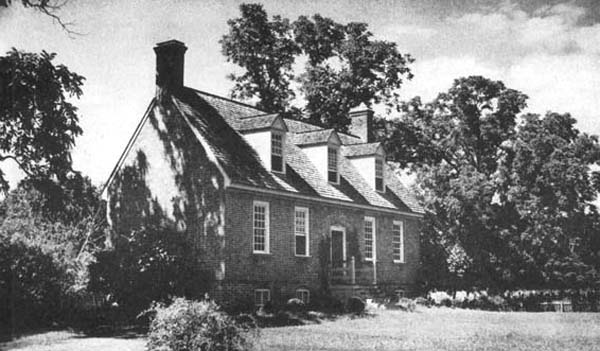
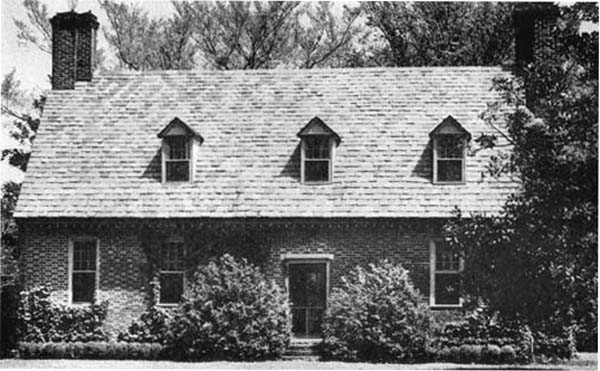 Photo by Flournoy, Virginia State Chamber of Commerce
Adam Thoroughgood House—Princess Anne County
This house, considerably altered, an example of early
seventeenth-century architecture, located in that part of Lower Norfolk
County which became Princess Anne in 1691, was built by Adam
Thoroughgood on land patented by him, 1635. The dormer windows are a
later addition.
True it is that many young men bound themselves, by written agreement
before departing from England to serve seven years in the colony, in
return for passage and other considerations, granted at the conclusion
of their terms. However, apprenticeship was the customary means, by
which young men acquired knowledge, and some degree of skill from their
elders. Young Robert Hallom, about 1640, was sent to England to live
with relatives and receive some training. He, forthwith, was apprenticed
to his cousin to learn the trade of a salter, and was described by the
family as a "prettie wittie boy." When Doctor Pott came to Virginia, in
1620, he brought as apprentices to learn the art of apothecary, young
Randall Holt and young Richard Townshend. Both youths became
dissatisfied, and sought to break their agreements through petitions to
the General Court, contending that Doctor Pott was not instructing them.
However, the Court held the young men to their agreements. Later,
Randall Holt married the heiress Mary Bayly, and became possessed of the
large plantation, Hog Island on the James River. Townshend rose to
prominence in the colony, also, having been named later a member of the
Council. Often such young men were third or fourth sons in a family, and
influence from overseas, as in Townshend's case, helped establish them
in places of honor and authority in the colony.
Youths, who agreed by indenture to serve in Virginia, were the main
source of help to the planters in the first half of the century. There
was never a sufficient number to fill the needs in the Colony, and
planters pleaded with the Company or with friends in England to send
them "servants." In letters sent to authorities in England, 1622, the
Rev. Richard Buck urgently requested that "servants" be sent to assist
him in carrying on the work of his 750 acre plantation.
Letters from Kathryne Hunlock of England to her daughter and son by a
prior marriage, Margaret and John Edwards, recorded in Northampton
County, indicate the class of young people who often bound themselves to
come to Virginia. Apparently, mother, son and daughter were educated,
for the mother refers to the correspondence with them. In 1648, Kathryne
Hunlock lists supplies she had sent to her daughter: eight yards of
snuff colored silk mohair, an ell of taffeta, silver lace, four pairs of
gloves, thread, hose, two taffeta hoods and two lace hoods with taffeta
handkerchiefs, four pairs of shoes, one hundred needles, 5000 pins and
"one green scarf for your husband." As the last entry shows, young
Margaret did not long remain an apprentice, for she was redeemed from
that status by a planter named Stephen Taylor, who, her mother wrote,
she understood, was an "honest man and gave a great price" for her.
Later, Kathryne Hunlock wrote her daughter and her son regarding the
daughter's inheritance from her deceased father. The son, incidentally,
served out his time. The correspondence indicates that these were
substantial folks, and the young people, probably having little to
anticipate in an improved status in England, sought both adventure and a
brighter future in Virginia.
Young orphans in the Colony, with no one to look to for support, were
bound out, this responsibility being accorded the vestry of the parish
church. In 1646, the York records note that Ann Snoden, an orphan seven
years of age, had no means left for her maintenance. Thereupon, she was
bound out to Captain Nicolas Martiau for nine years, with the provision
that he supply her with food, clothing, shelter, and give her a cow and
a calf and maintain both during her apprenticeship, rendering an account
annually to the court. In 1686, little William Hickman, a year old
infant, was bound out to William Dods of Isle of Wight County to be in
his care and service until he was twenty-one years of age.
Fewer than two score Negroes are listed in Virginia in 1625; they were
not present in numbers in the Colony until about 1660. By then, they
began to supplant white labor and were particularly useful in the
tobacco fields, the latter an ever increasing source of revenue to the
planter. Not all Negroes worked in the fields, however. In the inventory
of Mrs. Elizabeth Digges' estate filed in York County, 1691, three sets
of quarters for Negroes are listed: the home quarters where the house
servants lived, the Indian field quarters where those working in tobacco
lived, and the new ground quarters where were housed the Negroes doing
the heavy work of clearing new ground, a constant operation in Virginia
as the cultivation of tobacco quickly exhausted the soil.
As the Negroes took their places in the Colony as field-hands,
house-servants and craftsmen, the white indentured servant vanished from
the scene. As heretofore noted, the supply was never enough in the
Colony to fill the demand. Moreover, young men, at the conclusion of
their five or seven-year terms, received their allotment of clothing and
supplies, usually a
barrel
of corn, agreed upon in the indenture, and
joined the small-planter class in the Colony. Especially was this true
when the indenture included a clause granting fifty acres upon
completion of service.
Since Negroes were taught trades on the plantations and some of them
became highly skilled in handiwork, the white artisan had a difficult
time in establishing himself in Virginia. There was practically no white
artisan class. Small planters and their families acquired skills needed
in their daily living, the Negroes becoming the craftsmen on the larger
plantations.
The winters in Virginia, mild except for occasional freezes, with now
and then snowfall during the three winter months, proved less arduous to
the Englishmen than the two months of midsummer, when the mercury
reaching into the nineties brought discomfort, especially since the men
and women were clothed in the bunglesome garments, necessary in a cool
zone frequently overhung with fog. The many open, pleasant months in the
Colony made life out of doors a continuing pleasurable experience, when
hunting, fishing, horse-racing and games could be indulged in freely.
Yet, living indoors in Virginia in the coldest weather was always
cheerful. The land, heavily forested, yielded an ample supply of
firewood of all sorts, and the necessity of clearing the ground, for the
plantation homes and agricultural areas, kept heaps of wood at hand at
all times. The earliest open fires of the primitive shelters as well as
the great brick fireplaces later in the century, and the smaller hearths
in every room of the affluent planters' homes, always diffused that glow
of comfort instinctively sought, when the sun retreats. Before the
burning logs of hickory and oak the families gathered. There could be no
extravagance in the use of the abundant supply of wood, contrasting with
the necessity to preserve fuel in England, as the forests there, even in
the seventeenth century, were disappearing. Often, there were generous
pots of walnuts and hickory nuts to crack on the hearth, as family and
friends sipped from their pewter mugs the aging cider, pressed from
apples gathered in nearby orchards.
In addition to the flaming hearth, the soft glow of the candle, used
for illumination in the seventeenth century, lent charm to the evening
scene, as wanton shadows stood off in the room. Moreover, there was an
elusive aroma from the candles, often made from the wax of berries,
taken from the prolific growth of myrtle bushes about the Virginia
waterways. This redolence, together with the clear light which the
myrtle wax gave forth, made that candle popular in the evening;
notwithstanding, both beef and deer suet were in use for candle making,
and some candles were imported. All were held in candlesticks, made of
wire, brass, pewter, copper, or iron, the more elegant, of silver, with
snuffers of the same metals. In the very modest homes, the pine-knot
served as a means of illumination, the turpentine in the wood fibers
causing it to burn brightly until consumed.
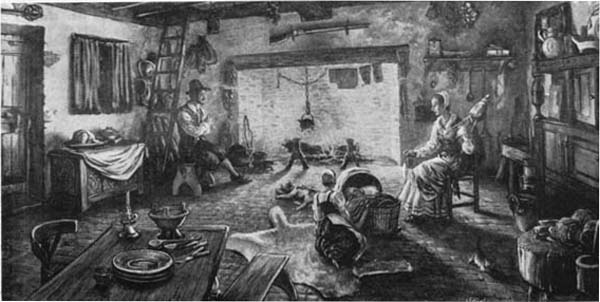 From a painting for Colonial National Historical Park by
Sidney King.
From a painting for Colonial National Historical Park by
Sidney King.
A Domestic Scene at Jamestown About 1625
This representation of seventeenth-century home life was executed by the
artist after a detailed study of artifacts and
archaeological
remains
found at Jamestown.
Various house furnishings have been listed in the inventories or are
listed hereafter. During the latter part of the century, particularly,
it will be seen that these furnishings were as elaborate or as simple as
in the comparable home in England.
Next to the fireplace, perhaps, the table adds more good feeling among
family and friends than any other item of the household. To "gather
around the board" was not merely a figurative expression in the early
seventeenth century when the first tables were boards laid on trestles
and set aside after meals. Table frames and planks were mentioned in a
Lower Norfolk County inventory in 1643. Later, permanent legs were
attached to the boards, and stretchers, fastened to them with pegs, kept
the table steady. However, as the English began to fashion fine pieces
of furniture, the table of various types found its way to Virginia and,
by the middle and late seventeenth century, there were serving-tables,
tea-tables as well as dining-tables. The four-times married Mrs. Amory
Butler owned a rare item in an extension table.
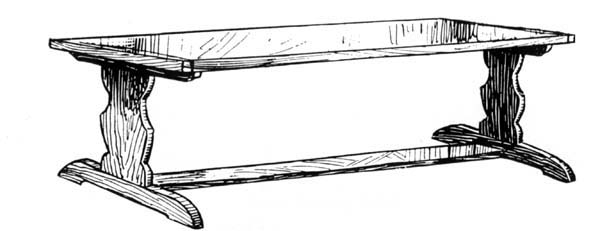 Early Dining Table
Though the first tables in the Colony were boards laid on trestles, the
above shows the adaptation of supports for permanent placing of this
article in the household.
Even the planter with a modest household owned table-linen. As
heretofore noted, Joseph Ham possessed, before 1638, a dozen napkins
and a table-cloth. The well-to-do planters, especially after 1650,
brought with them, or sent for, a wide variety of table-linen, and both
Mrs. Butler and Mrs. Digges owned napkin-presses, that of the former
listed in 1673, and that of the latter in 1692.
Wooden trenchers and wooden spoons were the earliest tableware in
Virginia. Later, pewter-ware supplanted wood and while earthen-ware
trays and pots were mentioned, in a few inventories, and were used in
the dairy, and while earthen-ware was produced in the Colony by 1675, it
did not come into general use for dining during the seventeenth century.
Table-knives were not plentiful, nevertheless, various types of such
knives are mentioned in inventories by the latter part of the century,
black-handled, white-handled and ivory-hafted knives. The one rare item
was the table-fork, which was not common even in England during the
period. "Eating with the knife," a step beyond the use of the fingers,
gradually became an established custom, and the practice has survived
among the homely folks, despite the many varieties of forks available
and in general use today.
The bed was a prominent item and the ticking of the best beds was filled
with feathers, which assured a soft, comfortable, cosy resting place,
especially in winter. There were no springs. The flock bed so often
mentioned was less downy but comfortable, being filled with bits of
wool, rags, milkweed or cattail-fluff, the latter in abundant growth
near the fresh waterways. This was the "next best bed" which was a
sufficiently important item to be left to heirs. Thomas Gibson, in 1652,
bequeathed to his daughter his "best flock bed, with rug (used for
covering), bolster, pillow and fine pair of Holland sheets." Sheets,
variously mentioned, were of canvas or of Holland, generally, the
latter, being an unbleached coarse linen. By the middle of the century,
valances and curtains around the beds "to shut out the night air" were
in general use. As soon as practicable, the English were bringing over
their brass warming-pans with long handles. These perforated pans
filled with warm embers were run in the beds just before the retiring
hour. As the antecedent of the modern American electric blanket, they
enticed the drowsy to bed. Retreating from the cheerful hearth, the
would-be sleeper, then as now, had no fear of being aroused by the
clammy chill of frigid bed-linen.
All colonists appear to have possessed chests of one kind or another,
some plain, some carved. When the early planter obtained sufficient
credit from his tobacco crop to indulge in a luxury, he acquired an
innovation in a chest-of-drawers, where was kept the family clothing and
the supply of materials on hand. Since dress was an important matter in
the Colony, the looking-glass was indispensable. Occasionally, there was
"a great looking-glass," but for the most part, the mirrors were small
and stood on chests or chests-of-drawers.
Stools and benches were in use generally. Chairs, rare in England until
the early part of the seventeenth century, nevertheless, found their way
to Virginia about the time they came into use in England. However,
chairs were scarce, and only the master of the house or his
distinguished guest was accorded the privilege of being seated in them.
The earliest chairs were cumbersome, being fashioned of oak with solid
square backs, often panelled, and thus were known as "wainscot chairs."
The seat was of wood and the bracing beneath made this article of
furniture exceedingly substantial. Later in the century, a variety of
chairs found their way to Virginia, caned chairs, leather chairs and
Turkey-work chairs. The latter were those upholstered in hand-woven
material imported into England from the Orient and then exported to
Virginia. By the middle of the century, couches were listed and they
were for the most part of the same construction as the chairs.
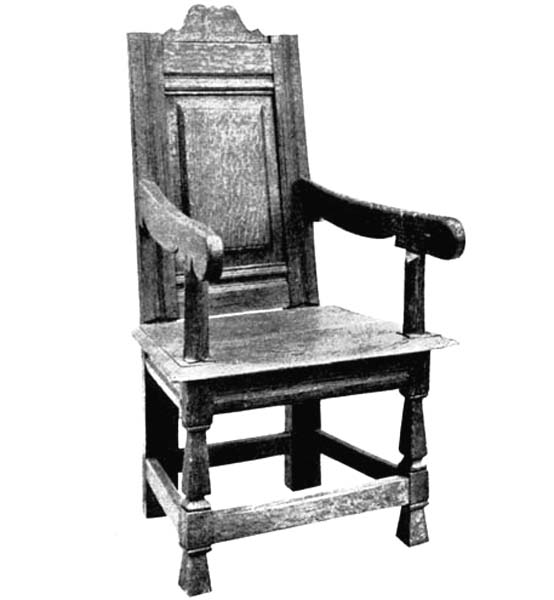 Wainscot Chair
While stools and benches were commonly used for seats in the early
seventeenth century, a wainscot chair as shown above was in use at
Jamestown before 1623.
Lord De La Warr, who came to Virginia in 1610, sat in the Jamestown
church in a green velvet chair. This is the first known mention of a
chair in the Colony. In 1623, a wainscot-chair, owned by John Atkins of
Jamestown, was bequeathed to his friend Christopher Davison, Secretary
of the Colony.
In addition to the standard pieces of furniture aforementioned, luxury
articles were imported during the latter part of the century. Mrs.
Elizabeth Digges owned five Spanish tables, two green carpets and a
Turkey-work carpet; Mrs. Elizabeth (Mason) Thelaball, of Lower Norfolk
County, had among her possessions a small desk and a writing-slate. In
the goods consigned, 1694, by Perry and Lane of London to Mrs. Elizabeth
Woory, of Isle of Wight County, was a drugget.
The size of the homes varied from the simple one-room structures
characteristic of the early part of the century to the Bridger home
previously described, and Mrs. Digges' home of six rooms, hall, cellar,
garret and detached kitchen.
In looking over the inventories of the seventeenth century planters,
observation is inevitable that the kitchen area alone maintained its
distinct character. Even among the well-to-do, beds were everywhere,
irrespective of the number of rooms in use. Guns, swords, pistols,
saddles, bridles, steelyards (scales) cluttered up the hall in the
Bridger home.
Bathing facilities were meager. Copper and pewter basins were in general
daily use, and also were employed for sponge baths occasionally taken in
winter before the open fires. The chamber pots, frequently listed,
served other necessary functions.
In the summer months, much of the cooking was done out-of-doors in huge
pots slung from a tripod. The food for the servants went into a single
pot, and their fare in "pap" was eaten in the open also, when the
weather permitted. In the winter and during the cooler months, cooking
was done on the hearth of an ample fireplace which customarily took up
the greater part of the end of a room. If the family was of modest
means, the kitchen area was the heart of the house. Here, in winter, was
warmth, food and companionship. As the planter acquired numerous
servants and preparation of food became an all-day matter, every day,
the kitchen with its companion room, the buttery, was divorced from the
house. Under this arrangement, the mistress of the household merely
directed the preparation of food, the care of the dairy products, the
salting of the meat, and the rendering of the lard.
Before the fire on the great hearth, meat on joints and fowl were
trussed on spits, and to some small boy fell the task of keeping the
spit turning. A drip-pan placed beneath caught the juices. Bakestones,
griddles and clay ovens were at hand to stand on the hot embers, and
later, ovens were built into the fireplaces. From cranes, simple at
first and later with convenient arrangements for tipping, hung the pots
for boiling. Bellows were at hand to enliven dying embers. On a rough
table stood the brass mortar and iron pestle for mixing, the flesh-hook
for handling meats, brass skimmer, rolling-pin, and other handy cooking
utensils. Besides, in an adjoining space, there were pans, butter-pots,
tubs and trays for the milk and milk products.
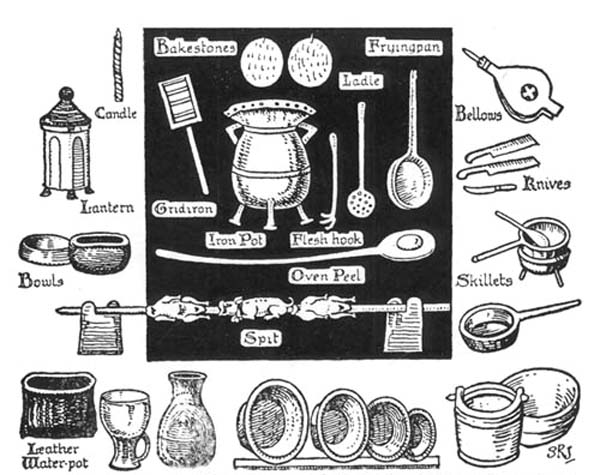 Courtesy of the artist, Sydney R. Jones from Old English
Household Life by Jekyll and Jones, published by B. T. Batsford, Ltd.,
London.
Courtesy of the artist, Sydney R. Jones from Old English
Household Life by Jekyll and Jones, published by B. T. Batsford, Ltd.,
London.
Photo by Thomas L. Williams
Seventeenth-Century Kitchen and Cooking Utensils
Water, which had to be drawn by hand from wells, except for an
occasional windmill, was not a plentiful commodity. Therefore, the
washing of clothes was not the semi-weekly operation carried on today
with labor-saving devices. For the most part, it was carried on
out-of-doors in clear weather, either at a nearby stream, or in the huge
pots or tubs possessed by every family. Soap was brought into the
Colony, and also was compounded from the animal fats available and the
soap-ashes, which were plentiful. After soaking, the clothes were laid
on boards and the grime driven out with "beetles" or paddles; then, the
garments were hung up or laid out to dry or bleach in the sun. The few
housewives, who owned napkin-presses, had the table-linen carefully
folded, and placed, when damp, in the press in a pile. The board,
screwed down firmly, eliminated the wrinkles, and the linen in some
hours was smooth and ready for use. Also, various smoothing-irons and
goffering (crimping)-irons, heated on the hearth were applied to
garments. In all, however, laundering was a laborious process. Perfume,
therefore, was a popular item in milady's toilet.
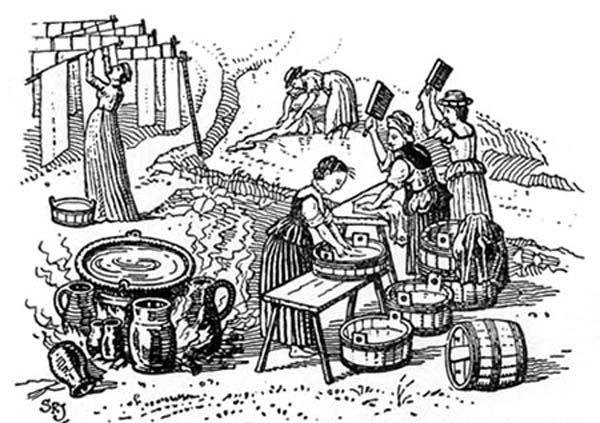 Courtesy of the artist, Sydney R. Jones from Old English
Household Life by Jekyll and Jones, published by B. T. Batsford, Ltd.,
London.
Courtesy of the artist, Sydney R. Jones from Old English
Household Life by Jekyll and Jones, published by B. T. Batsford, Ltd.,
London.
Photo by Thomas L. Williams
Wash-day in the Seventeenth Century
The women soak the clothes in hot water dipped from the nearby kettle
heated over the open fire, beat out the grime with paddles, rinse the
articles in the shallow stream and hang them out to dry.
From time immemorial, the traveller, in sparsely settled areas in need
of food and shelter at the end of the day, has always been made welcome,
whether he was known or unknown. Moreover, there were no questions
asked. Famed Virginia hospitality had its roots in this age-old custom,
particularly as the early seventeenth-century traveller, often from
overseas, could be sheltered nowhere else save at the homes of the
planters. Although there were few inns, some taverns and ordinaries by
the middle of the century, accommodations were poor and the well-to-do
gentlemen preferred the warmth of the planters' hospitable homes to
meager public accommodations. Nor was the entertainment of the
unexpected guest a one-sided proposition, for visitors broke the daily
routine of plantation life, bringing news from beyond and reports of
what was happening in other parts of the Colony or overseas. Upon
departure, the guest was sped on his way by his host or some member of
the family, who accompanied him part way on his journey. In case he came
by water, he was bade a final farewell from the planter's wharf.
Peter deVries, the Dutch sea-captain and trader, has left some early
accounts of hospitality in Virginia. Although he recorded that the
Englishmen in Virginia drove a close bargain in trade, and their acumen
in that respect could not be surpassed, he was ever warm in praise of
their hospitality. On his arrival in Virginia, 1633, he anchored off
Newport News and visited there the Gookins. Later, when his ship sailed
up the James River, he recorded that he stopped at "Littletown," the
plantation of George Menefie, an early Virginia attorney, a prosperous
planter and, said deVries, "a great merchant, who kept us to dinner and
treated us very well."
When young Christopher Calthrope, aged sixteen years, came to Virginia
in 1622, George Sandys, Treasurer of the Colony, proffered him the
entertainment of his home and offered him his own room to lodge in.
Although the young man declined, having other friends, Sandys saw to it
that he was adequately cared for in the Colony.
The hospitality of Captain Samuel Mathews of "Denbigh" was widely known,
even in England, where several, who had visited in Virginia, recorded
the welcome they had received at his extensive plantation at the mouth
of the Warwick River. In 1648, a writer, who signed himself Beauchamp
Plantagenet, recounted his visit to Virginia where, upon arrival at
Newport News, a few miles below "Denbigh," he was welcomed at the home
of Captain Samuel Mathews and given "free quarter everywhere."
Virginia proved a haven to numerous Royalists as previously mentioned.
Many who found it expedient to flee from England, about 1649, sought
refuge in Virginia. Their coming was often kept secret, but they were
accorded a warm welcome. Furthermore, when it was safe to make their
presence generally known, they were received into official life in the
Colony.
Among those who came and received welcome on the Eastern Shore at the
home of Stephen Charlton were Colonel Henry Norwood, Major Richard Fox
and Major Francis Moryson. Later they joined Colonel Mainwaring Hammond,
Sir Henry Chicheley, Sir Thomas Lunsford and Colonel Philip Honeywood at
Captain Ralph Wormeley's, on the Rappahannock River, and joined in the
"feasting and carousing."
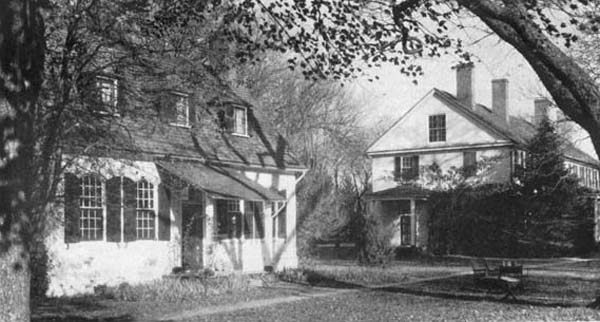 Photo by Flournoy, Virginia State Chamber of Commerce
Rosegill—Middlesex County
The first Ralph Wormeley, who died in 1651, at the early age of
thirty-one, cordially welcomed refugee royalists to Rosegill. Sir Henry
Chicheley, Deputy Governor, made his home at Rosegill and died here Dec.
1, 1682. In 1686, the second Ralph Wormeley was host to the Frenchman
Monsieur Durand of Dauphiné, who sought in the Colony a haven for the
Huguenots, his forlorn compatriots.
Governor Berkeley, a staunch Royalist, made the Cavaliers from across
the seas particularly welcome, and as Colonel Norwood recorded, "house
and purse were open to all such." Incidently, the term Cavalier
loosely applied at times to all gentlemen who came to Virginia in the
seventeenth century, irrespective of date, was a designation strictly
applicable to those of a political party, loyal to the cause of Charles
I, and it came into use during the Civil Wars in England nearly
thirty-five years after Jamestown was settled.
Not only were guests from far-away places accorded the utmost in
hospitality and given every indication that they were welcome, but
visitors from neighboring plantations were often honored guests and they
were ever the first consideration of their host. On 3 August 1658, Henry
Perry of "Buckland" in Charles City County had been subpoenaed to appear
in Court as a witness. On that day he had guests, so he addressed a
polite note to the Court stating that he had a "company of friends" and
therefore could not be present to testify as summoned to do. His
courteous note was recorded in the County Court records.
The custom, occasionally adhered to, in the present time, of laying an
extra place at the table for the possible coming of an unexpected guest
from near or far, had its American origin in the seventeenth century in
Virginia. More often then than now the extra place was filled at meal
time.
Since all the early Virginia plantations, both large and small, were
located either on the rivers or their estuaries, travel was almost
entirely by sloop for distances, and by shallop or skiff for brief
journeys. The families used such craft to attend church, and the
planters to attend Court, the Council or sessions of the Assembly. In
the latter half of the century, travel by horseback to the centers, or
to attend funerals, or to visit friends, if not too far distant, became
popular, especially as horses bred in the Colony had multiplied. The
more affluent planters owned numerous horses mentioned in wills and,
also, in inventories along with bridles, bits, stirrups and saddles.
In 1679, the Justices of Warwick County noted that a great number of
small horses were running wild on "every man's land" and, in
consequence, issued an order requiring that horses be penned, in order
that the breed in the County "might not be crossed unfavorably." The
same year, young Thomas Harris, son of Major William Harris of Henrico
County, bequeathed to "my cousin Richard Ligon all my horses, mares or
foals that can be proved to be mine ... they not being given by my
grandfather into the hands of the overseers." His grandfather, deceased
about 1657, was, prior to that time, in possession of horses as the
aforesaid entry shows. Colonel Joseph Bridger, of Isle of Wight County,
owned fourteen horses at the time of his death. These are shown in the
inventory of his estate entered, 1686. Thomas Cocke of Henrico County,
who died in 1696, disposed of a large estate in his will, including his
horses.
The absence of vehicles, except for a coach, a calash and carts, was due
perhaps not so much to cost and the necessity for importing them as to
the complete lack of passable roads in the Colony. Cartways, which were
the worn and widened Indian trails, over which oxen hauled heavy loads,
were the open ways over which travel by land could be undertaken. The
bodies of the carts were made in the Colony usually and attached to
wheels imported from England. Both the pillion and the side-saddle, the
latter an item listed in the inventory of Mrs. Elizabeth Digges, 1692,
were used by the women in accompanying the men on journeys. A pillion
and a pillion cloth were bequeathed in 1652, by Captain John Upton, of
Isle of Wight County, to his stepdaughter.
Notwithstanding the almost complete lack of highways, two Virginians are
known to have owned vehicles for travel in the seventeenth century. The
commission sent over from England to look into conditions which brought
about Bacon's Rebellion complained, 1677, that Governor Berkeley had
sent them from his plantation "Greenspring" to Jamestown, a distance of
three miles, in his coach with the common hangman as a postillion.
William Fitzhugh, a well-to-do planter of Stafford County, owned a
calash, a sort of a cab imported from England.
Those who did not own horses considered it no hardship to walk miles to
their destinations. Even so, the horse eventually became indispensable
to Virginians of all classes, who became very skilled riders at an early
age. Their adeptness in this as well as their knowledge in breeding,
training and handling horses passed from generation to generation until
the twentieth century. When the automobile supplanted the family surrey,
and the network of hard surfaced highways succeeded to the shady,
"woodsy," dirt roads, Virginia horses were retired from their long and
noteworthy service to Colony and to State.
The earliest reference to a garment maker in Virginia is a petition
entered in the General Court, 1626, through which Alice Boyse, widow,
sought to reserve for herself and family indefinitely the services of
young Joseph Royall, who had been brought to the colony by her late
husband to make apparel for the family and such servants as Boyse
retained under him.
The costumes of the seventeenth century followed precisely the
prevailing styles in England though dress, through necessity, often was
less elaborate. Travel, by the colonials back and forth to England, and
the arrival of ships ladened with merchandise of all sorts, kept the
planters and their wives abreast of the changing modes in dress. There
were three major styles in the seventeenth century: the Jacobean, the
Puritan and the elaborate dress of the Restoration.
These styles when reviewed today seem much too elaborate for a
wilderness; however, news, circulated in England about the Colony, gave
only encouraging accounts of an opulent land; thus, the men and women,
who came, brought with them the essentials for a normal home life, and
dress was an important aspect of ordinary living in England.
Nevertheless, the authorities in Virginia took cognizance of the
emphasis on dress, and, in order to encourage expenditures for
necessities rather than the luxuries in clothing, the Assembly of 1619
enacted a provision taxing an unmarried man according to his apparel,
and a married man according to the clothing possessed by himself and
members of his family.
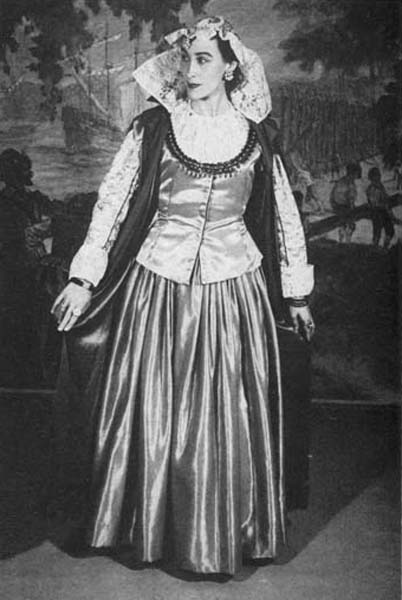 Photo by Thomas L. Williams through courtesy of the
Jamestown Corporation, Inc.
Photo by Thomas L. Williams through courtesy of the
Jamestown Corporation, Inc.
A Lady of Fashion
Garbed in a costume typical of the early seventeenth century a lady of
fashion displays jewels similar to those brought to Virginia by
well-to-do merchants.
During the first quarter of the seventeenth century, men wore less
elaborate costumes than the puffed, slashed modes of the Renaissance.
The breeches were loose but covered the knee where they were fastened
with buttons or a sash of ribbon, which often also decorated the instep
of the high-heeled shoe. The doublet had fewer slashes and more padding.
A stiff beaver hat, decorated with a white plume, rested on the head,
with locks falling around the neck and often over the shoulders. The
women as well as the men discarded the huge ruff, replacing it with a
flaring collar known as the "falling band." The bodices of the women
remained cylindrical in shape with sleeves tight from shoulder to elbow,
falling loosely to the wrist where they were often finished with turned
back cuffs. The farthingale gave way to the skirt, open from waist to
hem in front, to show an elaborate petticoat. Both skirts were short
enough to expose the instep and rosette or buckle on the shoe. The women
forsook the caps formerly in vogue and adopted also the stiff beaver
hats with feathers.
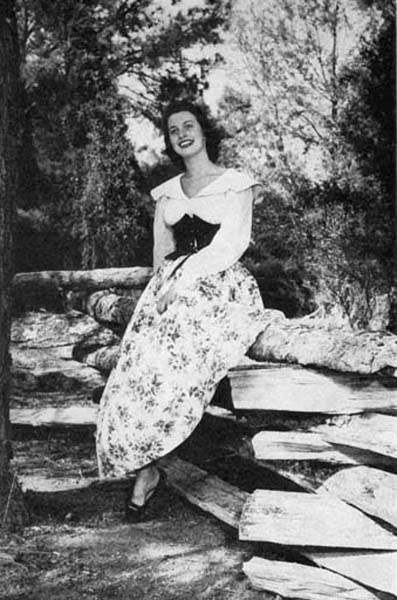 Photo by Thomas L. Williams through courtesy of the
Jamestown Corporation, Inc.
Photo by Thomas L. Williams through courtesy of the
Jamestown Corporation, Inc.
A Gay Mood
A young girl displays a seventeenth-century costume with full skirt,
cylindrical bodice and falling band (large loose collar).
With the coming of Charles I to the throne, decorative features were
added to the fashions. Colored ribbons, displayed in bunches at the
knees, on doublets and as ties to hold back flowing locks, came into
vogue along with flaring boots elaborately trimmed on the inner side of
the flare, which was turned back. The women's costumes also underwent
similar elaborations. Gloves appeared, also muffs, and the long circular
cape was used as a wrap.
The severity of the regime, as established under the Commonwealth, 1649,
was reflected in the dress of both men and women when all finery was
discarded. Fabrics became somber in color and unpretentious in texture.
Men had their locks shorn close to the head, and women returned to the
simple caps or hoods, which held the hair close to the head. Virginia
authorities took cognizance of England's turn towards simplicity in
dress, and enacted a law prohibiting the introduction of clothing
containing silk, or of silk goods in pieces, except for scarfs, silver
and gold lace or ribbons interwoven with silver or gold. The law further
provided for confiscation of silk articles brought into the colony
against the law.
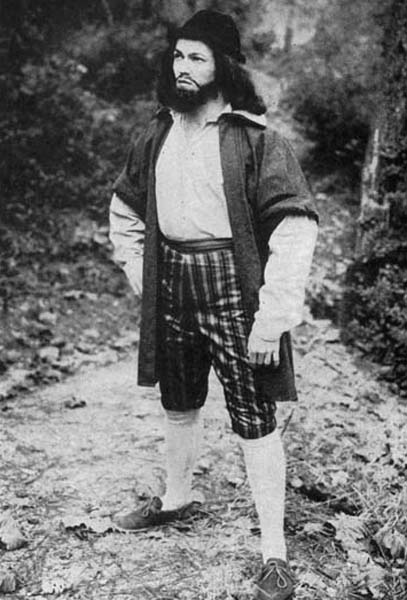 Photo by Thomas L. Williams through courtesy of the
Jamestown Corporation, Inc.
Photo by Thomas L. Williams through courtesy of the
Jamestown Corporation, Inc.
A Virginia artisan, in the costume of the early seventeenth century,
views a woodland scene in the Jamestown area.
After ten years of this severity in dress, the populace in Virginia was
ready for the change, which Charles II brought to England with his
restoration as monarch. Having spent his exile in France at the
brilliant court of Louis XIV, he brought with him, on his return to
England, fashions which the colonials sought to adopt, although they
were restricted somewhat because of the limited importations of silks
and satins, elaborate colored ribbons, fine linen, beruffled shirts, and
jeweled garters for the men.
The antecedent of the present-day coat worn by men was introduced in
England by Charles II, having been patterned after a Persian coat
brought to his attention. This coat, straight and collarless, was
buttoned from neck to knees where it ended. The close sleeves were
short, and finished with a deep turned back cuff, below which extended
the lace ruffles of the shirt sleeve. In cold weather, a greatcoat of
frieze (a shaggy-piled woolen fabric) was worn over the costume.
As the century wore on, women's dress became increasingly elaborate
also. The skirts were looped high at the sides over trailing petticoats,
the fronts of which were covered with fancy aprons of silk, linen or
lace. The bodice was usually laced across the front with ribbons.
Red-heeled shoes added a note of interest to milady's outfit.
Children's dress was patterned identically after that of their elders
and, as may be imagined, very little freedom of movement was afforded.
The inventory of Philip Felgate, Gentleman, of Lower Norfolk County,
entered on the records, 1646, shows that some of the more elegant
styling in dress had been brought to the Colony at that time. He
possessed a black cloth suit, two buff suits and a buff doublet, a short
cloth coat and a coat of squirrel skins. To complete his costume there
were two pairs of silk stockings, a pair of silk stirrup hose and black
silk garters, five pairs of shoes, a beaver hat, a silver hatband.
Evidently, Felgate was of the military service, for he had brought with
him, to the colonies, a suit of black armor with a headpiece of white
armor and a sword with a gold hilt. He owned also a musket and a rest
for it, and was outfitted with a "suite of bandoleers," the latter,
seldom listed in inventories, was a belt arrangement with loops, usually
twelve, in which were fitted small pierced metal cases for carrying the
slow matches (actually fuses), by which the charge for firing the gun
was ignited. Three Monmouth caps, customarily worn by soldiers and
sailors of the period, were among his possessions.
Major Croshaw's stepdaughter, upon the eve of departure from England,
1661, for Virginia, had been furnished with a scarf, a white sarcenet
and a ducape hood, a white flannel petticoat, two green aprons, three
pairs of gloves, along with a riding-scarf, a mask and a pair of shoes.
Mrs. Sarah Willoughby of Lower Norfolk County, who died 1673, left a
wardrobe valued at 14 pounds, 19 shillings. It included five petticoats,
a red silk, a blue silk and a black silk, another of India silk and
worsted prunella and a fifth of linen and calico. Also, the lady left a
black silk gown, a scarlet waistcoat, a sky-colored satin bodice, a pair
of red paragon bodices, a worsted mantle, two hoods, a striped-stuff
jacket, seven handkerchiefs, six aprons, three of fine and three of
coarse Holland.
Daniel Hopkinson, merchant, who died in Virginia, 1636, bequeathed to
relatives and friends beaver hats, which had become very much the vogue
during the reign of James I. Similarly, Robert Nickolson of London, who
died on a voyage to Virginia, bequeathed to relatives in the Colony and
to several of his associates, kid gloves, buckskin gloves and cordovan
gloves.
In the seventeenth century clothes were not discarded as they are today
for the garments, particularly for "Sunday wear" were carefully made.
The more affluent planters had clothes made in England, William Fitzhugh
having ordered from London, 1697, two suits, one for winter and one for
summer.
It was not uncommon to find clothing bequeathed in wills. In 1676, James
Crewes, ill-fated associate of Nathaniel Bacon in the Rebellion,
bequeathed to young Daniel Llewellyn, his "best suit and coat."
The reader may wonder when and where jewels could be worn in
seventeenth-century Virginia when, even at the close of the century,
there were no centers, other than church at which a lady might attend to
display her ornaments. Yet, the feminine frailty to covet the beautiful,
whether in gems, in fine household furnishings, linens or silver, was
perhaps even stronger than it is today. Possession of jewels was a mark
of distinction, and, even though the precious baubles could be shown at
functions but rarely, there was satisfaction in ownership and
compensation in the admiration they elicited when worn.
The colonials possessed a great deal more jewelry than might be
imagined. The opulence of the English merchants, trading in all parts of
the world, in the late sixteenth and early seventeenth centuries, had
enabled many to invest their surpluses in jewels, which fluctuated less
than the unsteady values in the media of exchange, and, therefore, were
an investment rarely decreasing in value. Moreover, jewels could be
transported more readily than either gold or silver and, since the
goldsmiths in England and Holland were the early bankers, they often
advised their customers, particularly those about to embark upon a
voyage to Virginia, to invest their profits in gems, easy to carry, not
likely to fluctuate and always desirable.
The unusual purposes, to which jewels might be put, is recounted in a
record of the sale of Mrs. Moseley's jewels to Colonel Francis Yeardley,
who desired them as a gift to his wife, Sarah (Offley), widow
successively of John Gookin and Adam Thoroughgood. William Moseley, his
wife Susan and two sons Arthur and William arrived in Virginia, 1649,
from Holland and settled in Lower Norfolk County. By reason of the
family's "great want of cattle," Mrs. Moseley, the following year, sold
some of her jewels: a gold hat band enameled and set with diamonds, a
jewel of gold (probably a pendant) enameled and set with diamonds, and a
diamond ring. In a letter to the purchaser, she stated that they were
genuine, having been examined by a goldsmith in The Hague, and were
worth £11 4s. In exchange, the Moseleys received five cows and four
oxen. Having still in her possession a ruby ring, a sapphire and an
emerald ring, Mrs. Moseley could be gracious in parting with her gems
and wrote Colonel Yeardley, she had rather his wife wear them than any
gentlewoman she yet knew in the country, and wished her "health and
prosperity" in her display of them.
At the same time, Mrs. Sarah Yeardley, the daughter of a well-to-do
English merchant, and the spouse successively of three prosperous
husbands, possessed other jewels. Her will dated, 1657, directed that
her "best diamond necklace and jewell" should be sent to England to
purchase six diamond rings and two black tombstones, the latter to be
placed over her grave and that of her second husband, at the churchyard
at Lynnhaven. Since all things ornamental were under a ban during the
Commonwealth in England, it is not surprising that Mrs. Yeardley's
necklace did not bring even the price of the two tombstones, which cost
£19 7s., while the diamond ornament brought only £15. Yet, the
tombstones, the inscriptions on which are extant, have left to posterity
a permanent record of Mrs. Yeardley and her three husbands. After all,
values are relative, and could Mrs. Sarah (Offley-Thoroughgood-Gookin)
Yeardley view today the position she enjoys in the romance of Virginia's
seventeenth century, she likely would not regret having traded diamonds
for tombstones.
One of the earliest records of jewelry in Virginia is in the will of
Mrs. Elizabeth Draper of London, dated 1625, in which she bequeathed to
her granddaughters, Elizabeth and Mary Peirsey, daughters of the
cape-merchant Abraham Peirsey, each, a diamond ring, Mary's set "after
the Dutch fashion." Arthur Smith I of Isle of Wight County made a
bequest, 1645, of his "seal ring of gold," to his son Thomas. This much
worn ring has passed from generation to generation, and remains today in
possession of a descendent in the county in which the testator died. He
also bequeathed mourning rings to the overseers of his will. Such
bequests, as the latter, were frequently made and were inscribed, or
carried a locket in which hair or some other memento could be placed.
Mrs. Elizabeth Digges' inventory listed among her possessions: eight
gold mourning rings, probably bequeathed to her by deceased relatives, a
diamond ring, a small stone ring, a parcel of sea-pearls and a bodkin,
the latter an ornamental hairpin.
In 1651, Robert Nickolson of London, merchant, dying on a voyage to
Virginia, made en route a will with numerous bequests, among them, a
diamond ring and a gold ring to Mistress Beheathland Bernard, daughter
of Mrs. Mary Bernard and granddaughter of Robert Beheathland, who had
come to Virginia with the first settlers in 1607.
In 1673, Mrs. Amory Butler, nee Elizabeth Underwood
(Taylor-Slaughter-Catlett) left to legatees a collection of jewelry
probably assembled, in part, during her four ventures in matrimony.
These jewels included her wedding ring—to which husband is not
known—two big stone rings, a blue enameled ring, two mourning rings, a
small diamond ring and a large diamond ring, a small pearl necklace and
a necklace with large pearls, a silver bodkin and a gilded bodkin, a
pair of silver buttons, and a pair of silver buckles. The year
following, Mrs. Rose Gerrard, widow, of Westmoreland County, made
several gifts to her eldest daughter, Sarah, wife of William Fitzhugh,
and among them were "one necklace of pearls."
Colonel Thomas Pitt, of Isle of Wight County, had the forethought,
before he died in 1687, to leave to his wife her wedding ring along with
her wearing apparel, and also title to her two diamond rings, an
enameled ring, and a necklace of pearls. These items, otherwise, could
have been accounted in his estate for division among heirs, for the law
gave a woman no title to her possessions during the life of husband.
Colonel Bridger also left to his wife, 1683, all "her apparel, rings and
jewels."
Although clocks are listed in seventeenth century inventories, one of
the earliest mentions of a watch was in 1697, when Richard Aubrey of
Essex County, bequeathed two silver seals and his "pendilum watch."
That Christmas was an occasion to be enjoyed, both with comfort and
merriment in the Colony, is indicated in an account, recorded in 1608,
when a group of the first settlers in two ships undertook to visit
Powhatan at his seat Werowocomoco on the Pamunkey (York) River. Setting
sail from Jamestown they encountered rough weather and were forced to
put in at Kecoughtan (now Hampton), where they spent Christmas with the
Indians. Their scribes recorded that they were "never more merry, nor
never had better fires in England than in the dry, warm, smoky houses of
Kecoughtan."
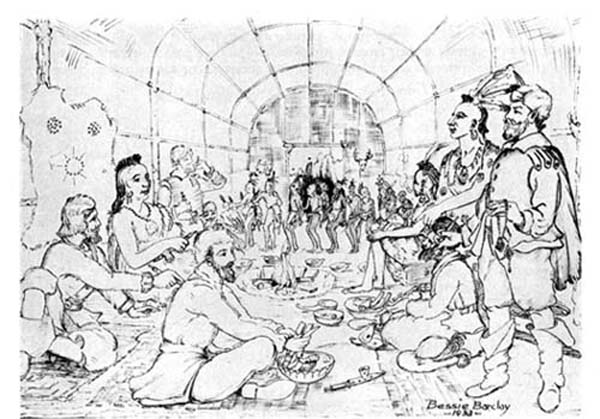 Drawing by the late Bessie Barclay, based on a study of
the original John White drawings made in 1653 and now in the British
Museum. Through courtesy of the Daily Press, Newport News.
Drawing by the late Bessie Barclay, based on a study of
the original John White drawings made in 1653 and now in the British
Museum. Through courtesy of the Daily Press, Newport News.
Christmas at Kecoughtan 1608
A group of colonists from Jamestown bound for Powhatan's seat on the
York River put in at Kecoughtan after encountering adverse weather.
There they spent Christmas with the Indians who entertained them in the
native arched bark-house with feasting and a tribal dance.
Christmas in the seventeenth century was celebrated on the day known to
the present as "Old Christmas," that is the sixth of January.
The dry, smoky houses of the Indians were long, arched structures with a
framework of bent saplings, over which was secured a close covering of
bark, while the roof was covered with mats or reeds. A fire built in the
middle of the habitation, with smoke curling through an opening above,
afforded both warmth and fuel for cooking. Mats and skins, hung at the
entrance and exit, kept in the heat and also some of the smoke, but shut
out the rough weather. Several families slept, ate and carried on their
indoor activities in these ample shelters.
And, here, it was that the colonists, with only the Indian maids to
provide feminine company, celebrated the first Christmas, of which
there is a record in the new world. After the feasting and the passing
of the pipes, as a token of friendship, there was probably a customary
Indian oration of welcome. Then, the Indian dancers appeared with their
rattles, and beating time to the tom-toms with their feet, they gestured
wildly with their arms. As a participant became weary, another took his
place and this exhibition, first stimulating in its activity, then
soothing in its cadence, carried far into the night, as, one by one, the
audience of white men and natives drifted off to the hurdles that served
as beds, and to sleep.
When the weather broke, and before the colonists resumed their journey,
they likely were entertained by their hosts in a deer-hunt staged
according to the Indian custom. Several Indian runners left, early in
the morning, to drive up the deer and herd them on a narrow peninsula,
of which there are many between the James and the York Rivers and
elsewhere in Tidewater Virginia. Canoes, with native hunters and their
white men guests, awaited in the waters nearby, and when the drivers,
pursuing the deer, forced them into the water, the frightened animals
were slaughtered in numbers. Ladened with the spoils, hosts and guests
returned to the bark houses to cook and feast upon their game.
Firearms played an important part in all celebrations in the seventeenth
century as every planter possessed one or more "pieces" which were used
to give dash to the frolics. A proclamation, issued in 1627, warns
against "spending powder at meetings, drinkings, marriages and
entertainments." Thus, it is certain that the colonists were wont to
assemble and celebrate as occasions warranted.
One of the most colorful of these occasions took place at Middle
Plantation (later Williamsburg) in 1677; Sir Herbert Jeffreys, having
been sent over with 1000 English soldiers to look into the state of
affairs in Virginia and to put an end to the Rebellion led by Nathaniel
Bacon, found Bacon dead and the Rebellion over. Shortly thereafter,
Governor Sir William Berkeley, who had caused so much grief by hanging
Bacon's chief associates, was summoned back to England, whereupon
Jeffreys ordered a celebration. The King's birthday provided the
occasion which he promoted, not only to honor the Sovereign but to
assemble the people, to heal the wounds and promote peace with the
Indians. Not only the colonists and the English troops gathered, but all
the leading Indian chieftains and queens of Tidewater and their retinues
were invited, and attended in ceremonial regalia. That there was not
only formal recognition of the important day, but much firing of arms,
drinking and hilarity on the side may be certain.
The planters of the Northern Neck, living in widely separated
plantations, took steps in 1670, to bring together the families and
promote sociability in the section. An agreement was entered into by Mr.
Corbin, Mr. Gerrard, Mr. Lee and Mr. Allerton to build a banqueting
house "for the continuance of a good neighborhood." Each man or his
heirs in turn then would make "an honorable treatment fit to entertain
the undertakers thereof, their wives, mistresses and friends, yearly and
every year." This appears to be the antecedent of the modern country
club.
In hunting, fishing, and fowling there was always ample out-of-door
recreation at hand. In addition to the deer-hunts, there were often
bear-hunts, and 'possum and 'coon-hunts were popular nighttime sports.
On the latter occasions a party of men set out, preferably on a
moonlight night, with their dogs. Having entered the woods, the dogs
shortly took up the trail of their intended victim, while the men on
foot followed the yelping dogs through the rough terrain. Finally the
exhausted animal was "treed" and there the sport reached a climax. If
the dogs were unable to reach their victim the tree was hastily felled,
whereupon the pack of dogs made short work of the creature. In case the
'possum sought refuge in a hollow log, he was smoked out and the end was
the same.
There was less excitement in hunting rabbits and squirrels, and the
pursuit of the fox had certainly not attained in the seventeenth century
the social status that it enjoys in sections of Virginia today.
In fishing, many of the colonists acquired from the natives a skill in
spearing fish, though netting them was far more general in the Colony.
Horse-racing as a regular sport was inaugurated in the latter half of
the seventeenth century, although it does not appear that horses were
bred and kept especially for racing in that period as they were during
the eighteenth century. At the "race-paths" at "Malvern Hill," the Cocke
plantation in Henrico, running the quarter of a mile was a popular
contest.
Elsewhere, similar races were engaged in. In 1674, James Bullock, a
tailor, was fined 100 pounds of tobacco in York County for racing his
horse against Mr. Mathew Slader's horse, the decree reciting that it was
"contrary to law for a laborer to make a race, being a sport only for
gentlemen." Yet, Mr. Slader's intent to cheat at the race brought him a
sentence of an "hour in the stocks."
On 10 May, 1676, Samuel Morris aged 27 years, deposed in Court about a
horse-race run at Rappahannock Church.
Richard Ligon, to whom his cousin Thomas Harris bequeathed his "mares
and foals" in 1679, was one of the racing enthusiasts of the Colony. He
engaged in a horse-race and a controversy over it in 1678, and the
following year he ran his horse against that of Alexander Womack, the
wager being 300 pounds of tobacco. In 1683, Andrew Martin and Edward
Hatcher put their horses in a contest in which the loser's horse was the
stake to be won.
The colonists often were quarrelsome over their racing, and not
infrequently, bets on horses were put in writing and recorded in the
County records, that there might be no mistake in regard to the terms.
These races elicited a great deal of interest on the part of the people
in the countryside where they were staged.
For active recreation, bowling and tenpins; and card games of various
sorts were engaged in, often at the ordinaries, and, since wagers on the
games of which there are a record, were usual, they will be dealt with
elsewhere.
Although existing records do not convey information, as to the part
music played in the life of the Virginia planter of the seventeenth
century, they do provide clues that music was enjoyed, and that a number
of instruments were in the colony. Josias Modé, host at the French
Ordinary in York County, whose widow, before 1679, married Charles
Hansford, of York, owned two violins. It is reasonable to conclude,
therefore, that guests at his hostelry were frequently entertained with
music from that instrument. The virginal (a small rectangular spinet
without legs) was the most common of instruments known to have been in
possession of the colonists, while they also owned and played the
fiddle, both small and large, the cornet, the recorder (a flageolet or
old type of flute), the flute and the hautboy. These instruments in the
hands of music lovers, frequently self-taught for the most part,
entertained the planters' families and enlivened gatherings assembled
for weddings and birthday celebrations. The hand lyre also was known in
Virginia.
In their drinking habits the Englishmen in Virginia were no different
from the Englishmen "at home." Accustomed to the use of "strong waters,"
they brought their tastes and their habits to the Colony. Hence, it is
not surprising that the idea arose in England that the excessive
sickness in Virginia was due to the substitution of water for beer in
Virginia. This notion may have had substance at the time, since there
were no sanitary precautions in the area of the shallow wells at
Jamestown. Polluted water, no doubt, contributed to the prevalent
sickness in the summer months, whereas the fermented and distilled
waters disposed of impurities before they were ready for consumption
and, thus, assured to imbibers a degree of safety from germ-bred
diseases.
As early as 1609, the Virginia Company advertised for two brewers
available to go to Virginia, and, in plans for the third and largest
expedition sent under Sir Thomas Gates and Sir George Somers in 1609,
provision was made to include experienced men, so that malt liquors
could be brewed in the Colony and thus, the necessity of crowding the
ships with such supplies generally in demand, could be avoided.
Prior to 1625, two brewhouses were being operated in Virginia, and
twenty years later there were six. Also, the Virginia Assembly
recommended that all immigrants should bring in their own supply of malt
to be used in brewing, thus avoiding the use of drinking water, at least
until they had become accustomed to the climate. At the same time,
various products in the colony were found adaptable for producing
drinks—persimmons for beer, sassafras for wine, and both barley and
Indian corn were cultivated for brewing purposes.
Many of the planters developed their own facilities of one kind or
another. Colonel Bridger had a malt-mill, and John Fisher a still. Cider
was the established drink for family use and, as is known, gathered a
good deal of strength as it aged. In addition, as trade between the
Colony and the West Indies became brisk, quantities of rum (made from
molasses)
was brought in from that source. It became a common drink, was
distributed especially for the use of servants, and was generally
available in taverns, as was brandy distilled from peaches and apples.
The well-to-do planters were able to purchase the imported liquors and
wines of a finer grade, sack and "aquavite" being the most popular in
the early part of the century, while later, madeira, claret, and Rhenish
wine became available. Some of the finest wines were to be had at the
taverns, including sherry, malaga, canary, and claret.
At meetings of public bodies, a supply of liquor was always provided
for, ahead of time; Charles Hansford, of York County, agreed, in 1677,
to supply the Justices meeting at the leased home of his deceased
brother, a gallon of brandy at each session of the Court. One of the
duties of the Auditor General of Virginia was to arrange for the supply
of wines and liquors, which the august body of the Governor's Council of
State expected to be on hand, while they were in session. While William
Byrd I held that office, in the latter part of the seventeenth century,
he ordered for their use, twenty dozen bottles of claret, six dozen of
canary, sherry, and Rhenish wines, and a quarter of a cask of brandy.
Excessive use of liquors became the concern of the first Assembly
sitting in 1619, who ordered that persons guilty of a first offense be
privately reproved by the minister. In 1624, the churchwardens of every
parish were ordered to report to the Commander of the plantations, in
which the Parish lay, all persons who had imbibed too freely. By 1632, a
fine of five shillings was set to discourage intoxication, and by the
middle of the century, heavier fines were imposed.
The colonists were aware of the excessive use of liquor, particularly in
gatherings. The will, of Edmund Watts of York County, dated 20 February
1675, forbade the serving of drinks at his funeral, the testator
reciting that, inasmuch as he had observed "the debauched drinking used
at burials, tending to the dishonor of God and religion, my will is that
no strong drink be provided or spent at my burial."
In 1676, while Nathaniel Bacon held sway in the colony, efforts were
made to suppress many long-standing abuses, among them, excessive
drinking encouraged by the many taverns and ordinaries in existence.
Laws were enacted, at that time, revoking the licenses of all inns,
alehouses and drinking establishments, except those at James City, and
two at the ferries on the York River, where only beer and cider could be
sold. This was the first recorded attempt at prohibition in Virginia.
After the Rebellion was over, the enactment was modified, permitting the
operation of two ordinaries in each county. Jamestown, the seat of
government, was excepted from the limitation.
Just when the famous drink of the Virginia gentleman, the mint julep,
was first mixed is not known, but the Colony possessed all the
requisites during the seventeenth century. As heretofore mentioned,
there was an ice house at Jamestown about the middle of the century. The
fragrant mint grown in the planters' gardens, along with other herbs,
has been known from time immemorial for its cooling refreshment,
especially on a hot summer day. Brewed in a tea, mint was used both for
a drink and, as a medicine, to induce mild perspiration and so bring
down fever. The leaves, at times, made into a poultice, soothed
inflammation.
Added to "strong waters" and ice, the mint with its delicate flavor, its
cooling, soothing qualities, made the perfect drink for Virginia
gentlemen during the humid midsummer. It was a favorite all-year-around,
and three times a day. A julep before breakfast was usual, and grew into
a custom, which lingered into the early twentieth century, in areas
where the plantation manners persisted.
Although pewter was in general use for tableware during the period,
glass was made in the colony, as early as 1609, and imported glasses not
infrequently are mentioned in inventories. Mrs. Elizabeth Digges, of the
"E D Plantation" in York County, left an estate in 1691 that included
both earthenware and glasses.
With all the requisites at hand, it seems probable that the mint julep
had its origin in the latter half of the century. If there was a company
of friends, chilling the glasses ahead probably fell to a servant, who
also was trained in the art of crushing the mint leaves with a bit of
sugar, in each glass. Into this, at the proper moment was added the
crushed ice to the brim and, as a jigger or two of liquor flowed over
the ingredients, the glasses frosted and were topped with a sprig of
mint. The pleasantness of the drink was not deemed its single virtue,
for there was a very sincere belief in the efficacy of this refreshment
in the promotion of good health and, particularly, in warding off the
current fevers that plagued the lowlands.
The inherent human trait of taking a chance for possible gain led the
colonists to amuse themselves at games and sports, in which they
invariably added a wager to lend zest to the occasion. This practice,
generally prevalent in England, quite naturally was extended to the
Colony, as the English established themselves with all their customs and
habits in the new land. Betting was general at games and in sports,
including horse-racing, heretofore dealt with, and cockfights.
Efforts to halt gambling apparently had little effect as most of it was
carried on semi-privately. However, in 1646, Richard Smyth and John
Bradshaw were fined 100 pounds of tobacco in Lower Norfolk County for
"unlawful gaming at cards."
Unfortunately, knowledge of games played in the seventeenth century is
available largely through the bets placed and subsequent accounts of
these in the Court records. Doubtless many games were played among
families on the plantations, as they are today, among friends, without
wagers, but there was no occasion to record them. Thus, the fact
predominates that cards, dice and ninepins were generally sources of
amusement—for stakes.
Playing ninepins at the ordinary was part of the gentleman's day, when
he came to the centers in the Colony, where these public places were
established in numbers, after the middle of the century. At Varina, in
Henrico County, Richard Cocke of "Bremo" operated the ferry and also
the ordinary there, where in 1681, his nephew young Thomas Cocke, Jr. is
recorded as having been playing at ninepins for stakes with Richard
Rathbone and Robert Sharpe. In 1685, in Henrico also, possibly at the
ordinary, Giles Carter won 500 pounds of tobacco at dice from Charles
Stewart. A card game called "putt" (put) and a game known as cross and
pile (probably similar to "heads and tails") also were the media for
bets, the bets no doubt affording the main interest in the game.
Luke Thornton and Peter Evans of Richmond County, "having agreed to play
at cards at the game of 'putt'," had their arrangements with one another
recorded, 7 February 1695, together with the consideration stipulated
for the winner. The records do not reveal the outcome of the game nor
any provision for enforcing by law the terms agreed upon. Nevertheless,
the likelihood is that the winner collected, for, otherwise, the loser
could be held up to public scorn.
When Abraham Peirsey, affluent cape-merchant, directed in his will,
1628, that he be buried "without any pomp or vainglory," he probably was
protesting the tendency towards elaborate funerals, even in the early
days of the Colony. It is not known whether or not his wishes in this
respect were carried out; however, he was, no doubt, buried in his
garden near his new frame house, as he requested.
On the other hand, Daniel Hopkinson, English merchant, who died on a
voyage to Virginia, requested that he be "decently" buried at the
Kecoughtan (Hampton) church, in accordance with the customs prevailing
in the area. The amount spent on his funeral is an item in the accounts
of the Tristram and Jane, on which he had crossed the seas as
supercargo.
Arthur Smith of Isle of Wight County, in his will dated 1645, directed
that he be "buried by my late beloved wife," and Richard Cocke, of
"Bremo" on the lower James River, requested in his will, dated 1665,
that he be "interred in the orchard near my first wife." Doubtless, the
second wife, mother of several of his younger children, carried out her
husband's wishes and permitted her deceased mate whatever comfort there
might be in the forethought of resting in the cold, dark ground beside
the lovely lady he had first chosen to be his bride.
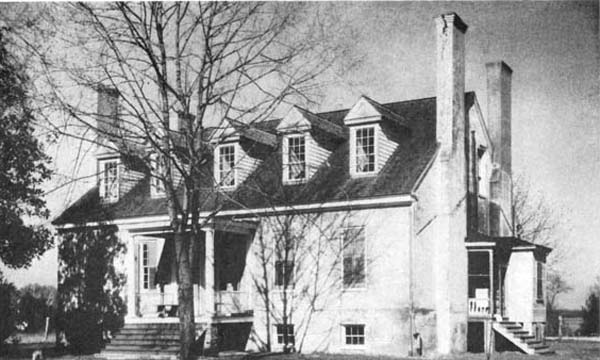 Photo by Flournoy, Virginia State Chamber of Commerce
Windsor Castle—Isle of Wight County
This home is located on a portion of the original grant of 1450 acres to
Arthur Smith I, who came to the Colony in 1622. The town of Smithfield
was laid out in 1752 by his great-grandson Arthur Smith IV, to whom the
General Assembly granted permission to partition off seventy-five acres
of his entailed estate.
At every plantation there was a family burying ground, not far distant
from the house, and usually in or near the garden, where the blossoms
carefully nurtured, brightened the last resting places of deceased
members of the family. The plantation burying-ground originated through
necessity rather than in sentiment. In the seventeenth century a real
problem would have been posed by any attempt to transport the deceased
and the funeral procession to the distant churchyard.
The Swann family, living across from Jamestown at "Swann's Point,"
buried deceased members on the plantation and, for almost three
centuries, their graves could be identified. The Travis family living on
Jamestown Island and near the church there, nevertheless, interred their
dead in the family burying-ground at the lower end of the island, and
some of the later marked graves may still be identified.
Markers in the Jamestown church, some over unknown graves, indicate the
practice of burying persons, probably those of importance, within the
church, as was often done in England. The Knight's tomb in the Jamestown
churchyard is believed to be that of Sir George Yeardley, appointed
Governor of Virginia, 1618, and deceased, 1627. Colonel John Page, who
gave the land on which Bruton Parish Church in Williamsburg is built,
was buried in its churchyard, as were his wife and son Francis. The
stone, placed in memory of Colonel Page, was later removed and placed
within the Church.
While funerals in seventeenth-century Virginia were solemn occasions,
there was an inescapable social aspect to the gatherings of family and
friends, who assembled from the countryside, both to comfort the
bereaved and attend the departed on his last journey. When a planter or
a member of his family died, messengers were sent out at once by sloop
or shallop up and down the rivers or later, overland, on horseback. If
the family bore arms, the hatchment, emblazoned with this emblem, was
hung upon the door. Incidentally, the only known hatchment, that has
survived in Virginia, is in possession of the Carter family at "Shirley"
in Charles City County.
At once, preparations were begun to accommodate the relatives and
friends who were sure to assemble for the last rites. Coming from a
distance, they would be hungry upon arrival, and not only was a great
amount of food prepared but the cellar was explored for its contents of
drink, which the company expected to be brought forth. Occasionally, a
man, in making his will, directed what should be spent for the "funeral
meats" and drink, although Edmund Watts of York County, in 1675, forbade
the serving of drinks at his funeral.
At the final rites for John Smalcomb in 1645, the company consumed a
steer and a barrel of strong beer, the cost of which amounted to 960
pounds of tobacco, while the coffin cost only 250 pounds. The gathering
assembled in 1678, for the funeral of Mrs. Elizabeth (Worsham) Epes,
widow successively of William Worsham and Francis Epes of Henrico
County, consumed a steer, three sheep, five gallons of wine, two gallons
of brandy, ten pounds of butter and eight pounds of sugar.
The firing of guns was accepted as a regular feature of a funeral, and
at the Smalcomb rites the powder spent amounted to twenty-four pounds of
tobacco. In order to curb the waste of ammunition at entertainments, the
Assembly, in 1655, passed an act forbidding its use on occasions except
at "marriages and funerals."
In addition to expenditures as aforesaid and for the coffin, the latter
usually made by some local carpenter, there were costs for notifying
the countryside, costs for mourning bands, sitting up with the corpse,
and the fee for the funeral sermon. If burial was in the churchyard,
there was the cost of digging and filling the grave. The cost of a
winding sheet of Holland (coarse unbleached linen), in 1652, was 100
pounds of tobacco. The cost of the funeral sermon in two instances in
York County in 1667, was two pounds sterling each and in 1690, five
pounds sterling.
As there were no undertakers, the laying out of the corpse was a tender
ministration for which some close friend of the family volunteered. The
technique for this service was passed from generation to generation and
only in comparatively recent years has that custom been abandoned
altogether.
The company of relatives and friends, who gathered for the funeral
occasion, remained for several days and were, of course, fed and housed
at the expense of the deceased's estate.
The law required that servants be buried in public cemeteries
established for the purpose. This decree issued in the seventeenth
century followed several scandals, occasioned by private funerals of
deceased servants. In order to remove all possibility of suspicion,
prior to burial, several neighbors were summoned to view the corpse, if
death occurred under extraordinary circumstances, and to accompany the
body to the grave. That such precautions were taken as early as 1629, so
that possible murder would not go undetected, is shown in testimony
before the General Court at Jamestown after the newly-born bastard child
of a servant girl was found dead. Several persons were called as
witnesses, and when evidence was produced that the child might have been
born alive, the serving maid's master was required to give bond for her
appearance at a higher court.
The well-to-do planters or their families invariably saw that
appropriate tombstones with proper inscriptions—lengthy ones,
characteristic of the day—were duly placed. Some of these stones
remain with barely legible inscriptions; others, the inscriptions on
which, fortunately, were copied in a past era, have disappeared
altogether. The oldest tombstone in Virginia with a legible inscription
is that of Mrs. Alice Jordan at "Four Mile Tree" in Surry County. The
inscription, reciting that she was the wife of George Jordan, gives
praise in verse to her virtues.
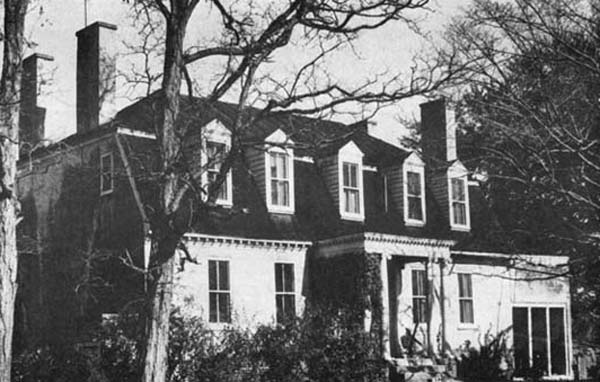 Photo by Flournoy, Virginia State Chamber of Commerce
Four Mile Tree—Surry County
A seventeenth-century home was the basis for this present structure
located on a portion of a 2250 acre grant to Henry Browne in 1637. The
estate remained in the family for two hundred years. In the adjacent
graveyard may be seen the oldest tomb in Virginia with a legible
inscription, that of Alice (Miles) Jordan, who died in 1650.
Tombstones in the seventeenth century were real memorials, often giving
parentage of the deceased, the name of wife or husband and the number of
children. Furthermore, there was, as aforesaid, a eulogy of the deceased
and, for men, an account of public service rendered.
With a great deal of pride in family background, those Englishmen in
Virginia, whose families were entitled to bear arms, invariably had
these cut upon the stones along with the lengthy inscriptions. The
stones were ordered from England. As previously mentioned, Mrs. Sarah
Yeardley, in 1657, directed that her executor sell her jewels and
purchase in England stones for herself and her second husband. Her son,
by the first husband, Adam Thoroughgood II of Lower Norfolk County, was
equally zealous that proper memorials be placed and directed his
executrix (wife), in his will, dated 1679, to have his body interred in
the Church at Lynnhaven, and "cause a tombstone of marble to be sent
for, with coat of arms of Sir George Yeardley [his wife's father] and
myself." Unfortunately, these tombs together with the site of the old
Lynnhaven Church, have been washed beneath the waters of Lynnhaven Bay.
The tombstones bearing coats of arms of George Read deceased, 1671 and
his wife Elizabeth, daughter of Nicolas Martiau, uncovered during
excavations at Yorktown in 1931 were removed to the graveyard
surrounding Christ Church. The inscriptions, badly worn, were recut with
information then in hand; however, the dates since have been found to be
slightly in error. The tombstone of William Cole II, Secretary of State
for the Colony, 1690, erected after his death, 1694, at
"Bolthrope,"
bore the Cole coat of arms, accompanied by a lengthy inscription,
reciting in part that the deceased was "unspotted on the bench,
untainted at the bar." Unfortunately, when the graveyard lay neglected
for many years and overgrown with vines, other ancient stones, placed
there, were broken and portions of them, from time to time, carried away
by fishermen to be used as mooring stones for their boats.
Theodorick Bland, deceased, 1671, was buried in the old churchyard now
adjacent to the garden at "Westover." The inscription in Latin on his
tombstone recites that it was erected "by his most disconsolate widow, a
daughter of Richard Bennett Esq." Lewis Burwell, deceased 1653, was
buried at his plantation, "Fairfield," in Gloucester County, and the
tombstone erected to his memory, bearing arms, recited that he was
descended from the ancient family of Burwell of Bedford and Northampton,
England.
The tomb of Alice (Lukin) Page, wife of Colonel John Page, stands facing
the west entrance to Bruton Parish Church in Williamsburg and is unique
in that it bears the Lukin arms alone, indicating that the deceased was
the sole heir of her father and thus entitled to his arms. Otherwise,
the arms cut upon her stone would have been quartered with those of her
husband.
The inscription on the tombstone of Edward Digges, buried on the "E D
Plantation" (later, "Bellefield"), 1676, recited that he was the father
of six sons and seven daughters. The broken tomb of Major Miles Cary I
in a secluded spot in the area of his former plantation, "Windmill
Point," in Warwick, was restored some years ago. The inscription
relates, in part, that he was killed by the Dutch, during a foray which
they made into Hampton Roads in 1667.