As this was my first visit to Dublin, Madam thought I might want to see
some of the sights. She took me to a museum and next suggested that we
visit an art gallery.
"What I really want to see," I told her, "is the poorest part of Dublin,
the very poorest part."
This pleased her, for her heart is always there. She took me to Ash
Street. I do not believe there is a worse street in the world than Ash
Street. It lies in a hollow where sewage runs and refuse falls; it is
not paved and is full of holes. One might think it had been under
shell-fire. Some of the houses have fallen down,—from sheer weariness
it seems,—while others are shored up at the sides with beams. The
fallen houses look like corpses, the others like cripples leaning upon
crutches.
Dublin is full of such streets, lanes, and courts where houses, years
ago condemned by the authorities, are still tenanted. These houses are
symbolic of the downfall of Ireland. They were built by rich Irishmen
for their homes. To-day they are tenements for the poorest Irish people,
but they have not been remodeled for this purpose, and that is one
reason why them seem so appalling—the poor among the ruins of grandeur.
In one room, perhaps a drawing-room, you find four families, each in its
own corner, with sometimes not as much as the tattered curtains for
partitions. Above them may be a ceiling of wonderfully modeled and
painted figures, a form of decoration the art of which has been lost.
At the end of this room is a mantel of purest white marble over an
enormous fireplace long ago blocked up, except for a small opening in
which a few coals at a time may be burned. The doors of such a room are
often made of solid mahogany fifteen feet in height.
The gas company of Dublin refuses to furnish gas above the second floor,
and the little fireplaces can never give enough heat, even when fuel is
comparatively plentiful. As I write, coal is fifteen dollars a ton, and
is costing the poor, who buy in small quantities, from thirty to
forty-five per cent. more.
In Dublin there are more than twenty thousand such rooms in which one or
more families are living. That epidemics are not more deadly speaks well
for the fundamental health of those who live in them, for there are no
sanitary arrangements. Water is drawn from a single tap somewhere in the
backyard. The only toilet, to be used by all the people in any one of
these houses, is also in the backyard or, worse still, in a dark,
unventilated basement.
The head of a family in these one-time "mansions," which number several
thousand, seldom makes more than four or five dollars a week! Of this
amount, if they want the luxury of even a small room to themselves, they
must pay about a dollar. Is it any wonder that the word "rent" has a
fearful sound to the Irish? After this rent is paid, there is not much
left for food and clothes. Starvation, even in time of peace, is always
hovering near. Bread and tea for breakfast, but rarely butter; bread and
tea, and either herrings or potatoes, sometimes with cabbage, for their
midday meal; bread and tea for supper. Two fifths of the inhabitants of
Dublin live on this fare the year round. If they have beef or mutton
once a week they must eat it boiled or fried, since the fireplaces are
too primitive for roasting or baking. Neither will they permit baking of
bread or cakes.
Yet Ireland could raise fruit and vegetables and grain for twenty
million people! I have seen ships deep laden with food for need of which
the Irish are slowly starving—I contend undernourishment is
starvation—going in a steady stream to England. The reason was that the
English were able to pay better prices than the man at home. Food, since
the beginning of the war, has literally been drained out of the country.
Ireland to-day is in a state of famishment, if not of famine.
Here in Dublin, though the streets and lanes seem full of children, the
death-rate is tremendously high. The population of all Ireland has
decreased fifty per cent. in fifty years. In Poland, under the rule of
the Russian czar, the population increased. It is one thing to read
about Irish "grievances," it is another to be living where they go on
year after year.
"Grievance"—that is the way the British sum up our sense of wrong, and
with such effect that people the world over fancy our wrongs are not
wrongs but imagined grievances. The word itself counts against us in the
eyes of those who have never been to Ireland and seen for themselves the
conditions under which the great majority of the population must live.
To be sure, there are always complaints carried to Parliament and then a
"commission of inquiry," followed a little later by a "report upon
conditions." But the actual results seem small. It was disgust for this
sort of carrying out complaints in a basket and bringing back reports in
the very same basket that roused Arthur Griffith to write his pamphlet
on Hungary and her rebuilding from within. He felt that the Irish,
too, must set about saving themselves without political help from
parliamentarians. He even went so far as to say that, since Irishmen who
went to Parliament seemed so soon to forget their country except as it
served their political advancement, we ought not to send men to
Parliament. Ireland, he declared, should concentrate upon the economic
and industrial life possible to her—a life that could be developed
wonderfully if men set out to win Ireland for the Irish. This propaganda
of Griffith's—for it soon became such—stirred all the young men and
women who before had been hopeless. "Ireland for the Irish!" The
movement quickly became what is called the "Sinn Fein," which is Gaelic
for "Ourselves Alone."
That this organization should be considered in America as a sort of
"Black Hand," or anarchistic society, is evidence of the impression it
made upon the English as a powerful factor to be reckoned with. It had
come into being overnight, but its principles were as old as Ireland. It
sprang from a love of Ireland and not, as many believe, from hatred of
England. It could not have thrived as it did wherever it touched a young
heart and brain if it had merely been a protest. It had a national ideal
and goal. Every day was dedicated to it. To speak the Irish language; to
wear Irish-made clothes of Irish tweed; to think and feel, write,
paint, or work for the best interests of Ireland; to make every act,
personal or communal, count for the betterment of Ireland—all this was
animated by love of our country. The Sinn Fein was constantly inspired
by poems and essays which appeared in Arthur Griffith's weekly magazine.
That poetry to-day is known throughout civilization as the poetry of the
"Celtic Revival."
There was a gospel of "passive resistance," too, which led Irishmen to
refuse to pay taxes or take any part in the Anglicizing of Ireland. It
was this phase that soon won the disapproval of the party that stood for
parliamentary activity, and naturally it aroused dissatisfaction in
England.
From Ash Street the countess took me to Glasnevin Cemetery, where men
lie buried, who, having lived under conditions such as I had just looked
upon, spent their lives in protest against the same. Here was the grave
of O'Donovan Rossa and a score of others whom I felt were heroes. Here,
also, was the grave of Anne Devlin, that brave woman who refused to
betray Robert Emmet to the British officers seeking him after his
unsuccessful effort to oppose English rule in 1803. These graves and the
ruinous houses of Ash Street show patriotism and poverty working for
each other and, despite themselves, against each other.
A few months after my visit, there was fighting all about Glasnevin
Cemetery between the Royal Irish Constabulary and those who were to
carry on the traditions of the great struggle.
Not far from the home of Countess Markievicz stand the Portobello
barracks, while much farther off are the Beggar's Bush barracks. She
asked me one day if I thought I could make a plan of the latter from
observation that would be of use if at any time it was decided to
dynamite them. She gave no explanation, did not even tell me in what
part of Dublin the barracks were located nor that two officers of the
Irish Volunteers had already tried to make this plan and had failed. But
she knew that I had had experience in gaging distances and drawing maps.
I had just taken a course in calculus, and it was when telling her of my
love for mathematics that she set me this task.
There was a large map of Dublin on the wall of a study in her house. I
scrutinized this carefully, for I did not know my way alone about
Dublin. Then I started out and found the place without great difficulty.
It is in the southwestern outskirts of the city, a large, brick
structure filling in the right angle where two streets meet. From this
corner I walked very slowly along the front of the barracks, counting my
paces, gaging the height of the outer wall, and studying the building
itself for anything its secretive exterior might betray. I presently
noticed that the loopholes which appeared in the wall at regular
intervals stopped short a number of yards from the corner. They had been
filled in with bricks of a slightly different color than the rest of the
wall. At once I asked myself why this had been done and, to discover the
reason, if possible, crossed the street to where I could look over the
wall. I was able to see that within the right angle at the corner was a
small, circular building. It stood close to both the front and side
wall, yet did not touch either. There was room for a sentry to walk
around it, and all loopholes near it had been bricked up.
The conclusion I drew from this fact was that here was a powder
magazine. It was so placed as not to be too noticeable from the street,
easily guarded by a sentry, and conveniently near the loopholes in case
defense of the barracks became necessary.
I walked away, and next approached the barracks from another side. Here
I found that between the street and the main wall was a low outer wall
about my own height. When I reached the spot where I thought the
magazine ought to be, I took my handkerchief and let it
blow—accidentally, of course—over this outer wall. A passing boy
gallantly offered to get it for me. Being a woman and naturally curious,
I found it necessary to pull myself up on tiptoe to watch him as he
climbed over the wall. The ground between the two walls had not been
paved, but was of soft earth. I had seen enough. Thanking the boy, I put
my handkerchief carefully into my pocket so as not to trouble any one
else by making them climb about on Dublin walls, and went on my way.
Upon my return to Leinster Road, I gave the distances and heights I had
taken to Madam, describing the way a hole could be dug, under cover of a
dark night, between the two walls close to where the magazine stood. A
quantity of explosive could be placed in this hole, a long wire could be
attached to a detonator and laid along the outer wall for some distance,
and then, without being noticed, some one could touch the end of the
wire with the battery from a pocket flashlamp. The explosion that
followed, I felt sure, would blow up not only the inner wall, but the
wall of the magazine and set off the powder stored therein. Madam asked
me to write this all down. Later she showed what I had written to the
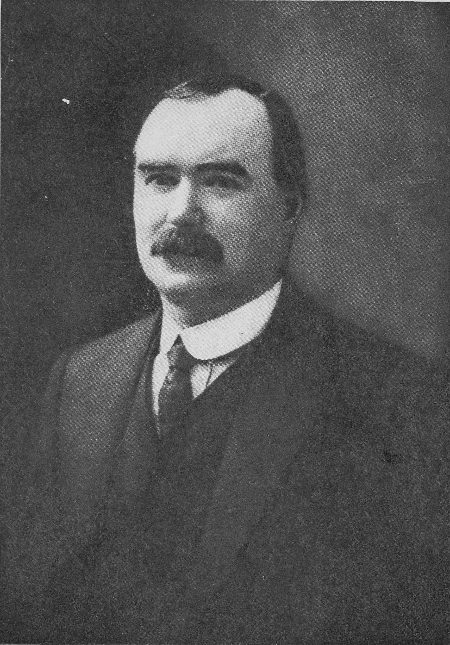
man who was to be Commander-in-chief of the Republican army in Dublin,
James Connolly. He knew Beggar's Bush barracks well enough to see that
my map was correct and believed the plan practicable enough to carry out
in case conscription should become a fact in Ireland despite all
promises to the contrary.
But the test I had been put to was, it seemed, not merely a test of my
ability to draw maps and figure distances. From that day I was taken
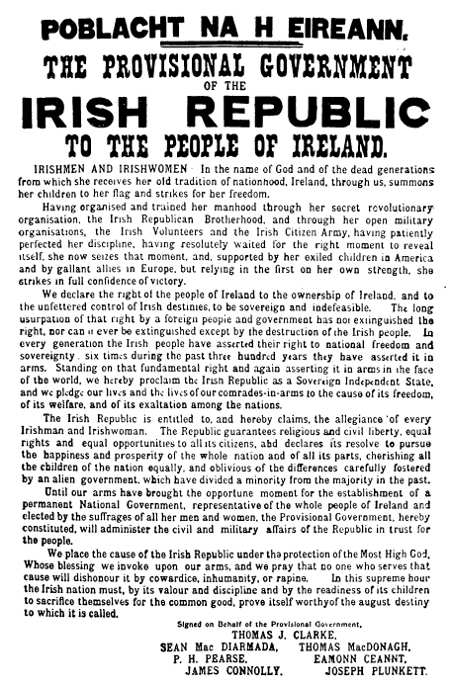
into the confidence of the leaders of the movement for making Ireland a
republic.
The situation, I learned from Mr. Connolly, was very hopeful, because
for the first time in hundreds of years those who were planning a
revolution to free Ireland had organized bodies of Irishmen who not only
were well trained in the use of firearms, but so full of the spirit of
the undertaking that they were ready at a moment's notice to mobilize.
There was the Irish Citizen Army which Mr. Connolly had organized after
the Transport Workers' strike to defend working-men from onslaughts by
the police. I do not believe any one who has not seen what we call a
"baton charge" of the Dublin police can quite comprehend the motives
which make for such ruthless methods.
In the first place, whenever the police are called out for strike duty
or to be on the lookout for rioting, they are given permission to drink
all they wish. At the station-houses are big barrels of porter from
which the police are expected to help themselves freely. Then the
saloon-keepers—we call them publicans—are not expected to refuse a
drink to any policeman who demands it, and are paid or not according to
the mood of the protector of the public peace. Add to this that the
police do not attack in order to disperse a crowd, but to kill. In a
public square where a crowd has gathered to hear a labor speech, the
police assemble on four sides and, upon a given signal, rush to the
center, pushing even innocent passers-by into the midst of the crowd
that, on the instant, has become a mob. Then the police use their batons
like shillalahs, swinging them around and around before bringing them
down upon the heads of the people.
Fearing one of these baton attacks in 1913, Madam, having come down to
the square in her car, had just stepped out upon the sidewalk when she
was struck full in the face by a policeman's club! On that same day,
too, the police rushed into the adjoining streets and clubbed every
person they met, even people several blocks from the square who, at the
moment, were coming out of church from vesper service.
Mr. Connolly found that in any strike in Ireland the interests of
England and of the employer were the same; that his strikers had to meet
the two members of the opposition without any defense. Therefore he had
organized the men who were fighting for better hours and wages into a
"Citizen Army." It is against the law for any one to bear arms in
Ireland, but in this case the authorities could do nothing because they
had not disarmed the men of Ulster when the latter armed and drilled to
defend themselves against Home Rule, should it become a fact. The
Ulster-men were openly planning insurrection under Sir Edward
Carson—insurrection against a law, a political measure desired by the
majority! It was an anarchistic outbreak that Carson had in mind. Mr.
Connolly, on the other hand, was organizing simply for defense against
police power that had grown unbridled in its activities. No one
interfered with him.
As always, this organization was under surveillance, and reports about
it were sent to the authorities. But there appeared to be no more than
three hundred members, a small body not dangerous to the police if it
should come into conflict with them. It was not known that there were
several times three hundred members, but that only this number was
allowed to drill or march at any one time. This drilling baffled the
police. Many a night the three hundred would be mobilized and quietly
march through Dublin out into the country, the police trailing wearily
and nervously after them, expecting some excitement along the line of
march. Nothing ever happened. Back to town in the wee, small hours the
police would come, only to see the men disperse as quietly as they had
assembled and go home to bed. After this had happened many times, it no
longer attracted official attention. Only perfunctory reports were made
of any mobilization of the Citizen Army, and thus it came about that on
Easter Sunday the mobilization was taken for nothing more than the usual
drill and not reported.
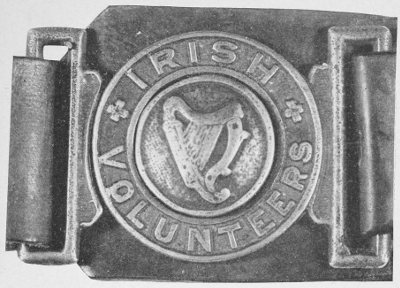
The second organization, the Irish Volunteers, was brought into being by
those in favor of Home Rule, and was a makeweight against the
Ulster-men. Since the Irish Volunteers were organized to protect law, to
uphold Home Rule should it become a fact as promised, nothing could be
done by the authorities when the volunteers began to arm themselves.
Besides, nothing had been done to prevent the Ulster-men from arming
themselves. The conservative press in England actually supported the
Ulster-men, and English army officers resigned rather than disarm them.
What, then, could they be expected to do to a body of men who stood for
law and order instead of opposing it as in Ulster? This situation made
possible a strategic position for the leaders of the Republican
movement.
Had not the authorities realized that now they would meet with armed
resistance if they broke their promise about conscription, we should
have had to send our brothers to France and Flanders early in the war.
But the Citizen Army and the Irish Volunteers had no intention of
allowing men to be carried off to fight England's battles when, for the
first time in many years, there was a chance of winning freedom for
Ireland. To keep this constantly in the public mind, Mr. Connolly had a
large sign hung over the main entrance to Liberty Hall, his headquarters:
WE SERVE NEITHER KING NOR
KAISER, BUT IRELAND