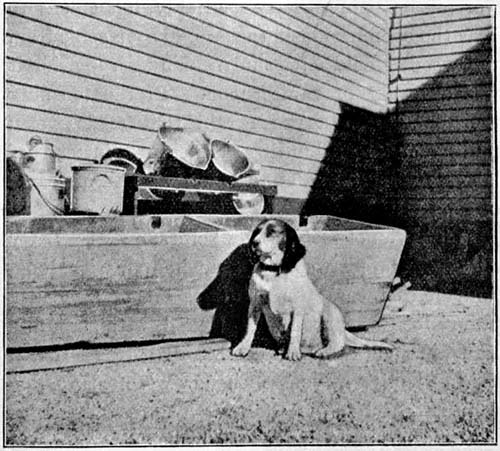
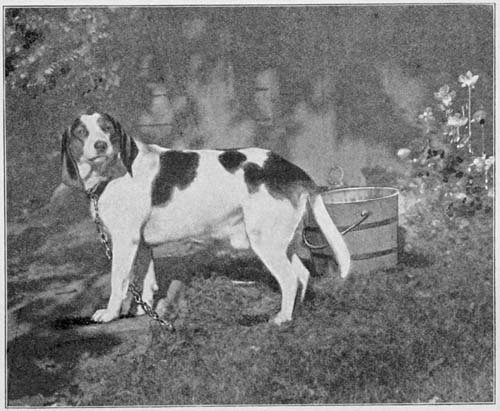
Happy sat by the watering-trough, waiting for
Baldy to come for the milking pails and go for the
cows.
Waddles, lying on the sunny side of the lilac
hedge, was also waiting for this important evening
happening; and though nothing in his appearance
told that he was on the watch, for his back was
toward the barn, yet he would know when Baldy
crossed the yard to wash his hands at the pump,
gauge the time he took to reach the house, and,
without hurrying or looking round, be at his side
the moment that the clashing of tin told that he
had really come for the pails.
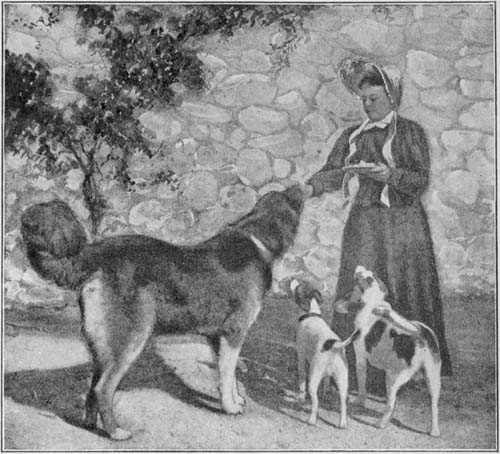
Seated on the stone wall, Anne and Miss Letty
were also waiting, partly for Baldy, but chiefly to
hear the evening music that would soon come from
the wooded field edge and near-by garden, for it
was a lovely May afternoon. In the morning
there had been a warm rain that made worm
pulling and bug hunting a pleasure instead of
labour for the birds, and the air was full of scraps
of song.
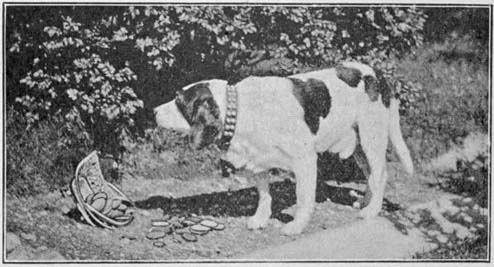
You have not met Happy before, or Miss Letty
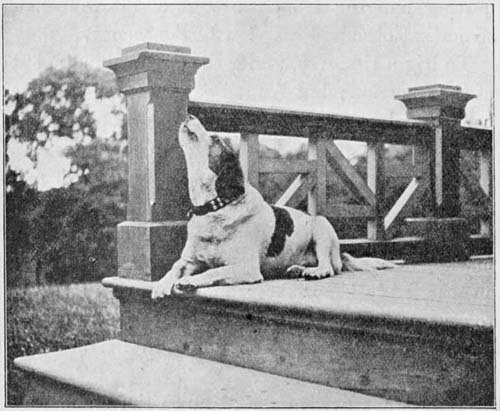
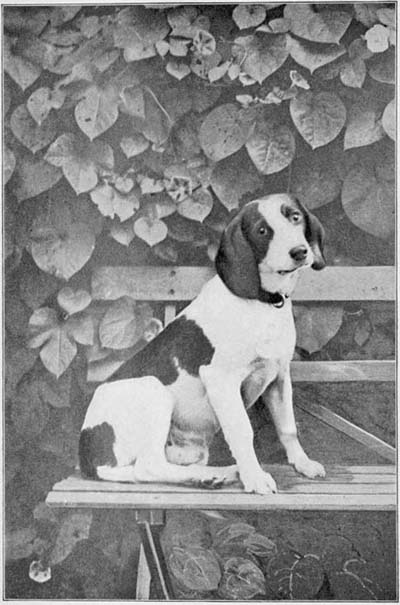
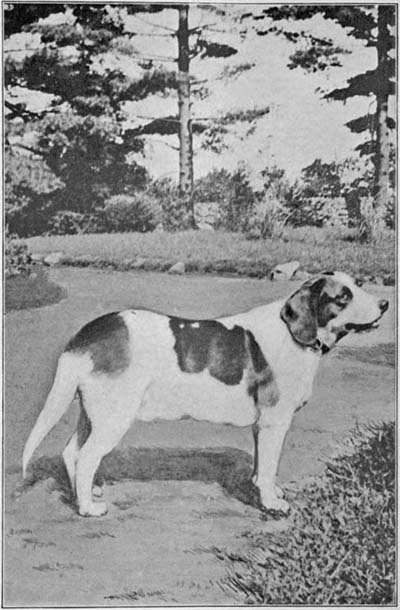
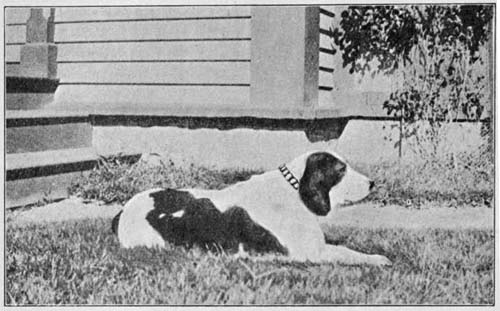
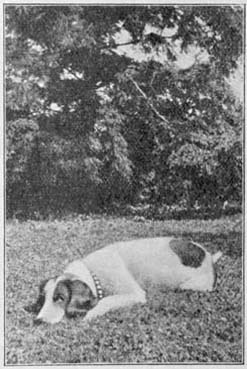
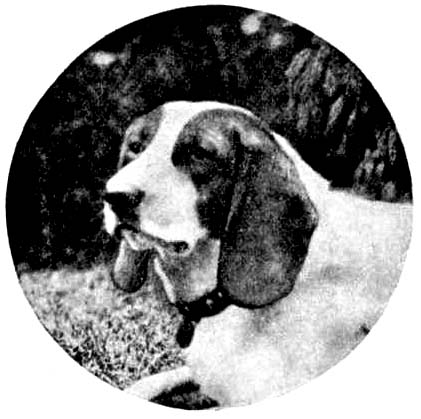
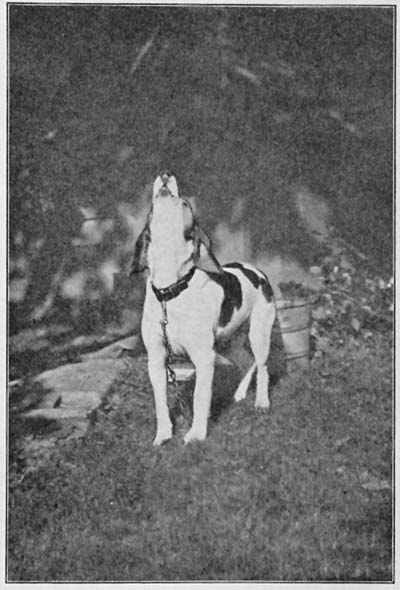
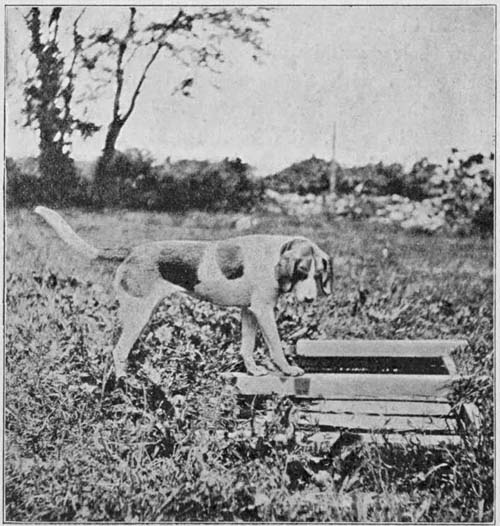
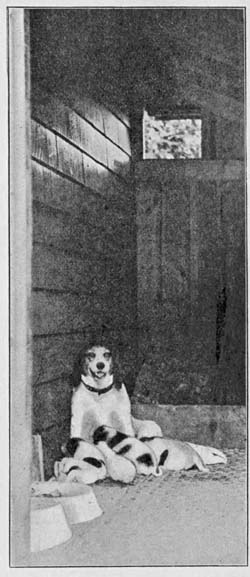
either. Happy was a beagle hound, with long,
tan-coloured ears, the daintiest bit of a nose, a
plump body marked and ticked with tan and
black, and eyes of such beseeching softness that if
she but looked at you when you were eating, you
were impelled to give her the very last morsel, no
matter what your hunger might be.
Her legal name and pedigree was recorded in the
Westminster Kennel Club register as “Cadence
out of Melody, by Flute, breeder J. Sanford, Hilltop
Kennels,” and really for two years of her
life she had been merely a kennel dog. Now
she was a lady of distinction, a real person beloved
of Anne, Happy, of Happy Hall, mother of
twin pups, Jack and Jill, and wife of no less honourable
a person than Waddles, who, now past middle
age, portly and sedate, was Mayor of Dogtown
and an undisputed authority on all matters of dog
law and etiquette.
If you should look for Dogtown on the map
of the county where Happy Hall, Anne’s home, is
located, you would not find it, for it is really concealed
under the pretty name of Woodlands, and
was discovered quite by accident by Anne’s Aunt
Prue.
Now Aunt Prue was one of those ladies who
prefer indoors to outdoors, and cats to dogs. The
“Fireside Sphinx” has many virtues, and its rights
should be respected, only it is a very strange thing
that people who love cats cannot seem to fully
appreciate dogs, which of course are the superior
animals.
One day, a couple of years before this time,
when Lumberlegs, the St. Bernard, then an awkward
pup, was a new arrival, and the Widow Dog
Lily, who had been rescued from starving by Miss
Jule, had been adopted by Tommy and become his
guardian, Aunt Prue had come unexpectedly to
pay her brother, Anne’s father, a visit.
She had not intended to arrive unannounced,
for she liked to be met by the best go-to-meeting
surrey and pair. But travelling and even planning
for it always flustered her; and when she
wrote to tell of her plans, after spoiling three
sheets of paper, she directed the letter to another
brother in Texas. Consequently, when
she arrived at the Woodlands station at noon
of a blazing July day,—she always took midday
trains, it’s apt to thunder in the afternoon,—there
was no one there to meet her. “No, marm,
no hacks here to-day,” said the station master in
answer to her request for one; “no use in ’phoning
the stable either, all the teams here about have
gone to the Sunday-school picnic, and I reckon
the only folks to home is dogs.” So saying he
banged down his office window and drifted across
the road to dinner.
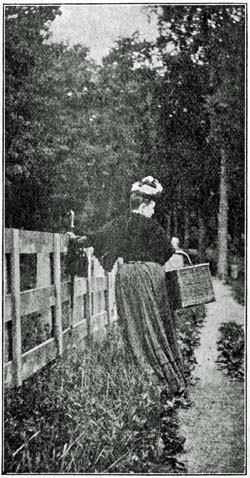
Aunt Prue paused and set down a stout wicker
basket with an openwork top that she carried,
straightened her bonnet, felt in her glove to be
sure that her trunk check and return ticket were
safe. She always bought a return ticket as a sort
of guarantee of safety, but usually lost it before it
could be used.
She looked up the hill road. There was the
store and post-office, then a quarter of a mile of
open before the shade began, not a living thing
was in sight; it was too hot for even the chickens
to scratch up the dust.
The basket at her feet began to roll about uncannily,
for in it was Miss Prue’s tortoise-shell
tabby cat, which she always took visiting when
she was going to stay more than two nights. In
politics Miss Prue was a stanch monarchist of the
old-time, “off-with-his-head” variety. The cat’s
name was Kaiserin Augusta Victoria, and never,
even in the most informal and playful moments,
was she called either Gussie or Vic.
A violent scratching in the basket was followed
by a long-drawn meow! Miss Prue took a small
tin pan from her satchel and went toward the
pump to give the pet a drink; but as she only
pumped a couple of strokes, the water was tepid
and not to her taste. She always gave the cat iced
water, so she put up the tin. Poor K. A. V.,
smothering in the basket, would have been grateful
for a lap of anything that was wet—even puddle
water or sour milk; but she was not consulted,
and her temper waxed fierce. If people could
only realize that the faults of their pets are chiefly
of their own making, they would be more careful
to look at those things that concern an animal
from its point of view instead of their own.
With one more glance at the road, Miss Prue
settled the basket firmly on her arm and trudged
off. Augusta Victoria was not happy and, moreover,
she was determined to get out of the basket.
For a few moments she sat in sullen silence
making herself heavy, as only an animal being
moved against its will knows how to do. The
post-office was reached, and Miss Prue paused a few
moments to rest on the steps. Happy thought!
There was a late morning mail; perhaps the family
had not yet called for it, as they were sure to do,
for her brother being a literary man was very particular
about his letters. She would inquire.
“Nope,” replied the girl who was tending office
during the noon hour and preparing to hie to the
picnic later by taking her hair out of curl papers
and combing it into a mossy-looking bank above
her freckled forehead, “your folks live beyond a
mile, and the rural delivery fetches ’em their
letters most times.”
Poor Miss Prue! She crossed over to “the
leading grocer’s,” where “soft drinks” were conspicuously
advertised, and asked for a bottle of
sarsaparilla.
“Sorry, madam,” said the solitary clerk, popping
up in some confusion. He was finishing his toilet,
preparatory to leaving, by shaving himself at a
scrap of mirror resting on the cash register, and
he came forward hurriedly with a billow of lather
where his chin should have been. “I very much
regret to say that all our liquid refreshments except
molasses and vinegar are sold out on account
of the picnic, but we still have a few Uneeda
biscuits, madam, and a small wedge of superior
extra mild cheese, if it would serve you for a
luncheon. Ah, a drink! You don’t need a biscuit,
not juicy enough. Ha! ha! I see,” and the
chinless gentleman retired, laughing at his own
wit.
Miss Prue merely gasped and walked on without
answering. K. A. V. took a turn at scratching
and lunging and then remained so passive that
her mistress began to have qualms lest she should
have fainted, yet did not dare open the basket.
She leaned against the fence and listened, puss
was breathing. The few cottages along the way
were closed and silent; but as she got farther on
where the larger places were scattered, her courage
arose, for she remembered that the Burgess model
farm barns were on the way, and that there was a
well close by the fence.
Yes, there it was surely, with a bright clean
dipper hanging by it.
She put down the basket carefully, quenched her
thirst, and then, after bathing her forehead with
her handkerchief,
was feeling in
her bag for pussy’s
dish, when a
bumping sound
made her drop it
and turn hastily.
K. A. V. had made
a sudden spring,
the basket was
plunging down
the bank, followed
by an inquisitive
fox terrier. Just
as the basket
stopped rolling
the cat gave a terrified
yowl, and
the terrier started
back, but only for
a moment.
Miss Prue seized the basket and looked about,
calling in vain for help, but no one came, only
more dogs, so she hurried back to the road, closing
the gate behind her in frantic haste.
But what is a bar gate to dogs? Those that
could neither get under or through, jumped over,
for the dogs at the Burgess farm were always in
fine condition. A second fox terrier sprang
between the bars, a black-and-tan dachshund
crawled under, while almost at the same time a
collie and a greyhound cleared the top rail.
They were polite, gentlemanly dogs, fortunately,
and accustomed to the best society. They never
thought of touching Miss Prue; but in spite of her
gestures turned their attention to the basket, sniffing
and jostling it and saying things in a way to
put Augusta Victoria into a frenzy.
As the strange party went up the hill, the
pioneer terrier running ahead seemed to spread
the news, for dogs of all degrees kept joining the
procession: the great woolly St. Bernard, Rex,
from the doctor’s piazza, the farrier’s mongrel
black-and-tan, who happened to be coming across
lots, two loping foxhounds who belonged to
Squire Burley and had been taking a run on
their own account, the minister’s water spaniel,
the schoolmistress’s pug, a white bull terrier, a
comical-looking sheep dog from the milk farm, and
lastly, a fantastically arrayed black poodle, with
his wool trimmed into as many devices as the
tattooing on a Fiji Islander, a silver bangle on one
leg, and a crimson satin bow on his collar, joined
the mob, in spite of the frantic calls of a maid on
the steps of the select inn, who was striving to keep
him clean while his owner was at luncheon; for this
particular poodle had his teeth cleaned every day,
could not roll in the dirt, and was not as other
dogs, for which the others were doubtless thankful.
In a moment, however, he was in the middle of
the fray, having the time of his life, enveloped in
a cloud of dust, uttering the shrieking bark in
which a thoroughbred poodle excels, while the
farrier’s cur promptly pulled the satin bow into
a string, and the dachshund, who had difficulty in
keeping up with the rest, nipped the hairless parts
of his hind legs.
Aunt Prue’s last hope lay in the sheriff; he
surely would not be at the picnic. But he was,
and his two dogs, Schnapps and Friday, dozing on
a wagon seat before the stable door, suddenly
waked and joined the procession.
Finding that gestures and threats were useless,
Aunt Prue kept sturdily on, shifting the basket
from one arm to the other as its weight increased;
for Augusta Victoria, weight fifteen pounds,
springing lightly up a tree, and A. V., dashing
about in the basket at the end of a hot walk,
were two wholly different cats. Under such
circumstances “a mile’s weight” should be an
allowable term.
Just then she heard the rattle of a wagon coming
up hill, and turned about, hoping for relief.
In this wagon was an old man on his way home
from the meadows, seated on an insecure load of
salt hay, in which he was buried almost to the
shoulders, while a strip of green cotton mosquito
netting hanging from the edge of his wide hat,
somewhat obscured his view of the scenery.
To beg a ride was, under the circumstances, out
of the question; but Aunt Prue ventured to wave
her satchel and to call out and ask him to drive
the dogs away. But he was deaf to her entreaties,
for the reason that he was stone deaf anyway; and
as to the rest, he merely thought he saw a vigorous,
stout, middle-aged woman on her return from
market with an unusual lot of dogs, whose dinner
she carried in her basket; and he drove on, trying
to reckon how much it must cost to feed thirteen
dogs, and set Aunt Prue down in his mind as
“another fool woman.”
At last she saw in the distance the stone wall
that surrounded Happy Hall, and then a glimpse
of the house through the trees revived her; but
as she passed in the gateless entrance, two new
and strange dogs greeted her,—Lily and Lumberlegs,—both
rather objected to the visitors,
and suddenly Lily fastened her wide jaws upon
the basket.
Then at last poor Aunt Prue screamed loud and
long, and Waddles, who had at first discreetly surveyed
the proceedings from the porch, threw back
his head and bayed. It was a very funny scene,
though of course not nice for Aunt Prue; but it
often happens that funny things are disagreeable
to somebody.
At the double noise, doors flew open, Baldy
ran from the stable, Anne, her father, mother, and
one of the maids from the house, while Waddles
danced about and issued dog orders with such
good effect that by the combined efforts the intruders
were dispersed, Aunt Prue was ensconced
in a piazza rocker and was being fanned by her
gentle sister-in-law, Anne brought iced ginger ale,
Baldy bore Augusta Victoria, basket and all, to a
retired room in the barn, where she could be fed
and calm her nerves, while the father by degrees
unravelled the history of the walk.
At first Aunt Prue had cried, but now she sat
bolt upright and severe in her chair, talking between
sips of ginger ale that would get into her
nose and give her a fuzziness of speech.
“Yes—a most unparalleled—experience for a
lone woman—in a civilized land—Woodlands
you—call the place—faugh!—I say it’s nothing
more or less than Dogtown, and it’s lucky I bought
my return ticket. Poor Augusta Victoria’s nerves
are shattered, not to speak of mine, and home we
go by evening train.”
She didn’t go, but stayed three weeks to a
day, and had a very good time; when she felt
in her moist gloves for the ticket, it was gone as
usual. But her story and name of Dogtown
stayed with the region, and it tickled Miss Jule
so, that the very next Christmas she gave Anne a
large wooden box shaped like a doghouse, full of
note-paper with a group of dogs’ heads and the
words Happy Hall, Dogtown, stamped across the
top in blue and gold, which Anne always used
when writing invitations to picnics and other excursions
of which she was so fond.
So in time it had come to be that Waddles
was the acknowledged head of Dogtown and its
people, these same being three times the number
that had been the escort of Miss Prue and Augusta
Victoria. For when people heard of the doings
of the dogs at Happy Hall, and saw the beautiful
setters, foxhounds, and field spaniels that Miss
Jule raised in the Hilltop Kennels at the horse
farm, every one wanted a dog of his or her own;
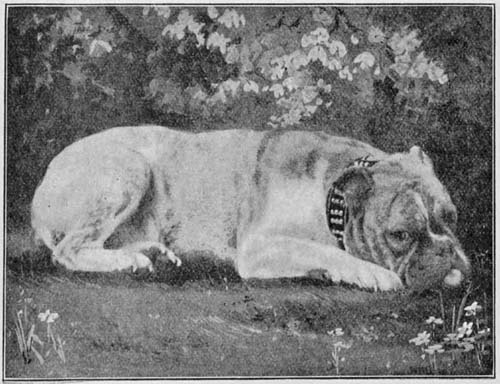
and though Lily remained the only real bulldog
in the community, there were several clever bull
terriers, and Miss Letty brought back from her
schooling abroad a wonderful black poodle, who
understood three languages.
The Mayor of Dogtown.
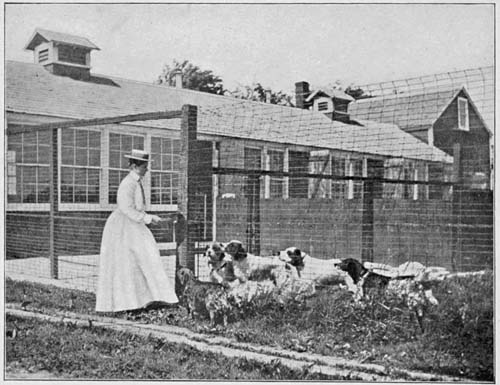
Miss Jule’s dogs did not quite belong to Dogtown
as citizens, because, being kennel dogs, they
were not free to come and go and to express their
opinions like the others. They were as boarding-school
children, having fixed times for exercise and
play, in comparison to those who, after school, run
free.
There are some children who, though they may
have good dispositions, can never be happy when
cooped up and restrained. Tommy-Anne had been
one of these, and so when, a year before, she had
seen Cadence the beagle sitting looking mournfully
through the slat door of her kennel, where
she had been shut by her trainer for being heedless
and unmanageable and not obeying his directions,
her heart smote her and she felt so intimate
a kinship with the little animal with the hopeless
eyes, that she went to Miss Jule to ask the price
of Cadence and if she might pay for her by instalments.
Miss Jule loved animals dearly, was tender-hearted,
and had several pet dogs that were almost
human; but the kennel dogs were raised for
sale, and must be taught the various trades that,
together with their pure breeding, made them
valuable and able to earn their living.
No cruelty was allowed in the training-and-breaking-to-hunt
process, but they simply must
learn. Martin, Baldy’s brother, who not only
broke colts under Miss Jule’s supervision, but
trained both fox and beagle hounds, had said of
gentle Cadence: “She’s no mortal use for hunting
rabbits, she won’t mind if you chide her, unless
your very eyes are upon her, she bolts at sight
of a gun, won’t heel or gather with the others.
We don’t need her for breeding, and I think she’d
be better out of the way.”
While Miss Jule was thinking over the matter,
Anne had hurried home and counted the contents
of her money box replete with the results of
Christmas, a birthday, copying manuscript for her
father, and various dealings in rags, bottles, and
old iron. She had been saving seriously to buy
a camera holding glass plates that she could develop
herself, and so be able to take pictures of
her dear woods and flowers, the dogs, and, best of
all, of her father and mother as they walked out in
the garden together in their everyday clothes.
Thirty-seven dollars the money had footed up.
The camera that she had chosen, together with the
trays, drying rack, red lantern, some plates, etc.,
would be thirty dollars. Was it possible that
Miss Jule would sell a thoroughbred rabbit hound
for seven dollars?
Anne knew that she had often received a hundred
dollars for a well-broken young hound; but
poor Cadence did not seem to be broken at all,
except in spirit, so that might make a difference;
anyway, the camera could wait, for she kept seeing
those appealing eyes, and had an instinctive
feeling that Cadence’s fate was in her hands.
“Sell Cadence to you, so she needn’t be shut
up so much? What will they say at home to
another dog about? You know it was only last
week that Tommy told me that Lumberlegs and
Lily grinned at each other ‘awfully,’ and that
Waddles would not let either of them go to walk
with him. What will your mother say?”
Anne had not thought of this, to be sure; but
no one at home had ever objected to any animals
excepting white mice, and her mother had rebelled
at having them kept in a bureau drawer, and finally
put them under ban.
As Anne grew older she was more drawn toward
those of her own race than when as Tommy-Anne
she had played alone; but the birds and little
beasts were still her friends and brothers, and ever
would be. She would, if possible, get Cadence
from behind the bars and risk the consequences.
“What do you want her for? She is either
stupid or sullen, and will not even charge or come
to heel; she will never learn anything.”
“Please, Miss Jule, I don’t think she is stupid
or ugly, only somehow she doesn’t understand;
maybe she can’t think when she is shut up so
much. You know that when I was little I could
never learn lessons in school, but if I sat by father
I couldn’t have helped learning if I had tried.”
Miss Jule did not smile at the simple earnestness
of the tall slip of a girl with the great
dark eyes that looked so pleadingly at her, for
Anne at fifteen believed as thoroughly in the
brotherhood and rights of all living things as had
Tommy-Anne at five.
“Well, I’ll make a bargain with you,” she said
at last; “you may have her on a week’s trial: if
you like her, you shall have her at a reasonable
price” (for Miss Jule knew that with Anne’s ideas
it would never do to offer her as a gift something
she had offered to purchase); “if you can’t manage
her, you can bring her back. Perhaps Waddles
may like her for a mate.”
“Here, take a leader,” called Miss Jule, as Anne
darted off full of the new idea, “she’s as likely to
bolt off to the next county as to go home with
you.”
Anne took the leather leash and hurried to
open the door of the compartment in the kennel
yard where Cadence sat looking wistfully out.
After fastening the snap in the collar she tried
to lead her out; but Cadence flattened herself to
the floor in an agony of fear, no coaxing, no gentle
calling of her name produced the least effect, she
squatted there motionless as a stone.
Happy’s First View of Waddles.
Anne crouched upon the door-sill quite in
despair, then she saw that Cadence’s eyes were
fastened upon her face, so she smiled, chirruped to
her, and tried what patting her back and smoothing
her long ears would do.
The effect was magical; the little hound stopped
cowering, looked up, gave a spring, touching
Anne’s finger-tips with her tongue, and walked off
after her new mistress without further objection.
In fact, as they took the downhill path toward
home, Cadence led as if she was quite well aware
where she was going, and she tugged and strained
so on the leash when she came in sight of the
house as to make Anne fairly trot.
Then for the first time Anne thought of the
objections that Waddles might make; for though
he had chummed with Lumberlegs until recently,
their relations were not wholly satisfactory, and
as for Lily—well, he never interfered with her,
but then also he never asked her to walk with him.
As it chanced Waddles was standing in the
middle of the walk sniffing the air, with a very
sentimental expression on his mobile face.
Anne slipped the leash, as it does not lead to
friendliness when strange dogs meet to have
one run free and the other chained. Before
Waddles fully realized what had happened, before
he could give a sniff or a growl, Cadence evidently
captivated by his looks had bounded up, given
him the coyest lick on the nose and sprung back
again, her tail wagging in a complete circle and
an unmistakable smile on her face.
Thus taken by surprise Waddles surrendered,
and by way of making the newcomer feel at home
he raised his head, gave a bay, and then putting
his nose to the ground found the trail he had been
trying to locate, gave a short bark and started off
in full cry, Cadence following and yelping madly.
“She knows how to pick up a trail if she is
stupid,” said Anne to herself; “but I wonder if
she will come back here or go up to the Kennels.
I think I will just go in and explain about her
to mother while she has her run.”
The explanation was fortunately satisfactory;
but then Anne’s father and mother seldom objected
to anything unless it was unkind, dangerous,
or too expensive.
In a quarter of an hour or so back came the
pair, evidently the best of friends, Waddles allowing
Cadence not only to drink from his dish, but
to take a nicely ripened beef bone that he had
partly buried under the big apple tree. This
was a wonderful bit of condescension, as it is
against the rules of Dogtown to dig up another’s
bone, at least when the other is looking, and the
offence is punishable with a ki-yi-ing and a real
bite.
“Mistress,” said Waddles, behind his paw as
it were, “that is a very beautiful young lady; I will
gladly share my bones with her, and that is something
that I have never done before,” which was
perfectly true; for Waddles, besides being very
strict about food etiquette, thought a good deal
about what he ate.
The next morning when Anne came downstairs
Cadence was lying on the steps with her
back to the house. Anne called her and clapped
her hands together, but she did not stir, yet the
moment Anne’s footsteps jarred the boards Cadence
turned and came to her side.
Then the truth flashed upon Anne, the little
hound was neither stupid nor disobedient, but
almost stone deaf. She could not hear the voice,
but felt the sound as it were from the footstep.
“There, I told Miss Jule that you weren’t
wicked, but that you couldn’t understand all that
shouting and to-heeling, you dear little abused
thing. Now I’ll know exactly how to treat you
and what to expect.” And Anne held the pretty,
soft paws in one hand while she lifted the dog’s
face so that it might see what she said.
Truly, then, Cadence understood once and for
all, and when puzzled always looked in her
mistress’s face.
When Miss Jule heard the story, she questioned
all at the Horse Farm and about the Kennels
closely, and found that once, when Cadence was a
pup of less than a year, a gun had burst quite
close to her head.
“Now,” said Anne, triumphantly, “you see why
she was gun shy, and deaf, and everything. You
know, Miss Jule, animals are hardly ever bad;
it’s mostly something what we’ve done ourselves,
and it’s being a kennel dog, too. You see you can
never be really intimate with them, and know
their troubles as I do Waddles.”
Miss Jule sighed, for she knew it was true.
From that day onward Cadence was a new dog,
no longer sad eyed, though she knew mighty well
how to plead for what she wanted with those
golden brown eyes, but the most joyous thing
alive.
She was pleased if she had a bone, or equally
pleased with a dog biscuit, happy to go to walk,
happy to stay at home; her face wore a perpetual
smile, and her tail a ceaseless wag.
“Let us call her something different from that
old kennel name, even if she can’t hear it,” said
Anne, one day six months later, as they stood
watching Cadence tending her first children, the
fascinating twins, Jack and Jill, and teaching
them to lap milk.
“Yes,” assented Tommy, who stood by, pondering
as to how soon the pups might be harnessed
to a toy cart; “let’s call her Happy, she is always
so glad.” And Happy it is—Mrs. Happy Waddles of
Happy Hall.
“Now there’s something else between us besides not
understanding things when we are shut
up,” said Anne, making the hound stand up and
put both paws in her lap. “We are both named
one thing and called another; for you probably
don’t know, my dear, unless Waddles has told you,
that my true name is Diana, after the hunting
lady, and really I think some night this fall I’ll
live up to it and go out with you and Waddles
to hunt rabbits.”
So this is the annal of the coming of Happy,
wife of Waddles, Mayor of Dogtown.
CHAPTER II MISS LETTY AND HAMLET
Spring always brought many arrivals at Miss
Jule’s farm, so that Anne and Tommy found some
new animal at every visit: either an awkward,
frolicsome colt, a fawn-eyed Jersey calf, or a litter
of pups; for Miss Jule was so successful in rearing
healthy animals that those she could not keep
met with a ready sale everywhere.
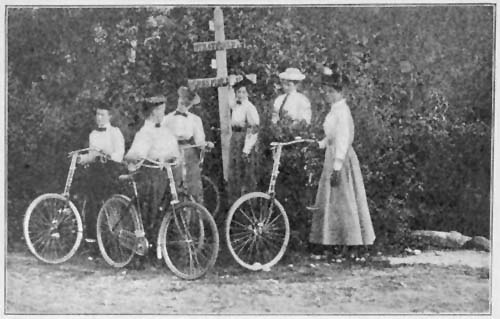
The children went up nearly every afternoon
in fine weather, riding their bicycles all but the
steepest part of the way, and having a safe and
easy coast back, for the road was broad, smooth as
a floor, and there were no cross-roads the entire
length of the slope, cross-roads being very bad
things for coasters either on wheels or sleds.
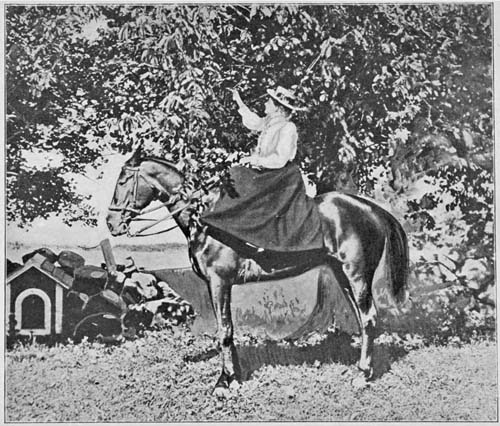
Anne, however, did not care about wheeling as
much as for riding horseback. During the past
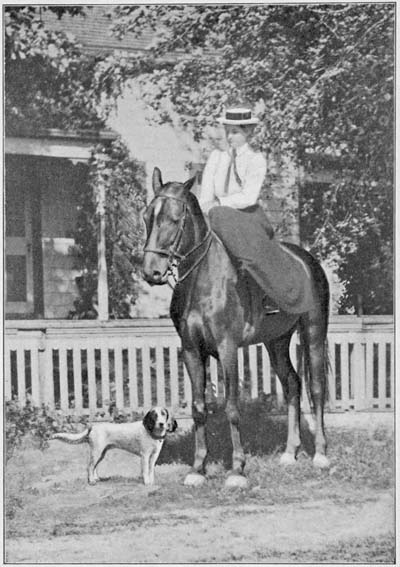
two years Miss Jule’s old brown horse Fox, though
well on in his twenties, had been a safe mount
for her, as well as an intelligent companion. Of
course she never rode very fast, and was always
careful to walk him down hills; as old horses, no
matter if they are thoroughbreds, sometimes kneel
at the wrong time. But he was very clever at
taking narrow paths through the woods, and
keeping clear of the trees, walking up the little
brook which was one of Anne’s favourite pastimes,
without pawing the water and soaking her
skirt.
Anne’s father had a beautiful young horse Tom,
which he both rode and drove, but who did not
like side-saddles, and did not intend wearing one.
So one day when Anne had ridden him up through
the orchard pasture to look for the cows that had
gone astray, he first tried to scrape her off by
squeezing against the tree trunk, and then, when
she dismounted to see if the saddle or girths could
possibly gall him, he took a roll in the spring,
saddle and all, and galloped home, leaving Anne
to walk.
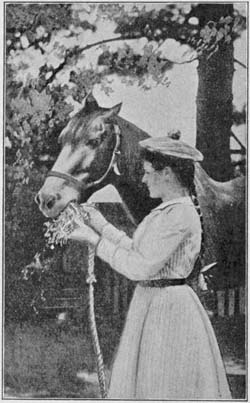
So Fox remained her pet, and all she had to do
to make him come when she wanted a ride was to
go to the pasture, where he spent his days luxuriously
shod with rubber tips, or to the barnyard,
where he was watered, and say “Fox!” ever so
softly, and he would come trotting up, to be either
petted or saddled, eager to nibble the bit of sugar,
carrot, or bunch of clover that she always brought
him, putting back his ears meanwhile in pure mischief,
and pretending to bite her fingers, while his
nostrils seemed
to quiver with
laughter at the
joke.
In the middle
days of this particular
spring,
the one that
came before the
summer when
Waddles and
Lumberlegs
had their great
fight, it was neither
Fox nor
the new calves
that drew Anne
so often to the
Hilltop Farm,
but Miss Letty and Hamlet: Miss Letty being
neither calf, colt, nor puppy, but a very pretty
girl, and Hamlet a worldly-wise French poodle.
Miss Letty was the orphan niece of Miss Jule,
the child of her only brother who had lived abroad
for many years, married a French lady, and died
there. Miss Letty had been sent to an English
and then a French school by another aunt, her
mother’s sister; now as her father had willed it,
she had come on a visit to America, so that she
might see his country and choose with which aunt
she preferred to make her home.
When Anne heard that Miss Jule’s niece was
coming to make a visit half a year long, and that
she had a pet dog, she was very much excited,
for Anne was beginning to long for a companion
of her own age. She only hoped that Waddles
would like the dog visitor, and then they four
could take lovely excursions together afoot and
on horseback, that is, if a girl from a French
boarding-school knew how to manage horses; if
she didn’t, of course she could ride Fox until she
learned.
Anne did not know exactly how old Letty was,
though of course Miss Jule did; but she always
thought and spoke of her as a schoolgirl, and
told Anne that it would be a fine chance to improve
her French, and that in return she could
teach Letty about wood things, for Letty had
been brought up almost altogether in the city. So
Anne wondered whether she knew enough French
to make Letty understand, and went about talking
to herself and all the animals on the place in such
words as she knew, much to the confusion and
disgust of Waddles, who recognized something
familiar in the invitation to aller à la poste, yet
did not quite understand it as the usual invitation
to “go to the post-office.”
At first Tommy had not been interested. “If
it was a rather big boy with a real gun that
was coming, we could go hunting together and
have some fun next cold weather when the bunnies
come out. Girls aren’t much good excepting Anne,
and even she don’t seem to care for guns either,”
he said.
Tommy’s latest treasure was a spring shot-gun
that went off with an alarming pop, but for which
he had no ammunition, so as yet he went about,
cocking, aiming, and firing at imaginary big game,—real
squirrels and crows,—quite content to see
them scurry away in alarm; at the same time being
careful, as his father had charged him, never to
point it at people, for this is a “mustn’t be” of
a real gun, which a boy must learn by heart before
he can even dream of owning one.
When one Saturday morning Martin, who lived
at the Hilltop Farm, came with a note saying that
Miss Letty and Hamlet had arrived, and that
Miss Jule would be happy to have Anne and
Tommy come up to dinner, Tommy forgot his
poor opinion of girls in general and was as eager
as Anne herself.
Miss Jule kept to the country habit of a one
o’clock dinner, and had a hearty but movable tea
at the end of day, when for six months of the
year one begrudges spending much time indoors.
As the note came before nine o’clock, it was too
much to expect that the children should wait
until nearly dinner time before accepting the invitation.
“Of course,” said Anne, in explanation of starting
at ten o’clock, “at most places it doesn’t do
to go until a few minutes before you are asked,
because the people may be busy, or making the
dessert, or not dressed; but Miss Jule is always
busy, has fruit for dessert, and is never dressed,
so she’s quite as ready one time as another,” which
somewhat startling statement of Anne’s did not
mean that Miss Jule was a clothesless savage, but
simply that, without the useless state of fuss and
feathers known as “being dressed,” she was
always ready to have her friends come and take
her as they found her, which was usually doing
something interesting.
Waddles had an extra brushing in honour of going
out to dine, for he also had several friends at
the Hilltop Kennels with whom he exchanged
very pleasant calls. In fact, they belonged to his
particular hunting-club, that admitted only the
most discreet citizens of Dogtown, and had a limited
membership.
With the regular kennel dogs Waddles had
only a sniffing acquaintance, which is the same as
a mere bowing acquaintance among house people.
But besides these dogs that were bought and
sold, trained for hunting and sent travelling about
to shows and held trials, Miss Jule had four who
were pets and house fourfoots, even though two
were rather large for this purpose.
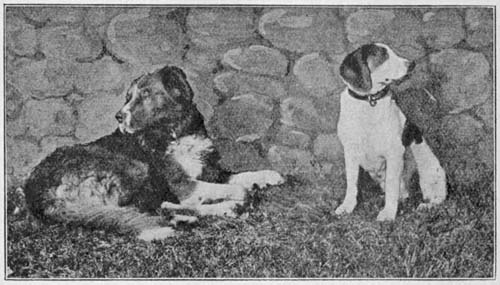
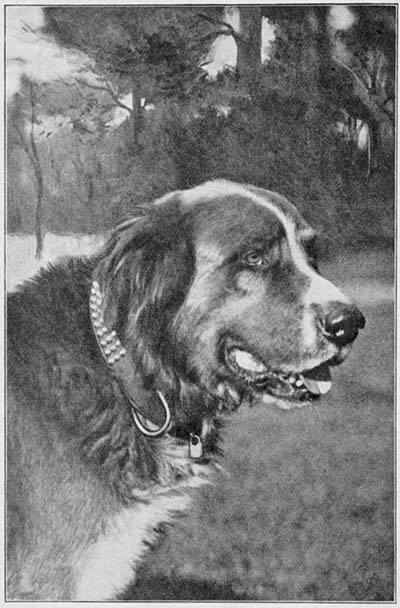
These were Mr. Wolf, whose registered name
was Ben Uncas, a long-coated St. Bernard, with
beautiful silky hair, and a very gentle face that
belied the fact that he was a mighty hunter, who
seemed to have a little wolf blood in his veins;
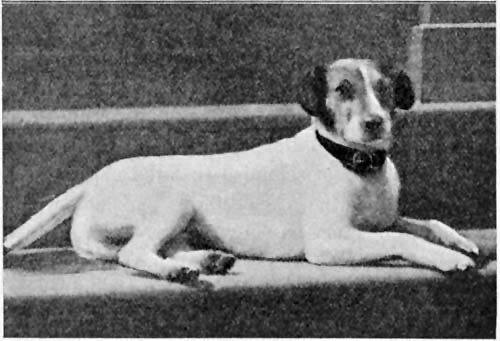
Quick, the most agile and impertinent of fox terriers;
Tip, a retrieving spaniel, in size between a
field and a cocker, who wore a coat of wavy golden
red hair, and rivalled even Waddles in wisdom;
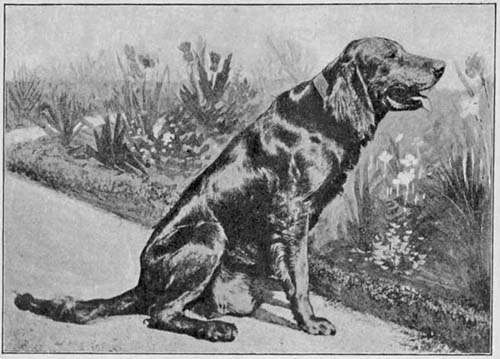
and Colin, an Irish setter, big for his breed, and
as clumsy and affectionate as a well-bred dog
could be.
Colin could boast a Dogtown record almost as
free from fighting as Waddles, but for a different
reason. He was handsome, but not over valiant,
and when some indiscretion of his aroused the ire
of another dog, Colin would immediately roll over
on his back and kick his four legs so fast that
his confused opponent could get no grip whatever,
and usually found that he had urgent business
on the other side of the street.
Anne and Tommy rode up the long hill very
slowly, partly because it was rather early, and
partly because they had on fresh wash suits for the
first time that season, and wash suits look best before
they are withered. At least Anne thought
of this, for she had heard that Miss Letty had
money enough to buy all the pretty clothes she
wished, and likely as not she might wear muslin
shirt waists and lots of pretty ribbons. Though
Anne did not bother much about her dresses, and
had not worn her best frock, lest she might wish
to play, she felt more comfortable to know that
her cambric gown with its plain, turnover collar
was clean, and that her cherry-coloured hair ribbons
were new and had not been “retrieved” by
the whole Waddles family in turn.
“I know it’s rather early,” said Anne, after
greeting Miss Jule, who for a wonder was sitting
in idleness amid an unusual number of vases that
waited for flowers on the side porch that overlooked
the prim, old-fashioned garden; “but I
thought we could see the new setter pups if Miss
Letty was busy or tired or anything; and if she
wasn’t, we could play hide-and-seek with her and
Mr. Wolf and Waddles up in the corn-field.
Some of the last year’s stacks are there yet, and
we can creep into them finely. Her dog may not
know how to play, and we can teach him.”
Miss Jule gave a queer little short laugh, started
to say something, stopped with a very funny expression
on her plain, jolly face, and said:
“It’s not at all too early. Letty is over there in
the garden beyond the hedge, getting me some
flowers for these big jars. You can introduce yourselves,
and ask her to play hide-and-seek, only
I’m afraid that Waddles will not like Hamlet.
Tip was so rude that I’ve had to tie him up.”
Anne called Waddles, who was talking to Mr.
Wolf in his day retreat under the steps, and
went down the path with Tommy, not noticing
that Mr. Wolf, Quick, and Colin were following,
or that Tip joined the trio as soon as they were
past the lilac hedge, showing by his collarless
condition that he had broken jail.
Miss Letty.
As the children looked about they did not see
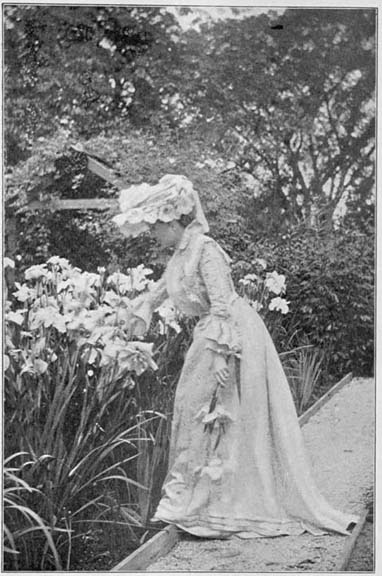
any little girl. Ah, yes, there was a flutter of
white the other side of the bulb beds, so they
turned in that direction to find a young lady
standing among the borders, dressed in such
dainty, lovely, flower-coloured clothes as they had
never seen before, at least, never in a garden.
One slender white hand hung by her side, while
the other grasped the iris stalks. They could not
see her face because of the lace that drooped from
her hat, but her hair was light brown, and as
fluffy as thistle-down.
Could this be the little girl companion that
Anne had longed for? Her heart fell in disappointment.
Yes, it must be, for there was no
one else in the garden.
“She is a grown-up young lady, with gowns
that wiggle on the ground, and all our fun is
spoilt,” said Anne, softly, checking Tommy who
was about to call out.
Tommy, however, was not so sure that he was
disappointed; the pretty girl attracted him, and
he walked directly toward her. At that moment
Waddles, catching sight of a strange-looking dog,
partly hidden in the grass, gave a bark, and the
face under the broad hat turned toward them,
opened its mouth and spoke, setting their doubts
as to its being Miss Letty at rest.
“This is Anne I know,” said a delightful, laughing
voice, that spoke every word distinctly, with
hardly a bit of accent, and yet had an intimate
sound, “and Tommy, too. Ah, yes, I know you
very well, and if you’d not come to see me this
morning, I should have called upon you this afternoon.
I suppose that dear dog with the long
ears is Waddles, come to be introduced to Hamlet,”
and she raised an odd silver whistle that hung
from her belt by a chain and gave two short calls.
“Yes, we came as soon after Miss Jule sent the
note as we could,” said Tommy, collecting himself
more quickly than Anne, “though mother said
dinner at one meant not to start before half-past
twelve. But we didn’t know that you were so
old or could talk our way, and Anne thought she
must speak French, and she’s been muttering all
the way up, though Waddles and I didn’t like it,
for we think American is good enough for anybody.
Besides, Anne said perhaps you’d like to
play hide-and-seek up in the corn-field. You see,
we didn’t know you were a kind of flower fairy.”
Then Miss Letty’s eyes met Anne’s, and they
both burst into a merry laugh that made them
fast friends, while she shook hands heartily with
Tommy instead of kissing his little pug nose as
she wished, which would have offended him as
being babyish.
“Certainly, I will play hide-and-seek if you will
tell me precisely what you expected to find me,
Miss Anne. I think that you look disappointed.”
“I’m not Miss, I’m only plain Anne, who used
to be Tommy-Anne until six years ago, when
Tommy came; at least I’m called Anne, because I
don’t like my real name, Diana. You know so
few people say it nicely, and Obi calls it Dinah,
the same as the fat coloured woman’s name who
lives up the road and launders our very best
things.”
“Is your name really Diana?” cried Miss Letty,
clapping her hands in delight. “It is the name
of one of my dearest friends at school, whom I
miss dreadfully, and who had dark hair and eyes
like yours. I will call your name smoothly like
this, Diane, the French way, for it is a pleasure to
me, and then perhaps you will grow to like it; for
a girl who loves horses and dogs could not be
named better.”
“Yes, Miss Letty, I think I do like it already, and
I might as well tell you that I thought you would
be a girl like me, so that we could tramp about
and do things together, and take pictures when I
get my new camera, and I did think you might like
to play hide-and-seek this morning with our dogs,
and teach yours how, but of course—”
“Of course I shall be charmed to play hide-and-seek,
and be your companion, even if I am very
old,—quite eighteen. Come, we will begin now
as soon as I take these flowers to my aunt,” and
she gathered the iris into the skirt of her dainty
gown upon which tiny violets formed stripes that
matched the iris in colour.
“I shall call you ‘flower lady,’” said Tommy,
decidedly, with a sturdy expression of face that
quite settled the matter as far as he was concerned.
“Now I’m ready, but where is Hamlet?” said
Letty, after she had given Miss Jule the flowers.
“Ah, here he comes, and a chance also to try your
French, Diane, for the only English word he
knows is his name. Now for hide-and-seek.”
“But surely you aren’t going to wear your best
gown and slippers to play hide-and-seek in the
corn-field and woods for there are lots of old briers
and prickly things,” expostulated Anne, glancing
at Miss Jule; but as the latter went on arranging
her flowers and said nothing, Anne feared she had
been rude.
“This isn’t a best gown, only a muslin—see, I
can hold it up so,” and Miss Letty threw the
trailing skirt over her arm, showing an underskirt
so frail that plainly clad Anne nearly gasped in
spite of herself. “And I never wear thick shoes;
in fact, I haven’t any, though they might be
useful here.”
Then she turned and began chatting gayly in
French to Hamlet who came down the path, looking
somewhat anxiously behind him. As a dog
of his breed Hamlet was doubtless quite perfect;
but to Anne, accustomed to the rough-and-ready
citizens of Dogtown,
to whom a bath and
a brushing was full
dress, his costume was
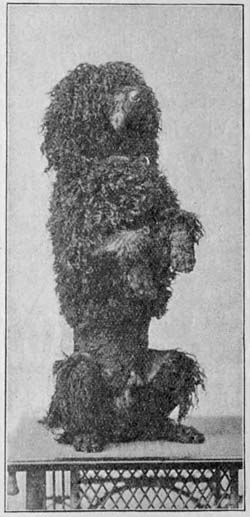
rather startling. His
long hair, which on
his crown and shoulders
hung in stringy
curls like a mop, was
shaved close on the
lower part of his
body, with the exception
of a tuft on each
hip and bands around
his ankles. His clean-shaven
face was decorated
by a long
mustache, he wore a
silver bangle collar
run with blue ribbon
that hardly showed amid his curls, and a bracelet
on one ankle. At a signal from his mistress he
sprang upon a low wicker stand that served as a
porch tea table, sat erect, and saluted.
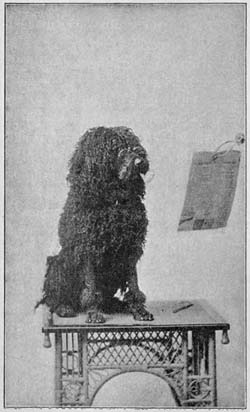
Tommy was delighted, of course, and Miss Letty
made him do all his tricks, of which he knew as
many as a circus dog. He waltzed, he said his
prayers, he fetched a handkerchief from Miss
Letty’s room, although he had only been in the
house two days, and so on, ending by turning
three somersaults and barking like mad when
Miss Letty waved her handkerchief and cried,
“Vive la Republique!”
“What do you think of Hamlet?” asked Miss
Letty, throwing herself into a hammock to get
her breath. “Can Waddles do as many tricks?”
she added, rather piqued that Anne was not more
enthusiastic, “and does he always mind when you
speak to him?”
“I think Hamlet is very clever. No, Waddles
does not do tricks; but he knows a great deal, and
a great many things that take a great deal of
thinking out. For one thing, he knows how to
take care of himself, though I can’t say that he
always minds so very well; but I am sure that
he is a more durable country dog than Hamlet.”
“Minding is everything,” said Miss Letty,
decidedly; “Hamlet obeys every word I say, and
so he never really has to think for himself. Sh!
Tais-toi!” she cried, clapping her hands, for Hamlet
having once started to bark in honour of the
French Republic had no mind to stop; and as
every one knows, who has either owned or lived
next door to one, a poodle has a voice of such
piercing and incessant shrillness that even a fence
cat on a moonlight night cannot compete with it.
Hamlet would not listen, and kept on tearing
round the house and barking, until not only
all the dogs in the kennels were set agog, but the
signal travelled over Dogtown and answering
barks could be heard for a mile away, while Miss
Jule put her fingers in her ears and Anne burst
out laughing in spite of herself.
“He’s a little upset,” said his mistress when he
was finally quiet; “he is not used to so much
space, and it’s gone to his head.”—“Come,” she
called, speaking French rapidly, “sit up and
smoke your pipe to calm yourself, and read the
paper.”
Hamlet meekly mounted the stand again, while
his mistress produced a short clay pipe from her
work-bag that hung by the hammock and stuck it
in his mouth, perched Miss Jule’s eyeglasses upon
his nose, and held the morning paper before him.
“No, do not look at me—read!” she said, as
his eyes rolled about in a helpless sort of fashion,
“read until I stop counting.”
“Now,” she said, when the lesson was over, “we
will all go and play hide-and-seek. Do you know
the French
for that,
Anne? No?
Well, it is
câche-câche.
Come, Tommy,
I will
race you to
the wall;”
tossing her
skirt once
more over
her arm,
Miss Letty
whirled
away,—muslin,
lace,
openwork
stockings,
high-heeled
slippers,
and all,—Anne
and Tommy padding along after in their
broad-soled shoes.
Miss Jule stopped laughing and sighed, saying
to herself: “She is sunny tempered and bright,
but she has more need to learn American of Anne
than Anne has to learn French. I was afraid
this morning that the farm was too dull a place
for such a dainty lady, but I believe this visit
will be the making of her. If only something
would happen to the poodle. He gets on my
nerves, though I can’t tell why, and I’d quite
forgotten that I had any.” This was a strange
opinion to come from Miss Jule, who was the
friend of every little cur in Dogtown, and had
been known to pay the license for more than one
poor body in danger of losing a seemingly worthless
pet.
Once in the corn-field the difference in age between
Anne and Miss Letty melted as if by magic,
and they chatted away as merrily as if they had
been life-long friends. Anne, looking up to the
older girl as a beautiful and superior being, was
further enthralled by finding that she knew a
great deal about the pictures that she herself loved,
and had actually once seen Rosa Bonheur, who
painted the wonderful “Horse Fair,” a coloured
print of which was Anne’s chief treasure, and had
really stood beside her once when she was painting
a great white bull.
To Miss Letty, on the other hand, who had
never before thought that the country was anything
more than a place full of trees and grass
that was very dull to stay in for more than a
week, and a dreadful place to spoil one’s complexion,
Anne’s friendship with wild things seemed
like a living fairy tale, and Anne herself a veritable
brownie.
Waddles, Mr. Wolf, Quick, Colin, and Tip
played hide-and-seek beautifully; but Miss Letty
would not let Hamlet join in the game, because
she said that his hair was too long and needed
clipping, and might get full of straws; then his
feet were delicate, and the stubble might cut them,
or the briers tear his ears or pull off his bracelet.
Then, too, his hair had been freshly oiled to keep
it black, after the manner of poodles, and it would
be fatal to its lustre if dirt got upon it.
So poor Hamlet had to suffer the shame of being
tied to a small tree, in full sight of the other
dogs, by one of his mistress’s violet ribbons. He
was at heart a manly, brave dog, and in no way
responsible for the caprice that makes so many of
his tribe play the fool. Also the other dogs
seemed to have a contempt for his forlorn and
ladylike state, and Anne distinctly saw Tip kick
dirt at him in passing, and dignified Waddles
nipped his hind leg.
As it drew near noon the trio wandered toward
the wooded edge of the field, where Anne said
they would be sure to find yellow violets, wind
flowers, and spring beauties, and Miss Letty
filled her hat with them to take home to paint,
and then sat down to rest with Tommy at her
feet, while Anne went farther into the wood to
look for wild sarsaparilla.
“I’m going to have you for my sweetheart,”
said Tommy, suddenly, as he stepped back with his
hands behind him, contentedly surveying a rickety-looking
wreath of dogwood blossoms that he had
put upon Miss Letty’s golden hair, but which
would slip down over her eyes. “I think that
you are much nicer than Pinkie Scott and Bess
and Grace.”
“And who are they, pray?” said Miss Letty,
peering through the wreath.
“Oh, they are the others I play with, little girls—all
alike, but you are several kinds.”
“You mustn’t say, ‘I’m going to have you,’ in
such a way,” said Miss Letty, struggling to be
serious; “you must go down on your knees in
the dirt and ask me very politely.”
“No,” said Tommy, sturdily, “I won’t. I don’t
mind the dirt; but if you ask, people mostly say
you mustn’t; but if you say you’re going to, you
oftener get it.”
Miss Letty looked up quite surprised at his
reasoning and said: “Very well, play I’m your
sweetheart. What next?”
“Why, then I must bring you up a present
every Sunday just like Baldy does to Miss Jule’s
Anna Maria. But, Miss Letty, how long will you
be my sweetheart? For ever and ever?”
“That’s too long to promise, Tommy. How will
until you want to give me to some one else do?”
“First rate; just listen! those dogs must have
struck a good trail down below there; hear them
yell. I guess I’ll go and see,” and he quickly
disappeared around the hill.
“I can now untie Hamlet,” called Miss Letty
to Anne, going to the tree where she had left
him; but Hamlet was not there, neither was the
sash ribbon.
Miss Letty whistled and called in vain, for the
barking and yelping sounded farther and farther
away on the other side of the wood, and when
she tried to follow its direction, sharp twigs and
briers tore her lacy frills, and her high heels
caught in the tangled roots, until Anne coming
up grasped her arm just in time to prevent her
from falling into an old spring hole.
“There is no use in trying to follow the dogs,”
said Anne, taking in the situation at a glance;
“they are across the river halfway over to Pine
Ridge by this time. I think we had better go
back to Miss Jule’s, for you look ever so warm,
and you are all scratched and tattered.”
“But Hamlet, I must find him; he will be lost
and never find his way back, for he does not
know the place at all. Besides, it does not agree
with him to run, and he may get himself muddy.”
“Of course he will be muddy and very likely
tired, but he will be sure to come back with the
others. I think they have taken him to show
him the way about and introduce him to their
friends. They are way up at Squire Burley’s
now. I hear his foxhounds baying,” she added,
after listening intently for a moment; for her
keen ears knew the tones and distinguished between
the various Dogtown voices as readily as
if they belonged to human friends.
Miss Letty looked ruefully at the shreds hanging
from her pretty frock and then gave a little
scream as she stretched out one foot and saw her
stocking. “Look, Anne! there are bugs all going
through the openwork and biting me.”
“They are not bugs” laughed Anne, kneeling
to pick them off; “but about half a dozen kinds
of last year’s ‘stick tights’ and hook-on seeds;
they want your stocking to carry them off and
plant them somewhere else. Please, Miss Letty,
do girls in French schools wear dancing slippers
and party gowns in the woods?”
“Schoolgirls never do. We always wore black
frocks, white collars and cuffs, and pinafores, quite
like housemaids, and very seldom went out of the
big brick-walled garden except at vacation time.
Then I travelled about with tante Marie and my
uncle, who always wished me to have pretty
clothes, and her maid repaired them. And when
I was coming here tante Marie said all girls in
America dressed like princesses, yes, even the children,
and she bought me almost the trousseau of
a bride, for I love frou-frous; the heavy English
clothes my father used to buy quite choked me.
I fear me I can never wear shoes even like
yours, Diane, and my Aunt Julie’s—positively,
the soles are like a ship’s deck.”
“It is of no use telling her, she will have to
find out for herself,” thought Anne; then looking
across the field toward the house, she exclaimed,
“Why, there is Mr. Hugh, and he has a new
horse.”
“Who, pray, is Mr. Hugh?” said Miss Letty,
struggling over or rather through her last fence,
and leaving several yards of petticoat frill behind.
“Whoever he may be he rides well.”
“Mr. Hugh?” hesitated Anne, scarcely realizing
that he should be unknown to any one. “Why,
Mr. Hugh is a very nice man, but quite old, almost
thirty. He owns all the land between Miss
Jule’s and Squire Burley’s; he’s big and dark
brown, that is, his hair and eyes and mustache are,
and mostly his clothes and gaiters; and he grows
dogs and horses too, and writes books about the
things that smell queer and poison you—chemistry,
you know. He has a stone house that’s as
strong as a castle, and all the furniture is plain
and the chairs are leather, for he hates all kinds
of rags hanging to chairs and things like that.
He likes pictures and flowers, though, and he
gave me my ‘Horse Fair’ print last birthday.
He has strawberries in his cold-frame that are
nearly ripe, I saw them last week. I do believe
he is bringing some to Miss Jule now, for he has a
basket. Mr. Hugh doesn’t like young ladies, but
only children and people like mother and Miss
Jule. But he will be very polite, so you needn’t
be afraid of him,” she added, as she saw Miss
Letty hesitate and look as if she was going to run
away.
As Anne said, Mr. Hugh had brought a basket
of delicious strawberries, which Miss Jule handed
over to Letty and Anne
to arrange for the table,
saying, “They are so
big you must leave the
hulls on and lay them
on fresh leaves.”
“I will do it,” said
Miss Letty, giving
Anne a little push toward
the door. “I know
that you are longing to
see the new horse.”
This was true, and Anne finally, after some difficulty,
persuaded Mr. Hugh to accept Miss Jule’s
invitation to luncheon, pleading to try the new
horse over the little hedge afterward, as Mr. Hugh
said he was broken to side-saddle, and a fine
jumper.
The luncheon table looked very pretty with
Letty’s flower decorations and little vines laid on
the cloth, and all went well, Mr. Hugh being less
shy than usual. When the strawberries came,
they certainly looked very tempting, lying on a
bed of leaves, on green glass plates, with a mound
of sugar on the side of each to dip them in.
Miss Jule, who was near-sighted, began eating
hers, and Mr. Hugh followed in an absent-minded
sort of way, for he was talking pasture and other
interesting things to his hostess.
Suddenly Anne gave a loud exclamation and
then stopped, flushing scarlet in embarrassment.
“What is it?” asked Mr. Hugh, “a bee in the
berries?”
“No; but—but—the green leaves under the
berries are poison ivy, and you know you poison
dreadfully and so does Miss Jule. Oh, and the
vines around the table edge are poison too. I
didn’t notice at first, the leaves are so small and
young.”
“Bless me!” cried Miss Jule, rubbing her lips
and finger-tips with her handkerchief. “Run up
to my medicine closet, Anne, and bring the bottle
labelled ‘Lead water and alcohol,’ and a wad of
cotton. Letty, child, you will be sure to be
poisoned with all those brier scratches on your
wrists.”
“I saw the pretty, shining vine growing up
those trees and over the stone fence by the stables
and I thought it was American ivy,” stammered
Miss Letty, looking ready to cry. “How can it
poison us, Aunt Julie? we haven’t eaten any.”
“It’s the juice bites your skin,” interrupted
Tommy, promptly, “and then it all blubbers up
and gets wet and sticky, and you scratch and
scratch, but it doesn’t do any good.”
After Anne, whom poison ivy never harmed,
had brought the antidote, and fingers and lips
were bathed, they went out under the trees, for no
one cared for the berries except Tommy, who
crept into the kitchen and washed his vigorously
with soap and water, and devoured them with
relish.
“Miss Letty is my pretty sweetheart; don’t you
wish she was yours?” said Tommy to Mr. Hugh
very abruptly, as he was being swung into the
wonderful Mexican saddle to try the new horse
around the lawn.
“No, I don’t, Tommy; pretty people are all very
well, but useful ones with common sense are
better,” was the answer.
Miss Letty, coming down the steps as the
pair passed by, heard and said to Anne, who was
behind her: “I hate your Mr. Hugh. I think
he is a bear,” which remark coming out of a seeming
clear sky, Anne could not understand.
A diversion, however, was caused by the return
of the dogs with much barking and orders of
“down” and “to heel,” for they were wet,
muddy, and did not smell like roses.
Mr. Wolf bore a muskrat, and Colin brought
up the rear with something that had once been a
shoe, which he laid at Miss Jule’s feet, with much
tail-wagging, as if to say, “It’s merely a trifle,
but better than nothing.”
“Hamlet—is—not—with—them,” said Miss
Letty, slowly, with almost a sob in her voice.
“We will all walk up the river bank and look
for him,” said Miss Jule, cheerfully; “the dogs
came back that way.”
They had only gone a couple of hundred feet
up the stream when Anne, who was ahead, called,
“There he is, sitting on that rock; he must be
tired and afraid to swim over alone.”
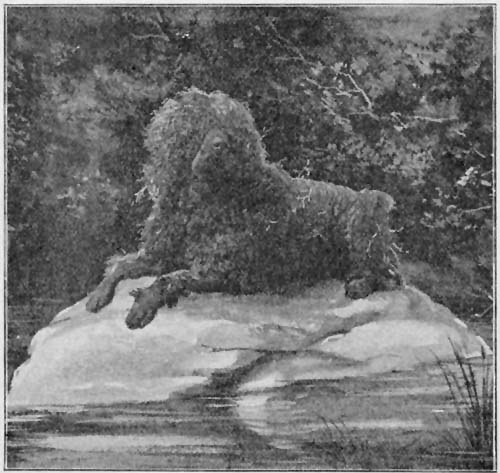
Then, as they drew nearer, the reason for his
sitting still was plain. His heavy curls were a
mat of mud, burrs, and briers that must have
made either walking or swimming nearly impossible,
while the tangle over his eyes was so dense
that he could see nothing. His collar was gone,
also his bracelet, and his fluffy wristlets hung limp.
At a call from his mistress, however, he half
stumbled, half plunged into the shallow stream
and threw himself into her lap, and she hugged
him, thus completing the wreck of her gown, saying,
“You poor, poor boy! we are a pair, you and
I, because of our clothes, and not knowing the
country.”
It was impossible to comb or pick the straws
and burrs from Hamlet’s coat, so next day one of
the grooms clipped him close all over and gave
him a bath. When he went, meek and shivering
with mortification, to his mistress’s room, where
she was sitting alone, as the poisoning was doing
its work on the scratched wrists and shell-pink
ears, she hardly recognized her pet in the
lanky black dog with only a tail-tuft left of his
curls. As she did not speak, he went over to a
low stool, and putting his nose between his paws,
“said his prayers,” as she had often made him do
for punishment when he had disobeyed.
Then, in spite of her misery, she burst into a
hearty laugh, and bade him go out and play with
the other dogs, which he very readily did, feeling,
if antics tell anything, like a little boy who has
just put off petticoats. After his clipping Hamlet
was cordially received in Dogtown, and considered
one of the boys, and whether or not his hair
was allowed to grow or if he ever again wore a
scented mustache, remains to be seen.
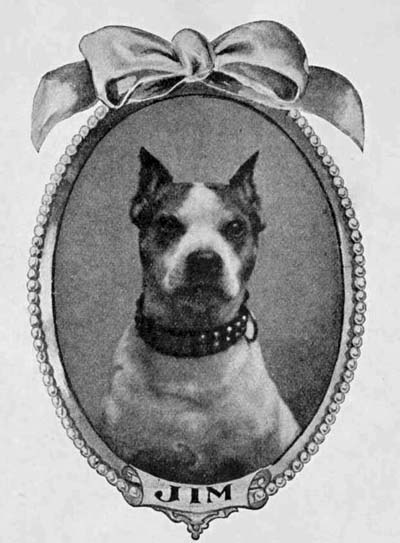
CHAPTER III TROUBLE BEGINS
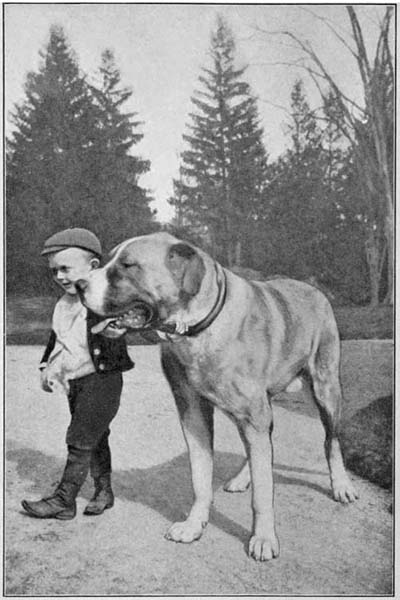
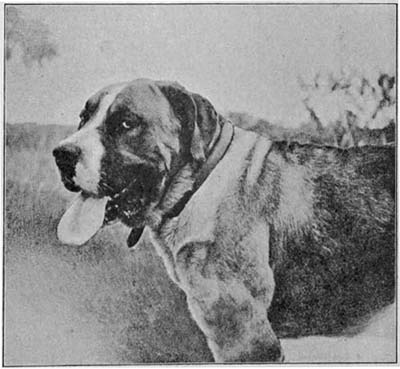
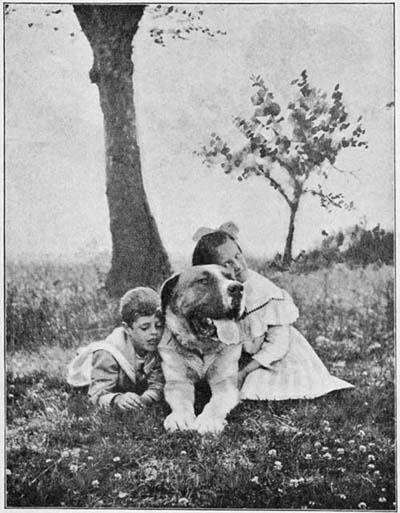
During all these days Lumberlegs, the St. Bernard,
grew mightily. When he was a year old,
he looked like an awkward young calf; but when
his second year was ended, he had the tawny head
of a lioness, and his body, well rounded yet
muscular, was in keeping with his huge paws.
When he sat and Tommy stood, their heads
were on a level, and when they walked abroad
together, Tommy tugging sturdily at his collar
to keep pace, they usually had the roadway to
themselves, for Lumberlegs was not only the largest
inhabitant of Dogtown, but of the whole
county, and people made so many remarks about
his size that Tommy dubbed him Bigness.
Lumberlegs and Tommy.
These same people predicted that some day
there would be a dog fight at Happy Hall when
Lumberlegs came to realize his strength, and the
feeling of jealousy that comes to a dog with full
growth. Surely there was material for both jealousy
and a fight. Waddles loved Anne with the
sort of love that thinks it owns the object of its
devotion; Lumberlegs loved both Tommy and
Anne in the same way; while Lily, the bulldog,
was devoted to Tommy alone, and deeply resented
the coming of Happy, who loved every one, as an
infringement of her rights; so that at the time
Happy became the mother of Jack and Jill, and
consequently an object of much attention, there
was a considerable strain upon dog tempers.
At this point fate wisely stepped in as she often
does, though tears came with her. Lily broke one
of the most rigid of dog laws, the penalty for
which is death—she defied an express train! In
going with Tommy and Anne to the town she did
not follow the road and cross the railway bridge
with high safe sides, but lingered by the way,
sniffing here and then there until she lost sight of
her friends, and took a short cut across the fields
that bordered the tracks, running between the
rails until she should reach a gap in the guard
fence that opened on the road the other side.
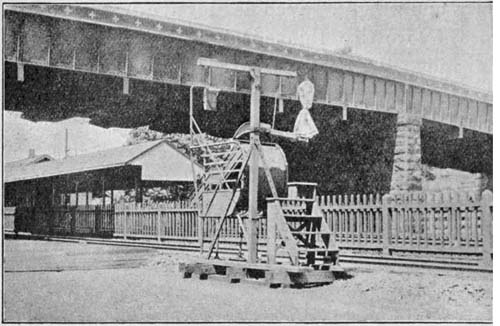
It was time for the morning express, the particular
train that always whistles as it turns the
curve, and thrusts out an iron arm to grab the
mail bag, swinging from its gallows, while it drops
another bag into a rack beneath.
It was always a puzzle to Tommy as to how the
bag was seized without missing, and he often
coaxed Anne to wait on the bridge until the train
came, as there were little star-shaped openings in
the iron work through which he could see.
This morning they had crossed, and then hearing
the train turned back. Anne missing Lily
looked up the hill for her, while Waddles, who, as
a matter of course, was one of the party, trotted
soberly along toward the village, where he would
wait for his mistress upon the steps of either the
market or grocery store, according as he understood
her destination.
As the train reached the curve Tommy, whose
eye was at the chink, gave a shriek and dashed
himself at the barrier, wailing: “Lily, Lily, my
Lily! She’ll be killed! O Anne, come quick!”
In reality, by this time Lily had crossed the
rails and was quite safe, but her master’s cry made
her turn to locate him. Whether she thought he
was in pain or danger no one knows, but at that
moment the train rounded the curve, whistling
furiously. To the bewildered dog it must have
been associated with her master’s scream or else
sounded like a challenge, for like a flash she
turned and charged the monstrous engine face to
face. Tommy cast himself face downward on the
roadway, his tears making mud of the dust. Anne
caught hold of the railing and closed her eyes
while the train thundered by underneath. Lily
lay quite still high up on the bank; the engine
had been quickly merciful.
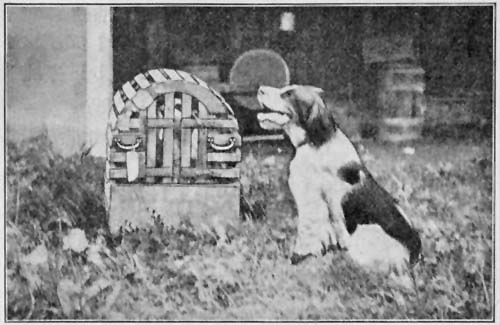
That afternoon Baldy buried Lily in the corner
of the orchard pasture where there was quite a
company of pet animals, ranging from canaries,
with school slates for headstones, to Brownie, the
dear old pony that had belonged to Anne’s mother
when a girl, and lived out a happy old age in
that very pasture. One thing about pet animals is
that their lives at best are so short, that we should
treat them very kindly to make up for it.
Some of the neighbours laughed at what they
called Unhappy Hall Cemetery, but Anne resented
this with a good deal of spirit, saying, “I think
that it is very mean to love an animal one day,
when it is alive and can amuse you, and then throw
it on the ash heap the next, just because it’s dead
and can’t help itself.”
Tommy still crying, and remorseful at perhaps
having caused Lily’s death by calling her at the
wrong moment, insisted upon Miss Jule, and his
father, and mother attending her funeral. Anne
made a wreath of her best flowers, sacrificing four
tea rosebuds and all of her mignonette and heliotrope,
but Tommy would have none of it. Instead,
he begged two beef bones from the cook,
and tying them together crosswise with Anne’s
best pink hair ribbon, which she had not the
heart to deny him, put them on the middle of the
mound, saying between sobs, “She—loved—bones—but—she
didn’t like flowers—except to sleep
on,” which was perfectly true, her favourite
places for a siesta having been alternately the
verbena, nasturtium, or lettuce bed.
Tommy’s father and mother were resigned,
though they did not say much about it before the
children. Complaints had begun to reach their
ears that Lily not only felt it her duty to prevent
strange people from coming near Tommy, but
declined to let them pass by on the road unchallenged;
and though they cherished all animals,
they never allowed them to become a nuisance or
bore those who cared less for them.
Baldy was also resigned and spoke his mind
freely, much to Tommy’s chagrin.
As for Dogtown, it was jubilant to the barking
point, especially among the lower classes, consisting
of those dogs who, being in reduced circumstances,
had been used to come shrinking and
timid between dusk and dawn for castaway bones
or swill-pail dainties.
Waddles was liberal minded upon such matters—as
liberal as the law allows. Dog law says that
no dog shall dig up a bone that another has
buried; but all bones that lie abandoned and uncovered
are public property and fair eating.
Waddles, being affluent, never ate swill, and
only buried special bones to ripen, casting others
about at random, often with scraps of flesh ungnawed;
for this he was regarded in Dogtown as
the people’s friend.
Lily, in coming, stopped this patronage. She
had known want herself, in the days when she
tramped with gypsies, so she ranged about, industriously
burying everything she found for possible
future use, and kept such a strict watch on
all the outbuildings that the most ravenous cur
dared not steal a lap of sour milk from the
pig’s trough for fear of seeing those wide jaws
gnashing in front of him; for Lily had the one
bad trait of her race: she laid hold without
warning.
So after all it was only Tommy who grieved for
Lily. To him she stood for property rights,
strength, and friendship, and for a time he was
inconsolable.
“Let’s come home and see the twins have their
supper; it won’t do any good for you to stay here
and cry. Your eyes are swelled up like a frog’s,
now,” said Anne, trying to lead Tommy away
after Baldy and his shovel had disappeared.
“Supposin’ it was Waddles was dead, would
you stop cryin’—the very same day—even if you
were frogs?”
“Waddles! why that is entirely different; he
is a person. There is no other dog like him,” and
then Anne sat down suddenly on the tumble-down
stone fence in sheer amazement at the possibility
of mischance overtaking her little friend.
A friend he was, and she was entirely right—there
was no other quite like him among sturdy,
self-reliant, gentlemen dogs. He had been so long
the companion of the House People that, without
being of the objectionable, pampered, perfumed,
spoon-fed type of lap dog who demands the care
that a child alone should have, he really seemed
to be, as Anne said, a person.
Waddles did not know a single taught trick;
he could not hold sugar on his nose, like Miss
Letty’s poodle, Hamlet; he could not sit up and
beg, though he had a language of his own, part
gesture, part speech, by which he could ask for
anything that he could not get without aid.
In his frisky youth even he scorned the mere
idea of jumping through a hoop, or the poodle
trick of “saying his prayers.”
Yet there were few walls that he could not
manage to get over or through, and he would put
his paws upon his mistress’s knees and gaze into her
face in unmistakable supplication.
“It’s a great responsibility having a dog like
Waddles,” Anne had said one day, shortly after
her brother was born, when she had given him
half of her name, and stopped being Tommy-Anne,
and there had been much talk about her
new responsibility. “Do you know, mother, I
believe Waddles thinks that I’m God, and it will
be dreadful if I’m unkind and disappoint him.”
No, Waddles was untrained and untutored in
the common sense of the words, but he “knew,”
which was better; his method of treeing cats or
coons in company with Miss Jule’s big Ben Uncas,
and the fox terrier, Quick, though somewhat
reprehensible, was a marvel of military tactics,
and it was knowledge of this sort that made and
kept him Mayor of Dogtown; for he was the one
dog that no other had ever attacked or fought,
so it was no wonder that Anne grew grave at
the mere suggestion of losing him, though never
dreaming that there was really trouble hovering
about, and that, too, from a dog of the Happy
Hall household and herself.
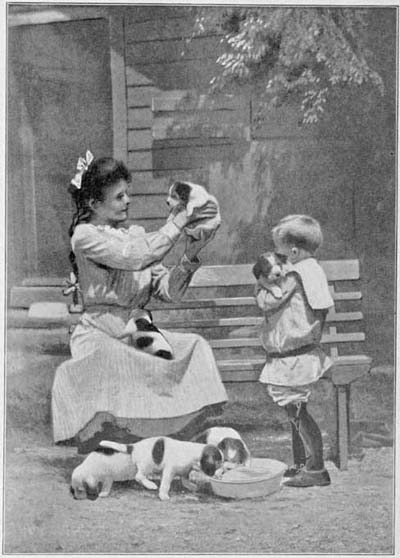
For a time after Lily’s departure everything
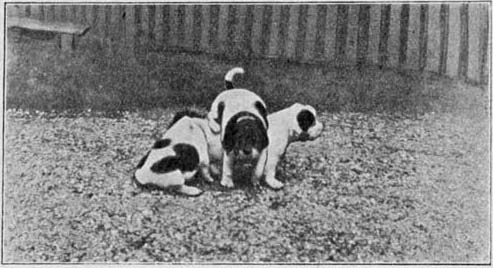
was peaceful. Jack and Jill were fast growing
able to play and indulge in the wrestling matches
that make puppies quick-witted and strengthen
their muscles.
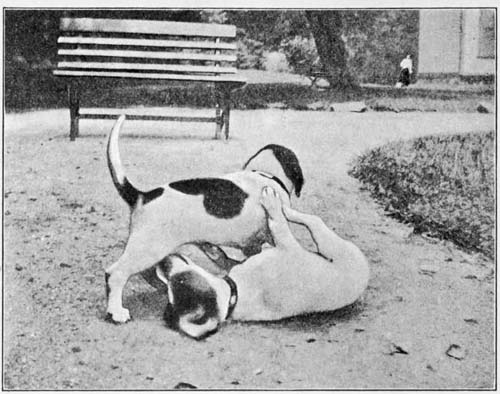
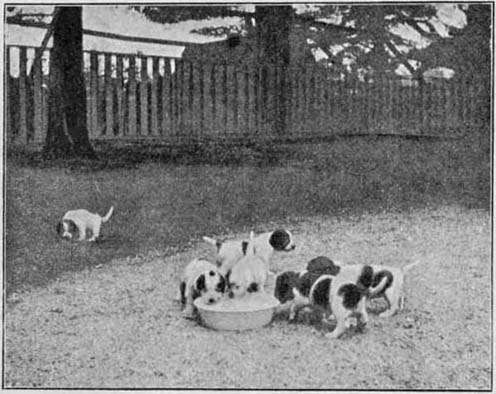
Happy often superintended these bouts herself,
stirring up first one pup and then the other,
often aiding and protecting the under dog if too
roughly vanquished. Anne soon discovered that
these affairs were not merely aimless play upon
Happy’s part, but a way she took for teaching
the twins how to protect themselves.
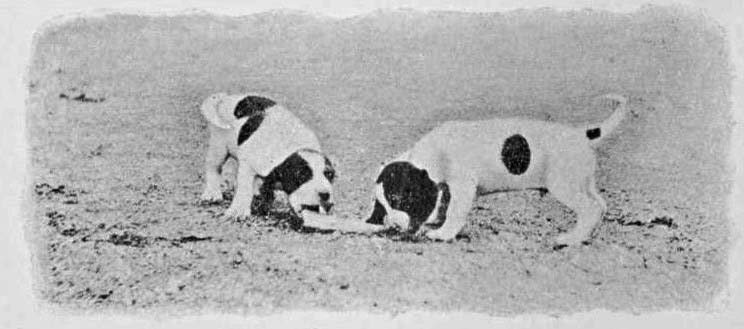
The next step was to teach them to protect
their food, and when one day Happy dragged a
ripe and well-cleaned beef bone from its hiding-place,
and deliberately threw it down between
Jack and Jill, and they began a struggle for its
possession, Anne in amazement rushed into the
house to call the family, crying: “Do come out
and see the queerest thing—Happy is teaching
the pups to play ‘snatch bone’ exactly the same
way as Waddles played it with Lumberlegs when
he was a puppy. You’ll really have to see it to
believe what I say.” It was more than true, for
not only did they wrestle and snatch the bone
from one another, seeking in turn to hide it in
the grass under a few leaves, but when the frolic
was fast turning to a pitched battle, and ludicrous
baby growls mingled with flashing teeth from
between drawn-up lips, then Happy gave a sharp
“yap” that must have meant something very
dreadful, for the pups instantly let go and drew
apart with a most abject droop of the tail, while
she seized the bone, and trotting off reburied it.
Though Waddles seldom forgot his dignity
sufficiently to play with the twins, he allowed
them to take morsels from his dish, and was
always close at hand if their shrill cries told that
they were in trouble, and the slightest look from
Happy brought him to her aid.
Lumberlegs, on the contrary, delighted to gambol
with them, and his clumsy bounds and imitations
of their gestures usually ended in his overthrow,
when he would lie on his back with a most
idiotic grin upon his face, fanning the air with his
paws, while the twins gnawed at his great tail
with mock fierceness.
Now the race law for puppies and grown dogs
is quite different, even as are those laws that govern
childhood and manhood among House People.
Actions that are tolerated and even encouraged in
puppyhood are read as insults when done by a
dog of two years, and bear a penalty.
In spite of Waddles’s instructions and warnings,
Lumberlegs was either heedless of the law, often
deliberately breaking it, or else from his size and
strength felt himself superior to it; which it was
Anne could never tell. Perhaps it was because
he was unevenly developed, for he had all a
man dog’s jealousy and craving for the exclusive
attention of his owners, while he kept his
baby playfulness and total disregard of food
rights. So trouble befell one fine day, like rain
from sudden clouds that no one has noticed gathering.
After it had happened Anne was continually
remembering little things that might have given
her warning.
Waddles had a favourite afternoon station on the
end of the porch that commanded the front and
barn roads, the front door, and the garden also if he
turned his head. Suddenly Lumberlegs regularly
appropriated this watch-tower, and his length
being so great that there was no view from a back
seat Waddles, after unavailing verbal remonstrance,
was forced to lie upon the grass.
Waddles was the only dog that had been allowed
in the dining room at meal times, when he sat
quietly under the table at Anne’s feet. Soon
Lumberlegs discovered a way of opening the door
and he would hide under the table, lying at
Tommy’s feet. As he was quiet, and Tommy
declared that he made “a fine feet bench,” he
was allowed to remain. Consequently Waddles
was squeezed against the table’s claw legs and
presently left his old place and lay disconsolately
upon the door-mat.
When Lumberlegs came, a gift from Miss Jule,
he was regarded as Tommy’s property; but when
the novelty wore off, and Jack and Jill became
counter attractions, he turned wholly to Anne to
supply his needs both of food and affection, and
became devotedly attached to her as big dogs
usually are to only one person; while Anne,
though faithful to Waddles, returned his devotion,
for he was in many ways a noble dog.
Anne had insisted almost from her babyhood
that one of her ancestors must have been an
Indian, so fond she was of wild ways and things,
and this liking did not decrease as she grew of an
age to crave friends of her own race.
She still tramped about the near-by woods, but
Miss Letty was often her companion. Also Miss
Letty was timorous and made a point of insisting
that Lumberlegs go with them. This he often
did, and would either follow close or sit quite still
on guard for any length of time; while Waddles
and Happy would perhaps strike a trail and dash
off in full cry, thereby disturbing the very things
that Anne had come to watch. One day, after
they had in this way scattered a quail brood that
Anne had hunted from the time that Bobwhite
announced his arrival, until she found the dear little
chicks huddled in a leafy hollow among wild
blackberry canes on the orchard edge, she felt
provoked, and did not allow Waddles to go to walk
with her for almost a week. “Mistress,” said
he, his eyes growing deep and luminous with
reproach, “I’ve always been with you until now;
have you forgotten all those fine days before
Tommy came, and there was only you and I?
Don’t you remember I was with you when we met
the miller’s bull, and he was so angry because,
though he tolled the bell at Cock Robin’s funeral,
they didn’t ask him to the feast, and how I
followed you and Obi when you went for the
wood-duck’s nest, though I was very sick, and that
day when Ko-ko-ko-ho showed us the way to
where the last rattlesnake was, and the night that
we went up on the hill and I barked you awake
just when you thought you were at the Forest
Circus? What has happened, mistress? Are you
tired of me, or can that Lumberlegs show you
better paths than I do? Though you gave my
tail and back legs half to Tommy when he was
born, I’ve always used them to follow you and tell
you I was glad just the same as ever, but now you
love Lumberlegs best.”
“You dear, jealous old Waddlekins,” cried Anne,
lifting his paws to her knee as of old so that he
stood up and she could look in his face, “it’s nothing
of the kind, only Miss Letty often comes with
me, and she is used to the city, and she doesn’t
care for those long ‘go over everything’ walks
that we take, and she has read in the papers about
tramps, and thinks Lumberlegs makes a splendid
policeman. Besides, you know that you chased all
those lovely little quails off our land just when
they were getting big enough to have their pictures
taken, and father had spent a lot of money
for rubber tubing so he could work his camera
from behind the old green apple tree. Now they
are as shy as loons, and pop down in those wild
roses when we are a whole field away and there
isn’t even a big bush to hide behind.
“But never mind; I’m sorry, anyway, so touch
noses and be friends, and to-morrow we will do the
brook walk all by ourselves; for even if I do love
Lumberlegs, it’s quite different.”
Instead of the usual dainty lick Waddles gave
a half-suppressed growl. Anne dropped his paws,
exclaiming in surprise: “To think of it, you
growled at me when I was apologizing, the very
first time in your life, too. I think you had better
go over and rest in your kennel and think it over.”
Then she led him to his little house, snapped the
chain in his collar, and walked away without once
looking back, Lumberlegs leaving his stolen seat
on the porch to follow her.
The truth about the growl was this: Waddles,
dislodged by Lumberlegs from many of his nap
nooks, had lately taken to lying in the grass or
under bushes, which as he was elderly and the
season very wet had given him rheumatism in his
hind quarters. As Anne held up his paws the
strain soon gave his back a miserable wrench.
This caused the growl, and for thus being misunderstood
to threaten his idol, Waddles was not
only left behind, but dethroned and chained up in
his rival’s presence, where he stood as if transfixed
with a strange, drawn expression on his face,
which when House People wear we know they
are struggling to keep back tears.
If only Anne had then remembered what she
had once said about disappointing him!
“He stood transfixed.”—p. 79.
CHAPTER IV EXIT LUMBERLEGS
One morning the skirmishing that had been
going on for several weeks between Waddles and
Lumberlegs broke into open warfare, and it was
the misguided interference of a would-be peacemaker
that quickened the crisis.
This was Mrs. Happy Waddles who, from poking
her pretty little nose where it did not belong,
and relying too much upon the indulgence accorded
her sex, not only very nearly made herself a widow,
but caused a household commotion as well.
As we have noticed before, Lumberlegs was
very poorly instructed in dog law, in spite of
having grown up side by side with Waddles, who
was letter perfect in it. Not only did Lumberlegs
ignore the “rights of age” and “buried bones
law,” but he began breaking the “fresh food law”
as well.
House People should make it as easy as possible
for their fourfoots to keep this law by giving each
one its rations separately, for it is only in early
puppy days that dogs may be trusted to feed from
the same dish, and even then the timid and weak
fare poorly.
Waddles had the appetite of a dog who had
been reared alone, and could therefore pick and
choose. He ate deliberately and never ravenously,
sniffing cautiously at each morsel; for once, when
he was ill, Anne had made the mistake of giving
him pills concealed in his food. Of course he
discovered them, spat them out with much sputtering,
and never forgot the occurrence.
On the other hand, Lumberlegs and Happy were
both gluttons; the first because he was so big that
it seemed impossible to give him enough, while
the little beagle was perhaps prompted to overeat
by a haunting memory of the single daily meal of
her kennel life.
In this particular case the bone of contention
belonged to a ham, a dainty especially kept for
Waddles. He had taken a few gnaws from it and
hidden it under the flap of the cellar door, his
favourite cache, while he went for his daily walk to
the village with Anne; for whatever his faults he
had always preferred her companionship to food,
never swerving even for liver and bacon.
Along sauntered Lumberlegs, searching for
something to add relish to his ample breakfast of
dog bread. He tried to investigate the swill pail,
but it not only had a tight zinc cover, after the
fashion of all well-bred scrap pails, but for double
protection there was a stone on top which he playfully
knocked off with one sweep of his paw.
Straws show which way the wind blows, and
this stone showed where the ham bone was by
rolling directly against it.
Lumberlegs seized upon the bone with delight
and tossed it into the air gaily, preparing to have
a good play before making a meal.
Happy, whose deafness seemed to sharpen her
sense of smell, came from under a bush where she
had been taking a nap in company with Jack and
Jill, and sat where she could keep her eyes upon the
bone, giving a little whine now and then, moistening
her lips with the edge of her pink tongue,
and casting appealing glances at Lumberlegs that
only seemed to stimulate him to further antics.
It is almost always the soft-haired, mild-eyed,
helpless looking sort of people like Happy that sit
still and brew trouble, even in bigger places than
Dogtown.
Waddles, coming home from market half an
hour later, took in the situation at a glance. He
had borne a great deal in silence, but this was too
much. It was high time for his position as house
fourfoot at Happy Hall to be upheld. He would
try his authority as “oldest dog” first. So, going
forward slowly with a contracted tiptoe gait and
tail held erect, he made a series of noises that
seemed graded between growls and real speech.
Lumberlegs understood this language perfectly,
and rolling on his back, he gave the bone a final,
careless toss, as much as to say, “I was only playing,
take your old bone.”
Waddles advanced to seize his property, and
all would have been well, at least for that time, if
Happy had not interfered.
It had happened several times that when the
two dogs had been playing with or contending
for a bone, Happy had ended the matter by running
between them, giving each a caressing lick
on the nose, and making off with the bone herself,
leaving them looking sheepish, but too polite
to remonstrate. She now tried the same tactics,
but in reaching up to Lumberlegs, who was rolling
in the grass, she received an entirely unintentional
blow from one of his paws, and ran away
squealing in terror out of all proportion to her
hurt.
Waddles, with a deep, short growl that must
have been a wicked word in dog talk, sprang upon
Lumberlegs; but before he could do more, the
great jaws closed on his neck, and he was shaken
as a cat shakes a rat.
Fortunately, Waddles wore a stout collar which
broke the force of the grip, otherwise his neck
might have been broken before Baldy, who heard
Anne’s cry, came to stop the fray. But as it
was, the sleek white neck was streaked with red,
there was a rent in one of the beautiful ears, and
for the first time in his life Waddles, the Mayor
of Dogtown, had been mauled and shaken like a
common cur. And this, too, when he was growing
old, and by a dog of the same household. True,
in the old days, he often had differences with Tiger,
the miller’s cat; but cat scratches on one’s nose
are considered wounds of honour in dog etiquette,
and are no disgrace.
Lumberlegs was shut in the yard beside his
kennel, and Waddles retreated to the remotest
corner of the cellar, from which he refused to
come forth even when Anne, bringing warm
water, a bit of sponge, and sticking plaster, called
him in her most persuasive voice.
“He feels sulky,” said Baldy, “leave him alone
a spell and he’ll come out all right. I reckon
his feelings is hurt more’n his neck.”
“That is just it,” said Anne, sorrowfully, “and
to a dog like Waddles hurt feelings are much
worse to bear than a bitten neck.”
But when he failed to appear at dinner time,
and Anne took a lantern to hunt for him among
the coal-bin caverns, the poor neck was so swollen
that the collar was sunken in the flesh like a
ring on a fat finger. Even when the collar was
taken off, the bite bathed and cooled with a soothing
wash, and the rent in the ear drawn together
with narrow strips of rubber plaster, he refused
either to respond to Anne’s petting, come upstairs,
or in fact move at all, though after she
reluctantly left, she heard him lapping water from
the refrigerator pan after his usual hot weather
habit.
“I wouldn’t trouble if I was you,” said Baldy,
cheerfully; “they all hev their little scrapes.
It’s accordin’ to natur’ for dogs to delight to bark
and bite, like it says in the Sunday-school poetry,
that everybody knows.”
“That’s one of the things that ‘everybody
knows’ that isn’t true,” answered Anne, emphatically;
“dogs’ real delight is to live with people
and be understood and have their feelings respected.
That’s why I’m afraid that Waddles
will never forget to-day; he has been feeling hurt
about Lumberlegs for a long while, and now he
thinks he is in disgrace besides.”
“Feed the dogs separately, keep them apart for
a time and the stray bones raked up, and I think
the feud will blow over,” said Anne’s father.
Her mother thought differently, for Lumberlegs,
the boisterous puppy, and Bigness, the full-grown man dog,
standing thirty-five inches at the
shoulder, were entirely different beings. She had
watched him at play with Tommy and noticed
the way he eyed with resentment everything that
came near. She knew that when he followed
Anne to the woods she had more than police protection.
He was of the faithful, jealous disposition,
that must be the only one of his kind in a home
that gave wide range for wandering, not one of
several house fourfoots that recognized a smaller
dog as master, and lived literally in a town of
numerous dogs.
The feeding separately matter was easily done,
for Waddles persistently refused to leave the
cellar except on stealthy trips toward evening,
or when he was sure that his foe was out of range.
How he knew this was a puzzle to Anne, for he
could neither see nor hear from the depths of the
coal-bin, into which fastness he crawled through
the small, square door at the bottom made for the
shovel. She soon realized, however, that his keen
scent told him.
Lumberlegs also knew quite well when Waddles
was in his retreat, for though he did not care
to venture down the steep stone steps because his
back legs were rather sprawly, he would walk
past the door growling softly, with bristling hair,
and then give a broken bark and, turning, kick
grass into the air in the direction of the cellar
with a gesture of contempt.
The two weeks that followed were ones of trial
for Anne. She was in perpetual fear that the
dogs would meet, for she grew more sure every
day that “making-up” was out of the question.
Even though Lumberlegs was in his yard, Waddles
would not follow her to the village. He forsook
his friends along the route upon whom he
had never before failed to call daily, sturdily going
the rounds alone if Anne omitted her walk.
It was not until he ceased to follow her that
Anne fully realized what a friend she had lost,
one who was self-reliant, faithful, and wise, giving
no trouble, asking nothing beyond the trifling care
his rare ailments needed, and the affection his
intelligence won. For Waddles knew the speech
of House People as well as Anne interpreted
Heart of Nature’s language, and he and his mistress
had a perfect, mutual understanding.
If Anne, wearing her common hat, said, “Do
you want to go to the post-office?” he would give
a cheer and start off down the hill before her,
waiting on the office steps; while if she said store
or market instead of post-office, he would wait by
the respective doors.
If, on the contrary, she wore a different hat or
said, “Not to-day, Waddlekins, I’m going to
town,” he might sometimes go with her to the
gate but never farther.
His own voice, too, had different shades of
meaning, even beyond the others of his vocal race,
for if any dog has speech it is the beagle hound.
While he was on guard no one could enter the
gate, two hundred yards from the house, unsignalled,
either from his post on the porch corner
or his summer night quarters in the wide window
of the upper hall.
For a twofoot whom he did not at once recognize
he had a bark of inquiry; for a total stranger
a querulous
gruff note of
warning; for
a friend the
inquiring
tone quickly
broke into
rapid barks,
like voluble
talk; while
for animals
his voice had
a wholly different
key,
starting in
a series of
monotonous
yaps, until, if at liberty, he would sniff the air,
catch the trail, and follow it in full cry.
At night when he harked every member of the
household knew whether the intruder was man or
beast. Oftentimes at dawn he would push open
Anne’s door and lick her hand that was lying on
the counterpane, to signify that he wanted the
front door opened. Then when she, in dressing
gown and slippers, or sometimes, I must confess,
with bare toes and an airy nighty, would creep
down the stairs and undo the bolts, cautioning
silence, she was often lured out on to the porch by
the expression of his face as he tiptoed about,
unravelling the different trails that told him the
story of the night.
Sometimes he would give a growl and his back
bristled—that meant an intruder from Dogtown
had left an unwelcome message or disagreeable
news. Then his eyes would grow deep and luminous,
and when Anne asked, “Squirrel?” he would
give a short yap as if to say, “No good,” and gaze
up in the trees. But when he began by wildly zig-zagging
to and fro with head down, uttering discordant
cries, then dashing off without waiting
to answer questions, his mistress knew that he
was following either a cat or rabbit, and that he
would return late for breakfast and very tired.
To think that the little animal that knew all
this should be moping unkempt and forlorn in the
coal-bin, gave affectionate Anne the heartache.
Next she tried the experiment of having Baldy
carry him upstairs and give him a good bath, for
his wounds were now healed, and then invited
him to “go to the post-office” in the old-time gay
tone.
For a moment he rallied and gave an answering
cry which was echoed by Bigness, who, as chance
would have it, was lying in the shadow of the
house front, Tommy having taken him from his
yard and strolled away, forgetting to put him up
again.
At the sound Waddles bristled and then shrank
away, and Anne realized for the first time how
thin and altered and spiritless he was. But the
next day a change came over him: he forsook the
cellar and boldly took his old seat under the apple
tree in full sight of Bigness’s house, as if tempting
fate; but as he did not come out Waddles returned
again to the cellar.
Tommy sided with the St. Bernard, wailing
that the fault was all Waddles’s, and passionately
refused to part with his pet and have Jack and
Jill for his very own, even though Bigness should
go to a beautiful home to be the pet of his dear
friend, little Miss Muffet, who lived at a big farm
far away and had no dog friend at all.
“The train killed Lily, and now you want to
steal Bigness from me just because your silly
Waddles is selfish and wants to fight and have
everybody for himself. I don’t care if he was
here first; he’s old and he’ll soon be dead, anyway—and
I’m glad and—” but he didn’t finish,
for Anne, sweet tempered and fifteen though she
was, shook her little brother hard and then flew
up the hill to her tree perch in tears. It was
the first time that Tommy had ever been shaken,
and he was as surprised and heartbroken as
Waddles had been at his overthrow.
However, he did not cry but stood quite still,
with a very red face and quivering lips, muttering
to himself, “Anne’s as cross as Bigness—and she
hardly never cries—and—it’s horrid to be shaken,
and I guess I am sorry for Waddles—a—little
bit.” And more days passed.
In the coal-bin crouched Waddles in dismal
plight, his brain full of dark thoughts; for dogs
do a deal of thinking when they seem to be only
dozing in the sun or before the fire, and Waddles
in hiding neither ate nor slept and did nothing
but think, for it was two days now since he had
taken more than a drink of water. Anne did not
know this, for the food she took him disappeared
into the capacious stomachs of Jack and Jill, who
amused themselves half the day by rolling and
scrambling up and down the cellar steps.
Waddles, usually so spotless and neat, who often
washed his face twice a day with a queer motion
of his hind feet peculiar to himself, was now
wholly unkempt, his hair rough and dry, and his
nose smutty.
The truth was that he did not care for anything
now that he thought his mistress misunderstood
him, neither would he go among his friends,—he,
the only resident of Dogtown who had never been
taunted or fought by another dog, to be whipped
and driven to cover in a cellar by a dog of his own
house who had disobeyed all law and could not be
reasoned with! This was a state of things not to
be endured. No, he would try once more and give
Bigness the punishment he deserved, or die in the
attempt.
Then he set himself to wait a chance and time
for meeting his enemy, for both dogs were closely
watched to prevent the very battle that he was
planning.
Bigness was now given a run morning and evening,
but was kept in his yard the rest of the day
when Waddles was at liberty; but the time soon
came when somebody forgot, and Bigness, hurrying
home to early breakfast, met Waddles standing
rigid and motionless by the corner of the house.
Anne, awakened suddenly from a late sleep,
stood in the middle of her room half dazed, not
knowing whether the sounds she heard belonged
to a dream or to reality.
Then the sound came again, the awful choking,
snarling struggle of fighting dogs, always a
horrible sound, but doubly so when you know the
dogs.
Anne ran to call her father, her heart pounding
as if it would jump out of her mouth. Fortunately,
he was already dressed and out, and as she almost
fell downstairs, hardly touching the steps, the
noise ceased and she heard her father’s voice say
to Baldy: “Put him in the old hay barn until I
decide what to do. I will attend to Waddles.”
Then the door opened and her father entered
with a distressed face, carrying the beagle in his
arms.
“Is he killed?” she gasped.
“No, neither very badly hurt I hope; but
quite exhausted. I never shall forget the expression
of his face as he clung to that great jaw that
was dragging him to his death; it was like that of
a man who was hopelessly fighting for his honour
and home.
“This is no common dog-fight, little daughter,
where both dogs should be punished and tied up
until they come to their senses. Waddles has been
with us so long that he has almost human feelings
and reason; to thrust him out to be a mere dog
again would be wicked. Lumberlegs must go!”
At these words Waddles, who was lying quite
still on the door-mat where his master had laid
him, opened his eyes and wagged his tail, with very
significant if rather feeble thumps.
Though Waddles rallied very quickly, the bites
on his neck, which had been this time collarless,
had sunk in very deep, and though he was gradually
growing less moody, he did not go far from
the house or take up his old ways, and seemed
quite conscious that Lumberlegs, though invisible,
had not yet left the premises.
One warm night about a week after the fight,
when doors and windows were left open, and the
dogs roved about at will, Anne waked to find
that Waddles was sitting beside her bed in such a
position that her hand that hung off the edge
rested on his neck.
“What is the matter, old fellow, do you want a
drink?” she asked, patting him; but as she did
so she felt that one side of his neck was burning
hot and swelled into a hard lump.
Next day the veterinary came and pronounced
Waddles a very sick dog, said that he had been
poisoned by the deepest bite, and must have his
neck lanced and be carefully treated, or he would
die.
“I’ll take him right along with me to my hospital
now if your man will put him in my buggy.
He’ll have the best of treatment, and it will be
cheaper than keeping him here and having me
running over. Besides, you couldn’t take care of
him; it’s too much bother for you to dirty your
fingers with,” said the doctor, kindly, for he saw
the distress in Anne’s face.
“My fingers are quite used to dirt,” said Anne,
quietly, “and I’ve got a ‘First Aid to the Injured’
box full of cotton and plaster and bandages, and
such like, for I fix all the cut fingers and baseball
noses hereabout; there are five boys between
here and the cross-roads that play, besides a fat
girl and a medium-old lady who are having trouble
in learning to ride wheels, so you see I’ve had
experience.
“If you will lance Waddles’s neck here, I’m
sure I can take care of him, and father will pay
for the visits. Or, if he doesn’t want to, there is
my camera money,” she added half to herself.
This same camera money was a family joke and
seemed to be composed of magic coin, which, no
matter how often it was spent, never seemed to
grow less, but rather to increase.
“You’d best let me take him to the hospital.
You see, I’ve nothing to fasten him with, and he’ll
have to be well bound, or he may upset the whole
business and perhaps bite me to boot.”
“I’m sure he will sit quite still, for he always
has before; once the doctor took two stitches in
his back because the milkman put barbed wire
on his fence rails without Waddles’s knowing it.
And then last spring when we were watching a
man who didn’t know how to cast, splashing
around the stream with a trout rod, he hooked
poor Waddles, who was quite far up the bank
behind him, and the hook had to be cut out, but
Waddles never bit or squealed. He knows when
he is ill, and that we want to help him; but if he
went away from home to the hospital, he would be
too sad to get well, even if you were good to him.”
“She’s right,” said Baldy, taking a hand in
the discussion. “You jes’ do the business. I’ll
see you ain’t bit, and I’ll help Anne fix the little
critter up as often as needs be ’til he’s cured.
Ah, yes, he’ll pull through all right if he stays
to home ’cause he’ll want ter; but if he’s fetched
away, he jes’ won’t care.”
So the deed was done, Waddles neither struggling
nor crying, and great relief followed the
point of the shining lance.
“It’s different with medicines,” said Anne, as
the sensitive nose quivered and sneezed when the
doctor uncorked a bottle of pungent creolin to
make a wash. “Waddles doesn’t understand about
them, and he may not like the bandages, because
it seems like being tied up; but if you’ll show
me once, I know that Baldy and I can manage.”
So every morning for a week, precisely at eight,
when Baldy’s chores were finished, you might have
seen Anne bring her “First Aid” box to the back
stoop, and change Waddles’s bandages, dressing his
hurt as carefully as the doctor himself could have
done. Baldy had to help by holding the patient
when the creolin wash was used; for Waddles, the
house fourfoot, could bear pain, but Waddles, the
rabbit hound, could not endure a strong odour
without choking and rolling in the grass.
In another week the bandages came off for
good, and he had a bath, though he did not yet
take any of his old interest in making his toilet.
One day, however, a change came. He was
lying on the decrepit old sofa in the upper hall,
where Anne was used to curl up and read on
rainy days. She had lent him her soft poppy
chintz sofa pillow that she had made with great
pains to match her bureau set, and Waddles, lying
there luxuriously, his head on the pillow
and his paws held in front of him like hands,
gazed at Anne with a glance in which affection,
comfort, and sleepiness were mingled.
Wheels crushed the gravel and Anne going to
the window saw the runabout wagon with Baldy
and a strange man in it driving out of the stable
yard. Between them on the bottom sat Bigness,
his head almost on a level with theirs, while he
strained at his collar and looked back longingly
as he passed the house.
Miss Muffet, Brother, and Bigness.
Anne knew that he was to go to his new home
that day. She had gone all alone to give him a
parting hug that morning, and she choked as she
looked at him. Tommy, meantime, was up in the
hayloft having his cry out, with no other company
than a white brahma hen who had stolen her nest.
Waddles sniffed, and getting stiffly down from the
sofa raised himself, paws on window sill, and looked
out. He saw the wagon, the men, and the dog, and
he understood. He had the courtesy not to bark,
but his tail wagged furiously. Then he dropped
to the floor and began washing his face vigorously
with his hind leg. Waddles was himself again.
Bigness went to live with little Miss Muffet
and her brother at the hill farm half a day’s drive
away, where he had his liberty, good eating, was
their “owniest,” and was hugged to his heart’s
content; but he never forgot Anne, and when
she visited him he had eyes only for her, and
awoke the echoes baying long after she left.
Anne was his first love, and to be the first love
of a big dog is a rather serious thing and not to
be lightly undertaken.
CHAPTER V JACK AND JILL WADDLES
This is a chronicle of the doings of Jack and Jill
the twins, pups of Waddles and Happy of Happy
Hall, who, from the age of twelve days when they
completely opened their eyes on the world, thought
for a time, until they met experience, that it was
made exclusively for themselves, according to the
thinking of many two-footed children.
After the going away of Lumberlegs, Waddles’s
youth came back to him. He went off on long
excursions with his neighbours, bayed a juicy
tenor in the quartet that led the Dogtown chorus
in its practise on moonlight nights, and actually
threw bones into the air and played with them as
of old.
Not that he could turn as quickly, and his portliness
got rather in the way as he tried to double
on himself; but the spirit was there, which is the
thing that counts.
Waddles, Mayor of Dogtown, had always been
an important person, but Waddles, the married
man, father of a family and master of a home
consisting of three houses surrounded by a fine
yard and equipped with porcelain-lined food dishes,
hay pillows, and other luxuries, was of double
dignity.
With the extra food supply necessary for more
dogs, he was able to be a greater patron of the
poor in the line of bones and left-over dog biscuit.
Also it was not an unusual thing to see him piloting
a tired and thirsty dog, who had been following
a team bound for the market town, to the
trough that caught the well drippings, and then
to a particularly cool resting spot under the quince
bushes; for this particular highway was a trying
place for thirsty animals, as there was not a single
spring or drinking-trough between the Hilltop
Kennels and Happy Hall. Yet, in spite of all this
outside notoriety, as far as his own particular family
was concerned, he was tolerated, but that was
about all.
Anne expected that he would be sad or resentful,
as when Lumberlegs claimed affection that
Waddles considered his own exclusive property.
He was neither the one nor the other. The proverb,
“Every dog has its day,” is evidently one
of the recognized family dog laws. It was Mrs.
Happy Waddles’s day just then, for was she not
the mother of the twins?
It was to her apartments in the big kennel once
owned by Lumberlegs that visitors went and gave
ohs and ahs of admiration. Her ladyship had new
milk and all the tidbits, and did not have to submit
to a bath for several weeks lest she should
be chilled.
Waddles was polite but bored; he spent a great
deal of time under the flap of the cellar door where
he could keep an eye on his home from a distance.
He also did a great deal of thinking in these
days.
There are people who say that dogs have no
family life, but that is either because these people
do not really know dogs or have only seen them
reared in great kennels, for kennel dogs are as different
in their instincts and feelings from home
dogs as orphan-asylum children are from home-cuddled
babies.
Though Waddles kept rather aloof from his
family, what else could he do? As they were not
living in a state of wild nature it was not necessary
for him to hunt food for them.
If he asked Happy to take a walk, she would
give him her usual little caress on the nose and
trot beside him as far as the gate perhaps, then
suddenly turn as if she had forgotten something,
drop her body after a way she had when she put
on speed, and dash back to her house as if it was
the burrow of a rabbit whose fresh trail she had
crossed.
Once or twice Waddles had gone into the nursery
kennel and sniffed at the pups in an inquisitive
sort of way, but Happy immediately nosed
herself between them and their father, as much as
to say, “Please be careful, men are so awkward,”
when he quickly retired under the cellar door, to
his watch tower on the porch corner, or to his
bachelor kennel, the third and smallest house of
the group. This he had always used as a retreat
from sun and rain, or when he was too muddy
from hunting to make him welcome in the house,
only being chained there as a punishment or in
emergencies.
When Jack and Jill were three weeks old, and
might fairly be said to be on their legs, they were
as pretty a pair of beagles as one could wish to
see. Equally mated in size, build, and general
colouring, Jack, however, having the longer ears
and rich brown head markings; yet in temper
and general behaviour they were as different from
one another as any two dogs could be.
Jack was affectionate and sedate, with a patient
expression in his steel-blue eyes that one day
would, doubtless, be deep brown like his father’s.
Jill was impetuous, which often passes for affection,
capricious as April sunshine, with an expression
of pretty impertinence upon her face. She
had dark lashes and a rim of dark brown around
the edges of her eyelids which gave her a look of
mingled wisdom, slyness, and determination to
have her own way, that was at first captivating.
Happy was a model mother, and as soon as the
pups had their breakfast she gave each a bath from
head to foot, or rather tail tip, with much effort
and many grunts.
These were the first puppies that Anne had ever
been with so intimately that she could watch their
growth from day to day, and it seemed as if she
did little else but watch them when she was out
of school; in addition she had all that she could
manage in keeping Tommy from carrying them
about, to the destruction of their digestions and
the straining of their backs.
All Anne’s persuasion, however, did not have
as much effect as the peremptory bark and nip in
the ankle that Happy administered one morning,
when she surprised Tommy in waking the twins
from their nap that he might take them to ride in
his wheelbarrow, for Happy, usually so meek, was
at that time a despot whom no one on the premises
thought of disobeying, with the exception of her
daughter.
It was very easy for Happy to give Jack his
bath, but with Jill her patience was sorely tried.
When it was time to do her back she would
roll over and kick her legs in the air, chew her
mother’s ear, or make a tug-of-war rope of her
tail. Then, when the bath was completed all but
her fat little stomach, she would grind it into the
dirt and brace her paws, until her mother, quite
out of patience, with a twist of one paw would lay
Jill on her back with a growled rebuke and a curious
threatening expression of face which she made
by turning back her upper lip from her teeth, as
both fighting dogs and wolves do when freeing
their jaws to bite.
At three weeks old Jill had developed a shrill
bark full ten days in advance of her brother. At
four weeks she succeeded both in catching her
own tail and in washing some mud from her hind
paw very neatly.
When Jack attempted to do the same he only
tumbled backward out of the nursery door into
the water dish, aided by a push from his sister,
who then rolled frantically about the floor in glee,
while his mother roused from her one-eye-open
doze and seized the opportunity to give him an
extra bath.
When the twins were six weeks old Happy
began their education in earnest. Kennel puppies
are usually weaned about this time and are separated
from their mother, so that instead of being
trained by her to act and think for themselves,
they only learn, often through punishment, blind
obedience to rules they do not understand. Of
course this sort of puppyhood does not make as
clever a dog as the other.
Waddles himself was an example of early training
by his mother, who, being a poor widow with
a large family and owned by a very unsuccessful
truck farmer, had great difficulty in making both
ends meet; consequently Waddles and his brothers
and sisters were taught very early to shift for
themselves.
It was owing to his patient cleverness in catching
a small squirrel by the roadside that Waddles,
when only four months old, had attracted the
attention of Anne’s father, who bought him from
his owner for five dollars. As Anne once said, it
seemed strange that five dollars could buy so much
when often one got so little for it; and then as she
grew to love him as a friend she did not like to
think that he was bought at all, for it did not
seem right to sell such as he without his own
consent.
After learning to be clean, the second lesson
that Happy taught the twins was how to keep
cool. Anne knew very well that dogs do not perspire
like people, but only by the moisture that
drips from their mouths, so that they need
plenty of cool water to drink and shady places to
lie in if they are to be comfortable in hot weather.
She also knew that Waddles and Lumberlegs dug
themselves holes in the dirt, as she thought to keep
off the flies; but why Happy should try to burrow
under the foundation of the nursery puzzled her.
It was not to bury bones, for the chosen spot for
that was far away from home.
To help her, as well as to see what she would do,
Anne loosened two or three stones from the foundation
of the tool house that stood next to the
kennel, much to Happy’s delight, who then began
to burrow furiously, throwing the dirt behind her
with her strong front paws.
All day long she worked, while as soon as the
dirt ceased coming out at the mouth of the burrow
Anne could hear it flying up against the floor of
the tool house, which, by the way, her father also
used as a dark room for developing photographs.
Late in the afternoon Anne heard Happy whining
by the outside wall. She had kept at work all day,
only leaving to feed the pups who at this time
varied their milk diet with a dinner of puppy biscuit
soaked in weak soup. Anne loosened a couple
of stones at this side as well, and in a very few
minutes Happy dug herself out and circled about,
barking with every symptom of joy. But when
Anne was about to replace the stones, the little
beagle thrust herself between her mistress and the
burrow in the same way as she had come between
Waddles and the pups, when he came to look at
them.
Anne saw that Happy was working out some
plan of her own, so she waited and the next day
discovered it.
In the morning when she went to look at the
pups they were nowhere to be seen, the gate of
the yard was closed, and for a moment Anne
feared they might have been stolen, but baby
barks from under the tool house reassured her.
Going to the outside opening of the burrow and
lying flat in the grass she peered in. At first she
could see nothing, but in a minute the light from
between the stone chinks revealed Happy and the
twins stretched flat on their stomachs in the fresh
earth, Mamma dozing comfortably, the youngsters
yap-yapping to themselves; for having a
deaf parent they were quite safe in saying anything
that they chose.
“It’s a cool house, a regular summer day-nursery,
the dear clever mother to think of it!” exclaimed
Anne in delight, quite forgetful of the fact
that her own chin was resting in the dirt.
“Of course if it’s the earth cooling down at night
that makes the dew collect, it must cool their fat
little stomachs somehow the same way, and puppy
stomachs always seem to be boiling warm. Here
we’ve been and pounded the dirt in the kennel
yard as hard as rock to keep it from being dug
up, just as if digging was only mischief instead of
a ‘must be.’ Of course all dogs aren’t as wise
about it as Happy and it was rather mean of Lumberlegs
last summer to make a cooler out of
mother’s mignonette bed when it was in full
bloom.”
It would never do for puppies to stay still all
day even in so delightful a place as their mother
had made. Its best use was as a retreat after
exercising, of which they had plenty.
If their food supply had been uncertain, “food
burying” would have undoubtedly been their next
lesson, and as it was, instinct whispered in Jill’s
beautiful brown ears one day when she was eight
weeks old, and when Jack was being vigorously
flead by his mother she took his portion of puppy
biscuit and laid it, piece by piece, in the deep hoof
tracks of the barn road, where a few shoves from
her nose quickly covered it.
Jack, on the other hand, did not begin to bury
food until he was fully ten weeks old and had
become quite accustomed to seeing his mother,
father, and sister perform the task. Even then
he did not use any judgment in the selection of a
place or dig proper holes, but made very conspicuous
mounds in the middle of the walks where the
cache could be seen by the first passer-by.
It was at this time that Anne discovered that
Happy had two different ways of burying extra
food. Meat or bones she invariably put in the
earth, digging deep and covering carefully that
the morsel might keep cool and not ripen too fast.
She usually chose soft spots in the vegetable garden
for this. Often having more food in storage
than she needed, it stayed so long that the Sexton
Beetles gut away with a good deal of it, much to
Happy’s surprise; for as they bore it to their lairs
underground, there was no surface trail to tell her
keen nose whence it had been carried or by whom.
If the morsel she wished to hide was dog biscuit,
oatmeal cake, or corn-bread, Happy worked
quite differently. After finding a thick tuft of
grass, she pushed the scrap well into the centre of
it and then pulled the grass blades together over
the top, weaving them loosely as if her nose and
upper front teeth had been a crochet needle.
To “watch out” was one of the earliest lessons
the puppies had to learn, and as it was taught
partly in the cool house and partly on the road
outside it afforded the children endless amusement.
“Watching out” also included taking
notice of every strange thing that was brought
to the premises, as well as of things neither new
nor strange, and thoroughly investigating them.
As may be supposed many mishaps came of this
habit, as when Jack, sniffing at a basket containing
live lobsters which the fishmonger’s boy had left
on the step while he carried a parcel to the
kitchen, carelessly thrust his nose in too far and
was seized by a sturdy lobster claw. There
was a yelp of pain, and pup and lobster went
whirling around the big apple tree. The entire
household came to the rescue, and Jack retired to
the cooling house wiser not only by the experience
of a nipped nose, but a pinched tail as well.
It was not the fault of his mother’s lessons—he
simply had not put two and two together; in his
eagerness to see what the lobster was doing he
had entirely forgotten to “watch out” for danger.
In the early morning, before the sun had crept
around the apple tree, the twins usually sat on
either side of the doorway to the burrow, with
their mother lying on the grass near by. The two
places were not equally good, as from one side the
entire length of the path from the gate, as well as
the garden and stables, could be seen at a glance,
while from the other they could only see one way
at a time without much neck twisting.
Toad Hunting.
Jill nearly always managed to secure the best
place and if Jack happened to get there in advance
of her she resorted to various tactics to dislodge
him. First she would amble down the walk with
an eager expression on her face, and give a bark
or two as if at an intruder. If this did not bring
Jack out, she would sniff at the ground and then
begin to dig frantically, giving the most ludicrous
growls the while.
Jack’s curiosity usually overcame him at this
point, for toad hunting was one of the twins’
favourite sports, and he was never tired of digging
out a fat old patriarch with a spotted hide who
lived under a stone by the pump, and making him
hop-hop-hop until he refused to budge another
step and flattened himself obstinately in the dirt,
when he was allowed to go home and rest for the
next day’s excursion, and, strange to say, the toad
rather seemed to like the performance.
If both these lures failed, Jill would resort to
force by sitting squarely on top of her brother.
Soon he would move a little in order to breathe
more freely or stretch his legs. As soon as he
stirred, Jill settled more heavily until she was
wedged between her brother and the stone side
of the burrow, then one determined push settled
the matter, and he would roll over, look at her
ruefully, stretch himself, and take the second best
place.
Jack had a lovely disposition and never seemed
to suspect any one of evil intentions; as often as
Jill played tricks upon him he was always surprised.
Jill was much more quick-witted and far
better able to take care of herself, but not half so
pleasant a companion, Anne thought.
Jack made friends very slowly and dodged into
the burrow if a stranger came near; but when his
confidence was won, he did not forget. Jill was
all airs and graces; flatteringly friendly one minute
and a little spitfire the next.
Happy took care that the pups should have
plenty of exercise to develop their muscles, and
when she thought they had dozed long enough in
the cooling house, she would get them out and
incite them to play by running round in a circle,
keeping to the outside edge at each round so that
the course gradually widened until it took in the
whole lawn.
There were boxing and wrestling matches, also,
in which Jill again usually had the advantage, for
though Jack was the heaviest and had the longest
reach, she was quick as a flash and invariably lost
her temper and fought in earnest before the finish;
then Happy interfered and began her endless task
of washing the pair and crushing the fleas with
her searching front teeth.
At about four months the twins began to cut
their grown-up teeth. This time was a period
of disaster, for no one could predict what they
would next choose for teething purposes.
One day the barn was the scene of action.
Baldy’s new rubber boots, a carriage sponge, and
a horse blanket that hung low enough to be
pulled from the rack were the sufferers.
The next week, after rolling very thoroughly
on some linen that was spread to bleach, they
turned their attention to what hung from the line.
Jill discovered that swinging to and fro by fastening
to a pyjama leg was good sport. Jack, trying
to imitate her, unluckily chose for his swing the
waitress’s best apron with an embroidered frill.
Immediately there was a tearing sound, the slam
of a door, and a much grieved pup assisted by a
swinging slap from a wet towel disappeared in
the burrow.
Jill immediately scented danger, and dropped
the pyjama leg. The tears she had made were
not discovered until the garment was ironed, and
then it was laid to Jack’s account.
Anne, meanwhile, was obliged to make the
waitress a new apron, because she had been in
charge of the twins at the time the mischief was
done, the rule now being that they must not
play at large until they had learned how to
behave. Anne had fully intended to watch them
closely, but a strange bird song had floated over
from the next field, and with a reassuring look at
the pups who were pursuing the poor patient
toad, she dashed off for only ten minutes, but that
was quite enough.
Tommy, however, was the indirect cause of the
worst disaster of all, after an interim of several
weeks when the daily damage had been merely
the natural wear and tear of grass scratched up,
an occasional roll in a flower-bed, or the mauling
of a young chicken.
This happened a couple of months after Miss
Letty’s arrival, when the most serious haying of
the season was in progress and the last loads of
long, firm timothy were to be taken in that afternoon.
Tommy took the pups from their yard soon
after dinner and played with them for some time.
Happy, who was rested from her motherly cares,
the puppies now being weaned and quite independent,
had taken up her old hunting trips, and
this afternoon had gone off with Waddles, Mr.
Wolf, Colin, Quick, and Tip after a vain effort to
take the pups with her.
After a while Tommy, tired of play, lay down
on the grass, and let the pups crawl over him.
Presently he heard the rumbling of heavy wheels,
and the great hay wagon carrying Baldy and a
couple of extra hands went out of the barnyard
the back way.
“I’m coming for the last load ride,” called
Tommy.
“You’d best be quick then; this’ll be it, and it’ll
be a full one, for Miss Letty and Miss Jule and
Anne are all waiting up in the lot to get aboard.”
“Wait, oh, wait a minute for me; it’s dreffle
hot running so far,” wailed Tommy. But Baldy
did not hear because the wagon creaked so.
Tommy knew that he ought to put up the
puppies, but they seemed to be fast asleep, the
wagon was already out of sight, he must go with
his sweetheart, for it was Miss Letty’s first ride
on a load of hay—in short, he turned and ran
after the cart without looking back.
The children’s father often took photographs of
birds and flowers to illustrate the magazine articles
and books that he wrote, and that morning
he had made a beautiful picture in the old mill
glen of a wood-duck just leaving its nest in a
hollow tree with its young. It was a very rare
picture indeed, for these birds nest in deep woods,
and he could not have taken it except that a
bright streak of sun chanced to come through a
gap and fell on the birds.
After dinner he had developed the negative
very carefully in the dark house, and then put it
to wash in running water.
There was no faucet in the dark house, but
there was one at the head of the garden in a very
shady place, and it was under this faucet that the
washing box was always set. This time, however,
having but one negative, it was left in a flat tray.
The children did not know about this wonderful
picture, for if they had even Tommy, anxious
for a ride, would not have left the puppies to care
for themselves.
The twins awoke and finding everybody gone,
set out on a tour of investigation. If only a squirrel
had scolded, or an apple fallen to attract them,
but no, on they went, playing and scampering
toward the garden. By this time they were
thirsty, spied the running water, and amused
themselves for a while by lapping it as it flowed.
Then Jill stepped on the edge of the dish and
tipped it up and the glass negative fell out on the
grass face upward. Sniffing at it, she found the
surface cool and something sticky on it that resisted.
Of course she began to lick and lick with
extra persistency, stopping now and then to cough
and spit out the result, which, being gelatine that
had been washed in chemicals, including puckery
alum, did not suit her ladyship’s taste.
A rapid step came round the house; there was
an exclamation of dismay, for all that was left of
the priceless duck picture was a small sheet of
smeared glass.
When Tommy came home from the hay-field he
went to bed, and it was not because he was tired.
Anne pleaded for him, but it was of no use. Her
father was quite stern, which was a rare thing.
“It is not the loss of the picture alone, it was
because Tommy shirked a responsibility, just as
you did the other day. Only, as it happened, by
making a new apron you could undo your mischief,
but Tommy cannot, so he must stay by himself
and think. And, moreover, if either of you
forget again, the twins must go and live at the Hilltop
Kennels until they also can be held responsible
for what they do.”
At this dire threat Anne had to blink to keep
back her tears, and the worst of it was that Miss
Jule and Miss Letty were coming to tea with
Hamlet and Tip, also Mr. Hugh, and it was a
moonlight night, and Anne and Tommy had expected
to walk part way home with them.
Anne crept out to the dog nursery to see that
all was safe and give the pups their supper, resolving
that if there were more accidents it should
be neither her fault nor Tommy’s; she would
bear the responsibility for both.
Happy had come home quite tired out and very
muddy after her run, and with a wild look in her
eyes that was unusual for this staid parent. She
was lying on the floor flat as a pancake, while
Jack, as if in return for her care of him, licked
her face gently. There was something very
beautiful in Jack’s love for his mother; he slept
close by her at night and had the most tender
way with her; and once, when he was only two
months old and a strange dog came into the garden
and accidentally trod on Happy’s foot so that
she cried, Jack rushed out, ridged up his back
hair for the very
first time and flew
at the stranger in
real if baby wrath.
Happy did not
lie still long, but
paced up and
down and sniffed
eagerly, Jack
watching her out
of the corner of
one eye.
“It’s the hunting’s
comin’ on
her,” said Baldy,
looking over
Anne’s shoulder as he came up with the milk
pails. “She’s larnt them pups most everythin’
but that, an’ some fine night she’ll get ’em out,
no matter how fast you’ve shet ’em, for it’s natur.
When she’s had ’em out a few times, then like as
not she’ll be done with ’em and leave ’em to shift
and take to her own ways agin.
“Watch out when the moon’s bright and the
dew’s heavy; rabbit hounds most allus begins that
time, for trailin’s dead easy, an’ you’ll hear even if
you don’t see nothin’.”
After supper Anne took the twins out to show
them to Mr. Hugh, who was a good judge of hunting
dogs, and for the first time she noticed that
not only was Jack growing larger than Jill, whom
Mr. Hugh pronounced nearly perfect in the matter
of points, but that he was of a different shape.
His legs were longer and he leaped along and did
not drop his body when he ran, as his mother and
father did, so that the family name of Waddles
seemed inappropriate.
“Yes; he’s a trifle weedy for a beagle; he is
really a typical harrier hound,” said Mr. Hugh.
“He gets that combination through his grandfather,
who was a foxhound, and one of the truest
dogs in the country.
Jack.
“You see, Mistress Anne, Jack’s grandmother
was a handsome, wild, headstrong young thing
like Jill here, and she didn’t wait until her family
arranged a match for her with one of her own
class, but eloped with Squire Burley’s handsome
hound, Meadowlark. Her family would not forgive
her at first or recognize her husband, and the
poor thing had a sad time of it; that is why
your father was able to buy Waddles for five dollars.
But never mind, for if Jack has his grandfather’s
long legs he’ll make a good runner, and I
think that he has his good temper and cleverness
as well—we always take Meadowlark out with
Leonora and Wildbrier when we are training the
young hounds, for he keeps them together and we
seldom lose one, and that reminds me, we are going
out to-night for the first time this season.
Later on, you shall go, for on an autumn night
there’s nothing like the music of hounds. Even
with the mixed pack we have, one or two from
half a dozen farms, every man can recognize the
voice of his own dog.
“Where do we go to-night? Ah, this will be
merely baby work; we lead Squire Burley’s pet
fox around the brush lots for a couple of miles
and then when he’s safely home and in bed, we
put the youngsters and a couple of steady old
dogs on the trail; then, when they come back, we
give the babes something good to eat as a reward.
“Later we go out in earnest and follow the real
trails on foot to locate the dens for the autumn
and winter clearing. It’s good work; foxes are
no joke to the farmers in the back country.”
“I’d love to go, that is, sometime when you
aren’t killing the foxes. They seem too much
like dogs to kill them. Don’t you think Miss
Letty would like to go? I heard her ask Miss
Jule the other day if she ‘rode to hounds’ in the
fall, and said that she had done it in England, but
Miss Jule said, ‘hereabouts some people ride and
some run, for we shoot our foxes, which is more
to the point than letting the dogs tear them to
bits;’ but Miss Letty thought she wouldn’t care
to run.”
“No; nor ride far either,” said Mr. Hugh,
dryly.
Hamlet, whose hair was now about an inch long
and neatly trimmed, was quite a respectable citizen,
and from having plenty of exercise and dog
companionship he had lost the nervous habit of
shrieking when he barked. He and Tip had
formed a fast friendship with just a bit of jealousy
to bind it, for they both adored Miss Letty, Miss
Jule declaring that her own nose was out of joint,
for Tip, who had always slept on his mistress’s
hearth rug, had transferred himself to the hall by
Miss Letty’s door where he lay nightly with his
nose close to the crack so as to get in the minute
she awoke. Then, too, from being a very independent
individual, who came and went as he pleased,
under the coaxing of what Miss Jule called
“Letty’s squash talk,” he learned to fetch and
carry and sit up in a queer, helpless way, holding
her slipper in his mouth with the most adoringly
silly expression on his face. He had to prop himself
against something, it is true, for his hind legs
were not constructed for this position, but his
intentions were of the best.
After supper the family at Happy Hall laughed
until they were weak at his efforts, while poor
Tommy, hearing the echo of their merriment,
sobbed bitterly all alone in his little white bed.
Anne had not forgotten him and instead of taking
the moonlight walk that she so loved, with her
father and mother, part way home with the
guests, she called Waddles and slipped away upstairs
to comfort Tommy, and tell him the news
that Miss Letty had a new sailor hat and a plain
white gown with no lace upon it that did not trail
in the dirt, and yet that she looked even prettier
in it than in her “flower lady” dresses. Also
that she had put the cookies on his supper tray
herself, and told Anne to take him a kiss and
tell him that sometimes very big men forgot
things that they ought to have done and did
things they should be sorry for, and that Mr.
Hugh got very red in the face when she sent this
message.
Then Tommy stopped sobbing, took interest in
his untouched supper, eating it cookie end first,
while at that moment the baying of hounds was
heard toward the river woods and Waddles, hurrying
downstairs before Anne could catch him,
pushed open the door and was off in full cry.
“Anne drew aside the curtain and looked out.”
Anne must have been asleep some hours, though
it only seemed a few minutes, when she was
wakened by an unusual sound and sat up to
listen. The moonlight was streaming into the
room, and as she waited the clock in the hall
below chimed and struck two. Again the sound
came, the baying of one loud dog voice and two
little bays. Anne drew aside the curtain by
her bed and looked out. Everything was either
in white light or black shadow. The cries came
nearer, and four animals sped across the open
tennis court. Anne could plainly see a rabbit
pursued by three dogs.
“It’s Happy and the twins; she’s teaching
them the hunting all of her own accord when
Mr. Hugh has to arrange it for the kennel dogs.
Isn’t it wonderful?” said Anne, aloud, presumedly
to the moon as there was no one else awake.
“But how did she get the twins out, I wonder?
It’s one of Pinkie Scott’s tame rabbits that live
under her summer-house that they’re after though,
and it’s sure to get back among the stones, and
they’ll be disappointed. I must give them something
to eat when they come back as a reward,
just as Mr. Hugh does the little foxhounds,” and
thrusting her feet into her moccasin slippers Anne
stole lightly down the back stairs.
How Happy got her pups out was an undiscovered
secret until Baldy found that the cooling
house had a sort of switch-off burrow that led
backward under the stone fence, which the faithful
mother could only have made with infinite
labour.
Anne opened the kitchen door by the well and
stepped into the moonlight, plate in hand. The
baying and yelping had ceased, but she could tell
by the swishing of grass and bushes that the dogs
were returning. Soon they came in sight on the
garden side; the twins seemed tired and their
heads drooped, while their mother encouraged
first one and then the other by little licks and
caresses. Of course they were both hungry and
thirsty, and while the plate was being licked a
window above opened and Anne’s father looked
out saying, “Anne! out in your nightgown feeding
puppies, or are you walking in your sleep?”
“Feeding the twins, father dear,” she called
softly. “You see Happy has been teaching them
the hunting and as there wasn’t any catching,
giving them supper is a ‘must be.’ Mr. Hugh
said so.”
Then the Winds of Night whispered wood messages
in Diana’s ears and drew her long hair
through their fingers, and little Oo-oo, the screech
owl, laughed far off in the river woods, so that
long after she was asleep the sounds turned into
dreams.
As to Waddles, he stayed out all night and was
discovered tired and muddy on the door-steps the
next morning. When he was being brushed,
Anne asked him, “Why he had not helped
Happy teach the pups?” He gave her a reproachful
look that said: “I’m surprised at you, mistress.
I go with the men dogs; teaching pups the hunting
is woman’s work.”
CHAPTER VI TABLE BOARDERS
When Miss Letty had been two months at the
Hilltop Farm everybody had fallen in love with
her, twofoots and fourfoots alike. That is,
everybody but Mr. Hugh; he was simply polite
and tolerant, treating her new enthusiasm for
dogs, horses, and outdoor things as merely the
whim of a spoiled child.
Miss Letty had packed her Paris finery away
in Miss Jule’s big garret, excepting a few pretty
things for evening wear, and went about in white
duck skirts and dainty white shirt waists, belts
and ties, for as she said, “If you are much
with dogs and horses, it isn’t enough to have
gowns that will wash, you must have things
that are boilable.”
So Tommy changed her name from Flower Lady
to White Lady, and doubled his devotion, recklessly
buying three cookie cutters at the ten-cent
store in town,—a heart, a rabbit, and a rooster,—that
his offerings of ginger cakes and jumbles
coaxed from cook might not lack variety. The
heart and rooster cookies were sure to be in
good condition when Miss Letty received them,
but the rabbit offered greater temptation to
Tommy in transit. It was a queerly built rabbit,
and stood very high on its legs. Tommy discovered
that if the legs were nibbled off carefully
and evenly, bunny looked as if he was lying down,
so if the cookie was particularly crisp, and temptation
overcame him, he soothed his scruples by
telling Miss Letty that “to-day the rabbit is
tired.”
As for Anne, she had found a companion after
her own heart, for Miss Letty was as happy in
her newly found freedom as a young house-bred
animal having its first taste of liberty. Anne
offered to give up Fox, but it was not necessary,
for Miss Letty could control Miss Jule’s own
mount Kate by merely a pat on the neck, and
together the two girls—for at this time Miss Letty
was as young as Anne—explored every wood path
in the vicinity, having an escort of Dogtown
police in the shape of Mr. Wolf, Quick, Tip, and
Waddles to protect them, with Colin as a sort of
clown to amuse them when they rested.
At first Miss Letty spoke in French to Anne,
because her mother asked it and it was really her
own tongue, but she soon stopped, saying frankly
that it seemed as much out of place in New England
wood and farm life as her lace frills or Hamlet’s
long curls and bracelets, while Anne’s Indian
names for beasts and birds caught her fancy, and
Miss Letty was as quick as Anne in detecting an
unusual bird note, even though she might not
know the name of the bird.
In fact, she was rather slow in learning to name
birds by sight, and came galloping down so often
to tell Anne that there were some great strange
birds in the meadow, with green and blue feathers,
when they were only crows, or perhaps grackles
seen in the bright sun, that it came to be quite a
joke. But if she once learned a bird’s name from
hearing its song, she never forgot it.
It was Miss Letty also who discovered that Tip
and Colin had musical ears, and could be made to
sing. Waddles had always been a musician of
ability, being so sensitive to vocal sounds that
Anne was obliged to shut him up in the farthest
away barn if her mother had a musical evening.
Jolly piano music seemed to annoy him, and he
would get up and walk away of his own accord,
with an injured air; but if Anne in practising
chanced upon a minor scale, then from under
sofa, bush, or remotest spot, where the sound
carried, Waddles appeared tiptoeing along with
tail erect and wonderful dilating eyes.
If he happened to be indoors, he would come
within two or three feet of the piano; if outside,
to the nearest door or window, and sitting down,
throw back his head and let the sound well forth,
high and in key with the scale, only dropping to
a throaty gurgle when he had to take breath.
On and on he would sing until the scale stopped,
and then he crept away to seclusion, as if quite
exhausted, and lying quite still, gave an occasional
little bay that sounded like a sob.
This singing was entirely different from the
baying and full cry of hunting hounds, and after
a while Anne discovered that there were three
other sounds than her minor scales that produced
it,—the call of the whip-poor-will, the quavering of
a screech owl, and a French horn that one of Mr.
Hugh’s stable men played, which, in spite of the
distance, sounded quite clear and true when the
windows were open on summer nights.
Tip, Quick, and Colin’s singing was of a different
order, but quite remarkable, for setters and
spaniels are not credited with the voices that
belong to all hounds, and when, during one of
their lessons, as Miss Letty, with finger raised,
whistled the tune that started them, Mr. Wolf’s
sombre, deep-barking St. Bernard voice suddenly
joined, counteracting the fox terrier’s double high c.
The effect was astounding. Mr. Hugh, who was
riding up the wood road, stopped short in sheer
amazement, muttering to himself, “It’s odd that
such a little butterfly creature should have so
much influence with dogs.” Then, as the lesson
ended, and Quick, having scented him, came bounding
across the lawn, showing that he had a paper
frill round his neck and a small red cigar
ribbon bow on his tail, he said something about
“more circus tricks,” and gave his horse a quite
unnecessary cut with his whip and galloped away,
Quick following much to his chagrin. If he had
looked back he would have seen Miss Jule standing
at the road edge laughing until the tears ran
down her cheeks, while Miss Letty danced along
the piazza holding Hamlet’s paws, saying: “We’ve
shocked the Great Bear again. I wonder what
he will say when he sees you ride Fox, all dressed
in your red jacket.”
Miss Letty had taken great pains to keep out of
Mr. Hugh’s way ever since the day that she first
met him, when she heard him tell Tommy that he
did not care for people who were “not useful”;
and she never spoke of him except as the Great
Bear, giving her aunt as her reason for the name,
that when she looked out of her window at night
at the stars, the constellation of the Great Bear
(which is commonly called the Dipper) pointed its
tail straight at Mr. Hugh’s house.
Everything had been quiet in Dogtown for some
time. To the twins the novelty of the first hunting
trips was wearing off, and Happy was resuming
her usual habits,—going to walk with Anne and
Waddles, sunning herself by the lilac bushes, and
going nightly for the cows with Baldy. Now she
had also her devoted son and servitor for a companion,
Jill only going by fits and starts as suited
her.
Monotony, however, is against the laws of Dogtown,
and to prevent such a state of things, for
nobody could see any other reason, one fine morning
Miss Jill ran away.
At least Anne insisted that this was the case,
though she could not prove it, and all that was
really known was that when Baldy came for the
milking pails at 6 A.M., he let Happy and the
pups out of the nursery kennel; and that two
hours later, when Anne went to feed them,
Happy and Jack were waiting for her, but Jill
was nowhere to be found. Moreover, when Anne
whistled to Jack and said: “Where’s Jill? Find
Jill!” instead of running about and giving funny
shrill barks as usual until she answered, he paid
no attention whatever.
Tommy suggested dolefully that the train might
have killed her the same as it had Lily, but a careful
search proved the contrary. Anne’s father
was inclined to believe that she had been stolen
by some one going to the market town with a milk
or vegetable wagon, as many such passed by, and
Jill had always made friends rather too easily.
Miss Jule scoffed at this, saying that the people
about were all too fond of dogs to allow such a
theft to pass unpunished, and had followed up all
dog stealing so swiftly that it had become almost
an unknown crime.
Nevertheless, Miss Jule called up the sheriff,
who was a lover of animals, and if he once saw
a dog could recognize it again anywhere, and
sent him scouring the countryside over, with no
result, for Jill had vanished as completely as if
she had taken wing.
“Of course I’m sorry,” said Anne, rather doubtfully
to Miss Letty, who came down to offer sympathy;
“but it isn’t as if Waddles, or even Jack,
had gone. It is horrid to lose anything, and not
to know what has become of poor Jill, for she may
be hurt and lying somewhere sick and hungry, yet
somehow I think that she didn’t care much for us,
and that she has been planning to run away for
some time.”
Miss Letty laughed at the notion, but Anne
could not be shaken in her belief, and as there
was nothing to do but wait, she waited. Meantime
Happy Hall was quite a tranquil place, that
is, on the rare days when neither Hamlet, Mr.
Wolf, Quick, nor Tip came to visit Waddles, or
Schnapps and Friday did not come to drink in the
cow pond and meet Pinkie Scott’s fox terriers and
Hans Sachs the dachshund on the war-path for
rats behind the barn, Pinkie’s house being just
above. When this happened, hard words were
exchanged, for though Schnapps and Hans Sachs
had been litter brothers, they were now in deadly
feud, and of course Friday stood up for his chum.
The summer of this particular season that the
children always remembered afterward as “the
year when Miss Letty came,” was very warm
indeed, and Anne established a midday retreat in
her beloved old apple tree, or rather two retreats.
One was high up in the broad branches where you
could look down into various birds’ nests. A few
slats, placed long ago by Obi, the garden boy, had
been added to by Baldy, so that the perch had
places for three. The other was a sort of house
below, furnished with chairs, a table, and hammocks.
This gave shelter above and below even in
rainy weather, and from it in different directions
the lawn, garden, shrubbery, kennels, and distant
hills could be seen with all their inhabitants of
flowers, butterflies, birds, and fourfooted animals.
Anne called this place the “time eater,” because,
as she said, “you go there to stay a minute, or
you sit down to read, but you don’t come away
and you don’t read; you simply look and listen,
and before you know it is dinner time, and the
morning is all eaten up.”
The things that Anne and Tommy heard there
as they spent their vacation time together were
Heart of Nature’s own stories, and it was his own
voice that told them.
It was also a good point of vantage from which
to watch the play of the dogs, and Anne discovered
one thing beyond question, that where dogs live
and are fed there the birds gather. In fact, during
the nesting season that year the doings of the
birds and little beasts that fed from the dogs’ table
would fill a whole book.
Anne and Tommy.
At the north of the nursery kennel was a broad-topped
stone fence. Being convenient and of
exactly the right height, Anne used a wide hollow
stone as a mortar for pounding the dog biscuit,
taking a narrow stone for a pestle, for the Waddles
family all preferred drinking their milk or
soup, and having the biscuit in bits the size of
small lumps of sugar so that it could be gnawed
like a bone, to having it soaked into pulpy stew.
Of course there was cracker dust left in the mortar,
and little bits would fly about here and there.
But no matter how much dust was left at evening,
the next morning found this place as clean as if it
had been scrubbed, so Anne began to watch.
There was a pair of song-sparrows that had
their second nest in a great rose-bush by the
walk, and though the parents gave their nestlings
only insect food, they fed upon the biscuit
crumbs. These two soon grew so tame that
when they had cleaned the wall they hopped
about the dog houses and helped themselves
from the dishes, giving shy little flutters if the
twins barked at them, but only going a few
feet and returning very quickly.
Then there were the chipping sparrows, the
dear little brown velvet-capped birds, who are so
tame that the Latin word for sociable is part of the
name the wise men give them. They actually
hopped on Waddles’s back and almost caught the
moist bits that fell from his jaws.
The goldfinches came also, beginning in early
spring when the males and females wear the same
clothes of dull olive-brown and black, and making
daily visits all through the season until the males
after wearing a mottled costume put on their
yellow wedding coats and black caps, and put
them off again.
Black and white nuthatches took their dog food
differently, picking up the larger bits and carrying
them into the apple tree, where they hammered
them to pieces exactly as they would crack
beechnuts or corn kernels.
Anne was not surprised that birds like these
should feed on dog biscuit, but when catbirds,
robins, and phœbes—the air-living flycatchers—began
to be the regular table boarders of the
Waddles family, she began to wonder. These last
birds were of course first attracted by the kettle of
cooked meat scraps that was often hung in the
tree to cool; but lacking meat, they were satisfied
with the crumbs.
One morning a lame-winged crow appeared
from the wood edge and walked solemnly up to
the dish where Jack and Jill were eating, giving
a squawk that sent them in haste to the nursery,
though Jill soon came back and attempted to
flirt with his crowship, which so surprised him
that he nearly choked to death by swallowing too
quickly. This ended in Baldy’s catching the
crow, who was not a welcome garden guest, as
was proved by the chorus of alarm notes that
arose at his appearance, and he actually had the
destruction of many orchard homes written
against him in the Birdland records.
One morning Bobwhite, who had been whistling
and telling his name proudly from the protected
meadows all the spring, appeared on the fence.
Anne held her breath and Tommy watched, round
eyed with eagerness. Bob threw back his head
and proclaimed his name proudly; then no one
disputing him he called more plaintively, poor-bobwhite!
dropped from the wall to the grass, and
then walked along the gravel path as unconcernedly
as any barnyard fowl. Coming to where the
pups had upset their dish, he gave a few scratches
and began to pick up the smallest bits as if he
was gleaning grain in the stubble.
At this moment Mrs. Waddles coming round
the house corner flushed Bob, and he rose with the
whirring of wings that is one of the eery sounds
of the autumn lanes every year before grouse,
quail, and woodcock have grown too gun shy,
and, going over the garden house, disappeared in
the long grass. But he came again and took
home a report of the good eating, for one summer
morning a little after dawn, when Anne was sitting
on the foot of her bed and looking out of her
window, she saw what she at first took to be
Tommy’s banty hen leading a large brood of
chicks down the garden path. Rubbing her
sleepy eyes, she leaned out of the window and
saw that they were not the bantams, but Mamma
Quail and the children out for a breakfast walk.
Anne hurried down as quickly as she could, but
Waddles cheered so loudly, thinking that she was
also going for a walk, that the party disappeared in
the quince bushes before she could steal up to
them. It had rained in the night, and their
chicken-like footprints in the fine moist gravel
by the empty dog dishes told her that they had
breakfasted there.
In autumn the jays always came slyly to the
oaks and beeches at Happy Hall and carried away
nuts and acorns for winter use, storing some in
a hollow chestnut in the pasture, and others under
the shingles of the old cow barn.
When the resting season came, however, they
usually stole away to the pine woods across the
river, as Anne’s father did not encourage them
about the garden; for whether or not they are
always unneighbourly egg thieves, it is certain
they carry terror to the gentler hearts of Birdland,
and at Happy Hall nothing might stay
that could annoy the wood thrushes and brown
thrashers that returned season after season.
What was Anne’s surprise then one June morning,
to see in the orchard unmistakable flashes of
“jay blue,” which is a colour by itself, and not to
be mistaken by the owner of the Magic Spectacles
for the colour of either bluebird, indigo-bird, king-fisher,
or heron. Next she heard the jay’s bell
note, not the harsh jeering “jay-jay” of alarm,
but the spring call, like the striking together of
well-tempered bits of metal. Then came a chorus
of alarm cries from all the birds of the neighbourhood,
and a commotion in the trees over the
garden house.
As Anne was going out to see what was the
matter, a flash of blue crossed the sunlight and
landed on the walk, and there was Tchin-dees
the blue jay himself, in flawless bravery of
feathers.
He put his head on one side and peered here
and there saucily, as much as to say: “Where is
your old dog bread, anyway? Stingy this morning,
aren’t you? Yes, I’ve been here before, you can’t
fool me. I know it’s after breakfast time.”
The dog dishes were not in sight, and there appeared
to be no scraps upon the ground, but Tchin-dees
was not
daunted. In
the nursery
kennel slept
Jack and Jill,
stretched out
as flat as if
they were
cookie dogs.
Their food
dish stood by
the doorway,
well inside.
It was full,
for they
had not yet
breakfasted.
Tchin-dees spied it, took a survey of the situation,
hopped into the dish, and began to stir up
the bits with his feet in order to more easily
choose the smallest.
He gave a start and flutter when he spied
Anne, but making up his mind that a meal in
the stomach is worth several in the dish, returned
to the charge, finally carrying an obstinate fragment
to the stone wall where he beat it with his
bill, keeping one eye on Anne meanwhile, and
making a face at her she avers, as he flew away.
When Anne told Miss Jule about the “table
boarders,” she laughed and said, “What have I
always told you should be painted on boards and
posted in every country town like the ‘keep-off-the-grass’
signs in parks?” Anne remembered
that it was,—
“If you hate birds, keep cats.
If you love birds, keep dogs.”
Truly, who can say that they have seen wild
birds feeding from a cat’s dish when its owner
was at home, or pulling out pussy’s fur for a
nest lining.
Among the fourfoots who shared the hospitality
of the Waddles family table were coons, skunks,
weasels, red and gray squirrels, chipmunks, and
the various gnawers of meadow, wood, and wall,
the least of these being the tawny-backed white-footed
mice and tiny field mice, scarcely bigger
than bumblebees.
There were few mornings that stories of one or
more of these animals might not be read by the
keen-eyed on or about the stone wall, or on near-by
tree trunks, in footprints on the ground or damp
stones, or by claw marks on bark, etc. As to the
field mice, they made the wall their turnpike to
which the various nooks between the stones were
cross-roads, and all day long they came and
feasted daintily upon the crumbs, sitting up and
cleaning their whiskers and paws after each meal.
Of late Anne had found many “owl balls”
about the wall and under the pine trees, but never
an owl could she see; for though a few came about
every winter, they generally went early to the
deep woods, where they kept company with the
jays. These balls, which, as the snow owl once
told Tommy-Anne at his Xmas party, were
the pieces of the things they ate but could not
digest, and so rolled into little balls and spit out,
seemed to be all made of the fur and bones of field
mice; so really, as Anne told Tommy when they
discovered them, “the Owls were the Waddles’s
table boarders also, only in a sort of second-hand
way because, you see, the mice eat the dog food,
and then the owls wait until they are through and
eat the mice.”
But where did the owls hide? Anne thought
that she knew every nook and cranny where they
could nest, and Tommy usually managed to wriggle
himself into the places she could not reach.
One night there was a commotion in the orchard;
the evening song broke up early, and birds
darted to and fro, giving alarm cries. Happy
and Jack started off together and in a moment
Waddles followed, but instead of crying and going
nose to the ground, they sniffed the air and
were silent, tiptoeing about among the ferns that
grew under the pine trees.
After Tommy had gone to bed Anne heard a
strange quavering noise close to the house. It
was pale moonlight, and stepping out Anne found
that her father was walking down the wild path
toward the orchard, so she joined him. As she
was telling about the unusual sound, it came again
quite close. It was a sort of crooning, ending in
“shay-shay-shay,” as if dried peas were sharply
shaken in a sieve. A moment later a dark object
flapped across, brushing Anne’s face.
“A screech-owl,” whispered her father. “Keep
still a moment and I will see if I can call it.” He
imitated the sound perfectly and again the bird
swooped directly across his face, snapping its beak,
while a second owl appeared a little farther on
and began the same tactics with Anne.
Anne tried to
call and was so
successful that
she soon had to
put her arms
above her head
to protect her
face, the birds
grew so bold.
“They must
have a nest near
by,” said her
father; “they
are teaching the
young to fly,
and we are interrupting
their
signalling.”
“Look, do
look!” whispered
Anne.
“Oh, the dear
little fluffy thing, it’s cuter than a kitten or
a puppy,” and there among the pine branches
in the moon path, directly on a line with her
nose, perched a baby screech-owl, its little slant-wise
eyes tightly closed.
Anne put up her hand to take it, but a screech-owl,
like a weasel asleep, is a deceptive thing.
Six claws fastened themselves in her flesh,—claws
barbed like fish-hooks and of surprising strength.
She tried to drop the baby, but it wouldn’t let go,
and her father had to pry its grip off with a stick;
but the pain was soon forgotten by the sight of
another owl farther up, and then another, until
they had counted six of the fuzzy balls in addition
to the parents.
Anne, with her handkerchief tied about her
hand, protested that it did not pain her, and so
the pair stayed for an hour, and watched the play
which consisted of signalling, flying, and then
the feeding of the young birds as if by way of
reward.
Presently Waddles, Happy, and Jack came back,
following each other in a straight line through
the orchard and across the wall. As they turned
into the wild walk, Mamma Owl, at least it was
reasonable to suppose it was she, as the females
are the most alert when the young are flying,
swooped at Waddles who was in the lead, flapped
him in the face with a heavy wing, and gave an
unearthly screech not a foot from his sensitive ears.
For once Waddles was daunted and sat down
suddenly. Mrs. Waddles and Jack being close
behind did likewise. The owl gave another scream
and a long-drawn shay-shay-shay; but this time
instead of frightening Waddles, it seemed to strike
the musical note in his soul, and settling firmly on
his haunches
he threw back his
head and began
to sing. His lips
moved very little
but the chords in
his throat could be
seen to vibrate
even by the moonlight.
Jack, after a few
squeaks and barks,
joined in a queer
trembling treble,
and finally the
noise penetrated
Happy’s brain,
deaf though she
was, and she
added to the din
by a tune in a
wholly different
key.
The effect was as bewildering to Anne and her
father as to the soldiers in a procession when they
are an equal distance between two bands playing
different tunes. At first they laughed, then put
their fingers in their ears, called to the dogs and
tried to stop the din, for it was being taken
up far and near, the shrieks and imitation bays
of Pinkie Scott’s fox terriers, who didn’t know
how to sing, being particularly piercing. In fact,
Miss Jule afterward said that all her dogs responded,
and that Mr. Hugh’s hounds and Squire
Burley’s kept it up half the night.
Jack and Happy were easily quieted, but Waddles
was irrepressible and continued to sing to
himself after he went to his sleeping place on
the rug outside of Anne’s door, so that long after
the household had vainly tried to go to sleep, and
Tommy half waking had an argument with his
mother, and insisted upon being dressed, saying
that he knew it was morning, because he “heard
roosters,” Waddles was led out to his house and
chained for the night, the severest punishment
that he could have.
Anne tried to console him from her window,
but as soon as he seemed about to lie down, he
began again, and Anne retired in disgust; at her
last glimpse of him he was standing motionless
with his head raised and facing the moon in
musical ecstasy. She did not know, however, that
Mamma Owl was mouse hunting in deep shadow
along the wall back of the kennel, saying things
that no self-respecting dog could hear and keep
silence.
The next morning Anne’s first thought was of
the owls, and that she must try to find where
they had nested. She believed that she and
Tommy had explored every tree in the neighbourhood
since March when the ice melted. The nest
must be somewhere in the orchard, for there was
nothing in the owl boxes that were put in the
pines several years before.
When she threw open the shutters toward the
wooded side of the place, her eye rested on two
unusual bumps on the reddish bark of a Scotch
pine. She looked again, and even without the
aid of her field-glass saw that two of the baby
screech-owls had settled for their daytime sleep in
the crotches of the pine, their young rusty gray
feathers so blending with the bark that it would
have been impossible to see them except from the
slant of light and the fact that she was on a level
with them.
Waddles Baying the Owls.
Hurrying down she walked under the tree, and
though she knew exactly where they perched, it
was some time before she could find them again.
Their eyes were tightly closed, yet as she walked
around the tree the heads turned and followed
her until it seemed as if
they would twist them off
altogether.
“I know where some
of those words come from
that you do not like us
to say,” Anne said to her
mother as she went in to
breakfast. “To ‘rubber
neck’ is a regular verb in
pure owl, for I’ve just
seen them do it.”
Before the morning
was out, the children had
discovered three of the
baby owls in a hemlock,
and one parent perched
in a hackberry close to her
stone-fence dining room,
probably waiting for supper
time, as the table was
then occupied by the little
day birds that hopped
about fearlessly, as if relying
upon Anne and the bright sunlight for protection,
for little Oo-oo is a true night owl.
After Anne had searched the orchard for the
nest, and given it up in despair, Tommy found the
owl’s home quite by accident. He was hunting
for the sixth little owl, and thought he saw it in
a pine near the house. Not being daunted by
pine gum, he had nearly reached the top of the
tree, which was bushy instead of pointed, as the
leader had been snapped off in a sleet storm, and
several branches were struggling to replace it.
Suddenly he called to Anne in great excitement,
for there, in the bushy place, resting on the thick
stump of the broken tree-top, was the owl’s nest,
not fifty feet from Anne’s window.
It was not much of a nest, to be sure, merely
a collection of sticks and matted pine needles, but
that the six owlets had spent the weeks between
hatching and flying in it, was proved by the bits
of bones, fur, and beetle shells with which it was
littered.
Of course Anne had to go and look, and later
on they coaxed Miss Letty up too, for it was
quite easy climbing, if you didn’t mind the
stickiness. As they all came down again, who
should come in but Mr. Hugh to return a book.
Miss Letty shook hands carelessly, without looking
at him, thereby mischievously transferring a
goodly share of pine gum from her palm to his;
but though he looked surprised, there was nothing
for him to do but laugh, and it somewhat broke
the stiffness that was always between them.
Just then a pitiful howl led the party toward
the long grass below the pines. A strange noise
indeed, nothing less than Waddles howling with
pain. He had found, and tried to retrieve, the
sixth little owl, that had dropped from its perch
into the long grass, and the owlet had seized him
by the nose with its six talons, using its beak in
the meantime.
Anne, remembering her last night’s experience,
drew back. Tommy foolishly cried “sic-em” in
anticipation of a fight. Miss Letty would have
grasped the bird if Mr. Hugh had not been
quicker, giving it a little rap above the beak
that made it loosen its hold and flop down in the
grass, where it sat with wings partly raised and
snapping beak, the picture of baby rage, while
Waddles drew back and eyed it ruefully, head on
one side.
Anne’s father, seeing what was happening, ran
for his camera and took a picture of the group
before Waddles had recovered from his astonishment,
and put himself to bed in his kennel both
wiser and sadder. Moreover the twins did not
spoil this negative.
“I think your Magic Spectacles need cleaning,
little daughter,” said Anne’s father, laughing,
when she told him of the near-by nest and how no
one had even suspected that an owl family was in
the garden, after all their efforts to attract little
Oo-oo with boxes and ready-made nooks.
“Waddles drew back and eyed it ruefully.”
“The moral of that is,” said Mr. Hugh, pausing
as he was telling Miss Letty of a compound that
would take pine gum off white duck skirts, “don’t
try to manage wild birds. Keep dogs, be liberal
with their table board, and watch out; the birds
will do the rest.”
CHAPTER VII FIVE-O’CLOCK TEAS
Pinkie Scott’s cousin Dorothy came to spend
a week with her, and the two little girls
planned to have an afternoon tea, not only
for some friends, but for their friends’ dogs as
well.
Pinkie’s mother looked dubious when first approached
about the matter, but finally said that
they might ask six people and six young dogs,
thinking in this way to keep the festivities within
handleable limits, as young dogs, like young
children, are not so apt to have the fixed ideas
and jealousies of their elders.
Pinkie Scott was Tommy’s nearest neighbour,
though that does not mean that she lived near
enough for them to grow tired of each other’s
society, for the houses on the hillside of Dogtown
were few and set amid plenty of land. Pinkie
had three dogs,—a stout black and tan dachshund
named Hans Sachs, and twin fox terriers called
Luck and Pluck, which names exactly describe
their character.
Hans was an extremely amiable dog of the now
fashionable “turnspit” variety, and possessed a
keen sense of humour, which he expressed by a
most wonderful scale of barks varying from
a sub-cellar basso to high c. When a particular
bit of fun tickled him, he would plant his bent
fore feet, a joke in themselves, and whirl round
and round like a pinwheel.
He was Pinkie’s constant companion, followed
her wherever she went, and slept on a mat at her
door. Luck and Pluck, though devoted by fits
and starts, were not nearly so reliable, often
taking runs a whole morning long quite by
themselves; but then, unless fox terriers can run
until they are tired, they jump about like four-legged
electric batteries and make one nervous.
Wednesday would be Dorothy’s sixth birthday,
so the tea-party was set for that afternoon, and
the day before, the two cousins, each carrying her
pet doll, walked up and down in the shade of
the arbour playhouse, trying to make up their
minds whom they would invite and what they
should have to eat, for parties were very informal
affairs among the little folks, an invitation
given a day in advance being considered not only
quite sufficient, but particularly desirable by their
parents. It takes a very grand affair indeed to
withstand long anticipation.
“We’ll ask Sophie and Charlie Mayhew and
Silvie their dog, of course; that’s two people and
one dog,” said Pinkie, counting on her fingers.
“And Tommy and Anne and all their dogs,”
added Dorothy.
“Tommy and Jack Waddles,” corrected Pinkie.
“Anne is too old, and of course Mr. and Mrs.
Waddles are.”
“But Waddles loves tea parties and things to
eat, and cheers like anything when he even smells
five-o’clock tea biscuit,” pleaded Dorothy; but
Pinkie’s mind was made up; “He is too greedy,”
she said. “At Miss Jule’s dog party he ate
nearly a whole box of ‘five-o’clock teas,’ the
lovely mixed ones, pink and chocolate and white,
and mother has only given me two boxes for the
whole party. Of course we shall ask Jessie and
Jack Lane, and they’ve got two dogs, Toodles and
Blackberry.”
“That only makes five people and five dogs,”
said Dorothy, unable to deny Waddles’s greed,
especially where the crisp tea biscuit, his pet
delicacy, were concerned. “Who will be six?”
“Miss Letty and Hamlet of course,” replied
Pinkie, with the air of one announcing a star
attraction.
“But she is very, very old,” objected Dorothy,
“nearly as old as mamma, and Hamlet is just as old
as Mrs. Waddles; I heard Miss Jule say so.”
“You disunderstand,” said Pinkie, looking annoyed
at having to explain. “You see, if the
people who come are nice, there is always somebody
old at a party to shampoorone it and see that
people don’t eat too much or do too many things
they like. Mother is going to take Aunt May to
the Golf Club to-morrow, and so Miss Letty is
going to shampoorone my tea. She’s lovely for
that, Tommy’s had her and Sophie, and she won’t
do it a bit hard, and Hamlet is going to be the
entertainer and do all his tricks, and Miss Letty
says that if we put the samwiches and biscuits in
a basket with a handle, he’ll take it in his mouth
and pass them round to the other dogs.”
“My!” ejaculated Dorothy, opening her eyes
very wide; “that’ll be better than Punch and
Judy, besides we’ve been having them everywhere
I’ve been all winter, and the man that unswallows
the rabbit and the bowl of goldfish and paper
flowers beside. But why mightn’t Hamlet run
away with the basket and gobble the things himself?”
added the practical young lady.
“Because—because he’s twained—he wouldn’t
think of such a thing,” stammered Pinkie, such an
objection never before having entered her brain.
The guests being arranged, food was the next
question. “There’ll be ice cream and sponge
cake and chocolates, and real tea to pour out of a
tea-pot for us,” said Pinkie, readily, “and five-o’clock
teas, and samwiches with sausages between
for the dogs, and buttermilk, and a bone each to
take home with them. Mother told cook yesterday
to collect nice strong bones that won’t chip up
and hurt their insides. Then there’ll be cookies,
too. You make dog cookies with lard. Miss
Jule invented them, ’cause dogs love lard.”
The guests being duly invited before luncheon
on Tuesday, all promptly accepted before dinner
time of the same day, and Pinkie and Dorothy
went to bed very early, intending to rise with the
sun and begin their preparations, for Dogtown
mothers were very sensible and insisted that when
little entertainments were given, the children
should do as much as possible of the preparation
themselves, instead of casting the burden upon the
servants, and then spending the intervening time
in fault-finding.
Pinkie’s mother purposely darkened the room,
however, so that they might have a good long
sleep, for after breakfast was quite soon enough
to begin.
Pinkie discovered the very first thing that it
wasn’t churning day, and was about to wail at the
lack of buttermilk, which was a much esteemed
beverage of at least five out of the six dog guests.
“Oi’ve crame enough for the shmall churn the
day, and if ye’ll bate it for me I’ll make out to
give ye the buttermilk, for wid the ice to freeze
and cake and cookies I’ve me hands full,” said the
good-natured Irish cook, wiping Pinkie’s tears
away with the corner of her gingham apron, one
of the peculiarities of the helpers in Dogtown being
that were they native or foreign, black or
white, they were as fond of children and dogs as
their employers.
Dorothy wished to churn the butter, but as
Pinkie said, “The first time you do it, you splatter
it all about, and nobody gets any buttermilk
but the floor,” adding, “but I’ve done it more’n
seven times, and I know how.” So Dorothy was
persuaded to cut out the cookies instead, and
chose a plain round cutter, saying wisely, “I’d
best not make cat and rooster cookies ’cause it
might teach the doggies to eat what they
shouldn’t.”
While Dorothy worked away at the table close
inside the kitchen window, enveloped in an all-over
white apron, on the other side of the lattice,
Pinkie, sitting on a small bench in the corner
of the back porch, delved away at the churning,
while they exchanged reports of progress that
were rather discouraging to the butter maker.
It seemed to Pinkie that she had only fairly
begun when Dorothy called out, “First pan gone
in the oven.”
“Ker-chunk—ker-chunk, ker-chunk,” answered
the dasher in the churn, saying by the tone of its
voice as plainly as any words, “Only cream yet,
and thin at that.”
“Butter’s come!”
Pinkie stopped for a moment and brought out
Julia Minnehaha, her favourite doll, whom she
stood close beside her for company.
“First panful baked, and they are lovely.
Crisp and good if the butter in ’em is lard,” called
Dorothy, in a mumbling voice that proclaimed
that she was eating.
“You mustn’t eat them, they are for the dog
company,” expostulated poor Pinkie.
“I’m only eating the broken ones,” said
Dorothy.
“Was there more’n one?”
“Yes, three; you see when I help cook cut
cookies at home I gener’ly make two or three
broken ones out of the edge pieces on purpose to
eat, so that’s why there’s three now, and next pan
there’ll be four.”
“Won’t you bring me one and put it in my
mouth?” coaxed Pinkie. “‘Cause if I stop
plunking this butter, it will what cook calls,
‘go back.’”
Presently Luck and Pluck appeared on the
scene, drawn by the smell of the baking cookies
and the sound of
the churn, and
stood licking
their lips, looking
alternately
at their little
mistress and
backward toward
the kitchen window
with a wistful
gaze.
“Ker-swish—ker-swash!”
said the buttermilk,
as it separated
from the
butter with a
watery splash.
“Butter’s come!” cried Pinkie. “Now listen,
doggies, you are going to have company this afternoon,
so now you can only have two drops of
buttermilk apiece.”
“The cream is frozen and the dasher is ready
for us to scrape, hurry up,” called Dorothy, coming
to the window armed with a plate and two
spoons, “and it’s all pink with fresh stwaberries,
too, the very last in the garden.”
When this new excitement had subsided, and
the frosting of the sponge cake hearts and rounds
for the two-footed company had been closely inspected,
with many remarks of regret that not one
of these delicacies could, by any stretching of
conscience, be called even damaged, it still lacked
an hour of luncheon time, and the party was not
to begin until half-past four.
“Let’s set the table and fix the seats, and have
everything ready,” suggested Dorothy, who was
the leading spirit of the two. “I’ll bring out the
table and you get the cups and saucers.”
They put the little table under the arbour, close
to the entrance where it would be shady in the
afternoon, and covered it with Mrs. Scott’s best
fringed tea-cloth, that she let them have only on
the promise that they would be very careful, and
not let the dogs put their paws upon it.
They filled one little jug with flowers and left
the other empty ready for the cream.
“This table won’t hold anything but the tea
things,” said Pinkie, thoughtfully, “we will have
to put the refweshments somewhere else and pass
them.”
“Here, on the stone wall behind the arbour, is
a nice place,” said Dorothy, “and no one can see
the things. Let us play tea-party now, I’ll pour
the tea and say ‘cream or lemon, one lump or
two, please?’ And you can say ‘no tea, thank
you, I never take anything between meals.’
Then I sha’n’t be ’barrassed ’cause there really
isn’t any tea.”
“Yes, I will,” acquiesced Pinkie, readily, “only I
think first I’ll get Julia Minnehaha and some
bread and butter ’cause I’m really, truly hungry.”
Then the two sat down at either end of the table,
while Hans Sachs and Pluck, believing it to be a
real party, waited for their share, which proving
to be only bread crumbs sent them off in a huff.
Miss Letty came to take luncheon with the two
mammas and brought a large box of mottoes for
the party. “They have paper caps in them, I
know,” whispered Pinkie in delight, “and we can
put them on us and the dogs and have a fancy
dwessed ball.”
“One lump or two, please?”
“Be sure not to forget the basket with a handle
for Hamlet to play waiter with,” said Miss Letty,
as she went into the dining room. Pinkie meant
to get it at once, but she stopped to count the
mottoes and so forgot all about it.
When the mammas started for the Golf Club at
four the little girls left the piazza where they had
been told to sit still and keep their dresses clean,
and took their station upon the gate posts, unseen
by Miss Letty who was busy in the dining room
making some sausage sandwiches about two inches
square, so that each represented a dog mouthful,
and disputes and untidy eating might be avoided.
Tommy was the first guest to arrive. He came
on his wheel and looked very hot and tired, for
it seemed that Waddles wished to come with
him while Jack Waddles did not. The dispute
ended in his bringing both, though when Waddles
saw that he was not welcome, he obeyed the
order “go home” as far as going out of the gate
and disappearing, but before he went he raised his
nose in the air and gave a long and searching sniff,
which caused Tommy to say, “Now he knows all
about the ’freshments.”
Jack Waddles, Luck, Pluck, and Hans Sachs had
a fine game of tag round and round the lawn, in
which Hamlet refused to join, sitting sedate and
silent on the very step of the porch where his mistress
had left him.
This behaviour was probably owing to the fact
that it was the first time that he had worn an ornamental
collar with a large bow on it since the
day of his disgrace and clipping, and he did not
seem quite to know himself, or be sure who he
really was, like the little old woman in the story
who had her petticoats “cut all round about.”
His closely clipped hind quarters told of freedom
and the life of his ancestors, who, as everybody
knows, were one of the most ancient water-dog
families of France, being wonderful retrievers
and renowned swimmers. But the clanking collar
and great bow of wide rose-pink satin ribbon
tickled the back of his neck and made his head
feel as if it was tied on. It also reminded him
of the days in Paris when he went to a dog dancing-master
to learn to waltz, and to the barber to
have his wool clipped in as many useless devices
as the tattoos of a savage, so that he might be
sold for a great price to be the clown of some lady
of fashion. Fortunately for him, however, the
lady who bought him was Miss Letty’s aunt
Marie.
So there he sat and brooded and if Anne had
been his mistress she would have understood and
been on the watch for some sort of outbreak.
Sophie and Charlie Mayhew were the next to
come. They were heralded by much squeaking
and creaking of wheels, for Charlie played horse
and brought his sister in state, sitting in her little
canopy-top box wagon with dainty Miss Silvie, an
aristocratic Yorkshire terrier, beside her. Miss Silvie
wore a light blue satin bow, and her silver-blue
locks had been brushed until they hung in a glistening
fringe. She also seemed depressed by her
dressed-up condition, refused to give a paw to
either Pinkie or Dorothy, and crawled on her
stomach over to the porch, where she gave Hamlet
an apologetic lick and crouched close beside him,
the pair looking very much like bored human
beings at an afternoon function where they were
perfect strangers.
“Hurrah! here come Jessie and Jack Lane,
now the party can begin,” cried Tommy, who had
climbed a small tree the better to see down the
road, and up dashed a pony-cart containing a boy
of nine, a girl of seven, a lovely ruby spaniel, and
the coloured groom Charles, while behind followed
a half-grown English setter pup.
“Mr. Lane directed me, miss,” said the groom,
addressing Miss Letty as evidently the one in
command, “as how I’d better stay in the ’mediate
vicinity, miss, in case of trouble or a scrimmage
between these yere dogs, miss, it being not improbable
they might, miss, ’specially ourn, Ruby
being most polight, miss, but that there Blackberry
the setter pup, miss, bein’ variegated in his
disposition, miss, and uncertain where he’ll break
out, but he would follow.”
Miss Letty told the man to stay by all means,
such a possible complication not having occurred
to her; so after taking the pony to the stable,
he discreetly lost himself in the shadow of the
near-by shrubbery.
“Shall we have tea or make the dogs do their
tricks first?” asked Miss Letty, to whom this free
and easy sort of dog party was a novel affair,
the only previous one she had attended having
been at her Aunt Marie’s, upon her own birthday,
when Hamlet had been presented to her.
At that party the ten dogs, all poodles, brown,
white, or black, had a table to themselves, around
which they sat upon high chairs, with napkins
about their necks, while they were fed with
chicken pâtés by the maids of their several owners,
and afterward did their tricks for prizes of
bonbons.
Only imagine Dogtown dogs eating bonbons!
The very idea made Miss Letty smile, though she
did not know why candy was a forbidden thing in
the local dog law, the reason being this.
Long before, when Waddles was a half-grown
pup, and Diana was Tommy-Anne, and Obi the
garden boy, Waddles had one day lingered in the
grocery store after his mistress had started for
home. The clerk, either for mischief or because
he thought the dog might like sweets, threw him
a generous square of old-fashioned molasses candy
in its wrapping of oiled paper.
Waddles at first had played with it as a toy, not
thinking it an eatable, knocking it about with his
paw, and then throwing it into the air. During
this performance he got a taste of the covering,
and then holding the bit between his fore paws he
proceeded to gnaw the paper off. The sweet taste
pleased him, and he tried to nibble the candy, but
it resisted his teeth. Being somewhat piqued, he
did a fatal thing, he opened his mouth wide and
threw the morsel backward, closing his chewing
teeth upon it, after the manner of eating refractory
bones.
Waddles chewed and chewed, but he could
neither swallow the candy nor free his jaws from
it. Sticky juice ran from the corners of his
mouth, and his eyes began to look wild. He tried
all the muscular methods of tongue and throat
known to dogs that wish to uneat undesirable
things, but to no avail. He tried howling, but
could not utter a sound, for he was literally tongue-tied.
Suddenly he bolted from the store and tore up
the road, the clerk following pale and frightened,
for he feared the dog was choking, and no one
in the whole village would have hurt a pet of
Tommy-Anne’s for worlds. Meantime, missing
Waddles when she reached the house, Tommy-Anne
turned back to look for him, and to her terror
met him coming in the gate, yellow froth on his
lips, the clerk following, panting and having only
breath enough to say, “He—isn’t—mad—it’s—molasses
candy!” Meantime Waddles had
cast himself into his mistress’s arms, thereby
knocking her over, while he rubbed his throat
frantically in her dress. Anne, always prompt in
an emergency, called for Obi to come and bring a
blunt kitchen fork. In a trice the sticky mess
was pried and twisted off and the dog freed, but
he never forgot the experience, and later on, when
as a fully grown dog he was admitted to the council
of Dogtown, and made chairman of the committee
for the revision of laws, he caused the
eating of candy to be declared oban, or a “must
not be,” which rule holds there to this day except
among the degenerates.
The children agreed that the tricks had best
come first, because, as Dorothy said, “You can’t
tell but what the dogs will run away after they’ve
got their motto caps on and had their tea.” So
the children, under Miss Letty’s instruction, drew
up in line on the lowest step of the long side
piazza, each having his or her dog in charge.
Jack Waddles’s only trick was wrestling, but as
he would not do it except with his mother, now
that Jill had gone, he was excused, and Pinkie
stepped forward with Hans, who obediently did
the routine taught by her elder brother,—made
a pinwheel of himself, sat up, saluted with his
right paw, cheered for the Kaiser, and died for
the Vaterland in so realistic a manner as to
cause Sophie to shed tears, which, however, she
soon wiped away, using the top of Silvie’s head
for a handkerchief. Luck and Pluck were less
conventional and more animated in their performance.
They played leap-frog beautifully,
stood and sat erect on their hind legs, and
caught a handkerchief made into a ball in a
very graceful way.
Next Silvie tiptoed forward, and after two
trials sat up in a most comical and tipsy manner,
and held a stick as if it was a gun, thereby so
delighting her dear little roly-poly mistress that
every one applauded loudly.
Blackberry the setter, being young and timid,
was also excused, but when Jessie and Jack Lane,
who had disappeared for a minute, returned with
Toodles the spaniel, dressed in a cocked hat,
Toby frill and sash, and made him tumble about
like a clown in the circus, finally walking up
between them to make his bow while they did
jig steps, every one cheered.
Hamlet, of course, was the star performer, but
then he was more like a professional appearing at
amateur theatricals. This day he was extremely
contrary, however, and his mistress had to give
him two or three scoldings in rapid French, which
sounded very mysterious to the others. But when
it came to the dancing he threw himself into the
spirit of it at once, and waltzed to Miss Letty’s
whistling until she grew tired. Next he did his
greatest feat, a sort of sailor’s hornpipe, in which
he was obliged to stand erect and keep in motion,
while he jerked his body forward continually as if
he was pulling in rope.
This dance came to an abrupt ending because
the tune which accompanied it struck Jack Waddles’s
musical sensibilities, and caused him to bay
in comic imitation of his father, thereby setting
the others off in various keys, and causing such
pandemonium that the Lanes’ groom rushed from
the shrubbery, thinking “the scrimmage” had
come.
Under cover of the noise Pinkie slipped into the
house at a signal from Miss Letty to tell the
waitress that it was high time to make the “real
tea” and carry the eatables to the pantry on the
stone wall behind the arbour. Then she remembered
that she had forgotten to ask her mother
for a basket for Hamlet’s waiter trick. “It’s too
bad,” she muttered to herself behind the pantry
door. “Miss Letty says it’s his queerest trick,
and now it’s all spoiled.” As she looked up, the
crack of the door gave her a glimpse into the
dining room, and her eye rested upon the mahogany
sideboard at the exact spot where, safe and
high and out of reach, rested a pair of openwork
silver cake baskets with hoop handles that had
belonged to her great-grandmother, and were consequently
much treasured by the family.
“The very thing,” she said, dropping her voice
unconsciously to a whisper, “and a silver basket is
lots properer than a straw one for a tea-party.”
It was evident that at this moment Pinkie’s
guardian angel and her conscience had taken a
walk together to the farthest end of the garden.
She pushed one of the big arm-chairs toward
the sideboard, climbed from the seat to the back,
secured the nearest of the precious baskets, flew
to the pantry, emptied a box of five-o’clock teas
into it, and covering the whole with a napkin,
ran and placed it on the fence with the cakes
and sandwiches, then sauntered back to her
friends with a suspicious air of unconcern.
“It is of no use for us to have our tea until the
dogs are served,” said Mistress Dorothy, picking
her words, and speaking in manner and tone in
perfect imitation of the way that some one of her
elders might have said, “give the children their
supper, and then we shall have ours in peace.”
The sausage sandwiches formed the first course;
these were followed wisely by the saucers of
buttermilk, for sausages are rich, thirsty things,
and buttermilk both quenches thirst and is
good for dog stomachs. The cookies were next
in order, each one making four mouthfuls, though
Jack Waddles and Silvie both tried to bolt theirs
whole, and choked so that they had to have their
saucers refilled.
“Now let us give them their mottoes,” said
Pinkie, forgetting the basket for the time. “Will
you please snap them and give each one their
cap, Miss Letty?”
This caused a great deal of fun, for the snapping
affected the dogs very differently, frightening
some, and merely adding to the spirits of the
others, while the paper caps changed the dogs’ entire
expressions for the few moments that they consented
to wear them; meanwhile Luck and Pluck,
seizing on a motto that had been dropped, played
tug-of-war with it to such good effect that the
snapper exploded in their very jaws, causing them
to stampede in terror, while the children rolled
on the grass in fits of laughter.
“Now for the basket of five-o’clock teas,” said
Miss Letty, who saw that the dogs had about reached
the end of their good behaviour, and the children
were also growing restive, and needed the soothing
influence of ice-cream. “Is it ready, Pinkie?”
Miss Letty then fastened Hamlet’s cap,
which chanced to be a white Normandy bonnet
with strings, firmly under his chin, pinned a
napkin around his waist to imitate a waiter’s
apron, and made him stand erect.
“Here’s the basket,” said Pinkie, coming forward
and thrusting the quaint bit of silver suddenly
at Miss Letty.
“But, Pinkie dear,” she protested, “I only
wished a common straw basket; this is too good.
Hamlet may bend or break it.”
“I couldn’t get anything worse,” answered
Pinkie, jerking out her words half sulkily, “any
way—it’s—only an—old thing—and—mother
didn’t say I mustn’t take it.”
“Yes, but old things are often very precious;
yet after all it will only take a moment, and
I will wrap my handkerchief about the handle
so that Hamlet’s teeth may not scratch it.”
“Allons!” she cried to the patient dog, who
came slowly forward, took the handle between
his teeth, and walked dutifully down the line of
waiting dogs. Each child gave a biscuit to its
pet, because if the dogs had been allowed to help
themselves, poor Hamlet would surely have been
upset, for to walk in such a position, and carry
a heavy basket, is a great strain for any dog, no
matter how clever.
All went well until Hamlet reached the fox
terriers, when Luck made a spring for the basket.
This seemed to be a signal of revolt against good
behaviour, for instantly Hamlet dropped on all
fours and began careering wildly around, still
holding the basket. Instantly all the dogs were
running about in a circle, barking and yelping
wildly, the little tea table was overturned, and
cups, saucers, and cookies went rolling down the
walk together.
The Lanes’ groom flew out from ambush and
tried to restore order, or at least to catch his own
dogs, but Hans Sachs ran between his feet and
upset him in the midst of the china.
At first the children had added their shouts to
the general mêlée; but when the table was overturned,
Pinkie began to cry, and Ruby having
growled at Silvie, little Sophie added her tears. For
a moment poor Miss Letty was completely bewildered,
then she tried to capture Hamlet, who
was evidently the ringleader; but Hamlet was
no longer the polite and obedient house dog. He
would not even listen, and after circling the lawn
three or four times, the others following in a line
like a troop of circus dogs, he led them through
the open back gate, and across the fields, still
holding the basket of five-o’clock teas aloft,
until all disappeared from view like a whirlwind
in the tall grass—Silvie, blue bow, and all.
“’Taint no mortial use followin’ on ’em that
ways, miss,” said the Lanes’ man, making for the
stable. “I’ll take the pony and head ’em off by
the cross-road, or they’ll run to Pine Ridge shore.”
“Now I think we would better eat our ice-cream
and sponge cake before they come back or
anything else happens,” said Miss Letty, as she
and the waitress rearranged the table, and the
children agreed with her vociferously, that is, all
but Pinkie. She had her great-grandmother’s
silver cake basket weighing on her conscience,
and even ice-cream seemed odious.
Suddenly Miss Letty realized that Hamlet had
carried off the basket, and without knowing its
value, she spoke of it to the waitress, who
grew pale with fright when she heard what
Pinkie had done, saying that the mistress would
never allow any one even to clean the baskets
but herself. A man was hastily sent to follow
the trail of the dogs carefully, and two helpings
of ice-cream and unlimited cake and mottoes
kept up the spirit of those who had clear
consciences for more than half an hour, when a
yelping from the direction of Happy Hall orchard
told that the run was over and the runners
returning.
This time they came in at the gate, Hamlet
still in the lead, but without the basket. All
were dripping wet, with water-weeds, and ooze
clinging to their coats and tails, and Miss Silvie’s
blue ribbon stringing out behind her was merely
a long rag. Hamlet had found himself, however,
he was once more the retrieving water dog
of old France, and he had led his friends to the
mill pond and challenged them to a swimming
match. A water dog he remained, for from that
day he refused to do his taught tricks, and wore
his hair only long enough to clothe his skin,
but he became a more intelligent companion
than ever.
Supper time came, and with it the return of
Pinkie’s mother and aunt, but the cake basket
could not be found.
“We will drag the pond for it to-morrow; it is
probably as safe from burglars there at the
bottom as if it was on the sideboard,” said Pinkie’s
father, who hated a fuss. But then it was not his
grandmother’s basket.
“What would dear grandma have said to this?”
asked Pinkie’s mother of her sister. The idea
was too appalling to admit of an answer, for
Pinkie’s great-grandmother belonged to that particular
puritanic time when children though seen
were said to have never been heard, and dogs?
Well, dogs were merely four-legged brutes, who
were fed upon what nothing else would eat. One
custom of the far-away period, however, happened
to Pinkie that night—she was spanked.
Waddles, on returning from escorting Tommy
to the party that afternoon, threw himself down
under the lilac bushes for a nap. He was in a
huff, as during his brief stay at Pinkie’s his keen
nose had scented the presence of the five-o’clock
tea biscuits, which his heart craved. No one had
asked him to stay or given him a biscuit, and he
felt himself insulted both in his private capacity
and as Mayor of Dogtown.
Toward sunset he awoke with a yawn; it
was past the time to go for the cows, he had
slept and missed a trick for once. Suddenly a
howling and baying caused him to prick up his
ears, and at the same moment the procession
of dogs cut cornerwise from the orchard across
the garden and away toward the woods and
pond.
Waddles started to follow them, but as he had
nearly reached the corner of the wall something
glittering caught his eye, and a beloved smell
seized on his nose at the same time. There at
the edge of the cobbled gutter lying on its side
was the precious cake basket with fully half of the
box of five-o’clock teas beside it on the ground.
Waddles’s eyes glistened. He sniffed with long
sniffs of enjoyment, he licked his lips, and looking
round cautiously from time to time ate up
every biscuit and every crumb, then walked
slowly off, head erect, and tail held gaily as
much as to say, “Some poor dogs have to go
to parties, others have the party brought to
them.”
The next morning when Anne went out early
to gather flowers for the breakfast table, she
found the silver basket still lying on its side.
Picking it up joyfully, for every one now knew
of its loss, and finding that it was unharmed,
she sent it at once to its owner. Waddles, who
was with her, gave no sign of recognition, but
tiptoed steadily along on the other side of the
walk.
“I wonder which dog ate the five-o’clock
teas?” said Anne to herself. “They were scattered
through the fields, most likely.”
Only Waddles and Hamlet could answer this
question, and—there is honour among dogs. Anne
noticed, however, that from the day of the party
Hamlet became an esteemed member of the Dogtown
council—such is political influence!
CHAPTER VIII A HEN PARTY
One day a letter came to Miss Letty from her
Aunt Marie in France, asking if she was homesick,
and if she did not wish to come back and
go to Switzerland with them, “for,” the letter
translated said, “it will not be long, at most,
before you will rejoin us. My gay little one
could never remain in that strange country of
wild dogs when the winter comes, she would be
desolate for Paris. That word will not now
mean the black dress, plain fare, and high brick
wall of the school; but the opera, fêtes, bonbons,
enchanting costumes, and a handsome husband,
for your uncle has already in thought two suitable
alliances between which we are willing you
should yourself choose. If, however, you remain
still longer with the incomprehensible
Aunt Julie, be careful, my angel, of your complexion,
and never go out without the heavy
brown veil above the white one, for I am told
that the sun in America is most cruelly piercing.
“One word as to the beloved poodle, Hamlet.
See that his coat is well oiled and preserved, and
that he does not play with strange dogs or walk
out in the morning before the dew has dried, and
then only in the shade and with caution, for we
intend to exhibit him at the Xmas fête that
Madame de B—— is to hold to benefit the hospice
for sick dogs. He shall do his tricks under
your teaching and you two will have a success
superb.”
Anne was sitting in the window of Miss Letty’s
pretty room when the letter was brought, and
she wondered why her friend grew so pale as she
read it, and when she suddenly threw herself, face
down, on the pretty white bed and began to sob,
Anne, thoroughly frightened, for Miss Letty was
always gay and smiling, put her arms around her,
and begged to know if her aunt was sick.
“No, read it, it’s about going home; just when
I had almost forgotten that I had ever lived anywhere
but here—it’s too bad—read it,” and she
thrust the crumpled letter at Anne, burying her
head in the pillow again.
Anne read it through very slowly, and then, as
a bark from below caused her to look out of the
window, she began to laugh so heartily that Miss
Letty looked up, surprised at her lack of sympathy.
“I can’t help it,” Anne gasped, as she took
another peep out of the window. “If your Aunt
Marie could only see Hamlet, all shaven and
shorn, digging out a mole with Quick and Tip,
and looking like an anyhow dog, I’m sure she
wouldn’t expect him to go to the show.
“Then, of course, she doesn’t know that you
gave Tommy your two brown veils to make a
butterfly net, and that you are—well—rather
tanned.
“But,” continued Anne, suddenly growing sober,
“of course you will be married some day; but surely
it will not be to somebody you’ve never seen. It
would be very nice to go to Switzerland, though.
Oh, Miss Letty, are you really thinking of going,
and does it make you sorry to leave us and the
dogs—and everything? Miss Jule said that perhaps
you might like it here well enough to stay with
her always, though it was almost too much to expect,
and Mr. Hugh said that it most certainly
was; yet I could not help hoping.”
Then two heads were buried in the same pillow,
and fifteen and eighteen seemed, as often happened,
to be about the same age.
“I can stay here if I wish. Father said that
I could choose when I had tried this country for
six months, but I think I’m crying because Aunt
Marie hurries me so, before I’ve even thought of
going. If only—bien, there are several ifs, Diane
darling, that you do not understand. Why do
you say of course I will marry some day?” asked
Miss Letty, raising her head on one hand to peep
out of the window at Hamlet, who was giving his
“Vive la Republique” barking song.
“Why? Why, because I think it is so much
nicer than not being; that is, when one has no
mother to leave and is grown up and has to wear
their hair up and their dresses down. There is
mother, now, do you think that she could possibly
be as happy without father and us? Of course I
shall not marry, because I couldn’t leave her, but
that is different,” said Anne, in a tone of deep
conviction.
“Aunt Julie has never married, and I am sure
that she is perfectly happy and free. No, I shall
be independent like Aunt Julie and keep horses
and dogs.”
“Miss Jule is happy and lovely to everybody,
but I know that she is often lonely, and as to being
independent, as you call it, it was not her plan
at all. He died, and he was Mr. Hugh’s oldest
brother, ever so much older of course than Mr.
Hugh. Mother told us about it once after Tommy
asked Miss Jule why she was not married and
lived up there all alone when she doesn’t like thunder,
because mother always sits in father’s study
and holds his hand when the big storms come;
not that she’s afraid, oh, no, but you see she’d
rather— That’s why, because of his brother (beside
both liking dogs), Mr. Hugh is so nice to
Miss Jule, exactly the same as if she really was his
aunt,” and Anne stopped, quite out of breath;
but as Miss Letty had dried her eyes and looked
interested, she continued:—
“Dogs sometimes have a great deal to do with
people’s marrying each other, that is, I mean beginning
it. You see, one day, ever so long ago, father
was in New York, and as he was going along the
street he heard a dog yelp and cry dreadfully, and
then a crowd collected. When he got near by he
heard some one say, ‘It’s been run over but, it is only
a cur, a policeman’ll soon come along and end it.’
“Then the people went away, all but one young
lady, and in the gutter he saw a little terrier lying;
its front leg was broken, and though it was partly
stunned, its eyes were full of pain and terror.
Before he could reach the dog the lady had gone
to it, tied her handkerchief around the hurt paw,
and lifting it up very gently, and in spite of its
being bloody and dirty, carried it away. When
she had gone a little distance down a side street
she stopped and hesitated. Then father overtook
her and asked if he might help with the dog.
She said that she had just remembered that she
did not live in the city, and that as they would not
let her carry the dog on the street cars, she was
wondering how she could get it home.
“Father said that he would gladly carry it to the
Prevention of Cruelty to Animals’ Hospital, and so,
without even thinking they had never been introduced,
they walked along together, and the poor
little dog stopped moaning and licked father’s
hand. When they got to the hospital the people
said that they would chloroform the dog dead, or if
it was a pet they could cure it, for they thought it
must be a pet, otherwise two nicely dressed people
would not be likely to get themselves all smeared
up to bring it to the hospital. Of course it wasn’t
a pet, only a yellow brown, wire-haired terrier with
back legs that didn’t exactly match the front.
The lady was going to say ‘chloroform him,’
when he struggled up on three legs and licked her
nose, so she changed the words to ‘cure him if
you can, and I will pay,’ and she told her name
and address.
“Then father found that she was the sister of
one of his college chums, and so you see by
and by they were married. She turned out to
be mother, and we had that terrier for ever so
long, though he always had one bent paw and
limped. Father christened him Accident, and we
called him Axy for short. And when he grew old
and died, we began the dog cemetery beyond the
orchard with him, and after that father bought
Waddles for me.”
Anne told the story almost as if she was reading
it from a book, for it was very real to her,
and both she and Tommy were never tired of
hearing their father repeat it.
She had barely ended when the door flew open
and in bounced Quick, Tip, and Hamlet, followed
by Miss Jule. With a rush and whirl the dogs
pounced upon Miss Letty, and began to dig her
out from among the pillows as if she had been a
rabbit in its burrow, while Anne vainly tried to
call them off and rescue the snowy bedspread.
Miss Jule looked from one to the other with a
question in her eyes as she saw her niece’s flushed
face, but she received her answer when she read
the letter that Letty handed her. She put it back
in its envelope, saying dryly: “I claim you until
the six months are up, after that we shall see.
Meanwhile Mr. Hugh has asked you all to go
to-morrow and picnic on the new land he has
bought that lies between the river and Pine
Ridge.
“His cousins, the Willoughby girls, are staying
with him; but as their mother is an invalid, I am
to keep you out of mischief and see that you do
not get lost. I will take the brake with the
luncheon, and you can either drive all the way
or take your wheels and alternately drive with me
or ride them.” So Anne went home to prepare for
the next day and appease Tommy, who would be
broken-hearted to hear that his White Lady was
going to a picnic without him, while Miss Letty
seated herself at the desk by her window to
answer her letter, and this is the English of what
she wrote:—
“Dear Aunt Marie: My Aunt Julie makes
it a point that I remain with her the six months
for which I came. But believe me, I am very
well amused, even though I have no companions
but Diane and the little Tommy, for this place is
much more unusual than even Paris. The dogs
are not wild, as you think, but most polite, with
delightful manners. Two have now come to call
upon Hamlet, and as I write are conversing with
him below the window. He is well, but his
costume is so altered that you would hardly know
him. I also no longer wear a veil, it not being
the custom here, neither is it to have an uncle
choose one’s husband in advance of one’s wish to
marry. I decidedly prefer all American customs
in such matters. It is glorious summer now. Do
not let us speak of winter, dear aunt, until the
frost has browned the leaves at least.
“Your affec. niece
“Lettice.”
As she sealed the envelope she heard a horse
galloping down the road, but why she smiled as
she looked out the window, or felt somehow
deceitful about the letter she had written, she
could not have told. Perhaps it was because
Hamlet was standing on his head and doing some
of his old tricks, all the while looking very wise,
and as if he knew that he was surprising Tip,
who always tried to imitate him.
The next morning was cool and delightful, but
one of the sort of days that is not to be trusted
at Woodlands, when it comes in early August;
for it may grow very sultry at noon, thunder-clouds
following the change, or the wind may
turn to the east, and bring a cold storm with the
incoming tide.
However, everything promised well when the
long brake, with its four horses, a clothes-basket
of good things, and Miss Jule and Letty, called
for Anne.
When they arrived at Mr. Hugh’s home, they
met a disappointment. The Willoughby girls
were waiting, armed with sketch-books, plant
boxes, and fishing-poles, but no Mr. Hugh. He
had been called to town on business, but hoped
to be back in time to join them at luncheon,
and they were to do everything as he had first
planned—fish for bass in the big pond, shoot at
a target that he had arranged for his own use
in the long meadow, and cook their luncheon
gypsy fashion.
“Never mind,” said Miss Jule, “this is a hen
picnic; but when I was a girl we seldom had any
other kind hereabouts, and yet we always had
plenty of fun. I think that you girls had better
ride your wheels until we come to the long hill,
or else pack them into the other wagon; for with
all these fishing-rods and things the brake will be
full.”
The dogs had to be tied up and stay at home;
for taking dogs who love to swim on a fishing
excursion is a “mustn’t be.”
Mr. Hugh’s new land was a strip of several
hundred acres of wild meadows, bordered by thick
woods that joined his farm and followed the river
quite to the Pine Ridge waterfall.
It had once been a farm; for in open places the
hummocks under the rough grass told where cornfields
had been. There were two tumble-down
orchards (one of early and one of late apples),
while raspberry vines, a ruined chimney, and
tufts, here and there, of old-fashioned flowers told
of a home that had gone.
The woods that bordered the river were very
wild and fascinating, deep shade being made by
oaks, beeches, and giant hemlocks. No trees had
been cut for many years, though the dead wood
had evidently been carefully cleared away.
There were great rocks covered with ferns that
sloped to the river edge, where the water had
whirled stone within stone and worn “pot-holes”
and carved many strange devices.
The Willoughby girls were in ecstasies, for
most of their summers had been spent by the
sea. Elsa, the eldest, soon chose a bit for a
sketch; Martica, who was a junior at Vassar,
discovered material for a thesis on ferns; Louise,
the youngest, set about picking delicious looking
blackberries, that though now growing wild must
have been the grandchildren of the fruit of the
old garden. Thus it came to be that Miss Jule,
Letty, Anne, and May Willoughby formed the
fishing party; for no one cared to shoot at a
target without Mr. Hugh to keep score and
praise or criticise their shots.
The pond was a little way up the stream, from
which it was separated by a sloping stone dam
that extended like a wall for fifty feet around the
north side, and being overhung with trees made
a fine place from which to fish.
The hooks were baited and dropped in the
water, and then Anne began to look about as if
to locate herself, saying: “I thought I knew
every bit of woods within miles of home, but I’ve
never been on this side of the river just here.
When Obi was our garden boy he and I used to
go a great deal to the old mill on the other side
of the pond where the wood-ducks nested; but
once when we came across the dam, close by
where we are now, and dug some wild sarsaparilla,
an old woman with a crutch came out
of the trees and chased us away.
“Obi said that she was called the Herb Witch,
and that she lived in a hut somewhere in the
woods, and gathered weeds and things, that she
sold to make magic medicines, and that we had
better not cross her, because she could poison
people by even breathing at them.
“Of course I didn’t believe that; but she certainly
looked rather weird, standing there among
the trees wearing a cloak with a pointed hood, such
as witches always wear in story-books, with her
skirt, that was gathered into a sort of bag in
front, full of roots and herbs.
“Do you know, Miss Jule, of whom Mr. Hugh
bought this land? Somehow, I didn’t think that
it belonged to anybody.”
“He bought it from the town,” answered Miss
Jule, slowly. She was watching her line with
interest, for the bobber would now and then give
a dive and then whirl about.
“Years ago the place belonged to a farmer, a
Scotchman of the thrifty old stock who could
make a living anywhere; and I’ve heard my
father say that it was a fine old farm, and yielded
a good income when the town had only two
market days a week—Wednesday and Saturday
—and depended upon the produce from the
neighbourhood. When this farmer died, his son,
who was a sailor, came ashore, married a pretty
cousin from over seas against her people’s wish,
and tried to work the farm. But he was a born
rover, and the easy days for farming among these
rocky hills had passed. In a few years he went
to sea once more, and was never heard of again.
Then his wife struggled along with her little
boy, and for some time made a fair living from
selling milk and poultry, renting pasture, working
the fields on shares, and such like, hoping to
keep things together until her boy could take
charge. Of course he was lonely, and as he
grew up craved companionship, and finally went
off, I think to a cousin who did something in
Australia.
“The mother stayed on alone, and for a while
seemed to do well. I fancy the son sent her
money. But the old house burned down, and she
grew more and more crabbed, and of late years has
had nothing to do with her neighbours, and would
let no one into her house, she having moved into a
small cottage on the north road when the farmhouse
was burned. Different people have tried
to help her; but she is proud and unmanageable,
they say. The town finally took the farm for
unpaid taxes and—ah! I’ve lost that fish, and
it was a good one, too,” ejaculated Miss Jule,
stopping her story as the line tautened and hung
loose again. “One thing, I’m quite sure by the
way the small fish dodge about that there are
some big pickerel here that keep them moving,
and we shall not catch any pan fish for luncheon.”
“But, Miss Jule, what became of the old woman
when her land was sold, and why did they call
her a witch?” asked Anne, who was much interested.
“She will be taken care of at the town farm,
and it’s not such a bad place, either. As to the
name of Herb Witch, I think people gave it to her
because she puzzled them by going about the
woods at all times of day and night and gathering
plants they thought only weeds. Then she always
minded her own business, and never complained,
which always aggravates people who do not do
likewise.”
“How dreadful to be old and have to leave
home and go and live in a poorhouse, when you’ve
owned all this!” said Anne, stretching out her
arms, and Miss Letty, looking up, suddenly saw a
big tear roll off the end of Anne’s nose; for to her
home was heaven, and the thought of any one’s
being driven from theirs seemed unbearable.
At that minute Miss Jule, with a flop, jumped
quickly back from the edge of the pond, landing
in some alder bushes, and with finger to her lips
as a sign for silence, pointed to an object in the
water. It was a monster pickerel, the dreaded
ogre for whom all little bass, perch, and trout are
taught to “watch out” as soon as they know
enough to wiggle their tails and swim. Lazily it
nosed along in the deep shadows, all unconscious
of the excitement it was causing on shore.
“I wish I could grasp it,” whispered Miss
Letty, the sporting spirit seizing her.
“Yes, and perhaps lose your fingers; Obi nearly
did once,” said Anne.
“Bring me the little rifle from the brake. It’s
not the right way to catch fish, but I’ll make an
exception for this old cannibal,” said Miss Jule,
while Anne needed no second telling, darted off
and was quickly back again.
The rifle, a repeater, was soon in her hands, and
as Miss Jule loaded it, she told the girls to stand
back, and asked Anne to put the landing net they
had brought for the bass that did not bite, close
beside her. The pickerel crossed the sun streak
once more. Bang! only one shot was needed. Miss
Jule dropped the rifle, seized the net, and a pickerel
weighing fully eight pounds lay upon the moss.
The other girls came up upon hearing the noise,
and the men who had charge of the horses, all
being surprised at the size of the fish.
“We will have it for luncheon, if Martin will
clean it for us. I only hope that Mr. Hugh will
come in time to enjoy it,” said Miss Jule.
Martin was one of Baldy’s brothers; and he
not only cleaned the fish nicely, but cutting it in
quarters, spread it open for broiling with a clever
arrangement of sweet birch twigs, and also made
a grill between two rocks, filling it with charcoal,
a bag of which he had brought for the gypsy fire
Mr. Hugh had promised to build.
“Cousin Hugh says that he is going to put up
some sort of a little lodge on this new land, with
a big fireplace, so that people can come here and
have tea, and see the birds and things, even in
winter; and in summer it will be convenient to
have it to go into if showers come up. He said,
too, that he would have some one live in it to be
a sort of game-keeper and prevent pot-hunters
from killing the birds.”
“How lovely!” sighed Anne. “Won’t it be
simply perfect, Miss Letty?”
“I shall probably be in France by the time it is
built,” she replied; for one of her contrary fits had
been hovering over Miss Letty all day.
The cool morning disappeared in a sultry noon.
They waited dinner as long as their hunger made
it possible, but Mr. Hugh did not come. Then,
as is usual at picnics, outdoors and dinner combined
to bring sleep. Not that any one travelled all
the way to dreamland, but they all sat about in
blissful silence, watching the shadows among the
trees and the silent molting birds flit shyly in and
out, for only the locusts serenaded them. August
is the voiceless summer month in the woods; the
spring song is over, and the young of the year are
not yet trying their throats, as they do in autumn.
“Four o’clock!” said Miss Jule, sitting up suddenly,
and giving her ticking-covered hay pillow a
vigorous punch—Miss Jule always had a dozen of
such for piazza, hammock, and excursion purposes.
“I think we had better make a start; for if I’m
not mistaken, there are what Martin calls ‘dunderheads’
in the west, and we do not wish to end
the day by running all the seven miles home, to
escape a wetting.”
When the wagons were loaded, and they all
gathered in the open preparatory to starting, the
wind had veered, and the black clouds were hurrying
off toward salt water again.
“Do you think we might ride our wheels home?”
said Anne to Miss Jule. “See, the road is shady
for a mile farther up, and then it loops around the
Ridge to the turnpike, and it is down grade all the
rest of the way.”
“Yes; please do let us ride,” said Elsa Willoughby;
“for I sat so long on that rock sketching
that I need stretching all over.”
Miss Jule thought a minute, looked at the sky,
and said: “The shower has gone round. It’s a
lonely road, to be sure; but with six of you together
no harm can happen, and even if you loiter,
you will be at home before supper time.” So the
brake and Miss Jule started off one way and the
girls on their wheels the other.
CHAPTER IX THE HERB WITCH
Miles are always longer when you travel them
than when you talk of them. For this reason, as
well as for the fact that Anne had miscalculated
the distance, the up-grade road to Pine Ridge
seemed endless.
When they had travelled less than half the way,
Anne’s cyclometer said two miles, and Miss Letty’s
wheel began to bump and act badly. She stopped
to find the cause, thinking that the front tire needed
blowing up; but to her dismay she found that it was
hopelessly punctured by a bent horse-shoe nail!
Anne tried to mend it with some plaster from
her tool kit; but it was old, dry, and would not
stick. If they turned back, the road home would
be even longer than to keep on; so, after a long
consultation, held under a sign-post that offered
no consolation, as the bridge on the cross-road
to which it pointed was known to be up, they
agreed that there was nothing to be done but to
keep on and lead the wheel, Elsa Willoughby and
Anne offering to walk to hear Miss Letty company;
the others to ride ahead and explain the
delay.
“Such a stupid accident!” said Miss Letty, who
felt very badly at upsetting the plan of a swift
downhill ride home, even though she was in no
way to blame.
“I’ll tell you what we can do,” said Anne,
brightening up, as the party was about to divide.
“Instead of going up around the Ridge to the
turnpike, we can cut straight across the fields.
There is a little blacksmith’s shop at the mill
corner where they do all sorts of tinkering for
the farmers that go by to town, and I’m positive
I’ve seen a sign ‘Bicycles repaired’ on the tree.
There are bars that we can let down in crossing
lots and that dead tree back on the hilltop will
do for a guide-post, for I saw it from the other
side this morning as we came up. Then it stood
about halfway between the roads.”
This seemed the most sensible thing to do; and
though of course the country was strange both
to Miss Letty and the Willoughbys, they had
entire confidence in Anne. So the bars were
dropped, and the party trooped through and
crossed the field diagonally, keeping the dead tree
on the hilltop well in front of them.
“I don’t see any bars in that fence yonder, but
it’s old and tumble-down, and we can easily lift
the wheels over,” said Anne, who was beginning to
feel the responsibility of what she had undertaken.
When they reached the fence, however, a new
difficulty presented itself—the old rails and posts
were meshed in and out with barbed wire, rusty,
and formidable as the quills of an angry porcupine.
“It is certain that we can neither crawl over,
under, or through that,” said Elsa Willoughby,
speaking decidedly, and evidently feeling rather
bored.
“We must follow the fence south,” said Anne,
cheerfully; “it ends somewhere, you know.”
For ten or fifteen minutes they went on without
speaking. It is not easy to walk through
uneven, briery fields, much less to lead bicycles.
“The dead tree is behind us, now,” said Miss
Letty, stopping suddenly; “and ought we not to
come to the river? We must cross it before we
reach the turnpike.”
“I wonder if there is any bridge here in the
fields where there is no road?” said Martica,
rather sarcastically.
“Oh, look at those black clouds!” cried Louise,
“They have whirled about and are coming directly
toward us.”
Then for the first time Anne realized that not
only was she uncertain of her whereabouts, but
that they were likely to be overtaken by the fury
of a summer storm; for the clouds were followed
by a yellow underscud whose meaning she well
understood.
“At most we can only get a wetting,” said
Miss Letty, putting her arm around Anne; her
sunny disposition conquering her feeling of alarm,
when she saw her friend’s distress. “I’m sure
that I heard a dog bark, too; and if there is a dog
near by, there must be a house.”
“Here is the end of the barbed wire fence,”
called Anne, who had been hurrying ahead; “and
a pent lane leads from it. As this is the inside
end, if we follow it, we must get somewhere; for
there are ever so many roads like these that run
from the turnpike into back lots and woodlands.
I think we would all better keep in the middle
of the lane away from the trees,” she added, as a
flash of lightning almost dazzled her. “Father
says it is always best to keep in the open if you
are out in a storm.”
“Do you know where you are going, or are we
lost?” asked Elsa Willoughby, shortly.
“If we had kept on the road, Miss Jule would
find us, for she will surely send back for us when
she sees the storm coming; but here no one will
know where we are,” said Martica, wrenching
herself free from a strong catbrier vine.
“I’m trying to go toward the turnpike,” replied
Anne, in a shaking voice, “but—” Before she
could finish they heard the bark again, this time
close ahead; but it had a tired, discouraged sound,
and was not at all aggressive.
“I see him,” said Miss Letty, joyfully; “it’s a
collie, too. There must be a farm somewhere
near.”
As they reached the dog it stopped its feeble
barking, but did not move.
“Don’t go near him, he may bite,” cried Louise;
and the four Willoughbys huddled close to a big
chestnut tree in spite of Anne’s warning.
“Something is the matter with that dog. I wonder
what it can be,” said Anne, half to herself, as
she walked slowly up to him, talking familiarly as
she would to Waddles or any friendly fourfoot,
Miss Letty following her closely.
“I see! One hind foot is caught in a fox trap,
and—yes, he has broken the chain and tried to
get away, only to have it caught on a stump again,
and he is weak with hunger. Poor fellow, we
will take the trap off, and perhaps you will be so
good as to take us home with you.”
“Poor fellow,” seemed to have a bad opinion
of people, and to doubt their intentions; for he
drew back his upper lip, showing his teeth, and
then seeming to be utterly exhausted, sank down
upon the ground with a pitiful whine.
“I will hold his collar if you can unsnap the
trap,” said Anne, turning a white, determined face
to Miss Letty; while the others protested that if
he was freed, they should all be bitten.
“Push down the spring and put your foot on
the grip crosswise,” continued Anne, “and I will
pull out the paw. What if poor little Jill was
caught this way and starved to death.”
Miss Letty made two efforts before she succeeded.
Fortunately the bone was not broken,
though the flesh was cut and bruised. As the
collie gave a sigh of relief, Anne ventured to rub
the paw gently with the tips of her fingers, to start
the blood in circulation again. This eased the poor
animal so much that he licked her fingers, and,
scrambling to his feet, began to limp painfully
away down the lane.
“Stack your wheels under that chestnut tree,”
said Anne, in a tone of command that gave the
others courage, “and we will follow this dog. We
can easily send for the wheels, and no one will steal
them here.”
The lane soon became wider and more open,
which was encouraging; but this also gave them
a better view of the lurid sky, and did not show
the stream that they must cross before they
reached the highroad.
“There is a hen and some chickens under that
shed and where these are there are usually
people near,” said Miss Letty, peering over the
vine-tangled wall.
“There is a house,” cried Anne, at the very
moment that the squall struck the bushes beyond
and launched a shower of raindrops so squarely
in her eyes that she was blinded for a moment.
A house it surely was, and doubtless at one
time substantial, but now scarcely more than
a house in name; for the tops of the tall
chimney were crumbling, half the window-panes
were broken, and one side sash was wholly
missing.
Still the jumble of red day-lilies, bluebells, and
trumpet-vine in the pathless garden made it look
cheerful, and
any shelter was
welcome.
“We must
have been going
round in a circle,”
said Anne,
as she fumbled
with a rusty
iron hoop that
held the gate
fast. “The
dead tree is in
front again, and
this must be
the old house that the Herb Witch lived in before
she went to the town farm.”
As Anne opened the gate, the collie, who for
the moment had been forgotten, slipped past, and
hobbling across the yard scratched at the side
door.
“There must be some one living here, then,”
said Anne, and following the dog she knocked
twice, briskly. There was no answer, though she
was sure that she heard footsteps, and a light
puff of smoke from the least tumble-down chimney
told that the house was inhabited.
Anne began to feel very uncomfortable, and
Elsa Willoughby whispered, “Suppose this is a
tramp’s camp?” A perfectly natural remark, but
one that was not comforting.
The collie scratched again, and then gave two
sharp barks. Instantly there was a quick tapping
sound inside, as of a stick on the floor, the door
opened in with a bang, a weak hinge giving way
at the pull, while a gaunt female figure leaning on
a crutch clasped the dog in her arms, hugging him
and crying: “My laddie, my laddie, and I thought
they had taken ye, when ye stayed agone three
nights, and when I heard the shot this noon I
thought they had killed ye certy.”—It was the
Herb Witch herself!
A flash and crash followed by a gust of rain
made Anne step forward, and as quickly as possible
ask for shelter. When the woman saw the
party, her face grew rigid again and, for a moment,
it seemed as if she would close the door;
then she changed her mind, and opening it as
wide as the broken hinge would allow, said, “Walk
in, leddies.”
The door opened directly into a low, square
room. At first it was so dark that the girls could
distinguish nothing, then as their eyes became
accustomed to the dimness, a few chairs, a table,
and a small stove set in the wide, open fireplace,
were outlined. The room was bare and poor, but
very clean.
The old woman, after feeding the dog from a
pot that was on the hearth, returned, and stood
by the window, the dog behind her, after motioning
her guests to be seated; but she did not speak,
or ask a question as to from whence they came, or
whither they were bound. She might have been
accustomed to have six girls come every day, for
any surprise she showed. The silence became
embarrassing, until Anne, partly to break it, and
partly because the chairs fell short, sat down on
the floor by the collie, and began to talk to him,
and through him to his mistress, in her coaxing
way that no one could withstand.
“Tell your missy where we found you, and how
the wicked trap pinched your foot,” she crooned,
scratching him under his chin until he rolled over
on his back with a contentedly foolish expression.
“And did yer find him trapped, and loose him,
little leddie? I didn’t mind his foot was hurt,
my eyes are so poor and farsome.” Her speech
was fascinating, wholly unlike the harsh country
dialect; and yet only now and then did she use a
Scotch phrase.
Thus encouraged, Anne told the story of the
day’s adventures, punctuated now and then by
promptings from the others, until she had said
really more than she intended, and the old woman
knew that her guests had heard at least one side
of the tale of her misfortune.
Then the sight of young faces around her seemed
to warm her lonely heart and loosen her tongue.
“Yes,” she said presently, but with no trace of
complaint in her voice, “the place was sold a
month gone to pay the taxes. The same being law
and justice, I’ll not complain. And I by rights
would be gone as well, but for Laddie here; and
as it is, I’m but a trespasser.
“I’d to deal with but the few chicks you saw
out yonder, a sick pup, and an old cow that pastures
behind on—the Lord forgive me!—what’s
mine no longer; when the night before the day
I was to go yonder,” pointing north to where
the poor farm lay, “Laddie, he disappeared.
“I’d not paid his tax, and so the law was
against him. Leastway, the bit I’d saved to pay
it was made way with by the lad I sent it to the
town clerk by, and I’d no way to earn more—the
lameness being too hard for me to pick and peddle
berries down the turnpike. What with that fear
before me, and knowing he’d taken a chick a week
agone from some one, being sore tempted to find
meat, I was worried in deed and truth. If he’s
dead, said I, his troubles be over; but if held in
bond, and breaking loose he comes home, and me
away, he’ll just pine away and starve, slow and
pitiful.
“But noo,” she continued, trying to make her
voice sound cheery, “he’s come, and to the favour
of your loosing him I’m minded to ask another.
As you know dogs’ ways, little leddie, will ye take
him with ye, and give him his keep his life out?
It’ll not be long, for he’s turning ten, and has’na
had a full stomach these last years. Will ye,
leddie? I’m sorrowful not to gi’ him free o’ the
tax, but it’s the first and last favour Jane Carr
asks o’ any one. Ye will. God bless you, child!
Now to-morrow the old ‘Herb Witch’ will move
on.”
It was all Anne could do to keep from breaking
down and crying aloud. Miss Letty did not even
try, and Elsa Willoughby wiped her eyes hastily,
forgetting that she had used her handkerchief that
morning to cleanse her paint-brushes. So interested
had they all been that an hour passed unnoticed,
and with it the storm.
“But,”—stammered Anne, trying to steady
her voice, “where is the sick puppy? Don’t you
want us to take that too?”
“You’d best take it, certy; but it’s not mine, and
you may likely seek out the owner, for it’s a well-favoured
little hussy, and affectionsome, though
flighty, if I make no mistake. Ten days back
Laddie came in barking and making signs for me
to follow, for he has speech, has Laddie, or I
mistake.”
“So has Waddles,” said Anne, sympathetically.
“Weel, I hobbled down the lane length to where
the old fence lies that’s bound with that fearsome
wire.”
“We know that fence,” said the girls, so completely
in chorus that a smile actually wrinkled
the old woman’s features.
“A rod farther down Laddie led me, and then
stood still. Before him was a little animal meshed
in the wire. I thought it a rabbit; next I saw
it was a pup that like had been chased by a
wild cat,—oh, yes, there’s a few here yet,—and
held by the barbs. I unloosed the pup, Laddie
a-givin’ me orders all the while.”
“Just like Waddles,” ejaculated Anne again.
“I took the wee thing home and washed its
wounds with herbs I well know the worth of, and
now it hardly shows a scar. I’ve kept it close,
mostly in the bedroom yonder, for fear those who
bear me ill might say I stole it, and lay hands on
it and keep it from its lawful owners, and work me
worse ill, for it’s as fine a little she beagle as ever
my eyes lit on, and I’ve seen many in the old
land.”
“Beagle,” said Anne and Miss Letty together,
as Jane Carr threw open the door of a small room
which was nearly filled by a large bed with a blue
and white spread. Upon this bed, with her head
resting comfortably on the only pillow, lay Jill
Waddles!
Anne fell upon Jill and hugged her, for it was
a relief to feel that the little creature had not
starved to death, in spite of her ungrateful behaviour.
But Jill merely yawned, jumped down from
the bed, ambled about prettily with her head on
one side, but retired under the old woman’s skirt
when Anne tried to take her up.
“She has adopted Mrs. Carr,” said Miss Letty,
laughing, while the old woman stood amazed, saying,
“Weel, weel, the ways and freaks o’ she animals
is yet to be accounted.”
Explanations followed. “You see that I owe
you two weeks’ board for her,” said Anne, gaily,
“and that will pay Laddies’ license, so he will be
a free gift.”
“But she sha’n’t leave, she sha’n’t lose the dog,”
she added, under her breath, to Miss Letty, who
answered, “Of course not, if we can only manage
to keep her here a few days longer to gain time, so
that we can tell Miss Jule.”
“I have it,” said Anne, and then turning she
said: “Will you kindly stay here until day after
to-morrow, to please me, Mrs. Carr? Then father
and I will drive up in the morning and take Jill
home. I know Mr. Hugh, who has bought the
land, he’s a very particular friend of mine and
Waddles’s, and I’ll tell him that I asked you.”
Mrs. Carr was only too glad of an honourable
day’s reprieve. Then, as the sun almost at setting,
shone through the window, Anne opened the door
and said that they must get their wheels and go
on, for she had been so excited by what had passed
that she was now doubly anxious lest those at
home should worry.
“Leddies, would ye—” began Mrs. Carr, hesitating,
“would ye drink a cup of tea with me
before ye go? It’ll not take a minute, and it’s
likely the last time I’ll be offer’n it to company,”
she added with grim humour.
Anne accepted the invitation promptly with her
fine breeding, not giving the Willoughbys a chance
to demur. A brush fire was burning in the stove,
and Anne saw by the heap of faggots outside
how the woods had been kept clear of underbrush.
The Herb Witch opened a narrow cupboard by
the chimney and, as she did so, they caught sight
of a dozen or so bits of old Lowestoft china, a tea-pot,
cream pitcher, caddy, and half a dozen cups
and saucers.
“How beautiful!” exclaimed Martica Willoughby,
who “collected.” “Do you know that
those are valuable? Why don’t you sell them?”
she continued indiscreetly.
Miss Letty declared afterward that the Herb
Witch suddenly grew so tall that she thought that
her head would bump against the ceiling, as she
answered: “Those same are my self-respect. When
I’ve been tormented to beg and ask favours, I
opened that door and looked at the bits that come
from afar with me, and I minded those I came from,
and whose will I crossed to my hurt. If ye sell
your self-respect, leddy, that’s to be the real pauper,”
and poor Martica forgot her college-bred
sufficiency for once, and mumbled an apology.
Quickly the tea was drawn, only Anne noticing
that it was the last in the caddy, and the sugar
the last in the bowl, and Mrs. Carr taking a small
loaf from a stone jar cut it in thin slices and spread
them with wild plum jam, from the same closet
where there still remained a few pots. “I’m out
of butter, as it haps,” she said dryly.
The tea was delicious and every one enjoyed it
heartily. Anne was standing by the door with a
second “jamwich,” as she always called the combination,
in her hand when wheels came up the
lane, a horse stopped suddenly, and a figure sprang
from the runabout, vaulted over the rickety gate
that the rain had made still more difficult to open,
and strode up the walk. It was Mr. Hugh, and he
wore what Anne had always called his “would-like-to-break-something”
expression.
It flashed through her brain that he was either
vexed at finding the Herb Witch still in the house,
or that he blamed her in some way for their detention.
She never knew exactly why she did it, but
the moment he reached the door and opened his
lips to speak she thrust the bit of bread and jam
between his lips, calling gaily: “You are just in
time, it’s perfectly delicious, and the very last
piece, too. Please, Mrs. Carr, do you think that
you could coax one more cup of tea from that duck
of a pot? It’s Mr. Hugh, you know, and he’s
come to look for us.”
Astonished as he was and gagged with bread
and jam, Mr. Hugh’s anxiety and anger disappeared
at the same moment, for both he and Miss
Jule, who had driven completely around the circuit
without finding the party, feared they might
have tried to cross the river at the disabled bridge
which had disappeared altogether at the rush of
the suddenly swollen stream, and his turning into
the lane at all had been quite an accident.
Instantly there was a confusion of tongues, and
poor Mr. Hugh’s brain whirled as he heard the
words: “punctured tire,” “across the fields,” “horrid
barbed wire fence,” “dead tree that kept moving,”
“Laddie in trap,” “license money stolen,”
“dear old china,” “such delicious tea,” “saved Jill
Waddles from starving to death,” “thunder and
lightning,” “chestnut tree,” etc., each sentence
coming from a different person. Nor was his
bewilderment lessened by the sight of the Witch
herself, leaning on her crutch by the chimney
closet, dignified and silent, the very reverse of the
whining beggar, half lunatic, half tramp, that she
had been represented.
His first idea was to relieve Miss Jule’s mind
and get the girls safely home, his second was to
apologize to Mrs. Carr for his evident misunderstanding
and abrupt entrance.
“You can tell me all about it on the way
home,” he said to the group at large. “Elsa, your
mother is nearly frantic about you all; fortunately
Miss Jule expected to keep Anne at the
Hill Farm all night, so her mother knows nothing
about the matter.
The Herb Witch.
“The wheels are up under that chestnut?
Very well, we will ask Mrs. Carr to keep the
lame one until it can be called for to-morrow;
its owner will have to drive with me, and the
rest ride, at least, as far as the blacksmith’s on
the turnpike, for it will be dark before I can
send the horses back here. Whose wheel was
disabled?”
“Miss Letty’s,” said Martica Willoughby, “and
I should think she would be thankful to drive
home, for it was hard enough for us to lead our
wheels through all that stubble; but her front tire
was so flat she almost had to carry hers.”
Miss Letty got into the runabout without more
ado, having the tact not to make a fuss, and offer
to ride Martica’s wheel. Mr. Hugh bowed pleasantly
to Mrs. Carr, who came to the gate, drawing
her cloak about her,—the same one that Anne remembered,—and
led the way down the lane, crossing
the river, which was narrow and swift just
there, a couple of hundred feet west of the house.
When they reached the highway they held a
short consultation, and it was agreed the cyclists
should lead home. As they were about to start
Anne cried, “Look!” and waved her handkerchief
toward the rising ground around which the
lane had curved. There, upon the stubbly hillside,
with her crutch before her and Laddie by
her side, sat Mrs. Carr, watching them on their
way, her witchlike hood pointing toward the
sky, but a weary sort of smile upon her wan face,
while behind her, against the distant horizon, was
the dead tree still in front of them.
“I wish you would have that old tree cut down,
Mr. Hugh,” laughed Anne over her shoulder, as
she shot ahead; “it’s in the middle of everywhere,
and like Robin Hood’s barn, you go round and
round it, but you never get there.”
Mr. Hugh and his companion drove along for
a while in silence, then Miss Letty, forgetting herself,
said half aloud, “I wonder what led you into
that lane?”
“Geese,” said Mr. Hugh, at which astonishing
remark they both laughed, and the ice began to
melt as he explained it by saying that as he was
hurrying along the highway, a flock of geese suddenly
waddled across the road a few feet ahead
with much hissing and flapping of wings, whereat
Artful, his horse, being full of good spirits and
oats, shied to the right, and made a bolt down the
lane, which his driver had not even noticed. Being
once there he recognized it as the north boundary
of his new land, forgot that it did not run
from road to road, remembered the old house
which he thought empty, and took the stray
chance of the girls having taken a short cut.
“All of which proves that accidents are sometimes
lucky things,” he added.
“I wish my accident might bring some luck to
Mrs. Carr,” said Miss Letty, simply, and then she
told the story of the afternoon, her musical voice
giving it pathos, and as she wholly forgot herself,
a little foreign accent crept in her speech that
made it more appealing.
“I certainly won’t turn her out, I give you my
word for that,” said Mr. Hugh, earnestly, “I’ve
tried time and again to see her. How can we
handle her? Her pride and the old tea caddy will
not feed and clothe her, and the house is only fit
for bats.” Mr. Hugh had a warm heart, but he
was very practical.
“I could manage the clothes, I think,” said Miss
Letty, shyly. “I’ve got plenty of pocket money,
for there is nothing to buy about here; the bonbons
are atrocious—all made of glue. I could ask
her to make me jam in exchange. You see she
makes four kinds from wild fruit, and I adore
jam.” In some things Letty was younger than
Anne.
“But when you have finished your visit and
gone back to France, what about her clothes
then?” persisted Mr. Hugh, not realizing that
he was teasing her.
“I forgot,” was all she said, but her head
drooped, for Miss Letty was warm-hearted, but
not altogether practical; but few people are at
eighteen.
In a moment, however, she redeemed herself by
saying suddenly, looking ahead as if speaking of
something she saw, “I have it, Miss Elsa said that
you were going to build a small house somewhere
on the new land, where you and your friends
could build a fire in cold weather, and cook supper
or have afternoon tea, and that you would keep
a man in it to protect the game.”
“Yes, I’m going to build at once, for every bird
and flower will be killed or carried away if I do
not take care; but if the land is protected, I am
more than willing to have the villagers use it for
their outings, say two days a week in summer
time.”
“The very thing,” continued Letty, growing
more earnest, “cut through the lane from road to
road, and make a new street in Dogtown, then
put a gate in the middle; that will be by the Herb
Witch’s old house. Make the house warm and
snug, clear out the old garden paths, and then
use it for a gate-house. Let the game protector
man live there as company for Mrs. Carr, and
make her the gate-keeper. In France the gate-keepers
at many estates are the old women.
Then such pay as you may give her can be eked
out by allowing her to sell tea and bread, jam
and cookies to the picnickers, and she can always
cook your supper when you wish. That kitchen
with the wide chimney would make a charming
room. I can see it now with blue and white paper
and dark furniture. She would be independent
too, poor soul. You know what Anne said
about the dead tree and Robin Hood’s barn?
Bien—let us call the house Robin Hood’s Inn,
because it sheltered us when we were on the way
to nowhere.”
“Good work,” cried Mr. Hugh, clapping his
hands so enthusiastically that he nearly dropped
the reins, and Artful took another skirmish. “If
all is satisfactory when I go up there to-morrow
I will begin work next Monday. Do you know,
I’m awfully obliged to you, Miss Letty. I’m a slow
fellow for thinking out things, and two heads are
better than one, though this idea came from only
one, and that’s yours. Hullo, where are we
going?” For in their eagerness they had passed
the Hill Farm and were spinning down hill.
When they had turned back, Miss Jule met
them at the gate, saying, “All’s well that ends
well; but I was afraid just now that Artful was
running away.”
“Oh, no,” said Mr. Hugh, “we were having a
most interesting conversation, and if you will ask
me in to tea you shall pass upon our scheme.”
“I’m sorry you had to ride home with the Great
Bear,” said Anne, innocently, as they went upstairs
to get ready for supper. “I love to drive
with Mr. Hugh, he is teaching me the names of
all the rocks.”
“There are bears and bears,” replied Miss Letty,
smiling to herself in the mirror. “Also geese that
make good guide-posts.”
CHAPTER X TOLD BY THE FIRE
Before flocking swallows and cool nights told
that September had come in a-tiptoe, the Herb
Witch’s house had been restored, and christened
“Robin Hood’s Inn,” and even the thought of the
poor-farm banished from the old woman’s mind.
It had been a very easy matter rearranging the
house, which had a solid frame; new floors,
shingles, window-glass, and pretty wall-papers,
chosen by Miss Letty and Anne, working a wonderful
transformation within, while a week’s well-directed
efforts of a couple of men restored the
garden to its quaintness without spoiling it.
Mrs. Carr herself was much more difficult to
handle, so anxious was she not to accept anything
for which she could not render service in return.
Miss Jule and Mr. Hugh had planned very
wisely, but, after all, it was Anne herself who
broke through the crust of pride that held the
old woman so close in its grip.
The day after the thunder-storm, when Anne
had gone with Mr. Hugh to bring Jill home, that
contrary young beagle had absolutely declined to
go with her mistress, and, after struggling, barking,
and growling in puppy rage, slipped her head
through her collar, jumped from Anne’s arms, and
ran up and hid in the attic that was littered with
rubbish and drying herbs.
Such a strong attachment from a capricious
little animal like Jill argued well for Mrs. Carr’s
influence over dogs, as did the nicely healed
wounds made by the barbed wire for her medical
skill and care, and a new idea came to both Mr.
Hugh and Miss Jule. They frequently had dogs,
both young and old, who needed some special
attention or petting that it was impossible to
give them in the kennels, or in the little house
that stood apart and was called the hospital.
One of the old orchards could be fenced, and a
small building put in the corner near by Robin
Hood’s Inn, the whole to be used as a sort of dog’s
excursion resort, for those who needed a change,
Mrs. Carr being in charge of it.
Anne begged leave to tell the news to the old
woman. At first Mrs. Carr was about to exclaim
in delight at the prospect of so much dog companionship,
then her habitual distrust seemed
about to settle as she said, “I only hopes it’s for
their own good and not mine they ha’ planned it;
I wish I cauld be main sure.”
Then at last Anne rose up with almost a stamp
of impatience, and folding her hands before her,
looked the questioner straight in the face, saying:
“Mrs. Carr, I’m disappointed in you, you are just
as pernickerty as you can be, and stingy beside.
Perhaps you don’t know what ‘pernickerty’
means, because it’s one of Baldy’s words for being
show-off particular, like the woman father tells
about, who was always so dreadfully good.
When she went to heaven they gave her an
extra beautiful gold crown to wear, with a soft
lining, so that it couldn’t hurt, but she took it off
and looked it all over, and said, ‘I can do with a
cheaper one; beside, linings are heating!’ And
you are stingy because you won’t let any of us
have the pleasure of thinking we are making you
comfortable;” so saying, Anne, with a red spot
in the middle of each cheek, walked out of the
cottage, mounted Fox, and rode away, without
looking behind her.
Miss Jule, who a few moments later drew up
from the opposite direction expecting to meet Mr.
Hugh and advise with him about the new scheme,
was astonished to find that Anne had gone, and to
see Mrs. Carr crouching in her arm-chair with
her face in her apron.
Making no attempt to hide the fact that she
had been crying, the old lady straightened herself,
and said in a trembling voice: “Ye’ll be havin’ no
more contrairy times with me, yerself and Master
Hughie, for the little lassie hit out straight and
fetched me between the eyes like the minister in
the kirk used, and I see my error, that is, I like
shall when I’m through blinkin’. Pride is a good
life-buoy when a body’s drownin’ in the waters o’
trouble, but inconvenient and unseemly to wear
juist for ornament on dry land.”
Miss Jule asked no questions at the time, but
the truth leaked out, and Mrs. Carr herself was
the first to tell the story, laughing as she did so,
with the dry, harsh laugh that needed use to mellow
it, and illustrating with her crutch the emphatic
sound of Anne’s boots, as she walked out.
The result of this change of heart, or rather of
manner, for at heart the old woman had always
been good as gold, was that even when picnic
days were over, and the good folks of Dogtown
left the fields for the fireside, and children returned
to school, Robin Hood’s Inn, remote as it
was, became a meeting-place for autumn walks,
and Saturday parties out to gather leaves or nuts.
Moreover, few people could decide which attracted
them the most, the tea and seedcakes, the courtesy
of Laddie the old collie, Jill’s coaxing antics, or
Mrs. Carr’s fine hospitality.
“Herb Witch you shall still be called, for no
one brews tea like you,” said Mr. Hugh, one afternoon
as he sat by the wide fireplace, holding one
of the precious Lowestoft cups that had been filled
the second time.
Mrs. Carr, for some unknown reason, never
served anyone but him she termed her “landlord,”
and Miss Letty from these cups.
Miss Jule, her niece, Anne, and her mother had
been driving together and had likewise stopped
for a chat, also to inquire for a delicate little
spaniel, one of an overlarge litter, that Mrs. Carr
was mothering.
“Ah, but I’ve fostered a rival at the tea drawin’,”
said the old lady with a smile. “Miss Lettice
here betters me at it, ’twas she that drew that very
potful as your foot was on the sill.”
“Why didn’t you put a few poison ivy leaves
in it? I’m quite surprised,” laughed Mr. Hugh,
never thinking how the jest might hurt the young
girl with whom he had been on very friendly
terms since the day of the storm. But that was
Mr. Hugh’s chief fault; he often sharpened his little
jokes upon other people’s feelings, while Miss
Letty never did. She said nothing, however, but
going to the window picked up Jill, and resting
her upon the sill laid her face against one of the
long soft ears.
“Some day, Hugh,” said Miss Jule, rather
sharply, “Letty and I will find a thin spot in
your cuticle, and then we will always keep salt
ready to rub in it!”
“Ah! but there’s a bonnie fortune here,” said
Mrs. Carr, discerning something awry and lifting
Letty’s empty cup she looked in the bottom; “but
what’s this on tother side?” she muttered, “two
horses travelling even, and then one ahead and
riderless. I can’t read that—best wash the cup.”
No matter how warm the noontide sun might
be, when September came Waddles liked to lie by a
fire in the evening. If there was none in the hall
chimney-corner he would nose open the door into
the kitchen and stretch himself on the warm hearth
before the range, for though he would not like to
have had it mentioned, he was rheumatic, and his
left hind leg often gave him trouble in crossing
stone walls. As for rail fences, he had ceased even
going through them, and always crawled under.
Mrs. Waddles also enjoyed fireside evenings,
and had coaxed her way until she shared the rug
with her spouse as a matter of course, though he
alone slept at Anne’s door, Happy going back to
the nursery kennel for the night. Jack still slept
there with her, for if ever there was a “mother boy”
it was he. All day long he kept her in sight, and
at night drew as close to her as in the days of his
dependent puppyhood.
It was one of the first of these evenings. A
log was smouldering lazily on the hearth in the
hall, though doors and windows were open and
the house was full of moonlight.
The family had all gone to Miss Jule’s for
supper and to talk over a harvest festival with
outdoor sports that Mr. Hugh proposed to hold
at Robin Hood’s Inn.
Before Anne went out she ran to the hall table
to take one more look at something very precious
that had come that afternoon—her camera, so long
wished for, had actually arrived, and she was all
eagerness for daylight that she might use it, as
she had watched her father at his work so often
that she felt as if she really knew how. He had
insisted that she begin with plates instead of films,
that she might the more easily develop her pictures
and thus discover her own mistakes, so the
camera was a substantial four by five instrument
in a leather-covered case, with a light tripod for
time work.
Waddles lay on the outer edge of the bearskin
rug, Happy being next the fire, everything was
quiet except her little whimpering snore and
the crickets that chanted outside, led, it seemed,
by one persistent individual in the wood-box.
Suddenly Happy gave a groan, and began to
shiver and cry in her sleep. Up started Waddles,
stumbled over her before he understood from
where the noise came, and then gave her a little
shake, saying, in a language that, deaf though she
was, she understood: “Wake up. What is the
matter? You were so greedy about that cold
sausage at supper that I knew you’d have
trouble.”
Happy gave a despairing kick or two, then
rolled over, and, gaining her feet, sniffed once or
twice, her back bristling, and then opened her
eyes. “I thought that I was a kennel dog
again,” she said with a little gasp, settling herself
close by Waddles, as if craving protection from
such a catastrophe, and scratching an ear to be
sure that she was herself.
“I never lived in a kennel, though when I was
very young I used to wish I did. The Hilltop
dogs got lots to eat and I didn’t.” “Why
didn’t you like it?” asked Waddles, who, having
thoroughly waked up, was in the mood for
a lazy, comfortable chat.
“Ting, ting, ting, bur-r-r,” said the telephone
bell by the door, Waddles jumped up bristling,
and barked his yap, yap, “treed-cat” bark at it;
he always regarded the telephone as a personal insult,
and as he did not quite fathom its workings
or understand a voice unattached to a person he
was not a little afraid of it, a fact he managed to
conceal by bluster.
Through it he heard his mistress’s voice when
she was at Miss Jule’s and wanted to ask if she
might stay to dinner or supper, but he could get
no scent of her whereabouts. Also he could hear
the master talking to the fishman, whose odour
was oban and forbidden of good dogs, and was his
chief enemy besides, having dared to flick his
whip at him. Was it not aggravating to hear
those rasping tones without having a chance to
pretend to nip his heels or bark his bony horse
into a gallop?
Now that there was no one at home to take
down the magic tube that released the evil spirit,
he could take his revenge and bark his mind,
which he did until he was hoarse.
“Why didn’t I like it?” asked Happy, now also
quite awake, and with great energy. “There was
enough to eat, I suppose, but how, and when, and
where? I should like you to tell me that first.”
As Waddles didn’t know, he could not tell, so
Happy took the floor, or rather the bearskin, and
began her story, occasionally punctuating it by
pauses caused by stopping to give her paws an
extra washing.
“Melody, my mother, was not born in a kennel,
though after she had great sport and hunted a
few years, she came to live at Hilltop. I was
born there, and the difference between living in
a kennel and running free begins even before your
eyes are open.
“Of course you’ve looked into the kennel yard
four acres big, inside the tall wire fence and seen
the grass-run, and the swimming-pool, but have
you ever been inside the long red house made
into rooms with many windows and doors, and
a little yard by each?”
“No,” said Waddles, “I’ve often tried, but
some one always drove me away, though once,
when I had stepped inside the door, I ran down
a long hallway when a big black and white setter,
who seemed to be all by himself in a small room,
told me I’d best get out while I could, for maybe
if I waited I couldn’t, and begged me to bring
him a bone next time I came.”
“That was old Antonio, a boarder,” said Happy,
looking into the fire as if she saw the past in it.
“His master used to have a country house like
this, and he raised Antonio from a pup, took him
hunting every leaf fall, and let him lie on the
hearth-rug winter nights, but when the master
sold the house and went away, he sent Antonio
to board at Hilltop until he should come back
for him. He promised to come soon, but that
was the summer that I was a pup, and Antonio is
still waiting.
“Of course he is comfortable in a way; he and
Rufus, the Irish setter with red hair, have a good
room together, each with a boxed straw bed, and
a private yard to lie in when they are not turned
into the great yard for running, but they are in
chain when they sleep at night, and when they are
fed, and that is a grievous thing to an old dog
who has once run free, and owned his bones. My
mother told me so then, but being born a kennel
dog I did not understand.”
“What were the other rooms in that long
house?” asked Waddles, now sitting up wide
awake and interested. “I saw more doors than
there are in this
whole house or
at Miss Jule’s,
and though I
was in a hurry,
I sniffed good
crisp brown
smells.”
“Some rooms
like Antonio’s
are for the
grown dogs that
live there all
the time except
when they go
away for hunting. Then there are others closer
and warmer for the mother dogs with families;
I was born in one of these, and stayed there with
my little brothers and sisters until I was six
weeks old, and could stand firm upon my feet
without resting on my stomach. Before this, for
many days, when my mother was let out for her
airing, she stayed away longer and longer, and
when we were hungry they gave us milk to lap
from a tin, which was tiresome and took much
more trouble than to eat the way our mother
taught us, lying close to her where we could
knead her warm sides with our paws. Finally,
one night she did not come back at all. Then
we were taken from our little bedroom to a great
square place, all wood dust on the floor and with
a great black thing standing in the middle that
frightened me terribly, but afterward I found that
it was called a stove, and was warm inside and
pleasant to lie by, though it could not feed us
as our mother did.
“In this big room were many other pups of
different kinds and sizes, who played or dozed
in corners, but there were none as small as we,
and we felt sad and lonely. I well remember
how we squealed that night until Baldy’s brother
brought Miss Jule and she had us put back into
our little room, but our mother was not there.
Once in the night she answered as from far away;
but she couldn’t come for there were many doors
between. They called this weaning us, so that
we should learn to care for ourselves; but if you
are born free like our Jack and Jill it all happens
of itself and there is no sorrow. Next day we
went back to the big room with all the other puppies,
and four times every day each one of us was
put into a little box like a chicken-coop—there
was a row of them all round the wall—and given
a dish of food.”
“What was that for?” asked Waddles, “why
did they shut you up? I like to walk about when
I eat.”
“Because,” answered Happy, feeling proud and
important at knowing something that wise Waddles
did not, “if the food was given to us at once
the biggest would gobble two or three shares and
the small pups would get none. At the kennels
grown dogs are tied when they eat, but pups wear
no collars, for they are bad things for their soft
necks.
“After a while we became used to the life and
had good times playing in the puppy pasture.
One day we saw our mother in the other enclosure
with the grown dogs, and we ran close to the
fence and tried to dig under it; but kennel fences
are set deep with melted stone poured round the
posts. When we found we could not get through
we barked and wagged our tails and then even
our bodies when we saw her coming toward us;
but she did not notice us at all—she had forgotten
us!”
“Then who taught you to play snatch-bone and
wrestle, who killed your fleas for you and washed
you?” asked Waddles, with indignation.
“We learned to wrestle by tumbling about together.
As to snatch-bone, how could we play it,
we who have no bones?”
“No bones!” echoed Waddles, in amazement.
“None to keep, or to bury, or play with; such
as we had must be gnawed at a meal or they
were taken away. How could kennel dogs who
are never alone bury bones without having them
stolen and breeding a fight?
“One day after I had left the puppy yard old
Antonio kept a round bone hidden in his mouth
to gnaw on later. Forgetting himself he barked
and dropped it. Oh, but there was a commotion
that took three men, besides Miss Jule, to quell,
and all the dogs were bristling and angry for
three days.
“Waddles,” and there were almost tears in
Happy’s eyes, “you don’t know what it was to be
a well-fed kennel dog, and yet be so poor that
you had not even a bone to bury! And if you
had one you could not hide it in a floor of melted
stone.
“I noticed that as I grew bigger and stronger
and hungrier I had fewer meals, until when I
was grown and slept in a separate room with Flo,
the English setter, we had but one a day; a great
pan of warm stew with bread in it, every evening
when we were chained up for the night beside
our beds.”
“That stew sounds good,” said Waddles, licking
his lips, “and what for breakfast?”
“No breakfast. No bits of toast from Tommy,
or chop shank from the master. It’s always
supper with a kennel dog. It isn’t Miss Jule’s
fault, or anybody’s; there aren’t enough bits of
toast or chop bones
to feed a yard full
of pups and dogs.
“As to the fleas
and baths, when we
were old enough Baldy’s
brother Martin
washed us every week.
There is a room next
to the nursery kennel
that has a water-box
in it like the one our
cows drink out of, and above it hang rows and
rows of collars of all sizes, ready for dogs to wear
who are to go away or come to the kennel without
them.
“We little pups were washed in this box, and
if we cried or jumped about Martin would put a
collar on to hold us by. The washing wasn’t bad
at first, but it was very wet and sometimes cold,
and the big brush he used wasn’t as soft and warm
as our mother’s tongue that washed and wiped at
the same time.
“Sometimes if Martin was tired or in a hurry he
did not dry us well, and often dogs grew sick
and sneezed and shivered. Then the big doctor-man
came hurrying out from over town with his
quick horse, to see them, and said they had ‘distemper.’
When this happened Miss Jule would
often sit up at night with them; and sometimes
they got well, and sometimes they were taken
away and never came back, then Miss Jule would
say ‘This is an unlucky season.’ But we knew it
most often happened when Martin forgot something,
for Miss Jule could not feel each dog’s
nose every day, and see if its eyes look bright,
and ask us if we feel well, as our mistress does.
“The flea-killing was worse; our mother took
them one by one, but Martin rubbed sneezy powder
in our hair, so if we tried to lick ourselves a bit
we coughed and choked. Our Jack is nearly
grown, and yet he has never had a bath from any
one but me, and there’s not a flea upon him. See
what it is to be born free and live a private life!”
Then Mrs. Waddles’s broad chest swelled with
pride, as she yawned, stretched her feet toward
the fire, and curved her back.
“Where did the good smells come from?”
asked Waddles. “Part of them might be soup,
but the others were too much like the village
bakery where Mistress sometimes buys us broken
cakes.”
“That smell came from the kennel kitchen, you
must have been there on a baking day. There
are four rooms together that dogs must never go
in, but the day our Mistress bought me from Miss
Jule and I walked home with her, she went out
through those rooms, then I saw and knew. The
littlest room was full of the soap they wash us
with, and bottles of the stuff they give us when we
are sick or sprinkle on the melted stone floors,
that are through all the kennels, to sweeten them.
“The next room had boxes in it like those that
hold the horse food in our stable, and they were
full of the stuff Martin makes the dog-bread of.
I saw him take some out, and in the corner was a
great cold box, and
though I could not
see inside I smelled
that it held meat,
and near by was the
kettle they cooked
our soup in. In the
biggest room of all
there was a great
block like that our
butcher chops the
meat on while we
wait to catch the
bits, also a big can full of milk and rows of
tin pans piled on more shelves.
“Just then I smelled something delicious and
Mistress turned round, I following her; there I
saw Martin standing by the open door of a great
oven with a red fire below, and in it were pans and
pans of crispy bread ready to take out, and more
upon a table to go in, and Mistress broke off a
crust that overhung, and threw it to me. I sha’n’t
forget that crust; it was my first bite of liberty.”
“Did you never run free at all, or never go out
alone to have any sport? I should have jumped
that fence or dug out somehow.”
“No, you would not,” said Happy, decidedly.
“Silver Tongue, the biggest foxhound, could not.
Ah, yes, we had good sport sometimes, all through
the swamp woods trailing for rabbits though we
never got any, and do you know, Silver Tongue
told me once that they tied the smell up in a bag
and dragged it on the ground just to make us run,
and there was no rabbit!
“One day, though, they took me with some
older dogs to track real rabbits, for I saw them
and I had run
one into a fence
corner, and it
turned round
and looked at me,
when such an
awful noise came
down upon my
head I thought
the sky had fallen.
I forgot the
rabbit and fell
over for my head
ached terribly.
Martin picked me
up and rubbed
my head and
wrapped me in
his coat, then everything was still. It has been so
ever since, pleasant and quiet. When I felt better
I saw Martin’s gun was broken and burst, and
now I have to see with my eyes what people want
of me, for my ears catch nothing.
“There was always sport, too, when new dogs
came, either to live or board with us. They
didn’t know the rules and so of course they made
lots of mistakes. Sometimes they felt sulky and
would not eat their supper because they didn’t
know that there was no breakfast, and they
would cry and beg, and if Miss Jule came by she
would understand and give them some, but Martin
only went by rule.
“You know the open shed up at Hilltop where
the log-wood is kept, and the old grindstone? for
we’ve often chased squirrels up the back of it.
That shed is in the puppy yard, and the boxes
that dogs travel in are kept there. We pups
used to have great sport lying there in the shade
to watch the boxes brought in and out, and see
who came, who went away.
“We all thought it would be fun to go travelling
and often scrambled in and out of them, but
if Martin shut the door we were frightened, and
glad enough to be loose again. The boxes were not
tight but opened and latticed like hen-coops, and
they called them dog crates. It was a fine thing
at the end of summer to see the crates brought
out and cleaned, and the old dogs, setters, hounds,
and spaniels, who had been away before for the
hunting, go nearly wild with joy at sight of them,
and clamour for the start.
“The youngsters who had never been, and
thought the crate a punishment, trembled at
first, but the others explained, and so all
through the autumn there was coming, going,
and excitement.
“Sometimes, on fine days, Miss Jule would come
with an apronful of dog-bread, and throw the bits
for us to catch, and that day was held a great
festival. For the one who jumped the highest,
or caught the quickest, would get an extra bit, or
be taken out to spend the day at the house, and
have its dinner with Mr. Wolf, Miss Jule’s very
own best dog, and Tip, the head retriever. When
these dogs came back to the kennels, though,
there was always a row, for they felt so very fine
and big, and bragged so about what they had
seen, and the dozens of bones they had gnawed
or buried, that finally, we who were neither quick
nor clever could not bear it, so we agreed that
whenever a dog came back from running free we
would all bark together so loud that not a word of
what he said could be heard.
“Flo, the English setter, one of my best friends,
who lives up there still, tells me that times are
much better now, for Miss Letty takes a great
interest in the dogs, and every morning, as soon
as she has had breakfast, she comes to the fence
of the front yard, bringing a basket of dog-bread.
She gives a whistle, and when the dogs are all
collected then she begins throwing them bread,
bit by bit, aiming it so carefully that even the
stupidest, slowest dog of them gets at least one
piece. Then sometimes she will go inside the
fence of the big field and throw a ball for the
dogs to chase, and Flo says that when Miss
Letty calls the dog who wins by name, or praises
him, he likes it better than a bone, and wags
away like mad. So now the kennel dogs have
two things a day to look forward to, supper at
night, and Miss Letty in the morning.”
“I call that a very stupid life,” said Waddles,
yawning and stretching in his turn; “isn’t there
any real hunting or real fun?”
“Yes, in the autumn and once already this season
there was a hunt, Flo says. It was Miss Letty
who let the dogs out to go to it, and Silver Tongue,
the foxhound, who showed them the way. My,
but they had fine running and catching, only Flo
says that their getting out was an accident, and
that Mr. Hugh was very angry, but Squire Burley
and Miss Jule only laughed and laughed, and it
was a week before the dogs all got back.”
“Hurry up, and go on and tell about it,” said
Waddles, sniffing uneasily. “Mistress will be at
home soon, and then you will have to go out to
bed, and I sha’n’t hear what they hunted.”
“They are here now,” said Happy, holding her
head on one side, for though she could not hear,
she could feel the vibration of coming footsteps.
“Keep quiet,” said Waddles, “it is so dark that
maybe mistress will go by and forget you.”
Miss Letty feeding the Kennel Dogs.
The master went through the hallway to the
library, Tommy stumbled sleepily along toward
the stairs, holding his mother’s hand, while Anne
went to the table where the moonlight showed her
that the camera was safe and sound, and after
giving it a caressing touch, called Waddles and
went up to bed, but not to sleep.
CHAPTER XI “OVER THE HILLS AND FAR AWAY!”
That Waddles did not go up stairs the moment
he was called was nothing unusual, for though
Anne’s door-mat was his regular bed he was at
liberty to roam about the house at will.
He sat quite still for a few minutes, listening
until the footsteps overhead ceased, his eyes glowing
through the dark like bits of green phosphorescence,
then settled himself again with a sigh,
for his back legs were extra stiff. Happy, having
forgotten and gone to sleep, was again struggling
with bad dreams, so he had to arouse her.
“Now that I’ve managed for you to stay indoors,
the least that you can do is to tell me about
the hunting the kennel dogs took out of season,”
he said, as soon as she was fairly awake. Poor
Happy was heavy with sleep, but her obliging
disposition conquered, though she nodded two or
three times before she remembered where she left
her story.
“It was way back in the beginning of flea time,
when Miss Letty had not been up at Hilltop
very long, that she gave the kennel dogs such a
holiday as some of them had never had in their
whole lives, though Flo does say that it happened
quite by accident.
“All through the hill farms, Miss Jule’s, Squire
Burley’s, and Mr. Hugh’s, there are trees that bear
those big long-stemmed red berries that the birds
love; cherries, I think House People call them.
When I lived up there I used to watch out under
the trees to see the robins and catbirds come to
eat them, and laugh at poor Antonio, who used
to get a stiff neck pointing at the birds up in the
branches, never getting anything but the pits they
dropped on his long nose.
“Flo says that Miss Letty loves these cherries,
and that after picking all the ripe ones she could
reach from the ground and fences, one day she
came riding along to gather them on horseback.
The best trees were in Squire Burley’s paddock
where his foxhound kennels are, and as he had
often asked Miss Letty to come and help herself,
she opened the gate with her whip handle, rode
through and thought she closed it after her, but
it didn’t quite latch. Harkaway, one of the
squire’s hounds, told me this. The squire has five
hounds but no one else in Dogtown, except Miss
Jule and Mr. Hugh, keeps more than one each,
and when they really go a-hunting in the fall the
squire stands at his gate and fires his gun, then all
the people know the signal and come bringing
their dogs, and together they make as fine a pack
as the Hilltop Kennels can show.
“Miss Letty rode slowly along under the trees,
now and then pulling down a branch with her
whip, but she didn’t stay very long before she
went out again and turned into the brush lane
that runs from the squire’s down behind Miss
Jule’s kennel yard toward the rabbit wood.
“Then Harkaway signalled to the other hounds
with the silent signal for still hunting and no cry,
and they slunk out of the high paddock gate after
nosing it open a little wider. Keeping behind
the fence they followed Miss Letty to the back
gate of Miss Jule’s kennel yard where they lay
low and waited. Now those high gates have a
strange fastening; the latch falls between two iron
paws that move and hold it, but sometimes though
the gate stays shut one paw forgets to move, and
a quick nose can shove the gate before the paw
remembers. That is what happened when Miss
Letty opened that back kennel gate; the outside
paw was stiff and did not lay hold.
“Pulling a branch down with her whip.”
“No sooner was she well inside and going to the
swimming-pool to give her horse a drink, than
Harkaway, lying outside in the long grass, gave
Silver Tongue the silent signal. Then Silver
Tongue, standing in his usual place, watching
frogs by the pond sluiceway, gave his far-away cry
that sounded as if it came from over by Mr.
Hugh’s barn, and Miss Letty, hidden by low-hanging
trees, did not notice that all the foxhounds
understood it and sprang up, that the
setters stood first at a point and then dashed
toward the gate, one by one disappearing down
the lane.
“Lucky for them that Mr. Wolf didn’t see, for
he would have told Miss Jule and spoiled their
sport, for of all the dogs within or out the kennel
Mr. Wolf has the most ‘say so,’ and we almost
know that he tells Miss Jule our secrets, and that
they talk together. This much was told me; the
rest I saw myself, for I was in the lane on rabbit
business that morning.
“As it happened, it was our family, the Beagles,
that gave warning, for the moment the first one, old
Bramble, my grandmother, and my uncle Meadow
Brook, got into that lane they fell on a fresh rabbit
trail and gave tongue, and then the hounds
answered with full cry, and throwing family pride
away, ran with the little hounds, barking, yelping,
following every trail, fresh and stale, and
dashing here and there, where there was no scent
at all.
“Miss Letty turned, saw what she had done, and
galloped toward the house, from which Martin and
Miss Jule came running, speechless with astonishment,
for all the dogs in the grow-ups’ exercise
yard had gone, and the puppies were wild with
excitement and dashing at the wires.
“At first Miss Letty was almost crying, but in
a few minutes Miss Jule began to laugh until she
shook all over, and you know that is a great deal of
shake. Then Miss Letty laughed, too, and Martin
closed the back gate and opened one to the barnyard,
and sat down by the pump and waited.
“Soon Mr. Hugh came riding by, looking, oh, so
cross, that I was afraid and hid. He went to
where Miss Jule was standing by the puppy yard
fence talking to Flo, and asking her how she came
there. Flo had been shut in by mistake that day,
and as she couldn’t get out to go with the others
she was amusing herself catching meadow-mice
and she told me what they said. Flo is such a
hard-working dog, and she points, flushes, and
retrieves as well as any two others, and even when
she is shut up she keeps in practice on mice,
toads, and squirrels. I can always tell when it’s
a meadow-mouse she is pointing, even when I
watch her through the wires from far off, because
she stands short and points down into the grass,
but other times she spreads out more and points
ahead. This day she quite forgot the mouse in
listening to Mr. Hugh; for she said she never
knew before that House People could growl.”
What Mr. Hugh said did not interest Waddles,
who was eager for the hunting, so Happy did not
tell it; but as twofoots may like to hear, it is
recorded as it happened.
“Whose carelessness is this?” asked Mr. Hugh.
“Mine,” said Miss Letty, with a mischievous
twinkle in her eyes, before Miss Jule could answer.
“I didn’t latch the gate, but the dogs will all be
back in a few days, Miss Jule says. What makes
you look so fierce? Surely, your dogs are all safe
at home?”
“That’s exactly what they all are not,” said Mr.
Hugh, gnawing the ends of his brown mustache,
while his gray eyes flashed green and yellow
sparks, and he beat an angry tattoo with his whip
on his leather gaiter.
“But I’ve not been on your land stealing
cherries, or opened your gates,” said Miss Letty,
looking puzzled.
“That was not necessary. I was walking
below in the lane with a string of young, unbroken
dogs on leaders—four hounds, and half
a dozen setter pups—when a whirlwind of dogs
came by, some yelping, some in full cry, with
their noses to the ground, some looking in the
air, some tumbling over each other on a single
trail, and others dashing about between half a
dozen. In the hubbub my dogs escaped and followed
the others—”
“Over the hills and far away!” sang Miss Letty,
before Mr. Hugh could finish his sentence, her
laughing face breaking into dimples,—“but pray,
how could they get away if you had them in
leash?”
“I let go—that is, the stringer slipped through
my hand, and so, because Miss Heedless left that
gate open, a fine lot of pups that I bred for exhibition
and who have never before left the kennels,
have gone goodness knows where, and, ten to one,
I shall never see any of them again. I’m awfully
annoyed,” and Mr. Hugh swung himself off his
horse and fumbled with the bit to cool his heated
temper.
It would have been better for him if he had
stayed mounted, for Mr. Hugh on horseback had
a commanding figure, while on the ground his
legs seemed too short for his body, so that the
sudden change was always something of a shock
to the looker-on.
Miss Letty coloured a trifle and then said
pleasantly, but in quite a firm voice, as if she
had decided that she would not be treated like a
child any longer: “I don’t wonder that you are
annoyed at having been what Anne calls ‘rattled,’
and letting your dogs slip through your fingers, I
sympathize with you. I should be if I were you;
but I think you will see them again for they will
probably kill all the ducks and geese and turkeys
they meet. I’ve noticed it’s a way young dogs
have on their first outings. Then of course the
owners will bring back the dogs and the bills for
damages together. Oh, no, your dogs will return.”
After that day Mr. Hugh was quite careful how
he crossed swords with Miss Letty, and she no
longer stood in awe of him, which means that
they then began to understand each other without
knowing it.
Happy got up and turned her other side to the
fire, before she continued. She felt uneasy, and
thought perhaps she had eaten too much sausage;
but it was so good and she always felt hungry.
“The hunting, where did the dogs go?”
prompted Waddles.
“He stood in his gateway holding his gun.”
“They ran down the lane together until they
reached the low woods by the brook, and after
trampling the trails into a snarl, they divided, the
beagles keeping in the rabbit land. The others
climbing up the rocks and following the ledge
that goes on and on until it is Pine Ridge, where
the fox lairs are and the best coon-trees. For of
course the old hounds remembered the real hunting
days when any autumn day might find the
Squire’s hounds chained to the fence in readiness
while he stood in the gateway holding his gun
waiting to fire the signal to tell the neighbours
that a fox had been seen, when they would gather
men and dogs to scramble afoot over rocks and
briers. Of course as you are a house fourfoot, I
suppose you never went fox-hunting; but I will
tell you one thing, it is no work for beagles; our
legs are too short, for the foxhounds lope like
horses and we get nowhere.”
“I’ve been,” answered Waddles, putting on a
worldly wise expression, such as Hamlet used to
wear when he did tricks, and before he found
himself, “I haven’t forgotten it. I was away two
nights and a day and Missy thought me dead
because it was at the time we had adventures and
saw strange things and we had been to the far
woods to see the Bad One die, only two days
before.
“At first I followed the fox trail with the
hounds. It’s a queer trail, and smells rank and
raw, not ripe and delicious like a rabbit’s. Soon I
fell back and stumbled, for they went over places
I could only crawl through, and then I sprained
a paw and drew into a corner where the moss was
soft, to rest. When I waked up it was early
morning, and I was stiff and hungry. I tried
to surprise a rabbit for breakfast, but the wind
was the wrong way and they scented me first.
I was too lame to walk much at a time, and I had
to rest often. Toward afternoon I caught a mole
and tried to eat it, but ugh! it had such a horrid
flavour that it sickened me, and the fur was
loose and gave me a cough. Just before night
I caught a red squirrel that was trying to rob
a nest and got pecked in the eye and fell out of
the tree. The squirrel was an old fighter, with
iron legs, a leather body, and wooden insides,
not a bit juicy, and only good to chew. Next
morning I limped home in time to breakfast on
kidney stew. I tell you what it is, the hunting
is fine for sport and killing, but living by it is
quite another thing, and running with foxhounds
is not good for beagles.”
“Well, as I was saying,” continued Happy,
“the old foxhounds kept on up to Pine Ridge,
the little ones following very well, but the setter
pups turned off at the Mill cross-roads and got
into trouble.
“Besides the Squire’s dogs and Miss Jule’s, all
the idlers in Dogtown had gathered and straggled
after when they heard the foxhounds call, and
there are mischief-makers among fourfoots as well
as with House People.
“Beyond the Mill is a big turkey pasture, you
know, the place we buy our turkeys from. Just
as the setters were passing it a hairy yellow cur
came up and said, ‘There’s fine hunting there and
plenty of it—nice young birds.’ The moment
those setters got under the bars their noses went
down and their tails whirled around like buzz-saws,
and they zigzagged across the pasture,
charging on the first flock in a body. These
were fine white turkeys. The hen who led them
showed fight, but the yellow cur teased her off,
and the setters, knowing nothing, bit and shook
and scattered feathers, until of the fifteen young
turkeys not one was left unhurt; then, wild with
excitement and the taste of game, they dashed
down the field to where some fine bronze birds
were sunning themselves. Half a dozen fell
before a great gobbler charged from the bushes
and gave chase, while the cur picked out one of
the killed and took it behind a stone fence, where
he ate it at his leisure. Then men began to
gather from the fields and two of the pups were
caught and tied securely in the barn while the
turkeys were collected.
“‘Some one will pay well for these,’ said the
farmer, as he laid twenty-nine young turkeys in a
row, ‘and the bill will read twenty-nine Thanksgiving
turkeys at $2.00 each, for that’s what
they were on the road to. Now we’ll round up
the dogs’ owner,’ and he went toward the stable
to harness a team.
“The other two setters, Patty and Rory, disappointed
in having to leave before they had tasted
meat, went toward the mill-pond for a drink.
‘Quack, quack,’ said a covey of plump white
ducks, sailing from the open into a little bushy
cove.
“Quick as a lightning-bug, the pups splashed
after them, Rory O’Moore leading, for he was a
special pet of Mr. Hugh’s, and had taken swimming
lessons from Hamlet in the kennel pool,
once crossing the river. The ducks dove, and
scattered, but the pups seized a long neck each,
and, determined not to go hungry this time, took
their game to the shelter of the very door-steps of
the mill to make a luncheon. Poor pups! they
knew no better, but they do now, for the big
miller caught them and dropped them into an
empty feed bin, where it was nearly dark, and oh,
so stuffy! Then the turkey farmer driving down
the road pulled up, and after some talk the miller
got in with him, and they drove off together, the
turkeys and two ducks packed in the wagon box
for witnesses.
Antonio and the Young Spaniels.
“It was lonely that day up in the kennel yard, I
can tell you. Flo said it made her feel like the
leaf-fall time, when she had the distemper, and all
the bird dogs had gone travelling in their crates
but she; and she was glad to talk to a lame-winged
crow that came to beg, for the only
grown dog in the big lot was old Antonio, and
with him the young spaniels Ruth, Dell, and
Una, who plagued his wits out by chasing him
round and round the pool, and daring him to
swim.
“Meanwhile the beagles were all over the woods,
and I—well, I went with them, just for old acquaintance
sake, you know. There were plenty
of young rabbits round about, but somehow we
were confused, and let them slip; too many trails
are worse than none, I find. But just before evening
Clover-Dew, my litter brother, and Briar, my
aunt, broke loose, going off together, and I following,
for they ran well, and the trail lay
straight.
“Up from the wood they went, across pastures
and a truck farm, until they gave tongue that
the scent was hot, and the quarry close in front,
then I saw two big rabbits that were the poorest
leapers of any I ever knew. Will you believe it,
Waddles, they even sat up once or twice and
looked back at us. We overtook them in a fence
corner that had a garden on the other side. We
three charged together, and there was a great
tussle, for if those rabbits were stupid about running,
they were fine kickers. Just as I had the
biggest well by the leg, a man and a little girl came
to the fence, and when she saw what we were
doing, she began to hop up and down and scream,
and cry, ‘Oh, papa, save my poor bunnies!’
Then I saw that she was Tommy’s friend, Pinkie
Scott, and those fool rabbits were the foreign Hare
things her father gave her for her birthday, and
that she keeps in a great big bird-cage,—that is,
when she remembers to shut the door, which isn’t
often. Of course, we were polite and let go,
and went a little way back in the field and sat
down to rest. The rabbits? Oh, one wasn’t
hurt, but the other was—well—damaged; they
mended him, for I saw him last week when I
was down there to call on Luck and Pluck with
Tommy. Pinkie had forgotten again, and those
rabbits had broken loose and eaten all the late
lettuce, and her father was chasing them, and he
said, ‘I wish those little hounds had finished
you last summer.’ Then I didn’t feel quite so
ashamed of biting that hind leg as I had before,
and, Waddles, do you know, that everywhere I go
to visit, private rabbits seem to be a nuisance, and
a ‘better be dead’; so I’m sure they ought to be
fair hunting, like the wild ones.”
“Humph!” said Waddles, “good running as
usual, but poor catching. What did the foxhounds
get, a mouthful of thistle-down?”
“Ah! but they had the best of it,” said Happy,
her eyes sparkling; “they stayed out two whole
days, and when they had tired out the stray dogs
that followed and the young dogs that only
wanted to play, they settled down to work. They
knew their ground well for they’d just been on a
spring run with the squire and Mr. Hugh to
locate the dens for fall work. Late the next
night, Flo says, the squire’s Harkaway and
Meadow-Lark gave tongue so loudly that the
squire and Mr. Hugh went out, and following
the cry two miles found them just as they had
killed an old gray fox, the biggest hen-roost robber
of all the Pine Ridge pack, one they had tried
to shoot and trap for years, as his scars quickly
told them.
“Wasn’t the squire proud! He gave Miss Jule
the brush, though it wasn’t good for much,—pelts
are poor in summer,—and he made a meat feast for
all the hounds, for after they had heard Meadow-Lark’s
death bay they came limping back one by
one. Next day when I went up to talk to Silver-Tongue
he was standing as usual by the sluiceway
of the swimming-pool catching frogs, but when I
asked him to come over by the fence and lie down,
and tell me about the great hunt, he said he’d
rather stand up for he didn’t bend well. That is
one of the hardest things about not running free,
you don’t get your exercise every day when you
want it, but when somebody else does, and then it
comes all together in bunches, and between times
you get rusty.”
“What happened about Mr. Hugh’s pups, did
he get them back, and the turkeys and ducks?”
asked Waddles, who was beginning to grow sleepy.
“Bills happened and lots of talking, Hamlet
told me about that and Mr. Wolf. The farmer
and the miller wouldn’t give back the dogs until
they got their money either, and Hamlet says if
Mr. Hugh teases Miss Letty she only has to sing
‘Over the hills and far away!’ and he stops, but I
don’t see what that has got to do with it, do you?”
“Hush!” signalled Waddles, knocking on the
floor with his tail to attract Happy’s attention,
“Missy is coming!”
Yes, Anne was coming downstairs, not barefoot
this time, but dressed in a warm, red bath gown,
her feet in moccasins, and looking in the dim
light very like the Indian maidens she loved to call
her kin. She had been planning what picture she
would take first on the morrow, and she thought
her camera might be safer in her room; at any rate
if she put it on the chair beside her bed she would
see it the moment she opened her eyes, for this
camera was not merely a picture machine to her,
but a magical live thing to help her keep the
images of those she loved.
She was just deciding that Waddles should
have the honour of being the first to be photographed,
as he would probably be ready sooner
than her mother, when the burned-out log fell
apart, and its parting glow showed her Happy,
lying on the hearth-rug.
“You in here! This will never do; because,
you see, when I bought you from Miss Jule,
mother said that you might come here if I promised
that I would never let you sleep inside the
house, not even once; as, being a kennel dog so
long, your manners are not quite those of a house
fourfoot,—and I promised. Yes, I know it’s very
nice in here; but your house is nice, too, for Baldy
put in a new bed to-night, and you’ll be very comfy;
and you know, my dear, you do snore horribly,—such
loud, growling snores. Besides, Jack Waddles
is out there alone waiting for you. Ah! do
you mean to be spunky? Then I shall call father,—no,
I forgot; he is busy in the study, and it’s
a ‘mustn’t be’ to disturb him when he is there,
you know,—only mother may do that. So don’t
roll over on your back; you are far too heavy for
me to carry.”
Anne gave a stamp and pointed to the door,—her
way of telling the deaf little beagle that she
meant business; and Happy got up slowly, and
crept, rather than walked, out, and made directly
for the nursery kennel, which she still occupied,
without more ado. Jack was, of course, delighted
to see her; but, strange to say, she did not return
his caresses, but growled and snapped at him, and
refused to let him go near the bedroom end of
the house, which was separated from the front
part and was full of straw. Instead of lying
down at once, she rummaged about in the straw
restlessly, throwing it out on the floor and refusing
to lie down. After two rebuffs, Jack left the
kennel, and stood looking disconsolately at Anne,
who was quite puzzled, and finally allowed Jack
Waddles to go back to the house with her, saying
as they went: “This is quite a new arrangement,
and to-morrow Jackie shall have a place of his
own, if mamma is going to be cross. To-night,
and maybe always, he shall be a house fourfoot,
like his papa, if he will mind his ways and keep
on his own rug.”
Next morning there was a still newer order of
things that quite settled the matter of Jack’s
quarters, and also gave Anne an unlimited chance
for photography as well.
CHAPTER XII THE SIXLETS
Anne was unusually drowsy the next morning,
because she had not gone to sleep until quite late.
Every time she began to sail off to the pleasant
island where the Land of Nod is located, the new
camera bobbed up and pushed her ashore again,
and finally when she really drifted beyond its
reach, she had a dim idea that it was skipping
after her, on its long thin legs, like a water spider.
The Sixlets.
At any rate she stumbled about in a most unusual
fashion, forgot that Jack Waddles had slept
indoors for the first time and must be let out early,
until Waddles came in and literally dug her out
of bed as if she had been a woodchuck in its hole,
and ran baying in front of her to the hall door.
Next she almost overflowed the bath-tub by filling
it so full that there was no room for the bather, and
finally found herself sitting by the window wondering
whether putting your stockings on wrong
side out was, as Mary Ann said, a sign of good
luck, or merely stupidity on the part of the
wearer. Just as she had decided that she would
leave them on to see what happened, and securely
tied her tan colored shoes, Tommy came running
up and began to dance and shout under the window
in a state of wild excitement.
Now Tommy was a confirmed “lie a-bed,” and
to see him out before breakfast was a cause of
wonder in itself; but when Anne heard the words,
“Happy—tiny little puppies—bit Jack Waddles,”
she simply jumped into her petticoats and
nearly fell out of the window as she fastened her
collar, calling, “Puppies! Where? Whose?”
“In the nursery kennel, ours and Happy’s, of
course. Jackie Waddles wants to lick them and
she won’t let him, and Baldy wouldn’t let me have
but one look because he says light isn’t good for
them and they’re ever so little and queer like
Pinkie’s Guinea pigs.”
“How many are there, twins like Jack and
Jill?” asked Anne, again nearly popping out of
the window, while she tied a blue ribbon at the
top of her hair, and a pink one at the end of her
braid in her excitement.
Tommy darted off to consult Baldy who was
bringing in the vegetables, and returned holding
up to his sister’s view one hand and the thumb of
the other as he counted—“One—two—three—four—five—six—there’s
sixlets, Anne, and
Baldy says that three’s girls and three’s boys!”
“Then there are three pairs of twins,” said
Anne, coming out of the side door. “Of course
Jackie’s nose is broken, the poor dear! See him
look in my face as if he didn’t understand why his
mother should turn him off so. Never mind, when
little brothers grow up you will have great sport
playing with them, and seeing they don’t get in
mischief, and meantime you shall be assistant
house fourfoot, sleep on the front door-mat, and
‘watch out’ for your living with papa Waddles.”
After breakfast the entire family, augmented
by Miss Jule, who had stopped in on her way to
the village, went to see the pups, and though
Happy was evidently pleased at the attention, she
would not let any one but Anne come very near,
and kept herself between the visitors and the
precious “sixlets.”
“If you take my advice,” said Miss Jule to
Anne, “you will have Baldy sweep all that loose
straw out; it is hard for the pups to move about
in, and by and by, when their eyes begin to open,
the sharp ends will stick into them. I’ll send you
down a barrel of prepared sawdust. If you sprinkle
it an inch thick on the floor of the bedroom part,
and then lay a breadth of clean old straw matting
on top, it will make the nicest sort of a bed, and
if it grows cold of nights before they are old
enough to live in the cow barn, I’ll lend you
one of my little kennel stoves with a protector
around it.
“Then until they are two weeks old, when
their eyes will not only be opened, but they can
really see with them, you must care for Happy
entirely yourself, give her food and water, see
that the door of her yard is open so that she can
get in and out at will and keep herself clean, and
do not let anybody handle the pups, for as soon
as the news gets about, Pinkie, Jessie, Sophie,
Charlie, and Jack will be here in a flock, and it’s
as uncomfortable for pups to be loved to death as
to die any other way.”
Miss Jule thoughtfully asked Tommy to ride
on to the village with her, and then go home and
help her pick crab-apples for jelly that Miss Letty
had promised to make. It was almost impossible
for him to keep his hands off the little creatures,
and the chance of climbing and shaking the crab-apple
trees and picking up the shining red fruit
would hardly have been a counter attraction if it
had not been capped with the idea of helping
Miss Letty with the jelly. The skimmings of a
jelly pot are very good when spread thick on thin
bread, and the idea flashed through Tommy’s head
that as it was Miss Letty’s first jelly-making she
would be very apt to skim deep, and the results
would be plentiful.
Baldy arranged the house as Miss Jule suggested,
that afternoon, also making a little window
at the top of the bed corner for ventilation,
and Anne established the “dining room,” as she
called it, in the front half, where the food and
water dishes could have a place clean and apart.
Here for two weeks dwelt the “sixlets,” having
no separate names or identity, except in the eyes
of Anne, who knew them apart before they were
anything but six insatiable mouths.
Middle September brought some very warm
days with it, and with all the doors wide open
Happy moved to the dining room, where the air
was better, and was at home to any admiring
friends who chose to call, though she did not yet
care to have the puppies touched, and had much
more confidence in grown people than in children.
The pups were a source of endless wonder to
Anne, for though she had watched Jack and Jill
grow up, she had not seen much of them during
the first two or three weeks of their life, as they
had been born in
the barn at a time
when she was
very busy with
her lessons, and
had not been
brought to live
in the nursery
kennel until their
eyes were open.
The sixlets,
moreover, were
smaller, seemingly
of a daintier
build, and
gave promise of
being true beagles,
and not taking
after their
unacknowledged
grandfather, the
foxhound.
At first their
faces were blunt
and heavy, and
their rounded ears too thick to turn over and
droop; but their fur was of exquisite softness,
and the prettily rounded paws and fore legs looked
as if they were encased in silky mousquetaire
gloves, while the pads on the soles were full and
pink, and seemed by far too delicate to be used
as shoes. Cleaner, sweeter little things it would
be impossible to imagine, for as soon as Happy
finished feeding and polishing number six, she
would begin again with number one.
When they were two weeks old Happy gradually
took more exercise. The pups gained their
footing and began to shuffle about, so Baldy devised
a day nursery where they might have a
change and sunlight, as well as give the nursery
kennel a chance to be aired and swept every day.
This day nursery consisted of four wide boards,
about four feet long, nailed together to form a
bottomless box. It was light enough for Anne
to move it about easily, according to whether a
sunny or a shady spot was desirable; this also
secured a fresh grass carpet at all times, when
the ground was dry.
No sooner were the pups allowed to leave the
kennel than Jack Waddles came from the south
piazza, where he had been moping and showing
all the symptoms of a severe case of that painful
but not fatal disease called “nose out of joint,”
and made himself not only their guardian, but
almost foster-mother. At first Happy seemed to
suspect his motives, but they soon came to an
understanding, and it was a regulation thing for
her to go for her morning exercise as soon as he
came from the house. Not only would Jack get
into the pen and quiet the pups if they felt lonely,
but he often gave them their morning bath as well;
and Anne had both Miss Jule and Mr. Hugh as
witnesses to the fact that he once washed the
whole six, one by one, moving each into a different
part of the enclosure as he finished it, then
collected them, and cuddled them to sleep, when
their mother had remained away over long, and
they were yelping.
One pup, a serious looking little chap, with
the longest ears of all, and a quaint, old-fashioned
hound face, was his favourite, and he would nose
him out of the day nursery, take him to a sunny
place, and there mount guard over him, lying nose
to nose, with an expression of mingled love and
pride, so that in these days Jack was always called
Big Brother.
“I wonder if Happy will try to take them into
the cooler the same as she did Jack and Jill?”
said Anne to Miss Jule one day, when she was
telling her of some newly discovered wonder in
the pups.
“Not at this season of the year; she is more
likely to search out an oven for them. Where
are they? I see they are not in their day nursery.”
“Then Tommy must have taken them out and
forgotten them, for they can’t climb over the board
yet; at least I think not,” said Anne, running
hither and thither. They were not in the kennel,
or any of the piazzas, neither back of the lilac
hedge, nor in any of the many places that the dogs
choose for sunning themselves. Tommy stoutly
denied that he had taken them out, but added,
“I shouldn’t think they would have liked to stay
where you put them this morning, for it was right
under the edge of the big apple tree, and every
minute apples fell down plunk.”
A look in the day nursery proved this to be
perfectly true, for it contained half a dozen sizable
apples.
Anne was worried, for though it was now certain
that the pups had gotten out by themselves,
no one had seen either Happy or her family.
“They are safe enough somewhere, though it is
hard to tell just where she has taken them,” said
Miss Jule. “Happy evidently was not satisfied
with the location of the nursery to-day, and she
is teaching you a lesson. I don’t blame her,
either; for you left them under a cannonade of
apples, in a sharp draught, as well.”
Anne’s father and mother, Baldy, and also
Mary Anne came out and joined the hunt, Anne
even insisting that Baldy should pull out some of
the stones where the entrance to Jack and Jill’s
cooling house had been.
After a while the elders grew tired, and went
into the garden-house where Anne’s mother often
brewed tea these cool afternoons, for, as she said,
Happy would soon come for her supper, and then
they could trace the pups.
This was too inactive a method to suit Anne
and Tommy, so they continued to rummage in
every nook and corner that was big enough to
hold a hen’s egg. Suddenly they set up a shout
at the same time, and the tea drinkers hurrying
out beheld a funny sight. There were several
hot-bed frames set against the stone wall. In the
spring they were used for forcing early vegetables,
and starting the flower seeds, while a few plants
remained in them here and there. One part where
the sun shone brightest had been cleared and
sown with the fall planting of pansies, which were
just above ground. In this, surrounded by the
sixlets, sat Happy! The sixlets were also having
afternoon tea, with their fat little stomachs
resting on the hot earth that their mother had
thoroughly scratched up to make it the softer for
them.
“Well, I think what I said has come true,” said
Miss Jule, leading the general laugh in which
Anne’s mother joined rather feebly, on account of
the destruction of the pansies. “Happy seems to
have chosen the nearest approach to an oven that
she could find. See, Anne, there is one underneath
all the others, the pup with the dark ear, and that
poor thing always seems to be underneath. What
is her name?”
“We haven’t named them yet, but we are going
to to-morrow, because it will be their three weeks
old birthday. Oh, do look quick at that one with
the black and tan head, she is really scratching
her ear with her hind paw, the darling!”
All this time Waddles was acting in a most
strange manner. He had sometimes played with
Jack and Jill, always came when they cried or
seemed in trouble, and literally mounted guard
over the nursery kennel, from out of his fastness
under the cellar door. But now the sight of the
sixlets seemed to fill him with terror, and he
would not walk around that side of the house
while they were in sight, though he continued to
be very polite to Happy, and allow her to rob his
food dish at her sweet will. He acted very much
as a man might when his spouse is too busy with
a large family to give him any attention—he
went off with his men friends, Mr. Wolf, Quick,
Tip, and Colin, and hunted sometimes until early
morning, much to Anne’s disgust and the spoiling
of his well-kept appearance; for Waddles had always
been a dandy in his bachelor days.
These were busy times for Anne’s camera; but,
as her father told her, she was beginning with
almost the most difficult things that can be photographed—living
animals, which must be caught
by snap-shots. And in order to succeed with
these, one must have skill as well as experience
to know what it is possible to take and what never
can be caught at all.
Anne had succeeded in making a very good
portrait of her mother sitting under the trees
reading, also one of Waddles guarding his meat-dish;
though she wasted enough developer upon
them to have served a dozen plates. Thus encouraged,
she began to snap wildly at the puppies,
getting some very laughable results, and learning
that if she was not going to spend her whole
year’s pocket money in a single week, she must
take better aim before she fired.
One plate had only two pairs of back legs on it,
another a grotesque head of Happy, who had
been facing the camera at such close range that
she was all head and her body dwindled away
to nothing. Another one, of the puppies gathered
around their dish learning to drink, was
a hazy mass of wagging tails, and so on; but
the oddest picture of all was of Mr. Hugh bowing
to Miss Letty as they met him on the road. Why
it was no one could tell, but it made him look
so like a jumping-jack that no one could look
at it without laughing; that is, no one but Mr.
Hugh, who flushed up and said that Anne had
been cheated in the lens.
“No, it’s a good eye; father says so,” put in
matter-of-fact Tommy, who usually championed
Anne and her possessions. “It just saw you that
way and put it down.”
“If other people see me that way, I don’t wonder
that they always make fun of me, and don’t
like me,” said Mr. Hugh, looking unthinkingly
toward where Miss Letty was playing tennis with
Anne and a good-looking college fellow named
Varley who was a chum of Pinkie Scott’s big
brother; for Mr. Hugh was too practical and slow
to take a joke quickly, which was the one defect
that kept him from being altogether charming.
“I don’t think looks matters much. If you just
like things, you see ’em all right. I loved Lily
dog, but she was really ever so homely, Anne says,
lots worse than your picture, and I kept Miss
Letty for my sweetheart all that week the poison
ivy made her eyes little and buried her nose,” he
added, swelling with boastful pride at his fidelity.
Thus did Tommy manage to alternately warm
and chill the friendship between his two friends.
At three weeks the pups were not only fascinating
from their baby ways but for their
intelligence as well; and in the matter of points,
Squire Burley pronounced them quite remarkable
for their age, Miss Jule adding that it was a well-known
fact that beagles developed more quickly
than almost any other breed of dog; while the
fact that they could lap milk nicely was a great
help to Happy in keeping her larder well filled,
for catering for one pair of twins was wholly
different from supplying three pairs.
They had just been frisking about their dish,
rolling and playing, when Anne and Tommy came
out from breakfast, bent upon the important business
of naming them.
“Ouch! their teeth have come, and sharp as
fishes’, too!” exclaimed Tommy, who had experience
both with fish-teeth and fish-hooks, quickly
withdrawing an inquisitive finger.
Naming the Pups.
“Don’t tease them,” cautioned Anne; “if we are
to name them, it must be done properly, so that
they won’t feel sorry about it when they grow up.
I want to give them real names we can call them,
and not have them registered under one name,
like Cadence, and always called another.”
“Try to call them something that you can
shorten,” said Anne’s father, stopping on his way
to the dark house. He, too, had been lured from
the study many times to take pictures of the
puppies; but he refused to show the results until
they were properly finished.
“We might call them after birds,” said Anne,
who had been looking through the trees down to
the distant meadows, where many birds were
flocking before starting on their autumn travels.
“Yes, let’s,” agreed Tommy, quickly. “Jay’d
be a first-rate name for one,” he added, as one
of those bold-talking sneak-thieves called overhead.
Anne laughed, in spite of not knowing exactly
why, saying, “I don’t think Jay will quite do;
because when people are stupid and disagreeable
at the same time, and do not know it, people often
call them Jays.”
Just then a sweet note came from the field,—a
real April voice,—saying, “Spring o’ the year.”
“It’s a Meadow Lark,” said Anne, “and I will
name this dear little fellow with the even white
face mark and black tail spot after it, and call him
Lark for short, because I’m going to keep him for
our very own.”
“Aren’t we going to keep them all?” pleaded
Tommy, looking up with beseeching eyes, while
his chin quivered.
“Not all, and perhaps only two, one for each of
us; father said so last night. There are too
many; but we may keep them all winter, so that
they will be strong and well-grown before they
go to the homes Miss Jule will find for them, or
perhaps Mr. Hugh will keep them himself.”
“Let’s call another Bobwhite,—this boy with
the very white face,” said Anne, a moment later,
after each pup had been held up in turn to see
if its face suggested anything.
“Yes, that’ll be fine; ’cause don’t you remember
that one that used to come over here to feed, and
brought the little ones one morning? Now it’s
my turn,” said Tommy, picking up the prettiest
of the three females, who had lovely even tan
markings on the head, a white nose, and the
manners of a finished coquette. “I’ll name her—I’ll
name her—” he said, hesitating, and
looking up into the trees, as no name occurred
to him.
“Phœbe, Phœbe,” called that demure fly-catcher,
balancing on the telephone wire.
“Yes, I’ll call her Phœbe,” said Tommy, in a
tone of relief; and Anne thought it the very thing.
“Now this one, Jack Waddles’s pet, and we will
be through with the boys.”
“You name him,” said Tommy, having found
the matter more of a puzzle than a pleasure.
“There is a lovely western sparrow, with a
yellow vest and black cravat, that I’ve seen in
the museum, and its name is Dickcissel. I’ll name
him that, and we can call him Dick,” said Anne,
after several more minutes spent in thinking.
“That makes four after birds, so we might name
the others for something else. This one that’s all
white but one ear spot, we could call Blanche,
only it’s hard to say.”
“Lily’s nicer. I’ll let you call it after my dear
old doggie,” said Tommy, as if conferring a great
favour.
“I don’t think she’s going to stay so very
white,” replied Anne, after examining the pup’s
coat critically. “I think she will have black and
brown tick marks like her grandmother.”
“Then call her Tiger Lily, they are all spotted,”
cried Tommy, triumphantly, which tickled Anne
so that she hugged him for his wit; and Tiger
Lily the pup was, and lived to be a great
hunter.
“Now for the last, the soft, fat, dark one. Somehow
she reminds me of a comfortable coloured
person. I know, we’ll call her Dinah, the very
thing! and Di will do for short.” So the last
pup was duly named and put down, and Anne
proposed that they should rest their heads by
wheeling up to the Hilltop Kennels to tell
Miss Jule about the names, when Tommy, who
was looking after the pups who had scampered
away on being released, grasped Anne’s arm
and pointed after them. Wonder of wonders!
Phœbe was holding Bob by the hind leg, while
fat Dinah played leap-frog over his back in a
clumsy but perfectly serious manner, doing it
not once but many times, and she was only three
weeks old!
In the matter of training and education it
makes a deal of difference to the mother as to
whether her family consists of few or many, and
Anne learned many new points in dog law during
the next few weeks.
Happy continued to feed and wash the sixlets
until they were about two months old, but
she did not play with them, as she had with
Jack and Jill, except upon rare occasions, but
left them to teach each other and learn by experience,
while she took a nap, near by enough
to hear if anything went wrong, wearing when
awake the expression of being good-naturedly
bored.
It was Big Brother who threw bones in the air
for them, and gave them their first taste of meat
by bringing home a young woodchuck, and dragging
it into their midst; when they sprang upon
it with a fierceness that seemed almost to frighten
gentle Jack, and a tug-of-war ensued in earnest,
which ended in the woodchuck’s tail giving way
and Dinah turning a back somersault, it was
saucy Phœbe who dragged away the prize, and the
others licked their lips with gusto.
“Never mind,” said Miss Jule, “when it comes
time for the hunting Happy will let no one teach
them but herself.”
If Jack and Jill had been time eaters, what
could be said of the sixlets? Not only did Anne
and Tommy spend almost all their hours out of
school playing with the pups on the sunny slope,
but their father had cut his chin several times from
watching them out of his dressing-room window
when he was shaving; their mother sewed the
buttons on the wrong side of Anne’s pinafore, and
Mary Anne poured kerosene into her lap instead
of into the lamp, from the same cause.
On Guard.
The Hilltop people also were interested, in
spite of their many dogs; and Miss Jule, Miss
Letty, Mr. Hugh, and Squire Burley all happened
in together the afternoon that Anne’s father had
finished printing and mounting his puppy pictures,
and they begged so hard for copies of
them, that he said he should have to make them
into an album and let them draw lots for it.
While Anne begged for a pair to frame, one of
the sixlets all together, four in a basket, and two
on the garden bench, and the other of Dick, Bobwhite,
Dinah, and Phœbe in a wheelbarrow, with
Jack Waddles standing guard like a veritable
policeman.
“I like this picture best,” said Mr. Hugh, picking
up a small photograph of Miss Letty feeding
Miss Jule’s kennel dogs; “it’s very lifelike.”
“Why, I took that,” said Anne, delighted; “and
I’ve done a lot more pictures of the kennels beside.”
“I’ll tell you what to do,” said Miss Jule.
“Take all the Dogtown pictures you can, no
larger than this, mind, and we’ll make them into
albums and give them to Mrs. Carr to sell, together
with the knick-knacks she makes, up at
Robin Hood’s Inn to help along her fund, and I’ll
pay for the materials.”
“It will be great fun,” agreed Anne; “but what
is her fund for? I haven’t heard of it.”
Miss Jule waited for Mr. Hugh to speak; but
he turned his back and stared out of the window,
so she answered: “Mrs. Carr wants to have
a little money every year to help what she calls
‘some decent puir bodies,’ who have dogs that
they love, and can feed, but for whom the license
money is a stumbling-block.
“You all know how near she came to losing
Laddie, her collie; and really might have if
Letty’s bicycle hadn’t providentially broken down,
Anne lost her way in the back field, and the
barbed wire fence been where it was. So Mr.
Hugh lets her sell little things she knits to the
picnic people who go to the Inn for tea, and he
will see that she only pays for worthy dogs.”
Mr. Hugh expected to hear Miss Letty’s ringing
laugh, but he didn’t.
“Oh, I hope I shall be able to make a great
many albums,” said Anne, stretching wide her
arms to express size, as she used to, when, as a
little girl, she opened her arms to the sky and
said she wished she could hug all outdoors.
“I’m sorry Lily’s dead. I’d have let you take
her and me together, and you could have charged
a lot,” said Tommy, innocently; and then added
at random, in the polite silence that followed,
“Say, Miss Letty, if you loved anything, would
you care if it looked ugly or like a jumping-jack
in a picture?”
“Why, of course not,” said Miss Letty, innocently,
not looking in Mr. Hugh’s direction, which
was well, as she might have guessed, for he was
as red as a beet, being the only one who understood
at what Tommy was driving.
Miss Jule, scenting something, suggested that
they go out and present the pups with the
collars that Mr. Hugh had bought for them but
had seemingly forgotten. This pulled him together
again, and he handed Anne a parcel containing
six dainty chamois-lined collars. Three
were red for the girls, and three blue for the boys,
and each was ornamented with a pair of small
round nickel bells.
“How lovely of you!” said Anne, going up to
give him a frank kiss of thanks, a hand on each
shoulder.
“They’ll keep the dogs from straying away and
getting lost. I always put bells on my hounds’
first collars,” he said, quite at his ease again.
“By the way,” he added, stooping, “what are
those letters printed on the dish the pups are
feeding from?”
“‘Drink, Puppy, Drink.’ They come made that
way; and I think the pups understand, for they
do it all day long,” and this time Mr. Hugh joined
in the laugh.
That evening when Anne went to put away the
dog pictures, much to her vexation she could not
find the one of Miss Letty feeding the kennel
dogs, and she so wanted to give it to Mr. Hugh.
CHAPTER XIII BEN UNCAS’S LAST HUNT
One Saturday Anne discovered that Waddles
was very low in his mind. It was after a week
when she had been busy at school, and had
devoted her afternoons and evenings to taking
and developing more or less successful dog pictures,
to make the albums in aid of Mrs. Carr’s
“fund,” so that she had paid less attention than
usual to the house fourfoots.
At first Anne thought that Waddles felt neglected,
and was a bit sulky; but as petting did
not mend matters, she looked about for some
other cause. It could not be that the sixlets
bothered him, for they now lived in separate
quarters, and had a garden to themselves; and
Mr. Hugh had secured Tiger Lily, Dinah, and
Bobwhite to add to the beagle pack he was forming,
when they should be old enough, much to
the relief of Anne’s parents; for the prospect of
six puppies cutting their second teeth upon any
and everything they could seize was certainly
rather appalling.
Fortunately, neither Anne nor Tommy objected
to halving the pups with Mr. Hugh, for they
could visit them at any time, and though his
dogs were obliged to obey, and to be very tidy
and good, they were allowed to spend their evenings
lying in rows by the enormous fireplace in
the hall, and always sat in a group about his chair
when he dined or breakfasted alone.
Happy, having weaned the pups, had seemingly
given them entirely into the guardianship of Jack
Waddles, who was so watchful and motherly in
his care of them that Miss Letty said his name
should be changed to Jane, and that he should
wear a nurse’s cap and apron. But Anne, who
understood him, loved him for his gentleness, and
was glad to have one stay-at-home dog, that,
though he knew and liked the hunting in a way,
did not run himself to a skeleton over it, for the
cool weather had set in, and Happy’s voice could
be heard far and wide, telling of her running ability;
while upon more than one occasion she stayed
out so late at night that she did not have to get up
for breakfast.
Strange to say, Waddles suddenly stopped hunting
with her; of course he was an old dog now,
but why he should run one week and then stop
puzzled Anne. She felt his nose; it was moist
and cool. She examined his paws; there were
neither cuts or thorns visible. His coat was well-kept
and flexible,—a rough, brittle coat tells its
own tale of illness both in dogs and horses,—likewise,
his eyes were bright, yet he ate but
little, and lay all day silently guarding a large
accumulation of ungnawed bones.
“Miss Jule says ‘if a horse seems all right, yet
doesn’t eat, look at his teeth.’ Perhaps it may be
the same with dogs; anyway, I will look,” said
Anne to herself.
At the first attempt Waddles resisted and
growled a little; then he changed his mind.
Sure enough, the tooth back of the right canine
was not only broken, but quite loose, and the
gum red and swollen.
“You poor Waddlekins! Of course you can’t
chew without getting a dreadful pain! Baldy
shall pull the old thing out, and it will all be
over in a minute,” said Anne, soothingly. Waddles
sat perfectly still, looking out of the side of
his eyes at his mistress. He suspected something,
and yet he had no experience in tooth-drawing to
give him a hint of what was coming.
Anne first found Baldy, then going to her father
borrowed a little pair of pincers that he had kept
in a drawer by his desk, ever since they had
done duty on her easy first teeth, and would soon
do the same for Tommy. Then she called
Waddles to come to the garden where Baldy
was working. After thinking for a few minutes,
he obeyed, walking very slowly on tiptoe, his
gait when either suspicious or reluctant. When
Baldy tried to hold him firmly between his
knees, Waddles instantly freed himself from
collar and all, with the single backward jerk
of the head for which he was celebrated; but
the next moment seated himself quietly by Anne,
and without being held, allowed Baldy to pull out
the tooth.
An expression of surprise, quickly followed by
one of relief, crossed his mobile face. He choked
and coughed a little, then straightway understood
the whole affair, took a drink from the
birds’ bath-tub under the big syringa bush, and
walking straight back to what Tommy called
“Waddles’s bone-garden” unearthed a particularly
ripe and delicious beef rib and began to gnaw
it with relish, his tooth and low spirits having
disappeared together.
The next day Waddles had a long call from
Mr. Wolf, Miss Jule’s old St. Bernard, and after
the usual pleasant exchange of sniffs and other
greetings the two adjourned to the south side
of the orchard wall, which, topping a slope, commanded
a wide stretch of country. Here, lying
back to back so that eye, ear, and nose might
have as wide a range as possible, they proceeded
to “watch out” for game.
Mr. Wolf, otherwise known as Ben Uncas, and
Waddles were the leading members of a curious
sort of club that hunted fur, and, as a usual thing,
let feathers severely alone. This club now numbered
six members of various sizes and breeds, and
when the queerly assorted pack started off for a
day or night outing, the House People of Dogtown,
hearing the babel of cries, said, “Ben Uncas
& Co. are on the war-path!”
Until this particular season the club had consisted
of the St. Bernard, its leader, Waddles,
Colin, Tip, and Quick; now Hamlet had been initiated,
and was one of the most daring members,
especially in the matter of sometimes swimming
down even the web-footed muskrats, who sought
safety by taking to the water.
The animals that the club hunted ranged
in size from meadow-mice, moles, chipmunks,
muskrats, rabbits, skunks, woodchucks, foxes,
coons, and occasionally a rare and wily opossum,
while these native animals were liberally
punctuated by an assortment of cats. Now this
matter of cat hunting by Ben Uncas & Co. has
a very dreadful sound, and requires a word of
explanation.
It had its origin in what some shiftless sort
of House People called “their tender feelings”
in this way. Any number of people living in
the farms and on the country edge of the village
kept cats which they fed and housed after a
fashion, but when kittens were born, instead of
humanely destroying those for which they could
not care, they simply shifted the responsibility to
the poor kittens, allowing them to grow up as
best they might and provide for themselves.
Those that did not starve to death soon formed
a roving band of feline bandits of every age, sex,
and colour, that haunted deserted barns, remote
haymows, and even hollow trees in the deep
woods, living by preying upon song and game
birds, rabbits, and barnyard fowls.
Waddles’s fierce old enemy, Tiger, the miller’s
cat, had been adopted from this race, and so constantly
had Waddles, as well as Mr. Wolf and the
smaller dogs, heard the cry of “cats!” and been
called to hunt the enemy from a chicken coop or
an orchard full of nestlings, that they regarded
wildcats as lawful hunting.
One thing, however, was a proof of the wonderful
intelligence of the hunters; they knew perfectly
well the difference between the pet cats of
the neighbourhood and the wild tribe, and if, as
happened but very rarely, in the heat of the run
they made a mistake, after one experience and its
punishment they never again bore the victim
home as a trophy, as they would a woodchuck,
muskrat, or weasel, but hid it carefully in bushes
or tall grass, and pretended that the chase was a
failure. But when the kill was satisfactory, no
matter who was the catcher, Mr. Wolf always
took it home to Miss Jule, who rewarded the
hunters with petting and a plate of tidbits.
Their hunting methods were also peculiar to
themselves, and the labours were divided quite
equally among the six.
Waddles and Tip, the little spaniel, had the
keenest noses and the best minds for planning
strategy. Quick, the fox terrier, who was all that
his name implied, added to the endurance and
bound of a collection of steel springs, was the
explorer of small holes and the pioneer of attacks
upon burrows that must be dug out or chinks
between rocks that must be explored.
It was Quick, also, who spurred the flagging
energy of the larger dogs in tiresome runs,
though often to their hurt, as will be seen, and
had generally managed to lead his friends into
the few misdeeds of which they were guilty.
Though Mr. Wolf appeared to be the leader
because of his size and heavy weight, he was
really quite subject to Quick’s commands, and
the most confiding and intimate relations existed
between the pair. They shared both bed and
board, and it was a study in dog love to see the
expression of impertinence that Quick usually wore
change to one of complete adoration as he gazed
up in the face of his big friend, standing on tiptoe
to lick his nose.
As to Colin, the big, blundering red setter, with
the beautiful eyes and the silky hair, his use was
as general encourager when the hunt flagged; for
though in the course of a long life, and he lived
into his fifteenth year, he never caught anything
wilder than a frightened chicken or disabled
rabbit, yet he was never discouraged, starting off
each day with the joy of first experience, and if
the party caught nothing, he would retrieve a stick
of decayed wood, a bit of old leather, or even a
spruce cone and carry it to Miss Jule on his own
account.
Upon one occasion, being left in the rear by
the others, he came upon a wood-duck that had
lain dead for some time in the pond meadow.
After rolling on it very thoroughly in the manner
of dogs and wolves, to identify themselves with
their finds in the noses of other dogs, he succeeded,
after much difficulty, in bearing it home
and into the dining room during a company tea,
where he laid it at Miss Jule’s feet. He had such
an expression of bringing a gift worth having
upon his face, that also wore a broad grin, that
no one, even among the guests, had the heart to
scold him, but politely held their breaths and noses
while Miss Jule called Colin “a good fellow,” and
escorted him out, accompanied by the duck in a
dust-pan. She also allowed him the crowning joy
of burying it, which he did as a matter of course,
instead of casting it ignobly on the refuse heap,
which would have not only hurt his feelings, but
have given him the extra trouble of retrieving
it a second time, and so prolonged the odour.
When Ben Uncas & Co. hunted ground beasts
their methods were wholly different from their
pursuit of tree climbers. Of ground beasts the
woodchuck and muskrat seemed the most interesting
quarry, and of climbers the breed of vagrant
wildcats and the coons of Pine Ridge were the
favourites. The native tailless bob-cat or red lynx
was now so rare as to be, like the rattlesnake,
almost a hearsay beast of imagination, seen only
by the people who, carrying brown jugs, took a
short cut through the Den woods on their way
home from the cider-mill, and paused to rest on
the way.
There were many old fields and orchards between
Happy Hall and the Hilltop Kennels, and
when Ben Uncas & Co. organized for hunting,
three years before this time, there was barely a
five-acre lot without its woodchuck family, while
Waddles’s old bugaboo, the skunk, called scent cat
by its comrades through fearsome politeness, inhabited
stone fences and tumble-down cellars at
will. In fact, one pair were so bold as to raise a
litter under the henhouse at Pinkie Scott’s, in order
to be conveniently near a poultry and egg market,
while Pinkie petted and fed the little things, mistaking
them for queer black and white kittens,
until one evening, when Hans Sachs was with her,
their mother came back and objected. Then Pinkie’s
illusion and the skunk family were dispelled
together.
Of course people trapped skunks, and they were
more or less hunted by other dogs, but to the
method of Ben Uncas & Co. belonged the honour
of having freed the entire hillside of the pests,
even though as individuals they had often been
obliged to retire to private life in consequence.
Anne and Tommy had never been able to follow
a skunk hunt closely enough to see exactly
how it began, but one thing was certain, it was
always Quick who, jumping upon the animal’s
back, gave the sudden shake to the neck that
settled the question just as he did with a rat, at
the same time taking extra care not to be bitten;
for to be bitten by a skunk is one of the “mustn’t
be’s” of dog law, and a calamity they are careful
to avoid, while they are quite reckless about the
more powerful chisel teeth of both woodchuck
and muskrat.
The woodchucks were less easily exterminated
even though they are more abroad by day, for not
only are their homes more difficult to reach, but
when living in a colony they usually post sentinels
at the entrances of their burrows. Several times,
when the settlements in the old fields and orchards
had been scattered, new families from other places
seemed to move into the empty burrows. Then
again woodchucks hole up in middle autumn and
stay wholly out of reach until spring, so they are
never driven to take the risks during the hard
winter months that drive so many of the wood
fourfoots recklessly into the open for food.
A wily old woodchuck is a hard animal to
chase, clumsy though it is, it knows so many
twists and turns and paths back to its burrow. It
is a still harder one for a small dog to kill, owing
to the toughness of its skin, the layer of fat that
covers its vital parts at most seasons, and the
ferocity of its attack when at bay and thoroughly
aroused, its nose being really its most vulnerable
spot.
The tactics of Ben Uncas & Co. were these,—when
the party started out at random the conditions
of the day for sport were usually left for
Waddles and Tip to decide, as they had the most
discriminating noses of the lot. Mr. Wolf knew
the scent of wild beasts on general principles, and
Quick had cat on the brain to such an extent that
if a trail ran anywhere near a tree he would jump
at conclusions, and so often went astray.
A woodchuck chase belongs chiefly to still hunting,
and requires waiting ability. After the dogs
agreed together that the scent said, for instance,
that in the upper orchard, where there was but a
single family, the old folks were out foraging,
they divided, Mr. Wolf and Quick following the
trail of the elders, in a silent, leisurely way, while
Waddles, Tip, and, during the last few months,
Hamlet, would sit motionless and wait well back
of the burrow openings, Waddles generally choosing
the main entrance, while Colin roved about
afield, sniffing here and there, chasing grasshoppers
and playing the part of unconcerned idler to perfection,
because that was what he really was. To
Colin the hunting meant play, but to the others
it was as serious a business as if their food depended
on it; hence it will be seen that they
were true sportsmen.
Colin.
If things combined rightly, after a time the
more or less young cubs of the year in the burrow
would wake from their nap, and after the
manner of young things, finding their parents
absent, would set about to explore, one by one
cautious heads appearing above ground. Woodchucks
are very clever about making the entrances
to their homes. They are seldom in perfectly
level ground, but are protected on one side by a
hillock, old corn hill, stone heap, or at least by
the mound of earth thrown from the burrow itself,
so that when the animal peers out it cannot at
once be seen from the rear.
No sooner did the young woodchucks get
their heads fairly above ground, than, spying
Colin skirting the field in his gambols, their attention
was riveted and their curiosity aroused,
for with these, as with many wild things, it is
difficult to say which is the stronger instinct,
caution or curiosity. In a moment more two,
three, or oftentimes four young woodchucks
would be seen seated sometimes a foot away
from the hole, all backed toward it as for
protection, their eyes fastened upon the distant
dog.
Often at this critical moment the old ones,
sniffing danger in the wind, would start to return,
only to be met by Mr. Wolf and Quick waiting
in some likely nook, who, though they could not
altogether conquer the experienced pair, would
manage to hold them at bay and make them very
late in getting home.
Meanwhile Waddles waited at his post, alert,
one paw raised like his attitude before the spring
and rapid digging in mole hunting. As soon
as the cubs were well clear of the burrow, he
pounced upon the bunch, trying to land between
them and the opening, giving a call to his
comrades that evidently told them what to do,
for sometimes they came tumbling up, and a general
scrimmage ensued at close quarters, and
at others the bunch would scatter over the field,
followed by Waddles, while the other dogs did
not come to the attack until the woodchucks
had doubled and were on the home stretch. In
such cases the results were usually two victims,
one of which was generally either buried for
future use or left on the field for a second trip,
while the other was borne proudly home intact
by Mr. Wolf, with head held high and important,
ambling gate. In fact, no less strong a dog could
carry even a two-months-old woodchuck, sometimes
a full mile over stone fences and other
obstruction, without at least partly dragging it
along the ground.
After the kill Tip, Hamlet, and Colin often lost
interest and skirmished about on their own account
for a while before returning; but Waddles
and Quick invariably followed Mr. Wolf, and
shared Miss Jule’s praise, and the plate of tidbits
that were a part of it.
The Reward.
When, however, a tree animal was scented, the
hunt was both noisy and rapid. Either Waddles
or Quick would pick up the trail of one of the
bandit cats, and give tongue according to their
vocal abilities, Quick’s being a most piercing
and unearthly scream. Then the oddly assorted
pack would start off, noses to the ground, barking,
baying, yelping as if Dogtown itself was
hunting the great phantom cat of whom all
naughty puppies live in dread, whose grin is
sometimes seen on the full moon on foggy nights,
and whose trail always either leads to water or
rises in the air.
If the cat thus pursued should happen to be at
rest when the trail is discovered, it is soon on foot
again, spurred by the approaching noise. If in
the open, it makes for the nearest trees; for cats
are poor long distance runners, their specialties
being leaping and climbing.
A cat of experience and steady nerve, having
gained a medium-sized tree, will retreat to the
upper branches, secure a good perch, and there
sit and wait indefinitely without looking down, for
the cat who looks down upon a pack of jumping,
yelping dogs is lost, being either confused into
letting go her grip and dropping, or else startled
into jumping squirrel-like for the branches of an
adjoining tree which may bend to the earth with
her weight.
If the cat, when treed, does neither of these
things, then the hunters divide forces and prepare
to wait. Mr. Wolf, seating himself a few
feet from the tree, where he can see well up into
the branches (for in tree work sight supplements
scent in a great degree) begins a monotonous and
incessant barking. Quick going backward a
couple of yards makes rapid runs at the tree-trunk,
managing to scramble up six or eight feet
before dropping back, or sometimes, if the branches
are thick and low, landing securely upon one of
them. Tip and Hamlet wait at a little distance
in case the cat tries a long leap and run, while
Waddles turns strategist and disappears, that is,
as far as the cat is concerned. Really he is crouching
close against the tree-trunk directly under the
cat’s perch, silent, with glistening eyes, and, in
spite of rheumatism, all his catapult force gathered
in the muscles of his back like a bent bow, for in
every chase Waddles lives over his youth and his
feud with the miller’s cat.
On goes Mr. Wolf’s hypnotic chanting, echoed
occasionally by Tip or carried into a banshee
scream by Hamlet, who finds time hanging heavy
to his impatient feet. At last the cat looks down,
hesitates whether to climb higher or risk a long
jump; confused by the noise, it does half of each,
and as a result drops directly at the root of the
tree. Waddles’s back straightens,—there is one
bandit cat the less. Then the good news is passed
quickly on by the gossips of Birdland, all a-twitter
in the neighbouring trees.
Such hunting was wearing to a heavy dog past
middle age like Mr. Wolf, and after each run
that season he rested longer, and felt less appetite
for his good dinner and go-to-bed bone.
In dog friendships, like those of people, there
should be a certain amount of physical as well as
mental equality, or one will lead the other beyond
his strength, and this is what Quick did to his
dear friends, as both Mr. Wolf and Waddles would
often have continued to doze under the stone
wall, and let certain signs of game pass unnoticed
if Quick had not literally burrowed them out and
nagged them into action, saying, both Miss Jule
and Anne suspected, many taunting things that no
old dog likes to hear from his juniors.
Miss Jule noticed that Mr. Wolf was growing
rather thin, and she tried to keep him more with
her, coaxing him to lie in the hall of afternoons,
or by her desk, as he used to even in his youth,
before Quick had come to win his friendship and
urge him to the hunting for which he was not
intended. But the nervous, tireless fox terrier
was so persistent, crawling and fawning before
the St. Bernard, or even pawing him awake when
he slept, that the poor old fellow had little peace.
Finally Miss Jule resolved to give Quick to
some children living away in another county,
who wanted exactly such an active pet, but, as it
chanced, she had put it off over long.
Early in October a heavy rain flooded the low,
river meadows, and turned the muskrat hunting-grounds
of Ben Uncas and Co., that before had
been merely wet here and there, into a wide pool,
where the dogs shorter of leg than Mr. Wolf and
Colin were obliged to paddle along. There were
already one or two of the muskrats’ winter homes
in these meadows. These huts looked like low
stacks of coarse hay and reeds, and the odour of
the builders was sufficient to provoke the dogs
to attack them, even though the entrances ran
under ground for some way before opening under
water in the river bank, something after the
manner of beaver runs, though the beaver’s house
is in the water itself, not on partly submerged
meadow land. Because the muskrat is a poor
runner, it trusts itself on dry land as little as
possible, and the dogs hunted it either by digging
it from its burrows, the only way in which they
had real success, or by swimming after it. This
last might do well enough as sport for water dogs
on summer evenings, but it was poor work for
elderly Mr. Wolf and Colin, with the autumn
chill in the air. As for Waddles, he was wise in
his own generation, and would no longer even
cross a brook where he was obliged to wet more
than the tips of his toes, and even did that with a
very staccato tread. So when the others spent
afternoons splashing about the muskrats’ huts, he,
dry and comfortable, merely sat upon a low bridge
close by, talked to himself, and occasionally bayed
advice. But then, Waddles was a genius.
Ben Uncas.
Miss Jule was away the first day of this unwise
hunting. When she came home she found Mr.
Wolf more tired still, and she was fairly shocked
to see how lean his body was, now that the thick,
long hair that had given it bulk was pasted close
by mud and water.
She had him carefully dried by the kitchen
fire, well brushed out, fed him herself with warm
stew, and put him to bed in a box stall deep with
straw covered with a horse blanket for a bed,
thinking to keep him prisoner a few days for his
own good and give him the necessary exercise
herself.
The next day was bright and warm for the
season, and Miss Jule thought that a sun bath on
the south piazza would do Ben worlds of good.
When she went for him he whined with joy,
licked her hands, and looked into her face with
old-time fervour; but when they started together
toward the house, he lagged behind, took a few
steps, lay down, then struggled to his feet and
seemed to force himself to cover the distance, sinking
down on the mat his mistress placed in the
porch corner with a sigh, and closed his eyes. Miss
Jule plainly saw that Ben Uncas was very ill, and
wishing to take no risks, she telephoned for a skilled
veterinarian from the town half a dozen miles away.
In another hour the quick trot of his horses’ hoofs
sounded on the drive. A good veterinary surgeon
who loves his work, always comes quickly, for he
knows the sorrow of helplessly watching the pain
of an animal who cannot put his needs into the
words House People can understand.
He took temperature and pulse, felt here and
listened there, and said poor Ben had distemper
from wasted strength and drinking ditch water
when on the run. He said Mr. Wolf was very
ill, but not, he thought, past help. He must go
back to the box stall where he could have both
air and shelter, and leaving medicine to be faithfully
given, he went away, promising to come
again at night.
For a time Ben seemed brighter and walked
back to the stable without resting on the way,
took a long drink of water, swallowed his medicine
without a struggle, and fell into a doze.
In the afternoon he waked, tried to drink the
soup Miss Jule brought him, and could not,
neither could he swallow water, though he gratefully
licked a bit of ice his mistress gave him.
Then when pain seized him and his sunken eyes
told of suffering, she put hot cloths upon his
stomach and gently rubbed his head which laid
in her lap.
The surgeon came at evening, looked sober,
but said to keep on with the medicine, and that
Ben would probably improve the next morning.
That night the horses in the stable saw an odd
sight—fat, middle-aged Miss Jule, buttoned to the
chin in an old ulster with a crimson wool Tam O’
Shanter cap of Letty’s fastened on askew, was
sitting on an upturned pail in the box stall beside
her sick friend, while for company, Martin,
the reliable, slept on a heap of hay in a distant
corner, wrapped in a carriage robe.
Mr. Hugh had offered to stay with Ben in Miss
Jule’s place and Letty to watch with her, but a
grim “No” had been her answer.
In the middle of the night Ben grew worse, and
in spite of his courage he groaned with pain, and
stretched his paws to his mistress as if for help,
but could not otherwise move. She roused Martin
and sent him to telephone the doctor, but the
answer came that he was out and might not return
until morning.
Miss Jule had felt from the first that Ben was
fatally ill; now she questioned herself as to how
far she should allow him to suffer under the
chance that he might recover for a time, and thus
spare her pain.
More time passed, again he stretched out his
paws and turned a pitiful look upon her that
said, “Help me, mistress, I cannot bear the pain.”
“Yes, old fellow, missy will help you. Put
your head down and I will rub it—so. Martin,
go to my locked closet and bring me the bottle
labelled chloroform. Yes, that is right; now that
horse sponge there and the bit of newspaper.”
She took the bottle with a hand that shook,
poured some upon the sponge that she had thrust
in a cone made of twisted paper. Then she raised
the feverish nose resting upon her knee and gently
covered it saying softly, “Good-by my Ben, good-by
dear Mr. Wolf.” That was all.
A healthy animal often struggles at the scent
of chloroform, but to the very ill it brings swift
peace. Ben Uncas was in the happy hunting-grounds
which were not far away. Then brave
Miss Jule broke down and laid her head upon the
tawny one and sobbed aloud. She was sitting
thus when the doctor, having received her summons
on his tardy return home, crossed the floor
with rapid tread.
At first the doctor said that she should have had
patience and given the medicine a longer chance
to work. But later, that she had done well in
stopping useless pain, for the sickness was typhoid
distemper, and nothing could have saved old Ben.
“I suppose that you are laughing to yourself,
and thinking what an old fool I am to care so,”
said Miss Jule, leaning wearily against the door
post, a wild object with straws sticking in her hair,
red-eyed and dishevelled in the dawning light.
“I laugh at grief for a dog?” answered the
doctor. “Possibly once but not now, or ever again.
Look at this,” and opening his watch he showed
her the miniature of a dog painted on the inside
cover. It was the head of a finely bred bull
terrier with soft brown and white markings, and
a broad browed face, for the technical term muzzle
could not be applied to one having all the
thoughtful intelligence of a human being.
“That is Jim,” said the doctor, speaking slowly,
and fixing his eyes upon the picture.
“Oh, yes, I remember him,” said Miss Jule;
“he was rather small for his breed, and lame in his
left hind leg, but compact and alert. He always
used to ride about with you, and when you went
indoors would sit and wait with an expression of
patience in his eyes that seemed to say that he
knew just what you were about, and that of course
he expected you to take your time, do your work
thoroughly, and not hurry; but you’ve not brought
him this season, have you?”
The doctor shook his head, still keeping his eyes
upon the miniature and continued: “I reared Jim
from a pup, and it seems as if there never was a
time that he was so young but what he understood
what I said almost before I spoke the words; he
travelled everywhere with me, and was a companion
for work as well as play. If I went to a hotel,
in a day he knew at which floor our room was,
and where the elevator should stop. He knew
my telephone call, and would bark at me when
the bell rang it. If I was at the office, he at home,
I could call him to come to me if some one lowered
the receiver to his range. He could carry numbers
in his head, too, that is, as far as four; above
that he was uncertain.
Jim (Seeley photo).
“One day, three years or so ago, while I was
waiting at a railway station not far from Boston,
in some strange way a train struck Jim and hurled
him upon a bank above. It may be that he refused
the train right of way; however it was,
the crowd that gathered said he was done for,
and should be put out of misery. But bruised,
his leg broken at the hip, and maimed though he
was when I picked him up, Jim looked at me and
I at him, and we agreed to make a fight for it.
I took him into Boston to the hospital. We
won; his leg was set, and for a time it did well,
and we went about in company once more; but
the fracture join was brittle, it soon broke
again, and was united with silver wire. For a
couple of years he went about, a cheerful cripple,—but
at that, worth all the other dogs in Christendom
to me, and seeming to grow keener witted
as his body was more dependent.
“Then the leg began to bother him, and I tried
every known expedient short of amputation. If
I had done that in time he might have lived
longer, but I hesitated, and Jim died, conscious
and knowing me.
“That was more than a year ago, but I have not
forgotten. There never was but one Jim, and no
other dog can be the same to me. One thing,
though, Jim has done for his fellows,—he has made
me think of and treat all dogs differently for his
sake, and remembering him and what he was,
knocking about as I do, I’m fast getting to believe
that dogs are almost the only friends one
has that can be quite trusted. If a man is old
or young, rich or poor, a dog sees no fault in his
master.”
A man seldom has the relief of tears that
helps a woman, but instead, sorrow grasps his
throat and chokes him, and there were tears
in the doctor’s voice as he closed his watch
on Jim’s portrait.
“Do have a cup of coffee, Miss Jule, dear. You
must be done up,” said Anna Maria, who also
looked awry and as if she had been up all night,
as she bustled into the stable with coffee-pot and
cups on a tray, which she set on top of the nearest
feed-bin, while Martin emerged from below, where
he had been ducking his head in a pail of water
in order to appear fully awake. “And the doctor
here, too; he must be faintin’, for he was the fore
half of the night at the Ridge with Squire Burley’s
old mare, the drivin’ boy says,” she added, hurrying
back to the house.
Miss Jule filled two cups, and handed one to
the doctor. Anna Maria had forgotten the spoons,
so they stirred the coffee with stout straws.
Miss Jule raised the cup to her lips, and then
paused, saying, “To the friendship of two faithful
dogs, Ben Uncas and Jim,” and they drank the
coffee slowly and in silence.
Quick was to have gone to his youthful new
owners that same day, and Mr. Hugh thoughtfully
slipped over and took him away before Miss
Jule awoke from her belated sleep, so that two
members of the hunting club vanished at the
same time, and it disbanded as if by mutual
consent; for Waddles and Tip at least seemed
to comprehend what had happened, and Colin,
who was himself growing old, became more reliable,
and seldom left his mistress.
“Let’s go up and hug Miss Jule and tell her
how sorry we are, and lend her the sixlets for
a week to ’muse her,” said tender-hearted Tommy,
when he heard the news.
“Better not,” said Anne, who understood; “if
it was Waddles, I would rather be let alone.”
And when she, turning quickly, asked Waddles
the familiar question, “Where is Ben? where is
Mr. Wolf?” instead of cheering and trotting off
toward the gate as usual, to meet his friend, he
never stirred, but gave her a reproachful look, and
throwing back his head, bayed dismally.
CHAPTER XIV THE BARBED WIRE FENCE
Mr. Hugh’s promised field day with supper at
Robin Hood’s Inn had, for various reasons, been
postponed so often that, as Anne remarked, “first it
was to have been a hazel-nut party, then a hunt for
hickory and chestnuts, but now both are over, so if
it doesn’t happen soon, it will have to be a skating
party, which won’t be a bit of fun for the dogs.”
The delay was nobody’s fault, however, for it
had taken some time to clear the old farm and
woodlots of briers and thorny bushes, so that it
was fit for people to explore either afoot or on
horseback. Then Mr. Hugh had to go away to
meet some other wise chemists who also spent
their time, as Anne once said of her friend, “in
mixing queer things together that were of no use
to make something that was,” and tell them of
a perfectly new smell he had discovered.
Next, Tommy had a bad sore throat, which,
knowing they usually lasted a week, he concealed
for two days, though swallowing hurt him pitifully,
lest he should be housed and so miss the
festivity, and if Mr. Hugh himself had not discovered
the state of the case, he might have been
very ill indeed.
It was toward afternoon of the second day of
the discomfort that Mr. Hugh, riding slowly up
the road, was stopped by Tommy, who came out
of the back gate, looking anxiously behind him,
as if he was afraid of being followed. Mr. Hugh
halted with a half amused, half questioning expression
on his face, well knowing that Tommy
wanted something of him, and called, “What’s
up, little chap?” by way of greeting.
Tommy clung to a leather stirrup and rested
his cheek against it, for his legs were beginning
to feel tired to the bone, which is one of the many
bad things that a sore throat does to people, and
asked in a voice that was so hoarse that it instantly
attracted Mr. Hugh’s attention, “Please,
if Miss Letty is hurt or sick Saturday, will you
have the riding and the clay pigeon shoot and all
the rest of the party?”
“No, of course not. Has anything happened
to her?” asked Mr. Hugh, anxiously.
“No, not yet; but there may, you see, ’cause
this is only Tuesday.”
“Nonsense!” ejaculated Mr. Hugh, feeling
astonished at the sense of relief that came over
him; for, without realizing it, he was depending
more and more upon the companionship of Miss
Jule’s pretty niece, in spite of the fact that as he
ceased teasing her and treating her like a child,
she was taking her revenge, and had turned
tables by always laughing at him and never seeming
serious for a moment.
“If—if Anne was sick, would you wait for
her?” continued Tommy, more slowly.
“Of course I would.”
“Well, if I was sick, really, truly sick, with a
lumpy sore throat, I suppose—you wouldn’t stop
the party for only me?” There was a quaver to
the last words, and though the child kept his face
hidden, Mr. Hugh noticed for the first time that
his cheeks were flushed, and the whole thing
flashed across him.
“Of course I’ll wait,” he said heartily. “It
would never do to have the party a man short;
besides, what would your sweetheart, Miss Letty,
do? You know you promised to show her how to
shoot, and lend her your gun. Is the poor throat
very sore? Come up here and we will have a ride
home round through the front gate, and tell that
nice mother of ours all about it, and have it cured.”
“Yes, it’s sore, and it’s getting pretty tight, too,
and I’m dreffle sleepy,” said Tommy, falling
unconsciously into the trap, and leaning comfortably
against Mr. Hugh, who had pulled him on to
the saddle before him. But his anxiety had
passed, so long as he did not miss the party; a
sore throat, in the nice sunny room that had been
the nursery and was now set apart for illness, with
a big open fire to watch, picture books, mother to
sit by and read, or father to make up stories, and
a dog or two for company when they went away,
was indeed luxury.
This, however, was the last delay, and the
black frost kindly kept away, leaving the last
week in October as beautiful and suitable as heart
could desire.
Beside the Hilltop and Happy Hall people,
who were all intimate friends, Mr. Hugh had
invited some of his own and Squire Burley’s men
friends, also a handful of the village young people.
In addition there was a Miss Varley stopping at
the Scotts’. Her brother was a college chum of
Pinkie’s big brother, and they were all three
invited, as they were fond of sport, and good
riders.
The Varleys, who came from the south, where
they hunt foxes altogether on horseback, suggested
to Mr. Hugh that he should put corn-stalk or
brush hurdles in some of the gateless gaps in
his tumble-down stone fences, and have a drag-hunt
over the course to break in the young
hounds, who all told numbered a pack of twenty.
Squire Burley was one of the few Hillside folk
who owned a hunter, because in this section all
the fox-hunting was a necessity, done in earnest,
and afoot, with a swift death by bullet for the hen-roost
robbers. The Squire opened his land for the
drag-hunt, likewise Miss Jule and several small
farmers, for all the crops were in but the stacks
of corn stalks. A drag-hunt, as Anne explained
to Miss Letty, “is when you put seeds that smell
like a fox in a bag and drag it round early
in the morning when the dew is heavy and holds
the scent down. Then the dogs think it is a fox
trail, and run like anything, and never find that
there isn’t any fox until it’s too late to back out,
and before the next time they forget all about
how they were cheated.”
“You will be the only woman to follow,” Mr.
Hugh had said to Miss Varley, when the arrangements
were completed. “Only two or three of
our girls ride, and they never take fences, though
Diana here is beginning to train for a huntress.”
Anne had laughed softly at this, and glanced
slyly at Miss Letty, for Mr. Hugh had caught
them one morning when Anne was trying to
coax her father’s horse, Tom, over an improvised
hurdle composed of a rake handle set upon two
small boxes, which collapsed upon the slightest
provocation; but he had not come in time to
observe that Miss Letty, who was mounted on
Miss Jule’s Brown Kate, could handle a horse
very well, and already managed three of the four
pasture bars; neither did he know that several
years back, when at school in England, she had
spent her holidays with the daughters of a farming
squire to whom cross-country riding was as
familiar a doing as eating breakfast.
When the time was finally set, it chanced to
fall upon the very last day of October.
“Surely, the night is Hallowe’en, and so we
can have apple and nut sports, and the like,”
exclaimed Mrs. Carr, when Mr. Hugh went up to
make the arrangements for the supper party
which would fill two long tables, one in the
dining room and another in the kitchen, making
it necessary that one of Mr. Hugh’s maids as well
as Mary Anne and Miss Jule’s Anna Maria should
help the old lady.
Mr. Hugh’s brake and the bus from the village
were to transport the people to and fro, and there
would be a picnic lunch on the rocks by the old
mill-dam at noon; one of Mr. Hugh’s first improvements
having been to repair the broken-down
wall, so that the pond would be in good
condition for skating, and he had, likewise, put
up a small log shelter for the skaters.
Tommy was the only small child invited; but
Mr. Hugh knew that he could be trusted to amuse
himself and curl up in any corner and go to sleep
if he grew weary before going-home time came.
Likewise, as such a field day was almost as rare as
Christmas that “comes but once a year,” his
mother said that he might stay up with the others—that
is, if he was able.
When the day came, it was one of those wonderful
forerunners of Indian summer; cool in the
morning, warm, with a light breeze at noon, and
at night clear with a piercing electric brightness
rayed from the north.
Most of the trees in the woods were bare, except
a few oaks, the dead leaves were crisp to the
tread, and witch hazel was in its strange yellow
bloom in the hollows, but the leaves still clung in
the orchards, and the honeysuckles on farmhouse
porches were green and showed sprays of flowers.
Anne and Tommy went to Hilltop with the
very first load, which was compounded partly
of dogs and partly of the “extras” that Mrs.
Carr needed. Neither, of course, were to follow
the drag-hunt, but they wanted to be on the
spot, and Mr. Hugh had solemnly promised
Tommy that if he followed a certain safe wood-path
leading round about in a circle, that he
should meet a rabbit face to face. While Anne,
who delighted in Mrs. Carr’s kitchen, was to have
the honour of making a batch of the celebrated
seed cakes all by herself. Waddles, his wife,
and his son Jack, leashed together for a wonder,
rode up with their mistress, for it was not
thought best to let them take their chances so
early in the day with the rough-and-ready foxhounds;
but as they were leaving the brake,
Jack Waddles managed to slip loose and bolted
off, much to Anne’s worriment.
Tommy shielded his pockets carefully that morning,
for in them was concealed a secret that made
him feel alternately important and then very
guilty; for he had a bag full of shot in each
pocket, the blacksmith’s boy not only having
shown him how to use it, but supplied him with
it as well, in return for two enormous pumpkins
that he had coveted for lantern making.
When Anne went indoors, Mr. Hugh, who
was riding about collecting forces and telling
Martin, who had volunteered, exactly where to
trail the drag, passed down the road on his way
to meet the Varleys and show them the cut to
Squire Burley’s, for the hounds were gathered
there, as the start was to be from his orchard.
Miss Varley certainly looked very well on a
horse, and was perfectly aware of it. She wore
a black skirt, a tight-fitting red coat and a small
continental hat looped up with a cockade—a
costume in which artists and illustrators had
painted or sketched her; and she kept her horse
continually curvetting and champing at the bit, as
she made somewhat cutting remarks about what
she termed “mere baby business,” and derided
the local habit of shooting foxes, in contrast to the
cross-country riding to which she was accustomed.
As Mr. Hugh was explaining that the animals
were so plentiful in this country of rocky caves
that the farmers must keep them down in the
easiest way, by locating the runs with the hounds
and following afoot,—he glanced a bit ahead and
saw, to his astonishment, Miss Letty mounted
upon Brown Kate, waiting quietly opposite Squire
Burley’s, Jack Waddles standing sentinel beside
her; and as he came near, she greeted him with
an amused sort of smile, as if such things as
following a drag were of daily occurrence.
Mr. Hugh felt angry, and rather showed it;
but it was really a form that worry takes with
some quite nice men. He was at heart afraid
that she did not know how to ride, and might
come to grief. He cared a great deal, but merely
said, as if she had been fifteen: “What! are you
going? Was your aunt willing? I thought you
and Anne would keep each other company until
luncheon.”
“Certainly, I am going,” she answered, flushing
painfully at having what both she and Miss Jule
had meant for a surprise taken in such a way; and
added quickly, and rather at random: “Have you
had that old barbed wire fence taken down in the
middle lot? You asked me to remind you of it,
but I quite forgot until this morning; and it may
cripple some of the dogs.”
“It’s rather late now,” said Mr. Hugh, annoyed
to realize that he too had forgotten. “But no one
with common sense need go anywhere near it,
and if they do, they must take their chances.”
“Miss Letty was waiting with a smile.”
At this moment the hounds were put on the
trail, and the party started off, Miss Letty, who
looked very girlish in the white cloth shirt waist
and white felt sailor hat that replaced the linen
and straw of summer, rode with Pinkie Scott’s
brother, who admired her exceedingly. “Follow
me, and we will show them steel heels,” he said
under his breath, cutting across the orchard,
and Miss Letty, holding a firm rein and leaning
slightly forward, followed.
Meanwhile Tommy and Waddles, whom, after
much difficulty, he had coaxed to follow him,
started from Robin Hood’s Inn to hunt on their
own account, the way indicated by Mr. Hugh
being very plain, and through the part of the
land where the drag-hunt was not.
Tommy walked on in Silence.
At first Waddles moved about here and there,
treeing squirrels, digging spasmodically for ground
mice, who were travelling in the burrows of moles,
while Tommy wandered down the bed of a dried-up
brook, his gun held in a sportsmanlike grip,
and his eyes searching the trees for the big owl
he promised himself that he would shoot, and ask
Baldy to stuff as full as life to grace the top of
Miss Letty’s desk.
But it often happens, when one goes a-hunting,
that the birds, beasts, and fishes have engagements
elsewhere. A hawk soared over toward
the river, and crows were quarrelling up in their
roost in the cedars, but the only birds that came
near were a downy woodpecker, a nuthatch, and
a chickadee, and Anne’s brother would not think
of even aiming at these.
Tommy walked on in silence, a state to which
he was quite a stranger, until he began to feel
that not to speak even to a dog gave one a queer,
chilly feeling; then he noticed that he had wandered
out of the beaten path, and he stopped to
look about, and whistled for Waddles. He was
not afraid, for he was quite accustomed to taking
care of himself, but he was disappointed about the
rabbit, and angry with Waddles because he had
gone off without finding a trail. Then he spied a
quantity of hickory nuts lying on the rocks where
a squirrel had evidently collected them, and he
began to crack them with a stone, and pick out
the meats very deliberately, which showed that
Tommy was tired.
Presently he heard a sound close behind that
reminded him of the noise the mother screech-owl
had made when she snapped her beak. Getting
up cautiously he looked about. There, in
deep shade, perched on the gnarled root of a hickory
tree that overlapped the rock, was a great owl
with a smooth, round head, blue-black eyes, and
brown, barred feathers. The bird sat still without
blinking, watching a small hole under the root.
Tommy stood still, scarcely breathing, in his wonder
at the bird, hoping that it would not see him and
flap in his face as the screech-owl had in Anne’s.
Suddenly a young chipmunk, with back and tail
striped like a garter snake’s, ran out of the hole.
One of the hooked claws made a grab, snap
went the beak, the little animal was secured, and
the owl, spreading its
broad wings, flew into
a hemlock, where it began
to eat at its leisure.
Then only did Tommy
remember his gun, and
about his promise to
Miss Letty.
“Never mind,” he said
to himself; “father says
owls are usefuller than
most things they eat,
and that they oughtn’t
to be killed, so I’m glad
I let him go; but rabbits
eat lots of our garden things every year. I
must look for that bunny, because it’s here somewhere,
for when Mr. Hugh says so, it always
happens.”
Tommy found his way back to the path, and
met Waddles hurrying along; he also had found
poor hunting, and was now willing to follow.
After walking some distance, and having several
false alarms (for when on the watch a couple of
beech leaves or a tuft of wild grass take fanciful
shapes), Tommy actually saw a pair of long ears
held erect, and a pair of bright eyes glistening
around the corner of a rock just before him. His
first fear was that Waddles should see the prize
and chase it away before he had a chance to aim
and cock his trigger, which was quite a feat, the
spring was so strong. For once, Waddles neither
scented nor suspected anything, but kept close to
Tommy’s heels, nosing about in the moss.
One step more, the child raised his gun, shut
his eyes, and fired, and then a reaction came, and
he didn’t like to open them again, so sure he
was of having killed the pretty creature. Finally
he peeped a little, then stared, for there sat the
rabbit as round-eyed and placid as before; it had
not even moved!
Tommy’s impulse to fire again was stopped by
the thought that it would be very mean to shoot
such a tame animal, and that it must be some one’s
pet, though it was not Pinkie Scott’s, for everybody
in Dogtown knew her rabbits by heart, they
had carried them home to her so many times, when
they had strayed off gardening on their own hook.
Tommy meets the Rabbit.
Waddles sauntered slowly forward, saw the
rabbit, and making a spring, knocked it over with
one blow of his paw; but still it did not move.
Then Tommy saw that it was a stuffed beast
mounted on a little wooden platform, to which
moss and dead leaves were glued. When he had
recovered from his astonishment he was ready to
cry with rage. “It was too mean of Mr. Hugh,”
he muttered. “He promised—he promised, and
then he didn’t do it.” Then the exact words of the
promise came to him; it was that he was to “meet
a rabbit face to face.” “I s’pose I have,” he continued;
“only he didn’t say its insides would be
stuffing instead of real.” But when he picked up
his gun, which he had dropped, and looked it
over, and felt the bag which sagged his pocket, he
remembered that he had forgotten to put any shot
in the gun. Then he walked along, leaving the
poor stuffed rabbit resting on one ear, wondering
which was the worst, to have shot at a real rabbit
with no shot, or to have been fooled by a stuffed
one, and at the moment that he made up his mind
that the first would be the most aggravating, he
turned into the low meadow that was divided from
its neighbour by the old barbed wire fence, and
from which the lane led to Robin Hood’s Inn.
A yelping of dogs sounded afar off in the rear,
with straggling cries on both sides of him and in
front. Off started Waddles, quickly disappearing
in the bushes, and Tommy followed as fast as his
legs could carry him, for he heard a voice and the
trampling of hoofs, and if the run was over, it
must be luncheon time.
All unknown to him the drag-hunt had split in
two, deaf Mrs. Happy being the innocent first
cause. She had gone to Robin Hood’s Inn with
Anne, and had curled up contentedly in the sunny
porch in company with old Laddie, when presently
an odour reached her nose that caused her to
spring up, sniff the air, and start headlong down
the lane to the road, where, on crossing the stone
fence, she struck the trail of a skunk, startled from
his daytime lodging by the hounds who had
recently passed close by. Nose to ground, she
gave tongue and followed the skunk, who had
zigzagged about the fences for a time before
making off to another hiding-place he had by the
river. Further down, the hounds in doubling
crossed this new trail, and some of the young
ones, hearing Happy’s cry, were drawn off upon
it, part of the riders following, only to come upon
impassable rocks by the river cut.
The barking came nearer, and Happy, Waddles,
and Jack dashed past Tommy and up the lane;
at the same time he saw a riderless horse in the
outer field, and something seemed to move near
the barbed wire fence that ran between.
“It’s one of those poor hounds, and that wicked
wire has caught him,” cried Tommy, running
toward the spot with his eyes flashing and his
little fists doubled up, for, like Anne, he could
not bear to have animals suffer pain.
But when he got near he saw that it was not
a hound that was caught by the wire, but Mr.
Hugh! For an instant Tommy was frightened,
but as soon as he saw that his friend was not hurt,
but merely held fast by the clothes in a dozen
places, the fun of the situation struck him, and he
capered about shouting, and making comments,
and asking questions, all in one breath.
“Ah, Mr. Hugh, you do look so funny! If only
Anne were here with her camera to take a picture!
If you’ll wait long enough, I’ll go fetch her, for
you’re hooked up just like when Pinkie Scott
reached after lilies and fell in the pond, and they
pulled her out from behind with the hay-fork.
Did the horse tumble you in like that?”
The truth was that Mr. Hugh had dismounted
to let down some bars for the people who had
gone astray, and his horse, feeling fresh, galloped
off. In trying to head him off by a short
cut, Mr. Hugh had met the barbed wire fence,
seen a gap between the strands, dashed at it,
only to be caught by a couple of slack wires
when halfway through, in such a position that
if he let go the only hold he had upon a half
rotten post, he must fall upon a rusty coil that
guarded the tumble-down stone fence below.
Barbed wire at best is cruel stuff, and when it is
old and rusty every scratch it gives means danger.
“Stop bawling so, for pity’s sake, and see if
you can help me out of this mess before the others
come; try to pry the wire with a stick,” said Mr.
Hugh, in so hoarse a whisper that Tommy instantly
obeyed, or rather tried to, but the sticks
at hand were either too small or rotten, and at
every twist the poor man made the hooked wire
seemed to take new hold.
At this moment the snapping of twigs and the
padding sound of hoofs on grass made Mr. Hugh
give a painful writhe to look over his shoulder;
his discomfiture was complete, for there was Miss
Letty.
She slipped quickly to the ground, and tethering
Brown Kate to a branch, came forward,
looking, as Tommy told Anne that night in the
privacy of his little bed, “the colour you feel
when you’ve waited too long for your breakfast.”
Seeing that Mr. Hugh had not been thrown, but
was merely snared, she pulled herself together and
hesitated for a moment; while he, putting on an
air of bravado which was very funny under the
cramped circumstances, said: “Yes, here I am,
and having parted with my common sense I’m
taking the consequences, and you have your revenge.
When all the party have had a good look
at me, I suppose some one will help me out.”
Miss Letty did not answer though she was
afraid he would hear her heart beat it was
thumping so loudly, but looking about with a
swift glance spied Tommy’s gun that had fallen
unnoticed in the grass. Seizing it, she slipped
it between the two furthest apart wires, managing
to catch a barb in the muzzle, and pried,
while with the handle of her riding crop she
pulled back the two loose strands with all her
strength. There was a sound of tearing cloth,
a pocket burst open, throwing its contents in
among the leaves, and Mr. Hugh crawled out on
his hands and knees, literally at Miss Letty’s feet.
Just as she stretched out her hand to help him,
lest he slip backward, one of the papers that
Tommy was cramming back into the letter-case
caught her eye; it was the picture of herself that
Anne had taken, and which had disappeared as if
by magic. Mr. Hugh, if it was possible, turned
redder than he was before he was released; but
Letty, with quiet tact, quickly unfastened Brown
Kate and, scrambling into the saddle by the aid
of a stone at the fence corner, cantered off in
the opposite direction to where Mr. Hugh’s horse
was now quietly grazing.
For a minute the big man and the little one
stood eying each other curiously. Then Tommy
broke the pause: “Now isn’t Miss Letty common
sensible and useful enough to be your sweetheart,
Mr. Hugh, even if she is pretty? And wouldn’t
that red and black girl have shouted if she’d seen
you in the fence?”
“Yes, Tommy,” said Mr. Hugh, quietly; “you
are a better judge than I was; but Miss Letty
does not wish to be the sweetheart of an old bear
like me.”
“No,” said Tommy, candidly, “I guess not, for
I’ve heard her say you were a bear, and so has
Anne.” And though Tommy handed back the
letter book containing the picture without further
comment, he had seen, and when one has seen a
thing, one can hardly unsee it again. Mr. Hugh
secured his horse and regained the road, Tommy
riding in front of him, before he overtook the
others; and the beseeching look that the big man
gave the little one as he swung him to the ground
kept him quiet concerning the barbed wire episode,
at least for some hours.
At the end of an afternoon spent in archery,
and shooting clay pigeons, winding up with a great
game of hide and seek, in which old and young,
men and women, joined, the last one to be found
receiving a prize of the beautifully painted head
of a foxhound, supper and the fire warmth made
the party good-naturedly drowsy.
Miss Varley, who won the prize, had hidden
herself beyond finding by dropping into the
hollow trunk of an old chestnut tree; but the
agility that took her in did not get her out
again, which was only accomplished by a long,
strong pull by two of the most muscular men of
the party, engineered by Mr. Hugh. This, however,
did not count, and being much elated and
in high spirits, she gradually stirred the company
into story-telling, camp-fire fashion, with the
difference that no one was to talk for a longer
time than the faggot he or she threw on the
flames should burn. This caused more than one
tale to break off before the climax, and the
guessing and merriment that ensued soon made
every one wide awake again, with the exception
of Tommy, who was destined to finish the evening
under the blue and white curtains of Mrs.
Carr’s ample four poster. So, as he said he had
a story to tell, he was given the next turn. Liking
quick results, he picked a handful of white
pine cones from the basket instead of a stick,
and as they flashed into a juicy flame began
deliberately:—
“Once there was a barbed wire fence on top
of a stone wall. It ought to have been taken
down, ’cause it was rusty and wicked, but it
wasn’t, ’cause somebody forgot.”—Seeing signs
of agitated interest in at least two of his audience,
Tommy spoke faster—“This old fence was very
cruel indeed, and it caught things tighter than
spiders and flies, but the things were bigger.
First it caught a dear little dog named Jill, and
Mrs. Carr, when she was the Herb Witch, pulled
her out and mended her. The next thing that
barbed wire fence caught was bigger and funnier—a—great—big—”
“Time’s up,” called Mr.
Hugh, before Tommy could say another word, at
the moment that the blaze vanished in blackness,
after the fashion of pine-cone fires; and if you
said even a single word after time was called,
you must pay a fine.
However, as Anne led Tommy away, fairly
stumbling with the sleep that was in his heels if
not in his head, he turned, hung back, and said to
Mr. Hugh, in a piping voice that could be heard
above all the babble, “You needn’t have looked
so scared, I wasn’t going to tell it just zackly the
way it was—nor about that picture Anne took
of Miss Letty—nor—” but the closing door kindly
shut Tommy off, and though the entire party
suspected a joke of some kind, only one beside
the conscious pair saw through the whole affair.
This was Miss Jule, who had seen Mr. Hugh
slip the photograph into his pocket that afternoon
long ago, before the sixlets were born. She
had also chanced to see from a distance the barbed
wire fence episode, and for some reason known
to herself a motherly smile of content lighted
her plain features, until Letty, glancing shyly at
her aunt, wondered why she had never before
thought her fine looking.
Mrs. Carr’s various combinations of apples, nuts,
candles, rings, flour, and pails of water, that go to
make up Hallowe’en tricks, produced more good-natured
fun, especially when Miss Letty, after
swinging it thrice over her head, threw the apple
paring over her left shoulder, causing Anne to
exclaim at the initial it made, which was promptly
eaten by Tip, who loved fruit, before any one else
could decipher it.
Then the stage and brake came up, and there
was a search for wraps, while Anne was astounded
and mystified to find Miss Letty hugging
poor Happy and stuffing her with cold
chicken. She had been shut up supperless in a
back passageway because she had been disobedient
and spoiled the hunt, and had also gone too
near the skunk.
Mr. Hugh’s horse had been put up in Miss
Jule’s stable, so he rode that far in the brake with
the others, and stopped off to get him. As there
was no reason why he should wait outside in the
cold, he went in with Miss Jule, who hurried off
to make some coffee (Anna Maria having retired),
as she said, to “settle their wits, after too
much supper and too much laughter,” leaving the
two standing before the hall fire, feeling equally
awkward. Colin and Hamlet, who had stayed at
home, hearing voices, came racing from the kitchen
hall and greeted Letty with an unfeigned joy that
tumbled her hair down on her shoulders, while
Tip, not to be outdone, sprang upon the back of a
near-by chair and, paws on her shoulder, gave her
a kiss on the tip of the nose.
“Love me, love my dog,” quoted Miss Letty,
struggling with her pets, and, after the fashion of
flustered people, meaning nothing in particular by
her words.
“I do,” answered Mr. Hugh, promptly, having
found himself at last.
“Ah!” was what Miss Jule said, when she returned
with the coffee fifteen minutes later.
That night Miss Letty wrote a long letter to
her Aunt Marie, telling her that she liked American
customs so much that she had decided to remain
in the country. The letter also said other
things which prevented Aunt Marie from accusing
Aunt Jule of unfair influence, which was quite
fortunate.
Before the week was over everybody had heard
the news, and everybody was glad, which was quite
wonderful, and Tommy had the honour of being
the messenger. This office he filled most
thoroughly, adding details from time to time to
entertain his hearers, that were certainly not a
part of his commission.
Presently, one rainy day, Miss Letty herself came
down, as Anne said, for a good talk, and before
seating herself with the children and dogs on the
hearth rug, she pulled a round bundle from her
ulster pocket and tossed it to Anne, who exclaimed
upon opening it, for out fell two beautiful silver
bands, lined with chamois, upon which letters
were engraved.
“Why, they are dog collars! Who are they
for?” she exclaimed, holding them toward the
light to read the letters.
“For Mr. and Mrs. Waddles, and they are from
us, because,—because, you see, we think that if
Happy had not mixed up the drag-hunt we might
have kept on misunderstanding and wandering
around Robin Hood’s barn always.”
“They are perfectly lovely, and too good for
every day,” said Anne, fastening one on Happy,
but having to coax Waddles, who was always suspicious
of new-fangled things. “But don’t you
really, truly think, dear Miss Letty, that the poor
old barbed wire fence deserves a silver collar,
too?”
CHAPTER XV THE WEDDING
The wedding was in May, exactly a year from
the day of the poison ivy luncheon. All Dogtown
was invited, and filled the gray stone church on
the hillside to overflowing, even though the dogs
attended by proxy, except in a few rare cases.
Laddie was one of these, for Mrs. Carr never went
without him, and he sat quietly beside her like a
little old man, with bent head and silvery locks.
Mrs. Carr herself was resplendent in a new
black cloak, and a close silk bonnet of the bride’s
making took the place of the old pointed hood.
Her gift was her precious old Lowestoft teaset.
“I’ve had my pride o’ it,” she said, when Miss
Jule had remonstrated with her, “and when I gie
a gift I like it o’ gude stuff.”
Anne was maid of honour, and Tommy wept
bitterly because he could not be best man. However,
he managed to be quite prominent as it was.
The day was perfect, and both the church and
the quaint, low-studded rooms at the Hilltop
Farm were turned into gardens by the great
sprays and wreaths of white lilacs and dogwood
with which Miss Jule and the Happy Hall people
had covered even the walls.
The dogs of all three families had been brushed,
and their collars decorated with immense bows of
white ribbon; but they were carefully locked up
during the ceremony, to be ready to appear at the
breakfast, for if Waddles had gone near enough to
the church to have heard the organ play, his baying
would have certainly brought the wedding
march to an untimely end.
As it was, all promised well, and as Miss Letty
crossed the vine-draped church porch, the people
who watched thought that never had there been a
sweeter girl bride. On the side nearest to Anne a
dimple that would come and go, and threatened to
end in a smile, broke the seriousness of her face,
and the cause of it was at first hidden by the folds
of her veil and train. It was Tip, the devoted
spaniel, who, climbing out of the window of the
room where he was prisoned, had dropped first to
the porch and then the ground, and caught up
with the procession just in time to slip into the
church unnoticed, except by her he was following.
However, he behaved like a gentleman, and sat
sedately on the top step during the ceremony.
This, together with the white bow he wore, caused
some of the village gossips, who were not invited,
to say that the whole thing was planned, and was
a disgrace to the town; but wise people know that
such remarks are as much a part of a wedding as
the ring and veil.
Tommy, who with his
mother and father occupied
one of the front pews, crept
out and drew gradually
nearer to where stood the
family lawyer and friend,
on whose arm the bride had
entered. In another moment
he had climbed into
a chancel chair that was
partly concealed by a column;
from this place he
had an unimpeded view.
It was the first time that
the child had ever been to
a wedding, and the doings
had all the fascination of entire novelty.
So when the clergyman, looking up, asked distinctly,
“Who giveth this woman to be married
to this man?” Tommy shouted “Me!” without
the slightest suspicion that it was not what was
expected of him, adding indignantly to an usher
who made haste to lift him down, amid the
natural ripple of laughter, “I had to, of course,
’cause she’d rather, and now she isn’t my sweetheart
any more.”
The wedding breakfast was very jolly, at least
everybody said so, and all sorts of jokes were
mingled with the congratulations. The minister,
who was very bashful, astonished himself by
saying that he was glad that they had finished
with all the barbed wires of life before the wedding,
and then suddenly kissed the bride, amid
general applause.
The wedding cake boxes were white with initials,
and a dog’s head, Miss Jule’s crest, in silver.
And the gossips had a second spasm when they
learned beyond dispute that there were souvenirs,
of Miss Letty’s invention, for all who owned dogs—small-sized
Bologna sausages wrapped in silver
foil, and tied with white.
After it was all over,—and the bride had gone
away, and the last shoe been thrown, while Miss
Jule was removing rice from her neck, saying to
a rather mournful relative, “Of course they will
be happy, they can’t help it, for they not only
like but dislike the same things,”—Tip appeared
from upstairs with a crestfallen air, and in his
mouth a white slipper, one that his idol had just
discarded, which had dropped to the floor of her
room.
Coming out on the
porch, after several efforts
he succeeded in
sitting upright, a trick
Letty had taught him
in imitation of Hamlet,
supporting his unsteady
spine against the post.
Then, as no Miss Letty
came to applaud him, he
dropped the slipper on
the step as a challenge,
and mounted guard over
it until night came, when
he carried it with him
to bed unchidden.
“Mistress,” said Waddles,
as he sat watching
her that night while she put away her trinkets,
and brushed and braided her hair, “I wish that I
hadn’t eaten so much of that round black lumpy
cheese that Miss Letty cut with the great knife.”
“So do I,” said Anne, with a sigh; “but then,
Waddlekins, you see Mr. Hugh and Miss Letty
will never be married to each other again, and we
must be willing to bear a little pain inside for the
sake of our friends!”
Then the Mayor of Dogtown and Diana his
mistress slept the sleep of wedding cake, which
is heavy with dreams!
Here end the Annals.
Four-Footed Americans and Their Kin
By MABEL OSGOOD WRIGHT
Edited by Frank M. Chapman. Illustrated by
Ernest Seton-Thompson
Cloth. Crown 8vo. $1.50, net
“It deserves commendation for its fascinating style, and for the fund of information
which it contains regarding the familiar and many unfamiliar animals
of this country. It is an ideal book for children, and doubtless older folk will
find in its pages much of interest.”—The Dial.
“Books like this are cups of delight to wide-awake and inquisitive girls and
boys. Here is a gossipy history of American quadrupeds, bright, entertaining,
and thoroughly instructive. The text, by Mrs. Wright, has all the fascination
that distinguishes her other outdoor books.”—The Independent.
Citizen Bird
Scenes from Bird-life in Plain English for a Beginner
By MABEL O. WRIGHT and Dr. ELLIOTT COUES
Profusely illustrated by Louis Agassiz Fuertes
Cloth. Crown 8vo. $1.50, net
“When two writers of marked ability in both literature and natural history
write to produce a work giving scope to their special talents, the public has
reason to expect a masterpiece of its kind. In the ‘Citizen Bird,’ by Mabel O.
Wright and Dr. Elliot Coues, this expectation is realized—seldom is the plan
of a book so admirably conceived, and in every detail so excellently fulfilled.”—The Dial.
“There is no other book in existence so well fitted for arousing and directing
the interest that all children feel toward the birds.”—Tribune, Chicago.
Birdcraft
A Field-Book of Two Hundred Song, Game, and Water Birds
By MABEL OSGOOD WRIGHT
With eighty full-page plates by Louis Agassiz Fuertes
“One of the best books that amateurs in the study of ornithology can find
... direct, forcible, plain, and pleasing.”—Chautauquan.
“Of books on birds there are many, all more or less valuable, but ‘Birdcraft,’
by Mabel O. Wright, has peculiar merits that will endear it to amateur
ornithologists.... A large number of excellent illustrations throw light on
the text and help to make a book that will arouse the delight and win the gratitude
of every lover of birds.”—Saturday Evening Gazette, Boston.
Tommy-Anne and the Three Hearts
By MABEL OSGOOD WRIGHT
With many illustrations by Albert D. Blashfield
Cloth. Crown 8vo. $1.50
“This book is calculated to interest children in nature, and grown folks, too,
will find themselves catching the author’s enthusiasm. As for Tommy-Anne
herself, she is bound to make friends wherever she is known. The more of such
books as these, the better for the children. One Tommy-Anne is worth a whole
shelf of the average juvenile literature.”—The Critic.
Wabeno, the Magician
The Sequel to Tommy-Anne and the Three Hearts
By MABEL OSGOOD WRIGHT
Fully illustrated by Joseph M. Gleeson
Cloth. Crown 8vo. $1.50
“Mrs. Wright’s book teaches her young readers to use their eyes and ears,
but it does more in that it cultivates in them a genuine love for nature and for
every member of the animal kingdom. The best of the book is that it is never
dull.”—Boston Budget.
The Dream Fox Story Book
By MABEL OSGOOD WRIGHT
With eighty drawings by Oliver Herford
Cloth. Small quarto. $1.50, net
Mrs. Wright’s new book for young people recounts the marvellous adventures
of Billy Benton, his acquaintance with the Dream Fox and the Night Mare,
and what came of it. It differs from the author’s previous stories, as it is purely
imaginative and somewhat similar to “Alice in Wonderland.”
There are eight full-page illustrations, showing Billy at moments of greatest
interest, and also seventy drawings scattered throughout the text. These illustrations
are by Oliver Herford, who has entered thoroughly into the spirit of the
text, so that the pictures seem an integral part of the story.
Flowers and Ferns in Their Haunts
By MABEL OSGOOD WRIGHT
With illustrations from photographs by the author and
J. Horace McFarland
Cloth, 12mo. $2.50, net
“The reader of Mrs. Wright’s handsome volume will wend his way
into a fairy world of loveliness, and find not only serious wildwood lore,
but poetry also, and sentiment and pictures of the pen that will stay with
him through winter days of snow and ice.... A careful and interesting
companion, its many illustrations being particularly useful.”—New York Tribune.
“There is no question that this is a book in which you must be
examined before you are fit to pass into the country.”—New York Sun.
“The illustrations are altogether worthy of the text ... a series of
exquisite pictures of flowers and ferns.”—London Daily News.
The Friendship of Nature
A New England Chronicle of Birds and Flowers
By MABEL OSGOOD WRIGHT
18mo. Cloth, 75 cts. Large Paper, $3.00
“A dainty little volume, exhaling the perfume and radiating the hues
of both cultivated and wild flowers, echoing the songs of birds, and
illustrated with exquisite pen pictures of bits of garden, field, and woodland
scenery. The author is an intimate of nature. She relishes its
beauties with the keenest delight, and describes them with a musical
flow of language that carries us along from a ‘May Day’ to a ‘Winter
Mood’ in a thoroughly sustained effort; and as we drift with the current
of her fancy and her tribute to nature, we gather much that is informatory,
for she has made a close study of the habits of birds and the
legendry of flowers.”—Richmond Dispatch.
THE MACMILLAN COMPANY
66 FIFTH AVENUE, NEW YORK
TRANSCRIBER’S NOTES:
Obvious typographical errors have been corrected.
Inconsistencies in hyphenation have been standardized.
Several of the page numbers in the original list of illustrations are incorrect.
Page numbers have been updated to reflect the correct page numbers for this eBook.