“Carolina Martin, you get up this instant.
Do you hear me? I’ve called you sixteen
times already, if ’tisn’t twenty, and this the
morning the new teacher starts at the old log
schoolhouse over at Woodford’s. You don’t
want us all to be late, do you, and have her
think we’re shiftless, like the poor white folks
our mother used to tell about, in the mountains
down in Tennessee. We, with the bluest
blood in our veins that flows in the whole
South! Carolina, are you up?”
This conversation was carried on in a high-pitched
voice by a thin, homely, freckled-faced
little girl whose straight brick-red hair had
not a wave in it, and whose long, skinny legs,
showing beneath the gingham dress two years
too short for her, made her appear as ungainly
as a colt.
[12]
There was no one else present in the big
living-room of the log cabin, but the voice
carried well, and was heard in the loft above,
where, in a large four-posted bed, another
small girl sleepily replied, “Oh, Dixie, I wish
folks never did have to get up, nor go to
school, nor—” The voice trailed off drowsily,
and Carolina had just turned over for another
little nap when she heard her sister climbing
the ladder which led from the room below to
the loft where the two girls slept.
Instantly the culprit leaped to the floor.
When the red head of Dixie appeared at the
square opening of the trap-door, the small girl
was making great haste to don her one piece
of all-over underwear.
She smiled her sweetest at her irate sister,
whose wrath softened, for little Carolina was
so like their beautiful mother. Even at eight
years of age she had the languid manner of the
South, and spoke with a musical drawl.
[13]
But there was no envy in the heart of the
older girl. She was passionately glad that
one of them was so like that adored mother
who had died soon after the birth of her
youngest child, who now was four years old.
The father, an honest, hardy Nevada mountaineer,
had been killed in a raid two years
later, and since then Dixie, aged twelve, had
been little mother and home-maker for the
other three children.
Before Dixie could rebuke the younger sister,
a door below opened and a baby voice
called shrilly, “Oh, Dix, do come quick!
Suthin’s a-runnin’ over on the stove.”
“It’s the porridge.” The older girl sniffed
the air, which conveyed to her the scent of
something burning. Down the ladder she
scrambled.
“Well, lucky stars!” she exclaimed a moment
later as she removed the kettle and gave
the contents a vigorous stirring.
“’Tisn’t stuck to the bottom, that’s one comfort.”
Then, whirling about, she caught the
little four-year-old boy in her arms as she exclaimed,
“And so our Jimmikins is going to
school to-day for the very first time.”
[14]
The small head, covered with sunny curls,
nodded, and his eyes twinkled as he proudly
prattled: “I’ll stan’ up front and I’ll spell
c-a-t, and ever’thin’, won’t I, Dixie?”
“Of course you will, pet lamb, and maybe
the teacher will ask you to recite, and won’t
she be surprised to find that you know seven
speaking pieces?”
While Dixie talked she was dishing up the
porridge. She glanced at the ladder and
sighed. Would she have to climb it again?
What could be keeping Carolina? But just
then a foot appeared and slowly there descended
the member of the family who was always
late. She had been brushing her soft
golden-brown curls in front of their one mirror.
A pretty circling comb held them in
place.
Carol wore a faded gingham dress which was
buttoned in the front, that she might fasten
it herself.
There was a discontented expression in her
violet eyes.
[15]
“I just hate this ol’ dress,” she began fretfully.
“Jessica Archer doesn’t believe we
have any blue blood at all, or we’d want to
dress like the Southern ladies do in the
pictures.”
Dixie sighed, and the younger girl, who
thought only of herself, continued, “If my
beautiful mother had lived, she wouldn’t have
let me wear shabby dresses that button down
the front and make everybody laugh at me.”
There was much truth in this. Their
beautiful mother would have been quite willing
to mortgage the ranch if only she and her
children could be dressed in silk and furbelows.
Before Dixie could reply, the cabin-door
again opened, and in came a boy who was at
least a head taller than Dixie. His frank,
freckled face was smiling. He was carrying
a pail. “Dix,” he said gleefully, “we’re going
to have a real crop of apples this year. I’ve
been down to the creek-bottom to see how the
trees are doing. Maybe they’ll fetch in money
enough so that you can buy that new stove
you’ve been needing so long.”
Carolina tossed her curly head as she
thought, “Stove, indeed, when I need a new
dress.” But she said nothing. The apples
weren’t ripe yet, and she could bide her time.
[16]
They were soon seated around the table,
chattering eagerly about the new teacher who
had arrived at Woodford’s the day before, but
whom, as yet, they had not seen.
“What you ’spose she’ll be like?” Ken asked
as he helped himself to the rich creamy goat’s milk,
and then turned to pour more of it into
the big bowl for his little brother, who had
been hungrily clamoring for porridge.
Carol sniffed. “I don’t like new teachers,”
she informed them in a manner much older
than her years. “They’re always startin’
somethin’ different.”
“You mean that new teachers don’t like
you,” Ken put in with brotherly frankness.
“They would, though, if you’d ever study,
which I reckon you never will.”
“You’d ought to learn all you can, Caroly.
We all ought to,” the little mother modified,
“’cause as soon as we’re old enough, we’ll
want to be earning our own living so we won’t
always be poor and scrimping like we are
now.”
Carolina tossed her curls.
[17]
“’Twon’t be needful for me to earn my
livin’,” she said proudly. “Mrs. Piggins says
I’m the kind that always marries young, and
I’m goin’ to marry rich, too.”
Ken exploded with amused laughter.
“Hear the baby prattle!” he teased.
“You’d better be thinkin’ about your dolls,
seems like to me.”
The all-too-easily-aroused temper of the
younger girl flared.
“Ken Martin, you know I haven’t played
with dolls, not since I was seven years old,
and now I’m eight.”
The violet eyes flashed and the pretty lips
quivered.
The heart of Ken always melted when he
saw tears.
“Oh, I say, Caroly,” he begged. “Don’t get
a mad on. Honest Injun, cross my heart, I
won’t tease you any more——er——that is, not
again this morning, anyhow,” he added, wishing
to be truthful.
[18]
Then, knowing from past experience that
the best way to dry up tears was to interest
the doleful one in something different, he exclaimed
as though he had suddenly thought
of it: “Girls, what’ll we give as a present for
new teacher? The fellows were all sayin’ yesterday
what they’re goin’ to give.”
The ruse worked like a charm. Carol
looked across the table at her brother with
eager interest.
“That horrid Jessica Archer says there’s nobody
in the school as is going to give new
teacher as handsome a present as she is. Her
mother took her over to Reno to pick it out.
Jessica says as all the other pupils will give
country presents, but hers’ll be city.”
“Huh!” grunted the older brother. “What’s
that little minx goin’ to give teacher that’s so
fine? That’s what I’d like to know.”
The curls were shaken as the owner of
them replied: “She won’t tell. It’s a secret,
but she’s boastin’ as it cost more’n all the
other presents put together’ll cost.”
“Well, dearie, like as not she’s right,” the
older girl said soothingly. “Jessica Archer’s
father’s the richest man anywhere in these
mountains. You know how folks call him a
sheep-king.”
[19]
Then, as Dixie was always trying to have
her charges see things in the right way, she
continued: “Anyhow, it isn’t the money a
present costs that counts. It’s the love that
goes with it.”
Selfish Carol was not convinced. “I’d
rather have a blue silk dress without love than
I would another ol’ gingham like this one
with—”
She was interrupted by Ken, who burst in
with: “Oh, I say, Dix, I’ve just thought of
the peachiest present. You know that little
black-and-white kid that came a while ago.”
The girls had stopped eating, and were
listening with eyes as well as ears.
“Yeah, I know, b-but what of it?” Dixie inquired.
The boy’s words fairly tumbled out in his
excitement.
“I bet teacher’d like him for a present. I
bet she would. Like as not, comin’ from New
York City the way she does, she’s never had
a goat for a pet, and this one’s awful pretty,
with that white star on his black forehead.”
[20]
Dixie looked uncertain. “It would be different,
but—” she started to protest, when
noting her brother’s crestfallen expression,
she hastened to add, “Come to think of it, now,
a little goat might be lots of company for new
teacher, she being so strange and all.
“You go get the goat, Ken, and saddle Pegasus
while I tidy up the kitchen and dress
Jimmikins. Then we’ll all be ready to start
for school.”
“I’ve got an ol’ red ribbon that’ll look handsome
on that little goat’s neck,” Carol told
them. “That’ll make it look more presentish,
seems like.”
“Of course it will, dear. Go get it and give
it to Ken, though I guess maybe you’d better
tie the bow. You’ve got a real knack at
making them pretty.”
The little mother always tried to show appreciation
of any talent that might appear,
however faintly, in one of her precious brood.
A moment later all was hurry and scurry in
the homey kitchen of that old log house, for
this was a red-letter morning in the lives of
the four little Martins.
[21]
CHAPTER TWO NEW TEACHER
And the new teacher, what of her? She
had arrived by stage the night before, after a
long journey across the country to Reno by
train, and from there over rough roads of the
wonderful Sierra Nevada mountains, and, just
at nightfall, she had been deposited, bag and
baggage, in front of a rambling old road-house
known as Woodford’s Inn. It had been
too dark for her really to see anything but the
deep abyss of blackness below, that was the
cañon through which she had just ridden, and
the peaks of the rugged range towering above
her, the dazzling stars that seemed so much
nearer than they had in the East, and the
lights of the comfortable and welcoming inn
toward which the stage-driver was leading
her.
[22]
Mrs. Enterprise Twiggly, the innkeeper’s
wife, a thin, angular woman, whose reddish-gray
hair was drawn tightly back, and whose
dress was economical in the extreme, as it
boasted neither pleat nor fullness, appeared in
the open door, and her greenish-blue eyes appraised
the guest at a glance. Long training
had taught Mrs. Enterprise Twiggly to know
at once whether to offer a new arrival the best
bedroom or the slant-walled one over the
kitchen.
The sharp, business-like expression changed
to one of real pleasure when the innkeeper’s
wife beheld the newcomer. She advanced,
with a bony work-hardened hand outstretched.
“Well! I declare to it, if I’m not mistaken, and
I never am, this here is the new teacher. I
am Mrs. Enterprise Twiggly of the Woodford’s
Inn. Like as not you’ve heard of me.
I’m that glad you’ve come, Miss Bayley. Do
you want to go right to your shack, or would
you rather stay at the inn, where there’s folks,
until you get used to the strange night
noises?”
[23]
Miss Josephine Bayley, late of the city of
New York, marveled at the remark, for never
before had she been conscious of such intense
stillness.
“I have indeed heard of you, Mrs. Twiggly,”
the girl declared, and truly, for the letter she
had received from the board had mentioned
that she would live near the inn. “I’m sure
that I am going to just adore your wonderful
mountain country.” Then, realizing that she
had not replied to the query of her hostess,
she added, “I am perfectly willing to sleep in
my own apartment, that is—shack, did you
call it?”
The tall angular woman nodded. “Enterprise!”
she then called to a short, apologetic-looking
man who was serving sandwiches and
coffee to the stage-driver in the dining-room
of the inn. “Fetch the key that’s hangin’ by
the stove, and maybe you’d better fetch along
some matches and a candle, too.”
[24]
“Ye-ah, I’ll be there directly.” Which he
was. Taking a large suit-case in one hand,
and a lighted lantern in the other, he led the
way, and his wife followed with another suit-case.
The stage-driver, at the end of the procession,
had a steamer-trunk over his shoulder.
Mr. Twiggly opened the door and stepped
back to permit his wife to enter first. This
she was about to do, when, remembering her
manners, she, too, stepped back to permit the
school-teacher to go first, and so it was that
Josephine Bayley entered the log cabin that
was to be her home for she knew not how long.
How she wanted to sink down on the nearest
rocker and laugh, for the mirth within
seemed determined to bubble over, but when
she glanced at the angular, business-like Mrs.
Enterprise Twiggly, the new school-teacher
knew that laughter would be greatly misunderstood,
and so she managed to remark
meekly, “I am sure that this will be a very
pleasant apartment,—that is, I mean, shack.”
[25]
She looked about the large square room,
wondering where she was to sleep. Mrs. Twiggly
surmised as much, and, as soon as the men
were gone, she said rather disparagingly:
“The last teacher we had was the new-fangled
kind from down Los Angeles way, and nothing
would do but she had to have what she called
a screen-porch bedroom built, and bein’ as she
paid for it herself, the board couldn’t keep
her from doin’ it. Too, she was set on havin’
it on the offside from the inn, which seemed
queer to me. You’d have thought she’d built
it next to where folks was, but she said she
liked to feel that she was ’way off by herself
in the mountains. Howsomever, she always
kept a loaded six-shooter handy in the
corner.”
As she talked, the woman led the way
through a door, and the girl, advancing, uttered
an exclamation of delight, for she found
herself on a porch so open that she was hardly
conscious that there were walls. “Oh,” she
thought, “blessings on the head of my predecessor,
outlandish though she may have
seemed to mine hostess!”
Mrs. Twiggly was eyeing her curiously.
“You like it?” she inquired, rather hoping
that she would not. She decided that all
teaching folk were hopeless, when Josephine
Bayley turned around with eyes that glowed,
and, clasping her hands, exclaimed, “I never
had such a perfectly wonderful place to sleep
in all my whole life!”
[26]
Mrs. Twiggly’s sniff was not audible.
“What poor folks she must come from!” she
was thinking. Aloud she remarked: “Miss
Bayley, I’ll fetch over your breakfast to-morrow,
bein’ as it’s your first mornin’, and if
you’re scared, fire off the gun twice, but mind
you aim it in the air. Well, good-night.”
“Good-night, and thank you for your kindness.”
Then Josephine Bayley was left alone
with the stars and the silence, but somehow
her desire to laugh was gone. She felt awed
by the bigness and stillness of things, and
standing in the darkness in her out-of-doors
bedroom, she reached her arms toward the
star-crowned peaks and prayed, “God of the
mountains, give me here some work to do for
You.”
[27]
CHAPTER THREE NEIGHBORHOOD GOSSIP
Josephine Bayley awakened, as all do in
entirely new surroundings, with the question,
“Why, where am I?” Then, upon hearing a
chattering of animal life without, she sat up
in bed and saw a fir tree festooned with webs
that sparkled with quivering dewdrops, saw
two bushy-tailed squirrels gathering cones, and
heard a meadow-lark singing its joyous morning-song.
The new teacher arose, surprised
to find that all that night she had not
awakened. She glanced in the corner where
stood the sentinel gun. She was sure that she
should never have need of its services.
Just as she was dressed she heard a rapping
on her outer door. Skipping, with a heart as
light as her feet, she opened it, and beheld Mrs.
Enterprise Twiggly standing there with a tray.
She looked exactly as she had the night before,
only more so, in the full light of all-revealing
day.
[28]
“Good-mornin’, Miss Bayley,” the woman
remarked, as she entered the sun-flooded
living-room of the log cabin and placed the
tray on the rustic center-table.
“I didn’t hear any firin’ in the night, so I
take it you slept through.”
“I did, indeed,” was the enthusiastic reply.
“No longer shall I need a pine pillow to woo
slumber. I don’t know when I have
awakened so refreshed.”
Then the girl added with a happy laugh:
“The truth is, I didn’t know what I was supposed
to be afraid of, and so, of course, I
couldn’t be afraid of it.”
This remark sounded a little unbalanced to
the wife of the innkeeper. She had never
heard that one had to know what to be afraid
of before he could be afraid. She drew herself
up very straight as she enumerated:
“Well, there’s plenty that usually scares tenderfoot
school-teachers. There’s the coyotes
howlin’ at night, though they mostly never
touches human bein’s; an’ now and then
there’s a bear, but worst, I guess, is the parcel
of Indians over Tahoe way. They don’t do
much but thievin’. I guess that’s all, unless
’tis now and then a bandit passin’ this way to
hold up a train over beyond Reno.”
[29]
Scandalized, indeed, was the wife of the innkeeper
when she heard the new school-teacher
laugh. “Oh, Mrs. Twiggly,” the girl exclaimed
merrily, “I do hope some one of those
skeery things will happen soon. I’m just
longing for adventure.”
This time the sniff of her listener was entirely
audible. “Well, I reckon you’ll get all
the adventure you’re wantin’ before the
term’s up, Miss Bayley, if you’re kept, and I
sort o’ feel it my duty to tell you that the
board of eddication hereabouts is particular
and persnifity.”
“Which means?” was what Miss Bayley
thought. But aloud she demurely asked,
“Mrs. Twiggly, just what are the requirements
that I shall have to meet?”
[30]
The wife of the innkeeper bristled, as she
always did when this subject was discussed.
“If you mean what you ought to do to please
the board, I must say it seems like there’s
nothin’ needed but just to flatter and pamper
the board’s only child, that forward little Jessica
Archer.”
Miss Bayley’s dark eyes were wide. “Is
there only one man on the local board of education?”
she inquired.
Mrs. Twiggly nodded. “Ye-ah, and, for
that matter, there’s only one important man
in these here parts, and that’s Mr. Sethibald
Archer. He owns all the sheep-grazin’
country round about, and if he don’t own it
honest, he’s got it somehow.”
“Sethibald?” Miss Bayley repeated. “I
never heard such a Christian name as that
before.”
Mrs. Twiggly was scornful.
“Well, ’twa’n’t that in the beginnin’,” she
said. “It was jest plain Seth, but when they
got so rich, his wife, who’d allus been Maria,
went to visit folks in the city, and when she
came back she had her name printed on bits
of pasteboard, visitin’-cards, she called ’em,
though land knows who she’s goin’ to
visit in these parts, and she said Mrs. Seth
didn’t look stylish enough, so she tacked on
the endin’. Mrs. Sethibald Archer, that’s
what’s on the card.”
[31]
Again the new teacher had an almost uncontrollable
desire to laugh, but, instead, she
seated herself at the table and ate the really
good breakfast, and found that she was unusually
hungry. The mountain-air surely
was a tonic.
As her guest seemed in no hurry to depart,
Miss Bayley said, “Won’t you be seated,
Mrs. Twiggly, and tell me some more about
my duties as school-teacher?”
“Well, I dunno but I can set a spell,” was
the reply of the garrulous woman, who had
“talked herself thin,” as Mrs. Sethibald
Archer had been known to declare, and which
may have been true.
“Please tell me about my other pupils,”
Miss Bayley continued.
There was a visible stiffening of the form of
Mrs. Twiggly. “I’ll tell you first about the
four children who live down in Woodford’s
Cañon, them as had a shiftless, do-nothin’-useful
actress for a mother.”
[32]
And so it was that Miss Josephine Bayley
first heard of brave little Dixie Martin and
her three young charges.
“’Twas the year of the big blizzard,” Mrs.
Twiggly began, sitting so stiff and straight
that her listener found herself wondering if
she had a poker for a backbone. “I declare
to it, there never had been such a winter.
Too, that was the year they struck silver over
beyond the cañon. It got out that the
mountains hereabouts were all chock-full of
payin’ ore, and over-night, it seemed like, a
minin’-camp sprung up and grew in a fortnight
to be a reg’lar town with houses and
stores and even a the-a-ter built. You can see
the ruins of it now when you’re over that way,
and, havin’ a the-a-ter brought play-actin’
folks to Silver City, and mighty big money
they took in.
“It came easy, and was spent easy, but all of
a sudden there was no more silver; the veins
had petered out, and the gay life of that town
blew out like the flame on a candle, and then
it was that some little one-horse show, havin’
heard how rich other actors had struck it
there, came trailin’ along, but they was too
late.
[33]
“They gave their show,—‘Shakespeare,’ they
called it,—but they gave it to empty benches.
They’d come over from Reno on the stage all
dressed up in their hifalutin’ costumes, so’s
not to have to fetch over their trunks, but they
didn’t have any money to pay their way back,
and so they started to walk.
“Well, one of ’em was a pretty, frail-lookin’
young girl, with big round eyes and soft curly
hair. She wore a long, trailin’ white dress.
Ophelia, they called her, but she wa’n’t
strong, and them paper shoes she had on got
cut to pieces as soon as she began to walk
along the mountain roads. When they got
to Woodford’s Cañon the man dressed up as
king saw as she couldn’t walk any farther, so
he said she’d have to stop at some ranch-house
and rest till the stage-coach came along.
[34]
“The only house anywhere near belonged to
Pine Tree Martin. Folks hereabouts called
him that because he was always sayin’,
‘Neighbors, don’t cut down the pine trees.’
Queer, how that man did love pine trees. He
had two of the finest ones you ever saw
growin’ in front of his log cabin, and they’re
still there. Well, Pine Tree Martin was nigh
forty years old, and he’d been livin’ alone
since his ol’ mother died. The king and
another fellow they called Hamlet went to the
cabin and knocked on the door. Nobody was
at home, so they pushed open the door and
found a fire burning in the stove and supper
set for one on the table. They carried
Ophelia, who had fainted by that time, into
the cabin and put her on the bed, then the rest
of them made tracks for Reno.”
The sniff was very audible now.
Then she went on: “That shows how much
morals play-actin’ folks have, but I can tell
you Pine Tree Martin wa’n’t made of no such
ne’er-do-well stuff. When he found that
done-up girl with her big round eyes and soft
curly hair in his house, and heerd how she
didn’t have a home that she could go to, he
up and loved her, as only the Pine Tree
Martin kind of people can love.
[35]
“He married her and took the tenderest
sort o’ care of her as long as she lived.
Nothin’ he could get was too good for her, and
she as useless as a—well, a butterfly, I guess.
An’ what’s more, she was allus talkin’ about
what blue-blooded folks her relations was. It
seems their name was Haddington-Allen, and
they was rich and proud. They had disowned
her because she wanted to go on the
stage and be a star. When Dixie was born,
she wrote letters to the aunt that had fetched
her up in the South, but they allus came
back, and on ’em was written, ‘Unopened by
Mrs. Haddington-Allen.’
“This Mrs. Pine Tree Martin never took to
Western ways. Her heart was allus in the
South, an’ as her children were born she
named them Dixie, Carolina, and Kentucky,
till the baby came, and she named him after
the uncle that had fetched her up, James
Haddington-Allen Martin.
[36]
“In one way it turned out good for Dixie
to have such a shiftless mother, for as soon as
that girl could hold a saucepan she began to
cook for the family. The only thing the
mother would do was sew, and she made fancy
dresses for herself and for the other girl, Carolina,
to wear. She never took much pride in
the two older children. The boy, Ken, was
the livin’ image of his homely, raw-boned pa,
and Dixie was a great disappointment, for
she was a Martin clear through, but Carolina
was the picture of her ma, and still is, and
just like her.
“Well, when James Haddington-Allen Martin
was three months old, the mother died, and
the father was left with four children, which
was bad enough, but two years later Pine
Tree Martin was killed in a raid, and since
then Dixie, who’s just come twelve, has kept
house and been mother to the other three,”
Mrs. Twiggly concluded.
Then, before Josephine Bayley could comment
on the sad story that she had just heard,
Mrs. Twiggly arose. “I declare to it,” she
exclaimed, “if ’tisn’t eight o’clock and you’ll
want to be startin’ to school early. Follow
the road right down toward the cañon, then
turn toward the mountains a bit, and there
you are. You’d better not step off the road
to-day. There’s adders and rattlers hereabouts.
You’ll get so you can tell a coiled
snake from a stone arter you’ve been here a
spell, but just at first you’d better be keerful.”
[37]
Then when she reached the door with the
tray she turned to say condescendingly:
“I’m real glad you’ve come, Miss Bayley. It’s
mighty nice to have folks as interesting as you
are to talk to, an’ I do hope the board will like
you.”
She was out of the door when she stepped
back to add: “Miss Bayley, if it don’t come
too hard, I’d sort of let it seem like you think
Jessica Archer is prettier than Carolina
Martin and smarter than Dixie. It’ll be
stretchin’ the truth mighty hard, but it’s policy.
Good mornin’, Miss Bayley.”
The new teacher, at last alone, put her hands
to her head as though she felt dizzy. How
rasping was Mrs. Twiggly’s voice! But a
moment later she was thinking of the poor
little children of that stranded Ophelia, and
looked eagerly forward to her first meeting
with them.
[38]
CHAPTER FOUR GETTING ACQUAINTED
It was a perfect autumn day, and he who
has not been in the Sierra Nevada mountains
on a golden October morning has not as yet
known the full joy of living.
Josephine Bayley had been advised to lock
her door in order to keep out “snoopin’ Indians.”
She had been shown through a field-glass
a group of most dilapidated dwellings
about a mile to the south and down in the
creek-bottom. These dwellings could not be
called wigwams; indeed, they were too nondescript
really to be called anything. Some
had a rough framework of saplings, with pine
branches for a roof and walls; others were
made of stones held together with mud, while
still others were but shiftlessly erected tents,
even discarded clothing having been used, and
all were surrounded by rubbish and squalor.
Thus the one-time picturesqueness of the
Washoe Indian has degenerated.
[39]
“They’re curious and snoopin’, those Indians
are, but harmless,” Mrs. Enterprise
Twiggly had said, when advising Miss Bayley
to keep her door locked while she was away.
The new teacher, lithe, dark, athletic,
stepped springily down the mountain road,
feeling as though she must sing with a lark
that was somewhere over in a clump of murmuring
pines. But the first note of the song
died on her lips as she suddenly stopped and
gazed ahead of her.
Had that stone in the road moved, or was it
her imagination? She gazed fascinated.
Was it about to uncoil and raise a protesting
head? Gracious! What was it she had heard
about rattlers? When they coiled, they could
spring—how far—was it twice the length of
their own bodies? Did one have to measure
them to know how far away one could stand
in safety? If they were straight out, one
always had time to escape, for they had to coil
to strike. But the large round stone that did
look strangely like a coiled snake did not stir,
not even when a smaller rock was thrown at
it.
[40]
Miss Bayley, laughing at her own fears,
looked down the cañon road ahead of her,
where she beheld a little procession approaching.
A light of recognition brightened her
dark eyes. “Oh, I am so glad!” she thought.
“Here come the children of Ophelia.”
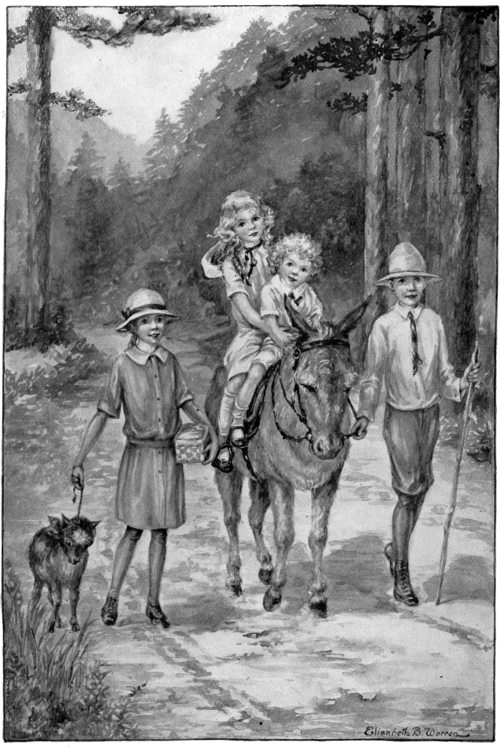
A queer-looking group they made. There
was a soft mouse-colored burro, and on it sat
a truly beautiful little girl of eight years, holding
in front of her a chubby four-year-old boy,
who was beaming with delight. A tall, lank
lad, with a staff in one hand, was guiding the
beast of burden, while on the other side, with
pride shining in her eyes, that were a warm
golden-brown, walked the little mother of them
all, Dixie Martin. She was carrying a basket
that held their lunch and leading a very small,
long-legged goat that had a red ribbon tied
about its neck.
[41]
As they emerged from the dark cañon road
into the full sunlight beyond the great old
pines they beheld for the first time their new
teacher. They knew at once that it must be
she, and Ken snatched off his cap, while little
Carolina, slipping from the back of the burro,
made a graceful curtsy, just as her mother had
trained her to do from babyhood. Dixie, too,
had been trained, but she was a Martin, and
did not take to polishing as readily as did
Carol.
The new teacher hurried forward with
hands outstretched. She actually forgot to
examine the stones in the road that might be
coiled snakes.
“Oh, you dear little pupils of mine!” she
exclaimed. “You are the four Martins, aren’t
you?”
“Yes, ma’am, we are,” was the chorused reply;
and then it was that Miss Bayley recalled
that even the best people in the South say
“ma’am.”
[42]
Carolina, wishing to shine, stepped forward
and said: “I’ll introduce us, shall I? This
is my big sister, Dixie Martin, and our baby
brother, Jimmy-Boy.” Then the small girl
held herself proudly, as the mother had done,
as she added, “His real name is James
Haddington-Allen Martin, after our aunt who
is blue-blooded in the South.”
There was a sudden flush in the freckled
face of the older girl, and she hastened to say
apologetically: “Miss Bayley, please pardon
my little sister for saying that. I’ve told her
time and again that when folks are truly blue-blooded
it shows without their telling it.”
Then she added, as she nodded toward the
boy who stood waiting his turn, “This is
our big brother, Ken, and I guess that’s all
the introducing, unless Pegasus ought to be
mentioned.”
“Pegasus?” the new teacher repeated as she
gazed at the stolid little burro and marveled.
“Pray, what do you kiddies know about Pegasus?”
Even as she spoke she realized that
much that was unusual might be expected
from the children of Ophelia.
It was Dixie who said eagerly, “Oh, our
beautiful mother wrote the loveliest poetry,
and she used to say that the wonderful winged
horse, Pegasus, carried her to the Land of
Inspiration.”
[43]
Miss Bayley noticed that the small goat had
not been introduced. Ken, believing that the
moment for the presentation was at hand, took
the leading-rope from his sister, and, stepping
forward, he said, almost shyly: “Miss Bayley,
teacher, we fetched along Star-White as
your present. We thought maybe you’d like
him for a pet.”
It had been said of Miss Josephine Bayley
that she could rise to any occasion without
evidencing surprise or dismay, and she surely
did at this moment. Luckily, her practice-work
on the East Side in New York had
taught her to expect the most extraordinary
gifts from her pupils.
The four pairs of eyes watched anxiously
for a moment. Would “new teacher” like
their present?
[44]
Their doubts were quickly put to flight, for
Miss Josephine Bayley stooped and caressed
the long-legged, rather startled kid as she
said with a ring of real enthusiasm in her
voice: “You dear Star-White, you’re as nice
as you can be. I just know that I’m going
to love you.” Then, rising, she held out a
hand to the two who were nearest, but the
others were included in her smiling glance as
she said: “Thank you so much, dears. It
was ever so kind of you to want to make me
happy.” Then, a little helplessly, she appealed
to the older boy as she asked, “What
shall we do with Star-White now?”
“I’ll tie him up in the shed back o’ your
cabin, Miss Bayley. He’ll be all right in
there.”
The lad skipped ahead, the kid in his arms,
but returned in an incredibly short time.
The procession had continued on its way,
and Ken soon remarked, “There’s the schoolhouse,
teacher, down the piney lane, and I
think there’s folks waiting to see you.”
[45]
Miss Bayley turned and saw, back from the
road and on a short lane, a log schoolhouse half
hidden by great old pines. In front of it stood
a very fine carriage drawn by two milk-white
horses. At their heads a stocky man with a
stubby red beard and a keen, alert, red-brown
eye awaited her. He was the “board of education,”
of that Miss Bayley was sure, while on
the back seat of the vehicle, with her bonneted
head held high, sat no less a personage than
Mrs. Sethibald Archer, and at her side, also
with her head held high, was a much-beruffled
young girl, aged eight years, who was of course
the prettiest and smartest child in the school.
Miss Bayley assured herself that she mustn’t
forget that, not for one moment, if she wanted
to stay, and, oh, how she did want to stay and
get acquainted with the wonderful mountains,
and the Martins, and maybe even with the Indians
who lived down in the creek-bottom!
All this she thought as she walked up the
little lane toward the old log schoolhouse.
[46]
CHAPTER FIVE THE WOODFORD SCHOOLHOUSE
Mr. Sethibald Martin advanced with what
he believed to be a dignified stride. Without
removing his hat, he said, “This here is Miss
Josephine Bayley, I take it—her as has credentials
to teach correct speakin’ and figurin’.”
A voice from the vehicle was heard. “You’d
better look at ’em, Sethibald, to make sure.
I don’t want no teacher that can’t learn my
Jessica correct speakin’, such as will fit her
for the high sphere she is to fill as the daughter
of a sheep-king.” The speech had been
planned, that the new teacher might at once
be impressed with the importance of the
Archers in that mountain community.
[47]
The stubby gentleman seemed actually to
puff up a bit, “as a toad might,” the newcomer
found herself thinking, but, remembering his
present mission, he explained the duties and
requirements of the position, then added, as he
glanced almost scornfully at the silent, listening
group of four children and a burro, “It
sure is onfortunate. Miss Bayley, that the
pupils from these here parts are so no-account,
my own Jessica bein’ exceptionated.”
His glance turned with pride to the snub-nosed
child in the buggy. Then, in a whispered
aside: “It’s lucky for you that you’ve
got one promisin’ pupil like my daughter,
Miss Bayley. ’Twould be dull work teachin’
if you didn’t have nothin’ but dumb young
’uns like those Pine Tree Martins.” He
paused, seeming to expect comment. This,
then, was Miss Bayley’s moment for being
diplomatic.
“I am sure that I shall find your little
daughter a very receptive pupil, Mr. Archer,”
she said graciously. This time it was certain
that Mr. Sethibald had puffed. He had never
heard the word “receptive” before, but it had a
most complimentary sound.
[48]
“Yes, ma’am, Miss Bayley, you’ll find the
little sheep-princess all that an’ more, much
more, ma’am.” He was unctuously rubbing
his hands as he spoke. Then going to the side
of the vehicle and holding out a bediamonded
hand, he added, “Come now, Jessica, darlin’,
and meet the new teacher, her as is goin’ to
teach you lots of nice things.”
He lifted the small girl to the ground, and
Miss Bayley advanced, her hand held out, but
the little “sheep-princess” drew back and clung
to her father.
The teacher found herself comparing this
lack of manners with the natural graciousness
of Carolina, but the father evidently considered
his daughter’s behavior as being
praiseworthy.
“Shy little thing,” he commented in another
of his quite audible asides. “Not bold like
that Carry Martin.”
Then the unexpected happened. The little
girl referred to darted forward with catlike
swiftness. “My name is not Carry Martin,”
she cried. “It’s Carolina, and my folks are—”
She was drawn back and quieted by poor
Dixie, who looked her misery. Teacher, quite
at a loss what to say, glanced at the shy and
model Jessica at that moment and saw her
sticking out her tongue and tilting her nose
at the Martins.
[49]
Miss Bayley sighed. There were evidently
snags ahead, but Mrs. Archer was speaking.
“Sethibald,” she said, with a desire to impress
the new teacher with her own great importance,
“it’s time now that you were a-drivin’
me over to Genoa, where I have to speak in
front of a mothers’ meetin’ on how to bring up
the young.” Then, turning to Miss Bayley,
she added condescendingly, “Me and you’ll
be great friends, I’m sure, bein’ as we’re both
sot on upliftin’ folks in this here neighborhood
from shiftlessness and ignorance.”
Before the astonished young teacher could
reply, the stubby, reddish gentleman had
climbed up on the front seat, and the restive
white horses had started off down the pine-edged
lane at a brisk speed, and Josephine
Bayley, not knowing whether to laugh or cry,
led the way into the large bare room of the
old schoolhouse, where she was to spend many
a day finding new problems and new pleasures.
There were ten pupils in all. Two of them,
Mercedes and Franciscito Guadalupe, had but
recently come to that mountain country from
Mexico.
[50]
Their father was the new overseer at the
Archer ranch, and as yet they had not learned
one word of English.
They were brightly dressed, dark-skinned
little creatures, and each time that the new
teacher spoke to them, their reply was the
same, “Muchas gracias, Senorita,” which
sounded very polite, but how was Josephine
Bayley to teach them reading and spelling if
neither knew the language of the other?
Two of the remaining pupils were equally
hopeless, being the most forlorn little mites,
children of a trapper who lived somewhere
over toward Lake Tahoe, but, as Miss Bayley
was to find, these pupils only came now and
then, when their trapper-father could spare
time to bring them, one in front and one back
of him, on his horse.
[51]
Maggie and Millie Mullet were twins, aged
six years, and Miss Bayley found as the weeks
went by that although, after an hour of earnest
effort, she might teach them to spell such
words as “cat,” “bat,” “rat,” “mat,” when
questioned the next day their minds were as
blank as though they had never heard the
words.
The tenth pupil was a very large boy, sixteen
years of age, who was the only son of the
burly blacksmith over at Woodford’s. He
studied diligently, and when he once learned
a thing he seemed never to forget it, and so
of him Miss Bayley had a little more hope.
However, his father, the powerful Ira Jenkins,
Senior, thought “larnin’” unnecessary, but
the mother, having learned to read, pored over
novels, even when preparing meals, and she
had decided that her overgrown son should be
a preacher like the one who came once a
month from Genoa and held “meetin’s” in the
parlor at the inn.
As Miss Josephine Bayley looked over her
little class that first morning, she felt desperately
at a loss to know how to begin. Each
child, it seemed, was studying something different
from all the others, and, to add to her
discomfort, the new teacher realized that the
eyes of Jessica Archer, which were like her
father’s, were watching her every move as
though she had been admonished by her
elders to observe and report all that happened.
[52]
The one bright spot was the corner where
the wide-awake, intelligent young Martins sat,
and Josephine Bayley found herself actually
glad that they were “blue-blooded.”
Just as the new teacher was becoming almost
panicky at the newness of everything,
the slim, freckled hand of Dixie Martin appeared
on high, and when Miss Bayley nodded,
that small maiden arose, and, going to the
desk on the platform, she said softly, “Please,
teacher, we usually begin with singing. We
all know the ‘Good-Morning’ song. I’ll lead
if you want me to; I often do.”
“Oh, I’d be ever so grateful if you would.”
And so Dixie turned around and began to
sing, in a clear, bird-like voice, a simple little
melody that the older pupils knew and sang
with her. There were four stanzas, and when
the song was finished, the hand of Jessica
Archer went up, and, rising, she said that as
she was the smartest pupil in the school, she
was always asked to read first.
[53]
“Very well, Jessica. My pupils, I am sure,
will all be glad to help their new teacher to-day
by making suggestions. Now, if you will
read where you left off last term, I shall better
understand how to class you.”
“Oh, I am class A,” the small girl said
proudly, “and Dixie Martin and Ken and Ira
Jenkins are class B, and the rest are class C.”
“Indeed!” was all the new teacher said, but
she was thinking that her predecessor had
evidently succeeded in fulfilling all the requirements
of the board. But why, then, had
she left? Oh, she did recall that Mrs. Enterprise
Twiggly had said that the last teacher
had married a prospector, who, for a time, had
been in the mountains near Woodfords.
Romance was something that interested
Josephine Bayley, aged twenty years, not at
all. She had never been in love and never
would be, she was sure of that. She was
going to be wedded to her profession. She
had never even met a lad who could interest
her, and surely if she had failed to find one in
the city of New York, where she had many delightful
friends, she would not find him in
this wild, rugged mountain country.
[54]
And all the while these thoughts were idly
passing through the brain of Josephine Bayley,
her “smartest” pupil was stumbling and stuttering
through a short story in the Fourth
Reader. It was not until the little girl sat
down and was casting a triumphant glance
over toward the Martin corner that the new
teacher, with a start, awakened from her
reverie.
Dixie Martin read next, and with so much
expression that Miss Bayley was both amused
and interested. She believed, and truly, that
the mother’s yearning to be an actress had
descended as real talent to at least this one of
her children.
“Dixie,” the new teacher said, “I wish you
would remain in at recess. I want to speak
to you.”
If there was a jealous tilt to the curly head
of Jessica, Miss Bayley did not notice it.
When the others had filed out, for fifteen minutes
of freedom, the new teacher took the hand
of Dixie and said earnestly: “Dear, why are
you reading in a Third Reader? Here is a
Sixth Reader. See if you couldn’t read that.”
[55]
The gold-brown eyes were glowing. “Oh,
yes, ma’am, Miss Bayley, I could. I love reading.
After supper every night I read to the
children ‘Pilgrim’s Progress’ and ‘Oliver
Twist’ and the Almanac. That’s all the books
we have.”
There was a firmer line about the mouth of
Josephine Bayley. She had in that moment
decided that she would tutor at least this one
of the Martins, out of school-hours. Over her
free time, surely, the board would have no
jurisdiction.
[56]
CHAPTER SIX KEN’S SECRET SORROW
It was Saturday, which was the busiest of
the whole week in Woodford’s Cañon, for it
was house-cleaning day in the old log cabin
which was guarded by two spreading pine
trees, but this Saturday was especially busy.
“Carol, please do stop frittering,” Dixie
called as she turned from the stove which she
was polishing with as much care as though it
had been a piano. “Don’t you know who is
coming to call this very afternoon, and I’d
feel just terrible, I certainly would, if Miss
Bayley sat on dust, and that’s what she’s
likely to do if you skip places at dusting, as
you usually do, and I haven’t time to-day to
rub them over and see.”
[57]
The younger girl, who had been leaning far
out the window, supposedly to shake a duster,
but who had continued to linger there, watching
two squirrels playing tag among the dry
pine needles, returned reluctantly to the task
she so disliked.
“O dear! it’s just mean-hateful being poor
folks the way we are,” she complained, “and
having to do our own work with our own
hands. I’ve heard my beautiful mother say
so time and again. When she was a girl she
had two little darkies to wait on her. She
never had to pick up anything, if she dropped
it. She didn’t have to even lift a finger.”
Dixie straightened up to rest her tired
shoulders, for polishing a stove was hard work
at best, and almost unconsciously she glanced
down at her own fingers that were jet-black
just then, and for a bit of a moment she
sighed, and was half tempted to think that,
maybe after all, it would be nice to have nothing
to do but sing and read, or live in the out-of-doors
that she so loved. But a second later
she was her own optimistic, practical self.
“Carol Martin,” she announced, “just for that,
now, we’re going to count our blessings. You
begin! One?”
[58]
“O dear!” the other little maid sighed as she
knelt to dust the rungs of an old grandfather’s
chair. “I ’spose I ought to be thankful that
I’m beautiful, like my mother.”
Dixie laughed as she whirled about, her expressive
freckled face at that moment being
far more attractive than that of her prettier,
younger sister.
“Of course you should,” she declared good-naturedly,
“and I’m thankful that I have
Jimmy-Boy, and here he comes this minute to
ask me to give him some bread and molasses.”
The door burst open and the small boy ran
straight to his little mother, but it was not
of bread and molasses that he spoke. “Dixie,
dear,” he said, and his brown eyes were wide
with wonder, “Buddy Ken is in the old barn
an’ he won’t speak to me or nuffin’. I fink he
is crying.”
[59]
“Mercy, no, not that! A big brave boy like
Ken never cries.” However, in the heart of
the girl who was far too young to be carrying
so much burden, there was a sudden anxiety.
She had noticed, for several days, that Ken
had acted preoccupied, almost troubled. She
had not mentioned it, for perhaps he was
just figuring how he could sell the apple-crop
to the best advantage. Yes, surely that must
be all that was the matter. Dixie went on
with the polishing. There was just one lid
to do and then the task would be finished.
“Run away, Jimmy-Boy,” she said in her
singing voice. “Play until Dixie is through,
and then you shall have your nice bread and
molasses.”
“Don’t want bread; want Buddy Ken to fix
my wagon and he won’t speak to me. He’s
crying inside of him, Ken is.” At this the
small boy burst into tears.
The last rub had been given to the stove,
so Dixie washed her hands, and, kneeling, she
kissed the small boy as she said: “James
Haddington-Allen Martin, I guess it’s time
to ask you to count your blessings. Now, sir,
begin. Blessing one is—” She paused, but
she didn’t have long to wait. The clouded
face brightened and throwing his arms about
his “little mother,” he cried, “You!”
[60]
The girl held him in a close embrace.
Then she said: “Carol, dear, please give
Jimmy-Boy his ten-o’clock bite while I hunt
up Ken. I’m afraid he’s worrying about the
apples.” Carol was glad of anything that
would relieve her from the hateful dusting.
Catching her sunbonnet from its place by
the door, Dixie went in search of her brother
who was her confidant and dearest friend. If
he were keeping something secret from her, it
would be the first time. Then she smiled as
she thought, “Maybe even Ken needs to count
his blessings.” Singing to cheer herself, she
went down the path that led to the old log
barn.
“K-e-n! K-e-n! Where are you, brother?”
There was no response, and since it would be
impossible for the lad to be in the barn and
not hear the cheery voice that had called,
Dixie’s anxiety increased. She entered the
wide, front door and glanced about. At first,
coming as she did from the dazzling sunshine
the girl could not see the boy, who was seated
in the farthest, darkest corner. His hands
were over his ears, and that was why he had
not heard her approach. Truly, he did look
the very picture of despair. Instantly Dixie
knew that her surmise had been correct.
Something had gone wrong about the apples.
[61]
Hurrying to his side, she slipped an arm
over his shoulder and laid her cheek on his
thick, red-brown hair. “Brother, dear,” she
said, as she sat beside him on the bench,
“here’s Dixie, your partner. Please let me
carry my share of whatever it is.”
The boy reached out and grasped the hand
of his sister and held it hard. When he
looked up, there were tears trickling down the
freckled face that was so like her own. “Did
you go to town this morning, Ken?” was the
question she asked.
The boy nodded. “Yes,” he said, “I went
before sun-up. I heard the apple-buyer from
Reno would be at the inn to-day, and I wanted
to be on hand early. I took along a basket
of apples to show, and I thought they were
fine, b-but, Dixie, they w-weren’t fine at all.
W-when I saw the apples from the Valley
Ranch, I knew ours were just a twisty little
old cull kind. Tom Piggins was there from
the V.R., and he said our apples are the sort
they feed to their hogs. I didn’t stay to show
them to the buyer, I can tell you. I just lit
out for home, b-but now there won’t be any
money for you to buy a new stove.”
[62]
“I don’t need a new stove,” Dixie said emphatically.
“My goodness me, come to think
of it, I wouldn’t have a new stove for anything,
now that I’ve spent two hours and twenty-five
minutes polishing the old one. It looks
so fine. I’m sure it will feel heaps more self-respecting,
and I shouldn’t wonder if it would
bake better, too.” Then her eyes brightened
with the light of inspiration. “Ken Martin,
we’ll give it a chance to show what it can do
right this very minute. You fetch in that basket
of apples you had for a sample, and I’ll
make an apple pudding, the kind you like so
much, and we’ll celebrate.”
“Celebrate? For what?” Ken looked up
curiously. Was there no end to the cheerfulness
of this sister of his?
Dixie was groping about in her mind for
something over which they might rejoice.
“Oh, we’ll celebrate because we have a new
teacher,” she announced triumphantly, and
the next thought made her clap her hands
joyfully. “Ken Martin, if it’s what you’d
like to do, I wish you’d go right over to the
inn and invite Miss Bayley to lunch.”
[63]
Their beautiful mother had always called
the noon meal lunch, although Pine Tree Martin
could never remember, and had always
called it dinner.
Ken rubbed his sleeve over his eyes and
looked up eagerly. “Then you really aren’t
so terribly disappointed about the apples?”
“Disappointed? Goodness, no! I’d feel
sort of mean selling that old stove of ours
that’s been so faithful all these years just for
scrap-iron, and, what’s more, I feel sure all
this is a blessing in disguise.” Dixie had risen
and was smiling down at her brother, who
also rose.
“Say, Dix,” he said, “you’re as good as a
square meal when a fellow’s hungry.” Then
he laughingly added, “But, if not selling the
apples is a blessing, it sure certain is well
disguised.”
“Most things are blessings soon or late,”
Dixie said. “Now, Ken, you go and tell Miss
Bayley we’re sort of celebrating, and we’d feel
greatly honored if she would come.”
[64]
Then into the house Dixie bounced to share
her joyous plan with Carol. “Oh, how I do
hope teacher will come,” that little maid said.
“Then we’ll be first to have her, and won’t I
crow over that horrid Jessica Archer though?”
“You’d ought not to feel that way about
anybody, Carol, dear,” the older girl admonished
as she sat on the doorstep and began
to pare apples. “If folks are horrid-acting,
they are to be pitied, because they can’t be
happy inside. Now, if you like, you may set
the table with the best cloth and china while
I make the pudding and put some potatoes
in to bake.”
The violet-blue eyes of the younger girl were
shining. It was a great treat to her to be
allowed to open the big old-fashioned cupboard
that held the set of china that had been
their mother’s. When Ophelia had first come
to the log cabin, there had been only the thickest
and most serviceable kind of ware, but
when Pine Tree Martin found what a hardship
it was for his wife to use it, he had sent
to Reno and had ordered the choicest set they
could procure. This was kept carefully
locked in the great old cupboard, and used
only on rare occasions.
[65]
Jimmy-Boy had been placed in his crib,
which was in the lean-to room, where also was
the big four-posted bed in which Ken slept.
The two little girls chatted happily as they
prepared for the great event.
“What if teacher can’t come?” Carol paused
every now and then to say, and dozens of trips
she took to the open door to look up the trail
toward the cañon road. At last she gave a
triumphant squeal.
“Here comes Ken, and teacher is with him.
Oh, goodie, goodie, good!” Carol was pirouetting
like a top. “Won’t I brag it over
Jessica, though!”
Then, as the two drew nearer, the small girl
called excitedly, “Dixie Martin, whatever is
that thing that Ken’s carrying? It’s wriggling
so he can hardly hold it. Whatever can
it be?”
[66]
CHAPTER SEVEN THE BLESSING UNDISGUISED
The two girls ran out to meet their most
welcome guest, the new teacher. Ken, who
for the moment had stepped behind the massive
trunk of one of the great old pine trees
to hide, then appeared, and Carol gave a shout
as she said: “Why, Ken Martin, if you
haven’t got a little pig! Oh-o, don’t let it
get away. I’m terribly scared of pigs.”
No one, looking at the shining, freckled face
of the boy, would have dreamed that only an
hour before that same face had been the picture
of misery.
“It’s that blessing in disguise, Dix,” Ken
said, as he triumphantly held up a rather
skinny and very young member of the porcine
family.
[67]
“Why, Kentucky Martin, wherever did you
get that pig?” the older sister inquired. “I
didn’t know you had one penny left after you’d
bought your high-topped boots.”
“I didn’t buy him, Dix,” Ken declared. “I
had him given to me.”
Here was indeed an astonishing statement,
for pigs were valuable. This one, though, was
an unusually skinny-looking specimen. The
boy, believing that he had sufficiently aroused
the curiosity of the girls, went on to inform
them:
“Well, as I was going up toward the inn
I heard an awful squealing over in Ira Jenkins’s
pen, and I ran to see what was the matter.
Seems that their old sow had always disliked
this little pig, and wouldn’t let it nurse with
the others, and so Mrs. Jenkins had been keeping
it in the house behind the stove; but the
blacksmith tripped over it this morning, and
he said it would have to go back in the pen
where it belonged, even if the mother-sow ate
it up, bones and all. Ira had just put it in
the pen when I came along, but the old sow
had made for it and in another moment the
little pig would have been dead, certain-sure.
Ira just leaned over the fence doing nothing,
and I said, ‘Aren’t you going to save that little
pig’s life?’ And he answered: ‘No. What’s
the use? It can’t live in our house, and it
seems like it can’t live in its own, so it might
as well be dead.’ Then he grinned and said,
like he thought I wouldn’t dare, ‘If you can
save that little pig, you can have it.’”
[68]
Dixie’s eyes were wide. “Ken Martin, I
hope you didn’t get right into that pen where
an angry old sow was. Don’t you know they
will turn on a boy just as quick as anything?”
Ken nodded, and then looked down at his
overalls that plainly showed that he had not
escaped without a muddying.
“Yes, I know,” he said, “but I took a chance,
and I’m glad I did, for now we own a pig.
I’ve always wanted one, and, oh, Dix, I’m
almost glad we didn’t sell the apples.” Then,
as he held the squealing little creature up to
be admired, the boy added, “I’ve named him
already.”
Carol sniffed. “I shouldn’t think a pig
would need a name,” she said.
[69]
Ken chuckled. “I’ve named him ‘Blessing,’
and now if you’ll excuse me, Miss Bayley, I’ll
go and build him a place to live. Carol, will
you come along and hold him while I’m putting
up a fence for his pen?”
“Me, hold him? I should say not!” and the
dainty little girl held back her skirts as
though the very thought of touching the
creature was contaminating.
“Maybe I can help,” Miss Bayley surprised
them all by announcing. “I never did hold
a pig,—we don’t have very many of them in
New York,—but there’s always a first time for
everything.”
The boy’s eyes plainly showed his admiration,
and down toward the barn these two
went, while the girls returned to the house to
put the finishing touches on the lunch. Half
an hour later Carol called from the door, and
a returning shout from Ken carried the message,
“Come on down, first, and see the pen.”
Hand in hand Carol and Dixie darted down
the path, and how they laughed when they
looked over into the very small yard that Ken
had fenced off. Too, there was a large box,
open at one side, with fresh straw on the bottom,
that would make a fine bed.
[70]
The skinny little pig looked up, almost fearfully,
at the four laughing faces that were
peering over the top rail at him. “After
lunch let’s get some apples and feed him,”
Carol suggested.
Suddenly Dixie thought of something.
“Why, Ken Martin, we can’t feed your little
pig apples yet; he’s still taking milk.”
“That’s so,” said the boy, snapping his
fingers. Then he added: “I say, Dix,
couldn’t you find the bottle Jimmy-Boy used
to have? I can feed him with that, like as
not.”
“I believe I know just where it is,” the
little mother said, “but come now or the apple
pudding will be done too much.” And so,
promising the small pig that he would soon
return, Ken leaped the fence and they all
went up to the cabin.
[71]
A merry lunch it was, and the apple pudding
was done to a turn. Indeed, never before
had the old stove baked so well, and it
seemed to shine with pride. Miss Bayley declared,
and she meant it, too, that she could
not remember when she had so enjoyed being
guest at a luncheon party, and when, at last,
she announced that she must go, as there was
a letter to be written before the stage came,
they all trooped with her to the top of the
cañon road.
When they were home again, Dixie declared:
“There now, Ken, you said this morning
that you couldn’t think of anything to
celebrate about, and just see what a wonderful
day we’ve had. It’s always that way, I
do believe. When a person feels gloomy, if
he’d just up and prepare to celebrate, even if
there’s nothing to celebrate about, something
will turn up, certain-sure.”
“You’re right, Dix. You always are,” her
brother declared warmly. “Two things turned
up, the pig and Miss Bayley.”
But a harder problem to solve than that of
a poor apple-crop was just ahead of brave
little Dixie.
[72]
CHAPTER EIGHT A QUEER BANK
It did seem as though some little imp of
mischief was trying to worry poor Dixie
Martin. She had been far more sorry about
the failure of their apple-crop than she had
confessed, for, although the old stove would
do for another year or two, the little mother
knew that Carol’s best dress was actually
shabby, and that night, after the small pig
had been fed with a bottle, to the great delight
of Jimmy-Boy, and after he and Ken
were asleep in the lean-to, and Carol in the
loft, Dixie sat up in bed and listened, to be
sure than no one was awake.
[73]
The light of the full moon streamed in at
the small window of the loft, and so she did
not need to light the candle. Lifting the corn-husk-filled
mattress at one corner, she drew
forth an old woolen sock that had belonged
to Pine Tree Martin. Nobody knew how the
girl, who had inherited so many of his courageous,
optimistic qualities, treasured that and
every other little thing that had belonged to
the man whom she so loved. Indeed, as
Carol’s admiration had been all for her
mother, very much of Dixie’s had been for
her father, which was not strange, for she had
been old enough to see how selfish were the demands
of the rather weak, though truly beautiful,
woman, and how constant were the willing
sacrifices of her father.
The money in the stocking was Dixie’s savings
for the entire year, and she knew, even before
she emptied the few dimes and nickels
out upon the counterpane of her bed, that there
was nowhere near enough to buy Carol a store
dress, and even if there might be enough for
material, who was there to make it? Kind
old Grandmother Piggins on the Valley Ranch
had made them each a dress two years before,
the ones that buttoned down the front, but
now she was dead, and there was no one to
care for them.
[74]
Slowly Dixie counted. There was just two
dollars and thirty cents, and Jimmy-Boy
ought to have a warm coat before winter, that
is, if he were to go to school. When he didn’t
go, the other three children had to take turns
staying at home with him, and when one only
went to school two days out of every three,
one couldn’t make as much headway as one
desired, that is, not if one were as ambitious
as Dixie. With a sigh that would have been
perfectly audible had any one been awake to
hear it, the dimes and nickels were replaced,
the sock again knotted, and Dixie was about to
put it under the mattress when she suddenly
held it close to her, and, looking up at the
sky, she sobbed under her breath: “Oh, Dad!
Dad! You’d know just what I’d ought to do.
How I wish you were here to tell me!”
Just then Carol turned over, and, fearing
that she might waken, Dixie slipped the precious
sock into its hiding-place and climbed
back into bed, but not to sleep, for her thoughts
kept going over the problem without finding a
solution.
[75]
Ever since her father had died, Mr. Clayburn,
the kindly banker over at Genoa, had
sent Dixie twelve dollars a month, which, he
said, was interest on money that her father
had left there for his children. The principal,
he had assured Ken and Dixie, was invested
in good securities that would probably
continue to provide for them the princely income
of twelve dollars a month.
During the summer it was not hard for
Dixie to manage, for Ken raised many things
in his garden, but in winter, when there were
warm clothes to buy and no garden to help
provide, the little mother found it very hard
to make ends meet, and now it was October and
there was only two dollars and thirty cents
in the sock.
“Well,” she thought at last with a sigh,
“Carol’s old dress will have to do, and
Jimmy’ll just have to stay at home from school
when cold weather comes.”
It was very late when Dixie Martin closed
her eyes in restless slumber, but even then the
little imp of mischief was not satisfied, for,
when the girl’s gold-brown eyes opened wearily,
it was on a day when a still greater problem
was to confront her.
[76]
CHAPTER NINE THE “CHARITY BARREL”
It was noon of the day following the luncheon
party, and as it was the one Sunday of
the month on which the Reverend Jonathan
Cressly held a religious meeting at Woodford’s
Inn, the little Martins had been attending the
Sunday school.
The text had been, “Little children, love ye
one another,” but the kindly old man departed
in his rather ancient buggy, drawn by a
shambling old white horse, with a feeling that
his talk had not been entirely successful, for
he had heard one little girl, who was very
much dressed up, making fun of the Martin
girls because they wore dresses that buttoned
down the front.
[77]
“Those Martin children are certainly a
problem in the parish,” Mr. Cressly had told
the Home Missionary Society in Genoa, and
the women had collected clothing that they
thought might fit, and had sent a brimming
barrel over to the log cabin in Woodford’s
Cañon. That was soon after the father died,
but, to their unutterable amazement, the same
driver had brought it back on his cart, saying
that Miss Dixie Martin wished him to thank
the ladies, as she knew they meant it kindly,
and that although she and her sister and
brothers weren’t needing charity, she was sure
there were many families in the mountains
that did—the Washoe Indians in the creek-bottom,
if no one else.
“Whew-gee!” Lin Crandel, the expressman,
had ejaculated. “That red-headed gal stood
up like she was the president’s darter, she sure
did, but it was the purty curly-headed one that
spieled the most about how blue-blooded they
were. Didn’t folks know as they were Haddington-Allens
of Kentucky? Whew-gee!
I kin tell you I felt like apologizin’ for offerin’
’em that barrel.”
Of course, after that the ladies of the Home
Missionary Society did turn their energies in
other directions.
[78]
The four little Martins were at home again,
and Dixie was setting out a cold dinner, for,
true to the teaching of his orthodox mother,
Pine Tree Martin had insisted upon one thing,
which was that Sunday should be kept holy,
and that no work that was not absolutely
necessary should be done on that day. Since
his wife had never worked very much on any
day, this had been no hardship for her.
After the simple meal, Ken said that he was
going to walk over to the Valley Ranch, and
that they all might come along if they wished.
Jimmy-Boy was delighted, for if there was one
little pig in their home sty, there were a hundred
at the Valley Ranch. Carol liked to go,
for Susie Piggins, aged fifteen years, went to
a boarding-school in Reno, but came home for
the week-ends. Dixie usually enjoyed hearing
Sue tell of her experiences, but to-day she
said that if the others didn’t mind she would
like to just stay at home and rest.
[79]
Ken’s understanding brown eyes gave one
quick glance at his comrade-sister, and noting
that she was pale and that she leaned back
in the big grandfather’s chair as though she
were unusually weary, he decided that it would
be doing her a kindness to take the other two
children away for the afternoon. Little did
he dream that the paleness came from long
hours awake in the night.
The three had been gone for some time when
Dixie was awakened from a light slumber by
some one calling: “Whoa, there! Here we
are, Dobbin.”
Leaping to her feet, though still feeling a
little dazed from having so suddenly awakened,
Dixie opened the door, to see on the
path the kindly banker from Genoa. At once
there was panic in the heart of the girl. Why
was he coming in the middle of the month, or
indeed why was he coming at all? For the
past year he had sent the money the first of
every month by Ira Jenkins, who did his banking
over at Genoa, and was glad, in his gruff
way, to do a good turn for his little neighbors,
the Martins.
[80]
Samuel Clayburn climbed out of the buggy
and smiled at the girl. She invited him to
enter the cabin with a dignified little manner
that she had inherited from Pine Tree Martin,
who had stood as straight and erect as one
of the trees that he so admired.
“Won’t you be seated, Mr. Clayburn?” Dixie
asked, wondering why her knees were shaking
so that she could hardly stand.
“I can’t stop but two jiffs, little girl, but I
thought I’d rather tell you myself than write;
seemed like a more humane thing to do, as I
am a father myself.”
“Oh, Mr. Clayburn,” the child leaned forward
eagerly. “Has something happened to
the money? Is it all gone?”
Dixie was sitting on the very edge of a
straight-backed chair, and her folded hands
were tightly clenched. Mr. Clayburn was
plainly at a loss to know how to begin. He
had not supposed it would be so hard to tell
a small girl that—
“Little Miss Dixie,” he suddenly exclaimed,
after having tried in vain to think of some way
to lead gradually up to the matter of business
upon which he had come, “please don’t take
what I am going to say too much to heart.”
Then his kind, florid face brightened as an
inspiration came to him. “I have a fine plan,”
he assured her, “a very fine plan which will
make it all right in the end. I am sure of
that.”
[81]
“In the end, Mr. Clayburn? The end of
what?” Poor little Dixie remembered, just
then, that that was what had been said when
Grandmother Piggins was dying—“It’s near
the end now.”
She gave a little dry sob, and the good man
took out his big red handkerchief and mopped
his brow. Then, coughing to clear his throat,
he began on a new tack. “Dixie, my wife has
taken a great liking to little Carol. She saw
her last month over at the county fair, and she
said then that she’d like to adopt her to grow
up twins with our little Sylvia. It’s bad for
a child to be brought up alone, you know,—makes
them selfish,—and we’re afraid our
little daughter is beginning to be spoiled, and
so we’ve had it in mind for some time to adopt
another little girl if we could find a real nice
one who needed adopting.”
[82]
For a moment the listener sat as one dazed.
She could hardly comprehend what the kind
man was saying, but, when he paused to mop
his brow again, Dixie exclaimed: “Oh, but
Mr. Clayburn, I couldn’t give up my little
sister, Carol. She surely wouldn’t want to
leave Ken and Jimmy-Boy and me”; but even
as she spoke, Dixie feared that she was wrong.
Carol would be eager to go, probably, and what
right had Dixie to keep her pretty younger
sister in a log cabin when she might be living
in that fine big white-pillared house in Genoa
that was surrounded with a wide lawn and
beautiful gardens?
Then it was that Dixie thought of something,
and a little of her father’s keenness appeared
in the thin, freckled face as she said,
“Mr. Clayburn, you didn’t come all the way
from Genoa on a Sunday just to say that, did
you?”
[83]
The banker confessed that that had not been
his original purpose for making the journey.
“You are right, little Dixie,” he said; “I came
to tell you that there has been a depreciation;
that is, the securities in which your father’s
small principal is invested, are not as valuable
as they were, and hereafter your monthly income
will only be nine dollars instead of
twelve, but, don’t you see, dear child,” the
kind man leaned forward and took her hand,
“if Carol comes to live with us, the nine dollars
will go even farther than the twelve did
with four of you?”
Dixie nodded miserably. Each member of
the little brood was infinitely dear to her, and
she was so proud of Carol, who looked just like
their beautiful mother.
Looking up with tear-brimmed eyes, she said
tremulously, “I oughtn’t to stand in her way
if she wants to go, and more than likely she
will. She likes pretty dresses and things that
I can’t get for her, ’specially now, that there’ll
only be nine dollars a month.”
The heart of Mr. Clayburn was deeply
touched and he hastened to say, “Little Miss
Dixie, don’t you want me to write just once
more to your aunt down South?” He arose
as he spoke.
There was a flash of pride in the eyes of
the small girl. “No,” she said. “Never again.
We’re not going to push ourselves in where
we’re not wanted.”
[84]
“You’re right in one way, Dixie,” the banker
agreed, “but it’s my opinion that your aunt
doesn’t know that you exist. She has never
opened even one of the letters. They have
been returned just as they were sent.”
“Then she won’t have the trouble of returning
another.” The little girl also had
risen, and, as the banker started toward the
door, she impulsively held out her hand as
she said, “Mr. Clayburn, thank you for being
so kind,—I mean about Carol,—and if she
wants to go to you, shall I send you word by
Mr. Jenkins?”
“Yes, yes,” the portly gentleman said.
Then, as he placed a fatherly hand on the
red-brown head of the girl, who somehow
seemed smaller than he had remembered her,
he added cheerfully: “It isn’t as though you
won’t be able to see your little sister often.
You and Ken and the baby can come and have
nice visits at our house, and Carol can come
here.”
[85]
But even to himself this did not ring true.
Mrs. Clayburn, who was known as a social
climber, had said that if she took Carol, she
wished it distinctly understood that Sylvia
need have nothing to do with the others, who
were so like that impossible man whom the
mountain people had called Pine Tree Martin.
Poor Mr. Clayburn held the trembling hand
in a firm clasp as he said warmly: “There
now, little girl, don’t be worrying any more
than you can help. You’ll be surprised how
fine things are going to turn out. Good-by.
I’ll come after Carol when you say the word.”
As soon as the banker had driven out of the
dooryard, Dixie threw herself down in the
big grandfather’s chair and sobbed as though
her heart would break, but at last she rose,
washed her face, tidied her hair, and began
setting the table for supper. The other three
would soon be returning, and the little mother
of them all would have to be the one to be
brave, outwardly at least. But oh, how the
heart of her yearned for the father whose
strong arms had always been her haven of
refuge! But now she, Dixie, must be haven
for the other three.
“Here they come,” she told herself. “Now
we’ll talk it over, and Carol may make her
choice.”
[86]
CHAPTER TEN CAROL’S CHOICE
When the three children entered the big
living-room of the old log cabin, Ken was the
first to notice that Dixie had been crying.
“I knew it, I just knew it!” the boy blurted
out. “You’re sick or something, Dix. That’s
why you looked so pale, and why you didn’t
want to go for a walk like you always do
Sunday afternoons.”
“No, Ken, it isn’t that,” the oldest girl said.
“Get your hats off and come and sit here a
while. I want to tell you all something.”
Dixie lifted little Jimmy-Boy and held him
crushingly close. Then she hid her face
among his thick yellow curls, that Ken might
not see the rush of tears to her eyes, for she
had suddenly thought, “The next thing I know,
somebody will offer to take my baby away from
me, but, oh, they can’t have him, not if I work
my fingers to the bone to keep him!”
[87]
Luckily Ken remembered that the pig, three
hens, the goat, and Pegasus must be fed before
dark, and, as it was dusk, he hastened to the
barnyard. Carol had climbed to the loft bedroom
to put away her one treasure, a hat with
a pretty flower-wreath on it, and so Dixie had
time to dry the telltale tears before they
returned.
“Fire ahead, Dix,” was Ken’s boyish way of
announcing that he was ready to listen. He
whirled a straight-backed chair about and
straddled it as he spoke.
Dixie had not planned what she should say.
She left it to the inspiration of the moment.
What she said was: “Mr. Clayburn has been
over while you-all have been away, and he said
his wife would like to have Carol go to Genoa
and live with them and be a sister to their
Sylvia.”
[88]
If Dixie had hoped that Carol would say
that she would far rather live in the log cabin
with them, she was doomed to disappointment,
for Carol’s pretty face glowed joyfully, and,
clapping her hands, she cried: “Oh, Dix, how
wonderful that will be! Just think of the
pretty clothes I’ll have. That old ruffly dress
of Jessica Archer’s will look like poor folks
by the side of the dresses I will wear. Why,
Sylvia Clayburn had on a pink-silk dress at
the fair. I’d be the happiest girl on earth,
Dix, if I could have a silk dress and have
Jessica Archer see me wearing it.”
Ken had not spoken, but he was watching
both of his sisters very closely, and the slow
anger of Pine Tree Martin was mounting in
his heart.
Suddenly he blurted, “Let her go, Dix, and
be glad to get rid of her, if that’s all the
thanks she’s got to give, after the scrimping
and going-without you’ve done to buy her
things.”
“Don’t, Ken, dear,” Dixie cried. “Carol’s
not as old as we are, and—she’s different.”
“I should hope I am different,” the younger
girl replied, tossing her curls. “I am a
Haddington-Allen through and through, my
mother often told me so, and you two are—are—”
[89]
“Don’t you dare say it!” Ken warned, and
Carol, after a quick glance at her brother,
thought best not to complete her sentence.
The boy had whirled the chair away and
was standing. Looking steadily at the now
shrinking younger girl, he declared, “Dix
and I are proud, proud, proud, that we are
children of our father.” Then there was a
break in his voice that made even Carol
ashamed of herself.
“Oh, I don’t see why we need be mad about
it,” she said in a wheedling voice, “and I
should think you two would be glad to have
me living where I could have nice things and
won’t have to dust and—”
Again Ken blurted out with, “Yes, you’re
quite willing Dix should go on doing all the
work and bearing all the burden. We’ll be
well rid of you, I say, and the sooner the better.”
At that the boy turned and left the
house, closing the door with a bang.
The next day Dixie sent word to Mr. Clayburn,
and the following Sunday noon, true to
his promise, the banker reappeared.
[90]
Carol wore her best clothes and had nothing
to carry. When it came to the moment of
saying good-by, Dixie, to outward appearances
her own cheerful self, kissed her little sister
tenderly, and Ken said, “So long,” not knowing
whether he was glad or sorry. Then Carol
stooped to kiss little Jimmy-Boy, who suddenly
threw his arms about her neck and held
her close. “Jimmy loves Carol,” he prattled,
as he put his dewy mouth up to be kissed.
For one brief moment the little girl hesitated,
then, unfastening the clinging baby
arms, she ran and climbed into the waiting
buggy and sat beside Mr. Clayburn. Then she
smiled and waved. Little Jimmy, not in the
least understanding what was happening, began
to sob and reached out his chubby arms.
Dixie caught him up and held him as she
waved his small hand at the disappearing
wagon. Then, with a sigh, the little mother
turned back into the log cabin, feeling very
much as though there had been a death in
the family.
To the very last she had hoped that Carol
loved them all too much really to leave them;
but Ken was calling to her, and so, holding
fast to Baby Jim’s hand, she went out to the
barnyard to see what he wanted.
[91]
CHAPTER ELEVEN PLANNING A WAY OUT
The evening of the day when Carol had
ridden away from her log-cabin home to live in
the handsome colonial residence of the banker
of Genoa, Ken and Dixie sat up later than
usual. Ken had a slate on the table in front
of him.
“The taxes are twelve dollars a year,” he
was saying, “so, just as soon as the money
comes each month, we must put one dollar in a
safe place.”
Dixie nodded and then glanced at the tall
grandfather clock. It was nine. She wondered
if Carol had remembered to say her
prayers before she went to bed, and would she
miss Dixie’s good-night kiss. Perhaps not
that very first night. She’d be so excited and
interested, everything being so new and
strange. Never before had the older girl spent
even one night away from any of her little
brood. She supposed that she might get used
to it in time, sleeping alone in the loft.
[92]
“Dix, you’re not paying the least mite of
attention to what I am saying.” Ken’s voice
was patient, but he was a little vexed, for he
knew that he, who had always been a faithful
brother and friend, was being neglected while
Dixie was yearning for their vain, selfish sister,
Carol.
“I heard what you said, Ken, dear, honestly
I did! You were saying it would take two
dollars to buy a sack of dry beans, and another
two dollars for potatoes that we need
right now. That’s five dollars out of this
month’s interest, and there’ll be another for
extra things like salt and sugar. It doesn’t
look as though there’d be enough to buy a
coat for Jimmy-Boy, does it? And the cold
winter will soon be here.”
[93]
The brow of the lad was wrinkled, and unconsciously
he tapped his pencil on the slate as
he thought. Then suddenly he rose with a
look of determination that was so like his
father’s. “Dix,” he said, “I’m not going to
school any longer. I’m going to work, that’s
what. I’m fourteen years of age now, and
the law lets you stop then.”
The girl also had risen, and, placing a hand
lovingly on the arm of her brother, she said,
“Kenny, you know that your heart’s set on
going away to school some day to learn how to
make roads and bridges and things like that.”
Ken nodded. “I know,” he said. “Maybe
later I can go to school again, but just now we
need money.”
The lad had been twelve years of age the
year that the State road had crossed the Sierra
Nevada Mountains. He had been a frequent
and fascinated visitor at the camp where the
civil engineer lived, and Frederick Edrington,
isolated from people of his own kind, had
really enjoyed the companionship of the intelligent
boy, and had taught him many things,
leaving in the heart of the lad an unwavering
ambition some day to become a civil engineer.
[94]
When the camp of the road-builders had
been moved farther and farther west, Ken had
managed to visit his friend until the distance
became too great, and at last he had to say
good-by to Frederick Edrington, who had been
a greater influence for good in the boy’s life
than either of them at that time realized.
Now and then a letter or a picture postcard
had come from the engineer, who had
been promoted to a government inspecting-position
which took him to many out-of-the-way
places. One of Ken’s dearest desires was
to meet again this friend whom he so admired.
“Don’t stop going to school yet, Ken, dear,”
Dixie was saying. “Let’s wait till we get close
up to trouble’s stone wall, and then, if we
can’t find an opening in it, we’ll turn back
and do something else.” That had been
a favorite saying of Grandmother Piggins.
“Trouble ofttimes seems like a stone wall
ahead, but when you get right close up to it
you find there’s an opening with sunshine and
gardens just beyond.”
Ken whirled about and caught his sister’s
hands. “I’ll make a bargain, Dix,” he said.
“If you’ll promise not to grieve about Carol,
I’ll promise to keep on going to school until
we come to the stone wall and find there isn’t
an opening.”
[95]
Dixie smiled. “I ought to be glad,” she
said, “because Carol is to have so nice a
home.” Then she added wistfully, “I’m going
to be glad, honest I am, just as soon as I get
over being lonesome.”
Ken turned away and shook the stove.
“Girls are queer,” was what he was thinking,
but it was with unusual tenderness that he
kissed his sister good-night.
[96]
CHAPTER TWELVE CAROL’S NEW HOME
It had been a very excited little girl who
had driven in between the high stone gate-posts
and had realized that the imposing white
mansion-like house set far back among fine old
trees, and surrounded by wide velvety lawns
and gardens, where a few late flowers were
still blooming, was to be her future home.
Since the little lass was very like her mother,
it was not strange that Carol truly believed
that she was receiving only that which it was
her right to have.
[97]
Little Sylvia Clayburn she knew not at all,
and Mrs. Clayburn she remembered vaguely
as being a very richly dressed woman who
had stopped her at the fair to ask whose little
girl she might be, and, as usual, Carol’s reply
had been that she was a Haddington-Allen of
Kentucky. Later, when Mrs. Clayburn had
heard the story of the four orphans from her
husband, she had said that she believed this
little Carol would be the right child for them
to adopt, since they had decided that their
precious Sylvia was being spoiled growing up
alone.
Nor were they wrong, for Sylvia, pale, thin,
and fretful, indeed was very much spoiled.
Whenever she cried, her mother gave her
candy, and then, of course, she had no desire
for plain, healthful foods.
“Sylvia has such aristocratic taste,” the
proud mother would say. “She scorns such
plebeian food as bread, and will eat nothing
but cake.”
No wonder that the child of such a mother
should be spoiled and sickly.
It was late afternoon when Mr. Clayburn
led Carol into the luxuriously furnished library,
where Mrs. Clayburn, reclining on a
divan, propped up with many silken pillows,
was reading aloud to a small girl who was
dressed in the pale pink silk that had so
aroused Carol’s envy and admiration.
[98]
Languidly the woman lifted her eyes and
closed the book when the newcomer approached.
“Wife, here is little Carol who has
come to pay us a good long visit, I hope,” the
kind man said. Then to his own little daughter
he added, “Sylvia, won’t you come and
shake hands with your new sister?”
Mrs. Clayburn protested. “Samuel,” she
said, “haven’t I told you time and again that
hand-shaking is effete, obsolete? It is not
done now in the best families.”
Carol, wishing at once to impress Mrs. Clayburn
with the fact that she, at least, was of a
“best family,” was making a graceful curtsy,
and Sylvia, having received a prompting push
from her mother, did likewise.
“As you wish, my dear,” said Mr. Clayburn,
smiling as though he were much amused.
“As long as this little lady is welcomed into
our hearts, I’ll not be a stickler as to what
outward form is observed,” he thought. Then
to Sylvia he said, “Miggins, trot along upstairs
and show your new sister where to put
her bonnet and things.”
[99]
“I don’t want to,” the small girl said, again
seating herself by the divan. “I want Mother
to read to me.”
“Of course you needn’t go if you don’t want
to,” Mrs. Clayburn told her.
Then she said to her husband: “Ring for
Fanchon. Poor Sylvia is thin enough as it is
without wearing herself out needlessly climbing
up and down that long flight of stairs.
We really ought to have a lift installed. They
are now putting them in the homes of the
b—”
But Mr. Clayburn had gone. Good-natured
as he was, he was becoming extremely tired of
hearing what was done in the best families.
[100]
There was a button in each room in the
house, which, when touched, rang a bell in the
kitchen, and the indicator informed the maid
where her presence was desired, and so it was
that a moment later a buxom young woman
in black and white appeared in the library
door. Her rosy countenance suggested that
she was Irish, and in fact, when the banker’s
wife had engaged her, the maid’s name had
been Norah, but since the best families were
employing French maids whenever they could
be procured, the name had been changed to
Fanchon. However, Mrs. Clayburn had
warned her not to speak within the hearing of
a guest, as her delightful brogue could never
be mistaken.
Carol followed the silent Fanchon up the
long flight of stairs that seemed velvety soft,
and into a large, beautifully furnished chamber
where there were twin beds. The small
girl clasped her hands in delight. This, to
her thought, was the kind of home in which
she belonged. How happy she was going to be
there!
“Will you be after changing yer dress now,
colleen?” the Irish maid said pleasantly.
“This here’s the one as the mistress said ye
were to be wearin’ for dinner to-night.” As
she spoke she took from a closet one of Sylvia’s
dresses. “That child took a dislikin’ to
it,” the maid went on to inform the small
listener, “and not once would she be puttin’
it on. Ye’re in luck, colleen, changing this
quick from gingham to red silk.”
[101]
The “blue-blooded” little girl looked with
horror at the dress. It was silk, but how she
had always hated bright red. She actually
drew herself up as she said: “I don’t wish
to wear it. I wish a blue silk dress.”
Now it happened that Mrs. Clayburn, on
second thought, had decided to climb the
stairs and see just how the little orphan liked
her new surroundings, and so, holding the
hand of Sylvia, she had just entered the room
unseen as this most ungrateful remark was
being uttered.
“Indeed, Miss Martin?” she said in a tone
of mingled iciness and sarcasm. “What can
you, a mere charity orphan, be thinking of to
tell what you wish to wear? You ought to be
humbly grateful that you are being taken out
of that tumble-down log cabin and permitted
to live in a house as handsome as any belonging
to the best families.”
[102]
For one brief moment a spark of Martin
pride flamed up in the heart of the small girl.
Their log cabin was not tumble-down. Only
that summer an artist from the East had said
that it was the most picturesque home that
he had seen in the whole State of Nevada.
That was when the crimson rambler had been
a riot of bloom.
Wisely she said nothing, but meekly permitted
the maid to put on the hated red dress.
The swish of the silk was something after
all.
Poor little Carol had not started out well,
and she was to find that, although she was
living in a rose-garden, it was not one without
thorns.
[103]
CHAPTER THIRTEEN CAROL IN DISGRACE
The dinner was one of many courses, and
there were two very formal guests, and, to Mr.
Clayburn’s mortification, as well as Carol’s,
the hostess, wishing to impress the fashionable
Mr. and Mrs. Jarvis Burrell, from Reno, with
her philanthropic generosity, told in detail
the story of Carol’s life, beginning when her
mother was a stranded actress in the year of
the big strike over at Silver City.
[104]
The kind man glanced often at the small
girl whose face was becoming as scarlet as a
peony. He well knew that he would be publicly
rebuked by his wife if he remonstrated
or attempted to change the conversation, and
yet were it not better that he should bear the
brunt of it than this mere child who had been
invited to come to their home? But, before
he had time to decide just how best to intervene,
Mrs. Clayburn had reached a point in
her narrative which necessitated a description
of the father, who, she informed them, had
been a no-account rancher, called by the mountaineers
“Pine Tree Martin.” She said no
more, for the small girl, with flaming eyes,
had risen so suddenly that her chair fell back
with a crash. “’Tisn’t so!” she cried, her
small hands clenched. “’Tisn’t so, at all!”
She had whirled to face the visitors. “He was
the kindest, best father there ever was to
Dixie, Ken, Baby Jim, and me.” Then, bursting
into tears, she ran from the room and
groped her way blindly up-stairs and into the
room to which Fanchon had first taken her.
She was pulling at the buttons in the back
of her red-silk dress when she heard a step
outside the door. It was Mr. Clayburn who
entered.
“Carol,” he said, placing a kindly hand on
the curly head, “don’t be hurt, little girl.
Mrs. Clayburn is thoughtless, but she can’t
be really as cruel as she seems. You sit here
in this comfortable chair by the fire and I’ll
have the rest of your dinner sent up to you.”
[105]
He started away, but he turned back to say,
“You were right, though, little Carol. I knew
your father well, and he was the finest and
most upright of men. Any girl might be
proud to be his daughter.”
Then he left the child alone in the room that
was but dimly lighted, and as she sat there
waiting the coming of Fanchon, for the very
first time in her life she felt a real love and
loyalty for that man whom the banker had
just praised. How kind he had always been,
and how gentle. If—if this cruel, wicked,
Mrs. Clayburn was “best families,” she’d
rather, oh, a hundred times rather, have her
own dear, good father, whatever he was.
Fanchon entered, bearing a tray, and placed
it on a low table. “Poor little colleen,” she
said with understanding sympathy. “I’m not
after envyin’ you much, and that’s the truth.
I can be leavin’ any hour I choose, as I’d like
to, after next pay-day; but I’m supposin’
you’ll have to stay here to the end of time.”
[106]
Then she went away, and Carol sat staring
into the fire, thinking of what she had just
heard. Did she have to stay there for ever
and ever? Ken wouldn’t want her back, and,
after all, did she want to go back? Maybe
things would be better after that night, and it
was something to be able to wear silk; even
red silk was better than gingham. The dessert
was a delicious concoction, and Carol, as she
ate it, decided that perhaps she had been
partly to blame that things had started out so
all wrong. Just then Fanchon reappeared
and she was leading Sylvia by the hand.
That little maid looked with big-eyed wonder
at the newcomer.
“You’re a very bad, bold girl; that’s what
my mother says you are; and I’m not going to
speak to you again till you say you’re sorry;
and I shall hate you always.” Then she closed
her thin lips tight and did not speak again
while the buxom Irish maid was undressing
her. Later Fanchon unfastened the buttons
of the red-silk dress, helped Carol to prepare
for bed, and then turned out the light.
[107]
There had been nothing said about prayers.
Carol had never in all her short life gone to
bed until after prayers had been said. When
Pine Tree Martin lived, he had gathered his
children about him in the warm kitchen and
had led in the evening prayer, and had read to
them from the big Bible. Ken did the reading
now, in memory of his father.
When Carol was sure that Sylvia was asleep,
she crept from bed, and, kneeling in the moonlight,
she said the little bedtime prayer that
Dixie had taught her, and then asked a blessing
for each of the three who were in the log-cabin
home over in the mountains.
Then she crawled back into bed, feeling
somewhat comforted, but she never, just
never, could forgive Mrs. Clayburn; she was
sure of that. Suddenly she sat up, thinking.
What was it that Dixie had taught her? Never
to let the sun go down on her wrath. But the
sun had gone down, and the moon was up.
Oh, what ought she to do? After all, maybe
she had seemed ungrateful. Dixie wouldn’t
want her to go to sleep without asking to be
forgiven.
[108]
Creeping out of bed, she stole down the
wide, velvet-soft stairway, holding her long
white nightgown in one hand, while she
grasped the banister with the other. The
guests were just departing when they looked
up and saw the small girl descending.
Mrs. Clayburn was horrified.
“Go back to bed this instant, you bad, bold
child!” she commanded, and so, too frightened
to speak, Carol did turn and go back, to sob
softly into her pillow until, at last, just from
weariness, she fell asleep.
So ended the first day of Carol’s life in the
home of one of the “very best families.”
[109]
CHAPTER FOURTEEN THE LITTLE RUNAWAY
The next morning Sylvia was unusually
fretful, and little wonder, for she had had two
helpings of the rich, creamy dessert the night
before, and would not eat the wholesome breakfast
which was served to her in bed.
Carol was told to remain in her room that
morning as a punishment for the manner in
which she had misbehaved the night before.
This message was brought with her breakfast
by Fanchon. To the surprise of the maid, the
small girl was up and had on her own old
dress that buttoned down the front.
“Oh, I just wanted to put it on,” the child
said, when the kindly maid expressed her
surprise.
[110]
“Poor little colleen, I guess ye’re homesick,
and I wouldn’t wonder at it if you are,”
was what Fanchon was thinking, but aloud
she made no comment, as the pale-blue eyes
of her little mistress were watching her from
the bed where she sat propped among downy
pillows.
All the time that Carol sat at the low table
eating her mush and milk, she, too, was wondering
if she could be homesick. Almost unconsciously
her eyes roamed over the creamy
net curtains and rose-silk draperies, at the
bird’s-eye maple furniture, and at the wide
window-seat heaped with rosy cushions.
Then her thoughts wandered to the little
loft bedroom which she and Dixie always
shared together. There was one small window,
with a turkey-red curtain, a very old-fashioned
chest of drawers, and in one corner
sat her doll, Peggotty Ann. Of course she
was too old now to play with dolls, for would
she not be nine the very next month?
She glanced at the little brass bed in which
she had slept. It was covered with creamy
net, lined with rose-colored silk. Spread over
the four-posted bed at home there was a many-colored
piece-quilt that her grandmother had
made when she was a bride.
[111]
Somehow that loft-room seemed more homey
after all. Fanchon had come to take the
trays. She asked Carol if she wished to put
on one of Sylvia’s pretty morning-dresses.
“No thank you, not yet,” the child replied.
She walked over to the window and looked out.
It was a gray, gloomy day. If she were looking
out of a window at home, she would probably
see Ken digging around somewhere in
the garden and whistling. What a jolly
whistler Ken was!
Just then Sylvia, unable to longer remain
unnoticed, said fretfully, “Carol Martin, I
was just falling asleep, and you made so much
noise you woke me right up, and my mother
said I was to sleep all of this morning because
I am sickly.”
Carol felt that this was very unjust, for a
little mouse could not have been more quiet.
She sat down in a chair by the window, trying
hard not to cry. Sylvia spoke again, “Well,
as long as I can’t sleep, you may bring me my
best doll, and be sure you don’t drop her.”
[112]
Carol looked in the direction indicated and
saw a beautiful French doll that was nearly as
big as she was. “Oh, what a beauty,” she
exclaimed.
Very carefully she lifted it and took it to the
little girl in the bed. Then she turned away
and was far across the room when a shrill
scream from Sylvia was followed by a crash.
Sylvia had let the doll slip from the bed.
“You did it, you horrid beggar-girl,” she
cried, “and now my beautiful doll is broken.”
The door burst open and Mrs. Clayburn appeared.
She had hastily thrown on a velvet
lounging-robe and her hair was down her
back.
“Mother,” Sylvia fairly screamed, “she made
me drop my doll.”
Again the just wrath of a Martin was in the
heart of Carol. “You know you’re fibbing!”
she said almost scornfully. “I’m not going
to stay here another moment. I’m not! I’m
not! I’m going right home to-day where folks
live who are honest, and who l-love me, and
I’m not going to say I’m grateful ’cause you
brought me here. I’m not! I hate you. I
just hate you both!”
[113]
Dashing to the closet before the astonished
woman could realize what was happening, the
girl snatched her best hat from a hook and
ran from the room.
The bell for Fanchon sounded through the
halls. “Stop that child before she gets out
of this house. Then lock her up in the coal-room,”
was the imperatively given command.
“Yes, ma’am. Which way was she after
goin’, ma’am?” the maid lingered to inquire.
“How can I tell, stupid! She can’t unlock
the front door, so she is probably there this
minute, trying to get out.”
Mrs. Clayburn was right. That was where
the Irish maid found her, but instead of taking
her to the dark, windowless basement-room,
Fanchon quickly unlocked the front door and
set her free.
“Poor little darlint,” the maid thought, as
she glanced anxiously up the long flight of
stairs to be sure that she was unobserved, “it’s
me as is wishin’ I had a log-cabin home in the
mountains I could run away to.”
[114]
Mrs. Clayburn, at an upper window, saw the
small figure flying across the lawn. She went
at once to the telephone and called up the
bank.
“Samuel, have that child caught and
brought back here at once. She’s got to beg
my pardon and be properly punished before
she can leave this house.”
But the banker was busy, and he failed to
send any one to search for the little runaway,
and so, though Mrs. Clayburn watched and
waited, at noon the culprit had not been returned
to her. Several hours later her husband
called to say that he was going into the
country on business and would not be home
to dinner.
“Poor little Carol,” he thought as he started
driving toward the mountains, “she probably
has tried to walk home, but her little legs will
tire out long before she gets there, and no one
living along the way except the Washoe Indians.”
Mr. Clayburn hastened the pace of
his horse as he thought of this. Meanwhile
Carol, on leaving the home of the banker, had
slipped unobserved through side-streets until
she came to a highway on the outskirts, which
she believed led in the direction of her log-cabin
home.
[115]
She had been to Genoa but once before, and
that was when she was six years of age, and
though she knew that she must follow one of
the side-roads toward the mountains, she was
not sure which one to take.
On and on she trudged. The houses were
very far apart now, and at last there were
none at all. The child looked very small indeed
as she crossed the desert-like stretch of
sandy waste where only sagebrush and a few
twisted trees were growing.
At last she reached a crossing, and to her
joy, a sign-post informed her that Woodford’s
was but six miles away over in the mountains.
At least it was a comfort to know that she
was going in the right direction. The pine
trees grew bigger and denser and the road began
to ascend.
[116]
The child’s feet were very tired, and, at last,
she was so weary that she felt that she just
could not take another step, and so she sank
down on a boulder to rest. How silent it was,
save for the moaning of the gentle breezes in
the pines. The only living thing that she
saw was a great wide-winged vulture that
was swinging around overhead in circles.
Never in her life had the child felt so alone in
the world, but she was not afraid. The children
of Pine Tree Martin had never learned
fear.
“I must hurry on,” she thought, as she again
arose and trudged bravely up the rough mountain
road. With feet that would lag, however
eager she might be to go on, she slowly
climbed, but, with five miles still ahead, the
small girl realized that she could walk no
farther. Sinking to the ground, she curled up
under a pine tree and began to sob softly.
Suddenly she sat up alert, listening. She
had heard the pounding of a horse’s feet
around the curve that she had just passed.
Some one was coming!
[117]
She hid behind the trunk of a tree that she
might see without being seen, and then
watched and waited. Soon a horse and rider
appeared. After one glance the small girl,
with a glad cry, leaped out into the road. It
was Tom Piggins riding on a big dappled
work-horse. He had been to Genoa on an
errand for his father, and was returning to
the Valley Ranch. Never before had Carol
been so glad to see any one.
Running out into the road, she waved and
shouted, “Tom! Tom! Please give me a
ride!”
“Why, Carry Martin, what you doin’ here?”
For once the small girl did not resent being
called by that much-hated name. The long,
lank boy continued: “Ken was over to our
place last night, and he was sayin’ as how
you’d been adopted by a rich banker. He said
he was sort of glad of it, you being so selfish
and hard to live with, but Dixie, she’s been
sniffling ’round ever since you left, and the
little kid keeps askin’, ‘Where’s Carol?
Jimmy wants Carol.’”
Upon hearing this, the small girl sobbed
afresh.
“Oh, Tom,” she cried, “I don’t want to be
adopted. Please, please take me home.”
[118]
The blunt boy was nevertheless kind, and so
he helped the small girl up on the big horse
in front of him, and, as they rode along, Carol
told the whole story to sympathetic ears.
“Gee-crickets!” the boy exclaimed admiringly.
“I’m certain glad you had some of your
pa’s spunk.” Then he added hopefully,
“Maybe you’re goin’ to change, and get to be
more like Dixie. Ken’ll like you heaps better
if you do.”
Carol said nothing, but in her heart she
resolved that she would try to be so much
like Dixie that folks wouldn’t be able to tell
them apart.
It was noon when Tom helped the little girl
to the ground in Woodford’s Cañon, and, after
having thanked him, she started walking
slowly down the trail toward the log cabin,
for a dreadful thought had come to her. What
if she wouldn’t be welcome. What if Ken
should say, “You left our home and now you
can stay away.”
The window nearest the trail was open, and
Carol thought she would look in before going
to the door.
[119]
CHAPTER FIFTEEN A HAPPY REUNION
Within the cabin the three children sat
about the table, eating their midday meal.
Carol at the window heard Ken say: “Dix,
this is the second day that you haven’t eaten
one bite. If you get sick, how on earth’ll
Baby Jim and I get along?”
The girl turned from the table and began
to sob. “I’m sorry, Ken,” she said, “truly I
am, but I don’t know that I’ll ever be able to
eat again unless Carol comes home.”
“Well, I sort o’ wish she’d come, too,” Ken
declared, blinking very hard.
There was a sudden warm glow in the heart
of the little listener. After all, she would
be welcome. Even Ken wanted her! With a
glad cry she ran in the open door and threw
her arms about her sister. Then she pounced
upon Ken and kissed him.
[120]
“I’m home,” she cried, “and please, please
let me stay forever and ever.”
Baby Jim was clamoring for attention, and
he was caught in a crushing hug while he
waved his spoon and uttered joyous little
squeals, although he did not understand
Carol’s home-coming any more than he had
her departure only the day before.
After a time, in which tears and laughter
blended, Carol cried, “Dixie, I’m ’most starved
with that long walk and not eating much
breakfast. I’m so glad you’ve got fried potatoes
and baked beans.”
“I’m hungry, too, now that I take notice of
it,” the older girl said, her freckled face
beaming.
“Well, I thought I’d had enough, but I guess
I could take another helping,” Ken declared.
And so they all sat down, and a merry meal it
was.
[121]
Oh, how much nicer her own home was,
Carol thought, where even Baby Jim could
talk if he wished and not be told that only
grown-ups should converse at table. Carol
didn’t tell all that had happened. In fact,
she didn’t seem to wish to speak of her recent
experience. She inquired with interest about
the well-being of the pig and the three
hens as though she had been away a year.
Then she asked what had happened at
school that day. None of them had attended.
They hadn’t had the heart to do anything, but
on the morrow all of them would go.
After the dishes were done, Carol climbed
to the loft. For some reason that she could
not explain to herself, she wanted to see her
old doll. She hadn’t played with it for a year,
not since Jessica Archer had made fun of her
and called her a baby for playing with a doll.
How cosy the loft bedroom seemed, the small
girl thought as she reached the top of the
ladder. Those turkey-red curtains, with the
sunlight shining through them, were very
cheerful looking. Peggotty Ann was probably
the most surprised and the happiest doll
in the whole State of Nevada, when, a moment
later, she was caught up and kissed by her
little mistress.
[122]
Ken entered the kitchen, and, going to the
table where Dixie sat sorting the mending,
he said very softly, that the girl in the loft
might not hear: “Dix, something’ll have to be
done, now that Carol’s back. We can’t make
ends meet on nine dollars a month, and one
to be laid aside for taxes.”
Dixie looked up brightly. “There’s still
two dollars and thirty cents in the sock, Ken,”
she said, “and we haven’t reached trouble’s
stone wall yet.”
“Dix,” the boy declared admiringly, “you’re
a brick!” Then he added, with a mischievous
grin, “and I don’t mean because you’re red-headed,
either.”
A moment later when Carol, with her doll in
her arms, looked out of the small window in
the loft, she saw Ken digging in the garden
and heard him whistling, and, for the first
time in her young life, she realized something
of the contentment and joy contained in that
one word, “home.”
[123]
Being very, very tired, after an almost
sleepless night and a long walk, the small
girl curled up on the husk-filled bed to rest, her
doll held close. Soon she was asleep, and so
she did not hear a horse and buggy stop at
the door. In fact, she never knew that Mr.
Clayburn had called, but Dixie knew, and
what that kind man told brought joy to the
heart of the little mother.
The banker said that he was glad to inform
her that he had succeeded that very morning
in loaning her father’s small principal in a
way that would bring fifteen dollars a month
interest.
He did not tell her that he had loaned the
money to himself, as he knew that no one else
would pay so high a rate of interest, and he
was determined that the wolf should be kept
from the door of the four little orphans who
were too proud to accept charity.
When he was gone, Dixie ran out into the
garden.
“Ken! Ken!” she called, and the boy
thought that never before had he seen her face
so aglow. “We’ve reached trouble’s stone
wall, and there was an opening through and
on the other side is a garden that’s all sunshine.”
[124]
CHAPTER SIXTEEN A JOYOUS DIXIE
The next morning Miss Bayley’s glance
wandered often to the corner of the room in
the old log schoolhouse where sat the four
little Martins. She wondered why they all
looked so beamingly happy. Little did she
dream of the exciting events of the day before.
Not only had the small prodigal returned, but
their monthly income had been increased, and
no longer need the little mother scheme, plan,
and contrive just to make ends meet. Little
Jimmy-Boy’s much-needed warm coat now
could be purchased as soon as the money came,
and that would be at least two weeks before
the really cold weather set in. In fact, there
were years when November was as pleasant as
October, and where, in all the world, could
one find more beautiful autumn weather than
in Nevada?
[125]
When Dixie, as usual, led the opening song,
her voice rang out with lilting joyousness, and
when she stood up to read, Miss Bayley was
charmed with the expression with which she
interpreted the little story. In fact, so
pleased was she that she forgot to stop Dixie
at the end of the second page, as was the
custom, but permitted her to read the entire
story of “The Three Bears.” It delighted her
to note how Dixie’s voice changed when Papa
Bear or the Baby Bear spoke.
Then, when the little reader had finished,
the teacher exclaimed with real appreciation:
“Dixie, you read that splendidly! You surely
have a gift.”
Then it was that she recalled that the
mother of the Martin children had been an
actress, and a very audible sniff also reminded
her of the fact that she was praising some
one who was not a daughter of the board of
education.
[126]
The sniff had come from the front seat, center,
and the sniffer was, of course, the haughty
little Jessica Archer. That maiden had risen,
and, with a toss of her corn-colored curls, she
announced, “Miss Sperry, our last teacher,
said I was the best reader in this school, and
my father said yesterday that she was the best
teacher we’d ever had in Woodford’s.”
Miss Bayley was indignant, and yet, if she
wished to remain, she must be politic, and
now that she was so interested in the Martins,
more than ever did she want to stay.
“You read very nicely, Jessica,” she told
the irate little maid, “especially when you are
thoroughly acquainted with the text. You
may now read the entire story of ‘Henny
Penny.’”
Somewhat mollified, Jessica Archer read the
tale which she knew by heart, forwards or
backwards, with more expression than was her
wont. She did not intend to have those no-account
Martins win more praise than was
given to her.
With an inward sigh Miss Bayley assured
Jessica that she had never before heard her
read so well, which indeed was true, and then
she called upon Ken to do an oral problem in
arithmetic.
[127]
At recess, when the other children had
trooped out of doors to play, Dixie remained,
and Miss Bayley, who was writing on the
board, turned to find a pair of eager eyes
watching.
“Did you want to speak to me, Dixie, dear?”
she inquired.
“Yes, ma’am, Miss Bayley, please, if
’twouldn’t be interrupting too much. I want
to ask advice about something that’s very
secret.”
The teacher smiled. She believed that she
was at last to learn the cause of the inward
glow that radiated from the thin, freckled face
of the older Martin girl, who was sometimes
called “homely.”
But the secret something was destined not
to be told, for just then Jessica Archer, who
had missed Dixie from the playground, entered
the schoolroom in search of her. Not
that she desired the companionship of a Martin,
but she did not wish to give Dixie an opportunity
to be alone with the teacher.
Miss Bayley frowned, and very softly she
said: “Dear, can’t you come over to my cabin
after school to-night? I very much want to
have a real heart-to-heart visit with you.”
[128]
“Oh, teacher, Miss Bayley, I’d love to. You
can’t think how I’d love to!” was the eagerly
given reply.
Jessica Archer could not possibly have
heard, and so it was merely a coincidence
which prompted her to say, “Miss Bayley, my
mother said I was to tell you to come home
with me after school to-night and have supper
at our house.”
“Thank you, dear,” Miss Bayley replied,
“I am sorry that I cannot accept. Please
thank your mother for me, and tell her that I
had already made another engagement.”
The young teacher was rebellious. Her free
time, surely, was her own, and she determined
that she would do with it as she pleased.
[129]
Dixie was about to protest that she could
come any other day just as well, but there was
an expression in her dear teacher’s eyes that
silenced her. Then as the clock marked the
hour of ten, Miss Bayley rang a bell which
ended recess and recalled the small pupils to
their lessons. Jessica Archer, with another
toss of her corn-yellow curls, seated herself,
feeling that she was not being treated with the
respect that was due the daughter of a sheep-king.
She was suspicious, and that was why
she lingered so long after school, rubbing
imaginary marks from her reader, washing off
the top of her desk with unusual care, and all
this time, while the teacher was preparing examples
for the following day, Dixie Martin sat
on the bench outside of the little log schoolhouse,
happily waiting.
At last the teacher’s patience reached the
breaking-point. Looking up from her work,
she found the pale-blue eyes of the daughter of
the board of education watching her.
“Jessica Archer,” she exclaimed, and the
degree of exasperation she felt sounded in her
voice, “will you kindly tell me why you are
remaining? The afternoon session ended at
least fifteen minutes ago. You will please
leave at once, and do not remain after school-hours
again without asking my permission and
explaining your reason for wishing to do so.”
Jessica’s expression was decidedly impudent.
“There’s that Dixie Martin staying
after school.”
[130]
The teacher’s eyes narrowed. “She is not in
the schoolhouse. I have no control over all
the big out-of-doors. What is more,” and this
took moral courage, “Dixie is waiting for me
at my request. Now take your books and go!”
Miss Bayley had never before been so angry
at a pupil, for she believed, and truly, that
she was being spied upon by the small daughter
of Mrs. Sethibald Archer.
Jessica did depart, but she did not go home
at once. Having reached a clump of low-growing
pines near the inn, she hid among
them to await the return of Miss Bayley to her
small cabin home. At last she saw her coming,
and with her was the hated Dixie Martin,
and, what was even more shocking, Miss Bayley
was swinging the little girl by the hand
and skipping; yes, she was actually skipping
in a way that no self-respecting teacher had
ever done before.
Jessica remained in her place of hiding until
she was sure that Dixie was going in the
cabin with the teacher. Then, when she believed
that she was unobserved, she crept but,
keeping hidden as best she could behind the
sagebrush, until she reached the trail that
led down to her valley home.
[131]
Bursting into her mother’s room, she began
to sob. Mrs. Sethibald Archer at that
moment was struggling to write a speech, and
a very large dictionary lay open on the table
at her side.
Her real reason for having invited Miss
Bayley to supper that night had been to have
the assistance of the teacher in preparing the
paper which she was to read on the day following
in Genoa. Once before Miss Bayley had
given invaluable assistance, and the ladies had
greatly praised Mrs. Sethibald on her clear
and lucid exposition of the subject. Just
what that meant, the speaker of the day had
not known, but she was convinced that it was
praise, and she was desirous of doing equally
well on the morrow.
“Do stop crying,” the weary mother now remonstrated,
“and tell me where is Miss Bayley?
I didn’t see her coming down the trail
with you just now.”
[132]
“She—she wouldn’t come, Ma,” Jessica
sobbed afresh. “She—she treats me awful
mean. She says that horrid Dixie Martin is
the smartest girl in the school. She says she
can read better’n I can. I told her you wanted
her to come to supper to-night, and she said
she had another engagement, and—and, ma,
it wasn’t so. She just had Dixie Martin go
home with her, that’s all, for I hid and saw,
and she didn’t act ladylike neither, ma; she
skipped!”
Mrs. Sethibald Archer arose, and the expression
in her eyes was not pleasant to see.
“There’s your pa coming into the barnyard
this very minute,” she said. “Run right out,
darling of my heart, and tell him not to unhitch.
Tell him I’m wishing him to drive me
over to the inn. We’ll see whether or not my
requests are to be set aside like this.”
Jessica ran out to deliver the message, which
was really a command, and Sethibald Archer
understood it as such. Then, returning, the
child asked eagerly: “Ma, I want to go along.”
“Of course you may go. This thing’s going
to be settled this very day. I’m not going to
have any upstart of a teacher refuse my hospitality
when I offer it. Indeed not.”
[133]
CHAPTER SEVENTEEN A DEFIANT TEACHER
When Dixie entered the pleasant living-room
of the little log cabin near the inn, she
clasped her hands, and her eyes glowed with
appreciation as she looked about.
“Oh, teacher, Miss Bayley,” she breathed
rapturously, “you’ve got books, haven’t you?
I never did see so many books all in one room.
Oh, please, may I touch them?”
Then it was that the young teacher remembered
that the little girl had said that “Oliver
Twist” and “Pilgrim’s Progress” were the
only books that she had, and an almanac.
[134]
“Poor little story-hungry girl,” she thought,
as she removed her hat and turned toward the
child. “Of course you may touch them, dear.
I’m going to make us some hot chocolate to
drink, and you may browse around all that you
wish. Choose any book that you like and I
will help you read it. One of my reasons for
asking you here to-day, Dixie, was to suggest
that once or twice a week you come with me
and let me tutor you in advanced reading.
Then you can take the book home and give the
same instruction to your brother, Ken.
There is no reason why you two children, who
are so unusually gifted, should be held back
by one of little natural intelligence.”
Then Miss Bayley entered the lean-to which
was also her kitchen, and humming to herself
to endeavor to erase from her memory the unpleasant
conflict with Jessica Archer, she
filled the tiny teakettle, lighted the oil-stove,
and prepared a few dainty sandwiches.
When she re-entered the living-room, her
small guest sat on the window-seat, one long,
spidery leg curled under her, and she held
two books. The gold-brown eyes seemed to
have sunshine in their depths as they looked
up.
[135]
“Oh, teacher, Miss Bayley,” she piped, “it
was so hard to choose. It’s like when the
spring flowers are in blossom and the valley-meadow
is all blue and gold with them. There
are so many, and they are all so lovely it’s hard
to tell which ones to pick. I guess, though,
that these two would be nice. This one says
‘Little Women’ on the cover, but that wouldn’t
interest Ken so much, it being all about girls,
but this one would, for, in the picture, there
is a boat wrecked and animals swimming to
the shore. I’m sure boys would like it.”
Miss Bayley nodded, beaming her pleasure.
“You will like that one, too. My brother, Tim,
and I read ‘Swiss Family Robinson’ through
seven times when we were your age and Ken’s.”
Skipping over to the long, home-made bookshelf,
the child replaced “Little Women,” and
held lovingly the volume of her choice.
Then a cheerful humming in the kitchen announced
that the teakettle was beginning to
boil, and Miss Bayley went thither to complete
preparations for the lunch.
While they were eating it, the young woman,
who was little more than a girl herself, having
graduated from a normal school when she
was hardly twenty years of age,—and this was
her first school,—smiled across at her small
guest as she said: “Dearie, at recess you
wanted to tell me something. What was it?”
[136]
“I’m going to tell you all about us, Miss Bayley.”
Dixie’s thin, freckled face became suddenly
serious. “I’m going to tell you all about us,
Miss Bayley,” she began, “then I guess you’ll
better understand.”
And so the little mother of the Martins told
to a most sympathetic and interested listener
the drama which had recently been enacted in
their log-cabin home.
“And, oh, teacher, Miss Bayley,” the child
said, “I never, never could have come to school
again if my little sister had stayed away.
She’s all the sister I’ve got to love. I couldn’t
give up Ken or Baby Jim either, but—but I
guess a girl needs another girl in a special way
that boys can’t understand, don’t you,
teacher?”
The young woman nodded emphatically, and
there were tears close to her eyes. What a
cruel, hard experience these children had been
going through, and all alone.
[137]
“I do, indeed, Dixie,” she said. “There are
so many tasks and pleasures and little confidences
that only girls can share with each
other, but I am glad that everything happened
just as it did, for now Carol knows that her
own home is best and she will be more
content.”
But Dixie looked a bit troubled, and the
young woman asked: “Dear, what is it?
Was there something else that you wished to
say?”
“Yes, teacher, Miss Bayley, it’s this. Next
month is Carol’s birthday, and, oh, if only I
could give her a blue silk dress I’d be the happiest!
She loves pretty things and she’s never
had anything silk.” Then eagerly, anxiously,
“Miss Bayley, could I get a silk dress for two
dollars and thirty cents?”
The young teacher hesitated not at all. “Of
course you can, dear girl. That is, you can
get the blue silk by the yard and then you can
make the dress.”
[138]
The freckled face that at first had brightened,
looked doleful again. The child shook
her head as she said: “I couldn’t, teacher.
I don’t know anything about how to put on
patterns. Grandma Piggins did, and she
made us the gingham dresses, but she made
them button in front, and Carol wants buttons
in the back.”
“And so she shall have them, dear. Of
course you can’t use a pattern yet, but I will
show you how.” Then, before the small girl
could express her gratitude, the young teacher
exclaimed: “I’ll tell you what we’ll do, little
Miss Martin. To-morrow will be Saturday,
and you and I will go to Genoa on the nine-o’clock
stage, shall we? Then you may choose
the silk and a pattern. I have some lace in
my trunk that will do nicely for trimming.
How would you like that?”
“Oh, teacher, Miss Bayley, I’d love it! I’ve
never been to Genoa but once.” Sudden tears
in the child’s eyes assured Miss Bayley that
the once had been a sad occasion, as indeed it
had been, for with her father she and Ken had
gone to select a coffin for their beautiful
mother.
Desiring to change the thought of her little
guest, Miss Bayley asked, “What color do you
like best, Dixie?”
[139]
“I like the first green that comes on the trees
down by the creek in spring. It’s like a fairy
color with silver on it,” the little girl said.
Miss Bayley nodded. “That would make a
pretty silk dress,” she remarked, “but I’d like
you to have a cashmere dress, the same gold-brown
as your eyes.”
“Me? Oh, I don’t need a new dress, Miss
Bayley. I don’t mind buttons down the front
the way Carol does.”
The young teacher laughed, saying, as she
rose to clear the table, “We shall see what we
shall see.”
Dixie was about to assist when the sound of
wheels attracted her attention. “Oh, teacher,
Miss Bayley,”—the child seemed actually
frightened,—“something dreadful must have
happened. Here come all the Archers.”
There was a sudden firmness about Josephine
Bayley’s pretty mouth, and an expression
in her eyes that seemed to say, “Let them
come.”
[140]
CHAPTER EIGHTEEN THE SHEEP-KING DICTATES
Miss Bayley opened the door when she
heard an imperative rap thereon.
“Oh, good-afternoon, Mrs. Archer and Mr.
Archer,” she said graciously. “Come in, won’t
you, and Jessica? You are all acquainted
with my little friend, Dixie Martin, and so introductions
will not be necessary. Won’t you
be seated? This is my most comfortable chair,
Mrs. Archer, and Jessica, you will find room
over on the window-seat by Dixie.”
The wife of the sheep-king sat down, but
held herself rigidly erect. “Miss Bayley,” she
said, “didn’t you get an invitation to come to
our house to supper?”
“Why, yes, Mrs. Archer, but did not Jessica
tell you that although I appreciated your
thoughtfulness, I could not accept to-day, as I
had another engagement?” Miss Bayley was
calm, and completely mistress of the situation.
[141]
The older woman sneered. “Engagement?”
she repeated sarcastically. “How could you
have any engagements in these here parts that
couldn’t be set aside when I need your
services?”
Miss Bayley’s eyebrows lifted, ever so
slightly. “I did not understand that you
needed me,” she said. “I thought that you
wished to contribute to my pleasure by
inviting me to supper.”
Mrs. Archer’s manner changed. “Well, so
I did in a way, and if you’ll go back with us
now,” she said, “I’ll call it all right.” She
knew that unless Miss Bayley did help her, she
would be unable to read a paper before the
Woman’s Club in Genoa on the next day.
For one brief moment Josephine Bayley
hesitated. Should she defy this woman and
declare her right to independence at least as
far as her free time was concerned? A second
thought reminded her that this would be
unwise, if she wished to remain in the mountain
country; and now, more than ever, she did
wish to remain, that she might help little Dixie
Martin, if for no other reason.
[142]
That small girl had risen, and in the pause
she said shyly: “Teacher, Miss Bayley, I
must be going. Baby Jim is like to be missing
me by now.”
“Very well, dear.” The teacher also rose
and walked to the door which she opened, and
then said, loud enough for the listeners to hear
without effort: “Dixie, be ready to-morrow
morning at half-past eight. You would better
come up here, dear, and then the stage will
not need to stop on the cañon road.”
Then, closing the door and turning back into
the room, she added pleasantly: “I suppose,
Mrs. Archer, that you wish me to prepare a
paper for you. If that is true, I will get my
hat and coat and accompany you.”
Her manner, in spite of the graciousness of
her words and tone, was defiant, and when she
returned from her screened bedroom, she
found Mr. Archer, his hands behind him,
pacing up and down the living-room.
“Look a-here, Miss Bayley,” he blurted out,
“my wife and me aren’t at all satisfied with
your actions. It’s us chiefly that supports this
school and pays your salary.”
[143]
The teacher’s eyebrows lifted questioningly.
“Indeed?” she said. “I thought this was a
public school in the Genoa district.”
Mr. Archer was obliged to confess that, in
one way, it was. “But it’s my taxes, mostly,
that pays your salary,” he contended.
“When taxes are paid into the county treasury,
the money is no longer yours,” Miss Bayley
told him. “It belongs to the people to be
spent for the best interest of the entire community.”
The young teacher’s manner was quiet, but
she spoke as one who knew.
Mrs. Archer, unable to longer remain silent,
burst forth with: “You might as well understand,
once for all, that Mr. Sethibald Archer
is boss of this here school, and what he says
goes. Mr. Samuel Clayburn, the banker, he
as is head of the board of education over in
Genoa, told Mr. Archer that as long as everything
went along all right, he’d not interfere
with my husband’s management of this here
school district.”
[144]
The ponderous woman rose, and her expression
was one of triumph. Mr. Archer nodded
his agreement. “That’s just what the Honorable
Clayburn said, and so, if you’re wanting
to remain in this here school, you’d better not
be setting those no-account Martin children up
over our Jessica. Now, are you coming with
us, Miss Bayley?”
To their unconcealed amazement, the young
teacher mutinied.
“No,” she said quietly, “I am not. I consider
my free time my own to do with as I
wish, and I do not wish to go anywhere this
evening.”
A dull red suffused the face of Mr. Sethibald
Archer. “Miss Bayley,” he sputtered, “this
here term ends the middle of December. You
can pack up your baggage and be ready to
leave the day after.”
“Very well, Mr. Archer,” was the astonishing
reply, “if you are still in authority when
that time arrives, I shall do as you request.”
[145]
When the three were again in their buggy
and on their way down the valley road, the
irate man exclaimed: “Such impudence! If
I’m in authority by the middle of December,
she’ll leave. Huh, she’ll leave all right!
Who else in these here parts has brains enough
to be governing board of a public school?”
Mrs. Archer, being a wise wife, smoothed
his ruffled feelings by remarking: “Nobody,
of course. You’re the brainiest man anywhere
this side of Genoa.” Then she added,
with a sigh, “I’ll have to give up reading that
paper to-morrow, and you’ll have to drive over
and tell ’em I was took sick or something. If
I was you, I’d stop in at the bank while you’re
in Genoa, and clinch the matter about dismissin’
that upstart of a Miss Bayley.”
“That’s just what I’ll do!” Mr. Archer
agreed, as he drove into his barnyard.
They had forgotten that on the next day the
teacher and Dixie Martin were also going to
Genoa.
[146]
CHAPTER NINETEEN DIXIE GOES SHOPPING
Dixie was awake on the eventful Saturday
morning as soon as the first bird-note was
heard underneath the wide-spreading eaves.
Quietly she slipped from bed, hoping not to
awaken the little curly-headed sleeper at her
side, but, just as she was buttoning up her
best gingham dress, Carol opened dazed blue
eyes and looked about.
“Why, Dixie Martin, what for are you up so
early?” was the puzzled query, but almost instantly
the little girl remembered, and at once
she began to climb out of bed.
“Oh, I know,” she prattled, “this is the day
that you go to Genoa with Miss Bayley, and
I am to be ‘little mother’ to Baby Jim and
Ken.”
[147]
In another moment the arms of the older
girl were about her, and the flushed cheeks
were being kissed as Dixie exclaimed, “Carol,
it’s so nice of you not to mind my going and
leaving you at home, but some day, I’m just
sure, it will be your turn to go and see the
shops, and—and everything.”
There was joy in the heart of Dixie as she
descended the ladder that led from their loft
bedroom. How Carol had changed! Just one
short month ago she would have sulked if
Dixie were to be given some pleasure that she
had not been asked to share, but to-day the
small girl was actually getting up hours
earlier than usual, that she might be a real
help in the little home, and that Dixie need
not be all tired out before starting on her
wonderful journey. But, early as these two
little maids were astir, Ken was ahead of them,
and, just as the potatoes and bacon were sizzling
for breakfast, in he came with a pail of
milk.
“Girls,” he cried jubilantly, twirling his cap
so dexterously that it caught on the hook by
the door, just as he wished it to do, “something’s
happened. Something jolly! Guess
what.”
[148]
The sisters looked interested but did not
venture a guess.
“Blessing is weaned!” was the astonishing
announcement. “He wriggled out of his pen
in the night I guess. I was awful panicky at
first, thinkin’ like as not he was lost, but
where d’you think I found him? In the shed,
eating apples.”
“Well, I’m glad,” Carol remarked as she
continued with her task, “we won’t have to
bother any more about feeding him with a
bottle.”
Dixie sighed, “I was hoping you’d say my
cat had come back. She’s been gone three
weeks if it’s a day.”
Ken laughed as he turned the milk through
a sieve. “Cats always come back, sis,” he
said encouragingly. Then, for a moment, he
was silent as he plunged his face into a deep
basin of cool water from the pump, but later,
when he was rubbing vigorously with a rough
towel, he winked one eye at Carol as he
added: “Even if Topsy never comes back,
it’s small loss. The world is full of cats.”
He said it to tease, for well he knew his
sister’s devotion to that particular black cat.
The expected retort came:
[149]
“Why, Ken Martin, how can you say that,
when you know there’s only one Topsy cat?
You might as well say that if Baby Jim went
away, it wouldn’t matter, ’cause the world
is full of babies.”
Carol pretended to be indignant. “Dixie,
how can you speak of cats and our baby all in
one breath?”
A small voice arose in the next room, and
the little mother flew thitherward, to return a
moment later with a sleepy, flushed little four-year-old,
who was covered with a long pink-flannel
nightie. His golden curls were
towsled, and when the little maid had seated
herself and cuddled him on her lap, he beamed
around at them all, but looked up into the face
that was bending over him with his sweetest
smile. Then, lifting his warm little hand, he
patted her freckled cheek as he prattled,
“Jimmy-Boy loves Dixie.”
[150]
Almost convulsively the girl held him close.
“Oh, Baby Jim,” she said, “I’m awfully sorry
I said that about cats, for even if the world
is full of babies, after all, there’s only just
one.”
An hour later Carol looked at the clock.
“You’d better hurry, Dix,” she said. “You
wouldn’t want to miss the stage.”
And hurry the little maid did, and at eight
o’clock promptly she set off up the cañon trail
with a song singing in her heart, and with feet
that could hardly be kept from dancing.
Josephine Bayley was just finishing her
breakfast when a tap came upon her door.
With the girlish skip which had so shocked
prim little Miss Archer, she went to open it,
and, as she had supposed, she found Dixie,
her freckled face aglow, standing outside.
She was wearing a very pretty leghorn hat
wreathed with daisies.
“Why, Dixie, how nice you look!” the young
woman exclaimed. “Come in, dear. We can
see the stage when it comes up the valley road.
What a pretty hat you have.”
[151]
The girl flushed. “’Tisn’t mine, teacher,”
she confessed. “It belongs to Carol, but she
just made me wear it.” Then she added in a
burst of confidence: “Carol’s changed a lot
since she went away to be ’dopted. Before
that she never would let me even put this hat
on in front of the mirror, let alone wear it
outdoors, but this morning, when I was putting
on my old hat that got caught in the rain
last spring and sort of limped, she came right
up and took it away, and then, before I knew
what she was up to, she slipped back of me
and put her treasure-hat right on my head,
and when I said something might happen to it,
she said, ‘All right, let it,’ but that she wasn’t
going to have her big sister go to town in a hat
that looked as though Biddy-hen had used it
for a nest.”
There were sudden tears in the eyes of the
little girl. “Oh, teacher,” she confided, “I did
think that I always loved Carol as much as
ever I could, but I’m loving her more every
day, and Ken, too. He said last night, ‘Gee,
sis. I’m glad now Carol went away to be
’dopted, for I’m so glad she came back.’”
[152]
“She is a dear, sweet girl,” Miss Bayley
said, “and it was nice for her to want you to
wear the hat which she so treasures, but I’m
sure that nothing will happen to it, for there
isn’t a cloud in the blue, blue sky, and we’re
not expecting whirlwinds to carry it away.”
While they talked, Miss Bayley washed the
few dishes and then Dixie helped her spread
the bed in the screened-in porch, which was
still a joy to the girl who had lived her twenty
years in crowded New York.
Just as the last little pat was given to the
pillow, a distant rumbling was heard, and
Dixie ran to the front window of the cabin
and looked down the valley road. “It’s coming,
teacher, Miss Bayley. The stage is ’most
here!”
Josephine Bayley felt as though she were a
girl again, a very young girl. Dixie’s excitement
was contagious. Donning her hat and
jacket, and taking her shopping-bag, which
had room in it for all the things they were
going to purchase, she caught the little girl by
the hand, and, though her feet longed to skip,
they thought it best to walk demurely, for the
innkeeper’s wife, Mrs. Enterprise Twiggly,
had appeared to greet any newcomers that
might have arrived to stay at the inn, and well
did Miss Bayley know that she expected
schoolteachers to appear morosely dignified.
[153]
Mr. Hiram Tressler, the driver of the stage,
was a very old man, having driven that route
more years than Mr. Enterprise Twiggly could
remember. He had been born and brought up
in those parts, but his unwavering good nature
and optimism had kept him young-looking, and
his life out-of-doors had made him, as he himself
said, “as hard as a pine-knot.”
“All aboard, them that’s comin’ aboard!”
he called from his high seat. Then, noting
that the new teacher, whom he had brought
up from Reno but a month before, was about
to embark with him, he added, “Miss Bayley,
wouldn’t you an’ little Dixie Martin like to
sit up front?”
[154]
The young girl looked up into the face of
her companion so eagerly that the teacher
gave a laughing response that she was sure
they would be glad to accept the invitation.
The passengers inside the coach looked like
traveling salesmen, with much baggage stowed
about them, and they seemed much more desirous
of sleeping than they did of admiring
the majestic scenery through which they were
to pass. One did waken when the stage
started with a jolt, but soon dozed again.
Little Dixie, wedged in between Miss Bayley
and the stage-driver, looked up beamingly at
first one and then the other. “Traveling’s
real exciting, isn’t it?” she said at last, when
they were well under way.
Josephine Bayley nodded. Was it amusing
or was it tragic, she was wondering, that this
little midget, small for her twelve years, had
never been out of Woodford’s but once before,
and that once to help select a coffin. Josephine
Bayley resolved that this day should
be so brimmed with happy hours that the
little girl would have no time to recall the
sad memory of that other journey to Genoa.
[155]
They were turning down the rough, rugged
cañon road that was deep in the shadow of
great old pines, when Ken, Carol, and Baby
Jim leaped from behind the massive trunks
where they had been hiding, and shouted, waving
their handkerchiefs, “Good-by, Dixie!
Good-by, teacher!” Then Baby Jim’s shrill,
excited voice floated down the cañon after
them, “Bring me some candy!”
What a happy light there was in the gold-brown
eyes that were lifted to the teacher, as
the little girl said: “I hoped they’d all
come. I’m so glad they wanted to!”
Josephine Bayley held the thin hand of the
child in a close clasp, and she was thinking:
“Lucky little girl! How I wish I had some
one to care whether I come or go! Brother
Tim is all I have in this wide world, and we
are so far apart.” Then, remembering that
this was to be Dixie’s day, the teacher chatted
about things that would interest her little
comrade, and two hours later Mr. Hiram Tressler
sang out, “There’s Genoa’s church-steeple.”
Then, with evident pride, “Teacher,
did ye ever see any buildin’ go up much
higher’n that?”
Miss Josephine Bayley, late of New York,
had to confess that she had seen steeples a
mite higher. She wondered what the stage-driver
would think if his route led by the
Woolworth building, but how glad, glad she
was that it didn’t!
[156]
Ten minutes later the stage-driver drew rein.
“Here we are now. That there’s the dry-goods
emporium, teacher. I’ll pick you up
agin, right on this very spot, prompt at five
o’clock. So long!” Then the stage rumbled
away, and Dixie, clinging to the teacher’s
hand, entered the store, her heart beating like
a trip-hammer.
There was silk, silk everywhere about her,
and how glad she was that two dollars and
thirty cents would buy enough for a birthday
dress for Carol.
[157]
CHAPTER TWENTY DIXIE BUYS A SILK DRESS
Josephine Bayley smiled down at the little
girl as she felt the clinging fingers tighten.
“Oh, teacher,” the child whispered rapturously,
“I didn’t suppose there was so much
silk anywhere in all the world. It’s like rainbows,
isn’t it?” They were standing at the
counter, waiting for a pleasant-faced little
woman to come to them.
“May we see the different shades of blue
silk?” Josephine Bayley asked, when at last
the clerk turned toward them.
“Oh-ee, how Carol would love that one,”
Dixie said as she pointed to a blue, the color
of a June-morning sky. The small girl did
not think to ask the price. Teacher had said
that two dollars and thirty cents would be
enough, and Dixie doubted this not at all.
[158]
A pattern was selected, one with ruffles, for
nothing was to be omitted that the heart of the
little sister had been set upon, and then sufficient
silk was measured off. Miss Bayley,
having had a moment’s opportunity to speak
alone with the clerk, had asked her not to mention
the price. Turning back, she saw little
Dixie smoothing the silk as reverently as
though it were almost too beautiful to be
touched, and yet there was no thought of envy
in her heart. Two dollars and thirty cents
could buy but one silk dress, and that one
should be for Carol.
While the parcel was being wrapped, Dixie
looked about. Suddenly she caught the
teacher’s hand and drew her down the aisle.
“Look there,” she whispered as she lifted
glowing eyes. “That’s the silvery green I was
telling you about, Miss Bayley. Isn’t it like
the very first leaves on the willow trees down
in the creek-bottom?”
[159]
The young woman nodded. “It is just
lovely, dear,” was all that she said, but she
thought much more. Then, when the saleswoman
returned, Dixie drew forth the old-fashioned
purse that had been her mother’s
and counted out the money, which was in
dimes and nickels. There were so many of
them that it looked like quite a fortune heaped
upon the counter in front of her. The little
girl did not dream that the silk for Carol’s
dress had cost five dollars.
“Now, dear,” Miss Bayley smiled down at
her, “let’s go over to the book department. I
want to get a more modern arithmetic than the
one that I found in the school.” While the
young teacher was examining mathematical
books, Dixie, with a little half-suppressed cry
of joy, skipped toward a table spread with
attractively-covered juveniles, and so absorbed
was she a moment later that Miss Bayley
found the opportunity she desired to slip back
to the silk counter and order a pattern of the
pale-green that in one light shimmered like
silver.
Had Dixie noticed the shape of the package
that the teacher carried when they left the
store, she might have thought it rather soft
and bulky for a book about mathematics, but
there were so many things to see and admire
that she noticed it not at all.
[160]
It was noon, and to the little girl from the
mountains the main street of the village
seemed thronged. Again she clung to her
teacher’s hand as they made their way toward
the café, over which hung the most alluring
sign.
“Oh, teacher, Miss Bayley, are we going in
here?” It was hard for the child to believe
that she was actually going to have lunch in a
place so sparkling with mirrors and lights.
But it was really true, for Miss Bayley was
leading her to a little table in one corner that
was just for two.
Then when the orders had been given, the
small girl, wide-eyed, looked all about her.
“There’s going to be music,” she whispered.
“It’s over behind those plants.” She had
seen two violinists in a palm-sheltered corner,
and even as she spoke the first sweet strain
was heard. Miss Bayley watched the sensitive,
expressive face of the little girl and wondered
how any one could call her homely.
[161]
It was the first time Dixie had ever heard
the music of a violin, and when the last note
had died away she lifted eyes that looked as
though they had seen a vision. “Miss Bayley,”
she said, “some time I want to play like
that.”
And just then the teacher, looking ahead
through the years, seemed to see a beautiful,
willowy young girl dressed in soft, shimmering
green, with red-gold hair glowing beneath
the lights, playing a violin, while a vast multitude
of people listened breathlessly. Was it
a prophecy?
[162]
CHAPTER TWENTY-ONE DIXIE VISITS A FRIEND
They were again on the street, and the noon
throng had vanished. As it was still too
early for the afternoon shoppers to arrive, the
town seemed to be taking a midday siesta.
Dixie wondered where they were going, but
said nothing until they turned a corner, when
she uttered an exclamation of joy. “Oh,
teacher, Miss Bayley,” she exclaimed.
“There’s the bank. How I’d perfectly love
to go in and see kind Mr. Clayburn.” Then,
looking up anxiously. “Would it ’sturb him
too much, do you suppose?”
Miss Bayley had a secret desire to see the
head of the board of education of the Genoa
district, and so she replied, “We can at least
inquire, and if Mr. Clayburn is not busy, he
may see us for a few moments.”
[163]
The banker had just returned from his lunch,
and was in his handsomely appointed private
office. He was never too busy to see a friend,
he told little Dixie, when, wondering-eyed, she
had followed the uniformed bank-messenger
into the marble-walled room.
“This is our new teacher, Miss Bayley,” the
child said, not knowing the right form of
introduction.
The kind face of the man lighted. Holding
out his hand, he exclaimed, “Miss Bayley, this
is truly a pleasure, and right now let me say
that I sincerely regret not having visited your
little school before this, but, since your arrival,
I have been more than ever confined to
the bank during school-hours. However, I
shall endeavor to visit your district regularly
after the first of January.”
They had seated themselves at the banker’s
invitation, and Josephine Bayley said quietly,
“I shall not be the teacher at Woodford’s
school in January, Mr. Clayburn.”
[164]
There was real regret in the face of the listener.
“Why, Miss Bayley, I am sorry to hear
that. Has something happened to recall you
to New York? I remember you wrote that
you would gladly stay one year with us in our
wild mountain country.” Then he smiled as
he asked, “Have you found it too wild?”
The young teacher also smiled, but she said
seriously: “No, indeed! I love the West! I
felt smothered in that city of walled-in cañons,
where the sweep of the wind is never felt. I
glory in your rugged mountains. I forget
that life holds much that is petty when I look
at them, especially at night when they are outlined
against the sky, and even the stars are
much nearer here. In New York heaven seems
farther away.”
“But, my dear girl,” the banker said, “If
you like it here so very much, why desert
us?”
“It is because I have been dismissed by the
local board of education.” If there was a
twinkle in the brown eyes of the speaker, Mr.
Clayburn did not notice it. He tapped upon
his desk with the pencil he held, and a frown
gathered between his eyes.
[165]
“Miss Bayley,” he said after a thoughtful
moment, “I alone am at fault. I should not
have entrusted to a man without education the
power to engage and dismiss a teacher.”
Then, looking up inquiringly, “Which one of
the three have you offended?”
“All of them, I think,” was the reply. “The
little girl is indignant because I have to acknowledge
that the Martin children are
brighter pupils, the mother feels that she has
a personal grievance because I will not devote
my free time, whenever she wishes, to preparing
papers for her to read at your women’s
club, as her own compositions, while the father
considers me insubordinate because I have declared
my independence.”
“Good for you, Miss Bayley!” was the rather
astonishing exclamation. The banker looked
his approval. Then, rising, he held out his
hand. “Don’t begin to pack your trunk, and,
as I said before, the first of the year I will
make regular visits to the district schools.
Let me know if you need new books or anything
else to help your work along.”
When they were again on the street, Miss
Bayley caught the hand of the small girl and
said: “Dixie, come with me! We’re going
to the movies to celebrate.”
[166]
CHAPTER TWENTY-TWO TEACHER REVOLUTIONIZES
Surprising things happened the following
Monday morning in the little log schoolhouse.
After leaving the theater on the Saturday previous,
Miss Bayley, who had been told by the
one having authority to procure whatever she
might need for her little classes, had returned
with Dixie to the book department of the emporium,
and had purchased several graded
readers from the first to the eighth. The light
of a new resolve shone in her eyes as she called
upon Dixie Martin to lead in the Good-Morning
song.
When this was done, Miss Bayley looked
about her at her little straggling group of
mountain pupils and made a startling announcement.
[167]
“Girls and boys,” she said brightly, “I have
decided to change the old régime, which means
that we are going to desert the former way of
doing things and start in on a new. To begin
with, I am going to give you all an examination
in reading and place you in the
grades where I believe you belong.”
Jessica Archer was on her feet in an instant,
saying: “My pa wouldn’t let you do that.
He says nothin’ is ever to be done diff’rent in
this here school unless he tells the teacher to
do it.”
“Kindly be seated, Jessica, and hereafter do
not speak without first raising your hand and
receiving permission to do so.” The teacher’s
tone was firm, and, although the little “sheep-princess”
pouted and looked her defiance, she
said no more just then.
“I have here,” Josephine Bayley continued,
“eight new graded readers, that are very attractively
illustrated. I will begin with the
first, and you may each read one of the little
stories; then we will progress to the second,
and so on, and, when you have reached the
book which is too difficult for you, we will
know exactly in which grade you belong. Does
this method seem fair to you? Ira Jenkins,
what do you think?”
[168]
The long, lank, overgrown son of the burly
blacksmith flushed to the roots of his hair, but
he managed to uncurl his ungainly length from
the much-carved desk that was too small for
him, and say stutteringly: “Yes’m, Miss Bayley.
Seems like ’tis to me. I should say ’twas
fair enough.”
“Do any of you, except Jessica Archer, object
to being regraded according to your ability
to read?” There was no dissenting voice,
and so the first book was handed to Dixie
Martin, who, with an amused smile, read the
tiny story that told the adventures of a pussy-cat.
When the book had been passed from
pupil to pupil, it was found that even those
simple words had been too difficult for the
two little children of Mr. Archer’s Mexican
overseer, and so Franciscito and Mercedes
were classed as “first readers.”
The six-year-old twins of the trapper, Sage
Brush Mullet, poor, forlorn little Maggie and
Millie, stopped at the second.
[169]
Jessica Archer did well enough in the third,
but could not read many of the words in the
new fourth, and was so graded. With her was
Carol Martin, but to the very evident indignation
of the little daughter of Mr. Sethibald
Archer, Dixie, Ken, and Ira Jenkins were
placed above her.
Each was asked to read one of the last three
stories in the fifth book. Ken and Dixie hesitated
not at all, but Ira did stumble over the
longer words, and the first story in the sixth
proved quite beyond him, and so he was placed
there.
Ken, although two years older than his sister,
had a more mathematical mind, and found
the seventh reader rather difficult, but Dixie
reached the last, and was declared by the
teacher to be in the eighth grade.
Miss Bayley purposely avoided looking in
the direction of the irate little girl in the
much-be-ruffled dress as she said: “You are
now each placed in the grade where you
should be, and I am sure that we shall in the
future make real progress.” Then, glancing
at the clock, she smilingly added: “Ten
already, and time for recess. Dixie, you may
collect the new books please, and Ken, will
you lead the line to the playground?”
[170]
But Jessica Archer did not wait to go out
with the others. Catching her hat from its
hook on the wall, she darted out, and when,
fifteen minutes later, Miss Bayley rang the
bell, recalling the pupils to their lessons, she
was not at all surprised to find that the rebellious
little “sheep-princess” was not among
them.
Miss Bayley was not long kept in doubt as
to what the absence of Jessica Archer meant.
Having decided to carry her new method of
grading through all the subjects,—reading,
writing, and arithmetic,—the teacher had sent
Ira Jenkins and Ken to the board to work out
rather advanced sums, when the sound of
hurrying wheels was heard without, and a moment
later the short, stocky Mr. Sethibald Archer
burst into the room, his face flushed, his
small gimlet-like eyes blinking very fast.
[171]
“Say, Miss Bayley,” he blurted out, waiving
the formality of a greeting, “what’s this here
my gal’s been tellin’ me ’bout you upsettin’
methods which I started and makin’ out she’s
a numskull alongside of those—those no-account
Martins? I’ll not have it, I tell you,”
he blustered. “I’m governin’ board of this
here school, and things have got to be done as
I say, or you can pack and leave this here
locality on to-morrow mornin’s stage. D’ye
hear?”
Miss Bayley did not take advantage of his
pause to defend her action, and, still further
angered by her calm, he went on, his high-pitched
voice growing louder, if that were possible.
“I’d like to know where from you got
your authority,—you, an upstart teacher we
don’t know nothin’ about. Who was it told
you to spend money that’s not yours buying
new books that we don’t need for this here
school?”
[172]
So indignant had been the self-important
little man, and so loud his voice, that he had
not heard the arrival of a horse and buggy
without, nor was he aware that another listener
had stopped in the doorway to await the
end of the tirade. When the speaker paused
to take a breath, the newcomer stepped into
the school-room, saying in a voice, the calm,
even tones of which did not betray the just
anger that he felt: “Mr. Archer, may I answer
the question you have just put to Miss
Bayley? I, Samuel Clayburn, head of the
governing board of education in this district,
gave our teacher full authority to purchase
whatever she believed was needed to further
the interests of this little district school, and
I am indeed glad to find that she is now introducing
progressive methods.” Then he added,
in a pleasanter tone, for it was hard for the
portly banker to be unkindly severe: “Mr.
Archer, I regret that the delivery of mail in
the mountain sections is so dilatory, otherwise
you would have known by now that I have decided
to devote more of my time to the schools
in the outlying districts, and so will no longer
require your aid. I will bid you good-morning.”
The stocky, florid man was clenching and
unclenching his hands, and almost bursting
with indignation. When the quiet voice
ceased speaking, he blurted out with: “It’s an
outrage, that’s what it is! A cooked-up
scheme of this here new teacher’s to oust me
from a place that’s rightfully mine. But I’ll
get even. I’ll take my darter out of this here
school. Come along, Jessie, I won’t have you
pizened by no such corruptin’ influence.”
[173]
With a toss of her curls, the little girl
flounced out of the door, closely following her
irate father, and they were soon heard to drive
away.
“Miss Bayley,” the banker said, “I regret
this most unfortunate incident. Last Saturday,
immediately after your departure from
the bank, I wrote Mr. Archer that I would no
longer need his services, but the stage probably
has not as yet passed his place. Realizing
that something of this very nature might occur
when he did receive the letter, I decided to
drive over, knowing that otherwise you would
have to bear alone the brunt of his wrath.”
“Thank you,” Josephine Bayley said simply.
“I am indeed sorry to have been the cause of
this unpleasantness, but really, Mr. Clayburn,
I do believe that the other pupils can now
have a much better chance.”
The banker nodded, “I am sure of it,” he
said, as he smiled about at the solemn faces.
[174]
“My pupils,” Miss Bayley said to them,
“this gentleman is Mr. Samuel Clayburn, of
the board of education, and he it is who made
us a gift of those attractive new readers that
have pleased you all so much.”
Carol and Dixie arose at once, and the
others shyly and stragglingly followed. Then
curtsying, as Miss Bayley had taught them to
do when she introduced a visitor, in a faltering
chorus they piped, “Good-morning, Mr. Clayburn.”
But it was Dixie who thought to add,
“And thank you for the books.”
“You are very welcome, and I’m sure you’ll
make good use of them,” was the genial reply.
Then, turning again to the girl-teacher, he
added: “I hope no further unpleasantness
will result from this, Miss Bayley, but if there
does, report to me at once. You can telephone
to me from the inn.”
Later, as he was driving down the pine-shaded
cañon road, the good man was thinking,
“How I do wish my Sylvia could attend
this mountain school. She seems to be making
very little headway with her French governess.
If only she could live awhile the simple,
healthful life that the little Martins are
living, how much good it would do her.”
[175]
CHAPTER TWENTY-THREE THE RETURN OF TOPSY
“Dixie Martin, come quick if you want to
see something. Oh-ee! It’s something you’ve
been wanting for weeks and weeks.”
It was Carol who called. The small curly-headed
girl was hanging out clothes in the
sunny yard, back of the log cabin, while the
older sister stood on a box beside a washtub
in the shade of a spreading pine tree.
Hearing the excited voice of her little sister
calling to her, Dixie hastily wrung out the
pair of patched blue rompers that she was
washing, and, with soapy suds glistening on
her hands, she ran around the house, wondering
what she was to see.
To her great joy, coming across the garden
toward them was no less a creature than her
long-strayed and much-loved cat, Topsy.
[176]
With a cry of delight, Dixie wiped the suds
from her hands on her blue all-over apron, and
rushing at the rather thin and rusty-looking
cat, she caught it up in her arms and kissed
it on the nose, eyes, and even on the paws.
“Oh, you dearest, darlingest, belovedest!”
she exclaimed. “Wherever have you been?
You look like a reg’lar tramp cat, and no
wonder,—your coat hasn’t been sleeked for
three weeks if it’s a day. Didn’t you love
your Dixie any more, that you ran away and
wouldn’t come back? You don’t know how
lonesome I’ve been.”
The little girl’s face was burrowed in the
soft black hair. The pussy-cat purred its
contentment when its little mistress sat on a
stump near by to cuddle it in her lap, but
suddenly Topsy flipped up an ear and sat erect,
as though she had just thought of something.
Then, before the astonished girls could guess
what it was all about, away the cat darted
toward an old abandoned shed down near the
apple-orchard, soon reappearing with a very
small something in its mouth.
[177]
The older girl had turned back to the washtub,
but another exclamation as excited as the
first brought her whirling about.
“Dix Martin, Topsy’s done gone and had
kittens. Oh-ee, do look! Isn’t it a little
beauty? It’s black, like its mamma, but its
spots are white.”
Topsy, holding her tail proudly erect, placed
the wee pussy at Dixie’s feet, then looked up
in a manner that seemed to say, “There now,
what do you think of that for a baby?”
Dixie lifted the soft cuddly little thing, and
was about to tell the happy mother that it was
indeed a darling, when, with a queer little
short meow, the cat again turned and trotted
off toward the shed, to soon reappear with another
wee pussy, but this one was as white
as the driven snow.
“Oh-h!” the two girls breathed a long sigh
of admiration, for never had there been a lovelier
pussy, they were sure. Just then Ken,
with an ax over his shoulder, appeared from
the mountain-trail, whither he had been to cut
wood for their winter fires.
[178]
“What you-all got there?” he called. And
when he saw that they were beckoning excitedly,
he threw his axe to the ground and ran
toward them.
“Gee whiz! Aren’t they beauts?” the boy
exclaimed with genuine admiration. “They’re
’most as handsome as my little pig,” he added
teasingly.
“Why, Ken Martin, little pigs aren’t warm
and soft and cuddly, nor baby goats, either,”
Carol began, when Dixie interrupted, the
light of inspiration in her thin, freckled face.
“Oh, Caroly, you’ve always wished you had
a white pussy, and so you may have this one
all for your very own, and Ken can have the
other.”
“Me?” the boy exclaimed wide-eyed. “I
don’t want a cat. They’re pets for girls.”
“Well, maybe that’s so. Girls like cuddly
things.” Then, to the mother puss, Dixie
said: “Well, Topsy-cat, we’re ever so glad
that you have such nice babies, and won’t
Jimmy-Boy be pleased when he wakes up, but
now I must get back to my work, for this is
wash-day. I want to get through as soon as
ever I can, for something—oh, so interesting!—is
going to happen this very afternoon. I
am to go up to teacher’s to have a lesson.”
[179]
Dixie did not say what the lesson was to be,
but she glanced at her sister and thought,
“If Carol only knew that I am to have a lesson
in making her a blue-silk dress, wouldn’t she
be the happiest girl that ever was?”
The younger girl had no desire to accompany
Dixie to Miss Bayley’s cabin. The
very word “lesson” did not appeal to her on a
glorious Saturday. After taking the kittens
back to the shed and making them a softer bed,
the girls finished the washing; then at two
o’clock they donned their best gingham dresses
and started out together, but soon parted, as
Carol was going to the Valley Ranch to visit
Sue Piggins, to hear what had happened during
the week at the girls’ boarding-school over
in Reno, which Sue attended.
[180]
CHAPTER TWENTY-FOUR DIXIE’S LESSON IN DRESSMAKING
Miss Josephine Bayley was anticipating
with real pleasure the coming of the little girl
who was to have her first lesson in dressmaking.
The door of the small cabin stood welcomingly
open, for it was one of those wonderful,
balmy days known as Indian summer, and in
Nevada they seem lovelier than elsewhere.
“See these beautiful ruddy leaves that I
found this morning, Dixie, dear,” said the
young teacher, who stood at the center-table
arranging them, as the small girl appeared
in the doorway. “I climbed a little lost trail,
or, it was almost lost, it was so overgrown
with tangled vines and scraggly dwarf pines.”
[181]
The great bowl of flaming-leaved branches
was placed in one corner of the room, the
table swept clear of books and magazines, and
then the paper pattern was opened while Josephine
Bayley continued, smiling across at
her little visitor: “Dixie, how I wish that
trails could talk. I’d love to know whose feet
trod it so many times that a path was beaten
there. Perhaps you have heard, have you,
dear?”
Dixie shook her red-gold head. “Not ’zactly
heard, Miss Bayley,” she replied, “but most
likely ’twas the year of the big strike over at
Silver City. My dad said that over-night, almost,
these lonely, silent mountains were
swarmed with men from everywhere, and they
climbed all about with their pickaxes, hunting
for other veins, but they didn’t find them.
Maybe it’s selfish, but I’m glad, glad they
didn’t.”
“So am I, Dixie,” the girl-teacher agreed,
“for they would have dug ugly holes in these
mountains and cut down the wonderful old
pines. I would rather have nature at its wildest
for my home than a castle of glistening
white marble surrounded with artificial parks,
however beautiful.”
[182]
“Oh, teacher, so would I.” The small girl
had drawn close to the table, and her gold-brown
eyes looked as though they were seeing
a vision. “Miss Bayley,” she said, “I keep remembering.
I can’t forget it. That violin
music, I mean. And this morning, early,
when I was up before the others, out under the
pines, getting ready to do the washing, the
sun came up over old Piney Peak, and it was
just like a fairy shower of gold. Then a lark
sang, and a little breeze stirred in the pine
trees. Teacher, Miss Bayley, I think I could
play it on a violin, if I had one.”
“Little Dixie Martin, you shall have one!
You shall have a violin!” the young woman
said, deeply touched. Then she added: “I
only wish that I knew how to give you lessons,
but where there’s a will, there’s a way. That
is a true saying, dear, and you and I will keep
watching for the way. Now, little ladykins,
if you will stand up very straight and tall,
I’d like to see if this pattern hangs well. I’m
going to pin it on you, if you don’t mind, to
get an idea of what kind of dress it will make.”
[183]
Miss Bayley did not tell that her real reason
for wishing to pin on the pattern was to discover
how much larger she would have to cut
one before making a certain piece of shimmery
green silk into a dress for Dixie.
When the pattern was on, the girl-teacher
made many penciled notes on a bit of brown
paper. “There, now,” she exclaimed, “we’ll
cut out the material.”
Dixie, watching, suddenly put one hand on
her heart, as though to still its too-rapid beating.
“Oh, teacher,” she said in a little awed
voice, “this is a wonderful minute, when we’re
really going to begin to make a blue-silk dress
for Carol.” Then she added almost wistfully:
“How I do hope that dear old Grandmother
Piggins knows that you are helping us. Before
she died she sent for me and she said,
‘Dixie, dear, I’m glad to go, but I’m praying
that somebody will be sent to take my place
with you.’”
Then impulsively the child cuddled close to
the girl-teacher and looked up with love shining
in her eyes. “Miss Bayley, you are the
answer to Grandmother Piggins’s prayer.”
[184]
Kneeling, the young woman held the little
girl in a close embrace, as she said in a voice
that trembled: “Dixie, I have wandered far,
and have lost the simple faith, but, oh, what
it means to me to know that I, even I, have
been found worthy to be used as an answer to
prayer!”
Then rising, she merrily added, “Now thread
a needle, little Miss Seamstress, and sew these
two edges together.”
Sitting in a low rocker, by a sunny open
window, Dixie took painstaking little stitches,
almost measuring each one, but when her girl-teacher
noticed that, she laughingly said:
“You needn’t be so careful, dear. The big
thing in basting is to have the notches match
and keep the edges together.”
For a moment the machine, which had been
borrowed from the inn, hummed a merry song,
then teacher looked up to see Dixie sitting
very still, her sewing in her lap, while her eyes
were gazing between fluttering white curtains
and out toward the mountains.
“A penny for your dreams,” Miss Bayley
called gayly, as she paused to snap a thread.
[185]
Dixie turned, smiling radiantly. “Oh,” she
laughed, “I was ’magining ahead, I guess. I
was wondering what lovely things would happen
to Carol in this pretty blue silk dress.”
Then, a little anxiously, she added, “There’d
ought to be a party, shouldn’t you think, Miss
Bayley?”
“Of course there should be a party, and,
what is more, there shall be one, too. When
is Carol to have a birthday?”
“November sixth, and that comes on Saturday,”
the little girl replied. “I was meaning
to make a cake, and there’d ought to be one
more candle. Grandma Piggins gave Carol
eight little candles last year, but now we need
nine.”
Miss Bayley was again treading the machine
and making it hum. Then, when she paused
to adjust the ruffler, she glanced up brightly
to find that the gold-brown eyes were still
watching, apparently waiting. “We’ll have
that party, dear,” the girl-teacher declared,
“and the one more candle, I’ll promise that,
but I’m going to keep it for a surprise for all
of you little Martins.”
[186]
“Oh, Miss Bayley,” said the small girl, clapping
her hands gleefully, “won’t that be the
nicest? It’ll be a ’sprise for Baby Jim
and for Ken and me, too, as well as for
Carol.”
Teacher nodded, though at that particular
moment she had not the vaguest idea what the
surprise-party was to be. Then she added
“When is your birthday, Dixie, dear?”
“Mine? Oh, I came in February, on the
snowiest, coldest, blustriest day, dad said.
Brother Ken was born in April, but Baby
Jim,” the girl’s voice softened to a tone of infinite
tenderness when she spoke that name,
“our little treasure-baby was born on Christmas
day.” Then she added with that far-away
expression which was so often in her
eyes, “Grandmother Piggins said when little
souls are sent to our earth on Christ’s birthday,
they have been specially chosen to be
His disciples.”
[187]
“It may be true, dear.” Miss Bayley had
thought so little of these things. She had been
brought up in boarding-schools without loved
ones to guide. Then she added, as she adjusted
a long, straight piece of blue silk that
was soon to be a ruffle. “Of one thing I am
sure, and that is that the influence of a beautiful
life lives here on earth long after the
form of the loved one has passed from our
sight. Grandmother Piggins must have been
a dear, dear old lady.”
“She was,” the child said simply. “Everybody
loved her.”
“What epitaph could one more desire?” was
what the girl-teacher thought. Then the machine
began to hum, and Dixie bent over to
watch the spindle fly, and to see the strip of
silk that was straight on one side come out
in the prettiest ruffle on the other.
“I’m glad it’s near the end of October now,”
the small girl said with a little sigh, “for I just
couldn’t wait more’n two weeks to give that
dress to Carol.”
[188]
Then, as there was no more basting that she
could do, Dixie wandered about the pleasant,
home-like room, reading the titles on the books
that were everywhere in evidence. Suddenly
she paused before a photograph. “Why, Miss
Bayley,” she exclaimed, “the boy in this picture
looks almost ’zactly like you.”
“He is my brother, dear, two years younger
than I am,” the girl-teacher replied, looking
up with a smile.
“Oh, I remember now, you did tell me you
had a brother Tim. Is he coming West some
time to see you, Miss Bayley?”
[189]
There was a sudden shadow on the lovely
face that bent over the blue silk. “I’m afraid
Tim doesn’t care to find me,” she said. “I
haven’t heard from him in over a year. I
don’t even know where he is. Brother and
I were left orphans when I was eight and he
six. That was just twelve years ago. Although
he is but eighteen, he is a giant of a
chap, and would pass for twenty-one. Our
guardian put me in a fashionable boarding-school
in New York, and placed Tim in a military
academy in the South. After that we
saw very little of each other, but we did write,
that is, I wrote every week and my brother
replied now and then, but over a year ago
his letters ceased coming, and so, when I
graduated and was ready to do what I liked,
I went South and visited the academy, only to
find that my brother was not there. He had
found military discipline too severe, his room-mate
told me, and had disappeared. No one
knew where he went, but his pal believed that
he had gone to sea. Tim had said to him,
‘Tell Sis that I’ll turn up in three years, if not
sooner.’ With Tim gone, I had no one in all
the world, Dixie, for whom I really cared, and
no one cared for me. I was so weary of the
noise and artificial life of New York City, and
I didn’t want to open up our father’s home on
Riverside Drive without Tim, so I left it all
and came West to seek—to seek— Oh, Dixie,
dear, I don’t know what I came to seek, but I
do know what I found.” With a little half-sob,
the girl-teacher held out both arms, and
Dixie went to her.
“I found some one to love, and some one
to love me.” Then, hastily wiping her eyes,
Miss Bayley smilingly declared, “It never
would do to get a little salty spot on this
lovely blue silk.” Then, springing up, she
added gayly, “Come now, Miss Midget, you
and I are going to have four-o’clock chocolate.”
[190]
During the next hour Dixie thought she
had never known her beloved teacher to be so
light-hearted and merry, but when the small
girl had gone down the cañon trail Josephine
Bayley went to her screened-in porch bedroom,
and, stretching out her arms toward the sky
that was such a deep blue over the mountains,
she said, “O Thou who holdest the lands and
the seas, take care of my brother, Tim.” Then,
remembering the child’s faith in prayer, she
added, “And bring him to me soon.”
There was peace in the heart of the girl-teacher
as she turned back into the little log
cabin, for, once again, she had faith in prayer.
“And a little child shall lead them,” she
thought as she prepared her evening meal.
[191]
CHAPTER TWENTY-FIVE WHERE THE TRAIL LED
The little lost, almost hidden, trail haunted
Josephine Bayley. She thought of it the next
morning when she first awoke. It was still
hardly daylight when she sprang from bed.
“I’m going to climb it to the very top,” she
thought, “for where others have been, I, too,
can go, and maybe I’ll be there in time to see
the sun rise.”
She quickly donned her khaki hiking-clothes,
with the short skirt and bloomers;
then, taking a stout, knobbed club that Mr.
Enterprise Twiggly had given her for a
weapon, should she meet a snake or wildcat,
away she started, climbing with eager feet,
and singing as soon as she was out of hearing,
for the very joy of living.
[192]
When a tangle of brush impeded her progress,
she thrust the stick ahead and beat the
vines and bushes, and then fearlessly pushed
through.
“All properly brought-up snakes are hibernating
now,” she remarked to an overhanging
branch that she had to stoop to pass under.
“Poor little snakes,” she ruminated, “in the
hearts of them they probably are as kindly-intentioned
as any of us. They love to live in
their wild mountain homes, and they would
far rather slip away from us than hurt us, but
even the truly harmless ones are always battered
to death as soon as they are seen, although
in gardens they are of great value, if
only gardeners knew.”
A bird from somewhere sang to her, just,
a joyous morning-song. “Which means that
the sun is coming up and I have not reached
the top of this little lost trail, and, what is
more, I’m not likely to until the day is well
advanced,” said the girl to herself. This because
of a dense growth of pine that arose just
ahead of her. Then it was that Josephine
Bayley noticed that the old trail had evidently
been abandoned, for crossing it was a newer
one that had been recently used. With a little
skip of delight, the girl-teacher turned into
the new trail that led through the pine clump,
and, ascending easily, to her great joy she
saw one of the lower peaks just above her.
[193]
“Oh! oh!” she thought happily. “How I
have longed to know what lay beyond this
mountain that is in my dooryard, so to speak.
I do hope it is not merely another and higher
range. Well, I soon shall know.”
With feet that seemed tireless, the girl-teacher
climbed the short steep bit of trail that
was left, and stood at the very summit. Then,
with arms outflung, she cried aloud: “Oh,
the wonder of it! Now I know how Balboa
must have felt when he first beheld the
Pacific.”
Lake Tahoe, a great sheet of glistening blue,
framed in the gray of jagged cliffs and the
dark green of encircling pines, lay not many
miles beyond. The sun, still near the horizon,
was pouring its molten gold over the water,
sky, and mountains, transforming them to
celestial loveliness. With clasped hands the
girl-teacher stood, gazing with her very soul
in her eyes. Her hat had been thrown on a
rock near by, and the breeze from the lake was
tossing her curling locks back from her forehead.
[194]
Little did she dream how beautiful she
looked, and still less did she dream that she
was being observed by some one who thought
her the loveliest creature he had ever seen.
Fifteen minutes passed before the girl became
conscious of her surroundings. Not
far from the summit, and near a clump of
sheltering pines, she saw a camp-fire, and the
coals were smoldering. Some one must be
near, she thought. For one panicky moment
she realized how unprotected, how very much
alone, she was on that high peak, but, as no
one appeared, she decided that the camper
had gone his way, and she, too, turned, and,
after one more glance back at the water, retraced
her steps to her cabin home.
[195]
But the camper had not gone. He had been
lying very still behind a great gray boulder.
He knew that this maiden had climbed the
trail, wishing to be alone, and, too, he had
reasons of his own for not desiring to make
his presence known.
As Josephine Bayley descended the trail,
her fancy followed the mysterious camper,
wondering what he might look like,—a hoary-bearded
prospector, perhaps, still hunting for
that elusive vein of silver. Had she seen the
young man who stood erect soon after her
departure, had she noted his square chin, his
gray, far-seeing eyes, his keen, kind face,
tanned by the beating of sun and wind, sleet
and rain, she would have been more interested
and curious than ever.
[196]
CHAPTER TWENTY-SIX KEN’S QUEST
When the pupils gathered on Monday morning,
Miss Bayley soon realized that the little
Martins had something to tell her that they
believed was of great interest. It was indeed
astonishing and most acceptable news. Carol,
who had spent Saturday afternoon on the
Valley Ranch, had been informed by Sue
Piggins that little Jessica Archer was to return
with her to the boarding-school in Reno.
Mrs. Sethibald, the mother, had let it be
known that a common log-cabin school was
not good enough for a “sheep-princess,” and
that from then on she was to have the best
“iddication” that could be obtained, for, like
as not, when she was grown, she’d be one of
the first ladies of Nevada, if not of the whole
land.
[197]
“The girls over there won’t like her, not the
least little mite,” Sue had prophesied, “that
is, not unless she changes a lot. Their fathers
are all more educated, and just as rich as Mr.
Archer is or ever will be.”
Miss Bayley said little when this news was
told, but secretly she rejoiced. She had
feared that she would be obliged by the law
to report Jessica as a truant if she did not
attend school anywhere, but it surely was not
pleasant to anticipate her return to the little
log school in Woodford’s Cañon.
So happy, indeed, did the girl-teacher feel
that she wished that it were within her power
to declare a half-holiday, but, since it was not,
she decided to close half an hour early and
take all her little pupils, Mexicans, blacksmith’s
son, and the trapper’s two little girls,
who always looked hungry, with the four Martins,
over to her cabin to celebrate. Even
while she was giving out sums in mathematics
her thoughts were straying. “I’m so glad I
made a mountain of a chocolate cake,” she
was thinking; “and I’ll make more chocolate
to drink, and for once Milly and Maggy Mullett,
at least, shall have all the cake they
wish.”
[198]
Mrs. Sethibald Archer would indeed have
been indignant if she had known her daughter’s
withdrawal from the log-cabin school was
being considered an occasion for especial rejoicing.
Often during the morning Dixie glanced at
Miss Bayley and thought that she never before
had noticed how very young-looking she was,
and, too, the girl-teacher looked as though she
might begin to sing at any minute. Indeed,
so real was Miss Bayley’s desire to do so
that she quite upset the usual plan of study
by saying: “Don’t let’s do mathematics any
more this morning. Let’s each choose a song
to sing.” Which they did, and how the little
old schoolhouse rang, for each chose a song
that they all knew well, and although little
Dixie, who led them, had not the vaguest idea
why teacher was so happy, the spirit of rejoicing
was contagious, and her birdlike soprano
voice trilled sweeter and higher, encouraging
those who faltered.
[199]
When at last the solemn-faced clock, which
perhaps had been watching all this unusual
procedure with dignified surprise, slowly
tolled the hour of ten, Miss Bayley said:
“And now we will have recess. Dixie, dear,
will you lead the games to-day, and Ken, will
you remain with me? I wish to speak to you.”
The heart of loyal little Ken was filled with
pride. It was a great honor, the pupils of
Josephine Bayley thought, to be asked to remain
in at recess and be talked to by teacher.
Sometimes she actually asked their opinions
about things, for, strange as it may seem, it
was her theory that if the children would
rather have red geraniums blossoming on
the window-sill, instead of white, red they
should be.
“It’s your schoolroom,” she had told her
pupils, “and here you spend the heart of every
day. I want it to be beautiful in your eyes,
and then I know it will be in mine.”
Was there ever another teacher so understanding
as their beloved Miss Bayley?
Ken’s intelligent freckled face glowed with
eagerness when at last the little line of pupils
had filed out to the playground, and he
was to hear why Miss Bayley had asked him to
stay in at recess.
[200]
The young teacher left her desk and stepped
down by his side. “Laddie,” she began, “yesterday
morning early I climbed the trail that
starts back of the inn, and I found a wonderful
view of Lake Tahoe, but I found more than
that. Guess what?”
She had placed a hand on each of his shoulders,
and was looking into the wondering eyes
that were so like Dixie’s, though not so
dreamy, for Ken was a doer of deeds, as
Pine Tree Martin had been.
“Oh, Miss Bayley, teacher, what? A bear,
like ’twas. Now and then they do come down
from the high Nevadas, but usually not till
the snows set in.”
“Gracious, me, no, not that. If I had met a
bear, I don’t suppose I should be here to-day
to tell about it.”
The girl-teacher looked her consternation at
the mere possibility of such a meeting, but the
boy shook his head, with its unruly mop of
hair that was redder than Dixie’s, as he
answered, “Bears don’t touch people unless
they’re cornered or come upon sudden-like.”
[201]
Then, remembering that the mystery had
not been explained, he asked eagerly, “Miss
Bayley, what did you see?”
“A camp-fire, Ken, and although no one at
all was in sight, the coals were still smoldering.
Now, who do you suppose would be
breakfasting on that high peak? It isn’t a
trail that leads anywhere in particular, is it?”
“The Washoe Indians go over that way to
Lake Tahoe fishing, but it doesn’t sound like
Indians,” the boy said. Then his eyes lighted
with hope. “Do you ’spose maybe ’twas a
train-robber hiding?”
“Goodness, I hope not!” Miss Bayley shuddered.
“I’d heaps rather have met your
bear.” Then she added, “Have there been any
trains robbed lately?”
The boy had to confess that he hadn’t heard
of any. “There used to be lots of train and
stage hold-ups when my dad was a boy,” he
said, “but nowdays nothing much happens.”
There was real regret in the tone of the lad,
as though life in the Sierra Nevadas had become
too tame to be of real interest. Then
his eyes again brightened. “Well, anyhow, it
might have been a sheep-rustler. How I’d
like to trail him, if ’twas. There’s a State
bounty for cornering one, Miss Bayley.”
[202]
The girl-teacher laughed at the boy’s eagerness.
“Well, Ken,” she confessed, “all I saw
was a smoldering camp-fire, and since a bear,
a coyote, or a mountain lion cannot make a
fire, we shall have to believe that a man had
breakfasted there at sunrise, but I heard no
one and saw no one.”
“Oh, Miss Bayley, teacher, how I’d like to
’vestigate. I’d like to, awful well, if I could
get ’scused a little early. It gets dusky so
soon now, and I’d need to have two hours of
daylight, certain.”
This was an unusual and unexpected request,
but the holiday spirit was in the heart
of the girl-teacher, and so, to the great joy of
the lad, she granted it. Then she added, as a
new thought suggested itself: “I don’t know,
dear boy, that I ought to let you go, if you
think it might be a bandit in hiding, or anything
like that. Would you be safe?”
[203]
The boy’s expression was hard for Miss Bayley
to interpret. “Oh, teacher! Boys aren’t
scared of bandits. They like ’em! You know
that Robin Hood fellow in the book you and
Dixie bought me in Reno. Now, he was a
bandit, wasn’t he? A reg’lar bandit.”
The girl-teacher had to agree. “But, Ken,”
she protested feebly, “he was a story-book bandit.
They are different in real life, aren’t
they?”
“I dunno,” the boy had to acknowledge. “I
haven’t met one yet, but I’d like to. Gee whiz,
Miss Bayley, I wish I could start right now.
I sure do! Maybe he’s goin’ on somewhere
else this afternoon. Maybe I’d catch him if
I went this very minute.”
Miss Bayley laughed. She knew that it was
her fault, for she had filled the boy’s mind
with longing for adventure, and she also knew
that he would be unable to study that day, and
so she said, “But you haven’t had your lunch.”
“I’ve got my share in my pocket this minute.
Could I go, Miss Bayley? Could I go now?”
[204]
What was there to do but agree, and, with a
little half-suppressed whoop of joy, the boy
leaped to the row of hats, snatched his own
from a hook, waved it in farewell, and was
gone. A wild gazelle could hardly have been
more fleet of foot.
No stick did he carry to beat ahead for
snakes. This little lad, born and reared in the
mountains, had no fear of the other creatures
dwelling there. With understanding sympathy
and comradeship he made them all his
friends.
[205]
CHAPTER TWENTY-SEVEN CELEBRATING
The holiday spirit continued to pervade the
little log schoolhouse, and Dixie marveled,
for was not this Monday, the day of the week
when lessons were usually the hardest? Then,
at two o’clock, and right in the middle of the
spelling recitation, Miss Bayley closed the
book, and, placing it in her desk, made an unprecedented
announcement, “Suppose we
speak pieces for a while, and then I have a
surprise planned for you.”
Unable longer to keep from expressing her
curiosity, the slim, freckled hand of Dixie
went up. The beaming teacher nodded, and
the little maid rose and inquired, “Miss Bayley,
is it your birthday to-day?”
[206]
The girl-teacher laughed aloud. “I feel as
though it were,” she confessed. “I am almost
sure it is, somehow. We might call it an
extra make-believe birthday, for my real one
comes in January when it’s blustery and cold.”
Then, following up the idea suggested by the
pupil she so loved, she asked, “How many of
you would like to come to my extra-birthday
party?”
How the hands flew up! The suggestion
of it was beyond the understanding of some
of them, but “party” was a word known to
all except the little Mexicans. However, even
their small brown hands went up, and their
smiles were as bright as the smiles of those
who fully comprehended the meaning of the
magical word.
“Very well, but first we will have an hour
of reading and recitation. Now, Jimmy-Boy,
will you begin by speaking one of your seven
pieces?”
The curly-headed little fellow who sat at the
big double desk with Dixie, dangling feet that
were too short to reach the floor, slipped down
and went very willingly up to the platform,
where he made his little bow and began to recite,
but instead of speaking one of his seven
pieces, he kept right on saying them all, for
they were but Mother Goose rhymes, and none
of them long.
[207]
He was so irresistibly cunning that every
one clapped, even Mercedes and Franciscito.
Miss Bayley, noting their dark, beaming faces,
choosing words that she had taught them,
asked if they could not do something.
To her surprise, the little black-eyed girl
arose and replied in her soft, musical voice,
“Si, senorita.” Then, taking her brother by
the hand, she led him to the rostrum, and together
they sang a Spanish serenade, and so
beautifully that Miss Bayley and Dixie were
indeed delighted.
Then the solemn-faced grandfather’s clock,
which perhaps was still shocked at such unusual
levity on a workaday Monday in the
schoolroom over which it presided, very slowly
announced that the hour was three.
“Good!” Miss Bayley cried, seeming very
like a girl herself in the mood of the day.
“Now we’ll have that extra-birthday party.”
[208]
Out of the little log schoolhouse they
trooped, half an hour early, that none might be
later than usual reaching their homes. Over
to “dear teacher’s” they went, and were served
with very large slices of that wonderful mountain
chocolate cake, with more chocolate to
drink. Then, with a loving pat for each little
one, Miss Bayley dismissed them, holding fast
all the time to the hand of the pupil she loved
the best. When the others had gone on ahead,
Josephine Bayley stooped, and kissing Dixie
on the forehead, she said softly, “Come over
early next Saturday afternoon, dear, and we
will finish the blue-silk dress.”
When she was alone the girl-teacher wondered
if her joyous mood was altogether because
of the departure of the troublesome pupil.
Was it not rather a premonition of some
new and wonderful interest that was to come
into her life? If troubles cast their shadows
ahead, even more does joy illumine the way it
treads.
[209]
CHAPTER TWENTY-EIGHT ON THE TRAIL OF A “BANDIT”
Up through the old trail the boy had broken
his way, and into the newer, more open path
he leaped, his feet winged with eagerness, and
it was a very breathless lad who at last reached
the trail’s end and found the cold gray ashes
that had been a camp-fire.
“He’s gone!” he said aloud. “Whoever
’twas has gone on farther.” Then, as he
glanced among the near pines, he thought, “I
might have known he’d be gone by this time.
A sheep-rustler, or a bandit, either, wouldn’t
just stay on a mountain-peak.”
Truly disappointed, the boy climbed to the
highest point, and, shading his eyes, looked
in every direction.
[210]
The sun was high, the lake a deep emerald
hue, with here and there the reflection of a
fleecy white cloud slowly drifting across its
mirror-like surface, for not a breath of air
was stirring. Then the lad’s gaze swept the
mountain-ranges beyond.
“Guess I’m not much good at catching sheep-rustlers,”
he commented, “but then, I wouldn’t
think much of one, or a bandit either, who’d
sit here and wait to be caught.”
The lad suddenly realized that he was very
hungry. He sat on a rock near, and looked
meditatively about as he munched on the sandwich
which he had taken from his pocket.
Suddenly he leaped to his feet, ran a little
way toward the burned-out camp-fire, and,
kneeling, examined the ground. A footprint!
It hadn’t been made by the soft leather shoe
that Washoe Indians often wore. Rising, and
still munching his bread and meat, he placed
his own smaller foot in the print.
[211]
“Whoever he is, he’s a big fellow!” he said
admiringly. “A reg’lar giant.” Then, having
finished the bread, he drew a rosy apple
from the depth of another pocket where it had
been bulging. The boy walked about, poking
in the ashes; then suddenly, with a whoop
of delight, he knelt down, jammed the remaining
piece of apple in his mouth to dispose of
it speedily, and with his freed hands drew
forth a sheet of partly burned, much-blackened
paper that had writing on it.
“Whizzle!” he ejaculated. “How I hope it’s
a clue.”
He spread the paper on a flat boulder, and
knelt to examine it closely. The fire and the
smoke had done their best to make it hard for
him to decipher the finely written words. It
seemed to be the fragment of a personal letter
written to a relative, but not one reference
was made to holding up a train or rustling
sheep. At the very bottom, in a scorched
place, the boy found something which caused
him to leap to his feet and prance about as a
wild Indian would, when celebrating a joyous
occasion.
“Hurray! Hurray!” he fairly shouted, and
the near peak echoed back the cry. Then,
climbing again to the highest boulder, the lad
once more shaded his eyes, this time with an
even greater eagerness to discover some sign
of a camp. At last, over on the next mountain
which was so perilously steep that few attempted
to scale it, and up near the top, the
boy’s eyes found what he sought—a camp-fire.
[212]
“Ginger!” he thought. “I don’t know how
he ever got there, whoever he is. Climbing
that mountain is like trying to shin up
the wall of a barn, but if he can do it, so can
I, but ’twould take me a day, and it’s too
late now.”
The boy looked toward the west, and saw
the sun was low in the horizon. “I’d go to-morrow,
but Dixie wouldn’t like it if I cut
school, and I’d ought to stick at arithmetic
if I’m going to be a civil engineer. But I’ll
come up here Saturday before sun-up, and if
that camp’s over there then, I’m going to head
for it, and if it’s who I think maybe ’tis— Aw—but,
gee, it couldn’t be. Well, it’s
somebody, and who it is I want to find out.”
“There wasn’t anybody there,” was the report
he gave Miss Bayley the next day.
“Whoever it was made the fire had moved on.”
He said nothing of his plans, but it was very
hard for the boy, yearning for adventure, to
keep his mind on mathematics that week, and
Saturday was a long time coming.
[213]
But come it did, and hours before the sun
was up Ken was on the trail, eager, expectant.
Again on the top of the trail where the
burnt-out camp-fire had been discovered, Ken
scrambled to the peak of the highest boulder,
and, with a heart beating like a trip-hammer,
he pulled his wide-brimmed hat over his eyes
to shade them from the glare of the sun that
was rising in a cloudless sky.
Would there be any sign of the camp on
the mountains beyond, he wondered. Even
as he looked he decided that whether there was
or not, he would not return to Woodford’s
without having further investigated.
At first the lad saw nothing but the dazzling
golden light of the sun that was slowly
rising higher, driving the gloom from the
cañons, but, as he continued to gaze, faint and
far he saw a thin column of smoke wavering
uncertainly, and then suddenly drop down,
to rise again a moment later, as though invigorated
when fresh and more inflammable
fuel had been added to the fire.
[214]
The lad scrambled down from his peak of
observation and danced about as he shouted
aloud, to the very evident astonishment of a
squirrel near by: “He’s there! That is,
somebody’s there, and, oh, if it should be— But
I mustn’t get my heart set on that.”
Then he looked again to make sure that he
had not been imagining. It might be mist or
haze, but there it was, unmistakably rising in
a straight, unwavering dark line against the
gleaming blue of the sky. Then, as the boy
watched, a breeze, wafting across the lake,
waved the column of smoke.
“I feel sort o’ like an Indian trying to read
smoke-signals,” he thought gleefully; “only,
whoever made that fire isn’t trying to send
messages to me. If it’s a bandit hiding there,
he wouldn’t want any one to know where he
is even. Gee, he might be a dangerous character!
Maybe I’d better steal up soft-like
so that I can make a good getaway without
his knowin’ I’m about, if—”
[215]
Then he chuckled as he started down the
trail on the other side of the low peak.
“Dixie’s the one in our family who is supposed
to have ’magination,” he thought; “but
this morning my head seems to be full of
queer notions.”
At first he started to sing, a glad shouting
kind of song without words or meaning except
that he was eager, excited, and happy.
But suddenly he stopped as though fearing
that some wanton wind would carry his voice
to the lone man who was probably then
breakfasting.
Ken was following the trail that had been
made by the Washoe Indians from the cañon,
when they went over to Lake Tahoe to
fish, but at last the boy left it and broke
through the sagebrush and other tangled
growths and began climbing a trailless way
toward the highest mountain near Woodford’s,
which rose bare, gray, grim, lonely,
forbidding.
There were times in the ascent when Ken
came to a sheer wall, higher than his head,
and, to scale it, he took off his shoes, knotted
the strings, flung them over his shoulder, and
then went up, clinging to crevices with his
toes and finger-tips.
[216]
It was lucky that Dixie, the little mother
of them all, could not see just then, the brother
she so loved, for he was often in most perilous
positions, where a single slip would have
sent him hurtling on the jagged rocks far below.
But his desire to reach the goal of his
dreams gave him strength and skill, it would
seem, and soon he reached the first small plateau
and there he sat, the sun at its zenith assuring
him that it was noon. Taking the inevitable
sandwich from his pocket, he ate it
hungrily. Then he stretched out on the flat
rock, conscious of strained muscles and glad
of a moment’s rest. But it wasn’t long before
he had leaped to his feet and rejoiced to find
that, around the outjutting rocks, there was a
belt of scraggly low-growing pines. To these
he could cling and make greater progress.
How near was he to the camp, he wondered.
Suddenly he paused and listened intently.
[217]
A gunshot rang out so close to the boy that
instinctively he dropped to the ground, pressing
close behind a boulder. What could it
mean? Was he nearer the camp than he had
supposed? Had the bandit, or whoever was
in hiding, seen him or heard him? This was
possible, as but a moment before he had
slipped, displacing some loose stones that had
rattled noisily down the mountain-side.
Or, if he had caused a motion among the
dwarf pines to which he was clinging, as he
made the ascent, he might have been taken for
a skulking coyote or a mountain-lion.
Almost breathlessly the lad waited, listening,
watching, but he heard nothing and no
one came. Fifteen minutes passed before he
dared to go on, and even then he did not stand
erect, but crouched, keeping hidden by the
stunted growths about him.
This was the big adventure that his boyish
heart had yearned for, and the real element of
danger but enhanced his joy in it.
[218]
He was wondering how much farther he
would have to go before he saw signs of a
camp, when suddenly he rounded a denser and
higher clump of trees and found himself
looking directly into a clearing on a small
plateau, which was protected on three sides,
the fourth opening toward the lake. Darting
back under cover of the low-growing pines,
Ken peered out and beheld a rude structure
that was neither cabin nor wigwam, but a
shelter made of green branches. The campfire
in front of it was still smoldering, proving
that either the man was not far away, or
that he had not long been gone. Then a terrible
fear smote the heart of the lad. What
if that had been the camper’s last meal on the
mountain! What if he had now departed,
not to return!
Just at that moment another shot rang out,
the sound reverberating from the cañon below.
The camper was evidently hunting for
game. Indeed he probably had nothing else
to eat, though lower down and near the lake
there were rushing streams in which the little
mountain trout could be caught in abundance.
The lad hardly knew what to do. He
feared it would not be wise for him to go
boldly into this unknown man’s camp while
he was away, for if it should be one of the
“dangerous characters” occasionally described
by the Genoa “Crier,” who sought a hiding-place
in the high Nevadas, the lad would
want to slip away unobserved.
[219]
He decided to remain under cover until the
camper had returned. Luckily, Ken had not
long to wait, for a nearer shot told that the
hunter was approaching, and in another moment
a tall, sinewy, broad-shouldered young
man swung into view, a small deer flung over
his shoulder.
His brown hair was long and his face nearly
covered with a beard. Indeed, at first glance,
he looked as though he might be a very dangerous
character, but just as Ken had made
this decision, the young man, little knowing
that he was being so closely observed, began to
sing in a tenor voice that carried to the heart
of the listener the conviction that, whatever
might be the reason for his hiding, it was not
because of an evil record.
However, he did not leave his place of observation
at once. He watched as the young
giant dropped the small deer upon the ground,
stretched his arms out as though to rest them,
and then disappeared in his pine shelter. A
moment later he reappeared without the gun,
and carrying a long sharp knife. Kneeling
by the deer, he prepared to skin it.
[220]
Silently the lad drew nearer, but so intent
was the camper upon his occupation that he
did not hear a footfall nor a sound of any
kind until the boy spoke hesitatingly, “I say,
mister, I’m awful good at skinning creatures.
Couldn’t I help?”
The young man, who had believed himself
to be alone near the top of an almost unscaleable
mountain, leaped to his feet, amazed.
His keen gray eyes swept over the very small
figure of the barefooted boy, and then, to the
unutterable joy of the lad, his hands were
seized and a voice he knew and loved was
fairly shouting: “Ken Martin, old pal; I’ve
been wondering how in time I could get word
to you that I was—well, sort of a neighbor of
yours. I fully intended to drop down into
Woodford’s soon and hunt you up, but I’m
mighty glad you called first, so to speak. Sit
down, old man. But wait; I’ll get you a
drink of aqua pura from my near-by sparkling
fount. You look petered out, as though
you had climbed to near the end of your
strength.”
[221]
The boy drank long of the water which was
given him in a folding cup, and then, as he
sank down on the ground in a truly weary
heap, he gasped, “I say, Mr. Edrington, what-all
are you doing up here?”
[222]
CHAPTER TWENTY-NINE KEN’S OLD FRIEND
“Ken, you’ve been doing some growing since
we put the highway through your cañon two
years ago.” The young man, with folded
arms, stood smiling down at the boy, who
grinned back as he replied with enthusiasm,
“If I can keep right on till I’m big as you are,
I’ll like it mighty well.”
“I believe you’ll make it,” Frederick Edrington
declared as he seated himself upon a
boulder near and continued to look approvingly
at the lad. “You remember what I
used to tell you about getting what you
want?”
[223]
The boy nodded his red-brown mop of hair.
“Yeah,” he said, lapsing unconsciously into
the speech of the mountaineers. “First fix
a definite goal, it doesn’t matter how far
ahead or how rough the road in between, and
then keep going toward it.”
“Even if you slip back two steps for every
one that you forge ahead,” his companion put
in.
Ken laughed. “Gee, I hope it won’t be as
hard as all that for me to get to be a civil
engineer.”
The eyes of the older man lighted. “Still
holding that for a goal, boy?” he asked, his
voice showing his real pleasure.
Ken nodded. “Bet I am,” he replied.
“Worked hard at math?” was the next
query. “Pretty quick at doing sums?”
Ken flushed. “I don’t know as I’m a
crackerjack at it, but I told Miss Bayley all
about how I want to grow up to be just like
you, and when she found I wanted to get
along faster in arithmetic, she stayed after
school to help me whenever the sums were
extra hard. I say, Mr. Edrington, our new
teacher, she’s a trump!”
The young civil engineer, who had been
leaning back, hands locked behind his head,
sat up with sudden interest.
[224]
“Kind of a thin, skinny, old-maid sort of a
person, is she?” he asked with a smile lurking
away back in his gray eyes.
“Indeed she is not!” Ken retorted loyally.
“Miss Bayley, next to my mother, is the most
beautiful woman that ever lived at Woodford’s
or anywhere in all the world I guess.
Even queens couldn’t be nicer, and she isn’t
thin or homely, though I guess she is pretty
old.” Then he dug his bare toes in the dry
pine-needles as he added, looking at his friend
speculatively, “I guess she’s nearly as old as
you are.”
Mr. Edrington’s amused laughter rang out.
“Poor girl, if she’s that ancient, she’d better
be saving her pennies, for she’ll soon be ready
for the Old Ladies’ Home.”
[225]
Ken, solemn-eyed, watched the speaker.
“She isn’t that old,” he said. “I know, for
there’s an old folks’ home over toward
Genoa, but the people are bent and sort of
hobble and lean on sticks when they walk. I
guess, come to think of it, maybe Miss Bayley
isn’t what you’d call real old yet.” Then his
face lighted with admiration. “Gee, but
she’s a good sport, though! She held the pig
for me the first day she came to our house
while I made the pen, and she didn’t squeal
at all.”
“Lucky pig!” the young man commented.
This went over the head of the boy, who remarked
laughingly, “The pig didn’t think so.
He wriggled so hard, trying to get away, and
you just should have heard him squeal. But,
gee, didn’t that prove teacher is a brick?
Most girls, except Dixie, would have said they
wouldn’t even touch a little pig. They aren’t
much good, girls aren’t, except Dixie and—well,
Carol, she’s doin’ better.”
Mr. Edrington steered the conversation into
channels in which he was interested.
“Any newcomers down at the inn?” he inquired,
looking closely at the lad. The boy
shook his head. “Don’t think so,” he said,
“none that I’ve heard of. Why?”
“Well, I was hoping that there were none,”
was the non-committal reply. Then he added,
“Open an ear, old pal, for if you swear to
secrecy, I’m going to tell you why I’m here.”
[226]
“Cross my heart and hope to die if I ever
do tell,” the boy promised so solemnly that
the young man wanted to smile, but thought
best to accept the oath as seriously as it had
been made.
“Well, it sounds foolish, I know, but I’m
hiding from an aunt of mine who wants me
to marry an heiress, and since the girl herself
agrees with my aunt, I knew my only
safety lay in flight. Everywhere I went I
was pursued by this elderly relative, who, having
brought me up since my parents died,
thinks that she owns me body and soul. I
do feel a sincere depth of gratitude toward
her, but prefer to pay it in some other way
than by marrying the girl of her choice, an
alliance with whom, I have been assured every
day for the past year, would greatly add to
my fame and fortune.”
As he paused the boy looked up sympathetically.
“Gee, I don’t wonder you hid,” he
commented. “You wouldn’t catch me getting
married. I’d heaps rather go to sea, maybe
to China, or do something exciting.”
[227]
“H-m! A very sensible decision, my lad,
and yet the sea of matrimony, I’ve been told,
is not without its exciting adventures.”
Then the civil engineer laughed. “Romance
is a little beyond your comprehension, and
I’m glad it is. It will be a relief to hear
about something else for a time. I’m not in
love, never was in love, and don’t believe I
ever shall be in love.”
Why was it, at that very moment, and quite
without will of his own, Frederick Edrington
saw in his memory a slim young girl standing
silhouetted against a gleaming morning sky,
with arms outflung and curling brown hair
blown about a face so lovely that it had
haunted him every hour, waking or sleeping,
that had passed since he had first beheld the
vision?
“I say, Ken,” he suddenly remarked, “that
new teacher of yours, has she soft curly,
brown hair, and does she wear a khaki hiking-suit—short
skirt and bloomers?”
[228]
The boy nodded, then exclaimed as he suddenly
recalled something: “Gee whiz! Mr.
Edrington, I clean forgot it was teacher who
started me out on this hunt for you. ’Course
she didn’t know it was you, but the other
morning, when she climbed to the top of the
Little Peak trail to see the sun rise, she saw
a camp-fire, and she asked me if I could guess
who might have made it. I sort of hoped it
was a sheep-rustler, and Miss Bayley—gee,
but she’s a sport, all right—let me out of
school early that day so I could go up and see
who was there, and then it was I saw smoke
over here, and thought I’d climb up and see
who it might be. I found a piece of a letter
in the ashes that day, and one word was ‘engineering.’
It made me hope,—how I did
hope,—maybe it was you,” then, triumphantly,
“and it was.”
“Rather is, son,” was the reply. Then the
young man rose as he remarked. “Wish you
could stay till the snow falls.”
The boy’s eyes opened wide. “Mr. Edrington,”
he exclaimed, “you aren’t going to stay
up here all winter, are you? Why, you’ll be
frozen stiff.”
[229]
The young man laughed as he knelt to skin
the small deer. But he spoke with decision.
“I shall stay in this impenetrable fastness
until I hear that the lovely Marlita Arden has
married a certain Lord Dunsbury, who really
wants her, or wants her millions, I don’t know
which, nor do I care. Marlita thinks that she
loves me, but nevertheless she will soon decide
that it is better to have a titled spouse than a
humble engineer, and until she does reach
that decision the name of Frederick Edrington
will be found among those reported missing;
missing, anyway, from fashionable Washington
society, where he has had to be more
or less active for the past two years.”
“Well,” Ken said rather wistfully, “if
you’re going to stay, I kind o’ wish I could
stay, too, but I don’t know how Dixie could
get on without me to bring the wood and
make the fires, and—” The boy’s face suddenly
brightened, and, leaping up, he did his
wild Indian dance. Then, landing in front
of the astonished onlooker, he concluded with
a whoop: “I say, Mr. Edrington, if you want
to hide, I know where’s the best place, and
you could be right with me, with us, I mean.”
“Where?” the young man was curious.
[230]
“In our loft bedroom. Dixie and Carol’d
just as soon sleep down-stairs, and you could
sleep up there and have a rope-ladder that
you could draw up, and no aunts could ever
find you. Then, between stages, you’d be
safe enough and could go where you’d like.
Oh, I say, Mr. Edrington, will you come?”
The young man held out his big hand and
grasped the smaller freckled one. “Maybe
later I’ll take you up on that,” he said, “but
at present I’m using this location as a problem
in mining engineering—just for practice-work,
old man.” Then he smiled speculatively.
“But I’ll promise this: If the lovely
Marlita has not wed this Lord Dunsbury by
the time the first snow comes, I’ll drop down
to Woodford’s, and take up my abode in your
loft room, and thanks, old pal, for wanting
me.”
Then, as it was mid-afternoon, the boy
thought he’d better be starting back, and the
engineer pointed out a much easier way of
descent, which he had discovered. “I’ll come
next Saturday again, Mr. Edrington. Is
there anything I can pack up for you?”
[231]
“Yes, son. Bring me a Reno paper if you
can get hold of one, and a book to read, history
preferred; and, by the way, kid, remember
your hope-to-die promise. You might tell
your teacher that a hairy old hermit named
Rattlesnake Sam lives on the mountain, and
that he it was who built the fire that she saw.”
The boy grinned his appreciation. “All
right,” he said, “I’m game.” Then he started
away, looking back with a longing to stay, but
his loyal little heart knew that Dixie would
have need of his services, and so he hurried
down the trail and reached Woodford’s in
half the time it had taken to make the ascent.
[232]
CHAPTER THIRTY “RATTLESNAKE SAM”
“Teacher, Miss Bayley.” The boy who
spoke was standing on the doorstep of the
small cabin near the inn.
“Why, Ken, good-morning. You are up
very early, aren’t you,” the young woman who
had opened the door exclaimed in surprise.
Then, with sudden anxiety, “Is anything
wrong at your home? Are Dixie, Carol, and
the baby all right?”
The boy’s freckled face was beaming, and
about his manner there was something suggestive
of suppressed excitement. “Oh, yes’m,
thank you, teacher. ’Tisn’t about the girls I
have come.” Then, almost with embarrassment,
he twisted one bare foot over the other
and looked down. He had sworn an oath to
Frederick Edrington that he wouldn’t tell
any one who the camper on the peak had been,
and it was hard, very hard for the son of
Pine Tree Martin to tell anything but the
square and honest truth.
[233]
Miss Bayley, watching the boy, was indeed
puzzled. “Dear,” she said kindly, placing a
hand on his shoulder, “come in, won’t you?
I’m sure you haven’t had breakfast yet.
Please stay and share mine with me.”
The boy’s red-brown eyes lifted quickly.
“Oh, no’m, teacher, thanks; I couldn’t do
that. I told Dixie I’d be back, and she’ll be
waiting, but I—I wanted to tell you that I
found the—the man who had made the campfire
that you saw.”
Miss Bayley was interested at once. “Oh,
Ken,” she said, drawing the lad within and
closing the door. “Surely you can spare a
minute to tell me about him. Was he a sheep-rustler
or a train-robber or a bandit, or whatever
it was you hoped he would be?”
The boy shook his mop of red-brown hair
and looked away to hide the joy that was in
his eyes when he remembered who it had
been that he had found. “No’m, Miss Bayley!
He said that he was a hermit, and
that his name was—er—Rattlesnake Sam.”
[234]
“Oh, how interesting, Ken,” the girl-teacher
exclaimed. “I’ve always loved to read stories
about the West; perhaps that was why I
was so eager to come when I was free to do
as I pleased; and one of the things that
fascinated me was the way the men changed
their names. I often wondered what had happened
in their lives to cause their comrades
to call them the strange things they did. Of
course Dick Sureshot, Broncho Bill, and
names like that are easy to understand, and
‘Rattlesnake Sam’ merely means, I suppose,
that this old hermit has killed a great many
rattlers. He is a very, very old man, isn’t
he?”
“Yes’m, Miss Bayley. That is, no’m, I
mean. I guess he isn’t a hundred yet.”
The girl-teacher laughed. “Ken,” she
said, “it’s plain to see that you were terribly
disappointed to find merely a hermit when
you had hoped to trail a sheep-rustler. Confess
now, you are disappointed, aren’t you?”
[235]
Miss Bayley insisted that the boy look at
her, and when he did, she found herself puzzled
at the glow that his eager eyes held.
But, before she could question him further,
the lad was saying, “Miss Bayley, teacher, the
old hermit said he wished he had something to
read, and that’s why I came over this morning.
After school this afternoon he’s coming
halfway down the trail, and I’m going half-way
up, and I said I’d ask you to loan me a
book for him.”
“Oho, so your old hermit can read! Well,
I’m glad to hear that.” Then the girl-teacher
turned toward the book-shelves as she said
meditatively, “I wonder what kind of books
old hermits like best. One about snakes, do
you suppose? I sent for one after Mrs. Enterprise
Twiggly told me that it was hard for
a tenderfoot to tell a stick from a snake just
at first. Now, whenever I go out, I take
along the book, but as yet I haven’t met a
snake.”
“No’m, you’re not likely to,” Ken said;
“not till spring comes again.”
[236]
While he spoke the boy’s eyes roved about,
and suddenly he saw a large volume lying on
the window-seat. In it was a mark, for indeed,
it was the book Josephine Bayley had
been reading but the evening before.
Seizing it, he read the title, then lifted an
eager face. “Oh, teacher, this one will be
just right if you can spare it.”
The tone of the young woman expressed her
mingled surprise and doubt. “Why, no, Ken,
an old hermit would not care for Wells.”
But the boy persisted, “Yes’m, teacher, he
would. Rattlesnake Sam said he liked history
best.”
“Very well, dear,” Miss Bayley replied
meekly. Then she added, “Suppose you take
along this new current-events magazine that
just came yesterday. Perhaps your old
hermit would like that, too.”
“Oh, thank you, teacher, Miss Bayley!”
How the red-brown eyes were glowing! “An’
I’ll tell him that you sent ’em, and he’ll be
just ever so careful of them.”
[237]
“I’m sure that he will. Good-by, my boy.”
Then for a moment the girl stood in the open
doorway, watching the bare brown legs that
fairly flew down the trail. Turning back to
complete the preparation of her breakfast,
she found herself trying to picture what the
old hermit looked like. “Perhaps he is some
dry-as-dust professor, who is studying fossils
and rocks. He probably had a long gray
beard, a leathery, wrinkled face, and kindly
blue eyes that are near-sighted.” Then she
sighed. Perhaps even Miss Bayley was a little
disappointed that the builder of the campfire
that had so interested her had proved to
be so old and fogyish. “Well, what does it
matter? I probably shall never see him,”
she thought.
[238]
CHAPTER THIRTY-ONE AN UNWELCOME GUEST
As Ken descended the trail leading to his
log-cabin home, he was surprised to see a
horse and buggy just leaving the drive. In it
was no other than the banker from Genoa,
who was so loved by the Martin children. He
did not seem to see the boy, who hurried on
down the trail, his heart filled with dread lest
the keeper of their income had been there to
report that once again it had diminished.
This fear was confirmed, or so he believed,
when he saw Dixie run out of the house and
toward him, an expression on her face which
plainly told her brother that her heart was
perplexed or dismayed.
“Dix, what’s the matter? Is the money all
gone? I say, Sis, if it’s that, don’t take it
hard. I can go to work driving sheep over to
the Valley Ranch any day! Mr. Piggins said
so last week.”
[239]
“’Tisn’t money,” the girl replied, smiling almost
tremulously, “It’s something different.”
Then she glanced toward the open door of the
cabin and drew her brother farther away, but
he paused and looked back. “Is that Carol
crying in there? Why don’t you tell me
what’s happened? I can’t understand at
all.”
As soon as they were out of hearing, the
small girl told the story of recent events.
“Just after you had gone up to see teacher,”
she began, “I was cooking the porridge when
Carol called that Mr. Clayburn was driving
in, and that that horrid Sylvia was with him.
Carol hadn’t finished dressing yet, and so she
was up in the loft, looking out the little
window.
“I ran to the door, and, sure enough, that
was who it was. Mr. Clayburn seemed to be
terribly worried about something, and that
peaked little girl of his looked as though she’d
’most cried her eyes out.
[240]
“When the buggy stopped, he left little
Sylvia on the seat, and he came in and said:
‘Dixie Martin, I’ve come to ask you to do me
a great favor. I’m in deep trouble, and no
one at this hour can help me as much as you
can.’ Of course I said, ‘Mr. Clayburn, I’ll do
just anything I can’; and he said, ‘I knew
you would, Dixie.’ Then he told me that his
wife had been taken suddenly and very seriously
ill, and that she was in a Reno hospital,
and that he would have to stay there for a
time to be near her, and that he wanted to
leave Sylvia with us. Oh, Ken, I just had to
say that of course we would take her, even
though I knew how Carol feels about her, and
so that’s what happened. It’s Sylvia in there
crying, and Carol’s up in the loft. I climbed
up to tell her ’bout everything, and she said
I needn’t expect her to come down-stairs as
long as that horrid snippy Sylvia Clayburn
is in the house. She declared she’d stay up
there and starve unless I’d take her breakfast
up to her. Oh, Ken, what shall we do?
You can’t blame Carol, ’cause you know
Sylvia was mean and horrid when our little
sister was in her home.”
The older brother was indeed puzzled.
[241]
He did not blame Carol, for she had been
most unkindly treated by the mother and
daughter. “I guess we’ll have to just do what
we can, Dix,” he said. “Mr. Clayburn’s one
of the best friends we’ve got, and for his sake
we’ll have to put up with that—that little
minx of his.”
Dixie had been looking thoughtfully down
into the sunlit valley. She could see a group
of white buildings partly hidden by cottonwood
trees. In her gold-brown eyes was the
far-away expression which often suggested to
Miss Bayley that the soul of the girl was beholding
a vision. The boy’s gaze followed
hers. Then he turned toward his sister as he
said gently: “I know what you’re doing.
You’re trying to remember if Grandmother
Piggins ever said anything that would help us.
Aren’t you, Dix?”
[242]
The girl nodded; then, her eyes alight, she
suddenly exclaimed as she caught his free
hand,—the other still held the history: “Ken
Martin, I have it! I just knew I’d remember
something. Once when Sue came home
from boarding-school she said that she just
hated her room-mate. She was going to
be as mean as she could, hoping that the new
pupil would ask to have her room changed.
But Grandma Piggins said: ‘Sue, just to
please me, will you try my way for one week?
If it doesn’t work, then you may try your
own.’ Of course Sue would do anything to
please her dear old grandmother. Then she
asked what she was to do.
“Grandma Piggins said: ‘It’s a game of
make-believe. First, pretend, in your own
heart, that you like the new pupil, and that
you are glad she is your room-mate, and then
treat her just as you would if you thought
she was the nicest girl you knew, and, by the
end of the week, you may find that the pretend
has come true.’”
“How did it turn out?” the boy inquired.
“They’re still room-mates,” Dixie told him.
Then she added: “But come on, Ken, we’d
better go in. Nobody’s had any breakfast,
and it’s almost school-time.” The little
mother sighed. “I don’t see how I can go to
school this morning,” she said. “I can’t
leave Carol up in the loft and Sylvia down-stairs
crying her heart out, and neither of
them speaking to each other.”
[243]
“I’ll go to school and take Baby Jim and
tell teacher that maybe you three girls will
be along in the afternoon.” Then he added,
in a low voice, as they walked toward the
cabin, “If I were you, Dix, I’d ask Carol to
play Grandma Piggins’s game, but if Sylvia’s
as horrid as I guess she is, it’ll take a lot of
’magination to play it.”
“Maybe Carol will. Anyway, I’ll ask her,”
and, with a new hope in her heart, the little
mother of them all entered the kitchen and began
to dish up the porridge for the long-delayed
breakfast.
But, try as the little mother might to be
cheerful, the meal was a dismal one.
Baby Jim, usually so sunny, seemed to be affected
by the doleful atmosphere, and suddenly
began to sob as though his little heart
would break.
[244]
“Dear me! Dear me!” poor Dixie sighed
as she glanced across the room to where
Sylvia sat in a miserable heap, her head hidden
on her arms, silent now, except for an occasional
sob that shook her frail body.
Up-stairs in the loft there was no sound, and
Dixie wondered if Carol had covered her head
with the quilt and was softly crying. How
she longed to go up and comfort her, but she
was needed just then in the kitchen.
Taking the small boy out of his high-chair,
Dixie looked helplessly across the table at
Ken, who was gulping down the porridge as
though it were hard to swallow.
“Gee, Sis,” he said, “what can be the matter
with Jim? He’s too little to understand. I
don’t see why he’s crying so hard. Is there a
pin pricking him, maybe?”
“No-o, that’s one thing that couldn’t happen,”
the girl answered with justifiable pride.
“When he pulls a button off, I stop right that
minute and sew it back on, so I never have to
use pins.” Then she added, “Once, when
young Mrs. Jenkins spanked her baby just
’cause he was crying, Grandma Piggins said
the best way to quiet a little fellow was to
give him something pleasant to think about.”
[245]
Then Ken had an inspiration. “I say,
Jimmy-Boy,” he began, leaning over and
peering into the tear-wet face that was half
hidden on Dixie’s shoulder, “if you’ll eat
every spoonful of your milk and porridge,
Big Brother will let you ride on Pegasus and
hold the reins all by your very own self.”
The dearest desire of the small boy was to
reach that age when he would be considered
old enough to sit, unsupported, upon the back
of the gentle, jogging creature, hold the reins,
and drive alone. Ken’s offer had been an inspiration,
for the little fellow’s tears ceased,
and his face, which Dixie kissed till it was
rosy, beamed up at her with its sunniest smile.
Then, once more in his high-chair, he fulfilled
his share of the bargain by eating porridge to
the very last mouthful.
Dixie glanced gratefully over at Ken, managing
to say softly as she passed him on her
way to the stove, “Stay very close to Pegasus
when Jimmy takes his first ride, won’t you?”
Then she added, as she noted an expression of
reproach in her brother’s eyes, “Of course,
Ken, I know that you would, anyway.”
[246]
Five minutes later the two boys, hand in
hand, went outdoors to feed the “live-stock,”
which consisted of a goat, Pegasus, the burro,
Topsy and her kittens, the three little hens,
and Blessing, the pig. As soon as the door
closed behind them, Dixie went across the
room and placed her hand on the bent head.
“Sylvia,” she said kindly, “won’t you come to
the table and have some breakfast?”
There was no response. The child curled
up in the chair did not stir. Pity filled the
heart of the older girl, and impulsively she
knelt, and, putting her arm about the frail
figure, she said tenderly: “Don’t grieve so
hard, Sylvia. Your father told me your
mother is sure to get well. You can go home
again in two short weeks.”
Then the unexpected happened. The child
lifted a face that was more angry than sorrowing,
and sitting erect, she exclaimed
vehemently, “I’m not crying about my
mother. I’m crying ’cause I just hate my
father. He’d no right to bring me to this
poor folks’ cabin. My mother told him I was
to be put in a boarding-school where children
from the best families go. My mother don’t
want me to associate with poor folks’ families.
O dear! O dear! What shall I do?”
[247]
The sobbing began afresh, but there was a
chill in the heart of the older girl, who, almost
unconsciously, held herself proudly. “Well,”
she said rather coldly, “since it’s only yourself
you are pitying, I wish your father had taken
you somewhere else, but he didn’t. He
wanted you here with us, and so I suppose you
will have to stay.”
Then she asked hopefully, “Sylvia, couldn’t
you try to be happy here, for your father’s
sake, just two little weeks? Won’t you try,
dearie?”
“No, I won’t!” the pale, spoiled child
snapped without looking up. “And I’m not
going to stay, neither.”
Dixie sighed, and, turning, she started toward
the ladder that led to the loft. Was
Carol going to be as stubborn as Sylvia was,
she wondered.
[248]
CHAPTER THIRTY-TWO A HARD GAME
Dixie climbed the ladder to the loft and
looked quickly toward the bed, but the little
sister whom she sought was not there. Going
to the curtained-off corner, she quickly drew
aside the cretonne, and there, sitting on the
floor, holding fast to the old doll for comfort
and companionship, was Carol.
There were no tears in the beautiful violet-blue
eyes that were lifted, but there was an
expression in them so hurt that Dixie knew
that it would be very hard for her little sister
to forgive their unwelcome guest. Too, when
she recalled the spoiled girl’s rudeness of a
moment before, Dixie suddenly resolved that
she would not ask Carol to put herself in a
position to be again humiliated as she had
been in her recent experience in the Clayburn
home.
[249]
“Dearie,” she said, as she stooped and took
the warm hand of the younger girl, “please
come out of that dark, smothery place. I’ve
thought of a plan, and I want to talk about it
to you. First of all, I want you to be happy
’cause this is your home, not Sylvia’s.”
Carol smiled up gratefully and came out
willingly. “Oh, Dix,” she said, “what shall
we do? I don’t want to go down-stairs and
have to see that mean-horrid girl. Won’t you
please send her away?”
Poor Dixie looked her despair, for, after all,
she was very young herself, and this problem
seemed too difficult a one for her to solve.
They owed so much to kind Mr. Clayburn,
they just couldn’t turn his little girl out of
their home, but what could they do with her
in it?
“I ’most don’t know what to do,” she confessed,
turning toward Carol a face that quivered
sensitively. “I was wondering if, maybe,
you’d like to go over to the Valley Ranch and
visit. You know Sue’s mother has often
asked you to come. I didn’t know but maybe
you’d rather do that than stay here with
Sylvia.”
[250]
Carol pouted. “No, I don’t want to leave
my own home. If anybody’s sent over to the
Valley Ranch, I should think it ought to be
Sylvia.” The tone in which this was said was
so reproachful that the perplexed girl could
be brave no longer, and, throwing herself unexpectedly
upon the bed, she sobbed as Carol
had never heard her cry before. Feeling that
she was in some way to blame, she ran to her
side, exclaiming contritely: “Oh, Dixie, Dixie!
Please don’t cry that way. I’ll do anything
you say. I won’t care if Sylvia slaps me even—if
only you won’t cry.”
With a glow of happiness in her heart, the
little mother of them all sat up, and, catching
the younger girl in her arms, she held her
close. It was such a comfort to her to know
that Carol loved her and was willing to do
something that would be, oh, so hard, to
prove her love.
To show that she had really meant the
hastily-made promise, the younger girl said,
“Tell me what you want me to do, Dix, and
I’ll go right this minute and do it.”
[251]
Then Dixie, sitting on the edge of the bed
and holding fast to the little sister she loved,
told her, as she had told Ken, about Grandmother
Piggins’s game of pretend. “It’ll be
awfully hard to pretend even to myself that
I like Sylvia Clayburn,” Carol said; “but I’ll
play that game, Dix, I will, honest, if you
want me to.”
“Goodie, let’s start right this very minute,”
the older girl exclaimed. “Now, remember,
we’re to pretend that the horrid, rude things
she will say are pleasant things.”
The younger girl sighed as she replied,
“Well, I like hard games, but this one will be
the hardest that I ever played.” Then, rising,
she held out her hand as she continued,
“Come on, Dixie, I’m going down to breakfast.”
What a glad light there was in the plain,
freckled face of the older girl, and, springing
to her feet, she kissed her truly beautiful
younger sister as she whispered: “Thank
you, dearie, you have made me very happy.
Now it won’t be half so hard.” Then they
left the loft and went down the ladder
together.
[252]
Carol, eager to please Dixie, upon reaching
the kitchen at once looked about for the small
visitor whom she was to treat just as though
she really liked her. She soon spied the little
figure curled up in the big rocker, and a feeling
of real sympathy swept over the heart of
Carol.
Sylvia was indeed to be pitied, for she did
not have a big, brave brother like Ken, nor
a wonderful sister like Dixie, nor an adorable
Jimmy-Boy, and, although she did live in a
much finer house, it was not a real home.
But, more than all else, the pale, sickly,
spoiled child was to be pitied because she
had such a vain, foolish mother.
Although Carol did not think these things
out, she nevertheless did feel sorry for the
little girl who was as unhappy because she
had to visit them as they were to have her,
and she decided to make the ordeal easier
for Dixie by doing her part in the pretend-game.
[253]
The elder girl went at once to the stove to
reheat the porridge for her own and Carol’s
breakfast, but the younger little maid skipped
across the room and said pleasantly: “Hello,
Sylvia! You’ve come to visit us, haven’t
you? Did you bring your dollie?”
“No, I didn’t!” was the sullen response.
“You broke my best doll and I’m never going
to forgive you. Never! Never!”
Now this was untrue, for it had been Sylvia’s
own carelessness that had broken the
doll, as she very well knew.
The injustice of it was almost more than
Carol could bear, and her natural inclination
was to angrily retort and tell the unwelcome
guest just how “mean-horrid” she really was,
but that wouldn’t be playing the game, and so,
with a quick glance across at Dixie, who returned
an encouraging smile, Carol silently
repeated the formula which her big sister had
suggested before they had left the loft:
“What would I do or say if I really loved
Sylvia?” What, indeed? How would Sylvia
receive her advances? Would the spoiled
little girl fly into a temper, or would she be
kind?
[254]
With a long breath, the small girl said,
“I’m sorry, Sylvia, if you really think that
I broke your big doll. I wouldn’t have done
it, not for anything.”
Then, as Dixie was serving the porridge,
Carol asked, “Won’t you come over to the
table and have breakfast with us?”
“No, I won’t,” was the ungracious response.
“I’m going to starve right here in this very
chair, and then I guess my father will be
sorry be brought me to this poor folks’ cabin.”
Dixie, hearing this cruel retort, glanced
anxiously across at her little sister, whose
cheeks were burning, while her violet-blue
eyes flashed. Would she be able to play the
game after that, the big sister wondered.
Six months before the small girl would have
informed Sylvia that she was a descendant
of James Haddington-Allen of Kentucky, who
was “blue-blooded.”
Before Carol could decide just how to reply,
the sweet voice of her sister called her:
“Come, dear, breakfast is ready! We’ll keep
the porridge warm, and Sylvia may have some
nice rich cream and sugar on her share when
she feels real hungry.”
[255]
Then the two little Martin girls seated
themselves at the table, and Carol felt well
repaid for the effort she had made when she
felt Dixie’s hand clasp hers just for a moment.
Anger left her heart. What did it matter
what Sylvia said or thought since Ken and
Dixie and Jimmykins loved her?
When breakfast was over, the boys returned
from feeding the “live-stock,” and then all
was hurry and scurry while the little mother
got them off to school. Their unwelcome
guest had turned the big chair so that the high
wooden back hid her from their view, but at
the door Carol paused to call, “Good-by, Sylvia.”
There was no response from across the
room, but Dixie caught her little sister and
kissed her, whispering gratefully: “Thank
you, dear. You are such a help.” Then the
door closed, and Dixie was left alone with the
rebellious guest.
[256]
CHAPTER THIRTY-THREE RUDE LITTLE SYLVIA
Dixie stood in the open door, watching the
three children as they climbed the trail, and
when they reached the top, before they turned
into the cañon road, they waved back to her,
and the little mother of them all smiled and
nodded. Then she went into the kitchen with
a sigh that she tried to change into a song.
She noticed that the big chair had been turned,
and that Sylvia was no longer curled up in it,
but sat, leaning back, her thin legs hanging
listlessly, for they were not quite long enough
to reach the floor.
Sylvia looked so wan and miserable that
Dixie silently asked herself the question that
she and Carol had planned for the game:
“What would I say and do if I really liked
Sylvia?”
[257]
For a few moments she said nothing as she
went about her morning tasks. Her thoughts
were busy searching for an answer to her
query, but it was hard to decide what would
be best to do, since her former advance had
been so rudely met.
Dixie went into the small lean-to room to
make Ken’s bed and Jimmy-Boy’s crib. When
she returned she found the blue eyes of the
little guest watching her.
“I’m hungry,” Sylvia said, in a tone of voice
which implied that she was being much abused.
“I want cake and cocoa.”
“I am sorry, but we children always have
porridge for breakfast, and we drink cold
milk,” Dixie said. Then, fearing that she
had not been as gracious as a hostess, even an
unwilling hostess, should be, she added:
“You can have all the sugar you want on the
porridge, and the cream is so good.”
“Well, you may bring me some, but I won’t
promise to eat it,” said the small girl
condescendingly as she curled one thin leg
under her and leaned back as though she
intended to remain indefinitely in that comfortable
chair.
[258]
The lines of Dixie’s sweet mouth became
firmer. “Dearie,” she said in a tone which
convinced the listener that she was in earnest,
“if you wish breakfast, you must come to the
table.” Then more gently she added: “If
you were sick and couldn’t walk, I’d fetch it to
you on a tray. But you can walk as well as I
can, Sylvia.”
The pale-blue eyes opened in unfeigned astonishment.
“Why, I have always had my
breakfast brought to me on a tray,” she said.
“Fanchon brings it.”
“Of course you do, dearie, at home, where
you have a maid to wait on you, but here we
all wait on ourselves. There now, I’ve put
your porridge in one of our prettiest kept-for-company
dishes, and here’s a pitcher of cream
and the sugar. You may eat it when you are
ready to come to the table. Now I’m going up
to the loft to make our bed.”
Two minutes later Sylvia heard a sweet,
birdlike voice trilling overhead. Ten minutes
later, when Dixie reappeared, the small
guest was sitting at the table eating the delicious
porridge and cream with hungry enjoyment.
[259]
“It’s ’most as good as cake, isn’t it?” Dixie
said brightly as she sat by the window to mend.
There was always something waiting for the
little mother to patch or darn.
Sylvia rather grudgingly had to confess that
the porridge was good, adding that the cream
in Genoa wasn’t so thick and yellow.
“Town cream never is, I guess,” Dixie said.
Then, that the conversation need not lag, she
told about the recent arrival of the kittens.
The little hostess glanced sideways, and was
glad to see an almost eager expression on the
thin sallow face that was turned toward her.
“I’ve never seen baby kittens!” Sylvia was
saying. “I’d like to.”
Dixie laid down her sewing. “If you’ve finished
your breakfast, I’ll show you all over
our tiny ranch. We have three hens, too, and
a piggie and a burro.”
[260]
Together they left the house, and before
many minutes had passed Sylvia was actually
laughing, for the goat was kicking frolicsome
heels up at them as the two little girls stood
leaning over the rail fence that surrounded the
small enclosure. After a time they visited the
shed down near the apple-orchard, and Topsy
was induced to come forth into the sunlight
and show her babies, who blinked and winked,
for their eyes had not been open very long, and
they wabbled and tumbled down to the great
delight of the town girl, who had never owned
a pet.
“Oh! oh!” she exclaimed joyfully as she
picked up the snow-white pussy that was growing
whiter and fluffier and more lovable every
day, “how I’d like to own this kitty-cat. Can
I have it to take home with me to keep?”
Dixie hesitated, then she added: “I’m
sorry, Sylvia, but I couldn’t give Downy-Fluff
away. Topsy belongs to me, but that little
white kitty is Carol’s. You may have the
spotted pussy, if you want him.”
Sylvia put the white kitten down and walked
away as she said: “No, I don’t want that one.
I will tell my father to pay you for that white
kitten if you don’t want to give it to me.”
[261]
Dixie flushed and bit her lips while she hurriedly
asked herself the game question:
“What would I say or do if I really loved
Sylvia?”
Catching the hand of the child, who was beginning
to sulk, the older girl exclaimed
brightly: “Come on and see Pegasus. You
may ride him if you wish.”
The burro came across the barnyard when
Dixie called, and nosed her pocket, hoping for
a lump of sugar.
Sylvia actually clapped her hands with delight.
“I’ve always wanted to ride on a pony,
but mother was afraid I would fall. May I
ride this cunning little horse? He’s so small
it wouldn’t hurt me if I did fall off.”
[262]
Willingly Dixie put the simple harness over
the head of the mouse-colored burro, and then
patiently, for a long hour, she walked around
and around the house, leading while Sylvia
rode. At last as it was nearing noon the little
hostess, weary indeed, suggested that they go
indoors and have their lunch, and afterwards,
when Sylvia said she was sleepy, Dixie hung
the hammock under the pines, and the unwelcome
guest curled up in it, and, lulled by the
wind in the trees, she was soon asleep.
Dixie wished that she, too, might rest, but
with an added member in her family to feed,
she set about baking, tired but happy because
she believed that the “pretend game” was
really progressing.
[263]
CHAPTER THIRTY-FOUR THE YOUNG ENGINEER DREAMS
Carol and Jimmy-Boy returned alone from
school, for Ken, with the book he had borrowed
from “dear teacher” under his arm, had gone
at once to the top of the low peak, and, having
shaded his eyes from the glare of the sun that
was low in the west, he looked toward the high
mountain beyond. Then, as he did not find
what he sought, he let his gaze wander slowly
over the valley that was silvery with sand and
sagebrush.
[264]
With a sudden whoop of joy, he leaped from
the rock upon which he had been standing, and
started running as best he could down the
trail on the lake side of the low mountain,
toward a column of wavering smoke which
could be seen half a mile away, near a stream
where small trout were plentiful. As he
approached the place, the column of smoke
died down, but he no longer needed its guidance
for he had reached the rushing, bubbling
mountain brook and was soon clambering up
over the jagged rocks, pausing now and then
to halloo. At first only a hollow echo replied,
but soon he heard the voice for which he had
listened.
“Hi-ho! Friend or foe?”
“Friend, I’ll say!” Ken joyfully shouted as
he scrambled over the remaining boulder, and
found, as he had suspected, a fisherman standing
on the brink of the stream casting a tempting
fly. On the bank at the side of the young
giant, lay at least two dozen of the shining
trout that would be so delicious when
fried.
“Shall I keep quiet?” the boy asked, his eyes
sparkling as he looked at the catch, but the
fisherman shook his head and drew in his
line.
[265]
“No, sonny, indeed not. You have only a
few moments to stay, for the days are short
now. The darkness drops down almost as
soon as the sun is set. So-ho, you have a book
for me? A ponderous volume, indeed!
Wells? Great! I’ll enjoy reading that.
How long may I keep it?”
“I—I don’t know. I—I didn’t ask teacher.”
Then the boy grinned as he seated himself
astride a rock near one on which Frederick
Edrington sat turning the pages of the book.
Looking up suddenly, the young engineer
asked, “Why so merry?” Then, closing the
volume, he queried with interest, “What did
you tell your teacher about me?”
“I tried not to tell her any lies,” Ken
declared, “but I’m afraid she sort o’ got the
idea that you’re a real old man, and, ’cause I
said that you liked to read history, she took
the notion that you’re a hermit-professor, and
that you’re living up here to study out something,
rocks or fossils, whatever that may be.”
The young man, with hands folded behind
his thick, waving chestnut-brown hair,
laughed as he replied, “I’m glad she does,
although I can’t see quite how she can reconcile
that image of me with the name of my
choice.”
[266]
“Oh, I know now!” cried the boy, springing
up in his eagerness. “Miss Bayley thinks
you’re a very old man, ’most a hundred, who is
a naturalist, and she wanted me to ask you if
you’d like to have her new book on the snakes
that inhabit these mountains.”
“Indeed I would! It doesn’t matter what—er—your
teacher suggests sending to me,
Ken, tell her I’ll be delighted to have it.”
The boy, who, just to keep his hands occupied,
had started whittling, looked up when his
companion hesitated. Little did he dream
that on the tip of Frederick Edrington’s
tongue had been “vision of loveliness,” but,
since only two days before the engineer had
declared that he had never been in love, and
never would be in love, he did not wish to
awaken in the lad’s mind even a suspicion
of the real interest with which the “old hermit”
regarded the young teacher. Rising, the
fisherman selected twelve of the largest of
the small trout. “Ken, old pal,” he said,
“would it be too much to ask you to take
these to your teacher? I’d like to have her
see them just as they are, with their glistening
scales still on, but, when she has admired
them, will you prepare them for her, that
she may fry them for her supper?” The
boy had also risen and his eyes were glowing.
“Bet you, I will,” he declared. “That’ll be a
jolly fine way for you to say thanks for the
book.” Then, after promising to return the
following Saturday, the boy took up the string
of fish, shook the big hand of the tall friend
whom he so admired, and started, half-running,
half-sliding down the trailless side
of the mountain, turning back every few moments
to wave to the young man who stood,
with arms folded, watching until the lad
disappeared over the crest of the lower
mountain on the other side of which lay the
small hamlet of Woodford’s.
[267]
Then, reseating himself, Frederick Edrington
again opened the big book. As he did so,
a kodak picture fluttered to the ground.
With a heart thumping in a most disconcerting
manner, the young man, who “never
had been in love and never would be in love,”
stooped to pick it up.
“Queer now,” he thought, as he gazed long
at the beautiful face that smiled up at him.
“Queer now, isn’t it?”
[268]
A wind, rising with the setting of the sun
and the cool rush of the waters, was all the
reply that he heard, and feeling happier than
he had in many a day, he returned to his
camp.
[269]
CHAPTER THIRTY-FIVE THE PRETEND-GAME
The sun had set, but the western sky above
the mountains was a glory of radiant colors
when Ken leaped upon the low porch in front
of a small log cabin and knocked eagerly upon
the closed door. Instantly it was opened, and
Josephine Bayley, in a blue bungalow apron,
appeared. Her face gladdened at sight of
the small lad who was holding up a string
of glistening fish.
“Oh, Ken, did you catch those for me?”
The young woman took the proffered gift and
held it up in the soft crimson light that reflected
back from the other side of the cañon.
[270]
“No’m, teacher, ’twasn’t me, though how I
do wish it had been! It was-er— Oh, yes,
Rattlesnake Sam caught them, and he said
he’d like me to dress them after you’d seen
how pretty they are with their scales on.”
For one panicky moment the small boy had
forgotten his friend’s assumed name, and he
had been on the verge of saying “Mr. Edrington.”
What a narrow escape that had been!
For a second he was hardly conscious that
Miss Bayley was speaking, then he realized
that she was asking him if the “old gentleman”
had liked the book she had loaned him.
“Oh, yes’m, teacher, Miss Bayley. Rattlesnake
Sam, he said ‘Great!’ when he saw it,
and—and he told me he’d like the snake book,
too, if you’d loan it to him. I’m going up to
his camp next Saturday, so I could pack it
along then if you could spare it.”
The girl-teacher laughed. “I can spare it
all right until next spring. Since all of the
snakes have hibernated for the winter, I can’t
get near enough to one to see if he looks like
his picture.” Then, at the small boy’s suggestion,
she gave him the string of trout and
he at once began, in a manner that showed
his skill, to prepare them for the frying-pan.
“Won’t you stay and share them with me,
Ken?” the girl-teacher asked, really hoping
that he would accept.
[271]
“Oh, no’m, thank you, I couldn’t. Dixie
will be expecting me back, and—and—we’re
sort of having trouble over at our house.”
“Ken! Trouble?” anxiously. “Why didn’t
you tell me this afternoon and I would
have gone to Dixie at once. I meant to ask
you after school why my little leader-of-songs
was absent, but you disappeared so quickly
after the bell for dismissal rang that I could
not, and then I looked for Carol, and saw that
she and Jimmy-Boy were running for home as
fast as his chubby legs could go. Tell me,
dear, what is wrong? Can I help?”
Ken had finished preparing the small fish,
and had placed them side by side on a platter
that his teacher had brought out. He handed
the dish to her, and having wiped his knife, he
closed it before he replied.
[272]
“It’s a queerish kind of trouble,” he said.
Then he told the story, beginning with Mr.
Clayburn’s great kindness to them, and ending
with the favor which he had asked them
to do for him. “Of course Dixie’s right, she
always is, but it’s awful uncomfortable having
some one in the house who won’t speak
pleasant when she’s spoken to.” Then the
troubled expression vanished as the lad declared
brightly, “I shouldn’t wonder, though,
if by now Dixie has won the game.”
Miss Bayley looked puzzled. “What game,
dear?” she inquired. The lad explained the
pretend-game which Grandmother Piggins
had originated when Sue had disliked her
room-mate. “That blessed old lady,” the
young teacher declared warmly. Then she
added: “And that blessed sister of yours,
too. Of course she has won the game, Ken,
and I’ll prophesy that you’ll all be in school
to-morrow with your guest. Please tell Sylvia
Clayburn that the teacher of the Woodford’s
Cañon school will be so glad to have
her, either as a visitor or as a pupil, just as
she may prefer.”
“Thanks, Miss Bayley, Dixie’ll be powerful
grateful to you for sending that message,
and now I must be goin’ along. It gets dark
awful early, doesn’t it? Good-by, teacher!”
[273]
The lad had not gone far through the deepening
dusk when he heard a sweet voice calling
after him, “Ken, do you think your old
hermit would let me go fishing with him some
day?”
“I’ll—I’ll ask him,” was the lad’s reply;
then he raced off into the darkness of the
cañon.
Here was a new problem, and one which the
small boy might have realized was ahead of
him. If his beloved Miss Bayley ever saw
Frederick Edrington, she’d know he wasn’t
an “old hermit,” and, worse than that, she’d
know that Ken hadn’t told the square-honest
truth.
But he felt better when he recalled that the
young engineer very much disliked girls, and
so, of course, he would keep in hiding, and
equally of course it would not be very long
before he would leave the mountain country.
[274]
How Ken wished that he had never agreed
to let teacher think that Mr. Edrington was
so old. To be sure, he hadn’t really told any
lies. What he had said was that the man
who had built the camp-fire had said that
his name was Rattlesnake Sam, and Mr. Edrington
had said that, and of course even
teacher knew it was an assumed name. Then,
when she had asked if the camper was old,
Ken hadn’t said he was old; he had replied
that Rattlesnake Sam wasn’t a hundred yet.
But, after all, he hadn’t been square-honest.
He could hardly wait until Saturday to ask
Mr. Edrington if he might tell teacher the
whole truth.
When Ken neared the log cabin, he suddenly
stopped and listened as though he were
much surprised at what he heard. Surely
that was Dixie singing, and Carol piping in at
the chorus. Then, when the song was finished,
there was a joyful clapping of small
hands. What could it mean, he wondered.
Ken had dreaded this home-coming, believing
that he would find the girls both on the verge
of tears after a long hard day of playing the
pretend-game.
[275]
A bright light streamed out of the cabin
window, beckoning the lad to approach. Before
going around to the door, he glanced
in, and was truly amazed at the pretty sight
that he saw. His sisters were preparing the
evening meal, Dixie at the stove and Carol
placing on the table the best kept-for-company
dishes. This, however, was not what amazed
the boy, for he often beheld a similar scene
when he returned home after dark. The unusual
part of the picture was the small girl
who sat on a low stool, holding two kittens,
one snow-white and one spotted with black.
The watchful mother-cat was lying on the
bear-skin rug near by.
Ken actually blinked his eyes hard, and then
opened them wide again to reassure himself
that he was not dreaming. Could that smiling
little girl be the disagreeable and unwelcome
guest of but eight hours before? It
was indeed Sylvia. She had awakened from
her nap that afternoon greatly refreshed, and
had been eager to again ride upon the mouse-colored
burro. This time she had declared
that she was not afraid to ride alone, and so
the little hostess, after starting her down the
road toward the apple-orchard, had returned
to her task in the kitchen, but often she had
looked out of the window, when Sylvia, with
a merry halloo, had announced that she was
returning.
[276]
So courageous did the small girl become
that one time she had actually urged Pegasus
to canter, and then, as she rode past the open
door, her shout had been one of triumph.
Dixie, skipping to answer the call, had been
glad indeed to see that the pale face of their
little guest was flushed with excitement and
real pleasure. When at last Sylvia, weary
but happy, had entered the kitchen, she had
exclaimed, as she sank down in the big chair,
“That was the best fun I ever had in my whole
life!”
In the heart of Dixie there had been a
prayer of gratitude because dear old Grandma
Piggins’s pretend-game had been such a success,
but of this she said nothing. “I’m glad,
dear,” had been her quiet reply; “you may
ride every day if you wish, while you are
with us.”
Then, when Carol came home from school,
Sylvia had at once said that she wished she
could have the snow-white kitten. Almost
unconsciously Carol had asked herself the
question, “What would I do if I really loved
Sylvia?” In a burst of generosity which delighted
as much as it surprised Dixie, the
small girl replied almost at once, “You may
have Downy-Fluff for your very own pussy if—if
you’d like to.”
[277]
Then the unexpected happened. The little
guest, perhaps for the very first time in her
short life, considered some one else’s wishes.
“Why, Carol Martin,” she exclaimed, “your
sister Dixie said you loved that pussy so much
you wouldn’t want to give it away.”
“I do love Downy-Fluff,” the other little
girl had replied.
“Then why did you say that I could have
her for keeps?” To the small girl who had
never had an unselfish impulse, this act was
incomprehensible.
“Because I want to make you happy, Sylvia,”
had been the quiet reply.
Then, before more could be said, Carol had
announced that she was going out to the shed
and bring Topsy and her pussy-babies into the
cabin.
[278]
That had happened about an hour before
the return of Ken, and during that hour there
had been a brand-new emotion stirring in the
heart of Sylvia Clayburn, which just before
bedtime prompted the small girl to perform
the first unselfish act of her eight years.
Ken was about to take Topsy and the kittens
back to the shed when Sylvia, rising,
went to Carol, and, holding out the snow-white
kitten, said: “Here’s Downy-Fluff.
She wants you to cuddle her good-night.”
Then stooping, she picked up the less attractive
pussy that was rubbing against her
foot. Smiling at the astonished Carol, she
said: “I’m going to have this one for my
very own kitten. Dixie said I might, and
anyway, I think Spotty’s kind of lonesome,
’cause nobody loves her nor wants her, the
way they do Downy-Fluff.”
And Ken, listening, knew that his sisters
had won the “pretend-game.”
Miss Josephine Bayley was not at all surprised
the next morning to see the four little
Martins appear above the ridge of the cañon
road. Carol and Dixie were trudging side by
side, while Ken, with a stick in his hand, was
walking beside the mouse-colored burro, on
which rode no less a small personage than
Sylvia Clayburn, whose thin, sallow face was
beaming above the yellow curls of the four-year-old,
who sat in front of her.
[279]
When the schoolhouse was reached, Ken
lingered behind to tie the burro in a grassy
spot, and Dixie, taking their guest by the
hand, led her into the little log schoolhouse.
“Miss Bayley,” she said to the young
teacher, who at once approached them, “this
is little Sylvia Clayburn. She thought she’d
like to come just as company to-day. She’ll
be going back to Genoa in two weeks, so
maybe that wouldn’t be time to really start
having lessons.”
“We are very glad to have Sylvia with us
as a guest or as a pupil, just as she prefers,”
Miss Bayley said, as she took the frail, claw-like
hand of the child who had never been
strong. “Carol, your seat is wide enough for
two little girls, isn’t it? I am sure that Sylvia
would rather sit with you than be alone,
wouldn’t you, dear?”
[280]
To the surprise of the younger Martin girl,
she found that she was actually pleased when
Sylvia somewhat shyly nodded her head and
slipped her hand trustingly into that of the
other little maid. She no longer had to ask
herself the pretend-game question, for she
really did like their little guest, and she was
even eager to have her for a seat-mate.
As usual the morning session began with
singing, and the teacher said: “Now that it
is nearly November, I am going to suggest
that we begin to learn a Thanksgiving song.
I have written the words on the board. I will
sing it first, Dixie, that you may get the
tune; then we will go over it all together.”
The pupils read the poem aloud, that they
might become familiar with the words that
told the many simple things which small boys
and girls had to be thankful for. Then the
teacher sang it, first alone, later with Dixie.
There was a lilting little chorus that even
Sylvia soon could sing, and the girl-teacher
smiled as she glanced down at her. It was
plain to note that this new experience—for
Sylvia had never before been in a school-room—was
greatly interesting the little
guest.
[281]
Then the reading-hour began and Miss
Bayley suggested the much-loved story of
Cinderella. Each pupil, sufficiently advanced,
read two pages, and, as the special
fairy-tale reader was passed about, it at last
came to Carol. When that little maid was
seated again, Miss Bayley smilingly said,
“Perhaps our little guest will read a page to
us.”
No longer afraid, that small girl willingly
read the story, with which she was familiar,
and a flush of pleasure appeared in her pale
face when the kind teacher said encouragingly,
“You read very well indeed, Sylvia,
just as though you were telling something
that really had happened.”
The old grandfather’s clock was soon chiming
ten, and then the pupils flocked out into
the golden October day, where Sylvia, for
the very first time in her short life, found
herself actually playing games with children
who were not from the best families.
Maggie Mullet caught her hand in a ring-around
game, and at another time Sylvia
actually chose Mercedes Guadalupe for a
partner in a hide-and-seek game.
[282]
That noon found the small girl, whose
chief diet had been candy and cake, so
hungry that she gladly accepted the thick
sandwich offered by Dixie, and ate it almost
as ravenously as did Ken. It was during the
lunch hour that Miss Bayley beckoned to
Dixie from the open door of the log schoolhouse.
Excusing herself, the glad-eyed little
girl bounded away from the others, wondering
what dear teacher had to tell her,—some
plan, she was sure, for Carol’s birthday
“s’prise.”
[283]
CHAPTER THIRTY-SIX KEN’S TALK WITH TEACHER
A week passed, and what a week crowded
with wonderful events it had been.
November came, in the same golden glory
that October had gone out.
“Doesn’t winter ever come to your mountain
country?” the teacher asked Ken one day, and
the lad, after searching the soft, hazy blue
of the sky for a threatening cloud, shook his
head. “There’ll be winter enough soon, Miss
Bayley,” he said, as one who knew from the
experience of having lived through fourteen
of those blizzardous seasons. Then the lad
was silent as he trudged along by the side of
the young woman whom he so admired. It
was Friday afternoon, and the boy was “packing”
the books for teacher.
[284]
“A bright new penny for your thoughts,
Ken,” Miss Bayley suddenly exclaimed.
They had reached her doorstep, and she held
out her hand for the packet he was carrying.
The lad actually flushed. “I—er—I was
wondering if—that is, I was hoping that
somebody would be marryin’ soon.”
“Goodness, Ken!” said the young teacher,
her eyes showing surprise. “I didn’t suppose
that small boys were ever match-makers. Is
there any one around here who is contemplating
matrimony? Sue Piggins is too young,
isn’t she? I have seen her driving on Sunday
afternoon with Ira Jenkins of late, but—”
“Oh, no’m, Miss Bayley,” the small boy
hastened to say. “I wasn’t thinking of Sue
and Ira. Mis’ Piggins wouldn’t hear of her
daughter marrying a blacksmith’s boy. I—er—I
was thinking of a rich girl in the South;
I guess she lives there, and I was a-wishing
as how she’d marry the Lord of Dunsbury.”
After a puzzled moment, Josephine Bayley
laughed merrily. “Boy,” she said, shaking a
finger at him, “you’ve been reading one of
Mrs. Jenkins’s yellow-covered novels. Mrs.
Enterprise Twiggly tells me that the blacksmith’s
wife reads novels even while she pares
potatoes or scrubs the floor, and there is always
a rich girl marrying a lord in one of
them.”
[285]
Ken grinned rather sheepishly.
“I don’t wonder that you think I’m loony,
Miss Bayley,” he acknowledged. “I—er was
hoping that Rattlesnake Sam could come
down from the mountains before the blizzards
set in.” Then, fearing that he would have to
reveal his friend’s secret if he said another
word, he started to run back down the trail,
calling over his shoulder: “Good-night, Miss
Bayley. I’ll see you at the party to-morrow.
The girls are terribly excited.”
[286]
“Gee,” he thought, as he went more slowly
after entering the dusk of the cañon that was
caused by the sheltering pine-covered stone
wall that shut out the sun, although it was
still golden in the valley and on the far peaks.
“I ’most spilled the beans that time. I’d hate
awful to have Miss Bayley find out that
Rattlesnake Sam isn’t an old, old ‘fossil,’
whatever that may be. An’ I’d hate to have
Mr. Edrington think I couldn’t keep his secret,
but it came over me so all of a sudden
that to-morrow will be November sixth,
Carol’s birthday, and last year we had an
awful storm that day, though often the real
blizzards don’t set in till Christmas.” Then,
as he thought of something more joyful, he
began to whistle. “Gee, but I’ll sure be glad
when the snow does come, for then Mr. Edrington’s
coming down to live with us, and
hide up in our loft, if his aunt should prowl
around trying to find him to make him marry
that girl he doesn’t want. Aunts are queer!”
the lad continued to soliloquize as he sauntered
along more slowly, swinging a stick he
had cut from a tree as he passed. “There’s
our great-aunt now. Dixie says she’s rich
as anything, and that she lives in such a big
house in the South that she could put four
little children like us in it and not miss the
room we’d take the least mite.” Then, as he
turned into the trail that led down toward
their own picturesque log cabin, the boy’s
heart warmed with a sense of pride and
ownership. “Far as I’m concerned,” he decided,
“I’d heaps rather live right here than I
would with our mother’s priggish Aunt
Judith, even if she does own acres and acres,
and live in a sort of a mansion with white
pillars.”
[287]
A moment later Dixie appeared in the open
door for she had heard a familiar whistle and
the tune was one they both loved— “Be it
ever so humble, there is no place like home.”
“Be careful, Ken, that you don’t even hint
about the party,” the older girl whispered.
“Carol hasn’t an inkling of an idea, and we
want to s’prise her.”
[288]
CHAPTER THIRTY-SEVEN CAROL’S BIRTHDAY S’PRISE
“Happy birthday!” Dixie cried the moment
that she was sure that the pretty violet eyes
of her sister were really open.
“Oh, goodie! I’m nine years old to-day.
Sylvia, are you awake?” Carol then called
to the little guest who was sleeping on a cot
bed in another part of the big loft room over
the kitchen of the log cabin.
That small maiden sat up and nodded. Although
she was still thin, a remarkable
change had taken place in the one week that
she had lived with “poor folks.” She actually
looked interested and happy, and there was a
flush in the sallow cheeks, for even in seven
days plenty of porridge and cream, hours of
riding on the mouse-colored burro, and no
candy and cake had begun to transform her
from a sickly, spindling child to one who,
were the pleasant simple ways continued,
would soon be rosy and robust.
[289]
“Happy birthday, Carol,” Sylvia called
gleefully. Then she added. “There’s a
s’prise coming to-day.”
“Oh, goodie, what is it?” The younger of
the Martin sisters was already dressing, for
Dixie had said that “whatever you do on your
birthday you will do all the year,” and so
great had been the change in Carol that she
now actually wished to be down-stairs in time
to help her older sister prepare breakfast.
Ten minutes later they were all in the
kitchen. Carol’s pretty face was flushed with
excitement. “If there’s a s’prise for me,” she
said, “why can’t I have it now?”
The others shook their heads. Ken, who
had come in with a pail brimming with
creamy milk, looked up at the clock, and then
began to count. “Oh, it’s hours and hours
before the real surprise is to begin,” he said
to tease.
[290]
“But I can’t wait hours and hours. I just
can’t. I’ll burst with curiosity! I know
that I will,” the small girl declared as she
brought Baby Jim from his crib and began to
dress the little fellow.
Only a few months before, as Dixie could
easily recall, this same little maid had pouted
and felt very much abused if she had been
asked to perform this loving service for her
small brother. What gratitude there was in
the heart of the little mother of the brood that
glorious sixth of November.
Ken was straining the milk. Sylvia was
setting the table. “Let’s use the best kept-for-company
dishes all day,” Dixie said.
“Birthdays are very special.”
This was done. Then, while the five children
sat about the board, eating the porridge
and cream, on which bananas had been sliced
to make it “extra better,” as Ken declared,
Carol began to tease first one and then another.
“Sylvia,” she accused, “I know, by a
sort of laughing look in your eyes, that you
know just what the s’prise is to be.”
“Of course she knows, and so do we all,”
Dixie put in, “but we won’t any of us tell, not
until the clock strikes two. Then it’s going
to happen.”
[291]
Carol clapped her hands. “Oh! Oh! It’s
something that’s going to happen, is it?”
Then, whirling unexpectedly and facing her
big brother, she challenged: “Ken Martin, I
never knew you to tell a lie in your whole life,
and so I’m going to ask you. Is the surprise
going to happen here in this house?”
“Don’t you tell, brother,” Dixie warned.
The laughing lad sprang up. “I’m off for
the Valley Ranch. Won’t be back till lunch.”
Then, seizing his hat, he darted away, stopping
in the door to say, “Now, if Carol finds
out, it won’t be from me.”
Such a merry morning as those three girls
had. Jimmy-Boy was too young to understand
what the laughter and bantering was
all about. At last lunch was over; Ken had
returned, and the excitement in that old log
cabin was tense, for the two older Martins
and their guest were preparing for the surprise
trying all the time to hide even the
simplest of these preparations from the curious
gaze of the one most interested.
[292]
At last it was half-past one and time to
dress. The three small girls had climbed the
ladder to the loft, and Dixie looked often at
her small sister, who was donning the very
best gingham and buttoning it down the
front. Now and then the violet eyes glanced
across the room to where Sylvia Clayburn
stood arrayed in her pretty pink silk dress,
but the sigh of yearning that arose to Carol’s
lips was quickly changed to a song.
Tears sprang to the eyes of the little mother,
and, kissing the flushed cheek of the small
girl who was nine that day, she said softly:
“Carol, dearie, how long and beautiful your
curls are this year. They hang almost down
to your waist now, and they’re so shimmery
and silky.”
The younger sister, knowing that Dixie was
trying to help her count her blessings, smiled
up beamingly, and little Sylvia crossed the
room, and, taking one of the truly beautiful
curls in her frail hand, she said: “You’d
ought to be so happy ’cause you have them,
hadn’t she, Dix? My hair looks as though
the color’d been all washed out, and it’s
straight as anything.”
[293]
Carol glanced at the head of her little
friend. The pale yellow hair wasn’t a bit
pretty, but Dixie was saying: “Sylvia, don’t
you mind a thing about it yet. Lots of times
hair grows darker. I’ve heard Sue Piggins
say that hers was nearly like yours when she
was eight and now look at it, a heap of sunny
gold.”
“Somebody’s driving in,” Carol exclaimed.
“Who do you suppose it is?”
“Go down and see,” Dixie suggested.
The smaller girl, having heard the clock
strike two, was sure that the “s’prise” was
about to take place, and so she scrambled
down the ladder that led from the loft to the
kitchen. Skipping to open the door, she beheld
on the porch no less a personage than
Miss Josephine Bayley, and with her was Sue
Piggins, while behind them loomed a tall
youth who was Ira Jenkins, the blacksmith’s
good-natured, very shy, and much-overgrown
son.
[294]
Miss Bayley held out both hands and kissed
Carol first on one cheek and then on the other.
“Happy birthday, dear,” she exclaimed, “and
may you have many more, and all as happy as
I am sure that this one is.”
The flushed little girl looked up at the
young teacher with glowing eyes. “Oh!
Oh!” she cried, “Now I know what the s’prise
is. It’s a party!” She whirled to find Dixie,
Sylvia, and Ken standing back of her in the
big sunny kitchen. Jimmy-Boy was taking
his nap.
The older sister nodded. “That’s part of
the surprise,” she began, when the awkward
Ira stepped forward and handed Carol a long,
flat box, as he said, “Here’s ’nother part of it.”
How the violet eyes sparkled. “It’s a
present, I do believe!” the small girl cried.
“Oh, Dix, do see, here’s a box with a present
in it. Who do you ’spose it is from?”
“Open it and see,” her sister, who was
trembling with excitement, suggested. This
was a wonderful hour for Dixie, an hour long
dreamed of, but one that she had sometimes
feared would never come true.
[295]
Carol was so eager that her small fingers
just could not untie the strings, and so Ken
sprang forward and offered the services of the
two-bladed knife of which he was so proud.
Snap! Snap! The cord was sundered.
Then Carol was about to lift the cover, when
Dixie laid her hand on her sister’s. “Guess
first, what’s in it,” she suggested, wishing to
prolong the thrilling moment.
“I say, Dix, that isn’t fair,” Ken interceded.
So the small girl was permitted to lift the top
and peep into the folds of soft tissue paper.
As she gazed at her very first blue silk
dress, those who loved her were amazed to see
that she grew very pale, then tears rushed
into her lovely violet eyes, and, turning to her
older sister, she threw her arms about that
small girl and sobbed as though her heart
would break.
“Why, why, Carol, are—are you disappointed,
dear? Isn’t it the color you’ve
been wanting?” Dixie felt as though she, too,
would have to cry, but the younger girl lifted
her head and smiled through her tears. “I’m
crying ’cause I’m so glad, glad, glad!
There’s lace in the neck and sleeves, just the
way I’ve always wanted, and there’s ruffles!”
[296]
How every one laughed, and then Sylvia
spied a card in the silken folds.
This she pounced upon, handing it to Carol.
“I know it!” that shining-eyed maiden exclaimed.
“It’s a gift from Dixie and from
dear teacher.”
Then it was that Ira remembered something,
and darted out of the house and back to
the buggy.
Dixie, the little mother of the brood of Martins,
knew just why Carol had cried, for when
the second box was opened, and in it was
found a silk dress, the shimmery green of
springtime, she felt as though she, too, would
cry. She said little, although her wonderful
gold-brown eyes were eloquent.
Miss Bayley went with her to the loft to
help her don her new dress, and when they
reappeared, the others actually stared, for
Dixie looked almost pretty. In fact, Ken, as
he glanced about at the guests, thought that,
in some way he couldn’t just describe she was
the best-looking girl there.
[297]
Miss Bayley saw it, too, that something in
the face they had called plain, which seemed
to prophesy that the young lady who-was-to-be
would be called beautiful. Perhaps it was
the glow of happiness which was making the
little hostess so radiant; perhaps it was the
new way that dear teacher had combed the
red-gold hair, which, when loosened from its
tight braid, waved and curled in little ringlets
above her ears. Moreover, for the very first
time, her head was adorned with a witching
big, pale-green, butterfly bow. On Carol’s
curls was another like it, only it was the color
of the sky in June.
Ken had disappeared, though no one had
noticed it. Suddenly there came a tapping
on an outer door, and when Sylvia, being
nearest, skipped to open it, in walked Topsy
with a red bow around her neck, while Spotty
and Downy-Fluff followed, wearing smaller
neck-ribbons.
Ken, who had been hiding for a moment,
bounded in after them, grinning his delight as
he said, “I thought maybe the kits would like
to come to the party, and if I’d had a pink ribbon,
I’d have brought Blessing in, too.”
[298]
“Goodness! I’m glad you didn’t have,” Sue
exclaimed. “I’ve been brought up with pigs,
but I don’t like them, even yet, leastwise not
for pets.”
Sylvia seemed to be watching for some one.
Every few minutes she would run to the window
and look up toward the cañon road.
“I wonder if she’s ’spectin’ a s’prise, too?”
Carol said softly to Dixie. That little maid
declared that she didn’t know what Sylvia
was watching for. Then, at Miss Bayley’s
suggestion, games were played, such as
hide-the-thimble and drop-the-handkerchief.
When every one was laughing and shouting
with interest and excitement, there came a
loud knocking at the door.
Sylvia put her hand on her heart and cried,
“Oh! Oh! I do believe it’s come, and I had
forgotten to watch.”
She leaped to open the door, and the others
crowded round, wondering what they were to
see. It was no less a personage than Mr.
Hiram Tressler, the stage-driver.
“Howdy!” he began, his leathery face
wrinkling in a pleasant smile. “This here’s
one of the boxes, Miss Clayburn, but the other
one that yer pa sent over is too heavy for me
to cart down the trail all alone. Maybe now
Ken and Ira’d better come up and help me
h’ist it out o’ the stage.”
“It’s a birthday present from me.”
[299]
The boys sprang forward with alacrity, and
followed the old driver back up the steep trail.
While they were gone, Sylvia, her face flushed
with pleasure, handed a long, narrow box to
Carol. “It’s a birthday present from me,”
she said.
In that box was the most beautiful doll that
the little girl had ever seen. “Why, it’s
prettier even than the one that—that—”
Carol could say no more, but turned tear-brimmed
eyes toward the giver of the treasured
gift.
Joy shone in Sylvia’s pale-blue eyes. It
was the first time that she had ever known the
great happiness of giving a present to some
one. Impulsively she stepped forward, and,
kissing the girl who was holding the doll in
her arms, she said softly: “Carol, I’ve been
just mean and horrid. I knew all the time
that you didn’t break my dolly, and—and I
asked Papa to get this one for your birthday.
I’m sorry, and—and I love you now, just like
you were a really, truly sister.”
[300]
They were too young to know that this love
was the greatest gift that was given to Carol
on her ninth birthday.
“What do you s’pose the boys went to get?”
Sue Piggins was peering out of the door and
up toward the trail as she spoke.
“I don’t know. I didn’t ’spect Mr. Tressler
to bring anything more’n just the box with
the doll in it, and that’s here,” Sylvia said as
she, too, peered out curiously.
“The stage is driving up the cañon,” Sue
reported to the others in the living-room, “so
maybe it wasn’t anything for us after all.”
But Sylvia’s sharp eyes caught sight of the
two big boys who were coming slowly down
the trail, carrying something between them.
“Oh! Oh! I know!” she cried excitedly.
“It’s ice-cream in a freezer!”
[301]
Mr. Clayburn had sent it, and since Sue had
brought a wonderful frosted cake as a gift
from her mother, Dixie at once laid out the
best kept-for-company dishes, and refreshments
were served. An hour later, when the
guests departed, Ken went with them to help
dear teacher into the buggy. He looked up at
her with shining eyes. “Oh, gee-whizzle,
look’t the sky, Miss Bayley!” he exclaimed.
“I do believe a blizzard’s coming. How I do
hope ’tis!”
Miss Bayley looked her surprise. “Why,
Ken,” she said, “how strange! Do you honestly
want this glorious autumn weather to
turn into a blizzard?”
“Yes’m, that is, I—er—I mean I’d like to
have Rattlesnake Sam come down from the
mountains and pay us a visit,” the lad stammered,
growing red as though he were
embarrassed.
Ira was starting the horses and so Miss
Bayley said no more, but she was puzzled, and
wondered if anything had happened to the
imagination of her best pupil in mathematics.
[302]
CHAPTER THIRTY-EIGHT THE EXPECTED BLIZZARD
The threatening blizzard broke over the
Sierra Nevadas about sundown, and for three
days it raged. Ken seemed to be hilariously
excited, and Dixie, Carol, and Sylvia wondered
about it. The snow, which had commenced
falling the first night, did not cease,
and had it not been that the lad worked untiringly
with a shovel, the animals and hens
would have been without food.
At last Dixie suggested that the lean-to
shed, which was back of the kitchen, should be
occupied by the three hens, the small pig, and
the goat.
“Topsy and the two kittens can come in
with us. I always make her a bed back of
the stove when the winter storms come,” the
little mother explained to Sylvia.
[303]
“But what shall you do with Pegasus?”
that small maiden asked.
That was indeed a problem. “We didn’t
have our burro last winter,” Dix said. Then
she added, “What shall we do with him, Ken?
When the snow piles up half-way to the top
of the house, you can’t keep a path shoveled
out to the barn. We’ll just have to bring
Pegasus in somewhere.”
The lad rubbed his ear, which was stinging
with the cold, for he had but recently come in
from the storm. “I dunno,” he finally conceded,
“unless we put him in the lean-to shed
and tie him up in one corner. Then we can
sort of fence off the three other corners and
put the goat in one and the hens in the other,
and Blessing in the last.”
[304]
How Sylvia laughed. “I never had so
much fun before in all my life,” she confessed.
Monday came and although the storm was
not raging quite as furiously as it had been,
still the four children could not attempt to go
to school, nor did Miss Bayley expect them.
Ken was very restless, and kept listening, as
though he expected to hear some sound besides
the moaning and whistling of the wind.
Too, he would stand for fifteen minutes at a
time straining his eyes through the dusk,
watching, watching up the trail.
“Ken Martin, you act so queer!” Carol
said at last. “Whatever are you looking out
of the window for? You’ve seen the ground
covered with snow lots of times before,
haven’t you? Come on over here and help
us tease Dixie to let us make some popcorn
balls.”
[305]
The boy turned reluctantly back into the
room, and, at the suggestion of his older
sister, he brought forth a few ears of corn,
which the laughing “twins,” as they now
called Sylvia and Carol, began to shell.
Then he procured the old-fashioned, long-handled
popper, and five minutes later he was
shaking this over a bed of red coals in the
stove. The little town girl, who had never
seen corn popped, stood with an arm about
her best friend, watching with great interest.
The kernels were bursting merrily into
downy white puffs when Ken suddenly
stopped shaking and listened intently. There
was a prolonged dismal whistle of the wind
down the chimney. That was all the girls
heard, but Ken was sure that he had heard
something else. “Here, Dix,” he said, as he
held the handle of the popper toward her,
“you take this. I want to go outside and
listen.” The oldest girl complied, and the
lad, putting on his heavy cap and coat, and
lighting his lantern, opened the door. A
gust of cold wind and sleet swept into the
kitchen. Carol and Sylvia sprang to push
the door shut, and, as they did so, the wide
flame in the kerosene lamp flickered as though
it would go out, but a moment later it steadied
and shone on the puzzled faces of the
three little girls.
“Dix,” Carol said, “brother’s been acting
awfully queer of late, don’t you think so? He
seems to be expecting somebody, and yet who
in the world could it be? There’s nobody
coming to visit us, is there?”
[306]
The older sister smiled. Ken had thought
best to take her into his confidence, since he
had offered the loft to his friend. She had
assured him that he had done the right thing,
but she did hope that Ken’s friend would not
come until Sylvia had returned to Genoa.
The little housekeeper didn’t know how they
would all find places to sleep, but she remembered
that Grandmother Piggins had often
said, “Don’t step over a stile till you come
to it.”
The corn had been popped till it filled a big
yellow bowl, but Ken had not returned.
Dixie carried the lamp to the window nearest
the cañon trail. She was sure that she saw
the lantern far off among the pine trees, but,
as she watched, it disappeared. Then a sudden
blast of wind roaring past the cabin told
her that the storm was again increasing in
fury. Why didn’t Ken come in, she wondered.
Perhaps an uprooted tree had pinned
him under. Perhaps she ought to go and find
him.
When she arrived at this decision, she placed
the lamp on the table by the window and went
quietly to the loft to get her heavy coat and
hood.
[307]
When Dixie ran out of the log cabin into
the storm which was increasing in fury, she
was at first so blinded by the stinging snow
that she could see nothing. Then, when she
had pulled her hood down in a way that sheltered
her eyes, and had gathered the folds of
her cloak tightly about her, she stood on the
narrow path which Ken had shoveled a few
hours before, and gazed through the dense
blackness up toward the cañon road.
Again she saw a glimmer of light, as though
it might be a lantern. Was Ken swinging
it, hoping to attract her attention?
Believing that she had guessed aright, the
small girl began battling the elements, and
slowly she ascended the trail that led to the
road. Now and then she stumbled over covered
rocks, and at last reached the deep, unbroken
snow, for Ken had not tried to shovel
a path up the steep trail to the highway, and
his own foot-prints had been hidden quickly
by the storm.
[308]
Luckily the dim light of the lantern appeared
again, and the girl headed directly for
it. During a lull, she was sure she heard her
brother call. After all, she feared that her
surmise, that a falling tree had pinned him
down, was correct, otherwise he surely would
have returned to the cabin. It was at least
half an hour since he had started out in
search of he knew not what.
She stood still once more and listened.
Again she heard the sound, and this time she
knew it was her brother hallooing.
“Ken! Ken!” she shouted. “I’m coming!
I’m ’most there!”
Then, as she paused to listen, she was sure
that she heard an answering cry, though it
seemed faint and far. Breaking through a
dense growth of dwarf pines, to her great joy
she saw, in a circle of light from the lantern
a short distance above her, the erect form of
a boy, which proved to her that at least her
brother was unhurt. But as she hastened forward,
she saw him lean over something that
looked like a log. The girl knew that it must
be the figure of a man. “Oh, Ken,” she cried
as soon as she was near enough to be heard,
“who is it out in all this blizzard?”
[309]
“It’s Mr. Edrington. He ’twas that was
hallooing when I first heard a call. He had
to leave camp, for his shelter blew away, and
he couldn’t make a fire, for the matches were
all wet. He tried to find the easy trail down
the mountain, but the snow had covered it.
He missed the way and fell right over the
cliff. He’s got grit all right, Mr. Edrington
has! He sort of dragged himself here.
When I came, though, he’d petered all out,
but he told me that much before he—he—”
The girl had knelt on the snow, and was
listening to the man’s heart. “It’s only a
faint he’s in,” she said, looking up at the lad.
“If we rub his face and hands with snow,
perhaps it will help him to come to.”
“Dix, you’re a brick!” the boy exclaimed
admiringly. Then hopefully they did as the
girl had suggested, watching anxiously the
pale face upon which the light of the lantern
shone. The wind had subsided, as it did periodically,
and there was a strange silence under
the pine trees. Too, the moon appeared
through a rift in the clouds, making a beautiful
picture of the wide, glistening cañon,
while near by, the pine branches bent low
under the weight of gleaming snow.
The young engineer slowly opened his eyes.
[310]
To the great relief of the boy and girl the
young engineer slowly opened his eyes; then
he looked about with a puzzled expression.
Seeing Ken, he smiled. “I say, where am I,
old man?” he asked. Turning, he saw Dixie,
and he sat up as though startled.
“It’s only my sister, Mr. Edrington,” Ken
explained. “She’s grown a lot since you saw
her last.”
“Of course,” the young man laughed as he
took the girl’s hand. “I must have been
dreaming. I thought you were Marlita Arden.
Oh, I remember now. I fell over the
cliff, didn’t I? Wonder if any bones are
broken. Give a lift, Ken, and I’ll soon find
out.”
With the aid of the strong boy and girl, the
stalwart young man stood on his feet, and
was indeed pleased to find that he could walk
without pain.
However, he quickly put his hand to his
head.
“That’s where I hit when I landed, I guess,”
he said, trying to speak lightly. He staggered
as he walked, and was glad indeed when
the cabin was reached and he found himself
lying on Ken’s bed in the small room adjoining
the kitchen.
[311]
Carol had put another stick on the fire and
had filled the teakettle. Dixie praised her
small sister for her thoughtfulness. How
glad, glad, that little mother was when she
realized that Carol was beginning to think
of others.
As the older girl prepared a hot beverage for
their unexpected guest, she was wondering
where her brother would sleep. Surmising
this, the lad told her he’d fold a quilt and
sleep on the floor near the stove. “Ira and
I slept on the hard ground for a week when
we were off wood-cutting for his dad,” he
concluded.
Dixie went to bed that night with a strange
feeling—a premonition perhaps—that something
unusual was about to happen. Nor was
she wrong.
[312]
CHAPTER THIRTY-NINE A HAPPY FATHER
The next day dawned gloriously, but the
snow was still too deep in the cañon for the
children to attend the morning session of
the log-cabin school.
“The snow-plow will be along soon, I suppose,”
Carol said, as she peered up toward
the highway.
Sylvia, who stood at Carol’s side exclaimed:
“Look! Look! There’s a shining white cloud
flying low. Did you suppose clouds ever came
so far down the mountain?”
Carol gleefully clapped her hands. “It’s
the plow going up the road this very minute,”
she cried in joy. “It throws up the snow
in clouds just like that.” Then she added:
“I’ll tell my brother. He’ll want to finish
shoveling our path now.”
[313]
“Oh-ee! How I’d love to help shovel,” Sylvia
exclaimed. “Couldn’t you and I help,
Carol?”
“Of course we could, and maybe it would
be kind of fun! We haven’t been out of the
house for ’most four days. I’ll ask Dixie.”
The older girl thought the plan a splendid
one, and she bundled up Jimmy-Boy, that he
might accompany them. With the three children
away from the cabin, Mr. Edrington
might get the undisturbed sleep that he so
needed to restore his strength.
The younger girls climbed to the loft and
put on their leggings, rubbers, and heavy
coats and hoods; then, getting small shovels,
they joined the boy who was already working
with a will, his cheeks the color of the muffler
that was tied about his neck.
When they were far enough away from the
cabin to shout, without being heard by the
injured man, they paused now and then in
their path-making to have a snowball battle,
and, at last, when they had cleared the trail
to the highway, the four children stood looking
admiringly at the road that had been so
recently smoothed by the snow-plow.
[314]
Suddenly Ken sang out, “Hark, what do
I hear?”
“Sleigh-bells, I do believe,” Carol cried.
“Jingle! Jingle! Somebody’s coming.
Let’s guess who.” Sylvia, her cheeks flushed,
her eyes sparkling, watched the bend in the
road expectantly. “I’ll guess it’s Mr. Piggins,”
she concluded.
“I’ll guess it’s—” Ken began, but before he
could mention a name, a trim little cutter,
drawn by a spry white horse, appeared.
There was a cry of joy from one of the
children.
“It’s my dad! My dear, dear dad!” Leaping
from the trail into the highway, Sylvia
waved her red-mittened hand, laughing
and shouting. The man in the rapidly-approaching
sleigh looked at the small girl
as though he could not think who she might be.
Then with an expression of radiant gladness,
he called “Whoa!” tossed the reins to
Ken and held out his arms to catch the small
figure that was flying toward him.
“My Miggins!” the father’s voice was
tender with emotion. “This can’t be you!”
[315]
He held her off at arm’s length to gaze at
her with admiring eyes.
The small girl laughed up at him happily,
her eyes bright, her cheeks as rosy as Carol’s.
Then again holding her close, he said softly:
“Little girl, your mother is at home now, and
she wants to see you. She has been asking
every day since the storm set in if I wouldn’t
go and get her baby for her.” Then he added
anxiously: “Are you old enough, I wonder,
to see the great change that there is in your
mother, and not let her know? Our loved one
is very frail yet, little daughter, but I believe,
when you are with her, she will be more content
and will grow stronger again. We will
try to help her, for she longs to get well, that
she may enjoy the simple home life which,
somehow, we have always missed.” Then,
smiling down at the other three children, the
genial banker called, “Pile in, all of you, and
I’ll give you a sleigh-ride.”
[316]
Up they scrambled, stowing the shovels
away as best they could. Then again the
horse started, turning down the drive toward
the cabin. How the sleigh-bells rang, and
how the children shouted! Jimmy-Boy was
most hilarious of all, and he wanted to keep
on riding, even when Dixie appeared to lift
him out and carry him into the warm kitchen.
“I want more sleigh-ride,” the little fellow
kept saying. Then Dixie had an inspiration.
“Maybe big brother will be able to make a
bob-sled, and maybe Pegasus will pull it, and
then Jimmy can go riding.”
“Will there be a ting-a-ling?” The small
boy had been about to cry, but he waited to
hear his big sister’s reply. Dixie hesitated.
She never liked to promise anything that she
could not grant.
“What’s the matter with that little man?”
the kind banker asked as he entered the
kitchen.
Jimmy-Boy, from his place on Dixie’s lap,
hastened to tell him. “I want ting-a-ling to
put on Pegthus.”
Mr. Clayburn looked so truly mystified that
Dixie had to explain that Pegasus was their
burro, and that the little fellow wished they
had a string of bells to put about his neck.
[317]
“A splendid suggestion!” the genial man
exclaimed. “I was wondering what I could
do with the old bells, now that I have bought
a new harness. Pegasus shall have them.
Come with me, little chap, and we’ll see how
your burro likes them.”
Ken accompanied them to the barn while
Dixie went up to the loft where she found the
two smaller girls busily packing the suit-case
which Sylvia had brought with her.
That little maid stood up, and, throwing
her arms about Dixie’s neck, she said: “Oh,
I just don’t know how to tell you what a nice
time I’ve had. How I do hope that I can
come again!”
“Of course you’ll come again—lots and lots
of times,” Dixie assured her.
Ten minutes later they were all out on the
porch. Mr. Clayburn took the hand of the
oldest girl as he said earnestly, “Dixie, I
shall never be able to repay you four little
Martins for all that you have done for my
small daughter, but promise that you will
call on me if ever you need help in any way.”
[318]
Dixie was glad to promise. Then, when
the sleigh had been driven away, Ken said:
“I didn’t tell Mr. Clayburn the reason for
Mr. Edrington’s being here. That’s his secret.
He doesn’t want any one to know.”
“Nobody shall know!” Dixie promised, but
she was mistaken.
[319]
CHAPTER FORTY A MYSTERY SOLVED
Miss Bayley could not understand why the
Martin children did not come to school that
afternoon, for she had seen the snow-plow
pass by and knew that the road was open. So
anxious did she become that she dismissed
the three pupils who were there, at two
o’clock. Then, donning her warm wraps, she
started walking down the highway toward the
cañon.
The air was clear and sparkling. The
girl-teacher felt as though she could run and
shout, as the children did, but, fearing that
she might shock Mrs. Enterprise Twiggly, she
waited until she was on the downward trail
and out of sight of the inn, then she flung her
arms wide and sang a glad song of her
childhood.
[320]
“Oh, but it’s good to be alive!” she said
as she turned into the narrow, well-shoveled
trail leading to the cabin. Just then a breeze,
on mischief bent, perhaps, tossed a heavily-laden
pine bough above her head and a small
avalanche of snow crashed down upon her.
Laughingly, she shook herself as best she
could.
The snow had knocked her cherry-colored
tam awry, and had loosened her hair, which
curled at the ends and clustered about her
ears and on her neck. With cheeks flushed
and eyes brimming with mirth, the girl-teacher
tapped upon the door of the cabin.
No one answered, and she pushed it open and
found herself facing a strange young man
who, wrapped well in blankets, sat in the big
easy-chair close to the stove. How Frederick
Edrington had longed to climb to the shelter
of the loft when he had seen the unwelcome
guest passing the window, but there had not
been time.
For one terrorized moment he had feared
that, when the door opened, he would behold
either his aunt or the dreaded Marlita Arden.
It was with an audible sigh of relief
that he beheld the vision of his dreams.
[321]
Miss Bayley was the more startled of the
two. “Oh!” she exclaimed, as she backed
toward the door again. “I—I didn’t know
that the Martin children had company. I
am so sorry—if—if I—” she hesitated.
The young man was the first to recover his
presence of mind. “You haven’t, Miss Bayley,”
he said with the smile that won friends
for him among rich or poor, young or old. “I
assure you that you have done the very nicest
thing that you possibly could have done. I’m
mighty glad to see you again. I—”
“Again?” The girl-teacher was indeed surprised,
and at once began to search her memory
for the time of their former meeting.
Surely she could not have forgotten the good-looking
young man, who bronzed face, with its
clear-cut features, plainly told that his life-work
kept him out-of-doors.
“Pardon me for not rising, Miss Bayley,
and please do slip off your cloak and stay
a while,” he begged. “Dixie and the others
have gone to the Valley Ranch on an errand,
but they will soon return.”
[322]
Then, as he saw the puzzled expression in
her eyes, the young man answered her unspoken
query. “Miss Bayley, you have
never met me before, but I have heard my little
friends speak of you so often that I feel
well acquainted with you.”
Relieved, Josephine slipped off her fur-lined
cloak and seated herself. For a moment
she sat looking thoughtfully out of the
window toward a snow-covered range that
formed the other side of the wide cañon.
“May I hear about it?” the young engineer
asked.
The girl smiled. “I was thinking of a
queer old man who is camping up in the
mountains, and wondering how he has
weathered the storm.”
“Oh, indeed!” Mr. Edrington sat up as
though interested. “Is this—er—old man of
whom you speak a particular friend of
yours?”
The girl nodded, then laughed. “Well, at
least I do feel friendly toward him because he
likes books. He has had two of mine, one
on snakes and the other a history.”
[323]
Then, turning she asked a direct question:
“Won’t you tell me your name? It’s hard to
talk to a person and not call him anything.”
The young engineer flushed. “I say, Miss
Bayley,” he apologized, “you’ll think I’m a
regular boor, won’t you? I—er—my name
is—Rattlesnake Sam.”
The girl’s amused laughter rang out, and
though the listener was relieved, he was certainly
puzzled.
“I was sure of it!” she said triumphantly.
“You see what an excellent detective I am.”
“But, I say, Miss Bayley, this isn’t very
complimentary. I do know that I need shaving,
but Ken led me to believe that you
thought Rattlesnake Sam was an old, dry-as-dust
professor, a sort of ‘fossil,’ and I—er—”
Then the young engineer laughed in his
hearty, boyish way. “Honestly, Miss Bayley,
I didn’t suppose I looked quite that old and
fogyish.” Then the query: “Do I?”
[324]
The girl shook her head, but her eyes still
twinkled. “No-o!” she confessed almost reluctantly,
“and I’m dreadfully disappointed in
you. I was actually looking forward to meeting
the snake professor who looked like—well,
like Thoreau or Burroughs, as I fancied, and
now—” Pausing, the girl tilted her head
sideways and gazed at him critically and yet
merrily.
His good-looking bronzed face was expressive
as he watched her, and his eyes were telling
how much he admired her. He wondered
what she would say.
“I believe I am disappointed in you,” the
girl declared, and yet in a tone that did not
quite carry conviction. “You’re much too
modern to be real interesting.”
The young man looked disconsolate.
“Alas!” said he. “Fate seems to be against
me.” He glanced up hopefully. “I might
grow a very long beard, Miss Bayley, if that
would help to make me less modern and more
interesting.” Then, as she only laughed her
reply, the young engineer continued. “But
you haven’t told me what clues you possessed
that led you to discover my supposed well-hidden
identity.”
Josephine looked at him searchingly. “Can
men keep a secret?” she inquired.
[325]
“Much better than boys can, or so I’m beginning
to think,” was the reply.
“No, you are wrong,” Miss Bayley defended.
“Ken didn’t really tell. In fact, he doesn’t
know that he told at all. As I look back now
upon our conversations concerning the old
man in the mountains, I realize that Ken did
his very best to keep your secret, but he said
such strange things sometimes. He hasn’t
told,—not one word,—but one day when I
offered him a penny for his thoughts, he said
he was wishing somebody would get married,
and he seemed so doleful about it that my
curiosity was aroused.
“Then, when I told him that I thought he
was rather young to be a match-maker, he confessed
that what he was really wishing was
that there would be a blizzard, so that his
friend Rattlesnake Sam would have to leave
the mountains and come down and stay at
their cabin.
“Well, the storm did come and so, too, did
you. Wasn’t the inference a natural one?”
[326]
The young man nodded. “It wouldn’t take
a Sherlock Holmes to unravel that mystery,”
he began, and then paused, for he was sure
the little ripple of laughter that he heard was
prefacing a merry remark. Nor was he wrong,
for Josephine continued: “There is one part,
however, that I cannot understand. Whom
do you suppose Ken wants to have married?
If he hadn’t mentioned it right in the very
same breath with the blizzard, I wouldn’t be
so curious.”
“Your curiosity is quite natural, Miss Bayley,
and it’s going to be completely satisfied,”
the young man said seriously. “I may need
your help almost any day now, and so you,
too, may share the secret with Dixie and
Ken.” Then he told the whole story, beginning
with the making of the mountain road,
two years previous, and ending with his recent
flight from the South and his reason for
hiding.
[327]
To his surprise, his listener exclaimed:
“Mr. Edrington, you are indeed to be congratulated
upon your narrow escape. If you
know Marlita Arden as well as I do, you are
then aware that what she needs most is variety
and admiration. I doubt if she would be
the comrade sort of wife that I believe you
would want.” Then, more seriously, “I do
not dislike Marlita, understand, but I would
be sorry to have my brother Tim marry her.”
The girl knew, by the listener’s expression
that she was amazing him. Nor was she
wrong. Marlita Arden was a snob. She
would not speak civilly to a woman who
earned her own living, and yet this young
school-teacher spoke as though she knew the
Southern heiress well.
He could not ask how well, and no further
information was volunteered. Miss Bayley
had risen and was donning her cloak. “I
must be going,” she said, smiling at him,
“for the dusk comes early these winter days.”
The young man implored, “Miss Bayley,
won’t you come often? Have pity on a poor
old fossil who’s a shut-in.”
“Perhaps! Good-by.” The teacher looked
radiantly young and beautiful as she paused
in the open door and smiled back at him.
“She’s a princess of a girl,” he thought;
then he recalled his decision to never fall in
love, and he tried to harden his heart.
[328]
CHAPTER FORTY-ONE A RESOLUTION BROKEN
A never-to-be-forgotten winter followed
that first blizzard. Never to be forgotten, at
least, by the girl-teacher of the Woodford’s
Cañon log-cabin school, by the young civil
engineer, or by Dixie and Ken Martin. The
other children were almost too young to know
how portentous those months were.
After the storm there was a spell of clear,
cold weather, when the snow-covered valley
and mountains sparkled in the pale sunshine,
inviting frolic.
For a time Mr. Edrington remained in the
cabin, climbing hastily to the loft if sleigh-bells
were heard without, but, as the days
passed and the wrathful aunt, from whom he
was hiding that he need not marry the girl of
her choice, did not appear, he became more
daring and ventured forth in the full light of
day.
[329]
He it was who made, with Ken’s help, a
wonderful slide down a steep trail which
ended at the frozen stream in the valley.
Then a marvelous toboggan was constructed,
one long and strong enough to take them all
on a wild ride from the highway to the valley-bottom.
The young engineer sat in front to steer,
and Jimmy-Boy sat just behind and clung to
him, and then came, Dixie and Carol, Ken and
Miss Bayley.
Once, just for mischief, Mr. Edrington
steered into a drift, and they were all half-buried,
but they took the ducking good-naturedly.
The young engineer also spent long hours
reading in the cabin of his good friend,
Josephine Bayley. One of the Martin children
accompanied him on these occasions,
usually Dixie, who was old enough to enjoy
the books that her two older friends liked to
read aloud to each other.
[330]
While school was in session the young engineer
was not idle, for he had with him his
instruments, and many a chart he made as
he studied the way to bridge chasms or to
tunnel mountains.
February the first was Dixie’s birthday.
Knowing that her sister and brother could not
give her presents, that thoughtful little
mother did not remind them of the coming
event, and, childlike, they had quite forgotten,
for all winter days seemed alike to them.
But there was one who had not forgotten,
and that one was Miss Bayley. She took
Frederick Edrington into her confidence, and
a surprise-party was planned and carried
out.
The girl-teacher’s present to her favorite
pupil was in a box, the shape of which aroused
much curiosity, but when Dixie saw the gift
it contained, her plain face was transfigured.
“Why, that girl is beautiful!” the young engineer
said softly to the teacher who stood at
his side, watching while the slender maid
lifted a bow and violin.
[331]
“Miss Bayley!” How starlike were the
eyes that turned toward the beloved friend
and benefactress. “Do you really think that
some day I shall be able to play?”
There was conviction in the tone of the
young woman as she said, “I know it!
Some day we shall all listen in rapture, I’ll
prophesy, and then we’ll say proudly, one to
another, ‘That is our Dixie.’”
Going to the girl, Miss Bayley kissed her.
“May I take your violin, dear? I studied
several musical instruments in school, but
cannot play any of them well.”
Taking the violin and adjusting it, she
played a sweet, simple melody, then explained
to the girl, who listened with rapt eagerness,
a few of the things that a beginner should
know. “Suppose you try to play.” The
young teacher smiled at the maid, little dreaming
that she would comply, but Dixie did not
hesitate. She lifted the violin, and, after
listening to the strings for a moment, she began
to play the same melody that Miss Bayley
had but finished. It was imperfectly
done, but the young teacher knew that she
had been right in believing that the girl was
rarely talented.
[332]
“I will teach you all that I know, which
isn’t much,” Miss Bayley said. “Then, when
the snow is gone and spring has come, you
shall have lessons from some one who is a real
musician.”
Dixie’s cup of happiness seemed full those
wintry days, for Carol grew in gentleness and
unselfishness, and was ever more loved and
more lovable.
“How pleased our father would be!” Dixie
said that night as she and Ken were alone in
the kitchen after the party. Mr. Edrington
had gone with Miss Bayley, to escort her home
up the cañon trail, and the younger children
were asleep. “Pleased, because we have two
such wonderful friends. Three,” the girl
added brightly, “for surely Mr. Clayburn has
been a true friend.”
“We have managed to get along quite nicely
without our aunt,” the boy said as he wound
the old grandfather’s clock. “I’m just as well
pleased that she never did look us up. I’m
almost sure we shouldn’t like her.”
[333]
“I don’t believe she knows that we even
exist,” Dixie declared. “Since she never
opened any of the letters that were sent to
her, how could she know?”
“That’s right,” Ken agreed. “I wonder
what set me to thinking about her? Well, I
won’t waste any more thought on her. Good-night,
Dix.”
The girl had started to ascend the ladder
to the loft where she slept, but she turned
back and kissed the lad as she said: “Ken,
you’ve been a wonderful brother. On birthdays
one thinks of those things. Good-night.”
The moon arose above old Piney Peak as
Miss Bayley and Mr. Edrington left the sheltered
cañon trail and turned into the highway.
“I’m going to put out the light in the lantern,”
the young man said. “We don’t need
it now, do we?” he smilingly asked after having
blown out the flickering flame.
“Where has it gone,” she asked, “the light
that was there but a moment ago?”
The young man shook his head. “I can’t
tell you,” he declared; “and, Josephine, please
don’t ask me to think about abstract things
just now. I want to tell you something.”
[334]
The young engineer spoke seriously, almost
pleadingly. He did not seem to idealize that
he had called his companion by her first name,
but Miss Bayley knew it, and she was glad
to have him. What had he to tell her? How
she hoped—but—even to herself, she would
not admit that desire.
For a few moments they walked on in silence.
The road was slippery. He held her
arm, but still said nothing. At last Miss
Bayley peered into his face, trying to get him
to lift his eyes from the ground. “I’ll not
say ‘A penny for your thoughts,’ that is too
trite,” she began, “but I do feel sort of left
out and lonely. I’m just sure you are trying
to figure out how to tunnel through Old Piney
and make your walk home with me a quarter
of a mile shorter.”
He looked up then, his fine eyes laughing,
but in them there was an expression which assured
the girl that he had not been thinking of
tunnels, but of her. Taking her warmly-gloved
hand, he said, “Lady of the Sunrise
Peak, I’m going away.”
She stopped, and her eyes told her surprised
disappointment.
[335]
“Oh, Mr. Edrington, why? May I ask? I
thought you were going to stay here
until spring or until you had heard that
Marlita Arden had married.” She paused
questioningly.
“I did intend to, but I’m running away from—something
else—myself,” he hastened to
add. “You see, Miss Bayley, I once made a
resolution, and if I stay here I’m afraid I’ll
break it.”
“Indeed? May I know what the resolution
was?” They had reached the small cabin beyond
the inn, and the girl-teacher paused on
the doorstep waiting. What could he say?
The liquid-brown eyes that were so expressive
were searching his. She knew his answer
before it was given.
“I have fallen in love, and I vowed I never
would,” he said quietly.
“And is that why you are going away?” she
inquired.
[336]
“No—o,” he confessed. “It isn’t. I’m going
away for one month, Josephine. Not because
I want to test my love for you,—I’m sure
of that,—but I want you to have time to
think—and to be sure.” Then he added, “Am
I presuming too much when I infer that perhaps
you would want to consider caring for
me?”
The girl-teacher answered frankly. “Until
to-night I have thought of you merely as a
comrade, a pal whom I enjoy more than I
ever did any one else. But perhaps you are
right. If you go away, we can tell better
whether it is merely propinquity or love.
Good-night.”
Frederick Edrington walked slowly back to
the cabin, which was dark except for a dim
light burning in the room that he now shared
with Ken.
He would go to Colorado and inspect some
work that was going on there, he decided.
He had promised to send in a report of it before
spring, and this would afford him that
opportunity.
The little Martins were surprised and sorry
to hear that their guest was leaving them.
“I’ll be back in the spring,” he told them.
“That’s only a month away,” Dixie replied
at the hour of parting.
[337]
CHAPTER FORTY-TWO AN EVENTFUL SPRING
Spring came, and every mountain cañon
held a rushing torrent. The sky was gloriously
blue after the long months that it had
been leaden-gray, and flowers began to appear
in the crevices soon after the snow was gone.
Joy in the heart of the young school-teacher
sang with the returning birds. Even the
small Martin children seemed to be eagerly
expectant.
“I feel as though something ever so nice is
going to happen, Miss Bayley, don’t you?”
Dixie looked up glowingly from the slate on
which she was trying to solve a difficult sum.
Her beloved friend and teacher stood at her
side. These two had remained after school,
that the older Martin girl might catch up with
Ken in mathematics.
[338]
“I’d heaps rather write rhymes or sing
songs or play on my violin,” Dixie confided
when at last the slate had been washed clean
and replaced in the desk.
“I’m glad,” Miss Bayley said as she pinned
on her hat, preparing to depart. “You will
derive much more joy from the poetry and the
music, but arithmetic, too, must be mastered,
if you are to go to college.”
The girl looked brightly up at her teacher.
“I’d have to be living in a fairy-tale to have
that happen,” she declared. Then laughingly
she confessed, “There are only six pennies
in the sock under my mattress, and you
can’t think how hard I have tried to save all
winter. However, I might call them a nest-egg
toward the future education of the four
Martins.”
The gold-brown eyes of the girl glowed from
beneath the wide brim of her rather shabby
hat, but the young teacher saw not the hat
but only the radiant young face.
“Dixie,” she exclaimed suddenly, “this is
the hour that the stage arrives. Let’s walk
down the cañon road a little way and see if it
is coming. Shall we?”
[339]
“I’d love to!” was the glad reply. “And
maybe we’ll find some wild flowers.” Then,
when they had started swinging along together,
the younger girl asked, looking up at
her taller companion, “Miss Bayley, are you
expecting some one in particular to come
to-day?”
The rosy flush in the teacher’s face puzzled
Dixie. She had not thought that a romance
might exist between Ken’s old friend and the
young woman whom she so loved.
“No, dear, no one in particular,” was the
quiet reply, and it was true, for although
Miss Bayley had received a letter stating that
Frederick Edrington would soon be through
with his work of inspection, he had not said
when he would revisit the cañon.
They had reached a high point, and Dixie
had clambered up on a peak of rocks, that
she might have a wider vision. Shading her
eyes from the glare of the sun, she looked
down into the valley.
[340]
“Surely there is something coming,” she
called gleefully to the waiting teacher. “I
can see it moving among the pine trees.”
Then, clapping her hands, she added joyfully:
“It is the stage! It’s out in the clearing, and
now it’s beginning to climb. I do believe it
will pass here in half an hour or so.”
Miss Bayley pressed her hand on her heart
to try to still its rapid beating. “I can’t understand
it at all,” she thought, “but I seem
to feel sure that some one is coming on the
stage, some one whom I shall be glad to see.”
Never before had a half hour seemed so long
to the two who spent the time searching for
flowers among the rocks. Only a few, blue as
the sky, had been found, when Dixie stood
suddenly alert, listening. “Hear that rumble?”
she sang out. “It’s the stage just around
Old Indian Rock.” She pointed to an outjutting
boulder below them at the turn in
the cañon road. Breathlessly they waited.
There were four passengers in the coach, and
one was an elderly woman, who, handsomely
dressed, sat very erect, and the expression on
her proud, aristocratic face assured the two
by the roadside that, whoever she might be,
the errand that had brought her to the mountains
was most displeasing to her.
[341]
The elderly stage-driver waved the hand
that held the whip, and beamed down good-naturedly.
The young teacher and Dixie
smiled and nodded, but although the occupants
of the coach must have seen them, they
were not at all interested.
The girl heard Miss Bayley sigh. “Dear
teacher,” she said softly, “won’t you come on
down to our cabin for supper? There is to
be cottage cheese that you like so much, with
nice yellow cream on it.”
Dixie was convinced that her companion
had been expecting some one who had not
come.
Josephine Bayley laughed merrily. “You
dear little tempter,” she said, “of course I’ll
go.” And so hand in hand they descended
the trail that led under the great old pines
and down to the picturesque log cabin.
Although it was but five o’clock, the little
mother at once began to prepare the evening
meal. Ken and Jimmy-Boy were out milking
the goat, and Carol was over at the Valley
Ranch.
“May I set the table?” the teacher inquired.
[342]
Dixie nodded. “Let’s use the kept-for-company
dishes to-night,” she suggested.
“But you promised long ago that you
wouldn’t call me company,” Miss Bayley
protested.
“I know I did,” Dixie smiled over the big
yellow bowl which held the foamy cheese, and
into which she was pouring rich cream. “I
don’t understand the least bit why, but somehow
I feel as if to-day were an extra occasion,
sort of a party.”
“Perhaps because it’s the first real spring
day that we’ve had,” Miss Bayley announced,
as she opened the old walnut sideboard and
brought forth the best china. “Your mother
liked beautiful things, didn’t she, Dixie?
This pattern is lovely.”
[343]
The girl looked up brightly. “I like it,”
she replied; then added simply, “I suppose it
was hard for Mother to live in a cabin, for all
her life had been spent in an old colonial
mansion in the South. Our great-aunt, Mrs.
James Haddington-Allen, lives there, or, at
least, I guess she does. She’s never answered
any of our letters, but she always writes
something on the envelopes before she returns
them, so of course she does receive them.”
“Have you written to her lately?” Miss
Bayley was setting the table as she asked the
question. She was surprised at the decided
tone in which the small girl replied: “No, I
haven’t. I never wrote her but once, and that
was after we children were left all alone.
Our mother had often written, but her letters
were always returned unopened.”
“Mrs. James Haddington-Allen must be a
hard-hearted old dragoness,” the girl-teacher
thought; but aloud she commented, “If your
great-aunt could but see you four children,
I am sure she would love you all.”
[344]
“She might love Carol because she is beautiful,
like our mother, and she’d like Jimmy-Boy
too, but Ken and I are regular Martins,
so probably our great-aunt wouldn’t like
us much.” To the surprise of the listener,
there was a sob in the girl’s voice as she continued,
“I’d heaps rather our great-aunt
would never come, for probably she’d want to
take Carol and Jimmy-Boy to her fine Southern
home, but she wouldn’t want Ken or me.
I—I just couldn’t live without Carol and
Jimmy-Boy. I couldn’t. I couldn’t!”
Miss Bayley went toward the girl and took
her in her arms. “My dear child,” she said
tenderly, “before I’d let that happen, I would
open up my old home in New York on the
Hudson and adopt all four of you.”
Dixie smiled through her tears. “Goodness!”
she said, springing away and wiping
her eyes on the towel by the kitchen pump,
“the cheese is salty enough as ’tis. I mustn’t
spill any tears in it.”
Dixie had not grasped the meaning of the
words she had heard. To her, Miss Bayley
was just a poor young woman who had to
teach school for a living, and a home in New
York on the Hudson presented no picture to
the girl who had always lived in the mountains,
and who had never been farther away
than Genoa. But to Miss Bayley those words
had meant much. Why had she never
thought of it before, she wondered. If Frederick
Edrington never came back to her, if he
had found, while away from her, that he had
been mistaken, that he did not really care,
still her life need not be empty.
[345]
She would go back to New York and take
these four children with her. The great old
salon that had been in darkness since the
death of her parents would ring once again
with laughter and song. Then when her
brother Tim came back from his three years
at sea, there would be a happy home waiting
for him. The picture delighted the girl-teacher,
and she began to sing as she placed
the supper dishes on the best table-cloth.
Carol came in, bringing a bunch of early
flowers from a sunny, sheltered garden on the
Valley Ranch.
“Oh, how pretty!” Miss Bayley exclaimed.
“They are just what we need for the middle
of the table.”
The younger girl looked mystified. “Is
there going to be a party? Is somebody
extra coming?”
[346]
“No, dear, just we five,” Miss Bayley began,
but the small girl interrupted with, “But,
teacher, you’ve put out six plates and
everything.”
“So I have!” The girl-teacher actually
blushed. But before she could explain, even
to herself, why she had done this, Dixie called
excitedly, “Carol, skip to the door and see
who’s coming. Ken’s waving his cap and
shouting to some one coming down the cañon
trail.”
[347]
CHAPTER FORTY-THREE THE UNEXPECTED GUEST
Dixie, a mixing-spoon in her hand, and
Carol, still holding the flowers, darted to the
open door and peered up the trail that led
toward the highway.
Ken had placed the pail of milk on the
ground and was racing toward the newcomer,
shouting his joy. Jimmy, not to be outdone,
was hopping up and down, uttering shrill
cries of glee, though he had not the least idea
who might be coming.
Miss Bayley stood by the table, her hand
pressed to her heart. All day there had been
within her a prophetic feeling of some joy in
store for her. She listened breathlessly until
she heard the name that Dixie announced.
“It’s Mr. Edrington, as sure as anything!”
she called in delight. Although the young
engineer was Ken’s particular friend, the
other three Martins loved him dearly.
[348]
The young man threw his knapsack to the
ground and held out both arms to receive all
four of them. Even Dixie, unconscious of
the mixing-spoon that she held, ran down the
trail to meet him. The young teacher alone
stayed within the cabin.
“Oh-ee, Uncle Ed, but we’re glad you’ve
come home,” Carol said. That was the name
the young man had suggested that they call
him.
“Home,” he thought. “What a wonderful
word that is!” He had never really had a
home, for, although his aunt had seemed to
care for him, she had been too nervous to have
children around, and so he had been sent to a
military academy, and from then, until he
became a full-fledged engineer, nine months
of every year he had been in a school of some
sort, and even the three months of vacation
had been spent in hotels at fashionable resorts.
This log cabin in the Nevada mountains
had been more of a home than he had
ever before known.
[349]
“Where’s Miss Bayley?” Carol asked, looking
back at the open door in surprise. “Why
didn’t she come out?”
The girl-teacher heard. She couldn’t have
explained to herself why she had remained in
hiding when she so longed to greet her good
friend.
“Here I am,” she called gayly, appearing at
that moment on the porch. With a glad exclamation
the young engineer leaped forward,
both hands outstretched. “Josephine,” he
said in a low voice, “have you decided? Did
you miss me?”
Miss Bayley had become mistress of her
emotions. “Of course we all missed you,” she
said, looking frankly into the fine, gray eyes
that told her so much. Then she added, turning
to the older Martin girl, “Dear, hadn’t we
better have supper now?” Then, to the
younger, “You see, Carol, I did well to set out
a sixth plate.”
[350]
The young man smiled as he followed the
young woman indoors, and began to wash at
the kitchen pump, as he had been wont to
do in the days when he was one of the family,
for, try as she might to appear indifferent,
Josephine Bayley’s manner and expression
had assured him that his love was returned.
Such a merry supper followed. Mr. Edrington
had many an adventure to relate.
He had met interesting and queer characters
in the Rockies, where he had been inspecting
the putting-through of a tunnel.
The meal was half over when Dixie suddenly
thought of something. “Mr. Edrington,”
she exclaimed, “there was a very
fine-looking old lady on the stage-coach to-night.
I forgot to mention, it. Your coming
sort of drove all my other thoughts away.
Do you think that maybe it might be your
aunt?”
To the surprise of the two older Martin
children, the young man beamed happily upon
them. “I hope it is!” he declared. Then,
reaching out his strong brown hand, he placed
it on the slender white one that was lying on
the table near him. “If it is my aunt, then
without delay I shall be able to introduce to
her my future wife, Josephine Bayley.”
[351]
Children take wonderful things quite as a
matter of course. Why not, since they can
believe in fairies?
“Oh! Oh! I am so glad! Then we can
call our dear teacher Aunt Josephine, can’t
we?” eagerly asked glowing-eyed Dixie.
That night as the young couple walked up
the cañon road together, Frederick Edrington
for the first time told of the fortune that
his father had left him.
“I am glad that I have it, for your sake,”
he said to the girl at his side, “for it will
enable me to give you many luxuries. Whatever
things you have desired through the
years, now you shall have.”
“Thank you Frederick,” the girl replied,
realizing fully for the first time that her
fiancé believed her to be a poor young person
who had to work for a living. As they passed
the inn, they could look into the brightly-lighted
parlor. There they saw several people,
but only one was near enough to the
window to be recognized.
“It is my aunt,” the young man said, “and
I suspect that Marlita Arden is with her.”
[352]
At the doorstep of the cabin they paused.
The young man held out his hand. “Josephine,”
he said, “will you go with me in
the morning to the inn, that I may introduce
to my aunt and her friends the sweetest little
woman in the world, who is soon to be my
wife?”
The girl-teacher could not have told why
she replied, “But, Frederick, your aunt will
be so disappointed because you are to marry
some one who does not belong to her world,
some one who is obscure and—”
Earnestly the young man interrupted: “It
is for me to say what manner of maid I shall
marry; but, dear, if you would rather not
go,—if it will place you in an unpleasant position,—I
will not ask you to accompany me.
I will go alone.”
The girl looked up at him radiantly, and
there was an amused expression in her lovely
eyes that he could not understand.
“I shall be glad to go, Frederick,” she said.
“I’ll be ready early. Good-night.”
[353]
CHAPTER FORTY-FOUR CLEARING UP MYSTERIES
While Josephine Bayley prepared her
breakfast the next morning, every now and
then she paused to laugh gleefully. Was she
doing wrong to deceive the fine man who loved
her so dearly? And yet, after all, she had not
deceived him. He had never once asked her
who her father had been. He had merely
jumped to the conclusion that she was poor
because she was teaching school in Woodford’s
Cañon. After all, that was a natural
inference.
[354]
He had completely forgotten, or so it
seemed, that on the first day of their acquaintance
Josephine had mentioned that she
had known Marlita Arden. The truth was
that Frederick had not forgotten. He had,
however, satisfied his own curiosity as to the
manner in which the two girls had met. Marlita
had a younger sister, Gladys Louise, and,
as he thought of her, he recalled that she had
a governess named Josephine. He had never
seen her, but since his Josephine knew Marlita
intimately, she probably had lived in their
home as governess to the younger Arden girl.
As the young engineer walked toward the
cabin beyond the inn at nine that morning,
with each stride his decision grew stronger.
His aunt, he knew, would scorn any girl who
earned her own living, but she would be especially
rude, he was convinced, to a young
woman who had been governess in the home
of one of her friends.
After all, perhaps it would be kinder not to
take Josephine Bayley with him when he
went to see his aunt at the inn. He could announce
his intention to marry whom he would,
and let the matter rest there, but, to his surprise,
when he told the girl he loved that he
wished to spare her possible humiliation, she
looked so truly disappointed that he exclaimed:
“Why, Josephine, you don’t want
to go, do you? I thought you were merely accompanying
me because I had requested it.”
[355]
She smiled at him, and in her expression
there was no trace of timidity. “I’m not the
least bit afraid of dragoness aunts,” she assured
him. Then she added, “If you’ll be
seated a moment, I’ll don my best spring hat
and coat.”
Five minutes later the girl emerged from
her porch room, and the young man leaped to
his feet, gazing as though at a vision.
“How beautiful you are in that silvery
gray,” he said.
The small hat was wreathed with crushed
roses, and the cloak, of soft clinging material,
was cut in the latest fashion.
At another time the young man might have
been puzzled, but his mind was too full of one
thing just then to admit of questionings.
“I’m glad you look so nicely,” he confided
as they started out, “for even though mine
aunt will, of course, spurn me for not wedding
the girl of her choice, in her heart of hearts
she will have to agree that I have chosen the
more beautiful one for my bride.”
[356]
The color in Josephine’s cheeks deepened,
although it may have been a reflection of the
rose-tulle lining of her hat.
In the meantime the strangers at the inn
had inquired if Frederick Edrington were
staying there.
Although Mr. Enterprise Twiggly well
knew the young man whom Ken called Uncle
Ed, he did not associate the two names, and
replied that he knew “no such person.”
Mrs. Edrington and her companions were in
the parlor of the inn, awaiting the coming of
the stage, when the two young people arrived.
Josephine requested that she be permitted to
remain in the outer office while Frederick
went alone to meet his aunt.
The four occupants of the plainly furnished
room turned as the door opened, and the
young engineer was somewhat surprised to see
that one of them was no other than Lord
Dunsbury. The two girls were Marlita Arden
and her younger sister, Gladys Louise.
Frederick regretted this, since his Josephine
undoubtedly had been her governess. Perhaps
the girl he loved ought to be told to slip
back to her cabin home, that she might escape
whatever humiliation would be in store for
her, were she to meet the snobbish Ardens.
[357]
“I’m so glad to see you again,” said
Marlita.
“More than pleased I assure you,” rather
coldly added the young Englishman.
Frederick crossed the room to where his
aunt was standing, and spoke with her for
several moments. The others, watching,
could see the angry flush mounting to the
face of the older woman. Then, unable to
listen longer in silence, she turned toward the
curious group and exclaimed: “My nephew
informs me that he is engaged to marry some
girl he has met here in the mountains. A
woodcutter’s daughter, I suppose. Being
well acquainted with his stubbornness, I
know that he will do as he wishes in the
matter.”
[358]
Marlita shrugged her silk-clad shoulders as
she said, “Do you know, Aunt Delia, I
really would like to see the mountain maid
who has won the heart of friend Frederick.”
Then, turning to the young man, she added
with a tantalizing smile, “However, I doubt if
he would care to exhibit his rural fiancée.”
This remark had the effect desired.
“You are wrong Marlita,” Frederick declared
vehemently. “I should be proud to
present my future wife to the queen of England,
were that possible. If you will be
seated, I will soon return with the young
woman about whom we are speaking.”
It was a tense moment for the two who
were most interested. The aunt moved to
the window and looked out. Marlita leaned
against the mantle, tapping her fingers nervously
thereon.
It was not very complimentary to her that
Frederick Edrington should prefer a mountaineer’s
daughter to the heiress of Colonel
Arden’s millions.
They all glanced toward the closed door
when they heard Frederick returning.
Gladys Louise was the only one pleased with
the little drama that was being enacted.
How she did hope that Fred’s fiancée would
prove to be the picturesque type of mountain
maid that she had read about in romantic
stories! Perhaps, though, they were only to
be found in Switzerland.
[359]
However, there was no further time for
speculating. The door was opening, and in
another moment they would know.
Josephine Bayley had never looked lovelier
than she did when she entered the parlor of
the inn, her head held high. Although her
lips were not smiling, surely an amused expression
was lurking in the depths of her clear
hazel eyes.
Before Frederick Edrington could introduce
his fiancée to his aunt, Gladys Louise,
with a glad cry of recognition, leaped forward,
both hands outstretched. “Oh, you
dear, darling Josephine!” she exclaimed.
“Why didn’t you tell us where you disappeared
to when you left so suddenly?”
And so the young engineer’s surmise had
been correct. His fiancée had been this impulsive
girl’s governess. What would his
aunt say? He glanced at Marlita, to see how
she would welcome one who had lived in her
home in a paid capacity. The proud girl’s
expression was hard to understand.
[360]
Then, to his surprise, Josephine made the
first advance. Crossing the room, she held
out her hand as she said: “Marlita, dear,
please try to be glad for my happiness. You
and I were room-mates at boarding-school,
and now—”
She said no more, for the girl to whom she
had spoken drew herself away coldly. “You
are not honest, Josephine Bayley,” she said,
“posing as a woodcutter’s daughter when—”
The young teacher shook her head. “I
have not posed,” she replied quietly. “Frederick
has asked no questions concerning my
family.” Then, again holding out her hand,
she pleaded, “Marlita, won’t you be my
friend?”
But the girl whom she addressed tossed
her head and left the room, beckoning her sister
and Lord Dunsbury to follow, which they
did.
When the three were alone, Frederick,
whose astonishment had seemed to render him
speechless, apologized. “Pardon me, Aunt
Delia,” he said, “permit me to introduce to
you my fiancée.”
[361]
“We’ll waive the formality of an introduction,”
replied the woman, who, through half-closed
eyes, had been watching the little
drama.
Then, turning to the girl in gray, she asked,
“Are you the daughter of William Wallace
Bayley whose summer home is in the Orange
Hills, and whose winter home is in New York
on the Hudson?”
“I am,” was the quiet reply.
It was Frederick Edrington’s turn to be
amazed, but his aunt was continuing: “I
thought so. With my former husband, Mr.
James Haddington-Allen, I frequently visited
your home when you were a very small child.”
The young school-teacher stepped forward,
as she asked eagerly: “You—are you Mrs.
James Haddington-Allen? Frederick has always
spoken of you as Mrs. Edrington.”
“Naturally, since that is my present name.
Mr. Allen died long ago, and two years later
I married Frederick’s uncle. But pray, Miss
Bayley, why has the discovery of my former
name occasioned you so much concern?”
[362]
“Because you are also the aunt of the four
children named Martin who are our protégés
here in the mountains,” Frederick began.
But the face of the older woman hardened.
“You are mistaken,” she said. “The children
of whom you speak are related to my first
husband, but in no way to me; and, since he
is dead, I see no reason why I should look up
his poor relatives, and, what is more, I shall
not do so.”
The young man’s voice was almost severe
when he asked, “You knew of their need,
then?”
“Some banker wrote me last year concerning
these children, and I replied that I was
not at all interested in hearing about them.
However, I thought the name of their town
was Genoa.” Then, turning to the school-teacher,
who was finding it very hard to listen
quietly, the older woman said, “Miss Bayley,
if you will give up this ridiculous notion
of teaching school and will come with me, I
will forgive you both and take you into my
home, but mind, I wish never again to hear
the name of Martin.”
[363]
“I thank you for your offer, but I have
made other plans,” was Josephine’s reply.
“When the spring term is finished, I shall return
to my New York home and take with me
the four Martin children.”
“Then, as there is nothing more to be said,
I will bid you good-morning.” Haughtily
saying this, the aunt left the room, and did not
even glance at her second husband’s nephew.
“Shall we tell the children?” was Josephine’s
first question as they left the inn.
“No,” Frederick replied. “Mrs. Edrington
is their aunt only by marriage, as she is mine.”
Then he added, “Dearest, what a wonderful
home you and I are to have with such nice
kiddies in it.”
“Aren’t we?” the girl smiled up at him.
“We shall be happy just because we are all together.”
Then she continued, “I want to
make those four little Martins the happiest
children in all the world.”
THE END
BOOKS
BY
GRACE MAY NORTH
ADELE DORING BOOKS
Cloth. 12mo. Jackets and Illustrations in Colors.
ADELE DORING OF THE SUNNYSIDE CLUB
ADELE DORING ON A RANCH
ADELE DORING AT BOARDING-SCHOOL
ADELE DORING IN CAMP
ADELE DORING AT VINEYARD VALLEY
DIXIE MARTIN
Jacket in colors and Illustrated.
LOTHROP, LEE & SHEPARD CO., BOSTON
Transcriber’s Notes
Copyright notice provided as in the original printed text—this e-text is public domain in the country of publication.
Silently corrected palpable typos; left non-standard spellings and dialect unchanged.
Moved promotional material to the end of the text.
In the text versions, included italics inside _underscores_ (the HTML version replicates the format of the original.)