THIS IS
A TRUE STORY
ABOUT A REAL CAT
AND IT ENDS
HAPPILY
The Home Nest
1]
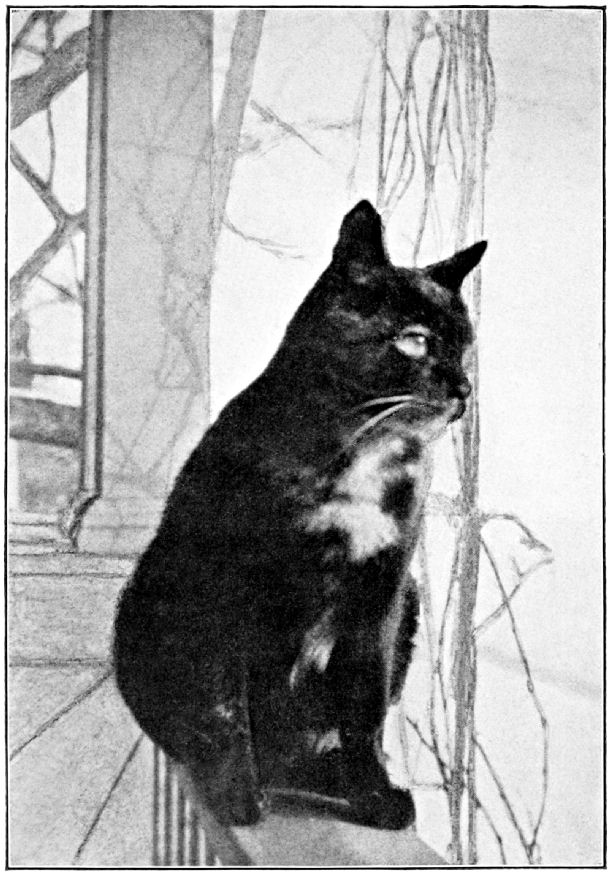
Dixie kitten was a slender little cat with
the softest, silkiest black fur imaginable;
that is, you would think it was black when
you first glanced at it; but if you looked a
little more closely, you would see that here
and there were gleams of tawny yellow.
Three of her paws were black and one was
yellow. Her eyes were yellow, too, in the
daytime, with only a narrow line of black
down the centre; but at night they were
black and shining, and surrounded by a
ring of golden yellow. But whether it was
day or night and whether they were yellow
or black, there was little going on
around them that they did not see. Her
whiskers, all except two, were jet black,
2]
but those two were snowy white. When
she lifted her pretty chin, you could see
under it a soft yellow “vest front,” and at
the top of the vest front a bit of the whitest,
glossiest fur that was ever seen. It was
so very pure and dainty that when the sunlight
fell upon it, you would almost fancy
that it was a bit of filmy white lace.
The first thing that Dixie could remember
was of being cuddled up to some one
who was soft and comfortable and gave
her sweet warm milk to drink. Somehow,
she knew that this was her mother, and
that her mother would feed her when she
was hungry and keep her warm and take
care of her and not let anything hurt her.
Their home was a nest of soft hay, so
deep in the pile that when Dixie was at
the farther end, she could not see out at
all. After a while, however, she crept out
to the light now and then, and here were
so many interesting things that her eyes
3]
grew bigger and bigger the longer she
looked. There were piles of hay and straw,
there were bags of grain, there were rakes
and spades and wheelbarrows, there was
a carriage, and there was a sleigh. Dixie
climbed up one of the shafts of the sleigh
and stretched out her paw to touch a bell.
She only wanted to see what it was, but it
made such a loud jingle that she almost
fell off the shaft. She ran away as fast as
ever she could and hid herself in the safe
and comfortable hole in the hay.
There were strange noises, too, that
Dixie kitten heard, even when she was far
out of sight in her own little nest with her
mother. There were voices of men and
the sound of their steps; there was the
happy “Bow-wow!” of a dog; there was
the neighing of horses and their crunching
of grain, and the sounds of harnessing
and unharnessing. Twice every day the
great doors of the barn were thrown open
4]
and the Master drove in. She could hear
him pat the horses and the dog and speak
kindly to them; then his steps passed out
of the barn and up the walk and into the
house.
Dixie’s mother had made her understand
that she must stay near the home
nest; but there was a flight of steps close
by, and Dixie did so long to go down
them! She felt sure that they led to where
those wonderful things that she heard
must be. Her mother went down the
steps sometimes, and one day when she
was gone away from home, Dixie kitten
thought that she would go, too. She went
to the head of the stairs and stretched out
her little right forepaw very carefully; but
it would not reach the first step. She
stretched out the left paw, but that would
not reach any farther. She drew back and
sat looking down the staircase for a while.
Then she tried again, and this time she
5]
reached so far that not only the two little
black forepaws, and the black hind paw
and the yellow hind paw, but also her
whole little black and yellow body tumbled
down one step, two steps—and no
one knows how much farther she would
have gone, had she not come, plump,
right against her mother, who had seen
what was going on and was hurrying up
the stairs as fast as she could run. Dixie
was a much surprised little kitten, for
her mother lifted her by the back of the
neck and carried her straight to the little
nest in the hay. Then Dixie was still more
surprised. She had always thought her
mother’s smooth soft paws were only
beautiful playthings, but now one of them
gave her a pretty hard cuff right on her
ears. Even if Master had been listening,
he could not have heard Mothercat say
anything, but Dixie kitten understood
perfectly well that she would get into
6]
trouble if she went near that staircase
again.
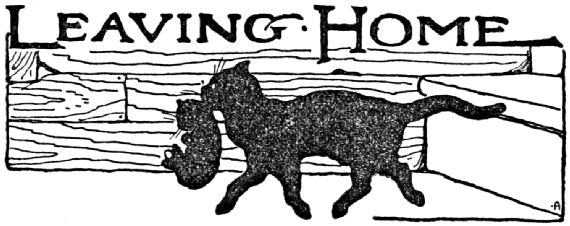
And yet, the very next day Mothercat
lifted Dixie by the neck and carried her
downstairs, and neither of them ever saw
the soft warm nest in the hay again.
Leaving Home
7]
This is the way it came about that Dixie
kitten and her mother left the home nest.
At night, when Master came home, he
stepped down from the carriage much
more slowly than usual, for he was holding
a big basket carefully in his hand. He
did not go into the house at once, but
climbed up the stairs and stood at the top
a moment looking around. He had set
the basket on the floor, and now he called,
“Kitty, Kitty!” Mothercat listened a moment,
then peered out of the nest, her eyes
as big as saucers. Dixie kitten crept out
between her mother’s forepaws, for she,
too, had heard a gentle “Mew!” coming
from the basket, and even a kitten could
guess what was within it. She was so eager
8]
that she could hardly wait to see it opened;
but Mothercat crouched low and lashed
her tail angrily back and forth. Then Master
took off the cover of the basket, and
what should be in it but four little kittens!
Dixie kitten was delighted. She climbed
over Mothercat and started to run out to
see them; but once more Mothercat boxed
her ears with her big soft paw, and Dixie
had to go to the back of the nest in the hay.
“Kitty, Kitty!” called Master, “come and
see the new kittens”; but Mothercat did
not stir from her place, and she swished
her tail more angrily than ever. Master
gave the new kittens a dish of milk, and
then he went away.
The kittens drank the milk, then they
began to run about the room. They
climbed the heaps of hay and straw and
they smelled of the bags of grain. They
ran over the carriage and the sleigh and
the wheelbarrow. They touched the teeth
9]
of the rake curiously with their small pink
noses. Once they went near the little
nest where Mothercat crouched, watching
everything that they did. “Gr-r-r-r!”
growled Mothercat; and they ran away
from her corner as fast as ever they could.
It began to be twilight. They were lonely
and somewhat frightened, and pretty soon
they curled up together in a soft little heap
and went to sleep.
Dixie kitten went to sleep, too, but
Mothercat sat a long time thinking. Master
meant those new kittens to stay there,
that was plain. It was her house, the
place that she had picked out so carefully
as a home for her kitten, and he had put
those strangers into it! She had never
thought of Master’s doing such a thing
as that; but there they were, and what
should she do? There was one thing sure,
she would not live in the same house with
them, and her kitten should have nothing
10]
to do with them. She waited until it was
dark and everything was quiet downstairs
except the occasional moving of the
horses and once or twice a sleepy bark
from the dog, Prince, who was dreaming
that he had caught a rabbit. She listened
awhile, but there was nothing more to be
heard. Then she picked up Dixie kitten
by the back of the neck and stole quietly
down the stairs. Master had cut a hole in
the barn door, so that no cat need ever be
shut out, and she slid softly through this,
and went under the barn. It was open on
one side, but the air was warm, and she
knew where there was a heap of straw.
She pushed it about a little with her paws,
then she turned round and round to make
a smooth nest, and at last she lay down, and
Dixie kitten lay down beside her. Dixie
thought all this was very strange, but of
course whatever Mothercat did was right,
so she snuggled down, and in three
11]
minutes she was sound asleep. Before long,
Mothercat was asleep, too. The coarse
straw was not so comfortable as the hay,
but, whether it was hard or soft, she would
not stay in the same place with those
strange kittens, indeed she would not.
When morning came, Mothercat went
into the barn to get the breakfast that
was always brought out for her, and there
were those kittens eating out of her dish!
She stood still and looked at them. Dixie
kitten had followed, and now one of the
strangers went toward her in a friendly
fashion. “Gr-r-r-!” growled Mothercat,
and the kitten ran back to the dish. Mothercat
did not touch the milk, and maybe
she would have had no breakfast at all,
if Mistress had not come out to see the
new kittens. “Why, Mothercat,” she said,
“aren’t you going to be good to those
little stranger kittens?” Mothercat did not
answer, but she did not go any nearer to
12]
the dish. “She’ll soon get used to them,”
said Master; but Mistress slipped into the
house and brought out another dishful of
milk. Master laughed, but Mistress said,
“Never mind. I don’t know that I want
to eat out of the same dish with everybody,
either.” Then Mothercat ate her
breakfast, but all the while she kept one
eye on the new kittens to make sure they
did not go near her child.
So it went on day after day and week
after week. Dixie kitten was soon old
enough to drink from a dish. Mothercat
allowed her to use the same dish as the
others, but never once would she let her
stay and have a good play with them; Dixie
could not see why. The new kittens still
lived in the barn, and Dixie and Mothercat
still lived under it.
Dixie Finds a Friend
13]
Dixie grew until she was much larger than
when she first lived in the nest in the hay,
and she learned a number of things from
Mothercat. She learned that to keep her
fur clean and dainty she must wash it
several times a day, and that nothing else
made it so soft and smooth and silky as to
wash it after she had just been drinking
some good creamy milk. She learned that
mice were to be caught; that beetles and
other queer creatures of the sort that ran
about in the grass were to be played with,
but not eaten; that horses never ate kittens,
though without meaning to do any
harm, they sometimes stepped upon them.
Dogs, she learned, were quite different
from horses in their treatment of cats.
One should always run away from dogs,
14]
not on the ground, but up some tree-trunk,
for dogs cannot climb trees; and Dixie
thought it was great fun to scamper up
a tree, curl up on a branch, and sit there
comfortably while a dog barked at the
foot and tried in vain to reach her. Prince
chased other cats, but if any dog troubled
the kittens in his barn, then in about three
seconds the strange dog was running
down the street with Prince at his heels.
Prince was a little puzzled about Mothercat
and Dixie. They came into the barn to
eat and Mistress fed them, but they lived
under the barn instead of in it. This was
strange, Prince thought, and he hardly
knew whether he ought to take care of
them or drive them away. He decided that
he ought not to do them any harm, but
that he might give them just a little chase
now and then. They understood this as
well as he, and after he had driven them
up a tree, they would come down, go into
15]
the barn, and eat their dinner beside him
as peaceably as possible.
Of course Dixie kitten had learned to
climb any tree in the neighborhood. She
had learned also what some kittens never
do learn, and that is, how to come down
again. The stranger kittens were always
scrambling up smooth, slender saplings,
and then tumbling back to the ground
or crying for some one to come and help
them. One of them climbed a telephone
pole, and there she sat on a crosspiece,
not daring to come down. She cried so
piteously that at length Master sent to the
fire engine company on the next street and
paid a man a dollar to bring a ladder and
take her down. And the next day he had
to send for the man once more, for that
foolish kitten had climbed the pole again!
Dixie kitten had learned, then, how
to behave toward mice and beetles and
horses and dogs; but People were quite
16]
another matter. In the first place, they did
not live either in barns or under them,
like kittens, but in houses. She had often
watched Master and Mistress go up the
steps and into their house; and once,
when she was quite small, she, too, had
slipped in when the door chanced to be
open. She had walked on a thick carpet
that was much more agreeable than the
bare ground or even the barn floor. She
had seen sofas and easy chairs, and she
had jumped up on a cushion that was far
softer than even the home nest in the hay.
There was plenty of room and no other
kittens were to be seen. The People, however,
had not allowed her to stay there,
but had driven her out at once, she
wondered why. In other ways, too, than
their manner of living, People were quite
different from dogs and horses and cats.
Their fur was of different colors on different
days, and one never knew how they
17]
were going to behave. Sometimes they
gave kittens good things to eat, and sometimes
they did not. Sometimes they spoke
to them or patted them, and sometimes
they hurried by without seeming to see
them. They had long arms, and sometimes
they reached out and lifted a kitten
far up into the air. Then if she was frightened
and tried to keep herself from falling
by sticking her claws into them, they
were not pleased, and often they dropped
her upon the ground. To be sure, none of
these things had ever happened to Dixie,
for Mothercat had taught her to keep
away from People; but she had seen them
all occur more than once, and she had
made up her mind never to have anything
to do with People.
Two-footed folk often change their
minds, and sometimes four-footed folk
do the same; and it was not long before
the little black kitten began to look at this
18]
matter somewhat differently. Just beyond
the barn were some apple trees and syringas
and rosebushes and grapevines and
a green lawn with bright blue forget-me-nots
in the grass, the very place for kittens
to run about and play. A fence shut
off the stranger kittens, but Dixie and her
mother could slip out from under the barn
and have many a fine run over the grass
or up the trees when no one was looking.
At the end of the lawn was a cottage.
There were People in it, but that did not
trouble Dixie and Mothercat especially,
for they never interfered. Sometimes Lady
sat on the piazza with a pile of books,
sometimes she picked a handful of flowers
or broke off the dead twigs from some
bush. When she saw Dixie and Mothercat,
she always spoke to them, and they
stopped and looked at her; but if she came
toward them, they ran away.
Dixie had now grown so large that
19]
Mothercat no longer watched her so closely.
Probably she thought that the kitten had
learned how to take care of herself and
keep out of danger; but she might have
changed her mind if she had guessed what
Dixie was thinking of in her wideawake
little brain. She would certainly have
thought that Dixie was not doing credit
to the careful teaching that she had had.
Dixie was thinking hard about Lady, for
there was something about her that the
kitten liked. She was People, of course,
but Dixie had come to the conclusion that
People were not all alike. The kitten
had seen a good deal of her of late—at
a distance, for now that the weather was
warmer, Lady was out of doors much of
the time. Dixie was out almost all day,
and much of it was spent among Lady’s
trees and flowers. Lady frequently spoke
to her, but Dixie made no reply. Still, her
bright little eyes were watching.
20]
After a while one might often have seen
a half-grown kitten with old-gold eyes
creeping quietly around the lawn, keeping
close to the fence, but holding her
eyes fixed upon Lady. One morning when
Lady was tying up the morning-glory
vines, the small kitten screwed up all her
courage and started toward her. Dixie ran
as fast as ever she could, for she wanted to
come, and yet she was afraid. She was all
a-tremble, and her heart was beating fast;
but she kept on bravely. Lady was not
looking down at the path, but up at the
vines, and the first that she knew, a black
kitten was rubbing against her ankles
and purring with all her little might. Lady
stooped and patted the kitten’s head and
talked to her awhile very gently; then
she started to go into the house. This was
not such an easy thing to do, for the kitten
was so happy that she kept running
back and forth before her feet and purring
21]
like a tiny spinning-wheel. This was the
way that a wild little kitten found a friend
who was to do more for her than she ever
dreamed.
Dixie and the Cottage
22]
Lady was always kind to Dixie when they
were under the trees together, but she had
a way of going into the house and closing
the door which the kitten thought was
rather unfriendly. Some weeks passed;
then, as Lady turned to close the door one
morning, she saw a round black face with
two shining yellow eyes pushing in shyly.
“I don’t know about this, kitty,” said
Lady; but Somebody Else said, “Oh, let
her come in just a minute”; and Lady held
the door ajar. The kitten crept in, but very
timidly, for she had not forgotten that
when she had run into a house before, she
had been sent out at once. She did not
venture very far, but she did put her little
feet on a soft rug, and in a room beyond
23]
she saw cushions and a sofa that she
thought would be a most delightful place
for a kitten to lie down and have a nap.
She took only one look, then she ran back
to the door and slipped out, for she did
not know what might happen if she stayed
longer.
Every day the kitten became a little less
timid, though she was still easily startled
by anything that was new to her. All cats
like to be rubbed gently under the chin;
but when Lady first rubbed her there,
right over her dainty bit of white fur that
looked so like lace, the kitten drew her
head away and looked back over her shoulder
at Lady’s hand as if it was something
she had never seen before and she did not
know what strange things it might do. It
was not long, however, before she learned
that nothing Lady did would ever hurt
her. She had now grown brave enough
to follow Lady about under the trees and
24]
among the grapevines and roses and syringas;
and when Lady stooped to pick
a spray of forget-me-nots, she was very
likely to feel a smooth black furry head
pushed under her hand, for the wild
little kitten who had made up her mind
never to go near People was fast learning
that to have a good friend among them
was the best thing in all a cat’s little
world.
Before long Lady said to the kitten,
“Little cat, you really must have a name.
Some dear friends of mine once had a
pretty cat whose name was Dixie, and I am
going to call you Dixie. Do you like it?”
The kitten made no answer, for a fly was
creeping slowly up the gate-post, and she
was getting ready to jump for it; but it
was only a short time before she knew
her name as well as anybody. The other
kittens would come if any one called
“Kitty, Kitty,” but this one paid no
25]
attention to any calling unless she heard
some one say “Dixie.”
So it was that Dixie found a friend and
a name. Mothercat had watched this new
friendship, and she did not seem to disapprove
of it; but she never allowed Lady to
come near herself. People had never been
unkind to her, but still she was afraid of
them. Lady always believed that if she
had lived longer, she would have become
friendly; but about this time Mothercat
got a bone in her throat and could not get
it out. Master and Mistress both tried their
best to help her; but she was so wild and
frightened that she would not let them do
much for her, and before long Mothercat
was dead.
All this time Mothercat and Dixie had
been going to the barn for their food, and
as the weather grew colder, they were
finally obliged to go there to sleep. The
stranger cats had taken the best places, of
26]
course, but they made warm nests for themselves
and were not uncomfortable. After
Mothercat died, Dixie hated to go to the
barn. The stranger cats looked upon it
as their home, and treated Dixie as if she
were the stranger and had no right to
come there. Sometimes they growled at
her, and although she was a stout-hearted
little fighter and was not one bit afraid of
them, it was not at all pleasant to have to
eat and sleep with cats who did not want
her. She began to do some more thinking
in her wise little head. She did not like
the barn, and she did like Lady’s cottage.
There were no other kittens in the cottage,
and there was plenty of room; but would
Lady let her come? She had followed
Lady about the lawn, they had sat on the
piazza together, and once or twice she
had jumped into Lady’s lap. Lady had
always seemed glad to see her, but had
never invited her into the house.
27]
Nevertheless, Dixie meant to see what could be
done.
The result of all this thinking was that
one day, when there was a remarkably
good smell coming from Lady’s kitchen,
a little black nose was stretched up to the
partly open door and a little red mouth
was opened wide. Dixie seldom mewed,
but when other cats would have mewed,
she only opened her mouth appealingly.
“Well, isn’t that cunning!” cried Somebody
Else. “Dixie has come to dinner.”
“Don’t feed her,” said Lady; “she belongs
to Master and Mistress. She must
understand that she can come to visit, but
that the barn is her home.” Lady was
called away just then. If she had not been,
I am afraid that before long she would
have done just what Somebody Else did,
that is, cut off a nice bit of lamb and put it
into the tiny red mouth.
So it went on day after day. At first
28]
Lady said firmly, “Somebody Else, you
must not feed that cat.” After a while she
said, “I am afraid it will make trouble if
you keep feeding the kitten.” Then she
said, “Somebody Else, we really ought
not to feed Dixie”; and before long she
came to the kitchen after every meal to
make sure that there was a saucer of something
good set down on the floor. At
length matters actually came to the point
where she said one day, “Somebody Else,
we’ll have those oysters fried instead of
scalloped; Dixie likes them much better
fried.”
Dixie was now a happy little cat. She
perched herself on the piazza railing and
ran up the apple trees and played with the
beetles and grasshoppers as much as ever
she chose. When she wanted to come into
the house, she jumped up on the sill of
the piazza window, and there was always
some one ready to let her in. When she
29]
ate her dinner, no other cat was there to
growl at her, for was she not the one and
only kitten of the house?
Of course the stranger cats had noticed
what was going on, and sometimes they
tried to come in and get a taste of the good
things that smelled so tempting; but this
Dixie would never permit. She did not
growl or spit, but if any other kitten dared
to take bite or sup from her dish, then a
resolute black paw shot out quick as an
arrow and struck the intruder with a hard
little cuff that sent her scampering out of
the door. Once or twice some one of the
stranger cats slipped in first and emptied
the saucer. Then Dixie was so angry that
she dashed out of doors like a little black
whirlwind, ran up the path toward the gate,
and sat down with her back to the house.
She swished her tail angrily and occasionally
looked back over her shoulder
reproachfully at Lady and Somebody Else,
30]
who had permitted such cruel things to
happen.
Room after room, Dixie went over the
house. She examined every foot of the
cellar, for she hoped to find a mouse or
two there. Early one morning she ventured
upstairs for the first time. It was
all new and strange and quiet, and Lady
was nowhere to be seen. Dixie gave a faint
timid mew, which meant, “I am lonesome
and frightened. Lady, where are you?”
Lady called, “Come, Dixie,” and Dixie
sprang upon the great bed, the happiest
little cat in the city. When Mistress came
in, she often saw her kitten lying on the
sofa or in Lady’s lap, or running about from
one room to another, and she said, “You
know she is only a barn cat, and she has
never been taught how to behave. She
may break things or get into the food.”
But Dixie had pretty clear notions in her
small head of how kittens should act, and
31]
she was a charming little visitor. Of course
she made a few mistakes. One day Somebody
Else found her on a shelf in the
pantry having a fine time with a dish of
corn. Dixie glanced at her with a look
that seemed to say, “Of course this is
all right, isn’t it?” and went on eating.
Somebody Else set her down on the floor,
saying, “No, Dixie, you must not touch
that”; and Dixie understood that, no matter
how tempting food might look, she
must not touch it unless it was given to
her. She learned her lesson so well that
never again did she meddle with anything
eatable, not even when she was shut into
the storeroom by mistake one day and left
there for half an hour. Here were corn and
fish and milk, all on low shelves in plain
view, and it was dinner-time; but not one
mouthful did she take. When People sat
down to the table, Dixie curled herself up
on a cushion as if this business of eating
32]
was a matter with which she had nothing
to do. Just once she broke through her
rule of good behavior. There were guests
at the table. They were busy talking, and
it must have seemed a long, long time for
a hungry kitten to wait for her supper.
One of the guests had just said, “How
well your cat behaves at meal-times,” and
Lady was replying, “Yes, she never pays
the least attention to us when we are eating,”
when, behold, an impatient little cat
made one bound to the sideboard and prepared
for another to the table. This, however,
was the only time that she ever did
such a thing; and there are not many
People who have not made at least one
mistake.
Dixie’s Troubles
33]
Dixie was very happy, but even the happiest
little cat has her troubles, and Dixie
had one great grief and disappointment.
Every evening, just as she was having
the most delightful nap that could be imagined,
Lady began to straighten out the
books and papers, push the chairs back,
and fasten the windows. Dixie watched
all this with her bright, round eyes, for
she knew that the next thing would be,
“Come, Dixie, time to go to bed”; and
then she would be put out of the door and
have to go back to the barn to sleep. It
seemed very hard that while the soft cushion
was to be there alone all night long,
she could not be permitted to use it; but
Lady always said, “No, Dixie, you must
run home now”; and one night when it
34]
was snowing fast, Lady put on some rubber
boots and carried her over to the hole
in the barn door rather than let her lie on
that warm cushion all night.
This, then, was Dixie’s one trouble, for
a cat’s home is where her bed is, and
Dixie did so want to make her home with
Lady and not in that barn. The trouble
became worse and worse, for Dixie was
going to have some kittens of her own,
and where should she make a cosy nest
for them? She could not bear to have them
in the barn, for she did not feel that she
was a barn cat any longer, she was a house
cat, even if she did have to go to the barn
to sleep. In every pretty coaxing way that
she knew she begged Lady to let her stay in
the house. She picked out one corner after
another that she thought would be just
the place for baby kittens. One was on the
padded cover of a shirt-waist box in Lady’s
room. Another was in the deep drawer of
35]
an old-fashioned bureau that chanced to be
left open a few minutes. Her favorite place,
however, was in a big, round basket. She
learned to push the cover off with her paw,
and she would cuddle herself down in a
little ring and look up at Lady pleadingly.
“No, Dixie,” was always the answer to her
begging, “you must not stay there.” She
lay on the sofa much of the time. If Lady
was near her, all was well; but when Lady
went anywhere else, Dixie followed. When
Lady sat down, Dixie seated herself directly
in front of her, and made plaintive
little moans and gazed straight up into her
eyes so beseechingly that more than once
Lady slipped out of sight and went away
from the house rather than to have to say
no again and again.
“She must think it is pretty hard,” said
Somebody Else, “to be petted as long as
everything goes smoothly, and then turned
out of doors as soon as she is in trouble.”
36]
“But,” replied Lady, “you must remember
that she is not our cat. She is a
dear little visitor, but she belongs to Master
and Mistress, and we must not let her
make this her home.”
Dixie seemed to understand that they
were talking about her, and she pleaded
more earnestly than ever. When Lady sat
down upon the sofa, Dixie would snuggle
up beside her as close as possible, she
would touch Lady’s fingers with the tip of
her tiny red tongue, she would purr and
look up into Lady’s face more and more
coaxingly every day. Still Lady said, “No,
Dixie, the barn is your home, and you must
make a nest there for your kittens.” She
even carried Dixie over to the barn two or
three times, but the poor little cat always
hurried back again.
At length there came a day when Dixie
was plainly suffering. “She must go to the
barn,” declared Lady. “Perhaps if I pull
37]
down the shade of the piazza window, she
will think we are away and will go back.”
She pulled the shade down, but Dixie did
not go; she only crouched down in the
corner of the piazza nearest the window,
and sat there looking sick and unhappy.
Lady was almost as unhappy. She wandered
from one room to another, restless
and miserable. Every few minutes she
came back to the sitting-room, pulled the
curtain aside softly, and peeped out; and
every time she saw the poor little suffering
cat curled up in the corner. At last she
said, “I’ll carry her over once more, and
perhaps when she is once there she will
be willing to stay.”
Lady started to carry her over; but
close to the door lay a big yellow cat. He
crouched low, almost as if he was about
to spring, and little Dixie trembled and
clung fast to Lady. Then Lady carried her
straight home and into the house. “I
38]
simply won’t let any animal be so miserable
and frightened,” she declared. “Master
is at his office and Mistress has a house
full of company, so there’s no one to ask;
but that poor little kitten shan’t suffer so,
no matter whether she is mine or theirs.
I’m going to make you a bed, Dixie,”
she continued, “and a comfortable place
for the kittens.”
Dixie certainly understood some of this
at least, for when Lady hurried down cellar
to look for a box and brought excelsior
and a piece of blanket from the attic to line
it with, Dixie followed, no longer moaning,
but watching closely every motion.
“We’ll put it into this quiet room off the
kitchen,” Lady explained to Dixie; and
she lifted the little cat and laid her into the
soft, warm nest. Cats are not often willing
to let People choose nests for them,
but Dixie was happy and grateful, and she
lay down at once. Lady made it all still
39]
and dark around her and went away for
a while. When she came back, there lay
Dixie in the nest, and beside her were four
of the dearest little kittens. One was yellow,
and one was black, and the other two
were black and white. They were named
then and there. The yellow one was Buttercup,
the black one Topsy, and the other
two were the Heavenly Twins. Lady
brought Dixie some warm milk, and then
left her to rest with her four little furry
kitty babies.
The Little Mothercat
40]
Dixie made the dearest little mothercat
that was ever seen, and she was as happy
as the days were long. At first she thought
too much was going on in the small room
off the kitchen, and twice she carried her
babies off to Lady’s study and picked out
a snug, shady corner for them behind the
door. Lady carried them back to the little
room, and Dixie understood that they
must stay there, and she did not take them
to the study again. She took the best possible
care of her kittens, and taught them
all that Mothercat had taught her. She
washed them ever so many times a day;
though as they grew older, they were
so full of fun that if she did not keep fast
hold of them with her forepaws, they
would insist upon playing with her tail
41]
or jumping up to try to catch hold of her
whiskers.
As soon as it became warm enough, a
big box full of straw was put out of doors
for the kittens. Dixie kept close watch of
them, and never let them go out of her
sight unless Lady or Somebody Else was
near. Then she seemed to think that she
had a good nurse-maid, and at such times
she often ventured to slip away for a bit
of freedom and a short run by herself.
These many kittens needed more milk
than the milkman could spare, so it had
to be brought from the grocer’s. Sometimes
it was rather late, and then they
would all line up on the doorstep, stretch
their little red mouths wide open, and call
for their breakfast in a language that no
one could fail to understand. All day long
they played in the sunshine; or if it rained,
they paddled their furry paws in the tiny
streams of water like so many small children,
42]
for they were no more afraid of water
than if they had been ducks. They had
breakfast and dinner out of doors, but
when it was supper-time, they were all invited
into the house to drink their milk and
have a good romp. They climbed over the
chairs and the sofa, and frisked around the
legs of the tables. They ran after balls and
jumped after strings. They tore up newspapers,
and knocked down the shovel and
tongs, and sometimes almost burned their
tiny noses trying to find out whether
the fire in the fireplace was good to play
with or not. Topsy was more slender and
lithe than the others, and it was great fun
for her to squeeze herself under a certain
willow footstool. Then her smooth little
black paws would dart out and the yellow
paws and black and white paws would
dart in, and the four kittens would carry
on a merry little mock battle together.
Sometimes one was tired of play before
43]
the others and slipped away to a corner
of the sofa to take a nap. Then the others
were as full of mischief as a nutshell of
meat. One would take her seat on the arm
of the sofa and stretch down her paw to
give the sleeper a poke. Another would
tickle her feet with a wicked little black
nose; and sometimes the whole three
would pounce upon her and roll over and
over her until she gave up all hope of a
nap and jumped up to have a paw-to-paw
scramble with them. When the fun was
over, they were ready to go out of doors to
sleep in their box of straw. If it was dark,
they slept all night; but if the moon was
bright and Lady chanced to look out of her
window, she was almost sure to see four
little kittens frisking about and having
the best time that any one ever dreamed
of. Dixie rarely played with them. Indeed,
even as a kitten she had hardly ever
played, and when Lady had shaken a string
44]
or rolled a ball temptingly before her, she
had only blinked at it gravely and looked
rather surprised that she should be expected
to do such undignified acts as
jumping at strings or running after balls.
There were other kittens just across the
fence, but they belonged to the stranger
cats, and Dixie would not allow them on
the lawn. One day a tiny gray kitten ventured
to slip through the palings to play
with Buttercup and Topsy and the Heavenly
Twins, and they had a fine time together
for a few minutes while Dixie was
lying in the sunshine around the corner
of the house. Pretty soon she awoke, however,
and in two minutes the merry play
had come to an end. Dixie went straight
up to the stranger kitten and apparently
told it to go home as fast as it could go.
The stranger kitten stood its ground
bravely. It sat up as tall as it could and
looked Dixie squarely in the eyes. Dixie
45]
lifted up her paw and gave it such a
hearty cuff that the little gray kitten really
screamed with fright and pain. Then
something happened that puzzled Dixie’s
brain severely, for Lady came hurrying
across the lawn and caught up the terrified
little gray kitten. She soothed it till
it fell asleep, and she sat quietly with it
in her lap till it woke up and was ready to
drink some warm milk. Then she put it
down gently on the other side of the fence.
This was something that Dixie could not
understand. Why Lady, her Lady, should
be so good to a stranger kitten was certainly
a mystery. She had watched it all
in amazement and anger, and now she
sat down on the grass to think it out. Of
course she swished her tail, for she was
more than a little jealous and angry. Here
was a fine plaything, the kittens thought,
and in spite of her little warning growls,
they had a great game with it, till finally
46]
their mother turned upon them and cuffed
the one that chanced to be nearest. So
they were all rather unhappy together,
and just because of a friendly visit from
one little gray kitten.
If Dixie had only known what real sorrow
was coming to her, she would have
looked upon this trifling annoyance of the
visit from the stranger kitten as a very
small matter. She had thought it was exceedingly
hard when she had been sent
to the barn every night instead of being
allowed to sleep on the soft cushion in the
warm, cosy sitting-room; and she had
thought that no little cat was ever in worse
straits than she when she was afraid that
Lady would not let her make a nest for
her kittens in the house; but a far worse
trouble was on its way now, and poor
Dixie’s little heart would have almost
broken if she had known what it was.
Dixie Is Deserted
47]
Of course Dixie had not been with People
so long without learning the meaning
of many of the words that they used. She
knew “come” and “go,” and “dinner”
and “down,” and a number of others;
but she did not know “buy” and “house”
and “move.” She felt vaguely uneasy,
however, for things began to happen
that made her restless and nervous. Lady
never sat on the piazza now; she was
always going about the house and hurrying
up and down stairs. Dixie had always
fled to the study for quiet whenever too
much was going on elsewhere; but now
even the study was no refuge, for books
were being taken down from the shelves
and laid into wooden boxes. Quantities of
48]
papers were carefully packed away and
great basketfuls were carried down cellar
and burned in the furnace. The parlor
carpet was taken up, and the room was
filled with boxes of books and furniture
closely wrapped up in white cloth. Pictures
were taken down and set upon the
floor against the wall. Much sweeping
and cleaning were going on. The worst of
it all, however, was when a strange man
came and began to pack the china into barrels,
and then left the barrels standing
in the sitting-room,—her sitting-room,
where the sofa with the cushions was, and
where the kittens always had their evening
frolic.
In all this confusion the kittens were not
at all troubled. They thought it was great
fun to have the sitting-room full of barrels,
and they had the best time of all their lives
in jumping from one barrel to another
and pulling out bits of the excelsior packing.
49]
The little mother, however, was anxious
and worried. All cats dislike change
and commotion, and this grew worse and
worse. She hoped it would soon be over,
but it was worse than house-cleaning, and
she had thought that was as much as any
cat could endure.
At last there came a dreadful day when
horses stopped at the gate and strange men
went through the house and carried out
boxes and barrels and furniture to load into
great moving-wagons. Lady was nowhere
to be seen, and Dixie fled. When it was
dinner-time, she came to the piazza window,
but Lady was not there. Somebody
Else was not there, and Dixie was an unhappy
little cat. After a while, Somebody
Else set out a big saucer of fish for her and
a big dish of milk for the kittens; but still
Lady could not be found. The men had
driven off with a load of goods, and Dixie
ventured to creep up to Lady’s room.
50]
Something of hers might be on the bed,
she thought; she would lie down upon it,
and maybe Lady would come soon. She
went softly up the stairs; but when she
came to Lady’s room, it was all bare. The
carpet was gone, the furniture was gone;
there was nothing lying on the bed, for the
bed itself was gone. Then Dixie gave one
sad little moan. She was frightened and bewildered.
What could have happened, and
what was going to happen? She walked
slowly downstairs and went out of doors.
The kittens were playing in the grass. One
of them jumped up and tried to catch her
as she went by to persuade her to play with
them; but she did not stop till she was
in the darkest corner under the barn,—a
wretched, despairing little cat. Just at
twilight, Somebody Else set out a big dish
of milk and another of meat and potatoes.
Then she locked the door and went away,
and all was dark and still and lonely. The
51]
kittens soon went to sleep, but many a time
during the evening the little mothercat
crept out to look up to the house. There
was no light anywhere, not even in Lady’s
room, where she had always seen it latest.
After a while she went to sleep. Maybe
things would be better in the morning;
Lady would surely come back to her.
But when morning came, no Lady came
with it, and the house was still shut tight.
By and by the door was unlocked and
opened; but it was a strange man who
turned the key, and other strange men followed
him. Dixie peeped in through the
window. They were painting and papering
and doing other things that she had not
seen done before, and she jumped down
from the window-sill and ran under the barn
again. After a little, she heard some one call,
“Dixie, Dixie!” and she hurried out. It
was not Lady’s voice, but she hoped Lady
might be there. It was Mistress. She had
52]
asked before what Dixie liked best, and
now she had brought out a nice breakfast
of it for her. She would have been glad to
smooth the little cat’s head and try to comfort
her, but Dixie would have nothing to
do with any one. Lady had gone away and
left her, and she was broken-hearted. She
was angry, too, to think that her beloved
Lady should have treated her so cruelly.
Nevertheless, all that day she watched, and
all the next, and the next after that, angry
to think that Lady had left her, and still
hoping and hoping that she would come
back.
At twilight of the third day, something
happened, for Lady came back. She came
especially to see Dixie kitten. At the first
sound of her voice, Dixie jumped joyfully;
then she remembered how unkind Lady
had been, and when Lady began to smooth
the little black head, Dixie slipped out from
under her hand and raised up her paw and
53]
struck her dear Lady with all her might;
then she ran away and hid.
Lady was not angry, for she was one of
the People who know how little cats and
dogs and birds and horses feel. She understood
how grieved and hurt the little kitten
was; but there was nothing that she could
do to help her just then. It would all have
been right and comfortable if she could
have explained matters to Dixie, but there
was no way of making her understand.
A Happy Little Cat
54]
It was a great pity that Dixie could not
have heard and understood the little talk
between Lady and Mistress before Lady
went to the new house. “Master says you
shall have her if you like,” said Mistress.
“But I know that he values her,” replied
Lady, “and if she will only go back to the
barn and be happy, I won’t take her. Suppose
I leave her a few days and see if she
won’t be friendly with the other cats and
live with them comfortably. If she really
won’t, then I will come for her.” If Dixie
had known of this talk, she would not
have been so hurt and angry; but she supposed
Lady had abandoned her, and she
was miserable. She did not forget, but
grew more and more angry as the days
passed. Lady came to see her again. Dixie
55]
was so glad that she could not help purring
for a minute; then she remembered
Lady’s unkindness, and she walked away
up the path. She sat down with her back
to Lady and looked over her shoulder at
her reproachfully.
Lady meant to come for Dixie on the
following day, but she was called out of
town, and it was three weeks before she
could set off with a rattan extension-case
to get the kitten. When she came to the
gate of the lawn, it was almost dark, and
Dixie was roaming about close to the
house, a lonely little shadow. The People
who now lived in the house had been very
good to the kittens. The Heavenly Twins
had gone to live with a kind-hearted
watchman, who wanted them to keep him
from being lonely at night; but the other
two were living with the People in their
old home. “We wanted to be good to
Dixie,” said one of the People in the house,
56]
“and we tried to pet her. Sometimes after
dark, when the children had gone to bed,
she would come in and wander about from
one room to another. If we paid much
attention to her or tried to take her up,
she would run out again; but if we let her
alone, she would sometimes stay half the
evening.”
Buttercup and Topsy were running
about and playing as if nothing had happened,
for kittens have short memories,
and they had quite forgotten Lady. Indeed,
they had almost forgotten Dixie, for when
kittens grow large, they forget their mothers,
and their mothers forget them, too.
People who are mothers always love their
children, no matter how tall they have
grown; but cats cease to care anything
about their kittens as soon as the kittens
are old enough and big enough to take
care of themselves.
Poor little Dixie was roaming about in
57]
the gloom, alone and miserable, and too
wretched even to run away. Lady put her
hand upon her, and she was grieved to feel
how thin the little cat had grown. Her silky
fur was rough and harsh, and she did not
seem half so large as she had been before.
“You poor little Dixie kitten,” said Lady,
tenderly, “I shall have to frighten you for
a little while, but I think you will be happy
afterwards.” She held the kitten firmly and
put her into the rattan case. Mistress shut
down the cover in a twinkling, and in half
a minute the straps were fastened and Dixie
was a prisoner. Of course she cried, for she
was terribly alarmed; but Lady talked to
her and soothed her, and before they were
in the car she was quiet.
It was not long before the car stopped
at the Road where the new house was. Lady
got out and carried the extension-case to
the door and into the house. A Caller was
there, for Somebody Else had told her that
58]
Lady had gone to get Dixie, and she had
waited to see how the kitten would behave.
“Though I don’t believe Lady will be able
to catch her,” she had said. “Cats care
nothing for people. They are selfish little
creatures, and all they want is to be comfortable.
Probably this one has forgotten
all about her by this time.”
When Lady came in, the Caller said,
“You’d better open the case in the kitchen.
The cat will probably be as crazy as a loon,
and she may dash about and tear things and
do a great deal of damage.” So the Caller
and Lady and Somebody Else and the case
with the kitten all went to the kitchen;
and Lady began very slowly and gently to
loosen the straps. It was all so quiet in the
case that she wondered whether it could
have been so close that the poor little cat
was half smothered, and she pulled the last
strap off in a great hurry. “You’d better
be careful,” said the Caller, “and not have
59]
your face too near. You never can trust a
cat, and no one can tell what she will do.
She may spring right at you.” Lady did
not believe Dixie would do any such thing,
and she took the cover off in a twinkling.
Dixie stepped quietly out of the case and
looked around her. She saw Lady and
Somebody Else, and she saw the Mother
standing in the doorway. They talked to
her, and patted her, and told her they were
glad to see her. Dixie forgot the lonely
days at the old house when she thought
Lady had abandoned her. It was all past;
Lady had remembered her and had brought
her home, and now she was going to live
with Lady and be really her own little cat.
Never was a cat so happy before, and she
purred so, she could be heard far into the
dining-room. As Lady bent over her, she
stretched up and tried to rub her face
against Lady’s. She ran about the room
and touched with her keen little nose the
60]
stove hearth, the chairs, the rugs, the table
cover, one familiar thing after another; and
every minute or two she ran back to Lady
to tell her how glad she was to be with her.
“Dixie dear, how miserable you must
have been,” said Lady, with tears in her
eyes.
“I never knew that just a cat could be
either so happy or so unhappy,” said the
Caller, with tears in her eyes, too. As for
Somebody Else, she had long been wiping
her own eyes when she thought no one was
looking; so it was really quite a tearful time.
By and by Dixie discovered in a corner a
little dish heaped full of the canned salmon
that she especially liked, for on the way
home Lady had stopped a minute to go into
a store to buy it to celebrate the homecoming.
Close beside the salmon was a half-open
package that smelled wonderfully
good. Even Dixie’s small black nose would
not go into it, but it was too tempting to
61]
leave, for it was catnip. At length she
pushed in her little paw, curled it up, and
brought out a mouthful, which she held up
and ate just as a boy would eat a piece of
candy.
It was pretty late in the evening by this
time. The Caller went home, and Lady
called Dixie to go to bed. There was a good
soft bed all made ready for her in the cellar.
It was in a barrel of shavings, for cats like to
sleep high up from the floor. Near the barrel
was a saucer of milk, for fear she might
be thirsty in the night. It was all very comfortable,
but I do not believe that Dixie
went to sleep at once. Cats like to know all
about a place that is new to them, and I
have no doubt that she examined every
corner of the cellar before she curled herself
up to rest. I am almost sure, too, that
she purred herself to sleep, and that she
had happy dreams all night long.
The New House
62]
When the Caller went away, she said, “I
never knew that a cat could behave like
that. She acts as if she really loved you as
much as a person could do. Still, they say
cats care for places rather than people;
and if I were you, I would shut her up for
two or three days till she gets used to the
house, and then she will not try to run
away.”
“But if she wants to run away,” replied
Lady, “I do not want to keep her
here.”
And Somebody Else said softly to herself,
“Run away? You couldn’t drag her
away.”
When morning came, a very happy and
curious little cat stepped up from the cellar
63]
and began to look about the house.
There were only a few things in it that she
had not seen before, but they were all in
new places; and so she found a great deal
to examine. Instead of carpets, however,
she found many rugs. She was not sure that
she liked this, for sometimes she slipped a
little on the hardwood floors. The stairs
did not go straight up, but made a turn.
This was a delightful change, for she could
run up part way, then turn and look back
through the balusters. After a while she
came to the study. Here she found a new
bookcase. It was far better than the tall
ones, she thought, for it was much lower,
and she felt sure that the top of it would be
an excellent place for a kitten to take a nap.
Two or three mirrors were now either hung
low, or were over tables so she could jump
up and look into them, and Somebody Else
declared that the kitten would surely become
vain if these were not changed, for
64]
she liked so much to sit in front of them
and gaze at her own little self. The windows
she liked especially, for they were
so low that even a little cat could stretch
up and rest her forepaws on the sills and
see all that was going on out of doors.
Better still, at one of the windows Lady
had put a plush-covered foot-rest, and here
Dixie could sit comfortably in the sunshine
and watch the People going by.
After a while Dixie began to wonder
what was out of doors, and she let Somebody
Else know that she wished the door
opened. Somebody Else had not forgotten
that the Caller had said the cat would run
away; but evidently such an idea never
entered Dixie’s pretty little head. She
walked slowly around the house. There
was a piazza at the back; and that suited
her; but she was still more pleased with the
front piazza. It was reached by five or six
steps, and there was a high railing where
65]
a cat could sit; and no dog would dare
to come near her. There were shrubs on
either side of the walk, with fine cool places
to sleep, or to lie awake and watch everything
that was going on. There was plenty
of grass, there were two gnarled apple-trees
behind the house, and beyond them there
was a fine old stone wall that had stood ever
since the days when no one had dreamed
of turning the great Baldwin orchard into
house-lots. Some of the rough stones were
covered with green moss, and they cast
soft gray shadows. Here and there a bit
of white quartz flashed in the sunshine.
Bright orange nasturtiums ran over the
wall, and some tall hollyhocks stood close
beside it in neighborly fashion. It was a
beautiful old wall. Dixie thought so, too;
but the reason she liked it was because she
was sure that in some one of those shadowy
places she would certainly find a field
mouse.
66]
It took Dixie the whole forenoon to look
at everything around the house and smell
of it. Moreover, in the course of the morning
she had a caller. It was not exactly
a friendly call, for this Next-Door Cat
had been in the habit of coming to see
the People who used to live in the house,
and she was not pleased to see another cat
making herself at home there. She came
through the little barberry hedge and said
“Meow!” in a surprised and aggrieved
fashion. I suppose it meant, “Who are you
and what are you here for?” but Dixie did
not deign to answer. She jumped upon the
piazza railing and looked straight at the
Next-Door Cat. The Next-Door Cat ran up
the nearest apple-tree and looked straight
at her. After a while, the Next-Door Cat
said “Meow-ow-ow!” and came down
from the apple-tree. She gave one more
look over her shoulder at Dixie, but Dixie
was opening and shutting her mouth as
67]
fast as ever she could, as if she meant
to devour everything in sight. The Next-Door
Cat marched straight to the gap in
the low barberry hedge and went home.
This was Dixie’s first caller.
Dixie in her Home
68]
So it was that the wild little barn cat became
a house cat. She had come to live with
busy people, and I fancy she thought that
she was as busy as they. In the morning,
as soon as she heard the steps of Somebody
Else, she ran to the top of the stairs to be
ready to come out the moment that the door
was opened. The next thing to do was to go
up to Lady’s room. The door was almost
always closed, but Dixie sat down beside it
and waited patiently until she heard some
little sounds within. Then she rubbed on
the door with the little pads on the bottom
of her paw,—very softly, to be sure, but
Lady always heard her and opened it. Once
in a while Dixie went out of doors when
she first came up from the cellar, and occasionally
it happened that she could not
69]
get in again at once. That did not trouble
her, for she had another way of reaching
Lady’s room that she liked fully as well as
going by the hall and the stairs. Not far
from the front piazza there grew an apple-tree.
Dixie could run up this tree, walk carefully
out on a slender branch, and jump to
the piazza roof. A little way beyond the
farther end of the roof was one of the windows
of Lady’s room. The blind nearest
this roof was usually closed, and there was
not room enough on the sill to hold even
a kitten; but Dixie would go to the very
edge of the roof and scratch. “Is that you,
Dixie?” Lady would ask. “Meow,” Dixie
would reply, and any one would know that
this meant “Yes.” Then Lady would go
into the little room that opened on the
roof and let her in. So it was that every
morning the kitten made sure that Lady
was safe and sound, and came to purr to
her while she was dressing.
70]
After Lady and Dixie had both eaten
breakfast, Lady took a few minutes for the
morning paper. Of course it was a great
help to her to have a small black cat lie on
her lap; and I am sure I do not know how
she could have set her room in order unless
the same little cat had sat on the window-sill
watching her. When Lady went to the
study, Dixie always went with her to stay
by her while she wrote. This study was an
excellent place for a nap. Sometimes Dixie
lay on top of the low bookcase, where Lady
had put a cushion for her benefit; sometimes
she stretched herself out on the carpet
in the sunshine; and sometimes she had
a comfortable little snooze on a corner of
the big library table. If she did not care to
sleep, there were various things that a kitten
could do in the study to amuse herself.
She could sit at the window and watch the
birds in the apple-trees, or sometimes a dog
hurrying home across lots. She could run
71]
over the typewriter keys if she chose, and
even across the big table. Indeed, she soon
learned that the surest way to make Lady
pay attention to her was to walk slowly
over the paper on which she was writing,
or even to sit down upon it and begin to
take a bath. Once she sat down upon a loose
pile of books and papers, and a moment
later books, papers, and Dixie slid to the
floor together, with a great thump. She
turned and gazed at them with surprise and
wrath, but not the least bit of fear. She was
afraid of sudden noises elsewhere, however.
While a carpenter was at work in
the kitchen, she utterly refused to eat her
meals in the room unless Lady stood beside
her. She seemed to feel convinced that
Somebody Else was to blame for all that
hammering, and for several days after it
ceased she refused to have anything to do
with her while in the kitchen, though she
was friendly enough in other places. In
72]
Lady’s study she felt safe, and apparently
she had come to the conclusion that in that
room nothing could ever hurt kittens.
Whenever Dixie was in trouble she always
ran to the study for comfort. One day she
dashed into the room and sat down in front
of Lady and gazed at her so earnestly and
with such an air of wanting to tell something
that Lady called to Somebody Else
and asked if anything had happened to
Dixie. “Sure, there has,” replied Somebody
Else. “Now that the screens are
in, the window-sill is not wide enough to
hold her, and when she jumped from the
railing to the window, she fell down. She
wouldn’t stop for a bit of dinner, but ran
upstairs as fast as ever she could go.” Once
when Lady had been away for a month, she
missed the kitten after the first greeting.
Some time later she went to the study, and
there sat Dixie in the dark, patiently waiting
for her to appear.
73]
In some ways Dixie was remarkably
obedient. If she was in the street and Lady
knocked on the window, she would come
running home as promptly as the best of
children. If she was upstairs and Lady
called her to come down, you could hear
on the instant the jump of a little cat—often
from a down quilt on a bed or from
some other forbidden place, I am sorry to
say—to the floor; and in half a minute
she was hurrying downstairs to see what
was wanted. One morning Lady called, but
Dixie did not come. Some ten minutes later
she burst into the kitchen like a little football
rush with a long “Meow-yow-yow-yow!”
which sounded so angry and indignant
that Somebody Else called Lady and
declared that something had surely gone
wrong with Dixie. When Lady went upstairs,
she saw what had happened. The
heavy door had blown to, and it was plain
that the kitten had been working at it with
74]
her soft little paws until she had pushed it
back far enough to let her squeeze through.
Part of Dixie’s work was to drive away
the stray cats and dogs that ventured on
her lawn or under her apple-trees. Sometimes
she herself played dog, and did her
best to guard the house. One dark night
there was a strange clanking sound in the
back yard. Lady started for the door; but
before she could reach it, the little cat had
crouched all ready to make a spring as soon
as the door should be opened. The noise
proved to have been made by a hungry
dog at a garbage can; and he ran away as
fast as ever he could; but I think Dixie
would have enjoyed chasing him.
Evidently Dixie felt that her first duty
was to keep watch of Lady; and this was
no easy matter when Lady was busy about
the house. She hurried “upstairs and
downstairs and in my lady’s chamber”;
but wherever she went, a little black cat
75]
followed her like a shadow. This shadow
behaved somewhat unlike other shadows,
however, for it had a way of catching at the
hem of her dress in the hope of a frolic, or
suddenly dashing around corners at her to
surprise her, in a fashion which no properly
behaved shadow would ever dream of
following.
Another of Dixie’s duties was to entertain
the Mother. The Mother had always
been afraid of cats, and she had never liked
them, but she could not help liking Dixie.
The kitten often went to her room and lay
on a small high table in the sunshine while
the Mother sat in her big easy-chair and
talked to her. Dixie purred back, and they
were very comfortable together, and the
best of friends.
When callers came, Dixie was not altogether
pleased. Sometimes she would turn
her back on them, march straight upstairs,
and not come down again until she heard
76]
the front door close; but generally she
thought it better to keep pretty close watch
of them. She was inclined to think that
Lady paid them too much attention; therefore
she would often jump into Lady’s lap
and insist upon remaining there until they
were ready to start for home.
Another one of Dixie’s responsibilities
was the telephone, and she always ran to
it at the first ring. Her care of it was a great
convenience to Lady, for the telephone
bell and the doorbell sounded so nearly
alike that before Dixie came, she had often
made mistakes, and had hurried to the
telephone when the doorbell rang. Dixie
never made a mistake, however, and when
Lady saw her running to the telephone, she
did not have to guess which bell had rung.
The telephone was as much of a mystery
to Dixie as it is to some other folk. She
would jump up on the table to listen,
and would put her head on one side with
77]
a puzzled look. One day she stretched out
her soft little paw and touched Lady’s lips
to see if she could not find out where those
strange sounds came from. Once Lady
asked the friend with whom she was talking
to call “Dixie!” Then the kitten was
puzzled indeed. She looked at the receiver
from all sides and even tried to get her head
into it. At last she left it and jumped down
from the table; for most certainly she had
come upon something that no kitten could
understand.
Dixie in her Home continued
78]
Dixie had her small troubles, and she did
not always bear them like a good child in a
story-book. At one time Lady thought she
was having too much salmon, and she set
down some bread and milk for her. This
did not suit Dixie at all. She sniffed at it and
walked away. Through the morning she
went to it once in a while, plainly hoping
that it had changed into salmon; and each
time when she saw that it was still bread
and milk, she gave a little growl and turned
away as angrily as a cross child that does
not like his breakfast. She thought Lady
would yield, and it was not until almost
supper-time that she concluded to eat that
bread and milk. Another one of her trials
was the swing door between the pantry and
79]
the dining-room. She did not like doors
that went both ways and did not stay shut
after they had been shut. Even when Lady
or Somebody Else held the door open for
her, she was afraid, and when she had
screwed up her courage and run through
it at full speed, she would turn and look
at it over her shoulder as if there was
no knowing what that thing might do yet,
and she would not trust it behind her
back for a moment.
Still another of her troubles was that
neither in the attic, nor in the cellar, nor
among the soft gray shadows of that beautiful
old stone wall could she ever succeed in
finding a mouse. I have no idea how many
long nights she may have spent wandering
about the cellar and watching beside every
promising hole; but I do know that wherever
in the house she might be, she never
failed to hear the opening of the attic
door. Then she would scamper upstairs as
80]
fast as her feet could carry her. She would
examine every corner and every hole,
and finally walk slowly downstairs with
as nearly a look of anger and disgust as
her happy face could be made to wear.
Dixie finally concluded that there were
no mice in her house, but she still hoped
she might find one in that of her next-door
neighbor. The first time that his cellar door
was left open, she slipped in, and there she
stayed. He tried to coax her out, then to
frighten her out, and then he told Lady.
Lady went to the door and said, “Dixie,
come right home,” and Dixie stepped
down daintily from a pile of wood and
went home. This was her last search for
mice. The kind neighbor was sorry for her
disappointment, and one day he brought
her two that had been caught at his store.
Dixie looked at them gravely. Then she
stretched out her paw and touched one of
them. It did not move, and she turned
81]
around and walked away scornfully and
ungratefully. She did not care for dead
mice; what she wanted was the fun of
catching live ones.
But of all the troubles that came to the
petted cat, the very worst of all was her getting
angry with Lady. There was a certain
cushion that Dixie thought was specially
her own, and one sad and sorry day Lady
needed to open the box on which it lay,
and put her off. Then Dixie was angry.
Lady pointed her finger at her and said
“Shame!” and told her she was a naughty
cat. A cat cannot bear to be scolded. Dixie
stood looking straight into Lady’s face.
She growled and she spit, and was in as
furious a little temper as one could imagine.
Suddenly she seemed to remember
that it was Lady, her own best friend,
toward whom she was behaving so badly.
She stopped growling, turned away for a
moment, and then came running up to
82]
Lady, purring and rubbing against her
feet, and trying in every pretty little way
that she knew to make her understand
what a penitent cat she was.
Most cats become more sedate as they
grow older, but Dixie became more playful.
When she was a barn cat, she never
played, and she would gaze with the utmost
gravity and a dignified air of indifference
and surprise if any one tried to
tempt her to run for a ball. Now, however,
she was always ready for a game.
She played with everything,—with a table
leg, a corner of a rug, or the hem of Lady’s
dress. She played with the dry leaves on the
ground. When it snowed, she played with
the snowflakes. Sometimes she caught
them in her paw and held them up to examine
them more closely. Then when she
found that they had disappeared, her look
of amazement was comical enough. She
would run out of doors in the rain and play
83]
with the drops or with the tiny streams
of water running off the sidewalk. She
did not mind getting wet in the least, and
sometimes she would sit a long while on a
piazza post in a pouring rain. The moment
she came into the house, however, she set
to work to dry herself. With only her little
tongue to use as a towel, this was rather a
slow business, and two or three times Lady
wiped her fur with a cloth. Dixie was somewhat
surprised, but she did not object.
Evidently she soon discovered how much
trouble this saved her, and whenever she
was wet, she would go to the drawer where
her own particular towel was kept and wait
till Somebody Else wiped her dry. One day
she was so thoroughly drenched that she
felt in need of comfort as much as towel,
and she ran to the study to show herself
to Lady. She stood in the doorway a moment,
then walked up to Lady with a long
and much aggrieved “Meow-ow-ow-ow!”
84]
which meant, as any one might know,
“Lady, isn’t this a shame? Did you ever
see a little cat so wet before?”
Dixie’s notions of what was proper and
what was not proper were decidedly original.
Things to eat she never touched unless
they were given to her, but things to play
with were free plunder. One unlucky day
Lady gave her an empty spool, and after
this all spools were her province. Unfortunately,
she preferred those that had thread
on them. She liked thimbles, too, and she
would jump up on the table where Lady’s
work-basket stood, select a thimble or a
spool to play with, and jump down with it in
her mouth. If she had a spool full of thread,
she was happy; but when Lady came into
the room, she did not always sympathize
with the kitten in her pleasure, for that
thread was almost sure to be wound about
everything in the room except the spool.
Indeed, Dixie kitten of the house was a
85]
very different little cat from Dixie kitten
of the barn. She was as happy as the days
were long. I might as well say, “As happy
as the nights were long,” for she did not
dread bedtime now, as in the times when
she was sent out of the warm sitting-room
to the barn. She never stayed out all night,
and she was always willing to go to bed.
Lady could have told a secret about this if
she had chosen. It was that Dixie knew a
nice little lunch was always waiting for her
at the foot of the stairs. It is no wonder
that she did not care to spend nights away
from home. The Caller stood by one evening
while Lady was preparing the lunch.
“How you do spoil that cat!” she said
laughingly. Lady replied thoughtfully,
“Spoil her? I only make her happy, and
I don’t believe it spoils either cats or people
to be happy. What do you think about it,
Dixie kitten?” and Dixie answered “Purr-r-r-r”
contentedly.
86]
Now when people wish to write the life
of a person, they generally wait until he
is dead—maybe because they are afraid
he may contradict what they have said
of him. Dixie is not dead by any means.
She is sitting on the corner of the table
this very minute, gazing straight at my
paper; but this life of her is so true that it
would not trouble me in the least if she
should read every word of it.
Transcriber’s Note
On the assumption of printer error, the following amendment has been made:
Page 38—made amended to make—“... I’m going to make you a bed, Dixie,” ...
The list of books by the same author has been moved to follow the title page.