WHEN winter grips our land it is fitting to discourse
about the sweet and refreshing pine trees
which are especially associated in northern climes with
the celebration of Christmas. The delicious perfume
which they diffuse is destructive both of microbes and
noxious insects, whilst they are always linked in our
minds with glorious mountain-sides or breezy moorland,
or the delightful sand dunes and grey rocks of the sunny
shores of the Mediterranean. The decoration of trees
on days of festival and joyful celebration with garlands,
lamps, and gifts is an immemorial custom of mankind,
and it is probably merely the accident of its being convenient
in shape, evergreen, cleanly, and sweet-smelling
that has led to the selection of the common spruce as
the "Christmas tree." It was not until the reign of
Queen Victoria that the custom of bringing a young
spruce fir into the house, growing in its special flowerpot,
and then decorating it and making it the centre
of a children's festival, became established in England.
The 25th of December was celebrated in pre-Christian
times in Northern Europe as the beginning of the New
Year, and it was only after much opposition adopted by
the Roman Church in the sixth century as a feast day
in celebration of the birth of Christ. The Puritans
rejected it as idolatrous, but its observance was restored
by Charles II. In Scotland it is still ignored, and in
Latin countries presents (strenæ, or in French les
étrennes) are given on New Year's Day and not on
Christmas Day.
The spruce is in our part of the world the commonest
of the great series of cone-bearing trees which we speak
of as pines and firs. Botanists call this series or
"natural order" of trees the Coniferæ, in reference to
the fact that their flowers are cone-shaped growths consisting
of scales set in a spiral order around a central
stem. Each scale is more or less overlaid by a second
small scale or "bract" (sometimes evanescent), and on
the inner surface of the deeper scale the naked ovules
are carried in the female cones, whilst the pollen-producing
growths are similarly carried by the smaller and
more delicate male cones. The ovules are exposed
nakedly, and are, therefore, in a more primitive condition
than those of ordinary flowering plants, in which
they are overgrown and enclosed by the modified leaves
which form the "pistil" or central part of the flower.
Hence the conifers are called flowering plants with
"naked seeds," or Gymnosperms, whilst the rest of
the flower-bearing plants are called plants with "covered
seeds," or Angiosperms. The cones are at first green
(sometimes purple), and become brown as they ripen.
The small loosely-packed male cones, less familiar to
most people than the solid and large seed-bearing cones,
are often of a fine crimson colour when young, and when
ripe of a bright chestnut brown, but the cones of
pine trees are with few exceptions (the Douglas fir is
one) not brilliantly coloured nor set out to attract the
eye, as are the flowers of most flowering plants. Though
a young branch carrying its groups of green "needles,"
rich brown male cones, silver-white hairs and swelling
seed-cones (Fig. 31) presents a very fine harmony of diverse
colours, yet they are not constructed so as to attract
the visits of insects. They do not require the services
of insects to carry the pollen of the male cones to the
ovules of the female cones. They produce an enormous
amount of pollen, which falls in showers of yellowish-white
dust, and is blown by the wind, far and wide, on
to the female cones. Hence it is that though the cones
are "flowers," and the pine trees are flowering plants,
yet they have none of the beautiful shapes and colours
which we associate, as a rule, with flowers—shapes and
colours due to the modification in the latter of the leaves
called "petals" which are set with attractive brilliancy
around the stamens and pistil. The conifers are an
ancient race, dating from geological ages before the
chalk, when plants had not "learnt" (as they subsequently
did) to colour their flowers and to provide nectar
so as to ensure the visits of insects and the carriage by
them of their pollen from plant to plant. Even in the
group of plants with coloured flowers there are trees
which have abandoned the production of colour in their
flowers, and like the conifers depend upon the wind to
carry their pollen instead of seeking the aid of insects.
The word "pine" is of Latin origin, and belongs
properly to the South of Europe; the word "fir" is
Teutonic, and is originally applied to the same trees in
the North of Europe as those to which "pine" is applied
in the South. It is of no use trying to determine what
conifers should rightly be called "firs" or "fir trees,"
and which "pines" or "pine trees." There is complete
confusion and indifference nowadays in the use of those
words, and the botanists have in the past added to the
confusion by their changing and uncertain use of the
names Pinus and Abies. A definite system of naming
has now been agreed upon, and we must, in order to
understand one another in talking about conifers, strictly
accept and adhere to the names at this moment assigned
to them by the common consent of botanical authorities.
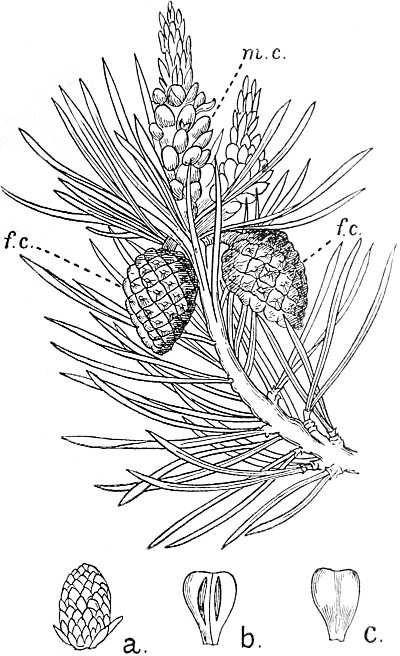
Fig. 31.—A fertile branch of the Scots Fir, Pinus sylvestris, showing the
small male cones, m.c., and the larger female cones, f.c., also the foliage
needles grouped in pairs. Drawn of two-thirds the natural size, linear.
The lower figures relate to the male cone. a, A ripe male cone, slightly
enlarged; b, inner face of one of the scales of the male cone, showing the
paired pollen-producing or stamen-like patches—much magnified;
c, outer face of the same scale.
The Scots fir is Pinus sylvestris. "Pinus" is the
name of a genus of conifers, and includes many species
besides sylvestris, our own familiar Scots fir, which
is often now spoken of by the queer, ill-sounding title
of Scotch pine. The Norway spruce or pine, called
often "common spruce," also "the spruce fir," and
"Christmas tree," is the "Picea excelsa" of correct
botany. There are several other species of the genus
Picea. A third well-known conifer, the silver fir, is
called by botanists "Abies pectinata"; there are many
other species of Abies. Although it has such a familiar,
sweet-sounding name, the silver fir is not a common
tree in England, where it was introduced only three
hundred years ago. It will not thrive at Kew Gardens.
It is the common forest-making fir of the centre of
France and of much of the mountainous country of
Southern Europe,[14] but it is rarely to be seen in the
Swiss mountains (only in certain relatively low-lying
valleys). The pine forests of those mountains are
almost exclusively formed by the spruce, with the addition
of a few Scots firs and larches, and in some parts
of the Arolla fir or pine.
The common larch is a fourth common kind of conifer.
It is distinguished from other pine trees which flourish in
England by shedding its needles so as to leave itself
bare in the winter. It is called "Larix Europœa," and is
closely related to the cedars. It was introduced into
England in 1629.
Man by his migrations and trading journeys has
had far more to do with the introduction and spreading
of trees, and even of small flowering plants, from one
country to another, than is commonly suspected. It
appears that of the trees I have already mentioned only
the Scots fir is really native to these islands. Even the
Christmas tree, the common spruce, was introduced from
the Continent by invading man after we had become
separated by the sea from the mainland of Europe.
The introduction took place, it seems, in very early
times, and there is no record of the event. Peat
deposits have been studied and their age estimated,
and it is found that in those of the age of the neolithic
men there are no remains of spruce, but only of
Scots firs!
The conifers are remarkable not only for their
"cones," but for the needle-like shape which their leaves
often present, whence the latter are spoken of simply as
"needles." Conifers are also distinguished by the fine
aromatic oils which they produce in these needles and
in their wood, which serve them as a protection against
browsing animals, although to man their perfume is
agreeable. In the Tyrol, near Cortina, I remember a
little shop in the pine woods where you could buy the
odorous essences extracted from the different species
of conifers growing around, and each species had its
own special perfume. Besides these aromatic oils, the
conifers produce peculiar resins, such as colophon, amber,
kauri gum, Canada balsam, Dammar varnish, and others,
and also various qualities of turpentine, tar, and pitch.
I have mentioned the three commonest conifers
which flourish in England, and have pointed out that
only one of them—the Pinus sylvestris, or Scots fir—is
really indigenous to our islands. It extends all over
Europe, except the extreme south and west, and right
through Russian Asia. In the Alps, at the height of
3000 to 5000 feet, it is represented by a dwarf recumbent
species, the Pinus montana, or P. pumilio.
There is another really native conifer in Britain which
belongs to a peculiar family, that of the cypresses.
This is the common juniper, called by botanists "Juniperus
communis," a mere shrub, but still a beautiful
little thing, noticeable for the fine perfume of its leaves,
which is used for flavouring "gin," and for its peculiar
minute and compact berry-like cones. It has a very wide
range, flourishing throughout the north temperate region
of Europe, Asia, and America. There is another juniper
well known in England, namely, the Savin (Juniperus
Sabina). This is not a native, but was introduced
before 1548. It has powerful medicinal properties.
When we spend our holidays abroad in Switzerland
or on the Mediterranean shores we come across many
other flourishing, well-established kinds of pines, firs, and
cypresses. And we need not leave England in order
to make acquaintance with a very large number which
have been introduced from abroad into plantations and
parks, and grow under favourable circumstances, but
cannot be said to have established themselves as
naturalized inhabitants. Among those more anciently
introduced is the cedar of Lebanon; of later introduction
we have the Indian cedar or deodar, and the Weymouth
pine, Pinus Strobus, a North American tree. Still later a
veritable crowd of American, Himalayan, Japanese, and
Chinese pine trees of one kind and another have been
introduced by dealers and their rich clients, the owners
of park plantations, so that it is now far easier to see
in the grounds around great English houses all sorts of
pine trees from remote regions of the earth than the
British species, or those interesting European kinds which
have some kind of community with them, and are, at
any rate, objects of interest to the naturalist whose
familiar ground is that of Europe. Most people are
utterly perplexed by the number of kinds, and do not
know one from another.
In order to discuss a little further in detail the
commoner kinds of Coniferæ besides those which may be
considered as truly British, and have been mentioned
above, we must take a glance at the plants related to
the natural order Coniferæ, and then at the divisions of
that natural order into families and tribes. The Coniferæ
are an order of the great class of Gymnosperms—one of
two classes into which the flowering plants or Phanerogams
are divided, the other being (as explained above) the
Angiosperms (palms, grasses, lilies, and all our ordinary
trees, shrubs, and flower-bearing herbs). The orders
included under "Gymnosperms" are: First, an order, the
Pterido-spermia, comprising certain remarkable fossil forms
connecting them with ferns; second, the order Cycadeæ,
an ancient group, of which only a dozen or so kinds
survive to this day; third, the order Gnetaceæ, including
Wellwitch's strange African plant and the little European
Ephedras, resembling the plants called horse-tails;
fourth, the order of the Gingko trees of Japan, called
also Salisburiæ, with leaves like those of the maiden's-hair
fern. They and one or two others are survivors of
an important extinct group (the Gingkoaceæ), which we
know by their fossil remains flourished in great numbers
before the chalk period. Then we have: fifth, the
order Taxaceæ (or
yew trees); and, sixth,
the order Coniferæ (or
cypresses, pines,
cedars, and firs). The
first four orders,
though very interesting,
exceptional
plants we will leave
aside, as they do not
come very near to the
Coniferæ. The order
of yew trees, Taxaceæ,
however, does come
close to the Coniferæ,
and sometimes they
are grouped together.
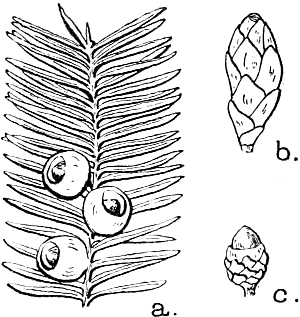
Fig. 32.—The Common Yew, Taxus baccata.
a, Part of a branch (of the natural size) showing
the needle-like leaves in two opposite rows,
and three fruits. The cup-like growth
which is seen surrounding the naked seed
is called an "aril." It is of a fine crimson
colour, soft, juicy, and sweet-tasting.
b, The young cone-like growth or "flower" of
the yew, from the end of which one seed and
its cup-like aril will develop. Magnified.
c, The seed surrounded by the incompletely
grown aril or cup at a later stage. Less
highly magnified than b.
There is one truly
native British example
of the order
Taxaceæ—the common
yew tree, called
"Taxus baccata" by
botanists. Its leaves
are "needles," like
those of most conifers, but much flattened, and it has the
sombre colour and the general aspect of some of the larger
conifers. But its ovule-bearing flower, although it appears
when young (Fig. 32, b) to be built up by several scale-like
leaves like the cone of a conifer, does not continue in
that form, and ceases to have any resemblance to a "cone."
Only the terminal leaf or scale of the group enlarges
and develops an ovule, and around this grows an open
cup-like protection of the most delicate crimson colour—soft,
sweet, and luscious (Fig. 32, c and a). It is as big
as a pea, and is largely eaten by birds and by schoolboys!
Yew trees have from time immemorial been planted and
cared for in Great Britain, since its wood was formerly
greatly valued for making archers' bows. Wild groves
of yew trees, once existing, have been largely destroyed.
Some of the finest are on the chalk hills of Surrey,
where the yew flourishes alongside of the juniper. Very
fine yew trees are often found growing, one or two
together, in village churchyards, where they have been
planted in remote times, just as cypress trees are to-day
planted in cemeteries in the South of Europe. Yew
trees with trunks from 30 to 50 feet in girth at 12 feet
from the ground are known, and it is probable that some
are as much as a thousand years old.
Many varieties of the yew tree occur in these islands.
A celebrated variety is that in which the branches are
all directed upwards rather than horizontally—a frequent
form of variation in trees which more usually have
spreading, nearly horizontal branches. This variety is
called "fastigiate" (the "fastigiate" condition of the
common cypress tree is the one usually cultivated,
although there are common varieties with spreading
branches), and in the case of the fastigiate yew it is
accompanied by a variation in the disposition of the
needles or leaves. Instead of being carried right and
left in a single row on each side of the young branches,
as is usual with yews, the needles are set all round the
branch in spiral order (as they are in many conifers).
This variety was found growing wild in Co. Fermanagh,
Ireland, nearly two hundred years ago, and a couple of trees
of it were then cultivated at Florence Court by the Earl
of Enniskillen of that date. Thousands of cuttings have
been sent from one of these two original trees, which is
still vigorous (I saw it some thirty years ago at Florence
Court) all over the world. It is known as the "Florence
Court yew," or "Irish yew," and is commonly planted in
gardens. But all are from cuttings of this one original
tree, or cuttings of its cuttings, and all, like their parent,
are female berry-bearing trees, for the male and female
flowers grow on separate trees in the yew.
The foliage of the yew contains aromatic and other
chemical products, which render it poisonous to cattle.
It is said not to be poisonous when quite fresh, but only
some time after cutting. This, however, needs confirmation.
The yew makes an admirably compact and impervious
screen when grown as a hedge, and has been
largely used in gardens for this purpose. In the sixteenth
century it was the custom to clip yew hedges, or small
yew trees, into all sorts of strange shapes, birds, beasts,
and crowns. The name "topiary" is given to this
fanciful work. The popularity of the yew in the gardens
of those days is due to the small number of our native
evergreen shrubs and trees; they are yew, Scots fir,
juniper, holly, privet, ivy, butcher's broom, box (a doubtful
native), spurge-laurel, and mistletoe. Up to the end
of the seventeenth century only a few evergreens had
been introduced from abroad, viz., spruce pine, silver fir,
stone pine, pinaster, the cedar of Lebanon, savin, arbor
vitæ, evergreen oak, sweet bay, Portugal laurel, laurustine,
and arbutus.
I have often wished to have some simple, straight-forward
information as to conifers, so as to be able to
know what differences among them are really recognized
by botanists, and what are the correct names of those
which one commonly sees. Having gathered that information,
I propose to impart it, as far as may be
consistent with brevity, to my readers, though I am
afraid that to some it will prove a dull business. The
order Coniferæ, from which the yew trees (Taxaceæ)
are excluded, is divided into four families. These are:
(1) the family Abietinæ, which comprises the true pines,
and fir trees, and the cedars; (2) the family Araucarianæ,
which includes the Monkey puzzle of South America
and Australia, and the Dammar tree of New Zealand;
(3) the family Taxodinæ, which is best known by the
so-called Wellingtonia, or Sequoia, but includes several
other genera and species; and (4) the family Cupressinæ,
in which the juniper, cypress, and "arbor vitæ," or
Thuya, are placed.
The form and size of the frequently needle-like
leaves of coniferæ are not of so much importance in
indicating the affinities of these plants as one might
expect, although their grouping either in tufts or in rows
is a matter of significance. In some of them the
"needles," or leaves, are long and narrow (Abietinæ);
in others they are broad and leaf-like (Araucarianæ);
in others they are all or most of them reduced to mere
ridges or short scales set quite closely to the leaf-bearing
branch (many Cupressinæ and Taxodinæ). It is not
possible to give, without going into botanical minutiæ,
the items of structure by which the four families of
conifers are distinguished from one another. It is best
for the nature-lover who is not an adept in botanical
details to think of them as grouped each round one
well-known species. Thus the Abietinæ are grouped
round the spruce pine, the Araucarianæ round the
monkey puzzle, the Taxodinæ round the Wellingtonia,
and the Cupressinæ round the juniper. In all but the
last family the ovule-bearing scales of the female cone
are arranged spiral-wise around a central supporting
stem; in Cupressinæ they are few in number, very
thick, and opposite to one another so as to form a
globular rather than a cone-shaped body. In all but a
few Cupressinæ and Araucarianæ the male and female
cones are carried on the same tree, sometimes on
separate branches, but usually on the same branch.
The male and female cones are always distinct, and the
female much the larger and more enduring.
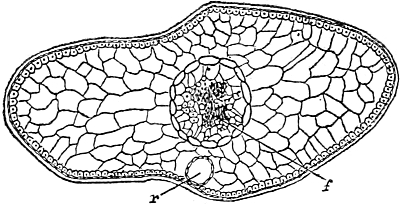
Fig. 33.—A thin slice across one of the foliage
needles of the Common Spruce. Highly
magnified. r, The single resin canal; f, the
mid-rib, with a single bundle of fibres and
vessels cut across.—(From Veitch.)
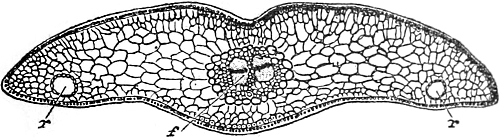
Fig. 34.—A thin slice across one of the foliage needles of the
Silver Fir. Highly magnified. It is flatter than the similar
slice of the needle of the spruce. r, r, The two resin canals;
f, the mid-rib, in which two bundles of fibres and vessels
can be distinguished.—(From Veitch.)
The Abietinæ are divided into three tribes—(a) the
spruces and silver firs (this group corresponding to
the French Sapins), (b) the larches and cedars, (c) the
Scots firs (Pins of the French). Let us take first
the group of spruces and silver firs. The Norwegian
spruce is the type of the genus Picea. It is called
Pesse by the French, Fichte by the Germans, and
Picea excelsa by botanists. We may contrast it with
the silver fir Abies pectinata (Sapin des Vosges of the
French, Silbertanne of the Germans), which we take as
the type of the genus Abies. In many respects the
silver fir looks like the spruce. In both the stem is
straight, reaching a height of 100 to 150 feet,
regularly furnished with tiers of branches from the
ground upwards. The leaves are needles, half an inch
to an inch long, which stand out from the branchlets,
but in the spruce they are quadrangular, green all
over, and arise all round the branch, whilst in the
silver fir they are flat, grooved on the lower surface,
which is silver-grey in colour, and they tend to be
disposed right and left in two rows. Each needle
has a single resin canal in the spruce, but has two
in the silver fir, as may be easily seen by cutting
the needles across the length with a sharp knife
(Figs. 33 and 34). Each scale-like ovule-producing
leaf which goes to build up the ripe seed-bearing cone
has (as in all conifers theoretically) an outer scale,
called a "bract," attached to it which is very short
and hidden in the case of the spruce cone, but is longer
than the ovuliferous scale, and very obvious in the
silver fir (Fig. 35). It has a triangular re-curved point,
which gives the cones of that species a characteristic
appearance (Fig. 36). The cones of the silver fir
(5 to 6 inches long and 2 inches thick) are set
upright on the branches, and when they have shed the
seeds the scales fall off rapidly and leave the axis bare,
whilst the cones of the spruce (about an inch shorter)
are pendulous (Fig. 37), and their scales remain in position
after the seed is shed.
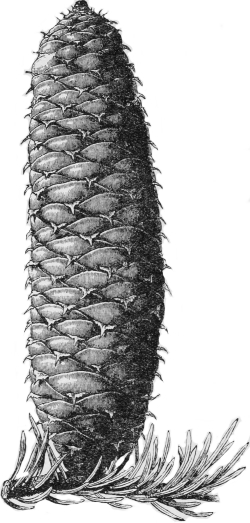
Fig. 35.—The upright spine-bearing cone of the
Silver Fir, Abies pectinata. The cones vary
from this size to one-third as long again.
(Copied from Veitch's "Manual of the Coniferæ,"
by kind permission of Messrs. Veitch.)
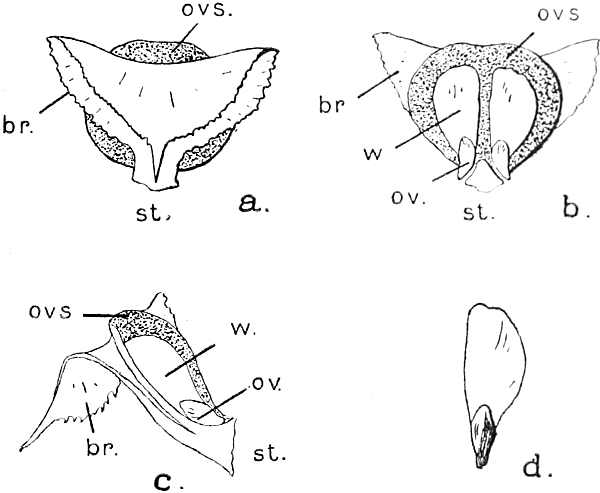
Fig. 36.—a, Structure of the female cone of the Silver Fir. A single
cone-scale, OVS, with its reflected and pointed "bract," br, seen
from the outer surface; st, stalk.
b, The same seen from the inner surface; letters as before, and in addition
OV, one of the pair of naked seeds; W, its wing.
c, The same in section, showing well the reflected or turned-over spine-like
end of the bract; letters as before.
d, One of the winged seeds detached.
There are many "spruces," other species of the genus
Picea, from various parts of Europe, temperate Asia,
and North America, which are cultivated in English
parks and gardens. Such are the American white and
red and black spruces, the Siberian, the Oriental, the
Servian, and the tiger's-tail Japanese spruce. Then
there is the beautiful variety of the blue American spruce,
Picea pungens. The blue-grey
colour of the needles is
frequently obtained as a
"variety" in the cultivation
of different species of conifers,
as also is the yellow,
or golden-leaved, condition.
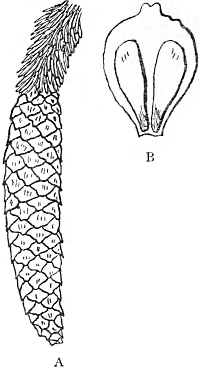
Fig. 37.
A, The female cone
of the
Common
Spruce, Picea excelsa.
Half the
natural size
(linear measurement).
It hangs
from its attachment
instead of
standing up as
does the cone of
the silver fir.
B, Ripe cone-scale of the Common
Spruce, detached and seen from
the inner face, so as to show the
two winged seeds. Enlarged.
In the genus Abies, associated
with the silver fir, are
a whole series of American,
Siberian, and Japanese
species. An interesting one
is the Californian Abies
bracteata, which has thornlike
processes on the cone
2 inches in length, corresponding
to the re-curved
spines on the cone of the
silver fir. It was introduced
into England in 1853, and
specimens are growing in
Eastnor Park, near Ledbury.
The beautiful pinsapo of the
Spanish Sierra Nevada also belongs to the genus Abies,
and may be seen in some English plantations. The
Tsuga firs of Japan and North America are related to
Abies, but are now placed in a separate genus (Tsuga),
as also is the Douglas fir of North America (Pseudotsuga),
which has been extensively planted in Great Britain.
The Douglas fir is readily recognized by the decorative
trifid outer scales or "bracts" of the rather short cone
(Fig. 42). When freshly grown these cones have beautiful
purple tints mingled with pale green.
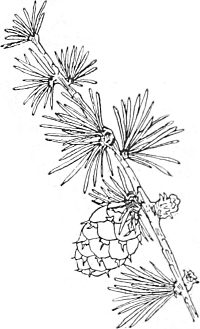
Fig. 38.—Cone and foliage (many
needles in each tuft) of the
Common Larch, Larix Europœa.
Of the natural size.
The larches and cedars form the second group or
section of the Abietinæ, distinguished by the fact that
the needle-like leaves grow
in tufts of twenty to forty
at the end of short stumpy
branchlets or "spurs" (Fig.
38). In the larches, which
form the genus Larix, the
needles fall off every autumn
and leave the tree bare, the
annually-renewed feathery
foliage contrasting, by its
fresh bright green colour, with
the darker hues of the persistent
needles of other conifers.
The common larch
(Larix Europœa) is a native of
the mountainous regions of
Central Europe. The French
call it Méléze. There are
Himalayan, Japanese, and
North American species.
The common larch when full-grown is 100 feet and more
in height, and has the branches arranged in whorls of
diminishing length, so as to give the "Christmas-tree
shape" so common among coniferæ. It was introduced
into England in the seventeenth century.
The cedars closely resemble the larches, but have the
leaves or needles persistent, and the large cones take
two years to ripen, instead of one year, as in all the
conifers which I have hitherto mentioned. The cedars
form the genus Cedrus, and three species are distinguished,
namely: (1) C. Libani, the cedar of
Lebanon; (2) C. Atlantica, the North African cedar of
the Atlas mountains; and (3) C. deodara, the Himalayan
cedar or deodar. They are now considered to
be geographical varieties of one species. They differ
chiefly in the set of the branches and foliage. The
cedar of Lebanon has the trunk forked, and gives rise
to large, unequally disposed branches, spreading horizontally;
it may have a spread of 100 feet and a height of
70 feet. In this country it is often uprooted by the wind,
or its branches are broken by a weight of snow, when it
has attained nearly full growth. The deodar cedar is
more Christmas-tree-like in shape, the trunk rarely is
forked, and it attains, in its native mountains, a height
of 250 feet. The Atlas cedar is in many respects intermediate
in character between C. Libani and C. deodara.
The cedar of Lebanon is undoubtedly the most majestic
of the conifers grown in English parks. It was introduced
in the year 1665. There are specimens growing
in this country of which the trunk has a girth of 25 feet.
The third section of the family Abietinæ is formed
by the genus Pinus, of which the Scots fir, or Scotch
pine (Pinus sylvestris), is the type. The Abietinæ of
this genus are distinguished by their foliage. There
are two kinds of leaves—the primitive ones, which are
little, scale-like, green up-growths closely scattered on
the young branches; and the secondary ones, which are
long needles carried as a tuft or fascicle on a very
stumpy branchlet. These tufts of needles are persistent
(that is to say, are not shed yearly), and differ from
those of the larches and cedars in consisting of but few
needles in a tuft, the number being characteristic of
different species, some having five, others three, others
two, and the American Pinus monophylla having only
one. The general shape of these trees is not tapering
like the spruce with unforked trunk, but they usually
shed the lower branches as growth goes on, and present
in most cases a trunk carrying an umbrella-like expanse
of foliage-bearing branches, or several such expanses.
The scales which form the cones in the genus Pinus are
(with few exceptions, such as the Weymouth pine) not flat
and flexible, but are thickened, swollen, and even knob-like
and wooden at the exposed part, which is armed
with a weak or a strong prickle (see Figs. 39, 40, and 41).
The cones do not ripen until the end of the second or
third season; they may be, according to species, erect,
pendulous, or horizontal, and vary in size in different
species. In some they remain closed on the trees for
an indefinite period (even fifteen or twenty years), until
opened by the heat of a forest fire or of an exceptionally
hot season.
The Scots fir, Pinus sylvestris (Fig. 31), called Pin de
Genève by the French, has a very wide range. It extends
eastward and northward from the Sierra Nevada, in
Spain, through Europe and Russian Asia; its northern
limit approaches the Arctic circle, its southern limit is
formed by the great mountain chains of the Alps,
Caucasus, and Altai range of Asia. The beautiful blue-green
colour of its needles, the fine red-brown tint of
its trunk and branches, and the graceful spread of its
foliage high up on a few great, unequally-grown branches
springing from its tall, bare trunk, are amongst the most
picturesque features of English landscape. In the
southern counties "clumps" of a dozen or score of these
graceful trees are often to be seen on some isolated hilltop
in the moorlands, and are associated with poetic
tradition and ancient superstition. In the North of
Britain they are more frequent as forest. The Scots
fir is the only pine tree really native in our land. It
is distinguished from several other species of Pinus by
having the leaves or needles in bundles of two, and
having relatively small oblong cones (2 to 3 inches long)
which are borne near the ends of the branches (Fig. 31).
The constituent scales of the cone are only slightly
thickened, and the surface knob has no prickle. There
are two of the common pine trees of the Mediterranean
coast (the Riviera and elsewhere), namely, the Aleppo
pine (Pinus halepensis) and the so-called Corsican or
Austrian pine (Pinus Laricio), which agree in the above-given
points with the Scots fir, and are, in fact, difficult
to distinguish from it, except by general shape, mode of
growth, and the colour of the leaves and stem. The
needles of the Scots fir are 1½ to 3 inches long, those
of P. halepensis 2½ to 3½ inches, and those of P. Laricio
4 to 6 inches long. The Pyrenæan or Calabrian pine
is closely similar to these.
A very important and abundant pine on the
Mediterranean and Biscay coast of France is the Pinaster
(Pinus pinaster), often called the "cluster pine," and by
the French Pin des Landes and Pin maritime (Fig. 39).
It also has its needles, often 6 inches long, in groups of
two. It is usually a smaller tree than the others, but in
favourable localities attains a height of 80 feet. Its cones
are twice as long as those of the Scots fir, often, as at
Bournemouth, 4 and even 5 inches long, and its branches
are slender in proportion to the trunk, the bark coarse
and fissured, and its foliage (as is that of all the two-leaved
set except the Scots fir) of a yellowish (not bluish) green.
It has been found invaluable in holding sandy land from
shifting and breaking
up, and is
planted for this purpose
along the coast
of the Landes and
in other parts of
the world.
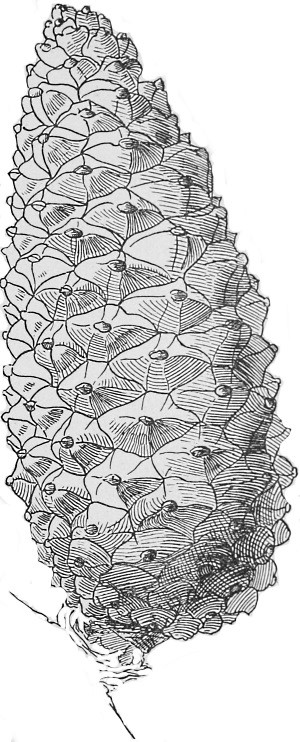
Fig. 39.—Female Cone of the Pinaster, or Maritime
Pine (Pinus pinaster). Drawn of the
natural size from a Bournemouth specimen.
A still better-known
pine, which,
like those already
mentioned, has its
needles in pairs, is
the stone pine
(Pinus pinea), called
by the French Pin
de parasol and by
the Italians Pino a
pinocchi. This fine
tree (usually bigger
than the Pinaster)
has been largely
planted in Italy on
account of its picturesque
appearance.
This is the
tree which one sees
so often in Turner's
landscapes. The
needles are 5 to 6
inches long, and the
cones are very large
and almost spherical,
being often 5
inches long and 4
inches in diameter. The cones do not mature until
the third year. The scales are very large and solid,
which renders it difficult to extract the nut-like seeds,
which are roasted and eaten. Hence the name stone-pine.
The spreading, parasol-like shape of the stone-pine
is characteristic. A few specimens are to be seen
in cultivation in this country. In order to distinguish
Pinus sylvestris from P. halepensis, laricio, pinaster, and
pinea, the deep blue-green colour of the foliage of the
first is sufficient, together with the shortness of its
needles. To distinguish the others among themselves
(except in the case of well-grown typical examples) it is
necessary to examine the cones closely, and often when
one comes upon these trees they are, on account of the
season, devoid of these distinguishing products.
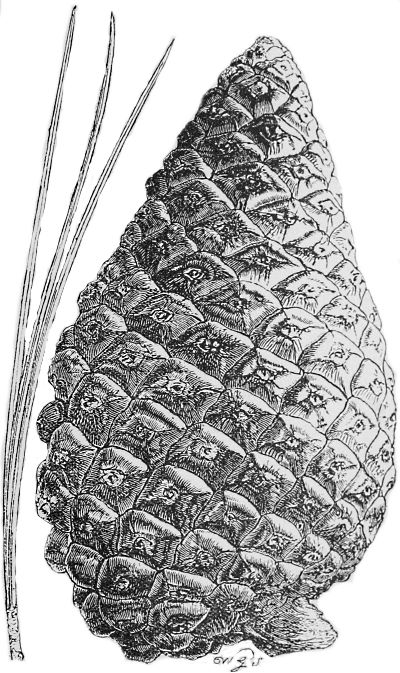
Fig. 40.—Female Cone of the Monterey Pine of California (Pinus
insignis). Of the natural size, but somewhat larger specimens
are frequent. The characteristic three foliage needles in a
bunch, in place of two or five distinctive of some other species
of Pinus, are shown in the drawing on the left.—(From
Veitch's "Manual of Coniferæ.")
Wide tracts of sandy moorland in the south of
England have been in the last century extensively
planted with various species of Pinus, and afford the
naturalist an interesting opportunity for comparing one
with another. At Bournemouth the plantations are
chiefly of the Austrian variety of Pinus Laricio,[15] the Scots
P. sylvestris, and the Mediterranean Pinaster. The latter
is especially luxuriant there. Here and there I have
found other species at Bournemouth. A remarkable one
with three needles in a group is the Californian Pinus
insignis (Fig. 40), known as the Monterey pine. It has
a very large cone which is curiously one-sided in growth,
the seed-scales on the side facing away from the
supporting branch being larger than those on the
opposite face. Another interesting species to be met
with there is the Pinus muricata, also a Californian sea-coast
species. The cones of this species are about 3
inches long and half that in breadth. In all the species
of Pinus the outer end of the scales which build up the
cone is swollen and squeezed compactly by its fellows,
forming a hard shield-like surface of a lozenge shape, in
the middle of which is a knob or process (see Figs. 31,
39, and 40). Usually this is short and not very sharp, but
in Pinus muricata the cone is very hard and solid and the
knob is elongated into a spine of nearly one-third of an inch
long (Fig. 41). Theses pines are so hard and sharp that
they render it impossible to grasp the cone with the hand in
order to pluck it. The cones remain on the tree for fifteen
years or more, and may be seen in close-set clusters surrounding
quite old branches. The cones of Pinus rigida—one
of the American pitch-pines—are similarly protected
by spines. Pinus rigida is easily distinguished by its
having its needles in bundles of three from Pinus
muricata, which has the more usual arrangement of a
pair of needles to each bundle. The Douglas fir is also
to be found here and there in the gardens and parks
of Bournemouth. Its cones (Fig. 42) are remarkable for
their beautiful purple and pale green tints when young,
and for the long trifid bract on the outside of each scale,
similar to but larger than those on the cone-scales of
the silver fir, Abies pectinata (Fig. 35), and not bent
backwards as they are.
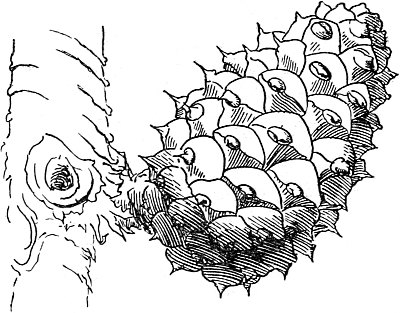
Fig. 41.—Female Cone of Pinus muricata, showing the long
sharp spines which stand up from the boss or umbo in
the centre of the swollen, woody, lozenge-shaped end or
"apex" of each seed-scale. Compare these with the
un-armed bosses in the centre of each lozenge building up
the surface of the cones drawn in Figs. 31, 39, and 40.
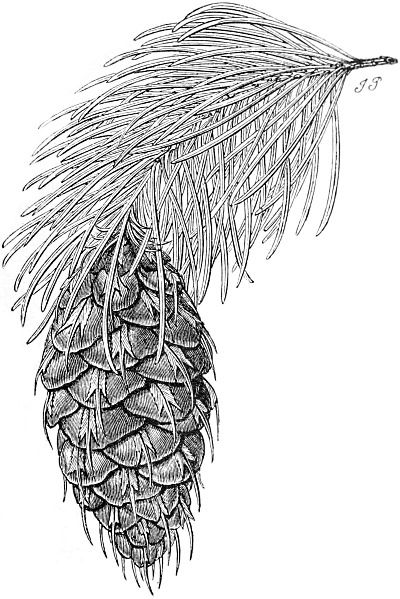
Fig. 42.—Female Cone of the Douglas Fir of North-West America
(Oregon and Vancouver), Pseudotsuga Douglasii. Of the natural
size.—(From Veitch.)
There are two pine trees of the genus Pinus which
one comes across, either in English plantations or on
the Continent, and are readily distinguished by having
the leaves (needles) in bundles of five. The first of
these is the Arolla pine—Pinus Cembra (French,
cembrot)—a pine tree much like the Scots fir in general
appearance, but distinguishable from it, not only by the
tufts of five needles in a bunch instead of two, but also
by the erect cones which are nearly as broad as long
(3 in. by 2 in.). It is essentially a Siberian tree, and
grows in Europe only on the Carpathian Mountains and
the Alps. I have seen it in the neighbourhood of the
Rhone Valley in Switzerland, but it is yearly becoming
rarer owing to its destruction at the great heights
(4000 to 6000 feet), where it formerly flourished, by the
herdsmen in order to extend the pasturage for their
milk industry. The other pine with five leaves in a tuft,
which one may often see, is the Weymouth pine—Pinus
Strobus. It is a native of the New England States and
Canada, where it is known as the white pine, and is
greatly valued as a timber tree. It was introduced and
planted in England by Lord Weymouth at the beginning
of the eighteenth century, and is a very handsome tree,
growing to 120 feet in height, with a bluish-green colour
of the foliage like that of the Scots fir. The needles
are 3 to 4 inches long, and the cones pendulous, 5 to
6 inches long and blunt. Another pine of the five-leaved
group is to be seen in gardens in the South of Europe
(for instance at Baveno on the Lago Maggiore), where
it is introduced from Mexico. This is the Pinus
Montezumæ, which has extraordinarily long tufts of
needles of a blue-green colour, each needle from 7 to
10 inches long, arranged as radiating or fan-like growths
of great beauty and striking appearance. The Bohtan
pine of the Himalayas (Pinus excelsa—not to be confused
with Picea excelsa, the spruce) is also a five-leaved
species. Several specimens of it are flourishing in Kew
Gardens.
A few lines must be given to the Araucarianæ,
Taxodinæ, and Cupressinæ. The Araucarianæ include,
besides the Chilian monkey puzzle, an Australian species,
and the New Zealand Dammar pine Agathis, which
produces the amber-like Kauri gum. The leaves of the
monkey puzzle are like the scales of a spruce cone in
shape, and the ordinary branches are like elongated
green spruce-cones, whilst the seed-cones have needle-like
scales. The next family, the Taxodinæ, are in many
respects intermediate in character, between the Abietinæ
(true pines, cedars, and firs) and the Cupressinæ (cypresses
and junipers). They have very small, lance-shaped
leaves, closely packed, so as to overlap one another—as
in the celebrated Wellingtonia or American Big-tree—and
small cones, with hard, knob-like scales, resembling
those of the most woody-coned Pinus, but few in number.
The American Big-tree (native on the western slopes
of the Californian Sierra Nevada) is named "Sequoia
gigantea" by the botanists. It was introduced into
England about sixty years ago. The Red-wood, of the
Pacific coast of the United States, is another species of
Sequoia (S. sempervirens), and it appears that a specimen
of it has been measured as reaching 340 feet in height;
whilst no living specimen of the S. gigantea has been
definitely measured of more than 325 feet in height.
There are several other large exotic, pine-like trees, which
are placed in the Taxodinæ. The extraordinary and
interesting tree called the Japanese umbrella pine
(Sciadopitys verticillata) is associated with the Sequoias
by some botanists; but it is in important respects unlike
any other conifer. It has a very peculiar foliage, namely,
rod-like leaflets, twenty to thirty in number, arranged
in circlets or whorls like the spokes or ribs of an umbrella.
The curious thing is that these are not "leaves," but,
according to botanists, are leaf-like shoots or branchlets!
It may be seen growing in Kew Gardens, where it was
introduced thirty years ago.
The last family of the Coniferæ is the Cupressinæ, so
named after the great and beautiful cypress tree, which
is said to have given its name to the island of Cyprus,
which in turn gives its name to cupreous metal, or copper.
The cypress tree similarly gives its name to "coffers"
and "coffins" made of its wood, as the Buxus or box-tree
has given its name to a "box." The cypress is the
Gopher tree of the Hebrews. The family includes many
species of junipers (Juniperus) and the American and Japanese
Arbor vitæ (Thuya) and its allies. In the common
cypress (Cupressus sempervirens) the leaves are singular,
small, scale-like growths, which are flattened on to the
delicate branchlets which bear them. In other trees of the
family both such leaves and also upstanding lancet-like
leaves are present. The main character is the small size
and globular shape of the cones and the very few swollen
scales, more like solid wedges adherent to one another,
which build them up. These wedge-like scales are not
arranged in whorls, but are opposite to one another on the
short axis or stem of the cone. The common juniper
(Juniperus communis), the génévrier of the French, grows
abundantly on the chalk downs of the South of England,
where it appears as a small bush, not exceeding 5 feet in
height, but in favourable conditions reaches a height of
20 feet. The cones of the juniper are numerous, and
each consists of only three ovuliferous scales, and is only
one-fifth of an inch in diameter when ripe, and of a
blackish violet colour.
At the close of this compressed survey of the order
Coniferæ, let me put the chief forms and groups at which
we have looked in a tabular form, thus:
Order CONIFERÆ:
| Family 1.—ABIETINÆ. |
| Section A.—Sapineæ (Spruces and Silver Firs). |
| Genus 1.—Picea. 2. Tsuga. 3. Pseudotsuga. 4. Abies. |
| Section B.—Lariceæ (Larches and Cedars). |
| Genus 1.—Larix. 2. Cedrus. |
| Section C.—Pineæ. |
| Genus unic.—Pinus. |
|
| Family 2.—ARAUCARIANÆ. |
| Genus 1.—Araucaria. 2. Agathis. 2. Cunninghamia. |
|
| Family 3.—TAXODINÆ. |
| Genus 1.—Sequoia. 2 Taxodium. 3. Sciadopitys, etc. |
|
| Family 4.—CUPRESSINÆ. |
| Genus 1.—Cupressus. 2. Thuya. 3. Juniperus, etc. |