| | PAGE |
| Grace before Meat | 9 |
| The Staff of Life | 26 |
| Saving Your Bacon | 39 |
| Hams and Other Hams | 59 |
| For Thirsty Souls | 72 |
| Paste, Pies, Puddings | 90 |
| Creole Cookery | 118 |
| Cakes, Great and Small | 136 |
| Meat, Poultry, Game, Eggs | 158 |
| Soups, Salads, Relishes | 185 |
| Vegetables, Fruit Desserts, Sandwiches | 202 |
| Pickles, Preserves, Coffee, Tea, Chocolate | 220 |
| When the Orchards "Hit" | 239 |
| Upon Occasions | 257 |
| Soap and Candles | 292 |
 Grace before Meat
"Let me cook the dinners of a nation,
and I shall not care who makes its laws."
Women, if they did but know it, might
well thus paraphrase a famous saying.
Proper dinners mean so much—good
blood, good health, good judgment, good
conduct. The fact makes tragic a truth
too little regarded; namely, that while bad
cooking can ruin the very best of raw
foodstuffs, all the arts of all the cooks in
the world can do no more than palliate
things stale, flat and unprofitable. To
buy such things is waste, instead of economy.
Food must satisfy the palate else
it will never truly satisfy the stomach.
An unsatisfied stomach, or one overworked
by having to wrestle with food which has
bulk out of all proportion to flavor, too
often makes its vengeful protest in dyspepsia.
It is said underdone mutton cost Napoleon
the battle of Leipsic, and eventually
his crown. I wonder, now and then, if the
prevalence of divorce has any connection
with the decline of home cooking?
A far cry, and heretical, do you say,
gentle reader? Not so far after all—these
be sociologic days. I am but leading
up to the theory with facts behind it, that
it was through being the best fed people
in the world, we of the South Country were
able to put up the best fight in history, and
after the ravages and ruin of civil war,
come again to our own. We might have
been utterly crushed but for our proud and
pampered stomachs, which in turn gave the
bone, brain and brawn for the conquests
of peace. So here's to our Mammys—God
bless them! God rest them! This
imperfect chronicle of the nurture wherewith
they fed us is inscribed with love to
their memory.
Almost my earliest memory is of Mammy's
kitchen. Permission to loiter there
was a Reward of Merit—a sort of domestic
Victoria Cross. If, when company
came to spend the day, I made my manners
prettily, I might see all the delightful
hurley-burley of dinner-cooking. My
seat was the biscuit block, a section of
tree-trunk at least three feet across, and
waist-high. Mammy set me upon it, but
first covered it with her clean apron—it
was almost the only use she ever made of
the apron. The block stood well out of
the way—next the meal barrel in the corner
behind the door, and hard by the Short
Shelf, sacred to cake and piemaking, as
the Long Shelf beneath the window was
given over to the three water buckets—cedar
with brass hoops always shining like
gold—the piggin, also of cedar, the corn-bread
tray, and the cup-noggin. Above,
the log wall bristled with knives of varying
edge, stuck in the cracks; with nails
whereon hung flesh-forks, spoons, ladles,
skimmers. These were for the most part
hand-wrought, by the local blacksmith.
The forks in particular were of a classic
grace—so much so that when, in looking
through my big sister's mythology I came
upon a picture of Neptune with his trident,
I called it his flesh-fork, and asked if he
were about to take up meat with it, from
the waves boiling about his feet.
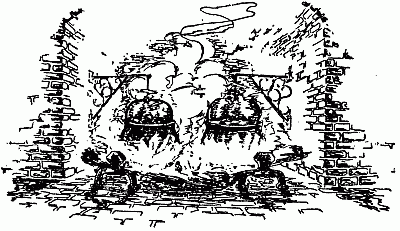
The kitchen proper would give Domestic
Science heart failure, yet it must have been
altogether sanitary. Nothing about it was
tight enough to harbor a self-respecting
germ. It was the rise of twenty feet
square, built stoutly of hewn logs, with a
sharply pitched board roof, a movable loft,
a plank floor boasting inch-wide cracks, a
door, two windows and a fireplace that
took up a full half of one end. In front
of the fireplace stretched a rough stone
hearth, a yard in depth. Sundry and several
cranes swung against the chimney-breast.
When fully in commission they
held pots enough to cook for a regiment.
The pots themselves, of cast iron, with
close-fitting tops, ran from two to ten gallons
in capacity, had rounded bottoms with
three pertly outstanding legs, and ears
either side for the iron pot-hooks, which
varied in size even as did the pots themselves.
Additionally there were ovens, deep and
shallow, spiders, skillets, a couple of tea-kettles,
a stew kettle, a broiler with a long
spider-legged trivet to rest on, a hoe-baker,
a biscuit-baker, and waffle-irons with
legs like tongs. Each piece of hollow ware
had its lid, with eye on top for lifting off
with the hooks. Live coals, spread on
hearth and lids, did the cooking. To furnish
them there was a wrought iron shovel,
so big and heavy nobody but Mammy herself
could wield it properly. Emptied vessels
were turned upside down on the floor
under the Long Shelf—grease kept away
rust. But before one was used it had to
be scoured with soap and sand rock, rinsed
and scalded. Periodically every piece was
burned out—turned upside down over a
roaring fire and left there until red hot,
then slowly cooled. This burning out left
a fine smooth surface after scouring. Cast
iron, being in a degree porous, necessarily
took up traces of food when it had been
used for cooking a month or so.
Ah me! What savors, what flavors came
out of the pots! Years on years I was
laughed at for maintaining that no range
ever turned out things to equal open-hearth
cookery. But it took paper bags to
prove beyond cavil the truth of my contention.
Even paper-bagging does not quite
match the open-hearth process, though
there is the same secret of superiority,
namely, cooking things in their own essence
by the agency of hot air. The sealed and
loaded bag needs must be laid on a grate-shelf
in a hot oven—touch of solid hot iron
is fatal to it.
Iron vessels set above smoothly spread
coals got hot, but not red-hot—red heat
belonged to the lids. They were swung
over the fire and heated before setting
them in place—then the blanket of
coals and embers held in heat which, radiating
downward, made the cooking even.
Scorching of course was possible unless
the cook knew her business, and minded it
well. Our Mammys not only knew their
business but loved it—often with a devotion
that raised it to the rank of Art. Add
the palate of a gourmet born, a free hand
at the fat, the sweet, strong waters and
high flavors—what wonder it is to envy
those of us they fed!
My individual Mammy was in figure an
oblate spheroid—she stood five feet, one
inch high, weighed two hundred and fifty
pounds, had a head so flat buckets sat on
it as of right, was as light on her feet, in
number twelve shoes, as the slimmest of
her children and foster children, could
shame the best man on the place at lifting
with the hand-stick, or chop him to a standstill—if
her axe exactly suited her. She
loved her work, her mistress, her children
black and white—even me, though I was
something of a trial—her garden and her
God. All these she served fondly, faithfully,
with rare good humor and the nicest
judgment. Fall soft upon her, rain and
snow! Sunshine and green grass, make
happy always the slope where she rests!
She put on a clean white frock every
morning—by breakfast time it was a sickly
gray along the front—the thick of the dinner-battle
was writ large on it in black
smudges. She herself explained: "I
ain't sech er dirty 'ooman—hit's dest I'se
so big, dirt ketches me comin' and gwine."
Air and more air she would have, regardless
of weather. The big board-window
had its shutter up all day long—the glass
window was a vexation, since it opened
only halfway. By way of evening things,
daubing and chinking got knocked out of
at least half the cracks between the wall
logs as sure as Easter came—not to be replaced
until the week before Christmas.
I doubt if they would have been put back
even then, but that Mammy dreaded criticism,
from maids and carriage drivers
visiting kinfolk brought with them. Big
yawning cracks in cold weather were in a
way the hall-mark of poor-white cabins.
It would have half broken Mammy's heart
to give anybody room to say she belonged
to less than real quality.
She was autocratic; a benevolent despot;
withal severe. If I displeased her by
meddling, putting small grimy fingers into
pies they should not touch, she set me to
shelling black-eyed peas—a task my soul
loathed, likewise the meddlesome fingers—still
I knew better than to sulk or whine
over it. For that I would have been sent
back into the house. The kitchen stood
thirty yards away from the back door, with
a branchy oak in front of it, and another,
even branchier, shading the log foot-way
between. The house offered only grown-up
talk, which rarely interested me. In the
kitchen I caught scraps of Brer Rabbit's
history, pithily applied, other scraps of
song—Mammy always "gave out" the
words to herself before singing them—proverbs
and sayings such as "Cow want
her tail agin in fly-time" applied to an ingrate,
or: "Dat's er high kick fer er low
horse," by way of setting properly in place
a pretender.
Best of all, I got the latest news of the
countryside for ten miles around. Wireless
has little on the way things ran about
among the plantations. It was a point of
honor among the black men to have wives
or sweethearts away from home. This
meant running about nightly—consequently
cross-currents of gossip lively
enough to make the yellowest journal turn
green with envy. Mammy was a trifle
apologetic over having a husband no further
off than the next neighbor's. To
make up for it, however, the husbands who
came to his house lived from three to five
miles away—and one of them worked at
the mill, hence was a veritable human
chronicle. Thus Mammy was able to hold
her head up with Susan, her sister, who
milked and washed.
Susan might have been called a widow
of degrees—she had had three husbands,
but only two were living. The last parting
was always threatening to end in meeting
over again—still that did not hinder
her cabin from being the rendezvous of all
the likeliest fellows within easy walking
range. Naturally she had things to tell—worth
hearing whether or no they were
true. So also had Phoebe, who was a sort
of scullion, fetching in wood and water,
gathering vegetables, picking chickens,
scouring all things from the big pot to the
floor. Shelves were scoured daily, the floor
three times a week. This had to be a
matter of faith after an hour or so—it certainly
did not look it. Sweeping, done
three times a day, was largely a matter of
form. Phoebe went conscientiously over
the uncluttered spaces, and even reached
the nose of her broom between pots and
ovens, but only coarse trash gathered before
the broom—all the rest went through
the cracks.
Mammy said Phoebe's news could be believed.
"De gal don't know no mo'n ter
tell dest whut she done heard." She truly
was slow-witted and slow-spoken, but
Isham, her step-father, was cook to the
Gresham brothers, the beaux of the neighborhood,
who kept bachelor's hall. His
mother had been their Mammy—hence his
inherited privilege of knowing rather more
about his young masters than they knew
themselves.
Little pitchers have big ears. Set it to
the credit of the black folk, they always had
regard for the innocence of childhood.
Scandal was merely breathed—not even so
hinted as to arouse curiosity. Foul speech
I never heard from them nor a trace of
profanity. What I did hear was a liberal
education in the humanities—as time
passes I rate more and more highly the
sense of values it fixed in a plastic mind.
I think it must have been because our
Mammys saw all things from the elemental
angle, they were critics so illuminating of
manners and morals.
Here ends reminiscence, set down in hope
it may breed understanding. All I actually
learned from Mammy and her cooking
was—how things ought to taste. The
which is essential. It has been the pole-star
of my career as a cook. Followed faithfully
along the Way of Many Failures,
through a Country of Tribulations, it has
brought me into the haven of knowledge
absolute. If the testimony of empty plates
and smiling guests can establish a fact,
then I am a good cook—though limited. I
profess only to cook the things I care to
cook well. Hence I have set my hand to
this, a real cook's book. Most cook books
are written by folk who cook by hearsay—it
is the fewest number of real cooks who
can write so as not to bewilder the common
or garden variety of mind. The bulk of
what follows has an old-time Southern
foundation, with such frillings as experience
approves. To it there will be added
somewhat of Creole cookery, learned and
proved here in New York town by grace
of Milly, the very queen of New Orleans
cooks, temporarily transplanted. Also
sundry and several delectable dishes of
alien origins—some as made in France or
Germany, some from the far Philippines,
but all proved before record. In each case
the source is indicated in the title. Things
my very own, evolved from my inner consciousness,
my outer opportunity and environment,
I shall likewise mark personal.
Lastly, but far from leastly, let me make
protest against over-elaboration, alike in
food and the serving thereof. The very
best decoration for a table is something
good in the plates. This is not saying one
should not plan to please the eye no less
than the palate. But ribbon on sandwiches
is an anachronism—so is all the flummery
of silk and laces, doilies and doo-dads that
so often bewilder us. They are unfair to
the food—as hard to live up to as anybody's
blue china. I smile even yet, remembering
my husband's chuckles, after
we had come home from eating delicatessen
chicken off ten-dollar plates, by help of antique
silver. Somehow the viands and the
service seemed "out of drawing."
Quoth Heine the cynic: "Woman,
woman! Much must be forgiven thee!
Thou hast loved much—and many." Edibly
I love much rather than many. Enough
of one thoroughly good thing, with proper
accessories, is more satisfying than seven
courses—each worse than the last. Also
cheaper, also much less trouble. If time
has any value, the economy of it in dishwashing
alone is worth considering. In
these piping days of rising prices, economy
sounds good, even in the abstract. Add
the concrete fact that you save money as
well as trouble, and the world of cooks may
well sit up and take notice.
The one-piece dinner is as convenient and
comfortable as the one-piece frock. There
are, of course, occasions to which it is unsuited.
One-piece must be understood to
mean the pièce de resistance—the backbone
of subsistence as it were. A bowl of
rich soup or chowder, with crackers on the
side, a generous helping of well-cooked
meat, with bread or potatoes, and the simplest
relishes, or a royally fat pudding
overrun with brandy sauce; each or either
can put it all over a splash of this, a dab
of that, a slab of something else, set lonesomely
on a separate plate and reckoned
a meal—in courses. Courses are all well
enough—they have my warm heart when
they come "in the picture." But when
they are mostly "The substance of things
hoped for, the evidence of things not seen,"
then I would trade them, and gladly, for as
much good bread and butter as appetite
called for.
By way of postscript: being a strict and
ardent advocate of temperance, I refused
to consider writing this book unless I had
full liberty to advise the use of wine,
brandy, cordials, liquors, where good cooking
demands them. Any earthly thing can
be abused—to teach right use is the best
preventive of abuse. Liquors, like everything
else, must be good. "Cooking
sherry" is as much an abomination as
"cooking butter," or "cooking apples."
You will never get out of pot or pan anything
fundamentally better than what went
into it. Cooking is not alchemy; there is
no magic in the pot. The whole art and
mystery of it is to apply heat and seasoning
in such fashion as to make the best,
and the most, of such food supplies as your
purse permits. Tough meat cannot be
cooked tender; tainted meat cannot be
cooked sound. It is the same with stale
fish, specked or soured fruit, withered vegetables.
It pays to educate tradesfolk into
understanding that you want the best and
only the best of what you buy. If the thing
you want, in perfect condition, is beyond
your means, take, instead of a lower grade
of it, the highest grade of something
cheaper. So shall you escape waste of
time, effort and substance. Never mind
sneers at your simple fare. Remember it
was Solomon the Wise who wrote: "Better
a dinner of herbs and contentment than
a stalled ox, and contention therewith."
Paraphrase the last clause into "spoiled
ox and ptomaines therewith," and you
may keep not only self-respect, but that of
the neighbors.
 The Staff of Life
Bread, more than almost any other foodstuff,
can not be better than what it is
made of. Here as elsewhere a bungler
can ruin the very best of flour or meal.
But the queen of cooks can not make good
a fundamental deficiency.
Hence in buying flour look for these
things: a slightly creamy cast—dazzling
whiteness shows bleaching, as a gray-white,
or black specks mean grinding from
spoiled grain. The feel should be velvety,
with no trace of roughness—roughness
means, commonly, mixture with corn. A
handful tightly gripped should keep the
shape of the hand, and show to a degree
the markings of the palm. A pinch wet
rather stiff, and stretched between thumb
and finger, will show by the length of the
thread it spins richness or poverty in gluten—one
of the most valuable food elements.
The cornmeal of commerce will not be
satisfactory in any receipt here given. It
has been bolted and kiln-dried out of all
natural flavor. Take the trouble to get
meal water-ground, from white flint corn,
and fresh from the mill. Then you will
have something worth spending time and
effort upon—spending them hopefully.
Why, the wisest man can not tell—but
steam-ground meal is of a flavor wholly
unlike that water-ground. The grinding
should be neither too fine nor too coarse.
Bran left in, and sifted out as needed,
helps to save from musting, and to preserve
the delicate natural flavor. Fresh
meal, in clean bright tin or glass, or in a
stout paper sack, where it is dry, cool and
airy will keep two months. Hence buy it
judiciously, in proportion to your family's
corn-cake appetite.
It is impossible to give exactly the
amount of liquid for any sort of bread-making
because the condition of flour and
meal varies with weather and keeping.
This applies also to sugar—hence the need
for intelligence in the use of receipts. In
damp muggy weather moisture is absorbed
from the atmosphere. Upon a dry day
especially if there is much wind, drying
out is inevitable. Anything that feels
clammy, or that clots, should be dried in a
warm, not hot, oven. Heating flour before
mixing it, taking care not to scorch it in
the least, is one small secret of light bread,
biscuit and cake. Flour in a bag may be
laid in the sun with advantage. Use judgment
in mixing. Note the appearance of
what you are making closely—when it
turns out extra good, set up that first condition
as a standard.
Beaten Biscuit: (Old Style.) Sift a
quart of flour into a bowl or tray, add half
a teaspoon salt, then cut small into it a
teacup of very cold lard. Wet with cold
water—ice water is best—into a very stiff
dough. Lay on a floured block, or marble
slab, and give one hundred strokes with a
mallet or rolling pin. Fold afresh as the
dough beats thin, dredging in flour if it
begins to stick. The end of beating is to
distribute air well through the mass, which,
expanding by the heat of baking, makes the
biscuit light. The dough should be firm,
but smooth and very elastic. Roll to half-inch
thickness, cut out with a small round
cutter, prick lightly all over the top, and
bake in steady heat to a delicate brown.
Too hot an oven will scorch and blister,
too cold an one make the biscuit hard and
clammy. Aim for the Irishman's "middle
exthrame."
There are sundry machines which do
away with beating. It is possible also to
avoid it by running the dough, after mixing,
several times through a food-chopper.
Also beaten biscuit can be closely imitated
by making good puff paste, rolling, cutting
out, pricking and baking—but rather more
quickly than the real thing. All these are
expedients for those who live in apartments,
where the noise of beating might
be held against good neighborhood.
Householders, and especially suburban
ones, should indulge in the luxury of a
block or stone or marble slab—and live
happy ever after, if they can but get cooks
able and willing to make proper use of it.
Soda Biscuit: (Old Style.) Sift a
quart of flour with a heaping teaspoonful
of baking soda. Add a good pinch of salt,
rub well through lard or butter the size of
the fist, then wet with sour milk to a moderately
soft dough, roll out, working
quickly, cut with small round cutter, set
in hot pans, leaving room to swell, and bake
in a quick oven just below scorching heat.
Handle as lightly as possible all through—this
makes flaky biscuit.
By way of variety, roll out thin—less
than a half-inch, cut with three-inch cutter,
grease lightly on top, and fold along the
middle. Let rise on top a hot stove several
minutes before putting to bake. By
adding an egg, beaten light, with a heaping
tablespoonful of sugar to the dough in
mixing, these doubled biscuit will be quite
unlike the usual sort.
Salt Rising Bread: (As Mammy Made
It.) Scald a tablespoonful of sifted cornmeal,
and a teaspoonful—heaped—of salt
with a pint of boiling water, let stand ten
minutes, then stir in, taking care to mix
smooth, enough dried and sifted flour to
make a thick batter. Damp flour will not
rise. The batter should be almost thick
enough to hold the mixing spoon upright—but
not quite thick enough. Set the mixture
in warm water—just as hot as you
can bear your hand in. Keep up the heat
steadily, but never make too hot—scalding
ruins everything. Keep lightly covered,
and away from draughts. Look in after
an hour—if water has risen on top, stir in
more flour. Watch close—in six hours the
yeast should be foamy-light. Have ready
three quarts of dry sifted flour, make a
hole in the center of it, pour in the yeast,
add a trifle more salt, a tablespoonful
sugar, and half a cup of lard. Work all
together to a smooth dough, rinsing out
the vessel that has held the yeast, with
warm not hot water to finish the mixing.
Divide into loaves, put in greased pans,
grease lightly over the top, and set to rise,
in gentle heat. When risen bake with
steady quick heat. Take from pans hot,
and cool between folds of clean cloth,
spread upon a rack, or else turn the loaves
edgewise upon a clean board, and cover
with cheese cloth.
To make supper-rolls, shape some of the
dough into balls, brush over with melted
butter, set in a deep pan, just so they do
not touch, raise and bake the same as
bread. Dough can be saved over for
breakfast rolls, by keeping it very cold,
and working in at morning, a tiny pinch of
soda before shaping the balls.
Sweet Potato Biscuit: (Old Style.)
Boil soft two large or four small sweet potatoes,
mash smooth while very hot, free
of strings and eyes, add a pinch of salt,
then rub well through three cups of sifted
flour. Rub in also a generous handful of
shortening, then wet up soft with two eggs
beaten very light, and sweet milk. A little
sugar also if you have a sweet tooth—but
only a little. Roll to half-inch thickness,
cut out with small cutter, lay in warm pan,
and bake brown in a quick oven. Soda and
buttermilk can take the place of eggs and
sweet milk—in which case the sugar is advisable.
Mix the soda with the milk—enough
to make it foamy, but no more.
Waffles: (Mammy's.) Separate three
eggs. Beat yolks and whites very light.
Add to the yolks alternately a pint of very
rich sweet milk, and handfuls of sifted
flour. Enough to make a batter rather
thicker than cream. Put in also half a
teaspoon—scant—of salt, and half a cup of
lard, or lard and butter, melted so it will
barely run. Mix well, then add the beaten
whites of egg. Have the waffle irons hot
but not scorching—grease well with melted
lard—the salt in butter will make the batter
stick. Cook quickly but take care not to
burn. Lay on hot plate—have a pitcher
of melted butter to pour on. Lay the second
waffle upon the first, butter, and keep
hot. It is not safe to begin serving without
at least six waffles in plate. This, of
course, provided you have several eaters
with genuine appetites. Syrup can be
passed with the waffles—but it is profanation
to drench them with it—strong clear
coffee, and broiled chicken are the proper
accompaniments at breakfast.
Plain Corn Bread: (The Best.) Sift
sound fresh white cornmeal, wet with cold
water to a fairly soft dough, shape it by
tossing from hand to hand into small
pones, and lay them as made into a hot pan
well sprinkled with dry meal. The pan
should be hot enough to brown the meal
without burning it. Make the pones about
an inch thick, four inches long, and two
and a half broad. Bake quickly, taking
care not to scorch, until there is a brown
crust top and bottom. For hoe-cakes make
the dough a trifle softer, lay it by handfuls
upon a hot-meal-sprinkled griddle, taking
care the handfuls do not touch. Flatten
to half an inch, let brown underneath, then
turn, press down and brown the upper
side. Do not let yourself be seduced into
adding salt—the delight of plain corn-bread
is its affinity for fresh butter. It
should be eaten drenched with butter of
its own melting—the butter laid in the
heart of it after splitting pone or hoe-cake.
Salt destroys this fine affinity. It however
savors somewhat bread to be eaten
butterless. Therefore Mammy always
said: "Salt in corn-bread hit does taste
so po' white-folks'y." She had little patience
with those neighbors of ours who
perforce had no butter to their bread.
Egg Bread: (Mammy's.) Beat two
eggs very light with a pinch of salt, add
two cups sifted cornmeal, then wet with a
pint of buttermilk in which a teaspoonful
of soda has been dissolved. Stir in a
spoonful of shortening, barely melted, mix
well, and pour into well greased pans or
skillets, cook quickly, till the crust is a
good brown, and serve immediately. Or
bake in muffin moulds. For delicate stomachs
the shortening can be left out, but
pans or moulds must be greased extra well.
If milk is very sour, make it one-third
water—this is better than putting in more
soda.
Batter Cakes: (Old Style.) Sift together
half-cup flour, cup and a half meal,
add pinch of salt, scald with boiling water,
stir smooth, then add two eggs well beaten,
and thin with sweet milk—it will take about
half a pint. Bake by spoonfuls on a hot,
well-greased griddle—the batter must run
very freely. Serve very hot with fresh
sausage, or fried pigs' feet if you would
know just how good batter cakes can be.
Ash Cake: (Pioneer.) This is possible
only with wood fires—to campers or millionaires.
Make dough as for plain bread,
but add the least trifle of salt, sweep the
hot hearth very clean, pile the dough on
it in a flattish mound, cover with big leaves—cabbage
leaves will do at a pinch, or even
thick clean paper, then pile on embers with
coals over them and leave for an hour or
more, according to size. Take up, brush
off ashes, and break away any cindery bits.
Serve with new butter and fresh buttermilk.
This was sometimes the sole summer
supper of very great families in the
old time. Beyond a doubt, ash cake properly
cooked has a savory sweetness possible
to no other sort of corn bread.
Mush Bread: (Overton Receipt.) To a
quart of very thick mush, well salted, add
three fresh eggs, breaking them in one
after the other, and beating hard between.
When smooth add half a cup of rich milk,
and half a cup melted butter. Stir hard,
then add one teaspoonful baking powder,
and bake quickly. Bake in the serving dish
as it is too soft for turning out, requiring
to be dipped on the plates with a spoon.
Hence the name in some mouths: "Spoon
bread."
Cracklin' Bread: (Pioneer.) Sift a
pint of meal, add a pinch of salt, then mix
well through a teacup of cracklings—left
from rendering lard. Wet up with boiling
water, make into small pones, and bake
brown in a quick but not scorching oven.
Pumpkin Bread: (Pioneer.) Sift a
pint of meal, add salt to season fully, then
rub through a large cupful of stewed pumpkin,
made very smooth. Add half a cup
melted lard, then mix with sweet milk to a
fairly stiff dough, make pones, and bake
crisp. Mashed sweet potato can be used
instead of pumpkin, and cracklings, rubbed
very fine in place of lard. Folks curious as
to older cookery, can even make persimmon
bread, using the pulp of ripe persimmons
to mix with the meal—but they will need
the patience of Job to free the pulp
properly from skin and seed.
Mush Batter Cakes: (For Invalids.)
Bring half a pint of water to a bubbling
boil in something open, add to it a pinch
of salt, then by littles, strew in a cup of
sifted meal, stirring it well to avoid lumps.
Let cool partly, then cook by small spoonfuls
on a hot griddle very lightly greased.
Make the spoonfuls brown on both sides,
and serve very hot.
Wafers: (For Invalids or Parties.)
Rub a cup of lard or butter, through a
quart of sifted flour. Butter will give
enough salt—with lard add a pinch. Mix
with sweet milk, the richer the better, to a
smooth dough, not stiff nor soft. Shape
into balls the size of a small egg, roll out
very thin, prick lightly all over, and bake
brown—it will take about five minutes in
a quick oven. Cool on cloth and keep dry.
Handle delicately—if the wafers are what
they should be; they break and crumble at
any rough touch.
 Saving Your Bacon
Plenty in the smokehouse was the cornerstone
of the old time southern cookery.
Hence hog-killing was a festival as joyous
as Christmas—and little less sacred.
There was keen rivalry amongst plantations
as to which should show the finest
pen of fattening hogs. Though the plantation
force was commonly amply sufficient
for the work of slaughter, owners indulged
their slaves by asking help of each other—of
course returning the favor at need.
A far cry from a cook book, common or
garden variety. Here, it is worth its
space, as explaining in a measure what follows.
Namely full direction for choosing
your fatted pig, cutting him up, and
making the most of the ultimate results.
Choose carcasses between a hundred and
seventy-five and a hundred and fifty pounds
in weight, of a fresh pinky white hue, free
of cuts, scratches, or bruises, the skin
scraped clean, and firm, not slimy, to touch,
the fat firm and white, the lean a lively purplish
pink. Two inches of clear fat over
the backbone, and the thick of the ribs
should be the limit. Anything more is
wasteful—unless there is a great need
of lard in the kitchen. The pig should
be chilled throughout, but not frozen—freezing
injures flavor and texture somewhat,
besides preventing the proper quick
striking in of salt.
Curing space permitting, it is wise to cut
up several pigs at once. The trouble is
hardly increased, and the results, especially
in saving, very much greater. The
head will have been at least half severed
in slaughtering. With a very sharp
butcher knife, after the pig is laid on the
chopping block, cut deeply through the
skin, all round, then with a blow or two of
the axe sever the head. Next cut through
the skin deeply, either side of the back
bone. The cuts should be evenly parallel,
and about two inches apart. Now turn the
pig on his back, part the legs and with the
meat axe chop through the ribs, and joints.
After chopping, cut the backbone free with
the knife, trim off the strip of fat for the
lard pile, chop the backbone itself into
pieces three to four inches long, until the
chine is reached—the part betwixt the
shoulder blades with the high spinal processes.
Leave the chine intact for smoking,
along with the jowls and sausage.
Pull out the leaf-fat—it grows around
and over the kidneys. Also pull out the
spare ribs, leaving only one or two in the
shoulders. This done, chop off feet, then
with the knife cut hams and shoulders free
from the sides. Trim after cutting out,
saving all trimmings for sausage. Save
every bit of pure fat for lard. Also cut
away the clear fat at the top of the sides,
devoting it to the same use. Make clean
cuts on the joints—this means a knife often
whetted. Trim the hams rather flat, and
shape the hip bone neatly. The commercial
fashion of cutting away all the upper
half of hams is fatal to perfect flavor.
Trim shoulders close, unless they are destined
to be made into sausage—in that
case put them with the other scraps. Sides
can either be cut into strips four to five
inches wide the long way, after the manner
of commercial "breakfast bacon," or left
whole throughout their streaky part, cutting
away solid fat along the top for lard.
Separate the heads at the jaw, leaving the
tongue attached to the jowl, and taking
care not to cut it. Cut off the snout two
inches above the tip, then lay the upper
part of the head, skin down, crack the
inner bone with the axe, press the broken
bones apart, and take out the brains.
Jowls are to be salted and smoked—heads
are best either simply corned for boiling
with cabbage, peas, beans, etc., or made
in conjunction with the feet into headcheese,
whose south country name is souse.
Use regular pickling salt—coarse-grained
and lively. Spread it an inch
thick upon clean wood—a broad shelf, box
bottom, or something similar. Rub the
meat well over with salt, and then lay it
neatly, skin-side down, upon the salt layer,
spread more salt on top, and put on another
layer of meat. Put sides together,
likewise hams and shoulders. Pack as
close as possible and fill all crevices with
salt. Salt alone will save your bacon, but a
teacup of moist sugar well mixed through a
water-bucket of salt improves the flavor.
Use this on sides, jowls and chines. The
joints, hams and shoulders, especially if
the shoulders are close-cut, need a trifle
more sugar in the salt, also a trifle of saltpeter—say
an ounce in fine powder to
three gallons of salt. Rub the skin-sides
over with plain salt, and lay upon the salt-covered
shelf the same as sides. Then take
a handful of the mixture and rub it in hard
around the bone, then cover the whole cut
surface half an inch thick, spread on dry
salt for another layer of hams or shoulders,
and repeat. Salt the chines lightly—their
surface, cut all over, takes up too much
salt if permitted. There should be holes
or cracks in the bottom to let the dissolved
salt drip away; it is best also to have it
a foot at least above the floor.
Cover the meat thus in bulk, but not too
close, and leave standing a fortnight. The
cooler and airier the place it stands in the
better—freezing even is not objectionable
when the salt begins striking in. But
with freezing weather the meat must lie
longer in salt. Overhaul it after the first
fortnight—that is to say break up the bulk,
shake away bloody salt, sweep the bottom
clean, and put on fresh salt. But use very
little saltpeter on the joints this time—on
pain of making them too hard as to their
lean. Its use is to give firmness and a
handsome clear red color—an overdose of
it produces a faintly undesirable flavor.
Some famous ham makers, at this second
salting, rub the cut sides over lightly
with very good molasses, and sprinkle on
ground black pepper, before adding new
salt. Others rub in a teaspoonful of sugar
mixed with pounded red pepper around the
bone. But very excellent hams can be
made without such excess of painstaking.
Let the meat lie two to four weeks after
overhauling, according to the weather.
Take up, wipe all over with coarse clean
cloth, furnish each piece with a loop of
stout twine at least four inches long, and
so run through the flesh, tearing out is impossible.
Run through the hock of hams,
the upper tip of shoulders, the thickest
part of sides, the pointed tip of jowls.
Jowls may not need to lie so long as bigger
pieces, especially if part of their fat has
gone to lard. Chines can be hung up in
three weeks, and cured with a very light
smoking, along with the bags of sausage.
Hang hams highest, shoulders next, then
sides, jowls, etc. Leave to drip forty-eight
hours unless the weather turns suddenly
warm, damp and muggy—in that
case start the smoking after a few hours.
Smoke from green hickory, sound and
bright, is needed for the finest flavor. Lay
small logs so they will hug together as
they burn, kindle fire along the whole
length of them, then smother it with damp,
small chips, trash, bark and so on, but take
care to have everything sound. Rotten
wood, or that which is water-logged or mildewed,
makes rank, ill-smelling smoke.
Take greater care that the logs never blaze
up, also that the meat is high enough to
escape fire-heating. Once it gets hot from
the fire all your trouble will have been for
naught—though it will not be tainted it
will have the same taste and smell—the
degree marking the extent of the heating.
Old southern smokehouses had for the
most part earthen floors, trenched to make
the smoke fires safe. Some had puncheon
floors, with an earthen hearth in the
middle, whereupon was placed a furnace
of loose brick—that could be kicked over
at need, smothering an outbreaking fire.
Still others had big cast iron kettles sunk
in a sort of well in the floor—with a handy
water bucket for quenching fires. Whatever
the floor, eternal vigilance was the
price of safe bacon—you looked at the
smokehouse fires first thing in the morning
and last at night. They were put out
at sundown, but had a knack of burning
again from some hidden seed of live coal.
Morning smoke could not well be too thick,
provided it smelled right—keen and clean,
reminiscent of sylvan fragrance—a thick,
acrid smoke that set you sneezing and
coughing, was "most tolerable and not to
be endured." It was not well to leave the
smoke too thick at night—somehow the
chill then condensed it. A thin, blue, hot-scented
but cool, vapor was the thing to
strive for then. There were folk who suggested
furnaces—with smoke pipes leading
in—ever so much safer they said, withal
much less trouble. Why! even the smoke
from a cooking stove might be made to answer.
But these progressives were heard
coldly—the old timers knew in right of tradition
and experience, the need of well
ventilated smoke.
It gave this present chronicler a feeling
of getting home again, to walk through the
curing rooms of perhaps the most famous
bacon makers in the world, and find them
practicing the wisdom of her childhood.
Namely using hickory smoke not delivered
from furnace pipes but welling up, up, in
beautiful wreathy spirals, to reach row
on row of hams and flitches—and to be told,
by a kind person who did not know she
already knew, that their curing was patterned
on the old English model—curing
in the smoke of great-throated stone hall
chimneys. Yes—they had tried pipes—furnaces
likewise—but they gave too much
heat, did not distribute smoke evenly, besides
being almost impossible of regulation.
Hence the smoldering hickory that
was like a breath from a far past.
Notwithstanding, the chronicler is of
opinion that folk who would like to try
their hands at bacon making may do it
with a fair hope without building regular
smoke houses. To such she would say, get
a stout hogshead—a sugar hogshead preferable—nail
on a board roof to shed water,
then set it upon a stout frame at least seven
feet above ground. Nail inside it stout
cleats, to hold the cross bars for the meat.
Hang the meat upon them—but not until
the hogshead is in place. Cut a hole in
the bottom as big as the top of a large
barrel. Working through this hole, arrange
the meat, then put below a headless
barrel, the top resting against the hogshead-heading,
the bottom upon supports of
gas pipe, iron, or even piled bricks. Between
the supports set an iron vessel—build
your hickory smoke-fires in it, smothering
them carefully, and letting the smoke,
with a sufficiency of air, well up, through
barrel, hogshead, etc. Or one might even
rig up a smoking hogshead in an attic,
providing the chimney were tall enough
to cool smoke properly—and lead smoke
out to it through a length of drain pipe.
These are but suggestions—the contriving
mind will doubtless invent other and
better ones. Smoking must go on for five
weeks at least. Six will be better, slacking
toward the end. But two may be made
to answer by the use of what is called
"liquid smoke" whose other name is crude
pyroligneous acid. A product of wood
distillation, it has been proved harmless in
use, but use is nevertheless forbidden
to commercial makers. The meat, after
breaking bulk, is dipped in it three times
at fairly brief intervals, hung up, drained,
and smoked. From the liquid smoke it
will have acquired as much acid saving-grace,
as from four weeks of old fashioned
smoking.
A smokehouse needs to be kept dark,
dry, and cool, also well ventilated. Use
fine screen wire over all openings, and
make windows very small, with coarse,
sleazy crash in the sash rather than glass
inside the screens. Darkness prevents
or discourages the maggot-fly. To discourage
him still further cover the cut sides
of hams and shoulders before hanging up
with molasses made very thick with ground
black pepper. They will not absolutely
require canvassing and dipping in whitewash
after if the peppering is thorough.
But to be on the safe side—canvas and
dip. Make the whitewash with a foundation
of thick paste—and be sure it covers
every thread of the canvas. Hams perfectly
cured and canvassed keep indefinitely
in the right sort of smokehouse—but
there is not much gain in flavor after
they are three years old.
In rendering lard try out leaf fat to
itself—it yields the very finest. Cut out
the kidneys carefully, and remove any bit
of lean, then pull off the thin inner skin,
and cut up the leaves—into bits about two
inches wide and four long. Wash these
quickly in tepid water, drain on a sieve,
and put over a slow fire in an iron vessel
rather thick bottomed. Add a little cold
water—a cupful to a gallon of cut up fat,
and let cook gently until the lumps of fat
color faintly. Increase heat till there is
a mild bubbling—keep the bubbling steady,
stirring often to make sure no lump of fat
sticks to the pot and scorches, until all
the lumps are crisp brown cracklings.
Bright brown, not dark—if dark the lard
will be slightly colored. Scorching taints
and ruins the whole mass. Strain through
a sieve into a clean tin vessel, newly
scalded and wiped dry. Put the cracklings
into a bag of stout crash, and press hard
between two clean boards, till no more fat
runs from them. A jelly press comes in
handy, but is not essential. If weak, clear
lye, made of green wood ashes, is put in
with the fat instead of water at the beginning,
the fat-yield will be greater, and the
bulk of cracklings less, also more nearly
disintegrated.
Other fat is tried out in the same way,
taking care to remove all skin and cut
away streaks of lean. Bits with much lean
in them had better go to the sausage mill—the
right proportion there is two pounds
of fat to three and a half of lean. Mix
well in grinding, and remove all strings,
gristle, etc. Seasoning is so much a matter
of taste, do it very lightly at first—then
fry a tiny cake, test it, and add whatever
it seems to lack or need. Be rather
sparing of salt—eaters can put it in but
can not take it out, and excess of it makes
even new sausage taste old. A good combination
of flavors, one approved by experience,
is a cupful of powdered and
sifted sage, an ounce of black pepper newly
ground, and very fine, a tablespoonful of
powdered red pepper, a teaspoonful of
cayenne, a pinch of thyme in fine powder,
a dozen cloves, as many grains of alspice,
beaten fine, a teaspoonful of moist sugar,
and a blade of mace in fine powder. Omit
the mace, cloves, etc. if the flavor repels.
Mix all well together, then work evenly
through the meat. This seasoning should
suffice for five pounds of ground meat
lightly salted. More can be used by those
who like high and pronounced flavors.
Scrape feet very clean, and take off hoofs
by either dipping in scalding hot lye, or hot
wet wood ashes. Wash very clean after
scraping, throw in cold water, soak an hour,
then put in a clean pot with plenty of cold
water, and boil gently until very tender.
If boiling for souse cook till the meat and
gristle fall from the bones. If for frying,
take up the feet as soon as they are tender,
keeping them in shape. Boil heads the
same way, taking out eyes, cutting off ears
and cleaning them carefully inside. Pick
the meat from the bones, mix it with the
feet also picked up, work seasoning well
through it—salt, black and red pepper,
herbs if approved, likewise a trifle of onion
juice, then pack in deep molds, pour
over a little of the boiling liquor—barely
enough to moisten—and set to cool uncovered.
Let the boiling liquor stand until cold,
covered only with a cloth. Skim off the
oil—hog's foot oil is a fine dressing for
any sort of leather—then dip off carefully
the jelly underneath. Do not disturb
the sediment—take only the clear
jelly. Melted, clarified with white of egg,
seasoned with wine, lemon juice, or grape
juice, and sufficiently sugared, the result
puts all gelatines of commerce clean out
of court. Indeed any receipt for gelatine
desserts can be used with the hog's
foot jelly. A small salvage perhaps—but
worth while.
Everybody knows brains can be fried—just
as all know they can be addled. We
of the old south pickled ours. Go and do
likewise if you want an experience. Begin
by scalding the brains—putting them on
in cold water very slightly salted, then letting
them barely strike a boil. Skim out,
drop in cold water, take off the skin, keeping
the lobes as whole as possible, lay in
a porcelain kettle, spice liberally with
black and red pepper, cloves, nutmeg and
allspice, cover with strong vinegar, bring
to a boil, cook five minutes, then put in
a jar, cool uncovered, tie down and let
stand a week before using. Thus treated
brains will keep for six weeks, provided
they are kept cool.
We also pickled our souse—cutting it in
thin slices, and laying them in strong vinegar
an hour before serving. Another way
was to melt the souse into a sort of
rich hash—beaten eggs were occasionally
added, and the result served on hot toast.
At a pinch it answered for the foundation
of a meat pie, putting in with it in layers,
sliced hard boiled eggs, sliced cucumber
pickle, plenty of seasoning, a good lump
of butter, and a little water. The pie was
baked quickly—and made a very good supper
dish if unexpected company overran
the supply of sausage or chicken for frying.
But fried hog's feet were nearly the best
of hog killing. After boiling tender, the
feet were split lengthwise in half, rolled
in sifted cornmeal, salted and peppered,
and fried crisp in plenty of boiling hot fat.
Served with hot biscuit, and stewed sun-dried
peaches, along with strong coffee,
brown and fragrant, they made a supper or
breakfast one could rejoice in.
Backbone stewed, and served with sweet
potatoes, hot corn bread, and sparkling
cider, was certainly not to be despised.
The stewing was gentle, the seasoning well
blended—enough salt but not too much, red
and black pepper, and the merest dash of
pepper vinegar. Many cooks left the vinegar
to be added in the plates. There was
little water at the beginning, and next to
none at the end—the kettle was kept well
covered, and not allowed to boil over.
Backbone pie held its own with chicken
pie—indeed there were those who preferred
it. It was made the same way—in
a skillet or deep pan lined with rich
crust, then filled with cooked meat, adding
strips of bacon, and bits of butter rolled
in flour, as well as strips of crust. Then
the stewing liquor went into the crevices—there
might also be a few very tiny crisp
brown sausages—cakes no bigger than a
lady's watch. Over all came a thick, rich
crust, with a cross-cut in the middle, and
corners turned deftly back. When the
crust was brown the pie was done.
No doubt we were foolish—but somehow
the regular "cases" made our sausages
unappetizing if we put it into them for
keeping. Further the "Tom Thumbs"
were in great request for chitterlings—I
never saw them served to white folks but
have smelled their savoriness in the cabins.
That is, however, beside the mark. We
saved our sausage against the spring
scarcity in several ways. One was to fry
it in quantity, pack the cakes as fried in
crocks, pour over them the gravy, and when
the jar was almost full, cover the top an
inch deep with melted lard. Kept cool and
dark the cakes came out as good as they
went in. Still there were palates that
craved smoked sausage. To satisfy them,
some folk tied up the meat in links of
clean corn husks, and hung them at the side
where the smoke barely touched them.
Another way was to make small bags of
stout unbleached muslin, fill, tie close, dip
the bag in melted grease, cool and smoke.
The dipping was not really essential—still
it kept the sausage a little fresher. Latterly
I have been wondering if paraffin had
been known then whether or not it would
have served better than grease.
 Hams and Other Hams
The proper boiling of a proper ham
reaches the level of high art. Proper boiling
makes any sound ham tolerable eating;
conversely a crass and hasty cook can
spoil utterly this crowning mercy of the
smokehouse. Yet proper cooking is not
a recondite process, nor one beyond the
simplest intelligence. It means first and
most, pains and patience, with somewhat
of foresight, and something more of judgment.
Cut off the hock, but not too high—barely
the slender shankbone. Then go all over
the ham with a dull knife, scraping off every
bit of removable grease or soilure.
Wipe afterward with a coarse, damp cloth,
then lay in a dishpan and cover an inch deep
with cold water. If the water is very hard
soften by adding a tiny pinch of baking
soda. Leave in soak all night. In the
morning wash well all over, using your
coarse cloth, and a little scouring soap,
then rinse well in tepid water, followed by
a second rinsing in cold water, drain, and
wipe dry. A flat-bottomed boiler is best—with
one rounding, there is greater
risk of scorching. Set a rack on the bottom
else an old dish or earthen pieplate,
pour in an inch of water, set over the fire,
lay the ham upon the rack, skin side down,
and fill up with cold water till it stands
two inches above the meat. Take care in
adding the water not to dislodge the ham
from the rack. Bring the water to a boil,
throw in a pint of cold water and skim the
boiler very clean, going over it twice or
three times. After the last skimming add
half a dozen whole cloves, a dozen whole
alspice, a pod of red pepper, a few whole
grains of black pepper, and if you like, a
young onion or a stalk of celery. Personally
I do not like either onion or celery—moreover
they taint the fat one may save
from the pot. Let the water boil hard for
half a minute, no longer, then slack heat till
it barely simmers. Keep it simmering, filling
up the pot as the water in it boils
away, until the ham is tender throughout.
The time depends on several things—the
hardness and age of the ham, weight, curing.
Fifteen minutes to the pound, reckoned
from the beginning of simmering, is
the standard allowance. I have no hard
and fast rule—my hams boil always until
the fork pierces them readily, and the hip-bone
stands clear of flesh.
A big ham, fifteen to twenty pounds
weight, had better be left in the water
overnight. A smaller one, say of ten
pounds weight, should remain only until
thoroughly cold. Take up carefully when
cold, let drain twenty minutes, lying flesh
side up in a flat dish, then trim off the
under side and edges neatly, removing
rusty fat, strings, etc., and cutting through
the skin at the hock end. Turn over and
remove the skin—taking care not to tear
away too much fat with it. Remove the
ham to a clean, deep dish, or bowl—the
closer fitting the better, then pour around
it either sound claret, or sweet cider, till
it stands half way up the sides. Add a
little tabasco or Worcester to the liquor,
if high flavors are approved. Then stick
whole cloves in a lozenge pattern all over
the fat, sprinkle on thickly red and black
pepper, and last of all, sugar—brown sugar
if to be had, but white will do.
Leave standing several hours, basting
once or twice with the liquor in the bowl.
Take out, set on a rack in an agate pan,
pour the liquor underneath, and bake
slowly one to two hours, according to size.
Baste every fifteen minutes, adding water
as the liquor cooks away. Beware scorching—the
ham should be a beautiful speckly
dark brown all over. Let cool uncovered,
and keep cool, but not on ice until eaten.
Drop a lump of ice in the boiling liquor
unless the weather is cold—then set it outside.
As soon as the fat on top hardens
take it off, boil it fifteen minutes in clear
water, chill, skim off, and clarify by
frying slices of raw potato in it. The
spices will have sunk to the bottom, and
there will be no trace of their flavor in
the fat. Any boiling vegetable—cabbage,
string beans, navy beans, greens in general—may
be cooked to advantage in the liquor.
It also serves as an excellent foundation
for pea soup. Drain it off from the sediment,
reduce a trifle by quick boiling, then
add the other things. Dumplings of sound
cornmeal, wet up stiff, shaped the size of
an egg, and dropped in the boiling liquor,
furnish a luncheon dish cheap and appetizing.
Fried ham as Mammy made it is mostly
a fragrant memory—only plutocrats dare
indulge in it these days. She cut thin
slices from the juicy, thick part of the ham,
using a very sharp, clean knife. Then she
trimmed away the skin, and laid the slices
in a clean, hot skillet—but not too hot. In
about a minute she flipped them over delicately,
so as to sear the other side. When
enough fat had been tried out to bubble a
bit, she turned them again, then set the
skillet off, deadened the coals beneath it
a little—put it back, and let the ham cook
until tender through and through. She
never washed the slices nor even wiped
them with damp cloths. There was no
need—her hands and knife were as clean as
could be. Washing and wiping spoiled the
flavor, she said. I agree with her. After
the ham was taken up, she poured in milk,
half cream, shook it well about in the hissing
hot fat until it had taken up all the
delicious brown essence caked on the skillet
bottom. This milk gravy was poured
over the slices in the platter. A practice
I have never followed—my gravy is made
with water rather than milk, and served
separately.
Invalids and gourmets may be indulged
with boiled ham, broiled over live coals.
Slice very thin, lay for half a minute upon
a shovel of glowing fresh coals, take up
in a very hot dish, butter liberally, dust
with pepper and serve very hot. To frizzle
ham slice as thin as possible in tiny bits,
and toss the bits till curly-crisp in blazing
hot butter. Excellent as an appetizer
or to raise a thirst.
For ham and eggs slice and fry as directed,
take up, break fresh eggs separately
each in a saucer, and slip them into
the fat when it is bubbling hot. Dip hot
fat over them to cook the upper side—take
up with a cake turner, and arrange
prettily as a border around the ham.
Sprigs of watercress outside add to the
appetizing effect. Serve with hot biscuit,
or waffles or muffins, and strong, clear coffee.
Tart apples cored but not peeled sliced
in rings and fried in hot fat, drained
out and sprinkled lightly with sugar, add
to the charm of even the finest ham. So
does hominy, the full-grained sort, boiled
tender beforehand, and fried till there is
a thick, brown crust all over the skillet
bottom. The secret of these as of all
other fryings, is to have grease enough,
make it hot enough to crisp whatever goes
into it instantly, then to watch so there
shall be no scorching, and take out what
is fried as soon as done, draining well.
Among the paradoxes of cookery is this—frying
with scant grease makes greasy
eating, whereas frying in deep fat, sufficiently
hot, makes the reverse.
Sweet potatoes, peeled and sliced, deserve
frying in ham fat. Well drained,
dusted with salt, pepper, and sugar, they
are delicious, also most digestible. Frying
is indeed the method of cookery most
misprised through its abuse. In capable
hands it achieves results no-otherwise attainable.
A perfect mutton ham is a matter of
grace no less premeditation. It must be
cut from a wether at least four years old,
grass fed, grain finished, neither too fat,
nor too lean, scientifically butchered in
clear, frosty, but not freezing weather, and
hung unsalted in clean, cold air for a matter
of three days. Saw off shank and hip
bones neatly, and cut the meat smooth,
removing any tags and jags, then pack
down in an agate or clean wooden vessel
that has been scalded, then chilled. Half
cover with a marinade thus proportioned.
One pint pickling salt to one gallon cold
water, boil and skim clean, then add one
pint vinegar, a dozen each of whole cloves,
allspice and pepper corns, a pod of red
pepper, a teaspoon of powdered saltpeter,
and a small cup of oil. Simmer for half
an hour, and cool before pouring on the
meat. Let it lie in the liquor a week, turning
it twice daily. Take from marinade,
wipe, and lay in air, return the marinade
to the fire, boil up, skim well, then add
enough plain brine to fully cover the hams,
skim again, cool and pour over, first scalding
out the containing vessel. Let stand
a week longer, then drain well, wipe with
a damp cloth, rub over outside with a mixture
of salt, moist sugar, and ground black
pepper, and hang in a cool, airy place
where the hams can be lightly smoked for
a fortnight. Winter-curing, or late fall,
alone is possible to the average householder.
After smoking, wrap in waxed
paper, and canvas the same as other hams.
Cook the same as venison, which mutton
thus cured much resembles. Slice and
broil, serving with butter and very sour
jelly, else boil whole in very little water until
tender, glazing with tart jelly, and crisping
in the oven after draining and cooling.
Or soak two hours in cold water, then
cover completely with an inch-thick crust
of flour and water mixed stiff, and bake in
a slow oven four to five hours. Serve always
with very piquant sauce, and sharp
pickle, or highly spiced catsups. Make
jelly from wild grapes, wild plums, green
grapes, green gooseberries or crab apples,
using half the usual amount of sugar, especially
for such meat.
Melt half a glass of such jelly with a
tablespoon of boiling water. Add black
pepper, paprika, a dash of tabasco, and
the strained juice of a lemon, add gradually
a teaspoon of dry mustard. Cook
over hot water until well mixed and
smooth, and keep hot until served.
Beef hams are troublesome—but worth
the trouble. Take them from small but
well fatted animals, cut off the shank, also
part of the top round. Rub over very
scantly with powdered saltpeter, mixed
well through moist sugar, then lay down
in salt for a fortnight, else cover with brine
made thus. Pint pickling salt to the gallon
of cold water, teaspoon sugar, and
pinch of whole cloves. Boil and skim.
Pour cold over the hams in a clean barrel.
Let stand a fortnight, take out, drain and
wipe, rub over with dry salt, and hang
high in cold air. Smoke lightly after
three days. Keep smoking, but not too
much, for a month. Cover all over with
ground black pepper, mixed to a paste
with molasses, canvas and leave hanging.
Slice and broil, else chip and serve raw.
Frizzling is possible but a waste of God's
good mercies. Properly cured meat is salt
but not too salt, of a deep blackish-red,
and when sliced thin, partly translucent,
also of an indescribable savoriness. Cut
as nearly as possible, across the grain.
Do not undertake to make beef hams save
in the late fall, so there may be cold
weather for the curing. The meat must
be chilled through before salt touches it,
but freezing is very detrimental. Frozen
meat does not absorb the salt, sugar, etc.,
essential to proper curing. By time it
thaws so absorption becomes possible,
there may have been changes such as take
place in cold storage, unfitting it for food.
If the beef ham is thick it may need to lie
a month in salt or in brine. Here as elsewhere,
the element of judgment comes into
play.
If rabbits are very plenty and very fat,
put down a jar of hindquarters in marinade
for three days, then wipe, and hang
in a cold, dry place. A rabbit ought to
be dressed before it is cold—thus it escapes
the strong flavor which makes market
rabbits often unendurable. Chill but
do not freeze after dressing. A light
smoking does not hurt the quarters, which
should be left double, with the thick loin
between. Soak two hours before cooking,
and smother with plenty of butter, black
and red pepper and a dash of pepper vinegar.
An excellent breakfast or luncheon
relish.
To cook a fresh ham properly, choose
one weighing ten pounds or less, scrape
and wash clean, score the skin, all over,
then season well with salt, sugar, black
and red pepper, and dot with tabasco on
top. Set on a rack in a deep pan, pour
boiling water underneath to barely touch
the meat, cover close, and bake in a hot
oven for two hours, filling up the water in
the pan as it bakes away. Uncover, and
cook for half an hour longer, slacking heat
one half, and basting the meat with the
liquor in the pan. If approved add a cup
of cider or sound claret to the basting
liquor. Leave unbasted for ten minutes
before taking up, so the skin may be properly
crisp.
 For Thirsty Souls
Grandmother's Cherry Bounce: Rinse
a clean, empty whiskey barrel well with
cold water, drain, and fill with very ripe
Morello cherries, mixed with black wild
cherries. One gallon wild cherries to five
of Morellos is about the proper proportion.
Strew scantly through the cherries,
blade mace, whole cloves, allspice, a very
little bruised ginger, and grated nutmeg.
Add to a full barrel of fruit twenty pounds
of sugar—or in the proportion of half a
pound to the gallon of fruit. Cover the
fruit an inch deep with good corn whiskey,
the older and milder the better. Leave
out the bung but cover the opening with
lawn. Let stand six months undisturbed
in a dry, airy place, rather warm. Rack
off into a clean barrel, let stand six months
longer, then bottle or put in demijohns.
This improves greatly with age up to the
fifth year—after that the change is unappreciable.
Grape Cider: Fill a clean, tight, well-scalded
barrel with ripe wild grapes picked
from their stems. Add spices if you like,
but they can be left out. Fill the vessel
with new cider, the sweeter the better.
There should be room left to ferment.
Cover the bung-hole with thin cloth and
let stand in dry air four to six months.
Rack off and bottle. This also improves
with age. It is a drink to be used with
caution—mild as May in the mouth, but
heady, and overcoming, especially to those
unused to its seductions.
Persimmon Beer: The poor relation of
champagne—with the advantage that nobody
is ever the worse for drinking it. To
make it, take full-ripe persimmons, the
juicier the better, free them of stalks and
calyxes, then mash thoroughly, and add
enough wheat bran or middlings to make
a stiffish dough. Form the dough into
thin, flat cakes, which bake crisp in a slow
oven. When cold break them up in a clean
barrel, and fill it with filtered rainwater.
A bushel of persimmons before mashing
will make a barrel of beer. Set the barrel
upright, covered with a thin cloth, in a
warm, dry place, free of taints. Let stand
until the beer works—the persimmon cakes
will rise and stand in a foamy mass on top.
After three to four weeks, either move the
barrel to a cold place, or rack off the beer
into bottles or demijohns, tieing down the
corks, and keeping the bottled stuff very
cool. The more meaty and flavorous the
persimmons, the richer will be the beer.
Beware of putting in fruit that has not
felt the touch of frost, so retains a rough
tang. A very little of it will spoil a whole
brewing of beer. If the beer is left standing
in the barrel a wooden cover should be
laid over the cloth, after it is done working.
Fermentation can be hastened by
putting in with the persimmon cakes a
slice of toast dipped in quick yeast. But
if the temperature is right, the beer will
ferment itself.
Egg Nogg: Have all ingredients, eggs,
sugar, brandy, and whiskey, thoroughly
chilled before beginning, and work very,
very quickly. Beat the yolks of eighteen
eggs very light with six cups of granulated
sugar, added a cup at a time. When frothy
and pale yellow, beat in gradually and
alternately a glassful at a time, a quart
of mellow old whiskey, and a quart of real
French brandy. Whip hard, then add the
whites of the eggs beaten till they stick to
the dish. Grate nutmeg over the top, and
rub the rims of the serving glasses with
lemon or orange rind cut into the fruit.
The glasses should be ice-cold, also the
spoons. Fill carefully so as not to slop
the sides, and serve at once.
If wanted for an early morning Christmas
celebration, beat up yolks and sugar
the night before, stand on ice along with
the liquor, and keep the unbeaten whites
likewise very cold. At morning freshen
the yolks a little, then add the liquor, and
at last the whites newly frothed. This is
the only simon-pure Christmas egg nogg.
Those who put into it milk, cream, what
not, especially rum, defile one of the finest
among Christmas delights.
White Egg Nogg: For invalids, especially
fever patients. Whip the white of
a new laid egg as stiff as possible with the
least suspicion of salt. Add to it three
heaping spoonfuls of sterilized cream
whipped light, beat in two tablespoonfuls
of powdered sugar, then add a gill of the
best French brandy. A variant is to omit
the sugar and mix with the frothed egg
and cream more than a gill of vermouth,
using French or Italian, according to
taste.
Apple Toddy: Wash and core, but do
not peel, six large, fair apples, bake, covered,
until tender through and through,
put into an earthen bowl and strew with
cloves, mace, and bruised ginger, also six
lumps of Domino sugar for each apple.
Pour over a quart of full-boiling water, let
stand covered fifteen minutes in a warm
place. Then add a quart of mellow whiskey,
leave standing ten minutes longer,
and keep warm. Serve in big deep goblets,
putting an apple or half of one in the
bottom of each, and filling with the liquor.
Grate nutmeg on top just at the minute of
serving.
Hail Storm: Mix equal quantities of
clear ice, broken small, and the best lump
sugar. Cover the mixture fully with good
brandy, put in a shaker, shake hard five
minutes, then pour into glasses, and serve
with a fresh mint leaf floating on top.
Mint Julep: This requires the best of
everything if you would have it in perfection.
Especially the mint and the whiskey
or brandy. Choose tender, quick-grown
mint, leafy, not long-stalked and coarse,
wash it very clean, taking care not to
bruise it in the least, and lay in a clean
cloth upon ice. Chill the spirits likewise.
Put the sugar and water in a clean fruit
jar, and set on ice. Do this at least six
hours before serving so the sugar shall be
fully dissolved. Four lumps to the large
goblet is about right—with half a gobletful
of fresh cold water. At serving time, rub
a zest of lemon around the rim of each
goblet—the goblets must be well chilled—then
half fill with the dissolved sugar, add
a tablespoonful of cracked ice, and stand
sprigs of mint thickly all around the rim.
Set the goblets in the tray, then fill up with
whiskey or brandy or both, mixed—the
mixture is best with brands that blend
smoothly. Drop in the middle a fresh ripe
strawberry, or cherry, or slice of red peach,
and serve at once. Fruit can be left out
without harm to flavor—it is mainly for the
satisfaction of the eye. But never by any
chance bruise the mint—it will give an
acrid flavor "most tolerable and not to be
endured." To get the real old-time effect,
serve with spoons in the goblets rather than
straws. In dipping and sipping more of
the mint-essence comes out—beside the
clinking of the spoons is nearly as refreshing
as the tinkle of the ice.
Lemon Punch: Bring a gallon of fresh
water to a bubbling boil in a wide kettle,
and as it strikes full boil throw into it a
tablespoonful of tea—whatever brand you
like best. Let boil one minute—no more,
no less, then strain, boiling hot, upon the
juice and thin yellow peel of twelve large
or eighteen small lemons, along with two
pounds of lump sugar. Stir hard until the
sugar is dissolved, then add a pint of rum.
Stand on ice twelve to twenty-four hours
to blend and ripen. Put a small block of
clear ice in the punch bowl, pour in the
punch, then add to it either Maraschino
cherries, or hulled small ripe strawberries,
or pineapple or bananas, peeled and cut
in tiny dice—or a mixture of all these.
Serve in chilled punch cups, with after-dinner
coffee spoons for the fruit. The
fruit can be left out, and the punch served
with sandwiches the same as iced tea. A
wineglass of yellow chartreuse, added just
after the rum, is to many palates an improvement.
So is a very little peach or
apricot brandy.
Punch à la Ruffle Shirts: This recipe
comes down from the epoch of knee buckles
and ruffled shirts, and is warranted to more
than hold its own with any other—even the
so-famous "Artillery punch," beloved of
army and navy. To make it, scrub clean
and pare thinly the yellow peel of two
dozen oranges and one dozen lemons. Put
the pared peel in a deep glass pitcher and
cover it with one quart of brandy, one quart
of old whiskey, one generous pint of Jamaica
rum, one tumbler of cherry bounce,
one tumbler of peach liqueur, or else a tumbler
of "peach and honey," Cover with
cloth and let stand three days off ice to
blend and ripen. Meantime squeeze and
strain the juice of the oranges and lemons
upon four pounds of best lump sugar, shred
a large, very ripe pineapple fine and put it
with another pound of sugar in a separate
vessel. Hull half a gallon of ripe strawberries,
cover them liberally with sugar
and let stand to extract the juice. Lacking
strawberries, use ripe peaches, or
blackberries or even seeded cherries.
Keep the fruit and sugar cool, but not too
cold—just so it will not sour. Upon the
third morning strain the juice of all fruits
together, and mix thoroughly. Next make
a gallon of weak green tea, strain it boiling
hot upon the liquor and the yellow peel,
stir well, then mix in the fruit juices and
sugar, and let stand uncovered until cool.
Chill thoroughly, also chill the wine. Use
whatever sort you prefer—claret, sound
and fruity, is good, so is almost any homemade
wine of the first class. American
champagne pleases some palates. But I
advise rather claret, or good homemade
grape wine. Put into the punch bowl a
block of clear ice, add equal measures of
the mixture and the wine. Let stand half
an hour before serving. Put in at the very
last vichy, ice-cold. Thin strips of fresh
cucumber peel add a trifle to flavor and
more to looks.
The wine and mixture can be poured together
into demijohns and kept for months,
provided they are kept cool. Since the
making is rather troublesome it is worth
while to make the full quantity at once and
keep it on hand for emergencies. Commercial
liqueurs can take the place of the
homemade ones here set forth. The result
may not be quite so distinctive, but will
not be disappointing. Dry sherry is a
good substitute for cherry bounce, likewise
apricot brandy, while vermouth or chartreuse
will answer for peach liqueur, which
is unlikely to be in hand unless you are a
very old-fashioned housekeeper.
Peach Liqueur: Peel a peck of very
ripe, very juicy peaches, cut from the seed,
weigh, and pack down in earthen or agate
ware with their own weight in granulated
sugar. Crack the seeds, take out the kernels,
blanche the same as almonds, and put
to soak in a quart of brandy. Let stand
in sunshine to extract the flavor, a full day.
Let the fruit and sugar stand twenty-four
hours, then put over fire in a preserving
kettle and simmer very slowly until the
fruit is in rags, adding now and then
enough boiling water to make up for what
cooks out. If spices are approved, simmer
with the fruit, a pinch of blade mace,
some whole cloves and half a dozen black
pepper corns. This is optional. Strain
without pressing to avoid cloudiness, and
mix the juice while still very hot with the
brandy and soaked kernels. Add brandy
and kernels, also a quart of whiskey—there
should be a gallon of the fruit juice. Stir
hard so as to blend well. Let cool, and
bottle or put in demijohns, taking care to
apportion the kernels equally. They will
sink to the bottom, but the liqueur will fatten
on them, getting thereby a delicate
almond fragrance and flavor.
Strawberry Liqueur: Wash, hull and
mash two gallons of very ripe strawberries,
put over the fire, bring to a quick boil,
skim clean, and simmer for five minutes.
Throw in a pint of boiling water, and strain
as for jelly. Measure the juice—for each
pint take a pound of sugar, return to the
kettle, simmer fifteen minutes, skimming
clean the while, then take from the fire,
measure, and to each quart add a pint of
good whiskey, or whiskey and brandy
mixed. Bottle while still hot, and seal.
Small bottles are best. By adding spices
to taste while the juice is simmering you
turn the liqueur into strawberry cordial.
Blackberry Cordial: Pick over, wash
and drain well half a bushel of very ripe,
but sound berries. Mash, add a very little
cold water, and simmer for half an hour,
then strain and measure the juice. Put a
pound of sugar to each pint, and to each
gallon, a teaspoon of cloves, the same of
allspice, a race of ginger well bruised, a
tiny pod of Cayenne pepper, and a half
dozen black pepper corns. Tie the spices
loosely in very thin muslin so they may
not be skimmed off. Skim away all froth,
and cook for an hour, keeping the kettle
barely boiling. It should reduce about
one-half. Take from the fire and add
spirits, either whiskey or brandy, in the
proportion of one to two—two pints cordial
to one of liquor. Let cool uncovered,
bottle and cork tight—sealing is unnecessary.
Excellent for convalescents, especially
children. To make it almost a
specific for bowel troubles, dig up, and
wash clean, dewberry roots, cut short, and
boil in clear water, making a very strong
decoction. Add this to the cordial while
still boiling, in proportion of one to four.
Then mix in the spirits. A quart of cordial
can be thus treated medicinally, and
the rest kept for ordinary uses.
Blackberry Wine: Pick, wash, and
mash thoroughly, sound ripe berries, pour
upon each gallon a gallon of freshly-boiling
water, and let stand twenty-four hours.
Strain, measure juice, allow three and one-half
pounds sugar to each gallon of it.
Put into clean cask or jugs, do not fill, but
leave room for fermentation. Cover
mouth or bung-hole with thin cloth, and let
stand in clean warm air for two months.
Rack off into clean vessels, throwing away
the lees, and cork or cover close. Fit for
use in another month. Improves with age
up to a year.
Strawberry Wine: Mash thoroughly
clean, hulled, very ripe berries, add equal
bulk of boiling water, let stand six hours,
then strain. Put the strained juice in a
preserving kettle with two and a half
pounds of sugar to each gallon. Bring to
a boil, skim clean, then pour into clean vessels,
close mouths with thin cloth, and let
stand until fermentation ceases. In a wet
season the berries are likely to be so juicy,
less water is required—or more sugar necessary.
Gooseberry Wine: Wash and drain
dead-ripe gooseberries, mash them thoroughly
with a wooden pestle, and add their
own bulk of boiling water. Let stand
thirty-six hours unless the weather is very
warm—then twenty-four will be long
enough. Press out all the juice, even
though it runs muddy. Measure, and to
each gallon add three pounds down-weight,
of the best lump sugar. Stir well, repeating
every day for a week, then cover with
lawn and let stand till fermentation ceases.
Cover tight then and leave standing six
weeks longer, so the wine may fatten on
the lees. Back off carefully, filtering the
muddy part at the bottom through several
thicknesses of cheese cloth. Put in a clean
vessel for two months longer, then bottle
and seal. If the bottles are laid on the
side, and the wine carefully decanted it
will show a bright golden yellow with much
the translucence of topaz. It reaches perfection
at a year. Being rather heavy it
is improved to many palates by adding
ice-cold vichy after it is in the glasses.
Grape Wine: Pick from stems, wash,
drain, and mash thoroughly, ripe sound
grapes. Add measure for measure of full-boiling water,
and let stand twelve hours.
If very deep color is desired, and the
grapes are black, let stand twenty-four.
Strain, measure juice, add to each gallon
three pounds of sugar, stir till dissolved,
then put in a clean vessel, filling it only
three-parts, cover the mouth with lawn,
and let stand in clean warm air until fermentation
ceases. Close tight then, and
let stand a month longer, then rack off,
filter last runnings through triple cheese
cloth, bottle and cork tight. Keep where
it is dark and warm, rather than cool, but
away from any sort of taints.
Muscadine Wine: Troublesome, but
worth the trouble. Wash dead-ripe muscadines,
and pop them one by one, out of
the skins. Throw away the skins, after
squeezing all juice from them—if the pulp
stood with them their burning, musky
taste would ruin it. Cover it with half its
bulk of boiling water. Let stand a day
and night, then strain, and add to each gallon
of juice three pounds of white rock-candy.
Stir every day until the candy dissolves.
Cover with cloth until it is through
fermenting. Back off, bottle immediately,
and seal, or tie down the corks. The wine
in perfection is a pale pink, very clear, and
of a peculiar but indescribably delicious
flavor.
Fruit Vinegars: Any sort of acid fruit—as
strawberries, raspberries, gooseberries,
currants, black or red, affords a refreshing
drink. Pick, wash, put over the
fire to scald—when it has boiled a minute
or two add half as much cold water as
fruit, and bring again to a boil. Skim
clean, take from fire and let stand till next
day. Strain, then measure juice, add two
to three pounds sugar to the gallon, according
to tartness desired, put over the
fire, and simmer for twenty minutes, skimming
clean. Boil in it spices most liked,
tied up in thin muslin. If it seems watery,
boil another twenty minutes till the syrup
shows rather rich, then add, after taking
from the fire, a quart of cider vinegar for
each gallon of syrup, mix well, bottle while
still hot in small bottles, cork and seal.
Mixed half and half with ice water, or
poured over finely broken ice, or as a
flavoring to tea, hot or cold, this is refreshing,
particularly in hot weather.
Use in tea a spoonful to the cup or glass.
Boiled Cider: Reduce new sweet cider
one-half by gentle boiling, skimming it
clean as it boils, then bottle, putting a
clove or two, a grain of alspice and a blade
of mace in each bottle. Cork, seal and
keep in a cool place. This is especially
valuable for use in mincemeat, or for
flavoring sauces for nursery puddings. A
variant is to add sugar towards the last,
enough to make a thinnish syrup, which is
of itself a good sauce for simple desserts.
 Paste, Pies, Puddings
The Philosophy of Pie-Crust: Pie-crust
perfection depends on several things—good
flour, good fat, good handling, most
especially good baking. A hot oven, quick
but not scorching, expands the air betwixt
layers of paste, and pops open the flour-grains,
making them absorb the fat as it
melts, thereby growing crisp and relishful
instead of hard and tough. The lighter
and drier the flour the better—in very
damp weather it is best oven-dried, then
cooled before mixing. Shortening, whether
lard, butter, or clarified drippings, should
be very cold—unless your recipe demands
that it be softened or melted. Milk or
water used in mixing ought to be likewise
well chilled, unless the shortening is soft—in
that case match its temperature.
The regular rule is half-pint ice water to
the pound of flour, using chilled shortening.
If the fat is semi-fluid the paste must
be mixed softer, using say, three parts of
a pint to the pound.
Baking powder or soda and cream tartar,
or soda alone with sour cream or buttermilk
for wetting, makes crust light and
short with less butter, therefore is an
economy. Genuine puff paste is requisite
for the finest tarts, pies, etc., etc., but light
short crust answers admirably for most
things. Sift flour twice or even thrice for
any sort of paste. Sift soda or baking
powder well through it, but not salt.
Make the salt fine, drop in the bottom of
the mixing bowl, before the last sifting,
and mix lightly through the flour before
adding the shortening. Rub in shortening
very lightly, using only the finger-tips—the
palms melt or soften it. Add milk or
water, a little at a time, mixing it in with
a broad-bladed knife rather than the
hands. Mix lightly—so the paste barely
sticks together. Put in first one-third of
the shortening—this, of course, for puff
paste. Half a pound of butter or lard to
the pound of flour makes a very good paste,
but to have it in full richness, use three-quarters
of a pound. Wash butter well to
remove the salt, and squeeze out water by
wringing it in a well-floured cloth. If
there is a strong taste, or any trace of
rancidity, wash well, kneading through and
through, in sweet milk, then rinse out the
milk with cold water to which a little borax
has been added. Rinse again in clear cold
water—this should remove ill-flavor without
injury to anybody's stomach. But be
very sure the last rinsing is thorough—borax,
though wholly harmless, adds nothing
to digestibility.
The end of the repeated rollings out and
foldings demanded by real puff paste is to
enclose between the layers of paste as
much air as possible. Hence the chillings
between rollings. Hence also the need of
pinching edges well together after foldings,
and rolling always from you, never
back and forth. Roll out paste into a long
narrow strip after the first mixing, divide
the remaining shortening into three equal
portions, keep very cold, and as needed
cut into small bits, which spread evenly
on top of the rolled paste, which must be
lightly dredged with flour. Fold in three
evenly, one thickness on another, turn so
the folded edges may be to right and left
while rolling, pinch the other edges well
together and roll again into a long strip,
moving the rolling-pin always from you.
Repeat until all the butter is used, then
set on ice for an hour to harden. In baking
beware opening the oven door until
the paste has risen fully and becomes
slightly crusted over.
Baking powder crust must not stand—the
gas which aerates it begins forming
and escaping the minute it is wet up. It
also requires a hot oven and delicate
handling. Half a pound of shortening and
a teaspoon of baking powder, to the pound
of flour, mixed stiff or soft, according to
the consistency of the fat, properly handled
and baked, make crust good enough for
anybody.
French Puff Paste: This is like the famous
little girl—either very good indeed
or horrid. Therefore beware undertaking
it until you have experience or the confidence
of absolute ignorance for your help.
Either may take you on to success—when
half-knowledge or half-confidence will spell
disaster. You need for it, two pounds,
thrice sifted flour, two pounds well-washed
and very cold butter, four egg-yolks well
chilled, and half a pint, more or less, of
ice water, also a saltspoon of fine salt.
Rub four ounces of butter lightly into the
flour, shape the rest into a flattish oblong
and set on ice. Wet the flour with the egg-yolks
and water, adding them alternately,
work smooth, handling as lightly as possible,
then roll out half an inch thick,
dredge lightly with flour, lay on the ball of
cold butter, fold paste over it smoothly,
flatten lightly with strokes of the rolling-pin,
then roll out as thin as possible without
making the butter break through.
Fold again in three, roll again, as thin as
you can. Repeat folding and rolling, then
set on ice half an hour, folding in three.
Roll and fold twice again, chill again for
twenty minutes, then give two more rolls
and foldings. Chill if possible before
using. If all things have worked well you
will have crust that is an experience.
Every Day Pie Crust: One pound flour,
six ounces shortening—lard or clarified
dripping, pinch salt, half-pint ice water.
Mix flour, salt and water to a smooth
dough, using a broad knife, roll out thin,
spread with a third of the fat, fold in
three, roll out again, add another third of
fat, roll, add the last fat, roll again, fold
and chill for ten minutes before using.
Cobblers: Make from any sort of fruit
in season—peaches, apples, cherries, plums
or berries. Green gooseberries are inadvisable,
through being too tart and too
tedious. Stone cherries, pare peaches or
apples and slice thin, halve plums if big
enough, and remove stones—if not, wash,
drain well, and use whole. Line a skillet
or deep pie pan—it must be three inches
deep at least, liberally with short crust,
rolled rather more than a quarter-inch
thick. Fit well, then prick all over with
a blunt fork. Fill with the prepared fruit,
put on an upper crust a quarter-inch thick
and plenty big enough, barely press the
crust edges together, prick well with a fork
all over the top, and cook in a hot oven
half to three-quarters of an hour, according
to size. Take up, remove top crust,
lay it inverted upon another plate, sweeten
the hot fruit liberally, adding if you like,
a spoonful of brandy, adding also a good
lump of the best butter. Mix well through
the fruit, then dip out enough of it to make
a thick layer over the top crust. Grate
nutmeg over apple pies, or strew on a little
powdered cinnamon. A few blades of
mace baked with the fruit accent the apple
flavor beautifully. Cherries take kindly
to brandy, but require less butter than
either peaches or apples. Give plums
plenty of sugar with something over for
the stones. Cook a few stones with them
for flavor, even if you take away the bulk.
Do the same with cherries, using, say, a
dozen pits to the pie.
Serve cobbler hot or cold. If hot, serve
with it hard brandy sauce, made by creaming
together a cup of sugar, a tablespoonful
of butter, then working in two tablespoonfuls
of brandy or good whiskey. Right
here is perhaps the place to say once for
all, good whiskey is far and away better
in anything than poor brandy. Thick
sweet cream whipped or plain, sets off cold
cobbler wonderfully to the average palate.
Fried Pies: To be perfect these must
be made of sun-dried peaches, very bright
and sweet, but any sort of sound dried
fruit will serve at a pinch. Soak overnight
after washing in three waters, simmer five
hours in the soaking water, with a plate to
hold the fruit under, mash and sweeten
while hot, adding spices to taste—cinnamon,
nutmeg and grated lemon peel for
apples, cloves and ginger—a bare zest—for
peaches or apricots. Roll out short
paste into rounds the size of a small plate,
cover one-half with the fruit, fold over the
empty half, pinch well together around the
edges, and fry in deep fat, blazing hot, to
a rich quick brown on both sides. Drain
on paper napkins, sprinkling lightly with
sugar. Serve hot or cold. Most excellent
for impromptu luncheons or very late
suppers—withal wholesome. A famous
doctor said often of them, "You would be
only the better for eating an acre of them."
Green Apple Pie: Take apples a little
bigger than the thumb's end, cut off stalks
and nibs, and slice crosswise in three,
dropping them in water as sliced to save
discoloration. Make a rich syrup—three
cups sugar, one cup water, to four cups
sliced fruit. Boil and skim, throw in the
apples, with a blade or so of mace, and
cook quickly until preserved through.
Either bake between crust in the common
way, or bake crust crisp after pricking
well, and spread with the preserved fruit.
Else make into small turnovers, but bake
instead of frying them—and be sure the
oven is hot enough to brown, but not to
burn. Or you may make the green apples
into shortcake, putting fruit only between
the layers of crust, and serving with rich
sauce or sweetened cream.
Lemon Custard: (M. L. Williams.)
Separate and beat very light, the yolks
and whites of six eggs. Beat into the
yolks very smoothly one pound of sugar,
then half a pound of creamed butter. Mix
well, then add the beaten whites, followed
by the strained juice and grated yellow
peel of two large or three small lemons.
Beat five minutes longer, pour into pans
lined with puff paste, pop into a hot oven
and bake to a bright brown. Meringue
can be added but is not necessary save for
ornament.
Cream Pie: (M. L. Williams.) Beat
three eggs very light with a heaping cup
of sugar, add two cups sifted flour, mix
smooth, then put in half a cup of rich sour
cream with half-teaspoon soda dissolved
in it. Mix, put instantly into shallow pans,
bake in a quick oven and serve hot with
or without sauce.
Damson and Banana Tart: (M. W.
Watkins.) An heirloom in the relator's
family, coming down from English forebears.
Line an agate or earthen pie dish
two to three inches deep, with very good
crust, rolled thin, but not stretched nor
dragged. Cover it with bananas, sliced
thin, lengthwise, strew over three tablespoonfuls
of sugar, and a pinch of grated
lemon peel. Sprinkle with a liqueur glass
of rum or brandy or whiskey, then put in
a layer of preserved plums—damsons are
best—along with their juice. If there is
room repeat the layers—bananas and
plums and seasoning. Cover with a crust
rolled fairly thin, prick and bake three-quarters
of an hour in a moderately quick
oven. Serve either hot or cold, preferably
hot, with this sauce. One egg beaten very
light, with a cupful of cream, a wineglass
of rum, brandy or sherry, and a larger
glass of preserve syrup. Mix over hot
water, stirring hard all the time till it
begins to thicken. It must not get too
thick.
Amber Pie: (Mrs. J. R. Oldham.) Beat
yolks of four eggs very light, with two
heaping cups sugar, large spoonful melted
butter, rounding teaspoon sifted flour, cup
buttermilk, cup seeded raisins, teaspoon
cinnamon, pinch each of cloves, alspice and
nutmeg, two whites of egg beaten very
stiff. Half bake crust, then pour in batter
and cook slowly until done. Cover with
meringue made by beating two egg-whites
with two teaspoons cold water, a few grains
of salt, and one cup sugar. Add sugar
gradually after eggs are very light. Use
at once—it will fall by standing. Let the
meringue barely color in the oven. Serve
hot or cold.
Jelly Pie: (Louise Williams.) Beat
the yolks of four eggs very light, with a
cup of sugar, three-quarters cup creamed
butter, and a glass of jelly, the tarter the
better. Add a tablespoonful vanilla and
a dessert-spoonful of sifted cornmeal, then
the whites of eggs beaten very stiff. Bake
in crusts—this makes two fat pies. Meringue
is optional—and unnecessary.
Cheese Cakes: Beat until very light the
yolks of twelve eggs with a pound of sugar,
add to them a tablespoonful cornstarch,
then three-quarters of a pound of butter,
washed and creamed. Add also the
strained juice of two lemons, a teaspoonful
lemon essence and a teaspoonful vanilla.
Set over boiling water and stir until
all ingredients blend—only thus can you
dissolve granulated sugar, which is best
to use, lacking the old-fashioned live open-kettle
brown. Keep over the hot water,
stirring well together as you fill the tart
shells. They must be lined with real puff
paste, rolled very thin, and nicely fitted.
Set in broad shallow pans, after filling
with the batter and bake in a quick, but
not scorching oven. A blanched almond,
or bit of citron, or half a pecan or walnut
meat, may be put in each shell before filling.
I prefer though to add such frills
by help of the frosting. To make it, beat
six egg-whites with a pinch of salt until
they stick to the dish, add to them a little
at a time, three cups granulated sugar
boiled with a cup and a half of water, till
it spins a thread. Keep the syrup boiling
while adding it. When it is all in, set the
pan of frosting over boiling water, add six
drops lemon juice and beat until stiff
enough to hold shape. It must not touch
the water, but have plenty of steam rising
underneath. Frost the tarts rather thickly,
and stick either a shred of citron, a quarter
of Maraschino cherry, or half a nut
in the middle. If you like cocoanut flavor,
strew freshly grated cocoanut over while
the frosting is soft—it ought to harden
inside half an hour. Tiny pink or green
comfits stuck in the middle, or set in threes
triangularly, are very decorative. Indeed,
there is no limit but taste and invention
to the manners of making beautiful these
tarts. I rather pride myself upon them,
since they have been enthusiastically
praised by folk who have eaten all around
the world, and set above the best of French
confections by a man ten years resident in
Paris, whose wife is held to be the most
skilled amateur cook in New York.
Grated cocoanut or raw grated apple
stirred into the batter before baking, varies
the cheese cakes—and to some palates improves
it. I myself find nothing quite to
equal the cheese cake of my childhood—which
had a full pound of butter to the
pound of sugar, and no frills of frosting,
though strips of citron were often latticed
over the pans after the crust was in.
Prick crust always very well before filling—thus
the tarts will be shapely instead
of caricatures.
Sweet Potato Custard: Boil tender two
large or four medium sweet potatoes, peel,
free of strings, and mash fine. Add to
the pulp half a pound of creamed butter,
mix well, then add gradually five cups
sugar, alternately with five whole eggs.
Beat smooth, add the juice of three lemons,
a tablespoonful lemon essence, and a scant
pint of very rich milk. Use less milk if
the potatoes are very soft. Beat smooth
and pour into pie pans lined with good
crust. Bake brown in a quick oven, but do
not over-bake. Lest the proportion of
sugar may seem excessive, let it be said
here that sweet potatoes require more
sugar for sweetening than anything save
crabapples or green gooseberries.
Sweet Potato Pie: Line a deep pie pan
with short crust rolled a quarter-inch thick,
fill it with raw sweet potatoes, peeled and
sliced thin. Add to them, for a pan of
medium size, three cups sugar, a cup of
butter, cut in bits, mace, cloves and nutmeg
to taste, half a cup cold water and
half a cup good whiskey or sherry. Cover
with a crust an eighth-inch thick, prick
well, also cut a tiny cross in middle, and
bake in a hot, but not scorching oven, three-quarters
of an hour—a full hour if the pan
is large. Turning another pan, fitting the
rim over, helps to make the baking sure
and even. Remove the cover pan ten minutes
before taking up. Serve hot. This
requires no sauce.
Apple Custard: Beat four eggs very
light with three cups sugar, one cup butter,
cup and a half rich milk—the richer the
better. Stir in at the very last, one quart
grated apple, flavor with nutmeg or vanilla,
and bake in crusts. If wanted richer,
dot raisins seeded and soaked in whiskey,
or shred citron over the top before baking.
Molasses Pie: (M. W. Watkins.)
Cream well together one large cup granulated
sugar, and one heaping tablespoonful
of butter, add when very light the well-beaten
yolks of three eggs, and a large
cup of rich molasses. Flavor with one
teaspoonful grated nutmeg, then beat in,
at the very last, the whites of the eggs
frothed as stiff as possible. Bake in pans
lined with rich crust until firm. Meringue
can be added, but the pies do not need it.
Mystery Pie: (Louise Williams.) Beat
separately very light, the yolks and whites
of four eggs. Beat with the yolks a cup
and a half of sugar, three heaping tablespoonfuls
of butter, two teaspoonfuls
mixed spices, either beaten or powdered
fine, one cup of tart dark jelly, one cup
blackberry jam, and one cup sweet milk.
Add last of all the egg-whites, mix in well,
then pour in pans lined with rich paste,
and bake until firm.
Butter Scotch Pie: (Leslie Fox.) Beat
light two egg-yolks with one scant cup
dark brown sugar, one tablespoonful
creamed butter, and two tablespoonfuls
flour. Mix smooth, then add gradually
one cup rich milk, put in double boiler, and
cook until thick. Let cool, flavor with vanilla,
then pour into rich crusts, previously
well-baked, cover with meringue made
from the egg-whites, set in oven to harden,
and serve hot or cold.
Raspberry Cream Pie: (Leslie Fox.)
Line a deepish pie pan with very rich
crust, spread the crust thickly with red
raspberry jam, then pour upon it raw, a
custard made from two eggs beaten well
with one cup of milk, and one tablespoonful
sugar. Bake until custard is well set,
let cool, and spread with whipped cream.
Serve cold as possible.
Rhubarb Pie: To a generous quart of
rhubarb, peeled and cut up, put three cups
sugar, the pulp scooped from three sweet
oranges, thin bits of the yellow peel, two
blades of mace broken small, and a scant
half-cup of cold water. Cover the pan and
set for thirty minutes in a hot oven—uncover
then and cook for five minutes
longer. The result is a sweet excellent for
many uses—as a sauce, as a substitute for
marmalade, as the foundation of pies,
tarts, shortcakes, even as a filling for layer
cake.
Make pies from it with two crusts, or
with lattice crusts as usual. Make it into
tarts, into turnovers or put between hot
buttered layers for a hurry-up shortcake.
But if you wish to know how excellent such
rhubarb can be, make it thus into meringue
pies or tarts. Bake the crusts after pricking
them well, cover thinly with either good
meringue or the frosting directed for
cheesecakes, let it harden, then at the minute
of serving cover with a thin layer of
the prepared rhubarb—the meringue or
frosting will stay crisp until eaten if you
work quickly enough. Young unpeeled
tender rhubarb gives a pink sauce—older
stalks peeled furnish a translucent green.
Either is sufficiently decorative. They
can be made more so, if the tarts they appear
on, have a cherry or preserved strawberry
dropped in the middle of them.
Banana Pie: Line a deepish earthen
pie dish with thin, very good crust, fill it
three parts with bananas, sliced crosswise
very thin. Cover them thickly with sugar,
add the strained juice of a large lemon,
dot with bits of butter, put on a lattice
crust, and bake in a quick oven twenty-five
minutes.
Banana Pudding: Slice very thin,
crosswise, three medium size bananas,
sprinkle thickly with sugar, then add to
a batter made by beating up four egg-yolks
and two whites, with one cup crumbled rich
stale cake, half-cup sugar, cup very rich
milk, and the juice of a large lemon. Mix
smooth, pour into a deep pudding dish,
and bake in a quick oven, then cover with
meringue made from the egg-whites left
out, beaten up with a small pinch of salt,
two teaspoons cold water, and six tablespoonfuls
of sugar. Return to the oven
and let barely color. Serve hot or cold.
Sweet Potato Pudding: Beat four eggs
very light with four cups sugar and one
cup creamed butter. Add a cupful of very
rich milk, mix smooth, then add one pint
of raw grated sweet potato. Mix well,
pour into a deep earthen dish and set in
hot oven. As soon as a brown crust forms
on top, stir it down. Repeat this three
times at least. Serve hot, with either wine
sauce or a rich sugar and butter sauce,
flavored with lemon. It is best not to
flavor the pudding proper, so one may get
undiminished the zest of the brown crust
stirred through it.
Poor Man's Pudding: Take for each
person to be served, a fresh egg, a tablespoonful
sifted flour, and half a cup very
rich milk. Add a pinch of salt for each
six eggs. Separate the eggs, beating yolks
and whites very light. Mix yolks gradually
with the flour and milk, taking care
to have no lumps. Fold in the stiffly
beaten whites at the very last—if the batter
is too thick add a little more milk.
Pour into a deep pan, and bake in a quick
oven. It must be taken up the moment it
is done or it will fall, and be ruined. Serve
immediately, with a sauce made by working
together over hot water three cups
sugar, one cup butter, half a cup boiling
water, cup fruit juice, wine or whiskey,
with any flavoring approved. The sauce
cannot be made too rich, the pudding
should be a pale clear yellow, as light as
a puff, and cutting easily with a spoon.
It is not "true to name" in these days of
costly eggs, but deserved it in the pioneer
epoch which originated it.
Boiled Batter Pudding: Make the same
batter as above, only putting in a teaspoonful
baking powder. Stir well through it
three cups seeded raisins, wet in whiskey
and very well floured. Tie up in a newly-scalded
floured pudding bag, pop in a
kettle of boiling water, keep it full, with
more boiling water, and cook from an hour
to an hour and a half, according to size.
Serve very hot with plenty of very rich
sweet sauce highly flavored, and be sure
to warm your knife or spoon before cutting
into the pudding.
Apple Pudding: (M. W. Watkins.)
Core and peel half a dozen tart apples,
slice crosswise, put the slices in layers in
a deep dish with plenty of sugar, butter in
reason, cinnamon and a very little water.
Pour over a batter made thus: one egg
beaten light with half a cup sugar, butter
the size of a walnut, half a cup milk, pinch
of salt, flour enough to make thick enough
for layer cake, with a teaspoonful baking
powder sifted through. Spread batter
smooth, dot with bits of butter on top, and
bake in a brisk, but not scorching oven,
half an hour or longer if needed—the
apples must be thoroughly cooked. Serve
hot or cold—preferably hot, with hard
sauce or wine sauce.
Apple Dumplings: Pare and core half
a dozen tart apples, stick three cloves in
each, fill the core-spaces full of very sweet
hard sauce, stick a sliver of mace in the
sauce, then set each apple on a round of
good short paste, and work the paste up
over it, joining the edges neat and trig.
Set close in a pan just big enough, pour
around a half cup of sugar melted in a cup
of water with a little butter and lemon
juice. Cover the pan and cook quickly
until done—then uncover, brown, take up
and serve piping hot with a very rich hard
sauce.
Crumb Pudding: (Anne McVay.) Soak
a cup of dry grated bread crumbs in half
a pint of milk until soft, add then the well-beaten
yolks of two eggs, half a cup sugar,
tablespoonful butter, and another half-pint
milk. Flavor with lemon, vanilla or
brandy, as preferred. Bake until firm in
a quick, but not scorching hot oven, cover
with meringue made from the egg-whites
and half a cup of sugar. Barely color the
meringue. Let cool, and serve with either
whipped or sweetened cream, or a fruit
sauce. Good without any sauce.
Blackberry Mush: (Leslie Fox.) Wash
after picking a quart of fresh, very ripe
blackberries, put them on with barely
enough water to save from burning, bring
to a good boil, and skim clean, then add
gradually almost two pounds of flour, or
cornstarch well wet with cold water, also
sugar to taste. Cook, stirring often till
the mass looks thick and glossy, pour into
your pudding dish, let cool, chill thoroughly,
and serve with cream either plain,
or whipped, or sweetened.
Peach Pudding: Beat light one egg,
with half a cup sugar, two tablespoonfuls
melted butter, three-quarters cup flour, one
cup sour cream, one teaspoon soda dissolved
in one teaspoonful cold water, and
two cups very ripe peaches, peeled and
sliced thin. Bake quickly and serve when
very hot with a rich hard or a wine sauce.
Ginger Pudding: Beat three eggs very
light with two cups sugar, a large cup rich
black molasses, three-quarters cup butter,
creamed, tablespoon ginger beaten fine.
Half a cup rich sour cream, half a cup
boiling water with teaspoon soda dissolved
in it, add flour enough to make a thickish
batter, pour into deep greased pan, and
bake quickly. Serve hot with rich sauce
that is flavored with some orange juice and
peel.
Nesselrode Pudding: (Mrs. H. Barker.)
Boil together three cups sugar, one cup
water until the syrup ropes. Beat it boiling
hot into the yolks of six eggs previously
beaten very light. Fold in the stiffly
beaten whites, then add box Cox's gelatine
dissolved in warm water, one cup raisins,
seeded, steamed and soaked in sherry or
whiskey, one cup of nuts rolled small, else
one cup of crumbled macaroons, or a cup
of both mixed. Finish with enough thick
cream to make a full gallon, pack in salt
and ice, freeze and let stand long enough
to ripen.
Thanksgiving Pudding: (Mrs. J. O.
Cook.) Beat light the yolks of four eggs
with one cup sugar, two tablespoonfuls
creamed butter, and one cup of stale cake
crumbs, soaked in eight tablespoonfuls
whiskey. Mix well, then add one cup
raisins, seeded and floured, one cup nut
meats, cut small. Beat smooth and bake
until set, then cover with meringue. Serve
with whipped cream or any sauce preferred.
Milk can take the place of whiskey,
and preserves replace raisins.
Real Christmas Pudding: Toast a pint
of fine breadcrumbs to a good brown without
burning, pour on them half a cup of
strong, clear black coffee, and let stand
till soft.
Beat six egg-yolks very light with two
cups of yellow sugar and one of creamed
butter, add the soaked crumbs and mix
very smooth. Meantime, soak a cup of
raisins, seeded and halved, a cup of clean
currants, a cup of shredded citron, a cup
of nut meats broken small, in a tumbler
of sherry, a tumbler of rum, and wineglass
of apricot brandy. Add the fruit
when well soaked to the eggs and sugar,
putting in any surplus liquors. Mix in
gradually a teaspoonful of cinnamon, the
same of cloves and allspice, half a cup
of preserved ginger sliced very thin,
and a very tiny dusting of black pepper
and paprika. Beat smooth, then fold in
the stiffly beaten egg-whites alternately
with a cup of browned flour. If too thick
to stir handily thin with a little milk or
boiling water. Pour into a clean pudding
bag, freshly scalded, leaving room for the
pudding to swell, put in a deep kettle of
boiling water, and boil for five hours, filling
up the kettle as needed with boiling
water so as not to check the cooking.
Make several days beforehand, and boil
an extra hour upon Christmas day. Serve
in a blaze of brandy, with a very rich sauce,
either fruit or wine flavored.
Pudding Sauce: (Mrs. Barbara Clayton.)
Beat together until very light, one
cup white sugar, one cup creamed butter,
and the yolks of three eggs. Beat the egg
whites very stiff with another cup of sugar,
add to the yolks and butter, beat hard together,
then put in double boiler and cook
until thick. Put two wineglasses of good
whiskey in a bowl, pour the hot sauce upon
it, and whip hard until light.
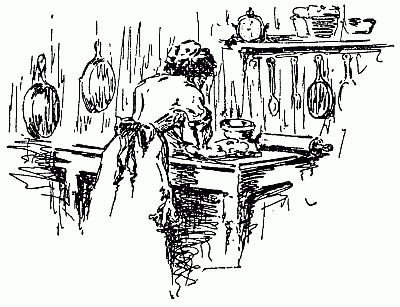 Creole Cookery
Exotics rarely flower in native splendor
after transplanting. Milly was the exception,
proving the rule. Bred in New
Orleans, steeped in its atmosphere, its traditions,
a cook of degree, and daughter of
a cook to whom, though past middle age,
she paid the most reverent homage, she yet
kept her magic touch amid the crush and
hurly-burly of New York town, albeit she
never grew acclimated nor even content.
This in spite of a mistress she adored—in
virtue of having served her ten years
down in the home city. When at last Milly
went back to her own, there was wailing
amongst all of us, who had eaten her cooking,
but the mistress smiled, rather sadly,
to be sure, saying: "I could not beg her
to stay—she was so unhappy here."
Milly never had quite a free hand—New
York markets know not many things familiar
to those of the Crescent City. Notwithstanding,
she was a liberal education
in blended flavors, in the delights, the surprises
of the Creole kitchen. Tall and
slim, of a golden-brown complexion, neat
to the point of austerity, trim and self-contained,
sight of her somehow gave an
added piquancy to her dishes. She did
not make friends readily, but the comradery
of cooking induced her to more than
tolerate me. "I don't say I kin cook—but
my mother can," she often told me—smiling
proudly the while, with the buzzing
praises of gourmets sounding in her ears.
She could never tell you how she made her
ambrosial dishes—but if you had my luck
to be persona gratis she could and did show
you, to the queen's taste.
I shall write only whereof I know—not
by any means a compend of Creole cookery.
Indeed, a lifetime is hardly enough
to eat of all its specially excellent dishes.
It seems to me from this scant experience,
one general principle runs through all. It
is the blending of proportioned flavors,
achieved through long and gentle cooking.
Milly said she let things "sob," a mistake
I dare say, for the old-time "sod," past
participle of "seethe." But I by no
means speak with authority—my deduction
is from the premise of fifty dinners, each
it seemed to me uniquely excellent. After
this prelude come we to specific recipes.
Court Bouillon: (Pronounced "Coubare.")
Milly sighed for Redfish or Red
Snapper but made shift with halibut or
any other firm fine-grained fish perfectly
fresh. Take three pounds of it, wash very
clean, and cut in six equal slices with a
very sharp knife. There must be no rags
and tatters. Melt a heaping tablespoonful
of lard in a deep kettle, add to it gradually
two tablespoonfuls flour, stirring hard so
it shall not burn. Throw into it a dozen
pounded alspice, three sprigs each of
thyme, parsley, bay leaf and sweet marjoram
chopped fine, one small clove of garlic,
one large onion also chopped fine, and
either six large fresh tomatoes, chopped
small, or half a can—those from glass are
best. Pour in a large glass of claret, add
a quart of boiling water, and bring all to
a very brisk boil. Cook for five minutes,
then add salt and Cayenne pepper to taste.
Boil five minutes longer, then lay in the
fish slices one at a time, following them
with the strained juice of a lemon. Boil
hard twenty minutes longer. Serve hot.
To make Court Bouillon a la Espagnole,
stir together as above, lard and flour, taking
care to have them smooth, add a large
onion, six tomatoes, clove of garlic, sprigs
of sweet basil and thyme, all chopped fine,
along with two whole bay leaves. Brown
all nicely, taking care not to burn, then add
a quart of boiling water, bring to a boil
and cook two or three minutes. Have six
thick slices of fine, firm fresh fish, rub
them well over with salt and pepper, lay
in a dish and pour over a large cup of
white wine boiling hot. Vinegar answers,
but wine is better. Lay the fish slices in
the pot, handling carefully, add the wine,
and simmer until tender—about half an
hour commonly. Take up carefully so as
not to break, lay in a deepish dish, remove
bay leaves from the gravy and pour over
the fish. Finish with a garnish of sliced
lemon, and serve with either boiled rice
or whole boiled potatoes.
Bouillabaisse: While time endures New
Orleans will plume itself upon this dish
which drew from Thackeray a world-famous
tribute. "In New Orleans you can
eat a Bouillabaisse, the like of which was
never eaten in Marseilles or Paris."
Which is much, very much, from the laureate
of Bouillabaisse, as native to Marseilles.
The reason of superiority is not
far to seek—it lies in the excellence and
flavor of the fish native to the Gulf of
Mexico. Lacking Pompano, Red Snapper,
and Redfish, even Milly could not quite
do her knowledge justice. But she made
shift with what the market offered, choosing
generally halibut, with fresh cod, or
bluefish, or sea trout. Two kinds of fish
in equal quantity are imperative. The
better, finer and firmer the fish, the better
the Bouillabaisse. Cut each sort in six
equal slices, saving trimmings, heads, etc.
Boil them in three pints of water, with a
sliced onion, and a bouquet of herbs, until
reduced to one pint. Remove fish-heads
and herbs, then strain the stock, and set
aside until needed. Meantime rub the fish
over very well with salt and pepper, then
with a mixture made by mincing very fine
three bay leaves, three sprigs each of
thyme and parsley, three cloves of garlic,
and six allspice pounded to powder. Rub
the mixture in well and thoroughly—here
is the key to success. The seasoning must
go through and through the fish. Put into
a very wide pan, two tablespoonfuls of
olive oil, heat it gently, add two mild onions,
chopped and let them cook a little
without browning. Now lay in the fish,
slice by slice, so one slice does not touch
another, cover the pan, and let the slices
smother for about ten minutes, turning
them once, so as to cook each side partly.
Take up, lay separately in a large dish,
pour half a bottle of white wine into the
pan, and stir hard. Add six large, fresh
tomatoes, sliced very thin, let boil a few
minutes, then half a lemon, also in very
thin slices, and a pint of the fish stock
strained. Season well, with salt, pepper,
and Cayenne—here the palate is guide.
Boil all together until reduced almost one
half, then lay in the fish slices, taking care
they do not touch, and boil briskly for five
minutes. While the boiling goes on, chop
fine a pinch of saffron, put it in a small,
deep dish, and mix smooth with a spoonful
of the boiling liquor. Dissolve the
saffron very well, and when the fish has
cooked its allotted five minutes, spread the
saffron on top of the fish. Fry in butter
as many slices of toast as you have slices
of fish—lay the fish on the toast, pour
the sauce over it, and serve immediately,
very hot.
Shrimps: The secret of cooking
shrimps is to boil them properly—that is
to say in very salt water, almost brine.
They take up salt only in the boiling, and
not so much then. To five quarts of very
salt water add a large bunch of celery,
chopped, roots, leaves and all, two dozen
allspice, one dozen cloves, two blades of
mace, a bouquet of herbs chopped small, a
pod of red pepper, and a seasoning of
Cayenne. Boil until the strength of herbs
and seasoning is extracted, then throw in
a hundred shrimps—river shrimps are
best—let boil hard ten minutes, take from
fire and allow the shrimps to cool in the
brine. Serve as a relish before dinner, on
a bed of cracked ice, with a garnish of
parsley.
Baked Shrimp: Cut the eyes from a
dozen large, meaty tomatoes, scoop out the
pulp, leaving the shells whole, then mix
it with one hundred shrimps boiled as
directed and picked from their shells, one
cup grated bread crumbs or fine cracker
crumbs, and one heaping tablespoon of butter.
Stew all together, seasoning with
pepper and salt, fill the tomato shells
with the mixture, sift fine crumbs on top,
dot with butter, put in a pan, with a very
little hot water in the bottom, and bake
until done in a quick but not scorching
oven.
Shrimp Pie: Boil and pick from shells
one hundred shrimps, mix well with two
large slices stale bread free of crust,
moistened with two glasses white wine,
and highly seasoned with salt, pepper,
Cayenne, nutmeg, mace, chopped thyme
and parsley. Crisp the bread crusts, and
grate over the mixture after it is packed
in a deep dish. Dot well with butter, and
bake in a hot oven. Serve with a sauce
made by cooking together a pint of boiled
shrimps, a tablespoonful of butter, five
chopped tomatoes, a little celery, thyme,
parsley and bay leaf, also chopped. Cook
three to four minutes, then add half a
pint of oyster liquor, boil up, and serve
very hot.
Shrimp Salad: Boil, and pick from
shells—if large cut in half, otherwise leave
whole. Season well with salt and pepper,
then mix well with crisp celery, chopped
fine with a very little onion. Heap in
salad dish, cover with a good mayonnaise,
and garnish with sliced hard-boiled eggs,
sliced lemon, sliced beets, and celery tips.
Fried Soft-Shell Crabs: Wash always
in cold water—hot water spoils the flavor.
Remove all sand, also the sand-bag between
the eyes, the apron, and the spongy
growths under the side points. Rinse
well again in cold water, and dry thoroughly
with a clean towel. Season a pint
of rich milk well with pepper and salt.
Season the crabs also, lay them in the
milk, rubbing them so that it may impregnate
them throughout. Take out, roll in
sifted flour, patting lightly as you roll,
then shaking free of loose flour. Have
deep fat, very hot—it must be deep enough
to swim the crabs. Drop them in gently,
fry to a delicate brown, skim out, drain
on hot spongy paper, and serve garnished
with fried parsley, and sliced lemon.
Serve with Tartare sauce.
Daube: Otherwise Beef a la Mode:
Take five pounds good lean beef, rump or
top round, and lard it with a quarter pound
salt pork or fat bacon, cut in thin strips
and season highly with salt, pepper, onion,
garlic, thyme, parsley, and bay leaves,
all minced fine. Crowd in the seasoning
as well as the larding strips. Make the
cuts for larding three to four inches long.
Cut two large, mild onions in quarters,
and put into a deep saucepan with a tablespoonful
of lard, let them brown well, then
lay upon them the larded beef, cover, and
let simmer very slowly till well browned.
When browned add five carrots and two
turnips cut into inch-squares, and two more
onions chopped fine. Keep covered tight,
and simmer for ten minutes, then turn
over the meat, and brown the other side—it
will take about ten minutes more.
Then cover the meat with boiling water,
or weak stock, add a glass of sherry or
Madeira, or even claret, season with salt,
black pepper, and Cayenne to taste, then
cover the pot tight, set it where it will
barely simmer and let smother for three
hours. The meat should be very tender.
Serve hot or cold.
Cold Daube a la Creole: Lard, season,
and cook, three pounds of rump or round
as above directed, but keep it simmering
four hours instead of three. Put into a
deep dish rather large and pour over it
a sauce made thus: Put a two-pound veal
steak and two well-cleaned pigsfeet, in
a pot with, four quarts of water, after seasoning
them well with salt, pepper and
Cayenne. Add half a clove garlic, bay
leaf, sprig thyme, one onion, all minced
fine, also two cloves pounded, and a glass
of sherry or Madeira. Keep boiling till
the meat falls from the bones—take up
then, remove bones, mince the meat fine,
season it highly and return to the liquor,
stirring it well through. Pour over the
beef, let stand uncovered in a very cool
place to harden. Serve in very thin slices—it
will be like jelly. This is a cold-weather
dish, as even an ice-box will not
harden the sauce properly in summer.
Grillades with Gravy: Flatten by beating
a good round steak, and cut into
four-inch-squares. Season the squares
highly with salt, pepper, and Cayenne.
Put a heaping tablespoon of lard in a frying
pan—as it melts, add a chopped onion,
a clove of garlic also chopped, and as these
brown, one tablespoonful of flour, stirring
all smooth. Next add two sliced tomatoes
with their juice—when they brown, lay the
grillades upon them. Cover close, let
them brown on one side, then turn and
brown the other. Then add half a tablespoonful
of vinegar, and a cup of water.
Stir well, then set where it will simmer
for half an hour. Fine for breakfast with
hominy or rice.
Another way is to cook the grillades
without garlic, and add to them along with
the tomatoes half a pint of tender okra
well washed and sliced. Or they can be
fried brown, in clear fat, then put in a
hot dish over boiling water while a gravy
is made of fresh fat, heated very hot, and
stirred about the pan to take up the brown
meat essence, a chopped onion, two sliced
tomatoes, a tablespoonful flour, as much
vinegar and water. Season to taste with
salt, pepper, and Cayenne, boil ten to
twelve minutes and pour over the grillades.
Chicken Saute a la Creole: Clean,
singe and cut in joints two spring chickens,
dividing the breasts lengthwise, and
cutting drumsticks from thighs. Season
well with salt and pepper. Melt in a frying
pan two large tablespoonfuls butter,
add the chicken, and let it brown slowly
for five minutes. Have three large onions
sliced thin—add them and let brown but
take care not to scorch in the least.
Dredge in two tablespoonfuls flour, and
let it brown. Then put in half a dozen
large tomatoes peeled and sliced, let them
brown but cook slowly, letting the pan
barely simmer. Add chopped parsley,
thyme and bay leaf, also two cloves of
garlic finely minced, and if you have them,
half a dozen sweet green peppers, freed
of seed and cut in shreds. Stir well, cover
and let smother for twenty minutes, stirring
now and then, but keeping the pan
covered. Add a cup of consommé if in
hand, otherwise a cup of boiling water, cook
very slowly a full half hour, seasoning to
taste. After seasoning, cook ten minutes
longer. Serve very hot.
Roasted Quail: Take six quail, fat,
fresh and tender, pick, draw, singe, and
wipe with a damp cloth inside and out.
Butter inside, and sprinkle with salt and
pepper lightly. Butter all over the outside,
truss, and bind around with a thin
slice of fat bacon. Put a tablespoonful of
butter in the roasting pan, fit in the quail,
and roast in a hot oven twenty to thirty
minutes, according to size. Put six slices
of hot buttered toast in a hot dish, and
lay a quail on each. Add half a spoonful
of butter, a little boiling water, and the
juice of a lemon to the gravy in the pan,
cook three to four minutes, stirring well,
strain, set back on stove to cook two minutes
longer, then pour evenly upon the
breasts of the birds so it will soak in the
toast. Garnish with sliced lemon and
watercress, and serve with green grape
jelly. If grape leaves are to be had, wrap
the birds in them instead of bacon, after
preparing as directed, roast, take up on
toast, garnish with fresh young grape
leaves, and serve with either spiced grapes
or grape jelly.
Creole French Dressing: Put three
tablespoonfuls of olive oil in a deep, small
bowl, add to it a saltspoon salt and half
one of pepper—more if taste approves.
Add alternately drop by drop, a teaspoonful
of made mustard, and a tablespoonful
vinegar. When well mixed, add the
yolk of a hard-boiled egg, mashed very
smooth, and stir until blended. Serve
with lettuce, celery or potato salad.
Mayonnaise Dressing: Chill a small
bowl, also a fresh egg, and your salad oil.
Put the yolk of the egg in the bowl—which
if it is summer, should sit in cracked ice.
Add drop by drop chilled oil, working it
in as you drop it. When you have added
a spoonful begin dropping in lemon juice,
working it likewise into the yolk. It will
harden the egg—stir till very hard, then
add more oil, drop by drop, working it in
with a fork. Repeat, until you have used
the juice of half a lemon, and two gills
of oil. When the egg begins to curdle add
salt and pepper to taste—but do not put
them in until the last. Keep and serve
very cold.
Remoulade Dressing: Put three hard
boiled egg-yolks into a bowl, mash smooth,
add to them half a teaspoonful made mustard,
one tablespoonful Tarragon vinegar,
with salt and Cayenne to taste. Next add,
drop by drop, three tablespoonfuls olive
oil, after which put in the yolk of a raw
egg, and stir until light. Finish with the
juice of half a lemon, added very gradually.
Much depends on the mixing—if
hurried or carelessly done, the sauce will
curdle. This is standard for cold meat
of every sort, also heavy salads, and fish.
Drip Coffee: Two things are essential—an
absolutely clean urn, and sound coffee,
freshly parched, and ground neither
too fine nor too coarse. The water must
be freshly boiled. Put a cup of ground
coffee in the strainer, pour upon it about
two tablespoonfuls of boiling water, let
it stand until the water drips through
and there is no more bubbling, then pour
on more water, but not too much, let it
drip, keeping both the strainer and the
spout covered to prevent the loss of aroma.
Repeat until you have used almost five
cups of water—this for four cups of
strained coffee, as the grounds hold part
of the water. Keep the pot hot while the
dripping goes on, but never where the coffee
will boil. If it dyes the cups it is too
strong, but beware of making too weak.
Bruleau: Put into the special bruleau
bowl, which has its own brandy ladle, three
ladlefuls of brandy, along with the yellow
peel of half an orange, a dozen cloves, a
stick of cinnamon, a few grains of alspice
and six lumps of sugar. Let stand several
hours to extract the essential oils. At
serving time put in an extra ladleful of
brandy for every person to be served, and
two lumps of domino sugar. Pour alcohol
in the tray underneath the bowl, light
it, and stir the brandy back and forth until
it also catches from the flame below. Let
burn two or three minutes—if the lights
have been extinguished as they should be,
the effect is beautifully spectral. After
the three minutes pour in strong, hot, clear,
black coffee, a small cupful for each person,
keep stirring until the flame dies out,
then serve literally blazing hot. This
"burnt water" known in more sophisticated
regions as Café Diabolique, originated
in New Orleans, and is the consummate
flowering of Creole cookery.
 Cakes, Great and Small
The very queen among cake makers
sums her secret of success in a sentence:
"The best of everything." Cake will
never be better than the things whereof
it is made, no matter how skilled the maker.
But it can be, and too often is, dismally
worse, thus involving a waste of heaven's
good gifts of sugar, butter, eggs, flour and
flavors. Having the best at hand, use it
well. Isaac Walton's direction for the bait,
"Use them as though you loved them,"
applies here as many otherwheres. Unless
you love cake-making, not perhaps the
work, but the results, you will never excell
greatly in the fine art. Better buy your
cake, or hire the making thereof, else swap
work with some other person better gifted
in this special branch.
Here are a few cardinal helps. Have
the eggs very cold, butter soft but not oily,
flour dry and light—sun or oven-dry it in
muggy weather. Sift it three times for
ordinary cakes, twice for tea cakes, and
so on, four to five times for very light
things, sponge cake, angel's food, and
measure it before sifting, and don't forget
the needed amount—then you will be in no
danger of putting in too much or too little.
Always put a pinch of fine salt in the bottom
of the mixing bowl, which ought to be
freshly scalded and wiped very dry. A
damp bowl clogs with either sugar or flour,
making the stirring much harder. Unless
specifically directed otherwise, separate
the eggs, set the whites on ice till time to
whip them, beat the yolks very, very
light—to a pale, frothy yellow, add the
sugar, free of lumps, a cupful at a time,
then the butter washed and beaten to a
creamy froth, beat hard together for five
minutes, then add alternately the flour and
the egg-whites beaten to the stiffest possible
froth. Add a pinch of salt as beating begins,
and if the egg supply is scant,
a teaspoonful of cold water to each white.
This will increase the quantity, and help
to make the cake lighter, as it is the air-bubbles
imprisoned in the froth which
give it its raising virtue. Add fruit and
flavoring last thing. Fruit should be well
floured but never clotted. If batter appears
to be too stiff a little whiskey thins
it excellently, and helps to make it lighter.
Put in two tablespoonfuls to six eggs, using
more in proportion. Rose water or
a liqueur have the same effect but give
their own flavor—which whiskey does not.
If strong butter needs must be used,
it can be mitigated to a degree, by washing
and kneading well in cold water barely
dashed with chloride of lime solution, then
rinsing well in cold water, and afterward
in sweet milk. The milk may be half
water. Rinse it out clean. Let the butter
soften well before undertaking to cream
it. A stout, blunt wooden spoon is the
best for creaming, along with a deep bowl
very narrow at the bottom. Grease deep
cake tins plentifully, with either lard or
butter—using only the best. For heavy
cakes such as fruit, spice and marble cake,
line them with double thicknesses of buttered
paper and either set shallow pans
of water in the oven while baking or stand
the pans themselves in other pans with
a quarter inch of water in the bottoms.
If cakes brown too fast, open the oven
door, a trifle, and lay over the pan a thick,
well buttered paper until the oven cools.
Never jar the oven while cake is baking
in it—neither by banging the doors, nor
dumping heavy vessels on top of it. Beware
likewise slamming kitchen doors, or
bumping things about in the room. Fine
cake demands as many virtues of omission
as of commission. Indeed the don'ts are
as essential as the doings.
Layer cakes need to be mixed thinner
than deep ones. The batter must run
freely. Half fill the tins and set in a hot
oven, taking care not to scorch before rising
is finished. Butter tins very freely—it
is economy in the end. Be sure the
tins sit level in the oven—thus you escape
an ungainly final loaf. Get filling ready
as baking goes forward so as to put your
layers together while still warm and pliable.
Let cool before frosting, so as to trim
sides smooth. Take care fillings are not
too watery, also that they are mixed
smooth. Spread evenly, and press down
a layer firmly all over, before putting filling
on top. Layers simplify greatly the
problem of baking, but to my mind, no
layer cake, not even the famous Lady Baltimore,
is equal to a fine deep loaf, well
frosted, and meltingly rich throughout.
Pound Cake: (Aunt Polly Rives)
Take ten fresh eggs, their weight in fresh
butter, white sugar, and thrice sifted flour.
Separate the eggs, beat yolks to a cream-yellow,
add the sugar, cupful at a time,
beat hard, then the butter creamed to a
froth, then half the flour, then two wineglasses
of whiskey or brandy or good
sherry or rose water, beat hard five minutes,
then add the rest of the flour, taking
care not to pack it in the handling. Beat
fifteen minutes longer, then fold in with
long strokes, the egg-whites beaten with
a good pinch of salt until they stick to the
dish. Barely mix them through the batter,
then pour it into deep pans, or ovens,
lined with double greased papers. The
vessels also must be well buttered. Bake
with quick heat, letting the cake rise well
before browning. Slack heat when it is
a very light brown, and cook until a straw
thrust to the bottom comes out clean.
Turn out upon a thick, folded cloth, cover
with another thinner cloth, and let cool.
Frost when cool, either with the boiled
frosting directed for cheesecakes (See
Chapter on Paste, Pies and Puddings) or
with plain frosting made thus. Beat three
egg-whites well chilled to the stiffest possible
froth with a pinch of salt, and a very
little cold water. Add to them gradually
when thus beaten a pound of sugar sifted
with a teaspoonful of cream of tartar. Mix
very smooth, and apply with a broad-bladed
knife, dipping it now and then in
cold water to keep the frosting smooth. It
should dry a quarter-inch thick and be delicious
eating. Frosted cake keeps fresh
three times as long as that left naked.
Spice Cake: Cream a coffee cup of well
washed butter, with two cups yellow sugar
and one cup black molasses. Add to it
one after the other, seven egg-yolks, beating
hard between. When all are in, add
one tablespoonful whiskey, or brandy, one
teaspoonful grated chocolate, teaspoonful
each of powdered cloves, allspice, ginger,
mace, and cinnamon, a grated nutmeg, and
half a saltspoonful of powdered black
pepper. Add also a pinch of salt, and the
barest dusting of paprika. If whiskey is
for any reason disapproved, use strong,
clear coffee instead, putting in two spoonfuls,
and leaving out the chocolate. Beat
all together hard for ten minutes, then add
four scant cups flour browned in the oven
but not burned. Sift after browning, adding
to it two teaspoonfuls baking powder.
Beat hard five minutes after the flour is
all in, then pour in a deep, well greased
pan, lined with buttered paper, let rise
ten minutes with the oven door open, then
bake in quick heat until done through.
Marble Cake: Make up egg-yolks into
spice cake, beat the whites very light, and
add them to three cups of sifted sugar,
beaten smooth in a large cup of creamed
butter. Put in a wineglass of whiskey or
brandy, then add three cups and a half flour
sifted three times with a heaping teaspoonful
baking powder. Put the light and
dark batter by alternate spoonfuls in pans
well buttered and papered, let rise and bake
the same as spice cake. Else bake the light
and dark batter in layers, put together
with any good filling, and frost with caramel
frosting.
Real Gold Cake: Beat very light the
yolks of sixteen eggs, with a full pound
of yellow sugar, and a scant pound of
creamed butter. Add a cup of rich sour
cream with a teaspoonful soda dissolved
in it. Or if you like better put in the
cream solus, and add the soda dissolved
in a teaspoonful of boiling water at the
very last. This makes lighter cake so is
worth the extra trouble. Flavor to taste—grated
lemon rind is good. Add gradually
four cups flour sifted three times at
least. Beat hard for ten minutes, then
bake in well-greased pans, lined with buttered
paper, until well done, let cool partly
in the pans, then turn out, dust lightly with
flour or corn starch and frost.
Real Silver Cake: Wash and cream to
a froth a pound of fresh butter, work into
it a pound of sifted sugar, and a pound of
flour, sifted thrice with a teaspoonful of
baking powder. Add flavoring—vanilla,
lemon or rose water, following it with a
wineglass of whiskey. Then fold in the
whites of sixteen eggs beaten with a pinch
of salt to the stiffest possible froth. If the
batter looks too thick add half a cup sweet
cream—this will depend on the size of the
eggs and the dryness of the flour. Bake
in deep pans, else in layers. By baking
gold and silver batter in layers, and alternating
them you can have a fine marble
cake. Or by coloring half the white batter
pink with vegetable color to be had from
any confectioner, you can have rose-marble
cake. This should be iced with pink
frosting else with plain white, then dotted
over with pink. Very decorative for birthday
parties or afternoon teas.
Christmas Cake: Prepare fruit first.
Cut small half a pound of homemade citron
drained from syrup, wash and seed one
pound raisins, pick, wash and dry one
pound currants, mince a teacup of any
firm preserve—quince, peach or pear, or
use a cupful of preserved cherries whole.
Shred fine four ounces of homemade candied
peel, also four ounces of preserved
ginger, add a cupful of nutmeats—pecans
or English walnuts, or even scalybarks,
cutting them in bits, mix all well together,
then pour upon them the strained juice of
three oranges, and three lemons, also add
the grated yellow peel. Next pour on
half a pint of whiskey, a gill of rum, and
a tumbler of cordial—peach or blackberry,
and homemade if possible. Let stand overnight,
in a warm place—the fruit should
take up the most part of the liquor. A
glass of tart jelly is held an improvement
by some. I do not put it in—the preserves
suit my palate better. Cream a full pound
of butter with four cups sifted sugar, beat
into it one at a time, ten large fresh eggs.
After them put in four cups dried and
sifted flour, mix smooth, then put in the
fruit, drained from the liquor and lightly
dredged with hot, sifted flour. Mix well,
then add the liquor drained from the fruit,
along with a tablespoonful of lemon essence,
and as much vanilla or rose water.
If the batter is too stiff to stir well, thin
with either a little sweet cream or boiling
water, or cordial. Pour into pans buttered
and lined with five thicknesses of
buttered paper, set the pans in other pans
of hot water inside a warm but not brisk
oven, shield the tops with double paper,
and let rise half an hour. Increase heat
then, but the baking must be slow. Four
to five hours is required, according to the
size of pans. Keep covered until the last
half hour—then the heat may be sensibly
increased. Test with straws—when they
come out clean, take up, set pans on racks,
cover with thick cloth and let cool thoroughly.
Frost next day, with either plain
or boiled frosting. By baking the cake in
rather small square molds, set close in a
larger pan, the squares can be cut without
waste and frosted to make individual cakes.
White Layer Cake: (Mrs. George H.
Patch.) Sift two teaspoonfuls baking
powder through three and a half cups flour,
measured before sifting. Cream a cup
of butter with two and one half cups sugar,
add a cup of rich milk, beat hard, then add
gradually the flour, following it with the
whites of seven eggs beaten very stiff with
a small pinch of salt. Fold in lightly, and
bake in three layers. Put together with
orange filling, or frosting made thick with
nuts and minced figs.
German Coffee Cake: (Mrs. T. G.
Petre.) Beat six fresh eggs very light
with one pound of sugar, and one pound
flour. Add the peel of a lemon grated, and
one yeast cake dissolved in a little hot
milk or water. Let stand till very light,
then roll into sheets one inch thick, spread
them thickly with melted butter—half a
pound will be required, sprinkle with two
ounces bitter almonds blanched and shredded
fine, mixed with four ounces sugar,
and a teaspoonful powdered cinnamon.
Let rise again, and bake in a moderate
oven. Good hot or cold.
Cream Cake: (Betsy Vaughn.) Cream
together very light two cups butter, three
cups sugar, one cup sweet cream. Add
gradually four cups flour sifted with
one teaspoonful baking powder, then fold
in the whites of fourteen eggs beaten
very stiff with a pinch of salt. Flavor
with bitter almonds, bake in loaves or layers,
and frost with pink icing, flavored
with rose water.
Sponge Cake: Beat very light the yolks
of seven eggs with three cups sifted sugar,
and a pinch of salt. Add to them gradually
a cup of hot water, then three scant
cups flour sifted thrice with two teaspoonfuls
baking powder. Fold in last the
stiffly beaten white of the eggs, pour into
greased pans, and bake in a quick oven.
The batter must not be too thin. If the
eggs are large only half a cup of water
may be requisite. Flavor with vanilla,
putting orange or lemon in the frosting.
White Sponge Cake: Beat very stiff
six egg-whites, add to them gradually a
cup of sugar, and a cup of flour sifted
twice with a teaspoonful of baking powder.
Do not forget a tiny pinch of salt in the
eggs.
Angel's Food: Beat to a stiff froth
with a pinch of salt, the whites of eleven
eggs. Mix in gradually a cup and a half
of powdered sugar, then add a cup of flour
sifted twice with a teaspoonful cream of
tartar. Mix smooth, add the strained
juice of half a lemon, pour into a smooth,
ungreased pan, bake in a moderate oven
half an hour, take up, turn pan upside
down on a cloth and let stand till the cake
falls out.
Chocolate Cake: Sift together two cups
flour, one cup corn starch, and two teaspoonfuls
baking powder, add to a cup of
butter, creamed light with two cups sugar
and one cup sweet cream. Add the stiffly
beaten whites of seven eggs, flavor with
vanilla, and bake in layers. For the filling
boil together to a thick syrup, three
cups sugar, one cup water, and half a cake
of grated chocolate. Pour upon three egg-whites
beaten very stiff, flavor with vanilla
or bitter almond, and spread between
layers.
Orange Cake: Cream a cup of butter
with two cups sugar, beat into it a cup of
cold water, then add four cups flour thrice
sifted with two teaspoonfuls baking powder,
alternate the flour with three well-beaten
eggs. Flavor to taste, bake in
layers, and put together with orange frosting
made thus. Cook together till it
threads the strained juice, and grated yellow
peel of a large sweet orange with one
cup sugar, then beat the hot syrup into
two egg-whites whipped as stiff as possible.
Beat smooth and spread while hot.
Dream Cakes: Cream well half a cup
butter, add a cup and a half of sugar, half
a cup cold water, two cups flour sifted
twice with two teaspoonfuls baking powder,
a teaspoonful lemon extract, and the
stiffly beaten whites of six eggs. Bake in
small shapes, frost, with boiled frosting,
and ornament with tiny pink candies.
Shrewsbury Cakes: This receipt with
two that follow, comes down from: "The
spacious days of great Elizabeth." They
are given verbatim, from the original
version, as it seems to me the flavor of
the language must add to the flavor of
the cakes. "Mix half a pound of butter,
well beat like cream, with the same weight
of flour, one egg, six ounces of beaten and
sifted loaf sugar, and half an ounce of caraway
seed. Form these into a paste, roll
them thin, and lay them in sheets of tin,
then bake them in a slow oven."
Queen Cakes: "Take a pound of
sugar, beat and sift it, a pound of well
dried flour, a pound of butter, eight eggs,
and half a pound of currants, washed and
picked; grate a nutmeg and an equal
quantity of mace and cinnamon, work the
butter to a cream, put in the sugar, beat
the whites of the eggs twenty minutes and
mix them with the butter and sugar. Then
beat the yolks for half an hour, and put
them to the butter. Beat the whole together
and when it is ready for the oven,
put in the flour, spices and currants, sift
a little sugar over them, and bake them
in tins."
Banbury Cakes: "Take a pound of
dough, made for white bread, roll it out
and put bits of butter upon the same as for
puff paste, till a pound of the same has
been worked in; roll it out very thin, then
cut it into bits of an oval size, according
as the cakes are wanted. Mix some good
moist sugar with a little brandy, sufficient
to wet it, then mix some clean-washed currants
with the former, put a little upon
each bit of paste, close them up, and put
the side that is closed next the tin they
are to be baked upon. Lay them separate,
and bake them moderately, and afterward,
when taken out, sift sugar over them.
Some candied peel may be added, or a few
drops essence of lemon."
Oatmeal Cookies: (Mrs. T. G. Petre.)
Beat together until creamy, one egg, half
cup sugar, third cup butter, third teaspoonful
soda mixed with one cup sifted pastry
flour, half teaspoonful each of salt and
cinnamon, then add one cup rolled oatmeal,
half cup each of shredded nuts and raisins.
Mix well, drop on greased tin, and
bake in a slow oven. Do not let the stiffness
of the dough induce you to add milk
or water.
Tea Cakes: (Betsy Vaughn.) Cream
together a cup and a half of butter, and
two cups and a half of sugar, add to five
eggs beaten very light, mix well, then add
a cup and a half of buttermilk with a small
teaspoonful of soda dissolved in it. Pour
upon flour enough to make a soft dough,
flavor with nutmeg, roll out a quarter-inch
thick, cut with a small, round cutter,
and bake in a quick but not scorching
oven.
Tea Cakes: (M. L. Williams.) Beat
five eggs very light, with five cups of sugar,
a heaping cup of lard, well creamed, and
two cupfuls of sour milk, with a teaspoonful
of soda dissolved in it. Mix through
enough flour to make a soft dough, roll
half an inch thick, cut out and bake in a
quick oven.
Plain Soft Gingerbread: Dissolve a
desert spoonful of soda in a cup of boiling
water, add to it a cup of rich molasses,
along with three tablespoonfuls of
melted butter. Mix well through two and
and one half cups sifted flour, add ground
ginger and alspice to taste, and bake in a
moderate oven.
Mammy's Ginger Cakes: Beat four
eggs very light with a good pinch of salt
and a cup of coffee sugar. Add three
cups of rich molasses, and a cup of
boiling water with two teaspoonfuls soda
dissolved in it. Mix well in two tablespoonfuls
pounded ginger. Sift five pints
of flour with a teaspoonful of salt, rub
into it lightly two cups sweet lard, then
add the molasses mixture and knead to
a firm dough, adding more flour if needed
or, if too stiff, a little sweet milk. Roll
out half an inch thick, cut into big squares,
bake in a quick oven, and brush over the
tops while blazing hot a little butter,
molasses and boiling water. Let stand in
a warm place until dry. These might
properly be called First Monday
Ginger Cakes, since our Mammy made
them to sell upon that day to the crowds
which came to court, thereby turning many
an honest fip or picayune.
Family Gingerbread: Cup and a half
dark molasses, half cup sugar, small cup
melted lard, cup boiling water with teaspoonful
soda dissolved in it, pinch of salt,
sifted flour enough to make rather stiffer
than pound cake batter. Spices to taste—ginger,
allspice, nutmeg, all in powder,
is a good mixture. Bake rather quickly.
Solid Chocolate Cake: (Mrs. R. Heim.)
Cream together one cup butter, two of
sugar, add six egg-yolks beaten light,
then add alternately one cup sour milk
with teaspoon soda dissolved in it, and
three cups sifted flour. Fold in egg-whites
stiffly beaten then add half cake Baker's
chocolate melted, and three teaspoonfuls
vanilla. Stir hard a minute, pour in deep,
well greased pan, and bake in moderate
oven.
Coffee Cake: (Mrs. R. Heim.) Beat
together until light, one egg, one cup
sugar, butter the size of a large egg. Add
alternately one cup milk, and two cups
flour with two teaspoonfuls baking powder
sifted in it. Put in pan, and sprinkle
thickly all over top with sugar and powdered
cinnamon. Bake rather quickly but
do not scorch.
Fig Pudding: (Mrs. R. Heim.) One
pound figs, half pound suet, six eggs, two
cups sugar, three cups biscuit crumbs.
Run figs, suet and crumbs through grinder,
beat eggs very light, add other ingredients,
beat again, and steam or boil in buttered
mold, tied in well scalded bag, four
hours. Serve hot with this sauce. Beat
to a light cream, one cup butter with two
cups sugar. Add two eggs very well
beaten, then gradually two tablespoons
vinegar and one of vanilla. Cook a long
time in double boiler, stirring constantly,
or it will not be smooth. Keep hot until
served.
Thin Ginger Snaps: (Mrs. R. Heim.)
Mix a cup of melted lard well through two
of molasses, add a pinch of salt, spices to
taste, and enough flour to make a soft batter.
Drop by small spoonfuls on a well-greased
baking sheet, and cook in quick
oven.
Measure Pound Cake: (Leslie Fox.)
Cream well together, one cup butter, one
and three-quarter cups sugar, when very
light, drop in an egg-yolk unbeaten, beat
hard, put in another yolk, beat again hard,
then another, and repeat the hard beating.
When very light add alternately two and
one-half cups flour, and one cup milk, mix
well, then add half a cup flour sifted three
times with three even teaspoonfuls baking
powder. Follow this with the egg-whites
beaten stiff. Flavor with brandy—a
tablespoonful and a half. Bake in a
moderate oven about an hour. Serve with
any approved pudding sauce, or use as
other cake. Nearly as good as the pound
cake of our grandmothers.
Kisses: (Mrs. R. Heim.) Add to four
fresh egg-whites unbeaten, a tiny pinch of
salt, two teaspoonfuls water, and three
cups fine sugar. Beat hard for at least
half an hour—until the mixture is smooth
and stiff. Drop from point of spoon upon
buttered paper, and harden in an oven cool
enough not to color.
 Meat, Poultry, Game, Eggs
Barbecued Lamb: The middle piece,
known to butchers as "the bracelet," is
best for barbecuing. Have it split down
the backbone, and the rib-ends neatly
trimmed, also the ribs proper, broken
about midway, but not quite through.
Wash clean, wipe dry, rub over well with
salt, then prick in tiny gashes with a sharp-pointed
knife, and rub in well black pepper,
paprika, a very little dry mustard,
then dash lightly with tabasco. Put a low
rack in the bottom of a deep narrowish
pan, set the meat upon it, letting only the
backbone and rib-ends touch the rack.
This puts it in a sort of Gothic arch.
Keep it so throughout the cooking. Put
a cupful of water underneath—it must not
touch the meat. Have the oven very hot,
but not scorching—should it scorch in the
least turn another pan over the meat for
the first hour of cooking. Add more water
as the first boils away, but do not baste the
meat—the water is merely to keep it from
getting too hard. Roast till the fat is
crisped and brown throughout, the lean
very tender. Take up on a broad, hot
dish, and in serving cut along the ribs,
so as to let each portion include the whole
length of them, as well as part of the
backbone. Serve with a sauce, of melted
butter, mixed with equal quantity of strong
vinegar, boiling hot, made thick with red
and black pepper, minced cucumber pickle,
and a bare dash of onion juice. This is
as near an approach to a real barbecue,
which is cooked over live coals in the bottom
of a trench, as a civilized kitchen can
supply.
The middling of a pig weighing less than
a hundred pounds, well scraped, washed
clean, and likewise roasted on a rack after
seasoning it well, makes a fine dish. The
sauce for it should include minced green
peppers, instead of cucumbers. If you
happen to have a pepper mango, cut it fine,
and let it stand in the hot sauce ten minutes
before serving.
Beefsteak with Bacon and Onions: Fry
crisp a pound of streaky bacon, take up
and keep warm. Make the fat bubble all
over, lay in it a steak, wiped clean, seasoned
with salt and pepper, and dredged
lightly with flour. Sear it well on both
sides—take from the fat, lay on broiler,
and cook for ten minutes, turning once.
Serve thus if you like it rare—if contrariwise
you want it well done, set the steak
on a rack or broiler in a hot oven, and let
it cook there for fifteen to twenty minutes,
according to thickness. Meantime dredge
more flour into the fat, let it brown a minute,
then lay in large, mild onions thinly
sliced. Fry to a light brown, and serve
around the steak. Serve the gravy separately,
adding to it just before taking up,
a little hot water, and shaking the pan well.
This may be varied by frying with the
onions or instead of them, sliced tomatoes,
and green peppers finely shredded. Or
cut large, very meaty tomatoes, unpeeled,
into thick slices, pour off the gravy, lay
them in the hot, greasy pan, season well
with pepper and salt, and cook five minutes,
turning them and seasoning the other
side. Lay the bacon on the tomatoes—otherwise
put it around the steak outside
the onions.
Boned Fresh Ham: It had better not
be too big—ten pounds is about the limit.
Have the bone removed, but do not throw
it away. Instead break it in pieces and
boil them three hours in water to barely
cover. Wipe the ham well inside and out,
rub the inside over lightly with butter,
season with salt and pepper, and pour in
a little vinegar. Rub salt well over the
outside and let stand on ice several hours.
Make a stuffing of grated breadcrumbs,
with minced pork fat, a sprig of celery
chopped fine, half an apple, also chopped
fine, salt, pepper, paprika, a pinch of sage
in powder, and the least shred of thyme
and lemon peel. A chestnut stuffing can be
used, or one whose foundation is grated
sweet potato. Fill the bone cavity, firmly
but not too full, skewer or sew together
the cut edges, and tie around twice with
narrow tape. Turn over, score the skin
well, rub it with soft butter or bacon fat,
dredge lightly with flour, then with black
and red pepper, also lightly with sugar,
and lay on a low rack in a pan. Fill in
sweet cider, or sound claret till it stands
halfway up to the ham, cover with a close-fitting
upper pan, and put into a hot oven.
Cook for two hours, lifting the pan now
and then, and basting the meat. Uncover,
and make very, very crisp. Serve on a hot
dish, with candied sweet potatoes laid
around. Add boiling water to the liquor in
the pan, shake it well about, and pour into
a gravy boat. Or pour off the grease, add
a sprinkle of flour, let it brown on top the
stove, and put to it the strained liquor
the bone was boiled in. Cook three minutes,
and serve in the gravy boat. If the
bone liquor is not used this way, make it
the foundation of pea or cabbage soup.
In carving cut through and through so as
to serve the stuffing with each portion.
Roast Beef: Scrape and wash clean,
wipe dry, sear cut sides well, either in
bubbling fat, or under gas flame, set on
a small rack in a deep pan, sprinkle well
with salt and pepper, dredge on flour
scantly, pour water underneath till it
stands half an inch deep, cover close, set
in a hot oven and cook until tender. Basting
will not be needed until the pan is uncovered—then
add a little more water, boiling hot,
baste thoroughly, return to oven,
and brown. If you like, add sliced tomatoes,
minced onions, shredded green
peppers, carrots cut small, and very tender
green peas after uncovering—they will
cook while the meat is browning, and can
be served all together in a separate dish.
Pot Roast: Wash and dry, then brown
lightly all over in hot bacon fat, and lay
upon a small rack in the bottom of a deep
pot, seasoning well with salt, pepper, and
paprika. Pour on a little Cayenne, vinegar,
add a spoonful of hot fat, then pour
in enough boiling water to come half way
up the meat, cover tight, and simmer until
tender. An hour before serving time, put
any sort of vegetables approved, or at
hand, carrots, sliced, peas, string beans,
lima beans, potatoes in thick slices, into
the browning fat, let them cook five to ten
minutes, sprinkling them well with salt
and pepper, then skim out of the fat, and
add to the pot, along with a cupful more
boiling water. Simmer until the water is
all gone, and the meat is brown. Take up,
lay vegetables around the meat, or make a
bed of them for it, add a little more hot
water to the pot, stir well over the fire
till it takes up the meat essence, then pour
it over meat and vegetables, else serve
in a gravy boat.
Leg of Mutton in Blanket: Make deep,
narrow gashes in the thick end of a clean
leg of mutton, crowd into them a mixed
seasoning, salt, red and black pepper,
minced onion, a little dry mustard, and
powdered herbs. Brush all over with
melted butter, or soft bacon fat, then
sprinkle lightly with salt, set on a rack in
a roasting pan, and pop into a very hot
oven. Let it brown—then rub over it any
tart jelly melted in a little hot water, and
envelop it in a crust of flour and water,
made very stiff, and rolled half an inch
thick. Pinch the edges tight together, lay
back in the pan, cover it, and bake in a
hot oven. Take up, break the blanket carefully
on top, lift out the meat, and pour the
gravy from the envelop into a small sauce
pan, add to it either hot claret, or a spoonful
of tart jelly, along with tabasco or
Worcester sauce, boil up, and serve in a
boat. Tomato or walnut catsup may be
used for flavoring. Indeed one sometimes
finds opportunity a close second to inspiration.
The Preparation of Poultry and Game:
Pick carefully, draw and singe every manner
of poultry and feathered game, wash
clean, quickly, in cold water, never hot,
drain, then wipe as dry as possible with
a soft, thick, damp cloth—it takes up
moisture cleaner than a dry one. Keep
very cold and away from smells until
ready to cook. Tilt roasting fowls, so
they may drain, if liquid gathers. Before
stuffing rub over the whole inside lightly
with soft butter or bacon fat, pepper it
scantly, and rub on a very little salt.
Grease and season the outside after stuffing
is done,—never before it. If game is
shot-torn, soak for ten minutes in weak
salt water after plucking, rinse in cold salt
water, wipe dry and drain.
Furred game, as rabbits, squirrels, possums,
ought to be drawn before it is cold,
if you would have the finest flavor. This
is especially necessary with possums—which
should be bought alive, and fattened
for several weeks in a clean cage, feeding
them on bread, milk, apples, potatoes, cabbage
leaves, and grass. This makes them
tender and much more delicate in flavor.
Kill by dislocating the neck with a quick,
upward jerk, then cut the throat and hang
to bleed. Roll after dampening fur well
in very hot embers—then scrape the same
as a pig, draw, and hang to cool. Divide
the skin of rabbits and squirrels around
the middle, and pull off each half, the
same as a kid glove. Thus no hairs stick
on the clean flesh. Draw very quickly,
wipe lightly with a damp cloth, and hang
where it is cool and airy for at least an
hour.
Roast Turkey: Make a stuffing of stale
bread. Cut the crusts from a small loaf,
grate the crumb, brown crusts crisp, crush,
sift and mix well with the gratings. Shred
finely through it four ounces fresh suet,
and a lump of butter the size of an egg.
Add a tiny heart of celery cut small, half a
tart apple also cut fine, two dozen fat
raisins, seeded, halved, and soaked for
twelve hours in whiskey to cover, salt, pepper,
and paprika to taste. Mix well, stuff
the turkey but not too tight. Put a handful
in the crop space, and fasten the skin
neatly over. Truss your turkey firmly,
rub all over with soft fat, then sprinkle
with salt and pepper, and set upon a rack
in a deep roasting pan, pour half an inch
of water in the bottom, cover tight, put in a
hot oven, and roast for an hour, then slack
heat and finish. The turkey will brown
thus covered, and be tenderer and sweeter
than if crisped uncovered. The pan will
hold gravy better than can be made otherwise.
Roast chickens or capons in exactly the
same way. Geese need to be roasted more
slowly and to have a seasoning of sage,
onion, and tart apple in the stuffing, instead
of raisins. The dry stuffing takes
up the juices of the fowl, and is much more
flavorous, and less pasty than that which
is wet before use.
Guinea Hen in Casserole: Stick six
cloves in a cored and pared apple, thrust
a heart of celery in the core space, then
fit it inside a guinea hen, buttered, salted
and peppered inside. Pack in grated
bread crumbs—all there is space for.
Truss, grease, season, set in a hot oven,
and brown lightly all over, then lay in a
casserole on a bed of sliced carrots, young
green peas, shredded green peppers, sliced
tomatoes and tiny onions, parboiled for
five minutes. Add a large lump of butter,
rolled in flour, a cup of hot water or weak
broth, cover close, and cook an hour in a
hot oven. Serve on the vegetables, bedded
firmly, with tart jelly melted to barely run,
splashed over the breast.
Chickens in Blankets: Take young fat
chickens about three pounds weight, dress
as for roasting, put inside each a peeled
sweet potato, and a small lump of butter,
after greasing and seasoning inside and
out. Lay on low rack in deep pan, brown
lightly in oven, then fit close over each a
round of good short crust, rolled a quarter-inch
thick. Return to oven—when crust is
a rich brown the chickens will be done.
Serve crust with each portion—thereby recalling
a glorified chicken pie.
Fried Chicken: Cut into joints two tender
young chickens, wipe the pieces dry,
season with salt and pepper, red and black,
then set on ice. Fry a pound of streaky
bacon in a deep skillet, take out when crisp,
roll chicken in flour, dip in beaten egg,
then roll again, and lay in the fat, which
must be bubbling hot, but not scorching.
Cook, turning often, to a rich brown, take
out, then pile in a pan, set the pan over
another with boiling water in the bottom,
and put all in a very hot oven for fifteen
minutes. This cooks the chicken through
and through without making it hard. The
pieces must not touch in frying so there will
be two skilletfuls. When all the chicken
is fried, and in the oven, dredge in more
flour, stir it well through the fat, then add
a cup of cream, stirring hard all the time,
and letting it barely simmer—boiling
curdles it. Or if you want a full-cream
gravy, pour off the fat, stir the cream in
double quantity in the skillet to take up
the flavors, then pour it in a double boiler,
add pepper, salt, minced celery, a little
onion juice, and one at a time, lumps of
butter, rolled well in flour. Cook until
thick and rich, and serve in a gravy boat.
Smothered Chicken: Get two pound
broilers fat and tender, have them split
down the back, make clean, season by buttering
inside and out, sprinkling with salt,
pepper and paprika, and dredging with
flour. Lay breasts down, upon a low rack
in a deep pan, cover with slices of streaky
bacon, shingling the slices well. Dredge
with pepper and flour, lay in sliced tomatoes,
shredded green peppers, and a few
small parboiled onions. Add lumps of
butter rolled in flour, dotting them all
about the bacon. Pour in enough water to
barely reach the top of the rack, cover the
pan close, and cook in a hot oven, about
an hour. Uncover after three-quarters of
an hour, add a half-cup more water—this
is for the gravy. Cover again, and finish
cooking. The chickens should be brown all
over but meltingly tender. Take up on a
hot dish, breaking the bacon slices as little
as possible. Serve the vegetables separate,
also the gravy from the pan. The
vegetables can be omitted, and smothered
chicken still be a dish to rejoice an epicure.
Glorified Chicken Croquets: (Mrs. G.
H. Patch.) Boil a large-size tender young
chicken till the meat almost drops from
the bones. Boil likewise tender, in salt
water, one pound either sweetbreads or
calf brains. Pick up the chicken and grind
the meat fine, then mash it well together
with the brains or sweetbreads, and season
to taste. Put into a double boiler half-pint
cream, tablespoonful butter, two tablespoonfuls
flour, one tablespoonful parsley
chopped fine, one teaspoonful onion juice,
one teaspoonful salt, black and Cayenne
pepper to taste. Cook smooth, stirring
hard, let thicken, then add the meat, and
mix thoroughly. Let cool, shape into croquets,
dip in egg, roll in cracker crumbs,
and fry quickly in deep hot fat.
Chicken-Turkey Hash: Cut the meat
small, freeing of skin and gristle. If
there is rich gravy left, put it into a skillet,
and cook tender in it, half a dozen sliced
tomatoes, three shredded green peppers, a
small sliced onion, and a cupful of raw
potato cubes. Lacking gravy, cook in butter
or bacon fat, and season to taste—gravy
requires less seasoning than plain
fat. Add the meat, pour in a cup of boiling
water, stir all well together, and cook
for five minutes. Serve in a hot dish lined
with thin toast. Fine for breakfast, or a
very late supper.
Rabbit or Squirrel Smothered: Leave
whole, rub over with fat, season highly,
lay in a pan or skillet, with slices of bacon,
add a cup of hot water, cover close, set
over the fire, and simmer until tender.
Uncover, and brown in the gravy, adding a
little Cayenne vinegar at the very last.
Rabbit or Squirrel Barbecued: Leave
whole, skewer flat, grease all over, lay on
rack in pan, and roast in hot oven, basting
every five minutes with hot salt water.
When crisp, take up and serve with the
sauce directed for barbecued lamb.
Quail: Smother quail the same as rabbits.
I like them better halved, and fried
crisp and quickly, in deep hot bacon fat.
But to make the most of them, a pie's the
thing. The crust must be rich and rolled
a quarter-inch thick. Put in the birds
whole, seasoning them well inside and out,
with salt and black pepper. Put in also
generous lumps of butter rolled in flour,
slices of fat bacon, strips of crust an inch
wide and three inches long, a little minced
onion, celery or shredded green pepper if
the flavors are approved, and a tiny pod
of Cayenne pepper. Pour in cold water
till it stands half way up the birds. Be
sure the cover-crust is plenty big—pinch
it down tight, prick and make a cross-cut
at the center into which a tubelet of paper
must be thrust to prevent the gravy's boiling
over. Bake three-quarters of an hour,
in a hot oven. Take up, and serve very
hot. A gill of hot cream poured in through
a funnel after taking up suits some palates—mine
is not among them. Other
folks like a wineglass of sherry made very
hot.
Wild Duck: If likely to be fishy, soak
an hour in vinegar and water made very
salt, and roast with an onion inside stuck
very full of cloves. Season inside and out,
rub over with fat or butter, and roast in
quick heat, to the degree required. Ducks
or geese mild in flavor should be roasted
with a tart apple stuck with cloves inside,
also a mild onion. Rub over with fat, season
with salt and pepper inside and out,
and strew inside lightly a small pinch of
powdered sage. A good sauce for them is
made by browning half a cup of grated
bread crumbs in a tablespoonful of butter,
adding to it a spoonful of tart jelly, a wineglass
of claret, a tablespoonful of tomato
catsup, with seasoning to taste of salt and
pepper.
Possum Roasted: Chill thoroughly
after scraping and drawing. Save all the
inside fat, let it soak in weak salt water
until cooking time, then rinse it well, and
partly try it out in the pan before putting
in the possum. Unless he is huge, leave
him whole, skewering him flat, and laying
him skin side up in the pan. Set in a hot
oven and cook until crisply tender, taking
care there is no scorching. Roast a dozen
good sized sweet potatoes—in ashes if possible,
if not, bake them covered in a deep
pan. Peel when done, and lay while hot
around the possum, turning them over and
over in the abundant gravy. He should
have been lightly salted when hung up, and
fully seasoned, with salt, pepper, and a
trifle of mustard, when put down to cook.
Dish him in a big platter, lay the potatoes,
which should be partly browned, around
him, add a little boiling water to the pan,
shake well around, and pour the gravy
over everything. Hot corn bread, strong
black coffee, or else sharp cider, and very
hot sharp pickles are the things to serve
with him.
Eggs: Eggs demand an introductory
paragraph. As everybody knows, there are
eggs and eggs. An egg new-laid has a tiny
air-space at each end, betwixt the shell
and the silken lining membrane. If left
lying, this confined air changes its locality—leaves
the ends for the upmost side of
the shell. Shells are porous—through
them the white evaporates—thus the air
bubble on top gets bigger and bigger. By
the size of it you can judge fairly the egg's
age—unless it has been kept in cold storage
or in water-glass. By boiling hard, throwing
in cold water and peeling intact, you
can see for yourself if a fresh egg so-called
is truly fresh. If fresh there will be no
perceptible marring of its oval—but if it
shows a shrinkage, and especially if the
yolk is so near the shell it shows through
the cooked white, there is proof positive
that the egg is not new-laid—though it may
be perfectly wholesome.
Eggs kept in clean cool space do not
deteriorate under a month. Even after
that, thus well kept, they answer for cake
making, puddings and so on. But they
have an ungodly affinity for taints of almost
every kind. Hence keep them away
from such things as onions, salt fish, things
in brine generally, or any strong ill odors.
Duck eggs are bigger than hen eggs—eight
of them being the equivalent to ten.
Goose eggs run almost two for one. Turkey
eggs, rarely used in cookery, are still
excellent eating, much better flavored than
duck eggs, which are often rather rank.
Here as otherwheres, food is the determining
factor. Guinea eggs, in spite of being
so much smaller, are equal in raising power
and in richness to hen eggs. Indeed, they
are the best of all eggs for eating—rich,
yet delicate. The only approach to them
is the quail egg—we called it always a
partridge egg—but only special favorites
of the gods have any chance of ever tasting
them. Quail nest frequently in wheat
fields—at harvest, the uncovered nests
yielded choice spoil. Daddy claimed the
lion's share of it for "my white chilluns."
Often he came with his big hat-crown running
over full of the delicate white ovals.
Mormonism must prevail in quail circles—sometimes
there were forty eggs in a nest.
It would have been vandalism of the worst
to eat them, only it was no use leaving
them bare to the sun, as the birds abandoned
them unless they had begun brooding.
In that case the mother sat so tight,
occasionally the reaper, passing over, took
off her head. More commonly she flew
away just in time, whirring up between the
mules, with a great pretense of lameness.
If the nest by good luck was discovered in
time, grain was left standing about it.
Nobody grudged the yard or so of wheat
lost for the sake of sport.
Partridge eggs were boiled hard, and
eaten out of hand—they were much too
thin-shelled for roasting, in spite of having
a very tough lining membrane. With
guinea eggs there was quite another story.
They have shells extra thick and hard—hence
were laid plentifully in hot ashes,
heaped over with live coals and left as long
as our patience held out. When Mammy
pulled them out, it was maddening to see
her test them. She laid a short broom
straw delicately on each egg. If it whirled
round, the egg was done—if contrariwise
it fell off, it had to go back in the embers.
She had no thought of letting us eat eggs
not cooked till the yolk was mealy. To
this day I am firmly of opinion she was
wise—and right. Eggs roasted as she
roasted them have a flavor wholly beyond
and apart from those cooked in any other
way.
Baked Eggs: These most nearly approximate
the flavor of roasted ones.
Break fresh eggs at the small ends, drain
away the whites, break down the shells to
deepish cups, each with a yolk at bottom,
sprinkle yolks lightly with salt and pepper,
add a bit of butter to each, then set shells
upright, close over the bottom of a pan,
pop the pan into a hot oven, bake twenty
minutes, and serve piping hot. This
Mammy gave us to keep from wasting
yolks when wedding or Christmas cake
demanded many whites for frosting.
Potato Egg Puffs: Into a quart of rich
and highly seasoned mashed potatoes, beat
two eggs, then divide into equal portions—six
or eight. With lightly floured hands
make each portion into a ball, set the balls
in a baking dish, then press into each a
hard-boiled egg. Lay a bit of butter on
each egg, and dredge lightly with salt and
pepper. Bake in a quick oven until the
potato is brown and light—it ought to rise
up like a fat apple.
Egg Dumplings: Cousins-germane to
the puffs but richer—will serve indeed for
the meat course of a plain dinner. Mix
the potato well with half its bulk of finely
chopped cold meat, the leaner the better,
bind with beaten eggs, then divide and roll
each portion around a hard-boiled egg, lay
the dumplings in a greased and floured
pan, giving them plenty of room, pour
around them a good gravy, or else a rich
tomato sauce, then bake ten to twenty minutes
in a hot oven.
Egg Spread: Spread a flat pan an inch
deep with rich mashed potato, sprinkle
with pepper and salt, then cover the top
with eggs hard boiled, and cut in half.
Set them yolk up. Put salt, pepper and
butter on each yolk, and bake ten minutes
in a warm oven. Or if soft eggs are preferred,
make depressions in the potato
with the back of a spoon, break an egg in
each, dust with pepper and salt, add a dot
of butter and bake five minutes. If the
potatoes are wanted brown, bake them ten
minutes after making the depressions,
then put in the eggs and bake soft or hard
at will.
Poached Eggs: These require a deep
skillet, three parts full of water on the
bubbling boil, which is slightly salted and
well dashed with vinegar. Break all the
eggs separately before putting one in.
Slip them in, one after the other, quickly,
taking care not to break yolks, keep the
boiling hard, and use a knife or spoon to
prevent the whites from cooking together.
Take out in six to seven minutes, using a
skimmer and draining well, trim rags off
white, lay in a deep hot dish, and pour
over real melted butter, made with butter,
hot water, salt, pepper, lemon juice or
vinegar, and a dash of tabasco. Send to
table covered—a poached egg chilled has
lost its charm. Or you may serve the eggs
on squares of hot, well-buttered toast,
which have been sprinkled thickly with
grated cheese, then set for a minute inside
a hot oven. Served thus, pass the melted
butter with them, as if poured over, they
might be too rich for some palates.
Egg Fours: Cut hard-boiled eggs in
four lengthwise, mix yolks with an equal
bulk of sardines, drained, freed of skin
and bone, and minced fine. Season with
salt, pepper, lemon juice, or vinegar, and
olive oil. Add minced olives if you like.
The mixture must be soft, but not too soft
to shape well. Shape it into small ovals,
using two spoons, and lay an oval in each
quarter of the whites. Put very narrow
strips of pimento on the ovals, then sprinkle
them thickly with grated cheese—Edam
is good for such use. Set in a baking dish
and cook two to four minutes in a hot oven.
If wanted extra tasty, as for a relish before
dinner, set the fours on narrow strips
of toast, spread with made mustard, well-mixed
with finely minced very sour cucumber
pickle.
Bacon sliced thin, fried crisp without
scorching, and finely minced can take the
place of sardines. Indeed, in making
fours the widest latitude prevails—you can
vary flavors and proportions almost infinitely.
Onion, even a suspicion of garlic,
tabasco, Cayenne vinegar, walnut catsup,
or Worcester can be added. Capers mixed
through the mass make it wonderfully
piquant. But things which need to be
crisply fresh, such as celery and lettuce,
must be let severely alone.
Stuffed Eggs: Staple for picnics, and
barbecues. Boil twenty minutes, throw
instantly in cold water, and shell immediately.
Halve, mash yolks while hot with
a plentiful seasoning of butter, pepper,
salt, a little onion juice, capers or bigger
pickle finely minced, and pimentos cut
small. Work the seasoning well through,
then shape into balls yolk-size, put each
between two half-whites, and fasten together
with a couple of tooth picks. Wrap
each as finished in wax paper, and keep
cool until needed. Here may be a good
place to say that the quicker a hard-boiled
egg is got out of its shell after chilling,
the better and more delicate will be its
flavor.
Fried Eggs: Anybody, almost, can fry
an egg wrong. It takes some skill to fry
one exactly right. Have the frying pan
covered with grease, hot, but not scorching,
slip in the eggs, previously broken
separately, taking pains not to break yolks,
sprinkle lightly with salt and pepper, keep
edges from running together, then when
they have hardened underneath, dip hot
grease over the tops, keeping on till the
white sets. If the heat is right the eggs
will not stick to the pan. Cook as hard
as is desirable, take up with a cake-turner,
and lay in a shallow pan, lined with soft
clean paper. Keep hot while they drain—it
takes a minute or so—then remove to
a blazing hot dish, and serve. If ham goes
with them lay it in the middle, with eggs
all around it. Triangles of fried toast in
between look and taste well at breakfast.
 Soups, Salads, Relishes
Vegetable Soup: Cut into joints two
fat chickens three parts grown, salt and
pepper, and lay aside while you fry in a
deep pot half a pound streaky bacon.
Take out when crisp, put in the chicken,
turning it so as to brown it all over. Put
in a thick slice of ham, let it also brown a
bit, do the same with four sliced onions—mild
ones—then add two gallons cold
water, half a teaspoonful salt, two pods
red pepper, a dozen whole pepper corns,
and two sprigs of parsley. Keep at a gentle
boil for an hour, then put in two small
heads of tender cabbage finely shredded,
and six white potatoes, peeled and sliced
a quarter-inch thick. Fifteen minutes
later put in a quart of string beans, broken
short, a pint of shelled lima beans, a stalk
of celery cut fine lengthwise, and a dozen
tomatoes, peeled and sliced. Follow them
in ten minutes with a pint of tender okra
sliced—next add a little later the pulp
from a dozen ears of green corn, slit
lengthwise and scraped. Stir almost constantly
with a long-handled skimmer, after
the corn pulp is in. If the skimmer brings
up chicken bones, throw them aside. Just
before serving put in a large spoonful of
butter, rolled in flour. Taste, add salt if
required. Serve very hot with corn hoe
cake and cider just beginning to sparkle.
If there is soup enough for everybody,
nothing else will be wanted.
Black Turtle Bean Soup: Pick and
wash clean, one quart black turtle beans,
soak overnight in three quarts cold water,
and put on to boil next morning in the
soaking water. When it boils add three
onions sliced, one carrot scraped and cut
up, a stalk or so of celery, three sprigs of
parsley, and one tomato, fresh or canned.
Boil slowly four to five hours, until the
beans are tender, filling up with cold water
as that in the kettle wastes. When the
beans are very soft, strain all through a
fine collander, mashing through beans and
vegetables, add a quart of very good soup
stock, also a bay leaf, and boil up hard half
a minute before serving. Put into each
soup plate a slice of lemon, a slice of hard-boiled
egg, and a tablespoonful of sherry
wine before adding the soup.
Gumbo: Cut a tender, fat chicken,
nearly grown, into joints, season well with
salt and pepper, and fry for ten minutes
in the fat from half a pound of bacon, with
two thick slices of ham. Then add two
onions chopped fine, six large ripe tomatoes,
peeled and chopped, adding with them
their juice, half a large pod of mild red
pepper, cut small, a teaspoonful of minced
thyme and parsley mixed, a pint of tender
sliced okra, stemmed and cut lengthwise.
Cook altogether, watching all the time, and
stirring constantly to prevent scorching
until everything is well-browned. Then
add three quarts fresh-boiled water, on the
full boil, set the pot where it will barely
simmer, and cook an hour longer, taking
the same pains against scorching. Rice to
eat with the gumbo—it must never be
cooked in the pot—needs to be washed until
the water runs clear from it, drained, then
tossed into a wide kettle of water on the
bubbling boil, and cooked for twenty minutes.
The water must be salted to taste.
Drain the rice in a collander, set it after
draining in the oven for a minute. The
grains should stand out separate, but be
very tender. Rice thus cooked, and served
with plenty of butter, is excellent as a
vegetable.
Wedding Salad: Roast unstuffed, three
young tender turkeys, or six full grown
chickens. Take the white meat only, cut
it fine with shears, cutting across the grain,
while hot. Let cool, then mix it with ten
hearts of crisp celery cut in bits, two heads
of tender white cabbage, finely chopped,
rejecting hard stalks—use three heads if
very small—and set in a cool place. For
the dressing boil thirty fresh eggs twenty
minutes, throw in cold water, shell, take
out the yolks, saving the white for garnishing,
mash the yolks while hot very smooth
with a pound and a half of best butter,
season them well with salt, pepper, a little
dry mustard, celery seed, and, if at hand,
a dash of walnut catsup, but not enough
to discolor. Add also a teaspoonful of
sugar—this to blend flavors only. Add a
little at a time enough warm vinegar to
make as thick as cream. Chill, and pour
over the salad, mix well through, then heap
it in a big glass bowl, lined with partly
white lettuce leaves, make a wreath of
leaves around the top, and in serving, lay
a larger lettuce leaf on each plate, filling
it with the yellow-white salad.
Fruit Salad: Wash well a very ripe
juicy pineapple, let dry, then shred with a
fork, holding the crown in the left hand
firmly, while you pull away sections with
the fork in the right. Thus you avoid taking
any of the hard center. Peel the sections
delicately after they are separated,
and cut them in long thin slivers, with the
grain. Arrange these slivers star-shape
upon lettuce leaves in the plates, lay a very
narrow slip of pimento—sweet red pepper,—between
each two of them, then fill in
the points of the stars with grape-fruit
pulp, freed of skin and seed, and broken
into convenient sized bits. Lay more pimento
strips upon it. Set on ice till ready
to serve, then drench with sweet French
dressing.
Sweet French Dressing: Mix well a
scant teaspoonful of granulated sugar, the
same of dry mustard, half a teaspoonful
salt, as much black pepper and paprika
mixed, put in the bottom of a deep small
bowl, and stir for two minutes. Wet with
claret vinegar, adding it gradually, and
stirring smooth. Make as thick as cream.
Add twenty drops tabasco, twenty drops
onion juice, the strained juice of half a
lemon, and half a teaspoonful of brandy,
rum or whiskey. Mix well, then add,
tablespoonful at a time, a gill of salad oil,
stirring hard between spoonfuls. Put in
more vinegar, more oil—the seasoning
suffices for half a pint of dressing. Stir
till it thickens—it should be like an emulsion
when poured upon the salad. Keep
on ice. The oil and vinegar will separate,
but the dressing can be brought back by
stirring hard.
Banana and Celery Salad: Chill heart
celery and very ripe bananas, slice thin
crosswise, mingling the rounds well. Pile
on lettuce leaves, and cover with French
dressing, into which finely grated cheese
has been scantly stirred. This dressing
with cheese is fine for tender Romaine, also
for almost any sort of cooked vegetable
used as salad.
Red and White Salad: Make cups from
lettuce hearts, fasten them to the plate,
with a drop of melted butter, fill lightly
with grape-fruit pulp, and set a tiny red
beet, boiled tender, in the middle. Have
a very sharp French dressing made with
oil lemon juice and Tarragon vinegar.
Pass with this cheese straws, or toasted
cracker sprinkled lightly with Parmesan
cheese.
Pineapple Salad: Pare and core a very
ripe, sweet pineapple, cut in slices crosswise,
lay the slices in a bowl, with a sprinkle
of sugar, half a cup rum or sherry, all
the juice shed in cutting up, and a grate
of nutmeg. Let stand till morning, cool,
but not on ice. Make rosettes of small lettuce
leaves in the plates, lay a slice of
pineapple on each, fill the hole in the center
with pink pimento cheese. Make the
cheese into a ball the size of a marble, and
stick in it a tiny sprig of celery top. Put
a little of the syrup from the bowl in each
plate, then finish with very sharp French
dressing. Make the pimento cheese by
grinding fine half a can of pimento, and
mixing it through two cakes of cream
cheese, softening the cheese with French
dressing, and seasoning it to taste.
Cold Slaw: (V. Moroso.) Shave very
fine half a medium sized head of tender
cabbage, put in a bowl, and cover with
this dressing. Melt over hot water a heaping
tablespoonful of butter, with two tablespoonfuls
sugar, a saltspoon of pepper, a
teaspoonful of salt, dash of red pepper,
and scant teaspoonful dry mustard. Mix
smooth, then add gradually four tablespoonfuls
vinegar, mix well, then put in
the yolk of a raw egg, beating it in hard.
Cook till creamy, but not too thick. Take
from fire, and add if you like, two tablespoonfuls
cream, but it is not essential—the
dressing is good without it.
Tomato Soy: Take one gallon solid,
ripe tomatoes, peeled and sliced, or four
canfuls put up in glass, put in a preserving
kettle with a quart of sliced onions,
two tablespoonfuls salt, as much moist
sugar, teaspoonful black pepper, saltspoon
paprika, four hearts of celery cut fine, a
tablespoonful of pounded cloves, alspice,
mace, grated nutmeg, and cinnamon mixed.
Stir well together and cook slowly, taking
care not to burn, until reduced one-half.
Dry mustard or mustard seed can be
added, but many palates do not relish
them. After boiling down add a quart of
very sharp vinegar, stir well through,
skim if froth rises, bottle hot, and seal.
This keeps a long time in a dark cool place.
Table Mustard: Mix well together two
tablespoonfuls dry mustard, scant teaspoon
sugar, half a teaspoon salt. Wet
smooth, to a very stiff paste with boiling
water, then add either a teaspoon of onion
juice, or a clove of garlic mashed, stir well
through, add little by little, a tablespoonful
olive oil, then thin, with very sharp
vinegar, added gradually so as not to lump
nor curdle, to the consistency of thin
cream. Put in a glass jar, seal tight and
let stand a week. A month is better—indeed,
the mustard improves with age if not
permitted to dry up.
Cabbage Pickle: Shred enough tender
cabbage to make four quarts, put with it
four large green tomatoes, sliced thin, six
large onions, chopped fine, three green
peppers also chopped, rejecting the seed,
two ounces white mustard seed, half-ounce
celery seed, quarter-ounce turmeric, three
tablespoonfuls salt, two pounds white
sugar, two quarts vinegar. Put all in a
preserving kettle, set it upon an asbestos
mat over a slow fire, and cook gently for
several hours, stirring so it shall not
scorch. It must be tender throughout but
not mushy-soft.
Cauliflower Pickle: Drop two heads
cauliflower in salted boiling water, cook
fifteen minutes, take up, drop in cold water,
separate into neat florets, and pack down
in a clean crock. Pour upon the florets,
hot, a quart of vinegar, seasoned with a
mixture of two tablespoonfuls salad oil,
teaspoonful dry mustard, tablespoonful
sugar, teaspoonful salt, half-teaspoonful
onion juice, half-teaspoonful black pepper,
dash of paprika, ten drops tabasco. Bring
all to a boil, and pour over the pickle, first
strewing well through it blade mace, whole
cloves, alspice and cinnamon, broken small
but not powdered.
Pear Relish: Wash and stem a gallon
of sound ripe, but not mellow Seckel pears,
remove the blossoms with a very sharp
narrow pen-knife, and stick a clove in each
cut. Drain, and drop into a syrup, made
of three pounds of sugar and a quart of
vinegar. Bring to a quick boil, skim, and
set back to simmer. Add after skimming,
cloves, alspice, mace, ginger, cinnamon,
and black pepper, pounded small but not
powdered. Cut up a large sweet red pepper,
and drop in the shreds. Let cook till
the pears are tender. If the syrup is thin,
add more sugar—some pears yield more
juice than others. Sliced lemon gives a
piquant tang, but is optional. Put in glass
or stone jars, and cover tight, laying a
brandy paper on top.
Cherries Piquant: Wash well, and stem
but do not pit, half a gallon ripe Morello
cherries. Drain well, strew spices well
through them, lay thin sliced lemon on top,
add a dozen whole pepper corns, and a tiny
pod of Cayenne pepper, then pour over a
pint of sharp vinegar, boiled with four
pounds of sugar, and skimmed clean. Let
stand all night, drain off syrup in the
morning, boil up, skim, and pour again
over the fruit. Next day, put all in a kettle,
and cook for fifteen minutes, then put
in glass jars, seal and keep dark. Especially
good with game or any meat highly
seasoned.
Gooseberry Jam Spiced: Wash, and
nub half a gallon of green gooseberries,
picked just before they ripen. Put them
in a kettle with six large cups of sugar, a
cup of water, half a teaspoonful each of
cloves, alspice, mace, grated nutmeg, and
cinnamon, the grated yellow peel of an
orange and the strained juice. Cook
slowly until thick—it should jelly when
dropped on a plate. Pack in small jars.
One of the very finest accompaniments to
any sort of fowl. By leaving out the
spices, and merely cooking the berries
thick enough to cut like cheese, it is as fine
as bar le duc for serving with salad.
Frozen Cranberry Sauce: (Mrs. R.
Heim.) Gives a new tang to game, roast
turkey, capon or duck. Cook a quart of
cranberries until very soft in one pint
water, strain through coarse sieve, getting
all the pulp, add to it one and a half pints
sugar, the juice—strained—of four lemons,
one quart boiling water, bring to a boil,
skim clean, let cool, and freeze rather soft.
"Apple Sauce Gone To Heaven": Thus
a poet names it, though I, the architect
thereof, insist that it is wholly and beautifully
mundane. To make it, pare eight
firm apples, the higher-flavored the better,
core, drop into cold water, as pared, let
stand till you make the syrup. Take a cup
of sugar to each two apples and a cup of
water to each two cups of sugar. Bring
to a boil, skim, clean twice, then throw in
half a dozen blades of mace, bits of thin
yellow peel from two lemons, a few bits of
stick cinnamon, and one pepper corn—no
more. Stick four cloves in each apple,
drop them in the syrup, which must be on
the bubbling boil. After the apples are in—they
should just cover the pan, add the
strained juice of two lemons. Boil hard
for five minutes, turn over the apples, simmer
till done—they will look clear all
through. Skim out with a perforated
ladle, letting all syrup drain away from
them, arrange in a deepish glass dish, or
pile on a glass platter. Boil the syrup
until it jellies when dropped on a plate,
then dip it by spoonfuls over the apples,
letting it harden as it is dipped.
Another way, and easier, is to wash and
core the apples, without peeling, stick in
the cloves, put in an earthen or agate baking
dish, add the sugar, water, spices,
cover close, and set in a hot oven. Cook
until the apples are soft through, then uncover,
and crisp a little on top. The peel
will be edible, and the flavor richer than
when boiled, but the dish is not so decorative.
Spiced Grapes: Wash and drain sound
full-ripe grapes, pick from the stems, then
pop out the grapes singly from the hulls.
Save the hulls and juice. Put the pulp
and seeds over the fire, cook until soft,
strain through a colander to remove the
seed, then add the pulp to the hulls and
juice, put all over the fire, with equal
weight of sugar, and spices to taste. I
like cloves, alspice, mace and cinnamon, all
pounded small, but not powdered. Cook
until thick, take care not to burn, put into
glasses like jelly, and serve with any sort
of meat, or as a sweet.
Wild grapes washed, picked from stems,
stewed and passed through a colander,
furnish a pulp that is worth sugar, spices
and so on. Cook as directed for vineyard
grapes. By leaving out the most part of
spices, and putting in vinegar, a cupful to
the quart of syrup, the result is a very
piquant jelly, or more properly, fruit
cheese.
Sweet-Sour Pears: The pears must be
ripe, but very firm. If large, pare and
quarter, cutting out the core, stick a clove
in each quarter, and drop as pared in cold
ginger tea. If small or medium, wash
instead of paring, take out cores, stick
two cloves in each cavity, pack close in the
kettle and cover when all are in with
strained ginger tea. Boil in the tea fifteen
minutes, until a fork will pierce without
too much exertion. Skim out then,
pack in jars, strewing spices liberally
through, then cover with vinegar boiling
hot, to which you had added a cupful of
sugar for each quart. Let stand twenty-four
hours, drain off, boil, and pour over
again. Do this three times, then put all
in the kettle, bring to a boil, cook five minutes,
and put while hot in clean stone jars.
Spiced Plums: All manner of plums,
even the red wild fruit, make the finest
sort of relishes when cooked properly.
Wash, pick, and weigh, take four pounds
of sugar to five of fruit, with what spices
you choose, never forgetting a tiny pod
of Cayenne pepper, put all over the fire,
let boil slowly, skimming off froth. Stir
with a perforated skimmer—it will take
out the most part of stones. A few stones
left in give a fine bitter almond flavor after
the plums have stood a while. Take care
not to scorch, cook until very thick, then
add strong vinegar, a cupful to the half-gallon
of fruit. Boil three minutes longer,
put hot into well-scalded jars, lay brandy
paper over, or seal with paraffin.
Baked Peaches: Especially fine with
barbecued lamb or roast duck or smothered
chicken. Peel one dozen large, ripe, juicy
peaches, stick two cloves in each, set in an
agate or earthen pan they will just fill, add
two cups sugar, a tablespoonful butter, a
very little water, and a good strewing of
mace and lemon peel. Cover close, and
bake until done. Serve hot. Instead of
butter, a gill of whiskey may be used, putting
it in just before the peaches are taken
up, and letting them stand covered until
the spirit goes through them. So prepared,
they are better cold than warm.
The pits flavor the fruit so delicately they
should never be removed.
 Vegetables, Fruit Desserts, Sandwiches
Tomato Layer: Peel and slice a dozen
meaty tomatoes, slice thin six mild onions,
cut the corn from half a dozen large ears,
saving the milk. Cover an earthen baking
dish with a layer of tomatoes, season well
with salt and pepper, also the least suspicion
of sugar. Lay onion slices over,
sprinkle lightly with salt, then add a layer
of corn, seasoning it with salt and a little
sugar. Repeat till the dish is full. Pour
over the corn milk, the tomato juice, and
a heaping tablespoonful of melted butter.
Bake in a hot oven half an hour, covering
it for twenty minutes, then browning uncovered.
When corn is not in season, very
crisp brown bread crumbs may take its
place. But it should be against the law
to put soft crumbs or any sort of bread
uncrisped, into cooked tomatoes. A green
pepper shredded and mixed through the
layers adds to the flavor—for the devotees
of green peppers.
Corn Pudding: Slit lengthwise the
grains in eight large ears of corn, scrape
out the pulp carefully, saving all milk that
runs. The corn should be full, but not
the least hard—if it has reached the dough
state, the grains will keep shape. Beat
three eggs very light, with half a teaspoonful
salt, a tablespoonful sugar, plenty of
black pepper, and paprika, half a cup of
very soft butter, and half a cup sweet
cream. Add the corn pulp and milk, stir
well together—if too thick, thin with a little
milk. Pour into a pudding dish, cover
and bake ten minutes, then uncover, and
bake until done.
Fried Corn: Fry crisp, half-pound
streaky bacon, take up, and put into the
fat, bubbling hot, eight large ears of corn
cut from the cob, and seasoned with salt
and black pepper. Add also the corn-milk,
stir well together for five minutes,
then put an asbestos mat under the skillet
and let stand till the corn forms a thick
brown crust over the bottom. Pour out,
loosen this crust with a knife, lay on top
the corn, lay on also the crisp bacon, and
serve very hot. A famous breakfast dish
down south all through "Roas'in' ear
time." That is to say, from July to October.
Hulled Corn: Known otherwise as lye
hominy, and samp. Put a pint of clean
strong wood ashes into half a gallon of
water, boil twenty minutes—or until the
water feels slippery. Let settle, drain off
the clear lye, and pour it upon as much
white flint corn, shelled and picked, as it
will cover. Let stand until the hulls on
the grains slip under pressure—commonly
twelve to twenty-four hours. Drain off
lye, cover with cold water, rubbing and
scrubbing the grains between the hands,
till all are free of husks. Soak them in
clear water, changing it every few hours
till no taste of lye remains. Then boil
slowly in three times its bulk of water,
adding a little salt, but not much, until
very tender. A grain should mash between
finger and thumb. Fill up as the
water boils away, and take care not to
scorch. Cool uncovered, and keep cool.
To cook, dip out a dishful, fry it in bubbling
bacon fat as directed for corn. Or
warm in a double boiler, and serve with
butter and sugar or cream and sugar, as
a cereal. Use also as a vegetable the same
as rice or green corn. Hominy pudding,
baked brown, and highly seasoned, helps
out a scant dinner wonderfully, as corn
is the most heating of grains, as well as
one of the most nutritious.
Steamed Potatoes: Wash clean a dozen
well-grown new potatoes, steam until a
fork will pierce, dry in heat five minutes,
then peel, and throw into a skillet, with a
heaping tablespoonful of butter, well-rolled
in flour, half a pint of rich milk, ten
drops onion juice, salt and pepper to taste,
and a teaspoonful of chopped parsley.
The sauce must be bubbling when the potatoes
are put in. Toss them in it for five
minutes, put in deep dish and pour the
gravy over. Serve very hot.
Candied Sweet Potatoes: Boil medium
potatoes of even size, till a fork will pierce—steaming
is better though a bit more
trouble—throw in cold water for a minute,
peel, and brush over with soft butter, then
lay separately in a wide skillet, with an
inch of very rich syrup over the bottom
and set over slow fire. Turn the potatoes
often in the syrup, letting it coat all sides.
Keep turning them until candied and a
little brown. If wanted very rich put butter
and lemon juice in the syrup when making
it. Blade mace also flavors it very
well.
Tipsy Potatoes: Choose rather large
potatoes, peel, and cut across into round
slices about half an inch thick. Pack these
in a baking dish with plenty of sugar, and
butter, mace, yellow lemon peel, pounded
cloves, and a single pepper corn. Add
half a cup boiling water, cover and bake
till a fork pierces, then uncover, add a
glass of rum, and keep hot, but not too
hot, until serving time. Or you can use
half a pint of claret, instead of the boiling
water. Still another way, is to mix a glass
of sherry with a spoonful of cream, and
add it to the dish five minutes before it
goes to table. Sweet cider can take the
place of wine. So can lemon or orange
juice. But to my thinking, the Demon
Rum, or his elder brother whiskey, is best
of all.
Left-over Sweet Potatoes: Peel, slice
thick, dip in melted butter, roll in sugar
well seasoned with grated lemon peel,
and nutmeg, lay in a pan so as not to
touch and make very hot in the oven.
This last estate is always better than the
first.
Potato Balls: Mash boiled or baked
sweet potatoes smooth, seasoning them
well with salt, pepper, cinnamon, a little
nutmeg, and melted butter. Bind with a
well-beaten egg, flour the hands, and roll
the mashed potato into balls the size of
large walnuts. Roll the balls in fine
crumbs or sifted cornmeal, drop in deep
hot fat, fry crisp, drain, and use as a garnish
to roast pork, roast fowl, or broiled
ham.
Bananas: Bananas are far too unfamiliar
in the kitchen. They can be cooked
fifty ways—and in each be found excellent.
The very best way I have yet found, is to
peel, slice in half, lengthwise, lay in a dish
with a cover, shake sugar over, add a little
mace, lemon juice, lemon peel, and melted
butter, then bake until soft—seven to fifteen
minutes in a hot oven, according to
the quantity in the dish. Or peel and
slice, leave unseasoned, and lay in the pan
bacon has been cooked in, first pouring
away most of the fat. Cook five minutes
in a hot oven, and send to table with hot
bread, crisp bacon and coffee for breakfast.
A thick slice of banana, along with
a thick slice of tart apple, both very lightly
seasoned, makes a fine stuffing for squabs.
Half a banana delicately baked, and laid
on a well-browned chop adds to looks and
flavor.
Baking Vegetables: Paper bags taught
me the ease and value of cooking vegetables
in the oven rather than on top the
stove. Less care is required, less water,
rather less heat. Peas and lima beans, for
example, after shelling, should be well
washed, put in a pan with salt, seasoning
and a little water, covered close, and baked
in a hot oven half an hour to an hour.
Green corn is never so well cooked, outside
a paper bag, as by laying it on a rack
in a covered pan, putting a little water
underneath, covering close and setting the
pan for nine minutes in a hot oven. It
is sweeter and richer than even when put
in cold unsalted water, brought to a boil,
cooked one minute, then taken up. But
however heat is applied, long cooking ruins
it. Cook till the milk is set—not a second
longer. Green peas should have several
tender mint leaves put in with them, also
sugar in proportion of a teaspoonful to
half a pint of shelled peas. Lima beans
are better flavored if the butter is put with
them along with the water. Use only
enough to make steam—say two tablespoonfuls
to a fair-sized pan. Spinach
and beet greens also bake well, but require
more water. Leave out salt, adding it
after draining and chopping them. They
take twenty to thirty minutes, according
to age.
All manner of fruits, berries in especial,
cook finely in the oven. Put in earthen
or agate ware, with sugar, spices and a
little water, cover close and cook half to
three quarters of an hour, according to
bulk. Uncover then—if done take up, if
not let cook uncovered as long as needed.
Set the baking dishes always on rack or
a grid-shelf, never on the oven bottom nor
solid metal. Thus the danger of burning
is minimized, also the need of stirring.
For cauliflower au gratin, cut the head
into florets, lay them compactly in the
baking dish, add a little water, with salt,
pepper and butter. Bake covered until
tender, then shake over the grated cheese,
and set back in the oven three to five minutes.
Tomatoes, peeled and whole except
for cutting out the eyes, baked in a dish
with a liberal seasoning of salt, pepper,
and butter, a strewing of sugar and a little
onion juice, look and taste wholly unlike
stewed tomatoes, common or garden
variety.
Boiling with Bacon: Get a pound of
streaky bacon, cut square if possible,
scrape and wash clean, put on in plenty
of water, with a young onion, a little thyme
and parsley, bring to a quick boil, throw
in cold water, skim the pot clean, then let
stand simmering for two to three hours.
Add to it either greens—mustard, turnip,
or dandelion or field salad, well washed
and picked, let cook till very tender, then
skim out, drain in a colander, lay in a
hot dish with the square of bacon on top.
Here is the foundation of a hearty and
wholesome meal. The bacon by long boiling
is in a measure emulsified, and calculated
to nourish the most delicate stomach
rather than to upset it. Serve two thin
slices of it with each helping of greens.
You should have plenty of Cayenne vinegar,
very hot and sharp, hot corn bread,
and cider or beer, to go along with it.
String beans, known to the south country
as snaps, never come fully to their own,
unless thus cooked with bacon. Even pork
does not answer, though that is far and
away better than boiling and buttering or
flooding with milk sauces. It is the same
with cabbage. Wash well, halve or quarter,
boil until very tender, drain and serve.
Better cook as many as the pot will hold
and the bacon season, since fried cabbage,
which is chopped fine, and tossed in
bacon fat with a seasoning of pepper, salt
and vinegar, helps out wonderfully for
either breakfast, luncheon or supper.
Never throw away proper pot-liquor—it
is a good and cheap substitute for soup on
cold days. Heat, and drop into it crisp
bread-crusts—if they are corn bread crusts
made very brown, all the better. Pioneer
folk throve on pot-liquor to such an extent
they had a saying that it was sinful to
have too much—pot-liquor and buttermilk
at the same meal.
Fruit Desserts: Fruits have affinities
the same as human beings. Witness the
excellent agreement of grape fruit and
rum. Nothing else, not the finest liqueur,
so brings out the flavor. But there are
other fruits which, conjoined to the grape
fruit, make it more than ever delicious.
Strawberries for example. They must be
fine and ripe. Wash well, pick, wash again,
halve if very large, and mix well in a bowl
with grape fruit pulp, freed of skin and
seed, and broken to berry size. Add sugar
in layers, then pour over a tumbler of rum,
let stand six hours on ice, and serve with
or without cream.
Strawberries mixed with ripe fresh pineapple,
cut to berry size, and well sweetened,
are worthy of sherry, the best in
the cellar, and rather dry than sweet.
Mixed with thin sliced oranges and bananas,
use sound claret—but do not put
it on until just before serving—let the
mixed fruits stand only in sugar. Strawberries
alone, go very well with claret and
sugar—adding cream if you like. Cream,
lightly sweetened, flavored with sherry or
rum, or a liqueur, and whipped, gives the
last touch of perfection to a dessert of
mixed fruit, or to wine jelly, or a cup of
after-dinner coffee, or afternoon chocolate.
A peach's first choice is brandy—it
must be real, therefore costly. Good whiskey
answers, so does rum fairly. A good
liqueur is better. Sherry blends well if the
fruit is very ripe and juicy. Peel and
slice six hours before serving, pack down
in sugar, add the liqueur, and let stand
on ice until needed. Peaches cut small,
mixed with California grapes, skinned
and seeded, also with grape fruit pulp
broken small, and drowned in sherry syrup,
are surprisingly good. Make the sherry
syrup by three parts filling a glass jar
with the best lump sugar, pouring on it
rather more wine than will cover it, adding
the strained juice of a lemon, or orange,
a few shreds of yellow peel, and a blade
of mace, then setting in sunshine until the
sugar dissolves. It should be almost like
honey—no other sweetening is needed. A
spoonful in after-dinner coffee makes it
another beverage—just as a syrup made in
the same way from rum, sugar and lemon
juice, glorifies afternoon tea.
White grapes halved and seeded mixed
with bananas cut small, and orange pulp,
well sweetened and topped with whipped
cream, either natural or "laced" with
sherry, make another easy dessert. Serve
in tall footed glasses, set on your finest
doilies in your prettiest plates. Lay a
flower or a gay candy upon the plate—it
adds enormously to the festive effect and
very little to the trouble.
A spoonful of rich wine jelly, laid upon
any sort of fresh fruit, to my thinking,
makes it much better. Cream can be
added also—but I do not care for it—indeed
do not taste it, nor things creamed.
Ripe, juicy cherries, pitted and mixed
equally with banana cubes, then sweetened,
make a dessert my soul loves to recall.
Not caring to eat them I never make ice
cream, frozen puddings, mousses, sherbets,
nor many of the gelatine desserts. Hence
I have experimented rather widely in the
kingdom of fruits. This book is throughout
very largely a record of experience—I
hope it may have the more value
through being special rather than universal.
Sandwiches: In sandwich making mind
your S's. That is to say, have your knife
sharp, your bread stale, your butter soft.
Moreover the bread must be specially made—fine
grained, firm, not crumbly, nor ragged.
Cut off crusts for ordinary sandwiches—but
if shaping them with cutters
let it stay. Then you can cut to the paper-thinness
requisite—otherwise that is impossible.
Work at a roomy table spread
with a clean old tablecloth over which put
sheets of clean, thick paper. Do your cutting
on the papered surface—thus you save
either turning your knife edges against
a platter or sorely gashing even an old
cloth. Keep fancy cutters all together and
ready to your hand. Shape one kind of
sandwiches all the same—thus you distinguish
them easily. Make as many as your
paper space will hold, before stamping out
any—this saves time and strength. Clear
away the fragments from one making, before
beginning another sort, thus avoiding
possible taints and confusion. Lay your
made sandwiches on a platter under a dry
cloth with a double damp one on top of it.
They will not dry out, and it is much
easier than wrapping in oiled paper.
The nearer fillings approach the consistency
of soft butter, the better. In making
sardine sandwiches, boil the eggs hard,
mash the yolks smooth while hot, softening
them with either butter or salad dressing—French
dressing of course. It is best
made with lemon juice and very sharp
vinegar for such use. Work into the eggs,
the sardines freed of skin and bone after
draining well, and mashed as fine as possible.
A little of their oil may be added
if the flavor is liked. But lemon juice is
better. Rub the mixture smooth with the
back of a stout wooden spoon, and pack
close in a bowl so it shall not harden.
Pimento cheese needs to be softened
with French dressing, until like creamed
butter. The finer the pimento is ground
the better. Spread evenly upon the buttered
bread, lay other buttered bread upon
it, and pile square. When the pile gets
high enough, cut through into triangles
or finger shapes, and lay under the damp
cloth. Slice Swiss cheese very thin with
a sharp knife, season lightly with salt and
paprika, and lay between the buttered
slices. Lettuce dressed with oil and lemon
juice and lightly sprinkled with Parmesan
cheese makes a refreshing afternoon sandwich.
Ham needs to be ground fine—it
must be boiled well of course—seasoned
lightly with made mustard, pepper, and
lemon juice, softened a bit with clear oil
or butter, and spread thin. Tongue must
be treated the same way, else boiled very,
very tender, skinned before slicing, and
sliced paper-thin. Rounds of it inside
shaped sandwiches are likely to surprise—and
please—masculine palates.
For the shaped sandwich—leaf or star,
or heart, or crescent, is the happy home,
generally, of all the fifty-seven varieties
of fancy sandwich fillings, sweet and sour,
mushy and squshy, which make an honest
mouthful of natural flavor, a thing of joy.
Yet this is not saying novelty in sandwiches
is undesirable. Contrariwise it is
welcome as summer rain. In witness, here
is a filling from the far Philippines, which
albeit I have not tried it out yet, sounds
to me enticing, and has further the vouching
of a cook most excellent. Grate fine
as much Edam or pineapple cheese as
requisite, season well with paprika, add
a few grains of black pepper, wet with
sherry to the consistency of cream, and
spread between buttered bread. If it is
nut bread so much the better. Nut bread
is made thus.
Nut Bread for Sandwiches: (Mrs.
Petre.) Beat two eggs very light, with a
scant teaspoonful salt, half cup sugar, and
two cups milk. Sift four cups flour twice
with four teaspoonfuls baking powder.
Mix with eggs and milk, stir smooth, add
one cup nuts finely chopped, let raise for
twenty minutes, in a double pan, and bake
in a moderately quick oven. Do not try
to slice until perfectly cold—better wait
till next day, keeping the bread where it
will not dry out. Slice very thin, after
buttering. Makes sandwiches of special
excellence with any sort of good filling.
 Pickles, Preserves, Coffee, Tea, Chocolate
Brine for Pickling: Use rain water if
possible and regular picking salt—it is
coarse and much stronger than cooking
salt. Lacking rain water, soften other
water by dissolving in it the day beforehand,
a pinch of washing soda—this neutralizes
largely the mineral contents. Put
over the fire in a deep, clean kettle, bring
to a boil, put in salt—a pint to the gallon
of water is the usual proportion. Boil and
skim, add a pinch of saltpeter and tablespoonful
of sugar for each pint of salt—the
pinches must not be large. Add
also six whole cloves for each gallon.
Take from fire, let cool, drop in an egg—it
should float to show the size of a
quarter of a dollar. Otherwise the brine
needs more salt. Dissolve a pint extra in
as little water as suffices, and add to the
brine, then test again. Put the brine when
cold into a clean, roomy vessel, a keg or
barrel, else a big stone crock. It should
not quite half fill it. Provide a heading
that will float upon it, also a light weight
to keep the heading on the pickles when
put in, and hold them under the brine.
Unless so held the uppermost rot, and spoil
the lot. Mold will gather around the
head in spite of the cloves, but less than
without them. Whenever you put in fresh
pickles, take out the head, wash and scald,
dry, and return to place.
Anything edible will make pickle—still
there are many things better kept out
of the brine. Cabbage and cauliflower
for example do not need it—green tomatoes,
onions, and Jerusalem artichokes
are likewise taboo. The artichokes make
good pickle, but it must be made all
at once. Cut anything intended for the
brine with a bit of stalk, and without
bruising the stalk. Cucumbers should be
small, and even in size, gherkins about
half grown, string beans, three parts
grown, crook-neck squash very small and
tender, green peppers for mangoes, full
grown but not turning, muskmelons for
other mangoes three parts grown. Wash
clean or wipe with a damp cloth. Cut
pickles in early morning, so they may be
fresh and crisp. Never put in any wilted
bit—thereby you invite decay.
Watermelon rind makes fine pickle,
sweet and sour—also citron, queen of all
home made preserves. It must be fairly
thick, sound and unbruised. The Rattle
Snake melon has a good rind for such
uses. The finer flavored and thinner-rinded
varieties that come to market, are
rarely worth cutting up. The cutting up
is a bit tedious. The rind must be cut
in strips rather more than an inch wide
and three to five inches long, then trimmed
on each side, free of green outer skin,
and all trace of the soft inside. There
will remain less than half an inch thickness
of firm pale green tissue with potentialities
of delight—if you know how
to bring them out.
Firm clingstone peaches not fully ripe,
can be put in the brine—they had better,
however, be pickled without it. For whatever
is put in, and saved by salt, must be
freed of the salt by long soaking before
it is fit to eat. The soaking process is the
same for everything—take from brine,
wash clean in tepid water, put to soak in
cold water with something on top to hold
the pickles down. Change water twice the
first day, afterward every day, until it has
not the least salt taste.
You can make pickle by soaking in brine
three days, then washing clean, putting
over the fire in clear water, bringing to
scalding heat, then pouring off the water,
covering with vinegar, and bringing just
to a boil. Drain away this vinegar, which
has served its turn, pack down the pickles
in a jar, seasoning them well with mixed
spices, whole, not in powder, covering with
fresh, hot vinegar, letting cool uncovered,
then tieing down, and keep dark and cool.
Watermelon Rind Pickle: Scald the
soaked rind in strong ginger tea, let stand
two minutes barely simmering, then skim
out, lay in another kettle, putting in equal
quantities of cloves, mace, alspice, and cinnamon,
half as much grated nutmeg, the
same of whole pepper corns, several pods
of Cayenne pepper, white mustard and
celery seed, covering with cider vinegar,
the only sort that will keep pickles well,
bringing just to the boil, then putting down
hot in jars, tying down after cooling, and
setting in a dark, cool, airy place.
For sweet pickle, prepare and season,
then to each pint of vinegar put one and a
half pounds of sugar, boil together one
minute, stirring well, and skimming clean,
then pour over rind and spices, keep hot
for ten minutes without boiling, then put
into jars. If wanted only a little sweet,
use but half a pound of sugar.
Mangoes: Either green peppers or
young melons will serve as a foundation—epicures
rather preferring the peppers.
After making thoroughly fresh, cut out
the stems from the peppers, removing and
throwing away the seed but saving the
stems. Cut a section from the side of each
melon, and remove everything inside. Fit
back stems, sections, etc., then pack in a
kettle in layers with fresh grape leaves
between, add a bit of alum as big as the
thumb's end, cover all with strong, cold
vinegar, bring to a boil, and simmer gently
for twenty minutes. Let stand in vinegar
two or three days, throwing away the
leaves. Take out, rinse and drain. To stuff
four dozen, bruise, soak, cut small and dry,
half a pound of race ginger, add half a pint
each black and white mustard seed, mace,
allspice, Turmeric, black pepper, each
half an ounce, beat all together to a rather
fine powder, add a dash of garlic, and mix
smooth in half a cup of salad oil. Chop
very fine a small head of firm but tender
cabbage, three fine hearts of celery, half a
dozen small pickled cucumbers, half a pint
small onions, a large, sweet red pepper,
finely shredded, add a teaspoonful sugar,
a tablespoonful of brandy, or dry sherry,
the mixed spices, work all well together,
stuff the mangoes neatly, sew up with soft
thread or tie about with very narrow tape,
pack down in stone jars, cover with the
best cold vinegar, pour a film of salad oil
on top, tie down and let stand two months.
If wanted sweetish, add moist sugar to the
vinegar, a pound to the gallon. Mangoes
are for men in the general—and men like
things hot and sour.
Walnut Pickle: Gather white walnuts
in June—they must be tender enough to
cut with the finger nail. Wash, drain and
pack down in jars smothered in salt. Let
stand a fortnight, drain off the resultant
brine then, scald the nuts in strong vinegar,
let stand hot, but not boiling, for
twenty minutes, then drain, and pack in
jars, putting between the layers, a mixture
of cloves, alspice, black and red
pepper, in equal quantity, with half as
much mace, nutmeg, cinnamon and ginger.
Strew in a very little salt, and a little more
sugar. Mix mustard and celery seed in
a cup of salad oil, and add to the jars,
after the nuts are in. Scald strong cider
vinegar, skim clean, let cool, pour over
the prepared nuts, film with oil on top.
Leave open for two days—if the vinegar
sinks through absorption, fill up the jars.
Paste paper over mouths, tie down securely,
and set in a cool place until next
year. It takes twelve months for pickled
walnuts fully to "find themselves."
Preserving Fruit: Peaches, pears,
plums, or cherries, the process is much the
same. Use the finest fruit, ripe but not
over-ripe. There is no greater waste of
strength, time, and sugar, than in preserving
tasteless, inferior fruit. Pare peaches
and drop instantly in water to save discoloration.
Do the same with pears, pit
cherries, saving the juice. Wash and
prick plums if large—if small, merely
wash and drain. Halve clear stone peaches
but put in a few seeds for the flavor.
Leave clingstones on the seed, unless very
large, else saw them in three, across the
stones. They make less handsome preserves
thus sawn but of finer flavor.
Weigh, take pound for pound of sugar,
with a pound over for the kettle. Very
acid fruit, cherries or gooseberries, will
require six pounds of sugar to four of
fruit. Pack pears and peaches after
paring in the sugar over night. Drain
off the syrup at morning, put the fruit
in the kettle, cover with strained ginger
tea, and simmer for ten minutes. Meantime
cook the sugar and fruit juice in
another kettle. Drop the fruit hot in
the boiling syrup, set the kettle in a hot
oven, and let it cook there until the preserves
are done—the fruit clear, and the
syrup thick. If it is not rich enough,
skim out the fruit, and reduce the syrup
by rapid boiling, then pour over the hot
fruit in jars.
It is only by cooking thus in ginger tea,
or plain water, pear and quince preserves
can be made soft. Quinces do not need
to stand overnight in sugar—rather heat
the sugar, and put it in the liquid they have
been boiled in, after skimming out the
fruit. It should be cooked without sugar
till a fork easily pierces it, but not until
it begins to rag.
Put cherry juice and sugar over the fire,
adding a little water if juice is scant, boil
up, stirring well and skimming clean, then
put in the fruit, and let it simmer ten
minutes, and finish by setting the kettle in
the oven till the preserves are rich and
thick.
Fancy peach preserves require white,
juicy fruit cut up, but not too thin. Let
it stand in sugar overnight—drain off
syrup in morning, boil, skim clean, then
drop in fruit a handful at a time, and cook
till clear. Skim out, put in more, lay
cooked fruit on platters, and set under
glass in sun. Sun all day. Next day
boil syrup a little more, drop in fruit, heat
through, then put all in clear glass jars,
and set for ten days in hot sunshine, covered
close. The fruit should be a rich
translucent pink, the syrup as rich as
honey, and a little lighter pink. These are
much handsomer than the gingered peaches
but not so good. Ginger tea in syrup
makes it always darker.
Plums require nothing extra in the way
of flavoring. Make a very thick syrup
of the sugar and a little water, skim clean,
drop in the pricked plums, and cook gently
till clear. Skim out, reduce the syrup by
further boiling and pour it over the fruit,
packed in jars. By oven-cooking after a
good boil up, there is so little occasion for
stirring, the plums are left almost entirely
whole.
Ginger Pears: (Leslie Fox.) Four
pounds pears peeled and cut small, four
pounds granulated sugar, juice of four
lemons, and the grated peel of two, two
ounces preserved ginger cut very fine.
Cook all together over a slow fire until
thick and rich—it should make a firm jelly.
Put away in glass with brandy paper on
top the same as other preserves.
Tutti Frutti: (Mrs. J. R. Oldham.)
Begin by getting a big wide-mouthed jar,
either thoroughly glazed earthenware, or
thick, dark glass. Wash well, fill with hot
water, add a half-pound washing soda, and
let stand a day. Empty, rinse three
times, and wipe dry. Thus you make end
to potential molds and microbes. Do this
in early spring. Put into the jar, a quart
of good brandy and a tablespoonful of
mixed spices—any your taste approves,
also a little finely shredded yellow peel of
lemons and oranges. Wash well and hull
a quart of fine ripe strawberries, add them
with their own weight in sugar to the
brandy, let stand till raspberries and
cherries are ripe, then put in a quart of
each, along with their weight in sugar.
Do this with all fruit as it comes in season—forced
fruit, or that shipped long
distances has not enough flavor. Add
grapes, halved and seeded, gooseberries,
nibbed and washed, blackberries, peaches
pared and quartered. Currants are best
left out, but by no means slight plums.
The big meaty sorts are best. Add as
much sugar as fruit, and from time to
time more brandy—there must be always
enough to stand well above the fruit. Add
spices also as the jar grows, and if almond
flavor is approved, kernels of all the stone
fruit, well blanched. Lay on a saucer or
small plate, when the jar is full, to hold
the fruit well under the liquor. Tie down,
and leave standing for three months.
Fine for almost any use—especially to
sauce mild puddings.
Green Tomato Preserves: Take medium
size tomatoes, smooth, even, meaty,
just on the point of turning but still green.
Pare very carefully with a sharp knife.
Cut out eyes, taking care not to cut into
a seed cavity. Weigh—to four pounds
fruit take six of sugar. Lay the peeled
tomatoes in clear lime water for an hour,
take out, rinse, and simmer for ten minutes
in strained ginger tea. Make a syrup
in another kettle, putting half a cup water
to the pound of sugar. Skim clean, put
in the tomatoes, add the strained juice of
lemons—three for a large kettle full, and
simmer for two hours, until the fruit is
clear. Cut the lemon rind in strips, boil
tender in strong salt water, then boil fresh
in clear water, and add to the syrup.
Simmer all together for another hour, then
skim out the fruit, boil the syrup to the
thickness of honey, and pour over the tomatoes
after putting them in jars. It
ought to be very clear, and the tomatoes
a pale, clear green. Among the handsomest
of all preserves, also the most delicious,
once you get the hang of making them.
Ripe yellow tomatoes are preserved the
same way, except that they are scalded for
peeling, and hardened by dropping in alum
water after their lime-water bath. The
same process applied to watermelon rind
after it is freshened makes citron.
Brandy Peaches and Pears: These can
be made without cooking. Choose ripe,
perfect fruit, pare, stick three cloves in
each, weigh, take pound for pound of sugar
with one over for the jar. Pack down in
a large jar, putting spices between, and
filling sugar into every crevice. Crowd in
every bit possible, then pour on enough
whiskey to stand an inch above the fruit.
Let stand—in twenty-four hours more
whiskey will be needed. Fill up, sprinkle
a few more whole cloves on top, also two
small pods of Cayenne pepper, and half
a dozen pepper corns. Tie down and keep
cool. Fit for use in a fortnight, and of
fine keeping quality. The same treatment
with vinegar in place of whiskey makes
very good sweet pickle.
Another way, is to pack the fruit in
sugar over night, drain off the juice at
morning, boil and skim it, and pour back
upon the fruit. Repeat twice—the third
time put everything in the kettle, cook till
a fork will pierce the fruit, then pack in
jars, adding spices to taste, and one fourth
as much whiskey as there is fruit and
syrup. This likewise can be turned into
very rich sweet pickle, by using vinegar
instead of whiskey, putting it with the
syrup at first boiling, sticking cloves in
the fruit, and adding spices to taste.
Throw stemmed and washed cherries,
unpitted, into thick syrup made of their
weight in sugar with half a cup water to
the pound. Let boil, set in oven for half
an hour, take up, add spices, and either
brandy or vinegar, in the proportion of
one to three. Let stand uncovered to cool,
put in jars, cover with brandy paper, tie
down and keep dark and cool.
Tea: Coffee: Chocolate: My tea-making
is unorthodox, but people like to
drink the brew. Bring fresh water to a
bubbling boil in a clean, wide kettle, throw
in the tea—a tablespoonful to the gallon
of water, let boil just one minute, then
strain from the leaves into a pot that has
stood for five minutes full of freshly boiled
water, and that is instantly wrapped about
with a thick napkin, so it shall not cool.
Serve in tall glasses with rum and lemon,
or with sherry syrup, flavored with lemon,
add a Maraschino cherry or so, or a tiny
bit of ginger-flavored citron. This for the
unorthodox. Those who are orthodox can
have cream either whipped or plain, with
rock candy crystals instead of sugar.
Coffee to be absolutely perfect should
never get cold betwixt the beginning of
roasting and the end of drinking. Since
that is out of the question save to Grand
Turks and faddists, mere mortals must
make shift with coffee freshly ground, put
in a very clean pot, with the least suspicion
of salt—about six fine grains to the
cupful, fresh cold water, in the proportion
of three cupfuls to two heaping spoonfuls
of ground coffee, then the pot set where
it will take twenty minutes to boil, and so
carefully watched it can not possibly boil
over. Boiling over ruins it—makes it flat,
bitter, aroma-less. So does long boiling—one
minute, no more, is the longest boiling
time. Quick boiling is as bad—the
water has not time to extract the real goodness
of the coffee. Let stand five minutes
to clear, keeping hot. Those who drink
coffee half milk may like it stronger—a
cupful of water to the heaping spoonful
of coffee. I do not thus abuse one of the
crowning mercies, so make my coffee the
strength I like to drink it. Reducing with
boiling water spoils the taste for me. So
does pouring into another pot—my silver
pot is used only upon occasions when ceremony
must outweigh hospitality. In very
cold weather hot water may well warm cups
both for tea and coffee. Standing on the
grounds does not spoil the flavor of coffee
as it does tea.
Coffee from the original pot is quite another
affair from the same thing shifted.
I am firmly of opinion that many a patent
coffee-maker has gone on to success
through the fact that cups were filled directly
from the urn. I always feel that
I taste my coffee mostly with my nose—nothing
refreshes me like the clean, keen
fragrance of it—especially after broken
rest. It is idle to talk as so many
authorities do, of using "Java and Mocha
blended." All the real Java and Mocha
in the world is snapped up, long before it
filters down to the average level. Back in
the Dark Ages of my childhood, I knew
experimentally real Java—we got it by the
sack-full straight from New Orleans—and
called the Rio coffee used by many of our
neighbors "Seed tick coffee," imagining
its flavor was like the smell of those pests.
Nowadays, Rio coffee has pretty well
the whole world for its parish. Wherefore
the best one can do, is to get it
sound, well roasted, and as fresh as may
be. Much as I love and practice home
preparation, I am willing to let the Trust
or who will, roast my coffee. Roasting is
parlous work, hot, tedious, and tiresome,
also mighty apt to result in scorching
if not burning. One last caution—never
meddle with the salt unless sure your hand
is light, your memory so trustworthy you
will not put it in twice.
Chocolate spells milk, and cream, and
trouble, hence I make it only on occasions
of high state. Yet—I am said to make
it well. Perhaps the secret lies in the
brandy—a scant teaspoonful for each cake
of chocolate grated. Put in a bowl after
grating, add the brandy, stir about, then
add enough hot water to dissolve smoothly,
and stir into a quart of rich milk, just
brought to a boil. Add six lumps of sugar,
stir till dissolved, pour into your pot,
which must have held boiling water for
five minutes previously, and serve in heated
cups, with or without whipped cream on
top. There is no taste of the brandy—it
appears merely to give a smoothness to
the blending. If the chocolate is too rich,
half-fill cups with boiling water, then pour
in the chocolate. There are brands of
chocolate which can be made wholly of
water—they will serve at a pinch, but are
not to be named with the real thing. Cocoa
I have never made, therefore say nothing
about its making. Like Harry Percy's
wife, in cooking at least, I "never tell that
which I do not know."
 When the Orchards "Hit"
When the peach orchard "hit" it meant
joy to the plantation. Peaches had so
many charms—and there were so many
ways of stretching the charms on through
winter scarcity. Peach drying was in a
sort, a festival, especially if there were a
kiln, which made one independent of the
weather. It took many hands wielding
many sharp knives in fair fruit to keep
a kiln of fair size running regularly. This
though it were no more than a thing of
flat stones and clean clay mud, with paper
laid over the mud, and renewed periodically.
There was a shed roof, over the kiln,
which sat commonly in the edge of the
orchard. Black Daddy tended the firing—with
a couple of active lads to cut and
fetch wood, what time they were not fetching
in great baskets of peaches.
Yellow peaches, not too ripe but full flavored,
made the lightest and sweetest dried
fruit. And clingstones were ever so much
better for drying than the clear-seed sorts.
Some folk took off the peach fuzz with lye—they
did not, I think, save trouble
thereby, and certainly lost somewhat in
the flavor of their fruit. Mammy was a
past mistress of cutting "cups." That is
to say, half-peaches, with only the seed
deftly removed. She sat with the biggest
bread tray upon her well cushioned knees,
in the midst of the peelers, who as they
peeled, dropped their peaches into the tray.
When it over-ran with cups, somebody
slimmer and suppler, took it away, and
spread the cut fruit, just touching, all
over the hot kiln. It must not be too hot—just
so you couldn't bear the back of your
hand to it was about right. Daddy kept
the temperature even, by thrusting into
the flues underneath it, long sticks of green
wood, kindled well at the flue-mouths.
Cups shrank mightily in a little while—you
could push of an early trayful till it would
no more than cover space the size of a
big dish, long before dinner time—in other
words twelve o'clock—drying was in full
blast by seven. With fruit in gluts, and
dropping fast, the kiln was supplemented
by scaffolds. Clean planks laid upon trestles,
and set in full sunshine, gave excellent
accounts of themselves. This of course
if the sun shone steadily—in showery
weather scaffold-drying was no end of
trouble. Weather permitting, it made—it
still makes—the finest and most flavorous
dried fruit ever eaten.
The black people chose clear-seed
peaches for their individual drying. They
made merry over splitting the fruit, and
placing it, sitting out in front of their
cabins in the moonshine, or by torch-light.
Washing was all they gave the peach outsides—a
little thing like a fuzzy rind their
palates did not object to. It was just as
well, since clear-seed fruit, peeled, shrinks
unconscionably—to small scrawny knots,
inclined to be sticky—though it is but just
to add, that in cooking, it comes back to
almost its original succulence. When the
peach-cutting was done, there was commonly
a watermelon feast. Especially at
Mammy's house—Daddy's watermelons
were famed throughout the county. He
gave seed of them sparingly, and if the
truth must be told, rather grudgingly—but
nobody ever brought melons to quite his
pitch of perfection. Possibly because he
planted for the most part, beside rotting
stumps in the new ground, where the earth
had to be kept light and clean for tobacco,
and where the vines got somewhat of shade,
and the roots fed fat upon the richness of
virgin soil.
It took eight bushels of ripe fruit, to
make one of dry—this when the peaches
were big and fleshy. Small, seedy sorts
demanded ten bushels for one. Unpeeled,
the ratio fell to seven for one. But there
was seldom any lack of fruit—beside the
orchard, there were trees up and down
all the static fence rows—the corner of
a worm fence furnishing an ideal seat.
Further, every field boasted trees, self-planted,
sprung from chance seed vagrantly
cast. These volunteer trees often
had the very best fruit—perhaps because
only peaches of superior excellence had
been worth carrying a-field. Tilth also
helped—the field trees bent and often
broke under their fruity burdens. It was
only when late frosts made half or three
parts of the young fruit drop, that we knew
how fine and beautiful these field peaches
could be. Our trees, being all seedlings,
were in a degree, immortelles. Branches,
even trunks might bend and break, but the
seminal roots sent up new shoots next season,
which in another year, bore fruit scantily.
Still, these renewals never gave quite
such perfect fruit as grew upon vigorous
young trees, just come to full bearing.
Here or there a plantation owner like my
starch and stately grandfather, turned surplus
peaches into brandy. In that happy
time excise was—only a word in the dictionary,
so the yield of certain trees, very
free-bearing, of small, deep, red, clear-seed
fruit, was allowed to get dead-ripe
on the trees, then mashed to a pulp in the
cider trough, and put into stands to ferment,
then duly distilled. Barrelled, after
two years in the lumber house, it was
racked into clean barrels, and some part
of it converted into "peach and honey,"
the favorite gentleman's tipple. Strained
honey was mixed with the brandy in varying
proportions—the amount depending
somewhat upon individual tastes. Some
used one measure of honey to three of
brandy, others put one to two, still others,
half and half, qualifying the sweetness by
adding neat brandy at the time of drinking.
Peach and honey was kept properly in
stone jugs or in demijohns, improved
mightily with age, and was, at its best,
to the last degree insidious. Newly mixed
it was heady, but after a year or more,
as smooth as oil, and as mellow. The
honey had something to do with final excellence.
That which the bees gathered
from wild raspberries in flower, being very
clear, light-colored and fine-flavored, was
in especial request.
I think these peaches of the brandy orchards
traced back to those the Indians,
Creeks, Choctaws, and Cherokees, planted
in the mountain valleys of Georgia, North
Carolina, Tennessee, and Virginia. They
got the seed from early Spaniard voyagers
to Florida. There was indeed a special
Indian peach, as dark-skinned as its namesake,
blood-red inside and out, very sweet
and full of juice, if permitted to ripen
fully—but as ill-tasting almost as a green
persimmon, if unripe. There were clearstone
and clingstone sorts, and one tree
differed from another in glory of flavor,
even as one star. That was the charm of
our seedlings—which had further a distinction
of flavor no commercial fruit ever yet
owned.
August peaches were for drying—in
September, early, came the Heaths, for
preserves, brandy fruit, and so on. October
peaches, nearly all clear-seed, made
the finest peach butter. Understand, in
those days, canning, known as "hermetic
sealing," was still a laboratory process.
I wonder if anybody else recalls, as I do,
the first editions of fruit cans? They were
of tin, tall and straight, with a flaring upstanding
tin ruffle around the tops. The
ruffle was for holding the sealing wax, into
which the edge of the tin top was thrust.
They did not last long—pretty soon,
there were cans of the present shape—but
sealing them with wax was hard work,
likewise uncertain. Women everywhere
should rise and call blessed he who invented
the self-sealing jar.
Return we to our peach butter. It began
in cider—the cider from fall apples,
very rich and sweet. To boil it down
properly required a battery of brass kettles
swung over a log fire in the yard, the
same as at drying up lard time. Naturally
brass kettles were at a premium—but
luckily everybody did not make peach butter,
so it was no strain upon neighborly
comity to borrow of such. It took more
than half a day to boil down the cider
properly—kettles were filled up constantly
as there was room. By and by, when the
contents became almost syrup, peaches
went in—preferably the late, soft, white
ones, dead ripe, very juicy, and nearly as
sweet as sugar. After the kettles were full
of them, peeled and halved, of course, the
boiling went on until the fruit was mushy.
Constant stirring helped to make it so.
Fresh peaches were added twice, and
cooked down until the paddle stood upright
in the middle of the kettle. Then
came the spicing—putting in cloves, mace,
bruised ginger, and alspice—sparingly,
but enough to flavor delicately. If the
white peaches ran short, there might be a
supplemental butter-making when the Red
Octobers came in, at the very last of the
month. They were big and handsome,
oval, with the richest crimson cheeks, but
nothing like so sweet as the white ones.
So sugar, or honey, was added scantly, at
the end of the boiling down. If it had been
put in earlier, it would have added to the
danger of burning.
A six-gallon crock of peach butter was
no mean household asset—indeed it ranked
next to the crock of blackberry jam. It
was good as a sauce, or lightly sweetened,
to spread on crust. As a filling for roly-polys
it had but one superior—namely
dried peaches properly stewed.
Proper stewing meant washing a quart
of dry fruit in two waters, soaking overnight,
then putting over the fire in the
soaking water, covering with a plate to
hold the fruit down, and simmering at the
least five hours, filling up the kettle from
time to time, and adding after the fruit
was soft a pound of sugar. Then at the
very last spices to taste went in. If the
fruit were to be eaten along with meat,
as a relish, a cupful of vinegar was added
after the sugar. This made it a near approach
to the finest sweet pickle. But as
Mammy said often: "Dried peaches wus
good ernough fer anybody—dest by dee
sefs, dry so."
Apple drying commonly came a little before
peach. Horse apples, the best and
plentiest, ripened in the beginning of
August. They were kiln-dried, or scaffold-dried,
and much less tedious than peaches
since they were sliced thin. When they got
very mellow, drying ceased—commonly everybody
had plenty by that time—and the
making of apple butter began. It differed
little from peach butter in the making,
though mightily in taste—being of a less
piquant flavor. Cider, newly run was
essential to any sort of butter—hence
the beating was done before breakfast.
Cider mills were not—but cider troughs
abounded. They were dug from huge poplar
logs, squared outside with the broad
axe, and adzed within to a smooth finish.
Apples well washed, were beaten in them
with round headed wooden pestles, and
pressed in slat presses, the pomace laid
on clean straw, after the manner of cider
pressing in English orchards. The first
runnings, somewhat muddy, were best for
boiling down, but the clear last runnings
drank divinely—especially after keeping
until there was just the trace of sparkle to
them.
Winter cider was commonly allowed to
get hard. So was that meant for distilling—apple
brandy was only second to peach.
But a barrel or keg, would be kept sweet
for women, children, and ministers—either
by smoking the inside of a clean barrel
well with sulphur before putting in the
cider, or by hanging inside a barrel nearly
full, a thin muslin bag full of white mustard
seed. Cider from russets and pear
apples had a peculiar excellence, so was
kept for Christmas and other high days.
Pear cider—perry—we knew only in
books. Not through lack of pears but inclination
to make it. Pears were dried
the same as other fruit, but commonly
packed down after drying in sugar. Thus
they were esteemed nearly as good as peach
chips, or even peach leather.
Peach chips were sliced thin, packed
down in their own weight of sugar and let
stand twenty-four hours to toughen. Then
the syrup was drained from them, boiled,
skimmed clean, spiced with mace and lemon
peel, and the slices dropped into it a few
at a time and cooked until sweet through.
Then they were skimmed out, spread on
dishes well sprinkled with sugar, dredged
with more sugar, set under glass in sunshine
and turned daily until dry. They
were delicious, and served as other confections—passed
around with nuts and
wine, or eaten instead of candy.
So were cherries, dried in exactly the
same manner, after pitting. When dried
without sugar they were used for cooking.
So also were tomato figs. Yellow tomatoes,
smooth and even were best—but red
ones answered—the meatier the better.
After scalding, peeling, soaking an hour in
clear lime-water to harden, they were
rinsed clean, then dropped in thick boiling
syrup, a few at a time, simmered an hour,
then skimmed out, drained, sugared and
dried under glass in the sun, or failing sunshine,
upon dishes in a very slow oven.
Full-dry, they were packed down in powdered
sugar, in glass jars kept tightly
closed. Unless thus kept they had a knack
of turning sticky—which defeated the purpose
of their creation.
Peach leather may not appeal to this day
of many sweets—but it was good indeed
back in the spare elder time. To make it
the very ripest, softest peaches were
peeled, and mashed smooth, working
quickly so the pulp might not color too
deeply, then spread an inch thick upon
large dishes or even clean boards, and
dried slowly in sunshine or the oven.
After it was full-dry, came the cutting into
inch-strips. This took a very sharp knife
and a steady hand. Then the strips were
coiled edgewise into flat rounds, with sugar
between the rounds of the coils, which had
to be packed down in more sugar and kept
close, to save them from dampness, which
meant ruin.
If you had a fond and extravagant
grandmother, you were almost sure to have
also a clove apple. That is to say, a fine
firm winter apple, stuck as full of cloves as
it could hold, then allowed to dry very, very
slowly, in air neither hot nor cold. The
cloves banished decay—their fragrance
joined to the fruity scent of the apple, certainly
set off things kept in the drawer
with the apple. The applemakers justified
their extravagance—cloves cost money,
then as now—by asserting a belief in clove
apples as sovereign against mildew or
moths—which may have had a color of
reason.
The quince tree is the clown of the
orchard, growing twisted and writhing, as
though hating a straight line. Notwithstanding,
its fruit, and the uses thereof, set
the hall mark of housewifery. Especially
in the matter of jelly-making and marmalade.
Further a quince pudding is in the
nature of an experience—so few have ever
heard of it, so much fewer made or tasted
it. The making requires very ripe quinces—begin
by scrubbing them clean of fuzz,
then set them in a deep pan, cover, after
adding a tablespoonful of water, and bake
slowly until very soft. Scrape out the
pulp, throw away cores and skin. To a
pint of pulp take four eggs, beat the yolks
light with three cups of sugar and a cup of
creamed butter, add the quince pulp, a little
mace broken small or grated nutmeg,
then half a cup of cream, and the egg-whites
beaten stiff. Bake in a deep pan,
and serve hot with hard or wine sauce.
Here are some fine points of jelly-making
learned in that long ago. To make the
finest, clearest jelly, cook but little at a
time. A large kettleful will never have
the color and brightness of two or three
glasses. Never undertake to make jelly
of inferior fruit—that which is unripe or
over-ripe, or has begun to sour. Wash
clean, and drain—paring is not only waste
work, but in a measure lessens flavor. Put
a little water with the fruit when you begin
cooking it—cook rather slowly so there
shall be no scorching, and drain out rather
than press out the juice. Draining is much
freer if the fruit is spread thin, rather
than dumped compactly in a bag. Double
cheese cloth sewed fast over stout wire,
and laid on top of a wide bowl, makes a
fine jelly drainer—one cheap enough to be
thrown away when discolored. A discolored
bag, by the way, makes jelly a bit
darker. If there is no pressure flannel is
not required.
Plenty as fruit was with us, Mammy
made jelly and marmalade from the same
quinces. They were well washed, peeled,
quartered and the cores removed, then the
quarters boiled until soft in water to half-cover
them, skimmed out, mashed smooth
with their own weight of sugar, and spices
to taste, then cooked very slowly until the
spoon stood upright in the mass, after
which it went into glass jars, and had a
brandy paper laid duly on top.
Cores and paring were boiled to rags in
water to fully cover them, then strained
out, the water strained again, and added
to that in which the fruit had boiled.
Sugar was added—a pound to the pint of
juice. But first the juice was brought to
a boil, and skimmed very clean. The
sugar, heated without scorching, went in,
and cooking continued until the drop on
the tip of the spoon jellied as it fell.
Mammy hated jelly that ran—it must cut
like butter to reach her standard. Occasionally
she flavored it with ginger—boiling
the bruised root with the cores—but
only occasionally, as ginger would make
the jelly darker. Occasionally also she
cooked apples, usually fall pippins, with
the quinces, thus increasing the bulk of
both jelly and marmalade, with hardly a
sensible diminution of flavor.
All here written applies equally to every
sort of fruit jelly—apple, peach, currant,
the whole family of berries. Mammy
never knew it, but I myself have found the
oven at half-heat a very present help in
jelly-making. Fruit well prepared, and
put into a stone or agate vessel, covered
and baked gently for a time proportionate
to its bulk, yields all its juice, and it seems
to me clearer juice, than when stewed in
the time-honored brass kettle. Hot sugar
helps to jellying quickly—and the more
haste there, the lighter and brighter the
result. Gelatin in fruit jellies I never use—it
increases the product sensibly, but that
is more than offset by the decrease in
quality.
 Upon Occasions
It was no trouble at all to make occasions.
Indeed, the greatest of them, weddings,
really made themselves. A wedding
made imperative an infare—that is to say,
if the high contracting parties had parental
approval. Maybe I had better explain
that infare meant the bride's going home—to
her new house, or at least her new family.
This etymologically—the root is the
Saxon faran, to go, whence come wayfaring,
faring forth and so on. All this I am
setting forth not in pedantry, but because
so many folk had stared blankly upon
hearing the word—which was to me as
familiar as word could be. In application
it had a wide latitude. Commonly the
groom or his family gave the infare, but
often enough some generous and well-to-do
friend, or kinsman, pre-empted the privilege.
Wherever held, it was an occasion
of keen and jealous rivalry—those in
charge being doubly bent on making the
faring in more splendid than the wedding
feast. Naturally that put the wedding
folk on their mettle. Another factor inciting
to extra effort was—the bundles.
All guests were expected to take home with
them generous bundles of wedding cake in
all its varieties. I recall once hearing a
famous cake baker sigh relief as she frosted
the hundredth snow ball, and said: "Now
we are sure to have enough left for the
bundles—they are such a help."
But baking cakes, and cooking in general,
though important, were not the main
things. Setting the table, so it should outshine
all other wedding tables gave most
concern. To this end all the resources of
the family, and its friends for a radius of
ten miles, were available—glass, silver,
china, linen, even cook pots and ovens at
need. Also and further it was a slight of
the keenest, if you were known as a fine
cake maker, not to be asked to help. A past
mistress of paper cutting was likewise in
request. Cut papers and evergreens were
the great reliances in decoration. They
made a brave showing by candlelight. Oil
lamps were few, kerosene undiscovered,
and either lard oil, or whale oil, all too
often smelled to heaven, to say nothing of
smoking upon the least provocation. So a
lamp, if there were one, sat in state within
the parlor. The long table got its light
from candelabra—which as often as not
were homemade. The base was three
graduated blocks of wood, nailed to form
a sort of pyramid, with a hole bored in the
middle to receive a stout round upright,
two inches across. It stood a foot high,
and held up cross-arms three feet across,
with a tin candlesocket upon each end.
Another socket was set where the arms
crossed—thus each candelabra was of five-candle
power. Set a-row down the middle
of the table, with single candles in tall
brass sticks interspersed, they gave a fine
soft illumination. Often they were supplemented
with candelabra of bronze or
brass, tricked out with tinkly pendant
prisms. Such household gauds were commonly
concentrated at the spot where the
bride and her maids would stand. They
were more elegant, of course, than the
made candle-holders—but not to my thinking
a whit the handsomer—after the paper-cutters
had done their work.
Their work was turning white paper into
fringe and lace. Fringed strips wound all
over and about, hid the foundation wood.
Paper tulips, deftly fashioned, held the tin
rings in ambush—with clusters of lacy
leaves pendant below. Sometimes a paper
rose tipped each arm-end—sometimes also,
there were pendant sprays of pea-shaped
blossoms. How they were made, with
nothing beyond scissors, pen-knives for
crimping, and the palm of the hand for
mold, I confess I do not understand—but
I know they were marvels. The marvels
required a special knack, of course—also
much time and patience. Wherefore those
who had it, exercised it in scraps of leisure
as paper came to hand, laying away the
results against the next wedding even
though none were imminent. Leaves and
the round lace-edged pieces to go under
cakes, it was easy thus to keep. Flowers,
roses, tulips and so on, had a trick of losing
shape—besides, although so showy,
they were really much easier to make.
It took nice contrivance to make table-room—but
double thicknesses of damask
falling to the floor either side hid all
roughness in the foundation. Shape depended
much upon the size of the supper-room—if
it were but an inclosed piazza,
straight length was imperative. But in a
big square or parallelogram, one could
easily achieve a capital H—or else a letter
Z. Z was rather a favorite in that it required
less heavy decoration, yet gave
almost as much space. A heart-cake for
either tip, a stack at each acute angle, with
the bride's cake midway the stem, flanked
either hand by bowls of syllabub and boiled
custard, made a fine showing. A letter H
demanded four heart-cakes—one for each
end, also four stacks, and crowded the
bride and her party along the joining bar.
Heart-cakes were imperative to any wedding
of degree. Local tinsmiths made the
moulds for them—they were deeply cleft,
and not strictly classic of outline. But,
well and truly baked, frosted a glistening
white, then latticed and fringed with more
frosting, dribbled on delicately from the
point of a tube, they were surely good to
look at. If the bride's cake were white
all through, the heart-pans were usually
filled with gold-cake batter—thus white and
yolk of eggs had equal honor. More commonly
though, the most part of wedding
cake was pound cake in the beginning—the
richer the better. Baked in deep round-bottomed,
handleless coffee cups, and iced,
it made the helpful snow balls. Baked in
square pans, rather shallow, cut into bars,
crisped, frosted and piled cob-house fashion,
it made pens. Sliced crosswise and
interlaid with jelly it became jelly cake.
To supplement it, there were marble cake,
spice cake, plum cake, ever so many more
cakes—but they were—only supplements.
Stacks were either round or square,
baked in pans of graduated size, set one on
the other after cooling thoroughly, then
frosted and re-frosted till they had a polar
suggestion. If round there was commonly
a hole running down the middle, into this
was fitted a wide mouthed but small glass
bottle, to hold the stems of the evergreen
plume topping the stack. Here or there
in the plume, shone a paper rose or starflower—in
the wreath of evergreen laid
about the base, were tulips, lilies, and bigger
roses, all made of paper. Occasionally
trailing myrtle, well washed and dried, was
put about the components of the stacks
just before they were set in place. If the
heart-cakes had missed being latticed,
they likewise were myrtle-wreathed. The
bride's cake was left dead-white, but it
always stood on something footed, and had
a wreath of evergreen and paper flowers,
laid upon a lace-cut paper about the foot.
Baking it was an art. So many things
had to go in it—the darning needle, thimble,
picayune, ring, and button. The
makers would have scorned utterly the
modern subterfuge of baking plain, and
thrusting in the portents of fate before
frosting. They mixed the batter a trifle
stiff, washed and scoured everything, shut
eyes, dropped them, and stirred them well
about. Thus nobody had the least idea
where they finally landed—so the cutting
was bound to be strictly fair. It made
much fun—the bride herself cut the first
slice—hoping it might hold the picayune,
and thus symbolize good fortune. The
ring presaged the next bride or groom, the
darning needle single blessedness to the
end, the thimble, many to sew for, or feed,
the button, fickleness or disappointment.
After the bridal party had done cutting,
other young folk tempted fate. Bride's
cake was not for eating—instead, fragments
of it, duly wrapped and put under
the pillow, were thought to make whatever
the sleeper dreamed come true. Especially
if the dream included a sweetheart,
actual or potential. The dreams were
supposed to be truly related next day at
the infare—but I question if they always
were. Perhaps the magic worked—and in
this wise—the person dreamed of took on
so new a significance, the difference was
quickly felt. But this is a cook book—with
reminiscent attachments, not a treatise on
psychology.
The table held only the kickshaws—cakes,
candy, nuts, syllabub and custard.
Wide handsome plates piled high with
tempting sliced cake sat up and down the
length of it, with glass dishes of gay candies
in between. In cold weather wine
jelly often took the place of syllabub.
There were neither napkins nor service
plates—all such things came from the side
table, the plates laden with turkey, ham,
fried chicken, or broiled, and some sort of
jelly or relish. One ate standing, with her
escort doing yeoman service as waiter,
until her appetite was fully appeased.
Hot biscuit, hot egg bread, and light bread—salt
rising, freshly sliced—were passed
about by deft black servitors. The side
tables were under charge of family friends,
each specially skilled in helping and serving.
Carving, of course, had been done
before hand. Occasionally, very occasionally,
where a wedding throng ran well
into the hundreds, there was barbecue in
addition to other meat. In that case it
was cut up outside, and sent in upon huge
platters. But it was more a feature of
infares, held commonly by daylight, than
of wedding suppers.
Wedding salad is set forth in its proper
chapter, but not the turkey hash that was
to some minds the best of all the good
eating. It was served for breakfast—there
was always a crowd of kinfolk and
faraway friends to stay all night—sleeping
on pallets all over the floors, even
those of parlor or ballroom, after they
were deserted. The hash was made from
all the left-over turkey—where a dozen
birds have been roasted the leavings will
be plenty. To it was added the whole
array of giblets, cooked the day before,
and cut small while still warm. They
made heaps of rich gravy to add to that
in the turkey pots—no real wedding ever
contented itself with cooking solely on a
range. Pots, big ones, set beside a log
fire out of doors, with a little water in the
bottom, and coals underneath and on
the lids, turned out turkeys beautifully
browned, tender and flavorous, to say
nothing of the gravy. It set off the hash
as nothing else could—but such setting off
was not badly needed. Hash with hot biscuit,
strong clear coffee, hot egg bread,
and thin-sliced ham, made a breakfast one
could depend on, even with a long drive
cross-country in prospect.
Harking back to the supper table—syllabub,
as nearly as I recall, was made of
thick cream lightly reinforced with stiffly
beaten white of egg—one egg-white to each
pint—sweetened, well flavored with sherry
or Madeira wine, then whipped very stiff,
and piled in a big bowl, also in goblets to
set about the bowl, just as snow balls were
set a-row about the stacks and the bride's
cake. Flecks of crimson jelly were dropped
on the white cream—occasionally, there
were crumbled cake, and cut up fruit underneath.
Thus it approximated the trifle
of the cook books. It had just one drawback—you
could not eat it slowly—it went
almost to nothing at the agitation of the
spoon.
Far otherwise boiled custard—which
was much higher in favor, being easier
made, and quite as showy. For it you
beat very light the yolks of twelve eggs
with four cups white sugar, added them to
a gallon of milk, and a quart of cream, in
a brass kettle over the fire, stirred the
mixture steadily, watching it close to remove
it just as it was on the point of boiling,
let it cool, then flavored it well, with
either whiskey, brandy, or sweet wine.
Meantime the egg-whites beaten with a
little salt until they stuck to the dish, had
been cooked by pouring quickly over them
full-boiling water from a tea kettle. They
hardly lost a bubble in the process—the
water well drained away, the whites were
ready to go on top of the custard in either
bowls or goblets, and get themselves ornamented
with crimson jelly, or flecks of
cherry preserves. Like syllabub, boiled
custard necessitated spoons—hence the
borrowing of small silver was in most cases
imperative. Plutocrats had not then been
invented—but tradition tells of one high
gentleman, who was self-sufficient. The
fact stood him in good stead later—when
he was darkly accused, she who had baked
cakes for all his merry-makings said
stoutly: "The Colonel do sech as that!
Lord in heaven! Why, don't you know,
in all the years I've knowed him, he never
had to borrow a single silver spoon—and
I've seen five hundred folks there for supper.
I wouldn't believe them tales ef
Angel Gabriel come down and told 'em to
me."
Is anybody left, I wonder, who can cut
oranges into lilies? Thus cut they surely
looked pretty. The peel was divided
evenly in six, the sections loosened, but not
pulled free at the base. Instead the ends
were curved backward after the manner
of lily petals. The fruit, separated into
eighths, hardly showed the divisions.
These lilies sat flat upon the cloth, either
in lines, as about square stacks, or around
bigger things, or straight up and down the
table center. They were not always in
season—at their best around Christmas,
but available until the end of winter.
Cheesecakes, baked in patty pans
frosted with cocoanut frosting, also helped
out the wedding richness. Indeed, guests
gathered to eat the fat and the sweet, no
less to drink it. Now, in a wider outlook,
I wonder a little if there was significance
in the fact that these wedding tables were
so void of color—showing only green and
white, with the tiniest sparks of red?
Party suppers had no such limitations—often
the table was gay with autumn leaves,
the center piece a riot of small ragged red
chrysanthemums, or raggeder pink or yellow
ones, with candles glaring from gorgeous
pumpkin jack-o'-lanterns down the
middle, or from the walls either side.
There were frosted cakes—loaves trimmed
gaily with red and white candies, or maybe
the frosting itself was tinted. In place of
syllabub or boiled custard, there were
bowls of ambrosia—oranges in sections,
freed of skin and seed, and smothered in
grated fresh cocoanut and sugar. Often
the bowl-tops were ornamented with leaves
cut deftly from the skin of deep red apples,
and alternating, other leaves shaped from
orange peel. Christmas party suppers
had touches of holly and cedar, but there
was no attempt to match the elaborate
wedding tables. Hog's foot jelly, red with
the reddest wine, came in handily for them—since
almost every plantation had a special
small hog-killing, after the middle of
December, so there might be fresh backbones,
spare ribs, sausage and souse to
help make Christmas cheer. Ham, spiced
and sliced wafer thin, was staple for such
suppers—chicken and turkey appeared
oftenest as salad, hot coffee, hot breads in
variety, crisp celery, and plenteous pickle,
came before the sweets. Punch, not very
heady, hardly more than a fortified pink
lemonade, came with the sweets many
times. Grandfather's punch was held
sacred to very late suppers, hot and hearty,
set for gentlemen who had played whist
or euchre until cock-crow.
These are but indications. Fare varied
even as did households and occasions.
But everywhere there was kinship of the
underlying spirit—which was the concrete
expression of hospitality in good cheer.
There was little luxury—rather we lived
amid a spare abundance, eating up what
had no market—I recall clearly times when
you could hardly give away fresh eggs, or
frying-size chickens, other times when eggs
fetched five cents for two dozen—provided
the seller would "take it in trade." Chickens
then, broiling size, were forty to fifty
cents the dozen—with often an extra one
thrown in for good measure. For then
chicken cholera had not been invented—at
least not down in the Tennessee blue grass
country. Neither had hog cholera—nor
railroads. All three fell upon us a very
little before the era of the Civil War.
Steamboats ran almost half the year, but
the flat boat traffic had been taken away by
the peopling prairies, which could raise
so much more corn, derivatively so many
more hogs, to the man's work. Money
came through wheat and tobacco—not lavishly,
yet enough for our needs. All this
is set forth in hope of explaining in some
measure, the cookery I have tried to write
down faithfully—with so much of everything
in hand, stinting would have been
sinful.
There was barbecue, and again there
were barbecues. The viand is said to get
its name from the French phrase a barbe
d' ecu, from tail to head, signifying that
the carcass was cooked whole. The derivation
may be an early example of making
the punishment fit the crime. As to that
I do not know. What I do know is that
lambs, pigs, and kids, when barbecued, are
split in half along the backbone. The animals,
butchered at sundown, and cooled of
animal heat, after washing down well, are
laid upon clean, split sticks of green wood
over a trench two feet deep, and a little
wider, and as long as need be, in which
green wood has previously been burned to
coals. There the meat stays twelve hours—from
midnight to noon next day, usually.
It is basted steadily with salt water, applied
with a clean mop, and turned over once
only. Live coals are added as needed from
the log fire kept burning a little way off.
All this sounds simple, dead-easy. Try it—it
is really an art. The plantation barbecuer
was a person of consequence—moreover,
few plantations could show a
master of the art. Such an one could give
himself lordly airs—the loan of him was
an act of special friendship—profitable always
to the personage lent. Then as now
there were free barbecuers, mostly white—but
somehow their handiwork lacked a
little of perfection. For one thing, they
never found out the exact secret of "dipney,"
the sauce that savored the meat
when it was crisply tender, brown all over,
but free from the least scorching.
Daddy made it thus: Two pounds sweet
lard, melted in a brass kettle, with one
pound beaten, not ground, black pepper,
a pint of small fiery red peppers, nubbed
and stewed soft in water to barely cover,
a spoonful of herbs in powder—he would
never tell what they were,—and a quart
and pint of the strongest apple vinegar,
with a little salt. These were simmered
together for half an hour, as the barbecue
was getting done. Then a fresh, clean mop
was dabbed lightly in the mixture, and as
lightly smeared over the upper sides of
the carcasses. Not a drop was permitted
to fall on the coals—it would have sent up
smoke, and films of light ashes. Then,
tables being set, the meat was laid, hissing
hot, within clean, tight wooden trays,
deeply gashed upon the side that had been
next the fire, and deluged with the sauce,
which the mop-man smeared fully over it.
Hot! After eating it one wanted to lie
down at the spring-side and let the water
of it flow down the mouth. But of a flavor,
a savor, a tastiness, nothing else earthly
approaches. Not food for the gods, perhaps,
but certainly meat for men. Women
loved it no less—witness the way they
begged for a quarter of lamb or shoat or
kid to take home. The proper accompaniments
to barbecue are sliced cucumbers in
strong vinegar, sliced tomatoes, a great
plenty of salt-rising light bread—and a
greater plenty of cool ripe watermelons, by
way of dessert.
So much for barbecue edible. Barbecue,
the occasion, has yet to be set forth. Its
First Cause was commonly political—the
old south loved oratory even better than
the new. Newspapers were none so plenty—withal
of scant circulation. Besides,
reading them was work—also tedious and
tasteless. So the great and the would-be
great, rode up and down, and roundabout,
mixing with the sovereigns, and enlightening
the world. Each party felt honor
bound to gather the sovereigns so they
might listen in comfort. Besides—they
wanted amusement—a real big barbecue
was a sort of social exchange, drawing together
half of three counties, and letting
you hear and tell, things new, strange, and
startling. Furthermore, it was no trouble
to get carcasses—fifty to a hundred was not
uncommon. Men, women, children, everybody,
indeed, came. The women brought
bread and tablecloths, and commonly much
beside. There was a speaker's stand, flag
draped—my infant eyes first saw the Stars
and Stripes floating above portraits—alleged—of
Filmore and Buchanan, in the
campaign of '56. That meant the barbecue
was a joint affair—Whigs and Democrats
getting it up, and both eagerly ready
to whoop it up for their own speakers.
Naturally in that latitude, Fremont was
not even named. No court costume with a
tail three yards long, could to-day make me
feel one-half so fine as the white jaconet,
and green sash then sported.
It was said there were a thousand at
the barbecue. The cheering, at its loudest,
was heard two miles away. To me it
seemed as though all the folk in the world
had gathered in that shady grove—I remember
wondering if there could possibly
be so many watermelons, some would be
left for the children. Four big wagon
loads lay bobbing in the coolth of the
spring branch. It was a very cold spring
with mint growing beside it, as is common
with springs thereabout. Early settlers
planted it thus hard by the water—they
built their houses high, and water got
warm in carrying it up hill. Lacking ice
houses, to have cool juleps, they had to be
mixed right at the well-head. Sugar,
spoons, goblets, and the jug, were easily
carried down there.
Juleps were not mixed openly that day—but
the speakers had pitchers full of
something that seemed to refresh their
eloquence, no less than themselves. They
hammered each other lustily, cheered to
the echo by uproarious partisans, from
nine in the morning until six in the afternoon.
Luckily for them, there were four
of them, thus they could "spell" each
other—and the audience. I did not mind
them—not in the least. How should I—when
right in front of me sat a lady with
the most gorgeous flowers upon her white
chip bonnet, and one beside me, who insisted
upon my wearing, until time to go
home, her watch and chain?
The watermelons held out—we took two
big ones home to Mother, also a lot of
splendid Indian peaches, and a fore-quarter
of lamb. Mother rarely went out,
being an invalid—so folk vied with each
other in sending her things. I mention it,
only by way of showing there were things
to be sent, even after feeding the multitude.
The black people went away full
fed, and full handed—nobody who carried
a basket had much relish for taking home
again any part of its contents.
Our countryside's cooking came to its
full flower for the bran-dances—which
came into being, I think, because the pioneers
liked to shake limber heels, but had
not floors big enough for the shaking. So
in green shade, at some springside they
built an arbor of green boughs, leveled the
earth underneath, pounded it hard and
smooth, then covered it an inch deep with
clean wheat bran, put up seats roundabout
it, also a fiddlers' stand, got the fiddlers,
printed invitations which went far and
wide to women young and old, saw to a
sufficiency of barbecue, depended on the
Lord and the ladies for other things—and
prepared to dance, dance from nine in the
morning until two next morning. Men
were not specifically invited—anybody in
good standing with a clean shirt, dancing
shoes, a good horse and a pedigree, was
heartily welcome. The solid men, whose
names appeared as managers, paid scot
for everything—they left the actual arrangements
to the lads. But they came
in shoals to the bran-dances, and were audacious
enough often to take away from
some youth fathoms deep in love, his favorite
partner. Sometimes, too, a lot of them
pre-empted all the prettiest girls, and
danced a special set with them. Thus were
they delivered into the hands of the oppressed—the
lads made treaty with the
fiddlers and prompter to play fast and
furious—to call figures that kept the oldsters
wheeling and whirling. It was an
endurance contest—but victory did not always
perch with the youths. Plenty of
pursy gentlemen were still light enough
on their feet, clear enough in their wind,
to dance through Money Musk double,
Chicken in the Bread Tray, and the Arkansaw
Traveller, no matter what the time.
All dances were square—quadrilles and
cotillions. The Basket Cotillion was indeed,
looked upon as rather daring. You
see, at the last, the ring of men linked by
hand-hold outside a ring of their partners,
lifted locked arms over their partners'
heads, and thus interwoven, the circle balanced
before breaking up. Other times,
other dances—ours is now the day of the
trot and the tango. But they lack the life,
the verve of the old dances, the old tunes.
To this day when I hear them, my feet patter
in spite of me. You could not dance
to them steadily, with soft airs blowing all
about, leaves flittering in sunshine, and
water rippling near, without getting an
appetite commensurate to the feasts in
wait for you.
One basket from a plantation sufficed for
bran-dances ending at sundown—those running
on past midnight demanded two. It
would never do to offer snippets and fragments
for supper. Barbecue, if there were
barbecue—was merely a concomitant of the
feeding, not the whole thing. Part of it
was left untouched to help out with supper.
So were part of the melons, and much of
the fruit. Apples, pears and peaches were
plenty in good years—the near plantations
sent them by wagon loads—as they also
sent ice cream by freezerfuls, and boilers
to make coffee. These were dispensed
more than generously—but nobody would
have helped himself to them uninvited, any
more readily than he would have helped
himself to money in the pocket. All that
was in the baskets was spread on the general
tables, but no man thought of eating
thereof, until all women and children had
been served. Old men came next—the
women generally forcing upon them the
best of everything.
Such a best! Broiled chicken, fried
chicken, in quantity, whole hams simply
entreating to be sliced, barbecue, pickle in
great variety, drained and sliced for eating,
beaten biscuit, soda biscuit, egg bread,
salt-rising bread, or rolls raised with hop-yeast—only
a few attempted them—every
manner of pie, tart, and tartlet that did
not drip and mess things, all the cakes in
the calendar of good housewifery—with,
now and then, new ones specially invented.
Even more than a wedding, a bran-dance
showed and proved your quality as a cake-maker.
Cakes were looked at in broad
daylight, eaten not with cloyed finicky appetites,
but with true zest. Woe and double
woe to you if a loaf of pride showed at
cutting a "sad" streak, not quite done.
Joy untold if you were a raw young housekeeper,
to have your cake acclaimed by
eaters and critics.
Mammy, and other Mammies, moved
proudly about, each a sort of oracle to the
friends of her household. They kept sharp
eyes on things returnable—plates, platters,
knives, spoons, and tablecloths—in any
doubtful case, arising from the fact of
similarity in pattern, they were the court
of last resort. Spoons and so on are unmistakable—but
one sprigged saucer is
very like other saucers sprigged the same.
It was the Mammies rather than the masters
and mistresses, who ordered carriage
drivers and horse boys imperiously about.
But nobody minded the imperiousness—it
was no day for quarrelling or unwisdom.
And it would surely have been unwise to
fret those who were the Keepers of the
Baskets, at the very last.
After dinner one went to the dressing-room,
a wide roofless space enclosed with
green boughs massed on end, and furnished
plentifully with water in buckets, towels,
basins, pin cushions, combs and brushes,
face powder, even needles and thread.
Thence one emerged after half an hour
quite fresh—to dance on and on, till the
fiddlers played a fast finale, and went to
their supper. Then came an interval of
talk and laughing, of making new friends
or stabbing delicately old enemies. Also
and further much primping in the dressing-room.
Dancing steadily through a
temperature of 98 in the shade plays hob
with some sorts of prettiness. But as dew
fell and lighted lanterns went up about the
arbor and throughout the grove, supper
was very welcome. There was hot coffee
for everybody, likewise milk, likewise
lemonade, with buttered biscuit, chicken,
ham, and barbecue. Chicken-loaf was particularly
good for such uses. To make it,
several plump, tender, full-grown pullets
were simmered in water to barely cover
them, with a few pepper corns, half a dozen
cloves, and a blade of mace, until very,
very tender. Then the meat was picked
from the bones, cut up while still hot,
packed down in something deep, seasoning
it to taste with salt, as it was packed, and
dusting in more pepper if needed, then the
liquor which had been kept at a brisk boil
was poured over, and left to cool. No
bother about skimming off fat—we liked
our loaf rich as well as high-flavored. It
came out a fine mottled solid that could be
sliced thin, and eaten delicately between
the halves of a buttered biscuit. Sandwiches
were known—but only in books.
Which was well—they would have dried
out so badly, for this was before the era of
wax paper. Since everything was packed
in the baskets whole, there was much work
for mothers and Mammies at the unpacking
and table-setting.
Tarts, especially if filled with cheesecake
or jelly custard, held high place
among the sweets. Especially with the
men, young and old. One, a manager,
who had been here, there, everywhere,
since eight o'clock in the morning, asked
Mammy at suppertime to: "Please save
him one more dozen of them little pies."
In truth the little pies made no more than
a mouthful for noble appetites. Pies, full-grown,
did not go begging—and were seldom
cut in less than quarters. Frosted
cake—which the lads denominated "white-washed,"
was commonly saved over for the
supper baskets. It kept moist, whereas
without the frosting a long summer day
might make it hard.
After the supper elderly men drove
home—unless they had daughters among
the dancers without other chaperons.
Generally, some aunt or cousin stood ready
with such good offices. The chaperons
themselves danced now and then—youths
specially anxious for favor with their
charges, all but forced them upon the floor.
Set it to their credit, they footed it almost
as lightly as the youngest. Occasionally
you might see, mother and daughter, even
a granddaughter of tender years, wheeling
and balancing in the same set. And so the
fiddles played, the stars shone, the waters
babbled, until the lanterns flared and sputtered
out, and the banjo-picker held up fingers
raw and bleeding. Then with a last
final swing and flourish, everybody scattered
for homeward ways, glad of the day's
pleasure—and tired enough to be glad also
it was ended.
The most special of occasions was a dining.
Not upon any high day or holiday,
such as Christmas, New Year, Jackson's
Day—the eighth of January—Easter nor
Whit-Monday, but as Mammy said: "A
dinin' des, dry so." Commonly pride of
housewifery incited to it—therefore it
must be a triumph. The hour was two
o'clock, but guests came around eleven or
twelve—and spent the day. They sat
down to tables that well might have
groaned, even howled, such was the weight
they carried. Twelve was a favorite guest-number—few
tables could be stretched to
hold more than twelve plates. There were
but two courses—dinner and dessert—unless
in very cold weather, some person who
would nowadays be said to be fond of putting
on frills, set before her guests, plates
of steaming soup. It had to smell very
good, else it was no more than tasted—folk
did not care to dull the edge of appetite
needlessly, with so much before them.
For the table was fully set—a stuffed ham
at one end, a chicken or partridge pie at
the other, side dishes of smothered rabbit,
or broiled chicken, at least four kinds of
sweet pickle, as many of jelly and sour
pickle, a castor full of catsups, tomato and
walnut, plain vinegar, pepper vinegar, red
and black pepper, and made mustard, all
the vegetables in season—I have seen corn
pudding, candied sweet potatoes, Irish potatoes,
mashed and baked, black-eyed peas,
baked peaches, apples baked in sugar and
cloves, cabbage boiled with bacon, okra,
stewed tomatoes, sliced raw tomatoes, cucumbers
cut up with young onions, beets
boiled and buttered, and string beans,
otherwise snaps, all at one spread.
Only epicures dressed their lettuce at
table. One cranky old family friend had
it served to him in a water bucket, set beside
him on the floor. He shook it free of
water, cut it, without bruising, to wide
ribbons, covered them thickly with hard-boiled
egg-yolk mashed fine, then poured
upon it clear ham gravy, and strong vinegar,
added salt and pepper, black and red—then
ate his fill. But, of course, he did
not do that at dinings. For then, if lettuce
appeared, it was cut up, dressed with
vinegar, salt, sugar, and pepper, but guiltless
of oil, garnished with rings of hard-boiled
egg—and very generally, and justly,
neglected. Still the hostess had the satisfaction
of feeling she had offered it—that
she had indeed offered more than could
have been reasonably expected.
There was water to drink, also cider in
season, also milk, sweet and sour, and the
very best of the homemade wine. Decanters
of it sat up and down the table—you
could fill up and come again at pleasure.
The one drawback was—it was hard to eat
properly, when you were so interrupted by
helpings to something else. If there was
a fault in our old-time cooking, it was its
lack of selection. I think those who gave
dinings felt uneasy if there was unoccupied
room for one more dish.
Dessert was likewise an embarrassment
of riches. Cakes in variety, two sorts of
pie, with ice cream or sherbet, or fresh
fruit, did not seem too much to those dear
Ladies Bountiful. There was no after-dinner
coffee. In cold weather coffee in
big cups, with cream and sugar, often went
with the main dinner. Hot apple toddies
preceded it at such times. In hot weather
the precursor was mint julep, ice cold.
Yet we were not a company of dyspeptics
nor drunkards—by the free and full use of
earth's abounding mercies we learned not
to abuse them.
Birthday Barbecue: (Dorothy Dix.)
As refined gold can be gilded, barbecue,
common, or garden variety, can take on
extra touches. As thus: Kill and dress
quickly a fine yearling wether, in prime
condition but not over-fat, sluice out with
cool water, wipe dry inside and out with
a soft, damp cloth, then while still hot,
fill the carcass cram-full of fresh mint,
the tenderer and more lush the better,
close it, wrap tight in a clean cloth wrung
very dry from cold salt water, then pop
all into a clean, bright tin lard stand, with
a tight-fitting top, put on top securely, and
sink the stand head over ears in cold water—a
spring if possible. Do this around
dusk and leave in water until very early
morning. Build fire in trench of hard
wood logs before two o'clock. Let it burn
to coals—have a log fire some little way
off to supply fresh coals at need. Lay a
breadth of galvanized chicken-wire—large
mesh—over the trench. Take out carcass—split
it half down back bone, lay it
flesh side down, on the wire grid, taking
care coals are so evenly spread there is
no scorching. After an hour begin basting
with "the sop." It is made thus.
Best butter melted, one pound, black pepper
ground, quarter pound, red pepper
pods, freed of stalk and cut fine to almost
a paste, half a pint, strong vinegar, scant
pint, brandy, peach if possible though
apple or grape will answer, half a pint.
Cook all together over very slow heat or
in boiling water, for fifteen minutes. The
sop must not scorch, but the seasoning
must be cooked through it. Apply with
a big soft swab made of clean old linen,
but not old enough to fray and string.
Baste meat constantly. Put over around
four in the morning, the barbecue should
be done, and well done, by a little after
noon. There should be enough sop left to
serve as gravy on portions after it is
helped. The meat, turned once, has a
fine crisped surface, and is flavored all
through with the mint, and seasoning.
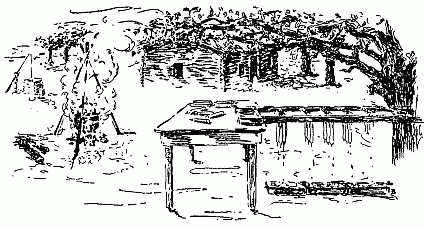 Soap and Candles
Dip-candles I never saw in common use—but
Mammy showed me how they were
made back at Ole Marster's, in the days
when candle-molds were not to be had.
Dipped or molded, the candles were of
varying substance. Tallow was the main
reliance—mutton tallow as well as that
from our beeves. It was tried out fresh,
and hardened with alum in the process.
The alum was dissolved in a little water,
and put with the raw fat as it went over
the fire. By and by the water all cooked
away, leaving the alum well incorporated
through the clear fat. Lacking it, a little
clear lye went in—Mammy thought and
said, the lye ate up the oil in the tallow,
making it firmer and whiter. But lye and
alum could not go in at the same time,
since being alkaline and acid, they would
destroy each other.
Great pains were taken not to scorch
the tallow—that meant smelly and ill-colored
candles. After straining it clear of
cracklings, it was caked in something deep,
then turned out and laid on the highest
shelf in the lumber house to await molding
time. Cakes of beeswax were kept in
the Jackson press, so children, white and
black, could not take bites for chewing.
It ranked next to native sweet gum for
such uses—but Mammy felt it had much
better be saved to mix with the tallow at
melting time. It made the candles much
firmer, also bettered their light, and moreover
changed the tallow hue to an agreeable
very pale yellow. Bee hives, like
much else, were to a degree primitive—the
wax came from comb crushed in the straining
of honey. It was boiled in water to
take away the remnant sweetness, then
allowed to cool on top the water, taken
off, and remelted over clean water, so
manipulated as to free it from foreign
substances, then molded into cakes. One
cake was always set apart for the neighborhood
cobbler, who melted it with
tallow and rosin to make shoemaker's
wax. Another moiety was turned into
grafting wax—by help of it one orchard
tree bore twelve manners of fruit. And
still another, a small, pretty cake from
a scalloped patty pan, found place in
the family work basket—in sewing by
hand with flax thread, unless you waxed it,
it lost strength, and quickly pulled to
pieces.
We bought our flax thread in skeins, but
Mammy loved to tell of spinning it back
in the days when she was young, and the
best spinner on the old plantation. She
still spun shoe-thread for her friend the
cobbler, who, however, furnished her the
raw flax, which he had grown, rotted and
hechtelled, in his bit of bottom land. There
were still spinning and weaving in plenty
at our house—Mother had made, yearly,
jeans, linsey, carpets and so on—but the
plantation was not wholly clothed with
homespun, as had been the case in her
father's house.
Return we to our candle-making. It
was work for the very coldest weather—even
though we had two sets of molds,
needs must the candles harden quickly if
the making was to speed well. Molds
could be filled at the kitchen hearth, then
set outside to cool. For dipping the tallow-pot
had to be set over an outside fire,
and neighbored by a ladder, laid flat on
trestles with smooth boards laid underneath.
Mammy spun the candle wicks—from
long-staple cotton, drawing it out
thick, and twisting it barely enough to hold
together. It must not be too coarse, as it
had to be doubled over reeds at top, either
for molding or dipping.
The molds were of candle-shape, joined
in batteries of six or twelve, with a pert
handle at one side, and tiny holes at the
tips, through which the wick-ends were
thrust, by help of a long broom-straw.
Well in place they were drawn taut, the
reeds so placed as to hold the wicks centrally,
then tallow melted with beeswax, in
due proportion, was poured around till the
molds were brim full—after which they
were plunged instantly into a tub of cold
water standing outside. This to prevent
oozings from the tip—hot grease is the
most insidious of all substances. Only in
zero weather would the first oozings harden
enough to plug the orifice quickly. When
the candles had hardened properly, the
mold was either held over the fire, or
thrust in hot water half a minute, then
the candles withdrawn by help of the reeds.
They were cooled a bit, to save the softened
outside, then nubbed of surplus wick, and
laid in a dish outside. Careless or witless
molders, by laying candles still soft upon
the pile, often made themselves double
work.
Tallow for dipping, was kept barely
fluid, by setting it over embers a little way
off the fire. The pot had to be deep, so
the wicks could be sunk in it to full length.
They were thus sunk by stickfuls, lifted up
quickly, and hung between the ladder rungs
to drip. Half the tallow on them dripped
away—indeed, after the first dipping they
looked little more than clotted ghosts of
themselves in their last estate. In very
cold weather three drippings sufficed—otherwise
there must be four or five. Since
the dip was the result of cooled accretions,
it was always top-heavy—much bigger at
the nose than the base. A quick and
skilled worker, though, could dip a hundred
candles in the time required to mold
two dozen. They burned out so quickly
that was a crowning mercy—half a dozen
was the average of a long winter evening.
Further they ran down, in great masses—hence
the importance of saving up drippings.
Even molded candles made them
plentiful enough to be worth re-molding.
This unless discolored with the brass
of candlesticks—in that case their last end
was soap grease.
Rush lights were dips—this I state on
information and belief, since I never saw
one. Also on information and belief, it
is here set forth, that folk in the back
countries where wicking was not easily
had, used instead of wicks, splinters of fat
pine, known as light wood. In proof, take
Candle Wood Mountain, whose name is
said to have come from furnishing such
fat pine, and of a special excellence. The
pine splinters must, I think, have given a
better light than real wicks—my father, in
Tennessee, never ceased sighing for the
lightwood, which had made such cheery
illumination back in his boyhood, in a
Carolina home.
Every sort of waste fat became at the
last, soap grease. Bones even were thrown
into kettles of lye, which ate out all their
richness, leaving them crumbly, and fit for
burying about the grapevines. Hence the
appositeness of the darkey saying, to express
special contempt of a suitor: "My
Lawd! I wouldn't hab dat nigger, not
eben for soap grease." Which has always
seemed to me, in a way, a classic of condemnation.
Soap making came twice a year—the
main event in March, to get free of things
left over from hog killing, the supplement
in September or October, to use up summer
savings. Each was preceded by dripping
lye. This necessitated wood ashes,
of course—ashes from green wood. Oak
or hickory was best. They were kept dry
until they went into hoppers, where they
were rotted by gentle wetting for a space
of several days. Then water was dripped
through, coming out a dark brown caustic
liquid, clean-smelling, but ill to handle—it
would eat a finger-tip carelessly thrust
in it to the raw.
But even thus it was not strong enough
for proper soapmaking, so it was boiled,
boiled, until it would eat a feather, merely
drawn quickly through it. Grease was
added then, a little at a time, and stirred
well through, changing the black-brown
lye into a light-brown, bubbly mass.
Whatever the lye would not eat of the
grease's components, was skimmed out
with the big perforated ladle. Even beyond
candle-molding, soap-making was
an art. Mammy never would touch it,
until "the right time of the moon." Also
and further, she used a sassafras stick for
stirring, put it in the first time with her
right hand, and always stirred the kettle
the same way. If a left-handed person
came near the kettle she was mightily
vexed—being sure her soap would go
wrong. She kept on the fire beside it a
smaller kettle of clear lye, to be added at
need, without checking the boiling.
Boiling down lye took one day, boiling
in grease another. The third morning,
after the fire was well alight, she tested
the soap, by making a bit into lather. If
the lather were clean and clear, without a
film of grease on top, she knew it remained
only to cook the soap down thick enough
for the barrel, or to make into balls by the
addition of salt. But if the film appeared—then
indeed there was trouble. First
aid to it was more lye, of feather-eating
strength—next a fresh sassafras stirring
stick, last and most important, walking
backwards as she put the stick in the kettle,
though she would never admit she did this
on purpose. Like the most of her race she
was invincibly shy about acknowledging
her beliefs in charms and conjuring.
Soap which failed to thicken properly
lacked grease. To put in enough, yet not
too much, was a matter of nice judgment.
Tallow did not mix well with hog fat.
Therefore it had commonly its smaller special
pot, whose results were molded for
hand-soap, being hard and rather light-colored.
Since our washerwomen much preferred
soft soap, most of the spring making went
straight into the barrel. The barrel had
to be very tight—soap has nearly as great
a faculty of creeping through seams as
even hot lard. One kettleful, however,
would have salt stirred through it, then be
allowed to cool, and be cut out in long bars,
which were laid high and dry to age. Old
soap was much better for washing fine
prints, lawns, ginghams and so on—in fact
whatever needed cleansing without fading.
Sundry other fine soap makers emptied
their salted soap, just as it was on the
point of hardening, into shallow pans,
cloth-lined, and shaped it with bare hands
into balls the size of two fists. This they
did with the whole batch, holding hard soap
so much easier kept, and saying it was no
trouble whatever to soften a ball in a little
hot water upon wash days. But Mammy
would have none of such practices—said
give her good soft soap and sand rock, she
could scour anything. Sand rock was a
variety of limestone, which burning made
crumbly, but did not turn to lime. Mammy
picked it up wherever she found it, beat it
fine and used it on everything—shelves,
floors, hollow-ware, milk pans, piggins,
cedar water buckets—it made their brass
hoops shine like gold. While she scoured
she told us tales of the pewter era—when
she had gone, a barefoot child, with her
mother, to the Rush Branch, to come home
with a sheaf of rushes, whereby the pewter
was made to shine. It hurts even yet, recalling
the last end of that pewter. As
glass and crockery grew plenty, the boys—my
uncles, there were five of them—melted
it down for rifle bullets, when by
chance they ran out of lead. Yet—who
am I, to reproach them—did not I myself,
melt down for a purpose less legitimate a
fine Brittania ware teapot, whose only
fault was a tiny leak? Now I should prize
it beyond silver and gold.
Harking back to candle-making—we had
no candle-berries in our wilds, and only a
few wax-berries as ornaments of our gardens.
But from what I know by observation
and experience, the candle-berries or
bayberries, can be melted in hot water, the
same as honey-comb, and the wax strained
away from the seedy residue, then allowed
to cool, on top the water, and clarified by a
further melting and cooling over water.
Mixed with paraffine it can be molded into
real bayberry candles, ever so much more
odorous than those of commerce. It is
well to remember in buying paraffine that
there are three qualities of it, differing
mainly in the degree of heat at which they
melt. Choose that which is hardest to
melt for candle-making. One might indeed,
experiment with bayberry wax, and
the drippings of plain paraffine candles,
before undertaking candle-making to any
considerable extent.
A last word. If any incline to challenge
things here set forth, will they please remember
that as one star differs from another
in glory, so does one family, one
region, differ from all others in its manners
of eating, drinking, and cooking. I
have written true things, but make no claim
that they apply all over. Indeed there
may be those to whom they will seem a
transversing of wisdom and experience.
To all such I say, try them intelligently,
with pains and patience, and of the results,
hold fast to that you find good.