The Governor of California issues a Proclamation—Formation of the Mariposa
Battalion—The Origin and Cause of the War—New Material
Public Documents—A Discussion—Capt. Walker—The Peace Commissioners’
Parley and the Indians’ Pow-wow—The Mysterious
Deep Valley—Forward, March!
The State authorities had in the meantime become
aroused. The reports of Indian depredations multiplied,
and a general uprising was for a time threatened.
Proclamations were therefore issued by Gov. McDougall,
calling for volunteers, to prevent further outrages and to
punish the marauders. Our impromptu organization formed
the nucleus of the volunteer force in Mariposa county, as a
large majority of the men at once enlisted. Another battalion
was organized for the region of Los Angelos. Our
new organization, when full, numbered two hundred mounted
men. This was accomplished in time, by Major Savage
riding over to the San Joaquin, and bringing back men from
Cassady’s Bar.
The date from which we were regularly mustered into the
service was January 24th, 1851. The volunteers provided
their own horses and equipments. The camp supplies and
baggage trains were furnished by the State. This military
force was called into existence by the State authorities, but
by act of Congress its maintenance was at the expense of
the general government, under direction of Indian commissioners.
Major Ben McCullough was offered the command
of this battalion, but he declined it. This position was
urged upon him with the supposition that if he accepted it
the men who had once served under him would be induced
to enlist—many of the “Texan Rangers” being residents
of Mariposa county.
Major McCullough was at that time employed as Collector
of “Foreign Miners’ Tax,” a very lucrative office. As
a personal acquaintance, he stated to me that the position
was not one that would bring him honor or pecuniary advantages.
That he had no desire to leave a good position,
except for one more profitable.
The officers, chosen by the men, recommended to and
commissioned by Governor McDougall, were James D.
Savage, as Major; John J. Kuy-ken-dall, John Boling, and
William Dill, as Captains; M. B. Lewis, as Adjutant;
John I. Scott, Reuben T. Chandler, and Hugh W. Farrell,
as First Lieutenants; Robert E. Russell, as Sergeant
Major; Dr. A. Bronson, as Surgeon, and Drs. Pfifer
and Black as Assistant Surgeons. A few changes of
Lieutenants and subordinate officers were afterward made.
Upon the resignation of Surgeon Bronson, Dr. Lewis
Leach, was appointed to fill the vacancy.
While writing up these recollections, in order to verify
my dates, which I knew were not always chronologically exact,
I addressed letters to the State departments of California
making inquiries relative to the “Mariposa Battalion,”
organized in 1851. In answer to my inquiry concerning
these known facts, the following was received from Adj.
General L. H. Foot. He says: “The records of this office,
both written and printed, are so incomplete, that I am
not aware from consulting them that the organization to
which you allude had existence.” It is a matter of regret
that the history of the early settlement of California is, to
so great an extent, traditionary, without public records of
many important events. It is not deemed just that the
faithful services of the “Mariposa Battalion,” should be
forgotten with the fading memory of the pioneers of that
period. There is in the State, an almost entire absence of
any public record of the “Indian war,” of which the discovery
of the Yosemite valley was an important episode.
Until the publication of Mr. J. M. Hutching’s book, “In
The Heart of The Sierras, Yo Semite, Big Trees, etc.,” which
contains valuable public documents, the author of “Discovery
of The Yosemite” was, as stated on page 30, unable
to obtain any official records concerning the operations
of the Mariposa battalion, or of the events which preceded
and caused the Indian War of 1851. Now that Mr.
Hutching’s persistent industry has brought light from darkness,
I interrupt my narrative to make clear the origin of
the war, and to justify the early Pioneers engaged in it.
As a sample, also, of many obstructions encountered, I insert
a few extracts from letters relating to the “Date of
Discovery,” furnished the Century Magazine.
The attack made upon Savage on the Merced river in
1850, had for its object plunder and intimidation, and as
an invasion of Ten-ie-ya’s territory was no longer threatened
after the removal of Mr. Savage to the Mariposa, the Yo
Semities contented themselves with the theft of horses
and clothing, but a general war was still impending, as
may be seen by reference to page 31 of “In The Heart of
The Sierras,” where appears: Report of Col. Adam Johnston,
a special agent, to Gov. Peter H. Burnett, upon his
return from Mariposa county to San Jose, then the Capital
of California, and which I here present: San Jose, January
2, 1851. Sir: I have the honor to submit to you, as
the executive of the State of California, some facts connected
with the recent depredations committed by the
Indians, within the bounds of the State, upon the persons
and property of her citizens. The immediate scene of
their hostile movements are at and in the vicinity of the
Mariposa and Fresno. The Indians in that portion of your
State have, for some time past, exhibited disaffection and
a restless feeling toward the whites. Thefts were continually
being perpetrated by them, but no act of hostility
had been committed by them on the person of any individual,
which indicated general enmity on the part of
the Indians, until the night of the 17th December last.
I was then at the camp of Mr. James D. Savage, on
the Mariposa, where I had gone for the purpose of reconciling
any difficulty that might exist between the Indians
and the whites in that vicinity. From various conversations
which I had held with different chiefs, I concluded
there was no immediate danger to be apprehended. On
the evening of the 17th of December, we were, however,
surprised by the sudden disappearance of the Indians.
They left in a body, but no one knew why, or where they
had gone. From the fact that Mr. Savage’s domestic Indians
had forsaken him and gone with those of the rancheria,
or village, he immediately suspected that something
of a serious nature was in contemplation, or had already
been committed by them.
The manner of their leaving, in the night, and by stealth,
induced Mr. Savage to believe that whatever act they had
committed or intended to commit, might be connected with
himself. Believing that he could overhaul his Indians
before others could join them, and defeat any contemplated
depredations on their part, he, with sixteen men, started
in pursuit. He continued upon their traces for about
thirty miles, when he came upon their encampment. The
Indians had discovered his approach, and fled to an adjacent
mountain, leaving behind them two small boys asleep,
and the remains of an aged female, who had died, no
doubt from fatigue. Near to the encampment Mr. Savage
ascended a mountain in pursuit of the Indians, from which
he discovered them upon another mountain at a distance.
From these two mountain tops, conversation was commenced
and kept up for some time between Mr. Savage
and the chief, who told him that they had murdered the
men on the Fresno, and robbed the camp. The chief had
formerly been on the most friendly terms with Savage, but
would not now permit him to approach him. Savage said
to them it would be better for them to return to their village—that
with very little labor daily, they could procure
sufficient gold to purchase them clothing and food. To
this the chief replied it was a hard way to get a living,
and that they could more easily supply their wants by
stealing from the whites. He also said to Savage he
must not deceive the whites by telling them lies, he must
not tell them that the Indians were friendly; they were
not, but on the contrary were their deadly enemies, and
that they intended killing and plundering them so long
as a white face was seen in the country. Finding all
efforts to induce them to return, or to otherwise reach
them, had failed, Mr. Savage and his company concluded to
return. When about leaving, they discovered a body of
Indians, numbering about two hundred, on a distant
mountain, who seemed to be approaching those with
whom he had been talking.
Mr. Savage and company arrived at his camp in the
night of Thursday in safety. In the mean time, as news
had reached us of murders committed on the Fresno, we
had determined to proceed to the Fresno, where the
men had been murdered. Accordingly on the day following,
Friday, the 20th, I left the Mariposa camp with
thirty-five men, for the camp on the Fresno, to see the
situation of things there, and to bury the dead. I also
dispatched couriers to Agua Fria, Mariposa, and several
other mining sections, hoping to concentrate a sufficient
force on the Fresno to pursue the Indians into the mountains.
Several small companies of men left their respective
places of residence to join us, but being unacquainted
with the country they were unable to meet us. We
reached the camp on the Fresno a short time after daylight.
It presented a horrid scene of savage cruelty. The
Indians had destroyed everything they could not use or
carry with them. The store was stripped of blankets,
clothing, flour, and everything of value; the safe was
broken open and rifled of its contents; the cattle, horses
and mules had been run into the mountains; the murdered
men had been stripped of their clothing, and lay before us
filled with arrows; one of them had yet twenty perfect
arrows sticking in him. A grave was prepared, and the
unfortunate persons interred. Our force being small, we
thought it not prudent to pursue the Indians farther into
the mountains, and determined to return. The Indians in
that part of the country are quite numerous, and have been
uniting other tribes with them for some time. On reaching
our camp on the Mariposa, we learned that most of the
Indians in the valley had left their villages and taken their
women and children to the mountains. This is generally
looked upon as a sure indication of their hostile intentions.
It is feared that many of the miners in the more remote
regions have already been cut off, and Agua Fria and
Mariposa are hourly threatened.
Under this state of things, I come here at the earnest
solicitations of the people of that region, to ask such aid
from the state government as will enable them to protect
their persons and property. I submit these facts for your
consideration, and have the honor to remain,
Yours very respectfully,
Adam Johnston.
To his excellency Peter H. Burnett.
The report of Col. Johnston to Gov. Burnett had the
desired result, for immediately after inauguration, his successor,
Gov. McDougal, on January 13, 1851, issued a
proclamation calling for one hundred volunteers, and this
number by a subsequent order dated January 24th, 1851,
after receipt of Sheriff James Burney’s report, bearing
the same date of the governor’s first call for one hundred
men, was increased to “two hundred able bodied men,
under officers of their own selection.”
To insure a prompt suppression of hostilities, or a vigorous
prosecution of the war, on January 25th, 1851, Gov.
McDougal appointed Col. J. Neely Johnson of his staff a
special envoy to visit Mariposa county, and in an
emergency, to call out additional forces if required, and
do whatever seemed best for the interests and safety of
the people endangered.
Col. Adam Johnston, before leaving for San Jose, had,
as he reported, “dispatched couriers to Agua Fria, Mariposa,
and several other mining sections, hoping to concentrate
a sufficient force on the Fresno to pursue the Indians
into the mountains. Several small companies of men left
their respective places of residence to join us, but being
unacquainted with the country they were unable to meet
us.”
The same apparent difficulties beset Sheriff Burney, as
he was able to collect but seventy-four men, but want of
knowledge of the country was not the sole cause of delay.
The Indians of the mountains at that time having been
accustomed to the occupation for many years of despoiling
the Californians, were the most expert bare back riders
and horse thieves in the world, and when many of us who
had horses and mules herding in the valley ranches of the
foot-hills and Merced bottoms, sent for them to carry us
into the distant mountains of the Fresno, where we had
heard the Indians were concentrating, our messengers in
many instances found the animals stolen or stampeded, and
hence the delay in most instances, though some of the
mining population who had arrived in California by water,
never seemed able to guide themselves without a compass,
and would get lost if they left a beaten trail. As for
myself, I could scarcely become lost, except in a heavy
fog or snow storm, and upon two occasions in the mountains
was compelled to leave my comrades, who were
utterly and wilfully lost, but who, finding me the most
persistent, finally called to me and followed out to well
known land marks.
It will appear by the letter of Major Burney that “The
different squads from the various places rendezvoused not
far from this place (Agua Fria), on Monday, 6th, and numbered
but seventy-four men.” I was at Shirlock’s Creek
on the night before, Jan. 5th, 1851, and had promised to
join the Major in the morning; but when the morning
came, my animals were gone, stolen by Indians from my
Mexican herdman.
Mr. C. H. Spencer had sent his servant “Jimmy,” to
Snelling’s ranche, on the Merced River, for his animals,
and after a delay of perhaps two or three days, they were
brought up for use. Mr. Spencer kindly loaned me a
mule for temporary use, but upon his having his saddle
mule stolen a few nights after, I gave back his mule and
bought a fine one of Thos. J. Whitlock, for whom Whitlock’s
Creek was named. I had previously been able to
start with a small squad on the trail of Major Burney and his
brave men, but met some of them returning after the fight,
among whom I remember, were Wm. Little, shot through
the lungs, but who finally recovered, a Mr. Smith, known
as “Yankee Smith,” sick, as he said, “from a bare-footed
fool exposure in the snow,” and Dr. Pfifer, who had been
given the care of the wounded and sick men. There were
several others unknown to me, or whose names I have now
forgotten.
The different accounts I received from the men engaged
in the fight, were so conflicting, that in referring to it
in previous editions, on page 25, I could only say that it
“was not a very satisfactory one to the whites.” I could
only state the general impression received from Mr.
Little’s account, which was that the men had been unnecessarily
exposed to cold and danger, and that only by the
dash and bravery of the officers and men engaged in the
affair were they able to withdraw into a place of temporary
safety, until joined by re-inforcements.
Indian fighting was new to most of the men engaged,
and, like the soldiers on both sides at the outbreak of
the Rebellion, they had been led to expect a too easy
victory.
But we have now the report of Major Burney to Gov.
McDougal, and also a letter from Mr. Theodore G.
Palmer, of Newark, New Jersey, to his father, written
five days after the battle, and which has been kindly
placed at my disposal. Military men will readily perceive
and enjoy the entire artlessness and intended truthfulness
of Mr. Palmer’s letter, as well as his modest
bravery. The two letters read in connection with that of
Col. Adam Johnston, are most valuable in fixing dates
and locations for any one with a knowledge of the topography
of the country, and of the events they narrate.
They set at rest forever the absurd claim that the
first battle of the Indian War of 1851 was fought in
the Yosemite valley, for the battle was fought on a
mountain. Mr. Hutchings, to whose industry so much
is due, has strangely overlooked the fact, that the reference
to “Monday 6th,” in Major Burney’s letter, could
only have reference to Monday, January 6th, 1851, the
month in which the letter was written, and not to December,
1850, as given by Mr. Hutchings, in brackets. The
6th of December, 1850, occurred on a Friday; on Tuesday,
December 17, 1850, the three men were killed on the
Fresno river station of James D. Savage; on Friday, December
20th, 1850, they were buried; on Monday, January
6th, 1851, Major Burney, sheriff of Mariposa County,
assembled a strong posse to go in pursuit of the Indian
murderers, and coming up with them on a mountain
stronghold on Jan. 11th, 1851, destroyed their villages,
and then retreated down the mountain some four miles to
a plain in the Fresno valley, where he erected a log
breastwork for temporary defense. Nothing but the most
vivid imagination, coupled with an entire ignorance of the
region of the Yosemite, could liken the two localities to
each other. The Hetch Hetchy valley of the Tuolumne
river and some of the cliffs of the Tuolumne and of the
King’s river, bear a general resemblance to some of the
scenery of the Yosemite, but when the Yosemite valley
itself has been seen, it will never be forgotten by the
visitor.
Agua Fria, January 13, 1851.
Sir: Your Excellency has doubtlessly been informed
by Mr. Johnston and others, of repeated and aggravated
depredations of the Indians in this part of the State.
Their more recent outrages you are probably not aware of.
Since the departure of Mr. Johnston, the Indian agent,
they have killed a portion of the citizens on the head of
the San Joaquin river, driven the balance off, taken
away all movable property, and destroyed all they could
not take away. They have invariably murdered and
robbed all the small parties they fell in with between here
and the San Joaquin. News came here last night that
seventy-two men were killed on Rattlesnake Creek; several
men have been killed in Bear Valley. The Fine Gold
Gulch has been deserted, and the men came in here yesterday.
Nearly all the mules and horses in this part of
the State have been stolen, both from the mines and the
ranches. And I now, in the name of the people of this
part of the State, and for the good of our country, appeal
to your Excellency for assistance.
In order to show your Excellency that the people have
done all that they can do to suppress these things, to secure
quiet and safety in the possession of our property and
lives, I will make a brief statement of what has been
done here.
After the massacres on the Fresno, San Joaquin, etc.,
we endeavored to raise a volunteer company to drive the
Indians back, if not to take them or force them into
measures. The different squads from the various places
rendezvoused not far from this place on Monday, 6th, and
numbered but seventy-four men. A company was formed,
and I was elected captain; J. W. Riley, first lieutenant; E.
Skeane, second lieutenant. We had but eight day’s
provisions, and not enough animals to pack our provisions
and blankets, as it should have been done. We, however,
marched, and on the following day struck a large trail of
horses that had been stolen by the Indians. I sent forward
James D. Savage with a small spy force, and I followed
the trail with my company. About two o’clock in
the morning, Savage came in and reported the village near,
as he had heard the Indians singing. Here I halted, left
a small guard with my animals, and went forward with the
balance of my men. We reached the village just before
day, and at dawn, but before there was light enough to see
how to fire our rifles with accuracy, we were discovered by
their sentinel. When I saw that he had seen us, I ordered
a charge on the village (this had been reconnoitered by
Savage and myself). The Indian sentinel and my company
got to the village at the same time, he yelling to
give the alarm. I ordered them to surrender, some of
them ran off, some seemed disposed to surrender, but
others fired on us; we fired and charged into the village.
Their ground had been selected on account of the advantages
it possessed in their mode of warfare. They numbered
about four hundred, and fought us three hours
and a half.
We killed from forty to fifty, but cannot exactly tell
how many, as they took off all they could get to. Twenty-six
were killed in and around the village, and a number of
others in the chaparrel. We burned the village and provisions,
and took four horses. Our loss was six wounded,
two mortally; one of the latter was Lieutenant Skeane,
the other a Mr. Little, whose bravery and conduct through
the battle cannot be spoken of too highly. We made litters,
on which we conveyed our wounded, and had to
march four miles down the mountain, to a suitable place
to camp, the Indians firing at us all the way, from peaks
on either side, but so far off as to do little damage. My
men had been marching or fighting from the morning of
the day before, without sleep, and with but little to eat.
On the plain, at the foot of the mountain, we made a rude,
but substantial fortification; and at a late hour those who
were not on guard, were permitted to sleep. Our sentinels
were (as I anticipated they would be) firing at the Indians
occasionally all night, but I had ordered them not to come
in until they were driven in.
I left my wounded men there, with enough of my company
to defend the little fort, and returned to this place
for provisions and recruits. I send them to-day re-inforcements
and provisions, and in two days more I march by
another route, with another re-inforcement, and intend to
attack another village before going to the fort. The Indians
are watching the movements at the fort, and I can
come up in the rear of them unsuspectedly, and we can
keep them back until I can hear from Your Excellency.
If Your Excellency thinks proper to authorize me or
any other person to keep this company together, we can
force them into measures in a short time. But if not
authorized and commissioned to do so, and furnished with
some arms and provisions, or the means to buy them, and
pay for the services of the men, my company must be
disbanded, as they are not able to lose so much time
without any compensation.
Very respectfully, your obedient servant,
James Burney.
In a subsequent letter of Major Burney, addressed to
Hon. W. J. Howard, occurs the following passage:
“The first night out you came into my camp and reported
that the Indians had stolen all your horses and
mules—a very large number; that you had followed their
trail into the hill country, but, deeming it imprudent to go
there alone, had turned northward, hoping to strike my
trail, having heard that I had gone out after Indians. I
immediately, at sunset, sent ten men (yourself among the
number) under Lieutenant Skeane—who was killed in
the fight next day—to look out for the trail, and report,
which was very promptly carried out.”
Page 35, “In Heart of S. and Legislative Journal” for
1851, page 600.
It is only required of me to say here that re-inforced
by such leaders of men as Kuykendall, Boling, Chandler
and Doss, there was no delay, and the campaign was
completed at “Battle Mountain,” a water shed of the San
Joaquin.
I now introduce a letter of great value, to me, as it
fixes the date of the first battle, and disproves assertions
made in the Century Magazine:
Hart’s Ranch, California, January 16th, 1851.
My Dear Father: When I wrote my last letter to you I had
fully determined to take a Ranch near Pacheco’s Pass, as I informed
you, but before three days had passed the report of Jim
Kennedy’s murder on the Fresno was confirmed, and I started
for the mountains in pursuit of the Indians who were committing
depredations all through the country and had sworn to kill
every white man in it. Four hundred men had promised to go,
but at the appointed time only seventy-seven made their appearance.
With these we started under the command of Major
Burney, Sheriff of Mariposa County, guided by Mr. Jas. D.
Savage, who is without doubt the best man in the world for
hunting them out.
From his long acquaintance with the Indians, Mr. Savage has
learned their ways so thoroughly that they cannot deceive him.
He has been one of their greatest chiefs, and speaks their language
as well as they can themselves. No dog can follow a
trail like he can. No horse endure half so much. He sleeps
but little, can go days without food, and can run a hundred miles
in a day and night over the mountains and then sit and laugh for
hours over a camp-fire as fresh and lively as if he had just been
taking a little walk for exercise.
With him for a guide we felt little fear of not being able to
find them.
On Friday morning about ten o’clock, our camp again moved
forward and kept traveling until one that night, when “halt!
we are on the Indians,” passed in a whisper down the line.
Every heart beat quicker as we silently unsaddled our animals
and tied them to the bushes around us. Commands were given
in whispers and we were formed in a line. Sixty were chosen
for the expedition, the balance remaining behind in charge of
camp.
Savage said the Indians were about six miles off; that they
were engaged in a feast. He pointed out their fires, could hear
them sing and could smell them, but his eyes were the only ones
that could see; his ears alone could hear, and his nose smell
anything unusual. Still, there was such confidence placed in
him that not one doubted for an instant that everything was as
he said.
About two o’clock we started in Indian file, as still as it was
possible for sixty men to move in the dark, for the moon had
set. For three long hours did we walk slowly and cautiously
over the rocks and bushes, through the deepest ravines and up
steep and ragged mountain, until within a half mile of the
enemy.
Here every one took off his boots, when we again pushed forward
to about two hundred yards from the camp. Another halt
was called to wait for daylight, while Savage went forward to
reconnoitre. He succeeded in getting within ten paces of the
Rancharia, and listened to a conversation among them in which
his name was frequently mentioned. He found that it was a
town of the Kee-chees, but that there were about one hundred
and fifty of the Chow-chil-la warriors with them and several of
the Chu-chan-ces. Had he found only the Kee-chees as he expected,
we were to surround the Rancharia and take all prisoners,
but the presence of so many Chow-chil-las, the most warlike
tribe in California, made a change of plan necessary.
Daylight by this time began to appear. We had been lying in
our stocking-feet on the ground on the top of a mountain within
a few paces of the snow for more than an hour, almost frozen
by the intense cold, not daring to move or speak a word.
It was not yet light enough to see the sight of our rifles, when
an Indian’s head was seen rising on the hill before us. For a moment
his eyes wandered, then rested on us, and with a yell like
a Coyote he turned for the Rancharia. Never did I hear before
such an infernal howling, whooping and yelling, as saluted
us then from the throats of about six hundred savages, as they
rushed down the hill into the gim-o-sell bushes below.
Our huzzahs could, however, hardly have sounded more
pleasant to them, as when finding we were discovered, we
charged on their town. Fifty rifles cracked almost instantaneously;
a dozen Indians lay groaning before their huts, and many
supposed we had undisturbed possession. Our firing had ceased
and we were looking around for plunder, when a rifle fired from
the bushes below, struck a young Texan, Charley Huston, standing
by my side. He fell with a single groan, and we all supposed
him dead. My first impression was that I was shot, for I plainly
heard the ball strike and almost felt it. This was a surprise
that almost whipped us, for not knowing that the Indians had
fire-arms, we were only expecting arrows. Before that shot was
fired, I had always entertained the idea that I could run about as
fast as common men (and I was one of the first in the charge),
but by the time I had collected my wandering senses, I was nearly
alone; the majority of the party some thirty paces ahead, and
running as if they never intended to stop.
Captain Burney and Mr. Savage were on top of the hill using
every exertion to make the company halt and form. He had
partly succeeded, when a pistol ball struck a man in the face, he
fell, but raising himself up said, “if we stay here we will be all
shot” and a break was made for the trees.
Still some few remained in rank and others slowly answered
to the orders to form, when our Second Lieutenant fell mortally
wounded. He was carried off, and every man took his tree.
The Indians had again possession of their Rancharia, and of
a slight eminence to the left, and were sending showers of bullets
and arrows upon us from three sides. These two points had
to be gained even if it cost half our men. Leaving then, enough
to guard our present position, the rest of us charged on the hill,
took it, stormed the Rancharia, took and burnt it, and returned
to our former position with only one man wounded, Wm. Little,
shot through the lungs.
The close fighting was now over, for we could not give chase
and were forced to lie behind trees and rocks and pick out such
as exposed themselves. It was about half past ten when, finding
it useless to remain longer, litters were made for the wounded
and we started for camp. Then again we had warm work, for
all down the pass, the Indians had stationed themselves to fire
on us, forcing us to charge on them several times, for while we
were in plain sight, they were completely hid behind the gim-o-sell
brush.
In our march back, the rear guard was kept at work about as
hard as at any time during the morning, but not a single man
was hurt, and only one mule was killed.
We moved our camp that night, six miles lower down, where
we laid the foundations of a fort and left thirty men to guard it
and take care of the wounded.
The rest of us started below the next morning, after burying
Lieutenant Skeane, who died in the night.
The Indians acknowledged to eleven men killed, though fifty
killed and wounded would be a moderate estimate. Our
loss was seven wounded—two mortally (as we then supposed,
but Mr. Little finally recovered.—Author.)
The force of the Savages consisted of, as near as could be ascertained,
four hundred warriors. We burned a hundred wigwams,
several tons of dried horse and mule meat, a great number
of bows and arrows, and took six mules.
Several amusing incidents occurred during the fight and
others of the most heroic bravery on the part of the Indians.
One old squaw was wounded accidentally at the first charge, and
was unable to get off. One of our men was going to finish her
with his knife, but seeing it was a woman he left her. No
sooner had he gone than she picked up a bow and lodged three
arrows in another man. I believe she was not touched after
that.
The whole body of Indians seemed bent on killing Mr. Savage,
partly because he would not be their chief and lead them against
the whites, and partly because he was, they knew, our greatest
dependence as guide, and their particular dread. To kill him,
many of them sacrificed their own lives. They would come one
at a time and, standing in open ground, send arrows at him
until shot down; and one old chief who used to cook for Savage,
would ask him after every shot where he had hit him. They
would talk to him to find out where he was, and as soon as he
would answer, the balls and arrows would fly thick around his
head: but he escaped unhurt; but as he said, worse frightened
than he ever was before. He did not fancy such partiality.
A large party has started on a second expedition, but I believe
I am perfectly satisfied with Indian fighting.
T. G. Palmer.
Note.—It will have been observed that especial reference has twice
been made to Gim-o-sell brush, a shrub that grows only on warm
slatey soil, on Southern exposures, sought by Indians for winter
quarters, and not on the granite cliffs and mountains of the Yosemite.
I had not thought it necessary to draw upon nature for testimony,
but a new generation has sprung into existence, and the eternal hills
may speak to them.
The mining camp or village of Agua Fria, at the date
of the organization of the battalion, was the county seat
of Mariposa County, and the residence of the Sheriff,
Major James Burney. Whittier’s Hotel was the head-quarters
for enlistment. Finding the number called for
incomplete, while yet in daily expectation of the arrival of
the mustering officer, James D. Savage made a rapid ride
to the San Joaquin diggings, and returned with men enough
to complete the organization.
We were formally reported for duty, and went into camp
about two miles below Agua Fria, on about the 10th of
Feb., 1851, but when mustered in, the rolls were dated to
include service from Jan. 24th, 1851, the date of the last
order of enlistment. An informal ballot was taken to show
the preference of the men for officers to command us,
Major Burney having previously declined, and when that
had been demonstrated, other aspirants were withdrawn by
their friends, a formal ballot was taken and a regular organization
of three companies completed. The Governor was
duly notified of our proceedings, and in a few days the
commissions were received by our respective officers.
After a few days in camp on Agua Fria Creek, we moved
down to a camp in the foot hills, known afterwards as
Lewis Ranch, where we had abundant grass and good water,
and there was established our head-quarters, while waiting
for Col. J. Neely Johnson and the U. S. Indian Commission,
as stated in this chapter.
After instructions were given us by Col. Johnson, and
the Commission had exhausted its eloquence upon the
“Children of the Great Father at Washington,” and had
started for the Fresno, we were allowed to go in pursuit of
some very sly marauders who had stolen into our camp in
the night, loosened and run off some of our animals, and
taken some others herded in the foot hills, but no extended
operations were allowed, as Major Savage ordered us to be
in readiness for a campaign against the Yosemities, when
the first big storm should come, that would prevent their
escape across the Sierra Nevada. After a few days’ delay
the storm did come with continued violence, as recorded.
In view of the facts and dates here given how absurd
the statement that we did not go to the Yosemite “until
about the 5th or 6th of May, 1851.” Our idleness in camp
from Feb. 10th and the patient indulgence of the Commissioners,
while waiting for the results of our first operations,
surpass belief.
And now I reluctantly notice an error of statement by
Mr. Julius N. Pratt in the Century Magazine for December,
1890.
Had the usual courtesy been extended of allowing me to
see and answer Mr. Pratt’s erroneous impressions in the
same number, I am convinced that he would have kindly
withdrawn his article. I am led to this belief, not alone
from letters received, but from the internal evidence of an
upright character conveyed by Mr. Pratt’s graphic account
of “A Trip to California by way of Panama in 1849,”
in the Century for April 1891.
The Century Magazine is a most powerful disseminator
of truth, or error, and though I cannot hope for a complete
vindication through this volume, its readers shall have
the facts of “The Date of Discovery” set before them, “for a
truthful regard for history” and my own self-respect require
it.
In the Century Magazine for September, 1890, page
795, is an article from my pen which gives the date of
discovery of the Yosemite as March, 1851. Mr. Pratt, in the
December number following, assumes, with “a truthful
regard for history,” that I was in error, and gives about
“January 10th, 1851, as the approximate, if not exact date
of discovery.” Many of the men whom Mr. Pratt supposed
to have been the discoverers, were, or became, my
own comrades. When Mr. Pratt’s article appeared, I at
once sent a reply, but it received no recognition.
Knowing that Mr. Theodore G. Palmer, of Newark, New
Jersey, was in the only engagement occurring with Indians
in Mariposa county at the time given by Mr. Pratt as the
date of his supposed discovery of the Yosemite, I wrote,
requesting Mr. Palmer to call on the editor of the Century
in my behalf.
In a letter of January 9th, 1891, Mr. Palmer wrote: “It
is the unexpected which always happens, and your communication
to the Century in response to Pratt’s ‘California,’
was never received. Mr. Johnson, the associate
editor, received me very pleasantly. He assured me that
although he sent you an advance copy of Pratt’s article,
nothing had been received in the office from you since in
reply, and he presumed you had given up the case in
default.
“I so completely satisfied him that Mr. Pratt is in
error, that he requested me to express my reasons in the
Century, and to assure you that any communication from
you will always have respectful attention.”
On January 24th, 1891, Mr. R. W. Johnson, associate
editor, wrote me, saying: “Since telling your friend, Mr.
Palmer, that we had not received an article from you in
reply to Mr. Pratt, we have discovered the manuscript.
We have in type a short note from Mr. Palmer which
will be acceptable to you.”
A few days after Mr. Johnson kindly sent me the proof.
On March 12th, 1891, Mr. Johnson wrote me: “Mr. Pratt,
after examination of the subject, has written us a short
letter, withdrawing his contention of your claim to the
discovery of the Yosemite, the publication of which we
trust will be satisfactory to you and also to Mr. Palmer.
Will you now tell us whether there is anything in this new
claim that Walker was the discoverer of the Valley?”
I at once saw that if Mr. Pratt’s retraction was published
there would be no need of the publication of Mr.
Palmer’s communication. About this time a letter
of earlier date, January 28, 1891, was sent me by Mr.
Palmer, received from Mr. Pratt, in which the latter gentleman
says: “I enclose a letter which seems to prove that
the party about which I wrote to the Century was not
your party. One went to the North fork, the other
(yours) to the South.” That statement left no base whatever
for Mr. Pratt’s imaginary “fight at the Yosemite, and
thus of the discovery,” for the North Fork affair was
not a battle at all, but “a scare” on a fork which enters
the Merced river thirty-five miles below the Yosemite, and
as for the battle fought on the 11th of January, 1851, by
Major Burney’s company, in which Mr. Palmer was
engaged, it was not fought on the South fork or in any
valley, but upon a high mountain of the Fresno river.
Mr. Palmer now felt that his note to The Century was
too long delayed, and wrote asking for its withdrawal or its
publication. Mr. R. U. Johnson replied: “The Century
is made up two months in advance,” but that he intended
inserting it in the April number, &c. Mr. Palmer added
in his letter to me, “I think he will.”
The matter had now become not only interesting, but
amusing to me; for very soon Mr. Palmer wrote, “whether
my answer to Pratt will be published or not, is doubtful.
I infer (from a letter) that Pratt will not rest quiescent
under my contradiction.” Again Mr. Palmer wrote, enclosing
copy of letter to Mr. Johnson of March 14th, 1891,
answering Mr. Johnson’s Statement, “that Mr. Pratt, while
being convinced of his injustice to Dr. Bunnell and being
ready himself to withdraw his former statement, takes
issue with you as to the identity of the two parties,” and
then Mr. Johnson asks, “would it not be just as well and
more effective if we were simply to print from Mr. Pratt
that he is ‘pleased to withdraw all contention of the claim
made by Dr. Bunnell that he was the original discoverer?’”
Let me here say, in passing, that I never made
such a claim.
Mr. Palmer very properly objects to becoming the
“scapegoat” for me or any one else, and replying to Mr.
Johnson, says: “Whether my letter is printed or not, is a
matter of entire indifference to me, (personally) ... it
was only at your desire, and to please Dr. Bunnell, that I
wrote the little I did. I left you under the impression
that you desired to get at the exact facts and would be glad
to rectify the injustice done to the doctor by the publication
of Mr. Pratt’s communication.... I believe
that the publication of my letter would not only gratify
him, but also place the Century right upon the record,
where it surely desires to stand.”
Mr. Palmer could say no more, but to his great chagrin,
but not surprise, on March 17th, he received a letter of
thanks from the associate editor of the Century, in which
Mr. Johnson says: “Please accept our thanks for your
letter of the 14th, and for your obliging attitude in the
matter.” Whether any retraction from Mr. Pratt will ever
appear in the Century is now, in view of the long delay, a
matter of great indifference to me.7
Now a few facts in regard to the Discovery of the Yosemite
Valley by Capt. Joseph Reddeford Walker, for whom
Walker’s river, Lake and Pass were named. It is not a
new claim, as supposed by Mr. R. U. Johnson, but appears
in the Peoples Encyclopædia and was set up in the San
Jose Pioneer soon after Capt. Walker’s death, and answered
by me in the same paper in 1880.
I cheerfully concede the fact set forth in the Pioneer
article that, “His were the first white man’s eyes that ever
looked upon the Yosemite” above the valley, and in that
sense, he was certainly the original white discoverer.
The topography of the country over which the Mono
trail ran, and which was followed by Capt. Walker, did not
admit of his seeing the valley proper. The depression indicating
the valley, and its magnificent surroundings, could
alone have been discovered, and in Capt. Walker’s conversations
with me at various times while encamped between
Coultersville and the Yosemite, he was manly enough to
say so. Upon one occasion I told Capt. Walker that
Ten-ie-ya had said that, “A small party of white men once
crossed the mountains on the north side, but were so guided
as not to see the valley proper.” With a smile the Captain
said: “That was my party, but I was not deceived, for the
lay of the land showed there was a valley below; but we had
become nearly bare-footed, our animals poor, and ourselves
on the verge of starvation, so we followed down the ridge to
Bull Creek, where, killing a deer, we went into camp.”
The captain remained at his camp near Coultersville for
some weeks, and disappeared as suddenly as he came. He
once expressed a desire to re-visit the region of the Yosemite
in company with me, but could fix no date, as he told me
he was in daily expectation of a government appointment
as guide, which I learned was finally given him.
Captain Walker was a very eccentric man, well versed
in the vocal and sign languages of the Indians, and went
at his will among them. He may have visited the
Yosemite from his camp before leaving. I was strongly
impressed by the simple and upright character of Captain
Walker, and his mountain comrades spoke in the
highest praise of his ability. Fremont, Kit Carson, Bill
Williams, Alex Gody, Vincenthaler (not Vincent Haler,
as erroneously appeared in the March number of the
Century), Ferguson and others, all agreed in saying that
as a mountain man, Captain Walker had no superior.
Rev. D. D. Chapin, of Maysville, Kentucky, formerly
rector of Trinity Church, San Jose, and of St. Peter’s
Church, San Francisco, as well as editor of Pacific Churchman,
kindly called my attention to a seeming neglect
of the claim for Captain Walker as the discoverer of the
Yosemite. All that I have ever claimed for myself is,
that I was one of the party of white men who first entered
the Yosemite valley, as far as known to the Indians.
The fact of my naming the valley cannot be disputed.
The existence of some terribly yawning abyss in the mountains,
guarded at its entrance by a frightful “Rock Chief,”
from whose head rocks would be hurled down upon us if we
attempted to enter that resort of demons, was frequently
described to us by crafty or superstitious Indians. Hence
the greater our surprise upon first beholding a fit abode for
angels of light. As for myself, I freely confess that my
feelings of hostility against the Indians were overcome by
a sense of exaltation; and although I had suffered losses of
property and friends, the natural right of the Indians to
their inheritance forced itself upon my mind.
The Mariposa Battalion, was assigned by Governor McDougall
to the duty of keeping in subjection the Indian
tribes on the east side of the San Joaquin and Tulare valleys,
from the Tuolumne river to the Te-hon Pass. As soon
as the battalion was organized, Major Savage began his
preparations for an expedition. There was but little delay
in fitting out. Scouting parties were sent out, but with no
other effect than to cause a general retreat of the Indians
to the mountains, and a cessation of hostilities, except the
annoyances from the small bands of thieving marauders.
No Indians were overtaken by those detachments, though
they were often seen provokingly near. When about to
start on a more extended expedition to the mountains, Major
Savage received an order from the Governor to suspend
hostile operations until he should receive further instructions.
We learned at about the same time through the newspapers,
as well as from the Governor’s messenger, that the
United States Commissioners had arrived in San Francisco.
Their arrival had for some time been expected.
Up to this period the Indian affairs of California had
not been officially administered upon. Public officers had
not before been appointed to look after the vast landed estates
of the aboriginal proprietors of this territory, and to
provide for their heirs. After some delay, the commissioners
arrived at our camp, which was located about fifteen
miles below Mariposa village. Here the grazing was most
excellent, and for that reason they temporarily established
their head-quarters. These officials were Colonels Barbour
and McKee, and Dr. Woozencroft. They were accompanied
by Col. Neely Johnson, the Governor’s aid, and by a small
detachment of regulars. The commissioners at once proceeded
to make a thorough investigation into the cause of
the war, and of the condition of affairs generally. Having
secured the services of some of the Mission Indians, these
were sent out with instructions to notify all the tribes that
the commissioners had been directed by the President to
make peace between them and the white settlers; and that
if they would come in, they should be assured protection.
The so-called Mission Indians were members of different
tribes who had been instructed in the belief of the Catholic
Church, at the old Spanish Missions. These Indians had
not generally taken part in the war against the white settlers,
although some of them, with the hostiles, were the
most treacherous of their race, having acquired the vices
and none of the virtues of their white instructors.
During this period of preliminaries a few Indians ventured
in to have a talk with the commissioners. They were
very shy and suspicious, for all had been more or less implicated
in the depredations that had been committed.
Presents were lavishly distributed, and assurances were
given that all who came in should be supplied with food
and clothing and other useful things. This policy soon became
generally known to the Indians.
Among the delegations that visited the commissioners
were Vow-ches-ter,8 chief of one of the more peaceful bands,
and Russio, a Mission Indian from the Tuolumne, but who
in former years had belonged to some of the San Joaquin
tribes. These chiefs had always appeared friendly, and had
not joined in the hostile attitude assumed by the others.
At the outbreak on the Fresno, Vow-ches-ter had been temporarily
forced into hostilities by the powerful influence of
Jose Rey, and by his desire to secure protection to his relative,
one of Savage’s squaws. But with the fall of Jose
Rey, his influence over Vow-ches-ter declined, and he was
once more left free to show his friendship for the whites.
As for Russio, his intelligent services were secured as peace-maker
and general Indian interpreter by the commissioners,
while a much less competent Mission Indian, Sandino,
served in the capacity of interpreter during expeditions into
the mountains.
Having been assured of safety, these two chiefs promised
to bring in their people and make peace with the whites.
All that came in promised a cessation, on the part of their
tribes, of the hostilities begun, for which they were rewarded
with presents.
Vow-chester when questioned, stated “that the mountain
tribes would not listen to any terms of peace involving the
abandonment of their territory; that in the fight near the
North Fork of the San Joaquin, Jose Rey had been badly
wounded and probably would die; that his tribe were very
angry, and would not make peace.” We had up to this
time supposed Jose Rey had been killed at “Battle Mountain.”
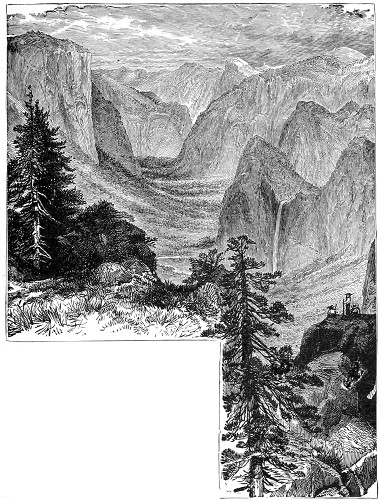
Russio said: “The Indians in the deep rocky valley
on the Merced river do not wish for peace, and will not come
in to see the chiefs sent by the great father to make treaties.
They think the white men cannot find their hiding places,
and that therefore they cannot be driven out.” The other
Indians of the party confirmed Russio’s statements. Vow-chester
was the principal spokesman, and he said: “In this
deep valley spoken of by Russio, one Indian is more than
ten white men. The hiding places are many. They will
throw rocks down on the white men, if any should come near
them. The other tribes dare not make war upon them, for
they are lawless like the grizzlies, and as strong. We are
afraid to go to this valley, for there are many witches
there.”
Some of us did not consider Vow-chester’s promise of
friendship as reliable. We regarded him as one of the hostile
mountain Indians. He, however, was never again engaged
in hostilities against the whites. I afterwards learned
that Vow-chester and Savage had once professed a strong
friendship for each other. The trader at that time had
taken a bride who was closely allied to the chief. After the
destruction of Savage’s trading posts, in which Vow-chester
had taken an active part in procuring a forcible divorce
and division of property (though the murders were ascribed
to the Chow-chillas), all forms of friendship or relationship
had ceased. At this interview no sign of recognition
passed. After listening to this parley between the Commissioners
and the Indians, I asked Major Savage, who had
been acting as interpreter, if he had ever been into the deep
valley the Indians had been speaking of. He at first replied
that he had, but on a subsequent conversation he corrected
this statement by saying, “Last year while I was
located at the mouth of the South Fork of the Merced, I was
attacked by the Yosemites, but with the Indian miners I
had in my employ, drove them off, and followed some of
them up the Merced river into a canon, which I supposed
led to their stronghold, as the Indians then with me said it
was not a safe place to go into. From the appearance of
this rocky gorge I had no difficulty in believing them.
Fearing an ambush, I did not follow them. It was on this
account that I changed my location to Mariposa creek. I
would like to get into the den of the thieving murderers.
If ever I have a chance I will smoke out the Grizzly Bears
(the Yosemites) from their holes, where they are thought
to be so secure.”
No peace messengers came in from the mountain Indians,
who continued to annoy the settlers with their depredations,
thieving from the miner’s camps, and stealing horses and
mules from the ranches. While we were awaiting the action
of the commissioners, we lost some horses and mules,
which were stolen from the vicinity of our camp. After
the commissioners had decided upon the measures to be
adopted, our battalion was ordered into line and we were
then officially informed by Col. Johnson, that our operations
as a military organization, would henceforth be under
the direction of the United States Commissioners. That
by their order we were now assigned to the duty of subduing
such Indian tribes as could not otherwise be induced to
make treaties with them, and at once cease hostilities and
depredations. “Your officers will make all reports to the
commissioners. Your orders and instructions will hereafter
be issued by them.” The colonel then complimented
the soldierly appearance of the battalion (very customary
in later years) and then said: “While I do not hesitate to
denounce the Indians for the murders and robberies committed
by them, we should not forget that there may perhaps
be circumstances which, if taken into consideration,
might to some extent excuse their hostility to the whites.
They probably feel that they themselves are the aggrieved
party, looking upon us as trespassers upon their territory,
invaders of their country, and seeking to dispossess them
of their homes. It may be, they class us with the Spanish
invaders of Mexico and California, whose cruelties in civilizing
and christianizing them are still traditionally fresh in
their memories,” etc. In conclusion the colonel said: “As
I am about to leave, I will now bid you ‘good bye,’ with
the hope that your actions will be in harmony with the
wishes of the commissioners, and that in the performance
of your duties, you will in all cases observe mercy where
severity is not justly demanded.”
Colonel Johnson gave us a very excellent little speech;
but at that time we were not fully impressed with the justness
of the remarks which had been made from kindness
of heart and sincerely humane feelings. Many of us had
lost—some heavily—by the depredations of the Indians.
Friends and relatives had been victims of their atrocities.
Murders and robberies had been committed without provocations
then discernible to us. Many of us would then have
been willing to adopt the methods of the old Spanish missionaries,
who, it was said, sometimes brought in their converts
with the lasso. However, these orders and the speech from
Col. Johnson were received with cheers by the more impatient
and impulsive of the volunteers, who preferred active
service to the comparative quiet of the camp.
The commissioners selected a reservation on the Fresno,
near the foot-hills, about eighteen or twenty miles from our
camp, to which the Indian tribes with whom treaties had
been made were to be removed, and at this locality the commissioners
also established a camp, as head-quarters.
The deliberative action on the part of the commissioners,
who were very desirous of having the Indians voluntarily
come in to make treaties with them, delayed any active co-operation
on the part of our battalion until the winter rains
had fully set in. Our first extended expedition to the mountains
was made during the prevailing storms of the vernal
equinox, although detachments had previously made excursions
into the country bordering upon the Sierras. This region,
like parts of Virginia, proved impassable to a mounted
force during the wet season, and our operations were confined
to a limited area.
It was at last decided that more extended operations
were necessary to bring in the mountain tribes. Although
there was no longer unity of action among them, they refused
to leave their retreats, and had become even suspicious
of each other. The defeat of Jose Rey, and the desertion
of the tribes who had made, or had promised to make, treaties
with the commissioners, and had ceased from all hostile
demonstrations, had caused jealousies and discontent to
divide even the most turbulent bands. For the extended
operations of the battalion among the mountains, it was
decided that Major Savage, with the companies of Captains
Boling and Dill, should make expeditions which would require
him to traverse the regions of the San Joaquin and
Merced rivers. Captain Kuy-ken-dall with his company
were to be detached to operate for the same purpose in the
regions of the Kings and Kah-we-ah rivers. The Indians
captured were to be escorted to the commissioners’ camp
on the Fresno. Notwithstanding a storm was gathering,
our preparations were cheerfully made, and when the order
to “form into line” was given, it was obeyed with alacrity.
No “bugle call” announced orders to us; the “details”
were made quietly, and we as quietly assembled. Promptly
as the word of command “mount,” was given, every
saddle was filled. With “forward march,” we naturally
filed off into the order of march so readily assumed by
mounted frontiersmen while traveling on a trail.
We left our camp as quietly and as orderly as such an undisciplined
body could be expected to move, but Major Savage
said that we must all learn to be as still as Indians, or
we would never find them.
This battalion was a body of hardy, resolute pioneers.
Many of them had seen service, and had fought their way
against the Indians across the plains; some had served in
the war with Mexico and been under military discipline.
Although ununiformed, they were well armed, and their
similarities of dress and accoutrements, gave them a general
military appearance.
The temperature was mild and agreeable at our camp
near the plain, but we began to encounter storms of cold
rain as we reached the more elevated localities.
Major Savage being aware that rain on the foot-hills and
plain at that season of the year indicated snow higher up,
sent forward scouts to intercept such parties as might attempt
to escape, but the storm continued to rage with such
violence as to render this order useless, and we found the
scouts awaiting us at the foot of a mountain known as the
Black Ridge. This ridge is a spur of the Sierra Nevada.
It separates the Mariposa, Chow-chilla, Fresno and San
Joaquin rivers on the south from the Merced on the north.
While halting for a rest, and sipping his coffee, Savage expressed
an earnest desire to capture the village he had
ascertained to be located over the ridge on the south fork
of the Merced. He was of the opinion that if it could be
reached without their discovery of us, we should have no
fighting to do there, as that band would surrender at once
rather than endanger their women and children, who would
be unable to escape through the snow. Toward this village
we therefore marched as rapidly as the nature of the steep
and snow-obstructed trail would permit us to travel. An
Indian that answered to the name of “Bob,” an attaché of
the Major, serving as guide. Climbing up this steep black
mountain, we soon reached the region of snow, which at
the summit, was fully four feet deep, though the cold was
not intense. By this time, night was upon us. The trail
led over the ridge at a point where its tabled summit was
wooded with a forest of pines, cedars and firs, so dense as
almost to exclude the light of the stars that now and then
appeared struggling through the gloom.
We laboriously followed our guide and file leader, but
this trail was so indistinctly seen in the darkness, that at intervals
deep mutterings would be heard from some drowsy
rider who missed the beaten path. As we commenced the
descent of the ridge, the expressions became more forcible
than polite when some unlucky ones found themselves
floundering in the snow below the uncertain trail. If left
to their own sagacity, a horse or mule will follow its leader;
but if a self-willed rider insists upon his own judgment,
the poor animal has not only to suffer the extra fatigue incurred
by a mis-step, but also the punishment of the spur, and
hear the explosive maledictions of the master. The irritating
responses of his comrades that “another fool has been
discovered,” was not then calculated to sooth the wrath that
was then let loose.
With short halts and repeated burrowings in the deep,
damp snow, the South Fork of the Merced was at length
reached about a mile below what is now known as
Clark’s, or Wah-wo-na, from Wah-ha wo-na, a Big Tree.
We here made a halt, and our weary animals were provided
with some barley, for the snow was here over a foot deep.
The major announced that it was but a short distance below
to the Indian village, and called for volunteers to accompany
him—it might be for a fight or perhaps only a foot-race—circumstances
would determine which. The major’s
call was promptly and fully answered, although all were
much fatigued with the tedious night march. The animals
were left, and a sufficient number was selected to remain as
a reserve force and camp guard. At daylight we filed away
on foot to our destination, following the major who was
guided by “Bob.”