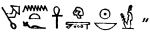
On the Blue River, Province of Sennâr.
13° North Latitude, March 2, 1844.
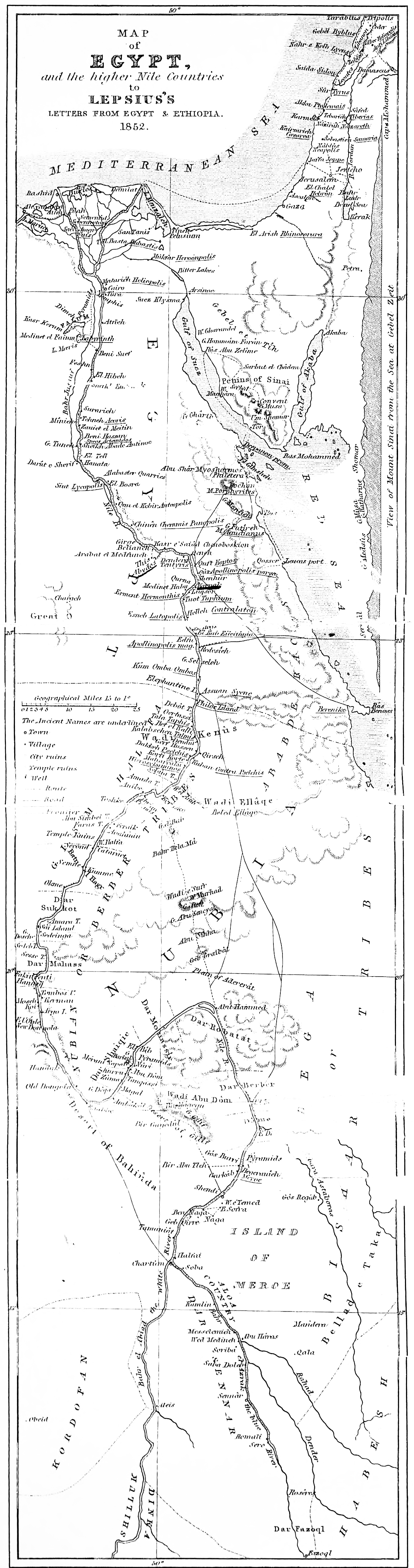
To-day we reach the southernmost boundary of our African journey.
To-morrow we go northward and homeward again. We shall come as far as
the neighbourhood of Sero, the frontier between the provinces of Sennâr
and Fasoql. Our time will not admit of more stay. I have travelled from
Chartûm hither with Abeken only. We gave up the desert journey to
Mandera, the rather as the eastern regions are now unsafe by reason of
the war in Taka. I now employ the time in learning the nature of the
river, and the neighbouring country some days’ journey beyond Sennâr.
The journey is worth the trouble, for the character of the whole land
decidedly changes in soil, vegetation, and animals, on passing Abu
Haras, between Chartûm and Sennâr, at the embouchure of the Rahad. It
was necessary for me to gain as much personal knowledge of the whole
Nile valley, as far up as possible, since the nature of this country, so
limited in its width, has more influence than anything else upon the
progress of its history.
On the White River one cannot journey for more than a few days to the
frontier of Mohammed Ali’s conquests, without peculiar preparations and
precautions. There are found the Shilluk on the western shore, and on
the eastern, the Dinka, both native negro people, who are never the
best friends with the northern folk. The Blue River is accessible to a
much higher extent, and was, and is now, historically, of more
consequence than the White, as it is the channel of communication
between the north and Abyssinia. I should like to have proceeded into
the province of Fasoql, the last under Egyptian dominion; but that will
not tally with our reckoning; so we shall put a period to our southern
journey to-night.
But I return in my reports to Dâmer, where I embarked on the 27th of
January with Abeken, in the bark of Musa Bey, Ahmed Pasha’s first
adjutant, who had kindly placed it at our disposal. We stopped for the
night at about eight o’clock in the evening, near the island of Dal
Haui. We had obtained a khawass from Emin Pasha, the same who had come
hither on the conquering of the country with Ismael Pasha, who had
accompanied the Defterdar Bey to Kordofan, (or, according to his
pronunciation, Kordifal), who had then journeyed with the same on his
errand of vengeance to Shendi for the murder of Ismael, and since then
had traversed the whole Sudan in every direction for three and twenty
years. He has the most perfect map of these countries in his head, and
possesses an astounding memory for names, bearings, and distances, so
that I have based two charts upon his remarks, which are not without
geographical interest in some parts. He has also been to Mekka, and
therefore likes to be addressed as Haggi Ibrahim (Pilgrim Ibrahim.) In
other things, too, he has much experience, and will be very useful to
us by reason of his long and extended acquaintance with the land.
On the twenty-eighth of January, we stopped about noon at an island
called Gomra, as we heard that there were ruins in the vicinity which we
should like to see. We had to proceed through a flat arm of the Nile,
and ride for an hour on the eastern shore to the north. There at last we
found, after passing the villages of Motmár and El Akarid, between a
third village, Sagâdi, and a fourth, Genna, the inconsiderable ruins of
a place built of bricks, and strewn with broken tiles.
We returned but little satisfied amidst the noon-day heat, and arrived
with our bark only just before sunset in Begerauîe, in the neighbourhood
of which are situated the pyramids of Meroë. It is remarkable that this
place is not mentioned by Cailliaud. He only speaks of the pyramids of
Assur, i.e. Sûr, or e’Sûr. The whole plain in which the ruins of the
city and the pyramids lie bears the same name; and, besides this, a
portion of Begerauîe, which, probably by a slip of the pen, is called
Begromi by Hoskins.
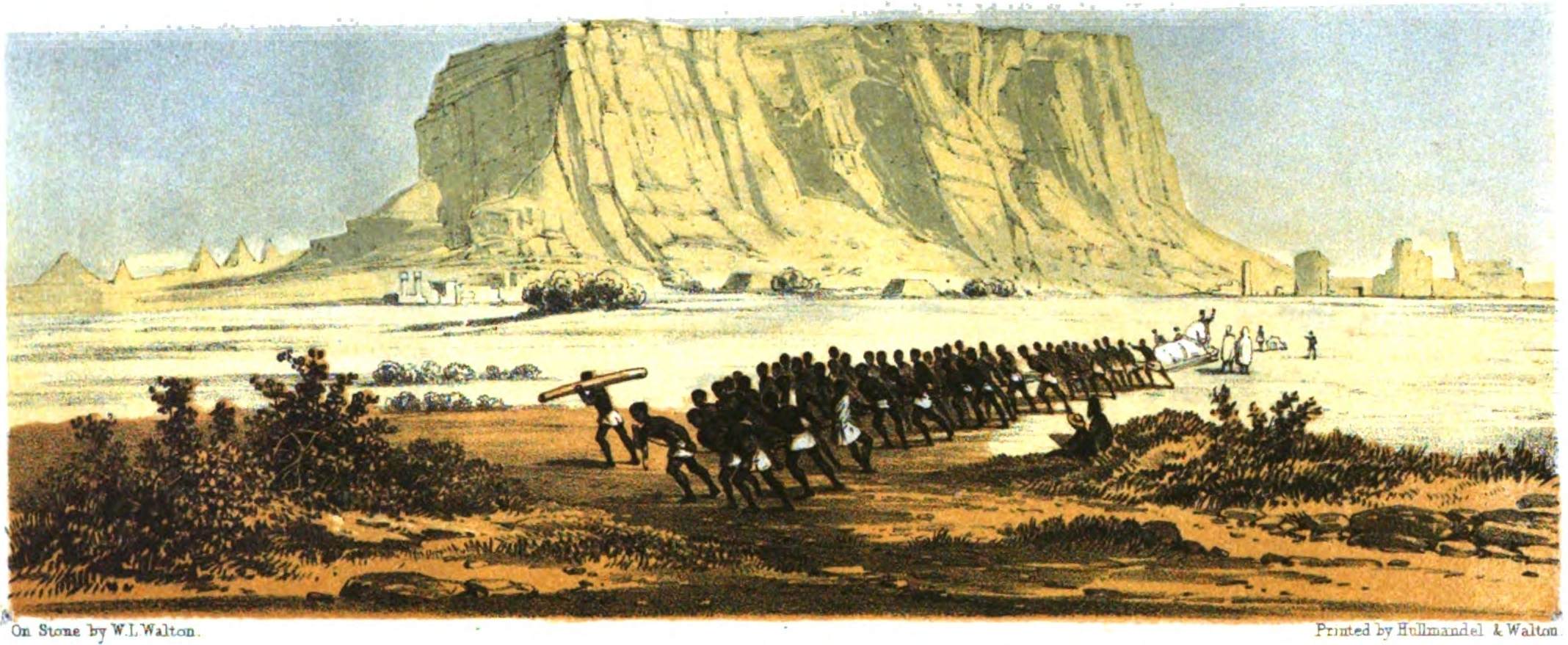
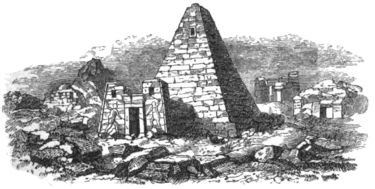
Although it was already dark, I rode with Abeken to the pyramids, which
stand a short hour’s ride inland, upon the slopes of the low hills that
stretch along eastward. The moon alone, which was in its first quarter,
sparingly lighted the plain, covered with stones, low underwood, and
rushes. After a sharp ride, we came to the foot of a row of pyramids,
which rose before us in the form of a crescent, as was rendered
necessary by the ground. To the right joins another row of pyramids, a
little retreating; a third group lies more to the south in the plains,
too far off to be distinguished in the dim moonlight. I tied the bridle
of my donkey round a post, and climbed up the first mound of ruins.
The single pyramids are not so exactly placed as in Egypt; yet the
ante-chambers, which are here built on to the body of the structures
themselves, all lie turned away from the river toward the east,
doubtless for the same religious reason which actuated the Egyptians
also to turn the entrance of the detached temples before their pyramids
to the east, thus river-ward at Gizeh and Saqâra, but the tombs toward
the west.
Half looking, half feeling, I found some sculptures on the outer walls
of the tomb temple, and also perceived figures and writing on the inner
walls. I recollected that I had a candle-end in the wallet of my donkey;
this I lighted, and examined several ante-chambers. Then immediately the
forms of the Egyptian Gods—Osiris, Isis, Nephthys, Atmu, &c., came out
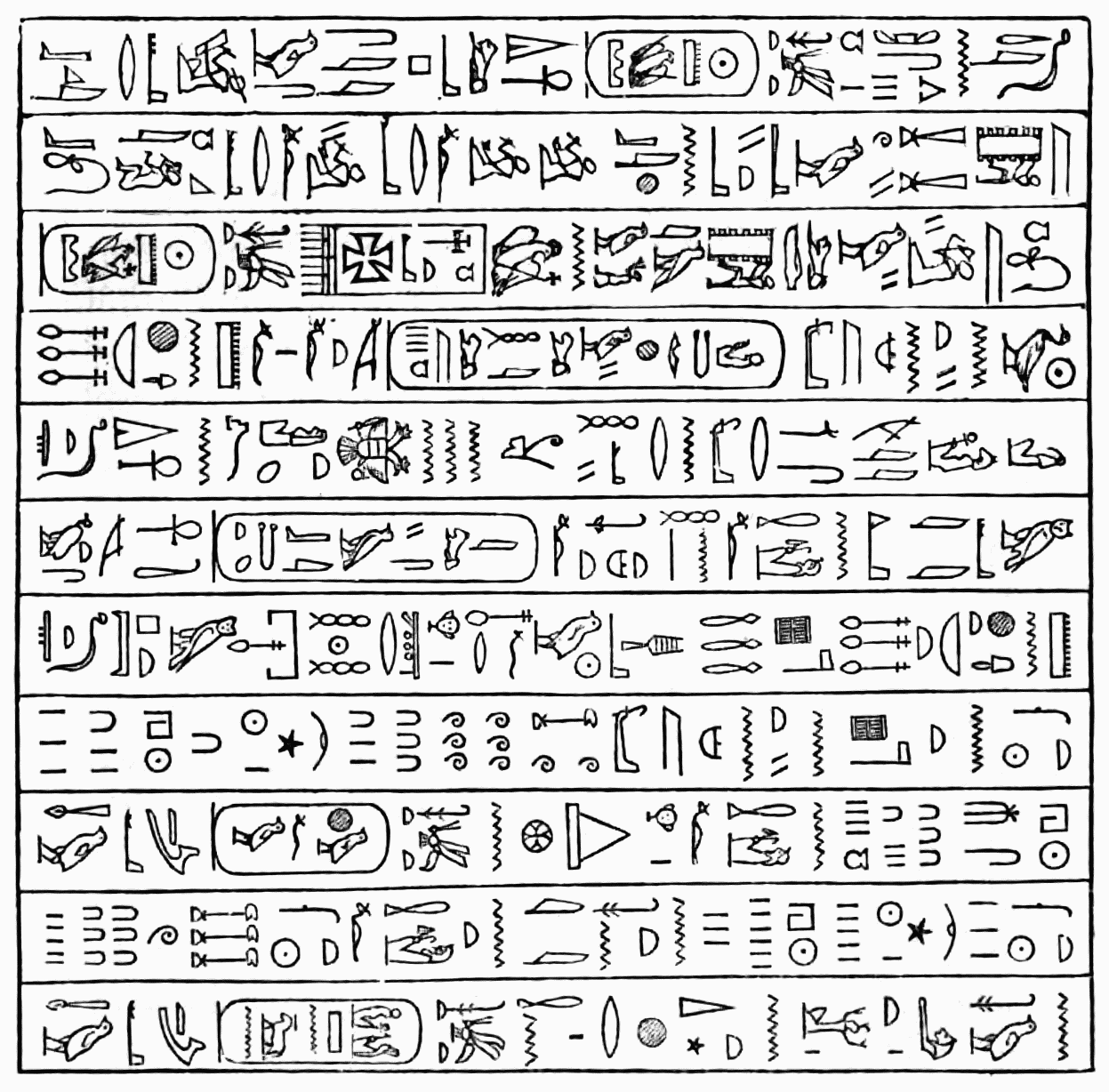
with their names in the well-known hieroglyphics.[70] In the first
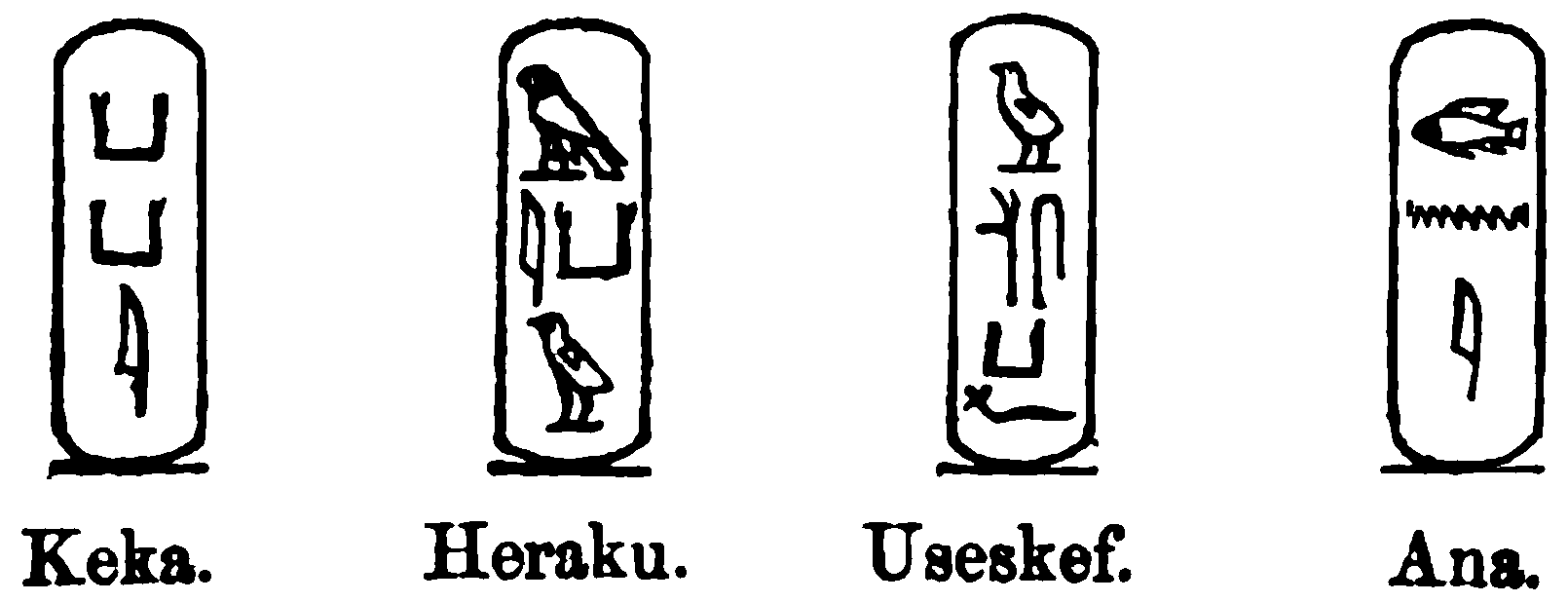
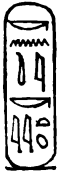
chamber, too, I found the cartouche of a king. One of the two rings
contained the signs of a great Pharaoh of the Old Empire, Sesurtesen I.;
the same was assumed by two later Egyptian kings, and now encountered
for the fourth time as the throne-name of an Ethiopian king. The
sculptures on the other side were not ended. On the same evening, I also
found royal names in another ante-chamber, but they were rather
illegible. Both writing and representations had, in fact, suffered much.
The pyramids, like those in Egypt, have lost their tops, and many are
totally destroyed.
Our new khawass, who would not leave us in the night, had followed
immediately. He knew the locality perfectly, as he had been here a long
time with Ferlini, and had assisted him in the examination of the
pyramids. He showed us the place in the pyramid where Ferlini, in 1834,
discovered the rich treasure of gold and silver rings built in the wall.
I also discovered a case-pyramid that evening, enlarged according to the
principle of the Egyptian pyramids by a later mantle of stone. According
to the inscriptions and representations in the antechambers, these
pyramids are chiefly built for kings, and a few perhaps for their wives
and children. The great number of them argues for a long series of
kings, and a well-grounded empire that probably lasted for a number of
centuries.
The most important results of this examination by moon and candlelight
was, however, not the most agreeable; I was fully convinced that I had
before me here, on the most celebrated spot of ancient Ethiopia, nothing
but the ruins of comparatively recent art.[71] Already, at an earlier
period, had I judged from the monuments of Ferlini, drawings of which I
had seen in Rome, and the originals in London, that they were certainly
produced in Ethiopia, but not in any case earlier than the first century
before the Christian era; therefore, at about the same period to which a
few veritable Greek and Roman works belong, which we discovered together
with the Ethiopian treasure. And I must say the same now of all the
monuments not only situated here, but upon the whole island of Meroë, as
well of all the pyramids near Begerauîe, as of the temples of Ben Naga,
of Naga, and of the Wadi e’ Sofra (Cailliaud’s Mesaurât), which we have
subsequently seen. The representations and inscriptions leave not the
least doubt on the subject, and it will be for ever in vain to attempt
the support of the much-loved idea of an ancient Meroë, glorious and
famous, the inhabitants of which were the predecessors and teachers of
the Egyptians in civilisation, by referring to its monumental remains.
Yet this conviction is of no little value, and appears to throw a
certain degree of light upon the historical connection of Egypt and
Ethiopia, the importance of which will first be fully developed at the
monuments of Barkal. There, no doubt, will be found the oldest Ethiopian
memorials, although perhaps not earlier than the time of Tarhaka, who
reigned contemporaneously over Egypt and Ethiopia, in the seventh
century before Christ.
We rode back to the pyramids the next morning with the sunrise, and
found fifteen various royal names, but some in a very bad condition.
We had just completed the survey of the two north-easterly groups of
pyramids, and were riding towards the third, which lies in the plain not
far from the ruins of the city, and is perhaps the oldest Necropolis,
when we heard shots from the shore, and saw white sails fluttering on
the river. Soon after Erbkam, the two Weidenbachs, and Franke came
walking over the plain, and greeted us already from afar. We scarcely
expected them so soon, and therefore the meeting was the more pleasant.
We could now continue our journey to Chartûm all together.
At two o’clock in the afternoon we went off, and reached Shendi at
about ten the next morning. After dinner we went on, stayed the night on
the island Hobi, and came the next morning early to Ben Naga. Here we
first visited the ruins of two little temples, of which the west one had
Typhon columns instead of pillars, but showed no writing on its few
remains; in the other eastern one there were a few sculptures preserved
on the low wall, and writing on a few round pillars, but too little that
anything connected might be gathered from it. Excavations might probably
discover royal names; but such an attempt is only possible on our
return.
Some camels were procured for the next morning, and I rode off with
Abeken, Erbkam, and Maximilian Weidenbach at nine o’clock for Naga. So
are the ruins of a city and several temples named, which lie in the
eastern wilderness, at a distance of seven or eight hours from the Nile.
From our landing-place, near the only palm group of the whole region, we
only wanted half an hour to the village of Ben Naga, which lies in Wadi
Teresîb. One hour eastward, down the river (for it flows from west to
east here), the ruins are situated, where we had landed the day before,
in the Wadi el Kirbegân; we now passed them on the left, and rode
south-east into the wilderness, sparely grown with dry underwood,
crossed the valley El Kirbegân, which stretches hither from the river,
and in which we found a camp of Abâbde Arabs.
After four and a half hours from Ben Naga, we arrived at a solitary
mountain in the wilderness, named Buêrib. This lay between the little
southwestern wadis (so they call even the most level sinkings of the
plain, when the water runs off, and which we should scarcely call
valleys) and the great wide Wadi Auatêb, into which we now descended,
after we had passed the Buêrib at a little distance to the left. In
three and three quarter hours from Buêrib, we came to the ruins of Naga.
The enigma which I had vainly endeavoured to unriddle, and which neither
Cailliaud nor Hoskins had explained, as to how it was possible to build
a city and sustain it in the midst of the desert so far from the river,
was first solved in the vicinity of the temple. The whole valley of
Auatêb is still cultivated land. We found it covered far and wide with
durra stubble. The inhabitants of Shendi, Ben Naga, Fadnîe, Sélama,
Metamme, thus of both sides of the Nile, come hither to cultivate the
land, and to harvest durra. The tropical rain is sufficient to
fertilise the soil of this flat but extensive level, and in ancient
times it is probable that more was obtained from this region by greater
care. For the dry season there were no doubt large artificial cisterns,
like those we found at the most distant ruins north of Naga, although
without water.
The ruins lie at the end of a mountain chain which extends for several
hours, having received the name of Gebel e’ Naga, and running from north
to south; Wadi Auatêb passes along its western side toward the river.
After an uninterrupted ride, we arrived at about half-past five. By the
way we saw the road covered with the traces of gazelles, wild asses,
foxes, jackals, and ostriches. Lions, too, sometimes come hither, but we
saw no signs of them.
Before the coming of night I visited the three principal temples, which
all belong to a very late period, and do not admit of a single idea
concerning any antiquity, which Cailliaud and Hoskins imagined they
perceived. A fourth temple stand besides the three principal temples in
Egyptian architecture, the well turned, and not unpleasingly selected
Egyptian ornamental style of which, not only manifests the time of the
universal dominion of the Romans, but also the presence of Roman
builders. This has no inscriptions. Of the three others, the two
southernmost are built by one and the same king; on both he is
accompanied by a representation of the same queen. There is behind them
yet another royal personage, bearing different names on the two temples.
The name of the king has again the cartouch of Sesurtesen I. added,
although he does not appear to be the same with the king at the pyramids
of Sûr; and the two other persons have also old Egyptian cartouches,
which might easily lead to mistakes.
The third and northern temple has suffered much, and had but little
writing now, yet a king is mentioned on the door lintels, who is
different from the builder of the two others.
The forms of the gods are almost Egyptian, yet there is on the southern
temple a shape unknown in Egypt, with three lions’ heads (perhaps there
is a fourth behind) and four arms. This may be the barbarous god
mentioned by Strabo, which the Meroites revered beside Herakles, Pan,
and Isis.
Next morning, the 2nd of February, we visited the three temples again,
took a few paper impressions, and then went our way to the third group
of monuments, named Mesaurât, by Cailliaud. This is, however, a
designation employed for all three groups of ruins, and which signifies
“pictures,” or “walls decked with pictures.” The ruins of Ben Naga are
called Mesaurât el Kirbegân, because they lie in the Wadi el Kirbegân;
only the southern-most group, it seems, has retained its ancient name
Naga or Mesaurât e’ Naga; the third toward Shendi, called Mesaurât e’
Sofra, from the mountain-crater where it lies, and which is named e’
Sofra, the table.
We followed the mountain chain, Gebel e’ Naga, in the valley Auatêb, for
two hours in a northward direction. Then, at about half-past twelve
o’clock, we passed through the first ravine, opening to the right into a
more elevated valley, e’Siléha, which becoming wider behind the hills,
overgrown with grass and bushes, opens (in the direction of S.S.W. to
N.N.E.) after an hour and a half, to the left into the valley of Auatêb,
and in front toward another smaller valley, from which it is separated
by the Gebel Lagâr. This little valley it is which is called e’Sofra,
from its round form; here too lie the ruins which Hoskins saw, though he
did not penetrate to Naga. At a quarter past two we arrived, and had
therefore consumed not quite four hours from Naga hither. As we were
going to take a rapid survey of the whole, we walked through the
extensive ruins of the principal building, which Cailliaud had taken for
a great school, Hoskins for a hospital; and we perceived from the few
sculptures, unaccompanied by inscriptions, that we had before us also
here late monuments, probably younger than those of Sûr and Naga. Then
we went to the little temple near (on the pillars of which we found
riders on elephants and lions, and other strange barbaric
representations), looked at the large artificial cistern, now called Wot
Mahemût, which must have taken the place of the river during the dry
season, and rode back again to Ben Naga, at four o’clock.
When we came forth from the mountains, we met great herds of wild asses,
which always stopped a little in front of us, as if inviting us to chase
them. They are grey or reddish grey, with a white belly, and all have a
strongly marked black stripe down the back; the tip of the tail, too, is
usually black. Many are caught when young, but are not fit for carriage
or riding then. The next generation is only to be employed for these
purposes. Almost all the domesticated donkeys in the south, above the
Ass Cataract (Shellâl homâr), in Berber, are of the race of these wild
asses, and have the same colour and marks.
We pitched our tents in the rank-grown plain soon after sundown. The
camel-drivers and our khawass were terribly afraid of the lions in
this desert, until a great fire was lighted, which they carefully kept
up the whole night through. When a lion lets his voice be heard in the
vicinity of a caravan, sounding indeed deeply and dreadly through the
whole wilderness, all the camels run away like mad, and are difficult of
being secured, often not until they have suffered and done some injury.
Some days ago a camel was strangled by a lion in our vicinity, although
on the opposite side of the river; a man that was there saved himself
on the next tree.
On the 3rd of February, we rode off again at seven o’clock, leaving the
two Buêrib, the great “blue” one and the little “red” one, a good
distance to the left, and came into the valley El Kirbegân shortly
before nine o’clock. This we followed for half an hour riverward, seeing
the Mesaurât el Kirbegân to the right; but we now stopped on the hills,
until we arrived at Ben Naga, a little after eleven o’clock, and half an
hour at our landing place.
After two hours we went on in our bark. With a strong contrary wind we
made but little way, and saw nothing new, except a swimming
hippopotamus. Next morning we landed on the western shore, opposite the
village of Gôs Basabir, to inspect the ruins of an old fortress wall
with towers of defence, which encircled a hill top. The place was about
three hundred paces in diameter. After mid-day, we neared the Shellâl
(cataracts) of Gerashâb; the higher mountains before us came nearer, and
at last formed a great pool, apparently without any outlet; however, it
was really close at hand, as we turned into a narrow gorge, widening
into a high and wild rock valley, that we followed for almost an hour
before we came into another plain on the opposite side. The Qirre
granite mountains running through here, end on the eastern side of the
river in a peak called the Rauiân, “the Satisfied;” while westward, at
some distance from the river, standing equally alone, is the Atshân,
“the Thirsty.”
On the 5th of February, we landed early at Tamamiât, about 11 o’clock.
Mohammed Said, the former treasurer of the deceased Ahmed Pasha, whose
acquaintance we had made in Dâmer, had given us a letter to one of the
under-officials there, containing directions to deliver to us the
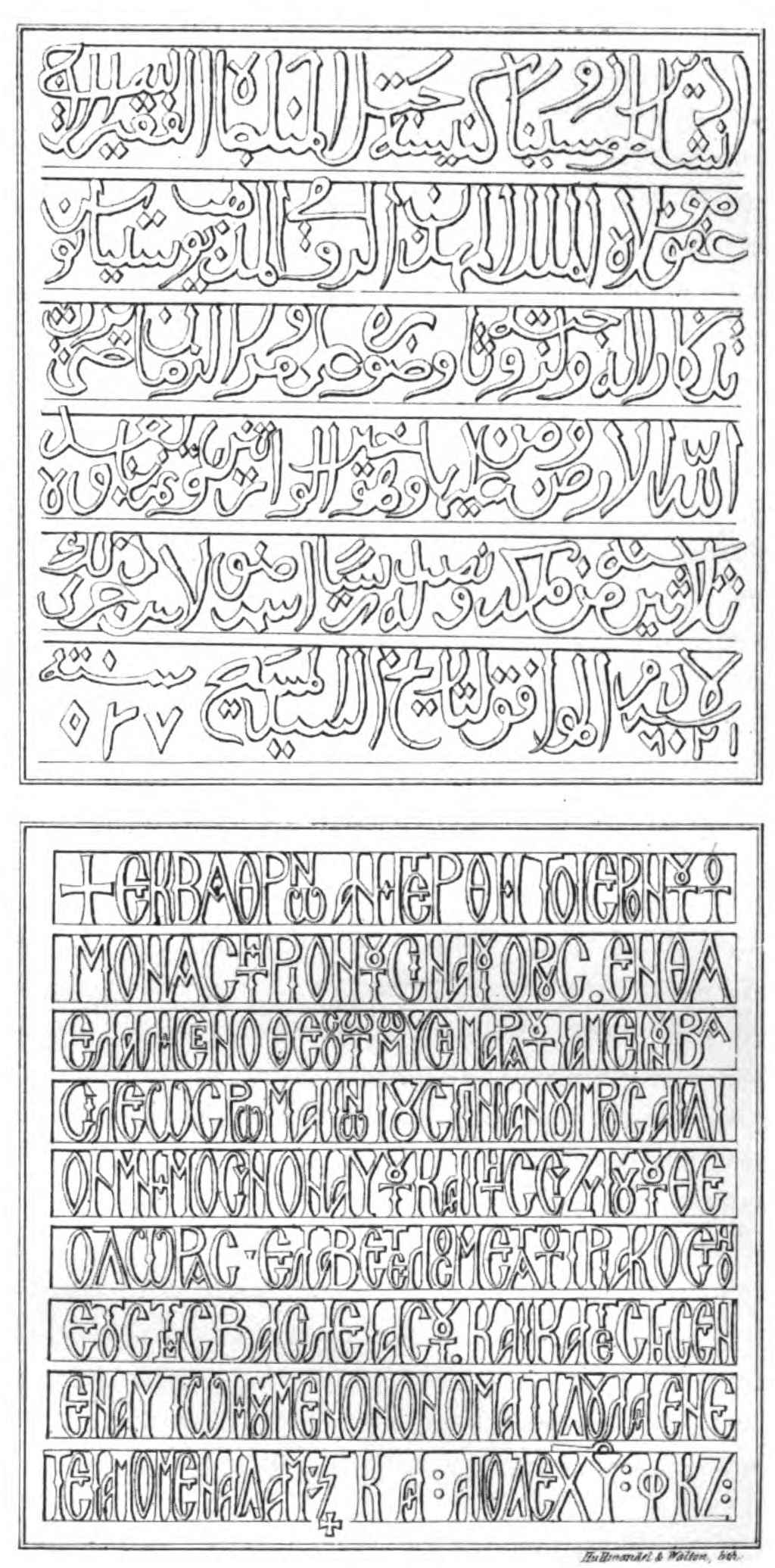
fragment of an inscription found at Soba. It was in the middle of a
marble tablet, written on both sides with late Greek or Koptic letters.
The signs, which were plainly visible, contained neither Greek nor
Koptic words, only the name
 was decipherable. The
same evening we arrived at Chartûm. This name signified “elephant’s
trunk,” and is probably derived from the narrow tongue of land between
its Niles, on which the city lies.
My first visit with Abeken was to Emin Pasha, who had already reached
Chartûm before us. He received us very kindly, and would not let us
leave him the whole morning.
An excellent breakfast, comprising about thirty dishes, which we took
with him, gave us a very interesting insight into the mysteries of
Turkish cookery, which (as I learnt from our well-fed Pasha), in the
matter of the preparation and arrangement of the dishes, like the
systems of the latest French cookery, follow the rules of a more refined
taste. Soon after the first dish comes lamb, roasted on the spit, which
must never be wanting at any Turkish banquet. Then follow several
courses of solid and liquid, sour and sweet dishes, in the order of
which a certain kind of recurring change is observed, to keep the
appetite alive. The pilau of boiled rice is always the concluding
dish.
The external adjuncts to such a feast as this, are these:—A great
round plate of metal, with a plain edge of three feet in diameter, is
placed on a low frame, and serves as a table, about which five or six
people can repose on rugs, or cushions. The legs are hidden in the
extensive folds which encircle the body. The left hand must remain
invisible; it would be very improper to expose it in any way while
eating. The right hand alone is permitted to be active. There are no
plates and knives or forks. The table is decked with dishes, deep and
shallow, covered and uncovered; these are continually being changed, so
that but little can be eaten from each. Some, however, as roast meat,
cold milks and gerkins, &c., remain longer, and are often recurred to.
Before and after dinner they wash their hands. An attendant or slave
kneels with a metal basin in one hand, and a piece of soap on a little
saucer, on the other; with the other hand he pours water over the hands
of the washer from a metal jug; over his arm hangs an elegantly
embroidered napkin, for drying one’s hand upon.
After dinner, pipes and coffee are immediately handed round, after which
time one may withdraw. The Turks then take a sleep until Asser. But ere
we parted from our host, he had a number of weapons, lances, bows,
arrows, clubs, and a sceptre of the upper wild nations, sent to my bark,
as a guest present.
We then visited our countryman, Neubauer, the apothecary of the
province, who had been very unfortunate. A short while before, he had
been removed from his post by the deceased Ahmed Pasha, but was now
again instituted apothecary by Ahmed Pasha Menekle, through Dr. Koch’s
interest. Then we went to the house of a resident Pole, named
Hermanowitch, the principal physician of the province, who offered us
his house in accordance with a command of the Pasha, whither we removed
on the following day. It had just been repaired, and by it were a garden
and court, very useful to us for the unpacking and mending of our chests
and tents.
Next day the Pasha returned our visit. He came on horseback. We offered
coffee, pipes, and sherbet, and showed him some pictures from Egypt, in
which he took a lively interest. He is a man of tall and corpulent
stature, a Circassian by birth, and therefore, like most of his
countrymen, better informed than the Turks. At the house of a Syrian,
Ibrahim Chêr, I saw a rich collection of all the ornithological species
of the Sudan, in number about three hundred; of each twenty to thirty
carefully selected specimens.
A day or two after I took a walk with Abeken and Erbkam, to the opposite
side of the promontory, toward the White River, which we followed to its
union with the Blue River. Its water is, in fact, whiter, and tastes
less agreeably than that of the Blue, because it runs slowly through
several lakes in the upper countries, the standing waters of which lakes
impart to it an earthy and impure taste. I have filled several bottles
with the water of the Blue and the White Nile, which I shall bring home,
sealed down.
At a subsequent friendly visit of the Pasha, we met the brother of the
former Sultan of Kordofan (who was himself also called Mak or Melek),
and the Vizier of Sultan Nimr (Tiger), of Shendi. The latter still
resides in Abyssinia, whither he fled after he had burned the conqueror
of his country, Ismael Pasha, Mohammed Ali’s son, and all his officers,
at a nightly banquet in 1822.
We went up the White River on the 14th, but soon returned, as it has so
weak a current that, by the present prevailing north wind, the way back
is somewhat difficult. The shores of the White River are desolate, and
the few trees, which formerly stood in the vicinity of Chartûm, are now
cut down and used for building or burning. The water mass of the White
River is greater than that of the Blue, and retains its direction after
their union, so the Blue River is to be looked upon rather as a
tributary, but the White River as the actual Nile. Their different
waters may be distinguished long after their juncture.
On the 16th of February, I sent for some Dinka slaves, to inquire into
their language; but they were so hard of comprehension, that I could
only, with great trouble, obtain from them the names of the numbers up
to one hundred, beside a few pronouns. The languages of the Dinka and
the Shilluk, who live several days’ journey up the White River, the
former on the eastern, the latter on the western shore, are as little
known in respect to their grammatical structure, as those of most of the
Central African Nations; and I therefore besought the Pasha to have some
sensible people found who were acquainted with their language. This was
not possible at the time, but it is to be done against our return.
In the meantime our purchases and repairs were completed, and I hastened
our departure as much as possible. The house of Hermanowitch remains at
our disposal on our return; it is conveniently and airily built, and
from my windows I could see the oldest house in the town, the pointed
straw roof of which looked over the walls. These pointed thatched
houses, called Tukele, form the peculiar style of the country, and
almost the only erections more to the south. But as Chartûm is a new
city, the few old huts have all disappeared except that one, and the
houses are built of burnt brick.
At noon on the 17th of February we entered our barks. I sailed to the
south with Abeken, up the Blue River, partly to learn its nature, partly
to see the ruins of Soba, and those of Mandera; the rest of our
companions, for whom there was nothing to do in the south, went
northward to Meroë, to draw the monuments of that place.
Next day we landed on the eastern side, where great stacks of red burnt
bricks, prepared for embarkation, informed us that we were not far off
the ruins of Soba. In the whole country unburnt bricks are now made, so
that all ruins of burnt bricks must belong to an earlier period. From
Soba, this building material is transported in great quantities both to
Chartûm and beyond it.
We landed, and had scarcely left the bushes next to the shore behind us,
ere we saw the violated mounds of bricks, which cover a great plain, an
hour’s ride in circumference; some of the larger heaps might be the
remains of the Christian churches, which are described by Selim of
Assuan (by Macrizi) in the tenth century, when Soba was yet the capital
of the empire of Alŏa, as magnificently decorated with gold. The place
was shown us where, some time ago, a stone lion was discovered, now in
the possession of Churshid Pasha, at Cairo. Walls or buildings were
nowhere to be recognized, and on the southernmost and somewhat distant
hill some sculptured yellow blocks of sandstone, and a low wall were all
that we could find; on another mound lay several rough slabs of a black,
slatey stone.
The country round Soba is level, as everywhere about here, to the foot
of the Abyssinian mountains, and the soil, particularly at this season,
dried up and black; the thicker vegetation is confined to the river
shore, farther on, there are only single trees, now more frequent, now
seldom.
I promised the sailors a sheep if we arrived early next morning at
Kamlîn; for the wind was violent, and allowed us to make but little way.
Our ship, too, does not go very fast, the sailors are not adroit, and,
with the present low level of the water, the bark easily sticks in the
sand-banks. We went almost the whole night, and arrived early at eight
o’clock in Kamlîn.
The ancient place of the same name lies half an hour further up the
river, and consists but of a few huts. The houses where we landed belong
to a number of factories instituted four years ago, in conjunction with
the late Ahmed Pasha, by Nureddin Effendi, a Catholic Koptic Egyptian,
who has gone over to Islâm, and which yield a rich profit. A simple,
honest, un-Oriental German, named Bauer, has erected a soap and brandy
factory, which he himself conducts. A sugar and indigo factory is kept
by an Arab. Bauer is the southernmost resident European that we have
found in Mohammed Ali’s territories, and we were glad to find so
excellent a conclusion to the long, little pleasing chain of Europeans,
generally deteriorated in civilization, who preferred the government of
Turks to their native country.[72] He has an old German housekeeper
named Ursula, & funny, good-natured body, for whom it was a no less
festal occasion to see German guests than for him. With joyful hurry she
got out what European crockery she had, and the forks that were yet in
being, and set baked chicken, vegetables, sausages, and excellent
wheaten bread before us; at last, too, a cherry pie of baked European
cherries (for our fruits do not grow in Egypt), in short, a native meal,
such as we had never expected in this ultima Thule.
Before Bauer’s house we found the most southern Egyptian sculpture that
we have seen, on a pedestal, a seated statue of Osiris, somewhat
destroyed, done in a late style, in black granite, with the usual
attributes, about two and a half feet high, which was discovered in
Soba, and is not without interest, as the only monument of Egyptian art
from that city.
The European furniture of Bauer’s room made a strange impression upon
one here in the south among the black population. A wooden clock, made
in the Black Forest, ticked regularly on the wall; some half-broken
European stools were ranged round the strong table, behind which a small
book-shelf was put up, with a selection of German classics and
histories, by the corner of a Turkish divan, which was also not wanting.
Over the great table, and opposite the canopy-bed in the other corner,
hung bell-pulls, leading to the kitchen. A curious Nesnas ape sometimes
peeped in through the lattice by the door, and on the other side of the
little court, one could see the busy Ursula in her purple, red-flowered
gown, toddling backward and forward among the little, naked, black
slaves, arranging this, that, and the other, with a somewhat scolding
voice, and looking into the bubbling pots in the adjoining kitchen. We
did not see her the whole morning, not even at the dinner, that she had
prepared so well and tastily; after dinner, she first presented herself,
with many curtsies, to receive our praises. She complained of the
forlorn state of her cooking apparatus, and grumbled sadly at Herr Bauer
for not leaving this horrid, dirty, and hot country, although he
promised year after year to do it. She had accompanied him hither, had
been eleven years in the country, and four at Kamlîn. Bauer intends in a
year to go to Germany, and settle in Steiermark or Thüringen, with his
savings, and turn farmer, like his father.
After table, the son of Nureddin Effendi sent us a complete Turkish
dinner of from twelve to fifteen dishes, which we left, however, to the
attendants after our European meal. We had also inspected the factories
in the morning, and tasted the fine brandy (called Marienbad), which
Bauer chiefly prepares from the sugar-cane and dates. Business seemed
to be in the best order, and the unusual cleanliness of the places, the
vessels, and utensils, attest the care with which the establishment,
only worked by slaves, is conducted. The pleasant impression that this
visit made upon us was heightened by the discovery that Bauer possessed
a second piece of the marble inscription already alluded to,[73] which
had been found in the ruins of Soba. He presented me with the fragment,
which was easily put together with the other piece, although even then
the inscription was not perfected. The fragment exhibits on one side
traces of twelve lines, on the other of nine. Here, too, the writing is
easy to be read, but only the name
 is
comprehensible. It is either a very barbarous Greek, or a peculiar
language, spoken in former times at Soba. In fact, we know from Selim
that the inhabitants of Soba possessed their sacred books in the Greek
language, but also translated them into their own.
After paying the son of Nureddin Effendi a visit, we left with the
promise to stay on our return.
From Kamlîn the shores run on at equal elevations. The character of a
fluvial valley is lost. The deposited black earth has ceased; the steep
high shores are composed of original earth and calcareous conglomerate,
which, according to Bauer, is well capable of being burnt to lime.
On the morning of the 21st we came to a considerable bend in the river
to the east; the wind became so unfavourable through it, that our
khawass landed, to impress the people of the vicinity to draw it. I
went along the western shore for several hours to Arbagi, a deserted
village, built of black bricks, but standing on the remains of another
more ancient one, as I saw from the structures of burnt bricks. This
place was once the chief centre of the trade of the Sudan, which has
since turned itself to Messelemîeh. Soon after we found the two northern
baobàb trees, which are here called hómara. These giant trees of
creation (andansonia digitata) are found from here southward more and
more frequently, and from Sero they belong to the usual trees of the
region. One trunk which I paced round measured more than sixty feet in
circumference, and certainly does not belong to the greatest of the
kind, as they are here not so frequent.[74] At this season of the year
they were leafless, and stretched their bare, death-like boughs far over
the surrounding green trees, which look like low bushes beneath it.
Their fruit, called gungulês,[75] I found here and there among the
Arabs; they resemble pear-shaped melons, with a hairy surface. If the
hard, tough shell be broken, a number of seeds are found inside, which
are surrounded with a dry, acid, but well-tasted mass. The leaves are
five-fingered.
On the 22nd of February we arrived on the western shore by a little
village, where the inhabitants, mere women and children, fled through
the sandy plain to the woods, from fear of our appearance, probably as
they expected to be impressed for the purpose of drawing the bark. On
the opposite shore lay another village, whence we saw a stately
procession of finely-dressed men in Arab and Turkish dresses, and some
handsomely caparisoned horses, proceed to the river. It was the Kashef
and the most noble sheiks of Abu Háras, to whom we had been announced by
Ahmed Pasha, as we had determined to proceed hence with camels and
guides into the desert of Mandera. The horses were destined for us, and
we therefore rode to the house of the Kashef, to inquire again about the
antiquities of Mandera and Qala. As the desert route to the coast of the
Red Sea leads hence from those places, we found several persons who had
been near them. From all their tales, however, I could but find that at
these two places there are only fortress-like mounds, or at most roughly
built walls, as a refuge for caravans, without any buildings or
hieroglyphical inscriptions. At Qala there may be some camels and horses
scratched in the rock by the Arabs, or some other people, like those we
had seen in the great desert at the wells of Murhad.
We therefore determine to give up this journey, and instead of it go
somewhat farther up the river, in order to learn the nature of the Nile
stream, its shores and inhabitants, as far as time would permit us.
At a short half-hour distance from Abu Háras we came to the mouth of the
Rahad, which conveys a great quantity of water into the Nile in the
rainy season, but was now almost dry, with only a little stagnant water,
which may disappear altogether next month.
I left the bark as often as possible, to know as much of the shore as I
could. To proceed farther inland, is impossible, from the almost
impassable forests which line both shores. There stand in luxuriant
magnificence the shadowy high-domed tamarind, the tower-like hómara
(baobàb) the multi-boughed genius (sycamore), and the many species of
slender gumrick sont trees. On their branches run in innumerable
windings, like giant serpents, the creeping plants; to their highest
bough and down to the earth again, where they close every space between
the mighty trunk in union with the low bushes. Besides this there is
scarcely one thornless tree or bush in ten, by which every attempt to
penetrate the thick underwood is dangerous, indeed impossible. Several
of the plants—the sittera tree for instance—have the thorns placed
in pairs, and in such a manner that one thorn is turned forward, the
other back. If any one come too near these boughs, it is certain that
his clothes will carry away some inevitable traces, imperfectly to be
remedied amidst these wilds. In other places, the thorn trees are most
elegant; rising gracefully in the less thronged parts, like slender
young birches. We distinguished two sorts of these standing mingled
together, and only differing that in one the bark, extending from the
trunk to the most distant twiglet, is coloured like a mass of shining
red veins, while that of the other is black; on both of them the long
shining white thorns and green leaves come out in strong contrast.
Of the birds, fluttering round in great numbers, I recognized not one
Egyptian species. I shot many, and had them stuffed by our cook, Sirian.
Among them were fine silver-grey falcons (suqr shikl); birds called
gedâd el wadi, with horns on the nose, and blue lappets on each side
of the head; black and white unicorn birds (abu tuko), with mighty
beaks; black birds, with purple breasts (abu labba); great brown and
white eagles (abu tôk), of which one measured six feet with extended
wings; smaller brown eagles, called hedâja; and black ones, called
ráchame. The latter, which are more numerous toward Egypt, are the
same represented in the hieroglyphics. The plover is principally found
on the shore, with black crooked pricks at the joints of the wings, with
the white long-legged abu baqr (Cow-bird), which is accustomed to sit
on the backs of buffaloes and cows.
We often see great bats flying about in broad day; their long golden
wings glance gleamingly through the foliage, and suddenly they hang to
the boughs, head downwards, like great yellow pears, and are easily
shot; they have long ears, and a curious trumpet-formed nose.
Chase was also made on the monkeys, but they are difficult to catch from
their agility. One day we found a mighty tree full of monkeys. Some
climbed quickly on our approach, and fled to the distant bushes; others
hid themselves in the upper boughs; but some to whom both plans seemed
hazardous, sprang with incredibly daring leaps from the highest branches
of the tree, which was nearly a hundred feet in height, on to the little
trees below, the thorny twigs of which bent low beneath their weight,
without any of them falling; they gained their point, and escaped my
gun.
The more south, the more crocodiles. The promontories of the islands are
often covered with these animals. They usually lie in the sun, close to
the edge of the water, opening their mouths and appearing to sleep, but
they will not allow any one to approach them, but dive under the surface
immediately, even if hit by the ball. Thus their capture is very
difficult. Our khawass, however, struck a young one, only three feet
in length, so well that it could not reach the waters. It was brought on
board, where, to the horror of our Nesnas monkey, Bachit, it lived
several days.
Not less impracticable than the crocodiles are the hippopotami, which we
have occasionally seen in great numbers, but only with their heads above
water. Once only a young Nile horse stood exposed on a sand islet, and
allowed us to approach unusually near. The khawass shot and hit, but
of course the ball did not penetrate the thick skin; then the fat animal
with its shapeless head, large body, and short, elephant-like legs,
broke into a highly comic gallop, in order to gain the adjacent water,
where it soon disappeared. They usually only land at night, when they
make terrible havoc in the durra-field and other plantations by stamping
and eating. No one knew here of any hippopotamus ever being taken alive.
We did not see any lions, but their roars were heard sounding through
the moonlight nights; there is something solemn in the deep sonorous
voice of this royal animal.
On the 24th of February we came to a second tributary of the Nile, the
Dender, which is larger than the Rahad. I went some way up it, to see
what was impossible to be seen at the embouchure, whether there was yet
a stream, and found that above, where the water ran in little channels,
there was still a current, but very weak; in the rainy season the Dender
swelled to the height of twenty feet, as its bed shows; the shores were
covered with cotton-bushes, pumpkins, and other useful plants.
The heat is not inordinate; in the morning, at eight o’clock, usually
23° R.; from noon, till about five o’clock, 29°; and at eleven at night,
22°.
The evenings we spend on board, then I have the geography explained to
me by our khawass, Hagi Ibrahim, or take some Nubians to my camels, to
learn their language. I have already prepared a long vocabulary of the
Nubian language. On a comparison with other lists, in Rüppell and
Cailliaud, I also found in Koldági one of the languages spoken in the
southernmost part of Kordofan, many similar words, which testify a
narrow connection between the two languages. The Arabs call the Nubian
language lisân rotâna, which I at first took for its actual name; it
signifies, however, only a foreign language, distinct from the Arabic.
Therefore if the three Nubian dialects are spoken of, they are not only
called Rotâna Kenûs, Mahass, or Donqolaui, but also Rotâna Dinkaui,
Shilluk, even Turki and Franki, Turkish and Frank, i. e. European
gibberish. The same error is at the bottom of the now received
designation of the Nubians as Berbers, and their language as the Berber
language; for this is not their national name, or that of the language,
as it is generally believed, but means originally the foreign-speaking
persons, the Barbaros.[76]
On the 25th of February we landed near Saba Doleb; I sought for ruins,
but only found tall, well-built cupolas of burnt brick, in the form of
beehives, and erected in quite a similar manner to the Greek Thesauri,
in horizontal layers. They are the graves of holy Arab sheikhs of a late
era; the villagers did not know what date to assign for their erection.
Under the cupola, in the middle of the building of fifteen to eighteen
feet in diameter, is the long narrow grave of the saint, surrounded with
larger stones and covered with a multitude of little ones, according to
the superstition one thousand in number. I found six such domes, most of
them half dismantled, some quite ruined, but two tolerably well
preserved, and still visited; a seventh, probably the latest, was built
of unburnt bricks.
At Wad Negûdi, a village to the west of the Nile, we found the first
dilêb-palms,[77] with slender naked trunks and little bushy crowns,
like date-palms in the distance, and dûm-palms close to it, by reason of
the leaves. The fruit is round, like that of the dûm-palm, but larger.
These trees are said to be more frequent on the eastern tributaries;
here, on the Nile, they are found but in a very small district. The
leaves are regularly divided into fan-like folds one under the other,
and the stem has strong saw-like notches. With such a stalk the Rais of
our vessel sawed off another leaf, which I had brought to the bark, to
take with me. It is divided into sixty-nine points, and measures five
feet and a quarter from that part of the stem where the fan begins,
although it is but young, and therefore keeps its fans quite shut as
yet. Another one, still larger, which had already unfolded itself, we
put up in the bark as a parasol, in the shade of which we sat. The way
to those palms we had to make through the giant grass thickets, shooting
up stiffly and closely like corn, and covering great plains. The ends of
the stalks were five or six feet above our heads, and even the tall
camels, bred in this place, could scarcely see above them.
On the 26th of February, we arrived at the village Abu el Abás, on the
eastern shore. This is the principal place of the neighbourhood, and the
Kashef living here, has authority over 112 villages. I there purchased,
for a few piasters, of a Turkish khawass a dog-ape. This is the holy
ape of the ancient Egyptians, kynokephalos, dedicated to Thoth and the
Moon, and appearing as the second of the four gods of the lower
world.[78] It interests me to have this animal, which I have seen so
innumerably represented on the monuments, about me for a time, and to
observe the faithfully caught representations of its striking and usual
characteristics in old Egyptian art. It is remarkable that this ape, so
peculiar to Egypt in ancient times, is now only found in the south, and
even there not very frequently. How many species of animals and plants,
indeed manners and customs of men, with which the monuments of Egypt
make us acquainted, are only to be found here in the farthest south of
old Ethiopia, so that many representations, i. e. those of the graves
of Benihassan, seem rather to picture scenes of this country than of
Egypt. The kynokephalos has here no particular name, but only the
general term gird (great ape). His head, hair, and colour, are not
unlike those of a dog, whence his Greek appellation. Occasionally, too,
he barks and growls just like a dog. He is yet young, and very
good-natured, but immeasurably cleverer than Abeken’s little dog and
Nesnas monkey. He is very funny when he wants something good to eat,
that he may see held in the hand. Then he lays his ears back, and knows
how to express the greatest joy, but sits still, like a good child, and
only smacks his lips like an old wine-taster. On seeing the crocodile,
however, his hair ruffled up on his whole body, he cried out lamentably,
and was scarcely to be held in his terror.
We arrived at the famous old metropolis of the Sudan, Sennâr, on the
27th of February, the king of which, before the conquering of the
country by Ismaël Pasha, ruled as far as Wadi Halfa, and was supreme
over a number of lesser tribute-paying kings. The place does not look
now as if it had been so lately a royal city. Six or seven hundred
pointed straw huts, (tukele) surround the ruins of red brick, where
the palace formerly stood. The bricks are now used for the erection of a
building for Soliman Pasha, who is to reside in Sennâr. It was so far
finished, that the Vakil of the absent Pasha could hold his divan in it.
We found him there, sitting in judgment. Many other people, Sheikhs and
Turks were present; among them the Sheikh Sandalôba, the chief of the
Arab merchants, and a relation of Sultana Nasr, with whom we afterwards
became acquainted in her capital village Sorîba. We paid this
distinguished man a visit in his house, at which honour he seemed much
delighted. His chief chamber was a dark though lofty saloon, with a roof
resting on two pillars and four half pillars, on to which we mounted,
in order to get a view of the city.
In the meantime, an anqarêb was prepared for us in the court; mead
(honey and water) was brought, and from the stable an hyæna, here called
Morafil, and two young lions, of which the larger, actually the property
of Soliman Pasha, was led to our bark, together with a couple of sheep,
as a present from the Vakil. I had the animal tied up in the hold, and
received a tear in the hand from his sharp claws, as a welcome. His body
is already more than two feet long, and his voice is a most powerful
tenor. Every morning now there is a tremendous row on board our not over
large vessel, when we are drinking tea before the cabin early; the
monkeys jumping merrily about, and the lion is let out from the hold on
deck, which is given him during the day, and we are bringing the cups
and pans into safety, which he tries to reach with his already strong
and inquisitive claws.
On the 29th of February we arrived at nine o’clock in Abdîn. The wind
was unfavourable on the 1st of March, and we proceeded but little, so
that I had plenty of time for shooting birds. Toward evening I came to a
village, lying very romantically in a creek of the river, which is here
broader. Many huts built of straw poked their pointed roofs into the
branches of thickly-leaved trees. Narrow tortuous paths, forming a real
labyrinth, led among thorns and trunks from one hut to another, in and
before which the black families were lying and the children playing by a
sparing light. I asked for milk, but was referred to an adjoining Arab
village, whither a man conducted me, armed with a lance, the general
weapon of the country. By light brushwood and high grass we came to the
great herds of cattle of the Arabs, who had pitched their mat huts about
the grazing place. The Fellahs of this region are much browner than the
wandering Arabs, although far from being negroes, and they seem to
coincide with the Nubians in race.
On the 2nd of March we anchored by an island, near the eastern shore. At
a little distance from the landing-place, the Rais perceived a broken
crocodile egg at a spot newly dug. He dug away with his hands, and found
forty-four eggs three feet down in the sand. They were still covered
with a slimy substance, as they had only been laid the day before or in
the past night. The crocodiles like to leave the river in a windy night,
make a hole for the eggs, cover them up again, and the wind soon blows
away every trace. In a few months the young ones creep out. The eggs are
like great goose-eggs, but rounded off at both ends, as the latter are
only at the large end. I had some boiled; they are eaten, but have an
unpleasant taste, so I willingly yielded them up to the sailors, who ate
them with a great appetite.
We landed near the deserted village of Dáhela, on the eastern shore,
whence I proceeded alone inland for three-quarters of an hour. The
character of the vegetation remains the same. The earth is dry and
level; the inconsiderable hills and dales that occur are not original,
but seem to have been formed by the rain. My goal was a great tamarind
tree, which rose mightily amidst the low trees and bushes, and was
encircled by a number of fluttering green and red birds, the species of
which is yet unknown to me.
I came on my way, first to a colony, by Kumr betá Dáhela, where the
inhabitants of that village hold their villeggiatura; for they stay
here during the dry months, and return to their village on the river
bank, at the beginning of the rainy season. The last village whither I
came is called Româli, a little above that given in the map as Sero,
which lies under the 13° N. latitude. On the hot and tiring way back I
attended a burial. Silently and solemnly, without sound or sob, two
corpses, wrapt in white cloths, were borne along on anqarêbs by
several men, and laid in a grave of some feet deep in the forest near
the road. Perhaps they had perished of the cholera-like complaint, which
has now broken out with great violence in the southern regions.
We should have much liked to proceed to Fasoql, in the last province of
Mohammed Ali, to see the change in the character of the country
beginning at Rosêres, where so many novel forms of tropical vegetation
and animal life present themselves; but our time was expended.
The Rais received the command to take down the masts and sails, by which
the bark at once lost its stately appearance, and drove down the river
with the current like a wreck. Soon the pleasant quiet of the vessel,
that had seemed to fly along of itself, was interrupted by the yelling,
ill-sounding songs of the rowers contending with the wind.
By the 4th, we were again at Sennâr, and on the 8th, at an early hour,
we reached Wed Médineh. This place is almost as important as Sennâr. A
regiment of soldiers lies in barracks here, with the only band in the
Sudan, and two cannons. We were immediately visited by upper military
scribe Seïd Hashim, one of the most important persons of the place, whom
we had already known in Chartûm.
We determined to visit Sultana Nasr (Victoria) at Sorîba, an hour and a
half inland, partly to learn the character of the country further from
the river, and partly to get some idea of the court of an Ethiopian
princess. Seïd Hashim offered us his dromedaries and donkeys for this
trip, and also his own society; so we rode away that afternoon into the
hot, black, but scantily treed plain, and soon accomplished the
uninteresting way on the sturdy animals.
Nasr is the sister of the mightiest and richest king (melek) in the
Sudan, Idris wed (i.e. Welled, son or successor of) Adlân, who is
certainly under Mohammed Ali’s supremacy now, but yet commands several
hundred villages in the province El Fungi; his title is Mak el Qulle,
King of the Qulle mountains. Adlân was one of his ancestors, after whom
the whole family now calls itself; his father was the same Mohammed
(wed) Adlân, who, at the time of Ismael Pasha’s conquering campaign had
taken most of the power of the legitimate but weak king of Sennâr, Bâdi,
but who was then murdered at the instigation of Reg’eb, another
pretender to the throne. When Ismael had arrived, and Reg’eb and his
company had fled to the Abyssinian mountains, King Bâdi united himself
with the children and party of Mohammed Adlân, and submitted to the
conqueror, who made him Sheikh of the country, had the murderers of
Mohammed Adlân impaled, and gave his children, Reg’eb and Idris Adlân,
great power and wealth. Nasr, their sister, also gained much
consideration, which was, however, much increased, as she was allied to
the legitimate royal family by her mother’s side. Therefore is she
called Sultâna, Queen. Her first husband was named Mohammed Sandalôba,
brother of Hassan Sandalôba, whom we had visited at Sennâr. He has now
been dead for a long time, but she has a daughter by him, named Dauer
(Light), who married a great Sheikh, Abd-el Qader, but then parted from
him, and now lives with her mother, in Sorîba. The second son of Nasr is
Mohammed Defalla, the son of one of her father’s viziers. He was then
with Ahmed Pasha Menekle on the war march (ghazua, of which the French
have made razzia) in Saka. But even when he is at home, she remains
the principal person in the house, by reason of her noble birth.
Since very ancient times, a great estimation of the female sex appears
to be a very general custom. It must not be forgotten how often we find
reigning queens of Ethiopia mentioned. From the campaign of Petronius,
Kandake is well known, a name which, according to Pliny, was bestowed on
all the Ethiopian queens; according to others, always on the mother of
the king. In the sculptures of Meroë, too, we occasionally find very
warlike, and doubtless reigning, queens represented. According to
Makrizi, the genealogies of the Beg’a, whom I consider the direct
descendants of the Meroetic Ethiopians, and for the ancestors of the
Bishari of the present day, were not counted by the males, but by the
females, and the inheritance did not devolve upon the son of the
deceased, but upon the sister or the daughter. In the same way,
according to Abu Selah, the sister’s son took precedence of the son
among the Nubians, and Ibn Batuta reports the same custom to be existing
among the Messofites, a western negro race. Even now, the court and
upper minister of some southern princes are all women. Noble ladies
allow their nails to grow an inch long, as a sign that they are there to
command, and not to work, a custom which is found in the sculptures
among the shapeless queens of Meroë.
When we arrived at Sorîba, we entered the square court-yard by a
particular door, running round the principal building, and thence into
an open, lofty hall, the roof of which rested on four pillars, and four
half pillars. The narrow beams of the roof jut out several feet beyond
the simple architrave, and form the foundation of the flat roofs; the
whole entrance reminded one much of the open façades of the graves of
Benihassan. In the hall there was fine ebony furniture, of Indian
manufacture, broad anqarêbs, with frames for the mosquito nets. Fine
cushions were immediately brought, sherbet, coffee, and pipes handed
round. The vessels were made of gold and silver. Black female slaves, in
light white garments, which, fastened at the hips, are drawn up over the
bosom and shoulders,—handed round the refreshments, and looked very
peculiar with their plaited hair. The Queen, however, did not come;
perhaps she was ashamed of showing herself to Christians; only a
half-opened door, which soon closed again, allowed us to perceive
several women behind, to whom we ourselves might be objects of
curiosity. I therefore let the sultana know, through Saïd Hashim, that
we were there to pay our visits, and now hoped that we might have the
pleasure of seeing her. Upon this, the doors of strong wood cased with
metal, opened wide, and Nasr entered with a free, dignified step. She
was wrapped in long fine-woven cloths, with coloured borders, under
which she wore wide gay trowsers of a somewhat darker shade. Behind her
came the court, eight or nine girls in white clothes with red borders,
and elegant sandals. Nasr sat down before us, in a friendly and
unconstrained manner; only now and then she drew her dress over her
mouth and the lower part of the face, a custom of Oriental modesty, very
general with women in Egypt, but much rarer in this country. She replied
to the greetings I offered her through the Dragoman with a pleasant
voice, but stayed only a short time, withdrawing through the same door.
We examined the inner parts of the house, with the exception of her
private rooms, which were in a small building close, and mounted the
roof to have a view of the village. Then we took a walk through the
place, saw the well, in depth more than sixty feet, and lined throughout
with brick, whence Nasr always has her water fetched, though it is warm,
and less nice than that of the Nile. Then we returned, and were about to
depart, when Nasr sent us an invitation to remain the night in Sorîba,
as it was too late to get back to Wed Médineh by day. We accepted the
offer, and a banquet of boiled dishes was immediately brought, only
intended, however, as preparatory to supper. The sultana, however, did
not show herself again the whole evening. We remained in the hall, and
slept on the same cool pillows, which had served as a divan during the
day. But the next morning we were invited by her to visit her in her own
rooms. She was more communicative to-day than yesterday, had European
chairs brought for us, while her servants and slaves squatted on the
ground about us. We told her of her namesake, the Sultana Nasr of
England, and showed her her portrait on an English sovereign, which she
looked at with curiosity. But she manifested little desire to see that
far-off world beyond the northern water with her own eyes.
About eight o’clock we rode back to Wed Médineh. Soon after our return,
Saïd Hashim received a letter from Nasr, in which she asked him
confidentially whether he thought I would receive a little female slave
as a guest-present. I had expressed to her, in return, that this was
against the custom of our country, but that the gift would be accepted
if she would choose a male slave instead, and after some little
hesitation, she really sent a young slave to me, who was brought to me
in the ship.
He had been the playmate of the little grandson of Nasr, the son of her
daughter Dauer, and was presented to me under the name of Rehân, the
Arabic name for the sweet-smelling basil. It was added, that he was from
the district of Makâdi, on the Abyssinian frontier, whence the most
intelligent and faithful slaves generally came. This district is under
Christian dominion, and is inhabited by Christians and Mahommedans, in
separate villages. The former call themselves Nazâra (Nazarenes) or
Amhâra (Amharic Christians), the latter Giberta. Of these Giberta
children are often stolen from their own race and from among their
neighbours, and sold to Arabic slave-dealers; for, in the interior of
Abyssinia, the slave trade is strictly prohibited. This account of the
lad, however, was soon found to be untrue, and was only invented to
preclude the blame of offering me a Christian slave; while, on the
contrary, it would seem much more wrong to deliver me a Mahommedan. The
boy first told our Christian cook, and then me, that he was of Christian
parentage, had received the name Rehân here, and that his real name was
Gabre Mariam, i. e. in Abyssinian, “Slave of Maria.” His birth-place
is near Gondar, the metropolis of Amhâra. He seems to belong to a
distinguished family, for the place Bamba, which is denoted by Bruce in
the vicinity of Lake Tzana, according to his story, belonged to his
grandfather, and his father, who is now dead, had many flocks, which he
himself had often driven to the pasturage. When he was somewhat far off
his dwelling with them one day, about three or four years ago, he was
stolen by mounted Bedouins, carried to the village of Waldakarel, and,
afterwards sold to King Idris Adlân, who had given him to his sister
Nasr. He is a handsome, but very dark-coloured boy, about eight or nine
years of age, but much more advanced than a child of that age would be
with us. The girls marry here at the age of eight. He wears his hair in
innumerable little plaits, which must be redone and anointed at least
once a month, by a woman understanding it; his body, too, is rubbed with
fat from time to time. His whole clothing consists of a great white
cloth that he fastens round the hips, and throws over his shoulders. I
now call him by his Christian name, and shall bring him to Europe with
me.
Saïd Hashim tried his utmost to induce us to remain a few more days in
Wed Médineh. On the first evening he invited us to his house with a
number of the most considerable Turks, and had a number of female
dancers to show us the national dances of the country, which consist
chiefly in movements of the upper part of the body and the arms, as they
are found on the Egyptian monuments, yet differing from the present
Egyptian dances, which are made up of very ungraceful and lascivious
movements and motions of the hips and legs.
An old good humoured and very comic man led the dances, singing Arabic
songs having reference to persons in the room or those known to them,
such as Nasr, Idris Adlân, Mak (i. e. Melek) Bâdi, and others, with a
piercing but not unpleasant voice, and at the same time struck a
five-stringed lyre with his left hand, beating time with the plectrum in
his right. His instrument only extended to six tones of the octave. The
first string to the right had the highest tone C, struck with the thumb;
the next had the deepest E, then came the third with F, the fourth with
A, the fifth with B. The instrument is called rabâba, the player rebâbi.
This man had been instructed by an old famous rebâbi at Shendi, had
made his instrument just like that of his master, also learning all his
art of versification, and thus had become the black favourite bard of
Wed Médineh. All his songs were composed by himself, sometimes
improvised, and whoever offended himself or his patron became the target
of a pasquinading song.
I sent for him the next day, and had four of his songs written down by
Jussuf, one on Mohammed, son of the Mak Mesâ’d, who lives at Metammeh,
one on King Nimr, who burnt Ismael Pasha, and is now living in Egypt, a
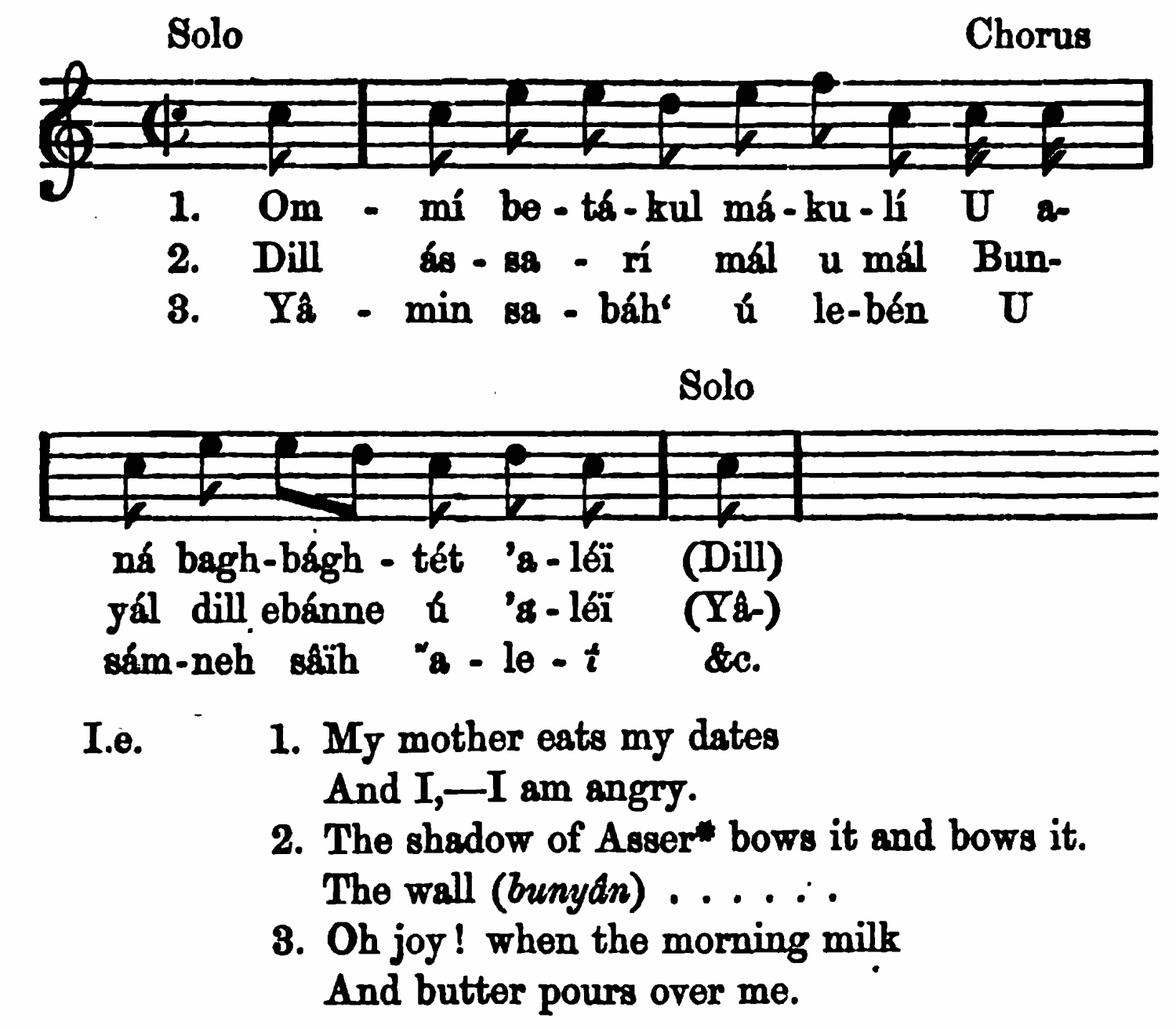
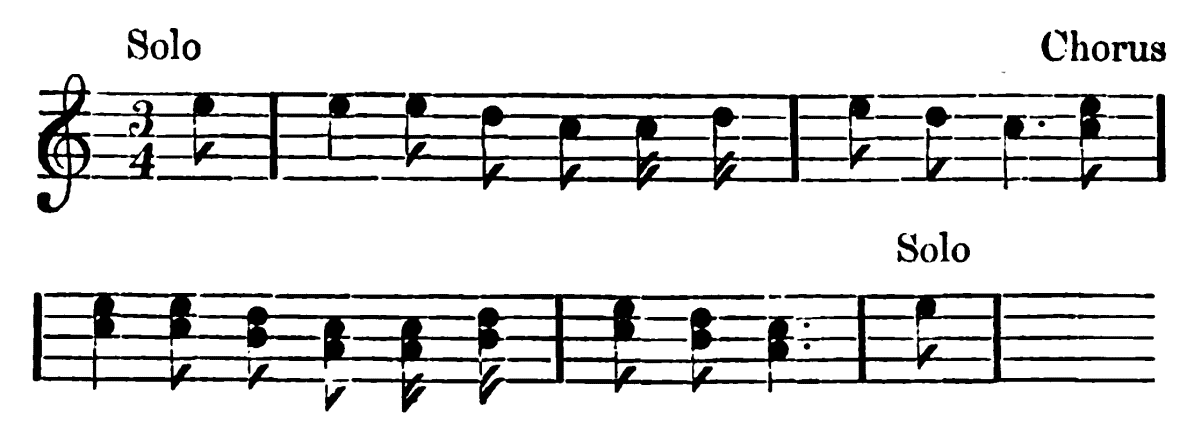
third on Nasr; and, lastly, a song in praise of pretty girls.[79] It is
impossible to give these melodies in notes. A little only, approaching
our kind of music in somewise, have I written down. They are generally
half recited, half sung, with wavering tones from the highest notes to
the deepest tone long sustained. These are the most peculiar, but are
utterly incapable of being expressed. Every verse contains four rhymes,
on each of which it is easy to keep the voice, on the second more than
on the first and third; but the longest on the final line, and to this
always comes one of the same deep tones, giving the song a kind of
dignified progression. A certain recurrence of the melody is first
observable, but is not retainable for an European ear. I bought the
friendly old man’s instrument, which he gave unwillingly, although I
allowed him to fix the price himself, and several times a shade of
sorrow passed over his expressive countenance when he had taken the
money and laid the instrument in its place. Next day I sent for him
again. He was cast down, and told me that his wife had beaten him
thoroughly for parting with the instrument. It is no shame for a man to
be beaten by his wife, but vice versá. A beaten wife goes at once to
the Kadi to complain, she generally obtains justice, and the husband is
punished.
At Wed Médineh we witnessed a funeral, which seemed odd enough to us. A
woman had died three days before; the first day after her decease, then
the third, the seventh and later days have particular ceremonies. An
hour before sunset above a hundred women and children had assembled
before the house, and many more kept continually coming and cowering
down beside them. Two daughters of the deceased were there, who had
already strewn their highly-ornamented heads, powdered with fat in the
Arab manner, with ashes, and rubbed the whole upper part of the body
white with them,[80] so that only the eyes and mouth gleam freshly and
as if inlaid from the white mask. The women wore long cloths round their
hips, the young girls and children the rahât, a girdle of close
hanging straps of leather, generally bound about the loins, with a
string prettily adorned with shells and pearls, and falling halfway down
the thigh. A great wooden bowl of ashes was placed there, and
continually replenished. Close to the door, on both sides, crouched
female musicians, who partly clapped their hands in time, with yelling,
ear-piercing screams, partly beat the noisy darabúka (a kind of
hand-drum, called here in the Sudan dalúka), and partly struck hollow
calabashes, swimming in tubs of water, with sticks. The two daughters,
from eighteen to twenty years of age, and the nearest relations, began
to move slowly towards the door in pairs, by a narrow lane formed in the
midst of the ever-increasing mob. Then suddenly they all began to
scream, to clap their hands, and to bellow forth unearthly cries, upon
which the others turned round and began their horrible dance of violent
jerks. With convulsively strained windings and turnings of the upper
part of the body, they pushed their feet on, quite slowly and
measuredly, threw their bosoms up with a sudden motion, and turned the
head back over the shoulders, which they racked in every direction, and
thus wound themselves forward with almost closed eyes. In this way they
went down a little hill, for fifteen or sixteen paces, when they threw
themselves on the ground, buried themselves in dust and ashes, and then
returned to begin the same dance anew. The younger of the two daughters
had a pretty slender figure, with an incredibly elastic body, and
resembled an antique when standing quietly upright or lying on the
ground with the head down, with her regular and soft, but immovable
features and classical form, quite peaceably even during the dance. This
dancing procession went on over and over again. Each of the mourners
must at least have gone through it once, and the nearer the relationship
the oftener it is repeated. Whoever cannot get up to the ash-tub takes
ashes from the head of a neighbour to strew it on their own head.
First, in this squatting assembly, some women crouch, who understand how
to sob and to shed tears in quantities, which leave long black streaks
on their whitened cheeks. The most prominent and disgusting feature of
this scene is, however, that unrestrained passion has nothing to do with
it, and that everything is done slowly, pathetically, and with evidently
practised motions; children down to the ages of four or five years are
put into the procession, and if they make the difficult and unnatural
movements well, the mothers, cowering behind, call out taib, taib, to
them. “Bravo, well done!” The second act of this deafening ceremony, by
the continual clapping, cries, and screams, is that the whole company of
dancers throw themselves upon the ground and roll down the hill; but
even this is done slowly and premeditatedly, while they draw their knees
up to keep hold of their dress, poke their arms in also, and then roll
away on their backs and knees. This ceremony begins an hour before
sunset and continues into the middle of the night.
The whole of it causes, by its unnaturality surpassing everything else,
an indescribable impression, which is rendered the more disagreeable, as
one perceives throughout the empty play, the inherited and spoilt
custom, and can recognize no trace of individual truth and natural
feeling in the persons taking part in it. And yet the comparison with
certain descriptions and representations of similar ceremonies among the
ancients, teaches us to understand many things, of which, in our own
life, we shall never form a proper estimate, until we have seen with
our own eyes such caricatures of uncivilisation, occasionally shown to
us by the Orient.
Next day we visited the hospital, which we found very clean, and in good
order; it contains one hundred patients, but there are only twenty-eight
at the present time. Then we proceeded to the barracks, in the large
court of which the exercises are gone through. The commanding officer
assembled the band, and had several pieces of music played. The first
was the Parisienne, which made a strange impression upon me amidst
these scenes, as also the following pieces, which were mostly French,
and known to me; they are tolerably performed. The musicians had
scarcely any but European instruments, and have incorporated in their
Arabic musical vocabulary our word trumpet, applying it, however, to the
drum which they call trumbêta, while they have for the trumpet a
native name, nafir; the great flute they call sumára, the little one
sufára, and the great drum tabli. There were only 1,200 men of the
regiment (which consists of 4,000) present, almost all negroes, who
poked out their black faces, hands, and feet, from their white linen
clothes, and red caps like dressed-up monkeys, only looking much more
miserable and oppressed than those animals. Yet we did not suspect that
in two days, these people would rebel, and go off to their mountains.
Emin Pasha was hourly expected. On the 13th, however, I received a
letter from him at Messelemîeh, four or five hours hence, in which he
stated that he should first come to Wed Médineh the next day, and hoped
to find us still there. At the same time he informed me that the war in
Taka was at an end, and that all had submitted. Some hundred natives
were killed in the skirmishes; on the morning before the decisive
battle, all the Sheikhs of the Taka tribes came to the Pasha to beg for
mercy, which was granted them on the condition, that no fugitive should
remain in the forest, which had been their chief resort. Next day he had
the forest searched, and as there was nobody found, it was set on fire,
and burnt down altogether. He is going on his way back through the
eastern districts to Katârif, on the Abyssinian frontier, and thence to
the Blue River. Scarcely had we read these news from Taka, ere the
cannons at the barracks thundered forth the news of victory to the
population.
In another letter, which Emin Pasha had received for me, Herr von Wagner
gave me the pleasant news that our new comrade, the painter Georgi, had
arrived from Italy, and had already left for Dongola, where he would
await farther instructions. I shall write him to meet us at Barkal.
As we were certain by the letter to find the Pasha still in Messelemîeh,
we departed thither at noon; we went by land, as the city is an hour and
a half distant from the Nile.
The bark was meanwhile to follow us to the port of Messelemîeh, i. e.
to the landing place nearest to this principal trading place of the
whole Sudan. Besides Jussuf we took the khawass and Gabre Máriam with
us, who placed himself behind me on the dromedary, where there is always
a little place left for an attendant, like the dickey of a coach; he
rides on the narrow back part of the animal, and holds on with his
hands. The day was very hot and the ground burnt. The few birds which I
saw were different from those inhabiting the banks of the river.
At about half way we came to a village called Tâiba, which is only
inhabited by Fukara, (pl. of Fakir). These are the literati, the
holy men of the nation, a kind of priests, without exercising sacerdotal
functions; they can read and write, allow no music, no dancing, no
feasting, and therefore stand in great odour of sanctity. The Sheikh of
this village is the supreme Fakir of the district. Everybody believes in
him as a prophet; what he has prophesied, happens. The deceased Ahmed
Pasha had him locked up a month before his death; “God will punish
thee,” he returned in answer to the decree, and a month afterward the
Pasha died. This is a very rich man, and owns several villages. We
looked him up and found him in his house at dinner; about twenty persons
were seated round a colossal wooden bowl, filled with boiled durra broth
and milk. The bowl was pushed before us, but it was impossible for us to
partake of this meal. We conversed with the old Fakir, who replied with
free, friendly, and obliging dignity, and then asked our names, and our
object in travelling. Every person who entered, even our servants,
approached him reverently, and touched his hand with the lips and
forehead. The office of Sheikh is hereditary in his family; his son,
therefore, obtains almost as much honour as himself, and thus it is
explicable how, when the Sheikh is a Fakir, the whole place may become
a holy village. E’Damer, on the island of Meroe, was formerly such a
Fakir place. The inhabitants of Tâiba, probably of Arabic race, call
themselves Arakin. There are in this neighbourhood a number of such
local names, the origin of which is difficult to be assigned.
When we had smoked out our pipes, we left this assembly of holy men, and
rode off. Half an hour from Messelemîeh, we came to a second village
called Hellet e’ Solimân. We dismounted at a house built by the deceased
Mak or Melek Kambal of Halfâi, when he married the daughter of the
Defalla, to whom the village belonged; now it is the property of his
brother’s son Mahmûd Welled Shanîsh, who is also called Melek, but is
only guardian of Kambal’s little son, Melek Beshîr. Thus we may see how
it has fared here with the ancient honourable title of Melek (king).
Mahmûd was not at home, as he had accompanied Ahmed Pasha in his
campaign. However, we were entertained in his house according to the
hospitable custom of the country. Carpets were spread, milk and durra
bread (which does not taste ill) in thin cakes brought; besides another
simple but refreshing drink, abreq, fermented sour durra water. Soon
after Asser we arrived in Messelemîeh. Emin received us very kindly, and
informed us Mohammed Ali’s prime minister, Boghos Bey, whom I had
visited in Alexandria, was dead, and Artim Bey, a fine diplomatist of
much culture, had been appointed to his place.
We refused the Pasha’s invitation to supper and night’s lodging, and
soon rode off to the river, where we hoped to find our bark. As it had
not arrived, we passed the night in the open air upon anqarebs. The next
morning, the 15th of March, we pushed off for Kamlîn, and arrived there
toward evening. The following day we passed with our countryman, Herr
Bauer. After we had visited Nureddin Effendi at Wad Eraue, some hours
from Kamlîn, we arrived the next day at Soba, where I immediately sent
for a vessel found in the ruins of the ancient city, and preserved by
the brother of the Sheikh. After waiting a long time it was brought. It
proved to be an incense urn of bronze in open work; the sides of the
rounded vessel, about three-quarters of a foot in height and breadth,
were worked in arabesques; on the upper edge the chains had been
attached to three little hooks, of which one is broken away, so that the
most interesting part of the whole—an inscription in tolerably large
letters running round the top, and worked àjour, like arabesques—is
imperfect. This is of the more importance, as the writing is again
Greek, or rather Koptic, as on the stone tablet, but the language
neither, but without doubt the ancient language of Soba, the metropolis
of the mighty kingdom of Aloa. Notwithstanding its shortness, it is of
more importance than the tablet, that it also contains the Koptic
letters  (sh) and
 (ti),
which are not to be found in the other. I bought the vessel for a few
piasters. This is now the third monument of Soba that we bring with us,
for I must add that we saw at Saïd Hashim’s, in Wed Médineh, a little
Venus, of Greek workmanship, about a foot high, which had also been
found in Soba, and was presented to me by the owner. On the 19th of
March, we at length entered again the house of M. Hermanowitch at
Chartûm, at a later date, however, than our former reckoning had
settled, therefore I had already announced our being later in a letter
to Erbkam from Wed Médineh.